Pacific

Islands
Monthly
American Samoa US$2.OO Australia A 52.00 Cook Islands N 253.00 Fiji F 51.75 Hawaii ... US$2.5O Kiribati A 52.00 Nauru A 52.00 New Caledonia CFP2SO New Zealand NZ$3.OO Niue NZ$2.5O Norfolk Island A 52.00 Papua New Guinea K 2.00 Solomon Islands 552.00 Tahiti CFP3OO Tonga P 2.00 Tuvalu A 52.00
Usa Us$3.Oo
USTT and Guam US$2.5O Vanuatu VT2.00 Western Samoa T 2.75 'Recommended retail price only Registered by Australia Post Publication No NBPI2IO
August, 1987
cvcvcvcvc
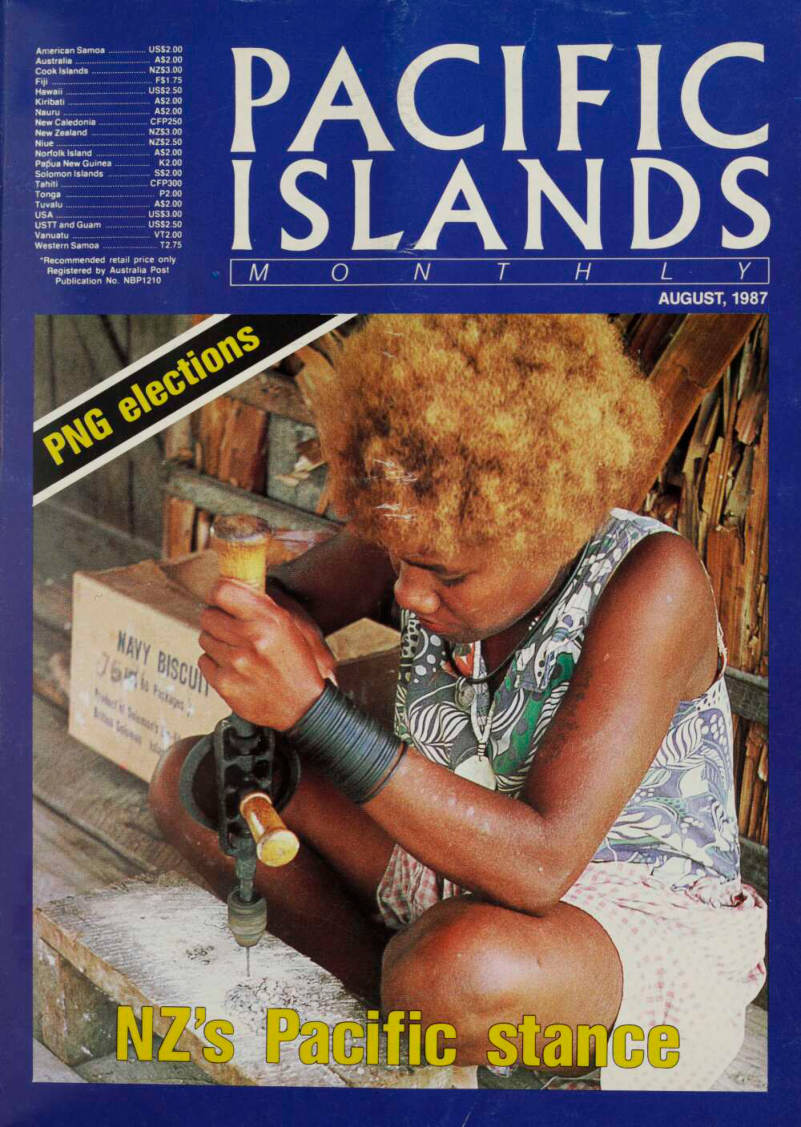
The Cover
Making shell money on the Solomon Is lands. Photo: John Connell.
Change Of Address
Please note that PIM has changed its address and telephone number
Advertisements & other items, p. 2 (1 item)
Compact
but
big.
It used to be simple. In order to gain the maximum amount of interior space, cars necessarily had to have big bodies.
But then people also wanted compact family cars that were easier to handle and performed better. It came down to making a hard choice. Till Honda decided to challenge this state of affairs. Honda aimed to give people a lot of room in a small car that was easy to handle. So from the very start, Honda designed the Civic Sedan to realize an automotive goal that was considered virtually impossible—going for a compact body that would permit the maximum possible interior space to be realized.
And that's where Honda's MM philosophy makes the difference. It advocates minimum space for mechanisms and maximum space for utility. Honda's no-compromise approach combines superior performance with mechanical parts designed for compactness and high-density integration. Take the 12-valve engine for instance. Engineered for high power, it's also compact, durable, and economical. How about the high-performance suspension?
Light and compact, it takes up minimal space, allowing the car to have a lower, sleeker hood. Honda made the most effective use of available space wherever possible, leaving a generous interior space to ensure passenger comfort. That means plush, roomy seating for four adults with ample legroom for all. Take a look at the trunk. Deep and wide, it opens up right from the bumper line to take all the effort out of loading. Even the rear seatback folds down for extra loading convenience.
The end result is a deceptively orthodox sedan with a significantly higher level of driving enjoyment.
Compact but big. A paradox Honda challenged and solved. The Honda way. 0 cc
fill
Equipment may vary in some countries. m , am i . ass m ■- > : 111 ■ : mi - In 1986, Williams/Honda won the Formula I Constructors' Championship. In 1987, Honda's Formula I engines will power both Williams and Lotus. Thuswe will continue to polish our expertise at the pinnacle of automotive technology.
Canon !<:< HI Mobil M AUSTRALIA: Honda Australia Pty, Ltd. Lot 95 Sharps Road, Tullamarine, Victoria 3043; Bennett Honda Pty., Ltd. 250 Victoria Road, Wetherill Park, N.S.W. 2164/NEWZEALAND: NZMC Limited Manners Plaza, 57-65 Manners St., Wellington/PAPUA NEW GUINEA: Toba Pty, Ltd. RO. Box 503, Port Moresby /TAHITI: Honda Distribution S.A.R.L. B.P 1665, Papeete/KIRIBATI: Atoll Motor & Marino Services PO. Box 49, Bairiki Tarawa, Republic of Kiribati/U.S. TRUST TERRITORY: United Micronesia Development Association PO. Box 235, CHRB Saipan CM 96950/COOK ISLANDS: Cook Islands Motor Centre Ltd. PO. Box 74, Rarotonga/GUAM: Mark’s Motor Co., Inc. PO. Box DV, Agana/WESTERN SAMOA: Motor Distributors (Samoa) Ltd. PO. Box 576, Apia/SOLOMON ISLANDS: Lee Kwok Kuen & Co., Ltd. PO. Box 537 Homara/NEW CALEDONIA: Societe Du Chalandage 8, Rue de la somme-B.P. 97, Noumea/NAURU: Nauru Cooperation Republic of Nauru/FIJI: Coral Island Motors Ltd. Robertson Road, Suva, Fiji/ AMERICAN SAMOA: Holiday Motors, Parts and Service PO. Box 968, Pago Pago, American Samoa 96799; Heleck’s Service Center Ltd. PO. Box 1138, Pago Pago, American Samoa 96799/TONGA: Tonga Industrial Traders PO. Box 1035, Nukualofa, Tonga/NORFOLK ISLAND: Duncombe Bay Garage New Cascade Road, Norfolk Island/VANUATU: Honda Farm Ltd. PO. Box 1031, Port Vila, Vanuatu
Pacific
Islands
Monthly
Vol. 58, No. 8, August, 1987.
Pacific Islands Monthly (Apps
No NBP 1210) is published monthly for US$36 per year by Pacific Publications (Aust.) Pty Ltd, of 64-76 Kippax St, Surry Hills, NSW 2010, Australia Second class postage paid at Honolulu, Hawaii POST MASTER: Send address changes to PACIFIC
Islands Monthly, Po Box 22250, Honolu
lu, Hawaii 96822
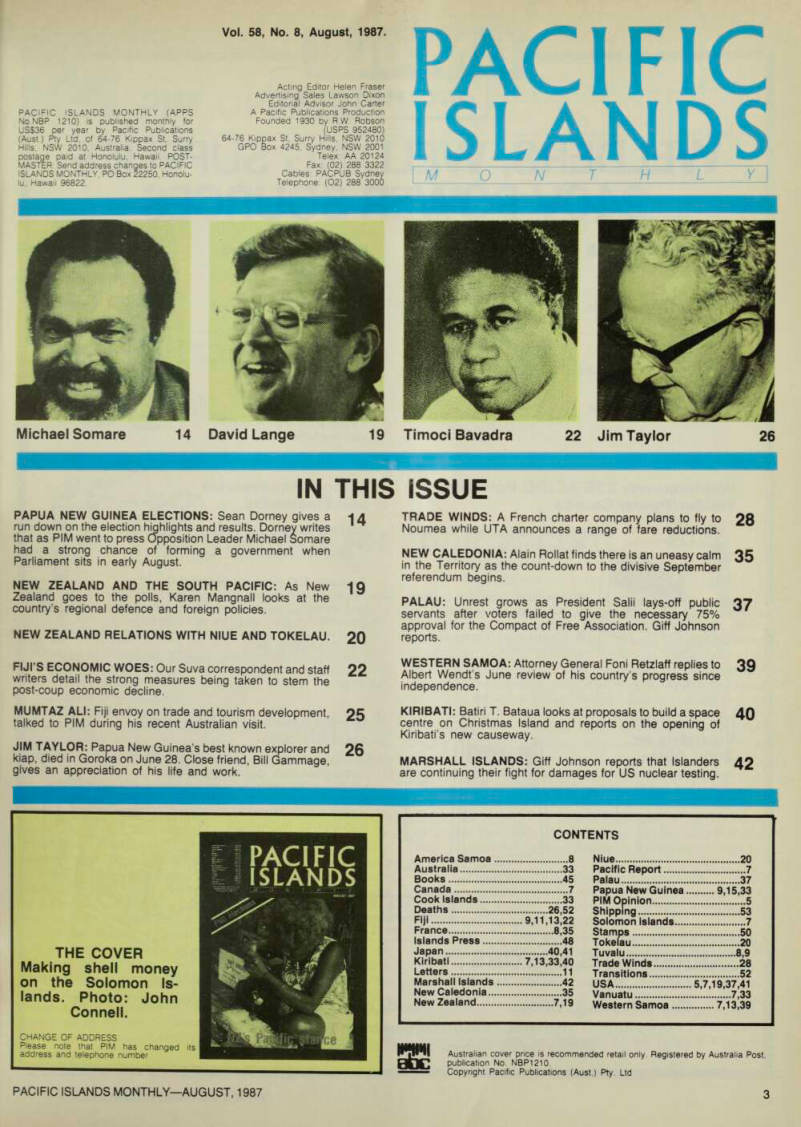
Michael Somare 14
David Lange 19
Timoci Bavadra 22
Jim Taylor 26
In This Issue
PAPUA NEW GUINEA ELECTIONS: Sean Dorney gives a -14 run down on the election highlights and results. Dornev writes 1 that as PIM went to press Opposition Leader Michael Somare had a strong chance of forming a government when Parliament sits in early August.
NEW ZEALAND AND THE SOUTH PACIFIC: As New IQ Zealand goes to the polls, Karen Mangnall looks at the country’s regional defence and foreign policies.
NEW ZEALAND RELATIONS WITH NIUE AND TOKELAU. 20 FIJI’S ECONOMIC WOES: Our Suva correspondent and staff 22 writers detail the strong measures being taken to stem the post-coup economic decline.
MUMTAZ ALI: Fiji envoy on trade and tourism development, 25 talked to PIM during his recent Australian visit.
JIM TAYLOR: Papua New Guinea's best known explorer and 26 kiap, died in Goroka on June 28. Close friend, Bill Gammage, gives an appreciation of his life and work.
TRADE WINDS: A French charter company plans to fly to 28 Noumea while UTA announces a range of fare reductions.
NEW CALEDONIA: Alain Rollat finds there is an uneasy calm 35 in the Territory as the count-down to the divisive September referendum begins.
PALAU: Unrest grows as President Salii lays-off public 37 servants after voters failed to give the necessary 75% approval for the Compact of Free Association. Giff Johnson reports.
WESTERN SAMOA: Attorney General Foni Retzlaff replies to 39 Albert Wendt’s June review of his country's progress since independence.
KIRIBATI: Batiri T. Bataua looks at proposals to build a space 40 centre on Christmas Island and reports on the opening of Kiribati’s new causeway.
MARSHALL ISLANDS: Giff Johnson reports that Islanders 42 are continuing their fight for damages for US nuclear testing.
Stamps 50
Contents
America Samoa 8 Australia 33 Books 45 Canada 7 Cook Islands 33 Deaths 26,52 Fiji 9,11,13,22 France 8,35 Islands Press 48 Japan 40,41 Kiribati 7,13,33,40 Letters 11 Marshall Islands 42 New Caledonia 35 New Zealand 7,19
Niue 20 Pacific Report 7 Palau 37 Papua New Guinea 9,15,33 PIM Opinion 5 Shipping 53 Solomon Islands 7
Stamps 50
Tokelau 20 Tuvalu 8,9 Trade Winds 28 Transitions 52
Usa 5,7,19,37,41
Vanuatu 7,33 Western Samoa 7,13,39
Australian cover price is recommended retail only. Registered by Australia Post, publication No. NBPI2IO.
Copyright Pacific Publications (Aust.) Pty. Ltd
Advertisements & other items, pp. 3-4 (2 items)
3
PACIFIC ISLANDS MONTHLY—AUGUST, 1987
Acting Editor Helen Fraser Advertising Sales Lawson Dixon Editorial Advisor John Carter A Pacific Publications Production Founded 1930 by R W Robson
(USPS 952480)
64-76 Kippax St, Surry Hills, NSW 2010 GPO Box 4245, Sydney, NSW 2001 Telex: AA 20124 Fax; (02) 288 3322 Cables: PACPUB Sydney Telephone: (02) 288 3000
240 V Power Sources
LINCOLN
ARC WELDING
WELDERS, WELDING SUPPLIES
240 V POWER SOURCES
Weldanpower 175 Portable Welder/ Power Source • Petrol, and diesel with impulse start or with electric start and undercarriage. • Current range 60-175 amps AC • Electrode range 2.0-4.omm • AC auxiliary power 240 V, 4.5 kW, 50 Hz • Roll frame is standard except for electric start model.
Weldanpower 225 AC/DC Portable Welder/Power Source Two models, petrol or diesel Current range 50-225 amps AC 70-250 amps DC Electrode range 2.0-s.omm AC auxiliary power 240 V, 6kW, 50Hz Electric start is standard on both models. r?
Dis-gen 25kVA
Generating set,
240 V, 50Hz
Powered by the Perkins 3 cyl. diesel: low speed, quiet and robust machine. Suitable for home and shed electric power.
Dls>qen 1C 140 Welder and
Battery Charger
• Plug-in 240 V welder complete with leads and 15 amp 3 pin plug • Electrode range 2.0-3.2 mm • Latest solid state components provide continuous variable current control even while welding.
AC225-S workshop welder with larger capacity also available Lincoln Accessories and Electrodes Linctong electrode holder, light, cool, comfortable.
Insulated and with replaceable parts.
Twistong 400 electrode holder, fully insulated, handle twists to lock onto electrode stub.
Well balanced and comfortable to use. (See picture.) Coolshield 4 welding shield with flip-up front. Clear, inner lens gives protection during deslagging and weld cleaning operations.
Lincoln also supply cables, clamps, gloves and a range of electrodes.
Dis-gen 6.SkVA Basic Generating
set, 240 V, 50Hz
Realiable, 1500 rpm, smoothrunning auxiliary generating set.
Inbuilt engine protection and safety features on the alternator assure peace of mind.
Powered by the Kubota 4-cycle diesel engine with indirect injection.
I ARC WELDING]
rr o o
CARPENTERS MOTORS ELA MOTORS
FIJI PAPUA NEW GUINEA
Phone SUVA 31 3644 Head Office PORT MORESBY Phone 21 7036 The Lincoln Electric Co. (Australia) Pty. Ltd. (Inc. in n.s.w.) 35 Bryant Street, Padstow. N.S.W. 2211 Phone 772 7222. Tlx 22792 LE177R.25/18 Shatter
Pim Opinion
Contempt for tuna accord
When President Ronald Reagan sent the South Pacific tuna treaty to the United States Senate for its consent, he pointed out that the subject matter it embodied constituted the single most serious cause of friction between the US and the nations of the South Pacific. Despite that, the treaty continues to languish on Capitol Hill and, given the other procedures that must follow its formal approval, an operative date is impossible even to guess.
The Congress assigns higher priority to the Iran arms deals and the siphoning of funds to the Contra cause in Nicaragua. It assigns higher priority to an extraordinary array of trade measures, reflecting its own protectionist mood and the pressures being applied by interest groups in the electorate. Increasingly, too, it is preoccupied with the developing race for nomination as candidates for the presidency next year.
Obviously, all these matters are important. Unravelling the truth about Contragate is fundamental to the rule of law and the credibility of foreign policy in the United States. The US role in securing freer, fairer international trade without risking a severe recession in the West is crucial and the Reagan Administration’s recent bold initiative for a negotiated, multilateral trade settlement by the end of next year is a direct response to the protectionism in the Congress. And the outlook of the next American Administra tion will be affected significantly by events like this.
It is unfortunately true, however, that in times of stress the American political system finds it extremely difficult to maintain a balanced view of its overall role in the world. Compared with the other congressional preoccupations of recent months, the tuna treaty is a simple and, indeed, overdue measure to redress long-standing wrongs perpetrated by American commercial in terests upon a group of small but friendly countries in a region of
growing strategic significance.
The signing of the treaty was a significant gesture by the Reagan Administration acknowledging the case put by the Pacific countries and the spirit of the agreement. But the same commercial interests, represented by the American Tunaboat Association and its Washington lobby, the US Tuna Foundation, treats the accord with contempt. The result can only be an increasingly jaundiced view of the US in the states for whom the treaty is crucially important.
It needs to be remembered, for example, that when the authorities of Kiribati apprehended an American trawler, fishing illegally in its economic zone, no fewer than ten other American trawlers escaped, though their illegal activities had been well documented and their identities established.
Kiribati claims, quite justifiably, that those who escaped also should be made available to face the legal consequences of their actions. One of them was the infamous Jeanette Diana, arrested in one of the first incidents of this type by the Solomon Islands Government, which suffered American economic sanctions for its pains.
We have progressed since then, but how far in real terms? The island governments lack the physical resources to mount more than token or sporadic efforts against the high-technology tuna pirates of the American West Coast.
They believed, with good reason, that with the signing of the tuna treaty, such action was no longer necessary that they would, in fact, be properly compensated at last for the exploitation of a critically important resource. In reality, nothing has changed.
If the extensive resources of the American diplomatic service deployed throughout this region are not able to convey the message to Washington about the consequences of this situation it is surely no wonder that American foreign policy is in disarray.
Advertisements & other items, p. 6 (1 item)
Trinitron
J s m- * -
KV-2092AS
KV-1440AS
Its so tempting.
The colour you get from Sony's new Super Trinitron.
Our new Pan-Focus gun is computer-designed to make our famous colour even sharper and clearer. Our new Black Screen makes whites brilliant, blacks profound, every colour deeper and richer.
It's flatter and sguarer too.
For less reflection and superb clarity, even in the corners.
For those whose taste demands the best, Super Trinitron is the most delicious TV ever.
Trinitron
pacific report
Dialogue Starts
Fiji Prime Minister, Dr Timoci Bavadra, ousted along with his coalition govern ment by the military coup on May 14, has softened his attitude to attempts to keep the country from going over the econo mic precipice. Dr Bavadra has called on Indian sugar farmers to harvest their cane, and cutting has begun. But he remains opposed to constitutional change and has assured the Indian cane workers that the coalition will not accept any moves to disenfranchise them or abridge their basic rights. Dr Bavadra said he is co-operating with Governor-General Ratu Sir Penaia Gani lau’s moves to restore democracy be cause it is important to resolve the crisis through dialogue. In line with this he has agreed to his four representatives on the constitutional review committee atten ding its meetings.
O’Leary Comments
Upset The French
Continuing sensitivity of French/Austra lian relations was highlighted last month when France criticised remarks made by Australia’s new consul-general in New Caledonia, Mr David O’Leary, Mr O’Le ary was reported in the Noumea press as saying that Australia and the region believed that independence for New Caledonia was inevitable and desirable, prompting the French Foreign Ministry to call in the Charge D’Affaires of the Australian Embassy in Paris, Mr Rick Fraser. Australia is believed to have rejected the French criticism, saying that Mr O’Leary’s comments had been taken out of context. A spokesman for the Department of Foreign Affairs in Can berra said Mr O’Leary had only restated the views of the Australian Government and the South Pacific Forum. He said the consul- general had also restated Aus tralia's wish to maintain a constructive dialogue with France and had denied any suggestion that Australia wanted to see France out of the Pacific.
Canada Triples
Aid
Canada has announced a new aid programme for the South Pacific which
will triple its annual contribution to the r egion. Speaking at the recent ASEAN foreign Ministers conference in Singa pore, Canadian Secretary of State for external affairs, Mr Joe Clark, said the initiative reflected Canada’s growing in terest in the Asia-Pacific region. Mr Clark said the new programme would take Canada’s total aid for the region to USssmillion a year. He said the extra funds would be used in fisheries deve lopment and ocean resource manage ment through regional organisations such as the Forum Fisheries Agency and the University of the South Pacific
Vanuatu Receives
Cyclone Relief
Australia has given Vanuatu over A 5700,000 for a reconstruction program me following the damages caused by Cyclone Uma earlier this year. The Vanuatu Government Minister responsi ble for the programme, Mr Donald Kalpokas, said the money would be used for reconstruction work on Radio Vanuatu’s Broadcast House, Govern ment houses and offices including the Prime Minister’s office, the George Pom pidou health complex and the Supreme Court buildings. The fund would also be used for reconstruction of schools of Efate and in Vila, Mr Kalpokas said. Aid donor countries had by mid-June pledged about 10 million kina to the reconstruction programme. Apart from Australia, aid has come from New Zea land, Britain, France, the United States and Canada.
Shultz Backs Mururoa
Testing
The US Secretary of State, Mr George Shultz, has supported France’s nuclear testing programme in the Pacific, saying that while the US was concerned about the widespread hostility the tests had aroused, French nuclear capability was part of a deterrent force which main tained world peace. He said the US was therefore very reluctant to see the spread of so-called nuclear free zones.
He said he was convinced by assur
ances from France that its testing prog ramme was totally safe. Mr Shulz was speaking in Singapore during his recent tour of Asia and Australia. Later on the same tour, Mr Shulz commented on Soviet and Libyan influence in the Paci fic, saying island countries had to de cide themselves how to react to Soviet offers of fishing agreements and Libyan attempts to establish diplomatic mis sions in the region. He said Washington understood this was a difficult time for island nations and would continue to provide aid.
More Eec Aid
To Western Samoa
The European Economic Community has agreed to give further financial aid to Western Samoa, which is experiencing balance of trade problems, with imports outstripping exports. Western Samoa's Finance Minister, Mr Saili, said the EEC would provide an extra As 2 million in assistance. The community had earlier granted Western Samoa nearly As 3 million in export subsidies.
Kiribati Bank
Profit Booms
The Bank of Kiribati has announced an unaudited profit for the six months to the end of March of just over USS3OO,OOO Directors of the bank, which is 51% owned by Australia’s Westpac Corpora tion, said the continued good returns on international business and investments boosted the profit beyond expectations.
The Kiribati Government owns the re maining 49 per cent of the bank.
Solomons Studying
Assemblies
The Solomon Islands Government has established a committee to study whe ther the country’s six provincial assemb lies should be abolished. A report sub mitted to Cabinet in May suggested three options for local government.
These were; retention of the present provincial system; a modified admi nistrative system to allow the govern
ment to deal directly the area councils: or the establishment of state govern ments. Cabinet favoured dealing directly with the councils and established a committee to look at the financial im plications. The Minister for Home Affairs and Provincial Government, .Mr Andrew Nori, said that if a direct link with area councils was not considered feasible, Cabinet would look at other options.
Diplomatic Relations
Set Up
The Federated States of Micronesia and the Republic of the Marshall Islands have established diplomatic relations with each other with foreign ministers from the two former US trusteeships extending recognition in a ceremony in Honolulu.
Nauru Resettlement
Plea
A former Australian public servant has told an inquiry that the United Nations should be held responsible for the resettlement of the people of Nauru. The Commission of Inquiry was set up by the Nauru Government to Investigate the feasibility of rehabilitating the now de nuded island. Mr Reginald Marsh, who was the director of Nauruan resettlement in the former Australian Department of Territories in the 19605, said he believed the UN must be held responsible for resettlement because it had granted trusteeship of the island to Australia, New Zealand and Britain before Nauru’s independence. Mr Walsh said the world community had benefited greatly from cheap Nauruan phosphate and the re sponsibility for the future of Nauru law with the UN.
Lini Re-Elected
Party President
The prime minister of Vanuatu, Father Walter Uni, has been re-elected by his ruling Vanua’aku Parti for another four year term as President. His re-election came at the end of the Party’s Annual Congress held on Malo Island off Santo.
In line with past procedures, the Vanua’aku Parti president automatically becomes Prime Minister should the Vanua’aku Parti win the forthcoming November election. The position of Vice- President was taken by MNr Kalpokor Kalsakau, the Minister for Finance. He replaces the Deputy Prime Minister, Mr Sethy Regenvanu, who stepped down to
become a member of the party’s Execu tive Council. The new Assistant Vice- President is a lawyer, Mr Kalkot Matas Kelekele. The Secretary General, Mr Barak Sope, retained his position as did the Assistant Secretary General and Minister for Lands, Mr Donald Kalpokas.
Mr Sela Molisa retained the position of Party Treasurer. Vanuatu’s next parlia ment will have 46 seats. The increase in seats will for the first tiume enable the people of Maewo Island to send their own representative to parliament. Six other islands will elect additional mem bers.
Landing Rights
Suspended
Western Samoa, Cook Islands and New Zealand have suspended landing rights for South Pacific Islands Airways, follow isafety reasons. South Pacific Islands Airways, which is based in American Samoa, was grounded by US authorities earlier this year after alleged safety violations but was to have resumed jet services in late June. With the suspen sions on wide-bodied flights, the airline will be restricted to using light aircraft on the short flight between American Samoa and Western Samoa.
Reagan Calls
On Treaty
President Reagan has called on the Senate to give early approval to the new fishing treaty designed to end the long running dispute between the US and South Pacific Forum countries over tuna fishing rights. The treaty has already been approved by most of the Forum countries. President Reagan said the treaty would eliminate the primary source of friction between the US and island countries.
Fabius Haunted By
Rainbow Warrior
France’s former Prime Minister, Mr Fabius, is to take court action against the author of a new book on the sinking of the Rainbow Warrior in New Zealand two years ago. The book, Mission Oxygen, claims Mr Fabius had advance know ledge of operations by French secret agents which resulted in the sinking of the Greenpeace protest ship in Auck land harbour. New Zealand police arrested two French agents who were
later sent to prison. The author says he is a former French Secret Services officer and that he was asked to prepare a secret report for Mr Fabius on the bombing of the ship.
Tuvaluan Language
Bible Launched
The first complete Bible in the Tuvaluan language has been officially launched at a ceremony in Funafuti. Previously, only the New Testament was available in Tuvaluan. Work on translating the entire Bible was carried out jointly by the Tuvalu Church and the United Bible Society of Australia.
Convictions
Overturned
The Supreme Court of Palau has over turned the convictions of three men for the assassination of President Haruo
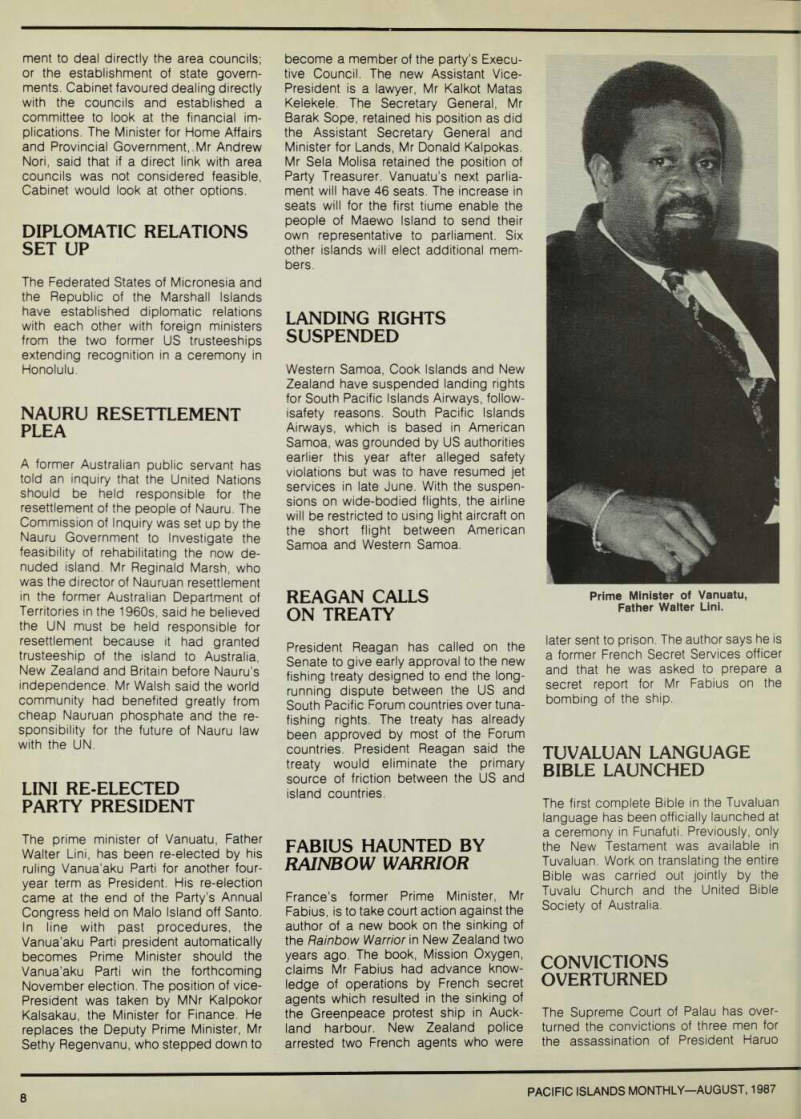
Prime Minister of Vanuatu, Father Walter Lini.
Remeliik two years ago. The men had been given prison terms of up to 35 years, but remained free pending appeal. The convictions were overturned on the grounds that the evidence against the accused had been unreliable. The Government will consider appealing against the Supreme Court ruling,
Regional Aid Funds
Under Threat
The eight South Pacific countries under the Lome convention have been warned to speed up the use of funds allocated to them for regional projects. Only $45,000 of the total allocation of $lB million have been used. The Secretary General of the Africa Caribbean Pacific Group, Mr Edward Carrington, says the under utilisation of funds could jeopardise Pacific states when preliminary negotia tions on a new Convention start in September 1988. One problem is that major differences have occurred be tween the Pacific States and the Euro pean Economic Commission which helps to provide the funds over the interpretation.
Tuvalu Trust Fund
Set Up
The High Commissioners of Australia, New Zealand and Britain have signed an agreement with Tuvalu, setting up a US$l9 million trust fund for the Pacific island. The former Tuvalu Deputy Prime Minister and present Director of the South Pacific Bureau for Economic Co operation, Mr Henry Naisali, began lob bying for the trust fund in 1982. He said South Korea had made a small contribu tion and West Germany, Japan and Canada were prospective donors. How ever, the United States had not re sponded to an approach for support.
Investment from the fund is expected to provide more than one-third of Tuvalu’s annual budget.
Png Proposes Fiji
Conference
Papua New Guinea has proposed a conference on ways to help solve the constitutional crisis in Fiji. Details of the proposed conference have been sent to members of the South Pacific Forum and a delegation appointed by Fiji’s Gov ernor-General, Sir Penaia Ganilau, has been invited to attent. In addition, Britain, the US and ASEAN nations have been briefed.
Court Upholds
Maori Treaty
The New Zealand Court of Appeal in a landmark decision has ruled that the Lange Government cannot transfer Crown land claimed by Maori tribes to new state corporations. The New Zea land Government had sought to transfer thousands of hectares to the country’s new coal, forestry and land corporations.
However, in a unanimous decision the five judges of the Court of Appeal said the 1840 Treaty of Waitangi over-rode legislation passed last year under which the new corporations
Caution On Tv
The Western Samoan Government has been urged not to make a quick decision on the introduction of television, with Opposition Leader, Tupuola Efi, sug gesting that the money could be better spent on education, agriculture and
industrial development. The Minister for Broadcasting, Mr Le Tagaloa Pita, has announced that an American company will carry out an investigation into whe ther television transmitted to users by telephone can be introduced, saying he wants the service to start as soon as possible.
Australia Lifts
Caution On Fiji
Fiji is once again a safe destination for tourists, the Australian government has declared. Because of conditions after the coup, Australia’s Foreign Affairs Department was advising tourists to contact it before going to Fiji. However, Fiji has now been taken off the list of countries requiring travel advice. The announcement followed closely on the decision by Air Pacific to offer big discounts on fares between Australia and Fiji.
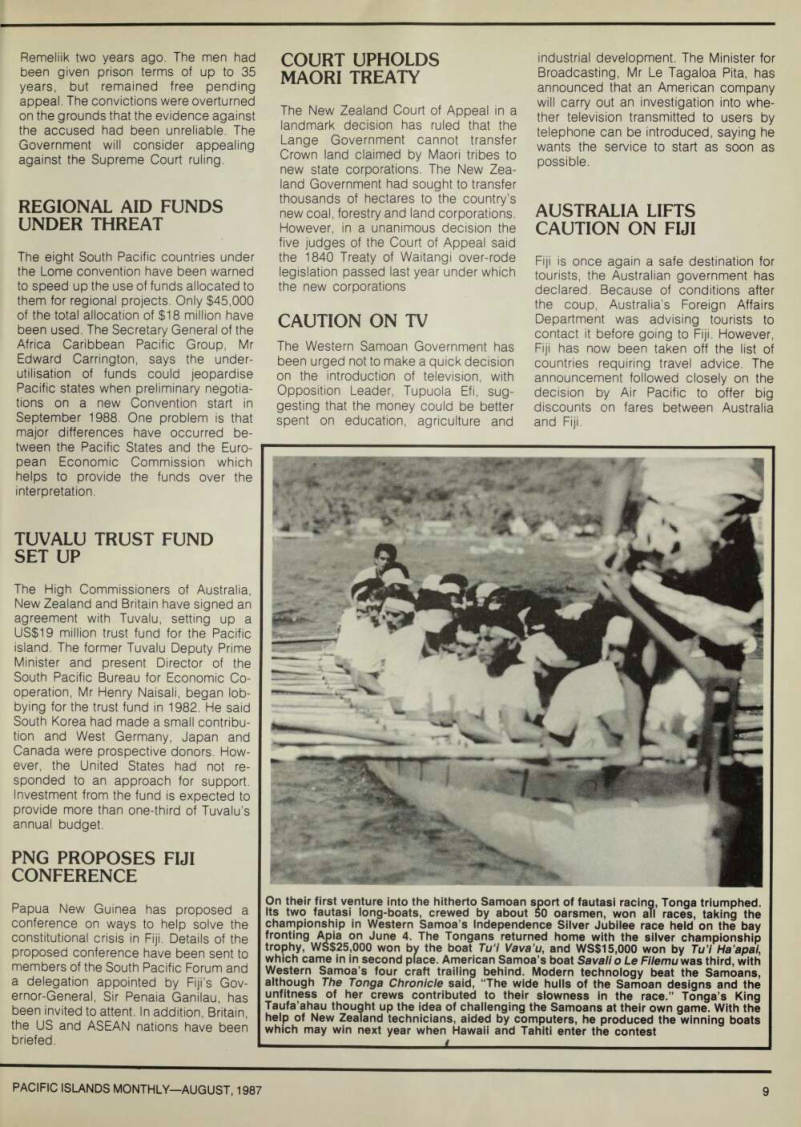
On their first venture into the hitherto Samoan sport of fautasi racing, Tonga triumphed.
Its two fautasi long-boats, crewed by about 50 oarsmen, won all races, taking the championship in Western Samoa’s Independence Silver Jubilee race held on the bay fronting Apia on June 4. The Tongans returned home with the silver championship trophy, WS$25,000 won by the boat Tu‘i Vava’u, and WS$15,000 won by Tu’i Ha'apai , which came in in second place. American Samoa’s boat Savalio Le Filemu was third, with Western Samoa’s four craft trailing behind. Modern technology beat the Samoans, although The Tonga Chronicle said, “The wide hulls of the Samoan designs and the unfitness of her crews contributed to their slowness in the race.” Tonga’s King Taufa’ahau thought up the idea of challenging the Samoans at their own game. With the help of New Zealand technicians, aided by computers, he produced the winning boats which may win next year when Hawaii and Tahiti enter the contest
Advertisements & other items, p. 10 (1 item)
Winfield
Five
smokes
ahead of
the rest
faith aH
OKING
S M
rNING
VN/A
WV2 CC494/80
Former G.G. speaks on Fiji coup
letters
The recent military coup in Fiji has no doubt sent shock waves through out the Pacific, the world, and in particular to the Federal Labor Government of Australia and also to the Labour Government of New Zealand.
The natural trend of military coups in Africa, Asia, South America or elsewhere takes a familiar path of a military take over, followed by the execution by hanging or by a firing squad of all the members of the overthrown elected govern ments followed by severe harassment and execution of the followers of the overthrown government. Simultaneously, the military coup would sus pend the country’s constitution and proclaim itself as the legal government.
How many of these coups has Australia and New Zealand officially recognised, not with standing that they were in fact military coups? It would be interesting to know this, in spite of their condescending, sanctimonious, and hypocritical pronouncements by falsely be lieving that they alone have answers to any problems arising either in the Pacific or else where in the world.
The Fijian military coup should be seen in its proper, wider perspective, especially by Australia and New Zealand.
One should not blame the Indian migrants from becoming a majority in Fiji because they were brought into Fiji by Her Majesty’s Government of Great Britain. On the other hand, the Fijians apparently took no part in Great Britain’s open foreign migration policy at that point of time which has worked against them!
The Conservative govern ment of Great Britain seems to have conveniently forgotten her previous infamous immigration policy in Fiji which played a
major role in the military take over in Fiji. Many Pacific lead ers, with the exception of Aus tralia and New Zealand, knew it had to come sooner or later.
The military take-over in Fiji is not and cannot be classified with the military coups in Africa, Asia, South America and small Grenada which were always followed by a blood bath. This did not happen in Fiji. I per sonally know the present Gov ernor-General of Fiji as a friend.
He is a gentleman, a war hero, and a person of the highest integrity of dedication and loyal service to his land and people. I admire him for his courage in the current crisis in his homeland.
The former Governor-Gen eral is equally known for his dedication and loyalty to his land and people. I personally know him also as a friend and a real gentleman. After their initial official pronouncement with other Pacific countries in con demning the military take-over in Fiji, both Australia and New Zealand continued with their sanctimonious public state ments.
Australia continued to advise Pacific leaders not to attend the Forum meeting at Apia should Fiji send her delegation to Apia.
If this is not blatant interference in the domestic affairs of inde pendent Pacific countries, then I must be forced at gun-point to believe in the actual existence of goblins and fairies in Aus tralia.
These continual public state ments by Australia and New Zealand government leaders re garding the Fijian situation smack of conceited and false intellectual and racial superior ity, especially when one of these leaders publicly called a prominent Fijian world figure, a statesman, and the founding father of his nation, a traitor.
The proposed gun-boat di
plomacy by both these nations is fraught with political danger.
These two leaders should devote some of their political energy to study their own backyard in the growing racial tensions before preaching to the island nations from the high pulpit on moral principles.
I believe that the situation in Fiji will be ultimately solved under the democratic and wise leadership of the Governor- General of Fiji. It is in the interests of everyone that he be assisted by the Melanesian and Polynesian leaders of the other Pacific island nations.
Following the condemnation of the military take-over in Fiji,
the lessons leamt are that Papua New Guinea must al ways ensure without any reason of doubt to maintain at all times the Melanesian people’s dominance in all politi cal, economic, social, educational and on all land development projects of this na J* on - M New Guinea must be *° prot f th ® n 3 hts of her peoples . m her foreign ,mm, 3f °" poky m order to pr f v h ent and d.s- Solut,onment her up-and co™" 9 T 9 l «? dcrsh tP- Papu l New Guinea is not unique from other developing nations of the World. John Guise, Port Moresby.
Advertisements & other items, pp. 11-12 (1 item)
Forklifts
CONTAINER HANDLERS
HEAVY DUTY YARD FORKLIFTS
WALKIE STACKERS
WAREHOUSE FORKLIFTS
SALES
SERVICE
HIRE
For the total solution to the high cost of new equipment.
USED FORKLIFT SPECIALISTS
Queensland
Wholesale Forklifts
736 Kingsford Smith Drive, Eagle Farm, Queensland, Australia 4007.
Ph. (07) 268 7755.
Fax. (07) 268 5862. mw
t into the action!
(but watch your head)
National’s new VHS-C Movie MCS is so light, compact, and simple to use, you don’t just record the action, you’re part of it!
Bring it to the scene of family fun, and shoot while you play. With microelectronic
wizardry extending high-speed shutter capability
to 1/IOOOth of a second, the MCS will follow the bouncing ball with beautiful clarity. And none of the fuzziness of conventional l/50th
of-a-second shooting.
Add our original Piezo Auto Focus system with solid-state CCD image sensor, HQ (High Quality) picture circuitry, Auto Tracing White Balance adjustment, SP/LP (30/60-minute) recording on handy C-cassettes of the world’s most popular video format, VHS, plus playback VHS Movie models MCS and M 5
shoot at l/1000th of a second!
capability—and you’ve got a lot of performance to hold in one hand.
For even greater versatility, try our VHS Movie M 5. It not only shoots at l/1000th of a second, but can also play back standard-size VHS cassettes directly on a TV or monitor.
The VHS Movie family of camera/recorders from National.
When you’re headed
for good times.^
VHS
0
NV-M5
NV-MCS
National
Coup commended.
Your June ‘PIM Opinion’ was unbelievably one-sided. Little wonder it was anonymous.
The truth however, is that since the Indians arrived in Fiji,uninvited and unwanted by the Fijians, the Fijian has seen his share of Fiji wealth and benefits progressively deci mated and denied.
According to statistics col lated at USP in 1985, Indians in Fiji own 92% of private resi dences and commercial prop erties, 90% of all businesses, 96% of all vehicles, 87% of personal income and 95% of personal wealth. Almost 90% of senior government positions are occupied by Indians and 93% of legal practices in Fiji are
Indian.
The Indian “Establishment” began to dominate Fijian affairs soon after so-called Fijian inde pendence in 1970. In land matters, through the farcical and notorious Landlord and Tenants Tribunal and the Suva judiciary, the Establishment has secured a stranglehold on most of the leased land in Fiji.
Records demonstrate that land disputes before the courts are almost always settled in favour of the Indian, often in most blatantly biased and in competent judgments. The Fi jian and foreign land-owners have little “crony-access” or rapport with the judiciary, but the omnipotent Indian Estab lishment has been able to per
suade judges to issue judg ments in land disputes that would shame any court in Western democracies. This situation is a significant part of the cause of current Fijian rejec tion of further Indian encroach ment. The landowners’ rights and future have been placed under threat from the new Indian-dominated Alliance (sic) and, to put it simply, the Fijians aren’t having any. I commend the Fijian stand and I blame a biased and unprincipalled judiciary in Suva for much of the bile generated by ’’bent” judgments in favour of Indians in leased land disputes. Perhaps the judiciary will now have the moral stamina to perform like proper judges - without fear or favour. Tom J. Barrington, Wellington, NZ.
“Reply to Albert Wendt”
Albert Wendt”
As a consistent reader of your magazine, I have always re garded it as something of a ’’Bible” on Pacific Islands affairs and events. I was therefore concerned and disappointed by the ’’Stand Alone” presentation of what on the cover of your June 1987 issue purported to be coverage of Western Samoa’s 25th Anniversary of Independence. Having read the article one could not help being left with the conclusion that as an independent nation ”25 years on” Western Samoa is a dismal failure politically, cul turally, and economically, rid dled with political favour, abuse, and corruption at all levels within the community.
The article conveys throughout an air of despondency and despair. As a foreigner with only the experience of eight years association with Western Samoa I consider myself totally unqualified to comment on Professor Wendt’s views about Western Samoa’s political and cultural aspirations and prog ress towards their achievement.
What struck me about the article was the generalisations made about the incidence of corruption, especially involving foreign investment. During the eight year period to which I refer, my company has been
instrumental in the deve lopment and implementation of a number of investment pro jects in Western Samoa invol ving the commitment by foreign investors of many millions of dollars in partnership with local investors, both private and gov ernment. The projects are on going, we believe have made significant contributions to Samoa’s economic deve lopment, and we feel certain will continue to do so in the future. I can say categorically that at no time during the development or implementa tion of any of these projects was any favour of any kind - politi cal or otherwise - given, offered or sought - not by the investors, not by the politicians involved and not by any government official participating in the pro ject evaluations. The de termination of the extent (if any) to which foreign invest ment should participate in Samoa’s development is a right which Western Samoa aquired at independence. Western Samoa’s ability, in the pursuit of this right, to attract the participation of foregin inves tors of integrity and standing would be significantly deni grated by the promotion of an (inaccurate and unfair) image of rife corruption and political manipulation. It would be naive to suggest that corruption (and attempts to corrupt) do not exist and will not continue to exist in
every society. The bigger and more experienced the society, the larger the scale of corrup tion and the more sophisticated are the techniques used. But it seems quite unfair to extrapo late from isolated instances to assert that corruption has be come a way of life. In Western Samoa, in my opinion, it cer tainly has not. No doubt in the last 25 years there have been many mistakes - mistakes which, as Maurice Shadbolt reminded Professor Wendt, Western Samoa acquired at independence the freedom to make. Experience is surely the ability to leam from ones mis takes. The more rigorous re search now being carried out by Western Samoa into the back ground and credentials of prospective foreign investors is sound and reassuring evidence of that experience. Let us hope that Western Samoa’s optimism and persistence towards the achievement of its objectives is not deterred by the cynicism and despair conveyed in Pro fessor Wendt’s article. Nor by the fact that progress may not have been as great as he appears to have anticipated.
We are delighted and honoured to have been invited by West ern Samoa to play a small part toward the achievement of its economic plans. John F. Boyle, Managing Director, Pacific Corporate Services Ltd,Syd ney,NSW
Kiribati
correction
Production difficulties with Ju/y PIM resulted in the name of Michael J Scott, Supervisor of Elections in Fiji, being inadvertantly dropped from his letter on Fiji's electoral system.
I have just read the article entitled “Strong Turnout in Kiri bati Elections” at page 25 of your May, 1987 edition. I was most concerned to find my name mentioned in the article as that of a New Zealand lawyer acting for Beretitenti Tabai’s political opponent Dr Tong.
I must make it quite clear that this reference is both grossly inaccurate and deeply embar rassing to me. Although it is quite true that I was privileged to work as People’s Lawyer in Kiribati from 1983 to 1986, it is absolutely untrue that I am “Dr Tong’s lawyer” or that I advised, assisted or represented Dr Tong, or anybody else in Kiribati for that matter, in con nection with the recent election in Kiribati. I no longer have any professional connection with Kiribati.
It is further entirely wrong to state that I am a New Zealan der; in fact I am English; or that I have been declared an illegal immigrant.
Since August, 1986, I have been under contract to Solo mon Islands Government as Principal Magistrate, Malaita District. It must be clear to you that the activities attributed to me in your article would be entirely inconsistent with my present position, both as a member of the judiciary of another regional country, and as a representative of British aid to the region. As such, I find your article extremely embar rassing and injurious to my reputation.
Michael Lodge,
Solomon Islands Government, Malaita, Solomon Islands
We erred. The lawyer refer red to was in fact Roger Bell.
PIM regrets the error. A correc tion sent by our correspondent arrived too late - Ed.
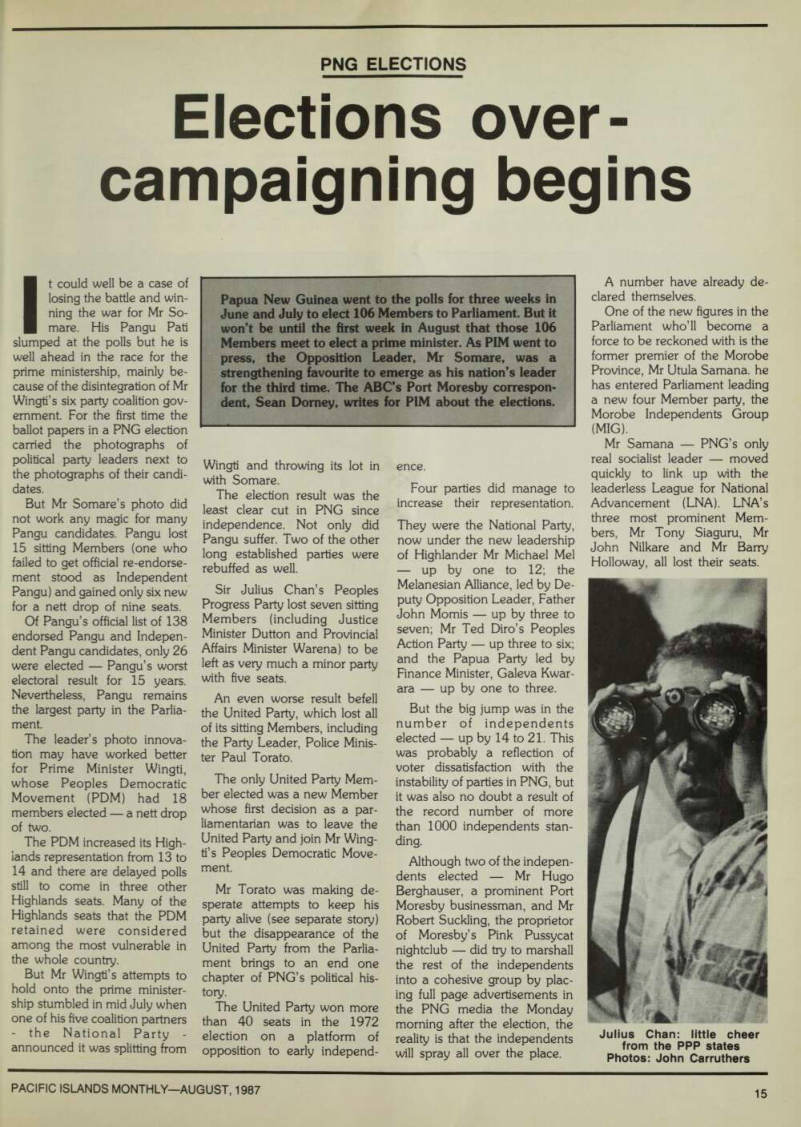
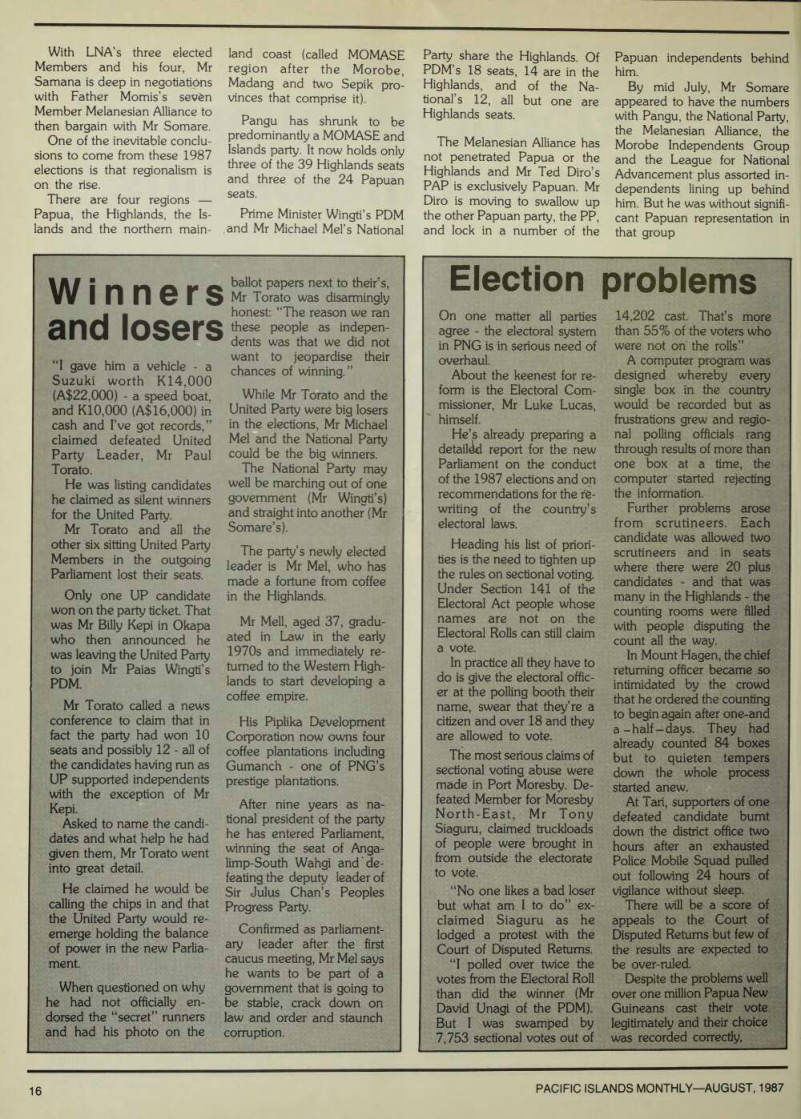
top: National tally room, Sir Hubert Murray Stadium Port Moresby, Photos: John Carruthers
above: Counting votes for Port Moresby South electorate
campaigning begins
Png Elections
Elections over campaigning begins
It could well be a case of losing the battle and win ning the war for Mr So mare. His Pangu Pati slumped at the polls but he is well ahead in the race for the prime ministership, mainly be cause of the disintegration of Mr Wingti’s six party coalition gov ernment. For the first time the ballot papers in a PNG election carried the photographs of political party leaders next to the photographs of their candi dates.
But Mr Somare’s photo did not work any magic for many Pangu candidates. Pangu lost 15 sitting Members (one who failed to get official re-endorse ment stood as Independent Pangu) and gained only six new for a nett drop of nine seats.
Of Pangu’s official list of 138 endorsed Pangu and Indepen dent Pangu candidates, only 26 were elected Pangu’s worst electoral result for 15 years.
Nevertheless, Pangu remains the largest party in the Parlia ment.
The leader’s photo innova tion may have worked better for Prime Minister Wingti, whose Peoples Democratic Movement (PDM) had 18 members elected a nett drop of two.
The PDM increased its High lands representation from 13 to 14 and there are delayed polls still to come in three other Highlands seats. Many of the Highlands seats that the PDM retained were considered among the most vulnerable in the whole country.
But Mr Wingti’s attempts to hold onto the prime minister ship stumbled in mid July when one of his five coalition partners - the National Party announced it was splitting from
Papua New Guinea went to the polls for three weeks in June and July to elect 106 Members to Parliament. But it won’t be until the first week in August that those 106 Members meet to elect a prime minister. As PIM went to press, the Opposition Leader, Mr Somare, was a strengthening favourite to emerge as his nation’s leader for the third time. The ABC’s Port Moresby correspon dent, Sean Domey, writes for PIM about the elections.
Wingti and throwing its lot in with Somare.
The election result was the least clear cut in PNG since independence. Not only did Pangu suffer. Two of the other long established parties were rebuffed as well.
Sir Julius Chan’s Peoples Progress Party lost seven sitting Members (including Justice Minister Dutton and Provincial Affairs Minister Warena) to be left as very much a minor party with five seats.
An even worse result befell the United Party, which lost all of its sitting Members, including the Party Leader, Police Minis ter Paul Torato.
The only United Party Mem ber elected was a new Member whose first decision as a par liamentarian was to leave the United Party and join Mr Wing ti’ s Peoples Democratic Move ment.
Mr Torato was making de sperate attempts to keep his party alive (see separate story) but the disappearance of the United Party from the Parlia ment brings to an end one chapter of PNG’s political his tory.
The United Party won more than 40 seats in the 1972 election on a platform of opposition to early independ
cnce.
Four parties did manage to increase their representation.
They were the National Party, now under the new leadership of Highlander Mr Michael Mel up by one to 12; the Melanesian Alliance, led by De puty Opposition Leader, Father John Momis up by three to seven; Mr Ted Diro’s Peoples Action Party up three to six; and the Papua Party led by Finance Minister, Galeva Kwar ara up by one to three.
But the big jump was in the number of independents elected up by 14 to 21. This was probably a reflection of voter dissatisfaction with the instability of parties in PNG, but it was also no doubt a result of the record number of more than 1000 independents stan ding.
Although two of the indepen dents elected Mr Hugo Berghauser, a prominent Port Moresby businessman, and Mr Robert Suckling, the proprietor of Moresby’s Pink Pussycat nightclub did try to marshall the rest of the independents into a cohesive group by plac ing full page advertisements in the PNG media the Monday morning after the election, the reality is that the independents will spray all over the place.
A number have already de clared themselves.
One of the new figures in the Parliament who’ll become a force to be reckoned with is the former premier of the Morobe Province, Mr Utula Samana. he has entered Parliament leading a new four Member party, the Morobe Independents Group
(Mig).
Mr Samana PNG’s only real socialist leader moved quickly to link up with the leaderless League for National Advancement (LNA). LNA’s three most prominent Mem bers, Mr Tony Siaguru, Mr John Nilkare and Mr Barry Holloway, all lost their seats.
Julius Chan: little cheer from the PPP states Photos: John Carruthers
With LNA’s three elected Members and his four, Mr Samana is deep in negotiations with Father Momis’s seven Member Melanesian Alliance to then bargain with Mr Somare.
One of the inevitable conclu sions to come from these 1987 elections is that regionalism is on the rise.
There are four regions Papua, the Highlands, the Is lands and the northern main
land coast (called MOMASE region after the Morobe, Madang and two Sepik pro vinces that comprise it).
Pangu has shrunk to be predominantly a MOMASE and Islands party. It now holds only three of the 39 Highlands seats and three of the 24 Papuan seats.
Prime Minister Wingti’s PDM and Mr Michael Mel’s National
Party share the Highlands. Of PDM’s 18 seats, 14 are in the Highlands, and of the National’s 12, all but one are Highlands seats.
The Melanesian Alliance has not penetrated Papua or the Highlands and Mr Ted Diro’s PAP is exclusively Papuan. Mr Diro is moving to swallow up the other Papuan party, the PP, and lock in a number of the
Papuan independents behind him.
By mid July, Mr Somare appeared to have the numbers with Pangu, the National Party, the Melanesian Alliance, the Morobe Independents Group and the League for National Advancement plus assorted in dependents lining up behind him. But he was without signifi cant Papuan representation in that group
Winners
and losers
“I gave him a vehicle - a Suzuki worth K 14,000 (A 522,000) - a speed boat, and KlO,OOO (A$16,000) in cash and I’ve got records,” claimed defeated United Party Leader, Mr Paul Torato.
He was listing candidates he claimed as silent winners for the United Party.
Mr Torato and all the other six sitting United Party Members in the outgoing Parliament lost their seats.
Only one UP candidate won on the party ticket. That was Mr Billy Kepi in Okapa who then announced he was leaving the United Party to join Mr Paias Wingti’s
Pdm.
Mr Torato called a news conference to claim that in fact the party had won 10 seats and possibly 12 - all of the candidates having run as UP supported independents with the exception of Mr Kepi.
Asked to name the candi dates and what help he had given them, Mr Torato went into great detail.
He claimed he would be calling the chips in and that the United Party would re emerge holding the balance of power in the new Parlia ment When questioned on why he had not officially en dorsed the “secret” runners and had his photo on the
ballot papers next to their’s, 1 Mr Torato was disarmingly honest: “The reason we ran : these people as indepen dents was that we did not want to jeopardise their chances of winning.”
While Mr Torato and the United Party were big losers in the elections, Mr Michael Mel and the National Party could be the big winners.
The National Party may well be marching out of one government (Mr Wingti’s) and straight into another (Mr Somare’s).
The party’s newly elected leader is Mr Mel, who has made a fortune from coffee in the Highlands.
Mr Mell, aged 37, gradu ated in Law in the early 1970 s and immediately re turned to the Western High lands to start developing a coffee empire.
His Piplika Development Corporation now owns four coffee plantations including Gumanch - one of PNG’s prestige plantations.
After nine years as na tional president of the party he has entered Parliament, winning the seat of Anga limp-South Wahgi and de feating the deputy leader of Sir Julus Chan’s Peoples Progress Party.
Confirmed as parliament ary leader after the first caucus meeting, Mr Mel says he wants to be part of a government that is going to be stable, crack down on law and order and staunch corruption.
Election problems
On one matter all parties agree - the electoral system in PNG is in serious need of overhaul.
About the keenest for re form is the Electoral Com missioner, Mr Luke Lucas, himself.
He’s already preparing a detailed report for the new Parliament on the conduct of the 1987 elections and on recommendations for the re writing of the country’s electoral laws.
Heading his list of priori ties is the need to tighten up the rules on sectional voting.
Under Section 141 of the Electoral Act people whose names are not on the Electoral Rolls can still claim a vote.
In practice all they have to do is give the electoral offic er at the polling booth their name, swear that they’re a citizen and over 18 and they are allowed to vote.
The most serious claims of sectional voting abuse were made in Port Moresby. De feated Member for Moresby North-East, Mr Tony Siaguru, claimed truckloads of people were brought in from outside the electorate to vote.
“No one likes a bad loser but what am I to do” ex claimed Siaguru as he lodged a protest with the Court of Disputed Returns.
“I polled over twice the votes from the Electoral Roll than did the winner (Mr David Unagi of the PDM).
But I was swamped by 7,753 sectional votes out of
14,202 cast. That’s more than 55% of the voters who were not on the rolls”
A computer program was designed whereby every single box in the country would be recorded but as frustrations grew and regio nal polling officials rang through results of more than one box at a time, the computer started rejecting the information.
Further problems arose from scrutineers. Each candidate was allowed two scrutineers and in seats where there were 20 plus candidates - and that was many in the Highlands - the counting rooms were filled with people disputing the count all the way.
In Mount Hagen, the chief returning officer became so intimidated by the crowd that he ordered the counting to begin again after one-and a-half-days. They had already counted 84 boxes but to quieten tempers down the whole process started anew.
At Tari, supporters of one defeated candidate burnt down the district office two hours after an exhausted Police Mobile Squad pulled out following 24 hours of vigilance without sleep.
There will be a score of appeals to the Court of Disputed Returns but few of the results are expected to be over-ruled.
Despite the problems well over one million Papua New Guineans cast their vote legitimately and their choice was recorded correctly.
Advertisements & other items, p. 17 (1 item)
BbnsoMmd Hedges
• ; ! I E
TRADITIONALLY THE NAME
ASSOCIATED WITH PERFECTION
IN CIGARETTES
BENSON & HEDGES
20
BbnsoMmd Hedges
WMWIIS-SIIOMHB IS A HEMTH H&2MID
How the people of PNG voted
(As at the time of going to press)
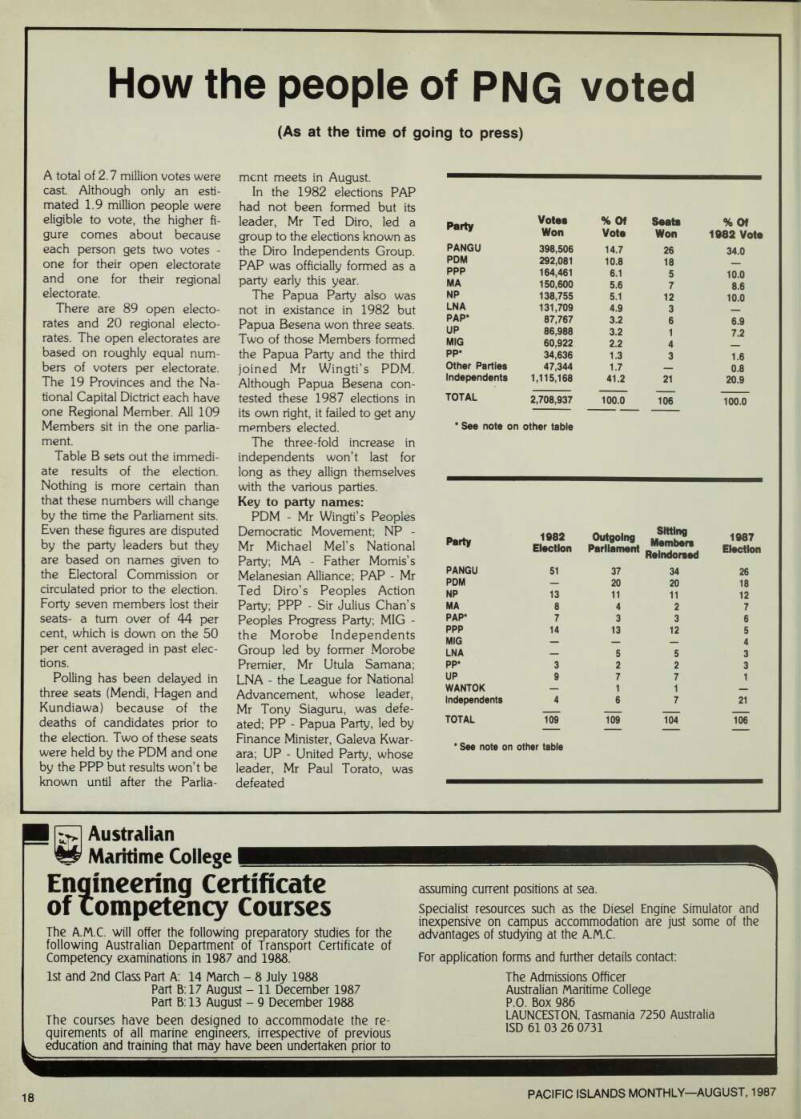
A total of 2.7 million votes were cast. Although only an esti mated 1.9 million people were eligible to vote, the higher fi gure comes about because each person gets two votes one for their open electorate and one for their regional electorate.
There are 89 open electo rates and 20 regional electo rates. The open electorates are based on roughly equal num bers of voters per electorate.
The 19 Provinces and the Na tional Capital Dictrict each have one Regional Member. All 109 Members sit in the one parlia ment.
Table B sets out the immedi ate results of the election.
Nothing is more certain than that these numbers will change by the time the Parliament sits.
Even these figures are disputed by the party leaders but they are based on names given to the Electoral Commission or circulated prior to the election.
Forty seven members lost their seats- a turn over of 44 per cent, which is down on the 50 per cent averaged in past elec tions.
Polling has been delayed in three seats (Mendi, Hagen and Kundiawa) because of the deaths of candidates prior to the election. Two of these seats were held by the PDM and one by the PPP but results won’t be known until after the Parlia
mcnt meets in August.
In the 1982 elections PAP had not been formed but its leader, Mr Ted Diro, led a group to the elections known as the Diro Independents Group.
PAP was officially formed as a party early this year.
The Papua Party also was not in existence in 1982 but Papua Besena won three seats.
Two of those Members formed the Papua Party and the third joined Mr Wingti’s PDM.
Although Papua Besena con tested these 1987 elections in its own right, it failed to get any members elected.
The three-fold increase in independents won’t last for long as they allign themselves with the various parties.
Key to party names: PDM - Mr Wingti’s Peoples Democratic Movement; NP - Mr Michael Mel’s National Party; MA - Father Momis’s Melanesian Alliance; PAP - Mr Ted Diro’s Peoples Action Party; PPP - Sir Julius Chan’s Peoples Progress Party; MIG the Morobe Independents Group led by former Morobe Premier, Mr Utula Samana; LNA - the League for National Advancement, whose leader, Mr Tony Siaguru, was defe ated; PP - Papua Party, led by Finance Minister, Galeva Kwar ara; UP - United Party, whose leader, Mr Paul Torato, was defeated
Party
Votes % Of Seats % Of Won Vote Won 1982 Vote
Pangu
398,506 14.7 26 34.0
Rdm
292,081 10.8 18
Rpr
164,461 6.1 5 10.0 MA 150,600 5.6 7 8.6 NR 138,755 5.1 12 10.0
Lna
131,709 4.9 3
Pap*
87,767 3.2 6 6.9 UP 86,988 3.2 1 7.2
Mig
60,922 2.2 4 PP* 34,636 1.3 3 1.6 Other Parties 47,344 1.7 0.8 Independents 1,115,168 41.2 21 20.9
Total
2,708,937 100.0 106 100.0 * See note on other table
Party
1982 Election
Outgoing
Parliament
Sitting
Members Reindorsed 1987 Election
Pangu
51 37 34 26
Rdm
— 20 20 18 NP 13 11 11 12 MA 8 4 2 7
Pap*
7 3 3 6
Ppp
14 13 12 5
Mig
— — — 4
Lna
— 5 5 3 PP* 3 2 2 3 UP 9 7 7 1
Wantok
— 1 1 — Independents 4 6 7 21
Total
709 709 *104 l06 * See note on other table
Advertisements & other items, p. 18 (1 item)
Engineering Certificate
Australian
Maritime College
of Competency Courses
The A.M.C. will offer the following preparatory studies for the following Australian Department of Transport Certificate of Competency examinations in 1987 and 1988.
Ist and 2nd Class Part A; 14 March - 8 July 1988 Part B:17 August - 11 December 1987 Part B: 13 August - 9 December 1988 The courses have been designed to accommodate the requirements of all marine engineers, irrespective of previous education and training that may have been undertaken prior to assuming current positions at sea.
Specialist resources such as the Diesel Engine Simulator and inexpensive on campus accommodation are just some of the advantages of studying at the A.M.C For application forms and further details contact: The Admissions Officer Australian Maritime College P.O. Box 986 LAUNCESTON, Tasmania 7250 Australia
ISD 61 03 26 0731
Foreign profile
New Zealand elections Foreign profile to change
New Zealand’s distinctive foreign profile of the last three years, particularly in the Pacific, is sure to change whatever the outcome of the August 15 general elec tions. A restored Labour gov ernment would face the end of its political dream ride courtesy of New Zealand’s anti-nuclear affair. A new National govern ment would bring a lurch to the right and a familiar face, that of Sir Robert Muldoon, to the foreign affairs portfolio.
After its July 1984 snap elec tion victory, the Labour Gov ernment shied off the call for nuclear-free legislation, prefer ring the “trust me” policy out lined by the Prime Minister, Mr David Lange. But Labour warmed to the idea and the resulting bullying by the United States and plaudits from around the world convinced the politicians that nuclear-free was bolstering the party’s domestic support. The anti-nuclear legislation was finally passed this year. In the meantime, the United States had unilaterally suspended New Zealand from ANZUS and Britain refused to let New Zealand take part in naval exercises for fear of anti nuclear contamination. The ANZUS fracas caused a few shaky moments for some of the more conservative Pacific gov ernments. New Zealand itself went through the unpre cedented questioning of what defence was desirable. The legislation drew 1500 submis sions. A defence review inquiry drew another 5000. New Zea land’s military was vocal with dire warnings about cuts in defence and intelligence capa bilities.
The cuts were quite real. In 1984 the army spent 10,000 man hours exercising with the
United States military. In 1983 to 1984, New Zealand frigates spent more than 70 days at sea exercising within ANZUS and the airforce spent 200 days overseas exercising with Amer ican forces. All this went by the board and yet the 1985 Budget gave no real increase in defence spending to bolster New Zea land’s military training.
The Labour Government de cided to focus New Zealand’s defence on the South Pacific rather than fighting within a larger and probably nuclear capable force. So in 1986, the military staged counter-in surgency exercises in the Cook Islands. This year they were due to be held in Fiji, but the May 14 coup intervened. New Zealand also called back its 700-strong battalion in Singa pore to upgrade the 1500member Ready Reaction Force.
New Zealand has also begun the search for new military training partners and suppliers.
Australia will supply specially designed naval vessels to re
place New Zealand’s ageing frigates and meet Mr Lange’s aim of a blue water navy.
The Fiji coup brought cold reality into Labour’s plans for a new low-key defence strategy designed to counter exactly that kind of regional threat. It is a moot point whether New Zea land could have done anything about the coup even with a blue water navy or an alert RRF. New Zealand has since suspended military ties with Fiji, once a significant source of training and wargaming for New Zealand officers and sol diers.
The next Labour govern ment would not be able to rest on its anti-nuclear laurels. It plans a Minister for Disarma ment, presumably to work on United Nations arms control resolutions and the South Paci fic Nuclear Free Zone. But the military is restless and enough New Zealanders are still con cerned about the absence of ANZUS to make it necessary for Labour to seek out new de fence links. New Zealand is still
a member of the five power defence pact and could in crease its defence training with Malaysia or Singapore. Labour will also have to make some hard decisions on whether to increase defence spending to compensate for loss of mates rates equipment purchasing from America and fill the gaps in military training left by
Anzus.
New Zealand has stepped up its air force surveillance flights, particularly to help countries like the Solomons and Kiribati keep an eye out for tuna poachers in their exclusive eco nomic waters. But Pacific na tions will be wondering if the next Labour government might adopt a more active military profile in the islands to prove it is not a defence wimp, the disgrace of the Western allied club.
A new National government would try to get New Zealand back into the club. It wants to reinforce New Zealand’s de fence ties with old allies like America, Britain and Australia.
National wants to put New Zealand back in ANZUS and has come up with a tepid anti-nuclear policy to satisfy the Americans as well as the strong anti-nuclear public sentiment.
National proposes to trust America and Britain not to bring nuclear vessels into New Zealand ports. This is the old Nelsonian National policy of the Muldoon era. But National’s new leader, Mr Jim Bolger, will go a step further by promising to state clearly to New Zea land’s nuclear allies that New Zealand does not want any nuclear weapons in Kiwi waters. Nuclear powered ves sels would be okay. National believes this policy would not challenge the neither confirm
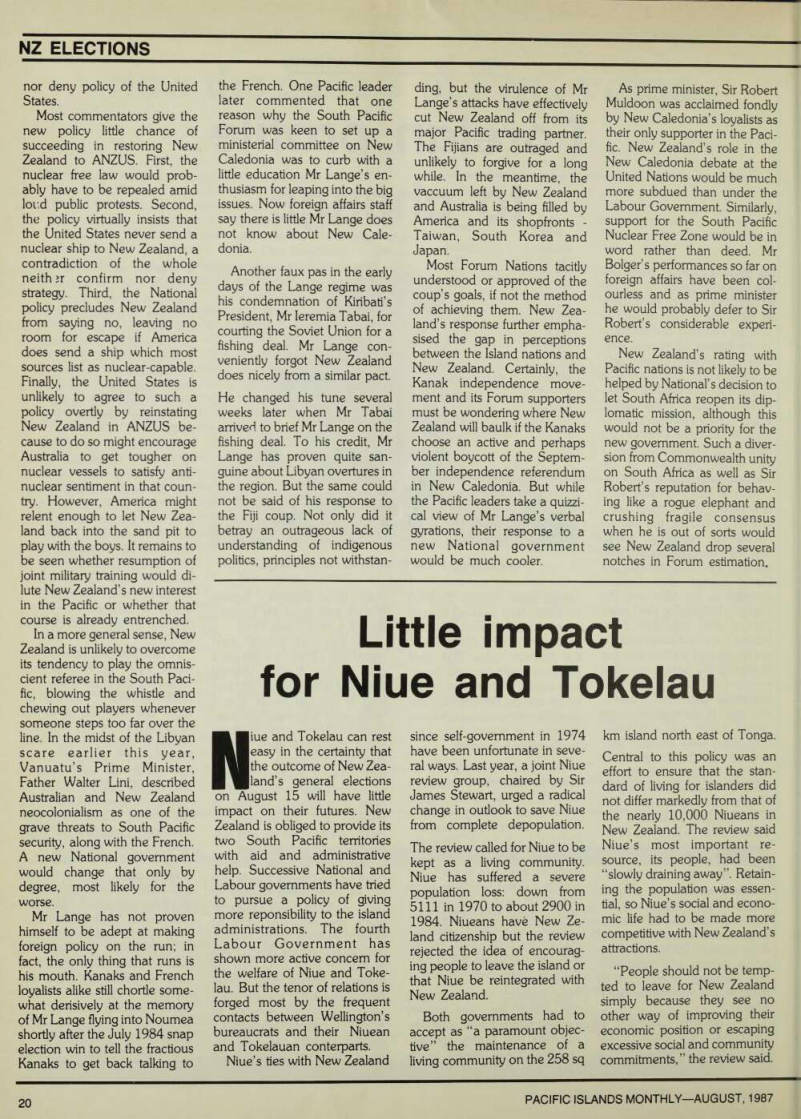
New Zealand Prime Minister, Mr. David Lange.
nor deny policy of the United States.
Most commentators give the new policy little chance of succeeding in restoring New Zealand to ANZUS. First, the nuclear free law would prob ably have to be repealed amid loud public protests. Second, the policy virtually insists that the United States never send a nuclear ship to New Zealand, a contradiction of the whole neith ix confirm nor deny strategy. Third, the National policy precludes New Zealand from saying no, leaving no room for escape if America does send a ship which most sources list as nuclear-capable.
Finally, the United States is unlikely to agree to such a policy overtly by reinstating New Zealand in ANZUS be cause to do so might encourage Australia to get tougher on nuclear vessels to satisfy anti nuclear sentiment in that coun try. However, America might relent enough to let New Zea land back into the sand pit to play with the boys. It remains to be seen whether resumption of joint military training would di lute New Zealand’s new interest in the Pacific or whether that course is already entrenched.
In a more general sense, New Zealand is unlikely to overcome its tendency to play the omnis cient referee in the South Paci fic, blowing the whistle and chewing out players whenever someone steps too far over the line. In the midst of the Libyan scare earlier this year, Vanuatu’s Prime Minister, Father Walter Lini, described Australian and New Zealand neocolonialism as one of the grave threats to South Pacific security, along with the French.
A new National government would change that only by degree, most likely for the worse.
Mr Lange has not proven himself to be adept at making foreign policy on the run; in fact, the only thing that runs is his mouth. Kanaks and French loyalists alike still chortle some what derisively at the memory of Mr Lange flying into Noumea shortly after the July 1984 snap election win to tell the fractious Kanaks to get back talking to
the French. One Pacific leader later commented that one reason why the South Pacific Forum was keen to set up a ministerial committee on New Caledonia was to curb with a little education Mr Lange’s en thusiasm for leaping into the big issues. Now foreign affairs staff say there is little Mr Lange does not know about New Cale donia.
Another faux pas in the early days of the Lange regime was his condemnation of Kiribati’s President, Mr leremia Tabai, for courting the Soviet Union for a fishing deal. Mr Lange con veniently forgot New Zealand does nicely from a similar pact.
He changed his tune several weeks later when Mr Tabai arrived to brief Mr Lange on the fishing deal. To his credit, Mr Lange has proven quite san guine about Libyan overtures in the region. But the same could not be said of his response to the Fiji coup. Not only did it betray an outrageous lack of understanding of indigenous politics, principles not withstan
ding, but the virulence of Mr Lange’s attacks have effectively cut New Zealand off from its major Pacific trading partner.
The Fijians are outraged and unlikely to forgive for a long while. In the meantime, the vaccuum left by New Zealand and Australia is being filled by America and its shopfronts - Taiwan, South Korea and Japan.
Most Forum Nations tacitly understood or approved of the coup’s goals, if not the method of achieving them. New Zea land’s response further empha sised the gap in perceptions between the Island nations and New Zealand. Certainly, the Kanak independence move ment and its Forum supporters must be wondering where New Zealand will baulk if the Kanaks choose an active and perhaps violent boycott of the Septem ber independence referendum in New Caledonia. But while the Pacific leaders take a quizzi cal view of Mr Lange’s verbal gyrations, their response to a new National government would be much cooler.
As prime minister, Sir Robert Muldoon was acclaimed fondly by New Caledonia’s loyalists as their only supporter in the Paci fic. New Zealand’s role in the New Caledonia debate at the United Nations would be much more subdued than under the Labour Government. Similarly, support for the South Pacific Nuclear Free Zone would be in word rather than deed. Mr Bolger’s performances so far on foreign affairs have been col ourless and as prime minister he would probably defer to Sir Robert’s considerable experi ence.
New Zealand’s rating with Pacific nations is not likely to be helped by National’s decision to let South Africa reopen its dip lomatic mission, although this would not be a priority for the new government. Such a diver sion from Commonwealth unity on South Africa as well as Sir Robert’s reputation for behav ing like a rogue elephant and crushing fragile consensus when he is out of sorts would see New Zealand drop several notches in Forum estimation.
The population outflow which was already on a large scale before 1974 had not been stemmed. “Niue has become critically vulnerable as a living community,” the review con tinued. “Dependence on eco nomic and administrative assist ance from New Zealand con tinues to increase as Niue strives to provide a standard and quality of life geared to wards stemming the outflow of population. The fact of a grow ing Niuean community in New Zealand has set up an in-built, self-generating momentum for emigration - chain migration.”
The review recommended that to maintain a living com munity on Niue and avoid the loss of self-respect and self reliance, New Zealand and Niue should promote economic development. It cautions the Niue Government to get on with practical projects to in crease jobs on the island rather than seeking endless overseas reports on schemes. It also suggests cuts in Niue’s public service, which comprises 80 per cent of the paid workforce. But the review stressed that promo tion of economic self-reliance should not be the main purpose of New Zealand’s $7 million annual aid. Rather it should be to improve the living standard of Niueans. New Zealand aid, which provides about 90 per cent of Niue’s budget, should also be kept separate from other aid allocated triennially to improve economic planning and not be reduced at least until life on Niue is of a similar standard to New Zealand. The review called for an urgent look at transport and a guaranteed seafreight link: Air Nauru only operates a weekly return 737 flight to Auckland.
The report was welcomed on both sides and and has led to several profitable official discus sions in New Zealand and Niue.
At the time of the review’s publication, the New Zealand Prime Minister, Mr David Lange, and the Niuean Pre mier, Sir Robert Rex, signed a civil aviation pact: New Zealand provides advice to Niue on running its airport and control of air traffic rights.
Since the review’s release in November 1986, shipping links to Niue have grown ever more erratic. Niue islanders have suf fered shortages of foodstuffs, fuel and basic household items such as toilet paper for most of this year. If machinery breaks down, it can take months for new parts to arrive. Exports such as taro arrive at the Auck land produce markets so rotted by the tortous and unreliable shipping link that few farmers make any profit on the crops.
Emigration, particularly of the young, is increasing. These problems spawned Niue’s first political party in the March elections; it won four of the 20 seats (see June PIM), new Zea land Niueans are taking a re newed interest in the running of their homeland in spite of rejec tion by the Niuean Govern ment. Expatriate Niueans wan ting to return home and start a business complain they get the cold shoulder from the Niuean authorities. And New Zealand Niueans who pay for their homeland twice - through taxes and remittances, which are often relatives’ only income are beginning to worry that the time may soon come when the last Niuean will literally have to turn out the lights.
In contrast, Tokelau’s prog ress since self-government last decade has been stately but secure. About 1500 pepole live on Tokelau, with about 1200 Tokelauans in New Zealand.
The United Nations decolonisa tion committee made its third trip to Tokelau last year (the previous trips were in 1981 and 1976). In June this year, some members of Tokelau’s General Fono made their first visit to the UN to speak before the decol onisation committee. The Fono spokesman, Mr Fatia Perez, welcomed the committee’s con clusion that Tokelau’s relations with New Zealand should not change. But he said the com mittee had given insufficient weight to the development of Tokelau’s political institutions since self-government.
The General Fono now approves its own budget and New Zealand no longer decides on funding for health, educ taion, public works, shipping,
salaries or agriculture and fisheries. Mr Perez said that while in the past Fono members had to be members of the village taupulega (councils of elders), these days they could come from community groups of aumaga (commoners) or women. Tokelau now made all decisions on development or law changes for rubber stam ping by the New Zealand Parliament, rather than the other way round.
The Fono, after initial suspi cions, had come to see the Tokelau public service as essen tial to the islands’ development.
Mr Perez said the public service was totally responsive to the Fono’s wishes and was no longer regarded as an instru ment of the administering pow er, New Zealand. But Mr Perez said Tokelau’s economic deve lopment was hindered by the three islands’ size, lack of natu ral resources, isolation and poor transport and communications.
Construction next year of air strips on all the islands would supplement Tokelau’s monthly shipping service and the terri tory recently joined the tele communication club, although telephone services were still restricted.
Mr Perez said Tokelau this year had suffered its worst disaster in 70 years: in March all islands were devastated by tidal waves and strong winds while
in February two islands were severly damaged by Cyclone Tusi. He thanked New Zealand for its prompt help with food and reconstruction materials.
“The disasters had somehow diverted our attention from other development require ments, they have to some ex tent demoralised the leadership and the people, but the courage and the spirit to counter any adversity ... is right there with them.”
Tokelau had expanded its ties with the South Pacific Com mission, the University of the South Pacific and the Forum Fisheries Agency. Mr Perez took the opportunity to register Tokelau’s strong protest at con tinued French nuclear testing which jeopardised the islands’ fisheries, their major potential source of income.
Mr Perez said that although Tokelau did not want to remain forever on the UN list of territor ies, any changes should con form to the islands’ prevailing customs. “Our society, culture and traditions are substantially different from anywhere in the world and it is totally wrong to impose something on us that does not conform with our way of life.” Mr Perez told the UN decolonisation committee that Tokelau was happy the New Zealand Government wanted the islands to proceed at their own pace
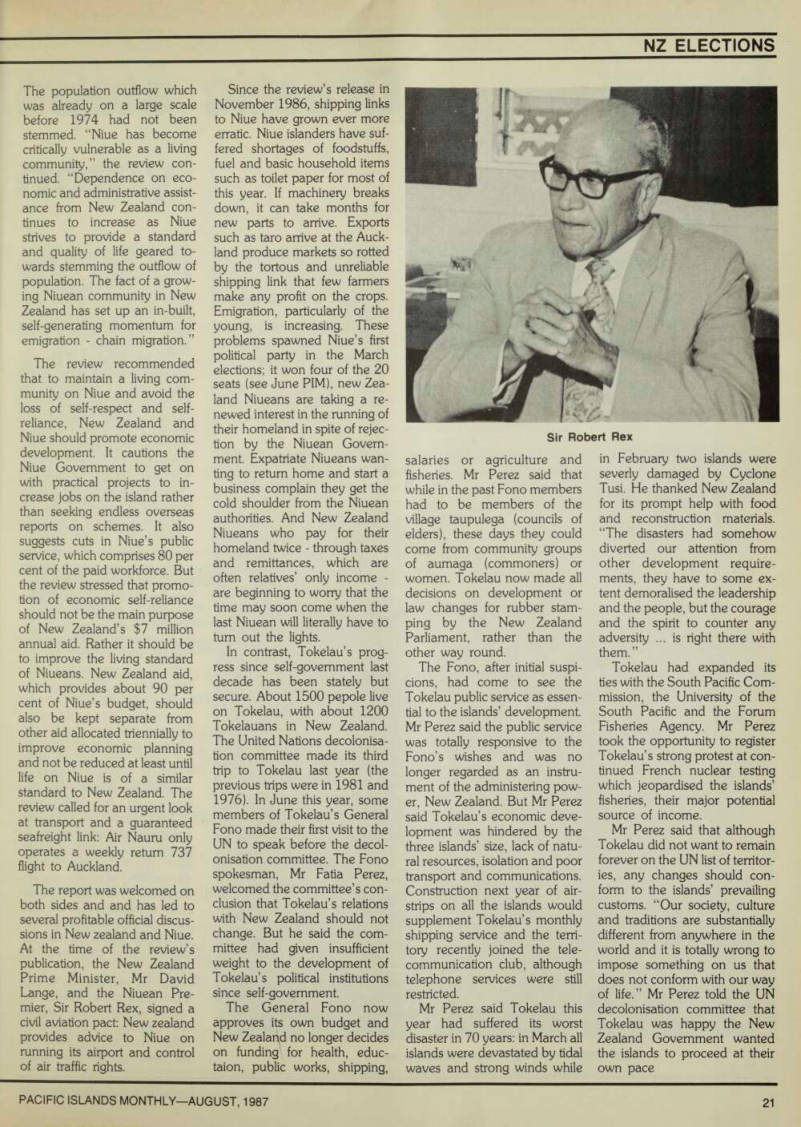
Sir Robert Rex
Little impact
for Niue and Tokelau
Niue and Tokelau can rest easy in the certainty that the outcome of New Zea land’s general elections on August 15 will have little impact on their futures. New Zealand is obliged to provide its two South Pacific territories with aid and administrative help. Successive National and Labour governments have tried to pursue a policy of giving more reponsibility to the island administrations. The fourth Labour Government has shown more active concern for the welfare of Niue and Toke lau. But the tenor of relations is forged most by the frequent contacts between Wellington’s bureaucrats and their Niuean and Tokelauan conterparts.
Niue’s ties with New Zealand
since self-government in 1974 have been unfortunate in seve ral ways. Last year, a joint Niue review group, chaired by Sir James Stewart, urged a radical change in outlook to save Niue from complete depopulation.
The review called for Niue to be kept as a living community.
Niue has suffered a severe population loss: down from 5111 in 1970 to about 2900 in 1984. Niueans have New Ze land citizenship but the review rejected the idea of encourag ing people to leave the island or that Niue be reintegrated with New Zealand.
Both governments had to accept as “a paramount objec tive” the maintenance of a living community on the 258 sq
km island north east of Tonga.
Central to this policy was an effort to ensure that the stan dard of living for islanders did not differ markedly from that of the nearly 10,000 Niueans in New Zealand. The review said Niue’s most important re source, its people, had been “slowly draining away”. Retain ing the population was essen tial, so Niue’s social and econo mic life had to be made more competitive with New Zealand’s attractions.
“People should not be temp ted to leave for New Zealand simply because they see no other way of improving their economic position or escaping excessive social and community commitments,” the review said.
Drastic steps taken on Fiji
economy
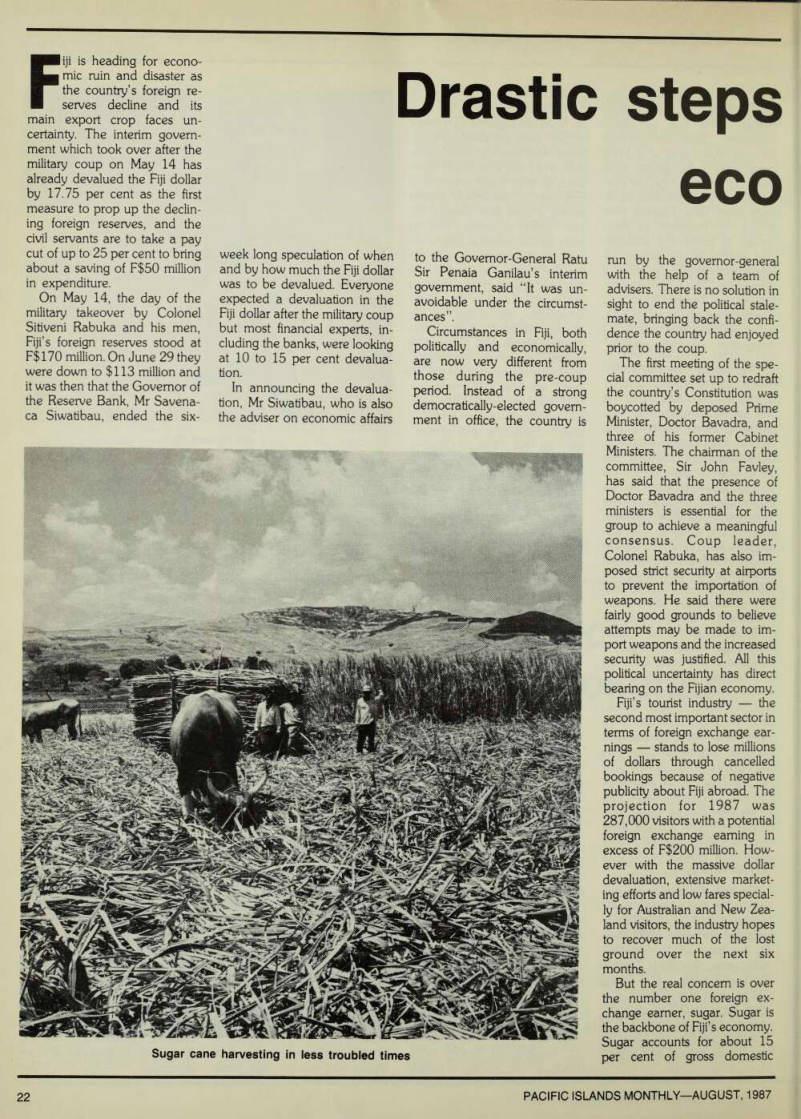
Fiji is heading for econo mic ruin and disaster as the country’s foreign re serves decline and its main export crop faces un certainty. The interim govern ment which took over after the military coup on May 14 has already devalued the Fiji dollar by 17.75 per cent as the first measure to prop up the declin ing foreign reserves, and the civil servants are to take a pay cut of up to 25 per cent to bring about a saving of Fsso million in expenditure.
On May 14, the day of the military takeover by Colonel Sitiveni Rabuka and his men, Fiji’s foreign reserves stood at Fsl7o million. On June 29 they were down to $ll3 million and it was then that the Governor of the Reserve Bank, Mr Savena ca Siwatibau, ended the six
week long speculation of when and by how much the Fiji dollar was to be devalued. Everyone expected a devaluation in the Fiji dollar after the military coup but most financial experts, in cluding the banks, were looking at 10 to 15 per cent devalua tion.
In announcing the devalua tion, Mr Siwatibau, who is also the adviser on economic affairs
to the Governor-General Ratu Sir Penaia Ganilau’s interim government, said “It was un avoidable under the circumst ances”.
Circumstances in Fiji, both politically and economically, are now very different from those during the pre-coup period. Instead of a strong democratically-elected govern ment in office, the country is
run by the governor-general with the help of a team of advisers. There is no solution in sight to end the political stale mate, bringing back the confi dence the country had enjoyed prior to the coup.
The first meeting of the spe cial committee set up to redraft the country’s Constitution was boycotted by deposed Prime Minister, Doctor Bavadra, and three of his former Cabinet Ministers. The chairman of the committee, Sir John Favley, has said that the presence of Doctor Bavadra and the three ministers is essential for the group to achieve a meaningful consensus. Coup leader, Colonel Rabuka, has also im posed strict security at airports to prevent the importation of weapons. He said there were fairly good grounds to believe attempts may be made to im port weapons and the increased security was justified. All this political uncertainty has direct bearing on the Fijian economy.
Fiji’s tourist industry the second most important sector in terms of foreign exchange ear nings stands to lose millions of dollars through cancelled bookings because of negative publicity about Fiji abroad. The projection for 1987 was 287,000 visitors with a potential foreign exchange earning in excess of Fs2oo million. How ever with the massive dollar devaluation, extensive market ing efforts and low fares special ly for Australian and New Zea land visitors, the industry hopes to recover much of the lost ground over the next six months.
But the real concern is over the number one foreign ex change earner, sugar. Sugar is the backbone of Fiji’s economy.
Sugar accounts for about 15 per cent of gross domestic
Sugar cane harvesting in less troubled times
product, 60 per cent of total exports and about 25 per cent of the labour force is engaged in sugar-related activities. Ear nings from this year’s sugar crop were forecast at around $2OO million. However, with the present situation, where harvesting has been delayed by three months, the loss in re ceipts may be anywhere be tween $3O-50 million.
Despite persuasion by the governor-general and the Fiji Sugar Corporation, Indian cane farmers, who make up more than 70 per cent of the growers, have refused to harvest their crop in protest against the over throw of the Bavadra govern
ment by the military. Two sugar mills, one at Labasa in the island of Vanua Levu and the Penang Mill on the main island of Viti Levu, began crushing in the last week of June and the beginning of July but only Fijian cane farmers and some Indian farmers supplied cane to the mills. The crushing program could not be maintained and the mills had to close down on several occasions. Finally the Fiji Sugar Corporation announced a shut off of the two mills till the end of July.
It was only after the sugar harvesting and crushing prog ram that the devaluation of the Fiji dollar was announced.
Observers feel that the sugar crushing was the key factor in determining the action of the Reserve Bank and, had the crushing continued without disruption and opposition from Indian cane farmers, Mr Siwati bau would have gambled to keep the Fiji dollar at its former levels. They point out that Fiji’s foreign reserves have reached more critical levels in the past and then the Reserve Bank had not seen fit to devalue the dollar. However, in this inst ance, there is no guarantee that sugar receipts will be released, hence the massive devaluation as a precaution.
The collapse of the industry
will affect every other area of the economy. Last year Fiji earned just under $l3B million from sugar exports amounting to 54 per cent of the value of all exports. In 1984 Fiji’s foreign reserves hit the all-time low of $75 million and this year in January it was a record high of $196 million. Mr Siwatibau said normally “Our foreign reserves are low in the first half of the year and pick up in the second half but this time we are just draining out with no signs of picking up”.
The 17.75 per cent devalua tion is largest in Fiji’s history.
The last devaluation was 5 per cent which was effected be tween April and May last year.
The closure of the mills and cessation of the cane harvesting for a month is designed to give the governor-general breathing space and enough time to bring about a peaceful solution to the political problem the country is facing. Ratu Sir Penaia Ganilau has already announced a con stitutional review committee which is to meet and prepare a report by the end of July.
Sugar and sugar alone holds the key to Fiji’s economic prob lems. A return to normal within the sugar sector is crucial for the recovery of the whole eco nomy. It not only has direct consequences for income and employment in the sugar in dustry itself, but also has negative multiplier effects on the rest of the economy.
Devaluation was not the only measure announced by the Re serve Bank which is designed to contain and maintain Fiji’s fore ign reserves at an acceptable level. The bank also put into effect other measures to put a stop to the drain on Fiji’s foreign reserves.
Fiji citizens can no longer invest overseas. Previously, Fiji residents were allowed to invest $5,000 per year overseas. Also those who have investments abroad may be asked to realise them and switch the proceeds from foreign currencies to Fiji dollars.
Fiji citizens who emigrate now face a restriction on the amount of money they can take with them. The head of the family is allowed only $4,000 and each dependant $2,000.
Mr Siwatibau said those who emigrate would be allowed to buy foreign exchange in “tren ches”, the first trenche upon departure, the balance to be purchased as soon as the situa tion improved sufficiently. Up to 1976, those who emigrated were also restricted and were allowed to convert their Fiji dollars over a period of three years, but since then there has been no restriction. Fiji resi dents were allowed to convert their Fiji dollars into foreign currency even before depar ture.
Despite these tight new con trols, large leakages of money are suspected. The Reserve Bank is investigating reports that a number of buisnessmen have managed to send hun dreds-of-thousands of dollars out of the country, with the gift system being used to get money to overseas relatives.
The Governor of the Reserve Bank also announced changes to its stance on monetary poli cy. “The easy money policy of 1986 and the first half of 1987
has been changed. The mini mum rate was raised from 8 per cent to 9 per cent” he said. Mr Siwatibau said the statutory re serve deposit (for trading banks) would be increased from five per cent to six per cent by the end of July. The outlook for Fiji’s balance of payments situation is bleak, Reaction to the Fiji dollar devaluation from business and commerce was mixed. The tourist, travel, hotel sectors and the main exporters such as pine, gold, ginger, fish and others welcomed the move but the consumers and importers described it as a blow to their livelihood.
Leading economists said de valuation will mean a rise of up to 18 per cent in the rate of inflation and a massive increase in unemployment. They pointed out that imported items will now cost up to 20 per cent more. Fiji’s dollar is tied to a basket of five currencies ... its main trading partners: Austra lia, New Zealand, Japan, Un ited States and Britain.
On the plus side tourism will recover and bring in more receipts and, if and when sugar crushing begins, it will also bring in 18 per cent more revenue. Reacting to comments regarding higher prices for im ported goods, Mr Siwatibau said the objective of the de valuation was also to make the consumers switch to locally produced goods. However some Fiji made products de pend highly on imported ingre dients as such will also reflect increased costs.
Analysts say while tourists, specially Australians and New Zealanders, will find a Fiji holi day much cheaper, the cost of food and travel in Fiji will increase.
Overseas investors will also get a better value for their money in Fiji but they doubt whether a devaluation will act as a sufficient incentive for foreign investors because politi cal stability and confidence in a country’s overall economic structure play a bigger part in deciding where investments should be made.
They feel that Fiji will not attract foreign investors over
night but definitely it was a positive move.
However, for most businesses, the dollar devalua tion is seen as the “last straw”.
Since the coup, the building and construction industry has come to a virtual standstill.
Traders of luxury consumer items and those dealing exclu sively for the tourist market have reported drop in sales of up to 90 per cent. Now the devaluation will virtually cripple them.
The transport industry is ex pecting an increase of up to 20 per cent in the price of fuel, spare parts and tyres. Petrol without the devaluation costs 62 cents per litre in Fiji while diesel costs 40 cents a litre.
Wholesalers and importers ex pect a 20 per cent jump in the price of imported food. They say while the devaluation is 17.75 per cent other accumula tive costs will mean a 20 per cent increase.
The government has already moved to bring the distribution of imported goods and essential foods under its control, with plans afoot to upgrade the National Marketing Authority.
The expanded authority will attempt to break down present importer monopolies, counter the ban on Fiji imports by Australia and New Zealand, and open up new trade oppor tunities. The govemmemt is also considering increasing the duty on goods imported from Australia and New Zealand. As well, a relaxation of immigra tion laws to allow Chinese buisnessmen to enter and establish buisnesses in Fiji is on the drawing board. The timber industry is another sector ex ploring new markets, although considerable effort is being brought to bear to re-open old doors. The government also hopes anew copra pricing for mula will lead to an increase in the production of copra, Fiji’s fifth largest foreign exchange earner.
For the average worker, be he a civil servant or engaged in the private sector,the future looks grim, with the chairman of the Fiji Council of Social Services, Pastor Aisak Kabu, suggesting that the National
Emergency Services Commit tee be revived to monitor the situation and co-ordinate relief assistance.
Firstly, the country is going through a period of political uncertainty. Its main export crop is not being harvested.
The long spell of drought has already had its toll on the sugar crop and a delay will mean a further reduction in the yield of sugar.
The dollar has been de valued which effectively means a reduction of 20 per cent in its purchasing power.
And now a worker faces the prospect of a 20 to 25 per cent pay cut and, if the situation doesn’t improve, loss of employment or part-time employment. Most commercial firms have already started a shorter working week or are planning such a move. Business transactions in every sphere of activity, be it radio advertisting or hardware sales, have taken a nosedive. Temporary and casual staff have been laid off and permanent staff are work ing on the basis of week on, week off. Statutory bodies such as the National Airline, Air Pacific, the national radio sta tion, Radio Fiji and the Fiji Electricity Authority have all announced a reduction in their services and shorter working week for staff.
The Army has already announced a voluntary pay cut of 20 per cent for its men which the military says will bring in a saving of $5 million per annum.
Government services have been cut by 20 per cent and a 25 per cent pay cut across the board for the civil servants is expected to save $5O million per year.
But the question being posed by observers is will this be enough? There are no definite signs of any recovery. Pessim ists paint a gloomy picture with predictions of a further devalua tion of the Fiji dollar and an other pay cut for all civil ser vants and other workers. They talk of starvation and civil un rest. But the optimist still sees light at the end of the tunnel and the flicker of flame is the sugar industry!—
Advertisements & other items, p. 23 (1 item)
Mixer (even in muddy conditions)
The fully mobile Concrete
The Lees Hydramixer makes mixing concrete on site that much easier plus it saves time, money and manpower.
The Lees Hydramixer, tested and proven for years, ★ Transports to any location on 7 ton truck. ★ Is self loading from materials dumped on site. ★ Discharges via a swivel shute and places mixed concrete from j* bucket up to 2745 mm (9ft.) high. I ★ Has bowl capacity 1.15m 3 ■ (1 Vfeyds) up to 4.5m 3 (6yds) per hour. I ★ Load gauge for accurate weight I
mixes. j
L cr * Patented » R \ / r For more details fill in this coupon for a free brochure.
Lees Industries Ltd.
P.O. Box 29, Rangiora, M.Z.
Mame: Address:
HPM
Tourists returning
to Fiji
The tourists are returning to Fiji. A member of the Governor General’s Council of Advisers and a senior tourist official predict its hotels will recover pre-coup occupancy rates by September.
This is despite continuing un rest in the sugar industry, underlined by sporadic acts of sabotage, alleged burning of Indian-owned crops by indi genous Fijians and the Fijian Sugar Corporation’s decision to close its mills in July so that tempers can cool.
But Fijian tourist and airline officials have impressive figures to back up the claim that the lure of cheap package holidays is bringing back Australians, Fiji’s main source of tourists.
By July Ist, ten days after the new $299 Sydney-to-Fiji return fare was announced, the regio nal manager for the Fiji Visitors Bureau in Sydney, Bill Whiting, had 5000 bookings, virtually all Australian tourists. Air Pacific flights out of Sydney and Bris bane were fully booked for July and August and heavily booked for September. “We’re delight ed,” he said.
Hotels which had reported occupancy rates plummeting to ten per cent from a normal 70 per cent in June, were by July reporting at least 35 per cent occupancy. The Fijian Resort claimed 60 per cent occupancy, while Tabua Hotel, on the Coral Coast, specialising in budget holidays, had an aver age 79 per cent occupancy for July including two weeks fully booked.
Mr Mumtaz Ali, a member of the Governor General’s Coun cil of Advisers, and a Senator until the coup, has forecast that occupancy rates for tourist hotels will return to a normal of 70 per cent or more by September.
He said this before the Fijian currency was devalued by 17.5 per cent, a factor that can only enhance Fiji as a tourist destina
tion.
Mr Ali made his prediction during a wide-ranging interview with PIM when he was in Australia in June, leading a delegation of Fijian trade, air line and tourist officials on a mission to persuade Australians that the worst was over.
In late June the Department of Foreign Affairs rescinded its caution to Australian tourists against visiting Fiji.
In the first week of July, Qantas cabin crews lifted their ban on flying Australian tourists into Fiji, thus providing three more flights a week, and reliev ing the passenger log jam buil ding up on Air Pacific.
Mr Ali returned home satis fied that the Australian waterside workers’ ban on Fi jian trade, excluding foodstuffs, would be lifted. “There is a school of thought in Fiji that we should be exploring alternative sources of supply, ” he told PIM, “and that we should never again place ourselves in a posi tion where we could be held to ransom by the trade unions of one of our trading partners.
“I disagree with the view that we should diversify away from Australia. I have argued that we should stay with our known friends. ”
While Mr Ali exuded optim ism for tourism in Fiji, he was less sanguine on other matters.
Speaking to PIM after returning to Suva he described the de valuation and the recently ex tended powers of arrest and seizure vested in Fijian army officers as pre-emptive mea sures in anticipation of what might happen.
Devaluation reflected not a fall in the value of the Fijian currency, but fear that this might happen, he said. New emergency powers had likewise been invoked as a precaution.
The army was no more in evidence than before, but the fact that they had been gazetted was causing unease in rural
areas, and he deplored this.
He also felt that the sugar industry would be unable to meet some of its contractual commitments to overseas buyers this year, but he was confident the shortfall would be made up in 1988 without losing markets to other suppliers.
Mr Ali regretted that Dr Bavadra’s refusal to nominate four representatives to the proposed 16-member Commit tee for Constitutional Review was delaying the Governor General’s timetable to return Fiji to parliamentary govern ment a year from now.
Mr Ali said that the new constitution could be expected to entrench a provision that future governors-general be
drawn from the Great Council of Chiefs, and that indigenous Fijians enjoy a permanent majority in Parliament. He did not relish the prospect of partial disenfranchise of the Indian community, “but we have to face realities,” he shrugged.
He added that fear by indi genous Fijians of political domination by Indian Fijians had been a matter of public record at least since the 1977 elections.
He believed, he said, that the coup leader, Lt Colonel Rabu ka had hoped that by deposing the Coalition Government, the Governor General would install the Alliance Party opposition in power.
“But the conscience of the Fijian people would not allow that.
“I do not believe Colonel Rabuka would have acted as he did without the sanction of community leaders. But I do not see that any useful purpose would be served by trying to identify who they were.”
Chris Ashton.
Advertisements & other items, p. 25 (1 item)
Hydrograph c Surveying
*>] Australian
Maritime College
Graduate Diploma in
Hydrograph c Surveying
A one-year full-time course commencing in February each year.
Graduates will have a qualification in hydrographic surveying which is recognised internationally as being at the highest professional level.
Applicants lacking a surveying background are required to complete a module in (and surveying prior to the start of the course. This module commences in July.
For further information, please contact: The Admissions Officer Australian Maritime College PO Box 986 LAUNCESTON. Tasmania, Australia
ISO 61 03 26 0311
Jim Taylor
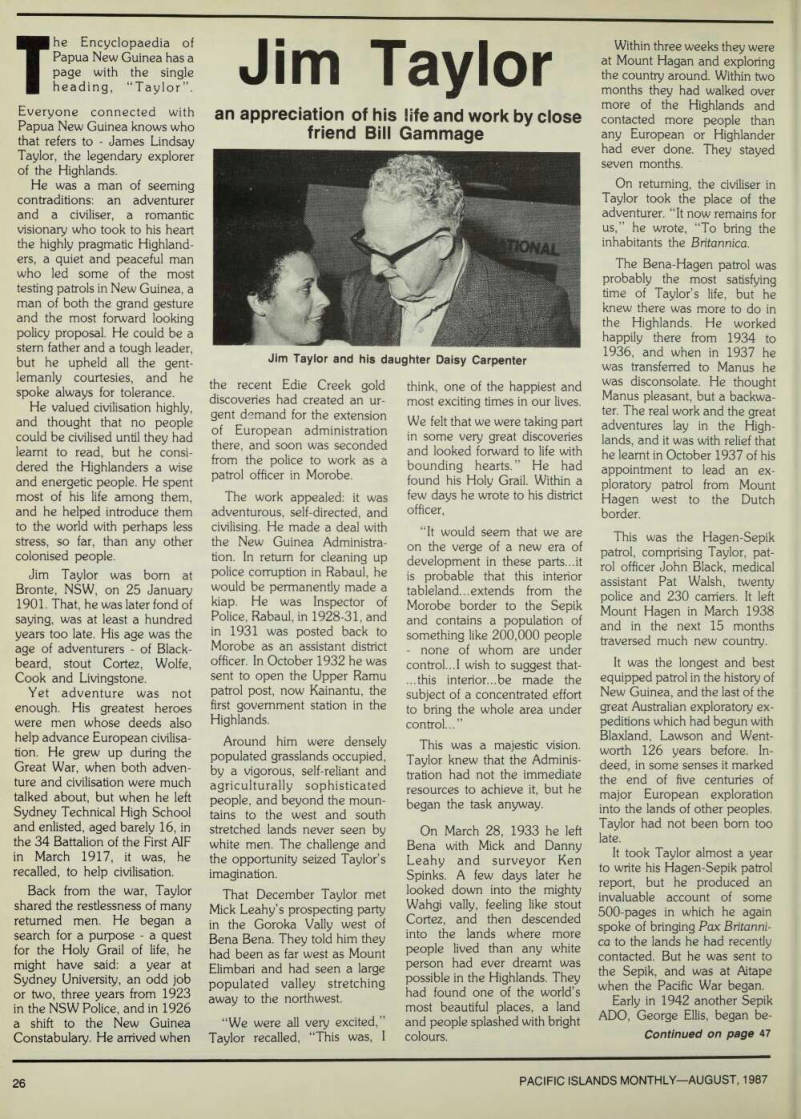
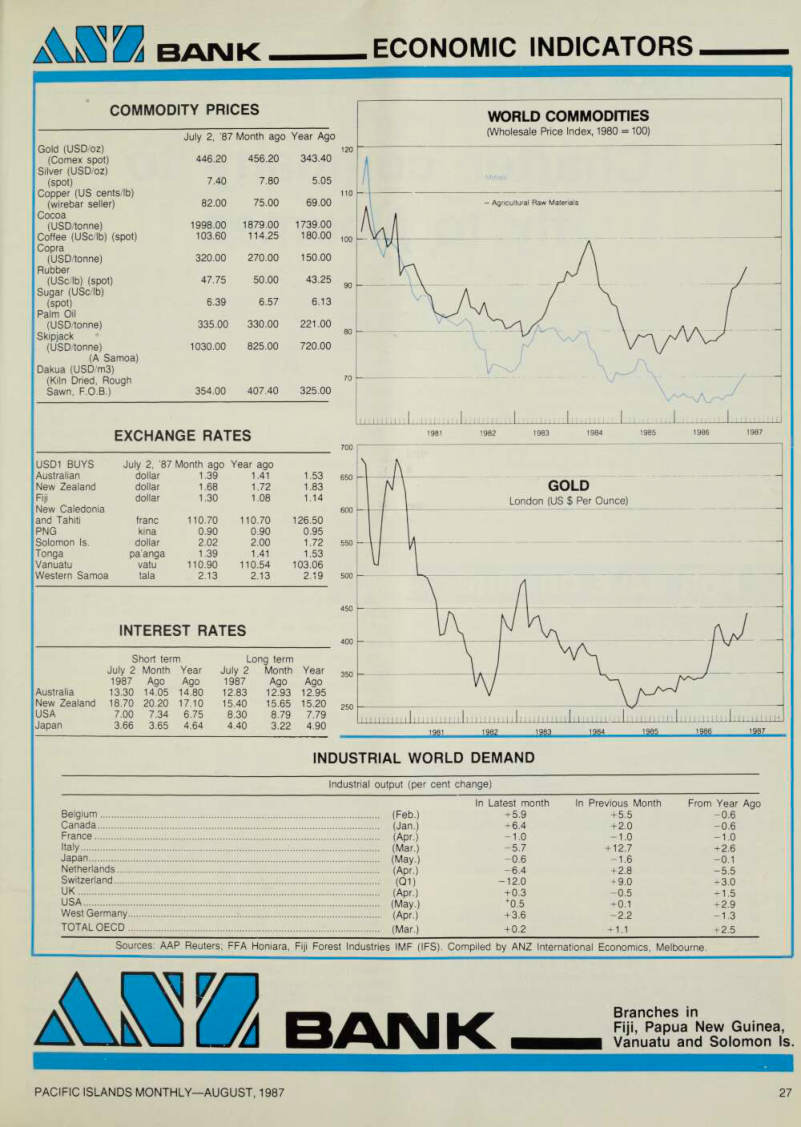
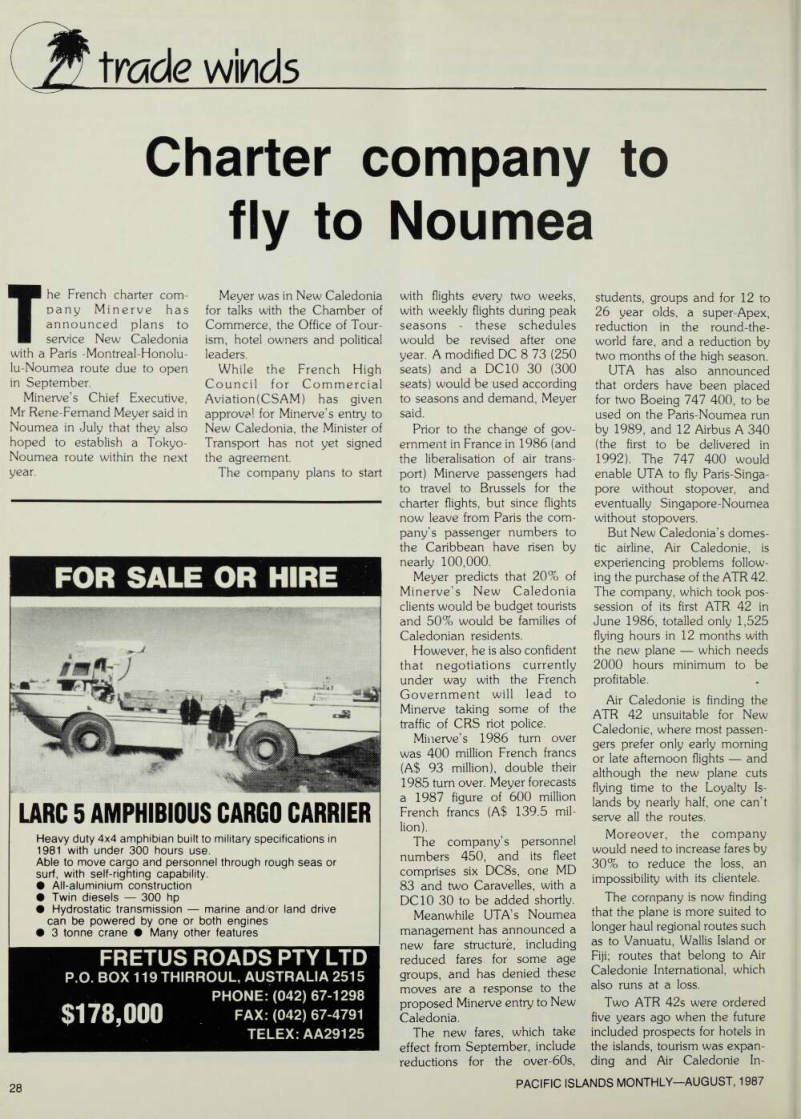
The Encyclopaedia of Papua New Guinea has a page with the single heading, “Taylor”.
Everyone connected with Papua New Guinea knows who that refers to - James Lindsay Taylor, the legendary explorer of the Highlands.
He was a man of seeming contraditions: an adventurer and a civiliser, a romantic visionary who took to his heart the highly pragmatic Highland ers, a quiet and peaceful man who led some of the most testing patrols in New Guinea, a man of both the grand gesture and the most forward looking policy proposal. He could be a stern father and a tough leader, but he upheld all the gent lemanly courtesies, and he spoke always for tolerance.
He valued civilisation highly, and thought that no people could be civilised until they had learnt to read, but he consi dered the Highlanders a wise and energetic people. He spent most of his life among them, and he helped introduce them to the world with perhaps less stress, so far, than any other colonised people.
Jim Taylor was born at Bronte, NSW, on 25 January 1901. That, he was later fond of saying, was at least a hundred years too late. His age was the age of adventurers - of Black beard, stout Cortez, Wolfe, Cook and Livingstone.
Yet adventure was not enough. His greatest heroes were men whose deeds also help advance European civilisa tion. He grew up during the Great War, when both adven ture and civilisation were much talked about, but when he left Sydney Technical High School and enlisted, aged barely 16, in the 34 Battalion of the First AIF in March 1917, it was, he recalled, to help civilisation.
Back from the war, Taylor shared the restlessness of many returned men. He began a search for a purpose - a quest for the Holy Grail of life, he might have said: a year at Sydney University, an odd job or two, three years from 1923 in the NSW Police, and in 1926 a shift to the New Guinea Constabulary. He arrived when
an appreciation of his life and work by close friend Bill Gammage
think, one of the happiest and most exciting times in our lives.
We felt that we were taking part in some very great discoveries and looked forward to life with bounding hearts.” He had found his Holy Grail. Within a few days he wrote to his district officer, “It would seem that we are on the verge of a new era of development in these parts...it is probable that this interior tableland...extends from the Morobe border to the Sepik and contains a population of something like 200,000 people - none of whom are under control... 1 wish to suggest that ...this interior...be made the subject of a concentrated effort to bring the whole area under control...”
This was a majestic vision.
Taylor knew that the Adminis tration had not the immediate resources to achieve it, but he began the task anyway.
On March 28, 1933 he left Bena with Mick and Danny Leahy and surveyor Ken Spinks. A few days later he looked down into the mighty Wahgi vally, feeling like stout Cortez, and then descended into the lands where more people lived than any white person had ever dreamt was possible in the Highlands. They had found one of the world’s most beautiful places, a land and people splashed with bright colours.
the recent Edie Creek gold discoveries had created an ur gent demand for the extension of European administration there, and soon was seconded from the police to work as a patrol officer in Morobe.
The work appealed: it was adventurous, self-directed, and civilising. He made a deal with the New Guinea Administra tion. In return for cleaning up police corruption in Rabaul, he would be permanently made a kiap. He was Inspector of Police, Rabaul, in 1928-31, and in 1931 was posted back to Morobe as an assistant district officer. In October 1932 he was sent to open the Upper Ramu patrol post, now Kainantu, the first government station in the Highlands.
Around him were densely populated grasslands occupied, by a vigorous, self-reliant and agriculturally sophisticated people, and beyond the moun tains to the west and south stretched lands never seen by white men. The challenge and the opportunity seized Taylor’s imagination.
That December Taylor met Mick Leahy’s prospecting party in the Goroka Vally west of Bena Bena. They told him they had been as far west as Mount Elimbari and had seen a large populated valley stretching away to the northwest.
“We were all very excited,”
Taylor recalled, “This was, I
Within three weeks they were at Mount Hagan and exploring the country around. Within two months they had walked over more of the Highlands and contacted more people than any European or Highlander had ever done. They stayed seven months.
On returning, the civiliser in Taylor took the place of the adventurer. “It now remains for us,” he wrote, “To bring the inhabitants the Britannica.
The Bena-Hagen patrol was probably the most satisfying time of Taylor’s life, but he knew there was more to do in the Highlands. He worked happily there from 1934 to 1936, and when in 1937 he was transferred to Manus he was disconsolate. He thought Manus pleasant, but a backwa ter. The real work and the great adventures lay in the High lands, and it was with relief that he learnt in October 1937 of his appointment to lead an ex ploratory patrol from Mount Hagen west to the Dutch border.
This was the Hagen-Sepik patrol, comprising Taylor, pat rol officer John Black, medical assistant Pat Walsh, twenty police and 230 carriers. It left Mount Hagen in March 1938 and in the next 15 months traversed much new country.
It was the longest and best equipped patrol in the history of New Guinea, and the last of the great Australian exploratory ex peditions which had begun with Blaxland, Lawson and Went worth 126 years before. In deed, in some senses it marked the end of five centuries of major European exploration into the lands of other peoples.
Taylor had not been born too late.
It took Taylor almost a year to write his Hagen-Sepik patrol report, but he produced an invaluable account of some 500-pages in which he again spoke of bringing Pax Britanni ca to the lands he had recently contacted. But he was sent to the Sepik, and was at Aitape when the Pacific War began.
Early in 1942 another Sepik ADO, George Ellis, began be-
Continued on page 47
Jim Taylor and his daughter Daisy Carpenter
having strangely and Taylor was sent to relieve him. At Ambunti, Taylor’s party was ambushed by Ellis and his police. Taylor was wounded and the party retreated downriver. Two days later they returned with reinforcements, finding that Ellis had shot him self.
For the rest of the war, Taylor was a major in the Australian New Guinea Administrative Unit, behind the Japanese lines in the Sepik, in the Highlands, or on policy work in Port Moresby or Australia.
With the war won, he was appointed director of native labour in the provisional Civil Administration of the newly unified Papua New Guinea.
This was a senior post at a critical and much neglected time in Papua New Guinea affairs and Taylor played his part in resisting European ex ploitation of Papua New Gui neans.
But he yearned for the High lands and in November 1946 stepped down to become dis trict officer in charge of the Central Highlands. The district ran from Kainantu in the east to Lake Kutubu in the south and Telefomin in the west - virtually the whole of the Highlands which Taylor had urged should be brought under control in 1932. He could refer to it as a kingdom, could think of High landers as a kind of medieval aristocracy, and no doubt saw his new job as the consumma tion of his life’s work.
But in 1947 he was sus pended and reprimanded, un fairly he thought, for inade quately supervising a patrol officer, and increasingly he grew impatient with desk work.
In 1949 he quit the Adminis tration and soon after married Yerima Manamp of Kerowil, a strong and gracious lady whom he thought the epitome of everything beautiful about the Highlands and who was the rock of his life for the next 40 years.
Taylor developed various
business interests, in cattle and in trade stores and gold dreg ding at Porgera, but his chief and longest interest was a cof fee plantation just west of Goro ka. There his family lived for over 30 years, and there on June 28 last Taylor died. He was 86. He left Yerima, two daughters, Daisy and Meg, a son, Jason, and thousands of friends and admirers.
Jim Taylor was a brave, tough, quiet and resourceful man. He was an outstanding explorer, a pioneer in using the aeroplane and the wireless in exploratory work, a Fellow of the Royal Geographical So ciety, an innovative administra tor, a courtly host, an instinctive romantic, and a friend of the Highlanders.
Perhaps uniquely among Europeans of the 19305, he greeted Highlanders by name, as friends, instead of by nick name or by no name at all His last adventure was to look toward to the day when Highlanders would share equal ly his civilisation. In December 1985, when his memory and his powerful intelligence were fading fast, he confused sub urban Adelaide with Goroka and stood amazed at the or dered rows of houses, the streets and parks, the busy traffic. “It’s wonderful” he ex claimed, “In only fifty years It’s wonderful how far they have come Splendid” Then he paused. “Mind you, I always knew they would.”
Goodbye Jim. You were a true friend, and a great man
Jim Taylor(right) with Murray
Edwards at Mt Hagen, 1938- Photo John Black
Advertisements & other items, p. 27 (1 item)
Bank
A
ECONOMIC INDICATORS
COMMODITY PRICES
Short term Long term
WORLD COMMODITIES
(Wholesale Price Index, 1980 = 100) Agricultural Raw Materials
GOLD
London (US $ Per Ounce) I^4 1906 1983
INDUSTRIAL WORLD DEMAND
Sources: AAP Reuters; FFA Honiara, Fiji Forest Industries IMF (IFS). Compiled by ANZ International Economics, Melbourne.
'A
BANK
Branches in Fiji, Papua New Guinea, Vanuatu and Solomon Is.
Charter company to

trade winds
Charter company to fly to Noumea
The French charter com pany Minerve has announced plans to service New Caledonia with a Paris -Montreal-Honolu lu-Noumea route due to open in September.
Minerve’s Chief Executive, Mr Rene-Fernand Meyer said in Noumea in July that they also hoped to establish a Tokyo- Noumea route within the next year.
Meyer was in New Caledonia for talks with the Chamber of Commerce, the Office of Tour ism, hotel owners and political leaders.
While the French High Council for Commercial Aviation(CSAM) has given approval for Minerve’s entry to New Caledonia, the Minister of Transport has not yet signed the agreement.
The company plans to start
with flights every two weeks, with weekly flights during peak seasons - these schedules would be revised after one year. A modified DC 8 73 (250 seats) and a DC 10 30 (300 seats) would be used according to seasons and demand, Meyer said.
Prior to the change of gov ernment in France in 1986 (and the liberalisation of air trans port) Minerve passengers had to travel to Brussels for the charter flights, but since flights now leave from Paris the com pany’s passenger numbers to the Caribbean have risen by nearly 100,000.
Meyer predicts that 20% of Minerve’s New Caledonia clients would be budget tourists and 50% would be families of Caledonian residents.
However, he is also confident that negotiations currently under way with the French Government will lead to Minerve taking some of the traffic of CRS riot police.
Minerve’s 1986 turn over was 400 million French francs (A$ 93 million), double their 1985 turn over. Meyer forecasts a 1987 figure of 600 million French francs (A$ 139.5 mil lion).
The company’s personnel numbers 450, and its fleet comprises six DCBs, one MD 83 and two Caravelles, with a DC 10 30 to be added shortly.
Meanwhile UTA’s Noumea management has announced a new fare structure, including reduced fares for some age groups, and has denied these moves are a response to the proposed Minerve entry to New Caledonia.
The new fares, which take effect from September, include reductions for the over-60s,
students, groups and for 12 to 26 year olds, a super-Apex, reduction in the round-the world fare, and a reduction by two months of the high season.
UTA has also announced that orders have been placed for two Boeing 747 400, to be used on the Paris-Noumea run by 1989, and 12 Airbus A 340 (the first to be delivered in 1992). The 747 400 would enable UTA to fly Paris-Singa pore without stopover, and eventually Singapore-Noumea without stopovers.
But New Caledonia’s domes tic airline, Air Caledonie, is experiencing problems follow ing the purchase of the ATR 42.
The company, which took pos session of its first ATR 42 in June 1986, totalled only 1,525 flying hours in 12 months with the new plane which needs 2000 hours minimum to be profitable.
Air Caledonie is finding the ATR 42 unsuitable for New Caledonie, where most passen gers prefer only early morning or late afternoon flights and although the new plane cuts flying time to the Loyalty Is lands by nearly half, one can’t serve all the routes.
Moreover, the company would need to increase fares by 30% to reduce the loss, an impossibility with its clientele.
The company is now finding that the plane is more suited to longer haul regional routes such as to Vanuatu, Wallis Island or Fiji; routes that belong to Air Caledonie International, which also runs at a loss.
Two ATR 42s were ordered five years ago when the future included prospects for hotels in the islands, tourism was expan ding and Air Caledonie In-
ternational was expected to complement the local carrier in its services.
Instead, tourism has suffered from the political turmoil of 1984, the hotel on Ouvea Is land was arsoned, and Air Caledonie International has no links with the domestic Air Caledonie.
The second plane is due for delivery in 1988 and payments, which began in 1982 will in crease until the delivery date.
The Board of Directors of Air Caledonie (the Territory is the major shareholder) will thus consider the immediate sale of the second plane, since the order cannot be cancelled.
Air Caledonie International-flies at a loss.
Advertisements & other items, pp. 28-32 (1 item)
For Sale Or Hire
J -3^ I#*
LARC 5 AMPHIBIOUS CARGO CARRIER
Heavy duty 4x4 amphibian built to military specifications in 1981 with under 300 hours use.
Able to move cargo and personnel through rough seas or surf, with self-righting capability. • All-aluminium construction • Twin diesels 300 hp • Hydrostatic transmission marine and/or land drive can be powered by one or both engines • 3 tonne crane • Many other features
FRETUS ROADS PTY LTD
P.O. BOX 119THIRROUL, AUSTRALIA2SIS
PHONE: (042) 67-1298
$178,000 FAX: (042) 67-4791
TELEX: AA29125
ACTA has charted a new course. A course that will set a cracking pace on the Australia- Fiji run.
ACTA has built an enviable reputation in shipping from Australia to the East Coast of America. A reputation for reliability and ontime delivery that’s hard to match.
The good news is that you now expect the same standard of excellence between Australia and Fiji.
Because ACTA is determined to live up to its reputation in this new service which will be available from Melbourne, Sydney and Brisbane.
To find out more about life in the fast lane of shipping, make a phone call now to ACTA’s Fijian representatives, Burns Philp(SS)Co. Ltd., on Suva: Tel 311 777 —T 4CT0003 Lautoka: Tel 60777
Boafl-Hugginq. BncK-flitina. Pa
4i m m * >1 m mr < V m m K I w ft] m m ** 0 *O3 % srai HILUX 4WD Regular Cab, Long Wheelbase One tough truck just got tougher. Toyota’s dedication to superior performance vehicles takes a step forward today with the New Hilux.
A refined front grille and bumper design, new instrument panel for a feeling of spaciousness and command and plush colour co-ordinated trim are a few new additions to the New Hilux.
And extensive anti-corrosive galvanealed steel protection now includes the tailgate panel and rear door panel, making Hilux more durable than ever before.
Yet for all its improvements, the best of the original Hilux is also
TOYOTA
QUALITY SERVICE
AMERICAN SAMOA: BURNS PHILP (SOUTH SEA) CO., LTD., PO. Box 129, Pago Pago. COOK ISLANDS: COOK ISLAN AUTOMOTIVE SUPPLIES COMPANY, A Division of Burns Philp (South Sea) Co., Ltd., G.P.O. Box 355, Suva. GUAM & MIDI Tamuning. KIRIBATI: TARAWA MOTORS, A Division of Bairiki Holdings Ltd., P.O. Box 36, Bairiki, Tarawa. NAURU: NAUFfR SERVICE IMPORTATION AUTOMOBILE DU PACIFIQUE, Rond-Point du Pacifique (Station Total) B.P. 438, Noumea. NIUE: B NORFOLK ISLAND: BORRY’S LIMITED, P.O. Box 169. PAPUA NEW GUINEA: ELA MOTORS, A Division of Burns Philf CORPORATION, P.O. Box 267. Saipan. SOLOMON ISLANDS: SOLOMON ISLANDS INVESTMENTS LTD., G.P.O. Box 140,;|,i TONGA: BURNS PHILP (TONGA) LTD., P.O. Box 55, Nukualofa. VANUATU: VANUATU MOTORS, A Division of Burns Philfol BURNS PHILP (SOUTH SEA) CO., LTD., P.O. Box 188, Apia.
If ic-Tough. The New Hilux.
* -j
nkct f
% . % A • * K I - N ■ I ■ s»' *V * k * * * € * * 91 p . 3re: a big tailgate conveniently hinged for quick loading and unloading; reinforced front suspension to smooth out ie bumps, and bias-mounted, extra-heavy-duty rear shocks and knobbly tyres to take on any terrain.
Areas where galvanealed steel is used Toyota’s long history of super-responsive engines, ruggedness, reliability and comfort goes without saying. And in the Hilux, it’s yours in both 2-wheel-drive and 4x4 versions.
So, after comprehensive testing and thorough quality control, the New Hilux is ready to bring a new standard of toughness to the Pacific.
And isn’t that exactly what you expect from Toyota?
DING CORPORATION LTD., Private Bag, Rarotonga. FIJI: ►IA: ATKINS KROLL, INC., 443 South Marine Drive,
ERATIVE SOCIETY, Central Pacific. NEW CALEDONIA:
HILP (SOUTH SEA) CO., LTD., P.O. Box 39, Alofi.
Ltd., P.O. Box 75, Port Moresby. SAIPAN: MICROL
TAHITI: NIPPON AUTOMOTO. B.P. 342. Papeete.
□) Ltd., P.O. Box 18, Port Vila. WESTERN SAMOA:
TOYOTA
LOCAL AGENTS AND
REPRESENTATION
117 York St., Sydney.
Cables: Henco Sydney.
G.P.O. Box 3949.
Telephone: 261 1955.
For specialised and
personalised buying
service throughout
the Pacific Islands
and the East.
PAPUA NEW GUINEA
RABAUL: M. & C. Seeto, P.O. Box 131, Rabaul, Telephone 92 2919
FIJI
K. Withenngton Ltd., P O. Box 293, Suva.
Telephone 22 356.
VANUATU
John Lum & Associates, P.O. Box 65, Santo.
Telephone 329.
SOLOMON ISLANDS
Mr. Ken Szetu, P.O. Box 45, Honiara.
Telephone 22 637.
Resident Agents in other Pacific Territories
IfreMrMeixlrantl
Sofrana moves
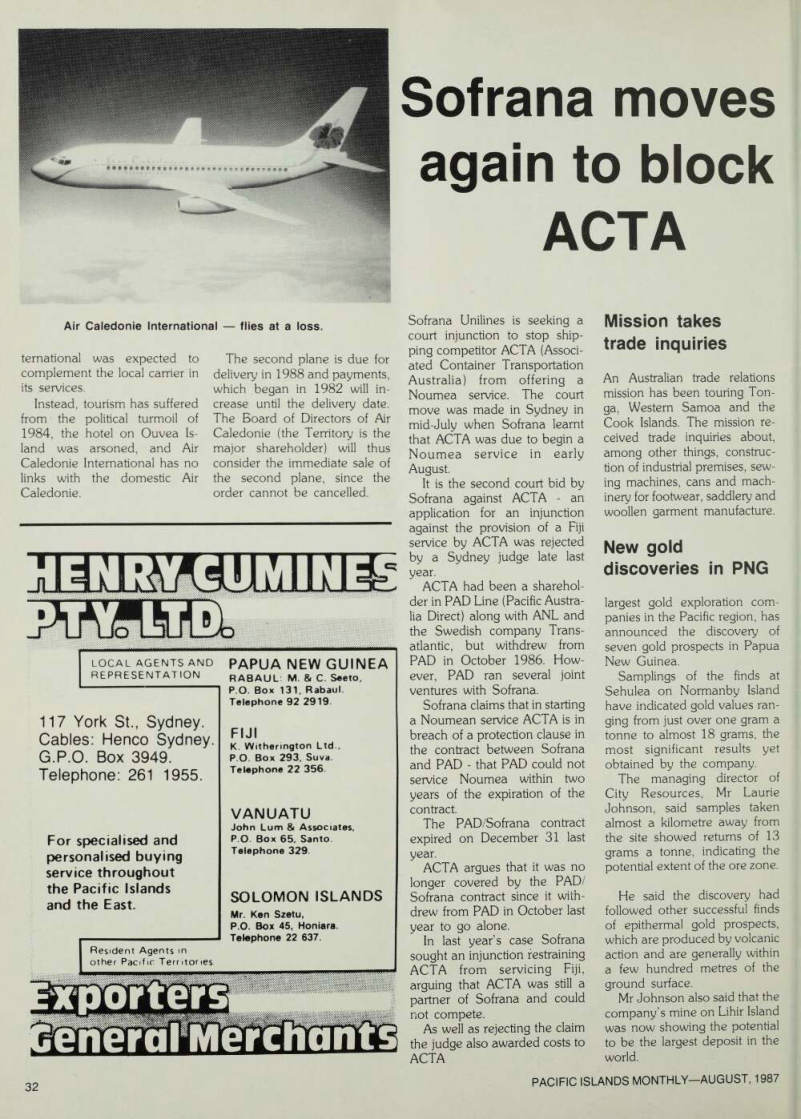
again to block
Acta
Sofrana Unilines is seeking a court injunction to stop ship ping competitor ACTA (Associ ated Container Transportation Australia) from offering a Noumea service. The court move was made in Sydney in mid-July when Sofrana learnt that ACTA was due to begin a Noumea service in early August.
It is the second court bid by Sofrana against ACTA - an application for an injunction against the provision of a Fiji service by ACTA was rejected by a Sydney judge late last year.
ACTA had been a sharehol der in PAD Line (Pacific Austra lia Direct) along with ANL and the Swedish company Trans atlantic, but withdrew from PAD in October 1986. How ever, PAD ran several joint ventures with Sofrana.
Sofrana claims that in starting a Noumean service ACTA is in breach of a protection clause in the contract between Sofrana and PAD - that PAD could not service Noumea within two years of the expiration of the contract.
The PAD/Sofrana contract expired on December 31 last year.
ACTA argues that it was no longer covered by the PAD/ Sofrana contract since it with drew from PAD in October last year to go alone.
In last year’s case Sofrana sought an injunction restraining ACTA from servicing Fiji, arguing that ACTA was still a partner of Sofrana and could not compete.
As well as rejecting the claim the judge also awarded costs to
Acta
Mission takes
trade inquiries
An Australian trade relations mission has been touring Ton ga, Western Samoa and the Cook Islands. The mission re ceived trade inquiries about, among other things, construc tion of industrial premises, sew ing machines, cans and mach inery for footwear, saddlery and woollen garment manufacture.
New gold
discoveries in PNG
largest gold exploration com panies in the Pacific region, has announced the discovery of seven gold prospects in Papua New Guinea.
Samplings of the finds at Sehulea on Normanby Island have indicated gold values ran ging from just over one gram a tonne to almost 18 grams, the most significant results yet obtained by the company.
The managing director of City Resources, Mr Laurie Johnson, said samples taken almost a kilometre away from the site showed returns of 13 grams a tonne, indicating the potential extent of the ore zone.
He said the discovery had followed other successful finds of epithermal gold prospects, which are produced by volcanic action and are generally within a few hundred metres of the ground surface.
Mr Johnson also said that the company’s mine on Lihir Island was now showing the potential to be the largest deposit in the world.
He said 12 million ounces had already been mined and that it was possible the mine could now produce another 12 million ounces.
Lini signs Vanitel
agreement
The Vanuatu Government has acquired a one-third sharehold ing in Vanitel, the company which owns and operates Vanuatu’s telecommunications service. The Prime Minister, Father Walter Lini, last month signed a share agreement with the Cable and Wireless Com pany of Britain and France Cables Et Radio, the two com panies that owned Vanitel. The new company has been given the sole right to own and operate international telecom munications for Vanuatu for the next 20 years. The British and French companies will manage Vanitel for the next five years.
Negotiations will begin soon to bring both international and internal telecommunications under the one management.
Vanuatu exports
fall Vanuatu’s exports for 1986 were down almost 50 per cent from the figures for 1985. The Annual Export Bulletin states that the total value of exports in 1986 was $9.5 million, about half that of the previous year.
Re-exports fell from $12.8 mil lion to $8.7 million following the closure of the South Pacific Fishing Company on Santo.
The main destinations for Vanuatu’s exports in 1986 were Japan, France and Holland, with copra accounting for 47 per cent of the value of all exports. Cocoa and beef accounted for a further 20 per cent and 15 per cent respec tively.
Australians seek
large PNG market
A West Australian trade mission sponsored by the State Gov ernment, the Confederation of Western Australian Industry and Austrade will visit Papua New Guinea in November, with delegates from the organi sations attending special inter
trade seminars in Port Moresby and Rabaul. A new shipping service from Western Australia to Port Moresby and Lae has increased the state’s exports to Papua New Guinea, although these still account for less than two per cent of the all-Australia export total. West Australian Transport Minister, Mr G. Troy, said the new service had had a dramatic effect on the state’s trade effort. By the end of the year West Australian exports to Papua New Guinea will have increased by about 300 per cent, against a 15 per cent increase in total exports to Papua from Australia, he said.
PNG Shipping
sold off The Papua New Guinea Gov ernment has sold the PNG Shipping Corporation to Steamships Trading Company for $2.3 million.
The PNG Shipping Corpora tion was established in 1977, but recorded 10 years of losses totalling $9.5 million. The deci sion to sell the company was taken when the administrators of its creditors scheme decided that the company had no chance of trading out of its financial difficulties. The PNG Government retains a minority shareholding in the company of about 27 per cent.
New rice mill
for PNG
Papua New Guinea’s first rice mill and packaging plant is to be built at Lae by PNG’s largest rice distributor, Rice Industries Pty Ltd.
The mill will start operating next year and will process and package imported rice as well as locally-grown rice from the Sepik and Morobe provinces.
It will cost several million dollars and will employ an initial 30 workers. The managing director of Rice Industries, Mr Paul Davis, said the aim of setting up the mill is to encour age the development of more rice farms in Papua New Guinea.
New beer
for Tonga
A new locally-made beer has gone on sale in Tonga, pro
duced by the Royal Beer Com pany under the chairmanship of Crown Prince Tupouto’a.
The beer, which is the pro duct of a 50-50 joint venture between the Pripp Brewery of Sweden and a Tongan firm, will hopefully dominate the market, replacing Australian brews cur rently available. Tongans have been asked to show their loyal ty to the kingdom by switching to the new beer.
The beer is only available in bottles which, the company says, are reusable and better for the environment than the alu minium cans containing Austra lian beer. In addition, a spokes man for the company claimed that the pop-off rings from the aluminium cans, besides giving indigestion to cattle and fish, wreaked havoc with lawnmowers.
Steel-frame houses
for Pacific
An Australian company, Duraf rame Australia, is to supply more than 500 steel-framed houses worth $l6 million to the Cook Islands over the next 18
months.
The houses have galvanised steel frames and use a simple locking slot system for accurate assembly. There is a 50-year warranty on the frames and the houses will withstand termites, white ants and cyclones. They are also relatively fire resistant In addition, the houses offer a saving of up to $6OOO per house as compared with con ventional-style buildings and can be assembled quickly by unskilled labor.
The company is currently negotiating to supply homes and technology to other parts of the Pacific.
Phosphate
feasibility study
Two Australian companies are to investigate the possibilities of mining phosphate deposits left on Banaba island in Kiribati by the British Phosphate Commis sion in 1979.
The Kiribati Government estimates that the remaining deposits could be worth up to $18.5 million, The study will be carried out in September.
Advertisements & other items, pp. 33-34 (1 item)
Maltunal
PTY. LTD.
Coffee Management
Consultants
Specialists in practical plantation development ★ Nursery through to export grade Green Bean. ★ Management Systems. ★ Costings and budgets.
Extensive experience in estate development alone or in conjunction with allied small holder (20 hectares and up) development.
P.O. Box 161 Ph (675) 52-1744 Ml. Hagen W.H.P. (675) 52-2235 Papua New Guinea Fax (675) 52-2713
CITIZEN
S ■ IM ■ wm m ■■ • »■ m
f mm* l
Hir ■ * ■ / * >3i. f *£>- '^l UC: « ; i /I fi We Ve got fashion creations, sports innovations, high-tech inspirations. For any situation - there’s a Citizen watch. ■I
CITIZEN
FOR FURTHER INFORMATION, PLEASE CONTACT:
Australia: Citizen Watches Australia Pty. Ltd., 122 Old Pittwater Road, Brookvale, NSW 2100.
Tel: 939 7077. Cable: Citizen Sydney.
Telex: AA26633. Fax; 932864.
Fiji Islands: Tappoo Limited, P.O. Box, Sigatoka, Fiji. Tel: 50199. Telex: FJ4244.
New Zealand: Citizen Watches (N.Z.) Ltd., P.O. Box 9518, Auckland, New Zealand.
Tel: 543 393. Telex: 21429. Fax: 544177.
Norfolk Island: Landy & Co., P.O. Box 31, Norfolk Island, 2899, South Pacific. Tel: 2163.
American Samoa: Malaloa Duty Free Shoppers, P.O. Box 2183, Pago Pago, American Samoa, 96799. Tel: 633 5513.
Tahiti: Morgan Vernex, Fare Lite B.P. 449, Tahiti.
Tel: 2.03.09.
New Caledonia: Est. Ballande, B.P. Box C 4, Noumea, New Caledonia. Tel: 27.20.31.
Rarotonga: South Seas International Ltd., P.O. Box 49, Rarotonga, Cook Islands. Tel: 2327 Papua New Guinea: Kara Pty. Limited, P.O. Box 329, Port Moresby. Tel: 25 6044.
Uneasy calm in Noumea
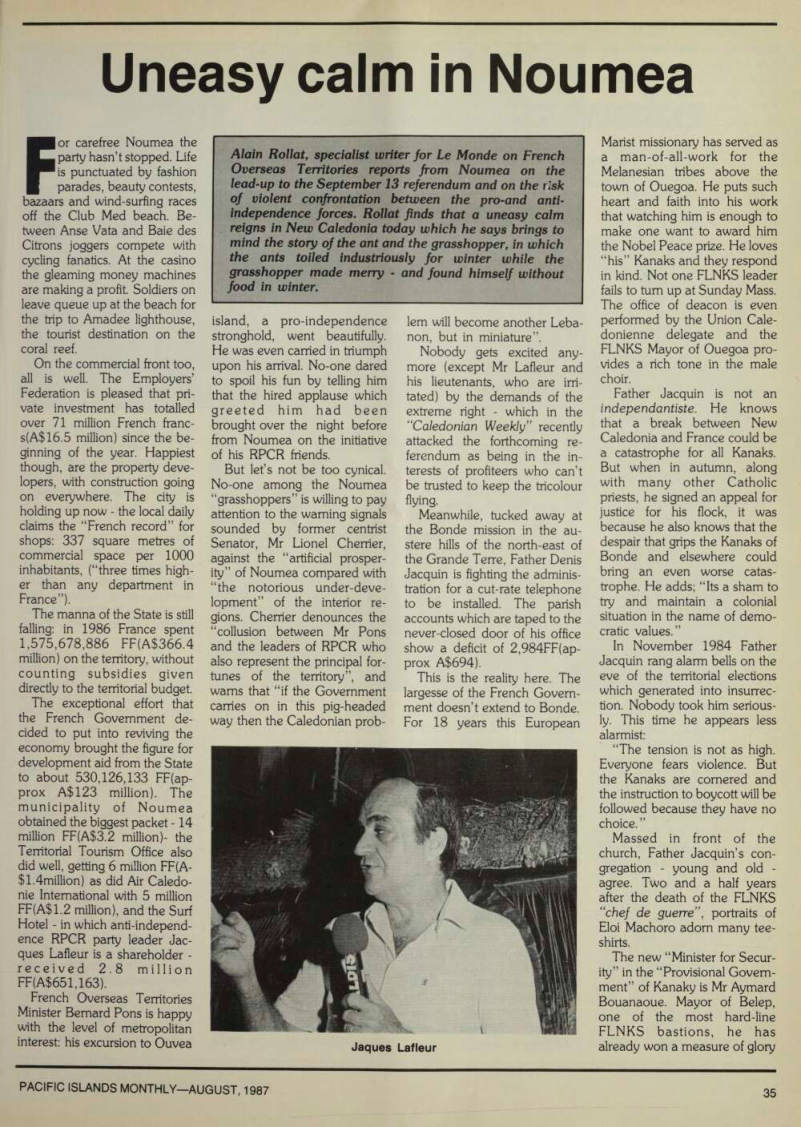
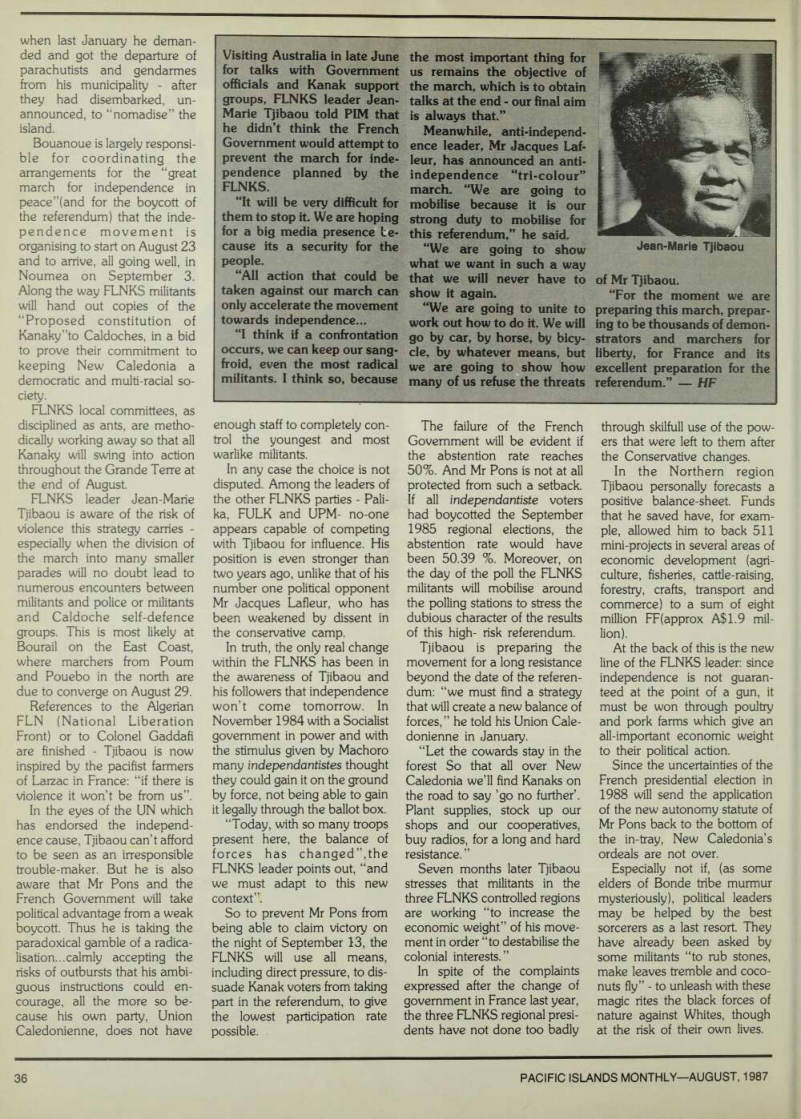
Alain Rollat, specialist writer for Le Monde on French Overseas Territories reports from Noumea on the lead-up to the September 13 referendum and on the risk of violent confrontation between the pro-and anti independence forces. Rollat finds that a uneasy calm reigns in New Caledonia today which he says brings to mind the story of the ant and the grasshopper, in which the ants toiled industriously for winter while the grasshopper made merry - and found himself without food in winter.
For carefree Noumea the party hasn’t stopped. Life is punctuated by fashion parades, beauty contests, bazaars and wind-surfing races off the Club Med beach. Be tween Anse Vata and Baie des Citrons joggers compete with cycling fanatics. At the casino the gleaming money machines are making a profit. Soldiers on leave queue up at the beach for the trip to Amadee lighthouse, the tourist destination on the coral reef.
On the commercial front too, all is well. The Employers’
Federation is pleased that pri vate investment has totalled over 71 million French franc s(Asl6.s million) since the be ginning of the year. Happiest though, are the property deve lopers, with construction going on everywhere. The city is holding up now - the local daily claims the “French record” for shops: 337 square metres of commercial space per 1000 inhabitants, (“three times high er than any department in France”).
The manna of the State is still falling: in 1986 France spent
1,575,678,886 Ff(A5366.4
million) on the territory, without counting subsidies given directly to the territorial budget.
The exceptional effort that the French Government de cided to put into reviving the economy brought the figure for development aid from the State to about 530,126,133 FF(ap prox Asl23 million). The municipality of Noumea obtained the biggest packet -14 million FF(AS3.2 million)- the Territorial Tourism Office also did well, getting 6 million FF(A -sl.4million) as did Air Caledo nie International with 5 million FF(ASI.2 million), and the Surf Hotel - in which anti-independ ence RPCR party leader Jac ques Lafleur is a shareholder received 2.8 million
Ff(A5651,163).
French Overseas Territories Minister Bernard Pons is happy with the level of metropolitan interest: his excursion to Ouvea
island, a pro-independence stronghold, went beautifully.
He was even carried in triumph upon his arrival. No-one dared to spoil his fun by telling him that the hired applause which greeted him had been brought over the night before from Noumea on the initiative of his RPCR friends.
But let’s not be too cynical.
No-one among the Noumea “grasshoppers” is willing to pay attention to the warning signals sounded by former centrist Senator, Mr Lionel Cherrier, against the “artificial prosper ity” of Noumea compared with “the notorious under-deve lopment” of the interior re gions. Cherrier denounces the “collusion between Mr Pons and the leaders of RPCR who also represent the principal for tunes of the territory”, and warns that “if the Government carries on in this pig-headed way then the Caledonian prob
lem will become another Leba non, but in miniature”.
Nobody gets excited any more (except Mr Lafleur and his lieutenants, who are irri tated) by the demands of the extreme right - which in the “Caledonian Weekly” recently attacked the forthcoming re ferendum as being in the in terests of profiteers who can’t be trusted to keep the tricolour flying.
Meanwhile, tucked away at the Bonde mission in the au stere hills of the north-east of the Grande Terre, Father Denis Jacquin is fighting the adminis tration for a cut-rate telephone to be installed. The parish accounts which are taped to the never-closed door of his office show a deficit of 2,9B4FF(ap prox A 5694).
This is the reality here. The largesse of the French Govern ment doesn’t extend to Bonde.
For 18 years this European
Marist missionary has served as a man-of-all-work for the Melanesian tribes above the town of Ouegoa. He puts such heart and faith into his work that watching him is enough to make one want to award him the Nobel Peace prize. He loves “his” Kanaks and they respond in kind. Not one FLNKS leader fails to turn up at Sunday Mass.
The office of deacon is even performed by the Union Cale donienne delegate and the FLNKS Mayor of Ouegoa pro vides a rich tone in the male choir.
Father Jacquin is not an independantiste. He knows that a break between New Caledonia and France could be a catastrophe for all Kanaks.
But when in autumn, along with many other Catholic priests, he signed an appeal for justice for his flock, it was because he also knows that the despair that grips the Kanaks of Bonde and elsewhere could bring an even worse catas trophe. He adds; “Its a sham to try and maintain a colonial situation in the name of demo cratic values.”
In November 1984 Father Jacquin rang alarm bells on the eve of the territorial elections which generated into insurrec tion. Nobody took him serious ly. This time he appears less alarmist: “The tension is not as high.
Everyone fears violence. But the Kanaks are cornered and the instruction to boycott will be followed because they have no choice. ”
Massed in front of the church, Father Jacquin’s con gregation - young and old agree. Two and a half years after the death of the FLNKS “chef de guerre”, portraits of Eloi Machoro adorn many tee shirts.
The new “Minister for Secur ity” in the “Provisional Govern ment” of Kanaky is Mr Aymard Bouanaoue. Mayor of Belep, one of the most hard-line FLNKS bastions, he has already won a measure of glory
Jaques Lafleur
when last January he deman ded and got the departure of parachutists and gendarmes from his municipality - after they had disembarked, un announced, to “nomadise” the island.
Bouanoue is largely responsi ble for coordinating the arrangements for the “great march for independence in peace’’(and for the boycott of the referendum) that the inde pendence movement is organising to start on August 23 and to arrive, all going well, in Noumea on September 3.
Along the way FLNKS militants will hand out copies of the “Proposed constitution of Kanaky”to Caldoches, in a bid to prove their commitment to keeping New Caledonia a democratic and multi-racial so ciety.
FLNKS local committees, as disciplined as ants, are metho dically working away so that all Kanaky will swing into action throughout the Grande Terre at the end of August.
FLNKS leader Jean-Marie Tjibaou is aware of the risk of violence this strategy carries especially when the division of the march into many smaller parades will no doubt lead to numerous encounters between militants and police or militants and Caldoche self-defence groups. This is most likely at Bourail on the East Coast, where marchers from Poum and Pouebo in the north are due to converge on August 29.
References to the Algerian FLN (National Liberation Front) or to Colonel Gaddafi are finished - Tjibaou is now inspired by the pacifist farmers of Larzac in France: “if there is violence it won’t be from us”.
In the eyes of the UN which has endorsed the independ ence cause, Tjibaou can’t afford to be seen as an irresponsible trouble-maker. But he is also aware that Mr Pons and the French Government will take political advantage from a weak boycott. Thus he is taking the paradoxical gamble of a radica lisation...calmly accepting the risks of outbursts that his ambi guous instructions could en courage, all the more so be cause his own party, Union Caledonienne, does not have
enough staff to completely con trol the youngest and most warlike militants.
In any case the choice is not disputed. Among the leaders of the other FLNKS parties - Pali ka, FULK and UPM- no-one appears capable of competing with Tjibaou for influence. His position is even stronger than two years ago, unlike that of his number one political opponent Mr Jacques Lafleur, who has been weakened by dissent in the conservative camp.
In truth, the only real change within the FLNKS has been in the awareness of Tjibaou and his followers that independence won’t come tomorrow. In November 1984 with a Socialist government in power and with the stimulus given by Machoro many independantistes thought they could gain it on the ground by force, not being able to gain it legally through the ballot box.
“Today, with so many troops present here, the balance of forces has changed”,the FLNKS leader points out, “and we must adapt to this new context”.
So to prevent Mr Pons from being able to claim victory on the night of September 13, the FLNKS will use all means, including direct pressure, to dis suade Kanak voters from taking part in the referendum, to give the lowest participation rate possible.
The failure of the French Government will be evident if the abstention rate reaches 50%. And Mr Pons is not at all protected from such a setback.
If all independantiste voters had boycotted the September 1985 regional elections, the abstention rate would have been 50.39 %. Moreover, on the day of the poll the FLNKS militants will mobilise around the polling stations to stress the dubious character of the results of this high- risk referendum.
Tjibaou is preparing the movement for a long resistance beyond the date of the referen dum: “we must find a strategy that will create a new balance of forces,” he told his Union Cale donienne in January.
“Let the cowards stay in the forest So that all over New Caledonia we’ll find Kanaks on the road to say ’go no further’.
Plant supplies, stock up our shops and our cooperatives, buy radios, for a long and hard resistance. ”
Seven months later Tjibaou stresses that militants in the three FLNKS controlled regions are working “to increase the economic weight” of his move ment in order “to destabilise the colonial interests.”
In spite of the complaints expressed after the change of government in France last year, the three FLNKS regional presi dents have not done too badly
through skilfull use of the pow ers that were left to them after the Conservative changes.
In the Northern region Tjibaou personally forecasts a positive balance-sheet. Funds that he saved have, for exam ple, allowed him to back 511 mini-projects in several areas of economic development (agri culture, fisheries, cattle-raising, forestry, crafts, transport and commerce) to a sum of eight million FF(approx Asl.9 mil lion).
At the back of this is the new line of the FLNKS leader: since independence is not guaran teed at the point of a gun, it must be won through poultry and pork farms which give an all-important economic weight to their political action.
Since the uncertainties of the French presidential election in 1988 will send the application of the new autonomy statute of Mr Pons back to the bottom of the in-tray, New Caledonia’s ordeals are not over.
Especially not if, (as some elders of Bonde tribe murmur mysteriously), political leaders may be helped by the best sorcerers as a last resort They have already been asked by some militants “to rub stones, make leaves tremble and coco nuts fly” - to unleash with these magic rites the black forces of nature against Whites, though at the risk of their own lives.
Visiting Australia in late June for talks with Government officials and Kanak support groups, FLNKS leader Jean- Marie Tjibaou told PIM that he didn’t think the French Government would attempt to prevent the march for inde pendence planned by the
Flnks.
“It will be very difficult for them to stop it. We are hoping for a big media presence be cause its a security for the people.
“All action that could be taken against our march can only accelerate the movement towards independence...
“1 think if a confrontation occurs, we can keep our sang froid, even the most radical militants. I think so, because
the most important thing for us remains the objective of the march, which is to obtain talks at the end - our final aim is always that.”
Meanwhile, anti-independ ence leader, Mr Jacques Laf leur, has announced an anti independence “tri-colour” march. “We cure going to mobilise because it is our strong duty to mobilise for this referendum,” he said.
“We are going to show what we want in such a way that we will never have to show it again.
“We are going to unite to work out how to do it. We will go by car, by horse, by bicy cle, by whatever means, but we are going to show how many of us refuse the threats
of Mr Tjibaou. ‘Tor the moment we are preparing this march, prepar ing to be thousands of demon strators and marchers for liberty, for France and its excellent preparation for the
referendum.”
HF
Jean-Marie Tjibaou
Palau struggles in wake
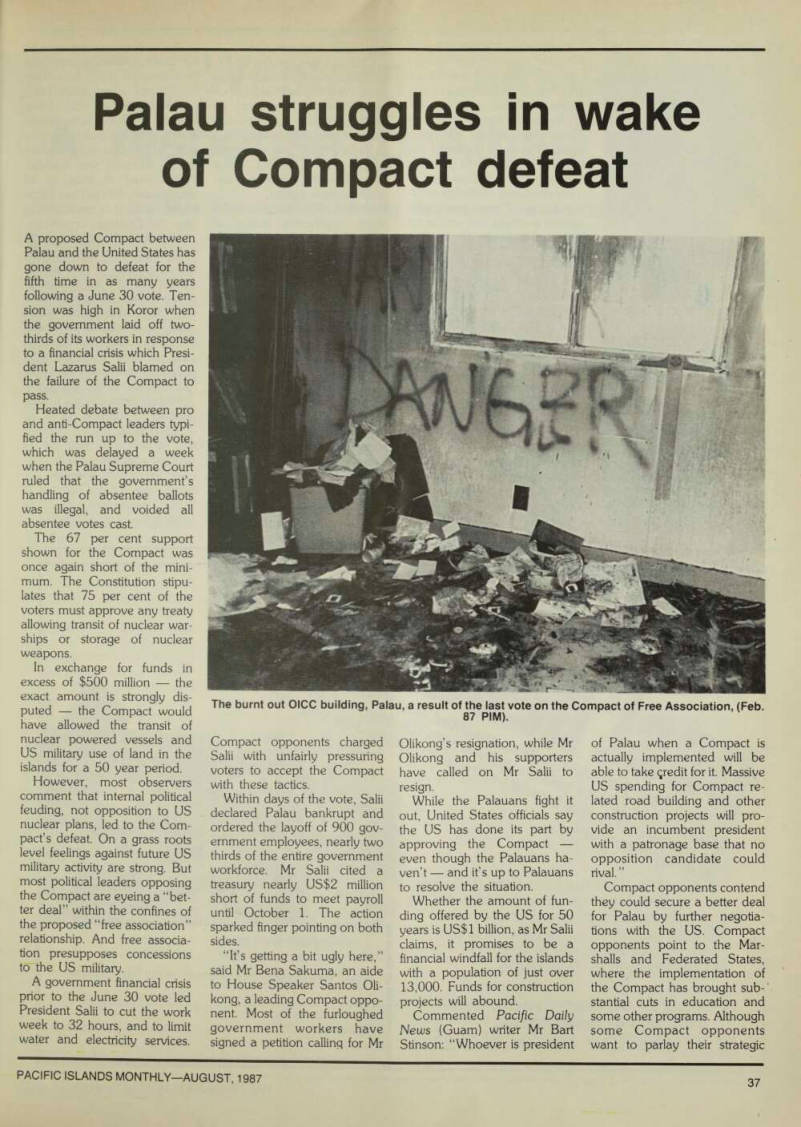
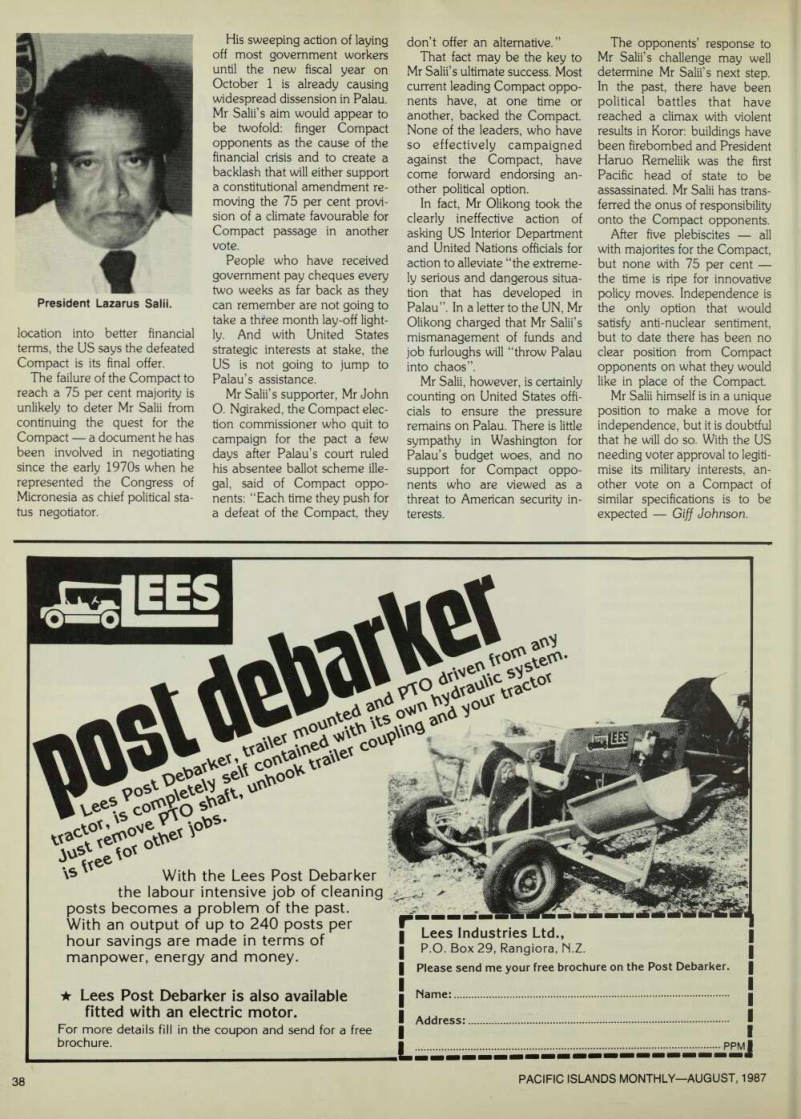
of Compact defeat
A proposed Compact between Palau and the United States has gone down to defeat for the fifth time in as many years following a June 30 vote. Ten sion was high in Koror when the government laid off two thirds of its workers in response to a financial crisis which Presi dent Lazarus Salii blamed on the failure of the Compact to pass.
Heated debate between pro and anti-Compact leaders typi fied the run up to the vote, which was delayed a week when the Palau Supreme Court ruled that the government’s handling of absentee ballots was illegal, and voided all absentee votes cast.
The 67 per cent support shown for the Compact was once again short of the mini mum. The Constitution stipu lates that 75 per cent of the voters must approve any treaty allowing transit of nuclear war ships or storage of nuclear weapons.
In exchange for funds in excess of $5OO million the exact amount is strongly dis puted the Compact would have allowed the transit of nuclear powered vessels and US military use of land in the islands for a 50 year period.
However, most observers comment that internal political feuding, not opposition to US nuclear plans, led to the Com pact’s defeat. On a grass roots level feelings against future US military activity are strong. But most political leaders opposing the Compact are eyeing a “bet ter deal” within the confines of the proposed “free association” relationship. And free associa tion presupposes concessions to the US military.
A government financial crisis prior to the June 30 vote led President Salii to cut the work week to 32 hours, and to limit water and electricity services.
Compact opponents charged Salii with unfairly pressuring voters to accept the Compact with these tactics.
Within days of the vote, Salii declared Palau bankrupt and ordered the layoff of 900 gov ernment employees, nearly two thirds of the entire government workforce. Mr Salii cited a treasury nearly US$2 million short of funds to meet payroll until October 1. The action sparked finger pointing on both sides.
“It’s getting a bit ugly here,” said Mr Bena Sakuma, an aide to House Speaker Santos Oli kong, a leading Compact oppo nent. Most of the furloughed government workers have signed a petition calling for Mr
Olikong’s resignation, while Mr Olikong and his supporters have called on Mr Salii to resign.
While the Palauans fight it out, United States officials say the US has done its part by approving the Compact even though the Palauans ha ven’t and it’s up to Palauans to resolve the situation.
Whether the amount of fun ding offered by the US for 50 years is US$l billion, as Mr Salii claims, it promises to be a financial windfall for the islands with a population of just over 13,000. Funds for construction projects will abound.
Commented Pacific Daily News (Guam) writer Mr Bart Stinson: “Whoever is president
of Palau when a Compact is actually implemented will be able to take credit for it. Massive US spending for Compact re lated road building and other construction projects will pro vide an incumbent president with a patronage base that no opposition candidate could rival. ”
Compact opponents contend they could secure a better deal for Palau by further negotia tions with the US. Compact opponents point to the Mar shalls and Federated States, where the implementation of the Compact has brought sub stantial cuts in education and some other programs. Although some Compact opponents want to parlay their strategic
The burnt out OICC building, Palau, a result of the last vote on the Compact of Free Association, (Feb.
87 Pim).
location into better financial terms, the US says the defeated Compact is its final offer.
The failure of the Compact to reach a 75 per cent majority is unlikely to deter Mr Salii from continuing the quest for the Compact a document he has been involved in negotiating since the early 1970 s when he represented the Congress of Micronesia as chief political sta tus negotiator.
His sweeping action of laying off most government workers until the new fiscal year on October 1 is already causing widespread dissension in Palau.
Mr Salii’s aim would appear to be twofold; finger Compact opponents as the cause of the financial crisis and to create a backlash that will either support a constitutional amendment re moving the 75 per cent provi sion of a climate favourable for Compact passage in another vote.
People who have received government pay cheques every two weeks as far back as they can remember are not going to take a thfee month lay-off light ly. And with United States strategic interests at stake, the US is not going to jump to Palau’s assistance.
Mr Salii’s supporter, Mr John O. Ngiraked, the Compact elec tion commissioner who quit to campaign for the pact a few days after Palau’s court ruled his absentee ballot scheme ille gal, said of Compact oppo nents: “Each time they push for a defeat of the Compact, they
don’t offer an alternative.”
That fact may be the key to Mr Salii’s ultimate success. Most current leading Compact oppo nents have, at one time or another, backed the Compact.
None of the leaders, who have so effectively campaigned against the Compact, have come forward endorsing an other political option.
In fact, Mr Olikong took the clearly ineffective action of asking US Interior Department and United Nations officials for action to alleviate “the extreme ly serious and dangerous situa tion that has developed in Palau”. In a letter to the UN, Mr Olikong charged that Mr Salii’s mismanagement of funds and job furloughs will “throw Palau into chaos”.
Mr Salii, however, is certainly counting on United States offi cials to ensure the pressure remains on Palau. There is little sympathy in Washington for Palau’s budget woes, and no support for Compact oppo nents who are viewed as a threat to American security in terests.
The opponents’ response to Mr Salii’s challenge may well determine Mr Salii’s next step.
In the past, there have been political battles that have reached a climax with violent results in Koror: buildings have been firebombed and President Haruo Remeliik was the first Pacific head of state to be assassinated. Mr Salii has trans ferred the onus of responsibility onto the Compact opponents.
After five plebiscites all with majorites for the Compact, but none with 75 per cent the time is ripe for innovative policy moves. Independence is the only option that would satisfy anti-nuclear sentiment, but to date there has been no clear position from Compact opponents on what they would like in place of the Compact.
Mr Salii himself is in a unique position to make a move for independence, but it is doubtful that he will do so. With the US needing voter approval to legiti mise its military interests, an other vote on a Compact of similar specifications is to be expected Giff Johnson.
President Lazarus Salii.
Advertisements & other items, p. 38 (1 item)
oosvO^W^V" 00
\v * wma wr m
•\e< ifc
v,atV- eX \« cO^XX»"
oosvO^W^V" 00
ff Si&^rai^
■ r V,\o'o s- afli^l
w®~t ,er^' ,s
' ot - \5 With the Lees Post Debarker - -* *-* the labour intensive job of cleaning > posts becomes a problem of the past. ' With an output of up to 240 posts per T"""”" “ hour savings are made in terms of p. O . Box 29. Rangiora.’kz. manpower, energy and money. ■ a L Please send me your free brochure on the Post Debarker. ★ Lees Post Debarker is also available Name: fitted with an electric motor. ■ . .. ■ Address: For more details fill in the coupon and send for a free brochure. PPM
Western Samoa:
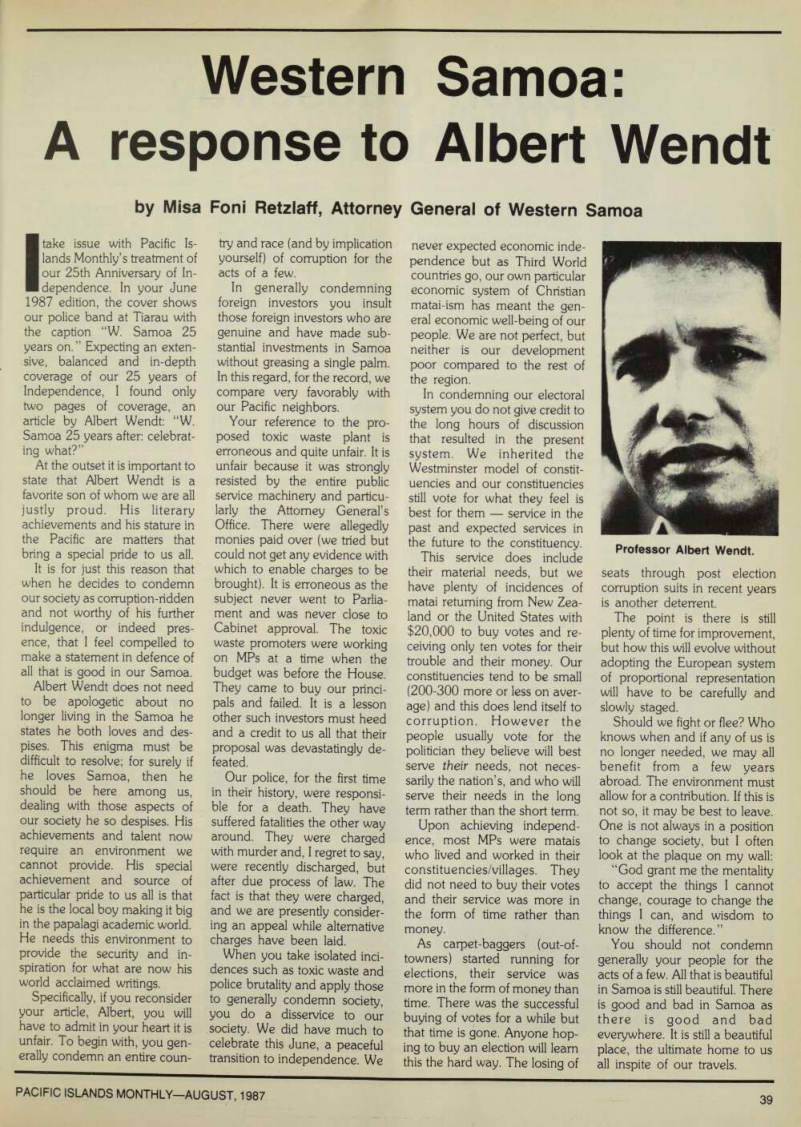
A response to Albert Wendt
by Misa Foni Retzlaff, Attorney General of Western Samoa
■ take issue with Pacific Is lands Monthly’s treatment of our 25th Anniversary of In dependence. In your June 1987 edition, the cover shows our police band at Tiarau with the caption “W. Samoa 25 years on.” Expecting an exten sive, balanced and in-depth coverage of our 25 years of Independence, I found only two pages of coverage, an article by Albert Wendt: “W.
Samoa 25 years after: celebrat ing what?”
At the outset it is important to state that Albert Wendt is a favorite son of whom we are all justly proud. His literary achievements and his stature in the Pacific are matters that bring a special pride to us all.
It is for just this reason that when he decides to condemn our society as corruption-ridden and not worthy of his further indulgence, or indeed pres ence, that I feel compelled to make a statement in defence of all that is good in our Samoa.
Albert Wendt does not need to be apologetic about no longer living in the Samoa he states he both loves and des pises. This enigma must be difficult to resolve; for surely if he loves Samoa, then he should be here among us, dealing with those aspects of our society he so despises. His achievements and talent now require an environment we cannot provide. His special achievement and source of particular pride to us all is that he is the local boy making it big in the papalagi academic world.
He needs this environment to provide the security and in spiration for what are now his world acclaimed writings.
Specifically, if you reconsider your article, Albert, you will have to admit in your heart it is unfair. To begin with, you gen erally condemn an entire coun
try and race (and by implication yourself) of corruption for the acts of a few.
In generally condemning foreign investors you insult those foreign investors who are genuine and have made sub stantial investments in Samoa without greasing a single palm.
In this regard, for the record, we compare very favorably with our Pacific neighbors.
Your reference to the pro posed toxic waste plant is erroneous and quite unfair. It is unfair because it was strongly resisted by the entire public service machinery and particu larly the Attorney General’s Office. There were allegedly monies paid over (we tried but could not get any evidence with which to enable charges to be brought). It is erroneous as the subject never went to Parlia ment and was never close to Cabinet approval. The toxic waste promoters were working on MPs at a time when the budget was before the House.
They came to buy our princi pals and failed. It is a lesson other such investors must heed and a credit to us all that their proposal was devastatingly de feated.
Our police, for the first time in their history, were responsi ble for a death. They have suffered fatalities the other way around. They were charged with murder and, I regret to say, were recently discharged, but after due process of law. The fact is that they were charged, and we are presently consider ing an appeal while alternative charges have been laid.
When you take isolated inci dences such as toxic waste and police brutality and apply those to generally condemn society, you do a disservice to our society. We did have much to celebrate this June, a peaceful transition to independence. We
never expected economic inde pendence but as Third World countries go, our own particular economic system of Christian matai-ism has meant the gen eral economic well-being of our people. We are not perfect, but neither is our development poor compared to the rest of the region.
In condemning our electoral system you do not give credit to the long hours of discussion that resulted in the present system. We inherited the Westminster model of constit uencies and our constituencies still vote for what they feel is best for them service in the past and expected services in the future to the constituency.
This service does include their material needs, but we have plenty of incidences of matai returning from New Zea land or the United States with $20,000 to buy votes and re ceiving only ten votes for their trouble and their money. Our constituencies tend to be small (200-300 more or less on aver age) and this does lend itself to corruption. However the people usually vote for the politician they believe will best serve their needs, not neces sarily the nation’s, and who will serve their needs in the long term rather than the short term.
Upon achieving independ ence, most MPs were matais who lived and worked in their
constituencies/villages. They
did not need to buy their votes and their service was more in the form of time rather than money.
As carpet-baggers (out-of towners) started running for elections, their service was more in the form of money than time. There was the successful buying of votes for a while but that time is gone. Anyone hop ing to buy an election will leam this the hard way. The losing of
seats through post election corruption suits in recent years is another deterrent.
The point is there is still plenty of time for improvement, but how this will evolve without adopting the European system of proportional representation will have to be carefully and slowly staged.
Should we fight or flee? Who knows when and if any of us is no longer needed, we may all benefit from a few years abroad. The environment must allow for a contribution. If this is not so, it may be best to leave.
One is not always in a position to change society, but I often look at the plaque on my wall: “God grant me the mentality to accept the things I cannot change, courage to change the things I can, and wisdom to know the difference.”
You should not condemn generally your people for the acts of a few. All that is beautiful in Samoa is still beautiful. There is good and bad in Samoa as there is good and bad everywhere. It is still a beautiful place, the ultimate home to us all inspite of our travels.
Professor Albert Wendt.
Nippon Causeway
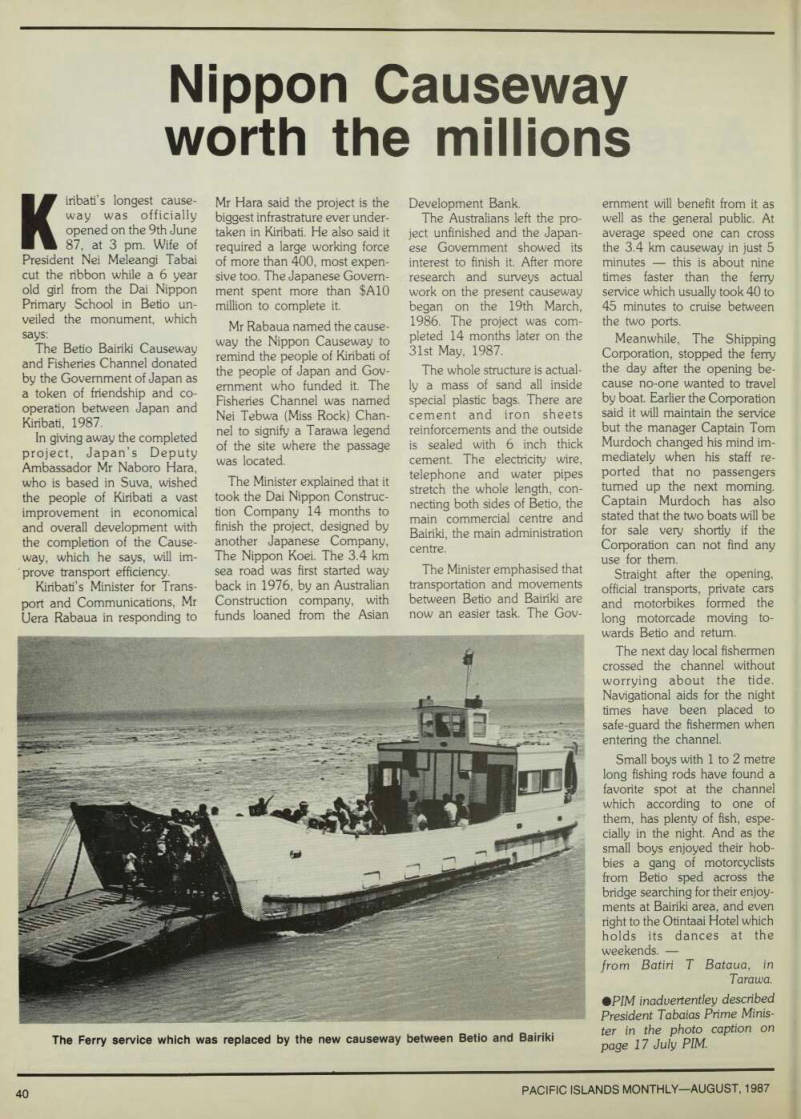
worth the millions
Kiribati’s longest causeway was officially opened on the 9th June 87, at 3 pm. Wife of President Nei Meleangi Tabai cut the ribbon while a 6 year old girl from the Dai Nippon Primary School in Betio unveiled the monument, which o *. D • ■ n The Betio Bamki Causeway and Fisheries Channel donated by the Government of Japan as * . f a token ot tnendship and co- r j « Pe K a T n tQB7 pan iMnoan, iw/.
In giving away the completed . . 3 , , p. K , project, Japan s Deputy Ambassador Mr Naboro Hara, who is based in Suva, wished the people of Kiribati a vast improvement in economical and overall development with the completion of the Causeway, which he says, will improve transport efficiency.
Kiribati’s Minister for Transport and Communications, Mr Uera Rabaua in responding to
Mr Hara said the project is the biggest infrastrature ever under taken in Kiribati. He also said it required a large working force of more than 400, most expen sive too. The Japanese Govern ment spent more than SAIO million to complete it Mr Rabaua named the cause way the Nippon Causeway to remind the people of Kiribati of the people of Japan and Gov ernment who funded it. The Fisheries Channel was named Nei Tebwa (Miss Rock) Chan nel to signify a Tarawa legend of the site where the passage was located.
The Minister explained that it took the Dai Nippon Construc tion Company 14 months to finish the project, designed by another Japanese Company, The Nippon Koei. The 3.4 km sea road was first started way back in 1976, by an Australian Construction company, with funds loaned from the Asian
Development Bank.
The Australians left the pro ject unfinished and the Japan ese Government showed its interest to finish it. After more research and surveys actual work on the present causeway began on the 19th March, 1986. The project was com pleted 14 months later on the 31st May, 1987.
The whole structure is actual ly a mass of sand all inside special plastic bags. There are cement and iron sheets reinforcements and the outside is sealed with 6 inch thick cement. The electricity wire, telephone and water pipes stretch the whole length, con necting both sides of Betio, the main commercial centre and Bairiki, the main administration centre.
The Minister emphasised that transportation and movements between Betio and Bairiki are now an easier task. The Gov-
emment will benefit from it as well as the general public. At average speed one can cross the 3.4 km causeway in just 5 minutes this is about nine times faster than the ferry service which usually took 40 to 45 minutes to cruise between the two ports.
Meanwhile, The Shipping Corporation, stopped the ferry the day after the opening be cause no-one wanted to travel by boat. Earlier the Corporation said it will maintain the service but the manager Captain Tom Murdoch changed his mind im mediately when his staff re ported that no passengers turned up the next morning.
Captain Murdoch has also stated that the two boats will be for sale very shortly if the Corporation can not find any use for them.
Straight after the opening, official transports, private cars and motorbikes formed the long motorcade moving to wards Betio and return.
The next day local fishermen crossed the channel without worrying about the tide.
Navigational aids for the night times have been placed to safe-guard the fishermen when entering the channel.
Small boys with 1 to 2 metre long fishing rods have found a favorite spot at the channel which according to one of them, has plenty of fish, espe cially in the night. And as the small boys enjoyed their hob bies a gang of motorcyclists from Betio sped across the bridge searching for their enjoy ments at Bairiki area, and even right to the Otintaai Hotel which holds its dances at the weekends. from Batiri T Bataua, in Tarawa. #P/M inaduertentley described President Tabaias Prime Minis ter in the photo caption on page 17 July PIM.
The Ferry service which was replaced by the new causeway between Betio and Bairiki
Christmas Island?
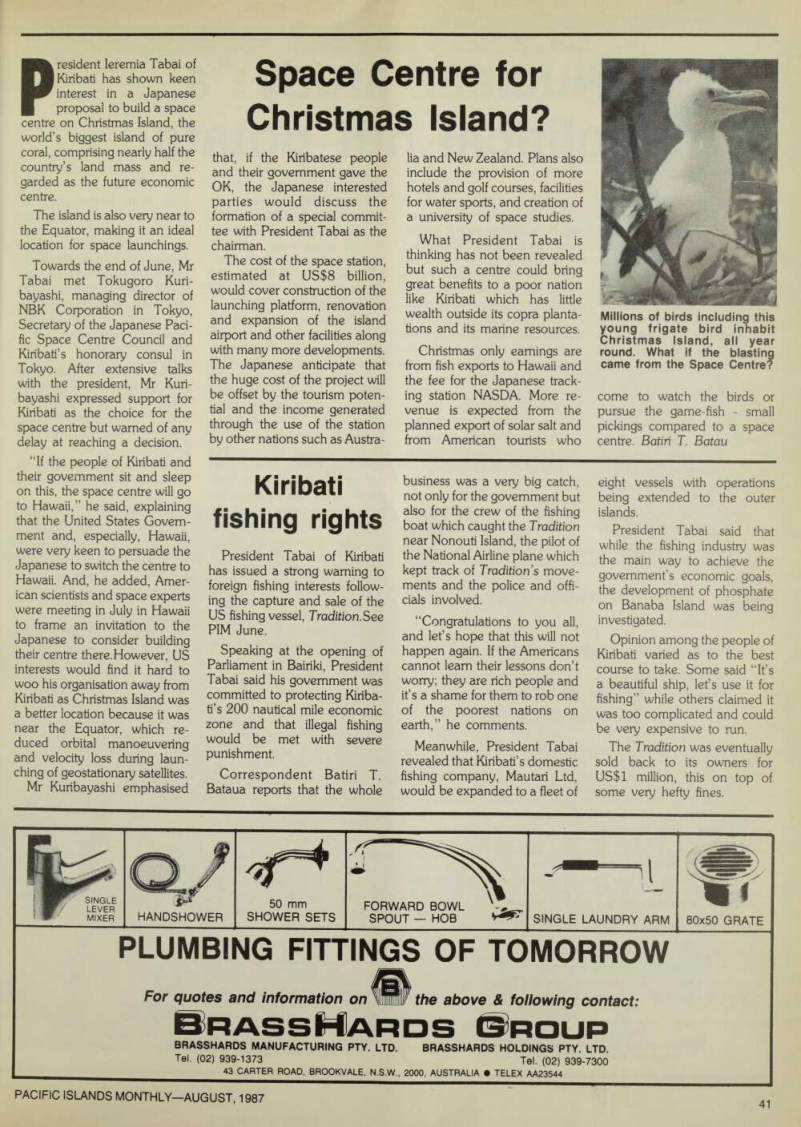
Space Centre for Christmas Island?
P resident leremia Tabai of Kiribati has shown keen interest in a Japanese proposal to build a space centre on Christmas Island, the world’s biggest island of pure coral, comprising nearly half the country’s land mass and re garded as the future economic centre.
The island is also very near to the Equator, making it an ideal location for space launchings.
Towards the end of June, Mr Tabai met Tokugoro Kuri bayashi, managing director of NBK Corporation in Tokyo, Secretary of the Japanese Paci fic Space Centre Council and Kiribati’s honorary consul in Tokyo. After extensive talks with the president, Mr Kuri bayashi expressed support for Kiribati as the choice for the space centre but warned of any delay at reaching a decision.
“If the people of Kiribati and their government sit and sleep on this, the space centre will go to Hawaii,” he said, explaining that the United States Govern ment and, especially, Hawaii, were very keen to persuade the Japanese to switch the centre to Hawaii. And, he added, Amer ican scientists and space experts were meeting in July in Hawaii to frame an invitation to the Japanese to consider building their centre there. However, US interests would find it hard to woo his organisation away from Kiribati as Christmas Island was a better location because it was near the Equator, which re duced orbital manoeuvering and velocity loss during laun ching of geostationary satellites.
Mr Kuribayashi emphasised
that, if the Kiribatese people and their government gave the OK, the Japanese interested parties would discuss the formation of a special commit tee with President Tabai as the chairman.
The cost of the space station, estimated at US$B billion, would cover construction of the launching platform, renovation and expansion of the island airport and other facilities along with many more developments.
The Japanese anticipate that the huge cost of the project will be offset by the tourism poten tial and the income generated through the use of the station by other nations such as Austra
lia and New Zealand. Plans also include the provision of more hotels and golf courses, facilities for water sports, and creation of a university of space studies.
What President Tabai is thinking has not been revealed but such a centre could bring great benefits to a poor nation like Kiribati which has little wealth outside its copra planta tions and its marine resources.
Christmas only earnings are from fish exports to Hawaii and the fee for the Japanese track ing station NASDA. More re venue is expected from the planned export of solar salt and from American tourists who
come to watch the birds or pursue the game-fish - small pickings compared to a space centre. Batiri T. Batau
Millions of birds including this young frigate bird inhabit Christmas Island, all year round. What if the blasting came from the Space Centre?
Kiribati
fishing rights
p reside nt Tabai of Kiribati bas i SSued a strong warning to foreign fishing interests follow ing the capture and sale of the us fishing vessel puvj j une Speaking at the opening of Parliament in Bairiki, President ada * SQ Id his government was c ? m J™ tted to Protecting Kiriba s nautical mile economic zone an< J that illegal fishing WOL^ d de me * severe punishment, Correspondent Batiri T.
Bataua reports that the whole
business was a very big catch, not only for the government but also for the crew of the fishing boat which caught the Tradition near Nonouti Island, the pilot of the National Airline plane which kept track of Tradition's move ments and the police and offi cials involved.
“Congratulations to you all, and let’s hope that this will not happen again. If the Americans cannot leam their lessons don’t worry; they are rich people and it’s a shame for them to rob one of the poorest nations on earth,” he comments.
Meanwhile, President Tabai revealed that Kiribati’s domestic fishing company, Mautari Ltd, would be expanded to a fleet of
eight vessels with operations being extended to the outer islands.
President Tabai said that while the fishing industry was the main way to achieve the government’s economic goals, the development of phosphate on Banaba Island was being investigated.
Opinion among the people of Kiribati varied as to the best course to take. Some said “It’s a beautiful ship, let’s use it for fishing” while others claimed it was too complicated and could be very expensive to run.
The Tradition was eventually sold back to its owners for US$l million, this on top of some very hefty fines.
Advertisements & other items, p. 41 (1 item)
Plumbing Fittings Of Tomorrow
SINGLE
LEVER
VIXER
80x50 GRATE
PLUMBING FITTINGS OF TOMORROW
For quotes and information on the above & following contact: BRASSHARDS MANUFACTURING PTY. LTD. BRASSHARDS HOLDINGS PTY. LTD.
Tel. (02) 939-1373 Tel. (02) 939-7300 43 CARTER ROAD, BROOKVALE, N.S.W., 2000, AUSTRALIA • TELEX AA23544
political hot potato
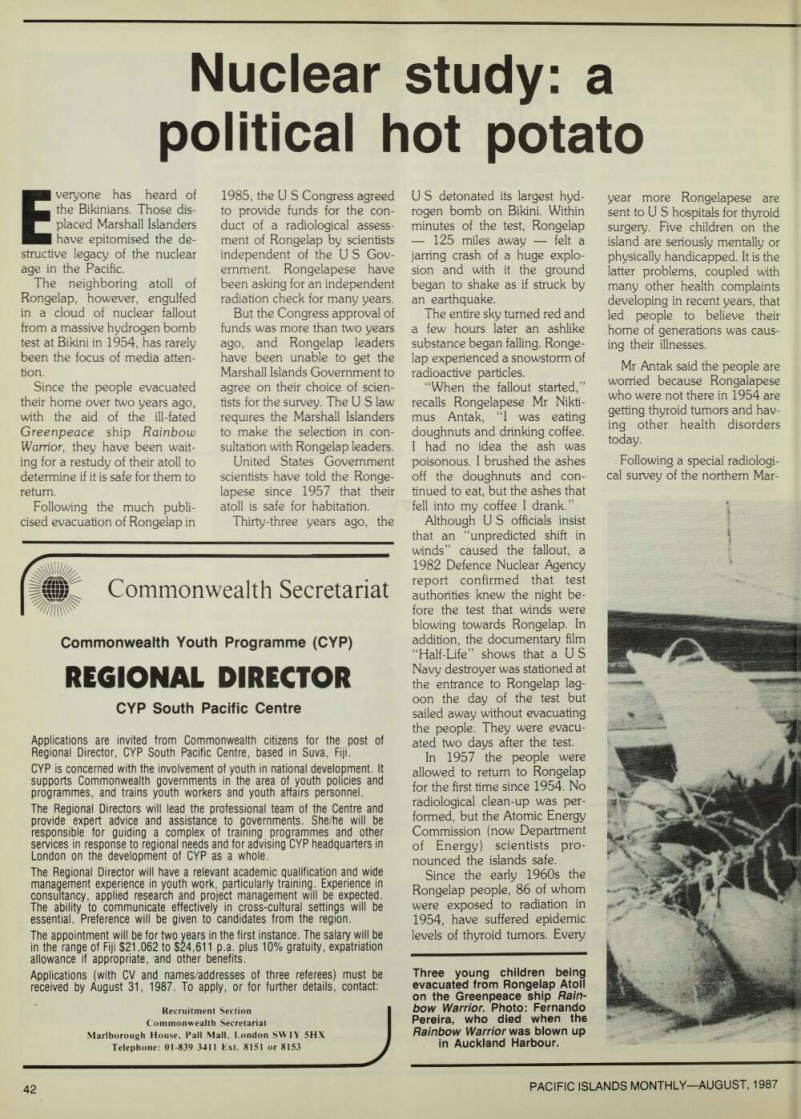
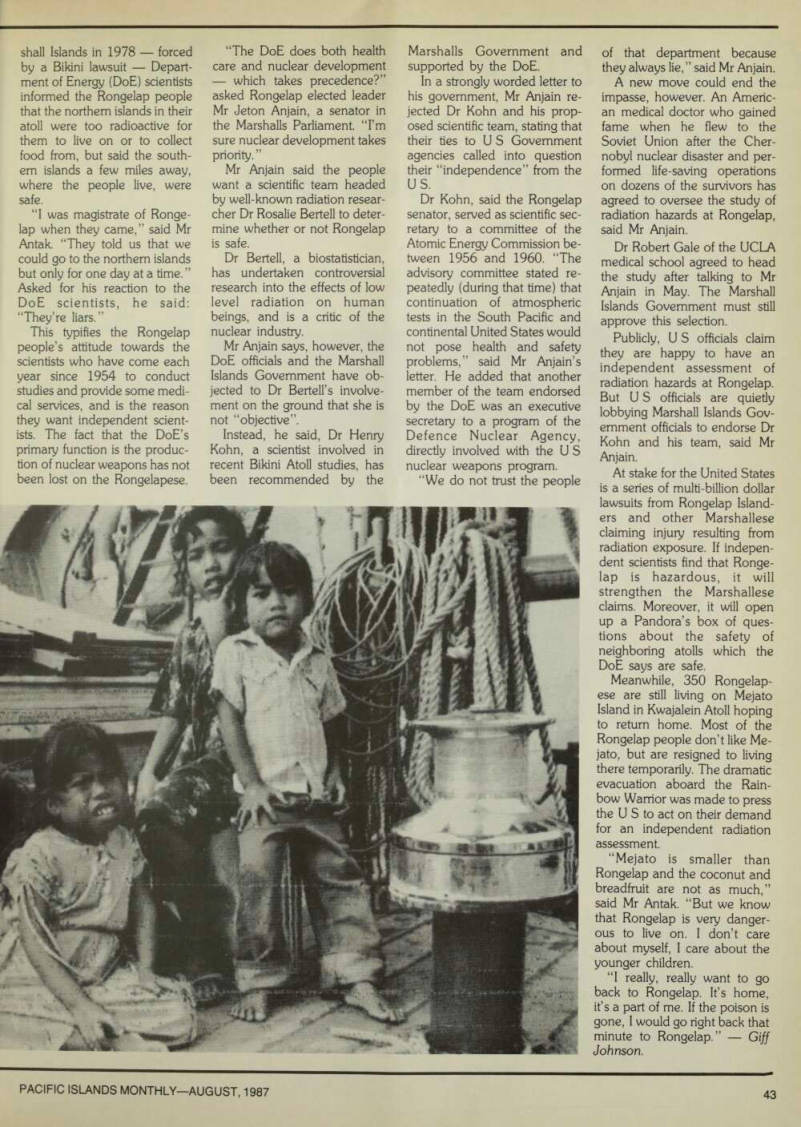
Nuclear study: a political hot potato
Everyone has heard of the Bikinians. Those dis placed Marshall Islanders have epitomised the de structive legacy of the nuclear age in the Pacific.
The neighboring atoll of Rongelap, however, engulfed in a cloud of nuclear fallout from a massive hydrogen bomb test at Bikini in 1954, has rarely been the focus of media atten tion.
Since the people evacuated their home over two years ago, with the aid of the ill-fated Greenpeace ship Rainbow Warrior , they have been wait ing for a restudy of their atoll to determine if it is safe for them to return.
Following the much publi cised evacuation of Rongelap in
1985, the U S Congress agreed to provide funds for the con duct of a radiological assess ment of Rongelap by scientists independent of the U S Gov ernment. Rongelapese have been asking for an independent radiation check for many years.
But the Congress approval of funds was more than two years ago, and Rongelap leaders have been unable to get the Marshall Islands Government to agree on their choice of scien tists for the survey. The U S law requires the Marshall Islanders to make the selection in con sultation with Rongelap leaders.
United States Government scientists have told the Ronge lapese since 1957 that their atoll is safe for habitation.
Thirty-three years ago, the
U S detonated its largest hyd rogen bomb on Bikini. Within minutes of the test, Rongelap 125 miles away felt a jarring crash of a huge explo sion and with it the ground began to shake as if struck by an earthquake.
The entire sky turned red and a few hours later an ashlike substance began falling. Ronge lap experienced a snowstorm of radioactive particles.
“When the fallout started,” recalls Rongelapese Mr Nikti mus Antak, “I was eating doughnuts and drinking coffee.
I had no idea the ash was poisonous. I brushed the ashes off the doughnuts and con tinued to eat, but the ashes that fell into my coffee I drank.”
Although U S officials insist that an “unpredicted shift in winds” caused the fallout, a 1982 Defence Nuclear Agency report confirmed that test authorities knew the night be fore the test that winds were blowing towards Rongelap. In addition, the documentary film “Half-Life” shows that a US Navy destroyer was stationed at the entrance to Rongelap lag oon the day of the test but sailed away without evacuating the people. They were evacu ated two days after the test.
In 1957 the people were allowed to return to Rongelap for the first time since 1954. No radiological clean-up was per formed, but the Atomic Energy Commission (now Department of Energy) scientists pro nounced the islands safe.
Since the early 1960 s the
Rongelap people, 86 of whom were exposed to radiation in 1954, have suffered epidemic levels of thyroid tumors. Every
year more Rongelapese are sent to U S hospitals for thyroid surgery. Five children on the island are seriously mentally or physically handicapped. It is the latter problems, coupled with many other health complaints developing in recent years, that led people to believe their home of generations was caus ing their illnesses.
Mr Antak said the people are worried because Rongalapese who were not there in 1954 are getting thyroid tumors and hav ing other health disorders today.
Following a special radiologi cal survey of the northern Mar-
Three young children being evacuated from Rongelap Atoll on the Greenpeace ship Rain bow Warrior. Photo: Fernando Pereira, who died when the Rainbow Warrior was blown up in Auckland Harbour.
shall Islands in 1978 forced by a Bikini lawsuit Depart ment of Energy (DoE) scientists informed the Rongelap people that the northern islands in their atoll were too radioactive for them to live on or to collect food from, but said the south ern islands a few miles away, where the people live, were safe.
“I was magistrate of Ronge lap when they came,” said Mr Antak. “They told us that we could go to the northern islands but only for one day at a time. ”
Asked for his reaction to the DoE scientists, he said: “They’re liars.”
This typifies the Rongelap people’s attitude towards the scientists who have come each year since 1954 to conduct studies and provide some medi cal services, and is the reason they want independent scient ists. The fact that the DoE’s primary function is the produc tion of nuclear weapons has not been lost on the Rongelapese.
“The DoE does both health care and nuclear development which takes precedence?” asked Rongelap elected leader Mr Jeton Anjain, a senator in the Marshalls Parliament. “I’m sure nuclear development takes priority. ”
Mr Anjain said the people want a scientific team headed by well-known radiation resear cher Dr Rosalie Bertell to deter mine whether or not Rongelap is safe.
Dr Bertell, a biostatistician, has undertaken controversial research into the effects of low level radiation on human beings, and is a critic of the nuclear industry.
Mr Anjain says, however, the DoE officials and the Marshall Islands Government have ob jected to Dr Bertell’s involve ment on the ground that she is not “objective”.
Instead, he said, Dr Henry Kohn, a scientist involved in recent Bikini Atoll studies, has been recommended by the
Marshalls Government and supported by the DoE.
In a strongly worded letter to his government, Mr Anjain re jected Dr Kohn and his prop osed scientific team, stating that their ties to U S Government agencies called into question their “independence” from the US.
Dr Kohn, said the Rongelap senator, served as scientific sec retary to a committee of the Atomic Energy Commission be tween 1956 and 1960. “The advisory committee stated re peatedly (during that time) that continuation of atmospheric tests in the South Pacific and continental United States would not pose health and safety problems,” said Mr Anjain’s letter. He added that another member of the team endorsed by the DoE was an executive secretary to a program of the Defence Nuclear Agency, directly involved with the U S nuclear weapons program.
“We do not trust the people
of that department because they always lie, ” said Mr Anjain.
A new move could end the impasse, however. An Americ an medical doctor who gained fame when he flew to the Soviet Union after the Cher nobyl nuclear disaster and per formed life-saving operations on dozens of the survivors has agreed to oversee the study of radiation hazards at Rongelap, said Mr Anjain.
Dr Robert Gale of the UCLA medical school agreed to head the study after talking to Mr Anjain in May. The Marshall Islands Government must still approve this selection.
Publicly, U S officials claim they are happy to have an independent assessment of radiation hazards at Rongelap.
But U S officials are quietly lobbying Marshall Islands Gov ernment officials to endorse Dr Kohn and his team, said Mr Anjain.
At stake for the United States is a series of multi-billion dollar lawsuits from Rongelap Island ers and other Marshallese claiming injury resulting from radiation exposure. If indepen dent scientists find that Ronge lap is hazardous, it will strengthen the Marshallese claims. Moreover, it will open up a Pandora’s box of ques tions about the safety of neighboring atolls which the DoE says are safe.
Meanwhile, 350 Rongelap ese are still living on Mejato Island in Kwajalein Atoll hoping to return home. Most of the Rongelap people don’t like Me jato, but are resigned to living there temporarily. The dramatic evacuation aboard the Rain bow Warrior was made to press the U S to act on their demand for an independent radiation assessment.
“Mejato is smaller than Rongelap and the coconut and breadfruit are not as much,” said Mr Antak. “But we know that Rongelap is very danger ous to live on. I don’t care about myself, I care about the younger children.
“I really, really want to go back to Rongelap. It’s home, it’s a part of me. If the poison is gone, I would go right back that
minute to Rongelap.”
Giff
Johnson.
Advertisements & other items, pp. 42-44 (2 items)
Regional Director
Commonwealth Secretariat
Commonwealth Youth Programme (CYP)
CYP South Pacific Centre Applications are invited from Commonwealth citizens for the post of Regional Director, CYP South Pacific Centre, based in Suva, Fiji.
CYP is concerned with the involvement of youth in national development. It supports Commonwealth governments in the area of youth policies and programmes, and trains youth workers and youth affairs personnel.
The Regional Directors will lead the professional team of the Centre and provide expert advice and assistance to governments. She/he will be responsible for guiding a complex of training programmes and other services in response to regional needs and for advising CYP headquarters in London on the development of CYP as a whole.
The Regional Director will have a relevant academic qualification and wide management experience in youth work, particularly training. Experience in consultancy, applied research and project management will be expected.
The ability to communicate effectively in cross-cultural settings will be essential. Preference will be given to candidates from the region.
The appointment will be for two years in the first instance. The salary will be in the range of Fiji $21,062 to $24,611 p.a. plus 10% gratuity, expatriation allowance if appropriate, and other benefits.
Applications (with CV and names/addresses of three referees) must be received by August 31, 1987. To apply, or for further details, contact: Recruitment Section Commonwealth Secretariat Marlborough House, Pall Mall. London SWIY SHX Telephone: 01-839 3411 Ext. 8151 or 8153 j
Congratulations Media Niugini
K
SLACK BEAUTY
le beauty of black is back. Stunningly sophisticated. Sleek and chic. Toshiba’s Blackstripe CORE television is designed with a flatter id squarer screen for more picture, greater clarity, no distortion. And it’s just as smartly designed inside, with a revolutionary omputer-built chassis. So, with a high-style cabinet, picture-perfect picture, automatic channel and volume display, and remote conol for effortless adjustments, the only real choice you have to make is between the 15, 19, 21 and 28 inch screens. CORE FS
TOSHIBA
pre-coup Fiji
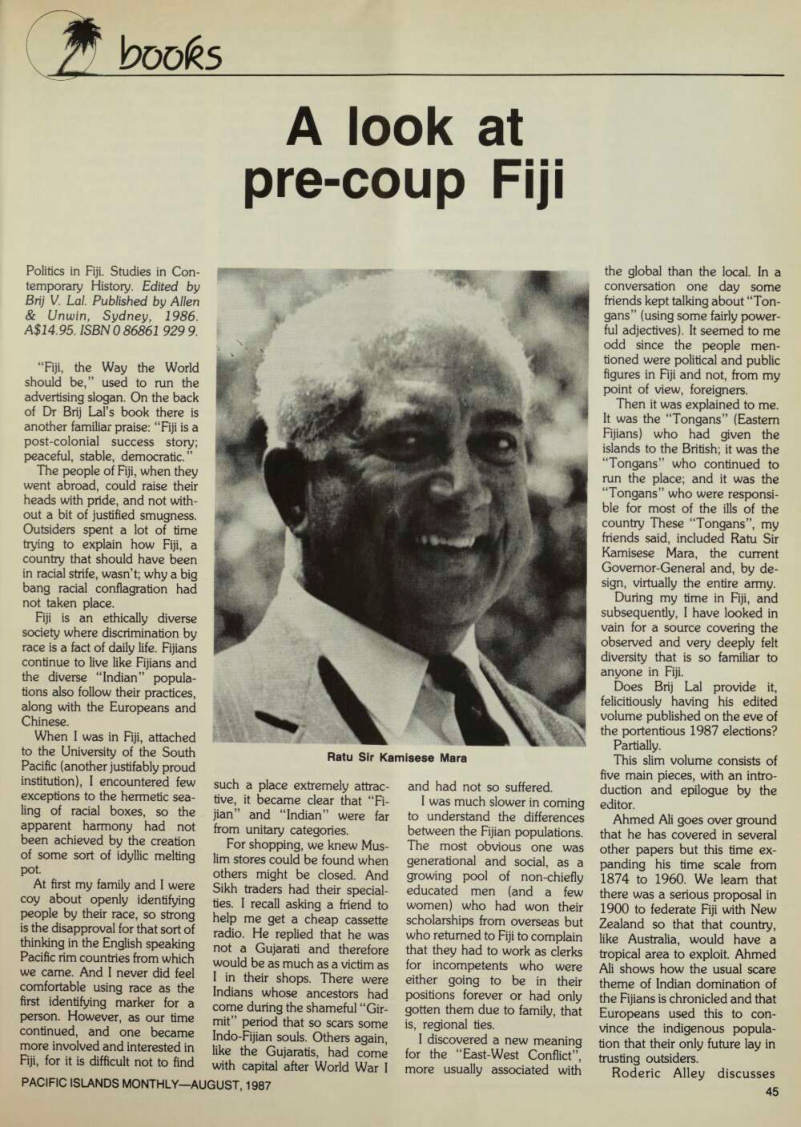
books
A look at pre-coup Fiji
Politics in Fiji. Studies in Con temporary History. Edited by Brij V. Lai. Published by Allen & Unwin, Sydney, 1986.
A 514.95. 158N086861 929 9.
“Fiji, the Way the World should be,” used to run the advertising slogan. On the back of Dr Brij Lai’s book there is another familiar praise: “Fiji is a post-colonial success story; peaceful, stable, democratic.”
The people of Fiji, when they went abroad, could raise their heads with pride, and not with out a bit of justified smugness.
Outsiders spent a lot of time trying to explain how Fiji, a country that should have been in racial strife, wasn’t; why a big bang racial conflagration had not taken place.
Fiji is an ethically diverse society where discrimination by race is a fact of daily life. Fijians continue to live like Fijians and the diverse “Indian” popula tions also follow their practices, along with the Europeans and Chinese.
When I was in Fiji, attached to the University of the South Pacific (another justifably proud institution), I encountered few exceptions to the hermetic sea ling of racial boxes, so the apparent harmony had not been achieved by the creation of some sort of idyllic melting pot At first my family and I were coy about openly identifying people by their race, so strong is the disapproval for that sort of thinking in the English speaking Pacific rim countries from which we came. And I never did feel comfortable using race as the first identifying marker for a person. However, as our time continued, and one became more involved and interested in Fiji, for it is difficult not to find
such a place extremely attrac tive, it became clear that “Fi jian” and “Indian” were far from unitary categories.
For shopping, we knew Mus lim stores could be found when others might be closed. And Sikh traders had their special ties. I recall asking a friend to help me get a cheap cassette radio. He replied that he was not a Gujarati and therefore would be as much as a victim as I in their shops. There were Indians whose ancestors had come during the shameful “Gir mit” period that so scars some Indo-Fijian souls. Others again, like the Gujaratis, had come with capital after World War I
and had not so suffered.
I was much slower in coming to understand the differences between the Fijian populations.
The most obvious one was generational and social, as a growing pool of non-chiefly educated men (and a few women) who had won their scholarships from overseas but who returned to Fiji to complain that they had to work as clerks for incompetents who were either going to be in their positions forever or had only gotten them due to family, that is, regional ties.
I discovered a new meaning for the “East-West Conflict”, more usually associated with
the global than the local. In a conversation one day some friends kept talking about “Ton gans” (using some fairly power ful adjectives). It seemed to me odd since the people men tioned were political and public figures in Fiji and not, from my point of view, foreigners.
Then it was explained to me.
It was the “Tongans” (Eastern Fijians) who had given the islands to the British; it was the “Tongans” who continued to run the place; and it was the “Tongans” who were responsi ble for most of the ills of the country These “Tongans”, my friends said, included Ratu Sir Kamisese Mara, the current Governor-General and, by de sign, virtually the entire army.
During my time in Fiji, and subsequently, I have looked in vain for a source covering the observed and very deeply felt diversity that is so familiar to anyone in Fiji.
Does Brij Lai provide it, felicitiously having his edited volume published on the eve of the portentious 1987 elections?
Partially.
This slim volume consists of five main pieces, with an intro duction and epilogue by the editor.
Ahmed Ali goes over ground that he has covered in several other papers but this time ex panding his time scale from 1874 to 1960. We leam that there was a serious proposal in 1900 to federate Fiji with New Zealand so that that country, like Australia, would have a tropical area to exploit. Ahmed Ali shows how the usual scare theme of Indian domination of the Fijians is chronicled and that Europeans used this to con vince the indigenous popula tion that their only future lay in trusting outsiders.
Roderic Alley discusses
Ratu Sir Kamisese Mara
“party politics”, with much of this not surprisingly being de voted to Indian hopes of some sort of say in the running of the country in which they have come to live.
Robert Norton demonstrates that structures evolved in the colonial period continue to exist in contemporary Fiji, with Lai’s own contribution examining political history in light of three conflicting yet interlocking forces: Fijian Paramountancy, European Priviledge and Indian Parity. These will continue to be major themes of life in Fiji, though the issue of “para mountancy” always will be con tested from the West.
Perhaps the weakest article is that by Premdas. It seems to be involved in some sort of exer cise in political science nomenclature, only remotely related to Fiji, which Premdas seems only superficially to com prehend.
The epilogue by editor Lai is a brief history to the end of 1985 of the Fiji Labour Party, including a very interesting re print of their “manifesto”.
A book such as this suffers and benefits from the recent events in Fiji. Firstly, people will want to buy it to find out the background to what has hap pened. They will expect to find a good bit of history and, if they are lucky, some clever analysis.
On the other hand, people will expect that somehow Lai and his colleagues should have some hints about a coup or, at least, what would happen should the Labour Party come to power in Fiji.
On the first part, readers will find at the level of highly focused even “official” history a good deal of information, though many of the subtleties mentioned above are largely ignored. With respect to insights and predictions, the fullest source is the Fiji Labour Party’s manifesto itself, detailing how the party intends to redefine the political terraine.
It is Lai though who cautious ly broaches the unthinkable, the possibility of civil strife, when he writes in his contribu tion; “Some scholars have argued that Fijian elite will accept the paraphernalia of politics only to the extent that it serves their interest, and that any deviation from the estab
lished path will not easily be tolerated.” And that’s just what happened.
A second edition of Lai’s book, not to mention the half dozen or so “coup quickies” at this moment being churned out by journalists and academics alike, will have to delve into that elite and it won’t only be a Fijian one. What the Labour Party offered was a way around the chiefs for young and highly educated Fijians and Indians who, by virtue of their training, came to have more in common than their parents could im agine.
At the other end of the scale, this intellectual elite adopted a (perhaps) “European” attitude to the disadvantaged in society, feeling not the traditional ties of noblesse oblige to their under class, but those of social re sponsibility.
As well, the young educated elite and the dispossessed of Fiji
had clear cause to unite on the specific issue of “corruption”, which many think was a major election issue and one of the primary reasons that the gov ernment headed by Dr Timoci Bavadra was brought down before it could go too deeply into the murky waters of those who had been so comfortably in power for so long.
Because of the actions of a colonel the hopes for justice and redress have been calously dashed and its back to business as usual, as the colonel has himself boasted.
While race may have been an adequate way of framing relations in Fiji in the past, it very rapidly has ceased to be as relevant, particularly for that young, educated elite already mentioned. While few in it would be game to cross too many social barriers, this elite recognises that there is a com mon foe of economic exploita
tion to be combated, which is blind to race.
It is idealists such as these who have lost. Also, the poor Indian cane farmer, struggling to survive, will have to keep quiet and hold his pride for a few more years, hoping that one of his educated offspring might get a scholarship to ...?
Those in the western districts will continue to grumble about “Tongans” and see their coun try as a country within a country run by people they regard as foreigners.
Since the events of May, the people of Fiji cannot go about with the pride that they had before, for their land too has demonstrated its imperfections.
Like South Africa and Chile, Fiji will join the select list of places that have so offended Euro pean democratic sensibilities that ostracism seems the only answer, until normality can be
restored.
Grant McCall.
Burns Philp’s men
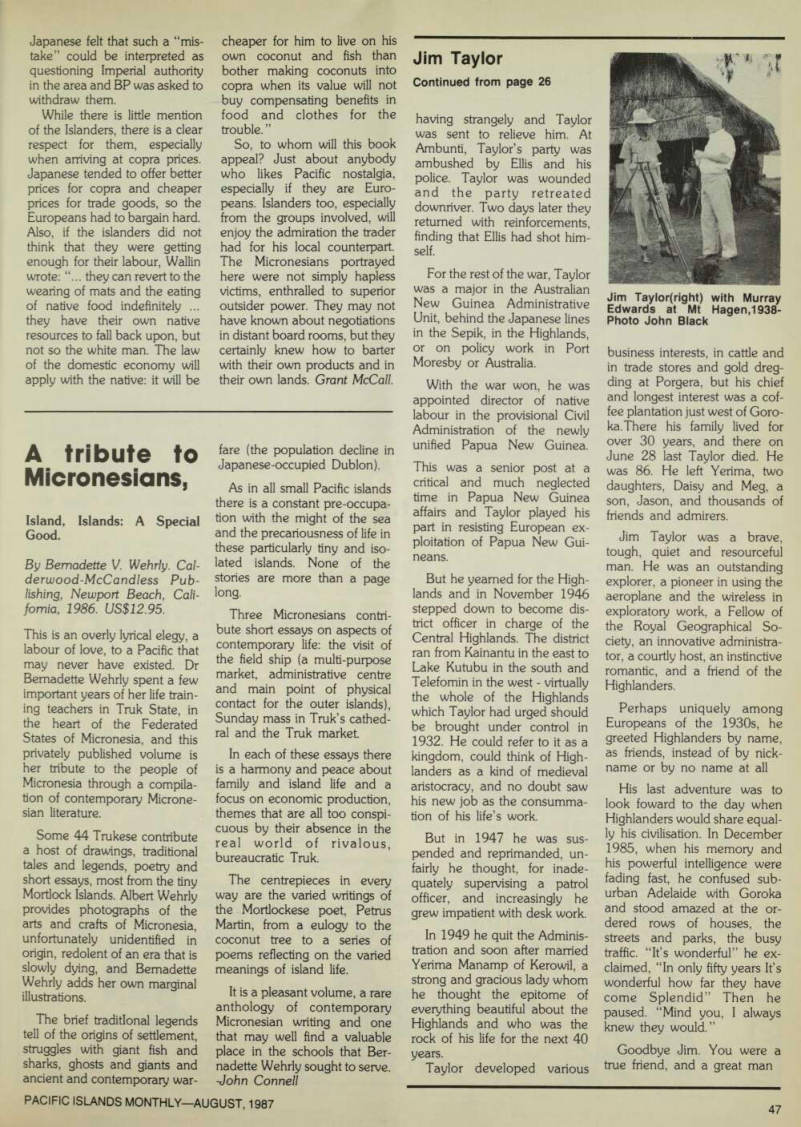
in the Pacific
South Pacific Focus. Burns Philp’s Trading Viewed through Photographs early this Century. By Ken Buckley and Kris Klugman. Published by Allen & Unwin, Sydney,
1986. A 519.95. Isbn 0 04
909030 5.
How one’s perception of the title of a book changes due to recent events. When I saw the above, South Pacific Focus, I imagined some hard hitting, investigative disection of the Pacific scene, perhaps con centrating upon some of the recent headline making key events.
A coup in Fiji, Fishing boat siezures in Kiribati, Lybians lur king behind palms, not to men tion menacing Russians just over the horizon plotting havoc and mayhem. For that is the kind of front page Pacific that has been coming out for much of 1987 and seems to be in the wind for a little while yet.
But, no, this heavily illus trated volume describes a much gentler time, after the “Fatal Impact” (Mark 1) and before the second one to come during
and after the Second World War. It is, in fact, a companion volume to the two already published about Bums, Philp & Co., a kind of commissioned company history.
The co-authors have divided their little book into three parts.
Firstly, there is a brief history of BP, to bring the reader into the context of this particular slice of the Pacific, dealing with com mercial and administrative mat ters.
This is followed by the longest section, with three re ports by a Mr Frederick Wallin on his visits to Gilbert, Ellice and Marshall groups between 1910 and 1915. The last sec tion consists of rather well pre served black and white photo graphs of scenes of commercial significance in those islands, along with BP and associated personnel. There is also a small gallery showing the repatriation of the Queensland Kanaks by BP vessels.
The captions for the photos derive from the presumed photographer, a Mr Nevil Chat field, who joined the firm at the
age of 18 and died at the age of 90 in 1976. Some additional material is provided by other sources available to the co authors, including an interview with Harry and Honor Maude.
The pace through the photo graphs is liesurely. One pro ceeds as with an old relative.
Some comments about some one, a name forgotten or an added observation. The people shown are serene, preposses sed, very self-confident. Of course they all have work and money.
There are observations (few) of the Islanders, the comment ary in section two is taken up mainly by what Wallin made of his fellow Europeans and, later, Japanese trading partners and adversaries. This is no travel writing pen. It is a favourable (to the writer) account of trad ing activities to be sent back to home office. There is a lot of commercial information.
Nevertheless, there are small amusing incidents, such as the BP “Pacific Chart Calendar” incident of 1915. It seems that eager printers in Sydney had stamped in red, “In British Occupation” over the Marshall and Caroline Groups, before the Japanese had decided not to relinquish what they had taken from the Germans. The
Japanese felt that such a “mis take” could be interpreted as questioning Imperial authority in the area and BP was asked to withdraw them.
While there is little mention of the Islanders, there is a clear respect for them, especially when arriving at copra prices.
Japanese tended to offer better prices for copra and cheaper prices for trade goods, so the Europeans had to bargain hard.
Also, if the islanders did not think that they were getting enough for their labour, Wallin wrote: they can revert to the wearing of mats and the eating of native food indefinitely ... they have their own native resources to fall back upon, but not so the white man. The law of the domestic economy will apply with the native: it will be
cheaper for him to live on his own coconut and fish than bother making coconuts into copra when its value will not buy compensating benefits in food and clothes for the trouble. ”
So, to whom will this book appeal? Just about anybody who likes Pacific nostalgia, especially if they are Euro peans. Islanders too, especially from the groups involved, will enjoy the admiration the trader had for his local counterpart.
The Micronesians portrayed here were not simply hapless victims, enthralled to superior outsider power. They may not have known about negotiations in distant board rooms, but they certainly knew how to barter with their own products and in their own lands. Grant McCall.
Micronesians,
A tribute to Micronesians,
Island, Islands: A Special Good.
By Bernadette V. Wehrly. Cal derwood-McCandless Pub lishing, Newport Beach, Cali fornia, 1986. U 5512.95.
This is an overly lyrical elegy, a labour of love, to a Pacific that may never have existed. Dr Bernadette Wehrly spent a few important years of her life train ing teachers in Truk State, in the heart of the Federated States of Micronesia, and this privately published volume is her tribute to the people of Micronesia through a compila tion of contemporary Microne sian literature.
Some 44 Trukese contribute a host of drawings, traditional tales and legends, poetry and short essays, most from the tiny Mortlock Islands. Albert Wehrly provides photographs of the arts and crafts of Micronesia, unfortunately unidentified in origin, redolent of an era that is slowly dying, and Bernadette Wehrly adds her own marginal illustrations.
The brief traditional legends tell of the origins of settlement, struggles with giant fish and sharks, ghosts and giants and ancient and contemporary war
fare (the population decline in Japanese-occupied Dublon).
As in all small Pacific islands there is a constant pre-occupa tion with the might of the sea and the precariousness of life in these particularly tiny and iso lated islands. None of the stories arc more than a page long.
Three Micronesians contri bute short essays on aspects of contemporary life: the visit of the field ship (a multi-purpose market, administrative centre and main point of physical contact for the outer islands), Sunday mass in Truk’s cathed ral and the Truk market In each of these essays there is a harmony and peace about family and island life and a focus on economic production, themes that are all too conspi cuous by their absence in the real world of rivalous, bureaucratic Truk.
The centrepieces in every way are the varied writings of the Mortlockese poet, Petrus Martin, from a eulogy to the coconut tree to a series of poems reflecting on the varied meanings of island life.
It is a pleasant volume, a rare anthology of contemporary Micronesian writing and one that may well find a valuable place in the schools that Ber nadette Wehrly sought to serve. -John Connell
Advertisements & other items, p. 47 (1 item)
Jim Taylor
47
Jim Taylor Continued from page 26
PACIFIC ISLANDS MONTHLY—AUGUST, 1987
from the islands press
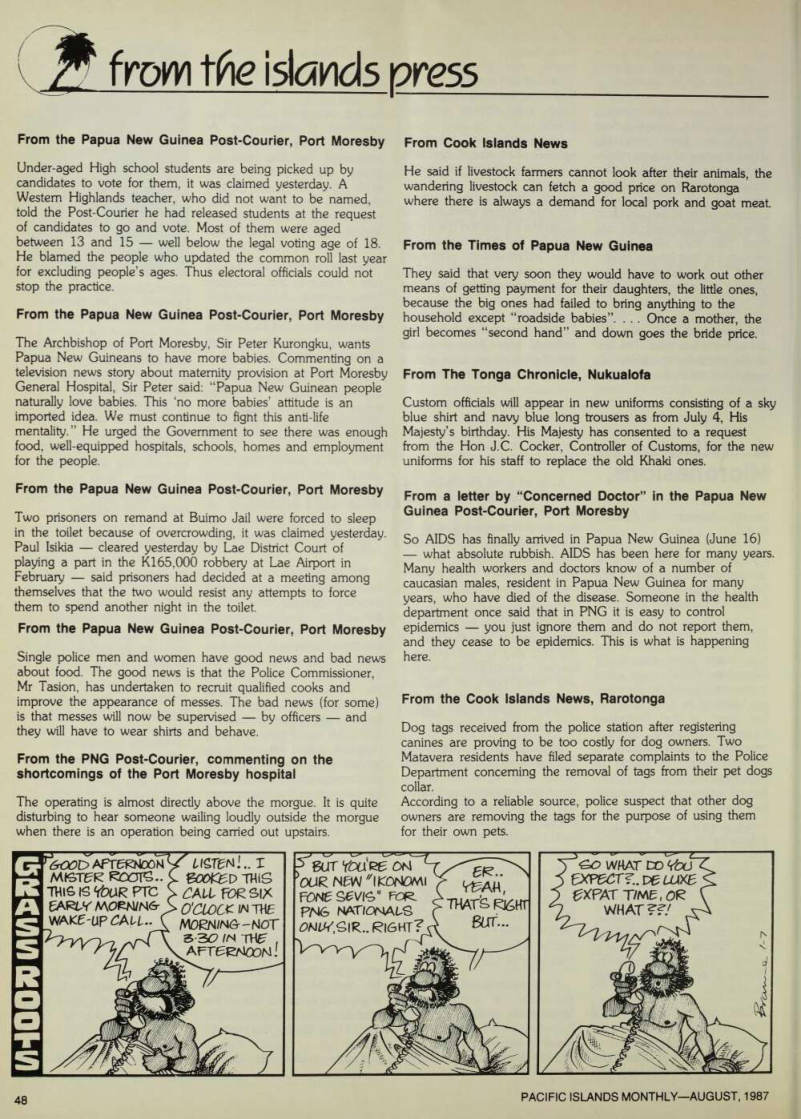
From the Papua New Guinea Post-Courier, Port Moresby Under-aged High school students are being picked up by candidates to vote for them, it was claimed yesterday. A Western Highlands teacher, who did not want to be named, told the Post-Courier he had released students at the request of candidates to go and vote. Most of them were aged between 13 and 15 well below the legal voting age of 18.
He blamed the people who updated the common roll last year for excluding people’s ages. Thus electoral officials could not stop the practice.
From the Papua New Guinea Post-Courier, Port Moresby The Archbishop of Port Moresby, Sir Peter Kurongku, wants Papua New Guineans to have more babies. Commenting on a television news story about maternity provision at Port Moresby General Hospital, Sir Peter said: “Papua New Guinean people naturally love babies. This ‘no more babies’ attitude is an imported idea. We must continue to fignt this anti-life mentality.” He urged the Government to see there was enough food, well-equipped hospitals, schools, homes and employment for the people.
From the Papua New Guinea Post-Courier, Port Moresby Two prisoners on remand at Buimo Jail were forced to sleep in the toilet because of overcrowding, it was claimed yesterday.
Paul Isikia cleared yesterday by Lae District Court of playing a part in the K 165,000 robbery at Lae Airport in February said prisoners had decided at a meeting among themselves that the two would resist any attempts to force them to spend another night in the toilet.
From the Papua New Guinea Post-Courier, Port Moresby Single police men and women have good news and bad news about food. The good news is that the Police Commissioner, Mr Tasion, has undertaken to recruit qualified cooks and improve the appearance of messes. The bad news (for some) is that messes will now be supervised by officers and they will have to wear shirts and behave.
From the PNG Post-Courier, commenting on the shortcomings of the Port Moresby hospital The operating is almost directly above the morgue. It is quite disturbing to hear someone wailing loudly outside the morgue when there is an operation being carried out upstairs.
From Cook Islands News He said if livestock farmers cannot look after their animals, the wandering livestock can fetch a good price on Rarotonga where there is always a demand for local pork and goat meat.
From the Times of Papua New Guinea They said that very soon they would have to work out other means of getting payment for their daughters, the little ones, because the big ones had failed to bring anything to the household except “roadside babies”. . . . Once a mother, the girl becomes “second hand” and down goes the bride price.
From The Tonga Chronicle, Nukualofa Custom officials will appear in new uniforms consisting of a sky blue shirt and navy blue long trousers as from July 4, His Majesty’s birthday. His Majesty has consented to a request from the Hon J.C. Cocker, Controller of Customs, for the new uniforms for his staff to replace the old Khaki ones.
From a letter by “Concerned Doctor” in the Papua New Guinea Post-Courier, Port Moresby So AIDS has finally arrived in Papua New Guinea (June 16) what absolute rubbish. AIDS has been here for many years.
Many health workers and doctors know of a number of Caucasian males, resident in Papua New Guinea for many years, who have died of the disease. Someone in the health department once said that in PNG it is easy to control epidemics you just ignore them and do not report them, and they cease to be epidemics. This is what is happening here.
From the Cook Islands News, Rarotonga Dog tags received from the police station after registering canines are proving to be too costly for dog owners. Two Matavera residents have filed separate complaints to the Police Department concerning the removal of tags from their pet dogs collar.
According to a reliable source, police suspect that other dog owners are removing the tags for the purpose of using them for their own pets.
Advertisements & other items, p. 49 (1 item)
Add the finishing touches
to your fantasy, ..
The dream comes true with NEW PERSONNA PLUS shelf-size component systems, and the model X-550R —a sound system more than brimming with high fidelity, and feature-packed!
In fact, boasting a full 350 W of high-power (PMPO) output, the X-550R delivers the convenience of remote control for amp, tuner, deck, turntable 1 , and an optional CD player, plus a 5-band graphic equalizer for frequency distribution adjustments—and still there’s more!
Like sensational Surround Sound for rich, ambient sound, and the beauty of Stereo Wide, for extended stereo effects.
Then there’s a Double Auto-Reverse Cassette Deck with Deck I-n relay play for continuous auto-reverse playback, plus synchrorecording for Deck I-n tape duplication, to say nothing of great features like normal/high-speed copy, Music Search, and Dolby* B Noise Reduction.
Still, there’s more to the X-550R than this, and more to NEW PERSONNA PLUS than the system X-550 R—like the X-880R, with 440 W of high power (PMPO), and the X-220, with 270 W (PMPO), for example. The point is that it is the beauty of pure sound and NEW PERSONNA PLUS that lets your imagination take flight!
H COMPACT
ffl]D§E
X-550R m Tunction-switching only ‘"Dolby” and the double-D symbol are trademarks of Dolby Laboratories Licensing Corporation.
NOTE; The PD-XBB CD player and S-XIA “surround sound” rear-speaker system are included in the photograph, but both are options.
CD PIONEER*
The future of sound and vision.
For further information, please contact: Australia: Pioneer Electronics Australia Pty. Ltd. (Incorporated in Victoria), P.O. Box 295, Mordialloc, Victoria, 3195 Tel: 580-9911 Fiji Islands: Brijlal & Company, G.P.O. Box No. 362, Suva, Fiji Islands Teh 22258 New Zealand: Monaco Distributors Ltd, 41 Poland Road, Glenfield, Auckland New Zealand Tel; (09) 444-9144 Norfolk Island: Burnt Pine Traders Ltd, P.O. Box 21, Norfolk Island Vanuatu; Burns Philp (Vanuatu) Ltd, Vila, Vanuatu Nauru Island: Jacob Enterprises, P.O. Box N 0.4,.4, Republic of Nauru Tahiti: Tahiti Hi-Fi, P.O. Box 848, Papeete, Tahiti New Caledonia: Menard Pacifique Sari, B.P. 3899, Noumea, New Caledonia Tel: 27-62.23 American Samoa; Transpac Corporation, P.O. Box 1477, Pago Pago, American Samoa 96799 Tel: 633-5224 Rarotonga: South Seas International Ltd, P.O. Box 49, Rarotonga, Cook Islands Tel: 2327
pacific stampa box
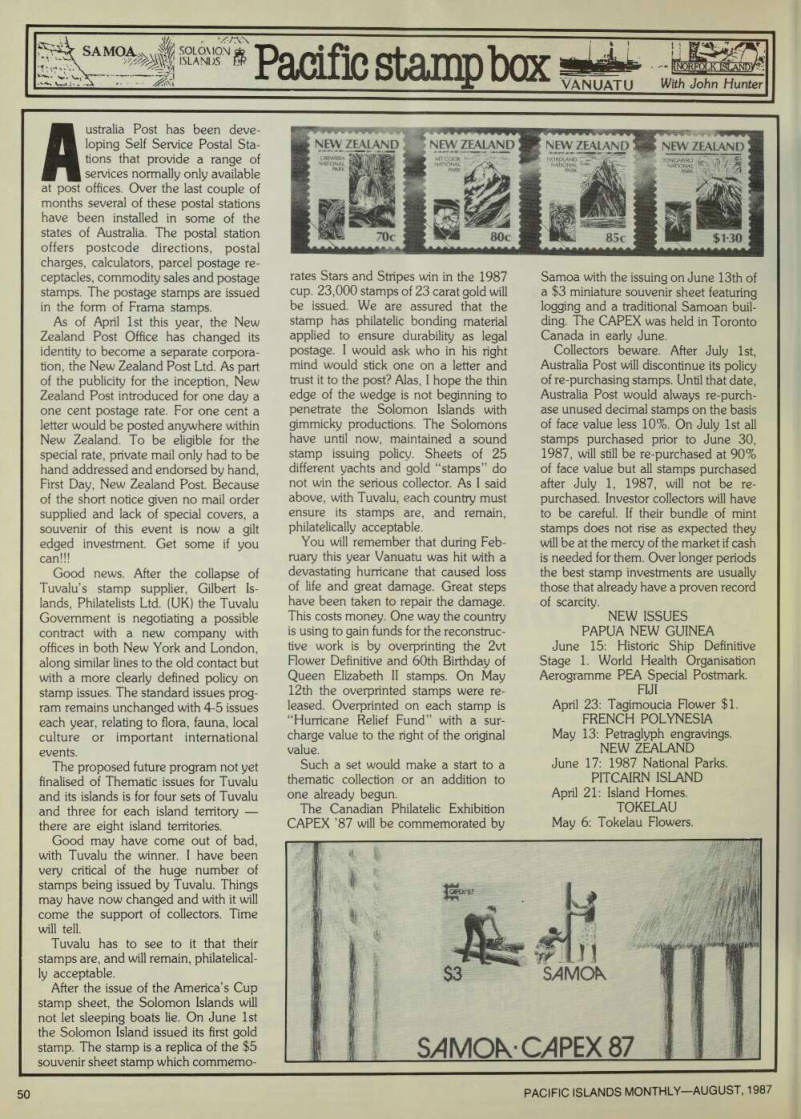
Australia Post has been deve loping Self Service Postal Sta tions that provide a range of services normally only available at post offices. Over the last couple of months several of these postal stations have been installed in some of the states of Australia. The postal station offers postcode directions, postal charges, calculators, parcel postage re ceptacles, commodity sales and postage stamps. The postage stamps are issued in the form of Frama stamps.
As of April Ist this year, the New Zealand Post Office has changed its identity to become a separate corpora tion, the New Zealand Post Ltd. As part of the publicity for the inception, New Zealand Post introduced for one day a one cent postage rate. For one cent a letter would be posted anywhere within New Zealand. To be eligible for the special rate, private mail only had to be hand addressed and endorsed by hand, First Day, New Zealand Post. Because of the short notice given no mail order supplied and lack of special covers, a souvenir of this event is now a gilt edged investment. Get some if you can!!!
Good news. After the collapse of Tuvalu’s stamp supplier, Gilbert Is lands, Philatelists Ltd. (UK) the Tuvalu Government is negotiating a possible contract with a new company with offices in both New York and London, along similar lines to the old contact but with a more clearly defined policy on stamp issues. The standard issues prog ram remains unchanged with 4-5 issues each year, relating to flora, fauna, local culture or important international events.
The proposed future program not yet finalised of Thematic issues for Tuvalu and its islands is for four sets of Tuvalu and three for each island territory there are eight island territories.
Good may have come out of bad, with Tuvalu the winner. I have been very critical of the huge number of stamps being issued by Tuvalu. Things may have now changed and with it will come the support of collectors. Time will tell.
Tuvalu has to see to it that their stamps are, and will remain, philatelical ly acceptable.
After the issue of the America’s Cup stamp sheet, the Solomon Islands will not let sleeping boats lie. On June Ist the Solomon Island issued its first gold stamp. The stamp is a replica of the $5 souvenir sheet stamp which commemo-
rates Stars and Stripes win in the 1987 cup. 23,000 stamps of 23 carat gold will be issued. We are assured that the stamp has philatelic bonding material applied to ensure durability as legal postage. I would ask who in his right mind would stick one on a letter and trust it to the post? Alas, I hope the thin edge of the wedge is not beginning to penetrate the Solomon Islands with gimmicky productions. The Solomons have until now, maintained a sound stamp issuing policy. Sheets of 25 different yachts and gold “stamps” do not win the serious collector. As I said above, with Tuvalu, each country must ensure its stamps are, and remain, philatelically acceptable.
You will remember that during Feb ruary this year Vanuatu was hit with a devastating hurricane that caused loss of life and great damage. Great steps have been taken to repair the damage.
This costs money. One way the country is using to gain funds for the reconstruc tive work is by overprinting the 2vt Flower Definitive and 60th Birthday of Queen Elizabeth II stamps. On May 12th the overprinted stamps were re leased. Overprinted on each stamp is “Hurricane Relief Fund” with a sur charge value to the right of the original value.
Such a set would make a start to a thematic collection or an addition to one already begun.
The Canadian Philatelic Exhibition CAPEX ’B7 will be commemorated by
Samoa with the issuing on June 13th of a $3 miniature souvenir sheet featuring logging and a traditional Samoan buil ding. The CAPEX was held in Toronto Canada in early June.
Collectors beware. After July Ist, Australia Post will discontinue its policy of re-purchasing stamps. Until that date, Australia Post would always re-purch ase unused decimal stamps on the basis of face value less 10%. On July Ist all stamps purchased prior to June 30, 1987, will still be re-purchased at 90% of face value but all stamps purchased after July 1, 1987, will not be re purchased. Investor collectors will have to be careful. If their bundle of mint stamps does not rise as expected they will be at the mercy of the market if cash is needed for them. Over longer periods the best stamp investments are usually those that already have a proven record of scarcity.
New Issues
Papua New Guinea
June 15: Historic Ship Definitive Stage 1. World Health Organisation Aerogramme PEA Special Postmark.
Fiji
April 23: Tagimoucia Flower $l.
French Polynesia
May 13: Petraglyph engravings.
New Zealand
June 17: 1987 National Parks.
Pitcairn Island
April 21: Island Homes.
Tokelau
May 6: Tokelau Flowers.
Advertisements & other items, p. 51 (1 item)
Polish Ocean Lues
General Management, 10 Lutego 24,81-364 GDYNIA, POLAND, Phone: 20-19-01, Cables: POLOCEAN Telex: 054-231 Q fir- % 9 :-'s H m L..-. m M -• 00? i '.4 ft
SOUTH PACIFIC SERVICE I!
We offer monthly service to and from: GDYNIA, HAMBURG, ROTTERDAM, MIDDLESBOROUGH/IMMINGHAM, ANTWERP, DUNKIRK, ROUEN, PAPEETE (via PANAMA), NOUMEA, AUCKLAND, HONIARA, RABAUL, LAE, SINGAPORE, by our multipurpose vessels carrying dry and reefer containers, reefer chambers, heavy lifts, breakbulk or palletized, bulk liquids.
POLISH OCEAN LINES Representatives AUCKLAND Mr. A. Sieradzki. Telex 21517 NZ “UNISHIP”. SYDNEY Mr. Walenciak. Telex 20428 AA “SLEIGH"
POLISH OCEAN LINES Agents
TAHITI SOTAMA Telex 296 FP “COUTIMEX". NEW CALEDONIA SATO Telex 163 NM “SATO”. AUCKLAND UNIVERSAL SHIPPING AGENCIES LTD., Telex 21517 NZ “UNISHIP”. SOLOMONS MELAN CHINE SHIPPING CO.. LTD Telex 66335 HO “SYMECO”. PNG
transitions
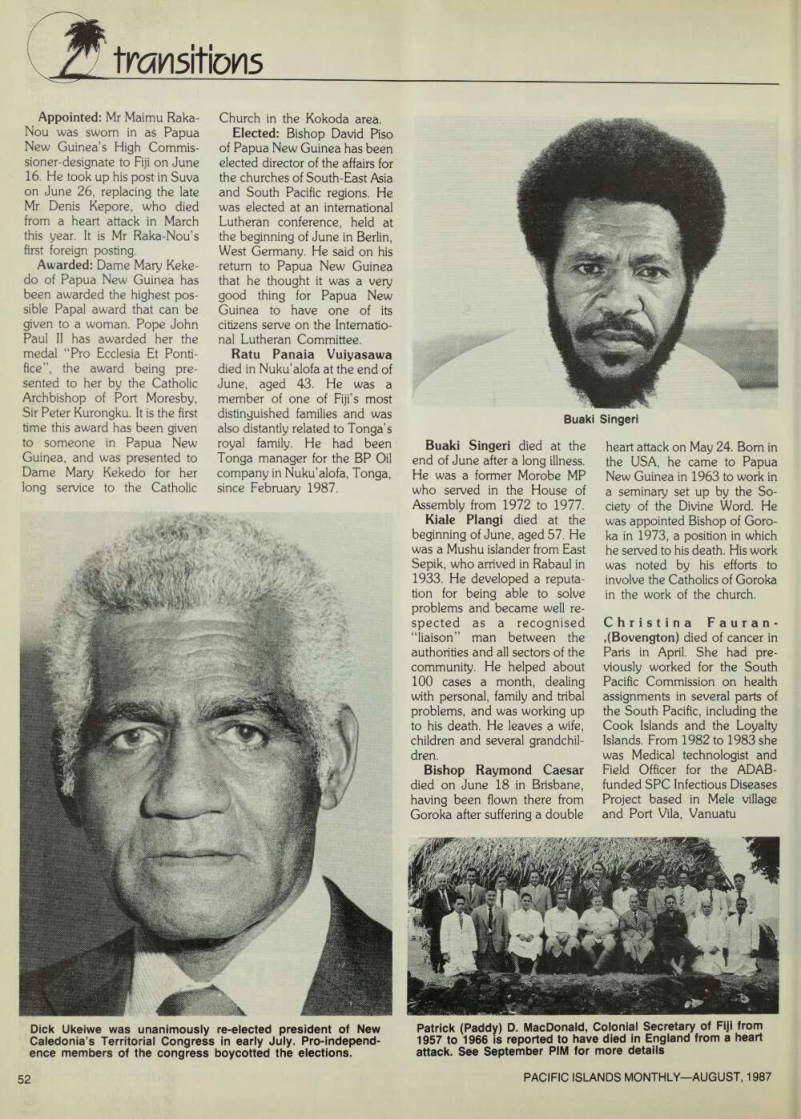
Appointed: Mr Maimu Raka- Nou was sworn in as Papua New Guinea’s High Commissioner-designate to Fiji on June 16. He took up his post in Suva on June 26, replacing the late Mr Denis Kepore, who died from a heart attack in March this year. It is Mr Raka-Nou’s first foreign posting.
Awarded: Dame Mary Kekedo of Papua New Guinea has been awarded the highest possible Papal award that can be given to a woman. Pope John Paul II has awarded her the medal “Pro Ecclesia Et Pontifice”, the award being presented to her by the Catholic Archbishop of Port Moresby, Sir Peter Kurongku. It is the first time this award has been given to someone in Papua New Guinea, and was presented to Dame Mary Kekedo for her long service to the Catholic
Church in the Kokoda area.
Elected: Bishop David Piso of Papua New Guinea has been elected director of the affairs for the churches of South-East Asia and South Pacific regions. He was elected at an international Lutheran conference, held at the beginning of June in Berlin, West Germany. He said on his return to Papua New Guinea that he thought it was a very good thing for Papua New Guinea to have one of its citizens serve on the Intematio nal Lutheran Committee, Ratu Panaia Vuiyasawa died in Nukualofa at the end of June, aged 43. He was a member of one of Fiji’s most distinguished families and was also distantly related to Tonga’s royal family. He had been Tonga manager for the BP Oil company in Nuku’alofa, Tonga, since February 1987.
Buaki Singeri died at the end of June after a long illness.
He was a former Morobe MP who served in the House of Assembly from 1972 to 1977.
Kiale Flangi died at the beginning of June, aged 57. He was a Mushu islander from East Sepik, who arrived in Rabaul in 1933. He developed a reputa tion for being able to solve problems and became well re spected as a recognised “liaison” man between the authorities and all sectors of the community. He helped about 100 cases a month, dealing with personal, family and tribal problems, and was working up to his death. He leaves a wife, children and several grandchil dren.
Bishop Raymond Caesar died on June 18 in Brisbane, having been flown there from Goroka after suffering a double
heart attack on May 24. Bom in the USA, he came to Papua New Guinea in 1963 to work in a seminary set up by the So ciety of the Divine Word. He was appointed Bishop of Goro ka in 1973, a position in which he served to his death. His work was noted by his efforts to involve the Catholics of Goroka in the work of the church.
Christina Fauran ,(Bovengton) died of cancer in Paris in April. She had pre viously worked for the South Pacific Commission on health assignments in several parts of the South Pacific, including the Cook Islands and the Loyalty Islands. From 1982 to 1983 she was Medical technologist and Field Officer for the ADAB funded SPC Infectious Diseases Project based in Mele village and Port Vila, Vanuatu
Dick Ukeiwe was unanimously re-elected president of New Caledonia’s Territorial Congress in early July. Pro-independ ence members of the congress boycotted the elections.
Buaki Singeri
Patrick (Paddy) D. MacDonald, Colonial Secretary of Fiji from 1957 to 1966 is reported to have died in England from a heart attack. See September PIM for more details
shipping schedules
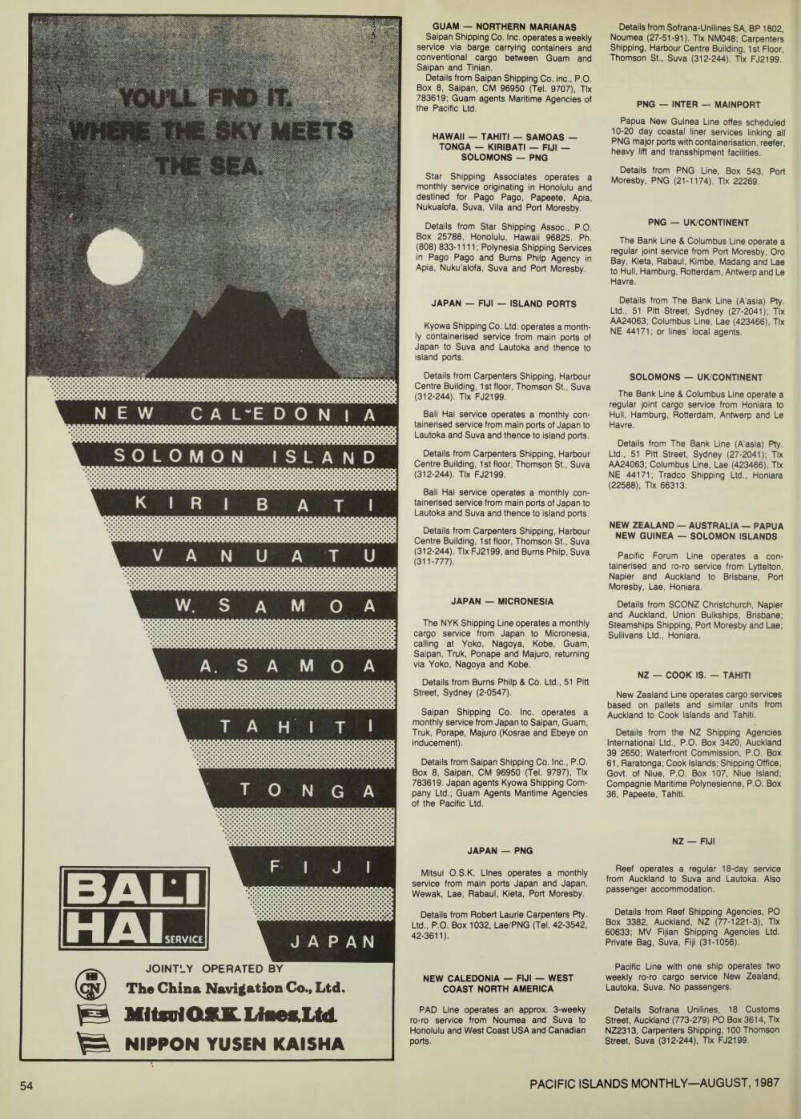

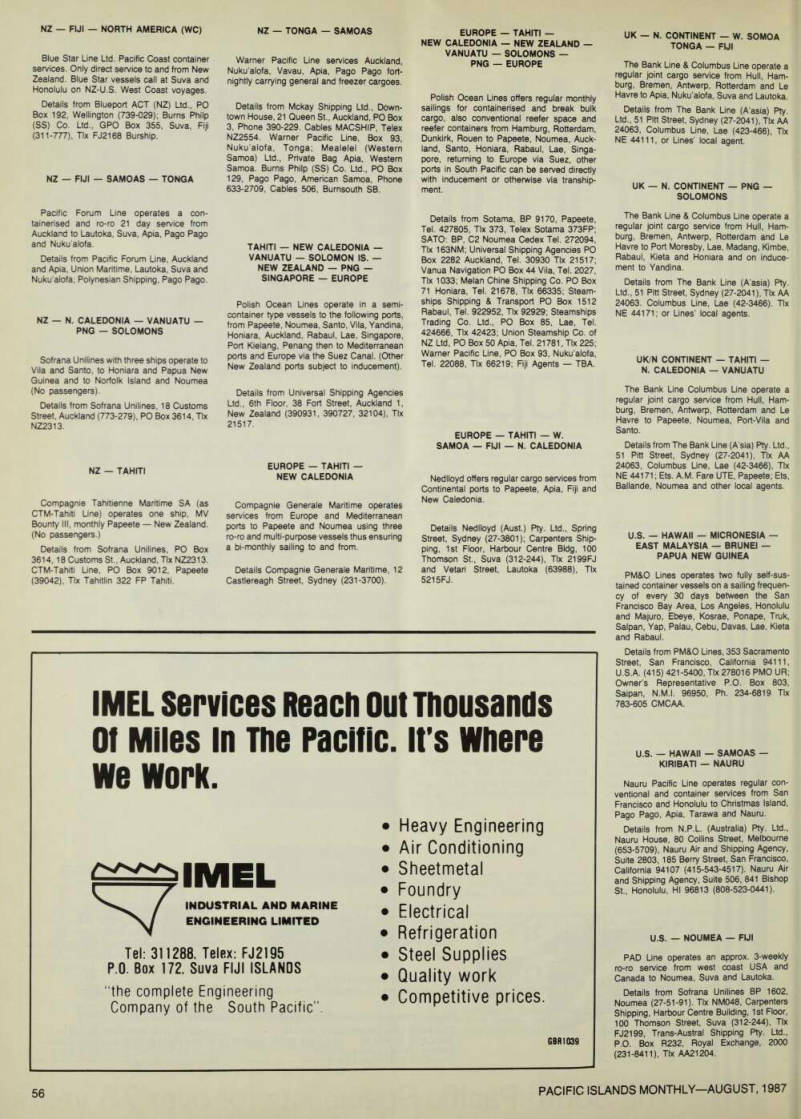
Should any shipping company wish to have its services cargo and passenger included in these listings they should contact
Pim.
Australia Fiji
Sofrana-Unllness (Fiji Express Line) oper ates to Suva and Lautoka every three weeks from the main ports on the east coast of Australia and monthly to Lautoka from Mel bourne and Sydney.
Details from Sofrana-Unllness, 432 Kent Street. Sydney (264-8944), Tix AA 70090; Wiltrans Agency Pty. Ltd., 21st Floor, 60 Market St. Melbourne (614-4788); Tix 30163.
Wiltrans Agency Pty. Ltd., 633 Wickham Street, Fortitude Valley, Old. 4006. Te 1.07- 854 1855. Tlx. AA 40712. Elders-ANL Pty.
Ltd., Port Adelaide, (47-5688); Newcastle, Sofrana Sydney (264-8944); Websters-ANL, 58 Charles St. Launceston, Tasmania (320- 555); Carpenters Shipping, Harbour Centre Building, Ist Floor, Thomson Street, Suva, Fiji (312-244); Tix FJ2199.
Australia Samoas Tonga
Warner Pacific Lines operates a regular cargo service from Sydney, Brisbane and Melbourne to Nukualofa, Pago Pago, Apia and Vavau. Feeder service available from Apia to Cook, Christmas, Fanning and Washington Islands.
Details from Hetherington Wesfarmers Shipping Agency, 37-49 Pitt Street, Sydney, (27-1671).
Australia - New Caledonia Fiji
Hawaii North America
PACE Line (ACTA Shipping) operates a fully containerised service every 17 days from Melbourne. Sydney and Brisbane to Suva and Lautoka. A new feature of the service is regular, direct calls at Noumea. The vessels continue on to the North coast of America, calling at Hawaii at frequent intervals.
Details from ACTA Pty Ltd, Sydney (266 0633) Tlx AA121369, Fax 267 1148; Burns Philp (SS) Co Ltd, Rodwell Road, Suva, (31 1777), Tlx FJ2168, Fax 311 804; Burns Philp (SS) Co Ltd, Lautoka (60 777); Sato SA, Avenue James Cook, BPC 2, Noumea, Cedex, (281 122) Tlx 163 NM SATO, Fax 278 532.
Australia New Caledonia
Fiji Samoas Tonga
Pacific Forum Line operates a fully con tainerised service (general, reefer and ro-ro) from Sydney to Noumea, Lautoka, Suva, Apia, Pago Pago, Nukualofa, Sydney, Cargo centralised from Adelaide, Melbourne, Bris bane.
Details from Pacific Forum Line P.O. Box 796 Auckland, Union Bulkships, 333 George Street, Sydney, Brisbane and Melbourne.
Union Co., Lautoka, Pacific Forum Line, Suva, Nukualofa, Pacific Forum Line, Apia, Polynesia Shipping Pago Pago.
Australia Lord Howe Is.
Norfolk Is.
Compagnie des Chargeurs Caledoniens operates four-weekly cargo service Sydney- Lord Howe Island and Norfolk Island.
Details Hetherington Wesfarmers Shipping Agency, 37-49 Pitt Street, Sydney (27-1671).
Australia Kiribati
K. Asia Pacific operates a 5/6 weekly service from Melbourne and Sydney to Kirbati (Tarawa).
Details from K. Asia Pacific Pty. Ltd.
Goldfields House, 1 Alfed Street, Circular Quay. Sydney (232-2277), Tix 1221-143.
KAP New Guinea Lines call Tarawa after NPG ports on a 35 day basis from Melbourne and Sydney/Brisbane.
Details from K. Asia Pacific Pty. Ltd., Golffields House, 1 Alfred Street, Circular Quay, Sydney (232-2277); Tix 122143.
Australia Tuvalu
K-Asia pacific operates Direct service every 2nd voyage to Tulalu (Funafuti).
Details from K. Asia Pacific Pty. Ltd., Golffield House, 1 Alfred Street, Circular Quay Sydney (232-2277) Tix 122143.
Australia New Caledonia
And/Or Vanuatu
Sofrana-Unllnes ships serve Noumea every three weeks from the main ports along the east Australian coast.
Details from Sofrana-Unllnes, 432 Kent Street, Sydney (264-8944), Wiltrans-Agency Pty. Ltd., 21st Floor, 60 Market St., Mel bourne (614-4788) Tix 30163 ACTA Pty. Ltd., Brisbane (221-3116). Elders-ANL Pty. Ltd., Port Adelaide (47-5688), Newcastle, Sofrana Sydney; Websters-ANL, 58 Charles St. Laun ceston, Tasmania (320-555).
Compagnie des Chargeurs Caledoniens operates a three-weekly containerised cargo service from Sydney to Noumea.
Details Hetherington Wesfarmers shipping Agency, 37-49 Pitt Street, Sydney (27-1671).
Compagnie Generale Maritime operates a monthly service from Sydney, Melbourne and Brisbane to Noumea, Port Villa and Santo, for containerised and break bulk carog.
Details Compagnie Generale maritime, 12 Castlereagh Street, Sydney (231-3700).
Australia Nauru
Marshall Is. Kiribati
Nauru Pacific Line operates regular cargo service from Melbourne to nauru, Majuro and Tarawa, passenger service to Nauru only.
Details: Nauru Pacific Line (Aust.) Pty. Ltd.
Nauru House, 80 Collins Street, Melbourne (653-5709). Nedlloyd Swire, 8 Spring Street, Sydney (2-0522).
Australia - Solomon Islands
Vanuatu
Negal-PNG Line operates a monthly service details NEDLLOY SWIRE P/L, 8
Spring Street. Sydney Phone: 20522.
Australia New Zealand
The Australian national Line and the New Zealand line operate a 10-day container service (TRANZTAS) between Sydney and Melbourne to Auckland, Wellington, Lyttleton and Port Chalmers.
Details from Australian National Shipping Agencies, 131-137 York Street, Sydney (225- 7333) and ANL Shipping Agencies, “World Trade Centre,” cnr. Flinders and Spencer Streets, Melbourne (611-2323) or New Zea land Line, Pastoral House, 96 Lambton Quay, Wellington (728-5000).
Australia Nz Fiji Tonga
Vanuatu New Caledonia
Solomons New Guinea
Sitmar Cruises operates a year-round cruise program from Sydney to include the better-known ports in the above countries plus a number of unspoilt, and largely unknown, island paradises.
Details from Sitmar Cruises, 39 Martin Place, Sydney (239-9000); NSW, reserva tions and inquiries (008 42-2277); Rest of Australia, reservations and inquiries (008 22-2277).
Australia Nz Fiji Tonga
Vanuatu New Caledonia
Solomons Samoas Tahiti
P&O Liners call at Auckland, Bay of Islands, Honiare, Lautoka, Noumea, Nukualofa, Pago Pago, Papeete, Port Mores by, Santo, Savu-savu, Suva, Vavua and Villa on cruises from Australia.
Details from P&O Booking centre, World Travel Headquarters Pty. Ltd, 33 Blight Street, Sydney (237-0333).
Australia Png Solomons
Vanuatu
A consortium of NGAL/PNGL and CON PAC/NEL have four vessels operating a joint service from east coast Australian ports to Port Moresby, Lae, Alotau, Madang, Wewak, Rabaul, Kavleng-Kimbe, Kieta, Honiara, Vila, Santo.
Details from Burns Philp & Co. Ltd., P.O.
Box R 124, Royal Exchange, Sydney, 2000 (2-0547); Nedlloyd Swire, 8 Spring Street, Sydney (2-0522); New Guinea Express Lines, 37 Pitt Street, Sydney (241-3991); Vila Agents, PO Box 27, Port-Vila (2456). Tlx
Nhioii.
New Guinea Express Lines operates a weekly container service from Melbourne, Sydney, Brisbane to Port Moresby, Lae, Alotau, Kimbe, Rabaul, Kieta, Honiara, Kavieng, Madang, Wewak, Santo, Vila.
Details from New Guinea Express Lines, P.O. Box R 73, Royal Exchange, Sydney (241-3991); New Guinea Express Lines, 127 Creek Street, Brisbane (221-9333); New Guinea Express Lines, 327 Collins Street, Melburne (602-5544); Niugini Express Lines, Port Moresby (2-4572); Lae (42-1536); Niugi ni Island Cargo Services Pty. Ltd., Rabaul (922-467); Bougainville Agencies Ry. Ltd., Kieta (956-089); Robert Laurie (PNG) P/L., Madang (82-2157); Garamul Enterprises P/L, Madang (82-2157); Garamut Enterprises P/L, Madang (82-2157); Garamut Enterprises P/L,
Wewak (86-2106); Burns Philp (PNG) Ltd., Kavieng (94-2133); Alotau Steedoring & Transport Alotau (61-1318); Ngatia Wholesal ers Pty. Ltd. Kimba (93-5102); and Tradco Shipping, Mandana Avenue, Honiara (22588); Vila Agents Ltd., P.O. Box 971, Vila, Vanuatu (2490); John Lum & Associates, P.O. Box 65, Santo, Vanuatu (329).
Australia Tahiti
Compagnie Generale Maritime operates a monthly service from Sydney, Melbourne and Brisbane to Papeete, for containerised and break bulk cargo.
Details Compagnie Generale Maritime, 12 Castlereagh Street, Sydney (231-3700).
Sofrana Unilines (Aust.) P/L operates a 3/4 weekly cargo service to Papeete ex main ports on the east coast of Australia.
Details from Sofrana Unilines, 432 Kent Street, Sydney (264-8944). Tlx AA 70090.
Singapore Hongkong Fiji
Islands Ports
Kyowa Shipping Co. Ltd., operates a monthly containerised and break bulk cargo service from Singapore, Hongkong to Lauto ka, Suva and then to island ports.
Details from Carpenters Shipping, Harbour Centre Building, Ist Floor, Thomson Street, Suva (312-244). Tlx FJ2199.
Far East Fiji
New Zealand
New Zealand Unit Express (NZUE), now operates a monthly service accepting con tainerised and break bulk cargo from Manila,
Keelung, Kaohslung and Hongkong to Lauto
ka, Suva and thence to New Zealand ports.
Details from Carpenters Shipping, Harbour Centre Building, Ist Floor, Thomson Street, Suva (312-244), Tlx FJ2199; Burns Philp, Suva (311-777); New Zealand Unit Express, Maratime Building, 2-10 Customhouse Quay, P.O. Box 890, Wellington. Cables: ENZUE
Man Wellington. Telex: Nz1340.
NEDLNZ, Telephone; 727-865 or Nedlloyd Swire Pty. Ltd., Sydney (20-522).
Far East Mid-S. Pacific
China Navigation’s New Guinea Pacific Line operates a regular container service from Hongkong, Taiwan, Manila, Port Kelang and Singapore to Port Moresby, Lae, Rabaul and Honiara monthly and to Wewak, Madang and Keta every three months. Cargo from the same Far Eastern ports to the South Pacitic ports of Noumea, Santo, Vila. Papeete, Pago Pago, Apia, Raratonga and Tarawa will be shipped via Japan on the monthly Bali Hai service.
Details from Steamships Shipping, P.O.
Box 634, Port Moresby (22-0289).
Kyowa Shipping Ltd. operates monthly services from Japan to Guam, Saipan, Solo mons, New Caledonia, Fiji, Western and American Samoa, Tahiti, Cook Is. Tonga and Vanuatu.
Details: Heterington Wesfarmers Shipping Agency, 37-49 Pitt Street, Sydney (27-1671); Carpenters Shipping, Suva (312-244). Tlx FJ2199.
Guam Northern Marianas
Saipan Shipping Co. Inc. operates a weekly service via barge carrying containers and conventional cargo between Guam and Saipan and Tinian.
Details from Saipan Shipping Co. inc., P.O.
Box 8, Saipan. CM 96950 (Tel. 9707), Tlx 783619; Guam agents Maritime Agencies of the Pacific Ltd.
Hawaii Tahiti Samoas
Tonga Kiribati Fiji
Solomons Png
Star Shipping Associates operates a monthly service originating in Honolulu and destined for Pago Pago, Papeete, Apia, Nukualofa, Suva, Vila and Port Moresby Details from Star Shipping Assoc,, P.O.
Box 25788, Honolulu, Hawaii 96825. Ph. (808) 833-1 111; Polynesia Shipping Services in Pago Pago and Burns Philp Agency in Apia, Nukualofa, Suva and Port Moresby.
Japan Fiji Island Ports
Kyowa Shipping Co. Ltd. operates a month ly containerised service from main ports of Japan to Suva and Lautoka and thence to island ports.
Details from Carpenters Shipping, Harbour Centre Building, Ist floor, Thomson St., Suva (312-244). Tlx FJ2199.
Bali Hai service operates a monthly con tainerised service from main ports of Japan to Lautoka and Suva and thence to island ports.
Details from Carpenters Shipping, Harbour Centre Building, Ist floor, Thomson St., Suva (312-244). Tlx FJ2199.
Bali Hai service operates a monthly con tainerised service from main ports of Japan to Lautoka and Suva and thence to island ports.
Details from Carpenters Shipping, Harbour Centre Building, Ist floor, Thomson St., Suva (312-244). Tlx FJ2199, and Burns Philp, Suva (311-777).
Japan Micronesia
The NYK Shipping Line operates a monthly cargo service from Japan to Micronesia, calling at Yoko, Nagoya, Kobe, Guam, Saipan, Truk, Ponape and Majuro, returning via Yoko, Nagoya and Kobe.
Details from Burns Philp & Co. Ltd., 51 Pitt Street, Sydney (2-0547).
Saipan Shipping Co. Inc. operates a monthly service from Japan to Saipan, Guam, Truk, Porape, Majuro (Kosrae and Ebeye on inducement).
Details from Saipan Shipping Co. Inc., P.O.
Box 8, Saipan, CM 96950 (Tel. 9797), Tlx 783619. Japan agents Kyowa Shipping Com pany Ltd.; Guam Agents Maritime Agencies of the Pacific Ltd.
Japan Png
Mitsui O.S.K. Lines operates a monthly service from main ports Japan and Japan, Wewak, Lae, Rabaul, Kieta, Port Moresby.
Details from Robert Laurie Carpenters Pty.
Ltd., P.O. Box 1032, Lae/PNG (Tel. 42-3542, 42-3611).
New Caledonia Fiji West
Coast North America
PAD Line operates an approx. 3-weeky ro-ro service from Noumea and Suva to Honolulu and West Coast USA and Canadian ports.
Details from Sofrana-Unilines SA, BP 1602, Noumea (27-51-91). Tlx NMO4B; Carpenters Shipping, Harbour Centre Building, Ist Floor, Thomson St., Suva (312-244). Tlx FJ2199.
Png Inter Mainport
Papua New Guinea Line offes scheduled 10-20 day coastal liner services linking all PNG major ports with containerisation, reefer, heavy lift and transshipment facilities.
Details from PNG Line, Box 543, Port Moresby, PNG (21-1174). Tlx 22269.
Png Uk/Continent
The Bank Line & Columbus Line operate a regular joint service from Port Moresby, Oro Bay, Kieta, Rabaul, Kimbe, Madang and Lae to Hull, Hamburg, Rotterdam, Antwerp and Le Havre.
Details from The Bank Line (A'asia) Pty.
Ltd., 51 Pitt Street, Sydney (27-2041); Tlx AA24063; Columbus Line, Lae (423466), Tlx NE 44171; or lines' local agents.
Solomons Uk/Continent
The Bank Line & Columbus Line operate a regular joint cargo service from Honiara to Hull, Hamburg, Rotterdam, Antwerp and Le Havre.
Details from The Bank Line (A’asia) Pty.
Ltd., 51 Pitt Street, Sydney (27-2041); Tlx AA24063; Columbus Line, Lae (423466), Tlx NE 44171; Tradco Shipping Ltd., Honiara (22588), Tlx 66313.
New Zealand Australia Papua
New Guinea Solomon Islands
Pacific Forum Line operates a con tainerised and ro-ro service from Lyttelton, Napier and Auckland to Brisbane, Port Moresby, Lae, Honiara.
Details from SCONZ Christchurch, Napier and Auckland, Union Bulkships, Brisbane; Steamships Shipping, Port Moresby and Lae; Sullivans Ltd., Honiara.
Nz Cook Is. Tahiti
New Zealand Line operates cargo services based on pallets and similar units from Auckland to Cook Islands and Tahiti.
Details from the NZ Shipping Agencies International Ltd., P.O. Box 3420, Auckland 39 2650; Waterfront Commission, P.O. Box 61, Raratonga; Cook Islands; Shipping Office, Govt, of Niue, P.O. Box 107, Niue Island; Compagnie Maritime Polynesienne, P.O. Box 36, Papeete, Tahiti.
Nz Fiji
Reef operates a regular 18-day service from Auckland to Suva and Lautoka. Also passenger accommodation.
Details from Reef Shipping Agencies, PO Box 3382, Auckland, NZ (77-1221-3), Tlx 60633; MV Fijian Shipping Agencies Ltd.
Private Bag, Suva, Fiji (31-1056).
Pacific Line with one ship operates two weekly ro-ro cargo service New Zealand, Lautoka, Suva. No passengers.
Details Sofrana Unilines, 18 Customs Street, Auckland (773-279) PO Box 3614, Tlx NZ2313, Carpenters Shipping, 100 Thomson Street, Suva (312-244), Tlx FJ2199.
Nz Fiji North America (Wc)
Blue Star Line Ltd. Pacific Coast container services. Only direct service to and from New Zealand. Blue Star vessels call at Suva and Honolulu on NZ-U.S. West Coast voyages.
Details from Blueport ACT (NZ) Ltd., PO Box 192, Wellington (739-029); Burns Philp (SS) Co. Ltd., GPO Box 355, Suva, Fiji (311-777), Tlx FJ2168 Burship.
Nz Fiji Samoas - Tonga
Pacific Forum Line operates a con tainerised and ro-ro 21 day service from Auckland to Lautoka, Suva, Apia, Pago Pago and Nukualofa.
Details from Pacific Forum Line, Auckland and Apia, Union Maritime, Lautoka, Suva and Nukualofa; Polynesian Shipping, Pago Pago.
Nz N. Caledonia Vanuatu
Png Solomons
Sofrana Unilines with three ships operate to Vila and Santo, to Honiara and Papua New Guinea and to Norfolk Island and Noumea (No passengers).
Details from Sofrana Unilines. 18 Customs Street, Auckland (773-279), PO Box 3614, Tlx NZ2313.
Nz Tahiti
Compagnie Tahitienne Maritime SA (as CTM-Tahiti Line) operates one ship, MV Bounty 111, monthly Papeete New Zealand. (No passengers.) Details from Sofrana Unilines, PO Box 3614,18 Customs St., Auckland, Tlx NZ2313.
CTM-Tahiti Line, PO Box 9012, Papeete (39042), Tlx Tahitlin 322 FP Tahiti.
Nz Tonga Samoas
Warner Pacific Line services Auckland, Nukualofa, Vavau, Apia, Pago Pago fort nightly carrying general and freezer cargoes.
Details from Mckay Shipping Ltd., Down town House, 21 Queen St., Auckland, PO Box 3, Phone 390-229. Cables MACSHIP, Telex NZ2554. Warner Pacific Line, Box 93, Nukualofa, Tonga; Mealelel (Western Samoa) Ltd., Private Bag Apia, Western Samoa. Burns Philp (SS) Co. Ltd., PO Box 129, Pago Pago, American Samoa, Phone 633-2709, Cables 506, Burnsouth SB.
Tahiti New Caledonia
Vanuatu Solomon Is.
New Zealand Png
Singapore Europe
Polish Ocean Lines operate in a semi container type vessels to the following ports, from Papeete, Noumea, Santo, Vila, Yandina, Honiara, Auckland, Rabaul, Lae, Singapore, Port Kielang, Penang then to Mediterranean ports and Europe via the Suez Canal. (Other New Zealand ports subject to inducement).
Details from Universal Shipping Agencies Ltd., 6th Floor, 38 Fort Street, Auckland 1, New Zealand (390931, 390727, 32104). Tlx 21517.
Europe Tahiti
New Caledonia
Compagnie Generate Maritime operates services from Europe and Mediterranean ports to Papeete and Noumea using three ro-ro and multi-purpose vessels thus ensuring a bi-monthly sailing to and from.
Details Compagnie Generate Maritime, 12 Castlereagh Street, Sydney (231-3700).
Europe - Tahiti
New Caledonia New Zealand
Vanuatu Solomons
Png Europe
Polish Ocean Lines offers regular monthly sailings for containerised and break bulk cargo, also conventional reefer space and reefer containers from Hamburg, Rotterdam, Dunkirk, Rouen to Papeete, Noumea, Auck land, Santo, Honiara, Rabaul, Lae, Singa pore, returning to Europe via Suez, other ports in South Pacific can be served directly with inducement or otherwise via tranship ment.
Details from Sotama, BP 9170, Papeete, Tel. 427805, Tlx 373, Telex Sotama 373FP; SATO: BP, C 2 Noumea Cedex Tel. 272094, Tlx 163 NM; Universal Shipping Agencies PO Box 2282 Auckland, Tel. 30930 Tlx 21517; Vanua Navigation PO Box 44 Vila, Tel. 2027, Tlx 1033; Melan Chine Shipping Co. PO Box 71 Honiara, Tel. 21678, Tlx 66335; Steam ships Shipping & Transport PO Box 1512 Rabaul, Tel. 922952, Tlx 92929; Steamships Trading Co. Ltd., PO Box 85, Lae, Tel. 424666, Tlx 42423; Union Steamship Co. of NZ Ltd, PO Box 50 Apia, Tel. 21781, Tlx 225; Warner Pacific Line, PO Box 93, Nukualofa, Tel. 22088, Tlx 66219; Fiji Agents TBA.
Europe Tahiti W.
Samoa Fiji N. Caledonia
Nedlloyd offers regular cargo services from Continental ports to Papeete, Apia, Fiji and New Caledonia.
Details Nedlloyd (Aust.) Pty. Ltd., Spring Street, Sydney (27-3801); Carpenters Ship ping, Ist Floor, Harbour Centre Bldg, 100 Thomson St., Suva (312-244), Tlx 2199FJ and Vetari Street, Lautoka (63988), Tlx 5215FJ.
Uk N. Continent W. Somoa
Tonga - Fiji
The Bank Line & Columbus Line operate a regular joint cargo service from Hull, Ham burg, Bremen, Antwerp, Rotterdam and Le Havre to Apia, Nukualofa, Suva and Lautoka.
Details from The Bank Line (A'asia) Pty.
Ltd., 51 Pitt Street, Sydney (27-2041), Tlx AA 24063, Columbus Line, Lae (423-466), Tlx NE 44111, or Lines’ local agent.
Uk N. Continent Png
Solomons
The Bank Line & Columbus Line operate a regular joint cargo service from Hull, Ham burg, Bremen, Antwerp, Rotterdam and Le Havre to Port Moresby, Lae, Madang, Kimbe, Rabaul, Kieta and Honiara and on induce ment to Yandina.
Details from The Bank Line (A'asia) Pty.
Ltd., 51 Pitt Street, Sydney (27-2041), Tlx AA 24063. Columbus Line, Lae (42-3466). Tlx NE 44171; or Lines' local agents.
Uk/N Continent Tahiti -
N. Caledonia Vanuatu
The Bank Line Columbus Line operate a regular joint cargo service from Hull, Ham burg, Bremen, Antwerp, Rotterdam and Le Havre to Papeete, Noumea, Port-Vila and Santo.
Details from The Bank Line (A’sia) Pty. Ltd., 51 Pitt Street, Sydney (27-2041), Tlx AA 24063, Columbus Line, Lae (42-3466), Tlx NE 44171; Ets. A.M. Fare UTE, Papeete; Ets, Ballande, Noumea and other local agents.
U.S. Hawaii Micronesia
East Malaysia Brunei
Papua New Guinea
PM&O Lines operates two fully self-sus tained container vessels on a sailing frequen cy of every 30 days between the San Francisco Bay Area, Los Angeles, Honolulu and Majuro, Ebeye, Kosrae, Ponape, Truk, Saipan, Yap, Palau, Cebu, Davas, Lae, Kieta and Rabaul.
Details from PM&O Lines, 353 Sacramento Street, San Francisco, California 94111, U.S.A. (415) 421-5400, Tlx 278016 PMO UR; Owner's Representative P.O. Box 803, Saipan, N.M.I. 96950, Ph. 234-6819 Tlx
783-605 Cmcaa.
U.S. Hawaii Samoas
Kiribati Nauru
Nauru Pacific Line operates regular con ventional and container services from San Francisco and Honolulu to Christmas Island, Pago Pago, Apia, Tarawa and Nauru.
Details from N.P.L. (Australia) Pty. Ltd., Nauru House, 80 Collins Street, Melbourne (653-5709), Nauru Air and Shipping Agency, Suite 2803, 185 Berry Street, San Francisco, California 94107 (415-543-4517). Nauru Air and Shipping Agency, Suite 506, 841 Bishop St., Honolulu, HI 96813 (808-523-0441).
U.S. Noumea Fiji
PAD Line operates an approx. 3-weekly ro-ro service from west coast USA and Canada to Noumea, Suva and Lautoka.
Details from Sofrana Unilines BP 1602, Noumea (27-51-91). Tlx NMO4B, Carpenters Shipping, Harbour Centre Building, Ist Floor, 100 Thomson Street, Suva (312-244), Tlx FJ2199, Trans-Austral Shipping Pty. Ltd., P.O. Box R 232, Royal Exchange, 2000 (231-8411), Tlx AA21204.
Advertisements & other items, pp. 54-58 (1 item)
Hai Service
■ 111 F- ' m ST ii
NEW CAL’EDON I A
SOLOMON ISLAND
KIRI B
VA N U
BALI
HAI SERVICE
JOINTLY OPERATED BY
The China Navigation Co., Ltd.
Mitsui QIK LtoesXtd
NIPPON YUSEN KAISHA
BANK LINE and
COLUMBUS LINE
24 day service to
Europe.
Need we say more...
ft D o The Joint Service Partners offer facilities for shipment of: Containers (FCL/LCL) and Break-bulk Cargo plus reefer space and deeptanks for carriage of vegetable oils and other liquid bulk cargo.
Carriers also accept heavy lifts, overlength and cumbersome parcels.
Ports of Service; Loading: Papeete, Apia, Suva, Lautoka, Noumea, Port Vila, Santo, Honiara, Port Moresby, Lae, Madang, Kimbe, Rabaul, Kieta, Darwin. For: Rotterdam, Antwerp, Hamburg, Hull, Dunkirk, Le Havre.
Additional ports on enquiry.
Please contact our regional offices for further information: The Bank Line (Australasia) Pty Ltd Columbus Line Reederei GmbH Suite 801, 51 Pitt St, P.O. Box 1 667, Lae/Papua New Guinea.
Sydney, NSW, Australia 2000 Rhone: 423466/423487/AH. 422481 Phone 27 2041 Telex 24063 Telex: Colline NE 441 71 The South Pacific Specialists for over 75 years
cvcvcxcvcvxvcxv
mmm mm m mmmmm m m m m mS? mm mm i? m m is m da
It’s our
after sail
service that
The world is Australia’s marketplace.
And ACTA has it covered with a fleet of eleven ships purpose built to provide a total service for importers and exporters.
ACTA takes the guesswork out of the export business with a computerised container tracking system that lets you know
exactly where
your cargo is.
For exporters
of perishables,
ACTA offers
rest
representatives arc backed by the entire ACT organisation, a network of world-wide offices that can make an otherwise difficult market entry a great deal easier.
Back at home, ACTA’s computerised data processing handles the paperwork as efficiently as your cargo.
It s all part of ACTA’s after sail service. The total service that keeps ACTA ahead of the rest. j [acf I* li (act if |cf [acf m [acf
keen
sophisticated refrigeration technology
to maintain and monitor the correct temperature for each product on board.
When it comes to advice, our Australian
marketing
[act (f Ucf [act hi, •Ml [acf [act [an s [an m [acf [acf Ucf [acf m? mf @a mf @cf @g A tough act to follow @@aiiß@a@aiiaiig@aiigiigia
ACAOOI7F
J*
SERVICE PAGE
PACIFIC
SLANDS
I MON T H L Y \ AUSTRALIA; Distribution: The Herald and Weekly Times Ltd , 44-74 Flinders St., Melbourne, Vic., 3000, Advertising Reps Brisbane D Wood. Anday Agency. CCA Centre, Dayboro Road, Closeburn 4520; Box 1918, GPO Bnsbane, 4001; telephone (07) 289-4128, Adelaide Hastwell Williamson Rouse Pty, Ltd., PO Box 419, Norwood. SA, 5067 ; 59 Kensington Road, Norwood; telephone (08) 332-3322, telex 87113; Perth Allen & Associates, 7 Fore St., Perth, W.A., 6000, telephone (09) 328-9833. telex: AA94382.
FUI; Distribution and subscriptions. Desai Bookshops, P O. Box 160. Suva. Fiji telephone Suva 23036.
Advertising Fiji Times & Herald Ltd., 20 Gordon St,.
Suva, telephone 31-4111, telex FJ2124.
FRENCH POLYNESIA: Distribution Hachette Pacifique 10 Ave , Bruat, Papeete, telephone 25-610.
HAWAII: UNITED STATES: Distribution - PIM, Hawaii, P.O Box 22250, Honolulu, Hawaii, 96822 Advertising Brian C Asgill, Apt. 1308.1676 Ala Moana Blvd., Honolulu, Hawaii, 96815, telephone (808) 955-9718 JAPAN: Advertising and subscriptions Universal Media Corporation, GPO Box 46, Tokyo, "telephone 666-3036, cable UNIMEDIA Tokyo, telex 2524665, MALAYSIA: Advertising and subscriptions Worldwide Media Services, 57-B Komplex Damai, Jin Dato Haji Eusoff, Kuala Lumpur, telephone 63-9340, cables WORLDMEDIA Kuala Lumpur, telex 31533.
VANUATU: Distribution The Bookshop, HQ Box 210, Port Vila. Advertising Norman Bros. Bookshop, Port Vila, telephone 2232.
NEW CALEDONIA: Distribution Depot Centre de Presse Michel Pentecost. CBP2, Noumea, telephone 27-2434. 27-4729.
NEW ZEALAND: Distribution Gordon & Gotch, PO Box 584, 2 Carr Road, Mt Roskill, Auckland 4 Advertising McKay International Media Reps. Ltd., c/o Albany P. 0., Auckland 10, New Zealand, telephone 413-9119 Telex NZ22701, FAX 413-9110.
WELLINGTON Ross Quaid Media, 1 Scholes Ln., Petone. (04) 68-7593 PO Box 38699, Petone, PAPUA NEW GUINEA: Distribution Gordon & Gotch.
PO Box 3395, Port Moresby, telephone 25-4551.25-4855.
Advertising Ken Head, PNG Post-Courier, PO Box 85.
Port Moresby, telephone 21-2577, telex 22120.
SOLOMON ISLANDS: Distribution and Advertising - The Bookshop, (Norman Bros.) PO Box 503, Honiara.
PHILIPPINES; Advertising The GF Group, 12 San Ignacio St., Uroaneta Village, Makati, Metro Manila, telephone 017-7299, telex 45950 and 4233.
UNITED KINGDOM: The Herald & Weekly Times Ltd., No 1 Mattravers Street, London WC2R 3DZ, England, telephone (01) 836-5162. telex London 21989.
UNITED STATES MAINLAND: Advertising - Joshua B Powers Jr.. Powers International Inc., Suite 708, 271 Payments by personal cheque are only acceptable in Australian (from a branch in Australia), U.S. and New Zealand currency. For all other remittances please send an international bank draft in Australian dollars.
Published monthly by Pacific Publications (Aust.) Pty.
Ltd. and printed in Australia by Brownhall Printing Pty. Ltd., 52 Duerdin Street, Clayton North, Victoria.
NOW AVAILABLE!
PACIFIC ISLANDS YEAR BOOK
Due to demand the 15th edition has been reprinted and is available from P.I.M. at As3s plus p.p.
Stay at Aggie Grey’s . . . the South Pacific’s
legendary hotel.
Situated right in (he heart of Western Samoa. F.njov Polynesian style friendliness and service, in cool surroundings, superb entertainment and food.
Magnificent white sand beat hes only a short drive away. Airconditioned rooms, swimming |x>ol andJull bar facilities.
Bookings through I'nion Steamship Company of NZ, Pan Am, Air New Zealand or direc t to Aggie Crey's, Apia. Western Samoa. Cables: ‘ACCIKS' Apia.
For all your
computer needs
(hardware, software, books)
by quick and
easy
mail order.
CANBERRA
ACCOUNTING SERVICES
GPO Box 2159, Canberra, 2601. AUSTRALIA
ALL THE NEWS
IN A FLASH
The South Sea Digest tells you what you want to know about the Pacific Islands in a few words. All the leading firms and diplomatic missions read it.
See insert for subscription details;
THE SOUTH SEA DIGEST
Advertising
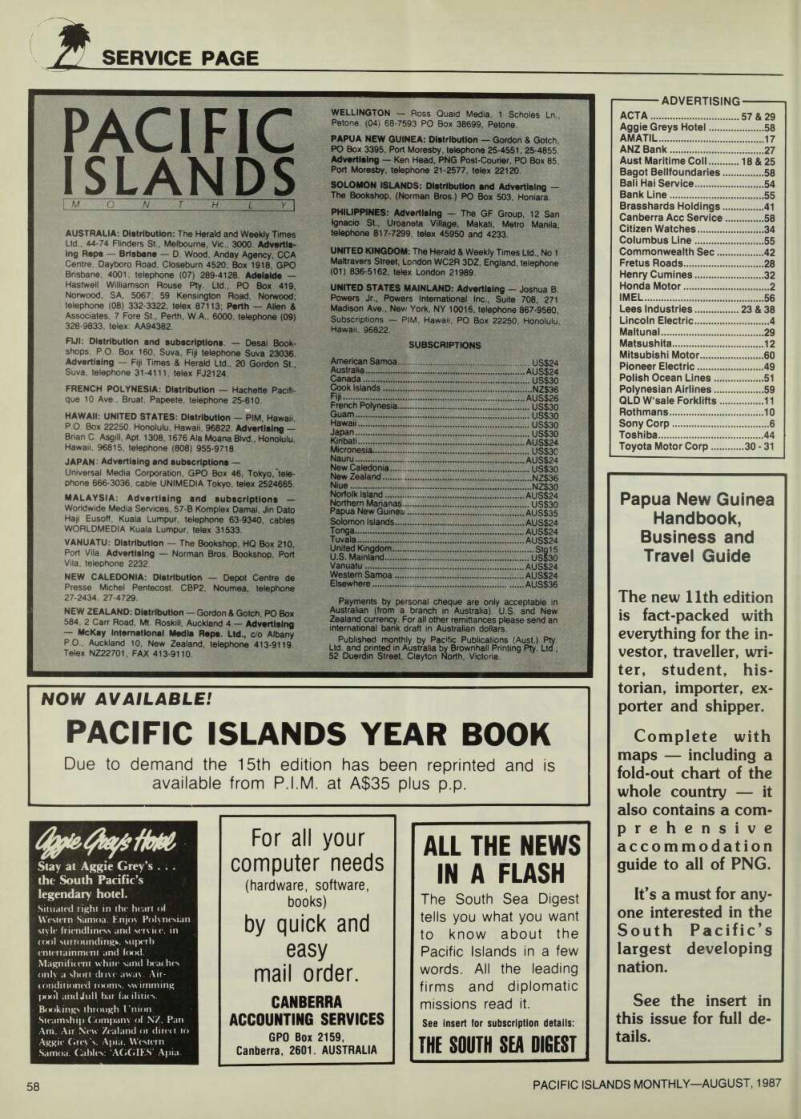
Acta 57 & 29
Aggie Greys Hotel 58
Amatil 17
ANZ Bank 27 Aust Maritime Coll 18 & 25 Bagot Bellfoundaries 58 Bali Hai Service 54 Bank Line 55 Brasshards Holdings 41 Canberra Acc Service 58 Citizen Watches 34 Columbus Line 55 Commonwealth Sec 42 Fretus Roads 28 Henry Cumines 32 Honda Motor 2
Imel 56
Lees Industries 23 & 38 Lincoln Electric 4 Maltunal 29 Matsushita 12 Mitsubishi Motor 60 Pioneer Electric 49 Polish Ocean Lines 51 Polynesian Airlines 59 QLDW sale Forklifts 11 Rothmans 10 Sony Corp 6 Toshiba 44 Toyota Motor Corp 30 - 31
Advertisements & other items, pp. 58-60 (1 item)
Papua New Guinea
Handbook, Business and Travel Guide The new 11th edition is fact-packed with everything for the investor, traveller, writer, student, historian, importer, exporter and shipper.
Complete with maps including a fold-out chart of the whole country it also contains a comprehensive accommodation guide to all of PNG.
It’s a must for anyone interested in the South Pacific’s largest developing nation.
See the insert in this issue for full details.
44
I CALL IT HOME.
YOU’LL CALL IT PARADISE
99 We have many beautiful ways of welcoming you to Western Samoa.
My home.
Like the Kava ceremony. To drink Kava with the Matais, the chiefs, is a great honour indeed.
You’ll sit crosslegged in the meeting Fale, whilst a maiden of the village (Taupou) performs the elaborate ritual of making the Kava. The Kava is then passed ceremoniously to Matais and guests by the Tautua, trained in the art since boyhood.
The Taupou then dances the beautiful Siva, a special Samoan dance for your entertainment. 5.' Frank Aita.
Flight Attendant.
W 1 v 1 A See your travel agent,or contact Polynesian direct. Sydney, Auckland, Wellington, Pago Pago. Rarotonga, Nuku’alofa.or write to 50 King St,
Sydney 2000.
wM m I 0 O : ■*> m m u T That’s Samoan hospitality. And you’ll enjoy it from the moment you step aboard our big new Polynesian Airlines 727. With superb meals and relaxing inflight entertainment in both business class and economy.
POLYNESIAN
AIRLINES
DAVID FROST 427 TARB No. B 827 50 King Street, Sydney 2000.
I -S'
Charles Darwin theorized
that survival depends on the ability to change.
We’re living proof.
In 1859, Charles Darwin outlined his theories on evolution in The Origin of Species. Simply stated, Darwin believed that organisms must be capable of responding to their ever-changing environment in order to be successful.
For the past 70 years Mitsubishi has been proving the validity of Darwin's theories by meeting evolving transportation needs with a wide variety of vehicles incorporating the most advanced technologies of the times, Since its production of the 1917 Model-A, Japan's first series-production car, Mitsubishi has continuously adopted the latest engineering innovations.
And today, it covers the world's most extensive range of vehicles—from 550 cc minicars to mammoth 16,000 cc all-wheel-drive, off-highway trucks.
Seven decades isn't much in evolutionary time but as the species continues on its long road to perfection, Darwin's theories are tested as they are applied to the products to meet society's changing transportation needs.
Mitsubishi Motors is now offering a free 24-page leaflet The Mitsubishi", an introduction of Mitsubishi's pioneering history. If interested, write to Advertising, International Business Planning Office, Office of International Business, Mitsubishi Motors Corporation, 33-8, Shiba 5-chome, Minato-ku. Tokyo 108, Japan.
AMERICAN SAMOA: MORRIS SCANLAN SERVICE INC. P.O Box 367, Pago Pago, Tel. 633-5520/AUSTRALIA: MITSUBISHI MOTORS AUSTRALIA LTD. Box 1284, South Road, Clovelly Park, South Australia 5042, Tel. (08) 275-7223/FIJI: NIVIS MOTOR & MACHINERY CO., LTD. G.P.O. Box 150, Suva, Tel 383411 FRENCH POLYNESIA (TAHITI): ETS-BREDIN FRERES ET FILS P.O. Box 21, Papeete, Tahiti, Tel 4-202-58/NEW CALEDONIA: SOCIETE D'IMPORTATION D AUTO DU PACIFIQUE SUD S.A. B.P 438 Rond Point du Pacifique, Noumea, Tel. 274144/NEW ZEALAND: MITSUBISHI MOTORS NEW ZEALAND LTD. Todd Park,. Heriot Drive, Private Bag, Porirua, Tel. 370-109/NORFOLK ISLAND: BORRYS LTD. P.O. Box 169, Norfolk Island, Tel. 2114/PAPUANEWGUINEA:TOBAPTY. LTD. P.O. Box 503, Port Moresby, Tel 21-7874/SOLOMON ISLANDS: HARVEST PACIFIC LTD. G.P.O. Box 88, Honiara, Guadalcanal, Tel. 30128/TONGA: SITANI MAPI CO., LTD. P.O. Box 83, Nuku'ALOFA, Tel 21-044/VANUATU: SOCOMETRA B.P. 06 Route de Lagon, Port-Vila, Tel 2314/WESTERN SAMOA; A M. MACDONALD HOLDINGS LTD. P.O. Box 576, Apia, Tel. 22022/SAIPAN/POHNPEI/MAJURO/KOSRAE/TRUK/YAP/ BELAU; MICRONESSIAN MOTORS, INC. 997 South Marine Drive, Tamuning, Guam 96911, Tel, 646-6827 N A
MITSUBISHI
MOTORS