Pacific
Islands
Monthly
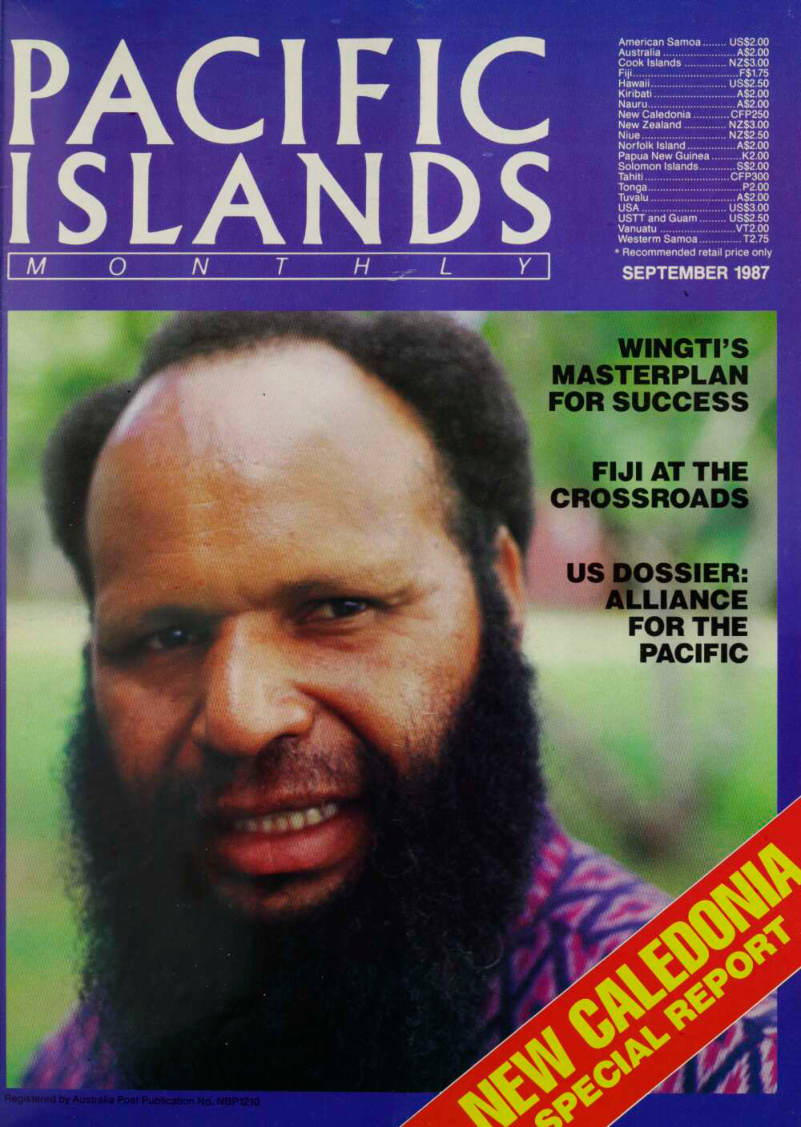
American Samoa US$2.OO Australia A 52.00 Cook Islands NZ$3.OO Fiji F 51.75 Hawaii US$2.5O Kiribati A 52.00 Nauru A 52.00 New Caledonia CFP2SO New Zealand NZ$3.OO Niue NZ$2.5O Norfolk Island A 52.00 Papua New Guinea K 2.00 Solomon Islands 552.00 Tahiti CFP3OO Tonga P 2.00 Tuvalu A 52.00
Usa Us$3.Oo
USTT and Guam US$2.5O Vanuatu VT2.00 Westerm Samoa T 2.75 * Recommended retail price only
September 1987
Wingti’S
Masterplan
For Success
Fiji At The
Crossroads
Us Dossier:
Alliance
For The
Pacific
Registered by Australia Post Publication No. NBP1210
Advertisements & other items, pp. 2-3 (1 item)
Trinitron
SONY.
■ \ S
righ
r
KV-2092AS
It's so tempting.
The colour you get from Sony's new Super Trinitron.
Our new Pan-Focus gun is computer-designed to make our famous colour even sharper and clearer. Our new Black Screen makes whites brilliant, blacks profound, every colour deeper and richer.
It's flatter and sguarer too.
For less reflection and superb clarity, even in the corners.
For those whose taste demands *he best, Super Trinitron is the most delicious TV ever.
KV-1440AS
Trinitron
FIJI: Distribution and subscriptions: Desai Bookshops, PO Box 160, Suva, Fiji.
Phone Suva 23036. Advertising: Fiji Times & Herald Ltd, 20 Gordon St., Suva. Phone 31-4111, telex FJ2124.
FRENCH POLYNESIA: Distribution: Hachette Pacifique 10 Ave., Bruat, Papeete Phone 25-610.
HAWAII: UNITED STATES:
Distribution: PIM, Hawaii, PO Box 22250, Honolulu, Hawaii, 96822. Advertising: Brian C Asgill, Apt. 1308,1676 Ala Moana Blvd., Honolulu, Hawaii, 96815. Phone (808) 955-9718.
JAPAN: Advertising and subscriptions: Universal Media Corporation, GPO Box 46, Tokyo. Phone 666-3036, cable UNIMEDIA Tokyo, telex 2524665.
MALAYSIA: Advertising and subscriptions: Worldwide Media Services, 57-B Komplex Damai, Jin Dato Haji Eusoff, Kuala Lumpur. Phone 63-9340, cables WORLDMEDIA Kuala Lumpur, telex 31533.
VANUATU: Distribution: The Bookshop, HQ Box 210, Port Vila. Advertising; Norman Bros. Bookship, Port Vila. Phone 2232.
NEW CALEDONIA: Distribution: Depot Centre de Presse Michel Pentecost. CBP2, Noumea. Phone 27-2434, 27-4729.
NEW ZEALAND; Distribution: Gordon & Gotch, PO Box 584, 2 Carr Road, Mt Roskill, Auckland 4. Advertising: McKay International Media Reps Ltd, C/- Albany PO, Auckland 10, New Zealand, Phone 413- 9119, Telex NZ22701, FAX 413-9110.
WELLINGTON: Ross Quaid Media, 1 Scholes Ln., Petone. (04) 68-7593, PO Box 38699, Petone.
PAPUA NEW GUINEA: Distribution: Gordon & Gotch, PO Box 3395, Port Moresby. Phone 25-4551, 25-4855.
Advertising: Ken Head, PNG Post- Courier, PO Box 85, Port Moresby. Phone 21-2577, telex 22120.
SOLOMON ISLANDS: Distribution and Advertising: The Bookshop, (Norman Bros.) PO Box 503, Honiara.
PHILIPPINES: Advertising: The GF Group, 12 San Ignacio St., Uroaneta Village, Makati, Metro Manila. Phone 817- 7299. telex 45950 and 4233.
UNITED KINGDOM; The Herald & Weekly Times Ltd, No 1 Maltravers St., London WC2R3DZ, England. Phone (01) 836-5162, telex London 21989.
UNITED STATES MAINLAND;
Advertising: Joshua B. Powers Jr., Powers International Inc., Suite 708, 271 Madison Ave., New York, NY 10016. Phone 867-9580, Subscriptions: PIM, Hawaii, PO Box 22250, Honolulu. Hawaii, 96822
SUBSCRIPTIONS
American Samoa...
Australia Canada Cook Islands Fiji French Polynesia...
Guam Hawaii Japan Kiribati Micronesia Nauru New Caledonia New Zealand Niue Norfolk Island Northern Marianas..
Papua New Guinea, Solomon Islands Tonga Tuvala United Kingdom US Mainland Vanuatu Western Samoa Elsewhere ...US$24
. AUSS24
...US$3O
...NZ$36
AUSS26
...US$3O
...US$3O
...US$3O
...US$3O
. AUSS24
...US$3O
. AUSS24
...US$3O
...NZ$36
...NZ$3O
. AUSS24
...US$3O
AUSS3S
AUSS24
.AUSS24
. AUSS24
Stgls
...US$3O
. AUSS24
AUSS24
. AUSS36
Payments by personal cheque are only acceptable in Australian (from a branch in Australia), US and New Zealand currency.
For all other remittances please send an international bank draft in Australian dollars.
Pacific
Islands
Monthly
Vol 58. No. 9
Voice Of The Pacific
September, ’B7
Cover Story
Wingti The Victorious 12
BehindPaias Wingti’s stunning election victory - and why the new PNG government has to beat the bogies of political instability, corruption and the problems of electoral chaos caused by an un wieldy first past the post voting system.
NEW CALEDONIA - THE TENSION MOUNTS 18 Passions are at fever pitch as the historic September independence referendum looms. And French Overseas Territories Minister Bernard Pons puts the Paris perspective.
Fiji At The Crossroads 22
The complex task of returning the traumatised country to normalcy is testing the temper and constitution of Fiji.
Tarawa’S Tabai Strikes Back 2 I
The beleagured president's plan to survive his final term.
Alliance For The Pacific 34
An American navy blueprint for a Pacific Alliance of non-Soviet nations would ensure the continuation of a strong US presence in the Pacific.
Cook Islands: Exit Sir Tom 38
The controversial and prickly Cook Islands leader is defeated.
Aids In The Pacific 40
The need for a concerted program to halt the spread of the killer virus.
Lange’S Landslide 43
Behind Labour's crushing victory in the New Zealand elections.
Departments
Rim Opinion 5
Islands Press 11
Letters 44
Pacific Report 45
Tradewinds 46
Book Reviews 48
Pacific Stamp Box 50
Shipping Schedules 52
Transitions 56
From The Past 58
Editor Larry Writer Art Director Warren Scott Editorial Adviser John Carter Publisher Geraldine Raton Managing Editor Arnold Earnshaw Advertising Sales Sydney & Melbourne - Lawson Dixon (02) 288 3541 & Fergus MacLagan (02) 412 3918; Brisbane - Robert Walker (07) 371 0532
Australian cover price is recommended retail only.
Registered by Australia Post, publication No. NBPI2IO.
Copyright Pacific Publications (Aust.) Pty. Ltd.
Advertisements & other items, pp. 3-4 (2 items)
3
PACIFIC ISLAND MONTHLY —SEPTEMBER, 1987
A Pacific Publications Production Founded 1930 (USPS 952480) 64-76 Kippax St, Surry Hills, NSW 2010; GPO Box 4245, Sydney, NSW 2001; Telex: AA20124; Fax: (02) 288 3322; Cables: PACPUB Sydney; Telephone (02) 288 3000.
Pacific Islands Monthly (APPS NO NBP 1210) is published monthly for SUS 36 per year by Pacific Publications Pty Ltd, a division of News Ltd, of 2 Holt St, Surry Hills, NSW 2010. Second class postage paid at Honolulu, Hawaii, POSTMASTER: Send address changes to PACIFIC ISLANDS MONTHLY, PO Box 22250, Honolulu, Hawaii 96822. Typeset by David Graphics, Sydney, and printed by Progress Press, 2 Keys Road, Moonabbia, Victoria.
eafi^K%
4s .4
Ssrf
!«S m - ■
■ V t'i' W-V -V -S,
v'*" vKsJCsM '.v. vV; vV, * 2£>£ sM - 1 r%jp .w\w
v*lS*
* ■ ,%& - - * H M M V >: ► V- v
OF^Ji
j* ■ %_> V I.V V% vV * % ... V ■*.
B9P&S
V V
Sfr
V V**4» »V**%
Vf*X*X
>*>V W V * H
rWSk
V SS& V Hi S» u
&&SP&SP&S**
JKJBtvV - J?.fr.J» vCTvV,
CvJKfi
*?► .Jfl* S> lr \r \: %: %- V Hi 4 V* ftJI v v ?* r .*>. sV ir i '3 V
eafi^K%
3flr
\ m 4A ■'W * jg’Vjt k fl* **&&*# J&kg** ', *J^■'-%tot67 i S ■', *, * *% 3 V M '*4&* ■ jl%b3 iSfeay*.-Mfe ■i' s ? Jb# ■ ?"fsfe* . !■&£.* #|tA- 9sLw^ , j(- r O' -v > ZjfiPZtfV I,* . #6i
*.•£(*>M* - *U - nL>
.* % a# i? m ■^y & < a# < <3^ <35 -r w s# < N#' ..
A % ■
H* M^Ml
n* * - 3* y &5 N® m n *« m i V $
lijm
IM ejs
xx:xxx te 'x^r»
r^r , .<‘.x*#*'f'> xrt~y
A Special Kind of Energy

Pim Opinion
Paias Wingti’s election euphoria is fading in the face of the momentous task facing the new government.
THE problems confronting Papua New Guinea’s youthful Prime Minister, Paias Wingti, as he strug gles to hold together his flimsy governing coalition, provide an uncanny echo of the broader dilemmas facing his young nation.
After the counting of votes in July’s general election, Mr Wingti’s Peoples Democratic Movement trailed the apparent winner, Mr Michael Somare’s Pangu Pati.
Through a combination of raw energy and political wheel ing and dealing, Mr Wingti managed to emerge on top, by a slender 54 to 51 margin.
Now he has been returned to power, he finds a cloud hanging over his coalition. One of his key coalition sup porters, the leader of the People’s Action Party, Mr Ted Diro, stands accused of improper business dealings by a commission of inquiry into the forestry industry. Mr So
mare, after congratulating Mr Wingti on his victory in a speech in the new parliament, promptly warned him that he would not last. The twin demons of Papua New Guinea politics, corrup tion and instability, remain to plague the energetic Mr Wingti. They could yet prevent him from realising his fine sounding policies of agrarian development.
The new nation he must govern shares this ambiguous balance of strengths and weaknesses. Papua New Guinea’s fabulous mineral wealth is still being uncovered. Its democratic institutions provide a sound basis for social progress. Yet confusion sur rounds the nation’s economic policies.
The traditional tribal system has given way to a collapse of law and order in the urban areas, with a consequent rise in violent crimes and rapes, commit ted against both expatriates and na tionals, that the country’s political leaders cannot ignore.
Both in its politics and in its social development, Papua New Guinea faces a period of transition. The first decade, when Mr Somare was “the chief’ and progress was straightforward, if not simple, has passed. Mr Wingti, and other “young turks” such as human rights lawyer Mr Ber nard Narokobi and Mr Utala Samana represent a new, post-colonial generation. They are now the same age as was Mr Somare when he first seized power from the pre independence United Party. It would be tragic if the inst abilities inherent in the political system prevented such men from trying to fulfil their vision of the future for
Papua New Guinea. \fet Mr Wingti must govern with the constant knowledge that after six months, he can be dis lodged by a simple parliamentary vote of no confidence.
If there has been a generational change in Port Mores by’s political cast, there is also a change in economic di rection. Mr Wingti harbours utopian dreams of using the nation’s mining wealth to create an advanced agrarian economy. Plans are afoot to sell off the government’s near half-billion dollar stake in Bougainville Copper to fund such projects. Papua New Guinea’s leaders are reaching for grand ideas. They would do well to reflect that dog matic ideas have often before proved the undoing of de veloping nations.
The task will be to straddle this period of transition with care and common sense. Papua New Guinea has travelled, in less than a century, from the stone age to the
computerised vote-count. A nation’s identity is proved not by the speed with which it changes, but by the manner in which, while changing, it remains true to itself.
At the political level, Mr Wingti, patient, determined, calm under pres sure, has displayed in the recent elec tion campaign all the skills needed to ride his country’s political roller coaster. Yet winning power does not require the same skills as exercising it well. Mr Wingti must seek to break the destructive cycle of truncated terms of office that has prevented Papua New Guinea’s prime ministers from mov ing their country forward. If there were stable political leadership, a constant economic policy could follow. And a more stable government, one which was obliged to look after all its con stituents, not just the politically pow erful, would go a long way toward addressing the law and order problems
that are tearing the nation’s cities apart.
Foreign policy is another area where Papua New Guinea must consider its position carefully. Mr Wingti’s modish enthusiasm for the Melanesian Spearhead group, which lobbies against the French presence in New Caledonia, may be emotionally satisfying, but it is far from offering a coherent answer to the problems of that territory.
July’s elections provided a litmus of the country’s prog ress. The large number of independents elected to parlia ment indicated voters were dissatisfied with the corruption and patronage widespread among established politicians.
Yet the election of independents itself encourages party ►
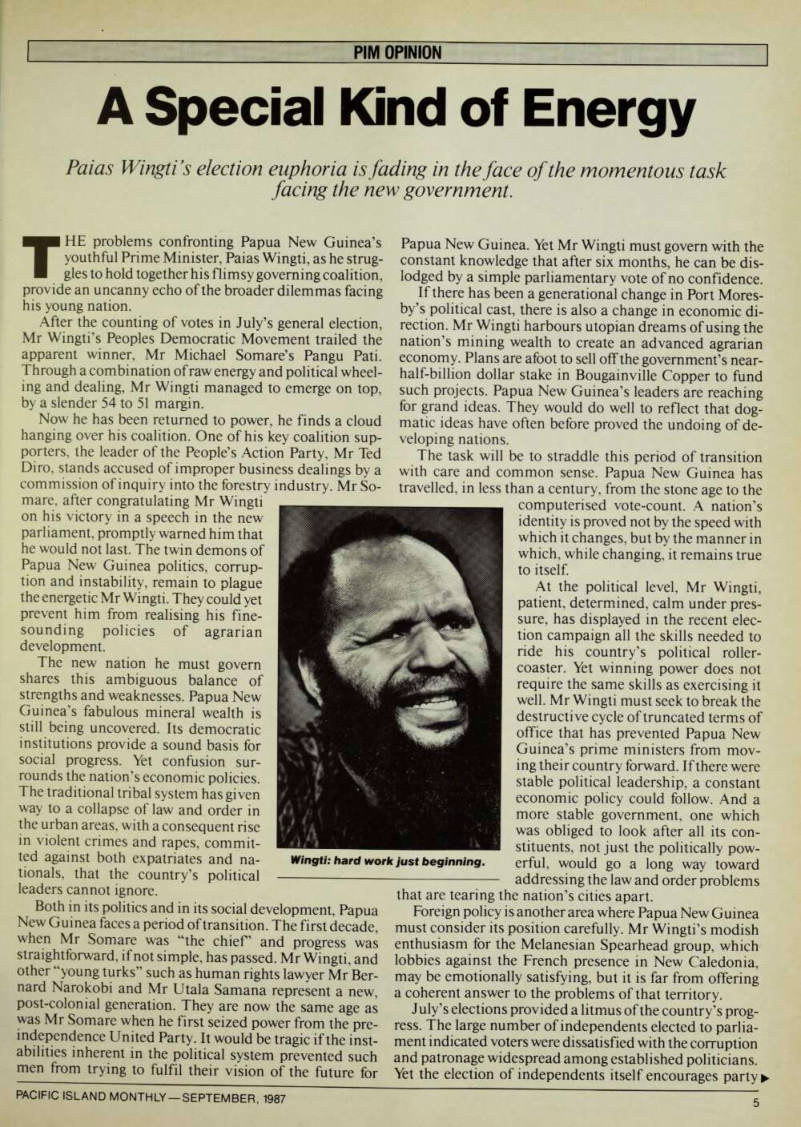
Wingti: hard work just beginning.
◄ leaders to pursue supporters by means of bribes. Today’s parties, instead of attracting candidates, are reduced to buying them. And so parties become weaker, and the ideas they stand for die.
Papua New Guinea urgently needs to review its elec toral processes, so as to promote more stable government.
The newly re-elected Mr Wingti, despite the many prob lems he confronts, certainly has the special kind of energy needed to win over candidates. He deserves a chance to prove that he can translate that vigour into vision and achievement over a full five-year term.
Advertisements & other items, pp. 5-6 (2 items)
5
PACIFIC ISLAND MONTHLY —SEPTEMBER, 1987
Add the finishing touches
to your fantasy,..
The dream comes true with NEW PERSONNA PLUS shelf-size component systems, and the model X-550R —a sound system more than brimming with high fidelity, and feature-packed!
In fact, boasting a full 350 W of high-power (PMPO) output, the X-550R delivers the convenience of remote control for amp, tuner, deck, turntable 1 , and an optional CD player, plus a 5-band graphic equalizer for frequency distribution adjustments —and still there’s more!
Like sensational Surround Sound for rich, ambient sound, and the beauty of Stereo Wide, for extended stereo effects.
Then there’s a Double Auto-Reverse Cassette Deck with Deck I-II relay play for continuous auto-reverse playback, plus synchrorecording for Deck I-II tape duplication, to say nothing of great features like normal/high-speed copy, Music Search, and Dolby* B Noise Reduction.
Still, there’s more to the X-550R than this, and more to NEW PERSONNA PLUS than the system X-550 R—like the X-880R, with 440 W of high power (PMPO), and the X-220, with 270 W (PMPO), for example. The point is that it is the beauty of pure sound and NEW PERSONNA PLUS that lets your imagination take flight!
X-550R m Tunction-switching only ‘“Dolby” and the double-D symbol are trademarks of Dolby Laboratories Licensing Corporation.
NOTE: The PD-XBB CD player and S-XIA “surround sound” rear-speaker system are included in the photograph, but both are options.
dD PIONEER
The future of sound and vision.
For further information, please contact: Australia: Pioneer Electronics Australia Pty. Ltd. (Incorporated in Victoria), P.O. Box 295, Mordialloc, Victoria, 3195 Tel: 580-9911 Fiji Islands: Brijlal & Company, G.P.O. Box No. 362, Suva, Fiji Islands Tel: 22258 New Zealand: Monaco Distributors Ltd., 41 Poland Road, Glenfield, Auckland, New Zealand Tel: (09) 444-9144 Norfolk Island: Burnt Pine Traders Ltd., P.O. Box 21, Norfolk Island Vanuatu: Burns Philp (Vanuatu) Ltd., Vila, Vanuatu Nauru Island: Jacob Enterprises, P.O. Box N 0.4,.4, Republic of Nauru Tahiti: Tahiti Hi-Fi, P.O. Box 848, Papeete, Tahiti New Caledonia; Menard Pacifique Sari, B.P. 3899, Noumea, New Caledonia Tel: 27-62-23 American Samoa: Transpac Corporation, P.O. Box 1477, Pago Pago, American Samoa 96799 Tel: 633-5224 Rarotonga: South Seas International Ltd., P.O. Box 49, Rarotonga, Cook Islands Tel; 2327
A Pacific Alliance
IN this issue, PIM presents an intriguing proposal for a draft “Pacific Alliance Treaty”, put forward by Lieu tenant Commander James Stavridis in the United States Naval Institute’s Proceedings. The mere fact that an American strategist should consider the need for such a treaty indicates the change that has come over the Pa cific, long considered an “American lake”, in the year since Soviet leader Mikhail Gorbachev declared, in his Vladi vostok address, that “the Soviet Union is also an Asian and Pacific country.”
Lt Comm Stavridis clearly takes NATO as his model, and envisages a treaty alliance of Pacific nations, led by the United States, and formed, as was NATO, with a mis sion of containment in mind, aiming to limit the expan sion of the Soviet Union into the region. But the Pacific rim is not Western Europe in embryo; the region sur mounts a vast, empty ocean stretching across one third of
the globe. This is no crowded continent under threat of military annexation.
Further, while the Soviets could be simply excluded from NATO territory, nothing can exclude Soviet vessels from the seas of the Pacific.
Lt Comm Stavridis believes a new “economic and de fensive alliance system” in the Pacific basin should be es tablished, based on a treaty ratified by member nations.
His scheme ties together the economic advancement of the Pacific with its military protection.
Significantly, he writes that such an alliance could not only help contain Moscow’s advances, but also “go far to ward improving the image of United States leadership in the region.”
The Pacific potential of the Soviet Union, poised in its bases in Vladivostok and Vietnam’s Cam Ranh Bay, is evident. Whether an alliance on the model of NATO is conceivable is less clear. NATO member countries share common borders and a common culture, much history and some ideological convictions.
Yet the Pacific rim countries range from Australia to the island nations, from the United States, a global su perpower, to Japan, economic titan and military gelding all in one.
Treaties are not abstract documents that can be drafted by one party. They are agreements that contain compro mises and shared judgements, marking a strategic con sensus amongst affected parties. Treaties that last are hammered out on the basis of power relations.
The draft “Pacific Alliance Treaty” we present here raises as many questions as it answers: If Japan is to be encouraged to accept “further defence responsibilities,” what guarantees will there be for Pacific nations that To kyo’s economic prowess will not be translated into direct
military leverage? Should China, a communist state, form part of an al liance formed to contain another communist superpower? How will re lations between western nations such as Australia, and the US, and smaller Pacific states with strategic locations, be governed?
The proposal for such a treaty re cognises that the current bilateral def ence arrangements of the US in the Pacific leave much to be desired. The future of the vital American bases in the Philippines is unclear, and there is continuing debate throughout the Pa cific over the passage of nuclear-armed ships.
Yet Lt Comm Stavridis’s plan pointedly considers only the Pacific rim nations, excluding even that im portant Pacific regional power, France. The focus of recent Soviet diplomatic and trade initiatives has been such strategically placed, eco nomically vulnerable Pacific island nations as Kiribati and Vanuatu.
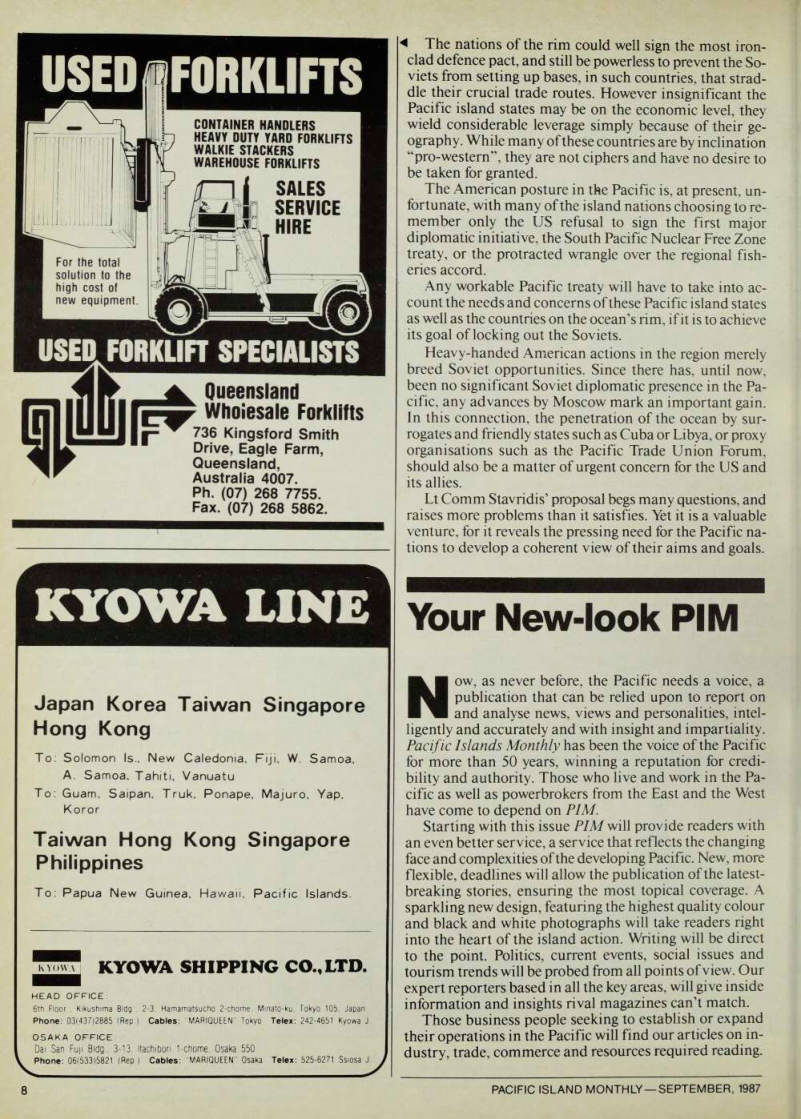
A treaty to consolidate US power in the Pacific.
< The nations of the rim could well sign the most iron clad defence pact, and still be powerless to prevent the So viets from setting up bases, in such countries, that strad dle their crucial trade routes. However insignificant the Pacific island states may be on the economic level, they wield considerable leverage simply because of their ge ography. While many of these countries are by inclination “pro-western”, they are not ciphers and have no desire to be taken for granted.
The American posture in the Pacific is, at present, un fortunate, with many of the island nations choosing to re member only the US refusal to sign the first major diplomatic initiative, the South Pacific Nuclear Free Zone treaty, or the protracted wrangle over the regional fish eries accord.
Any workable Pacific treaty will have to take into ac count the needs and concerns of these Pacific island states as well as the countries on the ocean’s rim, if it is to achieve its goal of locking out the Soviets.
Heavy-handed American actions in the region merely breed Soviet opportunities. Since there has, until now, been no significant Soviet diplomatic presence in the Pa cific, any advances by Moscow mark an important gain.
In this connection, the penetration of the ocean by sur rogates and friendly states such as Cuba or Libya, or proxy organisations such as the Pacific Trade Union Forum, should also be a matter of urgent concern for the US and its allies.
Lt Comm Stavridis’ proposal begs many questions, and raises more problems than it satisfies. Yet it is a valuable venture, for it reveals the pressing need for the Pacific na tions to develop a coherent view of their aims and goals.
Advertisements & other items, p. 7 (1 item)
Pim Opinion
7
PACIFIC ISLAND MONTHLY —SEPTEMBER, 1987
Your New-look PIM
Now, as never before, the Pacific needs a voice, a publication that can be relied upon to report on and analyse news, views and personalities, intel ligently and accurately and with insight and impartiality.
Pacific Islands Monthly has been the voice of the Pacific for more than 50 years, winning a reputation for credi bility and authority. Those who live and work in the Pa cific as well as powerbrokers from the East and the West have come to depend on PIM.
Starting with this issue PIM will provide readers with an even better service, a service that reflects the changing face and complexities of the developing Pacific. New, more flexible, deadlines will allow the publication of the latest breaking stories, ensuring the most topical coverage. A sparkling new design, featuring the highest quality colour and black and white photographs will take readers right into the heart of the island action. Writing will be direct to the point. Politics, current events, social issues and tourism trends will be probed from all points of view. Our expert reporters based in all the key areas, will give inside information and insights rival magazines can’t match.
Those business people seeking to establish or expand their operations in the Pacific will find our articles on in dustry, trade, commerce and resources required reading.
Advertisements & other items, pp. 8-10 (3 items)
8
PACIFIC ISLAND MONTHLY —SEPTEMBER, 1987
lyyjrp
FORKLIFTS
CONTAINER HANDLERS
HEAVY DUTY YARD FORKLIFTS
WALKIE STACKERS
WAREHOUSE FORKLIFTS
SALES
I SERVICE
" HIRE
J For the total solution to the high cost of new equipment
USED FORKLIFT SPECIALISTS
lyyjrp
Queensland
Wholesale Forklifts
736 Kingsford Smith Drive, Eagle Farm, Queensland, Australia 4007.
Ph. (07) 268 7755.
Fax. (07) 268 5862.
KYOWA LINE
Japan Korea Taiwan Singapore
Hong Kong
To: Solomon Is., New Caledonia, Fiji, W. Samoa, A. Samoa, Tahiti, Vanuatu To: Guam. Saipan. Truk, Ponape, Majuro, Yap, Koror
Taiwan Hong Kong Singapore
Philippines
To: Papua New Guinea, Hawaii. Pacific Islands.
KYOWA SHIPPING CO., LTD.
HEAD OFFICE:
6th Floor , Kikushima Bldg 2-3, Hamamatsucho 2-chome, Mmato-ku, Tokyo 105, Japan Phone: 03(437)2885 (Rep ) Cables: MARIQUEEN' Tokyo Telex: 242-4651 Kyowa J.
OSAKA OFFICE
Dai San Fuji Bldg, 3-13, Itachibori 1-chome, Osaka 550. 06(533)5821 (Rep ) Cables: MARIQUEEN” Osaka Telex: 525-6271 Ssiosa
Aiwa'
1400 WATT HIGH POWER OUTPUT ■WIRELESS REMOTE CONTROL 1 I DOUBLE CASSETTE DECK BSURROUND SOUND CAPABILITY (DIGITAL SYNTHESIZER TUNER WITH 16 MEMORY PRESETS 15-BAND GRAPHIC EQUALIZER ■ 5-BAND SPECTRUM ANALYZER Hi-fi Midi System V-770 ' DOLBY B NR • QUICK REVERSE REC/PB • DOUBLE SPEED DUBBING •CONTINUOUS PLAYBACK •2-PROGRAM/DAY TIMER • BIG 20 CM dia. WOOFER • FULLY AUTOMATIC TURNTABLE
. .who could ask for more?
Dolby and the double-D symbol are trademarks of Dolby Laboratories Licensing Corporation
AIWA'
N . S V.i^ A = USTRALIA PHONE: (°2HO6-6277/O«anla laden. Agency (P.N.G.) Pt,„ Ltd. Ago St, Gordon Box 5518, Boroko, Port u!l^L n . e l! HONE ' 256411/The Sound Centre Ltd. P.O. Box 434 Port Vila, Vanuatu PHONE: 2035/P. Hargovind Bros. 190 Renwick Road P.O. Box 490 Suva Fiji PHONE: 24350/ Limited po B ° X i?J 7 ’^ uckland ’ New Zea,and PHONE: (09) 399-175/Hifivox 79, rue de Sebastopol, Noumea, New Caledonia PHONE: 27. 24. 66/Harvest 4gana PH HiR Ster6 ° Rue du MareChal Foch P 0 Box 269, Papeete, Tahiti PHONE: 2-4814/Micropac Audio, Inc. P.O. Box 3478 *gana, Guam 96910 PHONE. 472-8091, 472-8297/Rarotonga Duty Free Shop Private Bag P.O. Box 92. Rarotonga. Cook Island/Nauru Co-Operative Society Repubhc of Nauru
The Wonderful World of Spectrum Stereo
If you value your freedom to choose the best things in life, you will appreciate the Kenwood Spectrum stereo system. Each component is separately engineered by world-leading audio specialists. Spectrum: the performance of a life-time, every time you listen.
sPECtrum
m
senes
Spectrum 206 ■ Separate power and control amplifiers ■ 310Wx2 Music Power BFull system infra-red remote control ■ Built-in graphic equalizer ■ Digital tuner with two-programme system timer ■ Station Name Preset System ■ Full-logic double cassette deck ■ Relay-play ■ Relay and dual recording ■ highspeed dubbing ■Quartz-PLL direct-drive turntable with programme memory M 4-way 6-speaker Super Bass Radiator system ■ Options include CD player and surround sound processor
KENWOOD CORPORATION
Shionogi Shibuya Building, 17-5, 2-chome Shibuya, Shibuya-ku, Tokyo 150, Japan KENWOOD ELECTRONICS AUSTRALIA PTY. LTD. (incorporated in n.s.w.) 4E Woodcock Place, Lane Cove, N.S.W. 2066, Australia NEW ZEALAND PETER GILBERT LTD. Auckland Tel. 0011-64-9-5271313 FUJI PEPE'S DUTY FREE CENTRE LTD. Tel. 25496. 25497 PAPUA NEW GUINEA SO. SVENSSON (N.G.) LTD. Port Moresby Tel. 212158. 212111 SOLOMON ISLANDS TECHNIQUE RADIOS CENTRE LTD. Honiara Tel. 416 NEW CALEDONIA HI-FI VOX Noumea Tel. 27-2466. 28-2931 VANUATU FUNG CHOI LUEN. Port-Vila Tel. 2556
TAHITI MAISON AURORE Papeete Tel. 29703
AMERICAN SAMOA ISLAND PACIFIC AGENCIES, INC. Pago Pago Tel. 633-4687
REPUBLIC OF NAURU NAURU CO-OPERATIVE SOCIETY
MARIANA ISLANDS J.C TENORIO ENTERPRISES Saipan Tel. 6445
The Island Press
Reports from the papers, compiled by John Carter
From the Cook Island News , Rarotonga: The triangular S 2 coin will probably trigger off a new trend in the introduction of higher value coins, reports an authori tative British numismatics magazine. The August edition of Coin and Medal News says that the prize for pioneering the first three-sided coin must go to the Cook Is lands. The magazine describes the re duced scalloped-edged Tangaroa dollar and the polygonal five dollar coin with its highly distinctive gold colour as “startling new coins” that have been struck at the Royal Australian Mint in Canberra.
From Tuvalu Echoes , Funafuti: The due date for payment of head tax in Funafuti was the last day of June. More than 700 residents paid their tax to Fun afuti Island Council. Head-tax for females is $4 and $6 for males. A penalty of $2 will be imposed on those yet to pay.
From a letter by G. Henry, of Mel bourne, in the Papua New Guinea Post Courier , Port Moresby: We have been on holiday in PNG for 14 days. We consider that there could be great opportunities for tourism in this country if only the incidents of violence were sub stantially reduced. To find that every house in this city has security locks and bars on all windows is deterring to tourists, to say the least.
From the Cook Islands News , Rarotonga: Unclaimed monies paid by Govern ment to employees dating back to 1977 have now amounted to $62,000 dollars, according to Assistant Finance Secretary Mr Alister Rutherford.
The sum of money owing to individu als are from wages, overtime payments and tax refunds which have not been claimed for, and are at present being held by government.
From the Cook Islands News , Rarotonga: “Too many men in this country beat their women when they are drunk and they
come to me with excuses,” Chief Justice Sir Graham Speight told their court.
Chief Justice directed these comments to 25 years old Taia Tera charged for caus ing grievious bodily harm to a female of Aitutaki. The court heard that Teva, who has a record of beating up females, “still has not learnt any lessons.”
Tera was sentenced to eight months in prison with a reminder from the Chief Justice to “keep your hands off the women.”
From The Fiji Times , Suva: Three Morris Hedstrom Supermarket cashiers in Suva were arrested and de tained at the Central Police Station after the wife of the Commissioner of Police al leged they were discriminating against her.
Mrs Ela Lewaicei, the wife of the Com missioner of Police, Mr Josefa Lewaicei, complained to the police that one of the cashiers had given her a plastic bag that was inferior to a bag given to another customer.
From the Papua New Guinea Post- Courier , Port Moresby: Leaders with good Christian principles and a proper marriage and moral track re cord should be in government. That is the call by students from the University of Papua New Guinea. Their Students Rep resentative Council president Mr Moses Murray said a good and honest govern ment had its roots from moral stand points.
From The Samoa Times , Apia: The 13 American college presidents who visited Western Samoa this week could not find sufficient words to describe the unique Samoan hospitality that was accorded to them.
They were impressed not merely by the beautiful scenery and the various recep tions given in their honour but also by the hospitality of the Samoan people.
“I’m going to come back for a longer visit,” said one. “The Samoan hospitality is unbelievable,” said another.
From Young Ideas , a quiz section for children in the Fiji Times: This week’s question: What is a repub lic? Rishal Chandra, 3, School of Nine, Suva; “It is an army with guns”.
From the Solomon Nius , Honiara: Honiara was extremely dry in June, 1987, with no rainfall recorded, according to the Solomon Islands Meteorological Services (SIMS).
From The Norfolk Islander , Norfolk Island: In sacred memory of the trees wan tonly destroyed in Cobb’s Paddock at Steele’s Point.
Even the Terns are crying for their lost homes. “Only God can make a tree”.
From The Drum column in the Papua New Guinea Post-Courier , Port Moresby: A Port Moresby firm waiting for two months to receive a reply from the De partment of Labor about approval for po sitions, called the office to find out the reason for the delay. The company was told that all typewriters in the department had broken down and letters could not be written.
From a report in Solomon Nius , Hon iara, of a 9th independence speech by Prime Minister Ezekiel Alebua: It seems to me that the first decade of Independence had been a time of expand ing the size of government, increasing its costs, and reducing its effectiveness.
My vision for the next decade is to see all those trends reversed, so as to have a smaller, hard-working, more cost-effec tive government making a real contribu tion to the competitive success of our economy.
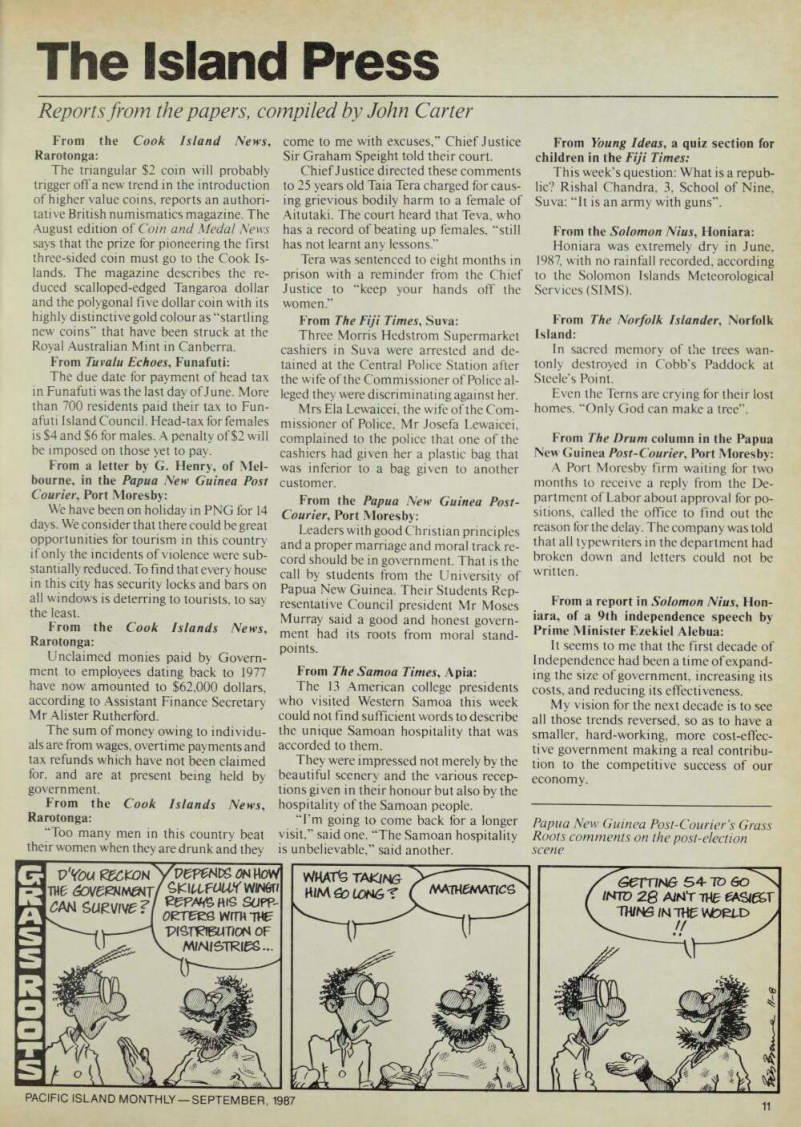
Papua New Guinea Post-Courier’s Grass Roots comments on the post-election scene
Advertisements & other items, p. 11 (1 item)
11
PACIFIC ISLAND MONTHLY —SEPTEMBER, 1987
Wingti The Victorious
Png Elections
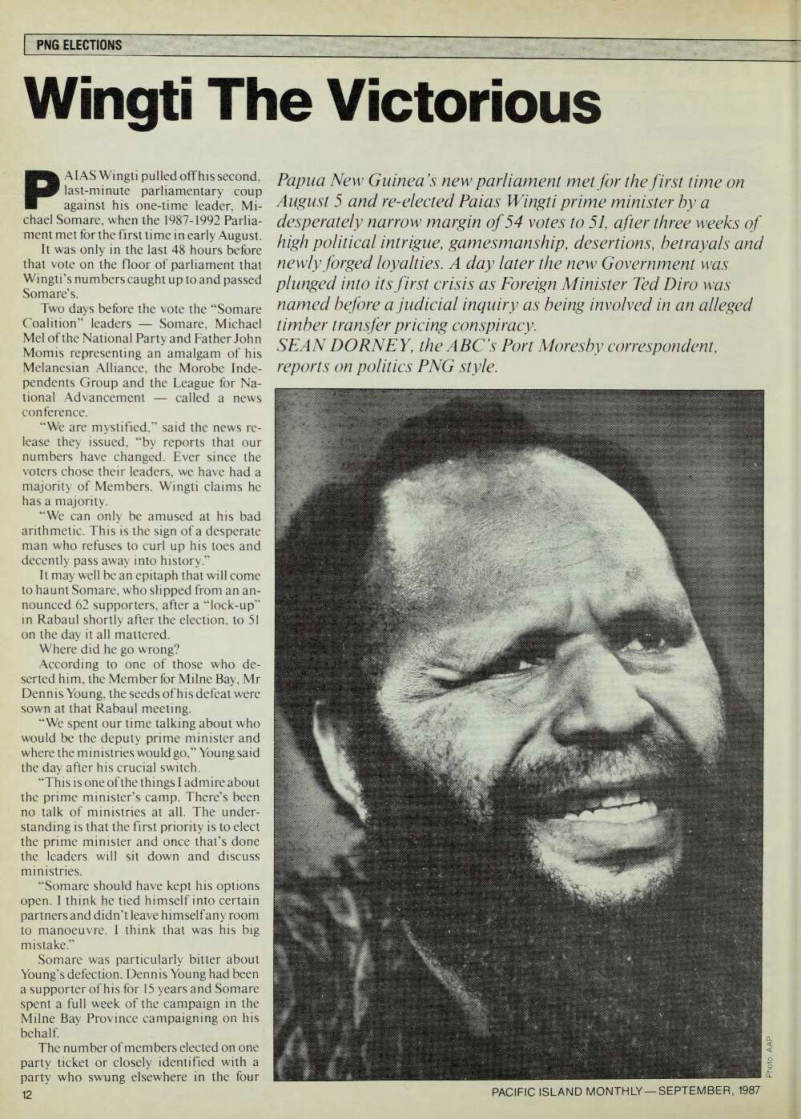
PAI AS Wingti pulled off his second, last-minute parliamentary coup against his one-time leader, Mi chael Somare, when the 1987-1992 Parlia ment met for the first time in early August.
It was only in the last 48 hours before that vote on the floor of parliament that Wingti’s numbers caught up to and passed Somare’s.
Two days before the vote the “Somare Coalition” leaders Somare, Michael Mel of the National Party and Father John Momis representing an amalgam of his Melanesian Alliance, the Morobe Inde pendents Group and the League for Na tional Advancement called a news conference.
“We are mystified,” said the news re lease they issued, “by reports that our numbers have changed. Ever since the voters chose their leaders, we have had a majority of Members. Wingti claims he has a majority.
“We can only be amused at his bad arithmetic. This is the sign of a desperate man who refuses to curl up his toes and decently pass away into history.”
It may well be an epitaph that will come to haunt Somare, who slipped from an an nounced 62 supporters, after a “lock-up” in Rabaul shortly after the election, to 51 on the day it all mattered.
Where did he go wrong?
According to one of those who de serted him, the Member for Milne Bay, Mr Dennis Young, the seeds of his defeat were sown at that Rabaul meeting.
“We spent our time talking about who would be the deputy prime minister and where the ministries would go,” Young said the day after his crucial switch.
“This is one of the things I admire about the prime minister’s camp. There’s been no talk of ministries at all. The under standing is that the first priority is to elect the prime minister and once that’s done the leaders will sit down and discuss ministries.
“Somare should have kept his options open. I think he tied himself into certain partners and didn’t leave himself any room to manoeuvre. I think that was his big mistake.”
Somare was particularly bitter about Young’s defection. Dennis Young had been a supporter of his for 15 years and Somare spent a full week of the campaign in the Milne Bay Province campaigning on his behalf.
The number of members elected on one party ticket or closely identified with a party who swung elsewhere in the four
Papua New Guinea's new parliament met for the first time on August 5 and re-elected Paias Wingti prime minister by a desperately narrow margin of 54 votes to 51, after three weeks of high political intrigue, gamesmanship, desertions, betrayals and newly forged loyalties. A day later the new Government was plunged into its first crisis as Foreign Minister Ted Diro was named before a judicial inquiry as being involved in an alleged timber transfer pricing conspiracy.
SEAN DORNEY, the ABC's Port Moresby correspondent, reports on politics PNG style.
weeks between being declared winners and having to make their first vote in the Par liament astounded even veteran observ ers of PNG politics.
The most amazing case of flip-flop ping was that by the Member for East New Britain, Mr Ereman Tobaining a for mer East New Britain Provincial Premier.
Mr Tobaining stood on the Pangu Pati ticket with Mr Somare’s photo next to his.
In the last week in July he flew to Port Moresby from Rabaul in the prime min ister’s aircraft and was deep in discussions with the almost defunct United Party, which was limply attached to Wingti’s coalition.
Some Pangu officials wrote him off as lost but then out came the first of several intriguingly conflicting press releases.
“Mr Tobaining today hit out at the manner he had been hijacked from Ra baul,” it said. “I was virtually kidnapped and later detained in Port Moresby. I played along with my kidnappers because I wanted to know what they were plan ning. I want to say categorically that I am a member of Pangu Pati and that I have unqualified support for Michael So mare,” said Mr Tobaining on July 29.
On August 4, Mr Tobaining was wait ing at Mr Wingti’s home for him to return from an interview on the National Broad casting Commission and within a few hours he and Mr Wingti fronted the cam eras and journalists to announce his al legiance to Wingti.
In a jointly signed press statement, the switch was described as “a move that has shattered the Somare camp.”
“Somare has already made his contri bution to the development of our nation, and I feel that our country now needs new and vigorous leaders like Mr Wingti to lead it through the next five years,” Tobaining said.
The next day the confusion over just where Tobaining belonged led to a physi cal confrontation in the Parliament build ing itself as the Member for Rabaul and Minister for Minerals and Energy, Mr John Kaputin, found Tobaining having tea in Somare’s office and attempted to pull him outside.
Equally intriguing was the behaviour of the Member of Mendi, Mr William Ank, who retained his seat for Sir Julius Chan’s Peoples Progress Party part of the Wingti coalition.
When the bells stopped ringing on the first day of Parliament, he was sitting with Somare’s supporters and apparently voted for the Opposition candidate for Speaker.
In the hour between the vote for speaker and the vote for prime minister, he switched back and was sitting on the Government benches when the speaker returned from being sworn in at govern ment House to call for prime ministerial nominations.
The brave move by the Electoral Com missioner, Mr Luke Lucas, to revamp the ballot papers so that endorsed members of
political parlies had the photos of their party leaders next to their photos turned out, in the end, to emphasise the fragility of the party system, not strengthen it, as was the expressed purpose.
A whole clutch of members had swopped and switched allegiance by the first sitting day.
The new member for Usino/Bundi, Mr ►
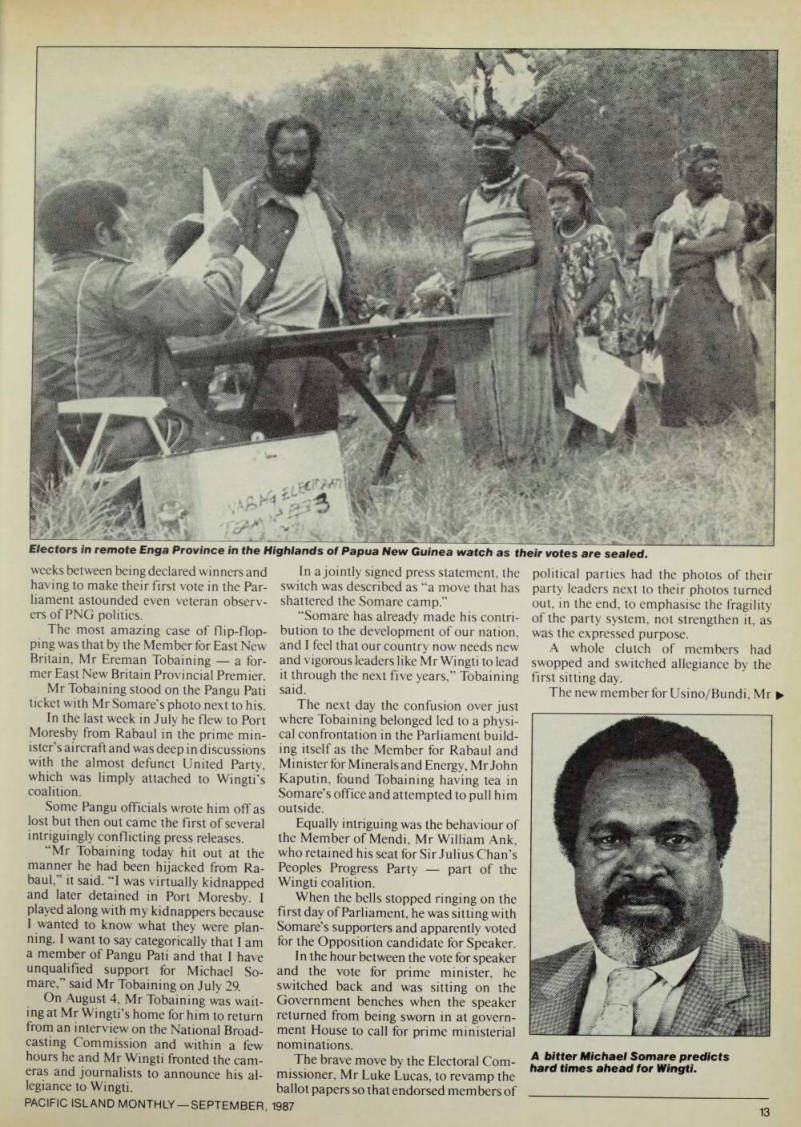
Electors in remote Enga Province in the Highlands of Papua New Guinea watch as their votes are sealed.
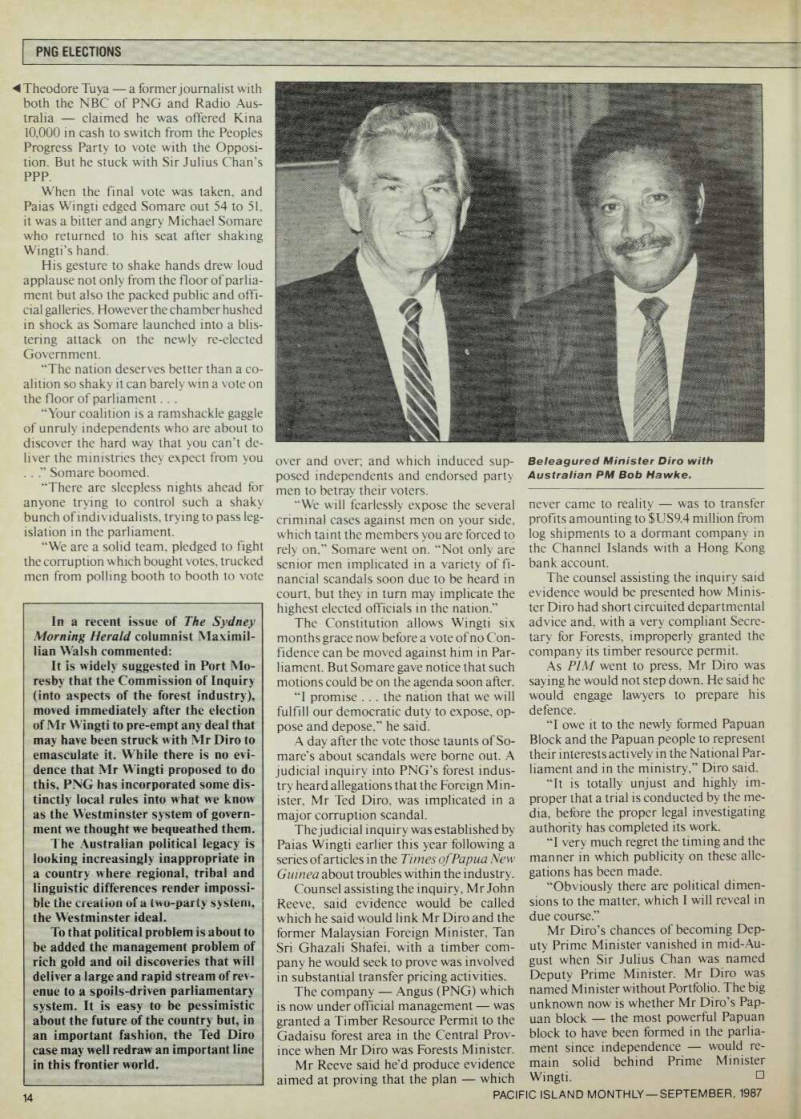
A bitter Michael Somare predicts hard times ahead for Wingti.
◄ Theodore Tuya a former journalist with both the NBC of PNG and Radio Aus tralia claimed he was offered Kina 10,000 in cash to switch from the Peoples Progress Party to vote with the Opposi tion. But he stuck with Sir Julius Chan’s
Ppp.
When the final vote was taken, and Paias Wingti edged Somare out 54 to 51, it was a bitter and angry Michael Somare who returned to his seat after shaking Wingti’s hand.
His gesture to shake hands drew loud applause not only from the floor of parlia ment but also the packed public and offi cial galleries. However the chamber hushed in shock as Somare launched into a blis tering attack on the newly re-elected Government.
“The nation deserves better than a co alition so shaky it can barely win a vole on the floor of parliament. . .
“Your coalition is a ramshackle gaggle of unruly independents who are about to discover the hard way that you can’t de liver the ministries they expect from you .. .” Somare boomed.
“There are sleepless nights ahead for anyone trying to control such a shaky bunch of individualists, trying to pass leg islation in the parliament.
“We are a solid team, pledged to fight the corruption which bought votes, trucked men from polling booth to booth to vote
In a recent issue of The Sydney Morning Herald columnist Maximil lian Walsh commented: It is widely suggested in Port Mo resby that the Commission of Inquiry (into aspects of the forest industry), moved immediately after the election of Mr Wingti to pre-empt any deal that may have been struck w ith Mr Diro to emasculate it. While there is no evi dence that Mr Wingti proposed to do this, PNG has incorporated some dis tinctly local rules into what we know as the Westminster system of govern ment we thought we bequeathed them.
The Australian political legacy is looking increasingly inappropriate in a country where regional, tribal and linguistic differences render impossi ble the creation of a two-party system, the Westminster ideal.
To that political problem is about to be added the management problem of rich gold and oil discoveries that will deliver a large and rapid stream of rev enue to a spoils-driven parliamentary system. It is easy to be pessimistic about the future of the country but, in an important fashion, the Ted Diro case may well redraw an Important line in this frontier world.
over and over; and which induced sup posed independents and endorsed party men to betray their voters.
“We will fearlessly expose the several criminal cases against men on your side, which taint the members you are forced to rely on,” Somare went on. “Not only are senior men implicated in a variety of fi nancial scandals soon due to be heard in court, but they in turn may implicate the highest elected officials in the nation.”
The Constitution allows Wingti six months grace now before a vote of no Con fidence can be moved against him in Par liament. But Somare gave notice that such motions could be on the agenda soon after.
“I promise ... the nation that we will fulfill our democratic duty to expose, op pose and depose,” he said.
A day after the vote those taunts of So mare’s about scandals were borne out. A judicial inquiry into PNG’s forest indus try heard allegations that the Foreign Min ister, Mr Ted Diro, was implicated in a major corruption scandal.
The judicial inquiry was established by Paias Wingti earlier this year following a series of articles in the Times of Papua New Guinea about troubles within the industry.
Counsel assisting the inquiry, Mr John Reeve, said evidence would be called which he said would link Mr Diro and the former Malaysian Foreign Minister, Tan Sri Ghazali Shafei, with a timber com pany he would seek to prove was involved in substantial transfer pricing activities.
The company Angus (PNG) which is now under official management was granted a Timber Resource Permit to the Gadaisu forest area in the Central Prov ince when Mr Diro was Forests Minister.
Mr Reeve said he’d produce evidence aimed at proving that the plan which
never came to reality was to transfer profits amounting to SUS 9.4 million from log shipments to a dormant company in the Channel Islands with a Hong Kong bank account.
The counsel assisting the inquiry said evidence would be presented how Minis ter Diro had short circuited departmental advice and, with a very compliant Secre tary for Forests, improperly granted the company its timber resource permit.
As PIM went to press, Mr Diro was saying he would not step down. He said he would engage lawyers to prepare his defence.
“I owe it to the newly formed Papuan Block and the Papuan people to represent their interests actively in the National Par liament and in the ministry,” Diro said.
“It is totally unjust and highly im proper that a trial is conducted by the me dia, before the proper legal investigating authority has completed its work.
“I very much regret the timing and the manner in which publicity on these alle gations has been made.
“Obviously there are political dimen sions to the matter, which I will reveal in due course.”
Mr Diro’s chances of becoming Dep uty Prime Minister vanished in mid-Au gust when Sir Julius Chan was named Deputy Prime Minister. Mr Diro was named Minister without Portfolio. The big unknown now is whether Mr Diro’s Pap uan block the most powerful Papuan block to have been formed in the parlia ment since independence would re main solid behind Prime Minister Wingti. D
Beleagured Minister Diro with Australian PM Bob Hawke.
Advertisements & other items, pp. 12-15 (4 items)
12
PACIFIC ISLAND MONTHLY —SEPTEMBER, 1987
13
PACIFIC ISLAND MONTHLY SEPTEMBER, 1987
14
PACIFIC ISLAND MONTHLY —SEPTEMBER, 1987
PNG ELECTIONS
Black Beauty
The beauty of black is back. Stunningly sophisticated. Sleek and chic. Toshiba’s Blackstripe CORE television is designed with a flatter and squarer screen for more picture, greater clarity, no distortion. And it’s just as smartly designed inside, with a revolutionary computer-built chassis. So, with a high-style cabinet, picture-perfect picture, automatic channel and volume display, and remote control tor effortless adjustments, the only real choice you have to make is between the 15, 19, 21 and 28 inch screens. CORE FS
TOSHIBA
Voters on the Rampage
School burns after candidate loses his seat. Sean Dorney.
IN THE immediate post election period there were several cases of destruction of property by supporters of defeated candidates.
The attack on the Pangia High School in the Southern Highlands vividly illus trates the thinking that leads to this sense less destruction. The high school is in the electorate of lalibu/Pangia held until this election by the Pangu Pati’s Pundia Kange who was a Minister under Michael So mare for several years.
Pundia Kange from the Wiru clan on the Pangia side of the electorate was de feated by Mr Roy Yaki a Paias Wingti supporter who is from the Kewa clan on the lalibu side.
On the morning of Monday, July 6 two days after the counting of votes began 50 men armed with axes stormed the Pangia High School grounds. They were from three Wiru villages nearby: Pondi, Lawri and Maia.
Surging through the school wielding their axes, they severed electrical lines, chopped through doors, tore open water tanks and smashed plastic sewerage pipes.
Breaking into the school office, they wrecked typewriters and a photocopier.
They also stoned dormitories, teachers’ houses and classrooms shattering hundreds of glass louvres.
From the store room they stole food, from the home economics class, sewing machines, and from a volunteer’s house, curtains. They set fire to the school’s pig gery and slaughtered four large pigs, hack ing the animals up and then making off with the pig meat.
The Pangia High School was opened in 1981. Dr Sheldon Weeks, one of the most distinguished educationalists in PNG, gives this explanation as to why it was wrecked: “The people involved were incited to riot because “their man”, Pundia Kange, had lost the election to Roy Yaki a Kewa from lalibu, not a Wiru from Pangia. The argument was that Pundia Kange had built the high school when he was Minister for Forests and Health in the Pangu Govern ment (1977-1980), therefore they could rip it down, and Roy Yaki could build it up again if he wanted to.
“There was also a feeling against the high school because the headteacher.
Deputy and other senior teachers were all from lalibu and it was felt they had sup ported Roy Yaki instead of Pundia Kange,” Dr Weeks says.
There were 10 candidates for the la
libu/Pangia seat. Papua New Guinea has a first-past-the-post polling system and Yaki won with 4,607 votes or 23 per cent of the total vote. Kange scored 4,238 votes or 21 per cent, while the other eight can didates shared the remaining 56 per cent of the votes.
Dr Sheldon Weeks says the high school
was also held responsible for Mr Kange’s vote failing to reach the mark necessary to overhaul Yaki because other candidates from the Pangia area who were associated with the school had stood splitting the Wiru people’s vote.
The argument went that this allowed Yaki from the lalibu side of the electorate to sneak in and win.
“One of the candidates who split the Wiru vote was Thomas Lawa who had been Chairperson of the Board of Gover nors. Another, Walibe Wingi, was a Pan gia High School teacher.”
Lawa scored 1,372 and Wingi 2,279.
Yaki’s winning margin was only 369 votes.
Dr Weeks goes on to say that, ironi cally, the men allegedly responsible for the destruction of the high school come from the villages close to the school which have benefited most from it.
“By closing down the school they are actually denying other Wiru (Pangia) chil dren the right of catching up with their vil lage children’s ‘headstart’ in formal education.
“For example, by 1984 the village of Maia (one of the three from which the at tack allegedly came) had 44 high school ‘graduates’, most of whom were out of the district and employed compared with none from 20 Pangia villages from the loop road to the south and only one from 13 Pangia villages from the Tealands road to the north.”
The Pangia High School has not yet reopened.
The Southern Highlands Provincial Government has told the people it doesn’t have any money and if the school is to be reopened, the people of Pangia will have to pay the Kina 50,000 (S A 75,000) or more required to fix the electrical wiring, water supply, sewerage system and classroom damage.
Although early attempts to hold a meeting of the Board of Governors failed because nobody would come forward, dis cussions have started on how money might be raised from the district.
Some of the lalibu (Kewa clan) teach ers are to be transferred to other schools in an attempt to reduce any tension.
A large contingent of riot squad police moved into Pondi, Lawri and Maia vil lages at two o’clock in the morning of July 16 arresting as many men as they could find, returning again four hours later to catch those who had managed to run away.
Court cases against the accused men are pending. □
The New Government
The full cabinet of Mr Wingti’s Government is as follows: PRIME MINISTER: Paias Wingti
Deputy Prime Minister
And Minister For Trade
AND INDUSTRY: Sir Julius Chan
Minister Without Port
FOLIO: Ted Diro
Finance And Planning:
Galeva Kwarara PUBLIC SERVICE: Dennis Young
Lands And Physical
PLANNING: Kalas Swokim HOUSING; Tom Amaiu
Agriculture And Live
STOCK: Gai Duwabane
Minerals And Energy:
John Kaputin
Fisheries And Marine Re
SOURCES: Alan Ebu FORESTS: Tom Horik
Labour And Employ
MENT: Masket langalio
Education And Acting
Minister For Foreign
AFFAIRS: Aruru Matiabe HEALTH: Tim Ward
Home Affairs And Youth:
Eserom Burege
Provincial Affairs: Jacob
Lemeki
Environment And Con
SERVATION: Perry Zeipi POLICE: Legu Vagi DEFENCE: James Pokasui
Civil Aviation: Hugo
Berghuser JUSTICE: Albert Kipalan
Administrative Serv
ICES: Johnson Maladina
Corrective Institu
TIONS: Aron Noaio TRANSPORT: Roy Yaki WORKS: Aita Ivarato
Communications: Gabriel
Ramoi
Advertisements & other items, p. 16 (1 item)
16
PNG ELECTIONS
PACIFIC ISLAND MONTHLY —SEPTEMBER, 1987
Independence Under Question
Self-determination for small states may not be the answer. By Helen Fraser.
A prominent member of the Aus tralian Labor Government, Mr Gordon Bilney, has suggested that independence may not be the best course for the small states of the Pacific if they want development and a satisfactory standard of living for their peoples. Mr Bilney’s point was made in a debate on re gional development issues organised in Canberra by the Australian Development Assistance Bureau (ADAB).
Mr Bilney was chairman of the Joint Committee on Foreign Affairs and Def ence in the last Australian Parliament a statutory committee representing all parties and both houses of the parliament.
He is expected to retain the chairmanship in the new parliament, which meets for the first time this month (September 14). The committee will be authorised to resume an inquiry on the South Pacific, which was part-heard when parliament was dis solved for the election on July 11. More than 100 submissions had been received.
Mr Bilney also is a member of ALP committees dealing with foreign policy and defence. He was a career diplomat be fore entering parliament, with experience in many parts of the world. His last major posting was as Australian High Commis sioner in Barbados.
At ADAB’s development debate, Mr Bilney said that it was difficult to find a success story in the development of small island states anywhere in the world “an unfortunate fact for those of us who be lieve in independence and freedom of de termination”. Those with the closest association with a metropolitan power had the highest standards of living.
Mr Bilney said in the Pacific, the is lands most closely associated with France enjoyed higher living standards than those that had become independent. “The ques tion has to be asked, whether independ ence is compatible with a satisfactory standard of development and a satisfac tory standard of living for the inhabit ants,” he said.
“Perhaps the best thing that countries like Australia really should be doing in the South Pacific is encouraging moves to wards closer satrapy towards closer as sociation and, indeed, even eventual incorporation of these policies into the major powers such as Australia.” Mr Bil ney said that the “cult of independence for these tiny states” had developed only in the past 100 years and mostly in the past 60 years. It would be foolish, he said, to rule out the emergence of the opposite view.
He said it was easy to claim that a small island state had a strong card to play in terms of its strategic significance when it came to dealing with the major aid donor countries of the West, but in reality it was a difficult card to play. Despite the fact that some of the South Pacific countries have had a pretty successful run with playing the ‘Soviet card’ or the ‘Libyan card’, I’m not sure that it works in the long term,” he said.
Mr Bilney said that the strategic card may not succeed in the shorter term, either.
“If you are Grenada, for example, you may not get a lot of aid, but you may get a cou ple of divisions of United Slates Marines.”
He said he believed that the objectives of Australia’s policies in the region should be to help the economies of countries that wanted to develop, so that their viability improved in the longer term and they be came more independent of such assist ance. A good deal had been done in this direction already, especially in terms of providing access to the Australian market.
However, he said, it was argued for some of the countries of the region that their only possible export was their labour force, to countries such as Australia.
It also was argued that such emigration provided an escape valve on high popu lation growth rates, a social escape for the young and better educated who faced lim ited job opportunities, and that returning migrants brought back skills and capital that assisted economic development.
Mr Bilney said that there were serious potential disadvantages as well. An exo dus from a small population often meant the departure of the more skilled and bet ter educated, leading to social and eco nomic imbalances. The migrants faced adjustment problems in the country they went to, and re-integration problems when they returned.
Economic journalist and commentator Maximilian Walsh entered the debate to caution against an assumption in Aus tralia that “the South Pacific is our back yard, therefore we have a responsibility”.
He said that past experience, present ex perience with Fiji and Papua New Guinea, and potential experience with New Cale donia and Vanuatu, “should breed in us a large dose of caution” towards those who argued that the Pacific was an Australian sphere of influence, whether in terms of trade, defence or foreign affairs.
“I am not suggesting entirely a policy of benign neglect,” said Walsh, “but I would recoil very quickly from the prop osition that we have some paternalistic in volvement in this area. At the most, it
should be avuncular by which I mean that we should not seek to impose our ways, our policies or our aid upon these people except in special circumstances such as natural catastrophe or where projects are demonstrably helpful to them.” Walsh said that discussion in the ADAB debate had tended to focus on trade and aid “because we have just passed through the experi ence of Fiji a very uncomfortable ex perience for us”. It was important to keep in mind the reality that trade, aid, foreign relations and defence were all inseparable.
He said that within the Australian Cab inet there had been considerable debate about the appropriate response to the coup in Fiji, which finally over-ruled the “mil itaristic” view put forward by the Defence Minister, Kim Beazley. Walsh said he be lieved that the right decision had been made and that any other course would have been disastrous.
Shortly before the Fiji debate, he said.
Cabinet had had an equally vigorous de bate about the expulsion from Australia of the remaining diplomatic representatives of Libya. This, too, had been related to Pa cific relations because of the need to be seen to be doing what others were being urged to do.
Walsh said that the expulsions were supported by the Prime Minister, Mr Bob Hawke, and opposed by the Foreign Min ister, Mr Bill Hayden. In the course of the discussion, some rather “bloodthirsty” scenarios had been put forward. What would, or could, happen for instance if the people in Vanuatu who were reported to have landed guns from Libya transferred them to New Caledonia and the Free Kanak movement? “These are fairly scary scenarios for Australia, which has never had to think about such things before,” he said. “As soon as we see ourselves as hav ing some larger obligation to deliver to the economic goodwill and future of the en tire Pacific, we take on a whole host of re sponsibilities which are very different from those we have had to handle in the past.
“Pm inclined to say that the whole sphere of influence argument is extremely dangerous, often put forward on the as sumption that it represents the natural or der of things. People say, ‘Here we are, the biggest economy in the region, shouldn’t we have some responsibility for these poor people?’ “In point of fact, half the time they don’t even want us nor should they, given our record in Papua New Guinea, which demonstrates that we have very poor skills in handling developing nations.” o
Advertisements & other items, p. 17 (1 item)
17
PACIFIC ISLAND MONTHLY—SEPTEMBER, 1967
Tension Mounts
as Referendum Looms
New Caledonia
Pro- and anti-independence passions are at flashpoint, reports Helen Fraser.
“If we look at the 16 months (of our government), the results of our efforts would be undisputedly positive: the authority of the State restored, calm and security assured throughout the territory, a lot of building construc tion underway again, tourism on the way up, numerous projects for estab lishing businesses, reinforced social assistance, and employment figures clearly on the way up”
Bernard Pons, August 3, Noumea.
THE confidence of Overseas Terri tories Minister Bernard Pons in the French Government’s New Cale donia policies as the September 13 refer endum on independence looms is reflected in the capital Noumea. Once-rare con struction sites abound, and beautification schemes are underway around the city. In deed, the roadsides leading to Noumea from the airport are being landscaped with boulders and palm trees at a cost of $ A 13,000. Pons’ confidence is also due to the aid that France is pouring into the Ca ledonian economy; over and above the heavily subsidised territorial budget the Minister announced in Noumea that the special aid funds of 302.5 million French francs(sA7o.3 million) will be topped up by 137.5 million francs (SA32 million).
The assurance of the minister and the largely non-Kanak anti-independence population of Noumea is also fed by a daily media which rarely acknowledges the ex istence of an independence movement.
Both the daily newspaper (owned by the fiercely pro-government Hersant Group) and the State-run TV and radio network, RFO, are unapologetic about the selectiv ity of their news and not only the in dependence parties but also right wing critics of government policy are generally ignored.
Reporters who write for papers dis liked by the government find themselves denied places on aircraft during the min ister’s visits, while the local paper na-ljmed the minister editor-in-chief for a day.
Many New Caledonians could, and
surely do, believe that the independence issue is no longer a problem. The one con stant indicator of the past 10 years the numerous and often vicious political graf fiti has also disappeared, and Noumea now finds itself with many newly painted walls.
Only by listening to Radio Djiido, the station run by the FLNKS, or by watching the vans of bored CRS riot police cruising around the beach suburbs, would one be aware that for the FLNKS and the mod erate independence parties, LKS and OPAO, the independence issue is alive and well.
There are signs, however, of cracks in the confidence of Minister Pons and the French Government. On returning to Paris the minister announced that a further 1300 riot troops (six companies of CRS and seven squadrons of‘gardes mobiles’) were to be sent to the territory before the ref erendum. This brings to well over 8000 the number of the security force in the territory.
And in this latest visit to the territory Minister Pons concentrated on visiting Kanak tribal villages to exhort Kanaks to take part in the September 13 referendum on independence. “Because you are chil dren of France, because you are unquali fied citizens of the country of human rights, you can benefit from an excep tional privilege, a privilege that is sadly rare in today’s world that of expressing your opinion and deciding your destiny with a ballot paper. Remember well that this precious thing which is guaranteed for you by the grand democratic state that is France, is a fragile thing.
“Look around you and ask your friends and brothers of the Pacific and you will understand how tempting and easy it is for some to stop this act one which is so simple but which symbolises the dignity of man, the act of putting a ballot paper in the ballot box.”
While in Noumea Mr Pons banned the FLNKS planned “peaceful march for in dependence”, along with the pro-France “tricolour march” announced by the
Rpcr.
Indeed, most observers assumed the RPCR march was announced by leader Jacques Lafleur in order to give the Min ister a pretext to ban the FLNKS march.
Yeiwene Yeiwene, FLNKS President of the Loyalty Islands Regional Council, said the banning was “programmed by Lafleur and Pons ... since we have been barred from media access, Pons and others want to affirm that we don’t exist anymore, and so they oppose the march.”
Yeiwene said that before the ban a let ter had gone to French Prime Minister Chirac in which the FLNKS had ex plained the purpose of the march and ad vised that their proposal for an act of self determination and the constitution of an independent state would be distributed along the way to settlers and then deliv- ►
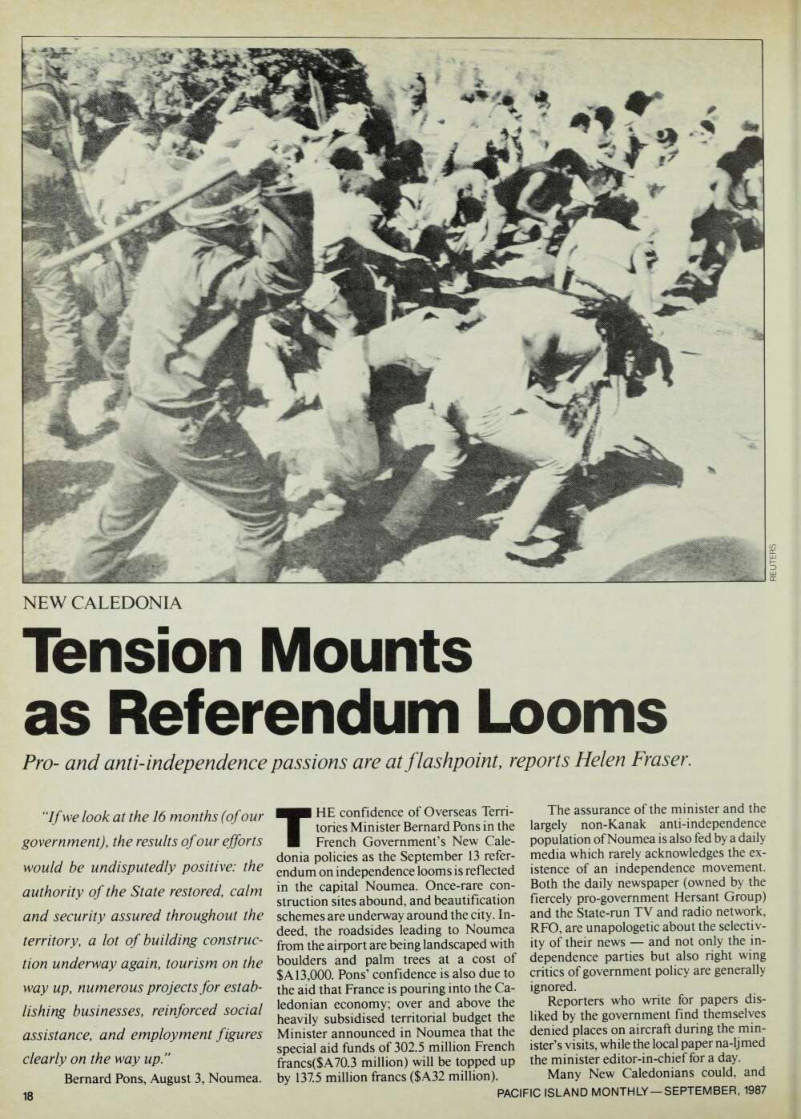
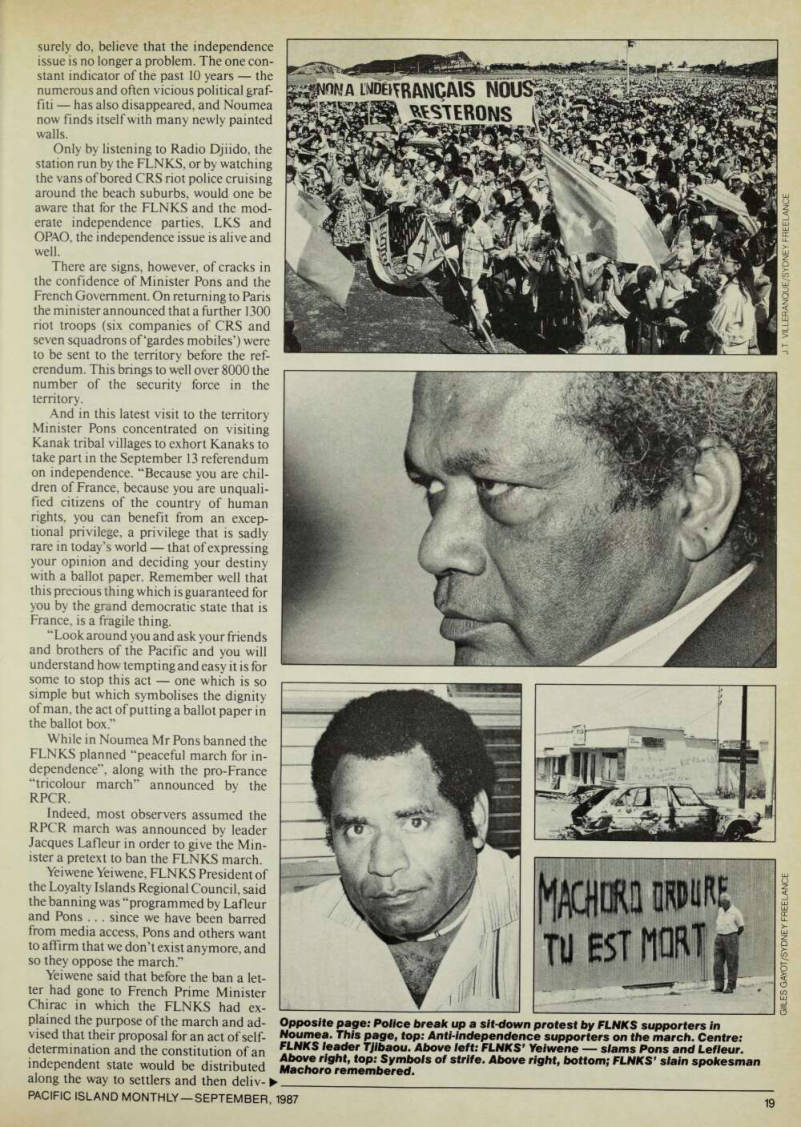
Opposite page: Police break up a sit-down protest by FLNKS supporters in Noumea. This page, top: Anti-independence supporters on the march. Centre: FLNKS leader Tjibaou. Above left: FLNKS' Yeiwene slams Pons and Lefleur.
Above right, top: Symbols of strife. Above right, bottom; FLNKS' slain spokesman Machoro remembered.
◄ ered in Noumea to the French High Com missioner. The letter gave assurances that security measures would be taken by the FLNKS to avoid incidents or provocation.
Yeiwene also cited the pledge signed by each militant who was to take part in the march, which demands strict obedience to FLNKS orders: no alcohol, drugs or other stimulants, and acceptance that provocation would not be answered.
Pierre Maresca, RPCR general-secre tary and member of the Southern Re gional Council, said the FLNKS wanted the march “because they can’t accept that things (the referendum) go ahead like that, without problems, because they know the results of this referendum will be difficult for them.” Maresca said he was certain that without pressure from the FLNKS, Me
lanesian participation in the poll would be massive.
He said the referendum will prove the futility of the Kanak independence cause.
“The FLNKS has the certitude now that it has no serious support in France, even amongst the Socialists. The Socialists I’ve met in France recently have all said that Kanak independence is an illusion. Apart from the Communist Party they have no political support. There is no possibility within the French Constitution that the Kanaks will obtain independence.”
Maresca said the RPCR and the min ister hoped that after the referendum the FLNKS would take part in the discussion on the new statute of autonomy: “The FLNKS has a following a minority, but a significant one. It’s sure that the system
we will put in place will be regionally based and the FLNKS will be able to get expe rience of management in the regions it will control.”
The immediate focus of all anti-inde pendence groups and parties is, however, on securing as high a participation rate as possible in the September 13 referendum.
Initially confident the poll would attract a participation rate of 60 per cent, the RPCR has looked at the figures again and been wary of such a prediction.
Speaking to reporters during his visit, Bernard Pons claimed that normal ab stentions in the territory were in the order of 30 to 40 per cent. He warned the inde pendence movement that the abstention figure “would have no political signifi cance at all”. □
Advertisements & other items, pp. 18-19 (2 items)
18
PACIFIC ISLAND MONTHLY —SEPTEMBER, 1987
19
PACIFIC ISLAND MONTHLY —SEPTEMBER, 1987
Thio in the Spotlight
For both pro-and anti-independ ence forces the south east coast mining town of Thio is a symbol; for the FLNKS the town represents the strong hold of the 1984 campaign to disrupt the territorial elections and to destabilise the countryside. It was the base of mil itant leader Eloi Machoro who kept the town under seige for three weeks, and who was killed in 1985 by French troops. For the loyalists Thio is the “martyr municipality” as Bernard Pons described it during a brief visit to the town in August.
The FLNKS gained control of the municipality of 3000 (of whom about 2,500 are Kanak) in 1985 and Mayor Louis Maperi said his priorities in the period since have been on basic social needs for Kanaks of health, education, housing, roads and running water. Ma jor problems, Maperi said, are juvenile delinquency, alcoholism and drug taking.
Measures undertaken by Maperi in clude the training of paramedics in each tribal village as part of a preventative medicine campaign, the establishment of a technical advisory body for the im provement of housing with tribes, con tinuing towards the total electrification of the municipality, and the setting up of small-scale agricultural and live stock production by Kanak villagers.
Where the SLN nickel company is con cerned demands for increased employ ment of Kanaks in the Thio mining centre have been met to a degree, and pollution control is being addressed.
Kanaks and Wallisians have set up a successful trucking company in the town that services the SLN.
But Maperi points out that there is “almost no contact between races here at Thio”. When Overseas Territories Minister Pons visited Thio, Maperi boycotted the ceremonies, and he de
dared that on the day of the referen dum, “I’ll go fishing.” He predicts that results in Thio will reflect the same level of support for the pro-and anti-inde pendence parties that existed in the council elections of 1985.
Thio’s deputy mayor, Jacques Lo quet, did attend the reception for Ber nard Pons. A European who works at the SLN company, Loquet is also a member of the FLNKS and devoted considerable time and effort to the FLNKS campaign in Thio of 1984-85.
In his speech to the minister, Loquets called for “respect for the right to be different” in Thio, “despite the diffi culties ahead”, and said he hoped the day of the minister’s visit would give to all the population a message of peace and tolerance.
“Each person must understand that the future of this territory must first come through the cohabitation of
members of the population. The search for ways to live together is an old theme that is often expressed but rarely ap plied. .. we are convinced that Thio will outdo itself in this regard as it has al ways done there are many people of goodwill here, many more than people believe.” Loquet concluded with “Vive Thio, Vive France” which surprised many in the territory and drew com ment in the local media. “But I didn’t say Vive Caledonie Francaise,” Loquet stressed.
“Two years ago I would never have said such a thing, but here I think we’re in a crisis situation. Instead of hiding behind a tree and leaving the ground free, I decided to come out and say something. But also to show the Cale donian population that despite the dif ference of ideas amongst us, that I am an elected official at the service of all administrations.”
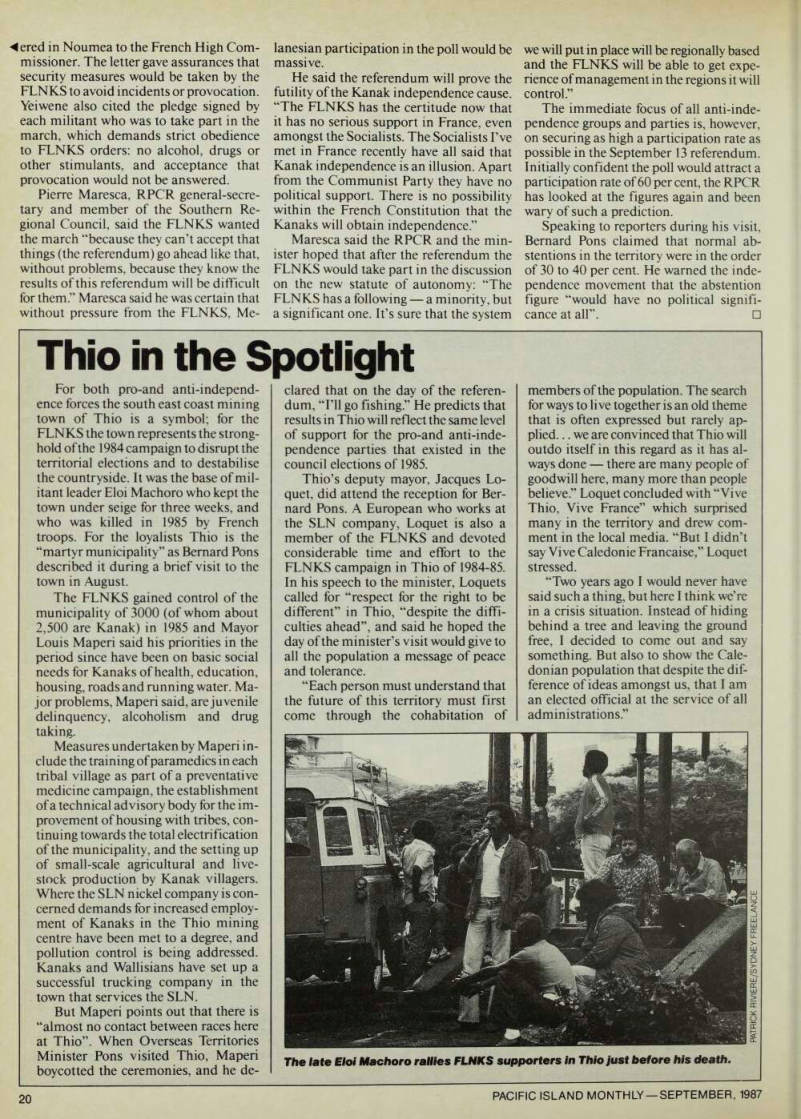
The late Elol Machoro rallies FLNKS supporters in Thio just before his death.
Advertisements & other items, p. 20 (1 item)
20
PACIFIC ISLAND MONTHLY —SEPTEMBER, 1987
The French Viewpoint
New Caledonia Referendum
The French Minister of Overseas Territories , BERNARD PONS, explains his government case in the run-up to the crucial independence referendum.
IN its population of 145,000, New Ca ledonia has four major ethnic groups - Melanesian, European, Polynesian and Asiatic. The Melanesians represent 43 per cent of the population, the Europeans 38 per cent and the Polynesians 12 per cent.
But this simple demographic breakdown in no way portrays the extroardinary melt ing pot of cultures and races that makes up the New Caledonia of today. Over several generations these different races have mixed and inter-married. What’s more, according to census regulations, each adult has the right to choose his or her ethnic or igin with little regard to the exact nature of his or her racial background. As a result, today’s New Caledonia can only be de scribed as a multi-racial mosaic of people.
For each 100 inhabitants, today, 77 were born in New Caledonia, 17 were born in Metropolitan France or in its overseas de partments or territories and six were born in foreign countries. Mixed marriages are comparatively frequent 12 per cent in the Melanesian Community, T 9 per cent in the European one and the proportion of illegitimate birth is very high; 47 per cent in New Caledonia is the largest of the three French overseas territories located in the Pacific Ocean.
The “Grande Terre” or main island stretches more than 400 kms from north to south. With its dependencies, such as the Loyalty Islands, Belep, Huon, Ches terfield and the Isle of Pines, it covers a total land area of some 19,000 square kms.
The population density is not only very low (less than eight inhabitants per square kil ometre) but also unevenly distributed. For example, the capital Noumea has 1431 in habitants per square kilometre compared to four per square kilometre in the Centre region and seven per square kilometre in the Loyalty Islands.
Almost half of the Melanesian popu lation lives in town while the rest resides in the country on untitled land. All of the surrounding islands are the property of the Melanesian people and are administered by common law. Twenty-eight Melane sian dialects, each one different from the rest, are practised in New Caledonia. The common French language serves as com munication between these diverse linguis tic groups.
To reduce the New Caledonian situa tion to Kanaks versus non-Kanaks cannot possibly represent the true diversity of races to be found in this territory. In ad dition to this fact, election results have
adequately demonstrated that not all Me lanesians share the views of the FLNKS independence movement. Two of New Caledonia’s three elected representatives in the French National Parliament are Melanesian. These two representatives Senator Dick Ukeiwe, who is also Presi dent of the New Caledonia Congress and Maurice Nenou, MP are both members of the political party headed by French Prime Minister Jacques Chirac. Also, at the Congress the new Caledonian Ter ritorial Assembly a majority of elected representatives and Melanesians (28 out of a total of 46), coming from all political parties.
New Caledonia is divided into four Re gions (North, Centre, South, Loyalty Is lands, which administer themselves freely through Regional Councils elected by di rect universal suffrage with proportional representations. Each region has an exec utive committee elected from among the member of its Council. The Chairman of the Regional Council is the Head of Ad ministration of the Region. These terri torial collectivities with specialised functions are responsible for cultural ac tivities, local cultures and vernacular lan guages, natural improvements within the regional boundaries and local economic development activities. They also define
their fundamental aims as regards to de velopment, advancement of the popula tion, exploitation of natural resources and environmental protection. The Regional Council adopts the budget of the Region.
The Congress of the Territory, consist ing of the members of the four Regional Councils, is responsible for primary edu cation, health and social welfare, housing, youth and sports, as well as vocational and in-service training. It adopts the Territo ry’s budget. In the areas where it shares re sponsibility with the French State, the Congress obtains extended powers in the fields of taxation, rural development and land improvement, labour laws and eco nomic development.
The executive of the Territory is pres ently embodied in the French Govern ment Delegate, High Commissioner in New Caledonia and Dependencies. He is assisted by an Executive Council chaired by the President of the Congress and con sisting of the Chairmen of the four Re gional Councils, which has an advisory role only. The statute will of course fully confer the executive power upon elected representatives.
As a democratic country, New Cale donia will abide by the principle of “one man, one vote” at the forthcoming refer-
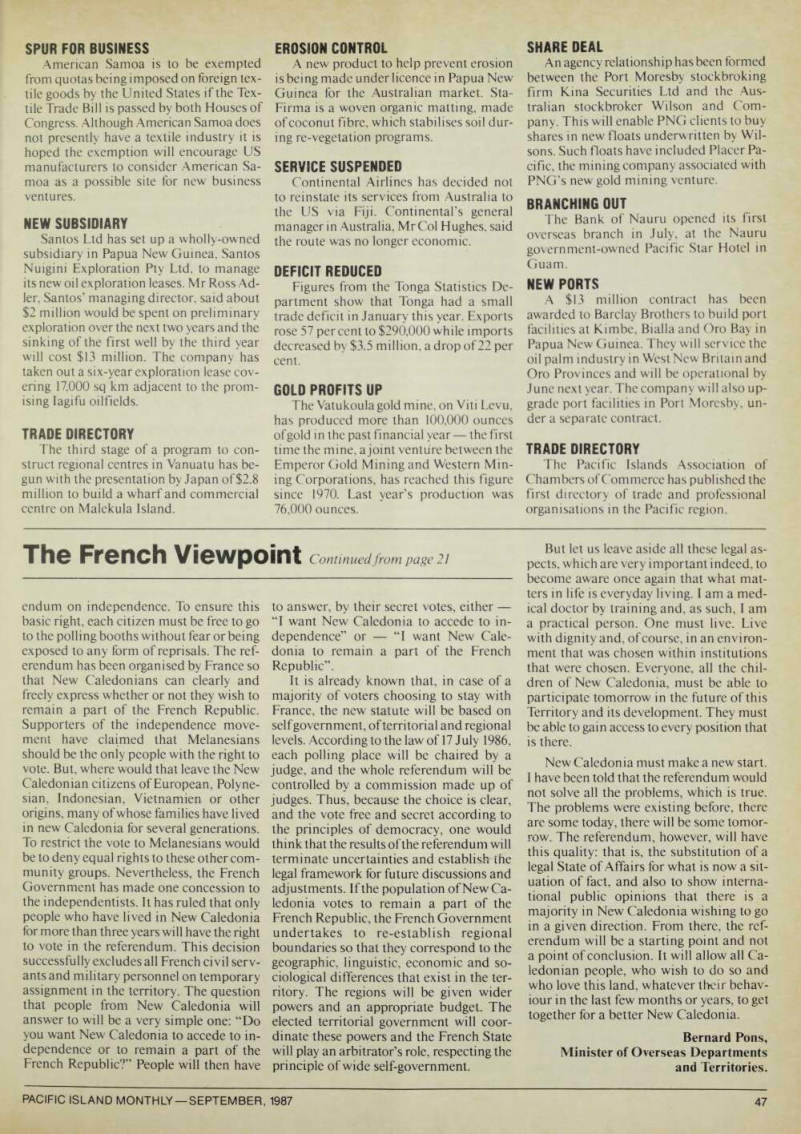
Continued from page 47
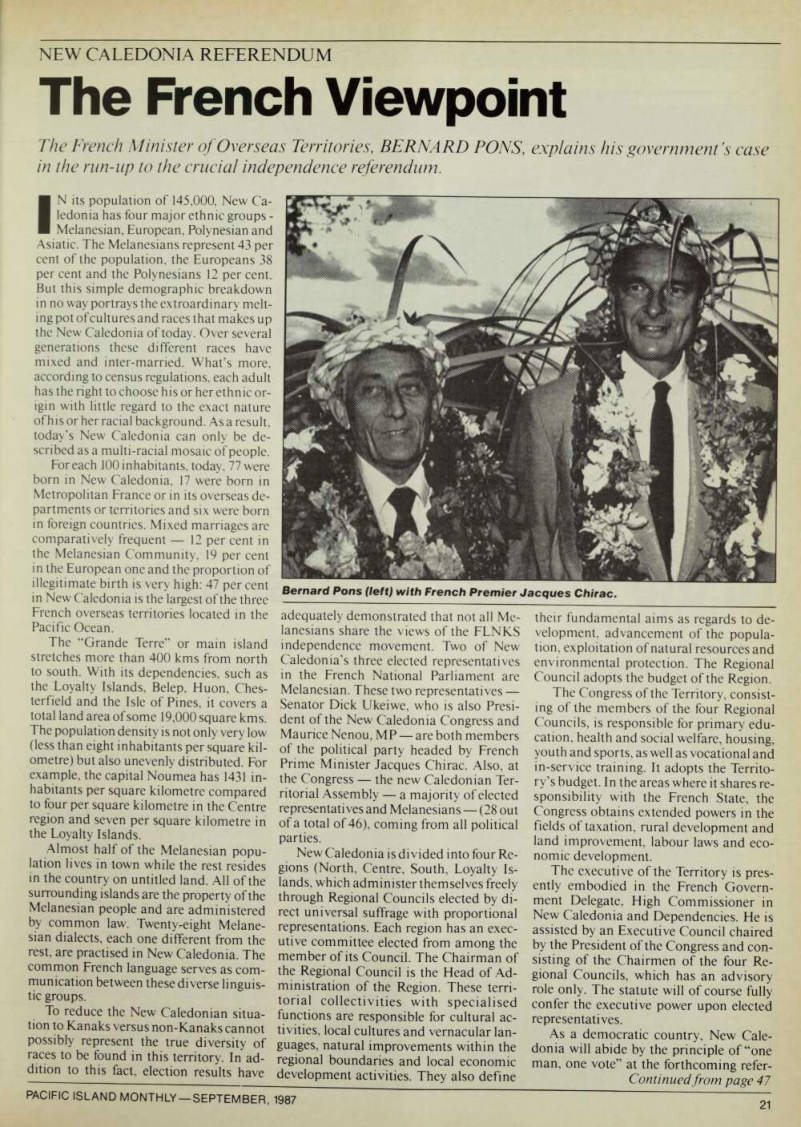
Bernard Pons (left) with French Premier Jacques Chirac.
endum on independence. To ensure this basic right, each citizen must be free to go to the polling booths without fear or being exposed to any form of reprisals. The ref erendum has been organised by France so that New Caledonians can clearly and freely express whether or not they wish to remain a part of the French Republic.
Supporters of the independence move ment have claimed that Melanesians should be the only people with the right to vote. But, where would that leave the New Caledonian citizens of European, Polyne sian, Indonesian, Vietnamien or other origins, many of whose families have lived in new Caledonia for several generations.
To restrict the vote to Melanesians would be to deny equal rights to these other com munity groups. Nevertheless, the French Government has made one concession to the independentists. It has ruled that only people who have lived in New Caledonia for more than three years will have the right to vote in the referendum. This decision successfully excludes all French civil serv ants and military personnel on temporary assignment in the territory. The question that people from New Caledonia will answer to will be a very simple one: “Do you want New Caledonia to accede to in dependence or to remain a part of the French Republic?” People will then have
to answer, by their secret votes, either “I want New Caledonia to accede to in dependence” or ‘T want New Cale donia to remain a part of the French Republic”.
It is already known that, in case of a majority of voters choosing to stay with France, the new statute will be based on self government, of territorial and regional levels. According to the law of 17 July 1986, each polling place will be chaired by a judge, and the whole referendum will be controlled by a commission made up of judges. Thus, because the choice is clear, and the vote free and secret according to the principles of democracy, one would think that the results of the referendum will terminate uncertainties and establish the legal framework for future discussions and adjustments. If the population of New Ca ledonia votes to remain a part of the French Republic, the French Government undertakes to re-establish regional boundaries so that they correspond to the geographic, linguistic, economic and so ciological differences that exist in the ter ritory. The regions will be given wider powers and an appropriate budget. The elected territorial government will coor dinate these powers and the French State will play an arbitrator’s role, respecting the principle of wide self-government.
But let us leave aside all these legal as pects, which are very important indeed, to become aware once again that what mat ters in life is everyday living. I am a med ical doctor by training and, as such, I am a practical person. One must live. Live with dignity and, of course, in an environ ment that was chosen within institutions that were chosen. Everyone, all the chil dren of New Caledonia, must be able to participate tomorrow in the future of this Territory and its development. They must be able to gain access to every position that is there.
New Caledonia must make a new start.
I have been told that the referendum would not solve all the problems, which is true.
The problems were existing before, there are some today, there will be some tomor row. The referendum, however, will have this quality: that is, the substitution of a legal State of Affairs for what is now a sit uation of fact, and also to show interna tional public opinions that there is a majority in New Caledonia wishing to go in a given direction. From there, the ref erendum will be a starting point and not a point of conclusion. It will allow all Ca ledonian people, who wish to do so and who love this land, whatever their behav iour in the last few months or years, to get together for a better New Caledonia.
Bernard Pons,
Minister of Overseas Departments and Territories.
Advertisements & other items, p. 21 (1 item)
21
PACIFIC ISLAND MONTHLY —SEPTEMBER, 1987
At the Political Crossroads
T
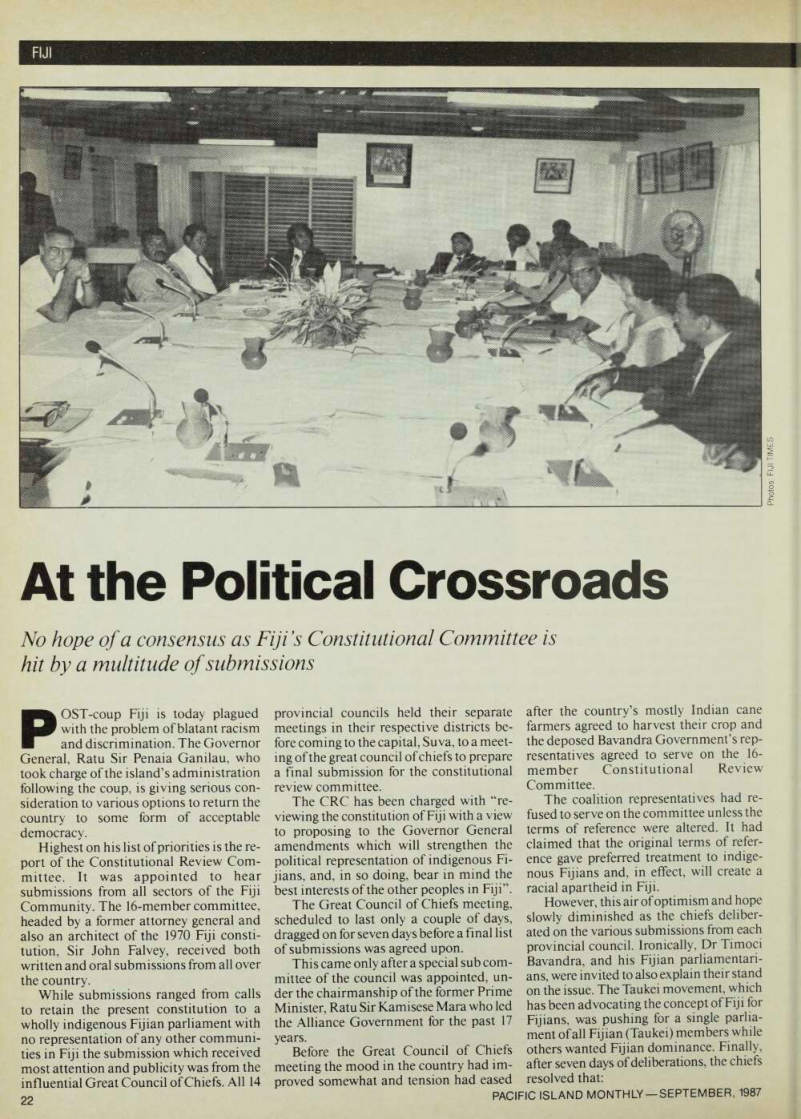
No hope of a consensus as Fiji’s Constitutional Committee is hit by a multitude of submissions
POST-coup Fiji is today plagued with the problem of blatant racism and discrimination. The Governor General, Ratu Sir Penaia Ganilau, who took charge of the island’s administration following the coup, is giving serious con sideration to various options to return the country to some form of acceptable democracy.
Highest on his list of priorities is the re port of the Constitutional Review Com mittee. It was appointed to hear submissions from all sectors of the Fiji Community. The 16-member committee, headed by a former attorney general and also an architect of the 1970 Fiji consti tution, Sir John Falvey, received both written and oral submissions from all over the country.
While submissions ranged from calls to retain the present constitution to a wholly indigenous Fijian parliament with no representation of any other communi ties in Fiji the submission which received most attention and publicity was from the influential Great Council of Chiefs. All 14
provincial councils held their separate meetings in their respective districts be fore coming to the capital, Suva, to a meet ing of the great council of chiefs to prepare a final submission for the constitutional review committee.
The CRC has been charged with “re viewing the constitution of Fiji with a view to proposing to the Governor General amendments which will strengthen the political representation of indigenous Fi jians, and, in so doing, bear in mind the best interests of the other peoples in Fiji”.
The Great Council of Chiefs meeting, scheduled to last only a couple of days, dragged on for seven days before a final list of submissions was agreed upon.
This came only after a special sub com mittee of the council was appointed, un der the chairmanship of the former Prime Minister, Ratu Sir Kamisese Mara who led the Alliance Government for the past 17 years.
Before the Great Council of Chiefs meeting the mood in the country had im proved somewhat and tension had eased
after the country’s mostly Indian cane farmers agreed to harvest their crop and the deposed Bavandra Government’s rep resentatives agreed to serve on the 16member Constitutional Review Committee.
The coalition representatives had re fused to serve on the committee unless the terms of reference were altered. It had claimed that the original terms of refer ence gave preferred treatment to indige nous Fijians and, in effect, will create a racial apartheid in Fiji.
However, this air of optimism and hope slowly diminished as the chiefs deliber ated on the various submissions from each provincial council. Ironically, Dr Timoci Bavandra, and his Fijian parliamentari ans, were invited to also explain their stand on the issue. The Taukei movement, which has been advocating the concept of Fiji for Fijians, was pushing for a single parlia ment of all Fijian (Taukei) members while others wanted Fijian dominance. Finally, after seven days of deliberations, the chiefs resolved that:
• There will be a 71-member, single chamber Parliament. It will be made up of 40 Fijians (an increase of 18 members from present 22), 22 Indians, as at pres ent (four must be Muslims), one Rou tuman and eight General Electors, as at present, but now must include a repre sentative of Rabi Council. The 14 Prov incial Councils will nominate 28 Fijian members to the House, the Great Coun cil of Chiefs to nominate eight and the Prime Minister to nominate four mem bers of his own choice to Parliament. • The Senate to be abolished. • Christianity is to be the foundation of the nation. • Fiji to remain a sovereign democratic state (the Taukei movement had been demanding a republic). • The Governor General be appointed by the Queen, on the advice of the Great Council of Chiefs, and not the Prime Minister, as at present and the term shall be for five years. • The appointment of an acting Governor General be on the advice of the Great Council of Chiefs, not the Chief Justice, as at present. • The speaker, and his deputy, to be ap pointed by the Govenor General from outside the House of Representative, on the advice of the Prime Minister and the Leader of the Opposition. • The Prime Minister to be a Fijian to be elected from Fijian members of Parliament. • The Prime Minister to select his own Cabinet. • Four ministerial portfolios to be re served for Fijians: Home Affairs, Fijian Affairs, Foreign Affairs and Finance Industry. • Not less than 50 per cent of public of fices to be held by Fijians. • Return the proprietary interests of the basic resources in Fiji from the Crown to the landowners. • Fijian customary laws be recognised as laws of Fiji. • Relaxing the discriminatory laws to al low the making of laws beneficial to Fijians. • The Fijian court to be included in the judiciary. • On procedures in legislation, royal as sent is needed, and in the case of a de cision by simple majority and on protecting Fijian interests, six out of the eight chiefs’ nominees must approve the Governor General to have powers of amnesty.
• Of the 40 Fijian members four will be nominated by the Prime Minister, eight by the Great Council of Chiefs and 28 will be elected by the 14 Provincial Councils.
This, in effect, means that the Fijians will not participate in general elections as at present but will go through their Tikina (district) councils for final selection of members by the provincial councils.
The cross voting system which came into effect after the 1970 Constitution will be abolished and the 22 Indian and eight General Elector seats will be contested on a communal system of voting. The con stituencies will be redefined.
In announcing the chiefs’ submissions, the Adviser on Fijian Affairs, Ratu Josua Toganivalu, who had chaired the meeting, said the compromise was reached by consensus.
Reacting to the final list of submis sions, a spokesman of the Tauki move ment, Ratu Meli Vesikula, said: “We had asked for 100 per cent and look what we ended up with.”
Ratu Meli said they were not particu larly happy because “our aim was the total abolition of the present constitution as it had proved harmful to the Fijians over the past 17 years”.
“But it’s a start and we hope we will fi nally get what we want. And the only way to get it is to declare Fiji a republic,” he said.
Dr Tupeni Baba, the ousted Minister for Education in the short-lived Bavandra Government, said it was a “selling out” of the Fijian people.
Dr Baba said: “Under the proposals put forward by the chiefs the Fijian people will be disenfranchised because Fijian mem bers of parliament will be selected through
the traditional process of consensus by the provincial councils.”
He said that a number of educated, progressive Fijians will not live under the system. He warned that there will be mas sive flight of educated and professional Fijians from Fiji.
Dr Baba said the move was a “regres sive” step and was designed to keep the “Fijian backward and segregate him from society and modern forces which he can’t get away from”.
He described the proposal of taking away the right of vote from the Fijians as a major blow to the process of political, so cial and economic integration of the Fijian with other races.
The labour-NFP Coalition, in its sub missions to the constitutional review committee, said the present constitution had served the country and its people well.
It adequately protected the rights and in terests of Fijians through specific provi sions and also protected the rights of other minorities and, also, of the Indians.
The coalition said it was necessary, first, to determine whether there was a need to review the constitution which had worked well for the past 17 years. It asked whether the country “had been forced to review the constitution by a radical mi nority who have enlisted the army to fur ther their narrow interests?”
Besides submissions from the Council of Chiefs and the Labour/NFP Coalition the CRC received a total of 800 submis sions from people from all walks of life.
The committee was given extra time to prepare its final report. Initially the Gov ernor General had charged the committee to have its final report handed in to him by the end of July but by the middle of Au gust it had only reached the draft stage.
In appointing the 16-member commit- ►
Facing page: The Constitutional Review Committee in session. Below: Sir John Falvey, chairman of the committee .. . “wishful thinking to expect a single report
◄tee the Governor General had urged them to arrive at a consensus in their final re port and recommendations. However, the committee’s membership is so divergent, and the views so far apart, that there is no hope of a single report based on consensus.
The Governor General has four nom inees on the committee who are generally seen as moderates, the Great Council of Chiefs also has four representatives, in cluding Colonel Rabuka, and the former prime minister’s nominees include Mr Apisai Tora and Mr Taniela Veitata who
are seen as radicals. The other four nom inees are of the Bavandra.
The chairman Sir John Falvey agreed that with such a group it was wishful thinking to expect a single report. He said the coalition side was likely to present a minority report because there were major disagreements between the various sides.
Observers in Suva say this will create a major headache for the Governor General and could prove to be a major stumbling block in his efforts to restore democracy in the country. □
Advertisements & other items, pp. 22-23 (2 items)
22
PACIFIC ISLAND MONTHLY —SEPTEMBER, 1987
23
PACIFIC ISLAND MONTHLY —SEPTEMBER, 1987
Muslims in Crossfire
And the row is far from over!
MUSLIMS in Fiji, who make up eight per cent of Fiji’s population of 700,000, or 17 per cent of the 350,000 Indian population, have become embroiled in Fiji’s political crisis.
The Muslims, who now number some 60,000, came to Fiji as Indians in the 1800 s and early this century as indentured la bourers from India.
At present there are no separate seats for Muslims in Fiji and 22 seats in parlia ment are for Indians, be they Hindus, Muslims, Punjabis or Sikhs. There is no distinction on religious grounds or allo cation on seats according to anyone’s faith.
But the submission by the Great Coun cil of Chiefs to the Constitutional Review Committee calls specifically for four of the 22 seats allocated to Indians to be kept separate for Muslims.
This has been seen in Fiji, by political observers and especially Indian leaders, as a device by the Fijians, and in partic ular the Taukei movement, to split the In dians along religious lines.
But no one was aware that the Fiji Mus lim League, the largest organisation in Fiji which represents Muslims in its submis sion to the Constitutional Review Com mittee, had supported the Council of Chiefs proposal for Fijian dominance in Parliament and if the declaration of a re public was the only solution to the coun try’s political crisis it would also support such a move.
The submission was signed only by its president, Mr Sherani, its secretary and treasurer. There was no official discussion or a referendum held among the Muslims on the issue. Mr Sherani said the submis sion was for “all those who believed in the prophet Mohammed”.
Political pundits see the Muslims sup port for increased Fijian representation in parliament as a trade-off for reserved seats for themselves in parliament. But this view is not popular. A sizeable proportion of Muslims are against the stand taken by the League president and the other two oflfi
dais. Similarly, other smaller organisa tions which represent Muslims have disociated themselves from the League’s submission.
A row has now developed within the ranks of the League members who have formed a movement to protest against the submission.
The Muslims in Fiji have been press ing for separate representation since 1929.
At the 1970 Constitutional Conference a strong plea was made for reserved Muslim seats in parliament but Mr Siddiq Koya who led the delegation on behalf of the Na tional Federation Party, which repre sented the Indians, was totally opposed to the idea. Mr Koya, himself a Muslim, said such a move would undoubtedly divide the Indians.
Not having separate seats in parlia ment has not meant that there have been no Muslims in parliament. Mr Koya was Leader of the Opposition for a long time and there were at least three Muslim members on the opposition bench. Simi larly, the government side was not short of Muslims either and in the defeated Mara Government the only Indian cabinet min isters were Muslims, Dr Ahmed Ali and Mr Mohammed Ramzan. In the deposed Bavandra government, of the 18 Indian members three were Muslims.
The Fiji Muslim League held its an nual general meeting at the end of the week, its submissions to the Constitutional Re view Committee were exposed and the president’s post was up for election.
Delegates converged from all over the country and were all geared to take Mr Sherani (who was re-elected President) to task on the issue of their support for sep arate seats and support for Fijian dominance.
But, ironically, it was Mr Koya who chaired the meeting and he blocked any discussion because the issue was not on the agenda.
The row is obviously far from over as far as the Muslims are concerned! □
Advertisements & other items, p. 24 (1 item)
Director
FORUM FISHERIES AGENCY
DEPUTY
Applications are invited for the position of Deputy Director, South Pacific Forum Fisheries Agency (FFA) from nationals of the following FFA member countries: Australia, Cook Islands, Federated States of Micronesia, Fiji, Kiribati, Marshall Islands, Nauru, New Zealand, Niue, Palau, Papua New Guinea, Solomon Islands, Tonga, Tuvalu, Vanuatu and Western Samoa.
The FFA is a regional organisation based in Honiara, Solomon Islands, it was established to coordinate regional fisheries policies and to promote the development of fisheries resources to ensure that maximum benefits are achieved by the people of the region from their fisheries resources.
The Deputy Director will be responsible to the Director for the conduct of the Agency’s technical and professional activities including the execution of regional development projects, information collection, analysis and dissemination and the provision of technical economic and legal advisory services.
Applicants should have appropriate academic qualification in a fisheries discipline; experience in fisheries management and development: the ability to provide technical direction to a small multidisciplinary team; skills in financial and executive management: and commitment to the aspirations of Pacific Island Countries.
The appointee will be based in Honiara but will be required to travel within the South Pacific Region. A tax free salary at a regional level will apply with attractive provisions for transportation, housing, child and educational allowances: recreational leave and superannuation.
Further information can be obtained from the address below. Applications should include the names of three referees.
Applications should be addressed to:
The Chairman,
Forum Fisheries Committee
Ministry of Foreign Affairs,
SUVA,
Fiji
The closing date for applications is 30 September 1987.
Silent Majority Voice
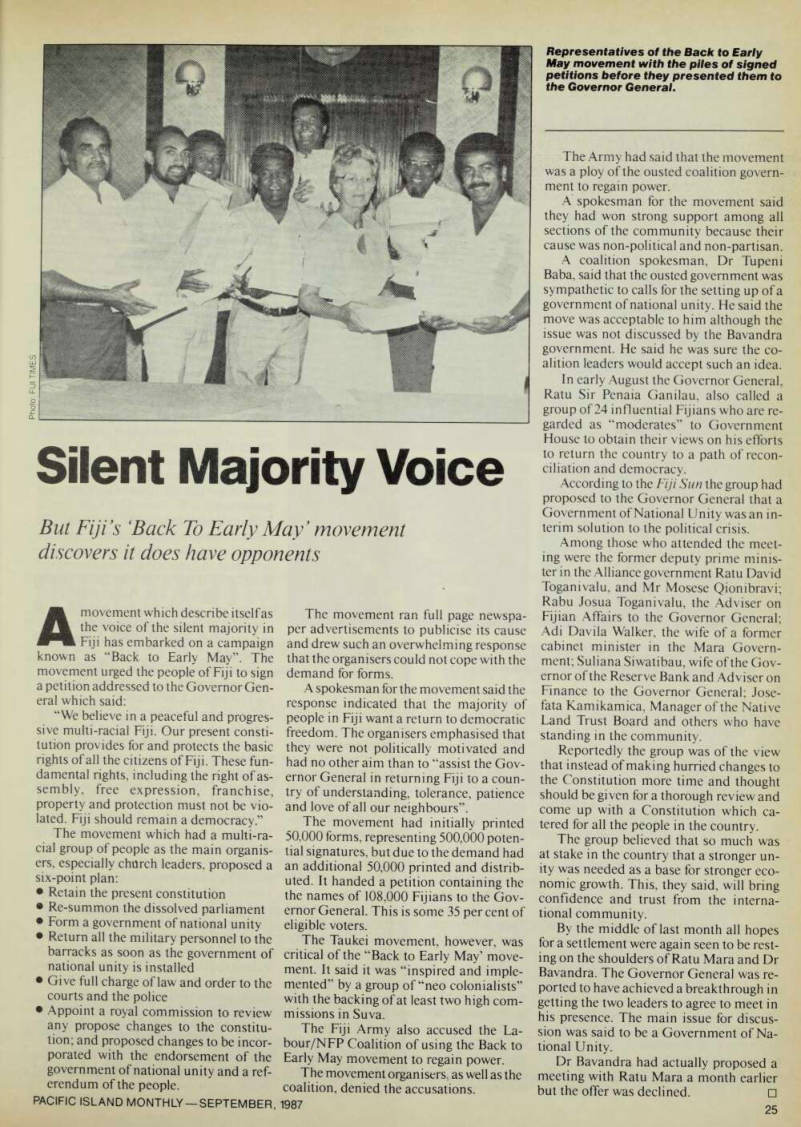
But Fiji’s ‘Back To Early May’ movement discovers it does have opponents
A movement which describe itself as the voice of the silent majority in Fiji has embarked on a campaign known as “Back to Early May”. The movement urged the people of Fiji to sign a petition addressed to the Governor Gen eral which said: “We believe in a peaceful and progres sive multi-racial Fiji. Our present consti tution provides for and protects the basic rights of all the citizens of Fiji. These fun damental rights, including the right of as sembly, free expression, franchise, property and protection must not be vio lated. Fiji should remain a democracy.”
The movement which had a multi-ra cial group of people as the main organis ers, especially church leaders, proposed a six-point plan: • Retain the present constitution • Re-summon the dissolved parliament • Form a government of national unity • Return all the military personnel to the barracks as soon as the government of national unity is installed • Give full charge of law and order to the courts and the police • Appoint a royal commission to review any propose changes to the constitu tion; and proposed changes to be incor porated with the endorsement of the government of national unity and a ref erendum of the people.
The movement ran full page newspa per advertisements to publicise its cause and drew such an overwhelming response that the organisers could not cope with the demand for forms.
A spokesman for the movement said the response indicated that the majority of people in Fiji want a return to democratic freedom. The organisers emphasised that they were not politically motivated and had no other aim than to “assist the Gov ernor General in returning Fiji to a coun try of understanding, tolerance, patience and love of all our neighbours”.
The movement had initially printed 50,000 forms, representing 500,000 poten tial signatures, but due to the demand had an additional 50,000 printed and distrib uted. It handed a petition containing the the names of 108,000 Fijians to the Gov ernor General. This is some 35 per cent of eligible voters.
The Taukei movement, however, was critical of the “Back to Early May’ move ment. It said it was “inspired and imple mented” by a group of “neo colonialists” with the backing of at least two high com missions in Suva.
The Fiji Army also accused the La bour/NFP Coalition of using the Back to Early May movement to regain power.
The movement organisers, as well as the coalition, denied the accusations.
The Army had said that the movement was a ploy of the ousted coalition govern ment to regain power.
A spokesman for the movement said they had won strong support among all sections of the community because their cause was non-political and non-partisan.
A coalition spokesman, Dr Tupeni Baba, said that the ousted government was sympathetic to calls for the setting up of a government of national unity. He said the move was acceptable to him although the issue was not discussed by the Bavandra government. He said he was sure the co alition leaders would accept such an idea.
In early August the Governor General, Ratu Sir Penaia Ganilau, also called a group of 24 influential Fijians who are re garded as “moderates” to Government House to obtain their views on his efforts to return the country to a path of recon ciliation and democracy.
According to the Fiji Sun the group had proposed to the Governor General that a Government of National Unity was an in terim solution to the political crisis.
Among those who attended the meet ing were the former deputy prime minis ter in the Alliance government Ratu David Toganivalu, and Mr Mosese Qionibravi; Rabu Josua Toganivalu, the Adviser on Fijian Affairs to the Governor General; Adi Davila Walker, the wife of a former cabinet minister in the Mara Govern ment; Suliana Siwatibau, wife of the Gov ernor of the Reserve Bank and Adviser on Finance to the Governor General; Jose fata Kamikamica, Manager of the Native Land Trust Board and others who have standing in the community.
Reportedly the group was of the view that instead of making hurried changes to the Constitution more time and thought should be given for a thorough review and come up with a Constitution which ca tered for all the people in the country.
The group believed that so much was at stake in the country that a stronger un ity was needed as a base for stronger eco nomic growth. This, they said, will bring confidence and trust from the interna tional community.
By the middle of last month all hopes for a settlement were again seen to be rest ing on the shoulders of Ratu Mara and Dr Bavandra. The Governor General was re ported to have achieved a breakthrough in getting the two leaders to agree to meet in his presence. The main issue for discus sion was said to be a Government of Na tional Unity.
Dr Bavandra had actually proposed a meeting with Ratu Mara a month earlier but the offer was declined. □
Representatives of the Back to Early May movement with the piles of signed petitions before they presented them to the Governor General.
Advertisements & other items, p. 25 (1 item)
25
PACIFIC ISLAND MONTHLY —SEPTEMBER, 1987
Royal Visit to Atomic Atoll
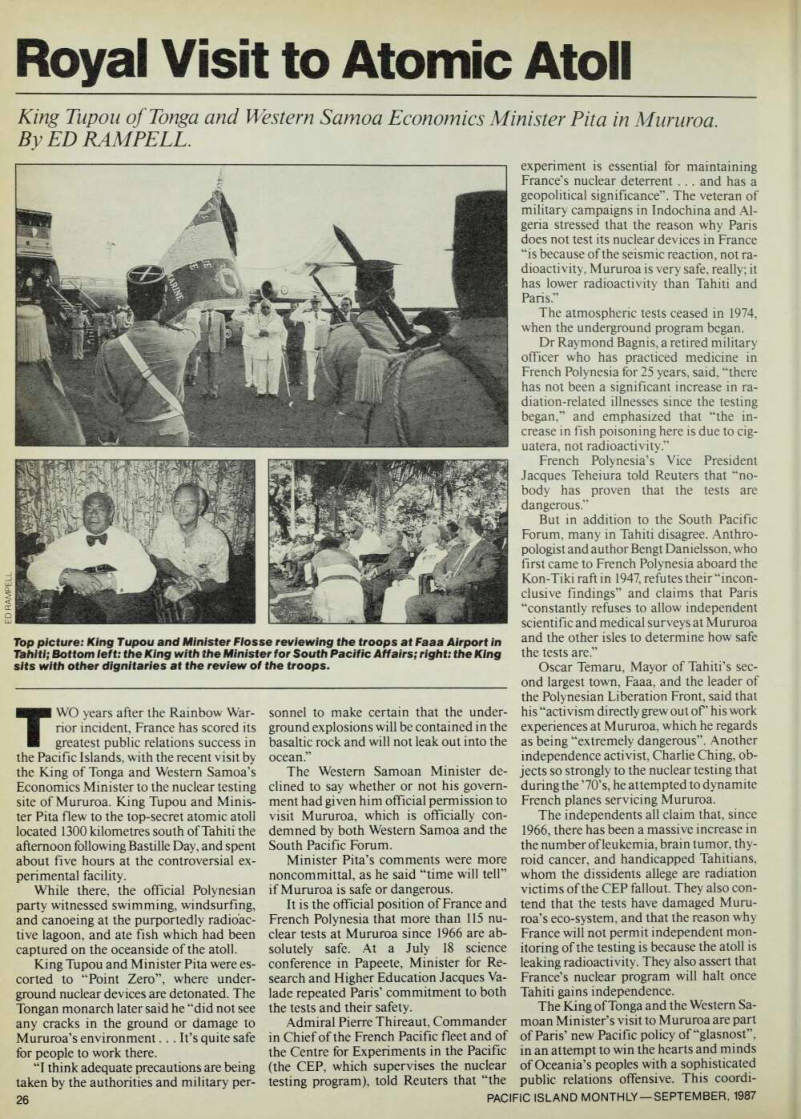
King Tupou of Tonga and Western Samoa Economics Minister Pita in Mururoa.
By Edrampell.
TWO years after the Rainbow War rior incident, France has scored its greatest public relations success in the Pacific Islands, with the recent visit by the King of Tonga and Western Samoa’s Economics Minister to the nuclear testing site of Mururoa. King Tupou and Minis ter Pita flew to the top-secret atomic atoll located 1300 kilometres south of Tahiti the afternoon following Bastille Day, and spent about five hours at the controversial ex perimental facility.
While there, the official Polynesian party witnessed swimming, windsurfing, and canoeing at the purportedly radioac tive lagoon, and ate fish which had been captured on the oceanside of the atoll.
King Tupou and Minister Pita were es corted to “Point Zero”, where under ground nuclear devices are detonated. The Tongan monarch later said he “did not see any cracks in the ground or damage to Mururoa’s environment. . . It’s quite safe for people to work there.
“I think adequate precautions are being taken by the authorities and military per
sonnel to make certain that the under ground explosions will be contained in the basaltic rock and will not leak out into the ocean.”
The Western Samoan Minister de clined to say whether or not his govern ment had given him official permission to visit Mururoa, which is officially con demned by both Western Samoa and the South Pacific Forum.
Minister Pita’s comments were more noncommittal, as he said “time will tell” if Mururoa is safe or dangerous.
It is the official position of France and French Polynesia that more than 115 nu clear tests at Mururoa since 1966 are ab solutely safe. At a July 18 science conference in Papeete, Minister for Re search and Higher Education Jacques Va lade repeated Paris’ commitment to both the tests and their safety.
Admiral Pierre Thireaut, Commander in Chief of the French Pacific fleet and of the Centre for Experiments in the Pacific (the CEP, which supervises the nuclear testing program), told Reuters that “the
experiment is essential for maintaining France’s nuclear deterrent .. . and has a geopolitical significance”. The veteran of military campaigns in Indochina and Al geria stressed that the reason why Paris does not test its nuclear devices in France “is because of the seismic reaction, not ra dioactivity, Mururoa is very safe, really; it has lower radioactivity than Tahiti and Paris.”
The atmospheric tests ceased in 1974, when the underground program began.
Dr Raymond Bagnis, a retired military officer who has practiced medicine in French Polynesia for 25 years, said, “there has not been a significant increase in ra diation-related illnesses since the testing began,” and emphasized that “the in crease in fish poisoning here is due to cig uatera, not radioactivity.”
French Polynesia’s Vice President Jacques Teheiura told Reuters that “no body has proven that the tests are dangerous.”
But in addition to the South Pacific Forum, many in Tahiti disagree. Anthro pologist and author Bengt Danielsson, who first came to French Polynesia aboard the Kon-Tiki raft in 1947, refutes their “incon clusive findings” and claims that Paris “constantly refuses to allow independent scientific and medical surveys at Mururoa and the other isles to determine how safe the tests are.”
Oscar Temaru, Mayor of Tahiti’s sec ond largest town, Faaa, and the leader of the Polynesian Liberation Front, said that his “activism directly grew out of’ his work experiences at Mururoa, which he regards as being “extremely dangerous”. Another independence activist, Charlie Ching, ob jects so strongly to the nuclear testing that during the ’7o’s, he attempted to dynamite French planes servicing Mururoa.
The independents all claim that, since 1966, there has been a massive increase in the number of leukemia, brain tumor, thy roid cancer, and handicapped Tahitians, whom the dissidents allege are radiation victims of the CEP fallout. They also con tend that the tests have damaged Muru roa’s eco-system, and that the reason why France will not permit independent mon itoring of the testing is because the atoll is leaking radioactivity. They also assert that France’s nuclear program will halt once Tahiti gains independence.
The King of Tonga and the Western Sa moan Minister’s visit to Mururoa are part of Paris’ new Pacific policy of “glasnost”, in an attempt to win the hearts and minds of Oceania’s peoples with a sophisticated public relations offensive. This coordi
Top picture: King Tupou and Minister Flosse reviewing the troops at Faaa Airport in Tahiti; Bottom left: the King with the Minister for South Pacific Affairs; right: the King sits with other dignitaries at the review of the troops.
nated campaign is being launched on the diplomatic, scientific, cultural, economic, and education fronts.
This new openness and publicity strategy is being spearheaded by Prime Minister Jacques Chirac (who telephoned King Tupou at Huahine and facilitated His Majesty’s Mururoa sojourn) and long time French Polynesia politico Gaston Flosse, the former President of the Territorial Assembly and the current Minister of State for Pacific Affairs.
Minister Flosse is the first French cabinet minister of Polynesian ancestry, and he has been lobbying throughout Oceania on behalf of France and its Pacific policies. In addition to the almost universally condemned testing at Mururoa, France is concerned about the credibility of the upcoming referendum to be held in New Caledonia.
Paris is also worried that the South Paciflc Forum may try to place French Polynesia on the United Nation’s Decolonisation Committee’s list of nonself governing territories, as it has already done for New Caledonia.
France’s new Oceanic initiatives are especially aimed at influencing Western Samoa and Tonga, the current and future chairs of the Forum. In late June Western Samoa Prime Minister Vaai Kolone visited Tahiti on “Self-government Day”, and both Western Samoa and Tonga are bene-
fitting from a stepped-up aid program.
King Tupou declared that “as a result of this visit, France will help us more.”
But King Tupou said that Tonga will not sign the Forum’s Rarotonga Treaty, de clareing the South Pacific to be a vast nu clear free zone. His Royal Highness said that “The Forum speaks for the majority, but Tonga has its own ideas. We didn’t sign this anti-nuclear treaty because it seemed to us that it aimed at placing restrictions on only Western countries, because they have their warships in the Pacific. Other atomic powers don’t cross the Pacific; they travel from Vladivostok to Cam Ranh Bay, or along the coast of China. These coun tries aren’t restricted. On its own the treaty has already become ineffective.”
On other matters, King Tupou said that “Tonga will reserve its judgement of the referendum at New Caledonia until it is over.” The King also pronounced that “if I was Colonel Rabuka, I would have done the same thing, in order to save Fijian lives (from civil disorder)... I can understand why he did what he did. Tonga has its agents in Fiji monitoring the situation there.” The King declined an offer to meet with Mayor Temaru and the Tahitian opposition.
Faced with continuing challenges from abroad and inside its territories, France has resorted to this new policy of “glasnost” in an effort to win friends in the Islands. Un
der the surface changes aimed at perpet uating metropolitan rule, France continues the same colonial policies, from Noumea to Papeete to Mururoa. As such, these su perficial changes in form but not in content may be perceived as a policy of “GLOSS-nost”.
Part of France’s “glasnost” is a new openess with the foreign press. I received consistently hospitable and democratic treatment at Tahiti, in keeping with France’s traditions of freedom of the press.
Access was given to revolutionaries, admirals, government officials, techno crats, kings, high commissioners, dissi dents, and cabinet ministers alike. The only restrictions included a prohibition on a requested trip to Hao (where the Rain bow Warrior saboteurs are confined at a French military base), which the officials claim is part of an international agree ment barring journalists; plus a refusal to allow an independent scientist to accom pany an American TV team to Mururoa, although Minister Flosse said he’d per sonally intervene on behalf of the TV crew with the defence ministry in order facili tate their proposed Mururoa trip.
On the other hand, local journalists complain of a lack of objectivity and free dom in the French dominated media. Les Nouvelles is currently embroiled in a law suit with Minister Flosse, whom the paper accuses of being corrupt. □
Advertisements & other items, pp. 26-27 (3 items)
26
PACIFIC ISLAND MONTHLY —SEPTEMBER, 1987
27
PACIFIC ISLAND MONTHLY —SEPTEMBER, 1987
Settlers Cottages
-nJ lLlVMU U 11 k 14= g B
117 York St., Sydney.
Cables: Henco Sydney.
G.P.O. Box 3949.
Telephone: 261 1955.
For specialised and
personalised buying
service throughout the Pacific Islands and the East.
LOCAL AGENTS AND
REPRESENTATION
PAPUA NEW GUINEA
RABAUL: M. & C. Seeto, P.O. Box 131, Rabaul.
Telephone 92 2919.
FIJI
K. Witherington Ltd., P.O. Box 293, Suva.
Telephone 22 356.
VANUATU
John Lum & Associates, P.O. Box 65, Santo.
Telephone 329.
SETTLERS COTTAGES
TIMBER KIT HOMES
WITH FULL CYCLONE RATING
Handcrafted timber kit homes with full cyclone rating.
Several timber choices and only quality materials used.
Two-level loft designs or single level. Also cabins and lodges. Free brochures available.
Agents Enquiries Welcome
P.O. Box 1230, Coffs Harbour 2450
AUSTRALIA
Telephone: (066) 52 7377 Name: Address: Phone:
Tarawa’s Tabai Strikes Back
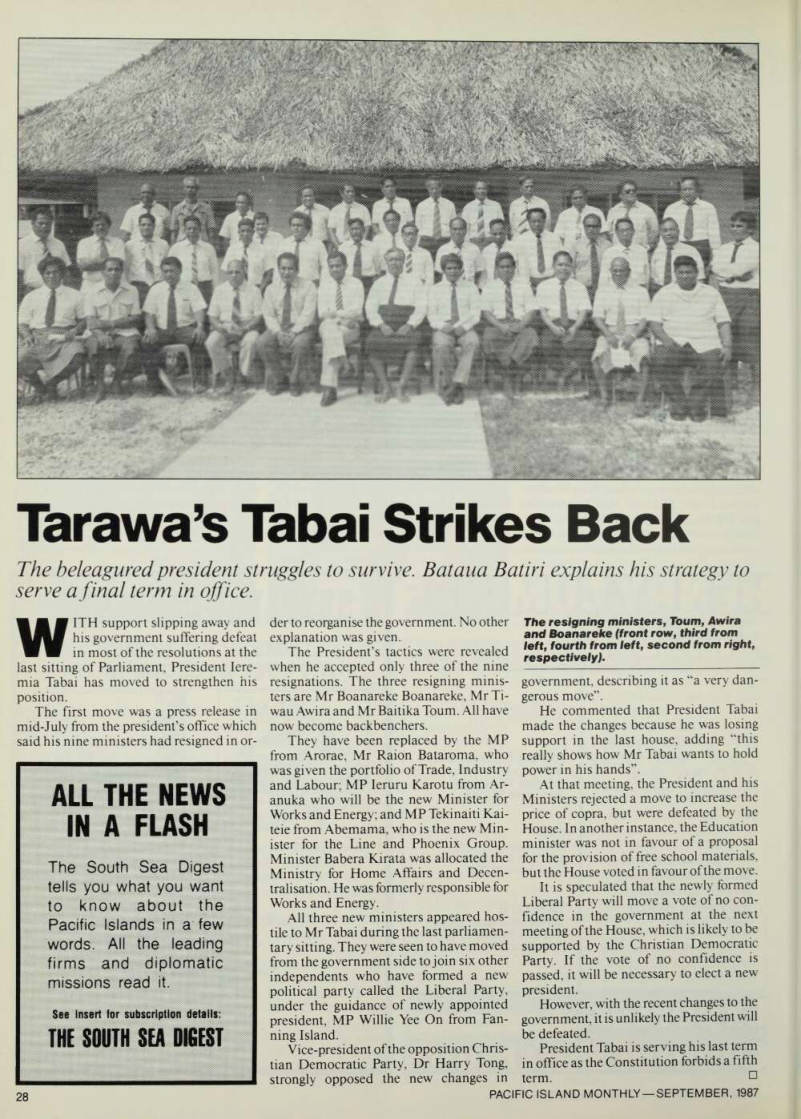
The beleagured president struggles to survive. Bataua Batiri explains his strategy to serve a final term in office.
WITH support slipping away and his government suffering defeat in most of the resolutions at the last sitting of Parliament, President lere mia Tabai has moved to strengthen his position.
The first move was a press release in mid-July from the president’s office which said his nine ministers had resigned in or
der to reorganise the government. No other explanation was given.
The President’s tactics were revealed when he accepted only three of the nine resignations. The three resigning minis ters are Mr Boanareke Boanareke, Mr Ti wau Awira and Mr Baitika Toum. All have now become backbenchers.
They have been replaced by the MP from Arorae, Mr Raion Bataroma, who was given the portfolio of Trade, Industry and Labour; MP leruru Karotu from Ar anuka who will be the new Minister for Works and Energy; and MP Tekinaiti Kai teie from Abemama, who is the new Min ister for the Line and Phoenix Group.
Minister Babera Kirata was allocated the Ministry for Home Affairs and Decen tralisation. He was formerly responsible for Works and Energy.
All three new ministers appeared hos tile to Mr Tabai during the last parliamen tary sitting. They were seen to have moved from the government side to join six other independents who have formed a new political party called the Liberal Party, under the guidance of newly appointed president, MP Willie Yee On from Fan ning Island.
Vice-president of the opposition Chris tian Democratic Party, Dr Harry Tong, strongly opposed the new changes in
government, describing it as “a very dan gerous move”.
He commented that President Tabai made the changes because he was losing support in the last house, adding “this really shows how Mr Tabai wants to hold power in his hands”.
At that meeting, the President and his Ministers rejected a move to increase the price of copra, but were defeated by the House. In another instance, the Education minister was not in favour of a proposal for the provision of free school materials, but the House voted in favour of the move.
It is speculated that the newly formed Liberal Party will move a vote of no con fidence in the government at the next meeting of the House, which is likely to be supported by the Christian Democratic Party. If the vote of no confidence is passed, it will be necessary to elect a new president.
However, with the recent changes to the government, it is unlikely the President will be defeated.
President Tabai is serving his last term in office as the Constitution forbids a fifth term. D
The resigning ministers, Tbum, Awira and Boanareke (front row, third from left, fourth from left, second from right, respectively).
Advertisements & other items, pp. 28-32 (2 items)
28
PACIFIC ISLAND MONTHLY —SEPTEMBER, 1987
In A Flash
ALL THE NEWS
The South Sea Digest tells you what you want to know about the Pacific Islands in a few words. All the leading firms and diplomatic missions read it.
See insert for subscription details;
THE SOUTH SEA DIGEST
BANK
ECONOMIC INDICATORS
COMMODITY PRICES
EXCHANGE RATES
INTEREST RATES
INDUSTRIAL WORLD DEMAND
Sources: AAP Reuters; FFA Honiara, Fiji Forest Industries IMF (IFS). Compiled by ANZ International Economics, Melbourne.
WORLD COMMODITIES
(Wholesale Price Index, 1980 = 100)
GOLD
London (US $ Per Ounce) 1961 1982 1983 1984 1986 1987 mu
BANK
Branches in Fiji, Papua New Guinea, Vanuatu and Solomon Is.
HILUX 4WD Regular Cab, Long Wheelbase 0 One tough truck just got tougher. Toyota’s dedication to superior performance vehicles takes a step forward today with the New Hilux,) A refined front grille and bumper design, new instrument panel for a feeling of spaciousness and command and plush colour co-ordinated trim are a few new additions to the New Hilux.
And extensive anti-corrosive galvanealed steel protection now includes the tailgate panel and rear door panel, making Hilux more durable than ever before.
Yet for all its improvements, the best of the original Hilux is also
TOYOTA
QUALITY SERVICE
AMERICAN SAMOA: BURNS PHILP (SOUTH SEA) CO., LTD., P.O. Box 129, Pago Pago. COOK ISLANDS: COOK AUTOMOTIVE SUPPLIES COMPANY, A Division of Burns Philp (South Sea) Co., Ltd., G.P.O. Box 355, Suva. GUAM & MCI Tamuning. KIRIBATI: TARAWA MOTORS, A Division of Bairiki Holdings Ltd., P.O. Box 36, Bairiki, Tarawa. NAURU: NAU|L SERVICE IMPORTATION AUTOMOBILE DU PACIFIQUE, Rond-Point du Pacifique (Station Total) B.P 438, Noumea. NIUE:|: NORFOLK ISLAND: BORRY’S LIMITED, P.O. Box 169. PAPUA NEW GUINEA: ELA MOTORS, A Division of Burns Phjr CORPORATION, P.O. Box 267, Saipan. SOLOMON ISLANDS: SOLOMON ISLANDS INVESTMENTS LTD., G.P.O. Box 1403 TONGA: BURNS PHILP (TONGA) LTD., P.O. Box 55, Nukualofa. VANUATU: VANUATU MOTORS, A Division of Burns Phil
ific-Tough. The New Hilux.
n a V \ •v % 4* * % m k > * m V * ere: a big tailgate conveniently hinged for quick loading and unloading; reinforced front suspension to smooth out le bumps, and bias-mounted, extra-heavy-duty rear shocks and knobbly tyres to take on any terrain.
Toyota’s long history of super-responsive engines,
ruggedness, reliability and comfort goes without saying. And in the Hilux, it’s yours in both 2-wheel-drive and 4X4 versions.
So, after comprehensive testing and thorough quality control, the New Hilux is ready to bring a new standard of toughness to the Pacific.
And isn’t that exactly what you expect from Toyota?
Areas where galvanealed steel is used iDING CORPORATION LTD., Private Bag, Rarotonga. FIJI: SIA; ATKINS KROLL, INC., 443 South Marine Drive, 3 ERATIVE SOCIETY, Central Pacific. NEW CALEDONIA; 3 HILP (SOUTH SEA) CO., LTD., P.O. Box 39. Alofi.
Ltd., P.O. Box 75, Port Moresby. SAIPAN: MICROL a TAHITI: NIPPON AUTOMOTO. B.P 342, Papeete, atu) Ltd., P.O. Box 18, Port Vila. WESTERN SAMOA:
TOYOTA
*ST
of a wand gets you your
Programming with our new Digital Scanner is Magic? Not quite. But our revolutionary VTR timer-programming system is the next best thing. It utilizes the most advanced digital and optoelectronic technology to conjure up a new generation of operating ease.
Channels, dates, and start/stop times become bar codes printed on a sheet. The magic wand is really a Digital Scanner that is passed over the appropriate codes to read-in programming information and then pointed at the VTR to enter them in memory. What simpler way to preset the recording of eight different TV selections up to one month in advance?
Our NV-G22 VTR also features a Super 4-Video-Head system that delivers a remarkably fluid Double Super Fine Slow Motion. Action » lair scenes that would be jittery in conventional slow motion are reproduced in smooth, stable detail.
Other pleasing features include a calendar timer that extends up to the year 2001, an HQ (High Quality) picture system, Super Still Advance playback, and wireless remote control.
National VTRs with Digital Scanners. Wave
goodbye to programming complications.
In New Zealand only, an identical version of the NV-G22 is marketed under model number NV-G2l National, Panasonic and Technics are the brandnames of Matsushita Electric G 22
VMS
National
material may infringe copyright law&v&w j • m
No Faith More Struggles
Papua New Guinea
Why PNG’s political system must be stabilised.
By Helen Fraser.
PAPUA New Guinea experts ex pressed concern at the ADAB de velopment conference about political instability in Papua New Guinea.
Mr Brian Brogan, of the National De velopment Studies Centre at the Aus tralian National University, said that PNG suffered from an excess of democracy. In broad terms, there was very deep respect for constitutional and legal form one of the legacies of the Australian colonial ad ministration. However, the society itself was very fragmented, allegiances were very local and there was no hierarchical tradi tion as in many Pacific countries, espe cially those of Polynesia. “Politics is bedevilled by an excessive desire to be in volved and to achieve something for one’s own group, which is often very small,” Mr Brogan said.
“Add to that the admirably idealistic constitution that was bequeathed by an army of young Australian legal scholars, and you have a recipe for disaster.”
Mr Brogan was previously Director of the Institute of National Affairs in PNG, and Professor of Economics at the Uni versity of PNG from 1977 to 1983. He told the ADAB conference that the PNG con stitution “almost enshrines instability”. It guaranteed a five-year life for each parlia ment, even if it were “hung” and unwork able. The constitution made it impossible for the prime minister to bring such a par liament to an early end. All that could happen was that allegiances, alliances and coalition shifted around; one transient government followed another; and most members, knowing that one term was all they would ever get, sought to extract all that they could for their own group in that time.
Mr Peter Hastings, Sydney Morning Herald columnist and long-time writer on Papua New Guinea, sent a paper to the ADAB debate from the PNG Highlands, where he was covering the recent national elections. In it, he said that the most sig nificant thing to emerge from the elections apart from the struggle for power be tween the Wingti and Somare coalitions was the extent to which electors had lost faith in the system.
“This is increasingly evident,” he said, “in the well-founded allegations of physi cal attacks on some scrutineers and re turning officers, and the demolition of polling stations in some Highlands areas, and the burning of ballot boxes.
“The loss of faith is reinforced by the mounting evidence of electoral fraud by
means of sectional voting, intimidation of candidates in some instances and large scale bribery in others, by the wholesale disappearance of thousands of ballot pa pers, and by the large number of failed candidates seeking either a recount of votes or evidence to support their allegations of fraud.”
Mr Hastings said that large-scale vote buying had been elevated to an art form.
He had obtained cabinet documents signed by Prime Minister Paias Wingti last December setting out 30 road and bridge building projects, ranging in value from Kina 30,000 to 50,000 Eighteen of the projects were in the electorate of Chimbu Regional, held by the Minister for Works, who held it easily. Mr Hastings said there was no accountability for the sums paid, no receipts and no records of who ulti mately received the money.
Mr Hastings said that before inde pendence, the electoral system had sur vived because of preferential voting, which had been abolished because of its alleged complexities. Now, under a first-past-the post system, there were bizarre anomalies.
In one electorate in the recent election, there had been 45 candidates, which meant 44 disappointed, failed candidates some of them very angry and a winner rep resenting less than two per cent of the electorate.
“In PNG today, there is the outward form of the Westminster system but few of its mechanisms. The most glaring defi ciency ... is the network of fragile coali tions which virtually ensure that a prime minister cannot afford to implement un popular policies because the opposition can at any time play havoc with discon tented ministers and back-bench members.”
Mr Hastings said that prime ministers were subject to regional and factional pressures and if they resisted could expect a vote of no confidence leading to a fre netic round of horse trading. “The need to return to preferential voting is urgent,” he said, “not least because the exchange of preferences would make PNG’s fragile party system work as it should.”
Mr Hastings said that provincial government had become a further desta bilising factor. “It is inefficient, costly and gets in the way of effective policy making in the centre.
A PNG resource law specialist and company director, Ms Meg Taylor, said that Mr Hastings’ analysis was depress ing, but described the reality of the situa
tion for many people. People in rural areas were frustrated, she said, and she believed the main reason was slow pace of eco nomic growth, caused by lack of investment.
Ms Taylor, said that an important fac tor in the shortage of investment funds was the law-and-order problem, especially as portrayed through the mass media of countries such as Australia and the US.
“The court system at least operates, but the difficulty of getting good police work makes it very frustrating for foreigners and even more so for Papua New Guineans.
There is a problem of continual political interference in business and of over government from the 18 provincial and lo cal governments and a national parlia ment with 109 elected members.”
Ms Taylor said that most public funds were being spent on bureaucratic infras tructure, not development projects, and the lead role in development was taken by the private sector, especially in minerals and large-scale plantation production. She said the administrative system created major constraints on investment.
“PNG seems to have an enormous number of rules and regulations govern ing what you must do to invest in the country,” she said. “Some are there for good reason, but it is a cumbersome proc ess one has to go through. There are train ing and localisation programs, delays in getting work permits for foreign workers, problems in getting visas and problems with passports being lost when they are submitted for visas. Other problems in clude the lack of skilled labour; probably one per cent of the population or less are skilled. And in the plantation economy one of the most vital problems for PNG is the problem of land tenure. Clans own land, village groups own land and the Land Ten ure Conversion Act does not allow nation als to sell land to foreigners.” □
Advertisements & other items, p. 33 (2 items)
33
PACIFIC ISLAND MONTHLY —SEPTEMBER, 1987
SSSRTJ Han^ton
Perkins
Sales, service & spare parts
ft POWER
mt RUSH! POWER CENTRE
yjr 195 Parramatta Rd, Auburn 2144 Sydney, NSW, Australia (02) 648 0591
Alliance in the Pacific
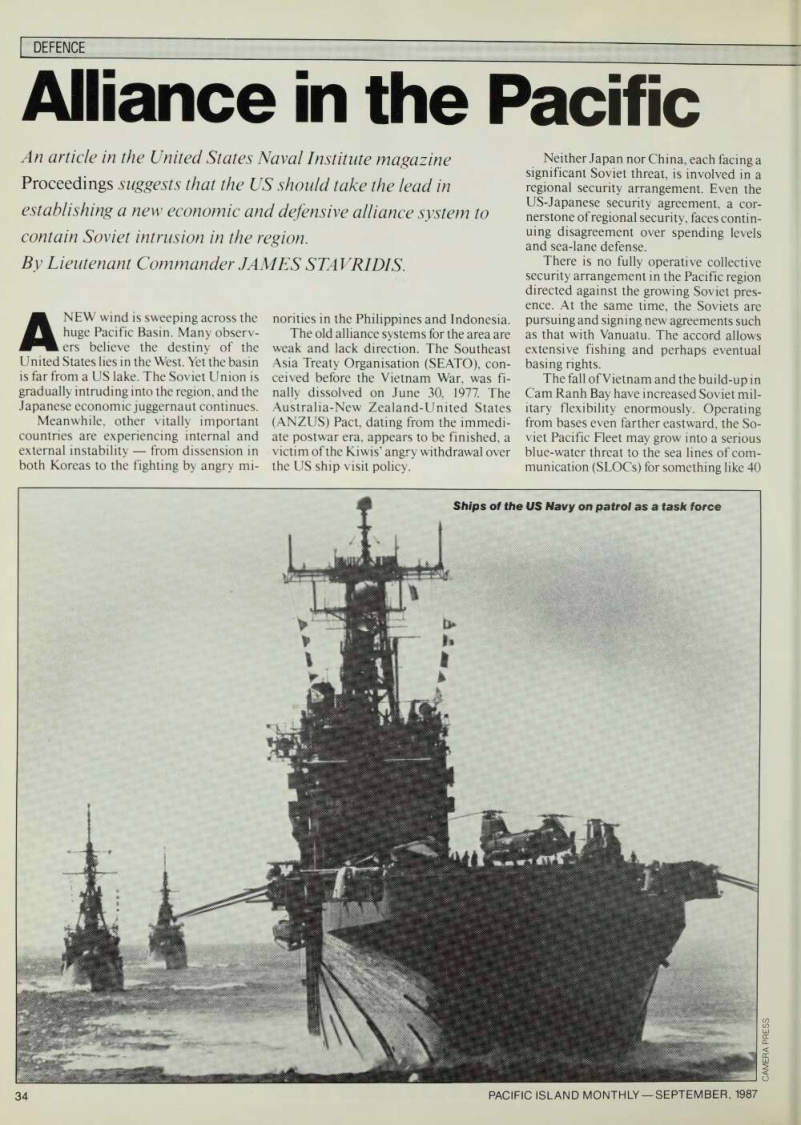
Defence
An article in the United States Naval Institute magazine Proceedings suggests that the US should take the lead in establishing a new economic and defensive alliance system to contain Soviet intrusion in the region.
By Lieutenant Commander JAMES STAVRIDIS.
ANEW wind is sweeping across the huge Pacific Basin. Many observers believe the destiny of the United States lies in the West. Yet the basin is far from a US lake. The Soviet Union is gradually intruding into the region, and the Japanese economic juggernaut continues.
Meanwhile, other vitally important countries are experiencing internal and external instability from dissension in both Koreas to the fighting by angry mi-
norities in the Philippines and Indonesia, The old alliance systems for the area are weak and lack direction. The Southeast Asia Treaty Organisation (SEATO), con ceived before the Vietnam War, was fi nally dissolved on June 30, 1977. The Australia-New Zealand-United States (ANZUS) Pact, dating from the immedi ate postwar era, appears to be finished, a victim of the Kiwis’ angry withdrawal over the US ship visit policy.
Neither Japan nor China, each facing a significant Soviet threat, is involved in a regional security arrangement. Even the US-Japanese security agreement, a cor nerstone of regional security, faces contin uing disagreement over spending levels and sea-lane defense.
There is no fully operative collective security arrangement in the Pacific region directed against the growing Soviet pres ence. At the same time, the Soviets are pursuing and signing new agreements such as that with Vanuatu. The accord allows extensive fishing and perhaps eventual basing rights.
The fall of Vietnam and the build-up in Cam Ranh Bay have increased Soviet mil itary flexibility enormously. Operating from bases even farther eastward, the So viet Pacific Fleet may grow into a serious blue-water threat to the sea lines of com munication (SLOCs) for something like 40
Ships of the US Navy on patrol as a task force
per cent of the world’s traded goods.
It is time to re-examine the premises of US strategy in the Pacific Basin and to es tablish a new economic and defensive al liance system with clearly defined roles and responsibilities for each of the members.
This arrangement must derive from a dynamic treaty, must be based on inter national law, and must receive ratification and popular support in the countries con cerned. It can serve as a guarantee of peace and as the nucleus of important economic advances. A new alliance can go far to ward containing Soviet adventurism and improving the image of US leadership in the region.
Advertisements & other items, p. 34 (1 item)
34
PACIFIC ISLAND MONTHLY —SEPTEMBER, 1987
US Strategy in the
Premises of US Strategy in the Pacific Basin
A planner must proceed from objective to policy. First, we must answer the de ceptively simple question, “What does my country need or want in this region?” In the Pacific, the answer is a complex mix of positive and negative objectives.
A Peaceful Environment that Encour ages Free Trade and Economic Expan sion: Our major interest in the region is economic. More than 60 per cent of the world’s gross national product is pro duced in the Pacific Basin. Japan is our most important trading partner globally, providing our market with many desira ble manufactured goods. Raw materials come from both the ASEAN and ANZUS countries. From China, Korea, Singapore, and Hong Kong come textiles, manufac tured goods, shoes, and other general con sumer goods. The South China Sea potentially has great oil reserves, and In donesia and other countries have oil to sell.
Our trade in the Pacific Basin ap proaches $2OO billion annually and is still growing rapidly. Trade with Japan re cently surpassed that with all the Euro pean countries combined. It includes $1.2 billion in semiconductors, and millions of dollars of microchips, ball bearings, def ence parts, and hundreds of other imports and exports.
Military Security for Ourselves and Our Allies: As Admiral James A Lyons, Jr., the Commander-in-Chief of the US Pa cific Fleet, recently commented, . . the Soviet Pacific Fleet has increased from 200 ships in 1960 to over 500 today.” With 1,000 land-based maritime bombers, ma jor bases on their own coasts and in Viet nam, and a growing appetite for blue-water naval exercises, the Soviets now pose the principal military threat to Western inter ests in the region.
Other potential conflicts exist within the Pacific Basin. These have dangerous
implications for Western interests. One of the most dangerous nations is North Ko rea, poised for an attack on South Korea.
The North Koreans currently have more than 885,000 men and women in uniform, giving them the world’s sixth largest armed force.
As one observer recently commented, “North Korea is not a country in the tra ditional sense. It is one armed camp from the DMZ to the Yalu River.”
Another aggressor state is the People’s Republic of Vietnam, which threatens Thailand and Malaysia with the third largest standing army in the world.
Additionally, many key countries face internal security problems, including the Philippines, Indonesia, and South Korea.
As Secretary of State George Shultz re cently stated, the Pacific is “... one of the most heavily armed regions in the world, and Asian peace is still marred by contin uing conflicts.”
Freedom of the High Seas for Peaceful Navigation, Military Passage, and Eco nomic Development: This US goal is par ticularly critical in the Pacific Basin with its huge ocean space, numerous archipe lagic countries, and critical SLOCs be tween Western allies.
Parts of the aborted Law of the Sea Treaty, retooled to meet the needs of a po tential new alliance system, could be adapted as the start of a new compact for the region. In particular, issues could be resolved regarding passage through key straits, oil and mineral development on the seabed beyond national jurisdiction, the size of territorial seas and exclusive eco nomic zones, and other potential areas of dispute.
The Pursuit of Open Democratic Political Systems and Capitalistic Eco nomic Markets: Demographic experts predict that by 1990 62 per cent of the world’s population will live on the Pacific rim, an area that includes the Pacific Basin to the north and all the South American Pacific coastline.
While not of immediate benefit to the United States, improvements in the cli mate of freedom and democracy are in the best interests of our country in the long term. The sponsorship of such develop ments is difficult, since many of the coun tries simply do not have the sort of democratic systems that could serve as the root of such systemic changes. Nonethe less, the omens are favourable in many countries in the region, particularly in light of the successful changes in the Philip pines and the potential changes in South Korea.
Clearly, the US ability to influence events in the Pacific will depend on the compatibility of the region’s political and economic systems with our own.
Minimise Soviet Influence in the Re gion: Obviously, the Soviets have a major interest in the region, given their extended Pacific coastline and growing military
forces in the basin. The Soviet backing of aggressive regimes at the center of hard core Marxist spheres of influence (Viet nam and North Korea come to mind) will impede or negate US progress toward its other objectives.
In order for the US to move events in a favourable direction, the Soviets’ ability to control the timeline in the region must be blocked. In addition to the newly ne gotiated treaty with Vanuatu, the Soviets are moving in new directions with China, various Southeast Asian countries, and even the ANZUS countries. As an ob server commented recently, “Mikhail S Gorbachev has served notice that he in tends for the Soviet Union to become a Pa cific power in the fullest sense of the term.”
From Policy
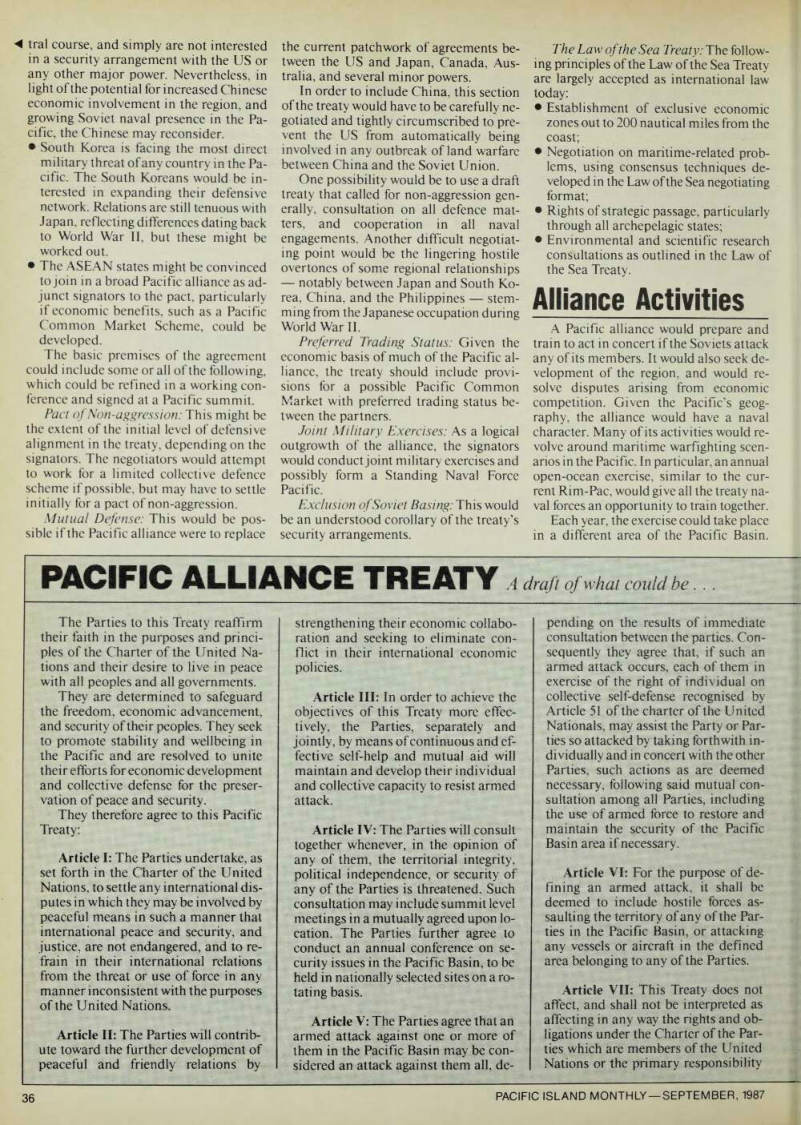
to Alliance
In recently published statements, both Admiral Lyons and Admiral William Crow the current chairman of the Joint Chiefs of Staff and former commander of all US forces in the Pacific agree on the basic objectives. Many senior officials in the Reagan administration have pursued the “way West” with great vigor. These in clude the President, who often refers to the importance of the Pacific Basin.
The policy must be implemented by a strategy. As part of a strategy, one poten tial approach would be the negotiation of a new Pacific Alliance Treaty with some collective defence and basic economic co operation as its objectives. Along with the United States and the ASEAN countries, the following nations are all potential participants. • Japan is our most important Pacific ally, and must be encouraged to accept fur ther defence responsibilities. • Canada is often overlooked as an im portant component of US Pacific pol icy. The Canadians’ ability to work in the maritime world could be extremely helpful in the critical battle for the Aleu tians during a major conflict with the Soviets. • Australia is a traditional ally and a strong player in the global currents in the re gion, particularly in the southern and central Pacific regions. • China has played a dominant role in the region for centuries. Although it is a controversial choice for membership in the Pacific alliance, China can make an important and growing contribution in the Pacific Basin. The Chinese armed forces are limited by outdated technol ogy but are maturing in military skill.
Naturally, there are many issues that must be worked out between China and the alliance’s more traditionally Western states. The Chinese, for example, have often commented that they prefer a neu- ►
◄ tral course, and simply are not interested in a security arrangement with the US or any other major power. Nevertheless, in light of the potential for increased Chinese economic involvement in the region, and growing Soviet naval presence in the Pa cific, the Chinese may reconsider. • South Korea is facing the most direct military threat of any country in the Pa cific. The South Koreans would be in terested in expanding their defensive network. Relations are still tenuous with Japan, reflecting differences dating back to World War 11, but these might be worked out. • The ASEAN states might be convinced to join in a broad Pacific alliance as ad junct signators to the pact, particularly if economic benefits, such as a Pacific Common Market Scheme, could be developed.
The basic premises of the agreement could include some or all of the following, which could be refined in a working con ference and signed at a Pacific summit.
Pact of Non-aggression: This might be the extent of the initial level of defensive alignment in the treaty, depending on the signators. The negotiators would attempt to work for a limited collective defence scheme if possible, but may have to settle initially for a pact of non-aggression.
Mutual Defense: This would be pos sible if the Pacific alliance were to replace
the current patchwork of agreements be tween the US and Japan, Canada, Aus tralia, and several minor powers.
In order to include China, this section of the treaty would have to be carefully ne gotiated and tightly circumscribed to pre vent the US from automatically being involved in any outbreak of land warfare between China and the Soviet Union.
One possibility would be to use a draft treaty that called for non-aggression gen erally, consultation on all defence mat ters, and cooperation in all naval engagements. Another difficult negotiat ing point would be the lingering hostile overtones of some regional relationships notably between Japan and South Ko rea, China, and the Philippines stem ming from the Japanese occupation during World War 11.
Preferred Trading Status: Given the economic basis of much of the Pacific al liance, the treaty should include provi sions for a possible Pacific Common Market with preferred trading status be tween the partners.
Joint Military Exercises: As a logical outgrowth of the alliance, the signators would conduct joint military exercises and possibly form a Standing Naval Force Pacific.
Exclusion of Soviet Basing: This would be an understood corollary of the treaty’s security arrangements.
The Law of the Sea Treaty: The follow ing principles of the Law of the Sea Treaty are largely accepted as international law today; • Establishment of exclusive economic zones out to 200 nautical miles from the coast; • Negotiation on maritime-related prob lems, using consensus techniques de veloped in the Law of the Sea negotiating format; • Rights of strategic passage, particularly through all archepelagic states; • Environmental and scientific research consultations as outlined in the Law of the Sea Treaty.
Advertisements & other items, p. 35 (1 item)
35
PACIFIC ISLAND MONTHLY —SEPTEMBER, 1987
Alliance Activities
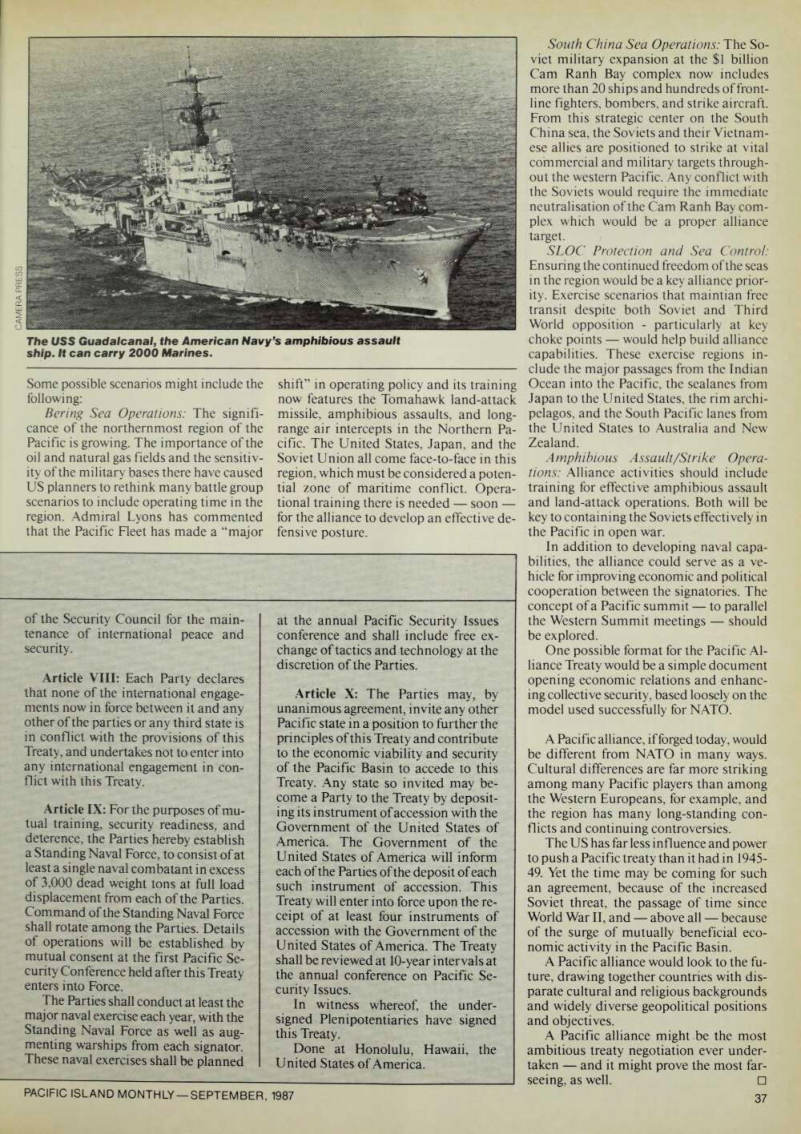
A Pacific alliance would prepare and train to act in concert if the Soviets attack any of its members. It would also seek de velopment of the region, and would re solve disputes arising from economic competition. Given the Pacific’s geog raphy, the alliance would have a naval character. Many of its activities would re volve around maritime warfighting scen arios in the Pacific. In particular, an annual open-ocean exercise, similar to the cur rent Rim-Pac, would give all the treaty na val forces an opportunity to train together.
Each year, the exercise could take place in a different area of the Pacific Basin.
Some possible scenarios might include the following: Bering Sea Operations: The significance of the northernmost region of the Pacific is growing. The importance of the oil and natural gas fields and the sensitivity of the military bases there have caused US planners to rethink many battle group scenarios to include operating time in the region. Admiral Lyons has commented that the Pacific Fleet has made a “major
shift” in operating policy and its training now features the Tomahawk land-attack missile, amphibious assaults, and long range air intercepts in the Northern Pa cific. The United States, Japan, and the Soviet Union all come face-to-face in this region, which must be considered a poten tial zone of maritime conflict. Opera tional training there is needed soon for the alliance to develop an effective de fensive posture.
South China Sea Operations: The So viet military expansion at the $1 billion Cam Ranh Bay complex now includes more than 20 ships and hundreds of front line fighters, bombers, and strike aircraft.
From this strategic center on the South China sea, the Soviets and their Vietnam ese allies are positioned to strike at vital commercial and military targets through out the western Pacific. Any conflict with the Soviets would require the immediate neutralisation of the Cam Ranh Bay com plex which would be a proper alliance target.
SLOC Protection and Sea Control: Ensuring the continued freedom of the seas in the region would be a key alliance prior ity. Exercise scenarios that mainlian free transit despite both Soviet and Third World opposition - particularly at key choke points would help build alliance capabilities. These exercise regions in clude the major passages from the Indian Ocean into the Pacific, the sealanes from Japan to the United States, the rim archi pelagos, and the South Pacific lanes from the United States to Australia and New Zealand.
Amphibious Assault/Strike Opera tions: Alliance activities should include training for effective amphibious assault and land-attack operations. Both will be key to containing the Soviets effectively in the Pacific in open war.
In addition to developing naval capa bilities, the alliance could serve as a ve hicle for improving economic and political cooperation between the signatories. The concept of a Pacific summit to parallel the Western Summit meetings should be explored.
One possible format for the Pacific Al liance Treaty would be a simple document opening economic relations and enhanc ing collective security, based loosely on the model used successfully for NATO.
A Pacific alliance, if forged today, would be different from NATO in many ways.
Cultural differences are far more striking among many Pacific players than among the Western Europeans, for example, and the region has many long-standing con flicts and continuing controversies.
The US has far less influence and power to push a Pacific treaty than it had in 1945- 49. Yet the time may be coming for such an agreement, because of the increased Soviet threat, the passage of time since World War 11, and above all because of the surge of mutually beneficial eco nomic activity in the Pacific Basin.
A Pacific alliance would look to the fu ture, drawing together countries with dis parate cultural and religious backgrounds and widely diverse geopolitical positions and objectives.
A Pacific alliance might be the most ambitious treaty negotiation ever under taken and it might prove the most far seeing, as well. □
The USS Guadalcanal, the American Navy’s amphibious assault ship. It can carry 2000 Marines.
Pacific Alliance Treaty
A draft of what could be. . .
The Parties to this Treaty reaffirm their faith in the purposes and princi ples of the Charter of the United Na tions and their desire to live in peace with all peoples and all governments.
They are determined to safeguard the freedom, economic advancement, and security of their peoples. They seek to promote stability and wellbeing in the Pacific and are resolved to unite their efforts for economic development and collective defense for the preser vation of peace and security.
They therefore agree to this Pacific Treaty: Article I: The Parties undertake, as set forth in the Charter of the United Nations, to settle any international dis putes in which they may be involved by peaceful means in such a manner that international peace and security, and justice, are not endangered, and to re frain in their international relations from the threat or use of force in any manner inconsistent with the purposes of the United Nations.
Article II: The Parties will contrib ute toward the further development of peaceful and friendly relations by
strengthening their economic collabo ration and seeking to eliminate con flict in their international economic policies.
Article III: In order to achieve the objectives of this Treaty more effec tively, the Parties, separately and jointly, by means of continuous and ef fective self-help and mutual aid will maintain and develop their individual and collective capacity to resist armed attack.
Article IV: The Parties will consult together whenever, in the opinion of any of them, the territorial integrity, political independence, or security of any of the Parties is threatened. Such consultation may include summit level meetings in a mutually agreed upon lo cation. The Parties further agree to conduct an annual conference on se curity issues in the Pacific Basin, to be held in nationally selected sites on a ro tating basis.
Article V: The Parties agree that an armed attack against one or more of them in the Pacific Basin may be con sidered an attack against them all, de
pending on the results of immediate consultation between the parties. Con sequently they agree that, if such an armed attack occurs, each of them in exercise of the right of individual on collective self-defense recognised by Article 51 of the charter of the United Nationals, may assist the Party or Par ties so attacked by taking forthwith in dividually and in concert with the other Parties, such actions as are deemed necessary, following said mutual con sultation among all Parties, including the use of armed force to restore and maintain the security of the Pacific Basin area if necessary.
Article VI: For the purpose of de fining an armed attack, it shall be deemed to include hostile forces as saulting the territory of any of the Par ties in the Pacific Basin, or attacking any vessels or aircraft in the defined area belonging to any of the Parties.
Article VII: This Treaty does not affect, and shall not be interpreted as affecting in any way the rights and ob ligations under the Charter of the Par ties which are members of the United Nations or the primary responsibility
of the Security Council for the main tenance of international peace and security.
Article VIII: Each Party declares that none of the international engage ments now in force between it and any other of the parties or any third state is in conflict with the provisions of this Treaty, and undertakes not to enter into any international engagement in con flict with this Treaty.
Article IX: For the purposes of mu tual training, security readiness, and deterence, the Parties hereby establish a Standing Naval Force, to consist of at least a single naval combatant in excess of 3,000 dead weight tons at full load displacement from each of the Parties.
Command of the Standing Naval Force shall rotate among the Parties. Details of operations will be established by mutual consent at the first Pacific Se curity Conference held after this Treaty enters into Force.
The Parties shall conduct at least the major naval exercise each year, with the Standing Naval Force as well as aug menting warships from each signator.
These naval exercises shall be planned
at the annual Pacific Security Issues conference and shall include free ex change of tactics and technology at the discretion of the Parties.
Article X: The Parties may, by unanimous agreement, invite any other Pacific state in a position to further the principles of this Treaty and contribute to the economic viability and security of the Pacific Basin to accede to this Treaty. Any state so invited may be come a Party to the Treaty by deposit ing its instrument of accession with the Government of the United States of America. The Government of the United States of America will inform each of the Parties of the deposit of each such instrument of accession. This Treaty will enter into force upon the re ceipt of at least four instruments of accession with the Government of the United States of America. The Treaty shall be reviewed at 10-year intervals at the annual conference on Pacific Se curity Issues.
In witness whereof, the under signed Plenipotentiaries have signed this Treaty.
Done at Honolulu, Hawaii, the United States of America.
Advertisements & other items, pp. 36-37 (2 items)
36
SEPTEMBER, 1987
PACIFIC ISLAND MONTHLY
37
PACIFIC ISLAND MONTHLY —SEPTEMBER, 1987
Exit Sir Tom...
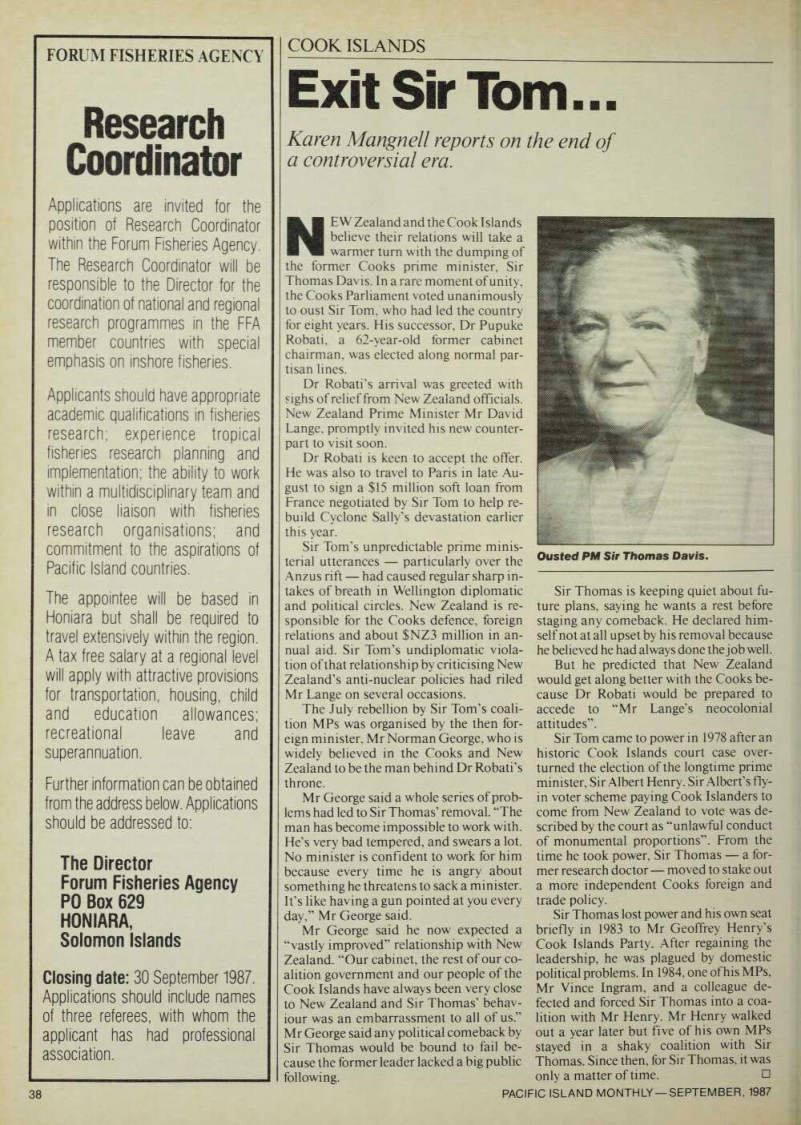
Cook Islands
Karen Mangnell reports on the end of a controversial era.
NEW Zealand and the Cook Islands believe their relations will take a warmer turn with the dumping of the former Cooks prime minister, Sir Thomas Davis. In a rare moment of unity, the Cooks Parliament voted unanimously to oust Sir Tom, who had led the country for eight years. His successor. Dr Pupuke Robati, a 62-year-old former cabinet chairman, was elected along normal par tisan lines.
Dr Robati’s arrival was greeted with sighs of relief from New Zealand officials.
New Zealand Prime Minister Mr David Lange, promptly invited his new counter part to visit soon.
Dr Robati is keen to accept the offer.
He was also to travel to Paris in late Au gust to sign a $l5 million soft loan from France negotiated by Sir Tom to help re build Cyclone Sally’s devastation earlier this year.
Sir Tom’s unpredictable prime minis terial utterances particularly over the Anzus rift had caused regular sharp in takes of breath in Wellington diplomatic and political circles. New Zealand is re sponsible for the Cooks defence, foreign relations and about SNZ3 million in an nual aid. Sir Tom’s undiplomatic viola tion of that relationship by criticising New Zealand’s anti-nuclear policies had riled Mr Lange on several occasions.
The July rebellion by Sir Tom’s coali tion MPs was organised by the then for eign minister, Mr Norman George, who is widely believed in the Cooks and New Zealand to be the man behind Dr Robati’s throne.
Mr George said a whole series of prob lems had led to Sir Thomas’ removal. “The man has become impossible to work with.
He’s very bad tempered, and swears a lot.
No minister is confident to work for him because every time he is angry about something he threatens to sack a minister.
It’s like having a gun pointed at you every day,” Mr George said.
Mr George said he now expected a “vastly improved” relationship with New Zealand. “Our cabinet, the rest of our co alition government and our people of the Cook Islands have always been very close to New Zealand and Sir Thomas’ behav iour was an embarrassment to all of us.”
Mr George said any political comeback by Sir Thomas would be bound to fail be cause the former leader lacked a big public following.
Sir Thomas is keeping quiet about fu ture plans, saying he wants a rest before staging any comeback. He declared him self not at all upset by his removal because he believed he had always done the job well.
But he predicted that New Zealand would get along better with the Cooks be cause Dr Robati would be prepared to accede to “Mr Lange’s neocolonial attitudes”.
Sir Tom came to power in 1978 after an historic Cook Islands court case over turned the election of the longtime prime minister. Sir Albert Henry. Sir Albert’s fly in voter scheme paying Cook Islanders to come from New Zealand to vote was de scribed by the court as “unlawful conduct of monumental proportions”. From the time he took power, Sir Thomas a for mer research doctor moved to stake out a more independent Cooks foreign and trade policy.
Sir Thomas lost power and his own seat briefly in 1983 to Mr Geoffrey Henry’s Cook Islands Party. After regaining the leadership, he was plagued by domestic political problems. In 1984, one of his MPs, Mr Vince Ingram, and a colleague de fected and forced Sir Thomas into a coa lition with Mr Henry. Mr Henry walked out a year later but five of his own MPs stayed in a shaky coalition with Sir Thomas. Since then, for Sir Thomas, it was only a matter of time. □
Ousted PM Sir Thomas Davis.
Advertisements & other items, pp. 38-39 (3 items)
Pacific Island Monthly—September, 1987
Coordinator
FORUM FISHERIES AGENCY
Research
Applications are invited tor the position of Research Coordinator within the Forum Fisheries Agency.
The Research Coordinator will be responsible to the Director for the coordination of national and regional research programmes in the FFA member countries with special emphasis on inshore fisheries.
Applicants should have appropriate academic qualifications in fisheries research; experience tropical fisheries research planning and implementation; the ability to work within a multidisciplinary team and in close liaison with fisheries research organisations; and commitment to the aspirations of Pacific Island countries.
The appointee will be based in Honiara but shall be required to travel extensively within the region.
A tax free salary at a regional level will apply with attractive provisions for transportation, housing, child and education allowances; recreational leave and superannuation.
Further information can be obtained from the address below. Applications should be addressed to: The Director Forum Fisheries Agency PO Box 629
HONIARA,
Solomon Islands Closing date: 30 September 1987.
Applications should include names of three referees, with whom the applicant has had professional association.
Benson w Hedges
TRADITIONALLY THE NAME
ASSOCIATED WITH PERFECTION
IN CIGARETTES
BENSON & HEDGES
20
Benson w Hedges
WARNING-SMOKING IS A HEALTH HAZARD
ONLY THE BEST WILL DO.
Aids
In The Pacific
Containing the killer virus is of prime importance to the island nations.
By John Ballard
PACIFIC and Asian ministers of health, and senior health officials, received a thorough initiation in the problems and prospects of AIDS at a con ference organised by the World Health Or ganisation (who) in Sydney late in July.
The spread of the AIDS virus (the Hu man Immunodeficiency Virus, HIV) is as yet limited in Asia and the Pacific, by comparison with other world regions, and this offers the region an exceptional op portunity to establish programs of sur veillance and education before the virus becomes epidemic.
Dr Jonathan Mann, Director of WHO’s Special Program on AIDS, said, “we now know enough about AIDS to stop its fur ther spread.” Since it is unlikely that a vac cine against the AIDS virus will be developed in the next few years, he argued that what is needed is education about transmission of the virus and appropriate changes in behaviour.
Within the Asian-Pacific region, Aus tralia has the most substantial experience of coping with AIDS. Since 1983, 562 cases of AIDS have been identified, compared with 39 reported from New Zealand, 38 from Japan, 32 from the rest of Asia and three from the South Pacific as of June.
But this is only the “tip of the iceberg”, since there can be, on average, at least five years between infection by the virus and the development of symptoms classified as AIDS. And, given the impossibility of widespread testing for the virus, there are only very rough estimates of the numbers presently infected.
In Australia it is estimated that 50,000
people are now carrying the AIDS virus, 100 times the number of those who have developed AIDS. Elsewhere in the Pacific estimates depend on antibody testing, which has focused primarily on blood do nors and those attending clinics for sex ually transmitted diseases.
According to a recent survey by the South Pacific Commission, 29 carriers have been identified through testing in French Polynesia (11 of them recipients of blood transfusions in Europe or the US), nine in New Caledonia, and four in Guam.
In addition there are three carriers re cently identified in Papua New Guinea and one case in Tonga in a returnee from the United States.
Numbers are almost certainly higher than those officially reported. For in stance, Les Nouvelles (Noumea), of July 22 claimed a survey of doctors indicated more than 20 persons had tested anti body-positive in New Caledonia. In Papua New Guinea and Fiji it is acknowledged that several carriers and AIDS cases have probably moved to Australia for testing and care.
The AIDS virus is thus present and thriving in the South Pacific and the WHO Conference addressed the problems of containing it. As Jonathan Mann, and several other speakers, made clear, de spite regional variations in the current dis tribution of AIDS cases, the modes of transmission are the same throughout the world. The virus can be passed through exchange of fluids during sexual contact, exposure to contaminated needles, trans fusion of contaminated blood or blood
products, and transmission from mother to child before or during birth or through breast-feeding.
Because of earlier attention to trans mission through an intercourse between homosexual partners, which still accounts for a substantial majority of AIDS cases in North America, Europe, Australia and New Zealand, Mann and others stressed the evidence for vaginal transmission.
Not only is the African evidence pre dominantly of this nature, but there are many instances of male-to-female and fe male-to-male transmission in Western so cieties and in the Asian-Pacific region. In the Philippines, for instance, most anti body-positive test results so far have come from prostitutes working near US bases, and there are recorded cases of heterosex ual transmission in Papua New Guinea and French Polynesia.
Dr Mann presented to the conference the World Health Organisation’s goals and its model national program for consider ation by each government. WHO’s basic goals are not only the prevention of fur ther transmission of the AIDS virus and the development of services for people with AIDS within their communities, but also “the unification of communities to avoid the stigma which has developed around AIDS, revealing ethnic, sexual and reli gious prejudices”.
The proposed national program, already adopted by several African and Latin American countries, involves the es tablishment of a National Advisory Com mittee involving relevant specialist and community groups, assessment of the
prevalence of the AIDS virus, develop ment of blood-testing facilities and a sur veillance system for reporting AIDS cases, education of health workers and the pub lic, and establishment of a system of care for people with AIDS.
A number of island states have already taken the first steps towards comprehen sive AIDS programs and the WHO Spe cial Program is planning visits to assist in their development. The South Pacific Commission has been asked to set up a re gional surveillance system in collabora tion with WHO.
Dr Mann pointed out that each na tion’s priorities depend on likely entry points and local modes of transmission of the virus. There is a temptation to see screening of the blood supply as a first priority since it is a technical matter which gives government a sense of control and its own data; but in fact screening is relatively costly and education and voluntary exclu sion of blood donors may prove easier and adequate. In any event, Mann argued, public education should always have top priority, despite the difficulty in framing messages so as to reach effectively those most at risk.
Mann agreed with the conclusions of Justice Michael Kirby, President of the New South Wales Court of Appeals, con cerning the limitations of legal solutions for AIDS problems. Kirby noted the temptation for governments to respond defensively with measures such as quar antine, compulsory detention, mandatory testing and reporting, and the closure of places of sexual activity.
But he stressed the limitations of the law in modifying behaviour and the danger that laws can merely stigmatise and pun ish rather than provide support for effec tive public health measures. The futility of screening international travellers was em phasised by several speakers.
On the basis of past experience of legal attempts to deal with epidemics, Kirby propounded five “commandments” for AIDS legislation. Law is local, but AIDS requires international cooperation, hence the need for collaboration among neigh bouring states.
Law must be mobilised to promote pre vention, hence the need to repeal laws against the sale of condoms if these ob struct the higher value of saving lives. In efficient laws, such as those for mandatory testing of “high-risk groups”, often en acted so that governments can be seen to be doing something about AIDS, must be avoided. Law must minimise discrimi nation. And the overreach of criminal and tort law must be avoided.
There was plenty of opportunity, at the conference, for discussion of scientific and medical aspects of AIDS, with several presentations by leaders in Australian medical research. But attention was fo
cused primarily on educational strategies.
Australia, which has identified AIDS as its top health priority, has been praised by WHO for its emphasis on public educa tion. During the conference, Neal Blewett, who has provided leadership for Aus tralia’s complex federal-state programs, was re-appointed as Commonwealth Minister for Community Services and Health and raised to cabinet membership.
In his speech to the conference Blewett strongly defended Australia’s controver sial Grim Reaper television campaign as a necessary dramatic statement of the gen eral risk of AIDS to the population. He also warned of the dangers of allowing AIDS to become a party-political issue and stressed the need to involve all community groups and all parties in planning and education.
Some of the more imaginative Aus tralian educational programs were presented.
Grace Smallwood, Aboriginal mem ber of the National Advisory Committee on AIDS, explained the scheme by which Aboriginal communities are developing their own educational programs, includ ing videos and posters in local languages and pidgin. Phil Carwell of the Victorian AIDS Council and the National Advisory Committee outlined the strategies behind the “safe sex” programs developed by the gay community, which have led to a dra matic fall in sexually transmitted diseases.
There were a few statements on the ex perience of other countries in the region, but most of these were focused on epide miological statistics. The exception, which caught the attention of the conference, was that of Dr John Ah Ching, chairman of the Western Samoan AIDS Monitoring Committee.
Western Samoa has carried out very limited blood testing since May, with no antibody-positive results. Tourism, ex panding with the opening of a new inter national airport in June, is the most likely source of arrival of the virus. Formation of a National Committee on AIDS, with representation from government depart ments, women’s groups and churches, has been proposed to Cabinet.
Dr Ah Ching discussed the problems of carrying out an educational campaign among groups such as younger promis cuous men and women, or among fa ’afafine transsexuals. He concluded that only a general campaign, focused on ur ban and rural communities, would avoid stigmatisation of specific groups and suc ceed in altering attitudes and behaviour.
But he stressed the difficulties for com munication raised by the gap between the formal language required for official health education and the informal language tra ditional appropriate for discussion of sex ual matters.
Dr S I Okware, Director of the AIDS Control Program in Uganda, also stressed
education in his country, where there were 1138 reported cases of AIDS in May. Strong political support has been given, with the president and ministers making AIDS ed ucation a part of almost every public speech. Local government, churches and schools have all been mobilised around the theme of “loving faithfully and loving carefully”. Dr Okware advocated “Zero grazing”, a Ugandan term for tethered grazing, hence, having only one sexual partner.
After three days of intensive confer ence presentations and discussion, Friday was set aside for visits, with delegates given a choice among research and testing lab oratories in Melbourne, medical clinics in Sydney, and a cross-section of clinical and educational facilities in Sydney.
The largest number chose the latter, which included an afternoon of visits to the Albion Street Clinic, the Ankall organ isation offering care for people with AIDS, the AIDS Council of New South Wales, the Australian Prostitutes Collective and the AIDS Drug Information Collective
(Adic).
Many of the delegates felt that this op portunity for direct contact with the con duct of clinical, care and education programs was the high point of the con ference. At the Australian Prostitutes Col lective, for instance, they were confronted with the details of a program to encourage the use of condoms in the parlours of Syd ney through a visiting “AIDS roadshow” and a gradual boycott of uncooperative parlours. They also heard from ADIC about the problems of exchanging clean syringes for used ones while working among intravenous-drug-using street prostitutes.
Perhaps this symbolised the impact of the conference as a whole. None of the del egates, even among the Australians most experienced with AIDS issues, could have escaped a substantial expansion of knowl edge about the virus and the extraordin ary ramifications of its spread.
For those who came with limited awareness it provided an intensely sober ing baptism in the complex discourse of AIDS, which demands a major readjust ment in the understanding of difficult subjects. The nature of sexuality, of inter course, of prostitution, and of human re lationships generally were never directly addressed, but assumptions about each were challenged.
As Dr Mann emphasised at several points, Asia and the Pacific have the op portunity to learn cheaply and quickly what others have had to learn at great cost. But it requires political will, honesty and subtlety to apply the lessons. □
* John Ballard is a senior lecturer at the Department of Political Science at the Australian National University.
Advertisements & other items, pp. 40-41 (2 items)
40
PACIFIC ISLAND MONTHLY —SEPTEMBER, 1987
41
PACIFIC ISLAND MONTHLY —SEPTEMBER, 1987
Palau Suspends Nuclear Ban
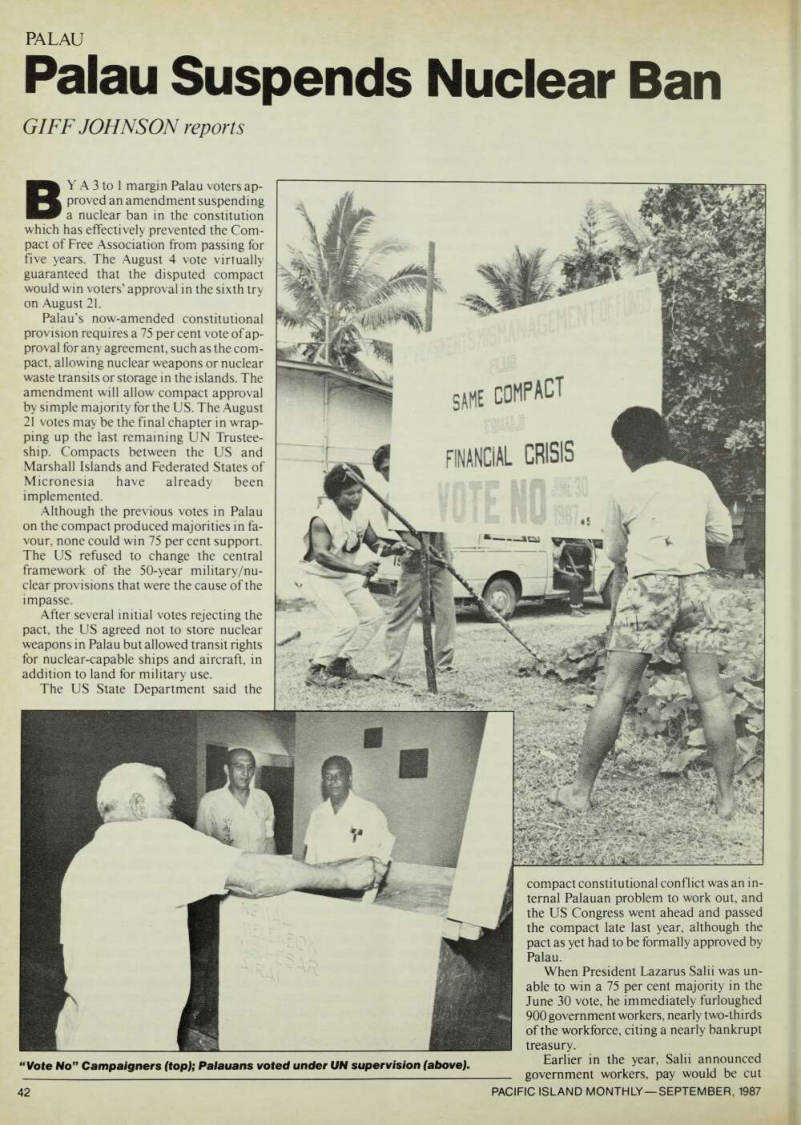
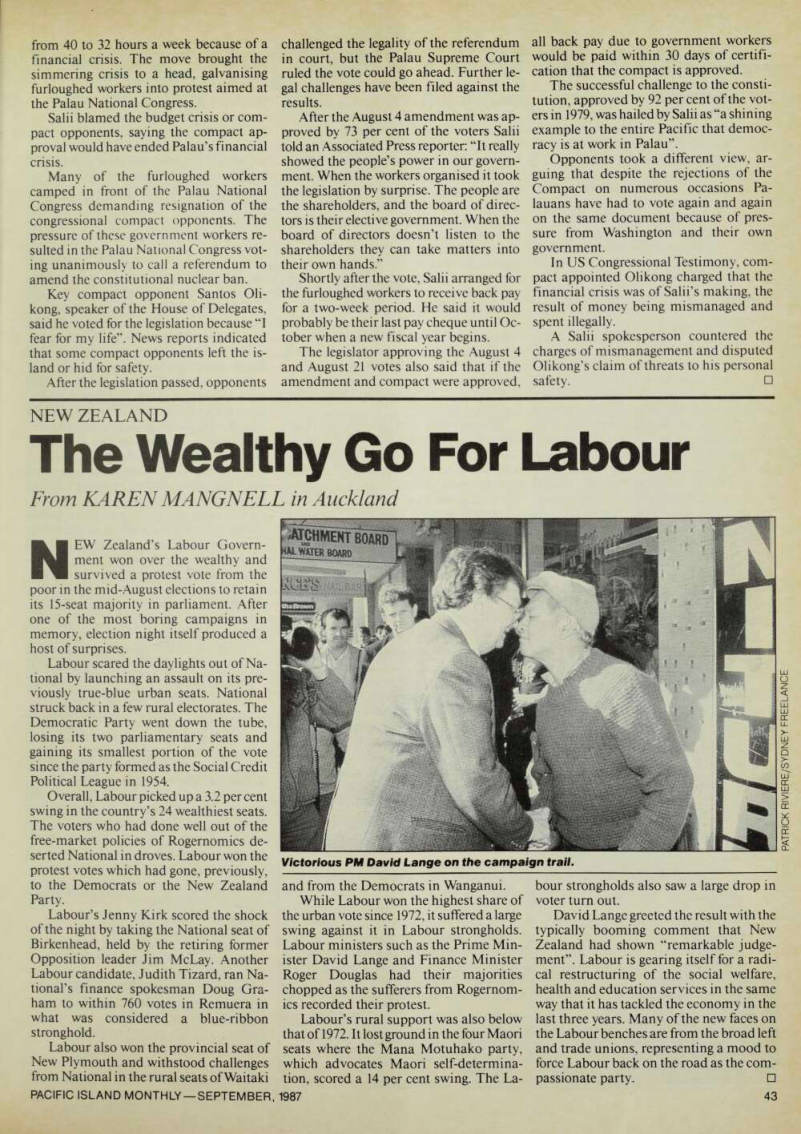
Palau
GIFF JOHNSON reports
BY A 3 to 1 margin Palau voters ap proved an amendment suspending a nuclear ban in the constitution which has effectively prevented the Com pact of Free Association from passing for five years. The August 4 vote virtually guaranteed that the disputed compact would win voters’ approval in the sixth try on August 21.
Palau’s now-amended constitutional provision requires a 75 per cent vote of ap proval for any agreement, such as the com pact, allowing nuclear weapons or nuclear waste transits or storage in the islands. The amendment will allow compact approval by simple majority for the US. The August 21 votes may be the final chapter in wrap ping up the last remaining UN Trustee ship. Compacts between the US and Marshall Islands and Federated States of Micronesia have already been implemented.
Although the previous votes in Palau on the compact produced majorities in fa vour, none could win 75 per cent support.
The US refused to change the central framework of the 50-year military/nu clear provisions that were the cause of the impasse.
After several initial votes rejecting the pact, the US agreed not to store nuclear weapons in Palau but allowed transit rights for nuclear-capable ships and aircraft, in addition to land for military use.
The US State Department said the
compact constitutional conflict was an in ternal Palauan problem to work out, and the US Congress went ahead and passed the compact late last year, although the pact as yet had to be formally approved by Palau.
When President Lazarus Salii was un able to win a 75 per cent majority in the June 30 vote, he immediately furloughed 900 government workers, nearly two-thirds of the workforce, citing a nearly bankrupt treasury.
Earlier in the year, Salii announced government workers, pay would be cut
“Vote No” Campaigners (top); Palauans voted under UN supervision (above).
from 40 to 32 hours a week because of a financial crisis. The move brought the simmering crisis to a head, galvanising furloughed workers into protest aimed at the Palau National Congress.
Salii blamed the budget crisis or com pact opponents, saying the compact ap proval would have ended Palau’s financial crisis.
Many of the furloughed workers camped in front of the Palau National Congress demanding resignation of the congressional compact opponents. The pressure of these government workers re sulted in the Palau National Congress vot ing unanimously to call a referendum to amend the constitutional nuclear ban.
Key compact opponent Santos Oli kong, speaker of the House of Delegates, said he voted for the legislation because “I fear for my life”. News reports indicated that some compact opponents left the is land or hid for safety.
After the legislation passed, opponents
challenged the legality of the referendum in court, but the Palau Supreme Court ruled the vote could go ahead. Further legal challenges have been filed against the results.
After the August 4 amendment was approved by 73 per cent of the voters Salii told an Associated Press reporter; “It really showed the people’s power in our government. When the workers organised it took the legislation by surprise. The people are the shareholders, and the board of directors is their elective government. When the board of directors doesn’t listen to the shareholders they can take matters into their own hands.”
Shortly after the vote, Salii arranged for the furloughed workers to receive back pay for a two-week period. He said it would probably be their last pay cheque until October when a new fiscal year begins.
The legislator approving the August 4 and August 21 votes also said that if the amendment and compact were approved,
all back pay due to government workers would be paid within 30 days of certifi cation that the compact is approved, The successful challenge to the consti tution, approved by 92 per cent of the vot ers in 1979, was hailed by Salii as “a shining example to the entire Pacific that democ racy is at work in Palau”, Opponents took a different view, ar guing that despite the rejections of the Compact on numerous occasions Pa lauans have had to vote again and again on the same document because of pres sure from Washington and their own government.
In US Congressional Testimony, com pact appointed Olikong charged that the financial crisis was of Salii’s making, the result of money being mismanaged and spent illegally.
A Salii spokesperson countered the charges of mismanagement and disputed Olikong’s claim of threats to his personal safety. □
Advertisements & other items, p. 42 (1 item)
42
PACIFIC ISLAND MONTHLY—SEPTEMBER, 1987
Patrick Riviere/Sydney Freelance
New Zealand
The Wealthy Go For Labour
From KARENMANGNELL in Auckland
NEW Zealand’s Labour Govern ment won over the wealthy and survived a protest vote from the poor in the mid-August elections to retain its 15-seat majority in parliament. After one of the most boring campaigns in memory, election night itself produced a host of surprises.
Labour scared the daylights out of Na tional by launching an assault on its pre viously true-blue urban seats. National struck back in a few rural electorates. The Democratic Party went down the tube, losing its two parliamentary seats and gaining its smallest portion of the vote since the party formed as the Social Credit Political League in 1954.
Overall, Labour picked up a 3.2 per cent swing in the country’s 24 wealthiest seats.
The voters who had done well out of the free-market policies of Rogernomics de serted National in droves. Labour won the protest votes which had gone, previously, to the Democrats or the New Zealand Party.
Labour’s Jenny Kirk scored the shock of the night by taking the National seat of Birkenhead, held by the retiring former Opposition leader Jim McLay. Another Labour candidate, Judith Tizard, ran Na tional’s finance spokesman Doug Gra ham to within 760 votes in Remuera in what was considered a blue-ribbon stronghold.
Labour also won the provincial seat of New Plymouth and withstood challenges from National in the rural seats of Waitaki
and from the Democrats in Wanganui.
While Labour won the highest share of the urban vote since 1972, it suffered a large swing against it in Labour strongholds.
Labour ministers such as the Prime Min ister David Lange and Finance Minister Roger Douglas had their majorities chopped as the sufferers from Rogernom ics recorded their protest.
Labour’s rural support was also below that of 1972. It lost ground in the four Maori seats where the Mana Motuhako party, which advocates Maori self-determina tion, scored a 14 per cent swing. The La
hour strongholds also saw a large drop in voter turn out.
David Lange greeted the result with the typically booming comment that New Zealand had shown “remarkable judge ment”. Labour is gearing itself for a radi cal restructuring of the social welfare, health and education services in the same way that it has tackled the economy in the last three years. Many of the new faces on the Labour benches are from the broad left and trade unions, representing a mood to force Labour back on the road as the com passionate party. □
Victorious PM David Lange on the campaign trail.
Patrick Riviere/Sydney Freelance
Advertisements & other items, p. 43 (1 item)
43
PACIFIC ISLAND MONTHLY —SEPTEMBER, 1987
Letters to the Editor
Fiji Reflections
My wife and I have just returned from a few weeks in post-coup Suva, where I was teaching at the Fiji Medical School, partly in response to acute and anticipated staff shortages.
The school, which graduated its first “native medical practitioners” as far back as 1885, faces an uncertain immediate fu ture as a great number of Indian and Eu ropean expatriate staff members already have resigned and emigrated, or plan to.
Immigration, mostly to Australia, New Zealand and Canada, is the main conver sation topic with Indian professional colleagues.
However, since the coup, all civil serv ants, including academic staff, nurses, etc, have been asked to lake a 25 per cent pay cut, which when taken with the recent de valuation of the Fijian dollar (still worth more than the Australian dollar), means a severe drop in living standards. This affects locals more than expatriate staff, since most of the latter have their wages supplemented by their home countries.
In addition, there have been lay-offs and reduction, in working hours of many busi nesses. The newspaper “personal” col umns have seen an increase in the number of marriage offers (linked to immigration prospects) from overseas Indians. In some cases leaving the country means having to forfeit property or money to “repay” the government for a breach of terms of con tract for bonded service.
The outward signs of the coup are ev
idem in soldiers guarding public buildings including the hospital, bridges, and of course, the Suva Civic Auditorium, where the Great Council of Chiefs has been in session to decide the country’s future.
The most aggressive of the pressure groups on the Council of Chiefs is the Tau kei movement, whose power base is made up of traditional land owners and sup porters of the Alliance Party. They make their submissions, which include de mands for making Fiji a republic, in the customary “vakaturaga” manner, involv ing handing over of the traditional sperm whale tooth “tabua”.
Meanwhile the local reggae band “Rootslrata” gives free concerts in sup port of the Taukei movement, to the crowds gathered in Sukuna Park outside the Civic Auditorium. A few enterprising Fijians are selling “Colonel Rabuka” t-shirts at $7 each.
Though there have been no repetitions of the major riot that followed the coup, a number of criminal break-ins by vandals have led to increased military and police patrols on the streets of Suva with shops remaining open but having their shutters on standby ready to “board up” at any sign of trouble.
Indians feel insecure after a few have been attacked in their houses, and others claim to have cane-knives and petrol bombs ready to repel break-ins. Fiji’s strict gun-control laws hve fortunately pre vented more serious bloodshed. Indians, and some others, tend to look over their
shoulders when discussing sensitive is sues since informers have caused a num ber of people to be detained by army or police for questioning. Officially permits are needed for gatherings of more than four people, even in private homes, requiring our Indian host to obtain such a paper from the local police station prior to a small dinner party for seven people.
In the Fijian villages of the coast and interior, life goes on without the tension felt in Suva. As a village elder phrased it on an island south of Viti Levu: “We Fi jians are still friendly, coup or not.”
The link with the Crown is valued at grass-roots level, with many village homes in all parts of the country having portraits of the Royal family around their own col lections of fading snap-shots on the wall.
In the towns, Fijians and Indians alike are avid newspaper readers (there is no TV apart from video, which serves up a steady diet of kung-fu westerns and Hindu rom ances). Both the Fiji Sun and Fiji Times carry news items and letters that are both pro- and anti-coup, illustrating that a free press not only exists but provides a forum for people to air their views.
The coup of May 14 has set an unfor tunate precedent in a region of the devel oping world unique for its unbroken record of parliamentary democracy since inde pendence. It has set Fiji’s economy back several years and is unfair to the Indians who have lived and worked in Fiji for gen erations, and given it the high living standard enjoyed until recently.
As for the future, it seems to me that the present interim administration in Fiji (it is not a military regime: civilian politi cians and chiefs make up the great major ity of its members under the Governor General, Ratu Sir Penaia Gan ilau), will guide the country to a new con stitution, influenced decisively by the Great Council of Chiefs. It seems little doubt that the new constitution will en sure permanent Fijian control, while the Indians who can, will “vote with their feet” by leaving.
My personal concern is that the Uni versity of the South Pacific, and the Fiji School of Medicine, will be able to main tain their high standards. Having worked in a number of countries in the South Pa cific, both British Commonwealth and US possessions, I know that Fiji-trained doc tors form the backbone of the medical services in all these islands. While expa triate staff come and go, it is these local doctors, Polynesians, Melanesians, and Micronesians, who have done their five years of training in Suva, who provide continuity in the main hospitals and outer island clinics throughout the region.
Stephen R Weinstein
Tarragindi, Qld, Australia
Advertisements & other items, p. 44 (2 items)
44
PACIFIC ISLAND MONTHLY—SEPTEMBER, 1987
Dunhill Morgan is pleased
to announce the appointment
of a new partner.
GRAHAM ARUNDEL FRANCIS
FORMERLYTHE SENIOR PARTNER
WITH BERESFORD LOVE FRANCIS & CO., SOLICITORS
IN PAPUA NEW GUINEA.
MR. FRANCIS WILL PRACTISE IN THE
COMMERCIAL BANKING AND FINANCE SECTION OF
THE FIRM WITH SPECIAL RESPONSIBILITY FOR
THE SOUTHERN PACIFIC REGION.
MAINTAINING
A TRADITION OF QUALITY
DUNHILL MORGAN
SOLICITORS AND NOTARIES
BARRACK HOUSE
16 BARRACK STREET
SYDNEY 2000 AUSTRALIA
TEL (02) 233 3622
Pacific Report
97.000 Re-Settled
Since 1970, the Indonesian govern ment has resettled 23,723 families in six regions of Irian Jaya 82,191 outsiders and 15,514 people from local areas.
Teachers’ Strike
Teachers in Papua New Guinea’s West ern Highlands Province went on strike for a week last month, protesting against the region’s lawlessness. This followed the burning down of classrooms at the Minj High School, and numerous attacks on teachers and school property, including the rape of several female teachers.
Us Offer Rejected
A US offer to detonate French nuclear devices at an underground site in Nevada, has been rejected by France’s Defence Minister. Mr Andre Giraud. He said the French Government considered the tests at Mururoa posed no danger to the South Pacific.
Fishermen Rescued —1
The MV Tradition picked up four fish ermen from Kirabati who had been adrift for 23 days, and had survived by eating raw fish and drinking rain water. The men, in cluding former cabinet minister Mr Bin ala Tetaeka, former Minister of Health and Family Planning, were taken to Pago Pago in American Samoa. The MV Tradition was arrested in May by the Kiribati Government for fishing illegally in Kiri bati water, and was eventually sold back to its owners.
Fishermen Rescued 2
The captain and crew of Priscilla , a tuna boat from American Samoa, were rescued by a Nauruan cargo ship 60 kilo metres north west of Apia after their boat exploded and sank. The crew had been adrift for 14 hours. The boat had about 15.000 tonnes offish aboard when it sank.
A New Presence
The Japanese news agency, Jiji Press, says the Soviet Union has assigned one of its two most sophisticated submarines, the AKR class, to the Pacific fleet.
Nauru Investigations
Australia has provided official docu ments for the Nauru Rehabilitation In quiry into the worked-out mining areas on Nauru relating to phosphate mining on Nauru by the British Phosphate commis sion. The inquiry is investigating whether
damage to the environment can be re paired, and who should pay. Four-fifths of the island was devastated by the mining between 1920 and 1966 under the joint control of Britain, Australia and New Zea land. The three governments say they will not be bound by the findings of the inquiry.
Campus Freedom
Colonel Rabuka has assured the Uni versity of the South Pacific that units of military forces will not be allowed to come on to the campus, respecting its status as a regional institution.
Fare Increases
All outward fares from Fiji on inter national airlines rose nine per cent from July 20 and the cost of cargo went up by five per cent from August 1.
Second Channel
Papua New Guinea’s second television station went to air in Port Moresby on July 23. Called Em TV, Tok Pisin for This is Television, the station is half-owned by the Bond Corporation of Western Australia.
Its competitor, NTN, is also controlled by a West Australian company.
33 Candidates
The Union of Moderate Parties (UMP) in Vanuatu is to field 33 candidates in the November elections, the precise date for which has yet to be announced. Mr Vin cent Bulakone recently resumed his seat as UMP Congress president after a year long dispute (PIM July ‘B7). The UMP Congress has agreed to accept coalitions with new smaller opposition parties on condition that they field candidates only in the strongholds of the ruling Vanua’aku Pati.
Asean Treaty
Papua New Guinea is to sign a treaty of Amity and Cooperation with ASEAN na tions this month. PNG has had special ob server status at ASEAN meetings, and the accession to the treaty has been pushed by Mr Paias Wingti, who has stressed the im portance of Papua New Guinea’s “bridg ing role” between south-east Asia and the island states of the South Pacific Forum.
Water Shortage
The 36,000 residents of Western Sa moa’s capital, Apia, were left without water when the town’s main water supply was found to be contaminated by pesticide.
Four men were arrested for using a pesti cide to catch shrimp in the reservoir.
Bans Lifted
Australian and New Zealand unions have lifted trade bans imposed on Fiji shortly after the May military coup.
Cyclone Relief
Fiji has received nearly 5F45,000 from the Netherlands for cyclone relief work.
The money will help rebuild three school blocks damaged by Cyclone Raja earlier this year.
Privileges
Tonga’s Privy Council has ruled that corruption charges against 25 of the coun try’s 28 members of parliament should not be heard by the Supreme Court on the grounds that the Legislative Assembly had absolute privileges on deciding on allow ances for its members.
The charges had been brought by Mr Ipeni Siale who claimed that the MPs had accepted over-payments of more than $150,000 on travel allowances.
In a separate decision, Mr Siale was barred from accepting a seat in Tonga’s Legislative Assembly as a people’s repre sentative from the Vava’u group, because he accepted American citizenship in 1984 and therefore was no longer a Tongan subject.
Advertisements & other items, p. 45 (1 item)
computer needs
Aggie Grey’s Hotel
Stay at Aggie Grey’s the South Pacific’s legendary hotel.
Situated right in the heart of Western Samoa. Enjoy Polynesian style friendliness and service, in cool surroundings, superb entertainment and food. Magnificent white sand beaches only a short drive away. Air-conditioned rooms, swimming pool and full bar facilities.
Bookings through Union Steamship Company of NZ, Pan Am, Air New Zealand or direct to Aggie Grey’s, Apia, Western Samoa. Cables: AGGIES’ Apia.
For all your
computer needs
(hardware, software, books)
by quick and easy
mail order.
CANBERRA
ACCOUNTING SERVICES
GPO Box 2159, Canberra, 2601. AUSTRALIA
Trade Winds
SOUTH Pacific economists seem divided over whether the region’s small island economies can ever become self-sufficient. Professor Felix Wendt of the Western Samoan agriculture ministry told the Asian Development Bank workshop on South Pacific devel oping countries that the concepts of self sufficiency and economic independence were no longer fully applicable.
Professor Wendt said island societies were becoming more money-oriented with wages, remittances, credit and cash in comes in much greater demand. He told about 70 delegates in Auckland that the target of economic growth should not be at the expense of broader social and cul tural needs in South Pacific countries. In practise, reconciling these had proven elusive.
“On the one hand, national develop ment plans still reflect the assumption that the economic systems inherited from the previous colonial powers will not be changed,” Professor Wendt said. “Yet this very assumption implies the acceptance of massive changes to the socio-cultural systems of Pacific Islands countries.”
Professor Wendt contended that island societies were not yet ready to decide on this dilemma as an either/or choice. If it did come to the choice, the no-growth al ternative would rank “of the highest order”.
Economic planners who aimed for do mestic employment growth to counter the lure of foreign labour markets would have to make agricultural production much more attractive. Pacific Islanders who had set up communities in the rim countries were simply working in extensions of “home”. Remittances should be seen as a form of take-home pay rather than a con straint on production. Professor Wendt said.
The poor returns from agriculture were the main reason lessening islanders’ in centives to produce if this were other wise more remittances would be ploughed into agriculture, remittances should be seen as raising the country’s standard of living and if agriculture were made more rewarding actually encouraging greater production.
But the bank’s vice president, M Nar asimhan, said after the workship sessions that a number of South Pacific countries had shown themselves to be committed to paying their own ways for future economic development. Mr Narasimhan said one of the economic aims for South Pacific de veloping countries was to wean them from aid as a significant factor in their eco nomic growth.
This was already happening, in a sense, as traditional bilateral leaders, such as New
Zealand and Australia, cut back their help.
But South Pacific countries were building a more diverse network of aid and loan sources as other countries, such as Japan, the United States and the EC boosted their presence in the region.
All the workshop sessions were held be hind closed doors so it is difficult to assess any trends that emerged. However, the main issues confronting the delegates seemed to be traditional ones: how to di versify small island economies normally reliant on a single cash crop at the mercy of world market prices. And, perhaps more importantly, whether South Pacific na tions can seriously hope to diversify when their small size, isolation, lack of skilled workforces and regular transport seem in separable barriers.
Resource speakers emphasised the need for a curb on the traditionally large public sectors in South Pacific countries and the need to put more into private sector eco nomic development. The island societies had built high expectations of a consumer lifestyle as a result of the region’s largely open economies. But the absence of pri vate sector employment had tended to push the public sector to the fore as a source of jobs.
Several speakers suggested island governments needed to relax restraints on foreign investment, particularly joint ven tures, and offer incentives to private enterprise.
One speaker suggested that financing development would be relatively easy for South Pacific countries; the main con straint is the ability of the countries to ab sorb and use these overseas funds efficiently. The lack of skilled workers, protectionist hindrances to foreign mar kets, customary land use and the need to link tourism to local goods and services were all major issues confronting island governments.
In addition, some countries such as Fiji had embarked on ambitious infrastruc ture programmes after independence and now faced huge bills to maintain these as sets roads, water and electricity reti culation, energy sources such as hydro dams and so on.
The bank president, Masao Fujioka, said one of the main aims of the work shops had been to let the South Pacific de veloping countries get their message across to the bigger donor nations. So far the bank has lent SUSIOI million to small regional countries like the Cook Islands, Kiribati, the Solomons, Tonga, Western Samoa and Vanuatu. Half of that has gone into agri culture and agro-industrial development.
In 1986, the bank lent $l3 million for sim ilar projects as well as money to develop technically skilled workers.
Fiji has received SUS6O.S million so far from the bank two thirds for energy projects. Last year Fiji got $4.4 million for farm upgrading in the Sigatoka Valley. Pa pau New Guinea is the largest recipient of bank loans in the South Pacific: $U5272.6 million so far and $49 million last year.
More than a third of that has been spent on transport and communications.
Mr Fujioka announced a fast-track soft loan scheme for Pacific nations hit by cy clones. The bank would make up to SUSSOO,OOO available to each nation for reconstruction. □
Computer Bank
The Pacific Islands Association of Chambers of Commerce has set up a re gional computerised trade data bank in Suva. Information on importers, export ers and their products will be available to member chambers.
Second Bank
A second bank has opened in Kiribati.
The Kiribati Development Bank is ex pected to stimulate growth in the private sector. When fully operational it will take over the assets of the National Loans Board. Its lines of operation will be com patible with the Bank of Kiribati, 51 per cent owned by Westpac.
Flight Talks
Negotiations are going on between Fiji and Air New Zealand to resume flights into Fiji. The airline banned all flights after an attempted hijack in May. The Air New Zealand office in Suva still functions, but passengers are booked on other airlines out of Fiji.
No Surplus
Fiji sugar earnings for the 1987 crop are expected to be down nearly SF6O million on the previous year, due to harvesting problems and the drought in the cane belt.
The harvest is expected to cover its export commitments but there will be no surplus to sell on world markets.
Bank Takeover
The Bank of Hawaii has acquired the Chase Manhattan Bank’s retail banking operations in Agana on Guam.
New Number!
The Overseas Telecommunications Commission (OTC) is negotiating an agreement with Kiribati to give it control of the nation’s communications system.
OTC is currently talking with at least four other nations in the Pacific to undertake similar upgradings.
Advertisements & other items, pp. 46-47 (2 items)
46
PACIFIC ISLAND MONTHLY —SEPTEMBER, 1987
The French Viewpoint Continued from page 21
Book Reviews
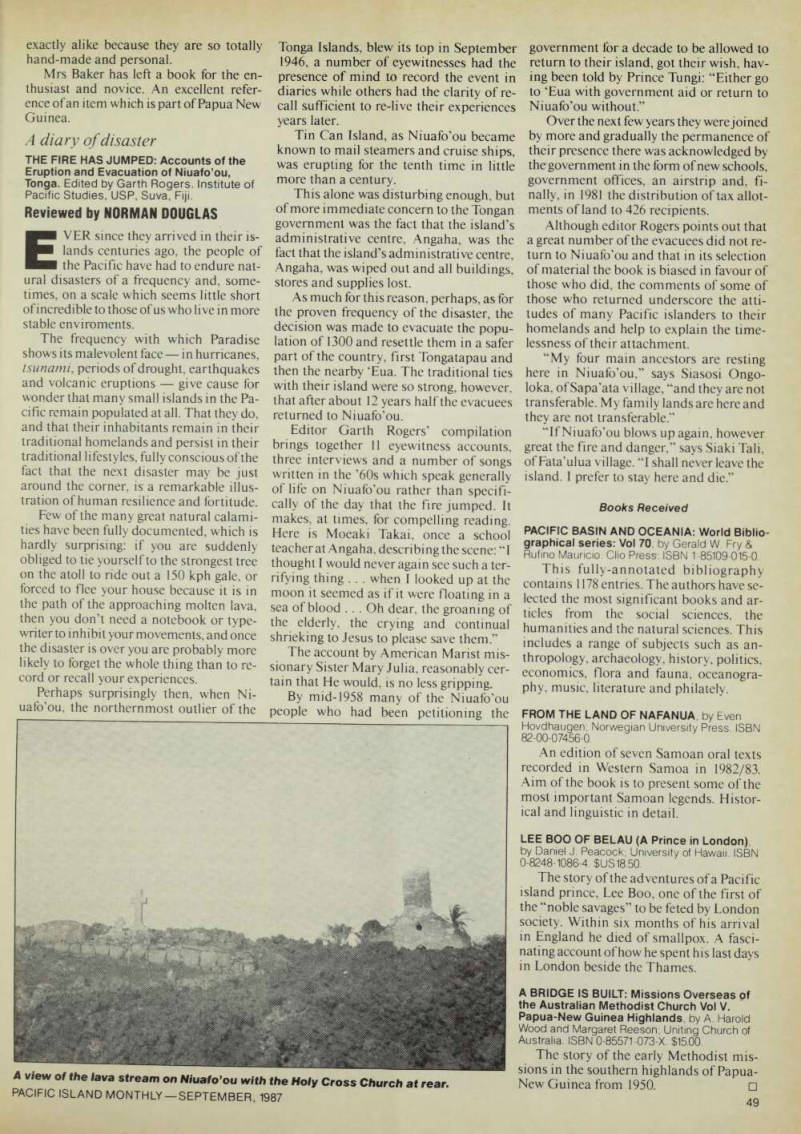
An overview of economic change
Fiji Economic History: 1874-1939:
Studies of Capitalist Colonial Development By Bruce Knapman; National Centre for Development Studies, Research School of Pacific Studies, The Australian National University, Canberra, ISBN 0-86784-977-0.
Reviewed by ROBERT ALDRICH THE recent events in Fiji make a study of the archipelago’s eco nomic history especially interest ing; even more so when commentators interpret the coup d’etat in terms of eco nomic and political disparities between the Fijians and Indians or (as in the case of South magazine) as “class war”.
Knapman provides the serious reader with a well-crafted overview and a refu tation of trendy but simplistic theses about Third World economic change. His ap proach is that of a professional economist, who also assumes that readers will already be familiar with the general outline of Fi jian history.
Some general readers will find the study rather technical and a bit dry, but even for those with no specialised knowledge, the book merits the effort for the author’s in formation and his interpretation.
Knapman treats Fiji’s economic his tory thematically, devoting chapters to ex port (the Colonial Sugar Refining Company), the evolution of the tradi tional, non-capitalist economy, “the de mise of the white sugar planter”, shipping (the Union Steam Ship Company of New Zealand and the Australasian United Steam Navigation Company), commerce (Burns Philp, Morris, Hedstrom Ltd and Brown & Joske) and monetary policy; his documentation includes secondary sources, government records and com pany archives.
The narrative is the installation of a capitalist economy in Fiji; the develop ment of exports of bananas, gold and, es pecially, sugar, the domination of foreign transport and mercantile companies, the monetarisation of exchange and the lin kage of Fiji to the global economy. The import of indentured Indian labourers, the growth of a white settler population and then the pushing aside of the colonists by the international corporations are among the social repercussions. The social costs were great in a system of “placing an un derpaid Indian at the receiving end of an Australian overseer’s whip or swagger stick”; statistics on the suicide rate 15 times higher for indentured Indians in Fiji than in the province of India from which most came are one proof. But the eco nomic and social history of Fiji is more complex than the stereotype of exploita
tion, and the value of Knapman’s study is the revelation of this complexity.
Contrary to certain received models, the foreign companies did not gain huge profits from their Fijian ventures. Neither were the Fijian operations central to the shippers' and traders’ overall strategy; “Although the shipping companies man aged to extract monopoly profits from the carriage of Fiji’s imports, six decades of Fiji’s dependence on the companies ended with them needing Fiji less than they ever had done.”
Similarly, Burns Philp’s early years in Fiji were not encouraging. CSR had to abandon its original intention of buying cane from private planters and its opera tion of estates in favour of leasing land to canegrowers to maintain its profits. The white planters, themselves, enjoyed only a veneer of prosperity and became indebted to the corporations which loaned them the money they desperately needed. Tempo rary alliances between settlers and government and outright collusion be tween various competing companies in dicated weakness rather than strength.
The list of failed enterprises is long. The economic crises of the 1920 s and 1930 s un veiled the fragility of the capitalist system set in place and, as well, the failure of the foreign ideal of creating a yeoman society of Indian and Fijian farmers.
Knapman sets out to do more than just nuance the portrait of capitalism in the Pacific islands or to show the shakiness of that capitalist system. He wants to. dis prove the Marxist (or neo-Marxist) model that capitalist imperialism caused under development in Fiji. He wants to avoid “the tunnel vision of the paradigmatically my opic, who squeeze the evidence into a pre ferred model”.
He charges that the contention that capitalism caused underdevelopment is tautological. Furthermore, and more sig nificantly, the model overlooks the op tions available to the various actors, the non-economic constraints to develop ment and the undeniable developments credited to capitalism (such as the eco nomic infrastructure).
The weak point of Knapman’s expo sition is what model he intends to substi tute for the neo-Marxist one, as he is also skeptical about modernisation, neo-clas sical or purely empirical frameworks.
Bandying about catchwords such as “exploitation” and “oppression”, “capi talism” and “imperialism” does not amount to a real analysis. Knapman’s fine study, one hopes, will be one of many pre senting a more sophisticated view of Oceanic societies. Theorising is not help ful only to specialists.
Knapman, for example, speaks of the preservation of native properly and life in Fiji, arguing that “increasing integration into the world capitalist economy does not necessarily cause disintegration of local structures”.
The continued vitality of this Fijian Oceanic society, coupled with the remark able transformation of the Indians’ situa tion. is ultimately a more useful explanation of the island’s contemporary problems than simplistic statements about ethnic disputes, class confrontations or political quarrels.
A practical guide
MAKE YOUR OWN BILUM By Sylvia Baker; Boolarong Publications, 12 Brooke St, Bowen Hills, Old 4006. ISBN 0-959-0226-00. $A9.95.
Reviewed by JOHN HUNTER WAITING to catch a plane from Lae to the Highlands I noticed a Highlands lady arrive with a bilum hanging down her back from her fo rehead. The huge bilum was packed with taro. She carried it with ease to the small plane for loading. However, it took two well-built males all their strength to lift the load into the plane. Such is the strength of PNG women and the versatility of the bilum. The bilum is the traditional carry bag of Papua New Guinea and is similar, in many ways, to the dilly bag of the Aus tralian Aborigines. The bag is used to carry babies, food, wood, betel nut and 1000 other goods.
Sylvia Baker had a lifelong interest in the bilum and built up a vast knowledge about its making and patterning. Fre quently asked to demonstrate bilum-mak ing, and often asked for an instruction book, she set about compiling a book on all she knew. Unfortunately she died soon after completing the work. What she has left behind is a well-researched memorial to her expertise.
Sections of this classic reference work include: structure of the bilum, materials and equipment, thigh spinning, melting, making the handle and mouth, and patterning.
I found the book very practical after a recent trip to PNG when I discovered a hole in my bilum. The book enabled me to successfully do my own repairs.
Mrs Baker illustrates her work with nu merous photographs of colourful bilums and diagrams, designed, as she says, to en able any keen craftsman to tackle the making of the simplest basic bilum types.
Every bilum is unique, allowing free dom for self expression at every phase of the working. No two bilums will ever be
exactly alike because they are so totally hand-made and personal.
Mrs Baker has left a book for the en thusiast and novice. An excellent refer ence of an item which is part of Papua New Guinea.
A diary of disaster
THE FIRE HAS JUMPED: Accounts of the Eruption and Evacuation of Niuafo’ou, Tonga. Edited by Garth Rogers. Institute of Pacific Studies, USP, Suva, Fiji.
Reviewed by NORMAN DOUGLAS EVER since they arrived in their is lands centuries ago, the people of the Pacific have had to endure nat ural disasters of a frequency and, some times, on a scale which seems little short of incredible to those of us who live in more stable enviroments.
The frequency with which Paradise shows its malevolent face in hurricanes, tsunami , periods of drought, earthquakes and volcanic eruptions give cause for wonder that many small islands in the Pa cific remain populated at all. That they do, and that their inhabitants remain in their traditional homelands and persist in their traditional lifestyles, fully conscious of the fact that the next disaster may be just around the corner, is a remarkable illus tration of human resilience and fortitude.
Few of the many great natural calami ties have been fully documented, which is hardly surprising: if you are suddenly obliged to tie yourself to the strongest tree on the atoll to ride out a 150 kph gale, or forced to flee your house because it is in the path of the approaching molten lava, then you don’t need a notebook or type writer to inhibit your movements, and once the disaster is over you are probably more likely to forget the whole thing than to re cord or recall your experiences.
Perhaps surprisingly then, when Ni uafo’ou, the northernmost outlier of the
Tonga Islands, blew its top in September 1946, a number of eyewitnesses had the presence of mind to record the event in diaries while others had the clarity of re call sufficient to re-live their experiences years later.
Tin Can Island, as Niuafo’ou became known to mail steamers and cruise ships, was erupting for the tenth time in little more than a century.
This alone was disturbing enough, but of more immediate concern to the Tongan government was the fact that the island’s administrative centre, Angaha, was the fact that the island’s administrative centre, Angaha, was wiped out and all buildings, stores and supplies lost.
As much for this reason, perhaps, as for the proven frequency of the disaster, the decision was made to evacuate the popu lation of 1300 and resettle them in a safer part of the country, first Tongatapau and then the nearby ‘Eua. The traditional ties with their island were so strong, however, that after about 12 years half the evacuees returned to Niuafo’ou.
Editor Garth Rogers’ compilation brings together 11 eyewitness accounts, three interviews and a number of songs written in the ’6os which speak generally of life on Niuafo’ou rather than specifi cally of the day that the fire jumped. It makes, at times, for compelling reading.
Here is Moeaki Takai, once a school teacher at Angaha, describing the scene: “1 thought I would never again see such a ter rifying thing . . . when I looked up at the moon it seemed as if it were floating in a sea of blood . . . Oh dear, the groaning of the elderly, the crying and continual shrieking to Jesus to please save them.”
The account by American Marist mis sionary Sister Mary Julia, reasonably cer tain that He would, is no less gripping.
By mid-1958 many of the Niuafo’ou people who had been petitioning the
government for a decade to be allowed to return to their island, got their wish, hav ing been told by Prince Tungi: “Either go to ‘Eua with government aid or return to Niuafo’ou without.”
Over the next few years they were joined by more and gradually the permanence of their presence there was acknowledged by the government in the form of new schools, government offices, an airstrip and, fi nally, in 1981 the distribution of tax allot ments of land to 426 recipients.
Although editor Rogers points out that a great number of the evacuees did not re turn to Niuafo’ou and that in its selection of material the book is biased in favour of those who did, the comments of some of those who returned underscore the atti tudes of many Pacific islanders to their homelands and help to explain the time lessness of their attachment.
“My four main ancestors are resting here in Niuafo’ou,” says Siasosi Ongo loka, of Sapa’ala village, “and they are not transferable. My family lands are here and they are not transferable.”
“If Niuafo’ou blows up again, however great the fire and danger,” says Siaki Tali, of Fata’ulua village. “I shall never leave the island. I prefer to stay here and die.”
Books Received
Pacific Basin And Oceania: World Biblio
graphical series: Vol 70 by Gerald W Fry & Rufino Mauricio. Clio Press: ISBN 1-85109-015-0.
This fully-annotated bibliography contains 1178 entries. The authors have se lected the most significant books and ar ticles from the social sciences, the humanities and the natural sciences. This includes a range of subjects such as an thropology, archaeology, history, politics, economics, flora and fauna, oceanogra phy, music, literature and philately.
FROM THE LAND OF NAFANUA. by Even Hovdhaugen; Norwegian University Press ISBN 82-00-07456-0 An edition of seven Samoan oral texts recorded in Western Samoa in 1982/83.
Aim of the book is to present some of the most important Samoan legends. Histor ical and linguistic in detail.
LEE 800 OF BELAU (A Prince in London) by Daniel J. Peacock; University of Hawaii. ISBN
0-8248-1086-4. Sus 18.50.
The story of the adventures of a Pacific island prince, Lee 800, one of the first of the “noble savages” to be feted by London society. Within six months of his arrival in England he died of smallpox. A fasci nating account of how he spent his last days in London beside the Thames.
A BRIDGE IS BUILT: Missions Overseas of the Australian Methodist Church Vol V.
Papua-New Guinea Highlands, by A Harold Wood and Margaret Reeson; Uniting Church of Australia. ISBN 0-85571-073-X. $15,00.
The story of the early Methodist mis sions in the southern highlands of Papua- New Guinea from 1950. □
A view of the lava stream on Niuafo’ou with the Holy Cross Church at rear.
Advertisements & other items, pp. 48-49 (2 items)
48
PACIFIC ISLAND MONTHLY —SEPTEMBER, 1987
49
PACIFIC ISLAND MONTHLY —SEPTEMBER, 1987
Pacific Stamp Box
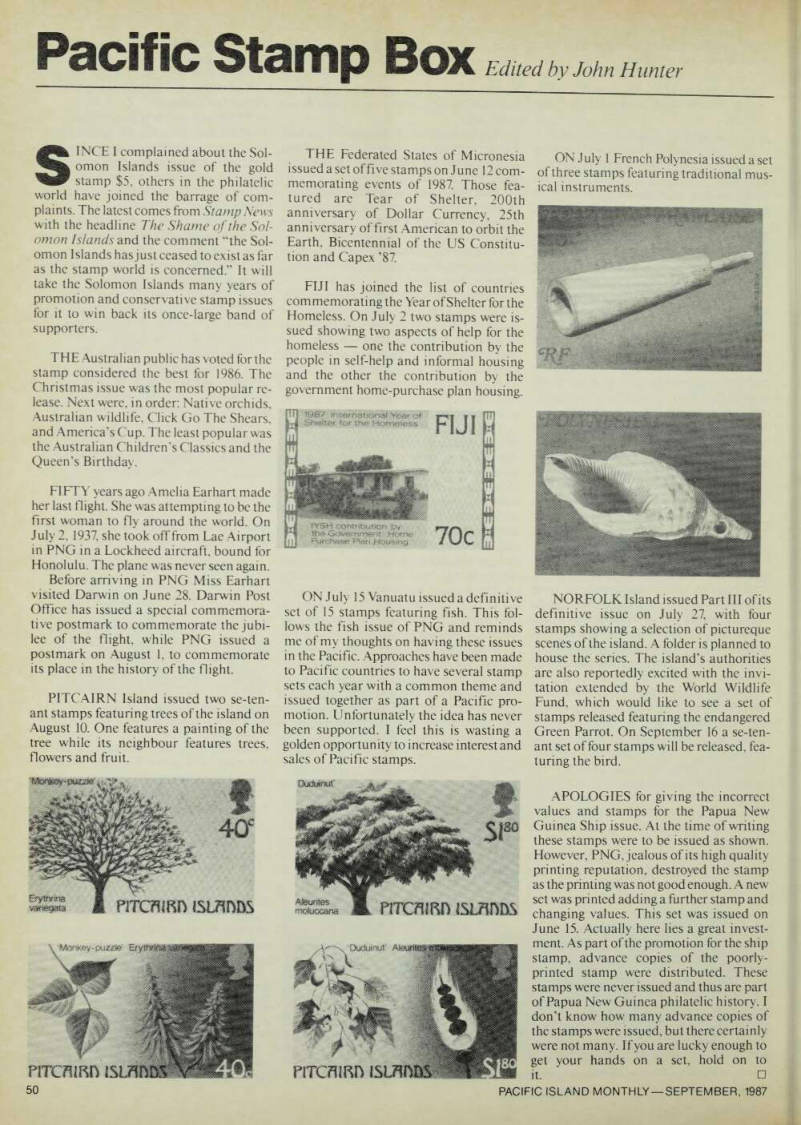
Edited by John Hunter
SINCE I complained about the Sol omon Islands issue of the gold stamp $5, others in the philatelic world have joined the barrage of com plaints. The latest comes from Stamp News with the headline The Shame of the Sol omon Islands and the comment “the Sol omon Islands has just ceased to exist as far as the stamp world is concerned.” It will take the Solomon Islands many years of promotion and conservative stamp issues for it to win back its once-large band of supporters.
THE Australian public has voted for the stamp considered the best for 1986. The Christmas issue was the most popular re lease. Next were, in order; Native orchids, Australian wildlife. Click Go The Shears, and America’s Cup. The least popular was the Australian Children’s Classics and the Queen’s Birthday.
FIFTY years ago Amelia Earhart made her last flight. She was attempting to be the first woman to fly around the world. On July 2, 1937, she took off from Lae Airport in PNG in a Lockheed aircraft, bound for Honolulu. The plane was never seen again.
Before arriving in PNG Miss Earhart visited Darwin on June 28. Darwin Post Office has issued a special commemora tive postmark to commemorate the jubi lee of the flight, while PNG issued a postmark on August 1, to commemorate its place in the history of the flight.
PITCAIRN Island issued two se-ten ant stamps featuring trees of the island on August 10. One features a painting of the tree while its neighbour features trees, flowers and fruit.
THE Federated States of Micronesia issued a set of five stamps on June 12 com memorating events of 1987. Those fea tured are Tear of Shelter, 200th anniversary of Dollar Currency, 25th anniversary of first American to orbit the Earth, Bicentennial of the US Constitu tion and Capex ’B7.
FIJI has joined the list of countries commemorating the Year of Shelter for the Homeless. On July 2 two stamps were is sued showing two aspects of help for the homeless one the contribution by the people in self-help and informal housing and the other the contribution by the government home-purchase plan housing.
ON July 15 Vanuatu issued a definitive set of 15 stamps featuring fish. This fol lows the fish issue of PNG and reminds me of my thoughts on having these issues in the Pacific. Approaches have been made to Pacific countries to have several stamp sets each year with a common theme and issued together as part of a Pacific pro motion. Unfortunately the idea has never been supported. I feel this is wasting a golden opportunity to increase interest and sales of Pacific stamps.
ON July 1 French Polynesia issued a set of three stamps featuring traditional mus ical instruments.
NORFOLK Island issued Part 111 of its definitive issue on July 27, with four stamps showing a selection of pictureque scenes of the island. A folder is planned to house the series. The island’s authorities are also reportedly excited with the invi tation extended by the World Wildlife Fund, which would like to see a set of stamps released featuring the endangered Green Parrot. On September 16 a se-ten ant set of four stamps will be released, fea turing the bird.
APOLOGIES for giving the incorrect values and stamps for the Papua New Guinea Ship issue. At the time of writing these stamps were to be issued as shown.
However, PNG, jealous of its high quality printing reputation, destroyed the stamp as the printing was not good enough. A new set was printed adding a further stamp and changing values. This set was issued on June 15. Actually here lies a great invest ment. As part of the promotion for the ship stamp, advance copies of the poorly printed stamp were distributed. These stamps were never issued and thus are part of Papua New Guinea philatelic history. I don’t know how many advance copies of the stamps were issued, but there certainly were not many. If you are lucky enough to get your hands on a set, hold on to it. □
Advertisements & other items, pp. 50-51 (3 items)
50
PACIFIC ISLAND MONTHLY—SEPTEMBER, 1987
51
PACIFIC ISLAND MONTHLY —SEPTEMBER, 1987
South Pacific Bureau for Economic Co-operation
SPEC
SPEC
Applications are invited from citizens of member countries for the following positions with the South Pacific Bureau
for Economic Co-operation (SPEC).
SPEC is the Secretariat to the South Pacific Forum which is comprised of the Leaders of the following independent countries of the South Pacific region:- Australia, Cook Islands, Federated States of Micronesia, Fiji, Kiribati, Marshall Islands, Nauru, New Zealand, Niue, Papua New Guinea, Solomon Islands, Tonga, Tuvalu, Vanuatu and Western Samoa.
A regional organisation based in Suva, SPEC was established to encourage co-operation in the South Pacific not only between member states in the region, but also between island member states and the more industrialised countries on all aspects of economic development, trade, transport, tourism, telecommunications, and energy.
DEPUTY DIRECTOR
This is a Management position and the successful candidate will be responsible to the Director for the overall supervision, organisation and coordination of SPEC s annual work programme including provision of advice and guidance to multi-disciplinary staff on analysing, implementing and evaluating of regional development projects. The appointee is also expected to assist the Director in implementing the Forum and SPEC policy decisions, and to represent the organisation at regional and international meetings or forums.
Applicants should be university graduates, preferably with post-graduate qualifications in development economics, project planning or in a relevant discipline. They should have indepth knowledge of the South Pacific region and possess considerable relevant experience in trade, transport, tourism, telecommunications, energy oreconomic development. Experience in Governmentservicc and/or international organisations at senior management level will be a distinct advantage. The position will be available from January 1988.
ECONOMIC AND AID CO-ORDINATOR
The Co-ordinator leads a professional unit responsible for SPEC's activities in the fields of development planning, aid co-ordination and oversight of regional economic development programmes in the South Pacific Forum countries.
Duties of theposition include the development and main tenanceof good relations with donorcountries and development assistance organisations; designing, acquiring funds for, implementing and supervising regional aid projects; and economic reporting on projects and development in the South Pacific region.
Applicants should be Development Economists with at least eight years practical experience in a Government Ministry or a regional/international insti tution dealing with aid co-ordinationandeconomicdevelopmentprogrammes. Applicants with substantial experience in development project management outside the public sector will also be considered. They should be economics graduates preferably with relevant post-graduate qualifications. Ability to provide team leadership and communicate effectively at a senior level is essential; management and administrative experience will be an advantage. The position will be available from January 1988.
PROJECT OFFICER
Applications are invited from University graduates majoring in Economics who have a minimum of five years relevant experience in a Government department, an international organisation, or the private sector.
'Die successful candidate will be primarily responsible to the Director through the Economics and Aid Co-ordinator for preparation and implementation of development projects to be funded by the EEC (Lome II & III) and associated aid funding agencies. He/She will prepare project dossiers, prepare papers and reports for meetings, undertake special assignments on economic aspects of SPEC's work programme and, advise and assist other project officers on a wide spectrum of activities. He/She should be able to understand and communicate on economic development trends and needs of the region. Familiarity with EEC institutional aid arrangements and systems will be a distinct advantage. The position will be available in December 1987.
General Information Regarding All Positions Appointees will be based at SPEC Headquarters in Suva but will be required to travel extensively. The term is normally two years including a six month probationary period, and the term can be extended under certain conditions. Competitive salaries at regional levels are paid in Fiji dollars and are tax-free to non-Fiji nationals. Housing or housing allowances, overseas and education allowances, school holiday travel, superannuation provisions, medical, travel and life insurance benefits combine to make a most attractive package. Further details can be obtained from the address below.
Applications which close on 31 October 1987 should provide full information on education and employment background and should list the names of three referees with whom the applicant has been associated in a professional capacity.
Applications and enquiries should be addressed to:- The Director South Pacific Bureau for Economic Co-operation GPO Box 856, Suva, FIJI.
Telephone: 312600; Telex 2229 FJ; Fax 314204.
Shipping Schedules
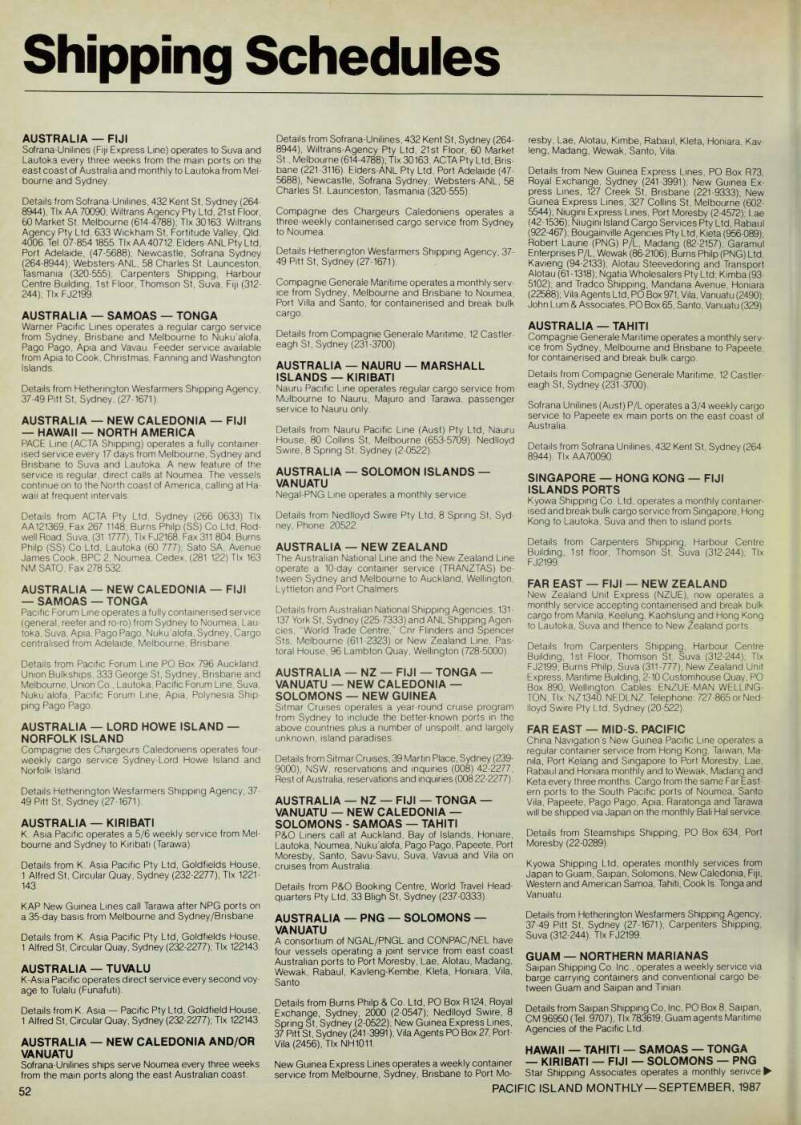
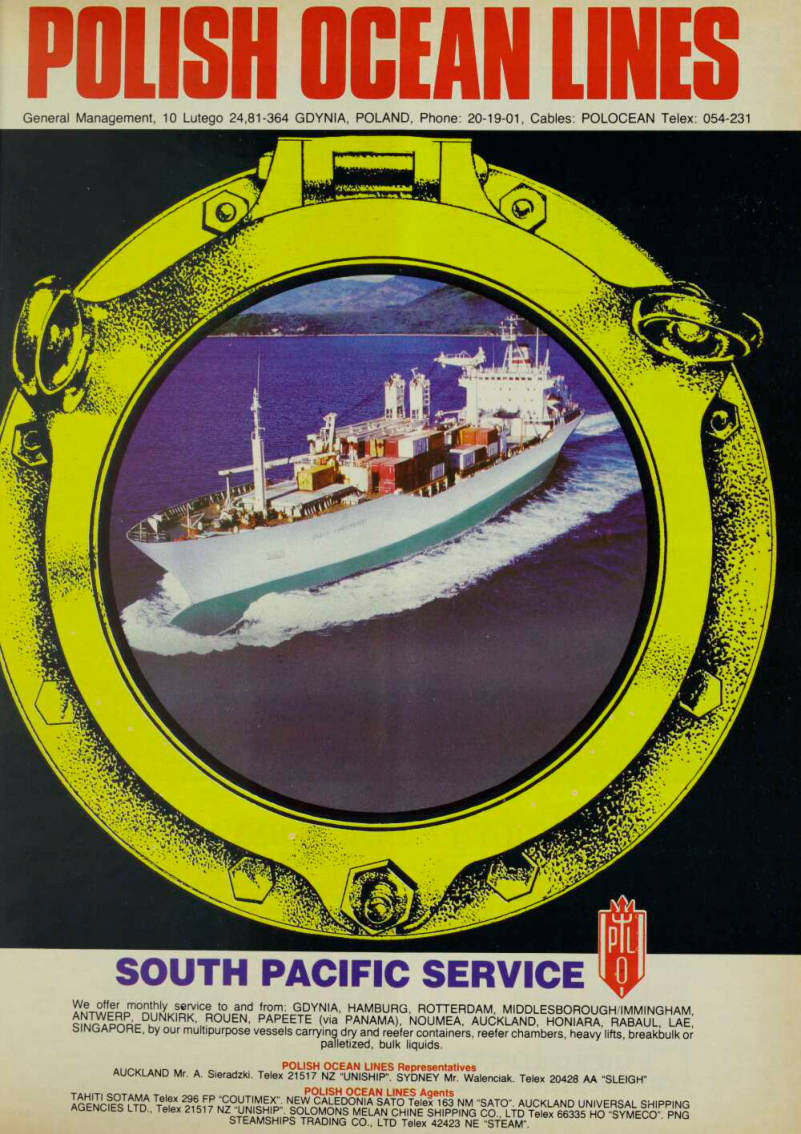
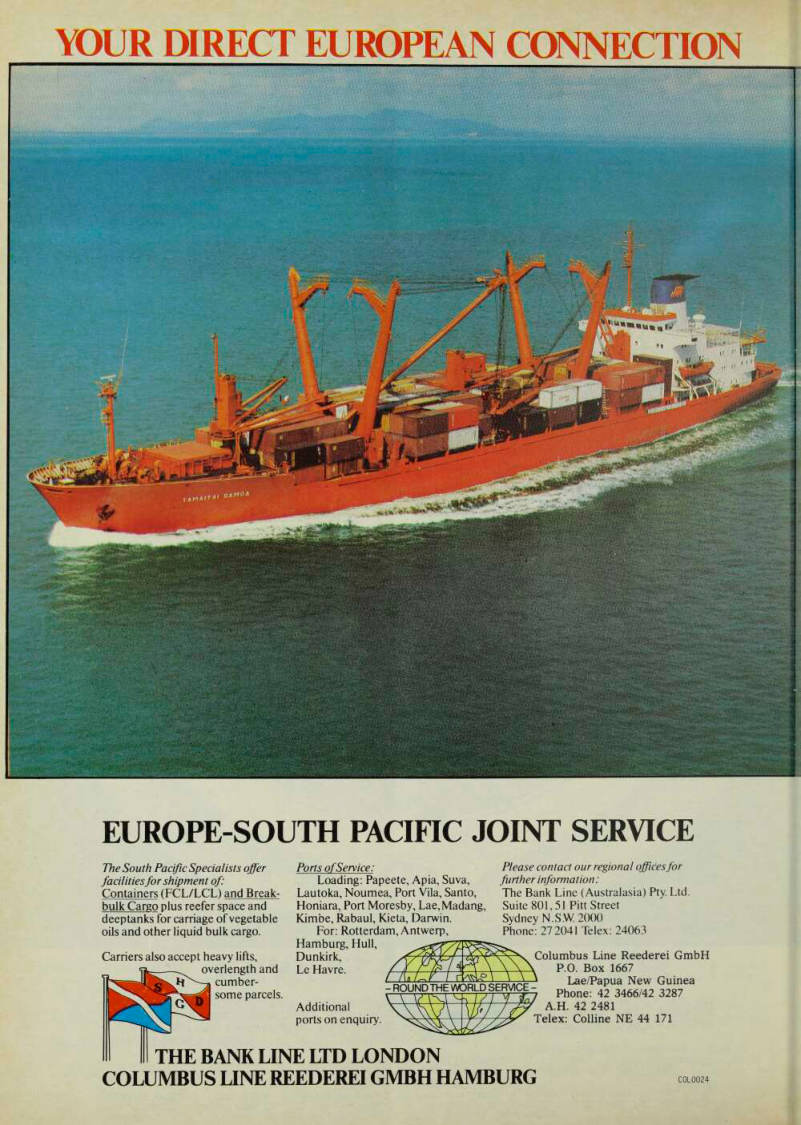
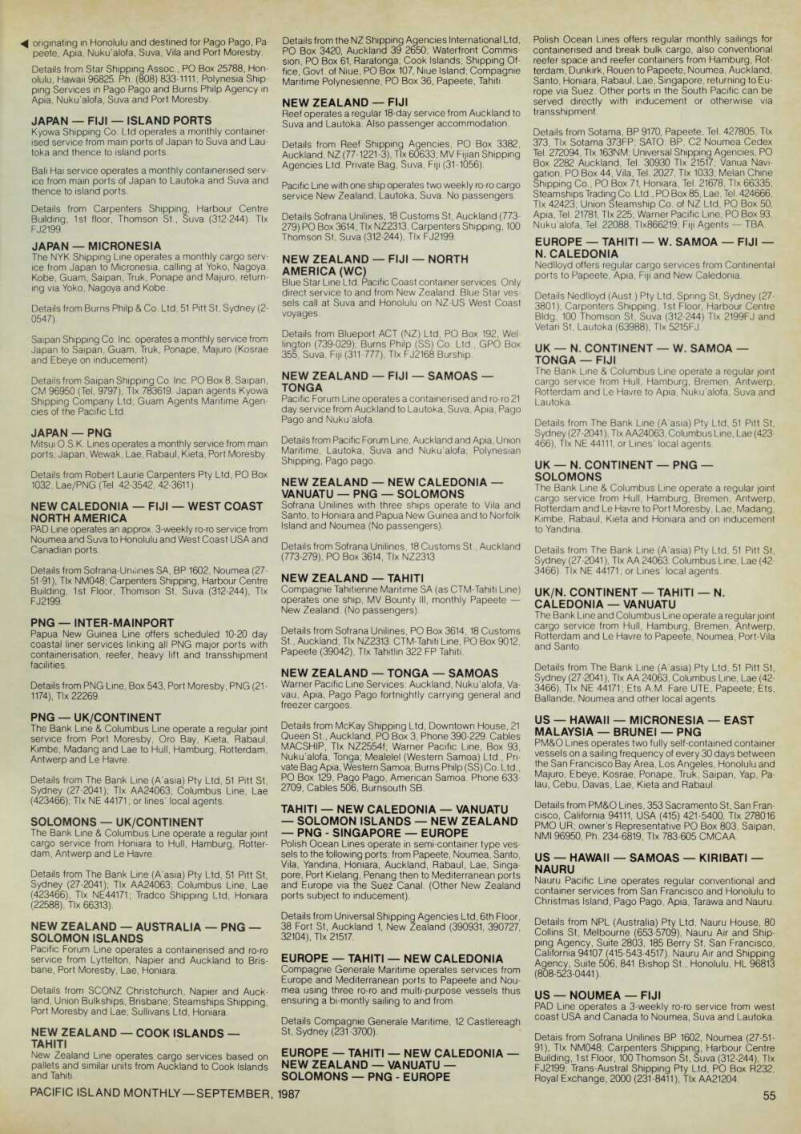
Australia Fiji
Sofrana-Unilines (Fiji Express Line) operates to Suva and Lautoka every three weeks from the mam ports on the east coast of Australia and monthly to Lautoka from Mel bourne and Sydney.
Details from Sofrana-Unilines, 432 Kent St, Sydney (264- 8944), Tlx AA 70090; Wiltrans Agency Pty Ltd, 21st Floor, 60 Market St. Melbourne (614-4788); Tlx 30163. Wiltrans Agency Pty Ltd, 633 Wickham St, Fortitude Valley, Old. 4006 Tel. 07-854 1855. Tlx AA 40712. Elders-ANL Pty Ltd, Port Adelaide, (47-5688); Newcastle, Sofrana Sydney (264-8944); Websters-ANL, 58 Charles St. Launceston, Tasmania (320-555); Carpenters Shipping, Harbour Centre Building, Ist Floor, Thomson St, Suva, Fiji (312- 244); Tlx FJ2199.
Australia Samoas Tonga
Warner Pacific Lines operates a regular cargo service from Sydney, Brisbane and Melbourne to Nukualofa, Pago Pago, Apia and Vavau. Feeder service available from Apia to Cook. Christmas, Fanning and Washington Islands.
Details from Hetherington Wesfarmers Shipping Agency, 37-49 Pitt St, Sydney, (27-1671)
Australia New Caledonia Fiji
Hawaii North America
PACE Line (ACTA Shipping) operates a fully container ised service every 17 days from Melbourne, Sydney and Brisbane to Suva and Lautoka. A new feature of the service is regular, direct calls at Noumea. The vessels continue on to the North coast of America, calling at Ha waii at frequent intervals Details from ACTA Pty Ltd, Sydney (266 0633) Tlx AA121369, Fax 267 1148, Burns Philp (SS) Co Ltd, Rod well Road, Suva, (31 1777), Tlx FJ2168, Fax 311 804; Burns Philp (SS) Co Ltd, Lautoka (60 777); Sato SA, Avenue James Cook, BPC 2, Noumea, Cedex, (281 122) Tlx 163
Nm Sato, Fax 278 532.
Australia New Caledonia Fiji
Samoas Tonga
Pacific Forum Line operates a fully containerised service (general, reefer and ro-ro) from Sydney to Noumea, Lau toka, Suva, Apia, Pago Pago, Nukualofa, Sydney, Cargo centralised from Adelaide, Melbourne, Brisbane.
Details from Pacific Forum Line PO Box 796 Auckland, Union Bulkships, 333 George St, Sydney, Brisbane and Melbourne, Union Co., Lautoka, Pacific Forum Line, Suva, Nukualofa, Pacific Forum Line, Apia, Polynesia Ship ping Pago Pago.
Australia Lord Howe Island
Norfolk Island
Compagnie des Chargeurs Caledoniens operates four weekly cargo service Sydney-Lord Howe Island and Norfolk Island.
Details Hetherington Wesfarmers Shipping Agency, 37- 49 Pitt St, Sydney (27-1671).
Australia Kiribati
K. Asia Pacific operates a 5/6 weekly service from Mel bourne and Sydney to Kiribati (Tarawa).
Details from K. Asia Pacific Pty Ltd, Goldfields House, 1 Alfred St, Circular Quay, Sydney (232-2277), Tlx 1221- 143.
KAP New Guinea Lines call Tarawa after NPG ports on a 35-day basis from Melbourne and Sydney/Brisbane.
Details from K. Asia Pacific Pty Ltd, Goldfields House, 1 Alfred St, Circular Quay, Sydney (232-2277); Tlx 122143.
Australia Tuvalu
K-Asia Pacific operates direct service every second voy age to Tulalu (Funafuti).
Details from K. Asia Pacific Pty Ltd, Goldfield House, 1 Alfred St, Circular Quay, Sydney (232-2277); Tlx 122143.
Australia New Caledonia And/Or
Vanuatu
Sofrana-Unilines ships serve Noumea every three weeks from the main ports along the east Australian coast.
Details from Sofrana-Unilines, 432 Kent St, Sydney (264- 8944), Wiltrans-Agency Pty Ltd, 21st Floor, 60 Market St,, Melbourne (614-4788); Tlx 30163, ACTA Pty Ltd, Bris bane (221-3116). Elders-ANL Pty Ltd, Port Adelaide (47- 5688), Newcastle, Sofrana Sydney; Websters-ANL, 58 Charles St. Launceston, Tasmania (320-555).
Compagnie des Chargeurs Caledoniens operates a three-weekly containerised cargo service from Sydney to Noumea.
Details Hetherington Wesfarmers Shipping Agency, 37- 49 Pitt St, Sydney (27-1671).
Compagnie Generate Maritime operates a monthly serv ice from Sydney, Melbourne and Brisbane to Noumea, Port Villa and Santo, for containerised and break bulk cargo Details from Compagnie Generate Maritime, 12 Castler eagh St, Sydney (231-3700)
Australia Nauru Marshall
Islands Kiribati
Nauru Pacific Line operates regular cargo service from Melbourne to Nauru, Majuro and Tarawa, passenger service to Nauru only.
Details from Nauru Pacific Line (Aust) Pty Ltd, Nauru House, 80 Collins St, Melbourne (653-5709). Nedlloyd Swire, 8 Spring St, Sydney (2-0522).
Australia Solomon Islands
Vanuatu
Negal-PNG Line operates a monthly service.
Details from Nedlloyd Swire Pty Ltd, 8 Spring St, Syd ney, Phone: 20522.
Australia New Zealand
The Australian National Line and the New Zealand Line operate a 10-day container service (TRANZTAS) be tween Sydney and Melbourne to Auckland, Wellington, Lyttleton and Port Chalmers.
Details from Australian National Shipping Agencies, 131 - 137 York St, Sydney (225-7333) and ANL Shipping Agen cies, “World Trade Centre," Cnr Flinders and Spencer Sts, Melbourne (611-2323) or New Zealand Line, Pas toral House, 96 Lambton Quay, Wellington (728-5000).
Australia Nz Fiji Tonga
Vanuatu New Caledonia
Solomons New Guinea
Sitmar Cruises operates a year-round cruise program from Sydney to include the better-known ports in the above countries plus a number of unspoilt, and largely unknown, island paradises.
Details from Sitmar Cruises, 39 Martin Place, Sydney (239- 9000), NSW. reservations and inquiries (008) 42-2277; Rest of Australia, reservations and inquiries (008 22-2277).
Australia Nz Fiji Tonga
Vanuatu New Caledonia
Solomons - Samoas Tahiti
P&O Liners call at Auckland, Bay of Islands, Honiare, Lautoka, Noumea, Nukualofa, Pago Pago, Papeete, Port Moresby, Santo, Savu-Savu, Suva, Vavua and Vila on cruises from Australia.
Details from P&O Booking Centre, World Travel Head quarters Pty Ltd, 33 Bligh St, Sydney (237-0333).
Australia Png Solomons
Vanuatu
A consortium of NGAL/PNGL and CONPAC/NEL have four vessels operating a joint service from east coast Australian ports to Port Moresby, Lae, Alotau, Madang, Wewak, Rabaul, Kavleng-Kembe, Kleta, Honiara, Vila, Santo.
Details from Burns Philp & Co. Ltd, PO Box R 124, Royal Exchange, Sydney, 2000 (2-0547); Nedlloyd Swire, 8 Spring St, Sydney (2-0522); New Guinea Express Lines, 37 Pitt St, Sydney (241 -3991); Vila Agents PO Box 27, Port- Vila (2456), Tlx NHIOII, New Guinea Express Lines operates a weekly container service from Melbourne, Sydney, Brisbane to Port Mo
resby, Lae, Alotau, Kimbe, Rabaul, Kleta, Honiara, Kav leng, Madang, Wewak, Santo, Vila.
Details from New Guinea Express Lines, PO Box R 73, Royal Exchange, Sydney (241-3991); New Guinea Ex press Lines, 127 Creek St, Brisbane (221-9333); New Guinea Express Lines, 327 Collins St, Melbourne (602- 5544); Niugini Express Lines, Port Moresby (2-4572); Lae (42-1536); Niugini Island Cargo Services Pty Ltd, Rabaul (922-467); Bougainville Agencies Pty Ltd, Kieta (956-089); Robert Laurie (PNG) P/L, Madang (82-2157); Garamul Enterprises P/L, Wewak (86-2106); Burns Philp (PNG) Ltd, Kavieng (94-2133); Alotau Steevedoring and Transport Alotau (61-1318); Ngatia Wholesalers Pty Ltd; Kimba(93- 5102); and Tradco Shipping, Mandana Avenue, Honiara (22588); Vila Agents Ltd. PO Box 971, Vila, Vanuatu (2490); John Lum & Associates, PO Box 65, Santo, Vanuatu (329).
Australia Tahiti
Compagnie Generate Maritime operates a monthly serv ice from Sydney, Melbourne and Brisbane to Papeete, for containerised and break bulk cargo.
Details from Compagnie Generate Maritime, 12 Castler eagh St, Sydney (231-3700), Sofrana Unilines (Aust) P/L operates a 3/4 weekly cargo service to Papeete ex main ports on the east coast of Australia.
Details from Sofrana Unilines, 432 Kent St, Sydney (264- 8944). Tlx AA70090.
Singapore Hong Kong Fiji
Islands Ports
Kyowa Shipping Co. Ltd, operates a monthly container ised and break bulk cargo service from Singapore, Hong Kong to Lautoka, Suva and then to island ports.
Details from Carpenters Shipping, Harbour Centre Building, Ist floor, Thomson St, Suva (312-244); Tlx FJ2199.
Far East Fiji New Zealand
New Zealand Unit Express (NZUE), now operates a monthly service accepting containerised and break bulk cargo from Manila, Keelung, Kaohslung and Hong Kong to Lautoka, Suva and thence to New Zealand ports.
Details from Carpenters Shipping, Harbour Centre Building, Ist Floor, Thomson St, Suva (312-244); Tlx FJ2199; Burns Philp, Suva (311-777); New Zealand Unit Express, Maritime Building, 2-10 Customhouse Quay, PO Box 890, Wellington. Cables: ENZUE-MAN WELLING TON, Tlx: NZ1340. NEDLNZ, Telephone: 727-865 or Ned lloyd Swire Pty Ltd, Sydney (20-522).
Far East Mid-S. Pacific
China Navigation’s New Guinea Pacific Line operates a regular container service from Hong Kong, Taiwan, Ma nila, Port Kelang and Singapore to Port Moresby, Lae, Rabaul and Honiara monthly and to Wewak, Madang and Keta every three months. Cargo from the same Far East ern ports to the South Pacific ports of Noumea, Santo Vila, Papeete, Pago Pago, Apia, Raratonga and Tarawa will be shipped via Japan on the monthly Bali Hal service.
Details from Steamships Shipping, PO Box 634, Port Moresby (22-0289).
Kyowa Shipping Ltd, operates monthly services from Japan to Guam, Saipan, Solomons, New Caledonia, Fiji, Western and American Samoa, Tahiti, Cook Is. Tonga and Vanuatu.
Details from Hetherington Wesfarmers Shipping Agency, 37-49 Pitt St, Sydney (27-1671); Carpenters Shipping, Suva (312-244). Tlx FJ2199.
Guam Northern Marianas
Saipan Shipping Co. Inc., operates a weekly service via barge carrying containers and conventional cargo be tween Guam and Saipan and Tinian.
Details from Saipan Shipping Co, Inc, PO Box 8, Saipan, CM 96950 (Tel. 9707), Tlx 783619; Guam agents Maritime Agencies of the Pacific Ltd.
Hawaii Tahiti Samoas Tonga
Kiribati Fiji Solomons Png
Star Shipping Associates operates a monthly serivce ►
•4 originating in Honolulu and destined for Pago Pago, Pa peete, Apia, Nukualofa, Suva, Vila and Port Moresby.
Details from Star Shipping Assoc., PO Box 25788, Hon olulu, Hawaii 96825. Ph. (808) 833-1111; Polynesia Ship ping Services in Pago Pago and Burns Philp Agency in Apia, Nuku’alofa, Suva and Port Moresby.
Japan Fiji Island Ports
Kyowa Shipping Co. Ltd operates a monthly container ised service from main ports of Japan to Suva and Lau toka and thence to island ports.
Bali Hai service operates a monthly containerised serv ice from main ports of Japan to Lautoka and Suva and thence to island ports.
Details from Carpenters Shipping, Harbour Centre Building, Ist floor, Thomson St., Suva (312-244). Tlx FJ2199
Japan Micronesia
The NYK Shipping Line operates a monthly cargo serv ice from Japan to Micronesia, calling at Yoko, Nagoya, Kobe, Guam, Saipan, Truk, Ponape and Majuro, return ing via Yoko, Nagoya and Kobe.
Details from Burns Philp & Co. Ltd, 51 Pitt St, Sydney (2- 0547).
Saipan Shipping Co. Inc. operates a monthly service from Japan to Saipan, Guam, Truk, Ponape, Majuro (Kosrae and Ebeye on inducement).
Details from Saipan Shipping Co. Inc. PO Box 8, Saipan, CM 96950 (Tel, 9797), Tlx 783619. Japan agents Kyowa Shipping Company Ltd; Guam Agents Maritime Agen cies of the Pacific Ltd
Japan Png
Mitsui O.S.K. Lines operates a monthly service from mam ports; Japan, Wewak, Lae, Rabaul, Kieta, Port Moresby.
Details from Robert Laurie Carpenters Pty Ltd, PO Box 1032, Lae/PNG (Tel. 42-3542, 42-3611).
New Caledonia Fiji West Coast
North America
PAD Line operates an approx. 3-weekly ro-ro service from Noumea and Suva to Honolulu and West Coast USA and Canadian ports.
Details from Sofrana-Unilmes SA, BP 1602, Noumea (27- SI-91), Tlx NMO4B; Carpenters Shipping, Harbour Centre Building, Ist Floor, Thomson St, Suva (312-244), Tlx FJ2199
Png Inter-Mainport
Papua New Guinea Line offers scheduled 10-20 day coastal liner services linking all PNG major ports with containerisation, reefer, heavy lift and transshipment facilities.
Details from PNG Line, Box 543, Port Moresby, PNG (21 - 1174), Tlx 22269.
Png Uk/Continent
The Bank Line & Columbus Line operate a regular joint service from Port Moresby, Oro Bay, Kieta, Rabaul, Kimbe, Madang and Lae to Hull, Hamburg, Rotterdam, Antwerp and Le Havre.
Details from The Bank Line (A'asia) Pty Ltd, 51 Pitt St, Sydney (27-2041); Tlx AA24063; Columbus Line, Lae (423466); Tlx NE 44171; or lines’ local agents.
Solomons Uk/Continent
The Bank Line & Columbus Line operate a regular joint cargo service from Honiara to Hull, Hamburg, Rotter dam, Antwerp and Le Havre.
Details from The Bank Line (A’asia) Pty Ltd, 51 Pitt St, Sydney (27-2041); Tlx AA24063; Columbus Line, Lae (423466), Tlx NE44171; Tradco Shipping Ltd, Honiara (22588), Tlx 66313).
New Zealand Australia Png
Solomon Islands
Pacific Forum Line operates a containerised and ro-ro service from Lyttelton, Napier and Auckland to Bris bane, Port Moresby, Lae, Honiara.
Details from SCONZ Christchurch, Napier and Auck land, Union Bulkships, Brisbane; Steamships Shipping, Port Moresby and Lae; Sullivans Ltd, Honiara.
New Zealand Cook Islands
Tahiti
New Zealand Line operates cargo services based on pallets and similar units from Auckland to Cook Islands and Tahiti.
Details from the NZ Shipping Agencies International Ltd, PO Box 3420, Auckland 39 2650; Waterfront Commis sion, PO Box 61, Raratonga; Cook Islands; Shipping Of fice, Govt, of Niue, PO Box 107, Niue Island; Compagnie Maritime Polynesienne, PO Box 36, Papeete, Tahiti
New Zealand —Fiji
Reef operates a regular 18-day service from Auckland to Suva and Lautoka. Also passenger accommodation.
Details from Reef Shipping Agencies, PO Box 3382, Auckland, NZ (77-1221 -3), Tlx 60633; MV Fijian Shipping Agencies Ltd. Private Bag, Suva, Fiji (31-1056).
Pacific Line with one ship operates two weekly ro-ro cargo service New Zealand, Lautoka, Suva. No passengers.
Details Sofrana Unilines, 18 Customs St, Auckland (773- 279) PO Box 3614, Tlx NZ2313, Carpenters Shipping, 100 Thomson St, Suva (312-244), Tlx FJ2199.
New Zealand Fiji North
America (Wc)
Blue Star Line Ltd. Pacific Coast container services. Only direct service to and from New Zealand. Blue Star ves sels call at Suva and Honolulu on NZ-US West Coast voyages.
Details from Blueport ACT (NZ) Ltd, PO Box 192, Wel lington (739-029); Burns Philp (SS) Co. Ltd., GPO Box 355, Suva, Fiji (311-777), Tlx FJ2168 Burship.
New Zealand Fiji Samoas
Tonga
Pacific Forum Line operates a containerised and ro-ro 21 day service from Auckland to Lautoka, Suva, Apia, Pago Pago and Nukualofa, Details from Pacific Forum Line, Auckland and Apia, Union Maritime, Lautoka, Suva and Nukualofa; Polynesian Shipping, Pago pago.
New Zealand New Caledonia
Vanuatu Png Solomons
Sofrana Umlines with three ships operate to Vila and Santo, to Honiara and Papua New Guinea and to Norfolk Island and Noumea (No passengers).
Details from Sofrana Unilines, 18 Customs St., Auckland (773-279), PO Box 3614, Tlx NZ2313
New Zealand Tahiti
Compagnie Tahitienne Maritime SA (as CTM-Tahiti Line) operates one ship, MV Bounty 111, monthly Papeete New Zealand. (No passengers) Details from Sofrana Unilines, PO Box 3614, 18 Customs St„ Auckland, Tlx NZ2313. CTM-Tahiti Line, PO Box 9012, Papeete (39042), Tlx Tahitlin 322 FP Tahiti.
New Zealand Tonga Samoas
Warner Pacific Line Services: Auckland, Nukualofa, Va vau, Apia, Pago Pago fortnightly carrying general and freezer cargoes.
Details from McKay Shipping Ltd, Downtown House, 21 Oueen St., Auckland, PO Box 3, Phone 390-229. Cables MACSHIP, Tlx NZ2554f; Warner Pacific Line, Box 93, Nukualofa, Tonga; Mealelel (Western Samoa) Ltd., Pri vate Bag Apia, Western Samoa; Burns Philp (SS) Co, Ltd , PO Box 129, Pago Pago, American Samoa. Phone 633- 2709, Cables 506, Burnsouth SB.
Tahiti New Caledonia Vanuatu
Solomon Islands New Zealand
Png - Singapore Europe
Polish Ocean Lines operate in semi-container type ves sels to the following ports: from Papeete, Noumea, Santo, Vila, Yandina, Honiara, Auckland, Rabaul, Lae, Singa pore, Port Kielang, Penang then to Mediterranean ports and Europe via the Suez Canal. (Other New Zealand ports subject to inducement).
Details from Universal Shipping Agencies Ltd, 6th Floor, 38 Fort St, Auckland 1, New Zealand (390931, 390727, 32104), Tlx 21517.
Europe Tahiti New Caledonia
Compagnie Generate Maritime operates services from Europe and Mediterranean ports to Papeete and Nou mea using three ro-ro and multi-purpose vessels thus ensuring a bi-montly sailing to and from.
Details Compagnie Generate Maritime, 12 Castlereagh St, Sydney (231-3700).
Europe Tahiti New Caledonia
New Zealand Vanuatu
Solomons Png - Europe
Polish Ocean Lines offers regular monthly sailings for containerised and break bulk cargo, also conventional reefer space and reefer containers from Hamburg, Rot terdam, Dunkirk, Rouen to Papeete. Noumea, Auckland, Santo, Honiara, Rabaul, Lae, Singapore, returning to Eu rope via Suez. Other ports in the South Pacific can be served directly with inducement or otherwise via transshipment.
Details from Sotama, BP 9170, Papeete, Tel. 427805, Tlx 373, Tlx Sotama 373FP; SATO: BP, 02 Noumea Cedex Tel. 272094, Tlx 163 NM; Universal Shipping Agencies, PO Box 2282 Auckland, Tel. 30930 Tlx 21517; Vanua Navi gation, PO Box 44, Vila, Tel. 2027, Tlx 1033; Melan Chine Shipping Co., PO Box 71, Honiara, Tel. 21678, Tlx 66335; Steamships Trading Co. Ltd,, PO Box 85, Lae, Tel. 424666, Tlx 42423; Union Steamship Co. of NZ Ltd, PO Box 50, Apia, Tel 21781, Tlx 225; Warner Pacific Line, PO Box 93, Nukualofa, Tel. 22088, T1x866219; Fiji Agents TBA.
Europe Tahiti W. Samoa Fiji
N. Caledonia
Nedlloyd offers regular cargo services from Continental ports to Papeete, Apia, Fiji and New Caledonia Details Nedlloyd (Aust.) Pty Ltd, Spring St, Sydney (27- 3801); Carpenters Shipping, Ist Floor, Harbour Centre Bldg, 100 Thomson St, Suva (312-244) Tlx 2199FJ and Vetari St, Lautoka (63988), Tlx 5215FJ
Uk N. Continent W. Samoa
Tonga Fiji
The Bank Line & Columbus Line operate a regular joint cargo service from Hull, Hamburg, Bremen, Antwerp, Rotterdam and Le Havre to Apia, Nukualofa, Suva and Lautoka.
Details from The Bank Line (A'asia) Pty Ltd, 51 Pitt St, Sydney (27-2041), Tlx AA24063, Columbus Line, Lae (423- 466), Tlx NE 44111, or Lines’ local agents
Uk N. Continent Png
Solomons
The Bank Line & Columbus Line operate a regular joint cargo service from Hull, Hamburg, Bremen, Antwerp, Rotterdam and Le Havre to Port Moresby, Lae, Madang, Kimbe, Rabaul, Kieta and Honiara and on inducement to Yandina.
Details from The Bank Line (A'asia) Pty Ltd, 51 Pitt St, Sydney (27-2041), Tlx AA 24063. Columbus Line, Lae (42- 3466) Tlx NE 44171; or Lines' local agents
Uk/N. Continent Tahiti N.
Caledonia Vanuatu
The Bank Line and Columbus Line operate a regular joint cargo service from Hull, Hamburg, Bremen, Antwerp, Rotterdam and Le Havre to Papeete, Noumea, Port-Vila and Santo.
Details from The Bank Line (A'asia) Pty Ltd, 51 Pitt St, Sydney (27-2041), Tlx AA 24063, Columbus Line, Lae (42- 3466), Tlx NE 44171; Ets A M. Fare UTE, Papeete; Ets, Ballande, Noumea and other local agents.
Us Hawaii Micronesia East
Malaysia Brunei Png
PM&O Lines operates two fully self-contained container vessels on a sailing frequency of every 30 days between the San Francisco Bay Area, Los Angeles, Honolulu and Majuro, Ebeye, Kosrae, Ponape, Truk, Saipan, Yap, Pa lau, Cebu, Davas, Lae, Kieta and Rabaul.
Details from PM&O Lines, 353 Sacramento St, San Fran cisco, California 94111, USA (415) 421-5400, Tlx 278016 PMC UR; owner’s Representative PO Box 803, Saipan, NMI 96950, Ph. 234-6819, Tlx 783-605 CMCAA.
Us Hawaii Samoas Kiribati
Nauru
Nauru Pacific Line operates regular conventional and container services from San Francisco and Honolulu to Christmas Island, Pago Pago, Apia, Tarawa and Nauru.
Details from NPL (Australia) Pty Ltd, Nauru House, 80 Collins St, Melbourne (653-5709), Nauru Air and Ship ping Agency, Suite 2803, 185 Berry St, San Francisco, California 94107 (415-543-4517). Nauru Air and Shipping Agency, Suite 506, 841 Bishop St., Honolulu, HL 96813 (808-523-0441).
Us —Noumea —Fiji
PAD Line operates a 3-weekly ro-ro service from west coast USA and Canada to Noumea, Suva and Lautoka.
Detais from Sofrana Unilines BP 1602, Noumea (27-51- 91), Tlx NMO4B; Carpenters Shipping, Harbour Centre Building, Ist Floor, 100 Thomson St, Suva (312-244), Tlx FJ2199; Trans-Austral Shipping Pty Ltd, PO Box R 232, Royal Exchange, 2000 (231-8411), Tlx AA21204.
Advertisements & other items, pp. 52-56 (3 items)
52
PACIFIC ISLAND MONTHLY —SEPTEMBER, 1987
Poush Ochn Ims
General Management, 10 Lutego 24,81-364 GDYNIA, POLAND, Phone: 20-19-01, Cables: POLOCEAN Telex; 054-231 P © m A % m $ "T . [M *r. ■vs*; JS« •••I* AN™pnp mo S!ffiu'fS!)' iC DA?.cK n 1 d HAMBURG, ROTTERDAM, MIDDLESBOROUGH/IMMINGHAM, $S R n P d " UNKIRK ’. ROUEN - PAPEETE ( V| a PANAMA), NOUMEA, AUCKLAND, HONIARA, RABAUL, LAE, bINGAPORE, by our multipurpose vessels i ! 1 1 - ’
SOUTH PACIFIC SERVICE
GDYNIA, HAMBURG, ROTTERDAM, MIDDLESBORC
ETE (via PANAMA), NOUMEA, AUCKLAND, HONIAF
carrying dry and reefer containers, reefer chambers, heavy lifts, breakbulk or palletized, bulk liquids.
AUCKLAND Mr. A. Sieradzki. Telexes?”NZ 8 Telex 20428 AA “SLEIGH”
AGENCEs" LTD NM “SATO”. AUCKLAND UNIVERSAL SHIPPING tatiMUbb LTD., Telex 21517 NZ UNISHIP SOLOMONS MELAN CHINE SHIPPING CO., LTD Telex 66335 HO “SYMECO" PNG STEAMSHIPS TRADING CO., LTD Telex 42423 NE “STEAM”
YOUR DIRECT EUROPEAN CONNECTION
m § a I ' m ”,
iWPH
EUROPE-SOUTH PACIFIC JOINT SERVICE
The South Pacific Specialists offer facilities for shipment of: Containers (FCL/LCL) and Breakbulk Cargo plus reefer space and deeptanks for carriage of vegetable oils and other liquid bulk cargo.
Carriers also accept heavy lifts, overlength and cumbersome parcels.
Ports of Sent ice: Loading: Papeete, Apia, Suva, Lautoka, Noumea, Port Vila, Santo, Honiara, Port Moresby, Lae,Madang, Kimbe, Rabaul, Kieta, Darwin.
For: Rotterdam, Antwerp, Hamburg, Hull, Dunkirk, Le Havre.
Additional ports on enquiry.
- ROUND THE WORLD SERVICE -
Please contact our regional offices for further information: The Bank Line (Australasia) Pty. Ltd.
Suite 801,51 Pitt Street Sydney N.S.W. 2000 Phone: 27 2041 Telex; 24063 Columbus Line Reederei GmbH P.O. Box 1667 Lae/Papua New Guinea Phone: 42 3466/42 3287 A.H. 42 2481 Telex: Colline NE 44 171
THE BANK LINE LTD LONDON
COLUMBUS LINE REEDEREI GMBH HAMBURG
IMEL
Services
Reach Out
Thousands
of Miles
into The
Pacific. It's
where we
work.
• Heavy Engineering • Air Conditioning • Sheetmetal • Electrical • Refrigeration • Quality work • Competitive prices.
p^IMEL
/ INDUSTRIAL AND MARINE
ENGINEERING LIMITED
Tel: 312133. Telex: FJ2195
P.O. Box 296, Suva FIJI ISLANDS
FAX: 312854
“the complete Engineering Company of the South Pacific”.
55
PACIFIC ISLAND MONTHLY —SEPTEMBER, 1987
Transitions
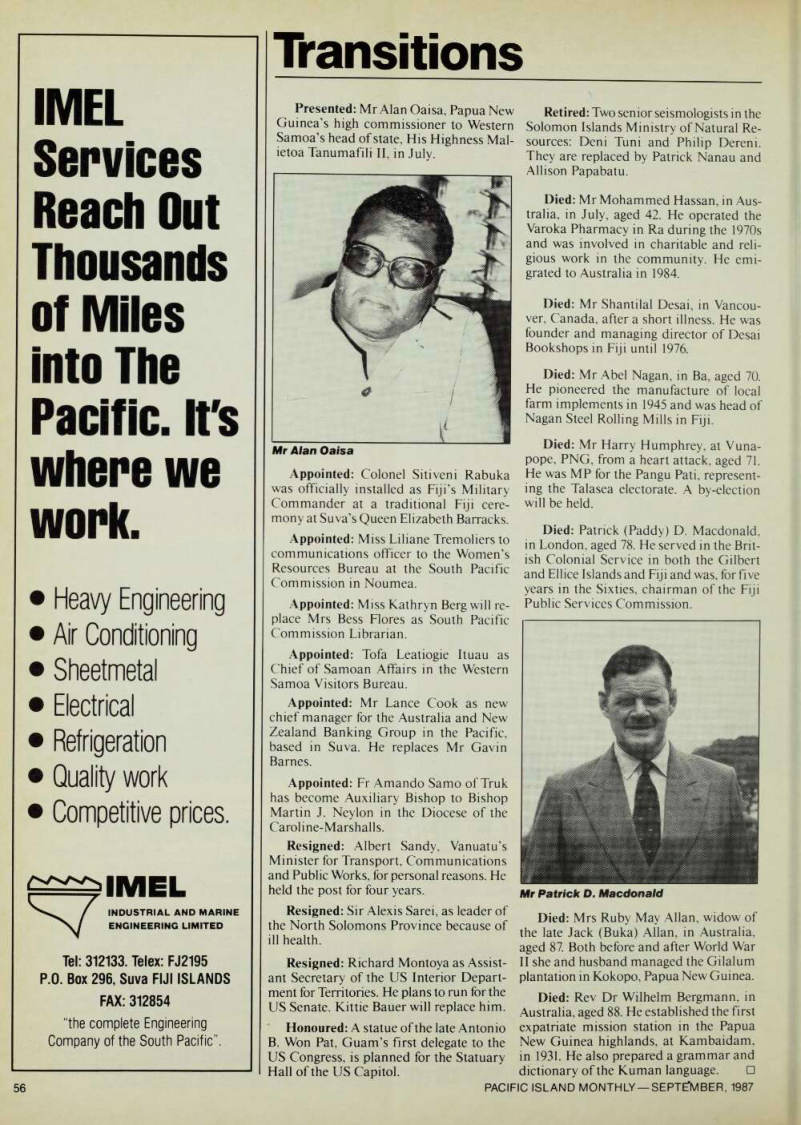
Presented: Mr Alan Oaisa, Papua New Guinea’s high commissioner to Western Samoa’s head of state, His Highness Mai ietoa Tanumafili 11, in July.
Appointed: Colonel Sitiveni Rabuka was officially installed as Fiji’s Military Commander at a traditional Fiji cere mony at Suva’s Queen Elizabeth Barracks.
Appointed: Miss Liliane Tremoliers to communications officer to the Women’s Resources Bureau at the South Pacific Commission in Noumea.
Appointed: Miss Kathryn Berg will re place Mrs Bess Flores as South Pacific Commission Librarian.
Appointed: Tofa Leatiogie Ituau as Chief of Samoan Affairs in the Western Samoa Visitors Bureau.
Appointed: Mr Lance Cook as new chief manager for the Australia and New Zealand Banking Group in the Pacific, based in Suva. He replaces Mr Gavin Barnes.
Appointed: Fr Amando Samo of Truk has become Auxiliary Bishop to Bishop Martin J. Neylon in the Diocese of the Caroline-Marshalls.
Resigned: Albert Sandy, Vanuatu’s Minister for Transport, Communications and Public Works, for personal reasons. He held the post for four years.
Resigned: Sir Alexis Sarei, as leader of the North Solomons Province because of ill health.
Resigned: Richard Montoya as Assist ant Secretary of the US Interior Depart ment for Territories. He plans to run for the US Senate. Kittie Bauer will replace him.
Honoured: A statue of the late Antonio B. Won Pat, Guam’s first delegate to the US Congress, is planned for the Statuary Hall of the US Capitol.
Retired: Two senior seismologists in the Solomon Islands Ministry of Natural Re sources: Deni Tuni and Philip Dereni.
They are replaced by Patrick Nanau and Allison Papabatu.
Died: Mr Mohammed Hassan, in Aus tralia, in July, aged 42. He operated the Varoka Pharmacy in Ra during the 1970 s and was involved in charitable and reli gious work in the community. He emi grated to Australia in 1984.
Died: Mr Shantilal Desai, in Vancou ver, Canada, after a short illness. He was founder and managing director of Desai Bookshops in Fiji until 1976.
Died: Mr Abel Nagan, in Ba, aged 70.
He pioneered the manufacture of local farm implements in 1945 and was head of Nagan Steel Rolling Mills in Fiji.
Died: Mr Harry Humphrey, at Vuna pope, PNG, from a heart attack, aged 71.
He was MP for the Pangu Pati, represent ing the Talasea electorate. A by-election will be held.
Died: Patrick (Paddy) D. Macdonald, in London, aged 78. He served in the Brit ish Colonial Service in both the Gilbert and Ellice Islands and Fiji and was, for five years in the Sixties, chairman of the Fiji Public Services Commission.
Died: Mrs Ruby May Allan, widow of the late Jack (Buka) Allan, in Australia, aged 87. Both before and after World War II she and husband managed the Gilalum plantation in Kokopo, Papua New Guinea.
Died: Rev Dr Wilhelm Bergmann, in Australia, aged 88. He established the first expatriate mission station in the Papua New Guinea highlands, at Kambaidam, in 1931. He also prepared a grammar and dictionary of the Kuman language. □
Mr Alan Oaisa
Mr Patrick D. Macdonald
Advertisements & other items, pp. 56-57 (2 items)
56
PACIFIC ISLAND MONTHLY —SEPTEMBER, 1987
to Noum
eS'emmmmmmmSmmmm m m m m m m m m m m m m m m m m m E ■ m m ■ m m m m m m m E E E m m m
can
When it comes to shipping, ACTA really know their onions.
Which makes the addition of Noumea to the ports we service welcome news for Australian exporters.
ACTA boasts a purpose built fleet of ships, backed by on-shore and after-sail service that can’t be beaten.
We’ll keep your fresh food fresh, frozen foods frozen and protect your more fragile exports as if they were our own.
And deliver the same first class service established by ACTA between Australia and Fiji, not to mention both coasts of North America.
The new ACTA service between Australia and Noumea.
If you have a first class product, it’s the only way to travel.
Sydney (02) 2660633, Melbourne (03) 611 2000, Brisbane (07) 2213116 r*
cruis
to Noum
m E E fm m m m e e e ® e e e a tough act to follow e /e! /E| e e e e /e b e m [m m E B B m /e| e] i] @3 m E E B E E E fl E E
The Japanese and Nauru
From The Past
/4 «onv v/<?vv on their World War I intentions
DID the Japanese Navy intend to occupy Nauru early in World War I? “Yes,” said Pacific Islands Year Book in its various editions over the years.
It says: “Soon after the British were re-estab lished on Nauru, a Japanese warship and troopship arrived to take possession of the island in the same way as other Japanese forces had already taken over the Mar shalls, Marianas and Carolines. When they found the Australians in possession they left.”
Nancy Viviani in her book Nauru (Ha waii University Press, 1970) said the same thing.
Now comes a researched “No” from Hiroshi Nakajima, executive director of The Pacific Society, writing in a recent edition of the Journal of The Pacific Society.
His evidence? He relies on Japanese records of an interview between the Brit ish Ambassador to Japan and Japanese Foreign Minister, Baron Kato, on Decem ber 1,1914, extracts from the Japanese Na val General Staffs Secret Naval Battle History, 1914-15 , and the Logbook and Operations Report of the Nitsshin in the Taisho War.
The Nitsshin was the warship which, the Year Book reported, arrived off Nauru with a troopship a transport ship, writes H. Nakajima.
Quoting from two notes of the ambas sador’s interview, H Nakajima writes: “In the note verbale the Japanese Government pointed out that ’all the is lands of the Marianne, Pelew, Caroline, and Marshall groups are now in occupa tion of the Japanese Naval forces’ and de sired ’that the contemplated Australian Expedition should not visit any of the Is land (sic) in the aforesaid groups.’ In the confidential note the Japanese Govern ment stated that ‘the Japanese National would naturally insist on the permanent retention of the German Islands north of the Equator and the Imperial Govern ment will have to rely upon the support of the British Government for the accom plishment of that object when the proper moment arrives.’ ”
It is inconceivable from the viewpoint of international faith that Japan, which made such definite representations to Britain with respect to the “German pos sessions north of the Equator”, should dis patch a warship to Nauru south of the equator with a view to occupying it on or after December 1. The same can be said of
an expedition preceding December 1, for the Japanese Government had already re ceived the communication from the Brit ish Ambassador to Japan on September 12 that “an Australian expedition is now on its way to take possession of islands of Yap and Nauru”.
As for Yap, it was occupied by the Jap anese Navy in the form of compliance with the British China Fleet Commander’s re quest. With respect to Nauru, however, the Anglo-Japanese understanding of Sep tember 12 should have still remained in force.
The note handed to the British Am bassador to Japan on December 1 was based on a Cabinet decision. This means that if a Japanese warship approached Nauru, whether before or after that date, with a view to occupying the island, the warship was acting arbitrarily on its own responsibility.
Referring to the Secret Naval Battle History, the writer records: The warship was the Nitsshin. She did not approach Nauru for the purpose of oc cupying it. She was in the south of Nauru to relay radio communication between Dai-Ni Naken Shitai (the Second South Seas Dispatched Squadron) headquarters in Truk and Dai-Ichi Naken Shitai (the First South Seas Dispatched Squadron) operating in the Fiji and New Caledonia area. She only rendezvoused with the transport ship Nakai Maru to get a supply of coal and water under the lee of Nauru Island.
The Nitsshin arrived off Nauru on the early morning of December 18 to get a supply of coal and water from the Nankai Maru which had already arrived at Nauru (Pleasant) Island on December 15. Be cause there was no port on Nauru, loading and unloading had to be carried out off the coast. The Nitsshin planned to take aboard coal and water under the lee of Nauru Is land. The operations report for the day reads as follows: “Arrived at Pleasant at 6:00 am. Im mediately laid the Nankai Maru aboard on the port side of our ship and replenish ing the coal and water. The sea in the area was too deep to permit anchoring. Our ship drifted southeastward. By sunset Pleasant Island had already disappeared beyond the horizon. Earlier, two naval officers and one naval surgeon had been sent ashore on a cutter for the purpose of an inspection on land (the British flag was already flying on the wireless telegraph pole), but they failed to return to this ship all day because the
distance from the island became very great. This ship, too, drifted all night long with the Nankai Maru kept alongside for coaling.
This coaling work was extremely dif ficult. The operations report for Decem ber 19 states: “Continued coaling all night, yet it did not end this morning. The interference by the long sea continued. Coaling became even more difficult as time passed. This whole coaling work ended at long last at 10:00 am. The work had been continued for 30 hours almost without sleep or rest to take up 900 tons of coal. It was because the coaling had to be done while drifting about in the sea and being subjected to the serious interference of the wind and waves.
Probably, the work encountered a diffi culty and took a long time unprecedented in the latest war.
“Drift distance: 31 odd nautical miles.”
It is true that the Japanese Navy’s war ship and transport-ship visited Nauru, but the visit was for coal and water replenish ment purposes and not for occupying the island as is written in the Year Book and Nancy Viviani’s Nauru.
In Australia wariness against Japan mounted from the last stage of World War I to the early years of the 19205. This gave rise to various speculations about Japa nese intentions. As a result, the fact that the Nitsshin took up coal and water from the Nankai Maru off Nauru was inter preted by somebody as the story of an ap proach to Nauru with the intention of occupying it. Probably, this conjectural account finally came to be accepted as a fact.
To return, the closing part of the op erations report for December 19 ends with the following statement based on the land ing of three naval officers staying ashore overnight: “The island is a well-known phos phate-producing place which turns out 210,000 tons of phosphate a year. The product has been mined by the Pacific Phosphate Co. of Britain. The Japanese merchant vessel Taiyo Maru lies at anchor for loading at South Port. The 430-foot wireless telegraph pole remained intact, but the wireless is not usable because the secondary batteries, etc, were destroyed by the Germans. There is one resident Japa nese doctor.”
This final statement suggests friendly contacts between Japanese Navy and Aus tralian Army officers. □
Advertisements & other items, pp. 58-60 (2 items)
58
PACIFIC ISLAND MONTHLY —SEPTEMBER, 1987
"I Call It Home.
YOU'LL CALL IT PARADISE
One of the greatest pleasures a girl from my home in Western Samoa can have, is to be chosen by the High Chief to be his Taupou - to perform the Kava-making ritual and Siva (dance) at the Kava ceremony We are trained from early childhood to be eady when our turn comes, to put on the beautiful feathered head-dress and I costume of the ph Taupou. m have been performed down through the generations.
Because the Kava ceremony is one of our most important ways of saying welcome.
And we want our welcome to be perfect.
Ursula Curry, light Attendant. m -a. r / IA W I mS.
J *3 * Pi ■ r We must know wery movement, lown to the smallest ietail, by heart. And vhen we dance the :legant Siva, the Kava lance, we must perform t's graceful steps and ;estures exactly as they rb No: B 827
Hi I
Come home with me to my Western Samoa.
You’ll feel welcome from the moment you step aboard our big new Polynesian Airlines 727. With superb meals and relaxing inflight entertainment in both business class and economy See your travel agenpor contact Polynesian direct. Sydney, Auckland, Wellington, Pago Pago, Rarotonga.
Nukualofa,or write to 50 King St,
Sydney 2000.
Come home with me to Paradise.
POLYNESIAN
AIRLINES
DAVID FROST 524
Charles Darwin theorized
that survival depends on the ability to change.
We’re living proof.
In 1859, Charles Darwin outlined his theories on evolution in The Origin of Species. Simply stated, Darwin believed that organisms must be capable of responding to their ever-changing environment in order to be successful.
For the past 70 years Mitsubishi has been proving the validity of Darwin's theories by meeting evolving transportation needs with a wide variety of vehicles advanced technologies of the < 1987 j Since its production ofttoe ;/ 1917 Model-A, Japan's series-production; has continu-
ousVadopted^eiate^rengineering innovations.
And today it covers the world's most extensive range of vehicles—from 55.Q£S minicars to mammoth 16,000 cc all-wheel-drive, off-highway trucks.
Seven decades isn't much in evolutionary time but as the species continues on its long road to perfection, Darwin's theories are tested as they are applied to the products to meet society's changing transportation needs.
Mitsubishi Motors is now offering a free 24-page leaflet “The Mitsubishi ", an introduction of Mitsubishi’s pioneering history. If interested, write to Advertising, International Business Planning Office, Office of International Business, Mitsubishi Motors Corporation, 33-8, Shiba 5-chome, Minato-ku, Tokyo 108, Japan.
AMERICAN SAMOA: MORRIS SCANLAN SERVICE INC. P.O Box 367, Pago Pago, Tel. 633-5520/AUSTRALIA: MITSUBISHI MOTORS AUSTRALIA LTD. Box 1284, South Road, Clovelly Park, South Australia 5042, Tel. [08) 275-7223/FIJI: NIVIS MOTOR & MACHINERY CO., LTD. G.P.O. Box 150, Suva, Tel. 383411 /FRENCH POLYNESIA (TAHITI): ETS-BREDIN FRERES ET FILS P.O. Box 21, Papeete, Tahiti. Tel. 4-202-58/NEW CALEDONIA: SOCIETE D IMPORTATION D AUTO DU PACIFIQUE SUD S.A. B P 438 Rond Point du Pacifique, Noumea, Tel. 274144/NEW ZEALAND: MITSUBISHI MOTORS NEW ZEALAND LTD. Todd Park, Heriot Drive, Private Bag, Porirua, Tel. 370-109/NORFOLK ISLAND: BORRYS LTD. P.O Box 169, Norfolk Island, Tel 2114/PAPUA NEW GUINEA; TOBA PTY. LTD, P.O. Box 503, Port Moresby, Tel 21-7874/ SOLOMON ISLANDS: HARVEST PACIFIC LTD. G.P.O Box 88, Honiara, Guadalcanal, Tel. 30128/TONGA: SITANI MAPI CO., LTD. P.O. Box 83, Nuku ALOFA, Tel. 21-044/VANUATU: SOCOMETRA B P 06 Route de Lagon, Port-Vila, Tel. 2314/WESTERN SAMOA: A.M. MACDONALD HOLDINGS LTD. P.O. Box 576, Apia, Tel 22022/SAIPAN/POHNPEI/MAJURO/KOSRAE/TRUK/YAP/ BELAU: MICRONESSIAN MOTORS, INC. 997 South Marine Drive, Tamuning, Guam 96911, Tel. 646-6827 A
MITSUBISHI
MOTORS