Pacific

Islands
Monthly
American Samoa US$2.OO Australia A 52.00 Cook Islands NZ$3.OO Fiji F 51.75 Hawaii US$2.5O Kiribati A 52.00 Nauru A 52.00 New Caledonia CFP2SO New Zealand NZS3.OO Niue NZS2.SO Norfolk Island A 52.00 Papua New Guinea K 2.00 Solomon Islands 552.00 Tahiti CFP3OO Tonga P 2.00 Tuvalu A 52.00
Usa Us$3.Oo
USTT and Guam US$2.5O Vanuatu VT2.00 Western Samoa T 2.75 •Recommended retail price only Registered by Australia Post Publication No. NBPI2IO
July, 1987
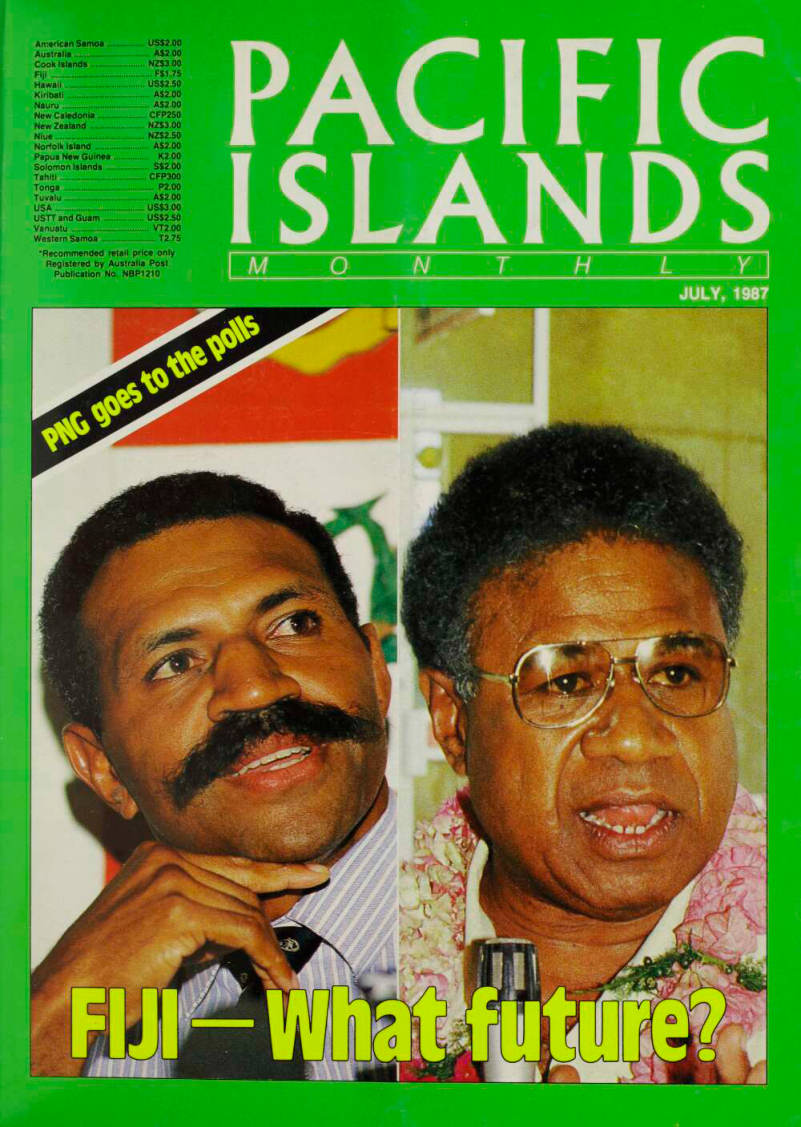
FIJI- WhaffMtiife?
The Cover
Coup leader: Sitiveni Rabuka Deposed PM: Timoci Bavadra
Advertisements & other items, pp. 2-3 (2 items)
Sony
s i fl
KV-2092AS
KV-1440AS
It's so tempting.
The colour you get from Sony's new Super Trinitron.
Our new Pan-Focus gun is computer-designed to make our famous colour even sharper and clearer. Our new Black Screen makes whites brilliant, blacks profound, every colour deeper and richer.
It's flatter and sguarer too.
For less reflection and superb clarity, even in the corners.
For those whose taste demands the best, Super Trinitron is the most delicious TV ever.
Pacific
ISLANDS
MONTHLY
Vol. 58, No. 7, July, 1987.
Ratu Penaia 14
Jean-Marie Tjlbaou 11,21
PaiasWingti 17
Gaston Flosse 25
In This Issue
NEW CALEDONIA: FLNKS President of the Centre Region 11 Council, Leopold Joredie, replies to the French Ambassador to Australia, Mr Bernard Follin (PIM June) on French policy in New Caledonia and issues a challenge to public debate.
FIJI: A special correspondent looks at the dilemma facing the 1 4 Governor-General in the coup aftermath and its effect on the economy.
SOUTH PACIFIC FORUM: A look at how the Forum dealt with 1 7 the Fiji crisis, the question of New Caledonia’s future and the debate on Libyan involvement in the region.
VANUATU: Foreign Minister Sela Molisa talks to PIM. *l9 LE MONDE’S French Territories specialist, Alain Rollat, writes 21 on political development in New Caledonia.
KIRIBATI: PlM’s correspondent in Tarawa, Batiri Bataua, OQ reports on Kiribati’s presidential elections and the fate of the U.S. tuna boat MV Tradition, while Washington correspondent, David S. North, looks at U.S. reaction to the boat’s seizure.
FRENCH POLYNESIA: Alain Rollat looks at the fortunes of 25 Gaston Flosse and political developments in the territory.
PALAU: Back to the ballot box for another vote on the Compact 26 of Free Association with the U.S. Giff Johnson reports.
SUICIDES INCREASING: From Majuro, Giff Johnson reports 26 on the high level of suicides by young Marshallese.
TRADEWINDS: A possibility of cement exports for New 28 Caledonia.
PAPUA NEW GUINEA: The ABC’s Port Moresby’s correspon- 35 dent, Sean Dorney, gives a run-down on the PNG election campaign for PIM.
CONTINUING THE FIGHT: Ousted Bavadra’s government 4Q ministers, Tupeni Baba and Krishna Datt visit Australia in a bid to seek support for a return to their elected government.
WESTERN SAMOA: Professor Derek Freeman replies to 43 PIM s June review of the latest book on the Mead/Freeman controversy.
Contents
Books 45 Fiji 5,7,8,12,13,14 France 9,11 French Polynesia 25 Hawaii 47 Kiribati 9,23 Letters 11 Marshall Islands 26,50 Micronesia 50 Nauru 9 New Caledonia. 7,8,11,21,28 New Zealand 7,42 Niue 8
Pacific Report 7 Palau 26 Papua New Guinea 7,13,32,25,43 PIM Opinion 5 Solomon Islands 32 Stamp Box 52 Tonga 9,32 Tradewinds 28 Transitions 50 Vanuatu 7,8,9,28 Western Samoa 44
Australian cover price is recommended retail only. Registered by Australia Post, publication No. NBPI2IO.
Copyright Pacific Publications (Aust.) Pty. Ltd
Advertisements & other items, pp. 3-4 (2 items)
3
PACIFIC ISLANDS MONTHLY—JULY, 1987
Acting Editor Helen Fraser Advertising Sales Lawson Dixon Editorial Adviser John Carter A Pacific Publications production Founded 1930 by R. W. Robson
(USPS 952480)
76 Clarence Street, Sydney, 2000.
GPO Box 3408, Sydney, 2001.
Cables: PACPUB Sydney.
Telex: 21242 (answers INTARAD).
Telephone: Sydney 20-231. Melbourne 652-1111 Manager: John Berry (03) 652-1111 Ext. 1860
PACIFIC ISLANDS MONTHLY (APPS No.
NBP 1210) is published monthly for US$36 per year by Pacific Publications (Aust.) Pty.
Ltd., of 76 Clarence St., Sydney, NSW, Australia. Second class postage paid at Honolulu, Hawaii. POSTMASTER: Send address changes to PACIFIC ISLANDS MONTHLY, PO Box 22250 Honolulu, Hawaii 96822.
_ Mtia
Visit Melbourne July 27-31
>||qB7
Mmm lhMhmelbourne
v%4:' : s :
Keep up-to-date
with world-wide developments
in industry and technology
'AUSTRALIA’S INTERNATIONAL'
ENGINEERING EXHIBITION
Mon July 27-Fri July 31. Royal Exhibition Building, Melbourne, Australia.
Gear up for Greater Productivity ... Greater Profitability ...
AIEE ’B7 provides these answers: how you can improve your productivity, quality control and competitiveness . .. how you can develop and expand local and export market opportunities. See, discuss and compare the brilliant new achievements of 350 Australian and overseas companies who are proudly displaying their equipment, products and services.
National displays from:
□ Federal Republic of Germany □ India □ Italy □ Korea □ Singapore □ USSR (Tecma) □ United Kingdom □ USA
Covering these major sectors of industry:
□ Machine tools □ Robotics □ Instrumentation □ Electronic equipment □ Materials handling equipment □ Heavy industrial equipment □ Pneumatic/hydraulic equipment □ Pollution control equipment □ Automated programmed tools □ Woodworking machinery If you do not already have a trade pass, they are available at the exhibition entrance upon presentation of relevant business card or appropriate company identification.
Sponsored by the Metal Trades Industry Association of Australia.
MTIA
Organised by Thomson Exhibitions a division of Thomson Australian Holdings (inc in ACT) Melbourne (03) 819 5700. Fax: (03) 819 4278.
Sydney (02) 699 2411. Fax: (02) 690 1961.
The tragedy of Fiji
Pim Opinion
The weeks since the overthrow of the elected government of Fiji have shown all concerned how deeply the coup has wounded them, and how shallowly the perpetrators judged their ground. When the military marches into a functioning parliament and usurps its role at gunpoint it is unlikely that the country concerned will ever forgive them. That is the point that military usurpers so often forget when they destroy elected governments.
Colonel Rabuka has taken his country hostage and done it irreparable damage in the process. Nominally, Ratu Sir Penaia Ganilau, has regained legal control of Fiji and is running the country under the constitution devised after such long and earnest negotiation 17 years ago. The world knows, however, that that is a fiction.
The Governor-General, to his credit, recognised quickly that the motives and rationale of Rabuka and his colleagues were shallow and simplistic likely to inflame further trouble and certainly no adequate response to the perceived problem (military unwillingness to deal with indigenous Fijians threaten ing resort to violence against a government put into office in part by a substantial bloc of votes cast by indigenous Fijians). But now he finds himself in a terrible bind.
Judging by his own assessment and a great deal of supporting anecdotal evidence, the people of Fiji want no departure from constitutional government and the rule of law, and a continued direct link through the office of Governor- General to the Crown. They do not want military dictatorship.
They do want, desperately, a return to normal operations in business, especially in the sugar and tourist industries. If only it were so easy.
Several measures reflect the extent of Fiji’s wounds. The tourist industry will not recover significantly in the short term; why should it? The armed forces have shown a marked
propensity to resort to thuggery in their treatment of the same foreign media that will be used to attract business. Do the Rabukas really believe that television coverage of this can be cancelled by paid television advertising of their climate?
The artifices suggested so far to get around the overthrow of a government and a constitution are ludicrous. They are no more than attempts to legitimise the rule of the gun. Fiji lost the battle to have its military coup regarded by its neighbors as a purely domestic tiff of no regional consequence. The South Pacific Forum meeting in Apia recognised in the end that if it had not discussed the Fiji coup fully it would have looked ridiculous.
Fiji has not only lost its economic underpinnings at the potential cost of great hardship for many ethnic Fijians as well as Indo-Fijians it has lost its moral and ethical role in regional politics. Perhaps Rabuka and his officers and some of the chiefs who have been dragged into this quicksand believe that to be an affordable price. What percentage for our viewpoint, they might argue, did that role provide?
The “Pacific Way” means many things but not that. The tragedy of Fiji is very clear to the people outside the country who sympathise with all points of view in the country but still regard constitutionality as the best guarantee for all.
It is a travesty to suggest that the constitution written In 1970 can be perverted to the extent that it can be replaced at gunpoint, yet with the trappings of ballot papers and rules. The Governor-General knows that the military will not accept a result unfavorable to their ethnic and possibly party political view.
He knows that in that event there is little he can do in power terms. His weapon is the constitution.
With the British election over and the lines of advice restored, the Governor-General might ponder his own credibility. The option he has yet to discuss is the dismissal of coup leaders.
Advertisements & other items, p. 6 (1 item)
Aiwa
* I 1 Hi-fi Midi System V-770
WIRELESS REMOTE CONTROL
400 WATT HIGH POWER OUTPUT
■ DOUBLE CASSETTE DECK BSURROUND SOUND CAPABILITY ■ DIGITAL SYNTHESIZER TUNER WITH 16 MEMORY PRESETS ■ 5-BAND GRAPHIC EQUALIZER ■ 5-BAND SPECTRUM ANALYZER • DOLBY B NR •QUICK REVERSE REC/PB •DOUBLE SPEED DUBBING •CONTINUOUS PLAYBACK • 2-PROGRAM/DAY TIMER • BIG 20 CM dia. WOOFER • FULLY AUTOMATIC TURNTABLE
.. .who could ask for more?
Dolby and the double-D symbol are trademarks of Dolby Laboratories Licensing Corporation.
AIWA
lobex Pty., Ltd. 12 Barcoo Street, East Roseville, Sydney, N.S.W. 2069, AUSTRALIA PHONE: (02)-406-6277/Oceania Indent Agency (P.N.G.) Pty., Ltd. Ago St., Gordon Box 5518, Boroko, Port loresby, Papua New Guinea PHONE: 256411/The Sound Centre Ltd. P.O. Box 434 Port Vila, Vanuatu PHONE: 2035/P. Hargovind Bros. 190 Renwick Road P.O. Box 490 Suva Fiji PHONE; 24350/ lardy Distributors Ltd. 224-236 Hobson Street, P.O. Box 2627, Auckland, New Zealand PHONE: (09) 399-175/Hifivox 79, rue de Sebastopol, Noumea, New Caledonia PHONE: 27. 24. 66/Harvest acific Limited P.O. Box 517. Honiara. Solomon Islands PHONE: 131/Fare Hi-Fi Stereo Rue du Marechal Foch—P.O. Box 269, Papeete, Tahiti PHONE: 2-4814/Micropac Audio, Inc. P.O. Box 3478 igana, Guam 96910 PHONE: 472-8091, 472-8297/Rarotonga Duty Free Shop Private Bag P.O. Box 92. Rarotonga. Cook Island/Nauru Co-Operative Society Republic of Nauru
pacific report
New Cal Air Base
Extensions
The Airforce base at New Caledonia’s Tontouta airport is to be enlarged in order to take more helicopters and aircraft. Work, which will cost approx $A 2 million, is due to begin in August and will add 8,400 spare metres to the base giving it a tarmac of 25,500 square metres. The territory’s political troubles have led to an increased use of the base, with two Guardian and two Trans all tropp transport aircraft, seven Puma and one Alouette helicopters now sta tioned at the base. Authorities have stressed that the base extensions are not linked to the project to build a strategic base at Noumea.
Png Ambassador
Visits Fiji
Papua New Guinea’s Ambassador-at- Large, Mr Renagi Lohia, has said that outside interference in Fiji’s affairs would only complicate its problems. Mr Lohia was speaking at a news conference in Suva after a week’s visit to Fiji during which he discussed the May military coup with officials of the provisional government including the coup leader, Colonel Rabuka. He also spoke by telephone with the deposed Prime Minis ter Doctor Bavadra. Mr Lohia said that while PNG did not support any military takeover of a democratically elected government it believed it was imported for the Fiji people to solve their own problems. He said PNG supported the Fiji Governor- General in his constitutio nal role and would do anything it could to help bring back a normal situation in Fiji.
Fiji Elections Plans
Fiji’s Governor-General Ratu Sir Penaia Ganilau announced plans for two gen eral elections in his formula for a return to democracy following the military coup.
Ratu Sir Penaia Ganilau, who heads an interim administration, announced his plans in a nationwide radio broadcast.
He said an uncontested election would be called so that a new House of
Representatives could pass amend ments to the constitution,strengthening the rights of indigenous Fijians, Ratu Penaia said he’d draw on people from both sides of politics, as well as from Fiji’s traditional chiefs, to arrive at a consensus on constitutional changes.
What he termed ‘National slate of candi dates’ would then contest the election and lawfully pass the amendments. The Governor-General said the parliament would then be dissolved to enable fully contested elections under the amended constitution. In his broadcast, Ratu Gani lau said his plan was the most direct path back to Parliamentary democracy within the laws of Fiji.
Vanuatu Opposition
Leader Back
Vanuatu’s opposition leader, Mr Vincent Bulakone, is to resume his seat in Parliament following a year-long court dispute. Mr Bulakone, president of the Union of Moderate Parties, celebrated the end of his exile by performing a traditional dance in a Vila street, while carrying leaves to indicate peace. Earlier in June Mr Bulakone’s attempt to re enter parliament failed when police kept him out. Later,the parliament’s speaker,Mr Fred Timakata, issued a
public notice concerning a court ruling allowing Mr Bulakone to resume his seat.
The Opposition Leader had been barred from parliament last year because he did not attend three sittings in a row without telling the Speaker. Since then the case has dragged on in the Supreme Court, which made a final decision in mid-June which disposed of the case, and allowed Mr Bulakone to resume his seat.
Vanuatu Increases
Election Fees
The Vanuatu parliament has approved a 500 per cent increase in the fee required from hopeful candidates in the country’s general elections to be held in Novem ber this year. The increase, to around $5OO, has been introduced to eliminate all those except people seriously in terested in becoming members of parlia ment.
Heart Transplants
For Nz
Approval has been given by the New Zealand government for heart transplant operations to be held at Auckland’s Greenlane Hospital. Negotiations are still underway regarding how much money will be available from the New Zealand government for the operations, and it is unlikely that operations will begin for six months. Previously all those needing such surgery had to undergo the opera tion in Sydney or London.
Missing
Yachtsman
A search for a lone yachtsman, Califor nia lawyer Manning Eldridge, is being conducted in the South Pacific. Mr Eldridge left Tahiti on January 8 this year on his 41 ft. sloop, Marara, bound for Honolulu by way of Caroline and Christ mas Islands. The search is being organ ised by friends of his, and there is a $40,000 reward for information leading to his rescue. Hope is still held that he may be alive on the unpopulated Line
Mr Renagi Lohia.
Islands. If anyone has any information of his whereabouts, please telephone Cali fornia USA 7141892-2650 or 7141530- 6605.
France Threatens
New Caledonia
France has threatened to withdraw total ly from New Caledonia and cut off all aid, if the territory votes for independence at a referendum to be held in New Caledo nia later this year. Speaking in Apia at the beginning of June, Mr Gaston Flosse warned that the consequences of a French departure would be disastrous for New Caledonia and nearby coun tries.
Spc Crga
Noumea Meeting
The seventh meeting of the South Pacific Commission’s Committee of Repre sentatives of Governments and Adminis trations (CRGA) met in Noumea in May.
A number of administrative and budget ary matters were considered in a closed session, including a report aimed at improving the administrative organisa tion of the South Pacific Commission.
Other matters discussed included an evaluation of the Tuna and Billfish Assessment Programme. The report of, the meeting will be submitted to the 27th South Pacific Conference, to be held at SPC headquarters in Noumea in Octo ber this year.
Australia Shuts
Door On Libyans
The Australian government has closed the Libyan People’s Bureau in Canberra, with Prime Minister Mr Hawke saying that Libya’s activities in Australia and the Pacific region were destablising and diversive. He said Australia continued to respect the right of Pacific Islands states to establish relations with whatever countries they chose, however Australia was concerned with the need for peace, harmony and stability in the region. New Zealand’s Prime Minister, Mr Lange, said his government did not intend to cut ties with Libya.
American Samoa
Rejects Interference
American Samoan representative to the US Congress, Mr I. F. Sunia, rejected a proposal in May for the UN Committee
on Decolonization to assume any juris diction or review of American Samoa’s relationship with the United States, saying that the territory did not wish to reconsider its current political status. He told the committee, "American Samoa is strongly opposed to your reviewing our status. We are happy the way we are.”
New Airbus
For Png
Anew European Airbus passenger air craft will be bought by Papua New Guinea in November 1988 to replace the older model currently leased from Aus tralian airlines. The new aircraft is ex pected to cost Air Niugini more than K 46 million which Prime Minister Mr Wingti said was cheaper than leasing another plane for international routes. Mr Wingti predicted that the purchase would in crease tourism, provide more employ ment opportunities and boost Air Niugi ni’s profits.
Actu Trains
Kanak Journalist
A Kanak radio journalist, Ms Claudette Wala, has begun a three month radio production training at ABC Radio’s Syd ney studios. The training is being spon sered by the ACTU’s aid agency, APHE DA, the ABC Staff Union, the NSW branch of the Australian Journalists Association and the H. V. Evatt Founda tion. An ABC staff member commented “there are few opportunities for training or employment in the media for Kanaks not wholly supporting a long-term French presence. The Kanak radio sta
tion is a very popular alternative to the French-dominated media, but a shor tage of trained staff hampers it profes sionalism.”
Nz Yachtsmen
Rescued
A party of eight New Zealanders was rescued near Kadavu by the Royal Australian Navy Flagship carrying Fiji’s Governor-General Ratu Sir Penaia Gani lau. The New Zealanders were leading in the Auckland/Suva yacht race when their $250,000 yacht Party Pro ran aground on a reef east of Ono Island. None of the crew were injured although the yacht is “a total write-off” said skipper and owner Greg Elliot.
Undp Health
Care Project
The UNDP has approved USSSOO,OOO to strengthen primary health care systems in the Pacific. The project will provide advice and training for community health workers and staff in health ministries and will be based in Suva. It will run for five years and stresses self-help for Pacific nations at the community level through preventative and curative health care.
Patrol Boat
Not Banned
Vanuatu’s ban in May on visits by Australian naval ships and aircrafts will not affect a current defence co-opera tion program, said Mr Albert Sandy, Vanuatu’s Minister for Transport and
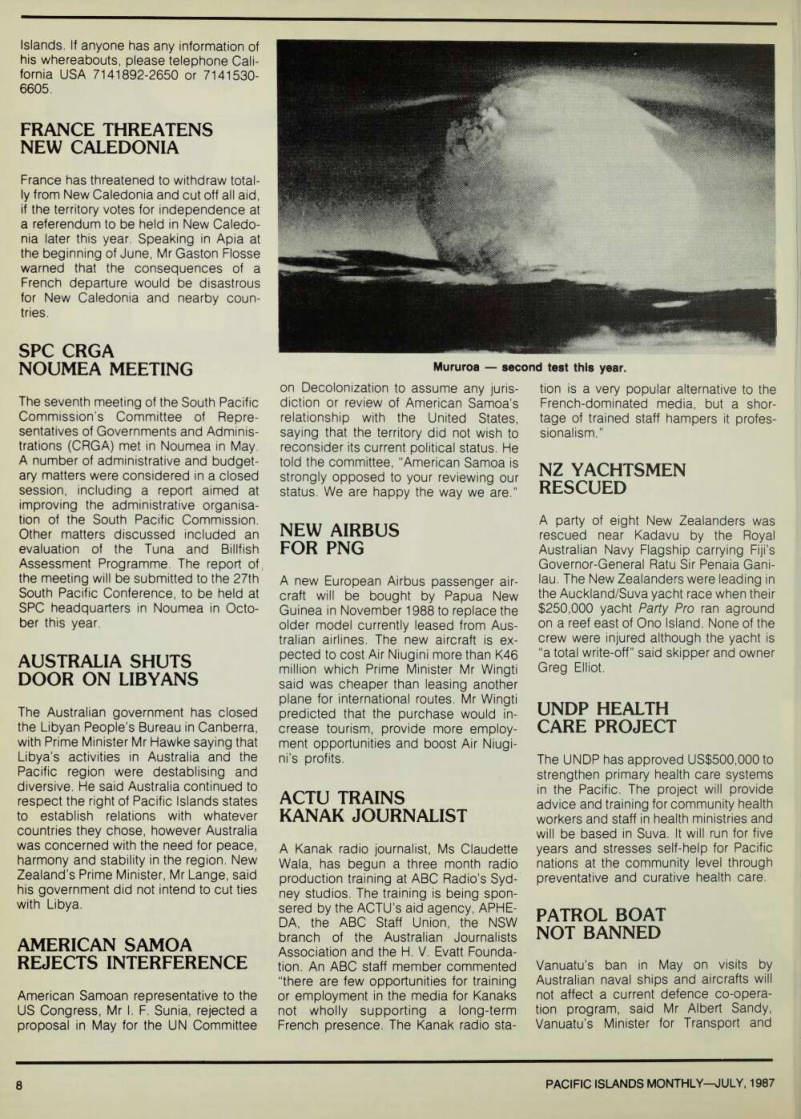
Mururoa second test this year.
Communications. The Ban was imposed after complaints of Australian intelli gence in Vanuatu. The defence co operation program includes the hand ing-over of a patrol boat to Vanuatu as part of twelve such boats being provided to South Pacific countries by Australia.
Twenty-six trainees from Vanuatu are attending the Australian Naval Training College in Western Australia to learn how to operate the boat which will be called Tugoro, meaning "protector”.
France Strengthens
Diplomatic Presence
France is to strengthen its diplomatic presence in the Pacific by appointing consul-generals in Honolulu and Mic ronesia, and a trade attache at the French embassy in Suva, according to Mr Gaston Flosse, who was speaking in Noumea in May at the end of a three day conference for French ambassadors and senior officials in the Pacific. Mr Gaston Flosse is French Secretary of State in Charge of the South Pacific region.
Second Nuclear
Test
A second nuclear device has been detonated at Mururoa Atoll, two weeks after the first test of this year. (June PIM 87, p 12). The blast was monitored by New Zealand Department of Scientific and Industrial Research at Ratotonga.
Nauru’S Millionaire
Landowners
Refuting allegations that there was little money in the Nauru Landowners’ Royalty Trust fund, into which landowners’ royal ties from the sale of phosphate is deposited, President Hammer DeRoburt sent statements to twelve landowners.
The accounts showed an average of A$1 million with the largest account contain ing A$9 million. The money cannot be drawn on, however, until the phosphte mining ends in about eight years, after which the landowners may draw on the interests of the deposits.
Niue Buys
Earth Station
Niue government has approved the purchase of a satellite earth station from
US company, Scientific Atlanta. The new station, which will cost about U 55155,900, will be able to operate automatic telex and facsmile facilities, take video signals, as well as cover expanded services of the present channel.
Historic Canoe
Voyage Completed
An attempt to retrace some of the sailing routes believed to have been used by Polynesians migrating across the Pacific 2000 years ago has been successful with the arrival of the double-hulled canoe in Hawaii. The canoe, manned by 16 men, took two years to navigate 16,000 miles, using only the traditional navigational methods.
Un Ambassador
Visits Pacific
US Ambassador to the UN, Mr Vernon Walters, recently visited the Pacific as part of a world tour to exchange ideas on important issues to be discussed at the forthcoming General Assembly of the United Nations. He said that one of the main areas of concern was the desire for a nuclear-free zone in the Pacific, but that people did not appreciate the need for nuclear deterrence. He condemned the activities of the Soviet Union and Libya in the area and commented briefly on the situation in New Caledonia, stressing that the problem has to be worked out by the French and the people of the region.
Open-Heart Surgery
For Tonga
In June the second phase of a three year project, Operation Open Heart for Toni ga, began with the arrival in Tonga of a 49-strong team of medical and ancillary personnel from Sydney. The team hopes to perform 25 open-heart operations, following their first successful phase in
March 1986, when they carried out 15 successful cardiac operations. Tonga suffers from a high rate of rheumatic fever which results in heart disease mainly among children and young people. The team, from the Seventh-day Adventist Church’s Sydney Hospital, travel at their own expense, and the cost of the complete project (about A 5411,988) is covered partly by public donations. Medical equipment and sup plies worth more than A 5200,000 have been provided by medical suppliers, and shipped to Tonga by the Royal Australian Navy.
Rice For
Vanuatu
Australia is contributing almost A 5400,000 of rice to a World Food Programme emergency operation in Vanuatu, following the destruction caused by Cyclone Uma in February.
Vanuatu Postpones
Libyan Mission
Vanuatu has decided to postpone inde finitely a decision on whether or not to establish a Libyan diplomatic mission in Vanuatu. Prime Minister Father Walter Uni said that the government would continue to review the situation as relations between Libya and Vanuatu developed, and that the decision was not the result of pressure from any quarter.
Nz High Commission
For Vila
A New Zealand high commission will be set up in Vanuatu later this year. New Zealand’s prime minister, Mr Lange, said that it was essential for New Zealand to convey its views directly to an important member of the South Pacific community, and that it was also essential to listen to what Vanuatu had to say on the many significant issues confronting the South Pacific.
Kiribati Fines
Us Tuna Boat
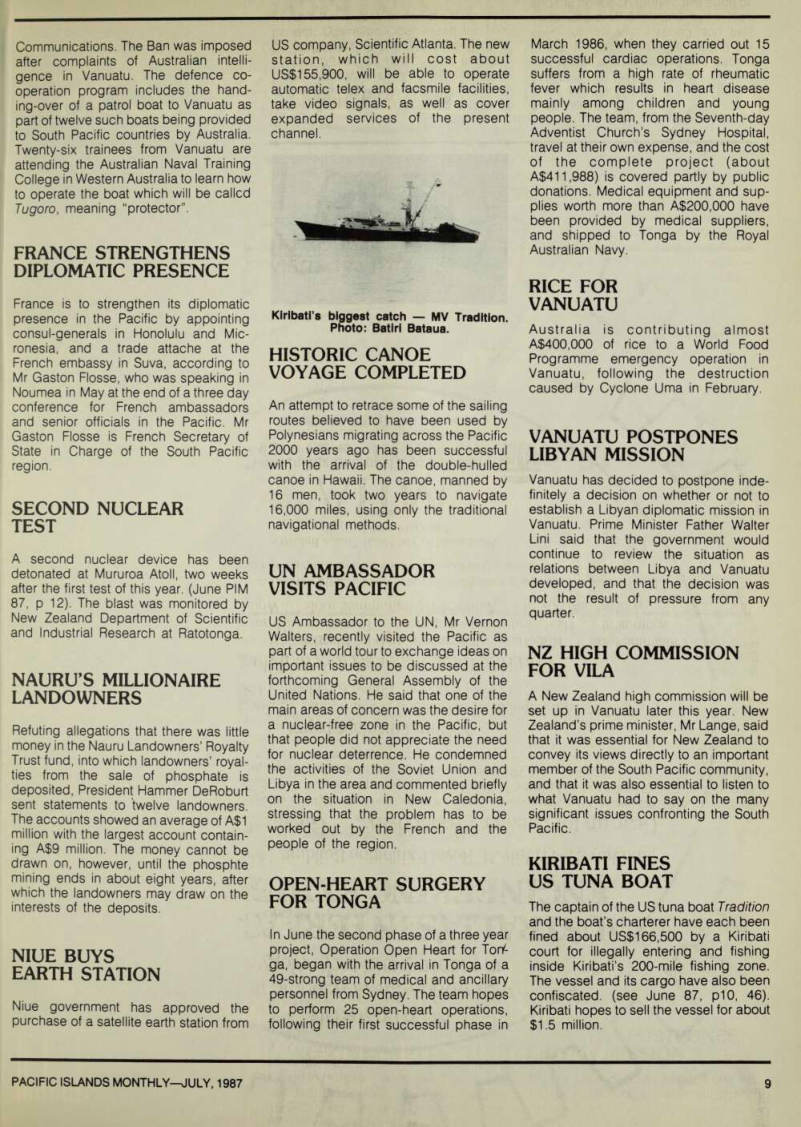
The captain of the US tuna boat Tradition and the boat’s charterer have each been fined about U 55166,500 by a Kiribati court for illegally entering and fishing inside Kiribati’s 200-mile fishing zone.
The vessel and its cargo have also been confiscated, (see June 87, pi 0, 46).
Kiribati hopes to sell the vessel for about $1.5 million.
Kiribati’s biggest catch MV Tradition.
Photo: Batiri Bataua.
Advertisements & other items, p. 10 (1 item)
SlCBi %
m K m mm m m m HJp *J|ji v V\v v xjPisJP^^JP^lP* > »■ \ IP S % 1 Vv >,/’»,■ V 'w» ■ sr* -. ’■#*■' -■ ."V /V 'V -J Jh*' % V '#- '<r * - 'i WSt ;♦ % 4 %% *#!m * il?’ *■ '■* ' * * * I • ■f-r. A « .- \, ■ a ‘ jiijp * *■ m : 4* at * * '- Ip %%, ; -* ; . %
PsT « « A ■«
% m % » <5 «sar%l* V* ‘«I 4 ss> pw « i? \ A ** J# Vi# ■** * fem *i¥ .% ":* ,*.. *3! %* v * 9 % n
SlCBi %
SMS
UK
SiftWi
K
French Ambassador challenged
letters
French Ambassador challenged to public debate
In your June issue you pub lished a speech by Mr Bernard Follin, French Ambassador to Australia, entitled “Exodus would follow FLNKS takeover, says Ambassador”. AS his view is biased and partisan I would like to reply.
Who is Mr Follin? A French Ambassador to Australia. What does he know of New Caledo nia and the Kanaks? Almost nothing, except what the French Secretary of State for the South Pacific, Mr Flosse, and the French High Commis sioner to New Caledonia, Mr Montpezat, choose to tell him during their recent three-day meeting in Noumea. The aim of this meeting was to try to rebuild French standing in the eyes of Pacific countries, if it is still possible.
Mr Follin says French policies are marked by “a very great continuity”; this is very true in regard to the stupid and pro fiteering colonialism that France is so intent on maintaining in New Caledonia and French Polynesia. But the assertion of “stability in the region” is more questionable, because despite over 134 years presence France has not been able to bring about real development in New Caledonia, and this is clear in several areas.
At the economic level New Caledonia is certainly one of the South Pacific countries with the highest per capita income, (SUS 6,156). But this is a superficial figure since the money’s source is not the coun try’s productivity, but subsidies from France of SUS 450 million per year as the Ambassador says. This standard of living is not evenly distributed but only benefits the colonisers, and stu dies show that Europeans have
an average income over five times that of the Kanak.
The economy is totally centralised on Noumea and structured in a way to guaran tee the continuation of colonial monopolies, the prerogatives of several rich families, especially Lafleur and Frogier. The prob lem is so serious that it led to an argument on this profiteering between Lafleur and Minister Pons during the latter’s last visit.
So “Kanaks don’t have an incentive to work and make a profit” is because they know the profit only goes to the businessmen. Contrary to what Mr Follin says its is not time that is needed to change things for “Kanaks to be part of the economy”, but rather a radical change of power the day when the Kanaks have power in their own land is the day they will become a part of the economy. And while this de mand is not met there is always a risk of instability in the region.
Culturally, we find the same process. France has only known how to stifle the Kanak people; instead of helping cultural development France has denied and killed it. We note the same thing again in reading Mr Follin his dream is that Kanaks will be like him.
“What we want is for them to come up to the same stage as Europeans”, he says. He is the one who decides and there is no doubt that only his criteria are valid.
Such statements and others (its very important to have training of the Kanak people as part of the economy” . . .
“Kanaks can’t earn money or profit”) are perfectly racist and worthy of Mr Le Pen.
It’s true that for many years France tried a policy of assimila
tion, then integration, and failed miserably. When will France have a policy that allows the Kanak people the right to be responsible for themselves and to live their traditions as they understand them?.
There is also instability poli tically, as France envisages its fourth statute in three years, and has still not managed to bring calm to the territory.
There are now 7,340 troops, mostly in the interior, which practise “nomadisation”, ie im pose themselves on Kanak tribes to gain information and wage psychological campaigns, or to repress Kanaks with the judicial process this total of military is hardly less than dur ing the Pisani period and equals one armed man for every three Kanak adults.
Mr Follin says the referen dum will be democratic pro cess, but can we talk about democracy in a country which is under military occupation?
Can we talk about democra cy when the “majority” was obtained by importing a popu lation a short while ago in order to drown out the Kanak popu lation numerically, (Messmer letter of 1972), and when a good number of voters in the pseudo referendum won’t be here in three years, the mini mum for eligibility.
Can we talk about democra cy when the electoral ways have been falsified in several ways (dead people not re moved from the rolls, others not removed who are no longer residents, excluding 2,500 Kanaks who have been sent enced when there are never repercussions against Euro peans who commit crimes).
Can we talk about democra cy when votes are bought
(Montpezat tours tribes with money for tractors, generators and churches), and when the judicial system discriminates in its judgments, investigations and conditions of detention? (two years jail for a European who kills a Kanak in cold blood and 15 for a Kanak accused of killing a man who probably suicided).
Yes, the security for the poll can be guaranteed by France with military force, but its sincerity will always be ques tioned under the above condi tions.
Moreover, studies show that the French is likely to get a majority against independence but it is now probable this won’t equal 50% of the enrolled voters what credibility will such a poll have?
How can Mr Follin have the cheek to say they are asking the people what they want when Mr Pons has never discussed the country’s future with the FLNKS and has never prop osed a meeting or an agenda
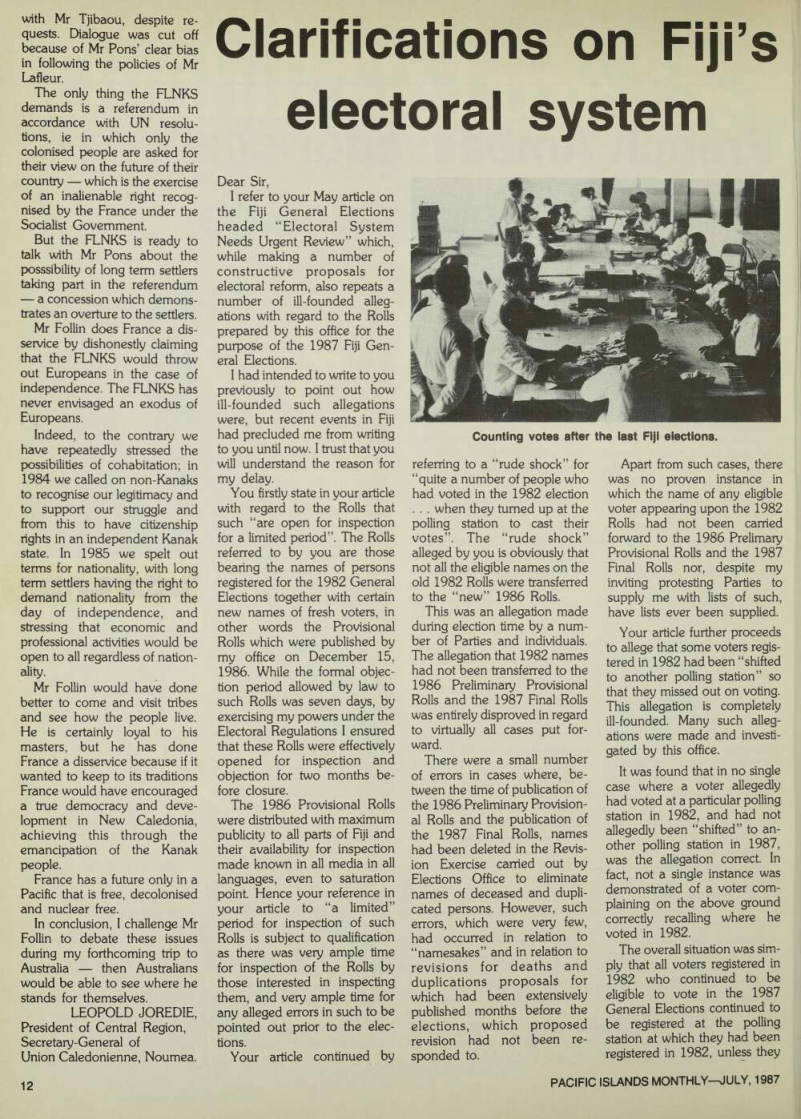
Jean-Marie Tjibaou
with Mr Tjibaou, despite re quests. Dialogue was cut off because of Mr Pons’ clear bias in following the policies of Mr Lafleur.
The only thing the FLNKS demands is a referendum in accordance with UN resolu tions, ie in which only the colonised people are asked for their view on the future of their country which is the exercise of an inalienable right recog nised by the France under the Socialist Government.
But the FLNKS is ready to talk with Mr Pons about the posssibility of long term settlers taking part in the referendum a concession which demons trates an overture to the settlers.
Mr Follin does France a dis service by dishonestly claiming that the FLNKS would throw out Europeans in the case of independence. The FLNKS has never envisaged an exodus of Europeans.
Indeed, to the contrary we have repeatedly stressed the possibilities of cohabitation; in 1984 we called on non-Kanaks to recognise our legitimacy and to support our struggle and from this to have citizenship rights in an independent Kanak state. In 1985 we spelt out terms for nationality, with long term settlers having the right to demand nationality from the day of independence, and stressing that economic and professional activities would be open to all regardless of nation ality.
Mr Follin would have done better to come and visit tribes and see how the people live.
He is certainly loyal to his masters, but he has done France a disservice because if it wanted to keep to its traditions France would have encouraged a true democracy and deve lopment in New Caledonia, achieving this through the emancipation of the Kanak people.
France has a future only in a Pacific that is free, decolonised and nuclear free.
In conclusion, I challenge Mr Follin to debate these issues during my forthcoming trip to Australia then Australians would be able to see where he stands for themselves.
Leopold Joredie,
President of Central Region, Secretary-General of Union Caledonienne, Noumea.
electoral system
Clarifications on Fiji’s electoral system
Dear Sir, I refer to your May article on the Fiji General Elections headed “Electoral System Needs Urgent Review” which, while making a number of constructive proposals for electoral reform, also repeats a number of ill-founded alleg ations with regard to the Rolls prepared by this office for the purpose of the 1987 Fiji Gen eral Elections.
I had intended to write to you previously to point out how ill-founded such allegations were, but recent events in Fiji had precluded me from writing to you until now. I trust that you will understand the reason for my delay.
You firstly state in your article with regard to the Rolls that such “are open for inspection for a limited period”. The Rolls referred to by you are those bearing the names of persons registered for the 1982 General Elections together with certain new names of fresh voters, in other words the Provisional Rolls which were published by my office on December 15, 1986. While the formal objec tion period allowed by law to such Rolls was seven days, by exercising my powers under the Electoral Regulations I ensured that these Rolls were effectively opened for inspection and objection for two months be fore closure.
The 1986 Provisional Rolls were distributed with maximum publicity to all parts of Fiji and their availability for inspection made known in all media in all languages, even to saturation point. Hence your reference in your article to “a limited” period for inspection of such Rolls is subject to qualification as there was very ample time for inspection of the Rolls by those interested in inspecting them, and very ample time for any alleged errors in such to be pointed out prior to the elec tions.
Your article continued by
referring to a “rude shock” for “quite a number of people who had voted in the 1982 election . . . when they turned up at the polling station to cast their votes”. The “rude shock” alleged by you is obviously that not all the eligible names on the old 1982 Rolls were transferred to the “new” 1986 Rolls.
This was an allegation made during election time by a num ber of Parties and individuals.
The allegation that 1982 names had not been transferred to the 1986 Preliminary Provisional Rolls and the 1987 Final Rolls was entirely disproved in regard to virtually all cases put for ward.
There were a small number of errors in cases where, be tween the time of publication of the 1986 Preliminary Provision al Rolls and the publication of the 1987 Final Rolls, names had been deleted in the Revis ion Exercise carried out by Elections Office to eliminate names of deceased and dupli cated persons. However, such errors, which were very few, had occurred in relation to “namesakes” and in relation to revisions for deaths and duplications proposals for which had been extensively published months before the elections, which proposed revision had not been re sponded to.
Apart from such cases, there was no proven instance in which the name of any eligible voter appearing upon the 1982 Rolls had not been carried forward to the 1986 Prelimary Provisional Rolls and the 1987 Final Rolls nor, despite my inviting protesting Parties to supply me with lists of such, have lists ever been supplied.
Your article further proceeds to allege that some voters regis tered in 1982 had been “shifted to another polling station” so that they missed out on voting.
This allegation is completely ill-founded. Many such alleg ations were made and investi gated by this office.
It was found that in no single case where a voter allegedly had voted at a particular polling station in 1982, and had not allegedly been “shifted” to an other polling station in 1987, was the allegation correct. In fact, not a single instance was demonstrated of a voter com plaining on the above ground correctly recalling where he voted in 1982.
The overall situation was sim ply that all voters registered in 1982 who continued to be eligible to vote in the 1987 General Elections continued to be registered at the polling station at which they had been registered in 1982, unless they
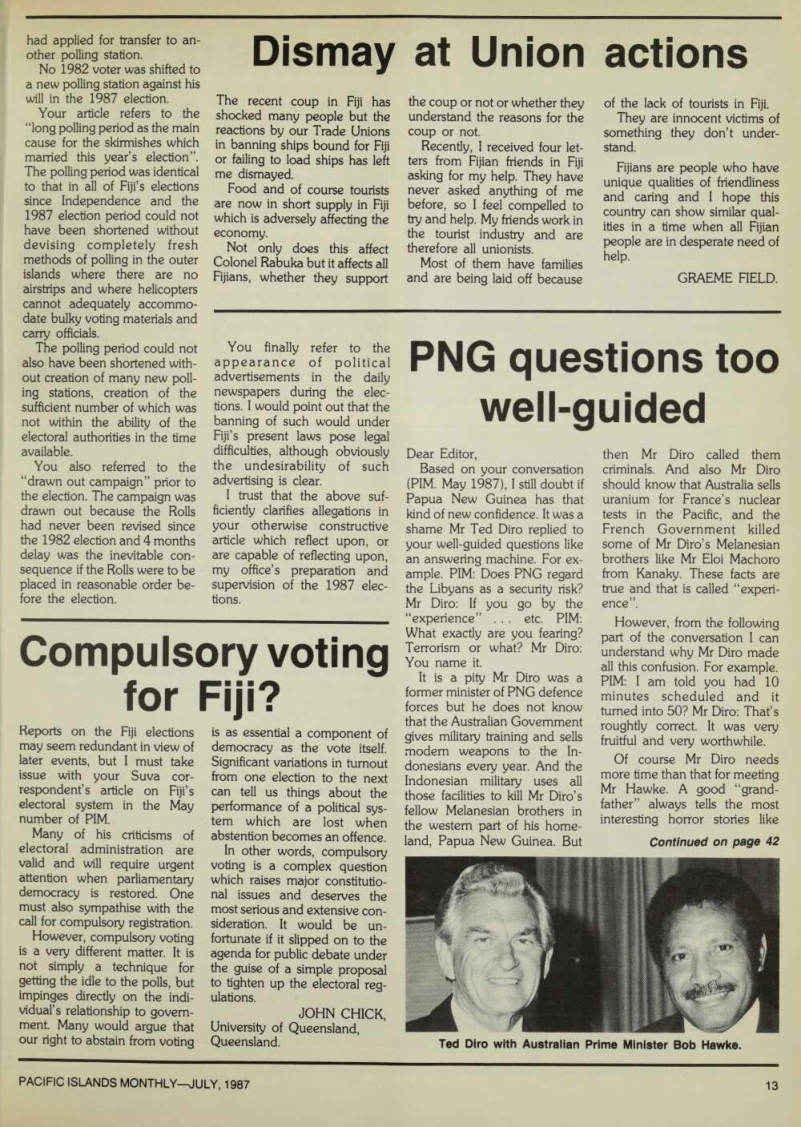
Counting votes after the last Fiji elections.
had applied for transfer to an other polling station.
No 1982 voter was shifted to a new polling station against his will in the 1987 election.
Your article refers to the “long polling period as the main cause for the skirmishes which married this year’s election”.
The polling period was identical to that in all of Fiji’s elections since Independence and the 1987 election period could not have been shortened without devising completely fresh methods of polling in the outer islands where there are no airstrips and where helicopters cannot adequately accommo date bulky voting materials and carry officials.
The polling period could not also have been shortened with out creation of many new poll ing stations, creation of the sufficient number of which was not within the ability of the electoral authorities in the time available.
You also referred to the “drawn out campaign” prior to the election. The campaign was drawn out because the Rolls had never been revised since the 1982 election and 4 months delay was the inevitable con sequence if the Rolls were to be placed in reasonable order be fore the election.
You finally refer to the appearance of political advertisements in the daily newspapers during the elec tions. I would point out that the banning of such would under Fiji’s present laws pose legal difficulties, although obviously the undesirability of such advertising is clear.
I trust that the above suf ficiently clarifies allegations in your otherwise constructive article which reflect upon, or are capable of reflecting upon, my office’s preparation and supervision of the 1987 elec tions.
Dismay at Union actions
The recent coup in Fiji has shocked many people but the reactions by our Trade Unions in banning ships bound for Fiji or failing to load ships has left me dismayed.
Food and of course tourists are now in short supply in Fiji which is adversely affecting the economy.
Not only does this affect Colonel Rabuka but it affects all Fijians, whether they support
the coup or not or whether they understand the reasons for the coup or not.
Recently, I received four let ters from Fijian friends in Fiji asking for my help. They have never asked anything of me before, so I feel compelled to try and help. My friends work in the tourist industry and are therefore all unionists.
Most of them have families and are being laid off because
of the lack of tourists in Fiji, They are innocent victims of something they don’t under stand.
Fijians are people who have unique qualities of friendliness and caring and I hope this country can show similar qual ities in a time when all Fijian people are in desperate need of help.
Graeme Field.
for Fiji?
Compulsory voting for Fiji?
Reports on the Fiji elections may seem redundant in view of later events, but I must take issue with your Suva cor respondent’s article on Fiji’s electoral system in the May number of PIM.
Many of his criticisms of electoral administration are valid and will require urgent attention when parliamentary democracy is restored. One must also sympathise with the call for compulsory registration.
However, compulsory voting is a very different matter. It is not simply a technique for getting the idle to the polls, but impinges directly on the indi vidual’s relationship to govern ment. Many would argue that our right to abstain from voting
is as essential a component of democracy as the vote itself.
Significant variations in turnout from one election to the next can tell us things about the performance of a political sys tem which are lost when abstention becomes an offence.
In other words, compulsory voting is a complex question which raises major constitutio nal issues and deserves the most serious and extensive con sideration. It would be un fortunate if it slipped on to the agenda for public debate under the guise of a simple proposal to tighten up the electoral reg ulations.
John Chick,
University of Queensland, Queensland.
well-guided
PNG questions too well-guided
Dear Editor, Based on your conversation (PIM. May 1987), I still doubt if Papua New Guinea has that kind of new confidence. It was a shame Mr Ted Diro replied to your well-guided questions like an answering machine. For ex ample. PIM: Does PNG regard the Libyans as a security risk?
Mr Diro: If you go by the “experience” .. . etc. PIM: What exactly are you fearing?
Terrorism or what? Mr Diro: You name it.
It is a pity Mr Diro was a former minister of PNG defence forces but he does not know that the Australian Government gives military training and sells modem weapons to the In donesians every year. And the Indonesian military uses all those facilities to kill Mr Diro’s fellow Melanesian brothers in the western part of his home land, Papua New Guinea. But
then Mr Diro called them criminals. And also Mr Diro should know that Australia sells uranium for France’s nuclear tests in the Pacific, and the French Government killed some of Mr Diro’s Melanesian brothers like Mr Eloi Machoro from Kanaky. These facts are true and that is called “experi ence”.
However, from the following part of the conversation I can understand why Mr Diro made all this confusion. For example.
PIM; I am told you had 10 minutes scheduled and it turned into 50? Mr Diro: That’s roughtly correct. It was very fruitful and very worthwhile.
Of course Mr Diro needs more time than that for meeting Mr Hawke. A good “grand father” always tells the most interesting horror stories like
Continued on page 42
Ted Diro with Australian Prime Minister Bob Hawke.
Libyans and criminals from Irian Jayans to his “grand child”. These stories might have scared or frightened Mr Diro therefore he almost missed his aeroplane.
As long as PNG still depends on Australian foreign aid, PNG can never have its own confi dence, although PNG is the richest and biggest island in the Melanesian states.
Henk Rumbewas
An Irian Jayan living in Australia.
NZ Immigration laws too lenient
New Zealand immigration laws may have been applied rather wishy-washily over the years but nobody can deny that plen ty of leniency has been granted to the Pacific Island overstayers.
They are, after all, contravening our nation’s laws in doing so.
Our government has to con sider such intricacies as hous ing, employment and social amenities for its own population first before being able to declare an open-sesame policy for out siders.
Moreover I can’t say Kiwis are welcoed with open arms in most islands when contemplat ing a longer term stay there and for permanent settlement it is practically impossible, I am told.
Even as a tourist I was rigorously checked while visit ing relatives in Apia. Coming back from a mere ferry trip to Pagopago I had to show all documentation including return air tickets, which one does not usually carry around for safety’s sake, apart from any other reason. Non-production of these documents caused rather rude treatement.
Accordingly I informed rela tives friends from Europe and America that Polynesian hospitality nowadays lacked its former lavish image and they would do well to give it a wide berth.
Mrs J. Mcvicker-Smith,
Wellington, New Zealand.
The Governor General’s dilemma
The Governor General of Fiji, Sir Ratu Penaia Ganilau, is presently faced with the most difficult and uneviable task of restoring the democratic rule in Fiji.
Since the May 14 military coup and since he resumed authority as Fiji’s chief execu tive, the 68 year old Governor General, a former soldier and politician, has been at pains to keep the various factions of the Fiji community satisfied and happy and to assure them that their interests and wishes are being protected.
The council of advisors has Sir Ratu Sir Kamisese Mara, the former prime minister and lead er of the Alliance Party who had led the country for 17 years
after independence in 1970, in the position of Advisor for Fore ign Affairs and Civil Aviation, while the coup leader, Lieute nant-Colonal Sitiveni Rabuka, is in charge of home affairs and disciplining the forces.
The governor of Fiji’s Re serve Bank, Mr Savcnaca Siwa tibau, is the advisor for finance and economic planning, a for mer commander of the army, General Paul Manueli, is re sponsible for posts and tele communications, and the chair man of the Public Service Com mission, Mr Bill Cruickshank is responsible for public service.
Retired diplomat, Ratu Josua Toganivalu, is responsible for Fijian affairs, a former lawyer, Mr Alipate Qetaki, is responsi
ble for crown law office and justice department and a former civil servant, Ratu Josua Cavalevu, is responsible for agriculture and fisheries.
Ratu Josaia Tavaiqia is in charge of forestry, Mr Livai Nasilivata is in charge of corpo rate and consumer affairs and Mr Filipe Bole is responsible for education, youth and sport.
The latter three were also responsible for these ministries as cabinet ministers in the Alliance Party. Another former cabinet minister of the Alliance Party, Dr Apenisa Kurisaqila, is responsible for land, energy and mineral resources. Mr Viliame Gonelevu is responsi ble for public works and road transport and Rev Tomasi
Raikivi is responsible for in formation and broadcasting.
Senator Mumtaz Ali is re sponsible for trade, industry and tourism and Mr done Veisa masama is in charge of rural development, rehabilitation, and rural housing. Rev Daniel Mastapha was responsible for housing and added affairs.
However, Rev Daniel Mas tapha resigned after attending the first meeting of the council, claiming that he could not do justice to his duties as a church minister while remaining an advisor to the Governor Gen eral.
While Ratu Sir Penaia has pledged that any changes to the constitution will be made using all legal means, political
analysts and constitutional ex perts argue that the Governor General has very little leeway to bring about changes to the constitution which will have validity in legal terms.
The Fiji constitution defines very clearly that the only body empowered to recommend changes to the constitution are the two houses of the elected parliament Certain sections of the constitution can be amended only with the appro val of the 75 per cent of the 52 members of the House of Rep resentatives voting for it. Cer tain sections can be amended with a two-thirds majority.
In Fiji at present there is no elected parliament so according to the constitutional experts, no recommendations can legally be made to change the con stitution. To have an elected
parliament in the country an election will have to take place and that will have to be held under the present constitution which specifies that there be 22 Indians, 22 Fijians and eight other members.
Any changes to this ratio have first to be recommended by the elected House so there is very little room for a legitimate amendment except a com promise.
The Governor General is hopeful that before the next general election he will be able to impress upon the other races living in Fiji, particularly the Indian leaders, to accept the reality that the indigenous Fi jians should be given a pri vileged position and a majority that would guarantee that the Fijians were always in control of the government.
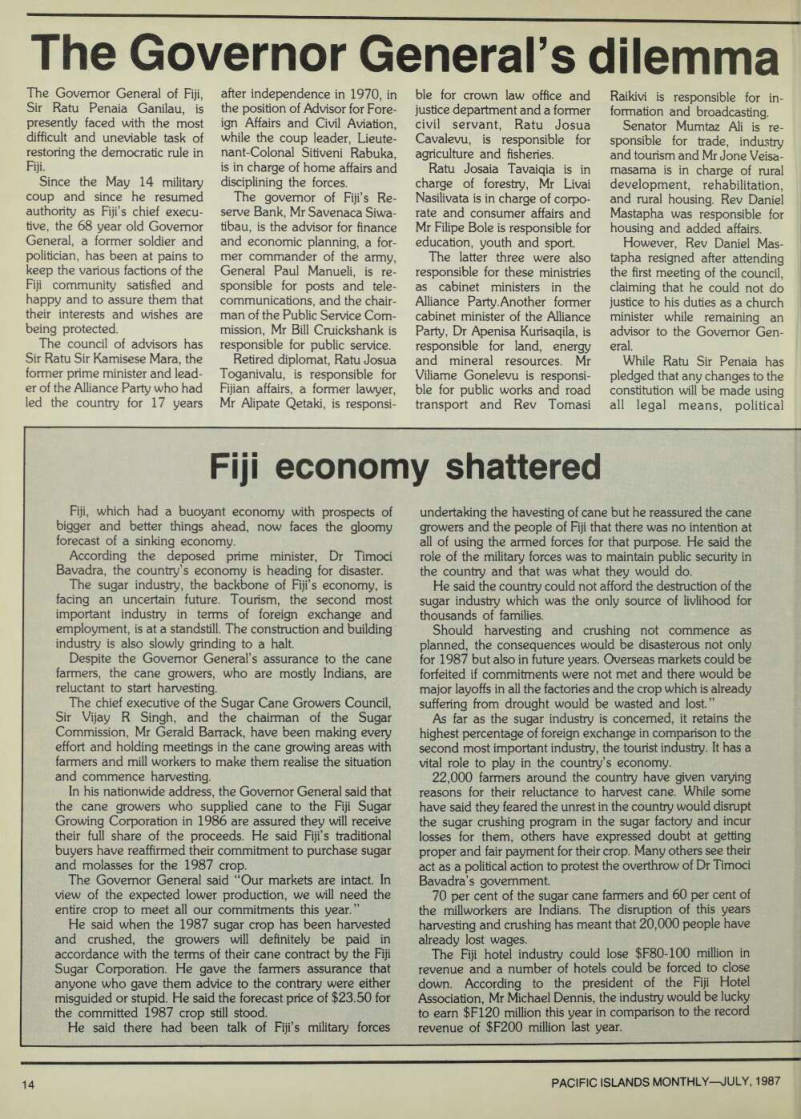
Fiji’s Governor General, Sir Ratu Penaia Ganilau.
Fiji economy shattered
Fiji, which had a buoyant economy with prospects of bigger and better things ahead, now faces the gloomy forecast of a sinking economy.
According the deposed prime minister, Dr Timoci Bavadra, the country’s economy is heading for disaster.
The sugar industry, the backbone of Fiji’s economy, is facing an uncertain future. Tourism, the second most important industry in terms of foreign exchange and employment, is at a standstill. The construction and building industry is also slowly grinding to a halt.
Despite the Governor General’s assurance to the cane farmers, the cane growers, who are mostly Indians, are reluctant to start harvesting.
The chief executive of the Sugar Cane Growers Council, Sir Vijay R Singh, and the chairman of the Sugar Commission, Mr Gerald Barrack, have been making every effort and holding meetings in the cane growing areas with farmers and mill workers to make them realise the situation and commence harvesting.
In his nationwide address, the Governor General said that the cane growers who supplied cane to the Fiji Sugar Growing Corporation in 1986 are assured they will receive their full share of the proceeds. He said Fiji’s traditional buyers have reaffirmed their commitment to purchase sugar and molasses for the 1987 crop.
The Governor General said “Our markets are intact. In view of the expected lower production, we will need the entire crop to meet all our commitments this year.”
He said when the 1987 sugar crop has been harvested and crushed, the growers will definitely be paid in accordance with the terms of their cane contract by the Fiji Sugar Corporation. He gave the farmers assurance that anyone who gave them advice to the contrary were either misguided or stupid. He said the forecast price of $23.50 for the committed 1987 crop still stood.
He said there had been talk of Fiji’s military forces
undertaking the havesting of cane but he reassured the cane growers and the people of Fiji that there was no intention at all of using the armed forces for that purpose. He said the role of the military forces was to maintain public security in the country and that was what they would do.
He said the country could not afford the destruction of the sugar industry which was the only source of livlihood for thousands of families.
Should harvesting and crushing not commence as planned, the consequences would be disasterous not only for 1987 but also in future years. Overseas markets could be forfeited if commitments were not met and there would be major layoffs in all the factories and the crop which is already suffering from drought would be wasted and lost.”
As far as the sugar industry is concerned, it retains the highest percentage of foreign exchange in comparison to the second most important industry, the tourist industry. It has a vital role to play in the country’s economy. 22,000 farmers around the country have given varying reasons for their reluctance to harvest cane. While some have said they feared the unrest in the country would disrupt the sugar crushing program in the sugar factory and incur losses for them, others have expressed doubt at getting proper and fair payment for their crop. Many others see their act as a political action to protest the overthrow of Dr Timoci Bavadra’s government. 70 per cent of the sugar cane farmers and 60 per cent of the millworkers are Indians. The disruption of this years harvesting and crushing has meant that 20,000 people have already lost wages.
The Fiji hotel industry could lose SFBO-100 million in revenue and a number of hotels could be forced to close down. According to the president of the Fiji Hotel Association, Mr Michael Dennis, the industry would be lucky to earn SFI2O million this year in comparison to the record revenue of SF2OO million last year.
The occupancy rate for the 400,000 hotel rooms in Fiji has dropped to as low as 10 per cent. It is not likely to improve in the near future as at this time of the year the occupancy rate is on average about 70 per cent.
Continental Airlines, the only United States airline flying into Fiji, has suspended its four weekly flights to Fiji until September 17th while the Australian airline, Qantas is only carrying Fiji nationals or reporters on its flights to Fiji.
Air New Zealand has also suspended flights to Fiji after one of its jumbo jets was involved in a hijack drama at Nadi International airport. The hijacker, a worker at the Fiji international airport at Nadi, attempted to seize the jet in order to seek the release of the detained members of the Bavadra Government. He was overpowered by the crew of the aircraft but the incident prompted Air New Zealand to suspend its flights to Fiji until further notice.
Air Pacific and Japan airlines are still flying regular schedules to Fiji and visitors have been recommended to exercise normal caution in making their arrangements.
The construction industry also faces a bleak future and in early June some 2,000 building workers were facing the prospect of being laid off.
According to the Fiji Markets Association, some drastic and positive measures have to be taken to restore the confidence of investors. The association’s President, Mr Malcolm Brain, says no new contracts had been signed since the coup and foreign investments have ceased. Manufactur ers of building materials such as cement have reported a drop of 50 per cent in their sales while others, such as roofing iron manufacturers, report a drop in sales of more than 80 per cent.
Besides the construction industry, the garment industry has been badly hit. Some five hundred garment workers are likely to lose their jobs.
The Governor General, Sir Ratu Penaia Ganilau, outlined a nine point package plan at the 27th Fiji Tourism Convention, held at the beginning of June, which he said was designed to stimulate economic activity and restore Fiji’s economy.
The package includes: 1. Duty free entry for equipment for the next three years for new industries, including those introducing new technology. 2. Duty free entry for one year for raw materials not available locally for existing or new enterprises. 3. The Fiji Development Bank will be requested to liberalise its lending policies, especially in relation to interest rates, repayment terms and security. The bank will also buy equity in economically viable projects. 4. Additional funding will be available through finance companies and consideration will be given by the housing authorities to loan repayments of people facing work difficulties. 5. The Fiji Trade and Investment Board is to be given a SFIOO,OOO for promotional purposes. 6. Insurance companies will be allowed to invest a bigger share of their funds in the private sector. 7. Copra millers will be allowed loans from the copra fund. 8. The Fiji National Provident Fund will be encouraged to go on with the building complex for office blocks and shops. The government is looking at an early start to public sector projects to create jobs. 9. The government will give $F500,000 to the Fiji Visitors Bureau for marketing campaigns. The Governor General said the people in the tourist industry are “moving with purpose and vigour to bring about a revival” of Fiji’s image overseas.
Ratu Sir Penaia Ganilau said that the government was negotiation with overseas airlines to resume services to Fiji.
There was also the possiblity of charter flights being introduced in Fiji.
In his address the Governor General assured delegates that the health of the tourist industry in Fiji was a top priority of his government.
“Some of immediate consequences of the coup are very much in evidence in our economy, nowhere more so than in tourism,” he said. “The crisis in the industry is grave and we must move quickly to begin the job of reconstruction.”
However he said that while the political situation was still in a state of turmoil, the economy could not be expected to recover completely. He asked the people forget their differences and find a shared spirit of concern for Fiji’s future.
Fiji’s Governor General
appeals for peace and calm
On Sunday June 7, Fiji’s Governor General, Sir Ratu Penaia Ganilau, who is now the chief executor of the country, out lined in a nation-wide broadcast a plan of reconstruction in an effort to restore confidence on behalf of the nation’s 700,000 plus population.
In his address, the Governor General touched on a wide range of issues which were causing anxiety in the minds of the people.
Firstly, he said he wanted to assure the people of Fiji that the country had now moved away from the brink of despair and destruction on which it had been poised.
He said that in his travels in the Western Division of the country, whatever he had seen had given him great confidence that the people of Fiji were getting back to their old ways of tolerance and respect for one another. However he said he did not want to create the impression that the situation was no longer serious, and that it still demanded great under standing by all the people of Fiji who have Fiji’s best interests at heart.
He added, “My main appeal is that I would like all of you to put aside the politics of fear and racial aggression which had emerged over the last few weeks.” He said, “We have known from various govern ments such politics can only be destructive and in Fiji we have always been proud of our qual ities of decency and tolerance.
He also complained that foreign journalists were still writ ing about a military government in Fiji, but he said there was no military government in Fiji. He had taken on the sole executive authority for managing the affairs of the nation in line with the powers vested in the office of the Governor General by the constitution.
The Governor General said that the Royal Fiji military force and the Royal Fiji police force took their orders from him. The presence of the Royal military force at keypoints in the nation is in accordance with his orders and he said, “I reiterate to you today that these soldiers are there today to protect the public interest The soldiers have an imporant role to play during this time of emergency and I am anxious that the public should cooperate with them rather
than get into confrontational situations.”
However on the same day the Governor General addres sed the nation, eight armed soldiers broke into a house in a Suva suburb while the owners were away in a raid senior officers say they knew nothing about. The incident happened when soldiers broke louvred panes to enter the house of Mr Noor Alam while his family was on their way back to Suva. The owners of the house arrived to find their house turned upside down.
Three days earlier 36 year old bank officer, Mr Vinod Kumar was wounded after being shot by soldiers guarding the house of the Governor General’s advisor on education, Mr Filipe Bole.
There were conflicting re ports of the incident Relatives of Mr Kumar said he was driving home from a party at midnight when soldiers on guard stopped him and asked for cigarettes. An argument started and Mr Kumar tried to drive his car away and was fired upon.
However an agency report quoted senior police sources saying that the shooting hap pened after Mr Kumar had tried unsuccessfully to persuade a guard outside Mr Bole’s house to admit him. Sources say that another car with four or five men was driving up and down the street at the same time and when shots were fired that car drove off at high speed. Accor ding to the agency report, the first car could have been used to gain entry to Mr Bole’s house by breaking down the gate, enabling the other car to enter.
Earlier, Mr Bole was reported to have received a threateneing telephone call.
Two days earlier, in another incident, Royal Fiji military forces fired shots at a British High Commission landrover
and blew out two of its tires at the Suva wharf. The tires were shot out by two soldiers after the occupents of the car, both senior members of the British High Commission in Suva re fused the soldiers permission to search their vehicle.
The Governor-General, Ratu Sir Penaia Ganilau, met the British High Commissioner, Mr Roger Barltrop, and after pro tests from the High Commis sion, offered his profound apo logies for the incident. He said that Fiji acknowledged that it was an unfortunate incident which was in breach of the Vienna Convention and dip lomatic relations. He assured the High Commissioner that a full and thorough investigation into the incident had been ordered and appropriate action would be taken.
Meanwhile it was also re ported by the New Zealand High Commission that a letter had been sent by them in protest to the Governor Gen eral about how the New Zea land High Commissioner in Fiji, Mr Rod Gates, had been stop ped by soldiers at Suva wharf earlier in the week and had his car searched.
At a military parade at the army barracks later in the week, Ratu Sir Penaia Ganilau warned soldiers not to abuse their power.
Earlier in his travels in the Western Division, he had re ceived many reports of fear, uncertainty and anxiety among the people.
“This has come about be cause it is the first time they have come across seen the army being used to maintain the law and protect lives and property. They have expressed fear because they are not used to seeing or living with armed forces. I am asking you, the officers, non commissioned officers and soldiers to work within the law provided for you to work under. Abuse of these powers can give rise to alot of trouble which will be hard to stop,” Ratu Sir Penaia Ganilau said.
“With this in mind, I appeal to you all to go about your duties to the best of your abilities and help me with the task of nation building that is before us.“
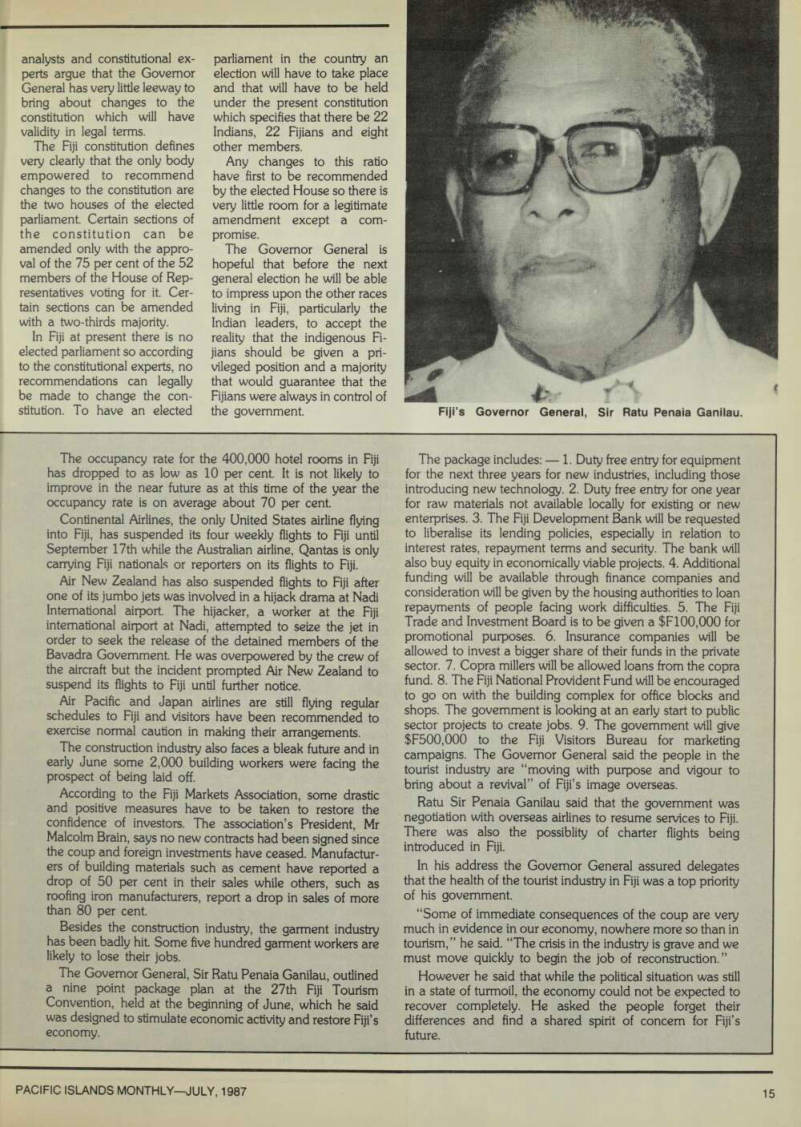
Boarding up shop windows in Suva, after the coup.
Fiji puts pressure
on Forum
Australia’s Prime Minis ter Bob Hawke was named by the South Pacific Forum to head a possible special mission to Fiji for talks with all parties on the country’s political crisis.
The Forum which met in Apia, Western Samoa, at the end of May, admitted two new countries—Federated States of Micronesia and the Marshall Islands to its ranks, bringing membership to fifteen. Fiji was not represented “because of our pre-occupation with impor tant matters at home,” Gov ernor General Ratu Sir Penaia Ganilau wrote to the new Forum Chairman, Western Sa
moan Prime Minister Va’ai Kolone.
The Forum also named Solo mon Islands Prime Minister Ezekial Alebua and SPEC Director Henry Naisali as fellow members of the proposed mis sion. The idea of a Forum mission to Fiji had first been suggested by Western Samoan deputy PM, Tupuola Efi.
Expressing their “deep con cern and anguish” at the over throw of the Bavadra Govern ment, the 14 Forum leaders decided that “should the Gov ernor General of Fiji indicate that such a Forum initiative would be constructive and of assistance, the Forum would
send a mission to Fiji”. If accepted, the mission “would hold discussions with all parties in Fiji with a view to attempting to facilitate process leading to a resolution of the current prob lems”.
However, as expected by many at the Forum, the offer was declined by Fiji’s Gov ernor-General Ratu Sir Penaia Ganilau despite intitial indica tions that it might have been accepted. The Forum decision gave the Australian leader the domestic success he had sought Hawke had announced be fore the meeting that he wanted the Fiji issue to be tackled head-on and the decision on a
Fiji mission and its mention in the Forum final communique, was taken despite the reserva tions of several Forum mem bers, particularly those of the Spearhead group.
While all countries had de plored the coup in Fiji, the Melanesian countries had ex pressed reservations about in terference in Fiji’s internal affairs, preferring to offer assist ance to Fiji and wait for a request. Moreover, PNG dele gates told PIM, a mission of lower level officials would have been able to make preliminary contacts more successfully, with a Prime Ministerial mission stepping in afterwards.
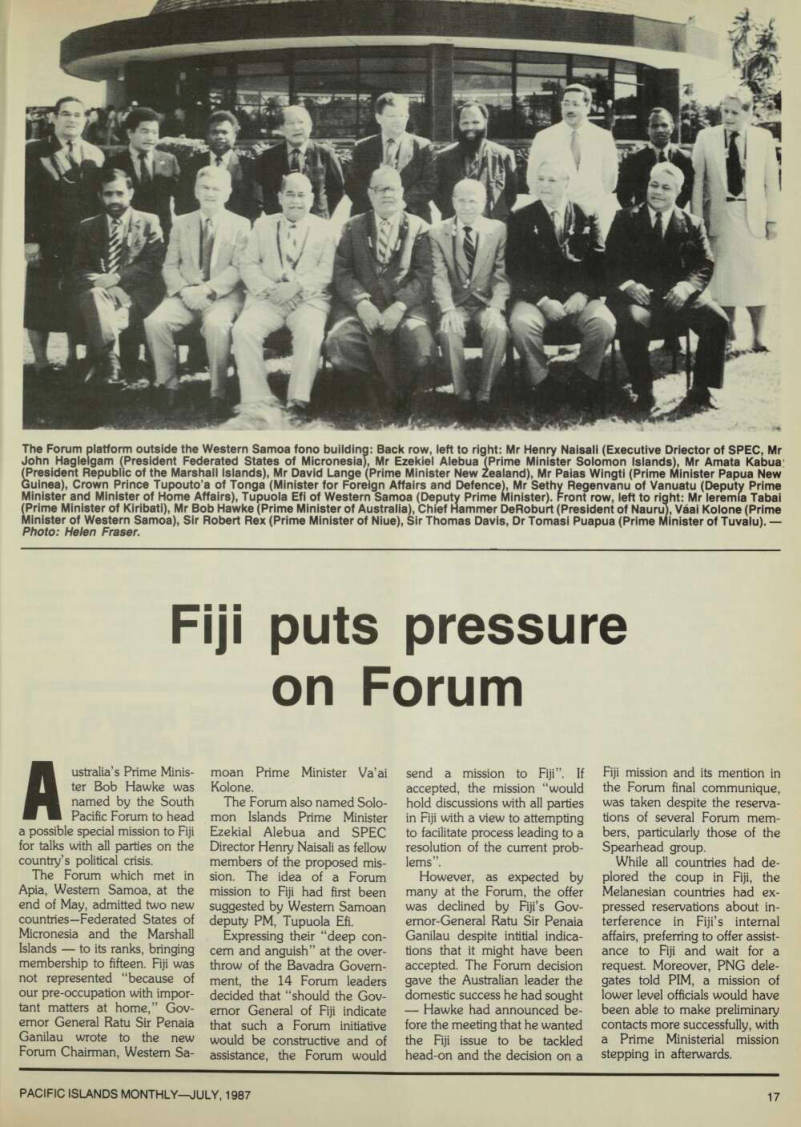
The Forum platform outside the Western Samoa fono building: Back row, left to right: Mr Henry Naisali (Executive Driector of SPEC, Mr John Haglelgam (President Federated States of Micronesia), Mr Ezekiel Alebua (Prime Minister Solomon Islands), Mr Amata Kabua (President Republic of the Marshall Islands), Mr David Lange (Prime Minister New Zealand), Mr Paias Wingti (Prime Minister Papua New Guinea), Crown Prince Tupouto’a of Tonga (Minister for Foreign Affairs and Defence), Mr Sethy Regenvanu of Vanuatu (Deputy Prime Minister and Minister of Home Affairs), Tupuola Efi of Western Samoa (Deputy Prime Minister). Front row, left to right: Mr lererma Tabai (Prime Minister of Kiribati), Mr Bob Hawke (Prime Minister of Australia), Chief Hammer DeRoburt (President of Nauru), Vaai Kolone (Prime Minister of Western Samoa), Sir Robert Rex (Prime Minister of Niue), Sir Thomas Davis, Dr Tomasi Puapua (Prime Minister of Tuvalu).
Photo: Helen Fraser.
At their earlier Rabaul meet ing the Spearhead Group had decided they would send a “mediatory” delegation to Fiji if called upon by the Governor General. Although not on the formal agenda of the Forum, the Fiji crisis occupied almost ten hours of Forum informal and formal discussion. The idea for a Forum mission was first raised at a private dinner for the 14 South Pacific leaders on board HMAS Tobruk, hosted by Mr Hawke on the eve of the Forum meeting.
However, the technicalities of making contact with Fiji’s Gov ernor General led to an ex change the following day be tween PNG Prime Minister Paias Wingti and Australian leader Bob Hawke; it had been agreed that Western Samoa’s Prime Minister, Va’ai Kolone would contact Ratu Penaia, but when communications failed contact was made through the intermediary of the Australian Governor General, Sir Ninian Stephen.
This led to an exchange in the meeting the next day that Wingti termed “heated discus sion” when he raised the ques tion of procedure with Hawke.
The latter reportedly later apologised to the Forum for his outburst. The Forum took a strong stand on the question of independence for New Caledo nia, expressing 44 grave disquiet
about the current policies of the Government of France with regard to New Caledonia”.
The Forum “completely re jected” the referendum which France plans to hold in mid- September for the territory, and noted that the “representative organisation” of the indigenous population, the FLNKS, had decided to boycott the poll.
“Such a referendum would be divisive, futile and a recipe for disaster”, the Forum com munique said, calling on France to abandon the “empty exer cise”. The Forum will call upon the UN Decolonisation Com mittee to recommend to the General Assembly “a UN-spon sored referendum in New Cale donia consistent with the uni versally accepted principles and practices of self-determination and independence”.
The Forum indicated again its willingness to send a delega tion to New Caledonia to talk with all parties on the territory’s political future, as well its “strong interest” in discussiong the issue with France if the latter is “genuinely interested in a dialogue to achieve a peaceful resolution”.
The Forum called upon the South Pacific Games Council to change the venue of the South Pacific Games, due to be held in Noumea in December, “in the interests of the safety and welfare of the participating
athletes.” PIM was told the Council will consider asking Western Samoa to host the games again (W. Samoa was host to the 1983 Games) which would mean waiving the rules about one country being host to two international events in the one year, or an approach to Australia for assistance with facilities for the Games-Austra lia and New Zealand are not participants in the South Pacific Games.
The Forum did not grant the FLNKS observer status as lob bied for by the Spearhead Group Australia, New Zea land and the Cook Islands argued that recognition for the FLNKS as de facto government was not in line with Forum procedures and rules.
PNG Prime Minister Wingti told PIM that if France went ahead with the referendum and the situation in the territory deteriorated, “we would have to have a series of practical measures, apart from express ing diplomatic feelings”. He said his country would look at trade union activity against France and French interests in New Caledonia as measures of this kind. 4 4 One option to be consi dered would be recognition of the (FLNKS) Provisional Gov ernment”, Wingti said. “Given the history of France dealing with other administrations, I’ve very little hope for dialogue”, he said, referring to the Forum offer of dialogue with France.
On the Libyan threat to the South Pacific Wingti said Aus tralia had failed to provide “hard facts to substantiate allegations about Libyan in volvement affecting the security of this region.”
However, Forum countries accepted an Australian propo sal to increase the sharing of security intelligence between member nations.
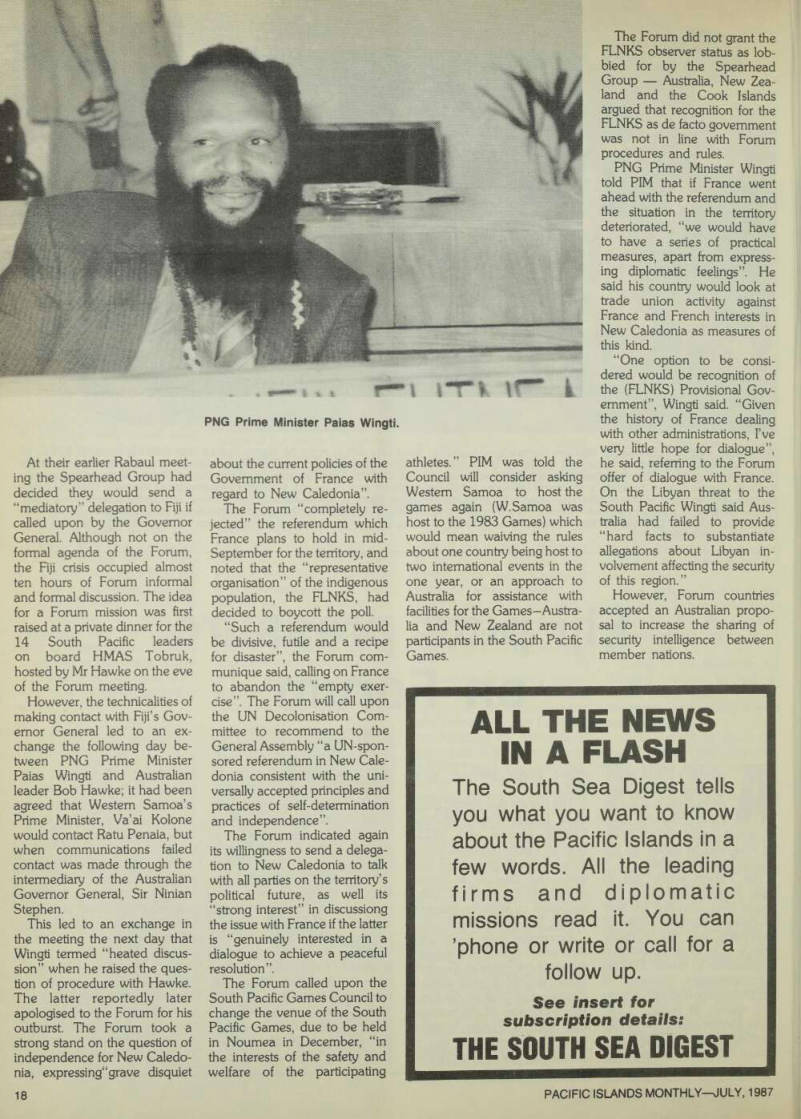
PNG Prime Minister Paias Wingti.
The Forum also decided to review its bureaucratic or ganisation with a view to mak ing the Forum the paramount regional organisation and in creasing its international recog nition as well as the Forum there are the secretariat, the South Pacific Bureau for Eco nomic Co-operation (SPEC), the South Pacific Commission (SPC) head-quartered in Noumea and the Forum Fisher ies Agency (FFA).
PNG’s Foreign Minister Ted Diro wants to see the Forum as a single regional organisation with its other arms answerable to it.
He told PIM that PNG wants to see all aid from donor coun tries to be channelled through the SPEC, to allow the Forum to have a political control over aid.
This would mean cutting down the role of the SPC, which was set up after World War Two by metropolitan countries.
The South Pacific Nuclear Free Zone Treaty was signed at the Forum by the Prime Minis ter of the Solomon Islands, Mr Ezekiel Alebua, leaving only two countries Vanuatu and Tonga that haven’t signed.
In the wake of the hijacking of the Air New Zealand plane at Fiji, the Forum decided to establish a working party to look at ways to enhance the capacity of Forum states to counter terrorism and hijacking.
Next year’s Forum meeting will be held in Tonga.
Advertisements & other items, pp. 18-19 (1 item)
All The News
IN A FLASH
The South Sea Digest tells you what you want to know about the Pacific Islands in a few words. AN the leading firms and diplomatic missions read it. You can ’phone or write or call for a follow up.
See insert for subscription details:
THE SOUTH SEA DIGEST
ALL THE
NEWS
IN A
FLASH
The South Sea Digest tells you what you want to know about the Pacific Islands in a few words. All the leading firms and diplomatic missions read it.
See insert for subscription details:
THE SOUTH SEA DIGEST
Foreign Minister
Vanuatu “under pressure”: Foreign Minister
Vanuatu’s Prime Minister, Father Walter Lini, re cently announced that his Government would postpone indefinitely making a decision on the establishment of a Libyan diplomatic mission in Vanuatu.
Speaking to PIM after the Forum meeting, Foreign Minis ter Sela Molisa denied that the announcement was a result of any pressure from other coun tries: “They (the Libyans) are not ready, and we are not ready”, Mr Molisa said. “We expect them to go about establishing diplomatic missions in a re sponsible and mature way” he said referring to the recent visit of two Libyan envoys.
“They went home because we made it very clear that we expect such things to be done in accordance with the Geneva Convention. ”
Molisa said Vanuatu saw Libya as a friendly country with similar views on a range of issues. Moreover, Libya “is the second largest oil producer and is successful in agriculture, par ticularly in turning desert into arable land”.
Molisa said Vanuatu had several big projects on which it had approached friendly gov ernments for assistance, and that funding of SUS 40 million for a new airport to take 747 aircraft, had been raised with Libya, Japan, Australia and the Netherlands. Of these countries Japan had been the only one to reply so far, Molisa said, but was only interested in funding the terminal and not the runway.
On reports of groups from the Vanua’aku Pati being sent to Libya for training, Molisa said: “Our intention was to send some people to different coun tries, including Australia, Malaysia, Holland and Libya for training to be exposed to different environments, to study journalism.
“Libya, Israel and South Afri ca are countries under pressure to survive . . . our policy is not
to deal with South Africa and we have no diplomatic relations with Israel. For journalism we need people with good educational backgrounds, not just for newspapers, but to be capable of analysing informa tion.”
Molisa pointed to Vanuatu as also being a country under pressure as the only South Pacific country to join the Non- Aligned Movement.
“We have 100 sub-commit tees with commissars we want them to be exposed (to pressures) and to come back and keep the people in touch at the grass roots level. We’re now thinking of doing this training in Port Vila if we can get experts to come. ”
Molisa said Vanuatu had been disappointed with the pre- Forum South Pacific mission of Australian Foreign Affairs offi cial, David Sadleir to discuss the Libyan threat with regional leaders.
“On the reports of arms coming to Vanuatu, we ex pected David Sadleir to explain where they got this information ... we don’t want any shipment of arms.”
Vanuatu was “still consider ing police training with Libya
if you look at the security of Libya, with all the pressures around, they’ve got a very strong police and army.
“We have a Police Services Commission anyone who goes to Libya and comes back and poses a problem (will) end up in jail. They have to obey our laws, Vanua’aku Pati supporters or whatever.”
Vanuatu was happy with the Forum statement on New Cale donia, Molisa said. “But in reality if France goes ahead (with the referendum), what can any Forum country do?
Just go banging ahead at the UN.
“We think giving the FLNKS observer status at the Forum is another pressure on France, but the Forum has to reflect everybody’s view well, so long as everybody stays to gether at the UN.”
Molisa said the issue of a new airport was linked to the politi cal developments in New Cale donia. Our tourism was affected by the troubles in 1984 (with planes needing to refuel at New Caledonia’s Tontouta airport) that’s why its so very impor tant to have our own airport, so as not to be dependent on tourists coming through New Caledonia.
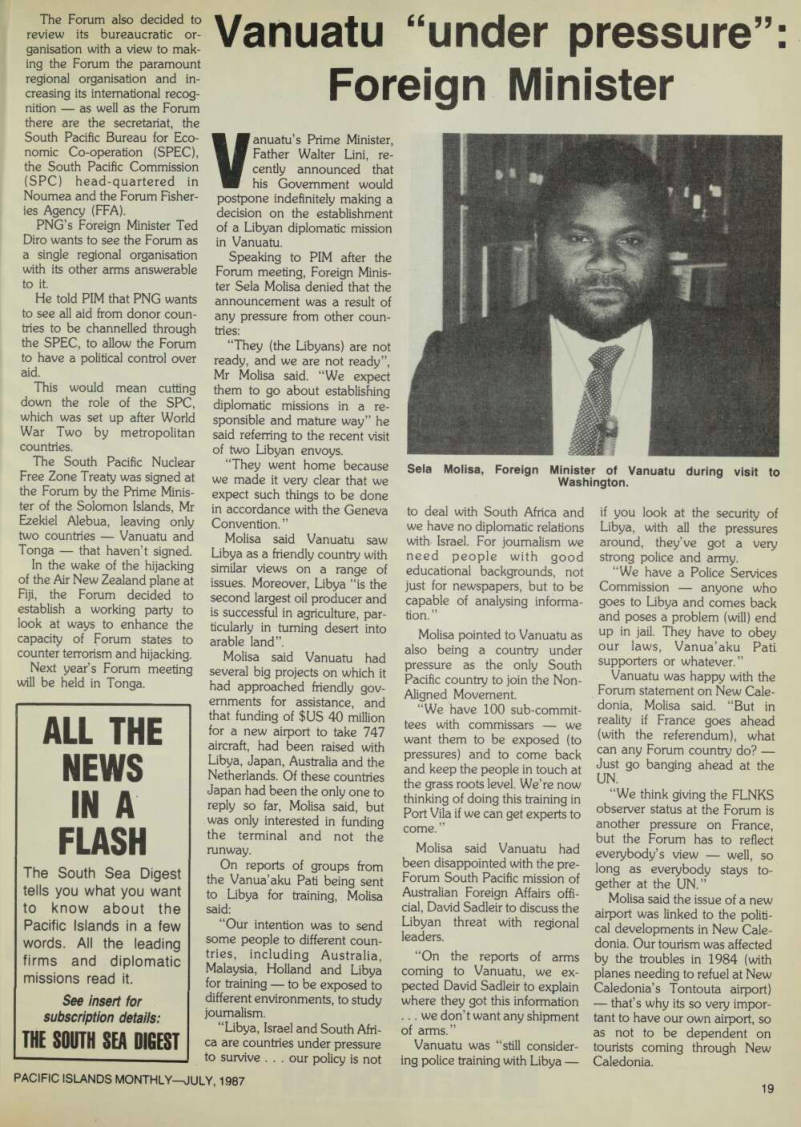
Sela Molisa, Foreign Minister of Vanuatu during visit to Washington.
Advertisements & other items, p. 20 (1 item)
t into the action!
mm m i 1
(but watch your head)
Nationals new VHS-C Movie MCS is so light, compact, and simple to use, you don’t just record the action, you’re part of it!
Bring it to the scene of family fun, and shoot while you play. With microelectronic
wizardry extending high-speed shutter capability
to 1/IOOOth of a second, the MCS will follow the bouncing ball with beautiful clarity. And none of the fuzziness of conventional l/50th of-a-second shooting.
Add our original Piezo Auto Focus system with solid-state CCD image sensor, HQ (High Quality) picture circuitry, Auto Tracing White Balance adjustment, SP/LP (30/60-minute) recording on handy C-cassettes of the world’s most popular video format, VHS, plus playback VHS Movie models MCS and M 5
shoot at l/1000th of a second!
capability—and you’ve got a lot of performance to hold in one hand.
For even greater versatility, try our VHS Movie M 5. It not only shoots at 1/1000th of a second, but can also play back standard-size VHS cassettes directly on a TV or monitor.
The VHS Movie family of camera/recorders from National.
When you’re headed for good times.
SEES
VHS
S National
National, Panasonic and Technics are the brandnames of Matsushita Electric.
Referendum
to go ahead
Alain Rollat, specialist writer on French territories for the authoritative daily Le Monde writes for PIM on New Caledonia’s political future.
The dice are now thrown; in principle nothing can prevent the French Government’s referendum for New Caledonia from taking place in the territory on September 13 the re ferendum bill became law on June 6.
Voters with more than three years residence in New Caledo nia at the date of the law’s promulgation will be given the following choice: “Do you want New Caledo nia to obtain independence or to remain in the heart of the French Republic?”
And we already know the result: more than 90% of the current 91,609 enrolled who will go and vote will declare
themselves for the continuation of New Caledonia within the heart of the French Republic and against independence.
This result is already known because the independence movement, represented by the Kanak Socialist National Liberation Front (FLNKS) long ago made it clear that it will not participate in this poll.
This means that the Kanak community, of which over 80% is “independantiste” , will de liberately stay away on the day
of the poll, and the referendum will therefore solve nothing.
The Caledonian problem will remain but this is a surprise for no-one. Even the French Gov ernment has admitted that this poll will have, in itself, only a relative value.
It reckons, however, that the poll is essential in order to clarify the political future of the territory. The Prime Minister, Jacques Chirac and the Over seas Territories Minister Ber nard Pons, have totally
espoused, until now, the argu ments of the local conservative majority, which is led by the President of the Rally for Cale donia in the Republic (RPCR), Mr Jacques Lafleur.
They think that the electoral test of the referendum will be enough to stifle the independ ence movement for a long time.
But Mr Chirac and his friends are the only ones in France to show such optimism. Within the parliamentary majority there are many moderates who dis agree, as do the Socialists and the Communists, and feel that the Government is playing with fire by organising a referendum that is unwanted by Kanaks since they know that in its
Large French military presence in New Caledonia Photo Helen Fraser.
present form it can in no way benefit them.
That is why the certainty of the arithmetic result of the poll really opens up a lot of political uncertainties.
And that is also why the prospect of these uncertainties seems now to be shaking . . . the tidy certainties of the Gov ernment.
Indeed, the FLNKS has de cided, at the recent congress held at Goa tribal village (near Ponerihouen on the east coast), to put its boycott instruction in terms which can give rise to fears of troubles before, during and after the referendum.
A week earlier, FLNKS Presi dent, Mr Jean-Marie Tjibaou had personally stressed the need for non-violence to the militants of his own party, Un ion Caledonienne (the largest party in the FLNKS). He had called on Kanaks to mobilise peacefully: “We won’t participate in the referendum but neither will we be going fishing or having a siesta on the day of the poll”, he said: “We’ll have a peaceful show of strength by organising mass actions.”
But at Goa the sixth FLNKS congress adopted a more vague position. The resolution recom mends the boycott of the “sham referendum” without spelling out the form that the boycott will take.
Leaders of other parties with in the FLNKS have stressed that “a non-violent campaign is
of necessity not spelt out in advance”.
And for the moment the FLNKS leaders appear to have decided to leave a freedom of action to their local “struggle committees”.
If each militant group of the FLNKS should give its own interpretation to the boycott instruction, then all risks be come possible.
The FLNKS congress also decided to organise “a huge march for independence through peace” before the re ferendum, which would certain ly be directed at Noumea.
Given the local feelings it is not likely that the “independan tistes” opponents will allow the FLNKS to achieve this goal without reaction.
Extreme right wing organisa tions have already signalled that they won’t let the FLNKS have “a show of strength”. Thus once again New Caledonia is from now on heading down a dangerous path of confront ation.
To maintain law and order in the territory the French Gov ernment has deployed a large military force in the regions which are under the political control of the FLNKS.
Never before has the French army been so fussy about Kanak tribes. Parachutists are seen camping from tribe to tribe organising football or volleyball matches for Melanesian youths, showing films, offering technical services to open up roads through the bush.
Alpine riflemen, specialists in
mountaineering, can be seen climbing to the top of churches to repair clocks or to repaint roofs.
The political aim of this milit ary presence of 5877 soldiers and gendarmes, is clear, despite the explanations that the authorities give.
The aim is to tightly control Kanak tribes in an attempt to reduce the influence of the FLNKS on the day of the referendum and of this the FLNKS leaders are under no illusions. They have ordered their militants to use grass roots contact to thwart these tactics of these regiments of elite soldiers suddenly turned boy scout.
As mayor of the town of Hienghene, Tjibaou himself has refused all collaboration with the French army it had proposed dynamiting a large rock which obstructed a neighbouring road, on condi tion that he authorise the in stallation of soldiers in his tribe
for “sundry works” . . .
On the whole the French Government is taking a danger ous gamble. Two conditions need to be filled for the Gov ernment to be able to shout victory on the night of the referendum. Firstly, its neces sary for the poll to take place peacefully and that everywhere those who wish to do so can vote normally.
Now, taking into account the “mass actions” envisaged by the FLNKS, nothing is less certain.
Then it is necessary even if the above two conditions are met that the number of voters is not ridiculously low.
Now, given the orders to boycott by the “independan tistes” and the usual level of abstention of around 25%, it’s hard to see how the Govern ment can hope to get more than half of the enrolled voters into the polling booths, espe cially when the result is already known.
These simple commonsense considerations explain why the Government now appears to be in much less of a hurry to hold the referendum that it had sought for so long.
One even has the impression sometimes that Mr Chirac will not be sorry if some events lead
him to postpone the poll until much later.
For above the immediate fu ture of New Caledonia there is the over-riding pre-occupation of all French politicians the next Presidential election, due in autumn 1988.
Asa rival of Mr Mitterrand for the top post, Chirac can’t allow himself the luxury of having a bitter crisis in New Caledonia on his hands on the eve of the Presidential election an elec tion which is so important for his personal destiny.
He begged his Minister Pons to look at it twice before setting the referendum process in mo tion. And one can understand why Mr Pons hesitates and this is also the reason why anti-independence leader Laf leur has just gone to Paris to push the Minister, whom he blames for the delay.
In any case, whether the referendum takes place or not, the future of New Caledonia will not be clarified. No-one is capable of saying today what the territory’s statute will be tomorrow.
The Government’s plan for after the referendum is to mod ify the regional organisation of the territory to benefit its supporters; this will be done by taking away one of the three regions from the FLNKS that were won by them in the September 1985 elections under the Socialist regime.
But even if the Parliament adopted anew statute for the territory as an absolute priority before the Presidential election of 1988, it would not be applied before this date and would only be if Chirac was elected President, which opinion polls say is doubtful.
And, one could add that even if Chirac won the election he would not be in a hurry to plunge into new reforms for the territory.
Indeed, the FLNKS has repe ated that it will never participate in a local election which is in the framework of an autonomy sta tute. Would Chirac as a newly elected President risk anew boycott?
The conclusion is perfectly clear, and has heavy consequ ences: New Caledonia is not at the end of its troubles.
Jean-Marie Tjibaou.
Kiribati’s biggest catch
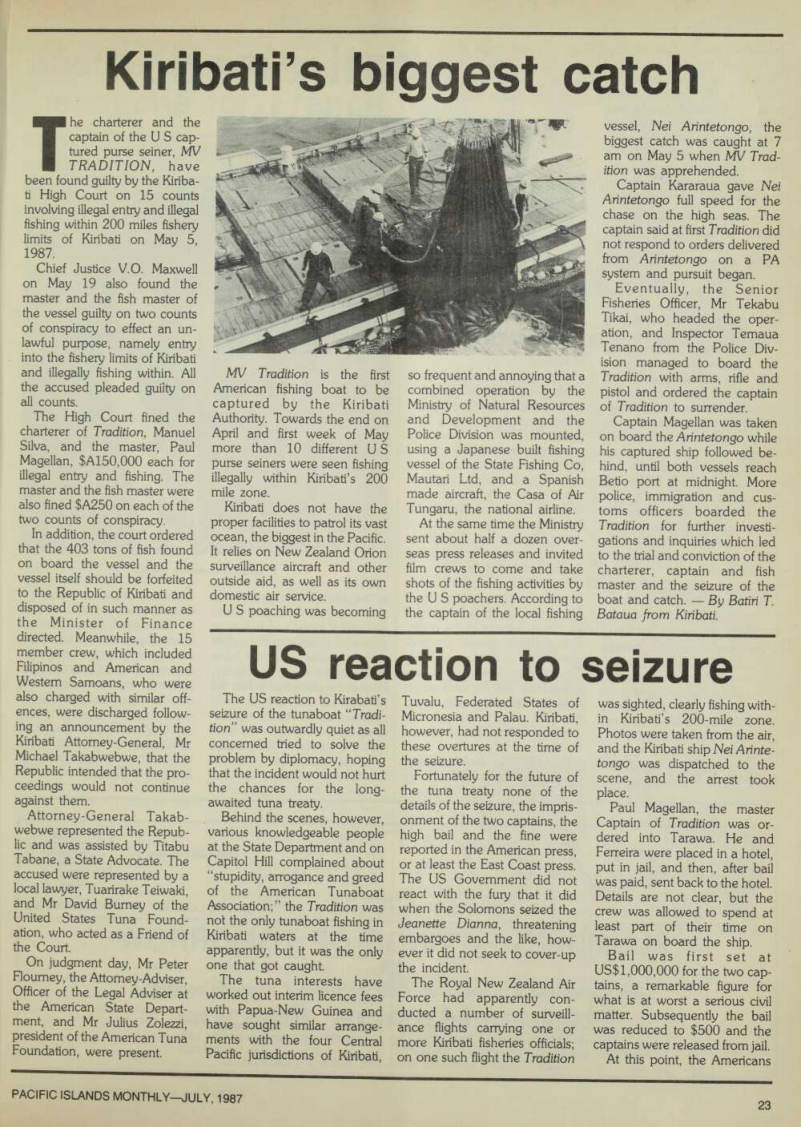
The charterer and the captain of the U S cap tured purse seiner, MV TRADITION, have been found guilty by the Kiriba ti High Court on 15 counts involving illegal entry and illegal fishing within 200 miles fishery limits of Kiribati on May 5, 1987.
Chief Justice V.O. Maxwell on May 19 also found the master and the fish master of the vessel guilty on two counts of conspiracy to effect an un lawful purpose, namely entry into the fishery limits of Kiribati and illegally fishing within. All the accused pleaded guilty on all counts.
The High Court fined the charterer of Tradition, Manuel Silva, and the master, Paul Magellan, $A150,000 each for illegal entry and fishing. The master and the fish master were also fined SA2SO on each of the two counts of conspiracy.
In addition, the court ordered that the 403 tons of fish found on board the vessel and the vessel itself should be forfeited to the Republic of Kiribati and disposed of in such manner as the Minister of Finance directed. Meanwhile, the 15 member crew, which included Filipinos and American and Western Samoans, who were also charged with similar off ences, were discharged follow ing an announcement by the Kiribati Attorney-General, Mr Michael Takabwebwe, that the Republic intended that the pro ceedings would not continue against them.
Attorney-General Takab webwe represented the Repub lic and was assisted by Titabu Tabane, a State Advocate. The accused were represented by a local lawyer, Tuarirake Teiwaki, and Mr David Burney of the United States Tuna Found ation, who acted as a Friend of the Court.
On judgment day, Mr Peter
Floumey, the Attorney-Adviser,
Officer of the Legal Adviser at the American State Depart ment, and Mr Julius Zolezzi, president of the American Tuna Foundation, were present.
MV Tradition is the first American fishing boat to be captured by the Kiribati Authority. Towards the end on April and first week of May more than 10 different U S purse seiners were seen fishing illegally within Kiribati’s 200 mile zone.
Kiribati does not have the proper facilities to patrol its vast ocean, the biggest in the Pacific.
It relies on New Zealand Orion surveillance aircraft and other outside aid, as well as its own domestic air service.
U S poaching was becoming
so frequent and annoying that a combined operation by the Ministry of Natural Resources and Development and the Police Division was mounted, using a Japanese built fishing vessel of the State Fishing Co, Mautari Ltd, and a Spanish made aircraft, the Casa of Air Tungaru, the national airline.
At the same time the Ministry sent about half a dozen over seas press releases and invited film crews to come and take shots of the fishing activities by the U S poachers. According to the captain of the local fishing
vessel, Nei Arintetongo, the biggest catch was caught at 7 am on May 5 when MV Trad ition was apprehended.
Captain Kararaua gave Nei Arintetongo full speed for the chase on the high seas. The captain said at first Tradition did not respond to orders delivered from Arintetongo on a PA system and pursuit began.
Eventually, the Senior Fisheries Officer, Mr Tekabu Tikai, who headed the oper ation, and Inspector Temaua Tenano from the Police Div ision managed to board the Tradition with arms, rifle and pistol and ordered the captain of Tradition to surrender.
Captain Magellan was taken on board the Arintetongo while his captured ship followed be hind, until both vessels reach Betio port at midnight. More police, immigration and cus toms officers boarded the Tradition for further investi gations and inquiries which led to the trial and conviction of the charterer, captain and fish master and the seizure of the boat and catch. By Batiri T.
Bataua from Kiribati.
US reaction to seizure
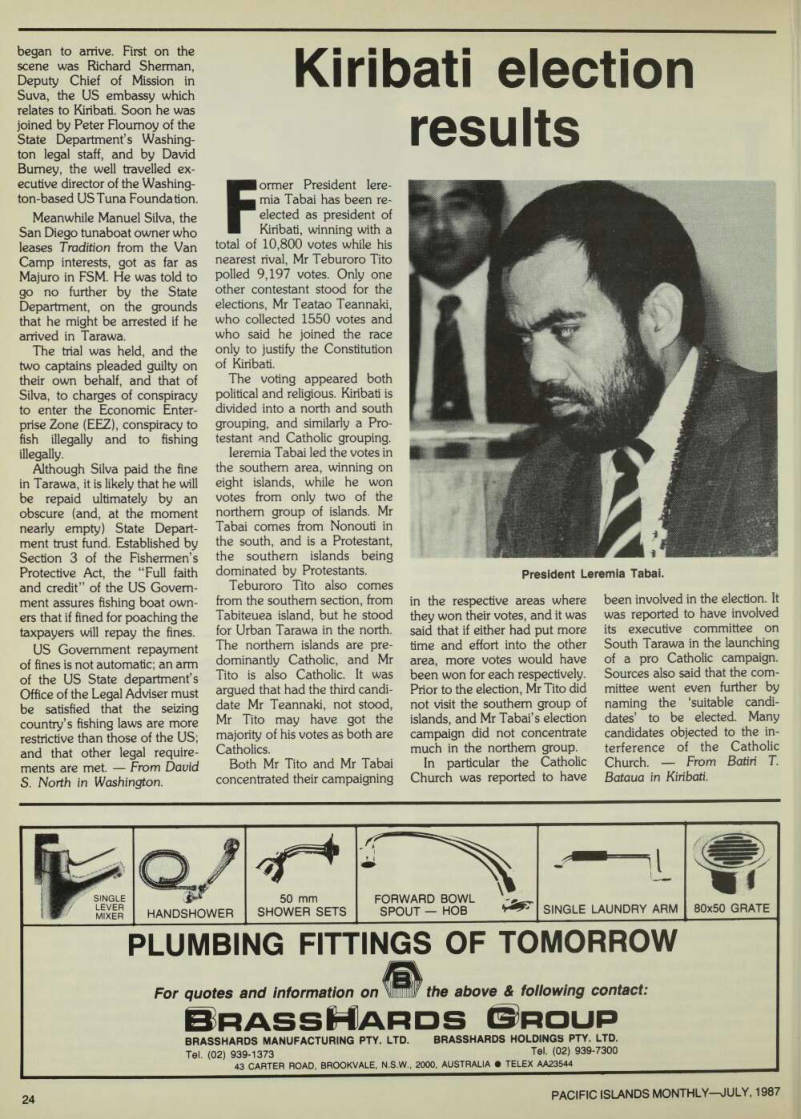
The US reaction to Kirabati’s seizure of the tunaboat “Tradi tion” was outwardly quiet as all concerned tried to solve the problem by diplomacy, hoping that the incident would not hurt the chances for the long awaited tuna treaty.
Behind the scenes, however, various knowledgeable people at the State Department and on Capitol Hill complained about “stupidity, arrogance and greed of the American Tunaboat Association;” the Tradition was not the only tunaboat fishing in Kiribati waters at the time apparently, but it was the only one that got caught.
The tuna interests have worked out interim licence fees with Papua-New Guinea and have sought similar arrange ments with the four Central Pacific jurisdictions of Kiribati,
Tuvalu, Federated States of Micronesia and Palau. Kiribati, however, had not responded to these overtures at the time of the seizure.
Fortunately for the future of the tuna treaty none of the details of the seizure, the impris onment of the two captains, the high bail and the fine were reported in the American press, or at least the East Coast press.
The US Government did not react with the fury that it did when the Solomons seized the Jeanette Dianna, threatening embargoes and the like, how ever it did not seek to cover-up the incident.
The Royal New Zealand Air Force had apparently con ducted a number of surveill ance flights carrying one or more Kiribati fisheries officials; on one such flight the Tradition
was sighted, clearly fishing with in Kiribati’s 200-mile zone.
Photos were taken from the air, and the Kiribati ship Nei Arinte tongo was dispatched to the scene, and the arrest took place.
Paul Magellan, the master Captain of Tradition was or dered into Tarawa. He and Ferreira were placed in a hotel, put in jail, and then, after bail was paid, sent back to the hotel.
Details are not clear, but the crew was allowed to spend at least part of their time on Tarawa on board the ship.
Bail was first set at US$l,OOO,OOO for the two cap tains, a remarkable figure for what is at worst a serious civil matter. Subsequently the bail was reduced to $5OO and the captains were released from jail.
At this point, the Americans
began to arrive. First on the scene was Richard Sherman, Deputy Chief of Mission in Suva, the US embassy which relates to Kiribati. Soon he was joined by Peter Flournoy of the State Department’s Washing ton legal staff, and by David Burney, the well travelled ex ecutive director of the Washing ton-based US Tuna Foundation.
Meanwhile Manuel Silva, the San Diego tunaboat owner who leases Tradition from the Van Camp interests, got as far as Majuro in FSM. He was told to go no further by the State Department, on the grounds that he might be arrested if he arrived in Tarawa.
The trial was held, and the two captains pleaded guilty on their own behalf, and that of Silva, to charges of conspiracy to enter the Economic Enter prise Zone (EEZ), conspiracy to fish illegally and to fishing illegally.
Although Silva paid the fine in Tarawa, it is likely that he will be repaid ultimately by an obscure (and, at the moment nearly empty) State Depart ment trust fund. Established by Section 3 of the Fishermen’s Protective Act, the “Full faith and credit” of the US Govern ment assures fishing boat own ers that if fined for poaching the taxpayers will repay the fines.
US Government repayment of fines is not automatic; an arm of the US State department’s Office of the Legal Adviser must be satisfied that the seizing country’s fishing laws are more restrictive than those of the US; and that other legal require ments are met. From David S. North in Washington.
Kiribati election
results
Former President lere mia Tabai has been re elected as president of Kiribati, winning with a total of 10,800 votes while his nearest rival, Mr Teburoro Tito polled 9,197 votes. Only one other contestant stood for the elections, Mr Teatao Teannaki, who collected 1550 votes and who said he joined the race only to justify the Constitution of Kiribati.
The voting appeared both political and religious. Kiribati is divided into a north and south grouping, and similarly a Pro testant and Catholic grouping. leremia Tabai led the votes in the southern area, winning on eight islands, while he won votes from only two of the northern group of islands. Mr Tabai comes from Nonouti in the south, and is a Protestant, the southern islands being dominated by Protestants.
Teburoro Tito also comes from the southern section, from Tabiteuea island, but he stood for Urban Tarawa in the north.
The northern islands are pre dominantly Catholic, and Mr Tito is also Catholic. It was argued that had the third candi date Mr Teannaki, not stood, Mr Tito may have got the majority of his votes as both are Catholics.
Both Mr Tito and Mr Tabai concentrated their campaigning
been involved in the election. It was reported to have involved its executive committee on South Tarawa in the launching of a pro Catholic campaign.
Sources also said that the com mittee went even further by naming the ‘suitable candi dates’ to be elected. Many candidates objected to the in terference of the Catholic Church. From Batiri T.
Bataua in Kiribati.
in the respective areas where they won their votes, and it was said that if either had put more time and effort into the other area, more votes would have been won for each respectively.
Prior to the election, Mr Tito did not visit the southern group of islands, and Mr Tabai’s election campaign did not concentrate much in the northern group.
In particular the Catholic Church was reported to have
President Leremia Tabai.
Advertisements & other items, p. 24 (1 item)
Plumbing Fittings Of Tomorrow
SINGLE
W LEVER
MIXER
HANDSHOWER
V 50 mm
SHOWER SETS
FORWARD BOWL
SPOUT HOB
SINGLE LAUNDRY ARM
80x50 GRATE
PLUMBING FITTINGS OF TOMORROW
For quotes and information on \IHF the above & following contact: BRASSHARDS MANUFACTURING PTY. LTD. BRASSHARDS HOLDINGS PTY. LTD.
Tel. (02) 939-1373 Tel - (° 2 ) 939-7300 43 CARTER ROAD, BROOKVALE, N.S.W., 2000, AUSTRALIA • TELEX AA23544
Another South Pacific
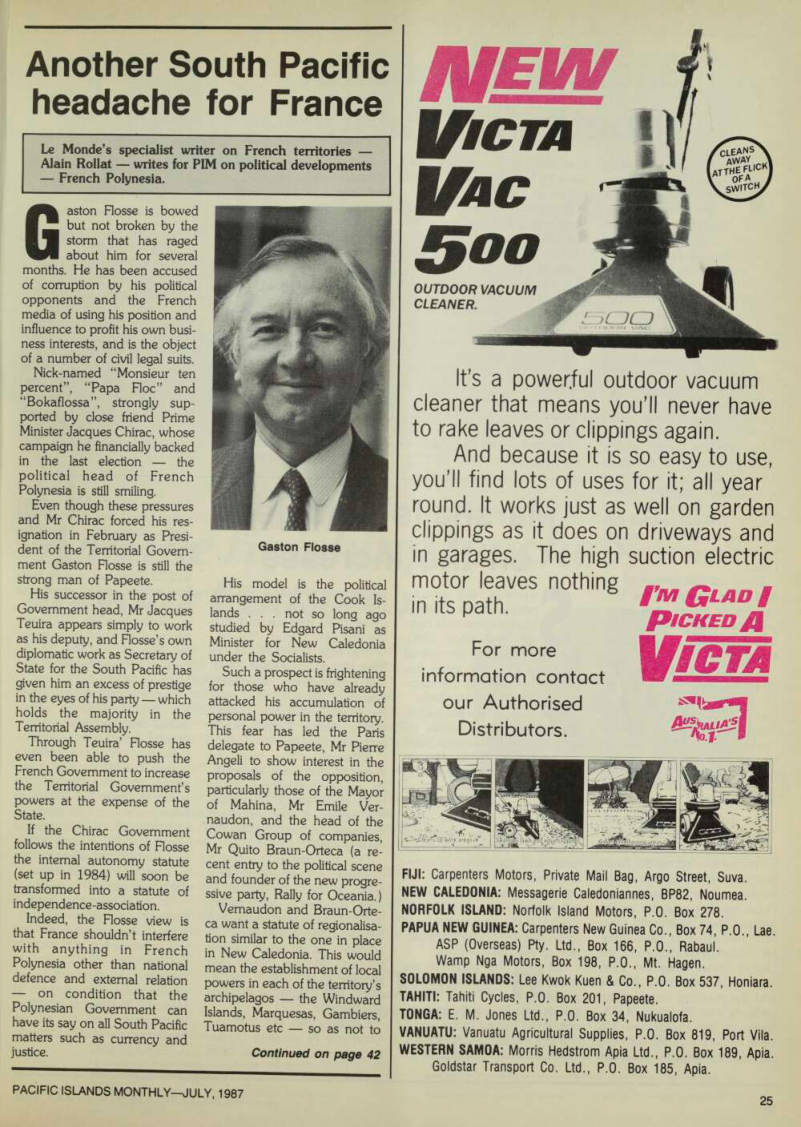
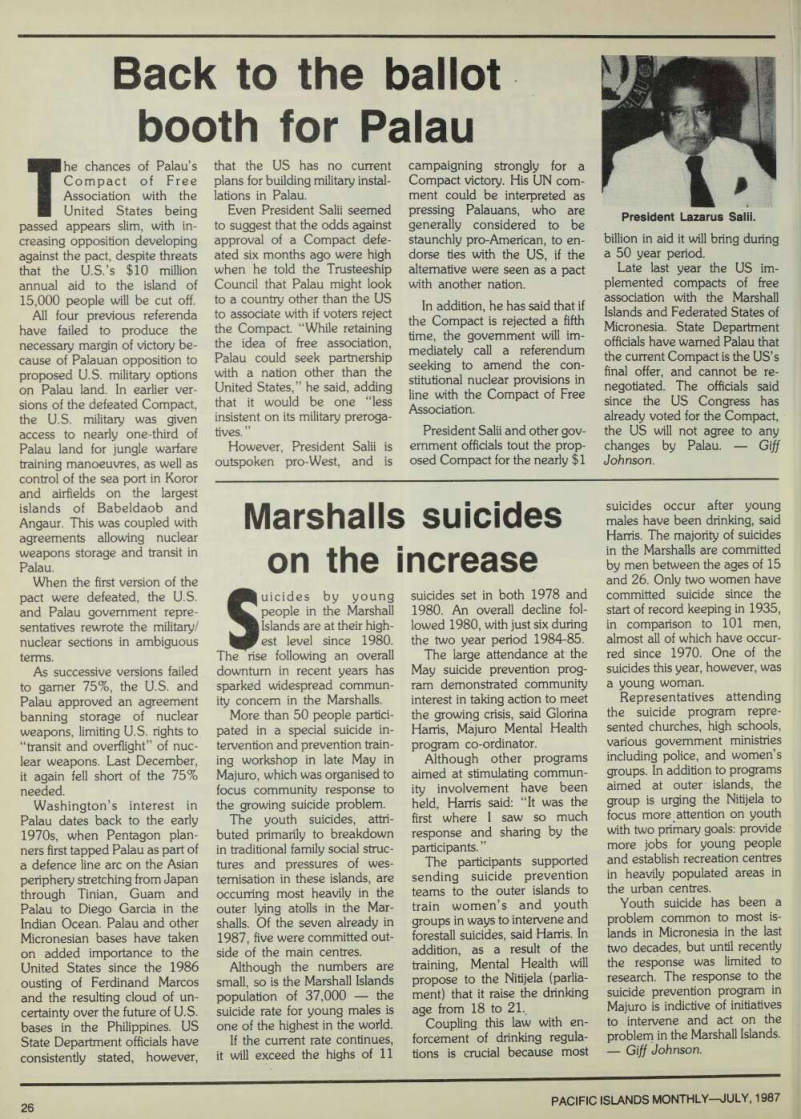

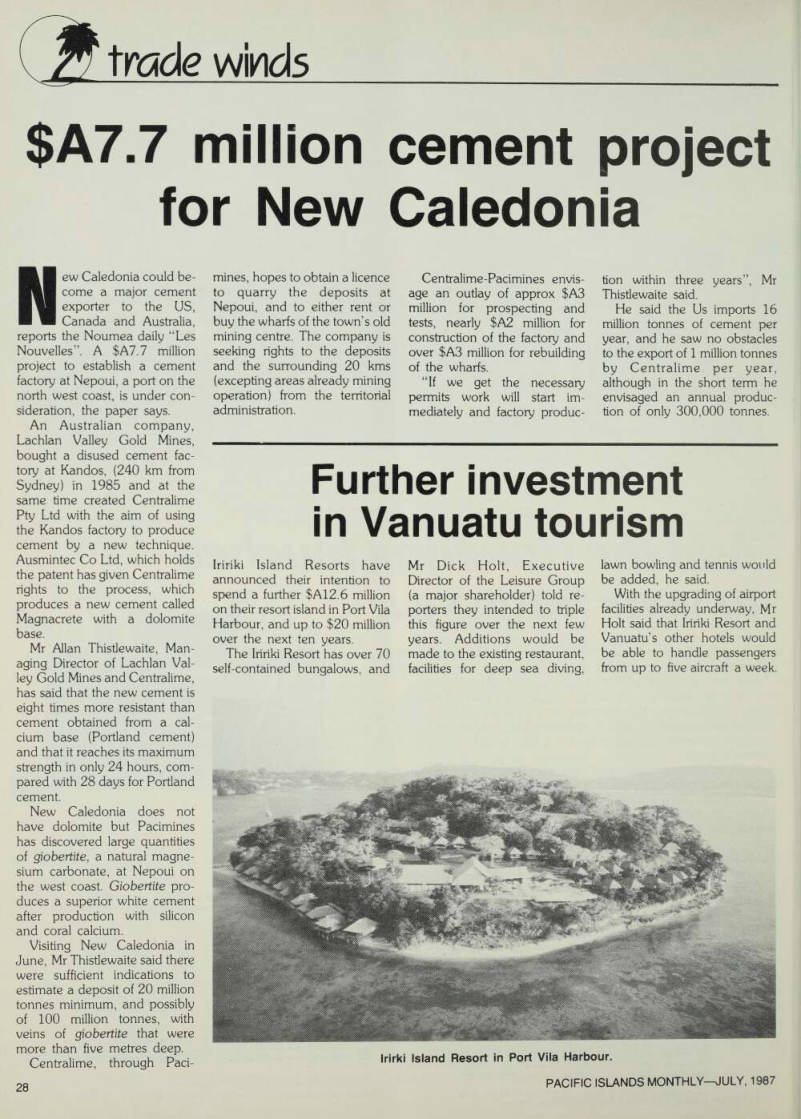
headache for France
Le Monde’s specialist writer on French territories Alain Rollat writes for PIM on political developments French Polynesia.
Gaston Flosse is bowed but not broken by the storm that has raged about him for several months. He has been accused of corruption by his political opponents and the French media of using his position and influence to profit his own busi ness interests, and is the object of a number of civil legal suits.
Nick-named “Monsieur ten percent”, “Papa Floe” and “Bokaflossa”, strongly sup ported by close friend Prime Minister Jacques Chirac, whose campaign he financially backed in the last election the political head of French Polynesia is still smiling.
Even though these pressures and Mr Chirac forced his res ignation in February as Presi dent of the Territorial Govern ment Gaston Flosse is still the strong man of Papeete.
His successor in the post of Government head, Mr Jacques Teuira appears simply to work as his deputy, and Flosse’s own diplomatic work as Secretary of State for the South Pacific has given him an excess of prestige in the eyes of his party which holds the majority in the
Territorial Assembly.
Through Teuira’ Flosse has even been able to push the French Government to increase the Territorial Government’s powers at the expense of the State.
If the Chirac Government follows the intentions of Flosse the internal autonomy statute (set up in 1984) will soon be transformed into a statute of independence-association.
Indeed, the Flosse view is that France shouldn’t interfere with anything in French Polynesia other than national defence and external relation on condition that the Polynesian Government can have its say on all South Pacific matters such as currency and justice.
His model is the political arrangement of the Cook Is lands . . . not so long ago studied by Edgard Pisani as Minister for New Caledonia under the Socialists.
Such a prospect is frightening for those who have already attacked his accumulation of personal power in the territory.
This fear has led the Paris delegate to Papeete, Mr Pierre Angeli to show interest in the proposals of the opposition, particularly those of the Mayor of Mahina, Mr Emile Ver naudon, and the head of the Cowan Group of companies, Mr Quito Braun-Orteca (a re cent entry to the political scene and founder of the new progre ssive party, Rally for Oceania.) Vemaudon and Braun-Orte ca want a statute of regionalisa tion similar to the one in place in New Caledonia. This would mean the establishment of local powers in each of the territory’s archipelagos the Windward Islands, Marquesas, Gamblers, Tuamotus etc so as not to
Continued on page 42
Gaston Flosse
allow unlimited power in Papeete.
The politically experienced Angeli also knows that if the opposition is not drawn into the local power structure it could take up the independence cause to try and remove those currently in power. The most moderate members of the opposition have already made it known they won’t be suppor ting Chirac’s candidature in next year’s presidential election but rather that of former Prime Minister, Raymond Barre or the Socialist Francois Mitterrand anyone other than a supporter of Gaston Flosse.
The pro-independence par ties are gaining ground, even though they are very small (they totalled only 15% of votes in the March 1986 elections) and suffer from disunity.
Quick growth of the inde pendence movement is ham pered only by the massive financial benefits brought to the local economy by the nuclear testing centre at Mururoa giving French Polynesia one of the highest standards of living in the South Pacific region.
But the gap between incom es of mixed race and full blooded Polynesians is growing wider and wider as the former take a share of political and economic power and a poor
working class delops amongst the latter.
Even if they don’t lead to independence, nationalist claims tend to grow in a society which is locked into artificial prosperity. Polynesians are now calling for a halt to European immigration and land claims are more numerous along the lines of the FLNKS example in New Caledonia.
For his part, Oscar Temaru, the main independence leader, is calling for a referendum of self-determination, and now in the corridors of the UN the question of French Polynesia is beginnning to be discussed in conjunction with the New Caledonian question.
Advertisements & other items, p. 25 (1 item)
M/cra
NEW
CLEANS
away flick
Uac
AT THE
OFA
SWITCH
500
EjCDCJ
OUTDOOR VACUUM
CLEANER.
It’s a powerful outdoor vacuum
cleaner that means you’ll never have
to rake leaves or clippings again.
And because it is so easy to use, you’ll find lots of uses for it; all year round. It works just as well on garden clippings as it does on driveways and
in garages. The high suction electric
motor leaves nothing „
m lts p ath - '£££'
For more
information contact
our Authorised
Distributors.
M ~JA 'r*r~ /on areasi* • j jb wa 1 1 awn. and e FIJI: Carpenters Motors, Private Mail Bag, Argo Street, Suva.
NEW CALEDONIA: Messagerie Caledoniannes, BPB2, Noumea.
NORFOLK ISLAND: Norfolk Island Motors, P.O. Box 278.
PAPUA NEW GUINEA: Carpenters New Guinea Co., Box 74, P. 0., Lae ASP (Overseas) Pty. Ltd., Box 166, P. 0., Rabaul.
Wamp Nga Motors, Box 198, P. 0., Mt. Hagen.
SOLOMON ISLANDS: Lee Kwok Kuen & Co., P.O. Box 537, Honiara TAHITI: Tahiti Cycles, P.O. Box 201, Papeete.
ONGA: E. M. Jones Ltd., P.O. Box 34, Nukualofa.
VANUATU: Vanuatu Agricultural Supplies, P.O. Box 819, Port Vila WESTERN SAMOA: Morris Hedstrom Apia Ltd., P.O. Box 189, Apia Goldstar Transport Co. Ltd., P.O. Box 185, Apia.
Back to the ballot
booth for Palau
The chances of Palau’s Compact of Free Association with the United States being passed appears slim, with in creasing opposition developing against the pact, despite threats that the U.S.’s $lO million annual aid to the island of 15,000 people will be cut off.
All four previous referenda have failed to produce the necessary margin of victory be cause of Palauan opposition to proposed U.S. military options on Palau land. In earlier ver sions of the defeated Compact, the U.S. military was given access to nearly one-third of Palau land for jungle warfare training manoeuvres, as well as control of the sea port in Koror and airfields on the largest islands of Babeldaob and Angaur. This was coupled with agreements allowing nuclear weapons storage and transit in Palau.
When the first version of the pact were defeated, the U.S. and Palau government repre sentatives rewrote the military/ nuclear sections in ambiguous terms.
As successive versions failed to gamer 75%, the U.S. and Palau approved an agreement banning storage of nuclear weapons, limiting U.S. rights to “transit and overflight” of nuc lear weapons. Last December, it again fell short of the 75% needed.
Washington’s interest in Palau dates back to the early 19705, when Pentagon plan ners first tapped Palau as part of a defence line arc on the Asian periphery stretching from Japan through Tinian, Guam and Palau to Diego Garcia in the Indian Ocean. Palau and other Micronesian bases have taken on added importance to the United States since the 1986 ousting of Ferdinand Marcos and the resulting cloud of un certainty over the future of U.S. bases in the Philippines. US State Department officials have consistently stated, however,
that the US has no current plans for building military instal lations in Palau.
Even President Salii seemed to suggest that the odds against approval of a Compact defe ated six months ago were high when he told the Trusteeship Council that Palau might look to a country other than the US to associate with if voters reject the Compact. “While retaining the idea of free association, Palau could seek partnership with a nation other than the United States,” he said, adding that it would be one “less insistent on its military preroga tives. ”
However, President Salii is outspoken pro-West, and is
campaigning strongly for a Compact victory. His UN com ment could be interpreted as pressing Palauans, who are generally considered to be staunchly pro-American, to en dorse ties with the US, if the alternative were seen as a pact with another nation.
In addition, he has said that if the Compact is rejected a fifth time, the government will im mediately call a referendum seeking to amend the con stitutional nuclear provisions in line with the Compact of Free Association.
President Salii and other gov ernment officials tout the prop osed Compact for the nearly $1
billion in aid it will bring during a 50 year period.
Late last year the US im plemented compacts of free association with the Marshall Islands and Federated States of Micronesia. State Department officials have warned Palau that the current Compact is the US’s final offer, and cannot be re negotiated. The officials said since the US Congress has already voted for the Compact, the US will not agree to any
changes by Palau.
Giff
Johnson.
President Lazarus Salii.
Marshalls suicides
on the increase
Suicides by young people in the Marshall Islands are at their high est level since 1980.
The rise following an overall downturn in recent years has sparked widespread commun ity concern in the Marshalls.
More than 50 people partici pated in a special suicide in tervention and prevention train ing workshop in late May in Majuro, which was organised to focus community response to the growing suicide problem.
The youth suicides, attri buted primarily to breakdown in traditional family social struc tures and pressures of wes ternisation in these islands, are occurring most heavily in the outer lying atolls in the Mar shalls. Of the seven already in 1987, five were committed out side of the main centres.
Although the numbers are small, so is the Marshall Islands population of 37,000 the suicide rate for young males is one of the highest in the world.
If the current rate continues, it will exceed the highs of 11
suicides set in both 1978 and 1980. An overall decline fol lowed 1980, with just six during the two year period 1984-85.
The large attendance at the May suicide prevention prog ram demonstrated community interest in taking action to meet the growing crisis, said Glorina Harris, Majuro Mental Health program co-ordinator.
Although other programs aimed at stimulating commun ity involvement have been held, Harris said: “It was the first where I saw so much response and sharing by the participants.”
The participants supported sending suicide prevention teams to the outer islands to train women’s and youth groups in ways to intervene and forestall suicides, said Harris. In addition, as a result of the training, Mental Health will propose to the Nitijela (parlia ment) that it raise the drinking age from 18 to 21.
Coupling this law with en forcement of drinking regula tions is crucial because most
suicides occur after young males have been drinking, said Harris. The majority of suicides in the Marshalls are committed by men between the ages of 15 and 26. Only two women have committed suicide since the start of record keeping in 1935, in comparison to 101 men, almost all of which have occur red since 1970. One of the suicides this year, however, was a young woman.
Representatives attending the suicide program repre sented churches, high schools, various government ministries including police, and women’s groups. In addition to programs aimed at outer islands, the group is urging the Nitijela to focus more attention on youth with two primary goals: provide more jobs for young people and establish recreation centres in heavily populated areas in the urban centres.
Youth suicide has been a problem common to most is lands in Micronesia in the last two decades, but until recently the response was limited to research. The response to the suicide prevention program in Majuro is indictive of initiatives to intervene and act on the problem in the Marshall Islands.
Giff Johnson.
Advertisements & other items, p. 27 (1 item)
Add the finishing touches
m m m m L?s / Shelf / ra & —a.
ZE
to your fantasy,,,
The dream comes true with NEW PERSONNA PLUS shelf-size component systems, and the model X-550R —a sound system more than brimming with high fidelity, and feature-packed!
In fact, boasting a full 350 W of high-power (PMPO) output, the X-550R delivers the convenience of remote control for amp, tuner, deck, turntable', and an optional CD player, plus a 5-band graphic equalizer for frequency distribution adjustments —and still there’s more!
Like sensational Surround Sound for rich, ambient sound, and the beauty of Stereo Wide, for extended stereo effects.
Then there’s a Double Auto-Reverse Cassette Deck with Deck I-D relay play for continuous auto-reverse playback, plus synchrorecording for Deck I-D tape duplication, to say nothing of great features like normal/high-speed copy, Music Search, and Dolby* B Noise Reduction.
Still, there’s more to the X-550R than this, and more to NEW PERSONNA PLUS than the system X-550 R—like the X-880R, with 440 W of high power (PMPO), and the X-220, with 270 W (PMPO), for example. The point is that it is the beauty of pure sound and NEW PERSONNA PLUS that lets your imagination take flight!
X-550R Tunction-switching only *" Dolby” and the double-D symbol are trademarks of Dolby Laboratories Licensing Corporation.
NOTE: The PD-XBB CD player and S-XIA “surround sound” rear-speaker system are included in the photograph, but both are options.
CiD PIONEER
The future of sound and vision.
For further information, please contact: Australia; Pioneer Electronics Australia Pty. Ltd. (Incorporated in Victoria), P-O. Box 295, Mordialloc, Victoria, 3195 Tel: 580-9911 Fiji Islands: Brijlal & Company. G.P.O. Box No. 362, Suva, Fiji Islands Tel: 22258 New Zealand: Monaco Distributors Ltd, 41 Poland Road, Glenfield, Auckland New Zealand Tel: (09) 444-9144 Norfolk Island; Burnt Pine Traders Ltd, P.O. Box 21, Norfolk Island Vanuatu: Burns Philp (Vanuatu) Ltd, Vila, Vanuatu Nauru Island: Jacob Enterprises, P.O. Box N 0.4, Republic of Nauru Tahiti; Tahiti Hi-Fi, P.O. Box 848, Papeete, Tahiti New Caledonia: Menard Pacifique Sari, B.P. 3899, Noumea, New Caledonia Tel: 27.62*23 American Samoa: Transpac Corporation, P.O. Box 1477, Pago Pago, American Samoa 96799 Tel: 633-5224 Rarotonga: South Seas International Ltd, P.O. Box 49, Rarotonga, Cook Islands Tel: 2327
$A7.7 million cement project
trade winds
$A7.7 million cement project for New Caledonia
New Caledonia could be come a major cement exporter to the US, Canada and Australia, reports the Noumea daily “Les Nouvelles”. A $A7.7 million project to establish a cement factory at Nepoui, a port on the north west coast, is under con sideration, the paper says.
An Australian company, Lachlan Valley Gold Mines, bought a disused cement fac tory at Kandos, (240 km from Sydney) in 1985 and at the same time created Centralime Pty Ltd with the aim of using the Kandos factory to produce cement by a new technique.
Ausmintec Co Ltd, which holds the patent has given Centralime rights to the process, which produces a new cement called Magnacrete with a dolomite base.
Mr Allan Thistlewaite, Man aging Director of Lachlan Val ley Gold Mines and Centralime, has said that the new cement is eight times more resistant than cement obtained from a cal cium base (Portland cement) and that it reaches its maximum strength in only 24 hours, com pared with 28 days for Portland cement.
New Caledonia does not have dolomite but Pacimines has discovered large quantities of giobertite, a natural magne sium carbonate, at Nepoui on the west coast. Giobertite pro duces a superior white cement after production with silicon and coral calcium.
Visiting New Caledonia in June, Mr Thistlewaite said there were sufficient indications to estimate a deposit of 20 million tonnes minimum, and possibly of 100 million tonnes, with veins of giobertite that were more than five metres deep.
Centralime, through Paci
mines, hopes to obtain a licence to quarry the deposits at Nepoui, and to either rent or buy the wharfs of the town’s old mining centre. The company is seeking rights to the deposits and the surrounding 20 kms (excepting areas already mining operation) from the territorial administration.
Centralime-Pacimines envis age an outlay of approx SA3 million for prospecting and tests, nearly SA2 million for construction of the factory and over SA3 million for rebuilding of the wharfs.
“If we get the necessary permits work will start im mediately and factory produc
tion within three years”, Mr Thistlewaite said.
He said the Us imports 16 million tonnes of cement per year, and he saw no obstacles to the export of 1 million tonnes by Centralime per year, although in the short term he envisaged an annual produc tion of only 300,000 tonnes.
Further investment
in Vanuatu tourism
Iririki Island Resorts have announced their intention to spend a further $A12.6 million on their resort island in Port Vila Harbour, and up to $2O million over the next ten years.
The Iririki Resort has over 70 self-contained bungalows, and
Mr Dick Holt, Executive Director of the Leisure Group (a major shareholder) told re porters they intended to triple this figure over the next few years. Additions would be made to the existing restaurant, facilities for deep sea diving,
lawn bowling and tennis would be added, he said.
With the upgrading of airport facilities already underway, Mr Holt said that Iririki Resort and Vanuatu’s other hotels would be able to handle passengers from up to five aircraft a week.
Irlrki Island Resort in Port Vila Harbour.
Advertisements & other items, pp. 29-31 (2 items)
Bank
AAlyy BANK
ECONOMIC INDICATORS
COMMODITY PRICES
June 2, 'B7 Month ago Year Ago
WORLD COMMODITIES
(Wholesale Price Index, 1980 = 100) Agricultural Raw Materials
GOLD
London (US $ Per Ounce)
INDUSTRIAL WORLD DEMAND
Sources; AAP Reuters; FFA Honiara, IMF (IFS); Compiled by ANZ International Economics, Melbourne.
AM
BANK
Branches in Fiji, Papua New Guinea, Vanuatu and Solomon Is.
itic-Tougn. me New hiiuk.
r*r » \ Sirf v-au.- ' * - > -H % 4 \ Hi ; • * ■ ere: a big tailgate conveniently hinged for quick loading and unloading; reinforced front suspension to smooth out ie bumps, and bias-mounted, extra-heavy-duty rear shocks and knobbly tyres to take on any terrain. 0 Areas where gaivanealed steel is used Toyota’s long history of super-responsive engines, ruggedness, reliability and comfort goes without saying. And in the Hilux, it’s yours in both 2-wheel-drive and 4X4 versions.
So, after comprehensive testing and thorough quality control, the New Hilux is ready to bring a new standard of toughness to the Pacific.
And isn’t that exactly what you expect from Toyota?
DING CORPORATION LTD., Private Bag, Rarotonga. FIJI; SIA: ATKINS KROLL, INC., 443 South Marine Drive D ERATIVE SOCIETY, Central Pacific. NEW CALEDONIA: S HILP (SOUTH SEA) CO.. LTD., P.O. Box 39, Alofi.
Ltd., P.O. Box 75, Port Moresby. SAIPAN: MICROL
TAHITI; NIPPON AUTOMOTO, B.P. 342, Papeete
itu) Ltd., P.O. Box 18, Port Vila. WESTERN SAMOA:
TOYOTA
Roan-Hugging. Rock-Bning, Pa
■x N* m m m < I •* •*» - ■■' I w* A 1 F ' - HILUX 4WD Regular Cab, Long Wheelbase One tough truck just got tougher. Toyota’s dedication to superior performance vehicles takes a step forward today with the New Hilux A refined front grille and bumper design, new instrument panel for a feeling of spaciousness and command and plush colour co-ordinated trim are a few new additions to the New Hilux.
And extensive anti-corrosive galvanealed steel protection now includes the tailgate panel and rear door panel, making Hilux more durable than ever before.
Yet for all its improvements, the best of the original Hilux is also AMERICAN SAMOA: BURNS PHILP (SOUTH SEA) CO., LTD., P.O. Box 129, Pago Pago. COOK ISLANDS: COOK ISLAI* AUTOMOTIVE SUPPLIES COMPANY, A Division of Burns Philp (South Sea) Co., Ltd., G.P.O. Box 355, Suva. GUAM & MM IC J C IT JmL Tamuning. KIRIBATI: TARAWA MOTORS, A Division of Bairiki Holdings Ltd., P.O. Box 36, Bairiki, Tarawa. NAURU: NAUP 1 - " " 1 SERVICE IMPORTATION AUTOMOBILE DU PACIFIQUE, Rond-Point du Pacifique (Station Total) B.P. 438, Noumea. NIUE: E
QUALITY SERVICE
NORFOLK ISLAND: BORRY’S LIMITED, P.O. Box 169. PAPUA NEW GUINEA: ELA MOTORS, A Division of Burns Phi} CORPORATION, P.O. Box 267, Saipan. SOLOMON ISLANDS: SOLOMON ISLANDS INVESTMENTS LTD., G.P.O. Box 1401 TONGA: BURNS PHILP (TONGA) LTD., P.O. Box 55, Nukualofa. VANUATU: VANUATU MOTORS, A Division of Burns Philj BURNS PHILP (SOUTH SEA) CO., LTD., P.O. Box 188, Apia.
US trade
Increase in US trade
Recently released figures for the January/February 1987 period have shown an increase of five per cent in US trade with the Pacific and East Asia over the same period last year. Ex ports from the US have risen three per cent, and imports to the US from the region have risen by 3.6 per cent
New guidelines
for PNG coffee exporters
New guidelines recently announced by the Minister of Agriculture and Livestock, Mr Gai Duwabane, have instructed Papua New Guinea coffee ex porting companies to reduce their foreign ownership to 10 per cent by 1989. Any manage ment company employed by the ten coffee exporting com panies must not have more than 25 per cent foreign owner
ship. In addition, no new coffee export licences will be issued for at least three years.
Gold company
in Canadian merger
One of the leading com panies in the area of Papua New Guinea’s gold mining, Placer Development, is plan ning to merge with two other Canadian gold mining com panies, Dome Mines Ltd and Campbell Red Lakes Mines Ltd. Placer Development con trols 78.57 per cent of Placer Pacific Ltd, who owns the prop osed Misima Island gold mining prospect as well as shares in the gold mines at Porgera in the Western Highlands. Porgera mine is one of the largest undeveloped gold deposits in the world, with an estimated 400 tonnes of gold on the basis of surface exploration only.
Misima Island mines are still the subject of compensation claims by the local landowners, and initial exploration is promising.
fishing
New licences for prawn fishing
Papua New Guinea has drafted a new policy to control the prawn fishing industry. The Fisheries and Marine Resources Minister, Mr Neville Bourne, said that the new system would remove the licensing responsi bilities from his department and reduce procedures which normally delay the issuing of prawn fishing licences. New fees for the licences are 100,000 kina for foreign owned companies and 70,000 kina for Papua New Guinean com panies.
Qld routes
Talair take over Qld routes
Papua New Guinea’s airline, Talair, has taken over domestic routes in western Queensland.
The Queensland government has approved an “open skies” policy in their state, allowing deregulation of commuter air routes, providing airlines met departmental requirements.
SI Government
take over Solair
Solomon Islands Govern ment has assumed ownership of Solomon Islands Airways Ltd (Solair), after purchasing 51 per cent of shares valued at Sls 1,414,130 from Mr Dennis Buchanan, held through his Vanuatu-based company, Ampac Holdings Ltd. Negotia tions took three years and in clude Ampac’s two subsidiaries, Pacific Car Rentals Ltd and Hunts of the Pacific Ltd.
The Minister of Posts and Communications, Mr John Maetia, reacted to criticism of the Government’s takeover,
saying “I know the way ahead will be difficult for us. Running an airline is no easy business but we are determined to suc ceed. ”
Former General Manager, Mr Paul Reed, has been replaced temporarily by Mr John Baura, until a new General Manager is appointed.
Tonga
to export Australian cedar
Tonga is examining the possibility of exporting pre mium quality red cedar timber to Australia. Mr Ivan Kip penberger and Mr Trevita Fakaosi, Chief Forestry officers from the Ministry of Agriculture, Fisheries and Forestry in Ton ga, visited Australia recently to meet with major timber mer chants to discuss the suitability of the timber for use in the furniture manufacturing in dustry.
The cedar came from Austra lia originally as part of a reaf forestation program which took place over 20 years ago. The stands of timber are growing well, unlike other cedar planta tions in the Pacific which were badly affected by borers.
Australian
Vanuatu tests Australian markets
Mr Meto Nganga, the general manager of Vanuatu Commod ities Marketing Board, visited Australia at the end of May as a guest of the Australian Govern ment. He told PIM that the Commodities Marketing Board was looking into the possibilities of exporting kava to Australia, as well as exploring the markets for a demand for vanilla and pepper. The Commodities Marketing Board’s primary job is to protect Vanuatu’s primary producers, particular the pro ducer of copra and cocoa, advising them and finding new markets for their commodities Vanuatu is also looking for an opportunity to export ginger and fruit.
Advertisements & other items, pp. 32-34 (2 items)
Maltunal
PTY. LTD.
Coffee Management
Consultants
Specialists in practical plantation development ★ Nursery through to export grade Green Bean. ★ Management Systems. ★ Costings and budgets.
Extensive experience in estate development alone or in conjunction with allied small holder (20 hectares and up) development.
P.O. Box 161 Ph (675) 52-1744 Mt. Hagen W.H.P. (675) 52-2235 Papua New Guinea Fax (675) 52-2713
Ben son ad Hedges
TRADITIONALLY THE NAME
ASSOCIATED WITH PERFECTION
IN CIGARETTES
BENSON & HEDGES
20 <.■
Ben son ad Hedges
WARNING-SMOKING IS A HEALTH HAZARD
ONLY THE BEST WILL DO.
The Benson and Hedges Company Pty. Ltd. 1983 CC1426/83 JWT016.P351
Sound thats absolutely enchanting, even in the somewhat less than enchanting environment of a moving automobile.
This is Clarion's uncompromising standard, realized by the sophisticated use of electronic features that are easy to use. And there’s a wide selection of models to meet your individual taste. Clarion reliability? It's no pipe dream. Clarion Car Stereo. Listen and drive happily ever after. * Dolby and the double-D symbol are trademarks of Dolby Laboratories Licensing Corporation.
FOLLOW THE MUSIC
BLS LD 180
■PT-Tt- 4 f - ■, J « i For further information Australia: Amalgamated Wireless (Australasia) Ltd., 554 Parramatta Road, Ashfield, N.S.W., 2131 / New Zealand: AWA New Zealand Limited, P.O. Box 50-248, Porirua / Fiji Islands: Bnjlal & Co, Ltd. G.P.O. Bo* 362, Suva Tahiti: HI FI., VAIRAATOA. Avenue Chef Vairaatoa B.P. 1128, Papeete / New Caledonia: Caldis, 8.P.W11, Noumea Cede* / Guam: Micropac Audio Inc., P.O. Box 3478, Agana, Guam 96910, U.S.A. Tel: 472-8091, Cable Code HIFI AUDIO AGANA / Vanuatu: The Sound Centre, P.O Box 434, Vila / Cook Islands: South Seas International Ltd., P.O. Box 49, Rarotonga / Papua New Guinea: Hagemeyer (P N G.) Pty Ltd,, P.O. Box 1428, Boroko, Port Moresby.
Overview on PNG’s election
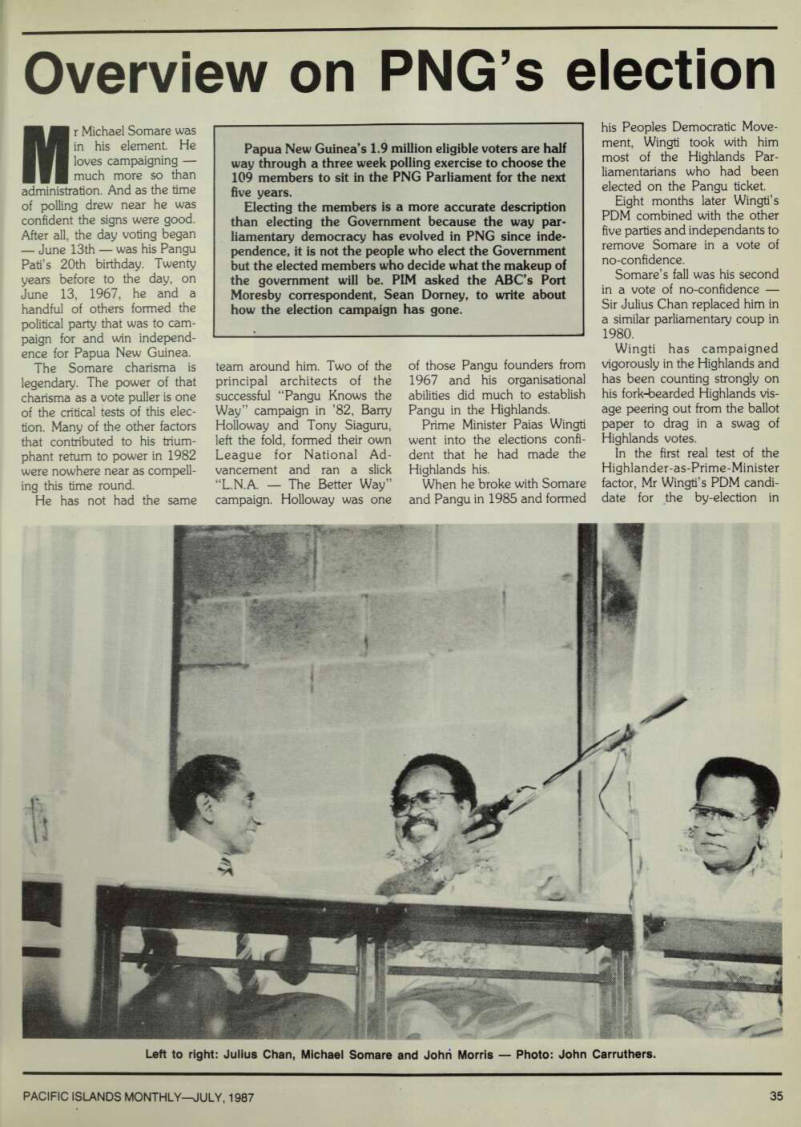
Papua New Guinea’s 1.9 million eligible voters are half way through a three week polling exercise to choose the 109 members to sit in the PNG Parliament for the next five years.
Electing the members is a more accurate description than electing the Government because the way par liamentary democracy has evolved in PNG since inde pendence, it is not the people who elect the Government but the elected members who decide what the makeup of the government will be. PIM asked the ABC’s Port Moresby correspondent, Sean Domey, to write about how the election campaign has gone.
Mr Michael Somare was in his element. He loves campaigning much more so than administration. And as the time of polling drew near he was confident the signs were good.
After all, the day voting began June 13th was his Pangu Pati’s 20th birthday. Twenty years before to the day, on June 13, 1967, he and a handful of others formed the political party that was to cam paign for and win independ ence for Papua New Guinea.
The Somare charisma is legendary. The power of that charisma as a vote puller is one of the critical tests of this elec tion. Many of the other factors that contributed to his trium phant return to power in 1982 were nowhere near as compell ing this time round.
He has not had the same
team around him. Two of the principal architects of the successful “Pangu Knows the Way” campaign in ’B2, Barry Holloway and Tony Siaguru, left the fold, formed their own League for National Ad vancement and ran a slick “L.N.A. The Better Way” campaign. Holloway was one
of those Pangu founders from 1967 and his organisational abilities did much to establish Pangu in the Highlands.
Prime Minister Paias Wingti went into the elections confi dent that he had made the Highlands his.
When he broke with Somare and Pangu in 1985 and formed
his Peoples Democratic Move ment, Wingti took with him most of the Highlands Par liamentarians who had been elected on the Pangu ticket.
Eight months later Wingti’s PDM combined with the other five parties and independants to remove Somare in a vote of no-confidence.
Somare’s fall was his second in a vote of no-confidence Sir Julius Chan replaced him in a similar parliamentary coup in 1980.
Wingti has campaigned vigorously in the Highlands and has been counting strongly on his fork-bearded Highlands vis age peering out from the ballot paper to drag in a swag of Highlands votes.
In the first real test of the Highlander-as-Prime-Minister factor, Mr Wingti’s PDM candi date for the by-election in
Left to right: Julius Chan, Michael Somare and John Morris -Photo: John Carruthers.
Advertisements & other items, pp. 36-39 (2 items)
§Orthehf
1? m ft
FUSILADE
The GRASS
WEEDKILLER! for
selective control of grass weeds in broadleaf crops.
fORSAFB
use,always
I F£AD LABELS
5 CARBPULLt
§ORTHEHf
kisectto*
\rf7s7~-
OUTHEK
> 0 jm y
ORTHENE
The SYSTEMIC
INSECTICIDE! for
use in rice and vegetable crops. & m
WJfatJe 00
«p-
FALON WB
<ills RATS and MICE ast! \t home, or on the arm. The World’s nost effective odenticide.
Attack
d r
FURADAN
The granular Insecticide/ nematicide! for bananas, vegetables, sugarcane & rice.
FUNGINEX
The FUNGICIDAL
DIP! for treating cane sets before planting.
Controls Pineapple disease.
ATTACK
Kills a wide range of insect pests. Can be used on most crops.
GRAMOXONE
WEEDKILLER
& DESICCANT
GRAMOXONE
The fast acting TOTAL weedkillercan be used in most crops! Will not poison soil. For LONGTERM control, add DIURON 80. £
ass
or full details on any ICI product, address your enquiry to “Export”, FTTrS l •nTniliwH:i l l avu sM WA? ■]
«S?2 m S nt ’- o^ S 1°
March this year for the late lambakey Okuk’s seat narrowly lost to Okuk’s National Party candidate, Benias Sabumei. , . . , , Sabumei, who is now defending his seat without yet having had the chance to sit in the «S?2 m S nt ’- o^ S 1° PDM s Kevin Masive s 3461. In percentage terms, it was_Na- Jjonal Party 28.4%, PDM 26 '%- Okuk’s death removed from the scene Papua New Guinea’s most colorful politician and changed the shape of this campaign. Not only has it left Mr Wingti as the most easily identifiable Highlander, but also it has removed the image of
instability that Okuk’s explo sively disruptive style inevitably created, That instability plagued Sir Julius Chan’s coalition govem ment w^en went into the 19g2 elections chan’s govem . ment also tQ contenc i with extremely poor world commod prices for the cash crops p apua New Guinea’s village peop i e depend on so heavily.
Although not without its problems, the PNG economy is not in such dire straits, at present. Perhaps the most im portant policy issue of the cam paign has been Mr Somare’s promise to devalue the Kina, The hard Kina strategy, de vised in the early years of
Julius Chan on the campaign trail, photo: John Carruthers.
independence when Sir Julius Chan was Finance Minister, has seen the Kina rise in value to where one Kina is now worth
$A1.56 and SUSI.IO.
Mr Somare committed him self to reviewing the strategy when addressing a party lead-
ers debate at the University of PNG. Commenting on the de bate in the Times of PNG, Deputy Editor, Sinclaire Solo mon, wrote: “Opposition Leader Michael Somare began by saying he wasn’t an economist, he was a professional politician.
“He proved it immediately by telling us and the rest of the world that he would abolish the Hard Kina strategy and devalue the Kina when in power again. ”
Among Mr Somare’s other promises have been to re introduce the Plantation Acquisition Scheme under which the government buys plantations from private indi viduals or companies and hands them over to the village people under a time repayment plan, and to reduce taxation while at the same time pumping more money into law and order.
The Deputy Opposition Leader, Father John Momis, led off on an anti-corruption
campaign but struck media gold when he proposed to hit Bougainville Copper Limited with a 3% levy on its gross sales revenue to fund “grass roots Melanesian entrepreneurship!”
In an open letter to BCL, Father Momis said the com pany could right the many wrongs it was guilty of by handing over this 3% levy which Momis said would amount to a “modest” K12.6M (SA2OM) a year.
Father Momis’ Melanesian Alliance Party has not been without its problems. One for mer secessionist colleague and North Solomons Premier, Doc tor Alexis Sarei, has left the MA and is contesting Momis’ seat.
And another, Leo Hannet, now managing director of the PNG Investment Corporation, wrote his own open letter to the Catholic Bishops of PNG questioning why they were allowing Father Momis to con tinue in politics. Hannet claimed Momis had “unwitting ly made his ministry appear partisan” and was now propos ing a “win money lottery on
BCL.”
The other ’7os secessionist leader, Josephine Abaijah, has also been back on the cam paign trail, leading a rejuven ated Papua Besena in an assault on 10 seats in the Papuan Region.
A new regional force could be the Morobe Independence Group led by Morobe Premier, Utula Samana. Samana’s radi cal, populist policies have kept him in power in the Morobe Province for seven years.
Flanked by supporters carrying two bamboo poles de corated with Kina notes for his nomination fee, Samana prom ised to kick a number of com panies out if he got into govern ment in Moresby. He named New Guinea Goldfields and PNG Forest Products but also promised action against gov ernment agencies.
Scandals dogged a number of government ministers in the latter stages of the campaign.
Air Niugini Consignment Notes showing how election campaign material was carried free of charge for the Ministers
Prime Minister Wingti -Photo: Helen Fraser.
for Civil Aviation, Ms Nahau Rooney, and Transport, Legu Vagi, were splashed across the front pages of the newspapers.
Both are members of Mr Wing ti’s Peoples Democratic Move ment.
And the Foreign Minister, Mr Ted Diro, was being named before a judicial inquiry into alleged malpractice in the gov ernment administration of PNG’s timber industry. Mr Diro leads the Peoples Action Party which is advertising itself as the “A Team” and promising “no scandals” and “no misuse of public funds or abuse of power”.
Another of Mr Wingti’s PDM Ministers, Peter Kuman, came under a lot of fire early for granting approval as Works Minister to 18 minor road pro jects in the Chimbu Provincial electorate that he’s contesting.
The projects add up to K 400,000 ($A600,000) and a Government backbencher from another party, John Numi (Na tional Party), claimed some of the money was being handed out for roads going 80 degrees up the side of mountains.
But Mr Kuman told his critics “to jump in the lake”. “People are not interested in hearing preaching,” he said. “They are
interested in what an elected leader can do for them!”
Mr Numi, meanwhile, has had his own problems. A clan
member of his allegedly axed another man to death in a brawl and as the campaign closed he was organising compensation
of K 30,000 and 40 pigs so polling in his electorate would not be disrupted by tribal war.
Sean Domey in PNG.
PNG party breakdown
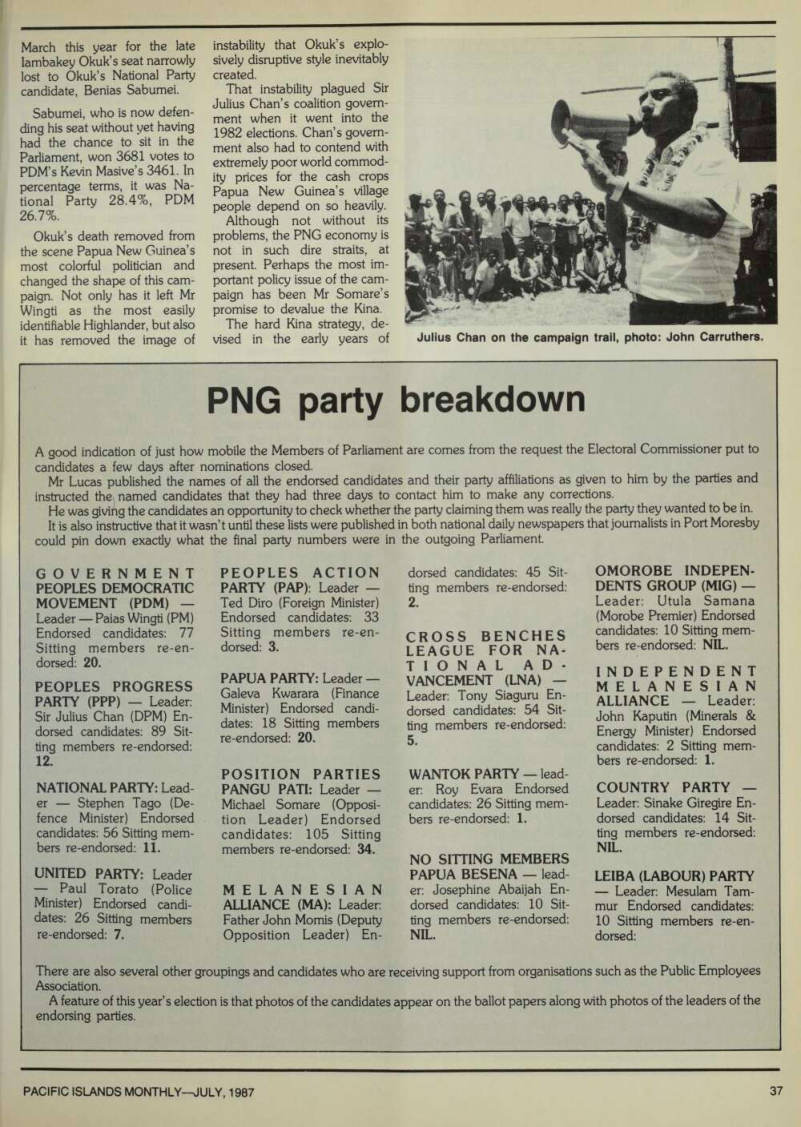
A good indication of just how mobile the Members of Parliament are comes from the request the Electoral Commissioner put to candidates a few days after nominations closed.
Mr Lucas published the names of all the endorsed candidates and their party affiliations as given to him by the parties and instructed named candidates that they had three days to contact him to make any corrections.
He was giving the candidates an opportunity to check whether the party claiming them was really the party they wanted to be in.
It is also instructive that it wasn’t until these lists were published in both national daily newspapers that journalists in Port Moresby could pin down exactly what the final party numbers were in the outgoing Parliament.
Government
Peoples Democratic
Movement (Pdm)
Leader Paias Wingti (PM) Endorsed candidates: 77 Sitting members re-en dorsed: 20.
Peoples Progress
PARTY (PPP) Leader; Sir Julius Chan (DPM) En dorsed candidates: 89 Sit ting members re-endorsed; 12.
National Party: Lead
er Stephen Tago (De fence Minister) Endorsed candidates: 56 Sitting mem bers re-endorsed: 11.
United Party: Leader
Paul Torato (Police Minister) Endorsed candi dates: 26 Sitting members re-endorsed: 7.
Peoples Action
PARTY (PAP): Leader Ted Diro (Foreign Minister) Endorsed candidates: 33 Sitting members re-en dorsed: 3.
PAPUA PARTY: Leader Galeva Kwarara (Finance Minister) Endorsed candi dates: 18 Sitting members re-endorsed: 20.
Position Parties
PANGU PATI: Leader Michael Somare (Opposi tion Leader) Endorsed candidates: 105 Sitting members re-endorsed; 34.
Melanesian
ALLIANCE (MA): Leader: Father John Momis (Deputy Opposition Leader) En
dorsed candidates: 45 Sit ting members re-endorsed; 2.
Cross Benches
League For Na-
T 1 O N A L A D -
Vancement (Lna) —
Leader: Tony Siaguru En dorsed candidates: 54 Sit ting members re-endorsed: 5.
Wantok Party — Lead
er: Roy Evara Endorsed candidates: 26 Sitting mem bers re-endorsed: 1.
No Sitting Members
Papua Besena — Lead
er: Josephine Abaijah En dorsed candidates: 10 Sit ting members re-endorsed:
Nil.
Omorobe Indepen
Dents Group (Mig) —
Leader; Utula Samana (Morobe Premier) Endorsed candidates: 10 Sitting mem bers re-endorsed: NIL.
Independent
Melanesian
ALLIANCE — Leader: John Kaputin (Minerals & Energy Minister) Endorsed candidates; 2 Sitting mem bers re-endorsed; 1.
Country Party —
Leader: Sinake Giregire En dorsed candidates: 14 Sit ting members re-endorsed:
Nil.
Leiba (Labour) Party
— Leader; Mesulam Tam mur Endorsed candidates: 10 Sitting members re-en dorsed:
There are also several other groupings and candidates who are receiving support from organisations such as the Public Employees Association.
A feature of this year’s election is that photos of the candidates appear on the ballot papers along with photos of the leaders of the endorsing parties.
Police gear up
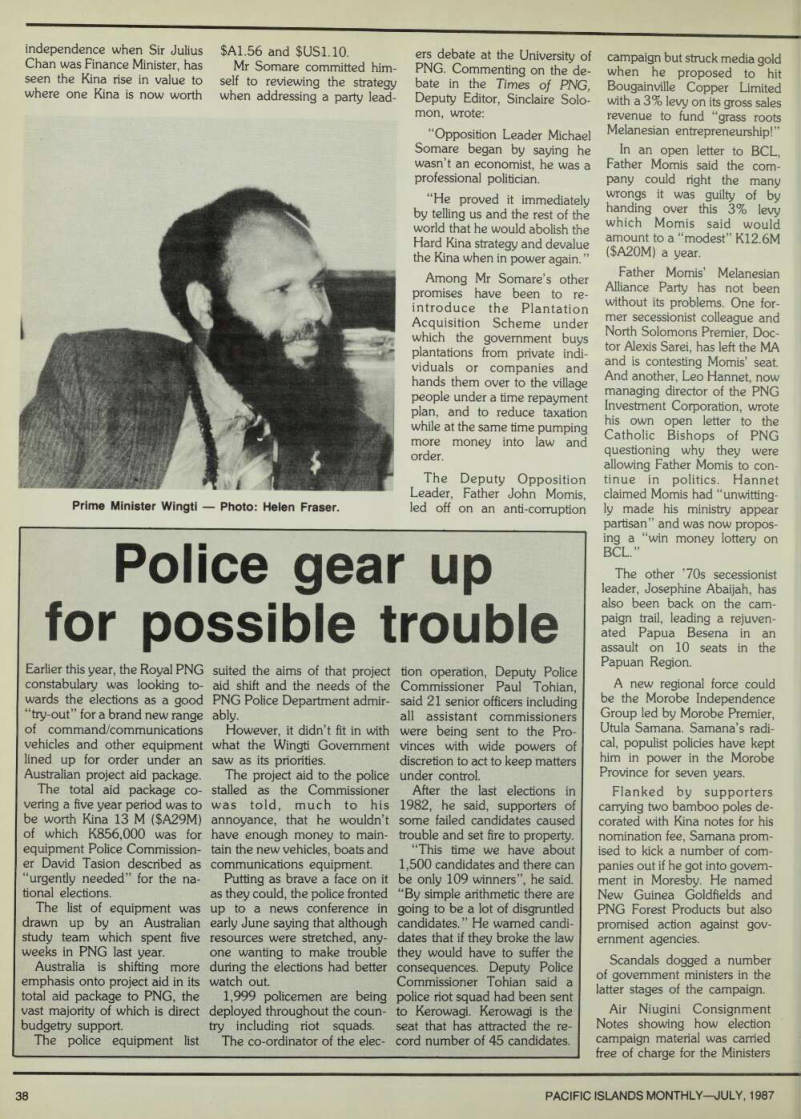
for possible trouble
Earlier this year, the Royal PNG constabulary was looking to wards the elections as a good “try-out” for a brand new range of command/communications vehicles and other equipment lined up for order under an Australian project aid package.
The total aid package co vering a five year period was to be worth Kina 13 M (SA29M) of which K 856,000 was for equipment Police Commission er David Tasion described as “urgently needed” for the na tional elections.
The list of equipment was drawn up by an Australian study team which spent five weeks in PNG last year.
Australia is shifting more emphasis onto project aid in its total aid package to PNG, the vast majority of which is direct budgetry support.
The police equipment list
suited the aims of that project aid shift and the needs of the PNG Police Department admir ably.
However, it didn’t fit in with what the Wingti Government saw as its priorities.
The project aid to the police stalled as the Commissioner was told, much to his annoyance, that he wouldn’t have enough money to main tain the new vehicles, boats and communications equipment.
Putting as brave a face on it as they could, the police fronted up to a news conference in early June saying that although resources were stretched, any one wanting to make trouble during the elections had better watch out. 1,999 policemen are being deployed throughout the coun try including riot squads.
The co-ordinator of the elec
tion operation, Deputy Police Commissioner Paul Tohian, said 21 senior officers including all assistant commissioners were being sent to the Pro vinces with wide powers of discretion to act to keep matters under control.
After the last elections in 1982, he said, supporters of some failed candidates caused trouble and set fire to property.
“This time we have about 1,500 candidates and there can be only 109 winners”, he said.
“By simple arithmetic there are going to be a lot of disgruntled candidates.” He warned candi dates that if they broke the law they would have to suffer the consequences. Deputy Police Commissioner Tohian said a police riot squad had been sent to Kerowagi. Kerowagi is the seat that has attracted the re cord number of 45 candidates.
trail in PNG
The video campaign trail in PNG
A unique election campaign has been held in Papua New Guinea, leading up to the coun try’s third general election, with voting being polled between June 13 and July 4, after July PIM has gone to press.
The campaign is unique in its use of video and television to reach Papua New Guinea’s three million voters, 80 per cent of whom are illiterate.
The campaign was master minded by Electoral Commis sioner Luke Lucas, who took office in September 1986. With more than 1500 candidates ex pected to stand for the 109 seats in the National Parlia ment, Mr Lucas felt that the standard ballot paper was hopelessly inadequate to en sure an honest election.
New ballot papers were drawn up, which carried full face photographs of all candi dates for each seat, with a
smaller photo of the party lead er to whom they are aligned.
Parliament approved the ballot papers only 10 weeks before the election was due to begin.
Faced with the task of ex plaining the ballot papers to the widely scattered voters, Mr Lucas felt that the only thing to do was to present the campaign visually.
Accordingly, a 30-minute video was prepared, which took voters through the process step by step. Sixty nine teams were assembled and taught how to use and maintain the latest video equipment, and the cam paign was launched, using helicopters, canoes, four-wheel drive and foot patrol to distri bute the electoral message.
Using hand-cranked genera tors, the teams have covered the most isolated valleys, hills and remote islands throughout Papua New Guinea. The popu
lation has flocked to see the video, people following the teams for a second or third viewing. Orators call the news from ridgetop to ridgetop, and an estimated one-third to one half the local populations have seen the video.
The response has been phenomenal, and the organ isers insist that although the main attraction is the television, the electoral message is getting across to the people. Problems have been slight, with the occasional need for police pro tection in areas where tribal fighting is heavy.
At the time of going to press, the election is between three parties, Prime Minister Paias Wingti’s People’s Democratic Movement with 77 candidates, Michael Somare’s Pangu Pati fielding 105 candidates, and Sir Julius Chan’s People’s Progress Party with 89 candidates. Only 19 candidates are women and only 97 sitting members have been endorsed out of the total 1513 candidates standing for election.
numbers
The numbers
“It was going to be like Laki-Moni (Lucky Money),” said Papua New Guinea’s Electoral Commissioner, Mr Luke Lucas.
Lucky Money, also known as Win-Moni, is Papua New Guinea’s scratch ticket lottery and Mr Lucas was referring to fears that there could have been as many as 3000 candidates contesting the elections.
He claimed that his suggestion that party lead ers’ photographs appear on the ballot papers alongside their candidates’ photos helped keep the total num ber of candidates down to 1493.
Even so, that is 368 more than in 1982. It will still be like Laki-Moni in lots of seats particularly in the Highlands where the average number of candidates per seat is 17.39.
In the Chimbu Province where there are six seats to be contested there are 164 candidates, an average of more than 27. In the electo rate of Kerowagi where 45 candidates have nominated there are 23,831 voters on the roll.
Therefore it is theoretical ly possible for someone to win the seat with 531 votes.
That’s 2.228%. Going on past experience the winner could do it with 1000 votes still, that would be only 4.2% of the popular vote.
“I don’t think this trend is very healthy at all,” said Mr
Tony Siaguru, leader of the League for National Ad vancement, LNA. Mr Siaguru, the sitting Member for Moresby North-East, tried to do something about it “One of the last debates in the outgoing Parliament was to look at doing away with the first-past-the-post system and reintroducing a preferential system.
“What I was arguing for in Parliament was the Optional Preferential system which would allow people to nominate their second, third and fourth choices if they wished. That I believe would be the fairest one, it com bines the best of both worlds.
In 1982 we had one Member who was elected by 7% of the people in his
electorate which means 93% of the people don’t identify with him and didn’t support him!”
But the debate did not result in any change to the law and so it is a single cross in the square next to the photo of the chosen candi date that will be a valid vote this year.
The Electoral Commis sioner, Mr Lucas, is confi dent that the inclusion of party leaders’ photos on the ballot papers will help strengthen the party system.
But others, Mr Siaguru amongst them, believe the huge number of Indepen dents almost 1000 will mean an increased number of Independants will be elected. Only seven of the sitting members are going to the elections as Indepen dants.
will “continue the fight”
Ousted Fijian Ministers will “continue the fight”
Canberra academics pro vided a substitute audi ence in early June for two ousted Fiji Ministers refused a hearing at the South Pacific Forum. Education Minis ter Dr Tupeni Baba and Foreign Minister Krishna Datt spoke at the Australian National Univer sity after a round of meetings with Australian parliamenta rians and the Fiji community to urge continued economic bans and a moratorium on aid.
International lobbying had started in New Zealand, and Baba left for Melbourne and then London to meet up with Coalition leader, Dr Timoci Bavadra, in an unsuccessful bid to meet the Queen.
In Canberra their message was that the coup regime had internal tensions, and that with internal and external economic boycotts and bans the new Fiji regime would soon be on its knees. Baba told his “fellow academic buccaneers” that Lt.
Col. Sitiveni Rabuka’s pretexts for the coup were groundless, and he and Datt gave their own analysis of the real reasons for the coup, and of their own support base.
Rabuka has spoken to the police and the army being likely to be used to suppress immi nent violence.
“In our view, the Taukei (Fijian landowners) Movement was largely orchestrated by supporters of the right wing of the Alliance Party . . . and had the consent of the former PM Ratu Sir Kamasese Mara . . .
One of the worries of the organisers was that we were managing to contain and con trol them through reasonable measures,” argued Baba.
A great deal of money to fund protests was being chan nelled to Apisai Tora, a Taukei leader, “through some Amer ican connection. ” Datt revealed that the Army had been put on the alert, “not to shoot people
but to assist the police in the maintenance of peace and order. ”
Baba rejected the colonel’s claim that Fijian interests were endangered by the Coalition government, because of the safeguards in sections 65 and 68 of the Constitution which require a three-quarters vote of both houses and of the 8 Council of Chiefs nominees in the Senate.
“There was no way our mul ti-racial government could change the provisions relating to Fijian land, Fijian customary rights, and Fijian traditions and customs without the support of the Fijians themselves.”
Rabuka’s objection that In dians dominated the Coalition was not true, said Baba, as there were seven Indian and six Fijian ministers, including the PM as Minister for Fijian Affairs.
When the Colonel sought to use the Great Council of Chiefs he had acted illegally: it only has advisory powers to the Minister, and Dr Bavadra had not called it together, nor nominated his choice of eight chiefs and seven commoner Fijians.
The Fijian Coalition MPs were under illegal detention, and hence unable to attend.
The meeting of the Council of Chiefs was “largely in favour of the people who supported the Rabuka and Ratu regime,” said Baba.
“There is absolutely no truth”, he argued, in Rabuka’s allegation that Coalition Minis ters had Russian and Libyan connections. Datt had once spent a “bleak day” in Moscow while in transit. Finance Minis ter Mahendra Chaundry had never visited Libya as alleged.
Baba was blunt; “Our view of the reasons for the coup is different. We feel that the main reason for the coup was basical ly the fear of Ratu Mara and his colleagues that we would ex
plore the corruptive practices of the Alliance Party and their business colleagues”.
He alleged that Ratu Mara had links to an Indian com pany, Motibhai, that five perso nal houses had been built on Lau island (Ratu Mara’s home area) using monies from the Hurricane Relief Fund which the former PM had chaired, that inflated rents were paid by the Education Department for Marela House which the Mara family owns, that there had been improper urban land and taxi licence allocations, and that huge Development Bank loans to political figures were unre paid. These had been cam paign issues.
The Coalition, on election, had prepared forms requiring MPs to make declarations of assets, and had ready an Anti- Corruption Bill under which the Ombudsman, following the Papua New Guinea model, could investigate obvious ano malies for corruption.
Datt said the files on these alleged corruption matters were on their desks on 14 May, and were no doubt shredded and burnt by now. Baba said that implementation of the Coalition “Open, clean and caring gov ernment” slogan was a threat, so “it was important for Ratu Mara to go back . . . Rabuka was only a front”.
He saw gaps opening up between Rabuka, who wanted a new constitution, and the former PM, who had endorsed the 1970 Constitution with the Great Council of Chiefs, and who felt it could work especially if some Indo-Fijians left because of the destabilisation.
Baba said the Governor- General, Ratu Sir Penaia Gani lau, was being used, and did not know where he stood, while Datt said Ganilau was following only the last advice he had received. “The judges are our
only hope at present” he said.
Datt joked about “participant observer” research on coups and said that he had noted that soldiers did not disturb the detained ministers while praying, thus showing the value of prayer.
But he spoke seriously of the support the Coalition in office had gained from measures cut ting hospital fees.
Baba said that young edu cated ethnic Fijians had sup ported the Coalition in the election, and Datt stressed the
backing being received since
from Fijians, especially those in the West. There, he said, the political system and culture is more Melanesian (in contrast to the Polynesian system of East ern Fiji), The West is Fiji’s “economic basis”, he said, and the area where Indians and Fijians in teract most. It produces most of the sugar, the gold, and is the tourist centre. Westerners had resented the heavy bias in government spending towards the East, especially the Lau Group of islands, and mostly had now swung behind the Coalition.
Datt pointed to fragilities in the Coup regime: only one third of the public service was working, schools were closed, police morale was damaged by the elevation of NCOs. But trade union leaders had gone into Parliament with the Labour Party Coalition, and Rabuka was replacing some of them with pliant individuals. Shops were closed most days, and very importantly Indians would not harvest the current sugar crop, which with the collapse of tourism would stop Fiji’s cash flow.
While non-violent resistance techniques were well-known in Fiji, Datt said people could only be pushed “so far”. He was concerned that untrained and
undisciplined people such as leading hands at the sugar factories had been uniformed and armed, and that under Public Emergency powers security forces had extreme powers to arrest on suspicion, and shoot, and with immunity.
“That will be the source of the confrontation about to take place”, which would not be an Indian-Fijian clash but rather would involve those in the West against the regime (including those who had supported the Alliance in the election).
The coup was against the working class and Indo-Fijians, he stated, and they would not “just sit back and see atrocities carried out under their noses. ”
An African student used his own experience in Ghana to argue that once the army scented power they would not give it up easily. Datt tended to agree, as far as regular soldiers go, but Baba said some of their guards in custody had wept because of their inner turmoil.
Their socialisation into demo cratic values was strong, Baba asserted, and many soldies were only part-time territorials.
There was division in the Military Force before the coup, and he claimed that one soldier had shot at Rabuka and is now dead (a story subsequently de nied by Ratu Ganilou). Baba argued that “Rabuka is riding a tiger, and once he gets off he will be eaten by the tiger”.
Datt said he had been really
shocked by the Melanesian re sponse to the coup, namely that this was a matter for Fijians to sort out themselves. While Vanuatu and the Solomon Is lands did not go so far, they ceded prominence on this issue to Papua New Guinea.
“I must confess I was rather embarrassed at their position, which seems to e an outright racist one . . . That is, we shouldn’t be involved and let the Indians be mowed down and that will complete the pic ture and make the Pacific a bit more serene”.
Asked if he saw American involvement in the coup, Datt said the simple answer was “No”, although there may cir cumstancial evidence. Two US operatives with previous coup experience elsewhere were in Fiji at the time of the coup. The US had delayed any con gratulatory message to the Coalition, and then only gave a lunch invitation to meet its Ambassador to the UN, Gen eral Vernon Walters.
“I did shake his hand. It didn’t look like one which had been soiled considerably by coups, but that goes for the American style”. Baba said that Dr Bavadra’s complaint to the US Embassy about the alleged Alliance MP funding of Apisai Tora’s Taukai activities had led to an immediate US decision to withdraw Tora’s US Embassy contact.
The Coalition had antici
pated the possibility of a coup, and had thought they “had taken care of the Governor- General” who is Commander- In-Chief”. But the Alliance seemed to be impatient, and carried out earlier contingency plans, namely Scenario 3 of the notorious 1982 Carol Report to the Alliance Party: “the Austra lian connection, if you will!”
Datt advocated economic pressure from outside to bring Rabuka to negotiation, but admitted a return to the pre vious situation would be diffi cult; “but if we have reasonable assurances that the votes won’t be counted in the barracks and if the solution was a fresh election, we would take them on and beat them hollow!”
Baba, too, was hopeful.
“This group will not last for more than 6 months. It’s crack ing up. The morale is getting very low. They are speaking with different tongues and sup porting different positions . . .
Your pressure and bans will assist us . . .
“We are going back home to continue the fight. We may be behind bars for a week or so, but I think we will be able to bring the regime to its knees within three months. The legal fight has already started. . . and I am sure we will win [in the Privy Council] .. . but whether or not we can implement that depends on the strategy back home. ”
Advertisements & other items, pp. 41-42 (2 items)
spectrum
The Wonderful World of Spectrum Stereo
If you value your freedom to choose the best things in life, you will appreciate the Kenwood Spectrum stereo system. Each component is separately engineered by world-leading audio specialists. Spectrum: the performance of a life-time, every time you listen.
H
spectrum
senes
Spectrum 206 ■ Separate power and control amplifiers ■ 310Wx2 Music Power ■Full system infra-red remote control ■ Built-in graphic equalizer ■ Digital tuner with two-programme system timer ■ Station Name Preset System ■ Full-logic double cassette deck ■ Relay-play ■ Relay and dual recording ■ highspeed dubbing ■Quartz-PLL direct-drive turntable with programme memory ■ 4-way 6-speaker Super Bass Radiator system ■ Options include CD player and surround sound processor LJ O O LU
KENWOOD CORPORATION
Shionogi Shibuya Building, 17-5, 2-chome Shibuya, Shibuya-ku, Tokyo 150, Japan KENWOOD ELECTRONICS AUSTRALIA PTY. LTD. (incorporated in 4E Woodcock Place, Lane Cove, N.S.W. 2066, Australia NEW ZEALAND PETER GILBERT LTD. Auckland Tel. 0011-64-9-393502 FIJI PEPE’S DUTY FREE CENTRE LTD. Tel. 25496, 25497 PAPUA NEW GUINEA S.O. SVENSSON (N.G.) LTD. Port Moresby Tel. 212158, 212111 SOLOMON ISLANDS TECHNIQUE RADIOS CENTRE LTD. Honiara Tel. 416 NEW CALEDONIA HI-FI VOX Noumea Tel. 27-2466, 28-2931 VANUATU FUNG CHOI LUEN. Port-Vila Tel. 2556
TAHITI MAISON AURORE Papeete Tel. 29703
AMERICAN SAMOA ISLAND PACIFIC AGENCIES, INC. Pago Pago Tel. 633-4687
REPUBLIC OF NAURU NAURU CO-OPERATIVE SOCIETY
MARIANA ISLANDS J.C. TENORIO ENTERPRISES Saipan Tel. 6445
Letters
42
Letters Continued from page 13
PACIFIC ISLANDS MONTHLY—JULY, 1987
Headache for France Continued from page 25
Mead/Freeman
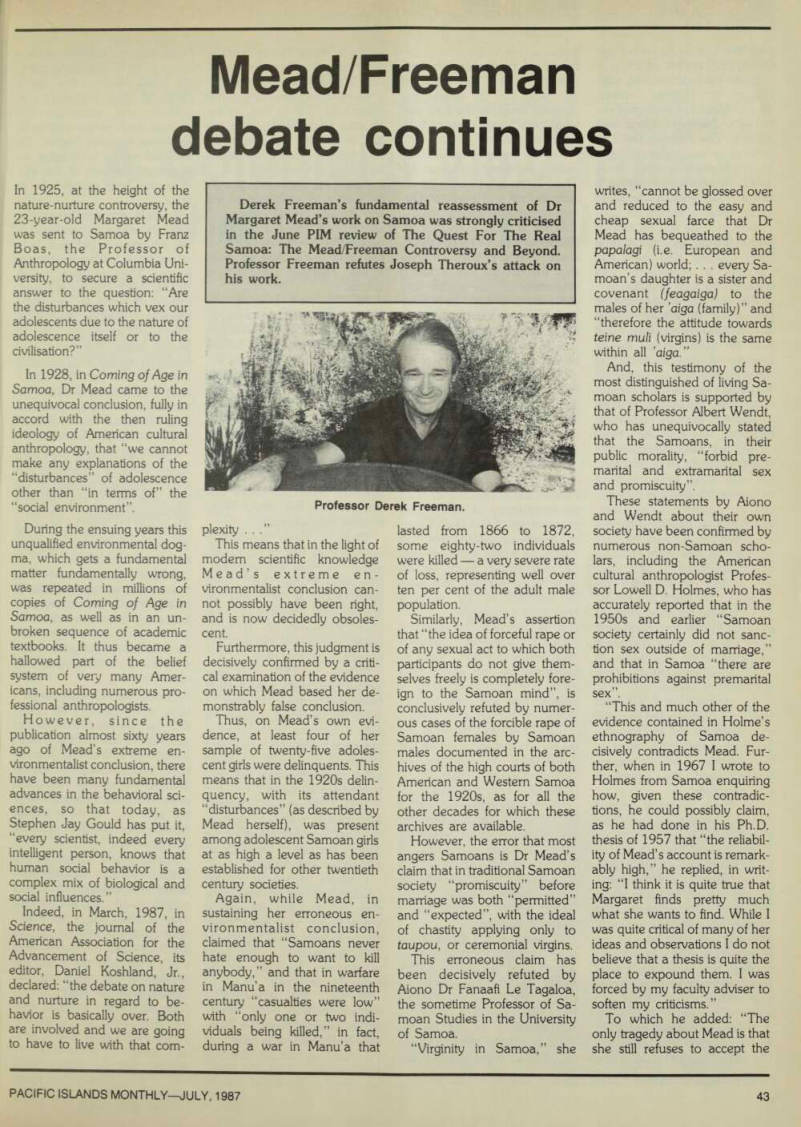
debate continues
Derek Freeman’s fundamental reassessment of Dr Margaret Mead’s work on Samoa was strongly criticised in the June PIM review of The Quest For The Real Samoa: The Mead/Freeman Controversy and Beyond.
Professor Freeman refutes Joseph Theroux’s attack on his work.
In 1925, at the height of the nature-nurture controversy, the 23-year-old Margaret Mead was sent to Samoa by Franz Boas, the Professor of Anthropology at Columbia Uni versity, to secure a scientific answer to the question; “Are the disturbances which vex our adolescents due to the nature of adolescence itself or to the civilisation?”
In 1928, in Coming of Age in Samoa, Dr Mead came to the unequivocal conclusion, fully in accord with the then ruling ideology of American cultural anthropology, that “we cannot make any explanations of the “disturbances” of adolescence other than “in terms of” the “social environment”.
During the ensuing years this unqualified environmental dog ma, which gets a fundamental matter fundamentally wrong, was repeated in millions of copies of Coming of Age in Samoa, as well as in an un broken sequence of academic textbooks. It thus became a hallowed part of the belief system of very many Amer icans, including numerous pro fessional anthropologists.
However, since the publication almost sixty years ago of Mead’s extreme en vironmentalist conclusion, there have been many fundamental advances in the behavioral sci ences, so that today, as Stephen Jay Gould has put it, “every scientist, indeed every intelligent person, knows that human social behavior is a complex mix of biological and social influences.”
Indeed, in March, 1987, in Science, the journal of the American Association for the Advancement of Science, its editor, Daniel Koshland, Jr., declared; “the debate on nature and nurture in regard to be havior is basically over. Both are involved and we are going to have to live with that com-
plexity ...”
This means that in the light of modem scientific knowledge Mead’s extreme en vironmentalist conclusion can not possibly have been right, and is now decidedly obsoles cent.
Furthermore, this judgment is decisively confirmed by a criti cal examination of the evidence on which Mead based her de monstrably false conclusion.
Thus, on Mead’s own evi dence, at least four of her sample of twenty-five adoles cent girls were delinquents. This means that in the 1920 s delin quency, with its attendant “disturbances” (as described by Mead herself), was present among adolescent Samoan girls at as high a level as has been established for other twentieth century societies.
Again, while Mead, in sustaining her erroneous en vironmentalist conclusion, claimed that “Samoans never hate enough to want to kill anybody,” and that in warfare in Manu’a in the nineteenth century “casualties were low” with “only one or two indi viduals being killed,” in fact, during a war in Manu’a that
lasted from 1866 to 1872, some eighty-two individuals were killed a very severe rate of loss, representing well over ten per cent of the adult male population.
Similarly, Mead’s assertion that “the idea of forceful rape or of any sexual act to which both participants do not give them selves freely is completely fore ign to the Samoan mind”, is conclusively refuted by numer ous cases of the forcible rape of Samoan females by Samoan males documented in the arc hives of the high courts of both American and Western Samoa for the 19205, as for all the other decades for which these archives are available.
However, the error that most angers Samoans is Dr Mead’s claim that in traditional Samoan society “promiscuity” before marriage was both “permitted” and “expected”, with the ideal of chastity applying only to taupou, or ceremonial virgins.
This erroneous claim has been decisively refuted by Aiono Dr Fanaafi Le Tagaloa, the sometime Professor of Sa moan Studies in the University of Samoa.
“Virginity in Samoa,” she
writes, “cannot be glossed over and reduced to the easy and cheap sexual farce that Dr Mead has bequeathed to the papalagi (i.e. European and American) world; . . . every Sa moan’s daughter is a sister and covenant (feagaiga) to the males of her ’aiga (family)” and “therefore the attitude towards teine muli (virgins) is the same within all ’aiga.”
And, this testimony of the most distinguished of living Sa moan scholars is supported by that of Professor Albert Wendt, who has unequivocally stated that the Samoans, in their public morality, “forbid pre marital and extramarital sex and promiscuity”.
These statements by Aiono and Wendt about their own society have been confirmed by numerous non-Samoan scho lars, including the American cultural anthropologist Profes sor Lowell D. Holmes, who has accurately reported that in the 1950 s and earlier “Samoan society certainly did not sanc tion sex outside of marriage,” and that in Samoa “there are prohibitions against premarital sex”.
“This and much other of the evidence contained in Holme’s ethnography of Samoa de cisively contradicts Mead. Fur ther, when in 1967 I wrote to Holmes from Samoa enquiring how, given these contradic tions, he could possibly claim, as he had done in his Ph.D. thesis of 1957 that “the reliabil ity of Mead’s account is remark ably high,” he replied, in writ ing: “I think it is quite true that Margaret finds pretty much what she wants to find. While I was quite critical of many of her ideas and observations I do not believe that a thesis is quite the place to expound them. I was forced by my faculty adviser to soften my criticisms.”
To which he added: “The only tragedy about Mead is that she still refuses to accept the
Professor Derek Freeman.
idea that she might have been wrong on her first field trip.”
It was this extraordinary con fession by Holmes, among other things, that prompted me to write Margaret Mead and Samoa: The Making and Un making of an Anthropological Myth (Harvard University Press, 1983) in which I presented a range of empirical evidence to refute Mead’s erroneous con clusion of 1928 and argued for an anthropology recognising both cultural and biolc jical variables, in accordance with modem scientific knowledge.
Yet, so deeply indoctrinated had some American cultural anthropologists become that they at once strove, by all manner of devices, including evasions and denials, to defend Dr Mead’s obsolescent conclu sion, with Professor Holmes emerging as her principal apologist, in what has been called “the greatest controversy in the history of anthropology. ”
Those who would defend demonstrable error are inescap ably condemned to obscurant ism. Thus, in his Quest for the Real Samoa, Lowell Holmes completely mis-states Mead’s actual conclusion of 1928; wholly fails to consider the evidence on which my refuta tion primarily depends; engages in outright disinformation and even alters crucially significant evidence from his thesis of 1957 that was directly con tradictory of Mead!
All of these facts, I would note, are documented in detail in reviews by me of Holmes’s book in forthcoming issues of the Journal of the Polynesian Society and the American Anthropologist.
Yet this is the book extolled by the American part-ime journalist, Mr J. Theroux (P.1.M., June, 1987) in a sing ularly scurrilous piece of writ ing, in which, completely ignor ing the central scientific issue, he unleashes wild, wholly false ad hominem attacks on myself, and even on members of my family! This really, is beyond the pale, and especially in what ought to be a rational discus sion of crucial intellectual and scientific problems.
In fact, as I have described (cf. Canberra Anthropology.
Vol. 6, No. 2,1983 (p. 122), my
investigations of the sexual be havior of Samoan adolescent girls (in which I was aided by my wife but in which my youthful daughters took no part whatsoever) were most meticu lously conducted.
Yet, in the presence of this readily available evidence, Mr Theroux stoops to outright di sinformation and totally unwar ranted personal aspersions.
What is one to say of an individual who engages in mali cious obscurantism? Merely that his devices are a telling revelation of his values and character and that, as Marcus Aurelius once put it, the only fitting response to those who wilfully malign is to strive not to be like them.
The documentation in my book of which Mr Theroux petulantly complains is, in fact, in a style approved by one of the world’s leading university presses.
The records consulted and superciliously denigrated by Holmes are wholly distinct from the manuscripts of the criminal proceedings of the High Court of American Samoa for the 19205, in which Holmes, had he only located them, would have found decisive refutation of various of Dr Mead’s erroneous conclusions.
It is precisely because Dr Mead’s claims of premaital promiscuity in Samoa seem so preposterous to them that many Samoans have come to believe that she was, in fact duped by her girl informants.
This belief, as I report in my book, was first recorded by the American ethnographer Eleanor Gerber in her Ph.D. thesis of 1975, and was most certainly not derived by me, as Mr Theroux falsely implies, from Tales from the Margaret Mead taproom, a source to which I merely make brief refer ence (in a footnote) as evidence that the views of Gerber’s infor mants have become wide spread in Samoa.
Of the fact that these views have indeed become wide spread there can be no doubt; as see, for example, Dr P. A.
Cox, in the American Scientist, 1983, v 01.71, p. 407.
However, I do not, as Mr Theroux falsely asserts, make the Samoan belief that she was
duped a “major charge” against Dr Mead. To the contrary, if only Mr Theroux had read my book he would have found that I conclude (p. 291) that “in the absence of detailed corrobora tive evidence” we cannot be sure that Dr Mead was mislead by her girl informants.
Again, Mr Theroux is in out right error in attributing to me any “intellectually dishonest” attempt to “bring down Mar garet Mead” words which he can only have derived from some corrupt journalistic source.
As Sir Karl Popper has shown, science progresses by the elimination of demonstrable error, my intellectually honest and scientifically warranted en deavour has been to eliminate demonstrably erroneous con clusion from the annals of
anthropology.
The mistake of mistakes in science is commonplace, and the fact that Dr Mead, “on her first field trip,” came to a mistaken conclusion does not detract from her many other notable achievements.
Thus, I have repeatedly made it plain that, in my judge ment, “because she grappled, throughout her life, with anthropological problems of fundamental importance.” Dr Mead is assured of “an hon oured and secure place in the history of anthropology.”
Indeed, in 1977, the year before her death, after having heard her speak in Sydney, I wrote to Dr Mead, saying: “if only a majority of the anthro pological profession could learn to look at things as you now do what a splendid state the pro fession would be in.”
Both Holmes and Theroux are radically in error in suppos ing that my refutation of Dr Mead’s account of Samoa is an alternative ethnography.
Precisely because it is a re futation and not an ethnogra phy, as I have repeatedly pointed out, my book deals primarily with those aspects of Samoan behaviour that were romantically ignored or dis torted by Dr Mead.
Further, the evidence I adduce, far from being “shod dy” as the error-prone Mr Ther oux would have it, is based, in the main, on carefully checked
court archives, on the proceed ings of Royal and Congressio nal Commissions, and on a range of other important his torical and ethnographic sources, such as the writings of Professor Augustin Kramer. To the best of my knowledge no significant element of this evi dence has been shown to be in error.
I would also emphasise that what the evidence contained in my refutation in fact does, is to reveal behavior that is intensely human. Thus, as Albert Wendt (P.1.M., May, 1983) has noted, instead of being an unworldly romantic paradise, Samoa is “like any other society,” and, as Wendt adds, the facts con tained in my book do no more than restore to Samoans (in the eyes of Westerners) those “di mensions of being truly hu man” that had been “denied” to them “by Dr Mead.”
I am well content then with Albert Wendt’s judgement that my “devastating refutation” (as he calls it) of Dr Mead’s erroneous conclusion of 1928 is “the most important study” of the Samoans “made this cen tury by a non-Samoan.”
Further, I am confident that when the empirical evidence is faced honestly and without pre judice my refutation will come to be seen as a significant contribution to the general ad vancement of anthropological understanding.
Finally, let me reiterate, as I have made plain in my book, that the Samoan people are, in general, “a law abiding Christ ian people of immense charac ter,” justly famed, in Ernest Sabatier’s words, as “the most polite of Pacific peoples,” who are also, beyond these formal virtues, “wonderfully hospitable and generous.”
Further, as I remark in the Pelican edition of Margaret Mead and Samoa: “I would add, knowing them as I do in all their human complexity, that I have great love and admiration for the people of Samoa, and that it is my belief that if only we Westerners can understand the Samoans in all their human complexity then we shall also be able to understand ourselves.” Soifua lava le atu nuu pele!
A Colonial’s view from
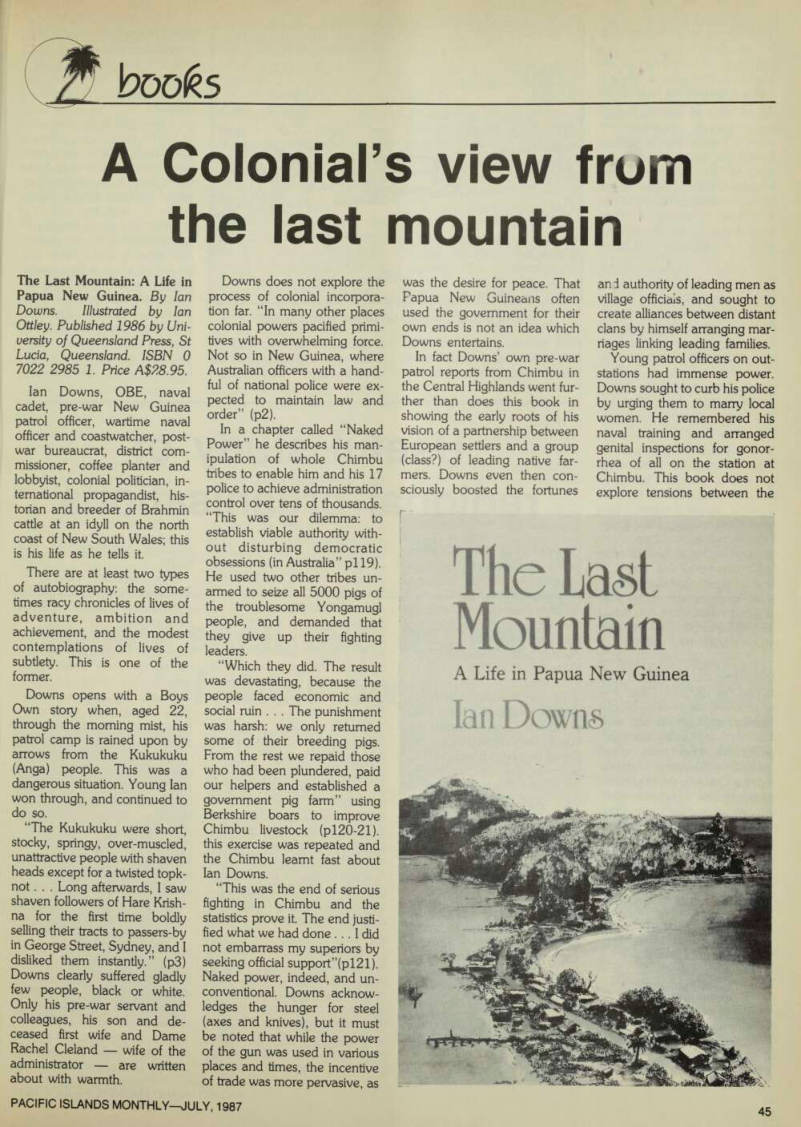
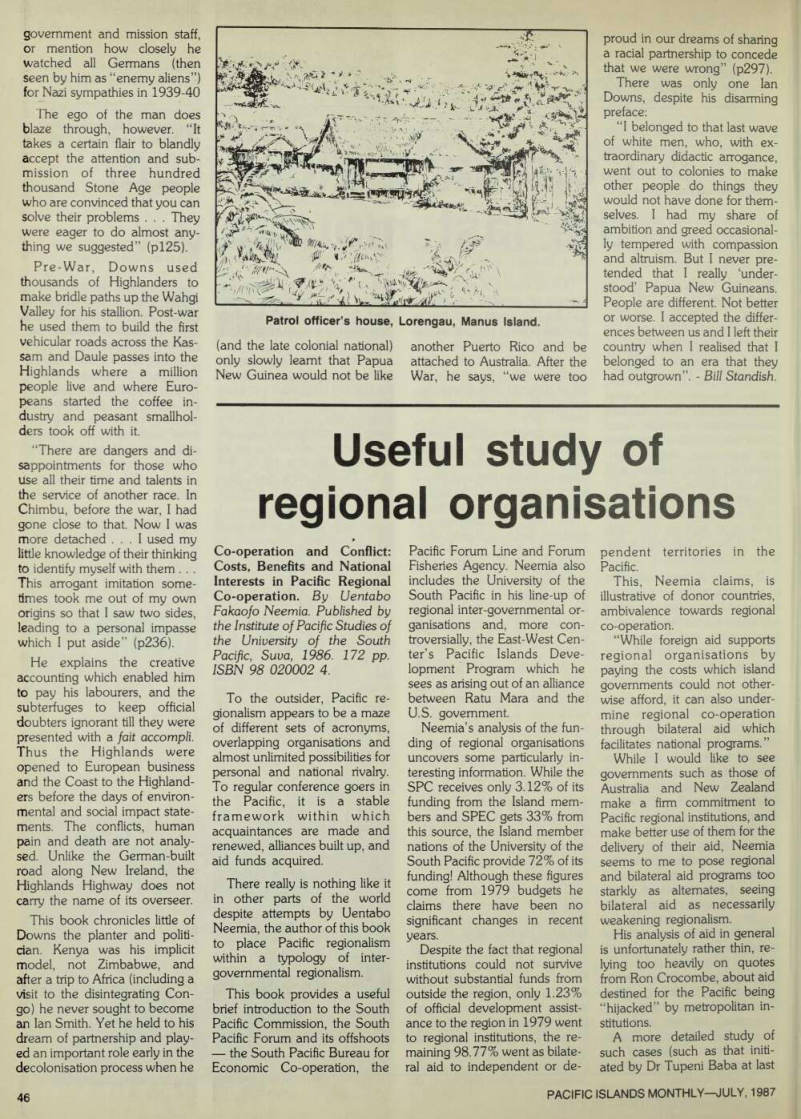
books
A Colonial’s view from the last mountain
The Last Mountain: A Life in Papua New Guinea. By lan Downs. Illustrated by lan Ottley. Published 1986 by Uni versity of Queensland Press, St Lucia, Queensland. ISBN 0 7022 2985 1. Price A 528.95. lan Downs, OBE, naval cadet, pre-war New Guinea patrol officer, wartime naval officer and coastwatcher, post war bureaucrat, district com missioner, coffee planter and lobbyist, colonial politician, in ternational propagandist, his torian and breeder of Brahmin cattle at an idyll on the north coast of New South Wales; this is his life as he tells it.
There are at least two types of autobiography: the some times racy chronicles of lives of adventure, ambition and achievement, and the modest contemplations of lives of subtlety. This is one of the former.
Downs opens with a Boys Own story when, aged 22, through the morning mist, his patrol camp is rained upon by arrows from the Kukukuku (Anga) people. This was a dangerous situation. Young lan won through, and continued to do so.
“The Kukukuku were short, stocky, springy, over-muscled, unattractive people with shaven heads except for a twisted topk not.. . Long afterwards, I saw shaven followers of Hare Krish na for the first time boldly selling their tracts to passers-by in George Street, Sydney, and I disliked them instantly.” (p 3) Downs clearly suffered gladly few people, black or white.
Only his pre-war servant and colleagues, his son and de ceased first wife and Dame Rachel Cleland wife of the administrator are written about with warmth.
Downs does not explore the process of colonial incorpora tion far. “In many other places colonial powers pacified primi tives with overwhelming force.
Not so in New Guinea, where Australian officers with a hand ful of national police were ex pected to maintain law and order” (p 2).
In a chapter called “Naked Power” he describes his man ipulation of whole Chimbu tribes to enable him and his 17 police to achieve administration control over tens of thousands.
“This was our dilemma: to establish viable authority with out disturbing democratic obsessions (in Australia” pi 19).
He used two other tribes un armed to seize all 5000 pigs of the troublesome Yongamugl people, and demanded that they give up their fighting leaders.
“Which they did. The result was devastating, because the people faced economic and social ruin . . . The punishment was harsh: we only returned some of their breeding pigs.
From the rest we repaid those who had been plundered, paid our helpers and established a government pig farm” using Berkshire boars to improve Chimbu livestock (pl2o-21). this exercise was repeated and the Chimbu learnt fast about lan Downs.
“This was the end of serious fighting in Chimbu and the statistics prove it. The end justi fied what we had done ... I did not embarrass my superiors by seeking official support”(pl2l).
Naked power, indeed, and un conventional. Downs acknow ledges the hunger for steel (axes and knives), but it must be noted that while the power of the gun was used in various places and times, the incentive of trade was more pervasive, as
was the desire for peace. That Papua New Guineans often used the government for their own ends is not an idea which Downs entertains.
In fact Downs’ own pre-war patrol reports from Chimbu in the Central Highlands went fur ther than does this book in showing the early roots of his vision of a partnership between European settlers and a group (class?) of leading native far mers. Downs even then con sciously boosted the fortunes
and authority of leading men as village officials, and sought to create alliances between distant clans by himself arranging mar riages linking leading families.
Young patrol officers on out stations had immense power.
Downs sought to curb his police by urging them to marry local women. He remembered his naval training and arranged genital inspections for gonor rhea of all on the station at Chimbu. This book does not explore tensions between the
government and mission staff, or mention how closely he watched all Germans (then seen by him as “enemy aliens”) for Nazi sympathies in 1939-40 The ego of the man does blaze through, however. “It takes a certain flair to blandly accept the attention and sub mission of three hundred thousand Stone Age people who are convinced that you can solve their problems . . . They were eager to do almost any thing we suggested” (p 125).
Pre-War, Downs used thousands of Highlanders to make bridle paths up the Wahgi Valley for his stallion. Post-war he used them to build the first vehicular roads across the Kas sam and Daule passes into the Highlands where a million people live and where Euro peans started the coffee in dustry and peasant smallhol ders took off with it.
“There are dangers and di sappointments for those who use all their time and talents in the service of another race. In Chimbu, before the war, I had gone close to that. Now I was more detached ... I used my little knowledge of their thinking to identify myself with them . . .
This arrogant imitation some times took me out of my own origins so that I saw two sides, leading to a personal impasse which 1 put aside” (p 236).
He explains the creative accounting which enabled him to pay his labourers, and the subterfuges to keep official doubters ignorant till they were presented with a fait accompli.
Thus the Highlands were opened to European business and the Coast to the Highland ers before the days of environ mental and social impact state ments. The conflicts, human pain and death are not analy sed. Unlike the German-built road along New Ireland, the Highlands Highway does not carry the name of its overseer.
This book chronicles little of Downs the planter and politi cian. Kenya was his implicit model, not Zimbabwe, and after a trip to Africa (including a visit to the disintegrating Con go) he never sought to become an lan Smith. Yet he held to his dream of partnership and play ed an important role early in the decolonisation process when he
another Puerto Rico and be attached to Australia. After the War, he says, “we were too
proud in our dreams of sharing a racial partnership to concede that we were wrong” (p 297).
There was only one lan Downs, despite his disarming preface: “I belonged to that last wave of white men, who, with ex traordinary didactic arrogance, went out to colonies to make other people do things they would not have done for them selves. I had my share of ambition and greed occasional ly tempered with compassion and altruism. But I never pre tended that I really ‘under stood’ Papua New Guineans.
People are different. Not better or worse. I accepted the differ ences between us and I left their country when I realised that I belonged to an era that they had outgrown”. - Bill Standish.
(and the late colonial national) only slowly leamt that Papua New Guinea would not be like
Patrol officer’s house, Lorengau, Manus Island.
Useful study of regional organisations
regional organisations
Co-operation and Conflict: Costs, Benefits and National Interests in Pacific Regional Co-operation. By Uentabo Fakaofo Neemia. Published by the Institute of Pacific Studies of the University of the South Pacific, Suva, 1986. 172 pp.
Isbn 98 020002 4.
To the outsider, Pacific re gionalism appears to be a maze of different sets of acronyms, overlapping organisations and almost unlimited possibilities for personal and national rivalry.
To regular conference goers in the Pacific, it is a stable framework within which acquaintances are made and renewed, alliances built up, and aid funds acquired.
There really is nothing like it in other parts of the world despite attempts by Uentabo Neemia, the author of this book to place Pacific regionalism within a typology of inter governmental regionalism.
This book provides a useful brief introduction to the South Pacific Commission, the South Pacific Forum and its offshoots the South Pacific Bureau for Economic Co-operation, the
Pacific Forum Line and Forum Fisheries Agency. Neemia also includes the University of the South Pacific in his line-up of regional inter-governmental or ganisations and, more con troversially, the East-West Cen ter’s Pacific Islands Deve lopment Program which he sees as arising out of an alliance between Ratu Mara and the U.S. government.
Neemia’s analysis of the fun ding of regional organisations uncovers some particularly in teresting information. While the SPC receives only 3.12% of its funding from the Island mem bers and SPEC gets 33% from this source, the Island member nations of the University of the South Pacific provide 72% of its funding! Although these figures come from 1979 budgets he claims there have been no significant changes in recent years.
Despite the fact that regional institutions could not survive without substantial funds from outside the region, only 1.23% of official development assist ance to the region in 1979 went to regional institutions, the re maining 98.77% went as bilate ral aid to independent or de
pendent territories in the Pacific.
This, Neemia claims, is illustrative of donor countries, ambivalence towards regional co-operation.
“While foreign aid supports regional organisations by paying the costs which island governments could not other wise afford, it can also under mine regional co-operation through bilateral aid which facilitates national programs.”
While I would like to see governments such as those of Australia and New Zealand make a firm commitment to Pacific regional institutions, and make better use of them for the delivery of their aid, Neemia seems to me to pose regional and bilateral aid programs too starkly as alternates, seeing bilateral aid as necessarily weakening regionalism.
His analysis of aid in general is unfortunately rather thin, re lying too heavily on quotes from Ron Crocombe, about aid destined for the Pacific being “hijacked” by metropolitan in stitutions.
A more detailed study of such cases (such as that initi ated by Dr Tupeni Baba at last
December’s Australasian Com parative and International Education Society Conference in Brisbane) would lend weight to his argument about factors leading to a weakening of Paci fic regionalism.
The old arguments about the costs and benefits of regional co-operation have been going on around the Pacific for de cades now, and it is good to see an attempt to quantify these costs and benefits.
In addition to fees paid to regional organisations Neemia does not overlook such un quantifiable costs as the loss of the best talent from a national public service to a regional organisation which can occur when salaries are so much higher in the regional bodies.
In the debate about costs and benefits which accrue to coun tries which host headquarters of regional bodies, Neemia argues very strongly that these coun tries benefit far more than they contribute, particularly in hav ing jobs provided for their na tionals as support staff and, in the case of the USP, collecting tax from all staff.
He further points out that host governments of regional bodies overlook these benefits and continually stress their con
tributions to the organisation, giving as the main example, Fiji’s paper at the conference on Future Directions of the USP in 1984.
The benefits of location are not restricted to Pacific regional bodies and Dr Neemia has also included a discussion of the benefits to Fiji of hosting other international offices including
Undp, Who, Ilo And
Unfpa.
Not all readers will agree with his conclusions on this issue, but they are persuasively argued and coming to be more influential among governments of the smaller island groups.
The scenario advanced is that the University of the South Pacific will go the same way as the Central Medical School, Air Pacific and the Telecom munication Training Centre, and be reduced from a regional institution to a national one, foundering on the reefs of na tional interest and bigger na tion/smaller nation rivalry.
The view that the USP will shortly become a University of Fiji, assisted by the policies of Western Samoa, the Solomons and Tonga, has been a theme of much discussion on the future of the university over the
last five years and was recently articulated by Professor Albert Wendt.
Neemia, a Kiribati national, gives some of the economic background to such arguments although not arguing in favor of such an eventuality. The recent coup in Fiji must place a further question mark over the future of the USP in its current loca tion.
Another important source of conflict in regional bodies, in addition to the economic factor, is the Melanesian/Polynesian cleavage, more significant in the Forum and its associated groupings. Neemia sees both Bigger/Smaller nation and Melanesian/Polynesian tensions as providing the basis for sub regional groupings, groupings which, he argues, represent an extension of national interests and challenge regionalism.
This book then provides a framework within which a num ber of issues concerning Pacific regionalism can, and doubtless will, be debated. Journalists and others wanting a guide through the maze of official Pacific-wide organisations will benefit greatly by reading it but will be surprised to see so little coverage given to the South
Pacific Forum, which is, after all the South Pacific organisation with the highest profile.
This is partly because the Forum, in its structure, is little more than an informal gather ing of heads of government once a year.
They will also be somewhat surprised to see major issues such as the South Pacific Nuc lear Free Zone Treaty and the taking of New Caledonia to the U.N., absent from its pages, evidently due to the long time delay in producing the book.
Co-operation and Conflict should provide a useful refer ence not only to students of South Pacific politics but also those concerned with topics such as higher education as an international commodity, and the politics of international fisheries.
Nor should it be forgotten that Pacific regionalism is not merely a government phe nomenon. In the first paragraph Uentabo Neemia points out that there are now some 200 regional institutions in the South Pacific, most of them non-governmental.
It is perhaps the members of these organisations who will find the book of most interest.
Helen Hill.
Nihau shell leis a class
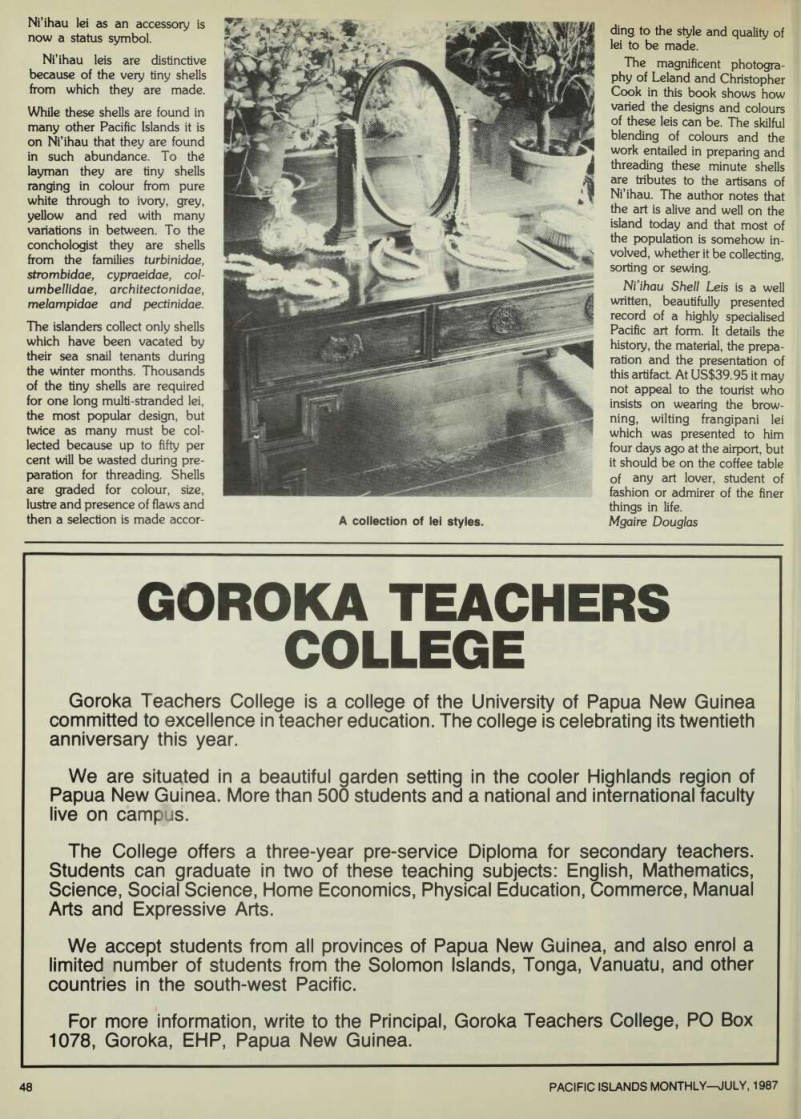
of their own
Ni’ihau Shell Leis. By Linda Paik Moriarty. Published by University of Hawaii, Honolu lu, 1986. 104 pp. ISBN 0-8248- 0998-X. U 5539.95.
The lei is the most popular souvenir for more than four million tourists who visit Hawaii every year. Common shells, plastic beads, wooden beads, magnificent orchids, fragrant frangipani, flowers fresh and plastic are all threaded and twisted into garlands worn by tourists and locals alike. Millions of leis hang in shops; children hawk them around the streets; tour companies place them around the necks of arriving tourists; shop assistants; wait resses, barmen, office staff and taxi drivers can be seen wearing
them. The lei is symbolic of Hawaii.
But Ni’ihau shell leis are in a class all of their own. Only the very discerning visitor will leave Hawaii with one of these, their price being a very inhibiting factor. Ni’ihau shell leis have been known to change hands for several thousands of dollars.
Linda Paik Moriarty writes that the most well known visitor of all, Captain Cook, collected several which now grace the British Museum. In the late 1800 s, Hawaiian royalty, adap ting the Victorian fashions of the day, wore long strands of ivory coloured ni’ihau leis with their stiff taffeta gowns. Nearly one hundred years later, in post World War II Hawaii, fashion again brought the leis to the
attention of those who followed its dictates, The informal “aloha style” revived the wearing of leis and the people of Ni’ihau began marketing their product on a definite commercial basis.
As tourism rapidly increased to the Hawaiian Islands, so did the demands for leis. During the 1970 s lei production reached the masses as the puka shell, (worn down cone shell) jewel lery became almost a national craze. While this rush of pro duction established a low cost commodity, it also helped to elevate the status of the high quality Ni’ihau product. On 1 March, 1968, the final seal of approval was given to the wear ing of leis when the State House of Representatives announced that Friday was to be known in future as Aloha Friday when the woman of the business district of downtown Honolulu would be encouraged to wear the distinctive muu muu as a display of state pride.
The wearing of a good quality
Ni‘ihau shell leis are worn and cherished by island people.
Ni’ihau lei as an accessory is now a status symbol.
Ni’ihau leis are distinctive because of the very tiny shells from which they are made.
While these shells are found in many other Pacific Islands it is on Ni’ihau that they are found in such abundance. To the layman they are tiny shells ranging in colour from pure white through to ivory, grey, yellow and red with many variations in between. To the conchologist they are shells from the families turbinidae, strombidae, cypraeidae, col umbellidae, architectonidae, melampidae and pectinidae.
The islanders collect only shells which have been vacated by their sea snail tenants during the winter months. Thousands of the tiny shells are required for one long multi-stranded lei, the most popular design, but twice as many must be col lected because up to fifty per cent will be wasted during pre paration for threading. Shells are graded for colour, size, lustre and presence of flaws and then a selection is made accor-
ding to the style and quality of lei to be made.
The magnificent photogra phy of Leland and Christopher Cook in this book shows how varied the designs and colours of these leis can be. The skilful blending of colours and the work entailed in preparing and threading these minute shells are tributes to the artisans of Ni’ihau. The author notes that the art is alive and well on the island today and that most of the population is somehow in volved, whether it be collecting, sorting or sewing.
Ni’ihau Shell Leis is a well written, beautifully presented record of a highly specialised Pacific art form. It details the history, the material, the prepa ration and the presentation of this artifact. At U 5539.95 it may not appeal to the tourist who insists on wearing the brow ning, wilting frangipani lei which was presented to him four days ago at the airport, but it should be on the coffee table of any art lover, student of fashion or admirer of the finer things in life.
Mgaire Douglas
A collection of lei styles.
Advertisements & other items, p. 48 (1 item)
Goroka Teachers
COLLEGE
Goroka Teachers College is a college of the University of Papua New Guinea committed to excellence in teacher education. The college is celebrating its twentieth anniversary this year.
We are situated in a beautiful garden setting in the cooler Highlands region of Papua New Guinea. More than 500 students and a national and international faculty live on campus.
The College offers a three-year pre-service Diploma for secondary teachers.
Students can graduate in two of these teaching subjects: English, Mathematics, Science, Social Science, Home Economics, Physical Education, Commerce, Manual Arts and Expressive Arts.
We accept students from all provinces of Papua New Guinea, and also enrol a limited number of students from the Solomon Islands, Tonga, Vanuatu, and other countries in the south-west Pacific.
For more information, write to the Principal, Goroka Teachers College, PC Box 1078, Goroka, EHP, Papua New Guinea.
from the islands press
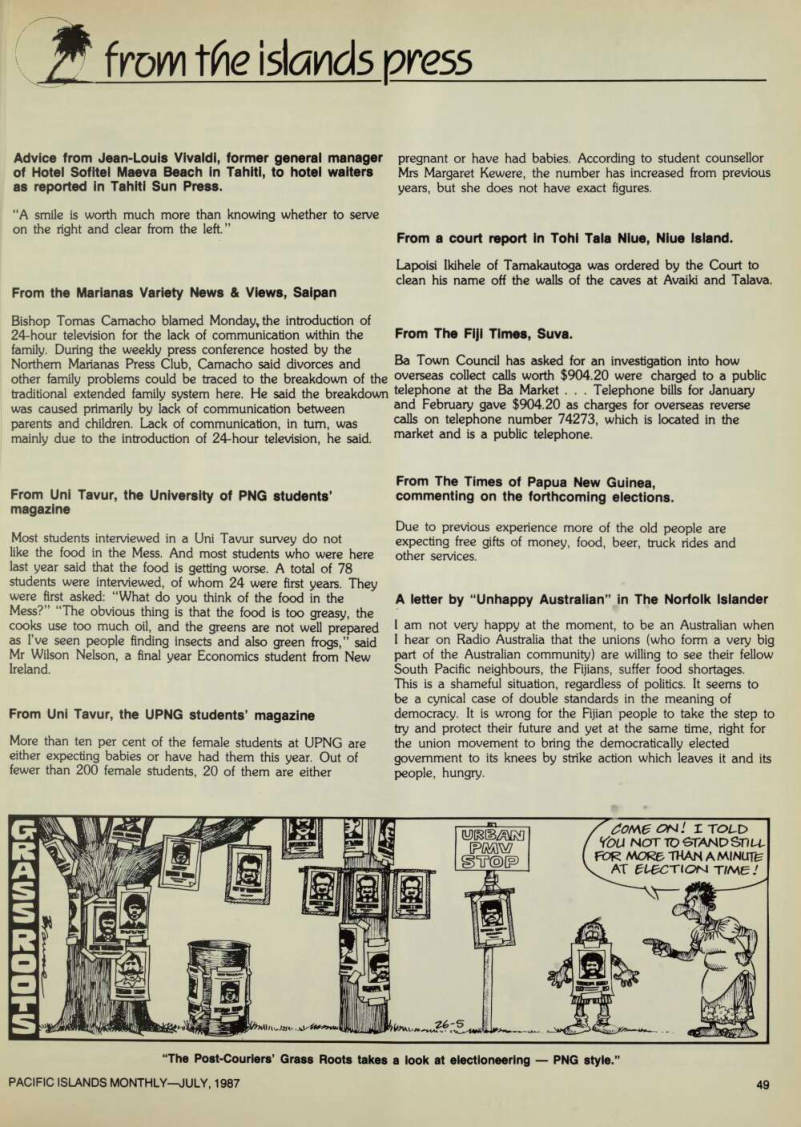
Advice from Jean-Louis Vivaldi, former general manager of Hotel Sofitel Maeva Beach In Tahiti, to hotel waiters as reported in Tahiti Sun Press.
“A smile is worth much more than knowing whether to serve on the right and clear from the left.”
From the Marianas Variety News & Views, Saipan Bishop Tomas Camacho blamed Monday* the introduction of 24-hour television for the lack of communication within the family. During the weekly press conference hosted by the Northern Marianas Press Club, Camacho said divorces and other family problems could be traced to the breakdown of the traditional extended family system here. He said the breakdown was caused primarily by lack of communication between parents and children. Lack of communication, in turn, was mainly due to the introduction of 24-hour television, he said.
From Uni Tavur, the University of PNG students’ magazine Most students interviewed in a Uni Tavur survey do not like the food in the Mess. And most students who were here last year said that the food is getting worse. A total of 78 students were interviewed, of whom 24 were first years. They were first asked: “What do you think of the food in the Mess?” “The obvious thing is that the food is too greasy, the cooks use too much oil, and the greens are not well prepared as I’ve seen people finding insects and also green frogs,” said Mr Wilson Nelson, a final year Economics student from New Ireland.
From Uni Tavur, the UPNG students’ magazine More than ten per cent of the female students at UPNG are either expecting babies or have had them this year. Out of fewer than 200 female students, 20 of them are either
pregnant or have had babies. According to student counsellor Mrs Margaret Kewere, the number has increased from previous years, but she does not have exact figures.
From a court report in Tohi Tala Niue, Niue Island.
Lapoisi Ikihelc of Tamakautoga was ordered by the Court to clean his name off the walls of the caves at Avaiki and Talava.
From The FIJI Times, Suva.
Ba Town Council has asked for an investigation into how overseas collect calls worth $904.20 were charged to a public telephone at the Ba Market . . . Telephone bills for January and February gave $904.20 as charges for overseas reverse calls on telephone number 74273, which is located in the market and is a public telephone.
From The Times of Papua New Guinea, commenting on the forthcoming elections.
Due to previous experience more of the old people are expecting free gifts of money, food, beer, truck rides and other services.
A letter by “Unhappy Australian” in The Norfolk Islander I am not very happy at the moment, to be an Australian when I hear on Radio Australia that the unions (who form a very big part of the Australian community) are willing to see their fellow South Pacific neighbours, the Fijians, suffer food shortages.
This is a shameful situation, regardless of politics. It seems to be a cynical case of double standards in the meaning of democracy. It is wrong for the Fijian people to take the step to try and protect their future and yet at the same time, right for the union movement to bring the democratically elected government to its knees by strike action which leaves it and its people, hungry.
“The Post-Couriers’ Grass Roots takes a look at electioneering -PNG style.”
transitions
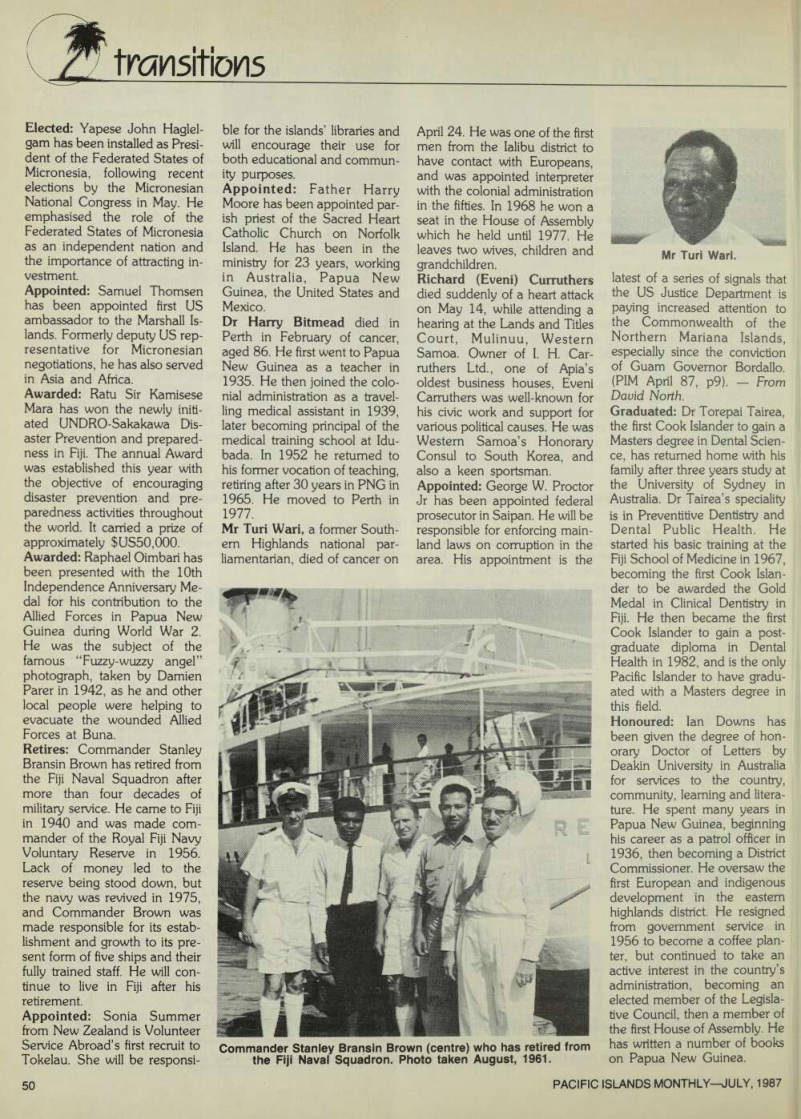
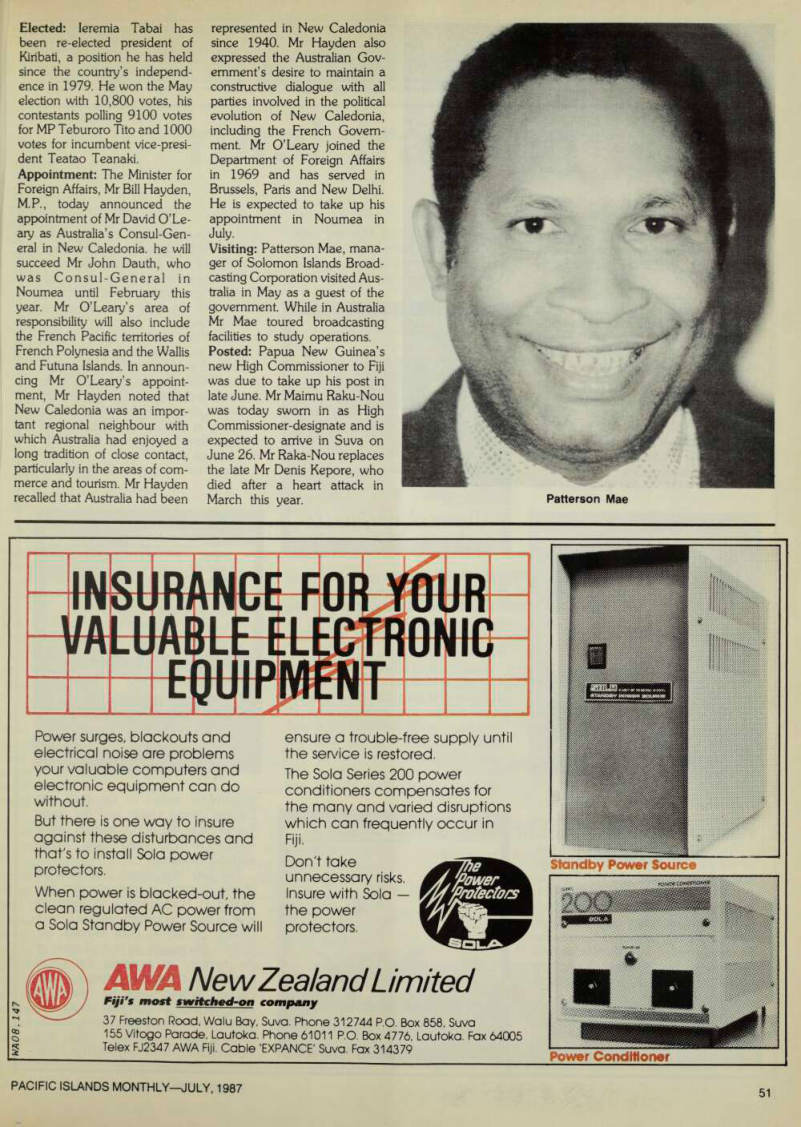
Elected: Yapese John Haglel gam has been installed as Presi dent of the Federated States of Micronesia, following recent elections by the Micronesian National Congress in May. He emphasised the role of the Federated States of Micronesia as an independent nation and the importance of attracting in vestment.
Appointed: Samuel Thomsen has been appointed first US ambassador to the Marshall Is lands. Formerly deputy US rep resentative for Micronesian negotiations, he has also served in Asia and Africa.
Awarded: Ratu Sir Kamisese Mara has won the newly initi ated UNDRO-Sakakawa Dis aster Prevention and prepared ness in Fiji. The annual Award was established this year with the objective of encouraging disaster prevention and pre paredness activities throughout the world. It carried a prize of approximately SUSSO,OOO.
Awarded: Raphael Oimbari has been presented with the 10th Independence Anniversary Me dal for his contribution to the Allied Forces in Papua New Guinea during World War 2.
He was the subject of the famous “Fuzzy-wuzzy angel” photograph, taken by Damien Parer in 1942, as he and other local people were helping to evacuate the wounded Allied Forces at Buna.
Retires: Commander Stanley Bransin Brown has retired from the Fiji Naval Squadron after more than four decades of military service. He came to Fiji in 1940 and was made com mander of the Royal Fiji Navy Voluntary Reserve in 1956.
Lack of money led to the reserve being stood down, but the navy was revived in 1975, and Commander Brown was made responsible for its estab lishment and growth to its pre sent form of five ships and their fully trained staff. He will con tinue to live in Fiji after his retirement.
Appointed: Sonia Summer from New Zealand is Volunteer Service Abroad’s first recruit to Tokelau. She will be responsi
ble for the islands’ libraries and will encourage their use for both educational and commun ity purposes.
Appointed: Father Harry Moore has been appointed par ish priest of the Sacred Heart Catholic Church on Norfolk Island. He has been in the ministry for 23 years, working in Australia, Papua New Guinea, the United States and Mexico.
Dr Harry Bitmead died in Perth in February of cancer, aged 86. He first went to Papua New Guinea as a teacher in 1935. He then joined the colo nial administration as a travel ling medical assistant in 1939, later becoming principal of the medical training school at Idu bada. In 1952 he returned to his former vocation of teaching, retiring after 30 years in PNG in 1965. He moved to Perth in 1977.
Mr Turi Wari, a former South ern Highlands national par liamentarian, died of cancer on
April 24. He was one of the first men from the lalibu district to have contact with Europeans, and was appointed interpreter with the colonial administration in the fifties. In 1968 he won a seat in the House of Assembly which he held until 1977. He leaves two wives, children and grandchildren.
Richard (Eveni) Curruthers died suddenly of a heart attack on May 14, while attending a hearing at the Lands and Titles Court, Mulinuu, Western Samoa. Owner of I. H. Car ruthers Ltd., one of Apia’s oldest business houses, Eveni Carruthers was well-known for his civic work and support for various political causes. He was Western Samoa’s Honorary Consul to South Korea, and also a keen sportsman.
Appointed: George W. Proctor Jr has been appointed federal prosecutor in Saipan. He will be responsible for enforcing main land laws on corruption in the area. His appointment is the
latest of a series of signals that the US Justice Department is paying increased attention to the Commonwealth of the Northern Mariana Islands, especially since the conviction of Guam Governor Bordallo. (PIM April 87, p 9). From David North.
Graduated: Dr Torepai Tairea, the first Cook Islander to gain a Masters degree in Dental Scien ce, has returned home with his family after three years study at the University of Sydney in Australia. Dr Tairea’s speciality is in Preventive Dentistry and Dental Public Health. He started his basic training at the Fiji School of Medicine in 1967, becoming the first Cook Islan der to be awarded the Gold Medal in Clinical Dentistry in Fiji. He then became the first Cook Islander to gain a post graduate diploma in Dental Health in 1982, and is the only Pacific Islander to have gradu ated with a Masters degree in this field.
Honoured: lan Downs has been given the degree of hon orary Doctor of Letters by Deakin University in Australia for services to the country, community, learning and litera ture. He spent many years in Papua New Guinea, beginning his career as a patrol officer in 1936, then becoming a District Commissioner. He oversaw the first European and indigenous development in the eastern highlands district. He resigned from government service in 1956 to become a coffee plan ter, but continued to take an active interest in the country’s administration, becoming an elected member of the Legisla tive Council, then a member of the first House of Assembly. He has written a number of books on Papua New Guinea.
Commander Stanley Bransin Brown (centre) who has retired from the Fiji Naval Squadron. Photo taken August, 1961.
Mr Turi Wari.
Elected: leremia Tabai has been re-elected president of Kiribati, a position he has held since the country’s independ ence in 1979. He won the May election with 10,800 votes, his contestants polling 9100 votes for MP Teburoro Tito and 1000 votes for incumbent vice-presi dent Teatao Teanaki.
Appointment: The Minister for Foreign Affairs, Mr Bill Hayden, M.P., today announced the appointment of Mr David O’Le ary as Australia’s Consul-Gen eral in New Caledonia, he will succeed Mr John Dauth, who was Consul-General in Noumea until February this year. Mr O’Leary’s area of responsibility will also include the French Pacific territories of French Polynesia and the Wallis and Futuna Islands. In announ cing Mr O’Leary’s appoint ment, Mr Hayden noted that New Caledonia was an impor tant regional neighbour with which Australia had enjoyed a long tradition of close contact, particularly in the areas of com merce and tourism. Mr Hayden recalled that Australia had been
represented in New Caledonia since 1940. Mr Hayden also expressed the Australian Gov ernment’s desire to maintain a constructive dialogue with all parties involved in the political evolution of New Caledonia, including the French Govern ment. Mr O’Leary joined the Department of Foreign Affairs in 1969 and has served in Brussels, Paris and New Delhi.
He is expected to take up his appointment in Noumea in July.
Visiting: Patterson Mae, mana ger of Solomon Islands Broad casting Corporation visited Aus tralia in May as a guest of the government. While in Australia Mr Mae toured broadcasting facilities to study operations.
Posted: Papua New Guinea’s new High Commissioner to Fiji was due to take up his post in late June. Mr Maimu Raku-Nou was today sworn in as High Commissioner-designate and is expected to arrive in Suva on June 26. Mr Raka-Nou replaces the late Mr Denis Kepore, who died after a heart attack in March this year.
Patterson Mae
Advertisements & other items, p. 51 (1 item)
AWA New Zealand Limited
WA08.147 UA E
UIP
T Power surges, blackouts and electrical noise are problems your valuable computers and electronic equipment can do without.
But there is one way to insure against these disturbances and that's to install Sola power protectors.
When power is blacked-out, the clean regulated AC power from a Sola Standby Power Source will ensure a trouble-free supply until the service is restored.
The Sola Series 200 power conditioners compensates for the many and varied disruptions which can frequently occur in Fiji.
Don't take unnecessary risks.
Insure with Sola the power protectors.
AWA New Zealand Limited
Fiji's most switched-on company 37 Freeston Road, Walu Bay, Suva. Phone 312744 P.O, Box 858, Suva 155 Vitogo Parade, Lautoka. Phone 61011 P.O. Box 4776, Lautoka. Fax 64005 Telex FJ2347 AWA Fiji. Cable 'EXPANCE' Suva. Fax 314379 B Standby Power Source * Power Conditioner
Pacific stamp box
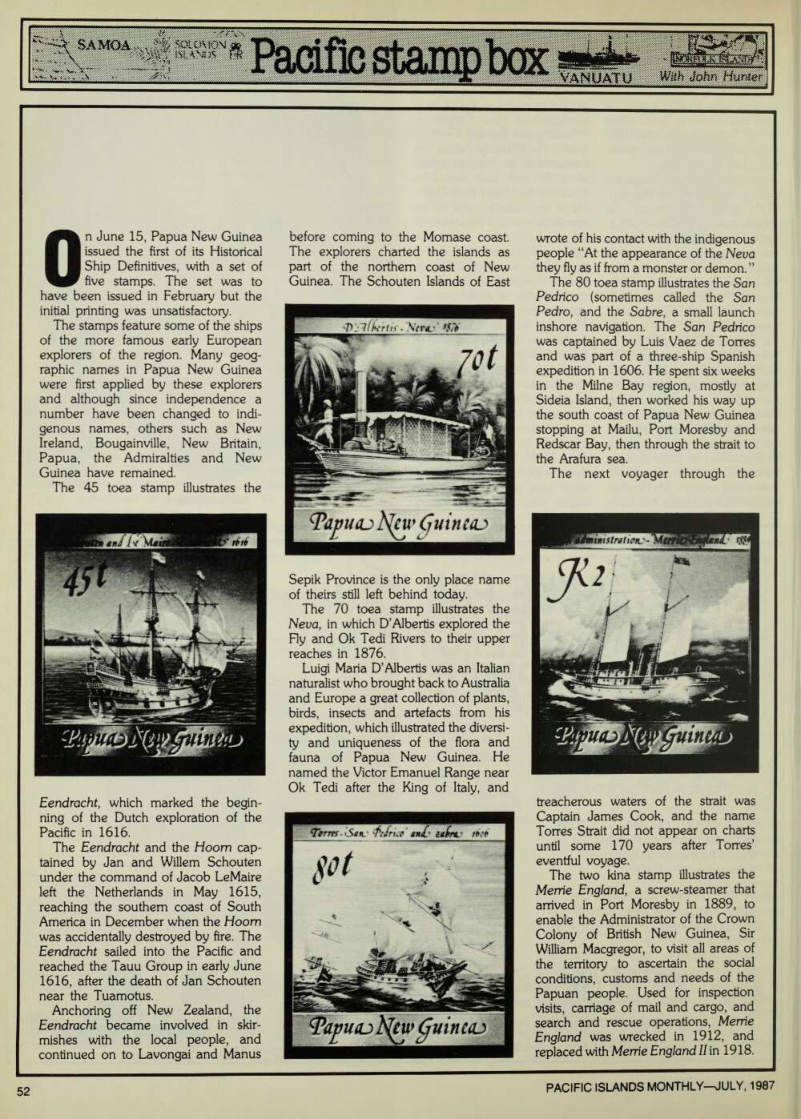
On June 15, Papua New Guinea issued the first of its Historical Ship Definitives, with a set of five stamps. The set was to have been issued in February but the initial printing was unsatisfactory.
The stamps feature some of the ships of the more famous early European explorers of the region. Many geog raphic names in Papua New Guinea were first applied by these explorers and although since independence a number have been changed to indi genous names, others such as New Ireland, Bougainville, New Britain, Papua, the Admiralties and New Guinea have remained.
The 45 toea stamp illustrates the
Eendracht, which marked the begin ning of the Dutch exploration of the Pacific in 1616.
The Eendracht and the Hoom cap tained by Jan and Willem Schouten under the command of Jacob LeMaire left the Netherlands in May 1615, reaching the southern coast of South America in December when the Hoom was accidentally destroyed by fire. The Eendracht sailed into the Pacific and reached the Tauu Group in early June 1616, after the death of Jan Schouten near the Tuamotus.
Anchoring off New Zealand, the Eendracht became involved in skir mishes with the local people, and continued on to Lavongai and Manus
before coming to the Momase coast.
The explorers charted the islands as part of the northern coast of New Guinea. The Schouten Islands of East
Sepik Province is the only place name of theirs still left behind today.
The 70 toea stamp illustrates the Neva, in which D’ Albertis explored the Fly and Ok Tedi Rivers to their upper reaches in 1876.
Luigi Maria D’Albertis was an Italian naturalist who brought back to Australia and Europe a great collection of plants, birds, insects and artefacts from his expedition, which illustrated the diversi ty and uniqueness of the flora and fauna of Papua New Guinea. He named the Victor Emanuel Range near Ok Tedi after the King of Italy, and
wrote of his contact with the indigenous people “At the appearance of the Neva they fly as if from a monster or demon. ”
The 80 toea stamp illustrates the San Pedrico (sometimes called the San Pedro, and the Sabre, a small launch inshore navigation. The San Pedrico was captained by Luis Vaez de Torres and was part of a three-ship Spanish expedition in 1606. He spent six weeks in the Milne Bay region, mostly at Sideia Island, then worked his way up the south coast of Papua New Guinea stopping at Mailu, Port Moresby and Redscar Bay, then through the strait to the Arafura sea.
The next voyager through the
treacherous waters of the strait was Captain James Cook, and the name Torres Strait did not appear on charts until some 170 years after Torres’ eventful voyage.
The two kina stamp illustrates the Merrie England, a screw-steamer that arrived in Fort Moresby in 1889, to enable the Administrator of the Crown Colony of British New Guinea, Sir William Macgregor, to visit all areas of the territory to ascertain the social conditions, customs and needs of the Papuan people. Used for inspection visits, carriage of mail and cargo, and search and rescue operations, Merrie England was wrecked in 1912, and replaced with Merrie England II in 1918.
rural training
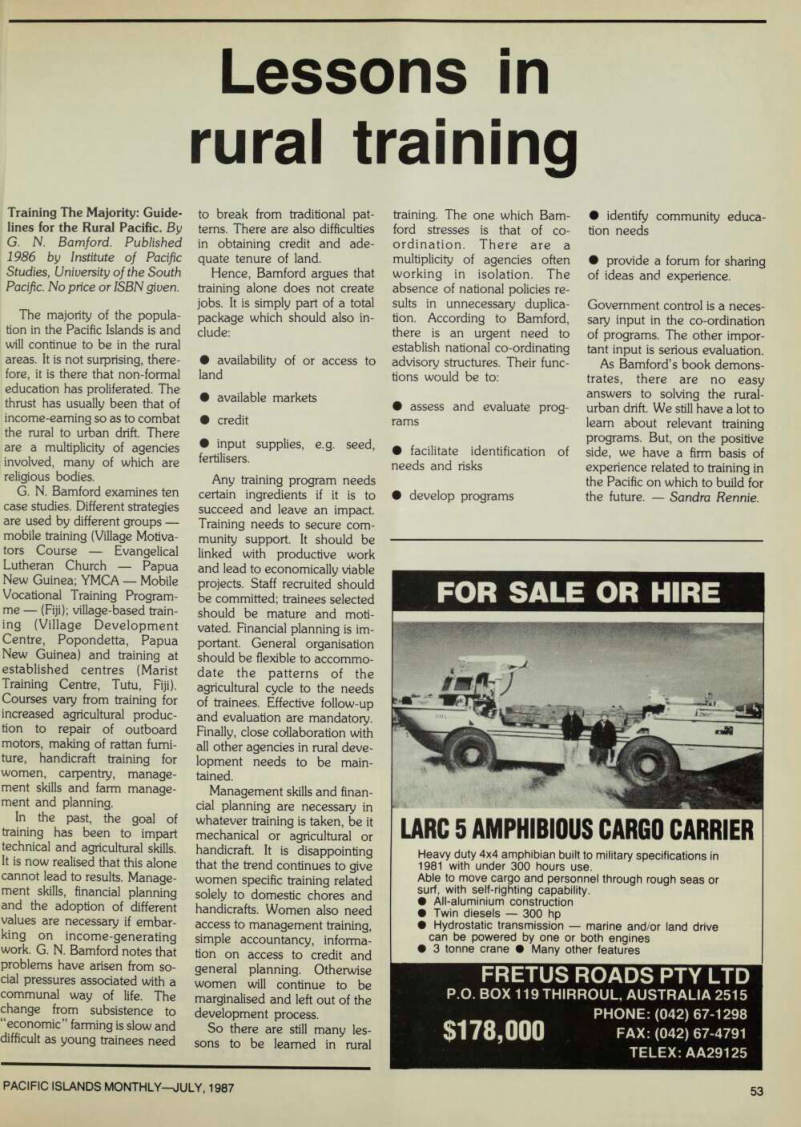
Lessons in rural training
Training The Majority: Guide lines for the Rural Pacific. By G. N. Bamford. Published 1986 by Institute of Pacific Studies, University of the South Pacific. No price or ISBN given.
The majority of the popula tion in the Pacific Islands is and will continue to be in the rural areas. It is not surprising, there fore, it is there that non-formal education has proliferated. The thrust has usually been that of income-earning so as to combat the rural to urban drift. There are a multiplicity of agencies involved, many of which are religious bodies.
G. N. Bamford examines ten case studies. Different strategies are used by different groups mobile training (Village Motiva tors Course Evangelical Lutheran Church Papua New Guinea; YMCA Mobile Vocational Training Program me (Fiji); village-based train ing (Village Development Centre, Popondetta, Papua New Guinea) and training at established centres (Marist Training Centre, Tutu, Fiji).
Courses vary from training for increased agricultural produc tion to repair of outboard motors, making of rattan furni ture, handicraft training for women, carpentry, manage ment skills and farm manage ment and planning.
In the past, the goal of training has been to impart technical and agricultural skills.
It is now realised that this alone cannot lead to results. Manage ment skills, financial planning and the adoption of different values are necessary if embar king on income-generating work. G. N. Bamford notes that problems have arisen from so cial pressures associated with a communal way of life. The change from subsistence to “economic” farming is slow and difficult as young trainees need
to break from traditional pat terns. There are also difficulties in obtaining credit and ade quate tenure of land.
Hence, Bamford argues that training alone does not create jobs. It is simply part of a total package which should also in clude: • availability of or access to land • available markets • credit • input supplies, e.g. seed, fertilisers.
Any training program needs certain ingredients if it is to succeed and leave an impact.
Training needs to secure com munity support. It should be linked with productive work and lead to economically viable projects. Staff recruited should be committed; trainees selected should be mature and moti vated. Financial planning is im portant. General organisation should be flexible to accommo date the patterns of the agricultural cycle to the needs of trainees. Effective follow-up and evaluation are mandatory.
Finally, close collaboration with all other agencies in rural deve lopment needs to be main tained.
Management skills and finan cial planning are necessary in whatever training is taken, be it mechanical or agricultural or handicraft. It is disappointing that the trend continues to give women specific training related solely to domestic chores and handicrafts. Women also need access to management training, simple accountancy, informa tion on access to credit and general planning. Otherwise women will continue to be marginalised and left out of the development process.
So there are still many les sons to be learned in rural
training. The one which Barn ford stresses is that of co ordination. There are a multiplicity of agencies often working in isolation. The absence of national policies re sults in unnecessary duplica tion. According to Bamford, there is an urgent need to establish national co-ordinating advisory structures. Their func tions would be to: • assess and evaluate prog rams • facilitate identification of needs and risks • develop programs
• identify community educa tion needs • provide a forum for sharing of ideas and experience.
Government control is a neces sary input in the co-ordination of programs. The other impor tant input is serious evaluation.
As Bamford’s book demons trates, there are no easy answers to solving the rural urban drift. We still have a lot to leam about relevant training programs. But, on the positive side, we have a firm basis of experience related to training in the Pacific on which to build for
the future.
Sandra Rennie.
Advertisements & other items, p. 53 (1 item)
For Sale Or Hire
0 MT
LARC 5 AMPHIBIOUS CARGO CARRIER
Heavy duty 4x4 amphibian built to military specifications in 1981 with under 300 hours use.
Able to move cargo and personnel through rough seas or surf, with self-righting capability. • All-aluminium construction • Twin diesels 300 hp • Hydrostatic transmission marine and/or land drive can be powered by one or both engines • 3 tonne crane • Many other features
FRETUS ROADS PTY LTD
P.O. BOX 119 THIRROUL, AUSTRALIA 2515
PHONE: (042) 67-1298
$178,000 FAX: (042) 67-4791
TELEX: AA29125
shipping schedules
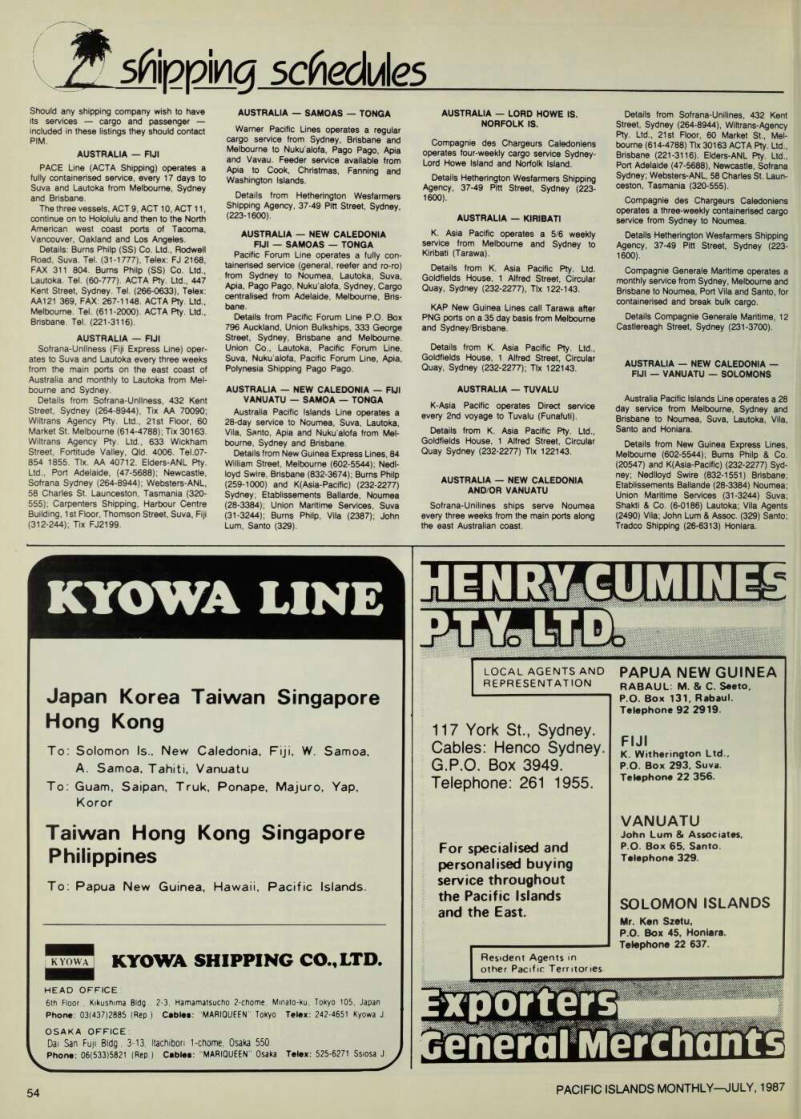
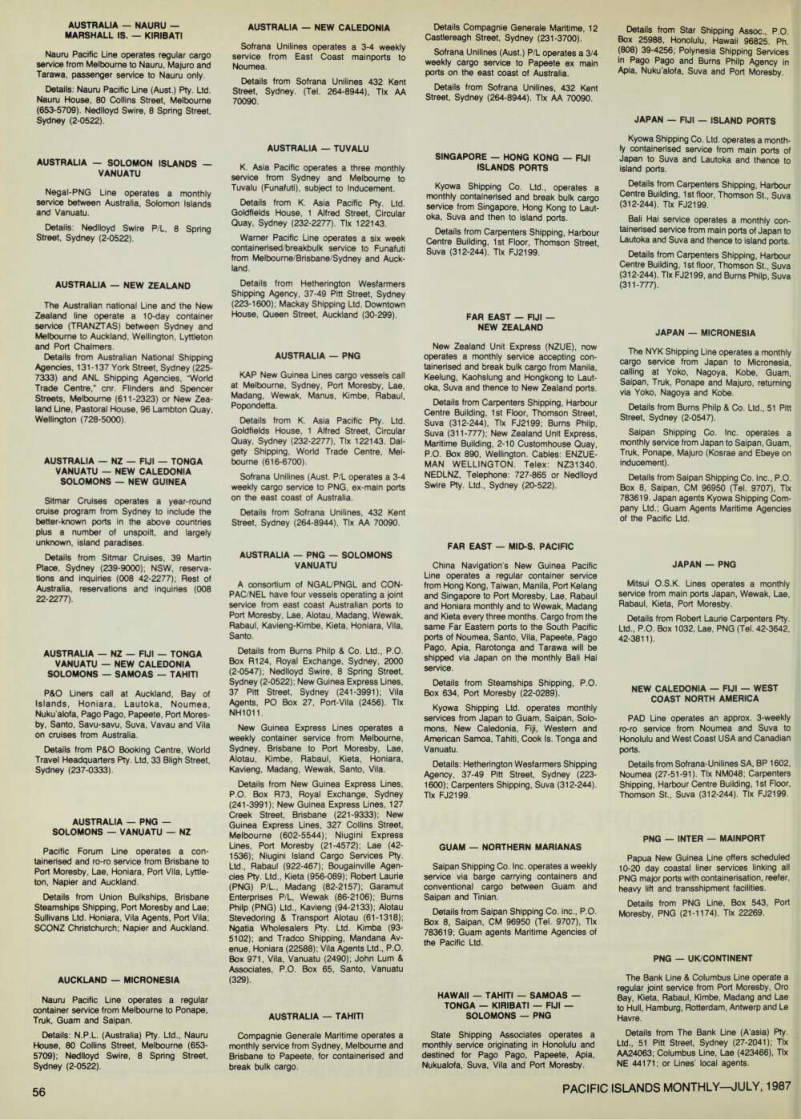
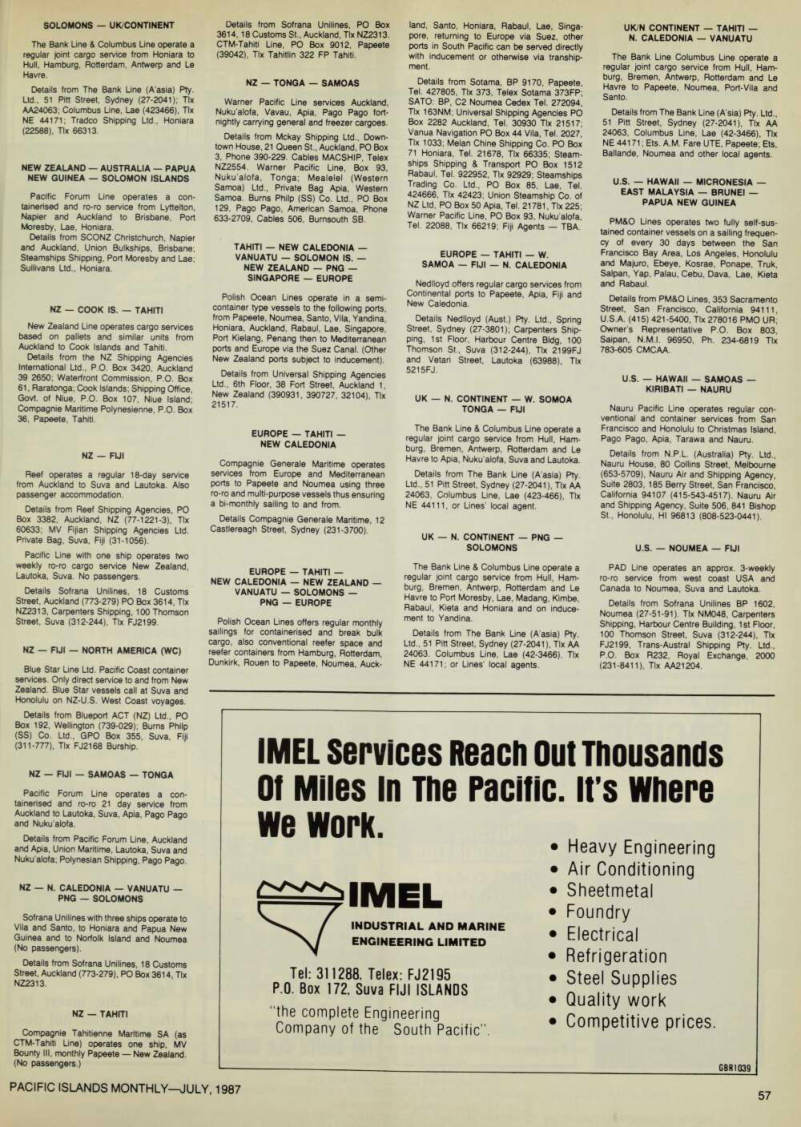
Should any shipping company wish to have its services cargo and passenger included in these listings they should contact
Pim.
Australia Fiji
PACE Line (ACTA Shipping) operates a fully containerised service, every 17 days to Suva and Lautoka from Melbourne, Sydney and Brisbane.
The three vessels, ACT 9, ACT 10, ACT 11. continue on to Hololulu and then to the North American west coast ports of Tacoma, Vancouver, Oakland and Los Angeles.
Details: Burns Philp (SS) Co. Ltd., Rodwell Road, Suva. Tel. (31-1777), Telex: FJ 2168, FAX 311 804. Burns Philp (SS) Co. Ltd., Lautoka. Tel. (60-777). ACTA Pty. Ltd., 447 Kent Street, Sydney. Tel. (266-0633), Telex; AAI2I 369, FAX: 267-1148. ACTA Pty. Ltd., Melbourne. Tel, (611-2000). ACTA Pty. Ltd., Brisbane. Tel. (221-3116).
Australia Fiji
Sofrana-Unllness (Fiji Express Line) oper ates to Suva and Lautoka every three weeks from the main ports on the east coast of Australia and monthly to Lautoka from Mel bourne and Sydney.
Details from Sofrana-Unllness, 432 Kent Street, Sydney (264-8944), Tix AA 70090; Wiltrans Agency Pty, Ltd., 21st Floor, 60 Market St. Melbourne (614-4788); Tix 30163.
Wiltrans Agency Pty. Ltd., 633 Wickham Street, Fortitude Valley, Qld. 4006. Te 1.07- 854 1855. Tlx. AA 40712. Elders-ANL Pty.
Ltd., Port Adelaide, (47-5688); Newcastle, Sofrana Sydney (264-8944); Websters-ANL, 58 Charles St. Launceston, Tasmania (320- 555); Carpenters Shipping, Harbour Centre Building, Ist Floor, Thomson Street, Suva, Fiji (312-244); Tix FJ2199.
Australia Samoas Tonga
Warner Pacific Lines operates a regular cargo service from Sydney, Brisbane and Melbourne to Nukualofa, Pago Pago, Apia and Vavau. Feeder service available from Apia to Cook, Christmas, Fanning and Washington Islands.
Details from Hetherington Wesfarmers Shipping Agency. 37-49 Pitt Street, Sydney, (223-1600).
Australia New Caledonia
Fiji Samoas Tonga
Pacific Forum Line operates a fully con tainerised service (general, reefer and ro-ro) from Sydney to Noumea, Lautoka, Suva, Apia, Pago Pago, Nukualofa, Sydney, Cargo centralised from Adelaide, Melbourne, Bris bane.
Details from Pacific Forum Line P.O. Box 796 Auckland, Union Bulkships, 333 George Street, Sydney, Brisbane and Melbourne.
Union Co., Lautoka, Pacific Forum Line, Suva, Nukualofa, Pacific Forum Line, Apia, Polynesia Shipping Pago Pago.
Australia New Caledonia Fui
Vanuatu Samoa Tonga
Australia Pacific Islands Line operates a 28-day service to Noumea, Suva, Lautoka, Vila, Santo, Apia and Nukualofa from Mel bourne, Sydney and Brisbane.
Details from New Guinea Express Lines, 84 William Street, Melbourne (602-5544); Nedl loyd Swire, Brisbane (832-3674); Burns Philp (259-1000) and K(Asia-Pacific) (232-2277) Sydney; Etablissements Ballarde, Noumea (28-3384); Union Maritime Services, Suva (31-3244); Burns Philp, Vila (2387); John Lum, Santo (329).
Australia Lord Howe Is.
Norfolk Is.
Compagnie des Chargeurs Caledoniens operates four-weekly cargo service Sydney- Lord Howe Island and Norfolk Island.
Details Hetherington Wesfarmers Shipping Agency, 37-49 Pitt Street, Sydney (223- 1600).
Australia Kiribati
K. Asia Pacific operates a 5/6 weekly service from Melbourne and Sydney to Kiribati (Tarawa).
Details from K. Asia Pacific Pty. Ltd.
Goldfields House, 1 Alfred Street, Circular Quay, Sydney (232-2277), Tlx 122-143.
KAP New Guinea Lines call Tarawa after PNG ports on a 35 day basis from Melbourne and Sydney/Brisbane.
Details from K. Asia Pacific Pty. Ltd., Goldfields House, 1 Alfred Street, Circular Quay, Sydney (232-2277); Tlx 122143.
Australia Tuvalu
K-Asia Pacific operates Direct service every 2nd voyage to Tuvalu (Funafuti).
Details from K. Asia Pacific Pty. Ltd., Goldfields House, 1 Alfred Street, Circular Quay Sydney (232-2277) Tlx 122143.
Australia New Caledonia
And/Or Vanuatu
Sofrana-Unilines ships serve Noumea every three weeks from the main ports along the east Australian coast.
Details from Sofrana-Unilines, 432 Kent Street. Sydney (264-8944), Wiltrans-Agency Pty. Ltd., 21st Floor, 60 Market St., Mel bourne (614-4788) Tlx 30163 ACTA Pty. Ltd., Brisbane (221-3116). Elders-ANL Pty. Ltd., Port Adelaide (47-5688), Newcastle, Sofrana Sydney; Websters-ANL, 58 Charles St. Laun ceston, Tasmania (320-555).
Compagnie des Chargeurs Caledoniens operates a three-weekly containerised cargo service from Sydney to Noumea.
Details Hetherington Wesfarmers Shipping Agency, 37-49 Pitt Street, Sydney (223- 1600).
Compagnie Generale Maritime operates a monthly service from Sydney, Melbourne and Brisbane to Noumea, Port Vila and Santo, for containerised and break bulk cargo.
Details Compagnie Generale Maritime, 12 Castlereagh Street, Sydney (231-3700).
Australia New Caledonia
Fiji Vanuatu - Solomons
Australia Pacific Islands Line operates a 28 day service from Melbourne, Sydney and Brisbane to Noumea, Suva, Lautoka, Vila, Santo and Honiara.
Details from New Guinea Express Lines, Melbourne (602-5544); Burns Philp & Co. (20547) and K(Asia-Pacific) (232-2277) Syd ney; Nedlloyd Swire (832-1551) Brisbane; Etablissements Ballande (28-3384) Noumea; Union Maritime Services (31-3244) Suva; Shakti & Co. (6-0186) Lautoka; Vila Agents (2490) Vila; John Lum & Assoc. (329) Santo; Tradco Shipping (26-6313) Honiara.
Australia Nauru
Marshall Is. Kiribati
Nauru Pacific Line operates regular cargo service from Melbourne to Nauru, Majuro and Tarawa, passenger service to Nauru only.
Details: Nauru Pacific Line (Aust.) Pty. Ltd.
Nauru House, 80 Collins Street, Melbourne (653-5709). Nedlloyd Swire, 8 Spring Street, Sydney (2-0522).
Australia Solomon Islands
Vanuatu
Negal-PNG Line operates a monthly service between Australia, Solomon Islands and Vanuatu.
Details: Nedlloyd Swire P/L, 8 Spring
Street. Sydney (2-0522).
Australia New Zealand
The Australian national Line and the New Zealand line operate a 10-day container service (TRANZTAS) between Sydney and Melbourne to Auckland, Wellington, Lytlleton and Port Chalmers.
Details from Australian National Shipping Agencies, 131-137 York Street, Sydney (225- 7333) and ANL Shipping Agencies, “World Trade Centre," cnr. Flinders and Spencer Streets, Melbourne (611-2323) or New Zea land Line, Pastoral House. 96 Lambton Quay, Wellington (728-5000).
Australia Nz Rji Tonga
Vanuatu New Caledonia
Solomons New Guinea
Sitmar Cruises operates a year-round cruise program from Sydney to include the better-known ports in the above countries plus a number of unspoilt, and largely unknown, island paradises.
Details from Sitmar Cruises, 39 Martin Place. Sydney (239-9000); NSW, reserva tions and inquiries (008 42-2277); Rest of Australia, reservations and inquiries (008 22-2277).
Australia Nz Rji Tonga
Vanuatu New Caledonia
Solomons Samoas Tahiti
P&O Liners call at Auckland, Bay of Islands, Honiara, Lautoka, Noumea, Nukualofa, Pago Pago, Papeete, Port Mores by, Santo, Savu-savu, Suva, Vavau and Vila on cruises from Australia.
Details from P&O Booking Centre, World Travel Headquarters Pty. Ltd, 33 Bligh Street, Sydney (237-0333).
Australia Png
Solomons Vanuatu Nz
Pacific Forum Line operates a con tainerised and ro-ro service from Brisbane to Port Moresby, Lae, Honiara, Port Vila, Lyttle ton, Napier and Auckland.
Details from Union Bulkships, Brisbane Steamships Shipping, Port Moresby and Lae; Sullivans Ltd. Honiara, Vila Agents, Port Vila; SCONZ Christchurch; Napier and Auckland.
Auckland Micronesia
Nauru Pacific Line operates a regular container service from Melbourne to Ponape, Truk, Guam and Saipan.
Details: N.P.L. (Australia) Pty. Ltd., Nauru House, 80 Collins Street, Melbourne (653- 5709); Nedlloyd Swire, 8 Spring Street, Sydney (2-0522).
Australia New Caledonia
Sofrana Unilines operates a 3-4 weekly service from East Coast mainports to Noumea.
Details from Sofrana Unilines 432 Kent Street, Sydney. (Tel. 264-8944), Tlx AA 70090.
Australia Tuvalu
K. Asia Pacific operates a three monthly service from Sydney and Melbourne to Tuvalu (Funafuti), subject to Inducement.
Details from K. Asia Pacific Pty. Ltd.
Goldfields House, 1 Alfred Street, Circular Quay, Sydney (232-2277). Tlx 122143.
Warner Pacific Line operates a six week containerised/breakbulk service to Funafuti from Melboume/Brisbane/Sydney and Auck land.
Details from Hetherington Wesfarmers Shipping Agency, 37-49 Pitt Street, Sydney (223-1600); Mackay Shipping Ltd. Downtown House, Queen Street, Auckland (30-299).
Australia Png
KAP New Guinea Lines cargo vessels call at Melbourne, Sydney, Port Moresby, Lae, Madang, Wewak, Manus, Kimbe, Rabaul, Popondetta.
Details from K. Asia Pacific Pty. Ltd.
Goldfields House. 1 Alfred Street, Circular Quay. Sydney (232-2277), Tlx 122143. Dal gety Shipping, World Trade Centre, Mel bourne (616-6700).
Sofrana Unilines (Aust. P/L operates a 3-4 weekly cargo service to PNG, ex-main ports on the east coast of Australia.
Details from Sofrana Unilines, 432 Kent Street. Sydney (264-8944). Tlx AA 70090.
Australia Png Solomons
Vanuatu
A consortium of NGAUPNGL and CON PAC/NEL have four vessels operating a joint service from east coast Australian ports to Port Moresby, Lae, Alotau, Madang, Wewak, Rabaul, Kavieng-Kimbe, Kieta, Honiara, Vila, Santo.
Details from Burns Philp & Co. Ltd., P.O.
Box R 124, Royal Exchange, Sydney, 2000 (2-0547); Nedlloyd Swire, 8 Spring Street, Sydney (2-0522); New Guinea Express Lines, 37 Pitt Street, Sydney (241-3991); Vila Agents, PO Box 27, Port-Vila (2456). Tlx
Nhioii.
New Guinea Express Lines operates a weekly container service from Melbourne, Sydney, Brisbane to Port Moresby, Lae, Alotau, Kimbe, Rabaul, Kieta, Honiara, Kavieng, Madang, Wewak, Santo, Vila.
Details from New Guinea Express Lines, P.O. Box R 73, Royal Exchange, Sydney (241-3991); New Guinea Express Lines, 127 Creek Street, Brisbane (221-9333); New Guinea Express Lines, 327 Collins Street, Melbourne (602-5544); Niugini Express Lines, Port Moresby (21-4572); Lae (42- 1536); Niugini Island Cargo Services Pty.
Ltd., Rabaul (922-467); Bougainville Agen cies Pty. Ltd., Kieta (956-089); Robert Laurie (PNG) P/L, Madang (82-2157); Garamut Enterprises P/L, Wewak (86-2106); Burns Philp (PNG) Ltd., Kavieng (94-2133); Alotau Stevedoring & Transport Alotau (61-1318); Ngatia Wholesalers Pty. Ltd. Kimba (93- 5102); and Tradco Shipping, Mandana Av enue, Honiara (22588); Vila Agents Ltd., P.O.
Box 971, Vila, Vanuatu (2490); John Lum & Associates, P.O. Box 65, Santo, Vanuatu (329).
Australia Tahiti
Compagnie Generale Maritime operates a monthly service from Sydney, Melbourne and Brisbane to Papeete, for containerised and break bulk cargo.
Details Compagnie Generale Maritime, 12 Castlereagh Street, Sydney (231-3700).
Sofrana Unilines (Aust.) P/L operates a 3/4 weekly cargo service to Papeete ex main ports on the east coast of Australia.
Details from Sofrana Unilines, 432 Kent Street, Sydney (264-8944). Tlx AA 70090.
Singapore - Hong Kong Fiji
Islands Ports
Kyowa Shipping Co. Ltd., operates a monthly containerised and break bulk cargo service from Singapore, Hong Kong to Laut oka, Suva and then to island ports.
Details from Carpenters Shipping, Harbour Centre Building, Ist Floor, Thomson Street, Suva (312-244). Tlx FJ2199.
Far East Fiji
New Zealand
New Zealand Unit Express (NZUE), now operates a monthly service accepting con tainerised and break bulk cargo from Manila, Keelung, Kaohslung and Hongkong to Laut oka, Suva and thence to New Zealand ports.
Details from Carpenters Shipping, Harbour Centre Building, Ist Floor, Thomson Street, Suva (312-244), Tlx FJ2199; Burns Philp, Suva (311-777); New Zealand Unit Express, Maritime Building, 2-10 Customhouse Quay, P.O. Box 890, Wellington. Cables: ENZUE
Man Wellington. Telex: Nz31340.
NEDLNZ, Telephone: 727-865 or Nedlloyd Swire Pty. Ltd., Sydney (20-522).
Far East Mid-S. Pacific
China Navigation’s New Guinea Pacific Line operates a regular container service from Hong Kong, Taiwan, Manila, Port Kelang and Singapore to Port Moresby, Lae, Rabaul and Honiara monthly and to Wewak, Madang and Kieta every three months. Cargo from the same Far Eastern ports to the South Pacific ports of Noumea, Santo, Vila, Papeete, Pago Pago, Apia, Rarotonga and Tarawa will be shipped via Japan on the monthly Bali Hai service.
Details from Steamships Shipping, P.O.
Box 634, Port Moresby (22-0289).
Kyowa Shipping Ltd. operates monthly services from Japan to Guam, Saipan, Solo mons, New Caledonia, Fiji, Western and American Samoa, Tahiti, Cook Is. Tonga and Vanuatu.
Details: Hetherington Wesfarmers Shipping Agency, 37-49 Pitt Street, Sydney (223- 1600); Carpenters Shipping, Suva (312-244).
Tlx FJ2199.
Guam Northern Marianas
Saipan Shipping Co. Inc. operates a weekly service via barge carrying containers and conventional cargo between Guam and Saipan and Tinian.
Details from Saipan Shipping Co. inc., P.O.
Box 8. Saipan, CM 96950 (Tel. 9707), Tlx 783619; Guam agents Maritime Agencies of the Pacific Ltd.
Hawaii Tahiti Samoas
Tonga Kiribati Fiji
Solomons Png
State Shipping Associates operates a monthly service originating in Honolulu and destined for Pago Pago, Papeete, Apia, Nukualofa, Suva, Vila and Port Moresby.
Details from Star Shipping Assoc., P.O.
Box 25988, Honolulu. Hawaii 96825. Ph. (808) 39-4256; Polynesia Shipping Services in Pago Pago and Burns Philp Agency in Apia, Nukualofa, Suva and Port Moresby.
Japan Fiji Island Ports
Kyowa Shipping Co. Ltd. operates a month ly containerised service from main ports of Japan to Suva and Lautoka and thence to island ports.
Details from Carpenters Shipping, Harbour Centre Building, Ist floor, Thomson St., Suva (312-244). Tlx FJ2199.
Bali Hai service operates a monthly con tainerised service from main ports of Japan to Lautoka and Suva and thence to island ports.
Details from Carpenters Shipping, Harbour Centre Building, Ist floor, Thomson St., Suva (312-244). Tlx FJ2199, and Burns Philp, Suva (311-777).
Japan - Micronesia
The NYK Shipping Line operates a monthly cargo service from Japan to Micronesia, calling at Yoko, Nagoya, Kobe, Guam, Saipan, Truk, Ponape and Majuro, returning via Yoko, Nagoya and Kobe.
Details from Burns Philp & Co. Ltd., 51 Pitt Street, Sydney (2-0547).
Saipan Shipping Co. Inc. operates a monthly service from Japan to Saipan, Guam, Truk, Ponape, Majuro (Kosrae and Ebeye on inducement).
Details from Saipan Shipping Co. Inc., P.O.
Box 8, Saipan, CM 96950 (Tel. 9707), Tlx 783619. Japan agents Kyowa Shipping Com pany Ltd.; Guam Agents Maritime Agencies of the Pacific Ltd.
Japan Png
Mitsui O.S.K. Lines operates a monthly service from main ports Japan, Wewak, Lae, Rabaul, Kieta, Port Moresby.
Details from Robert Laurie Carpenters Pty.
Ltd., P.O. Box 1032, Lae, PNG (Tel. 42-3642, 42-3811).
New Caledonia Fiji West
Coast North America
PAD Line operates an approx. 3-weekly ro-ro service from Noumea and Suva to Honolulu and West Coast USA and Canadian ports.
Details from Sofrana-Unilines SA, BP 1602, Noumea (27-51-91). Tlx NMO4B; Carpenters Shipping, Harbour Centre Building, Ist Floor, Thomson St., Suva (312-244). Tlx FJ2199.
Png Inter Mainport
Papua New Guinea Line offers scheduled 10-20 day coastal liner services linking all PNG major ports with containerisation, reefer, heavy lift and transshipment facilities.
Details from PNG Line, Box 543, Port Moresby, PNG (21-1174). Tlx 22269.
Png Uk/Continent
The Bank Line & Columbus Line operate a regular joint service from Port Moresby, Oro Bay, Kieta, Rabaul, Kimbe, Madang and Lae to Hull, Hamburg, Rotterdam, Antwerp and Le Havre.
Details from The Bank Line (A'asia) Pty.
Ltd., 51 Pitt Street, Sydney (27-2041); Tlx AA24063; Columbus Line, Lae (423466), Tlx NE 44171; or Lines’ local agents.
Solomons Uk/Continent
The Bank Line & Columbus Line operate a regular joint cargo service from Honiara to Hull, Hamburg, Rotterdam, Antwerp and Le Havre.
Details from The Bank Line (A’asia) Pty.
Ltd., 51 Pitt Street, Sydney (27-2041); Tlx AA24063; Columbus Line, Lae (423466), Tlx NE 44171; Tradco Shipping Ltd., Honiara (22588), Tlx 66313.
New Zealand Australia Papua
New Guinea Solomon Islands
Pacific Forum Line operates a con tainerised and ro-ro service from Lyttelton, Napier and Auckland to Brisbane, Port Moresby, Lae, Honiara.
Details from SCONZ Christchurch, Napier and Auckland, Union Bulkships, Brisbane; Steamships Shipping, Port Moresby and Lae; Sullivans Ltd., Honiara.
Nz - Cook Is. Tahiti
New Zealand Line operates cargo services based on pallets and similar units from Auckland to Cook Islands and Tahiti.
Details from the NZ Shipping Agencies International Ltd., P.O. Box 3420. Auckland 39 2650; Waterfront Commission, P.O. Box 61, Raratonga; Cook Islands; Shipping Office, Govt, of Niue, P.O. Box 107. Niue Island; Compagnie Maritime Polynesienne, P.O. Box 36, Papeete, Tahiti.
Nz Fui
Reef operates a regular 18-day service from Auckland to Suva and Lautoka. Also passenger accommodation.
Details from Reef Shipping Agencies, PO Box 3382, Auckland, NZ (77-1221-3), Tlx 60633; MV Fijian Shipping Agencies Ltd.
Private Bag, Suva, Fiji (31-1056).
Pacific Line with one ship operates two weekly ro-ro cargo service New Zealand, Lautoka, Suva. No passengers.
Details Sofrana Unilines, 18 Customs Street, Auckland (773-279) PO Box 3614, Tlx NZ2313, Carpenters Shipping, 100 Thomson Street, Suva (312-244), Tlx FJ2199.
Nz Fiji North America (Wc)
Blue Star Line Ltd. Pacific Coast container services. Only direct service to and from New Zealand. Blue Star vessels call at Suva and Honolulu on NZ-U.S. West Coast voyages.
Details from Blueport ACT (NZ) Ltd., PO Box 192, Wellington (739-029); Burns Philp (SS) Co. Ltd., GPO Box 355, Suva, Fiji (311-777), Tlx FJ2168 Burship.
NZ - FIJI - SAMOAS - TONGA Pacific Forum Line operates a con tainerised and ro-ro 21 day service from Auckland to Lautoka, Suva, Apia, Pago Pago and Nukualofa.
Details from Pacific Forum Line, Auckland and Apia, Union Maritime, Lautoka, Suva and Nukualofa; Polynesian Shipping, Pago Pago.
Nz N. Caledonia Vanuatu
Png - Solomons
Sofrana Unilines with three ships operate to Vila and Santo, to Honiara and Papua New Guinea and to Norfolk Island and Noumea (No passengers).
Details from Sofrana Unilines, 18 Customs Street, Auckland (773-279), PO Box 3614, Tlx NZ2313.
Nz Tahiti
Compagnie Tahitienne Maritime SA (as CTM-Tahiti Line) operates one ship, MV Bounty 111, monthly Papeete New Zealand. (No passengers.)
Details from Sofrana Unilines, PO Box 3614, 18 Customs St., Auckland, Tlx NZ2313.
CTM-Tahiti Line, PO Box 9012, Papeete (39042), Tlx Tahitlin 322 FP Tahiti.
Nz Tonga - Samoas
Warner Pacific Line services Auckland, Nukualofa, Vavau, Apia, Pago Pago fort nightly carrying general and freezer cargoes.
Details from Mckay Shipping Ltd., Down town House. 21 Queen St., Auckland, PO Box 3, Phone 390-229. Cables MACSHIP, Telex NZ2554. Warner Pacific Line, Box 93, Nukualofa, Tonga; Mealelel (Western Samoa) Ltd., Private Bag Apia, Western Samoa. Burns Philp (SS) Co. Ltd., PO Box 129, Pago Pago, American Samoa, Phone 633-2709, Cables 506, Burnsouth SB.
Tahiti New Caledonia -
Vanuatu Solomon Is. -
New Zealand Png
Singapore Europe
Polish Ocean Lines operate in a semi container type vessels to the following ports, from Papeete, Noumea, Santo, Vila, Yandina, Honiara, Auckland, Rabaul, Lae, Singapore, Port Kielang, Penang then to Mediterranean ports and Europe via the Suez Canal. (Other New Zealand ports subject to inducement).
Details from Universal Shipping Agencies Ltd., 6th Floor, 38 Fort Street, Auckland 1, New Zealand (390931, 390727, 32104), Tlx 21517.
Europe Tahiti -
New Caledonia
Compagnie Generale Maritime operates services from Europe and Mediterranean ports to Papeete and Noumea using three ro-ro and multi-purpose vessels thus ensuring a bi-monthly sailing to and from.
Details Compagnie Generale Maritime, 12 Castlereagh Street, Sydney (231-3700).
Europe Tahiti
New Caledonia New Zealand
Vanuatu Solomons
Png Europe
Polish Ocean Lines offers regular monthly sailings for containerised and break bulk cargo, also conventional reefer space and reefer containers from Hamburg, Rotterdam, Dunkirk, Rouen to Papeete, Noumea, Auck
land, Santo, Honiara, Rabaul, Lae, Singa pore, returning to Europe via Suez, other ports in South Pacific can be served directly with inducement or otherwise via tranship ment.
Details from Sotama, BP 9170, Papeete, Tel. 427805, Tlx 373, Telex Sotama 373FP; SATO: BP, C 2 Noumea Cedex Tel. 272094, Tlx 163 NM; Universal Shipping Agencies PO Box 2282 Auckland, Tel. 30930 Tlx 21517; Vanua Navigation PO Box 44 Vila, Tel. 2027, Tlx 1033; Melan Chine Shipping Co. PO Box 71 Honiara, Tel. 21678, Tlx 66335; Steam ships Shipping & Transport PO Box 1512 Rabaul, Tel. 922952, Tlx 92929; Steamships Trading Co. Ltd., PO Box 85, Lae, Tel. 424666, Tlx 42423; Union Steamship Co. of NZ Ltd, PO Box 50 Apia, Tel. 21781, Tlx 225; Warner Pacific Line, PO Box 93, Nukualofa, Tel. 22088, Tlx 66219; Fiji Agents TBA.
Europe Tahiti W.
Samoa Fiji N. Caledonia
Nedlloyd offers regular cargo services from Continental ports to Papeete, Apia, Fiji and New Caledonia.
Details Nedlloyd (Aust.) Pty. Ltd., Spring Street, Sydney (27-3801); Carpenters Ship ping, Ist Floor, Harbour Centre Bldg, 100 Thomson St., Suva (312-244), Tlx 2199FJ and Vetari Street, Lautoka (63988), Tlx 5215FJ.
Uk N. Continent W. Somoa
Tonga Fiji
The Bank Line & Columbus Line operate a regular joint cargo service from Hull, Ham burg, Bremen, Antwerp, Rotterdam and Le Havre to Apia, Nukualofa, Suva and Lautoka.
Details from The Bank Line (A'asia) Pty.
Ltd., 51 Pitt Street, Sydney (27-2041). Tlx AA 24063, Columbus Line, Lae (423-466), Tlx NE 44111, or Lines' local agent,
Uk N. Continent Png
Solomons
The Bank Line & Columbus Line operate a regular joint cargo service from Hull, Ham burg, Bremen, Antwerp, Rotterdam and Le Havre to Port Moresby, Lae, Madang, Kimbe, Rabaul, Kieta and Honiara and on induce ment to Yandina.
Details from The Bank Line (A'asia) Pty.
Ltd., 51 Pitt Street, Sydney (27-2041), Tlx AA 24063. Columbus Line, Lae (42-3466). Tlx NE 44171; or Lines' local agents.
Uk/N Continent Tahiti
N. Caledonia Vanuatu
The Bank Line Columbus Line operate a regular joint cargo service from Hull, Ham burg, Bremen, Antwerp, Rotterdam and Le Havre to Papeete, Noumea, Port-Vila and Santo.
Details from The Bank Line (A sia) Pty. Ltd., 51 Pitt Street, Sydney (27-2041), Tlx AA 24063, Columbus Line, Lae (42-3466), Tlx NE 44171; Ets. A.M. Fare UTE, Papeete; Ets, Ballande, Noumea and other local agents.
U.S. Hawaii Micronesia
East Malaysia Brunei
Papua New Guinea
PM&O Lines operates two fully self-sus tained container vessels on a sailing frequen cy of every 30 days between the San Francisco Bay Area, Los Angeles, Honolulu and Majuro, Ebeye, Kosrae, Ponape, Truk, Saipan, Yap, Palau, Cebu, Dava, Lae, Kieta and Rabaul.
Details from PM&O Lines, 353 Sacramento Street, San Francisco, California 94111, U.S.A. (415) 421-5400, Tlx 278016 PMO UR; Owner's Representative P.O. Box 803, Saipan, N.M.I. 96950, Ph. 234-6819 Tlx
783-605 Cmcaa.
U.S. Hawaii Samoas
Kiribati Nauru
Nauru Pacific Line operates regular con ventional and container services from San Francisco and Honolulu to Christmas Island, Pago Pago, Apia, Tarawa and Nauru.
Details from N.P.L. (Australia) Pty. Ltd., Nauru House, 80 Collins Street, Melbourne (653-5709), Nauru Air and Shipping Agency, Suite 2803, 185 Berry Street, San Francisco, California 94107 (415-543-4517). Nauru Air and Shipping Agency, Suite 506, 841 Bishop St., Honolulu, HI 96813 (808-523-0441).
U.S. Noumea Fui
PAD Line operates an approx. 3-weekly ro-ro service from west coast USA and Canada to Noumea, Suva and Lautoka.
Details from Sofrana Unilines BP 1602, Noumea (27-51-91). Tlx NMO4B, Carpenters Shipping, Harbour Centre Building, Ist Floor, 100 Thomson Street, Suva (312-244), Tlx FJ2199, Trans-Austral Shipping Pty. Ltd., P.O. Box R 232, Royal Exchange, 2000 (231-8411), Tlx AA21204.
Advertisements & other items, pp. 54-58 (1 item)
Kyowa Line
Japan Korea Taiwan Singapore
Hong Kong
To: Solomon Is.. New Caledonia, Fiji, W. Samoa, A. Samoa, Tahiti, Vanuatu To; Guam, Saipan, Truk, Ponape, Majuro. Yap, Koror
Taiwan Hong Kong Singapore
Philippines
To; Papua New Guinea, Hawaii. Pacific Islands.
HEAD OFFICE
6th Floor . Kikushima Bldg . 2-3. Hamamatsucho 2-chome. Mmato-ku, Tokyo 105, Japan Phone: 03(437)2885 (Rep ) Cable*: "MARIQUEEN" Tokyo Telex: 242-4651 Kyowa J.
OSAKA OFFICE
Dai San Fuji Bldg. 3-13, Itachibon 1-chome, Osaka 550. 06(533)5621 (Rep ) Cable*: 'MARIQUEEN'' Osaka Telex: 525-6271 Ssiosa ,
KYOWA
KYOWA SHIPPING CO., LTD.
'Mi' I! ‘ M l'i 111' 1 !
LOCAL AGENTS AND
REPRESENTATION
117 York St., Sydney.
Cables: Henco Sydney
G.P.O. Box 3949.
Telephone: 261 1955.
For specialised and
personalised buying
service throughout
the Pacific Islands and the East.
PAPUA NEW GUINEA
RABAUL; M. & C. Seeto, P.O. Box 131, Rabaul.
Telephone 92 2919.
FIJI
K. Witherington Ltd., P.O. Box 293, Suva.
Telephone 22 356.
VANUATU
John Lum & Associates, P.O. Box 65, Santo.
Telephone 329.
SOLOMON ISLANDS
Mr. Ken Szetu, P.O. Box 45, Honiara.
Telephone 22 637.
Resident Agents in other Pacific Territories u
YOUR DIRECT EUROPEAN CONNECTION
EUROPE-SOUTH PACIFIC JOINT SERVICE
The South Pacific Specialists offer facilities for shipment of: Containers (FCL/LCL) and Breakbulk Cargo plus reefer space and deeptanks for carriage of vegetable oils and other liquid bulk cargo.
Carriers also accept heavy lifts, overlength and cumbersome parcels.
Ports of Service: Loading: Papeete, Apia, Suva, Lautoka, Noumea, Port Vila, Santo, Honiara, Port Moresby, Lae,Madang, Kimbe, Rabaul, Kieta, Darwin.
For: Rotterdam, Antwerp, Hamburg, Hull, Dunkirk, Le Havre. & 03
- ROUND THE WORLD SERVICE
Additional ports on enquiry.
Please contact our regional offices for further information: The Bank Line (Australasia) Pty. Ltd.
Suite 801,51 Pitt Street Sydney N.S.W. 2000 Phone: 27 2041 Telex: 24063 Columbus Line Reederei GmbH P.O. Box 1667 Lae/Papua New Guinea Phone: 42 3466/42 3287 A.H. 42 2481 Telex: Colline NE 44 171
THE BANK LINE LTD LONDON
COLUMBUS LINE REEDEREI GMBH HAMBURG
COL0024
IMEL Services Reach Out Thousands
Of Miles in The Pacific. It’s Where
we work.
• Heavy Engineering • Air Conditioning
£^IMEL
X. / INDUSTRIAL AND MARINE
ENGINEERING LIMITED
Tel: 311288, Telex: FJ2195
P.O. Box 172, Suva FIJI ISLANDS
“the complete Engineering Company of the South Pacific”. • Sheetmetal • Foundry • Electrical • Refrigeration • Steel Supplies • Quality work • Competitive prices.
G8R1039
■'l
SERVICE PAGE
PACIFIC
SLANDS
I M 0 N T J± L_ Y_ ] AUSTRALIA: Distribution: The Herald and Weekly Times Ltd , 44-74 Flinders St., Melbourne, Vic., 3000. Advertising Reps Brisbane D Wood, Anday Agency, CCA Centre, Dayboro Road, Closeburn 4520; Box 1918, GPO Bnsbane, 4001: telephone (07) 289-4128. Adelaide Hastwell Williamson Rouse Ry. Ltd., PO Box 419, Norwood, SA, 5067 59 Kensington Road, Norwood; telephone (08) 332-3322, telex 87113, Perth Allen & Associates, 7 Fore St., Perth, W.A., 6000, telephone (09) 328-9833, telex: AA94382 FUI: Distribution and subscriptions Desai Bookshops, P O. Box 160, Suva, Fiji telephone Suva 23036.
Advertising Fiji Times & Herald Ltd., 20 Gordon St., Suva, telephone 31-4111, telex FJ2124.
FRENCH POLYNESIA: Distribution - Hachette Pacifique 10 Ave . Bruat, Papeete, telephone 25-610.
HAWAII: UNITED STATES: Distribution - PIM, Hawaii, P O. Box 22250, Honolulu, Hawaii, 96822 Advertising Brian C. Asgill, Apt 1308, 1676 Ala Moana Blvd , Honolulu, Hawaii, 96815, telephone (808) 955-9718.
JAPAN: Advertising and subscriptions Universal Media Corporation, GPO Box 46, Tokyo,'telephone 666-3036, cable UNIMEDIA Tokyo, telex 2524665 MALAYSIA: Advertising and subscriptions Worldwide Media Services, 57-B Komplex Damai, Jin Dato Haji Eusoff, Kuala Lumpur, telephone 63-9340, cables WORLDMEDIA Kuala Lumpur, telex 31533.
VANUATU: Distribution The Bookshop. HQ Box 210, Port Vila. Advertising Norman Bros. Bookshop, Port Vila, telephone 2232.
NEW CALEDONIA: Distribution Depot Centre de Presse Michel Pentecost. CBP2 Noumea, telephone 27-2434, 27-4729.
NEW ZEALAND: Distribution Gordon & Gotch, PO Box 584, 2 Carr Road, Mt. Roskill, Auckland 4. Advertising McKay International Media Reps. Ltd., c/o Albany PO., Auckland 10. New Zealand, telephone 413-9119.
Telex NZ22701, FAX 413-9110.
WELLINGTON Ross Quaid Media, 1 Scholes Ln., Petone. (04) 68-7593 PO Box 38699, Petone, PAPUA NEW GUINEA: Distribution Gordon & Gotch, PO Box 3395, Port Moresby, telephone 25-4551, 25-4855, Advertising Ken Head, PNG Post-Courier, PO Box 85, Port Moresby, telephone 21-2577, telex 22120.
SOLOMON ISLANDS: Distribution and Advertising The Bookshop, (Norman Bros.) PO Box 503, Honiara.
PHILIPPINES: Advertising The GF Group, 12 San Ignacio St., Uroaneta Village, Makati, Metro Manila, telephone 817-7299. telex 45950 and 4233.
UNITED KINGDOM: The Herald & Weekly Times Ltd., No 1 Mattravers Street, London WC2R 3DZ, England, telephone (01) 836-5162, telex London 21989 UNITED STATES MAINLAND: Advertising Joshua B Powers Jr., Powers International Inc., Suite 708, 271 Madison Ave., New York. NY 10016, telephone 867-9580, Subscriptions PIM, Hawaii, PO Box 22250, Honolulu Hawaii, 96822.
Payments by personal cheque are only acceptable in Australian (from a branch in Australia). U.S. and New Zealand currency. For all other remittances please send an international bank draft in Australian dollars.
Published monthly by Pacific Publications (Aust.) Ply, Ltd. and printed in Australia by Brownhall Printing Ply, Lta, 52 Duerain Street, Clayton North, Victoria.
SUBSCRIPTIONS
American Samoa. ..
Australia Canada Cook Islands Fiji French Polynesia...
Guam Hawaii Japan Kiribati Micronesia Nauru New Caledonia New Zealand Niue Norfolk Island Northern Marianas..
Papua New Guinea ... US$24
,AUSS24
... US$3O
...NZ$36
. AUSS26
... US$3O
... US$3O
... US$3O
... US$3O
. AUSS24
... US$3O
, AUSS24
... US$3O
...NZ$36
...NZ$3O
AUSS24
... US$3O
AUSS3S
Solomon Islands.
Tonga Tuvala United Kingdom., U.S. Mainland Vanuatu Western Samoa.
Elsewhere
AUSS24
AUSS24
AUSS24
Stgl 5
.. US$3O
AUSS24
AUSS24
AUSS36
NOW AVAILABLE!
PACIFIC ISLANDS YEAR BOOK
Due to demand the 15th edition has been reprinted and is available from P.I.M. at As3s plus p.p.
Stay at Aggie Grey’s . . . the South Pacific’s
legendary hotel.
Situated right in the heart of Western Samoa. Knjov Polynesian style friendliness and service, in cool surroundings. su|xrb entertainment and food.
Magnificent while sand heathes only a short drive away. Airconditioned looms, swimming |mk>l andJtill bar facilities.
Bookings thiough I'nion Steamship Company of N/. Pan Am. Ait New Zealand or direc t to Aggie Cirey's. Apia. Western Samoa. Cables; 'ACCIF.S - Apia.
HOLIDAY
ACCOMMODATION
GOLD COAST
AUSTRALIA
BUDGET UNITS
from $l4O per week
LUXURY UNITS
from $350 per week
PARADISE BOOKING SERVICES
PO. Box 1185 Surfers Paradise, Old. 4217 Telephone: (075) 38-5128
ALL THE NEWS
IN A FLASH
f The South Sea Digest tells you what you want to know about the Pacific Islands in a few words. All the leading firms and diplomatic missions read it.
See insert for subscription details:
THE SOUTH SEA DIGEST
Advertising
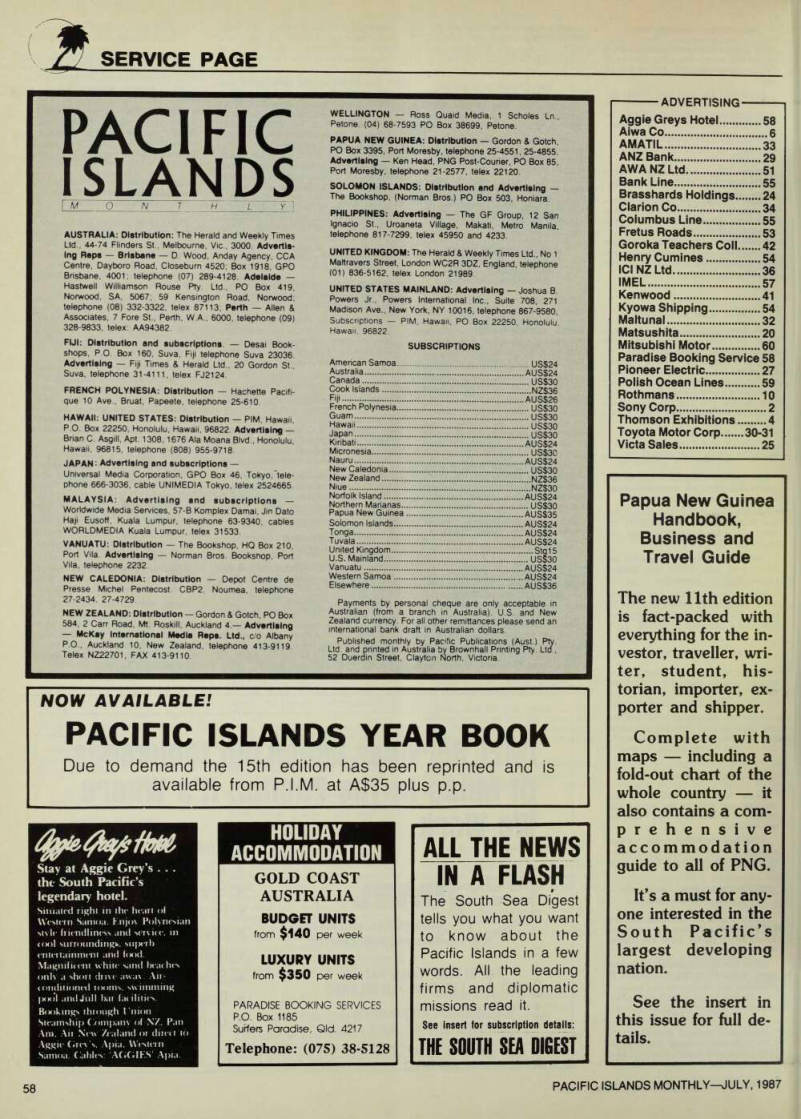
Aggie Greys Hotel 58 Aiwa Co 6
Amatil 33
ANZ Bank 29
Awa Nz Ltd 51
Bank Line 55 Brasshards Holdings 24 Clarion Co 34 Columbus Line 55 Fretus Roads 53 Goroka Teachers Coll 42 Henry Cumines 54
Ici Nz Ltd 36
Imel 57
Kenwood 41 Kyowa Shipping 54 Maltunai 32 Matsushita 20 Mitsubishi Motor 60 Paradise Booking Service 58 Pioneer Electric 27 Polish Ocean Lines 59 Rothmans 10 Sony Corp 2 Thomson Exhibitions 4 Toyota Motor Corp 30-31 Victa Sales 25
Advertisements & other items, pp. 58-60 (1 item)
Papua New Guinea
Handbook, Business and Travel Guide The new 11th edition is fact-packed with everything for the investor, traveller, writer, student, historian, importer, exporter and shipper.
Complete with maps including a fold-out chart of the whole country it also contains a comprehensive accommodation guide to all of PNG.
It’s a must for anyone interested in the South Pacific's largest developing nation.
See the insert in this issue for full details.
POUSH OCEAN IMS
General Management, 10 Lutego 24,81-364 GDYNIA, POLAND, Phone: 20-19-01, Cables: POLOCEAN Telex: 054-231 © Q m I VVf $ TT •v:<: iM .* . * 1 KW V?
SOUTH PACIFIC SERVICE
i r ?SLJ£ YNIA ’ HAMBURG, ROTTERDAM, MIDDLESBOROUGH/IMMINGHAM, Smoi: D h UNK RK ’ i. ROUEN ’ PAPEETE (via PANAMA), NOUMEA, AUCKLAND, HONIARA, RABAUL, LAE, oiiNoArUnb, by our multipurpose vessels carrying dry and reefer containers, reefer chambers, heavy lifts, breakbulk or palletized, bulk liquids. aiipw Awn ii a #-> POLISH OCEAN LINES Representatives AUCKLAND Mr. A. Sieradzki. Telex 21517 NZ “UNISHIP”. SYDNEY Mr. Walenciak. Telex 20428 AA
“SLEIGH”
Tahiti cnTAMA X , ono i—_ POLISH OCEAN LINES Agents AGENCIES LTD.. 21517 nt^mwirhip"
Charles Darwin theorized
that survival depends on the ability to change.
We’re living proof.
In 1859, Charles Darwin outlined his theories on evolution in The Origin of Species. Simply stated, Darwin believed that organisms must be capable of responding to their ever-changing environment in order to be successful.
For the past 70 years Mitsubishi has been proving the validity of Darwin's theories by meeting evolving transportation needs with a wide variety of vehicles incorporating the most advanced technologies of the times.
Si nee its production of the 1917 Model-A, Japan's first series-production car, Mitsubishi has continuously adopted the latest engineering innovations.
And today, it covers the world's most extensive range of vehicles—from 550 cc minicars to mammoth 16,000 cc all-wheel-drive, off-highway trucks.
Seven decades isn't much in evolutionary time but as the species continues on its long road to perfection, Darwin's theories are tested as they are applied to the products to meet society's changing transportation needs.
Mitsubishi Motors is now offering a free 24-page leaflet "The Mitsubishi", an introduction of Mitsubishi’s pioneering history. If interested, write to Advertising. International Business Planning Office. Office of International Business. Mitsubishi Motors Corporation, 33-8, Shiba 5-chome, Minato-ku, Tokyo 108, Japan.
A
MITSUBISHI
MOTORS
AMERICAN SAMOA: MORRIS SCANLAN SERVICE INC. P.O. Box 367, Pago Pago, Tel. 633-5520/AUSTRALIA; MITSUBISHI MOTORS AUSTRALIA LTD. Box 1284, South Road, Clovelly Park, South Australia 5042, Tel (08} 275-7223/FIJI: NIVIS MOTOR & MACHINERY CO., LTD. G.P.O. Box 150, Suva, Tel. 38341 1 /FRENCH POLYNESIA (TAHITI): ETS-BREDIN FRERES ET FILS P.O. Box 21, Papeete, Tahiti, Tel 4-202-58/NEW CALEDONIA: SOCIETE DAUTO DU PACIFIQUE SUD S.A. B.P. 438 Rond Point du Pacifique, Noumea, Tel. 274144/NEW ZEALAND: MITSUBISHI MOTORS NEW ZEALAND LTD. Todd Park. Heriot Drive, Private Bag, Porirua, Tel. 370-109/NORFDLK ISLAND; BORRYS LTD. P.O. Box 169. Norfolk Island, Tel 2114/PAPUA NEW GUINEA: TOBA PTY. LTD. P.O. Box 503, Port Moresby, Tel. 21-7874/ SOLOMON ISLANDS: HARVEST PACIFIC LTD. G.P.O. Box 88, Honiara, Guadalcanal, Tel. 30128/TONGA: SITANI MAPI CO., LTD. P.O Box 83, Nuku ALOFA, Tel 21-044/VANUATU: SOCOMETRA B.P. 06 Route de Lagon, Port-Vila, Tel 2314/WESTERN SAMOA: A M. MACDONALD HOLDINGS LTD. P.O. Box 576, Apia, Tel. 22022/SAIPAN/POHNPEI/MAJURO/KOSRAE/TRUK/YAP/ BELAU: MICRONESSIAN MOTORS, INC. 997 South Marine Drive, Tamuning, Guam 96911, Tel. 646-6827