Pacific

Islands
Monthly
American Samoa US$2.OO Australia A 52.00 Cook Islands NZ$3.OO Fiji f 51.75 Hawaii US$2.5O Kiribati A 52.00 Nauru A 52.00 New Caledonia CFP2SO New Zealand NZ$3.3O find. frt. and GST) Niue NZ$2.5O Norfolk Island A 52.00 Papua New Guinea K 2.00 Solomon Islands 552.00 Tahiti CFP3OO Tonga P 2.00 Tuvalu A 52.00
Usa Us$3.Oo
USTTand Guam US$2.5O Vanuatu VT2.00 Western Samoa T 2.75 •Recommended retail price only Registered by Australia Post Publication No. NBPI2IO
June, 1987
t
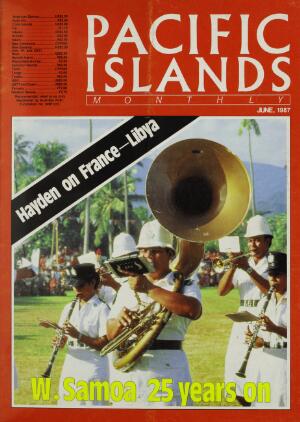
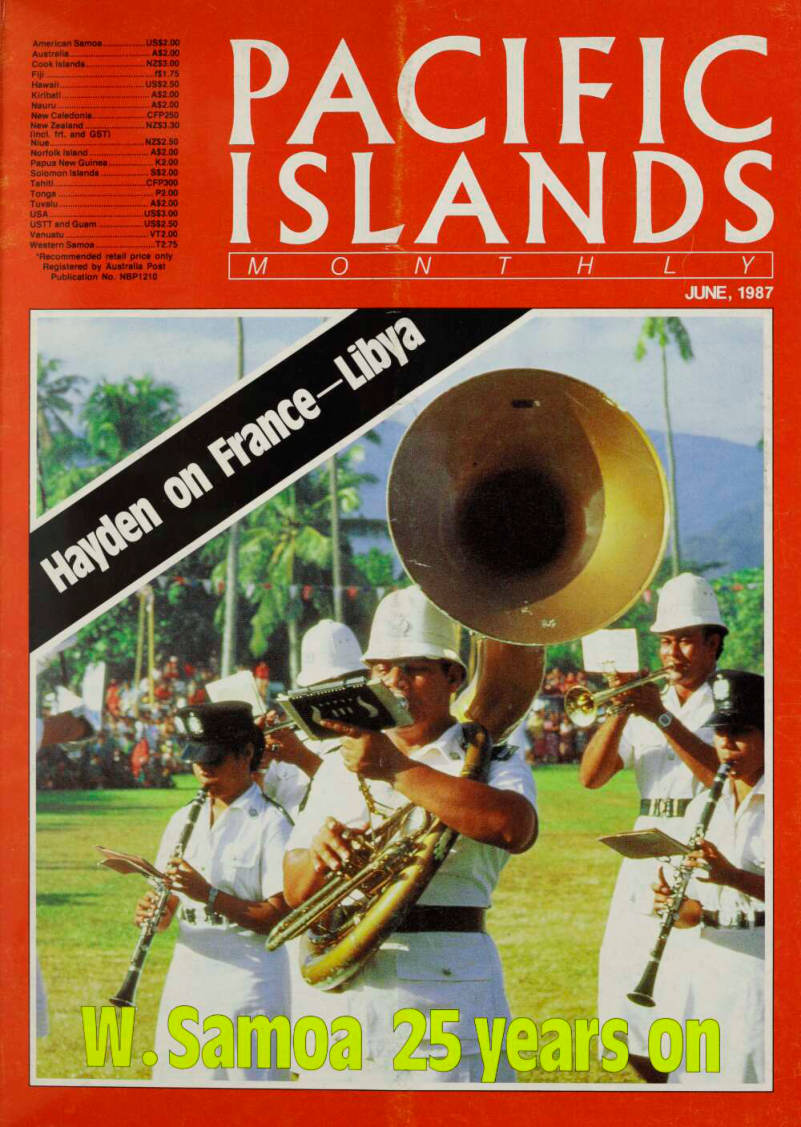
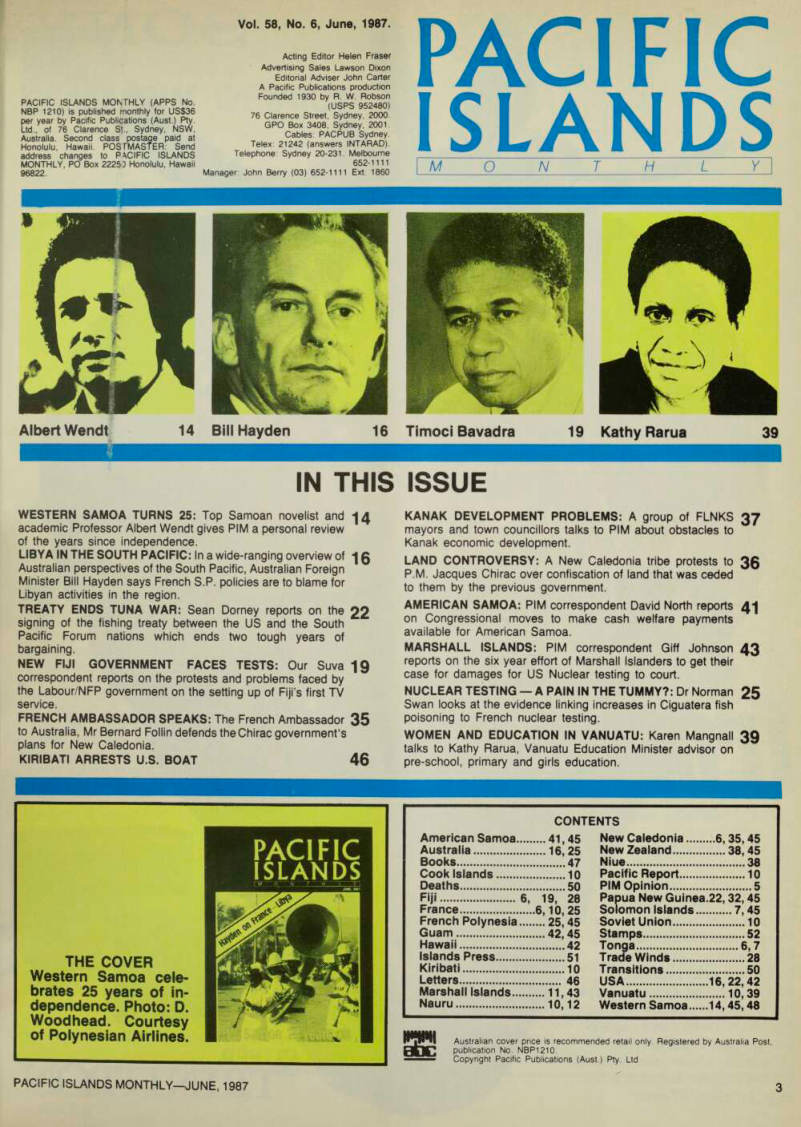
The Cover
Western Samoa cele brates 25 years of in dependence. Photo: D.
Woodhead. Courtesy
of Polynesian Airlines.
Advertisements & other items, pp. 2-3 (2 items)
Compact
but
big.
It used to be simple. In order to gain the maximum amount of interior space, cars necessarily had to have big bodies.
But then people also wanted compact family cars that were easier to handle and performed better. It came down to making a hard choice. Till Honda decided to challenge this state of affairs. Honda aimed to give people a lot of room in a small car that was easy to handle. So from the very start, Honda designed the Civic Sedan to realize an automotive goal that was considered virtually impossible—going for a compact body that would permit the maximum possible interior space to be realized.
And that's where Honda's MM philosophy makes the difference. It advocates minimum space for mechanisms and maximum space for utility. Honda's no-compromise approach combines superior performance with mechanical parts designed for compactness and high-density integration. Take the 12-valve engine for instance. Engineered for high power, it's also compact, durable, and economical. How about the high-performance suspension?
Light and compact, it takes up minimal space, allowing the car to have a lower, sleeker hood. Honda made the most effective use of available space wherever possible, leaving a generous interior space to ensure passenger comfort. That means plush, roomy seating for four adults with ample legroom for all. Take a look at the trunk. Deep and wide, it opens up right from the bumper line to take all the effort out of loading. Even the rear seatback folds down for extra loading convenience.
The end result is a deceptively orthodox sedan with a significantly higher level of driving enjoyment.
Compact but big. A paradox Honda challenged and solved. The Honda way. (0 f
4kal(o)®ffiki(2l©iffi
Equipment may vary in some countries. i n m In 1986, Williams/Honda won the Formula 1 Constructors' Championship. In 1987, Honda's Formula 1 engines will power both Williams and Lotus. Thus , we will continue to polish our expertise at the pinnacle of automotive technology.
Canon m tel Mob» H 6
POWERED by HONDA
AUSTRALIA: Honda Australia Pty, Ltd. Lot 95 Sharps Road, Tullamarine, Victoria3o43; Bennett Honda Pty, Ltd. 250 Victoria Road, Wethenll Park, N.S.W. 2164/NEW ZEALAND: NZMC Limited Manners Plaza, 57-65 Manners St., Wellington/PAPUA NEW GUINEA: Toba Pty, Ltd. PO. Box 503, Port Moresby/TAHITI: Honda Distribution S.A.R.L. B.P 1665, Papeete/KIRIBATI: Atoll Motor & Marino Services PO. Box 49, Bairiki Tarawa, Republic of Kiribati/U.S. TRUST TERRITORY; United Micronesia Development Association PO. Box 235, CHRB Saipan CM 96950/COOK ISLANDS: Cook Islands Motor Centre Ltd. PO. Box 74, Rarotonga/GUAM: Mark’s Motor Co., Inc. PO. Box DV, Agana/WESTERN SAMOA: Motor Distributors (Samoa) Ltd, PO Box 576, Apia/SOLOMON ISLANDS; Lee Kwok Kuen & Co., Ltd. PO Box 537 Honiara/NEW CALEDONIA. Societe Du Chalandage 8, Rue de la somme-B.P. 97, Nourhea/NAURU: Nauru Cooperation Republic of Nauru/FIJI: Coral Island Motors Ltd. Robertson Road, Suva, Fiji/ AMERICAN SAMOA Holiday Motors, Parts and Service PO. Box 968, Pago Pago, American Samoa 96799; Heleck’s Service Center Ltd. PO. Box 1138, Pago Pago, American Samoa 96799/TONGA: Tonga Industrial Traders PO. Box 1035, Nukualofa, Tonga/NORFOLK ISLAND: Duncombe Bay Garage New Cascade Road, Norfolk Island/VANUATU: Honda Farm Ltd. PO. Box 1031, Port Vila, Vanuatu
Pacific
ISLANDS
MONTHLY
Vol. 58, No. 6, June, 1987.
Albert Wendt 14
Bill Hayden 16
Timoci Bavadra 19
Kathy Rarua 39
In This Issue
WESTERN SAMOA TURNS 25: Top Samoan novelist and -J4 academic Professor Albert Wendt gives PIM a personal review of the years since independence.
LIBYA IN THE SOUTH PACIFIC: In a wide-ranging overview of *| g Australian perspectives of the South Pacific, Australian Foreign Minister Bill Hayden says French S.P. policies are to blame for Libyan activities in the region.
TREATY ENDS TUNA WAR: Sean Dorney reports on the 22 signing of the fishing treaty between the US and the South Pacific Forum nations which ends two tough years of bargaining.
NEW FIJI GOVERNMENT FACES TESTS: Our Suva 10 correspondent reports on the protests and problems faced by the Labour/NFP government on the setting up of Fiji’s first TV service.
FRENCH AMBASSADOR SPEAKS: The French Ambassador 35 to Australia, Mr Bernard Follin defends the Chirac government’s plans for New Caledonia.
Kiribati Arrests U.S. Boat 46
KANAK DEVELOPMENT PROBLEMS: A group of FLNKS 37 mayors and town councillors talks to PIM about obstacles to Kanak economic development.
LAND CONTROVERSY: A New Caledonia tribe protests to 36 P.M. Jacques Chirac over confiscation of land that was ceded to them by the previous government.
AMERICAN SAMOA: PIM correspondent David North reports 4*| on Congressional moves to make cash welfare payments available for American Samoa.
MARSHALL ISLANDS: PIM correspondent Giff Johnson 43 reports on the six year effort of Marshall Islanders to get their case for damages for US Nuclear testing to court.
NUCLEAR TESTING A PAIN IN THE TUMMY?: Dr Norman 25 Swan looks at the evidence linking increases in Ciguatera fish poisoning to French nuclear testing.
WOMEN AND EDUCATION IN VANUATU: Karen Mangnall 30 talks to Kathy Rarua, Vanuatu Education Minister advisor on pre-school, primary and girls education.
Contents
American Samoa 41,45 Australia 16,25 Books 47 Cook Islands 10 Deaths 50 Fiji 6, 19, 28 France 6,10, 25 French Polynesia 25,45 Guam 42,45 Hawaii 42 Islands Press 51 Kiribati 10 Letters 46 Marshall Islands 11,43 Nauru 10,12
New Caledonia 6,35,45 New Zealand 38,45 Niue 38 Pacific Report 10 PIM Opinion 5 Papua New Guinea. 22,32,45 Solomon Islands 7,45 Soviet Union 10 Stamps 52 Tonga 6,7 Trade Winds 28 Transitions 50
Usa 16,22, 42
Vanuatu 10,39 Western Samoa 14,45,48
Australian cover price is recommended retail only. Registered by Australia Post, publication No. NBPI2IO.
Copyright Pacific Publications (Aust.) Pty. Ltd
Advertisements & other items, pp. 3-4 (2 items)
Pacific Islands Monthly—June, 1987
3
PACIFIC ISLANDS MONTHLY (APPS No.
NBP 1210) is published monthly for US$36 per year by Pacific Publications (Aust.) Pty.
Ltd., of 76 Clarence S|.. Sydney, NSW, Australia. Second class postage paid at Honolulu, Hawaii. POSTMASTER: Send address changes to P\CIFIC ISLANDS MONTHLY, PO Box 22253 Honolulu, Hawaii 96822.
Acting Editor Helen Fraser Advertising Sales Lawson Dixon Editorial Adviser John Carter A Pacific Publications production Founded 1930 by R. W, Robson
(USPS 952480)
76 Clarence Street, Sydney, 2000 GPO Box 3408, Sydney, 2001.
Cables: PACPUB Sydney.
Telex: 21242 (answers INTARAD), Telephone: Sydney 20-231. Melbourne 652-1111 Manager: John Berry (03) 652-1111 Ext. 1860
Trinitron
SONY.
■ m V
KV-2092AS
KV-1440AS
Its so tempting.
The colour you get
from Sony's new Super
Trinitron.
Our new Pan-Focus gun is computer-designed to make our famous colour even sharper and clearer. Our new Black Screen makes whites brilliant, blacks profound, every colour deeper and richer.
Its flatter and sguarer too.
For less reflection and superb clarity, even in the corners.
For those whose taste demands the best, Super Trinitron is the most delicious TV ever.
Trinitron
Assault on democracy
Pim Opinion
The military action to overthrow a democratically-elected government in Fiji has been condemned worldwide for the outrage that it is. In its wake, Fiji can never be seen again in quite the same light, and in that fact there are consequences for the entire region. As this issue goes to press, the outcome of the military action remains unclear; the perpetrators and backers of the coup may be surprised by the strength of the people’s respect for constitutionality and traditional values. Two facts stand out, however.
First, the threat to law and order alleged by the military certainly did not spring from any action of the elected government or its supporters. As the misguided Colonel Rabuka acknowledged, any such threat came from those who felt they had lost the election, and that loss was the sole reason for their attitude.
Second, it became all too clear very quickly that leading members of the Alliance, including members of the previous government, were prepared to give legitimacy, if not active support, to this assault on democracy. Whether they actually initiated it is not clear, but ugly rumours to that effect circulated weeks before the armed invasion of the Parliament and the kidnapping of the government.
The concerns of some ethnic Fijians at the change of government is understandable, and was appreciated by the new government as much as by anyone else. Prime Minister Bavadra had gone out of his way to move cautiously and to offer reassurance. There can be little doubt now, however, that others exploited and amplified those fears for their own ends.
Given the unfortunate communal nature of Fijian politics, the change of government had, in fact, proceeded rather more smoothly than might have been expected. That was a justifiable
source of pride for the undoubted majority who support democratic process not only within Fiji, but in the region and beyond.
There certainly can be no claim to democracy when one side of the political process refuses to acknowledge the possibility of losing an election. It is sadly true that the sharp political division along communal lines in Fiji has tended to propagate such a view a decidedly minority view, but nonetheless dangerous, as has been demonstrated.
Colonel Rabuka and his fellow conspirators have dealt their country a blow of immense proportions. Fiji’s leading role in the region, and its standing in the world, has rested as much on political as economic success. With all the difficulties of communal "balance” and the perceived need to entrench special rights for citizens of an ethnic Fijian background, free and open government had, by and large, been seen to work well.
The coup has shattered the image of maturity and stability nurtured over more than 17 years since independence. It represents the grossest misconception of the genuine, long term interests of a nation such as Fiji. Indeed, it is bizarre that, in the name of security, the military should turn, not on those they see as potential insurrectionists, but on the constitution, the elected government and a Parliament functioning quite normally.
Governments installed at gunpoint have no part in the affairs of this region. Rabuka and the plotters who supported and motivated him clearly have no appreciation of the fundamental values of the community of nations in the South Pacific. It is necessary that the leaders of those nations make this clear through the South Pacific Forum.
letters
Sour grapes allegation
WE have read with dismay the reports from Fiji of Apisai Tora’s speech to the western chiefs in Veseisei Vuda in early April.
We wish to draw the atten tion of your readers to the fact that Mr Tora was a member of the NFP who, following on from the NFP’s election victory in April 1977, voted for an Indian Prime Minister (Mr Koya) in preference to a Fijian (Captain Maitoga).
The thought occurred to us as to how much credibility was to be attributed to his present activities which can only be described as counter productive to the task of nation building which the present government appears to be so intensely com mitted to.
Apisai Tora must not forget the following facts: 1. Fiji was ceded uncondi tionally to Great Britain in 1874. 2. It was the British Colonial Government which brought the Indians to Fiji in the first place under the indentured system. 3. It was the British Colonial Government which allowed the Indians to remain in Fiji. 4. The Indians in Fiji today are their descendants. 5. These Indians are Fiji citi zens by their birthright and under the granting of Fiji constitution; and 6. Mr Koya did not have any authority or power to make any concessions on behalf
of the Indian community as to their status in Fiji.
We call upon all right think ing citizens of Fiji, regardless of ethnic origin, to judge Mr Tora’s comments in the light of his maverick past. We must not be intimidated into remaining si lent in the face of Mr Tora’s racist and inflammatory re marks; we must recognise that the scare tactics perpetuated by people of Mr Tora’s ilk are designed to frighten non/indi genous Fiji citizens into fleeing the country.
Mr Tora’s reaction smacks of sour grapes. It is possible that he is suffering from “post ministerial blues.” It’s simply not cricket, Mr Tora. One can not play a game of cricket and then threaten the other side because one has lost the match or, even worse, demand afterwards that all future games are to be played with the proviso that only one’s own side wins.
To limit the citizenship rights of some of the national popula tion without the consent of those affected would be not only undemocratic, but would be to introduce apartheid into Fiji. One is either a Fiji citizen or not; there are no in-betweens.
Also, we question Mr Tora’s allegation that the new govern ment is an Indian party. It is the first truly multi-racial party in Fiji’s history and could not have come into power without the votes of Fijians and general electors. Is Mr Tora going to threaten these voters as he has done the Indians?
Mr Tora should realise that his pronouncements and actions are presenting a highly detrimental image of Fiji to the international community. We call upon the new government to deal very firmly with any attempts to break the laws of Fiji, which are sacrosanct, and
we call on the DDF to scrutinise all racist and discriminatory re marks made and actions taken by political figures, and to take appropriate action in the light of Fiji’s constitution and laws in general.
The people showed faith in Dr Bavadra and elected him our Prime Minister. We can only hope that the same people will show their good sense by distancing themselves from Api sai Tora’s disruptive activities and allow him to sink into the depths of political history where he deserves to be archived.
Times have changed.
We are:
Anil Singh,
Chandu Lodhia,
Executives of NFP’s Youth Movement, Sydney.
Bank
details
I HAVE read your article on “Shell Banks in the Pacific” with considerable interest.
You made the distinction be tween the banks that operate legitimately with the backing of reputable banking institutions and those that were formed by entrepreneurs for other reasons.
As Tonga featured rather prominently in your article, I would like to draw to your readers’ attention that the Bank of Tonga falls into the category of a sound reputable institution with impeccable ownership.
For the record Bank of Ton ga is owned: • 20% by the Kingdom of Tonga • 20% by the Kingdom of Tonga in trust for the people of Tonga • 20% by the Bank of Hawaii
• 20% by the Bank of New Zealand • 20% by the Westpac Banking Corporation Westpac Banking Corpora tion is Managing Agent.
As at 31st December 1986, its financial situation was: A55et5...T0P553,617,000 Liabilities T0P539,342,000
Shareholders’ Funds $14,275,000 Net profit after tax for the year to 31 December 1986 was T0P52,882,000.
May I commend you on the substance of your timely article.
Russell Leitch,
Chairman, Bank of Tonga.
Language of despair
despair
We are sending you a copy of a letter we have sent to Prime Minister Jacques Chirac.
We would like you to be aware of our situation, because settlers are trying with the ADRAF (Rural and Agricultural Land Development Agency) to push us to revolt a revolt which would, according to rumour, be wiped out bloodily by them with agreement of the Overseas Territories Minister, Bernard Pons.
We had hoped to get back the Goyetta property of 3000 hectares it has been divided between four settlers. We had the Cassis property of 450 ha the settler Orcan was installed by force. We have the Pidjen property (previously owned by Ballande) next to our tribal reserve, of 1600 ha. The
Technical Director of the Agen cy, Mr Christian Breton announced last week his inten tion of parcelling it out.
After this we will be reduced to the limits of the reserve such as it existed before the land reform of Mr Dijoud of 1980.
Everybody in New Caledonia is aware of the long standing project of the (anti -independ ence) RPCR of doing away with the reserves by dividing them into private property.
When we will have lost the Pidjen property, our only op tion will be revolt, the language of despair even if we know that we will be massacred by the Army. But at least you will know that the fault is not ours.
The Oundjo Tribe,
See page 36 for the letter to Mr Chirac.
sought
Details sought
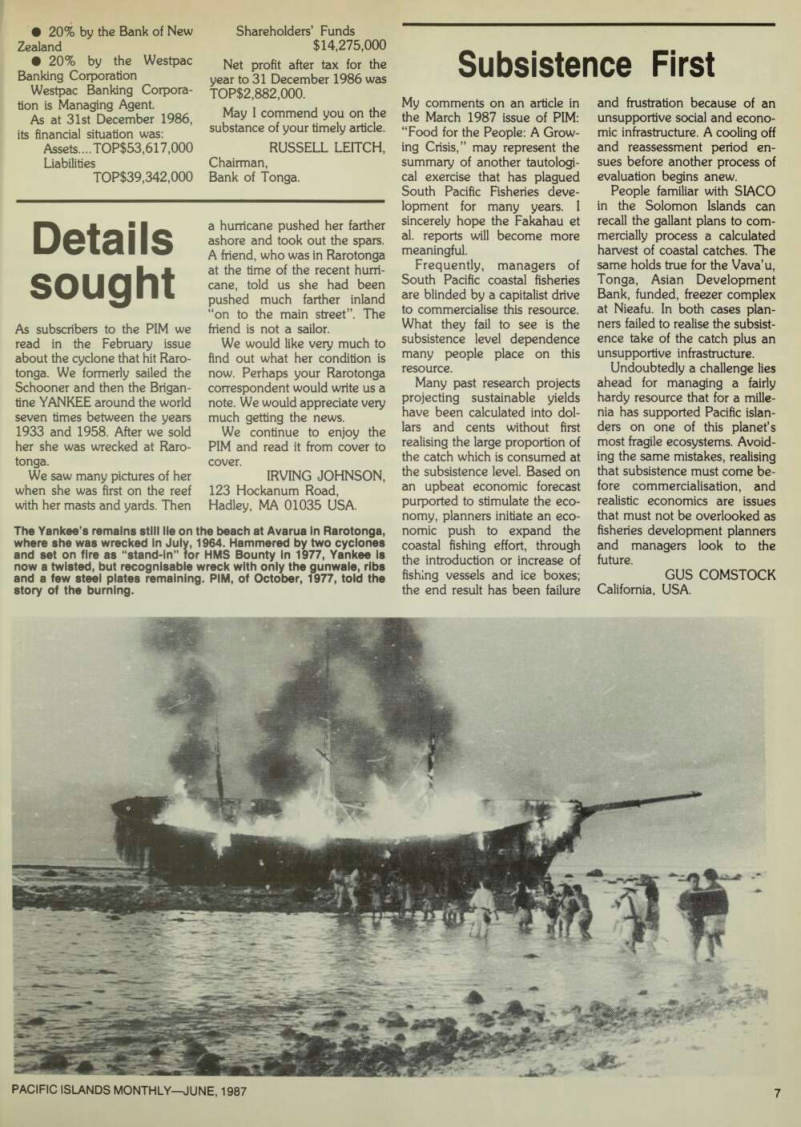
As subscribers to the PIM we read in the February issue about the cyclone that hit Raro tonga. We formerly sailed the Schooner and then the Brigan tine YANKEE around the world seven times between the years 1933 and 1958. After we sold her she was wrecked at Raro tonga.
We saw many pictures of her when she was first on the reef with her masts and yards. Then
a hurricane pushed her farther ashore and took out the spars.
A friend, who was in Rarotonga at the time of the recent hurri cane, told us she had been pushed much farther inland “on to the main street”. The friend is not a sailor.
We would like very much to find out what her condition is now. Perhaps your Rarotonga correspondent would write us a note. We would appreciate very much getting the news.
We continue to enjoy the PIM and read it from cover to cover.
Irving Johnson,
123 Hockanum Road, Hadley, MA 01035 USA.
Subsistence First
My comments on an article in the March 1987 issue of PIM: “Food for the People: A Grow ing Crisis,” may represent the summary of another tautologi cal exercise that has plagued South Pacific Fisheries deve lopment for many years. I sincerely hope the Fakahau et al. reports will become more meaningful.
Frequently, managers of South Pacific coastal fisheries are blinded by a capitalist drive to commercialise this resource.
What they fail to see is the subsistence level dependence many people place on this resource.
Many past research projects projecting sustainable yields have been calculated into dol lars and cents without first realising the large proportion of the catch which is consumed at the subsistence level. Based on an upbeat economic forecast purported to stimulate the eco nomy, planners initiate an eco nomic push to expand the coastal fishing effort, through the introduction or increase of fishing vessels and ice boxes; the end result has been failure
and frustration because of an unsupportive social and econo mic infrastructure. A cooling off and reassessment period en sues before another process of evaluation begins anew.
People familiar with SIACO in the Solomon Islands can recall the gallant plans to com mercially process a calculated harvest of coastal catches. The same holds true for the Vava’u, Tonga, Asian Development Bank, funded, freezer complex at Nieafu. In both cases plan ners failed to realise the subsist ence take of the catch plus an unsupportive infrastructure.
Undoubtedly a challenge lies ahead for managing a fairly hardy resource that for a mille nia has supported Pacific islan ders on one of this planet’s most fragile ecosystems. Avoid ing the same mistakes, realising that subsistence must come be fore commercialisation, and realistic economics are issues that must not be overlooked as fisheries development planners and managers look to the future.
Gus Comstock
California, USA.
The Yankee’s remains still lie on the beach at Avarua in Rarotonga, where she was wrecked in July, 1964. Hammered by two cyclones and set on fire as "stand-in" for HMS Bounty in 1977, Yankee is now a twisted, but recognisable wreck with only the gunwale, ribs and a few steel plates remaining. PIM, of October, 1977, told the story of the burning.
Advertisements & other items, pp. 8-9 (1 item)
The Science of Sensation: How the new
Mazda 929 is engineered to feel fantastic.
That certain something: some cars have it, some cars don’t. It’s not a question of power, though that’s certainly important. And it’s not a question of comfort or ride, though these too are definitely a part of the equation. It seems to be the sum total of all these things plus something intangible.
This is the sensation that Mazda’s engineers sought to build into the new 929. Of course, trying to engineer an indescribable feeling into a car might seem like an impossible road to follow.
For Mazda engineers, it is the only road to follow.
Sensitive engineering We began by using a computer in a way no one had ever thought to before. Right on Mazda’s special test course, the driver’s experiences and feelings were simultaneously recorded and then correlated with the car’s very tangible performance characteristics. This innovative technique enabled Mazda engineers to determine precisely what makes a driver feel sensational. The task then was to engineer that sensation into the new 929.
A dynamic feeling It starts with high power; a new 3.0 litre, 18-valve V-6 engine. But of course, that’s only a start. Power must be complemented by complete control. For this, Mazda designed a new E-Link suspension system that’s precisely tuned to the needs of the new 929.
But that still wasn’t enough to capture that “je ne sais quoi” we
were looking for. It was when body rigidity was balanced into the equation that there was a dramatic difference in how the driver felt.
Rejecting the static conditions under which most auto makers do their research, Mazda engineers developed a way to measure body rigidity under dynamic, driving conditions. Called Dynamic Modal Analysis, this unique method enabled Mazda to pinpoint with laser accuracy just where the new 929’s body needed reinforcement.
And helped suggest the most effective ways to do this. We could try to describe the results, but the only way to truly know the pleasure is to experience it for yourself.
Dedication you can feel This dedication to how you feel is not unique to Mazda’s work on the new 929. Our people bring this dedication to every car we build.
And it’s a dedication you can feel.
The high level of stability, comfort and quiet achieved by the new 929 is due to Mazda’s innovative Dynamic Modal Analysis system, which enabled us to increase rigidity substantially.
New Mazda 929 Models and features shown may not be available in your area. Please consult your local Mazda dealer.
Enter the “Mazda Family Photo Contest 'BB For further information, please contact your nearest Mazda dealer. Contest closes on June 30, 1987.
mazoa
© Mazda Motor Corporation
pacific report
Vanuatu Reacts On
Libya
Vanuatu’s Prime Minister, Father Walter Lini, says any attempt to raise the question of Vanuatu’s links with Libya at the South Pacific Forum will signal the end of the 13-member regional grouping. Father Lini says the forum has no mandate to discuss the domestic issues of member states, which includes Vanuatu’s Libyan connec tions. Concern over Libyan moves in the South Pacific led to a hastily arranged meeting in early May between Australia’s Foreign Minister, Mr Hayden and the New Zealand Prime Minister, Mr Lange. In a statement issued in Port Vila, Father Lini accused Australia and New Zealand of trying to use his country’s trade and diplomatic ties with Tripoli to isolate and destabilise Vanuatu. Father Lini said Vanuatu would not be forced to follow the Western line but would maintain a non aligned and independent foreign policy in the South Pacific.
Timber Marketing
Investigated
Papua New Guinea’s Prime Minister Mr Wingti has appointed Mr Justice Toss Barnett of the National Court to investigate allegations of malpractice in timber market ing operations of the last six months.
Terms of reference for the inquiry include allegations that certain ministers received direct or indirect benefits in the allocation of the country’s timber resources to various companies. The roles of Foreign Minister Ted Diro and Police Minister Paul Torato will be investigated - both held the forestry portfolio during the period in question.
Kiribati Captures
U.S. Boat
Kiribati captured an American tuna boat allegedly fishing illegally inside its exclusive economic zone. The arrest of the purse seiner the “Tradition” followed a com bined air and sea operation by the Ministry of Natural Resource Development and police. A Ministry statement said the boat was taken to the port of Betio under command of a boarding party. Natural Resouce Development Minister, Mr
Babera Kirata, said the ship’s captain and the company would be charged with illegal fishing in Kiribati waters. The “Tradition” was one of nine American purse seiners alleged to have been fishing in Kiribati’s exclusive economic zone without a licence.
Both the Kiriabti and Tuvalu Governments had lodged protests with the US Govern ment over alleged illegal fishing by Amer ican tuna boats. Kiribati’s Police Commis sioner, Mr Patrick Somerville, said the master, owner and the charterer of the “Tradition” could face liability of up to $A 250.000 and the court could also order the forfeiture of the boat and catch.
Fisheries Pact Signed
The Cook Islands Minister for Marine Resources, Dr Pupuke Robati, has signed a new fisheries agreement with the Taiwan Deep Sea Tuna Boat-owners and Expor ters Association, licensing 55 Taiwanese long-liners to operate for 12 months, back-dated to January 1, in the country’s 200- mile fisheries zone for a fee of SNZ 140.000 (about SUS 82,150). Last year, 30 Taiwanese vessels were licensed for a fee of $U542,000. Negotiations are con tinuing with South Korea over its licence renewal.
Soviet Vessel Visits
Vanuatu
The first Russian fishing boat to visit Vanuatu since the signing of the agreement licensing Soviet fishing vessels to operate in Vanuatu’s 200-mile fisheries zone berth ed in Port Vila recently. The ship, the “Tagma”, obtained fuel and supplies, said Vanuatu’s fisheries director, Mr Richard Kaltonga.
Nauru Wins Court
Action
The Nauru Local Government Council won a damages suit against the New Zealand Seaman’s Industrial Workers’ Un ion, which, in 1973, blacklisted the Nauru ship “MV Enna G” in New Zealand. The union entered two appeals, the first against the judgment of the NZ High Court in December, 1982, and the second against an increase in the damages when the
Court of Appeal allowed a cross-appeal by the council for an increase in the original damages award plus interest. The original award to the Nauru Council was $A63,568.66 (about $U545,133 plus 11% interest from July 23, 1973. The second Court of Appeal increased this by 5A142.110 (about $US100,898) plus,in terest, and ruled that the interest should run from 1982, the date of the High Court judgment,and not from 1986 when the Appeal Court increased the amount of damages.
Compensation Sought
From France
The international environmental group, Greenpeace, is seeking SUSIB million from France in compensation for the sinking of its flagship, the “Rainbow Warrior”, by French agents. The “Rain bow Warrior” was blown up in Auckland harbour, nearly two years ago, just before it was due to lead a flotilla to protest against French nuclear testing in the South Pacific.
A Greenpeace lawyer in New Zealand, Mr Ted Thomas, said negotiations over the compensation claim would begin soon in Geneva, before a three- member in ternational arbitration panel. He said most of the $lB million claim related to damage caused to the “Rainbow Warrior” when the French agents used two limpet mines to blow it up. However, part of the claim was for what he called the outrageous nature of the French Government’s attack on the vessel. France has already paid New Zealand SUS 7 million in special damages for its agents attacking the ship in a New Zealand port.
French Funds For
Islands
A “Letter from the Minister for the South Pacific” (a monthly newsletter from the Papeete office of the Minister, Gaston Flosse), reports that the South Pacific Cooperation Fund set up by the French Government “as a financial catalyst for the technical, economic, social and cultural advancement of islands throughout the region”, is now available to island nations of the region. The fund, of about SUS 4 million, has already been used by the Cook Islands to repair damage caused by Cyclone Sally in January, and by Tonga to
finance the installation of solar-powered audio-visual equipment for educational purposes and the equipment of a foreign language school. The letter also reports that the new French University of the South Pacific will open in Papeete in September and Noumea in February, 1988, and its scientific council will offer seats to professors from other universities in the region.
New Member For Spec
The Republic of the Marshall Islands has become the 15th member of the South Pacific Bureau for Economic Cooperation, SPEC. The Marshall Islands Assistant Attorney-General, Mr John Howard, pre sented his Government’s Instrument of Accession, signed by President Amata Kabua, to Fiji’s Foreign Affairs Secretary, Mr James Maraj at the end of April. Full SPEC membership for the Marshall Islands - newly independent in free association with the US - was unanimously endorsed by the 14 other member governments.
Guest Worker
Scheme Rejected
The Australian Immigration Department told a Federal Parliamentary inquiry that a guest worker scheme would not solve the economic problems of the South Pacific.
The Department’s submission to the in quiry into Australia’s relations with the South Pacific said that concessions for the Pacific would call into question the fun damental tenets of Australia’s global non discriminatory immigration system.
Moreover, the submission said Australia was committed to permanent settlement rather than temporary workers, and ques tioned the long-term economic value of cash remittances to Pacific islands from workers overseas. The department said experience suggested that the effect of remittances was to increase reliance on imported food and consumer items. The department said that about 1550 people from the South Pacific migrated to Austra lia in 1986, a 59% increase on 1985.
Nz Warned On Trade
British Foreign Secretary, Sir Geoffrey Howe, warned New Zealand that its anti-nuclear policies threatened its trade with Europe. Visiting Wellington, Sir Geof frey said Britain would continue to help New Zealand sell its dairy produce in the European community but he warned that New Zealand’s cause was less likely to prevail in the EC while it had policies which
were seen to be weakening Western security. NZ’s Prime Minister Lange re torted at a separate news conference by accusing farming interests in Britain of trying to exploit New Zealand’s foreign policy to disguise a protectionist argument.
Lange criticised Sir Geoffrey’s assertion that NZ was abricating responsibilities by cutting itself off entirely from the Western nuclear shield. New Zealand was now for the first time paying its way in defence with a policy of self-reliance.
French Gendarme
Shot Dead
A French gendarme was shot dead at Neami village,near Kone,in the central highlands of New Caledonia in late April.
French police said the gendarme was shot by a Melanesian wanted for theft who was arrested after being wounded in a leg by police. Another Melanesian was also arrested and two others sought by police.
The police said the case had no political overtones, however the FLNKS (Kanak Socialist National Liberation Front) said the four Kanak men had found guns in 10 cars belonging to local white settlers and had removed them. The FLNKS said the
police had arrived in Neami village before sam, accompanied by extreme right wing settlers - arrests for a suspected crime are illegal before bam - and that police had begun shooting, panicking villagers.
Army Exercises
Called Off
The New Zealand Army called off exercises with the Fiji Army that were scheduled for late April. A Radio Australia report from Wellington said the exercises were called off so as not to cause concern among Fijians. The report said it was understood that officials believed that NZ Army troops arriving in Fiji on military aircraft may cause Fijians to think they were being sent because of current local feelings about the new Government.
Two Men Found Alive
A Japanese fishing boat has found alive two young men who had been adrift in a six-metre fishing boat for months. The men, aged 18 and 20, were picked up near the Santa Cruz group in the far south of the Solomon Islands after surviving the ordeal in which five of their friends died. A PNG
Maritime Search and Rescue spokesman said the group set out from Maromon in the Lehir Islands, heading for Kavieng, about 220 km north-west on New Ireland.
The rescued men were hospitalised suffer ing badly from exposure and dehydration.
Foreign Ministers Call
On France
Foreign Ministers from Papua New Guinea, the Solomon Islands and Vanuatu have called on France to invite the United Nations to create a special committee to assess the independence issue in New Caledonia. Following a week-long meeting in Honiara in April the Foreign Ministers also called on France to consult the FLNKS independence movement in the territory, and noted with concern the French military build-up in New Caledonia. Also discussed at the meeting were economic coopera tion, security surveillance and the concept of a single regional organisation. The Ministers agreed to explore the possibility of setting up a House of Melanesia in Brussels and New York to represent their countries.
Undp Grant For
Project
The United Nations Development Prog ramme has announced a new grant, worth $U5622,000, to extend a livestock project in the Pacific region. The Tonga-based project had advised island nations on goat, pig and poultry farming.
Oil Palm Development
The Asian Development Bank has approved two loans totalling K 29.9 million (about SUS 33.2mi11i0n) and a technical assistance grant for a smallholder oil palm development project in Papua New Guinea’s West New Britain province de signed to increase the incomes of about 2200 small-scale farmers. The project is designed to increase PNG’s annual agricultural production by 31,930 tonnes of palm oil and 6390 tonnes of palm kernel with increased foreign exchange earnings of K 16.1 million(about SUSI7.B million) for the palm oil and K 1.3 million (about SUSI. 4 million) for the palm kernels.
Nauru Signs Nfz
Treaty
Nauru’s President Hammer Deßoburt made a flying visit to Fiji during which he signed the South Pacific Nuclear Free Zone
Treaty without leaving his Air Nauru jet at Naursori airport. Nauru is the ninth of the South Pacific Forum’s 15 member nations to ratify the SPNFZ Treaty which bans the manufacture, testing or use of nuclear devices in the region.
Soviet Diplomat
Ordered Out
A Soviet diplomat who left New Zealand at the end of April after being accused of being a KGB agent claimed his expulsion was political. Mr Sergei Budnik, fourth ranking Soviet Embassy officer said on departure he’d never been a member of the Soviet secret police.
Minister Says
Tests Continue
The French Minister for Overseas Territor ies, Mr Bernard Pons, said France’s nuc lear test sites in the South Pacific will continue to contribute to French security.
Speaking to the Territorial Assembly in Tahiti, Mr Pons said France had to continue testing weapons as they were modernised to maintain the credibility of its nuclear deterrent Mr Pons described the tests as sufficiently isolated, and said France was sure it could master the problems of radiation safety, environmen tal protection, and the health of the Polynesian population. France’s recent nuclear test at Mururoa atoll prompted renewed protests from Australia and New Zealand.
Three Killed
After Bomb Explodes
In Papua New Guinea three men were killed when a wartime bomb exploded on Matupit island near Rabaul. The three were among six men who had been defusing the bomb to get the powder, which they had planned to make dynamite to catch fish. The three survivors were hospitalised. Rabaul police say the death of the three men is a shocking reminder to people on the Gazelle Peninsula not to try to dismantle bombs. Police have again appealed to people to report any sightings of wartime bombs, so that defence force personnel can be called in to remove them.
Unofficial Boycott
The first session of Fiji’s newly-elected parliament in Suva was unofficially boycot ted by the opposition. Only five of the 24 members of the opposition Alliance party
attended the ceremonial swearing-in ses sion, which was slightly delayed by a bomb hoax. Reuters newsagency said the unoffi cial boycott was described by some Alliance members as a gesture of support for the country’s indigenous Fijian popula tion, which they said was unhappy about the dominance of Indians in the new government. About 2000 Fijians milled around outside the building, singing traditional Fijian songs. An Alliance party statement said the members would be present for the next session and the taking of the oath of allegiance.
P.N.G. Diplomat
Recalled
Papua New Guinea recalled its High Commissioner to Australia, Mr James Winare, following an incident in Canberra in May, in which a senior Australian Foreign Affairs official, John Wallace, was assaulted. Foreign Affairs Minister, Mr Ted Diro, said it was with “much regret” that he decided to recall Mr Winare, whom he described as a very diligent and hard working man with a long career in the public service. Mr Diro said Mr Winare may have been provoked into action which led to the unfortunate incident, but Papua New Guinea expected a high standard of professional behaviour by all its diplomats.
The Australian official, Mr John Wallace, required stitches in his face after the incident. Two months ago, Papua New Guinea recalled its Ambassador to the United States, Mr Abisinito, after he was involved in a car crash in Washington that resulted in serious injuries to an American.
Advertisements & other items, pp. 11-13 (1 item)
Forklifts
CONTAINER HANDLERS
HEAVY DUTY YARD FORKLIFTS
WALKIE STACKERS
WAREHOUSE FORKLIFTS
fT
SALES
SERVICE
HIRE
£ For the total solution to the high cost of new equipment □ is i■ j i : on
Queensland
Wholesale Forklifts
736 Kingsford Smith drive, Eagle Farm, Queensland 4007.
Ph. (07) 268 7755.
Fax. (07) 268 5862.
ALL THE NEWS
IN A FLASH
The South Sea Digest tells you what you want to know about the Pacific Islands in a few words. All the leading firms and diplomatic missions read it. You can ’phone or write or call for a follow up.
See insert for subscription details:
THE SOUTH SEA
DIGEST
o°lV
N*ls
>' *0
wmm:
A® 0 ' V e ' n »c •#** •
sao*
gf \o « TW » * vtf" 6 /// #■ &* <0 <1 „***•
t> es
n (H> i f * ///4^% o> 111 to Sponsors*. AIMEX 'B7 is sponsored by mm The Australian Mining industry AsS4 Council, supported by the A A Government of Australia.
Organised by Thomson Exhibitions a division of Thomson Australian Holdings Pty Ltd (Inc in ACT) 47 Chippen Street, Chippendale, NSW 2008.
Phone: (02) 699 2411. Telex: 122226 Fax (02) 690 1961
Celebrating what?
W. Samoa 25 years after: Celebrating what?
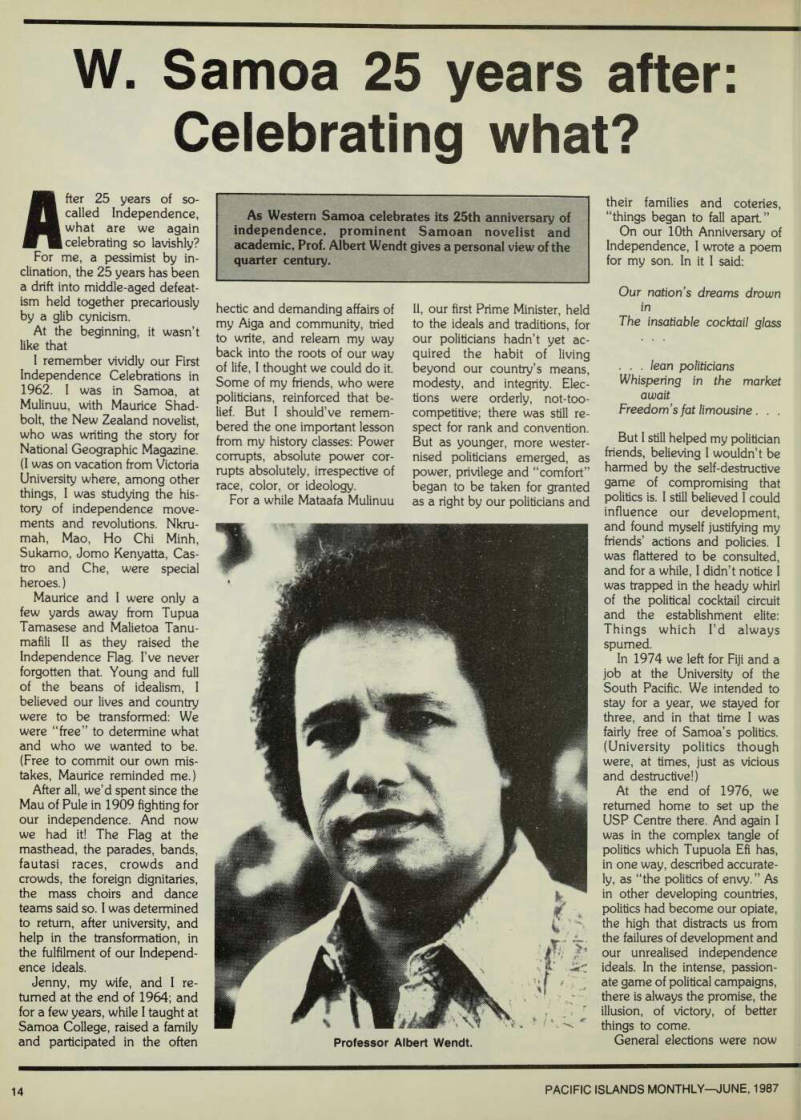
As Western Samoa celebrates its 25th anniversary of independence, prominent Samoan novelist and academic. Prof. Albert Wendt gives a personal view of the quarter century.
After 25 years of so called Independence, what are we again celebrating so lavishly?
For me, a pessimist by in clination, the 25 years has been a drift into middle-aged defeat ism held together precariously by a glib cynicism.
At the beginning, it wasn’t like that I remember vividly our First Independence Celebrations in 1962. I was in Samoa, at Mulinuu, with Maurice Shad bolt, the New Zealand novelist, who was writing the story for National Geographic Magazine. (I was on vacation from Victoria University where, among other things, I was studying the his tory of independence move ments and revolutions. Nkru mah, Mao, Ho Chi Minh, Sukarno, Jomo Kenyatta, Cas tro and Che, were special heroes.) Maurice and I were only a few yards away from Tupua Tamasese and Malietoa Tanu mafili II as they raised the Independence Flag. I’ve never forgotten that. Young and full of the beans of idealism, I believed our lives and country were to be transformed: We were “free” to determine what and who we wanted to be. (Free to commit our own mis takes, Maurice reminded me.) After all, we’d spent since the Mau of Pule in 1909 fighting for our independence. And now we had it! The Flag at the masthead, the parades, bands, fautasi races, crowds and crowds, the foreign dignitaries, the mass choirs and dance teams said so. I was determined to return, after university, and help in the transformation, in the fulfilment of our Independ ence ideals.
Jenny, my wife, and I re turned at the end of 1964; and for a few years, while I taught at Samoa College, raised a family and participated in the often
hectic and demanding affairs of my Aiga and community, tried to write, and relearn my way back into the roots of our way of life, I thought we could do it.
Some of my friends, who were politicians, reinforced that be lief. But I should’ve remem bered the one important lesson from my history classes: Power corrupts, absolute power cor rupts absolutely, irrespective of race, color, or ideology.
For a while Mataafa Mulinuu
11, our first Prime Minister, held to the ideals and traditions, for our politicians hadn’t yet ac quired the habit of living beyond our country’s means, modesty, and integrity. Elec tions were orderly, not-too competitive; there was still re spect for rank and convention.
But as younger, more wester nised politicians emerged, as power, privilege and “comfort” began to be taken for granted as a right by our politicians and
their families and coteries, “things began to fall apart”
On our 10th Anniversary of Independence, I wrote a poem for my son. In it I said: Our nation's dreams drown in The insatiable cocktail glass . . . lean politicians Whispering in the market await
Freedom’s fat limousine. . .
But I still helped my politician friends, believing I wouldn’t be harmed by the self-destructive game of compromising that politics is. I still believed I could influence our development, and found myself justifying my friends’ actions and policies. I was flattered to be consulted, and for a while, I didn’t notice I was trapped in the heady whirl of the political cocktail circuit and the establishment elite: Things which I’d always spumed.
In 1974 we left for Fiji and a job at the University of the South Pacific. We intended to stay for a year, we stayed for three, and in that time I was fairly free of Samoa’s politics. (University politics though were, at times, just as vicious and destructive!) At the end of 1976, we returned home to set up the USP Centre there. And again I was in the complex tangle of politics which Tupuola Efi has, in one way, described accurate ly, as “the politics of envy. ” As in other developing countries, politics had become our opiate, the high that distracts us from the failures of development and our unrealised independence ideals. In the intense, passion ate game of political campaigns, there is always the promise, the illusion, of victory, of better things to come.
General elections were now
Professor Albert Wendt.
elaborate, wasteful, intensely fought epics that involved even our children. Epics fought be tween “gangs” that changed composition according to who ever offered the highest price.
Thousands of campaign dollars were raised locally, and thousands more slipped in from abroad and used to buy the votes. Cynicism invaded every pore of the electorate, even blood relatives expected to be bought. Candidates who didn’t spread money and patronage didn’t have a hope of getting into Parliament. You also had to use those to hold your “gang” together and buy the “floating” MPs to win the Prime Ministership and become the government.
That is how it has remained, and it is worsening. Even when the corruption of politicians, business people, civil servants, community leaders is exposed, little is done to punish them.
The circle of corruption and cynicism has become a con spiracy of silence: If you tell on me, I’ll tell on you! For instance, our main post office burnt down “mysteriously” just as the inquiry into its affairs got under way. Hundreds of thousands of dollars were unaccounted for.
No one has been arrested for the fire. It isn’t clear whether investigations are still proceed ing. In a more Gilbert-and- Sullivan vein, one of our former Prime Ministers was accused in Parliament by the Finance Minister, who’d once been in his “gang,” of spending $BOOO of government money to clothe himself (for his expensive over seas trips). Nothing was done to the former Prime Minister.
Many of our MPs and civil servants travel abroad often because they make more money in per diems and allow ances (and can feast on more expensive food, wine) than staying home.
Investors, foreign companies, and confidence men buy into our elections to win business concessions, tax free incentives, and contracts. Our native for ests have become payments for campaign contributions. Re cently, some Members of Parliament lobbied to allow an American company to establish
a toxic waste disposal plant in Samoa; we were to become a dump for dangerous wastes the Americans wouldn’t have at home. (Rumor has it that a lot of money changed hands.) Parliament almost agreed to the deal. Fortunately, someone checked up on the American promoters of the deal and discovered they had gangster connections, and the project was dropped.
As this corruption has spread and deepened, our national development has stalled. Our exports continue to fall. Our most lucrative export are our people who emigrate. Last year they remitted far more than we earned from anything else. If New Zealand, Australia and
America opened their doors more, most of our able and adventurous people will emi grate there. Many of my former students have emigrated, many want to. In 1982, disillusioned, we also returned to Fiji.
Poverty is increasing rapidly.
Many of our leaders don’t want to see it we won’t admit to being poor.
Over half our annual budget is from foreign aid (direct and indirect). Like most other Paci fic countries, we’ve become a permanent welfare case. I can’t see us ever getting out of that hole. Many of our leaders don’t want to: Foreign aid is now built into their view of development, into their way of life. It is also in the interests of foreign powers
(our supposed benefactors) to keep us hooked on their aid.
As we plunge deeper into corruption, more frightening illnesses are erupting. For ex ample, our police are becoming more brutal and open about their brutality. In one recent case, they beat up two men one of them died.
So as our Government stages another lavish Independence Celebrations, I recall lines from Ruperake Petaia’s poem, “Freedom Day”: “This day I will hear once more Solemn promises Re-assurances Of Freedom and Unity Of Prosperity and Satisfac tion Of Toleration and Peace I see On the Malae A people misled . . .
And Freedom flies on Way up on a pole Unreachable. ”
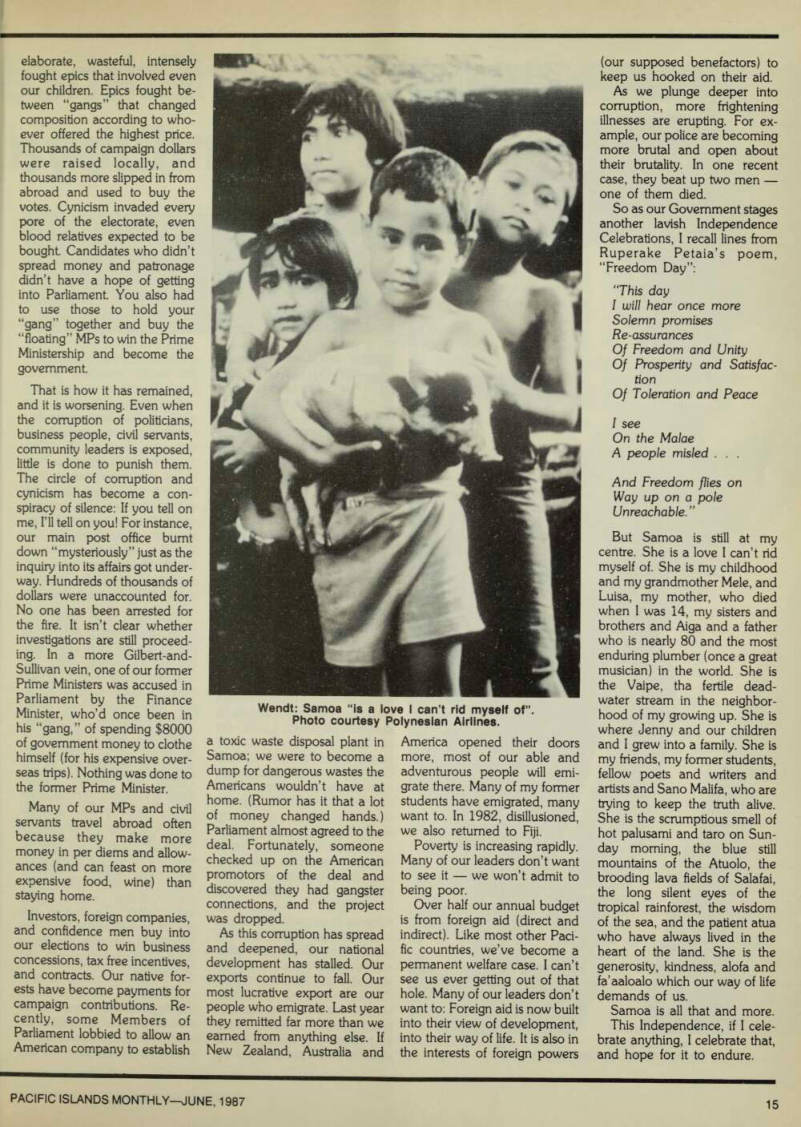
But Samoa is still at my centre. She is a love I can’t rid myself of. She is my childhood and my grandmother Mele, and Luisa, my mother, who died when I was 14, my sisters and brothers and Aiga and a father who is nearly 80 and the most enduring plumber (once a great musician) in the world. She is the Vaipe, tha fertile dead water stream in the neighbor hood of my growing up. She is where Jenny and our children and I grew into a family. She is my friends, my former students, fellow poets and writers and artists and Sano Malifa, who are trying to keep the truth alive.
She is the scrumptious smell of hot palusami and taro on Sun day morning, the blue still mountains of the Atuolo, the brooding lava fields of Salafai, the long silent eyes of the tropical rainforest, the wisdom of the sea, and the patient atua who have always lived in the heart of the land. She is the generosity, kindness, alofa and fa’aaloalo which our way of life demands of us.
Samoa is all that and more.
This Independence, if I cele brate anything, I celebrate that, and hope for it to endure.
Wendt: Samoa “is a love I can’t rid myself of”.
Photo courtesy Polynesian Airlines.
over Libya[?] Hayden says
France to blame over Libya[?] Hayden says
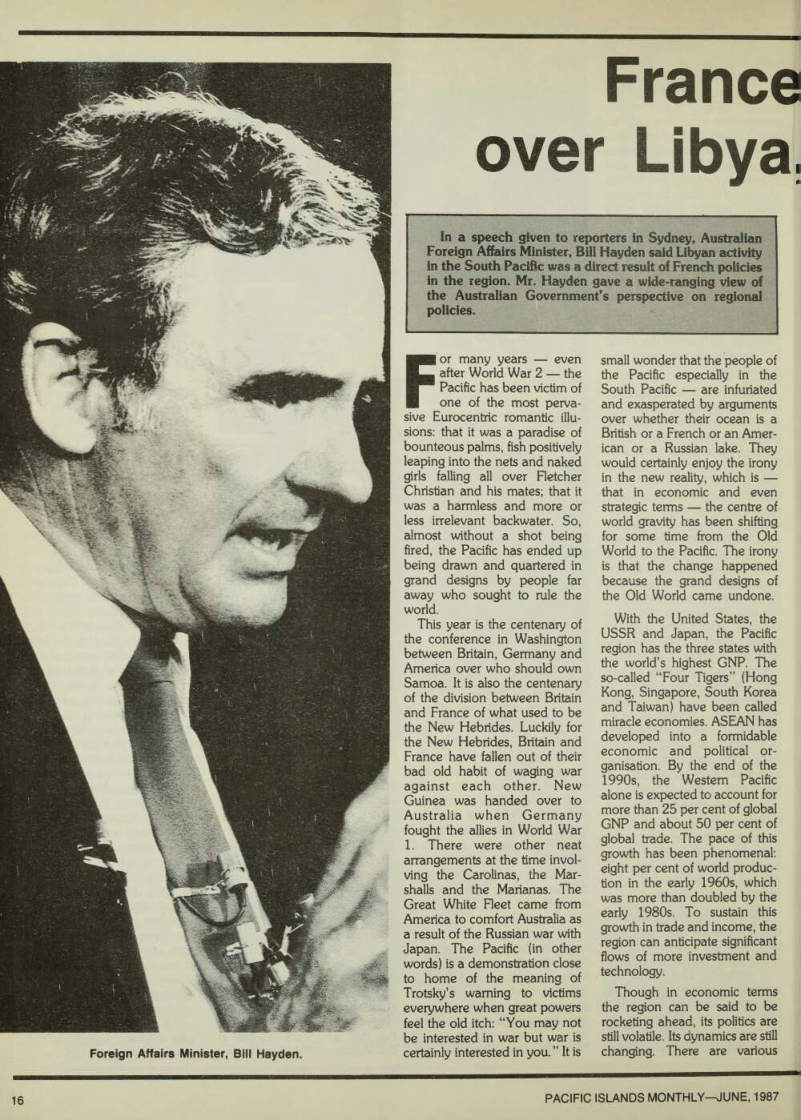
!n a speech given to reporters in Sydney, Australian Foreign Affairs Minister, Bill Hayden said Libyan activity in the South Pacific was a direct result of French policies in the region. Mr. Hayden gave a wide-ranging view of the Australian Government’s perspective on regional policies.
F or many years even after World War 2 the Pacific has been victim of one of the most perva sive Eurocentric romantic illu sions; that it was a paradise of bounteous palms, fish positively leaping into the nets and naked girls falling all over Fletcher Christian and his mates; that it was a harmless and more or less irrelevant backwater. So, almost without a shot being fired, the Pacific has ended up being drawn and quartered in grand designs by people far away who sought to rule the world.
This year is the centenary of the conference in Washington between Britain, Germany and America over who should own Samoa. It is also the centenary of the division between Britain and France of what used to be the New Hebrides. Luckily for the New Hebrides, Britain and France have fallen out of their bad old habit of waging war against each other. New Guinea was handed over to Australia when Germany fought the allies in World War 1. There were other neat arrangements at the time invol ving the Carolinas, the Mar shalls and the Marianas. The Great White Fleet came from America to comfort Australia as a result of the Russian war with Japan. The Pacific (in other words) is a demonstration close to home of the meaning of Trotsky’s warning to victims everywhere when great powers feel the old itch: “You may not be interested in war but war is certainly interested in you. ” It is
small wonder that the people of the Pacific especially in the South Pacific are infuriated and exasperated by arguments over whether their ocean is a British or a French or an Amer ican or a Russian lake. They would certainly enjoy the irony in the new reality, which is that in economic and even strategic terms the centre of world gravity has been shifting for some time from the Old World to the Pacific. The irony is that the change happened because the grand designs of the Old World came undone. , With the United States, the USSR and L Ja P an ' the p a c >ftc r p on has th ® *ree states with the world s highest CNR The f?- calle c d Four T, ers tU K ° n S- Singapore, South Korea and T a,wan > have “" ed "" ra f e economies. ASEAN has developed into a formidable economic and political or- San.sat.oa By the end of the I" 05 - the W«tem Pacific alone is expected to account for ?°, r ® ? p f “ n f 9 3 , a " d . abo 50 per ce , n , ° global trade_ The pace of this Srowth has been phenomenal: e.ghtpercent of world produc bon m the tl f arly . K wh £ h was more than doubled by the early 198 ° s . To . sustam * h ' S srowth in trade and income, the region can anhc.pate^gn.ficant ° f more lnvestment and technology.
Though in economic terms the region can be said to be rocketing ahead, its politics are still volatile. Its dynamics are still changing. There are various
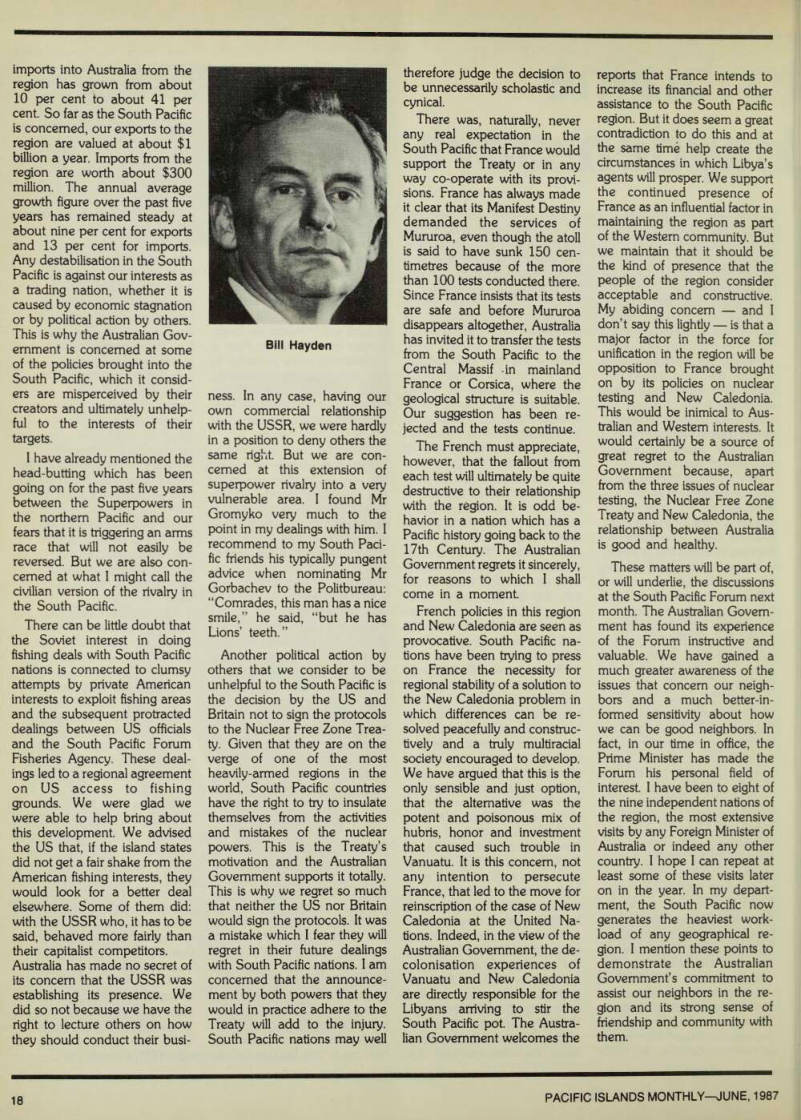
Foreign Affairs Minister, Bill Hayden.
factors in this process of change: international trade poli cy, for instance; the pressure for increased military spending by Japan; the effect on the re lationship between China and the USSR of the tragic situation in Indo-China; the effect on the relationship between China and the US of the future of Taiwan; the whole symbiotic interaction among the US, the USSR, China and Japan; and (most significantly) the potential for either international co-opera tion or discord over the Pacific’s potentially enormous marine and seabed resources.
Any of these factors could take up a speech of its own and they are in the main deve lopments north of the Equator.
I want to dwell for a moment on the state of affairs that is crucial ly interesting to Pacific Ocean countries: the situation which will underlie much of what will take place at the meeting in a few weeks’ time of the South Pacific Forum. By this I mean the burgeoning rivalry in the region by its two greatest powers.
The USSR has made no secret of its enhanced interest in the region. We have noted the increased investment in studies of Pacific region affairs in Soviet academic, institutions. The USSR’s dealings with Kiribati and Vanuatu over fishing rights have created a great deal of interest and even some alarm around the region. The mani festation of the USSR’s interest in Pacific affairs which has stimulated the most con troversy, of course, is General Secretary Gorbachev’s Vladi vostok speech last July. There isn’t time today to analyse this speech in any detail. I mention it as an example of the fact that not only is the USSR an un doubted geographical entity in this region, it has also decided to raise the status of the region in policy priorities. In other
words, the USSR is more actively challenging American policies in the Pacific region and the situation of the region as a sphere of influence of the West ern community of nations.
Secretary of Defence Weinberger (in his report to the Congress for the 1986 financial year) made the explicit point that the US has vital security and economic interests in the Pacific. His point is being underlined right now in Prime Minister Nakasone’s discussions in Washington. The Pacific re gion provides at the same time America’s major market, its ma jor competition and its major economic problems. It is host to America’s enormous military assets: in the Philippines, Guam, Japan and the Mar shalls. Five of the 18 mutual security agreements which America has with other coun tries are in this region: with Japan, South Korea, the Philip pines, Thailand and Australia and (on paper at least) New Zealand.
There is not a lot of mileage in complaining about the USSR and the US being member countries of the region. It’s like the honky-tonk pianist next door: he may be driving you mad but he’s an unavoidable physical fact and, if we can’t move, we have to leam to live with him. We do have the right to be worried, though, if our neighbors want to fight in the street outside the front door.
And the Australian Govern ment does worry that the new, higher level of rivalry between our Superpower neighbors is happening in a very sensitive and vulnerable area; an area which, after Central Europe, is the most heavily armed in the world, yet which is the least protected by arms control arrangements. The Soviet Union has in the northern part of the Pacific one-third of its naval resources, one-third of its
ss2o IRBMs and nearly one third of its airforce, including both combat aircraft and long range bombers. The US has the long-range bombers of the Strategic Air Command and the combat planes of the Pacific Air Command. The Pacific Fleets of both superpowers are huge, though the US Pacific Fleet is considerably more powerful. In the past few years especially, both countries have been carrying out manoeuvres near and in some cases very near each other’s forces.
I describe these facts not to suggest that Armageddon is on the way for that would be silly and unwarranted but to demonstrate a point that is especially disturbing to the Aus tralian Government. The most immediate point of contact be tween the forces I have de scribed is a long way to our north and it has to be admitted that the southern part of the Pacific is a relatively low-threat area. But we are concerned that the deployment of forces in the north means in effect that a military structure is being set up which will be a severe and entrenched obstacle to the cause of arms control and dis armament in the vast Pacific region. This was why South Pacific countries awarded such urgency to the process which culminated in the South Pacific Nuclear Free Zone Treaty.
Many small countries in the Pacific particularly small is land countries lack the clout and muscle of their neighbors.
They have reason to be wary of some of the elements of change overtaking this region. After all, this is the change which is speeding up the pace at which once familiar and acceptable forces in the region are being reformed. It is hastening the process in which new centres of power are emerging and new opportunities being created for interests to collide. These coun
tries exist in paradoxical circumstances (and, in many cases, with colonial legacies) with which some of the shakers and movers in the new Pacific have shown little patience.
There are states in the Pacific with populations too small for self-supporting economic activ ity but growing too fast to benefit from any economic growth. Their land areas are tiny but their sea areas huge.
For many of them, their colo nial past has presented them with unhelpful consequences: living standards set by previous administrations which cannot be sustained; minimal experi ence of training and education for their people, over-large bureaucracies providing in appropriate services; having to make do with narrow resource bases; dependent on aid and migrant labor remittances in stead of production for their wealth. Their economic condi tions are too serious and press ing for them to be misused for cold war purposes. They under stand full well the burden im posed by yet another paradox: that at the same time they are too small and remote to be economically influential and so placed as to be strategically vital.
All this describes in fact the two main elements of the Aus tralian Government’s motives for its more active and more sympathetic policy towards our South Pacific neighbors. The evidence for this concern is in our aid figures. Australian aid to the South Pacific in 1986-87 was the only item in our aid program which was not subject to last year’s broad budget cuts.
We expect to allocate $B6 million this year: 10 years ago it was only $l3 million. The first element is the strong moral justification the Government sees in helping our neighbors out of their economic vulnerability to outside ex ploitation and interference. The other and I’m quite happy to be open about it is that this vulnerability is not in Australia’s own interests.
We are a nation dependent on trade. The share of regional nations in our exports has in creased in the past three de cades from about 14 per cent to about 55 per cent. The share of
imports into Australia from the region has grown from about 10 per cent to about 41 per cent. So far as the South Pacific is concerned, our exports to the region are valued at about $1 billion a year. Imports from the region are worth about $3OO million. The annual average growth figure over the past five years has remained steady at about nine per cent for exports and 13 per cent for imports.
Any destabilisation in the South Pacific is against our interests as a trading nation, whether it is caused by economic stagnation or by political action by others.
This is why the Australian Gov ernment is concerned at some of the policies brought into the South Pacific, which it consid ers are misperceived by their creators and ultimately unhelp ful to the interests of their targets.
I have already mentioned the head-butting which has been going on for the past five years between the Superpowers in the northern Pacific and our fears that it is triggering an arms race that will not easily be reversed. But we are also con cerned at what I might call the civilian version of the rivalry in the South Pacific.
There can be little doubt that the Soviet interest in doing fishing deals with South Pacific nations is connected to clumsy attempts by private American interests to exploit fishing areas and the subsequent protracted dealings between US officials and the South Pacific Forum Fisheries Agency. These deal ings led to a regional agreement on US access to fishing grounds. We were glad we were able to help bring about this development. We advised the US that, if the island states did not get a fair shake from the American fishing interests, they would look for a better deal elsewhere. Some of them did: with the USSR who, it has to be said, behaved more fairly than their capitalist competitors.
Australia has made no secret of its concern that the USSR was establishing its presence. We did so not because we have the right to lecture others on how they should conduct their busi-
ness. In any case, having our own commercial relationship with the USSR, we were hardly in a position to deny others the same right. But we are con cerned at this extension of superpower rivalry into a very vulnerable area. I found Mr Gromyko very much to the point in my dealings with him. I recommend to my South Paci fic friends his typically pungent advice when nominating Mr Gorbachev to the Politbureau: “Comrades, this man has a nice smile,” he said, “but he has Lions’ teeth.”
Another political action by others that we consider to be unhelpful to the South Pacific is the decision by the US and Britain not to sign the protocols to the Nuclear Free Zone Trea ty. Given that they are on the verge of one of the most heavily-armed regions in the world, South Pacific countries have the right to try to insulate themselves from the activities and mistakes of the nuclear powers. This is the Treaty’s motivation and the Australian Government supports it totally.
This is why we regret so much that neither the US nor Britain would sign the protocols. It was a mistake which I fear they will regret in their future dealings with South Pacific nations. I am concerned that the announce ment by both powers that they would in practice adhere to the Treaty will add to the injury.
South Pacific nations may well
therefore judge the decision to be unnecessarily scholastic and cynical.
There was, naturally, never any real expectation in the South Pacific that France would support the Treaty or in any way co-operate with its provi sions. France has always made it clear that its Manifest Destiny demanded the services of Mururoa, even though the atoll is said to have sunk 150 cen timetres because of the more than 100 tests conducted there.
Since France insists that its tests are safe and before Mururoa disappears altogether, Australia has invited it to transfer the tests from the South Pacific to the Central Massif in mainland France or Corsica, where the geological structure is suitable.
Our suggestion has been re jected and the tests continue.
The French must appreciate, however, that the fallout from each test will ultimately be quite destructive to their relationship with the region. It is odd be havior in a nation which has a Pacific history going back to the 17th Century. The Australian Government regrets it sincerely, for reasons to which I shall come in a moment French policies in this region and New Caledonia are seen as provocative. South Pacific na tions have been trying to press on France the necessity for regional stability of a solution to the New Caledonia problem in which differences can be re solved peacefully and construc tively and a truly multiracial society encouraged to develop.
We have argued that this is the only sensible and just option, that the alternative was the potent and poisonous mix of hubris, honor and investment that caused such trouble in Vanuatu. It is this concern, not any intention to persecute France, that led to the move for reinscription of the case of New Caledonia at the United Na tions. Indeed, in the view of the Australian Government, the de colonisation experiences of Vanuatu and New Caledonia are directly responsible for the Libyans arriving to stir the South Pacific pot. The Austra lian Government welcomes the
reports that France intends to increase its financial and other assistance to the South Pacific region. But it does seem a great contradiction to do this and at the same time help create the circumstances in which Libya’s agents will prosper. We support the continued presence of France as an influential factor in maintaining the region as part of the Western community. But we maintain that it should be the kind of presence that the people of the region consider acceptable and constructive.
My abiding concern and I don’t say this lightly is that a major factor in the force for unification in the region will be opposition to France brought on by its policies on nuclear testing and New Caledonia.
This would be inimical to Aus tralian and Western interests. It would certainly be a source of great regret to the Australian Government because, apart from the three issues of nuclear testing, the Nuclear Free Zone Treaty and New Caledonia, the relationship between Australia is good and healthy.
These matters will be part of, or will underlie, the discussions at the South Pacific Forum next month. The Australian Govern ment has found its experience of the Forum instructive and valuable. We have gained a much greater awareness of the issues that concern our neigh bors and a much better-in formed sensitivity about how we can be good neighbors. In fact, in our time in office, the Prime Minister has made the Forum his personal field of interest. I have been to eight of the nine independent nations of the region, the most extensive visits by any Foreign Minister of Australia or indeed any other country. I hope I can repeat at least some of these visits later on in the year. In my depart ment, the South Pacific now generates the heaviest work load of any geographical re gion. I mention these points to demonstrate the Australian Government’s commitment to assist our neighbors in the re gion and its strong sense of friendship and community with them.
Bill Hayden
Advertisements & other items, p. 17 (1 item)
Hayden says
17
PACIFIC ISLANDS MONTHLY—JUNE, 1987
to blame Hayden says
new government
Trying time for new government
The Coalition Govern ment of the trade union backed Labour Party and the Indian-backed Na tional Federation Party in Fiji is going through a trying and testing period.
The new Government was elected to office on April 13 after defeating the Alliance Party of Ratu Sir Kamisese Mara in Fiji’s fifth election after independence from Britain in 1970. It is headed by Dr Timoci Bavadra, the leader of the Labour Party and his Deputy is Mr Harish Sharma, the leader of the National Federation Party. In the Cabinet there are seven Indians, six Fijians and two part Europeans. And of the 28 members of the Coalition who were elected to the 52 member parliament there are 19 Indians, seven Fijians and two part Europeans.
When the results were announced that the Alliance Party was defeated after its 17 years of rule by 28 seats to 24 the former Prime Minister Ratu Sir Kamisese Mara and one of his Deputies Ratu David Toga nivalu, who also lost his seat, accepted the verdict gracefully and with humility. However, the results did not go down well with some sections of the Fijian community . . . they saw the result as a domination by In dians.
Firstly there were road blocks mounted on one of the main trunk roads in the Western Division. However, it was con fined to the town of Tavua and the road blocks were removed after police intervened but no arrests were made. The organ isers of the road blocks said they were protesting against the Coalition government and were not prepared to accept Dr Timoci Bavadra as Prime Minis ter because he was not a high chief.
Later a meeting was held in
Suva and a bigger meeting at the village of Veiseisei where it was resolved that protest marches be staged at various centres around the country culminating in a petition being presented to the Governor General Ratu Sir Penaia Ganilau.
Friday April 24 was set as the date for the big march in the capital Suva. Among the organisers of the march were some of the Alliance parliamentarians such Mr Apisai Tora, a Cabinet Minister in the previous government, an Alliance Senator Mr Jona Qio, Senator Inoke Tabua and Mr Viliame Gonelevu.
However, the Alliance Party has dissociated itself from the P r °* est Organisers said it was a protest by concerned indigenous Fijians who were seeking guaranteed special status and rights in their country.
Tension mounted in the country as the day Friday approached. The march was timed for 10 in the morning. At the Veiseisei meeting which was
attended by some three thousand Fijians, concern and fear was expressed that the Indians were running the Govemment with a Fijian as a figure head. Addressing the meeting the chairman Mr Apisai Tora said Mr Jai Ram Reddy was the real Prime Minister and Dr.
Bavadra his shield.
Mr Reddy, who did not contest the election but had masterminded the whole strategy of the Coalition during the election campaign, has been appointed a Senator and given a Cabinet portfolio as the Minister for Justice and Attorney General. Five years ago in the 1982 general election Mr Reddy was the Leader of the Opposition and had fought the election against the Alliance. He remained as the Leader till 1984 when he resigned his seat after differences with the Speaker of House, Mr Tomasi Vakatora, and vowed not to return till Mr Vakatora was not in chair. As Attorney General Mr Reddy will sit in both houses. Mr Reddy was de-
scribed as the guru by Ratu Sir Kamisese Mata during the elec tion campaign. Mr Tora also claimed that Dr. Bavadra was a ‘prisoner’ in Cabinet, Electors. He alleged that the key portfolios of Finance, Jus tice, Foreign Affairs and Trade were all held by Indians. The meeting resolved that the Con stitution be changed to ensure that the Fijians always ruled the country, The Veiseisei meeting was held on Tuesday and the march was to be held on Friday, Tension and anxiety mounted among the people and specially among the Indians. The Gov emor-General Ratu Sir Penaia Ganilau and the former Gov ernor-General the Vunivalu Ratu Sir George Cakobau issued statements urging the marchers to uphold the rule of law and respect the people’s choice of new government.
They said no amount of good could come out of unlawful acts or actions that were designed to destablise the Coalition Gov emment.
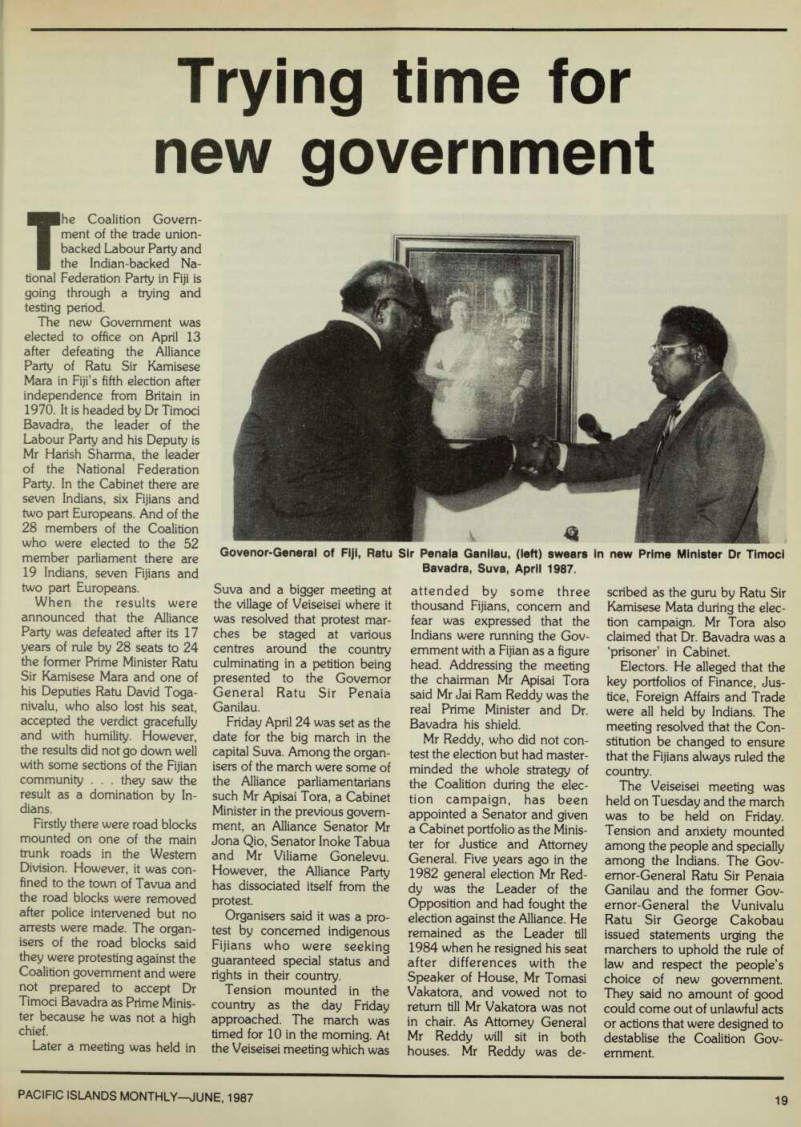
Govenor-General of Fiji, Ratu Sir Penala Ganilau, (left) swears In new Prime Minister Dr Timoci Bavadra, Suva, April 1987.
Some 10,000 Fijians were expected to take part but about only half the number marched through the streets of Suva carrying placards denouncing the new government. However the demonstration was peaceful and marches proceeded in an orderly manner to Albert Park.
There was heavy police pre sence and more than 100 had lined the streets. A fully pre pared and equipped riot squad was on stand-by and the army was also on full alert. However, much to the credit of the march organisers it was uneventful.
At the end of the march, the demonstrators handed a petition to the Governor-Gen eral which had 23,000 signa tures. They are asking: 1. That they do not accept the Coalition because they did not vote for it. 2. That the Constitution be changed to guarantee them the control of the Government.
The Governor-General promised to hold discussions with the Prime Minister, Dr.
Timoci Bavadra, and the leader of the Opposition, Ratu Sir
Kamisese Mara, on the views expressed in the petition.
Another march was being planned for the opening of Parliament. However the new government has consolidated its position and the ‘movement’ against the government has lost much of its appeal with a number of other Fijians ex pressing support for the Coali tion and urging others to give it a chance to govern as the legally elected government.
Dr Bavadra also asserted his authority as the leader in con trol. The new Government also
won support from two promin ent Fijian backed political groups ... the Western United Front headed by Ratu Osea Gavidi and the Fijian Nationalist Party led by Mr Sakeasi Butad roka. They urged their followers to accept the new Government because that was the choice of the people. The next big test for the new Government will be when the new House meets for its first session. Based on pre sent indications and its creditable performance so far it should fare well. From our Suva Correspondent.
Fiji’s younger and smaller cabinet
smaller cabinet
Fiji,s new Prime Minister Dr.
Timoci Bavadra stuck to his Labour/NFP Coalition’s elec tion promise when he announced a cut back in the number of cabinet Ministers, soon after being sworn in as the second Prime Minister in Fiji’s history.
He has reduced the number of cabinet positions from 17 to 11 and there are two ministers of State. It consists of young and talented people from all walks of life. Academics, trade unionists, lawyers, business men, an hotelier and a civil servant.
There are seven Indians, six Fijians and one General Elector in the Ministerial line up. The average age of the new Cabinet members is 45. There are only two Ministers above 50 years . . the Prime Minister Dr. Bavad ra himself who is 52 and the Deputy Prime Minister Mr Har ish Sharma who is 54.
Mr Jai Ram Reddy is 50 and the youngest is the Minister for communications, transport and works, Mr Ahmed Bhamji who is 37. Dr. Bavadra himself has taken over Public Service, Fi jian Affairs and Home Affairs among his portfolios Mr Harish Sharma, the leader of the Na tional Federation Party is the Deputy Prime Minister. He is
also the Minister for Housing and Urban Affairs and Informa tion. Mr Sharma is a qualified lawyer and ran a law practice.
He has been in Parliament since 1972 and became the leader of the opposition in 1985. Mr Mahendra Pal Chaudhary 45, is the Minister of Finance and Economic Plan ning. A former senior auditor in the Civil Service turned trade unionist, he has been the gen eral secretary of the Fiji Public Service Association since 1970 and assistant general secretary of the Fiji Trades Union Con gress since 1976. Dr Tupeni Baba, 43 is the Minister for Education, Youth and Sport.
He is a former registrar of the University of the South Pacific and a reader in education. He graduated with a Masters De gree in education from the University of Sydney and obtained his PhD from Mac quarie University in Australia.
Mr Krishna Datt, 42, is the Minister for Foreign Afffairs and Civil Aviation. An educationist and a trade unionist he is a former President of the Fiji Teachers Union and is the first general secretary of the Fiji Labour Party. He did his BA at Christchurch University and MA in the United Kingdom.
Mr Joeli Kalou, 47 is the
Minister for Labour and Im migration. He is a former teacher turned trade unionist.
He holds a BA Degree from Massey University in New Zea land. He is a former general secretary and president of the Fijian Teachers Association. He also served as principal of seve ral secondary schools. Mr Navin Maharaj, 48, is the Minister for Trade, Industry and Tourism.
He is a former Lord Mayor of Suva. He is a former president of the Fiji Master Builders Association and runs his own company construction services limited. He was the first Indian to be elected Mayor of Suva in 1974.
Mr Jo Nacola, 46, is the Minister for Agriculture, Fisher ies and Forestry. He is a lecturer at the University of the South Pacific, He has a MA Degree from Waikato University in New Zealand. He is a former Senator and Councillor of the city of Suva. He was a member of the Fiji Team which negotiated the Law of the Sea protocols. Dr.
Satendra Nandan, 47, is the Minister for Health and Social Welfare. He is also a lecturer at the University of the South Pacific. He is a writer and a poet. He obtained his BA and BE from Delhi University and MA from Leeds University and his PhD from the Australian National University in Can berra. He has received numer ous awards for his writings. He was first elected to Parliament in 1982. Mr Mosese Volavola, 39 is the Minister for Lands,
Energy and Mineral Resources.
He is a former Civil Servant and had resigned from his position in the Lands Department to contest the election. He is a registered surveyor. Mr Jai Ram Reddy, 50, is the Minister for Justice and Attorney General.
He was the Leader of the Opposition from 1977 to 1984, when he resigned from Parlia ment. He is a lawyer and ran his law practice from Lautoka. He was first elected to Parliament in 1977.
He did not contest the last election but has been appointed a Senator by Dr.
Bavadra to allow him to be come a Cabinet Member. Mr Ahmed Bhamji, 37, is the Minister for Communications, Transport and Works. He is a former Mayor of the Town of BA, a businessmen who holds a BCom Degree with honours from Delhi University. He has also worked as an auditor for an international firm of account ants based in Fiji.
Mr Temo Sukanaivalu, 40, is the Minister of State for Rural Development, Rehablitation and Relief. He is a former hotel manager and has also worked as a policeman and a salesman.
He was first elected to Parlia ment in 1982. Mr Chris Herbert Work, 49 is the Minister of State for Co-operatives and Con sumer affairs. He was a super visor with the Fiji Electricity Authority. He is a social worker and is a member of the Rural Advisory Council and the Rural Development committee.
in October
TV to start in October
The Fiji Television Corporation still has October as its target date for the commencement of Fiji’s first broadcast television service despite a change of Government in Fiji and a change of ownership of the parent company of Fiji TV.
The Kerry Packer group owners of Channel Nine TV network in Australia had negotiated with the Alliance Governmcnt for a 12 year licence on behalf of their subsidiary company publicity and broadcasting limited PEL to set up Fiji’s first television service. However earlier this year Australia’s Bond Corporation took over PEL from the Kerry Packer group and Mr David Aspinall was appointed the chairman of PEL
and Fiji TV on the resignation of Kerry Packer’s man Mr Lynton Taylor. In his first meeting with the Fiji media after the board meeting of FUI TV Mr Aspinall said FUI TV was geared to begin broadcasting from the second week in October. How ever, he was not prepared to answer any questions regarding the review of the TV contract now being carried out by Fiji’s Ministry of Information at the request of the new Labour/NFP Coalition government in Fiji, Observers say the new coali tion government wants the 12 year period of monoply given to Channel Nine be reduced to 5 to 7 years. Also it wants to re-examine the social impact
study report as well as justica tion of the preference given to Channel Nine over other pro posals on the setting up of a tv service for Fiji.
Cabinet is yet to organise the drafting of a Television Act for Fiji. However, these issues were of little concern to Mr Aspinall when he held his news confer ence at the Suva Travelodge.
He said he was not worried that there was no Television Act in Fiji yet. He said under the agreement it was the Govern ment’s responsibility. Mr Aspi nall said a lot of work has already been done in prepara tion for the launch in October.
Transmitting sites had been cleared awaiting the arrival of transmitters and microwave equipment. Construction work on the studio complex was to begin soon and Mr Aspinall said studio equipment as well as an OB Van being built in Australia would arrive by July. He said the training programme for staff was also running according to
schedule. On programme con tent Mr Aspinall said FUI TV will bring a truly international televi sion service to Fiji. It will have at least 20 percent local content and will include news, public affairs, sports and service prog rammes. Mr Aspinall was confi dent that Fiji TV will eventually make a profit. He said advertis ing rates were being prepared by the general manager of Fiji TV Mr John Hall and Mr Ross Edwards of Australia.
Initially the rates are ex pected to be kept at about three times the maximum rates charged by the national radio service in Fiji for a 30 sec ad.
Currently Radio Fiji Charges about $3O and the TV rate is around $lOO. At his Suva news conference Mr Aspinall also confirmed that Bond Corpora tion was also interested in other projects in the South Pacific besides Fiji and Papua New Guinea. From our Suva Correspondent.
problem in Fiji
Tamil refugees pose problem in Fiji
Fifteen Tamils from Sri Lanka became the first headache for the new Fiji Government soon after its election in April.
The Tamil refugees had arrived in Fiji on an Air New Zealand flight from Singa pore to connect to a Cana dian Airlines flight at Nadi to for Vancouver.
They would have sought political asylum once in Canada but they did not have any visas to enter Canada. The Immigration Officials at Nadi also de tected that they were travel ling on fake passports and their other travel documents were not in order.
The refugees had first travelled from Madras to Maldives and after a week they travelled to Singapore and from there they came to Fiji via Sydney and Auck land. Originally there were
16 Tamils in the group but later one member who was holding a genuine Indian passport and also had valid papers flew out.
Tamil refugees are the centre of controversies in West Germany and Canada where they have entered illegally and have sought asylum. The Tamils are run ning from fighting in Sri Lanka where the Native Sinhalese are protesting against their efforts to create their own independent state on the island. The Tamils complain that the native Sri Lankans are being given preferential treatment while they had done much to develop the island and now form an important part of the Sri Lankan society.
The question was what to do with the Tamils? First the responsibility of taking them back lay with the airline
which had brought them in ...Air New Zealand, but there is no direct flight from Nadi to Singapore..the flights have to go through Auckland and Sydney and both Governments flatly said if the refugees had forged documents they will not be allowed in as transit passengers. Air New Zea land took the responsibility of looking after them while the group ..seven women, five men and four children were kept confined to the transit lounge at Nadi air port. However, the refugees had also threatened to com mit suicide if they were forced to return home.
They claimed they would be tortured and killed if they went back. The Fiji Govern ment could not risk being found guilty in the eyes of the world for not honouring its committment under the UN Human rights Declara
tion if the refugees did carry out their threat nor could it accept them as political re fugees and open the ’flood gates’ for others. As a com promise it moved the re fugees from the airport to a motel in the airport, while negotiations continued on the plight of the Tamils.
Among the options being looked at were that the Canadian Government agrees to accept them on the strength of assurances given by the relatives of the re fugees resident in Canada.
Fiji’s Minister for Immigra tion Mr Jocli Kalou also requested the Indian High Commissioner in Fiji Mr Sreenivasan to ask his coun try to accept the Tamils as political refugees on a temporary basis.
The United Nations High Commissioner for refugees based in Australia Mr Joseph Landau also visited Fiji for talks on the problem. By early May Canada had accepted two of the children on humanitarian grounds and was processing the rest of the application.
Treaty ends tuna war
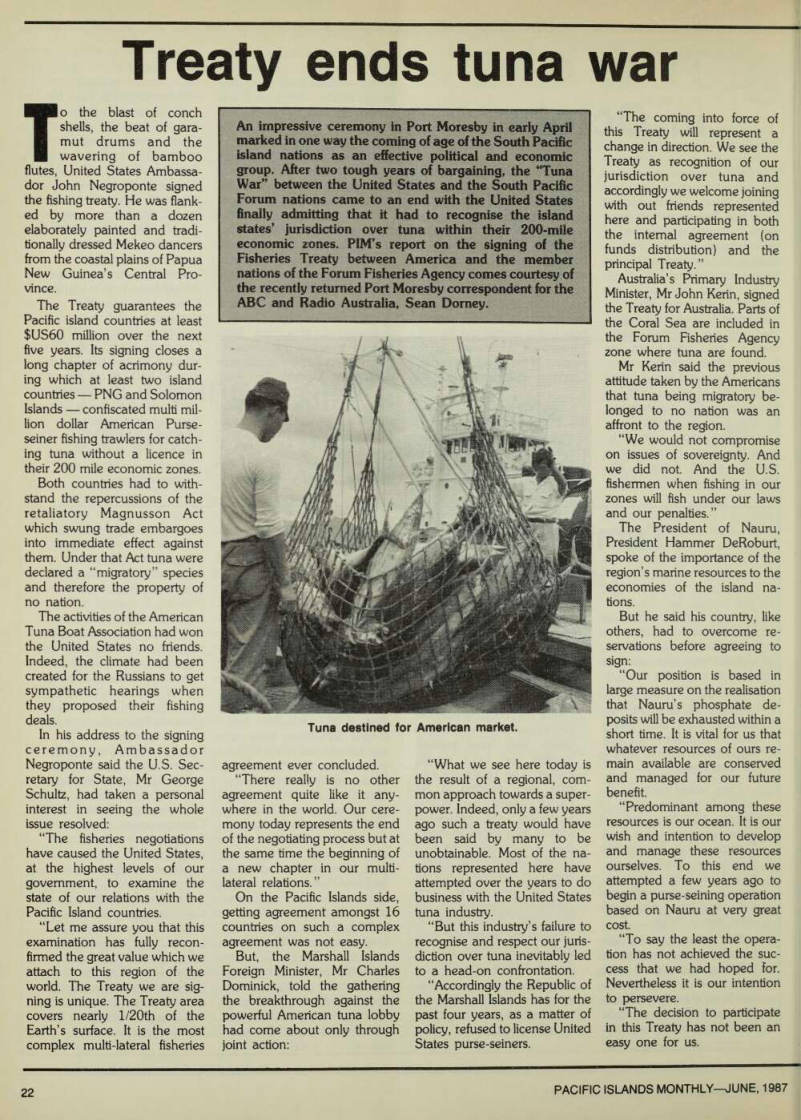
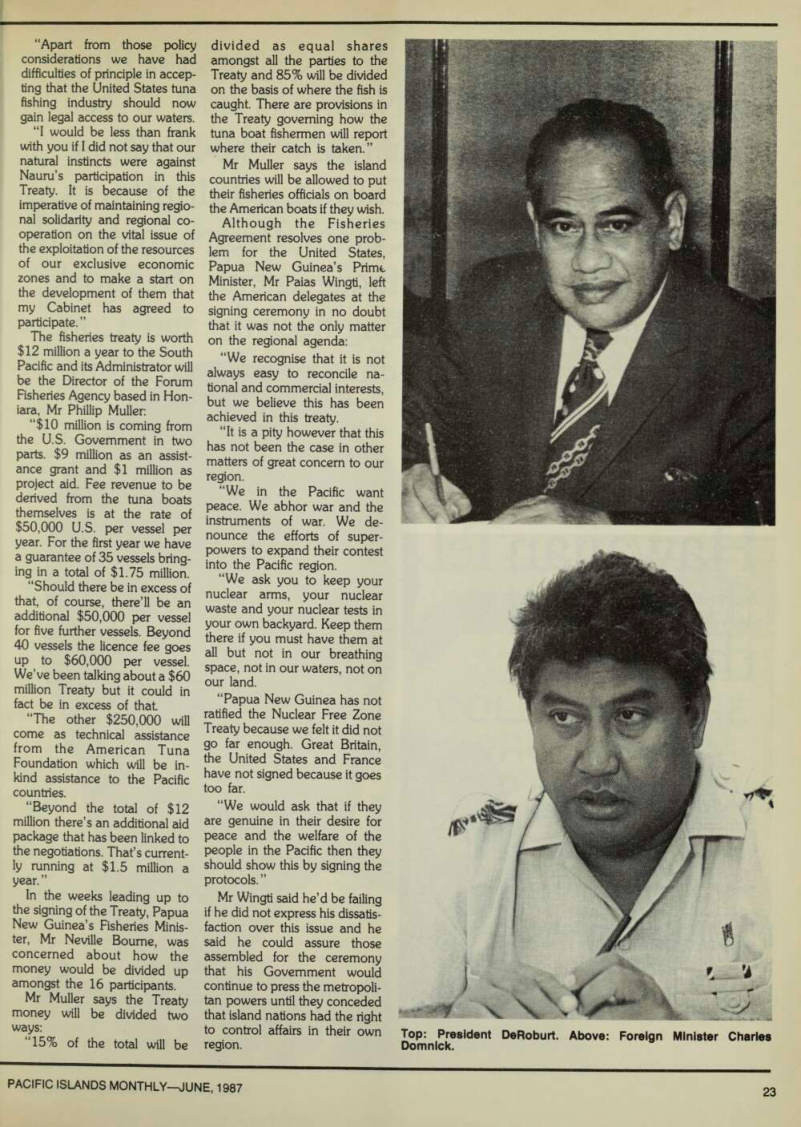
To the blast of conch shells, the beat of gara mut drums and the wavering of bamboo flutes, United States Ambassa dor John Negroponte signed the fishing treaty. He was flank ed by more than a dozen elaborately painted and tradi tionally dressed Mekeo dancers from the coastal plains of Papua New Guinea’s Central Pro vince.
The Treaty guarantees the Pacific island countries at least SUS6O million over the next five years. Its signing closes a long chapter of acrimony dur ing which at least two island countries PNG and Solomon Islands confiscated multi mil lion dollar American Purse seiner fishing trawlers for catch ing tuna without a licence in their 200 mile economic zones.
Both countries had to with stand the repercussions of the retaliatory Magnusson Act which swung trade embargoes into immediate effect against them. Under that Act tuna were declared a “migratory” species and therefore the property of no nation.
The activities of the American Tuna Boat Association had won the United States no friends.
Indeed, the climate had been created for the Russians to get sympathetic hearings when they proposed their fishing deals.
In his address to the signing ceremony, Ambassador Negroponte said the U.S. Sec retary for State, Mr George Schultz, had taken a personal interest in seeing the whole issue resolved: “The fisheries negotiations have caused the United States, at the highest levels of our government, to examine the state of our relations with the Pacific Island countries.
“Let me assure you that this examination has fully recon firmed the great value which we attach to this region of the world. The Treaty we are sig ning is unique. The Treaty area covers nearly l/20th of the Earth’s surface. It is the most complex multi-lateral fisheries
An impressive ceremony in Port Moresby in early April marked in one way the coming of age of the South Pacific island nations as an effective political and economic group. After two tough years of bargaining, the “Tuna War” between the United States and the South Pacific Forum nations came to an end with the United States finally admitting that it had to recognise the island states’ jurisdiction over tuna within their 200-mile economic zones. PlM’s report on the signing of the Fisheries Treaty between America and the member nations of the Forum Fisheries Agency comes courtesy of the recently returned Port Moresby correspondent for the ABC and Radio Australia, Sean Dorney.
agreement ever concluded.
“There really is no other agreement quite like it any where in the world. Our cere mony today represents the end of the negotiating process but at the same time the beginning of a new chapter in our multi lateral relations.”
On the Pacific Islands side, getting agreement amongst 16 countries on such a complex agreement was not easy.
But, the Marshall Islands Foreign Minister, Mr Charles Dominick, told the gathering the breakthrough against the powerful American tuna lobby had come about only through joint action:
“What we see here today is the result of a regional, com mon approach towards a super power. Indeed, only a few years ago such a treaty would have been said by many to be unobtainable. Most of the na tions represented here have attempted over the years to do business with the United States tuna industry.
“But this industry’s failure to recognise and respect our juris diction over tuna inevitably led to a head-on confrontation.
“Accordingly the Republic of the Marshall Islands has for the past four years, as a matter of policy, refused to license United States purse-seiners.
“The coming into force of this Treaty will represent a change in direction. We see the Treaty as recognition of our jurisdiction over tuna and accordingly we welcome joining with out friends represented here and participating in both the internal agreement (on funds distribution) and the principal Treaty.”
Australia’s Primary Industry Minister, Mr John Kerin, signed the Treaty for Australia. Parts of the Coral Sea are included in the Forum Fisheries Agency zone where tuna are found.
Mr Kerin said the previous attitude taken by the Americans that tuna being migratory be longed to no nation was an affront to the region.
“We would not compromise on issues of sovereignty. And we did not. And the U.S. fishermen when fishing in our zones will fish under our laws and our penalties.”
The President of Nauru, President Hammer Deßoburt, spoke of the importance of the region’s marine resources to the economies of the island na tions.
But he said his country, like others, had to overcome re servations before agreeing to sign: “Our position is based in large measure on the realisation that Nauru’s phosphate de posits will be exhausted within a short time. It is vital for us that whatever resources of ours re main available are conserved and managed for our future benefit.
“Predominant among these resources is our ocean. It is our wish and intention to develop and manage these resources ourselves. To this end we attempted a few years ago to begin a purse-seining operation based on Nauru at very great cost.
“To say the least the opera tion has not achieved the suc cess that we had hoped for.
Nevertheless it is our intention to persevere.
“The decision to participate in this Treaty has not been an easy one for us.
Tuna destined for American market.
“Apart from those policy considerations we have had difficulties of principle in accepting that the United States tuna fishing industry should now gain legal access to our waters, “I would be less than frank with you if I did not say that our natural instincts were against Nauru s participation in this Treaty. It is because of the imperative of maintaining regional solidarity and regional cooperation on the vital issue of the exploitation of the resources of our exclusive economic zones and to make a start on the development of them that my Cabinet has agreed to participate.
The fisheries treaty is worth
Sa£di!S£££3
"d ■ F h“
“tin n P *, s ,,cr on ‘ S C °T S „° m
U |o S m ,°
££ n t S ar l, aSSISt ‘ ance grant and $1 million as project aid. Fee revenue to be derived from the tuna boats themselves is at the rate of $50,000 U.S. per vessel per year. For the first year we have a guarantee of 35 vessels bringing in a total of $1.75 million.
“Should there be in excess of is
SSKi=SfiS!
W.Jssffi.E.'Ss
million Treaty but it could in fact be in excess of that “The other $250,000 will come as technical assistance from the American Tuna Foundation which will be inkind assistance to the Pacific countries.
“Beyond the total of $l2 million there’s an additional aid package that has been linked to the negotiations. That’s currently running at $1.5 million a year. ”
In the weeks leading up to the signing of the Treaty, Papua New Guinea’s Fisheries Minister, Mr Neville Bourne, was concerned about how the money would be divided up amongst the 16 participants.
Mr Muller says the Treaty money will be divided two ways: “15% of the total will be
divided as equal shares amongst all the parties to the Treaty and 85% will be divided on the basis of where the fish is caught. There are provisions in the Treaty governing how the tuna boat fishermen will report where their catch is taken. ”
Mr Muller says the island countries will be allowed to put their fisheries officials on board the American boats if they wish, Although the Fisheries Agreement resolves one prob lem for the United States, Papua New Guinea’s Prime Minister, Mr Paias Wingti, left the American delegates at the signing ceremony in no doubt that it was not the only matter on the regional agenda l
JS t ».>"
b W«~0. but we believe this has been achieved in this treaty. a however that this has not been the case in other matters of great concern to our reqion
%ii‘ • .. n •
™ Paclftc , w f"‘ f instrume "? L , We de ' 'TV e PaS “ “u; . ,
nUf^r fj™ ° P
--rlr
ejssasis:
Kl . , J a j>“ a N K e T w p um * a ha * not Free Z° ne Treaty because wefelt it did not ?° f f, r . en ? u h - Great , ? ritain ’
United States and France have not signed because it goes to ° * ar “We would ask that if they are genuine in their desire for Peace and the welfare of the People in the Pacific then they should show this by signing the protocols. ”
Mr Wingti said he’d be failing if he did not express his dissatis faction over this issue and he said he could assure those assembled for the ceremony that his Government would continue to press the metropoli tan powers until they conceded that island nations had the right to control affairs in their own region.
Top: President DeBoburt. Above: Foreign Minister Charles Domnick.
Advertisements & other items, p. 24 (1 item)
Private Line Channels. Microwave and Fiber
Systems. Local Area Networks and VAN’s.
Consulting. PBXs. Operations and Maintenance. International Calling. Multiplexers.
Packet Switching. Data Comm. Pagers. Systems Integration. Project Management. Network Planning, Designing, Engineering and Construction Services. Train!
There’s
more to
Hawaiian Tel
than meets
the ear.
HAWAIIAN TEL
Beyond the call ketmg ■ s
Nuclear testing -
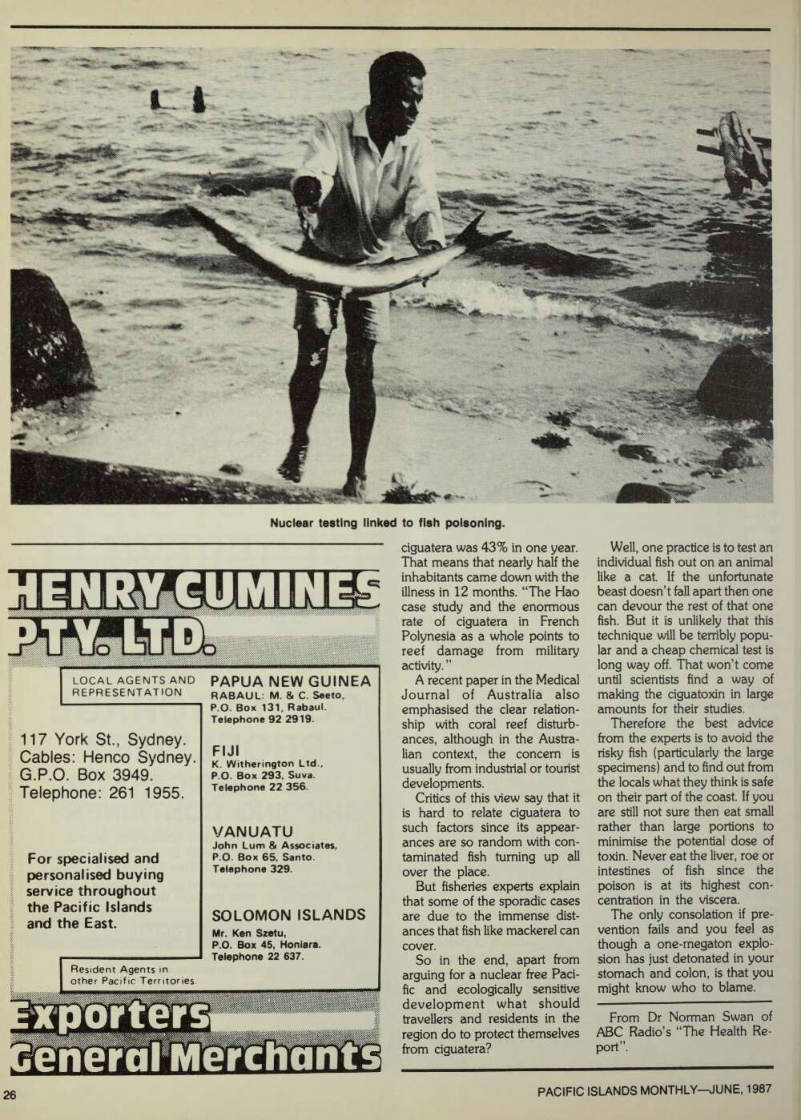
Nuclear testing a pain in the tummy?
The French have been and are blamed for a lot in the South Pacific, yet it seems far fetched to say that nuclear testing causes food poisoning. But in fact the evi dence is quite strong.
At the 1985 International Coral Reef Conference in Tahi ti, Dr Raymond Bagnis of the Louis Malarde Institute of Medi cal Research in Papeete pre sented a paper which showed that in the past 25 years there have been over 24,000 cases of Ciguatera (fish poisoning) in French Polynesia. And 25 years just happens to correlate with the period of maximum French military activity in the region. Of course these kinds of associa tions can be rather spurious. An eminent professor once illus trated how ludicrous medical statistics can be by showing convincing figures relating the declining birth rate in Europe to fewer sightings of storks on chimney pots.
Nonetheless the arguments about fish poisoning and nuc lear testing in the Pacific go beyond the mythology of procreation. Ciguatera is an extremely unpleasant form of food poisoning which comes from eating certain kinds of fish.
The condition occurs in tropi cal and sub-tropical waters around the world. In fact Span ish mariners gave the illness its name in the Caribbean about 400 years ago. Ciguatera poisoning is caused by a toxic chemical (toxin) concentrated in the flesh of certain fish. A type of plankton which attaches itself to algae on damaged coral manufactures the toxin. Fish like parrot fish which feed on coral reefs consume the toxin and then like the children’s song about the lady who swal lowed the fly, as these fish are eaten by other fish, the toxin collects in greater quantities.
In technical terms, ciguatoxin is concentrated up the food
chain. This means that flesh eating fish pose the greatest risk to hungry humans. In Australia, the commonest contaminated fish species are red bass, Span ish mackerel, paddletail, coral trout and barracuda.
The curious feature though, is that while ciguatera can be quite devastating for us, it doesn’t turn a gill on a fish.
According to Dr Michael Capra of the Queensland Institute of Technology, somehow fish manage to “partition” away the toxin from key parts of fishes’ anatomy. If Dr Capra can discover how this happens then perhaps a treatment could be developed.
Those who have suffered ciguatera will never forget the experience. About five hours after the fish meal which did not taste badly at all (cooking makes no difference) the nausea, abdominal pains, diar rhoea and vomiting start. At this stage it is much like any other food poisoning but soon other problems begin like pins and needles, especially around the mouth and temperature rever sal where hot things feel cold and cold things, hot.
Muscle pains and even para lysis have been described and there is a small mortality rate.
The symptoms of ciguatera can reappear months or even years later after eating fish which may only contain very tiny amounts of the toxin not enough to poison other people.
The other substance which can bring on the illness again is alcohol and no one is sure why.
So with 24,000 cases in French Polynesia and perhaps 3,000 in Northern Australia since the ’6o’s ciguatera is of major con cern particularly in areas where people rely on fish for food as well as income.
If the word gets around that a particular island nation has ciguatera then its markets can shrivel considerably. And the
problem with ciguatera is that outbreaks are very patchy. One part of a coastline can carry the toxin for a time while the rest is clear.
Which brings us to the reasons why this troublesome plankton attaches itself in some places and not in others. One common but not absolute fin ding is that damaged coral reefs seem to be susceptible to inva sion.
Dr Tilman Ruff of the Medical Association for the Prevention of War and Fairfield Infectious Diseases Hospital in Melbourne claims that the French nuclear programme is a major culprit.
“In fact the incidence of ciguatera increased 10-fold
from the early ‘6o’s to the early 70’s and hasn’t gone down since then,” he told me.
This is not simply from the trauma of the explosions, but the disruption which accompa nies the military, Dredging, building jetties and blasting reefs for construction activities can all cause ciguatera. Dr Ruff gives the example of what happened on the French Polynesian island of Hao.
“On Hao there was no ciguatera until the French came in 1965 to build a staging base.” Then cases started to appear and the outbreak spread around the island. And at its peak, the incidence of
ciguatera was 43% in one year.
That means that nearly half the inhabitants came down with the illness in 12 months. “The Hao case study and the enormous rate of ciguatera in French Polynesia as a whole points to reef damage from military activity. ”
A recent paper in the Medical Journal of Australia also emphasised the clear relation ship with coral reef disturb ances, although in the Austra lian context, the concern is usually from industrial or tourist developments.
Critics of this view say that it is hard to relate ciguatera to such factors since its appear ances are so random with con taminated fish turning up all over the place.
But fisheries experts explain that some of the sporadic cases are due to the immense dist ances that fish like mackerel can cover.
So in the end, apart from arguing for a nuclear free Paci fic and ecologically sensitive development what should travellers and residents in the region do to protect themselves from ciguatera?
Well, one practice is to test an individual fish out on an animal like a cat. If the unfortunate beast doesn’t fall apart then one can devour the rest of that one fish. But it is unlikely that this technique will be terribly popu lar and a cheap chemical test is long way off. That won’t come until scientists find a way of making the ciguatoxin in large amounts for their studies.
Therefore the best advice from the experts is to avoid the risky fish (particularly the large specimens) and to find out from the locals what they think is safe on their part of the coast. If you are still not sure then eat small rather than large portions to minimise the potential dose of toxin. Never eat the liver, roe or intestines of fish since the poison is at its highest con centration in the viscera.
The only consolation if pre vention fails and you feel as though a one-rnegaton explo sion has just detonated in your stomach and colon, is that you might know who to blame.
From Dr Norman Swan of ABC Radio’s “The Health Re port”.
Nuclear testing linked to fish poisoning.
Advertisements & other items, pp. 25-27 (1 item)
Cold Storage
container services
l DIVISION Of WRECKAIR PTV LTD
Suite 19, 9 Seven Hill Road Phone (02) 686-1011 (008) 25-1222 PO Box 622, Baulkham Hills Telex AA 72370 Fax 639-1625 NSW 2153 Australia
COLD STORAGE
PROBLEMS?
USED REFRIGERATED
SHIPPING CONTAINERS
20’ x 8’ x B’6” Refrigerated containers provide 25 cubic metres of storage for products that require cold or frozen storage to minus 18 degrees Celcius.
Clip out the coupon below and find out how Wreckair Container Services can solve your cold storage problems container services Please send me more information on your Refrigerated containers
ADDRESS.
LOCAL AGENTS AND
REPRESENTATION
117 York St., Sydney.
Cables: Henco Sydney
G.P.O. Box 3949.
Telephone: 261 1955.
For specialised and
personalised buying
service throughout
the Pacific Islands and the East.
PAPUA NEW GUINEA
RABAUL: M. & C. Seeto, P.O. Box 131. Rabaul.
Telephone 92 2919.
FIJI
K. Witherington Ltd., P.O. Box 293, Suva.
Telephone 22 356.
VANUATU
John Lum & Associates, P.O. Box 65, Santo.
Telephone 329.
SOLOMON ISLANDS
Mr. Ken Szetu, P.O. Box 45, Honiara.
Telephone 22 637.
Resident Agents in other Pacific Territories u
CITIZEN
WfeVegot
yourwatdi
-r % /, r >r N /
JLS
ys i We’ve got fashion creations, sports innovations, high-tech inspirations. For any situation - there’s a Citizen watch.
* CITIZEN
FOR FURTHER INFORMATION, PLEASE CONTACT:
Australia: Citizen Watches Australia Pty. Ltd., 122 Old Pittwater Road, Brookvale, NSW 2100.
Tel: 939 7077. Cable: Citizen Sydney.
Telex: AA26633. Fax; 932864.
Fiji Islands: Tappoo Limited, P.O. Box, Sigatoka, Fiji. Tel: 50199. Telex: FJ4244.
New Zealand: Citizen Watches (N.Z.) Ltd., P.O. Box 9518, Auckland, New Zealand.
Tel: 543 393. Telex: 21429. Fax: 544177.
Norfolk Island: Landy & Co., P.O. Box 31, Norfolk Island, 2899, South Pacific. Tel: 2163.
American Samoa: Malaloa Duty Free Shoppers, P.O. Box 2183, Pago Pago, American Samoa, 96799. Tel: 633 5513.
Tahiti: Morgan Vernex, Fare Ute B.P. 449, Tahiti.
Tel: 2.03.09.
New Caledonia: Est. Ballande, B.P. Box C 4, Noumea, New Caledonia. Tel: 27.20.31.
Rarotonga: South Seas International Ltd., P.O. Box 49, Rarotonga, Cook Islands. Tel: 2327 Papua New Guinea: Kara Pty. Limited, P.O. Box 329, Port Moresby. Tel: 25 6044.
SPARTECA funds

Trade Winds
SPARTECA funds for fish testing
Australia and Fiji have started testing for mer cury levels in randomly selected samples of chosen Fiji fish species.
Exports to Australia of fish from Fiji and other Pacific Is land countries are at present subject to compulsory testing for mercury levels on arrival at the Australian Government Analytical Laboratory (AGAL).
Under Customs and Health department regulations this is required to ensure that all fish imports have mercury levels
below o.smg/kg (0.05%), but it has in some cases been a disincentive to fish exports from Fiji.
Testing often takes up to four days and basically precludes the export of chilled fresh fish since the fish is kept in frozen bond storage. The importer also has to bear the analysis cost of about SA4O per sample.
Australia and Fiji are con sidering the possibility of ex emption from testing for Fiji if it can be sufficently demonstrated that mercury levels are normal
ly below the required minimum.
If test results of random sampies sent each month for a ten month period are under 0.25mg/kg for all samples, the species concerned would be granted exemption. Where some results are over 0.25 mg/ kg but under o.smg/kg some further testing would be required.
Fiji was encouraged to seek funding under SPARTECA’s article 8 provisions to cover the costs of the exercise. The Aus-
tralian Government under SPARTECA recently approved the expenditure of $F10,225 to cover costs of purchasing, pack ing, transport and air freight, clearance and analysis by AGAL of 24 species of Fiji fish in ten monthly shipments these will include both high priced species in strong in temational demand, such as deepwater snappers and donu, or local reef species sought after by Fijian communities in Aus tralia, like nuqa, kawago, sabu tu, kalia and even shark.
Advertisements & other items, pp. 28-31 (1 item)
AWA New Zealand Limited
WA08.147 Power surges, blackouts and electrical noise are problems your valuable computers and electronic equipment can do without.
But there is one way to insure against these disturbances and that's to install Sola power protectors.
When power is blacked-out, the clean regulated AC power from a Sola Standby Power Source will ensure a trouble-free supply until the service is restored.
The Sola Series 200 power conditioners compensates for the many and varied disruptions which can frequently occur in Fiji.
Don't take unnecessary risks.
Insure with Sola the power protectors.
AWA New Zealand Limited
Fiji's most switched-on company 37 Freeston Road, Walu Bay, Suva. Phone 312744 P.O. Box 858, Suva 155 Vitogo Parade, Lautoka. Phone 61011 P.O. Box 4776, Lautoka. Fax 64005 Telex FJ2347 AWA Fiji. Cable 'EXPANCE' Suva. Fax 314379 Standby Power Source Power Conditioner
BANK
ECONOMIC INDICATORS
COMMODITY PRICES
May 11, 'B7 Month ago Year ago 120
EXCHANGE RATES
INTEREST RATES
INDUSTRIAL WORLD DEMAND
Industrial output (per cent change) Sources: AAR Reuters; FFA Honiara, IMF (IFS); Compiled by ANZ International Economics, Melbourne.
Oa 13AIM K
WORLD COMMODITIES
(Wholesale Price Index, 1980 = 100) Agricultural Raw Materials
J I 1 ! I L
1981 1982 1983 1984 1985 1986 1987 1981 1982 1983 1985 1986 1987
Road-Hugging. Rock-Biting. Pa
KTtll
|i
Pw' “ftjj
m % r m m m *v HILUX 4WD Regular Cab, Long Wheelbase One tough truck just got tougher. Toyota’s dedication to superior performance vehicles takes a step forward today with the New Hilux.
A refined front grille and bumper design, new instrument panel for a feeling of spaciousness and command and plush colour co-ordinated trim are a few new additions to the New Hilux.
And extensive anti-corrosive galvanealed steel protection now includes the tailgate panel and rear door panel, making Hilux more durable than ever before.
Yet for all its improvements, the best of the original Hilux is also
TOYOTA
QUALITY SERVICE
AMERICAN SAMOA: BURNS PHILP (SOUTH SEA) CO., LTD., P.O. Box 129, Pago Pago. COOK ISLANDS: COOK ISLAN AUTOMOTIVE SUPPLIES COMPANY, A Division of Burns Philp (South Sea) Co., Ltd., G.P.O. Box 355, Suva. GUAM & Ml« Tamuning. KIRIBATI: TARAWA MOTORS, A Division of Bairiki Holdings Ltd., P.O. Box 36, Bairiki, Tarawa. NAURU: NAUF SERVICE IMPORTATION AUTOMOBILE DU PACIFIQUE, Rond-Point du Pacifique (Station Total) B.P. 438, Noumea. NIUE: E!
NORFOLK ISLAND: BORRY’S LIMITED, P.O. Box 169. PAPUA NEW GUINEA: ELA MOTORS, A Division of Burns Phill CORPORATION, P.O. Box 267, Saipan. SOLOMON ISLANDS: SOLOMON ISLANDS INVESTMENTS LTD., G.P.O. Box 140,, TONGA: BURNS PHILP (TONGA) LTD., P.O. Box 55, Nukualofa. VANUATU: VANUATU MOTORS, A Division of Burns Philp BURNS PHILP (SOUTH SEA) CO., LTD., P.O. Box 188, Apia.
fic-Tougti. The New Hilux.
iA» * % v H * vM * . C W 1 K M¥j ** t*// a I **■ m \ i V ■ 1* >-"A* • * a %v ¥ 4 -X fm -» -re; a big tailgate conveniently hinged for quick loading and unloading; reinforced front suspension to smooth out ejDumps, and bias-mounted, extra-heavy-duty rear shocks and knobbly tyres to take on any terrain.
Toyota’s long history of super-responsive engines, ruggedness, reliability and comfort goes without saying. And in the Hilux, it’s yours in both 2-wheel-drive and 4x4 versions.
So, after comprehensive testing and thorough quality control, the New Hilux is ready to bring a new standard of toughness to the Pacific.
And isn’t that exactly what you expect from Toyota? *9 Areas where galvanealed steel is used )ING CORPORATION LTD., Private Bag, Rarotonga. FIJI: >IA: ATKINS KROLL, INC., 443 South Marine Drive,
ERATIVE SOCIETY, Central Pacific. NEW CALEDONIA:
HILP (SOUTH SEA) CO., LTD., PO. Box 39, Alofi. _td„ PO. Box 75, Port Moresby. SAIPAN: MICROL
TAHITI: NIPPON AUTOMOTO, B.P. 342, Papeete
u) Ltd., PO. Box 18, Port Vila. WESTERN SAMOA:
TOYOTA
New Pipeline
for Tailings disposal
Bougainville Copper is to build a pipeline to carry tailings from its Panguna concentrator to Empress Augusta Bay on the west coast of Bougainville Is land. This changed method of disposal is approved by the Government. The pipeline will carry about 130,000 tonnes of tailings per day for 31.7 km, through mountain and valley terrain, across rivers and swamp-like country.
It will cost about K 65 million (about SAIOO million) in Janu ary 1987 terms, and construc tion will be completed by May 1989. A joint venture to act as Project Manager has been
formed between Minenco and the Bechtel Corporation. Cur rently, tailings disposal uses the natural flow of the Jaba River to carry about 60% of the tailings to Empress Augusta Bay the remaining 40% settles along the river valley where it has formed extensive, and in some places, deep tailings deposits. This disposal method is both expen sive to manage and has a limited life.
Tailings disposal via the pipe line has real benefits from both the operational and environ mental points of view. Due to a number of factors the impact of direct disposal of tailings on
permits'
Solomons’ outlet better
Solomon Islands Central Bank Governor, Mr Tony Hughes has said the resump tion of economic growth in 1987/88 is now a strong possibility because the govern ment, as well as the private sector,is waking up to invest ment opportunities. Mr Hughes was speaking at the presenta tion of the bank’s 1986 report.
He said the country’s economy continued to grapple with the reality of reduced export in comes, structural deficits in the balance of payments and an inadequate level of public and private sector investment.
Encouraging features in cluded a growing understan ding in the community of the need for adjustment in re sponse to the fall in external income , with the fruitful dia logue which had taen place between the government, pri vate sector and trade unions. A great amount of pre-investment activity underway should lead to an increase in investment in the productive sectors of the economy in 1987/88. Mr Hughes said exports of copra and palm oil products were depressed by both low prices and the disruption caused by Cyclone Namu, but, on the
positive side, the fishing and timber industries had strong performances and were ex pected to continue that trend in 1987.
National income rose by almost 5% in nominal terms, but, when the effects of inflation and population growth were taken into account, real income fell by about 10% to 15%. The balance of payments showed a surplus of about SS6 million (aboutsUS 3 million), a turn around from the 1985 trade deficit and caused by reception of a grant of SSI6 million (about SUSB million) under the European Community’s Stabex scheme as compensation for lower commodity export ear nings. In addition there were strong flows of aid from abroad in the wake of Cyclone Namu.
The trade account was in deficit by $525 million (about SUS 12.5 million) and the services account by $549 million (about SUS 24.5 million). These de ficits were partly offset by a surplus of $552 million (aboutsUS 26 million) giving an overall current account de ficit of $522 million (about SUSII million), which was more than offset by capital flows of $528 million(about SUSI 4 million).
marine water quality and marine life is likely to be less than the current levels of im pact: tailings will settle rapidly at the pipeline outfall because they are thickened and have not been dispersed by the full flow of the river; the fine com ponent of the tailing is bound up within the tailing and is not expected to separate out; aci dification and release of heavy metals will be minimal, and the wind and wave climate in the Bay is not sufficient to remobil ise significant volumes of tail ings.
With the limited tailings dis persion the impact on animals on or in the sea floor should be reduced.
Rise in Fiji’s
industrial
production
Fiji’s all items Industrial Pro duction Index recorded an in crease, unadjusted for seasonal variations, for 1986 of 19.6% over 1985. The unusually high increase was attributed largely to the record sugar manufac ture, an increase of 74.4 % also being recorded in the fish can ning industry.
The Export Goods Index in creased by an average 50.1%, the Investments Goods Index by 2.5% and the Other Group Index by 7.8%.ANZ cuts loan rates in Fiji. The Australia and New Zealand Banking Group Ltd in Fiji has reduced its lending rates by 1% on certain categories of loans involving agriculture, exports and owner occupied houses, with effect from April 22. The average interest rate for owner occupied housing falls to 10.5% and for agriculture loans to just under 10%. Chief manager Mr Gavin Barnes said the reduction accentuated the bank’s desire to assist in priority lending and is the third reduction since November 1986.
Naval base
transfer
The PNG Defence Depart ment will spend nearly K 1 million (aboutsUSl.l million)
over the next two years in transferring its naval base from Lombrum, in Manus Island, to Port Moresby. The Americans established a naval base at Lombrum in World War 11, and it was later maintained by Australia until it was handed over to PNG in 1974.
Record batch
of building
permits'
PNG’s National Capital Dis trict Building Authority approved a record number of new building permits last year involving building costs totalling K 71.4 million (about SUS 80 million) for 654 buildings including the new shopping complexes at Boroko and Gerehu.
According to Mr Jack Pidik, chairman of the Building Board, new residential buil dings were, generally, high cost types, development of low-cost housing having dropped dramatically. Port Moresby city authorities are concerned that if the trend continues, it may force the low-income popula tion to rely on illegal settlements for housing.
Take-over
bids for Pafco
The Pacific Fishing Com pany, based in Fiji’s old capital of Levuka, and 96% owned by the Fiji Government with local shareholders holding the re mainder, has attracted take over offers from interests in Australia, the United States (Bumble Bee Seafoods of San Diego), Europe and Canada.
The company, operator of fish freezing and canning factories, has duty-free access to the European Common Market through the Lome Convention, a valuable facility attracting multi-million dollar bids. The Government which bought out its Japanese partner, C. Itoh, has made no statement yet.
When the government took over last year, the factory out put was 50 tonnes of canned tuna a day. Tuna exports are expected to realise about SF27 million (about $U525.224 mil lion this year.
Advertisements & other items, pp. 33-34 (1 item)
Big city \big sound.
>» - * a * * *
BALANCE A'VOL * FAD
*1 nn
FMI
uu
MONO
HIGMi
KEH-6020
mam
KEH-4020
WER
Match the beat of the streets with pure power from Pioneer. The KEH-6020 cassette player packs a stunning 20 watts per channel punch, bringing out the best in sound, from solid basses to crystalline highs. Auto Reverse gives you hours of carefree playback. And Music Search lets you find your favorite tape segments, swiftly and surely. The Quartz-PLL synthesizer tuner and ARC-V circuitry make sure you capture AM/FM broadcasts clear and true, downtown or up. Pioneer has even provided Memory Preset of up to 24 stations and Preset Scan of a host of others. (As well as a slightly scaled-down version, the KEH-4020 cassette car stereo.) It’s all sleek, slick, and very sophisticated...for the big men around town.
CD PIONEER
The future of sound and vision.
For further information, please contact: Australia; Pioneer Electronics Australia Pty. Ltd. (Incorporated in Victoria), P.O. Box 295, Mordialloc, Victoria, 3195 Tel: 580-9911 Fiji Islands: Brijlal & Company, G.P.O. Box No. 362, Suva, Fiji Islands Tel: 22258 New Zealand: Monaco Distributors Ltd., 41 Poland Road, Glenfield, Auckland, New Zealand Tel: (09) 444-9144 Norfolk Island: Burnt Pine Traders Ltd., P.O. Box 21, Norfolk Island Vanuatu: Burns Philp (Vanuatu) Ltd., Vila, Vanuatu Nauru Island: Jacob Enterprises, P.O. Box N 0.4, Republic of Nauru Tahiti: Tahiti Hi-Fi, P.O. Box 848, Papeete, Tahiti New Caledonia: Menard Pacifique Sari, B.P. 3899, Noumea, New Caledonia Tel; 27-62.23 American Samoa: Transpac Corporation, P.O. Box 1477, Pago Pago, American Samoa 96799 Tel: 633-5224 Rarotonga: South Seas International Ltd., P.O. Box 49, Rarotonga, Cook Islands Tel: 2327
a B
TRADITIONALLY THE NAME
ASSOCIATED WITH PERFECTION
(N CIGARETTES
BENSON & HEDGES
20 00
Bens on w Hedges
WftRNING-SMOKING IS ft HEALTH HAZARD
I I
NLY THE BEST WILL DO
takeover, says Ambassador
Exodus would follow FLNKS takeover, says Ambassador
New Caledonia’s non- Kanak population would have to pack up and go home if the FLNKS got independence, the French Ambassador to Austra lia claimed.
The French Ambassador, Mr Bernard Follin spoke to the Institute of International Affairs in Canberra about French poli cy for New Caledonia.
Mr Follin said French policy in the South Pacific region had been characterised by “very great continuity” especially in their contribution to the ’’stabil ity of the area” and their ’’con tribution to the development of the states under our sovereignty.
“This continuity means for 200 years an ability to adjust to different and very volatile circumstances, particularly over these last 40 years.
“We have been fairly successful with the Polynesian people and they enjoy a very good status at the moment which is just what they want.
“We have been less success ful with the Melanesians; we’ve been trying for 40 years to find the right status (statute) to have the various components of the population living and working peacefully together.”
Mr Follin criticised the Social ist Government plan for inde pendence in association with France, saying that it was in compatible with the French Constitution.
He said the forthcoming re ferendum for New Caledonia was “a very democratic propo sal because it relies on a very democratic way which is to ask the people what they want”.
The Ambassador said the question to be put to New Caledonia could only be “Do you want to stay with us, or not?” The only question, he said, was whether New Caledo nia was in or out of the French Republic. “We can’t embrace
every possibility”, he said.
“We will take all means to ensure the security and honesty of the situation ... we will send French magistrates to preside over the polling stations we will assure very good security. ”
Referring to criticism of the militarisation of the territory (with a reported 7,800 troops present), Mr Follin said there were fewer troops in the coun try now than in the time of Mr Pisani.
If the choice was to remain in the French Republic then talks could turn to the issues of regionalism and decentralisa tion. The Ambassador said New Caledonia could have the same sort of status as the Cook Islands has with New Zealand.
Mr Follin claimed that the non-Kanak population in New Caledonia would have to pack up and go home if the FLNKS got the sort of independence it was after. He said the restric tions on voting advocated by the FLNKS would mean that only Aborigines could vote in Australia and Indians in America.
On the subject of the break in dialogue between the FLNKS and the Overseas Territories Minister Bernard Pons, Mr Fol lin said: “When it is said that we don’t want to talk with the Kanak people it is false . . . since Mr Tjibaou is aware that he is backed by the General Assem bly of the UN he has no interest in talking to us . . .”
Asked about the threatened FLNKS boycot of the referen dum Mr Follin said France had to talk to representatives of the Kanak people. France could not talk to the FLNKS, thus it had to find other people for dialogue, and this was the reason the independence movement had complained it was being pushed to the margin.
“We have been giving inde pendence to others for 20 years, why can’t we give inde pendence to French Polynesia or New Caledonia? Because they don’t want to be indepen dent”, Mr Follin said, adding that the minority could not im pose its will on the majority.
“What we want is for them (Kanaks) to come up to the same stage as Europeans. Cul turally it’s already been done; there are many who speak perfect French.
“ if we haven’t been able to give independence to New Caledonia it’s because most of them live under the tribal sys tem and don’t have any incen tive to work when they don’t get a profit as you know when a Kanak opens a shop all his relations come . . . Kanaks can’t earn money or profit, they look at the Europeans who are making money.
“It’s very important to have training of Kanak people as part of the economy, but it needs time. There are two genera tions, the older one with tradi tions coming from the ancestors and those who now have to face a new modem situation.
They represent the transitio nal generation. Maybe the new generation will be more at ease”.
Mr Follin pointed out that
France gives SUS4SO million a year to support New Caledonia “a big burden for us”. “It’s a part of France in our history and in our Constitution. We have been working to assimilate them (the Kanaks)”.
The Ambassador said: “New Caledonia is a part of France.
We cannot abandon a part of France. You can’t abandon a part of your family. ”
Advertisements & other items, p. 35 (1 item)
Flash
ALL THE
NEWS
IN A
FLASH
THE SOUTH SEA
DIGEST
See insert for subscription details
AMERICAN SAMOA
BUILDING FOR SALE
INVITATION FOR BIDS
The Lumana’i Building, the main office complex in the business centre of this U.S. Territory, houses the only post office and one of the two commercial banks in the Territory.
The remaining space, with 100% occupancy, is leased to a mix of service business and federal office. Two storey concrete, central A/C, 26,547 square feet of office space.
For information: Development Bank, F.O. BOX 9, Pago Pago, American Samoa, 96799. Phone (684) 633-4031.
to Chirac
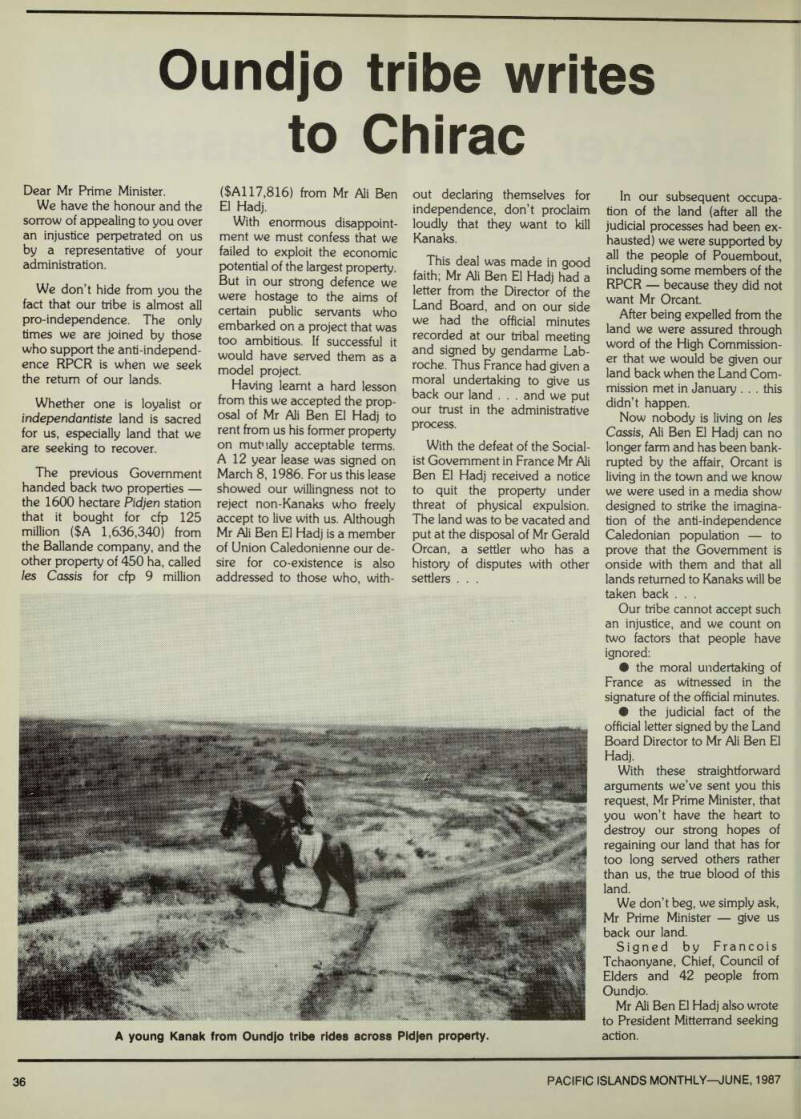
Oundjo tribe writes to Chirac
Dear Mr Prime Minister.
We have the honour and the sorrow of appealing to you over an injustice perpetrated on us by a representative of your administration. in . .. . r We d°nt hide from you the fact that our tribe is almost all pro-independence. The only time* we are jomed by those who support the anh-mdependence RPCR is when we seek the return of our lands.
Whether one is loyalist or independantiste land is sacred for us, especially land that we are seeking to recover.
The previous Government handed back two properties the 1600 hectare Pidjen station that it bought for cfp 125 million ($A 1,636,340) from the Ballande company, and the other property of 450 ha, called les Cassis for cfp 9 million
($A117,816) from Mr Ali Ben El Hadj.
With enormous disappoint ment we must confess that we failed to exploit the economic potential of the largest property.
But in our strong defence we were hosta to u the aims f certain seivants wh embarked on a ject tha , was tOO ambffious , , f successful it would have se[ved them as model project Ha vmg leamt a hard lesson rom we accepted the prop °* Mr AH Ben El Hadj to rent kom us his former property on mu t l 'ally acceptable terms.
A 12 year lease was signed on March 8, 1986. For us this lease showed our willingness not to reject non-Kanaks who freely accept to live with us. Although Mr Ali Ben El Hadj is a member of Union Caledonienne our de sire for co-existence is also addressed to those who, with
out declaring themselves for independence, don’t proclaim loudly that they want to kill Kanaks.
This deal was made in good faith; Mr Ali Ben El Hadj had a letter from the Director of the Land Board, and on our side we had the official minutes recorded at our tribal meeting and signed by gendarme Lab roche. Thus France had given a moral undertaking to give us back our land . . . and we put our trust in the administrative process.
With the defeat of the Social ist Government in France Mr Ali Ben El Hadj received a notice to quit the property under threat of physical expulsion.
The land was to be vacated and put at the disposal of Mr Gerald Orcan, a settler who has a history of disputes with other settlers . . .
In our subsequent occupa tion of the land (after all the judicial processes had been ex hausted) we were supported by all the people of Pouembout, including some members of the RPCR because they did not want Mr Orcant.
After being expelled from the land we were assured through word of the High Commission er that we would be given our land back when the Land Com mission met in January . . . this didn’t happen.
Now nobody is living on les Cassis, Ali Ben El Hadj can no longer farm and has been bank rupted by the affair, Orcant is living in the town and we know we were used in a media show designed to strike the imagina tion of the anti-independence Caledonian population to prove that the Government is onside with them and that all lands returned to Kanaks will be taken back . . .
Our tribe cannot accept such an injustice, and we count on two factors that people have ignored: • the moral undertaking of France as witnessed in the signature of the official minutes. • the judicial fact of the official letter signed by the Land Board Director to Mr Ali Ben El Hadj.
With these straightforward arguments we’ve sent you this request, Mr Prime Minister, that you won’t have the heart to destroy our strong hopes of regaining our land that has for too long served others rather than us, the true blood of this land.
We don’t beg, we simply ask, Mr Prime Minister give us back our land.
Signed by Francois Tchaonyane, Chief, Council of Elders and 42 people from Oundjo.
Mr Ali Ben El Hadj also wrote to President Mitterrand seeking action.
A young Kanak from Oundjo tribe rides across Pidjen property.
Problems of development
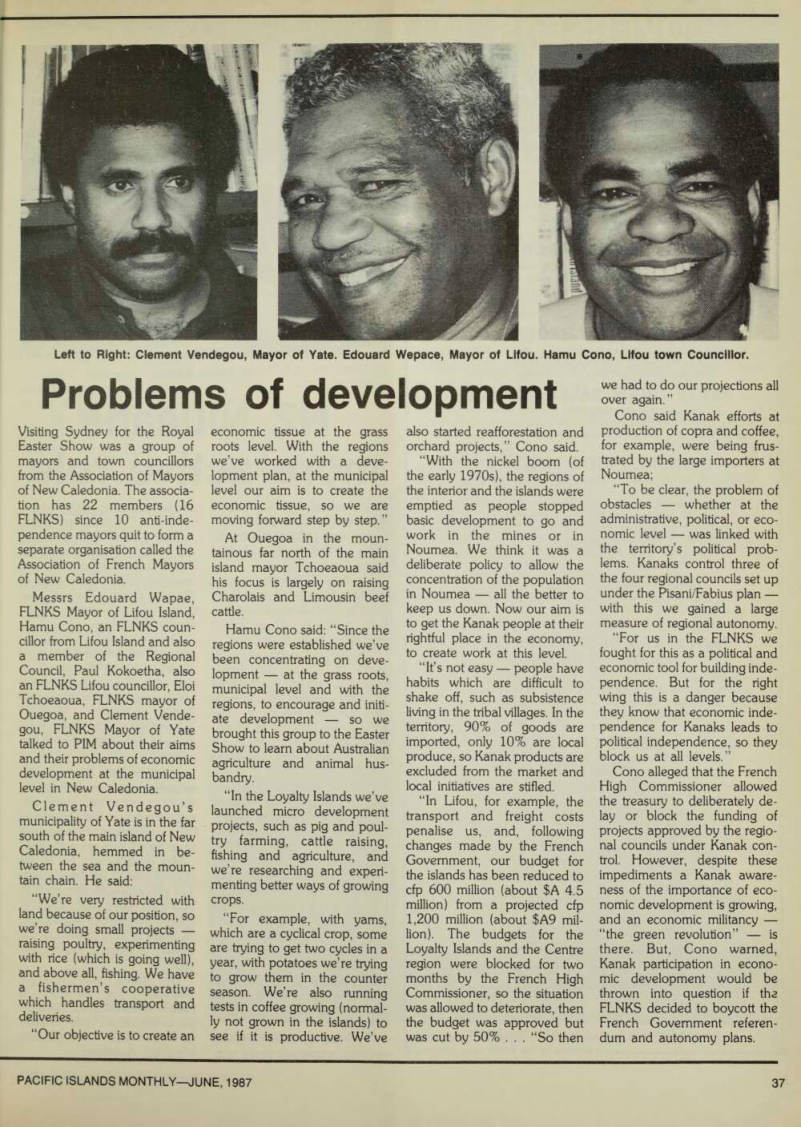
Visiting Sydney for the Royal Easter Show was a group of mayors and town councillors from the Association of Mayors of New Caledonia. The associa tion has 22 members (16 FLNKS) since 10 anti-inde pendence mayors quit to form a separate organisation called the Association of French Mayors of New Caledonia.
Messrs Edouard Wapae, FLNKS Mayor of Lifou Island, Hamu Cono, an FLNKS coun cillor from Lifou Island and also a member of the Regional Council, Paul Kokoetha, also an FLNKS Lifou councillor, Eloi Tchoeaoua, FLNKS mayor of Ouegoa, and Clement Vende gou, FLNKS Mayor of Yate talked to PIM about their aims and their problems of economic development at the municipal level in New Caledonia.
Clement Vendegou’s municipality of Yate is in the far south of the main island of New Caledonia, hemmed in be tween the sea and the moun tain chain. He said: “We’re very restricted with land because of our position, so we’re doing small projects raising poultry, experimenting with rice (which is going well), and above all, fishing. We have a fishermen’s cooperative which handles transport and deliveries.
“Our objective is to create an
economic tissue at the grass roots level. With the regions we’ve worked with a deve lopment plan, at the municipal level our aim is to create the economic tissue, so we are moving forward step by step.”
At Ouegoa in the moun tainous far north of the main island mayor Tchoeaoua said his focus is largely on raising Charolais and Limousin beef cattle.
Hamu Cono said: “Since the regions were established we’ve been concentrating on deve lopment at the grass roots, municipal level and with the regions, to encourage and initi ate development so we brought this group to the Easter Show to learn about Australian agriculture and animal hus bandry.
“In the Loyalty Islands we’ve launched micro development projects, such as pig and poul try farming, cattle raising, fishing and agriculture, and we’re researching and experi menting better ways of growing crops.
“For example, with yams, which are a cyclical crop, some are trying to get two cycles in a year, with potatoes we’re trying to grow them in the counter season. We’re also running tests in coffee growing (normal ly not grown in the islands) to see if it is productive. We’ve
also started reafforestation and orchard projects,” Cono said.
“With the nickel boom (of the early 19705), the regions of the interior and the islands were emptied as people stopped basic development to go and work in the mines or in Noumea. We think it was a deliberate policy to allow the concentration of the population in Noumea all the better to keep us down. Now our aim is to get the Kanak people at their rightful place in the economy, to create work at this level.
“It’s not easy people have habits which are difficult to shake off, such as subsistence living in the tribal villages. In the territory, 90% of goods are imported, only 10% are local produce, so Kanak products are excluded from the market and local initiatives are stifled.
“In Lifou, for example, the transport and freight costs penalise us, and, following changes made by the French Government, our budget for the islands has been reduced to cfp 600 million (about $A 4.5 million) from a projected cfp 1,200 million (about SA9 mil lion). The budgets for the Loyalty Islands and the Centre region were blocked for two months by the French High Commissioner, so the situation was allowed to deteriorate, then the budget was approved but was cut by 50% . . . “So then
we had to do our projections all over again.”
Cono said Kanak efforts at production of copra and coffee, for example, were being frus trated by the large importers at Noumea; “To be clear, the problem of obstacles whether at the administrative, political, or eco nomic level was linked with the territory’s political prob lems. Kanaks control three of the four regional councils set up under the Pisani/Fabius plan with this we gained a large measure of regional autonomy.
“For us in the FLNKS we fought for this as a political and economic tool for building inde pendence. But for the right wing this is a danger because they know that economic inde pendence for Kanaks leads to political independence, so they block us at all levels.”
Cono alleged that the French High Commissioner allowed the treasury to deliberately de lay or block the funding of projects approved by the regio nal councils under Kanak con trol. However, despite these impediments a Kanak aware ness of the importance of eco nomic development is growing, and an economic militancy “the green revolution” is there. But, Cono warned, Kanak participation in econo mic development would be thrown into question if the FLNKS decided to boycott the French Government referen dum and autonomy plans.
Left to Right: Clement Vendegou, Mayor of Yate.
Edouard Wepace, Mayor of Lifou.
Hamu Cono, Lifou town Councillor.
NZ Niueans
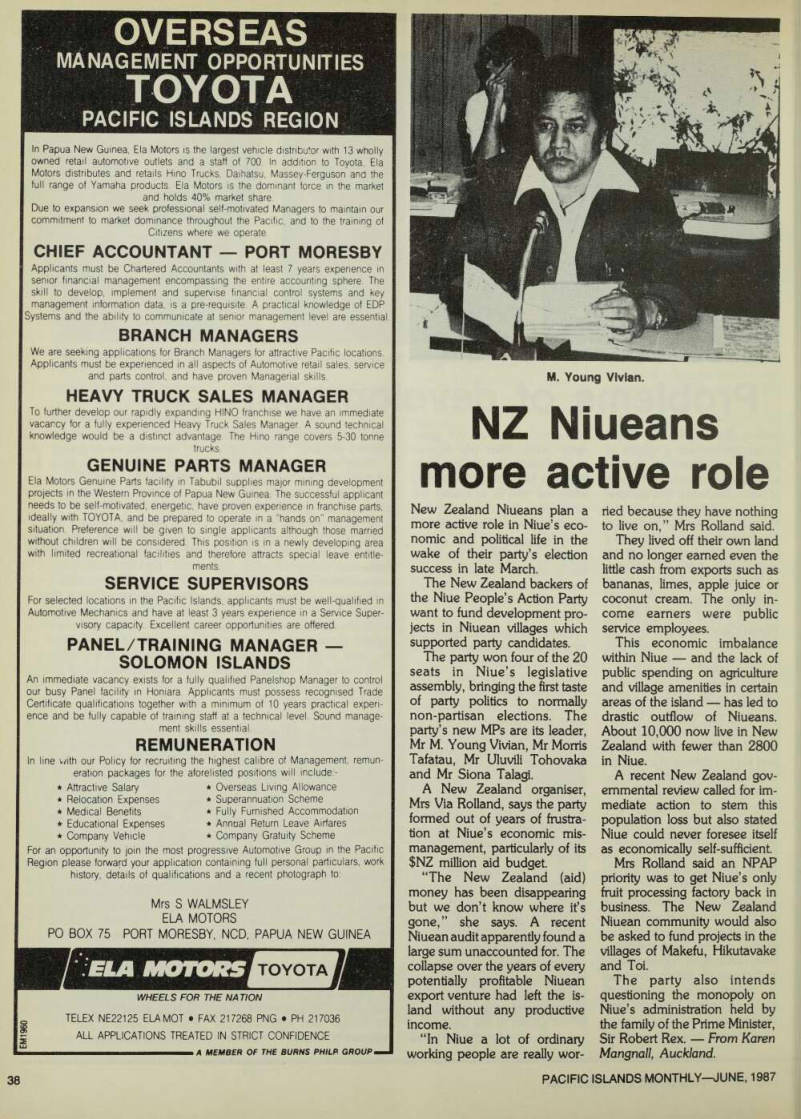
more active role
New Zealand Niueans plan a more active role in Niue’s eco nomic and political life in the wake of their party’s election success in late March.
The New Zealand backers of the Niue People’s Action Party want to fund development pro jects in Niuean villages which supported party candidates.
The party won four of the 20 seats in Niue’s legislative assembly, bringing the first taste of party politics to normally non-partisan elections. The party’s new MPs are its leader, Mr M. Young Vivian, Mr Morris Tafatau, Mr Uluvili Tohovaka and Mr Siona Talagi.
A New Zealand organiser, Mrs Via Holland, says the party formed out of years of frustra tion at Niue’s economic mis management, particularly of its SNZ million aid budget.
“The New Zealand (aid) money has been disappearing but we don’t know where it’s gone,” she says. A recent Niuean audit apparently found a large sum unaccounted for. The collapse over the years of every potentially profitable Niuean export venture had left the is land without any productive income.
“In Niue a lot of ordinary working people are really wor
ried because they have nothing to live on,” Mrs Holland said.
They lived off their own land and no longer earned even the little cash from exports such as bananas, limes, apple juice or coconut cream. The only in come earners were public service employees.
This economic imbalance within Niue and the lack of public spending on agriculture and village amenities in certain areas of the island has led to drastic outflow of Niueans.
About 10,000 now live in New Zealand with fewer than 2800 in Niue.
A recent New Zealand gov ernmental review called for im mediate action to stem this population loss but also stated Niue could never foresee itself as economically self-sufficient Mrs Holland said an NPAP priority was to get Niue’s only fruit processing factory back in business. The New Zealand Niuean community would also be asked to fund projects in the villages of Makefu, Hikutavake and Toi.
The party also intends questioning the monopoly on Niue’s administration held by the family of the Prime Minister, Sir Robert Rex. From Karen Mangnall, Auckland.
M. Young Vivian.
Advertisements & other items, p. 38 (1 item)
Overseas
MANAGEMENT OPPORTUNITIES
PACIFIC ISLANDS REGION
In Papua New Guinea, Ela Motors is the largest vehicle distributor with 13 wholly owned retail automotive outlets and a staff of 700. In addition to Toyota, Ela Motors distributes and retails Hino Trucks, Daihatsu, Massey-Ferguson and the full range of Yamaha products. Ela Motors is the dominant force in the market and holds 40% market share Due to expansion we seek professional self-motivated Managers to maintain our commitment to market dominance throughout the Pacific, and to the training of Citizens where we operate.
CHIEF ACCOUNTANT PORT MORESBY
Applicants must be Chartered Accountants with at least 7 years experience in senior financial management encompassing the entire accounting sphere. The skill to develop, implement and supervise financial control systems and key management information data, is a pre-requisite A practical knowledge of EDP Systems and the ability to communicate at senior management level are essential.
BRANCH MANAGERS
We are seeking applications for Branch Managers for attractive Pacific locations.
Applicants must be experienced in all aspects of Automotive retail sales, service and parts control, and have proven Managerial skills.
HEAVY TRUCK SALES MANAGER
To further develop our rapidly expanding HINO franchise we have an immediate vacancy for a fully experienced Heavy Truck Sales Manager A sound technical knowledge would be a distinct advantage The Hino range covers 5-30 tonne trucks.
GENUINE PARTS MANAGER
Ela Motors Genuine Parts facility in Tabubil supplies major mining development projects in the Western Province of Papua New Guinea. The successful applicant needs to be self-motivated, energetic, have proven experience in franchise parts, ideally with TOYOTA, and be prepared to operate in a “hands on" management situation Preference will be given to single applicants although those married without children will be considered. This position is in a newly developing area with limited recreational facilities and therefore attracts special leave entitlements.
SERVICE SUPERVISORS
For selected locations in the Pacific Islands, applicants must be well-qualified in Automotive Mechanics and have at least 3 years experience in a Service Supervisory capacity. Excellent career opportunities are offered.
PANEL/TRAINING MANAGER
SOLOMON ISLANDS
An immediate vacancy exists for a fully qualified Panelshop Manager to control our busy Panel facility in Honiara, Applicants must possess recognised Trade Certificate qualifications together with a minimum of 10 years practical experience and be fully capable of training staff at a technical level. Sound management skills essential.
REMUNERATION
In line with our Policy for recruiting the highest calibre of Management, remuneration packages for the aforelisted positions will include:- * Attractive Salary ★ Overseas Living Allowance * Relocation Expenses * Superannuation Scheme * Medical Benefits * Fully Furnished Accommodation * Educational Expenses * Annual Return Leave Airfares * Company Vehicle * Company Gratuity Scheme For an opportunity to join the most progressive Automotive Group in the Pacific Region please forward your application containing full personal particulars, work history, details of qualifications and a recent photograph to:
PAPUA NEW GUINEA
Mrs S WALMSLEY
ELA MOTORS
PO BOX 75 PORT MORESBY, NOD,
ELA MOTORS
WHEELS FOR THE NATION
TELEX NE22125 ELA MOT • FAX 217268 PNG • PH 217036
ALL APPLICATIONS TREATED IN STRICT CONFIDENCE
■ i. i i.i A MEMBER OF THE BURNS PHILP GROUP,
TOYOTA
Women and education
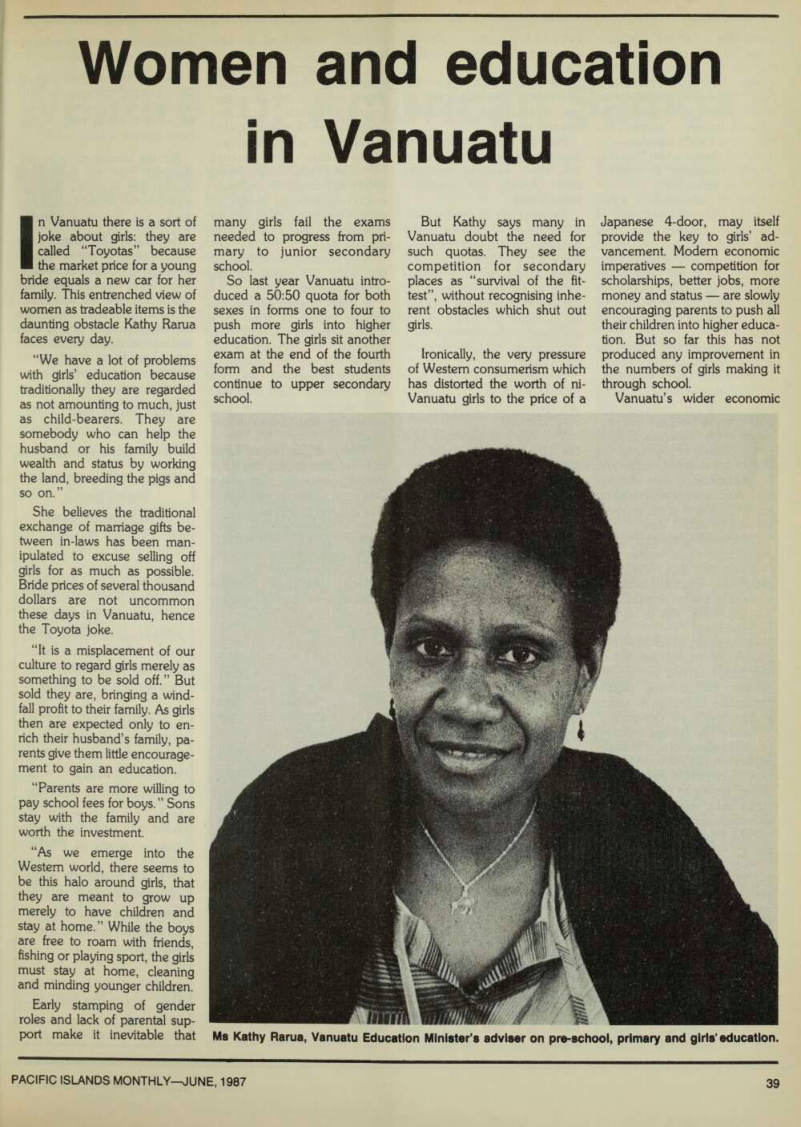
in Vanuatu
In Vanuatu there is a sort of joke about girls: they are called “Toyotas” because the market price for a young bride equals a new car for her family. This entrenched view of women as tradeable items is the daunting obstacle Kathy Rarua faces every day.
“We have a lot of problems with girls’ education because traditionally they are regarded as not amounting to much, just as child-bearers. They are somebody who can help the husband or his family build wealth and status by working the land, breeding the pigs and so on.”
She believes the traditional exchange of marriage gifts be tween in-laws has been man ipulated to excuse selling off girls for as much as possible.
Bride prices of several thousand dollars are not uncommon these days in Vanuatu, hence the Toyota joke.
“It is a misplacement of our culture to regard girls merely as something to be sold off.” But sold they are, bringing a wind fall profit to their family. As girls then are expected only to en rich their husband’s family, pa rents give them little encourage ment to gain an education.
“Parents are more willing to pay school fees for boys. ” Sons stay with the family and are worth the investment.
“As we emerge into the Western world, there seems to be this halo around girls, that they are meant to grow up merely to have children and stay at home.” While the boys are free to roam with friends, fishing or playing sport, the girls must stay at home, cleaning and minding younger children.
Early stamping of gender roles and lack of parental sup port make it inevitable that
many girls fail the exams needed to progress from pri mary to junior secondary school.
So last year Vanuatu intro duced a 50:50 quota for both sexes in forms one to four to push more girls into higher education. The girls sit another exam at the end of the fourth form and the best students continue to upper secondary school.
But Kathy says many in Vanuatu doubt the need for such quotas. They see the competition for secondary places as “survival of the fit test”, without recognising inhe rent obstacles which shut out girls.
Ironically, the very pressure of Western consumerism which has distorted the worth of ni- Vanuatu girls to the price of a
Japanese 4-door, may itself provide the key to girls’ ad vancement. Modem economic imperatives competition for scholarships, better jobs, more money and status are slowly encouraging parents to push all their children into higher educa tion. But so far this has not produced any improvement in the numbers of girls making it through school.
Vanuatu’s wider economic
Ms Kathy Rarua, Vanuatu Education Minister’s adviser on pre-school, primary and girls' education.
constraints mean that opportu nities for girls expand only as fast as the whole education system can grow. Emulating New Zealand’s specialist re search, staff and policies for minority groups women, the Maori and Pacific Islanders is a distant dream when Vanuatu is still struggling to provide universal education.
Primary education is avail able to about 90 per cent of Vanuatu’s children but only one third of them go on to junior secondary school. Only 20 per cent of that small group continue to upper secondary school and the proportion of girls diminishes dramatically at each level.
The governing Vanuatu Party wants to extend automa tic promotion up to form four.
“But that means building more schools, training and paying more teachers and pro viding more materials. Educa tion is already eating up 40 per cent of our national budget and we are operating on a skeleton staff. Any changes must take up extra funds and at the moment we cannot afford that.”
Cyclones like the gigantically destructive Uma earlier this year do not help Vanuatu’s developing economy which is marked by a large proportion of the population still in subsist ence farming.
But Vanuatu’s radical foreign posture contacts with Russia and Libya as well as its anti nuclear stance and regular flagellation of France seems to have made aid donors shy.
France has cut back sharply on its aid allocations. Internatio nal lenders like the World Bank, which even did a detailed eco nomic survey of how Vanuatu could cater for an expanding secondary school system, have ducked requests for loans for years.
“We do wonder when we see the World Bank give S4O mil lion to a country like Indonesia which is better off than Vanuatu, when all we want is $5 or $lO million,” Kathy says.
Vanuatu has also to grapple with the complexities of a dual education system one French, one English which is the legacy of its colonial past.
“We are trying to create a common syllabus at the junior
secondary level, upper secondary is not yet co-ordin ated.”
Vanuatu might adopt the In ternational baccalaureat to keep both French and English systems happy.
But the ideal is to bring together the best of both. Again the effort requires precious time, money and specially trained staff.
Vanuatu has its own univer sal language bislama, a sort of pidgin English and French but it is not sufficiently standar dised, particulary in its written form, to be used to teach the curriculum. Kathy was impress ed by what she heard of the successes of Te Kohanga Reo, although she did not visit a unit during her stay.
But Vanuatu is taxed over how to teach its 100 vernacu lars spoken by a population of only 132,000.
The Pacific Languages Unit has been set up in Vanuatu for this reason and education offic ers are watching closely a pilot scheme in the Solomon Islands where vernacular is taught in early primary years.
Reading and counting skills are measured before the stu dents transfer into an In ternational language.
Kathy remains critical of her government’s failure so far to cater for the needs of groups with minority status, particularly women.
“I don’t think they have done enough for women, half of our population, who helped gain Vanuatu’s independence.”
Vanuatu lacks any equal opportunity policy for women.
Kathy herself is keenly aware of the isolation of her own political status: she is one of only four ni-Vanuatu women in Cabinet staffs, and she stresses that none could be described as ordinary Vanuatu women. All had higher education, were politically active and accus-' tomed to hacking it in a male environment.
“For the ordinary Vanuatu woman in the street, it would probably not even be within her scope to imagine she could get such positions.”
Many ni-Vanuatu women feared to to take opportunities because of the strong social
pressures to conform to their traditional role.
A small group of political women has recently begun un ilateral action to influence gov ernment policies affecting women. The National Council of Women is a natural progre ssion from the strong Vanua’aku Party women’s wing which did much of the gras sroots organising for Independ ence. Their first success was the passage last year of Vanuatu’s divorce laws.
“The pressure came from us, not from the public or the church women.”
A Fijian woman lawyer was initially invited to draw up a comprehensive family law proposal. The council is still sorting out the complexities of property settlements, child care and adoption, which must take into account communal land ownership and traditional cus toms.
“Many of our people argue that Vanuatu society has tradi tionally provided for these things. But as society moves away from its traditional past, these things break down.” Chil dren can no longer be automa tically cared for by extended family, for example.
Kathy dislikes a common criticism of the women’s libera tion movement that it is a purely Western phenomenon.
“The fact that ni-Vanuatu women are being used to achieve political status for the men is not a Western idea.”
Most societies, whether traditio nal or Western, could be seen as biased against women.
That women’s liberation is biased in favour of women means it offers a lot from its strategies and philosophies.
Since it came into being, women have become more aware of themselves as per sons.
But the road is long and extremely hard for the few ni-Vanuatu women whose out looks have been altered by their exposure to women’s liberation philosophies.
“At home it is very difficult to get men to listen about women’s needs and they talk a lot of rubbish. ” Men dominate the Institutions, the Vanua’aku Party and monopolise Parlia ment while women take pre
dominantly subordinate roles as secretaries and typists.
“When you have got a lot of men occupying most of the bureaucracy you may as well forget it, it’s like hitting your head against a brick wall.”
But the vicious circle is, (as always,) that to get more women into positions of influ ence they must first be able to survive the education system.
Kathy said she admired the gains women in New Zealand have made in getting specific resources to research the future needs of girls in education, breaking down gender stereotyping and getting girls and women into non-traditional subjects and jobs. “Perhaps it’s a hopeful example for the rest of us.”
from Karen MANGNALL,
Auckland.
Advertisements & other items, p. 40 (1 item)
Papua New Guinea
Handbook, Business and Travel Guide The new 11th edition is fact-packed with everything for the investor, traveller, writer, student, historian, importer, exporter and shipper.
Complete with maps including a fold-out chart of the whole country it also contains a comprchensive accommodation guide to all of PNG.
It’s a must for anyone interested in the South Pacific’s largest developing nation.
See the insert in this issue for full details.
Welfare for American Samoa?
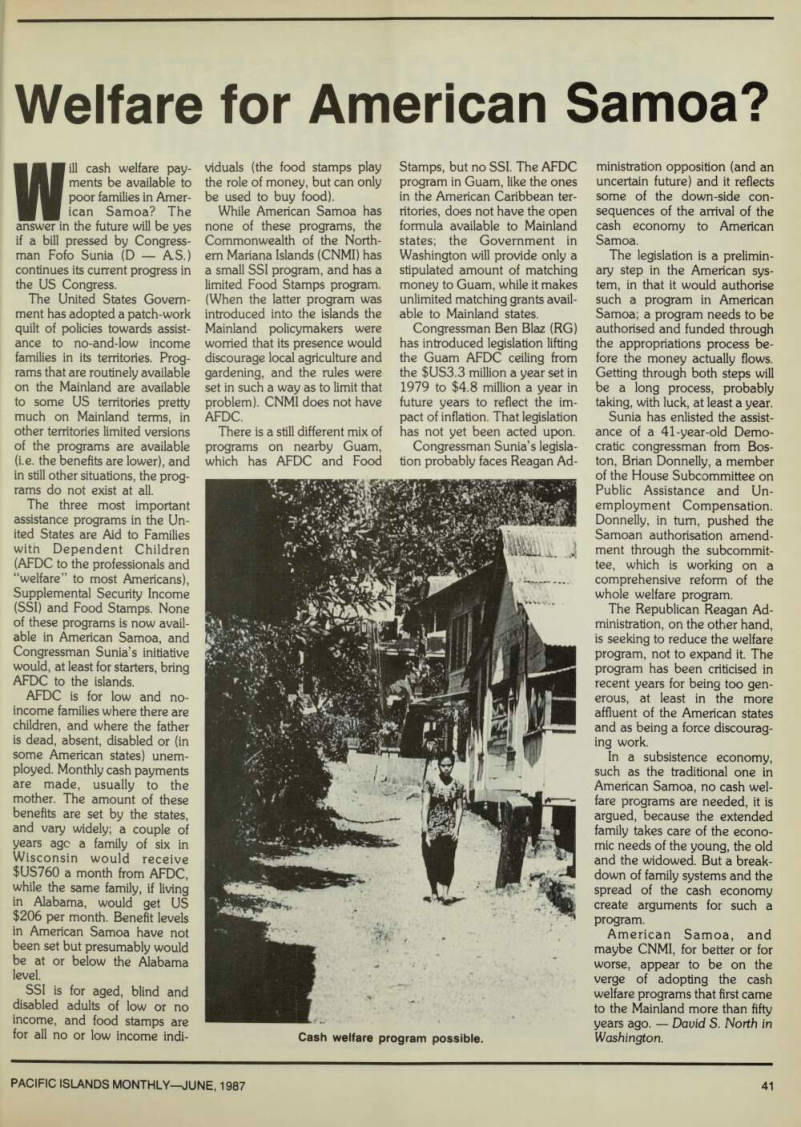
Hill cash welfare pay ments be available to poor families in Amer ican Samoa? The answer in the future will be yes if a bill pressed by Congress man Fofo Sunia (D AS.) continues its current progress in the US Congress.
The United States Govern ment has adopted a patch-work quilt of policies towards assist ance to no-and-low income families in its territories. Prog rams that are routinely available on the Mainland are available to some US territories pretty much on Mainland terms, in other territories limited versions of the programs are available (i.e. the benefits are lower), and in still other situations, the prog rams do not exist at all.
The three most important assistance programs in the Un ited States are Ad to Families with Dependent Children (AFDC to the professionals and “welfare” to most Americans), Supplemental Security Income (SSI) and Food Stamps. None of these programs is now avail able in American Samoa, and Congressman Sunia’s initiative would, at least for starters, bring AFDC to the islands.
AFDC is for low and no income families where there are children, and where the father is dead, absent, disabled or (in some American states) unem ployed. Monthly cash payments are made, usually to the mother. The amount of these benefits are set by the states, and vary widely; a couple of years age a family of six in Wisconsin would receive SUS76O a month from AFDC, while the same family, if living in Aabama, would get US $206 per month. Benefit levels in American Samoa have not been set but presumably would be at or below the Aabama level.
SSI is for aged, blind and disabled adults of low or no income, and food stamps are for all no or low income indi
viduals (the food stamps play the role of money, but can only be used to buy food).
While American Samoa has none of these programs, the Commonwealth of the North ern Mariana Islands (CNMI) has a small SSI program, and has a limited Food Stamps program. (When the latter program was introduced into the islands the Mainland policymakers were worried that its presence would discourage local agriculture and gardening, and the rules were set in such a way as to limit that problem). CNMI does not have
Afdc.
There is a still different mix of programs on nearby Guam, which has AFDC and Food
Stamps, but no SSI. The AFDC program in Guam, like the ones in the American Caribbean ter ritories, does not have the open formula available to Mainland states; the Government in Washington will provide only a stipulated amount of matching money to Guam, while it makes unlimited matching grants avail able to Mainland states.
Congressman Ben Blaz (RG) has introduced legislation lifting the Guam AFDC ceiling from the SUS 3.3 million a year set in 1979 to $4.8 million a year in future years to reflect the im pact of inflation. That legislation has not yet been acted upon.
Congressman Sunia’s legisla tion probably faces Reagan Ad-
ministration opposition (and an uncertain future) and it reflects some of the down-side con sequences of the arrival of the cash economy to American Samoa.
The legislation is a prelimin ary step in the American sys tem, in that it would authorise such a program in American Samoa; a program needs to be authorised and funded through the appropriations process be fore the money actually flows.
Getting through both steps will be a long process, probably taking, with luck, at least a year.
Sunia has enlisted the assist ance of a 41-year-old Demo cratic congressman from Bos ton, Brian Donnelly, a member of the House Subcommittee on Public Assistance and Un employment Compensation.
Donnelly, in turn, pushed the Samoan authorisation amend ment through the subcommit tee, which is working on a comprehensive reform of the whole welfare program.
The Republican Reagan Ad ministration, on the other hand, is seeking to reduce the welfare program, not to expand it. The program has been criticised in recent years for being too gen erous, at least in the more affluent of the American states and as being a force discourag ing work.
In a subsistence economy, such as the traditional one in American Samoa, no cash wel fare programs are needed, it is argued, because the extended family takes care of the econo mic needs of the young, the old and the widowed. But a break down of family systems and the spread of the cash economy create arguments for such a program.
American Samoa, and maybe CNMI, for better or for worse, appear to be on the verge of adopting the cash welfare programs that first came to the Mainland more than fifty years ago. David S. North in Washington.
Cash welfare program possible.
Pacific congressman
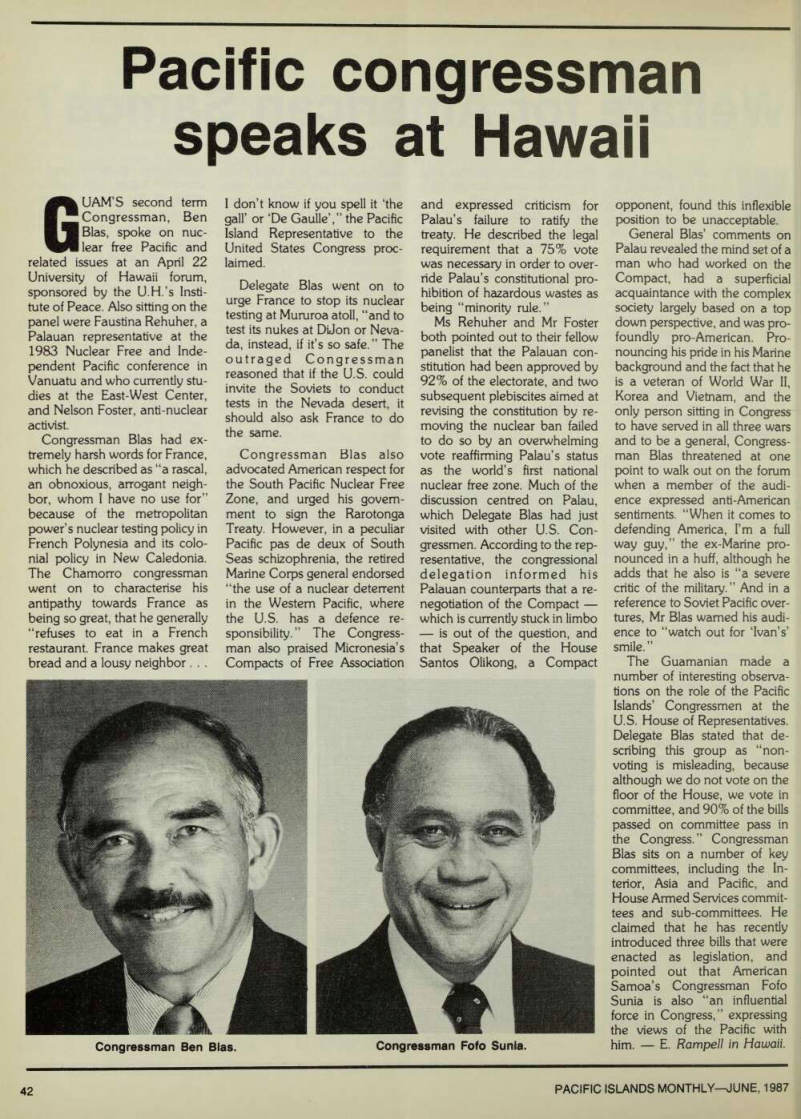
speaks at Hawaii
GUAM’S second term Congressman, Ben Bias, spoke on nuc lear free Pacific and related issues at an April 22 University of Hawaii forum, sponsored by the U.H.’s Insti tute of Peace. Also sitting on the panel were Faustina Rehuher, a Palauan representative at the 1983 Nuclear Free and Inde pendent Pacific conference in Vanuatu and who currently stu dies at the East-West Center, and Nelson Foster, anti-nuclear activist.
Congressman Bias had ex tremely harsh words for France, which he described as “a rascal, an obnoxious, arrogant neigh bor, whom I have no use for” because of the metropolitan power’s nuclear testing policy in French Polynesia and its colo nial policy in New Caledonia.
The Chamorro congressman went on to characterise his antipathy towards France as being so great, that he generally “refuses to eat in a French restaurant. France makes great bread and a lousy neighbor. . .
I don’t know if you spell it ‘the gall’ or ‘De Gaulle’,” the Pacific Island Representative to the United States Congress proc laimed. x De ' e 9 ate ®as we "‘ on , to t ur9 f Fran “ to sto P , nucl f ar testing at Mururoaatoll, and to ‘ est lts ™kes at DJon or Neva da',nstead; ,f * sso «*• The outra 9 ed t C ° n9 '\ ssma " reas ° n f d that lf * e ( U S c ° uld ‘™ te . th f, , t 0 , conduc
' fp V
should also ask France to do , e same ‘ Congressman Bias also advocated American respect for the South Pacific Nuclear Free Zone, and urged his govem ment to sign the Rarotonga Treaty. However, in a peculiar Pacific pas de deux of South Seas schizophrenia, the retired Marine Corps general endorsed “the use of a nuclear deterrent in the Western Pacific, where the U.S. has a defence re sponsibility. ” The Congress man also praised Micronesia’s Compacts of Free Association
and expressed criticism for Palau’s failure to ratify the treaty. He described the legal requirement that a 75% vote was necessary in order to over ride Palau’s constitutional pro hibition of hazardous wastes as being “minority rule.”
Ms Rehuher and Mr Foster both pointed out to their fellow panelist that the Palauan con stitution had been approved by 92% of the electorate, and two subsequent plebiscites aimed at revising the constitution by re moving the nuclear ban failed to do so by an overwhelming vote reaffirming Palau’s status as the world’s first national nuclear free zone. Much of the discussion centred on Palau, which Delegate Bias had just visited with other U.S. Con gressmen. According to the rep resentative, the congressional delegation informed his Palauan counterparts that a re negotiation of the Compact which is currently stuck in limbo is out of the question, and that Speaker of the House Santos Olikong, a Compact
opponent, found this inflexible position to be unacceptable.
General Bias’ comments on Palau revealed the mind set of a man who had worked on the Compact, had a superficial acquaintance with the complex society largely based on a top down perspective, and was pro foundly pro-American. Pro nouncing his pride in his Marine background and the fact that he is a veteran of World War 11, Korea and Vietnam, and the only person sitting in Congress to have served in all three wars and to be a general, Congress man Bias threatened at one point to walk out on the forum when a member of the audi ence expressed anti-American sentiments. “When it comes to defending America, I’m a full way guy,” the ex-Marine pro nounced in a huff, although he adds that he also is “a severe critic of the military. ” And in a reference to Soviet Pacific over tures, Mr Bias warned his audi ence to “watch out for ‘lvan’s’ smile. ”
The Guamanian made a number of interesting observa tions on the role of the Pacific Islands’ Congressmen at the U.S. House of Representatives.
Delegate Bias stated that de scribing this group as “non voting is misleading, because although we do not vote on the floor of the House, we vote in committee, and 90% of the bills passed on committee pass in the Congress.” Congressman Bias sits on a number of key committees, including the In terior, Asia and Pacific, and House Armed Services commit tees and sub-committees. He claimed that he has recently introduced three bills that were enacted as legislation, and pointed out that American Samoa’s Congressman Fofo Sunia is also “an influential force in Congress,” expressing the views of the Pacific with him. E. Rampell in Hawaii.
Congressman Ben Bias.
Congressman Fofo Sunia.
Only one barrier remains
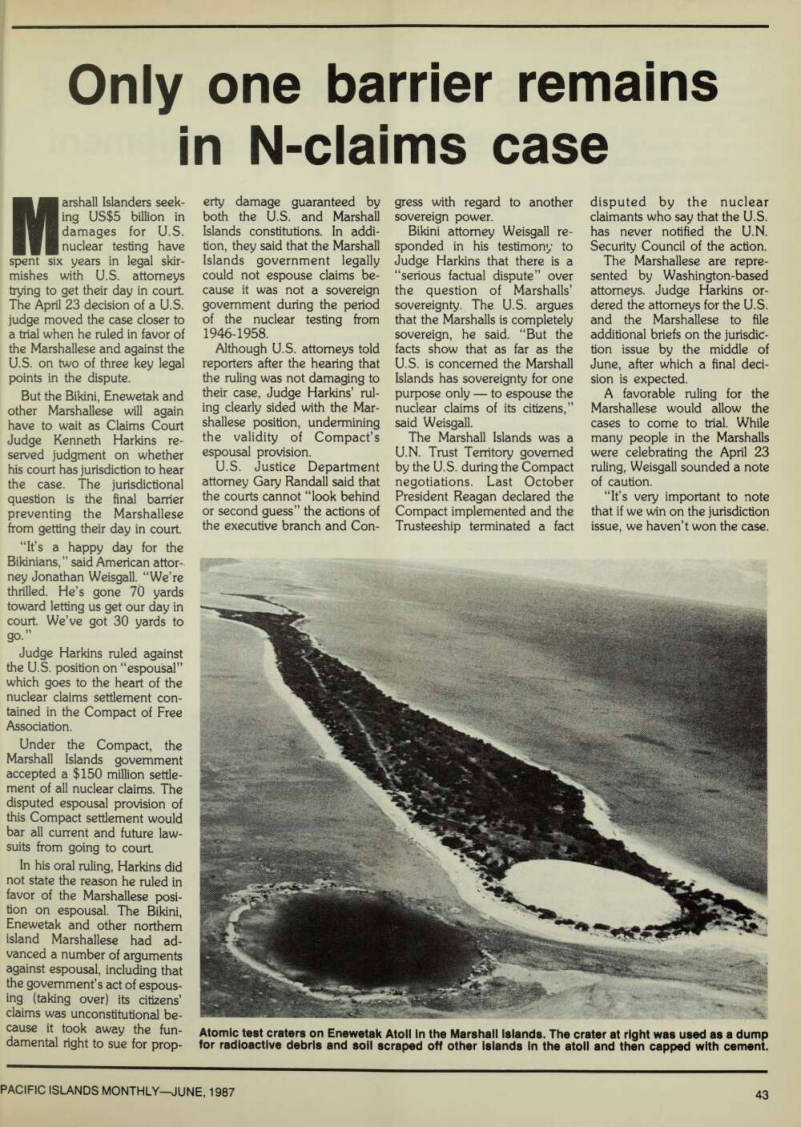
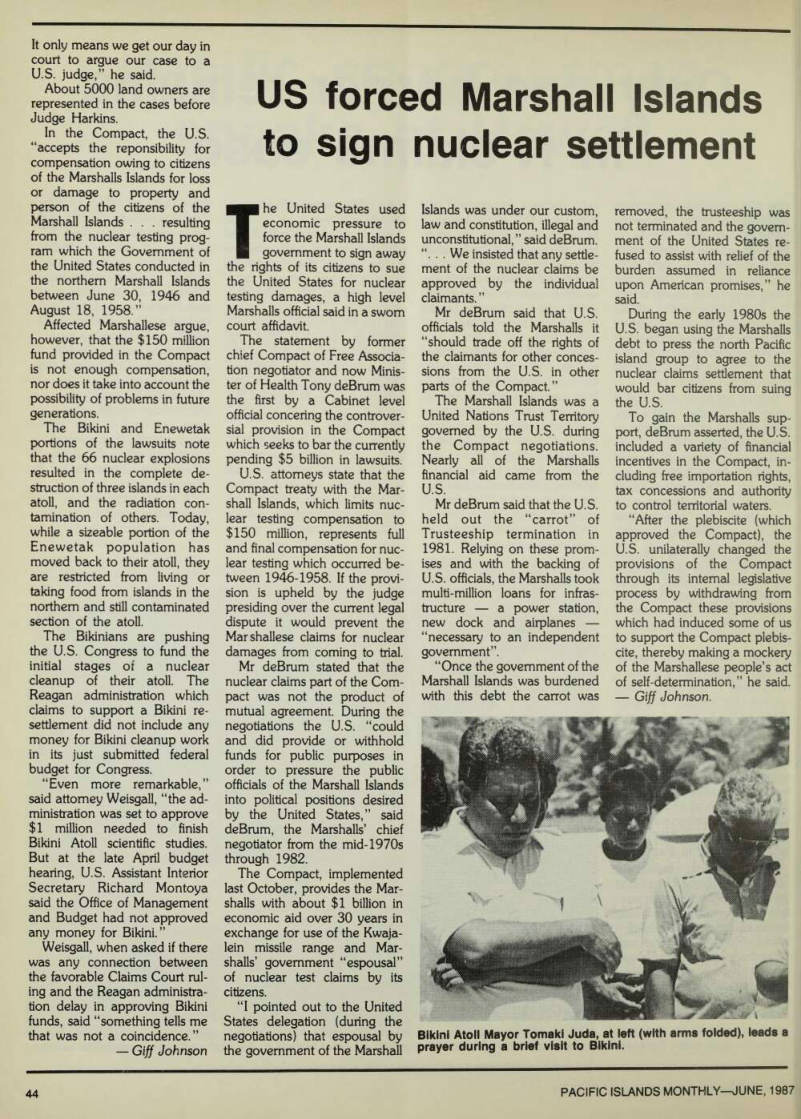
in N-claims case
Marshall Islanders seek ing US$5 billion in damages for U.S. nuclear testing have spent six years in legal skir mishes with U.S. attorneys trying to get their day in court.
The April 23 decision of a U.S. judge moved the case closer to a trial when he ruled in favor of the Marshallese and against the U.S. on two of three key legal points in the dispute.
But the Bikini, Enewetak and other Marshallese will again have to wait as Claims Court Judge Kenneth Harkins re served judgment on whether his court has jurisdiction to hear the case. The jurisdictional question is the final barrier preventing the Marshallese from getting their day in court.
“It’s a happy day for the Bikinians, ” said American attor ney Jonathan Weisgall. “We’re thrilled. He’s gone 70 yards toward letting us get our day in court. We’ve got 30 yards to go.”
Judge Harkins ruled against the U.S. position on “espousal” which goes to the heart of the nuclear claims settlement con tained in the Compact of Free Association.
Under the Compact, the Marshall Islands government accepted a $l5O million settle ment of all nuclear claims. The disputed espousal provision of this Compact settlement would bar all current and future law suits from going to court In his oral ruling, Harkins did not state the reason he ruled in favor of the Marshallese posi tion on espousal. The Bikini, Enewetak and other northern island Marshallese had ad vanced a number of arguments against espousal, including that the government’s act of espous ing (taking over) its citizens’ claims was unconstitutional be cause it took away the fun damental right to sue for prop
erty damage guaranteed by both the U.S. and Marshall Islands constitutions. In addi tion, they said that the Marshall Islands government legally could not espouse claims be cause it was not a sovereign government during the period of the nuclear testing from 1946-1958.
Although U.S. attorneys told reporters after the hearing that the ruling was not damaging to their case, Judge Harkins’ rul ing clearly sided with the Mar shallese position, undermining the validity of Compact’s espousal provision.
U.S. Justice Department attorney Gary Randall said that the courts cannot “look behind or second guess” the actions of the executive branch and Con
gress with regard to another sovereign power.
Bikini attorney Weisgall re sponded in his testimony to Judge Harkins that there is a “serious factual dispute” over the question of Marshalls’ sovereignty. The U.S. argues that the Marshalls is completely sovereign, he said. “But the facts show that as far as the U.S. is concerned the Marshall Islands has sovereignty for one purpose only to espouse the nuclear claims of its citizens,” said Weisgall.
The Marshall Islands was a U.N. Trust Territory governed by the U.S. during the Compact negotiations. Last October President Reagan declared the Compact implemented and the Trusteeship terminated a fact
disputed by the nuclear claimants who say that the U.S. has never notified the U.N.
Security Council of the action.
The Marshallese are repre sented by Washington-based attorneys. Judge Harkins or dered the attorneys for the U.S. and the Marshallese to file additional briefs on the jurisdic tion issue by the middle of June, after which a final deci sion is expected.
A favorable ruling for the Marshallese would allow the cases to come to trial. While many people in the Marshalls were celebrating the April 23 ruling, Weisgall sounded a note of caution.
“It’s very important to note that if we win on the jurisdiction issue, we haven’t won the case.
Atomic test craters on Enewetak Atoll in the Marshall Islands. The crater at right was used as a dump for radioactive debris and soil scraped off other islands in the atoll and then capped with cement.
It only means we get our day in court to argue our case to a U.S. judge,” he said.
About 5000 land owners are represented in the cases before Judge Harkins.
In the Compact, the U.S.
“accepts the reponsibility for compensation owing to citizens of the Marshalls Islands for loss or damage to property and person of the citizens of the
Marshall Islands . . . resulting
from the nuclear testing prog ram which the Government of the United States conducted in the northern Marshall Islands between June 30, 1946 and August 18, 1958.”
Affected Marshallese argue, however, that the $l5O million fund provided in the Compact is not enough compensation, nor does it take into account the possibility of problems in future generations.
The Bikini and Enewetak portions of the lawsuits note that the 66 nuclear explosions resulted in the complete de struction of three islands in each atoll, and the radiation con tamination of others. Today, while a sizeable portion of the Enewetak population has moved back to their atoll, they are restricted from living or taking food from islands in the northern and still contaminated section of the atoll.
The Bikinians are pushing the U.S. Congress to fund the initial stages of a nuclear cleanup of their atoll. The Reagan administration which claims to support a Bikini re settlement did not include any money for Bikini cleanup work in its just submitted federal budget for Congress.
“Even more remarkable,” said attorney Weisgall, “the ad ministration was set to approve $1 million needed to finish Bikini Atoll scientific studies.
But at the late April budget hearing, U.S. Assistant Interior Secretary Richard Montoya said the Office of Management and Budget had not approved any money for Bikini.”
Weisgall, when asked if there was any connection between the favorable Claims Court rul ing and the Reagan administra tion delay in approving Bikini funds, said “something tells me that was not a coincidence.”
Gift Johnson
US forced Marshall Islands
to sign nuclear settlement
The United States used economic pressure to force the Marshall Islands government to sign away the rights of its citizens to sue the United States for nuclear testing damages, a high level Marshalls official said in a sworn court affidavit.
The statement by former chief Compact of Free Associa tion negotiator and now Minis ter of Health Tony deßrum was the first by a Cabinet level official concering the controver sial provision in the Compact which seeks to bar the currently pending $5 billion in lawsuits.
U.S. attorneys state that the Compact treaty with the Mar shall Islands, which limits nuc lear testing compensation to $l5O million, represents full and final compensation for nuc lear testing which occurred be tween 1946-1958. If the provi sion is upheld by the judge presiding over the current legal dispute it would prevent the Marshallese claims for nuclear damages from coming to trial.
Mr deßrum stated that the nuclear claims part of the Com pact was not the product of mutual agreement. During the negotiations the U.S. “could and did provide or withhold funds for public purposes in order to pressure the public officials of the Marshall Islands into political positions desired by the United States,” said deßrum, the Marshalls’ chief negotiator from the mid-1970s through 1982.
The Compact, implemented last October, provides the Mar shalls with about $1 billion in economic aid over 30 years in exchange for use of the Kwaja lein missile range and Mar shalls’ government “espousal” of nuclear test claims by its citizens.
“I pointed out to the United States delegation (during the negotiations) that espousal by the government of the Marshall
Islands was under our custom, law and constitution, illegal and unconstitutional, ” said deßrum.
“. . . We insisted that any settle ment of the nuclear claims be approved by the individual claimants.”
Mr deßrum said that U.S. officials told the Marshalls it “should trade off the rights of the claimants for other conces sions from the U.S. in other parts of the Compact.”
The Marshall Islands was a United Nations Trust Territory governed by the U.S. during the Compact negotiations.
Nearly all of the Marshalls financial aid came from the U.S.
Mr deßrum said that the U.S. held out the “carrot” of Trusteeship termination in 1981. Relying on these prom ises and with the backing of U.S. officials, the Marshalls took multi-million loans for infras tructure a power station, new dock and airplanes “necessary to an independent government”.
“Once the government of the Marshall Islands was burdened with this debt the carrot was
removed, the trusteeship was not terminated and the govern ment of the United States re fused to assist with relief of the burden assumed in reliance upon American promises,” he said.
During the early 1980 s the U.S. began using the Marshalls debt to press the north Pacific island group to agree to the nuclear claims settlement that would bar citizens from suing the U.S.
To gain the Marshalls sup port, deßrum asserted, the U.S. included a variety of financial incentives in the Compact, in cluding free importation rights, tax concessions and authority to control territorial waters.
“After the plebiscite (which approved the Compact), the U.S. unilaterally changed the provisions of the Compact through its internal legislative process by withdrawing from the Compact these provisions which had induced some of us to support the Compact plebis cite, thereby making a mockery of the Marshallese people’s act of self-determination,” he said.
Giff Johnson.
Bikini Atoll Mayor Tomaki Juda, at left (with arms folded), leads a prayer during a brief visit to Bikini.
Incomes drop in Islands—
but populations up
Most Pacific Island nations’ income dropped in the 1984- 1985 period, but population growth rates remained high.
These trends are shown in economic and social “report cards” just released by two Washington-based institutions.
Only three jurisdictions showed an increase in per capita gross national product (GNP): American Samoa, French Polynesia and, by only US $lO, Papua-New Guinea.
Five showed de creases between 1984 and 1985: Fiji, Guam, New Caledo nia, the Solomons and Western Samoa, according to the annual World Bank Atlas.
A glance at the GNP table shows a one-to-fifteen range in per capita averages, from US $5lO in the Solomons to US $7,840 in French Polynesia.
One of the most startling trends reported was the fact that, for the first time, the per capita GNP in French Polynesia (US $7840) rose above that of New Zealand (US $7310.) The French Polynesian total was up US $2lO over the previous year while that of New Zealand down by US $430. Gross na tional product, as measured by the World Bank, is the sum of the economic subsidies from
other places; Wellington gets no help along these lines and Tahi ti gets lots.
Further, as in earlier years, the heavily subsidised French and American colonies gener ally reported much higher GNPs than the islands that once had been under British flags.
Social indicators data was also released on the Pacific showing wide ranges in infant mortality rates and in the per centage of school-age children in school.
The number of babies dying before their first birthday per 1000 live births varied from a low of 11 in New Caledonia to a high 91 in Papua New Guinea. New Caledonia’s in fant mortality rate is close to that of the United States (10.5) and surprisingly, below that of New Zealand (12.5). All island nations have infant mortality rates below the average of the less developed world 92 deaths per 1000 live births but PNG comes very close to that measure. (Data on this subject was collected by the Population Reference Bureau.) Another measure of how well a government treats its children can be seen in the school attendance statistics. The range was similar to that of the other
scales, with PNG low with 36% of school-age children in school, and next up the ladder was the Solomons with 46%.
On top was New Caledonia with a seemingly impossible 101%. (This relates to a minor defect in the measuring system the World Bank counts all kids in primary and secondary schools, even those of 5 or 18 years of age, and then com pares that total to the 6-17 year-old population as reported by the census.) An anomoly stands out when one compares the GNP and the children’s data for the two French territories. While New Caledonia has an average GNP about US $2OOO less than French Polynesia’s, its infant mortality rate is half that of Tahiti and its school attendance ratio is much higher. Are New Caledonia’s administrators more effective or more pro child than those of the other French territory? Are children better cared for in a land of political turmoil than in one of relative tranquility? Or is it much easier to deliver good social services in a reasonably compact place, like New Cale donia, than it is in a far-flung set of islands? The last explanation appears to be more plausible
but the statistics themselves offer no clues.
The population Reference Bureau also reports on death rates for the adult population (which ranged from a low of 5 per 1000 residents in Fiji to a high of 14 in PNG) and the number of years that it will take to double a territory’s total population.
Nations with low birth rates, such as the U.S. and N.Z., will take more than 90 years to double their populations, while the projected years to doubling for the islands are in the 19-35 year range. The Solomons and Vanuatu will double in popula tion in 19 years, Western Samoa in 23, PNG in 26, French Polynesia in 27, Fiji in 29, and New Caledonia (with its substantial European popu lation) in 35 years. These esti mates are based on the demog raphers’ assumptions that birth and death rates will continue at current levels and that the size of the population will not be affected by international migra tion. While these assumptions clearly are unlikely, the year-to doubling estimates do provide a useful, if rough, measure of the population pressures in the is land nations. From David S.
North in Washington.
Advertisements & other items, p. 45 (1 item)
Plumbing Fittings Of Tomorrow
SINGLE
/ LEVER
MIXER
I
80x50 GRATE
PLUMBING FITTINGS OF TOMORROW
For quotes and information on the above & following contact: BRASSHARDS MANUFACTURING PTY. LTD. BRASSHARDS HOLDINGS PTY. LTD.
Tel. (02) 939-1373 Tel. (02) 939-7300 43 CARTER ROAD, BROOKVALE, N.S.W., 2000, AUSTRALIA • TELEX AA23544
Kiribati captures
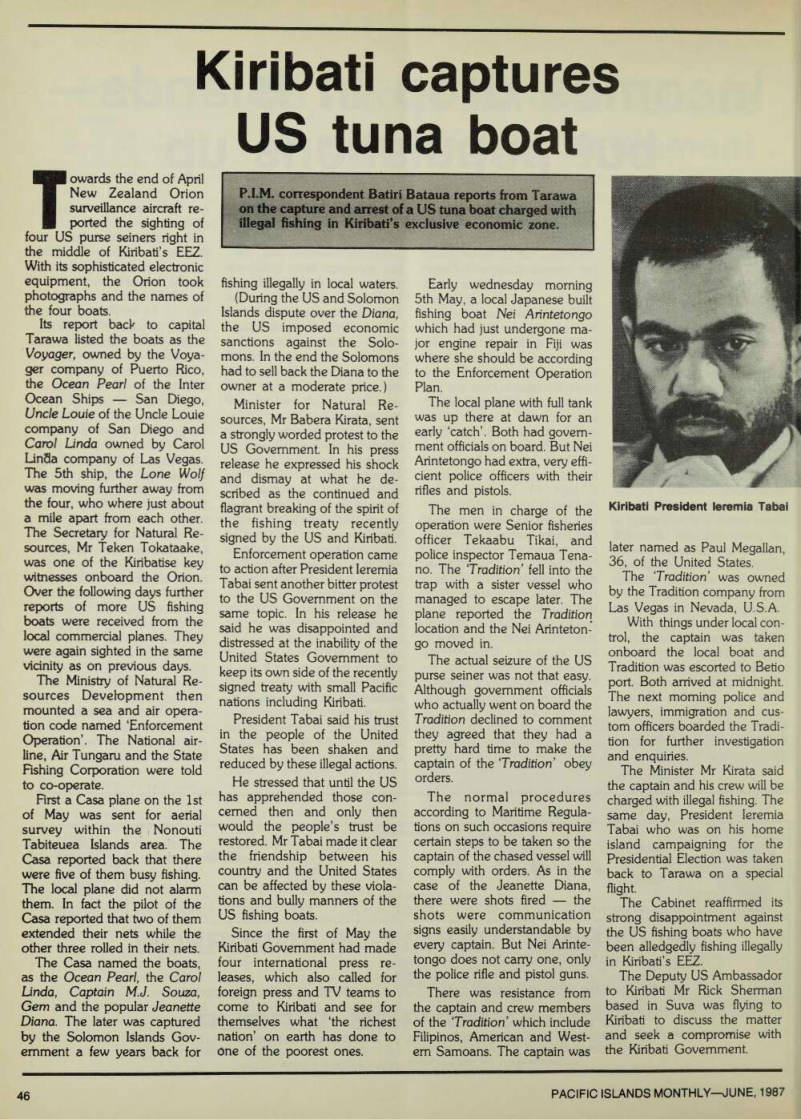
US tuna boat
P.I.M. correspondent Batin Bataua reports from Tarawa on the capture and arrest of a US tuna boat charged with illegal fishing in Kiribati’s exclusive economic zone.
Towards the end of April New Zealand Orion surveillance aircraft re ported the sighting of four US purse seiners right in the middle of Kiribati’s EEZ.
With its sophisticated electronic equipment, the Orion took photographs and the names of the four boats.
Its report back to capital Tarawa listed the boats as the Voyager, owned by the Voya ger company of Puerto Rico, the Ocean Pearl of the Inter Ocean Ships San Diego, Uncle Louie of the Uncle Louie company of San Diego and Carol Linda owned by Carol Linda company of Las Vegas.
The sth ship, the Lone Wolf was moving further away from the four, who where just about a mile apart from each other.
The Secretary for Natural Re sources, Mr Teken Tokataake, was one of the Kiribatise key witnesses onboard the Orion.
Over the following days further reports of more US fishing boats were received from the local commercial planes. They were again sighted in the same vicinity as on previous days.
The Ministry of Natural Re sources Development then mounted a sea and air opera tion code named ‘Enforcement Operation’. The National air line, Air Tungaru and the State Fishing Corporation were told to co-operate.
First a Casa plane on the Ist of May was sent for aerial survey within the Nonouti Tabiteuea Islands area. The Casa reported back that there were five of them busy fishing.
The local plane did not alarm them. In fact the pilot of the Casa reported that two of them extended their nets while the other three rolled in their nets.
The Casa named the boats, as the Ocean Pearl, the Carol Linda, Captain M.J. Souza, Gem and the popular Jeanette Diana. The later was captured by the Solomon Islands Gov ernment a few years back for
fishing illegally in local waters. (During the US and Solomon Islands dispute over the Diana, the US imposed economic sanctions against the Solo mons. In the end the Solomons had to sell back the Diana to the owner at a moderate price.) Minister for Natural Re sources, Mr Babera Kirata, sent a strongly worded protest to the US Government. In his press release he expressed his shock and dismay at what he de scribed as the continued and flagrant breaking of the spirit of the fishing treaty recently signed by the US and Kiribati.
Enforcement operation came to action after President leremia Tabai sent another bitter protest to the US Government on the same topic. In his release he said he was disappointed and distressed at the inability of the United States Government to keep its own side of the recently signed treaty with small Pacific nations including Kiribati.
President Tabai said his trust in the people of the United States has been shaken and reduced by these illegal actions.
He stressed that until the US has apprehended those con cerned then and only then would the people’s trust be restored. Mr Tabai made it clear the friendship between his country and the United States can be affected by these viola tions and bully manners of the US fishing boats.
Since the first of May the Kiribati Government had made four international press re leases, which also called for foreign press and TV teams to come to Kiribati and see for themselves what ‘the richest nation’ on earth has done to one of the poorest ones.
Early Wednesday morning sth May, a local Japanese built fishing boat Nel Arintetongo which had just undergone ma jor engine repair in Fiji was where she should be according to the Enforcement Operation Plan.
The local plane with full tank was up there at dawn for an early ‘catch’. Both had govern ment officials on board. But Nei Arintetongo had extra, very effi cient police officers with their rifles and pistols.
The men in charge of the operation were Senior fisheries officer Tekaabu Tikai, and police inspector Temaua Tena no. The ‘Tradition fell into the trap with a sister vessel who managed to escape later. The plane reported the Tradition location and the Nei Arinteton go moved in.
The actual seizure of the US purse seiner was not that easy.
Although government officials who actually went on board the Tradition declined to comment they agreed that they had a pretty hard time to make the captain of the ‘Tradition ’ obey orders.
The normal procedures according to Maritime Regula tions on such occasions require certain steps to be taken so the captain of the chased vessel will comply with orders. As in the case of the Jeanette Diana, there were shots fired the shots were communication signs easily understandable by every captain. But Nei Arinte tongo does not carry one, only the police rifle and pistol guns.
There was resistance from the captain and crew members of the ‘Tradition which include Filipinos, American and West ern Samoans. The captain was
later named as Paul Megallan, 36, of the United States.
The ‘Tradition was owned by the Tradition company from Las Vegas in Nevada, U.S.A.
With things under local con trol, the captain was taken onboard the local boat and Tradition was escorted to Betio port. Both arrived at midnight.
The next morning police and lawyers, immigration and cus tom officers boarded the Tradi tion for further investigation and enquiries.
The Minister Mr Kirata said the captain and his crew will be charged with illegal fishing. The same day, President leremia Tabai who was on his home island campaigning for the Presidential Election was taken back to Tarawa on a special flight.
The Cabinet reaffirmed its strong disappointment against the US fishing boats who have been alledgedly fishing illegally in Kiribati’s EEZ.
The Deputy US Ambassador to Kiribati Mr Rick Sherman based in Suva was flying to Kiribati to discuss the matter and seek a compromise with the Kiribati Government.
Kiribati President leremia Tabai
more racially intolerant?
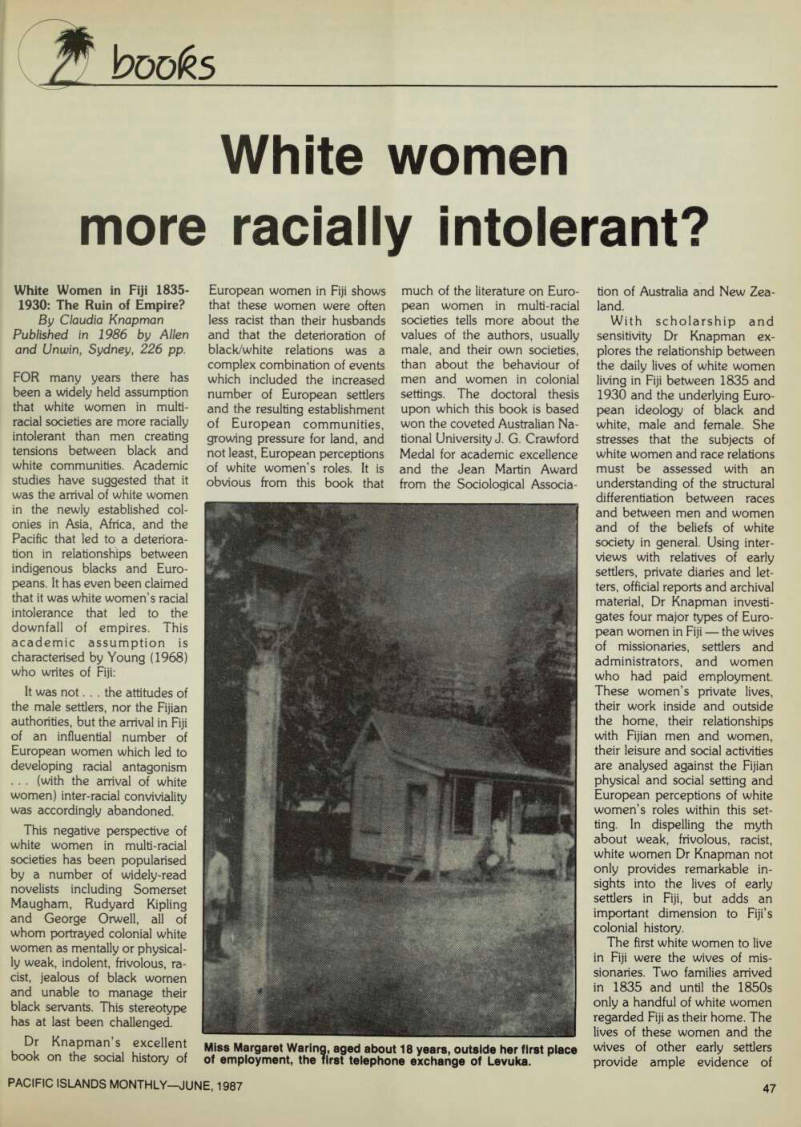
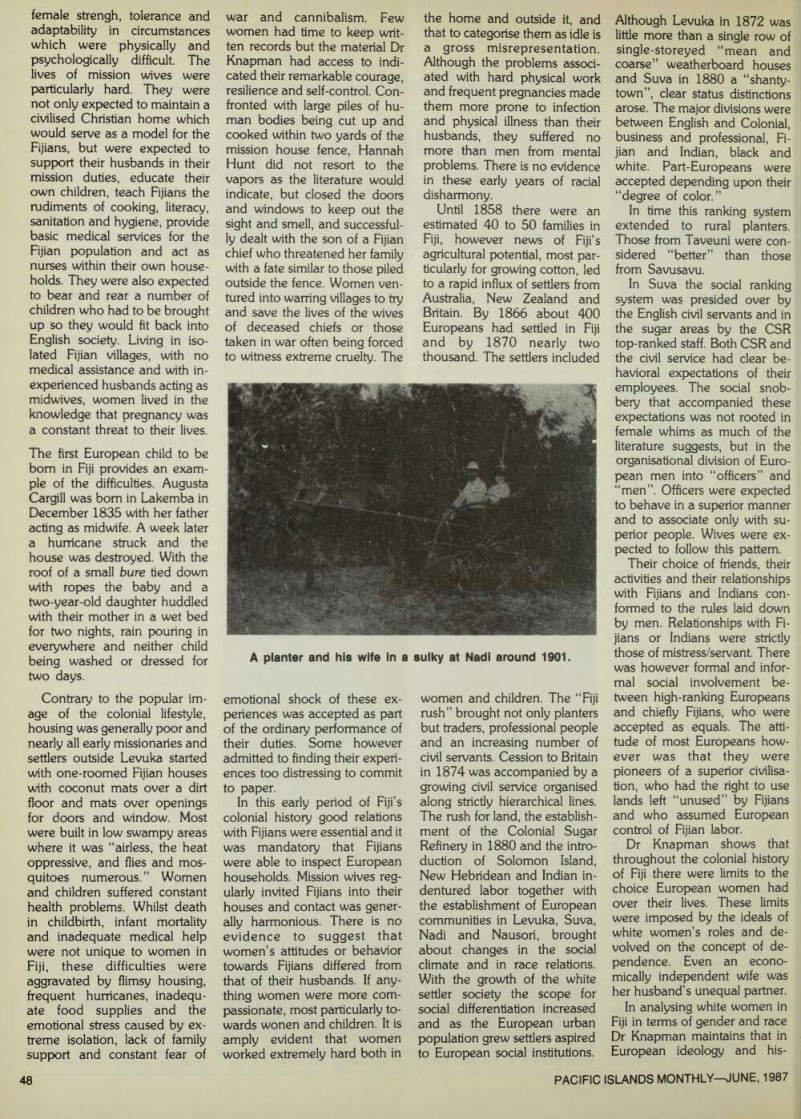
books
White women more racially intolerant?
White Women in Fiji 1835- 1930: The Ruin of Empire?
By Claudia Knapman Published in 1986 by Allen and Unwin, Sydney, 226 pp.
FOR many years there has been a widely held assumption that white women in multi racial societies are more racially intolerant than men creating tensions between black and white communities. Academic studies have suggested that it was the arrival of white women in the newly established col onies in Asia, Africa, and the Pacific that led to a deteriora tion in relationships between indigenous blacks and Euro peans. It has even been claimed that it was white women’s racial intolerance that led to the downfall of empires. This academic assumption is characterised by Young (1968) who writes of Fiji: It was not. . . the attitudes of the male settlers, nor the Fijian authorities, but the arrival in Fiji of an influential number of European women which led to developing racial antagonism . . . (with the arrival of white women) inter-racial conviviality was accordingly abandoned.
This negative perspective of white women in multi-racial societies has been popularised by a number of widely-read novelists including Somerset Maugham, Rudyard Kipling and George Orwell, all of whom portrayed colonial white women as mentally or physical ly weak, indolent, frivolous, ra cist, jealous of black women and unable to manage their black servants. This stereotype has at last been challenged.
Dr Knapman’s excellent book on the social history of
European women in Fiji shows that these women were often less racist than their husbands and that the deterioration of black/white relations was a complex combination of events which included the increased number of European settlers and the resulting establishment of European communities, growing pressure for land, and not least, European perceptions of white women’s roles. It is obvious from this book that
much of the literature on Euro pean women in multi-racial societies tells more about the values of the authors, usually male, and their own societies, than about the behaviour of men and women in colonial settings. The doctoral thesis upon which this book is based won the coveted Australian Na tional University J. G. Crawford Medal for academic excellence and the Jean Martin Award from the Sociological Associa-
tion of Australia and New Zea land.
With scholarship and sensitivity Dr Knapman ex plores the relationship between the daily lives of white women living in Fiji between 1835 and 1930 and the underlying Euro pean ideology of black and white, male and female. She stresses that the subjects of white women and race relations must be assessed with an understanding of the structural differentiation between races and between men and women and of the beliefs of white society in general. Using inter views with relatives of early settlers, private diaries and let ters, official reports and archival material, Dr Knapman investi gates four major types of Euro pean women in Fiji the wives of missionaries, settlers and administrators, and women who had paid employment.
These women’s private lives, their work inside and outside the home, their relationships with Fijian men and women, their leisure and social activities arc analysed against the Fijian physical and social setting and European perceptions of white women’s roles within this set ting. In dispelling the myth about weak, frivolous, racist, white women Dr Knapman not only provides remarkable in sights into the lives of early settlers in Fiji, but adds an important dimension to Fiji’s colonial history.
The first white women to live in Fiji were the wives of mis sionaries. Two families arrived in 1835 and until the 1850 s only a handful of white women regarded Fiji as their home. The lives of these women and the wives of other early settlers provide ample evidence of
Miss Margaret Waring, aged about 18 years, outside her first place of employment, the first telephone exchange of Levuka.
female strengh, tolerance and adaptability in circumstances which were physically and psychologically difficult. The lives of mission wives were particularly hard. They were not only expected to maintain a civilised Christian home which would serve as a model for the Fijians, but were expected to support their husbands in their mission duties, educate their own children, teach Fijians the rudiments of cooking, literacy, sanitation and hygiene, provide basic medical services for the Fijian population and act as nurses within their own house holds. They were also expected to bear and rear a number of children who had to be brought up so they would fit back into English society. Living in iso lated Fijian villages, with no medical assistance and with in experienced husbands acting as midwives, women lived in the knowledge that pregnancy was a constant threat to their lives.
The first European child to be bom in Fiji provides an exam ple of the difficulties. Augusta Cargill was bom in Lakemba in December 1835 with her father acting as midwife. A week later a hurricane struck and the house was destroyed. With the roof of a small bure tied down with ropes the baby and a two-year-old daughter huddled with their mother in a wet bed for two nights, rain pouring in everywhere and neither child being washed or dressed for two days.
Contrary to the popular im age of the colonial lifestyle, housing was generally poor and nearly all early missionaries and settlers outside Levuka started with one-roomed Fijian houses with coconut mats over a dirt floor and mats over openings for doors and window. Most were built in low swampy areas where it was “airless, the heat oppressive, and flies and mos quitoes numerous. ” Women and children suffered constant health problems. Whilst death in childbirth, infant mortality and inadequate medical help were not unique to women in Fiji, these difficulties were aggravated by flimsy housing, frequent hurricanes, inadequ ate food supplies and the emotional stress caused by ex treme isolation, lack of family support and constant fear of
war and cannibalism. Few women had time to keep writ ten records but the material Dr Knapman had access to indi cated their remarkable courage, resilience and self-control. Con fronted with large piles of hu man bodies being cut up and cooked within two yards of the mission house fence, Hannah Hunt did not resort to the vapors as the literature would indicate, but closed the doors and windows to keep out the sight and smell, and successful ly dealt with the son of a Fijian chief who threatened her family with a fate similar to those piled outside the fence. Women ven tured into warring villages to try and save the lives of the wives of deceased chiefs or those taken in war often being forced to witness extreme cruelty. The
emotional shock of these ex periences was accepted as part of the ordinary performance of their duties. Some however admitted to finding their experi ences too distressing to commit to paper.
In this early period of Fiji’s colonial history good relations with Fijians were essential and it was mandatory that Fijians were able to inspect European households. Mission wives reg ularly invited Fijians into their houses and contact was gener ally harmonious. There is no evidence to suggest that women’s attitudes or behavior towards Fijians differed from that of their husbands. If any thing women were more com passionate, most particularly to wards wonen and children. It is amply evident that women worked extremely hard both in
the home and outside it, and that to categorise them as idle is a gross misrepresentation.
Although the problems associ ated with hard physical work and frequent pregnancies made them more prone to infection and physical illness than their husbands, they suffered no more than men from mental problems. There is no evidence in these early years of racial disharmony.
Until 1858 there were an estimated 40 to 50 families in Fiji, however news of Fiji’s agricultural potential, most par ticularly for growing cotton, led to a rapid influx of settlers from Australia, New Zealand and Britain. By 1866 about 400 Europeans had settled in Fiji and by 1870 nearly two thousand. The settlers included
women and children. The “Fiji rush” brought not only planters but traders, professional people and an increasing number of civil servants. Cession to Britain in 1874 was accompanied by a growing civil service organised along strictly hierarchical lines.
The rush for land, the establish ment of the Colonial Sugar Refinery in 1880 and the intro duction of Solomon Island, New Hebridean and Indian in dentured labor together with the establishment of European communities in Levuka, Suva, Nadi and Nausori, brought about changes in the social climate and in race relations.
With the growth of the white settler society the scope for social differentiation increased and as the European urban population grew settlers aspired to European social institutions.
Although Levuka in 1872 was little more than a single row of single-storeyed “mean and coarse” weatherboard houses and Suva in 1880 a “shanty town”, clear status distinctions arose. The major divisions were between English and Colonial, business and professional, Fi jian and Indian, black and white. Part-Europeans were accepted depending upon their “degree of color.”
In time this ranking system extended to rural planters.
Those from Taveuni were con sidered “better” than those from Savusavu.
In Suva the social ranking system was presided over by the English civil servants and in the sugar areas by the CSR top-ranked staff. Both CSR and the civil service had clear be havioral expectations of their employees. The social snob bery that accompanied these expectations was not rooted in female whims as much of the literature suggests, but in the organisational division of Euro pean men into “officers” and “men”. Officers were expected to behave in a superior manner and to associate only with su perior people. Wives were ex pected to follow this pattern.
Their choice of friends, their activities and their relationships with Fijians and Indians con formed to the rules laid down by men. Relationships with Fi jians or Indians were strictly those of mistress/servant. There was however formal and infor mal social involvement be tween high-ranking Europeans and chiefly Fijians, who were accepted as equals. The atti tude of most Europeans how ever was that they were pioneers of a superior civilisa tion, who had the right to use lands left “unused” by Fijians and who assumed European control of Fijian labor.
Dr Knapman shows that throughout the colonial history of Fiji there were limits to the choice European women had over their lives. These limits were imposed by the ideals of white women’s roles and de volved on the concept of de pendence. Even an econo mically independent wife was her husband’s unequal partner.
In analysing white women in Fiji in terms of gender and race Dr Knapman maintains that in European ideology and his
A planter and his wife in a sulky at Nadi around 1901.
torical opposition between black and white, male and female, good and evil, the European female was the polar opposite of the Fijian and In dian male. She was white not black, good not bad. Both white women and black men were defined by contrast and opposition to white men. The European woman was her father’s or her husband’s prop erty. The black laborer was similarly his master’s property.
Even in enlightened thinking a black man was a minor in relationship to a white man.
This ideology permeated race relations and what was ex pected of white women at the time.
As Dr Knapman conclusively shows the arrival of white women was not the most in fluential factor in hardening race relations. It was the ambi tions of the new settlers, most of whom were male, but whose women shared their aspirations.
Had women caused a de terioration in race relations it would have become apparent well before the “Fiji rush”. Dr Knapman’s analysis shows that white women from the time of first contact attempted to estab lish good relations with Fijians.
Indeed the wives of the plan ters, traders and missionaries often had better relationships with Fijians than their hus bands.
Dr Knapman concludes by stating that 20th century writers have given too much attention to present values and have had too little compassion and understanding of the complex ities of colonial women’s lives.
They have therefore made the error of accepting the image of “white ladies” and its express ion in literary constructions, as an accurate depiction of real lives. “Without shared aware ness of the past a social group suffers from a kind of collective amnesia which makes it vulner able to the imposition of du bious stereotypes.”
This story of white women in Fiji makes fascinating reading.
For those interested in the history of Fiji and the Pacific, and for those concerned with gender and race relations this book should be compulsory reading. Pamela Thomas, National Centre for Deve lopment Studies, Australian National University.
controversy
Freeman controversy continues
Quest for the Real Samoa: The Mead/Freeman Con troversy & Beyond. By Lowell Holmes. Published 1987 by Bergin & Garvey Publishers Inc., Massachusetts. Price U 5529.95 The 1983 publication of Margaret Mead and Samoa: The Making and Unmaking of an Anthropologi cal Myth turned an obscure professor into a media event From the day the story appeared in the New York Times until it was seriously reviewed, Derek Freeman en joyed the reputation as, at best, a David in the world of anthro pological giants, at worst, a rather cranky iconoclast. But when all the brouhaha died away, his book was exposed for what it was: an irresponsible and intellectually dishonest attempt to, in his own words, “bring down Margaret Mead”.
In his fair and lucid book, The quest for the Real Samoa, Lowell Holmes draws on his own studies done in the “fifties in Samoa, and traces the story of the so-called Mead/Freeman debate.
Refuting the findings of Mead has been a sort of vocation of Dr Freeman’s. For 40 years he made notes, lectured and pub lished errata lists of her typos.
His book was a disappoint ment, partly because out of nearly 400 pages, only 165 dealt with refuting her work.
Nearly 50 pages dealt with the old “nature/nurture” debate which he added little to.
Then there are the notes and index, with unfortunate omis sions. There is no bibliography.
Footnotes are clustered to gether, so that up to 26 foot notes will be listed under one number: multiple back-track ings are necessary to find a source (perhaps that’s the point). He did not, alarmingly, describe his testing methods (so crucial when disputing an other’s), rate his literary sources
(especially since they are often obscure), or describe the re liability of the records on which he relied.
He disputed the fact that Mead’s informants were reliable with regard to their statements on their virginity, for example.
Freeman said that the vast majority of Samoan girls are virgins prior to their marriages.
How did he know? He asked them and their families. How did he get at the truth? On page 239, he wrote. ‘We collected information on whether these girls and young women were virgins ...”
A clue as to his methods is given in his Acknow ledgements: “Finally my very special thanks are due to my daughters, Jennifer and Hillary, who, through their friendships with Samoan girls of their own ages, provided me with in formation and insights of a particularly valuable kind. ” We seem to have returned to girls interviewing girls, but at least Mead was a trained anthropologist.
Freeman’s method was to use some of Mead’s sentences from her work and then spend a chapter knocking them down.
There is such a wealth of literature on Samoa, by amateurs and anthropologists alike, that it wouldn’t be difficult to set up any argument you wished. However he does not quote generally from scientists on Samoa: he quotes from works by satirists, poets, cartoonists, artists, travel wri ters, explorers, etc.
His major charge, that Mead was “duped” by Samoan girls, is found in a satirical travel essay/cartoon book called Tales from the Margaret Mead Tap room. This is a scientific argu ment? Well, it made for good magazine stories on the Mead/ Freeman Debate, as it was quickly dubbed.
Lowell Holmes says that he believes that “through selective
use of the anthropological liter ature on Samoa, Freeman has built a case that is far from accurate.”
Less gentlemanly is Colin Turnbull who said that “his random collection of quota tions” was ‘unscrupulously selective as ever”.
The question arose, natural ly, why did Freeman wait till Mead was in her grave to publish?
He answered this in his book, saying “my researches were not complete until 1981, when I finally gained access to the archives of the High Court of American Samoa for the 19205.” (Located in Fagatogo, not, as the purist-in-Samoan spelling Freeman would have it, “Fagatoga”.) But, Holmes writes, I spent several weeks going through government records both in 1954 and 1962; in 1954 I discovered the startling fact that in that year the third most common cause of infant mortal ity was arteriosclerosis (15 deaths).
No, there was only one place for Freeman to do a serious study. But he was too late.
Lowell Holmes did it in the ’fifties. Freeman adds little to Holmes’ A Restudy of Manu’an Culture 1957 and Tau (1958).
A dualism exists in Samoan society, much as it does in other societies. Freeman denies this, insisting, as he did in his perso nal attack, on his own dark vision. But how can both vi sions of the same society be true, assuming they are legiti mate visions?
Victorian England appears to us now as the epitome of virtue, prudency and sexual repre ssion. Yet it was during the Victorian age that pornography and vice flourished: yellow backed novels, lewd photos and specialised bordellos thrived. Are both of these im ages of the same society? They could and they were and we’d be foolish to insist on one or the other.
Freeman’s book was shoddy and ill-considered. Holmes’ summary of this adventure in anthropology is instructive and informative. He is more gen erous than most critics when he suggests that the book Freeman might have written “could have been a great contribution.”
Joseph Theroux.
Transtions
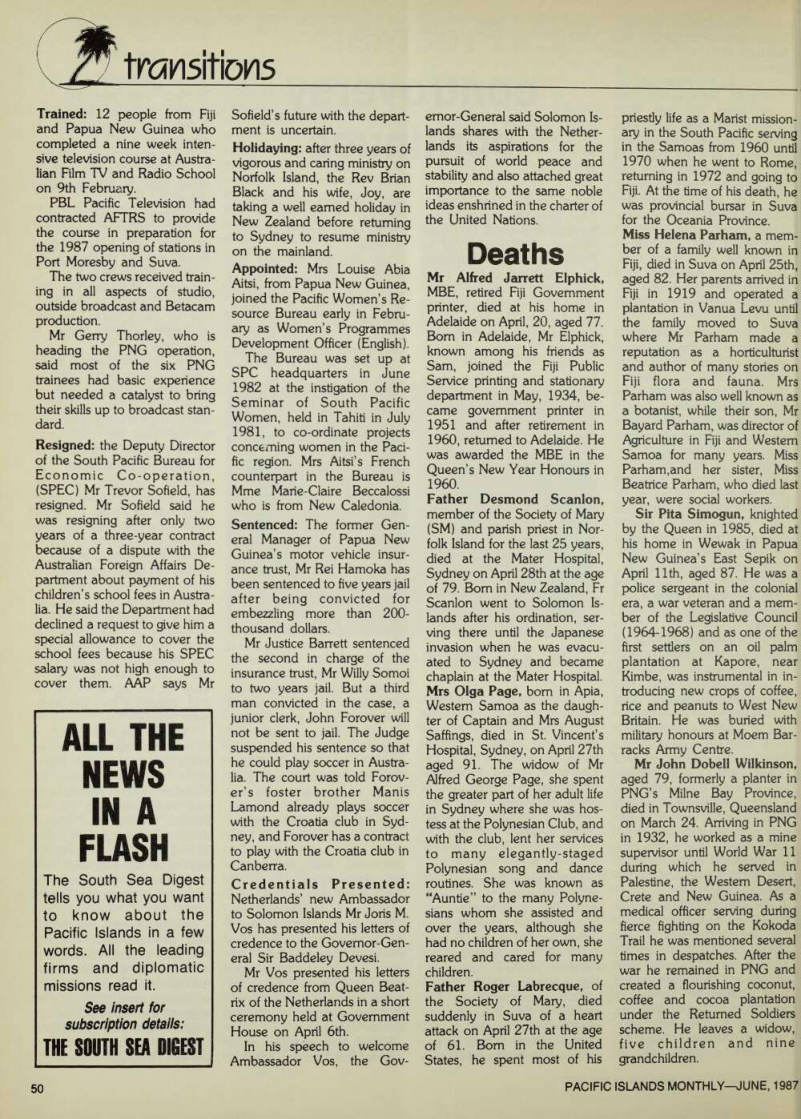
Trained: 12 people from Fiji and Papua New Guinea who completed a nine week inten sive television course at Austra lian Film TV and Radio School on 9th February.
PBL Pacific Television had contracted AFTRS to provide the course in preparation for the 1987 opening of stations in Port Moresby and Suva.
The two crews received train ing in all aspects of studio, outside broadcast and Betacam production.
Mr Gerry Thorley, who is heading the PNG operation, said most of the six PNG trainees had basic experience but needed a catalyst to bring their skills up to broadcast stan dard.
Resigned: the Deputy Director of the South Pacific Bureau for Economic Co-operation, (SPEC) Mr Trevor Sofield, has resigned. Mr Sofield said he was resigning after only two years of a three-year contract because of a dispute with the Australian Foreign Affairs De partment about payment of his children’s school fees in Austra lia. He said the Department had declined a request to give him a special allowance to cover the school fees because his SPEC salary was not high enough to cover them. AAP says Mr
Sofield’s future with the depart ment is uncertain.
Holidaying: after three years of vigorous and caring ministry on Norfolk Island, the Rev Brian Black and his wife, Joy, are taking a well earned holiday in New Zealand before returning to Sydney to resume ministry on the mainland.
Appointed: Mrs Louise Abia Aitsi, from Papua New Guinea, joined the Pacific Women’s Re source Bureau early in Febru ary as Women’s Programmes Development Officer (English).
The Bureau was set up at SPC headquarters in June 1982 at the instigation of the Seminar of South Pacific Women, held in Tahiti in July 1981, to co-ordinate projects concerning women in the Paci fic region. Mrs Aitsi’s French counterpart in the Bureau is Mme Marie-Claire Beccalossi who is from New Caledonia.
Sentenced: The former Gen eral Manager of Papua New Guinea’s motor vehicle insur ance trust, Mr Rei Hamoka has been sentenced to five years jail after being convicted for embezzling more than 200thousand dollars.
Mr Justice Barrett sentenced the second in charge of the insurance trust, Mr Willy Somoi to two years jail. But a third man convicted in the case, a junior clerk, John Forever will not be sent to jail. The Judge suspended his sentence so that he could play soccer in Austra lia. The court was told Forev er’s foster brother Manis Lamond already plays soccer with the Croatia club in Syd ney, and Forover has a contract to play with the Croatia club in Canberra.
Credentials Presented: Netherlands’ new Ambassador to Solomon Islands Mr Joris M.
Vos has presented his letters of credence to the Governor-Gen eral Sir Baddeley Devesi.
Mr Vos presented his letters of credence from Queen Beat rix of the Netherlands in a short ceremony held at Government House on April 6th.
In his speech to welcome Ambassador Vos, the Gov
emor-General said Solomon Is lands shares with the Nether lands its aspirations for the pursuit of world peace and stability and also attached great importance to the same noble ideas enshrined in the charter of the United Nations.
Deaths
Mr Alfred Jarrett Elphick, MBE, retired Fiji Government printer, died at his home in Adelaide on April, 20, aged 77.
Bom in Adelaide, Mr Elphick, known among his friends as Sam, joined the Fiji Public Service printing and stationary department in May, 1934, be came government printer in 1951 and after retirement in 1960, returned to Adelaide. He was awarded the MBE in the Queen’s New Year Honours in 1960.
Father Desmond Scanlon, member of the Society of Mary (SM) and parish priest in Nor folk Island for the last 25 years, died at the Mater Hospital, Sydney on April 28th at the age of 79. Bom in New Zealand, Fr Scanlon went to Solomon Is lands after his ordination, ser ving there until the Japanese invasion when he was evacu ated to Sydney and became chaplain at the Mater Hospital.
Mrs Olga Page, born in Apia, Western Samoa as the daugh ter of Captain and Mrs August Saffings, died in St. Vincent’s Hospital, Sydney, on April 27th aged 91. The widow of Mr Alfred George Page, she spent the greater part of her adult life in Sydney where she was hos tess at the Polynesian Club, and with the club, lent her services to many elegantly-staged Polynesian song and dance routines. She was known as “Auntie” to the many Polyne sians whom she assisted and over the years, although she had no children of her own, she reared and cared for many children.
Father Roger Labrecque, of the Society of Mary, died suddenly in Suva of a heart attack on April 27th at the age of 61. Bom in the United States, he spent most of his
priestly life as a Marist mission ary in the South Pacific serving in the Samoas from 1960 until 1970 when he went to Rome, returning in 1972 and going to Fiji. At the time of his death, he was provincial bursar in Suva for the Oceania Province.
Miss Helena Parham, a mem ber of a family well known in Fiji, died in Suva on April 25th, aged 82. Her parents arrived in Fiji in 1919 and operated a plantation in Vanua Levu until the family moved to Suva where Mr Parham made a reputation as a horticulturist and author of many stories on Fiji flora and fauna. Mrs Parham was also well known as a botanist, while their son, Mr Bayard Parham, was director of Agriculture in Fiji and Western Samoa for many years. Miss Parham,and her sister, Miss Beatrice Parham, who died last year, were social workers.
Sir Pita Simogun, knighted by the Queen in 1985, died at his home in Wewak in Papua New Guinea’s East Sepik on April 11th, aged 87. He was a police sergeant in the colonial era, a war veteran and a mem ber of the Legislative Council (1964-1968) and as one of the first settlers on an oil palm plantation at Kapore, near Kimbe, was instrumental in in troducing new crops of coffee, rice and peanuts to West New Britain. He was buried with military honours at Moem Bar racks Army Centre.
Mr John Dobell Wilkinson, aged 79, formerly a planter in PNG’s Milne Bay Province, died in Townsville, Queensland on March 24. Arriving in PNG in 1932, he worked as a mine supervisor until World War 11 during which he served in Palestine, the Western Desert, Crete and New Guinea. As a medical officer serving during fierce fighting on the Kokoda Trail he was mentioned several times in despatches. After the war he remained in PNG and created a flourishing coconut, coffee and cocoa plantation under the Returned Soldiers scheme. He leaves a widow, five children and nine grandchildren.
Advertisements & other items, p. 50 (1 item)
News
ALL THE
IN A
FLASH
The South Sea Digest tells you what you want to know about the Pacific Islands in a few words. All the leading firms and diplomatic missions read it.
See insert for subscription details:
THE SOUTH SEA DIGEST
from the islands press
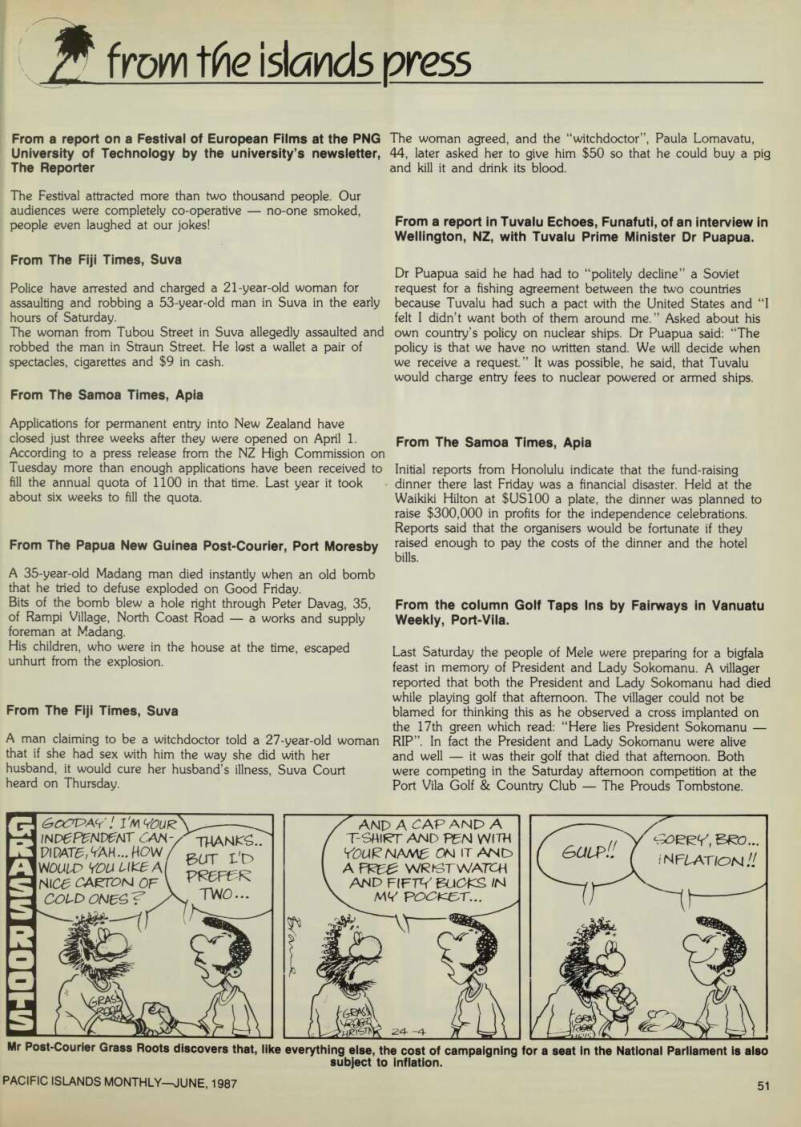
From a report on a Festival of European Films at the PNG University of Technology by the university’s newsletter, The Reporter The Festival attracted more than two thousand people. Our audiences were completely co-operative no-one smoked, people even laughed at our jokes!
From The Fiji Times, Suva Police have arrested and charged a 21-year-old woman for assaulting and robbing a 53-year-old man in Suva in the early hours of Saturday.
The woman from Tubou Street in Suva allegedly assaulted and robbed the man in Straun Street. He lost a wallet a pair of spectacles, cigarettes and $9 in cash.
From The Samoa Times, Apia Applications for permanent entry into New Zealand have closed just three weeks after they were opened on April 1.
According to a press release from the NZ High Commission on Tuesday more than enough applications have been received to fill the annual quota of 1100 in that time. Last year it took about six weeks to fill the quota.
From The Papua New Guinea Post-Courier, Port Moresby A 35-year-old Madang man died instantly when an old bomb that he tried to defuse exploded on Good Friday.
Bits of the bomb blew a hole right through Peter Davag, 35, of Rampi Village, North Coast Road a works and supply foreman at Madang.
His children, who were in the house at the time, escaped unhurt from the explosion.
From The Fiji Times, Suva A man claiming to be a witchdoctor told a 27-year-old woman that if she had sex with him the way she did with her husband, it would cure her husband’s illness, Suva Court heard on Thursday.
The woman agreed, and the “witchdoctor”, Paula Lomavatu, 44, later asked her to give him $5O so that he could buy a pig and kill it and drink its blood.
From a report In Tuvalu Echoes, Funafuti, of an interview In Wellington, NZ, with Tuvalu Prime Minister Dr Puapua.
Dr Puapua said he had had to “politely decline” a Soviet request for a fishing agreement between the two countries because Tuvalu had such a pact with the United States and “I felt I didn’t want both of them around me.” Asked about his own country’s policy on nuclear ships. Dr Puapua said: “The policy is that we have no written stand. We will decide when we receive a request.” It was possible, he said, that Tuvalu would charge entry fees to nuclear powered or armed ships.
From The Samoa Times, Apia Initial reports from Honolulu indicate that the fund-raising dinner there last Friday was a financial disaster. Held at the Waikiki Hilton at SUSIOO a plate, the dinner was planned to raise $300,000 in profits for the independence celebrations.
Reports said that the organisers would be fortunate if they raised enough to pay the costs of the dinner and the hotel bills.
From the column Golf Taps Ins by Fairways in Vanuatu Weekly, Port-Vila.
Last Saturday the people of Mele were preparing for a bigfala feast in memory of President and Lady Sokomanu. A villager reported that both the President and Lady Sokomanu had died while playing golf that afternoon. The villager could not be blamed for thinking this as he observed a cross implanted on the 17th green which read: “Here lies President Sokomanu RIP”. In fact the President and Lady Sokomanu were alive and well it was their golf that died that afternoon. Both were competing in the Saturday afternoon competition at the Port Vila Golf & Country Club The Prouds Tombstone.
Mr Post-Courier Grass Roots discovers that, like everything else, the cost of campaigning for a seat In the National Parliament is also subject to inflation.
Pacific stamp box
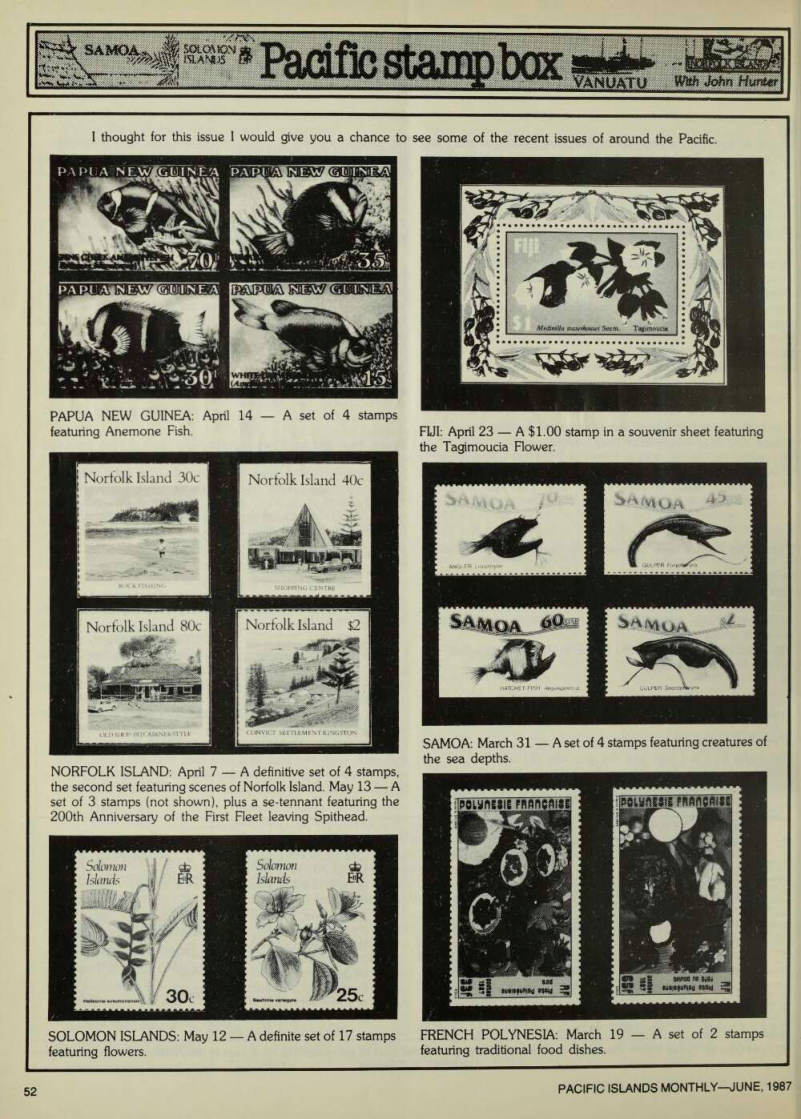
I thought for this issue I would give you a chance to see some of the recent issues of around the Pacific.
PAPUA NEW GUINEA: April 14 — A set of 4 stamps featuring Anemone Fish.
NORFOLK ISLAND: April 7 — A definitive set of 4 stamps, the second set featuring scenes of Norfolk Island. May 13 — A set of 3 stamps (not shown), plus a se-tennant featuring the 200th Anniversary of the First Fleet leaving Spithead.
SOLOMON ISLANDS: May 12 — A definite set of 17 stamps featuring flowers.
FIJI: April 23 A $1.00 stamp in a souvenir sheet featuring the Tagimoucia Flower.
SAMOA: March 31 - A set of 4 stamps featuring creatures of the sea depths.
FRENCH POLYNESIA: March 19 — A set of 2 stamps featuring traditional food dishes.
Advertisements & other items, p. 53 (1 item)
Aiwa
■4OO WATT HIGH POWER OUTPUT BWIRELESS REMOTE CONTROL ■ DOUBLE CASSETTE DECK ■ SURROUND SOUND CAPABILITY ■ DIGITAL SYNTHESIZER TUNER WITH 16 MEMORY PRESETS ■ 5-BAND GRAPHIC EQUALIZER ■ 5-BAND SPECTRUM ANALYZER • DOLBY B NR •QUICK REVERSE REC/PB • DOUBLE SPEED DUBBING •CONTINUOUS PLAYBACK • 2-PROGRAM/DAY TIMER • BIG 20 CM dia. WOOFER • FULLY AUTOMATIC TURNTABLE
.. .who could ask for more?
Mehex p ty„ Ltd 12 Barcoo Street, East Roseville, Sydney, N.S.W. 2069, AUSTRALIA PHONE: (02)-406-6277/Oceania Indent Agency (P.N.G.) Pty., Ltd. Ago St., Gordon Box 5518, Boroko, Port Moresby, Papua New Guinea PHONE: 256411/The Sound Centre Ltd. P.O. Box 434 Port Vila, Vanuatu PHONE: 2035/P. Hargovind Bros. 190 Renwick Road P.O. Box 490 Suva Fiji PHONE: 24350/ Hardy Distributors Ltd. 224-236 Hobson Street, P.O. Box 2627, Auckland, New Zealand PHONE; (09) 399-175/Hifivox 79, rue de Sebastopol, Noumea, New Caledonia PHONE: 27. 24, 66/Harvest AnanL ®°u™c Is ,! ancls PHONE: 131/Fare Hi-Fi Stereo Rue du Marechal Foch-P.O. Box 269, Papeete, Tahiti PHONE; 2-4814/Micropac Audio, Inc. P.O. Box 3478 Agana, Guam 96910 PHONE. 472-8091, 472-8297/Rarotonga Duty Free Shop Private Bag P.O. Box 92. Rarotonga. Cook Island/Nauru Co-Operative Society Republic of Nauru
shipping schedules
Should any shipping company wish to have its services cargo and passenger included in these listings they should contact
Pim.
Australia Fiji
PACE Line (ACTA Shipping) operates a fully containerised service, every 17 days to Suva and Lautoka from Melbourne, Sydney and Brisbane.
The three vessels, ACT 9, ACT 10, ACT 11, continue on to Hololulu and then to the North American west coast ports of Tacoma, Vancouver, Oakland and Los Angeles.
Details: Burns Philip (SS) Co. Ltd., Rodwell Road, Suva. Tel. (31-1777). Telex: FJ 2168, FAX 311 804. Burns Philip (SS) Co. Ltd., Lautoka. Tel. (60-777). ACTA Pty. Ltd., 447 Kent Street, Sydney. Tel. (266-0633), Telex: AAI2I 369, FAX: 267-1148. ACTA Pty. Ltd., Melbourne. Tel. (611-2000). ACTA Pty. Ltd., Brisbane. Tel. (221-3116).
Australia Fiji
Sofrana-Unilines (Fiji Express Line) oper ates to Suva and Lautoka every three weeks from the main ports on the east coast of Australia and monthly to Lautoka from Mel bourne and Sydney.
Details from Sofrana-Unilines, 432 Kent Street. Sydney (264-8944), Tlx AA 70090; Wiltrans Agency Pty. Ltd., 21st Floor. 60 Market St, Melbourne (614-4788); Tlx 30163 ACTA Pty. Ltd., Brisbane (221-3116); Elders- ANL Pty. Ltd., Port Adelaide, (47-5688); Newcastle, Sofrana Sydney (264-8944); Websters-ANL, 58 Charles St. Launceston, Tasmania (320-555); Carpenters Shipping, Harbour Centre Building, Ist Floor, Thomson Street, Suva. Fiji (312-244); Tlx FJ2199.
Australia Samoas Tonga
Warner Pacific Lines operates a regular cargo service from Sydney, Brisbane and Melbourne to Nukualofa, Pago Pago, Apia and Vavau. Feeder service available from Apia to Cook, Christmas, Fanning and Washington Islands.
Details from Hetherington Wesfarmers Shipping Agency, 37-49 Pitt Street, Sydney, (223-1600).
Australia New Caledonia
Fiji Samoas Tonga
Pacific Forum Line operates a fully con tainerised service (general, reefer and ro-ro) from Sydney to Noumea, Suva, Apia, Pago Pago. Nukualofa, Sydney, Cargo centralised from Adelaide, Melbourne, Brisbane.
Details from Pacific Forum Line P.O. Box 796 Auckland, Union Bulkships, 333 George Street, Sydney, Brisbane and Melbourne.
Union Co., Lautoka, Suva, Nukualofa, Pacific Forum Line Apia, Polynesia Shipping Pago Pago.
Australia Lord Howe Is.
Norfolk Is.
Compagnie des Chargeurs Caledoniens operates four-weekly cargo service Sydney- Lord Howe Island and Norfolk Island.
Details Hetherington Wesfarmers Shipping Agency, 37-49 Pitt Street, Sydney (223- 1600).
Australia Kiribati
K. Asia Pacific operates a 5/6 weekly service from Melbourne and Sydney to
Kiribati (Tarawa).
Details from K. Asia Pacific Pty. Ltd.
Goldfields House, 1 Alfred Street, Circular Quay. Sydney (232-2277), Tlx 122-143.
KAP New Guinea Lines call Tarawa after PNG ports on a 35 day basis from Melbourne
and Sydney/Brisbane.
Details from K. Asia Pacific Pty. Ltd., Goldfields House, 1 Alfred Street, Circular Quay, Sydney (232-2277); Tlx 122143.
Australia Tuvalu
K-Asia Pacific operates Direct service every 2nd voyage to Tulalu (Funafuti).
Details from K. Asia Pacific Pty. Ltd., Goldfields House, 1 Alfred Street, Circular Quay Sydney (232-2277) Tlx 122143.
Australia New Caledonia
And/Or Vanuatu
Sofrana-Unilines ships serve Noumea every three weeks from the main ports along the east Australian coast.
Details from Sofrana-Unilines, 432 Kent
Street, Sydney (264-8944), Wiltrans-Agency
Pty. Ltd., 21st Floor, 60 Market St., Mel bourne (614-4788) Tlx 30163 ACTA Pty. Ltd., Brisbane (221-3116). Elders-ANL Pty. Ltd- Port Adelaide (47-5688), Newcastle, Sofrana Sydney; Websters-ANL, 58 Charles St. Laun ceston, Tasmania (320-555).
Compagnie des Chargeurs Caledonians operates a three-weekly containerised cargo service from Sydney to Noumea.
Details Hetherington Wesfarmers shipping Agency. 37-49 Pitt Street, Sydney (223- 1600).
Compagnie Generale Maritime operates a monthly service from Sydney, Melbourne and Brisbane to Noumea. Port Vila and Santo, for containerised and break bulk cargo.
Details Compagnie Generale Maritime, 12 Castlereagh Street, Sydney (231-3700).
Australia New Caledonia
Fiji Vanuatu Solomons
Australia Pacific Islands Line operates a 28 day service from Melbourne, Sydney and Brisbane to Noumea, Suva. Lautoka, Vila, Santo and Honiara.
Details from New Guinea Express Lines.
Melbourne (602-5544); Burns Philp & Co. (20547) and K(Asia-Pacific) (232-2277) Syd ney; Nedlloyd Swire (832-1551) Brisbane; Etablissements Ballande (28-3384) Noumea; Union Maritime Services (31-3244) Suva; Shakti & Co. (6-0186) Lautoka; Vila Agents (2490) Vila; John Lum & Assoc. (329) Santo; Tradco Shipping (26-6313) Honiara.
Australia Nauru
Marshall Is. Kiribati
Nauru Pacific Line operates regular cargo service from Melbourne to Nauru. Majuro and Tarawa, passenger service to Nauru only.
Details: Nauru Pacific Line (Aust.) Pty. Ltd.
Nauru House, 80 Collins Street, Melbourne (653-5709). Nedlloyd Swire, 8 Spring Street,
Sydney (2-0522).
Australia Solomon Islands
Vanuatu
Negal-PNG Line operates a monthly service details Nedlloy Swire P/L, 8 Spring Street, Sydney (2-0522).
Australia New Zealand
The Australian National Line and the New Zealand line operate a 10-day container service (TRANZTAS) between Sydney and Melbourne to Auckland, Wellington, Lyttleton and Port Chalmers.
The Tranztas service has been extended to cover Burnie and Fremantle on a direct call monthly basis linking to the main New Zealand ports.
Details from ANL Shipping Agency, 20 Bond Street, Sydney (225-7333) and ANL Shipping Agencies, “World Trade Centre,” cnr. Flinders and Spencer Streets, Melbourne (611-2323) or New Zealand Line, Pastoral House, 96 Lambton Quay, Wellington (728- 5000).
Australia Nz Fiji Tonga
Vanuatu New Caledonia
Solomons New Guinea
Sitmar Cruises operates a year-round cruise program from Sydney to include the better-known ports in the above countries plus a number of unspoilt, and largely unknown, island paradises.
Details from Sitmar Cruises, 39 Martin Place, Sydney (239-9000); NSW, reserva tions and inquiries (008 42-2277); Rest of Australia, reservations and inquiries (008 22-2277).
Australia Nz - Fiji Tonga
Vanuatu - New Caledonia
Solomons Samoas Tahiti
P&O Liners call at Auckland, Bay of Islands, Honiara, Lautoka, Noumea.
Nukualofa, Pago Pago, Papeete, Port Mores by, Santo, Savu-savu, Suva, Vavau and Vila on cruises from Australia.
Details from P&O Booking centre, World Travel Headquarters Pty. Ltd, 33 Bligh Street, Sydney (237-0333).
Australia Png
Solomons - Vanuatu Nz
Pacific Forum Line operates a con tainerised and ro-ro service from Brisbane to Port Moresby, Lae, Honiara, Port Vila, Lyttle ton, Napier and Auckland.
Details from Union Bulkships, Brisbane Steamships Shipping, Port Moresby and Lae; Sullivans Ltd. Honiara, Vila Agents, Port Vila; SCONZ Christchurch; Napier and Auckland.
Auckland Micronesia
Nauru Pacific Line operates a regular container service from Melbourne to Ponape, Truk, Guam and Saipan.
Details: N.P.L. (Australia) Pty. Ltd., Nauru House, 80 Collins Street, Melbourne (653- 5709); Nedlloyd Swire, 8 Spring Street,
Sydney (2-0522).
Australia New Caledonia
Sofrana Unilines operates a 3-4 weekly service from East Coast mainports to Noumea.
Details from Sofrana Unilines 432 Kent Street, Sydney. (Tel. 264-8944), Tlx AA 70090.
Australia Tuvalu
K. Asia Pacific operates a three monthly service from Sydney and Melbourne to Tuvalu (Funafuti), subject to Inducement.
Details from K. Asia Pacific Pty. Ltd.
Goldfields House, 1 Alfred Street, Circular Quay, Sydney (232-2277). Tlx 122143.
Warner Pacific Line operates a six week containerised/breakbulk service to Funafuti from Melbourne/Brisbane/Sydney and Auck land.
Details from Hetherington Wesfarmers Shipping Agency, 37-49 Pitt Street, Sydney (223-1600); Mackay Shipping Ltd. Downtown House, Queen Street, Auckland (30-299).
Australia - Png
KAP New Guinea Lines cargo vessels call at Melbourne, Sydney, Port Moresby, Lae, Madang, Wewak, Manus, Kimbe, Rabaul, Popondetta.
Details from K. Asia Pacific Pty. Ltd.
Goldfields House, 1 Alfred Street, Circular Quay, Sydney (232-2277), Tlx 122143. Dal gety Shipping, World Trade Centre, Mel bourne (616-6700).
Australia Png - Solomons
Sofrana Unilines (Aust. P/L operates a 3-4 weekly cargo service to PNG, ex-main ports on the east coast of Australia.
Details from Sofrana Unilines, 432 Kent Street. Sydney (264-8944), Tlx AA 70090.
Australia Png - Solomons
Vanuatu
A consortium of NGAUPNGL and CON PAC/NEL have four vessels operating a joint service from east coast Australian ports to Port Moresby, Lae, Alotau, Madang, Wewak, Rabaul, Kavieng-Kimbe, Kieta, Honiara, Vila, Santo.
Details from Burns Philp & Co. Ltd., P.O.
Box R 124, Royal Exchange, Sydney, 2000 (2-0547); Nedlloyd Swire, 8 Spring Street, Sydney (2-0522); New Guinea Express Lines, 37 Pitt Street, Sydney (241-3991); Vila Agents, PO Box 27, Port-Vila (2456). Tlx
Nhioii.
New Guinea Express Lines operates a weekly container service from Melbourne, Sydney, Brisbane to Port Moresby, Lae, Alotau, Kimbe, Rabaul, Kieta, Honiara, Kavieng, Madang, Wewak, Santo, Vila.
Details from New Guinea Express Lines, P.O. Box R 73, Royal Exchange, Sydney (241-3991); New Guinea Express Lines, 127 Creek Street, Brisbane (221-9333); New Guinea Express Lines, 327 Collins Street, Melbourne (602-5544); Niugini Express Lines, Port Moresby (21-4572); Lae (42- 1536); Niugini Island Cargo Services Pty.
Ltd., Rabaul (922-467); Bougainville Agen cies Pty. Ltd., Kieta (956-089); Robert Laurie (PNG) P/L., Madang (82-2157); Garamut Enterprises P/L, Wewak (86-2106); Burns Philp (PNG) Ltd., Kavieng (94-2133): Alotau Stevedoring & Transport Alotau (61-1318); Ngatia Wholesalers Pty. Ltd. Kimba (93- 5102); and Tradco Shipping, Mandana Av enue, Honiara (22588); Vila Agents Ltd., P.O.
Box 971, Vila, Vanuatu (2490); John Lum & Associates. P.O. Box 65, Santo, Vanuatu (329).
Australia Tahiti
Compagnie Generale Maritime operates a monthly service from Sydney, Melbourne and Brisbane to Papeete, for containerised and break bulk cargo.
Details Compagnie Generale Maritime, 12 Castlereagh Street, Sydney (231-3700).
Sofrana Unilines (Aust.) P/L operates a 3/4 weekly cargo service to Papeete ex main ports on the east coast of Australia.
Details from Sofrana Unilines, 432 Kent Street, Sydney (264-8944). Tlx AA 70090.
Singapore Hong Kong Fiji
Islands Ports
Kyowa Shipping Co. Ltd., operates a monthly containerised and break bulk cargo service from Singapore, Hong Kong to Laut oka, Suva and then to island ports.
Details from Carpenters Shipping, Harbour Centre Building, Ist Floor, Thomson Street, Suva (312-244). Tlx FJ2199.
Far East Fiji
New Zealand
New Zealand Unit Express (NZUE), now operates a monthly service accepting con tainerised and break bulk cargo from Manila, Keelung, Kaohslung and Hongkong to Laut oka, Suva and thence to New Zealand pods.
Details from Carpenters Shipping, Harbour Centre Building, Ist Floor, Thomson Street, Suva (312-244), Tlx FJ2199; Burns Philp, Suva (311-777); New Zealand Unit Express, Maritime Building, 2-10 Customhouse Quay, P.O. Box 890, Wellington. Cables: ENZUE
Man Wellington. Telex: Nz31340.
NEDLNZ, Telephone; 727-865 or Nedlloyd Swire Pty. Ltd., Sydney (20-522).
Nedlloyd operates bi-weekly cargo service with four ships from Surabaya, Jakarta, Bangkok, Port Kelang and Singapore to Suva, Lautoka and NZ ports.
Details from Nedlloyd (Aust.) Pty. Ltd., 8 Spring St., Sydney (27-3801), Burns Philp (SS) Co. Ltd., Suva and Lautoka.
Far East - Mid-S. Pacific
China Navigation's New Guinea Pacific Line operates a regular container service from Hong Kong, Taiwan, Manila, Port Kelang and Singapore to Port Moresby, Lae, Rabaul and Honiara monthly and to Wewak, Madang and Kieta every three months. Cargo from the same Far Eastern ports to the South Pacific ports of Noumea, Santo, Vila, Papeete, Pago Pago, Apia, Rarotonga and Tarawa will be shipped via Japan on the monthly Bali Hai service.
Details from Steamships Shipping, P.O.
Box 634, Port Moresby (22-0289).
Kyowa Shipping Ltd. operates monthly services from Japan to Guam, Saipan, Solo mons, New Caledonia, Fiji, Western and American Samoa, Tahiti, Cook Is. Tonga and Vanuatu.
Details: Hetherington Wesfarmers Shipping Agency, 37-49 Pitt Street, Sydney (223- 1600); Carpenters Shipping, Suva (312-244).
Tlx FJ2199.
Guam Northern Marianas
Saipan Shipping Co. Inc. operates a weekly service via barge carrying containers and conventional cargo between Guam and Saipan and Tinian.
Details from Saipan Shipping Co. inc., P.O.
Box 8, Saipan, CM 96950 (Tel. 9707), Tlx 783619; Guam agents Maritime Agencies of the Pacific Ltd.
Hawaii Tahiti Samoas
Tonga Kiribati Fiji
Solomons Png
State Shipping Associates operates a monthly service originating in Honolulu and destined for Pago Pago, Papeete, Apia, Nukualofa, Suva, Vila and Port Moresby.
Details from Star Shipping Assoc., P.O.
Box 25988, Honolulu, Hawaii 96825. Ph. (808) 39-4256; Polynesia Shipping Services in Pago Pago and Burns Philp Agency in Apia, Nukualofa, Suva and Port Moresby.
Japan Fiji Island Ports
Kyowa Shipping Co. Ltd. operates a month ly containerised service from main ports of
Japan to Suva and Lautoka and thence to island ports.
Details from Carpenters Shipping, Harbour Centre Building, Ist floor, Thomson St., Suva (312-244). Tlx FJ2199.
Bali Hai service operates a monthly con tainerised service from main ports of Japan to Lautoka and Suva and thence to island ports.
Details from Carpenters Shipping, Harbour Centre Building, Ist floor, Thomson St., Suva (312-244). Tlx FJ2199, and Burns Philp, Suva (311-777).
Japan Micronesia
The NYK Shipping Line operates a monthly cargo service from Japan to Micronesia, calling at Voko, Nagoya, Kobe, Guam, Saipan, Truk, Ponape and Majuro, returning via Yoko, Nagoya and Kobe.
Details from Burns Philp & Co. Ltd., 51 Pitt Street, Sydney (2-0547).
Saipan Shipping Co. Inc. operates a monthly service from Japan to Saipan, Guam, Truk, Ponape, Majuro (Kosrae and Ebeye on inducement).
Details from Saipan Shipping Co. Inc., P.O.
Box 8, Saipan, CM 96950 (Tel. 9707), Tlx 783619. Japan agents Kyowa Shipping Com pany Ltd.; Guam Agents Maritime Agencies of the Pacific Ltd.
Japan Png
Mitsui O.S.K. Lines operates a monthly service from main ports Japan, Wewak, Lae, Rabaul, Kieta, Port Moresby.
Details from Robert Laurie Carpenters Pty.
Ltd., P.O, Box 1032, Lae, PNG (Tel. 42-3642, 42-3811).
New Caledonia Fiji West
Coast North America
PAD Line operates an approx. 3-weekly ro-ro service from Noumea and Suva to Honolulu and West Coast USA and Canadian ports.
Details from Sofrana-Unilines SA, BP 1602, Noumea (27-51-91). Tlx NMO4B; Carpenters Shipping, Harbour Centre Building, Ist Floor, Thomson St., Suva (312-244). Tlx FJ2199.
Png Inter Mainport
Papua New Guinea Line offers scheduled 10-20 day coastal liner services linking all PNG major ports with containerisation, reefer, heavy lift and transshipment facilities.
Details from PNG Line, Box 543, Port Moresby, PNG (21-1174). Tlx 22269.
Png Uk/Continent
The Bank Line & Columbus Line operate a regular joint service from Port Moresby, Oro Bay, Kieta, Rabaul, Kimbe, Madang and Lae to Hull, Hamburg, Rotterdam, Antwerp and Le Havre.
Details from The Bank Line (A’asia) Pty, Ltd., 51 Pitt Street, Sydney (27-2041); Tlx AA24063; Columbus Line, Lae (423466), Tlx NE 44171; or Lines' local agents.
Solomons Uk/Continent
The Bank Line & Columbus Line operate a regular joint cargo service from Honiara to Hull, Hamburg, Rotterdam, Antwerp and Le Havre.
Details from The Bank Line (A'asia) Pty.
Ltd., 51 Pitt Street, Sydney (27-2041); Tlx AA24063; Columbus Line, Lae (423466), Tlx NE 44171; Tradco Shipping Ltd., Honiara (22588), Tlx 66313.
New Zealand Australia Papua
New Guinea Solomon Islands
Vanuatu
Pacific Forum Line operates a con tainerised and ro-ro service from Lyttelton, Napier and Auckland to Brisbane, Port
Moresby, Lae, Honiara and Port Vila.
Details from SCONZ Christchurch, Napier and Auckland, Union Bulkshlps, Brisbane; Steamships Shipping, Port Moresby and Lae; Sullivans Ltd., Honiara; Vila Agents, Port Vila.
Nz Cook Is. Niue Tahiti
New Zealand Line operates cargo services based on pallets and similar units from Auckland to Niue, Cook Islands and Tahiti.
Details from the NZ Shipping Agencies International Ltd., P.O. Box 3420, Auckland (797210); Waterfront Commission, P.O. Box 61, Rarotonga: Cook Islands; Shipping Office, Govt, of Niue, P.O. Box 107, Niue Island; Compagnie Maritime Polynesienne, P.O, Box 36, Papeete, Tahiti.
Nz Fui
Reef operates a regular 18-day service from Auckland to Suva and Lautoka. Also passenger accommodation.
Details from Reef Shipping Agencies, PO Box 3382, Auckland, NZ (77-1221-3), Tlx 60633; MV Fijian Shipping Agencies Ltd.
Private Bag, Suva, Fiji (31-1056).
Pacific Line with one ship operates two weekly ro-ro cargo service New Zealand, Lautoka, Suva. No passengers.
Details Sofrana Unilines, 18 Customs Street, Auckland (773-279) PO Box 3614, Tlx NZ2313, Carpenters Shipping, 100 Thomson Street, Suva (312-244), Tlx FJ2199.
Nz Fiji - North America (Wc)
Blue Star Line Ltd. Pacific Coast container services. Only direct service to and from New Zealand. Blue Star vessels call at Suva and Honolulu on NZ-U.S. West Coast voyages.
Details from Blueport ACT (NZ) Ltd., PO Box 192, Wellington (739-029); Burns Philp (SS) Co. Ltd., GPO Box 355, Suva, Fiji (311-777), Tlx FJ2168 Burship.
Nz Fiji Samoas Tonga
Pacific Forum Line operates a con tainerised and ro-ro 21 day service from Auckland to Lautoka, Suva, Apia, Pago Pago and Nukualofa.
Details from Pacific Forum Line, Auckland and Apia, Union Maritime, Lautoka, Suva and Nukualofa; Polynesian Shipping, Pago Pago.
Nz N. Caledonia Vanuatu
Png Solomons
Sofrana Unilines with three ships operate to Vila and Santo, to Honiara and Papua New Guinea and to Norfolk Island and Noumea (No passengers).
Details from Sofrana Unilines, 18 Customs Street, Auckland (773-279), PO Box 3614, Tlx NZ2313.
Nz Tahiti
Compagnie Tahitienne Maritime SA (as CTM-Tahiti Line) operates one ship, MV Bounty 111, monthly Papeete New Zealand. (No passengers.) Details from Sofrana Unilines, PO Box 3614,18 Customs St,, Auckland, Tlx NZ2313.
CTM-Tahiti Line, PO Box 9012, Papeete (39042), Tlx Tahitlin 322 FP Tahiti.
Nz Tonga - Samoas
Warner Pacific Line services Auckland, Nukualofa, Vavau, Apia, Pago Pago fort nightly carrying general and freezer cargoes.
Details from Mckay Shipping Ltd., Down town House, 21 Queen St., Auckland, PO Box 3, Phone 390-229. Cables MACSHIP, Telex NZ2554. Warner Pacific Line, Box 93, Nukualofa, Tonga; Mealelel (Western
Samoa) Ltd., Private Bag Apia, Western Samoa. Burns Philp (SS) Co. Ltd., PO Box 129, Pago Pago, American Samoa, Phone 633-2709, Cables 506, Burnsouth SB.
Tahiti New Caledonia
Vanuatu Solomon Is.
New Zealand Png
Singapore Europe
Polish Ocean Lines operate in a semi container type vessels to the following ports, from Papeete, Noumea, Santo, Vila, Yandina, Honiara, Auckland, Rabaul, Lae, Singapore, Port Kielang, Penang then to Mediterranean ports and Europe via the Suez Canal. (Other New Zealand ports subject to Inducement).
Details from Universal Shipping Agencies Ltd., 6th Floor, 38 Fort Street, Auckland 1, New Zealand (390931, 390727, 32104), Tlx 21517.
Europe Tahiti
New Caledonia
Compagnie Generale Maritime operates services from Europe and Mediterranean ports to Papeete and Noumea using three ro-ro and multi-purpose vessels thus ensuring a bi-monthly sailing to and from.
Details Compagnie Generale Maritime, 12 Castlereagh Street, Sydney (231-3700).
Europe Tahiti
New Caledonia New Zealand -
Vanuatu Solomons
Png Europe
Polish Ocean Lines offers regular monthly sailings for containerised and break bulk cargo, also conventional reefer space and reefer containers from Hamburg, Rotterdam, Dunkirk, Rouen to Papeete, Noumea, Auck land, Santo, Honiara, Rabaul, Lae, Singa pore, returning to Europe via Suez, other ports in South Pacific can be served directly with inducement or otherwise via tranship ment.
Details from Sotama, BP 9170, Papeete, Tel. 427805, Tlx 373, Telex Sotama 373FP; SATO: BP. C 2 Noumea Cedex Tel. 272094, Tlx 163 NM; Universal Shipping Agencies PO Box 2282 Auckland, Tel. 30930 Tlx 21517; Vanua Navigation PO Box 44 Vila, Tel. 2027, Tlx 1033; Melan Chine Shipping Co. PO Box
71 Honiara, Tel. 21678, Tlx 66335; Steam ships Shipping & Transport PO Box 1512 Rabaul. Tel. 922952, Tlx 92929; Steamships Trading Co. Ltd., PO Box 85, Lae, Tel. 424666, Tlx 42423; Union Steamship Co. of NZ Ltd, PO Box 50 Apia. Tel. 21781, Tlx 225; Warner Pacific Line, PO Box 93, Nukualofa, Tel. 22088, Tlx 66219; Fiji Agents TBA.
Europe Tahiti W.
Samoa Fiji N. Caledonia
Nedlloyd offers regular cargo services from Continental ports to Papeete, Apia, FIJI and New Caledonia.
Details Nedlloyd (Aust.) Pty. Ltd., Spring Street, Sydney (27-3001); Carpenters Ship ping, Ist Floor, Harbour Centre Bldg, 100 Thomson St., Suva (312-244), Tlx 2199FJ and Vetari Street, Lautoka (63980), Tlx 5215FJ.
Uk N. Continent W. Somoa
Tonga Fiji
The Bank Line & Columbus Line operate a regular joint cargo service from Hull, Ham burg, Bremen, Antwerp, Rotterdam and Le Havre to Apia, Nukualofa, Suva and Lautoka.
Details from The Bank Line (A’asia) Pty Ltd., 51 Pitt Street, Sydney (27-2041), Tlx AA 24063, Columbus Line, Lae (423-466), Tlx NE 44111, or Lines’ local agent,
Uk N. Continent Png
Solomons
The Bank Line & Columbus Line operate a regular joint cargo service from Hull, Ham burg, Bremen, Antwerp, Rotterdam and Le Havre to Port Moresby, Lae, Madang, Kimbe, Rabaul, Kieta and Honiara and on induce ment to Yandina.
Details from The Bank Line (A'asia) Pty.
Ltd., 51 Pitt Street, Sydney (27-2041). Tlx AA 24063. Columbus Line, Lae (42-3466). Tlx NE 44171; or Lines' local agents.
Uk/N Continent Tahiti
N. Caledonia Vanuatu
The Bank Line Columbus Line operate a regular joint cargo service from Hull, Ham burg, Bremen, Antwerp, Rotterdam and Le
Havre to Papeete, Noumea, Port-Vila and Santo.
Details from The Bank Line (A’sia) Pty. Ltd., 51 Pitt Street. Sydney (27-2041), Tlx AA 24063, Columbus Line, Lae (42-3466), Tlx NE 44171; Ets. A.M. Fare DTE, Papeete; Ets, Ballande, Noumea and other local agents.
U.S. Hawaii Micronesia
East Malaysia Brunei
Papua New Guinea
PM&O Lines operates two fully self-sus tained container vessels on a sailing frequen cy of every 30 days between the San Francisco Bay Area, Los Angeles, Honolulu and Majuro, Ebeye, Kosrae, Ponape, Truk, Saipan, Yap. Palau, Kota Kinabalu, Brunei, Lae, Kieta and Rabaul.
Details from PM&O Lines, 353 Sacramento Street, San Francisco, California 94111, U.S.A. (415) 421-5400, Tlx 278016 PMO UR; Owners Representative P.O. Box 003, Saipan, N.M.I, 96950, Ph. 234-6819 Tlx
783-605 Cmcaa.
U.S. Hawaii - Samoas
Kiribati Nauru
Nauru Pacific Line operates regular con ventional and container services from San Francisco and Honolulu to Christmas Island, Pago Pago, Apia, Tarawa and Nauru.
Details from N.P.L. (Australia) Pty. Ltd., Nauru House, 80 Collins Street, Melbourne (653-5709), Nauru Air and Shipping Agency, Suite 2803, 185 Berry Street, San Francisco, California 94107 (415-543-4517). Nauru Air and Shipping Agency, Suite 506, 841 Bishop St.. Honolulu, HI 96813 (808-523-0441).
U.S. Noumea Fiji
PAD Line operates an approx. 3-weekly ro-ro service from west coast USA and Canada to Noumea, Suva and Lautoka.
Details from Sofrana Unilines BP 1602, Noumea (27-51-91). Tlx NMO4B, Carpenters Shipping, Harbour Centre Building, Ist Floor, 100 Thomson Street, Suva (312-244), Tlx FJ2199, Trans-Austral Shipping Pty. Ltd., P.O. Box R 232, Royal Exchange, 2000 (231-0411), Tlx AA21204.
Advertisements & other items, pp. 55-58 (2 items)
Bali
MEETS
wiii
NEW CALEDONIA
SOLOMON ISLAND
KIR B
VAN U A
W. S A M 0 A
SAMOA
TAHITI
tonga
BALI
JOINTLY OPERATED BY
The China Navigation Co., Ltd.
Mitsui OtSUL Lises. Ltd.
NIPPON YUSEN KAISHA
POLISH OCEAN UNIS
General Management, 10 Lutego 24,81-364 GDYNIA, POLAND, Phone: 20-19-01, Cables: POLOCEAN Telex: 054-231 © Q 8 J V 3 r l / £ i •,v*.
V*’* -- $ !5«
SOUTH PACIFIC SERVICE
We offer monthly service to and from: GDYNIA, HAMBURG, ROTTERDAM, MIDDLESBOROUGH/IMMINGHAM, ANTWERP, DUNKIRK, ROUEN, PAPEETE (via PANAMA), NOUMEA, AUCKLAND, HONIARA, RABAUL, LAE, SINGAPORE, by our multipurpose vessels carrying dry and reefer containers, reefer chambers, heavy lifts, breakbulk or palletized, bulk liquids.
POLISH OCEAN LINES Representatives AA AUCKLAND Mr, A. Sieradzki. Telex 21517 NZ “UNISHIP”. SYDNEY Mr. Walenciak. Telex 20428 AA “SLEIGH TAHITI SOTAMA Telex 296 FP “COUTIMEX”. NEW P CAL^DONIA A SATO Telex 163 S NM “SATO". AUCKLAND UNIVERSAL SHIPPING AGENCIES LTD., Telex 21517 NZ “UNISHIP”. SOLOMONS MELAN CHINE SHIPPING CO., LTD Telex 66335 HO “SYMECO . PNG STEAMSHIPS TRADING CO., LTD Telex 42423 NE “STEAM”.
imel Services Reach out Thousands
Of Miles in The Pacific. It’s Where
we work.
£^?IMEL
INDUSTRIAL AND MARINE
ENGINEERING LIMITED
Tel: 311288. Telex: FJ2195
P.O. Box 172, Suva FIJI ISLANDS
"the complete Engineering Company of the South Pacific”. • Heavy Engineering • Air Conditioning • Sheetmetal • Foundry • Electrical • Refrigeration • Steel Supplies • Quality work • Competitive prices.
G8R1039
SERVICE PAGE
PACIFIC
SLANDS
IMONT H L Y 1
AUSTRALIA: Distribution: The Herald and Weekly Times Ltd., 44-74 Flinders St.. Melbourne, Vic., 3000. Advertising Reps Brisbane D. Wood. Anday Agency, CCA Centre, Dayboro Road, Closebum 4520; Box 1918, GPO Brisbane, 4001; telephone (07) 289-4128. Adelaide Hastwell Williamson Rouse Pty. Ltd., PO Box 419, Nowood, SA, 5067; 59 Kensington Road, Norwood; telephone (08) 332-3322, telex 87113; Perth Allen & Associates. 7 Fore St., Perth, W.A., 6000, telephone (09) 328-9833, telex: AA94382.
FUI: Distribution and subscriptions. Desai Bookshops, P.O. Box 160, Suva, Fiji telephone Suva 23036.
Advertising Fiji Times & Herald Ltd., 20 Gordon St., Suva, telephone 31-4111, telex FJ2124.
FRENCH POLYNESIA: Distribution Hachette Pacifique 10 Ave., Bruat, Papeete, telephone 25-610.
HAWAII: UNITED STATES: Distribution - PIM, Hawaii, P.O. Box 22250, Honolulu. Hawaii. 96822. Advertising Brian C. Asgill, Apt. 1308,1676 Ala Moana Blvd., Honolulu.
Hawaii, 96815, telephone (808) 955-9718.
JAPAN: Advertising and subscriptions Universal Media Corporation. GPO Box 46, Tokyo,'telephone 666-3036, cable UNIMEDIA Tokyo, telex 2524665.
MALAYSIA: Advertising and subscriptions —• Worldwide Media Services, 57-B Komplex Damai, Jin Dato Haji Eusoff, Kuala Lumpur, telephone 63-9340, cables WORLDMEDIA Kuala Lumpur, telex 31533.
VANUATU; Distribution The Bookshop, HQ Box 210, Port Vila. Advertising Norman Bros. Bookshop, Port Vila, telephone 2232.
NEW CALEDONIA: Distribution - Depot Centre de Presse Michel Pentecost. CBP2, Noumea, telephone 27-2434. 27-4729.
NEW ZEALAND: Distribution Gordon & Gotch, PO Box 584, 2 Carr Road, Mt. Roskill, Auckland 4. Advertising McKay International Media Reps. Ltd., c/o Albany P. 0., Auckland 10, New Zealand, telephone 413-9119.
Telex NZ22701, FAX 413-9110.
WELLINGTON Ross Quald Media, 1 Scholes Ln., Petone. (04) 68-7593 PO Box 38699, Petone.
PAPUA NEW GUINEA: Distribution Gordon & Gotch, PO Box 3395, Port Moresby, telephone 25-4551.25-4855.
Advertising Ken Head, PNG Post-Courier, PO Box 85.
Port Moresby, telephone 21-2577, telex 22120.
SOLOMON ISLANDS: Distribution and Advertising The Bookshop, (Norman Bros.) PO Box 503. Honiara.
PHILIPPINES: Advertising The GF Group. 12 San Ignacio St., Uroaneta Village. Makati, Metro Manila, telephone 817-7299, telex 45950 and 4233.
UNITED KINGDOM: The Herald & Weekly Times Ltd., No 1 Maltravers Street, London WC2R 3DZ, England, telephone (01) 836-5162, telex London 21989.
UNITED STATES MAINLAND: Advertising Joshua B.
Powers Jr., Powers International Inc., Suite 708, 271 Madison Ave., New York, NY 10016, telephone 867-9580, Subscriptions PIM, Hawaii, PO Box 22250, Honolulu, Hawaii, 96822.
SUBSCRIPTIONS
American Samoa. ..
Australia Canada Cook Islands Fiji French Polynesia...
Guam Hawaii Japan Kiribati Micronesia Nauru New Caledonia New Zealand Niue Norfolk Island Northern Marianas..
Papua New Guinea Solomon Islands Tonga Tuvala United Kingdom...
U.S. Mainland Vanuatu Western Samoa Elsewhere .. US$24
AUSS24
.. US$3O
...NZ$36
AUSS26
..US$3O
.. US$3O
.. US$3O
.. US$3O
AUSS24
.. US$3O
AUSS24
.. US$3O
...NZ$36
...NZ$3O
AUSS24
..US$3O
AUSS3S
AUSS24
AUSS24
AUSS24
...Stgls
..US$3O
AUSS24
AUSS24
AUSS36
Payments by personal cheque are only acceptable in Australian (from a branch in Australia). U.S. and New Zealand currency. For all other remittances please send an international bank draft in Australian dollars.
Published monthly by Pacific Publications (Aust.) Pty.
Ltd. and printed in Australia by Brownhall Printing Pty. Ltd, 52 Duerdin Street, Clayton North, Victoria.
NOW AVAILABLE!
PACIFIC ISLANDS YEAR BOOK
Due to demand the 15th edition has been reprinted and is available from P.I.M. at As3s plus p.p.
Stay at Aggie Grey’s . . . the South Pacific’s
legendary hotel.
Smutted right in the heart of Western Samoa. F.njoy Polynesian style friendliness and servire. in tool surroundings, su|xrh entertainment and food.
Magnificent while sand In-aches only a shot! drive away. Aitconditioned rooms, swimming |km>l andJull hai facilities.
Bookings through I’nion Steamship Company of NZ, Pan Am. Air New Zealand or direc t Id Aggie Grey’s. Apia. Western Samoa. Cables: AGGIFS’ Apia.
BAGOT
BELLFOUNDRIES
Box 421, North Adelaide S.A. 5006. Australia Tel: +6l 8 267 1306 Beautiful tuned bells for churches and missions
CAPITAL
AVAILABLE
Loans in various categories, from US$l,OOO to US$lOO Million.
Bad Credit, turned down by Banks No Problem.
Write for free details to: Capital Matchmaker, P.O. Box 59, Auki, Malaita, Solomon Island.
57
3 ACIFIC ISLANDS MONTHLY—JUNE, 1987
Advertising
Aggie Grey’s Hotel 58 AIWA Company Ltd 53 Amatil 34 ANZ Bank 29 AWA New Zealand Ltd 28 Bagot Bellfoundries 58 Ban Hal Service 55 Bank Line 59 Brasshards Holdings 45 Canberra Accounting 58 Capital Matchmaker 58 Citizen Watches 27 Colombus Line 59 Development Bank 35 Ela Motors 37 Hawaiian Tel 24 Henry Cumines 26
Imel 57
K. Leona 58 Mazda Motor Co 8-9 Mitsubishi Motor Co 60 Pioneer Electric Co 33 Polish Ocean Line 56 Old. W’sale Forklifts 7 Robert Richez 58 Sony Corporation 4 Thomson Exhibitions 13 Toyota Motor Corp 30-31 Wreckair Container 25
Advertisements & other items, pp. 58-60 (1 item)
Money?
For all your computer needs (hardware, software, books) by quick and easy mail order. Canberra Accounting Services, GPO Box 2159, Canberra
2601, AUSTRALIA.
NEED
MONEY?
WHEN BANKS STOP...
WE START!
No Collateral, Credit Check, or Co-signers For applications write: Kenny Leong P.O. Box 51 Auki
SOLOMON ISLANDS
BELGIAN BOY
Wants penfriends from the Pacific Islands.
Likes shells and will send stamps in exchange.
Please write to:
MAXIME RICHEZ
Rue 7358 Poir,meroeul
BELGIUM
BANK LINE and
COLUMBUS LINE
24 day service to
Europe.
Need we say more...
G D The Joint Service Partners offer facilities for shipment of: Containers (FCL/LCL) and Break-bulk Cargo plus reefer space and deeptanks for carriage of vegetable oils and other liquid bulk cargo.
Carriers also accept heavy lifts, overlength and cumbersome parcels.
Ports of Service: Loading: Papeete, Apia, Suva, Lauloka, Noumea, Port Vila, Santo, Honiara, Port Moresby, Lae, Madang, Kimbe, Rabaul, Kieta, Darwin. For: Rotterdam, Antwerp, Hamburg, Hull, Dunkirk, Le Havre.
Additional ports on enquiry.
Please contact our regional offices for further information: The Bank Line (Australasia) Pty Ltd Suite 801,51 Pitt St, Sydney, NSW, Australia 2000 Phone 27 2041 Telex 24063 Columbus Line Reederei GmbH P.O. Box 1 667, Lae/Papua New Guinea.
Phone: 423466/423487/AH. 422481 Telex: Colline NE 441 71 The South Pacific Specialists for over 75 years
Charles Darwin theorized
that survival depends on the ability to change.
We’re living proof.
In 1859, Charles Darwin outlined his theories on evolution in The Origin of Species. Simply stated, Darwin believed that organisms must be capable of responding to their ever-changing environment in order to be successful.
For the past 70 years Mitsubishi has been proving the validity of Darwin's theories by meeting evolving transportation needs with a wide variety of vehicles incorporating the most advanced technologies of the times.
Since its production of the 1917 Model-A, Japan's first series-production car, Mitsubishi has continuously adopted the latest engineering innovations.
And today, it covers the world's most extensive range of vehicles—from 550 cc minicars to mammoth 16,000 cc all-wheel-drive, off-highway trucks.
Seven decades isn't much in evolutionary time but as the species continues on its long road to perfection, Darwin's theories are tested as they are applied to the products to meet society's changing transportation needs.
Mitsubishi Motors is now offering a free 24-page leaflet “The Mitsubishi”, an introduction of Mitsubishi’s pioneering history. If interested, write to Advertising, International Business Planning Office, Office of International Business, Mitsubishi Motors Corporation, 33-8, Shiba 5-chome, Minato-ku, Tokyo 108, Japan.
AMERICAN SAMOA: MORRIS SCANLAN SERVICE INC. P.O. Box 367, Pago Pago, Tel. 633-5520/AUSTRALIA: MITSUBISHI MOTORS AUSTRALIA LTD. Box 1284, South Road, Clovelly Park, South Australia 5042, Tel, (08) 275-7223/FIJI: NIVIS MOTOR & MACHINERY CO., LTD. G.P.O. Box 150, Suva, Tel 383411 /FRENCH POLYNESIA (TAHITI): ETS-BREDIN FRERES ET FILS P.O. Box 21, Papeete, Tahiti, Tel 4-202-58/NEW CALEDONIA: SOCIETE D IMPORTATION D AUTO DU PACIFIQUE SUD S.A. B.P.
Point du Pacifique, Noumea, Tel. 274144/NEW ZEALAND: MITSUBISHI MOTORS NEW ZEALAND LTD. Todd Park, Heriot Drive, Private Bag, Ponrua, Tel 370 ; 1 ,09/ NORFOLK ISLAND: BORRYS LTD PO Box 169, Norfolk Island,Tel. 21 14/PAPUANEWGUINEA: TOBAPTY. LTD. P.O. 80x503. Port Moresby, Tel. 21-7874/SOLOMON ISLANDS: HARVEST PACIFIC LTD. G.P.O. Box 88, Honiara, Guadalcanal, Tel. 30128/TONGA: SITANI MAPI CO., LTD P.O. Box 83, Nuku’ALOFA, Tel. 21-044/VANUATU: SOCOMETRA B P. 06 Route de Lagon, Port-Vila, Tel. 2314/WESTERN SAMOA: A M. MACDONALD HOLDINGS LTD. P.O. Box 576, Apia, Tel. 22022/SAIPAN/POHNPEI/MAJURO/KOSRAE/TRUK/YAP/ BELAU: MICRONESSIAN MOTORS, INC. 997 South Marine Drive, Tamuning, Guam 96911, Tel. 646-6827 A
MITSUBISHI
MOTORS