Pacific

Islands
Monthly
American Samoa USS2.OO Australia A 52.00 Cook Islands NZ$3.OO Fiji .75 Hawaii US$2.5O Kiribati A 52.00 Nauru A 52.00 New Caledonia CFP2SO New Zealand NZ$3.3O (incl. frt. and GST) Niue . NZ$2.5O Norfolk Island A 52.00 Papua New Guinea K 2.00 Solomon Islands 552.00 Tahiti CFP3OO Tonga P 2.00 Tuvalu A 52.00
Usa Us$3.Oo
USTT and Guam US$2.5O Vanuatu VT2.00 Western Samoa T 2.75 •Recommended retail price only Registered by Australia Post Publication No. NBPI2IO
May, 1987
' m ' --- ' -
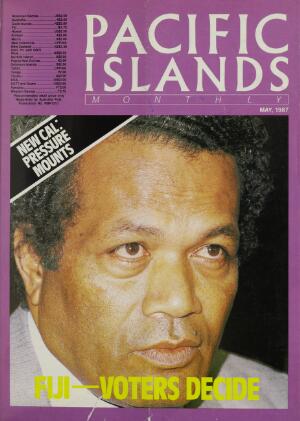
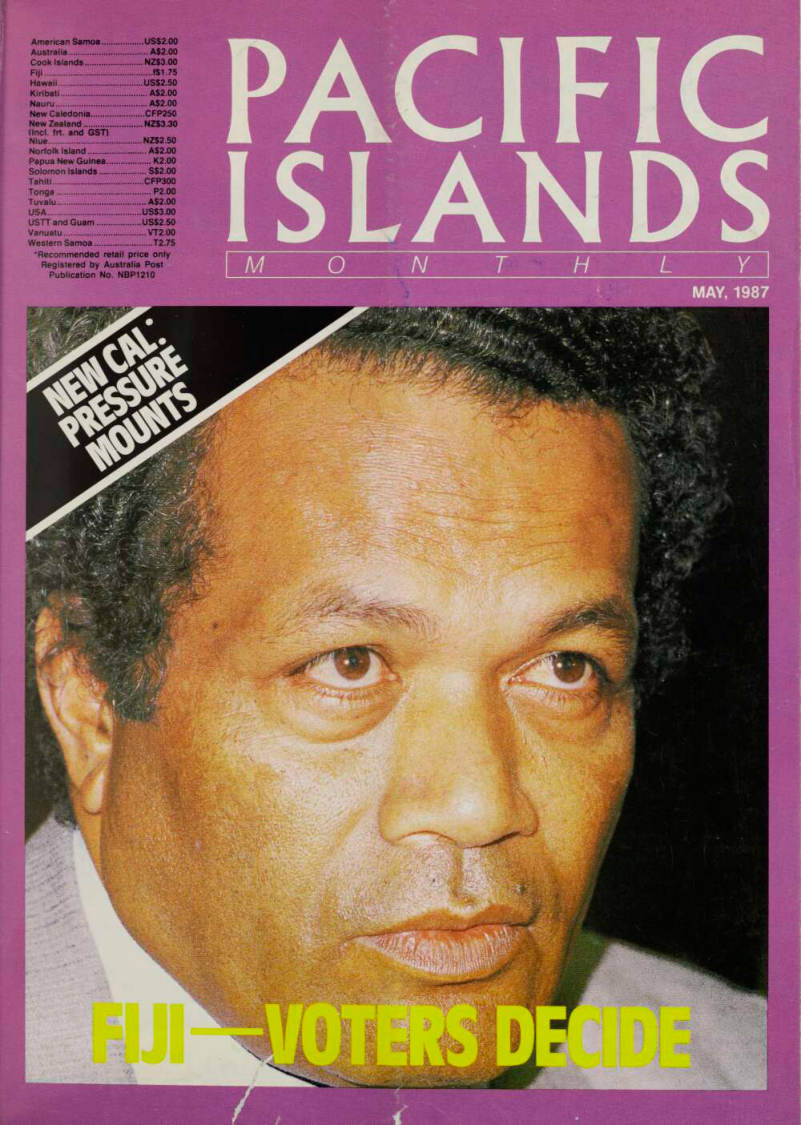
Hwvoters Decide
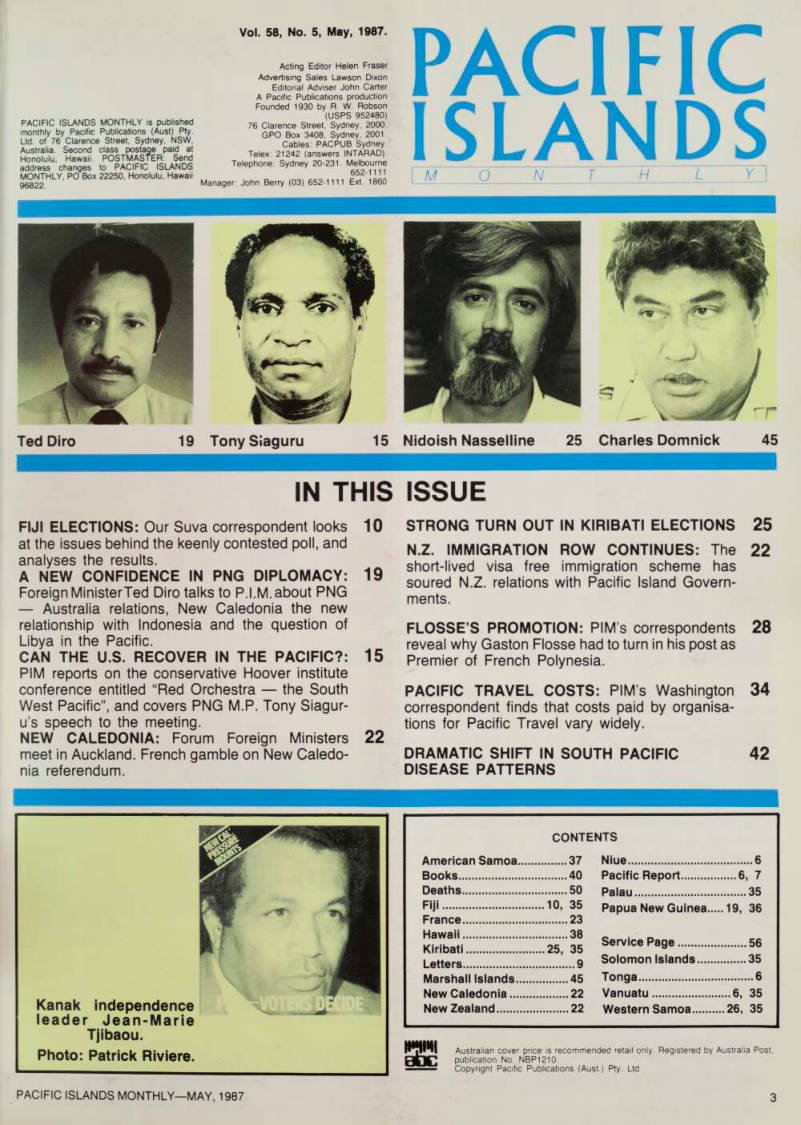
Kanak independence leader Jean-Marie Tjibaou.
Photo: Patrick Riviere.
Advertisements & other items, pp. 2-3 (2 items)
Trinitron
ms m * S
KV-2092AS
KV-1440AS
It's so tempting.
The colour you get from Sony's new Super Trinitron.
Our new Pan-Focus gun is computer-designed to make our famous colour even sharper and clearer. Our new Black Screen makes whites brilliant, blacks profound, every colour deeper and richer.
It's flatter and sguarer too.
For less reflection and superb clarity, even in the corners.
For those whose taste demands the best, Super Trinitron is the most delicious TV ever.
Trinitron
Pacific
ISLANDS
MONTHLY
Vol. 58, No. 5, May, 1987.
Ted Dlro 19
TonySlaguru 15
Nidoish Nasselline 25
Charles Domnick 45
In This Issue
FIJI ELECTIONS: Our Suva correspondent looks 10 at the issues behind the keenly contested poll, and analyses the results.
A NEW CONFIDENCE IN PNG DIPLOMACY: 19 Foreign Minister Ted Diro talks to P.I.M. about PNG Australia relations, New Caledonia the new relationship with Indonesia and the question of Libya in the Pacific.
CAN THE U.S. RECOVER IN THE PACIFIC?: 15 PIM reports on the conservative Hoover institute conference entitled “Red Orchestra the South West Pacific”, and covers PNG M.P. Tony Siagur u’s speech to the meeting.
NEW CALEDONIA: Forum Foreign Ministers 22 meet in Auckland. French gamble on New Caledo nia referendum.
STRONG TURN OUT IN KIRIBATI ELECTIONS 25
N.Z. Immigration Row Continues: The 22
short-lived visa free immigration scheme has soured N.Z. relations with Pacific Island Govern ments.
FLOSSES PROMOTION: PlM’s correspondents 28 reveal why Gaston Flosse had to turn in his post as Premier of French Polynesia.
PACIFIC TRAVEL COSTS: PlM’s Washington 34 correspondent finds that costs paid by organisa tions for Pacific Travel vary widely.
Dramatic Shift In South Pacific 42
Disease Patterns
Contents
American Samoa 37 Books 40 Deaths 50 Fiji 10, 35 France 23 Hawaii 38 Kiribati 25, 35 Letters 9 Marshall Islands 45 New Caledonia 22 New Zealand 22
Niue 6 Pacific Report 6, 7 Palau 35 Papua New Guinea 19, 36 Service Page 56 Solomon Islands 35 Tonga 6 Vanuatu 6, 35 Western Samoa 26, 35
Australian cover price is recommended retail only. Registered by Australia Post publication No. NBPI2IO.
Copyright Pacific Publications (Aust.) Pty. Ltd
Advertisements & other items, pp. 3-4 (2 items)
PACIFIC ISLANDS MONTHLY is published
monthly by Pacific Publications (Aust) Pty.
Ltd. of 76 Clarence Street, Sydney, NSW, Australia. Second class postage paid at Honolulu, Hawaii. POSTMASTER: Send address changes to PACIFIC ISLANDS MONTHLY, PO Box 22250, Honolulu, Hawaii 96822.
Acting Editor Helen Fraser Advertising Sales Lawson Dixon Editorial Adviser John Carter A Pacific Publications production Founded 1930 by R. W. Robson
(USPS 952480)
76 Clarence Street, Sydney, 2000.
GPO Box 3408, Sydney, 2001.
Cables: PACPUB Sydney.
Telex: 21242 (answers INTARAD).
Telephone: Sydney 20-231. Melbourne 652-1111 Manager: John Berry (03) 652-1111 Ext. 1860
CtD pioneer
Mil
rail
if r,
rw7i
I
nilltlll
ill
till I II W !Rl « n I 1 ~S I
« IS SI c
te .
sJSlpisr
■»» » 8 *
yj *,*■** f 8
'Mfdymo
» •Ml. «.»s. is B 9» » a I - • s» f »■ ■■ - • l«S l| s.B •• • . ■■ ii as 8 ■■ Br c: »n.i, « « MUui * »• hi.
'"••I -ss.
"U - z: Hi
'» a! 1 *" ■" ? »-1 - - .%■;= ■ »• - ■ * f 3 * - -■ —as H " s * ms * *! .2 s ? * fe:;;; i; ""•u.ii IMMMiiiii
ilissii
s? !| M!
KSD m
["•uiiilll
L’. W r i->, -> te?i lit
118 HIE C
'"3 «9 IS lllr I.M I
'' j**gSt
kin
• • »• * • !IW s [•»
■uji
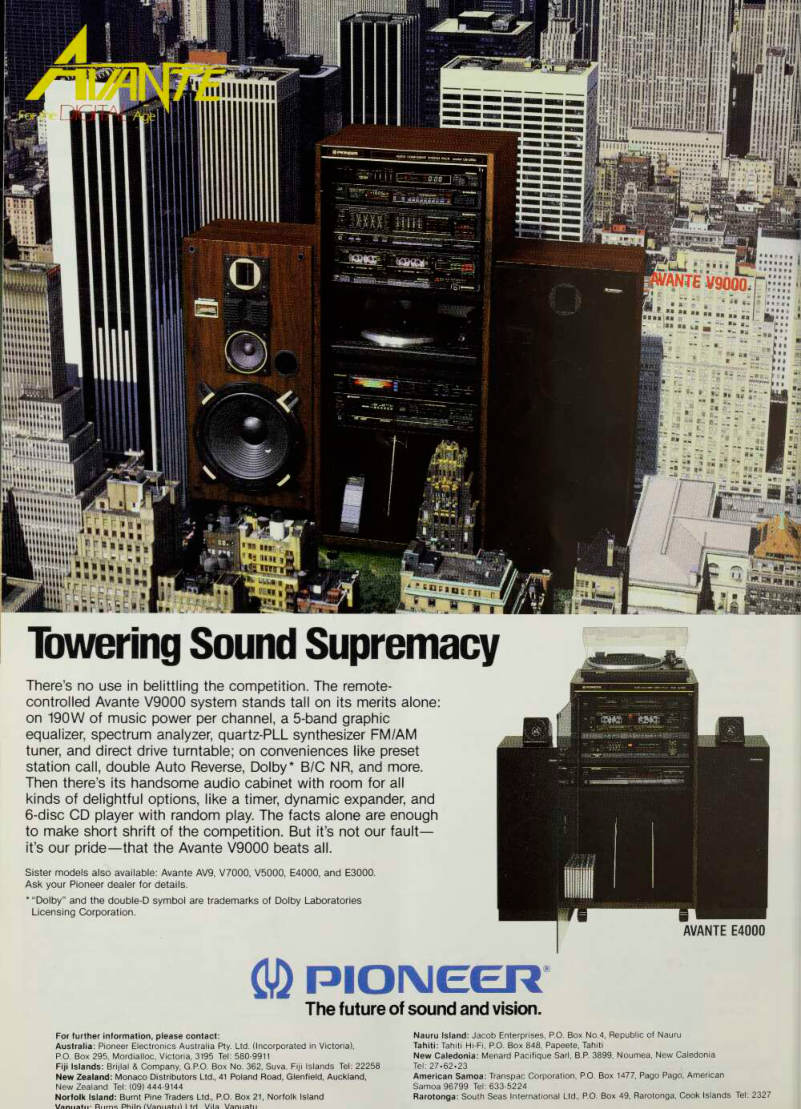
Towering Sound Supremacy
There’s no use in belittling the competition. The remotecontrolled Avante V9OOO system stands tall on its merits alone: on 190 W of music power per channel, a 5-band graphic
equalizer, spectrum analyzer, quartz-PLL synthesizer FM/AM
tuner, and direct drive turntable; on conveniences like preset station call, double Auto Reverse, Dolby* B/C NR, and more.
Then there’s its handsome audio cabinet with room for all kinds of delightful options, like a timer, dynamic expander, and 6-disc CD player with random play. The facts alone are enough to make short shrift of the competition. But it’s not our fault— it’s our pride—that the Avante V9OOO beats all.
Sister models also available: Avante AV9, V7OOO, V5OOO, E4OOO, and E3OOO.
Ask your Pioneer dealer for details. * “Dolby” and the double-D symbol are trademarks of Dolby Laboratories Licensing Corporation. r- mm f
AVANTE E4OOO
CtD pioneer
The future of sound and vision.
For further information, please contact: Australia: Pioneer Electronics Australia Pty. Ltd. (Incorporated in Victoria), P.O. Box 295, Mordialloc, Victoria, 3195 Tel: 580-9911 Fiji Islands: Brijlal & Company, G.P.O. Box No. 362, Suva, Fiji Islands Tel: 22258 New Zealand: Monaco Distributors Ltd., 41 Poland Road, Glenfield, Auckland, New Zealand Tel; (09) 444-9144 Norfolk Island; Burnt Pine Traders Ltd., P.O. Box 21, Norfolk Island Vanuatu- Burns Philn (Vanuatu) I td Vila Vanuatu Nauru Island: Jacob Enterprises, P.O. Box N 0.4,.4, Republic of Nauru Tahiti: Tahiti Hi-Fi, P.O. Box 848, Papeete, Tahiti New Caledonia: Menard Pacifique Sari, B.P. 3899, Noumea, New Caledonia Tel: 27-62.23 American Samoa; Transpac Corporation, P.O. Box 1477, Pago Pago, American Samoa 96799 Tel: 633-5224 Rarotonga: South Seas International Ltd., P.O. Box 49, Rarotonga, Cook Islands Tel: 2327
Forum finds new strength
Pim Opinion
When the South Pacific Forum assembles in Apia this month, it will review developments in two issues which say a great deal about its development and, perhaps, its future. In the case of the regional fishing agreement, the Forum has every reason to congratulate itself upon having promoted a new start in a crucial area of regional relationships. With the second issue, the future of New Caledonia and the resulting regional relationships with France, it is far less easy to say that a new start has been made. That says much about the differences between the US and France, but also something about the nature and evolution of the South Pacific Forum.
It would be wrong - and self-deluding - to see the agreement as a “victory” over the United States. Relations with the world’s foremost political and economic power do not operate that way.
Rather, the agreement has provided the focal point for a reassessment on the part of the US. In particular, that reassessment must prompt the US to think more clearly about the Pacific as a region comprising individual states rather than merely a single, small component of its global strategic thinking, which focuses so overwhelmingly on its contest for power with the Soviet Union.
The future of New Caledonia and the concomitant set of regional relationships with France is not looking so positive on the world view; France seems determined to fight every step of the way against the principles espoused by the Forum principles that surely command overwhelming support in the community of nations these days. The fact of French power, pressure and obduracy, however, is not likely to erode the new solidarity of the Forum. The United States has changed its attitude to the region - and, therefore, most members of the region - because it recognises a change in political realities.
France has not done so, and will start to judge the consequences more acutely when New Caledonia comes under the scrutiny of the United Nations this month - or whenever.
The new reality can be stated quite simply. In a post-colonial era, the South Pacific Forum was created because the only other forum available was still dominated by the metropolitan powers who were adjusting to their growing irrelevance. Now, the Forum has come of age, setting the political agenda for its own region and asking the world to respect its right to do so.
Other regional groupings clearly established such claims long before this. Clearly, the change has surprised some, but it should not have done. The impact of the Melanesian group upon the Forum did more than anything else to bring it about but the role of others should not be under-rated.
In the case of New Caledonia, which had been on the Forum agenda for eight years without decisive action, the Melanesian group created an emphasis that commanded attention. It was a new, though rather abstruse experience for most of the smaller Forum members. What gave it political substance was the support of larger regional members such as Australia which had so much more, politically, to lose. Australia assessed its potential losses in terms of its priorities as between France and the region; the consequences, in terms of French reactions, have been decidedly uncomfortable.
For the political future of the Forum, this type of support has helped to create a confidence and unity within the Forum that had not existed hitherto. At the special meeting of foreign ministers in Auckland in March, it was notable - though not emphasised publicly -that the gap between the "assertive”
Melanesian spearhead group and the ’’conservative” Forum members had narrowed sufficiently for a unified position to be taken. They maintained the strong line of genuine self determination for New Caledonia and, by inference, accepted the consequences. What they may be is not clear, but the spirit of the decision demonstrates a political capacity new to all but the most recent Forum thinking. It can only be to the good, given the scale of the regional problems that lie ahead.
pacific report
Fishing Rights
Treaty Signed
The South Pacific Tuna Fishing Agreement was signed in early April in Port Moresby by the United States and 12 South Pacific nations, ending the tuna war between American fishermen and members of the South Pacific Forum Fisheries Agency. In return for fishing rights in their territorial waters the US will pay the Forum nations a total of SUS6O million over the next five years. Radio Australia reported that it has taken at least seven years to get the US to recognise their 200-mile economic zones.
FFA members Tonga, Niue, Palau and Vanuatu failed to sign the agreement at the PNG ceremony. FFA Director Mr Philip Muller said these countries had indicated their intention of signing the agreement, which must be ratified by ten countries before it comes into effect including the three key fishing nations, Papua New Guinea, Kiribati and Micronesia. Earlier FFA nations signed an internal agreement on the agreement’s administration and formula for money ditribution.
Vanuatu Reconstruc
Tion Measures
The Vanuatu Government announced a series of measures to assist reconstruction after the devastation caused by cyclone Uma in February. The country’s tourism, agriculture, commerce and manufacturing industries are to be granted exemption from duties on imports of replacement materials and equipment. New projects which can help stimulate economic recov ery will also receive duty exemptions.
Banks are being urged to help people re-establish businesses, or start new ones, and speedy settlements of insurance dis putes will be facilitated.
Credibility And
Influence Eroded
Australia’s Foreign Minister Mr Bill Hayden said the failure of the Western nuclear powers to support the Nuclear Free Zone Treaty will erode their credibility and influence in the region. He said that as a result Australia and New Zealand would be left with the full responsibility for protecting and promoting western interests in the South Pacific. Mr Hayden’s comments were made after Britain joined the US and France and refused to sign the Treaty’s protocols. Britain’s decision would have no effect on the force of the Treaty, Mr
Hayden said. The Treaty, ratified by eight South Pacific nations was registered with the UN in December, and prohibits the manufacture, storage, and testing of nuc lear weapons by member countries. The protocols, signed by the Soviet Union and China require an undertaking from the nuclear powers not to use nuclear weapons against member states, and to adhere to the treaty provisions in relation to their South Pacific territories.
Tonga To Pay
Compensation
The Kingdom of Tonga was ordered to pay over SUS9O,OOO in compensation for a fishing boat which sank while in police custody. In Nukualofa Mr Justice Geoffrey Martin said the police had failed to take proper care of the mv Rainbow Runner, owned by the Tonga Flying Fish company.
The vessel was held as security against an alleged debt last August when it sank in a storm.
Niue Commercial
Bank Opened
Niue celebrated the opening of the first commercial bank early last month. At the ceremony PM Sir Robert Rex described it as one of the most important events in the
country’s history. A public holiday was declared for the ceremony and 300 people attended the opening ceremony of the Westpac Niue branch. Sir Robert said the presence of the bank increased prospects for economic progress and showed confi dence in the country.
Plan For Disaster
Co-Ordination
PNG Prime Minister Mr Paias Wingti has called for the setting-up of a disaster co-ordination plan for the whole of the South Pacific, and will raise the proposal at the Forum meeting in Apia late this month.
He said natural disasters in the form of cyclones and earthquakes had recently hit the Solomon Islands, Vanuatu, Fiji, the Cook Islands, and Papua New Guinea.
Acknowledging the quick and unselfish aid donations from within and outside the region, he said it had been spontaneous rather than planned in advance. Radio Australia said Mr Wingti believed that with a Pacific Disaster Co-ordination plan the Island states would be better prepared to handle disasters.
Pacific Tests
To Continue
A member of France’s Parliamentary De fence Commission reaffirmed that Paris will continue underground nuclear tests in the Pacific despite mounting criticism from regional states. Mr Jacques Baumel, a member of the governing RPR party, said in French Polynesia that it was out of the question to close the Pacific test site or move it elsewhere. He was on a tour of the test sites at Mururoa and Fangataufa before parliamentary debates on France’s five year military spending programme. Mr Baumel said the presence of the test sites substantially raised the standard of living in French Polynesia.
Emperor Allegations
Rejected
The Australian-owned Emperor Gold Mines rejected allegations made against it by Fiji opposition leader Dr Timoci Bavad ra in a newspaper advertisement. The company is a consortium involving the Emperor Gold Mining Co. and the West ern Mining Corporation. In the latest of a series of allegations about the company’s operations Dr Bavadra said the people of Nasomo, near the mines, had been victims
Bill Hayden, Australia’s Foreign Minister.
of the company’s self interest. He said the company had been allowed by the Fiji Government to have Nasomo land seized and alienated under mining leasehold and that the people in the region had not had sufficient rights restored to them for control of their land. Emperor Mines said that no mining activities are being carried out in Nasomo by the companies because the people of Nasomo have not agreed to allow the companies on to their land for mining exploration. Emperor also denied Dr Bavadra’s claim that mining operations were contaminating water and air in the Nasomo region.
Niue Pm Returned
The Prime Minister of Niue, Sir Robert Rex, and his three member cabinet were returned in the late March elections. Niue’s electoral officer said there were only three new faces in the 20 member Assembly.
The island’s only political organisation, the Niue People’s Action Party, gained one representative to the Assembly, with leader Mr Sani Lakatani failing to win a seat.
Eleven Killed
In Landslide
A landslide in the PNG highlands town of Goroka killed eleven people when a cliff collapsed after heavy rain. The dead were among a group of 30 who were watching videos in a house when it was buried under tonnes of mud and debris. Most of the dead were children, and another fourteen were hospitalised.
Libya Reacts
Libya reacted with astonishment to Austra lian warnings against interference in the South Pacific, Jana, the official Libyan News Agency said the question of Libya’s diplomatic relations in the Pacific con cerned only Libya and the independent countries involved. Jana said the establish ment of diplomatic relations with these nations was compatible with Libya’s na tional and international rights. Australian Foreign Minister Hayden had told the Australian Parliament the Government was concerned at Libyan activity in the South Pacific and warned Libya against interfer ence. He said Libya’s commercial interests in the region were almost nil, that Libya was not a member of the region and did not share regional interests and concerns and that therefore Libya’s interest would be almost exclusively political. New Zea land’s PM Mr Lange had earlier accused Libya of meddling in the affairs of a region where its efforts were unwelcome, and PNG Foreign Minister Ted Diro had said the South Pacific Forum would discuss the issue of increasing Libyian involvement in the South Pacific at the May Apia meeting.
Libya established diplomatic relations with Vanuatu last year and is reportedly close to establishing a Libyan People’s Bureau in Port Vila.
Vanuatu Inquiry Begun
A special Commission of Inquiry has begun taking evidence in Vanuatu on the
loss or damage to a total of 16 ships during cyclone Uma in early Februry. A total of 21 crew from the ships were killed or missing presumed dead. The Commissioner, Soli citor General Mr Anthony Durkin, and two assessors flew to Tanna to begin the inquiry and evidence will also be taken in Port Vila. A traditional compensation settlement was performed in the northern Banks group of islands by the owners of two ships which lost men in the cyclone.
The owners were accompanied to the islands by a high-ranking traditional chief to make the payments to the families of the dead.
Second Station
Ready Soon
PNG’s second TV station was reported to be ready to begin broadcasting in four months. Media Niugini’s General manager, Mr Gerry Thorley, said the first broadcasts would be seen in Port Moresby and surrounding districts about August Ist. He said coverage was planned to be extended to Lae, Rabaul, Mount Hagen, Goroka and Madang by next January.
Franco-Australian
Relations “Evolving”
Australian Foreign Minister Bill Hayden said he was prepared to meet his French counterpart Mr Jean-Bemard Raimond, during his Paris visit for the OECD meeting this month. Australian Embassy officials in Paris confirmed a report that Mr Hayden was prepared to meet Mr Raimond if France was prepared to end its ban on ministerial contacts between the two gov ernments. The ban followed Australian criticism of French policies in the South Pacific. A French spokesman said the situation was “evolving” and as yet nothing was conclusive.
Malnutrition Rates Up
A UN report has found that Pacific Island people have some of the world’s most rapidly increasing rates of malnutrition.
The FAO report blamed the shift from a traditional fresh food diet which was rich in fibre and micro-nutrients, to a diet based on imported and often over-refined food.
Countries covered in the report included PNG, Kiribati, Solomon Islands, Tonga, Tuvalua, Western Samoa, Cook Islands, FSM, Fiji, Niue and Palau. It found that per capita consumption of traditional root crops such as yams and taro had fallen by over 8% since 1970, while consumption of imports such as rice, refined sugar and white wheat flour had risen by 6% and said this was due to rapid urbanisation and the relative cheapness of imports.
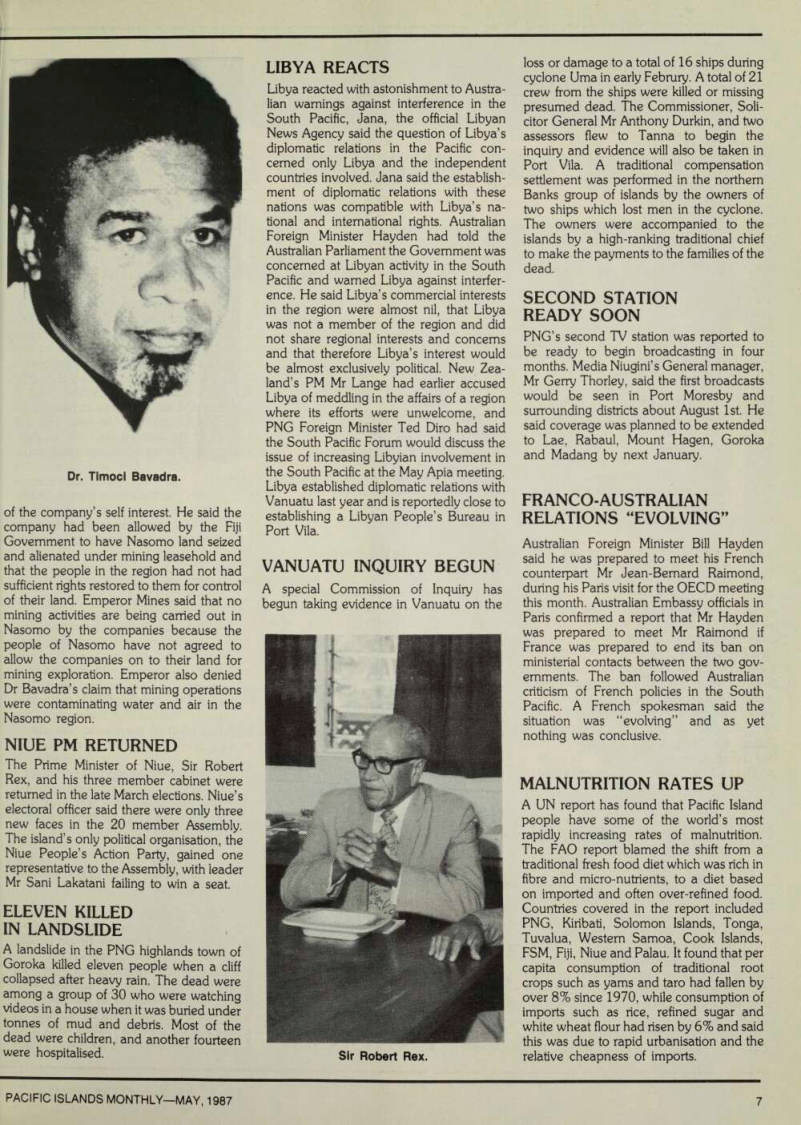
Dr. Timoci Bavadra.
Sir Robert Rex.
Advertisements & other items, p. 8 (1 item)
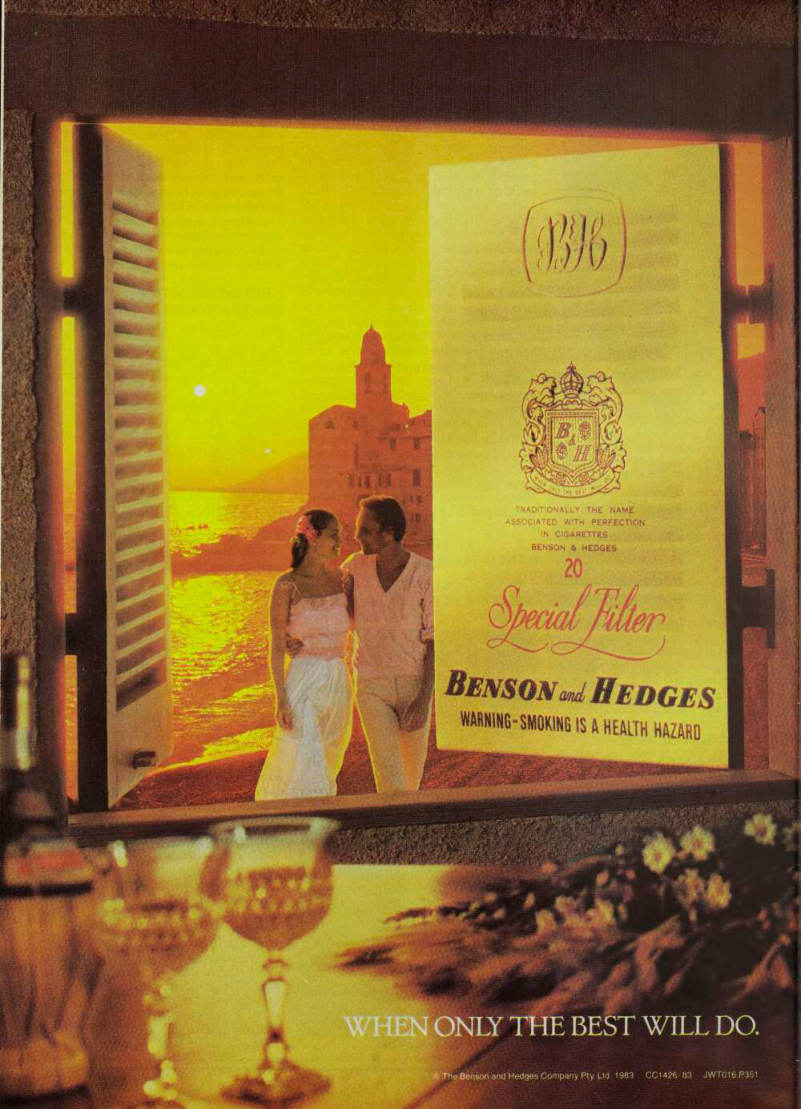
Bens on Hedges
m B
TRADITIONALLY THE NAME
ASSOCIATED WITH PERFECTION
IN CIGARETTES.
BENSON & HEDGES
zo
Bens on Hedges
WARNING-SMOKING IS A HEALTH HAZARD
mm & I ic Wk m kJ
■ ONLY THE BEST WILL DO
Sparteca debate continues
letters
Recent remarks by Professor Helen Hughes at the Fiji Accountants Congress have come to my attention, and I feel thy need a response.
Professor Hughes staed that the Rulkes of Origin criteria in SPARTECA should remain rather than introduce a Sub stantial Transformation Clause.
Her main point was that Sub stantial Transformation agree ments do not exist with any country - this is quite true except in the trade agreement the Forum countries have with the EEC, Japan and other important potential trading partners. It is of concern to me and I am sure to many other Australians that Professor Hughes can be ignorant about Forum Island trade agreements and yet be an advisorto the Australian Government on these matters.
She was concerned about the huge profit importers are making from their Fiji goods, and quoted Farah and Bonds in particular. Once again she hasn’t done her homework for she is unaware that at the time these companies commenced business negotiations with selected manufacturers in Fiji these factories were already making garments for the local and Island markets, and that these quality standards were totally unsuited for export. A considerable investment by these companies during the pastthree years in training and gearing their Fiji producers is responsible for the high quality standard they have now achieved. Further investment in more modern plantand machinery is planned for his year. The profits are certainly expected to be there for if they weren’t there would be no interest in exporting from Fiji.
David Einfeld,
Traders Pty. Ltd., Forum Island.
Author
strikes back
What a great pity that PIM (February) wasted two pages on a review of my book, Eyes Of Fire, an banal as Bary Shineberg managed to serve up. In fact, I wonder whether he really read it apart from the one chapter on the yo-ho-ho exploits of Greenpeace in the early campaigns of the Rain bow Warrior.
How any reviewer could be so insensitive to the nuclear rape of the Pacific is quite astonishing. Shineberg totally ignores the anecdotal testi mony, and indeed the point of the book, of an island commun ity ravaged by nuclear radiation in favour of discussing trivial incidents that happened on the campaign ship long before she even left for the Marshall Is lands on her Pacific and last voyage.
The historic and tragic evacuation of Rongelap atoll is glossed over in two paragraphs!
Environmental “piracy” on the high seas takes Shineberg’s fan cy instead. There is no mention at all of the moving photo graphic portrayal of the islan der’s hardships, or the book’s accusations against the United States government.
To suggest, as Shineberg does, that the US geographic position bordering the Pacific somehow give it more legiti mate defence interests than France, with the implication that it has a greater right to inflict the human cost of its military programmes on Pacific islanders, is obscene.
Far from being a voyager’s handbook or contributing to the rapidly growing literature deal ing with the sabotage of the
Warrior, the book is read by people with an awareness of environmental and independ ence issues and has gone into a third edition.
David Robie,
Auckland
Farmers’
views
clarified
I was pleased that Mike Lane, in his article “Farmers Field Investment Famine” (Feb. ’B7) used information from my re port Entrepreneurship and Business Venture Development in the Kingdom of Tonga to illustrate a key point.
However, the quote he used was not made by me but by one of the 94 commercial far mers I interviewed for the study.
Although the opinion ex pressed by this farmer was undoubtably shared by other commercial growers, it should by no means be considered a
consensus opinion by all far mers in Tonga.
Moreover, the particular phrasing used in Mr Lane’s article was misleading, making it appear as if this information was used in conjunction with the final conclusion of the re port, which it was not.
S. Deacon Ritterbush,
Information and Research Co-ordinator, The Pacific Business Centre
PIM coverage
complimented
My compliments on the sub erb stuff of recent issues. As an example, the Fiji election cover age is very good (February) and North’s inset on Fijian suffrage will be required reading in my Pacific Legal Studies class. The coverage of Tuna fishing in January was also first rate (but I don’t mean to neglect the other excellent contents.) Bill Hodge, Faculty of Law, University of Auckland.
Mara Government defeated
Fiji Elections
n , e w 3°v er nment The Coalition of National Federation Party and Labour Party has replaced the Alliance Government of Ratu Sir Kamisese Mara which had ruled the country continuously for seven years after independence in 1970 ho ™ Ihe NFP Coalition won 28
seats to Alliance s 24. The result surpnsed many political pundits but it didn’t come as a complete surprise. For the first time in Fiji s history the Coalition had put up the most formidable and best organised election cam paign to topple the Alliance Government. The Coalition of Indian- backed National Federation Party and the un
ion-backed Labour Party caphired four crucial national seats in the Suva city and peri-urban centre near Suva previously held by the Alliance.
Every election in Fiji is fought on these four seats until now always held by the Alliance but this year the there has been a complete reversal of the situation. According to the make-up
of the constituency boundaries and the distribution of seats the two major parties are guaran teed a win of 24 seats each and the power goes to which ever party is able to win the crucial four national seats. The main reason for the coalition’s victory is its multi-racial approach. For the first time in Fiji the election was not fought on racial lines. Dr. Timoci Bavadra, 52 years old, led the coalition with Mr Harish Shar ma as his deputy this racial mix with Dr. Bavadra as ethnic Fijian and Sharma an Indian and a mixed team of other candidates with bread and but ter issues such as unemploy ment, increasing crime, a clean and caring government, were promises which appealed to the voters, especially the younger generation.
The Alliance had counted heavily on its traditional Fijian and part European (general elector) support but were de nied this in the crucial four seats. Overall the Alliance pol led 77% of the Fijian votes, a decline of 5% over the 1982 figures. Its general elector sup port also went down from 89% in 1982 to 80% but its Indian support of 15% remained in tact. The national voter turnout in the ’B7 Election was 71% compared to 85% in 1982.
The main casualty of the 1987 election was the Deputy Prime Minister and Minister for Fijian affairs, Ratu David Toga nivalu who lost his seat to an academic, Dr Tupeni Baba, by 550 votes. In 1982 he had won the same seat with a majority of 1,166 votes. His running mate Mrs Irene Jai Narayan lost her seat by a majority of 659 votes.
Ratu David accepted the verdict
May, 1987
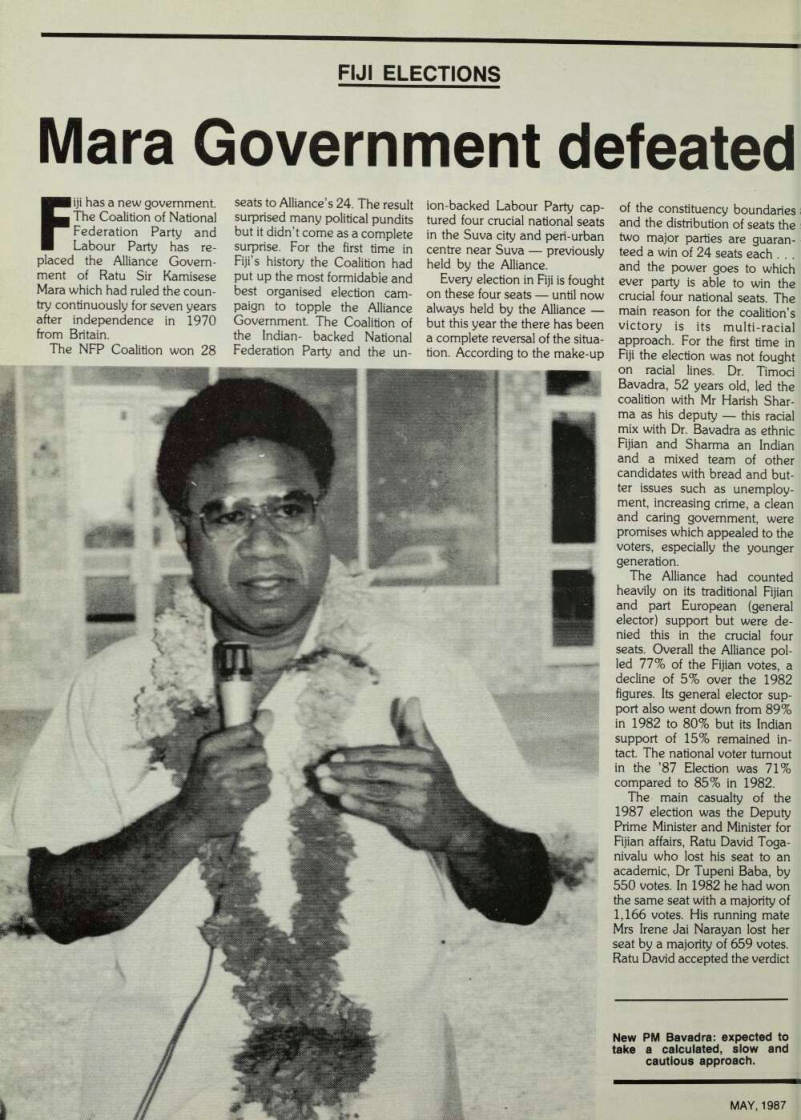
New PM Bavadra: expected to take a calculated, slow and cautious approach.
of the people graciously and said he would now bow out of politics after 23 years and prob ably go into business. Ratu David, 53, was first elected to the Legislative Council in 1966 and had remained a member of Parliament since then. His first appointment was as Par liamentary Secretary to the Minister for Fijian Affairs, 1966- 68. He was appointed a cabinet Minister in 1973 and later held the portfolios of Information, Labour and Commerce and Industry. In 1984 he was appointed as Fiji’s first Deputy Prime Minister and also the Minister for Fijian Affairs. He comes from the chiefly clan “Massau” of Bau.
Mrs Irene Jai Narayan, 54, had crossed the floor earlier this year to join the Alliance party after being with the National Federation Party for 20 years.
She had served the NFP as President and Deputy Opposi tion Leader. However, after differences with the former
leader of the opposition Mr S.M. Koya, she resigned from the party and sat as an indepen dent. Mrs Narayan, an Indian national, came to Fiji after mar rying a high school teacher and herself pursued a teaching career before entering politics.
From 1977 she had been returned to Parliament with huge majorities on an NFP ticket. She was the most articu late and vocal critic of the Alliance Government’s policies and enjoyed tremendous personal support with at the grass roots level. It was this factor which had greatly influ enced the Alliance leader Ratu Mara to accept her in the Alliance despite her past record of venemous attacks on the Alliance.
Ratu Mara had said she would bring the Indian voice in
the party and was sure to get a cabinet ministry if the Alliance had won. Mrs Narayan’s defec tion was seen by many as a ‘prize catch’ by the Alliance, and one which would bring Indian voters to the Alliance but the strategy backfired. In dian voters could not digest a betrayal by an Indian woman whom they regarded as a per son of high principles and in tegrity.
Ratu Mara accepted the de feat with grace and said he accepted the people’s verdict for a new government. He said that while he was disappointed he urged everyone to put the interests of Fiji above all. Ratu Mara said he was proud that the people had been able to de monstrate that democracy is alive and well in Fiji. The out-going Prime Minister wished the new Government well in its endeavours.
Oxford educated Ratu Mara has led the country smoothly for the last 20 years and took it to independence. He has made Fiji a shining example of true multi-racialism, making an im pact on the regional and in ternational scene.
In his first broadcast address to the nation, new Prime Minis ter Dr Timoci Bavadra paid tribute to Ratu Mara and his party’s contribution.
“We also acknowledge and greatly respect the contribution which Ratu Sir Kamisese and the Alliance party have made to the development of our na tion”, Dr Bavadra said.
“We look forward very much to their continuing contribution in the future and we sincerely hope that they will join and participate with us in the sacred task of nation building and national development.”
Under the Labour/NFP Gov ernment Fiji’s foreign policy will be non-aligned in comparison to Ratu Mara’s pro-Western stance. Internationally and re gionally there must have been a wave of shock and alarm at the toppling of the Mara Govern ment, and US Government observers say it will be most concerned. Labour has said it will ban port visits by nuclear armed or powered vessels.
Australia and New Zealand both have Labour Govern ments and Australian PM Mr Bob Hawke was among the first to congratulate Dr Bavadra.
No doubt not only govern ments but foreign investors will anxiously await the new gov ernment’s policies on invest ment and foreign relations.
However, the approach of the Bavadra Government is ex pected to be a calculated, slow and cautious one.
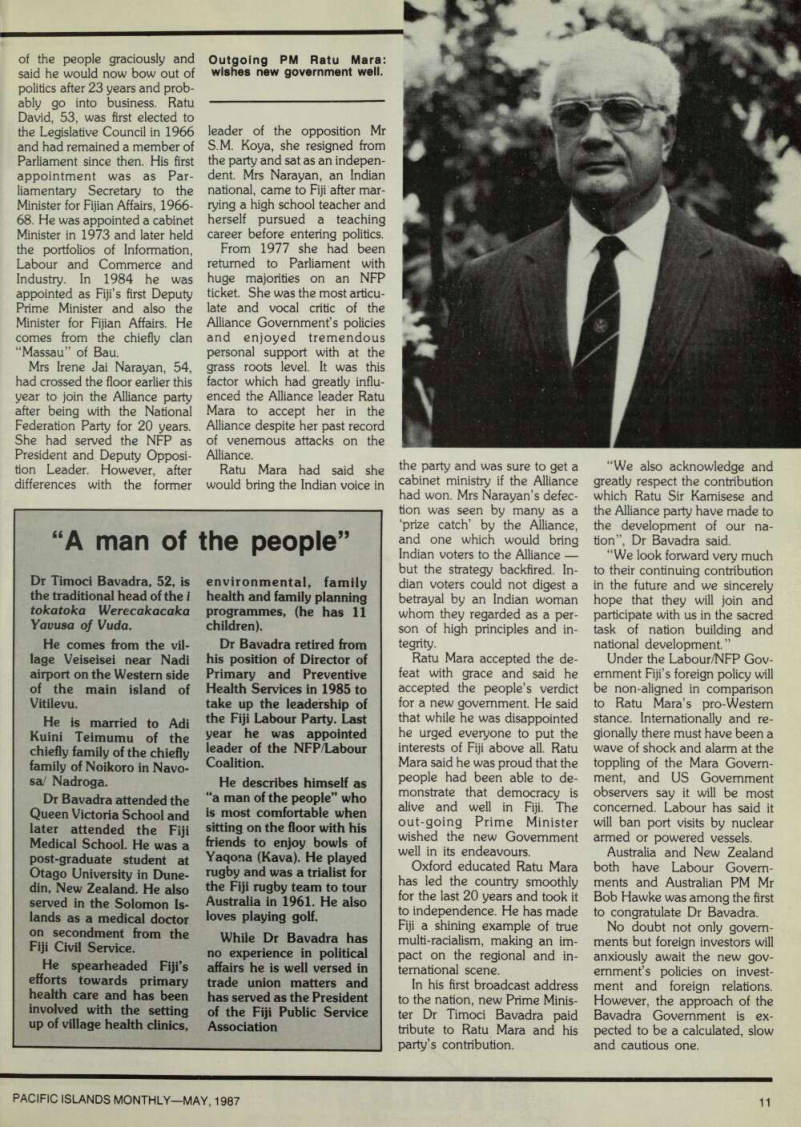
Outgoing PM Ratu Mara: wishes new government well.
“A man of the people”
Dr Timoci Bavadra, 52, is the traditional head of the i tokatoka Werecakacaka Yavusa of Vuda.
He comes from the vil lage Veiseisei near Nadi airport on the Western side of the main island of Vitilevu.
He is married to Adi Kuini Tcimumu of the chiefly family of the chiefly family of Noikoro in Navo sa/ Nadroga.
Dr Bavadra attended the Queen Victoria School and later attended the Fiji Medical School. He was a post-graduate student at Otago University in Dune din, New Zealand. He also served in the Solomon Is lands as a medical doctor on secondment from the Fiji Civil Service.
He spearheaded Fiji’s efforts towards primary health care and has been involved with the setting up of village health clinics.
environmental, family health and family planning programmes, (he has 11 children).
Dr Bavadra retired from his position of Director of Primary and Preventive Health Services in 1985 to take up the leadership of the Fiji Labour Party. Last year he was appointed leader of the NFP/Labour Coalition.
He describes himself as “a man of the people” who is most comfortable when sitting on the floor with his friends to enjoy bowls of Yaqona (Kava). He played rugby and was a trialist for the Fiji rugby team to tour Australia in 1961. He also loves playing golf.
While Dr Bavadra has no experience in political affairs he is well versed in trade union matters and has served as the President of the Fiji Public Service Association
Advertisements & other items, p. 12 (1 item)
Now just the
of a wand gets you your
Programming with our new Digital Scanner is magically simple.
Magic? Not quite. But our revolutionary
VTR timer-programming system is the next best thing. It utilizes the most advanced digital and optoelectronic technology to conjure up a new generation of operating ease.
Channels, dates, and start/stop times become bar codes printed on a sheet. The magic wand is really a Digital Scanner that is passed over the appropriate codes to read-in programming information and then pointed at the VTR to enter them in memory. What simpler way to preset the recording of eight different TV selections up to one month in advance?
Our NV-G22 VTR also features a Super 4-Video-Head system that delivers a remarkably fluid Double Super Fine Slow Motion. Action scenes that would be jittery in conventional slow motion are reproduced in smooth, stable detail.
Other pleasing features include a calendar timer that extends up to the year 2001, an HQ (High Quality) picture system, Super Still Advance playback, and wireless remote control.
National VTRs with Digital Scanners. Wave
goodbye to programming complications.
In New Zealand only, an identical version of the NV-G22 is marketed under model number NV-G2l
National
National, Panasonic and Technics are the brandnames of Matsushita Electric.
G 22
VMS
Your attention ts drawn to me fact mat recording pre-recorded tapes or discs or other published or broadcast material may infringe copyright tews.
urgent review
Electoral system needs urgent review
The 1987 general elec tion in Fiji has proved one thing beyond doubt - that the system of conducting the election and registering voters is very much out of date. The present system leaves too many loopholes to be exploited by voters and political parties.
Firstly there is no compulsory registration or voting in Fiji - the responsibility for registering vo ters is largely left to the political parties, and they are also ex pected to coerce and transport the voters to polling stations during elections.
The Elections Office automa tically puts the names of those voters who had registered themselves for the previous election 5 years ago on the new roll plus those who had attained the voting age of 21 years since then. Before a new election the rolls are open for new registra tion, change of residence and also deletion of those voters who died in the period or had emigrated.
However all this is done manually and only if the Elec tion Office is informed about these alterations. There is no organised system of deleting or adding names to the rolls.
Neither is there any provision to cross check for double registra tion. Also there is no way for guaranteeing that all the eligible names on the ‘old’ roll have been transferred to the ‘new’ roll. The onus of checking these is left to the voters once the provisional rolls are prepared and are open for inspection for a limited period.
If the omissions or additions
are not picked up during this time there is no way of correc ting these once the final rolls are prepared.
Thus quite a number of people who had voted in the 1982 election were in for a rude shock when they turned up at the polling stations to cast their votes.
Some also found out to their
horror they had been shifted to another polling station and missed out completely because voting at that polling station had already closed.
Everyone the political parties as well as the Supervisor of Elections, Mr Michael Scott admitted that there were serious shortcomings in the systern which needed action be-
fore the next elections, There is no identification sys tern in Fiji; voters don’t carry ID cards and thus a voter can cast his vote more than once first in person and then through postal ballots. However, there were no reports of any major misuse of this system, Spokesmen for both main political groups, Alliance and
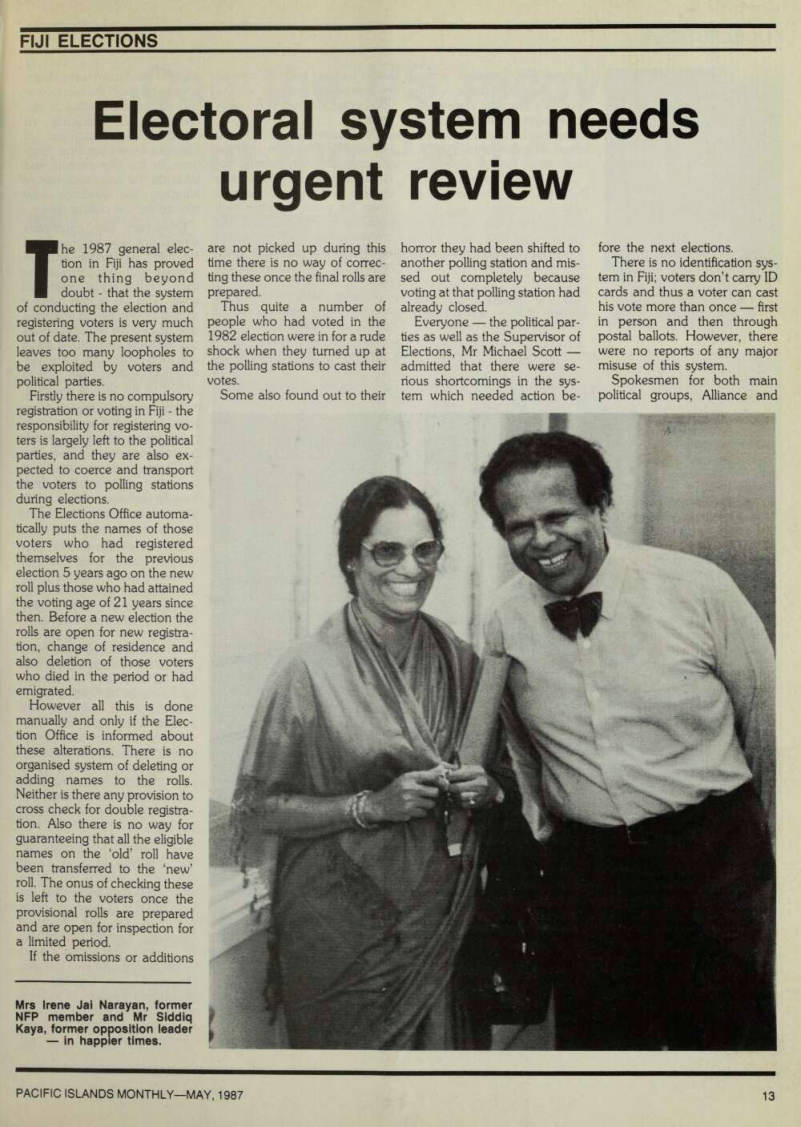
Mrs Irene Jai Narayan, former NFP member and Mr Siddiq Kaya, former opposition leader - in happier times.
Labour/NFP Coalition, agreed on at least one issue the country’s electoral system dis advantages not only the politi cal parties but it does not allow voters to exercise their demo cratic rights without restriction.
Ratu David Toganivalu, the Deputy Prime Minister and an Alliance candidate, said com pulsory registration and voting was perhaps the answer, but he
said it had not been thought to be necessary because of the good voter turnouts in Fiji elec tions.
Dr Tupeni Baba of the Labour/NFP Coalition, said the responsibility of registering vo ters should be taken over solely by the Government. He said when the political parties took over the registration task the tendency has been to ‘dump’ the registration papers of voters belonging to the opposite camp.
Without doubt it is now time for the whole electoral system to be computerised and the
office of the Supervisor of Elec tions to be given the manpower and equipment needed to dis charge its job efficiently. At present Fiji’s Supervisor of Elections carries out other func tions for the Government and takes on the enormous task of handling the elections only months before polling date.
Observers say computers should not only be introduced for voter registration and roll updates but also should be used for the actual casting of votes. This will in turn mean a shorter polling period or even a one day voting with the results out the same evening. All agree that for a country Fiji’s size with 400,000 voters, the polling period of six days is too long.
This long polling period has been highlighted as the main cause for the skirmishes which marred this year’s election. The 1987 election saw a drawn out campaign of more than four months followed by a very vigorous campaign for a fort night.
While the main political par ties had pledged the campign would be clean, with the focus on issues, and character assassination and mud-slinging kept to a minimum, they failed to live up to this. During the one week polling period while there was no active campaigning and the self-imposed moratorium by the media on political repor ting, the parties continued their tirades with paid advertise ments in the two daily news papers. This added to the fever pitch campaign, and at some polling stations minor incidents and scuffles were reported be tween supporters of opposing camps.
Mr Viliame Vakarewakuile, 46, appeared in Suva Court after one incident in Suva where two men supporting the Labour/NFP Coalition were punched by the Alliance supporter. Presiding magistrate Mr James Sabharwal jailed Vakerewakuile for two months.
He said the Constitution guaranteed freedom to express political views without recourse to violence. From our Suva correspondent.
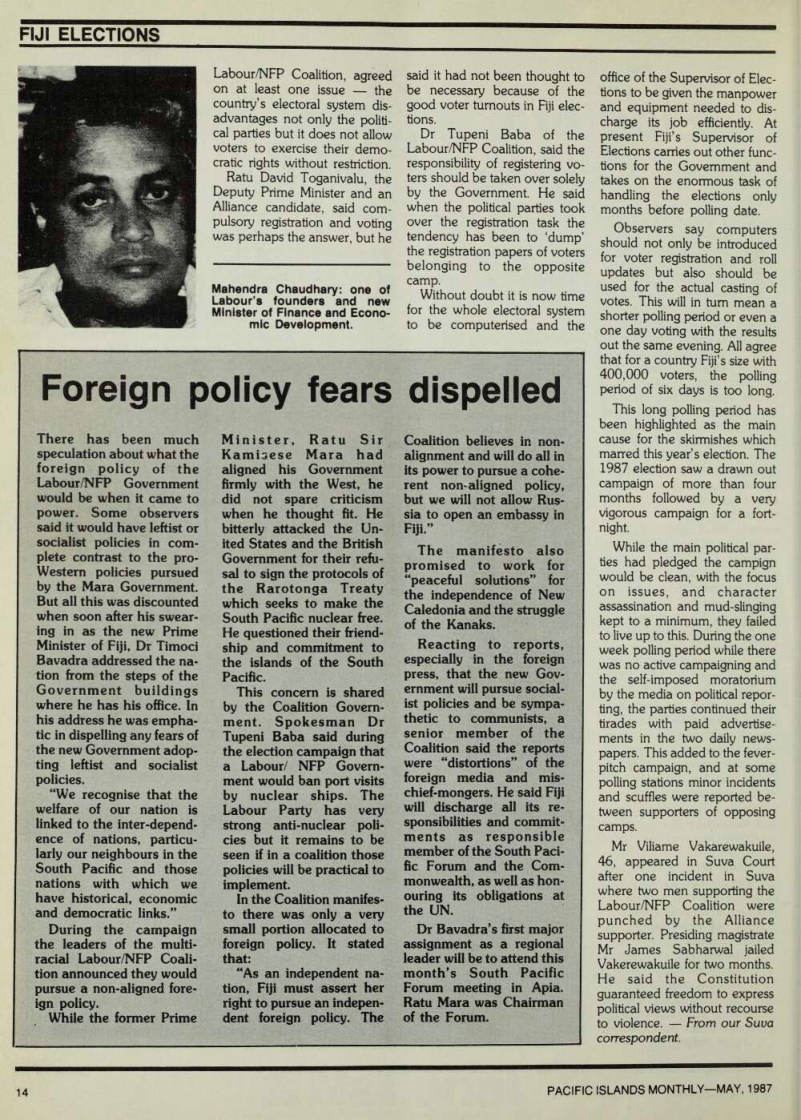
Mahendra Chaudhary: one of Labour’s founders and new Minister of Finance and Econo mic Development.
Foreign policy fears dispelled
There has been much speculation about what the foreign policy of the Labour/NFP Government would be when it came to power. Some observers said it would have leftist or socialist policies in com plete contrast to the pro- Western policies pursued by the Mara Government.
But all this was discounted when soon after his swear ing in as the new Prime Minister of Fiji, Dr Timoci Bavadra addressed the na tion from the steps of the Government buildings where he has his office. In his address he was empha tic in dispelling any fears of the new Government adop ting leftist and socialist policies.
“We recognise that the welfare of our nation is linked to the inter-depend cnce of nations, particu larly our neighbours in the South Pacific and those nations with which we have historical, economic and democratic links.”
During the campaign the leaders of the multi racial Labour/NFP Coali tion announced they would pursue a non-aligned fore ign policy.
While the former Prime
Minister, Ratu Sir Kamisese Mara had aligned his Government firmly with the West, he did not spare criticism when he thought fit. He bitterly attacked the Un ited States and the British Government for their refu sal to sign the protocols of the Rarotonga Treaty which seeks to make the South Pacific nuclear free.
He questioned their friend ship and commitment to the islands of the South Pacific.
This concern is shared by the Coalition Govern ment. Spokesman Dr Tupeni Baba said during the election campaign that a Labour/ NFP Govern ment would ban port visits by nuclear ships. The Labour Party has very strong anti-nuclear poli cies but it remains to be seen if in a coalition those policies will be practiced to implement.
In the Coalition manifes to there was only a very small portion allocated to foreign policy. It stated that: “As an independent na tion, Fiji must assert her right to pursue an indepen dent foreign policy. The
Coalition believes in non alignment and will do all in its power to pursue a cohe rent non-aligned policy, but we will not allow Rus sia to open an embassy in Fiji.”
The manifesto also promised to work for “peaceful solutions” for the independence of New Caledonia and the struggle of the Kanaks.
Reacting to reports, especially in the foreign press, that the new Gov ernment will pursue social ist policies and be sympa thetic to communists, a senior member of the Coalition said the reports were “distortions” of the foreign media and mis chief-mongers. He said Fiji will discharge all its re sponsibilities and commit ments as responsible member of the South Paci fic Forum and the Com monwealth, as well as hon ouring its obligations at the UN.
Dr Bavadra’s first major assignment as a regional leader will be to attend this month’s South Pacific Forum meeting in Apia.
Ratu Mara was Chairman of the Forum.
Can the US recover

in the Pacific?
The US influence in the South-West Pacific has been recently very much weakened. The event most directly contributing to bring her troubles to a head was New Zealand’s refusal to admit nuclear ships and Amer ica’s consequent breaking of their military alliance. This quarrel initially caused con siderable dismay and concern among the Pacific Islands coun tries. Indeed, the Prime Minister of the Cook Islands, a country having a special relationship with New Zealand, was so appalled at the thought of the consequences of the withdra wal of American nuclear protec tion that he conceived the best hope for his country’s safety lay in a formal declaration of neutrality.
So we all held our breath.
And what happened? Nothing.
The Russians did not leap into the breach. New Zealand was not bombed. In fact, of course, the Russians seized a golden diplomatic opportunity and ex pressed their sympathy with Wellington’s position. The months passed and New Zea land still existed carefree enough outside the American umbrella without any devastat ing consequences for itself or the Region. And gradually Paci fic Island countries became aware of a fresh option avail able to them. The Cook Islands’ neutrality was regarded with new eyes.
But old habits and ways of thinking die hard. American has among the nations of the South Pacific, and certainly in my own country of Papua New Guinea, a rich resource of friendship and affection. Even the years of tuna-boat diplomacy and both my own country in 1982 and the Solomon Islands in 1984 were faced with US trade sanctions when they arrested US boats fishing illegally
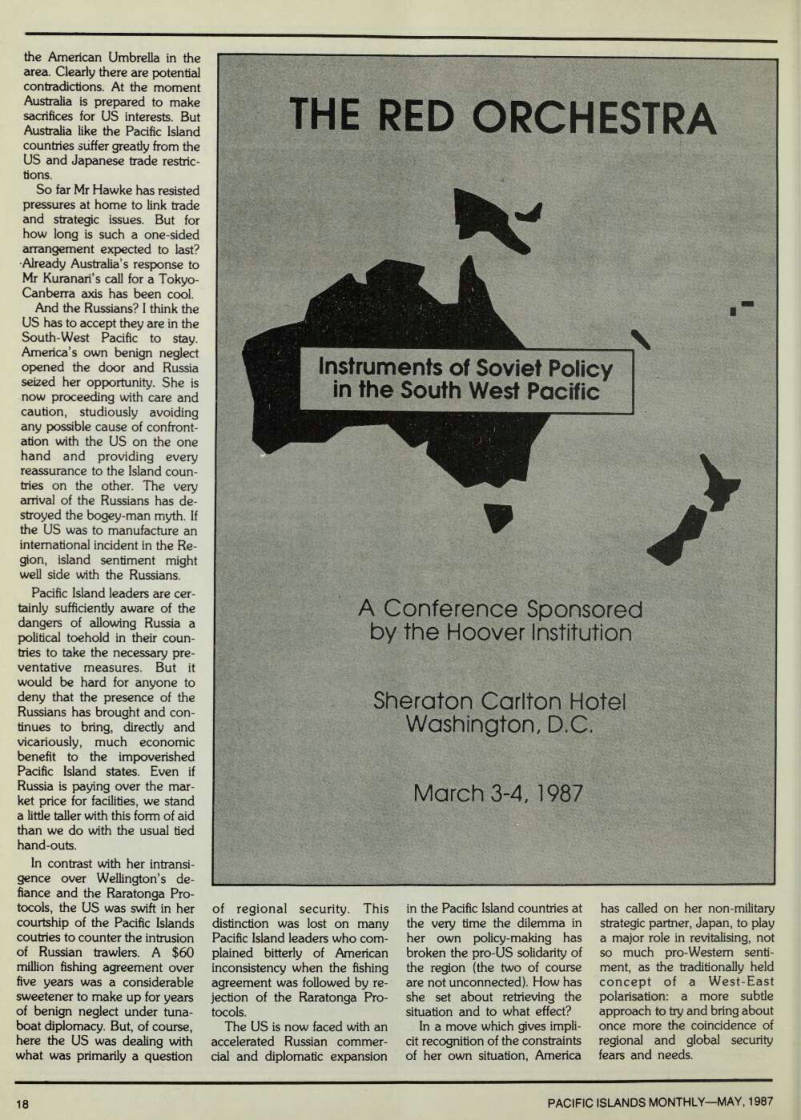
Russia’s new policy towards the South Pacific and its implications for regional security were key issues discussed at a recent Washington conference entitled “The Red Orchestra Instruments of Soviet Policy in the South West Pacific” and sponsored by the Hoover Institution.
Papers covered Soviet objectives in the region, Libya’s developing links, and efforts by elements in the media, the trade unions, the churches and the peace movement to promote anti-American sentiment.
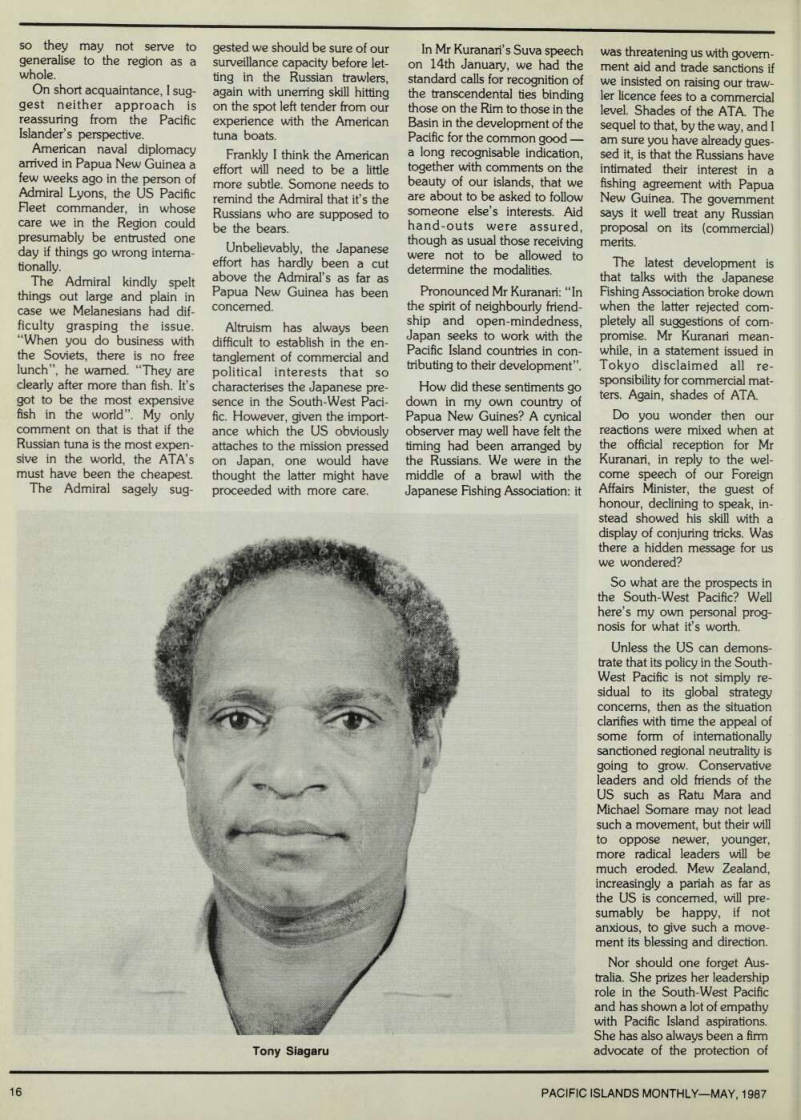
Tony Siaguru’s paper was a conference highlight. A member of PNG’s Parliament, leader of the “League for National Advancement” party, a former Minister in the Somare Government and a former Secretary for Foreign Affairs and Trade, Mr Siaguru spoke with considerable authority. His frank warning that US policy continued to alienate South Pacific opinion startled the mainly American audience. His criticism of the US administra tion for its refusal to sign the protocols of the SP Nuclear Free Zone Treaty rankled those in the audience who had been involved in the decision. But his general critique of American indifference to the region touched responsive chords among those urging the US to lift its game.
From a special correspondent.
even tuna-boat diplomacy left much of that resource intact.
When the Americans negoti ated a broad fishing agreement with the countries of the region, finally providing us with appropriate returns for access to our marine wealth, a major souring of relations was re moved. With this evidence of a re-invigorated American in terest in our welfare, a new era seemed heralded.
And yet at the very moment almost of a new, auspicious direction in responsible leader ship by the US in the South- West Pacific, we were abruptly dumped back to square one by the US’s refusal to sign the protocols of the Treaty of Raro tonga.
There has been much mis understanding about what ex actly those protocols deman ded. Certainly there was a declaration of a nuclear-free zone by the Treaty, but in substance the articles were far
from being the blanket embar go on nuclear armaments that some American commentators have made out. One Australian journalist, indeed, headed his piece: “The Raratonga Treaty: a not-so-nuclear free zone”.
And, in fact, a keen awareness of American nuclear concerns was evident.
In particular, a loophole per mitting US nuclear ships a presence in the area was pur posely left in. The major aims of the Treaty were, or course, to try to pressurise the French over their Moruroa activities and convey a general warning against nuclear waste dumping in the ocean. Rawdon Dalrym ple, Australian Ambassador to the US, commented: “There was no joy in this treaty for (anyone) that wishes to upset the security status quo in the South Pacific. We see it as a valuable opportunity for the US to reaffirm its abiding interest in the security, stability and wel fare of the Region”.
Signing the protocols was, if you will excuse the pun, the acid test of America’s friend ship. And thus surfaced the American dilemma in the South-West Pacfic.
The dilemma is simply that America finds it impossible to combine with conviction the two roles of superpower and good neighbor. Wellington’s defiance had served to expose the essential conflict. Once the US right to determine what was and what was not good for the security of the South-West Pacific was challenged from within the region, then the real basis of her policy stood re vealed.
We must assume the US weighed carefully the pros and cons of its own intransigence in dealing with Wellington. Why then did she not temporize in the interests of regional solidar ity? Another two years would have seen a general election in New Zealand and an official poll made it clear the electorate were evenly divided, if not very confused, over the nuclear ships issue and the need of the American nuclear umbrella.
The answer must be that the US was apprehensive of the demonstration effect of the New Zealand action on its allies elsewhere, in Europe and the Far East particularly. In other words, global consideratons, not regional interests per se, determined the strategic think ing she applied to the South- West Pacific.
At the same time the US has not given up a direct appeal to those tenets of an old faith, and it has launched a new dip lomatic drive, still sea-borne, but naval rather than piscatorial as before.
Both these approaches have been inaugurated quite recently and my comments here are based entirely on Papua New Guinea’s experience of them,
so they may not serve to generalise to the region as a whole.
On short acquaintance, I suggest neither approach is reassuring from the Pacific Islander’s perspective.
American naval diplomacy amved in Papua New Guinea a few weeks ago m the j*>reon of Admiral Lyons the US Pacific Reel commander, in whose care we in the Region could presumably be entrusted one day if things go wrong internationally.
The Admiral kindly spelt things out large and plain in case we Melanesians had difficulty grasping the issue.
“When you do business with the Soviets, there is no free lunch”, he warned. “They are clearly after more than fish. It’s got to be the most expensive fish in the world”. My only comment on that is that if the Russian tuna is the most expensive in the world, the ATA’s must have been the cheapest, The Admiral sagely sug-
gested we should be sure of our surveillance capacity before let ting in the Russian trawlers, again with unerring skill hitting on the spot left tender from our experience with the American tuna boats.
Frankly I think the American effort m need to be a Me more subtle Somone needs tQ remind Admiral tfs Russians who are supposed to be th(e bears Unbelievably, the Japanese effort has hardly been a cut * bove Admiral’s as far as P Q P ua New Guinea has been concerned, Altruism has always been difficult to establish in the en tanglement of commercial and political interests that so characterises the Japanese pre sence in the South-West Pad fic. However, given the import ance which the US obviously attaches to the mission pressed on Japan, one would have thought the latter might have proceeded with more care.
In Mr Kuranari’s Suva speech on 14th January, we had the standard calls for recognition of the transcendental ties binding those on the Rim to those in the Basin in the development of the Pacific for the common good a long recognisable indication, together with comments on the beauty of our islands, that we are about to be asked to follow someone else’s interests. Aid hand-outs were assured, though as usual those receiving were not to be allowed to determine the modalities.
Pronounced Mr Kuranari: “In the spirit of neighbourly friend ship and open-mindedness, Japan seeks to work with the Pacific Island countries in con tributing to their development”.
How did these sentiments go down in my own country of Papua New Guines? A cynical observer may well have felt the timing had been arranged by the Russians. We were in the middle of a brawl with the Japanese Fishing Association: it
was threatening us with govern ment aid and trade sanctions if we insisted on raising our traw ler licence fees to a commercial level. Shades of the ATA. The sequel to that, by the way, and I am sure you have already gues sed it, is that the Russians have intimated their interest in a fishing agreement with Papua New Guinea. The government says it well treat any Russian proposal on its (commercial) merits.
The latest development is that talks with the Japanese Fishing Association broke down when the latter rejected com pletely all suggestions of com promise. Mr Kuranari mean while, in a statement issued in Tokyo disclaimed all re sponsibility for commercial mat ters. Again, shades of ATA.
Do you wonder then our reactions were mixed when at the official reception for Mr Kuranari, in reply to the wel come speech of our Foreign Affairs Minister, the guest of honour, declining to speak, in stead showed his skill with a display of conjuring tricks. Was there a hidden message for us we wondered?
So what are the prospects in the South-West Pacific? Well here’s my own personal prog nosis for what it’s worth.
Unless the US can demons trate that its policy in the South- West Pacific is not simply re sidual to its global strategy concerns, then as the situation clarifies with time the appeal of some form of internationally sanctioned regional neutrality is going to grow. Conservative leaders and old friends of the US such as Ratu Mara and Michael Somare may not lead such a movement, but their will to oppose newer, younger, more radical leaders will be much eroded. Mew Zealand, increasingly a pariah as far as the US is concerned, will pre sumably be happy, if not anxious, to give such a move ment its blessing and direction.
Nor should one forget Aus tralia. She prizes her leadership role in the South-West Pacific and has shown a lot of empathy with Pacific Island aspirations.
She has also always been a firm advocate of the protection of
Tony Siagaru
the American Umbrella in the area. Clearly there are potential contradictions. At the moment Australia is prepared to make sacrifices for US interests. But Australia like the Pacific Island countries suffer greatly from the US and Japanese trade restric tions.
So far Mr Hawke has resisted pressures at home to link trade and strategic issues. But for how long is such a one-sided arrangement expected to last? •Already Australia’s response to Mr Kuranari’s call for a Tokyo- Canberra axis has been cool.
And the Russians? I think the US has to accept they are in the South-West Pacific to stay.
America’s own benign neglect opened the door and Russia seized her opportunity. She is now proceeding with care and caution, studiously avoiding any possible cause of confront ation with the US on the one hand and providing every reassurance to the Island coun tries on the other. The very arrival of the Russians has de stroyed the bogey-man myth. If the US was to manufacture an international incident in the Re gion, island sentiment might well side with the Russians.
Pacific Island leaders are cer tainly sufficiently aware of the dangers of allowing Russia a political toehold in their coun tries to take the necessary pre ventative measures. But it would be hard for anyone to deny that the presence of the Russians has brought and con tinues to bring, directly and vicariously, much economic benefit to the impoverished Pacific Island states. Even if Russia is paying over the mar ket price for facilities, we stand a little taller with this form of aid than we do with the usual tied hand-outs.
In contrast with her intransi gence over Wellington’s de fiance and the Raratonga Pro tocols, the US was swift in her courtship of the Pacific Islands coutries to counter the intrusion of Russian trawlers. A $6O million fishing agreement over five years was a considerable sweetener to make up for years of benign neglect under tuna boat diplomacy. But, of course, here the US was dealing with what was primarily a question
of regional security. This distinction was lost on many Pacific Island leaders who com plained bitterly of American inconsistency when the fishing agreement was followed by re jection of the Raratonga Pro tocols.
The US is now faced with an accelerated Russian commer cial and diplomatic expansion
in the Pacific Island countries at the very time the dilemma in her own policy-making has broken the pro-US solidarity of the region (the two of course are not unconnected). How has she set about retrieving the situation and to what effect?
In a move which gives impli cit recognition of the constraints of her own situation, America
has called on her non-military strategic partner, Japan, to play a major role in revitalising, not so much pro-Western senti ment, as the traditionally held concept of a West-East polarisation: a more subtle approach to try and bring about once more the coincidence of regional and global security fears and needs.
Advertisements & other items, pp. 17-18 (1 item)
Private Line Channels. Microwave and Fiber
Systems. Local Area Networks and VAN’s.
Consulting. PBXs. Operations and Maintenance. International Calling. Multiplexers.
Packet Switching. Data Comm. Pagers. Systems Integration. Project Management. Network Planning, Designing, Engineering and Construction Services. Train!
There’s
more to
Hawaiian Tel
than meets
the ear.
HAWAIIAN TEL
Beyond the call ketmg i
THE RED ORCHESTRA
Instruments of Soviet Policy in the South West Pacific * v A Conference Sponsored by the Hoover Institution Sheraton Carlton Hotel Washington, D.C.
March 3-4, 1987
diplomacy
New confidence in PNG diplomacy
Papua New Guinea appears to have found a new confidence in its dealings with the world.
One of the areas where the Wingti Government can claim success is on the diplomatic front. In March, Papua New Guinea’s Foreign Minister, Mr Ted Diro, visited both Indone sia and Australia. In Jakarta he exchanged ratification docu ments with Indonesia’s Foreign Minister, Doctor Mochtar, bringing into force an historic Treaty of Mutual Respect, Friendship and Cooperation under which Indonesia pledges never to use force against PNG and to respect its territorial integrity.
In Canberra Mr Diro and Australia’s Foreign Minister, Mr Hayden, agreed on the broad draft of a Statement of Prin ciples to govern the Australia/ PNG relationship. PNG set Canberra on its ear last Decem ber when it dismissed aid talks and said the relationship needed to be put on a more formal basis because Australia’s word could hardly be trusted following cutbacks in Australian aid made not only without consultation but also in breach of the five year aid agreement signed with much pomp by Mr Bob Hawke at PNG’s 10th birthday celebrations in 1985.
The proposals by PNG were for a Joint Statement of Principles Governing the Relationship and an Integrated Development Package that would tie down in writing a whole range of matters including a defence pact.
On Mr Diro’s return to Port Moresby he spoke about the Australian reaction, about Mr Hawke’s Libyan fears, New Caledonia, the New Indonesian relationship and comments on the question of PNG’s member ship of AZEAN at the coming AZEAN Foreign Minister’s Meeting.
Is Papua New Guinea se rious about becoming a mem ber of ASEAN?
As you know PNG wanted to be a signatory to the Treaty of Amity and Cooperation well before my time as Foreign Minister. That request is still being considered by the ASEAN Council. So we have made our interest known to ASEAN countries that we would like to accede to that Treaty, but it is up to the ASEAN Council to either accept or reject. Now whether as a result of that PNG chooses to become a full member of ASEAN is another matter com pletely.
What are the advantages of full membership? 1 think the main advantage is to try and stabilise the situation in the region. As you know Indonesia and Malaysia had problems before. And amongst the other ASEAN countries there were problems. But since the formation of ASEAN as a political entity, countries in the region have come to solve their problems and establish a much better understanding. One can see that there have been tangi ble benefits accruing from ASEAN membership. These benefits could equally flow onto PNG if PNG was to decide to join. But I want to make it quite clear I have not committed PNG to joining ASEAN. The situation is that our request to accede to the Treaty of Amity and Cooperation is being consi dered and that request was put by my predecessor, Mr Legu Vagi.
Would you like to see PNG become a member?
I don’t discuss personal things. I discuss what the posi tion of Cabinet is and 1 wouldn’t want my personal views to influence the outcome of what PNG’s eventual decision may be.
Is PNG drifting away from the South Pacific Forum?
Papua New Guinea’s posi tion is unique. We have one leg in asia. We share a common border with the largest ASEAN country, Indonesia. The other leg, of course, is in the Pacific.
In the past we have identified more with the Pacific. It is now time that we must pursue a foreign policy which safeguards both the longterm and the midterm interests of PNG. You and I do not know what will eventuate in 50 or 100 years time. It is better that we safe guard the interests of our coun try in the longterm.
What economic benefits would flow to PNG from join ing ASEAN?
There is considerable trade within the ASEAN countries.
There are provisions as a mem ber to engage in technical cooperation and there are other benefits to be derived. But 1 emphasise once again that PNG has not committed itself at this point.
How close did you and Australia’s foreign Minister, Mr Hayden, get to agreeing on a draft statement of Prin ciples governing the Austra lia/PNG relationships?
I think that there is a general feeling amongst Australian Ministers that the relationship ought to be a bit more formal ised. As a result of this visit I think the Australian Govern ment will consider the matter at Cabinet level to get Cabinet’s endorsement of the proposal that PNG put up. That is, that there be a joint declaration of Principles to guide the relation ship between PNG and Aus tralia.
What about the Integrated Package?
The Integrated Package appears to pose some problems
on the Australian side. It is a new concept. It’s an innovation.
It is not the practice of the Australian Public Service to try to put all the agreement with one country under one umbrel la. I think the Australians do need time to consider our in novative approach.
But you haven’t dropped the idea?
We have not dropped it at this stage. We have certain positions which we could take to accommodate the Australian viewpoints but at this stage we have not dropped it. We are persisting so that they see our line of argument.
How did your talks go with Mr Hawke?
Mr Hawke was more in terested in the bilateral and regional issues particularly New Caledonia. He was more in terested in regional security matters particularly the involve ment of the Libyans in the Pacific. I think this matter is of particular concern to the Aus tralian authorities and Mr Hawke raised it. Mr Hawke devoted a lot more time than was allowed for. As a result I almost missed my aeroplane but it was a very good discus sion.
I’m told you had ten mi nutes scheduled and it turned into 50?
That’s roughly correct It was very, very fruitful and very worthwhile.
What particular concerns did he raise about the Li byans?
It’s not only Mr Hawke. I think it is a concern throughout The Pacific that the presence of the Libyans in Vanuatu could destabilise the region. Shortly we will be flying Air Niugini aircraft to Port Vila and it should be a concern for us. I think that if the Libyans are
going to be involved either directly or indirectly in the New Caledonia issue then it could affect the stability of the region to a large extent.
Have you raised this issue directly with Father Lini?
The Forum meeting is sche duled for May 29th in Apia and I think that the concerns of the Forum member countries will be raised there. I will be briefing our Prime Minister fully on the sentiments expressed by both Mr hayden and Mr Hawke on the security situation here in the Pacific.
Does Papua New Guinea regard the Libyans as a secur ity risk?
If you go by the experience of what they have been up to in recent years then you must be concerned.
What exactly are you fear ing? Terrorism or what?
You name it.
If the Libyans become established in Vanuatu would you consider cancelling Air Niugini’s proposed services to Port Vila?
I think our relationship with Vanuatu is too deeply involved, far too complex, far too strong to be affected by Libyan in volvement.
It’s obviously bothering you!
It does bother me. But I get bothered with other things too but that doesn’t mean we break diplomatic relations. I don’t think we would stop the Air Niugini flights.
What about the Melanesian Spearhead Group and New Caledonia?
The problem of New Caledo nia is too big for the Spearhead Group alone to handle. Forum unity must be maintained over the New Caledonian issue be cause the Forum as a group, as a regional organisation, has a much greater impact. Whatever strategy you adopt to see the decolonisation process in New Caledonia, it must be done through the Forum. I believe it is essential that the Committee of 24, which is comprised of countries a long, long way from
the region be fully briefed. We have sent a representative to speak to the committee of 24 and support the forum repre sentatives there.
In Jakarta you exchanged ratification instruments bring ing the new PNG/lndonesia Treaty into effect. How did your talks there go?
There is an atmosphere of goodwill, an atmosphere of genuine friendship amongst the leaders of Indonesia. I think in the past we have tended to allow the border issues to dic tate the relationship between the two countries. The border is one issue, one aspect of our relationship. I think it is now time to look to Indonesia and try and encourage the growth of our relationship in different areas. For instance, technical assistance, cultural exchange, matters of trade particularly cross border trade. These are very, very important I think the treaty of Friendship, Coopera tion and Mutual Respect is a visible demonstration of the will and the desire of prominent Indonesian leaders to see genu ine cooperation between our two countries. We have to cultivate a desire to make this treaty work because PNG has now committed itself to being friends with Indonesia. We have each committed ourselves to respect each others integrity and sovereignty. I think that in the past there has been some damage done to our relations by the media presenting far too negative aspects of our relation ship. We have a free press in PNG, something we ought to be thankful for but there are positive sides too to our rela tions which must be reported.
An Irianese man, Mekky Salossa, is now subject to deportation. If court action prevents that deportation going through do you see a hiccup in the relationship with Indonesia?
I know the man you are referring to. I think he is a criminal. He has been to gaol in PNG. But I have just returned home and have yet to be briefed on the details so I’d rather wait ’till I’m fully in the picture.
Have you worked out any specifics of trade with In donesia?
The Treaty is a document which needs a lot of action on the part of individual depart
merits to translate it into more tangible avenues of coopera tion. For instance, in trade, Indonesia has a surplus of rice, Indonesia has an abundance of calico and fabrics that we would
import. Indonesia could supply some of the domestic goods in cross border trade, say between Jayapura and Vanimo. It will take time to translate the policy agreements into action. I hope that will not be too far away, The defence treaty that you want with Australia. Can you see that upsetting Indonesia?
I don t think so. We have a cordial and friendly relationship with Indonesia. I have just come back from Jakarta, from signing a friendship freaty It is a document that says PNG and Indonesia are now friends. We must stick up for one another in times of trouble. Talking in day-to-day language that is what the Treaty means. We have to understand each other, respect each others territory.
We have to consult one another on sensitive issues. That s what it means. Now, in trying to extract some form of defence arrangement with Australia, this is an expansion of what we tried to do in 1977 after Independence. Because our military doc-
trine, our military tactics, our strategy is based on Australian defence strategy and concepts, we have to try to maintain some compatibility. We have to main tain liaison and dialogue. That is one aspect of this defence arrangement that we are seek ing Australia. The other, of couree js tha , because there is so much Australian investment j n thi s country, in the event that Papua New Guinea be threatened by a country, I don’t have a country in mind what i am is that in the uniike ] y event that PNG is threatened by anybodyi it cou id be the RussianSi someo ne faroff like that In that event and the appears t 0 be or hap . to be a common threat p NG and Australia must coopera t e , That’s common sense isn - t it? So we want t 0 formalise that into a defence arrangemen t You don’t have Indonesia in mind as a threat?
You ask me if I have Indone sia in mind. The answer is No!
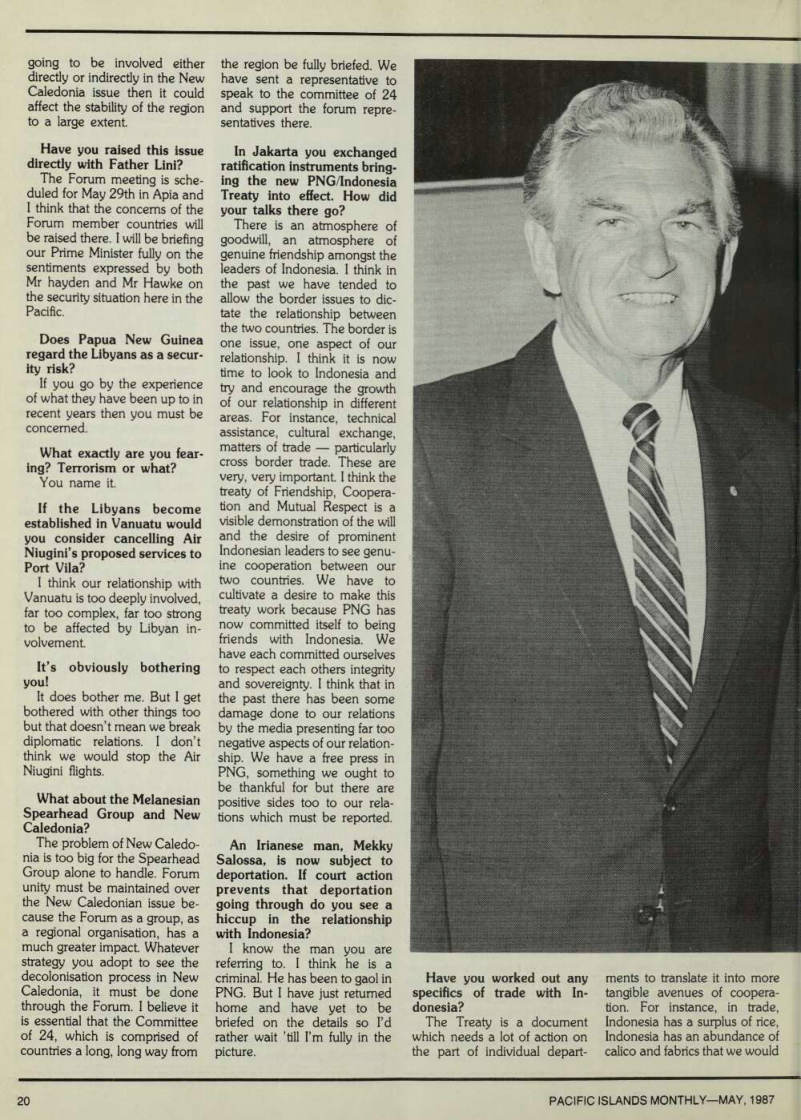
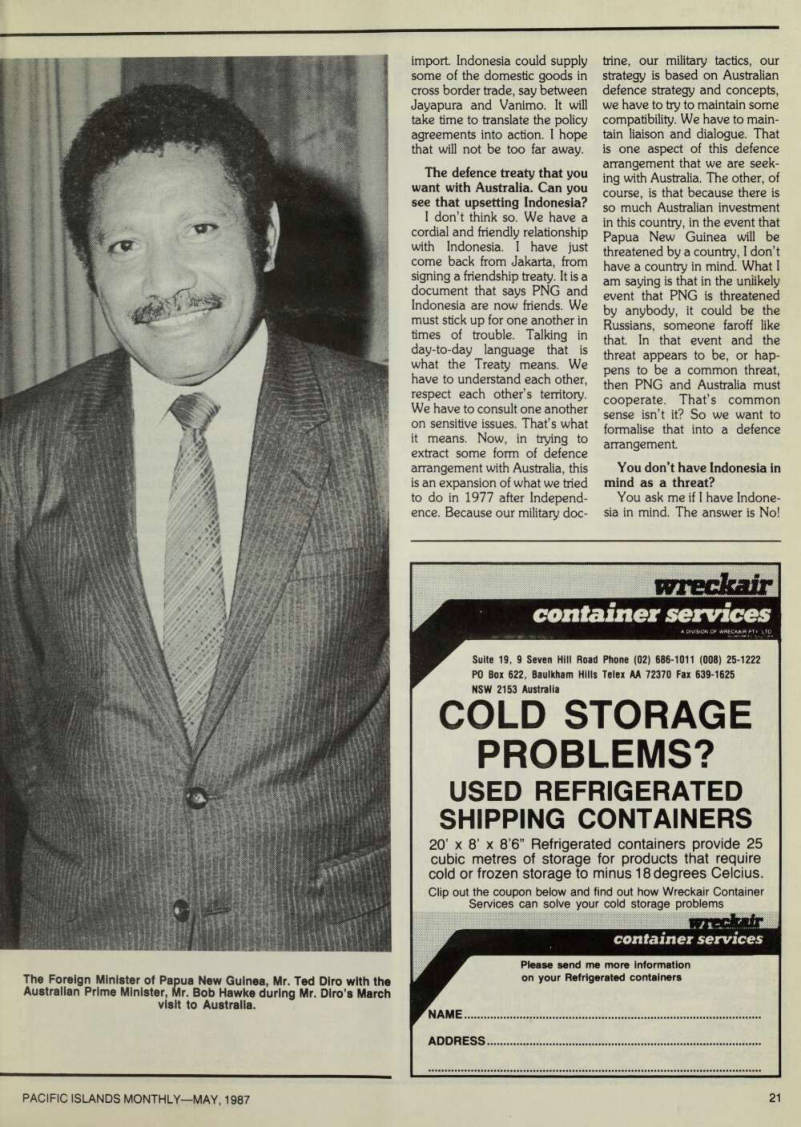
The Foreign Minister of Papua New Guinea, Mr. Ted Diro with the Australian Prime Minister, Mr. Bob Hawke during Mr. Diro’s March visit to Australia.
Advertisements & other items, p. 21 (1 item)
Cold Storage
wreckair
container services
Suite 19, 9 Seven Hill Road Phone (02) 686-1011 (008) 25-1222 PO Box 622, Baulkham Hills Telex AA 72370 Fax 639-1625 NSW 2153 Australia
COLD STORAGE
PROBLEMS?
USED REFRIGERATED
SHIPPING CONTAINERS
20’ x 8’ x B’6” Refrigerated containers provide 25 cubic metres of storage for products that require cold or frozen storage to minus 18 degrees Celcius.
Clip out the coupon below and find out how Wreckair Container Services can solve your cold storage problems container services Please send me more information on your Refrigerated containers
ADDRESS.
Forum Meeting
Strong showing at Forum Meeting
I* i ,i ,
t was perhaps the strongest showing yet of South Pacific f-orum unity in support of New Caledonian independence. A dozen of the 14 forum nations, meeting in early March in Auckland, backed without demur a communique condemning Frenchmans for its troubled Pacific colony.
Forum foreign ministers came to an emphatic conclusion after a two and a half hour review of draft French referendum plans: they were inadequate and most critically failed to address Kanak needs.
Declaring that French policy “was directed towards maintenance of New Caledonia as part of the French Republic,’’ the forum spelled out how it believed the “desirable and inevit-
. . „ , able aim of independence was best pursued.
Its preferred vehicle is the United Nations. But the Chirac Government way, according to the forum, fails to meet accepted UN principles and practices.
Urging France to put its referendum on the back burner until it fell into line with the UN code of behaviour, the forum held out the olive branch of dialogue to ease tensions in New Caledonia.
The forum believes the Paris solution in New Caledonia guarantees the status quo and possibly violence. It wants options extended to include “associated independence,” and “internal self government.”
It also is pushing for a
narrowing of the referendum franchise to “only those who can demonstrate long-term resi dence in, and commitment to New Caledonia.”
The foreign ministers’ state ment was restrained. It mildly rebuked France for “serious shortcomings” in its Noumea policy but did not shrilly de nounce the metropolitan power.
Nor was there any division when the brief gathering ended from the peppery Melanesian block.
According to officials, the forum wants to get talking with France and sees little to be gained by bitter public disputes.
Officials also consider dissent within France may be strong enough to have the referendum tossed out and see little point in uniting French opinion.
Support has since been de livered by the UN decolonisa tion committee the Commit tee of 24 which on March 18
threw its voice behind attempts to budge Paris.
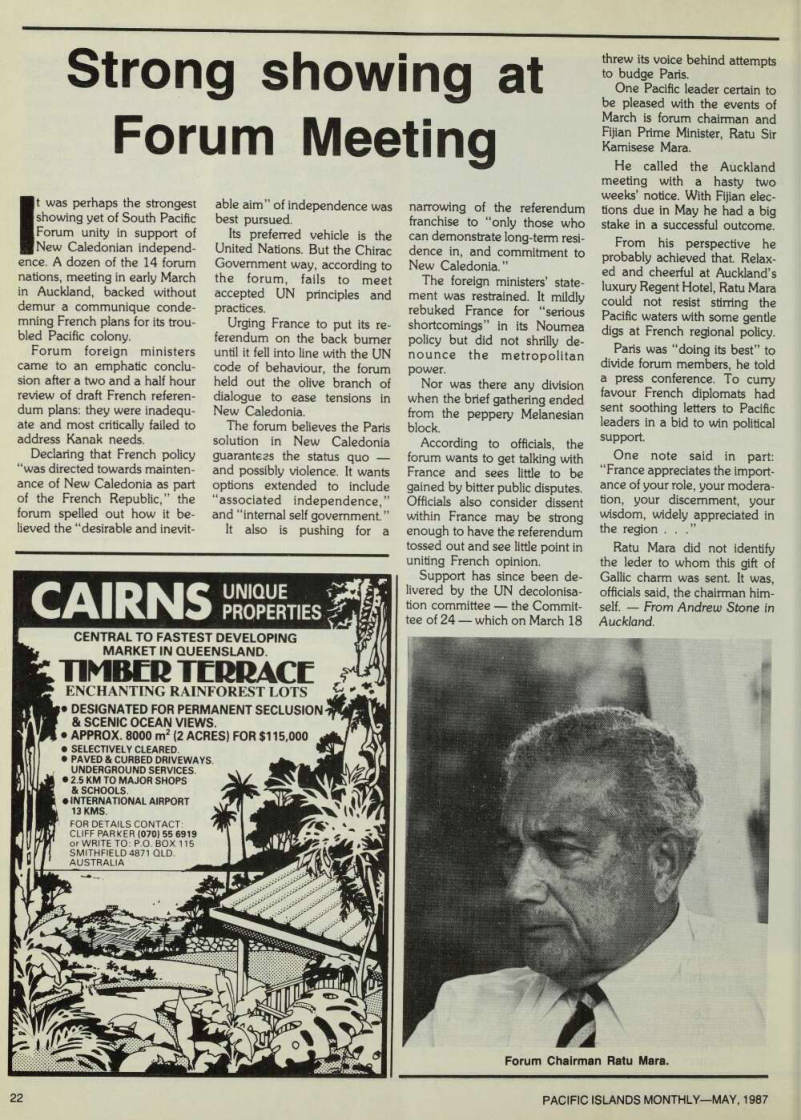
One Pacific leader certain to be pleased with the events of March is forum chairman and Fijian Prime Minister, Ratu Sir Kamisese Mara.
He called the Auckland meeting with a hasty two weeks’ notice. With Fijian elec tions due in May he had a big stake in a successful outcome.
From his perspective he probably achieved that. Relax ed and cheerful at Auckland’s luxury Regent Hotel, Ratu Mara could not resist stirring the Pacific waters with some gentle digs at French regional policy.
Paris was “doing its best” to divide forum members, he told a press conference. To curry favour French diplomats had sent soothing letters to Pacific leaders in a bid to win political support.
One note said in part: “France appreciates the import ance of your role, your modera tion, your discernment, your wisdom, widely appreciated in the region ...”
Ratu Mara did not identify the leder to whom this gift of Gallic charm was sent. It was, officials said, the chairman him self. From Andrew Stone in Auckland.
Forum Chairman Ratu Mara.
Advertisements & other items, p. 22 (1 item)
Timber Terrace
UNIQUE
PROPERTIES
CENTRAL TO FASTEST DEVELOPING
MARKET IN QUEENSLAND.
TIMBER TERRACE
ENCHANTING RAINFOREST LOTS li ***
|» DESIGNATED FOR PERMANENT SECLUSION
& SCENIC OCEAN VIEWS.
• APPROX. 8000 m 2 (2 ACRES) FOR $115,000
• SELECTIVELY CLEARED.
• PAVED & CURBED DRIVEWAYS.
UNDERGROUND SERVICES
• 2.5 KM TO MAJOR SHOPS
a Qrunni c
• INTERNATIONAL AIRPORT
13KMS.
FOR DETAILS CONTACT:
CLIFF PARKER (070) 55 6919
or WRITE TO: P.O. BOX 115
SMITHFIELD 4871 OLD.
AUSTRALIA
:> in
French gamble on referendum
It is described by the French independent daily, ‘Libera tionas a remake of one of France’s favourite TV quiz shows - “Numbers and Letters” are not certain to add up, the newspaper says, referring to New Caledonia’s anti-inde pendence Republican Party, the RPCR, and their stated intention of gaining a participa tion rate of 60% in the forth coming controversial referen dum on independence. The poll, which is due to be held in the territory by August, is likely to be boycotted by the FLNKS and other pro-independence parties (see box).
The outcome is not in doubt up to 99% of votes cast will say ‘yes’ to New Caledonia staying within the French Republic, but this figure is not the most important. “Once the registered electors, the actual voters and the previous scores of the cur-
rent parties are fed into the machine, a figure of less than 50% participation is given for this poll”, Liberation’s Noumea correspondent writes. The re mainder would be made up of habitual abstainers (about
18%), and “independantistes”, who would stay at home. And while Bernard Pons, French Overseas Territories Minister, refrained on his recent visit to New Caledonia from citing the participation rate that he would
consider a victory, some RPCR members were too quick in setting the rate at 60%, Libera tion said. The referendum was too important, said the report, to be abandoned by the French government. It had been de manded repeatedly by the RPCR and the extreme right National Front to ‘make the situation clear at last”, and was also seen by the right as a means of preventing President Mitterrand, if re-elected in 1988, from questioning a clear score in favour of the territory remaining French. In any case, the paper added, the Noumea administration admitted that the government has gone too far to turn back: “the decision was taken very quickly and it was only later that we did our sums now we must scrape another 10% and time counts. “A first option could be to reduce the number of enrolled voters (a solution used by the Roynette
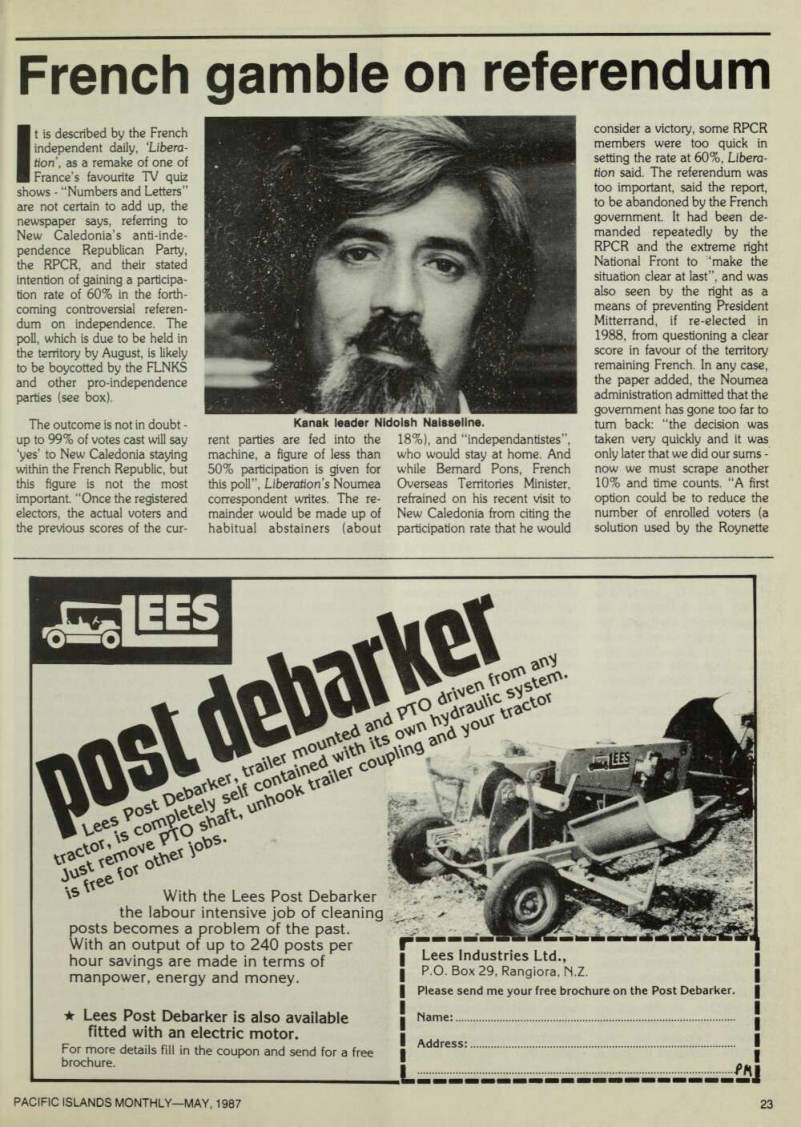
Kanak leader Nidoish Naisseline.
administration in Noumea in 1984 to produce a 50% plus participation rate after the successful FLNKS boycott and disruption), and the newspaper noted that the Noumea Town Council has applied to the courts to have removed from the rolls some 5,661 voters who have not participated in the last three elections. ”If granted, this application will put another 2% in the loyalist purse”.A second option was to increase the number of voters - by campaigning to get habitual abstainers to the poll, as well as the smaller, more moderate Kanak independence parties, the LKS and the OPAO ( who took part in the 1984 elections). Their participation, and especially the fact they would vote ‘no’ to remaining in the French Repub-
lie, would give the French gov emment a true referendum with a ‘for’ and an ‘against’, Moreover, Liberation writes, the LKS and OPAO would not total more than 7 to 8% of ‘no’ votes. But, Liberation’s cor respondent says, the FLNKS set out several months ago to charm the LKS, and LKS lead er Nidoish Naisseline, who wants the referendum held after the 1988 Presidential elections, has said his party will also boycott if the French parliament adopts the electoral body called for by the RPCR. “The govern ment is thus left with little room to manoeuvre in scraping an extra 10% and this referendum which according to the RPCR should be a royal avenue to a better future, could prove to be cul-de- sac”
Advertisements & other items, p. 23 (1 item)
Xh
a & ||“.*^ s i l» 0^ iV\^ «r> :^^e^\o > o s - X\° » r. s* \\& \S r <*««*' With the Lees Post Debarker the labour intensive job of cleaning posts becomes a problem of the past.
With an output of up to 240 posts per hour savings are made in terms of manpower, energy and money. ★ Lees Post Debarker is also available fitted with an electric motor.
For more details fill in the coupon and send for a free brochure.
Lees Industries Ltd., P.O. Box 29, Rangiora, N.Z.
Please send me your free brochure on the Post Debarker.
Name: Address:
Yeiwene calls for
a “true referendum”
As tension mounts in New Caledonia over the referendum FLNKS leader Jean-Marie Tjibaou said in Paris that the territory would eventually be come independent but he hoped the poll would not be a source of trouble. Mr Tjibaou was speaking after a delegation of FLNKS leaders had met with the French President Mr Mitter rand for talks on the issue. Mr Mitterrand will also meet with an anti-independence delega tion also in Paris to attend the French parliamentary debates on the New Caledonia referen dum plans. And Papua New Guinea’s Prime Minister Mr Wingti warned that continued French rule and its military build- up in New Caledonia are potentially the most destabilis ing influences in the Pacific region. Mr Wingti said that if France did not take immediate steps to make New Caledonia independent in terms accept able to Kanaks, then it would be forced to quit the territory . Meanwhile in Noumea, FLNKS spokesman Mr Yeiwene Yeiwene told the Territorial Congress that the
FLNKS rejected the proposed referendum .The congress was giving its opinion on the plans and the RPCR dominated con gress voted in favour of the Pons plans.“ One thing is now perfectly clear”, Mr Yeiwene said, “there won’t be a referen dum but rather a simple domes tic vote on a new statute - the 4th in three years. ” The elector al reform which requires three years residence in the territory won’t change anything in this sham of a poll. ” But, Yeiwene pointed out,the FLNKS rejec tion was not a rejection of everything.“We call for a true referendum, ie, a self-de termination poll where only the colonised people will be con suited on their future, inde pendently of the mass of im migrants who were encouraged to come here to make us a minority according to the Mess mer (French conservative PM at the time) instructions of 1972.”
He warned that the FLNKS would not take part in any further votes on new statutes, even for autonomy, nor in any institutions resulting from a new statute.
solution says
No French solution says Kanak leader
The leader of the moderate independence party LKS, Mr Nidoish Naisseline, visited Australia in March and held talks with Foreign Affairs department officials. Speaking to reporters in Sydney Mr Naisseline said the South Pacific region “must make it clear to France that there is no French solution to New Caledonia’s problem but only a local one - a local consensus has to be found in the territory supported by the region”. France is in third position where New Caledonia’s problems are con cerned, he said, “the problem must be seen in terms of the South Pacific Forum and the destabilisation for the region”. Forum policies were pro-South Pacific, not anti-French, he said.Naisseline said the LKS called for the referendum to be postponed until after the French presidential elections in 1988 because the issue was being used for domestic political purposes by French leaders during the presidential campaign. “But most importantly,” he said, “we want it put off because it will solve nothing. After it has taken place Overseas Territories Minister Pons will present the new statute to Parliament, and perhaps we will boycott these institu tions as well if they are anti-independence. Then we’ll be facing the same situation as in 1984...Naisseline said many people both within and outside the French Government had described the referendum as useless.
He said that Minister Pons “will have to try and provoke violence to enable the referendum to be cancelled to save his honour - this would suit him. The referendum is very dangerous for France because if all the independence supporters boycott - 35% - and an average of 15% habitual abstainers, then they won’t get 50% participa tion. So the role of LKS and OPAO (a second, smaller moderate independence party) is very important, and can deny the credibility sought by Pons for the referendum.
“The LKS leader criticised the terms of the proposed referendum and warned that “if the French Parliament accepts as it is, then we can’t accept it.” He said the questions in the poll were badly framed, and voters were not being asked to “say yes or no to an independence constitution with clearly defined institutional powers”. Mr Naisseline said the LKS wanted “independence to be prepared peacefully together with France” and that France should not depart from the country but stay with an important role in aid and trade. He warned there was a risk of violence with the referendum but stressed that if the LKS boycotted the poll, it would be “with dignity and non-violence”. He said in the case of a boycott by independence parties the LKS and the FLNKS would be obliged to work together - “but the problems of interned divisions won’t be solved”. He said the FLNKS and the LKS had signed a joint petition to the UN during the decolonisation committee meeting on New Caledonia.
He warned that “large section of the right wing will be tempted to cause violence - they are well-armed, well organised and ready”.
Strong Turnout
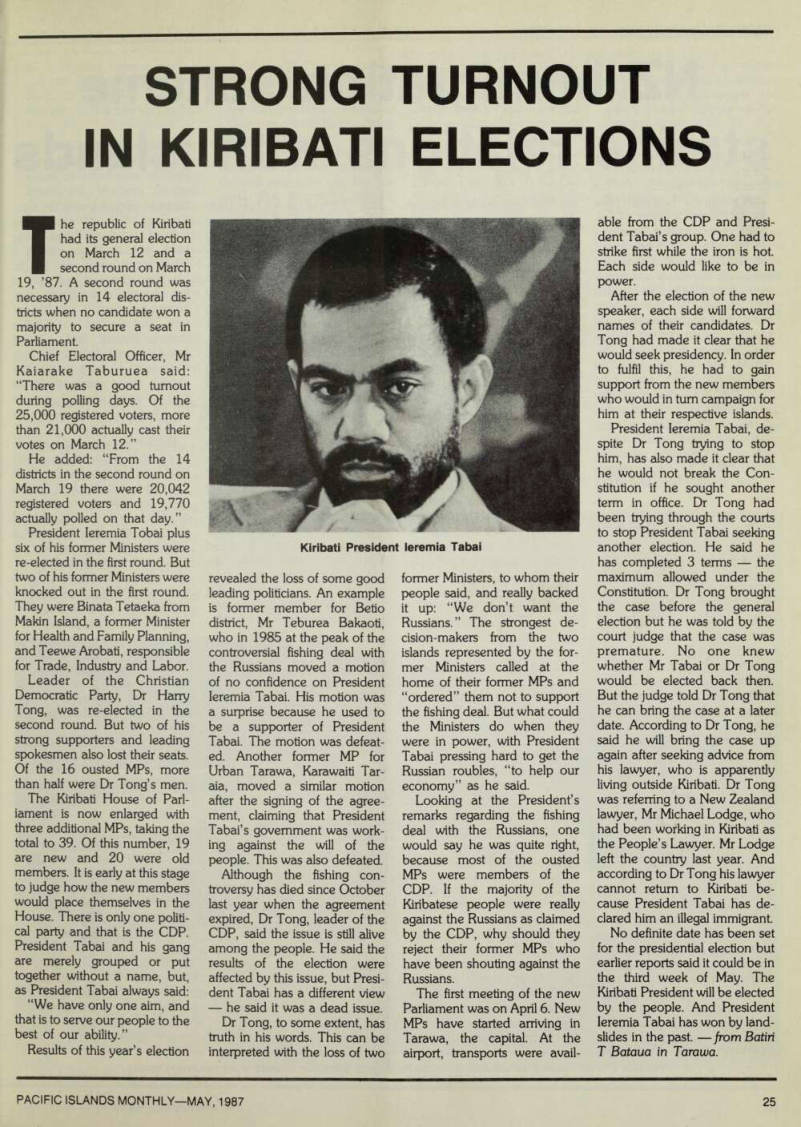
In Kiribati Elections
The republic of Kiribati had its general election on March 12 and a second round on March 19, ’B7. A second round was necessary in 14 electoral dis tricts when no candidate won a majority to secure a seat in Parliament.
Chief Electoral Officer, Mr Kaiarake Taburuea said: “There was a good turnout during polling days. Of the 25,000 registered voters, more than 21,000 actually cast their votes on March 12.”
He added: “From the 14 districts in the second round on March 19 there were 20,042 registered voters and 19,770 actually polled on that day.”
President leremia Tobai plus six of his former Ministers were re-elected in the first round. But two of his former Ministers were knocked out in the first round.
They were Binata Tetaeka from Makin Island, a former Minister for Health and Family Planning, and Teewe Arobati, responsible for Trade, Industry and Labor.
Leader of the Christian Democratic Party, Dr Harry Tong, was re-elected in the second round. But two of his strong supporters and leading spokesmen also lost their seats.
Of the 16 ousted MPs, more than half were Dr Tong’s men.
The Kiribati House of Parl iament is now enlarged with three additional MPs, taking the total to 39. Of this number, 19 are new and 20 were old members. It is early at this stage to judge how the new members would place themselves in the House. There is only one politi cal party and that is the CDP.
President Tabai and his gang are merely grouped or put together without a name, but, as President Tabai always said: “We have only one aim, and that is to serve our people to the best of our ability.”
Results of this year’s election
former Ministers, to whom their people said, and really backed it up: “We don’t want the Russians.” The strongest de cision-makers from the two islands represented by the for mer Ministers called at the home of their former MPs and “ordered” them not to support the fishing deal. But what could the Ministers do when they were in power, with President Tabai pressing hard to get the Russian roubles, “to help our economy” as he said.
Looking at the President’s remarks regarding the fishing deal with the Russians, one would say he was quite right, because most of the ousted MPs were members of the CDP. If the majority of the Kiribatese people were really against the Russians as claimed by the CDP, why should they reject their former MPs who have been shouting against the Russians.
The first meeting of the new Parliament was on April 6. New MPs have started arriving in Tarawa, the capital. At the airport, transports were avail
able from the CDP and Presi dent Tabai’s group. One had to strike first while the iron is hot Each side would like to be in power.
After the election of the new speaker, each side will forward names of their candidates. Dr Tong had made it clear that he would seek presidency. In order to fulfil this, he had to gain support from the new members who would in turn campaign for him at their respective islands.
President leremia Tabai, de spite Dr Tong trying to stop him, has also made it clear that he would not break the Con stitution if he sought another term in office. Dr Tong had been trying through the courts to stop President Tabai seeking another election. He said he has completed 3 terms the maximum allowed under the Constitution. Dr Tong brought the case before the general election but he was told by the court judge that the case was premature. No one knew whether Mr Tabai or Dr Tong would be elected back then.
But the judge told Dr Tong that he can bring the case at a later date. According to Dr Tong, he said he will bring the case up again after seeking advice from his lawyer, who is apparently living outside Kiribati. Dr Tong was referring to a New Zealand lawyer, Mr Michael Lodge, who had been working in Kiribati as the People’s Lawyer. Mr Lodge left the country last year. And according to Dr Tong his lawyer cannot return to Kiribati be cause President Tabai has de clared him an illegal immigrant.
No definite date has been set for the presidential election but earlier reports said it could be in the third week of May. The Kiribati President will be elected by the people. And President leremia Tabai has won by land slides in the past. from Batiri T Bataua in Tarawa.
revealed the loss of some good leading politicians. An example is former member for Betio district, Mr Teburea Bakaoti, who in 1985 at the peak of the controversial fishing deal with the Russians moved a motion of no confidence on President leremia Tabai. His motion was a surprise because he used to be a supporter of President Tabai. The motion was defeat ed. Another former MP for Urban Tarawa, Karawaiti Tar aia, moved a similar motion after the signing of the agree ment, claiming that President Tabai’s government was work ing against the will of the people. This was also defeated.
Although the fishing con troversy has died since October last year when the agreement expired, Dr Tong, leader of the CDP, said the issue is still alive among the people. He said the results of the election were affected by this issue, but Presi dent Tabai has a different view he said it was a dead issue.
Dr Tong, to some extent, has truth in his words. This can be interpreted with the loss of two
Kiribati President leremia Tabai
strains relations with islands
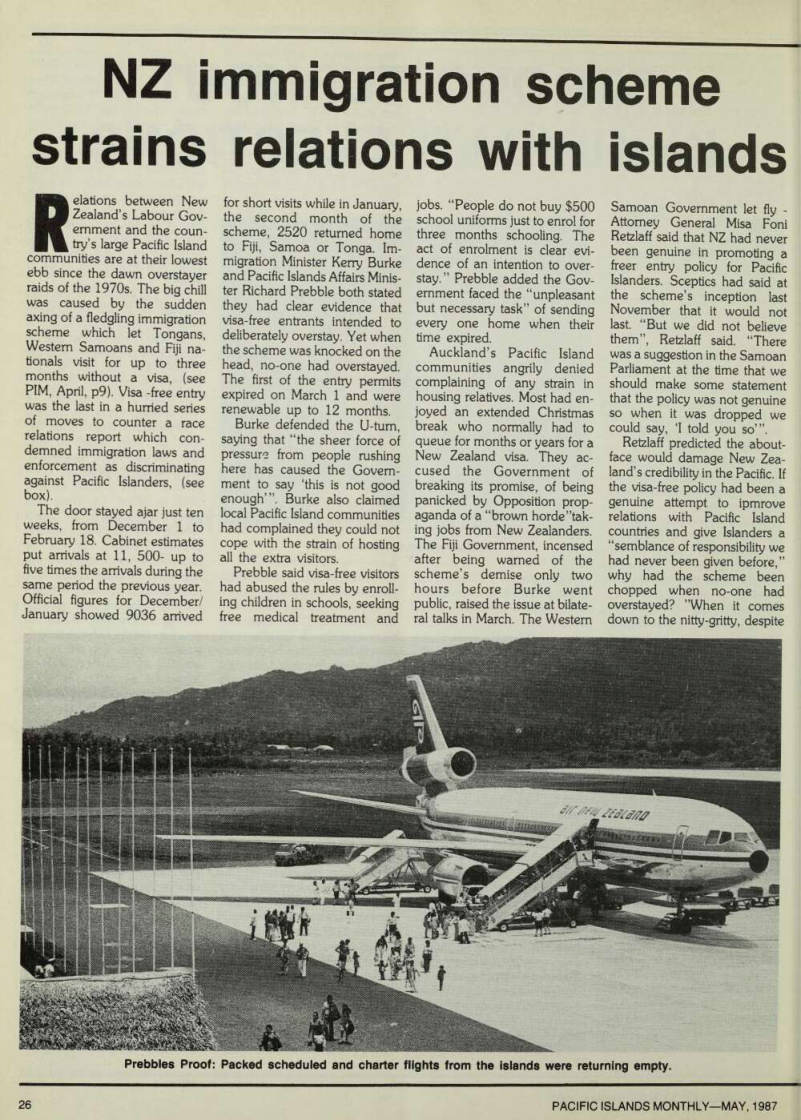
NZ immigration scheme strains relations with islands
Relations between New Zealand’s Labour Gov ernment and the coun try’s large Pacific Island communities are at their lowest ebb since the dawn overstayer raids of the 19705. The big chill was caused by the sudden axing of a fledgling immigration scheme which let Tongans, Western Samoans and Fiji na tionals visit for up to three months without a visa, (see PIM, April, p 9). Visa -free entry was the last in a hurried series of moves to counter a race relations report which con demned immigration laws and enforcement as discriminating against Pacific Islanders, (see box).
The door stayed ajar just ten weeks, from December 1 to February 18. Cabinet estimates put arrivals at 11, 500- up to five times the arrivals during the same period the previous year.
Official figures for December/ January showed 9036 arrived
for short visits while in January, the second month of the scheme, 2520 returned home to Fiji, Samoa or Tonga. Im migration Minister Kerry Burke and Pacific Islands Affairs Minis ter Richard Prebble both stated they had clear evidence that visa-free entrants intended to deliberately overstay. Yet when the scheme was knocked on the head, no-one had overstayed.
The first of the entry permits expired on March 1 and were renewable up to 12 months.
Burke defended the U-tum, saying that “the sheer force of pressure from people rushing here has caused the Govern ment to say ‘this is not good enough’”. Burke also claimed local Pacific Island communities had complained they could not cope with the strain of hosting all the extra visitors.
Prebble said visa-free visitors had abused the rules by enroll ing children in schools, seeking free medical treatment and
jobs. People do not buy $5OO school uniforms just to enrol for three months schooling. The act of enrolment is clear evidence of an intention to overstay. ” Prebble added the Government faced the “unpleasant but necessary task” of sending every one home when their time expired.
Auckland’s Pacific Island communities angrily denied complaining of any strain in housing relatives. Most had enjoyed an extended Christmas break who normally had to queue for months or years for a New Zealand visa. They accused the Government of breaking its promise, of being panicked by Opposition propaganda of a “brown horde”taking jobs from New Zealanders, The Fiji Government, incensed after being warned of the scheme’s demise only two hours before Burke went public, raised the issue at bilateral talks in March. The Western
Samoan Government let fly - Attorney General Misa Foni Retzlaff said that NZ had never been genuine in promoting a freer entry policy for Pacific Islanders. Sceptics had said at the scheme’s inception last November that it would not last. “But we did not believe them”, Retzlaff said. “There was a suggestion in the Samoan Parliament at the time that we should make some statement that the policy was not genuine so when it was dropped we could say, ‘I told you so’”, Retzlaff predicted the about face would damage New Zea land’s credibility in the Pacific. If the visa-free policy had been a genuine attempt to ipmrove relations with Pacific Island countries and give Islanders a “semblance of responsibility we had never been given before,” why had the scheme been chopped when no-one had overstayed? ’’When it comes down to the nitty-gritty, despite
Prebbles Proof: Packed scheduled and charter flights from the islands were returning empty.
Burke and Prebble initially threatened that visa-free visitors would have to prove they had not taken jobs or enrolled their children at school before being granted extensions. Visitors who had violated the ruleswould be “removed”from New Zealand and kept out for five years. But Education officials discovered that visitors under 15 years could not be found guilty of overstaying and schools were obliged under NZ law to enrol anyone of school Similarly, despite hundreds of applications for work permits only 10 had been 3^" t ® d A c ucW ,? nd ' f ° r skilled jobs. Finally, in March, Prebble sent a letter to Pacific Wand communities: Indicahons are that the vast majority of visitors are not intending to overstay but are either returning or applying to have their permits extended.
All of which prompted one young Pacific Island community
worker to ask: “So what’s new?
That’s the history of immigration relations between New Zealand and Pacific Islands. ”
This cynicism has permeated deep into the Pacific Island communities, disillusioning even those who work for the Labour Party. For all the Govemment’s recent reasonableness, the damage has been done. As Prebble noted racial bigots have had a field day Conspiracy theories abound after all, it s election year and racial backlash is always good for a few marginal rural votes.
But it seems the visa-free as , sabotaged by shoddy planning and by the inheritance of decades of defects in New Zealand s immigraton laws and enforcement. The Government raade no approach to those who had the most to gain from policing abuses - the local Pacific Island communities who were enjoying a rare spell of peace. In
August last year the Govern ment announced an amnesty and offer of permanent resi dence for all overstayers in New Zealand since 1983. By year’s end one third of the 6000 overstayers affected had got permanent residency. Over stayer prosecutions had been suspended until passage of a new Immigration Bill.
Instead, the Government has compounded suspicion on all sides. The legs have been chop ped from under the Pacific Island communities after years of patient lobbying for more equitable immigration policies.
The very move to portray Paci fic Islanders as responsible and mature has painted them as incapable of disciplining them selves, and as undeserving of normal privileges. And just for taking advantage of what the New Zealand law allowed.
all it says,the Labour Party is not prepared to stand by Pacific Islanders. ” Retzlaff said the majority of visa-free visitors had been given ” a fair shake”.
The NZ Government had not provided specific examples of abuse of the scheme, nor had it asked the Western Samoan Government for help in preven tion of abuse. Western Samoa had planned to set up a policing system through the matais (chiefs) in New Zealand, but not until the first three months was up. Earlier action would have implied a distrust of Samoa’s motives. The Samoan, Tongan and Fijian Governments all stressed that the majority of visitors would have been genuine.
Gradually the NZ Govern ment began leaking its “proof”.
Up to 1100 primary and secondary students enrolled, most with insufficient English skills, which placed intolerable strains on scarce specialist teaching resources. Employers apparently reported hundreds of Pacific Islanders fronting for jobs without work permits.
Packed scheduled and charter flights from the Islands were said to be returning empty, and passengers were not turning up fro pre-booked charter flights.
Auckland immigration official were processing 100 applica tions a day for visa extensions and the South Auckland office was in crisis. But the contradic tions also surfaced.
Burke said a potentially su perb permanent entry policy had been corrupted by large numbers arriving under temporary entry permits but seeking to stay permanently. (If you read that twice it makes even less sense). The airlines, annoyed at being described as the “principal agents for the destruction of the system”, riposted that most charter flights had already been organised for Christmas traffic from New Zea land to the Islands. The Gov ernment suddenly had liftedy ears of entry restrictions at peak demand with rock- bottom fares on offer, so what else did it expect? Moreover, the Govern ment could have regulated the numbers of charters, but chose not to.
From Karen Mangnall,
Auckland.
Report Finds
Discrimination
In August 1986, the race relations conciliator Wal ter Hirsh released a report which found New Zealand immigration and enforce ment procedures discriminated against Pacific Islanders.
Hirsh found that Pacific Islanders comprised only one-third of the average 10,000 overstayers, yet were 86% of those prose cuted. The two-thirds majority of overstayers more than half from West ern countries- comprised only 14% of prosecutions.
Most immigration offic ers harboured the miscon ception that Europeans overstayed for shorter periods ( a myth exploded by statistics) so therefore it was more important to chase Pacific Islanders.
Hirsh criticised the immigration division’s excuse that Pacific Islanders were easier to track down because entry criteria meant more documentation was kept on them and their New Zealand relatives, These very entry criteria were discriminatory, Hirsh said, and should be applied to all visitors or not at all.
Enforcement officers, particularly in Auckland, ran an unofficial overstayer target of four each a month as proof of their efficiency. The report noted that in pursuit of this self-imposed target, officers took the easiest route to prosecute Pacific Islanders. Most immigration staff regarded the deportation appeals system as a “manipulative device re-
sorted to only by people from the Pacific Islands.”
Appeals for overstaying usually lasted 12 to 18 months during which time convicted Pacific Island overstayers lived in a cli mate of perpetual fear.
Hirsh called for an in vestigation into how these overstayers were being held and then deported while making compulsory visits to a police station.
The report also recom mended the new Immigra tion Bill wipe provisions for powers of arrest and search for immigration officers. Hirsh called for a review of discriminatory family sponsorship provi sions for Pacific Island visi tors and the abolition of visas for short- term visi tors from Fiji, Tonga and Western Samoa.
Flosse’s promotion proves too Much
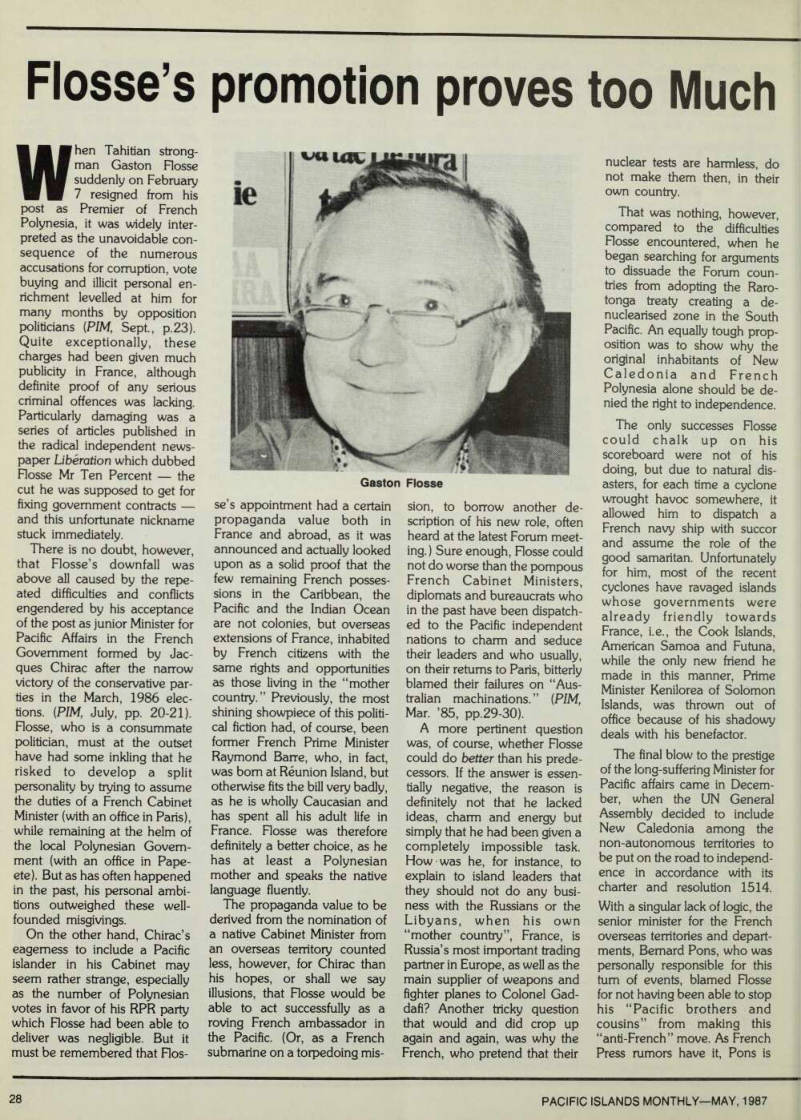
When Tahitian strong man Gaston Flosse suddenly on February 7 resigned from his post as Premier of French Polynesia, it was widely inter preted as the unavoidable con sequence of the numerous accusations for corruption, vote buying and illicit personal en richment levelled at him for many months by opposition politicians (P/M, Sept., p. 23).
Quite exceptionally, these charges had been given much publicity in France, although definite proof of any serious criminal offences was lacking.
Particularly damaging was a series of articles published in the radical independent news paper Liberation which dubbed Flosse Mr Ten Percent the cut he was supposed to get for fixing government contracts and this unfortunate nickname stuck immediately.
There is no doubt, however, that Flosse’s downfall was above all caused by the repe ated difficulties and conflicts engendered by his acceptance of the post as junior Minister for Pacific Affairs in the French Government formed by Jac ques Chirac after the narrow victory of the conservative par ties in the March, 1986 elec tions. (P/M, July, pp. 20-21).
Flosse, who is a consummate politician, must at the outset have had some inkling that he risked to develop a split personality by trying to assume the duties of a French Cabinet Minister (with an office in Paris), while remaining at the helm of the local Polynesian Govern ment (with an office in Pape ete). But as has often happened in the past, his personal ambi tions outweighed these well founded misgivings.
On the other hand, Chirac’s eagerness to include a Pacific islander in his Cabinet may seem rather strange, especially as the number of Polynesian votes in favor of his RPR party which Flosse had been able to deliver was negligible. But it must be remembered that Flos-
se’s appointment had a certain propaganda value both in France and abroad, as it was announced and actually looked upon as a solid proof that the few remaining French posses sions in the Caribbean, the Pacific and the Indian Ocean are not colonies, but overseas extensions of France, inhabited by French citizens with the same rights and opportunities as those living in the “mother country.” Previously, the most shining showpiece of this politi cal fiction had, of course, been former French Prime Minister Raymond Barre, who, in fact, was bom at Reunion Island, but otherwise fits the bill very badly, as he is wholly Caucasian and has spent all his adult life in France. Flosse was therefore definitely a better choice, as he has at least a Polynesian mother and speaks the native language fluently.
The propaganda value to be derived from the nomination of a native Cabinet Minister from an overseas territory counted less, however, for Chirac than his hopes, or shall we say illusions, that Flosse would be able to act successfully as a roving French ambassador in the Pacific. (Or, as a French submarine on a torpedoing mis
sion, to borrow another de scription of his new role, often heard at the latest Forum meet ing.) Sure enough, Flosse could not do worse than the pompous French Cabinet Ministers, diplomats and bureaucrats who in the past have been dispatch ed to the Pacific independent nations to charm and seduce their leaders and who usually, on their returns to Paris, bitterly blamed their failures on “Aus tralian machinations. ” (P/M, Mar. ’B5, pp. 29-30).
A more pertinent question was, of course, whether Flosse could do better than his prede cessors. If the answer is essen tially negative, the reason is definitely not that he lacked ideas, charm and energy but simply that he had been given a completely impossible task.
How was he, for instance, to explain to island leaders that they should not do any busi ness with the Russians or the Libyans, when his own “mother country”, France, is Russia’s most important trading partner in Europe, as well as the main supplier of weapons and fighter planes to Colonel Gad dafi? Another tricky question that would and did crop up again and again, was why the French, who pretend that their
nuclear tests are harmless, do not make them then, in their own country.
That was nothing, however, compared to the difficulties Flosse encountered, when he began searching for arguments to dissuade the Forum coun tries from adopting the Raro tonga treaty creating a de nuclearised zone in the South Pacific. An equally tough prop osition was to show why the original inhabitants of New Caledonia and French Polynesia alone should be de nied the right to independence.
The only successes Flosse could chalk up on his scoreboard were not of his doing, but due to natural dis asters, for each time a cyclone wrought havoc somewhere, it allowed him to dispatch a French navy ship with succor and assume the role of the good Samaritan. Unfortunately for him, most of the recent cyclones have ravaged islands whose governments were already friendly towards France, i.e., the Cook Islands, American Samoa and Futuna, while the only new friend he made in this manner, Prime Minister Kenilorea of Solomon Islands, was thrown out of office because of his shadowy deals with his benefactor.
The final blow to the prestige of the long-suffering Minister for Pacific affairs came in Decem ber, when the UN General Assembly decided to include New Caledonia among the non-autonomous territories to be put on the road to independ ence in accordance with its charter and resolution 1514.
With a singular lack of logic, the senior minister for the French overseas territories and depart ments, Bernard Pons, who was personally responsible for this turn of events, blamed Flosse for not having been able to stop his “Pacific brothers and cousins” from making this “anti-French” move. As French Press rumors have it, Pons is
Gaston Flosse
now attempting to have Flosse dumped from the Cabinet.
In addition to his frequent trips to other Pacific nations to make friends and twist arms, Flosse had also to fly off reg ularly to Paris to attend Cabinet meetings. Mostly for not good reasons at all, as the matters discussed as a rule only con cerned internal French prob lems. These frequent absences from Tahiti gradually made him lose control of home affairs.
This was particularly the case in December, when the Papeete dockers struck and ugly vio lence was averted at the last minute only because the lead ers of the Evangelical Church stepped into the political vacuum and managed to negotiate a solution (P/M, Feb., P-50).
For the first time Flosse publicly admitted the obvious truth that he could not continue any longer to ride two wild horses. The most sensible solu tion would have been to aban don his French Cabinet port folio, which had only given him headaches, and firmly grasp the reins of the local government again. According to his own account, this is precisely what he proposed to do in January.
Chirac’s categorical refusal ar rived in the form of an ex ceedingly laudatory letter, addressed to “My Dear Gas ton,” and telling him in no uncertain terms to do exactly the opposite, i.e., to resign from his position as premier of the local government in order to concentrate henceforth on the immensely more important task “of developing the co-opera tion and strengthening the friendship with all nations in the region. ”
So far Chirac had easily pulled the strings in the Polyne sian puppet show. But when it came to electing a new Premier in mid-February, the leaders of Flosse’s ruling Tahoeraa party suddenly broke loose and be gan jumping about in a totally disorderly fashion. It was only with the greatest efforts that Gaston Flosse in the end was able to impose his protege, Jacky Teuira, who up to then had been speaker of the Territorial Assembly, by 23 votes against 15 which went to
Deputy Alexandre Leontieff.
As a conciliatory gesture, the new Premier reappointed all the ministers in the previous Polynesian Government, with the exception of the Minister of Finance, Patrick Peaucellier, who had the courage to step down voluntarily, because he realised that his no-nonsense (and therefore very unpopular), tax policies would not be pur sued. Instead of healing, the wounds have since then be come even deeper, and there is a definite risk that the Tahoerua party will eventually split into two more or less hostile fac tions.
In the opposite camp, the trend is presently the reverse.
Not only has the number of parties which favor independ ence and condemn the nuclear tests steadily increased to a point where they now represent more than 50 per cent of the electorate, but they have also begun to form loose alliances.
The most recent demonstration of this new unity was the anti-nuclear rally organised on March 7 in Papeete jointly by Oscar Temaru’s Polynesian Liberation Front and Jacqui Drollet’s la mana te nunaa party, which drew a crowd of 2000 cheering and clapping Polynesians. Equally notewor thy are the close ties which these political leaders have gra dually established with the FLNKS movement, which on this occasion was represented by a four-man delegation. The rally was also attended by ten Japanese members of the Gen suikin anti-nuclear movement, who spent altogether a week in Tahiti to gather information about the rising number of radiation-induced cancer dis eases.
Acting in accordance with the battle cry continually heard dur ing the Papeete rally; “Melane sians and Polynesians — same combat!” Oscar Temaru flew off to New York a few days later in the company of FLNKS leader Jean-Marie Tjibaou. His main mission: to ask the UN Committee on Decolonisation not to forget French Polynesia during the forthcoming hear ings on Kanak independence. — Maria-Therese and Bengt Danielsson.
Advertisements & other items, pp. 29-32 (1 item)
Uicta
cleans awav flick
Uac
AT THE
OF A
SWITCH
i
Soo
OUTDOOR VACUUM
CLEANER.
jCJCD
It’s a powerful outdoor vacuum
cleaner that means you’ll never have
to rake leaves or clippings again.
And because it is so easy to use, you’ll find lots of uses for it; all year round. It works just as well on garden clippings as it does on driveways and
in garages. The high suction electric
motor leaves nothing r „ GlaDl
in ,ts path.
For more information contact our Authorised Distributors.
MM
VicfA
te 45 !
SSSmU*.
Ao.f MM n ID. m Mt ' esfenter.laif'iru’-.jr FIJI: Carpenters Motors, Private Mail Bag, Argo Street, Suva.
NEW CALEDONIA: Messagerie Caledoniannes, BPB2, Noumea.
NORFOLK ISLAND: Norfolk Island Motors, P.O. Box 278.
PAPUA NEW GUINEA: Carpenters New Guinea Co., Box 74, P. 0., Lae.
ASP (Overseas) Pty. Ltd., Box 166, P. 0., Rabaul.
Wamp Nga Motors, Box 198, P. 0., Mt. Hagen.
SOLOMON ISLANDS: Lee Kwok Kuen & Co., P.O. Box 537, Honiara.
TAHITI: Tahiti Cycles, P.O. Box 201, Papeete.
TONGA: E. M. Jones Ltd., P.O. Box 34, Nukualofa.
VANUATU: Vanuatu Agricultural Supplies, P.O. Box 819, Port Vila.
WESTERN SAMOA: Morris Hedstrom Apia Ltd., P.O. Box 189, Apia.
Goldstar Transport Co. Ltd., P.O. Box 185, Apia.
Road-Hugging. Rock-Biting, Pa
im T
* ■■ ' % ■ fr * r * M p ' % >*
pen
4 % * % HILUX 4WD Regular Cab, Long Wheelbase One tough truck just got tougher. Toyota’s dedication to superior performance vehicles takes a step forward today with the New Hilux A refined front grille and bumper design, new instrument panel for a feeling of spaciousness and command and plush colour co-ordinated trim are a few new additions to the New Hilux.
And extensive anti-corrosive galvanealed steel protection now includes the tailgate panel and rear door panel, making Hilux more durable than ever before.
Yet for all its improvements, the best of the original Hilux is alsc
TOYOTA
QUALITY SERVICE
AMERICAN SAMOA: BURNS PHILP (SOUTH SEA) CO., LTD., PO. Box 129, Pago Pago. COOK ISLANDS: COOK ISLA AUTOMOTIVE SUPPLIES COMPANY, A Division of Burns Philp (South Sea) Co., Ltd., G.P.O. Box 355, Suva. GUAM & m i Tamuning. KIRIBATI: TARAWA MOTORS, A Division of Bairiki Holdings Ltd., P.O. Box 36, Bainki Tarawa NAURU: NAIL SERVICE IMPORTATION AUTOMOBILE DU PACIFIQUE, Rond-Point du Pacifique (Station Total) B.P. 438, Noumea. NIUE;: NORFOLK ISLAND: BORRY’S LIMITED, P.O. Box 169. PAPUA NEW GUINEA: ELA MOTORS, A Division of Burns Pit CORPORATION, P.O. Box 267, Saipan. SOLOMON ISLANDS: SOLOMON ISLANDS INVESTMENTS LTD., G.P.O. Box 140 TONGA: BURNS PHILP (TONGA) LTD., P.O. Box 55, Nuku’alofa. VANUATU: VANUATU MOTORS, A Division of Burns Phn
fic-Tough. The New Hilux.
nut* m " ft » mm m ■ *. 0 m 4 * k y* K
IHC
-re; a big tailgate conveniently hinged for quick loading and unloading; reinforced front suspension to smooth out e bumps, and bias-mounted, extra-heavy-duty rear shocks and knobbly tyres to take on any terrain.
Toyota’s long history of super-responsive engines, ruggedness, reliability and comfort goes without saying. And in the Hilux, it’s yours in both 2-wheel-drive and 4x4 versions.
So, after comprehensive testing and thorough quality control, the New Hilux is ready to bring a new standard of toughness to the Pacific.
And isn’t that exactly what you expect from Toyota?
Areas where galvanealed steel is used )ING CORPORATION LTD., Private Bag, Rarotonga. FIJI: iIA: ATKINS KROLL, INC., 443 South Marine Drive,
ERATIVE SOCIETY, Central Pacific. NEW CALEDONIA:
HILP (SOUTH SEA) CO., LTD., P.O. Box 39. Alofi. _td„ P.O. Box 75, Port Moresby. SAIPAN: MICROL
TAHITI: NIPPON AUTOMOTO, B.P. 342, Papeete
u) Ltd., P.O. Box 18, Port Vila. WESTERN SAMOA;
TOYOTA
BANK
ECONOMIC INDICATORS
COMMODITY PRICES
EXCHANGE RATES
INTEREST RATES
WORLD COMMODITIES
(Wholesale Price Index, 1980 = 100) Metals Agricultural Raw Material 8001 8006 8012 8106 8112 8206 8212 8306 8312 8406 8412 8506 8512 8606 8612 8706 JAN. JUN. DEC. JUN. DEC. JUN. DEC. JUN. DEC. JUN. DEC. JUN. DEC. JUN. DEC. JUN.
GOLD
London (US $ Per Ounce) I I I I I I I I I I I I I I I I I II I I I I I I I I I I I I I I I I I I I I I I I I I I I I I I I I I I I I I I I I I I I 11 I I M M M I I I I II I I I I 8001 8006 8012 8106 8112 8206 8212 8306 8312 8406 8412 8506 8512 8606 8612 8706 JAN. JUN. DEC. JUN. DEC. JUN. DEC. JUN. DEC. JUN. DEC. JUN. DEC. JUN. DEC. JUN.
INDUSTRIAL WORLD DEMAND
Sources: AAP Reuters; FFA Honiara, IMF (IFS); Fiji Forest Industries. Compiled by ANZ International Economics, Melbourne. \W/ A 'A
BANK
Branches in Fiji, Papua New Guinea, Vanuatu and Solomon Is.
Copra industry under review
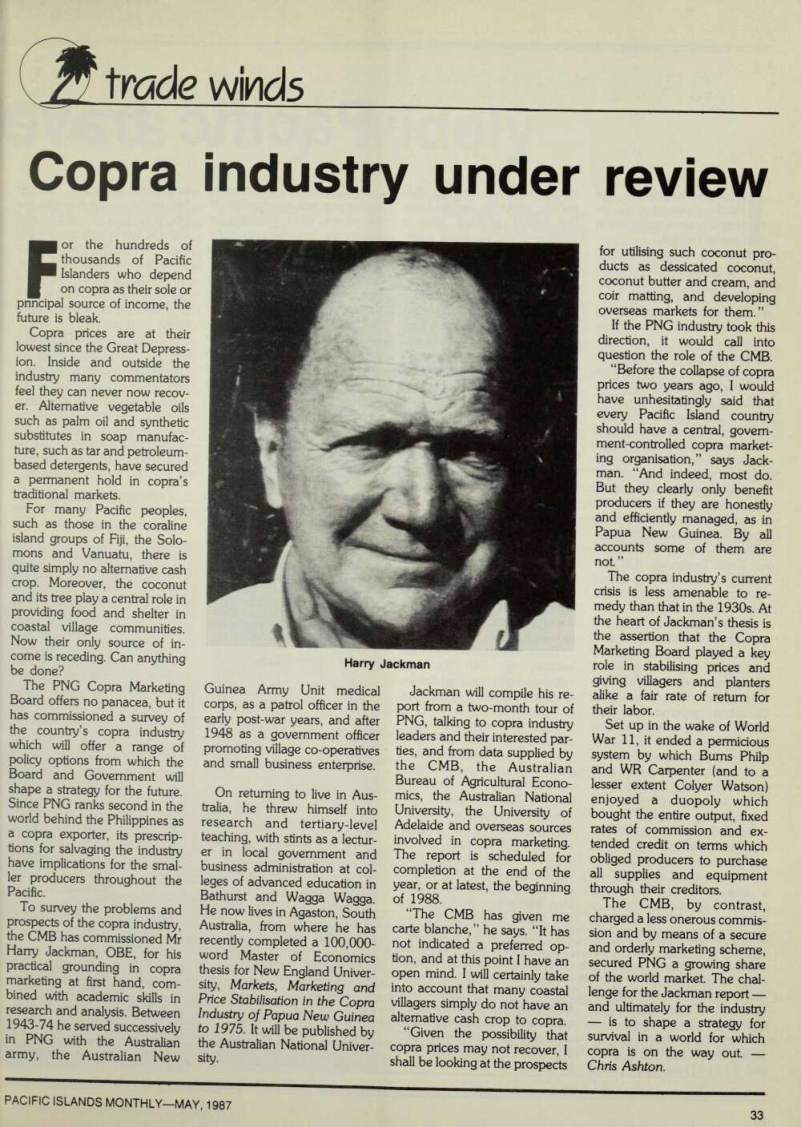
trade winds
For the hundreds of thousands of Pacific Islanders who depend on copra as their sole or pnncipal source of income, the future is bleak.
Copra prices are at their lowest since the Great Depress ion. Inside and outside the industry many commentators feel they can never now recov er. Alternative vegetable oils such as palm oil and synthetic substitutes in soap manufac ture, such as tar and petroleum based detergents, have secured a permanent hold in copra’s traditional markets.
For many Pacific peoples, such as those in the coraline island groups of Fiji, the Solo mons and Vanuatu, there is quite simply no alternative cash crop. Moreover, the coconut and its tree play a central role in providing food and shelter in coastal village communities.
Now their only source of in come is receding. Can anything be done?
The PNG Copra Marketing Board offers no panacea, but it has commissioned a survey of the country’s copra industry which will offer a range of policy options from which the Board and Government will shape a strategy for the future.
Since PNG ranks second in the world behind the Philippines as a copra exporter, its prescrip tions for salvaging the industry have implications for the smal ler producers throughout the Pacific.
To survey the problems and prospects of the copra industry, the CMB has commissioned Mr Harry Jackman, QBE, for his practical grounding in copra marketing at first hand, com bined with academic skills in research and analysis. Between 1943-74 he served successively in PNG with the Australian army, the Australian New
Guinea Army Unit medical corps, as a patrol officer in the early post-war years, and after 1948 as a government officer promoting village co-operatives and small business enterprise.
On returning to live in Aus tralia, he threw himself into research and tertiary-level teaching, with stints as a lectur er in local government and business administration at col leges of advanced education in Bathurst and Wagga Wagga.
He now lives in Agaston South Australia, from where he has recently completed a 100 000word Master of Economics thesis for New England Univer sity, Markets, Marketing and Price Stabilisation in the Copra Industry of Papua New Guinea to 1975. It will be published by the Australian National Univer sity.
Jackman will compile his re port from a two-month tour of PNG, talking to copra industry leaders and their interested par ties, and from data supplied by the CMB, the Australian Bureau of Agricultural Econo mics, the Australian National
University, the University of
Adelaide and overseas sources involved in copra marketing.
The report is scheduled for completion at the end of the year, or at latest, the beginning of 1988.
“The CMB has given me carte blanche,” he says. “It has not indicated a preferred op tion, and at this point I have an open mind. I will certainly take into account that many coastal villagers simply do not have an alternative cash crop to copra.
“Given the possibility that copra prices may not recover, I shall be looking at the prospects
for utilising such coconut pro ducts as dessicated coconut, coconut butter and cream, and coir matting, and developing overseas markets for them.”
If the PNG industry took this direction, it would call into question the role of the CMB.
“Before the collapse of copra prices two years ago, I would have unhesitatingly said that every Pacific Island country should have a central, govern ment-controlled copra market ing organisation,” says Jack man. “And indeed, most do.
But they clearly only benefit producers if they are honestly and efficiently managed, as in Papua New Guinea. By all accounts some of them are not”
The copra industry’s current crisis is less amenable to re medy than that in the 19305. At the heart of Jackman’s thesis is the assertion that the Copra Marketing Board played a key role in stabilising prices and giving villagers and planters alike a fair rate of return for their labor.
Set up in the wake of World War 11, it ended a permicious system by which Bums Philp and WR Carpenter (and to a lesser extent Colyer Watson) enjoyed a duopoly which bought the entire output, fixed rates of commission and ex tended credit on terms which obliged producers to purchase all supplies and equipment through their creditors.
The CMB, by contrast, charged a less onerous commis sion and by means of a secure and orderly marketing scheme, secured PNG a growing share of the world market. The chal lenge for the Jackman report and ultimately for the industry is to shape a strategy for survival in a world for which copra is on the way out Chris Ashton.
Harry Jackman
Pacific travel Costs vary widely
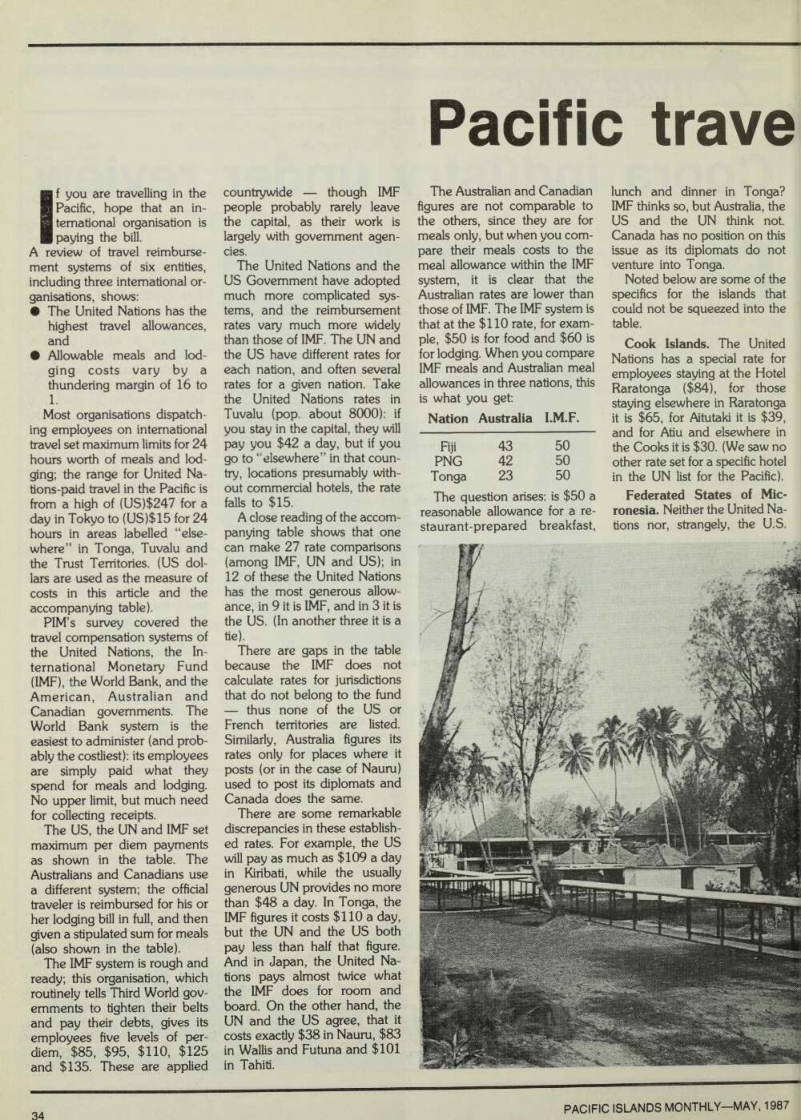
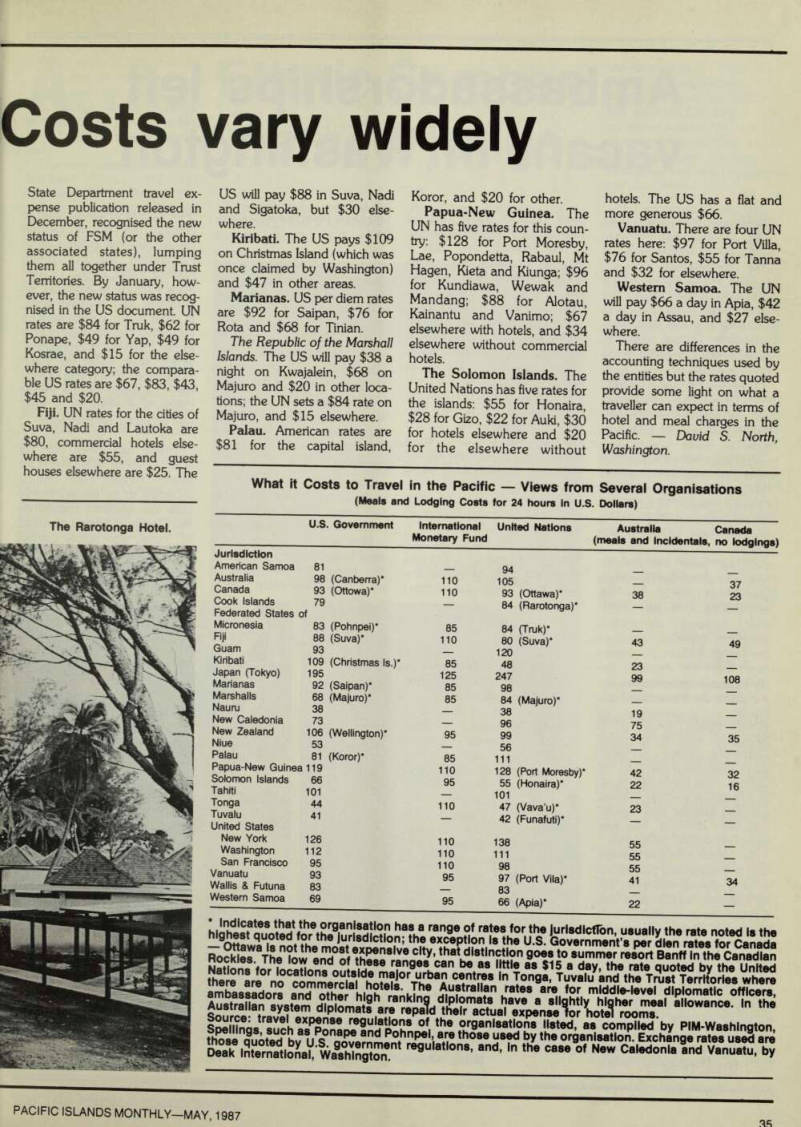
If you are travelling in the Pacific, hope that an in ternational organisation is paying the bill.
A review of travel reimburse ment systems of six entities, including three international or ganisations, shows: • The United Nations has the highest travel allowances, and • Allowable meals and lod ging costs vary by a thundering margin of 16 to 1.
Most organisations dispatch ing employees on international travel set maximum limits for 24 hours worth of meals and lod ging; the range for United Na tions-paid travel in the Pacific is from a high of (US)$247 for a day in Tokyo to (US)$l5 for 24 hours in areas labelled “else where” in Tonga, Tuvalu and the Trust Territories. (US dol lars are used as the measure of costs in this article and the accompanying table).
PlM’s survey covered the travel compensation systems of the United Nations, the In ternational Monetary Fund (IMF), the World Bank, and the American, Australian and Canadian governments. The World Bank system is the easiest to administer (and prob ably the costliest): its employees are simply paid what they spend for meals and lodging.
No upper limit, but much need for collecting receipts.
The US, the UN and IMF set maximum per diem payments as shown in the table. The Australians and Canadians use a different system; the official traveler is reimbursed for his or her lodging bill in full, and then given a stipulated sum for meals (also shown in the table).
The IMF system is rough and ready; this organisation, which routinely tells Third World gov ernments to tighten their belts and pay their debts, gives its employees five levels of per diem, $B5, $95, $llO, $125 and $135. These are applied
countrywide though IMF people probably rarely leave the capital, as their work is largely with government agen cies.
The United Nations and the US Government have adopted much more complicated sys tems, and the reimbursement rates vary much more widely than those of IMF. The UN and the US have different rates for each nation, and often several rates for a given nation. Take the United Nations rates in Tuvalu (pop. about 8000): if you stay in the capital, they will pay you $42 a day, but if you go to “elsewhere” in that coun try, locations presumably with out commercial hotels, the rate falls to $l5.
A close reading of the accom panying table shows that one can make 27 rate comparisons (among IMF, UN and US); in 12 of these the United Nations has the most generous allow ance, in 9 it is IMF, and in 3 it is the US. (In another three it is a tie).
There are gaps in the table because the IMF does not calculate rates for jurisdictions that do not belong to the fund thus none of the US or French territories are listed.
Similarly, Australia figures its rates only for places where it posts (or in the case of Nauru) used to post its diplomats and Canada does the same.
There are some remarkable discrepancies in these establish ed rates. For example, the US will pay as much as $lO9 a day in Kiribati, while the usually generous UN provides no more than $4B a day. In Tonga, the IMF figures it costs $llO a day, but the UN and the US both pay less than half that figure.
And in Japan, the United Na tions pays almost twice what the IMF does for room and board. On the other hand, the UN and the US agree, that it costs exactly $3B in Nauru, $B3 in Wallis and Futuna and $lOl in Tahiti.
The Australian and Canadian figures are not comparable to the others, since they are for meals only, but when you com pare their meals costs to the meal allowance within the IMF system, it is clear that the Australian rates are lower than those of IMF. The IMF system is that at the $llO rate, for exam ple, $5O is for food and $6O is for lodging. When you compare IMF meals and Australian meal allowances in three nations, this is what you get:
The question arises: is $5O a reasonable allowance for a re staurant-prepared breakfast,
lunch and dinner in Tonga?
IMF thinks so, but Australia, the US and the UN think not.
Canada has no position on this issue as its diplomats do not venture into Tonga.
Noted below are some of the specifics for the islands that could not be squeezed into the table.
Cook Islands. The United Nations has a special rate for employees staying at the Hotel Raratonga ($B4), for those staying elsewhere in Raratonga it is $65, for Aitutaki it is $39, and for Atiu and elsewhere in the Cooks it is $3O. (We saw no other rate set for a specific hotel in the UN list for the Pacific).
Federated States of Mic ronesia. Neither the United Na tions nor, strangely, the U.S.
Nation Australia l.M.F.
Fiji 43 50
Png
42 50 Tonga 23 50
State Department travel ex pense publication released in December, recognised the new status of FSM (or the other associated states), lumping them all together under Trust Territories. By January, how ever, the new status was recog nised in the US document. UN rates are $B4 for Truk, $62 for Ponape, $49 for Yap, $49 for Kosrae, and $l5 for the else where category; the compara ble US rates are $67, $B3, $43, $45 and $2O.
Fiji. UN rates for the cities of Suva, Nadi and Lautoka are $BO, commercial hotels else where are $55, and guest houses elsewhere are $25. The
US will pay $BB in Suva, Nadi and Sigatoka, but $3O else where.
Kiribati. The US pays $lO9 on Christmas Island (which was once claimed by Washington) and $47 in other areas.
Marianas. US per diem rates are $92 for Saipan, $76 for Rota and $6B for Tinian.
The Republic of the Marshall Islands. The US will pay $3B a night on Kwajalein, $6B on Majuro and $2O in other loca tions; the UN sets a $B4 rate on Majuro, and $l5 elsewhere.
Palau. American rates are $Bl for the capital island,
Koror, and $2O for other.
Papua-New Guinea. The UN has five rates for this country: $l2B for Port Moresby, Lae, Popondetta, Rabaul, Mt Hagen, Kieta and Kiunga; $96 for Kundiawa, Wewak and Mandang; $BB for Alotau, Kainantu and Vanimo; $67 elsewhere with hotels, and $34 elsewhere without commercial hotels.
The Solomon Islands. The United Nations has five rates for the islands: $55 for Honaira, $2B for Gizo, $22 for Auki, $3O for hotels elsewhere and $2O for the elsewhere without
hotels. The US has a flat and more generous $66.
Vanuatu. There are four UN rates here: $97 for Port Villa, $76 for Santos, $55 for Tanna and $32 for elsewhere, Western Samoa. The UN will pay $66 a day in Apia, $42 a day in Assau, and $27 else where, There are differences in the accounting techniques used by the entities but the rates quoted provide some light on what a traveller can expect in terms of hotel and meal charges in the Pacific. David S. North , Washington.
What it Costs to Travel in the Pacific Views from Several Organisations (Meals and Lodging Costs for 24 hours In U.S. Dollars)
The Rarotonga Hotel.
U.S. Government International United Nations Australia Canada
Monetary Fund
(meals and Incidentals, no lodgings) Jurisdiction American Samoa 81 94 Australia
98 (Canberra)*
110 105 37 23 Canada 93 (Ottowa)* Cook Islands 79 Federated States of 110
93 (Ottawa)*
84 (Rarotonga)*
38 Micronesia 83 (Pohnpei)* 85
84 (Truk)*
Fiji Guam 88 (Suva)* 93 110
80 (Suva)*
120 43 49 Kiribati 109 (Christmas Is.)* 85 48 23
Japan (Tokyo)
Marianas 195
92 (Saipan)*
125 85 247 98 99 108 Marshalls Nauru 68 (Majuro)* 38 85
84 (Majuro)*
38 1Q — New Caledonia 73 96 i y 75 34 New Zealand Niue
106 (Wellington)*
53 95 99 56 35 Palau 81 (Koror)* 85 111 Papua-New Guinea 119 Solomon Islands 66 Tahiti 101 110 95 128 (Port Moresby)* 55 (Honaira)* 101 42 22 32 16
Tonga
Tuvalu United States 44 41 110
47 (Vava’u)*
42 (Funafuti)*
23 — New York 126 110 138 55 55 55 41
Washington
112 110 111 San Francisco 95 110 98 Vanuatu Wallis & Futuna 93 83 95 97 (Port Vila)* 83 34 Western Samoa 69 95 66 (Apia)* 22 Rockies \he n ?owo^°of 1hK n8,V6 Clty ’ tha \l l8t,nct,on goes to summer resort Banff In the Canadian
dljfloriwS^i? repaid
Deak Intern^ WMWngtor? nt re9u,at,on8 ’ and ’ ,n the ca8e of Naw Caledonia and Vanuatu, by
Ambassadorships left
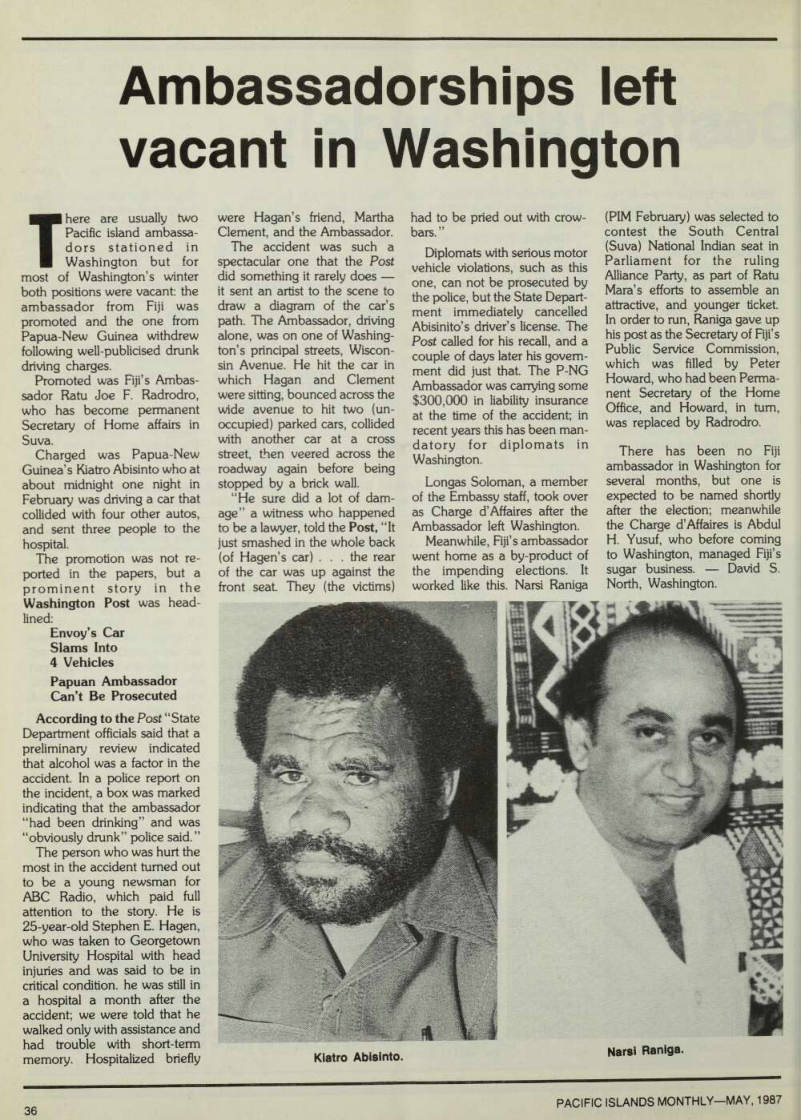
vacant in Washington
There are usually two Pacific island ambassa dors stationed in Washington but for most of Washington’s winter both positions were vacant: the ambassador from Fiji was promoted and the one from Papua-New Guinea withdrew following well-publicised drunk driving charges.
Promoted was Fiji’s Ambas sador Ratu Joe F. Radrodro, who has become permanent Secretary of Home affairs in Suva.
Charged was Papua-New Guinea’s Kiatro Abisinto who at about midnight one night in February was driving a car that collided with four other autos, and sent three people to the hospital.
The promotion was not re ported in the papers, but a prominent story in the Washington Post was head lined: Envoy’s Car Slams Into 4 Vehicles Papuan Ambassador Can’t Be Prosecuted According to the Post “State Department officials said that a preliminary review indicated that alcohol was a factor in the accident. In a police report on the incident, a box was marked indicating that the ambassador “had been drinking” and was “obviously drunk” police said.”
The person who was hurt the most in the accident turned out to be a young newsman for ABC Radio, which paid full attention to the story. He is 25-year-old Stephen E. Hagen, who was taken to Georgetown University Hospital with head injuries and was said to be in critical condition, he was still in a hospital a month after the accident; we were told that he walked only with assistance and had trouble with short-term memory. Hospitalized briefly
were Hagan’s friend, Martha Clement, and the Ambassador.
The accident was such a spectacular one that the Post did something it rarely does it sent an artist to the scene to draw a diagram of the car’s path. The Ambassador, driving alone, was on one of Washing ton’s principal streets, Wiscon sin Avenue. He hit the car in which Hagan and Clement were sitting, bounced across the wide avenue to hit two (un occupied) parked cars, collided with another car at a cross street, then veered across the roadway again before being stopped by a brick wall.
“He sure did a lot of dam age” a witness who happened to be a lawyer, told the Post, “It just smashed in the whole back (of Hagen’s car) ... the rear of the car was up against the front seat They (the victims)
had to be pried out with crow bars.”
Diplomats with serious motor vehicle violations, such as this one, can not be prosecuted by the police, but the State Depart ment immediately cancelled Abisinito’s driver’s license. The Post called for his recall, and a couple of days later his govern ment did just that. The P-NG Ambassador was carrying some $300,000 in liability insurance at the time of the accident; in recent years this has been man datory for diplomats in Washington.
Longas Soloman, a member of the Embassy staff, took over as Charge d’Affaires after the Ambassador left Washington.
Meanwhile, Fiji’s ambassador went home as a by-product of the impending elections. It worked like this. Narsi Raniga
(PIM February) was selected to contest the South Central (Suva) National Indian seat in Parliament for the ruling Alliance Party, as part of Ratu Mara’s efforts to assemble an attractive, and younger ticket.
In order to run, Raniga gave up his post as the Secretary of Fiji’s Public Service Commission, which was filled by Peter Howard, who had been Perma nent Secretary of the Home Office, and Howard, in turn, was replaced by Radrodro.
There has been no Fiji ambassador in Washington for several months, but one is expected to be named shortly after the election; meanwhile the Charge d’Affaires is Abdul H. Yusuf, who before coming to Washington, managed Fiji’s sugar business. David S.
North, Washington.
Kiatro Abisinto.
Narsi Raniga.
Ethnic Samoan
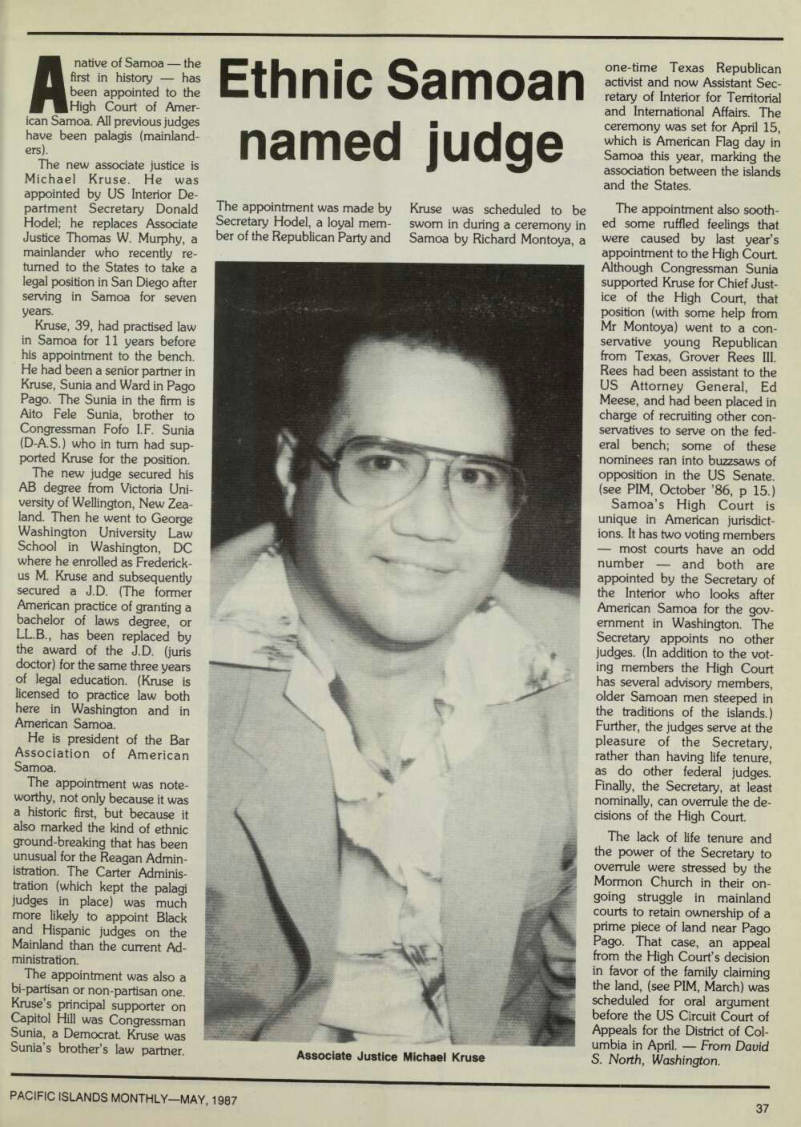
named judge
A native of Samoa the first in history has been appointed to the High Court of Amer ican Samoa. All previous judges have been palagis (mainland ers).
The new associate justice is Michael Kruse. He was appointed by US Interior De partment Secretary Donald Hodel; he replaces Associate Justice Thomas W. Murphy, a mainlander who recently re turned to the States to take a legal position in San Diego after serving in Samoa for seven years.
Kruse, 39, had practised law in Samoa for 11 years before his appointment to the bench.
He had been a senior partner in Kruse, Sunia and Ward in Pago Pago. The Sunia in the firm is Aito Fele Sunia, brother to Congressman Fofo I.F. Sunia (D-A.S.) who in turn had sup ported Kruse for the position.
The new judge secured his AB degree from Victoria Uni versity of Wellington, New Zea land. Then he went to George Washington University Law School in Washington, DC where he enrolled as Frederick us M. Kruse and subsequently secured a J.D. (The former American practice of granting a bachelor of laws degree, or LL.B., has been replaced by the award of the J.D. (juris doctor) for the same three years of legal education. (Kruse is licensed to practice law both here in Washington and in American Samoa.
He is president of the Bar Association of American Samoa.
The appointment was note worthy, not only because it was a historic first, but because it also marked the kind of ethnic ground-breaking that has been unusual for the Reagan Admin istration. The Carter Adminis tration (which kept the palagi judges in place) was much more likely to appoint Black and Hispanic judges on the Mainland than the current Ad ministration.
The appointment was also a bi-partisan or non-partisan one.
Kruse’s principal supporter on Capitol Hill was Congressman Sunia, a Democrat. Kruse was Sunia’s brother’s law partner.
The appointment was made by Secretary Hodel, a loyal mem ber of the Republican Party and
Kruse was scheduled to be sworn in during a ceremony in Samoa by Richard Montoya, a
one-time Texas Republican activist and now Assistant Sec retary of Interior for Territorial and International Affairs. The ceremony was set for April 15, which is American Flag day in Samoa this year, marking the association between the islands and the States.
The appointment also sooth ed some ruffled feelings that were caused by last year’s appointment to the High Court Although Congressman Sunia supported Kruse for Chief Just ice of the High Court, that position (with some help from Mr Montoya) went to a con servative young Republican from Texas, Grover Rees 111.
Rees had been assistant to the US Attorney General, Ed Meese, and had been placed in charge of recruiting other con servatives to serve on the fed eral bench; some of these nominees ran into buzzsaws of opposition in the US Senate, (see FIM, October ’B6, p 15.) Samoa’s High Court is unique in American jurisdict ions. It has two voting members most courts have an odd number and both are appointed by the Secretary of the Interior who looks after American Samoa for the gov ernment in Washington. The Secretary appoints no other judges. (In addition to the vot ing members the High Court has several advisory members, older Samoan men steeped in the traditions of the islands.) Further, the judges serve at the pleasure of the Secretary, rather than having life tenure, as do other federal judges.
Finally, the Secretary, at least nominally, can overrule the de cisions of the High Court.
The lack of life tenure and the power of the Secretary to overrule were stressed by the Mormon Church in their on going struggle in mainland courts to retain ownership of a prime piece of land near Pago Pago. That case, an appeal from the High Court’s decision in favor of the family claiming the land, (see PIM, March) was scheduled for oral argument before the US Circuit Court of Appeals for the District of Col umbia in April. From David S. North, Washington.
Associate Justice Michael Kruse
Marcos in exile: one year after
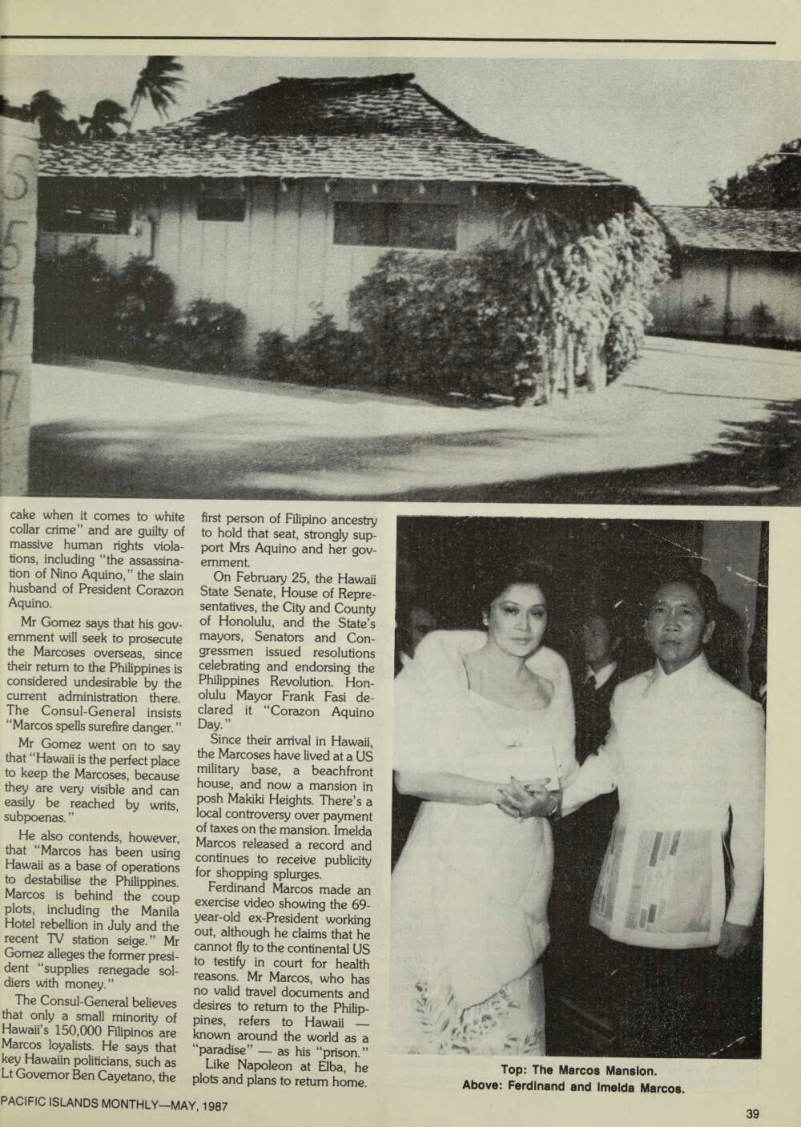
On February 26, 1986, Ferdinand and Imelda Marcos arrived in Hawaii via US military air transport, after being ousted from the turbulent Philippines by a “peoples’ power” and military backed popular rebellion.
Marcos commemorated the one year anniversary of his overthrow as “a day of mourning.” Our Hawaii cor respondent, Ed Rampell, reports on Marcos in exile at Hawaii, one year after:
Ferdinand Marcos still vows to return to the Philippines, one year after a popular uprising forced him into exile at Hawaii.
The deposed dictator disputes the usual interpretation of the chain of events resulting in his overthrow. According to Mar cos spokesman Gemmo Trini dad, Mr Marcos “is still legiti mate president of the Philip pines. He was not really ousted by a people’s power popular revolt. The President was re moved by the US government and practically kidnapped to Hawaii. The State Department is behind this move, because they couldn’t accept the Presi dent’s independence in running our government.”
Mr Trinidad says the Mar coses are marking the one year anniversary of their forced de parture for Hawaii as; “a day of
mourning for the death of democracy in the Philippines.”
The official spokesman went on to say that: “President Marcos will, of course, return to the Philippines. It’s his birth-right as a citizen to be there. He’s a Filipino through and through.
His human rights are being denied by the government of Mrs Aquino.”
Mr Trinidad says the exiled leader expects “the Aquino government to collapse in the
near future . . . and for the Communists to take over.” If Mr Marcos resumed the presidency, Mr Trinidad says that he’d “confront the Communists head on. ” The Marcos spokesman alleges that the current administration in Manila is soft on communism and eschews negotiations with the New Peoples’ Army and the Peoples’ Party.
Mr Trinidad asserts that the nuclear free provisions of the
new Philippines constitution render “the US military bases there useless.” He says Mr Marcos opposes the anti-nuc lear constitutional clauses and would extend the leases for the American installations, which lapse in 1991.
Mr Trinidad adds the Mar coses have “a hard time under standing the US decision to back Mrs Aquino” and “feel sorry for America for picking a lemon . . . They feel sorry for the Filipino people and wish to restore democracy there, but are not personally depressed” on the anniversary of their arrival in Hawaii.
The Republic of the Philip pines’ Hawaii Consul-General, Tomas Gomez, regards the Marcoses as “psychopaths” and “criminals” motivated by greed and lust for power. He says that the couple “take the
cake when it comes to white collar crime” and are guilty of massive human rights viola tions, including “the assassina tion of Nino Aquino,” the slain husband of President Corazon Aquino.
Mr Gomez says that his gov ernment will seek to prosecute the Marcoses overseas, since their return to the Philippines is considered undesirable by the current administration there.
The Consul-General insists “Marcos spells surefire danger. ”
Mr Gomez went on to say that “Hawaii is the perfect place to keep the Marcoses, because they are very visible and can easily be reached by writs, subpoenas. ”
He also contends, however, that “Marcos has been using Hawaii as a base of operations to destabilise the Philippines.
Marcos is behind the coup plots, including the Manila Hotel rebellion in July and the recent TV station seige.” Mr Gomez alleges the former presi dent “supplies renegade sol diers with money.”
The Consul-General believes that only a small minority of Hawaii’s 150,000 Filipinos are Marcos loyalists. He says that key Hawaiin politicians, such as Lt Governor Ben Cayetano, the
first person of Filipino ancestry to hold that seat, strongly sup port Mrs Aquino and her gov ernment On February 25, the Hawaii State Senate, House of Repre sentatives, the City and County of Honolulu, and the State’s mayors, Senators and Con gressmen issued resolutions celebrating and endorsing the Philippines Revolution. Hon olulu Mayor Frank Fasi de clared it “Corazon Aquino Day.”
Since their arrival in Hawaii, the Marcoses have lived at a US military base, a beachfront house, and now a mansion in posh Makiki Heights. There’s a local controversy over payment of taxes on the mansion. Imelda Marcos released a record and continues to receive publicity for shopping splurges.
Ferdinand Marcos made an exercise video showing the 69year-old ex-President working out, although he claims that he cannot fly to the continental US to testify in court for health reasons. Mr Marcos, who has no valid travel documents and desires to return to the Philip pines, refers to Hawaii known around the world as a “paradise” as his “prison.”
Like Napoleon at Elba, he plots and plans to return home.
Top: The Marcos Mansion.
Above: Ferdinand and Imelda Marcos.
Advertisements & other items, p. 38 (1 item)
Mixer (even in muddy conditions)
* The fully mobile Concrete
The Lees Hydramixer makes mixing concrete on site that much easier plus it saves time, money and manpower.
The Lees Hydramixer, tested and proven for years, ★ Transports to any location on 7 ton truck. ★ Is self loading from materials dumped on site. ★ Discharges via a swivel shute and places mixed concrete from bucket up to 2745 mm (9ft.) high. ★ Has bowl capacity 1.15m 3 (1 Vzyds) up to 4.5m 3 (6yds) per hour. ★ Load gauge for accurate weight mixes. cr ♦ Patented » R f For more details fill in this coupon for a free brochure.
Lees Industries Ltd.
P.O. Box 29, Rangiora, N.Z.
Name: Address: m|
a tourist in Paradise
books
How to survive as a tourist in Paradise
Tahiti & French Polynesia; a travel survival kit. By Robert F. Kay. Published by Lonely Planet Publications, South Yar ra, Victoria, 1985. $A9.95.
Isbn 0 908086 80 6
Fiji; a travel survival kit. By Rob Kay. Published by Lonely Planet Publications, South Yar ra, Victoria, 1986. $A9.95.
Isbn 0 908086 87 3
Ecuador and the Galapagos Islands; a travel survival kit.
By Rob Rachowiecki. Pub lished by Lonely Planet Publications, South Yarra, Vic toria, 1986. $A9.95. ISBN 0 908086 79 2 One of the most interes ting corollaries of the boom in international travel has been the ex plosion in travel book pub lishing. It is surely only a matter of time before one can find at one’s neighborhood bookstore guides to the most remote and even the most forbidding parts of this planet.
In fact the trend is well under way. Countries whose domestic infrastructures can barely cope with their own populations, whose international relations are in many cases precarious and whose people’s experience of outsiders is still rudimentary now find themselves the sub jects of travel guides directed at an international market. And like travel itself, which is in creasingly packaged and formularised, the most success ful of the publishers of travel guides work to a recognisable formula.
Such a formula has been very skilfully fashioned by the Melbourne-based Lonely Planet organisation, publishers of the three books reviewed here. Lonely Planet’s current catalogue runs to some 43 titles, making it one of the most
prolific publishers in this busi ness. If you fancy a vacation in Burma or Bangladesh, Turkey or Tibet, you can find a Lonely Planet book to put you on the right track.
Not surprisingly, the list of titles has now been extended to include the Pacific Islands.
Whether travellers really need another guide book on Fiji is a moot point; three appeared in late 1985 (see review in PIM June 1986), another, PIMs own Fiji Handbook, will appear soon. But, perhaps surprisingly, there is not a great deal of similarity between them and little repetition of material. Au thor Rob Kay is responsible for both the Fiji and the Tahiti guides, although the corporate style of Lonely Planet is more evident than any individual characteristics.
This means that the fun damentals of travel; visas, money, clothing, health, trans port etc occupy a good deal of space in each book in the Tahiti volume about 25 of a mere 136 pages. As a result there are not all that many pages left to spread over French Polynesia’s 130 or so islands.
But then, despite the vast geographical spread of French Polynesia, there are not all that many places that tourists or travellers if you prefer it can conveniently visit, apart from Tahiti itself and a few other islands.
The major inhibiting factor to travel within these islands is the enormous expense involved: if you really want to go and stay in a guest house in the Gam biers it will cost you two arms and a leg just to get there. If you’re determined to do it, however, you may as well start with this book which, in the style by now typical of Lonely Planet, packs a lot of informa
tion, some useful, some gra tuitous, into a neatly produced little volume.
There are some errors and omissions which are worth mentioning. Nuku Hiva is in the Marquesas, not the Tuamotus as the picture facing page 97 claims; the section on the Tuamotus contains not a single reference to the nuclear testing sites, and the tests are referred to almost casually in the outline history; the suggested reading ignores what has been for long the only popular account of Tahiti’s history Robert Lang don’s Tahiti; Island of Love.
On the credit side, the maps are plentiful and clearly drawn, the illustrations generally evocative and the account of Tahiti’s sexually ambivalent nightlife guaranteed to fetch more visitors from Sydney or San Francisco.
The volume on Fiji contains more information and repre sents better value, reflecting two obvious facts; Fiji is a more interesting and varied country and, although considerably lar ger in land area, is more com pact and easier to get about.
There are travel tips here on all the major islands in Fiji and several minor ones and though I have an ongoing suspicion that most of the travel guide writers who describe islands like Rotuma or the Lau Group have never actually been there, their inclusion helps to give the im pression of comprehensiveness to works like this.
Aiding that impression are extensive descriptions of accommodation and local transport facilities, notes on Fi ji’s cultural and religious fea tures and a valiant attempt to make summary sense of Fiji’s often confusing history.
Kay has obviously been
helped by the existing literature on Fiji, despite his claim that there are comparatively few books written about the coun try. Where on earth was he looking? Among the best fea tures of the Lonely Planet guides are the hotel and re staurant listings: if you want to stay in Fiji on a tight budget and eat on the cheap, ignore the advice of your travel agent and invest in a book like this. You’ll save the outlay on your first day.
Yes, I know Ecuador is not a Pacific Island, and the denizens of the Galapagos don’t fall conveniently into the Polyne sian, Melanesian or Microne sian categories, being for the most part seals, reptiles and birds. But since the Galapagos have always been included in the ultimate work of Pacific reference the Pacific Islands Yearbook and have figured scientifically and historically in the story of the Pacific it seems appropriate to mention this guide also, especially since it arrived at the same time and happens to be the best of the three, lacking the disquieting impression of hurriedness that the other two have.
The description of the Gala pagos unfortunately only occu pies 17 pages of a 238 page book, so the enthusiast for curious wildlife is hardly likely to besiege the book stores for it.
If you do plan on going there, however, you might consider this rather unsettling fact: these islands, so remote in the minds of most people as to seem almost unearthly, now attract more than 20,000 visitors a year, almost as many as the Cook Islands, and more than Tonga and Niue combined.
Who said this was a Lonely Planet? Norman Douglas
Islands travelogue
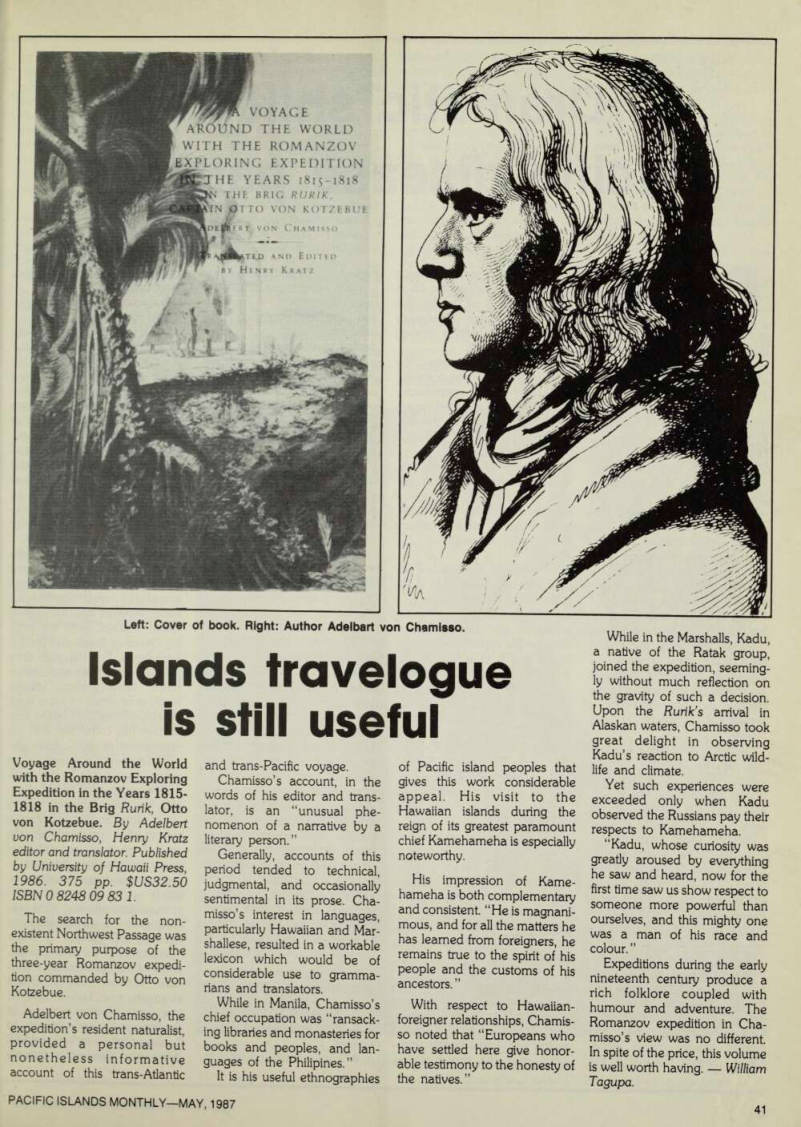
is still useful
Voyage Around the World with the Romanzov Exploring Expedition in the Years 1815- 1818 in the Brig Rurik, Otto von Kotzebue. By Adelbert von Chamisso, Henry Kratz editor and translator. Published by University of Hawaii Press, 1986. 375 pp. $U532.50
Isbn 0 8248 09 83 1.
The search for the nonexistent Northwest Passage was the primary purpose of the three-year Romanzov expedition commanded by Otto von Kotzebue.
Adelbert von Chamisso, the expedition s resident naturalist, provided a personal but nonetheless informative account of this trans-Atlantic
and trans-Pacific voyage, Chamisso’s account, in the words of his editor and trans lator, is an “unusual phe nomenon of a narrative by a literary person.”
Generally, accounts of this period tended to technical, judgmental, and occasionally sentimental in its prose. Cha misso \ nte f rest in lan 9uages, P ar J; cularl y Hawaiian and Mar shallese, resulted in a workable * ex * con which would be of considerabl e use to gramma rians and translators.
While in Manila, Chamisso’s chief occupation was “ransack ing libraries and monasteries for books and peoples, and lan guages of the Philipines.”
It is his useful ethnographies
of Pacific island peoples that gives this work considerable appeal. His visit to the Hawaiian islands during the reign of its greatest paramount chief Kamehameha is especially noteworthy.
His impression of Kame hameha is both complementary and consistent. “He is magnani mous, and for all the matters he has learned from foreigners, he remains true to the spirit of his people and the customs of his ancestors. ”
With respect to Hawaiian foreigner relationships, Chamis so noted that “Europeans who have settled here give honor able testimony to the honesty of the natives.”
While in the Marshalls, Kadu, a native of the Ratak group, joined the expedition, seeming ly without much reflection on the gravity of such a decision.
Upon the Rurik’s arrival in Alaskan waters, Chamisso took great delight in observing Kadu’s reaction to Arctic wild life and climate.
Yet such experiences were exceeded only when Kadu observed the Russians pay their respects to Kamehameha.
“Kadu, whose curiosity was greatly aroused by everything he saw and heard, now for the first time saw us show respect to someone more powerful than ourselves, and this mighty one was a man of his race and colour. ”
Expeditions during the early nineteenth century produce a rich folklore coupled with humour and adventure. The Romanzov expedition in Cha misso’s view was no different.
In spite of the price, this volume is well worth having. William Tagupa.
Left: Cover of book. Right: Author Adelbart von Chamisso.
Dramatic shift in Pacific disease patterns
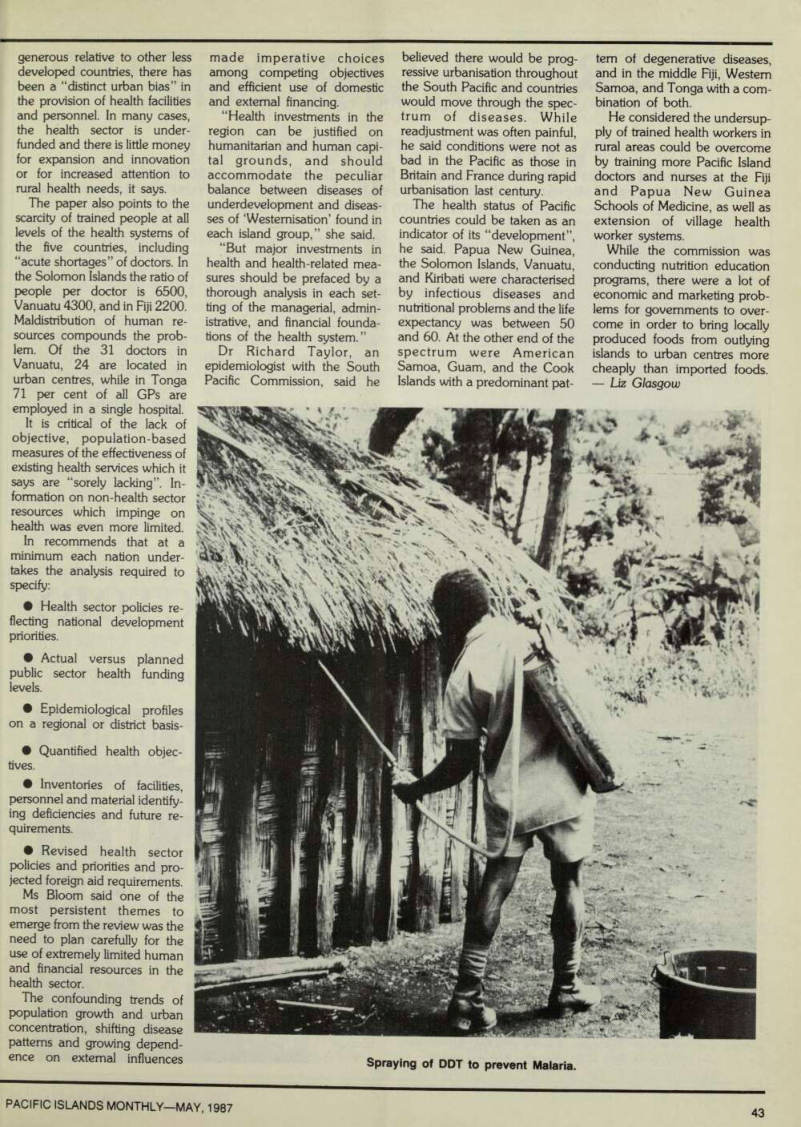
Pacific disease patterns
Changes in diet and lifes tyle are leading to an upsurge in the South Pacific of chronic de generative diseases, such as diabetes, heart disease and can cers, normally associated with affluent, industrialised coun tries.
According to a recent review of the current state of health in five Pacific Island nations Fiji, Solomon Islands, Tonga, Vanuatu and Western Samoa the dramatic shift in disease patterns coincides with the adoption of Westernised life styles.
The review entitled, “Health and Nutrition Problems and Policy Issues in the Pacific” by Ms Abby Bloom of the Univer sity of Sydney’s School of Public Health and Tropical Medicine, notes that prevalence rates of diabetes in the Pacific Islands are now among the highest in the world, although as recently as 15 years ago the disease did not constitute a significant problem in the region.
Research indicates a ten-fold increase in diabetes among urban Fijians in a ten-year period between the late 1960 s and late ’7os, while diabetes and cardiovascular disease combined now account for one-third of all deaths in Fiji.
Diabetes also occurs two to six times more frequently among urbanised Polynesians and Melanesians in Fiji and Western Samoa compared with traditio nal rural populations.
Although data on the inci dence of cancer in the South Pacific is sparse, says Ms Bloom, it appears that rates are lowest in “less developed”
Pacific Island countries and highest among more “deve loped” islands. Cancer is the
second leading cause of death in Tonga, accounting for 16 to 18 per cent of all deaths, the third cause among Melanesian Fijians, and the forth among Western Samoans.
Cardiovascular diseases, the most important being coronary heart disease and hypertension, are the leading reported causes of death in three of the five nations reviewed Fiji, Tonga and Western Samoa.
The rates of these diseases and associated major risk fac tors such as lack of physical exercise, smoking, and stress, while varying among nations are rising throughout the region.
Increasingly, the South Paci fic is also falling victim to those other ills of modem society alcoholism, domestic violence, accidents, and suicide. Accor ding to the report, recent evi dence points to a startling in crease in the rate of accidental and intentional death due to drinking paraquat, a commonly available and especially toxic herbicide. The trend is most common among 15 to 25-year old males in Western Samoa and Fiji, although there is a high rate of suicide among young Indian females with the chemical.
Complex social and econo mic factors such as frustration over limited employment opportunities, friction between parents and children, and the “intolerable treatment” of young Indian brides by their in-laws are believed to be the major causes.
A move away from traditio nal food habits particularly in urban areas to a diet heavily reliant on imported and proces sed foods underlies the region’s principal health prob lems, says the report. While
these foods have the advantage of often being more accessible, more convenient to prepare and eat, and cheaper, they have contributed to a serious decline in nutritional standards.
The paper notes that the contemporary diet contains ex cessive animal fat, salt, and calories and that traditional high fibre root vegetables such as taro, sweet potatoes and yams, are being replaced with less beneficial bread, rice, tinned meats and fish.
A 1980 survey in Fiji re vealed that 7.9 per cent of Fijian children and 24 per cent of Indian children under the age of five years suffered protein malnutrition. But among the adult population of Fiji, 40 per cent of males, 20 per cent of Indians of both sexes, and 80 per cent of Melanesian women in Suva were obese. A similar survey in Vanuatu in 1982, showed that 23 per cent of under-fives had protein dificien cies.
A decline in the length of time babies are breastfed and bottlefeeding have contributed to malnourishment of young children. Studies show a correlation between early weaning and malnourishment among children in Western Samoa and the Solomon Is lands, while malnutrition occurs more frequently among bot tlefed Fijian children. Bottlefed children are also more likely to succumb to gastroenteritis.
Among the crucial factors believed to contribute to the deterioration of health are: • A more sedentary life style. • Inadequate housing. • Poor employment oppor tunities. • Expenditure of low in
comes on goods and services other than food. • Emulation of elite cosmo politan lifestyles.
While life expectancy at birth is generally better than the global average and appreciably better than other developing regions, the paper says the five island countries experience poorer health overall than other South Pacific nations. Life ex pectancy ranges from 54 and 56 years among men and women in Vanuatu to 60 and 66.2 in Fiji, compared with an average combined life ex pectancy of 74 throughout the region.
Until 1950 s infectious dis eases, such as measles and influenza, and other diseases associated with inadequate water supplies and unhygienic waste disposal, were the lead ing causes of illness and prema ture death. But the shift since World War 2 from rural, struc tured, homogenous, village based economies to more fluid, heterogeneous cash-based eco nomies has coincided with the emergence of non-communic able degenerative diseases. The paper argues that by the mid 1980s, virtually all island coun tries had been affected by this “evolution” and there is now a perceptible gradient among them from those characterised more by infectious diseases Vanuatu and the Solomon Is lands to those in which non-communicable diseases dominate Fiji, Western Samoa, and Tonga.
According to the review, most of the island nations allo cate between 11 per cent (Vanuatu and Tonga) and 15 per cent (Western Samoa) of government expenditures to health or between $2O and $BO per capita. While this appears
generous relative to other less developed countries, there has been a “distinct urban bias” in the provision of health facilities and personnel. In many cases, the health sector is under funded and there is little money for expansion and innovation or for increased attention to rural health needs, it says.
The paper also points to the scarcity of trained people at all levels of the health systems of the five countries, including “acute shortages” of doctors. In the Solomon Islands the ratio of people per doctor is 6500, Vanuatu 4300, and in Fiji 2200.
Maldistribution of human re sources compounds the prob lem. Of the 31 doctors in Vanuatu, 24 are located in urban centres, while in Tonga 71 per cent of all GPs are employed in a single hospital.
It is critical of the lack of objective, population-based measures of the effectiveness of existing health services which it says are “sorely lacking”. In formation on non-health sector resources which impinge on health was even more limited.
In recommends that at a minimum each nation under takes the analysis required to specify: • Health sector policies re flecting national development priorities. • Actual versus planned public sector health funding levels. • Epidemiological profiles on a regional or district basis • Quantified health objec tives. • Inventories of facilities, personnel and material identify ing deficiencies and future re quirements. • Revised health sector policies and priorities and pro jected foreign aid requirements.
Ms Bloom said one of the most persistent themes to emerge from the review was the need to plan carefully for the use of extremely limited human and financial resources in the health sector.
The confounding trends of population growth and urban concentration, shifting disease patterns and growing depend ence on external influences
made imperative choices among competing objectives and efficient use of domestic and external financing.
“Health investments in the region can be justified on humanitarian and human capi tal grounds, and should accommodate the peculiar balance between diseases of underdevelopment and diseas ses of ‘Westernisation’ found in each island group,” she said.
“But major investments in health and health-related mea sures should be prefaced by a thorough analysis in each set ting of the managerial, admin istrative, and financial founda tions of the health system.”
Dr Richard Taylor, an epidemiologist with the South Pacific Commission, said he
believed there would be prog ressive urbanisation throughout the South Pacific and countries would move through the spec trum of diseases. While readjustment was often painful, he said conditions were not as bad in the Pacific as those in Britain and France during rapid urbanisation last century.
The health status of Pacific countries could be taken as an indicator of its “development”, he said. Papua New Guinea, the Solomon Islands, Vanuatu, and Kiribati were characterised by infectious diseases and nutritional problems and the life expectancy was between 50 and 60. At the other end of the spectrum were American Samoa, Guam, and the Cook Islands with a predominant pat
tern of degenerative diseases, and in the middle Fiji, Western Samoa, and Tonga with a com bination of both.
He considered the undersup ply of trained health workers in rural areas could be overcome by training more Pacific Island doctors and nurses at the Fiji and Papua New Guinea Schools of Medicine, as well as extension of village health worker systems.
While the commission was conducting nutrition education programs, there were a lot of economic and marketing prob lems for governments to over come in order to bring locally produced foods from outlying islands to urban centres more cheaply than imported foods.
Liz Glasgow
Spraying of DDT to prevent Malaria.
Advertisements & other items, p. 44 (1 item)
cific worn
AMERICAN CONNECTION:
ITS IMPACT ON THE ECONOMIES OF THE WESTERN PACIFIC May 13-15, 1987, Adelup Conference Center, Agana, Guam A Special Conference on the Economic Future of U.S. Freely Associated States of Federated States of Micronesia and Republic of the Marshalls, U.S. Trust Territory of Palau, U.S. Commonwealth of the Northern Marianas, and U.S. Territory of Guam Topics: Investment opportunities, including major development projects, in Region; U.S. financial and economic assistance for Region; U.S. tax and trade benefits, including duty-free entry of Regions goods into U.S. markets; U .S. financial assistance for U.S. businesses in Region; and U.S. military plans and projects for Region. Speakers: Government Heads and Key Island Officials, U.S. Federal Officials Responsible for Region, and Leading Businesspeople in Region. Participants: Government and Non-Government Officials, and Businesspeople from American Pacific, USA, Hawaii, South Pacific, Australia, New Zealand, Japan and Asia. Sponsored partly by: Guam Legislature, Association of Pacific Island Legislatures, Mobil Oil Micronesia, Hawaiian Telephone Company, Calvo Enterprises, and Bank of Guam. Organized by: Pacific World Directory in association with the Office of Guam's Governor and Guam Chamber of Commerce IMPORTANT: Sponsorship and Participation limited. Apply Immediately. () Corporate Sponsorship () Participation () Proceedings For more information, contact: Francisco T. Uludong, Publisher, Pacific World Directory, P. O. Box 1310, Saipan, CM/USA 96950 Tel: (670) 322-3347 Fax: (670) 322-3300 Tlx: (783) 768 PITCO SPN Cable: PITCO, SAIPAN
PACIFIC WORLD DIRECTORY
M®7 EDITION % A COLLECTORS ITEM
The Pacific Islands' Most Comprehensive Information System Coverage: All 21 Pacific Island countries and territories: American Samoa, Cook Islands, Federated States of Micronesia, Fiji, French Polynesia, Guam, Kiribati, Marshalls, Nauru, New Caledonia, Niue, Northern Marianas, Palau, Papua New Guinea, Solomon Islands, Tokelau, Tonga, Tuvalu, Vanuatu, Wallis and Futuna and Western Samoa.
Contents: Pacific Overviews, General Backgrounds, Investment Information, Travel and Business Tips, Business Advocacy Programs, Display and Classified Ads, Island Government Directories, General Directories, Metropolitan Country Government and Business Directories, International, Intergovernmental and Non-governmental Organization Directories. Purposes: To promote private enterprise, to foster trade and commerce, to enhance cooperation and to promote understanding in Region and between Region and the world.
Agents for Advertising and Sales Needed in: American Samoa, Australia, England, Fiji, France, French Polynesia, Germany, Kiribati, Nauru, New Caledonia, Niue, Papua New Guinea, Solomon Islands, Tuvalau, Wallis and Futuna, and Western Samoa
Subscription for 1987 Edition:
US$3B for US and American Pacific and US$5O for Foreign Countries For advertisement in 1988 Edition, contact: Business Manager, Pacific World Directory P. O. Box 1310, Saipan, CM/USA 96950 Tel: (671) 322-3347 Fax: 322-3300 Tlx: (783) 768 PITCO SPN
cific worn
r r
Marshalls readies
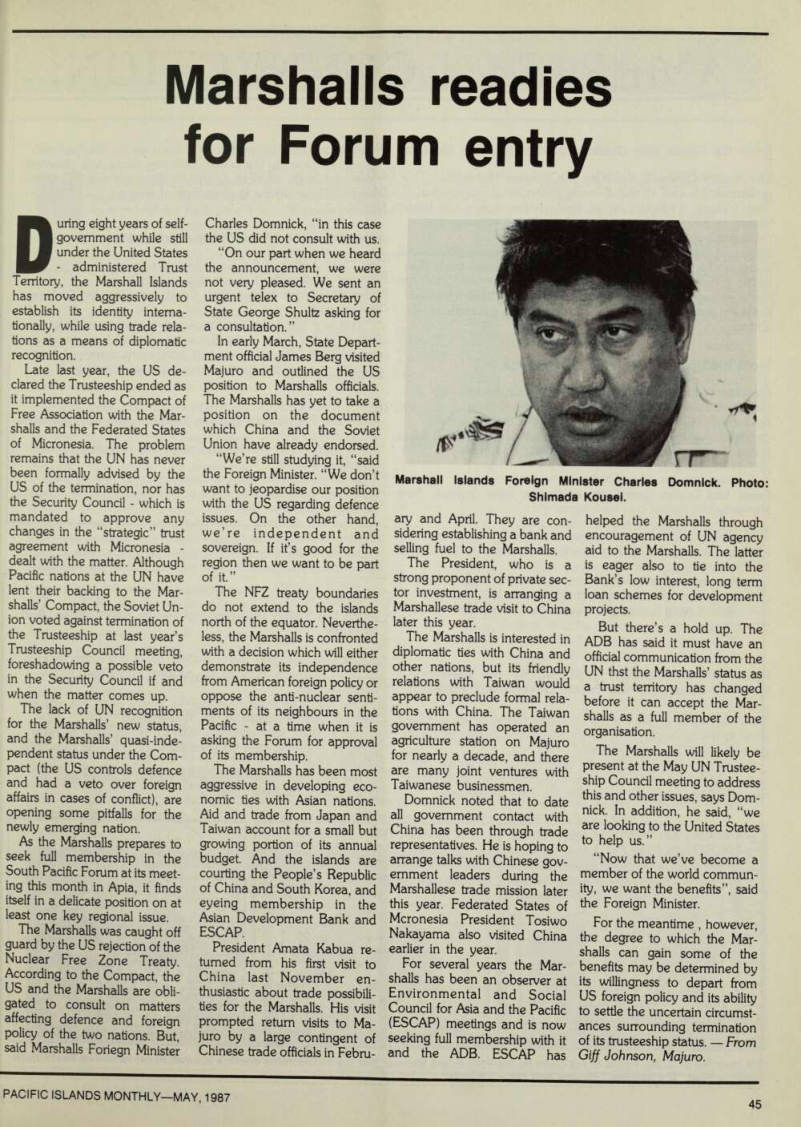
for Forum entry
During eight years of self government while still under the United States - administered Trust Territory, the Marshall Islands has moved aggressively to establish its identity interna tionally, while using trade rela tions as a means of diplomatic recognition.
Late last year, the US de clared the Trusteeship ended as it implemented the Compact of Free Association with the Mar shalls and the Federated States of Micronesia. The problem remains that the UN has never been formally advised by the US of the termination, nor has the Security Council - which is mandated to approve any changes in the “strategic” trust agreement with Micronesia dealt with the matter. Although Pacific nations at the UN have lent their backing to the Mar shalls’ Compact, the Soviet Un ion voted against termination of the Trusteeship at last year’s Trusteeship Council meeting, foreshadowing a possible veto in the Security Council if and when the matter comes up.
The lack of UN recognition for the Marshalls’ new status, and the Marshalls’ quasi-inde pendent status under the Com pact (the US controls defence and had a veto over foreign affairs in cases of conflict), are opening some pitfalls for the newly emerging nation.
As the Marshalls prepares to seek full membership in the South Pacific Forum at its meet ing this month in Apia, it finds itself in a delicate position on at least one key regional issue.
The Marshalls was caught off guard by the US rejection of the Nuclear Free Zone Treaty.
According to the Compact, the US and the Marshalls are obli gated to consult on matters affecting defence and foreign policy of the two nations. But, said Marshalls Foriegn Minister
Charles Domnick, “in this case the US did not consult with us.
“On our part when we heard the announcement, we were not very pleased. We sent an urgent telex to Secretary of State George Shultz asking for a consultation.”
In early March, State Depart ment official James Berg visited Majuro and outlined the US position to Marshalls officials.
The Marshalls has yet to take a position on the document which China and the Soviet Union have already endorsed.
“We’re still studying it, “said the Foreign Minister. “We don’t want to jeopardise our position with the US regarding defence issues. On the other hand, we’re independent and sovereign. If it’s good for the region then we want to be part of it.”
The NFZ treaty boundaries do not extend to the islands north of the equator. Neverthe less, the Marshalls is confronted with a decision which will either demonstrate its independence from American foreign policy or oppose the anti-nuclear senti ments of its neighbours in the Pacific - at a time when it is asking the Forum for approval of its membership.
The Marshalls has been most aggressive in developing eco nomic ties with Asian nations.
Aid and trade from Japan and Taiwan account for a small but growing portion of its annual budget. And the islands are courting the People’s Republic of China and South Korea, and eyeing membership in the Asian Development Bank and
Escap.
President Amata Kabua re turned from his first visit to China last November en thusiastic about trade possibili ties for the Marshalls. His visit prompted return visits to Ma juro by a large contingent of Chinese trade officials in Febru-
ary and April. They are considering establishing a bank and selling fuel to the Marshalls.
The President, who is a strong proponent of private sector investment, is arranging a Marshallese trade visit to China la rl th £ ye u r „ • ■ J The Marshalls is interested in diplomatic ties with China and other nations, but its friendly relations with Taiwan would appear to preclude formal relatens with China. The Taiwan government has operated an agriculture station on Majuro for nearly a decade, and there are many joint ventures with Taiwanese businessmen.
Domnick noted that to date all government contact with China has been through trade representatives. He is hoping to arrange talks with Chinese government leaders during the Marshallese trade mission later this year. Federated States of Mcronesia President Tosiwo Nakayama also visited China eadier in the year.
For several years the Marshalls has been an observer at Environmental and Social Council for Asia and the Pacific (ESCAP) meetings and is now seeking full membership with it and the ADB. ESCAP has
helped the Marshalls through encouragement of UN agency aid to the Marshalls. The latter is eager also to tie into the Bank’s low interest, long term loan schemes for development projects.
But there’s a hold up. The ADB has said it must have an official communication from the UN thst the Marshalls’ status as a trust territory has changed before it can accept the Mar shalls as a full member of the organisation.
The Marshalls will likely be present at the May UN Trustee ship Council meeting to address this and other issues, says Dom nick. In addition, he said, “we are looking to the United States to help us.”
“Now that we’ve become a member of the world commun ity, we want the benefits”, said the Foreign Minister.
For the meantime , however, the degree to which the Mar shalls can gain some of the benefits may be determined by its willingness to depart from US foreign policy and its ability to settle the uncertain circumst ances surrounding termination of its trusteeship status. From Giff Johnson, Majuro.
Marshall Islands Foreign Minister Charles Domnick. Photo: Shimada Kousei.
from t he islands press
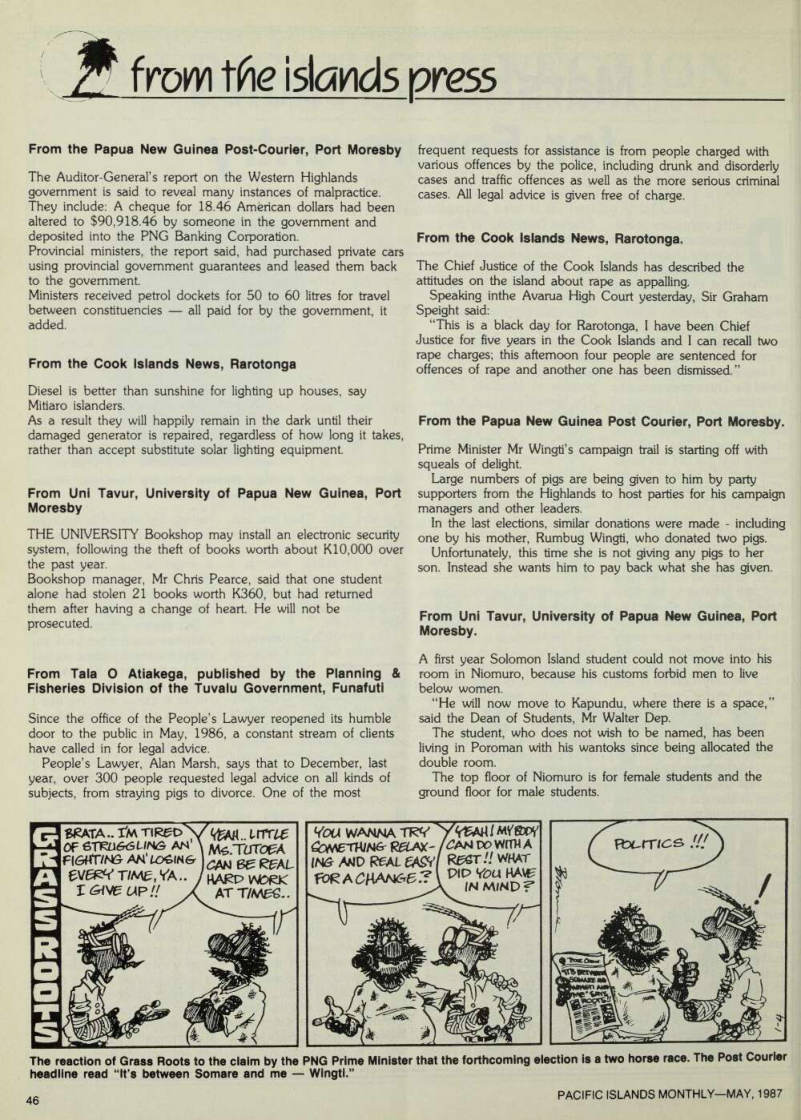
From the Papua New Guinea Post-Courier, Port Moresby The Auditor-General’s report on the Western Highlands government is said to reveal many instances of malpractice.
They include: A cheque for 18.46 American dollars had been altered to $90,918.46 by someone in the government and deposited into the PNG Banking Corporation.
Provincial ministers, the report said, had purchased private cars using provincial government guarantees and leased them back to the government.
Ministers received petrol dockets for 50 to 60 litres for travel between constituencies all paid for by the government, it added.
From the Cook Islands News, Rarotonga Diesel is better than sunshine for lighting up houses, say Mitiaro islanders.
As a result they will happily remain in the dark until their damaged generator is repaired, regardless of how long it takes, rather than accept substitute solar lighting equipment.
From Uni Tavur, University of Papua New Guinea, Port Moresby THE UNIVERSITY Bookshop may install an electronic security system, following the theft of books worth about KlO,OOO over the past year.
Bookshop manager, Mr Chris Pearce, said that one student alone had stolen 21 books worth K 360, but had returned them after having a change of heart. He will not be prosecuted.
From Tala O Atiakega, published by the Planning & Fisheries Division of the Tuvalu Government, Funafuti Since the office of the People’s Lawyer reopened its humble door to the public in May, 1986, a constant stream of clients have called in for legal advice.
People’s Lawyer, Alan Marsh, says that to December, last year, over 300 people requested legal advice on all kinds of subjects, from straying pigs to divorce. One of the most
frequent requests for assistance is from people charged with various offences by the police, including drunk and disorderly cases and traffic offences as well as the more serious criminal cases. All legal advice is given free of charge.
From the Cook Islands News, Rarotonga.
The Chief Justice of the Cook Islands has described the attitudes on the island about rape as appalling.
Speaking inthe Avarua High Court yesterday, Sir Graham Speight said: “This is a black day for Rarotonga, I have been Chief Justice for five years in the Cook Islands and I can recall two rape charges; this afternoon four people are sentenced for offences of rape and another one has been dismissed.”
From the Papua New Guinea Post Courier, Port Moresby.
Prime Minister Mr Wingti’s campaign trail is starting off with squeals of delight.
Large numbers of pigs are being given to him by party supporters from the Highlands to host parties for his campaign managers and other leaders.
In the last elections, similar donations were made - including one by his mother, Rumbug Wingti, who donated two pigs.
Unfortunately, this time she is not giving any pigs to her son. Instead she wants him to pay back what she has given.
From Uni Tavur, University of Papua New Guinea, Port Moresby.
A first year Solomon Island student could not move into his room in Niomuro, because his customs forbid men to live below women.
“He will now move to Kapundu, where there is a space,” said the Dean of Students, Mr Walter Dep.
The student, who does not wish to be named, has been living in Poroman with his wantoks since being allocated the double room.
The top floor of Niomuro is for female students and the ground floor for male students.
The reaction of Grass Roots to the claim by the PNG Prime Minister that the forthcoming election is a two horse race. The Post Courier headline read “It’s between Somare and me -Wingti.”
Pacific stamp box
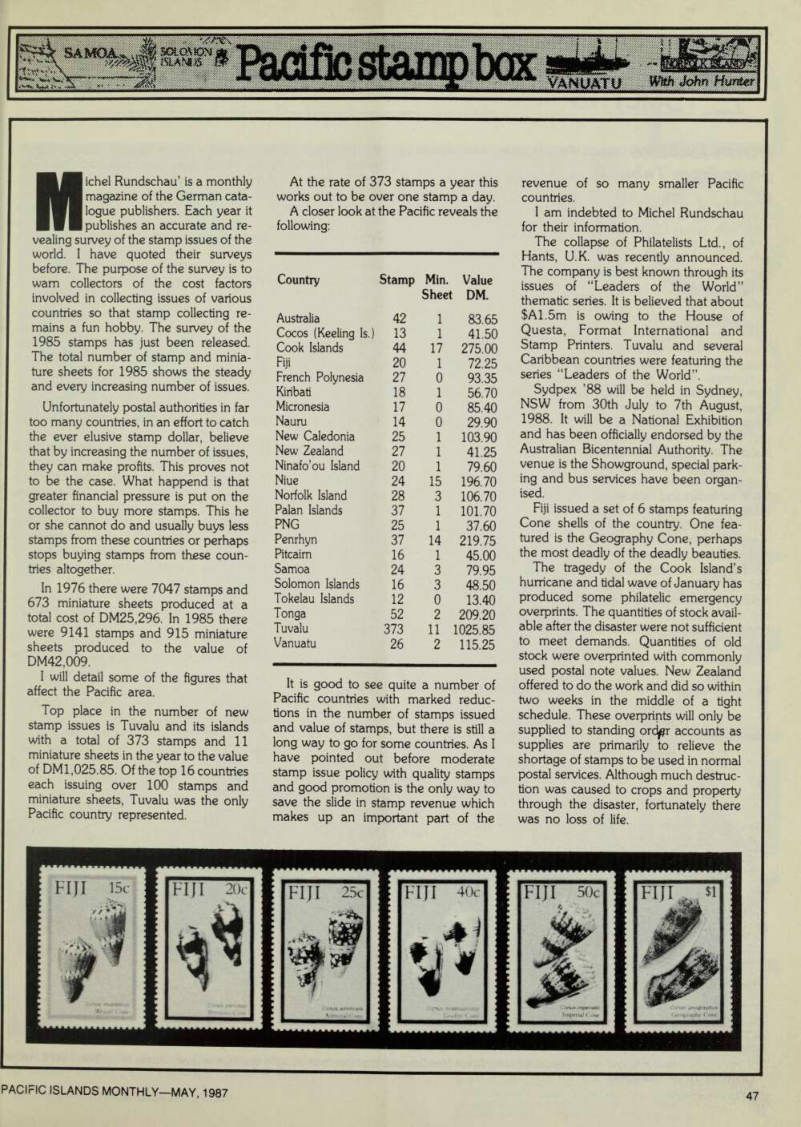
Michel Rundschau’ is a monthly magazine of the German cata logue publishers. Each year it publishes an accurate and re vealing survey of the stamp issues of the world. I have quoted their surveys before. The purpose of the survey is to warn collectors of the cost factors involved in collecting issues of various countries so that stamp collecting re mains a fun hobby. The survey of the 1985 stamps has just been released.
The total number of stamp and minia ture sheets for 1985 shows the steady and every increasing number of issues.
Unfortunately postal authorities in far too many countries, in an effort to catch the ever elusive stamp dollar, believe that by increasing the number of issues, they can make profits. This proves not to be the case. What happend is that greater financial pressure is put on the collector to buy more stamps. This he or she cannot do and usually buys less stamps from these countries or perhaps stops buying stamps from these coun tries altogether.
In 1976 there were 7047 stamps and 673 miniature sheets produced at a total cost of DM25,296. In 1985 there were 9141 stamps and 915 miniature sheets produced to the value of DM42,009.
I will detail some of the figures that affect the Pacific area.
Top place in the number of new stamp issues is Tuvalu and its islands with a total of 373 stamps and 11 miniature sheets in the year to the value of DM1,025.85. Of the top 16 countries each issuing over 100 stamps and miniature sheets, Tuvalu was the only Pacific country represented.
At the rate of 373 stamps a year this works out to be over one stamp a day.
A closer look at the Pacific reveals the following:
It is good to see quite a number of Pacific countries with marked reduc tions in the number of stamps issued and value of stamps, but there is still a long way to go for some countries. As I have pointed out before moderate stamp issue policy with quality stamps and good promotion is the only way to save the slide in stamp revenue which makes up an important part of the
revenue of so many smaller Pacific countries.
I am indebted to Michel Rundschau for their information.
The collapse of Philatelists Ltd., of Hants, U.K. was recently announced.
The company is best known through its issues of “Leaders of the World” thematic series. It is believed that about $ A 1.5 m is owing to the House of Questa, Format International and Stamp Printers. Tuvalu and several Caribbean countries were featuring the series “Leaders of the World”.
Sydpex ’BB will be held in Sydney, NSW from 30th July to 7th August, 1988. It will be a National Exhibition and has been officially endorsed by the Australian Bicentennial Authority. The venue is the Showground, special park ing and bus services have been organ ised.
Fiji issued a set of 6 stamps featuring Cone shells of the country. One fea tured is the Geography Cone, perhaps the most deadly of the deadly beauties.
The tragedy of the Cook Island’s hurricane and tidal wave of January has produced some philatelic emergency overprints. The quantities of stock avail able after the disaster were not sufficient to meet demands. Quantities of old stock were overprinted with commonly used postal note values. New Zealand offered to do the work and did so within two weeks in the middle of a tight schedule. These overprints will only be supplied to standing accounts as supplies are primarily to relieve the shortage of stamps to be used in normal postal services. Although much destruc tion was caused to crops and property through the disaster, fortunately there was no loss of life.
Country Stamp Min.
Value Sheet DM.
Australia 42 1 83.65 Cocos (Keeling Is.) I 13 1 41.50 Cook Islands 44 17 275.00 Fiji 20 1 72.25 French Polynesia 27 0 93.35 Kiribati 18 1 56.70 Micronesia 17 0 85.40 Nauru 14 0 29.90 New Caledonia 25 1 103.90 New Zealand 27 1 41.25 Ninafo’ou Island 20 1 79.60 Niue 24 15 196.70 Norfolk Island 28 3 106.70 Palan Islands 37 1 101.70
Png
25 1 37.60 Penrhyn 37 14 219.75 Pitcairn 16 1 45.00 Samoa 24 3 79.95 Solomon Islands 16 3 48.50 Tokelau Islands 12 0 13.40 Tonga 52 2 209.20 Tuvalu 373 11 1025.85 Vanuatu 26 2 115.25
yachts
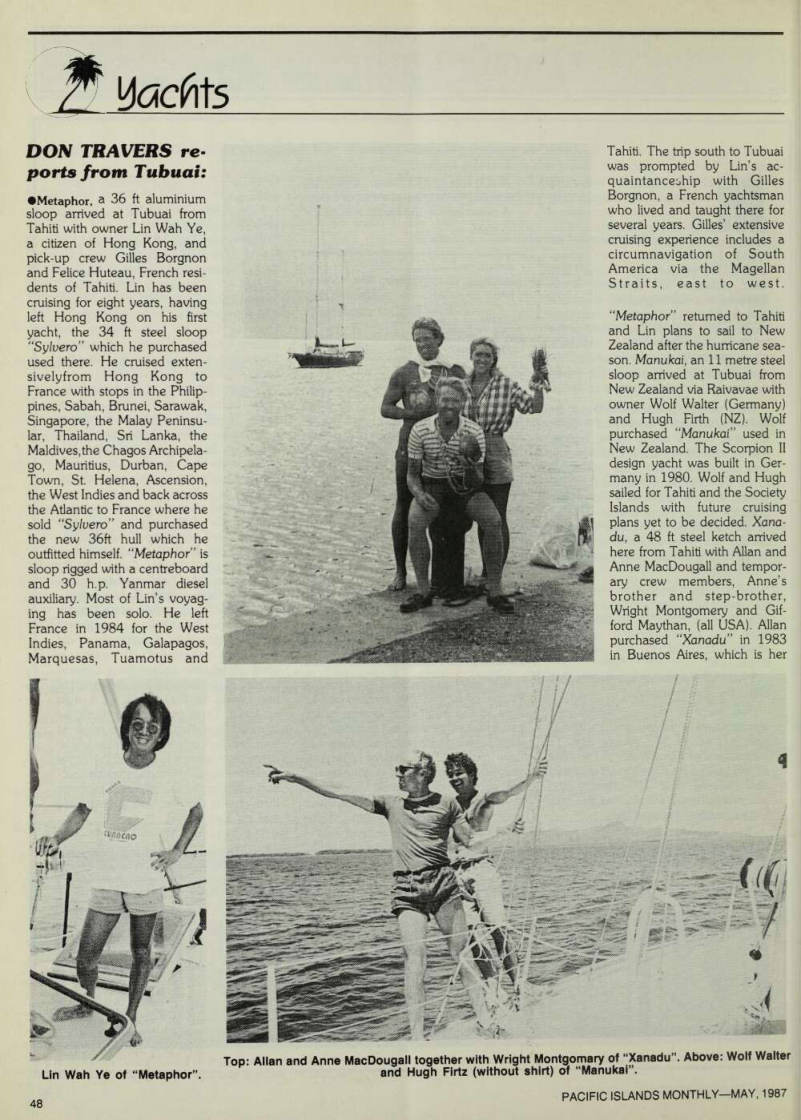

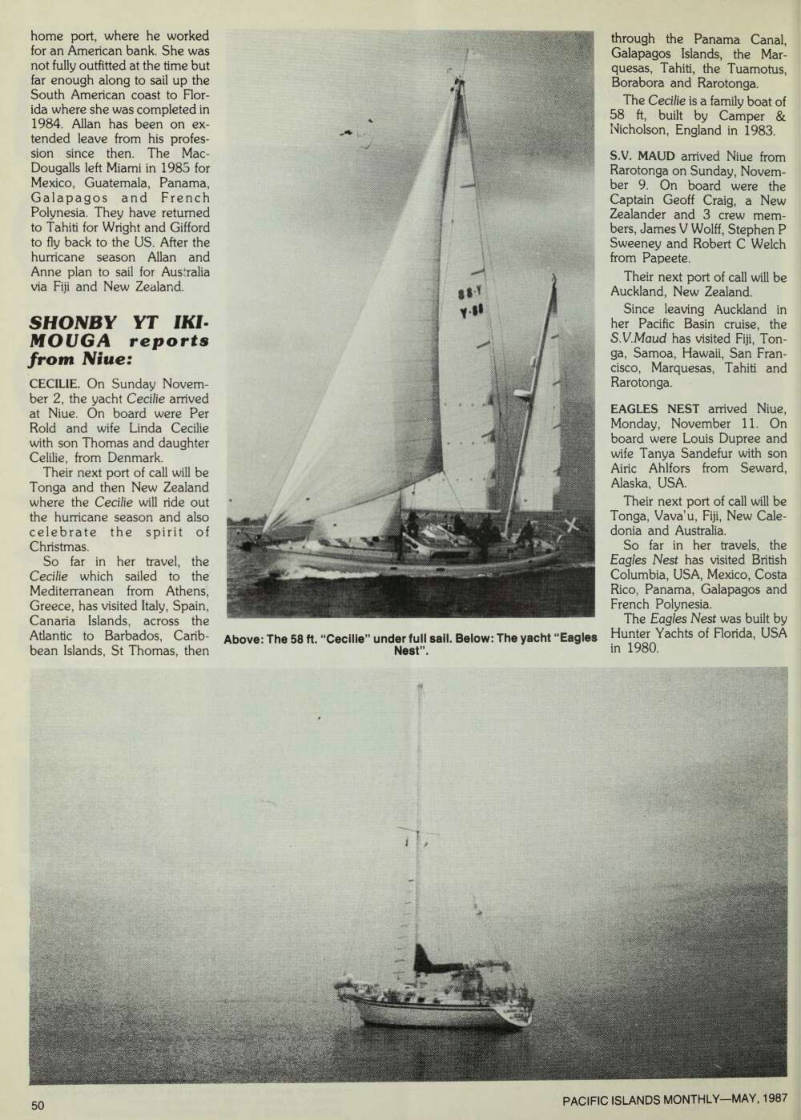
Don Travers Re
ports from Tubuai:
•Metaphor, a 36 ft aluminium sloop arrived at Tubuai from Tahiti with owner Lin Wah Ye, a citizen of Hong Kong, and pick-up crew Gilles Borgnon and Felice Huteau, French resi dents of Tahiti. Lin has been cruising for eight years, having left Hong Kong on his first yacht, the 34 ft steel sloop “Syluero” which he purchased used there. He cruised exten sivelyfrom Hong Kong to France with stops in the Philip pines, Sabah, Brunei, Sarawak, Singapore, the Malay Peninsu lar, Thailand, Sri Lanka, the Maldives,the Chagos Archipela go, Mauritius, Durban, Cape Town, St. Helena, Ascension, the West Indies and back across the Atlantic to France where he sold “Syluero” and purchased the new 36ft hull which he outfitted himself. “Metaphor” is sloop rigged with a centreboard and 30 h.p. Yanmar diesel auxiliary. Most of Lin’s voyag ing has been solo. He left France in 1984 for the West Indies, Panama, Galapagos, Marquesas, Tuamotus and
Tahiti. The trip south to Tubuai was prompted by Lin’s ac quaintanceship with Gilles Borgnon, a French yachtsman who lived and taught there for several years. Gilles’ extensive cruising experience includes a circumnavigation of South America via the Magellan Straits, east to west.
“ Metaphor” returned to Tahiti and Lin plans to sail to New Zealand after the hurricane sea son. Manukai, an 11 metre steel sloop arrived at Tubuai from New Zealand via Raivavae with owner Wolf Walter (Germany) and Hugh Firth (NZ). Wolf purchased “ Manukai” used in New Zealand. The Scorpion II design yacht was built in Ger many in 1980. Wolf and Hugh sailed for Tahiti and the Society Islands with future cruising plans yet to be decided. Xana du, a 48 ft steel ketch arrived here from Tahiti with Allan and Anne MacDougall and tempor ary crew members, Anne’s brother and step-brother, Wright Montgomery and Gif ford Maythan, (all USA). Allan purchased “ Xanadu” in 1983 in Buenos Aires, which is her
Lin Wah Ye of “Metaphor”.
Top: Allan and Anne MacDougall together with Wright Montgomery of “Xanadu”. Above: Wolf Walter and Hugh Firtz (without shirt) of “Manukai”.
home port, where he worked for an American bank. She was not fully outfitted at the time but far enough along to sail up the South American coast to Flor ida where she was completed in 1984. Allan has been on ex tended leave from his profes sion since then. The Mac- Dougalls left Miami in 1985 for Mexico, Guatemala, Panama, Galapagos and French Polynesia. They have returned to Tahiti for Wright and Gifford to fly back to the US. After the hurricane season Allan and Anne plan to sail for Australia via Fiji and New Zealand.
Shonby Yt Iki-
MOUGA reports
from Niue:
CECILIE. On Sunday Novem ber 2, the yacht Cecilie arrived at Niue. On board were Per Rold and wife Linda Cecilie with son Thomas and daughter Celilie, from Denmark.
Their next port of call will be Tonga and then New Zealand where the Cecilie will ride out the hurricane season and also celebrate the spirit of Christmas.
So far in her travel, the Cecilie which sailed to the Mediterranean from Athens, Greece, has visited Italy, Spain, Canaria Islands, across the Atlantic to Barbados, Carib bean Islands, St Thomas, then
through the Panama Canal, Galapagos Islands, the Mar quesas, Tahiti, the Tuamotus, Borabora and Rarotonga.
The Cecilie is a family boat of 58 ft, built by Camper & Nicholson, England in 1983.
S.V. MAUD arrived Niue from Rarotonga on Sunday, Novem ber 9. On board were the Captain Geoff Craig, a New Zealander and 3 crew mem bers, James V Wolff, Stephen P Sweeney and Robert C Welch from Papeete.
Their next port of call will be Auckland, New Zealand.
Since leaving Auckland in her Pacific Basin cruise, the S.V.Maud has visited Fiji, Ton ga, Samoa, Hawaii, San Fran cisco, Marquesas, Tahiti and Rarotonga.
EAGLES NEST arrived Niue, Monday, November 11. On board were Louis Dupree and wife Tanya Sandefur with son Airic Ahlfors from Seward, Alaska, USA.
Their next port of call will be Tonga, Vava’u, Fiji, New Cale donia and Australia.
So far in her travels, the Eagles Nest has visited British Columbia, USA, Mexico, Costa Rico, Panama, Galapagos and French Polynesia.
The Eagles Nest was built by Hunter Yachts of Florida, USA in 1980.
Above: The 58 ft. “Cecilie” under full sail. Below: The yacht “Eagles Nest”.
Advertisements & other items, p. 49 (1 item)
sPECtrum
The Wonderful World of Spectrum Stereo
If you value your freedom to choose the best things in life, you will appreciate the Kenwood Spectrum stereo system. Each component is separately engineered by world-leading audio specialists. Spectrum: the performance of a life-time, every time you listen. ; $ jam m
SERIES
Spectrum 206 ■ Separate power and control amplifiers ■ 310Wx2 Music Power ■ Full system infra-red remote control ■ Built-in graphic equalizer ■ Digital tuner with two-programme system timer ■ Station Name Preset System ■ Full-logic double cassette deck ■ Relay-play ■ Relay and dual recording ■Highspeed dubbing ■ Quartz-PLL direct-drive turntable with programme memory ■ 4-way 6-speaker Super Bass Radiator system ■ Options include CD player and surround sound processor Q O O
KENWOOD CORPORATION
Shionogi Shibuya Building, 17-5, 2-chome Shibuya, Shibuya-ku, Tokyo 150, Japan KENWOOD ELECTRONICS AUSTRALIA PTY. LTD. (incorporated in n.s.w) 4E Woodcock Place, Lane Cove, N.S.W. 2066, Australia NEW ZEALAND PETER GILBERT LTD. Auckland Tel. 0011-64-9-393502 FIJI PEPE’S DUTY FREE CENTRE LTD. Tel. 25496, 25497 PAPUA NEW GUINEA S.O. SVENSSON (N.G.) LTD. Port Moresby Tel. 212158, 212111 SOLOMON ISLANDS TECHNIQUE RADIOS CENTRE LTD. Honiara Tel. 416 NEW CALEDONIA HI-FI VOX Noumea Tel. 27-2466, 28-2931 VANUATU FUNG CHOI LUEN. Port-Vila Tel. 2556
TAHITI MAISON AURORE Papeete Tel. 29703
AMERICAN SAMOA ISLAND PACIFIC AGENCIES, INC. Pago Pago Tel. 633-4687
REPUBLIC OF NAURU NAURU CO-OPERATIVE SOCIETY
MARIANA ISLANDS J.C. TENORIO ENTERPRISES Saipan Tel. 6445
transitions
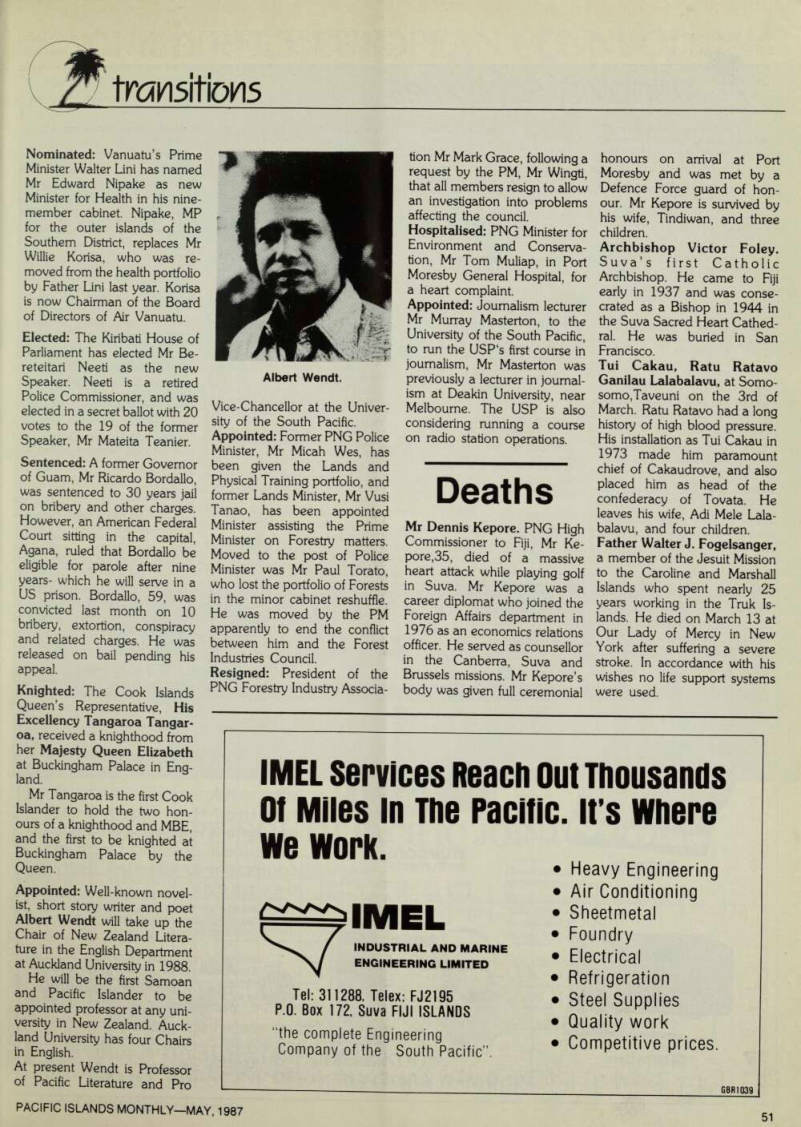
Nominated: Vanuatu’s Prime Minister Walter Lini has named Mr Edward Nipake as new Minister for Health in his nine member cabinet. Nipake, MP for the outer islands of the Southern District, replaces Mr Willie Korisa, who was re moved from the health portfolio by Father Lini last year. Korisa is now Chairman of the Board of Directors of Air Vanuatu.
Elected: The Kiribati House of Parliament has elected Mr Be reteitari Neeti as the new Speaker. Neeti is a retired Police Commissioner, and was elected in a secret ballot with 20 votes to the 19 of the former Speaker, Mr Mateita Teanier.
Sentenced: A former Governor of Guam, Mr Ricardo Bordallo, was sentenced to 30 years jail on bribery and other charges.
However, an American Federal Court sitting in the capital, Agana, ruled that Bordallo be eligible for parole after nine years- which he will serve in a US prison. Bordallo, 59, was convicted last month on 10 bribery, extortion, conspiracy and related charges. He was released on bail pending his appeal.
Knighted: The Cook Islands Queen’s Representative, His Excellency Tangaroa Tangar oa, received a knighthood from her Majesty Queen Elizabeth at Buckingham Palace in Eng land.
Mr Tangaroa is the first Cook Islander to hold the two hon ours of a knighthood and MBE, and the first to be knighted at Buckingham Palace by the Queen.
Appointed: Well-known novel ist, short story writer and poet Albert Wendt will take up the Chair of New Zealand Litera ture in the English Department at Auckland University in 1988.
He will be the first Samoan and Pacific Islander to be appointed professor at any uni versity in New Zealand. Auck land University has four Chairs in English.
At present Wendt is Professor of Pacific Literature and Pro
Vice-Chancellor at the Univer sity of the South Pacific.
Appointed: Former PNG Police Minister, Mr Micah Wes, has been given the Lands and Physical Training portfolio, and former Lands Minister, Mr Vusi Tanao, has been appointed Minister assisting the Prime Minister on Forestry matters.
Moved to the post of Police Minister was Mr Paul Torato, who lost the portfolio of Forests in the minor cabinet reshuffle.
He was moved by the PM apparently to end the conflict between him and the Forest Industries Council.
Resigned: President of the PNG Forestry Industry Associa
tion Mr Mark Grace, following a request by the PM, Mr Wingti, that all members resign to allow an investigation into problems affecting the council.
Hospitalised: PNG Minister for Environment and Conserva tion, Mr Tom Muliap, in Port Moresby General Hospital, for a heart complaint.
Appointed: Journalism lecturer Mr Murray Masterton, to the University of the South Pacific, to run the USP‘s first course in journalism, Mr Masterton was previously a lecturer in journal ism at Deakin University, near Melbourne. The USP is also considering running a course on radio station operations.
Albert Wendt.
Deaths
Mr Dennis Kepore. PNG High Commissioner to Fiji, Mr Kepore,3s, died of a massive heart attack while playing golf in Suva. Mr Kepore was a career diplomat who joined the Foreign Affairs department in 1976 as an economics relations officer. He served as counsellor in the Canberra, Suva and Brussels missions. Mr Kepore’s body was given full ceremonial
honours on arrival at Port Moresby and was met by a Defence Force guard of hon our. Mr Kepore is survived by his wife, Tindiwan, and three children.
Archbishop Victor Foley.
Suva’s first Catholic Archbishop. He came to Fiji early in 1937 and was conse crated as a Bishop in 1944 in the Suva Sacred Heart Cathed ral. He was buried in San Francisco.
Tui Cakau, Ratu Ratavo Ganilau Lalabalavu, at Somo somo,Taveuni on the 3rd of March. Ratu Ratavo had a long history of high blood pressure.
His installation as Tui Cakau in 1973 made him paramount chief of Cakaudrove, and also placed him as head of the confederacy of Tovata. He leaves his wife, Adi Mele Lala balavu, and four children.
Father Walter J. Fogelsanger, a member of the Jesuit Mission to the Caroline and Marshall Islands who spent nearly 25 years working in the Truk Is lands. He died on March 13 at Our Lady of Mercy in New York after suffering a severe stroke. In accordance with his wishes no life support systems were used.
Advertisements & other items, p. 51 (1 item)
£=^Imel
■MEL Services Reach Out Thousands
Of Miles in The Pacific, it’s Where
we work.
£=^IMEL
''"v / INDUSTRIAL AND MARINE
ENGINEERING LIMITED
Tel: 311288, Telex: FJ2195
P.O. Box 172. Suva FIJI ISLANDS
“the complete Engineering Company of the South Pacific”. • Heavy Engineering • Air Conditioning • Sheetmetal • Foundry • Electrical • Refrigeration • Steel Supplies • Quality work • Competitive prices.
GBRIO39 I
shipping schedules

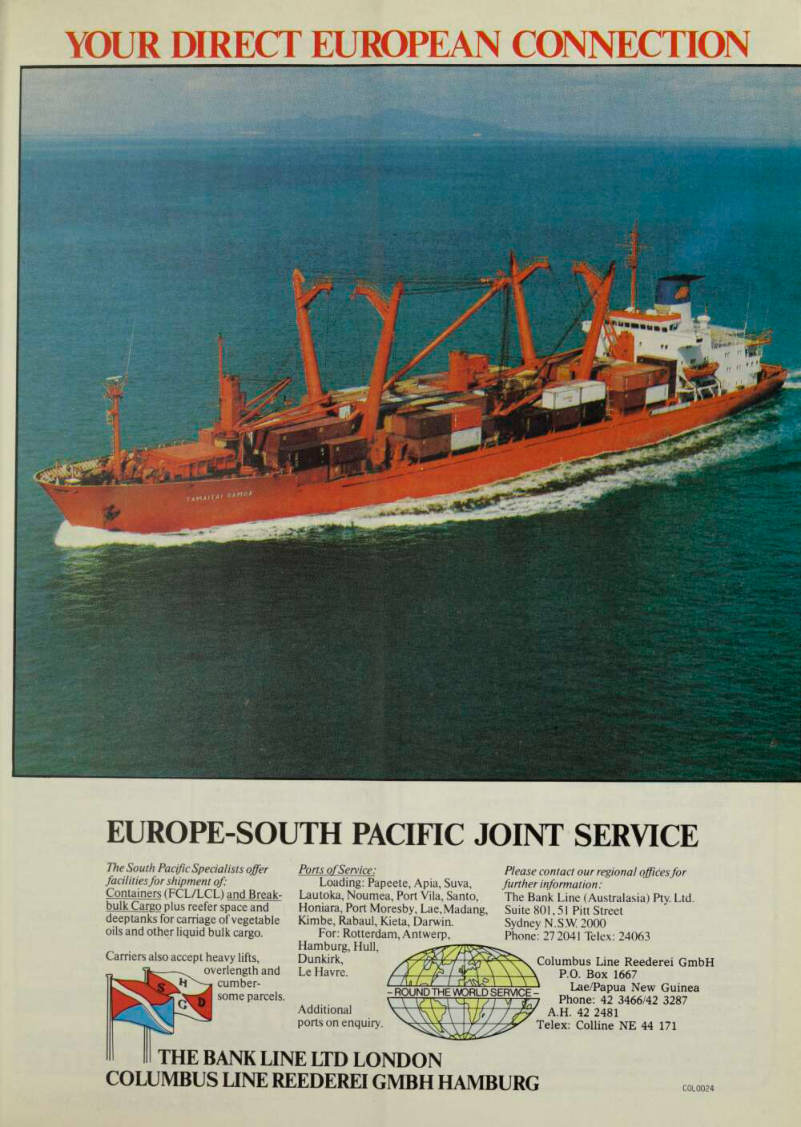
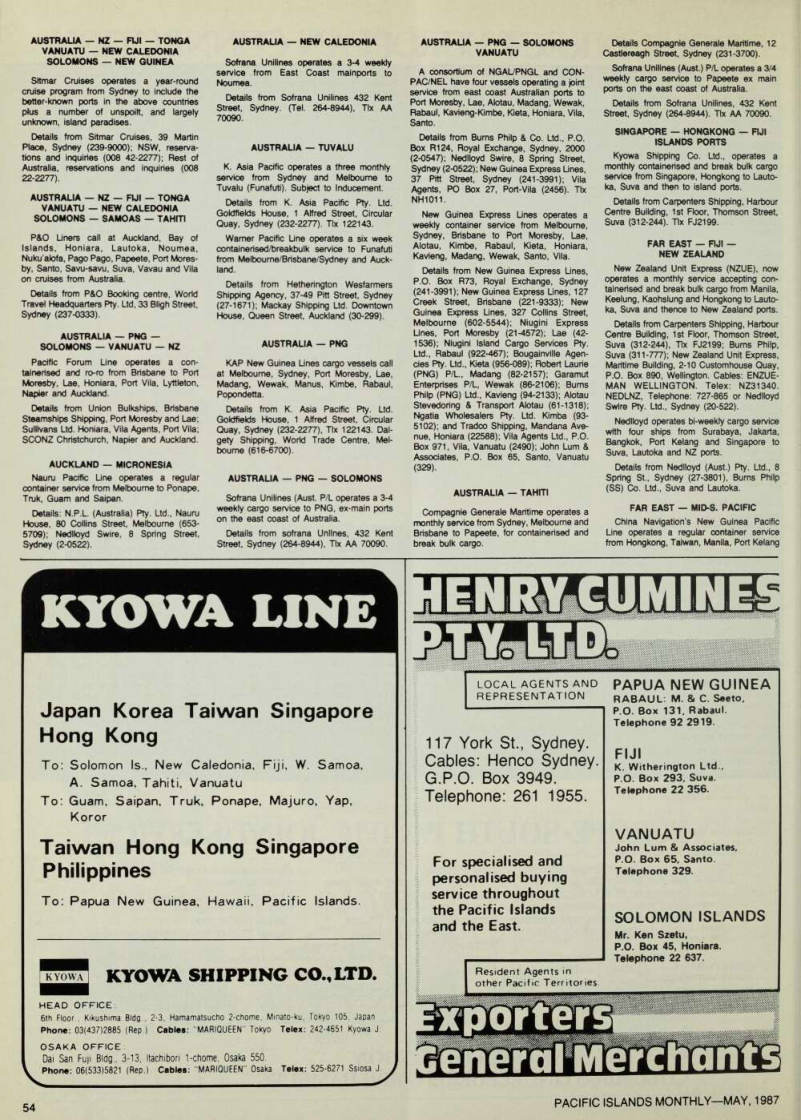
Should any shipping company wish to have its services cargo and passenger included in these listings they should contact
Pim.
Australia To Fiji
PACE Line (ACTA Shipping) operates a fully containerised service, every 17 days to Suva and Lautoka from Melbourne, Sydney and Brisbane The three vessels, ACT 9. ACT 10, ACT 11. continue on to Honolulu and then to the North American west coast ports of Tacoma, Vancouver, Oakland and Los Angeles.
Details Burns Philp (SS) Co Ltd Rodweil Road, Suva. Tel. (31 1777), Telex FJ 2168, FAX 311 804 Burns Philp (SS) Co Ltd., Lautoka Tel (60 777). ACTA Ply Ltd , 447 Kent Street, Sydney Tel (266 0633), Telex AA 121 369, FAX 267 1148 ACTA Pty Ltd., Melbourne Tel (611 2000) ACTA Ply Ltd., Brisbane Tel. (221 3116)
Australia Fiji
Sofrana-Unilines (Fiji Express Line) oper ates to Suva and Lautoka every three weeks from the main ports on the east coast of Australia and monthly to Lautoka from Mel bourne and Sydney.
Details from Sofrana-Unilines, 432 Kent Street, Sydney (264-8944), Tix AA 70090; Wittrans Agency Pty. Ltd., 21st Floor, 60 Market St. Melbourne (614-4788); Tlx 30163 ACTA Pty. Ltd., Brisbane (221-3116); EkJers- ANL Pty. Ltd., Port Adelaide. (47-5688); Newcastle, Sofrana Sydney (264-8944); Websters-ANL, 58 Charles St. Launceston,
Tasmania (320-555); Carpenters Shipping,
Harbour Centre Building, Ist Floor, Thomson Street, Suva, Fiji (312-244); Tlx FJ2199.
Australia Samoas Tonga
Warner Pacific Lines operates a regular cargo service from Sydney, Brisbane and Melbourne to Nukualofa, Pago Pago, Apia and Vavau. Feeder service available from Apia to Cook, Christmas, Fanning and Washington Islands.
Details from Hetherington Wesfarmers Shipping Agency, 37-49 Pitt Street, Sydney, (27-1671).
Australia - New Caledonia
Fiji Samoas Tonga
Pacific Forum Line operates a fully con tainerised service (general, reefer and ro-ro) from Sydney to Noumea, Suva, Apia, Pago Pago, Nukualofa, Sydney, Cargo centralised from Adelaide, Melbourne, Brisbane.
Details from Pacific Forum Line P.O. Box 796 Auckland, Union Bulkships, 333 George Street, Sydney, Brisbane and Melbourne.
Union Co., Lautoka, Suva, Nukualofa, Pacific Forum Line Apia, Polynesia Shipping Pago Pago.
Australia Lord Howe Is.
Norfolk Is.
Compagnie des Chargeurs Caledoniens operates four-weekly cargo service Sydney- Lord Howe Island and Norfolk Island.
Details Hetherington Wesfarmers Shipping Agency, 37-49 Pitt Street, Sydney (27-1671).
Australia Kiribati
K. Asia Pacific operates a 5/6 weekly service from Melbourne and Sydney to Kiribati (Tarawa).
Details from K. Asia Pacific Pty. Ltd.
Goldfields House, 1 Alfred Street, Circular Quay, Sydney (232-2277), Tlx 122-143.
KAP New Guinea Lines call Tarawa after PNG ports on a 35 day basis from Melbourne
and Sydney/Brisbane.
Details from K. Asia Pacific Pty. Ltd., Goldfields House, 1 Alfred Street, Circular Quay, Sydney (232-2277); Tlx 122143.
Australia Tuvalu
K-Asia Pacific operates Direct service every 2nd voyage to Tulalu (Funafuti).
Details from K. Asia Pacific Pty. Ltd., Goldfields House, 1 Alfred Street, Circular Quay Sydney (232-2277) Tlx 122143.
Australia New Caledonia
And/Or Vanuatu
Sofrana-Unllines ships serve Noumea every three weeks from the main ports along the east Australian coast.
Details from Sofrana-Unilines, 432 Kent Street, Sydney (264-8944), Wiltrans-Agency Pty. Ltd., 21st Floor, 60 Market St., Mel bourne (614-4788) Tlx 30163 ACTA Pty. Ltd., Brisbane (221-3116). Elders-ANL Pty. Ltd., Port Adelaide (47-5688), Newcastle, Sofrana Sydney; Websters-ANL, 58 Charles St. Laun ceston, Tasmania (320-555).
Compagnie des Chargeurs Caledoniens
operates a three-weekly containerised cargo service from Sydney to Noumea.
Details Hetherington Wesfarmers shipping
Agency, 37-49 Pitt Street, Sydney (27-1671).
Compagnie Generale Maritime operates a monthly service from Sydney, Melbourne and
Brisbane to Noumea, Port Vila and Santo, for containerised and break bulk cargo.
Details Compagnie Generate Maritime, 12 Castlereagh Street, Sydney (231-3700).
Australia Nauru -
Marshall Is. - Kiribati
Nauru Pacific Line operates regular cargo service from Melbourne to Nauru, Majuro and Tarawa, passenger service to Nauru only.
Details: Naum Pacific Line (Aust.) Pty. Ltd.
Naum House, 80 Collins Street, Melbourne (653-5709). Nedlloyd Swire, 8 Spring Street, Sydney (2-0522).
Australia - Solomon Islands
Vanuatu
Negal-PNG Line operates a monthly service details NEDLLOY SWIRE P/L, 8
Spring Street. Sydney Phone: 20522.
Australia New Zealand
The Australian National Line and the New Zealand line operate a 10-day container service (TRANZTAS) between Sydney and Melbourne to Auckland, Wellington, Lyttleton and Port Chalmers.
The Tranztas service has been extended to cover Bumie and Fremantle on a direct call monthly basis linking to the main New Zealand ports.
Details from ANL Shipping Agency, 20 Bond Street, Sydney (225-7333) and ANL Shipping Agencies, “World Trade Centre,” cnr. Flinders and Spencer Streets, Melbourne (611-2323) or New Zealand Line, Pastoral House, 96 Lambton Quay, Wellington (728- 5000).
Australia Nz Fuji Tonga
Vanuatu New Caledonia
Solomons New Guinea
Sitmar Cruises operates a year-round cruise program from Sydney to include the better-known ports in the above countries plus a number of unspoilt, and largely unknown, island paradises.
Details from Sitmar Cruises, 39 Martin Place, Sydney (239-9000); NSW, reserva tions and inquiries (008 42-2277); Rest of Australia, reservations and inquiries (008 22-2277).
Australia Nz Fui Tonga
Vanuatu New Caledonia
Solomons Samoas Tahiti
P&O Liners call at Auckland, Bay of Islands, Honiara, Lautoka, Noumea, Nukualofa, Pago Pago. Papeete. Port Mores by, Santo, Savu-savu, Suva. Vavau and Vila on cruises from Australia.
Details from P&O Booking centre, World Travel Headquarters Pty. Ltd, 33 Bligh Street, Sydney (237-0333).
Australia Png
Solomons Vanuatu Nz
Pacific Forum Line operates a con tainerised and ro-ro from Brisbane to Port Moresby, Lae, Honiara, Port Vila, Lyttteton, Napier and Auckland.
Details from Union Bulkships. Brisbane Steamships Shipping, Port Moresby and Lae; Sullivans Ltd. Honiara, Vila Agents, Port Vila; SCONZ Christchurch, Napier and Auckland.
Auckland Micronesia
Naum Pacific Line operates a regular container service from Melbourne to Ponape, Truk, Guam and Saipan.
Details: N.P.L. (Australia) Pty. Ltd., Naum House, 80 Collins Street, Melbourne (653- 5709); Nedlloyd Swire, 8 Spring Street.
Sydney (2-0522).
Australia New Caledonia
Sofrana Unilines operates a 3-4 weekly service from East Coast mainports to Noumea.
Details from Sofrana Unilines 432 Kent Street, Sydney. (Tel. 264-8944), Tlx AA 70090.
Australia Tuvalu
K. Asia Pacific operates a three monthly service from Sydney and Melbourne to Tuvalu (Funafuti). Subject to Inducement.
Details from K. Asia Pacific Pty. Ltd.
Goldfields House, 1 Alfred Street, Circular Quay, Sydney (232-2277). Tlx 122143.
Warner Pacific Line operates a six week containerised/breakbulk service to Funafuti from Melboume/Brisbane/Sydney and Auck land.
Details from Hetherington Wesfarmers Shipping Agency, 37-49 Pitt Street, Sydney (27-1671); Mackay Shipping Ltd. Downtown House, Queen Street, Auckland (30-299).
Australia Png
KAP New Guinea Lines cargo vessels call at Melbourne, Sydney, Port Moresby, Lae, Madang, Wewak, Manus, Kimbe, Rabaul, Popondetta.
Details from K. Asia Pacific Pty. Ltd.
Goldfields House, 1 Alfred Street, Circular Quay, Sydney (232-2277), Tlx 122143. Dal gety Shipping, World Trade Centre, Mel bourne (616-6700).
Australia - Png Solomons
Sofrana Unilines (Aust. P/L operates a 3-4 weekly cargo service to PNG, ex-main ports on the east coast of Australia.
Details from sofrana Unllnes, 432 Kent Street, Sydney (264-8944), Tlx AA 70090.
Australia Png Solomons
Vanuatu
A consortium of NGAUPNGL and CON PAC/NEL have four vessels operating a joint service from east coast Australian ports to Port Moresby, Lae, Alotau, Madang, Wewak, Rabaul, Kavieng-Kimbe, Kieta, Honiara, Vila, Santo.
Details from Burns Philp & Co. Ltd., P.O.
Box R 124, Royal Exchange, Sydney, 2000 (2-0547); Nedlloyd Swire, 8 Spring Street, Sydney (2-0522); New Guinea Express Lines, 37 Pitt Street, Sydney (241-3991); Vila Agents, PO Box 27, Port-Vila (2456). Tlx
Nhioii.
New Guinea Express Lines operates a weekly container service from Melbourne, Sydney, Brisbane to Port Moresby, Lae, Alotau, Kimbe, Rabaul, Kieta, Honiara, Kavieng, Madang, Wewak, Santo, Vila.
Details from New Guinea Express Lines, P.O. Box R 73, Royal Exchange, Sydney (241-3991); New Guinea Express Lines, 127 Creek Street, Brisbane (221-9333); New Guinea Express Lines, 327 Collins Street, Melbourne (602-5544); Niugini Express Lines, Port Moresby (21-4572); Lae (42- 1536); Niugini Island Cargo Services Pty.
Ltd., Rabaul (922-467); Bougainville Agen cies Pty. Ltd., Kieta (956-089): Robert Laurie (PNG) P/L, Madang (82-2157); Garamut Enterprises P/L, Wewak (86-2106); Bums Philp (PNG) Ltd., Kavieng (94-2133): Alotau Stevedoring & Transport Alotau (61-1318); Ngatia Wholesalers Pty. Ltd. Kimba (93- 5102); and Tradco Shipping, Mandana Ave nue, Honiara (22588); Vila Agents Ltd., P.O.
Box 971, Vila, Vanuatu (2490); John Lum & Associates, P.O. Box 65, Santo, Vanuatu (329).
Australia Tahiti
Compagnie Generate Maritime operates a monthly service from Sydney, Melbourne and Brisbane to Papeete, for containerised and break bulk cargo.
Details Compagnie Generate Maritime, 12 Castlereagh Street, Sydney (231-3700).
Sofrana Unillnes (Aust.) P/L operates a 3/4 weekly cargo service to Papeete ex main ports on the east coast of Australia.
Details from Sofrana Unilines, 432 Kent Street, Sydney (264-8944). Tlx AA 70090.
Singapore Hongkong Fiji
Islands Ports
Kyowa Shipping Co. Ltd., operates a monthly containerised and break bulk cargo service from Singapore, Hongkong to Lauto ka, Suva and then to island ports.
Details from Carpenters Shipping, Harbour Centre Building, Ist Floor, Thomson Street, Suva (312-244). Tlx FJ2199.
Far East Fiji
New Zealand
New Zealand Unit Express (NZUE), now operates a monthly service accepting con tainerised and break bulk cargo from Manila, Keelung, Kaohslung and Hongkong to Lauto ka, Suva and thence to New Zealand ports.
Details from Carpenters Shipping, Harbour Centre Building, Ist Floor, Thomson Street, Suva (312-244), Tlx FJ2199; Bums Philp, Suva (311-777); New Zealand Unit Express, Maritime Building, 2-10 Customhouse Quay, P.O. Box 890, Wellington. Cables: ENZUE
Man Wellington. Telex: Nz31340.
NEDLNZ, Telephone: 727-865 or Nedlloyd Swire Pty. Ltd., Sydney (20-522).
Nedlloyd operates bi-weekly cargo service with four ships from Surabaya, Jakarta, Bangkok, Port Kelang and Singapore to Suva, Lautoka and NZ ports.
Details from Nedlloyd (Aust.) Pty. Ltd., 8 Spring St.. Sydney (27-3801), Bums Philp (SS) Co. Ltd., Suva and Lautoka.
Far East Mid-S. Pacific
China Navigation's New Guinea Pacific Line operates a regular container service from Hongkong, Taiwan, Manila, Port Kelang
and Singapore to Port Moresby, Lae, Rabaul and Honiara monthly and to Wewak, Madang and Kieta every three months. Cargo from the same Far Eastern ports to the South Pacific ports of Noumea, Santo, Vila, Papeete, Pago Pago, Apia, Raratonga and Tarawa will be shipped via Japan on the monthly Bali Hai service.
Details from Steamships Shipping, P.O.
Box 634, Port Moresby (22-0289).
Kyowa Shipping Ltd. operates monthly services from Japan to Guam, Saipan, Solo mons, New Caledonia, Fiji, Western and American Samoa, Tahiti, Cook Is. Tonga and Vanuatu.
Details; Heterington Wesfarmers Shipping Agency. 37-49 Pitt Street, Sydney (27-1671); Carpenters Shipping, Suva (312-244). Tlx FJ2199.
Guam Northern Marianas
Saipan Shipping Co. Inc. operates a weekly service via barge carrying containers and conventional cargo between Guam and Saipan and Tinian.
Details from Saipan Shipping Co. inc., P.O.
Box 8, Saipan, CM 96950 (Tel. 9707), Tlx 783619; Guam agents Maritime Agencies of the Pacific Ltd.
Hawaii Tahiti Samoas
Tonga Kiribati Fui
Solomons Png
State Shipping Associates operates a monthly service originating in Honolulu and destined for Pago Pago, Papeete, Apia, Nukualofa, Suva, Vila and Port Moresby.
Details from Star Shipping Assoc., P.O.
Box 25988, Honolulu, Hawaii 96825. Ph. (808) 39-4256; Polynesia Shipping Services in Pago Pago and Burns Philp Agency in Apia, Nukualofa, Suva and Port Moresby.
Japan Fiji Island Ports
Kyowa Shipping Co. Ltd. operates a month ly containerised service from main ports of Japan to Suva and Lautoka and thence to island ports.
Details from Carpenters Shipping, Harbour Centre Building, Ist floor, Thomson St., Suva (312-244). Tlx FJ2199.
Bali Hai service operates a monthly con tainerised service from main ports of Japan to Lautoka and Suva and thence to island ports.
Details from Carpenters Shipping, Harbour Centre Building, Ist floor, Thomson St., Suva (312-244). Tlx FJ2199, and Burns Philp, Suva (311-777).
Japan Micronesia
The NYK Shipping Line operates a monthly cargo service from Japan to Micronesia, calling at Yoko, Nagoya, Kobe, Guam, Saipan, Truk, Ponape and Majuro, returning via Yoko, Nagoya and Kobe.
Details from Burns Philp & Co. Ltd., 51 Pitt Street, Sydney (2-0547).
Saipan Shipping Co. Inc. operates a monthly service from Japan to Saipan, Guam, Truk, Porape, Majuro (Kosrae and Ebeye on inducement).
Details from Saipan Shipping Co. Inc., P.O.
Box 8, Saipan, CM 96950 (Tel. 9707), Tlx 783619. Japan agents Kyowa Shipping Com pany Ltd.; Guam Agents Maritime Agencies of the Pacific Ltd.
Japan Png
Mitsui O.S.K. Lines operates a monthly service from main ports Japan, Wewak, Lae, Rabaul, Kieta, Port Moresby.
Details from Robert Laurie Carpenters Pty.
Ltd., P.O. Box 1032, Lae/PNG (Tel. 42-3642, 42-3811).
New Caledonia - Fiji West
Coast North America
PAD Line operates an approx. 3-weekly ro-ro service from Noumea and Suva to Honolulu and West Coast USA and Canadian ports.
Details from Sofrana-Unilines SA, BP 1602, Noumea (27-51-91). Tlx NMO4B; Carpenters Shipping, Harbour Centre Building, Ist Floor, Thomson St., Suva (312-244). Tlx FJ2199.
Png Inter Mainport
Papua New Guinea Line offes scheduled 10-20 day coastal liner services linking all PNG major ports with containerisation, reefer, heavy lift and transshipment facilities.
Details from PNG Line, Box 543, Port Moresby, PNG (21-1174). Tlx 22269.
Png Uk/Continent
The Bank Line & Columbus Line operate a regular joint service from Port Moresby, Oro Bay, Kieta, Rabaul, Kimbe, Madang and Lae to Hull, Hamburg, Rotterdam, Antwerp and Le Havre.
Details from The Bank Line (A'asia) Pty.
Ltd., 51 Pitt Street, Sydney (27-2041); Tlx AA24063; Columbus Line, Lae (423466), Tlx NE 44171; or lines’ local agents.
Solomons Uk/Continent
The Bank Line & Columbus Line operate a regular joint cargo service from Honiara to Hull, Hamburg, Rotterdam, Antwerp and Le Havre.
Details from The Bank Line (A’asia) Pty.
Ltd., 51 Pitt Street, Sydney (27-2041); Tlx AA24063; Columbus Line, Lae (423466), Tlx NE 44171; Tradco Shipping Ltd., Honiara (22588), Tlx 66313.
New Zealand Australia Papua
New Guinea Solomon Islands
Vanuatu
Pacific Forum Line operates a con tainerised and ro-ro service from Lyttelton, Napier and Auckland to Brisbane, Port Moresby, Lae, Honiara and Port Vila.
Details from SCONZ Christchurch, Napier and Auckland, Union Bulkships, Brisbane; Steamships Shipping, Port Moresby and Lae; Sullivans Ltd., Honiara; Vila Agents, Port Vila.
Nz Cook Is. Niue Tahiti
New Zealand Line operates cargo services based on pallets and similar units from Auckland to Niue, Cook Islands and Tahiti.
Details from the NZ Shipping Agencies International Ltd., P.O. Box 3420, Auckland (797210); Waterfront Commission, P.O. Box 61, Raratonga; Cook Islands; Shipping Office, Govt, of Niue, P.O. Box 107, Niue Island; Compagnie Maritime Polynesienne, P.O. Box 36, Papeete, Tahiti.
Nz Fui
Reef operates a regular 18-day service from Auckland to Suva and Lautoka. Also passenger accommodation.
Details from Reef Shipping Agencies, PO Box 3382, Auckland. NZ (77-1221-3), Tlx 60633; MV Fijian Shipping Agencies Ltd.
Private Bag, Suva. Fiji (31-1056).
Pacific Line with one ship operates two weekly ro-ro cargo service New Zealand, Lautoka, Suva. No passengers.
Details Sofrana Unilines, 18 Customs Street, Auckland (773-279) PO Box 3614, Tlx NZ2313, Carpenters Shipping, 100 Thomson Street, Suva (312-244), Tlx FJ2199.
Nz Fiji North America (Wc)
Blue Star Line Ltd. Pacific Coast container services. Only direct service to and from New Zealand. Blue Star vessels call at Suva and Honolulu on NZ-U.S. West Coast voyages.
Details from Blueport ACT (NZ) Ltd., PO Box 192, Wellington (739-029). Burns Philp (SS) Co. Ltd., GPO Box 355, Suva, Fiji (311-777), Tlx FJ2168 Burship.
Nz Fiji Samoas Tonga
Pacific Forum Line operates a con tainerised and ro-ro 21 day service from Auckland to Lautoka, Suva, Apia, Pago Pago and Nukualofa.
Details from Pacific Forum Line, Auckland and Apia, Union Maritime, Lautoka, Suva and Nukualofa; Polynesian Shipping, Pago Pago.
Nz N. Caledonia Vanuatu
Png Solomons
Sofrana Unilines with three ships operate to Vila and Santo, to Honiara and Papua New Guinea and to Norfolk Island and Noumea (No passengers).
Details from Sofrana Unilines, 18 Customs Street, Auckland (773-279), PO Box 3614, Tlx NZ2313.
Nz Tahiti
Compagne Tahotienne Maritime SA (as CTM-Tahiti Line) operates one ship, MV Bounty 111, monthly Papette New Zealand. (No passengers.) Details from Sofrana Unilines, PO Box 3614,18 Customs St., Auckland, Tlx NZ2313.
CTM-Tahiti Line. PO Box 9012, Papeete (39042), Tlx Tahitlin 322 FP Tahiti.
Nz Tonga Samoas
Warner Pacific Line services Auckland, Nukualofa, Vavau, Apia, Pago Pago fort nightly carrying general and freezer cargoes.
Details from Mckay Shipping Ltd., Down town House, 21 Queen St., Auckland, PO Box 3, Phone 390-229. Cables MACSHIP, Telex NZ2554. Warner Pacific Line, Box 93, Nuku’alofa, Tonga; Mealelel (Western Samoa) Ltd., Private Bag Apia, Western Samoa. Burns Philp (SS) Co. Ltd., PO Box 129, Pago Pago, Merican Samoa, Phone 633-2709, Cables 506, Bumsouth SB.
Tahiti New Caledonia
Vanuatu Solomon Is.
New Zealand Png
Singapore Europe
Polish Ocean Lines operate in a semi container type vessels to the following ports, from Papeete, Noumea. Santo, Vila, Yandina, Honiara, Auckland, Rabaul, Lae, Singapore, Port Kielang, Penang then to Mediterranean ports and Europe via the Suez Canal. (Other New Zealand ports subject to inducement.) Details from Universal Shipping Agencies Ltd., 6th Floor, 38 Fort Street, Auckland 1, New Zealand (390931, 390727, 32104), Tlx 21517.
Europe Tahiti
New Caledonia
Compagne Generate Maritime operates services from Europe and Mediterranean ports to Papeete and Noumea using three ro-ro and multi-purpose vessels thus ensuring a bi-monthly sailing to and from.
Details Compagne Generate Maritime. 12 Castlereagh Street. Sydney (231-3700).
Europe Tahiti
New Caledonia New Zealand
Vanuatu Solomons -
Png Europe
Polish Ocean Lines offers regular monthly sailings for containerised and break bulk cargo, also conventional reefer space and reefer containers from Hamburg, Rotterdam, Dunkirk, Rouen to Papeete, Noumea, Auck land, Santo, Honiara, Rabaul, Lae, Singa pore, returning to Europe via Suez, other ports in South Pacific can be served directly with inducement or otherwise via tranship ment.
Details from Sotama, BP 9170, Papeete, Tel. 427805 Tlx 373, Telex Sotama 373FP/SATO: BP, C 2 Noumea Cedex Tel. 272094 Tlx 163NM/Universal Shipping Agencies PO Box 2282 Auckland Tel. 30930 Tlx 21517A/anua Navigation PO Box 44 Vila Tel. 2027 Tlx 1033/Melan Chine Shipping Co. PO Box 71 Honiara Tel. 21678 Tlx 66335/Steamships Shipping & Transport PO Box 1512 Rabaul Tel. 922952 Tlx 92929/Steamships T rading Co.
Ltd., PO Box 85, Lae Tel. 424666 Tlx 42423/Union Steamship Co. of NZ Ltd, PO Box 50 Apia Tel. 21781 Tlx 225/Warner Pacific Line, PO Box 93, Nuku’alofa Tel. 22088 Tlx 66219/Fiji Agents TBA.
Europe Tahiti W.
Samoa Fiji N. Caledonia
Nedlloyd offers regular cargo services from Continental ports to Papeete, Apia, Fiji and New Caledonia.
Details Nedlloyd (Aust.) Pty. Ltd., Spring Street, Sydney (27-3801); Carpenters Ship ping, Ist Floor, Harbour Centre Bldg, 100 Thomson St., Suva (312-244), Tlx 2199FJ and Vetari Street, Lautoka (63988), Tlx 5215FJ.
Uk N. Continent W. Somoa
Tonga Fui
The Bank Line & Columbus Line operate a regular joint cargo service from Hull, Ham burg, Bremen, Antwerp, Rotterdam and Le Havre to Apia, Nuku'alofa, Suva and Lautoka.
Details from The Bank Line (A’asia) Pty.
Ltd., 51 Pitt Street, Sydney (27-2041), Tlx AA 24063, Columbus Line, Lae (423-466). Tlx NE 44111, or lines local agent.
Uk N. Continent Png
Solomons
The Bank Line & Columbus Line operates a regular joint cargo service from Hull. Ham burg, Bremen, Antwerp, Rotterdam and Le Havre to Port Moresby, Lae, Madang, Kimbe, Rabaul, Kieta and Honiara and on induce ment to Yandina.
Details from The Bank Line (A’asia) Pty.
Ltd., 51 Pitt Street. Sydney (27-2041), Tlx AA 24063. Columbus Line, Lae (42-3466). Tlx NE 44171; or lines local agents.
Uk/N Continent Tahiti
N. Caledonia Vanuatu
The Bank Line 9 Columbus line operates a regular joint cargo service from Hull, Ham burg, Bremen, Antwerp, Rotterdam and Le Havre to Papeete, Noumea, Port-Vila and Santo.
Details from The Bank Line (A’sia) Pty. Ltd., 51 Pitt Street. Sydney (27-2041), Tlx AA 24063, Columbus Line, Lae (42-3466), Tlx NE 44171; Ets. A.M. Fare UTE, Papeete; Ets, Ballande, Noumea and other local agents.
U.S. Hawaii Micronesia
East Malaysia Brunei
Papua New Guinea
PM&O Lines operates two fully self-sus tained container vessels on a sailing frequen cy of every 30 days between the San Francisco Bay Area, Los Angeles, Honolulu and Majuro, Ebeye, Kosrae, Ponape, Truk, Saipan, Yap Paleu, Kota Kinabalu, Brunei, Lae, Kieta and Rabaul.
Details from PM&O Lines, 353 Sacramento Street, San Francisco, California 94111, U.S.A. (415) 421-5400, Tlx 278016 PMO UR; Owners Representative P.O. Box 803, Saipan, N.M.I. 96950, Ph. 234-6819 Tlx
783-605 Cmcaa.
U.S. Hawaii Samoas
Kiribati Nauru
Nauru Pacific Line operates regular con ventional and container services from San Francisco and Honolulu to Christmas Island, Pago Pago, Apia, Tarawa and Nauru.
Details from N.P.L. (Australia) Pty. Ltd., Nauru House, 80 Collins Street, Melbourne (653-5709), Nauru Air and Shipping Agency, Suite 2803, 185 Berry Street, San Francisco, California 94107 (415-543-4517). Nauru Air and Shipping Agency, Suite 506, 841 Bishop St., Honolulu, HI 96813 (808-523-0441).
U.S. Noumea Fiji
PAD Line operates an approx. 3-weekly ro-ro service from west coast USA and Canada to Noumea, Suva and Lautoka.
Details from Sofrana Unilines BP 1602, Noumea (27-51-91). Tlx NMO4B. Carpenters Shipping, Harbour Centre Building, Ist Floor, 100 Thomson Street, Suva (312-244), Tlx FJ2199, Trans-Austral Shipping Pty. Ltd., P.O. Box R 232, Royal Exchange, 2000 (231-8411), Tlx AA21204.
Advertisements & other items, pp. 52-56 (1 item)
The Total Test Equipment Solution
AWA
i S3 With I of marcom instruments Tfektronix r rano n . , i .
AWA New Zealand Limited The total communications company Q
HITACHI
QUIPMENT
AWA, your problem of
finding the right test
quipment is solved. We have he widest possible 1 range
|FLI—IK
equipment to suit your every day needs.
No more compromises st choices. \ —1—|—i— 37 Freeston Road. Wain Bay PO Box 858 Suva Phone 312744 Telex FJ234T Cables “EXPANSE' Suva Fax (679)314379 “rotor
YOUR DIRECT EUROPEAN CONNECTION
S
EUROPE-SOUTH PACIFIC JOINT SERVICE
The South Pacific Specialists offer facilities for shipment of: Containers (FCL/LCL) and Breakbulk Cargo plus reefer space and deeptanks for carriage of vegetable oils and other liquid bulk cargo.
Carriers also accept heavy lifts, overlength and cumbersome parcels.
Ports of Service: Loading; Papeete, Apia, Suva, Lautoka, Noumea, Port Vila, Santo, Honiara, Port Moresby, Lae,Madang, Kimbe, Rabaul, Kieta, Darwin.
For: Rotterdam, Antwerp, Hamburg, Hull, Dunkirk, Le Havre.
ROUND THE WORLD SERVICE
Additional ports on enquiry.
Please contact our regional offices for further information: The Bank Line (Australasia) Pty. Ltd.
Suite 801,51 Pitt Street Sydney N.S.W 2000 Phone: 27 2041 Telex: 24063 Columbus Line Reederei GmbH P.O. Box 1667 Lae/Papua New Guinea Phone: 42 3466/42 3287 A.H. 42 2481 Telex: Colline NE 44 171
THE BANK LINE LTD LONDON
COLUMBUS LINE REEDEREI GMBH HAMBURG
C0L0024
KYOWA LINE
Japan Korea Taiwan Singapore
Hong Kong
To: Solomon Is., New Caledonia, Fiji, W. Samoa, A. Samoa, Tahiti, Vanuatu To; Guam, Saipan, Truk, Ponape, Majuro, Yap, Koror
Taiwan Hong Kong Singapore
Philippines
To: Papua New Guinea, Hawaii. Pacific Islands.
HEAD OFFICE:
6th Floor., Kikushima Bldg , 2-3, Hamamatsucho 2-chome, Mmato-ku, Tokyo 105, Japan Phone: 03(437)2885 (Rep.) Cables: MARIQUEEN" Tokyo Telex: 242-4651 Kyowa J.
OSAKA OFFICE
Dai San Fuji Bldg., 3-13, Itachibori 1-chome, Osaka 550. 06(533)5821 (Rep.) Cables: "MARIQUEEN" Osaka Telex: 525-6271 Ssiosa^
KYOWA
KYOWA SHIPPING CO.,LTD.
JIUMmUIUi
LOCAL AGENTS AND
REPRESENTATION
117 York St., Sydney.
Cables: Henco Sydney.
G.P.O. Box 3949.
Telephone: 261 1955.
For specialised and
personalised buying
service throughout
the Pacific Islands and the East.
PAPUA NEW GUINEA
RABAUL: M. & C. Seeto, P.O. Box 131, Rabaul.
Telephone 92 2919.
FIJI
K. Witherington Ltd., P.O. Box 293, Suva.
Telephone 22 356.
VANUATU
John Lum & Associates, P.O. Box 65, Santo.
Telephone 329.
SOLOMON ISLANDS
Mr. Ken Szetu, P.O. Box 45, Honiara.
Telephone 22 637.
Resident Agents in other Pacific Territories 11 u
SERVICE PAGE
PACIFIC
SLANDS
IMONT H L Y I
AUSTRALIA: Distribution: The Herald and Weekly Times Ltd., 44-74 Flinders St., Melbourne, Vic., 3000. Advertising Reps Brisbane D. Wood, Anday Agency, CCA Centre, Dayboro Road, Closeburn 4520; Box 1918, GPO Brisbane, 4001; telephone (07) 289-4128. Adelaide Hastwell Williamson Rouse Pty. Ltd., PO Box 419, Norwood, SA, 5067 ; 59 Kensington Road, Norwood; telephone (08) 332-3322, telex 87113; Perth Allen & Associates, 7 Fore St., Perth, W.A., 6000, telephone (09) 328-9833, telex: AA94382.
FUI: Distribution and subscriptions Desai Bookshops, P.O. Box 160, Suva, Fiji telephone Suva 23036.
Advertising Fiji Times & Herald Ltd., 20 Gordon St., Suva, telephone 31-4111, telex FJ2124.
FRENCH POLYNESIA: Distribution Hachette Pacifique 10 Ave., Bruat, Papeete, telephone 25-610.
HAWAII: UNITED STATES: Distribution - PIM, Hawaii, P.O. Box 22250, Honolulu. Hawaii, 96822. Advertising Brian C. Asgill, Apt. 1308,1676 Ala Moana Blvd., Honolulu, Hawaii, 96815, telephone (808) 955-9718 JAPAN: Advertising and subscriptions Universal Media Corporation, GPO Box 46, Tokyo,'telephone 666-3036, cable UNIMEDIA Tokyo, telex 2524665.
MALAYSIA: Advertising and subscriptions Worldwide Media Services, 57-B Komplex Damai, Jin Dato Haji Eusoff, Kuala Lumpur, telephone 63-9340, cables WORLDMEDIA Kuala Lumpur, telex 31533.
VANUATU: Distribution The Bookshop, HQ Box 210, Port Vila. Advertising Norman Bros. Bookshop, Port Vila, telephone 2232.
NEW CALEDONIA: Distribution Depot Centre de Presse Michel Pentecost. CBP2, Noumea, telephone 27-2434, 27-4729.
NEW ZEALAND: Distribution Gordon & Gotch, PO Box 584, 2 Carr Road. Mt. Roskill, Auckland 4 Advertising McKay International Media Reps. Ltd., do Albany P. 0., Auckland 10, New Zealand, telephone 413-9119.
Telex NZ22701, FAX 413-9110.
WELLINGTON Ross Quaid Media, 1 Scholes Ln„ Petone. (04) 68-7593 PO Box 38699, Petone.
PAPUA NEW GUINEA: Distribution - Gordon & Gotch, PO Box 3395, Port Moresby, telephone 25-4551,25-4855.
Advertising Ken Head, PNG Post-Courier, PO Box 85, Port Moresby, telephone 21-2577, telex 22120.
SOLOMON ISLANDS: Distribution and Advertising The Bookshop, (Norman Bros.) PO Box 503, Honiara.
PHILIPPINES: Advertising The GF Group. 12 San Ignacio St., Uroaneta Village, Makati, Metro Manila, telephone 817-7299, telex 45950 and 4233.
UNITED KINGDOM: The Herald & Weekly Times Ltd., No 1 Mattravers Street, London WC2R 3DZ, England, telephone (01) 836-5162, telex London 21989.
UNITED STATES MAINLAND: Advertising - Joshua B, Powers Jr., Powers International Inc., Suite 708, 271 Madison Ave., New York, NY 10016, telephone 867-9580, Subscriptions PIM, Hawaii, PO Box 22250, Honolulu, Hawaii, 96822.
SUBSCRIPTIONS
American Samoa. ..
Australia Canada Cook Islands Fiji French Polynesia...
Guam Hawaii Japan Kiribati Micronesia Nauru New Caledonia New Zealand Niue Norfolk Island Northern Marianas..
Papua New Guinea Solomon Islands Tonga Tuvala United Kingdom U.S. Mainland Vanuatu Western Samoa Elsewhere .. US$24
AUSS24
.. US$3O
...NZ$36
AUSS26
.. US$3O
.. US$3O
.. US$3O
.. US$3O
AUSS24
.. US$3O
AUSS24
.. US$3O
...NZ$36
...NZ$3O
AUSS24
..US$3O
AUSS3S
AUSS24
AUSS24
AUSS24
...Stgls
.. US$3O
AUSS24
AUSS24
AUSS36
Payments by personal cheque are only acceptable in Australian (from a branch in Australia). U.S. and New Zealand currency. For all other remittances please send an international bank draft in Australian dollars.
Published monthly by Pacific Publications (Aust.) Pty.
Ltd. and printed in Australia by Brownhall Printing Pty. Ltd., 52 Dueroln Street. Clayton North, Victoria.
NOW AVAILABLE!
PACIFIC ISLANDS YEAR BOOK
Due to demand the 15th edition has been reprinted and is available from P.I.M. at As3s plus p.p.
Stay at Aggie Grey’s . . . the South Pacific’s
legendary hotel.
Situated right in the heart of Western Samoa. F.njoy Polynesian style friendliness and service, in cool surroundings. sti|X‘rb entertainment and food.
Magnificent white saiuf beaches only a short drive away. Airconditioned rooms, swimming |XK)’I ancliull hat facilities.
Bookings through I’nion Steamship Company of NZ. Pan Am, Air New Zealand or direc t to Aggie Grey's, Apia. Western Samoa. Cables: ACCIKS’ Apia.
BELGIAN BOY
Wants penfriends from the Pacific Islands.
Likes shells and will send stamps in exchange.
Please write to:
MAXIME RICHEZ
Rue Cernee 7358 Pommeroeul
BELGIUM
CAPITAL
AVAILABLE
Loans in various categories, from US$l,OOO to US$lOO Million.
Bad Credit, turned down by Banks No Problem.
Write for free details to: Capital Matchmaker, P.O. Box 59, Auki, Malaita, Solomon Island.
Advertising
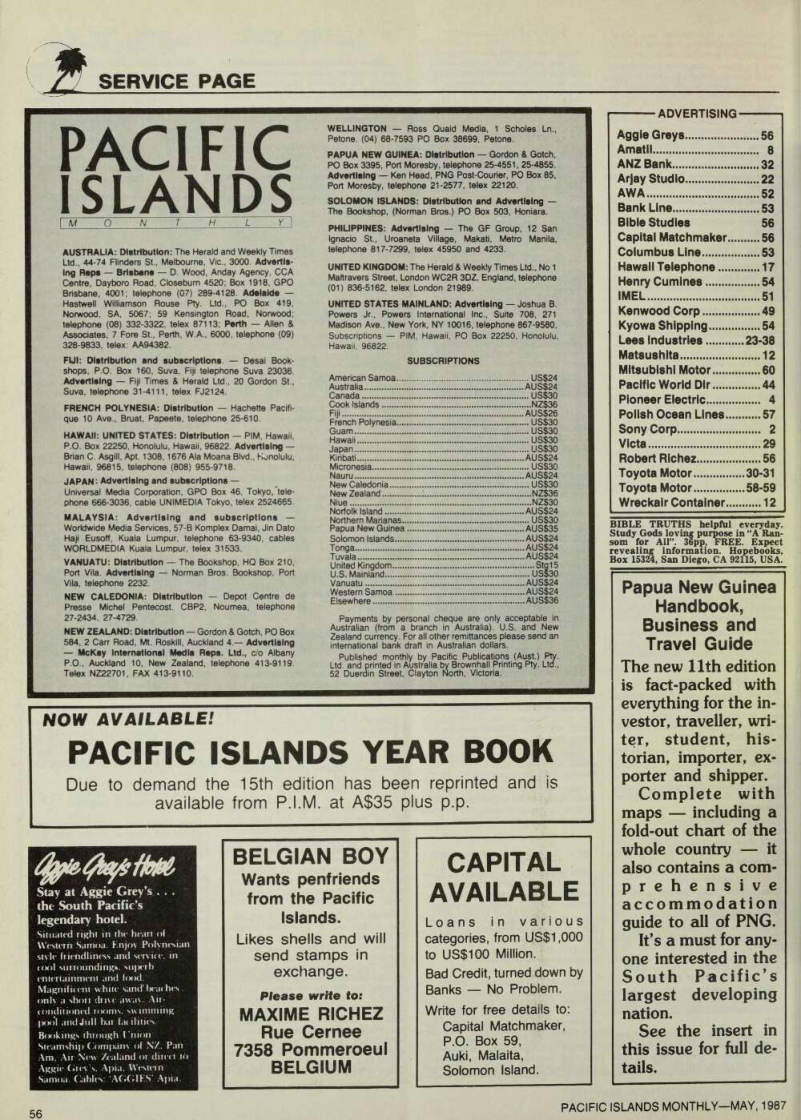
Aggie Greys 56 Amatll 8 ANZ Bank 32 Arjay Studio 22
Aw A 52
Bank Line 53 Bible Studies 56 Capital Matchmaker 56 Columbus Line 53 Hawaii Telephone 17 Henry Cumines 54
Imel 51
Kenwood Corp 49 Kyowa Shipping 54 Lees Industries 23-38 Matsushita 12 Mitsubishi Motor 60 Pacific World Dir 44 Pioneer Electric 4 Polish Ocean Lines 57 Sony Corp 2 Victa 29 Robert Richez 56 Toyota Motor 30-31 Toyota Motor 58-59 Wreckalr Container 12
Advertisements & other items, pp. 56-60 (1 item)
BIBLE TRUTHS helpful everyday.
Study Gods loving purpose in “A Ransom for All”. 36pp ; FREE. Expect revealing information. Hopebooks, Box 15324, San Diego, CA 92U5, USA.
Papua New Guinea Handbook, Business and Travel Guide The new 11th edition is fact-packed with everything for the investor, traveller, writer, student, historian, importer, exporter and shipper.
Complete with maps including a fold-out chart of the whole country it also contains a comprchensive accommodation guide to all of PNG.
It’s a must for anyone interested in the South Pacific’s largest developing nation.
See the insert in this issue for full details.
POLISH OCEAN IKS
General Management, 10 Lutego 24,81-364 GDYNIA, POLAND, Phone: 20-19-01, Cables: POLOCEAN Telex; 054-231 © © a & 5 sSS & r**.- ♦‘is '•r i ,-r •*/ sRS i n P
LvVC-
*' I *• >v
SOUTH PACIFIC SERVICE
mo nuLfo!)' iC^?,^ n , d l r0 "? : GDYNIA ’ HAMBURG, ROTTERDAM, MIDDLESBOROUGH/IMMINGHAM, QM^r4DriDc D I V NK^ iRK, ROUEhJ, PAPEETE (via PANAMA), NOUMEA, AUCKLAND, HONIARA, RABAUL, LAE, o iNijArUHE, by our multipurpose vessels carrying dry and reefer containers, reefer chambers, heavy lifts, breakbulk or palletized, bulk liouids.
Aiiri/i*km ii * o POLISH OCEAN LINES Representatives AUCKLAND Mr. A. Sieradzki. Telex 21517 NZ “UNISHIP”. SYDNEY Mr. Walenciak. Telex 20428 AA “SLEIGH”
J J 9
Full-Floating
Power Train
0.3 c
[O2-SFD2S]
80.5
db(AX
[O2-SFD2S]
Steering Wheel Vibration Virtually non-existent, elevating comfort to a new all-time high. * Indicates maximum vibration level of the wheel Equivalent Noise Level at Driver’s Ear Drastically reduced by sound-absorbing material and comprehensive engim design. * Measured and calculated according to IS<i‘
The forklift designed
for greater comfort, less vibration.
J 1 k 9 Toyota, the leader in innovation, creates a revolution in the forklift industry.
The revolutionary new 1-3 ton engine powered series forklifts; maximum-performance vehicles designed for maximum-operator comfort.
A full-floating power train practically eliminates vibration. Advanced engineering “floats” the entire engine on a cushion of rubber, with no direct attachment to the frame. Surrounding main engine parts also vibrate freely, drastically reducing structural vibration. Rubber sealing on engine hood and floorboard, and sound-absorbing materials, all add up to the many innovations that raise Toyota’s new series’ comfort level far above other forklifts.
Also exclusive to the 1-3 ton series is the 3-litre 1Z direct injection diesel engine. Delivering greater horsepower and less fuel consumption.
Increased performance, increased comfort.
But don’t just take our word. Take a test drive and feel.
Toyota’s new 1-3 ton series forklifts are in a class by themselves.
Comfort-class.
Toyota Introduces
50
ps /2,400rpm
JIS PS (02-SFD2S]
(57 HP/2,400 rpm SAE NET)
ror) mm / s
II II I 102-SFD2S]
V/ V/ (114 f/min.) 2.000 k g
[O2-SFD2S]
(4,400 lbs) 19.5
km/h
(12.1 mile/h) Engine Horsepower The new 1Z diesel engine delivers more power, more efficiency.
Lifting Speed Now the job gets done faster than ever.
Max. Drawbar Pull Scales inclines hauling a full load, easily.
Max. Travel Speed Work cycles are dramatically increased for greater efficiency.
TOYOTA
A decision you can be comfortable with. i 1 Maintenance Integrated monitoring centre, easy access to parts.
Inspection and servicing amazingly easy.
Durability
Overheating “fail-safe” system, rigorously tested; built rugged.
Service Network Extensive. After sales support in almost every country in the world.
Reliability
Design priority no. 1 ensuring operator safety through Toyota reliability.
Wide Variation Even greater productivity and comfort available with a wide selection of models.
TOYOTA
AMERICAN SAMOA: BURNS PHILP (S.S.) CO., LTD. TEL: 633-4281 AUSTRALIA: THIESS TOYOTA PTY, LTD. TEL: 526-0333 FIJI: AUTOMOTIVE SUPPLIES CO., A DIVISION OF BURNS PHILP (S.S.) CO., LTD.
TEL: 383444
GUAM: ATKINS, KROLL, INC. TEL: 646-1876
NEW CALEDONIA: SERVICE IMPORTATION AUTOMOBILE DU PACIFIQUE
TEL: 27-41-44
NEW ZEALAND: ANDREWS & BEAVEN INDUSTRIAL EQUIPMENT LTD.
TEL: 2780940
PAPUA NEW GUINEA; ELA MOTORS, BURNS PHILP (P.N.G.), LTD.
AUTOMOTIVE DIVISION TEL: 217036
VANUATU: VANUATU MOTORS, A DIVISION OF BURNS PHILP (VANUATU) LTD.
TEL: VILA 2341
WESTERN SAMOA: BURNS PHILP (S.S.) CO., LTD. TEL: 22611 And distributors around the world. 02-5FD25
Ipfe ja
ill
-•a.-: ' ■3E*
Charles Darwin theorized
that survival depends on the ability to change.
We’re living proof.
a mrmsism The origin of the automobile species in Japan began with 1917 Mitsubishi Model-A, our first massproduced motorcar. Seventeen years later we staged another evolutionary jump in the development of the automobile with the PX-33, Japan's first four-wheel drive diesel passenger car.
The following half century has seen the Three Diamonds series demonstrate its adaptability to changing social, economic and geographical environments by developing vehicles to meet virtually every automotive need on earth.
Proof that heredity is nothing but accumulated experience gained through adapting to the environment, Mitsubishi today has the world's widest range of 4 x 4 vehicles. From 550 cc 4WD superminicars to 1,995 cc turbocharged 4WD multipurpose vehicles like the rally-winning Pajero/Montero 4 x 4, to mammoth 16,000 cc allwheel-drive off-highway trucks.
Seventy years isn't long in evolutionary time, but we've continued to perfect the species. In the process, we have been proving the validity of Darwin's theories as they apply to the products required by our automotive society.
Living proof: Mitsubishi Pajero/Montero 4x4 wins Category IV and the Best Team Award in the 1987 Paris-Dakar Rally.
T < Oyr rJ % a uKi 1987
< I 4 UMS 17V#
A
MITSUBISHI
MOTORS
AMERICAN SAMOA: MORRIS SCANLAN SERVICE INC. P.O. Box 367, Pago Pago. Tel 633-5520/AUSTRALIA: MITSUBISHI MOTORS AUSTRALIA LTD. Box 1851, G.P O Adelaide, South Australia 5001. Tel. 08-275-7111 /FIJI; NIVIS MOTOR & MACHINERY CO., LTD. G PO. Box 150, Suva, Tel 384425/FRENCH POLYNESIA (TAHITI): ETS-BREDIN FRERES ET FILS P.O. Box 21, Papeete, Tahiti, Tel 4-202-58/NEW CALEDONIA: SOCIETE DIMPORTATION D AUTO DU PACIFIQUE SUD S.A. B P 438 Rond Point du Pacifique, Noumea, Tel 274144/NEW ZEALAND; TODD MOTORS CORPORATION Todd Park, Heriot Drive, Private Bag, Porirua, Tel 70-109/NORFOLK ISLAND: BORRYS LTD P.O. Box 169, Norfolk Island, Tel 2114 NI/PAPUA NEW GUINEA: TOBA PTY. LTD. P.O. Box 503, Port Moresby. Tel. 21-7874/SOLOMON ISLANDS: R.C. SYMES PTY. LTD. P.O, Box 823, Honiara, Guadalcanal, Te1.22131/TONGA: SITANI MAPI CO., LTD. P.O Box 83, Maku Olofa, Tel 21-044/VANUATU: SOCOMETRA B P. 06 Route de Lagon, Port-Vila, Tel 2314/WESTERN SAMOA; A M MACDONALD HOLDINGS LTD. P.O. Box 576, Apia, Tel. 22022/SAIPAN/PONAPE/MAJURO/ KOSRAE/TRUK/YAP/BELAU: MICRONESIAN MOTORS, INC. 997 South Marine Drive, Tamuning, Guam 96911, Tel. 646-6827