Pacific

Islands
Month Y
American Samoa US$2.OO Australia A 52.00 Cook Islands NZ$3.OO Fiji f 51.75 Hawaii US$2.5O Kiribati A 52.00 Nauru A 52.00 New Caledonia CFP2SO New Zealand NZ$3.3O find. fit. and GST) Niue NZ$2.5O Norfolk Island A 52.00 Papua New Guinea K 2.00 Solomon Islands 552.00 Tahiti CFP3OO Tonga P 2.00 Tuvalu A 52.00
Usa Us$3.Oo
USTT and Guam US$2.5O Vanuatu VT2.00 Western Samoa T 2.75 •Recommended retail price only Registered by Australia Post Publication No. NBPI2IO
April, 1987
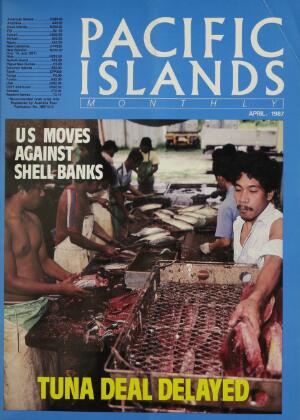
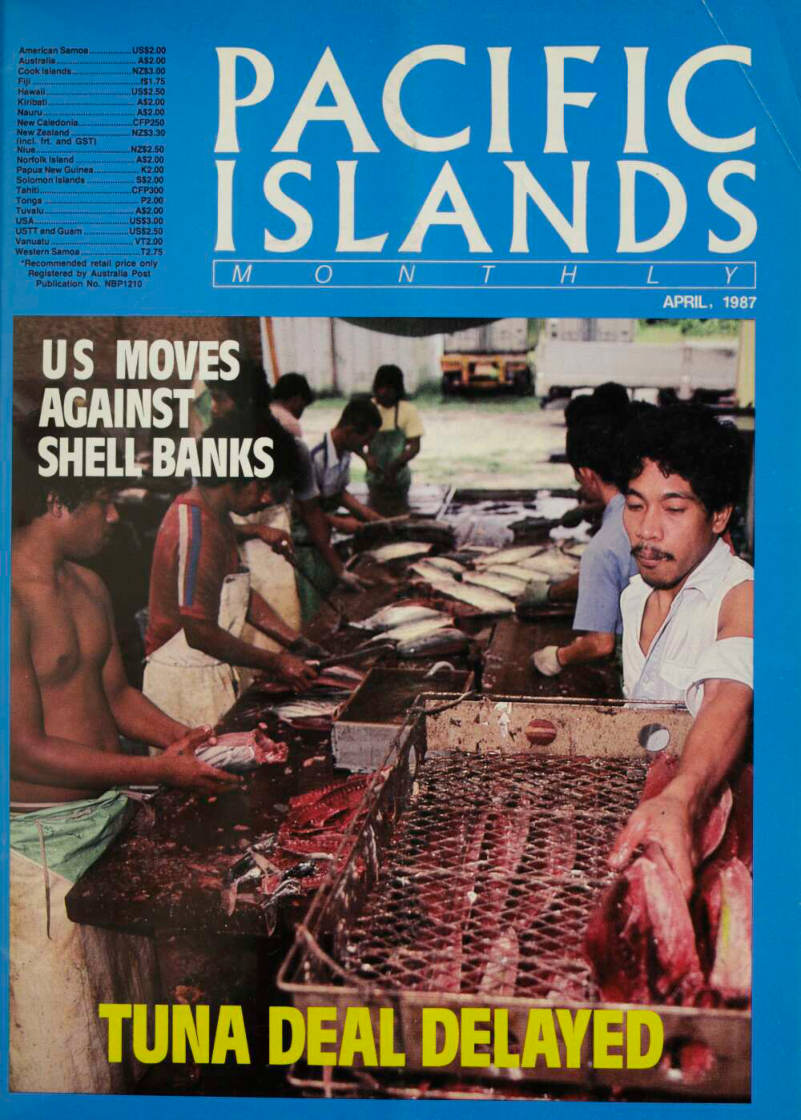
Us Moves \1
Against >
Shell Banks
Tuna Deal Delayed
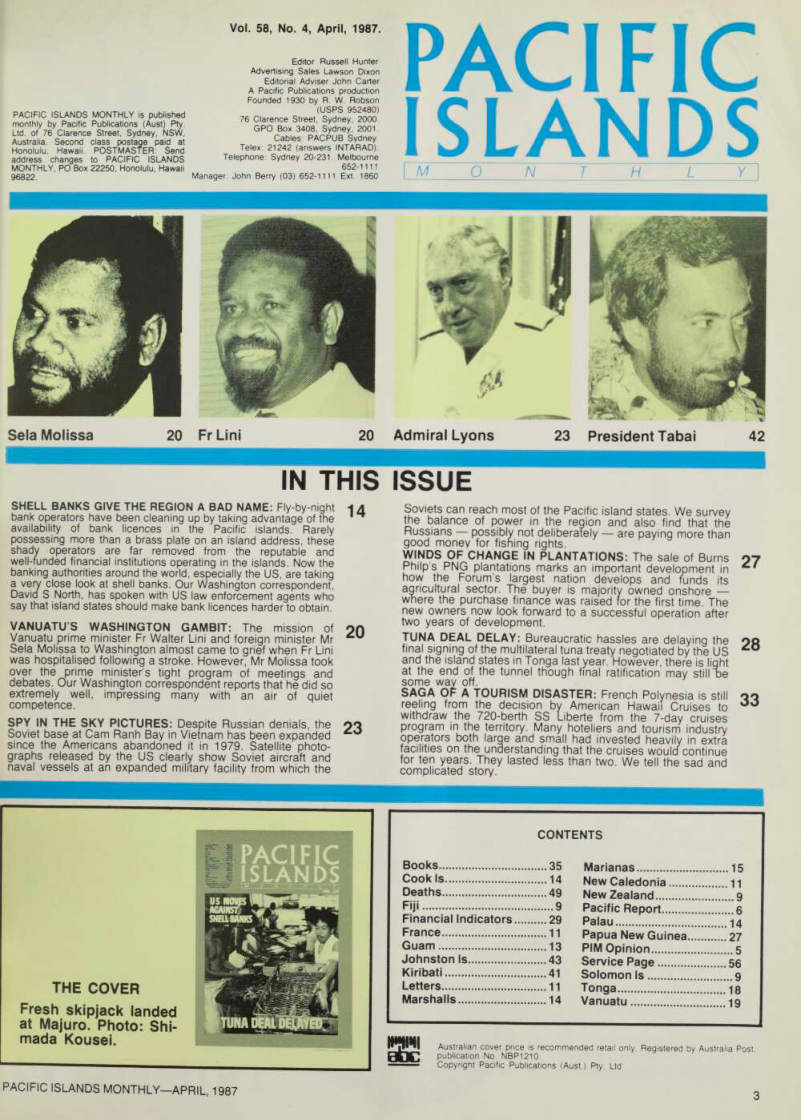
The Cover
Fresh skipjack landed at Majuro. Photo: Shi mada Kousei.
Advertisements & other items, pp. 2-3 (2 items)
Compact
HOIVTDA Progress with Distinction.
but
big.
It used to be simple. In order to gain the maximum amount of interior space, cars necessarily had to have big bodies.
But then people also wanted compact family cars that were easier to handle and performed better. It came down to making a hard choice. Till Honda decided to challenge this state of affairs. Honda aimed to give people a lot of room in a small car that was easy to handle. So from the very start, Honda designed the Civic Sedan to realize an automotive goal that was
considered virtually impossible—going
for a compact body that would permit the maximum possible interior space to be realized.
And that's where Honda's MM philosophy makes the difference. It advocates minimum space for mechanisms and maximum space for utility. Honda's no-compromise approach combines superior performance with mechanical parts designed for compactness and high-density integration. Take the 12-valve engine for instance. Engineered for high power, it's also compact, durable, and economical. How about the high-performance suspension?
Light and compact, it takes up minimal space, allowing the car to have a lower, sleeker hood. Honda made the most effective use of available space wherever possible, leaving a generous interior space to ensure passenger comfort. That means plush, roomy seating for four adults with ample legroom for all. Take a look at the trunk. Deep and wide, it opens up right from the bumper line to take all the effort out of loading. Even the rear seatback folds down for extra loading convenience.
The end result is a deceptively orthodox sedan with a significantly higher level of driving enjoyment.
Compact but big. A paradox Honda challenged and solved. The Honda way. (0 f
41°dl®®ff S®dl©il
Equipment may vary in some countries. f 1 -i & ©w In 1986 , Williams/Honda won the Formula 1 Constructors' Championship. In 1987, Honda's Formula 1 engines will power both Williams and Lotus. Thus , we will continue to polish our expertise at the pinnacle of automotive technology.
Canon Ml obi'll AUSTRALIA: Honda Australia Pty, Ltd. Lot 95 Sharps Road, Tullamarine, Victoria3o43: Bennett Honda Pty., Ltd. 250 Victoria Road, Wethenll Park, N.S.W. 2164/NEW ZEALAND: NZMC Limited Manners Plaza, ■ 57-65 Manners St., Wellington/PAPUA NEW GUINEA: Toba Pty, Ltd. RO. Box 503, Port Moresby/TAHITI: Honda Distribution S.A.R.L. B.P 1665, Papeete/KIRIBATI Atoll Motor & Marino Services PD. Box 49, Bairiki Tarawa, Republic of Kiribati/U.S. TRUST TERRITORY: United Micronesia Development Association PO. Box 235, CHRB Saipan CM 96950/COOK ISLANDS: Cook Islands Motor Centre Ltd. PC. Box 74, Rarotonga/GUAM: Mark’s Motor Co., Inc. RO. Box DV, Agana/WESTERN SAMOA: Motor Distributors (Samoa) Ltd. PO. Box 576, Apia/SOLOMON ISLANDS: Lee Kwok Kuen & Co., Ltd. RQBox 537 Honiara/NEW CALEDONIA: Societe Du Chalandage 8, Rue de la somme-B.P. 97, Noumea/NAURU: Nauru Cooperation Republic of Nauru/FIJI Coral Island Motors Ltd. Robertson Road, Suva, hj'/ AMERICAN SAMOA: Holiday Motors, Parts and Service PO. Box 968, Pago Pago, American Samoa 96799: Heleck’s Service Center Ltd. PO. Box 1138, Pago Pago, American Samoa 96799/TONGA: Tonga Industrial Traders PO. Box 1035, Nukualofa, Tonga/NORFOLK ISLAND: Duncombe Bay Garage New Cascade Road, Norfolk Island/VANUATU: Honda Farm Ltd. PO. Box 1031, Port Vila, Vanuatu j i
Pacific
ISLANDS
MONTHLY
Vol. 58, No. 4, April, 1987.
Sela Molissa 20
Fr Uni 20
Admiral Lyons 23
President Tabai 42
In This Issue
SHELL BANKS GIVE THE REGION A BAD NAME: Fly-by-night i A bank operators have been cleaning up by taking advantage of the 1 availability of bank licences in the Pacific islands. Rarely possessing more than a brass plate on an island address, these shady operators are far removed from the reputable and well-funded financial institutions operating in the islands. Now the banking authorities around the world, especially the US, are taking a very close look at shell banks. Our Washington correspondent, David S North, has spoken with US law enforcement agents who say that island states should make bank licences harder to obtain.
VANUATUS WASHINGTON GAMBIT: The mission of on Vanuatu prime minister Fr Walter Uni and foreign minister Mr Sela Molissa to Washington almost came to grief when Fr Uni was hospitalised following a stroke. However, Mr Molissa took over the prime minister’s tight program of meetings and debates. Our Washington correspondent reports that he did so extremely well, impressing many with an air of quiet competence.
SPY IN THE SKY PICTURES: Despite Russian denials, the oo Soviet base at Cam Ranh Bay in Vietnam has been expanded since the Americans abandoned it in 1979. Satellite photo graphs released by the US clearly show Soviet aircraft and naval vessels at an expanded military facility from which the
Soviets can reach most of the Pacific island states. We survey the balance of power in the region and also find that the Russians possibly not deliberately are paying more than good money for fishing rights.
WINDS OF CHANGE IN PLANTATIONS: The sale of Burns 07 Philps PNG plantations marks an important development in how the Forums largest nation develops and funds its agricultural sector. The buyer is majority owned onshore where the purchase finance was raised for the first time. The new owners now look forward to a successful operation after two years of development.
TUNA DEAL DELAY: Bureaucratic hassles are delaying the op final signing of the multilateral tuna treaty negotiated by the US and the island states in Tonga last year. However, there is light at the end of the tunnel though final ratification may still be some way off.
SAGA OF A TOURISM DISASTER: French Polynesia is still pp reeling from the decision by American Hawaii Cruises to 00 withdraw the 720-berth SS Liberte from the 7-day cruises program in the territory. Many hoteliers and tourism industry operators both large and small had invested heavily in extra facilities on the understanding that the cruises would continue for ten years. They lasted less than two. We tell the sad and complicated story.
Contents
Books. 35 Cook Is 14 Deaths 49
Fiji 9
Financial Indicators 29 France 11 Guam 13 Johnston Is 43 Kiribati 41 Letters 11 Marshalls 14
Marianas 15 New Caledonia 11 New Zealand 9 Pacific Report 6 Palau 14 Papua New Guinea 27 PIM Opinion 5 Service Page 56 Solomon Is 9 Tonga is Vanuatu 19
Australian cover price is recommended retail only. Registered by Australia Post publication No. NBPI2IO.
Copyright Pacific Publications (Aust.) Pty. Ltd
Advertisements & other items, pp. 3-4 (2 items)
Pacific Islands Monthly—April, 1987
3
PACIFIC ISLANDS MONTHLY is published monthly by Pacific Publications (Aust) Pty.
Ltd. of 76 Clarence Street, Sydney, NSW, Australia. Second class postage paid at Honolulu, Hawaii. POSTMASTER: Send address changes to PACIFIC ISLANDS MONTHLY, PO Box 22250, Honolulu, Hawaii 96822.
Editor Russell Hunter Advertising Sales Lawson Dixon Editorial Adviser John Carter A Pacific Publications production Founded 1930 by R. W. Robson
(USPS 952480)
76 Clarence Street, Sydney, 2000 GPO Box 3408, Sydney, 2001.
Cables: PACPUB Sydney.
Telex: 21242 (answers INTARAD).
Telephone: Sydney 20-231. Melbourne 652-1111 Manager: John Berry (03) 652-1111 Ext. 1860
Trinitron
SONY,
v I!
KV-2092AS
KV-1440AS
It's so tempting.
The colour you get from Sony's new Super Trinitron.
Our new Pan-Focus gun is computer-designed to make our famous colour even sharper and clearer. Our new Black Screen makes whites brilliant, blacks profound, every colour deeper and richer.
It's flatter and sguarer too.
For less reflection and superb clarity, even in the corners.
For those whose taste demands +he best, Super Trinitron is the most delicious TV ever.
Trinitron
Don’t bank on it
Pim Opinion
Brass plate banks have the potential to become a major nuisance. For while several Pacific islands are home to offshore banks and fund operators who don’t cheat, there are others who are less scrupulous.
As this month’s report makes clear, the difficulty arises over the comparative ease with which some countries grant bank licences without any knowledge of the end user’s bona tides.
That the region can be touted around the world by people out for a fast buck as a place where money can be channeled with no questions asked is unfortunate.
The tax haven islands have the sovereign right to formulate their own banking laws. And having done so, they then have the duty to police them effectively. And while the fees those countries receive from transactions is a valuable aid to development, they receive little or nothing from the shell bank scams.
Despite that, there could be difficulties with banking secrecy laws when law enforcers, even from friendly nations, seek evidence to bring such people to book.
And although all banks benefit equally from the secrecy provisions, those houses with reputations to protect would be the last to complain if the shell operators found the main chance restricted.
The problem may be lack of awareness or, in some cases, lack of experience in dealing with silver-tongued manipulators, but something needs to be done to protect unwary investors wherever they may be.
The United States, with its awsome banking regula tions and vast experience of sorting the honest bankers from the rest, could play a vital role in helping island governments secrecy laws notwithstanding to continue to draw revenue from banking licences without simply exporting trouble to other countries.
At present that’s what can happen. A banking licence in the South Pacific can be the means whereby innocent people in a far part of the globe are cheated out of their life savings. It needn’t be so easy for the scalpers if the right kind of discretion is applied when granting the licence.
As the island nations develop their financial sectors they become hosts to ever more sophisticated proce dures and operators. This presents outstanding opportu nities for island citizens to be trained by masters of modern finance and many have seized that opportunity.
The downside, however, is that this level of sophistica tion has not always been matched by a training effort in the means of retaining the honest financiers while barring the cheats.
There is a real risk that the South Pacific could as a result be saddled with an unsavoury reputation in the financial world, much to the detriment of the reputable companies who pay their way in the host country and who take their training responsibilities seriously. They might be tempted to take their business elsewhere.
It hasn’t happened yet, but if things get out of hand the result could be a net outflow of capital from the region.
For example, it’s not hard to imagine aid donors feeling less than comfortable in committing funds to nations who harbour corporate identities who are suspected or convicted of fleecing their own citizens.
A tiny proportion of that aid money could profitably be spent on finding ways of protecting the real banks as a source of revenue while kicking out the fly-by-nights who provide little if any benefit to the host country anyway.
If a South Pacific bank licence comes to be seen around the world, rightly or wrongly, as a licence to dodge other countries’ laws, this can do nothing but harm.
pacific report
Britain Will Not
Sign Nuclear Pact
Britain has followed the United States and decided not to sign the protocols of the South Pacific Nuclear Free Zone Treaty aimed at removing nuclear weapons from the South Pacific. The treaty’s three protocols call for a ban on nuclear tests and the stockpiling of nuclear weapons and nuclear waste in the South Pacific. France has cam paigned against the treaty charging that it is aimed at bringing an end to French nuclear testing on Moruroa Atoll and would isolate it diplomatically.
Australia Gathers
Data On Soviets
Australian aircraft and warships have been involved in a massive intelligence gathering operation on Soviet activities in the Asia-Pacific region. According to Australia’s defence minister, Mr Beazley, the operation is independent, very sub stantial and effective. Mr Beazley told parliament that his government had recently concluded an agreement with Malaysia for Australian aircraft to oper ate long-distance surveillance patrols out of Butterworth air base. Coupled with the air patrols, Australian warships had been regularly deployed in the Singa pore region. The minister was respon ding to a question in parliament concer ning Soviet activities at Cam Ranh Bay in Vietnam, Earlier, the Prime Minister, Mr Hawke, said the Government’s policy paper on defence would deal with the Cam Ranh Bay issue. The Opposition spokesman on foreign affairs, Mr Peacock, later strongly criticised Mr Beazley’s answer as inadequate and dismissive. He said figures from the Joint Intelligence Organisation and the Office of National Assessments showed the Soviet Pacific fleet was that country’s largest. The figures also showed that Cam Ranh Bay was a powerful, fully operational Soviet military base which had aircraft capable of striking a wide radius, including Australia.
Australia Plans
Defence Effort
Australia’s defence minister, Mr Beazley, has outlined a multi-million dollar prog ram for closer defence relations with the South Pacific island nations. Mr Beazley told parliament that Australia would now give the same priority to defence co operation with the Pacific as it had given
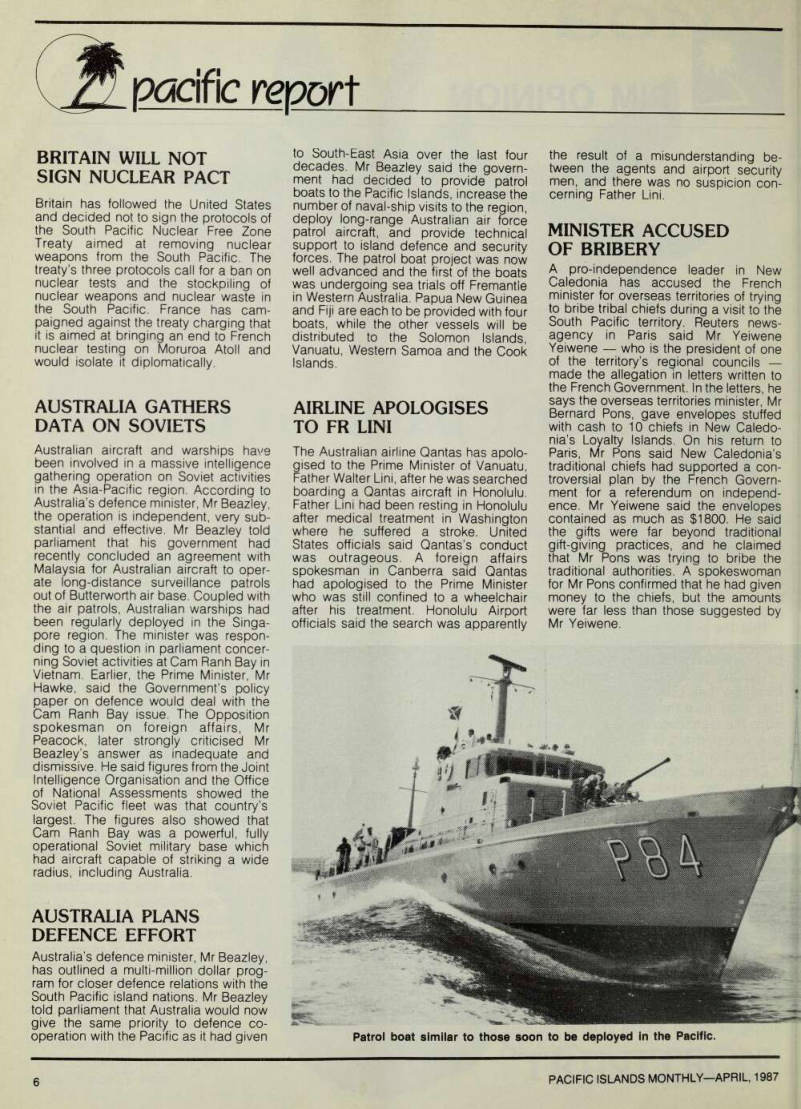
to South-East Asia over the last four decades. Mr Beazley said the govern ment had decided to provide patrol boats to the Pacific Islands, increase the number of naval-ship visits to the region, deploy long-range Australian air force patrol aircraft, and provide technical support to island defence and security forces. The patrol boat project was now well advanced and the first of the boats was undergoing sea trials off Fremantle in Western Australia. Papua New Guinea and Fiji are each to be provided with four boats, while the other vessels will be distributed to the Solomon Islands, Vanuatu, Western Samoa and the Cook Islands.
Airline Apologises
To Fr Lini
The Australian airline Qantas has apolo gised to the Prime Minister of Vanuatu, Father Walter Lini, after he was searched boarding a Qantas aircraft in Honolulu.
Father Lini had been resting in Honolulu after medical treatment in Washington where he suffered a stroke. United States officials said Qantas’s conduct was outrageous. A foreign affairs spokesman in Canberra said Qantas had apologised to the Prime Minister who was still confined to a wheelchair after his treatment. Honolulu Airport officials said the search was apparently
the result of a misunderstanding be tween the agents and airport security men, and there was no suspicion con cerning Father Uni.
Minister Accused
Of Bribery
A pro-independence leader in New Caledonia has accused the French minister for overseas territories of trying to bribe tribal chiefs during a visit to the South Pacific territory. Reuters news agency in Paris said Mr Yeiwene Yeiwene who is the president of one of the territory’s regional councils made the allegation in letters written to the French Government. In the letters, he says the overseas territories minister, Mr Bernard Pons, gave envelopes stuffed with cash to 10 chiefs in New Caledo nia’s Loyalty Islands. On his return to Paris, Mr Pons said New Caledonia’s traditional chiefs had supported a con troversial plan by the French Govern ment for a referendum on independ ence. Mr Yeiwene said the envelopes contained as much as $lBOO. He said the gifts were far beyond traditional gift-giving practices, and he claimed that Mr Pons was trying to bribe the traditional authorities. A spokeswoman for Mr Pons confirmed that he had given money to the chiefs, but the amounts were far less than those suggested by Mr Yeiwene.
Patrol boat similar to those soon to be deployed in the Pacific.
Israel Gives
Libya Warning
The retiring Israeli ambassador to Aus tralia, Mr Ben-Yaacov, warned the South Pacific of the dangers of any Libyan involvement in the region. Mr Ben- Yaacov was also accredited to Papua New Guinea, Fiji and Kiribati. The ambassador said Israel was among the first nations to give recognition to Vanuatu, but Vanuatu had not re sponded positively to Israel’s proposals to establish diplomatic relations. Mr Ben-Yaacov said Vanuatu’s diplomatic recognition of Libya was a growing cause of concern in the South Pacific.
He said Libya’s involvement in Vanuatu could not help peace in the area.
Ex-President
In New Party
A former president of Nauru, Mr Kennan Adeang, has announced the formation of the Democratic Party of Nauru the first formal political grouping in the country since 1976. Mr Adeang said eight of the 18 members of Nauru’s parliament have joined the party. He said the party will aim to curtail what he called the exten sion of presidential powers, and return the country to parliamentary democracy.
Mr Adeang will be the parliamentary leader of the party.
Envoy To Face
Charges
Disciplinary charges are to be laid against the former Papua New Guinea ambassador to Washington and the United Nations, Mr Kiatro Abisinito.
Papua New Guinea’s foreign minister, Mr Ted Diro, told parliament that his govern ment would also review the appoint ments of other ambassadors and com missioners. He was commenting on the recall of Mr Abisinito, who, the minister said, had been involved in an accident in Washington, which has caused damage and injury to a number of people and embarrassed the Papua New Guinea Government. The American State De partment said that the ambassador apologised for the accident. The ambas sador has had his driving licence can celled by the State Department and the Papua New Guinea Government has recalled him. The State Department said Mr Abisinito would leave Washington as soon as travel arrangements could be made. The department said Mr Abisinito had apologised to the family of the victim and expressed deep regret for the accident. Before the accident it was alleged Mr Abisinito had been drinking and he would have faced criminal charges, but for his diplomatic immunity.
Election Brings
New Members
Final results of Tonga’s election have been announced with half the elected members of parliament being replaced.
Of the nine people’s representatives elected, six are newcomers. They in clude some of the Government’s strong est critics, and political observers in Nuku’alofa, say the first session of the new parliament in June is likely to be a fiery one. Three of the new members are from Tonga’s largest island, Tongatapu.
They are a popular airline agent, Mr Sione Matekihefuka Lemoto, a newslet ter editor, Mr Samiuela, ’Akilisi Pohiva, and a lawyer, Mr Laki Niu. Mr Niu and two other newly elected people’s mem bers have been involved in bringing legal cases alleging improper par liamentary proceedings last year. Ear lier, the election of nine representatives of the kingdom’s nobles resulted in three changes from the previous parliament.
The 28-seat assembly will be completed by a 10-man cabinet appointed by King Taufa’ahau Tupou and led by his brother, the Prime Minister, Prince Fatafehi Tu’ipelhake.
Japanese Boats
Halt Fishing
Japanese tuna boats were to stop fishing in Papua New Guinea’s waters from March 10. This follows the suspen sion of talks after the government and Japanese fishing associations failed to reach agreement on the cost of licences.
Japan has paid up to As 3 million annually in licence fees, but Papua New Gunea has proposed a 10 per cent increase in the fees, based on the value of fish caught in the country’s waters.
The Japanese refused to accept the proposed increases, saying they were too high. The fisheries and marine resources minister, Mr Bourne, said the licence fee is low, considering Japan usually earns about AsBom. annually from Papua New Guinea’s tuna. Mr Bourne said the termination of the Japanese agreement in March opened the door to interested parties from America, Italy, South Korea and the Philippines. Japan has said it wishes to promote and protect Papua New Guinea’s fishery resources in the 200mile economic zone. In Tokyo the foreign minister, Mr Kuranari said Japan under stood that for economic reasons, Austra lia could not provide as much aid to Port Moresby as it would like. However, Japan wished to extend aid and espe cially technical co-operation to Papua New Guinea. Mr Kuranari, who visited the South Pacific in February, said that Japan’s interest in the region would be expressed by respecting independence among the island states and by helping after natural disasters.
Wife Beating
“Has To Stop”
Papua New Guinea’s police chiefs have been told to stop beating their wives.
Police Commissioner David Tasion told his provincial commanders that they had to stop beating their wives as an exam ple to the rest of the country, and to reduce domestic violence. Mr Tasion warned the commanders that anyone found guilty of wife beating would be harshly disciplined. According to official figures, nearly three quarters of all the women murdered in Papua New Guinea are killed by their husbands.
Island Technology
For Export
A Papua New Guinea business has made sales of portable sawmilling sys tems to Solomon Islands. The South Pacific Appropriate Technology Founda tion, celebrating its 10th anniversary, said t is the first Papua New Guinea business to export technology. The port able sawmill, called the Wokabaut Somil, is designed for village use, and can be carried by several men into the bush for sawmilling operations. The units sell for A 55,500 and 120 of them are being used in Papua New Guinea, The executive director of the Appropriate Technology Foundation, Mr Andrew Kauleni, said sales of the sawmills had begun in Solomon Islands, and inquiries had been received from Fiji and Vanuatu. The foundation has also exported metal recycling systems to Kiribati and Tuvalu.
Mr Kauleni says sales of scrap metal gathered through the systems earned the foundation A 5150,000 last year. The foundation, which was set up by the Papua New Guinea government in 1977, now earns about three-quarters of its annual budget of As2m.
Air Link
Is Restored
Ansett commenced its new 727 services to Port Vila from Sydney and Brisbane on March 1. Under the name Ansett Vila Services and subject to government approval the Boeing 727 will fly every Sunday from Sydney and Brisbane to Port Vila returning the same day. Ansett general manager, Mr Ted Forrester, said that although many resort hotels will not be ready to take tourists until April or May there was an immediate need for seats for builders, businessmen, electri cians and others who were needed to get Vanuatu back on its feet after the recent cyclone.
Ex-Governor
Found Guilty
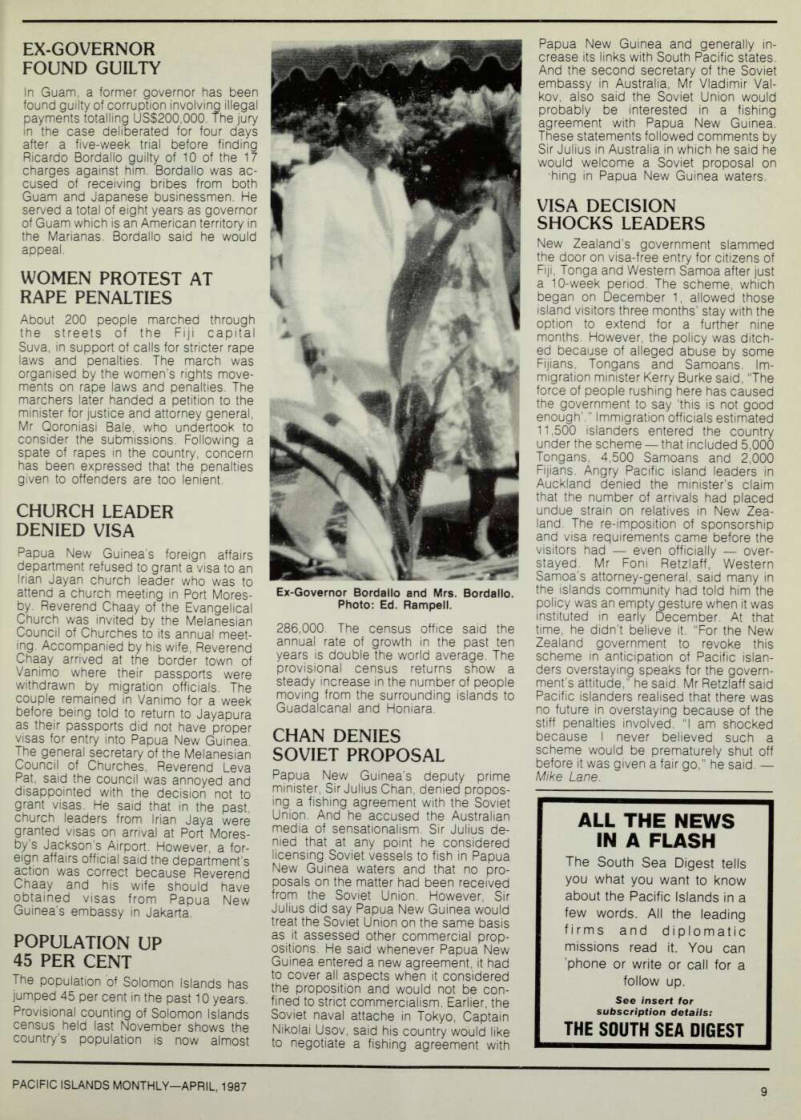
In Guam, a former governor has been found guilty of corruption involving illegal payments totalling US$2OO,OOO. The jury in the case deliberated for four days after a five-week trial before finding Ricardo Bordallo guilty of 10 of the 17 charges against him. Bordallo was ac cused of receiving bribes from both Guam and Japanese businessmen. He served a total of eight years as governor of Guam which is an American territory in the Marianas. Bordallo said he would appeal.
Women Protest At
Rape Penalties
About 200 people marched through the streets of the Fiji capital Suva, in support of calls for stricter rape laws and penalties. The march was organised by the women’s rights move ments on rape laws and penalties. The marchers later handed a petition to the minister for justice and attorney general, Mr Qoroniasi Bale, who undertook to consider the submissions. Following a spate of rapes in the country, concern has been expressed that the penalties given to offenders are too lenient.
Church Leader
Denied Visa
Papua New Guinea's foreign affairs department refused to grant a visa to an Irian Jayan church leader who was to attend a church meeting in Port Mores by. Reverend Chaay of the Evangelical Church was invited by the Melanesian Council of Churches to its annual meet ing. Accompanied by his wife, Reverend Chaay arrived at the border town of Vanimo where their passports were withdrawn by migration officials. The couple remained in Vanimo for a week before being told to return to Jayapura as their passports did not have proper visas for entry into Papua New Guinea.
The general secretary of the Melanesian Council of Churches, Reverend Leva Pat, said the council was annoyed and disappointed with the decision not to grant visas. He said that in the past, church leaders from Irian Jaya were granted visas on arrival at Port Mores by’s Jackson’s Airport. However, a for eign affairs official said the department’s action was correct because Reverend Chaay and his wife should have obtained visas from Papua New Guinea’s embassy in Jakarta.
Population Up
45 Per Cent
The population of Solomon Islands has jumped 45 per cent in the past 10 years.
Provisional counting of Solomon Islands census held last November shows the country's population is now almost
286,000. The census office said the annual rate of growth in the past ten years is double the world average. The provisional census returns show a steady increase in the number of people moving from the surrounding islands to Guadalcanal and Honiara.
Chan Denies
Soviet Proposal
Papua New Guinea’s deputy prime minister, Sir Julius Chan, denied propos ing a fishing agreement with the Soviet Union. And he accused the Australian media of sensationalism. Sir Julius de nied that at any point he considered licensing Soviet vessels to fish in Papua New Guinea waters and that no pro posals on the matter had been received from the Soviet Union. However, Sir Julius did say Papua New Guinea would treat the Soviet Union on the same basis as it assessed other commercial prop ositions. He said whenever Papua New Guinea entered a new agreement, it had to cover all aspects when it considered the proposition and would not be con fined to strict commercialism. Earlier, the Soviet naval attache in Tokyo, Captain Nikolai Usov, said his country would like to negotiate a fishing agreement with
Papua New Guinea and generally in crease its links with South Pacific states.
And the second secretary of the Soviet embassy in Australia, Mr Vladimir Val kov, also said the Soviet Union would probably be interested in a fishing agreement with Papua New Guinea.
These statements followed comments by Sir Julius in Australia in which he said he would welcome a Soviet proposal on 'hing in Papua New Guinea waters.
Visa Decision
Shocks Leaders
New Zealand’s government slammed the door on visa-free entry for citizens of Fiji, Tonga and Western Samoa after just a 10-week period. The scheme, which began on December 1, allowed those island visitors three months’ stay with the option to extend for a further nine months. However, the policy was ditch ed because of alleged abuse by some Fijians, Tongans and Samoans. Im migration minister Kerry Burke said, ’The force of people rushing here has caused the government to say ’this is not good enough’,” Immigration officials estimated 11,500 islanders entered the country under the scheme that included 5,000 Tongans, 4,500 Samoans and 2,000 Fijians. Angry Pacific island leaders in Auckland denied the minister’s claim that the number of arrivals had placed undue strain on relatives in New Zea land. The re-imposition of sponsorship and visa requirements came before the visitors had even officially over stayed. Mr Foni Retzlaff, Western Samoa's attorney-general, said many in the islands community had told him the policy was an empty gesture when it was instituted in early December. At that time, he didn’t believe it. “For the New Zealand government to revoke this scheme in anticipation of Pacific islan ders overstaying speaks for the govern ment’s attitude,” he said. Mr Retzlaff said Pacific islanders realised that there was no future in overstaying because of the stiff penalties involved. “I am shocked because I never believed such a scheme would be prematurely shut off before it was given a fair go,” he said.
Mike Lane.
Ex-Governor Bordallo and Mrs. Bordallo.
Photo: Ed. Rampell.
Advertisements & other items, pp. 7-10 (1 item)
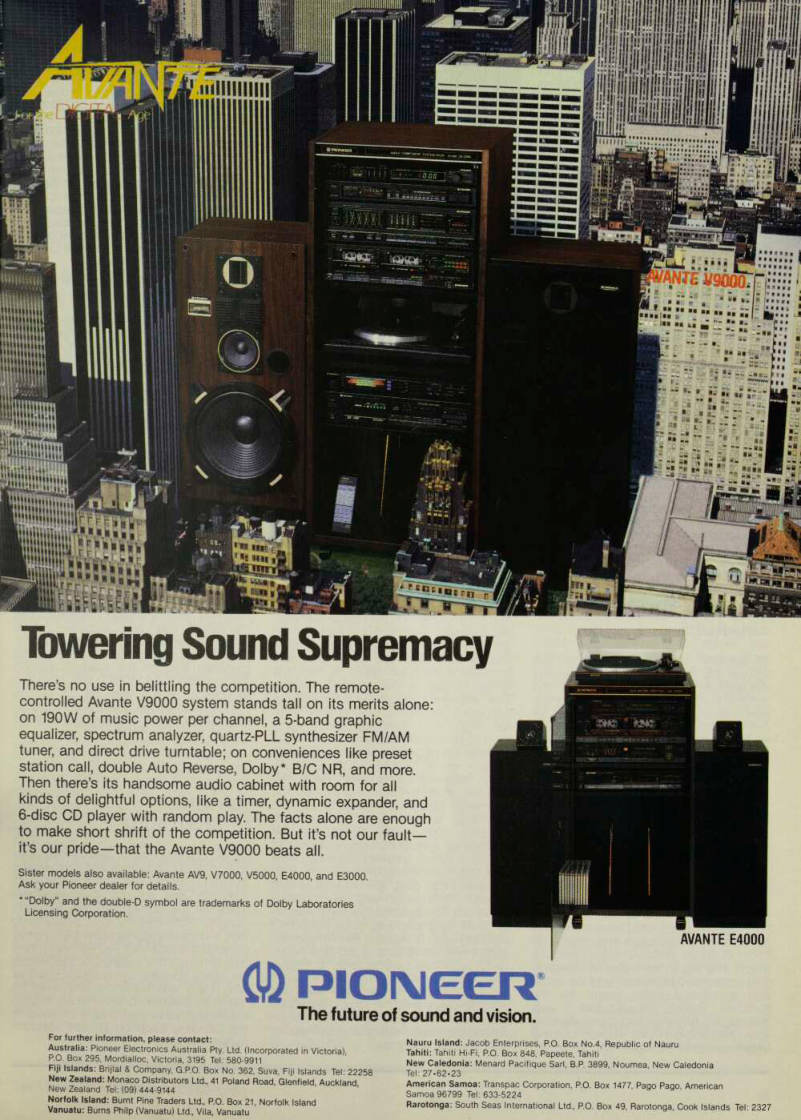
lowering Sound Supremacy
.i h;
ill
iiiii:
I! ml
mil
li (I 1 »!:!!:•;«!!!. mi t;- ‘Kill ••»*»»( ••■ 11 ■ I *•••»»! uii
IpVANfE U9OOQ~r
kniu "" *""" ■■ ■■ -.I ■•••< • •« M ** »■ - C* 1
- - B s£:: i*;
-1= ::;: L . _* ssr^fcn • *. „ „ ..
' a a- !* mtti. k a i ■ a a, *' - - • ■ a - ■ I .2 * •-■ 1 '* i ■*? “ i-J -•
Bias
n l||li|iiit
lilllil
a «ns
II HRlllffl
-- -W Mil
MSI
•« WH i El, 1 ea#!
FBI
■ ■ *ll
lowering Sound Supremacy
There’s no use in belittling the competition. The remotecontrolled Avante V9OOO system stands tall on its merits alone: on 190 W of music power per channel, a 5-band graphic
equalizer, spectrum analyzer, quartz-PLL synthesizer FM/AM
tuner, and direct drive turntable; on conveniences like preset station call, double Auto Reverse, Dolby* B/C NR, and more.
Then there’s its handsome audio cabinet with room for all kinds of delightful options, like a timer, dynamic expander, and 6-disc CD player with random play. The facts alone are enough to make short shrift of the competition. But it’s not our fault— it’s our pride—that the Avante V9OOO beats all.
Sister models also available: Avante AV9, V7OOO, V5OOO, E4OOO, and E3OOO.
Ask your Pioneer dealer for details. * “Dolby” and the double-D symbol are trademarks of Dolby Laboratories Licensing Corporation.
Cf) PIONEER
The future of sound and vision.
AVANTE E4OOO
For further information, please contact: Australia: Pioneer Electronics Australia Pty. Ltd. (Incorporated in Victoria) P-O. Box 295, Mordialloc, Victoria, 3195 Tel: 580-9911 Fiji Islands: Brijlal & Company, G.P.O. Box No. 362, Suva, Fiji Islands Tel: 22258 New Zealand: Monaco Distributors Ltd., 41 Poland Road, Glenfield Auckland New Zealand Tel: (09) 444-9144 Norfolk Island: Burnt Pine Traders Ltd., P.O. Box 21, Norfolk Island Vanuatu: Burns Philp (Vanuatu) Ltd., Vila, Vanuatu Nauru Island: Jacob Enterprises, P.O. Box N 0.4, Republic of Nauru Tahiti: Tahiti Hi-Fi, P.O. Box 848, Papeete, Tahiti New Caledonia: Menard Pacifique Sari, B.P. 3899, Noumea, New Caledonia Tel: 27.62*23 American Samoa: Transpac Corporation, P.O. Box 1477, Pago Pago, American Samoa 96799 Tel: 633-5224 Rarotonga: South Seas International Ltd., P.O. Box 49, Rarotonga, Cook Islands Tel: 2327
ALL THE NEWS
IN A FLASH
The South Sea Digest tells you what you want to know about the Pacific Islands in a few words. All the leading firms and diplomatic missions read it. You can ’phone or write or call for a follow up.
See insert for subscription details:
THE SOUTH SEA DIGEST
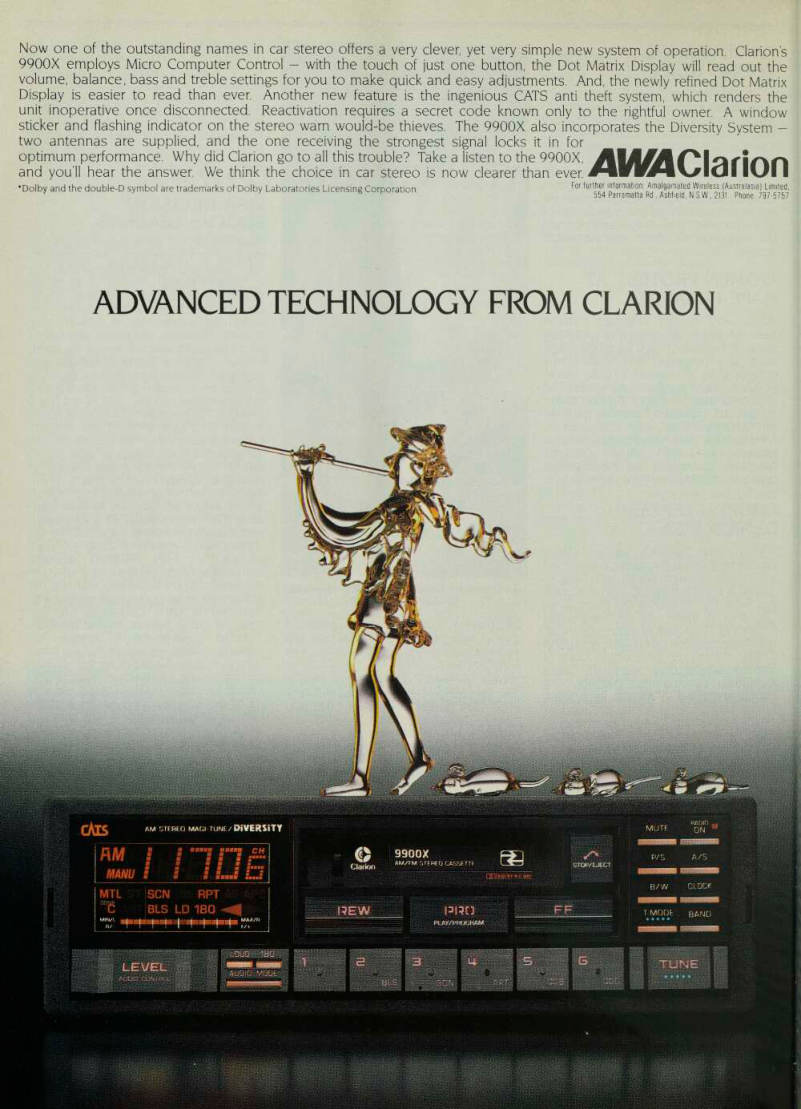
Now one of the outstanding names in car stereo offers a very clever, yet very simple new system of operation. Clarion’s 9900 X employs Micro Computer Control - with the touch of just one button, the Dot Matrix Display will read out the volume, balance, bass and treble settings for you to make quick and easy adjustments. And, the newly refined Dot Matrix Display is easier to read than ever. Another new feature is the ingenious CATS anti theft system, which renders the unit inoperative once disconnected. Reactivation requires a secret code known only to the rightful owner. A window sticker and flashing indicator on the stereo warn would-be thieves. The 9900 X also incorporates the Diversity System two antennas are supplied, and the one receiving the strongest signal locks it in for optimum performance. Why did Clarion go to all this trouble? Take a listen to the 9900 X, lAfk and you’ll hear the answer. We think the choice in car stereo is now clearer than ever. IvJI I •Dolby and the double-D symbol are trademarks of Dolby Laboratories Licensing Corporation. For Rd^^sh^eld B fl's'w sf U Phone 97 5757
ADVANCED TECHNOLOGY FROM CLARION
s? v
of ‘anti-France’
letters
Your magazine reeks of ‘anti-France’
Whether you realise it or not or whether you really even care your magazine reeks of anti-France.
Of course this has always been rigorously denied and your correspondents, notably Helen Fraser, admirably de fended. But it seems that one cannot read your magazine without stumbling over one in sult after another.
Often these are so subtle that it is probable that even the editors have been fooled.
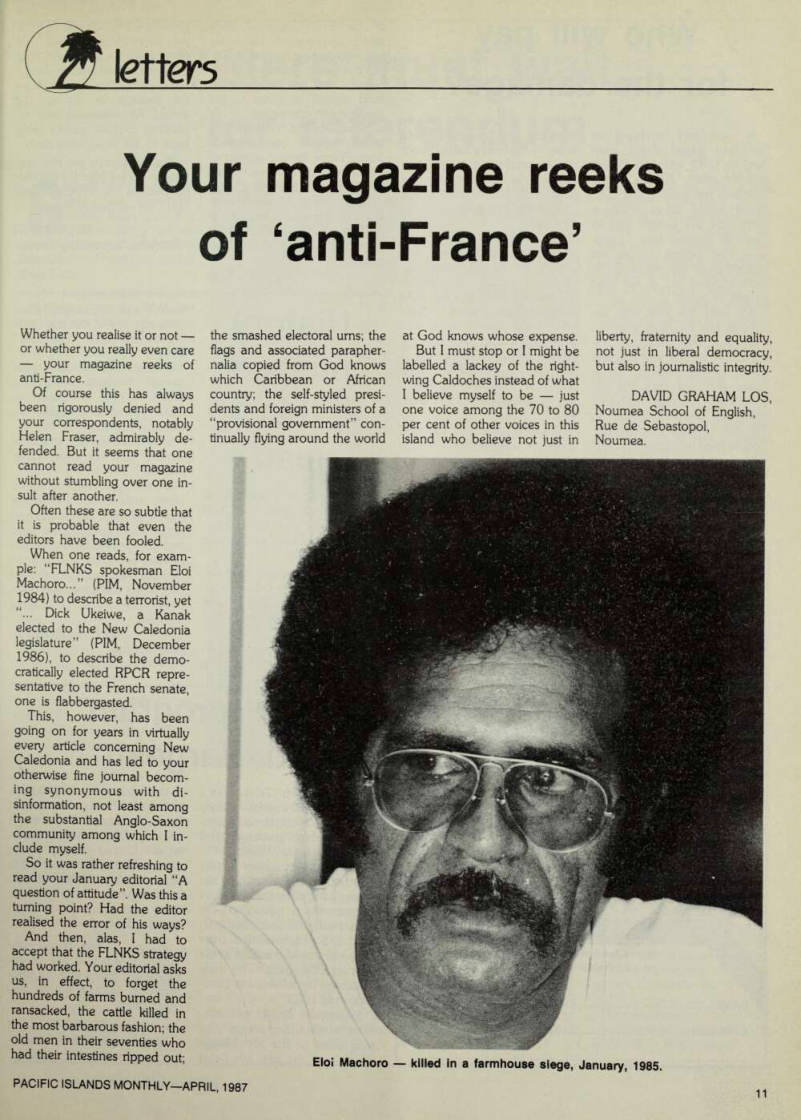
When one reads, for exam ple: “FLNKS spokesman Eloi Machoro...” (PIM, November 1984) to describe a terrorist, yet “... Dick Ukeiwe, a Kanak elected to the New Caledonia legislature” (PIM, December 1986), to describe the demo cratically elected RPCR repre sentative to the French senate, one is flabbergasted.
This, however, has been going on for years in virtually every article concerning New Caledonia and has led to your otherwise fine journal becom ing synonymous with di sinformation, not least among the substantial Anglo-Saxon community among which I in clude myself.
So it was rather refreshing to read your January editorial “A question of attitude”. Was this a turning point? Had the editor realised the error of his ways?
And then, alas, I had to accept that the FLNKS strategy had worked. Your editorial asks us, in effect, to forget the hundreds of farms burned and ransacked, the cattle killed in the most barbarous fashion; the old men in their seventies who had their intestines ripped out;
the smashed electoral ums; the flags and associated parapher nalia copied from God knows which Caribbean or African country; the self-styled presi dents and foreign ministers of a “provisional government” con tinually flying around the world
at God knows whose expense.
But I must stop or I might be labelled a lackey of the right wing Caldoches instead of what I believe myself to be just one voice among the 70 to 80 per cent of other voices in this island who believe not just in
liberty, fraternity and equality, not just in liberal democracy, but also in journalistic integrity.
David Graham Los,
Noumea School of English, Rue de Sebastopol, Noumea.
Eloi Machoro - killed In a farmhouse siege, January, 1985.
Who will pay

for the damage?
A seaplane arrived at Nanumea Island about early August 1943 carrying British and American officials. They informed the people that U.S. forces would arrive within a week and the people had to move to another islet, “Lake na”. The people, under the leadership of my father (Fati), were stunned but at last they agreed to move.
To help the war was fair enough but the main question was, why there was no com pensation for the vast damage done to the whole island, chapel and, worse still, the loss of 63 lives. The high death rate continued until 1950, due to the lack of local food supply.
People lived mostly on K and C rations and food offered by kind soldiers.
It was reported 31,493 coco nut trees were destroyed, not
including the hundreds taken away by the heavy current from the incomplete ship passage and almost a hundred acres taken away in the last 40 years. 1100 breadfruit trees were also destroyed.
The whole settlement was completely destroyed, the church hit by day bombing, leaving a concrete foundation still to be seen today. The church took ten years to build with hand tools, so it was precious to us and it was the biggest church in the group. A temporary repair was made after the Yankees left but a permanent repair will take place shortly.
It was reported $7,981 was given as compensation, which was nut true. It was for replan ting, people got ten shillings for each coconut seedling planted, but due to the concrete surface
of the airfield, people were mostly uninterested. The other half was to buy an islet in Fiji, but this failed. Therefore all the money was put into colony fund instead of given to the very people concerned.
New Zealand claimed ten million dollars compensation from France for the sinking of the Green Peace vessel by two Frenchmen and a loss of one life. So how about the destruc tion of our main settlement, the great death rate and miserable lives of the people during that period?
The effect of the occupation
continues. Strong currents from the incomplete passage still carry away heaps of soil and trees, the airfield is still in decay.
We need the money to improve the passage or dig up the airfield for replanting and re building. But we cannot bring back to life those who died.
The Americans are the very people we are after for this vast destruction. If America says “no”, we will turn to Russia.
Telavi Fati
Tefolaha Community Centre, Funafuti, Tuvalu.
History
missed this man
I have not long returned to New Zealand from the Cook Islands where I have been doing some historical research for some years.
Would any readers have de tails on a Captain J. B. Young.
Perhaps your magazine has published something on him at an earlier time.
I have met a blank wall in trying to find out about this
man. The only reference I have been able to find was in a Cook Islands newspaper “Te Torea” 1895.
It suggested he had ships named “Victoria Prince Alfred Niva Queen Zillah (Schooners) Spray Blanche (Cutters)”.
I have traced some of the vessels later but under other owners.
Young apparently partnered Henry Nicholas about 1850 in a store at Avatiu, Rarotonga and introduced cotton gins and steam engines to Rarotonga but nothing is known of him now.
Historians seem to have missed him unless something has been written in one of your early editions?
Tony Monteith,
Hawke’s Bay, New Zealand.
is largest
Aid program is largest
I refer to Mr Telavi Fati’s letter published in your January edition which concerned Tuva lu’s inter-island passenger and cargo ship the MV Nivaga.
Mr Fati is mistaken in his assertion that Britain has not agreed to replace this vessel. A contract for a new-ship was placed with Richards (Shipbuil ders) Ltd of Lowestoft for the equivalent of AsB million at the start of this year. The new vessel will be delivered to Tuva lu in mid-1988.
Meanwhile Britain will con tinue to meet the annual slip ping costs of the MV Nivaga which over the past five years
have amounted to A 5900,000.
As to Mr Fati’s remarks about British assistance to Tuvalu, I will only observe that UK bilate ral aid to that country in the period 1980-1985 amounted to approximately A 522.0 million or the equivalent of $2,750 for every man, woman and child in the island group.
In per capita terms, our Tuvalu program is one of our largest worldwide and our track record is unmatched by any other donor.
David Taylor
Assistant Head, British Deve lopment Division in the Pacific.
Advertisements & other items, p. 12 (1 item)
Cold Storage
f
wreckair
container services
i DIVISION OF WRECKAIR PIY LTD
Suite 19, 9 Seven Hill Road Phone (02) 686-1011 (008) 25-1222 PO Box 622, Baulkham Kills Telex AA 72370 Fax 639-1625 NSW 2153 Australia
COLD STORAGE
PROBLEMS?
USED REFRIGERATED
SHIPPING CONTAINERS
20’ x 8’ x B’6” Refrigerated containers provide 25 cubic metres of storage for products that require cold or frozen storage to minus 18 degrees Celcius.
Clip out the coupon below and find out how Wreckair Container Services can solve your cold storage problems container services Please send me more information on your Refrigerated containers
ADDRESS
Voters must wait
for referendum
Guam’s two-part referen dum, on common wealth status and on a budget-cutting propo sal, have been postponed from the scheduled April date until at least June.
The postponement reflected widespread concern that the island was heading for a perhaps needless clash with the mainland Congress over the status question. Guam is not a self-governing territory, and any basic governmental arrangement needs to be negotiated with the Congress, because legally the Congress could impose any system it wanted on the island (although such unilateral action is highly unlikely.) The draft Commonwealth Act, if approved by Guam’s voters, then would have to be submitted to the US Congress for final action. There are seve ral clauses in the draft which mainland observers regard as likely to encounter stiff Con gressional opposition, which might lead to a rejection of the whole document.
Perhaps the most trouble some of these is section 103 of the Act: “(a) The Congress recognises that the indigenous Chamorro people of Guam, who are all those born on Guam before August 1, 1950 and their de scendants, accept Common wealth under United States sovereignty. The Congress fur ther recognises that Common wealth does not limit the pursuit by the Chamorro people of any ultimate status which they may seek in their progress toward fulfillment of their inherent right of self-determination ...”
This clause suggests that, in the future, the Chamorros of Guam (but not all residents or citizens of Guam) can vote to change their status, perhaps to independence. The Congress is regarded as being unlikely to
give a single ethnic group such powers it certainly would run counter to several decades of civil rights legislation which have sought to extend powers to all citizens, and not to restrict them to a single group.
The drafters of the Act, the members of the Commission on Self-Determination, had tried to skate around the prob lem by defining Chamorro as they did basing the definition on Guam birth before a given date rather than using an ethnic definition but the problem remains.
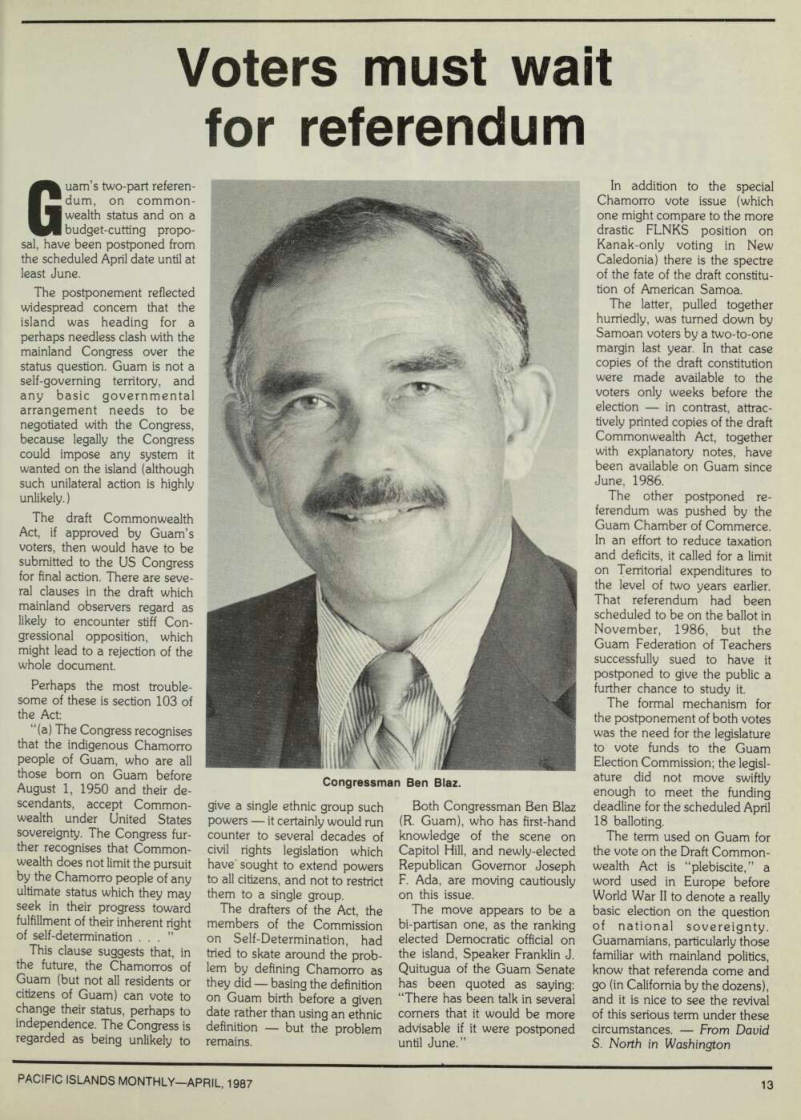
Both Congressman Ben Blaz (R. Guam), who has first-hand knowledge of the scene on Capitol Hill, and newly-elected Republican Governor Joseph F. Ada, are moving cautiously on this issue.
The move appears to be a bi-partisan one, as the ranking elected Democratic official on the island, Speaker Franklin J.
Quitugua of the Guam Senate has been quoted as saying: “There has been talk in several corners that it would be more advisable if it were postponed until June.”
In addition to the special Chamorro vote issue (which one might compare to the more drastic FLNKS position on Kanak-only voting in New Caledonia) there is the spectre of the fate of the draft constitu tion of American Samoa.
The latter, pulled together hurriedly, was turned down by Samoan voters by a two-to-one margin last year. In that case copies of the draft constitution were made available to the voters only weeks before the election in contrast, attrac tively printed copies of the draft Commonwealth Act, together with explanatory notes, have been available on Guam since June, 1986.
The other postponed re ferendum was pushed by the Guam Chamber of Commerce.
In an effort to reduce taxation and deficits, it called for a limit on Territorial expenditures to the level of two years earlier.
That referendum had been scheduled to be on the ballot in November, 1986, but the Guam Federation of Teachers successfully sued to have it postponed to give the public a further chance to study it.
The formal mechanism for the postponement of both votes was the need for the legislature to vote funds to the Guam Election Commission; the legisl ature did not move swiftly enough to meet the funding deadline for the scheduled April 18 balloting.
The term used on Guam for the vote on the Draft Common wealth Act is “plebiscite,” a word used in Europe before World War II to denote a really basic election on the question of national sovereignty.
Guamamians, particularly those familiar with mainland politics, know that referenda come and go (in California by the dozens), and it is nice to see the revival of this serious term under these circumstances. From David S. North in Washington
Congressman Ben Blaz.
big fish
Shell banks make waves among the big fish
Shell banks in the Pacific islands are coming under increasing scrutiny from US law enforcement agencies. These banks have nothing to do with the legitimate offshore financial institutions operating in the region. They usually are owned by an individual have little paid up capital and, as DAVID S NORTH reports, at least a few of them have been involved in shady activities.
The trouble starts when the Pacific island government issues the bank licence, usually to an American.
For although issuing the licence is not, in itself, illegal, its existence permits the owner to engage in a wide variety of schemes, sometimes criminal in nature.
Months to years later the island govern ment gets a black eye for licensing the bank.
These are the so-called “shell” or “brass plate” banks. “Shell” because they rarely have any assets, only a licence. “Brass plate” because sometimes the only physi cal presence in the islands is a brass plate attached to the door of the registered representative.
The operators of some of these shell banks have used them for a multitude of illicit activities almost exclusively outside the islands where they are chartered. They launder money secured in the drug trade or other criminal activity, help evade taxes of various nations, hide transactions from government regulators, and perpetrate many other fraudulent schemes.
These are not penny-ante operations those that have been brought into US courts have defrauded hundreds of inves tors of millions of dollars.
Licensing these shell banks is not a Pacific monopoly; in fact Pacific island governments entered this business only after most of the previous sites of licensing, former British colonies in the Caribbean, changed their laws, and forced the con artists to get their bank licences elswhere.
A number of Pacific island jurisdictions have licensed shell banks. The Common
wealth of the Northern Marianas Islands and the Republic of the Marshalls formerly issued such licences in bulk registrations, but no longer do so. Palau has issued at least one licence to a shell bank regarded dimly by the US Government.
Tonga and Nauru are still in the business of issuing licences, according to American law enforcement officials. Other island governments apparently approached by off-shore bank operators include the Cooks (once touted as one of the “Switzer lands” of the Pacific by one of the bank brokers), and the Solomons. Tuvalu’s prime minister, Tomasi Puapua, however, is given high marks by the US State Department for preventing even a discus sion of such activity.
In order to facilitate shell banks, island laws need to have two major provisions: it must be easy to get the licence and there must be a commercial secrecy regulation that shroud’s the bank’s activities.
In contrast, securing a bank charter in most other states requires substantial paid in cash capital and legitimate banking experience on the part of at least some of the incorporators.
Once the bank is organised, it is tightly regulated by several state and/or federal agencies; the secret bank account, which we associate with Swiss banks, is not one of the services available from American banks. (Although Switzerland has a bank ing secrecy law it is tough to get a bank charter in that nation; further, the Swiss secrecy rules are softening, as the US Justice Department learned when it sought
information on some aspects of the sales of arms to Iran, and the subsequent dispatch of the profits to the anti-communist revolu tionaries in Nicaragua.) In addition to easy registration of licences and the assistance of secrecy laws, the Pacific island shell banks have some thing else in common: they usually can not do business with the real banks of the islands where they are located.
The islands usually have two classes of banks, Class A, which are like legitimate,
competitive banks elsewhere in the world, accepting local currency deposits and making loans, and Class B, which can only operate outside the licensing jurisdiction.
A creative swindler, however, can per form a wide variety of mischief with his class B bank. US and European banks
have had serious problems with cashier’s cheques issued by some of these banks, for example. Such cheques are regarded as the equal of cash, if written on a “real” bank, but the cashiers’ cheques issued by some of the shell banks have been sold by scheming operators to scheming customers sometimes at ten cents in the dollar.
Given the slow clearance processes involved, there is a considerable time gap between the date when the “cheques” are entered into the payment system and when it becomes apparent that they are worthless.
In addition to bilking real banks, the shell banks can be used to defraud individual investors. One such operator, a Morman bishop in Oregon, Dennis Walker, alleged ly used his Tonga banking licence to defraud fellow Oregonians (many of them fellow Mormons) of millions of dollars as he promised them remarkably high interest for their deposits and then absconded with their money.
Similarly, a California family named Pedley set up business in Mexico City after the nation’s banks were nationalised following the drop in oil prices. They defrauded desperate Mexicans of millions of dollars, by offering to convert otherwise frozen pesos into US dollar deposits in a bank in the Marianas.
The Pedleys and Walker are essentially retail operators. But there is at least one wholesaler as well. He is Jerome Schneid er, the principal owner and president of WFI Corporation of Los Angeles. His business, which is legal if not commend able, is to register bank licences in bulk in the islands and then sell these principally to people in the United States.
According to a report by the Permanent Subcommittee on Investigations of the United States Senate, Schneider first used WFI in the 1970’s to “establish corpora tions in the Cayman Islands (in the Caribbean) to resell to clients interested in that island’s tax and secrecy laws.” Later he had to leave the Caymans and moved his activities to nearby St Vincent and Montserrat for similar purposes.
Registration fees reportedly for many of these bank licences cost approximately $lOO each. Then he resold them for as much as $37,000. Back in the States he held conferences for prospective clients, giving them numbered tags rather than name tags to underline the importance of secrecy.
Schneider’s method of operation was simple, according to the Senate report. He looked for people who wanted to own a bank, for whatever reason, and then sold it to them without asking too many ques tions.
The subcommittee report suggested a wide range of motives for people who
wanted to own their own bank. Some had a strong ideological bent, feeling that once they had their own, non-regulated bank they could be independent and make substantial sums of money. Others were interested in tax avoidance, and still others in using the banks to secure money fraudulently.
By January 1982 Schneider, apparently having worn out his welcome in the Caribbean, turned his eyes to the Pacific for new places to licence shell banks. He visited Palau, the Marshalls and the Com monwealth of the Northern Mariana Islands. (CNMI).
According to the Senate report, he liked the CNMI best; “In an interview with (subcommittee) staff Schneider stated that he chose CNMI as his principal Pacific location because of its close ties with the United States and because the government of the CNMI responded well to his proposals to encourage offshore “brass plate” banks. In March, 1982, emergency rules and regulations for licensing of offshore banking corporations were issued by the government of the Marianas . . .
“The regulations provided for capitalisa tion of an off-shore bank with $lO,OOO cash, did not require the owners or operators of an offshore bank to have prior banking experience and provided a certain level of secrecy for the banks’ operations Schneider then incorporated 50 banks, and sold 38 of them. The Marianas bagan to worry about these activities, and subse quently raised the minimum capitalisation to $50,000 and then to $250,000. This apparently has shut off the creation of new shell banks in these islands, but as the story about the Pedleys’ scam in Mexico City shows, much harm had already been done. We asked Chuck Morley, who had been chief investigator for the Senate subcommittee, why the Marianas and most of the Caribbean island governments changed their minds about bank licensing.
“Some tightened their laws because either the (British) Home Office, in the case of some of the Caribbean islands, or the US Government pressured them to do so,” he said. “I think that the subcommittee staff turned around the government of the Marianas on this issue; they had gone into shell bank licensing without much sophistication, and when they saw the results they changed their laws. They wanted to do the right thing.”
Schneider had seen laws change before.
By 1984 he had checked out opportunities elsewhere in the Pacific and was telling his potential customers in a brochure that “Four Pacific islands are quietly emerging as the next major banking/tax haven centres of the world. These ‘Switzerlands of the Pacific’ as they are becoming known are Vanuatu . . . The Marshall Islands . . .
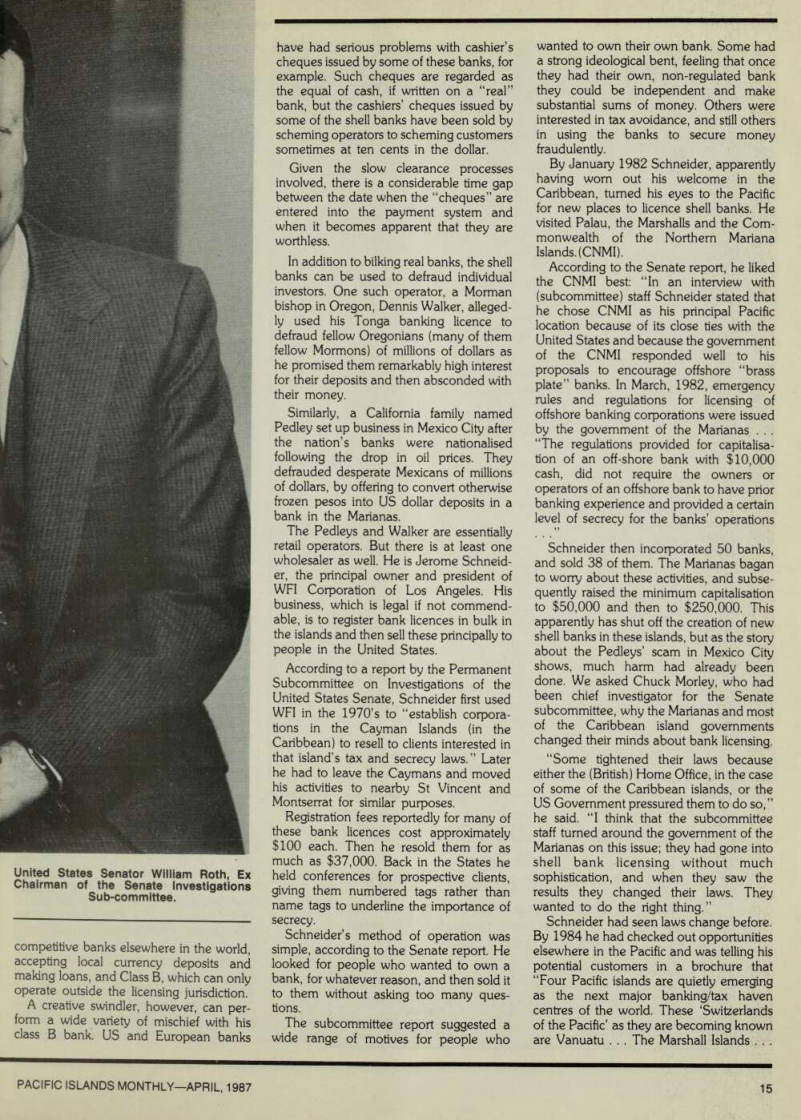
United States Senator William Roth, Ex Chairman of the Senate Investigations Sub-committee.
Naum . . . and the Cook Islands. They offer you the stability and secrecy of Swiss banks, while paying far higher interest. In fact, their banking secrecy laws are stricter and less penetrable than Switzerland’s.”
Several widely scattered American law enforcement agencies have taken action against individual operators of Pacific shell banks. In the Dennis Walker case in Oregon, the state Attorney General, Dave Frohnmayer, sued the bank operator and his Tonga-chartered bank to restore ill gotten funds to defrauded investors. Mean while, in Boston, the United States Attor ney obtained criminal convictions against the Pedley gang, the Californians who had used a Saipan bank charter to defraud millions of dollars from unsuspecting resi dents of Mexico City.
While the prosecutors are working case by case, some people in Washington are approaching the problem on a wholesale basis. They include a number of the US Senate and a federal executive agency, that of the Comptroller of the Currency.
The Senator is William Roth, Republican of Delaware, who has been fascinated with and concerned about off-shore banking for years. During much of this time he was chairman of the previously mentioned Senate Permanent Subcommittee on In vestigations which investigates just about anything, and which chose to spend considerable time and energy on the off-shore banks.
The subcommittee held hearings in 1982 on the subject, but there is hardly a mention of the Pacific. By the late summer of 1985 when it issued another report the one cited earlier in this article there are pages and pages of material on the role of the Pacific islands governments in the licensing of shell banks.
Will the subcommittee continue to pay attention to shell banks? Recently Roth lost his chairmanship (as did all Republicans) because of the Democratic victory in November. The new chair is Senator Sam Nunn (Democrat of Georgia), who also heads the even more prestigious Armed Forces Committee. Since the staff mem bers who did the work on the shell banks have left the subcommittee, it is unlikely that there will be more investigations.
Meanwhile, one of the numerous bank regulating agencies in the U.S. system, the Office of the Comptroller of the Currency, monitors shell bank scams so that it can warn legitimate US banks of the dangers of doing business with these entities. The Comptroller of the Currency, a presidential appointee, is Robert L. Clarke, and his principal staff man on this front is John W.
Shockey, a veteran federal civil servant who has travelled throughout the indepen dent nations of the South Pacific at the request of officials of those countries for Continued on page 18
Continued from page 16 the purpose of explaining the consequences of fraudulent off-shore banking activities.
“I have never known a shell bank to be engaged in legitimate, competitive commercial banking,” he told us. Shockey makes a strong distinction between the shell banks and the legitimate off-shore banks. The former are usually owned by an individual (usually an American citizen), while the latter are owned by established international banking institutions.
Shockey keeps in touch with other state and federal officials dealing with these cases, and when needed his unit sends out warnings to the legitimate banking community about the shell banks (see box).
Shockey is pressing the idea that there should be a round-table conference of Pacific finance ministers so that an accurate
picture can be presented to them about the shell bank operations.
In Pacific shell bank licencing the first jurisdictions to be approached (CNMI and the Marshalls) were selected because of the US ties their licences must be good, one might argue, because of the presence of a United States connection. But because of these connections, it was possible for the government in Washington to effectively request changes in the bank licensing laws, and the laws were changed.
US ties with the current hotbeds of shell banks, however, are minimal. The United States barely has diplomatic relations with Vanuatu, and certainly has no mission there. The US relates to the Cooks only through New Zealand, and though there are formal relations with Nauru, there is no full-time U.S. presence there either.
An island-by-island review of the status
of shell bank licensing, from the Washing ton viewpoint: n . Ai t •Commonwealth of the Northern f/ a * iana Islands. Once the Pacific headquarters for Jerome Schneider s bank broke^ag e activities, the Commonwealth cease< T to . attractive to shell bank °P era tors in February 1984 when Govf rn ? r Tenono Sl 9 ned a new tougher hanking law. But several swindles had already o n i P j’ as at Merchants Bank and Trust Company in
exico '
• Cook Islands: The picture is not clear on the current status. Schneider’s most recent brochure, according to Chuck Mor ley, still speaks of the Cooks as a “Switzerland of the Pacific” and the islands are known to be very active in offshore banking, generally, but more recently they
cancelled a problem bank charter (see box). • Republic of the Marshall Islands: Another former active licenser of shell banks, including most of those in the Pacific listed by the US Department of Treasury in 1985 and 1986, the Marshalls changed their position in December 1984 when they cancelled the licences of 101 offshore banks (See box). • Nauru: US law enforcement officials say that the Federal Bureau of Investiga tion (FBI) is investigating two or three Nauru-licensed banks, but no formal charges have yet been filed. The US Senate report on shell banks, without stressing the irony, states that (1) Nauru is the smallest and richest independent democracy in the world with phosphate sales annually worth $27,000 “for each
man, woman and child,” and (2) since Nauru has no taxes, it gets only an annual registration fee of $220 for off-shore companies, such as those filed by shell banks. • Palau: Not much is known on Palau’s current practices. Bank broker Jerome Schneider visited Palau, but did no busi ness there. One of the banks on the US Government’s warning list was licensed there. • Tonga: Apparently still issues shell bank licences, and, according to the Oregon State Attorney General’s Office, has not fully co-operated with US enforce ment officials. (For more on Tonga see accompanying story and box). • Solomon Islands: Again, not much is known. No Solomons chartered bank has appeared on the US Treasury’s warning
list, but at least one federal official thinks shell bank licenses can be obtained there. • Vanuatu: This is the only entity on the list that has a government that might remotely be regarded as unfriendly to the US. Although no Vanuatu-chartered banks are on the US Treasury list, it is regarded in Washington as a probable licenser of shell banks, three of which are said to have been used to victimise investors in Indone sia. When Vanuatu’s Foreign Minister, Sela Molisa, was in Washington with Prime Minister Walter Lini, we asked him about bank licensing laws in general and the three alleged shell banks that had been active in Indonesia. He said, during a friendly and open interview, that the shell bank issue was not well known to him, that his nation’s banking laws were complex, and that the three specific banks were not known to him.
Advertisements & other items, p. 16 (1 item)
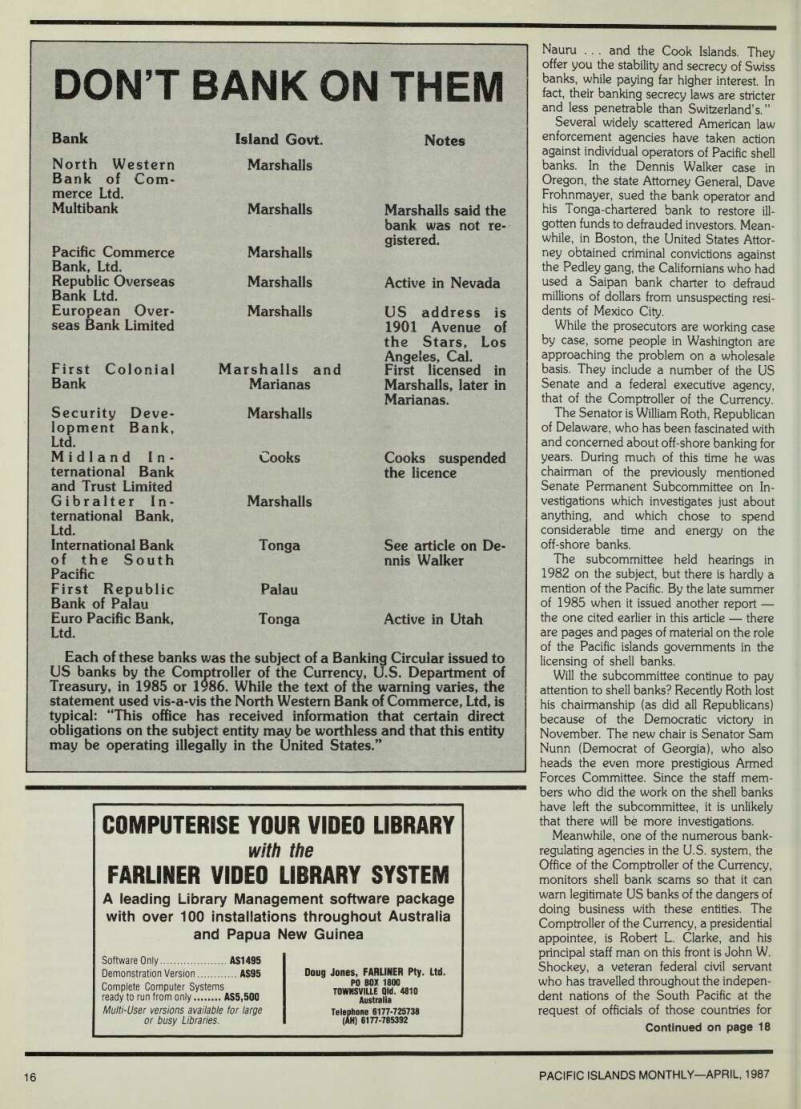
Don’T Bank On Them
Bank North Western Bank of Commerce Ltd.
Multibank Pacific Commerce Bank, Ltd, Republic Overseas Bank Ltd.
European Overseas Bank Limited First Colonial Bank Security Development Bank, Ltd.
Midland In ternational Bank and Trust Limited Gibralter International Bank, Ltd.
International Bank of the South Pacific First Republic Bank of Palau Euro Pacific Bank, Ltd.
Island Govt.
Marshalls Marshalls Marshalls Marshalls Marshalls Marshalls and Marianas Marshalls Cooks Marshalls Tonga Palau Tonga Notes Marshalls said the bank was not registered.
Active in Nevada US address is 1901 Avenue of the Stars, Los Angeles, Cal.
First licensed in Marshalls, later in Marianas.
Cooks suspended the licence See article on Dennis Walker Active in Utah Each of these banks was the subject of a Banking Circular issued to US banks by the Comptroller of the Currency, U.S. Department of Treasury, in 1985 or 1986. While the text of the warning varies, the statement used vis-a-vis the North Western Bank of Commerce, Ltd, is typical: “This office has received information that certain direct obligations on the subject entity may be worthless and that this entity may be operating illegally in the United States.”
COMPUTERISE YOUR VIDEO LIBRARY
with the
FARLINER VIDEO LIBRARY SYSTEM
A leading Library Management software package
with over 100 installations throughout Australia and Papua New Guinea Software Only A 51495 Demonstration Version AS9S Complete Computer Systems ready to run from only ASS,SOO Multi-User versions available for large or busy Libraries.
Doug Jones, FARLINER Pty. Ltd.
PO BOX 1800
TOWNSVILLE Old. 4810
Australia Telephone 6177-725738 (AH) 6177-785392
world go round
Money makes the world go round
A good example of how a Paci fic island chartered shell bank can be used to defraud Amer ican investors is that of the International Bank of the South Paci fic, chartered in Tonga.
The description comes from the office of Oregon State Attorney Gen eral, Dave Frohnmayer, which has sued the Bank, and its owner, seeking restitution of funds deposited by Oregonians.
The bank was chartered by Dennis Walker, an American citizen operat ing in the Medford, Oregon area. The other officers included his wife, Shar on, his brother-in-law, Rex Jensen, and several other US citizens. They are charged with misappropriating more than US$3 million.
The Walkers appeared to be pillars of the community. They were both active in the local Mormon Church, and he was a bishop in the Ashland weird of the church, “the lay spiritual and administrative leader of his con gregation”, according to the Portland Oregonian. Walker had received a bachelor’s, a master and a doctorate in political science. He had spent ten years as a professor at Southern Oregon State College.
Walker’s scheme was a simple one, and reminiscent of a time honoured scam first practised in the United States 60 years ago by a fast talker named Charles Ponzi. Ponzi said he was in the international currency exchange business, and that if one invested money with him, he would pay such remarkable returns as 50 per cent and 100 per cent a year.
What Ponzi did was to pay high rates of interest to old investors from his newly secured deposits, thus attracting new investors, and still more money. Eventually the bubble burst, and America’s banking laws were tightened to prohibit those prac tices. Such operations are now called Ponzi schemes in the US.
The Walkers sold certificates of deposit promising 19 per cent to 50 per cent in interest. There also, apparently, was at least a suggestion that the International Bank of the
South Pacific would not report the earnings to American tax authorities, so the high rates of return would be tax free. Many of those investing in the Tonga bank certificates were the Walkers’ fellow Mormons.
Though the Oregon Attorney Gen eral’s Office does not make the point, an operator like Walker can make little headway unless he encounters (or encourages) a little greed on the part of the victims, a willingness to take a risk for a substantial return on investment.
While the bank business was booming, Walker decided to insti tutionalise a hobby of his, collecting sports memorabilia. He used his ill-gotten gains to lease a building in Medford, a small city of 40,000 without any outstanding tourist attractions. He fixed up the building, opened it as the National Sports Hall of Fame, and filled it with uniforms and equipment associated with America’s sporting heroes. All of this was an expensive proposition, and most of it was funded by his unwitting investors.
According to Jim McLaughlin, the Assistant Attorney General working on the case. Walker would go to a Medford area bank and cash cheques made out on the International Bank of the South Pacific account in that bank in amounts as high as $50,000 each. After a while the bank became suspicious of these transactions, and held him down to less than $lO,OOO a cheque federal law requires that any cash transaction amounting to $lO,OOO or more be reported to the US Treasury.
Ultimately the scheme collapsed, but before any corrective action could be taken Walker had closed the sports museum, emptied it of its contents, cleaned out his bank accounts, and disappeared, as have some of his associates. His wife is reported to be living near Las Vegas, Nevada.
While Walker (and perhaps some of his associates) clearly made money out of the deal, the scam did little for Tonga but cast doubts on the Tonga Offshore Banking Act of 1984,
the statute that set up the bank used by Walker.
“As far as we can tell, the only money left in Tonga was a $lO,OOO - deposit with the Govern ment, established at the time of the bank’s charter, and some $3OOO in fees,” McLaughlin said. He suggested that additional fee payments were required by Tonga law but probably were not paid by Walker. There is a 0.25 per cent excise tax set by Tonga.
While the Government of Tonga got little out of the deal, one relative of a Tongan official was on the bank’s payroll. McLaughlin said that David Cocker, then but not now a resident of Auckland, served as a member of the Board of Directors of the In ternational Bank of the South Pacific.
He is the brother of Cecil Cocker, then Tonga’s Minister of Finance.
Another Tongan associated with the bank was Sione Latu. McLaughlin said that the State of Oregon did not know whether he received any com pensation from the bank. Laifone Tuita, according to McLaughlin, was the bank’s manager in Tonga. (Most of the issuance of certificates of deposit, however, took place in Oregon.) An American named Larry Dotson was associated with the Tonga branch of the bank; his trail was later traced to Australia, after he sent Christmas cards to defrauded deposi tors in America saying that he was not involved in the scheme, and that Dennis Walker had disappeared.
When the Attorney General’s office in Oregon sought information about the International Bank of the South Pacific letters were sent to Selwyn Jones, Tonga’s Secretary of Finance, who reports to Cecil Cocker. Jones’s response, according to McLaughlin, was that the Government of Tonga was prevented, by the 1984 legisla tion, from disclosing anything about the activities of banks chartered under its provisions.
Among the other off-shore banks that McLaughlin has tangled with are the Merchants International Bank, Ltd., of the Marshalls, which he said defrauded investors of some $2.5 million to $3 million in a Ponzi-type scheme, and the First Colonial Bank Ltd. of the Marianas. The latter operation was put together by David Hunt and Robert Cottier, both US citizens. Hunt had previously been
convicted of embezzlement.
David
S. North.
Mexican stand off
as law takes its course
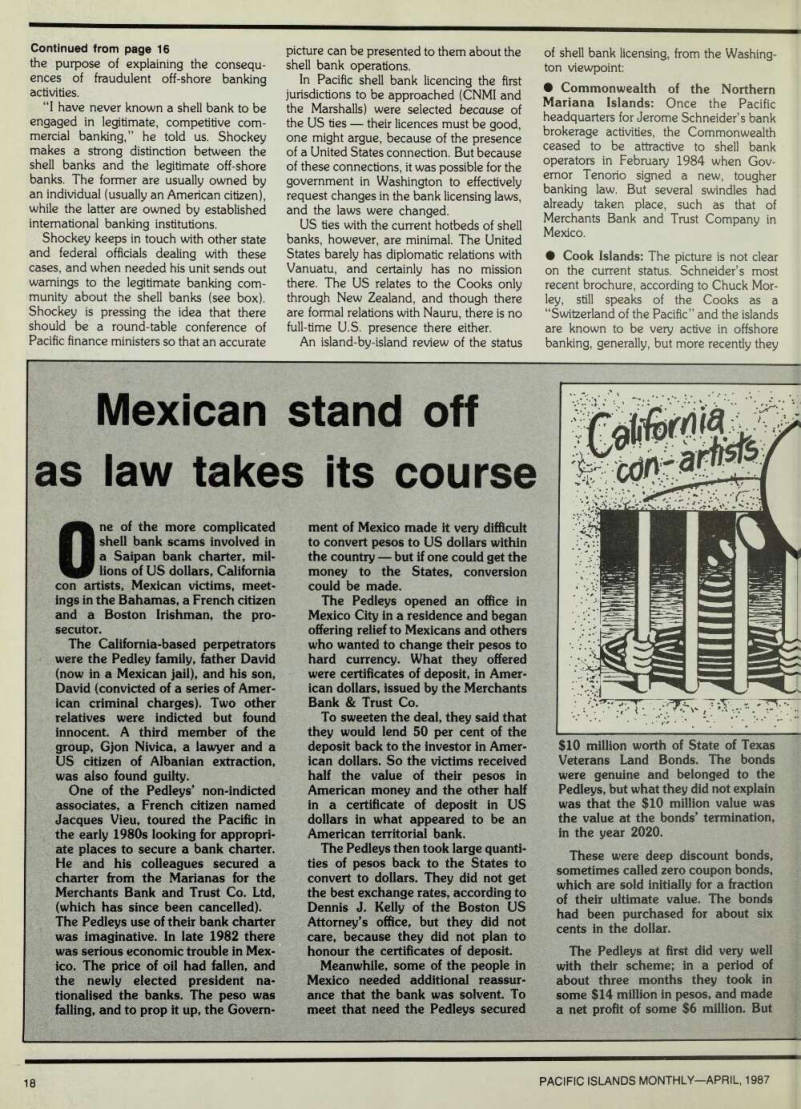
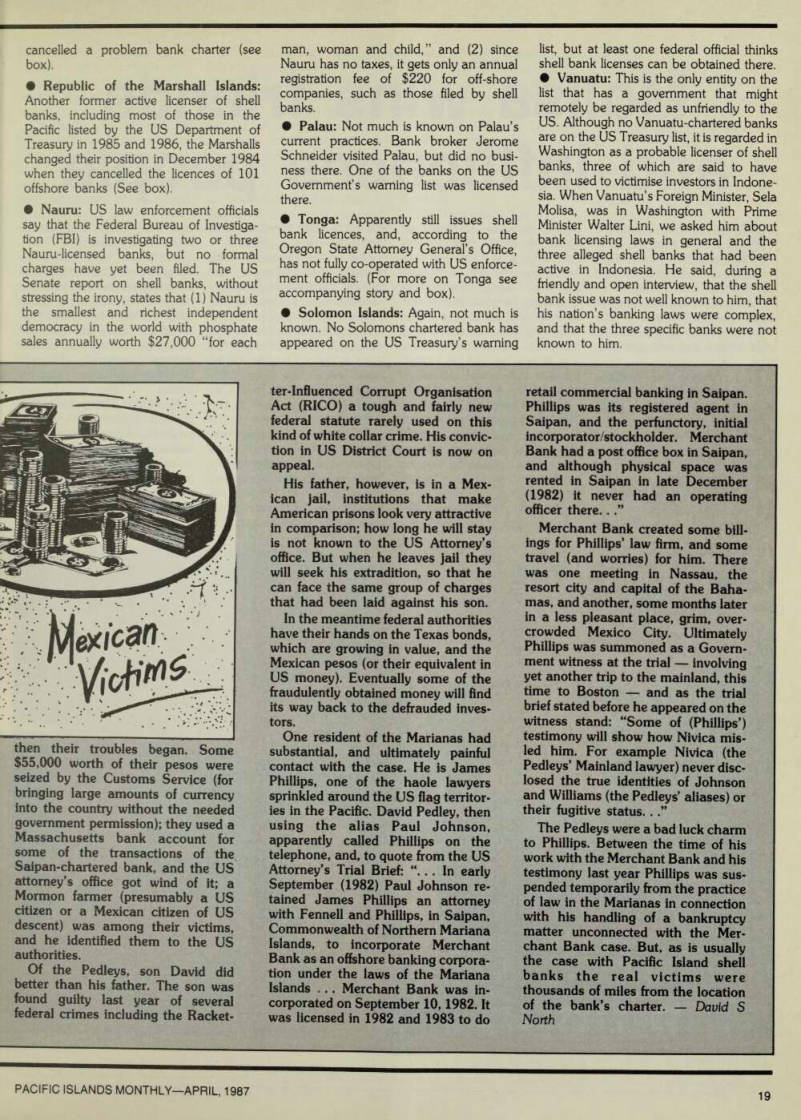
One of the more complicated shell bank scams involved in a Saipan bank charter, mil lions of US dollars, California con artists, Mexican victims, meet ings in the Bahamas, a French citizen and a Boston Irishman, the pro secutor.
The California-based perpetrators were the Pedley family, father David (now in a Mexican jail), and his son, David (convicted of a series of Amer ican criminal charges). Two other relatives were indicted but found innocent. A third member of the group, Gjon Nivica, a lawyer and a US citizen of Albanian extraction, was also found guilty.
One of the Pedleys’ non-indictcd associates, a French citizen named Jacques Vieu, toured the Pacific in the early 1980 s looking for appropri ate places to secure a bank charter.
He and his colleagues secured a charter from the Marianas for the Merchants Bank and Trust Co. Ltd, (which has since been cancelled).
The Pedleys use of their bank charter was imaginative. In late 1982 there was serious economic trouble in Mex ico. The price of oil had fallen, and the newly elected president na tionalised the banks. The peso was falling, and to prop it up, the Govern
ment of Mexico made it very difficult to convert pesos to US dollars within the country but if one could get the money to the States, conversion could be made.
The Pedleys opened an office in Mexico City in a residence and began offering relief to Mexicans and others who wanted to change their pesos to hard currency. What they offered were certificates of deposit, in Amer ican dollars, issued by the Merchants Bank & Trust Co.
To sweeten the deal, they said that they would lend 50 per cent of the deposit back to the investor in Amer ican dollars. So the victims received half the value of their pesos in American money and the other half in a certificate of deposit in US dollars in what appeared to be an American territorial bank.
The Pedleys then took large quanti ties of pesos back to the States to convert to dollars. They did not get the best exchange rates, according to Dennis J. Kelly of the Boston US Attorney’s office, but they did not care, because they did not plan to honour the certificates of deposit.
Meanwhile, some of the people in Mexico needed additional reassur ance that the bank was solvent. To meet that need the Pedleys secured
$lO million worth of State of Texas Veterans Land Bonds. The bonds were genuine and belonged to the Pedleys, but what they did not explain was that the $lO million value was the value at the bonds’ termination, in the year 2020.
These were deep discount bonds, sometimes called zero coupon bonds, which are sold initially for a fraction of their ultimate value. The bonds had been purchased for about six cents in the dollar.
The Pedleys at first did very well with their scheme; in a period of about three months they took in some $l4 million in pesos, and made a net profit of some $6 million. But
then their troubles began. Some $55,000 worth of their pesos were seized by the Customs Service (for bringing large amounts of currency into the country without the needed government permission); they used a Massachusetts bank account for some of the transactions of the Saipan-chartered bank, and the US attorney’s office got wind of it; a Mormon farmer (presumably a US citizen or a Mexican citizen of US descent) was among their victims, and he identified them to the US authorities.
Of the Pedleys, son David did better than his father. The son was found guilty last year of several federal crimes including the Racket
ter-lnfluenced Corrupt Organisation Act (RICO) a tough and fairly new federal statute rarely used on this kind of white collar crime. His convic tion in US District Court is now on appeal.
His father, however, is in a Mex ican jail, institutions that make American prisons look very attractive in comparison; how long he will stay is not known to the US Attorney’s office. But when he leaves jail they will seek his extradition, so that he can face the same group of charges that had been laid against his son.
In the meantime federal authorities have their hands on the Texas bonds, which are growing in value, and the Mexican pesos (or their equivalent in US money). Eventually some of the fraudulently obtained money will find its way back to the defrauded inves tors.
One resident of the Marianas had substantial, and ultimately painful contact with the case. He is James Phillips, one of the haole lawyers sprinkled around the US flag territor ies in the Pacific. David Pedley, then using the alias Paul Johnson, apparently called Phillips on the telephone, and, to quote from the US Attorney’s Trial Brief: “... In early September (1982) Paul Johnson re tained James Phillips an attorney with Fennell and Phillips, in Saipan, Commonwealth of Northern Mariana Islands, to incorporate Merchant Bank as an offshore banking corpora tion under the laws of the Mariana Islands ~. Merchant Bank was in corporated on September 10,1982. It was licensed in 1982 and 1983 to do
retail commercial banking in Saipan.
Phillips was its registered agent in Saipan, and the perfunctory, initial incorporator/stockholder. Merchant Bank had a post office box in Saipan, and although physical space was rented in Saipan in late December (1982) it never had an operating officer there.. .”
Merchant Bank created some bill ings for Phillips’ law firm, and some travel (and worries) for him. There was one meeting in Nassau, the resort city and capital of the Baha mas, and another, some months later in a less pleasant place, grim, over crowded Mexico City. Ultimately Phillips was summoned as a Govern ment witness at the trial involving yet another trip to the mainland, this time to Boston and as the trial brief stated before he appeared on the witness stand: “Some of (Phillips’) testimony will show how Nivica mis led him. For example Nivica (the Pedleys’ Mainland lawyer) never disc losed the true identities of Johnson and Williams (the Pedleys’ aliases) or their fugitive status. ..”
The Pedleys were a bad luck charm to Phillips. Between the time of his work with the Merchant Bank and his testimony last year Phillips was sus pended temporarily from the practice of law in the Marianas in connection with his handling of a bankruptcy matter unconnected with the Mer chant Bank case. But, as is usually the case with Pacific Island shell banks the real victims were thousands of miles from the location
of the bank’s charter.
David S
North
and influences people

Molisa wins friends and influences people
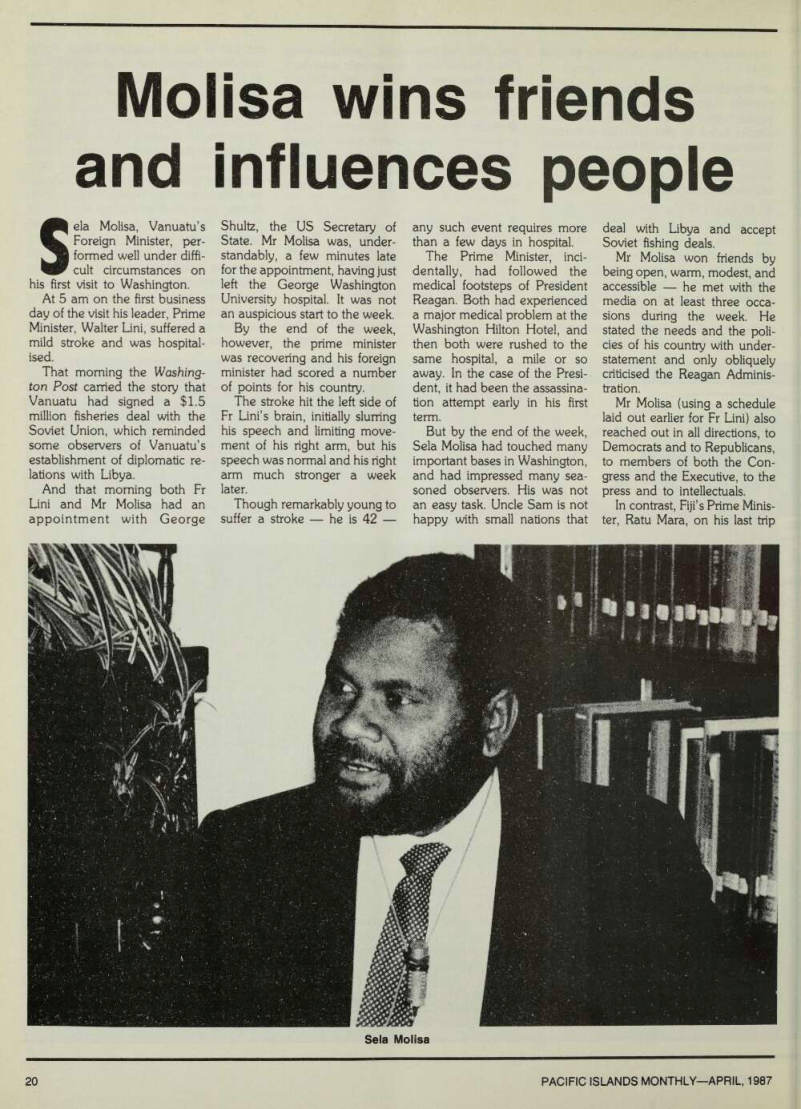
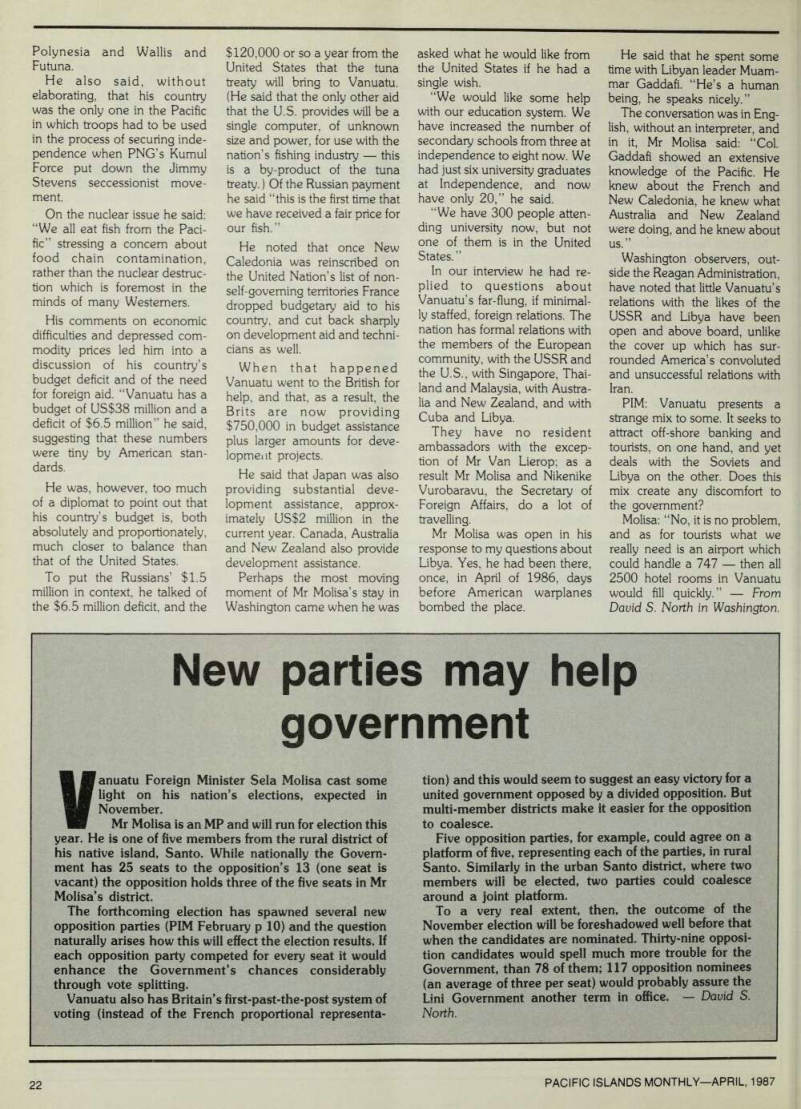
Sela Molisa, Vanuatu’s Foreign Minister, per formed well under diffi cult circumstances on his first visit to Washington.
At 5 am on the first business day of the visit his leader, Prime Minister, Walter Lini, suffered a mild stroke and was hospital ised.
That morning the Washing ton Post carried the story that Vanuatu had signed a $1.5 million fisheries deal with the Soviet Union, which reminded some observers of Vanuatu’s establishment of diplomatic re lations with Libya.
And that morning both Fr Lini and Mr Molisa had an appointment with George
Shultz, the US Secretary of State. Mr Molisa was, under standably, a few minutes late for the appointment, having just left the George Washington University hospital. It was not an auspicious start to the week.
By the end of the week, however, the prime minister was recovering and his foreign minister had scored a number of points for his country.
The stroke hit the left side of Fr Lini’s brain, initially slurring his speech and limiting move ment of his right arm, but his speech was normal and his right arm much stronger a week later.
Though remarkably young to suffer a stroke he is 42
any such event requires more than a few days in hospital.
The Prime Minister, inci dentally, had followed the medical footsteps of President Reagan. Both had experienced a major medical problem at the Washington Hilton Hotel, and then both were rushed to the same hospital, a mile or so away. In the case of the Presi dent, it had been the assassina tion attempt early in his first term.
But by the end of the week, Sela Molisa had touched many important bases in Washington, and had impressed many sea soned observers. His was not an easy task. Uncle Sam is not happy with small nations that
deal with Libya and accept Soviet fishing deals.
Mr Molisa won friends by being open, warm, modest, and accessible he met with the media on at least three occa sions during the week. He stated the needs and the poli cies of his country with under statement and only obliquely criticised the Reagan Adminis tration.
Mr Molisa (using a schedule laid out earlier for Fr Lini) also reached out in all directions, to Democrats and to Republicans, to members of both the Con gress and the Executive, to the press and to intellectuals.
In contrast, Fiji’s Prime Minis ter, Ratu Mara, on his last trip
Sela Molisa
here focused his attention solely on the Reagan Administration, seeing no-one in the legislative branch, and granting no inter views.
On that Monday morning, Mr Molisa told the US Secretary of State that the fishing agreement with the Soviets was “a purely commercial and economic deal” which was not designed to increase the USSR’s influ ence in the Pacific.
Mr Shultz had expressed his concern about the fishing agreement during the session.
Afterwards a State Department spokesman called the session “cordial” and Mr Molisa said that he felt that it had “created a greater understanding of Vanuatu’s motives” at the de partment; it sounds as if the meeting went well.
Mr Molisa told PIM in an interview later he had been very impressed with Mr Shultz’s depth of knowledge about the Pacific.
Mr Molisa also attended a somewhat peculiar, annual event the National Prayer Breakfast. It is peculiar because
it is put together on an ad hoc basis by a group of conservative Americans who shun publicity.
It is significant because there are often leaders of several nations attending it, and be cause Ronald Reagan is routinely present. (This year, for example, the King of Tonga was one of the guests. His trip to Washington lasted only a couple of days, and was not covered by the media).
Mr Molisa spent a consider able amount of time on Capitol Hill, talking with a number of members of Congress. He saw, for example, Congressman Stephen Solarz (D-NY) chair man of a key subcommittee of the House of Representatives Committee on Foreign Affairs.
He visited Senator Bill Brad ley (D-NJ), the former Rhodes Scholar and professional bas ketball player (an unusual com bination) who is deeply in terested in the Third World and is regarded as a possible future Democratic candidate for presi dent.
Mr Molisa is probably the first Melanesian leader to seek out
the leaders of the black caucus in the US House of Representa tives; he saw Congressmen Walter Fauntroy (D-DC) and Melvyn Dymally (D-Cal.).
Mr Molisa and Mr Dymally have something in common; both experienced British colo nial rule as children, Mr Dymal ly being a native of the island of Trinidad.
The black caucus has about 5 per cent of the membership of the House; their numbers have been increasing, slowly but surely, and will continue to do so. The caucus will be even more important two years from now if, as expected, a Demo crat becomes president. (All blacks in the House are Demo crats. ) Also in the course of the week Mr Molisa, between visits to Fr Lini in the hospital, man aged to be interviewed by the nation’s most significant net work radio news-and-analysis program “All Things Consi dered.”
Among Fr Lini’s aides was Robert F. Van Lierop, who plays an interesting role for
Vanuatu.
Mr Van Lierop is an Amer ican citizen and a New York attorney who speaks and votes for Vanuatu at the United Na tions. (He tells me he is one of two non-diplomats working there and that the other one is a dentist who speaks for the Caribbean island of Grenada, which the US invaded a few years ago.) Mr Molisa told one gathering of his country’s experience dur ing and after colonial rule. He talked quietly about the particu lar problems of having two colonial masters, not one. “We were kicked around like a ball. ”
He said Vanuatu, bearing this experience in mind, determined that after independence “we would do it our own way.”
Mr Molisa said that three issues were more non-self gov erning entities in the Pacific than anywhere else in the world. He was particularly criti cal of France, who he said had dragged its feet on independ ence for his nation, worrying that it might set a precedent for New Caledonia, French
Polynesia and Wallis and Futuna.
He also said, without elaborating, that his country was the only one in the Pacific in which troops had to be used in the process of securing inde pendence when PNG’s Kumul Force put down the Jimmy Stevens secessionist move ment.
On the nuclear issue he said: “We all eat fish from the Paci fic” stressing a concern about food chain contamination, rather than the nuclear destruc tion which is foremost in the minds of many Westerners.
His comments on economic difficulties and depressed com modity prices led him into a discussion of his country’s budget deficit and of the need for foreign aid. “Vanuatu has a budget of US$3B million and a deficit of $6.5 million” he said, suggesting that these numbers were tiny by American stan dards.
He was, however, too much of a diplomat to point out that his country’s budget is, both absolutely and proportionately, much closer to balance than that of the United States.
To put the Russians’ $1.5 million in context, he talked of the $6.5 million deficit, and the
$120,000 or so a year from the United States that the tuna treaty will bring to Vanuatu. (He said that the only other aid that the U.S. provides will be a single computer, of unknown size and power, for use with the nation’s fishing industry this is a by-product of the tuna treaty.) Of the Russian payment he said “this is the first time that we have received a fair price for our fish.”
He noted that once New Caledonia was reinscribed on the United Nation’s list of non self-goveming territories France dropped budgetary aid to his country, and cut back sharply on development aid and techni cians as well.
When that happened Vanuatu went to the British for help, and that, as a result, the Brits are now providing $750,000 in budget assistance plus larger amounts for deve lopment projects.
He said that Japan was also providing substantial deve lopment assistance, approx imately US$2 million in the current year. Canada, Australia and New Zealand also provide development assistance.
Perhaps the most moving moment of Mr Molisa’s stay in Washington came when he was
asked what he would like from the United States if he had a single wish.
“We would like some help with our education system. We have increased the number of secondary schools from three at independence to eight now. We had just six university graduates at Independence, and now have only 20,” he said.
“We have 300 people atten ding university now, but not one of them is in the United States. ”
In our interview he had re plied to questions about Vanuatu’s far-flung, if minimal ly staffed, foreign relations. The nation has formal relations with the members of the European community, with the USSR and the U.S., with Singapore, Thai land and Malaysia, with Austra lia and New Zealand, and with Cuba and Libya.
They have no resident ambassadors with the excep tion of Mr Van Lierop; as a result Mr Molisa and Nikenike Vurobaravu, the Secretary of Foreign Affairs, do a lot of travelling.
Mr Molisa was open in his response to my questions about Libya. Yes, he had been there, once, in April of 1986, days before American warplanes bombed the place.
He said that he spent some time with Libyan leader Muam mar Gaddafi. “He’s a human being, he speaks nicely.”
The conversation was in Eng lish, without an interpreter, and in it, Mr Molisa said: “Col.
Gaddafi showed an extensive knowledge of the Pacific. He knew about the French and New Caledonia, he knew what Australia and New Zealand were doing, and he knew about us.”
Washington observers, out side the Reagan Administration, have noted that little Vanuatu’s relations with the likes of the USSR and Libya have been open and above board, unlike the cover up which has sur rounded America’s convoluted and unsuccessful relations with Iran.
PIM: Vanuatu presents a strange mix to some. It seeks to attract off-shore banking and tourists, on one hand, and yet deals with the Soviets and Libya on the other. Does this mix create any discomfort to the government?
Molisa; “No, it is no problem, and as for tourists what we really need is an airport which could handle a 747 then all 2500 hotel rooms in Vanuatu would fill quickly.” From David S. North in Washington.
Advertisements & other items, p. 21 (1 item)
The Total Test Equipment Solution
AWA
AWA
your pro
the righ
Wth le of If W' r>
finding the rigf
equipment is solved,
the widest possible 1 1
equipment to suit yo
day needs.
k nave marconiA instriimpntcr Tektronix every m o r compromises
just choices.
/ isaiiva
S P .«* Q
AWA
N
ealandU.
/ted m The to tal c icat ommu on pa Rd alu a a PO Box 858 Suy Telex FJ2347 Cs Fax (679)314379 a Rhon 44
HITACHI
Ifluk
EXPAN
SE □
New parties may help
government
Vanuatu Foreign Minister Sela Molisa cast some light on his nation’s elections, expected in November.
Mr Molisa is an MP and will run for election this year. He is one of five members from the rural district of his native island, Santo. While nationally the Govern ment has 25 seats to the opposition’s 13 (one seat is vacant) the opposition holds three of the five seats in Mr Molisa’s district.
The forthcoming election has spawned several new opposition parties (PIM February p 10) and the question naturally arises how this will effect the election results. If each opposition party competed for every seat it would enhance the Government’s chances considerably through vote splitting.
Vanuatu also has Britain’s first-past-the-post system of voting (instead of the French proportional representa
tion) and this would seem to suggest an easy victory for a united government opposed by a divided opposition. But multi-member districts make it easier for the opposition to coalesce.
Five opposition parties, for example, could agree on a platform of five, representing each of the parties, in rural Santo. Similarly in the urban Santo district, where two members will be elected, two parties could coalesce around a joint platform.
To a very real extent, then, the outcome of the November election will be foreshadowed well before that when the candidates are nominated. Thirty-nine opposi tion candidates would spell much more trouble for the Government, than 78 of them; 117 opposition nominees (an average of three per seat) would probably assure the
Lini Government another term in office.
North.
David S.
of increased Soviet power
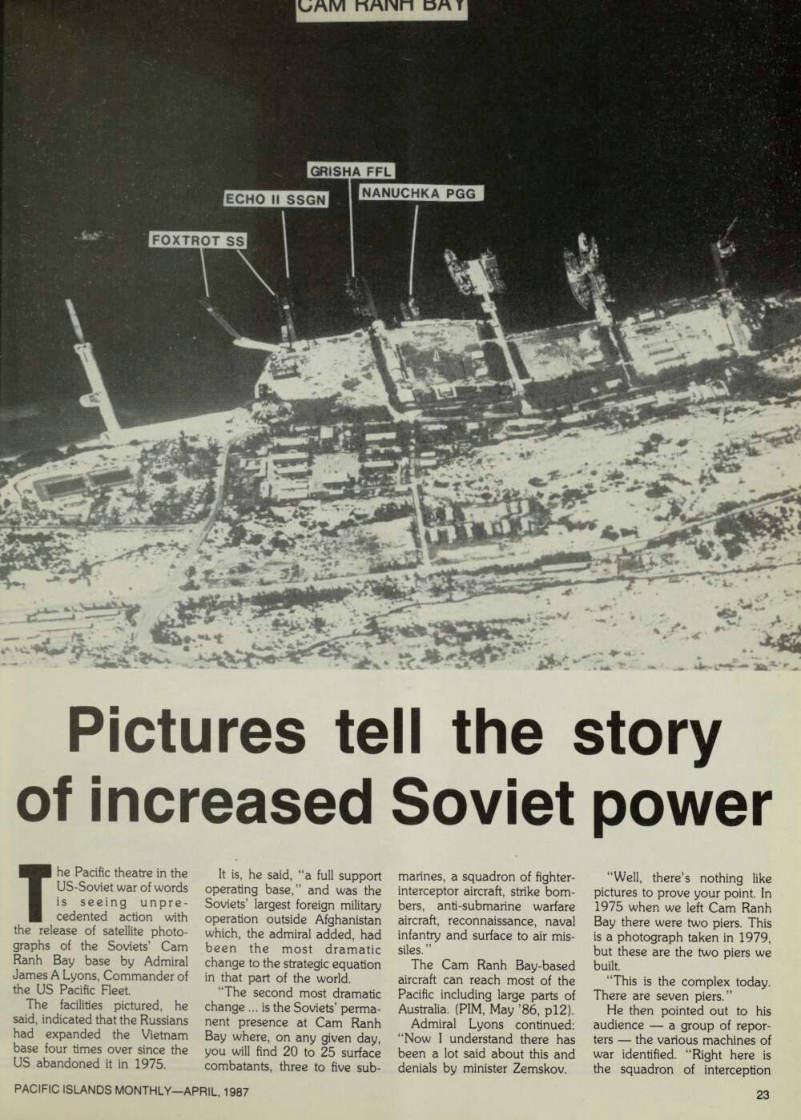
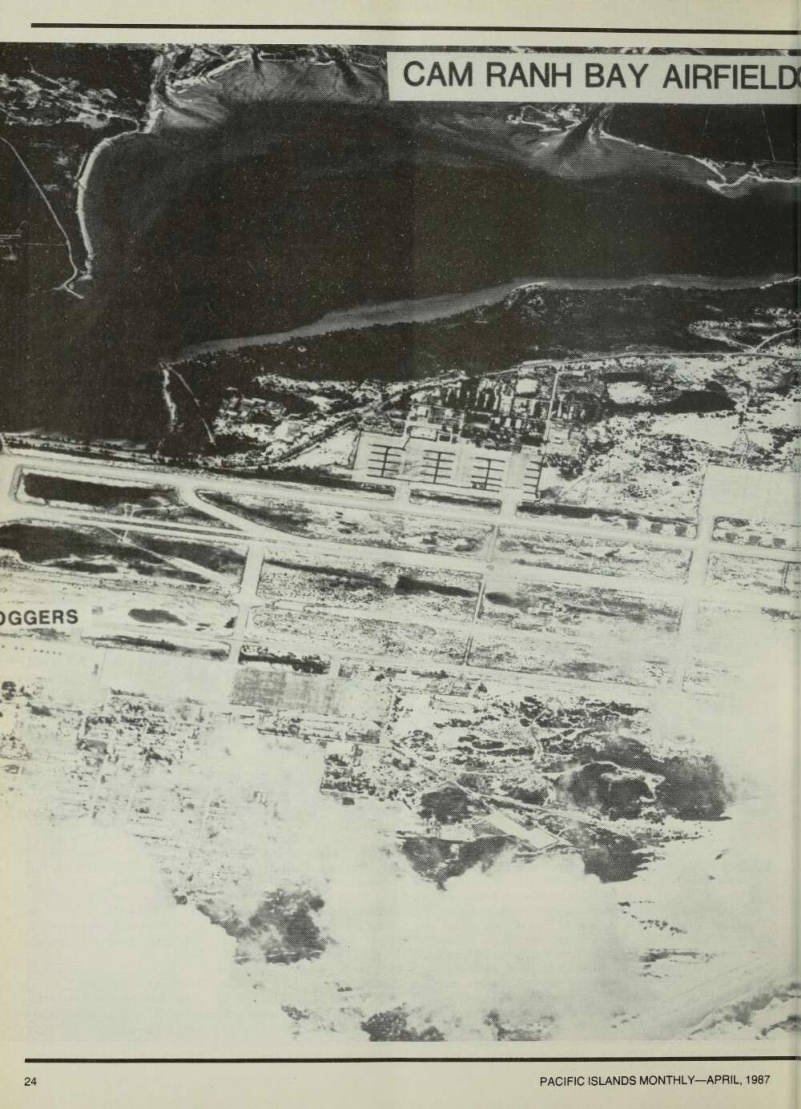
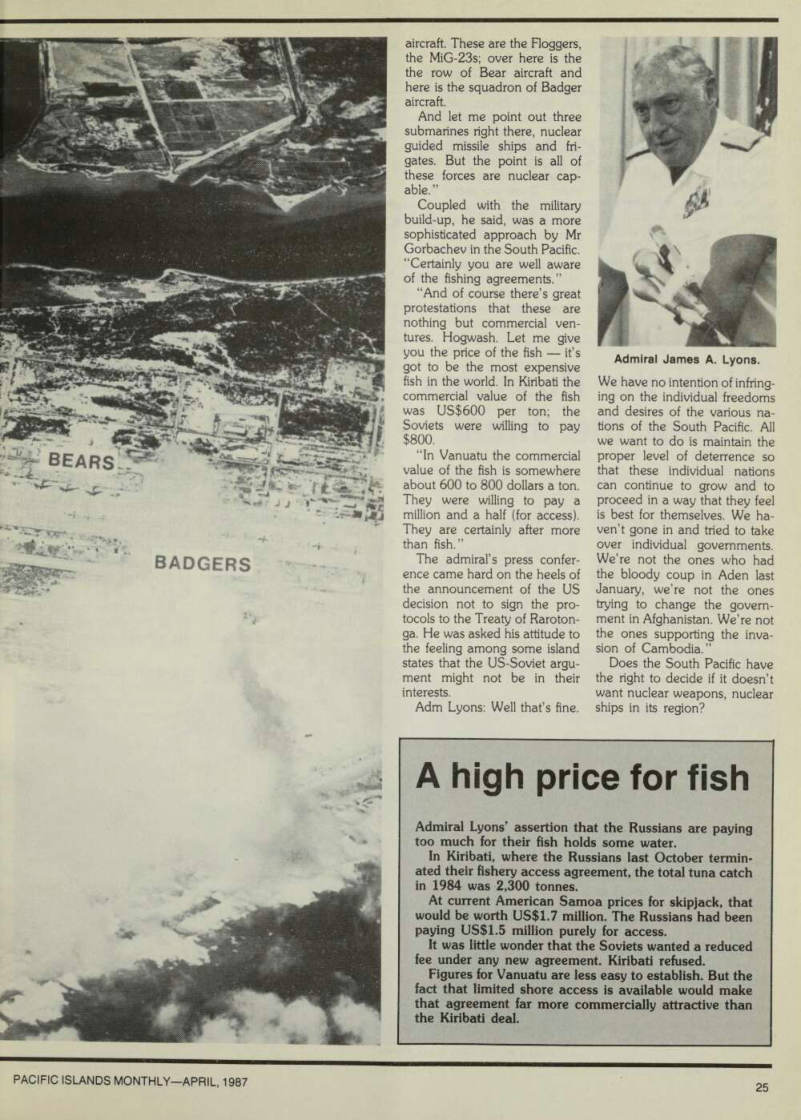
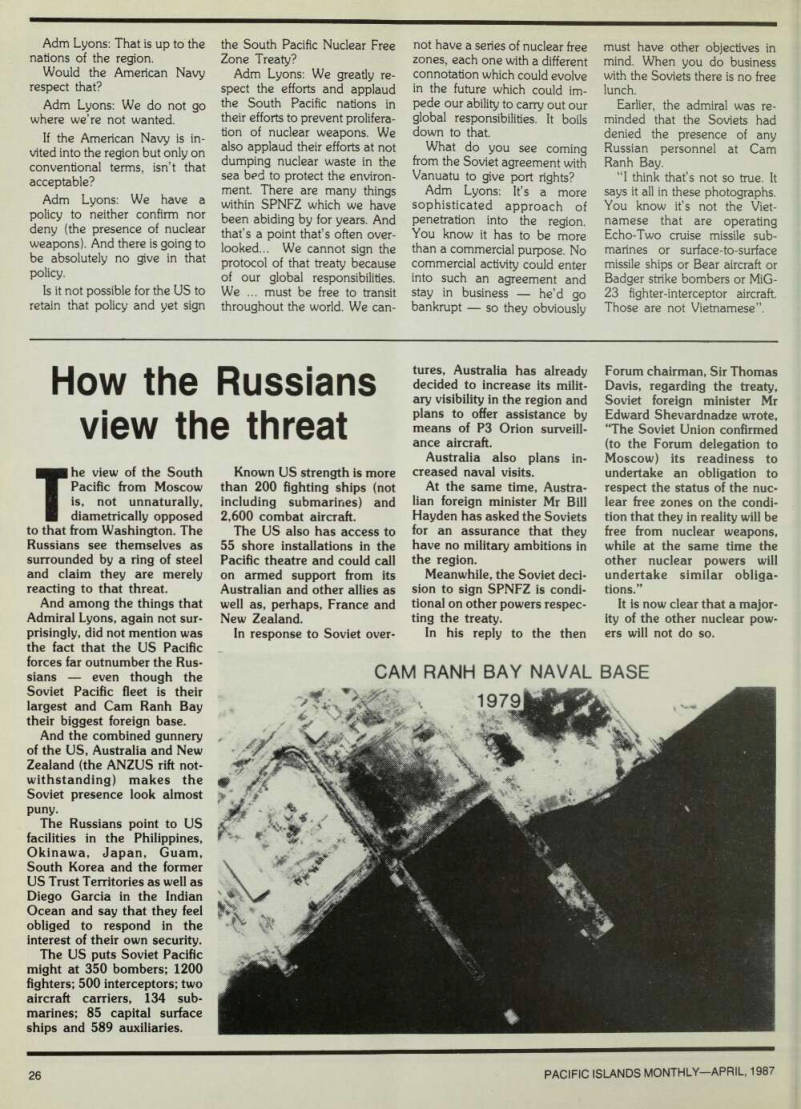
Pictures tell the story of increased Soviet power
The Pacific theatre in the US-Soviet war of words is seeing unprecedented action with the release of satellite photographs of the Soviets’ Cam Ranh Bay base by Admiral James A Lyons, Commander of the US Pacific Fleet.
The facilities pictured, he said, indicated that the Russians had expanded the Vietnam base four times over since the US abandoned it in 1975.
It is, he said, “a full support operating base,” and was the Soviets’ largest foreign military operation outside Afghanistan which, the admiral added, had been the most dramatic change to the strategic equation in that part of the world, “The second most dramatic change... is the Soviets’perma nent presence at Cam Ranh Bay where, on any given day, you will find 20 to 25 surface combatants, three to five sub
marines, a squadron of fighterinterceptor aircraft, strike bombers, anti-submarine warfare aircraft, reconnaissance, naval infantry and surface to air missites-”
The Cam Ranh Bay-based aircraft can reach most of the Pacific including large parts of Australia. (PIM, May ’B6, pl 2).
Admiral Lyons continued: “Now I understand there has been a lot said about this and denials by minister Zemskov.
“Well, there’s nothing like pictures to prove your point. In 1975 when we left Cam Ranh Bay there were two piers. This is a photograph taken in 1979, but these are the two piers we built, “This is the complex today.
There are seven piers.”
He then pointed out to his audience a group of repor ters the various machines of war identified. “Right here is the squadron of interception
aircraft. These are the Floggers, the MiG-235; over here is the the row of Bear aircraft and here is the squadron of Badger aircraft.
And let me point out three submarines right there, nuclear guided missile ships and fri gates. But the point is all of these forces are nuclear cap able.”
Coupled with the military build-up, he said, was a more sophisticated approach by Mr Gorbachev in the South Pacific.
“Certainly you are well aware of the fishing agreements.”
“And of course there’s great protestations that these are nothing but commercial ven tures. Hogwash. Let me give you the price of the fish it’s got to be the most expensive fish in the world. In Kiribati the commercial value of the fish was US$6OO per ton; the Soviets were willing to pay
$Boo.
“In Vanuatu the commercial value of the fish is somewhere about 600 to 800 dollars a ton.
They were willing to pay a million and a half (for access).
They are certainly after more than fish.”
The admiral’s press confer ence came hard on the heels of the announcement of the US decision not to sign the pro tocols to the Treaty of Raroton ga. He was asked his attitude to the feeling among some island states that the US-Soviet argu ment might not be in their interests.
Adm Lyons: Well that’s fine.
We have no intention of infring ing on the individual freedoms and desires of the various na tions of the South Pacific. All we want to do is maintain the proper level of deterrence so that these individual nations can continue to grow and to proceed in a way that they feel is best for themselves. We ha ven’t gone in and tried to take over individual governments.
We’re not the ones who had the bloody coup in Aden last January, we’re not the ones trying to change the govern ment in Afghanistan. We’re not the ones supporting the inva sion of Cambodia.”
Does the South Pacific have the right to decide if it doesn’t want nuclear weapons, nuclear ships in its region?
Admiral James A. Lyons.
Adm Lyons: That is up to the nations of the region.
Would the American Navy respect that?
Adm Lyons: We do not go where we’re not wanted.
If the American Navy is in vited into the region but only on conventional terms, isn’t that acceptable?
Adm Lyons; We have a policy to neither confirm nor deny (the presence of nuclear weapons). And there is going to be absolutely no give in that policy.
Is it not possible for the US to retain that policy and yet sign
the South Pacific Nuclear Free Zone Treaty?
Adm Lyons; We greatly re spect the efforts and applaud the South Pacific nations in their efforts to prevent prolifera tion of nuclear weapons. We also applaud their efforts at not dumping nuclear waste in the sea bed to protect the environ ment. There are many things within SPNFZ which we have been abiding by for years. And that’s a point that’s often over looked... We cannot sign the protocol of that treaty because of our global responsibilities.
We ... must be free to transit throughout the world. We can
not have a series of nuclear free zones, each one with a different connotation which could evolve in the future which could im pede our ability to carry out our global responsibilities. It boils down to that.
What do you see coming from the Soviet agreement with Vanuatu to give port rights?
Adm Lyons: It’s a more sophisticated approach of penetration into the region.
You know it has to be more than a commercial purpose. No commercial activity could enter into such an agreement and stay in business he’d go bankrupt so they obviously
must have other objectives in mind. When you do business with the Soviets there is no free lunch.
Earlier, the admiral was re minded that the Soviets had denied the presence of any Russian personnel at Cam Ranh Bay.
“I think that’s not so true. It says it all in these photographs.
You know it’s not the Viet namese that are operating Echo-Two cruise missile sub marines or surface-to-surface missile ships or Bear aircraft or Badger strike bombers or MiG -23 fighter-interceptor aircraft.
Those are not Vietnamese”.
Advertisements & other items, p. 25 (1 item)
A high price for fish
Admiral Lyons’ assertion that the Russians are paying too much for their fish holds some water.
In Kiribati, where the Russians last October terminated their fishery access agreement, the total tuna catch in 1984 was 2,300 tonnes.
At current American Samoa prices for skipjack, that would be worth US$l.7 million. The Russians had been paying US$l.5 million purely for access.
It was little wonder that the Soviets wanted a reduced fee under any new agreement. Kiribati refused.
Figures for Vanuatu are less easy to establish. But the fact that limited shore access is available would make that agreement far more commercially attractive than the Kiribati deal.
How the Russians
view the threat
The view of the South Pacific from Moscow is, not unnaturally, diametrically opposed to that from Washington. The Russians see themselves as surrounded by a ring of steel and claim they are merely reacting to that threat.
And among the things that Admiral Lyons, again not sur prisingly, did not mention was the fact that the US Pacific forces far outnumber the Rus sians even though the Soviet Pacific fleet is their largest and Cam Ranh Bay their biggest foreign base.
And the combined gunnery of the US, Australia and New Zealand (the ANZUS rift not withstanding) makes the Soviet presence look almost puny.
The Russians point to US facilities in the Philippines, Okinawa, Japan, Guam, South Korea and the former US Trust Territories as well as Diego Garcia in the Indian Ocean and say that they feel obliged to respond in the interest of their own security.
The US puts Soviet Pacific might at 350 bombers; 1200 fighters; 500 interceptors; two aircraft carriers, 134 sub marines; 85 capital surface ships and 589 auxiliaries.
Known US strength is more than 200 fighting ships (not including submarines) and 2,600 combat aircraft.
The US also has access to 55 shore installations in the Pacific theatre and could call on armed support from its Australian and other allies as well as, perhaps, France and New Zealand.
In response to Soviet over
tures, Australia has already decided to increase its milit ary visibility in the region and plans to offer assistance by means of P 3 Orion surveill ance aircraft.
Australia also plans in creased naval visits.
At the same time, Austra lian foreign minister Mr Bill Hayden has asked the Soviets for an assurance that they have no military ambitions in the region.
Meanwhile, the Soviet deci sion to sign SPNFZ is condi tional on other powers respec ting the treaty.
In his reply to the then
Forum chairman, Sir Thomas Davis, regarding the treaty, Soviet foreign minister Mr Edward Shevardnadze wrote, “The Soviet Union confirmed (to the Forum delegation to Moscow) its readiness to undertake an obligation to respect the status of the nuc lear free zones on the condi tion that they in reality will be free from nuclear weapons, while at the same time the other nuclear powers will undertake similar obliga tions.”
It is now clear that a major ity of the other nuclear pow ers will not do so.
Cam Ranh Bay Naval Base
19791
in plantation industry
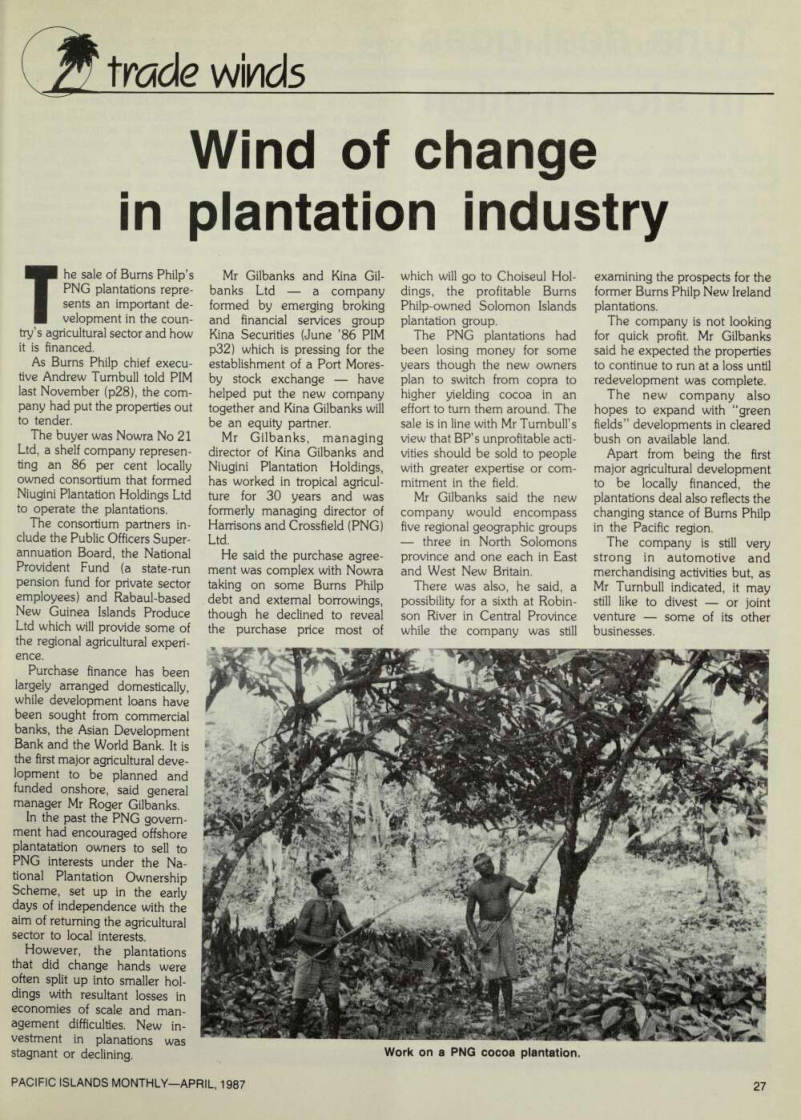
trade winds
Wind of change in plantation industry
The sale of Burns Philp’s PNG plantations repre sents an important de velopment in the coun try’s agricultural sector and how it is financed.
As Burns Philp chief execu tive Andrew Turnbull told PIM last November (p2B), the com pany had put the properties out to tender.
The buyer was Nowra No 21 Ltd, a shelf company represen ting an 86 per cent locally owned consortium that formed Niugini Plantation Holdings Ltd to operate the plantations.
The consortium partners in clude the Public Officers Super annuation Board, the National Provident Fund (a state-run pension fund for private sector employees) and Rabaul-based New Guinea Islands Produce Ltd which will provide some of the regional agricultural experi ence.
Purchase finance has been largely arranged domestically, while development loans have been sought from commercial banks, the Asian Development Bank and the World Bank. It is the first major agricultural deve lopment to be planned and funded onshore, said general manager Mr Roger Gilbanks.
In the past the PNG govern ment had encouraged offshore plantatation owners to sell to PNG interests under the Na tional Plantation Ownership Scheme, set up in the early days of independence with the aim of returning the agricultural sector to local interests.
However, the plantations that did change hands were often split up into smaller hol dings with resultant losses in economies of scale and man agement difficulties. New in vestment in planations was stagnant or declining.
Mr Gilbanks and Kina Gil banks Ltd a company formed by emerging broking and financial services group Kina Securities (June ’B6 PIM p 32) which is pressing for the establishment of a Port Mores by stock exchange have helped put the new company together and Kina Gilbanks will be an equity partner.
Mr Gilbanks, managing director of Kina Gilbanks and Niugini Plantation Holdings, has worked in tropical agricul ture for 30 years and was formerly managing director of Harrisons and Crossfield (PNG) Ltd.
He said the purchase agree ment was complex with Nowra taking on some Burns Philp debt and external borrowings, though he declined to reveal the purchase price most of
which will go to Choiseul Hol dings, the profitable Burns Philp-owned Solomon Islands plantation group.
The PNG plantations had been losing money for some years though the new owners plan to switch from copra to higher yielding cocoa in an effort to turn them around. The sale is in line with Mr Turnbull’s view that BP’s unprofitable acti vities should be sold to people with greater expertise or com mitment in the field.
Mr Gilbanks said the new company would encompass five regional geographic groups three in North Solomons province and one each in East and West New Britain.
There was also, he said, a possibility for a sixth at Robin son River in Central Province while the company was still
examining the prospects for the former Burns Philp New Ireland plantations.
The company is not looking for quick profit. Mr Gilbanks said he expected the properties to continue to run at a loss until redevelopment was complete.
The new company also hopes to expand with “green fields” developments in cleared bush on available land.
Apart from being the first major agricultural development to be locally financed, the plantations deal also reflects the changing stance of Burns Philp in the Pacific region.
The company is still very strong in automotive and merchandising activities but, as Mr Turnbull indicated, it may still like to divest or joint venture some of its other businesses.
Work on a PNG cocoa plantation.
Tuna deal goes
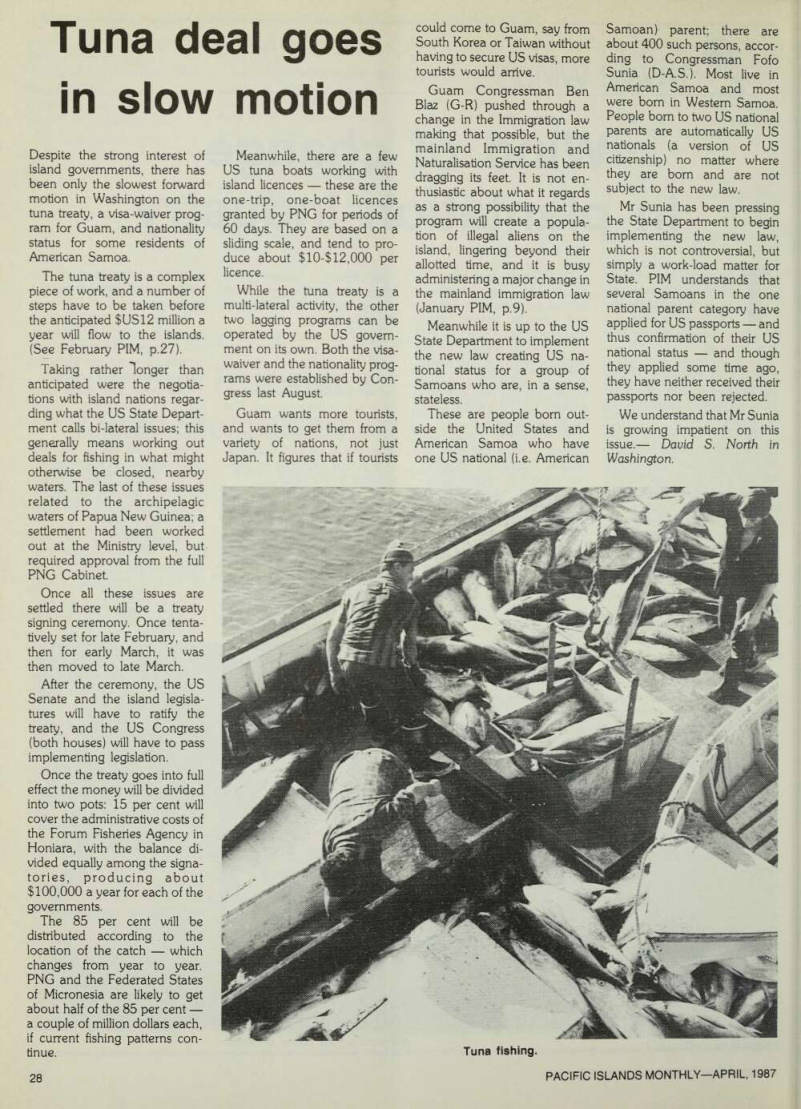
in slow motion
Despite the strong interest of island governments, there has been only the slowest forward motion in Washington on the tuna treaty, a visa-waiver prog ram for Guam, and nationality status for some residents of American Samoa.
The tuna treaty is a complex piece of work, and a number of steps have to be taken before the anticipated SUSI 2 million a year will flow to the islands. (See February PIM, p. 27).
Taking rather longer than anticipated were the negotia tions with island nations regar ding what the US State Depart ment calls bi-lateral issues; this generally means working out deals for fishing in what might otherwise be closed, nearby waters. The last of these issues related to the archipelagic waters of Papua New Guinea; a settlement had been worked out at the Ministry level, but required approval from the full PNG Cabinet.
Once all these issues are settled there will be a treaty signing ceremony. Once tenta tively set for late February, and then for early March, it was then moved to late March.
After the ceremony, the US Senate and the island legisla tures will have to ratify the treaty, and the US Congress (both houses) will have to pass implementing legislation.
Once the treaty goes into full effect the money will be divided into two pots: 15 per cent will cover the administrative costs of the Forum Fisheries Agency in Honiara, with the balance di vided equally among the signa tories, producing about $lOO,OOO a year for each of the governments.
The 85 per cent will be distributed according to the location of the catch which changes from year to year.
PNG and the Federated States of Micronesia are likely to get about half of the 85 per cent a couple of million dollars each, if current fishing patterns con tinue.
Meanwhile, there are a few US tuna boats working with island licences these are the one-trip, one-boat licences granted by PNG for periods of 60 days. They are based on a sliding scale, and tend to pro duce about $lO-$12,000 per licence.
While the tuna treaty is a multi-lateral activity, the other two lagging programs can be operated by the US govern ment on its own. Both the visa waiver and the nationality prog rams were established by Con gress last August.
Guam wants more tourists, and wants to get them from a variety of nations, not just Japan. It figures that if tourists
could come to Guam, say from South Korea or Taiwan without having to secure US visas, more tourists would arrive.
Guam Congressman Ben Blaz (G-R) pushed through a change in the Immigration law making that possible, but the mainland Immigration and Naturalisation Service has been dragging its feet. It is not en thusiastic about what it regards as a strong possibility that the program will create a popula tion of illegal aliens on the island, lingering beyond their allotted time, and it is busy administering a major change in the mainland immigration law (January PIM, p. 9).
Meanwhile it is up to the US State Department to implement the new law creating US na tional status for a group of Samoans who are, in a sense, stateless.
These are people bom out side the United States and American Samoa who have one US national (i.e. American
Samoan) parent; there are about 400 such persons, accor ding to Congressman Fofo Sunia (D-A.S.). Most live in American Samoa and most were bom in Western Samoa.
People born to two US national parents are automatically US nationals (a version of US citizenship) no matter where they are born and are not subject to the new law.
Mr Sunia has been pressing the State Department to begin implementing the new law, which is not controversial, but simply a work-load matter for State. PIM understands that several Samoans in the one national parent category have applied for US passports — and thus confirmation of their US national status — and though they applied some time ago, they have neither received their passports nor been rejected.
We understand that Mr Sunia is growing impatient on this issue.— David S. North in Washington.
Tuna fishing.
Advertisements & other items, pp. 29-32 (1 item)
Bank
Ui BANK
ECONOMIC INDICATORS
COMMODITY PRICES
Mar. 9, ’B7 Month ago Year Ago 120
INTEREST RATES
Short term Mar. 9 Month Year Mar.
Long term 9 Month Year
WORLD COMMODITIES
(Wholesale Price Index, 1980 = 100) Metals Agricultural Raw Material 8001 8006 8012 8106 8112 8206 8212 8306 8312 8406 8412 8506 8512 8606 8612 8706 JAN. JUN. DEC. JUN. DEC. JUN. DEC. JUN. DEC. JUN. DEC. JUN. DEC. JUN. DEC. JUN.
GOLD
London (US $ Per Ounce) 11111111 8001 8006
JAN. JUN.
111111 I I r I I I lIIIIVII M I V I I M I I 8212 8306 8312
DEC. JUN. DEC.
1111 111 111 111 111 11 11 111 1 1 — 8412 8506 8512 8606 8612
DEC. JUN. DEC. JUN, DEC.
INDUSTRIAL WORLD DEMAND
Sources: AAP Reuters: FFA Honiara, IMF (IFS). Compiled by ANZ International Economics, Melbourne.
A<\m
BANK
Branches in
Fiji, Papua New Guinea,
Vanuatu and Solomon Is.
Road-Hugging. Bock-Biting. Pa
*r wt m * i « Mi * & *"- -dß»* mrjr* ir*% m V -jl ar „ #•■: HILUX 4WD Regular Cab, Long Wheelbase One tough truck just got tougher. Toyota’s dedication to superior performance vehicles takes a step forward today with the New Hilux< A refined front grille and bumper design, new instrument panel ! for a feeling of spaciousness and command and plush colour co-ordinated trim are a few new additions to the New Hilux.
And extensive anti-corrosive galvanealed steel protection now includes the tailgate panel and rear door panel, making Hilux more durable than ever before.
Yet for all its improvements, the best of the original Hilux is also<
TOYOTA
QUALITY SERVICE
AMERICAN SAMOA: BURNS PHILP (SOUTH SEA) CO., LTD., P.O. Box 129, Pago Pago. COOK ISLANDS; COOK AUTOMOTIVE SUPPLIES COMPANY, A Division of Burns Philp (South Sea) Co., Ltd., G.P.O. Box 355, Suva. GUAtd & MW Tamuning. KIRIBATI: TARAWA MOTORS, A Division of Bairiki Holdings Ltd., P.O. Box 36, Bairiki, Tarawa. NAURU: NAU SERVICE IMPORTATION AUTOMOBILE DU PACIFIQUE, Rond-Point du Pacifique (Station Total) B.P 438, Noumea. NIUE::: NORFOLK ISLAND: BORRY’S LIMITED, P.O. Box 169. PAPUA NEW GUINEA: ELA MOTORS, A Division of Burns Phl‘ CORPORATION, P.O. Box 267, Saipan. SOLOMON ISLANDS: SOLOMON ISLANDS INVESTMENTS LTD., G.P.O. Box 14(L TONGA: BURNS PHILP (TONGA) LTD., P.O. Box 55, Nukualofa. VANUATU: VANUATU MOTORS, A Division of Burns Phrl RIIRMR PNII p i.qni rm RFAi HO LTD.. P.O. Box 188. Aoia.
Vic-Tough. The New Hilux.
& m ■ * k * V •Jr LI ii * ■ % s :■ 1 ♦ *■ 1% * M w v*. pi x 4 «i * ** re: a big tailgate conveniently hinged for quick loading and unloading; reinforced front suspension to smooth out ; bumps, and bias-mounted, extra-heavy-duty rear shocks and knobbly tyres to take on any terrain.
Toyota’s long history of super-responsive engines, ruggedness, reliability and comfort goes without saying. And in the Hilux, it’s yours in both 2-wheel-drive and 4 x 4 versions.
So, after comprehensive testing and thorough quality control, the New Hilux is ready to bring a new standard of toughness to the Pacific.
And isn’t that exactly what you expect from Toyota? <0 Areas where galvanealed steel is used NG CORPORATION LTD., Private Bag, Rarotonga. FIJI: A: ATKINS KROLL, INC., 443 South Marine Drive, RATIVE SOCIETY, Central Pacific. NEW CALEDONIA: 'L P i S P UTH SEA ) CO.. LTD., P.O. Box 39, Alofi. .d, P.O. Box 75, Port Moresby. SAIPAN: MICROL
rAHITI: NIPPON AUTOMOTO, B.P. 342, Papeete.
) Ltd., P.O. Box 18, Port Vila. WESTERN SAMOA:
TOYOTA
Private Line Channels. Microwave and Fiber Systems. Local Area Networks and VAN’s.
Consulting. PBXs. Operations and Maintenance. International Calling. Multiplexers.
Packet Switching. Data Comm. Pagers. Systems Integration. Project Management. Network Planning, Designing, Engineering and Construction Services. Traini:
There’s
more to
Hawaiian Tel
than meets
the ear.
HAWAIIAN TEL
Beyond the call ketmg i
Hopes founder as cruise
line alters course
The decision by Amer ican Hawaii Cruises to pull out of its Tahiti operation has left a massive hole in the territory’s tourism revenue.
Last year, the cruises on the SS Liberie were the single largest contributor to the is lands’ second tourist volume record in successive years.
The Tahiti Sun Press re ported that the news of the company’s withdrawal stunned the local tourism industry. Edi tor A 1 Prince said the yearly financial loss was estimated at US$l.B5 million.
Hoteliers who had invested in extra services on the strength of the cruises are now wonder ing how to fill the gap.
The 715-passenger Liberti had been operating in the is lands for 13 months providing a regular source of revenue in the form of an annual 32,000 arri vals.
But when the cruise liner went into dry dock in San Francisco in January, the oper ators stunned the territory by announcing that it wasn’t com ing back.
Meanwhile, many small and large companies are left with
equipment and capacity ac quired to service the expected cruise passengers, flown in from the states to cruise the islands.
The 200-room Hotel Tahar a’a was the most heavily com mitted to American Hawaii Cruises (AHC) business.
It reported finishing 1986 with a healthy occupancy rate of 89.5 per cent compared with an average of 49 per cent for the previous year.
The 230-room Hotel Sofitel Maeva Beach, less dependent on AHC’s post-cruise and pre cruise passengers, reported finishing 1986 with 75 per cent occupancy compared with 67 per cent the previous year.
Now the argument rages over who is to blame for the AHC pull-out.
Prince reports that neither the territorial government nor the company has fully ex plained the background to the withdrawal.
He revealed that last September AHC chief execu tive Conrad H.C. Everhard appealed to the Tahiti govern ment for additional tax relief to help the company out of its difficulties connected with the local cruise operation.
He quoted sources as saying that Mr Everhard made the appeal directly to tourism minis ter Mr Alexandre Leontieff, seeking a six month period to get the Tahiti business out of the red.
Then, in January, Mr Everhard announced “with considerable regret” the AHC decision. He explained; “That the logistical problems associ ated with operating a 720-berth vessel on 7-day cruises in French Polynesia have resulted in an unacceptable return on the assets employed.”
However, Mr Leontieff, in an interview with La Depeche said the charter contract between American Global Line Inc., owners of the Liberti and AHC was broken following bank foreclosure on the vessel.
However, The Sun Press re ported other senior sources as saying that the vessel was own ed by a company called Ban stead which was responsible for the US$25 million refitting of the ship before it arrived in Tahiti in December, 1985.
Two US banks held mort gages on the ship, which was charterd by Banstead to AHC, the paper said.
After the Liberti left Tahiti on January 3 for drydock work in San Francisco, the two banks told AHC it had until January 31 to pay money which it was claimed AHC owed to Ban stead, according to the Sun Press source.
Meanwhile, AHC in San Francisco was negotiating with another investment group led by Peter C.R. Huang, former president of the US$6 billion conglomerate, City Investing Company. This was revealed in an AHC press statement of January 21.
Mr Leontieff told La De peche that AHC had made a profit of $250,000 per month between June and December last year and was projecting monthly profit of $450,000 for 1987.
According to the Sun Press source, the Huang group was aware of this but was neverthe less unwilling to take a risk on Tahiti and allowed the banks to foreclose.
According to Mr Leontieff, however, the banks were un happy with AHC’s profit poten tial which was the reason for the foreclosure.
Despite the profit potential,
the cruise company had seen some rough financial weather.
The first public hint of a board room struggle for control of the company came last April when H. William Jesse resigned as AHC’s president after apparently failing to successful ly organise a take-over of AHC’s parent and largest shareholder, American Global Line, by an investment group.
Mr Everhard, chairman of American Global Line, was named as Mr Jesse’s successor and announced that Mr Jesse’s resignation “was prompted by the shareholders’ decision not to sell AHC to the investor group that would have included Jesse and other senior manage ment as well as outside inves tors. ”
Mr Everhard interpreted this decision as “a strong vote of confidence in American Hawaii Cruises and its future.
“We believe that this is the beginning of an exciting new chapter in AHC’s history and we are very optimistic about the company’s prospects for con tinued success.”
At that stage, the cruise oper ator was losing money in Tahiti.
However, according to Mr Leontieff, the company, during its first negotiations with the territorial government, said it envisaged a ten-year presence in Tahiti with losses in the first two years followed by a break even year three and profits from there on.
The minister also said the Liberti would have had a Feb ruary occupancy of only 67 per cent, claiming this was due to an AHC economy measure to cease advertising in the US.
A weakened US dollar, he added, also made AHC’s only other cruise destination, Hawaii, a more attractive prop osition than Tahiti.
The tourism minister said he was “deeply shocked” at the off handed manner in which AHC treated the government and tourism officials over its deci sion to stop the cruises.
“This attitude only confirms my analysis of the cause of this brutal departure,” he said.
AHC already had a number of tax and other breaks. These
included duty exemptions, fore ign personnel concessions, promotion cost sharing, the right to operate charter flights and to sell excess capacity and a ten-year agreement.
The minister confirmed that AHC tried to reduce its early losses by seeking a lower tax imposition for imported goods not covered in the original concessions.
The company also sought a revision of pilotage charges it considered exorbitant and a reduction in payments to dock side workers which added $5,700 to weekly operating costs.
The minister noted that Tahiti still has the 88-passenger Majes tic Tahiti Explorer based in the islands on a year round basis while the 150-passenger sail cruiser Wind Song was due to commence operations in June.
He said that for the outer island or Moorea, where a maximum of 400 AHC passen gers disembarked each week, the March opening of the 150room Hotel Sofitel Tiare should compensate for the loss.
Advertisements & other items, pp. 33-34 (1 item)
Xfdfdfdfd
ALL THE
NEWS
IN A
FLASH
The South Sea Digest tells you what you want to know about the Pacific Islands in a few words. All the leading firms and diplomatic missions read it. You can phone or write or call for a follow up.
See Insert for subscription details.
THE SOUTH SEA DIGEST
BECOME A PART OF PIM'S PACIFIC
For more than 50 years Pacific Islands Monthly has been reporting on events in the Pacific Islands. Not the glossy travel brochure version but the significant things. Social and political changes, commercial development, historical background, extracts from the Islands Press, personalities and PlM’s correspondence columns.
You can become a part of PlM’s Pacific by filling in the subscription form on insert.
PACinC ISLANDS MONTHLY
NEWS MAGAZINE OF THE PACIFIC ISLANDS
■ 111 fim m
US mOVES
AGAINST
chiefs struggled
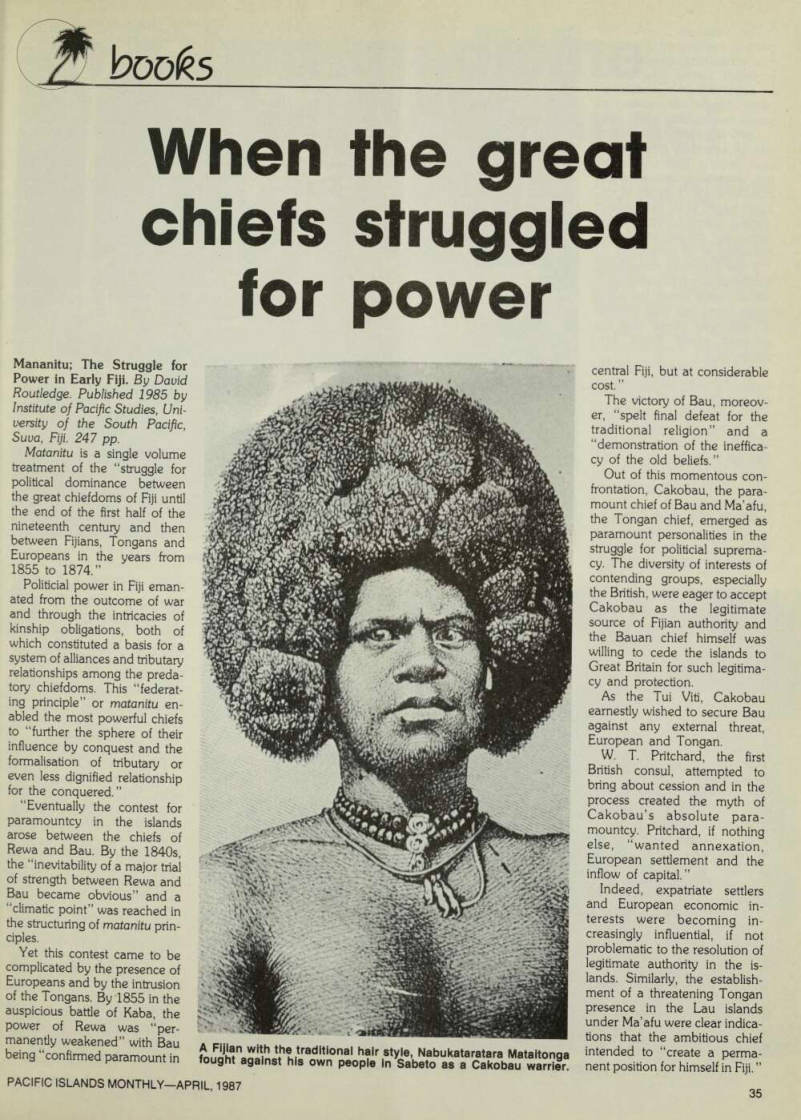
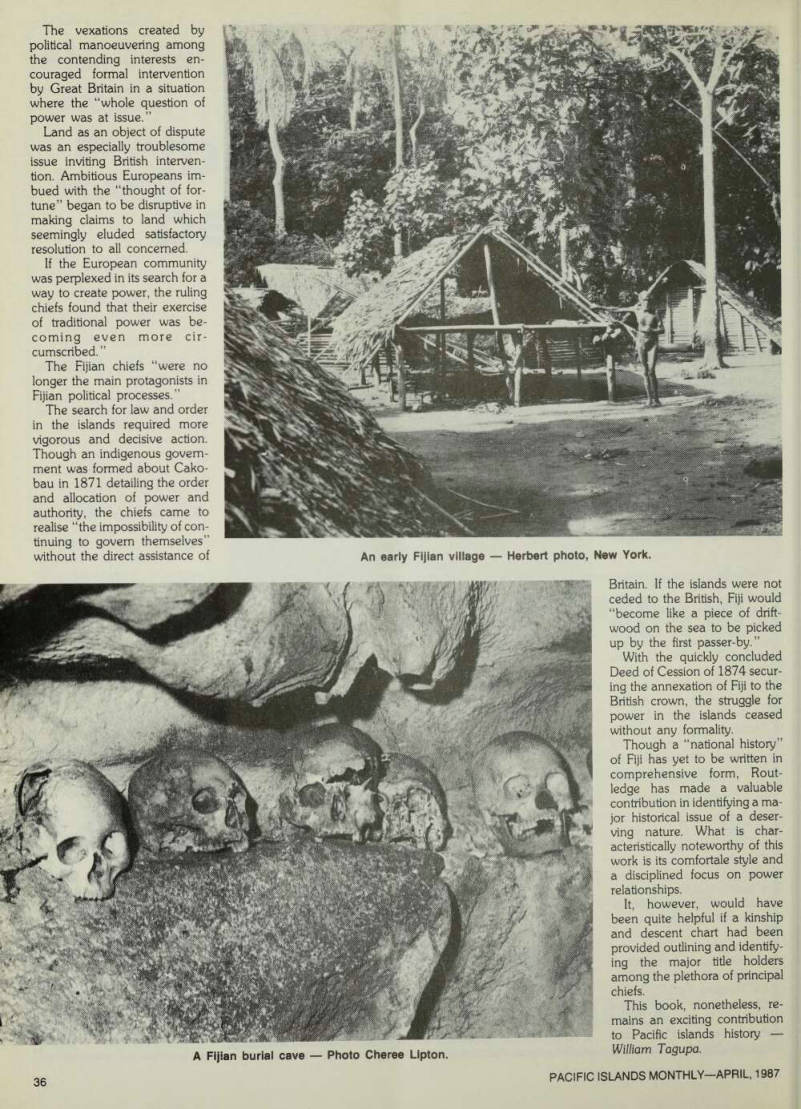
books
When the great chiefs struggled for power
Mananitu; The Struggle for Power in Early Fiji. By David Routledge. Published 1985 fay Institute of Pacific Studies, Uni versity of the South Pacific, Suva, Fiji. 247 pp.
Matanitu is a single volume treatment of the “struggle for political dominance between the great chiefdoms of Fiji until the end of the first half of the nineteenth century and then between Fijians, Tongans and Europeans in the years from 1855 to 1874.”
Politicial power in Fiji eman ated from the outcome of war and through the intricacies of kinship obligations, both of which constituted a basis for a system of alliances and tributary relationships among the preda tory chiefdoms. This “federat ing principle” or matanitu en abled the most powerful chiefs to “further the sphere of their influence by conquest and the formalisation of tributary or even less dignified relationship for the conquered.”
“Eventually the contest for paramountcy in the islands arose between the chiefs of Rewa and Bau. By the 1840 s, the “inevitability of a major trial of strength between Rewa and Bau became obvious” and a climatic point” was reached in the structuring of matanitu prin ciples.
Yet this contest came to be complicated by the presence of Europeans and by the intrusion of the Tongans. By 1855 in the auspicious battle of Kaba, the power of Rewa was “per manently weakened” with Bau being “confirmed paramount in
central Fiji, but at considerable cost. ”
The victory of Bau, moreov er, “spelt final defeat for the traditional religion” and a “demonstration of the ineffica cy of the old beliefs.”
Out of this momentous con frontation, Cakobau, the para mount chief of Bau and Ma’afu, the Tongan chief, emerged as paramount personalities in the struggle for political suprema cy. The diversity of interests of contending groups, especially the British, were eager to accept Cakobau as the legitimate source of Fijian authority and the Bauan chief himself was willing to cede the islands to Great Britain for such legitima cy and protection.
As the Tui Viti, Cakobau earnestly wished to secure Bau against any external threat, European and Tongan.
W. T. Pritchard, the first British consul, attempted to bring about cession and in the process created the myth of Cakobau’s absolute para mountcy. Pritchard, if nothing else, “wanted annexation, European settlement and the inflow of capital.”
Indeed, expatriate settlers and European economic in terests were becoming in creasingly influential, if not problematic to the resolution of legitimate authority in the is lands. Similarly, the establish ment of a threatening Tongan presence in the Lau islands under Ma’afu were clear indica tions that the ambitious chief intended to “create a perma nent position for himself in Fiji. ”
A Fijian with traditional halr style, Nabukataratara Mataitonga fought against his own people In Sabeto as a Cakobau warrier.
The vexations created by political manoeuvering among the contending interests en couraged formal intervention by Great Britain in a situation where the “whole question of power was at issue.”
Land as an object of dispute was an especially troublesome issue inviting British interven tion. Ambitious Europeans im bued with the “thought of for tune” began to be disruptive in making claims to land which seemingly eluded satisfactory resolution to all concerned.
If the European community was perplexed in its search for a way to create power, the ruling chiefs found that their exercise of traditional power was be coming even more cir cumscribed. ”
The Fijian chiefs “were no longer the main protagonists in Fijian political processes.”
The search for law and order in the islands required more vigorous and decisive action.
Though an indigenous govern ment was formed about Cako bau in 1871 detailing the order and allocation of power and authority, the chiefs came to realise “the impossibility of con tinuing to govern themselves” without the direct assistance of
Britain. If the islands were not ceded to the British, Fiji would “become like a piece of drift wood on the sea to be picked up by the first passer-by.”
With the quickly concluded Deed of Cession of 1874 secur ing the annexation of Fiji to the British crown, the struggle for power in the islands ceased without any formality.
Though a “national history” of Fiji has yet to be written in comprehensive form, Rout ledge has made a valuable contribution in identifying a ma jor historical issue of a deser ving nature. What is char acteristically noteworthy of this work is its comfortale style and a disciplined focus on power relationships.
It, however, would have been quite helpful if a kinship and descent chart had been provided outlining and identify ing the major title holders among the plethora of principal chiefs.
This book, nonetheless, re mains an exciting contribution to Pacific islands history
William Tagupa.
A Fijian burial cave - Photo Cheree Lipton.
An early Fijian village - Herbert photo, New York.
Good medicine
for health personnel
Healing Practices in the South Pacific: (ed.) Elaine D.
F. Parsons. Published by Uni versity of Hawaii Press. ISBN 0 939154-41-2. Price $22.50.
The contributions of this study all emanate from the discipline of social anthropo logy. The focus of the book is not just to delineate health practices in Pacific Islands but to analyse the world view which gives rise to those health prac tices.
Although certain similarities are found in belief patterns, such as the influence of spirits in certain illnesses, the book re flects the diversity of the Pacific Islands societies in both belief and practice.
As the book brings out, perceptions of what constitutes health vary considerably from culture to culture. It is a social construction which has mean ing for the participants who interact in a particular social group.
The definition of health for Pacific Islanders differs from the Western concept.
In the former more emphasis is put on the social and psychological or spiritual rather than the physical. In Tonga, health is synonymous with har mony in relationships both within families and the com munity as a whole, both with living and dead members.
In Samoa, likewise, health is interpreted as the balance which should exist both physicl ly and socially. But this concept of social equilibrium is not a universal paradigm throughout the Pacific. For in Tuvalu health is defined as physical strength, especially for men.
Pacific Islanders classify sick ness according to type. Spirit sickness is differentiated from “real” or physical sickness.
In the Cook Islands, the breakdown of social relations results in a particular type of sickness, spirit sickness. Con versely, sickness, both physical and psychological, interpreted as social dislocation can be
used as a means of social control.
Sick people or their relatives can be admonished for antiso cial behavior. Injuries from acci dents come under another category of sickness.
Since contact with Euro peans, there is a further dicho tomy between Western sicknes ses and indigenous illnesses. It is therefore logical to Pacific Islanders that indigenous heal ing practices and western medi cal practice will differ. The latter has not been superimposed on the other.
There are several examples in the Pacific where “traditio nal” healing practices are con tinuing to develop alongside western practices.
Indigenous attitudes to health differ from western concepts not only in definition but in views of what constitutes the causes of ill health. The major difference between western medical personnel and Pacific healers is that the latter search for the fundamental or under lying causes of sickness and these can be found in family or community discord.
Maoris, for instance, believe that ill health results from “wrong living,” that is, the breaking of tapu. But physical causes are also considered. Of the physical elements, food and weather are mostly considered.
It is not simply that bad food can lead to digestive problems.
There is also the belief that food is the major contributor to blood. Blood is considered very important to good health, parti cularly because it is regarded as the material inheritance.
Various foods can have di verse effects in line with western naturopathic belief. For inst ance, in Vanuatu it is believed that certain foods can lead to coughing and heart ailments. It is generally thought, however, that adverse weather is more likely to cause ailments. Rain and cold weather cause colds; too much sun is weakening.
But nowhere is there any
evidence among the eleven ex cerpts of the various different island societies that lack of hygiene leads to disease.
The germ theory of disease is practically non-existent. Pacific Islanders appreciate clean appearances but the concept of hygiene is foreign to them. For instance, Tikopians have words which mean “clean” or “dirty.”
These, however, denote visible appearances only.
Although these islanders bathe twice daily, they do not avoid contaminated food or wash their hands before prepar ing or eating food.
Treatments for illnesses vary among the islands. Yet there are some healing practices which are common. The skills of massage, manipulation, bone setting and even surgery are common.
Massage is used for many ailments including muscular dis comfort and indigestion. It is also used for general well being.
Like the Chinese, Pacific Islan ders believe that the value of massage is that it circulates the blood. However, there are cases where massage has been used inappropriately, with dire results as in appendicitis.
Herbal remedies are also common although there is much variety in types of herbs used, preparation techniques and uses to which herbs are put. Laxatives and poultices are commonly used in the belief that in certain illnesses, such as hepatitis, the body should be rid of impurities.
In certain areas of the Pacific, as in the Cook Islands, illness is classified as either hot or cold.
Consequently the treatment is related to this dichotomy. Hot illnesses are treated with plants having cold properties, such as hibiscus, and vice versa.
Spirit sickness, of course, re quires different treatment.
Prayer and supplication to the spirits is resorted to which means consultation with spirit mediums. These ascertain the cause of the ailment which may
relate to social disruption in the family or community.
The various treatments prac tised in the Pacific span from medieval beliefs, such as the efficacy of blood letting, to concepts only now being grasped by modem medical practitioners.
The latter involves the power of group therapy, family in volvement and interpersonal relations in the healing process.
The islanders, for their part, are both pragmatic and eclectic in seeking treatments. They value western antibiotics for their speed in alleviating dis comfort. On the other hand, they do not trust western medi cal doctors to help in spirit sickness.
A claim is made in the pre face of the book that indi genous views on ill health and the belief patterns from which they arise should be incorpo rated in health education schemes. Further work is needed to achieve this syn thesis.
It is difficult for islanders to accept new practices, such as hygiene, if they do not accept the paradigm and principles which form the base of these practices.
Hence, it is crucial that west ern medical personnel under stand the world views which give rise to certain healing prac tices. Increased sensitivity to belief systems is needed for these are essential to doctor/ patient relationships.
The problem for the islands is not only to accept new practices but to accept a new paradigm and world view also. If the germ theory of disease could be built into the islanders’ paradigms without becoming distorted, much could be gained.
The book, Healing Practices in the South Pacific, is a rich mine of information. It is essen tial reading for medical person nel working in the Pacific, and useful also for Pacific scholars and development assistance
officers.
Sandra Rennie.
the workers?
What about the workers?
Papua New Guinea A False Economy by Kenneth Good, Anti-Slavery Society, London. 106 pp. $12.00 The publisher of Dr Good’s critically titled history of PNG’s development is a society formed last century to assist the effort to abolish the African slave trade. That cause won, it turned its attention towards the emancipation of indigenous peoples everywhere.
Based in the UK, it continues to seek the publicising of hu man rights abused, evaluating the actions of governments in accordance with relevant UN conventions.
So why is PNG, independent from Australia these past twelve years, considered a suitable candidate for the society’s study? It is hardly a country where authorities brutally abuse the citizens.
Mt Hagen can be fraught at night, but it is a far cry from El Salvador.
Perhaps the society endorsed Good’s contention that tra ditional PNG life was unequal, the colonial period more so, and post-independence has been a time when rich peasants and an urban elite make hay at the nation’s expense. But if so, there is no sign, for “The views expressed in this report are those of the author and do not necesarily represent those of the Anti-Slavery Society”.
Going it alone, then, the author, an Australian formerly at the University of PNG and now in Zambia, contends that PNG’s people have got a raw deal from “post-colonial de pendence” (economically, on Australia; diplomatically, by liv ing in fear of the Indonesian generals). The “New Ruling Class” (the educated in towns, and the better-off rural capital ists) have done well from filling the white man’s shoes.
Good’s anger derives from his theoretical Marxist view of the world, one which sees people in all pre-revolutionary
countries being exploited by a more powerful, privileged elite.
In the earliest phase of PNG’s human development to Mar xists, “feudal” society, although Good avoids such terminology “Hereditary chief systems developed in parts of the coun try, but the most characteristic institution of political leadership and centralisation was the so called big men”.
With regional variations, big men began to dominate the wealth and power of their people, and of course to subju gate the women. “Ideologies of male superiority and female inferiority were expressed with particular virulence in the High lands”.
In some places, Bougainville and Buka in the North Solo mons for instance, whole clas ses emerged which “reach the point of clear-cut stratification . . . aristocrats, commoners and intermediaries”.
Then came foreign colonials Marx identified imperialism clearly whose village admi nistrators, the luluais and tultuls were “carefully chosen by colo nial officials on the basis of their influence in their communities, that is, on their power prior to colonial penetration”.
Good explains how the kiaps (patrol officers) identified men who already possessed powers “The first luluais were gener ally men who had made their name as warriors and big men in their communities.”
He goes on to chart the relevance of this tendency to the emergence of a plantation economy, run first by whites and later by privileged local landowners and entrepreneurs.
The coffee industry receives close scrutiny, as do mining, fishing and timber. In no case is the author happy with the financial benefits accruing to the common people or the state.
Special criticism is directed at the post-independence elite, both the national and provincial
parliamentarians who have lost few opportunities to make personal profits, as well as the bureaucrats with their desire for the perks of office.
“The state in PNG is in reality less a wealth-creating agency than with the exception of coffee and cocoa a wealth consuming one. . . During 1981, when world commodity prices were falling, the national government managed to con sume no less that 40 per cent of the country’s GDP.”
He laments the degree of corruption, pointing fingers at both politicians and public ser vants. For a leftist, he seems oddly less fussed by the habits of the private sector. There is also the structural problem of the parties and the political system which fail to “offer or ganisation and leadership to the mass of the rural population: there is no political party which seeks to further the interests of the peasantry and the urban working class”.
He finds it disappointing that no strong voices are urging a cutback in export cropping in favour of domestic food pro duction. This is yet another sign of the country’s neo-colonial domination by outside forces.
Further dismal news is the plight of the Irian Jayans, colo nised by an alien regime and lacking the support they should rightly get from their fellow Melanesians in PNG.
This slender but biting volume ends with two appen dices. The first is the national doctrine known as the Eight Aims which Good evidently supports; the second is the address made by present Prime Minister (then Deputy PM) Paias Wingti to the 1982 Waigani Seminar in Port Moresby, of which the author takes an extremely dim view.
He feels a “back to basics” strategy would be most appropriate, with power and wealth redistribution a govern ment priority. He does not
believe that the private sector, however profitable, will greatly help the majority of people, nor that the trickle down of govern ment expenditure can ever reach many of the have-nots.
The book is a thought-pro voking companion to the wide ly-read Development and De pendency which Good pro duced with Mortimer and Amarshi in 1979.
It is unavoidably a little dated, however, due to the fall of the Somare coalition. For instance, Mr Wingti’s perform ance in office could be evalu ated interestingly in the light of the 1982 speech. One also gets the feeling that distant Zambia might be a hard place in which to write a study of PNG, even if it shares some economic char acteristics.
This challenge from the Left deserves an argued response from the other side, ideally by the “think tanks” of govern ment or private enterprise. It is a debate which at present is
conspicuously muted
Robin
Osborne
Advertisements & other items, p. 38 (1 item)
received
Books
ROT BILONG KAGO Author:
Pita Lorens Tanimtok Bil Tomaseti. Publisher; Inst. PNG.
Studies Port Moresby ISBN 9980-68-001-6.
TOKELAU DICTIONARY.
Publisher; Uni of Auckland Price $37.50.
PROCEEDINGS OF REGIO-
NAL CONFERENCE ON
SAIL-MOTOR PROPULSION:
Asian Development Bank, P.O.
Box 789, Manila Philippines.
THE SITUATION OF CHIL-
DREN IN P.N.G. Author. Patricia K. Townsend Publisher; Inst, of PNG Studies. Boroko ISBN 0080-75-0022 Price K 6.00 plus Postage.
STARFISH WARS: (Coral
Death & the Crown-of-Thorns) Author: Robert Raymond Publisher: Macmillan Co. of Aust P/L 107 Moray Street, Sth Melbourne ISBN 0 - 333043015-8 Price $24.95.
NIHAU SHELL LEIS: Author
Linda Paik Moriarty Published; University of Hawaii Press ISBN 0-8248-0998-X Price $39.95.
The nurses’story
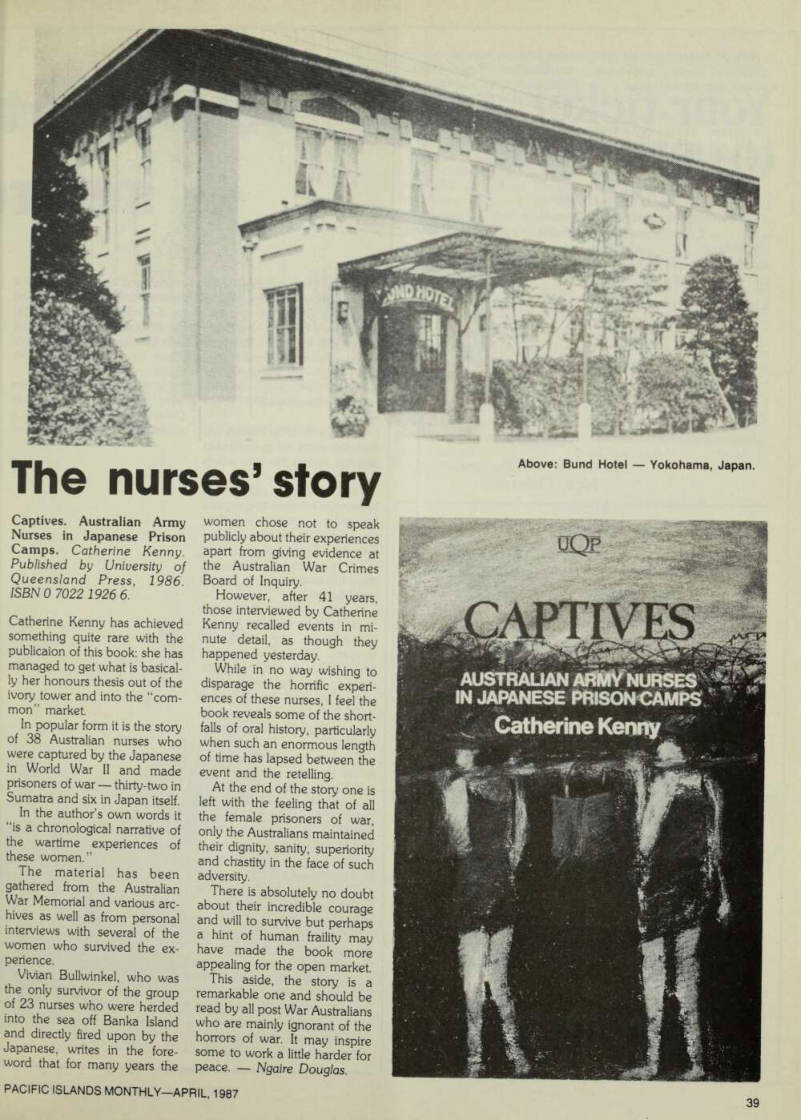
Captives. Australian Army Nurses in Japanese Prison Camps. Catherine Kenny.
Published by University of Queensland Press, 1986.
Isbn 0 7022 1926 6.
Catherine Kenny has achieved something quite rare with the publicaion of this book: she has managed to get what is basical ly her honours thesis out of the ivory tower and into the “com mon” market.
In popular form it is the story of 38 Australian nurses who were captured by the Japanese in World War II and made prisoners of war thirty-two in Sumatra and six in Japan itself.
In the author’s own words it “is a chronological narrative of the wartime experiences of these women.”
The material has been gathered from the Australian War Memorial and various arc hives as well as from personal interviews with several of the women who survived the ex perience.
Vivian Bullwinkel, who was the only survivor of the group of 23 nurses who were herded into the sea off Banka Island and directly fired upon by the Japanese, writes in the fore word that for many years the
women chose not to speak publicly about their experiences apart from giving evidence at the Australian War Crimes Board of Inquiry.
However, after 41 years, those interviewed by Catherine Kenny recalled events in mi nute detail, as though they happened yesterday.
While in no way wishing to disparage the horrific experi ences of these nurses, I feel the book reveals some of the short falls of oral history, particularly when such an enormous length of time has lapsed between the event and the retelling.
At the end of the story one is left with the feeling that of all the female prisoners of war, only the Australians maintained their dignity, sanity, superiority and chastity in the face of such
adversity.
There is absolutely no doubt about their incredible courage and will to survive but perhaps a hint of human fraility may have made the book more appealing for the open market.
This aside, the story is a remarkable one and should be read by all post War Australians who are mainly ignorant of the horrors of war. It may inspire some to work a little harder for
peace.
Ngaire Douglas.
Above: Bund Hotel Yokohama, Japan.
Aid effort may mean
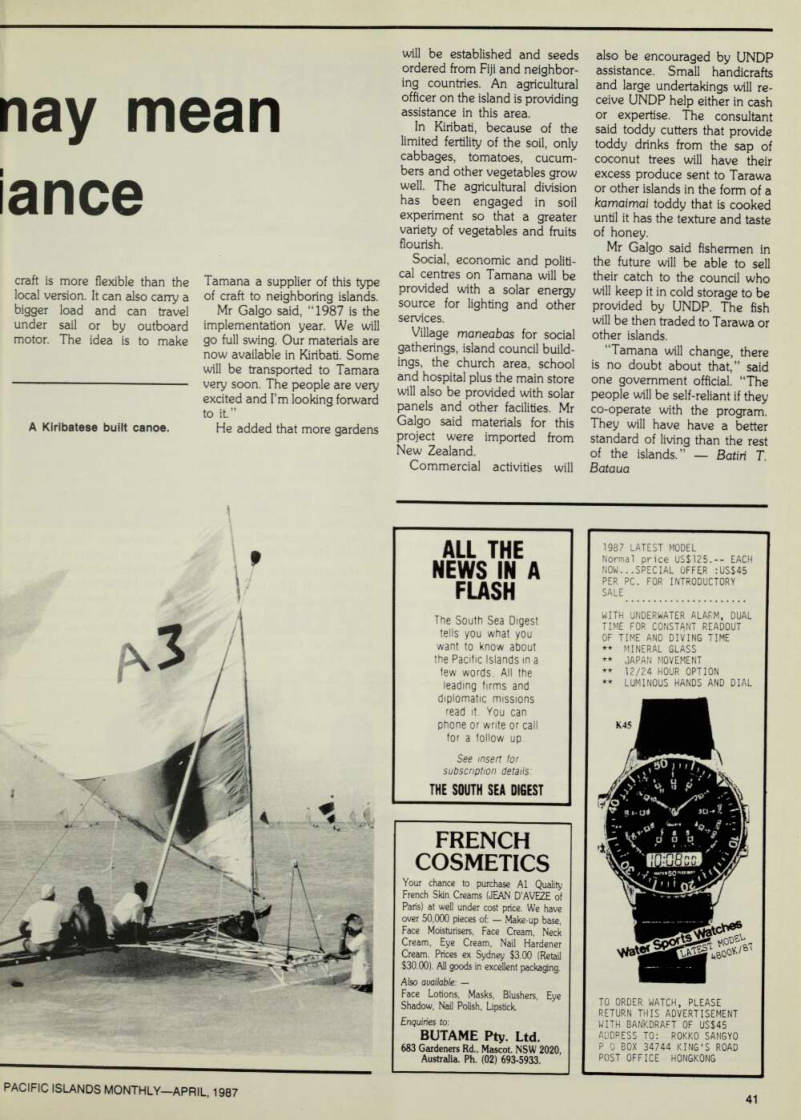
self-[?]iance
The United Nations De velopment Programme (UNDP) has guaran teed to spend $ A 315,000 in Kiribati this year to cover five development pro jects which the government needs as part of its 1987-91 National Development Prog ramme.
UNDP with other donors will also give extra aid to unfunded projects during the year worth $2l million.
The UNDP grant will be used to provide advisers and experts for various projects including the provision of staff for the Tarawa Technical Institute (TTI), a gateway to employ ment in Government or private organisations.
A large portion of the aid “cake” will be spent on provid ing advisers for a Regional Project Plan that needs $A140,000. A Public Service Inspectorate and appropriate technology staff for TTI need $A70,000 while an adviser on solar salt production requires $A20,000.
Tamana, the smallest island in the republic, less than three miles in length and about a mile in width at some places, re ceives $A15,000 UNDP aid under the scheme, the Inte grated Atoll Development.
This scheme already oper ates on Tamana. Early last year a UNDP consultant from the Philippines, Mr Galgo Bemado, arrived on the island.
The whole of 1986 on Tama na was spent on planning. Mr Galgo said that some work was done on gardening and provid ing training opportunities for leading people who will help him in his implementing stages.
“Two canoe builders, three water tank makers, a house
builder and a mechanic have received training at Tarawa at the TTI. They will be helping me this year in providing the skills they have acquired to their fellow countrymen,” said Mr Galgo.
He said the canoe builders were taught at the Fisheries Division the art of building a modified Kiribatese model. This
craft is more flexible than the local version. It can also carry a bigger load and can travel under sail or by outboard motor. The idea is to make
Tamana a supplier of this type of craft to neighboring islands.
Mr Galgo said, “1987 is the implementation year. We will go full swing. Our materials are now available in Kiribati. Some will be transported to Tamara very soon. The people are very excited and I’m looldng forward to it.”
He added that more gardens
will be established and seeds ordered from Fiji and neighboring countries. An agricultural officer on the island is providing assistance in this area.
In Kiribati, because of the limited fertility of the soil, only cabbages, tomatoes, cucumbers and other vegetables grow well. The agricultural division has been engaged in soil experiment so that a greater variety of vegetables and fruits flourish.
Social, economic and political centres on Tamana will be provided with a solar energy source for lighting and other services.
Village maneabas for social gatherings, island council buildings, the church area, school and hospital plus the main store will also be provided with solar panels and other facilities. Mr Galgo said materials for this project were imported from New Zealand.
Commercial activities will
also be encouraged by UNDP assistance. Small handicrafts and large undertakings will re ceive UNDP help either in cash or expertise. The consultant said toddy cutters that provide toddy drinks from the sap of coconut trees will have their excess produce sent to Tarawa or other islands in the form of a kamaimai toddy that is cooked until it has the texture and taste of honey.
Mr Galgo said fishermen in the future will be able to sell their catch to the council who will keep it in cold storage to be provided by UNDP. The fish will be then traded to Tarawa or other islands.
“Tamana will change, there is no doubt about that,” said one government official. “The people will be self-reliant if they co-operate with the program.
They will have have a better standard of living than the rest
of the islands.”
Bataua
Batiri T.
A Kiribatese built canoe.
Advertisements & other items, pp. 40-41 (2 items)
Your ticket
to our world
Continental can fly you anywhere in the world directly or indirectly with the Continental connections.
Chicago Tokyo Seattle Denver Houston Miami San Jose Guam Washington Acapulco Phoenix Fly true American hospitality.
Fly Continental Airlines.
Your ticket to our world.
Calgary Las Vegas New Orleans Mexico London Auckland New York
Los Angeles
San Francisco Vancouver
Hawaii
Sydney
i<f\
3* CONTINENTAL
See your travel agent or Continental Airlines for details.
CONTINENTAL
Continental. All the best of America in an Airline. m
GRBBI
■•*-»* aSSr^i
ALL THE
NEWS IN A
FLASH
The South Sea Digest tells you what you want to know about the Pacific Islands in a few words. All the leading firms and diplomatic missions read it. You can phone or write or call for a follow up.
See insert for subscription details:
THE SOUTH SEA DIGEST
1987 LATEST MODEL
Normal price US$l25.-- EACH
NOW...SPECIAL OFFER :US$45
PER PC. FOR INTRODUCTORY
SALE
WITH UNDERWATER ALARM, DUAL
TIME FOR CONSTANT READOUT
OF TIME AND DIVING TIME
** MINERAL GLASS
** JAPAN MOVEMENT
** 12/24 HOUR OPTION
** LUMINOUS HANDS AND DIAL
K 45
■•*-»* aSSr^i
TO ORDER WATCH, PLEASE
RETURN THIS ADVERTISEMENT
WITH BANKDRAFT OF US$45
ADDRESS TO: ROKKO SANGYO
P 0 BOX 34744 KING'S ROAD
POST OFFICE HONGKONG
FRENCH
COSMETICS
Your chance to purchase A 1 Quality French Skin Creams (JEAN D’AVEZE of Paris) at well under cost price. We have over 50,000 pieces of: Make-up base, Face Moisturisers, Face Cream, Neck Cream, Eye Cream, Nail Hardener Cream. Prices ex Sydney $3.00 (Retail $30.00). All goods in excellent packaging.
Also available: Face Lotions, Masks, Blushers, Eye Shadow, Nail Polish, Lipstick.
Enquiries to: BUTAME Pty. Ltd. 683 Gardeners Rd., Mascot. NSW 2020, Australia. Ph. (02) 693-5933.
Tabai faces the final test
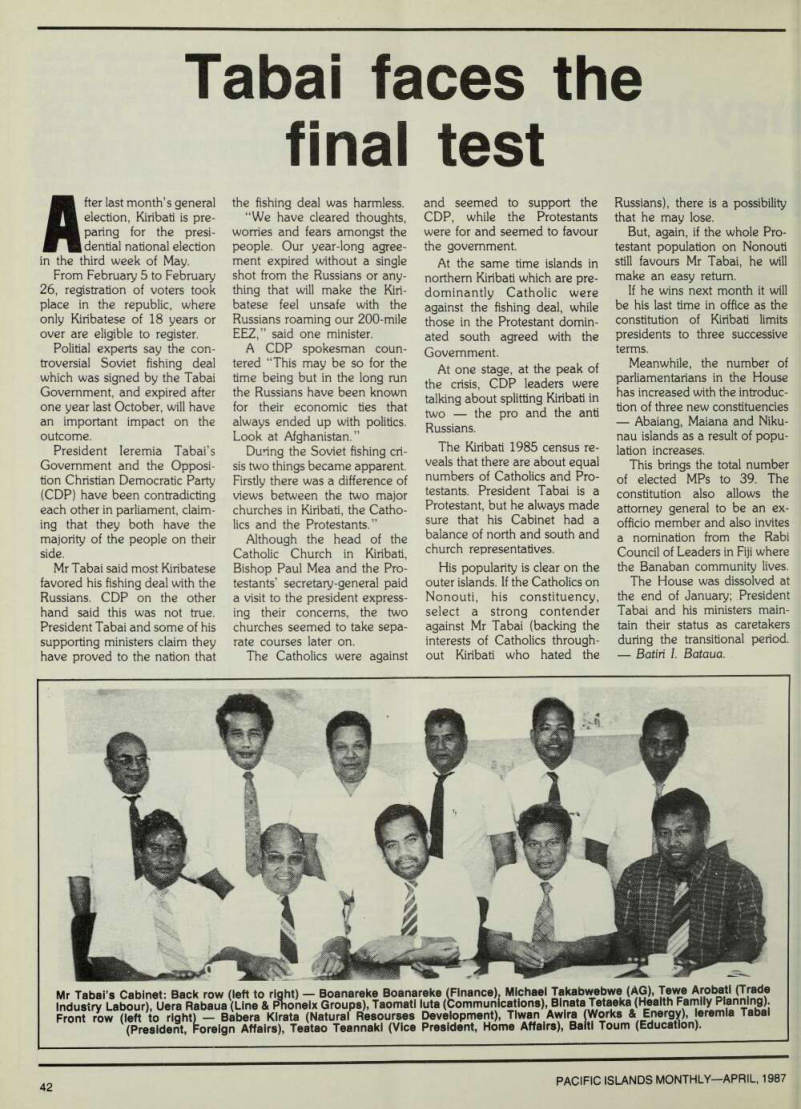
final test
After last month’s general election, Kiribati is pre paring for the presi dential national election in the third week of May.
From February 5 to February 26, registration of voters took place in the republic, where only Kiribatese of 18 years or over are eligible to register.
Politial experts say the con troversial Soviet fishing deal which was signed by the Tabai Government, and expired after one year last October, will have an important impact on the outcome.
President leremia Tabai’s Government and the Opposi tion Christian Democratic Party (CDP) have been contradicting each other in parliament, claim ing that they both have the majority of the people on their side.
Mr Tabai said most Kiribatese favored his fishing deal with the Russians. CDP on the other hand said this was not true.
President Tabai and some of his supporting ministers claim they have proved to the nation that
the fishing deal was harmless.
“We have cleared thoughts, worries and fears amongst the people. Our year-long agree ment expired without a single shot from the Russians or any thing that will make the Kiri batese feel unsafe with the Russians roaming our 200-mile EEZ,” said one minister.
A CDP spokesman coun tered “This may be so for the time being but in the long run the Russians have been known for their economic ties that always ended up with politics.
Look at Afghanistan.”
During the Soviet fishing cri sis two things became apparent.
Firstly there was a difference of views between the two major churches in Kiribati, the Catho lics and the Protestants.”
Although the head of the Catholic Church in Kiribati, Bishop Paul Mea and the Pro testants’ secretary-general paid a visit to the president express ing their concerns, the two churches seemed to take sepa rate courses later on.
The Catholics were against
and seemed to support the CDP, while the Protestants were for and seemed to favour the government.
At the same time islands in northern Kiribati which are pre dominantly Catholic were against the fishing deal, while those in the Protestant domin ated south agreed with the Government.
At one stage, at the peak of the crisis, CDP leaders were talking about splitting Kiribati in two the pro and the anti Russians.
The Kiribati 1985 census re veals that there are about equal numbers of Catholics and Pro testants. President Tabai is a Protestant, but he always made sure that his Cabinet had a balance of north and south and church representatives.
His popularity is clear on the outer islands. If the Catholics on Nonouti, his constituency, select a strong contender against Mr Tabai (backing the interests of Catholics through out Kiribati who hated the
Russians), there is a possibility that he may lose.
But, again, if the whole Pro testant population on Nonouti still favours Mr Tabai, he will make an easy return.
If he wins next month it will be his last time in office as the constitution of Kiribati limits presidents to three successive terms.
Meanwhile, the number of parliamentarians in the House has increased with the introduc tion of three new constituencies Abaiang, Maiana and Niku nau islands as a result of popu lation increases.
This brings the total number of elected MPs to 39. The constitution also allows the attorney general to be an ex officio member and also invites a nomination from the Rabi Council of Leaders in Fiji where the Banaban community lives.
The House was dissolved at the end of January; President Tabai and his ministers main tain their status as caretakers during the transitional period.
Batiri I. Bataua.
Mr Tabai’s Cabinet: Back row (left to right) - Boanareke Boanareke (Finance). Michael Takabwebwe (AG). Tewe Arobatl (Trade Industry Labour), Uera Rabaua (Line & Phoneix Groups), Taomati luta (Communications), Binata Tetaekai (Health Family Planning).
Front row (left to right) Babera Klrata (Natural Resourses Development), Tiwan Awira Works & E nergy), leremia Tabai (President, Foreign Affairs), Teatao Teannaki (Vice President, Home Affairs), Baiti Toum (Education).
A day trip to gas mask island
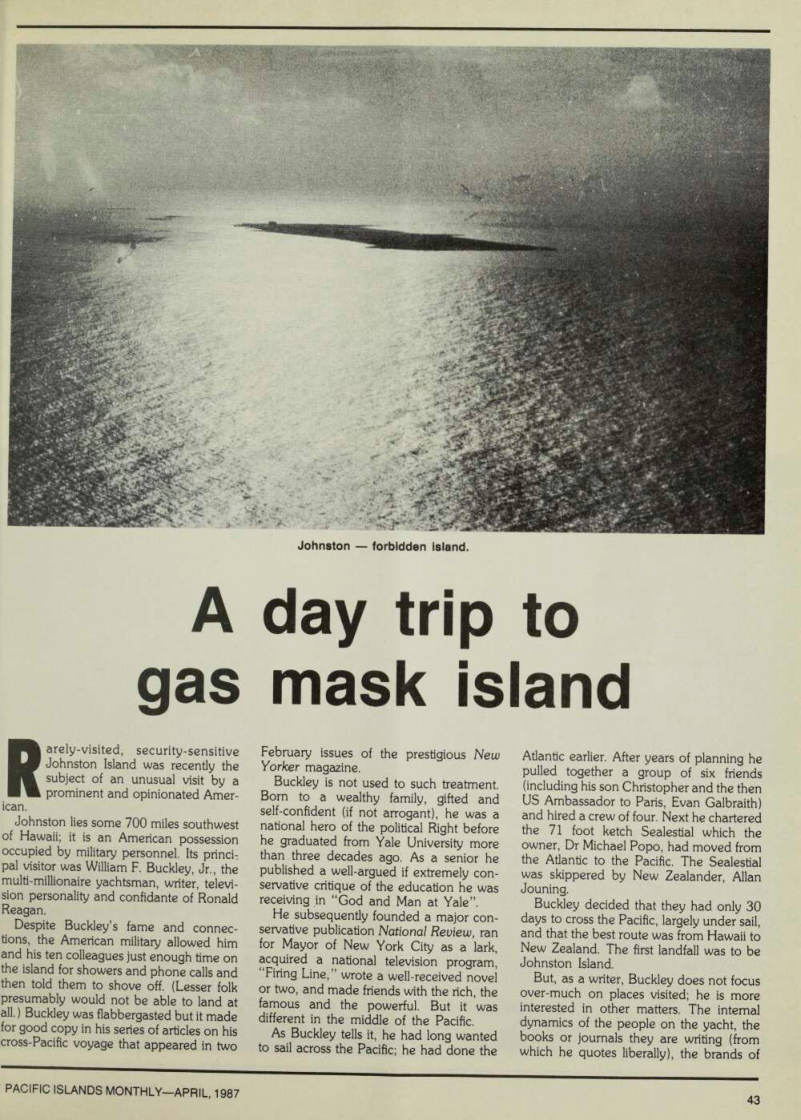
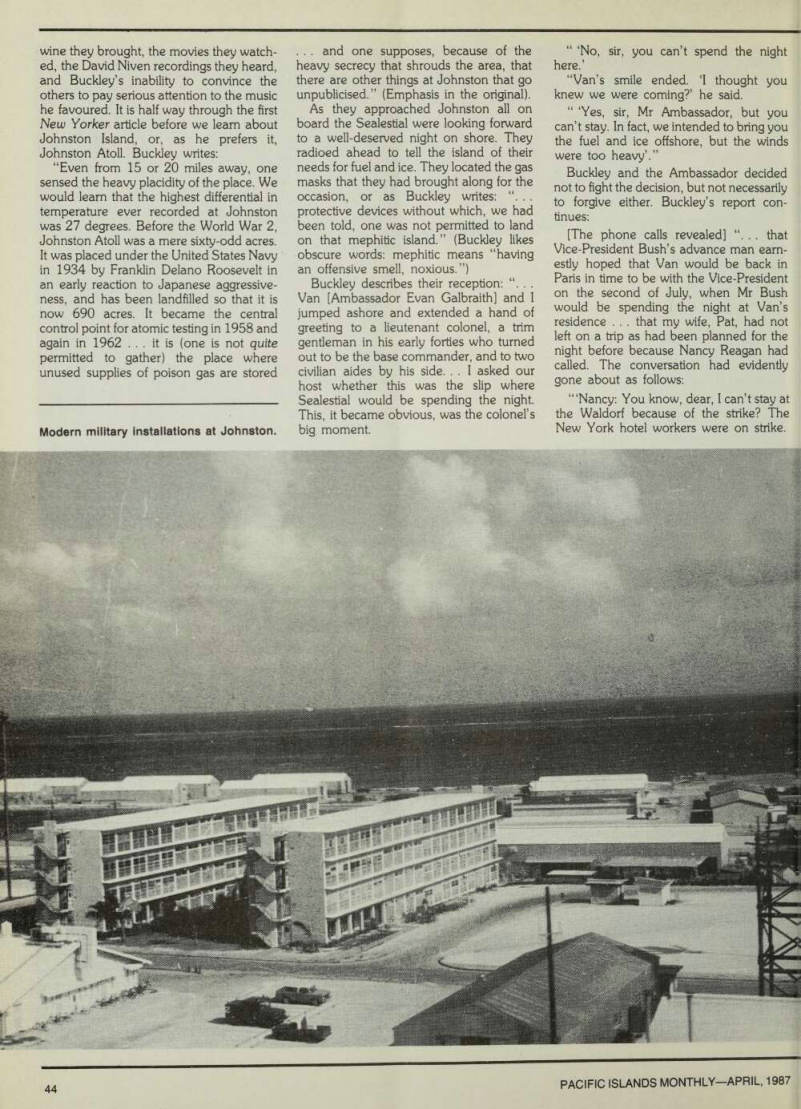
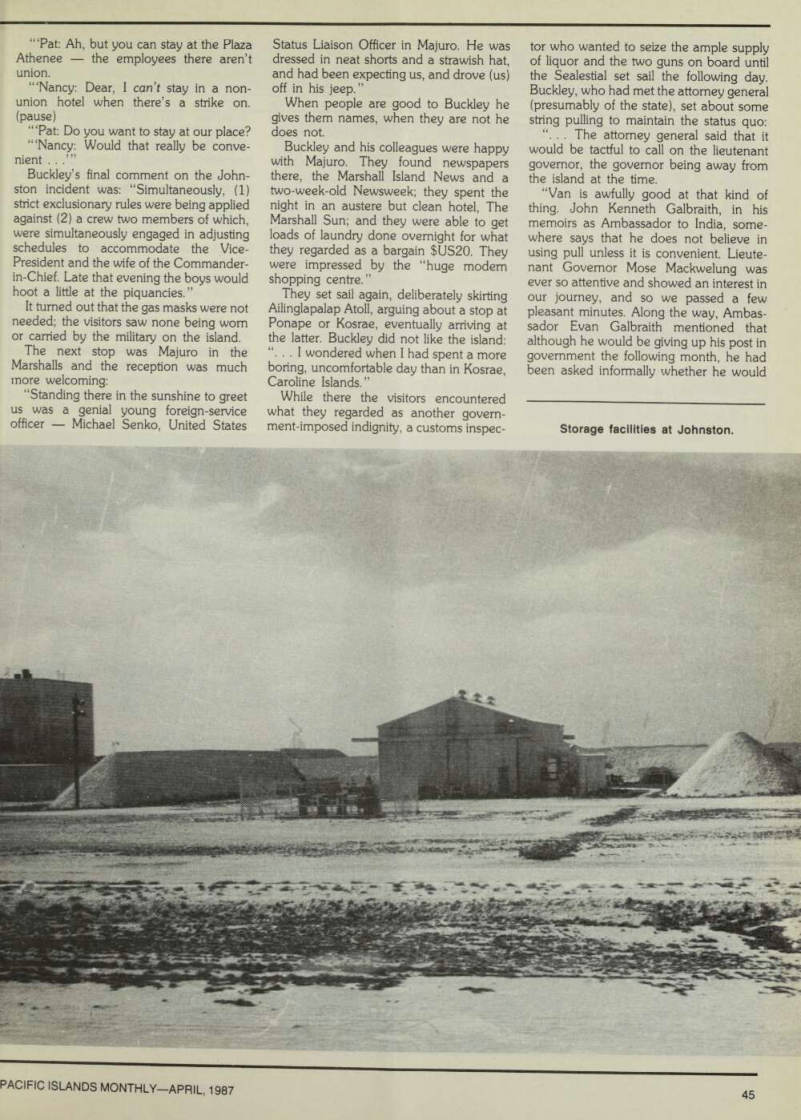
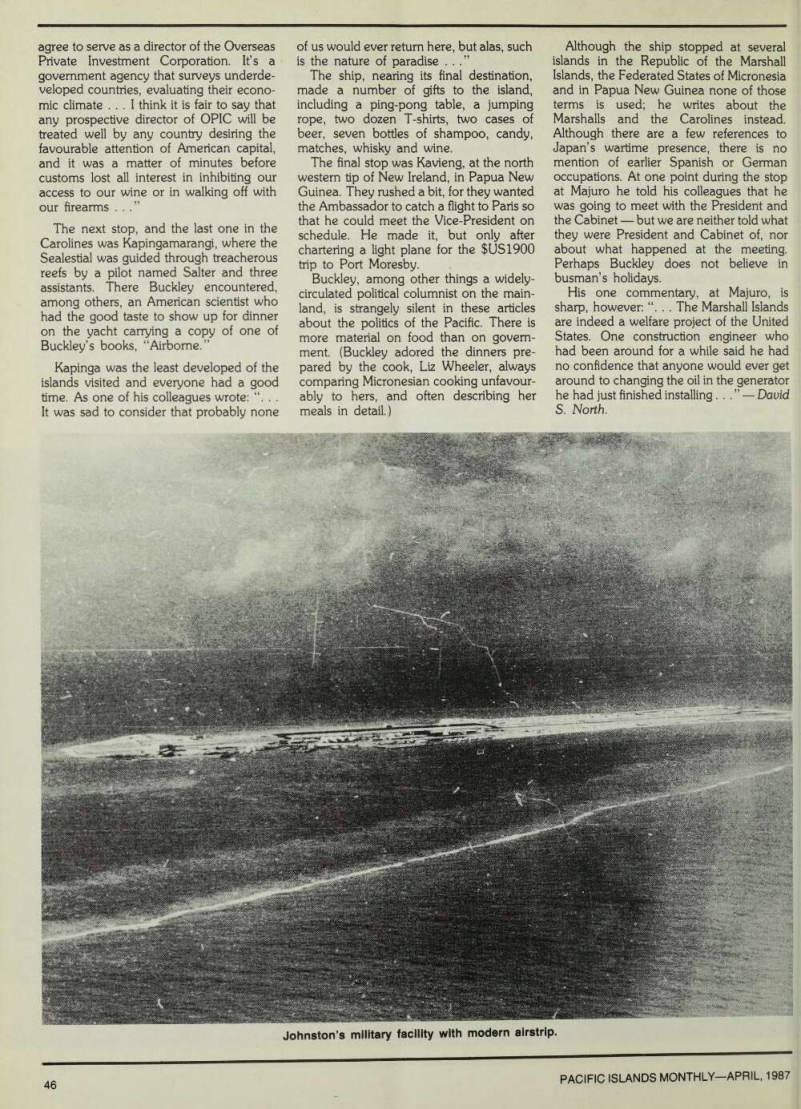
gas mask island
Rarely-visited, security-sensitive
Johnston Island was recently the subject of an unusual visit by a prominent and opinionated Amer ican.
Johnston lies some 700 miles southwest of Hawaii; it is an American possession occupied by military personnel. Its princi pal visitor was William F. Buckley, Jr., the multi-millionaire yachtsman, writer, televi sion personality and confidante of Ronald Reagan.
Despite Buckley’s fame and connec tions, the American military allowed him and his ten colleagues just enough time on the island for showers and phone calls and then told them to shove off. (Lesser folk presumably would not be able to land at all.) Buckley was flabbergasted but it made for good copy in his series of articles on his cross-Pacific voyage that appeared in two
February issues of the prestigious Yorker magazine.
Buckley is not used to such treatment.
Born to a wealthy family, gifted and selt-confident (if not arrogant), he was a national hero of the political Right before he graduated from Yale University more th w. l hr ! e decades a9 °- As a senior he published a well-argued if extremely conservative critique of the education he was linI in “God and Man at Yale”.
He subsequently founded a major conservative publication Nationa Review, ran for Mayor of New York City as a lark, acquired a national television program, T* ” 3we "- receiv ed novel T tW °’ and made fnends w** th e rich, the famous and the powerful. But it was different in the middle of the Pacific.
As Buckle V tells it, he had long wanted to sail across the Pacific; he had done the
Atlantic earlier. After years of planning he pulled together a group of six friends (including his son Christopher and the then
US AmbassadortoPaKtang2£S)
and hired a crew of four Next he chartered the 71 foot ketch Sealestial which the
owner, DrNfcSi^^m^^
the Atlantic to toe Pacific. The Sealestial was skippered by New Zealander Allan Jouning Zealander, Allan recvvine Buckley decided that they had only 30 days to cross the Pacific, largely under sail, and that the best route was from Hawaii to New Johnston Island Tt But, as a writer, Buckley does not focus over-much on places visited; he is more interested in other matters The internal dynamics of the people on''thewhtSS books or journals they are writing (from which he quotes liberally), the brands of
Johnston forbidden island.
wine they brought, the movies they watched, the David Niven recordings they heard, and Buckley’s inability to convince the others to pay serious attention to the music he favoured. It is half way through the first New Yorker article before we learn about Johnston Island, or, as he prefers it, Johnston Atoll. Buckley writes: “Even from 15 or 20 miles away, one sensed the heavy placidity of the place. We would learn that the highest differential in temperature ever recorded at Johnston was 27 degrees. Before the World War 2, Johnston Atoll was a mere sixty-odd acres.
It was placed under the United States Navy in 1934 by Franklin Delano Roosevelt in an early reaction to Japanese aggressiveness, and has been landfilled so that it is now 690 acres. It became the central control point for atomic testing in 1958 and again in 1962 ... it is (one is not quite permitted to gather) the place where unused supplies of poison gas are stored
. . . and one supposes, because of the heavy secrecy that shrouds the area, that there are other things at Johnston that go unpublicised.” (Emphasis in the original).
As they approached Johnston all on board the Sealestial were looking forward to a well-deserved night on shore. They radioed ahead to tell the island of their needs for fuel and ice. They located the gas masks that they had brought along for the occasion, or as Buckley writes: “... protective devices without which, we had been told, one was not permitted to land on that mephitic island.” (Buckley likes obscure words: mephitic means “having an offensive smell, noxious.”) Buckley describes their reception: “. . .
Van [Ambassador Evan Galbraith] and I jumped ashore and extended a hand of greeting to a lieutenant colonel, a trim gentleman in his early forties who turned out to be the base commander, and to two civilian aides by his side. . . I asked our host whether this was the slip where Sealestial would be spending the night.
This, it became obvious, was the colonel’s big moment.
“ ‘No, sir, you can’t spend the night here.’
“Van’s smile ended. ‘I thought you knew we were coming?’ he said.
“ ‘Yes, sir, Mr Ambassador, but you can’t stay. In fact, we intended to bring you the fuel and ice offshore, but the winds were too heavy’.”
Buckley and the Ambassador decided not to fight the decision, but not necessarily to forgive either. Buckley’s report con tinues: [The phone calls revealed] “. .. that Vice-President Bush’s advance man earn estly hoped that Van would be back in Paris in time to be with the Vice-President on the second of July, when Mr Bush would be spending the night at Van’s residence . . . that my wife, Pat, had not left on a trip as had been planned for the night before because Nancy Reagan had called. The conversation had evidently gone about as follows: ‘“Nancy; You know, dear, I can’t stay at the Waldorf because of the strike? The New York hotel workers were on strike.
Modern military installations at Johnston.
‘“Pat: Ah, but you can stay at the Plaza Athenee the employees there aren’t union. ‘“Nancy: Dear, I can’t stay in a non union hotel when there’s a strike on. (pause) ‘“Pat: Do you want to stay at our place?
“‘Nancy: Would that really be conve nient Buckley’s final comment on the John ston incident was: “Simultaneously, (1) strict exclusionary rules were being applied against (2) a crew two members of which, were simultaneously engaged in adjusting schedules to accommodate the Vice- President and the wife of the Commander in-Chief. Late that evening the boys would hoot a little at the piquancies.”
It turned out that the gas masks were not needed; the visitors saw none being worn or carried by the military on the island.
The next stop was Majuro in the Marshalls and the reception was much more welcoming: “Standing there in the sunshine to greet us was a genial young foreign-service officer Michael Senko, United States
Status Liaison Officer in Majuro. He was dressed in neat shorts and a strawish hat, and had been expecting us, and drove (us) off in his jeep.”
When people are good to Buckley he gives them names, when they are not he does not.
Buckley and his colleagues were happy with Majuro. They found newspapers there, the Marshall Island News and a two-week-old Newsweek; they spent the night in an austere but clean hotel, The Marshall Sun; and they were able to get loads of laundry done overnight for what they regarded as a bargain SUS2O. They were impressed by the “huge modem shopping centre.”
They set sail again, deliberately skirting Ailinglapalap Atoll, arguing about a stop at Fonape or Kosrae, eventually arriving at the latter. Buckley did not like the island: “. . . I wondered when I had spent a more boring, uncomfortable day than in Kosrae, Caroline Islands.”
While there the visitors encountered what they regarded as another govern ment-imposed indignity, a customs inspec
tor who wanted to seize the ample supply of liquor and the two guns on board until the Sealestial set sail the following day.
Buckley, who had met the attorney general (presumably of the state), set about some string pulling to maintain the status quo: . The attorney general said that it would be tactful to call on the lieutenant governor, the governor being away from the island at the time.
“Van is awfully good at that kind of thing. John Kenneth Galbraith, in his memoirs as Ambassador to India, some where says that he does not believe in using pull unless it is convenient. Lieute nant Governor Mose Mackwelung was ever so attentive and showed an interest in our journey, and so we passed a few pleasant minutes. Along the way, Ambas sador Evan Galbraith mentioned that although he would be giving up his post in government the following month, he had been asked informally whether he would
Storage facilities at Johnston.
agree to serve as a director of the Overseas Private Investment Corporation. It’s a government agency that surveys underdeveloped countries, evaluating their economic climate ... I think it is fair to say that any prospective director of OPIC will be treated well by any country desiring the favourable attention of American capital, and it was a matter of minutes before customs lost all interest in inhibiting our access to our wine or in walking off with our firearms ...” . . , . ...
The next stop, and the last one in he Carolines was Kapingamarangi where the Sealestal was guided through treacherous reefs by a pilot named Salter and three assistants. There Buckley encountered, among others an American saenhst who had the good taste to show up for dinner on the yacht carrying a copy of one of Buckley s books, Airborne.
Kapinga was the least developed of the islands visited and everyone had a good time. As one of his colleagues wrote; “.. .
It was sad to consider that probably none
of us would ever return here, but alas, such is the nature of paradise ...”
The ship, nearing its final destination, made a number of gifts to the island, including a ping-pong table, a jumping rope, two dozen T-shirts, two cases of beer, seven bottles of shampoo, candy, matches, whisky and wine.
The final stop was Kavieng, at the north western tip of New Ireland, in Papua New Guinea. They rushed a bit, for they wanted the Ambassador to catch a flight to Paris so that he could meet the Vice-President on schedule H e made it> but only after chartering a light plane for the SUSI9OO to Port Moresby.
Buckley, among other things a widelyc i rcu i a ted political columnist on the maini a]nd> is strangely silent in these articles adout the politics of the Pacific. There is more materia i on f ood t h an on gove mment. (Buckley adored the dinners prepared by the cook, Liz Wheeler, always comparing Micronesian cooking unfavourably to hers, and often describing her meals in detail.)
Although the ship stopped at several islands in the Republic of the Marshall Islands, the Federated States of Micronesia and in Papua New Guinea none of those terms is used; he writes about the Marshalls and the Carolines instead, Although there are a few references to Japan’s wartime presence, there is no mention of earlier Spanish or German occupations. At one point during the stop at Majuro he told his colleagues that he was going to meet with the President and the Cabinet but we are neither told what they were President and Cabinet of, nor about what happened at the meeting.
Perhaps Buckley does not believe in busman’s holidays, His one commentary, at Majuro, is sharp, however; “... The Marshall Islands are indeed a welfare project of the United States. One construction engineer who had been around for a while said he had no confidence that anyone would ever get around to changing the oil in the generator
he had just finished installing...”
David
S. North.
Johnston's military facility with modern airstrip.
Pacific Stamp box
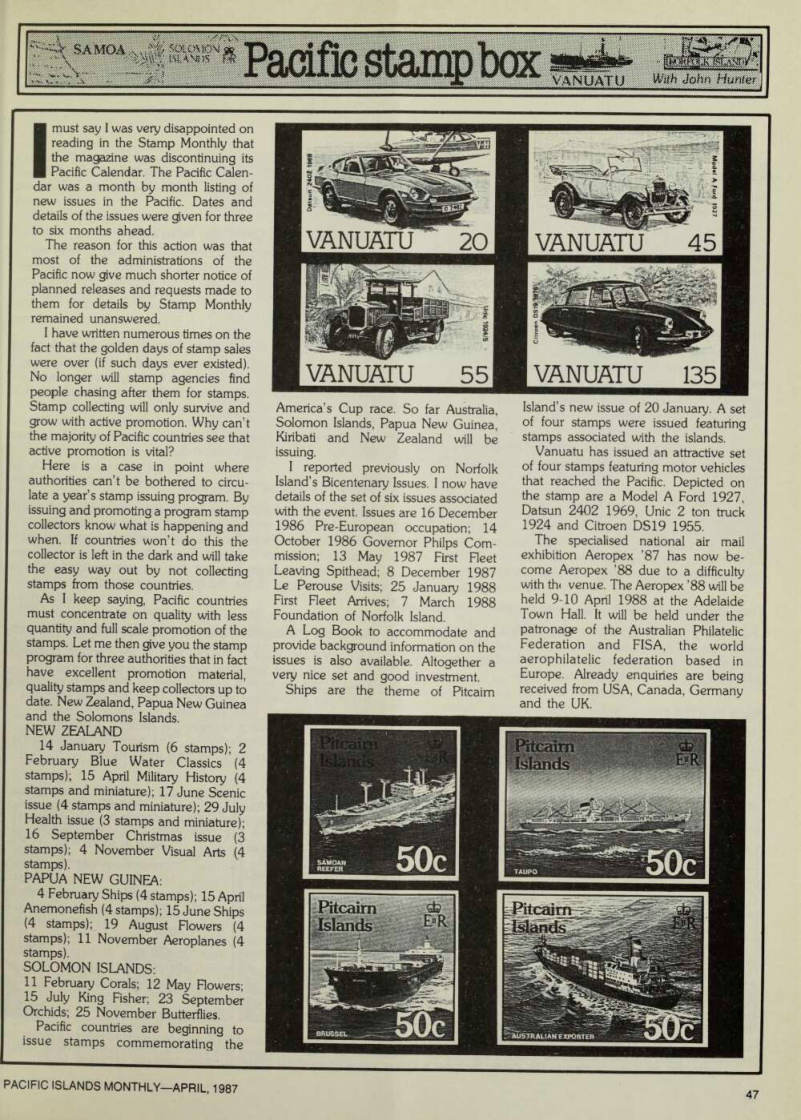
I must say I was very disappointed on reading in the Stamp Monthly that the magazine was discontinuing its Pacific Calendar. The Pacific Calen dar was a month by month listing of new issues in the Pacific. Dates and details of the issues were given for three to six months ahead.
The reason for this action was that most of the administrations of the Pacific now give much shorter notice of planned releases and requests made to them for details by Stamp Monthly remained unanswered.
I have written numerous times on the fact that the golden days of stamp sales were over (if such days ever existed).
No longer will stamp agencies find people chasing after them for stamps.
Stamp collecting will only survive and grow with active promotion. Why can’t the majority of Pacific countries see that active promotion is vital?
Here is a case in point where authorities can’t be bothered to circu late a year’s stamp issuing program. By issuing and promoting a program stamp collectors know what is happening and when. If countries won’t do this the collector is left in the dark and will take the easy way out by not collecting stamps from those countries.
As I keep saying, Pacific countries must concentrate on quality with less quantity and full scale promotion of the stamps. Let me then give you the stamp program for three authorities that in fact have excellent promotion material, quality stamps and keep collectors up to date. New Zealand, Papua New Guinea and the Solomons Islands.
New Zealand
14 January Tourism (6 stamps); 2 February Blue Water Classics (4 stamps); 15 April Military History (4 stamps and miniature); 17 June Scenic issue (4 stamps and miniature); 29 July Health issue (3 stamps and miniature); 16 September Christmas issue (3 stamps); 4 November Visual Arts (4 stamps).
Papua New Guinea;
4 February Ships (4 stamps); 15 April Anemonefish (4 stamps); 15 June Ships (4 stamps); 19 August Flowers (4 stamps); 11 November Aeroplanes (4 stamps).
Solomon Islands:
11 February Corals; 12 May Flowers; 15 July King Fisher; 23 September Orchids; 25 November Butterflies.
Pacific countries are beginning to issue stamps commemorating the
America’s Cup race. So far Australia, Solomon Islands, Papua New Guinea, Kiribati and New Zealand will be issuing.
I reported previously on Norfolk Island’s Bicentenary Issues. I now have details of the set of six issues associated with the event. Issues are 16 December 1986 Pre-European occupation; 14 October 1986 Governor Philps Commission; 13 May 1987 First Fleet Leaving Spithead; 8 December 1987 Le Perouse Visits; 25 January 1988 First Fleet Arrives; 7 March 1988 Foundation of Norfolk Island.
A Log Book to accommodate and provide background information on the issues is also available. Altogether a very nice set and good investment.
Ships are the theme of Pitcairn
Island’s new issue of 20 January. A set °f f° ur stamps were issued featuring stamps associated with the islands, Vanuatu has issued an attractive set of f° ur stamps featuring motor vehicles at reached the Pacific. Depicted on stamp are a Model A Ford 1927, Datsun 2402 1969, Unic 2 ton truck 1924 and Citroen DSI9 1955.
The specialised national air mail exhibition Aeropex ’B7 has now be come Aeropex ’BB due to a difficulty with th« venue. The Aeropex ’BB will be h e ld 9-10 April 1988 at the Adelaide Town Hall. It will be held under the patronage of the Australian Philatelic Federation and FISA, the world aerophilatelic federation based in Europe. Already enquiries are being received from USA, Canada, Germany and the UK.
from the islands press
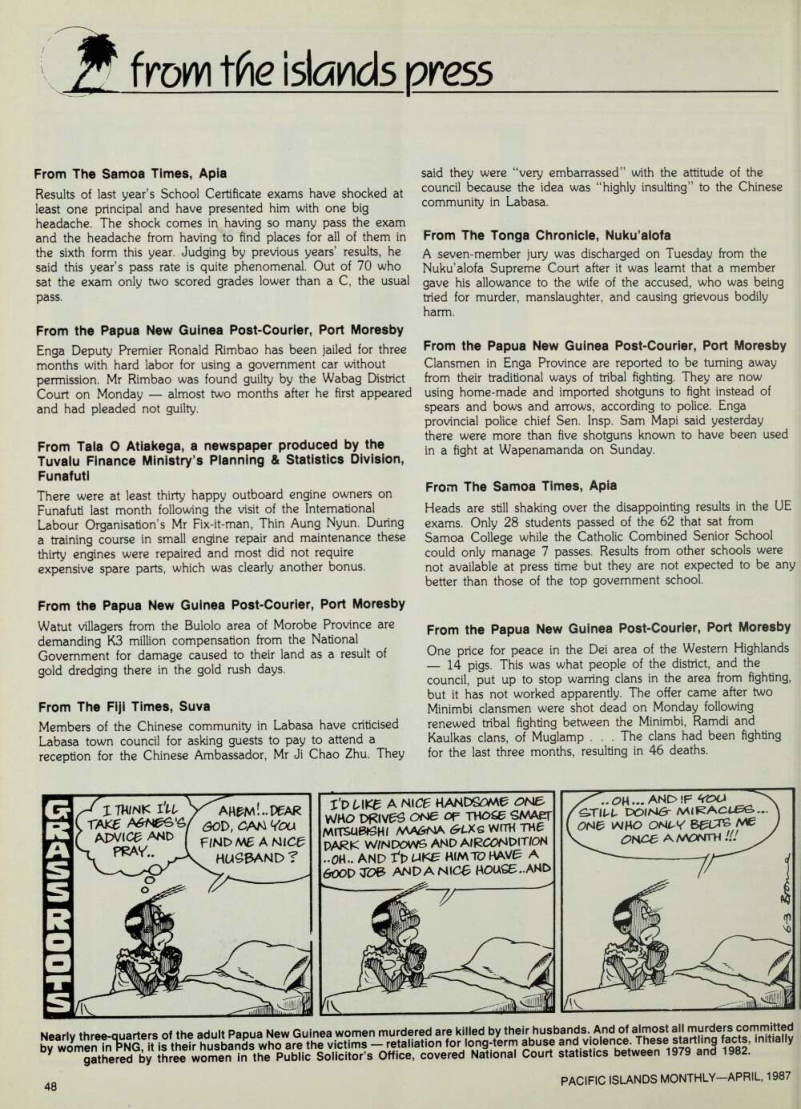
From The Samoa Times, Apia Results of last year’s School Certificate exams have shocked at least one principal and have presented him with one big headache. The shock comes in having so many pass the exam and the headache from having to find places for all of them in the sixth form this year. Judging by previous years’ results, he said this year’s pass rate is quite phenomenal. Out of 70 who sat the exam only two scored grades lower than a C, the usual pass.
From the Papua New Guinea Post-Courier, Port Moresby Enga Deputy Premier Ronald Rimbao has been jailed for three months with hard labor for using a government car without permission. Mr Rimbao was found guilty by the Wabag District Court on Monday almost two months after he first appeared and had pleaded not guilty.
From Tala 0 Atiakega, a newspaper produced by the Tuvalu Finance Ministry’s Planning & Statistics Division, Funafuti There were at least thirty happy outboard engine owners on Funafuti last month following the visit of the International Labour Organisation’s Mr Fix-it-man, Thin Aung Nyun. During a training course in small engine repair and maintenance these thirty engines were repaired and most did not require expensive spare parts, which was clearly another bonus.
From the Papua New Guinea Post-Courier, Port Moresby Watut villagers from the Bulolo area of Morobe Province are demanding K 3 million compensation from the National Government for damage caused to their land as a result of gold dredging there in the gold rush days.
From The Fiji Times, Suva Members of the Chinese community in Labasa have criticised Labasa town council for asking guests to pay to attend a reception for the Chinese Ambassador, Mr Ji Chao Zhu. They
said they were “very embarrassed” with the attitude of the council because the idea was “highly insulting” to the Chinese community in Labasa.
From The Tonga Chronicle, Nuku’alofa A seven-member jury was discharged on Tuesday from the Nuku’alofa Supreme Court after it was leamt that a member gave his allowance to the wife of the accused, who was being tried for murder, manslaughter, and causing grievous bodily harm.
From the Papua New Guinea Post-Courier, Port Moresby Clansmen in Enga Province are reported to be turning away from their traditional ways of tribal fighting. They are now using home-made and imported shotguns to fight instead of spears and bows and arrows, according to police. Enga provincial police chief Sen. Insp. Sam Mapi said yesterday there were more than five shotguns known to have been used in a fight at Wapenamanda on Sunday.
From The Samoa Times, Apia Heads are still shaking over the disappointing results in the UE exams. Only 28 students passed of the 62 that sat from Samoa College while the Catholic Combined Senior School could only manage 7 passes. Results from other schools were not available at press time but they are not expected to be any better than those of the top government school.
From the Papua New Guinea Post-Courier, Port Moresby One price for peace in the Dei area of the Western Highlands 14 pigs. This was what people of the district, and the council, put up to stop warring clans in the area from fighting, but it has not worked apparently. The offer came after two Minimbi clansmen were shot dead on Monday following renewed tribal fighting between the Minimbi, Ramdi and Kaulkas clans, of Muglamp . . . The clans had been fighting for the last three months, resulting in 46 deaths.
Nearly three-quarters of the adult Papua New Guinea women murdered are killed by their husbands. And of almost all murders committed by women i PNG, it is their husbands who are the victims - retaliation for long-term abuse and violence. These startling facts, initially gathered by three women in the Public Solicitor’s Office, covered National Court statistics between 1979 and 1982.
transitions
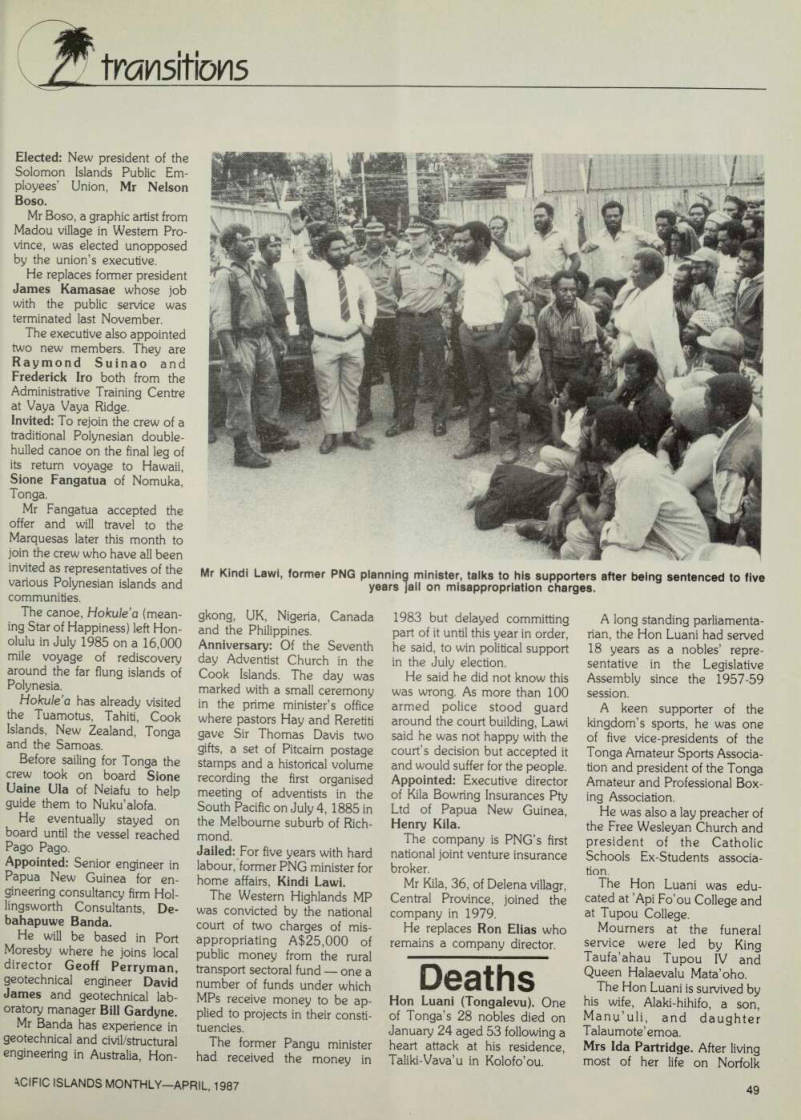
Elected: New president of the Solomon Islands Public Em ployees’ Union, Mr Nelson Boso.
Mr Boso, a graphic artist from Madou village in Western Pro vince, was elected unopposed by the union’s executive.
He replaces former president James Kamasae whose job with the public service was terminated last November.
The executive also appointed two new members. They are Raymond Suinao and Frederick Iro both from the Administrative Training Centre at Vaya Vaya Ridge.
Invited: To rejoin the crew of a traditional Polynesian double hulled canoe on the final leg of its return voyage to Hawaii, Sione Fangatua of Nomuka, Tonga.
Mr Fangatua accepted the offer and will travel to the Marquesas later this month to join the crew who have all been invited as representatives of the various Polynesian islands and communities.
The canoe, Hokule’a (mean ing Star of Happiness) left Hon olulu in July 1985 on a 16,000 mile voyage of rediscovery around the far flung islands of Polynesia.
Hokule’a has already visited the Tuamotus, Tahiti, Cook Islands, New Zealand, Tonga and the Samoas.
Before sailing for Tonga the crew took on board Sione Uaine Ula of Neiafu to help guide them to Nukualofa.
He eventually stayed on board until the vessel reached Pago Pago.
Appointed: Senior engineer in Papua New Guinea for en gineering consultancy firm Hol lingsworth Consultants, De bahapuwe Banda.
He will be based in Port Moresby where he joins local director Geoff Perryman, geotechnical engineer David James and geotechnical lab oratory manager Bill Gardyne.
Mr Banda has experience in geotechnical and civil/structural engineering in Australia, Hon-
gkong, UK, Nigeria, Canada and the Philippines.
Anniversary: Of the Seventh day Adventist Church in the Cook Islands. The day was marked with a small ceremony in the prime minister’s office where pastors Hay and Reretiti gave Sir Thomas Davis two gifts, a set of Pitcairn postage stamps and a historical volume recording the first organised meeting of adventists in the South Pacific on July 4, 1885 in the Melbourne suburb of Rich mond.
Jailed: For five years with hard labour, former PNG minister for home affairs, Kindi Lawi.
The Western Highlands MP was convicted by the national court of two charges of mis
appropriating A 525,000 of
public money from the rural transport sectoral fund one a number of funds under which MPs receive money to be ap plied to projects in their consti tuencies.
The former Pangu minister had received the money in
1983 but delayed committing part of it until this year in order, he said, to win political support in the July election.
He said he did not know this was wrong. As more than 100 armed police stood guard around the court building, Lawi said he was not happy with the court’s decision but accepted it and would suffer for the people.
Appointed: Executive director of Kila Bowring Insurances Pty Ltd of Papua New Guinea, Henry Kila.
The company is PNG’s first national joint venture insurance broker.
Mr Kila, 36, of Delena villagr, Central Province, joined the company in 1979.
He replaces Ron Elias who remains a company director.
A long standing parliamenta rian, the Hon Luani had served 18 years as a nobles’ repre sentative in the Legislative Assembly since the 1957-59 session.
A keen supporter of the kingdom’s sports, he was one of five vice-presidents of the Tonga Amateur Sports Associa tion and president of the Tonga Amateur and Professional Box ing Association.
He was also a lay preacher of the Free Wesleyan Church and president of the Catholic Schools Ex-Students associa tion.
The Hon Luani was edu cated at ’Api Fo’ou College and at Tupou College.
Mourners at the funeral service were led by King Taufa’ahau Tupou IV and Queen Halaevalu Mata’oho.
The Hon Luani is survived by his wife, Alaki-hihifo, a son, Manu’uli, and daughter Talaumote’emoa.
Mrs Ida Partridge. After living most of her life on Norfolk
Mr Kindi Lawi, former PNG planning minister, talks to his supporters after being sentenced to five years jail on misappropriation charges.
Island, Mrs Partridge died on January 23.
Nicknamed “Putch” she was bom Ida Mabel Allen in 1908, youngest child of Gus and Mary Allen of Norfolk Island.
She was a keen gardener, bowler and angler.
Mrs Partridge is survived by her sister Avis and her son Allan and his family.
Ratu Meli Loki. The chief of Tamavua village and holder of the Roko Tui Colo title died aged 55 in Suva on February 11.
Ratu Meli had been admitted to the Colonial War Memorial Hospital after suffering a stroke two weeks previously.
A pioneer of Fiji’s tourism industry, he began operating his Marau village at Tamavua as a tourist centre 20 years ago.
He began his career as a proof reader with the govern ment printer in 1949 and joined the Suva City Council as an assistant health inspector in 1950.
He later became a senior programmer/announcer with the Fiji Broadcasting Commis sion before devoting all his energies to developing the tour ist village.
Ratu Meli served as a mem ber of the senate, as an appoin tee of the Great Council of Chiefs between 1979 and 1982. He was also a chairman of the Naitasiri Provincial Council.
He was a member of the Suva Rural Local Authority and the first chairman of the first South Pacific Arts Festival catering committee, the tourism convention planning commit tee, Hibiscus Festival Commit tee and the CWM Hospital Board of Visitors.
Ratu Meli was also a member of the Great Council of Chiefs, the Native Land Trust Board, a director of the Native Land Development Corporation, a member of the Central Division District and Divisional Deve lopment committees, and the Prime Minister’s Youth Re habilitation Committee.
Te’o Apelu. The noted rugby full back of pre-World War II days and one of Apia’s most colourful characters died after a heart attack at his home in Faatoia on January 19. He was 75.
His funeral was attended by
Head of State, Malietoa Tanu mafili 11.
Mr Apelu’s son Laki Uaea, general manager of Prinut, gave the eulogy which was heard by his nine brothers and sisters.
Te’o Apelu is also survived by his wife and several grandchildren.
Stephen Laverty Adams.
Known to all on Norfolk Island as “Snitch” has died at his home at Cascades.
One of the eight children of Amy Ruth (nee Christian) and Ephraim (Pumper) Adams, he was born on Norfolk Island on March 28, 1925.
He was educated on Norfolk and worked in New Zealand and Darwin, Australia before joining the island administration road gang.
He is survived by sisters Kath and Tagg and brother Bill and their families.
Vera Adams. Wife of Val Adams of Norfolk Island died in Sydney on December 18.
Mr Adams is the son of the late George and of Nella Adams. The couple had just finished building their home next to Mrs Nella Adams having returned to the island to settle.
Mrs Roberta Garrett. The noted Suva journalist has died of cancer in Sydney.
Mrs Garrett, 60, was born in the USA and graduated from the Columbia School of Journalism.
She came to Fiji with her husband, Rev John Garrett, in 1968 when he took up a lecturer’s post at the Pacific Theological College. Both later became Fiji citizens.
Mrs Garrett had previously worked for several years in the communications division of the World Council of Churches in Geneva, Switzerland.
In Fiji she worked for the Pacific Conference of Churches in Suva and served on the board of the YWCA.
She also did editing and writing work for a number of professional and trade publica tions including Fiji Sugar.
She also assisted her hus band in producing To Live Among the Stars, a history of the Christian missionaries in the South Pacific.
Mrs Garrett is survived by her husband, two sons and three stepchildren.
Dan Lusk. One of the best known Norfolk Island residents died on February 1 at the island hospital aged 82.
Daniel Lawler Butler Lusk was born the eldest of eight children at Auckland in 1904.
He first came to Norfolk in 1930 to work on Captain Swin nerton’s banana plantation.
He met Mary Robertson But tar known to most islanders as “Molly” who was then matron at the hospital and the two married in 1935.
He served with AIF in the New Guinea campaign during World War 11, mostly at Lae, while Molly went to Sydney to further her nursing career.
They both returned to Nor folk after the war where Dan worked for Bums Philp before joining the administration. He retired as registrar in 1968, becoming a law clerk and later worked in real estate.
Mrs Pilopo (Billie) Retzlaff.
The noted sportswoman, musi cian businesswoman and politi cian died in Western Samoa on January 12 after a long illness.
She was 74 on Christmas Day.
Mrs Retzlaff was the only
daughter of Taisi to remain in her father’s Methodist church until her death.
Her eulolgy was given by her nephew and holder of the fam ily title Taisi, deputy prime minister Tupuola Efi.
She had excelled in tennis, basketball and golf and repre sented New Zealand at hockey.
Mrs Retzlaff was also secre tary to the Mau and had great pride in its struggle for inde pendence. She played a lead ing role in negotiations with the governments of the US and New Zealand in the days before independence and typed the petition from Samoa to New Zealand asking for the return of the lands of the Trust Estates.
She was also a gifted musi cian, playing piano, guitar and several other instruments as well as composing music.
Of his aunt, Tupuola said: “The very stones and earth of the Land Tuaefu are sobbing in deep grief over the passing of Iliganoa Galuegapapa Piliopo Taisi Telefoni.”
She is survived by three of her four children, Leilani, Tuitautai and Telefoni and several grandchildren.
Advertisements & other items, pp. 49-51 (3 items)
Deaths
Hon Luani (Tongalevu). One of Tonga’s 28 nobles died on January 24 aged 53 following a heart attack at his residence, Taliki-Vava’u in Kolofo’ou.
49
\CIFIC ISLANDS MONTHLY—APRIL, 1987
Benson w Hedges
sir / B
TRADITIONALLY THE NAME
ASSOCiATEO WITH PERFECTION
IN CIGARETTES.
BENSON & HEDGES
mm 20 m^r ;■ SB tm
Benson w Hedges
WARNING-SMOKIHB IS ft HEALTH HAZARD
ss #% 111
lart
jWUiAiI
LOCAL AGENTS AND
REPRESENTATION
117 York St., Sydney.
Cables; Henco Sydney
G.P.O. Box 3949.
Telephone: 261 1955.
For specialised and
personalised buying
service throughout
the Pacific Islands and the East.
Resident Agents in
PAPUA NEW GUINEA
RABAUL: M. & C. Seeto, P.O. Box 131, Rabaul.
Telephone 92 2919.
FIJI
K. Witherington Ltd., P.O. Box 293, Suva.
Telephone 22 356.
VANUATU
John Lum & Associates, P.O. Box 65, Santo.
Telephone 329.
SOLOMON ISLANDS
Mr. Ken Szetu, P.O. Box 45, Honiara.
Telephone 22 637. other Pacific Territories Li
shipping schedules
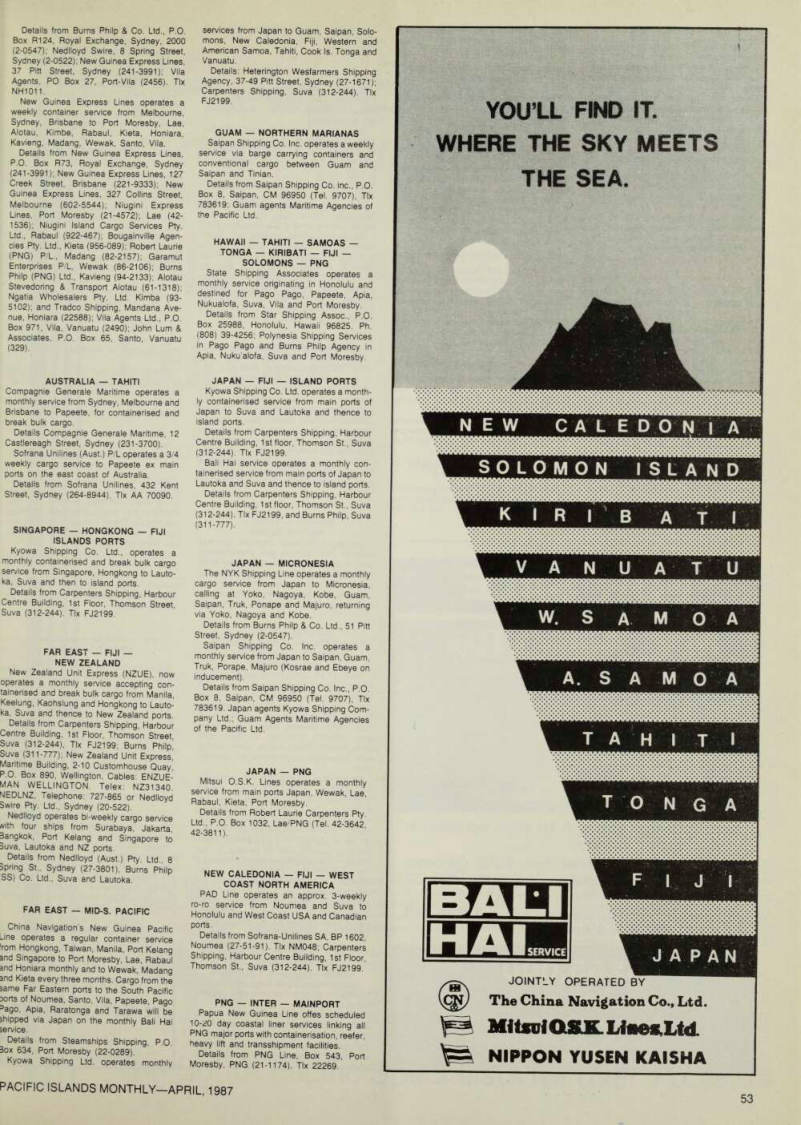
Should any shipping company wish to have its services cargo and passenger included in these listings they should contact
Pim.
Australia To Fiji
PACE Line (ACTA Shipping) operates a fully containerised service, every 17 days to Suva and Lautoka from Melbourne, Sydney and Brisbane.
The three vessels, ACT 9, ACT 10, ACT 11, continue on to Honolulu and then to the North American west coast ports of Tacoma, Vancouver. Oakland and Los Angeles.
Details Burns Philp (SS) Co. Ltd , Rodwell Road, Suva. Tel. (31 1777), Telex FJ 2168, FAX 311 804 Burns Philp (SS) Co. Ltd., Lautoka Tel (60 777) ACTA Pty Ltd , 447 Kent Street, Sydney. Tel. (266 0633), Telex: AA 121 369, FAX 267 1148 ACTA Pty Ltd., Melbourne Tel. (611 2000). ACTA Ply Ltd., Brisbane. Tel. (221 3116).
Australia Fiji
Sofrana-Unilines (Fiji Express Line) oper ates to Suva and Lautoka every three weeks from the main ports on the east coast of Australia and monthly to Lautoka from Mel bourne and Sydney.
Details from Sofrana-Unilines, 432 Kent Street, Sydney (264-8944). Tix AA 70090; Wiltrans Agency Pty. Ltd., 21st Floor, 60 Market St. Melbourne (614-4788); Tlx 30163 ACTA Pty. Ltd., Brisbane (221-3116); Elders- ANL Pty. Ltd., Pori Adelaide, (47-5688); Newcastle, Sofrana Sydney (264-8944); Websters-ANL, 58 Charles St. Launceston, Tasmania (320-555); Carpenters Shipping, Harbour Centre Building, Ist Floor, Thomson Street, Suva, Fiji (312-244); Tlx FJ2199.
Australia Samoas Tonga
Warner Pacific Lines operates a regular cargo service from Sydney, Brisbane and Melbourne to Nukualofa, Pago Pago, Apia and Vavau. Feeder service available from Apia to Cook, Christmas, Fanning and Washington Islands.
Details from Hetherington Wesfarmers Shipping Agency, 37-49 Pitt Street, Sydney. (27-1671).
Australia New Caledonia
Fiji Samoas Tonga
Pacific Forum Line operates a fully con tainerised service (general, reefer and ro-ro) from Sydney to Noumea, Suva, Apia, Pago Pago, Nukualofa, Sydney, Cargo centralised from Adelaide, Melbourne, Brisbane.
Details from Pacific Forum Line P.O. Box 796 Auckland, Union Bulkships, 333 George Street, Sydney, Brisbane and Melbourne.
Union Co., Lautoka, Suva, Nukualofa, Pacific Forum Line Apia, Polynesia Shipping Pago Pago.
Australia Lord Howe Is.
Norfolk Is.
Compagnie des Chargeurs Caledoniens operates four-weekly cargo service Sydney- Lord Howe Island and Norfolk Island.
Details Hetherington Wesfarmers Shipping Agency, 37-49 Pitt Street, Sydney (27-1671).
Australia Kiribati
K. Asia Pacific operates a 5/6 weekly service from Melbourne and Sydney to Kiribati (Tarawa).
Details from K. Asia Pacific Pty. Ltd.
Goldfields House, 1 Alfred Street, Circular Quay, Sydney (232-2277), Tlx 122-143.
KAP New Guinea Lines call Tarawa after PNG ports on a 35 day basis from Melbourne and Sydney Brisbane.
Details from K. Asia Pacific Pty. Ltd., Goldfields House, 1 Alfred Street, Circular Quay, Sydney (232-2277); Tlx 122143.
Australia Tuvalu
K-Asia Pacific operates Direct service every 2nd voyage to Tulalu (Funafuti).
Details from K. Asia Pacific Pty. Ltd., Goldfields House, 1 Alfred Street, Circular Quay Sydney (232-2277) Tlx 122143.
Australia New Caledonia
And Or Vanuatu
Sofrana-Unilines ships serve Noumea every three weeks from the main ports along the east Australian coast.
Details from Sofrana-Unilines, 432 Kent Street, Sydney (264-8944), Wiltrans-Agency Pty. Ltd., 21st Floor, 60 Market St., Mel bourne (614-4788) Tlx 30163 ACTA Pty. Ltd., Brisbane (221-3116). Elders-ANL Pty. Ltd., Port Adelaide (47-5688), Newcastle, Sofrana
Sydney; Websters-ANL, 58 Charles St. Laun ceston, Tasmania (320-555).
Compagnie des Chargeurs Caledoniens operates a three-weekly containerised cargo service from Sydney to Noumea.
Details Hetherington Wesfarmers shipping Agency, 37-49 Pitt Street, Sydney (27-1671).
Compagnie Generale Maritime operates a monthly service from Sydney, Melbourne and Brisbane to Noumea, Port Vila and Santo, for containerised and break bulk cargo.
Details Compagnie Generale Maritime, 12 Castlereagh Street, Sydney (231-3700).
Australia Nauru
Marshall Is. Kiribati
Nauru Pacific Line operates regular cargo service from Melbourne to Nauru, Majuro and Tarawa, passenger service to Nauru only.
Details: Nauru Pacific Line (Aust.) Pty. Ltd.
Nauru House, 80 Collins Street, Melbourne (653-5709). Nedlloyd Swire, 8 Spring Street, Sydney (2-0522).
Australia - Solomon Islands
Vanuatu
Negal-PNG Line operates a monthly service details NEDLLOY SWIRE P/L, 8
Spring Street. Sydney Phone: 20522.
Australia New Zealand
The Australian National Line and the New Zealand line operate a 10-day container service (TRANZTAS) between Sydney and Melbourne to Auckland, Wellington, Lyttleton and Port Chalmers.
The Tranztas service has been extended to cover Burnie and Fremantle on a direct call monthly basis linking to the main New Zealand ports.
Details from ANL Shipping Agency, 20 Bond Street, Sydney (225-7333) and ANL Shipping Agencies, “World Trade Centre," cnr. Flinders and Spencer Streets, Melbourne (611-2323) or New Zealand Line, Pastoral House, 96 Lambton Quay, Wellington (728- 5000).
Australia Nz Fiji Tonga
Vanuatu New Caledonia
Solomons New Guinea
Sitmar Cruises operates a year-round cruise program from Sydney to include the better-known ports in the above countries
plus a number of unspoilt, and largely unknown, island paradises.
Details from Sitmar Cruises, 39 Martin Place, Sydney (239-9000); NSW, reserva tions and inquiries (008 42-2277); Rest of Australia, reservations and inquiries (008 22-2277).
Australia Nz Fiji Tonga
Vanuatu New Caledonia
Solomons Samoas Tahiti
P&O Liners call at Auckland, Bay of Islands, Honiara, Lautoka, Noumea, Nukualofa, Pago Pago, Papeete, Port Mores by, Santo, Savu-savu, Suva, Vavau and Vila on cruises from Australia.
Details from P&O Booking centre, World Travel Headquarters Pty. Ltd, 33 Bligh Street, Sydney (237-0333).
Australia Png
Solomons Vanuatu Nz
Pacific Forum Line operates a con tainerised and ro-ro from Brisbane to Port Moresby, Lae, Honiara, Port Vila, Lyttleton, Napier and Auckland.
Details from Union Bulkships, Brisbane Steamships Shipping, Port Moresby and Lae, Sullivans Ltd. Honiara, Vila Agents, Port Vila; SCONZ Christchurch, Napier and Auckland.
Auckland Micronesia
Nauru Pacific Line operates a regular container service from Melbourne to Ponape, Truk, Guam and Saipan.
Details: N.P.L. (Australia) Pty. Ltd., Nauru House, 80 Collins Street, Melbourne (653- 5709); Nedlloyd Swire. 8 Spring Street, Sydney (2-0522).
Australia New Caledonia
Sofrana Unilines operates a 3-4 weekly service from East Coast mainports to Noumea, Details from Sofrana Unilines 432 Kent Street, Sydney. (Tel. 264-8944), Tlx AA 70090.
Australia Tuvalu
K. Asia Pacific operates a three monthly service from Sydney and Melbourne to Tuvalu (Funafuti). Subject to Inducement.
Details from K. Asia Pacific Pty. Ltd.
Goldfields House, 1 Alfred Street, Circular Quay, Sydney (232-2277). Tlx 122143.
Warner Pacific Line operates a six week containerised/breakbutk service to Funafuti from Melbourne/Brisbane/Sydney and Auck land.
Details from Hetherington Wesfarmers Shipping Agency, 37-49 Pitt Street, Sydney (27-1671); Mackay Shipping Ltd. Downtown House, Queen Street, Auckland (30-299).
Australia Png
KAP New Guinea Lines cargo vessels call at Melbourne, Sydney, Port Moresby, Lae, Madang, Wewak, Manus, Kimbe, Rabaul, Popondetta.
Details from K. Asia Pacific Pty. Ltd.
Goldfields House, 1 Alfred Street, Circular Quay, Sydney (232-2277), Tlx 122143, Dal gety Shipping, World Trade Centre, Mel bourne (616-6700).
Australia Png Solomons
Sofrana Unilines (Aust. P/L operates a 3-4 weekly cargo service to PNG, ex-main ports on the east coast of Australia.
Details from sofrana Unllnes, 432 Kent Street, Sydney (264-8944), Tlx AA 70090.
Australia Png Solomons
Vanuatu
A consortium of NGAL/PNGL and CON PAC/NEL have four vessels operating a joint service from east coast Australian ports to Port Moresby, Lae, Alotau, Madang, Wewak, Rabaul, Kavieng-Kimbe, Kieta, Honiara, Vila, Santo.
Details from Burns Philp & Co. Ltd., P.O.
Box R 124, Royal Exchange, Sydney, 2000 (2-0547); Nedlloyd Swire, 8 Spring Street, Sydney (2-0522); New Guinea Express Lines, 37 Pitt Street, Sydney (241-3991); Vila Agents, PO Box 27, Port-Vila (2456). Tlx
Nhioii.
New Guinea Express Lines operates a weekly container service from Melbourne, Sydney, Brisbane to Port Moresby, Lae, Alotau, Kimbe, Rabaul, Kieta, Honiara, Kavieng, Madang, Wewak, Santo, Vila.
Details from New Guinea Express Lines, P.O. Box R 73, Royal Exchange, Sydney (241-3991); New Guinea Express Lines, 127 Creek Street, Brisbane (221-9333); New Guinea Express Lines, 327 Collins Street, Melbourne (602-5544); Niugini Express Lines, Port Moresby (21-4572); Lae (42- 1536); Niugini Island Cargo Services Pty.
Ltd., Rabaul (922-467); Bougainville Agen cies Pty. Ltd., Kieta (956-089); Robert Laurie (PNG) P/L, Madang (82-2157); Garamut Enterprises P/L, Wewak (86-2106); Burns Philp (PNG) Ltd., Kavieng (94-2133); Alotau Stevedoring & Transport Alotau (61-1318); Ngatia Wholesalers Pty. Ltd. Kimba (93- 5102); and Tradco Shipping, Mandana Ave nue, Honiara (22588); Vila Agents Ltd., P.O.
Box 971, Vila, Vanuatu (2490); John Lum & Associates, P.O. Box 65, Santo, Vanuatu (329).
Australia Tahiti
Compagnie Generale Maritime operates a monthly service from Sydney, Melbourne and Brisbane to Papeete, for containerised and break bulk cargo.
Details Compagnie Generale Maritime, 12 Castlereagh Street, Sydney (231-3700).
Sofrana Unilines (Aust.) P/L operates a 3/4 weekly cargo service to Papeete ex main ports on the east coast of Australia.
Details from Sofrana Unilines, 432 Kent Street, Sydney (264-8944). Tlx AA 70090.
Singapore Hongkong Fiji
Islands Ports
Kyowa Shipping Co. Ltd., operates a monthly containerised and break bulk cargo service from Singapore, Hongkong to Lauto ka, Suva and then to island ports.
Details from Carpenters Shipping, Harbour Centre Building, Ist Floor, Thomson Street Suva (312-244). Tlx FJ2199.
Far East Fiji
New Zealand
New Zealand Unit Express (NZUE), now operates a monthly service accepting con tainerised and break bulk cargo from Manila, Keelung, Kaohslung and Hongkong to Lauto ka, Suva and thence to New Zealand ports.
Details from Carpenters Shipping, Harbour Centre Building, Ist Floor, Thomson Street Suva (312-244), Tlx FJ2199; Burns Philp, Suva (311-777); New Zealand Unit Express, Maritime Building, 2-10 Customhouse Quay, P.O. Box 890, Wellington. Cables: ENZUE
Man Wellington. Telex: Nz31340.
NEDLNZ, Telephone: 727-865 or Nedlloyd Swire Pty. Ltd., Sydney (20-522).
Nedlloyd operates bi-weekly cargo service with four ships from Surabaya, Jakarta, Bangkok, Port Kelang and Singapore to Suva, Lautoka and NZ ports.
Details from Nedlloyd (Aust.) Pty. Ltd., 8 Spring St., Sydney (27-3801), Burns Philp SS) Co. Ltd., Suva and Lautoka.
Far East Mid-S. Pacific
China Navigation's New Guinea Pacific Line operates a regular container service ‘rom Hongkong, Taiwan, Manila, Port Kelang and Singapore to Port Moresby, Lae, Rabaul and Honiara monthly and to Wewak, Madang and Kieta every three months. Cargo from the same Far Eastern ports to the South Pacific aorts of Noumea, Santo, Vila, Papeete, Pago 3 ago, Apia, Raratonga and Tarawa will be shipped via Japan on the monthly Bali Hai service.
Details from Steamships Shipping, P.O.
Box 634, Port Moresby (22-0289).
Kyowa Shipping Ltd. operates monthly
services from Japan to Guam, Saipan, Solo mons, New Caledonia, Fiji, Western and American Samoa, Tahiti, Cook Is. Tonga and Vanuatu.
Details: Heterington Wesfarmers Shipping Agency, 37-49 Pitt Street, Sydney (27-1671); Carpenters Shipping, Suva (312-244). Tlx FJ2199.
Guam Northern Marianas
Saipan Shipping Co. Inc. operates a weekly service via barge carrying containers and conventional cargo between Guam and Saipan and Tinian.
Details from Saipan Shipping Co. inc., P.O.
Box 8, Saipan, CM 96950 (Tel. 9707), Tlx 783619; Guam agents Maritime Agencies of the Pacific Ltd.
Hawaii Tahiti Samoas
Tonga Kiribati Fiji
Solomons Png
State Shipping Associates operates a monthly service originating in Honolulu and destined for Pago Pago, Papeete, Apia, Nukualofa, Suva, Vila and Port Moresby.
Details from Star Shipping Assoc., P.O.
Box 25988, Honolulu, Hawaii 96825. Ph. (808) 39-4256; Polynesia Shipping Services in Pago Pago and Burns Philp Agency in Apia, Nukualofa, Suva and Port Moresby.
Japan Fiji Island Ports
Kyowa Shipping Co. Ltd. operates a month ly containerised service from main ports of Japan to Suva and Lautoka and thence to island ports.
Details from Carpenters Shipping, Harbour Centre Building, Ist floor, Thomson St., Suva (312-244). Tlx FJ2199.
Bali Hai service operates a monthly con tainerised service from main ports of Japan to Lautoka and Suva and thence to island ports.
Details from Carpenters Shipping, Harbour Centre Building, Ist floor, Thomson St., Suva (312-244). Tlx FJ2199, and Burns Philp, Suva (311-777).
Japan Micronesia
The NYK Shipping Line operates a monthly cargo service from Japan to Micronesia, calling at Yoko, Nagoya, Kobe, Guam, Saipan, Truk, Ponape and Majuro, returning via Yoko, Nagoya and Kobe.
Details from Burns Philp & Co. Ltd., 51 Pitt Street, Sydney (2-0547).
Saipan Shipping Co. Inc. operates a monthly service from Japan to Saipan, Guam, Truk, Porape, Majuro (Kosrae and Ebeye on inducement).
Details from Saipan Shipping Co. Inc., P.O.
Box 8, Saipan, CM 96950 (Tel. 9707), Tlx 783619. Japan agents Kyowa Shipping Com pany Ltd.; Guam Agents Maritime Agencies of the Pacific Ltd.
Japan Png
Mitsui O.S.K. Lines operates a monthly service from main ports Japan, Wewak, Lae, Rabaul, Kieta, Port Moresby.
Details from Robert Laurie Carpenters Pty.
Ltd., P.O. Box 1032, Lae/PNG (Tel, 42-3642 42-3811).
New Caledonia Fiji West
Coast North America
PAD Line operates an approx. 3-weekly ro-ro service from Noumea and Suva to Honolulu and West Coast USA and Canadian ports.
Details from Sofrana-Unilines SA, BP 1602, Noumea (27-51-91). Tlx NMO4B; Carpenters Shipping, Harbour Centre Building, Ist Floor, Thomson St., Suva (312-244). Tlx FJ2199.
Png Inter Mainport
Papua New Guinea Line offes scheduled 10-20 day coastal liner services linking all PNG major ports with containerisation, reefer, heavy lift and transshipment facilities.
Details from PNG Line, Box 543, Port Moresby, PNG (21-1174). Tlx 22269.
Png Uk/Continent
The Bank Line & Columbus Line operate a regular joint service from Port Moresby, Oro Bay, Kieta, Rabaul, Kimbe, Madang and Lae to Hull, Hamburg, Rotterdam, Antwerp and Le Havre.
Details from The Bank Line (A'asia) Pty.
Ltd., 51 Pitt Street, Sydney (27-2041); Tlx AA24063; Columbus Line, Lae (423466), Tlx NE 44171; or lines’ local agents.
Solomons Uk/Continent
The Bank Line & Columbus Line operate a regular joint cargo service from Honiara to Hull, Hamburg, Rotterdam, Antwerp and Le Havre.
Details from The Bank Line (A'asia) Pty.
Ltd., 51 Pitt Street, Sydney (27-2041); Tlx AA24063; Columbus Line, Lae (423466), Tlx NE 44171; Tradco Shipping Ltd., Honiara (22588), Tlx 66313.
New Zealand Australia Papua
New Guinea Solomon Islands
Vanuatu
Pacific Forum Line operates a con tainerised and ro-ro service from Lyttelton, Napier and Auckland to Brisbane, Port Moresby, Lae, Honiara and Port Vila.
Details from SCONZ Christchurch, Napier and Auckland, Union Bulkships, Brisbane: Steamships Shipping, Port Moresby and Lae; Sullivans Ltd., Honiara; Vila Agents, Port Vila.
Nz Cook Is. Niue Tahiti
New Zealand Line operates cargo services based on pallets and similar units from Auckland to Niue, Cook Islands and Tahiti.
Details from the NZ Shipping Agencies International Ltd., P.O. Box 3420, Auckland (797210); Waterfront Commission, P.O. Box 61, Raratonga; Cook Islands; Shipping Office,
Govt, of Niue, P.O. Box 107, Niue Island; Compagnie Maritime Polynesienne, P.O. Box 36. Papeete, Tahiti.
Nz Fiji
Reef operates a regular 18-day service from Auckland to Suva and Lautoka. Also passenger accommodation.
Details from Reef Shipping Agencies, PO Box 3382, Auckland, NZ (77-1221-3), Tlx 60633; MV Fijian Shipping Agencies Ltd.
Private Bag, Suva, Fiji (31-1056).
Pacific Line with one ship operates two weekly ro-ro cargo service New Zealand, Lautoka, Suva. No passengers.
Details Sofrana Unilines, 18 Customs Street, Auckland (773-279) PO Box 3614, Tlx NZ2313, Carpenters Shipping, 100 Thomson Street, Suva (312-244), Tlx FJ2199.
Nz Fiji North America (Wc)
Blue Star Line Ltd. Pacific Coast container services. Only direct service to and from New Zealand. Blue Star vessels call at Suva and Honolulu on NZ-U.S. West Coast voyages.
Details from Blueport ACT (NZ) Ltd., PO Box 192, Wellington (739-029). Burns Philp (SS) Co. Ltd., GPO Box 355, Suva, Fiji (311-777), Tlx FJ2168 Burship.
Nz Fiji Samoas Tonga
Pacific Forum Line operates a con tainerised and ro-ro 21 day service from Auckland to Lautoka, Suva, Apia, Pago Pago and Nukualofa.
Details from Pacific Forum Line, Auckland and Apia, Union Maritime, Lautoka, Suva and Nuku’alofa; Polynesian Shipping, Pago Pago.
Nz N. Caledonia Vanuatu
Png Solomons
Sofrana Unilines with three ships operate to Vila and Santo, to Honiara and Papua New Guinea and to Norfolk Island and Noumea (No passengers).
Details from Sofrana Unilines, 18 Customs Street, Auckland (773-279), PO Box 3614, Tlx NZ2313.
Nz Tahiti
Compagne Tahotienne Maritime SA (as CTM-Tahiti Line) operates one ship, MV Bounty 111, monthly Papette New Zealand. (No passengers.) Details from Sofrana Unilines, PO Box 3614, 18 Customs St., Auckland, Tlx NZ2313.
CTM-Tahiti Line, PO Box 9012, Papeete (39042), Tlx Tahitlin 322 FP Tahiti.
Nz Tonga Samoas
Warner Pacific Line services Auckland, Nukualofa, Vavau, Apia, Pago Pago fort nightly carrying general and freezer cargoes.
Details from Mckay Shipping Ltd., Down town House, 21 Queen St., Auckland, PO Box 3, Phone 390-229. Cables MACSHIP, Telex NZ2554. Warner Pacific Line, Box 93, Nuku’alofa, Tonga; Mealelel (Western Samoa) Ltd., Private Bag Apia, Western Samoa. Burns Philp (SS) Co. Ltd., PO Box 129, Pago Pago, Merican Samoa, Phone 633-2709, Cables 506, Burnsouth SB.
Tahiti New Caledonia
Vanuatu Solomon Is.
New Zealand Png
Singapore Europe
Polish Ocean Lines operate in a semi container type vessels to the following ports, from Papeete, Noumea, Santo, Vila, Yandina, Honiara, Auckland, Rabaul, Lae, Singapore, Port Kielang, Penang then to Mediterranean ports and Europe via the Suez Canal. (Other New Zealand ports subject to inducement.) Details from Universal Shipping Agencies Ltd., 6th Floor, 38 Fort Street, Auckland 1, New Zealand (390931, 390727, 32104), Tlx 21517.
Europe Tahiti
New Caledonia
Compagne Generate Maritime operates services from Europe and Mediterranean ports to Papeete and Noumea using three ro-ro and multi-purpose vessels thus ensuring a bi-monthly sailing to and from.
Details Compagne Generate Maritime, 12 Castlereagh Street, Sydney (231-3700).
Europe Tahiti
New Caledonia New Zealand
Vanuatu Solomons
Png Europe
Polish Ocean Lines offers regular monthly sailings for containerised and break bulk cargo, also conventional reefer space and reefer containers from Hamburg, Rotterdam, Dunkirk, Rouen to Papeete, Noumea, Auck land, Santo, Honiara, Rabaul, Lae, Singa pore, returning to Europe via Suez, other ports in South Pacific can be served directly with inducement or otherwise via tranship ment.
Details from Sotama, BP 9170, Papeete, Tel. 427805 Tlx 373, Telex Sotama 373FP/SATO: BP, C 2 Noumea Cedex Tel. 272094 Tlx 163NM/Universal Shipping Agencies PO Box 2282 Auckland Tel. 30930 Tlx 21517/Vanua Navigation PO Box 44 Vila Tel. 2027 Tlx 1033/Melan Chine Shipping Co. PO Box 71 Honiara Tel. 21678 Tlx 66335/Steamships Shipping & Transport PO Box 1512 Rabaul Tel. 922952 Tlx 92929/Steamships Trading Co.
Ltd., PO Box 85, Lae Tel. 424666 Tlx 42423/Union Steamship Co. of NZ Ltd, PO Box 50 Apia Tel. 21781 Tlx 225/Warner Pacific Line, PO Box 93, Nukualofa Tel. 22088 Tlx 66219/Fiji Agents TBA.
Europe Tahiti W.
Samoa Fiji N. Caledonia
Nedlloyd offers regular cargo services from Continental ports to Papeete, Apia, Fiji and New Caledonia.
Details Nedlloyd (Aust.) Pty. Ltd., Spring Street, Sydney (27-3801); Carpenters Ship ping, Ist Floor, Harbour Centre Bldg, 100 Thomson St., Suva (312-244), Tlx 2199FJ and Vetari Street, Lautoka (63988), Tlx 5215FJ.
Uk N. Continent W. Somoa
Tonga Fiji
The Bank Line & Columbus Line operate a regular joint cargo service from Hull, Ham burg, Bremen, Antwerp. Rotterdam and Le Havre to Apia, Nukualofa, Suva and Lautoka.
Details from The Bank Line (A'asia) Pty.
Ltd., 51 Pitt Street, Sydney (27-2041), Tlx AA 24063, Columbus Line. Lae (423-466), Tlx NE 44111, or lines local agent.
Uk N. Continent Png
Solomons
The Bank Line & Columbus Line operates a regular joint cargo service from Hull, Ham burg, Bremen, Antwerp, Rotterdam and Le Havre to Port Moresby, Lae, Madang, Kimbe, Rabaul, Kieta and Honiara and on induce ment to Yandina.
Details from The Bank Line (A'asia) Pty.
Ltd., 51 Pitt Street, Sydney (27-2041), Tlx AA 24063. Columbus Line, Lae (42-3466). Tlx NE 44171; or lines local agents.
Uk/N Continent Tahiti
N. Caledonia Vanuatu
The Bank Line 9 Columbus line operates a regular joint cargo service from Hull, Ham burg, Bremen, Antwerp, Rotterdam and Le Havre to Papeete, Noumea, Port-Vila and Santo.
Details from The Bank Line (A'sia) Pty. Ltd., 51 Pitt Street, Sydney (27-2041), Tlx AA 24063, Columbus Line, Lae (42-3466), Tlx NE 44171; Ets. A.M. Fare UTE, Papeete; Ets, Ballande, Noumea and other local agents.
U.S. Hawaii Micronesia
East Malaysia Brunei
Papua New Guinea
PM&O Lines operates two fully self-sus tained container vessels on a sailing frequen cy of every 30 days between the San Francisco Bay Area, Los Angeles, Honolulu and Majuro, Ebeye, Kosrae, Ponape, Truk, Saipan, Yap Paleu, Kota Kinabalu, Brunei, Lae, Kieta and Rabaul.
Details from PM&O Lines, 353 Sacramento Street, San Francisco, California 94111, U.S.A. (415) 421-5400, Tlx 278016 PMO UR; Owner's Representative P.O. Box 803, Saipan, N.M.I. 96950, Ph. 234-6819 Tlx
783-605 Cmcaa.
U.S. Hawaii Samoas
Kiribati Nauru
Nauru Pacific Line operates regular con ventional and container services from San Francisco and Honolulu to Christmas Island, Pago Pago, Apia, Tarawa and Nauru.
Details from N.P.L. (Australia) Pty. Ltd., Nauru House, 80 Collins Street, Melbourne (653-5709), Nauru Air and Shipping Agency, Suite 2803, 185 Berry Street, San Francisco, California 94107 (415-543-4517). Nauru Air and Shipping Agency, Suite 506, 841 Bishop St., Honolulu, HI 96813 (808-523-0441).
U.S. Noumea Fiji
PAD Line operates an approx. 3-weekly ro-ro service from west coast USA and Canada to Noumea, Suva and Lautoka.
Details from Sofrana Unilines BP 1602, Noumea (27-51-91). Tlx NMO4B, Carpenters Shipping, Harbour Centre Building, Ist Floor, 100 Thomson Street, Suva (312-244), Tlx FJ2199, Trans-Austral Shipping Pty. Ltd., P.O. Box R 232, Royal Exchange. 2000 (231-8411), Tlx AA21204.
Advertisements & other items, pp. 52-56 (1 item)
IMEL services Reach out Thousands
Of Miles in The Pacific. It’s Where
we work.
££^IMEL
INDUSTRIAL AND MARINE
ENGINEERING LIMITED
Tel: 311288. Telex: FJ2195
P.O. Box 172. Suva FIJI ISLANDS
"the complete Engineering Company of the South Pacific' • Heavy Engineering • Air Conditioning • Sheetmetal • Foundry • Electrical • Refrigeration • Steel Supplies • Quality work • Competitive prices.
G8R1039
YOU’LL FIND IT.
WHERE THE SKY MEETS
THE SEA.
NEW CALEDONIA
SOLOMON ISLAND
KIRI B ATI
VANUATU
W. S A M O A
A. S A M O A
TAHITI
TONGA
JOINTLY OPERATED BY
The China Navigation Co., Ltd.
Mitsui OtSJL Lises. Ltd.
NIPPON YUSEN KAISHA
FOR SALE
m B • ■*' * • 50 ft Charter Boat with Ist class reputation in dive tourism industry. • Completed 1979, steel hull, 6LXB Gardener main, 10KvA auxiliary, Australian Dept, of Transport survey. • Fitted out for 10 passengers plus 3 crew and easily converted for cargo. $265,000 • Contact: Reef Explorer Cruises P.O. Box 1588 Cairns 4870 Australia. PH (057) 516-360
TLX: 48216 REEFSSS
ALL THE NEWS
IN A FLASH
THE SOUTH SEA DIGEST
See insert for Subscription details
BANK LINE and
COLUMBUS LINE
24 day service to
Europe.
Need we say more...
D G The Joint Service Partners offer facilities for shipment of: Containers (FCiyLCL) and Break-bulk Cargo plus reefer space and deeptanks for carriage of vegetable oils and other liquid bulk cargo.
Carriers also accept heavy lifts, overlength and cumbersome parcels.
Ports of Service: Loading; Papeete, Apia, Suva, Lautoka, Noumea, Port Vila, Santo, Honiara, Port Moresby, Lae, Madang, Kimbe, Rabaul, Kieta, Darwin. For: Rotterdam, Antwerp, Hamburg, Hull, Dunkirk, Le Havre.
Additional ports on enquiry.
Please contact our regional offices for further information: The Bank Line (Australasia) Pty Ltd Suite 801, 51 Pitt St, Sydney, NSW, Australia 2000 Phone 27 2041 Telex 24063 Columbus Line Reederei GmbH P.O. Box 1 667, Lae/Papua New Guinea.
Phone: 423466/423487/AH. 422481 Telex: Colline NE 441 71 The South Pacific Specialists for over 75 years
a.
SERVICE PAGE
PACIFIC
SLANDS
\MONT H L /I
AUSTRALIA: Distribution: The Herald and Weekly Times Ltd., 44-74 Flinders St., Melbourne, Vic., 3000. Advertising Reps Brisbane D. Wood, Anday Agency, CCA Centre, Dayboro Road, Closeburn 4520; Box 1918. GPO Brisbane, 4001, telephone (07) 289-4128. Adelaide Hastwell Williamson Rouse Pty. Ltd., PO Box 419, Norwood, SA, 5067; 59 Kensington Road, Norwood; telephone (08) 332-3322, telex 87113; Perth Allen & Associates, 7 Fore St., Perth, W.A., 6000, telephone (09) 328-9833, telex: AA94382.
FUI: Distribution and subscriptions Desai Bookshops, P.O. Box 160, Suva, Fiji telephone Suva 23036.
Advertising Fiji Times & Herald Ltd., 20 Gordon St., Suva, telephone 31-4111, telex FJ2124.
FRENCH POLYNESIA: Distribution Hachette Pacifique 10 Ave., Bruat, Papeete, telephone 25-610.
HAWAII: UNITED STATES; Distribution PIM, Hawaii.
P.O. Box 22250, Honolulu, Hawaii, 96822 Advertising Brian C. Asgill, Apt. 1308,1676 Ala Moana Blvd., Honolulu, Hawaii, 96815, telephone (808) 955-9718.
JAPAN: Advertising and subscriptions Universal Media Corporation, GPO Box 46, Tokyo,'telephone 666-3036, cable UNIMEDIA Tokyo, telex 2524665.
MALAYSIA: Advertising and subscriptions Worldwide Media Services, 57-B Komplex Damai, Jin Dato Haji Eusoff, Kuala Lumpur, telephone 63-9340, cables WORLDMEDIA Kuala Lumpur, telex 31533.
VANUATU: Distribution The Bookshop. HQ Box 210, Port Vila. Advertising Norman Bros. Bookshop, Port Vila, telephone 2232, NEW CALEDONIA: Distribution Depot Centre de Presse Michel Pentecost. CBP2, Noumea, telephone 27-2434, 27-4729.
NEW ZEALAND: Distribution Gordon & Gotch, PO Box 584, 2 Carr Road, Mt. Roskili, Auckland 4 Advertising McKay International Media Reps. Ltd.,, c/o Albany P. 0., Auckland 10, New Zealand, telephone 413-9119.
Telex NZ22701, FAX 413-9110.
WELLINGTON Ross Quaid Media, 1 Scholes Ln„ Petone. (04) 68-7593 PO Box 38699, Petone.
PAPUA NEW GUINEA: Distribution - Gordon & Gotch, PO Box 3395, Port Moresby, telephone 25-4551,25-4855.
Advertising Ken Head, PNG Post-Courier, PO Box 85, Port Moresby, telephone 21-2577, telex 22120.
SOLOMON ISLANDS; Distribution and Advertising The Bookshop, {Norman Bros.) PO Box 503, Honiara, PHILIPPINES: Advertising The GF Group, 12 San Ignacio St., Uroaneta Village, Makati, Metro Manila, telephone 817-7299, telex 45950 and 4233, UNITED KINGDOM; The Herald & Weekly Times Ltd., No 1 Maltravers Street, London WC2R 3DZ, England, telephone (01) 836-5162, telex London 21989.
UNITED STATES MAINLAND: Advertising Joshua B.
Powers Jr., Powers International Inc., Suite 708, 271 Madison Ave., New York, NY 10016, telephone 867-9580, Subscriptions PIM, Hawaii, PO Box 22250. Honolulu, Hawaii, 96822.
SUBSCRIPTIONS
American Samoa...
Australia Canada Cook Islands Fiji French Polynesia...
Guam Hawaii Japan Kiribati ...
Micronesia Nauru New Caledonia New Zealand Niue ...
Norfolk Island Northern Marianas..
Papua New Guinea Solomon Islands Tonga Tuvala United Kingdom U.S. Mainland Vanuatu Western Samoa Elsewhere .. US$24
AUSS24
.. US$3O
...NZ$36
AUSS26
..US$3O
.. US$3O
.. US$3O
.. US$3O
AUSS24
..US$3O
AUSS24
.. US$3O
...NZ$36
...NZ$3O
AUSS24
..US$3O
AUSS3S
AUSS24
AUSS24
AUSS24
...,Stgls
.. US$3O
AUSS24
AUSS24
AUSS36
Payments by personal cheque are only acceptable in Australian (from a branch in Australia). U.S. and New Zealand currency. For alt other remittances please send an international bank draft in Australian dollars.
Published monthly by Pacific Publications (Aust.) Pty.
Ltd. and printed in Australia by Brownhall Printing Pty. Ltd., 52 Duerdin Street, Clayton North, Victoria.
NOW AVAILABLE!
PACIFIC ISLANDS YEAR BOOK
Due to demand the 15th edition has been reprinted and is available from P.I.M. at As3s plus p.p.
NEED MONEY?
When Banks Stop ... We Start!
NO CREDIT CHECKS. COLLATERAL,
OR CO-SIGNERS NEEDED!
JOIN THE BUSINESS
OPPORTUNITY CLUB
THE CLUB WAS FORMED FOR THE
WORKING MEN AND WOMEN WHO
WANT A BETTER WAY OF LIFE BUT
DON’T HAVE ENOUGH MONEY TO
START UP.
The Club can help you get • Low Interest Loans • To Start or Expand A Business • For Personal Use • No Red Tape • Borrow $lO,OOO to $1,000,000 with up to 20 years to repay • Follow 4 simple steps • Low membership fee • 30-day trail membership.
FOR MORE COMPLETE
INFORMATION CONTACT:
BOC INFORMAT
P.O. BOX 59, AUKI, MALAITA,
SOLOMON ISLANDS
Stay at Aggie Grey’s . . . the South Pacific’s
legendary hotel.
Situated right in the heart of Western Samoa. F.njoy Polynesian style friendliness and service, in cool surroundings, superb entertainment and focid.
Magnificent white sand beaches*only a short drive away. Air- V conditioned-rooms, swimming |xm)l and Jull bar facilities.
Bookings through lit ion Steamship Company of N/. Pan Am. Air New Zealand or direc t to- Aggie Cirey’s. Apia; Western Samoa. Cables: ‘ACCIKS’ Apia.
BAGOT
BELLFOUNDRIES
Box 421, North Adelaide, S.A. 5006. Australia Tel: +6l 8 267 1306 Beautiful tuned bells for churches and missions
Advertising
Aggie Greys 56
Amatll 50 ANZ Bank 29
Awa 21
Bagot Beii Foundaries 56 Bali Hai Service 53 Bank Line 55 BOC Informat 56 Brasshards 33 Butame 41 Clarion 10 Columbus Line 55 Continental 40 Henry Cumines 51 Hawaii Telephones 32 Honda Motor 2
Imel 52
Mitsubishi Motor 60 Pioneer Electric 7 Polish Ocean Lines 57 Robert Ritchez 56 Rokko Sangyo 41
Sony Corp 4
Toyota Motor 30-31 Toyota Motor 58-59 Video 16 Wreckair Container 12
Advertisements & other items, pp. 56-60 (1 item)
In A Flash
ALL THE NEWS
The South Sea Digest tells you what you want to know about the Pacific Islands in a few words. All the leading firms and diplomatic missions read it.
See insert for subscription details:
THE SOUTH SEA DIGEST
BELGIAN BOY
Wants penfriends from the Pacific Islands.
Likes shells and will send stamps in exchange.
Please write to:
MAXIME RICHEZ
Rue Cernee 7358 Pommeroeul
BELGIUM
POLISH OCEAN IMS
General Management, 10 Lutego 24,81-364 GDYNIA, POLAND, Phone: 20-19-01, Cables: POLOCEAN Telex: 054-231 Q * ; , 3 m hk m CT L M .f; ■i 6 ■m V- M
!sft
Si?
SOUTH PACIFIC SERVICE
ANTWE%p m °DUNVfRK iC RO?iPM d D H A A ROTTERDAM, MIDDLESBOROUGH/IMMINGHAM.
SnijGAPORE D hi N n^ r ß li,“ U i N ' PAPEETE (via PANAMA), NOUMEA, AUCKLAND, HONIARA, RABAUL, LAE. b bArURE, by our multipurpose vessels carrying dry and reefer containers, reefer chambers, heaw lifts breakbulk or \ Y,n / » iiwuivilh, Vy r\ i_/-\ I N , nvjINIMnM, r\r ; carrying dry and reefer containers, reefer chambers, heavy lifts, palletized, bulk liquids. ai iru'i AMn a POLISH OCEAN LINES Representatives AUCKLAND Mr. A. S.eradzki. Telex 21517 NZ “UNISHIP”. SYDNEY Mr. Walenciak. Telex 20428 AA “SLEIGH”
s> 0.3 si, 80.5
db(AX
[O2-SFD2S]
Full-Floating
Power Train
Steering Wheel Vibration Virtually non-existent, elevating comfort to a new all-time high. * Indicates maximum vibration level of the wheel Equivalent Noise Levei at Driver’s Ear Drastically reduced by sound-absorbing material and comprehensive engim design. * Measured and calculated according to IS6
The forklift designed
for greater comfort, less vibration.
Toyota Introduces
SR m 9 Toyota, the leader in innovation, creates a revolution in the forklift industry.
The revolutionary new 1-3 ton engine powered series forklifts; maximum-performance vehicles designed for maximum-operator comfort.
A full-floating power train practically eliminates vibration. Advanced engineering “floats” the entire engine on a cushion of rubber, with no direct attachment to the frame. Surrounding main engine parts also vibrate freely, drastically reducing structural vibration. Rubber sealing on engine hood and floorboard, and sound-absorbing materials, all add up to the many innovations that raise Toyota’s new series’ comfort level far above other forklifts.
Also exclusive to the 1-3 ton series is the 3-litre 1Z direct injection diesel engine. Delivering greater horsepower and less fuel consumption.
Increased performance, increased comfort.
But don’t just take our word. Take a test drive and feel.
Toyota’s new 1-3 ton series forklifts are in a class by themselves.
Comfort-class.
50” rpm 580— ec 2000“ 195 km/h {y \y (57 HP/2,400 rpm SAE NET) V 7 V/ (114f/min.) \y \y (4,400 lbs) (12.1 mile/h) Engine Horsepower The new 1Z diesel engine delivers more power, more efficiency.
[O2-SFD2S]
(114 f/min.) Lifting Speed Now the job gets done faster than ever.
[O2-SFD2S]
(4,400 lbs) Max. Drawbar Pull Scales inclines hauling a full load, easily.
Max. Havel Speed Work cycles are dramatically increased for greater efficiency.
TOYOTA
A decision you can be comfortable with. r - i Maintenance Integrated monitoring centre, easy access to parts.
Inspection and servicing amazingly easy.
Durability
Overheating “fail-safe” system, rigorously tested; built rugged.
Service Network Extensive. After sales support in almost every country in the world.
Reliability
Design priority no. 1 ensuring operator safety through Toyota reliability.
Wide Variation Even greater productivity and comfort available with a wide selection of models.
TOYOTA
AMERICAN SAMOA: BURNS PHILP (S.S.) CO., LTD. TEL: 633-4281 AUSTRALIA: THIESS TOYOTA PTY, LTD. TEL; 526-0333 FIJI: AUTOMOTIVE SUPPLIES CO., A DIVISION OF BURNS PHILP (S.S.) CO., LTD.
TEL: 383444
GUAM: ATKINS, KROLL, INC. TEL: 646-1876
NEW CALEDONIA: SERVICE IMPORTATION AUTOMOBILE DU PACIFIQUE
TEL: 27-41-44
NEW ZEALAND: ANDREWS & BEAVEN INDUSTRIAL EQUIPMENT LTD
TEL: 2780940
PAPUA NEW GUINEA: ELA MOTORS. BURNS PHILP (P.N.G.), LTD
AUTOMOTIVE DIVISION TEL: 217036
VANUATU: VANUATU MOTORS, A DIVISION OF BURNS PHILP (VANUATU) LTD
TEL: VIU\ 2341
WESTERN SAMOA: BURNS PHILP (S.S.) CO., LTD. TEL: 22611 And distributors around the world. 02-5FD25 W
I si-
Charles Darwin theorized
that survival depends on the ability to change.
We’re living proof.
The origin of the automobile species in Japan began with 1917 Mitsubishi Model-A, our first massproduced motorcar. Seventeen years later we staged another evolutionary jump in the development of the automobile with the PX-33, Japan's first four-wheel drive diesel passenger car.
The following half century has seen the Three AMERICAN SAMOA: MORRIS SCANLAN SERVICE INC PO. Box 367, Pago Pago, Tel 633-5520/AUSTRALIA: MITSUBISHI f G.P.O. Adelaide, South Australia 5001, Tel. 08-275-711 1 /FIJI: NIVIS MOTOR & MACHINERY CO., LTD. GPO Box 150, Suva, Tel ■ 384425/FRENCH POLYNESIA fTAHITO.
ETS-BREDIN FRERES ET FILS PO Box 21, Papeete, Tahiti, Tel 4-202-58/NEW CALEDONIA: SOCIETE D IMPORTATION D AUTO DU PACIFIQUE 438 Rond Point du Pacifique, Noumea, Tel. 274144/NEW ZEALAND: TODD MOTORS CORPORATION Todd Park Heriot Drive Private Bag ’o9/NORFOLK ISLAND; BORRYS LTD PO Box 169, Norfolk Island, Tel 2114 NI/PAPUA NEW GUINEA: TOBA PTY LTD. PO. Box 503, Port Moresby. T e 2 1-7874/SOWMON R.C. SYMES PTY. LTD. PO. Box 823, Honiara, Guadalcanal. Tel 221 31 /TONGA: SITANI MAPI CO , LTD. P O Box 83 Maku Olofa I 6 ' db/ma^Firo/ B.P. 06 Route de Lagon, Port-Vila, Tel 2314/WESTERN SAMOA: A M MACDONALD HOLDINGS LTD. PO Box 576. Apia Tel. 22022/SAIPAN/PONAPE/MAJURO/ KOSRAE/TRUK/YAP/BELAU: MICRONESIAN MOTORS. INC. 997 South Marine Drive, Tamuning, Guam 96911, Tel. 646-6827 Diamonds series demonstrate its adaptability to changing social, economic and geographical environments by developing vehicles to meet virtually every automotive need on earth.
Proof that heredity is nothing but accumulated experience gained through adapting to the environment, Mitsubishi today has the world's widest range of 4 x 4 vehicles. From 550 cc 4WD superminicars to 1,995 cc turbocharged 4WD multipurpose vehicles like the rally-winning Pajero/Montero 4 x 4, to mammoth 16,000 cc allwheel-drive off-highway trucks.
Seventy years isn't long in evolutionary time, but we've continued to perfect the species. In the process, we have been proving the validity of Darwin's theories as they apply to the products required by our automotive society.
Living proof: Mitsubishi Pajero/Montero 4x4 wins Category IV and the Best Team Award in the 1987 Paris-Dakar Rally.
A
MITSUBISHI
MOTORS