Pacific

Islands
Monthly
American Samoa US$2.OO Australia A 52.00 Cook Islands NZ$3.OO Fiji f 51.75 Hawaii US$2.5O Kiribati A 52.00 Nauru A 52.00 New Caledonia CFP2SO New Zealand NZ$3.3O find. frt. and GST) Niue NZ$2.5O Norfolk Island A 52.00 Papua New Guinea K 2.00 Solomon Islands 552.00 Tahiti CFP3OO Tonga P 2.00 Tuvalu A 52.00
Usa Us$3.Oo
USTTand Guam US$2.5O Vanuatu VT2.00 Western Samoa T 2.75 •Recommended retail price only Registered by Australia Post Publication No. NBPI2IO
March, 1987
P V k |H3[ I m k I ivt fiF j£?'"
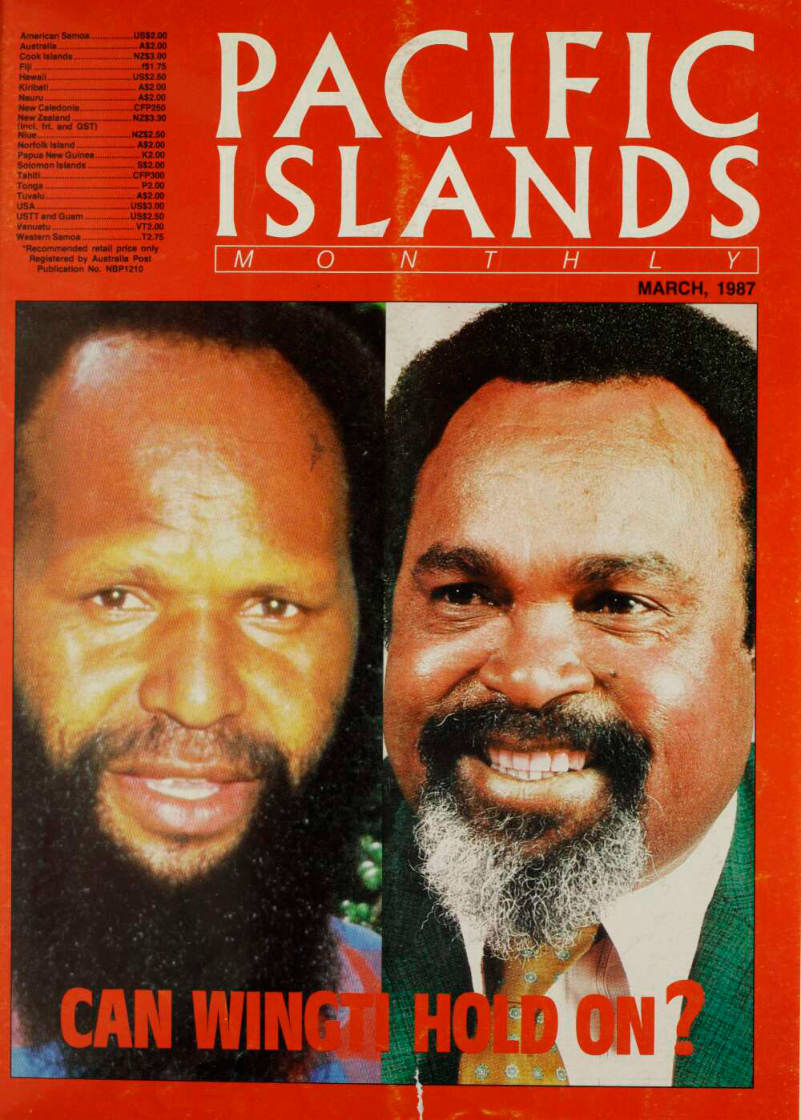
The Cover
The PNG election con tenders, Mr Paias Wingti and Mr Michael Somare.
Advertisements & other items, pp. 2-3 (2 items)
So we thought you'd prefer
to do your timer recording
at a safe distance.
The multi-function remote control 'Super Transmitter' allows operation of the ... shhh! VT-138E ... easily from the comfort and safety of your armchair.
This unique 14-mode infra-red transmitter displays the preset recording programmes on its own LCD screen. It also allows you to set the timer without having to tiptoe over to the VTR.
Did you shake when you read the headline? No. That's because the extra head has been designed to prevent shake. And together with a special no noise circuit it dismisses all fears
about picture quality during still and
slow motion mode.
The Video Tape Recorder (VTR) with this marking incorporates IVHSI high-quality picture technology and is compatible with m any Video Tape Recorders bearing the VHS mark. • AUSTRALIA: Hitachi Sales Australia Pty., Ltd., 153 Keys||pad, Mooml P.O. Box 50-248, Porirua; Phone: PRO 75-069 • PAPUA NEW GUINEA: SXX.
Limited. 37 Freeston Road. Walu Bay (P.O. Box 858), Su Radios Centre Ltd., P.O. Box 465, Honiara; Phone: 416 A
CHANNEL .*/
2W ON >in
PM Li »-
OFF
n i~t n s U Li pm'Jr (C r-»
OHITACHI
Add all this to the low, sleek, front load design, and feather touch buttons, and you can see why the VT-138E isn't frightened to say that it's one of the simplest and most relaxing VTR's around.
Outstanding screen image, and supreme operation ease - that’s the Hitachi HQ system VT-138E.
So tiptoe down to your local dealer.
Preferably during daylight.
VT-138E
Super Transmitter
Hitachi... another new idea.'
0 HITACHI
TOKYO, JAPAN
2 • NEW ZEALAND: AWA New Zealand Limited, Wi-neera Drive, *O. B6x 705. Port Moresby; Phone; 21-2111 • FIJI ISLANDS: AWA New Zealano EDONIA: (JiGis, B.P Ml, Noumea; Phone: 26. 23. 50 • SOLOMON ISLANDS: Technique
Pacific
ISLANDS
M O NTHLY
Vol. 58, No. 3, March, 1987.
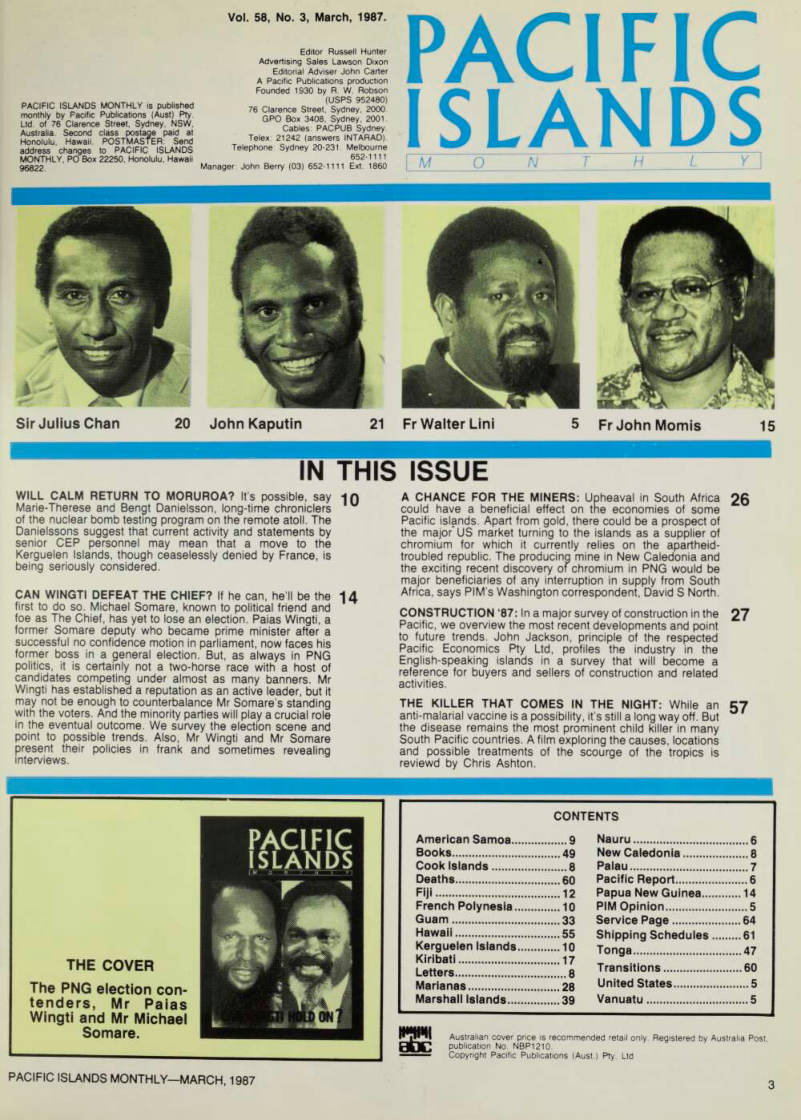
Sir Julius Chan 20
John Kaputin 21
Fr Walter Lini 5
FrJohnMomis 15
In This Issue
WILL CALM RETURN TO MORUROA? It's possible, say in Marie-Therese and Bengt Danielsson, long-time chroniclers of the nuclear bomb testing program on the remote atoll. The Danielssons suggest that current activity and statements by senior CEP personnel may mean that a move to the Kerguelen Islands, though ceaselessly denied by France, is being seriously considered.
CAN WINGTI DEFEAT THE CHIEF? If he can, he'll be the 14 first to do so. Michael Somare, known to political friend and foe as The Chief, has yet to lose an election. Paias Wingti, a former Somare deputy who became prime minister after a successful no confidence motion in parliament, now faces his former boss in a general election. But, as always in PNG politics, it is certainly not a two-horse race with a host of candidates competing under almost as many banners. Mr Wingti has established a reputation as an active leader, but it may not be enough to counterbalance Mr Somare’s standing with the voters. And the minority parties will play a crucial role in the eventual outcome. We survey the election scene and point to possible trends. Also, Mr Wingti and Mr Somare present their policies in frank and sometimes revealing interviews.
A CHANCE FOR THE MINERS: Upheaval in South Africa 26 could have a beneficial effect on the economies of some Pacific islands. Apart from gold, there could be a prospect of the major* US market turning to the islands as a supplier of chromium for which it currently relies on the apartheid troubled republic. The producing mine in New Caledonia and the exciting recent discovery of chromium in PNG would be major beneficiaries of any interruption in supply from South Africa, says PlM's Washington correspondent, David S North.
CONSTRUCTION ‘B7 : In a major survey of construction in the 27 Pacific, we overview the most recent developments and point to future trends. John Jackson, principle of the respected Pacific Economics Pty Ltd, profiles the industry in the English-speaking islands in a survey that will become a reference for buyers and sellers of construction and related activities.
THE KILLER THAT COMES IN THE NIGHT: While an 57 anti-malarial vaccine is a possibility, it’s still a long way off. But the disease remains the most prominent child killer in many South Pacific countries. A film exploring the causes, locations and possible treatments of the scourge of the tropics is reviewd by Chris Ashton.
Contents
American Samoa 9 Books 49 Cook Islands 8 Deaths 60 Fiji 12 French Polynesia 10 Guam 33 Hawaii 55 Kerguelen Islands 10 Kiribati 17 Letters 8 Marianas 28 Marshall Islands 39
Nauru 6 New Caledonia 8 Palau 7 Pacific Report 6 Papua New Guinea 14 PIM Opinion 5 Service Page 64 Shipping Schedules 61 Tonga 47 Transitions 60 United States 5 Vanuatu 5
Australian cover price is recommended retail only. Registered by Australia Post publication No. NBPI2IO.
Copyright Pacific Publications (Aust.) Pty. Ltd
Advertisements & other items, pp. 3-4 (2 items)
Pacific Islands Monthly—March, 1987
3
PACIFIC ISLANDS MONTHLY is published monthly by Pacific Publications (Aust) Pty.
Ltd. of 76 Clarence Street, Sydney, NSW, Australia, Second class postage paid at Honolulu, Hawaii. POSTMASTER: Send address changes to PACIFIC ISLANDS MONTHLY, PO Box 22250, Honolulu, Hawaii 96822
Editor Russell Hunter Advertising Sales Lawson Dixon Editorial Adviser John Carter A Pacific Publications production Founded 1930 by R. W. Robson
(USPS 952480)
76 Clarence Street, Sydney, 2000 GPO Box 3408, Sydney, 2001.
Cables: PACPUB Sydney.
Telex: 21242 (answers INTARAD).
Telephone: Sydney 20-231. Melbourne 652-1111 Manager: John Berry (03) 652-1111 Ext. 1860
▲
s
JJI JI
KV-2092AS
KV-1440AS
It's so tempting.
The colour you get from Sony's new Super Trinitron.
Our new Pan-Focus gun is computer-designed to make our famous colour even sharper and clearer. Our new Black Screen makes whites brilliant, blacks profound, every colour deeper and richer.
It's flatter and sguarer too.
For less reflection and superb clarity, even in the corners.
For those whose taste demands the best, Super Trinitron is the most delicious TV ever.
An independent decision
Pim Opinion
Vanuatu’s fishing agreement with the Soviet Union was inevitable. In the absence of better offers for access to the nation’s very valuable resource, it makes common commercial sense to conclude a deal with the highest or only bidder. That there are other concerns, from a Port Vila perspective, is hardly relevant.
As Michael Somare says, (page 20) it’s all about survival. And few would argue that survival of the South Pacific ministates is not of vital importance.
The people of those countries chose independence. It was not forced on them. And as independent states they should be free to deal with whomsoever they wish. That much is clear.
Less clear is the validity of objections raised by their near neighbours who, for varying reasons, claim an interest in these proceedings. Those reasons themselves may hold some keys to the portals of policy-making in the South Pacific. Australia’s foreign minister Mr Bill Hayden signalled Australia’s “concerns” at a Soviet presence when he toured the region last year (July PIM p 22). By the time the Forum was meeting in August, however, his position appeared to have softened. Then, when talks between Vanuatu and the Soviets were on the verge of completion, Australia was concerned again. This is doubtless unconnected with Australia’s difficulties in the US over its agricultural exports.
New Zealand, too, was originally worried at least until Fr Uni talked with prime minister Lange at the Forum after which the New Zealand leader declared himself much more relaxed at the prospects of a Soviet presence. He should know. New Zealand has had a fishing agreement with the Soviet Union for some years.
The New Zealand position, too, would be in no way linked to its anxiety to show the US that the ANZUS breakdown was not intended to end a friendship.
The US position is more straightforward. It doesn’t want the Soviets fishing in an American lake.
But to paint the US as the villain of the piece is unfair And Mr Somare’s assertion that the US “hasn’t done a damn thing” for the ministates strains credibility. That the
US hasn’t done enough would be a more acceptable claim. But The Chief’s remark may have been made more in frustration than conviction. A future Somare-led government would very likely support Vanuatu’s right to deal with the Soviets while keeping them at arm’s length itself. As he said, it’s a question of survival.
Vanuatu, with its tough banking secrecy laws, its flag of convenience shipping register, its religious convic tions, its commitment to free enterprise investment and its vigorous democratic institutions is hardly ripe for a communist conversion. Why, then, should some of its neighbours be worried?
They are worried because they fear that any upsurge of superpower competition in the region may generate an unpredictable fallout. And they may well have a case.
At the moment, however, that case is sometimes overstated. The Soviets fished in Kiribati waters for a year with no political side effects. They adhered to the terms of their agreement and there is no reason to believe that they may behave differently in Vanuatu. The agreement has to be renewed after a year while the US multilateral agreement is likely to be of longer duration. There are enough safeguards.
The Soviet Union has possibly the world’s largest fishing fleet though judging by recorded catches they may well be the world’s least efficient and, if they are prepared to pay, there seems no reason for countries in dire need of revenue to exclude them.
The danger is that the US Congress and the current president may not take that pragmatic view and decide that island nations who deal with the Soviets are somehow anti-American in that they allow a US rival access in return for a measly couple of million dollars.
Washington appears to find it difficult to come to terms with the very smallness of the island economies. More used to talking in billions and now trillions, the global policy makers have previously preferred to delegate such minor details. That is changing.
And if the Vanuatu agreement hastens that change it will have done the whole region and, possibly, the US a large favour.
pacific report
Vanuatu, Soviets
In Fishing Deal
Soviet tunaboats have been given the right to fish in Vanuatu’s EZ under an agreement signed in Port Vila. They will also be given access to shore facilities in the one-year agreement under which Russia will pay US$l.5 million. However, the Soviet fleet will not be permitted to fish in Vanuatu’s 12-mile territorial zone and the Soviet airline Aeroflot will not be given landing rights for crew changes, though officials said this could be consi dered in future agreements. Under the agreement a Soviet fleet of eight vessels will have access to Vanuatu’s 200nautical mile economic zone and will have, at extra cost, access to ports for buying bait and supplies or for repairs. A spokesman for prime minister, Fr Walter Uni, stressed that the agreement was purely commercial and that it helped Vanuatu to exploit one of its major resources, tuna. The United States, Australia and New Zealand had all expressed concern at the agreement.
President Deroburt
Back In Power
President Hammer De Roburt announced his four-man cabinet after being re-elected in Nauru’s second general election in seven weeks. The cabinet is unchanged from that which governed before the second election. Mr •e Robert's group won 11 of the 18 seats in the island’s parliament. After a previous election in early December, both sides held nine seats, leading to a short-lived government led by opposi tion leader Mr Kennan Adeang. Current finance minister Mr Kinze Clodumar was instrumental in bringing down the days old Adeang regime when he crossed the floor to join Mr De Robert’s group.
Soviets ’Will
Increase Influence’
The annual congress of the Australia and New Zealand Association for the Ad vancement of Science was told that the Soviet Union considered itself a Pacific power and that Moscow would in future adopt a more visible posture in the region. Dr Sandy Crosbie, head of the Department of Geography of Edinburgh University in Scotland, told the meeting this could lead to counter actions by the United States. He said the SPNFZ was
generally welcomed by the super-powers as a mechanism to reduce uncertainty in the region in that it could help contain the spread of nuclear weapons to known areas. Dr Crosbie also saw decreased involvement in the region for Australia a trend that bewildered many people outside the region. The reasons, he said, were largely economic, claiming that the small island states would be a continuing charge on Australia for very little return. However, other countries such as Japan recognised the region’s strategic importance and were moving to increase their involvement and influence. ici Aivir\c nm adcd a
Islands Declared A
Disaster Zone
President Reagan declared the islands of American Samoa a disaster zone after Cylone Tusi caused widespread damage, particularly on the outlying island of Tau in the Manu’a chain. The declaration permitted the use of federal funds for relief work and supplies were already on the way from Hawaii. Damage was estimated at US$BO million and medical supplies and doctors were being ferried to the islands to the west of Pago Pago.
Officials said more than a hundred people had been injured and about two thousand left homeless. rnrxT o„ nAI
French Policies
R Indfr Fire
Solomon Islands prime minister, Mr Ezekiel Alebua, strongly criticised the government of France over what he
described as France’s continued colo nial attitude and lack of respect for the interests of Pacific people. Mr Alebua said France was arrogant and reaction ary and had degraded its international image. He said actions such as the expulsion of Australia’s consul-general from New Caledonia only caused more trouble for France which, he said, had failed in its attempts to divert attention from the issues of New Caledonian independence and the nuclear testing program at Moruroa. Mr Alebua said Solomon Islands remained committed to independence for New Caledonia and that Forum leaders were of one mind on the issue. However, former French prime minister, Mr Raymond Barre, told an audience in New Delhi, while on a private visit, that France had a right to conduct tests in the Pacific. He said security had always been France’s aim an d that it had built a nuclear force that cou ld face any threat, cvnci . „
Diplomat Expelled
From New Caledonia
K( .
Australia’s consul-general in New Cale donia, Mr John Dauth, was expelled. No official reason was given, but it was understood that this reflected French anger at Australia’s role in the remsenp tion of the territory with the UN decol onisation committee. French officials said he had been interfering in internal affairs. Australian foreign minister Mr Bill Hayden said Mr Dauth had maintained contact with all groups in New Caledonia as he had been asked to by his department. Mr Hayden said this was normal diplomatic behaviour.
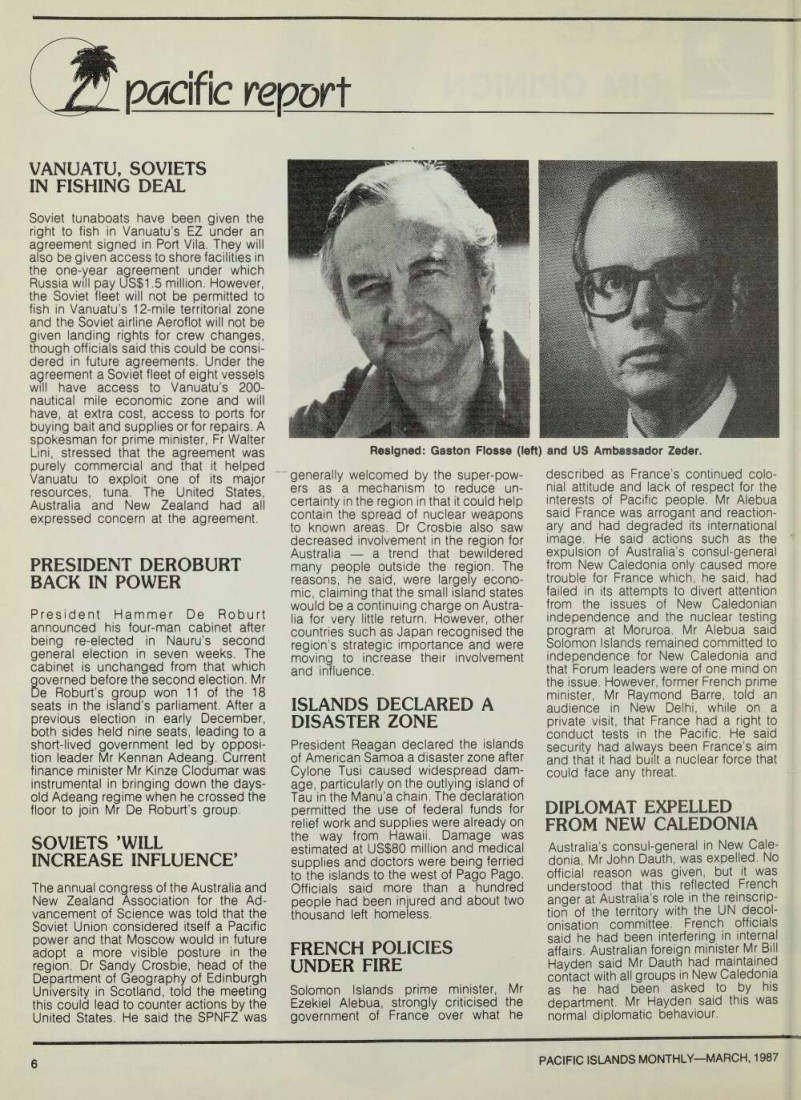
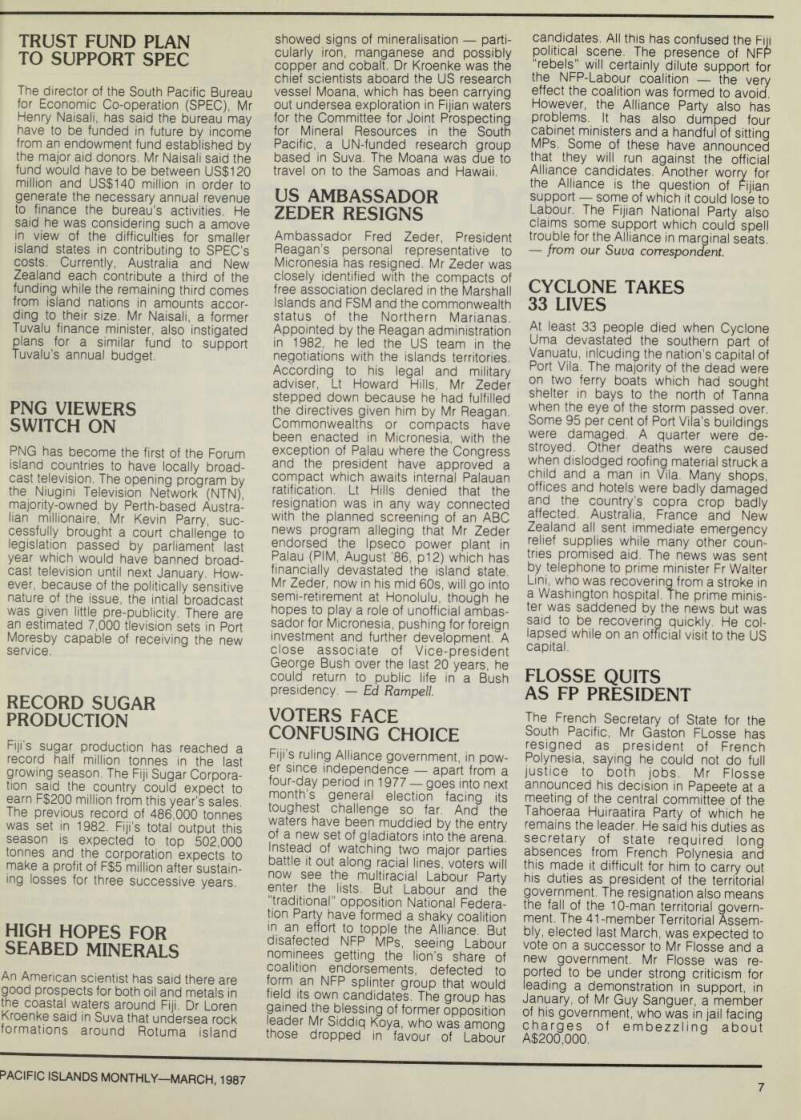
Resigned: Gaston Flosse (left) and US Ambassador Zeder.
Trust Fund Plan
To Support Spec
The director of the South Pacific Bureau for Economic Co-operation (SPEC), Mr Henry Naisali, has said the bureau may have to be funded in future by income from an endowment fund established by the major aid donors. Mr Naisali said the fund would have to be between US$l2O million and US$l4O million in order to generate the necessary annual revenue to finance the bureau’s activities. He said he was considering such a amove in view of the difficulties for smaller island states in contributing to SPEC’s costs. Currently, Australia and New Zealand each contribute a third of the funding while the remaining third comes from island nations in amounts accor ding to their size. Mr Naisali, a former Tuvalu finance minister, also instigated plans for a similar fund to support Tuvalu’s annual budget.
Png Viewers
Switch On
PNG has become the first of the Forum island countries to have locally broad cast television. The opening program by the Niugini Television Network (NTN), majority-owned by Perth-based Austra lian millionaire, Mr Kevin Parry, suc cessfully brought a court challenge to legislation passed by parliament last year which would have banned broad cast television until next January. How ever, because of the politically sensitive nature of the issue, the intial broadcast was given little pre-publicity. There are an estimated 7,000 tlevision sets in Port Moresby capable of receiving the new service,
Record Sugar
Production
Fiji’s sugar production has reached a record half million tonnes in the last growing season. The Fiji Sugar Corpora tion said the country could expect to earn Fs2oo million from this year’s sales.
The previous record of 486,000 tonnes was set in 1982. Fiji's total output this season is expected to top 502,000 tonnes and the corporation expects to make a profit of Fss million after sustain ing losses for three successive years.
High Hopes For
Seabed Minerals
An American scientist has said there are good prospects for both oil and metals in the coastal waters around Fiji. Dr Loren Kroenke said in Suva that undersea rock formations around Rotuma island
showed signs of mineralisation parti cularly iron, manganese and possibly copper and cobalt. Dr Kroenke was the chief scientists aboard the US research vessel Moana, which has been carrying out undersea exploration in Fijian waters for the Committee for Joint Prospecting for Mineral Resources in the South Pacific, a UN-funded research group based in Suva. The Moana was due to travel on to the Samoas and Hawaii.
Us Ambassador
Zeder Resigns
Ambassador Fred Zeder, President Reagan’s personal representative to Micronesia has resigned. Mr Zeder was closely identified with the compacts of free association declared in the Marshall Islands and FSM and the commonwealth status of the Northern Marianas.
Appointed by the Reagan administration in 1982, he led the US team in the negotiations with the islands territories.
According to his legal and military adviser, Lt Howard Hills, Mr Zeder stepped down because he had fulfilled the directives given him by Mr Reagan.
Commonwealths or compacts have been enacted in Micronesia, with the exception of Palau where the Congress and the president have approved a compact which awaits internal Palauan ratification. Lt Hills denied that the resignation was in any way connected with the planned screening of an ABC news program alleging that Mr Zeder endorsed the Ipseco power plant in Palau (PIM, August ’B6, pl 2) which has financially devastated the island state.
Mr Zeder, now in his mid 60s, will go into semi-retirement at Honolulu, though he hopes to play a role of unofficial ambas sador for Micronesia, pushing for foreign investment and further development. A close associate of Vice-president George Bush over the last 20 years, he could return to public life in a Bush presidency. Ed Rampell.
Voters Face
Confusing Choice
Fiji’s ruling Alliance government, in pow er since independence apart from a four-day period in 1977 goes into next month’s general election facing its toughest challenge so far. And the waters have been muddied by the entry of a new set of gladiators into the arena.
Instead of watching two major parties battle it out along racial lines, voters will now see the multiracial Labour Party enter the lists. But Labour and the “traditional” opposition National Federa tion Party have formed a shaky coalition in an effort to topple the Alliance. But disafected NFP MPs, seeing Labour nominees getting the lion’s share of coalition endorsements, defected to form an NFP splinter group that would field its own candidates. The group has gained the blessing of former opposition leader Mr Siddiq Koya, who was among those dropped in favour of Labour
candidates. All this has confused the Fiji political scene. The presence of NFP “rebels” will certainly dilute support for the NFP-Labour coalition the very effect the coalition was formed to avoid.
However, the Alliance Party also has problems. It has also dumped four cabinet ministers and a handful of sitting MPs. Some of these have announced that they will run against the official Alliance candidates. Another worry for the Alliance is the question of Fijian support some of which it could lose to Labour. The Fijian National Party also claims some support which could spell trouble for the Alliance in marginal seats. from our Suva correspondent.
Cyclone Takes
33 Lives
At least 33 people died when Cyclone Uma devastated the southern part of Vanuatu, inlcuding the nation’s capital of Port Vila. The majority of the dead were on two ferry boats which had sought shelter in bays to the north of Tanna when the eye of the storm passed over.
Some 95 per cent of Port Vila’s buildings were damaged. A quarter were de stroyed. Other deaths were caused when dislodged roofing material struck a child and a man in Vila. Many shops, offices and hotels were badly damaged and the country’s copra crop badly affected. Australia, France and New Zealand all sent immediate emergency relief supplies while many other coun tries promised aid. The news was sent by telephone to prime minister Fr Walter Lini, who was recovering from a stroke in a Washington hospital. The prime minis ter was saddened by the news but was said to be recovering quickly. He col lapsed while on an official visit to the US capital.
Flosse Quits
As Ff President
The French Secretary of State for the South Pacific, Mr Gaston FLosse has resigned as president of French Polynesia, saying he could not do full justice to both jobs. Mr Flosse announced his decision in Papeete at a meeting of the central committee of the Tahoeraa Huiraatira Party of which he remains the leader. He said his duties as secretary of state required long absences from French Polynesia and this made it difficult for him to carry out his duties as president of the territorial government. The resignation also means the fall of the 10-man territorial govern ment. The 41-member Territorial Assem bly, elected last March, was expected to vote on a successor to Mr Flosse and a new government. Mr Flosse was re ported to be under strong criticism for leading a demonstration in support, in January, of Mr Guy Sanguer, a member of his government, who was in jail facing charges of embezzling about A 5200,000.
and arrogant
letters
Anti-French, dishonest
Your December issue is a bit hard to read even for an English speaking, anglophile non-chauvinistic French reader.
Do you really think French people are unable to read and understand English language?
All four papers, related in one way or another to French poli cy, culture or history, appear impregnated with anglo-saxon self-satisfaction and arrogance.
Is your editorial staff engaged in such a spiral of anti-French criticism as to lose contact with decency, not to say honesty?
I must apologise if I feel the temptation to give you some advice. I suggest you should look at yourself in an attempt for objectivity and clear headedness before being over whelmed by what appears as a form of paranoid schizophrenia.
Doing so, I apologise for being French, (I cannot help it) for living in New Caledonia, (is it not a thorn of a sort stuck in Australia’s foot?) but I will not make apologies for being what I am not: atheist, fascist, extreme rightist, colourist and so on.
As for this island, I mean New Caledonia, I wonder if you deliberately lie for political reasons or if you are misin formed. Both hypotheses are unethical ways for journalists.
You can see that my opinion about you is not so different from your opinion about me.
Could this be a sound basis for mutual agreement?
Whatever my opinion about PIM, it will not change my deep feelings for English language, culture and civilisation.
Nor will it lessen my admira tion for this great country of which PIM, fortunately, is not the perfect illustration.
Dr Pierre Bourqion,
Noumea.
Have you
heard of
Captain
Young?
I wonder if any readers might have some information on a Captain J. B. Young. I have met a blank wall in seeking information on this man.
The only reference I was able to find was in a Cook Islands newspaper Te Torea. of 1895.
It suggested he had ships named Victoria, Prince Alfred, Niva, Queen and Zillah (schooners) along with Spray and Blanche (cutters).
I have traced some of the vessels later but under different owners.
Young apparently partnered Henry Nicholas about 1850 in a store at Avatiu, Rarotonga and introduced cotton gins and steam engines to the island, although nothing is known of him now.
Historians seem to have mis sed him.
Tony Monteith,
Hawke’s Bay, New Zealand.
Cheques
change
hands
Immediately I heard of the devastation caused by Cyclone Sally in the Cook Islands, I sent off two private donations to help the relief work.
I sent one cheque to a senior Roman Catholic churchman and another to a leading protes tant.
The acknowledgements came back on the same day.
The Catholic churchman gave my donation to the protes tant groups as the people who would best know how to apply it. The protestants passed my cheque to the Catholics for the same reason.
It was good to see that this spirit of co-operation and brotherhood is still alive and well in the islands.
Since the donations were private, I’d be grateful if you did not publish my name and address. (Name and address supplied), Sydney.
Bad news for the Nius
The article on Niugini Nius going into receivership (Decem ber PIM, page 55) brings back memories.
The year was 1977 and I wanted to write. An expatriate woman approached me in the street in Mount Hagen, having heard of this desire of mine.
She was from the bi-weekly Lae Nius and explained that the paper was trying to expand its coverage in the highlands with a weekly supplement. She wanted someone to co-ordin ate, write and sell advertising for the supplement.
Things moved fast. I was soon in the office of Ray Thurecht, the then owner and publisher of Ailans Nius and Lae Nius.
He asked me to carry out a
feasibility study to discover if a similar paper might command a market in the highlands. It was to be called, of course, Hailans Nius.
The paper began its life in late 1977, centred on my home town of Mount Hagen. I tried to make it into a force that would unite the diverse communities in the area. It was a paper where anyone could be a story or feel they could come to us and say their piece (or peace). It also covered culture and sport.
I left Hailans Nius a few months before it was merged into the forerunner of Niugini Nius. The staff were trained and it was time for them to run their own show which they did well.
In later years I sometimes
saw the Nius as bastardising the concept of journalism and be coming a tool for often mis
guided reporting.
I often abused its Mt Hagen staff for not reporting the “truth”. Perhaps I was too idealistic and narrow in the my own views of what the paper should have been.
A newspaper in PNG, and probably in other parts of the South Pacific, cannot count its success in circulation figures.
One copy may be seen by ten readers before being torn up for making cigarettes.
Nothing lasts forever. But it is sad that Niugini Nius is in its current state.
Lois N Logan,
East Malvern, Australia
question custom
Land case may question custom
THE Mormon Church has appealed against a US court decision de priving it of land it claims it owns in American Samoa. The US District Court for the District of Columbia in Washington had decided last year (RIM August, ’B6 p 9) that the land in question belonged to a Samoan family, and not the Mormons, who have been occupying it since 1906.
The Mormons have now car ried their appeal to the second highest level of the US court system, the US Court of Appeals (for the District of Columbia Circuit.) Briefs have been filed by rival sets of lawyers, and an oral argument before an as yet unselected panel of three circuit court judges will take place later this year.
The losing side at the circuit court level could choose to go to the US Supreme Court, and if that occurs, the battle might continue into the 1990 s (The Supreme Court, could, as it often does, refuse to hear the case, thus confirming the lower court’s decision.) It has been a long, compli cated case with the Mormons having few problems in the years 1906 through 1978, but sustaining a steady string of courtroom losses in recent years. In fact, the Mormons have lost at four levels, and, in the Circuit Court, they are fighting the same contest for the fifth time.
It all started quietly back in 1906 when the missionaries of the Church of Jesus Christ of the Latter Day Saints leased 360 acres near Pago Pago from Pualiloa Vaiuli, then Matai (leader) of the Pualiloa family.
The land is known as “Malaeimi” and was used by the Mormons as the site of their
headquarters, school and a plantation.
Over the years the Mormons made a number of moves to hold the land, on which they spent millions in improvements.
When the original Matai died, in 1929, there was a dispute as to who should receive lease pay ments for the land.
In 1931, the widow, Sala taima, was given the right to collect rent, and according to the Mormons the deed to the property, which she subse quently sold to the church. In 1953 the church paid the widow $30,000 for the land.
By 1978 the Fualiloa family decided to try to reclaim the land, started farming it, and the church went to court to remove them as trespassers.
The case went through both the Trial and the Appellate branches of the High Court of American Samoa, with the fam ily winning at both levels. Then the Mormons appealed to the US Secretary of Interior who appoints the High Court judges and who rules the islands for the Government in Washington.
The Secretary refused to re verse the High Court’s decision that the family owned the land.
Next the Mormons sued the Secretary in the US District Court for the District of Col umbia, with Federal Judge Oliver Gasch ruling against the church, and for the American Samoa Government (ASG), which has been handling the case since it came to the main land.
The issues are as complex as the history of litigation. The Mormons make three basic points: • They have occupied the land for decades without con test, and they are, under the US Constitution, being deprived of their property without due pro cess;
• That the District Court ignored an important legal issue, the constitutionality of the ASG law which prevents any one who is not of at least 50 per cent Samoan blood from purchasing what had previously been communal land; and • That the ASG courts are not courts at all, because the judges (unlike those on the mainland) do not have tenure for life, and because they (again unlike other judges) can be overruled by the Secretary of Interior.
The Mormon brief is a skilful ly prepared document which may prevail but it lacks an island flavor; the argument, if not the recitation of facts, reads as if it dealt with a land dispute in, say, New England. The lawyers are Wilfred Kirton, of a prominent Salt Lake City firm, and Washington lawers Marcus G. Faust and Rex E. Lee. (This is the Rex Lee who used to be number three man in the US Justice Department, not the Rex Lee who used to be the AS Governor.) The opposing brief is full of the history and the customs of the islands, references to Fa a Samoa, the Samoa way of thinking and doing, pule, the island term for power or control Over land. The social purpose behind the ASG tradition of not alienating communal land to outsiders is stressed.
The brief was filed by L.
Su’esu’e Lutu, the ASG Attor ney General, and Washington lawyers Marcus Sisk and Arnold Leibowitz. (Sisk spent years in American Samoa and the peripatetic Leibowitz has helped write the constitutions of most of America’s island terri tories. ) The Samoan brief argues that Judge Gasch did exactly what he should have done when he ruled that the Mor mons had raised no valid fede
ral issues, and hence the High Court’s decision should be accepted. In reply to the Mor mon arguments, it says, in effect: • That there are no federal due process issues, that the rulings of the Samoan Courts should be upheld because they did not violate any substantial Constitutional standard; (the is land brief does not dwell on how long the Mormons held the land, or on the purposes for which it was used); • That the racial restrictions of ASG land-tenure law are not significant to the case because the widow had no right to sell the land, to anyone, in the first place; and • That the High Court is, indeed, an appropriate court of law.
There are high stakes riding on the ultimate decision, over and above the ownership of an attractive plot of land and the buildings on it.
If the Mormons manage to get the mainland courts to pay attention to the ethnic land ownership issue the current American Samoa law is in real danger. American courts, in the last forty years, have taken a dim view of granting rights to some ethnic groups and not to others.
Another significant problem will arise if the Mormons prevail on the question of the nature of the islands’ courts. This not only would lead to a re-structur ing of the court system, it might, conceivably, question the other decisions made by the High Court over the years.
Ironically, if the normally conservative Mormon Church wins, radical change will ensue in American Samoa. But if ASG wins, there will be no changes, except in the ownership of the land. From David S. North in Washington.
Wind of change many
shift testing program
The shelling and sinking late last year of the Southern Raider by a French gunboat in the Indian Ocean as a punishment for entering a previously un known “prohibited zone” around the islands of St Paul and Amsterdam triggered fresh speculation over the possible relocation of the nuclear testing program from Moruroa to the Kerguelen islands.
Other evidence supporting the theory includes the sightings in Australia of huge French weather balloons which have drifted from the Kerguelens.
Despite repeated denials, France now has compelling reasons for considering such a transfer.
But these reasons have nothing to do with, as has often been suggested, the growing threat to French colonial rule in the Pacific as represented by the independence movements in Tahiti and the action by the South Pacific Forum to bring New Caledonia under UN scru tiny.
For, as prime minister Mr Jacques Chirac has often de clared, he will never allow any outside interference in France’s internal affairs including the external territories.
In any case, France has long held the answer to local trou bles send in more troops.
On the the other hand, there exists at Moruroa a series of problems that cannot be solved by the garde mobile.
These have to do with the geological structure of the atoll and with the far reaching clima tic changes taking place in the southern hemisphere. Taken together, these argue strongly for moving the tests.
An atoll can best be likened to a submerged tower of porous coral, resting on a foundation of brittle basalt rock.
The Americans never envis aged using Bikini or Enewetok atolls for underground testing and took their program to the Nevada desert The British, who had used Christmas island for atmospher ic testing in 1957-58, likewise estimated the risks as too great and gratefully accepted the US offer to share the Nevada site.
When, in 1972-73, furious
France’s nuclear weapons testing centre at Moruroa atoll may be moved south to the French anarctic possessions in the Kerguelen islands, report MARIE-THERESE and BENGT DANIELSSON. The inevitable denials by the French military, they say, serves only to confirm the widespread view of a change in the wind.
international pressure made the French government realise that it could not with impunity con tinue to poison the Pacific re gion, the most acceptable course would have been to follow the American example.
Sadly for us living here in the islands, President Giscard D’E staing, who came to power in
1974, rejected this solution. He feared that too many French voters might regard testing in France as dangerous.
So Giscard decided to use Moruroa for underground, or rather underwater, testing.
However, Moruroa combines the general fragility and permeability of all atolls with
the specific fault of being too small for the very ambitious French testing program.
The circumference of the narrow reef surrounding the central lagoon is only 53 kilometres and about half of it was at that time covered with housing units, observation tow ers, bunkers, warehouses and so on.
There was also an airstrip and a wharf. This left, for the projected program of eight to ten bombs per year, a 23kilometre stretch on the south coast.
The minimum interval be tween the test pits deemed necessary by the engineers was 500 metres which meant that the whole available reef area would be used up in five years. And so it was.
Thus, by 1980, huge por tions of the reef had subsided and dozens of fissures and cracks bore witness to the ex tensive subsurface damage the atoll had suffered.
In addition, several badly calculated blasts had acci dentally pierced the outer slopes of the atoll at varying depths.
The worst of these accidents occurred on July 25, 1979 and the volume of rock tom out on this occasion was, according French disaster expert Haroun Tazieff, around one million cubic metres.
But it was still politically taboo to take the tests to France and so the army engineers came up with another solution.
They would drill bomb shafts under the 40-metre deep la goon but it was even then obvious that it would take only a few more years before the whole atoll looked like a Swiss cheese.
The supreme boss of the testing program, Admiral Pages (later to be the main instigator of the Rainbow Worrier out rage) was not unduly con cerned as there were several other uninhabited or sparesely
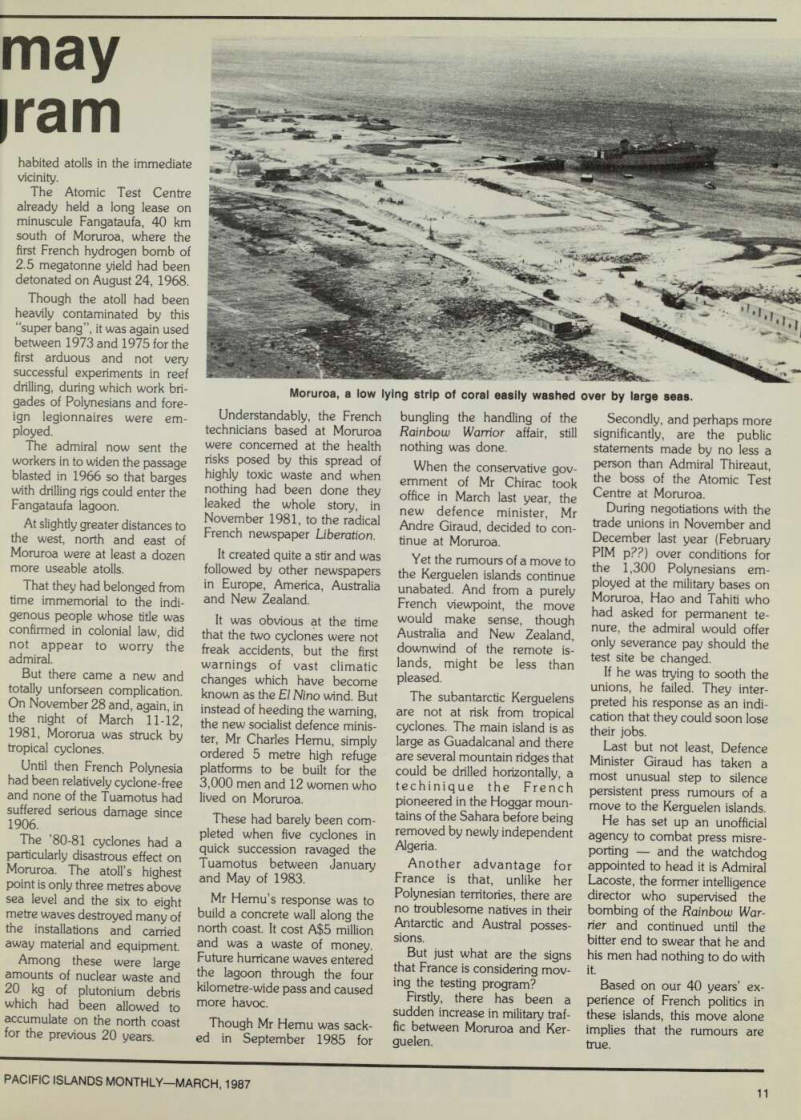
The bad old days of atmospheric testing.
habited atolls in the immediate vicinity.
The Atomic Test Centre already held a long lease on minuscule Fangataufa, 40 km south of Moruroa, where the first French hydrogen bomb of 2.5 megatonne yield had been detonated on August 24, 1968.
Though the atoll had been heavily contaminated by this “super bang”, it was again used between 1973 and 1975 for the first arduous and not very successful experiments in reef drilling, during which work bri gades of Polynesians and fore ign legionnaires were em ployed.
The admiral now sent the workers in to widen the passage blasted in 1966 so that barges with drilling rigs could enter the Fangataufa lagoon.
At slightly greater distances to the west, north and east of Moruroa were at least a dozen more useable atolls.
That they had belonged from time immemorial to the indi genous people whose title was confirmed in colonial law, did not appear to worry the admiral.
But there came a new and totally unforseen complication.
On November 28 and, again, in the night of March 11-12, 1981, Mororua was struck by tropical cyclones.
Until then French Polynesia had been relatively cyclone-free and none of the Tuamotus had suffered serious damage since 1906.
The ’BO-81 cyclones had a particularly disastrous effect on Moruroa. The atoll’s highest point is only three metres above sea level and the six to eight metre waves destroyed many of the installations and carried away material and equipment.
Among these were large amounts of nuclear waste and 20 kg of plutonium debris which had been allowed to accumulate on the north coast for the previous 20 years.
Understandably, the French technicians based at Moruroa were concerned at the health risks posed by this spread of highly toxic waste and when nothing had been done they leaked the whole story, in November 1981, to the radical French newspaper Liberation.
It created quite a stir and was followed by other newspapers in Europe, America, Australia and New Zealand.
It was obvious at the time that the two cyclones were not freak accidents, but the first warnings of vast climatic changes which have become known as the El Nino wind. But instead of heeding the warning, the new socialist defence minis ter, Mr Charles Hemu, simply ordered 5 metre high refuge platforms to be built for the 3,000 men and 12 women who lived on Moruroa.
These had barely been com pleted when five cyclones in quick succession ravaged the Tuamotus between January and May of 1983.
Mr Hemu’s response was to build a concrete wall along the north coast. It cost Ass million and was a waste of money.
Future hurricane waves entered the lagoon through the four kilometre-wide pass and caused more havoc.
Though Mr Hemu was sack ed in September 1985 for
bungling the handling of the Rainbow Warrior affair, still nothing was done.
When the conservative gov ernment of Mr Chirac took office in March last year, the new defence minister, Mr Andre Giraud, decided to con tinue at Moruroa.
Yet the rumours of a move to the Kerguelen islands continue unabated. And from a purely French viewpoint, the move would make sense, though Australia and New Zealand, downwind of the remote is lands, might be less than pleased.
The subantarctic Kerguelens are not at risk from tropical cyclones. The main island is as large as Guadalcanal and there are several mountain ridges that could be drilled horizontally, a techinique the French pioneered in the Hoggar moun tains of the Sahara before being removed by newly independent Algeria.
Another advantage for France is that, unlike her Polynesian territories, there are no troublesome natives in their Antarctic and Austral posses sions.
But just what are the signs that France is considering mov ing the testing program?
Firstly, there has been a sudden increase in military traf fic between Moruroa and Ker guelen.
Secondly, and perhaps more significantly, are the public statements made by no less a person than Admiral Thireaut, the boss of the Atomic Test Centre at Moruroa.
During negotiations with the trade unions in November and December last year (February FIM p??) over conditions for the 1,300 Polynesians em ployed at the military bases on Moruroa, Hao and Tahiti who had asked for permanent te nure, the admiral would offer only severance pay should the test site be changed.
If he was trying to sooth the unions, he failed. They inter preted his response as an indi cation that they could soon lose their jobs.
Last but not least, Defence Minister Giraud has taken a most unusual step to silence persistent press rumours of a move to the Kerguelen islands.
He has set up an unofficial agency to combat press misre porting and the watchdog appointed to head it is Admiral Lacoste, the former intelligence director who supervised the bombing of the Rainbow Wor rier and continued until the bitter end to swear that he and his men had nothing to do with it.
Based on our 40 years’ ex perience of French politics in these islands, this move alone implies that the rumours are true.
Moruroa, a low lying strip of coral easily washed over by large seas.
small screen
All eyes on the small screen
Fiji Television, due to begin broadcasting in September this year, has already embarked on a project to introduce the people of Fiji to the new elec tronic medium and to give them a taste of what’s to come.
The embryo station, owned until January by the Kerry Packer group when it was sold with Packer’s other extensive TV interests to the Alan Bond organisation for A 51.05 billion, has already started a commun ity video service.
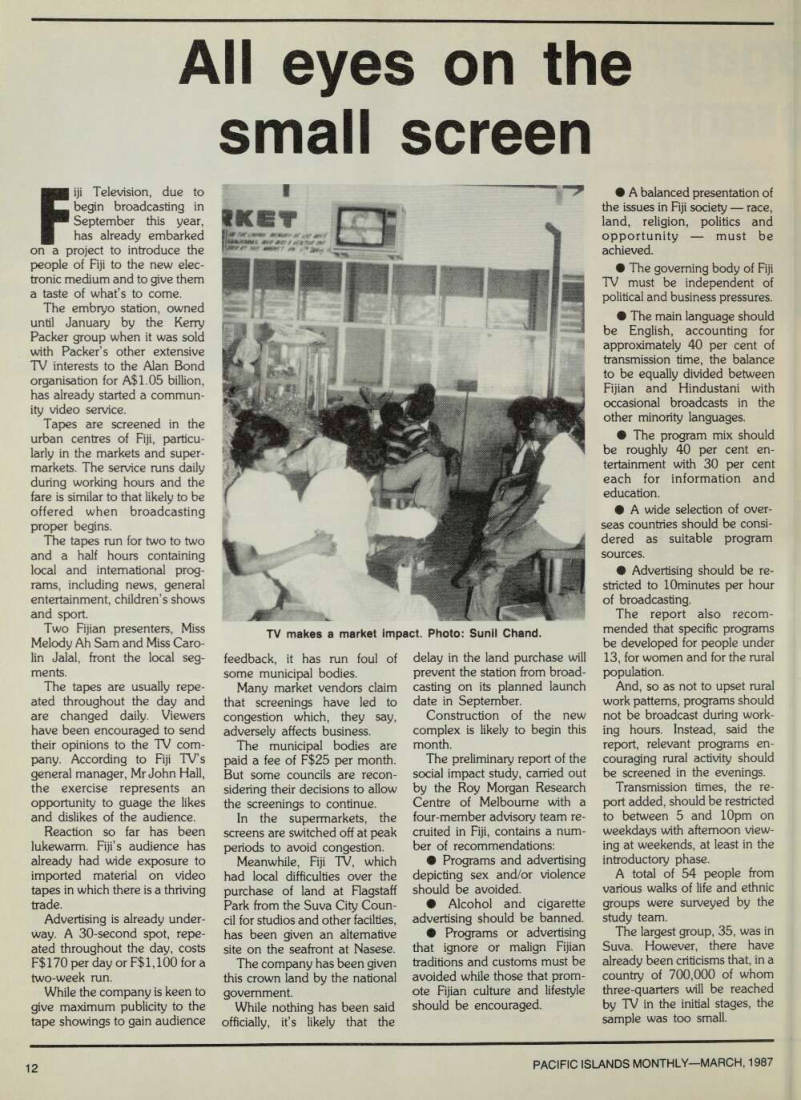
Tapes are screened in the urban centres of Fiji, particu larly in the markets and super markets. The service runs daily during working hours and the fare is similar to that likely to be offered when broadcasting proper begins.
The tapes run for two to two and a half hours containing local and international prog rams, including news, general entertainment, children’s shows and sport.
Two Fijian presenters, Miss Melody Ah Sam and Miss Caro lin Jalal, front the local seg ments.
The tapes are usually repe ated throughout the day and are changed daily. Viewers have been encouraged to send their opinions to the TV com pany. According to Fiji TV’s general manager, Mr John Hall, the exercise represents an opportunity to guage the likes and dislikes of the audience.
Reaction so far has been lukewarm. Fiji’s audience has already had wide exposure to imported material on video tapes in which there is a thriving trade.
Advertising is already under way. A 30-second spot, repe ated throughout the day, costs Fsl7o per day or Fsl,loo for a two-week run.
While the company is keen to give maximum publicity to the tape showings to gain audience
feedback, it has run foul of some municipal bodies.
Many market vendors claim that screenings have led to congestion which, they say, adversely affects business.
The municipal bodies are paid a fee of Fs2s per month.
But some councils are recon sidering their decisions to allow the screenings to continue.
In the supermarkets, the screens are switched off at peak periods to avoid congestion.
Meanwhile, Fiji TV, which had local difficulties over the purchase of land at Flagstaff Park from the Suva City Coun cil for studios and other facilties, has been given an alternative site on the seafront at Nasese.
The company has been given this crown land by the national government.
While nothing has been said officially, it’s likely that the
delay in the land purchase will prevent the station from broad casting on its planned launch date in September.
Construction of the new complex is likely to begin this month.
The preliminary report of the social impact study, carried out by the Roy Morgan Research Centre of Melbourne with a four-member advisory team re cruited in Fiji, contains a num ber of recommendations: • Programs and advertising depicting sex and/or violence should be avoided. • Alcohol and cigarette advertising should be banned. • Programs or advertising that ignore or malign Fijian traditions and customs must be avoided while those that prom ote Fijian culture and lifestyle should be encouraged.
• A balanced presentation of the issues in Fiji society race, land, religion, politics and opportunity must be achieved. • The governing body of Fiji TV must be independent of political and business pressures. • The main language should be English, accounting for approximately 40 per cent of transmission time, the balance to be equally divided between Fijian and Hindustani with occasional broadcasts in the other minority languages. • The program mix should be roughly 40 per cent en tertainment with 30 per cent each for information and education. • A wide selection of over seas countries should be consi dered as suitable program sources. • Advertising should be re stricted to lOminutes per hour of broadcasting.
The report also recom mended that specific programs be developed for people under 13, for women and for the rural population.
And, so as not to upset rural work patterns, programs should not be broadcast during work ing hours. Instead, said the report, relevant programs en couraging rural activity should be screened in the evenings.
Transmission times, the re port added, should be restricted to between 5 and 10pm on weekdays with afternoon view ing at weekends, at least in the introductory phase.
A total of 54 people from various walks of life and ethnic groups were surveyed by the study team.
The largest group, 35, was in Suva. However, there have already been criticisms that, in a country of 700,000 of whom three-quarters will be reached by TV in the initial stages, the sample was too small.
TV makes a market impact. Photo: Sunil Chand.
Advertisements & other items, p. 13 (1 item)
National
’s Super 4-Head system doubles the thrill. extends up to the year 2001, HQ (High Quality) National’s new NV-G2O VTR features a remarkable Super 4-Head recording/playback system that delivers the smoothest, most natural slow motion you’ve ever seen. It hits you square in the eyes with a picture so precise and well-defined, we call it Double Super Fine Slow.
What doubles is the pleasure you’ll get from the playback of sports and other fastpaced action as you savour clear, stable details that in conventional slow motion would be jittery or even lost.
Other pleasing features include a onemonth, eight-programme calendar timer that picture circuitry, Super Still and Super Still Advance playback, and wireless remote control.
For portability as well as a great picture, try our new VHS Movie NV-M5 camera/ recorder. With its special high-speed shutter, it can shoot outdoor scenes at 1/1000th of a second and play them back with stunning clarity—an effect multiplied when combined with the NV-G2o’s Double Super Fine Slow mode. It’s just one more way that National fills your vision with beauty.
National
National, Panasonic and Technics are the brandnames of Matsushita Electric.
A 1
NV-M5
SHsi
recording pre-recorded tapes or d
Can Wingti[?] hold on?

It is often said, with some justification, that the charac ter of Papua New Guinean governments depends less on votes cast than on the scramble for the hearts and minds and sometimes the promotions of individual MPs after the polls close.
With more and more parties to choose from, acquiring suffi cient numbers to rule will again be the dominant objective.
With the possible exception of Michael Somare’s Pangu
Pati, the political groupings tend to be looser than else where and are frequently based on regionalism, personalities or both.
Pangu will again almost cer tainly be the largest group. But whether Mr Somare’s cam paign slogan, “87 for 87” (87 seats this year) will be a prophe tic statement must remain in doubt Pangu was splintered when Paias Wingti, Mr Somare’s de puty, defected to the opposition
in 1984 to lead a no confidence motion that brought about his elevation to the prime minister’s chair.
Mr Wingti formed the People’s Democratic Move ment (PDP) while former Pan gu strategist Mr Tony Siaguru,
with other former Pangu stal warts Sir Barry Holloway and Mr Karl Stack founded the League for National Ad vancement (LNA).
They now join Father John Momis’ Melanesian Alliance (MA), Sir Julius Chan’s
People’s Progress Party (PPP), The United Party (which, despite its title, usually manages to have members on both sides of the house) and the late Sir lambakey Okuk’s National Party as the likely mainstream contenders.
However, there are others which could hold a few key positions when the horse trad ing begins in earnest These include former de fence force commander and current foreign minister Ted Diro’s People’s Action Party
(PAP), the Papua Party which includes the rump of the former secession-inclined Papua Besena and the less likely Wantok Party of Mr Roy Evara, a seasoned parliamentary campaigner.
There has been a pattern since independence. Pangu has led each governing coalition for the first two or three years only to be unseated in a no confidence motion. And as long as the constitution retains this provision, no government without
a solid outright majority will run its full term, Little wonder then that Mr Somare’s dream is to be re turned with an outright Pangu majority so that he can alter the constitution, forcing MPs who wish to switch allegiance in mid-term to resign and face a by-election, And while this would effec tively circumvent the no confi dence hurdle, it is likely to remain but a dream. No MPs in PNG or anywhere else are
about to vote themselves out of the potential for advancement by crossing the floor.
The vast majority of MPs, too, since independence have been one term wonders. Only a handful have sat in every house. These include Mr Somare, Sir Julius, Sir Barry Holloway, Mr John Kaputin and Fr Momis all now in different political camps.
So far the attrition rate at general elections has been running at 60 per cent which
probably means that some 60 to 70 MPs will be saying farewell to parliamentary pri vilege this year, Few MPs or ministers can command a stable power base in the country or even in their constituencies. In the 1982 election there were around 1,000 candidates for 109 seats, It’s likely to be little if any different in 1987.
The sheer volume of candi dates means that family and clan associations become vital.
Sir lambakey, despite mas sive inducements in the form of free beer and feasting on a grand scale, was still unable to retain his Chimbu regional seat in the highlands. He later came back at a by-election.
Mr Diro, who stood as an independent in 1982 only to become leader of the National Party when Sir lambakey was not returned and to step down when the great man made a comeback, now leads his own party. But he is under heavy
pressure in his own Papuan electorate from the fiery former Papua Bcsena leader Josephine Abaijah who has been making all the early run ning.
A gifted orator who ranks in that regard with Mr Somare himself, she has been drawing large crowds everywhere she goes.
That personal style is very necessary in PNG politics. TV
Continued on page 20
Continued from page 17 will have little impact on this election. It is unlikely that it will have achieved the necessary penetration in time, though it will without doubt be a major force in future campaigns.
So far, however, the stayers have been the people who have walked their constituen cies meeting the people in their villages.
This makes Mr Somare, un doubtedly one of the South Pacific’s finest orators, virtually certain to retain his seat and his
leadership of the largest party.
To see The Chief address a large crowd (the larger the better) in pidgin is to watch a master of a craft that TV has elsewhere rendered obsolete.
Mr Wingti has a slightly quie ter approach. He is better in smaller groups, sitting down among the people and talking in a more conversational style.
He appeals to the educated voter while seeking to present an image of well-schooled wis dom to the more traditional villager.
It was a highly successful
formula in 1982, but he may have lost some credibility as a result of the unrest that fol lowed the death of Sir lam bakey last year.
That untimely death leaves a power vacuum in PNG politics.
The densely populated high lands constituencies will have a vital say in who forms the government. In the past, Sir lambakey was seen as the natural leader of the highlands.
Now Mr Wingti, by virtue of his position as prime minister, may be able to take on that mantle.
He has competition. The re
nowned highlands business man, Mr Paul Fora, intends to stand against him. And, in the neighbouring Chimbu eleco rate, sitting MP and former Pangu minister Mr John Nilkare is running again.
And in the Eastern Highlands he will have to contend with Mr John Giheno who earned wide respect as Pangu’s foreign and then police minister.
In that same area Sir Barry Holloway is seen as a natural reselection but, as a naturalised citizen, he has never sought to
take on the role of highlands strongman.
Mr Nilkare ran a clever cam paign last time, hiking the steep slopes of Chimbu while Sir lambakey was throwing grand stand parties. An educated man who can also respond to an audience, he could well fill the gap. But in the hugely compli cated world of highlands politics with its ever shifting clan alliances, nobody is guaranteed a seat in Parliament.
Elsewhere, the PPP has nev er really established itself nationwide. Seen as a New
Ireland-based group led by the politically astute Sir Julius Chan, the party has had mixed fortunes of late.
The New Island provincial government has been lost by PPP to a Pangu-MA grouping which could even herald diffi culties for Sir Julius in his own electorate. However, this was accompanied by a very strong showing in the Milne Bay pro vincial election in January.
MA has strength in North Solomons and Morobe, but here the waters have been muddied by the candidacy of
fiery Morobe premier Utula Samana. A speaker in the So mare mould, he has decided to stay with his Morobe Indepen dent Group (MIG). His massive personal following must make him favourite to be elected but as a new boy in the national parliament he may need some time to establish a power base.
MA’s leader Fr Momis has been something of a political chameleon since he founded the party with Mr Kaputin in the run up to the 1982 campaign.
At that time he castigated Sir lambakey’s alleged self-seeking
approach to politics but then backed him at least publicly in opposition.
Fr Momis and Mr Kaputin have had more than one falling out since then the first was when Mr Kaputin refused to join the Somare ministry in the post poll trade-offs.
Mr Kaputin, a Tolai from New Britain, was a highly effec tive finance minister in the Chan administration of 1980- 82 and has won much respect for transforming the minerals
Continued on page 24
Continued from page 21 and energy portfolio of the current government into a ma jor ministry. He’ll want to be in the government but won’t settle for a junior portfolio.
Mr Siaguru’s LNA is untried at the polls, as is Mr Wingti’s new outfit. It’s possible that he (Mr Siaguru) and his colleagues may suffer some backlash after “deserting” The Chief. But if he can pick up even a handful of
seats he will be a force in the new parliament All the former Somare minis ters are, ironically perhaps, at an advantage in the election.
As ministers they were less able to visit their constituencies than they are now as opposition MPs. And the voters like to see their MPs as, at an approaching election, the MPs like to see the people. Mr Siaguru may well be the com ing force in PNG politics.
A former Pangu kingmaker he knows the ways of political infighting as well as any. It may be significant that Mr Somare still has a high regard for his abilities (see interview).
The problems facing Mr Wingti are those which faced Sir Julius in 1982 to be seen as a natural choice for prime minister. He has worked hard to achieve the image, travelling constantly throughout the country to get himself more
closely identified with the voters.
But to catch Mr Somare is a daunting task. The man from the Sepik is still papa bilong kantri (father of the country), the man who delivered inde pendence. While The Chief re mains in political life, he’s vir tually assured of that title and all that it implies.
Michael Somare is a hard act to follow.
in the highlands
Wingti: I’m boss in the highlands
Being prime minister for 18 months before facing a gen eral election is a tall order.
But Paias Wingti is prepared to stand on his record when he goes to the people in July, he told DENIS REINHARDT in an interview. Ex cerpts: PIM: People say that Somare is going to win. Is that a realistic view of what is happening in PNG?
Wingti: It depends on which people you are talking to, but the general feeling in the country is that when people have confidence in a govern ment, and have confidence in the leadership, then it is hard to defeat that government. The situation when Somare came to power in 1982 is quite different to the 1987 elections.
In ’B2 people were slowly losing confidence in that government be cause of infights within the govern ment. It created uncertainty.
Somare is known as the father of independence. He is widely known in the villages throughout the country. Are you as well known as he is?
Well, Somare is well known, I must say that. He’s well known he’s a household name because he’s been in politics for a long time. He was the man who fought for independence and self-government. That’s why his name is well known. But you are now dealing with a modern Papua New Guinea. The population that is going to have a bigger say in the elections and a bigger influence is the educated
population the grade six drop-outs, the high school leavers. The edu cated people are working and there are many educated people now throughout the country. These people are the opinion makers.
So is Somare a man of the past in Papua New Guinea terms?
Well Somare is ... as I have said many times when I was in opposition before change of government, So mare’s days are over. The problems that we are facing need leadership that can handle, and we have proved this over the last twelve months.
When the economy was in a state where financial institutions in ternational financial institutions like the World Bank, Asian Development Bank expressed concern, we were able to act decisively because we knew what we were talking about, we knew the problems and the leader ship at the time. Up to date we have handled these problems and people have admired this government. It’s hard for them to lose their confi dence.
Working from that base how are you going to overcome, in campaign terms, the power of Somare’s image in the village?
It’s hard. It’s hard in some parts like in the regions because in Papua New Guinea, apart from party poli tics, the other major force is persona lities.
It depends on which region you come from. I come from a very powerful region in the country.
You’re the first highlands prime minister. Many highlanders feel that they’ve been underrepresented in the national parliament until this stage.
We have 40 per cent up in the highlands. Out of a total of 109 members 39 come from that region.
That is a very strong base. If you look at that base and compare it with the ’B2 elections and when Sir Julius was in power they’re quite different things. The highlanders are in some ways more united and the majority of them are with me in government now. 1 see that as my base.
Do you think that the untimely death of Sir lambakey Okuk will see more highland unity behind you?
I think it’s sad we lost a great man.
All I can say is now the highlands people have only one leader and that’s me because when we were together, lambakey and myself, they looked at two leaders from that region and now people look at only one person. So in a way I think there is more unity.
So the key to you winning in the election is for you to command a very high majority of those 39 highland seats?
That’s quite true. I have to get a very high number from that region and then from Morobe, Madang.
Whoever is going to be Prime Minis ter in ’B7 is going to have above 20
members. 1 don’t see any party coming with a landslide victory like about 55. You won’t get that. There are many other smaller parties.
But if you have that highland base effectively what you’re doing is firming up a system in Papua New Guinea where there will be a lesser number of parties?
That would be true. What we’re doing now would help the situation to create less parties, strengthen those major parties in the country. In this election I think that is what is going to happen.
In your experience is it a problem for Papua New Guinea in its development that the multi party system with trade offs and dealings means that ministers and the government spend more time worrying about numbers and less time about government?
The best thing that could happen in this election is for the people of Papua New Guinea to give a clear mandate to either Somare or myself to run the country with one or two other parties which we can we have some very good leaders and stable parties. Most major parties like PPP, Pangu, People’s Democratic Movement which is a new party, but in terms of numbers has got the second highest on the floor of parlia ment have built up strength.
It’s a critical election because with the wealth of gold and oil and the strong rural base Papua New Guinea could be a very rich country within four or five years.
It’s a very critical election because the leadership in ’B7 and beyond has to pursue the policies we have pur
sued up to date. Because of popuia> tion growth in the country we have to get the economy moving as the economy can’t absorb this growing population and we have given that priority. If you don’t get the right leadership then it can go back to the old days when the others were in government. We have set our priori ties clear and any money that will come from the mining sector we see as a cash flow that will be directed to the banking system and then re-lent to farmers for rural development. And investment in farming that is a long term investment for the country.
Mining is exhaustable and we’re fully aware of this. But if you’ve a govern ment which is not clear, they can spend this quick cash flow on setting up some very expensive infrastructure and then when those resources are exhausted it’s hard to maintain that.
In terms of infrastructure, the Japan ese are offering to finance part, if not all of a trans nation highway. Is that the sort of infrastructure that is acceptable?
This particular project is a very important one because Port Moresby is the nation’s capital and we’ve been having some problems because there’s no major network in terms of road transport between one side of the country and the nation’s capital.
We have negotiated with the Japan ese. So that’s a very important project that the people of this country see.
If you do defeat Somare what do you think will happen to him?
Very hard for me to say. He’s a great man I have always said that.
He’s done a lot for the country.
Would you include him in your ministry?
He would really make a good foreign minister. I have the greatest respect for Mr Somare because I
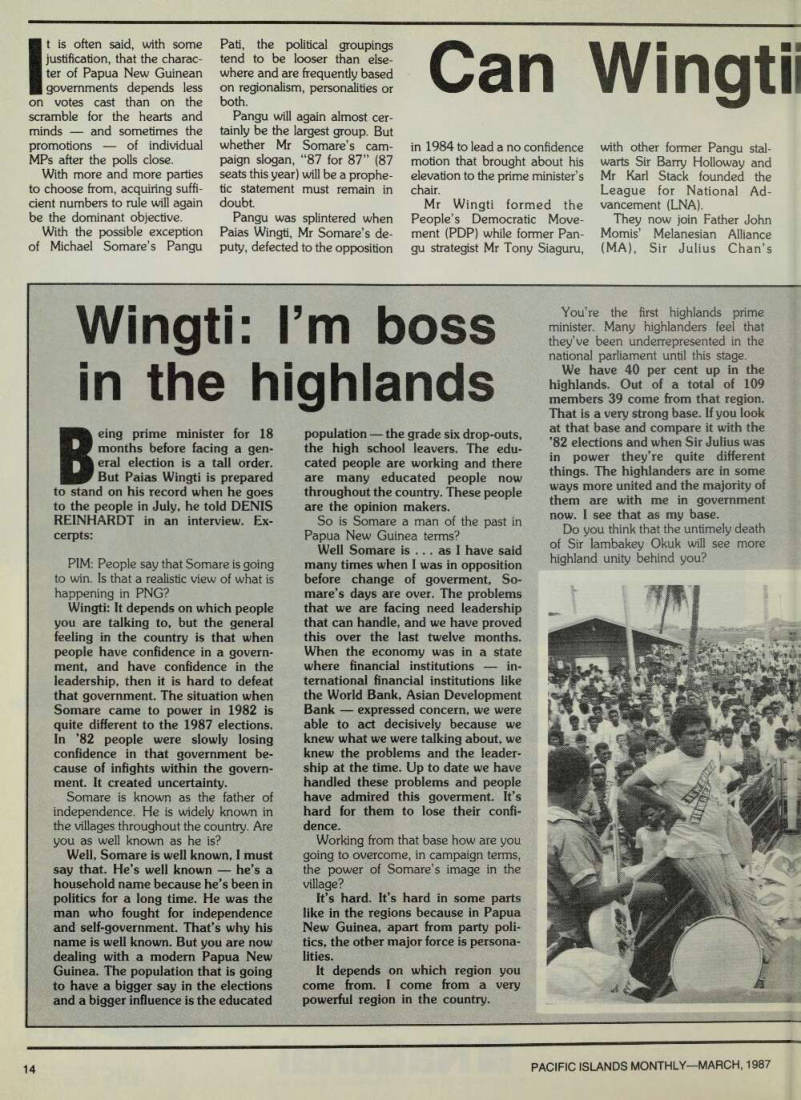
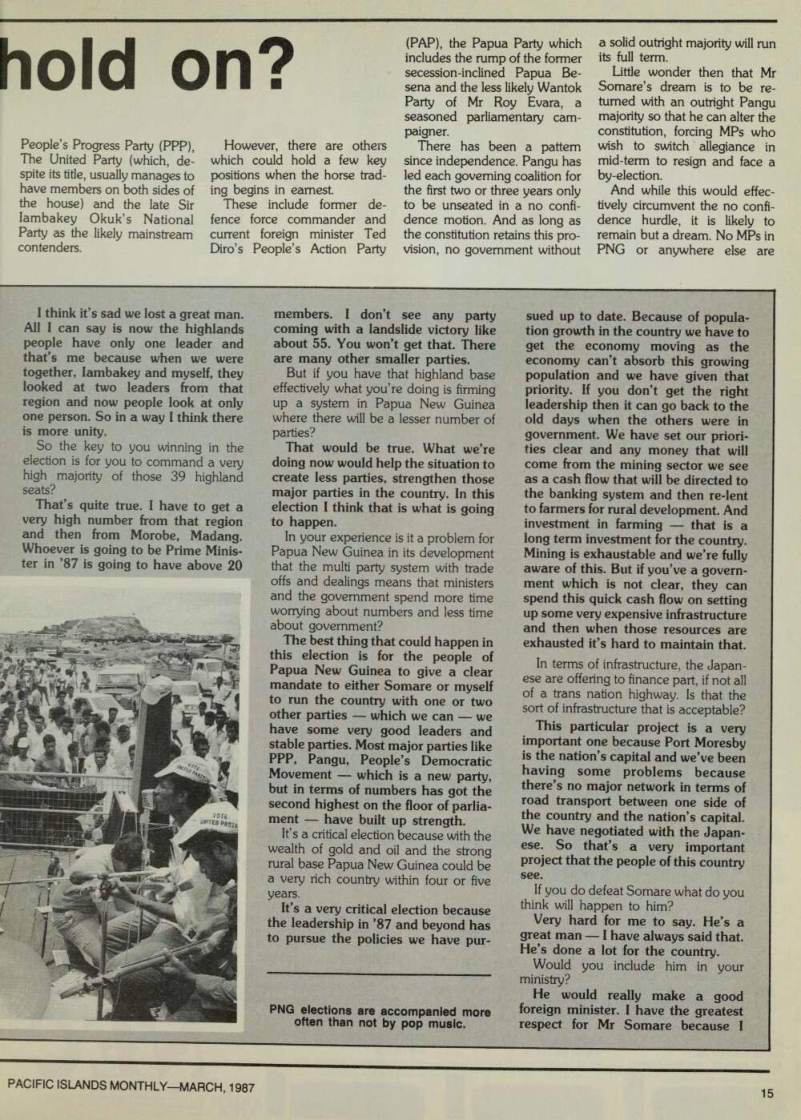
PNG elections are accompanied more often than not by pop music.
have worked with him and I have learned a lot from him.
Do you think he would serve under you having been your mentor at one stage?
We get along very well. I must say this. I have nothing against Mr Somare. I mean politically. OK, when we’re facing each other on the floor of parliament, but in terms of our friend ship and our respect for each other we maintain that.
Do you think he’s locked on the course of having to fight this election when he really doesn’t want to?
I don’t think he’s locked in.
You mean there is a chance of negotiation before the election?
Well, not that. All I’m saying is that he’s in opposition. I’ve got five parties that I’m leading and I have to remember my commitment. My first priority is to the people who have put me as prime minister and I have worked with them very well. I have to respect those people that I’ve been working with. That’s why I’ve got to maintain that loyalty between my own men.
You’ve had to sack and demote several ministers. Are you trying to uphold a new set of standards?
Well we’ve done that when we were in opposition. I have said the first priority is to get the economy mov ing, second to set the highest stan dard of leadership, and we have maintained these. Where ministers’ reputations are questionable, and where doubts have been raised about them and if there are enough docu ments to indicate that they have done something wrong, or they’ve not been cleared enough, it is my responsibility to ask them to step aside. I have done that for several ministers and when they are cleared I bring them back into the ministry again.
In terms of foreign policy you’ve effectively defused Irian Jaya as a major issue for PNG?
This goverment has made some very independent decisions. The difference between my government and the previous administration are the decisions that this government has taken are basically independent decisions based on the interests of the people of this country. We have made a decision on the border. Yes, we have defused the whole situation.
But Irian Jayans still continue to come across?
They still come across, but all I’m saying is that this is no longer the same—getting headlines every day.
We were wasting our resources looking after those people.
Are you saying you have nothing to We’ve got nothing to hide. In fact in our foreign policy, particularly on that issue, we are open. We have taken some stands on other matters like the New Caledonia issue. That issue has never been put forward forcefully by the previous administration. It was my government that took
the initiative to invite the Solomons Islands prime minister, and the Vanuatu prime minister to discus sions.
T . . , T • i resettlement of h™ Japans is to 9 °, ahead m PNG and lts the best S ° U ° n ' It’s the best solution. Not resettle ment, but we have to find them locations where detailed assessment has to be made and find out what a genuine refugee is. And that process * s still taking place, although we are not very encouraged by the slowness °f actions taken by the UN High Commission for Refugees, ti , ... . , , TT „ , , * s un l^e *hat the UNHCR will find third countries for many of those people?
Some they would find. They are still trying. Others it may be difficult, Our action on the border issue has strengthened relations between In donesia and PNG. There is no more suspicious feeling about each other, Our relationship with Indonesia, like our relationship with Australia over the last twelve months, has matured.
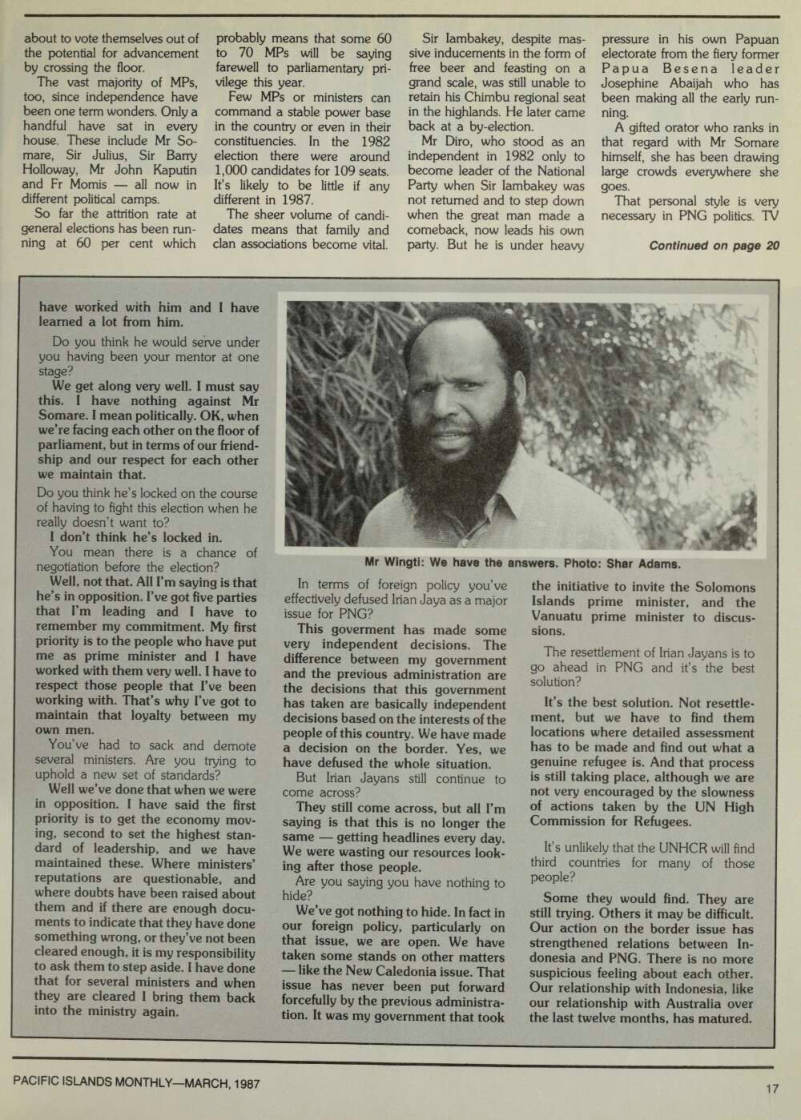
Mr Wingti: We have the answers. Photo: Shar Adams.
Advertisements & other items, pp. 16-19 (1 item)
in digital home entertainment
I. m i fi * m VfC ■r « ~-iP 3C id H5-F! on screen display NEC —at the forefront of the revolution
With today's revolution in digital technology, there's only one name to trust to bring this revolution home - NEC NEC is a leader in digital technology for everything from communications satellites to professional studio equipment. We put this same dedication to quality and innovation in our products made for the home to give you the utmost in performance.
In our Digital Monitor Receiver, advanced digital technology has made possible amazing conveniences like "picture in picture" and still picture features. Our Digital VCR uses digital noise reduction technology to give you an extremely clear picture at any speed and features like digital picture memory.
The AVD-700 further enhances your entertainment system by adding natural, precise and low-noise surround sound effects,
using NEC-developed digital delay circuitry.
So if you're wondering what the digital revolution means to you, NEC has the answer.
NEC
International Home Electronics Division, NEC Building, 33-1, Shiba 5-chome, Minato-ku, Tokyo 108, JAPAN Telephone: Tokyo 03-456-3111 Cable: NEC TOKYO Telex: NECTOK J 22686 VHS HQ Hi-Fi VCR with ‘Double Azimuth” Four Head System Crisp picture and hi-fi sound are combined an with steady noise-free special effects N9040A VHS HQ Stereo VCR With HQ video and stereo, both sound and picture are beyond comparison.
N9034A
VHS HQ VCR
Incorporates the new HQ video system for visibly enhanced picture quality. Unified remote for both VCR and NEC TV
I m MiMi t; 1 m . mmmm Jp . - gg«l * m A I* * 9££SK
Strength
A vehicle’s strength depends on a complex interplay of varied factors. The overall design.
The body structure. The quality of the materials it is built of. The individual performance of the various mechanical components. Only when a vehicle is outstanding from 'every angle can it be said to possess genuine strength.
It is precisely this all-round excellence that gives the Nissan Pickup its extra margin of dependability. From the engine to the frame, the body panels to the suspension, the transmission to the bumpers, everything has been integrated into a vehicle of unsurpassed performance and durability.
In addition to the four usually found on ordinary makes, the closed-section JramTaZ n bX UP ' S ladder frame features a fifth cross member are built for extra which, together with a more rational layout, strength. enables the Pickup to tolerate heavier loads.
For further structural rigidity, the side members are made of thicker steel plates.
Add to that a double-wishbone front suspension and a leaf-spring rear suspension, plus a large-capacity, power-packed engine, and it’s easy to see why more people depend on the Pickup to handle tough jobs on rough roads.
In other words, the Pickup has a singular strength that comes from a complete rational matching of diverse parts into one unbreakable whole.
And it succeeds because it has that intangible yet very real quality that makes a Nissan what it is—The Nissan Dimension.
Quality in motion
NISSAN
NISSAN
*3 L
The Chief: Ready
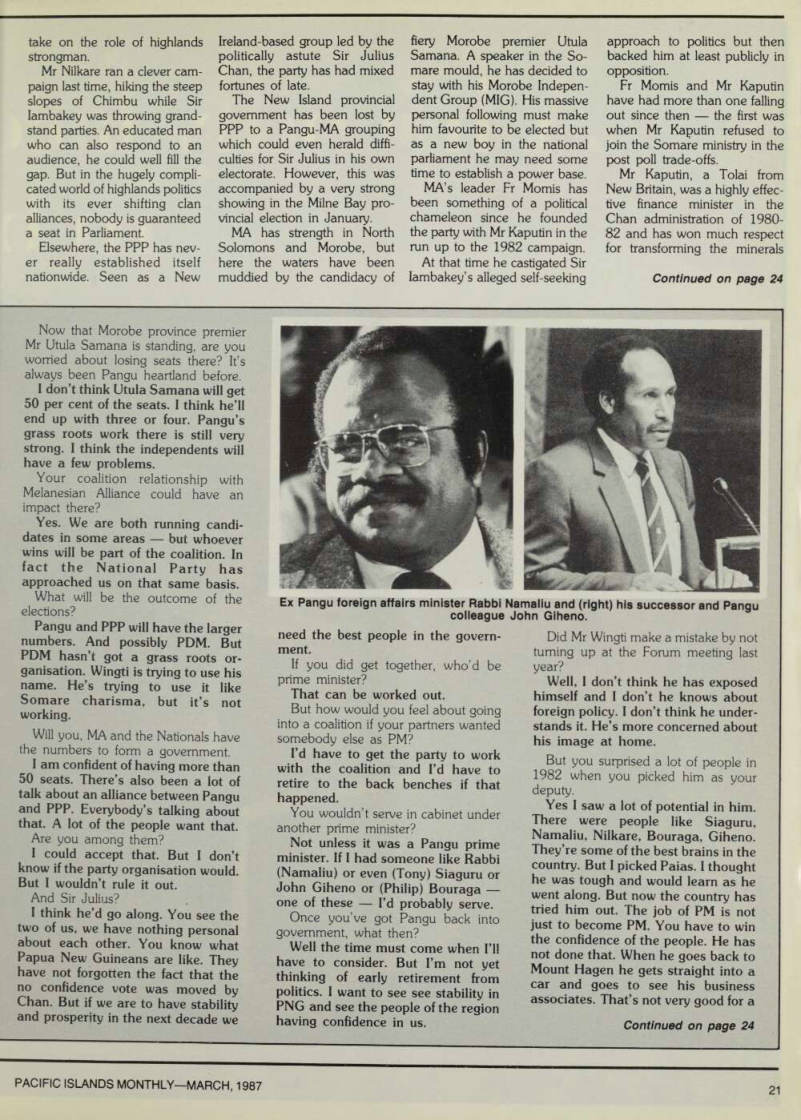

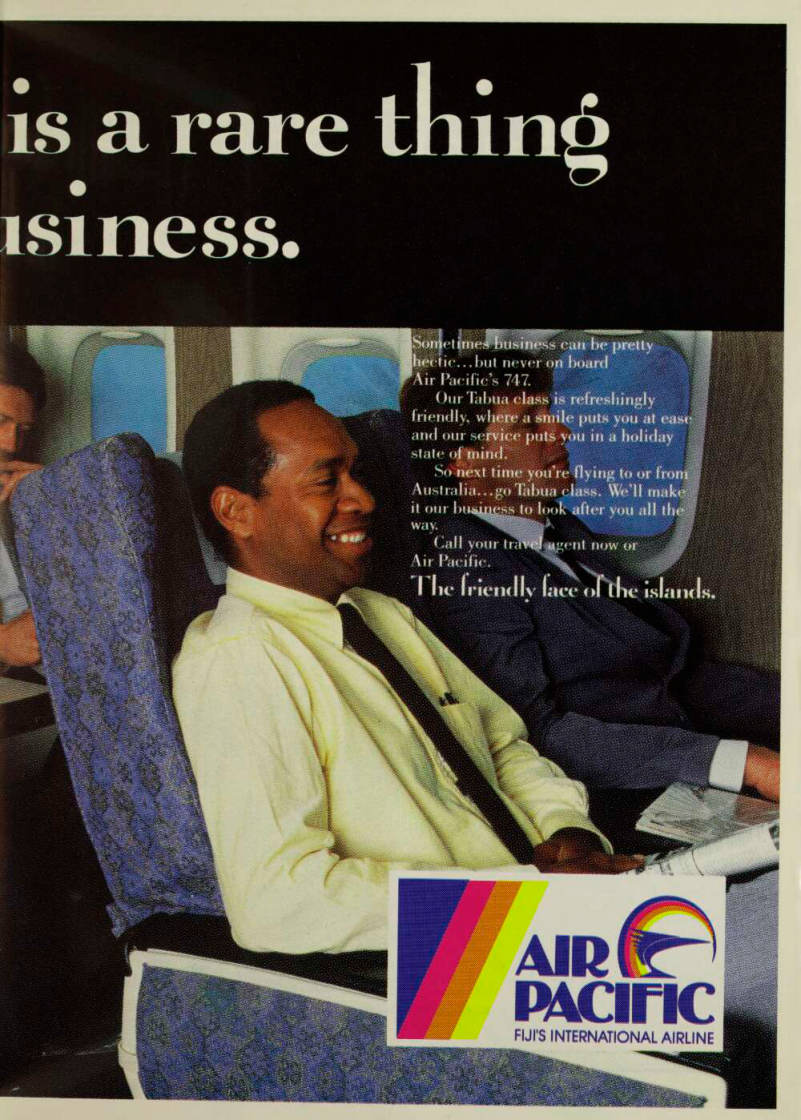
for the campaign
Known to friend and foe alike as “The Chief’, Michael Thomas Somare has never been bested in an election. But while he has led both post-independ ence elected governments, neither has run its full term. Once again The Chief is on the campaign trail.
After his defeat in a no confidence motion by the Chan-Okuk coalition in 1980, Mr Somare took to the bush where 87 per cent of the PNG population still lives.
While the rest were talking, So mare was walking. He encouraged his candidates to do the same. The result was Pangu’s best ever and the party came close to an outright majority.
However, the inevitable no confi dence motions came thick and fast after three years. Deserted by some of his own lieutenants, Mr Somare fell to his disaffected deputy, Mr Paias Wingti.
But, when ROWAN CALLICK (a Somare watcher of long standing) met him in Sydney, The Chief looked fit and eager for a campaign which many have said he is too old at 50 to win.
The Chief doesn’t think so. Ex cerpts: PIM: The riots after Sir lambakey Okuk’s death showed that the high lands provinces are still capable of major unrest and coastal people, who had become used to living and working beside highlanders, may now regard
them with a new wariness. Would that be accurate?
Somare: Coastal people in the government’s ranks told me, “These bloody kanakas. If they can’t learn, they shouldn’t waste our time.”
Mr Wingti and (his deputy) Sir Julius Chan followed the body while it was taken around the highlands for official mourning. Yet the people still caused trouble. Why do you think that hap pened?
Because Wingti should have stood aside and controlled, which he did not. He lost control and he lost credibility. People are not stupid.
They know. They could see that they (Wingti and Chan) were going around trying to make political mileage out of a dead body. You can’t do that.
And I’m pretty sure that lambakey’s spirit would not have approved because he doesn’t like to see these two people standing around.
What did you think when the crowd marched on Parliament House threatening to destroy it?
Well he (Wingti) couldn’t go and meet the crowd until I told him: 1 was out there in front. I told them, “You can’t come and destroy parliament.”
It would not have happened in my time.
Do you think the recent provincial elections give a guide to voting patterns in the general elections?
Yes. In New Ireland, for instance, it’s good for us because New Ireland has always been a PPP (Sir Julius Chan’s People’s Progress Party) stronghold. We’ve made a new breakthrough there. In Manus Steven Pokawin’s doing the right thing by getting into politics at provincial level and at an early age. It’s less good for us in other places, but we’re working there.
Do you have much contact now with your former deputy Mr Wingti?
I don’t talk to the Prime minister these days. 1 used to from time to time when Chan was prime minister.
But Wingti just refuses to see people.
He even refused to see me. He refuses to see everybody.
You have no working relationship at all? He doesn’t even phone?
No he doesn’t. And I try to give him a ring to say “Look I was disappoint ed with certain things.” And then I write him a letter and don’t get any response. With Chan I used to get an immediate answer.
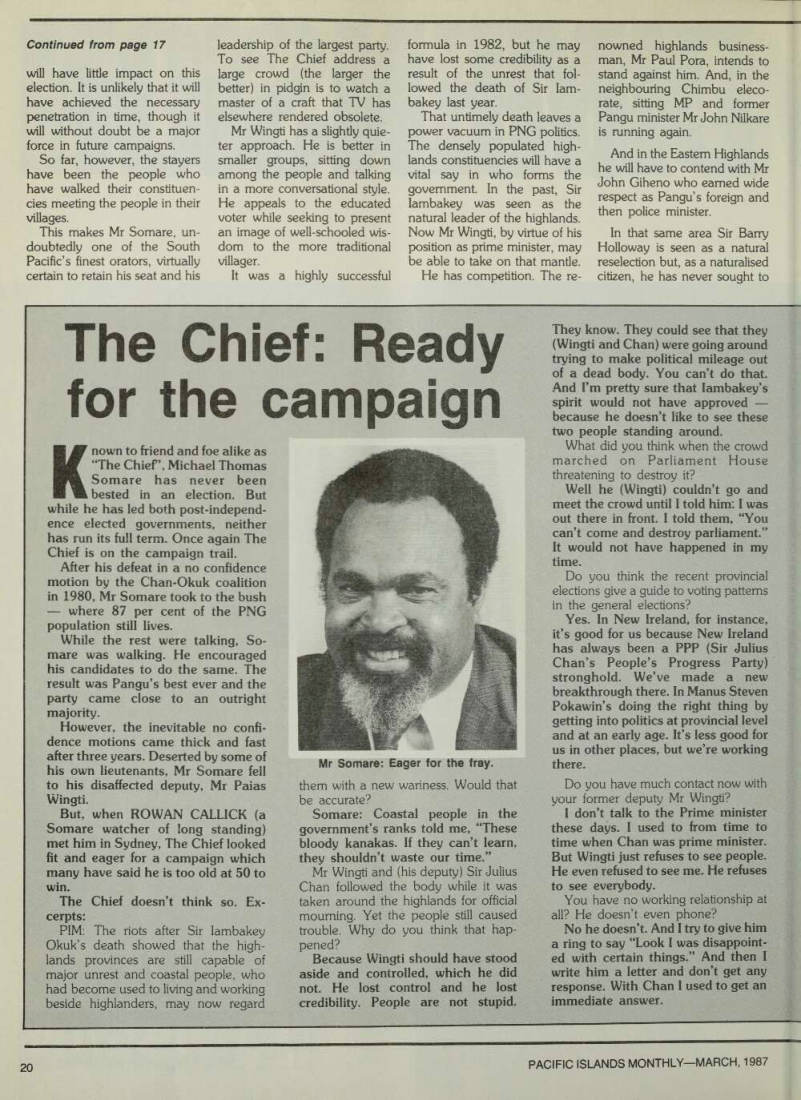
Mr Somare: Eager for the fray.
Now that Morobe province premier Mr Utula Samana is standing, are you worried about losing seats there? It’s always been Fangu heartland before.
I don’t think Utula Samana will get 50 per cent of the seats. I think he’ll end up with three or four. Pangu’s grass roots work there is still very strong. I think the independents will have a few problems.
Your coalition relationship with Melanesian Alliance could have an impact there?
Yes. We are both running candi dates in some areas but whoever wins will be part of the coalition. In fact the National Party has approached us on that same basis.
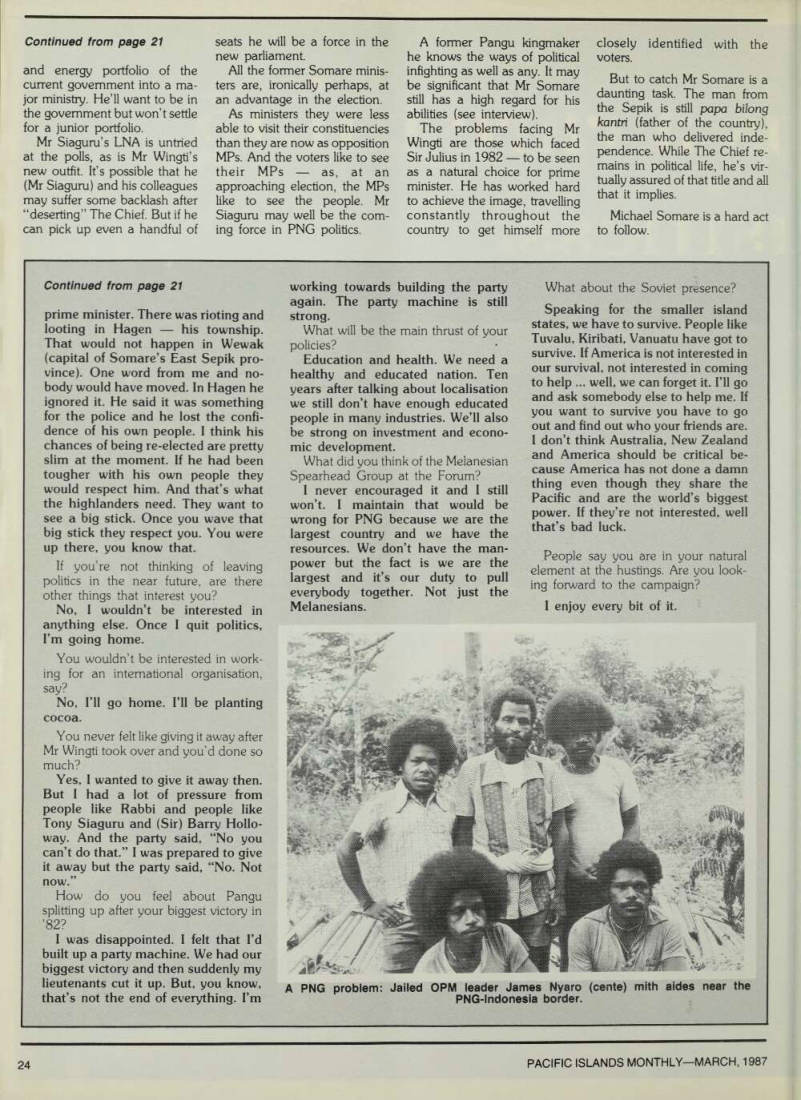
What will be the outcome of the elections?
Pangu and PPP will have the larger numbers. And possibly PDM. But PDM hasn’t got a grass roots or ganisation. Wingti is trying to use his name. He’s trying to use it like Somare charisma, but it’s not working.
Will you, MA and the Nationals have the numbers to form a government.
I am confident of having more than 50 seats. There’s also been a lot of talk about an alliance between Pangu and PPP. Everybody’s talking about that. A lot of the people want that.
Are you among them?
I could accept that. But I don’t know if the party organisation would.
But I wouldn’t rule it out.
And Sir Julius?
I think he’d go along. You see the two of us, we have nothing personal about each other. You know what Papua New Guineans are like. They have not forgotten the fact that the no confidence vote was moved by Chan. But if we are to have stability and prosperity in the next decade we
need the best people in the governmen t- If you did get together, who’d be prime minister?
That can be worked out.
But how would you feel about going into a coalition if your partners wanted somebody else as PM?
Jh !lT' 0 J et * he r,M y 1° W °: k with the coalition and Id have to retire to the back benches if that You wouldn’t serve in cabinet under .1 . . , 0 another pnme minister?
M i „ .. n Not unless it was a Pangu prime minister. If I had someone like Rabbi (Namaliu) or even (Tony) Siaguru or ii r . ' ... r ' a U 1 one of hese -d P ’h (T® 93 one of these - I d probably serve.
Once you ve got Pangu back into
9 Ztz\ T K ...
Well the time must come when I have to consider. But I’m not yet thinking of early retirement from politics. 1 want to see see stability in PNG and see the people of the region having confidence in us.
Did Mr Wingti make a mistake by not turning up at the Forum meeting last year?
Well, I don’t think he has exposed himself and I don’t he knows about foreign policy. I don’t think he under stands it. He’s more concerned about his image at home.
But you surprised a lot of people in 1982 when you picked him as your deputy.
Yes I saw a lot of potential in him.
There were people like Siaguru, Namaliu, Nilkare, Bouraga, Giheno.
They’re some of the best brains in the country. But I picked Paias. I thought he was tough and would learn as he went along. But now the country has tried him out. The job of PM is not just to become PM. You have to win the confidence of the people. He has not done that. When he goes back to Mount Hagen he gets straight into a car and goes to see his business associates. That’s not very good for a
Continued on page 24
Ex Pangu foreign affairs minister Rabbi Namaliu and (right) his successor and Pangu colleague John Giheno.
Continued from page 21 prime minister. There was rioting and looting in Hagen his township.
That would not happen in Wewak (capital of Somare’s East Sepik pro vince). One word from me and no body would have moved. In Hagen he ignored it. He said it was something for the police and he lost the confi dence of his own people. I think his chances of being re-elected are pretty slim at the moment. If he had been tougher with his own people they would respect him. And that’s what the highlanders need. They want to see a big stick. Once you wave that big stick they respect you. You were up there, you know that.
If you’re not thinking of leaving politics in the near future, are there other things that interest you?
No, I wouldn’t be interested in anything else. Once I quit politics.
I’m going home.
You wouldn’t be interested in work ing for an international organisation, say?
No, I’ll go home. I’ll be planting cocoa.
You never felt like giving it away after Mr Wingti took over and you’d done so much?
Yes, I wanted to give it away then.
But I had a lot of pressure from people like Rabbi and people like Tony Siaguru and (Sir) Barry Hollo way. And the party said, “No you can’t do that.” I was prepared to give it away but the party said, “No. Not now.”
How do you feel about Pangu splitting up after your biggest victory in ’B2?
I was disappointed. I felt that I’d built up a party machine. We had our biggest victory and then suddenly my lieutenants cut it up. But, you know, that’s not the end of everything. I’m
working towards building the party again. The party machine is still strong.
What will be the main thrust of your policies?
Education and health. We need a healthy and educated nation. Ten years after talking about localisation we still don’t have enough educated people in many industries. We’ll also be strong on investment and econo mic development.
What did you think of the Melanesian Spearhead Group at the Forum?
I never encouraged it and I still won’t. I maintain that would be wrong for PNG because we are the largest country and we have the resources. We don’t have the man power but the fact is we are the largest and it’s our duty to pull everybody together. Not just the Melanesians.
What about the Soviet presence?
Speaking for the smaller island states, we have to survive. People like Tuvalu, Kiribati, Vanuatu have got to survive. If America is not interested in our survival, not interested in coming to help ... well, we can forget it. I’ll go and ask somebody else to help me. If you want to survive you have to go out and find out who your friends are.
I don’t think Australia, New Zealand and America should be critical be cause America has not done a damn thing even though they share the Pacific and are the world’s biggest power. If they’re not interested, well that’s bad luck.
People say you are in your natural element at the hustings. Are you look ing forward to the campaign? 1 enjoy every bit of it.
A PNG problem: Jailed OPM leader James Nyaro (cente) mith aides near the PNG-Indonesia border.
Advertisements & other items, pp. 22-23 (1 item)
y race
A fn
ri<'n
..V* 4 „,v V VV Sf 1 E » m.
y race
mb.
IP»1PP8»
MM. .'.sB |fsgs» s
IHf >V\
is a rare mind
isiness.
* ? > sonlriime;! business ran he pretty •Hie.. . lint never on board Xir Paeifics 747. M I ()ur Talma olass is friendly, where a smile puts you at rase and our service puts you in a holiday state of mind.
So next time you’re , „ Australia...go Talma ( lass. We'll make ? it our after you all thf Call your now or Air Pacific.
I lie friendly lace dltfie isl.-mds.
l : - . * * e ... a.*?! r% L t- 4 i. ' ,=> v J
PAonc
FIJI’S INTERNATIONAL AIRLINE
Island miners wait
trade winds
Island miners wait for their chance
If things go very badly in one segment of the Republic of South Africa (RSA) it will be good news for parts of the mining industry in Papua New Guinea and New Caledonia.
Although gold is clearly the major “play” in islands mining, there may be some action in chromium as well...if the inter nal situation in South Africa collapses.
The United States uses about 400,000-500,000 tons of chro mium a year; it has no mines of its own, and currently about two-thirds of its imports either come from, or through, RSA.
Not only is the US dependent on South Africa for chrome used as an alloy in making stainless steel it worries about the other major sources of supply, those non-US allies, Russia and Albania, who are the largest suppliers after South Africa.
Several scenarios are being discussed about the supply of chromium, and its price. While it is regarded as unlikely that the South Africans would in reply to American economic sanctions cut off exports of chromium to the US, other possibilities are on the horizon.
One would be that the (large ly black) mine work force would strike, but black miner’s strikes have been unsuccessful in the past; the other, grimmer notion is that if there is widespread violent unrest in South Africa, particularly if it reached the level of guerrilla warfare, the underground chrome mines would be vulnerable to attack.
All of this is in the backs of the minds of the people running the active chromium mine in New Caledonia, and those working on a possible major open pit chromium mine in the Ramu River area of Papua New Guinea.
The New Caledonia chro mium activity at the Tiebaghi Mine is owned by Cromical, SA, which in turn relates to Canada’s Inco Metals.
In 1984, the last year for which official figures are avail able, the ore production mea sured 84,152 metric tons, according to the US Bureau of Mines. With chrome ore worth $42-45 (US) a ton on average, the island’s output was worth nearly $4,000,000 (US).
Chrome ore is usually concen trated to chromite before it is shipped; it is later further re fined to ferro chromium before being used in industry.
Should supplies be tight, prices would rise and New Caledonia would have broader opportunities to sell its ore.
Meanwhile, a major source of chrome has been identified by Nord Resources, the California firm active in the Ramu River area of PNG. According to Edgar Cruft, Nord’s chairman
and chief executive officer, the firm is now exploring the possibility of a chrome-only mining operation there.
“Previously we had been thinking of doing a nickel-and chrome ore mine in Ramu River, but given the continuing low price of nickel, and the huge capital start-up costs for that metal, we are now doing feasibility studies on a chrome only operation” he told me.
Nord has a mining exploration concession in the area from the PNG Government.
Starting up a chrome opera tion at Ramu River would in volve an investment of some thing like $30,000,000 (US), Cruft said, a lot of money, but considerably under the half bil lion US dollars needed to start up a nickel mine. Most of the $30,000,000 would be spent on infrastructure, including the cost of roads, or other transport systems, to get the chrome ore from its source, some 80 miles inland, to the coast. “And we
might have to invest in some port facilities as well,” Cruft added.
The price of chrome ore would have to rise about 30 per cent to make Ramu viable Cruft said, “but we are plugging ahead with our feasibility stu dies, and the reserves are there, maybe as much as ten million tons of chromite.”
Nord, whose stock has tripled in value on the New York Stock Exchange in the last twelve months (from a low of $8 a share to about $24) will be focusing much of its attention on gold in the years to come; it is particularly interested in its holdings in the Tabar Islands, off New Ireland where it is working with Neigini Mining and Kennecott Copper.
“Gold in the islands... that’s the most exciting play in the world today. It’s the largest new find of gold in a long time,” he said enthusiastically. David S. North in Washington.
Tourism convention
plans under way
Planning for Fiji’s 26th annual tour ism convention is at an advanced stage. The planning committee, under the chairmanship of Fiji’s director of tourism, Nelson Delailomoloma, and the host hotel, The Fijian, are deve loping a working program for the three-day event.
The convention is scheduled to run from June 8 to June 10.
The Fijian, since last year’s 25th “silver” convention, has constructed a new 600-seat convention centre which was opened in January.
Registration for the convention will open on June 6 and will continue until the official opening on June 8.
Meanwhile, construction of the As4om
Sheraton Fiji Resort hotel at Denarau beach is on schedule for the planned early September soft opening.
General manager, Chris Gorring, said “more than 320 men are working round the clock to meet the deadline.”
The 300-room resort is Sheraton’s first project in the South Pacific and is Fiji’s first major hotel development in ten years.
The new hotel will also have a convention capability with facilities for up to 800 delegates.
The hotel is already training future staff at the School of Hotel and Catering Services in Suva and Mr Gorring said training will have a major priority in future planning.
Advertisements & other items, pp. 26-27 (1 item)
2 Baimk
Indicators
COMMODITIES
WORLD COMMODITIES
(US$ 1980 = 100) Metals Agricultural material
CURRENCIES
8001 8006 8012 8106 8112 8206 8212 8306 8312 8406 8412 8506 8512
GOLD
London (US $ Per Ounce) 11iii 11 mlllllllllllll n ll illlllll rrr 5 8012 8106 8112 8206 8212 8306 I I 11 II I I 11 II I I 111 111 1111 I I I 11 I M I II M 8312 8406 8412 8506 8512 8606
INDUSTRIAL WORLD DEMAND
2 BAIMK
Branches in Papua New Guinea, Vanuatu, Solomon Is and Fiji
% % B m m m i i H i ■Vi 5€ 8 ft Sfi as Si M H
SSR
S$ !V^J iTi
industry recovers
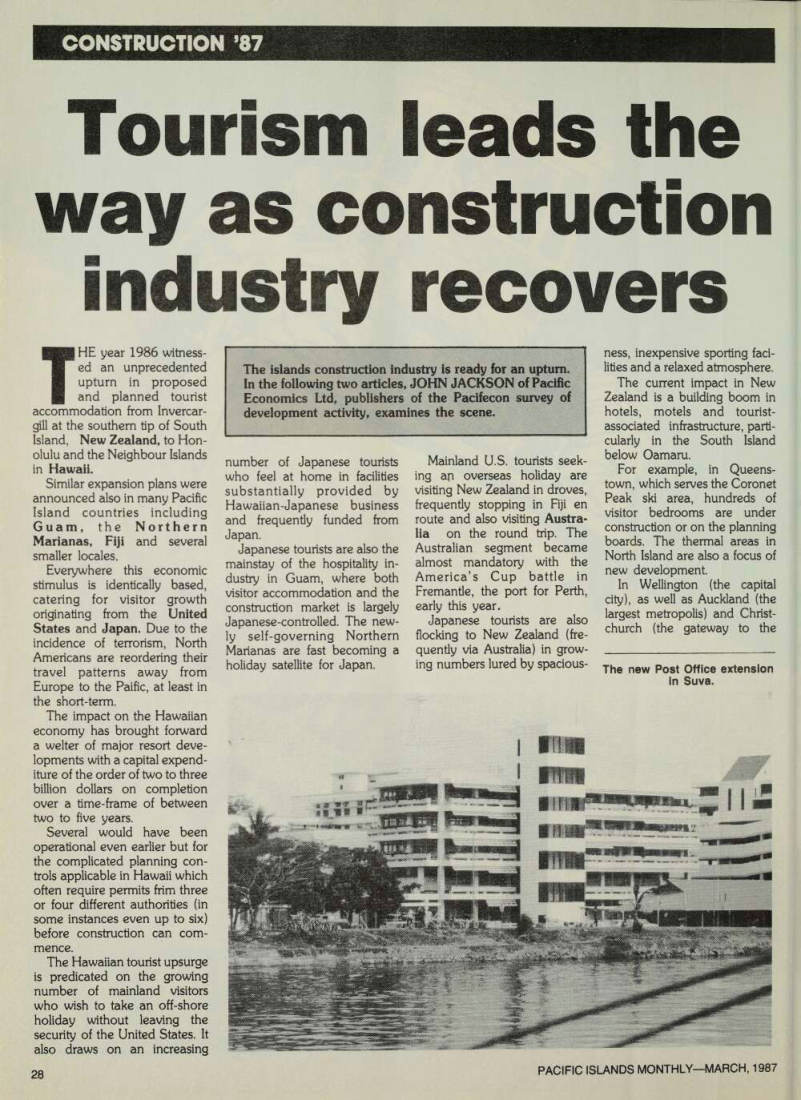
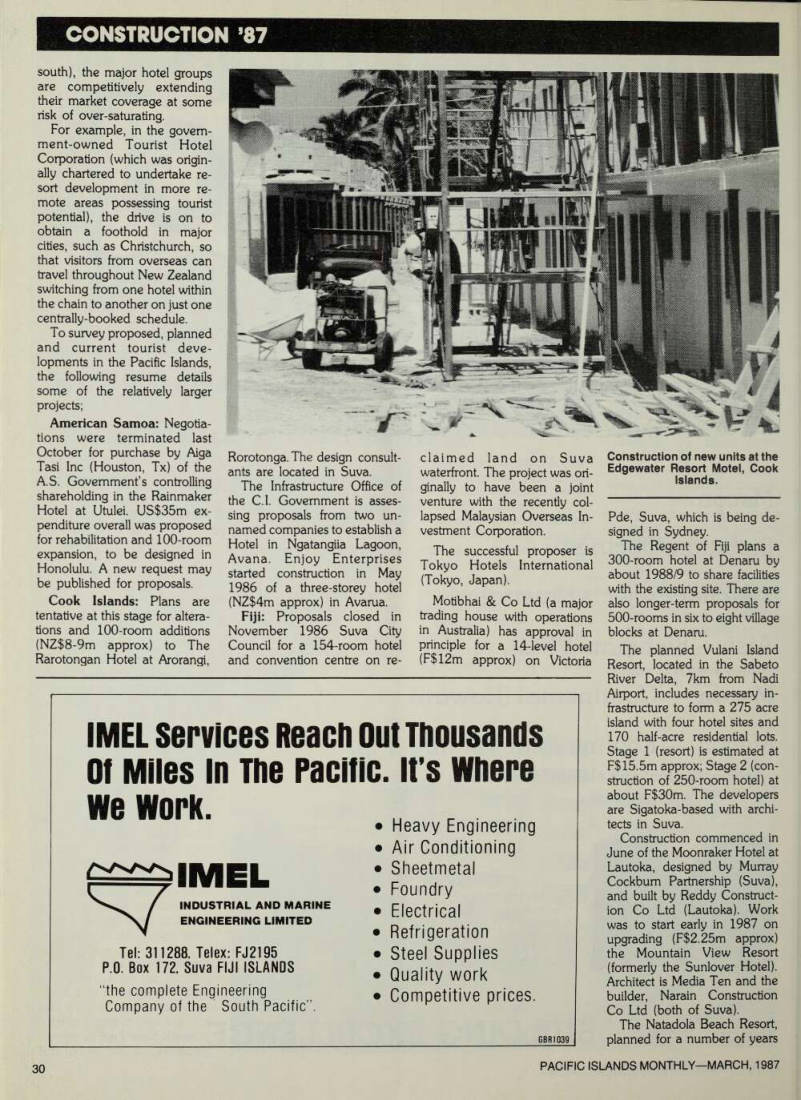
Construction ’87
Tourism leads the way as construction industry recovers
THE year 1986 witness ed an unprecedented upturn in proposed and planned tourist accommodation from Invercar gill at the southern tip of South Island, New Zealand, to Hon olulu and the Neighbour Islands in Hawaii.
Similar expansion plans were announced also in many Pacific Island countries including Guam, the Northern Marianas, Fiji and several smaller locales.
Everywhere this economic stimulus is identically based, catering for visitor growth originating from the United States and Japan. Due to the incidence of terrorism, North Americans are reordering their travel patterns away from Europe to the Paific, at least in the short-term.
The impact on the Hawaiian economy has brought forward a welter of major resort deve lopments with a capital expend iture of the order of two to three billion dollars on completion over a time-frame of between two to five years.
Several would have been operational even earlier but for the complicated planning con trols applicable in Hawaii which often require permits frim three or four different authorities (in some instances even up to six) before construction can com mence.
The Hawaiian tourist upsurge is predicated on the growing number of mainland visitors who wish to take an off-shore holiday without leaving the security of the United States. It also draws on an increasing
The islands construction industry is ready for an upturn.
In the following two articles, JOHN JACKSON of Pacific Economics Ltd, publishers of the Pacifecon survey of development activity, examines the scene.
number of Japanese tourists who feel at home in facilities substantially provided by Hawaiian-Japanese business and frequently funded from Japan.
Japanese tourists are also the mainstay of the hospitality in dustry in Guam, where both visitor accommodation and the construction market is largely Japanese-controlled. The new ly self-governing Northern Marianas are fast becoming a holiday satellite for Japan.
Mainland U.S. tourists seek ing ap overseas holiday are visiting New Zealand in droves, frequently stopping in Fiji en route and also visiting Austra lia on the round trip. The Australian segment became almost mandatory with the America’s Cup battle in Fremantle, the port for Perth, early this year, Japanese tourists are also flocking to New Zealand (fre quently via Australia) in grow ing numbers lured by spacious
ness, inexpensive sporting faci lities and a relaxed atmosphere.
The current impact in New Zealand is a building boom in hotels, motels and tourist associated infrastructure, parti cularly in the South Island below Oamaru.
For example, in Queens town, which serves the Coronet Peak ski area, hundreds of visitor bedrooms are under construction or on the planning boards. The thermal areas in North Island are also a focus of new development.
In Wellington (the capital city), as well as Auckland (the largest metropolis) and Christ church (the gateway to the
The new Post Office extension In Suva.
south), the major hotel groups are competitively extending their market coverage at some risk of over-saturating.
For example, in the govern ment-owned Tourist Hotel Corporation (which was origin ally chartered to undertake re sort development in more re mote areas possessing tourist potential), the drive is on to obtain a foothold in major cities, such as Christchurch, so that visitors from overseas can travel throughout New Zealand switching from one hotel within the chain to another on just one centrally-booked schedule.
To survey proposed, planned and current tourist deve lopments in the Pacific Islands, the following resume details some of the relatively larger projects; American Samoa: Negotia tions were terminated last October for purchase by Aiga Tasi Inc (Houston, Tx) of the A.S. Government’s controlling shareholding in the Rainmaker Hotel at Utulei. USs3sm ex penditure overall was proposed for rehabilitation and 100-room expansion, to be designed in Honolulu. A new request may be published for proposals.
Cook Islands: Plans are tentative at this stage for altera tions and 100-room additions (NZ$B-9m approx) to The Rarotongan Hotel at Arorangi,
Rorotonga. The design consult ants are located in Suva.
The Infrastructure Office of the C.I. Government is asses sing proposals from two un named companies to establish a Hotel in Ngatangiia Lagoon, Avana. Enjoy Enterprises started construction in May 1986 of a three-storey hotel (NZs4m approx) in Avarua.
Fiji: Proposals closed in November 1986 Suva City Council for a 154-room hotel and convention centre on re
claimed land on Suva waterfront. The project was ori ginally to have been a joint venture with the recently col lapsed Malaysian Overseas In vestment Corporation.
The successful proposer is Tokyo Hotels International (Tokyo, Japan).
Motibhai & Co Ltd (a major trading house with operations in Australia) has approval in principle for a 14-level hotel (Fsl2m approx) on Victoria
Pde, Suva, which is being de signed in Sydney.
The Regent of Fiji plans a 300-room hotel at Denaru by about 1988/9 to share facilities with the existing site. There are also longer-term proposals for 500-rooms in six to eight village blocks at Denaru.
The planned Vulani Island Resort, located in the Sabeto River Delta, 7km from Nadi Airport, includes necessary in frastructure to form a 275 acre island with four hotel sites and 170 half-acre residential lots.
Stage 1 (resort) is estimated at F$ 15.5 m approx; Stage 2 (con struction of 250-room hotel) at about Fs3om. The developers are Sigatoka-based with archi tects in Suva.
Construction commenced in June of the Moonraker Hotel at Lautoka, designed by Murray Cockbum Partnership (Suva), and built by Reddy Construct ion Co Ltd (Lautoka). Work was to start early in 1987 on upgrading (F52.25m approx) the Mountain View Resort (formerly the Sunlover Hotel).
Architect is Media Ten and the builder, Narain Construction Co Ltd (both of Suva).
The Natadola Beach Resort, planned for a number of years
Construction of new units at the Edgewater Resort Motel, Cook Islands.
The 300-room Fiji Sheraton Resort at Den is due for completion this year.
by White Industries Ltd (Austra lia) as a 3000-room deve lopment between Nadi and Sigatoka, has been held up by land acquistion.
Also slow to evolve is the Saweni Beach Tourist Resort planned from Sydney to in clude three hotel and eight condominium sites.
Proposals for a 320-room hotel on the beach at Deuba were deferred pending take over of the Pacific Harbour Resort complex.
And an even less fortunate project has been the grandiose Vunaniu Bay Resort (U.S.s6sm approx) on the Cor al Coast of Viti Levu, with Grand Pacific Inc (Honolulu) stalling a mortgagee sale forced by the site contractor from Mainland China early in 1986.
The developer claims that the concept is viable and the pro ject going ahead, with head works, sports club and forma tion of golf course scheduled to start early in 1987.
Guam: Projects announced during 1985 included; • Fujita Corporation (Tokyo): Hotel Resort (USsls6m overall), possibly at Harmon Cliffline, including 300-room hotel; • Guam Dai-Ichi Hotel: 12storey, 132-room additions (USslom overall); • Guam Hotel Okura: 100room additions; • Pacific Island Hotel: 272room additions (USs2sm over all) in two medium rise build ings plus a building to house public rooms including re staurants; • Reef Hotel: accommoda tion extensions.
A major project commenced early in 1985 was the 450room Nauru Pacific Star Hotel.
Designed by Guam consultants, the USs49.2m construction contract was awarded to a Japanese joint venture.
Kiribati: The tourist deve lopment program of the Minis try of Natural Resources Deve lopment includes upgrading of
Housing on the move ... sections of a prefabricated house from J.
S. Hill’s House Factory’ in Fiji heads to a site.
the Captain Cook Hotel on Kiritimati.
Marshall Islands: The übi quitous Nauru Government has proposed a small resort hotel on Jaluit as an off-shore invest ment.
Northern Marianas: The Hyatt Regency is currently seeking a Coastal Resources Management permit for exten sions at Garapan on Saipan.
The Surf Hotel has just signed a lease agreement with the Marianas Public Land Corporation for a 3.3 ha site adjacent to the existing facility for construction of 250-400 rooms (up to nine storeys) at an extimated construction cost of US$l5-20m.
A formerly proposed 600room hotel resort (USsllsm approx) at Laulau Beach, Saipan is being re-evaluated by the new owners of the site. The Concept was formulated by Honolulu architects for the ori ginal Hawaii-based, joint deve loper.
The Marianas Public Land Corporation is considering applications for a 25-year lease of a 7ha hotel site on the former U.S. Navy Reserve at Loran Point, San Antonio, Saipan, from Hilton International, the New Osaka Hotel (Osaka, Japan) and Harmon Corpora tion (Tamuning, Guam).
Papua New Guinea: PNG International Hotels Pty Ltd has approval from the Lands Board for a five-star hotel (K42m approx) on Ela Beach, Port Moresby.
The shareholding breaks down: Mr. Scott Ba’a Ure, Country Party Deputy Premier (28%); Mr. Subramaniam
Segaran, Malaysia (27%); Tusi tala Pty Ltd (20%) and the Asian Development Bank, Manila (25%).
Tonga: Proposals were announced in October 1986 for the Crown Prince Hotel of 170 rooms in Nukualofa, adjacent to the NZ High Commissioners residence. World Resources Corporation (Honolulu) also published proposals about the same time for a full-service beach resort in Tonga.
Vanuatu: Renovations con tinue progressively of the Hotel Le Lagon in Port Vila. The general contractor is an Hawaiian-Japanese joint ven ture based in Honolulu.
Western Samoa: Aggie Grey’s Hotel Ltd has applied to the Enterprises Incentives Board for expansion and up grading in Apia.
The Government of Nauru has proposed a seven-storey hotel at Tiafau, subject to the development of an adequate water supply, as another off shore investment.
Designs are in progress by Suva architects for upgrading the Tusitala Hotel in Apia.
Construction start-up is sche duled for about now of the 280-room Phase 1 of the Royal Samoan Hotel at-Taumeasina.
The project is funded from Honolulu, designed in Seattle and will be built by a U.S.owned but Saudi Arabian based general contractor.
All-in-all, tourism is now an intra-regional growth market for the English-speaking Pacific Basin, an area in which trade movements previously have tended to be one-way and largely predicated on goods rather than services.
Work on the Monasavu foundations.
Advertisements & other items, pp. 29-37 (1 item)
\ The Best Team In The Pacific
4 f I \ THE BEST TEAM IN THE PACIFIC \ Fletcher Construction Overseas Division Private Bag Auckland New Zealand Tel NZ (09) 593-054 Telex N 260602 FLETCON
Mecon
Bishman Electrical
Fletcher Construction
Pacific Construction (Hawaii)
Fletcher Morobe Construction (PNG)
Reddy-Fletcher Contractors (Fiji)
Fletcher-Kwaimani (Solomon Is)
- for civil and general contracting
Fletcher Projects (Australia)
Aisi Bishman (PNG)
Mecon Continental (Hawaii)
Mecon Kooline Joint Venture (Fiji)
for mechanical and electrical services Fletcher Mechanical Private Bag Auckland New Zealand Tel. NZ (09) 599-979
Telex NZ2441 FLETAUCK
BUILDING EXCELLENCE
imel Services Reach Out Thousands
Of Miles in The Pacific. It’s Where
we work.
£££ilMEL
INDUSTRIAL AND MARINE
ENGINEERING LIMITED
Tel: 311288. Telex: FJ2195
P.O. Box 172, Suva FIJI ISLANDS
“the complete Engineering Company of the South Pacific”. • Heavy Engineering • Air Conditioning • Sheetmetal • Foundry • Electrical • Refrigeration • Steel Supplies • Quality work • Competitive prices.
G8R1039
BALFOUR BEATTY
AND
GROUP COMPANIES
A. Meiien Pty Ltd
Multi Disciplined
Engineers & Contractors Balfour Kilpatrick Pacific Electrical Contractors and Electrical Wholesalers Electrical rs & Contractors der Electrical Pty Ltd tircal and Instrumentation ineers & Contractors S
G THE PACIFIC
WITH
& Government Buildings
Industry
For Top Level Service: Power Stations, Transmission Lines
Underground Distribution, Substations
Water & Sewerage Treatment Plants and Underground Services
Airport Lighting
Comprehensive Electrical & Mechanical Services Plant Erection, Piping, Electrical Instrumentation If
HMM
Ray Nevin G.M. Gooder Electrical Bill Sampson G.M. T. A. Melfen Kilpatrick Green Pty Ltd (Pacific Operations) 20*26 Glentanna Streets Kedron, 4031 Telephone; (07) 350 2999 Telex: AA41351 Fax: (07) 359 8953 T A. Mellen Pty Ltd 27 Malta Street, Villawood. 2163 Telephone; (02) 72 0231 Telex: 25092 Fax; (02) 726 0855 Gooder Electrical Ltd 61 Wellington Street.
Auckland.
Telephone: 789 917 Telex; 60117 Dennis Flanagan Director Pacific Area Operations Balfour Kilpatrick (Pacific) Ltd 21 Matua Street, Walu Bay.
' Suva. Fiji.
Telephone: Fiji 31 4455 Telex: 2139 Peter Walker Group Marketing Manager Balfour Beatty Australia Pty Ltd Level 14, 1 York Street, Sydney. 2000 Telephone: (02) 27 8211 Telex; AA24513 Fax; (02) 232 6528
DISTRIBUTOR
WANTED
PACIFIC ISLANDS AREA
DHGO
The Dingo 500 and 750 Mini Loader models are becoming big winners with Landscapers, Contractors and Hire Companies throughout New Zealand and Australia.
Incredibly versatile and manoeuvrable, the DINGO has dozens of uses. Two sizes (500 and 750) with lOhp diesel —ll hp petrol —15 hp diesel motors plus a big variety of attachments to handle most jobs.
CONTACT THE MANUFACTURER:
RAYNER STEEL LTD
PO Box 2086, Washdyke Timaru, New Zealand Phone (056) 82-131 Telex C.P.O. Tu NZ4336 3
RARE INVESTMENT OPPORTUNITY
MATAMANOA ISLAND RESORT
F 53,000,000 a ■rr
SINCE 1860
Ragg & Associates (Fiji) Ltd.
G.P.O. Box 861, Suva, Fiji.
• SOLE AGENT FOR THE VENDORS
CABLE “RAGLANDS” FIJI. PH. 31-2078
>£ Airmail to me the colour brochure on Matamanoa Island Resort, Fiji’s newest and fully operational resort.
Name Address
( I ► mil
STORE FIXTURES
Hardware Reeve Gondolas Wall-units End-units Reusable Sign-cards Chrome Rack Showcases Dennison Marking System Glass Shelves Decter Mannequins Forms Custom Racks Glass Cubes & Connectors Grid Wall Grid Cubes Slotwall Turn O Matic Albatross Chemicals Door Announcers Security Mirrors Acrylic Displays Retail • Wholesale • Importers Local Stock • Immediate Shipment Call or Cable Us Write Us Phone (808) 841 -3661 1748 Hoe Street Cable: STOREFIX HI-HONOLULU Honolulu, Hawaii 96819 ‘‘Serving the Pacific Islands since 1981”
MfCONNELL
DOWELL
CORPORATION LIMITED
Contributing to the Development
of the Pacific Region
The McConnell Dowell Corporation, one of New Zealand’s most successful companies, can provide trading and manufacturing, property development, investment, and all aspects of civil, mechanical and electrical construction throughout the Pacific.
Since the late 19605, the company has successfully competed for projects throughout the Pacific Region, building on the skills and resources acquired in the process of undertaking some of the most demanding tasks in the development of New Zealand’s industrial and energy expansion. In doing so, it has built a team of highly qualified, fully experienced project managers, designers, engineers and trades personnel, a team that functions effectively and efficiently throughout the Pacific, backed by a reputation for probity and proven success.
Within the McConnell Dowell Corporation, a number of companies provide specialist knowledge of different aspects of the construction industry. By incorporating the skills and services of these companies, the Corporation offers clients an international, integrated, multi-disciplinary service.
Services • Feasibility Studies • Project Management • Cost Estimating • Design • Fabrication • Quality Control • Construction
• Commissioning
• Operation • Turnkey Projects • Maintenance -V m £ McConnell Dowell Constructors Ltd Large and small scale projects in any field relating to civil and mechanical engineering.
Hawkins Construction Ltd Design and construction of commercial, industrial and public utility buildings and associated developments.
Electrix Ltd Electrical design, installation, commissioning and maintenance for all types of industrial and commercial projects.
McConnell Dowell Nichols Pty Ltd A full service to the telecommunications industry.
McConnell Dowell Corporation Limited 2 Owens Road, Epsom, Auckland 3, New Zealand Telephone (09) 686 970 Fax (09) 686 560 Telex NZ2711 MACDOW McConnell Dowell Corporation Limited c/o Grayburn Construction Limited ANZ Building PC Box 889, Suva Telephone: (679)31 5166 Fax: (679) 31 5815. Telex; 2582 Hawkins Construction Limited PO Box 4046, Pago Pago American Samoa Telephone: (684) 6991893 Fax:(684)6991931 McConnell Dowell Constructors Limited PO Box 239, Majuro Marshall Islands Telephone: Majuro343o Fax: Majuro3s6o
HILUX 4WD Regular Cab, Long Wheelbase M One tough truck just got tougher. Toyota’s dedication to superior performance vehicles takes a step forward today with the New Hilux..* A refined front grille and bumper design, new instrument panel for a feeling of spaciousness and command and plush colour co-ordinated trim are a few new additions to the New Hilux.
And extensive anti-corrosive galvanealed steel protection now includes the tailgate panel and rear door panel, making Hilux more durable than ever before.
Yet for all its improvements, the best of the original Hilux is alsco
TOYOTA
QUALITY SERVICE
AMERICAN SAMOA: BURNS PHILP (SOUTH SEA) CO., LTD., P.O. Box 129, Pago Pago. COOK ISLANDS: COOK ISLAfIA AUTOMOTIVE SUPPLIES COMPANY, A Division of Burns Philp (South Sea) Co., Ltd., G.P.O. Box 355, Suva. GUAM & Mliiy Tamuning. KIRIBATI: TARAWA MOTORS, A Division of Bairiki Holdings Ltd., P.O. Box 36, Bairiki, Tarawa. NAURU: NAURU SERVICE IMPORTATION AUTOMOBILE DU PACIFIQUE, Rond-Point du Pacifique (Station Total) B.P. 438, Noumea. NIUE: I :i NORFOLK ISLAND: BORRY’S LIMITED, P.O. Box 169. PAPUA NEW GUINEA: ELA MOTORS, A Division of Burns Phi id CORPORATION, P.O. Box 267, Saipan. SOLOMON ISLANDS: SOLOMON ISLANDS INVESTMENTS LTD., G.P.O. Box 1400* TONGA: BURNS PHILP (TONGA) LTD., P.O. Box 55, Nukualofa. VANUATU: VANUATU MOTORS, A Division of Burns Phillir BURNS PHILP (SOUTH SEA) CO., LTD., P.O. Box 188, Apia.
if ic-Tougn. me New miux
S \ Sr* i * fj m if \ Sir 1r s. p 4 li ■I re. a big tailgate conveniently hinged for quick loading and unloading; reinforced front suspension to smooth out 5 bumps, and bias-mounted, extra-heavy-duty rear shocks and knobbly tyres to take on any terrain.
Toyota’s long history of super-responsive engines, ruggedness, reliability and comfort goes without saying. And in the Hilux, it’s yours in both 2-wheel-drive and 4 x 4 versions.
So, after comprehensive testing and thorough quality control, the New Hilux is ready to bring a new standard of toughness to the Pacific.
And isn’t that exactly what you expect from Toyota?
Areas where gaivanealed steel is used NG CORPORATION LTD., Private Bag, Rarotonga. FIJI: A: ATKINS KROLL, INC., 443 South Marine Drive, RATIVE SOCIETY, Central Pacific. NEW CALEDONIA- ILP (SOUTH SEA) CO., LTD., P.O. Box 39, Alofi.
' Box 75, Port Mores by. SAIPAN: MICROL
FAHITI; NIPPON AUTOMOTO. B.P 342 Papeete
) Ltd., P.O. Box 18, Port Vila. WESTERN SAMOA:
TOYOTA
building activity lift-off

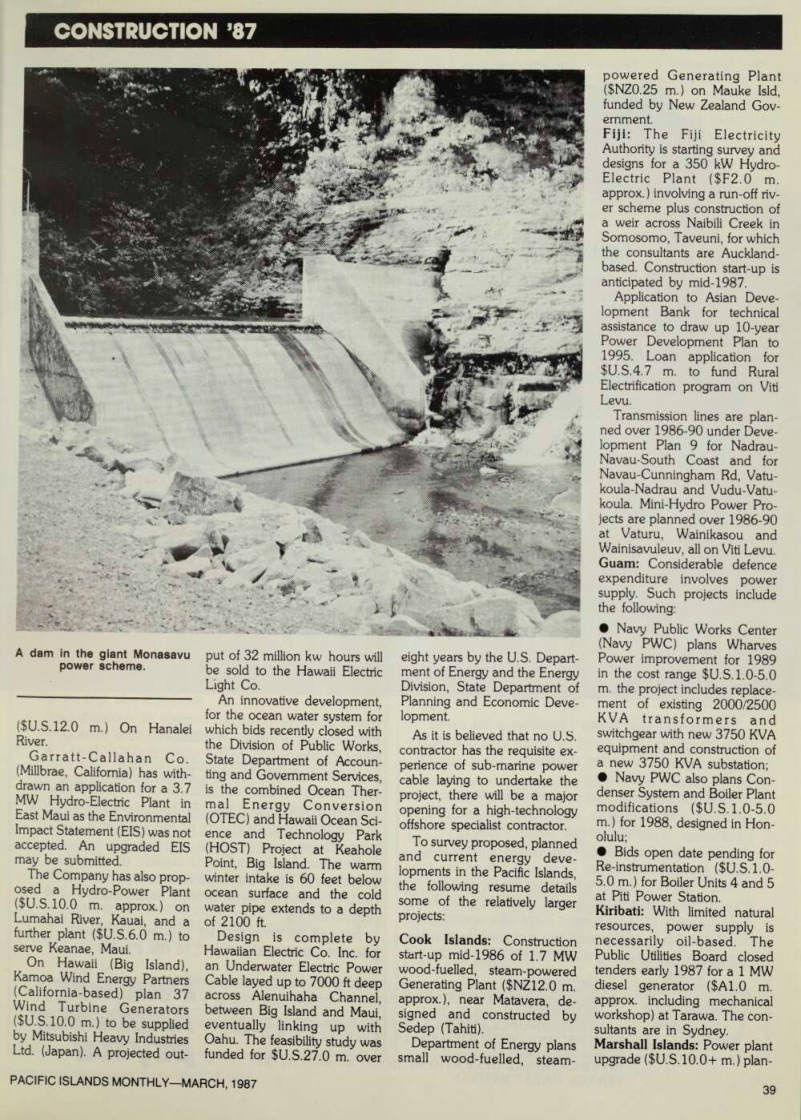


Power for people fires building activity lift-off
Electricity genera
tion in New Zealand is substantially hydro power or geo-thermally based. Over the past thirty years, national hydro-power construction has almost entirely been the preserve of the Minis ter of Works and Development constructing with day labor and by sub-contract.
However an exception was a SNZIO9.B m contract let early in 1984, to the chagrin of the shortly-incoming Labor Gov ernment, for part of the Clyde Dam in South Island to a joint venture of Ed Zublin (West Germany) and W. Williamson
Construction Co. Ltd. (Christ church).
As a result of expanded in house design capacity and own work-force, the policy of reser ving hydro-power construction to the Ministry became self perpetuating with the result the private sector, with exceptions, was handicapped in exporting construction services in the energy area due to lack of job experience, it also led to ill thought out proposals in 1985 that the Ministry go off-shore as a general contractor.
However with the current program of privatisation, the Ministry is to be split into two
divisions: policy/regulatory and commercial operations, with the latter authorised to compete for pnvately funded contracts and presumably private contractors reciprocally able to tender for construction work of the
so H L undertaken
within the Ministry.
Whilst the new policy is still hazy, being currently under Parliamentary discussion, seeptics will argue that the rationalisation is only windowdressing as the design element must be independent to ensure effective competition. But the first steps have been taken to open up hydro-power construe-
tion to competitive tendering by contractors, There , , imited d . vatel ed electricity sup pi y
ind J
sal J a s J on ' a , T North , sland which could sell its surplus to the grid, h Hawaii privately-owned electric P ower generation and distribution is in vogue. Bing ham Engineering (Salt Lake Utah) has submitted plans J° r Hydro-Power |y ant ($U.5.9.0 m.) on Wailua ™ ver ’ Kauai, Also in Kauai, the company proposes a 6.0 MW plant
($U.5.12.0 m.) On Hanalei ver - Callahan Co. (Millbrae, California) has withdrawn an application for a 3.7 MW Hydro-Electric Plant in East Maui as the Environmental Impact Statement (EIS) was not accepted. An upgraded EIS may be submitted.
The Company has also proposed a Hydro-Power Plant ($U.5.10.0 m. approx.) on Lumahai River, Kauai, and a further plant ($U.5.6.0 m.) to serve Keanae, Maui.
On Hawaii (Big Island), Kamoa Wind Energy Partners (California-based) plan 37 Wind Turbine Generators (SUS.IO.O m.) to be supplied by Mitsubishi Heavy Industries Ltd. (Japan). A projected out-
put of 32 million kw hours will be sold to the Hawaii Electric Light Co.
An innovative development, for the ocean water system for which bids recently closed with the Division of Public Works, State Department of Accoun ting and Government Services, is the combined Ocean Ther mal Energy Conversion (OTEC) and Hawaii Ocean Sci ence and Technology Park (HOST) Project at Keahole Point, Big Island. The warm winter intake is 60 feet below ocean surface and the cold water pipe extends to a depth of 2100 ft.
Design is complete by Hawaiian Electric Co. Inc. for an Underwater Electric Power Cable layed up to 7000 ft deep across Alenuihaha Channel, between Big Island and Maui, eventually linking up with Oahu. The feasibility study was funded for 5U.5.27.0 m. over
eight years by the U.S. Depart ment of Energy and the Energy Division, State Department of Planning and Economic Deve lopment.
As it is believed that no U.S. contractor has the requisite ex perience of sub-marine power cable laying to undertake the project, there will be a major opening for a high-technology offshore specialist contractor.
To survey proposed, planned and current energy deve lopments in the Pacific Islands, the following resume details some of the relatively larger projects: Cook Islands: Construction start-up mid-1986 of 1.7 MW wood-fuelled, steam-powered Generating Plant (SNZI2.O m. approx.), near Matavera, de signed and constructed by Sedep (Tahiti).
Department of Energy plans small wood-fuelled, steam
powered Generating Plant (SNZO.2S m.) on Mauke Isld, funded by New Zealand Gov ernment.
Fiji: The Fiji Electricity Authority is starting survey and designs for a 350 kW Hydro- Electric Plant (SF2.O m. approx.) involving a run-off riv er scheme plus construction of a weir across Naibili Creek in Somosomo, Taveuni, for which the consultants are Auckland based. Construction start-up is anticipated by mid-1987.
Application to Asian Deve lopment Bank for technical assistance to draw up 10-year Power Development Plan to 1995. Loan application for $U.5.4.7 m. to fund Rural Electrification program on Viti Levu.
Transmission lines are plan ned over 1986-90 under Deve lopment Plan 9 for Nadrau- Navau-South Coast and for Navau-Cunningham Rd, Vatu koula-Nadrau and Vudu-Vatu koula. Mini-Hydro Power Pro jects are planned over 1986-90 at Vaturu, Wainikasou and Wainisavuleuv, all on Viti Levu.
Guam: Considerable defence expenditure involves power supply. Such projects include the following: • Navy Public Works Center (Navy PWC) plans Wharves Power improvement for 1989 in the cost range SU.S.I. 0-5.0 m. the project includes replace ment of existing 2000/2500 KVA transformers and switchgear with new 3750 KVA equipment and construction of a new 3750 KVA substation; • Navy PWC also plans Con denser System and Boiler Plant modifications (5U.5.1.0-5.0 m.) for 1988, designed in Hon olulu; • Bids open date pending for Re-instrumentation (5U.5.1.0- 5.0 m.) for Boiler Units 4 and 5 at Piti Power Station.
Kiribati: With limited natural resources, power supply is necessarily oil-based. The Public Utilities Board closed tenders early 1987 for a 1 MW diesel generator (SAI.O m. approx, including mechanical workshop) at Tarawa. The con sultants are in Sydney.
Marshall Islands: Power plant upgrade (SU.S.IO.O+ m.) plan
A dam in the giant Monasavu power scheme.
ned for 1988 by U.S. Army Engineer District (Honolulu) at Kwajalein Missile Range. Pro ject comprises a 52,880 sq ft building equipped with 20,000 kW diesel generators.
Norther Marianas: Two 1.6 MW Caterpillar Generators are on order, for which site prepa ration is being undertaken by the Department of Public Works (DPW).
DPW has just gone to con tract for installation of 15 emergency generators at diffe rent locations on Saipan.
Papua New Guinea: Construc tion start-up was scheduled early 1987 for the civil works contract (K 29.4 m.) of Yonki Dam on the Ramu River in the Eastern Highlands. The con tractor is Hyundai Engineering and Construction Co. Ltd. (South Korea) and the consul ting engineers, the Snowy Mountains Engineering Corporation (Australia).
Tenders are closed but con tract not yet awarded for the electrical and mechanical Plant
contract for Yonki Dam. The tenderers (in ascending order of value from K 6.68 m. to K 11.20 m.) were: Progres International (Yugoslavia, out of Sydney); Elin-Union AG (Vienna); Mitsui and Co. (Aust.) Ltd. (Sydney); Toyomenka Kaisha Ltd. (Tokyo); and Chiyoda Chemi cal Engineering and Construc tion Co. (Tokyo).
Application by PNG Electric ity Commission to Asian Deve lopment Bank for technical assistance for 2 MW run-of river schemes sited on Luwini Creek.
Project on appraisal by sth European Development Fund of the European Economic Community for four small Hyd ro-Electric Plants (K 4.0 m.) with transmission lines from existing grids under Diesel Power Re placement Program.
Construction started in April 1986 by PNG Electricity Com mission on a Mini-Hydro Scheme (K 3.0 m. approx.) at Lake Hargy and a similar pro
ject (K 0.9 m. approx.) at Tim putz.
Other power-oriented pro jects include: • Tenders closed for (1) civil works and (2) electrical equip ment for switchroom/switch yards of Ramu Grid Reinforce ment Project which will be funded by Asian Development Bank; • Tenders closed for two 12 MW generating plants at Lae and one at Mt Hagen, also for the Ramu Grid Reinforcement Project; • Tenders closed for 1250 kW Diesel Generating Set and 11KV Station Switchgear at Wewak, with option for a second Generating Set until October 1987.
Pared-down development program to achieve 60,000 ton nes per day copper output by OKTedi Mining Ltd. includes 50 MW Hydro-Electric Power Plant (K 45.0 m.) Consultants for the entire project: Davy McKee Pacific Pty. Ltd. (Mcl
bourne) in association with BHP Engineering (Sydney).
Solomon Islands: The S. 1.
Electricity Authority called ten ders, closed February 16,1987, for a 2000 KV diesel engine generating set at Lungga (Hon iara) and 3 x 2000 KV diesel generating sets for a Power Station at Noro, New Georgia (Western Province), for which the civil engineers are locally based and the electrical/ mechanical engineers in Bris bane. Overall contract value is estimated at $59.5 m. approx.) Tenders closed in Suva with the South Pacific Bureau for Economic Co-operation (SPEC) for a Biogas Generating Plant at Tambea-Honiara on Guadalcanal. The plant was designed in Italy.
Tenders have similarly closed with SPEC for a Charcoal Gasi fier Generating Plant at Vangu na, New Georgie Group. This was designed in Holland.
The S. I. Electricity Authority has applied to the Asian Deve
lopment Bank (Manila) for a $U.5.3.0 m. loan to fund a Dendrothermal Plant of 3 MW capacity.
Tonga: Tenders were sche duled to be called late 1986 by SPEC (Suva) for a 100 kW Steam Engine and Switchboard, designed in Italy.
True (Federated States of Micronesia): Contract award to John Holland International Pty.
Ltd. (Melbourne) for design/ construction/management/ financing of Doublon Island Power Generating Facilities, in cluding 9 MW plant, submarine cables and 1.5 m. gal. tank farm. Consultants: Barrett Con sulting Group (Honolulu).
Vanuatu: Tenders open date pending with SPEC (Suva) for a 25 kW Gasifier Generating Plant, designed in Holland.
Western Samoa: A tentative $U.5.5.0 m. loan has been requested from the Asian Deve lopment Bank by the Electric Power Corporation for the 5 MW Afiamalu Pump-Assisted Hydropower project. The con sultants are located in Bristol, UK, in conjunction with mechanical and electrical en gineers in Auckland.
Overall cost is $U.5.15.0- 16.0 m. co-financed by the European Investment Bank.
The project includes a 3.5 m. cubic metre reservoir, intake and pumping station and 66 KV transmission line.
The Electric Power Corpora tion also plans 11 km of 0.7-1.0 metre diameter pipeline con struction (5U.5.3.0-4.0 m.).
Project deferred to about 1991 for Wood Gasifier Gen-
A temporary access shaft in the Monasavu low pressure tunnel.
erating Plant planned by SPEC (Suva) and designed in Hol land.
Trade balances in the Pacific Islands were hard hit post-1979 by escalation in oil prices. Only since 1984 have marginal im provements in balances of pay ments reflected a fall in the real cost of imported fuels.
Consequently the push is on to develop alternative sources of energy and to reduce de pendency on fossil fuels. The limited recognition of this fact in both Australia and New Zea land has resulted in opportuni ties lost to Japan, South Korea and other international sup pliers.
The Australian attitude is de monstrated by its drastically falling market share in Papua New Guinea for both general construction and electric equip ment in particular. Suppliers of electricals from Australia approached the post-1974 market on an “as-of-right” basis and lost out to new sources of competition.
In New Zealand the con ventional wisdom is that “we know what’s going on; we have agents in the island markets and we visit them regularly.”
This is still not enough to achieve full market penetration.
Net profitability is frequently determined not by the jobs that a suppliers wins, but by those where someone else’s timing was better.
It is to identify those poten tially missed job opportunities, even though sometimes amounting to only a few in
number, that a regular market information flow is needed from independent outside sources.
Secondly, it is rare for on the-spot agents to perform as effectively as the principals do in their domestic market with out continuing close super vision predicated on as com plete a knowledge as possible of new project activity.
“On-the-spot” representa tion belies the fact that deve lopments in the island countries are often funded, designed and constructed from outside, with
the result the local agent is presented with a fait accompli by the time he follows-up the prospect.
Lastly, periodic sales visits are fully productive only when directed with the right timing at specific targets and this requires forward information. Little can be more wasteful than visiting an off-shore location to find that a once-of contract was recently placed elsewhere.
The reserve bank building under construction in Suva
Advertisements & other items, pp. 38-43 (2 items)
Construction ’B7
The Total Test Equipment Solution
AWA
w Ul er marcom instruments Tfektronix r i i Q V
FLUK
HITACHI
L L 3
AWA TEST EQUIPMENT
AWA,
your problem of test Dment is solved. We have the widest possible 5 range of equipment to suit your every
d fry nee dj|
more com choices. npr romises AWA New Zealand Limitei.
The total communications company 37 Freestpn Road, Walti Bay Fa 379
In a world that often promises a lot more than it delivers, it’s good to know you can trust
one company... Pioneer Asphalts...for a quality
performance every time.
Pioneer Asphalts takes pride in a total commitment to quality, reliability and technical excellence. That’s why the name Pioneer Asphalts has become synonomous with service right around Australia.
It’s a service that’s yours anywhere in the Pacific because mobility and flexibility are key components of the Pioneer Asphalts operation.
A whole range of State of the Art mobile plants capable of producing as little as thirty to as much as three hundred tonnes of Asphalt per hour means Pioneer Asphalts have a mobile plant that’s just right for your size project.
Pioneer Asphalts have had decades of experience in the construction of port facilities, airport runways and general roadworks in some of the toughest locations in the southern
hemisphere.
Pioneer Asphalts listens closely to it’s customers. That way, we can co-operate and fully respond to your special needs and
requirements.
So call us now and let Pioneer Asphalts partner your next project in the Pacific.
Pioneer
Phone: +612.519.2233. Telex: A.A.73553 (5Y2377). Fax: +612.517.1515.
Pioneer Asphalts Pty. Ltd. Australian Head Office: 63 Grove Street, St. Peters, SYDNEY. N.S.W. 2044.
AUSTRALIAN OPERATIONS: NEW SOUTH WALES, VICTORIA,
QUEENSLAND, WEST AUSTRALIA, NORTHERN TERRITORY,
SOUTH AUSTRALIA.
INTERNATIONAL OPERATIONS: HONG KONG, UNITED
STATES, GREAT BRITIAN.
Pioneer
Asphalts
pty ltd
Anyone can assemble
an Instant Home!
WITH THERMA-PANEL
* ECONOMICAL
* FAST
* simple * 4
Wl' ffl A r* • Mte deliver anywhere inn
HOMES
You assemble anywhere assemble home!
Name...
Address An Instant Home is a pre-assembled I — kit home, that almost anyone can as- Send coupon ,or dBtails °’ this eas » to semble.
Instant Homes are constructed from Therma-Panels fully insulated modular construction panels you simply bolt together in sequence. Instant Homes are complete kits walls, roof, floors, windows, etc • Cyclone rated • Fully insulated walls.
Full range from motel rooms to onetwo-three and four bedroom homes.
Also, offices and industrial buildings to your own design. . P/code.
Phone Do you own a block of land □ Yes □ No Post to: George Hudson Homes (Aust) Pty Ltd 186 Hume Hwy, Cabramatta. >166 NSW 2166 Australia Phone. (02) 727-9066 Telex. AA 75299 Agent enquiries welcome.
Dillingham
CONSTRUCTION SERVICES
• Turnkey • Project Management • Design • Construction Management • Construction services to the transportation, mining, energy, recreational, commercial and industrial facilities industries.
FIELDS OF SPECIALISATION
• Transportation (rapid transit, waterfront and marine installations, roads, bridges, airports etc.) • Community and defence installations • Energy (oil, gas, thermal and hydro-electric plant, coal, alternative energy sources) • Commercial and recreational facilities • Industrial installations Suite 801 80 Alfred Street Telephone: (02) 925-0644 Milsons Point Telex: AA176823
construction
New South Wales
2061 AUSTRALIA
Facsimile: (02) 957-2689
METROPOLITAN DRILLING AND BLASTING (FIJI) LTD.
We do all Drilling, Blasting and Rock works throughout the South Pacific.
Former Contractors for the Vaturu Dam and the Queens Road, Viti Levu, Fiji Machinery: 850 Compressor ECM 350 Track Drills Portable Gear All equipment is available for hire with an experienced operator, and all jobs insured for Public Liability P.O. Box 27, Pacific Harbour, Deuba, Fiji Phone: Fiji 45338, Telex: FJ3251
ALL THE NEWS
IN A FLASH
The South Sea Digest tells you what you want to know about the Pacific Islands in a few words. All the leading firms and diplomatic missions read it.
See Insert for subscription details:
THE SOUTH SEA DIGEST
SINGLE
LEVER
MIXER
HANDSHOWER
50 mm
SHOWER SETS
FORWARD BOWL
SPOUT HOB wT
1.l
SINGLE LAUNDRY ARM
80x50 GRATE
PLUMBING FITTINGS OF TOMORROW
For quotes and information on the above & following contact: BRASSHARDS MANUFACTURING PTY. LTD. BRASSHARDS HOLDINGS PTY. LTD.
Tel. (02) 939-1373 Tel. (02) 939-7300 43 CARTER ROAD, BROOKVALE, N.S.W., 2000, AUSTRALIA • TELEX AA23544
Public sector

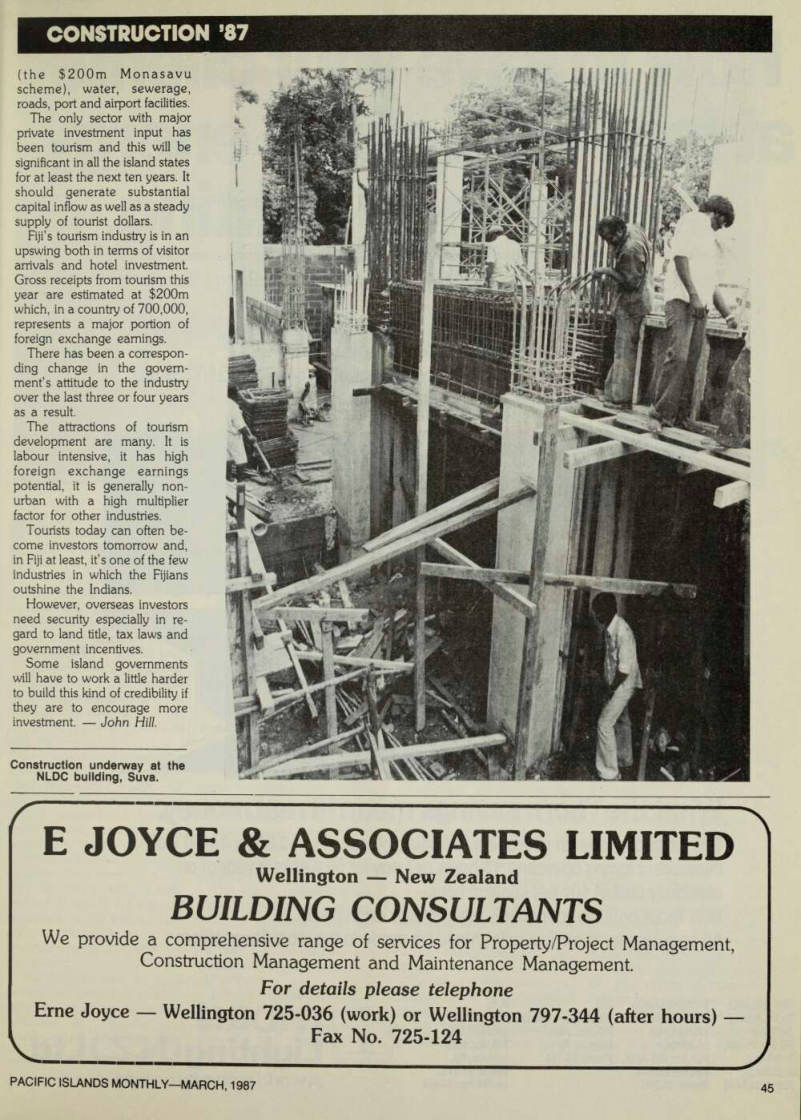
calls the tune
The over-riding factor in the construction in dustry in the island states of the South Pacific is the small size of the communities being served.
For example, Papua New Guinea, with a population of 3 million, has more people than all the other eleven remaining Forum island countries put to gether.
Not only are the countries small, but so is their spending power.
In Australia 1 in 2.88 people are working. The average
weekly wage is around $4OO, providing a per capita, per week spending of over $l3O.
Fiji, by comparison, (one of the more affluent island na tions) has an employment rate of only one in seven and per capita per week spending is closer to $9.
In larger countries, the driv ing force in the construction industry is the private sector.
The entrepreneur takes an eco nomic risk to develop a project for his own use or to rent to others.
In the islands, where private investment is limited, the en trepreneur faces a high risk factor in speculative building.
The most significant force in the industry in the islands, then, is the government sector. Many national governments, sup ported by rich international fun ding agencies and aid prog rams, are the ultimate clients in at least 75 per cent of the construction work taking place.
Some of the smaller island states can never be commer cially viable and survive either
on repatriated wealth from overseas workers or from aid donations. Most of these en joyed a significant spurt of construction activity at inde pendence.
Fiji, for instance, enjoyed a prosperous period for the four years immediately after inde pendence in 1970. The country has been able to achieve a very satisfactory performance by anybody’s standards in laying down an adequate infrastruc ture base, particularly in the areas of hydro electric power
(the s2oom Monasavu scheme), water, sewerage, roads, port and airport facilities.
The only sector with major private investment input has been tourism and this will be significant in all the island states for at least the next ten years. It should generate substantial capital inflow as well as a steady supply of tourist dollars.
Fiji’s tourism industry is in an upswing both in terms of visitor arrivals and hotel investment.
Gross receipts from tourism this year are estimated at s2oom which, in a country of 700,000, represents a major portion of foreign exchange earnings.
There has been a correspon ding change in the govern ment’s attitude to the industry over the last three or four years as a result.
The attractions of tourism development are many. It is labour intensive, it has high foreign exchange earnings potential, it is generally non urban with a high multiplier factor for other industries.
Tourists today can often be come investors tomorrow and, in Fiji at least, it’s one of the few industries in which the Fijians outshine the Indians.
However, overseas investors need security especially in re gard to land title, tax laws and government incentives.
Some island governments will have to work a little harder to build this kind of credibility if they are to encourage more investment. John Hill.
Construction underway at the NLDC building, Suva.
Advertisements & other items, pp. 44-46 (1 item)
reputation by the professional way
GKIM Kwikform have built their
they service the building industry.
SCAFFOLDING
ALUMINIUM TOWERS
CABLE LADDER
CABLE MESH
ACCESS FLOORS
SUSPENDED ACCESS
SKIRTING DUCT
SAFT-CLIMB SYSTEMS
UNISTRUT SUPPORT
SYSTEMS
GKN KWIKFORM
Contact: Neville Bowen
GKN KWIKFORM PTY LTD
(Australia) Percy Street, Auburn, New South Wales 2144.
Telephone (02) 648 1011 Facsimile (02) 647 2914 Telex AA22773
TDM5422
E JOYCE & ASSOCIATES LIMITED
Wellington New Zealand
BUILDING CONSULTANTS
We provide a comprehensive range of services for Property/Project Management, Construction Management and Maintenance Management.
For details please telephone Erne Joyce Wellington 725-036 (work) or Wellington 797-344 (after hours) Fax No. 725-124
How to save your clients
at least 50X of the energy
cost of their lighting.
Thom ballasts will make significant savings on your clients’ lighting bills, without
reducing the lighting level.
Thom ballasts are very energy efficient. They use only a fraction of the energy needed to power conventional fluorescent ballasts.
Thom OMC ballasts save 70% of the energy needed to operate a 36/40 watt fluorescent lamp; Thom LUEC ballasts save 50% energy. a *o.
For Ll£C ballasts the saving would be: 10,000 x x 10 x 5 x 50 x 0.1 1000 NZ512,500.00 per year saved!
For OMC ballasts the saving would be: 10,000 x x 10 x 5 x 50 x 0.1 1000 NZ517,500.00 per year saved!
What the Thom savings mean in real money. o. 03 This example uses an average sized office block using 10,000 x 36/40 watt fluorescent lamps operating 10 hours per day for 50 weeks a year of an electricity cost of 106 per kilowatt hour.
With Thom ballasts your clients save energy and dollars.
All enquiries for Thom ballasts should be made to the local Thom office;
NEW ZEALAND: WESTERN SAMOA:
Thom Lighting Thom Lighting (NZ) Ltd (Samoa) lid PO Box 71-134, c/- AP Cain Rosebank, P.O. Box 453 Apia, Auckland Western Samoa.
Phone:BB7-155 Phone:22-290
FIJI: FIJI:
Building Services Ltd David Raser P.O. Box 5025 (Pacific) Ltd.
Lautoka. Fiji P.O. Box 5090 Phone: 64-716. Lautoka, Fiji.
Phone: 64-393, 64-398 Fax: 64404 ±
THORN
Lighting (N.Z.) Ltd
A world authority on light
Food for the people:

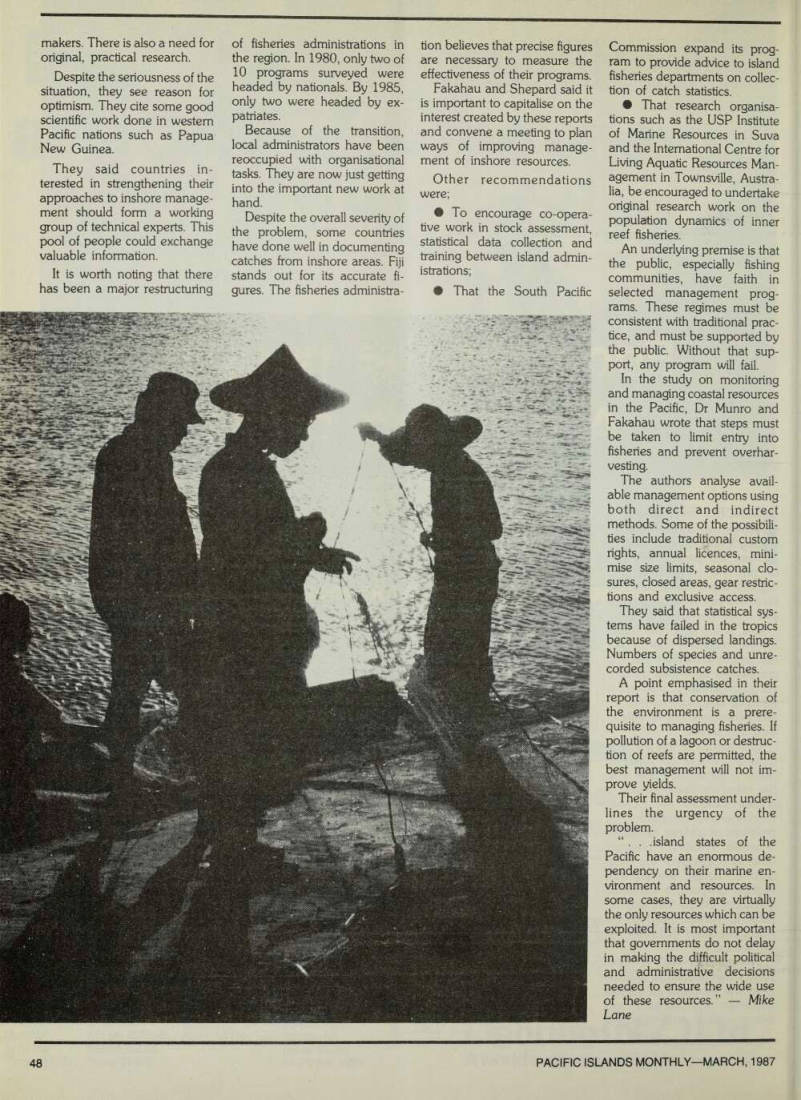
A growing crisis
INSHORE fisheries is the most important fishery in the South Pacific because it feeds the people. Whether or not the inner reefs and lagoons will continue to do so for future generations is a prob lem of increasing concern.
One of the dilemmas facing fisheries officers is how to per mit people to harvest fish and crustaceans from their traditio nal grounds while managing the resource effectively so that fu ture generations will be able to feed themselves.
Two reports in the last nine months one on research needs in the South Pacific and the other on management of coastal fisheries focused much-needed attention on problems of inshore fisheries.
Semisi Fakahau, principal fisheries officer from the King dom of Tonga, teamed with Michael Shepard, a Canadian consultant on the first, and Dr.
John L. Munro, head of the Australian-based ICLARM on the second.
The authors said in both papers that despite its serious ness, the problems of inshore fisheries are largely un documented and ignored.
Fakahau and Shepard in a report, prepared for the Forum Fisheries Agency, and funded by the Canadian International Development Agency, cited two factors.
First, few governments have been able to identify the in formation needed for finding possible solutions. Second, administrators knew that reme dial action to improve con servation would require some unpopular decisions. Such re straints would pose immense mechanical, social and political problems.
Unpopular or not, eventually most countries, particularly those in the western Pacific, will have to act. Every island gov ernment acknowledges that in heavily populated areas, inner reef resources are being over exploited.
This results in dramatic de clines in yields and average sizes of organisms and dis appearance of valuable species.
As cash markets develop and populations grow, the situation will worsen.
Besides the over-exploitation through normal harvesting, there are also the illegal use of dynamite and poisons. These
methods kill large numbers of marine organisms. More impor tantly, they damage the ecosy stems and drastically reduce fish populations.
Lui Bell, a marine biologist from Western Samoa, wrote in a recent report that dynamiting has been an explosive problem in his country for at least 80 years. He said dynamite is often triggered in a coral head or individual sticks are thrown from a boat into the water after a school of fish is spotted.
Household bleach and para quat are commonly used in poisoning fish.
In Tonga, the government banned the importation of firec rackers in the 19505. People then used dynamite bought for quarry excavations.
How can fisheries depart ments convey the message that poison and dynamite are damaging the resource?
Fakahau plans to use his staff to teach the importance of marine conservation in the schools.
The island of Palau is trying a different tack in its educational process. It buys 80 per cent of its fish through co-operatives and refuses to purchase dyna
mited fish that are easily identi fied because of ruptured inter nal organs.
Fakahau and Shepard note that there is an abysmal lack of information on both the size of catches and the effects of fishing on inner-reef stocks. The authors said the lack of data is more a reflection of the fact that tropical multispecies fisheries have never been subjected to intensive study than that poten tial management regimes wouldn’t work.
Considering that, it isn’t surprising that island govern ments have moved slowly in this area.
The consultants also said an absence of clear-cut manage ment alternatives and lack of program emphasis on inshore small-scale fisheries are con tributing factors.
Since remedial actions are difficult, there is no incentive to devote effort to the problems and because the problems are not addressed, they get worse.
Fakahau and Shepard argue the only chance of improving the precarious circumstances of inner reefs is when better in formation about the present status is available to decision
makers. There is also a need for original, practical research.
Despite the seriousness of the situation, they see reason for optimism. They cite some good scientific work done in western Pacific nations such as Papua New Guinea.
They said countries in terested in strengthening their approaches to inshore manage ment should form a working group of technical experts. This pool of people could exchange valuable information.
It is worth noting that there has been a major restructuring
of fisheries administrations in the region. In 1980, only two of 10 programs surveyed were headed by nationals. By 1985, only two were headed by ex patriates.
Because of the transition, local administrators have been reoccupied with organisational tasks. They are now just getting into the important new work at hand.
Despite the overall severity of the problem, some countries have done well in documenting catches from inshore areas. Fiji stands out for its accurate fi gures. The fisheries administra
tion believes that precise figures are necessary to measure the effectiveness of their programs, Fakahau and Shepard said it is important to capitalise on the interest created by these reports and convene a meeting to plan ways of improving manage ment of inshore resources. ow other recommendations .., oro . ’ ® enc °urage co-opera tive work in stock cessment, statistical data collection and training between island admin istrations; • That the South Pacific
Commission expand its prog ram to provide advice to island fisheries departments on collec tion of catch statistics. • That research organisa tions such as the USP Institute of Marine Resources in Suva and the International Centre for Living Aquatic Resources Man agement in Townsville, Austra lia, be encouraged to undertake original research work on the population dynamics of inner reef fisheries.
An underlying premise is that the public, especially fishing communities, have faith in selected management prog rams. These regimes must be consistent with traditional prac tice, and must be supported by the public. Without that sup port, any program will fail.
In the study on monitoring and managing coastal resources in the Pacific, Dr Munro and Fakahau wrote that steps must be taken to limit entry into fisheries and prevent overhar vesting.
The authors analyse avail able management options using both direct and indirect methods. Some of the possibili ties include traditional custom rights, annual licences, mini mise size limits, seasonal clo sures, closed areas, gear restric tions and exclusive access.
They said that statistical sys tems have failed in the tropics because of dispersed landings.
Numbers of species and unre corded subsistence catches.
A point emphasised in their report is that conservation of the environment is a prere quisite to managing fisheries. If pollution of a lagoon or destruc tion of reefs are permitted, the best management will not im prove yields.
Their final assessment under lines the urgency of the problem.
“. . .island states of the Pacific have an enormous de pendency on their marine en vironment and resources. In some cases, they are virtually the only resources which can be exploited. It is most important that governments do not delay in making the difficult political and administrative decisions needed to ensure the wide use of these resources.” Mike Lane
Doorway to a
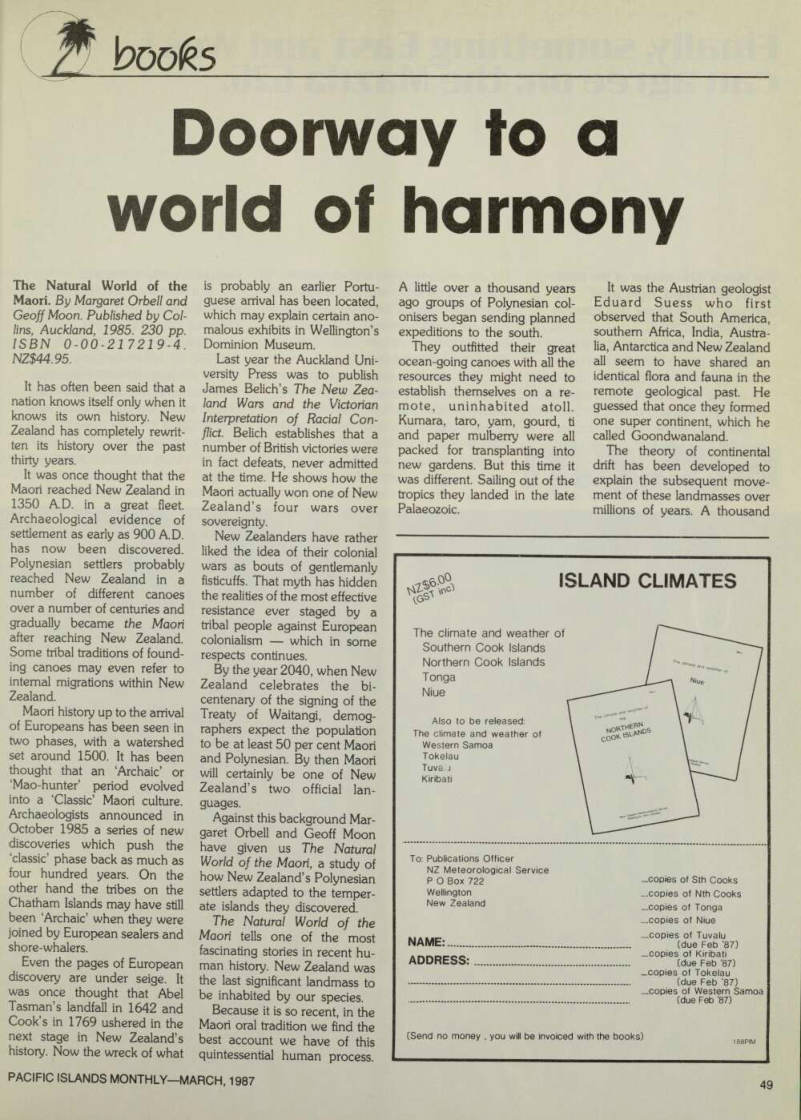
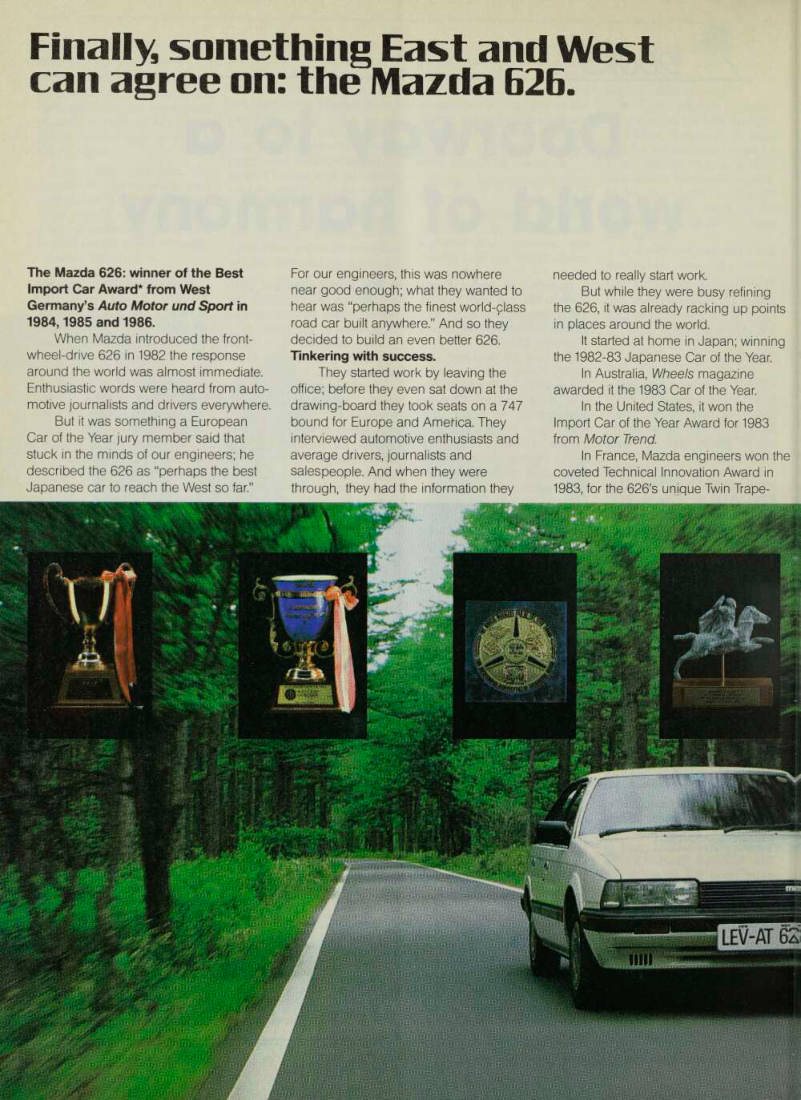
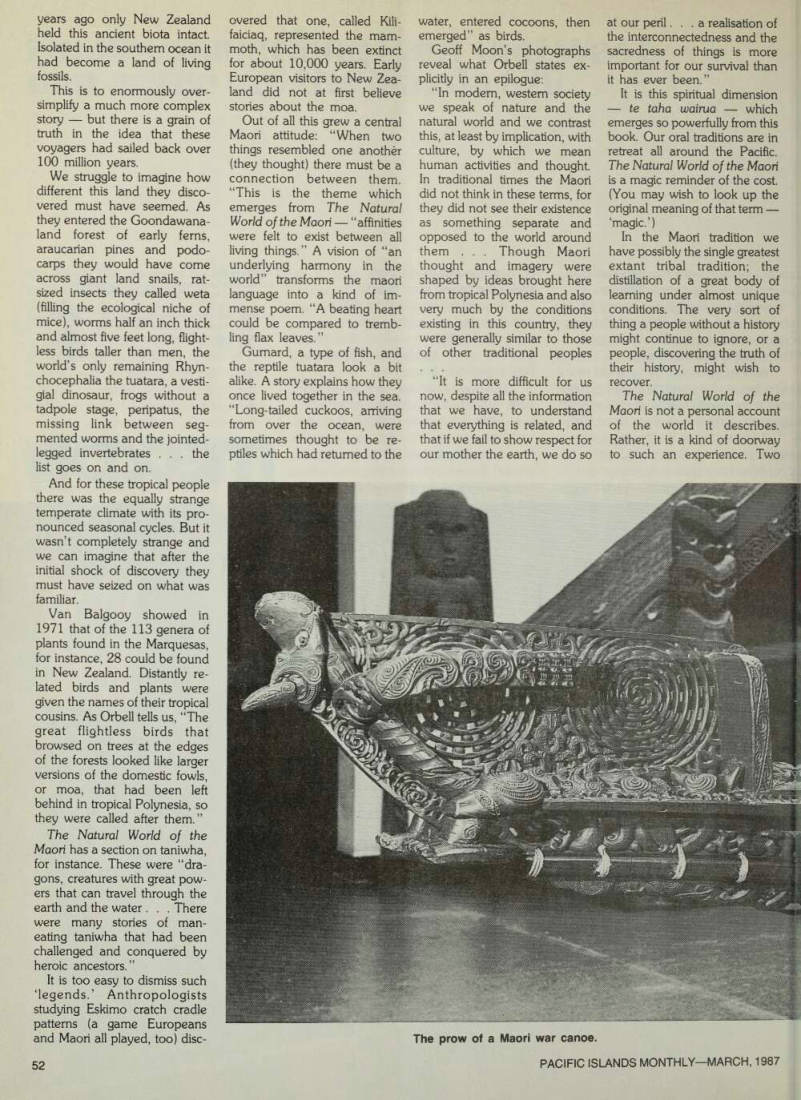
books
Doorway to a world of harmony
The Natural World of the Maori. By Margaret Orbell and Geoff Moon. Published by Col lins, Auckland, 1985. 230 pp.
Isbn 0-00-21 7219-4.
NZ544.95.
It has often been said that a nation knows itself only when it knows its own history. New Zealand has completely rewrit ten its history over the past thirty years.
It was once thought that the Maori reached New Zealand in 1350 A.D. in a great fleet.
Archaeological evidence of settlement as early as 900 A.D. has now been discovered.
Polynesian settlers probably reached New Zealand in a number of different canoes over a number of centuries and gradually became the Maori after reaching New Zealand.
Some tribal traditions of found ing canoes may even refer to internal migrations within New Zealand.
Maori history up to the arrival of Europeans has been seen in two phases, with a watershed set around 1500. It has been thought that an ‘Archaic’ or ‘Mao-hunter’ period evolved into a ‘Classic’ Maori culture.
Archaeologists announced in October 1985 a series of new discoveries which push the ‘classic’ phase back as much as four hundred years. On the other hand the tribes on the Chatham Islands may have still been ‘Archaic’ when they were joined by European sealers and shore-whalers.
Even the pages of European discovery are under seige. It was once thought that Abel Tasman’s landfall in 1642 and Cook’s in 1769 ushered in the next stage in New Zealand’s history. Now the wreck of what
is probably an earlier Portu guese arrival has been located, which may explain certain ano malous exhibits in Wellington’s Dominion Museum.
Last year the Auckland Uni versity Press was to publish James Belich’s The New Zea land Wars and the Victorian Interpretation of Racial Con flict. Belich establishes that a number of British victories were in fact defeats, never admitted at the time. He shows how the Maori actually won one of New Zealand’s four wars over sovereignty.
New Zealanders have rather liked the idea of their colonial wars as bouts of gentlemanly fisticuffs. That myth has hidden the realities of the most effective resistance ever staged by a tribal people against European colonialism which in some respects continues.
By the year 2040, when New Zealand celebrates the bi centenary of the signing of the Treaty of Waitangi, demog raphers expect the population to be at least 50 per cent Maori and Polynesian. By then Maori will certainly be one of New Zealand’s two official lan guages.
Against this background Mar garet Orbell and Geoff Moon have given us The Natural World of the Maori, a study of how New Zealand’s Polynesian settlers adapted to the temper ate islands they discovered.
The Natural World of the Maori tells one of the most fascinating stories in recent hu man history. New Zealand was the last significant landmass to be inhabited by our species.
Because it is so recent, in the Maori oral tradition we find the best account we have of this quintessential human process.
A little over a thousand years ago groups of Polynesian col onisers began sending planned expeditions to the south.
They outfitted their great ocean-going canoes with all the resources they might need to establish themselves on a re mote, uninhabited atoll.
Kumara, taro, yam, gourd, ti and paper mulberry were all packed for transplanting into new gardens. But this time it was different. Sailing out of the tropics they landed in the late Palaeozoic.
It was the Austrian geologist Eduard Suess who first observed that South America, southern Africa, India, Austra lia, Antarctica and New Zealand all seem to have shared an identical flora and fauna in the remote geological past. He guessed that once they formed one super continent, which he called Goondwanaland.
The theory of continental drift has been developed to explain the subsequent move ment of these landmasses over millions of years. A thousand
years ago only New Zealand held this ancient biota intact Isolated in the southern ocean it had become a land of living fossils.
This is to enormously over simplify a much more complex story but there is a grain of truth in the idea that these voyagers had sailed back over 100 million years.
We struggle to imagine how different this land they disco vered must have seemed. As they entered the Goondawana land forest of early ferns, araucarian pines and podo carps they would have come across giant land snails, rat sized insects they called weta (filling the ecological niche of mice), worms half an inch thick and almost five feet long, flight less birds taller than men, the world’s only remaining Rhyn chocephalia the tuatara, a vesti gial dinosaur, frogs without a tadpole stage, peripatus, the missing link between seg mented worms and the jointed legged invertebrates ... the list goes on and on.
And for these tropical people there was the equally strange temperate climate with its pro nounced seasonal cycles. But it wasn’t completely strange and we can imagine that after the initial shock of discovery they must have seized on what was familiar.
Van Balgooy showed in 1971 that of the 113 genera of plants found in the Marquesas, for instance, 28 could be found in New Zealand. Distantly re lated birds and plants were given the names of their tropical cousins. As Orbell tells us, “The great flightless birds that browsed on trees at the edges of the forests looked like larger versions of the domestic fowls, or moa, that had been left behind in tropical Polynesia, so they were called after them.”
The Natural World of the Maori has a section on taniwha, for instance. These were “dra gons, creatures with great pow ers that can travel through the earth and the water . . . There were many stories of man eating taniwha that had been challenged and conquered by heroic ancestors.”
It is too easy to dismiss such ‘legends.’ Anthropologists studying Eskimo cratch cradle patterns (a game Europeans and Maori all played, too) disc
overed that one, called Kili faiciaq, represented the mam moth, which has been extinct for about 10,000 years. Early European visitors to New Zea land did not at first believe stories about the moa.
Out of all this grew a central Maori attitude: “When two things resembled one another (they thought) there must be a connection between them.
“This is the theme which emerges from The Natural World of the Maori “affinities were felt to exist between all living things.” A vision of “an underlying harmony in the world” transforms the maori language into a kind of im mense poem. “A beating heart could be compared to tremb ling flax leaves.”
Gurnard, a type of fish, and the reptile tuatara look a bit alike. A story explains how they once lived together in the sea.
“Long-tailed cuckoos, arriving from over the ocean, were sometimes thought to be re ptiles which had returned to the
water, entered cocoons, then emerged” as birds.
Geoff Moon’s photographs reveal what Orbell states ex plicitly in an epilogue; “In modem, western society we speak of nature and the natural world and we contrast this, at least by implication, with culture, by which we mean human activities and thought.
In traditional times the Maori did not think in these terms, for they did not see their existence as something separate and opposed to the world around them . . . Though Maori thought and imagery were shaped by ideas brought here from tropical Polynesia and also very much by the conditions existing in this country, they were generally similar to those of other traditional peoples “It is more difficult for us now, despite all the information that we have, to understand that everything is related, and that if we fail to show respect for our mother the earth, we do so
at our peril... a realisation of the interconnectedness and the sacredness of things is more important for our survival than it has ever been.”
It is this spiritual dimension te taha wairua which emerges so powerfully from this book. Our oral traditions are in retreat all around the Pacific.
The Natural World of the Maori is a magic reminder of the cost. (You may wish to look up the original meaning of that term ‘magic.’) In the Maori tradition we have possibly the single greatest extant tribal tradition; the distillation of a great body of learning under almost unique conditions. The very sort of thing a people without a history might continue to ignore, or a people, discovering the truth of their history, might wish to recover.
The Natural World of the Maori is not a personal account of the world it describes.
Rather, it is a kind of doorway to such an experience. Two
The prow of a Maori war canoe.
quite different keys to that doorway are provided.
On the one hand there are Geoff Moon’s photographs. I have not counted them but there must be well over one hundred, together with numer ous early lithographs and en gravings.
All of these are sourced and the tribal owners of meeting houses photographed were asked their permission and are acknowledged. This is a model for how other photographers, approaching indigenous Pacific peoples, ought to go about their work.
Orbell’s text is tattooed with numerous Maori proverbs and lines of poetry which are given in both Maori and English. In her earlier work with Mervyn McLean, Traditional Songs of the Maori (1975), she described how, “The reader of Maori songs soon discovers that there are certain images, expressions and ideas which recur through out the literature.
“In the modem tradition of English literature they would become cliches, but in Maori such expressions only gain in authority with each new use”.
Orbell’s use of them here recalls that tradition. Readers who have not met these proverbs before will find them utterly beautiful.
A poet’s tears, for example, were “likened to he pua korau e ruia, e tipu i te warn,” that is, “spore of the mamaku spread around in summer”. The mamaku is a tree fem whose drooping fronds were said to be bent in grief.
People who lived near the sea were “he karoro inu tai”
“a black-backed gull that drinks the tide.” Malicious gossip was called the sting of a sting-ray. In the nineteenth century the Maori described themselves as the coast facing the en croaching sea, the world brought by the Europeans.
In both Maori and English Margaret Orbell acknowledges her thanks to Maori writers, living and of earlier generations, for their assistance and songs.
One of them, Apirana Ngata, once spoke of such expressions of wisdom as flowers growing by our doorsteps.
As he said, we have only to gather them. The Natural World of the Maori is truly such a doorway. D. S. Long.
Advertisements & other items, pp. 49-53 (1 item)
Island Climates
The climate and weather of Southern Cook Islands Northern Cook Islands
Tonga
Niue Also to be released; The climate and weather of Western Samoa Tokelau Tuva, j Kiribati To: Publications Officer NZ Meteorological Service P O Box 722 Wellington New Zealand
NAME:
ADDRESS:
-copies of Sth Cooks ...copies of Nth Cooks -..copies of Tonga ...copies of Niue ...copies of Tuvalu (due Feb ’B7) ...copies of Kiribati (due Feb ’B7) -copies of Tokelau (due Feb ’873 ...copies of Western Samoa (due Feb ’873 (Send no money , you will be invoiced with the books)
188PIM
Finally, something East and West
can agree on: the Mazda 626.
The Mazda 626: winner of the Best Import Car Award* from West Germany’s Auto Motor und Sport in 1984,1985 and 1986.
When Mazda introduced the frontwheel-drive 626 in 1982 the response around the world was almost immediate.
Enthusiastic words were heard from automotive journalists and drivers everywhere.
But it was something a European Car of the Year jury member said that stuck in the minds of our engineers; he described the 626 as “perhaps the best Japanese car to reach the West so far.”
For our engineers, this was nowhere near good enough; what they wanted to hear was “perhaps the finest world-class road car built anywhere.” And so they decided to build an even better 626.
Tinkering with success.
They started work by leaving the office: before they even sat down at the drawing-board they took seats on a 747 bound for Europe and America. They interviewed automotive enthusiasts and average drivers, journalists and salespeople. And when they were through, they had the information they needed to really start work.
But while they were busy refining the 626, it was already racking up points in places around the world.
It started at home in Japan; winning the 1982-83 Japanese Car of the Year.
In Australia, Wheels magazine awarded it the 1983 Car of the Year.
In the United States, it won the Import Car of the Year Award for 1983 from Motor Trend.
In France, Mazda engineers won the coveted Technical Innovation Award in 1983, for the 626’s unique Twin Trape-
:oidal Link Suspension incorporating an Hectronic variable shock absorber.
In 1984, in the U.SA, Car and Driver :hose the 626 as one of the year’s ten best ars. And the awards didn’t stop there, he world is our test track.
As the 626 was winning all this recogition around the world, Mazda engineers /ere busy travelling around the world yet gain, this time with an even better 626.
It was tested on the steep, winding tountain roads of Switzerland and in the >ng desert stretches in America, elivering performance that could only be described as. world-class.
We’re out to win your heart.
Already the latest Mazda 626 has demonstrated its winning ways, capturing in 1986, for an incredible third year in a row, Auto Motor und Sport’s Best Import Car Award.
But as you can see from our engineers’ dedication to building a better 626 even while the awards were piling up, it isn’t the awards we’re out to win. We’re out to win your heart. Even if we have to go around the world several times to do it. •Under 1800 cc engine class.
Mazda 626 Models and features shown may not be available in your area. Please consult your local Mazda dealer. Enter the “Mazda Family Photo Contest ’88."
For further information, please contact your nearest Mazda dealer. Contest closes on . .
June 30. 1987.
mazoa
■ © Mazda Motor Corporation
Go to the Head of the Class km F 5 x 770
NEWT
320 W (PMPO) to give you a full, . high-fidelity sound.
The X-770 also brings you great features like Mic Mixing, Dolby* B/C NR, and a 5-band graphic equalizer. A double auto-reverse cassette deck offers added listening convenience and tape dubbing. Also available are the more economical Systems / X-330 and X-110.
The New Personna Plus from Pioneer. A class act in home audio convenience and enjoyment.
X-330 X-110 Move up to New Personna Plus from Pioneer.
And put compact, advanced audio technology at your fingertips.
With the X-770, you’ll enjoy full-function remote control for amp, tuner, cassette deck, turntable, and even an optional CD player.
There’s Stereo Wide for expanded ambience from stereo signals plus Simulated Stereo for wide, stereo-like signals from even mono signals.
And for power, the X-770 puts out a full * "Dolby" and the double-D symbol are trademarks of Dolby Laboratories Licensing Corporation.
Nofe: The optional PD-X707(8K) CD player is shown above.
CM) PIONEER*
The future of sound and vision.
For further information, please contact: Australia; Pioneer Electronics Australia Pty. Ltd. (Incorporated in Victoria) P.O. Box 295, Mordialloc, Victoria, 3195 Tel: 580-9911 Fiji Islands; Brijlal & Company, G.P.O. Box No. 362, Suva, Fiji Islands TeL 22258 New Zealand: Monaco Distributors Ltd., 2 Poland Road, Glenfield, Auckland New Zealand Tel: (09) 444-9144 Norfolk Island: Burnt Pine Traders Ltd., P.O. Box 21, Norfolk Island Vanuatu: Burns Philp (Vanuatu) Ltd., Vila, Vanuatu Nauru Island: Jacob Enterprises, P.O. Box N 0.4, Republic of Nauru Tahiti: Tahiti Hi-Fi, P.O. Box 848, Papeete, Tahiti New Caledonia: Menard Pacifique Sari, B.P. 3899, Noumea, New Caledonia Tel: 27*62.23 American Samoa: Transpac Corporation, P.O. Box 1477, Pago Pago, American Samoa 96799 Tel: 633-5224 Rarotonga; South Seas International Ltd., P.O. Box 49, Rarotonga, Cook Islands Tel: 2327
‘Seaspeak’ breaks
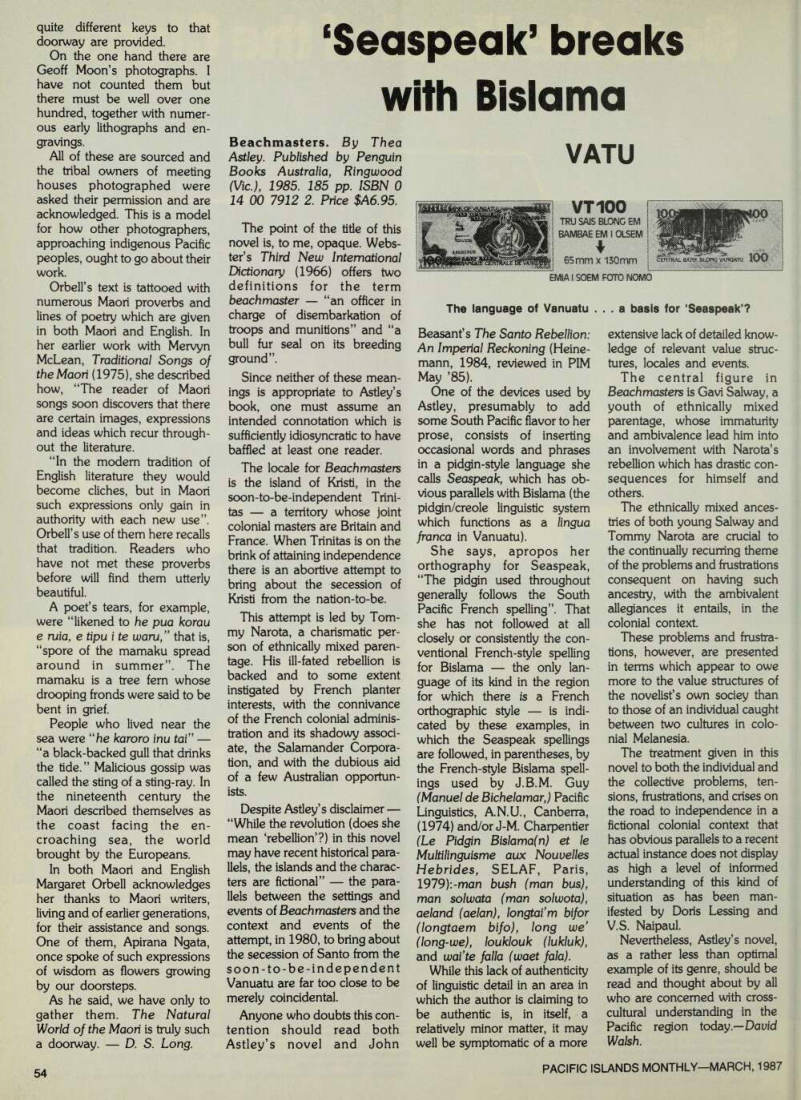
with Bislama
Vatu
Beachmasters. By Thea Astley. Published by Penguin Books Australia, Ringwood (Vic.), 1985. 185 pp. ISBN 0 14 00 7912 2. Price $A6.95.
The point of the title of this novel is, to me, opaque. Webs ter’s Third New International Dictionary (1966) offers two definitions for the term beachmaster “an officer in charge of disembarkation of troops and munitions” and “a bull fur seal on its breeding ground”.
Since neither of these mean ings is appropriate to Astley’s book, one must assume an intended connotation which is sufficiently idiosyncratic to have baffled at least one reader.
The locale for Beachmasters is the island of Kristi, in the soon-to-be-independent Trini tas a territory whose joint colonial masters are Britain and France. When Trinitas is on the brink of attaining independence there is an abortive attempt to bring about the secession of Kristi from the nation-to-be.
This attempt is led by Tom my Narota, a charismatic per son of ethnically mixed paren tage. His ill-fated rebellion is backed and to some extent instigated by French planter interests, with the connivance of the French colonial adminis tration and its shadowy associ ate, the Salamander Corpora tion, and with the dubious aid of a few Australian opportun ists.
Despite Astley’s disclaimer “While the revolution (does she mean ‘rebellion’?) in this novel may have recent historical para llels, the islands and the charac ters are fictional” the para llels between the settings and events of Beachmasters and the context and events of the attempt, in 1980, to bring about the secession of Santo from the soon-to-be-independent Vanuatu are far too close to be merely coincidental.
Anyone who doubts this con tention should read both Astley’s novel and John
Beasant’s The Santo Rebellion: An Imperial Reckoning (Hcine mann, 1984, reviewed in PIM May ’B5).
One of the devices used by Astley, presumably to add some South Pacific flavor to her prose, consists of inserting occasional words and phrases in a pidgin-style language she calls Seaspeak, which has ob vious parallels with Bislama (the pidgin/creole linguistic system which functions as a lingua franca in Vanuatu).
She says, apropos her orthography for Seaspeak, “The pidgin used throughout generally follows the South Pacific French spelling”. That she has not followed at all closely or consistently the con ventional French-style spelling for Bislama the only lan guage of its kind in the region for which there is a French orthographic style is indi cated by these examples, in which the Seaspeak spellings are followed, in parentheses, by the French-style Bislama spell ings used by J.B.M. Guy (Manuel de Bichelamar,) Pacific Linguistics, A.N.U., Canberra, (1974) and/or J-M. Charpentier (Le Pidgin Bislama(n) et le Multilinguisme aux Nouuelles Hebrides, SELAF, Paris, 1979):-man bush (man bus), man solwata (man solwota), aeland (aelan), longtai’m bifor (longtaem bifo), long we (long-we), louklouk (lukluk), and wai’te falla (waet fala).
While this lack of authenticity of linguistic detail in an area in which the author is claiming to be authentic is, in itself, a relatively minor matter, it may well be symptomatic of a more
extensive lack of detailed know ledge of relevant value struc tures, locales and events.
The central figure in Beachmasters is Gavi Salway, a youth of ethnically mixed parentage, whose immaturity and ambivalence lead him into an involvement with Narota’s rebellion which has drastic con sequences for himself and others.
The ethnically mixed ances tries of both young Salway and Tommy Narota are crucial to the continually recurring theme of the problems and frustrations consequent on having such ancestry, with the ambivalent allegiances it entails, in the colonial context.
These problems and frustra tions, however, are presented in terms which appear to owe more to the value structures of the novelist’s own sociey than to those of an individual caught between two cultures in colo nial Melanesia.
The treatment given in this novel to both the individual and the collective problems, ten sions, frustrations, and crises on the road to independence in a fictional colonial context that has obvious parallels to a recent actual instance does not display as high a level of informed understanding of this kind of situation as has been man ifested by Doris Lessing and V.S. Naipaul.
Nevertheless, Astley’s novel, as a rather less than optimal example of its genre, should be read and thought about by all who are concerned with cross cultural understanding in the Pacific region today.— David Walsh.
The language of Vanuatu ... a basis for ‘Seaspeak’?
political ambition
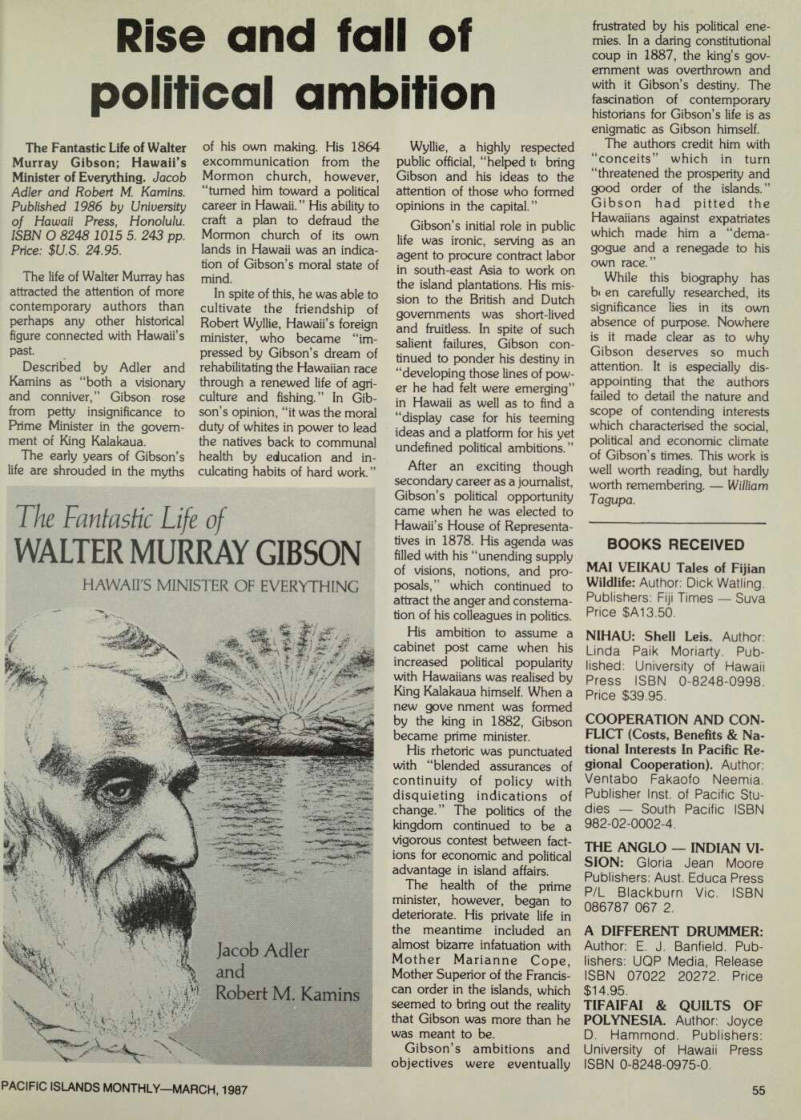
Rise and fall of political ambition
The Fantastic Life of Walter Murray Gibson; Hawaii’s Minister of Everything. Jacob Adler and Robert M. Kamins.
Published 1986 by University of Hawaii Press, Honolulu.
ISBN O 8248 1015 5. 243 pp.
Price: SU.S. 24.95.
The life of Walter Murray has attracted the attention of more contemporary authors than perhaps any other historical figure connected with Hawaii’s past.
Described by Adler and Kamins as “both a visionary and conniver,” Gibson rose from petty insignificance to Prime Minister in the govern ment of King Kalakaua.
The early years of Gibson’s life are shrouded in the myths
of his own making. His 1864 excommunication from the Mormon church, however, “turned him toward a political career in Hawaii.” His ability to craft a plan to defraud the Mormon church of its own lands in Hawaii was an indica tion of Gibson’s moral state of mind, In spite of this, he was able to cultivate the friendship of Robert Wyllie, Hawaii’s foreign minister, who became “im pressed by Gibson’s dream of rehabilitating the Hawaiian race through a renewed life of agri culture and fishing.” In Gib son’s opinion, “it was the moral duty of whites in power to lead the natives back to communal health by education and in culcating habits of hard work. ”
Wyllie, a highly respected public official, “helped t( bring Gibson and his ideas to the attention of those who formed opinions in the capital.”
Gibson’s initial role in public life was ironic, serving as an agent to procure contract labor in south-east Asia to work on the island plantations. His mis sion to the British and Dutch governments was short-lived and fruitless. In spite of such salient failures, Gibson con tinued to ponder his destiny in “developing those lines of pow er he had felt were emerging” in Hawaii as well as to find a “display case for his teeming ideas and a platform for his yet undefined political ambitions.”
After an exciting though secondary career as a journalist, Gibson’s political opportunity came when he was elected to Hawaii’s House of Representa tives in 1878. His agenda was filled with his “unending supply of visions, notions, and pro posals,” which continued to attract the anger and consterna tion of his colleagues in politics.
His ambition to assume a cabinet post came when his increased political popularity with Hawaiians was realised by King Kalakaua himself. When a new gove nment was formed by the king in 1882, Gibson became prime minister.
His rhetoric was punctuated with “blended assurances of continuity of policy with disquieting indications of change.” The politics of the kingdom continued to be a vigorous contest between fact ions for economic and political advantage in island affairs.
The health of the prime minister, however, began to deteriorate. His private life in the meantime included an almost bizarre infatuation with Mother Marianne Cope, Mother Superior of the Francis can order in the islands, which seemed to bring out the reality that Gibson was more than he was meant to be.
Gibson’s ambitions and objectives were eventually
frustrated by his political ene mies. In a daring constitutional coup in 1887, the king’s gov ernment was overthrown and with it Gibson’s destiny. The fascination of contemporary historians for Gibson’s life is as enigmatic as Gibson himself.
The authors credit him with “conceits” which in turn “threatened the prosperity and good order of the islands. ”
Gibson had pitted the Hawaiians against expatriates which made him a “dema gogue and a renegade to his own race.”
While this biography has b< en carefully researched, its significance lies in its own absence of purpose. Nowhere is it made clear as to why Gibson deserves so much attention. It is especially dis appointing that the authors failed to detail the nature and scope of contending interests which characterised the social, political and economic climate of Gibson’s times. This work is well worth reading, but hardly worth remembering. William Tagupa.
Books Received
MAI VEIKAU Tales of Fijian Wildlife: Author: Dick Watling.
Publishers: Fiji Times Suva Price 5A13.50.
NIHAU: Shell Leis. Author: Linda Paik Moriarty. Pub lished: University of Hawaii Press ISBN 0-8248-0998.
Price $39.95.
Cooperation And Con
FLICT (Costs, Benefits & Na tional Interests In Pacific Re gional Cooperation). Author: Ventabo Fakaofo Neemia.
Publisher Inst, of Pacific Stu dies South Pacific ISBN 982-02-0002-4.
The Anglo Indian Vi
SION: Gloria Jean Moore Publishers: Aust. Educa Press P/L Blackburn Vic. ISBN 086787 067 2.
A Different Drummer:
Author: E. J, Banfield. Pub lishers: UQP Media, Release ISBN 07022 20272. Price $14.95.
Tifaifai & Quilts Of
POLYNESIA. Author: Joyce D. Hammond. Publishers: University of Hawaii Press
Isbn 0-8248-0975-0.
Advertisements & other items, p. 56 (1 item)
BeiVsqm mi
H ( u CP ft' n /s B : ■
TRADITIONALLY THE NAME
ASSOCIATED WITH PERFECTION
IN CIGARETTES
BENSON « HEDGES
v- -20 lu a
BeiVsqm mi
WMI-SBOWMIS A HEALTH HAZARD
' 'W 818
ONLY THE BEST WILL DO
Malaria: The killer that
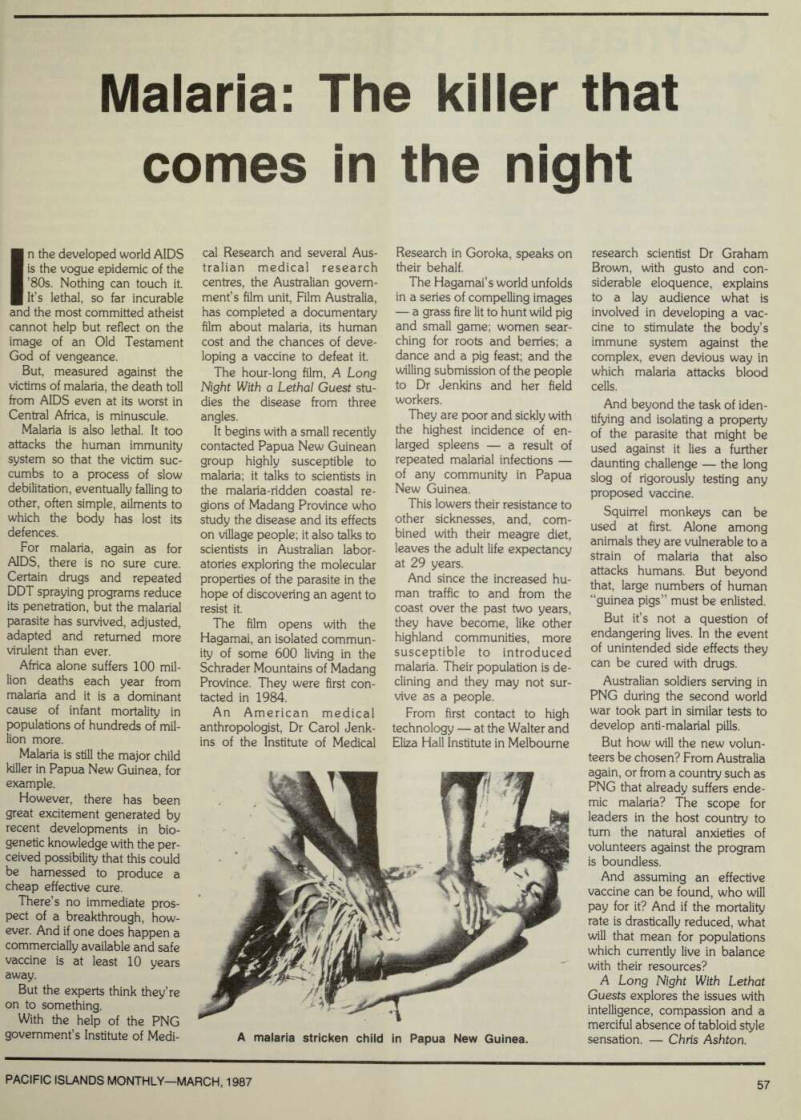
comes in the night
■ n the developed world AIDS I is the vogue epidemic of the ’Bos. Nothing can touch it. It’s lethal, so far incurable and the most committed atheist cannot help but reflect on the image of an Old Testament God of vengeance.
But, measured against the victims of malaria, the death toll from AIDS even at its worst in Central Africa, is minuscule.
Malaria is also lethal. It too attacks the human immunity system so that the victim suc cumbs to a process of slow debilitation, eventually falling to other, often simple, ailments to which the body has lost its defences.
For malaria, again as for AIDS, there is no sure cure.
Certain drugs and repeated DDT spraying programs reduce its penetration, but the malarial parasite has survived, adjusted, adapted and returned more virulent than ever.
Africa alone suffers 100 mil lion deaths each year from malaria and it is a dominant cause of infant mortality in populations of hundreds of mil lion more.
Malaria is still the major child killer in Papua New Guinea, for example.
However, there has been great excitement generated by recent developments in bio genetic knowledge with the per ceived possibility that this could be harnessed to produce a cheap effective cure.
There’s no immediate pros pect of a breakthrough, how ever. And if one does happen a commercially available and safe vaccine is at least 10 years away.
But the experts think they’re on to something.
With the help of the PNG government’s Institute of Medi
cal Research and several Aus tralian medical research centres, the Australian govern ment’s film unit, Film Australia, has completed a documentary film about malaria, its human cost and the chances of deve loping a vaccine to defeat it.
The hour-long film, A Long Night With a Lethal Guest stu dies the disease from three angles.
It begins with a small recently contacted Papua New Guinean group highly susceptible to malaria; it talks to scientists in the malaria-ridden coastal re gions of Madang Province who study the disease and its effects on village people; it also talks to scientists in Australian labor atories exploring the molecular properties of the parasite in the hope of discovering an agent to resist it.
The film opens with the Hagamai, an isolated commun ity of some 600 living in the Schrader Mountains of Madang Province. They were first con tacted in 1984.
An American medical anthropologist, Dr Carol Jenk ins of the Institute of Medical
Research in Goroka, speaks on their behalf.
The Hagamai’s world unfolds in a series of compelling images a grass fire lit to hunt wild pig and small game; women sear ching for roots and berries; a dance and a pig feast; and the willing submission of the people to Dr Jenkins and her field workers.
They are poor and sickly with the highest incidence of en larged spleens a result of repeated malarial infections of any community in Papua New Guinea.
This lowers their resistance to other sicknesses, and, com bined with their meagre diet, leaves the adult life expectancy at 29 years.
And since the increased hu man traffic to and from the coast over the past two years, they have become, like other highland communities, more susceptible to introduced malaria. Their population is de clining and they may not sur vive as a people.
From first contact to high technology at the Walter and Eliza Hall Institute in Melbourne
research scientist Dr Graham Brown, with gusto and con siderable eloquence, explains to a lay audience what is involved in developing a vac cine to stimulate the body’s immune system against the complex, even devious way in which malaria attacks blood cells.
And beyond the task of iden tifying and isolating a property of the parasite that might be used against it lies a further daunting challenge the long slog of rigorously testing any proposed vaccine.
Squirrel monkeys can be used at first. Alone among animals they are vulnerable to a strain of malaria that also attacks humans. But beyond that, large numbers of human “guinea pigs” must be enlisted.
But it’s not a question of endangering lives. In the event of unintended side effects they can be cured with drugs.
Australian soldiers serving in PNG during the second world war took part in similar tests to develop anti-malarial pills.
But how will the new volun teers be chosen? From Australia again, or from a country such as PNG that already suffers ende mic malaria? The scope for leaders in the host country to turn the natural anxieties of volunteers against the program is boundless.
And assuming an effective vaccine can be found, who will pay for it? And if the mortality rate is drastically reduced, what will that mean for populations which currently live in balance with their resources?
A Long Night With Lethat Guests explores the issues with intelligence, compassion and a merciful absence of tabloid style sensation. Chris Ashton.
A malaria stricken child in Papua New Guinea.
Carnage in paradise
Tahitian car licence plates raise eyebrows everywhere in Europe due to the almost universal belief, carefully nur tured by the tourist brochures, that Tahiti is an unspoiled para dise where not only money and hard work but also motor ve hicles are totally unknown.
Sometimes here on the is land, when caught in one of the giant traffic jams caused by Papeete’s daily influx of 15,000 to 20,000 commuters (the total number of cars has now reached almost 50,000), we cannot resist a wry smile.
As a rule, it is quickly re placed by feelings of disgust and anguish as we pass a wrecked car in a ditch or hear the sirens of ambulance and police vehicles racing to the scene of yet another bloody accident.
The local press carry daily horror stories with lurid illustra tions of dead and dying acci dent victims.
The Monday papers, in particular, are not for those with weak stomachs. They record the numerous violent deaths which occur each weekend when drunken joy riders rule the roads.
Tragically and criminally one third of the victims in this carnage are pedestrians, mostly young children and teenagers. Many drivers do not bother to stop.
The official statistics for 1985 and 1986, which are as follows: 1986 Number of 1985 accidents 595 455 Persons injured 792 651 Persons killed 60 46 And 1985 wasn’t the worst year. The most chilling statistics, however, are not the 50 to 60 killed each year but the ex tremely high number of people left maimed or invalid for the rest of their lives.
Although the annual import of new cars and trucks amounts to about 5,000 the import of motorbikes is about the same the injnury rate has re mained remarkably stable: be tween 700 and 800 per year.
This means that the total number of serious injuries re corded in the last 21 years
would be of the order 15,000 one in eight of the Tahitian population of 120,000.
On the other islands of French Polynesia car accidents are still rare though statistics are unavailable.
A side effect of all these injuries is that hard pressed medical staff who work night and day in the government hospital in Papeete are kept busy mending bones and sav ing lives, leaving much less time for other kinds of patients and such things as medical surveys.
Comparisons with other countries with similar densities of cars underline the problem.
In the mother country, France, for instance 12,000 people die on the roads each year 23 per 100,000 population.
In Sweden and Great Britain the corresponding rates are 10 and 15. The New Zealand death rate is 22 and the Austra lian rate has been as high as 30 per 100,000 population.
But Tahiti, with 1985 rate of 55, leaves them all behind.
Tahitian reaction to this new form of “fatal impact” (to bor row Alan Moorehead’s famous phrase) has been mild.
Confronted with daily traffic accidents, many Polynesians have adopted a fatalistic atti tude that it’s the price to be paid for ’’modernisation.”
The loudest complaints come from the recently-arrived French settlers who normally have a better grasp of the problems involved and a wider knowledge of how citizens can obtain redress.
For years the newspapers have been filled with excellent suggestions on how to reduce the carnage.
One suggestion to prohibit the import of high-powered cars and motorbikes which in evitably tempt their owners to exceed the 80 kph speed limit brought the official reaction that this would be contrary to the human right of free choice.
Another question often asked is why there have been so few road improvements since the slaughter began 20 years ago.
This elicits the reply that there is no money available.
Thus, drivers on the splendid four lane highway whose six
miles traverse the hills west of Papeete to the narrow coastal road built 100 years ago for four legged traffic, are trying to empty a gallon bucket into a pint jar.
Local government politicians have many times brought for ward sensible suggestions.
The result so far, however, has been nil. That’s because the power to enact and enforce traffic laws does not belong to the elected Polynesian leaders but to the government of France.
Also, there’s the perennial problem of having too few law enforcement personnel. About 150 locally recruited policemen for Papeete and 200 French gendarmes for the rest of the colony are charged with the wearisome task of catching thieves, muggers, burglars, embezzlers, wife beaters, rapists and murderers. (The crime rate last year was almost 6,000).
Asked by their electors why the traffic brigades are not strengthened, the local politi cians can only answer that they are powerless. All budget in creases for the urban police force and the gendarmerie under the control of the (French) Ministry of the Interior and the (French) Ministry of Defence must be voted by the National Assembly in Paris.
The deputies there are understandably more con cerned with issues in their own constituencies than with prob lems in the overseas territories.
This lack of personnel ex plains, for example, why the painting of Zebra Crossings in Papeete has had the opposite to the intended effect.
We locals know from long experience that, due to the total absence of police supervision, no driver ever stops at these crossings.
There are, on the other hand, always some poor tourists who believe it safe to use them and consequently end their holidays in hospital if not the cemetery.
According to the official statistics the cause of about a third of all road accidents is excessive speed. Yet few checks are made because there are not enough trained gen darmes to handle the single
speed recorder which, moreov er, is frequently damaged by the tropical heat and humidity and has to be returned to France for repair.
Another third of the accidents are blamed on drunken drivers and this might be the cause of twice as many accidents since the speeders are often drunk too.
Again, the systematic con trols which exist in other coun tries are not instituted here.
Why? Once more the answer is that no local officials, including the minister for transport, are empowered to make such sim ple decisions which cost nothing, while the French deci sion makers, for some un fathomable reason, have never got around to extending to French Polynesia the excellent traffic laws that exist in France.
The ultimate cause of the accident rate, however, is that there are too many cars on Tahiti’s single road which in turn is a direct consequence of the immigration-driven popula tion explosion since the atomic test centre was established in the early ’6os.
The most important group of newcomers are the 30,000 metropolitan Frenchmen who, attracted by the general prosperity and excellent work prospects, have permanently settled in Tahiti. (There is every sign that they will keep coming at the rate of 1,000 to 1,500 a year).
As thousands of fortune seeking Polynesians have also arrived from the outer islands, Tahiti is today suffering from social elephantiasis which man ifests in symptoms such as crime, alcoholism, juvenile de linquency, rape, marriage breakdown and prostitution.
For this reason all political parties (including that of Under secretary of State Gaston Flos se, thought to be the most pro-French of local politicians) are now beseeching France to cease flooding the country with settlers and to immediately transfer immigration control to the locally elected government.
The French reply is a flat refusal. And that will continue to be so as long as the islands are needed for the test prog ram. As a result, there is no end sight to the carnage on Tahiti’s roads. Marie-Therese and Bengt Danielsson.
from the islands press
From a letter by C. Kline in the Cook Islands News, Rarotonga . . . I sat in a local church there and listened as the pastor encouraged the congregation that God will bless your nation because the Lord is your God. I would like to advise you that history proves every nation that has insisted on the use of idols for any reason has been wiped out (destroyed) in one way or another. Your tangaroa not only is pornographic but actually carries with it a demonic stronghold on your nation in the area of lust. The result is teenage pregnancies, rape, incest and emotional hangups.
From the Papua New Guinea Post-Courier, Port Moresby New Ireland MP Noel Levi suggested in Parliament yesterday that only people who earned more than KlO,OOO a year should be allowed to stand for elections. This was because those who earned less could easily be corrupted by businessmen if they won a seat. “Otherwise, raise the wages of members so that they will not be easily influenced by businessmen. ”
A letter by R. Wilkinson of Boroko in the Papua New Guinea Post-Courier, Port Moresby One can only hope the Government will reconsider the values that allow a reduction of duty on beer, while the duty on milk is raised.
From the Cook Islands News, Rarotonga The Immigration Office has received complaints from concerned locals about tourists camping on beaches around Rarotonga.
The complainants claim that the campers pitch tents at night and like phantoms move out before daybreak. The Chief Immigration Officer Tutai Tom said . . . The Cook Islands accepts tourists if they stay in licensed accommodation, but if visitors cannot afford to meet their lodging costs they could be asked to leave the country.
From The Pitcairn Miscellany, Pitcairn Island The installation of the Radio-Telephone equipment last year has been of tremendous benefit to the Island. Voice contact has meant that matters can be handled with greater speed and efficiency than was previously possible with the old system.
The old system relied solely upon morse code, which restricted communication to the sending and receiving of cables. The charges for making overseas calls are also quite reasonable.
Since its installation, the system has been well used by almost everyone.
From a report in the Cook Islands News of a debate in the Cook Islands Parliament While the Prime Minister was getting the verbal abuse from the other side, Minister of Immigration Norman George was getting the pat on the back from the opposition. Earlier, Mr George had threatened to “thump” his arch rival Vincent Ingram “if no-one shut him up”. Later in the day George and Ingram were on good terms again, a fact he publicly announced to the House.
From The Coconut Telegraph, Savusavu, Vanua Levu, Fiji Public flogging has been brought back to Tamavua Village, near Suva, for those found guilty of disturbing the peace, or causing problems, drunkenness or bad language. It is said that things are much quieter now in the village.
From The Fiji Times, Suva Labasa police are investigating a cowboy-type raid in Daku where 140 empty railway trucks were hijacked on Monday afternoon. The trucks, which were bound for Lagalaga, about 35 km from Labasa Town in the Wainikoro Sector, disappeared near Daku. Cane harvesting gangs wanting to jump the queue are suspected to be behind the hijacking.
From a High Court report in the Cook Islands News, Rarotonga A young boy of Avatiu was said by Judge Dillon in court to be drinking far too much liquor even though he was only sixteen. Ngatokorua Tere Teipo, originally of Atiu, was charged with breaking and entering a dwelling in Avatiu.
From a report in Vanuatu Weekly, Port-Vlla, on parliamentary proceedings The bill for the Penal Code (Amendment) Act which repeals the offence of adultery, but makes it grounds for divorce and enables the wronged wife or husband to claim compensation from the correspondent, was passed. The offence of adultery will no longer be a criminal matter, but a civil one.
From the Cook Islands News, Rarotonga A whole year of preparation and planning paid off for Mr and Mrs Rei Jack of Avatiu when on Saturday over a thousand people turned up at the Tupapa Maraereng centre for the haircutting ceremony of their youngest son Lefou . . . The grand affair now becoming quite common in the Cook Islands cost over three thousand dollars alone in materials for decorating the dais.
A public notice in the PNG Post-Courier
Advertisements & other items, p. 59 (1 item)
Ladies!
RETURNING BY POPULAR DEMAND
THE JOCKETTES SATURDAY,
DECEMBER 20TH
Firehouse
THE HOTTEST DISCO IN TOWN
ENTRANCE K 7.50 BUT FREE FOR LADIES,
DINERS AND MEN IN DRAG.
DAVARA HOTEL, PORT MORESBY
21-2100
transitions
Appointed: Registrar of the University of the South Pacific, Mr Philip Rama.
Mr Rama’s appointment takes effect from May 11 when he returns from overseas leave.
He is currently deputy registrar, a post he has held since 1981.
Mr Rama, 45, from Rakiraki, Fiji, received his primary and secondary education in Suva before joining the Fiji Posts and Telecommunications Depart ment in 1957.
In 1960 he joined the De partment of Agriculture where he became executive officer before leaving, in 1966, for tertiary studies at the University of Auckland. He was awarded a Bachelor of Arts degree, with honours, in 1972.
He returned to Fiji in 1973 to become assistant secretary in the prime minister’s depart ment, joining USP as assistant registrar (staffing) the following year.
He has since been assistant registrar (academic) and senior assistant registrar (1978).
Mr Rama was also responsi ble for the university’s Western Samoan campus before be coming deputy registrar.
He has also served with the Fiji Infantry Regiment Territorial Forces (1963-65) and was attached to the New Zealand Infantry Regiment in Papkura in 1965-66.
Appointed: Pacific island dele gates to the US House of Representatives did well when new committee assignments were handed out in January.
Ben Blaz, Republican, of Guam, was named to the pre stigious Foreign Affairs Com mittee, a first for a non-voting delegate. Gen. Blaz added this assignment to existing ones: the Armed Services Committee and the Interior and Insular Affairs Committee.
It is highly unusual for any member, much less one with out a vote on the floor of the House, to serve on three com mittees. (Delegates, like Gen Blaz, do vote in committee).
Meanwhile, Fofo Sunia, Democrat, of American Samoa, secured a sub-committee chairmanship. This too is un
usual because it is a committee which does not relate to island matters the Sub-committee on Public Buildings of the House Committee on Public Works.
It has jurisdiction over federal buildings ranging from the White House and the Capitol to thousands of humble post offices.
The former Insular Affiars Sub-committee of the House Committee on Interior and In sular Affairs is likely to be revived.
Once led by the late Con gressman Phil Burton, a major mover and shaker in the terri tories, and more recently by the former Guam delegate, Won Pat (defeated in 1984 by Gen Blaz), the new sub-committee would be headed by Ron de Lugo, Democrat of the Virgin Islands. (In the US Congress much of the important work is done by sub-committees and committees; members of the minority party, such as Gen Blaz, do not become committee chairs.) Appointed: Sales manager for Australia, Papua New Guinea and New Caledonia of Emery Worldwide air freight company, Mr Herbert Brenner.
He replaces Mr Nick Gurney who has returned to the United States.
Expanding: Honolulu law firm, Reinwald O’Connor and Mar rack. The company is expan
ding its activities in Micronesia and the Western Pacific by affiliation with Honolulu attor ney, George Allen, former head of the Honolulu office of the New York-based legal firm, Cadwalader, Wickersham and Taft.
Mr Allen, 45, became coun sel to Reinwald O’Connor and Marrack in January.
Mr Allen spent five years in the Marshall Islands before moving to Hawaii. While in the Marshalls, he led litigation and negotiation efforts on behalf of the radiation victims at Bikini Atoll and also represented land owners at Kwajalein.
He also acts for the owners of 5,000 acres used as military bases on Guam.
Appointed: To New Zealand’s Pacific Island Employment De velopment Board, Fatafehi Tuionetoa Fale and Mrs Mele moka Maka.
Mr Fale, bom and educated in Tonga where he trained as a teacher, has lived in New Zea land for 14 years.
He has been general mana ger of Tonga Enterprises, an Auckland-based importing and travel concern.
He has also written Bible commentaries for young Ton gans.
Mrs Maka, a Nuiean who has lived in New Zealand since 1953, is a mother of six and has wide involvement in commun ity activities through the Niue
Advisory Council, Auckland’s Pacific Island Educational Re source Centre and the Citizens Advice Bureau.
The other board members are Mrs Kathleen Kauti (Cook Islands), Mr Jack Shaw (Fiji), Mr Aleki Siloa (Tokelau) and Hon Richard Prebble, who, as minister, is chairman.
Returned: To New Zealand, former head of the Cook Is lands Treasury Department, Mr Paul Drury after seven years with the department.
He began work with the treasury in 1980 and became financial secretary in 1982. Mr Drury, 36, said he felt it was time to return to New Zealand to pursue his long-term career.
Re-assigned: Three senior Solomon Islands civil servants Mr Francis Saemala, Mr John Rofeta and Mr Daniel Buto.
Mr Saemala, former ambas sador to the UN, is the new secretary to the Cabinet and Prime Minister’s Office.
Mr Rofeta, who was perma nent secretary at the Ministry of Economic Planning before going on study leave last year, becomes Permanent Secretary of Finance.
Mr Buto, the former secretary to Cabinet and the Prime Minis ter’s Office, is the new perma nent secretary to the Ministry of Transport, Works and Utilities.
He replaces Mr Brown Saua, who resigned from the public service on December 31.
Deaths
Alfred Lawton Story, of Raro tonga, Cook Islands. Known to all the islanders as Fred, he was the only son of Martha and Dr Cuthbert Story of Edinburgh, Scotland where he was bom in 1911.
He was a self-taught engineer who was well known through out the Cook Islands and New Zealand.
Lery Ray, one of Tahiti’s best known hoteliers died of bone cancer on January 2, aged 56.
Mr Rey, who owned the Hotel Te Puna Bel Air on Tahiti, the Hotel Moorea La
goon on Moorea and two Pape ete nightclubs, was among the first Tahitians to enter the hotel industry when he bought the Bel Air 17 years ago.
Until his illness he was presi dent of the Polynesian Hotel Association and vice-president of the Chamber of Commerce and Industry. He is survived by his wife and five children.
Kuri Dom, a Papua New Gui nean student studying in Eng land died on January 17.
Mr Dom, 37, from Chimbu province, was studying for a PhD in economics at the Lon don School of Economics. No cause of death was given.
Announcing his death, the
University of Papua New Guinea registrar, Mr Frank Diala, said the whole UPNG community had been stunned by the sudden tragedy.
Mr Dom joined the univer sity’s Department of Anthropol ogy and Sociology in 1978 after completing a BA degree in social work. After completing a BA honours degree in 1979 and a master’s degree in econo mics at LSE in 1981, he was appointed a lecturer before re turning to London to further his studies.
He leaves a wife, Ruth, and children, Grace, Michael and Paul.
shipping schedules
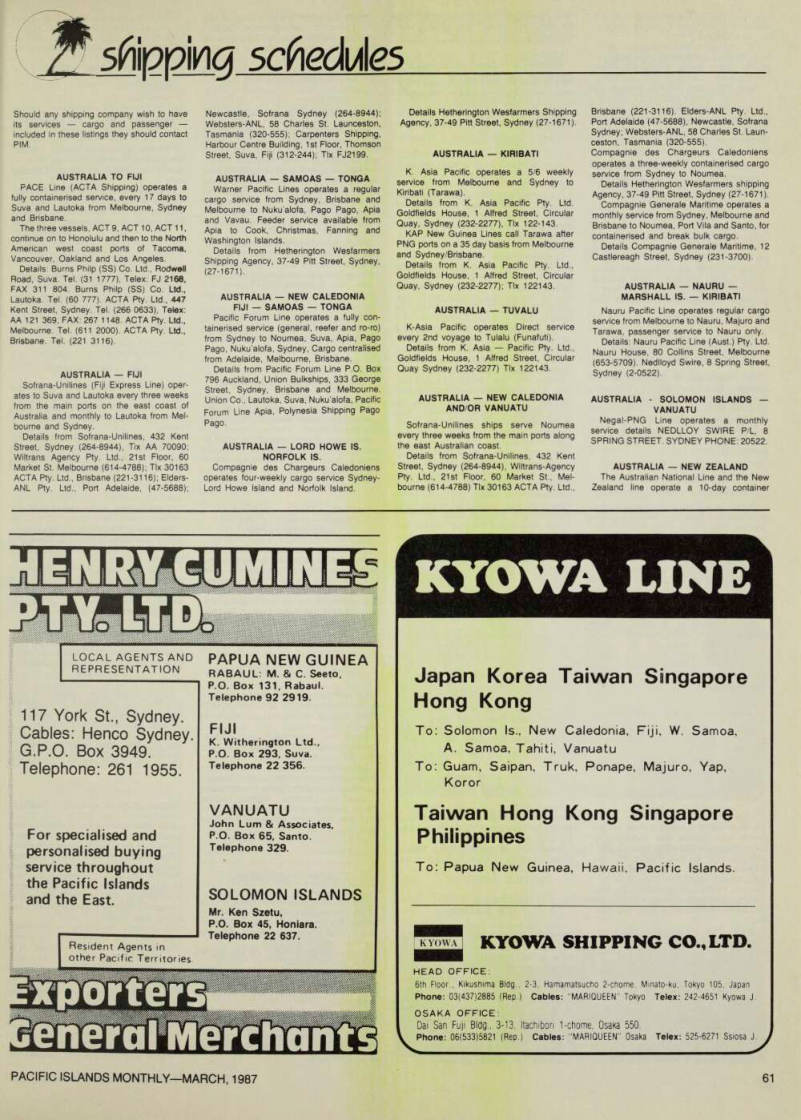
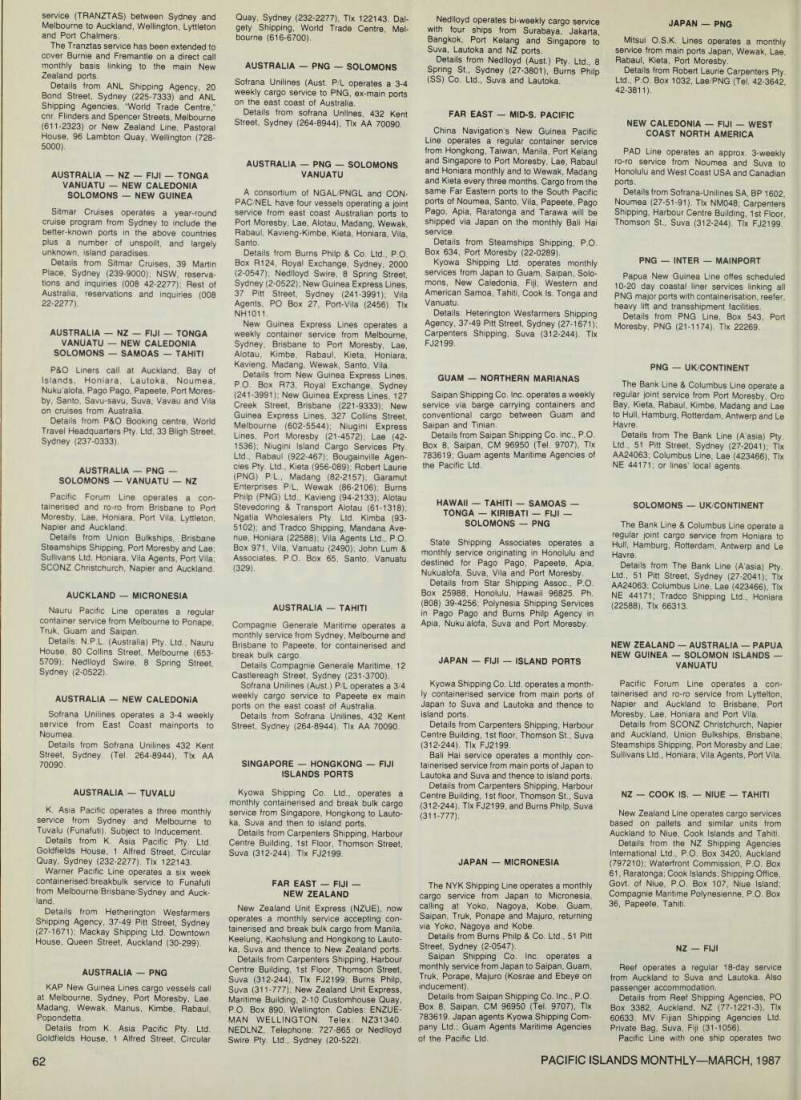
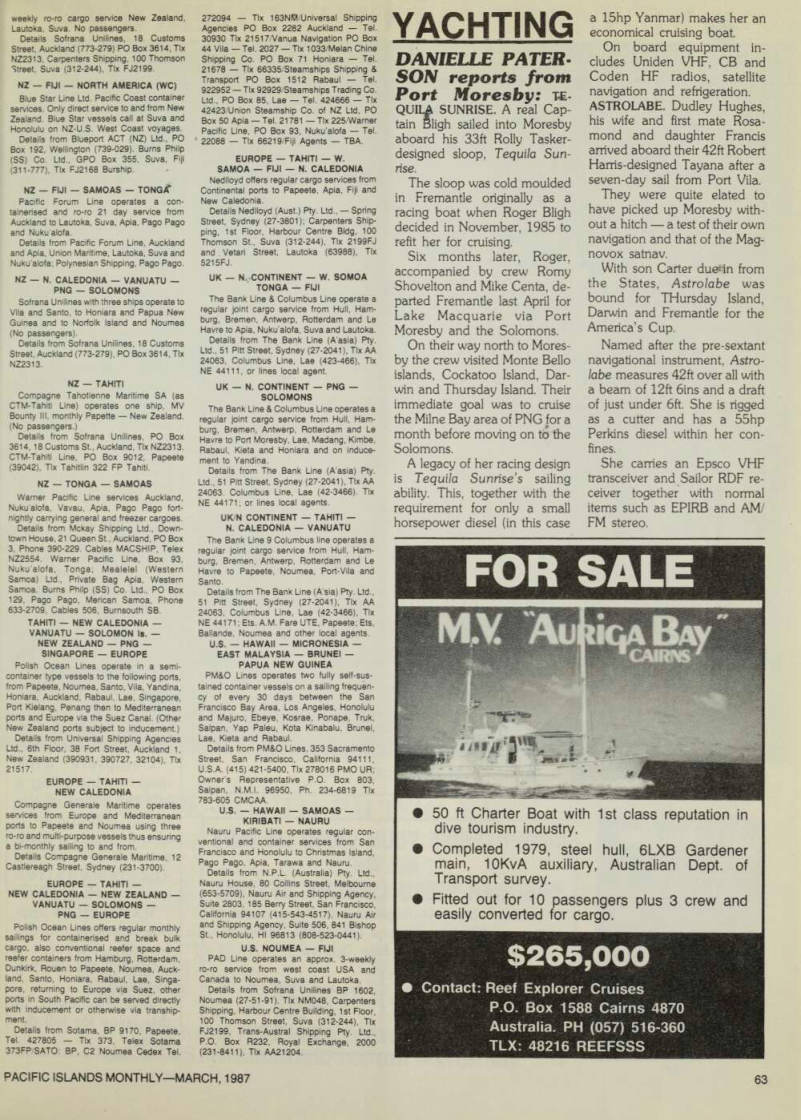
Should any shipping company wish to have its services cargo and passenger included in these listings they should contact
Pim.
Australia To Fiji
PACE Line (ACTA Shipping) operates a fully containerised service, every 17 days to Suva and Lautoka from Melbourne, Sydney and Brisbane.
The three vessels, ACT 9, ACT 10. ACT 11. continue on to Honolulu and then to the North American west coast ports of Tacoma, Vancouver, Oakland and Los Angeles.
Details: Burns Philp (SS) Co. Ltd., Rodwell Road, Suva. Tel, (31 1777), Telex: FJ 2168, FAX 311 804. Burns Philp (SS) Co. Ltd., Lautoka. Tel, (60 777). ACTA Pty. Ltd., 447 Kent Street, Sydney. Tel. (266 0633), Telex: AA 121 369, FAX: 267 1148. ACTA Pty. Ltd., Melbourne. Tel, (611 2000). ACTA Pty. Ltd., Brisbane. Tel. (221 3116).
Australia Fiji
Sofrana-Unilines (Fiji Express Line) oper ates to Suva and Lautoka every three weeks from the main ports on the east coast of Australia and monthly to Lautoka from Mel bourne and Sydney.
Details from Sofrana-Unilines, 432 Kent Street, Sydney (264-8944), Tix AA 70090; Wiltrans Agency Pty. Ltd., 21st Floor, 60 Market St. Melbourne (614-4788); Tlx 30163 ACTA Pty. Ltd., Brisbane (221-3116); Elders- ANL Pty. Ltd., Port Adelaide, (47-5688);
Newcastle, Sofrana Sydney (264-8944); Websters-ANL, 58 Charles St. Launceston, Tasmania (320-555); Carpenters Shipping, Harbour Centre Building, Ist Floor, Thomson Street, Suva, Fiji (312-244); Tlx FJ2199.
Australia Samoas Tonga
Warner Pacific Lines operates a regular cargo service from Sydney, Brisbane and Melbourne to Nukualofa, Pago Pago, Apia and Vavau. Feeder service available from Apia to Cook, Christmas, Fanning and Washington Islands.
Details from Hetherington Wesfarmers Shipping Agency, 37-49 Pitt Street, Sydney. (27-1671).
Australia New Caledonia
Fiji Samoas Tonga
Pacific Forum Line operates a fully con tainerised service (general, reefer and ro-ro) from Sydney to Noumea, Suva, Apia, Pago Pago, Nukualofa, Sydney, Cargo centralised from Adelaide, Melbourne, Brisbane.
Details from Pacific Forum Line P.O. Box 796 Auckland, Union Bulkships, 333 George Street, Sydney, Brisbane and Melbourne.
Union Co., Lautoka, Suva, Nukualofa, Pacific Forum Line Apia, Polynesia Shipping Pago Pago.
Australia Lord Howe Is.
Norfolk Is.
Compagnie des Chargeurs Caledoniens operates four-weekly cargo service Sydney- Lord Howe Island and Norfolk Island.
Details Hetherington Wesfarmers Shipping Agency, 37-49 Pitt Street, Sydney (27-1671).
Australia Kiribati
K. Asia Pacific operates a 5/6 weekly service from Melbourne and Sydney to Kiribati (Tarawa).
Details from K. Asia Pacific Pty. Ltd.
Goldfields House, 1 Alfred Street, Circular Quay, Sydney (232-2277), Tlx 122-143.
KAP New Guinea Lines call Tarawa after PNG ports on a 35 day basis from Melbourne and Sydney/Brisbane.
Details from K. Asia Pacific Pty. Ltd., Goldfields House, 1 Alfred Street, Circular Quay, Sydney (232-2277); Tlx 122143.
Australia Tuvalu
K-Asia Pacific operates Direct service every 2nd voyage to Tulalu (Funafuti).
Details from K. Asia Pacific Pty. Ltd., Goldfields House, 1 Alfred Street, Circular Quay Sydney (232-2277) Tlx 122143.
Australia New Caledonia
And/Or Vanuatu
Sofrana-Unilines ships serve Noumea every three weeks from the main ports along the east Australian coast.
Details from Sofrana-Unilines, 432 Kent Street, Sydney (264-8944), Wiltrans-Agency Pty. Ltd., 21st Floor, 60 Market St., Mel bourne (614-4788) Tlx 30163 ACTA Pty, Ltd.,
Brisbane (221-3116). Elders-ANL Pty. Ltd., Port Adelaide (47-5688), Newcastle, Sofrana Sydney; Websters-ANL, 58 Charles St. Laun ceston, Tasmania (320-555).
Compagnie des Chargeurs Caledoniens operates a three-weekly containerised cargo service from Sydney to Noumea.
Details Hetherington Wesfarmers shipping Agency, 37-49 Pitt Street, Sydney (27-1671).
Compagnie Generale Maritime operates a monthly service from Sydney, Melbourne and Brisbane to Noumea, Port Vila and Santo, for containerised and break bulk cargo.
Details Compagnie Generale Maritime, 12 Castlereagh Street, Sydney (231-3700).
Australia Nauru
Marshall Is. Kiribati
Nauru Pacific Line operates regular cargo service from Melbourne to Nauru, Majuro and Tarawa, passenger service to Nauru only.
Details: Nauru Pacific Line (Aust.) Pty. Ltd.
Nauru House, 80 Collins Street, Melbourne (653-5709). Nedlloyd Swire, 8 Spring Street, Sydney (2-0522).
Australia - Solomon Islands
Vanuatu
Negal-PNG Line operates a monthly service details NEDLLOV SWIRE P/L, 8
Spring Street, Sydney Phone: 20522.
Australia New Zealand
The Australian National Line and the New Zealand line operate a 10-day container
service (TRANZTAS) between Sydney and Melbourne to Auckland, Wellington, Lyttleton and Port Chalmers.
The Tranztas service has been extended to cover Burnie and Fremantle on a direct call monthly basis linking to the main New Zealand ports.
Details from ANL Shipping Agency, 20 Bond Street, Sydney (225-7333) and ANL Shipping Agencies, “World Trade Centre." cnr. Flinders and Spencer Streets, Melbourne (611-2323) or New Zealand Line, Pastoral House, 96 Lambton Quay, Wellington (728- 5000).
Australia Nz Fiji Tonga
Vanuatu New Caledonia
Solomons New Guinea
Sitmar Cruises operates a year-round cruise program from Sydney to include the better-known ports in the above countries plus a number of unspoilt, and largely unknown, island paradises.
Details from Sitmar Cruises, 39 Martin Place, Sydney (239-9000); NSW, reserva tions and inquiries (008 42-2277); Rest of Australia, reservations and inquiries (008 22-2277).
Australia Nz Fiji Tonga
Vanuatu New Caledonia
Solomons Samoas Tahiti
P&O Liners call at Auckland, Bay of Islands, Honiara, Lautoka, Noumea, Nukualofa, Pago Pago, Papeete, Port Mores by. Santo, Savu-savu, Suva, Vavau and Vila on cruises from Australia.
Details from P&O Booking centre, World Travel Headquarters Pty. Ltd, 33 Bligh Street, Sydney (237-0333).
Australia Png
Solomons Vanuatu Nz
Pacific Forum Line operates a con tainerised and ro-ro from Brisbane to Port Moresby, Lae, Honiara, Port Vila, Lyttleton, Napier and Auckland.
Details from Union Bulkships, Brisbane Steamships Shipping, Port Moresby and Lae; Sullivans Ltd. Honiara, Vila Agents, Port Vila; SCONZ Christchurch, Napier and Auckland.
Auckland Micronesia
Nauru Pacific Line operates a regular container service from Melbourne to Ponape, Truk, Guam and Saipan.
Details: N.P.L. (Australia) Pty. Ltd., Nauru House, 80 Collins Street, Melbourne (653- 5709); Nedlloyd Swire, 8 Spring Street, Sydney (2-0522).
Australia New Caledonia
Sofrana Unilines operates a 3-4 weekly service from East Coast mainports to Noumea.
Details from Sofrana Unilines 432 Kent Street, Sydney. (Tel. 264-8944), Tlx AA 70090.
Australia Tuvalu
K. Asia Pacific operates a three monthly service from Sydney and Melbourne to Tuvalu (Funafuti), Subject to Inducement.
Details from K. Asia Pacific Pty. Ltd.
Goldfields House, 1 Alfred Street, Circular Quay, Sydney (232-2277). Tlx 122143.
Warner Pacific Line operates a six week containerised/breakbulk service to Funafuti from Melbourne/Brisbane/Sydney and Auck land.
Details from Hetherington Wesfarmers Shipping Agency, 37-49 Pitt Street, Sydney (27-1671); Mackay Shipping Ltd. Downtown House, Queen Street, Auckland (30-299).
Australia Png
KAP New Guinea Lines cargo vessels call at Melbourne, Sydney, Port Moresby, Lae.
Madang, Wewak, Manus, Kimbe, Rabaul, Popondetta.
Details from K. Asia Pacific Pty. Ltd.
Goldfields House, 1 Alfred Street, Circular
Quay, Sydney (232-2277), Tlx 122143. Dal gety Shipping, World Trade Centre. Mel bourne (616-6700).
Australia Png Solomons
Sofrana Unilines (Aust. P/L operates a 3-4 weekly cargo service to PNG, ex-main ports on the east coast of Australia.
Details from sofrana Unllnes, 432 Kent Street, Sydney (264-8944), Tlx AA 70090.
Australia Png Solomons
Vanuatu
A consortium of NGAL/PNGL and CON PAC/NEL have four vessels operating a joint service from east coast Australian ports to Port Moresby, Lae, Alotau, Madang, Wewak, Rabaul, Kavieng-Kimbe, Kieta, Honiara, Vila, Santo.
Details from Burns Philp & Co. Ltd., P.O.
Box R 124, Royal Exchange, Sydney, 2000 (2-0547); Nedlloyd Swire, 8 Spring Street, Sydney (2-0522); New Guinea Express Lines, 37 Pitt Street, Sydney (241-3991); Vila Agents, PO Box 27, Port-Vila (2456). Tlx
Nhioii.
New Guinea Express Lines operates a weekly container service from Melbourne, Sydney, Brisbane to Port Moresby, Lae, Alotau, Kimbe, Rabaul, Kieta, Honiara, Kavieng, Madang, Wewak, Santo, Vila.
Details from New Guinea Express Lines, P.O. Box R 73, Royal Exchange, Sydney (241-3991); New Guinea Express Lines, 127 Creek Street, Brisbane (221-9333); New Guinea Express Lines, 327 Collins Street, Melbourne (602-5544); Niugini Express Lines, Port Moresby (21-4572); Lae (42- 1536); Niugini Island Cargo Services Pty.
Ltd., Rabaul (922-467); Bougainville Agen cies Pty. Ltd., Kieta (956-089); Robert Laurie (PNG) P/L., Madang (82-2157); Garamut Enterprises P/L, Wewak (86-2106); Burns Philp (PNG) Ltd., Kavieng (94-2133); Alotau Stevedoring & Transport Alotau (61-1318); Ngatia Wholesalers Pty. Ltd. Kimba (93- 5102); and Tradco Shipping, Mandana Ave nue, Honiara (22588); Vila Agents Ltd., P.O.
Box 971, Vila, Vanuatu (2490); John Lum & Associates, P.O. Box 65, Santo, Vanuatu (329).
Australia Tahiti
Compagnie Generale Maritime operates a monthly service from Sydney, Melbourne and Brisbane to Papeete, for containerised and break bulk cargo.
Details Compagnie Generale Maritime, 12 Castlereagh Street, Sydney (231-3700).
Sofrana Unilines (Aust.) P/L operates a 3/4 weekly cargo service to Papeete ex main ports on the east coast of Australia.
Details from Sofrana Unilines, 432 Kent Street, Sydney (264-8944). Tlx AA 70090.
Singapore Hongkong Fiji
Islands Ports
Kyowa Shipping Co. Ltd., operates a monthly containerised and break bulk cargo service from Singapore, Hongkong to Lauto ka, Suva and then to island ports.
Details from Carpenters Shipping, Harbour Centre Building, Ist Floor, Thomson Street, Suva (312-244). Tlx FJ2199.
Far East Fiji
New Zealand
New Zealand Unit Express (NZUE), now operates a monthly service accepting con tainerised and break bulk cargo from Manila, Keelung, Kaohslung and Hongkong to Lauto ka, Suva and thence to New Zealand ports.
Details from Carpenters Shipping, Harbour Centre Building, Ist Floor, Thomson Street, Suva (312-244), Tlx FJ2199; Burns Philp, Suva (311-777); New Zealand Unit Express, Maritime Building, 2-10 Customhouse Quay, P.O, Box 890, Wellington. Cables: ENZUE
Man Wellington, Telex: Nz31340,
NEDLNZ, Telephone: 727-865 or Nedlloyd Swire Pty. Ltd., Sydney (20-522).
Nedlloyd operates bi-weekly cargo service with four ships from Surabaya, Jakarta, Bangkok, Port Kelang and Singapore to Suva, Lautoka and NZ ports.
Details from Nedlloyd (Aust.) Pty. Ltd., 8 Spring St., Sydney (27-3801), Burns Philp (SS) Co. Ltd., Suva and Lautoka.
Far East Mid-S. Pacific
China Navigation's New Guinea Pacific Line operates a regular container service from Hongkong, Taiwan, Manila, Port Kelang and Singapore to Port Moresby, Lae, Rabaul and Honiara monthly and to Wewak, Madang and Kieta every three months. Cargo from the same Far Eastern ports to the South Pacific ports of Noumea, Santo, Vila, Papeete, Pago Pago, Apia, Raratonga and Tarawa will be shipped via Japan on the monthly Bali Hai service.
Details from Steamships Shipping, P.O.
Box 634, Port Moresby (22-0289).
Kyowa Shipping Ltd. operates monthly services from Japan to Guam, Saipan, Solo mons, New Caledonia, Fiji, Western and American Samoa, Tahiti, Cook Is. Tonga and Vanuatu.
Details: Heterington Wesfarmers Shipping Agency, 37-49 Pitt Street, Sydney (27-1671); Carpenters Shipping, Suva (312-244). Tlx FJ2199.
Guam Northern Marianas
Saipan Shipping Co. Inc. operates a weekly service via barge carrying containers and conventional cargo between Guam and Saipan and Tinian.
Details from Saipan Shipping Co. inc., P.O.
Box 8, Saipan, CM 96950 (Tel. 9707), Tlx 783619; Guam agents Maritime Agencies of the Pacific Ltd.
Hawaii Tahiti Samoas
Tonga Kiribati Fiji
Solomons Png
State Shipping Associates operates a monthly service originating in Honolulu and destined for Pago Pago, Papeete, Apia, Nukualofa, Suva, Vila and Port Moresby.
Details from Star Shipping Assoc., P.O.
Box 25988, Honolulu, Hawaii 96825. Ph. (808) 39-4256; Polynesia Shipping Services in Pago Pago and Burns Philp Agency in Apia, Nukualofa, Suva and Port Moresby.
Japan Fiji Island Ports
Kyowa Shipping Co. Ltd. operates a month ly containerised service from main ports of Japan to Suva and Lautoka and thence to island ports.
Details from Carpenters Shipping, Harbour Centre Building, Ist floor, Thomson St., Suva (312-244). Tlx FJ2199.
Bali Hai service operates a monthly con tainerised service from main ports of Japan to Lautoka and Suva and thence to island ports.
Details from Carpenters Shipping, Harbour Centre Building, Ist floor, Thomson St., Suva (312-244). Tlx FJ2199, and Burns Philp, Suva (311-777).
Japan Micronesia
The NYK Shipping Line operates a monthly cargo service from Japan to Micronesia, calling at Yoko, Nagoya, Kobe, Guam, Saipan, Truk, Ponape and Majuro, returning via Yoko, Nagoya and Kobe.
Details from Burns Philp & Co. Ltd., 51 Pitt Street, Sydney (2-0547).
Saipan Shipping Co. Inc. operates a monthly service from Japan to Saipan, Guam, Truk, Porape, Majuro (Kosrae and Ebeye on inducement).
Details from Saipan Shipping Co. Inc., P.O.
Box 8, Saipan, CM 96950 (Tel. 9707), Tlx 783619. Japan agents Kyowa Shipping Com pany Ltd.; Guam Agents Maritime Agencies of the Pacific Ltd.
Japan Png
Mitsui O.S.K. Lines operates a monthly service from main ports Japan, Wewak, Lae, Rabaul, Kieta, Port Moresby.
Details from Robert Laurie Carpenters Pty.
Ltd.. P.O. Box 1032, Lae/PNG (Tel. 42-3642, 42-3811).
New Caledonia Fiji West
Coast North America
PAD Line operates an approx. 3-weekly ro-ro service from Noumea and Suva to Honolulu and West Coast USA and Canadian ports.
Details from Sofrana-Unilines SA, BP 1602, Noumea (27-51-91). Tlx NMO4B; Carpenters Shipping, Harbour Centre Building, Ist Floor, Thomson St., Suva (312-244). Tlx FJ2199.
Png Inter Mainport
Papua New Guinea Line offes scheduled 10-20 day coastal liner services linking all PNG major ports with containerisation, reefer, heavy lift and transshipment facilities.
Details from PNG Line, Box 543, Port Moresby, PNG (21-1174). Tlx 22269.
Png Uk7Continent
The Bank Line & Columbus Line operate a regular joint service from Port Moresby, Oro Bay, Kieta, Rabaul, Kimbe, Madang and Lae to Hull, Hamburg, Rotterdam, Antwerp and Le Havre.
Details from The Bank Line (A'asia) Pty.
Ltd., 51 Pitt Street, Sydney (27-2041); Tlx AA24063; Columbus Line, Lae (423466), Tlx NE 44171; or lines' local agents.
Solomons Uk/Continent
The Bank Line & Columbus Line operate a regular joint cargo service from Honiara to Hull, Hamburg, Rotterdam, Antwerp and Le Havre.
Details from The Bank Line (A’asia) Pty.
Ltd., 51 Pitt Street, Sydney (27-2041); Tlx AA24063; Columbus Line, Lae (423466), Tlx NE 44171; Tradco Shipping Ltd., Honiara (22588), Tlx 66313.
New Zealand Australia Papua
New Guinea Solomon Islands
Vanuatu
Pacific Forum Line operates a con tainerised and ro-ro service from Lyttelton, Napier and Auckland to Brisbane, Port Moresby, Lae, Honiara and Port Vila.
Details from SCONZ Christchurch, Napier and Auckland, Union Bulkships, Brisbane: Steamships Shipping, Port Moresby and Lae; Sullivans Ltd., Honiara; Vila Agents, Port Vila.
Nz Cook Is. Niue Tahiti
New Zealand Line operates cargo services based on pallets and similar units from Auckland to Niue, Cook Islands and Tahiti.
Details from the NZ Shipping Agencies International Ltd., P.O. Box 3420, Auckland (797210); Waterfront Commission, P.O. Box 61, Raratonga; Cook Islands; Shipping Office, Govt, of Niue, P.O. Box 107, Niue Island; Compagnie Maritime Polynesienne, P.O. Box 36, Papeete, Tahiti.
Nz Fiji
Reef operates a regular 18-day service from Auckland to Suva and Lautoka. Also passenger accommodation.
Details from Reef Shipping Agencies, PO Box 3382, Auckland, NZ (77-1221-3), Tlx 60633; MV Fijian Shipping Agencies Ltd.
Private Bag, Suva, Fiji (31-1056).
Pacific Line with one ship operates two
weekly ro-ro cargo service New Zealand, Lautoka, Suva. No passengers.
Details Sofrana Unilines, 18 Customs Street, Auckland (773-279) PO Box 3614, Tlx NZ2313, Carpenters Shipping, 100 Thomson Street, Suva (312-244), Tlx FJ2199.
Nz Fiji North America (Wc)
Blue Star Line Ltd. Pacific Coast container services. Only direct service to and from New Zealand. Blue Star vessels call at Suva and Honolulu on NZ-U.S. West Coast voyages.
Details from Blueport ACT (NZ) Ltd., PO Box 192, Wellington (739-029). Burns Philp (SS) Co. Ltd., GPO Box 355, Suva, Fiji (311-777), Tlx FJ2168 Burship.
Nz Fiji Samoas Tong/F
Pacific Forum Line operates a con tainerised and ro-ro 21 day service from Auckland to Lautoka, Suva, Apia, Pago Pago and Nukualofa.
Details from Pacific Forum Line, Auckland and Apia, Union Maritime, Lautoka, Suva and Nukualofa; Polynesian Shipping, Pago Pago.
Nz N. Caledonia Vanuatu
Png Solomons
Sofrana Unilines with three ships operate to Vila and Santo, to Honiara and Papua New Guinea and to Norfolk Island and Noumea (No passengers).
Details from Sofrana Unilines, 18 Customs Street, Auckland (773-279), PO Box 3614, Tlx NZ2313.
Nz Tahiti
Compagne Tahotienne Maritime SA (as CTM-Tahiti Line) operates one ship, MV Bounty 111, monthly Papette New Zealand. (No passengers.) Details from Sofrana Unilines, PO Box 3614,18 Customs St., Auckland, Tlx NZ2313.
CTM-Tahiti Line, PO Box 9012, Papeete (39042), Tlx Tahitlin 322 FP Tahiti.
Nz Tonga Samoas
Warner Pacific Line services Auckland, Nukualofa, Vavau, Apia, Pago Pago fort nightly carrying general and freezer cargoes.
Details from Mckay Shipping Ltd., Down town House, 21 Queen St., Auckland, PO Box 3, Phone 390-229. Cables MACSHIP, Telex NZ2554. Warner Pacific Line, Box 93, Nukualofa, Tonga; Mealelel (Western Samoa) Ltd., Private Bag Apia, Western Samoa. Burns Philp (SS) Co. Ltd., PO Box 129, Pago Pago, Merican Samoa, Phone 633-2709, Cables 506, Burnsouth SB.
Tahiti New Caledonia
Vanuatu Solomon Is.
New Zealand Png
Singapore Europe
Polish Ocean Lines operate in a semi container type vessels to the following ports, from Papeete, Noumea, Santo, Vila, Yandina, Honiara, Auckland, Rabaul, Lae, Singapore, Port Kielang, Penang then to Mediterranean ports and Europe via the Suez Canal. (Other New Zealand ports subject to inducement.) Details from Universal Shipping Agencies Ltd., 6th Floor, 38 Fort Street, Auckland 1, New Zealand (390931, 390727, 32104), Tlx 21517.
Europe - Tahiti
New Caledonia
Compagne Generale Maritime operates services from Europe and Mediterranean ports to Papeete and Noumea using three ro-ro and multi-purpose vessels thus ensuring a bi-monthly sailing to and from.
Details Compagne Generale Maritime, 12 Castlereagh Street, Sydney (231-3700).
Europe Tahiti
New Caledonia New Zealand
Vanuatu - Solomons
Png Europe
Polish Ocean Lines offers regular monthly sailings for containerised and break bulk cargo, also conventional reefer space and reefer containers from Hamburg, Rotterdam, Dunkirk, Rouen to Papeete, Noumea, Auck land, Santo, Honiara, Rabaul, Lae, Singa pore, returning to Europe via Suez, other ports in South Pacific can be served directly with inducement or otherwise via tranship ment.
Details from Sotama, BP 9170, Papeete, Tel. 427805 Tlx 373, Telex Sotama 373FP/SATO: BP, C 2 Noumea Cedex Tel.
272094 Tlx 163NM/Universal Shipping Agencies PO Box 2282 Auckland Tel. 30930 Tlx 21517/Vanua Navigation PO Box 44 Vila Tel. 2027 Tlx 1033/Melan Chine Shipping Co. PO Box 71 Honiara Tel. 21678 Tlx 66335/Steamships Shipping & Transport PO Box 1512 Rabaul Tel. 922952 Tlx 92929/Steamships Trading Co.
Ltd., PO Box 85, Lae Tel. 424666 Tlx 42423/Union Steamship Co. of NZ Ltd, PO Box 50 Apia Tel. 21781 Tlx 225/Warner Pacific Line, PO Box 93, Nukualofa Tel. 22088 Tlx 66219/Fiji Agents TBA.
Europe Tahiti W.
Samoa Fiji N. Caledonia
Nedlloyd offers regular cargo services from Continental ports to Papeete, Apia, Fiji and New Caledonia.
Details Nedlloyd (Aust.) Pty. Ltd., Spring Street, Sydney (27-3801); Carpenters Ship ping, Ist Floor, Harbour Centre Bldg, 100 Thomson St., Suva (312-244), Tlx 2199FJ and Vetari Street, Lautoka (63988), Tlx 5215FJ.
Uk N. Continent W. Somoa
Tonga Fiji
The Bank Line & Columbus Line operate a regular joint cargo service from Hull, Ham burg, Bremen, Antwerp, Rotterdam and Le Havre to Apia, Nukualofa, Suva and Lautoka.
Details from The Bank Line (A'asia) Pty.
Ltd., 51 Pitt Street, Sydney (27-2041), Tlx AA 24063, Columbus Line, Lae (423-466), Tlx NE 44111, or lines local agent.
Uk N. Continent Png
Solomons
The Bank Line & Columbus Line operates a regular joint cargo service from Hull, Ham burg, Bremen, Antwerp, Rotterdam and Le Havre to Port Moresby, Lae, Madang, Kimbe, Rabaul, Kieta and Honiara and on induce ment to Yandina.
Details from The Bank Line (A'asia) Pty.
Ltd., 51 Pitt Street, Sydney (27-2041), Tlx AA 24063. Columbus Line. Lae (42-3466). Tlx NE 44171; or lines local agents.
Uk/N Continent Tahiti
N. Caledonia Vanuatu
The Bank Line 9 Columbus line operates a regular joint cargo service from Hull, Ham burg, Bremen, Antwerp, Rotterdam and Le Havre to Papeete, Noumea, Port-Vila and Santo.
Details from The Bank Line (A sia) Pty. Ltd., 51 Pitt Street, Sydney (27-2041), Tlx AA 24063, Columbus Line, Lae (42-3466), Tlx NE 44171; Ets. A.M. Fare UTE, Papeete; Ets, Ballande, Noumea and other local agents.
U.S. Hawaii Micronesia
East Malaysia Brunei
Papua New Guinea
PM&O Lines operates two fully self-sus tained container vessels on a sailing frequen cy of every 30 days between the San Francisco Bay Area, Los Angeles, Honolulu and Majuro, Ebeye, Kosrae, Ponape, Truk, Saipan, Yap Paleu, Kota Kinabalu, Brunei, Lae, Kieta and Rabaul.
Details from PM&O Lines, 353 Sacramento Street, San Francisco, California 94111, U.S.A. (415) 421-5400. Tlx 278016 PMO UR; Owners Representative P.O. Box 803, Saipan, N.M.I. 96950, Ph. 234-6819 Tlx
783-605 Cmcaa.
U.S. Hawaii Samoas
Kiribati Nauru
Nauru Pacific Line operates regular con ventional and container services from San Francisco and Honolulu to Christmas Island, Pago Pago, Apia, Tarawa and Nauru.
Details from N.P.L. (Australia) Pty. Ltd., Nauru House, 80 Collins Street, Melbourne (653-5709), Nauru Air and Shipping Agency, Suite 2803, 185 Berry Street, San Francisco, California 94107 (415-543-4517). Nauru Air and Shipping Agency, Suite 506, 841 Bishop St.. Honolulu, HI 96813 (808-523-0441).
U.S. Noumea Fiji
PAD Line operates an approx. 3-weekly ro-ro service from west coast USA and Canada to Noumea, Suva and Lautoka.
Details from Sofrana Unilines BP 1602, Noumea (27-51-91). Tlx NMO4B, Carpenters Shipping, Harbour Centre Building, Ist Floor, 100 Thomson Street, Suva (312-244), Tlx FJ2199, Trans-Austral Shipping Pty. Ltd., P.O. Box R 232, Royal Exchange, 2000 (231-8411), Tlx AA21204.
Advertisements & other items, p. 61 (1 item)
Kyowa Line
Japan Korea Taiwan Singapore
Hong Kong
To: Solomon Is., New Caledonia, Fiji, W. Samoa, A. Samoa, Tahiti, Vanuatu To: Guam, Saipan, Truk, Ponape, Majuro, Yap, Koror
Taiwan Hong Kong Singapore
Philippines
To: Papua New Guinea, Hawaii, Pacific Islands.
KYOWA SHIPPING CO., LTD.
HEAD OFFICE:
6th Floor., Kikushima Bldg., 2-3, Hamamatsucho 2-chome, Minato-ku, Tokyo 105, Japan Phone: 03(437)2885 (Rep.) Cables: "MARIQUEEN" Tokyo Telex: 242-4651 Kyowa J.
OSAKA OFFICE:
Dai San Fuji Bldg., 3-13, Itachibori 1-chome, Osaka 550. 06(533)5821 (Rep.) Cables: MARIQUEEN" Osaka Telex: 525-6271 Ssiosa .
JJ I ‘M.4U h 111!
LOCAL AGENTS AND
REPRESENTATION
117 York St., Sydney.
Cables: Henco Sydney.
G.P.O. Box 3949.
Telephone: 261 1955.
For specialised and
personalised buying
service throughout
the Pacific Islands and the East.
Resident Agents in other Pacific Territories. ■... . : }>i,
PAPUA NEW GUINEA
RABAUL: M. & C. See to.
P.O. Box 131, Rabaul.
Telephone 92 2919.
FIJI
K. Witherington Ltd., P.O. Box 293, Suva.
Telephone 22 356.
VANUATU
John Lum & Associates, P.O. Box 65, Santo.
Telephone 329.
SOLOMON ISLANDS
Mr. Ken Szetu, P.O. Box 45, Honiara.
Telephone 22 637.
enerdlMWchanfs
Yachting
Danielle Pater
SON reports from
Port Moresby: te quila SUNRISE. A real Cap tain Sligh sailed into Moresby aboard his 33ft Roily Tasker designed sloop, Tequila Sun rise.
The sloop was cold moulded in Fremantle originally as a racing boat when Roger Bligh decided in November, 1985 to refit her for cruising.
Six months later, Roger, accompanied by crew Romy Shovelton and Mike Centa, de parted Fremantle last April for Lake Macquarie via Port Moresby and the Solomons.
On their way north to Mores by the crew visited Monte Bello islands, Cockatoo Island, Dar win and Thursday Island. Their immediate goal was to cruise the Milne Bay area of PNG for a month before moving on to the Solomons.
A legacy of her racing design is Tequila Sunrise's sailing ability. This, together with the requirement for only a small horsepower diesel (in this case
a 15hp Yanmar) makes her an economical cruising boat.
On board equipment in cludes Uniden VHF, CB and Coden HF radios, satellite navigation and refrigeration.
ASTROLABE. Dudley Hughes, his wife and first mate Rosa mond and daughter Francis arrived aboard their 42ft Robert Harris-designed Tayana after a seven-day sail from Port Vila.
They were quite elated to have picked up Moresby with out a hitch a test of their own navigation and that of the Mag novox satnav.
With son Carter from the States, Astrolabe was bound for THursday Island, Darwin and Fremantle for the America’s Cup.
Named after the pre-sextant navigational instrument, Astro labe measures 42ft over all with a beam of 12ft bins and a draft of just under 6ft. She is rigged as a cutter and has a 55hp Perkins diesel within her con fines.
She carries an Epsco VHF transceiver and Sailor RDF re ceiver together with normal items such as EPIRB and AM/ FM stereo.
Advertisements & other items, pp. 63-64 (1 item)
For Sale
• 50 ft Charter Boat with Ist class reputation in dive tourism industry. • Completed 1979, steel hull, 6LXB Gardener main, 10KvA auxiliary, Australian Dept, of Transport survey. • Fitted out for 10 passengers plus 3 crew and easily converted for cargo. $265,000 • Contact: Reef Explorer Cruises P.O. Box 1588 Cairns 4870 Australia. PH (057) 516-360
TLX: 48216 REEFSSS
SERVICE PAGE
PACIFIC
SLANDS
IMONT H L Y I
AUSTRALIA: Distribution: The Herald and Weekly Times Ltd., 44-74 Flinders St., Melbourne, Vic., 3000. Advertising Reps Brisbane D. Wood, Anday Agency, CCA Centre, Dayboro Road, Closeburn 4520; Box 1918, GPO Brisbane, 4001; telephone (07) 289-4128. Adelaide Hastwell Williamson Rouse Pty. Ltd., PO Box 419, Norwood, SA, 5067 ; 59 Kensington Road. Norwood; telephone (08) 332-3322, telex 87113; Perth Allen & Associates, 7 Fore St., Perth, W.A., 6000, telephone (09) 328-9833, telex: AA94382.
FUI: Distribution and subscriptions. Desai Bookshops, P.O. Box 160, Suva. Fiji telephone Suva 23036.
Advertising Fiji Times & Herald Ltd., 20 Gordon St., Suva, telephone 31-4111, telex FJ2124.
FRENCH POLYNESIA: Distribution - Hachette Pacifique 10 Ave., Bruat, Papeete, telephone 25-610.
HAWAII: UNITED STATES: Distribution PIM, Hawaii, P.O. Box 22250, Honolulu, Hawaii, 96822. Advertising Brian C. Asgill, Apt. 1308,1676 Ala Moana Blvd., Honolulu, Hawaii, 96815, telephone (808) 955-9718 JAPAN: Advertising and subscriptions Universal Media Corporation, GPO Box 46, Tokyo,'telephone 666-3036, cable UNIMEDIA Tokyo, telex 2524665.
MALAYSIA: Advertising and subscriptions Worldwide Media Services, 57-B Komplex Damai, Jin Dato Haji Eusoff, Kuala Lumpur, telephone 63-9340, cables WORLDMEDIA Kuala Lumpur, telex 31533.
VANUATU: Distribution The Bookshop, HQ Box 210, Port Vila. Advertising Norman Bros. Bookshop, Port Vila, telephone 2232.
NEW CALEDONIA: Distribution Depot Centre de Presse Michel Pentecost. CBP2, Noumea, telephone 27-2434, 27-4729.
NEW ZEALAND: Distribution Gordon & Gotch, PO Box 584, 2 Carr Road, Mt. Roskill, Auckland 4. Advertising McKay International Media Reps. Ltd., c/o Albany P. 0.. Auckland 10. New Zealand, telephone 413-9119.
Telex NZ22701, FAX 413-9110.
WELLINGTON Ross Quaid Media, 1 Scholes Ln., Petone. (04) 68-7593 PO Box 38699, Petone.
PAPUA NEW GUINEA: Distribution Gordon & Gotch, PO Box 3395, Port Moresby, telephone 25-4551, 25-4855.
Advertising Ken Head, PNG Post-Courier, PO Box 85, Port Moresby, telephone 21-2577, telex 22120.
SOLOMON ISLANDS; Distribution and Advertising The Bookshop, (Norman Bros.) PO Box 503, Honiara.
PHILIPPINES: Advertising The GF Group, 12 San Ignacio St., Uroaneta Village, Makati, Metro Manila, telephone 817-7299, telex 45950 and 4233.
UNITED KINGDOM; The Herald & Weekly Times Ltd., No 1 Maltravers Street, London WC2R 3DZ, England, telephone (01) 836-5162, telex London 21989.
UNITED STATES MAINLAND: Advertising - Joshua B.
Powers Jr., Powers International Inc., Suite 708, 271 Madison Ave., New York, NY 10016, telephone 867-9580, Subscriptions PIM, Hawaii, PO Box 22250, Honolulu, Hawaii, 96822.
SUBSCRIPTIONS
American Samoa...
Australia Canada Cook Islands Fiji French Polynesia...
Guam Hawaii Japan Kiribati...
Micronesia Nauru New Caledonia New Zealand Niue Norfolk Island Northern Marianas..
Papua New Guinea Solomon Islands Tonga Tuvala United Kingdom U.S. Mainland Vanuatu Western Samoa Elsewhere ... US$24
.AUSS24
... US$3O
...NZ$36
.AUSS26
... US$3O
... US$3O
... US$3O
... US$3O
. AUSS24
... US$3O
. AUSS24
... US$3O
...NZ$36
...NZ$3O
. AUSS24
... US$3O
. AUSS3S
, AUSS24
, AUSS24
. AUSS24
Stgls
... US$3O
AUSS24
,AUSS24
AUSS36
Payments by personal cheque are only acceptable in Australian (from a branch in Australia). U.S. and New Zealand currency. For all other remittances please send an international bank draft in Australian dollars.
Published monthly by Pacific Publications (Aust.) Pty.
Ltd. and printed in Australia by Brownhall Printing Pty. Lto., 52 Duerdin Street, Clayton North, Victoria.
NOW AVAILABLE!
PACIFIC ISLANDS YEAR BOOK
Due to demand the 15th edition has been reprinted and is available from P.I.M. at As3s plus p.p.
Stay at Aggie Grey’s . . . the South Pacific’s
legendary hotel.
Situated right in the heart of Western Samoa. Fnjoy Polynesian style friendliness and service, in cool surroundings, superb entertainment and food.
Magnificent white sand beaches only a shot! drive away. Airconditioned looms, swimming |xm>l ancliull bar facilities.
Bookings thiough I'nion Steamship Company of NZ. Pan Am. Air \ew Zealand or dire c t 16 Aggie C rev’s. Apia. Western Samoa. Cables: ACC IKS' Apia.
COMPUTERISE YOUR VIDEO LIBRARY
with the
FARLINER VIDEO LIBRARY SYSTEM
A leading Library Management software package
with over 100 installations throughout Australia and Papua New Guinea Software Only A 51495 Demonstration Version As9s Complete Computer Systems ready to run from only ASS,SOO Multi-User versions available for large or busy Libraries.
Doug Jones, FARLINER Pty. Ltd.
PO BOX 1800
TOWNSVILLE Old. 4810
Australia Telephone 6177-725738 (AH) 6177-785392
Advertising
Aggie Greys 64 Air Pacific 22-23 Amatil 56
A.N.Z 26
A.W.A 38
Bank Line 65 Boat For Sale 63 Brasshards 43 Columbus Line 65 Henry Cumines 61 Dillingham Const 41 Fletcher Const 29 George Hudson Homes...41 G.K.N. Kwikform 44 Hitachi 2
I.M.E.L 30
E. Joyce & Assoc 45 Kilpatrick Green 31 Kyowa Shipping 61 Matsushita/National 13 Mazda Motor 50-51 McConnall Dowall 35 Metro Drill & Blast 42 Mitsubishi Motor 68
N.E.C 16
Nissan Motor 18-19 N.Z. Met. Dept 49 Pioneer Asphalt 40 Pioneer Electronics 53 Ragg & Assoc 33 Rayner Steel 32 Sony Corp 4 Thorn EMI 46 Toyota Motor 36-37 Toyota Motor 66-67 Video 64 Worldwide Store Fixt 34
Advertisements & other items, pp. 64-68 (1 item)
Papua New Guinea
Handbook, Business and Travel Guide The new 11th edition is fact-packed with everything for the investor, traveller, writer, student, historian, importer, exporter and shipper.
Complete with
maps including a fold-out chart of the whole country it also contains a comprehensive accommodation guide to all of PNG.
It’s a must for anyone interested in the South Pacific’s largest developing nation.
See the insert in this issue for full details.
YOUR DIRECT EUROPEAN CONNECTION
8 WE. IfifcW
EUROPE-SOUTH PACIFIC JOINT SERVICE
The South Pacific Specialists offer facilities for shipment of: Containers (FCL/LCL) and Breakbulk Cargo plus reefer space and deeptanks for carriage of vegetable oils and other liquid bulk cargo.
Carriers also accept heavy lifts, Ikr- \ overlength and cumbersome parcels.
Ports of Service: Loading; Papeete, Apia, Suva, Lautoka, Noumea, Port Vila, Santo, Honiara, Port Moresby, Lae,Madang, Kimbe, Rabaul, Kieta, Darwin.
For: Rotterdam, Antwerp, Hamburg, Hull, Dunkirk, Le Havre.
THE WORLD SERVICE
Additional ports on enquiry.
Please contact our regional offices for further information: The Bank Line (Australasia) Pty. Ltd.
Suite 801,51 Pitt Street Sydney N.S.W. 2000 Phone; 27 2041 Telex: 24063 Columbus Line Reederei GmbH P.O. Box 1667 Lae/Papua New Guinea Phone: 42 3466/42 3287 A.H. 42 2481 Telex: Colline NE 44 171
THE BANK LINE LTD LONDON
COLUMBUS LINE REEDEREI GMBH HAMBURG
C0L0024
0.3 c » 80.5
db(AI
[O2-SFD2S] [
Full-Floating
Power Train
Steering Wheel Vibration Virtually non-existent, elevating comfort to a new all-time high. * Indicates maximum vibration level of the wheel Equivalent Noise Levee at Driver’s Ear Drastically reduced by sound-absorbing material and comprehensive engim design.
Measured and calculated according to ISZ\
The forklift designed
for greater comfort, less vibration.
Toyota Introduces
Sn e 9 Toyota, the leader in innovation, creates a revolution in the forklift industry.
The revolutionary new 1-3 ton engine powered series forklifts; maximum-performance vehicles designed for maximum-operator comfort.
A full-floating power train practically eliminates vibration. Advanced engineering “floats” the entire engine on a cushion of rubber, with no direct attachment to the frame. Surrounding main engine parts also vibrate freely, drastically reducing structural vibration. Rubber sealing on engine hood and floorboard, and sound-absorbing materials, all add up to the many innovations that raise Toyota’s new series’ comfort level far above other forklifts.
Also exclusive to the 1-3 ton series is the 3-litre 1Z direct injection diesel engine. Delivering greater horsepower and less fuel consumption.
Increased performance, increased comfort.
But don’t just take our word. Take a test drive and feel.
Toyota’s new 1-3 ton series forklifts are in a class by themselves.
Comfort-class.
;n p r or) mm /se C . 9 f)f)f) kg 'lor km/ IV I JIS PS 102-SFD2S] V [O2-SFD2S] / f| if f [O2-SFD2S] I / 711 y V/ (57 HP/2,400 rpm SAE NET) \J (114f/min.) Engine Horsepower The new 1Z diesel engine delivers more power, more efficiency.
[O2-SFD2S]
(114 f/min.) Lifting Speed Now the job gets done faster than ever.
[O2-SFD2S]
(4,400 lbs) Max, Drawbar Pull Scales inclines hauling a full load, easily.
Max, Travel Speed Work cycles are dramatically increased for greater efficiency.
TOYOTA
A decision you can be comfortable with.
Maintenance Integrated monitoring centre, easy access to parts.
Inspection and servicing amazingly easy.
Durability
Overheating “fail-safe” system, rigorously tested; built rugged.
Service Network Extensive. After sales support in almost every country in the world.
Reliability
Design priority no. 1 - ensuring operator safety through Toyota reliability.
Wide Variation Even greater productivity and comfort available with a wide selection of models.
TOYOTA
AMERICAN SAMOA: BURNS PHILP (S.S.) CO., LTD. TEL: 633-4281 AUSTRALIA: THIESS TOYOTA PTY, LTD. TEL: 526-0333 FIJI: AUTOMOTIVE SUPPLIES CO., A DIVISION OF BURNS PHILP (S.S.) CO LTD
TEL: 383444
GUAM: ATKINS, KROLU INC. TEL; 646-1876
NEW CALEDONIA: SERVICE IMPORTATION AUTOMOBILE DU PACIFIQUE
TEL: 27-41-44
NEW ZEALAND: ANDREWS & BEAVEN INDUSTRIAL EQUIPMENT LTD
TEL: 2780940
PAPUA NEW GUINEA: ELA MOTORS, BURNS PHILP (P.N.G.), LTD
AUTOMOTIVE DIVISION TEL: 217036
VANUATU: VANUATU MOTORS, A DIVISION OF BURNS PHILP (VANUATU) LTD
TEL: VILA 2341
WESTERN SAMOA; BURNS PHILP (S.S.) CO., LTD. TEL: 22611 And distributors around the world. 02-5FD25 W
/4 '3 *£)
ON THE ROAD TO PERFECTION
N °[\°\
PdO
You are looking at a landmark in Japan’s industrial history: the 1917
SINCE 1917 MITSUBISHI MOTORS
Mitsubishi Model-A, the country’s first series-production passenger car. Like a precious work of art, the Mitsubishi engineers produced the Model-A with meticulous care, and coated its wooden body with —■— traditional Oriental lacquer. And to its builders, it was very advanced, incorporating as it did the very best materials and technology available at the time. In fact, the car was the pride and joy of the Mitsubishi pioneers, though we doubt any of them could have imagined the spiritual influence the Model-A would have over the Mitsubishi products that followed.
Over the years, Mitsubishi engineers have lived up to the
example set by their predecessors,
building a reputation for innovation and quality and establishing a tradition of firsts for the company-producing Japan’s first diesel bus and 4WD diesel passenger car, for example.
And today, our engineers have
access to the knowhow and
technologies developed by other
Mitsubishi companies, many of them leaders in their field, that gives us an added advantage. Take the Mitsubishi MP-90X, which incorporates the latest aerodynamic, electronic and materials technologies. This prototype for the automotive future was conceived to provide the ultimate benefits that the drivers of the world will soon be enjoying.
In design and engineering,
Mitsubishi Motors is carrying on with the same
pioneering
spirit it
had 70 years ago.
SINCE 19 17
v \fcRAR r Or m 1987 / A
MITSUBISHI
MOTORS
The 1917 Mitsubishi Model-A, Japan’s first series-production car.
AMERICAN SAMOA: MORRIS SCANLAN SERVICE INC. P.O. Box 367, Pago Pago, Tel. 633-5520/AUSTRALIA; MITSUBISHI MOTORS AUSTRALIA LTD. Box 1851, G P.O. Adelaide, South Australia 5001, Tel 08-275-7111/FIJI: NIVIS MOTOR & MACHINERY CO., LTD. G.P.O. Box 150, Suva, Tel. 384425/FRENCH POLYNESIA (TAHITI): ETS-BREDIN FRERES ET FILS P.O. Box 21, Papeete, Tahiti, Tel. 4-202-58/ NEW CALEDONIA: SOCIETE D'IMPORTATION DAUTO DU PACIFIQUE SUD S.A. B P 438 Rond Point du Pacifique, Noumea, Tel. 274144/NEW ZEALAND: TODD MOTORS CORPORATION Todd Park, Henot Drive, Private Bag, Porirua, Tel 70-109/NORFOLK ISLAND: BORRYS LTD. P.O. Box 169, Norfolk Island, Tel. 2114 NI/PAPUA NEW GUINEA; TOBA PTY. LTD. P.O. Box 503, Port Moresby, Tel. 21-7874/SOLOMON ISLANDS- R C SYMES PTY LTD PO Box 823 Honiara. Guadalcanal, Tel 22131/TONGA: SITANI MAPI CO., LTD. P.O. Box 83, Maku Olofa, Tel 21-044/VANUATU: SOCOMETRA B P. 06 Route de Lagon, Port-Vila, Tel. 2314/WESTERN SAMOA; A M. MACDONALD HOLDINGS LTD. P.O. Box 576, Apia, Tel. 22022/ SAIPAN/PONAPE/ MAJURO/KOSRAE / TRUK/YAP/BELAU: MICRONESIAN MOTORS, INC. 997 South Marine Drive, Tamuning, Guam 96911, Tel. 646-6827