Pacific

Islands
Monthly
American Samoa US$2.OO Australia A 52.00 Cook Islands NZ$3.OO Fiji f 51.75 Hawaii US$2.5O Kiribati A 52.00 Nauru A 52.00 New Caledonia CFP2SO New Zealand NZ$3.3O (incl. frt. and GST) Niue NZ$2.5O Norfolk Island A 52.00 Papua New Guinea K 2.00 Solomon Islands 552.00 Tahiti CFP3OO Tonga P 2.00 Tuvalu A 52.00
Usa Us$3.Oo
USTT and Guam US$2.5O Vanuatu VT2.00 Western Samoa T 2.75 •Recommended retail price only Registered by Australia Post Publication No. NBPI2IO
February, 1987
nfffii jpTfinT. (- jSmM Si d s i a w i s i s 1 i i f a 1 i - - " rLj I wip
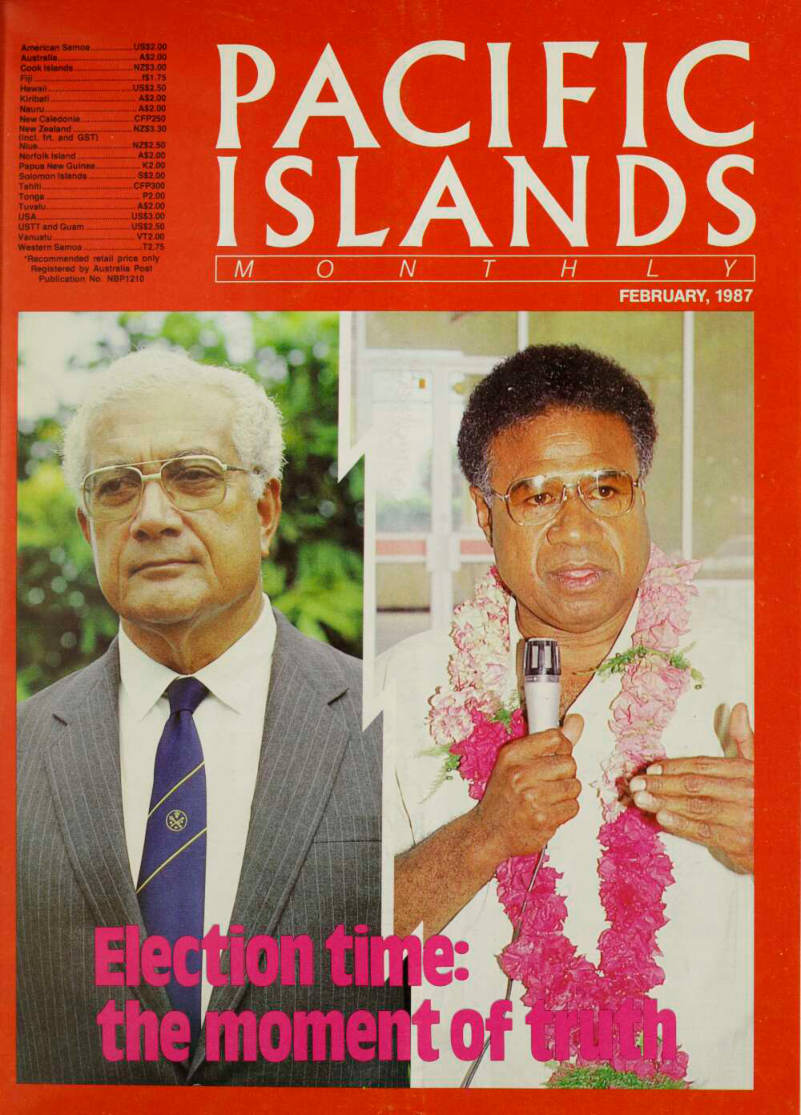
The Cover
Fiji party leaders Ratu Sir Kamisese Mara and Dr Timoci Bavadra.
Advertisements & other items, p. 2 (1 item)
Compact
but
big.
It used to be simple. In order to gain the maximum amount of interior space, cars necessarily had to have big bodies.
But then people also wanted compact family cars that were easier to handle and performed better. It came down to making a hard choice. Till Honda decided to challenge this state of affairs. Honda aimed to give people a lot of room in a small car that was easy to handle. So from the very start, Honda designed the Civic Sedan to realize an automotive goal that was considered virtually impossible—going for a compact body that would permit the maximum possible interior space to be realized.
And that's where Honda's MM philosophy makes the difference. It advocates minimum space for mechanisms and maximum space for utility. Honda's no-compromise approach combines superior performance with mechanical parts designed for compactness and high-density integration. Take the 12-valve engine for instance. Engineered for high power, it's also compact, durable, and economical. How about the high-performance suspension?
Light and compact, it takes up minimal space, allowing the car to have a lower, sleeker hood. Honda made the most effective use of available space wherever possible, leaving a generous interior space to ensure passenger comfort. That means plush, roomy seating for four adults with ample legroom for all. Take a look at the trunk. Deep and wide, it opens up right from the bumper line to take all the effort out of loading. Even the rear seatback folds down for extra loading convenience.
The end result is a deceptively orthodox sedan with a significantly higher level of driving enjoyment.
Compact but big. A paradox Honda challenged and solved. The Honda way.
OHONDA
Equipment may vary in some countries.
Ifc
m ■ m :
MlMiB
* I
IS Ifs
In 7986, Williams/Honda won the Formula I Constructors' Championship. In 1987, Honda's Formula I engines will power both Williams and Lotus. Thus, we will continue to polish our expertise at the pinnacle of automotive technology.
Canon Eacte} Mobil M
POWERED by HONDA
AUSTRALIA: Honda Australia Pty., Ltd. Lot 95 Sharps Road, Tullamarine, Victoria3o43: Bennett Honda Pty., Ltd. 250 Victoria Road, Wethenll Park, N S W 2164/NEWZEALAND: NZMC Limited Manners Plaza, 57-65 Manners St., Wellington/PAPUA NEW GUINEA: Toba Pty, Ltd. RO. Box 503, Port Moresby/TAHITI: Honda Distribution S.A.R.L. B P 1665, Papeete/KIRIBATI: Atoll Motor & Marino Services PO. Box 49, Bairiki Tarawa, Republic of Kiribati/U.S. TRUST TERRITORY: United Micronesia Development Association PO. Box 235, CHRB Saipan CM 96950/COOK ISLANDS: Cook Islands Motor Centre Ltd. PO. Box 74, Rarotonga/GUAM: Mark’s Motor Co., Inc. PO. Box DV, Agana/WESTERN SAMOA: Motor Distributors (Samoa) Ltd. RO. Box 576, Apia/SOLOMON ISLANDS: Lee Kwok Kuen & Co., Ltd. RO. Box 537, Honiara/NEW CALEDONIA: Societe Du Chalandage 8, Rue de la somme-B.P. 97, Noumea/NAURU: Nauru Cooperation Republic of Nauru/FIJI: Coral Island Motors Ltd. Robertson Road, Suva, Fiji/ AMERICAN SAMOA: Holiday Motors, Parts and Service PO. Box 968, Pago Pago, American Samoa 96799; Heleck’s Service Center Ltd. RO. Box 1138, Pago Pago, American Samoa 96799/TDNGA: Tonga Industrial Traders RO. Box 1035, Nukualofa, Tonga/NORFOLK ISLAND: Duncombe Bay Garage New Cascade Road, Norfolk Island/VANUATU: Honda Farm Ltd. PO. Box 1031, Port Vila, Vanuatu
Pacific
Islands
Monthly
Vol. 58, No. 2, February, 1987.
PACIFIC ISLANDS MONTHLY is published monthly by Pacific Publications (Aust) Pty.
Ltd. of 76 Clarence Street, Sydney, NSW.
Australia. Second class postage paid at Honolulu, Hawaii. POSTMASTER: Send address changes to PACIFIC ISLANDS MONTHLY, PO Box 22250, Honolulu, Hawaii 96822.
JohnNaupa Page 10
High Chief Gibbons Page 48
Vlllami Fukofuka Page 9
Irene Jai Narayan Page 22
In This Issue
BATTLE LINES ARE DRAWN: Fiji prime minister Ratu Sir “JQ Kamisese Mara has thrown down the election gauntlet in what promises to be his stiffest electoral test in the 16 years that he has led the country. A coalition of the “old” opposition National Federation Party and the new Labour Party will give Ratu Mara’s Alliance Party a tough time at the polls. We profile the election with an overview of the issues, the personalities and the previous voting patterns.
JAPAN’S PACIFIC INITIATIVE: Faced with increased Soviet 25 commercial and diplomatic activity in the Pacific, Japan proposes joint action to maintain the western influence. It could mean a whole new program of aid and trade for the island countries.
THE POLITICS OF DISSENT: France, the UN and the New 1 2 Caledonia independence movement seem set on a collision course. France’s refusal to co-operate with the Committee of 24 and the FLNKS refusal to negotiate with Mr Pons have set the scene for confrontation. Meanwhile, France is determined to proceed with arrangements for this year’s referendum on the territory’s status with or without UN approval.
FUNDS FROM FISH: The island countries’ pay out from the 27 US tuna deal may be better than at first expected for some.
Our Washington correspondent examines the agreement and also profiles the ’’other end” of the tuna industry the consumer market in the United States. He finds that the species is far more migratory after it leaves the ocean than it ever has been while in the water.
IT’S PARTY TIME: Election year in Vanuatu has seen the 10 birth of a clutch of new parties all hoping to topple the Vanua’aku Rati led by Fr Walter Uni. We taxe a look at the new hopefuls and their policies and find that the VP is probably still the best organised political unit in the country so far.
NOBLES UNDER FIRE: Allegations of mis-spending by 9 Tongan MPs have rocked the country and may even nave eroded the traditional unquestioning acceptance of authority in the kingdom. We background the issues and the personalities with interviews with churchmen and a farmer.
The Privy Council may eventually decide the issue which is before the court.
Contents
Books 44 Deaths 55 Fiji 18 French Polynesia 50 Guam 27 Japan 25 Kiribati 27 Letters 8 Marquesas 57 Micronesia 48 New Caledonia 12 Marianas 29 Pacific Report 6 Papua New Guinea 6
PIM Opinion 5 Service Page 62 Shipping 53 Solomom Is 7 Soviet Union 25 Stamps 52 Tonga 9 Transitions 55 Tradewinds 27 United States 27 Vanuatu 10 W Samoa 55 Yachts 56
Australian cover price is recommended retail only. Registered by Australia Post, publication No. NBPI2IO.
Copyright Pacific Publications (Aust.) Pty. Ltd
Advertisements & other items, pp. 3-4 (2 items)
Pacific Islands Monthly—February, 1987
3
' Editor Russell Hunter Advertising Manager Richard Thomson Advertising Sales Lawson Dixon Editorial Adviser John Carter A Pacific Publications production Founded 1930 by R. W, Robson
(USPS 952480)
76 Clarence Street, Sydney, 2000.
GPO Box 3408, Sydney, 2001 Cables; PACPUB Sydney.
Telex: 21242 (answers INTARAD).
Telephone: Sydney 20-231. Melbourne 652-1111 Manager: John Berry (03) 652-1111 Ext. 1860
Trinitron
KV-2092AS
It's so tempting.
The colour you get from Sony's new Super Trinitron.
Our new Pan-Focus gun is computer-designed to make our famous colour even sharper and clearer. Our new Black Screen makes whites brilliant, blacks profound, every colour deeper and richer.
It's flatter and sguarer too.
For less reflection and superb clarity, even in the corners.
For those whose taste demands Hie best, Super Trinitron is the most delicious TV ever.
KVI44OAS
CUPER
TRINITRON
The chance for Japan
Pim Opinion
The Japanese initiative is logical and welcome. The Tokyo planners may have taken their time over it as a result of their own internal politicking, but they have now recognised the importance of the South Pacific islands region.
It’s something the Japanese private sector has recognised for some time. For example, Japan has been at the forefront of the development of the tuna fishing industry over the past decade. Indeed, while the American Tunaboat Association was squealing Japan was dealing. The Japanese tuna agreements first with Papua New Guinea and later with others became a benchmark that the Americans, until very recently, couldn’t meet.
Japan is a major exporter of cars and other manufac tures to the region and is a major importer of raw materials.
The foreign policy implications that flow from all that are now, at last, being fully examined and acted upon.
And as Australia’s capacity to provide aid declines, Japan’s increases. Also, Japan is second only to the United States in its abhorrence of Soviet influence in its immediate environs. This, plus a Japanese perception that the "New Zealand disease” might be catching have combined to prompt a major Japanese initiative.
From a purely pragmatic viewpoint, the reasons are less important than the effects, however. Japan has much to offer in terms of technology, training and expertise and, it seems, these will soon be available in more generous quantities than ever before.
And Japan has chosen its time well. The economies of
the larger island nations are on the up. PNG, in particular, is set for a very real resources boom with emerging discoveries of gold, oil and gas. Fiji looks ever more assured of stable growth with developments in manufac turing, mining, agriculture and forestry. The smaller island nations such as Tonga and the Cook Islands are overcoming the problems of size and are trading their way to their rightful places in the world. The atoll states face difficulties peculiar to themselves and Japan is already sympathetic to their problems.
But these nations do not want to be forever Japan’s quarries and gardens. Assistance with some form of “downstream” value added activity is essential.
Now it may be that even the larger island states are too small for viable large scale manufacturing enterprises to be established. Experience certainly points in this direction.
Nevertheless there are opportunities in specialised areas of activity that could and should be developed.
And Japan is in a unique position to assist.
But, as always, there are problems. Japan, it seems, wants to take advantage of Australia’s long experience of providing aid in the South Pacific. Australia, on the other hand, has its own aim of gaining greater access to Japan’s huge domestic market.
Japan won’t swap access to Australia’s experience for Australian market penetration at home. Australia has, therefore, more or less told Japan to go it alone in the islands.
That’s needn’t and probably won’t deter the island leaders from welcoming an increased Japanese aid effort.
pacific report
Cyclone Devastates
Cook Islands.
Cyclone Sally, which passed directly over the Cook Islands centre of Raroton ga caused As3s million in damage. The island of Aitutaki lost all of its only cash crop bananas while main harbour installations in Rarotonga were nearly totally destroyed and the main commer cial and administrative area flooded.
However, stand by generators soon had the tourism industry back in action.
Prime Minister Sir Tom Davis and resort representatives appealed to tourists not to cancel bookings. Offers of aid came from New Zealand, Australia, France, UK and the United States. French secretary of state, Mr Gaston Flosse was the first overseas representative to arrive and promised French aid for reconstruction.
France and Britain also offered aid to Fiji where Cyclone Raja caused extensive damage to crops and buildings.
Court Rules In Favour
Of Tv.
Papua New Guinea’s Supreme Court has ruled that the law passed last year banning broadcast television until next January was unconstitutional. The five judges were unanimous that the Televi sion (Prohibition and Control) Act breached the freedom of speech provi sions in the constitution. However by a three to two majority, the judges ruled that it was reasonably necessary to restrict television up to the end of this year, leaving the way clear for the government to re-introduce the Act in a constitutional manner.
Islands Get
Aids Warning
An expert on the fatal disease, AIDS, warned that the virus could decimate the populations of some island countries within 10 years. Ms Elizabeth Reid, an adviser to the Australian National Advis ory Council on AIDS, said in Suva after a tour of the Pacific region that the small size of the island states coupled with a predicted increase in tourism was a major factor in the AIDS danger. She said other potential means of spreading the virus were through the return of migrants from countries where AIDS was already established. The traditional roles played by homosexuals in some island societies was also a possible means of spreading the virus. These factors, she said, were a greater threat to the region than the 1918 influenza epidemic that killed 20 per cent of Western Samoa’s population.
Expats Told: Keep
Out Of Politics
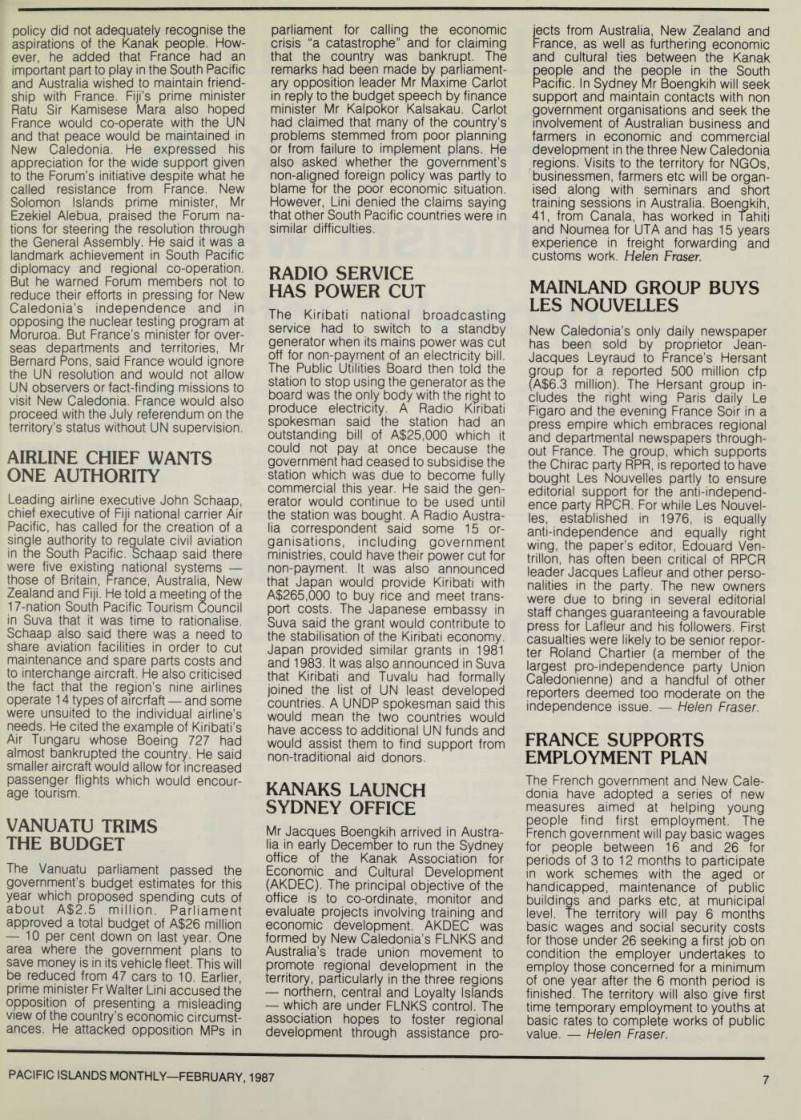
Fiji’s education minister, Mr Felipe Bole, warned expatriates that they have no right to criticise the government or its policies. He issued the warning after criticism by USP professor, New Zealan der Ron Crocombe, who had claimed that the government was delaying pro cessing his application for a work permit renewal. Professor Crocome, of the Pacific Island Studies department, has been a faculty member for 18 years. He had previously claimed that the Fiji government discriminated against other Pacific island nations in the employment of USP staff. Bole said Fiji citizens were entitled to criticise the government, but that the same right did not extend to foreigners.
Forestry Plans
Worth Millions
The government of Vanuatu has approved in principle the establishment of a large industrial forestry plantation on the northern island of Espiritu Santo. The approval follows studies by several gov ernments and organisations including the Commonwealth Development Corporation, the Japanese Association for International Co-operation, the New Zealand government, the Asian Deve lopment Bank and Vanuatu’s Forest Services Department. The government expects the project, if it proceeds, will have a significant impact on the island’s
economy. The plantation is expected to cover about 6,000 hectares. Studies put the development cost of the project at about Asl2 million. The government said negotiations with potential aid donors would begin at once with the hope that work could begin this year. The planta tion would then be in production by the year 2007. In Fiji, meanwhile, Forestry Development Services Ltd announced multi-million dollar plans for timber ex ports to Australia and Japan over the next five years. The company said it had reached agreement with Australian dis tributors for an annual sale of 24,000 cubic metres of planed and sawn pine worth about As2o million in the first three years. The company announced that it had also reached agreement for the marketing of woodchips through the Japanese trading house, C. Itoh and Co, with annual sales worth As 7 million.
Forestry Development Services 50 per cent owned by the Fiji Pine Commis sion is to be renamed Tropik Wood Industries Ltd.
A-G Report Slams
Control Standards
The annual report of the auditor-general of Vanuatu has strongly criticised the standard of controls over public spen ding. Mr Joe Dwyer said the standard was rapidly dropping and his report said the administration of the country’s budget was of particular concern. Books recording spending by government de partments were often badly maintained, said the report, despite considerable training of the people involved. Officers responsible for departmental spending could not easily see the department’s financial position because of the poorly kept books, the report said. It also said that if government departments had remained within their spending limits, a deficit of Asl million in 1985 could have been contained at A 5200,000.
France Urged To
Work With Un
South Pacific countries expressed their hope that France would adopt a con structive attitude and work with the United Nations to resolve the future of New Caledonia after the UN had adopted a resolution re-inscribing the territory on the list of non-self governing entities. The minister representing the foreign minister in the Australian Senate, Senator Gareth Evans, said all Forum countries hoped France would work with the UN for the benefit of the people of New Caledonia. He said present French
Mr. Bole: Warned foreigners to stay out of domestic politics
policy did not adequately recognise the aspirations of the Kanak people. How ever, he added that France had an important part to play in the South Pacific and Australia wished to maintain friend ship with France. Fiji's prime minister Ratu Sir Kamisese Mara also hoped France would co-operate with the UN and that peace would be maintained in New Caledonia. He expressed his appreciation for the wide support given to the Forum’s initiative despite what he called resistance from France. New Solomon Islands prime minister, Mr Ezekiel Alebua, praised the Forum na tions for steering the resolution through the General Assembly. He said it was a landmark achievement in South Pacific diplomacy and regional co-operation.
But he warned Forum members not to reduce their efforts in pressing for New Caledonia’s independence and in opposing the nuclear testing program at Moruroa. But France’s minister for over seas departments and territories, Mr Bernard Pons, said France would ignore the UN resolution and would not allow UN observers or fact-finding missions to visit New Caledonia. France would also proceed with the July referendum on the territory’s status without UN supervision.
Airline Chief Wants
One Authority
Leading airline executive John Schaap, chief executive of Fiji national carrier Air Pacific, has called for the creation of a single authority to regulate civil aviation in the South Pacific. Schaap said there were five existing national systems those of Britain, France, Australia, New Zealand and Fiji. He told a meeting of the 17-nation South Pacific Tourism Council in Suva that it was time to rationalise.
Schaap also said there was a need to share aviation facilities in order to cut maintenance and spare parts costs and to interchange aircraft. He also criticised the fact that the region’s nine airlines operate 14 types of aircrfaft and some were unsuited to the individual airline’s needs. He cited the example of Kiribati’s Air Tungaru whose Boeing 727 had almost bankrupted the country. He said smaller aircraft would allow for increased passenger flights which would encour age tourism.
Vanuatu Trims
The Budget
The Vanuatu parliament passed the government’s budget estimates for this year which proposed spending cuts of about A 52.5 million. Parliament approved a total budget of As 26 million 10 per cent down on last year. One area where the government plans to save money is in its vehicle fleet. This will be reduced from 47 cars to 10. Earlier, prime minister Fr Walter Uni accused the opposition of presenting a misleading view of the country’s economic circumst ances. He attacked opposition MPs in
parliament for calling the economic crisis “a catastrophe” and for claiming that the country was bankrupt. The remarks had been made by parliament ary opposition leader Mr Maxime Carlot in reply to the budget speech by finance minister Mr Kalpokor Kalsakau. Carlot had claimed that many of the country’s problems stemmed from poor planning or from failure to implement plans. He also asked whether the government’s non-aligned foreign policy was partly to blame for the poor economic situation.
However, Uni denied the claims saying that other South Pacific countries were in similar difficulties.
Radio Service
Has Power Cut
The Kiribati national broadcasting service had to switch to a standby generator when its mains power was cut off for non-payment of an electricity bill.
The Public Utilities Board then told the station to stop using the generator as the board was the only body with the right to produce electricity. A Radio Kiribati spokesman said the station had an outstanding bill of A 525,000 which it could not pay at once because the government had ceased to subsidise the station which was due to become fully commercial this year. He said the gen erator would continue to be used until the station was bought. A Radio Austra lia correspondent said some 15 or ganisations, including government ministries, could have their power cut for non-payment. It was also announced that Japan would provide Kiribati with A 5265,000 to buy rice and meet trans port costs. The Japanese embassy in Suva said the grant would contribute to the stabilisation of the Kiribati economy.
Japan provided similar grants in 1981 and 1983. It was also announced in Suva that Kiribati and Tuvalu had formally joined the list of UN least developed countries. A UNDP spokesman said this would mean the two countries would have access to additional UN funds and would assist them to find support from non-traditional aid donors.
Kanaks Launch
Sydney Office
Mr Jacques Boengkih arrived in Austra lia in early December to run the Sydney office of the Kanak Association for Economic and Cultural Development (AKDEC). The principal objective of the office is to co-ordinate, monitor and evaluate projects involving training and economic development. AKDEC was formed by New Caledonia’s FLNKS and Australia’s trade union movement to promote regional development in the territory, particularly in the three regions northern, central and Loyalty Islands which are under FLNKS control. The association hopes to foster regional development through assistance pro
jects from Australia, New Zealand and France, as well as furthering economic and cultural ties between the Kanak people and the people in the South Pacific. In Sydney Mr Boengkih will seek support and maintain contacts with non government organisations and seek the involvement of Australian business and farmers in economic and commercial development in the three New Caledonia regions. Visits to the territory for NGOs, businessmen, farmers etc will be organ ised along with seminars and short training sessions in Australia. Boengkih, 41, from Canala, has worked in Tahiti and Noumea for UTA and has 15 years experience in freight forwarding and
customs work.
Helen Fraser.
Mainland Group Buys
Les Nouvelles
New Caledonia’s only daily newspaper has been sold by proprietor Jean- Jacques Leyraud to France’s Hersant group for a reported 500 million cfp (A 56.3 million). The Hersant group in cludes the right wing Paris daily Le Figaro and the evening France Soir in a press empire which embraces regional and departmental newspapers through out France. The group, which supports the Chirac party RPR, is reported to have bought Les Nouvelles partly to ensure editorial support for the anti-independ ence party RPCR. For while Les Nouvel les, established in 1976, is equally anti-independence and equally right wing, the paper’s editor, Edouard Ven trillon, has often been critical of RPCR leader Jacques Lafleur and other perso nalities in the party. The new owners were due to bring in several editorial staff changes guaranteeing a favourable press for Lafleur and his followers. First casualties were likely to be senior repor ter Roland Chartier (a member of the largest pro-independence party Union CaTedonienne) and a handful of other reporters deemed too moderate on the
independence issue.
Helen Fraser.
France Supports
Employment Plan
The French government and New Cale donia have adopted a series of new measures aimed at helping young people find first employment. The French government will pay basic wages for people between 16 and 26 for periods of 3 to 12 months to participate in work schemes with the aged or handicapped, maintenance of public buildings and parks etc, at municipal level. The territory will pay 6 months basic wages and social security costs for those under 26 seeking a first job on condition the employer undertakes to employ those concerned for a minimum of one year after the 6 month period is finished. The territory will also give first time temporary employment to youths at basic rates to complete works of public
value.
Helen Fraser.
grossly unfair
letters
Garment maker’s criticism was grossly unfair
Your November issue carried an article titled “Unkind Cut for Garment Makers.” The article appears to have been based on views expressed by Mr David Einfield of Farah Manufac turing.
In giving vent to his frustra tion, Mr Einfield chose to criti cise the Fiji government and to allege that no serious efforts, if any, had been made to address the problems of concern to him.
This is grossly unfair.
At various levels of govern ment repeated efforts have been made and representations continue to be made with re gard to the problems faced by Fiji’s garment manufacturers.
More regrettably, Mr Einfield chose to indict individuals from whom he expected greater sup port the very individuals who have been in the forefront of seeking improved conditions for our garment manufacturers.
These efforts are well known to the Fiji manufacturing in dustry and are much appreci ated. It is therefore a matter of considerable regret that Mr Ein field chose to denigrate such efforts. His personal apology to us, naturally, will not reach as wide an audience as the original article.
In fairness to the Australian government, it should also be recorded that our representa tions have not fallen on deaf ears. The suggestion of indiffer
ence on the part of Australia is unjustified.
We know full well the com plexities involved in the area of access for garments and remain hopeful that the new textiles, clothing and footwear (TCF)
regime in 1988 will reveal con cessions for the Forum island countries which reflect the spirit of Sparteca.
For the interim period too it is our expectation that the current difficulties will be alleviated.
Meanwhile, Fiji’s representa tions will continue even if Mr Einfield choses to remain obli vious to them.
James A. Maraj,
Permanent Secretary for Foreign Affairs, Suva.
The Russian bait
has a double hook
Much has been said about foreign relations with some of our Pacific island neighbours such as Vanuatu and Kiribati.
The admission of countries such as Russia, Cuba and Libya to our neighbours may prompt one to ask: What is going on?
Have our brothers forgotten the motherly care given them by their allies over the years?
Have they forgotten what is going on Afghanistan? Have they forgotten that when the Russians come fishing the bait has a double hook?
Russia isn’t the only country interested in buying their fish.
There are more suitable and friendly potential trading part ners.
We have seen that Kiribati’s fishing agreement with Russia has already ended. This is a good example that should
guide us all in the future when making contact with foreign countries with a view to busi ness.
We have also read recently that Russia claims some rights in the Pacific. This announce ment was made well before another announcement of a missile test series in the region.
And where were the Russians in the Pacific during World War Two?
How can they claim rights when they did not defend Tara wa, Solomon Islands and other mini-states helped by the allies and, of course, the United States?
Even our small Fiji helped in this but, again, where was Russia?
He was and is there, the red bear, watching from his northern Pacific coastline, just
waiting for the chance to cruise down and make love in the South Seas. But his hooks are still sharp and cunningly baited.
I beg my island brothers to stand firm before they become completely undermined.
Semi Goneyali,
Tailevu, Fiji.
Readers letters should, where possible, be typed on one side of the paper only and should be sent to the editor, PIM, PO Box 3408, GPO, Sydney, NSW 2001, Australia. Cor respondents should also give a day time telephone number where appropri ate. All readers’ letters may be edited for length.
spending protest
Churchman leads spending protest
Supreme Court judge, Mr Geoffrey Martin, has ruled that the Tongan High Court has jurisdic tion in an action brought by a private citizen against members of parliament (December PIM page 13) for alleged misuse of public money.
The judge said the action by Ipeni Siale raised the issue of whether members of the legisla tive assembly are subject to the court’s jurisdiction.
In a written opinion, he said the court is entitled to ascertain whether there was a collective decision of the house on allow ances. The court can then in vestigate whether the allow ances paid to each member were calculated correctly.
He added that the actions of individual members in claiming and receiving their allowances has nothing to do with the basic functions of the house.
These matters, he said, are open to investigstion by the court and are not subject to parliamentary privilege.
The Siale case is likely to be heard next month.
Interest in the cases is run ning at peak tide in the islands community. At least one Free Wesleyan Church minister has asked the church to take a formal stand.
In the church’s quarterly meeting Dr Mohe Noa Puloka asked the church to endorse and promote a peace and jus tice march to demonstrate the people’s concern for the in tegrity and honesty of their leaders.
That integrity, accepted over the years almost as an article of faith by the majority of the people, is under real scrutiny.
Revelations in the newspaper Kele’a and the two court cases have honed interest to a razor’s
edge. Puloka, who has studied in America and Italy, has argued vigorously from the pul pit against the church remaining silent on the issues.
The Kele’a allegations have devastated many people as traditional Tongan culture teaches abhorrence of disres pect for authority.
“I was taught not to question God in heaven or the nobles on Earth,” said Puloka who was principle of Tupou College for nearly five years.
“That clashes with modem education. As principle I taught kids to think critically. Thinking clashes with the old culture.”
That almost childlike faith in government leaders has been washed away like a sandcastle on the beach.
For example, legislators have been accused of submitting a combination of vouchers to the treasury that were paid to re staurants in Nukualofa. Kele’a was moved to inquire why the “Honourable members of parliament, who led the fonos (public meetings to explain new tax laws) in Tongatapu, slept in restaurants and not in their nice government-paid homes. ”
Puloka and Roman Catholic Bishop Patrick Finau have been the most vocal critics among the religious ranks. Puloka said his whole motivation in speaking
out was his faith “in the life death and resurrection of my lord Jesus Christ”.
He said, “I’m a simple Christ ian pastor. That’s why I’m speaking out.”
However not only the clerics have been voicing their critic isms. The people themselves are becoming disenchanted.
A subsistence farmer on Ton gatapu talked of his frustrations and those of his colleagues.
Short, spare but well muscled through hard physical effort, he grows root crops and other food for his family on his bush allotment. He hopes to augment his small income by growing tomatoes and carrots for sale at the local market.
“People are angry,” he said.
“Prices are high in the market for people who don’t have land. Labour wages are now just four pa’anga (about As 4) a day. That 20 pa’anga doesn’t go very far to buy food for a family,” said the man who requested that his identity be kept secret “Our leaders are supposed to look out for the people. They look out for themselves. People now say bad words when they see these legislators in public.”
Kele’a also published a letter submitted to the police minister requesting his resignation.
The newspaper ran details of
the payment each member re ceived for fonos attended in Tongatapu, Ha’apai and Vava’u. Members were credited for working from 55 to 181 days according to the paper and received sums ranging from P 10.529 to P 1,356. The fonos ran for 12 days.
Total expenses for parlia ment topped $2 million, Kele’a alleged, more than double the government’s expenditure esti mate of $758,000.
Publishing continues to be a booming cottage industry in Tonga. The latest entrant is Ipeni Siale, the plaintiff in one of the court actions. His news paper, called Fetu’uesiafi or Shooting Star, debuted with several analysis articles by staff of the US Peace Centre in Tonga and ’Atenisi College assessing current deve lopments.
The crux of the cases before the Supreme Court is whether or not the parliament is answer able to anyone during its activi ties.
In submissions before Mr Justice Martin, plaintiffs’ lawyer, Laki Niu argued that the Supreme Court has constitutio nal jurisdiction in all cases.
The defendents, however, represented by Auckland-based solicitor Clive Edwards and David Tupou, Tonga’s solicitor general, argued that the legisla ture is operated under par liamentary privilege because of constitutional guarantees.
The controversy will have a significant effect on this month’s people’s representative elec tions. There is a heavy slate of candidates and the allegations against current legislators have not helped their re-election campaigns.
This year marks the 112th year of Tonga as a constitutio nal monarchy. And it is likely to be one of the most significant years in the nation’s rich his tory.
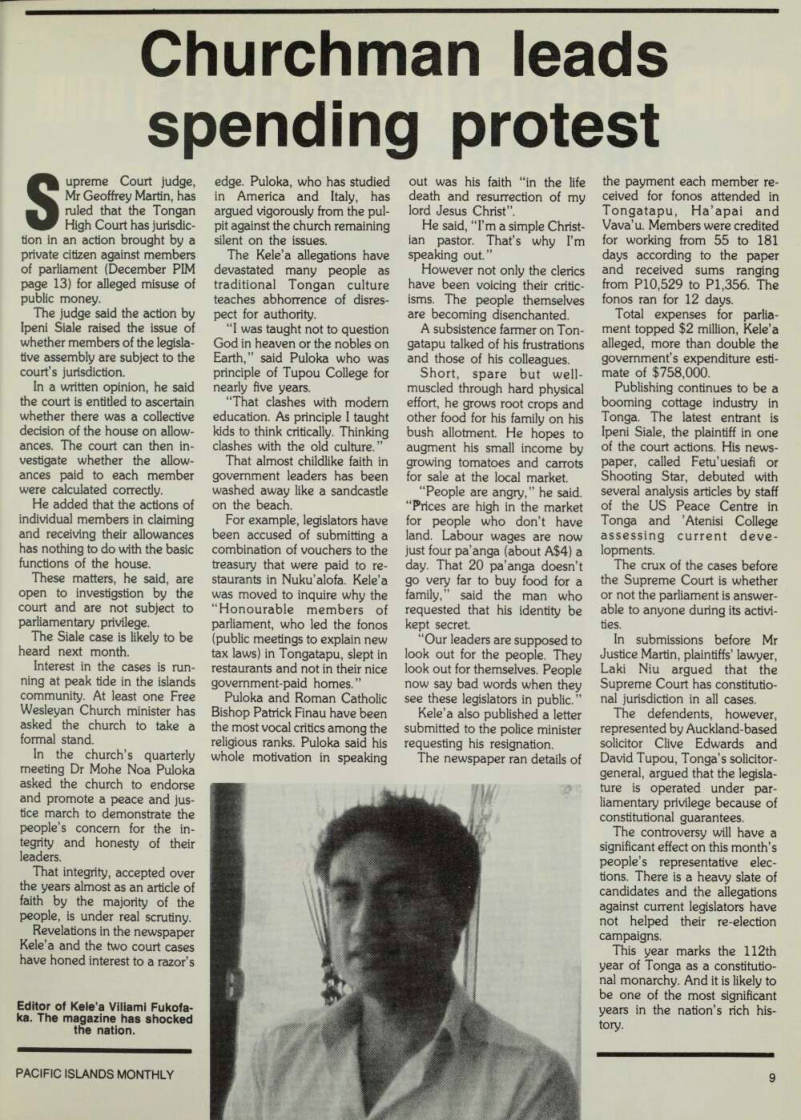
Editor of Kele’a Viliami Fukofa ka. The magazine has shocked the nation.
Confrontation: The politics
politics of dissent
The French government is lining up for direct confrontation with Kanaks and South Pacific Forum states over the issue of independence for New Caledonia. French Overseas Territories Minister Bernard Pons has pushed talks with the FLNKS to the point of rupture, while French tactics at the UN demonstrated the Chirac gov ernment’s ire at international interest in the decolonisation of New Caledonia.
The UN general assembly voted overwhelmingly in De cember (89 votes to 24) in support of the South Pacific Forum resolution to relist New Caledonia with the UN decol onisation committee but the Chirac government has said it won’t co-operate.
The resolution affirmed the inalienable right to self-de termination and independence of the people of New Caledonia and France would now be required to furnish reports to the UN on moves towards self-rule and on the economic and social well-being of New Caledonians.
French Ambassador to the UN, Mr Claude de Kamoularia described the resolution as “un justifiable” but the general assembly vote was hailed as a victory by South Pacific leaders.
Vaunuatu’s Prime Minister Father Walter Lini applauded the vote as “a victory for the people of New Caledonia and the South Pacific against col onialism” and Papua New Guinea PM Paias Wingti said this “major diplomatic triumph” was due to “the tireless efforts by Forum members, especially the spearhead partners” - PNG, Vanuatu and the Solomon Is lands.
New Solomon Islands PM Ezekiel Alebua said the vote was a “landmark achievement in South Pacific diplomacy and regional co-operation”.
The Forum resolution was adopted despite a strong cam paign of economic pressure by France against small UN coun tries likely to support New Cale donia’s relisting. (The territory was originally listed with the decolonisation committee in the general post World War 2 de colonisation push, but was un
laterally withdrawn by France in 1947).
Antigua was threatened with the deferral of a French loan for airport extensions, Zimbabwe was told that the development of a Peugeot plant was at risk, while Nigeria was warned that France would not co-operate with debt rescheduling.
At the same time France circulated a document at the
UN before the vote which strongly attacked the credibility of Australia and New Zealand in an unsuccessful attempt to drive a wedge between these and other Forum members.
The encouragement of migration to New Caledonia by past conservative governments in the face of growing Kanak independence claims is de scribed as the the encourage
ment of “a certain balance among the populations of va rious origins by promoting the development of the early Melanesian settlers as much as that of other ethnic groups so that today the two largest groups are roughly equal in number.” Kanaks are now a minority (43 per cent) in New Caledonia.
The memo condemned Aus
tralia and New Zealand for their treatment of Aborigines and Maoris and declared “Caledo nian society is hence just the opposite of the distorted picture painted by some in order to better serve their own pre judices and interests”.
And speaking during the UN debate on the Forum resolution Ambassador de Kemoularia said Australia and New Zealand had poor records in administer ing multi-racial societies and should refrain from giving les sons to France.
Australian Ambassador to the UN, Mr Richard Woolcott told the General Assembly the French argument that New Caledonia was an integral part of France was “myth and legal fiction”.
Woolcott added that France had previously used the same argument about Algeria and could not indefinitely resist the decolonisation of New Cale donia.
After the vote Mr Chirac warned that his government would not forget Australia’s sponsorship of the UN moves for New Caledonia’s decol onisation - a threat which Aus tralian Foreign Minister Bill Hayden said he took seriously.
Australia told France the document, which refers to Aus tralia as “manipulating and pernicious” was incorrect and insulting and urged France to pursue dialogue and a factual approach to the matter.
Following the UN decision Overseas Territories Minister Pons flew to Noumea for talks with political leaders and to announce new French auton omy plans to be put at next year’s referendum.
The four regional councils would be kept (three are con trolled by the FLNKS at pre sent) but boundaries would be redrawn sources in Noumea said the effect would be to minimise the FLNKS vote and to place key resources and installations in areas under loyalist control.
Pons also announced a 3
i/ear residency requirement for
the referendum in a manoevre ntended to appear as a “a big :oncession to the FLNKS”.
The FLNKS said after leaders met with Mr Pons that this was
unacceptable and that the FLNKS insisted in line with UN resolution 1514 that only the Kanaks as colonised people and perhaps others with one parent born in the territory should take part in the referen dum.
Noumea sources described Mr Pons as having “moved away from seeking compromise to a hard-line position”. The FLNKS announced the rupture of dialogue with Pons and called on President Mitterrand to dismiss him as Overseas Territories Minister.
Spokesman Mr Yeiwene Yeiwene said Pons had become the mouthpiece of the anti independence forces. On his return to the territory FLNKS President Jean-Marie Tjibaou
stressed that dialogue had not been severed with the French Government and that he hoped to deal with “someone less partisan and more serious”.
FLNKS leaders are due to meet with the French government early in 1987 and they are calling for the involvement of UN observations with France on terms and conditions for the referendum.
While in Noumea Pons announced that the referendum would be advanced from July 87 to April 87 in what was seen as a move to hold the poll before the UN decolonisation committee could act. However Pons learned a short time later that the French parliamentary timetable had been changed following the Chirac govem
merit’s strife over the education reform bill — making it more likely the referendum would be held as planned in the middle of the year.
Forum Chairman Ratu Sir Kamisese Mara has written to the decolonisation committtee chairman urging prompt con sideration of the New Caledo nia question when the committ tee of 24 meets this month.
As reports from Paris indicate a slump in popularity of the Chirac government and with more challenges to government plans forecast by student and union movements it appears their New Caledonia policies will only add to the govern
ment’s troubles.
Helen
Fraser.
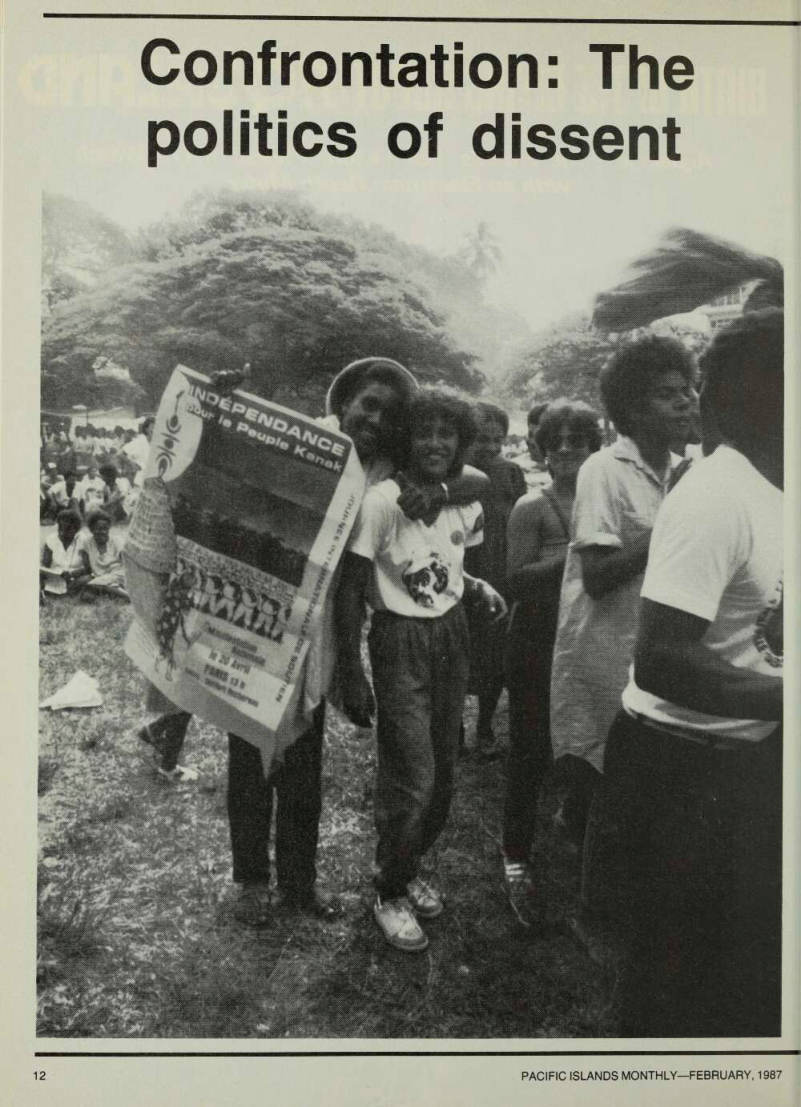
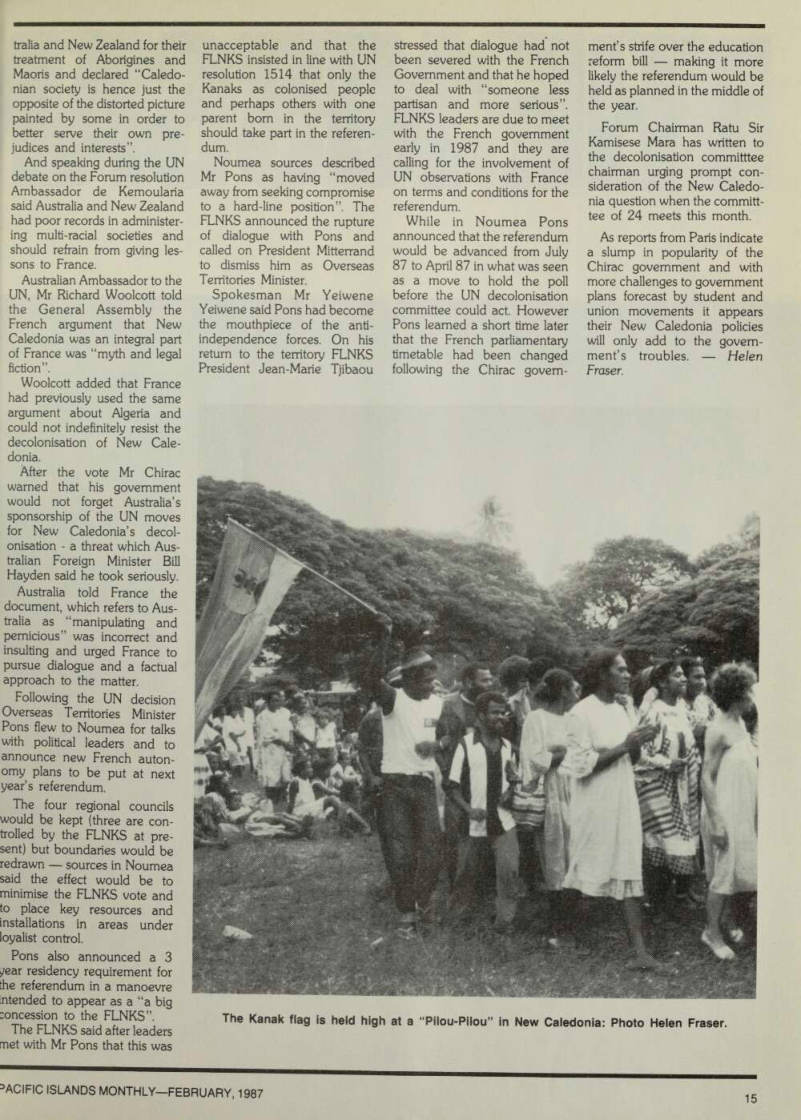
The Kanak flag is held high at a “Pilou-Pilou” in New Caledonia: Photo Helen Fraser.
Aussie baiting popular
in French press
As a result of frequent criticism in Forum member countries espe cially Australia about France’s doings in the Pacific, Aussie baiting has become a popular sport in Tahiti and New Caledonia.
The gist of these counter blasts which fill the columns of the local French language newspapers is invariably that all Australian critics are despicable hypocrites since, at the same time, they neglect their own Aborigines.
The real aim of the Australian anti nuclear and human rights campaigns, they insist, is to boot France out of the region to make room for Australian business houses and missions to take over the French islands.
The following commentary, written by one of the most widely read French journal ists in Tahiti, Christine Bourne, is a typical example: “Our Australian neighbours and sup posed friends, who in their newspapers regularly pillory us and act as dispensers of moral lessons they are, for instance, ardent defenders of oppressed peoples, especially the Melanesians of New Caledo nia (sic), but are, at the same time, blind to the misfortunes of their own degenerated and alcoholic aborigines locked up in reserves where the stone age still reigns, and who are always on the sly opposed to the French presence in the Pacific, which make them the preferred contacts of Polynesians who favour independence these Australians have belatedly begun to realise that they have been outdone.
Thus it happened recently, when (FLNKS leader) Tjibaou sent his militants to Gadda fi instead of sending them to school, the Australian government with great lucidity refused these sorcerer’s apprentices transit permission and turned them back.
The Australian news agency also informs us that in Papua New Guinea the highland ers, seized by destructive frenzy, steed, rape,
burn and butcher everybody within reach, forcing all Australians who live in this region to pack and go home.
But all these good and gentle Australians who give us moral lessons by telling sad tales about fishes floating with their bellies in the air, about withered flowers and about people reduced to a ghostlike state (here in French Polynesia), also practise with supreme address the barbarian sport of dwarf throwing although nothing is said about it in PIM.
The objects are real human beings who have never grown up because of the malfunctioning of their thyroid gland.
Although this is not yet an Olympic sport it is greatly appreciated in Australia where competitions are regularly organised ...
Fortunately the Australian Association of Small People has protested against this debasing exploitation of dwarfs which has consequently prompted the governments of New South Wales and Victoria to prohibit this exciting, typically Anglo-Saxon sport.
After which one must marvel over the political cleverness with which the Austra lians are pulling off the trick of masquerad ing as defenders of enslaved men.”
Ms Bourne offered no explanation as to why dwarf throwing might be of interest to PIM readers.
And her own readers would have been unaware of several facts including those that the Australian government did not interfere with the visit of a group of ni-Vanuatu and one kanak to Libya. (They returned a few days after they were mis takenly turned back and were permitted to complete their journey), that regular dwarf throwing competitions are not a feature of Australian life, that all PNG highlanders do not rape, steal and butcher, and, finally, they were not told of the further fact that the British promoter of dwarf throwing said in a previous interview that he got the idea after discovering this “typically Anglo- Saxon sport” in France.
Advertisements & other items, pp. 12-15 (1 item)
The Treasure At The End Of The Rainbow
It's not the luck of a leprechaun but the craft of Clarion that will lead you to uncompromising stereo sound quality. Even in the compromising environment of a moving automobile. Clarion's advanced electronics makes possible a wide spectrum of convenient, easy-to-use features. The Clarion choice of models is positively dazzling. And our reliability is f I Afl no fairy tale. Come, listen to a Clarion Car Stereo. And drive happily ever after. id I ILII I THE TREASURE AT THE END OF THE RAINBOW 1 J
□D MTI
ID APC Q
I n n 1 U , For further information - Australia: Amalgamated Wireless (Australasia) Ltd., 554 Parramatta Road, Ashfiefd, N.S.W., 2131 / New Zealand; AWA New Zealand Limited, P.O. Box 50-248, Porirua / F(ji Islands: Brijlal & Co., Ltd., G.P.O. Box 362, Suva Tahiti: HI FL, VAIRAATOA. Avenue Chef Vairaatoa B.P. 1128, Papeete I New Caledonia: Caldis, 8.P.M1, Noumea Cedex / Guam: Micropac Audio Inc., P.O. Box 3478, Agada, Guam 96910, U.S.A. Tel: 472-8091, Cable Code: HIFI AUDIO AGANA / Vanuatu; The Sound Centre, P.O. Box 434, Vila I Cook Islands: South Seas International Ltd, PO, Box 49, Rarotonga / Papua New Guinea: Hagemeyer (PN G.) Pty Ltd., P.O. Box 1428, Boroko, Port Moresby.
. ait rM- , * - ' ' ..«A*jdEbtlfll 1 v - \ ' a >/ , • , mm M&' .1®
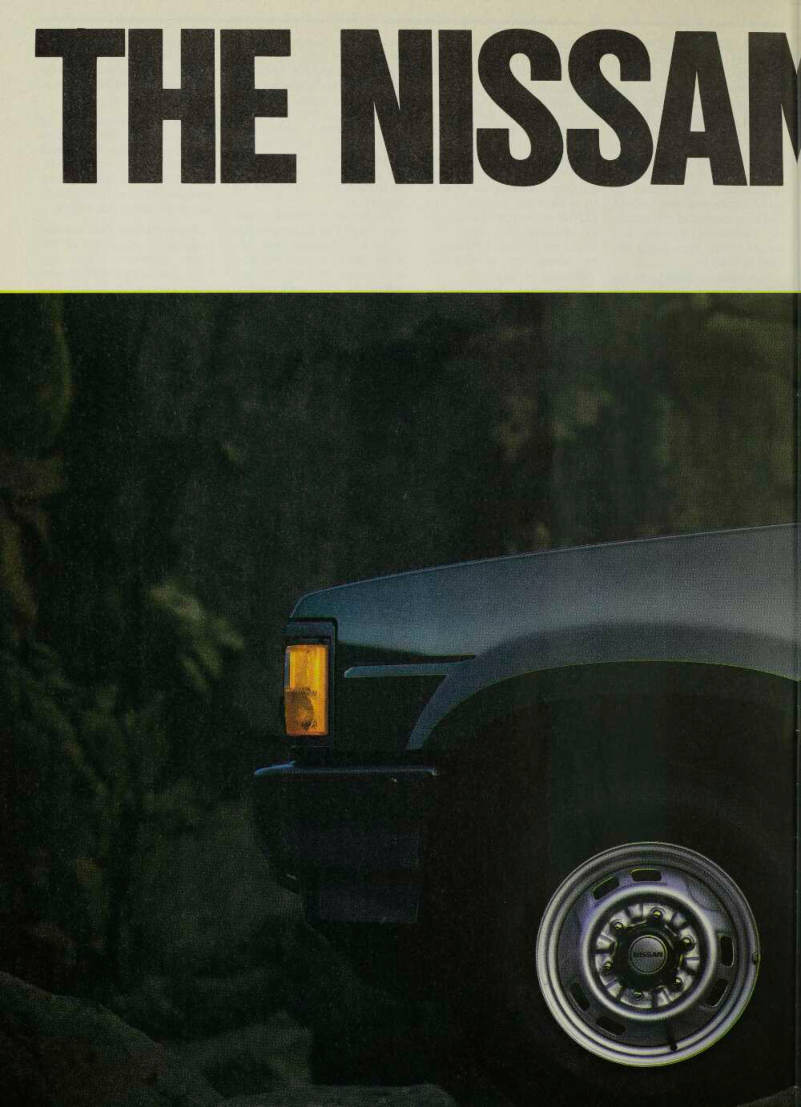
Strength
A vehicle’s strength depends on a complex interplay of varied factors. The overall design.
The body structure. The quality of the materials it is built of. The individual performance of the various mechanical components. Only when a vehicle is outstanding from 'every angle can it be said to possess genuine strength.
It is precisely this all-round excellence that gives the Nissan Pickup its extra margin of dependability. From the engine to the frame, the body panels to the suspension, the transmission to the bumpers, everything has been integrated into a vehicle of unsurpassed performance and durability.
In addition to the four usually found on ordinary makes, the closed-section JrameaZ n b^ CkUpS ladder frame features a fifth cross member arebuiit for extra which, together with a more rational layout, strength. enables the Pickup to tolerate heavier loads.
For further structural rigidity, the side members are made of thicker steel plates.
Add to that a double-wishbone front suspension and a leaf-spring rear suspension, plus a large-capacity, power-packed engine, and it’s easy to see why more people depend on the Pickup to handle tough jobs on rough roads.
In other words, the Pickup has a singular strength that comes from a complete rational matching of diverse parts into one unbreakable whole.
And it succeeds because it has that intangible yet very real quality that makes a Nissan what it is—The Nissan Dimension.
Quality in motion
NISSAN
challenge
Ratu Mara’s challenge
With the Fiji general election finally fixed for April 4-11, the battleground is clearly defined. But there has been plenty of action behind the lines, reports our Suva correspondent, that will have an important bearing on the eventual outcome.
When Fiji’s prime minis ter, Ratu Sir Kamisese Mara, announced that the general election would be held in April, he squashed widespread speculation that he would opt for a lightning campaign this month.
Nevertheless, the voters will go to the polls six months before the election was due.
When Ratu Mara announced his decision in late December, the campaign was already in full swing for Fiji’s fifth post-inde pendence general election.
And the prime minister who has governed since independ ence 16 years ago now faces possibly his stiffest electoral test.
The early election decision is partly a result of the momen tum generated by a powerful looking coalition of the “traditional” opposition Na tional Federation Party (NFP) and the two-year-old Labour Party.
It would not have escaped the politically astute Ratu Mara that the same momentum, given enough time, could be come an electoral steamroller.
But the coalition is still a very real threat. Alliance analysts thought when it was first sug gested that the coalition would never get its act together on agreed policies and candidates and would be aborted in its formative stages.
It didn’t happen.
The Alliance team, on the other hand, have enough in their favour to risk an early vote.
The current line-up in the 52-member House of Repre
sentatives is: Alliance, 29; NFP, 19; Labour 4 (former NFP members). But before the de fection to the Alliance of former NFP deputy leader, Mrs Narayan (see box), and the four to Labour, it was a straight 28 Alliance to 24 NFP, reflecting the two-horse race at the 1982 poll.
The Labour Party was bom in July, 1985 with the support of Fiji’s trade union movement.
Originally seen as a protest against the government-im posed wage freeze and the inability of the NFP to prevent it, Labour has quickly found a political constituency.
Led by able and experienced ex-civil servants, the party already controls the capital’s municipal council. It also only narrowly lost a by-election to the Alliance.
Previously a safe 5,000majority NFP seat, it fell to the Alliance as a result of Labour’s splitting of the Indian vote. The lesson was not lost on the NFP and Labour leaderships. The seeds of coalition had been sown The NFP-Labour coalition was officially endorsed at a working committee NFP meet ing following intense closed door negotiations.
Both sides had fielded their first XVs. Former opposition leader Mr Jai Ram Reddy play ed a pivotal role in hammering out the agreement. Labour leader Dr Timoci Bavadra was chosen as coalition leader, with NFP chief Mr Harish Sharma as his deputy.
Hard on the heels of the formal launch of the coalition,
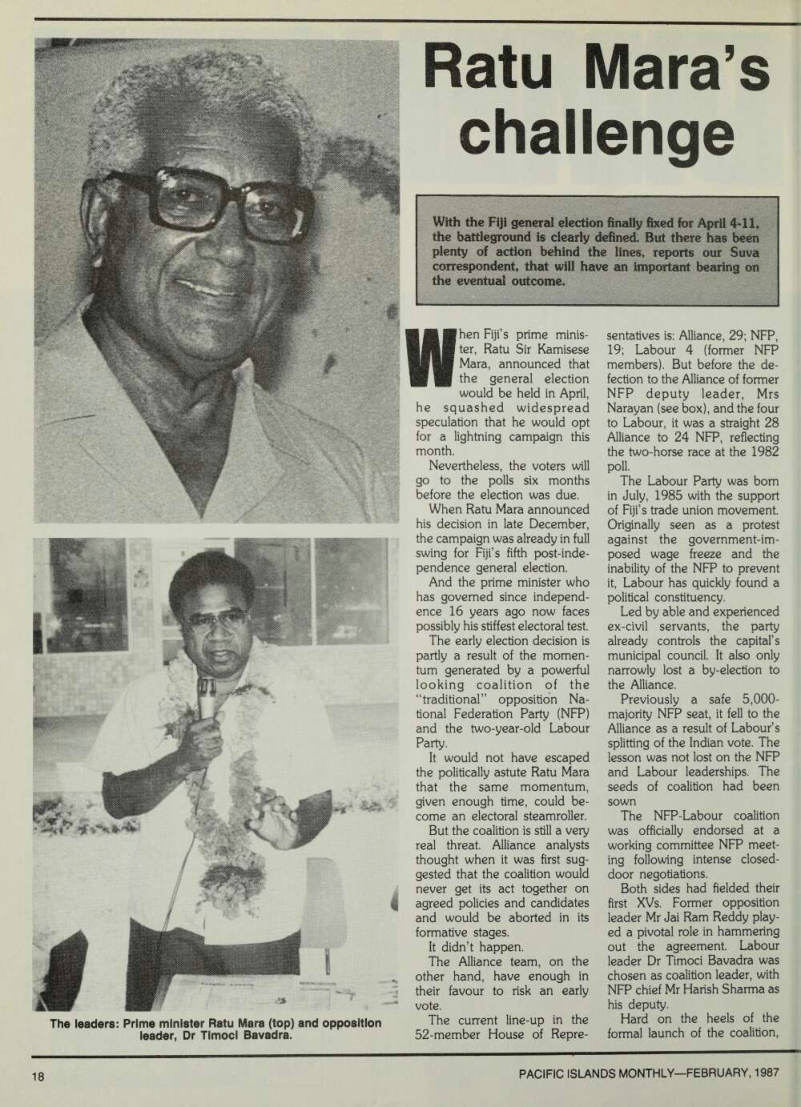
The leaders: Prime minister Ratu Mara (top) and opposition leader, Dr Timoci Bavadra.
came the grumbles from candi dates and potential candidates that the NFP had sold out by accepting a “junior” partner as coalition leader.
But the hard headed policy makers saw it as a smart move neutralising potential Alliance claims that an Indian would be prime minister if the coalition won the election.
This left the Alliance (in an unsigned statement) to de nounce the NFP for “surrender ing its birthright” by teaming up with Labour.
But amid the bickering and complaints from all sides, the coalition quietly went ahead and identified some 30 seats it now considers winnable.
After that shaky start, coali tion unity now appears impre gnable. But given the opposing ideologies and personalities that exist within its ranks, the appearance may be no more than veneer. United in its aim to beat the Alliance, the coalition would face its first real unity crisis if and when its primary goal is achieved.
Faced with coalition solidar ity, the Alliance got into gear.
Parliament was dissolved on December 18 in preparation for the election.
And the coalition is not the only threat. The Fijian Na tionalist Party has been running a quiet but possibly effective campaign. If it wins one seat
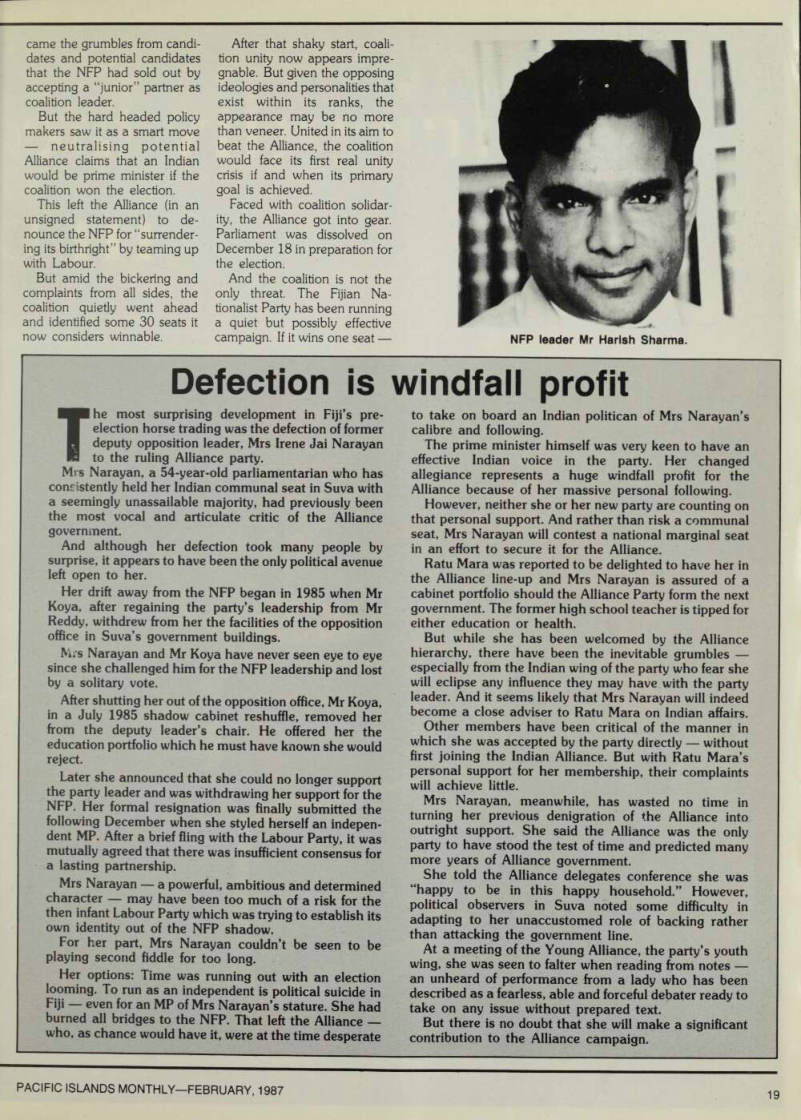
NFP leader Mr Harish Sharma.
or, worse, splits the Fijian vote across the board it would spell disaster for the Alliance.
In his address to the Alliance Party delegates conference late last year, Ratu Mara, in an apparent reference to the poli cies of the coalition, pledged continued peace and progress under an Alliance government.
Against a background of achievement and stability, who, he asked, would want to change “experience for an un known quantity.”
“Progress or stagnation; peace or instability; proven leadership or disunity,” were the choices he offered.
In the same address, he also warned that he expected effi ciency and proper accounting from those he placed in high office. Leaders, he declared, should lead by example.
“There must be honesty and integrity of the highest order.”
The Labour leader replied by referring to the Alliance Party as a “a wolf in sheep’s clothing, stalking among the trusting vo ters.”
According to the provisional electoral rolls released in late December, a total of 331,326 voters were registered com pared to 292,341 in 1982.
The prime minister has brought in new blood with an intake of younger, more sophisticated candidates to re place some of the “old guard.”
Similarly, the NFP has dropped a number of sitting MPs, prefer ring younger, more experi enced and energetic former civil servants and administrators.
The Alliance retired 11 sitting members, including four cabi net ministers, from its line-up of 52 candidates while the coali tion has chopped 18 members from its initial list of 39.
The cabinet ministers to go are veterans Mr Mohammad Ramzan, minister for employ ment and industrial relations, Mr Edward Beddoes, the hous ing and urban affairs minister, lands and energy minister Mr done Naisara and home affairs minister, Mr Akariva Nabati.
Recognising, perhaps, that the days of the old colonial style politicians are over, prime minister Mara has opted for educated professionals with proven track records. He has included the articulate and effi-
cient secretary of the Public Service Commission, Mr Narsi Raniga; the general manager of the Fiji Electricity Authority, Mr David Pickering; the authority’s chairman, Mr Viliame Gonelevu; insurance broker, Mr Archie Seeto and, of course, Mrs Irene Jai Narayan.
Other young faces in the
Alliance line-up are district offic er, Mr Veer Singh and Ratu Tu’akitau Cakanauto.
While Ratu Mara has ruth lessly cut away much old wood, he has been obliged to retain some sitting MPs who enjoy strong traditional support in their areas such as Ratu William Toganivalu and Mr
Militoni Leweniaila, both for mer cabinet members.
The Alliance team also con tains some defectors. Apart from Mrs Narayan, there is Mr Shiromani Madhavan, a former NFP man and the son of one of that party’s founding fathers; Mr Vinod Singh, also ex-NFP; and Mr Mahendra Sukhdeo, a former vice-president of the Labour Party.
However, their party en dorsement has brought loud objections from traditional Alliance supporters who had hoped to run on the Alliance ticket. According to them, the defectors are given a greater say and more recognition than the old party faithful.
For this reason, the Alliance Party has had to deal with near-rebellion from a section of its supporters.
It’s not alone. The NFP’s passed-over veterans have threatened to field parallel candidates. The main com plaint has been that Labour has had the upper hand in the selection process.
Two big names in Fiji politics former opposition leaders Mr Siddiq Koya and Mr Jai Ram Reddy were missing from the initial list of coalition candi dates. Mr Reddy declined an invitation to join the platform, while Mr Koya was sacrificed in an effort to present a fresh image.
In the past the many lawyers in the NFP had been accused of failing to give sufficient priority to their parliamentary duties and the new coalition emphasis
is on academics and experi enced or retired civil servants well-versed in the workings of government.
But Ratu Mara may have upstaged his opponents by fiel ding his own new-look team.
The unknown factor for both sides is the spoiling potential of rebel candidates, especially in the marginal seats. Both the main parties have gone to great lengths to present the voters with a list candidates free of colonial “hang-ups”.
But the Alliance appeared to grab the early initiative with a list of achievement-backed candidates and a set of issues that could catch the coalition off balance.
continued on page 55
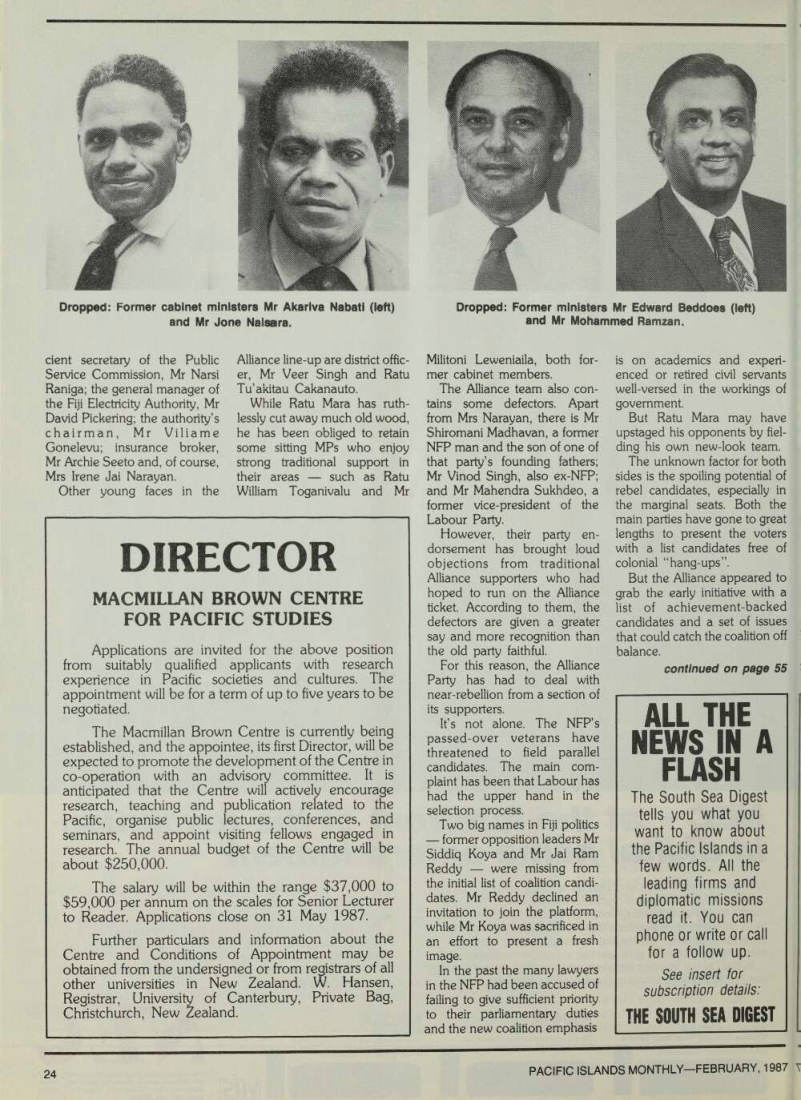
Dropped: Former cabinet ministers Mr Akariva Nabati (left) and Mr Jone Naisara.
Dropped: Former ministers Mr Edward Beddoes (left) and Mr Mohammed Ramzan.
and asked why nothing had been done earlier.
Also on the minus side for the Alliance has been the auditor general’s latest annual report. It contained embarrassing revela tions of mismanagement of government money. And the standard of health care is per ceived to be declining.
Labour seeks to capitalise on just these issues but it could have some difficulty in persuad ing enough voters that its alternatives are better.
Labour policies on land, na tionalisation of the gold mining industry and transport have not been well received in the busi ness community.
But in the final analysis, the result still depends on racial voting patterns. The question is: Will the coalition be able to attract enough Fijian support from the Alliance to turn the tables in half a dozen seats, or will the rebel candidates split the Indian vote, giving “safe” coalition seats to the Alliance?
The economy is on the up, inflation is well under control, tax cuts were a feature of the last budget. The government’s ace card the lifting of the wage freeze has already been played to great effect. It also stands on a solid record of peace and stability.
The two chinks the Alliance armour, however, are the stark realities of crime and un employment.
The prime minister, in an effort to head off accusations hat he was doing nothing ibout the rising crime rate, appointed former police com nissioner, Mr Roy Henry, to :arry out an enquiry.
Based on his findings, Ratu 4ara in December appointed a ligh-powered task force to deal vith the problem.
On the very next day, how ever, Mr Reddy denounced the nove as an election gimmick
Changed sides: Mrs Irene Jai Narayan.
Defection is windfall profit
The most surprising development in Fiji’s pre election horse trading was the defection of former deputy opposition leader, Mrs Irene Jai Narayan to the ruling Alliance party.
Mrs Narayan, a 54-year-old parliamentarian who has consistently held her Indian communal seat in Suva with a seemingly unassailable majority, had previously been the most vocal and articulate critic of the Alliance government.
And although her defection took many people by surprise, it appears to have been the only political avenue left open to her.
Her drift away from the NFP began in 1985 when Mr Koya, after regaining the party’s leadership from Mr Reddy, withdrew from her the facilities of the opposition office in Suva’s government buildings.
Mi's Narayan and Mr Koya have never seen eye to eye since she challenged him for the NFF leadership and lost by a solitary vote.
After shutting her out of the opposition office, Mr Koya, in a July 1985 shadow cabinet reshuffle, removed her from the deputy leader’s chair. He offered her the education portfolio which he must have known she would reject.
Later she announced that she could no longer support the party leader and was withdrawing her support for the NFF. Her formal resignation was finally submitted the following December when she styled herself an indepen dent MP. After a brief fling with the Labour Party, it was mutually agreed that there was insufficient consensus for a lasting partnership.
Mrs Narayan a powerful, ambitious and determined character may have been too much of a risk for the then infant Labour Party which was trying to establish its own identity out of the NFP shadow.
For her part, Mrs Narayan couldn’t be seen to be playing second fiddle for too long.
Her options: Time was running out with an election looming. To run as an independent is political suicide in Fiji even for an MP of Mrs Narayan’s stature. She had burned all bridges to the NFP. That left the Alliance who, as chance would have it, were at the time desperate
to take on board an Indian politican of Mrs Narayan’s calibre and following.
The prime minister himself was very keen to have an effective Indian voice in the party. Her changed allegiance represents a huge windfall profit for the Alliance because of her massive personal following.
However, neither she or her new party are counting on that personal support. And rather than risk a communal seat, Mrs Narayan will contest a national marginal seat in an effort to secure it for the Alliance.
Ratu Mara was reported to be delighted to have her in the Alliance line-up and Mrs Narayan is assured of a cabinet portfolio should the Alliance Party form the next government. The former high school teacher is tipped for either education or health.
But while she has been welcomed by the Alliance hierarchy, there have been the inevitable grumbles especially from the Indian wing of the party who fear she will eclipse any influence they may have with the party leader. And it seems likely that Mrs Narayan will indeed become a close adviser to Ratu Mara on Indian affairs.
Other members have been critical of the manner in which she was accepted by the party directly without first joining the Indian Alliance. But with Ratu Mara’s personal support for her membership, their complaints will achieve little.
Mrs Narayan, meanwhile, has wasted no time in turning her previous denigration of the Alliance into outright support. She said the Alliance was the only party to have stood the test of time and predicted many more years of Alliance government.
She told the Alliance delegates conference she was “happy to be in this happy household.” However, political observers in Suva noted some difficulty in adapting to her unaccustomed role of backing rather than attacking the government line.
At a meeting of the Young Alliance, the party’s youth wing, she was seen to falter when reading from notes an unheard of performance from a lady who has been described as a fearless, able and forceful debater ready to take on any issue without prepared text.
But there is no doubt that she will make a significant contribution to the Alliance campaign.
Advertisements & other items, pp. 18-19 (1 item)
ri<‘n
act
I:-. •# .. * mtm
is a rare mind
isiness.
m&m is,«' >" ' 'j * . j W etimermismess ic... but never oi Air Pacific’s 747.
Our Tabua class is refreshingly friendly, where a smile puts and our service puts you in a holiday state of mind So next 1 Australia... it our after you all th Call your now or Air Pacific.
I lie I riencl Iv lace of tile e isiancis. c at ease p %
pacific
FIJI’S INTERNATIONAL AIRLINE
Outcome depends on ethnic votes
Fiji’s electoral system is one of the world’s most complex. For while most elected bodies have but one class of seats, Fiji’s parliament has six. There are six kinds of ballot papers and each voter receives four, all colour coded, each dealing with a different class of seat.
No matter which major party or coalition runs the government, each Fiji elector is represented by four members, two certain to be of that voter’s ethnic background and two certain not to be from that community.
The system stems from the desire of the departing British colonial masters and their local allies to create a system of govern ment that would ensure that each of the three founding ethnic groups (Fijians, In dians and others) would be represented and also to ensure that whichever party or coalition forms the government would have substantial support from at least two of the three communities.
All of this is contained within a standard Westminster-style democracy in which the dominant group chooses the prime minister and forms the government. The British “first past the post” system of single member districts was also retained.
Then, to meet the long-term goals regar ding multi-cultural participation in Fijian politics, it was decided that parliament would be divided into two broad categories of seats and then into three sub-categories within each of the two main classes to make a total of six.
There are 52 seats 25 national and 27 communal. Voters from all ethnic groups elect the national MPs while only voters from the specific ethnic communities elect the communal members.
As a result the six classes of seats break down thus: Fijian National (10); Indian National (10); General National (5); Fijian Communal (12); Indian Communal (12); General Communal (3).
When a Fijian voter goes to the polls he has to make four decisions. He will vote for a Fijian to represent him in the Fijian communal seat, another Fijian to represent him in the Fijian national seat and an Indian and a member of the “general” population to represent him in the Indian and general constituencies.
And while the individual voter has to worry about four contests, the political parties and the civil servants who run the electoral machinery have to cope with all six classes of districts. To make matters harder (or perhaps more interesting), these six classes of districts are geographically overlapping.
This apparently tangled situation has been largely rationalised by the division
between the parties. The ruling Alliance Party has held a majority of the Fijian and General vote while the opposition National Federation Party (NFP) has had majority support among the Indian voters.
In fact a study of the 1982 general election results indicates that a knowledge of which ethnic group dominated a given electorate would have enabled accurate prediction of the outcome.
The communal seats were the easiest to pick: Alliance won all Fijian and all General seats; NFP won all Indian seats. Totals for the communal seats Alliance: 15, NFP: 12.
The 1982 national seats winners related directly to the ethnic majority in each case.
In five of the national Indian seats there were more Fijians and Europeans than Indians on the rolls. The Alliance won.
In the other five Indian national seats the reverse was the case and the NFP won.
Similarly, in the national Fijian seats a five-five split occurred while the five general seats divided three for Alliance and two for NFP again mirroring the ethnic make up of the voters. The totals for the national seats were: Alliance, 13; NFP, 12. Alliance won overall by 28 to 24.
However, in some pre-1982 elections the ethnic factor was not quite so obvious.
Every so often, Alliance won seats in districts with Indian majorities, for exam ple. But by 1982 Alliance took only those seats where Indian voters were outnum bered.
If anyone is over-represented by the system, it’s the general voters. In 1982 there were 6,800 of them compared to some 110,000 Indians and 120,000 Fijians.
So the general voters, with about 3 per cent of the votes, controlled 15 per cent of the seats. Although the most recent population figures show a few more Indians than Fijians (48.6 per cent compared to 46.2 per cent) a higher percentage of Fijians than Indians apparently voted in 1982.
The opposition coalition of NFP and Labour Party that is seeking to overthrow the long entrenched Alliance Party of prime minister Ratu Sir Kamisese Mara will, while holding on to the Indian vote, have to do one of two things: convert a majority of the general voters to their cause or make a substantial enough dent in Fijian solidarity so that eight of the ten Fijian national seats vote for the opposition. (This would, if the 1982 pattern was otherwise repeated, pro duce an opposition majority of 27-25).
An opposition party could also win by simply breaking the ethnic hold over Fijian politics, winning majorities in constituen cies dominated by both the major ethnic
groups.
David S. North.
Advertisements & other items, p. 21 (1 item)
m digital home entertainment
- » tfSS Id NEC —at the forefront of the revolution
With today s revolution in digital technology, there's only one name to trust to bring this revolution home - NEC NEC is a leader in digital technology for everything from communications satellites to professional studio equipment. We put this same dedication to quality and innovation in our products made for the home to give you the utmost in performance.
In our Digital Monitor Receiver, advanced digital technology has made possible amazing conveniences like 'picture in picture' and still picture features. Our Digital VCR uses digital noise reduction technology to give you an extremely clear picture at any speed and features like digital picture memory.
The AVD-700 further enhances your entertainment system by adding natural, precise and low-noise surround sound effects, using NEC-developed digital delay circuitry.
So if you're wondering what the digital revolution means to you, NEC has the answer.
N9610A VHS HQ Hi-Fi VCR with “Double Azimuth” Four Head Syster Cnsp picture and hi-fi sound are combined with steady noise-free special effects. m N9040A VHS HQ Stereo VCR With HQ video and stereo, both sound and picture are beyond comparison. ll N9034A
VHS HQ VCR
Incorporates the new HQ video system for visibly enhanced picture quality. Unified remote tor both VCR and NEC TV.
NEC
International Home Electronics Division, NEC Building, 33-1, Shiba 5-chome, Minato-ku, Tokyo 108, JAPAN Telephone: Tokyo 03-456-3111 Cable: NEC TOKYO
Director
Macmillan Brown Centre
For Pacific Studies
Applications are invited for the above position from suitably qualified applicants with research experience in Pacific societies and cultures. The appointment will be for a term of up to five years to be negotiated.
The Macmillan Brown Centre is currently being established, and the appointee, its first Director, will be expected to promote the development of the Centre in co-operation with an advisory committee. It is anticipated that the Centre will actively encourage research, teaching and publication related to the Pacific, organise public lectures, conferences, and seminars, and appoint visiting fellows engaged in research. The annual budget of the Centre will be about $250,000.
The salary will be within the range $37,000 to $59,000 per annum on the scales for Senior Lecturer to Reader. Applications close on 31 May 1987.
Further particulars and information about the Centre and Conditions of Appointment may be obtained from the undersigned or from registrars of all other universities in New Zealand. W. Hansen, Registrar, University of Canterbury, Private Bag, Christchurch, New Zealand.
Advertisements & other items, p. 22 (1 item)
Flash
ALL THE
NEWS IN A
The South Sea Digest tells you what you want to know about the Pacific Islands in a few words. All the leading firms and diplomatic missions read it. You can phone or write or call for a follow up.
See Insert for subscription details:
THE SOUTH SEA DIGEST
The View From Tokyo
Japan has turned its attention to the Pacific.
Alerted to the Russian overtures to island na tions, the world’s foremost eco nomic power has moved to fill the commercial and, perhaps, strategic gap left by the years of western neglect But it won’t be all plain sailing for Japan.
Australia, stung by Tokyo’s refusal to relent on home mar ket access, has declined the role of southern hub in a north south Pacific axis of influence.
Nevertheless, Japanese fore ign minister Mr Tadashi Kura nari’s major policy speech in Suva was welcomed in the islands.
His remarks foreshadow a
major Japanese aid and di plomacy initiative.
He assured his Suva audi ence, for example, that Japan
“fully recognises the political significance that the South Pad fic Forum bears and I would like to announce today that Japan
will invite the head of govern ment of the chair country and the director of SPEC to visit Japan immediately before or after the annual meeting of the Forum. ”
He stressed Japan’s desire to preserve political stability in the region —though he carefully avoided any mention of the Soviet Union.
But he did say: “However much one may wish it other wise, peace and stability cannot be maintained without ade quate thought being given to global security considerations.
“This principle does not allow of any exception for the Pacific region despite its being far from the world’s areas of heightened tension.”
continued overleaf
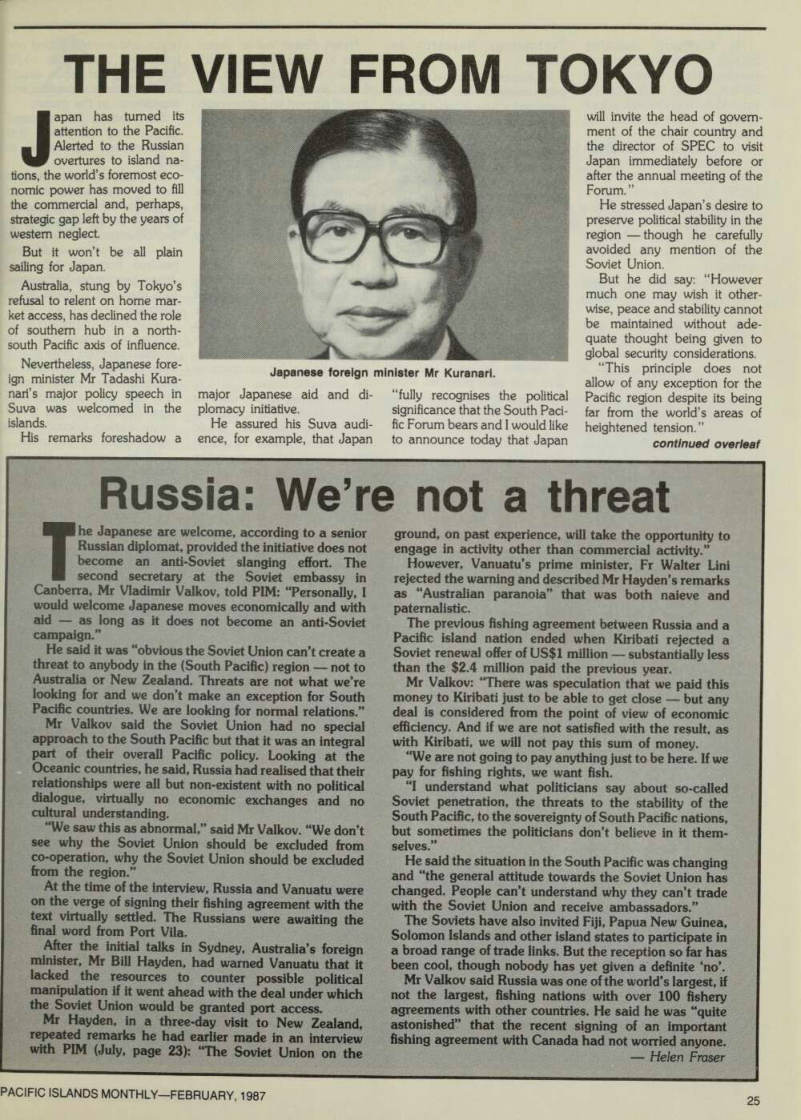
Japanese foreign minister Mr Kuranari.
Mr Kuranari, speaking through an interpreter and still avoiding direct mention of the Soviets, added: “Japan cannot support the introduction of new tension into this peaceful and untroubled region.”
He said Japan would, subject to parliamentary approval: • Provide SUS 2 million to the UNDP to be earmarked for development projects in the is an s, . Provide US$l million for appropriate technology re- T . .. , • Increase visits by young islanders to Japan for training and experience.
Mr Kuranari noted that Japan’s aid to the region had grown five times in ten years, “but I have ordered a study of ways to expand Japan’s cooperation yet further.”
The UNDP money would go mainly to transport and telecommunications, he said, while the research grant was earmarked for the project, “Open Cycle Ocean Thermal Energy Conversion at the Pacific International Centre for High
Technology Research in Hawaii, Mr Kuranari also met the Fiji prime minister Ratu Mara and inspected a new nursing school that had been built with Japan ese a id.
He met j a p aneS e volunteers who are spending two years working in Fiji’s Mineral Re sources Department, Qn m {and mQSt island nations’) trade imbalance with j Mr Kuranari , inter . on his arrival> was in encouraging mood. , , , hoped that Fiji enterprises would make every sell aoods to Japan, which government in Tokyo was to encourage, Tourism, he said, was one area with great potential. More flights into Fiji (Air Pacific had just announced a regular week ly service in partnership with JAL) would attract more Japan ese tourists, And Japan, he said, would be willing to buy more of Fiji’s sugar provided quality, price and delivery were right.
Helen Fraser writes: Japan plans to move into the South Pacific as a significant aid donor, though without the de gree of support and encourage ment that had been sought from Australia.
At the two day Australia- Japan Ministerial Committee talks held in Canberra relations between the two delegations suffered severe strain when Japan failed to make the eco nomic concessions expected by Australia.
The Japanese sought Austra lian participation in an alliance to thwart the growing Soviet presence in the South Pacific but Australia would not agree to a strong political relationship in the face of fundamental divi sions between the two countries on economic issues.
After talking for two days Mr Kuranari said it was agreed that Japan and Australia would “hold close bilateral discussions on the theme of co-operation with the island states of the Pacific”.
Mr Kuranari said he had a deep personal interest in the
region and wanted to find out for himself what Japan could do, adding that Japan would call on Australia’s “wisdom and experience” in the matter.
But Australia has indicated that it may just keep that “wisdom and experience” to itself.
Mr Kuranari acknowledged that no actual mechanism had been established to allow con sultation on this use of Austra lian experience in South Pacific aid - a step which would have resulted from the talks had Japan been more forthcoming with economic concessions for Australia.
Australian ministers had pointed out to Japan that unless Australia received more favour able treatment from Japan on access to their markets, particu larly iron ore, coal and beef, then Australia’s ability to ad vance western interests in the region would be hampered.
While Japanese ministers stressed that Japan would not seek to solve its economic prob lems with third countries at
continued on page 43
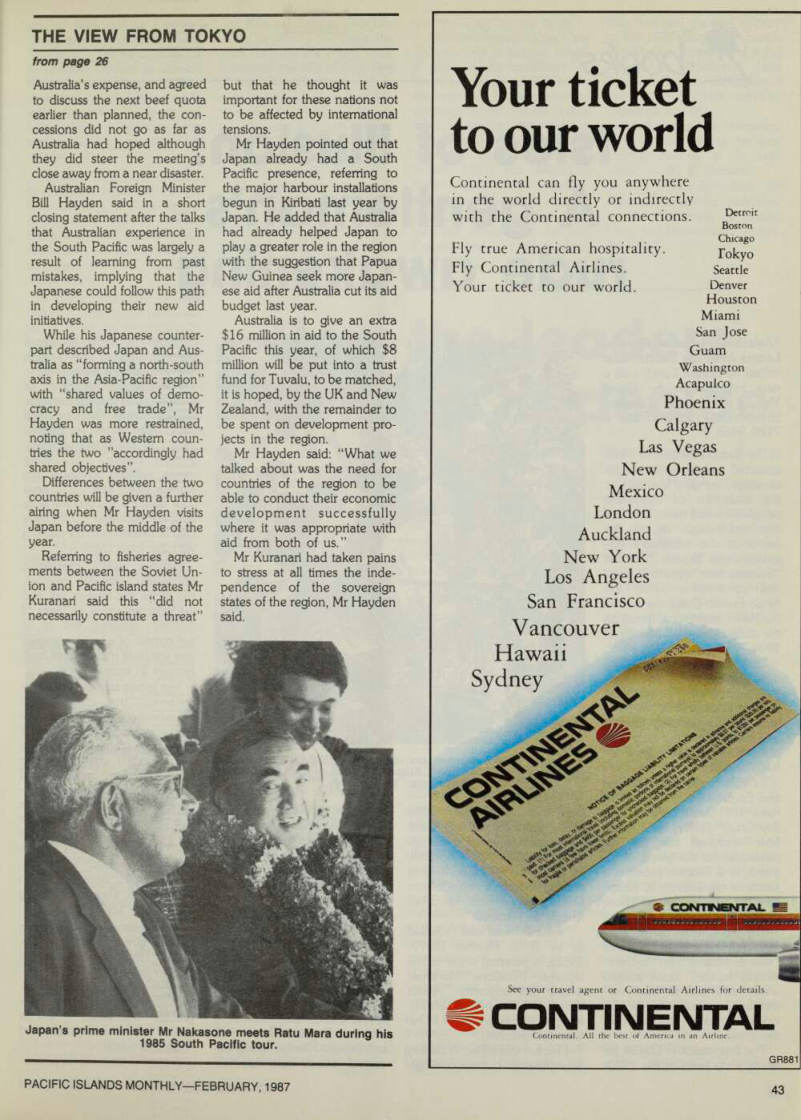
Australia’s expense, and agreed to discuss the next beef quota earlier than planned, the con cessions did not go as far as Australia had hoped although they did steer the meeting’s close away from a near disaster.
Australian Foreign Minister Bill Hayden said in a short closing statement after the talks that Australian experience in the South Pacific was largely a result of learning from past mistakes, implying that the Japanese could follow this path in developing their new aid initiatives.
While his Japanese counter part described Japan and Aus tralia as “forming a north-south axis in the Asia-Pacific region” with “shared values of demo cracy and free trade”, Mr Hayden was more restrained, noting that as Western coun tries the two ’’accordingly had shared objectives”.
Differences between the two countries will be given a further airing when Mr Hayden visits Japan before the middle of the year.
Referring to fisheries agree ments between the Soviet Un ion and Pacific island states Mr Kuranari said this “did not necessarily constitute a threat”
but that he thought it was important for these nations not to be affected by international tensions.
Mr Hayden pointed out that Japan already had a South Pacific presence, referring to the major harbour installations begun in Kiribati last year by Japan. He added that Australia had already helped Japan to play a greater role in the region with the suggestion that Papua New Guinea seek more Japan ese aid after Australia cut its aid budget last year.
Australia is to give an extra $l6 million in aid to the South Pacific this year, of which $8 million will be put into a trust fund for Tuvalu, to be matched, it is hoped, by the UK and New Zealand, with the remainder to be spent on development pro jects in the region.
Mr Hayden said: “What we talked about was the need for countries of the region to be able to conduct their economic development successfully where it was appropriate with aid from both of us.”
Mr Kuranari had taken pains to stress at all times the inde pendence of the sovereign states of the region, Mr Hayden said.
Japan’s prime minister Mr Nakasone meets Ratu Mara during his 1985 South Pacific tour.
Russia: We’re not a threat
The Japanese are welcome, according to a senior Russian diplomat, provided the initiative does not become an anti-Soviet slanging effort. The second secretary at the Soviet embassy in Canberra, Mr Vladimir Valkov, told PIM: “Personally, I would welcome Japanese moves economically and with aid as long as it does not become an anti-Soviet campaign.”
He said it was “obvious the Soviet Union can’t create a threat to anybody in the (South Pacific) region not to Australia or New Zealand. Threats are not what we’re looking for and we don’t make an exception for South Pacific countries. We are looking for normal relations.”
Mr Valkov said the Soviet Union had no special approach to the South Pacific but that it was an integral part of their overall Pacific policy. Looking at the Oceanic countries, he said, Russia had realised that their relationships were all but non-existent with no political dialogue, virtually no economic exchanges and no cultural understanding.
“We saw this as abnormal,” said Mr Valkov. “We don’t see why the Soviet Union should be excluded from co-operation, why the Soviet Union should be excluded from the region.”
At the time of the interview, Russia and Vanuatu were on the verge of signing their fishing agreement with the text virtually settled. The Russians were awaiting the final word from Port Vila.
After the initial talks in Sydney, Australia’s foreign minister, Mr Bill Hayden, had warned Vanuatu that it lacked the resources to counter possible political manipulation if it went ahead with the deal under which the Soviet Union would be granted port access.
Mr Hayden, in a three-day visit to New Zealand, repeated remarks he had earlier made in an interview with PIM (July, page 23): “The Soviet Union on the
ground, on past experience, will take the opportunity to engage in activity other than commercial activity.”
However, Vanuatu’s prime minister, Fr Walter Lini rejected the warning and described Mr Hayden’s remarks as “Australian paranoia” that was both naieve and paternalistic.
The previous fishing agreement between Russia and a Pacific island nation ended when Kiribati rejected a Soviet renewal offer of US$l million substantially less than the $2.4 million paid the previous year.
Mr Valkov: ‘There was speculation that we paid this money to Kiribati just to be able to get close but any deal is considered from the point of view of economic efficiency. And if we are not satisfied with the result, as with Kiribati, we will not pay this sum of money.
“We are not going to pay anything just to be here. If we pay for fishing rights, we want fish.
“I understand what politicians say about so-called Soviet penetration, the threats to the stability of the South Pacific, to the sovereignty of South Pacific nations, but sometimes the politicians don’t believe in it them selves.”
He said the situation in the South Pacific was changing and “the general attitude towards the Soviet Union has changed. People can’t understand why they can’t trade with the Soviet Union and receive ambassadors.”
The Soviets have also invited Fiji, Papua New Guinea, Solomon Islands and other island states to participate in a broad range of trade links. But the reception so far has been cool, though nobody has yet given a definite ‘no’.
Mr Valkov said Russia was one of the world’s largest, if not the largest, fishing nations with over 100 fishery agreements with other countries. He said he was “quite astonished” that the recent signing of an important fishing agreement with Canada had not worried anyone.
Helen Fraser
Advertisements & other items, p. 24 (1 item)
Rare Investment Opportunity
MATAMANOA ISLAND RESORT
F 53,000,000 r "
SINCE 1860
Ragg & Associates (Fiji) Ltd.
G.P.O. Box 861, Suva, Fiji.
> SOLE AGENT FOR THE VENDORS
CABLE “RAGLANDS” FIJI. PH. 31-2078
Airmail to me the colour brochure on Matamanoa island Resort, Fiji’s newest and fully operational resort.
Name Address ...
may be higher than expected
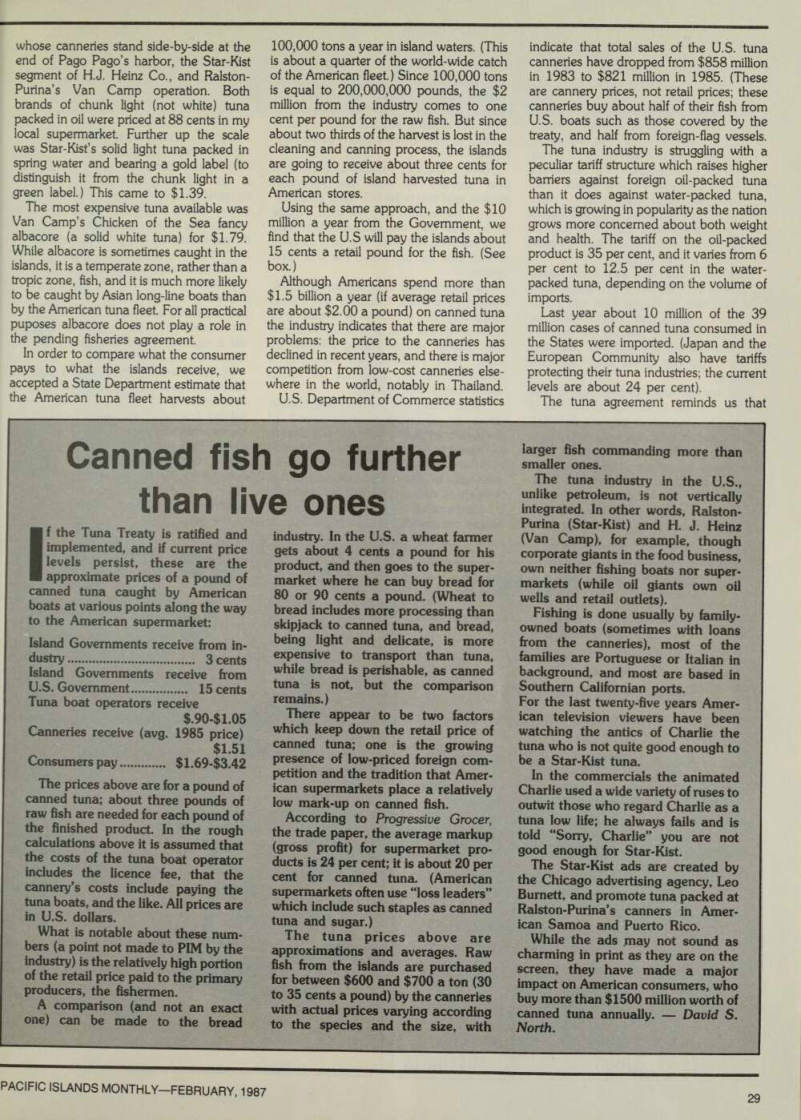
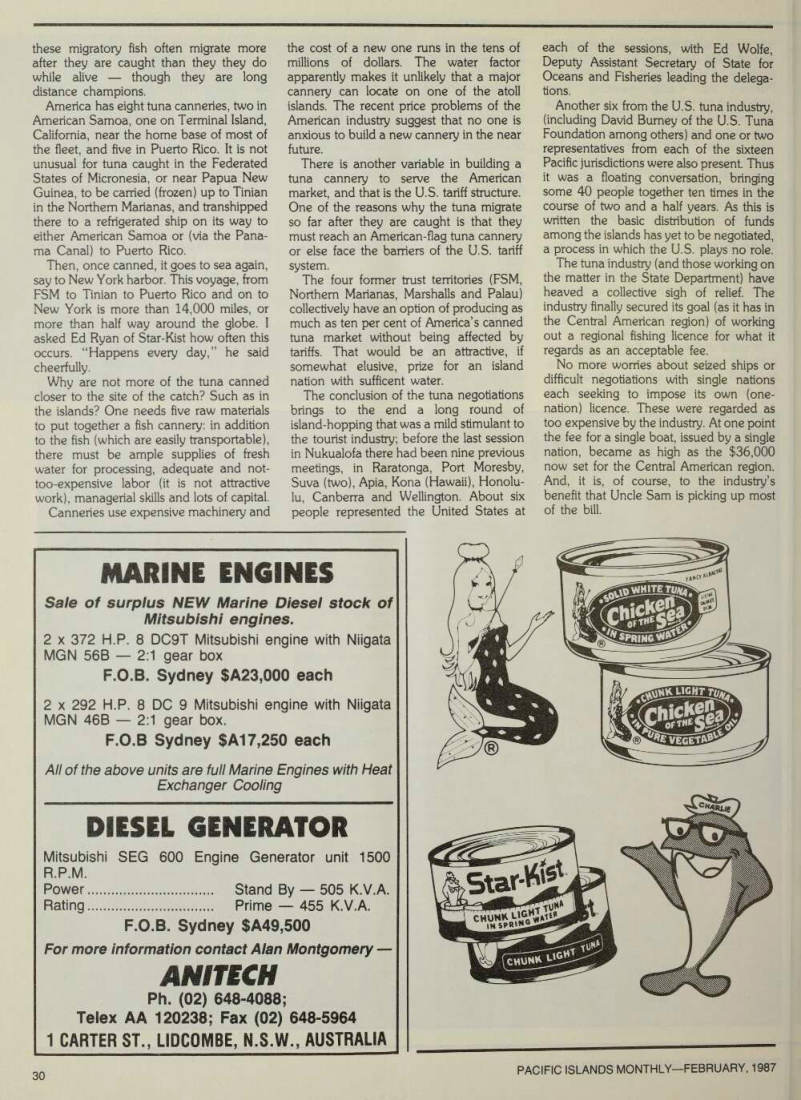
trade winds
Tuna deal pay out may be higher than expected
There’s both good news and bad news for the islands regarding the pending U.S. tuna treaty.
The good news is that the islands may get more than the widely quoted SUS 2 million from the industry, and that they drove a considerably better bargain for fishing rights than did the Central American nations.
The bad news is that there are many hurdles to clear before any money changes hands, and that the islands, despite the use of lots of U.S. taxpayers’ money, will only get a tiny portion of the retail value of the fish.
The basic arrangement is that the industry will provide about $2 million and the U.S. Government $lO million a year for the fishing rights for the next five years.
The Government funds include $1 million in economic development assistance, and $9 million in cash, to be divided among the islands. The industry will pay a minimum of $1.75 million a year in boat fees, and a flat $250,000 a year in technical assistance to fishery-related projects.
There are two reasons why the industry may pay more than the anticipated $1.75 million in fees. These fees are based on a minimum rate of $50,000 per vessel, and if long-depressed tuna prices rise, the boat fees will rise proportionately. Similarly, it is sensed in Washington that more boats will seek licenses than the widely discussed total of 35. ($50,000 x 35 = $1,750,000.) There are 64 active purse seiners in the U.S. tuna fleet, and people in the industry sxpect that as many as 40 of them will seek the licenses.
Meanwhile, the tuna industry and the U.S. Government have been negotiating ■wth four of the Central American nations vhose waters contain abundant supplies of ;ellowfin tuna. This agreement, which is at about the same stage as the islands’ aegotiations, calls for a payment of (>36,000 per boat, about two-thirds of the igure secured by the members of the r orum Fisheries Association.
Should nearby Mexico join the Central American pact, with its ample fishery vaters, the basic fee will climb to $50,000, as in the islands. But whether the fee is
$36,000 or $50,000 there is no escalation fee in the event of price increases as there is in the islands deal.
Further, while there is substantial U.S.
Government cash accompanying the industry’s payments to the islands, there is no comparable arrangement in Central
America. (On the other hand, the U.S. is so concerned about the growth of a commun ist threat in the area, particularly in Nicaragua, that it has long had an active economic development program in Cen tral America.) As is often the case, the bad news is
Star-Kist’s Charlie the Tuna.
more complicated than the good news.
The current status of the tuna treaty is that the central problem has been solved; the islands, the industry and the United States have come to an agreement regar ding the amount of money to move from the mainland to the islands. But before the money can start to move the following has to happen: • Some minor matters of substance such as defining areas where no fishing will be permitted must be settled; • The treaty must be signed by the U.S. and the 16 other jurisdictions (see box) • The treaty must be ratified by the United States Senate and ten other juris dictions. • Enabling legislation must pass both
Houses of Congress and be signed into law by the President. • The $lO million must be appropriated by the U.S. Congress.
As the islands will discover, it takes time to do business with Uncle Sam, even when he is feeling friendly, as he is now on this issue.
Once a text has been agreed to, the document must be signed by the parties.
While signing a treaty and ratifying it are essentially the same act in a parliamentary democracy, this is not the case in the U.S., where the Department of State, in effect, signs agreements, and then ships them over to the Senate for ratification.
And, sometimes in the past, what the executive branch wants the legislative branch denies. (The U.S. Senate, for instace, refused to ratify the Treaty of
Versailles after World War 1. That docu ment, among other things, transferred the once-German ownership of Western Samoa to New Zealand, that of Nauru and part of Papua New Guinea to Australia, and that of the Micronesian islands to Japan.) Although no opposition to the tuna treaty is expected, it will take time to get it through the Senate. The Treaty goes to the Committee on Foreign Relations, which has been showing every sign of being transfixed by the complex and messy Iran arms deal.
The new Democratic chairman of the Committee, Senator Claibom Pell of Rhode Island, probably will want to spend most of his time investigating it. Pell, incidentally, a wealthy man and a former career foreign service officer is not re garded enthusiastically by many career people in State. His nickname: “Stillborn”.
In the U.S. system the ratification of a Treaty (a process involving only the Senate) does not lead directly to the expenditure of funds. Before any of the $lO million can get to the islands authoris ing legislation must be passed, and then, later, an appropriation must be voted.
Both of these steps require the concurr ence of both houses and the president.
Though no major obstacles are antici pated, all of this will simply take time.
PlM’s analysis of the financial implica tions of the treaty suggest the following: • The retail price of canned tuna is about $1.70 to $4.50 in the U.S.; the islands will get about three cents a pound of this from the industry. • The U.S taxpayers will bail out the big tuna corporations, with the Govern ment contributing five times as much, or fifteen cents a pound, at retail, to the islands.
Tuna is a big, big business in the States.
American consumers love the product, annually buying the equivalent of nearly 2,000,000,000 cans of the stuff each weighing 6.5 ounces. That is about eight cans a year for every man, woman and child in the nation. When you visit an American grocery store you will find a few cans of mackerel (most Americans regard canned mackerel as food for cats), a few cans of canned salmon (an expensive delicacy), some sardines, and row after row of canned tuna. (Tuna dominates the canned fish market, but not the fresh or frozen fish markets.) In the large, efficient suburban super markets one buys 6.6 oz. cans of Western Pacific tuna at prices ranging from 73 cents to $1.39. The cheapest available (at 73 cents) are non-advertised brands, usually carrying the store’s own label. (People in the tuna industry say that such cans sometimes sell for as little as 59 cent) Next up the scale are advertised pro ducts packed by the U.S corporations
The model of a modern US tuna boat.
whose canneries stand side-by-side at the end of Pago Pago’s harbor, the Star-Kist segment of H.J. Heinz Co., and Ralston- Purina’s Van Camp operation. Both brands of chunk light (not white) tuna packed in oil were priced at 88 cents in my local supermarket. Further up the scale was Star-Kist’s solid light tuna packed in spring water and bearing a gold label (to distinguish it from the chunk light in a green label.) This came to $1.39.
The most expensive tuna available was Van Camp’s Chicken of the Sea fancy albacore (a solid white tuna) for $1.79.
While albacore is sometimes caught in the islands, it is a temperate zone, rather than a tropic zone, fish, and it is much more likely to be caught by Asian long-line boats than by the American tuna fleet. For all practical puposes albacore does not play a role in the pending fisheries agreement.
In order to compare what the consumer pays to what the islands receive, we accepted a State Department estimate that the American tuna fleet harvests about
100,000 tons a year in island waters. (This is about a quarter of the world-wide catch of the American fleet.) Since 100,000 tons is equal to 200,000,000 pounds, the $2 million from the industry comes to one cent per pound for the raw fish. But since about two thirds of the harvest is lost in the cleaning and canning process, the islands are going to receive about three cents for each pound of island harvested tuna in American stores.
Using the same approach, and the $lO million a year from the Government, we find that the U.S will pay the islands about 15 cents a retail pound for the fish. (See box.) Although Americans spend more than $1.5 billion a year (if average retail prices are about $2.00 a pound) on canned tuna the industry indicates that there are major problems: the price to the canneries has declined in recent years, and there is major competition from low-cost canneries else where in the world, notably in Thailand.
U.S. Department of Commerce statistics
indicate that total sales of the U.S. tuna canneries have dropped from $B5B million in 1983 to $B2l million in 1985. (These are cannery prices, not retail prices; these canneries buy about half of their fish from U.S. boats such as those covered by the treaty, and half from foreign-flag vessels, The tuna industry is struggling with a peculiar tariff structure which raises higher barriers against foreign oil-packed tuna than it does against water-packed tuna, which is growing in popularity as the nation grows more concerned about both weight and health. The tariff on the oil-packed product is 35 per cent, and it varies from 6 per cent to 12.5 per cent in the water packed tuna, depending on the volume of imports.
Last year about 10 million of the 39 million cases of canned tuna consumed in the States were imported. (Japan and the European Community also have tariffs protecting their tuna industries; the current levels are about 24 per cent), The tuna agreement reminds us that
these migratory fish often migrate more after they are caught than they they do while alive though they are long distance champions.
America has eight tuna canneries, two in American Samoa, one on Terminal Island, California, near the home base of most of the fleet, and five in Puerto Rico. It is not unusual for tuna caught in the Federated States of Micronesia, or near Papua New Guinea, to be carried (frozen) up to Tinian in the Northern Marianas, and transhipped there to a refrigerated ship on its way to either American Samoa or (via the Panama Canal) to Puerto Rico.
Then, once canned, it goes to sea again, say to New York harbor. This voyage, from FSM to Tinian to Puerto Rico and on to New York is more than 14,000 miles, or more than half way around the globe. I asked Ed Ryan of Star-Kist how often this occurs. “Happens every day,” he said cheerfully.
Why are not more of the tuna canned closer to the site of the catch? Such as in the islands? One needs five raw materials to put together a fish cannery: in addition to the fish (which are easily transportable), there must be ample supplies of fresh water for processing, adequate and nottoo-expensive labor (it is not attractive work), managerial skills and lots of capital.
Canneries use expensive machinery and
the cost of a new one runs in the tens of millions of dollars. The water factor apparently makes it unlikely that a major cannery can locate on one of the atoll islands. The recent price problems of the American industry suggest that no one is anxious to build a new cannery in the near future.
There is another variable in building a tuna cannery to serve the American market, and that is the U.S. tariff structure.
One of the reasons why the tuna migrate so far after they are caught is that they must reach an American-flag tuna cannery or else face the barriers of the U.S. tariff system.
The four former trust territories (FSM, Northern Marianas, Marshalls and Palau) collectively have an option of producing as much as ten per cent of America’s canned tuna market without being affected by tariffs. That would be an attractive, if somewhat elusive, prize for an island nation with sufficent water.
The conclusion of the tuna negotiations brings to the end a long round of island-hopping that was a mild stimulant to the tourist industry; before the last session in Nukualofa there had been nine previous meetings, in Raratonga, Port Moresby, Suva (two), Apia, Kona (Hawaii), Honolulu, Canberra and Wellington. About six people represented the United States at
each of the sessions, with Ed Wolfe, Deputy Assistant Secretary of State for Oceans and Fisheries leading the delega tions.
Another six from the U.S. tuna industry, (including David Bumey of the U.S. Tuna Foundation among others) and one or two representatives from each of the sixteen Pacific jurisdictions were also present. Thus it was a floating conversation, bringing some 40 people together ten times in the course of two and a half years. As this is written the basic distribution of funds among the islands has yet to be negotiated, a process in which the U.S. plays no role.
The tuna industry (and those working on the matter in the State Department) have heaved a collective sigh of relief. The industry finally secured its goal (as it has in the Central American region) of working out a regional fishing licence for what it regards as an acceptable fee.
No more worries about seized ships or difficult negotiations with single nations each seeking to impose its own (one nation) licence. These were regarded as too expensive by the industry. At one point the fee for a single boat, issued by a single nation, became as high as the $36,000 now set for the Central American region, And, it is, of course, to the industry’s benefit that Uncle Sam is picking up most of the bill.
Advertisements & other items, p. 25 (1 item)
27
’ACIFIC ISLANDS MONTHLY—FEBRUARY, 1987
NMI wants a share
The Commonwealth of the Northern Mariana islands (CMI) is eyeing the impending tuna treaty and would like to be able to control its own territorial waters and make deals with foreign fishermen, just like the other island territories.
That FSM, the Marshalls and Palau will all get cash and other considerations from the treaty has not been lost on CMI.
The commonwealth, however, has opted for a different kind of relationship with the U.S. and the Federal Department of Interior is not enthusiastic about the prospect of NMI having those powers. “If they control the fishing rights, then California and Florida will make similar claims and then where are we?” One interior Department source asked.
The waters around the Marianas are not regarded as major fishing grounds by the U.S. tuna industry, but U.S. tunaboats do visit Tinian to tranship their catches to refrigerated freighters heading for U.S. canneries.
Canned fish go further
than live ones
If the Tuna Treaty is ratified and implemented, and if current price levels persist, these are the approximate prices of a pound of canned tuna caught by American boats at various points along the way to the American supermarket: Island Governments receive from in dustry Scents Island Governments receive from U.S. Government 15 cents Tuna boat operators receive $.90-$1.05 Canneries receive (avg. 1985 price) $1.51 Consumers pay $1.69-$3.42 The prices above are for a pound of canned tuna; about three pounds of raw fish are needed for each pound of the finished product. In the rough calculations above it is assumed that the costs of the tuna boat operator includes the licence fee, that the cannery’s costs include paying the tuna boats, and the like. All prices are in U.S. dollars.
What is notable about these num bers (a point not made to RIM by the industry) is the relatively high portion of the retail price paid to the primary producers, the fishermen.
A comparison (and not an exact one) can be made to the bread
industry. In the U.S. a wheat farmer gets about 4 cents a pound for his product, and then goes to the super market where he can buy bread for 80 or 90 cents a pound. (Wheat to bread includes more processing than skipjack to canned tuna, and bread, being light and delicate, is more expensive to transport than tuna, while bread is perishable, as canned tuna is not, but the comparison remains.) There appear to be two factors which keep down the retail price of canned tuna; one is the growing presence of low-priced foreign com petition and the tradition that Amer ican supermarkets place a relatively low mark-up on canned fish.
According to Progressive Grocer, the trade paper, the average markup (gross profit) for supermarket pro ducts is 24 per cent; it is about 20 per cent for canned tuna. (American supermarkets often use “loss leaders” which include such staples as canned tuna and sugar.) The tuna prices above arc approximations and averages. Raw fish from the islands arc purchased for between $6OO and $7OO a ton (30 to 35 cents a pound) by the canneries with actual prices varying according to the species and the size, with
larger fish commanding more than smaller ones.
The tuna industry in the U.S., unlike petroleum, is not vertically integrated. In other words, Ralston- Purina (Star-Kist) and H. J. Heinz (Van Camp), for example, though corporate giants in the food business, own neither fishing boats nor super markets (while oil giants own oil wells and retail outlets).
Fishing is done usually by family owned boats (sometimes with loans from the canneries), most of the families are Portuguese or Italian in background, and most are based in Southern Californian ports.
For the last twenty-five years Amer ican television viewers have been watching the antics of Charlie the tuna who is not quite good enough to be a Star-Kist tuna.
In the commercials the animated Charlie used a wide variety of ruses to outwit those who regard Charlie as a tuna low life; he always fails and is told “Sorry, Charlie” you are not good enough for Star-Kist.
The Star-Kist ads are created by the Chicago advertising agency, Leo Burnett, and promote tuna packed at Ralston-Purina’s canners in Amer ican Samoa and Puerto Rico.
While the ads may not sound as charming in print as they are on the screen, they have made a major impact on American consumers, who buy more than $l5OO million worth of canned tuna annually. David S.
North.
Advertisements & other items, pp. 28-29 (1 item)
Star
FAHCT
® Cf *4RUg m
C TOn£S
MARINE ENGINES
Sale of surplus NEW Marine Diesel stock of Mitsubishi engines. 2 x 372 HP. 8 DC9T Mitsubishi engine with Niigata MGN 568 2:1 gear box F. 0.8. Sydney $A23,000 each 2 x 292 HP. 8 DC 9 Mitsubishi engine with Niigata MGN 468 2:1 gear box.
F. 0.8 Sydney $A17,250 each All of the above units are full Marine Engines with Heat Exchanger Cooling
DIESEL GENERATOR
Mitsubishi SEG 600 Engine Generator unit 1500
R.P.M.
Power Stand By 505 K.V.A.
Rating Prime 455 K.V.A.
F. 0.8. Sydney $A49,500 For more information contact Alan Montgomery
AMITECM
Ph. (02) 648-4088; Telex AA 120238; Fax (02) 648-5964
1 CARTER ST., LIDCOMBE, N.S.W., AUSTRALIA
h \) mi * L m r >
TRADITIONALLY THE NAME
ASSOCIATED WITH PERFECTION
IN CIGARETTES
BENSON & HEDGES
20
Bens on wj Hedges
WARNING-SMOKING IS A HEALTH HAZARD
man lit
Petite bananas set
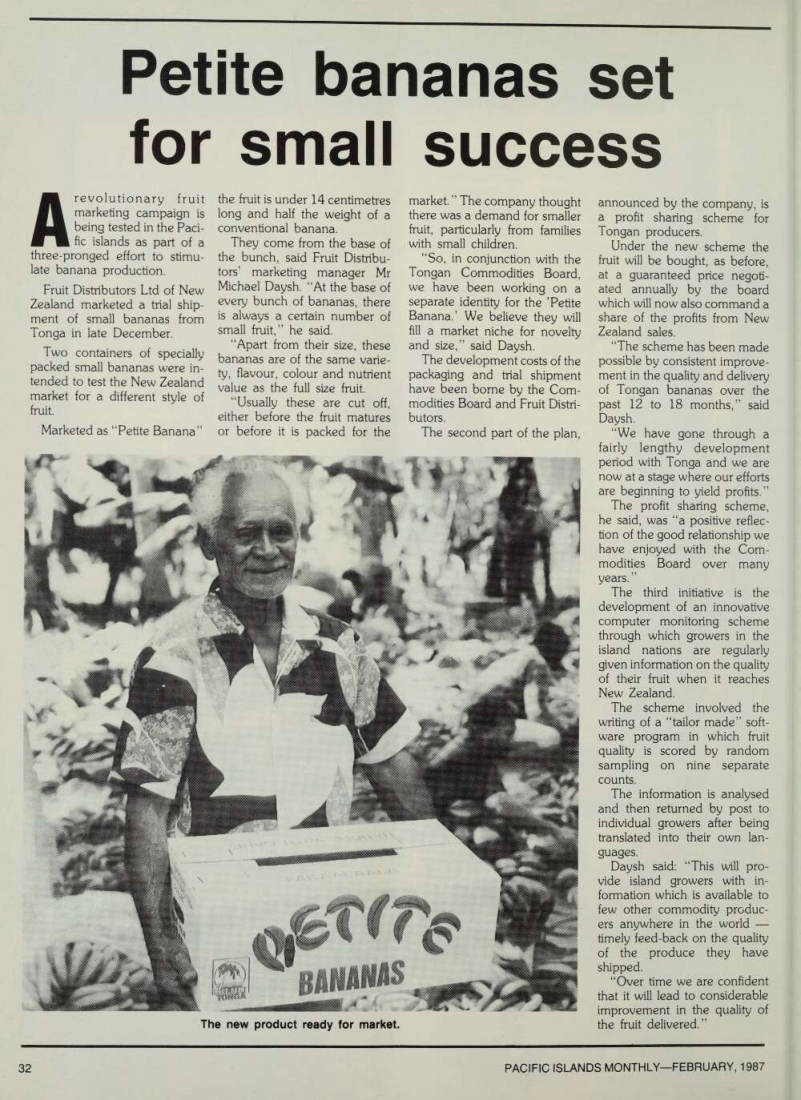
for small success
A revolutionary fruit marketing campaign is being tested in the Paci fic islands as part of a three-pronged effort to stimu late banana production.
Fruit Distributors Ltd of New Zealand marketed a trial ship ment of small bananas from Tonga in late December.
Two containers of specially packed small bananas were in tended to test the New Zealand market for a different style of fruit.
Marketed as “Petite Banana”
the fruit is under 14 centimetres long and half the weight of a conventional banana.
They come from the base of the bunch, said Fruit Distribu tors’ marketing manager Mr Michael Daysh. “At the base of every bunch of bananas, there is always a certain number of small fruit,” he said.
“Apart from their size, these bananas are of the same varie ty, flavour, colour and nutrient value as the full size fruit.
“Usually these are cut off, either before the fruit matures or before it is packed for the
market. ” The company thought there was a demand for smaller fruit, particularly from families with small children.
“So, in conjunction with the Tongan Commodities Board, we have been working on a separate identity for the ’Petite Banana.’ We believe they will fill a market niche for novelty and size,” said Daysh.
The development costs of the packaging and trial shipment have been borne by the Com modities Board and Fruit Distri butors.
The second part of the plan,
announced by the company, is a profit sharing scheme for Tongan producers.
Under the new scheme the fruit will be bought, as before, at a guaranteed price negoti ated annually by the board which will now also command a share of the profits from New Zealand sales.
“The scheme has been made possible by consistent improve ment in the quality and delivery of Tongan bananas over the past 12 to 18 months,” said Daysh.
“We have gone through a fairly lengthy development period with Tonga and we are now at a stage where our efforts are beginning to yield profits.”
The profit sharing scheme, he said, was “a positive reflec tion of the good relationship we have enjoyed with the Com modities Board over many years.”
The third initiative is the development of an innovative computer monitoring scheme through which growers in the island nations are regularly given information on the quality of their fruit when it reaches New Zealand.
The scheme involved the writing of a “tailor made” soft ware program in which fruit quality is scored by random sampling on nine separate counts.
The information is analysed and then returned by post to individual growers after being translated into their own lan guages.
Daysh said: “This will pro vide island growers with in formation which is available to few other commodity produc ers anywhere in the world timely feed-back on the quality of the produce they have shipped.
“Over time we are confident that it will lead to considerable improvement in the quality of the fruit delivered.”
The new product ready for market.
Bureaucracy’s error

is sugar windfall
As the region’s relations with the US bore fur ther strain with the widely held view that the Reagan administration would not sign the SPNFZ protocols and drastic cuts in import quotas, Fiji has quietly increased its sugar quota.
Fiji’s allocation in the heavily protected US sugar market had been 12,012 tons last year.
This year, it will more than double to 25,190 tons. At the same time the Australian quota was slashed from 142,428 to 75,000 tons while that of PNG fell from 12,500 tons to 7,500 tons.
Fiji’s increased quota is the Washington bureaucracy’s way of admitting mistakes over the previous years in fixing amounts..
Officials who set quotas had been in error over the years in fixing the Fiji tonnage below planned levels.
This year, they have cor rected the mistakes with Fiji being granted an extra 17,000 tons.
That’s a US$3.4 million error small potatoes in Washing ton but a welcome correction in Suva.
The world price of sugar is in the 5.5 to 7.5 cents per pound range depending on delivery date.
The subsidy price in the States, demanded by US pro ducers of cane and beet sugar, is about 18 to 20 cents.
So, after the costs of shipping and import duties, a foreign producer such as Fiji profits at the rate of about ten cents per pound by being included in the quota.
Thus, 17,000 tons represents about $3.4 million.
The Australian and PNG quotas were cut by about 40 per cent The PNG quota of 7,500 represents the absolute rock bottom allocation for the smallest of the producers, just
as 12,000 tons had been the lowest allocation available last year.
The PNG allocation still rep resents about $1.5 milion.
However this is still a 30 per cent reduction in the quota and will mean that foreign exchange earnings from PNG’s deve loping Ramu Sugar Ltd will
drop from A 56.4 million to As4.B million.
Ramu general mamager Mr Brian Dyer said he was dis appointed at the cut but pleased that, at least, PNG had retained a quota.
But, he said, there was no need for Ramu Sugar to feel aggrieved as the quota was
government to government.
Meanwhile the company was well ahead with an ambitious replanting program, he said, after a mystery disease de stroyed a large part of the Ramu crop.
Mr Dyer said the company hoped to be back to full pro duction next year.
Advertisements & other items, pp. 31-33 (1 item)
Samoan Tropical Products Ltd
Q'OcJ* . . .
[xxns
tested
BOX
via 24x420g cn m X Jill S/ @S n
Samoan Tropical Products Ltd
APIA: P.O. Box 1550, Apia Western Samoa, Ph; 21535. TLX: 793210 SAMTROP SX.
HONOLULU: Suite 2H, 485 Kapahulu Avenue, Honolulu, Hawaii 96815. Ph: 734 3233, 734
2711. TLX: 723 8202 HIDE.
HILUX 4WD Regular Cab, Long Wheelbase One tough truck just got tougher. Toyota’s dedication to superior performance vehicles takes a step forward today with the New Hilux.x A refined front grille and bumper design, new instrument panel I for a feeling of spaciousness and command and plush colour co-ordinated trim are a few new additions to the New Hilux.
And extensive anti-corrosive galvanealed steel protection now includes the tailgate panel and rear door panel, making Hilux more durable than ever before.
Yet for all its improvements, the best of the original Hilux is also?
TOYOTA
QUALITY SERVICE
AMERICAN SAMOA: BURNS PHILP (SOUTH SEA) CO., LTD., P.O. Box 129, Pago Pago. COOK ISLANDS: COOK ISLARA.
AUTOMOTIVE SUPPLIES COMPANY, A Division of Burns Philp (South Sea) Co., Ltd., G.P.O. Box 355, Suva. GUAM & MUM Tamuning. KIRIBATI: TARAWA MOTORS, A Division of Bairiki Holdings Ltd., P.O. Box 36, Bairiki, Tarawa. NAURU: NAURU SERVICE IMPORTATION AUTOMOBILE DU PACIFIQUE, Rond-Point du Pacifique (Station Total) B.P. 438, Noumea. NIUE: I :■ NORFOLK ISLAND: BORRY’S LIMITED, P.O. Box 169. PAPUA NEW GUINEA: ELA MOTORS, A Division of Burns Phiiit CORPORATION, P.O. Box 267, Saipan. SOLOMON ISLANDS: SOLOMON ISLANDS INVESTMENTS LTD., G.P.O. Box 1400* TONGA: BURNS PHILP (TONGA) LTD., P.O. Box 55. Nukualofa. VANUATU: VANUATU MOTORS, A Division of Burns Philiirl BURNS PHILP (SOUTH SEA) CO.. LTD., P.O. Box 188, Apia.
ific-Tough. The New Hilux.
* ■ < r \ S*r h 1 z y *\ * L% r "* i * 4 * I • *r* * «• ‘ » v m ere: a big tailgate conveniently hinged for quick loading and unloading; reinforced front suspension to smooth out le bumps, and bias-mounted, extra-heavy-duty rear shocks and knobbly tyres to take on any terrain.
Areas where galvanealed steel is used Toyota’s long history of super-responsive engines, ruggedness, reliability and comfort goes without saying. And in the Hilux, it’s yours in both 2-wheel-drive and 4 x 4 versions.
So, after comprehensive testing and thorough quality control, the New Hilux is ready to bring a new standard of toughness to the Pacific.
And isn’t that exactly what you expect from Toyota?
DING CORPORATION LTD., Private Bag, Rarotonga. FIJI: »IA: ATKINS KROLL, INC., 443 South Marine Drive,
ERATIVE SOCIETY, Central Pacific. NEW CALEDONIA:
HILP (SOUTH SEA) CO., LTD., P.O. Box 39, Alofi.
Ltd., P.O. Box 75, Port Moresby. SAIPAN: MICROL
TAHITI; NIPPON AUTOMOTO, B.P. 342. Papeete.
u ) Ltd., P.O. Box 18, Port Vila. WESTERN SAMOA:
TOYOTA
in Washington
Visa-free tourism effort makes ground in Washington
Guam’s effort to promote visa-free tourism from Asia (PIM, January page 9) is inching ahead in Washington as part of the territory’s continuing drive to control more of its immigra tion policy.
Congress has twice passed legislation sought by the island to create a visa waiver for Guam-bound tourists and until recently the mainland Immigra tion and Naturalisation Service
(INS) has dragged its feet regar ding implementation.
INS worries about illegal aliens and undefined “security concerns”. The Governor’s office and Guam Congressman Ben Blaz think in terms of more tourists.
INS has now drafted regula tions which would, at some time in the near future, allow 15-day visits without visas from a dozen sources: Australia, Hong Kong, Indonesia, Japan,
Malaysia, New Zealand, Papua New Guinea, Singapore, Solo mon Islands, United Kingdom, Vanuatu and Western Samoa.
The problem is that the list excludes three nations of strong interest to Guam The Philip pines, South Korea and Taiwan.
INS worries too that many visa applications are denied in those countries and that to give residents the right to visit Guam without visas would simply lead to problems of immigration control.
Congress, in passing the legislation, spoke about gran ting visa waivers to nations where the visa refusal rate was at or below 16 per cent.
However, the refusal rate in Taiwan and South Korea has moved up to 25 per cent while that of the Philippines is over 40 per cent. There is some talk in Washington that INS will add South Korea to the final list as a result of pressure from Guam.
Actual implementation of the scheme will be delayed until INS and Guam can work out who will pay for the program and until a new computerised
exit-entry control system can be set in motion. Australia and Fiji both have such systems, but the US and Guam do not.
The list of 12 nations prop osed for the visa-waiver prog ram contains few goodies for Guam except Hong Kong.
The bulk of Guam’s tourist arrivals originate in Japan (Guam is the traditional place for Japanese honeymoons) but Japanese have no trouble obtaining visas.
The other nations on the proposed list are distant from Guam, are generally not on direct air routes and in many cases (e.g. Solomon Islands, Vanuatu and Western Samoa) are more noted for receiving tourists than for sending them to distant destinations.
On another front Guam’s voters will decide in April on a proposed Guam Common wealth Act an island wish list which includes territorial control of immigration.
The Act, however, will be subject to extensive Con gressional review and probably revision. David S. North in Washington.
Advertisements & other items, pp. 34-36 (1 item)
Metropolitan Drilling And Blasting (Fiji) Ltd.
COMPUTERISE YOUR VIDEO LIBRARY
with the
FARLINER VIDEO LIBRARY SYSTEM
A leading Library Management software package
with over 100 installations throughout Australia and Papua New Guinea Software Only A 51495 Demonstration Version AS9S Complete Computer Systems ready to run from only ASS,SOO Multi-User versions available for large or busy Libraries.
Doug Jones, FARLINER Pty. Ltd.
PO BOX 1800
TOWNSVILLE Old. 4810
Australia Telephone 6177-725738 (AH) 6177-785392
METROPOLITAN DRILLING AND BLASTING (FIJI) LTD.
IVe do all Drilling, Blasting and Rock works throughout the South Pacific.
Former Contractors for the Vaturu Dam and the Queens Road, Viti Levu, Fiji Machinery; 850 Compressor ECM 350 Track Drills Portable Gear AH equipment is available for hire with an experienced operator, and all jobs insured for Public Liability P.O. Box 27, Pacific Harbour, Deuba, Fiji Phone: Fiji 45338, Telex: FJ3251
Indicators
COMMODITIES
Gold (USD/oz) (Comex spot) Silver (USD/oz) (spot) Copper (USD/lb) (wirebar seller) Cocoa (USD/tonne) Coffee (USc/lb) (spot)
Copra
(USD/tonne) Rubber (USc/lb) (spot) Sugar (USc/lb) (spot) Palm Oil (USD/tonne) Jan. 9, ’B7 403.30 5.40 67.25 1858.00 132.90 250.00 45.00 5.27 325.00 Dec. 9, 86 390.30 5.30 66.56 1807.00 138.75 265.00 45.00 6.30 310.00 Jan. 9, ’B6 338.30 6.12 72.00 2189.00 261.86 260.00 40.25 5.60 342.00
CURRENCIES
120 110 100 90 80 70 0001 8006 8012 8106 8112 8206 8212 8306 8312 0406 0412 0506 8512 8606 700 650 600 550 500 450 400 350 250 8001 0006 8012 8106 0112 8206 8212 8306 8312 0406 0412 8506 0512 0606
GOLD
London (US $ Per Ounce)
WORLD COMMODITIES
(US$ 1980 = 100) Metals
Agricultural material
INDUSTRIAL WORLD DEMAND
lndustrial output (per cent change)
latest month previous month year on + 0.1 +0.6 -1-9 —2.1 + 1-0 +1.3 0.0 +2.0 -0.3 +1.4 + 4.5 —3.0 + 1 -5 —3.5 -12.0 +7.0 + 2.8 +i.o + 24.1 +6.7 + 0.5 +l.O
r A BANK
Branches in Papua New Guinea,
Vanuatu, Solomon Is and Fiji
i I m m * m m# m mm smm X 770 -
NEWT.
X-110 love up to New Personna Plus from Pioneer, nd put compact, advanced audio technology
t your fingertips.
With the X-770, you’ll enjoy full-function Hnote control for amp, tuner, cassette deck, jrntable, and even an optional CD player, here’s Stereo Wide for expanded ambience om stereo signals plus Simulated Stereo for ide, stereo-like signals from even mono gnals.
And for power, the X-770 puts out a full 320 W (PMPO) to give you a full,
high-fidelity sound.
The X-770 also brings you great features like Mic Mixing, Dolby* B/C NR, and a 5-band graphic equalizer. A double auto-reverse cassette deck offers added listening convenience and tape dubbing. Also available are the more economical Systems X-330 and X-110.
The New Personna Plus from Pioneer. A class act in home audio convenience and enjoyment.
X-330 * "Dolby" and the double-D symbol are trademarks of Dolby Laboratories Licensing Corporation.
More: The optional PD-X707(8K) CD player is shown above.
CW) pioneer
The future of sound and vision.
For further information, please contact: Australia: Pioneer Electronics Australia Pty. Ltd. (Incorporated in Victoria), P.O. Box 295, Mordialloc, Victoria, 3195 Tel: 580-9911 Fiji Islands: Brijlal & Company, G.P.O. Box No. 362, Suva, Fiji Islands Tel: 22258 New Zealand: Monaco Distributors Ltd., 2 Poland Road, Glenfield, Auckland, New Zealand Tel: (09) 444-9144 Norfolk Island: Burnt Pine Traders Ltd., P.O. Box 21, Norfolk Island Nauru Island: Jacob Enterprises, P.O. Box N 0.4, Republic of Nauru Tahiti: Tahiti Hi-Fi, P.O. Box 848, Papeete, Tahiti New Caledonia: Menard Pacifique Sari, B.P. 3899, Noumea, New Caledonia Tel: 27.62*23 American Samoa: Transpac Corporation, P.O. Box 1477, Pago Pago, American Samoa 96799 Tel: 633-5224 Rarotonga: South Seas International Ltd., P.O. Box 49, Rarotonga, Cook Islands Tel: 2327 D..rno DHilo I ♦ A \/ i I
investment famine
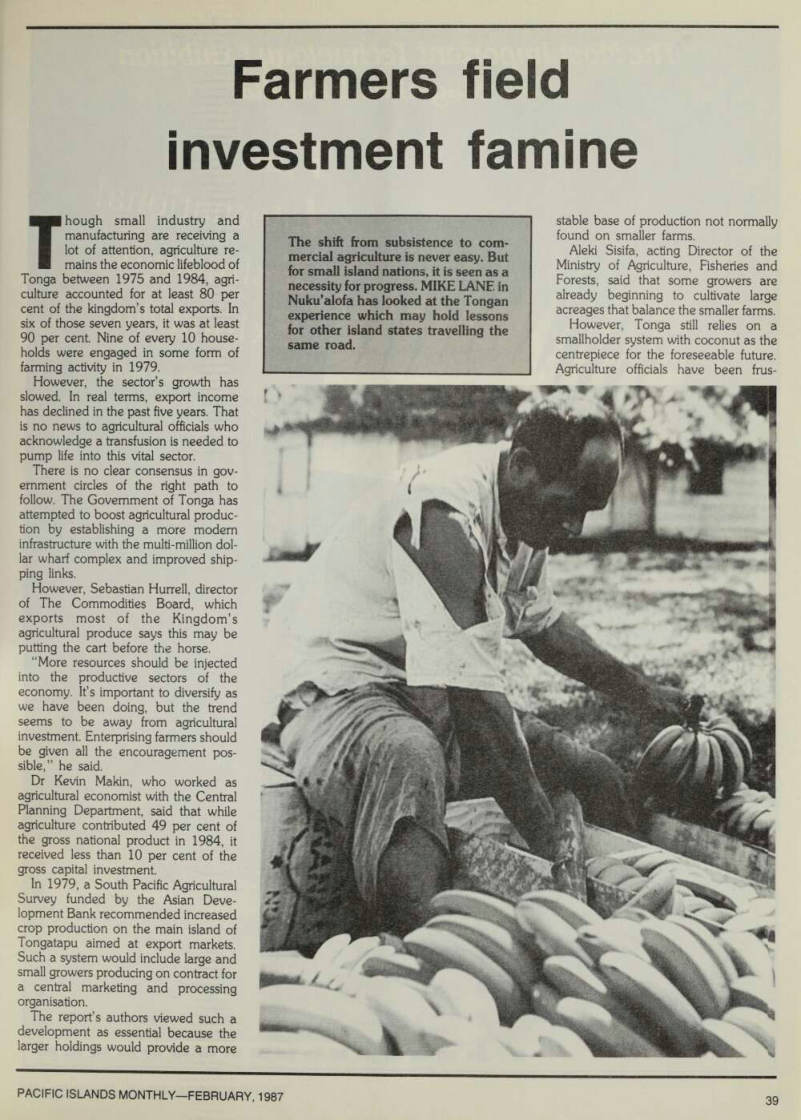
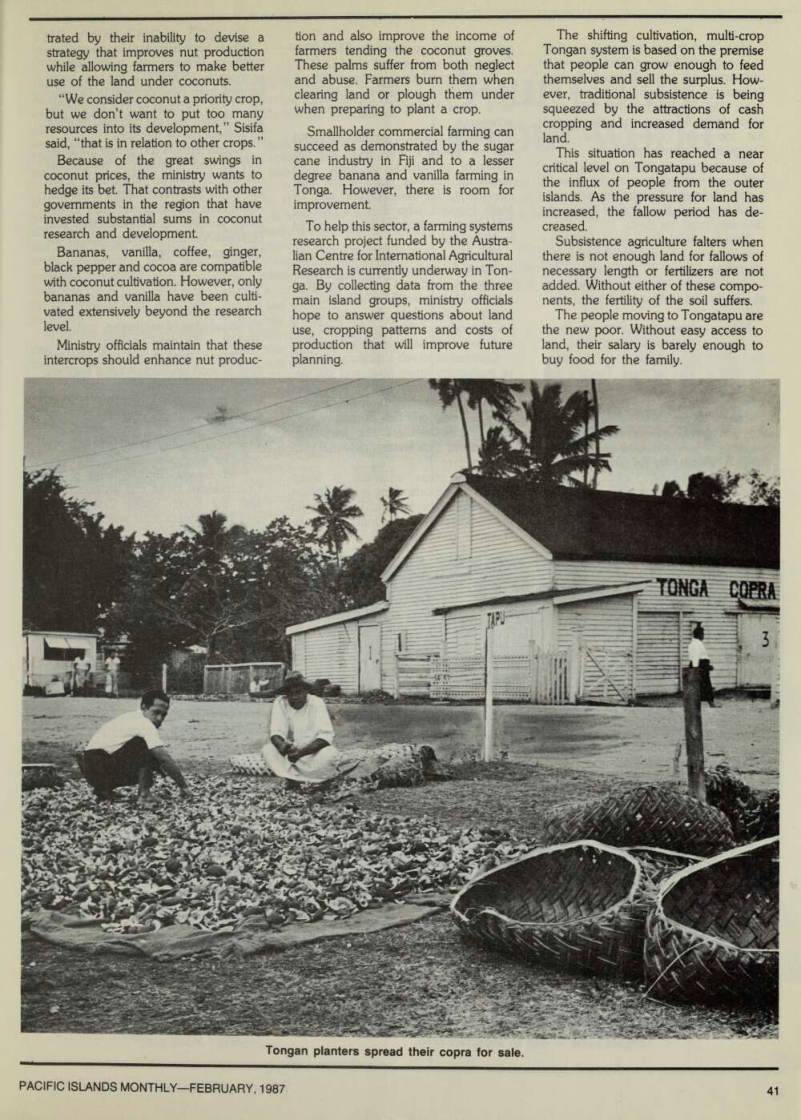
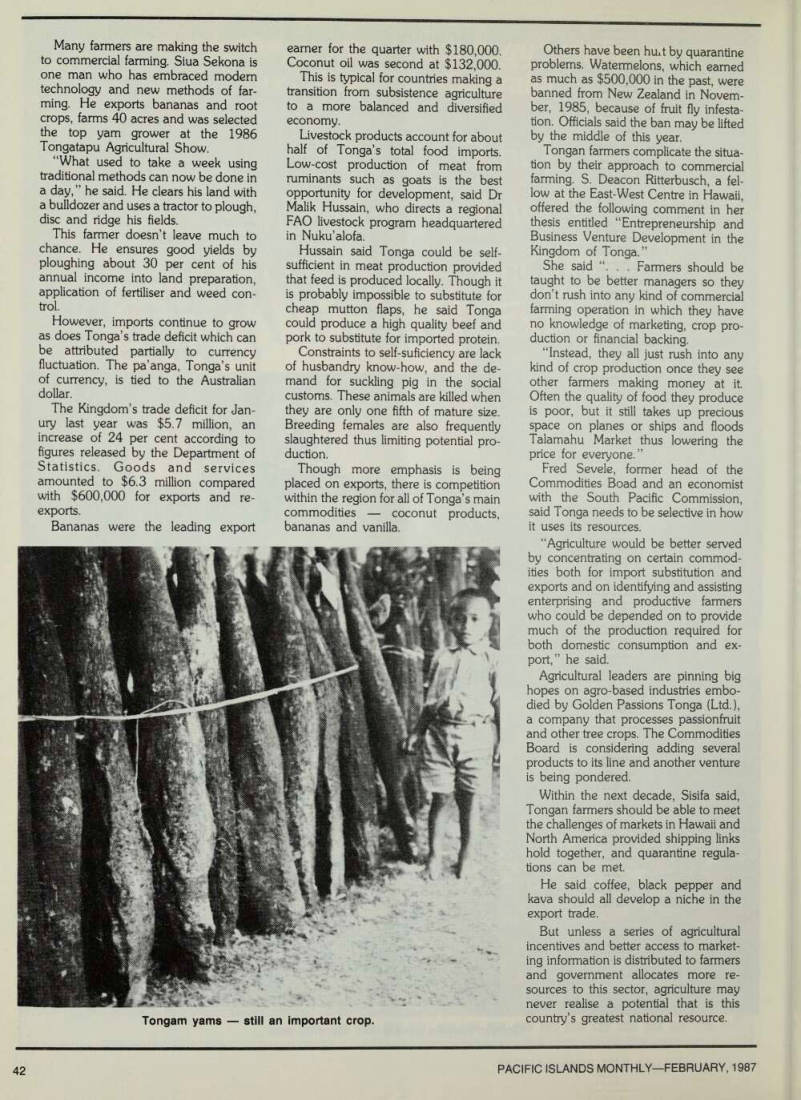
Farmers field investment famine
T hough small industry and manufacturing are receiving a lot of attention, agriculture re mains the economic lifeblood of Tonga between 1975 and 1984, agri culture accounted for at least 80 per cent of the kingdom’s total exports. In six of those seven years, it was at least 90 per cent. Nine of every 10 house holds were engaged in some form of farming activity in 1979.
However, the sector’s growth has slowed. In real terms, export income has declined in the past five years. That is no news to agricultural officials who acknowledge a transfusion is needed to pump life into this vital sector.
There is no clear consensus in gov ernment circles of the right path to follow. The Government of Tonga has attempted to boost agricultural produc tion by establishing a more modern infrastructure with the multi-million dol lar wharf complex and improved ship ping links.
However, Sebastian Hurrell, director of The Commodities Board, which exports most of the Kingdom’s agricultural produce says this may be putting the cart before the horse.
“More resources should be injected into the productive sectors of the economy. It’s important to diversify as we have been doing, but the trend seems to be away from agricultural investment. Enterprising farmers should be given all the encouragement pos sible,” he said.
Dr Kevin Makin, who worked as agricultural economist with the Central Planning Department, said that while agriculture contributed 49 per cent of the gross national product in 1984, it received less than 10 per cent of the gross capital investment.
In 1979, a South Pacific Agricultural Survey funded by the Asian Deve lopment Bank recommended increased crop production on the main island of Tongatapu aimed at export markets.
Such a system would include large and small growers producing on contract for a central marketing and processing organisation.
The report’s authors viewed such a development as essential because the larger holdings would provide a more
The shift from subsistence to com mercial agriculture is never easy. But for small island nations, it is seen as a necessity for progress. MIKE LANE in Nukualofa has looked at the Tongan experience which may hold lessons for other island states travelling the same road.
stable base of production not normally found on smaller farms.
Aleki Sisifa, acting Director of the Ministry of Agriculture, Fisheries and Forests, said that some growers are already beginning to cultivate large acreages that balance the smaller farms.
However, Tonga still relies on a smallholder system with coconut as the centrepiece for the foreseeable future.
Agriculture officials have been frus-
trated by their inability to devise a strategy that improves nut production while allowing farmers to make better use of the land under coconuts.
“We consider coconut a priority crop, but we don’t want to put too many resources into its development,” Sisifa said, “that is in relation to other crops. ”
Because of the great swings in coconut prices, the ministry wants to hedge its bet. That contrasts with other governments in the region that have invested substantial sums in coconut research and development.
Bananas, vanilla, coffee, ginger, black pepper and cocoa are compatible with coconut cultivation. However, only bananas and vanilla have been culti vated extensively beyond the research level.
Ministry officials maintain that these intercrops should enhance nut produc
tion and also improve the income of farmers tending the coconut groves.
These palms suffer from both neglect and abuse. Farmers burn them when clearing land or plough them under when preparing to plant a crop.
Smallholder commercial farming can succeed as demonstrated by the sugar cane industry in Fiji and to a lesser degree banana and vanilla farming in Tonga. However, there is room for improvement.
To help this sector, a farming systems research project funded by the Austra lian Centre for International Agricultural Research is currently underway in Ton ga. By collecting data from the three main island groups, ministry officials hope to answer questions about land use, cropping patterns and costs of production that will improve future planning.
The shifting cultivation, multi-crop Tongan system is based on the premise that people can grow enough to feed themselves and sell the surplus. How ever, traditional subsistence is being squeezed by the attractions of cash cropping and increased demand for land.
This situation has reached a near critical level on Tongatapu because of the influx of people from the outer islands. As the pressure for land has increased, the fallow period has de creased.
Subsistence agriculture falters when there is not enough land for fallows of necessary length or fertilizers are not added. Without either of these compo nents, the fertility of the soil suffers.
The people moving to Tongatapu are the new poor. Without easy access to land, their salary is barely enough to buy food for the family.
Tongan planters spread their copra for sale.
Many farmers are making the switch to commercial farming. Siua Sekona is one man who has embraced modem technology and new methods of farming. He exports bananas and root crops, farms 40 acres and was selected the top yam grower at the 1986 Tongatapu Agricultural Show.
“What used to take a week using traditional methods can now be done in a day,” he said. He clears his land with a bulldozer and uses a tractor to plough, disc and ridge his fields.
This farmer doesn’t leave much to chance. He ensures good yields by ploughing about 30 per cent of his annual income into land preparation, application of fertiliser and weed con- However, imports continue to grow as does Tonga’s trade deficit which can be attributed partially to currency fluctuation. The pa’anga, Tonga’s unit of currency, is tied to the Australian dollar.
The Kingdom’s trade deficit for Janury last year was $5.7 million, an increase of 24 per cent according to figures released by the Department of Statistics. Goods and services amounted to $6.3 million compared with $600,000 for exports and reexports.
Bananas were the leading export
earner for the quarter with $lBO,OOO.
Coconut oil was second at $132,000.
This is typical for countries making a transition from subsistence agriculture to a more balanced and diversified economy.
Livestock products account for about half of Tonga’s total food imports.
Low-cost production of meat from ruminants such as goats is the best opportunity for development, said Dr Malik Hussain, who directs a regional FAO livestock program headquartered in Nuku’alofa.
Hussain said Tonga could be self sufficient in meat production provided that feed is produced locally. Though it is probably impossible to substitute for cheap mutton flaps, he said Tonga could produce a high quality beef and pork to substitute for imported protein, Constraints to self-suficiency are lack of husbandry know-how, and the de mand for suckling pig in the social customs. These animals are killed when they are only one fifth of mature size, Breeding females are also frequently slaughtered thus limiting potential pre duction.
Though more emphasis is being placed on exports, there is competition within the region for all of Tonga’s main commodities coconut products, bananas and vanilla.
Others have been huit by quarantine problems. Watermelons, which earned as much as $500,000 in the past, were banned from New Zealand in Novem ber, 1985, because of fruit fly infesta tion. Officials said the ban may be lifted by the middle of this year.
Tongan farmers complicate the situa tion by their approach to commercial farming. S. Deacon Ritterbusch, a fel low at the East-West Centre in Hawaii, offered the following comment in her thesis entitled “Entrepreneurship and Business Venture Development in the Kingdom of Tonga.”
She said “. . . Farmers should be taught to be better managers so they don’t rush into any kind of commercial farming operation in which they have no knowledge of marketing, crop pro duction or financial backing.
“Instead, they all just rush into any kind of crop production once they see other farmers making money at it.
Often the quality of food they produce is poor, but it still takes up precious space on planes or ships and floods Talamahu Market thus lowering the price for everyone.”
Fred Sevele, former head of the Commodities Boad and an economist with the South Pacific Commission, said Tonga needs to be selective in how it uses its resources.
“Agriculture would be better served by concentrating on certain commod ities both for import substitution and exports and on identifying and assisting enterprising and productive farmers who could be depended on to provide much of the production required for both domestic consumption and ex port,” he said.
Agricultural leaders are pinning big hopes on agro-based industries embo died by Golden Passions Tonga (Ltd.), a company that processes passionfruit and other tree crops. The Commodities Board is considering adding several products to its line and another venture is being pondered.
Within the next decade, Sisifa said, Tongan farmers should be able to meet the challenges of markets in Hawaii and North America provided shipping links hold together, and quarantine regula tions can be met.
He said coffee, black pepper and kava should all develop a niche in the export trade.
But unless a series of agricultural incentives and better access to market ing information is distributed to farmers and government allocates more re sources to this sector, agriculture may never realise a potential that is this country’s greatest national resource.
Tongam yams - still an important crop.
Advertisements & other items, pp. 38-41 (2 items)
International
The Most Important Technology Exhibition
Ever Staged in Australia
The
International
Technology
Exhibition
wi0Ml &»»" Ccnlr£
Canberra, pirate
March 3-7, 1987
deveW %***£<** %**%•**,.***■'*
A X n c*%i*b ksm gSw
ra*ssrgsr
ssgisr Sgssa!
ss^ 0 -- -0 stfga , s , r al standard fow* Prts£|=-“ =s»
sr“" «sSss‘»“ %££"
otechnofogy mvap Eld- p/l scientific p; SbarpCorp- «*£% Z*^ P ' L isit I* coopr.o- fledkzt }nn&* ain * W st f/L nml< TnJ^axchl^ F!l ss£& ?S of Defence Commerce J ceramics fW irrteu r/*.
S^UrdC^' 1 - Bureau 0/Stansi Ss^- Monoclonal :TO*Commßs«» >n ironies eic Aust. ?! xhnoiogy *“ sL F/L ofundum Resistant Materials letPU .
sags*.* gsflp-
m>m r U nnlrS F/L Rad*** l |fi (ft* «W
Sss»- SSsssS®"
Sss# 1-
Sharp Corp. *« sf - DVonongo«S c "» Wormaid Interna ,g me technology researchers,
XshaUanand“^ in:
«rs and "^“information IS* §&*-*
Z7Sns ggSU-*«
sr D S^» ,to "
£,<***■" wril eforyourfree
'’ m m ,f you're reSi5 ‘ r 3( dC ‘ *" exhibit mfo Mestri SW2085
i r U5 s^ 43652 “^___-^^^r=
name: Title: Company:-
Your ticket
to our world
Continental can fly you anywhere in the world directly or indirectly with the Continental connections. Detroit Boston Chicago Tokyo Seattle Denver Houston Miami San Jose Guam Washington Acapulco Phoenix
Calgary
Las Vegas
New Orleans Mexico London Auckland New York
Los Angeles
San Francisco Fly true American hospitality.
Fly Continental Airlines.
Your ticket to our world. >
Vancouver
Hawaii
Sydney
& & a* \ \ x •<*
CONTfSIENTAL
See your travel agent or Continental Airlines for details.
m CONTINENTAL
Continental. All the best of America in an Airline.
GRBBI
43
PACIFIC ISLANDS MONTHLY—FEBRUARY, 1987
from page 26
THE VIEW FROM TOKYO
rude awakening
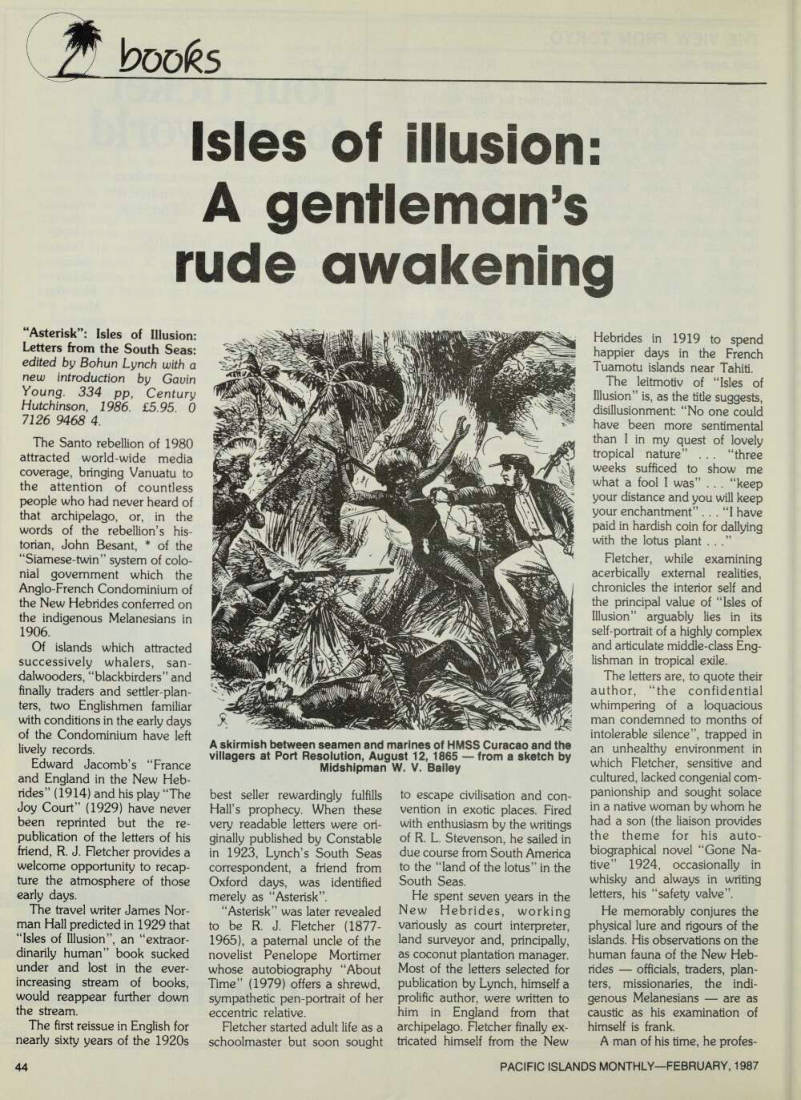
books
Isles of illusion: A gentleman’s rude awakening
“Asterisk”: Isles of Illusion: Letters from the South Seas: edited by Bohun Lynch with a new introduction by Gavin Young. 334 pp, Century Hutchinson, 1986. £5.95 0 7126 9468 4.
The Santo rebellion of 1980 attracted world-wide media coverage, bringing Vanuatu to the attention of countless people who had never heard of that archipelago, or, in the words of the rebellion’s his torian, John Besant, * of the “Siamese-twin” system of colo nial government which the Anglo-French Condominium of the New Hebrides conferred on the indigenous Melanesians in 1906.
Of islands which attracted successively whalers, san dalwooders, “blackbirders” and finally traders and settler-plan ters, two Englishmen familiar with conditions in the early days of the Condominium have left lively records.
Edward Jacomb’s “France and England in the New Heb rides” (1914) and his play “The Joy Court” (1929) have never been reprinted but the re publication of the letters of his friend, R. J. Fletcher provides a welcome opportunity to recap ture the atmosphere of those early days.
The travel writer James Nor man Hall predicted in 1929 that “Isles of Illusion”, an “extraor dinarily human” book sucked under and lost in the ever increasing stream of books, would reappear further down the stream.
The first reissue in English for nearly sixty years of the 1920 s
best seller rewardingly fulfills Hall’s prophecy. When these very readable letters were ori ginally published by Constable in 1923, Lynch’s South Seas correspondent, a friend from Oxford days, was identified merely as “Asterisk”.
“Asterisk” was later revealed to be R. J. Fletcher (1877- 1965), a paternal uncle of the novelist Penelope Mortimer whose autobiography “About Time” (1979) offers a shrewd, sympathetic pen-portrait of her eccentric relative.
Fletcher started adult life as a schoolmaster but soon sought
to escape civilisation and con vention in exotic places. Fired with enthusiasm by the writings of R. L. Stevenson, he sailed in due course from South America to the “land of the lotus” in the South Seas.
He spent seven years in the New Hebrides, working variously as court interpreter, land surveyor and, principally, as coconut plantation manager.
Most of the letters selected for publication by Lynch, himself a prolific author, were written to him in England from that archipelago. Fletcher finally ex tricated himself from the New
Hebrides in 1919 to spend happier days in the French Tuamotu islands near Tahiti.
The leitmotiv of “Isles of Illusion” is, as the title suggests, disillusionment: “No one could have been more sentimental than I in my quest of lovely tropical nature” .. . “three weeks sufficed to show me what a fool I was” . . . “keep your distance and you will keep your enchantment” ... “I have paid in hardish coin for dallying with the lotus plant ...”
Fletcher, while examining acerbically external realities, chronicles the interior self and the principal value of “Isles of Illusion” arguably lies in its self-portrait of a highly complex and articulate middle-class Eng lishman in tropical exile.
The letters are, to quote their author, “the confidential whimpering of a loquacious man condemned to months of intolerable silence”, trapped in an unhealthy environment in which Fletcher, sensitive and cultured, lacked congenial com panionship and sought solace in a native woman by whom he had a son (the liaison provides the theme for his auto biographical novel “Gone Na tive” 1924, occasionally in whisky and always in writing letters, his “safety valve”.
He memorably conjures the physical lure and rigours of the islands. His observations on the human fauna of the New Heb rides officials, traders, plan ters, missionaries, the indi genous Melanesians are as caustic as his examination of himself is frank.
A man of his time, he profes
A skirmish between seamen and marines of HMSS Curacao and the villagers at Port Resolution, August 12, 1865-from a sketch by Midshipman W. V. Bailey
ses no love for the Christia nised, as opposed to heathen, “Kanakas”. Yet he doctors his Melanesian charges as consci entiously as any of the Pre sbyterian missionaries who, with Australian settlers and Condominium officials, are among the prime targets of his mordant wit.
Edward Jacomb’s brother Charles, the author of “God’s Own Country: An Appreciation of Australia” (1914) and as sharp a critic of Australia and Australians as Fletcher himself, described him as a “brilliantly clever fellow.”
A former pupil has recalled him as a “mysterious personal ity” ... “almost frightening to us school-boys, but patient, un biased and kind. ” a fellow schoolmaster remembers him as a “brilliant individualist” but was never able to penetrate beyond Fletcher’s “rotund facade. ”
Penelope Mortimer says he was cynical, sharp and clever with a waspish wit and a disdain for women. But she liked him.
These first-hand observa tions, which supplement Lynch’s comments in the origi nal introduction, are suggestive of the complexities and para doxes of Fletcher’s highly elu sive character. He appears, very humanly, full of contradic tions amusing and fond of provoking laughter in others but often sad and consistently mysterious, hard to get to know. Sensitive to beauty in poetry and landscape, even tender, but capable of brutality.
Conventional by upbringing but usually unconventional and often eccentric in thought and action.
A misfit, Fletcher fails to reach his goals or to achieve equanimity. He eventually re turned to a bachelor schoolmaster’s life in England, where John Murray published three of his “Gilbert Davison” thrillers at the beginning of the 19305.
Fletcher then lapsed into obscurity. From teaching in Cornwall, he retired to live with a sister in Kent, where he described himself, in a letter to Penelope Mortimer in 1957, as “intangibly alone mentally.”
Gavin Young chanced upon “Isles of Illusion” in Hong Kong
and took the volume with him when he sailed a few years ago from China to the South Seas: it inspired the title of Part Two of his “Slow Boats Home”.
In his very personal introduc tion to the reissue, Young establishes a link with “Aster isk” via Bude, where Fletcher taught and the youthful Young spent his summer holidays.
It Is to be hoped that a future edition of “Isles of Illusion” will include Fletcher’s as yet unpub lished contemporary letters to Edward Jacomb, who appears
as “Mowbray” in the book.
Fletcher’s letters to Lynch are better known in France, where a new French translation of them appeared in 1979 under the impulsion of the celebrated autobiographer Michel Leiris whose intimate diary of an ethnographic expedition through Africa (“L’Afrique Fan tome”, 1934) was influenced by the original 1926 translation.
Leiris was himself introduced to “Isles of Illusion” by his surrealist companion, Jacques Prevert, and in turn, decades
later, inspired the fine preface to the 1979 translation contri buted by his young friend at the Musee de I’Homme, Jean Jamin. A German translation of the new French edition appeared in 1981.
Fletcher was an interesting man and his letters, his best writing, deserve to be read
again.
W. E. Stober.
★ “The Santo Rebellion: An Imperial Reckoning ” published by the University of Hawaii Press and Heinemann (Austra lia), 1984.
How the leaders
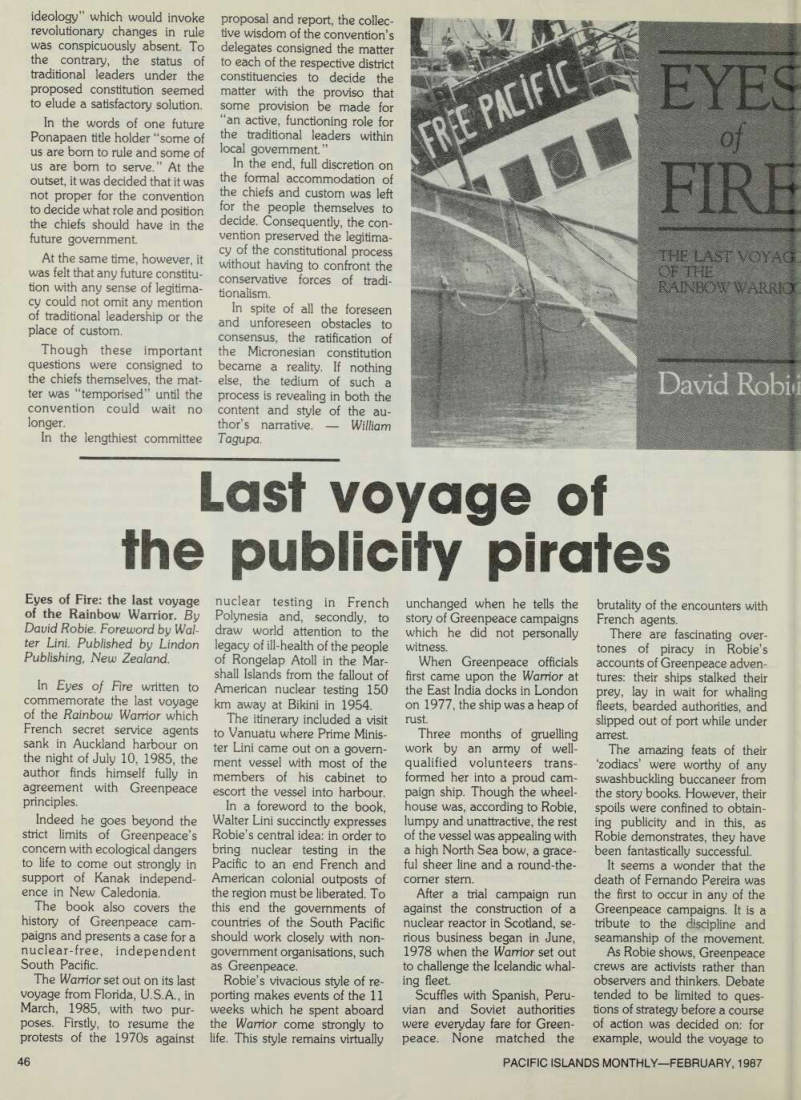
declined to decide
Constitutionalism in Mic ronesia: By Norman Metier.
Published 1985 by Institute for Polynesian Studies, Brigham Young University-Hawaii Cam pus, Laie, Hawaii. ISBN 0- 939154-390. 396 Pp.
Meller’s account of the 1975 Constitutional Convention of Micronesia is a personal memoir of the constitutional making process set within an island context.
This process marked an im portant step in the dissolution of the American-administered Un ited Nations Trusteeship which existed for nearly forty years.
American emphasis on politi cal egalitarianism stood in sharp contrast to the hierarchial na ture of most Micronesian societies. Unlike the decolonis ing process experienced in other Pacific islands, the dele gates to the Constitutional Con vention “had no comparable opportunity ... for making choices between alternative systems of government other than the paradigm already pro vided under the American ad ministration. ”
Once the alternative to inde pendence was decided upon by the islanders themselves, “all parties accepted the premise that the Micronesians would write their own constitution,” though the United States would
finance a major share of the convention itself.
The primary purpose of the convention was to draft a con stitution for the future govern ment of Micronesia which would “guarantee to all the citizens of Micronesia a form of government which permits the free democratic expression of their views.”
Such an auspicious task not withstanding, the enabling legislation enacted by the Con gress of Micronesia mandated that ninety days be allocated for the convention to complete its work. In Meller’s estimate, “it was feared that without a fixed term, the Convention would be under no pressure to reach any consensus. ”
The method of electing the delegates was curious, yet the composition of the convention itself reflected both public and private sector interests with a diversity of opinion among the various island delegations.
There was little doubt, how ever, that the “political socialisation” of the delegates to the American principles of would have its effect in the production of a “unique all- Micronesian constitution.” The question as to whether the formalistic structure and proce dures of the convention with its subject matter committees would be compatible with the “characteristic informality of
Micronesian ways” proved to be illusory.
Indeed, Meller’s concern as an experienced consultant was that “Micronesians do not take any congeniality to the making of hard, conceptual decisions.”
Instead they are most apt to avoid them whenever possible, “to temporise, and only when absolutely necessary, to re spond with definitive action.”
The Palauan delegation, in Meller’s opinion, was the most demanding. At the outset, the Palauans presented to the con vention a series of proposals that amounted to a virtual ulti matum.
The reality of Palauan post uring was that the other dele gates “mutually encouraged each other to rely moderately when the Palauans resorted to their intemperate address. ”
Such group strategies were a clear response to the fact that “all were dependant upon de veloping consensus” within the decision-making process so as to assure positive convention reception of such proposals.
Substantive issues focussed on whether the of the islands should be centralised or de centralised in both authority and in revenue-raising power.
Eminent domain and alien ownership of land were, like wise, of paramount concern to the convention.
The absence of “radical
ideology” which would invoke revolutionary changes in rule was conspicuously absent. To the contrary, the status of traditional leaders under the proposed constitution seemed to elude a satisfactory solution.
In the words of one future Ponapaen title holder “some of us are bom to rule and some of us are bom to serve.” At the outset, it was decided that it was not proper for the convention to decide what role and position the chiefs should have in the future government.
At the same time, however, it was felt that any future constitu tion with any sense of legitima cy could not omit any mention of traditional leadership or the place of custom.
Though these important questions were consigned to the chiefs themselves, the mat ter was “temporised” until the convention could wait no longer.
In the lengthiest committee
proposal and report, the collec tive wisdom of the convention’s delegates consigned the matter to each of the respective district constituencies to decide the matter with the proviso that some provision be made for “an active, functioning role for the traditional leaders within local government.”
In the end, full discretion on the formal accommodation of the chiefs and custom was left for the people themselves to decide. Consequently, the con vention preserved the legitima cy of the constitutional process without having to confront the conservative forces of tradi tionalism.
In spite of all the foreseen and unforeseen obstacles to consensus, the ratification of the Micronesian constitution became a reality. If nothing else, the tedium of such a process is revealing in both the content and style of the au
thor’s narrative.
William
Tagupa.
the publicity pirates
Last voyage of the publicity pirates
Eyes of Fire: the last voyage of the Rainbow Warrior. By David Robie. Foreword by Walter Uni. Published by Lindon Publishing, New Zealand.
In Eyes of Fire written to commemorate the last voyage of the Rainbow Warrior which French secret service agents sank in Auckland harbour on the night of July 10, 1985, the author finds himself fully in agreement with Greenpeace principles.
Indeed he goes beyond the strict limits of Greenpeace’s concern with ecological dangers to life to come out strongly in support of Kanak independence in New Caledonia.
The book also covers the history of Greenpeace campaigns and presents a case for a nuclear-free, independent South Pacific.
The Warrior set out on its last voyage from Florida, U.S.A., in March, 1985, with two purposes. Firstly, to resume the
protests of the 1970 s against
nuclear testing in French Polynesia and, secondly, to draw world attention to the legacy of ill-health of the people of Rongelap Atoll in the Mar shall Islands from the fallout of American nuclear testing 150 km away at Bikini in 1954.
The itinerary included a visit to Vanuatu where Prime Minis ter Lini came out on a govern ment vessel with most of the members of his cabinet to escort the vessel into harbour, In a foreword to the book, Walter Lini succinctly expresses Robie’s central idea: in order to bring nuclear testing in the Pacific to an end French and American colonial outposts of the region must be liberated. To this end the governments of countries of the South Pacific should work closely with non government organisations, such as Greenpeace.
Robie’s vivacious style of re porting makes events of the 11 weeks which he spent aboard the Warrior come strongly to life. This style remains virtually
unchanged when he tells the story of Greenpeace campaigns which he did not personally witness.
When Greenpeace officials first came upon the Warrior at the East India docks in London on 1977, the ship was a heap of rust.
Three months of gruelling work by an army of well qualified volunteers trans formed her into a proud cam paign ship. Though the wheel house was, according to Robie, lumpy and unattractive, the rest of the vessel was appealing with a high North Sea bow, a grace ful sheer line and a round-the corner stern.
After a trial campaign run against the construction of a nuclear reactor in Scotland, se rious business began in June, 1978 when the Warrior set out to challenge the Icelandic whal ing fleet.
Scuffles with Spanish, Peru vian and Soviet authorities were everyday fare for Green peace. None matched the
brutality of the encounters with French agents.
There are fascinating over tones of piracy in Robie’s accounts of Greenpeace adven tures: their ships stalked their prey, lay in wait for whaling fleets, bearded authorities, and slipped out of port while under arrest.
The amazing feats of their ‘zodiacs’ were worthy of any swashbuckling buccaneer from the story books. However, their spoils were confined to obtain ing publicity and in this, as Robie demonstrates, they have been fantastically successful.
It seems a wonder that the death of Fernando Pereira was the first to occur in any of the Greenpeace campaigns. It is a tribute to the discipline and seamanship of the movement.
As Robie shows, Greenpeace crews are activists rather than observers and thinkers. Debate tended to be limited to ques tions of strategy before a course of action was decided on: for example, would the voyage to
the Pacific take precedence over a campaign against oil spillage in the Persian Gulf?
Once a line of action was decided everyone was too busy to express doubts. On occasion crewmen could be surprisingly ready with their fists, but only in self-defence, as when some of the crew ran into a group of rowdies in a bistro in Jackson ville, Florida.
After sticking to their tasks through thick and thin, a wild party was often a popular way of winding down.
Greenpeace’s evacuation of the entire population of Ronge lap is one of the highlights of the book as it represented a new type of venture for the organisation, completely differ ent from the symbolic evacua tion which it had originally planned and with unknown consequences for the islanders.
Robie, who took part in the operation, conveys the uneasi ness of Greenpeace leaders about the future of the 320 islanders who forsook their beautiful atoll to settle on a small island on the rim of Kwajalein Atoll, across the la goon from the American missle range.
But the Warrior did the job well and then resumed its voyage.
It is possible that the author over-estimates the effectiveness of Greenpeace campaigns.
While there is no doubt that governments have much to fear from the publicity that Green peace can generate, one sus pects that the campaigns have not always been as determining a factor in provoking a change of government policy as Robie believes.
Evidence is available, for ex ample, that the French govern ment had decided to terminate atmospheric testing in Polynesia, long before the Greenpeace campaigns got under way in the 1970 s and, incidentally, before Australia and New Zealand took the case against France to the Internatio nal Court of Justice.
Both these steps reflected world revulsion against the con tinuation of French atmospheric testing long after the superpow ers had stopped. There is no doubt that this widespread feel ing acted as a spur to the
French to switch to under ground testing.
Robie’s assessment of the problems that the nuclear poli cies of France and the United States cause the South Pacific tends to be simplistic.
His chapter, The Nuclear Blackmailers, would perhaps have been more effective if he had emphasised the differences between the defence policies of these powers.
Like Russia, the United
States is a super-power with territories bordering the Pacific and must be conceded legiti mate defence interests within the region.
On the other hand, France’s principal defence projects in the Pacific are part of a strategy which is entirely centred on the defence of Europe, and there is little justification for their pre sence in the Pacific. Robie’s criticism of America and France would have been more tren
chant if such differences had been borne in mind.
Notwithstanding such objec tions, David Robie’s book is likely to become very popular reading among supporters of Greenpeace.
It should also fascinate read ers interested in voyaging in the Pacific as well as contributing to the rapidly growing literature dealing with what the author calls the French ‘blunder-
Watergate’.
Barry Shineberg.
Advertisements & other items, p. 44 (1 item)
m,
mm L f*
WMM-
I» « fwSW**
A pleasant ramble through
the shelves of Pacificana
Rifled Sanctuaries: some Views of the Pacific Islands in Western Literature. By Bill Pearson. Published 1984 by Auckland University Press and Oxford University Press, Auckland, New Zealand. ISBN 0 19 6480299. No price given.
Bill Pearson has long been the authority on relations between the European discoverers of Polynesia and the indigenous people.
He has now given us the first published survey of the effects on European literature of west ern contacts with the Pacific Islands, from the discovery of Tahiti in 1769 to Stevenson and Louis Becke; in effect doing for literature, though in outline only, what Bernard Smith did for art in his study on European Vision and the South Seas.
Furnas once wrote that “more thousands of words of swill have been written per square mile of dry land about the islands than about any other geographical entity” and Pearson admits that much of what he had to read was of slight literary value.
However he is not writing a critique but tracing the deve lopment of European ideas about, and consequent atti tudes towards islanders and their societies after these had been transmuted by the con temporary cultural and intellec tual preconceptions current in the western world.
To this end we are taken on a pleasant ramble through the shelves of Pacificana noting the main categories of Pacific au
thors and discussing the effects of their publications on Euro pean and American thinking.
Starting with the discoverers Pearson moves on to consider the missionaries, the imposters who wrote part fictional part factual narratives, the writers of books for boys, the beachcom bers and finally the novelists.
It is an interesting but not a comprehensive survey omit ting, for example, the officials such as Pritchard, Trood and Romilly whose books followed those of the beachcombers; the women like Isabella Bird, Annie Brassey and C.F. Gordon Cum mings, who had their own ideas on race relations; and the more than 25 books by naval com manders who, like Henry Byam Martin, often held racy rather than racist views about the islanders they met.
In a study of 82 pages omis sions are inevitable. Still one would have liked to have read Pearson’s conclusions on the alleged imposters John Coulter and Michelena y Rojas, whose veracity has only recently been questioned through the “higher criticism” to which Pacific wri ters are now being subjected; and on the novelist Charles Warren Stoddard, whom Stevenson considered to be the only author apart from Melville to have touched the South Seas with genius.
Perhaps few of his readers will disagree at Pearson awar ding the palm for literary merit as the most accomplished writer in a not very gifted field to Melville, or to his conclusion that the categories of writers who showed the least bias in
their books were the discover ers and the beachcombers.
Probably the most serious distortion is found in the popu lar boys books of the nineteeth century, where the racial “myths of white supremacy” were inculcated in the imma ture minds of future imperial ists.
Pearson cites Bowman’s The Island Home and Ballantyne’s The Coral Island as good ex amples but he quotes from several others and tells us that no less than 58 books of “im perialist fiction” had been pub lished by 1923.
Pearson remembers many of these works being available in New Zealand school libraries when he was a boy. I certainly read several and later became convinced that some of the bizarre views on race relations which I heard in the islands between the two world wars could safely be blamed on their pernicious influence.
Fortunately I was saved by an incurable streak of romantic ism to form my teenage dreams of the South Seas from maybe as fallible but less harmful books such as Viaud’s The Marriage of Loti and Stack pole’s The Blue Lagoon.
Pearson’s study is a timely epitaph appearing in a decade when our perceptions of the Pacific islanders are becoming less dependent on the Euro pean observers than on the works emanating from the cur rent literary renaissance among the Pacific islanders themselves, an event noted at the end of the
book.
Marry Maude.
Salii runs into referendum trouble
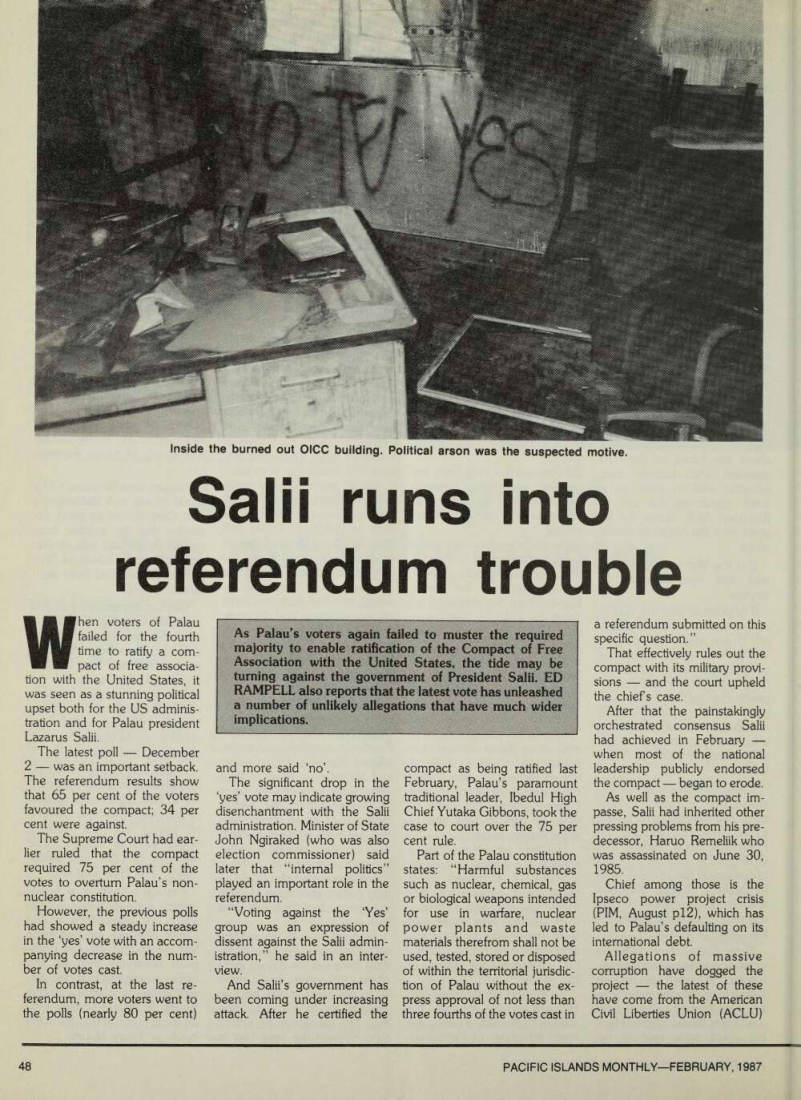
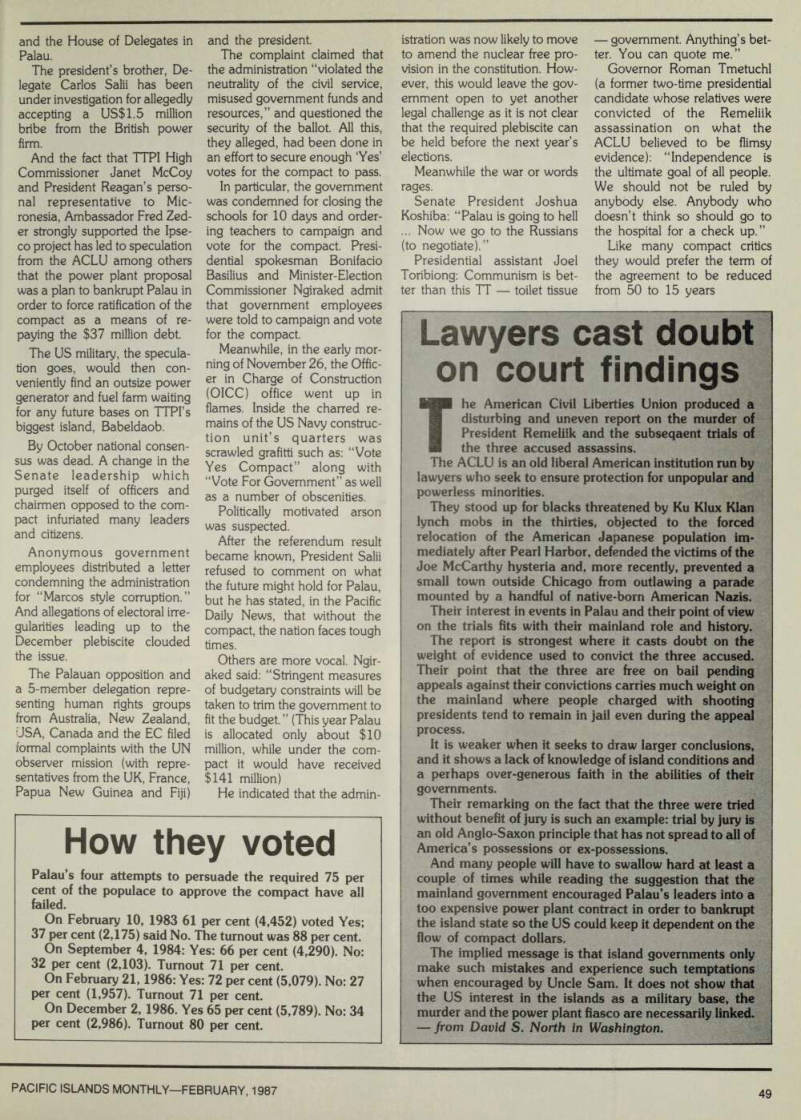
referendum trouble
When voters of Palau failed for the fourth time to ratify a com pact of free associa tion with the United States, it was seen as a stunning political upset both for the US adminis tration and for Palau president Lazarus Salii.
The latest poll December 2 was an important setback.
The referendum results show that 65 per cent of the voters favoured the compact; 34 per cent were against.
The Supreme Court had ear lier ruled that the compact required 75 per cent of the votes to overturn Palau’s non nuclear constitution.
However, the previous polls had showed a steady increase in the ‘yes’ vote with an accom panying decrease in the num ber of votes cast.
In contrast, at the last re ferendum, more voters went to the polls (nearly 80 per cent)
As Palau’s voters again failed to muster the required majority to enable ratification of the Compact of Free Association with the United States, the tide may be turning against the government of President Salii. ED RAMPELL also reports that the latest vote has unleashed a number of unlikely allegations that have much wider implications.
and more said ‘no’.
The significant drop in the ‘yes’ vote may indicate growing disenchantment with the Salii administration. Minister of State John Ngiraked (who was also election commissioner) said later that “internal politics” played an important role in the referendum.
“Voting against the ‘Yes’ group was an expression of dissent against the Salii admin istration,” he said in an inter view.
And Salii’s government has been coming under increasing attack. After he certified the
compact as being ratified last February, Palau’s paramount traditional leader, Ibedul High Chief Yutaka Gibbons, took the case to court over the 75 per cent rule.
Part of the Palau constitution states: “Harmful substances such as nuclear, chemical, gas or biological weapons intended for use in warfare, nuclear power plants and waste materials therefrom shall not be used, tested, stored or disposed of within the territorial jurisdic tion of Palau without the ex press approval of not less than three fourths of the votes cast in
a referendum submitted on this specific question.”
That effectively rules out the compact with its military provi sions and the court upheld the chiefs case.
After that the painstakingly orchestrated consensus Salii had achieved in February when most of the national leadership publicly endorsed the compact began to erode.
As well as the compact im passe, Salii had inherited other pressing problems from his pre decessor, Haruo Remeliik who was assassinated on June 30, 1985.
Chief among those is the Ipseco power project crisis (PIM, August pl 2), which has led to Palau’s defaulting on its international debt.
Allegations of massive corruption have dogged the project the latest of these have come from the American Civil Liberties Union (ACLU)
Inside the burned out OICC building. Political arson was the suspected motive.
and the House of Delegates in Palau.
The president’s brother, De legate Carlos Salii has been under investigation for allegedly accepting a US$l.5 million bribe from the British power firm.
And the fact that TTPI High Commissioner Janet McCoy and President Reagan’s perso nal representative to Mic ronesia, Ambassador Fred Zed er strongly supported the Ipse co project has led to speculation from the ACLU among others that the power plant proposal was a plan to bankrupt Palau in order to force ratification of the compact as a means of re paying the $37 million debt.
The US military, the specula tion goes, would then con veniently find an outsize power generator and fuel farm waiting for any future bases on TTPI’s biggest island, Babeldaob.
By October national consen sus was dead. A change in the Senate leadership which purged itself of officers and chairmen opposed to the com pact infuriated many leaders and citizens.
Anonymous government employees distributed a letter condemning the administration for “Marcos style corruption.”
And allegations of electoral irre gularities leading up to the December plebiscite clouded the issue.
The Palauan opposition and a 5-member delegation repre senting human rights groups from Australia, New Zealand, USA, Canada and the EC filed formal complaints with the UN observer mission (with repre sentatives from the UK, France, Papua New Guinea and Fiji)
and the president.
The complaint claimed that the administration “violated the neutrality of the civil service, misused government funds and resources,” and questioned the security of the ballot. All this, they alleged, had been done in an effort to secure enough ‘Yes’ votes for the compact to pass.
In particular, the government was condemned for closing the schools for 10 days and order ing teachers to campaign and vote for the compact. Presi dential spokesman Bonifacio Basilius and Minister-Election Commissioner Ngiraked admit that government employees were told to campaign and vote for the compact.
Meanwhile, in the early mor ning of November 26, the Offic er in Charge of Construction (OICC) office went up in flames. Inside the charred re mains of the US Navy construc tion unit’s quarters was scrawled grafitti such as: “Vote Yes Compact” along with “Vote For Government” as well as a number of obscenities.
Politically motivated arson was suspected.
After the referendum result became known, President Salii refused to comment on what the future might hold for Palau, but he has stated, in the Pacific Daily News, that without the compact, the nation faces tough times.
Others are more vocal. Ngir aked said: “Stringent measures of budgetary constraints will be taken to trim the government to fit the budget. ” (This year Palau is allocated only about $lO million, while under the com pact it would have received $l4l million) He indicated that the admin
istration was now likely to move to amend the nuclear free pro vision in the constitution. How ever, this would leave the gov ernment open to yet another legal challenge as it is not clear that the required plebiscite can be held before the next year’s elections.
Meanwhile the war or words rages.
Senate President Joshua Koshiba: “Palau is going to hell ... Now we go to the Russians (to negotiate).”
Presidential assistant Joel Toribiong; Communism is bet ter than this TT toilet tissue
government. Anything’s bet ter. You can quote me.”
Governor Roman Tmetuchl (a former two-time presidential candidate whose relatives were convicted of the Remeliik assassination on what the ACLU believed to be flimsy evidence): “Independence is the ultimate goal of all people.
We should not be ruled by anybody else. Anybody who doesn’t think so should go to the hospital for a check up.”
Like many compact critics they would prefer the term of the agreement to be reduced from 50 to 15 years
How they voted
Palau’s four attempts to persuade the required 75 per cent of the populace to approve the compact have all failed.
On February 10, 1983 61 per cent (4,452) voted Yes; 37 per cent (2,175) said No. The turnout was 88 per cent.
On September 4, 1984: Yes: 66 per cent (4,290). No: 32 per cent (2,103). Turnout 71 per cent.
On February 21,1986: Yes: 72 per cent (5,079). No: 27 per cent (1,957). Turnout 71 per cent.
On December 2, 1986. Yes 65 per cent (5,789). No: 34 per cent (2,986). Turnout 80 per cent.
Lawyers cast doubt
on court findings
The American Civil Liberties Union produced a disturbing and uneven report on the murder of President Remeliik and the subseqaent trials of the three accused assassins.
The ACLU is an old liberal American institution run by lawyers who seek to ensure protection for unpopular and powerless minorities.
They stood up for blacks threatened by Ku Klux Klan lynch mobs in the thirties, objected to the forced relocation of the American Japanese population im mediately after Pearl Harbor, defended the victims of the Joe McCarthy hysteria and, more recently, prevented a small town outside Chicago from outlawing a parade mounted by a handful of native-born American Nazis.
Their interest in events in Palau and their point of view on the trials fits with their mainland role and history.
The report is strongest where it casts doubt on the weight of evidence used to convict the three accused.
Their point that the three are free on bail pending appeals against their convictions carries much weight on the mainland where people charged with shooting presidents tend to remain in jail even during the appeal process.
It is weaker when it seeks to draw larger conclusions, and it shows a lack of knowledge of island conditions and a perhaps over-generous faith in the abilities of their governments.
Their remarking on the fact that the three were tried without benefit of jury is such an example: trial by jury is an old Anglo-Saxon principle that has not spread to all of America’s possessions or ex-possessions.
And many people will have to swallow hard at least a couple of times while reading the suggestion that the mainland government encouraged Palau’s leaders into a too expensive power plant contract in order to bankrupt the island state so the US could keep it dependent on the flow of compact dollars.
The implied message is that island governments only make such mistakes and experience such temptations when encouraged by Uncle Sam. It does not show that the US interest in the islands as a military base, the murder and the power plant fiasco are necessarily linked. from David S. North in Washington.
making confusion
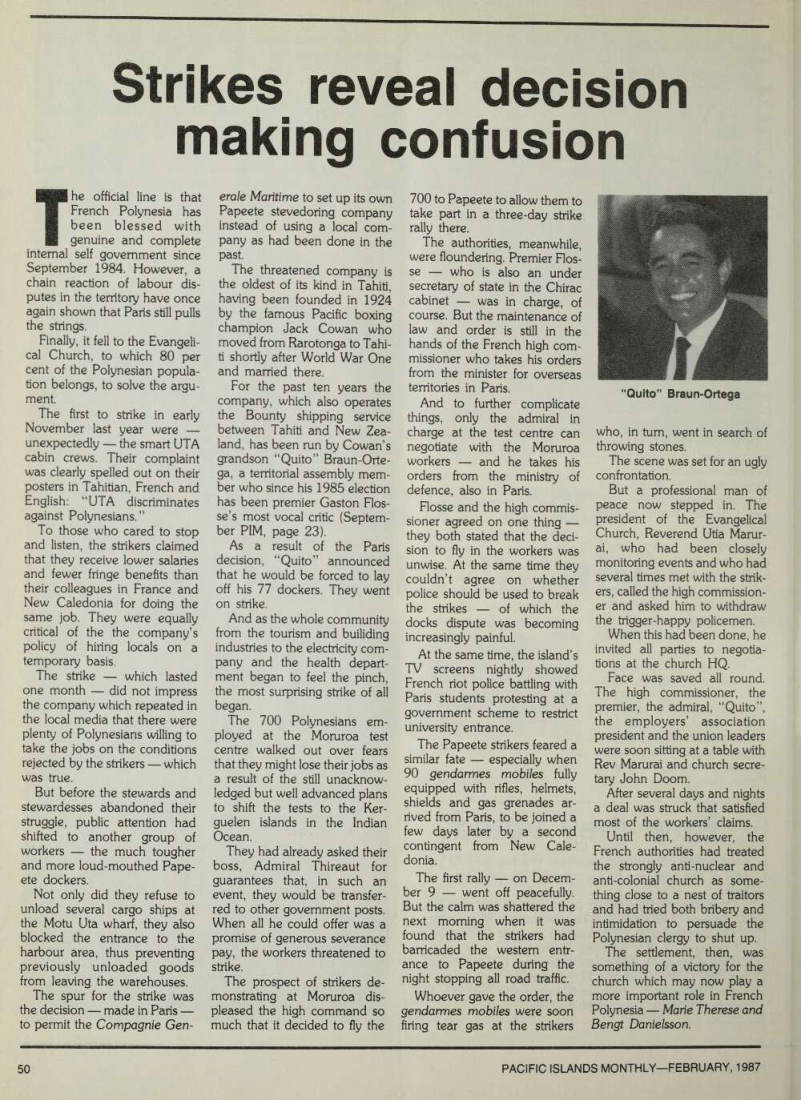
Strikes reveal decision making confusion
The official line is that French Polynesia has been blessed with genuine and complete internal self government since September 1984. However, a chain reaction of labour dis putes in the territory have once again shown that Paris still pulls the strings.
Finally, it fell to the Evangeli cal Church, to which 80 per cent of the Polynesian popula tion belongs, to solve the argu ment.
The first to strike in early November last year were unexpectedly the smart UTA cabin crews. Their complaint was clearly spelled out on their posters in Tahitian, French and English: “UTA discriminates against Polynesians.”
To those who cared to stop and listen, the strikers claimed that they receive lower salaries and fewer fringe benefits than their colleagues in France and New Caledonia for doing the same job. They were equally critical of the the company’s policy of hiring locals on a temporary basis.
The strike which lasted one month did not impress the company which repeated in the local media that there were plenty of Polynesians willing to take the jobs on the conditions rejected by the strikers which was true.
But before the stewards and stewardesses abandoned their struggle, public attention had shifted to another group of workers the much tougher and more loud-mouthed Pape ete dockers.
Not only did they refuse to unload several cargo ships at the Motu Uta wharf, they also blocked the entrance to the harbour area, thus preventing previously unloaded goods from leaving the warehouses.
The spur for the strike was the decision made in Paris to permit the Compagnie Gen
erale Maritime to set up its own Papeete stevedoring company instead of using a local com pany as had been done in the past.
The threatened company is the oldest of its kind in Tahiti, having been founded in 1924 by the famous Pacific boxing champion Jack Cowan who moved from Rarotonga to Tahi ti shortly after World War One and married there.
For the past ten years the company, which also operates
the Bounty shipping service
between Tahiti and New Zea land, has been run by Cowan’s grandson “Quito” Braun-Orte ga, a territorial assembly mem ber who since his 1985 election has been premier Gaston Flos se’s most vocal critic (Septem ber PIM, page 23).
As a result of the Paris decision, “Quito” announced that he would be forced to lay off his 77 dockers. They went on strike.
And as the whole community from the tourism and builiding industries to the electricity com pany and the health depart ment began to feel the pinch, the most surprising strike of all began.
The 700 Polynesians em ployed at the Moruroa test centre walked out over fears that they might lose their jobs as a result of the still unacknow ledged but well advanced plans to shift the tests to the Ker guelen islands in the Indian Ocean.
They had already asked their boss, Admiral Thireaut for guarantees that, in such an event, they would be transfer red to other government posts.
When all he could offer was a promise of generous severance pay, the workers threatened to strike.
The prospect of strikers de monstrating at Moruroa dis pleased the high command so much that it decided to fly the
700 to Papeete to allow them to take part in a three-day strike rally there.
The authorities, meanwhile, were floundering. Premier Flos se who is also an under secretary of state in the Chirac cabinet was in charge, of course. But the maintenance of law and order is still in the hands of the French high com missioner who takes his orders from the minister for overseas territories in Paris.
And to further complicate things, only the admiral in charge at the test centre can negotiate with the Moruroa workers and he takes his orders from the ministry of defence, also in Paris.
Flosse and the high commis sioner agreed on one thing they both stated that the deci sion to fly in the workers was unwise. At the same time they couldn’t agree on whether police should be used to break the strikes of which the docks dispute was becoming increasingly painful.
At the same time, the island’s TV screens nightly showed French riot police battling with Paris students protesting at a government scheme to restrict university entrance.
The Papeete strikers feared a similar fate especially when 90 gendarmes mobiles fully equipped with rifles, helmets, shields and gas grenades ar rived from Paris, to be joined a few days later by a second contingent from New Cale donia.
The first rally on Decem ber 9 went off peacefully.
But the calm was shattered the next morning when it was found that the strikers had barricaded the western entr ance to Papeete during the night stopping all road traffic.
Whoever gave the order, the gendarmes mobiles were soon firing tear gas at the strikers
who, in turn, went in search of throwing stones.
The scene was set for an ugly confrontation.
But a professional man of peace now stepped in. The president of the Evangelical Church, Reverend Utia Marur ai, who had been closely monitoring events and who had several times met with the strik ers, called the high commission er and asked him to withdraw the trigger-happy policemen.
When this had been done, he invited all parties to negotia tions at the church HQ.
Face was saved all round.
The high commissioner, the premier, the admiral, “Quito”, the employers’ association president and the union leaders were soon sitting at a table with Rev Marurai and church secre tary John Doom.
After several days and nights a deal was struck that satisfied most of the workers’ claims.
Until then, however, the French authorities had treated the strongly anti-nuclear and anti-colonial church as some thing close to a nest of traitors and had tried both bribery and intimidation to persuade the Polynesian clergy to shut up.
The settlement, then, was something of a victory for the church which may now play a more important role in French Polynesia Marie Therese and Bengt Danielsson.
“Quito” Braun-Ortega
Advertisements & other items, p. 49 (1 item)
coiiins
OLYnPIC
The Stationery and Diary People.
SYSTEM
Collin, Account e&
CARDS
M Sa£
Commercial, School, Household
Stationery and Diaries.
Fast and efficient export service.
COLLINS OLYMPIC LIMITED
AUCKLAND, 1
mi f INC P.O. 80X476, AL
wLLlllj newzealand.
PHONE: (9) 484-009
1111 PI Ull TELEX:N.Z.2I293(EDUNLOP)
V/lti 111: IV. CABLES: GRAPHICOL
Pacific stamp box
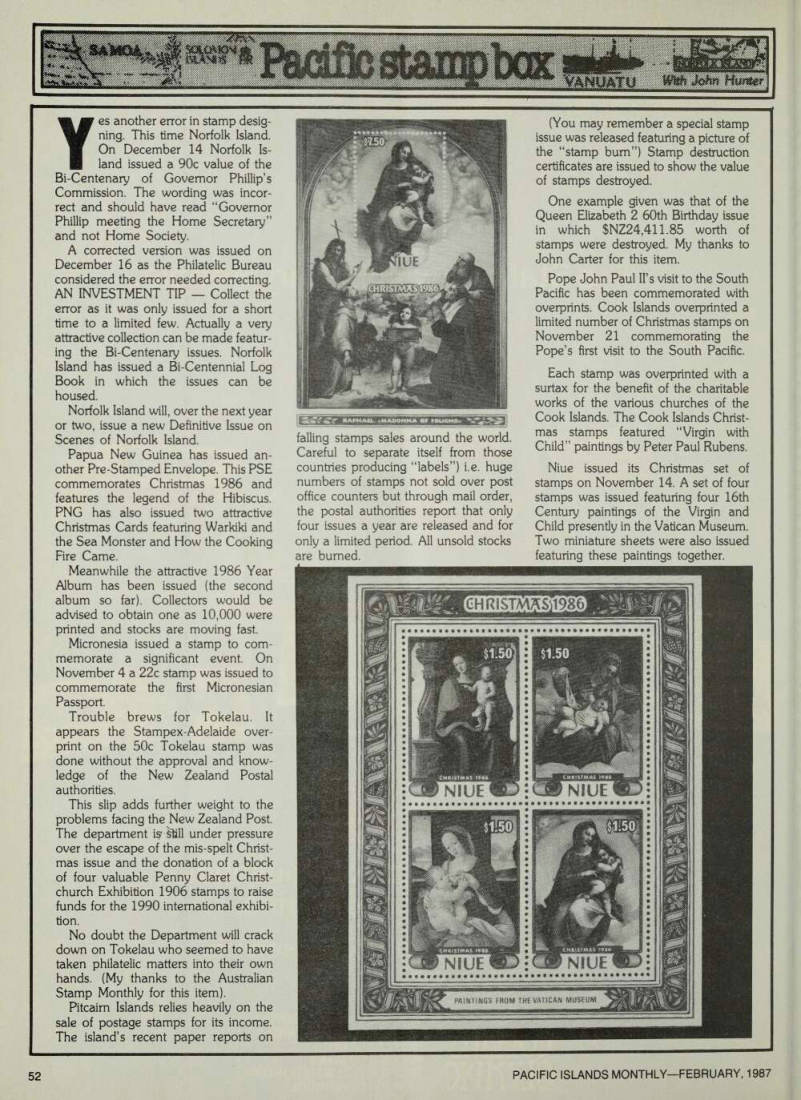
Yes another error in stamp desig ning. This time Norfolk Island.
On December 14 Norfolk Is land issued a 90c value of the Bi-Centenary of Governor Phillip’s Commission. The wording was incor rect and should have read “Governor Phillip meeting the Home Secretary” and not Home Society.
A corrected version was issued on December 16 as the Philatelic Bureau considered the error needed correcting.
AN INVESTMENT TIP Collect the error as it was only issued for a short time to a limited few. Actually a very attractive collection can be made featur ing the Bi-Centenary issues. Norfolk Island has issued a Bi-Centennial Log Book in which the issues can be housed.
Norfolk Island will, over the next year or two, issue a new Definitive Issue on Scenes of Norfolk Island.
Papua New Guinea has issued an other Pre-Stamped Envelope. This PSE commemorates Christmas 1986 and features the legend of the Hibiscus.
PNG has also issued two attractive Christmas Cards featuring Warkiki and the Sea Monster and How the Cooking Fire Came.
Meanwhile the attractive 1986 Year Album has been issued (the second album so far). Collectors would be advised to obtain one as 10,000 were printed and stocks are moving fast.
Micronesia issued a stamp to com memorate a significant event. On November 4 a 22c stamp was issued to commemorate the first Micronesian Passport.
Trouble brews for Tokelau. It appears the Stampex-Adelaide over print on the 50c Tokelau stamp was done without the approval and know ledge of the New Zealand Postal authorities.
This slip adds further weight to the problems facing the New Zealand Post.
The department \s Itill under pressure over the escape of the mis-spelt Christ mas issue and the donation of a block of four valuable Penny Claret Christ church Exhibition 1906 stamps to raise funds for the 1990 international exhibi tion.
No doubt the Department will crack down on Tokelau who seemed to have taken philatelic matters into their own hands. (My thanks to the Australian Stamp Monthly for this item).
Pitcairn Islands relies heavily on the sale of postage stamps for its income.
The island’s recent paper reports on
falling stamps sales around the world.
Careful to separate itself from those countries producing “labels”) i.e. huge numbers of stamps not sold over post office counters but through mail order, the postal authorities report that only four issues a year are released and for only a limited period. All unsold stocks are burned.
(You may remember a special stamp issue was released featuring a picture of the “stamp bum”) Stamp destruction certificates are issued to show the value of stamps destroyed.
One example given was that of the Queen Elizabeth 2 60th Birthday issue in which $NZ24,411.85 worth of stamps were destroyed. My thanks to John Carter for this item.
Pope John Paul ll’s visit to the South Pacific has been commemorated with overprints. Cook Islands overprinted a limited number of Christmas stamps on November 21 commemorating the Pope’s first visit to the South Pacific.
Each stamp was overprinted with a surtax for the benefit of the charitable works of the various churches of the Cook Islands. The Cook Islands Christ mas stamps featured “Virgin with Child” paintings by Peter Paul Rubens.
Niue issued its Christmas set of stamps on November 14. A set of four stamps was issued featuring four 16th Century paintings of the Virgin and Child presently in the Vatican Museum.
Two miniature sheets were also issued featuring these paintings together.
transitions
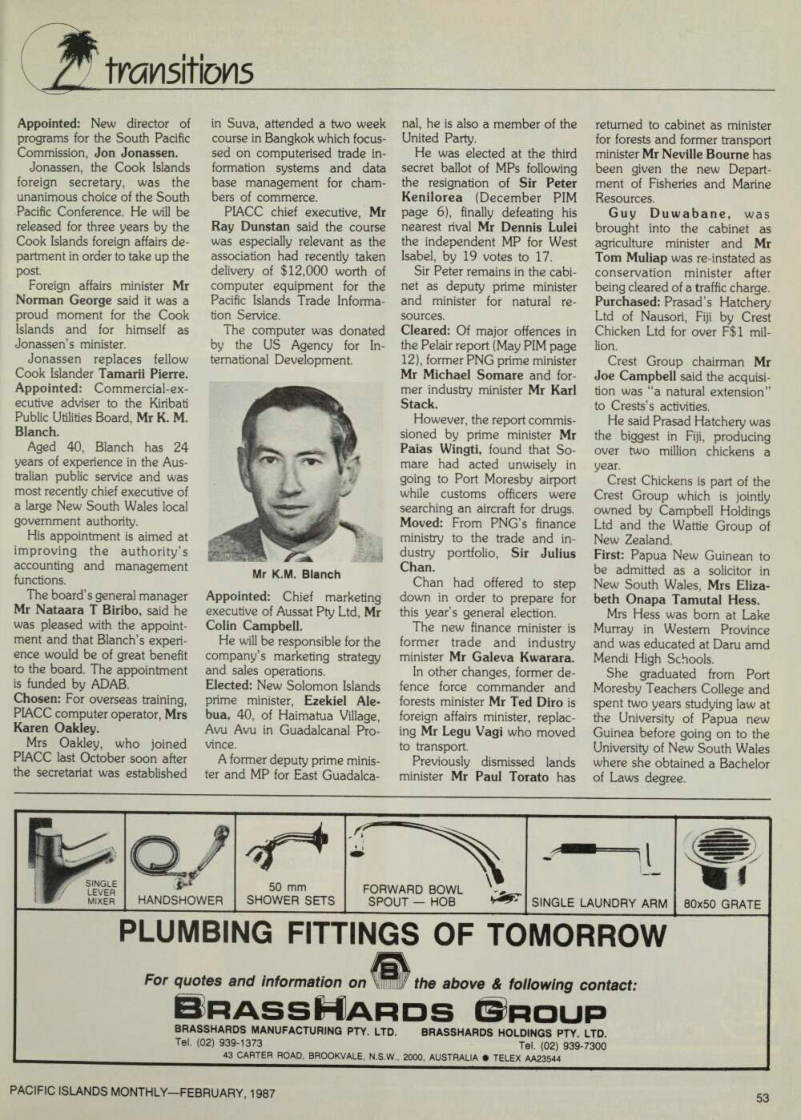
Appointed: New director of programs for the South Pacific Commission, Jon Jonassen.
Jonassen, the Cook Islands foreign secretary, was the unanimous choice of the South Pacific Conference. He will be released for three years by the Cook Islands foreign affairs de partment in order to take up the post.
Foreign affairs minister Mr Norman George said it was a proud moment for the Cook Islands and for himself as Jonassen’s minister.
Jonassen replaces fellow Cook Islander Tamarii Pierre.
Appointed: Commercial-ex ecutive adviser to the Kiribati Public Utilities Board, Mr K. M.
Blanch.
Aged 40, Blanch has 24 years of experience in the Aus tralian public service and was most recently chief executive of a large New South Wales local government authority.
His appointment is aimed at improving the authority’s accounting and management functions.
The board’s general manager Mr Nataara T Biribo, said he was pleased with the appoint ment and that Blanch’s experi ence would be of great benefit to the board. The appointment is funded by ADAB.
Chosen: For overseas training, PIACC computer operator, Mrs Karen Oakley.
Mrs Oakley, who joined PIACC last October soon after the secretariat was established
in Suva, attended a two week course in Bangkok which focus sed on computerised trade in formation systems and data base management for cham bers of commerce.
PIACC chief executive, Mr Ray Dunstan said the course was especially relevant as the association had recently taken delivery of $12,000 worth of computer equipment for the Pacific Islands Trade Informa tion Service.
The computer was donated by the US Agency for In ternational Development.
Appointed: Chief marketing executive of Aussat Pty Ltd, Mr Colin Campbell, He will be responsible for the company’s marketing strategy and sales operations, Elected: New Solomon Islands prime minister, Ezekiel Ale bua, 40, of Haimatua Village, Avu Avu in Guadalcanal Pro vince.
A former deputy prime minis ter and MP for East Guadalca
nal, he is also a member of the United Party.
He was elected at the third secret ballot of MPs following the resignation of Sir Peter Kenilorea (December PIM page 6), finally defeating his nearest rival Mr Dennis Lulei the independent MP for West Isabel, by 19 votes to 17.
Sir Peter remains in the cabi net as deputy prime minister and minister for natural re sources.
Cleared: Of major offences in the Pelair report (May PIM page 12), former PNG prime minister Mr Michael Somare and for mer industry minister Mr Karl Stack.
However, the report commis sioned by prime minister Mr Paias Wingti, found that So mare had acted unwisely in going to Port Moresby airport while customs officers were searching an aircraft for drugs.
Moved: From PNG’s finance ministry to the trade and in dustry portfolio, Sir Julius Chan.
Chan had offered to step down in order to prepare for this year’s general election.
The new finance minister is former trade and industry minister Mr Galeva Kwarara.
In other changes, former de fence force commander and forests minister Mr Ted Diro is foreign affairs minister, replac ing Mr Legu Vagi who moved to transport.
Previously dismissed lands minister Mr Paul Torato has
returned to cabinet as minister for forests and former transport minister Mr Neville Bourne has been given the new Depart ment of Fisheries and Marine Resources.
Guy Duwabane, was brought into the cabinet as agriculture minister and Mr Tom Muliap was re-instated as conservation minister after being cleared of a traffic charge.
Purchased: Prasad’s Hatchery Ltd of Nausori, Fiji by Crest Chicken Ltd for over Fsl mil lion.
Crest Group chairman Mr Joe Campbell said the acquisi tion was “a natural extension” to Crests’s activities.
He said Prasad Hatchery was the biggest in Fiji, producing over two million chickens a year.
Crest Chickens is part of the Crest Group which is jointly owned by Campbell Holdings Ltd and the Wattie Group of New Zealand.
First: Papua New Guinean to be admitted as a solicitor in New South Wales, Mrs Eliza beth Onapa Tamutal Hess.
Mrs Hess was born at Lake Murray in Western Province and was educated at Dam amd Mendi High Schools.
She graduated from Port Moresby Teachers College and spent two years studying law at the University of Papua new Guinea before going on to the University of New South Wales where she obtained a Bachelor of Laws degree.
Mr K.M. Blanch
Advertisements & other items, pp. 51-52 (1 item)
Plumbing Fittings Of Tomorrow
SINGLE
LEVER
MIXER
I
80x50 GRATE
PLUMBING FITTINGS OF TOMORROW
For quotes and information on the above & following contact: BRASSHARDS MANUFACTURING PTY. LTD. BRASSHARDS HOLDINGS PTY. LTD.
Tel. (02) 939-1373 Tel. (02) 939-7300 43 CARTER ROAD, BROOKVALE, N.S.W., 2000, AUSTRALIA • TELEX AA23544
ORTHENE
The SYSTEMIC
INSECTICIDE! for
use in rice and vegetable crops.
POISON MOT TO M TAKEN
FUSILADE . a
The GRASS
WEEDKILLER ! for W
selective control of / Cf\P CA cc grass weeds in / fVK^nrC
broadleaf crops. W LWAY^>
LABBIS
W
ORTHENf
i Fusllade
iSfir
at- A * Ja
E«sJS*
Li! 106 /stemic insect***
OKTHE*
JSSSSSr*'
TALON WB
Kills RATS and MICE fast!
At home, or on the farm. The World’s most effective rodenticide.
Wkmzrm a pIiHM 'A (6 .Msaef
FURADAN
The granular Insecticide/ nematicide! for bananas, vegetables, sugarcane & rice.
FUNGINEX
The FUNGICIDAL
DIP! for treating cane sets before planting.
Controls Pineapple disease.
ATTACK
Kills a wide range of insect pests. Can be used on most crops.
POISON
GRAi¥iQXOfyi
WEEDKILLER
DESICCANT
GRAMOXONE
The fast acting TOTAL weedkillercan be used in most crops! Will not poison soil. For LONGTERM control, add DfURON 80. m SB For full details on any ICI product, address your enquiry to “Export”, I imitod P O Box 900. AUCKLAND. NEW ZEALAND.
Deaths
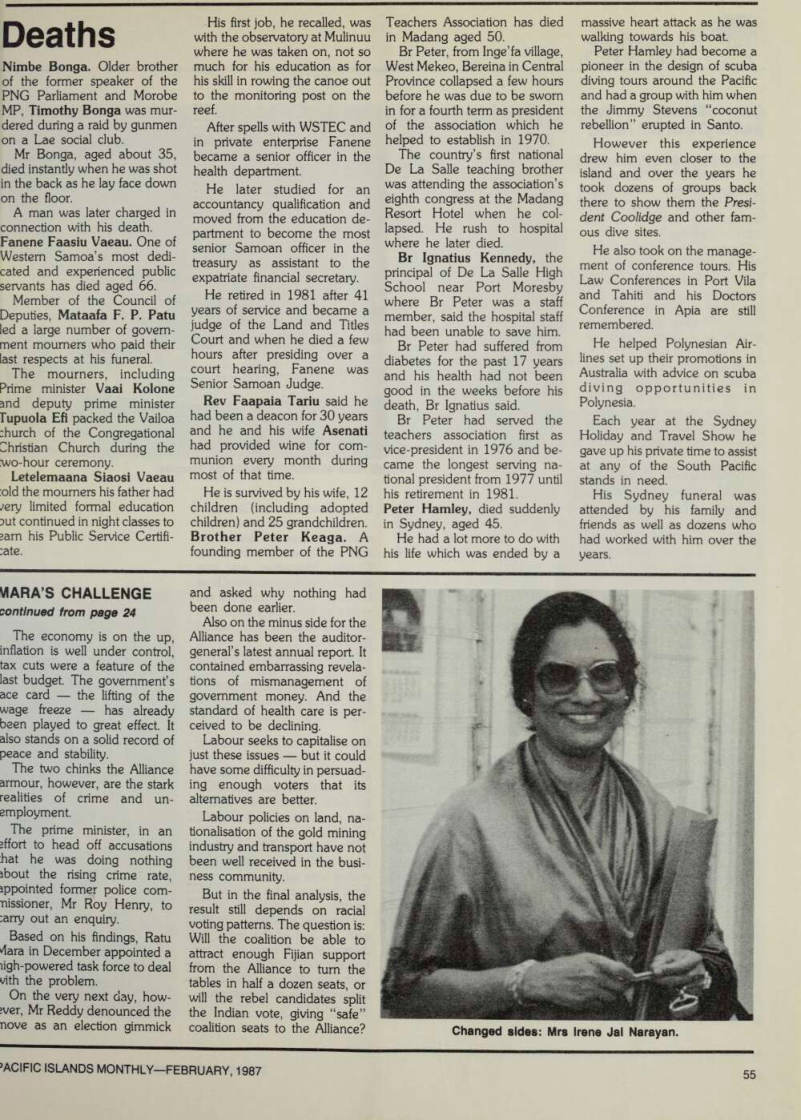
Nimbe Bonga. Older brother of the former speaker of the PNG Parliament and Morobe MP, Timothy Bonga was mur dered during a raid by gunmen on a Lae social club.
Mr Bonga, aged about 35, died instantly when he was shot in the back as he lay face down on the floor.
A man was later charged in connection with his death.
Fanene Faasiu Vaeau. One of Western Samoa’s most dedi cated and experienced public servants has died aged 66.
Member of the Council of Deputies, Mataafa F. P. Patu led a large number of govern ment mourners who paid their last respects at his funeral.
The mourners, including Prime minister Vaai Kolone and deputy prime minister Fupuola Efi packed the Vailoa :hurch of the Congregational Christian Church during the wo-hour ceremony.
Letelemaana Siaosi Vaeau :old the mourners his father had /ery limited formal education aut continued in night classes to 2am his Public Service Certifi :ate.
His first job, he recalled, was with the observatory at Mulinuu where he was taken on, not so much for his education as for his skill in rowing the canoe out to the monitoring post on the reef.
After spells with WSTEC and in private enterprise Fanene became a senior officer in the health department.
He later studied for an accountancy qualification and moved from the education de partment to become the most senior Samoan officer in the treasury as assistant to the expatriate financial secretary.
He retired in 1981 after 41 years of service and became a judge of the Land and Titles Court and when he died a few hours after presiding over a court hearing, Fanene was Senior Samoan Judge.
Rev Faapaia Tariu said he had been a deacon for 30 years and he and his wife Asenati had provided wine for com munion every month during most of that time.
He is survived by his wife, 12 children (including adopted children) and 25 grandchildren.
Brother Peter Keaga. A founding member of the PNG
Teachers Association has died in Madang aged 50.
Br Peter, from Inge’fa village, West Mekeo, Bereina in Central Province collapsed a few hours before he was due to be sworn in for a fourth term as president of the association which he helped to establish in 1970.
The country’s first national De La Salle teaching brother was attending the association’s eighth congress at the Madang Resort Hotel when he col lapsed. He rush to hospital where he later died.
Br Ignatius Kennedy, the principal of De La Salle High School near Port Moresby where Br Peter was a staff member, said the hospital staff had been unable to save him.
Br Peter had suffered from diabetes for the past 17 years and his health had not been good in the weeks before his death, Br Ignatius said.
Br Peter had served the teachers association first as vice-president in 1976 and be came the longest serving na tional president from 1977 until his retirement in 1981.
Peter Hamley, died suddenly in Sydney, aged 45.
He had a lot more to do with his life which was ended by a
massive heart attack as he was walking towards his boat.
Peter Hamley had become a pioneer in the design of scuba diving tours around the Pacific and had a group with him when the Jimmy Stevens “coconut rebellion” erupted in Santo.
However this experience drew him even closer to the island and over the years he took dozens of groups back there to show them the Presi dent Coolidge and other fam ous dive sites.
He also took on the manage ment of conference tours. His Law Conferences in Port Vila and Tahiti and his Doctors Conference in Apia are still remembered.
He helped Polynesian Air lines set up their promotions in Australia with advice on scuba diving opportunities in Polynesia.
Each year at the Sydney Holiday and Travel Show he gave up his private time to assist at any of the South Pacific stands in need.
His Sydney funeral was attended by his family and friends as well as dozens who had worked with him over the years.
Advertisements & other items, p. 53 (1 item)
55
>ACIFIC ISLANDS MONTHLY—FEBRUARY, 1987
VIARA’S CHALLENGE
continued from page 24
yachts
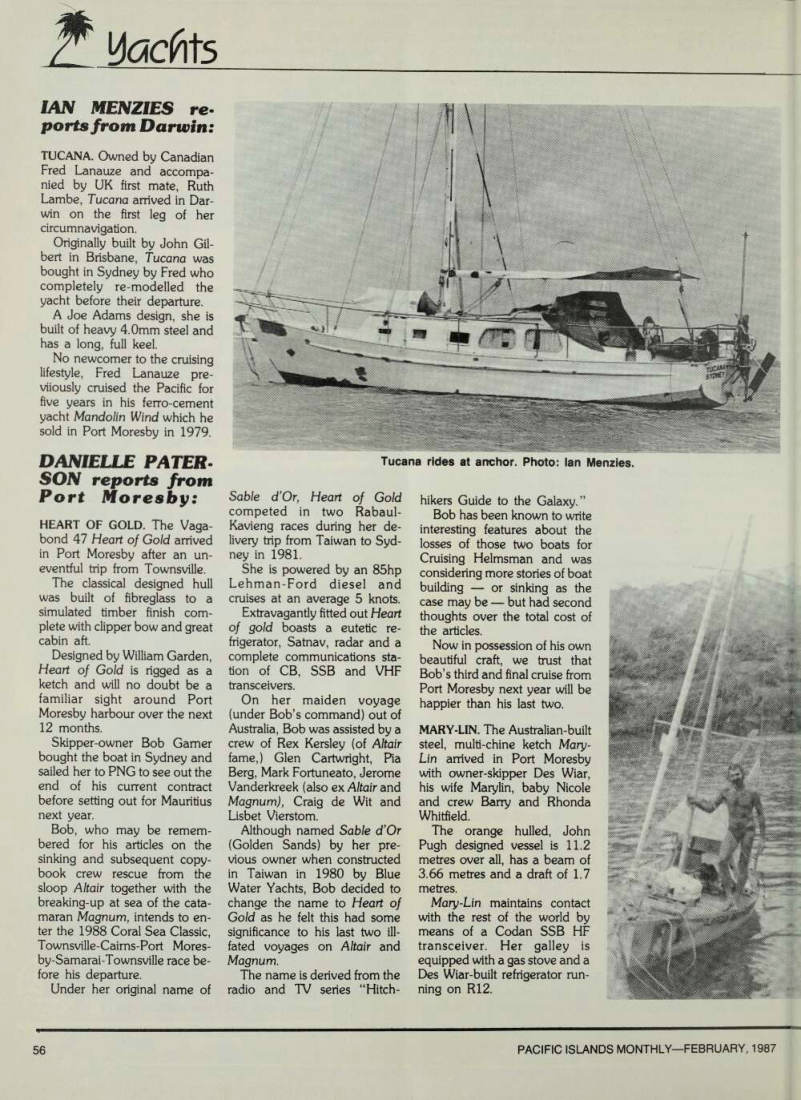
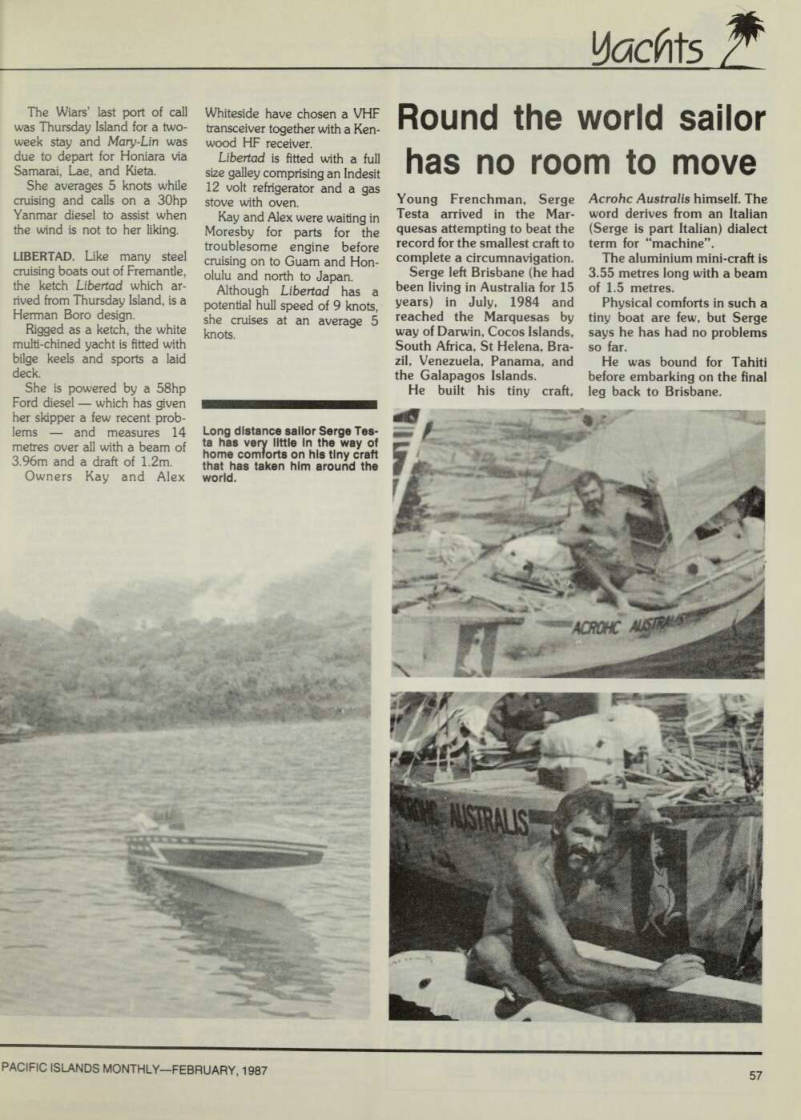
Lan Menzies Re
ports from Darwin:
TUCANA. Owned by Canadian Fred Lanauze and accompa nied by UK first mate, Ruth Lambe, Tucana arrived in Dar win on the first leg of her circumnavigation.
Originally built by John Gil bert in Brisbane, Tucana was bought in Sydney by Fred who completely re-modelled the yacht before their departure.
A Joe Adams design, she is built of heavy 4.omm steel and has a long, full keel.
No newcomer to the cruising lifestyle, Fred Lanauze pre viously cruised the Pacific for five years in his ferro-cement yacht Mandolin Wind which he sold in Port Moresby in 1979.
Danielle Pater
SON reports from
Port Moresby:
Heart Of Gold. The Vaga
bond 47 Heart of Gold arrived in Port Moresby after an un eventful trip from Townsville.
The classical designed hull was built of fibreglass to a simulated timber finish com plete with clipper bow and great cabin aft.
Designed by William Garden, Heart of Gold is rigged as a ketch and will no doubt be a familiar sight around Port Moresby harbour over the next 12 months.
Skipper-owner Bob Gamer bought the boat in Sydney and sailed her to PNG to see out the end of his current contract before setting out for Mauritius next year.
Bob, who may be remem bered for his articles on the sinking and subsequent copy book crew rescue from the sloop Altair together with the breaking-up at sea of the cata maran Magnum, intends to en ter the 1988 Coral Sea Classic, Townsville-Cairns-Port Mores by-Samarai-Townsville race be fore his departure.
Under her original name of
Sable d’Or, Heart of Gold competed in two Rabaul- Kavieng races during her de livery trip from Taiwan to Syd ney in 1981.
She is powered by an 85hp Lehman-Ford diesel and cruises at an average 5 knots.
Extravagantly fitted out Heart of gold boasts a eutetic re frigerator, Satnav, radar and a complete communications sta tion of CB, SSB and VHF transceivers.
On her maiden voyage (under Bob’s command) out of Australia, Bob was assisted by a crew of Rex Kersley (of Altair fame,) Glen Cartwright, Pia Berg, Mark Fortuneato, Jerome Vanderkreek (also ex Altair and Magnum), Craig de Wit and Lisbet Vierstom.
Although named Sable d’Or (Golden Sands) by her pre vious owner when constructed in Taiwan in 1980 by Blue Water Yachts, Bob decided to change the name to Heart of Gold as he felt this had some significance to his last two ill fated voyages on Altair and Magnum.
The name is derived from the radio and TV series “Hitch
hikers Guide to the Galaxy.”
Bob has been known to write interesting features about the losses of those two boats for Cruising Helmsman and was considering more stories of boat building or sinking as the case may be but had second thoughts over the total cost of the articles.
Now in possession of his own beautiful craft, we trust that Bob’s third and final cruise from Port Moresby next year will be happier than his last two.
MARY-LIN. The Australian-built steel, multi-chine ketch Mary- Lin arrived in Port Moresby with owner-skipper Des Wiar, his wife Marylin, baby Nicole and crew Barry and Rhonda Whitfield.
The orange hulled, John Pugh designed vessel is 11.2 metres over all, has a beam of 3.66 metres and a draft of 1.7 metres.
Mary-Lin maintains contact with the rest of the world by means of a Codan SSB HF transceiver. Her galley is equipped with a gas stove and a Des Wiar-built refrigerator run ning on Rl2,
Tucana rides at anchor. Photo: Ian Menzies.
The Wiars’ last port of call was Thursday Island for a two week stay and Maiy-Lin was due to depart for Honiara via Samarai, Lae, and Kieta.
She averages 5 knots while cruising and calls on a 30hp Yanmar diesel to assist when the wind is not to her liking.
LIBERTAD. Like many steel cruising boats out of Fremantle, the ketch Libertad which ar rived from Thursday Island, is a Herman Boro design.
Rigged as a ketch, the white multi-chined yacht is fitted with bilge keels and sports a laid deck.
She is powered by a 58hp Ford diesel which has given her skipper a few recent prob lems and measures 14 metres over all with a beam of 3.96 m and a draft of 1.2 m.
Owners Kay and Alex
Whiteside have chosen a VHF transceiver together with a Ken wood HF receiver.
Libertad is fitted with a full size galley comprising an Indesit 12 volt refrigerator and a gas stove with oven.
Kay and Alex were waiting in Moresby for parts for the troublesome engine before cruising on to Guam and Hon olulu and north to Japan.
Although Libertad has a potential hull speed of 9 knots, she cruises at an average 5 knots.
Long distance sailor Serge Tes ta has very little In the way of home comforts on his tiny craft that has taken him around the world.
Round the world sailor
has no room to move
Young Frenchman, Serge Testa arrived in the Mar quesas attempting to beat the record for the smallest craft to complete a circumnavigation.
Serge left Brisbane (he had been living in Australia for 15 years) in July, 1984 and reached the Marquesas by way of Darwin, Cocos Islands, South Africa, St Helena, Bra zil, Venezuela, Panama, and the Galapagos Islands.
He built his tiny craft,
Acrohc Australis himself. The word derives from an Italian (Serge is part Italian) dialect term for “machine”.
The aluminium mini-craft is 3.55 metres long with a beam of 1.5 metres.
Physical comforts in such a tiny boat are few, but Serge says he has had no problems so far.
He was bound for Tahiti before embarking on the final leg back to Brisbane.
shipping schedules
Should any shipping company wish to have its services cargo and passenger included in these listings they should contact p IM.
Australia Fiji
Sofrana-Unilines (Fiji Express Line) operates to Suva and Lautoka every three weeks from the main ports on the east coast of Australia and monthly to Lautoka from Melbourne and Sydney Details from Sofrana-Unilines, 432 Kent Street, Sydney (264-8944), Tix AA 70090; Wiltrans Agency Pty. Ltd., 21st Floor, 60 Market St. Melbourne (614-4788); Tlx 30163 ACTA Pty, Ltd., Brisbane (221-3116); Elders- ANL Pty. Ltd., Port Adelaide, (47-5688); Newcastle, Sofrana Sydney (264-8944); Websters-ANL, 58 Charles St. Launceston, Tasmania (320-555); Carpenters Shipping, Harbour Centre Building, Ist Floor, Thomson Street, Suva, Fiji (312-244); Tlx FJ2199.
Australia Samoas Tonga
Warner Pacific Lines operates a regular cargo service from Sydney, Brisbane and Melbourne to Nukualofa, Pago Pago, Apia and Vavau. Feeder service available from Apia to Cook. Christmas, Fanning and Washington Islands.
Details from Hetherington Wesfarmers Shipping Agency, 37-49 Pitt Street, Sydney, (27-1671).
Australia New Caledonia
Fiji Samoas Tonga
Pacific Forum Line operates a fully containerised service (general, reefer and ro-ro) from Sydney to Noumea, Suva, Apia, Pago Pago, Nukualofa, Sydney, Cargo centralised from Adelaide, Melbourne, Brisbane.
Details from Pacific Forum Line P.O. Box 796 Auckland, Union Bulkships, 333 George Street, Sydney, Brisbane and Melbourne.
Union Co.. Lautoka, Suva, Nukualofa, Pacific
Forum Line Apia, Polynesia Shipping Pago Pago.
Australia Lord Howe Is.
Norfolk Is.
Compagnie des Chargeurs Caledonians
operates four-weekly cargo service Sydney- Lord Howe Island and Norfolk Island, Details Hetherington Wesfarmers Shipping Agency, 37-49 Pitt Street, Sydney (27-1671).
Australia Kiribati
K. Asia Pacific operates a 5/6 weekly service from Melbourne and Sydney to Kiribati (Tarawa).
Details from K. Asia Pacific Pty. Ltd.
Goldfields House. 1 Alfred Street, Circular Quay, Sydney (232-2277), Tlx 122-143 KAP New Guinea Lines call Tarawa after PNG ports on a 35 day basis from Melbourne and Sydney/Brisbane.
Details from K. Asia Pacific Pty. Ltd.
Goldfields House, 1 Alfred Street, Circular Quay, Sydney (232-2277); Tlx 122143.
Australia Tuvalu
K-Asia Pacific operates Direct service every 2nd voyage to Tulalu (Funafuti), Details from K. Asia Pacific Pty. Ltd., Goldfields House, 1 Alfred Street, Circular Quay Sydney (232-2277) Tlx 122143.
Australia New Caledonia
And/Or Vanuatu
Sofrana-Unilines ships serve Noumea every three weeks from the main ports along the east Australian coast.
Details from Sofrana-Unilines, 432 Kent Street, Sydney (264-8944), Wiltrans-Agency Pty. Ltd., 21st Floor, 60 Market St., Mel bourne (614-4788) Tlx 30163 ACTA Pty. Ltd., Brisbane (221-3116). Elders-ANL Pty. Ltd,, Port Adelaide (47-5688), Newcastle, Sofrana Sydney; Websters-ANL, 58 Charles St. Laun ceston, Tasmania (320-555).
Compagnie des Chargeurs Caledoniens
operates a three-weekly containerised cargo service from Sydney to Noumea.
Details Hetherington Wesfarmers shipping Agency, 37-49 Pitt Street, Sydney (27-1671).
Compagnie Generale Maritime operates a monthly service from Sydney, Melbourne and Brisbane to Noumea, Port Vila and Santo, for containerised and break bulk cargo.
Details Compagnie Generale Maritime, 12 Castlereagh Street, Sydney (231-3700).
Australia Nauru
Marshall Is. Kiribati
Nauru Pacific Line operates regular cargo service from Melbourne to Nauru, Majuro and Tarawa, passenger service to Nauru only.
Details: Nauru Pacific Line (Aust.) Pty. Ltd.
Nauru House, 80 Collins Street, Melbourne (653-5709). Nedlloyd Swire, 8 Spring Street, Sydney (2-0522).
Australia - Solomon Islands
Vanuatu
Negal-PNG Line operates a monthly service details NEDLLOYD SWIRE P/L, 8
Spring Street. Sydney Phone: 20522.
Australia New Zealand
The Australian National Line and the New Zealand line operate a 10-day container service (TRANZTAS) between Sydney and Melbourne to Auckland, Wellington, Lyttleton and Port Chalmers.
The Tranztas service has been extended to cover Burnie and Fremantle on a direct call monthly basis linking to the main New Zealand ports.
Details from ANL Shipping Agency, 20 Bond Street, Sydney (225-7333) and ANL Shipping Agencies, "World Trade Centre," cnr. Flinders and Spencer Streets, Melbourne (611-2323) or New Zealand Line, Pastoral House. 96 Lambton Quay, Wellington (728- 5000).
Australia Nz Fiji Tonga
Vanuatu New Caledonia
Solomons New Guinea
Sitmar Cruises operates a year-round cruise program from Sydney to include the better-known ports in the above countries plus a number of unspoilt, and largely unknown, island paradises.
Details from Sitmar Cruises, 39 Martin Place, Sydney (239-9000); NSW, reserva tions and inquiries (008 42-2277); Rest of Australia, reservations and inquiries (008 22-2277).
Australia Nz Fiji Tonga
Vanuatu New Caledonia
Solomons Samoas Tahiti
P&O Liners call at Auckland. Bay of Islands, Honiara, Lautoka, Noumea, Nukualofa, Pago Pago, Papeete, Port Mores by, Santo, Savu-savu, Suva, Vavau and Vila on cruises from Australia.
Details from P&O Booking centre, World Travel Headquarters Pty. Ltd, 33 Bligh Street, Sydney (237-0333).
Australia Png
Solomons Vanuatu Nz
Pacific Forum Line operates a con tainerised and ro-ro from Brisbane to Port Moresby, Lae, Honiara, Port Vila, Lyttleton, Napier and Auckland.
Details from Union Bulkships, Brisbane Steamships Shipping, Port Moresby and Lae; Sullivans Ltd. Honiara, Vila Agents, Port Vila; SCONZ Christchurch, Napier and Auckland.
Auckland Micronesia
Nauru Pacific Line operates a regular container service from Melbourne to Ponape, Truk, Guam and Saipan.
Details: N.P.L. (Australia) Pty. Ltd., Nauru House, 80 Collins Street, Melbourne (653- 5709); Nedlloyd Swire, 8 Spring Street, Sydney (2-0522).
Australia New Caledonia
Sofrana Unilines operates a 3-4 weekly service from East Coast mainports to Noumea.
Details from Sofrana Unilines 432 Kent Street. Sydney. (Tel. 264-8944), Tlx AA 70090.
Australia Tuvalu
K. Asia Pacific operates a three monthly service from Sydney and Melbourne to
Tuvalu (Funafuti). Subject to Inducement.
Details from K. Asia Pacific Pty. Ltd.
Goldfields House, 1 Alfred Street, Circular Quay, Sydney (232-2277). Tlx 122143.
Warner Pacific Line operates a six week containerised/breakbulk service to Funafuti from Melbourne/Brisbane/Sydney and Auck land.
Details from Hetherington Wesfarmers Shipping Agency, 37-49 Pitt Street, Sydney (27-1671); Mackay Shipping Ltd. Downtown House, Queen Street, Auckland (30-299).
Australia Png
KAP New Guinea Lines cargo vessels call at Melbourne, Sydney, Port Moresby, Lae, Madang, Wewak, Manus, Kimbe, Rabaul, Popondetta.
Details from K. Asia Pacific Pty. Ltd.
Goldfields House, 1 Alfred Street, Circular Quay, Sydney (232-2277), Tlx 122143. Dal gety Shipping, World Trade Centre, Mel bourne (616-6700).
Australia Png Solomons
Sofrana Unilines (Aust. P/L operates a 3-4 weekly cargo service to PNG, ex-main ports on the east coast of Australia.
Details from sofrana Unllnes, 432 Kent Street, Sydney (264-8944), Tlx AA 70090.
Australia - Png Solomons
Vanuatu
A consortium of NGAL/PNGL and CON PAC/NEL have four vessels operating a joint service from east coast Australian ports to Port Moresby, Lae, Alotau, Madang, Wewak, Rabaul, Kavieng-Kimbe, Kieta, Honiara, Vila, Santo.
Details from Burns Philp & Co. Ltd., P.O.
Box R 124, Royal Exchange, Sydney, 2000 (2-0547); Nedlloyd Swire, 8 Spring Street, Sydney (2-0522); New Guinea Express Lines, 37 Pitt Street, Sydney (241-3991); Vila Agents, PO Box 27, Port-Vila (2456). Tlx
Nhioii.
New Guinea Express Lines operates a weekly container service from Melbourne, Sydney, Brisbane to Port Moresby, Lae, Alotau, Kimbe, Rabaul, Kieta, Honiara, Kavieng, Madang, Wewak, Santo, Vila.
Details from New Guinea Express Lines, P.O. Box R 73, Royal Exchange. Sydney (241-3991); New Guinea Express Lines, 127 Creek Street, Brisbane (221-9333); New Guinea Express Lines, 327 Collins Street, Melbourne (602-5544); Niugini Express Lines, Port Moresby (21-4572); Lae (42- 1536); Niugini Island Cargo Services Pty.
Ltd., Rabaul (922-467); Bougainville Agen cies Pty. Ltd., Kieta (956-089); Robert Laurie (PNG) P/L, Madang (82-2157); Garamut Enterprises P/L, Wewak (86-2106); Burns Philp (PNG) Ltd., Kavieng (94-2133); Alotau Stevedoring & Transport Alotau (61-1318); Ngatia Wholesalers Pty. Ltd. Kimba (93- 5102); and Tradco Shipping, Mandana Ave nue, Honiara (22588); Vila Agents Ltd., P.O.
Box 971, Vila, Vanuatu (2490); John Lum & Associates, P.O. Box 65, Santo, Vanuatu (329).
Australia Tahiti
Compagnie Generate Maritime operates a monthly service from Sydney, Melbourne and Brisbane to Papeete, for containerised and break bulk cargo.
Details Compagnie Generale Maritime, 12 Castlereagh Street, Sydney (231-3700).
Sofrana Unilines (Aust.) P/L operates a 3/4 weekly cargo service to Papeete ex main ports on the east coast of Australia.
Details from Sofrana Unilines, 432 Kent Street. Sydney (264-8944). Tlx AA 70090.
Singapore Hongkong Fiji
Islands Ports
Kyowa Shipping Co. Ltd,, operates a monthly containerised and break bulk cargo service from Singapore, Hongkong to Lauto ka, Suva and then to island ports.
Details from Carpenters Shipping, Harbour Centre Building, Ist Floor, Thomson Street, Suva (312-244). Tlx FJ2199.
Far East Fiji
New Zealand
New Zealand Unit Express (NZUE), now operates a monthly service accepting con tainerised and break bulk cargo from Manila, Keelung, Kaohslung and Hongkong to Lauto ka, Suva and thence to New Zealand ports.
Details from Carpenters Shipping, Harbour Centre Building, Ist Floor, Thomson Street, Suva (312-244), Tlx FJ2199; Burns Philp.
Suva (311-777); New Zealand Unit Express, Maritime Building, 2-10 Customhouse Quay, P.O. Box 890, Wellington. Cables: ENZUE
Man Wellington. Telex; Nz31340.
NEDLNZ, Telephone; 727-865 or Nedlloyd Swire Pty. Ltd., Sydney (20-522).
Nedlloyd operates bi-weekly cargo service with four ships from Surabaya, Jakarta, Bangkok, Port Kelang and Singapore to Suva, Lautoka and NZ ports.
Details from Nedlloyd (Aust.) Pty. Ltd., 8 Spring St„ Sydney (27-3801). Burns Philp (SS) Co. Ltd., Suva and Lautoka.
Far East Mid-S. Pacific
China Navigation's New Guinea Pacific Line operates a regular container service from Hongkong, Taiwan, Manila, Port Kelang and Singapore to Port Moresby, Lae, Rabaul and Honiara monthly and to Wewak, Madang and Kieta every three months. Cargo from the same Far Eastern ports to the South Pacific ports of Noumea, Santo, Vila, Papeete, Pago Pago, Apia, Raratonga and Tarawa will be shipped via Japan on the monthly Bali Hai service.
Details from Steamships Shipping, P.O.
Box 634, Port Moresby (22-0289).
Kyowa Shipping Ltd. operates monthly services from Japan to Guam, Saipan, Solo mons, New Caledonia, Fiji, Western and American Samoa, Tahiti, Cook Is. Tonga and Vanuatu.
Details: Heterington Wesfarmers Shipping Agency, 37-49 Pitt Street, Sydney (27-1671); Carpenters Shipping, Suva (312-244). Tlx FJ2199.
Guam - Northern Marianas
Saipan Shipping Co. Inc. operates a weekly service via barge carrying containers and conventional cargo between Guam and Saipan and Tinian.
Details from Saipan Shipping Co. inc., P.O.
Box 8, Saipan, CM 96950 (Tel. 9707), Tlx 783619; Guam agents Maritime Agencies of the Pacific Ltd.
Hawaii Tahiti Samoas -
Tonga Kiribati Fiji
Solomons Png
State Shipping Associates operates a monthly service originating in Honolulu and destined for Pago Pago, Papeete, Apia, Nukualofa, Suva, Vila and Pori Moresby.
Details from Star Shipping Assoc., P.O.
Box 25988, Honolulu, Hawaii 96825. Ph. (808) 39-4256; Polynesia Shipping Services in Pago Pago and Burns Philp Agency in Apia, Nukualofa, Suva and Port Moresby
Japan Fiji Island Ports
Kyowa Shipping Co. Ltd. operates a month ly containerised service from main ports of Japan to Suva and Lautoka and thence to island ports.
Details from Carpenters Shipping, Harbour Centre Building, Ist floor, Thomson St Suva (312-244). Tlx FJ2199, Bali Hai service operates a monthly con tainerised service from main ports of Japan to Lautoka and Suva and thence to island ports.
Details from Carpenters Shipping, Harbour Centre Building, Ist floor, Thomson St., Suva (312-244). Tlx FJ2199, and Burns Philp, Suva (311-777).
Japan Micronesia
The NYK Shipping Line operates a monthly cargo service from Japan to Micronesia, calling at Yoko, Nagoya, Kobe, Guam!
Saipan, Truk, Ponape and Majuro, returning via Yoko, Nagoya and Kobe.
Details from Burns Philp & Co. Ltd., 51 Pitt Street, Sydney (2-0547).
Saipan Shipping Co. Inc. operates a monthly service from Japan to Saipan, Guam, Truk, Porape, Majuro (Kosrae and Ebeye ori inducement).
Details from Saipan Shipping Co. Inc., P.O.
Box 8, Saipan, CM 96950 (Tel. 9707), Tlx 783619. Japan agents Kyowa Shipping Com
pany Ltd.; Guam Agents Maritime Agencies of the Pacific Ltd.
Japan Png
Mitsui O.S.K. Lines operates a monthly service from main ports Japan, Wewak, Lae, Rabaul, Kieta, Port Moresby.
Details from Robert Laurie Carpenters Pty.
Ltd., P.O. Box 1032, Lae/PNG (Tel. 42-3642, 42-3811).
New Caledonia Fiji West
Coast North America
PAD Line operates an approx. 3-weekly ro-ro service from Noumea and Suva to Honolulu and West Coast USA and Canadian ports.
Details from Sofrana-Unilines SA, BP 1602, Noumea (27-51-91). Tlx NMO4B; Carpenters Shipping, Harbour Centre Building, Ist Floor, Thomson St., Suva (312-244). Tlx FJ2199.
Png Inter Mainport
Papua New Guinea Line offes scheduled 10-20 day coastal liner services linking all PNG major ports with containerisation, reefer, heavy lift and transshipment facilities.
Details from PNG Line, Box 543, Port Moresby, PNG (21-1174). Tlx 22269.
Png Uk/Continent
The Bank Line & Columbus Line operate a regular joint service from Port Moresby, Oro Bay, Kieta, Rabaul, Kimbe, Madang and Lae to Hull, Hamburg, Rotterdam, Antwerp and Le Havre.
Details from The Bank Line (A’asia) Pty.
Ltd., 51 Pitt Street, Sydney (27-2041); Tlx AA24063; Columbus Line, Lae (423466), Tlx NE 44171; or lines’ local agents.
Solomons Uk/Continent
The Bank Line & Columbus Line operate a regular joint cargo service from Honiara to Hull, Hamburg, Rotterdam, Antwerp and Le Havre.
Details from The Bank Line (A’asia) Pty.
Ltd., 51 Pitt Street. Sydney (27-2041); Tlx AA24063; Columbus Line, Lae (423466). Tlx NE 44171; Tradco Shipping Ltd., Honiara (22588), Tlx 66313.
New Zealand Australia Papua
New Guinea Solomon Islands -
Vanuatu
Pacific Forum Line operates a con tainerised and ro-ro service from Lyttelton, Napier and Auckland to Brisbane, Port Moresby, Lae, Honiara and Port Vila.
Details from SCONZ Christchurch, Napier and Auckland, Union Bulkships, Brisbane; Steamships Shipping, Port Moresby and Lae; Sullivans Ltd., Honiara; Vila Agents, Port Vila.
Nz Cook Is. Niue Tahiti
New Zealand Line operates cargo services based on pallets and similar units from Auckland to Niue, Cook Islands and Tahiti.
Details from the NZ Shipping Agencies International Ltd., P.O. Box 3420, Auckland (797210); Waterfront Commission, P.O. Box 61, Raratonga; Cook Islands; Shipping Office, Govt, of Niue, P.O. Box 107, Niue Island: Compagnie Maritime Polynesienne, P.O. Box 36, Papeete, Tahiti.
Nz Fiji
Reef operates a regular 18-day service from Auckland to Suva and Lautoka. Also passenger accommodation.
Details from Reef Shipping Agencies, PO Box 3382, Auckland, NZ (77-1221-3), Tlx 60633; MV Fijian Shipping Agencies Ltd.
Private Bag, Suva. Fiji (31-1056).
Pacific Line with one ship operates two weekly ro-ro cargo service New Zealand, Lautoka, Suva. No passengers.
Details Sofrana Unilines, 18 Customs Street, Auckland (773-279) PO Box 3614, Tlx NZ2313, Carpenters Shipping. 100 Thomson Street, Suva (312-244), Tlx FJ2199,
Nz Fiji North America (Wc)
Blue Star Line Ltd. Pacific Coast container services. Only direct service to and from New Zealand. Blue Star vessels call at Suva and Honolulu on NZ-U.S. West Coast voyages.
Details from Blueport ACT (NZ) Ltd., PO Box 192, Wellington (739-029). Burns Philp (SS) Co. Ltd., GPO Box 355, Suva, Fiji (311-777), Tlx FJ2168 Burship.
Nz Fiji Samoas Tonga
Pacific Forum Line operates a con
tainerised and ro-ro 21 day service from Auckland to Lautoka, Suva, Apia, Pago Pago and Nukualofa.
Details from Pacific Forum Line, Auckland and Apia, Union Maritime, Lautoka, Suva and Nukualofa; Polynesian Shipping, Pago Pago.
Nz N. Caledonia Vanuatu
Png Solomons
Sofrana Unilines with three ships operate to Vila and Santo, to Honiara and Papua New Guinea and to Norfolk Island and Noumea (No passengers).
Details from Sofrana Unilines, 18 Customs Street, Auckland (773-279), PO Box 3614, Tlx NZ2313.
Nz Tahiti
Compagne Tahotienne Maritime SA (as CTM-Tahiti Line) operates one ship, MV Bounty 111, monthly Papette New Zealand. (No passengers.) Details from Sofrana Unilines, PO Box 3614, 18 Customs St., Auckland, Tlx NZ2313.
CTM-Tahiti Line, PO Box 9012, Papeete (39042), Tlx Tahitlin 322 FP Tahiti.
Nz Tonga Samoas
Warner Pacific Line services Auckland, Nukualofa, Vavau, Apia, Pago Pago fort nightly carrying general and freezer cargoes.
Details from Mckay Shipping Ltd., Down town House, 21 Queen St., Auckland, PO Box 3, Phone 390-229. Cables MACSHIP, Telex NZ2554. Warner Pacific Line, Box 93, Nukualofa, Tonga; Mealelel (Western Samoa) Ltd., Private Bag Apia, Western Samoa. Burns Philp (SS) Co. Ltd., PO Box 129, Pago Pago, Merican Samoa, Phone 633-2709, Cables 506, Burnsouth SB.
Tahiti New Caledonia
Vanuatu Solomon Is.
New Zealand Png
Singapore Europe
Polish Ocean Lines operate in a semi container type vessels to the following ports, from Papeete, Noumea, Santo, Vila, Yandina, Honiara. Auckland, Rabaul. Lae. Singapore,
Port Kielang, Penang then to Mediterranean ports and Europe via the Suez Canal. (Other New Zealand ports subject to inducement.) Details from Universal Shipping Agencies Ltd., 6th Floor, 38 Fort Street, Auckland 1, New Zealand (390931, 390727, 32104), Tlx 21517.
Europe Tahiti
New Caledonia
Compagne Generate Maritime operates services from Europe and Mediterranean ports to Papeete and Noumea using three ro-ro and multi-purpose vessels thus ensuring a bi-monthly sailing to and from.
Details Compagne Generate Maritime, 12 Castlereagh Street, Sydney (231-3700).
Europe Tahiti
New Caledonia New Zealand
Vanuatu Solomons
Png - Europe
Polish Ocean Lines offers regular monthly sailings for containerised and break bulk cargo, also conventional reefer space and reefer containers from Hamburg, Rotterdam, Dunkirk, Rouen to Papeete, Noumea, Auck land, Santo. Honiara, Rabaul, Lae, Singa pore, returning to Europe via Suez, other ports in South Pacific can be served directly with inducement or otherwise via tranship ment.
Details from Sotama, BP 9170, Papeete, Tel. 427805 Tlx 373, Telex Sotama 373FP/SATO: BP, C 2 Noumea Cedex Tel. 272094 Tlx 163NM/Universal Shipping Agencies PO Box 2282 Auckland Tel. 30930 Tlx 21517/Vanua Navigation PO Box 44 Vila Tel. 2027 Tlx 1033/Melan Chine Shipping Co. PO Box 71 Honiara Tel. 21678 Tlx 66335/Steamships Shipping & Transport PO Box 1512 Rabaul Tel. 922952 Tlx 92929/Steamships Trading Co.
Ltd., PO Box 85, Lae Tel. 424666 Tlx 42423/Union Steamship Co. of NZ Ltd, PO Box 50 Apia Tel. 21781 Tlx 225/Warner Pacific Line, PO Box 93, Nukualofa Tel. 22088 Tlx 66219/Fiji Agents TBA.
Europe Tahiti W.
Samoa Fiji N. Caledonia
Nedlloyd offers regular cargo services from Continental ports to Papeete, Apia, Fiji and New Caledonia.
Details Nedlloyd (Aust.) Pty. Ltd., Spring Street, Sydney (27-3801); Carpenters Ship ping, Ist Floor, Harbour Centre Bldg, 100 Thomson St.. Suva (312-244), Tlx 2199FJ and Vetari Street, Lautoka (63988), Tlx 5215FJ.
Uk N. Continent W. Somoa
Tonga Fiji
The Bank Line & Columbus Line operate a regular joint cargo service from Hull, Ham burg, Bremen, Antwerp, Rotterdam and Le Havre to Apia, Nukualofa, Suva and Lautoka.
Detaiis from The Bank Line (A’asia) Pty.
Ltd., 51 Pitt Street, Sydney (27-2041), Tlx AA 24063, Columbus Line, Lae (423-466), Tlx NE 44111, or lines local agent.
Uk N. Continent Png
Solomons
The Bank Line & Columbus Line operates a regular joint cargo service from Hull, Ham burg, Bremen, Antwerp, Rotterdam and Le Havre to Port Moresby, Lae, Madang, Kimbe, Rabaul, Kieta and Honiara and on induce ment to Yandina.
Details from The Bank Line (A'asia) Pty.
Ltd., 51 Pitt Street, Sydney (27-2041), Tlx AA 24063. Columbus Line, Lae (42-3466). Tlx NE 44171; or lines local agents.
Uk/N Continent Tahiti
N. Caledonia Vanuatu
The Bank Line 9 Columbus line operates a regular joint cargo service from Hull, Ham burg. Bremen, Antwerp, Rotterdam and Le Havre to Papeete, Noumea, Port-Vila and Santo.
Details from The Bank Line (A'sia) Pty. Ltd., 51 Pitt Street, Sydney (27-2041), Tlx AA 24063, Columbus Line, Lae (42-3466), Tlx
NE 44171; Ets. A.M. Fare UTE, Papeete; Ets, Ballande, Noumea and other local agents.
U.S. Hawaii Micronesia
East Malaysia Brunei
Papua New Guinea
PM&O Lines operates two fully self-sus tained container vessels on a sailing frequen cy of every 30 days between the San Francisco Bay Area, Los Angeles, Honolulu and Majuro, Ebeye, Kosrae, Ponape, Truk, Saipan, Yap Paleu, Kota Kinabalu, Brunei, Lae, Kieta and Rabaul.
Details from PM&O Lines, 353 Sacramento Street, San Francisco, California 94111, U.S.A. (415) 421-5400, Tlx 278016 PMO UR; Owners Representative P.O. Box 803, Saipan, N.M.I. 96950, Ph. 234-6819 Tlx
783-605 Cmcaa.
U.S. Hawaii - Samoas -
Kiribati Nauru
Nauru Pacific Line operates regular con ventional and container services from San Francisco and Honolulu to Christmas Island, Pago Pago, Apia, Tarawa and Nauru.
Details from N.P.L. (Australia) Pty. Ltd., Nauru House, 80 Collins Street, Melbourne (653-5709), Nauru Air and Shipping Agency, Suite 2803, 185 Berry Street, San Francisco, California 94107 (415-543-4517). Nauru Air and Shipping Agency, Suite 506, 841 Bishop St., Honolulu, HI 96813 (808-523-0441).
U.S. Noumea Fiji
PAD Line operates an approx. 3-weekly ro-ro service from west coast USA and Canada to Noumea, Suva and Lautoka.
Details from Sofrana Unilines BP 1602, Noumea (27-51-91). Tlx NMO4B, Carpenters Shipping, Harbour Centre Building, Ist Floor, 100 Thomson Street, Suva (312-244), Tlx FJ2199, Trans-Austral Shipping Pty. Ltd., P.O. Box R 232, Royal Exchange, 2000 (231-8411), Tlx AA21204.
Advertisements & other items, pp. 56-60 (1 item)
117 York St., Sydney.
LOCAL AGENTS AND
REPRESENTATION
Cables: Henco Sydney.
G.P.O. Box 3949.
Telephone: 261 1955.
For specialised and
personalised buying
service throughout
the Pacific Islands
and the East.
PAPUA NEW GUINEA
RABAUL: M. & C. Seeto, P.O. Box 131, Rabaul.
Telephone 92 2919.
FIJI
K. Witherington Ltd., P.O. Box 293, Suva.
Telephone 22 356.
VANUATU
John Lum & Associates, P.O. Box 65, Santo.
Telephone 329.
SOLOMON ISLANDS
Mr. Ken Szetu, P.O. Box 45, Honiara.
Telephone 22 637.
Resident Agents in other Pacific Territories
YOU’LL FIND IT.
WHERE THE SKY MEETS
THE SEA.
NEW CALEDONIA
mmmm
SOLOMON ISLAND
l K 1 R I B ATI
VANUATU
W. S A M O A
A. S A M O A
TAHITI
tonga - T a
JOINTLY OPERATED BY
The China Navigation Co., Ltd.
Mitsui Ot&K. Lines. Ltd.
NIPPON YUSEN KAISHA
WeVe just made
the ocean smaller!
Polynesia Line's new MS Polynesia 550-container ship provides regular monthly cargo service between Papeete, Pago Pago and Apia in the South Pacific, and Long Beach and Oakland on the US Pacific Coast.
POLYNESIA LINE
Interocean Steamship Corporation General Agent . Apia Pago Pago sa .Vj
cgjsafii
«a KS 3* a £ & V Papeete Serving Polynesia is all we do—and we do it better!
POUSU KEAN IMS
General Management, 10 Lutego 24,81-364 GDYNIA, POLAND, Phone: 20-19-01, Cables: POLOCEAN Telex: 054-231 Q & s *5 TT iM Si »►*
SOUTH PACIFIC SERVICE
SINGAPORE bv our mnltlmrnnco ( via PANAMA), NOUMEA, AUCKLAND, HONIARA, RABAUL, LAE E, by our multipurpose vessels carrying dry and reefer containers, reefer chambers, heavy lifts, breakbulk palletized, bulk liquids. or AUPKi Awn Mr a c « t i OCEAN LINES Representatives • leradzki. Telex 21517 NZ “UNISHIP”. SYDNEY Mr. Walenciak. Telex 20428 AA “SLEIGH”
TAHITI SOTAMA Telex 296 FP -COUTIMEX" NEWCAI kill iiO A TAH A I it
SERVICE PAGE
PACIFIC
SLANDS
I M 0 N T H L Y~ 1 AUSTRALIA: Distribution: The Herald and Weekly Times Ltd., 44-74 Flinders St., Melbourne, Vic., 3000. Advertising Reps — Brisbane — D. Wood, Anday Agency, CCA Centre, Dayboro Road, Closeburn 4520; Box 1918, GPO Brisbane, 4001; telephone (07) 289-4128. Adelaide — Hastwell Williamson Rouse Ry. Ltd., PO Box 419, Norwood, SA, 5067; 59 Kensington Road, Norwood; telephone (08) 332-3322, telex 87113; Perth — Allen & Associates, 7 Fore St., Perth, W.A., 6000, telephone (09) 328-9833, telex: AA94382.
WELLINGTON — Ross Quaid Media, 1 Scholes Ln., Petone. (04) 68-7593 PO Box 38699, Petone.
PAPUA NEW GUINEA: Distribution - Gordon & Gotch, PO Box 3395, Port Moresby, telephone 25-4551,25-4855.
Advertising — Ken Head, PNG Post-Courier, PO Box 85, Port Moresby, telephone 21-2577, telex 22120.
SOLOMON ISLANDS: Distribution and Advertising — The Bookshop, (Norman Bros.) PO Box 503, Honiara.
PHILIPPINES: Advertising — The GF Group, 12 San Ignacio St„ Uroaneta Village, Makati, Metro Manila, telephone 817-7299, telex 45950 and 4233.
UNITED KINGDOM: The Herald & Weekly Times Ltd., No 1 Maltravers Street, London WC2R 3DZ, England, telephone (01) 836-5162, telex London 21989.
UNITED STATES MAINLAND; Advertising — Joshua B.
Powers Jr., Powers International Inc., Suite 708, 271 Madison Ave., New York, NY 10016, telephone 867-9580, Subscriptions — PIM, Hawaii, PO Box 22250, Honolulu, Hawaii, 96822.
FUI: Distribution and subscriptions. — Desai Bookshops, P.O. Box 160, Suva, Fiji telephone Suva 23036.
Advertising — Fiji Times & Herald Ltd., 20 Gordon St., Suva, telephone 31-4111, telex FJ2124.
FRENCH POLYNESIA: Distribution — Hachette Pacifique 10 Ave., Bruat, Papeete, telephone 25-610.
HAWAII; UNITED STATES: Distribution - PIM, Hawaii, P.O. Box 22250, Honolulu, Hawaii, 96822. Advertising — Brian C. Asgill, Apt. 1308,1676 Ala Moana Blvd., Honolulu, Hawaii, 96815, telephone (808) 955-9718.
JAPAN: Advertising and subscriptions — Universal Media Corporation, GPO Box 46. Tokyo,'telephone 666-3036, cable UNIMEDIA Tokyo, telex 2524665.
MALAYSIA: Advertising and subscriptions — Worldwide Media Services, 57-B Komplex Damai, Jin Dato Haji Eusoff, Kuala Lumpur, telephone 63-9340, cables WORLDMEDIA Kuala Lumpur, telex 31533.
VANUATU; Distribution — The Bookshop, HQ Box 210, Port Vila. Advertising — Norman Bros. Bookshop. Port Vila, telephone 2232.
NEW CALEDONIA: Distribution — Depot Centre de Presse Michel Pentecost. CBP2, Noumea, telephone 27-2434. 27-4729.
NEW ZEALAND: Distribution — Gordon & Gotch, PO Box 584, 2 Carr Road, Mt. Roskill, Auckland 4.— Advertising — McKay International Media Reps. Ltd., c/o Albany P.O., Auckland 10, New Zealand, telephone 413-9119.
Telex NZ22701, FAX 413-9110.
SUBSCRIPTIONS
American Samoa. ..
Australia Canada Cook Islands Fiji French Polynesia...
Guam Hawaii Japan Kiribati Micronesia Nauru New Caledonia New Zealand Niue Norfolk Island Northern Marianas..
Papua New Guinea Solomon Islands Tonga Tuvala United Kingdom U.S. Mainland Vanuatu Western Samoa Elsewhere .. US$24
AUS$24
... US$30 ...NZ$36
AUS$26
... US$30 ... US$30 ... US$30 ... US$30
, AUS$24
.. US$30
.AUS$24
... US$30 ...NZ$36 ...NZ$30
, AUS$24
... US$30
,AUS$35
.AUS$24
.AUS$24
.AUS$24
Stgl 5 ... US$30
.AUS$24
.AUS$24
. AUS$36
Payments by personal cheque are only acceptable in Australian (from a branch in Australia). U.S. and New Zealand currency. For all other remittances please send an international bank draft in Australian dollars.
Published monthly by Pacific Publications (Aust.) Pty.
Ltd. and printed in Australia by Brownhall Printing Pty. Ltd., 52 Dueroin Street, Clayton North, Victoria.
NOW AVAILABLE!
PACIFIC ISLANDS YEAR BOOK
Due to demand the 15th edition has been reprinted and is available from P.I.M. at As3s plus p.p.
tfytofapihM-
Stay at Aggie Grey’s . . .
the South Pacific’s
legendary hotel.
Situated right in the heart of Western Samoa. F.njoy Polynesian style friendliness and service, in cool surroundings, superb entertainment and food.
Magnificent while sand l>eac hes only a short drive away. Airconditioned rooms, swimming I rool andJull hat facilities.
Bookings through I’nion Steamship Company of N/„ Pan Am. Air Ne w Zealand or direct to Aggie Grey's, Apia. Western Samoa Cables: AGGIFS’ Apia.
ALL THE NEWS IN A FLASH
The South Sea Digest tells you what you want to know about the Pacific Islands in a few words. All the leading firms and diplomatic missions read it. You can phone or write or call for a follow up.
See insert for subscription details:
THE SOUTH SEA DIGEST
Advertising
Aggie Greys 62 Air Pacific 20-21 Amatil 31 Anitech 30
Anz 37
Bali Hai 59 Bank Line 63 Brasshards 53 Citizen Watches 11 Clarion Shoji 14 Collins Olympic 51 Columbus Line 63 Continental 43 Henry Cumines 58 Honda Motor 2
Ici (Nz) 54
Metro Drill & Blast 36 Mitsubishi Motor 64 NEC Corp 23 Nissan Motor 16-17 Pioneer Electronic 38 Polish Ocean Lines 61 Polynesian Line 59 Ragg & Assoc 26 Samoan Trop Products .. 33 Sony Corp 4 Total Concept 40 Toyota Motor 34-35 Uni. Of Canterbury 24 Video ;r.v... 36
Advertisements & other items, pp. 60-62 (1 item)
Papua New Guinea
Handbook, Business and Travel Guide The new 11th edition is fact-packed with everything for the investor, traveller, writer, student, historian, importer, exporter and shipper.
Complete with maps including a fold-out chart of the whole country it also contains a comprehensive accommodation guide to all of PNG.
It’s a must for anyone interested in the South Pacific’s largest developing nation.
See the insert in this issue for full details.
BANK LINE and
COLUMBUS LINE
24 day service to
Europe.
Need we say more...
D G The Joint Service Partners offer facilities for shipment of: Containers (FCL/LCL) and Break-bulk Cargo plus reefer space and deeptanks for carriage of vegetable oils and other liquid bulk cargo.
Carriers also accept heavy lifts, overlength and cumbersome parcels.
Please contact our The Bank Line (Australasia) Pty Ltd Suite 801,51 Pitt St, Sydney, NSW, Australia 2000 Phone 27 2041 Telex 24063 Ports of Service: Loading: Papeete, Apia, Suva, Lauloka, Noumea, Port Vila, Santo, Honiara, Port Moresby, Lae, Madang, Kimbe, Rabaul, Kieta, Darwin. For: Rotterdam, Antwerp, Hamburg, Hull, Dunkirk, Le Havre.
Additional ports on enquiry. regional offices for further information: Columbus Line Reederei GmbH P.O. Box 1 667, Lae/Papua New Guinea.
Phone; 423466/423487/AH. 422481 Telex: Colline NE 441 71 The South Pacific Specialists for over 75 years
■ m i H i
Leonardo da Vinci
dreamed of machines
that one day would be.
RY Vfc* O/P
1 1 FEB 1987
We build them.
3 i Over four hundred years ago, Leonardo da Vinci drew up plans for submarines, helicopters, jet planes—even an automobile. Unfortunately, he didn't have the technology to build any of them.
Today at Mitsubishi, we don't have that problem. Of course, many of our ideas are still years ahead of their time. But our engineers can transform those ideas into working prototypes.
Take our MP-90X concept car. It stands out. Sleek, aerodynamic shape, amazing 0.22 Cd. Exceptionally advanced electronics—a navigation system that lets you pinpoint your exact position on a video map, via satellite; computerised diagnostic system that immediately informs you of any potential problem.
Then there's the communications system that keeps you in touch with your home or office, and the electronic mail system. Even the windows dim with increased daylight, to cut glare.
The engineering is years ahead, too: high-response four-wheel steering, active control brakes and suspension, and an engine that controls its speed according to road conditions.
It all adds up to a vehicle that puts you in charge. It may take some time before you'll find all this equipped in your everyday family car. But if we have anything to say about it, it won't take four hundred years.
A
MITSUBISHI
MOTORS
AMERICAN SAMOA: MORRIS SCANLAN SERVICE INC. P.O. Box 367, Pago Pago. Tel, 633-5520/AUSTRALIA: MITSUBISHI MOTORS AUSTRALIA LTD. Box 1851, G.P.O Adelaide, South Australia 5001, Tel 08-275-7111 /FIJI: NIVIS MOTOR & MACHINERY CO., LTD, G.P.O Box 150, Suva, Tel. 384425/FRENCH POLYNESIA (TAHITI): ETS-BREDIN FRERES ET FILS PO Box 21, Papeete, Tahiti, Tel 4-202-58/ NEW CALEDONIA: SOCIETE D IMPORTATION D AUTO DU PACIFIQUE SUD S.A. B.P. 438 Rond Point du Pacifique, Noumea, Tel 274144/ NEW ZEALAND: TODD MOTORS CORPORATION Todd Park, Heriot Drive, Private Bag, Porirua, Tel. 70-109/NORFOLK ISLAND; BORRYS LTD. PO. Box 169, Norfolk Island, Tel 2114 NI/PAPUA NEW GUINEA: TOBA PTY. LTD. P.O. Box 503, Port Moresby, Tel. 21-7874/SOLOMON ISLANDS: R.C. SYMES PTY. LTD. P.O. Box 823, Honiara, Guadalcanal, Tel. 22131 /TONGA: SITANI MAPI CO.. LTD. P O. Box 83. Maku Olofa, Tel. 2 1-044/VANUATU: SOCOMETRA B.P 06 Route de Lagon, Port-Vila, Tel. 2314/WESTERN SAMOA: A M MACDONALD HOLDINGS LTD PO. Box 576, Apia, Tel 22022/SAIPAN/PON APE/MAJURO/KOSRAE/TRUK/YAP/BELAU: MICRONESSIAN MOTORS. INC. 997 South Marine Drive, Tamuning, Guam 96911, Tel 646-6827