Pacific
Islands
M O Nthly
American Samoa US$2.OO Australia A 52.00 Cook Islands NZ$3.OO Fiji f 51.75 Hawaii US$2.5O Kiribati A 52.00 Nauru A 52.00 New Caledonia CFP2SO New Zealand NZ$3.OO Niue NZ$2.5O Norfolk Island A 52.00 Papua New Guinea K 2.00 Solomon Islands 552.00 Tahiti CFP3OO Tonga P 2.00 Tuvalu A 52.00
Usa Us$3.Oo
USTT and Guam US$2.5O Vanuatu VT2.00 Western Samoa T 2.75 ‘Recommended retail price only Registered by Australia Post Publication No. NBPI2IO
January, 1987
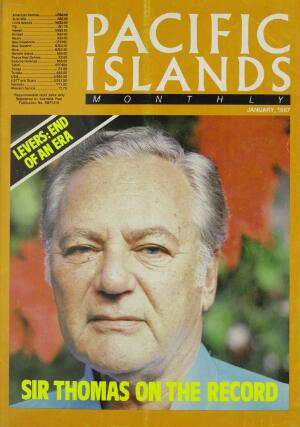
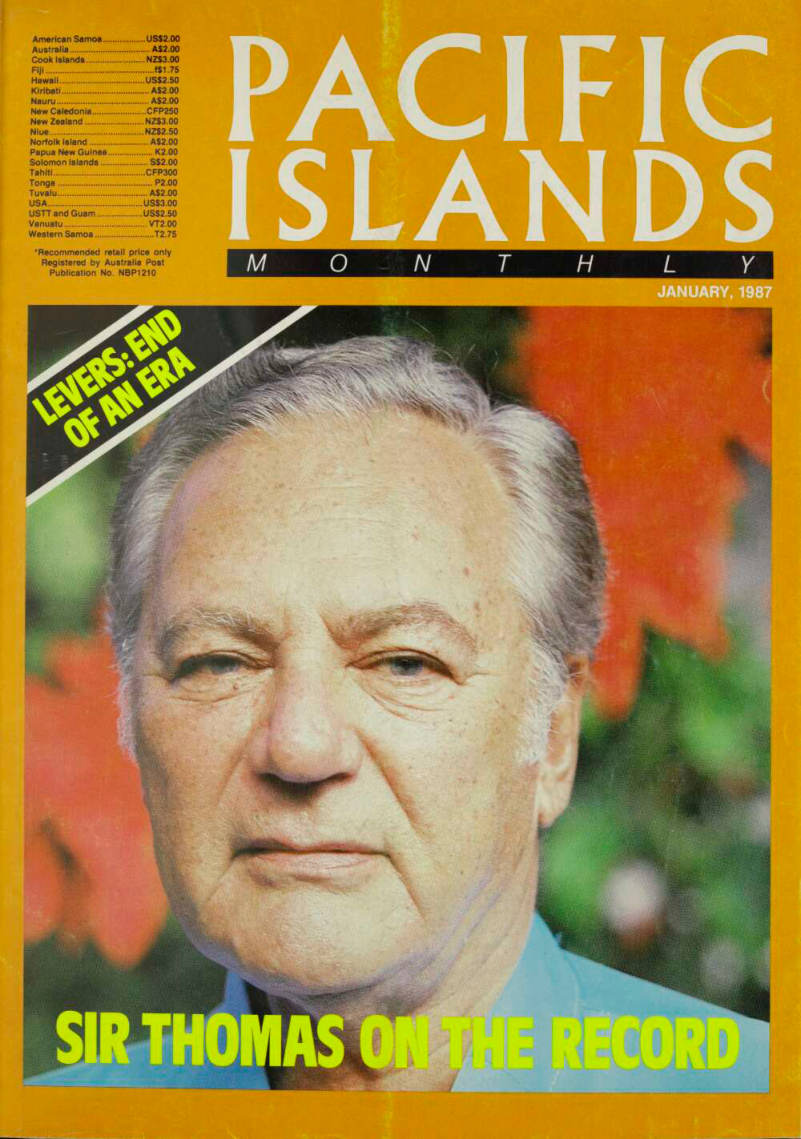
Sir Thomas On The Record
Advertisements & other items, pp. 2-3 (3 items)
has just
An exciting era
in stereo design
opened up.
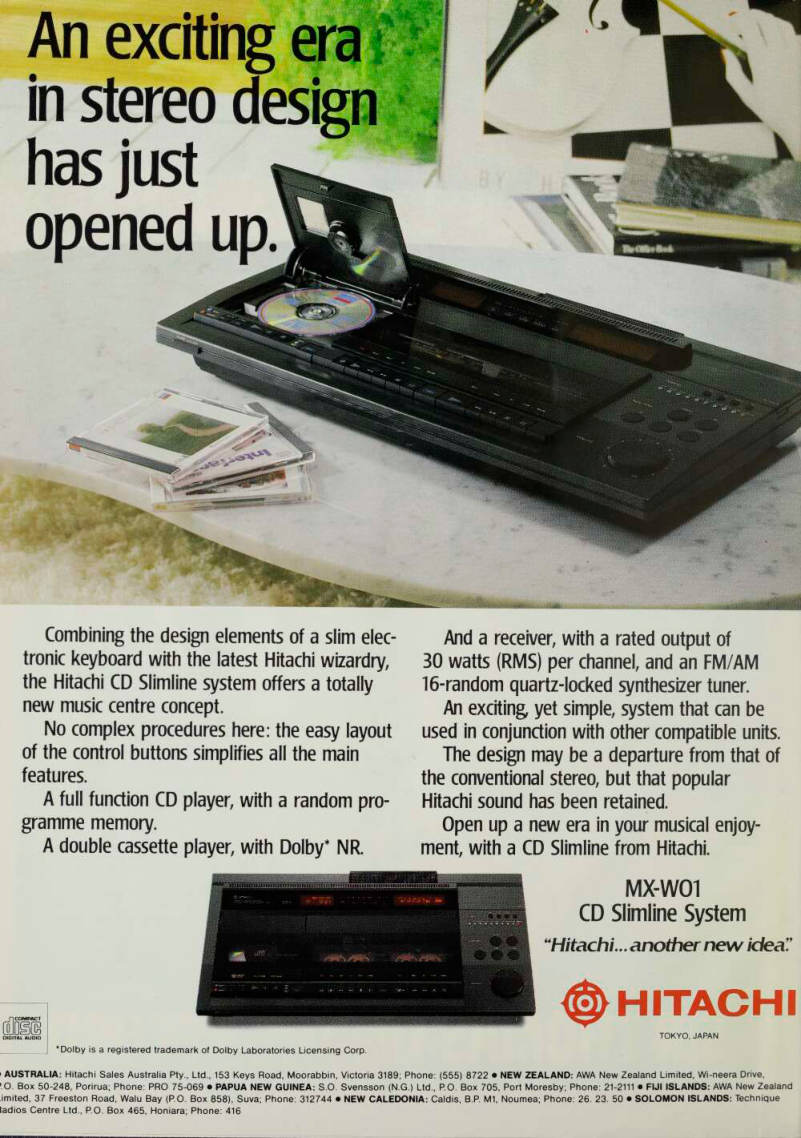
¥.. -V * m * ■rs Combining the design elements of a slim electronic keyboard with the latest Hitachi wizardry, the Hitachi CD Slimline system offers a totally new music centre concept.
No complex procedures here: the easy layout of the control buttons simplifies all the main features.
A full function CD player, with a random programme memory.
A double cassette player, with Dolby* NR.
And a receiver, with a rated output of 30 watts (RMS) per channel, and an FM/AM 16-random quartz-locked synthesizer tuner.
An exciting, yet simple, system that can be used in conjunction with other compatible units.
The design may be a departure from that of the conventional stereo, but that popular Hitachi sound has been retained.
Open up a new era in your musical enjoyment, with a CD Slimline from Hitachi.
MX-WOl
CD Slimline System “Hitachi... another new idea"
n COMPACT
olldue
DIGITAL AUDIO
’Dolby is a registered trademark of Dolby Laboratories Licensing Corp.
0 HITACHI
TOKYO, JAPAN
• AUSTRALIA: Hitachi Sales Australia Pty., Ltd., 153 Keys Road, Moorabbin, Victoria 3189; Phone: (555) 8722 • NEW ZEALAND: AWA New Zealand Limited, Wi-neera Drive. ’O. Box 50-248, Porirua; Phone: PRO 75-069 • PAPUA NEW GUINEA: S.O. Svensson (N.G.) Ltd., P.O. Box 705, Port Moresby; Phone: 21-2111 • FIJI ISLANDS: AWA New Zealand imited, 37 Freeston Road, Walu Bay (P.O. Box 858), Suva; Phone: 312744 • NEW CALEDONIA: Caldis, B.P. Ml. Noumea; Phone: 26. 23. 50 • SOLOMON ISLANDS: Technique ladios Centre Ltd., P.O. Box 465, Honiara; Phone: 416
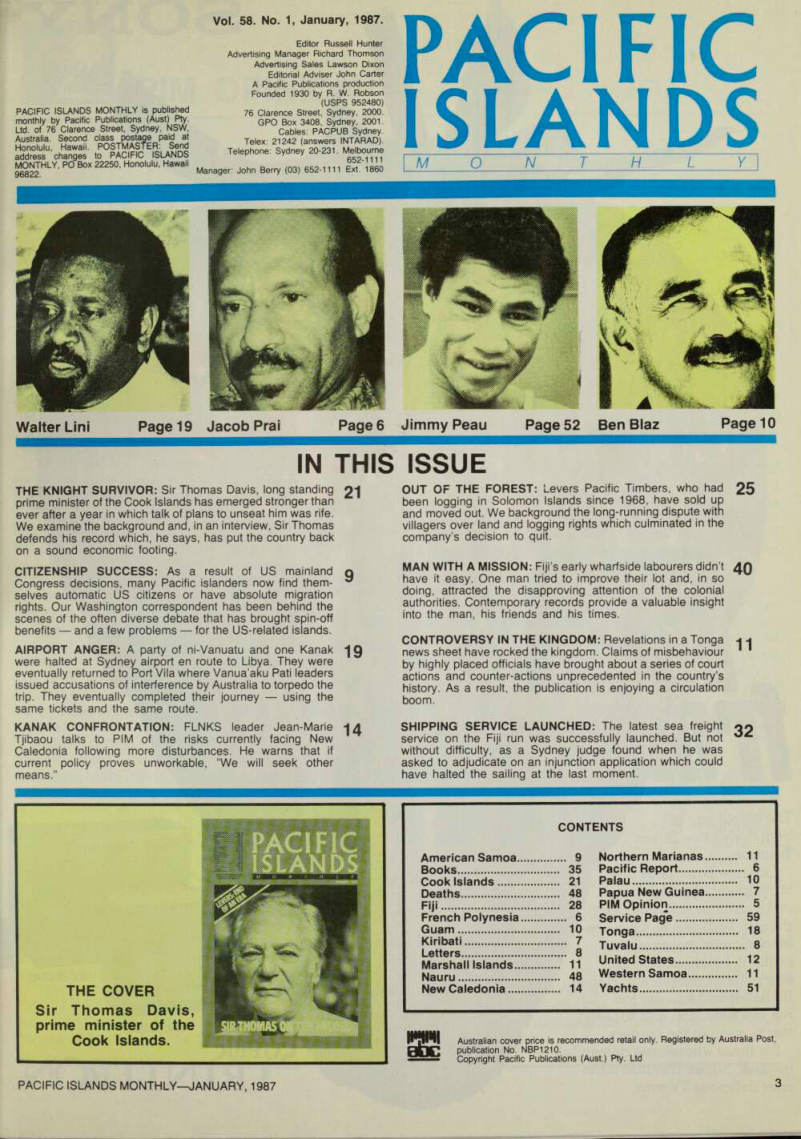
The Cover
Sir Thomas Davis, prime minister of the Cook Islands.
Pacific
ISLANDS
MONTHLY
Vol. 58. No. 1, January, 1987.
Walter Uni Page 19
Jacob Prai Page 6
Jimmy Peau Page 52
Ben Blaz Page 10
In This Issue
THE KNIGHT SURVIVOR: Sir Thomas Davis, long standing 21 prime minister of the Cook Islands has emerged stronger than ever after a year in which talk of plans to unseat him was rife.
We examine the background and, in an interview, Sir Thomas defends his record which, he says, has put the country back on a sound economic footing.
CITIZENSHIP SUCCESS: As a result of US mainland q Congress decisions, many Pacific islanders now find them selves automatic US citizens or have absolute migration rights. Our Washington correspondent has been behind the scenes of the often diverse debate that has brought spin-off benefits and a few problems for the US-related islands.
AIRPORT ANGER: A party of ni-Vanuatu and one Kanak 19 were halted at Sydney airport en route to Libya. They were eventually returned to Port Vila where Vanua’aku Pati leaders issued accusations of interference by Australia to torpedo the trip. They eventually completed their journey using the same tickets and the same route.
KANAK CONFRONTATION: FLNKS leader Jean-Marie 14 Tjibaou talks to PIM of the risks currently facing New Caledonia following more disturbances. He warns that if current policy proves unworkable, ”We will seek other means.”
OUT OF THE FOREST: Levers Pacific Timbers, who had 25 been logging in Solomon Islands since 1968, have sold up and moved out. We background the long-running dispute with villagers over land and logging rights which culminated in the company’s decision to quit.
MAN WITH A MISSION: Fiji’s early wharfside labourers didn’t 4Q have it easy. One man tried to improve their lot and, in so doing, attracted the disapproving attention of the colonial authorities. Contemporary records provide a valuable insight into the man, his friends and his times.
CONTROVERSY IN THE KINGDOM: Revelations in a Tonga h h news sheet have rocked the kingdom. Claims of misbehaviour 1 by highly placed officials have brought about a series of court actions and counter-actions unprecedented in the country's history. As a result, the publication is enjoying a circulation boom.
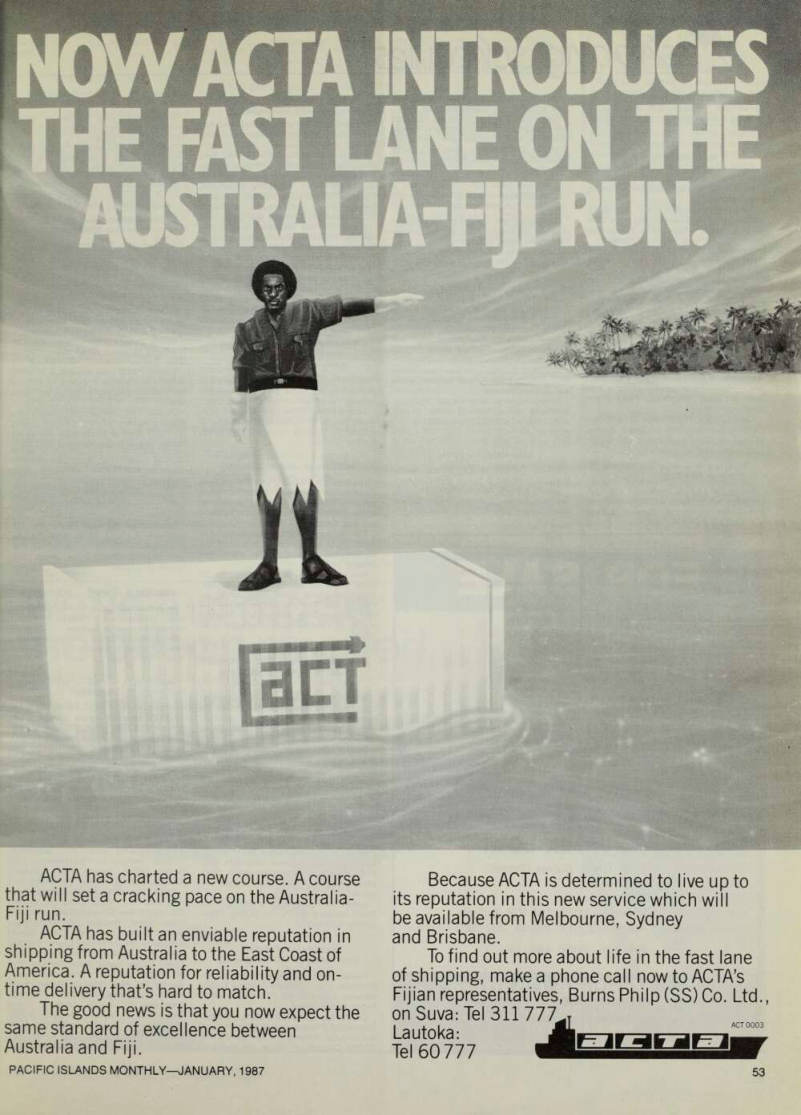
SHIPPING SERVICE LAUNCHED: The latest sea freight op service on the Fiji run was successfully launched. But not without difficulty, as a Sydney judge found when he was asked to adjudicate on an injunction application which could have halted the sailing at the last moment.
Contents
American Samoa 9 Books 35 Cook Islands 21 Deaths 48
Fiji 28
French Polynesia 6 Guam 10 |< ir ‘ ba,i 7 Marshall Islandsll N auru 48 New Caledonia 14
Northern Marianas 11 Pacific Report 6 Palau 10 Papua New Guinea 7 PIM Opinion 5 Service Page 59 Tonga 18 Tuvalu 8 United States 12 Western Samoa 11 Yachts 51
Australian cover price is recommended retail only. Registered by Australia Post, publication No. NBPI2IO.
Copyright Pacific Publications (Aust.) Pty. Ltd
Advertisements & other items, pp. 3-4 (2 items)
3
PACIFIC ISLANDS MONTHLY—JANUARY, 1987
PACIFIC ISLANDS MONTHLY is published monthly by Pacific Publications (Aust) Pty.
Ltd. of 76 Clarence Street, Sydney, NSW, Australia. Second class postage paid at Honolulu, Hawaii. POSTMASTER: Send address changes to PACIFIC ISLANDS MONTHLY, PO Box 22250, Honolulu, Hawaii 96822.
Editor Russell Hunter Advertising Manager Richard Thomson Advertising Sales Lawson Dixon Editorial Adviser John Carter A Pacific Publications production Founded 1930 by R. W. Robson
(USPS 952480)
76 Clarence Street, Sydney, 2000.
GPO Box 3408, Sydney, 2001.
Cables: PACPUB Sydney.
Telex: 21242 (answers INTARAD).
Telephone: Sydney 20-231. Melbourne 652-1111 Manager: John Berry (03) 652-1111 Ext. 1860
Trinitron
KV-2092AS
KV-1440AS
It's so tempting.
The colour you get from Sony's new Super Trinitron.
Our new Pan-Focus gun is computer-designed to make our famous colour even sharper and clearer. Our new Black Screen makes whites brilliant, blacks profound, evfery colour deeper and richer.
It's flatter and sguarer too.
For less reflection and superb clarity, even in the corners.
For those whose taste demands the best, Super Trinitron is the most delicious TV ever.
Trinitron
A question of attitude
Pim Opinion
The difference between British and French colonial ism, it has been said, is one of attitude. Diplomats (British) are occasionally fond of retailing the old saw thus: The French approach: First find your savage. Teach him the French language. Help him to work for the greater glory of France.
The British approach: First find your savage. Clothe him decently. Tell him about the queen and the great British Empire. Give him independence when he becom es a nuisance.
It’s usually but not always said tongue in cheek.
Nevertheless, there’s a grain, if only that, of truth in all that. For while the British have largely departed the colonial scene (not always gracefully) France remains.
That’s in keeping with the attitude differences quoted above.
And that’s where the problems begin. As nearly all the former colonies in the Pacific moved towards independ ence, those still under French rule have looked on with equal degrees of confusion, envy and hope.
There is, particularly in New Caledonia, extremism now on both sides. The settlers, by and large, intend to keep what they hold. The Melanesians want their land back.
And it is easy to forget, in the heated arguments that accompany what passes for debate, France’s contribu tion to the region’s development.
Only the extremists want France out. The more moderate view is that France should encourage progress towards a form of independence that would retain vital aid, trade and cultural links with Paris.
And that, sadly, is where the debate breaks down. The French government appears to regard the recent structural changes in New Caledonia as an end. Others see them as a beginning and there seems to be no room for compromise. Certainly, for a minority of caldoches, it’s bombs before bargains.
And Mr Tjibaou’s veiled threat of “other means” if the democratic process fails to meet the aspirations of the Kanaks does little to raise the level of debate.
New Caledonia is often painted as an impasse, a dead end, political trench warfare with both sides lobbing insults and worse across a battle scarred no-man’s land.
And that’s partly true too.
Yet it must be said that France would win nothing but friends in the region by softening her stance and seeking a genuine friendship with the Kanak movement. That the attendant political difficulties would be enormous need hardly be stated. The alternative to continue to cling to the last tatters of empire can hardly seem more appealing.
On the principle that more dialogue is never a backward step France’s redoubled efforts to explain her presence and her policy in the South Pacific are most welcome. A greater understanding of these by the Forum countries, the Kanaks and, in particular, the caldoches is now necessary so that action can flow from the words.
Now that the Forum has fully taken on board the issue of New Caledonia, might it not be time for greater contact with France? Might it not also be time to completely separate that issue from the friction caused by the Moruroa tests?
At the last Forum meeting in Suva, Western Samoa’s Prime Minister Kolone lamented what he saw as the passing of the traditional South Pacific communal approach to problem solving. The current debate on New Caledonia represents an opportunity to revive that spirit. But France’s voice should be among those heard.
There are fears that France would use that voice to confuse and procrastenate, but the independent island countries are no strangers to the diplomacy of delay.
Neither, for that matter, are Australia and New Zealand.
France can still be encouraged to come to the table.
It may well be that the status of the territory is non-negotiable. But only a few years ago the very existence of regional councils in New Caledonia would have been equally unthinkable. Times change. And so do attitudes.
pacific report
Opm Fighters
Arrested
Longest-serving OPM guerrilla Mr Fisor Jarisetouw has been arrested in PNG for illegally entering the country. Jarisetouw and four other OPM activists, Aut Abe nuk, 32, of Pyramid village, Kimiso Uka,2B, of Dindah village, Moli Meli.27, of lllaga village, and Jaristouw’s body guard Jeffery Samonsabra, were trans ferred to Blackwater refugee camp after appearing in court in November. The five men had earlier appeared in Vanimo district court and pleaded guilty to charges of illegal entry. Samonsabra had told the magistrate, Japhet Magalik, that he had no intention of crossing into PNG but had been forced to do so by the other three, while he was escorting Jarisetouw inside Indonesian territory.
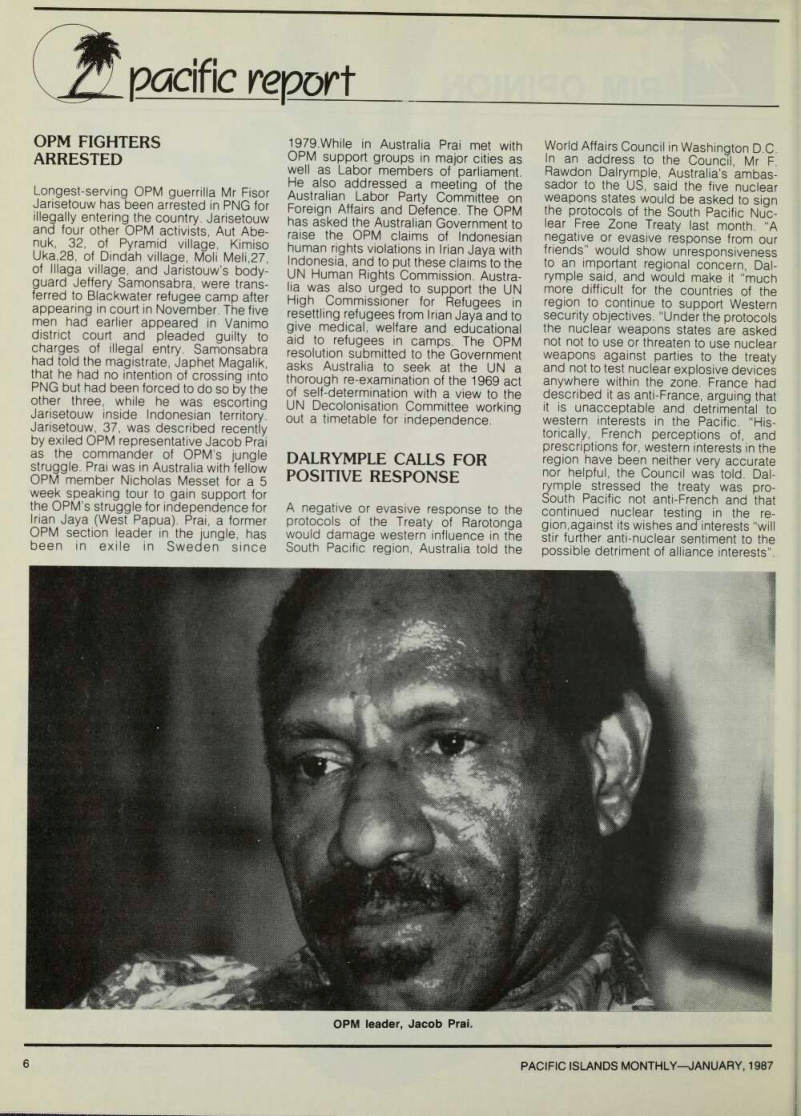
Jarisetouw, 37, was described recently by exiled OPM representative Jacob Prai as the commander of OPM’s jungle struggle. Prai was in Australia with fellow OPM member Nicholas Messet for a 5 week speaking tour to gain support for the OPM’s struggle for independence for Irian Jaya (West Papua). Prai, a former OPM section leader in the jungle, has been in exile in Sweden since
1979.Whi1e in Australia Prai met with OPM support groups in major cities as well as Labor members of parliament.
He also addressed a meeting of the Australian Labor Party Committee on Foreign Affairs and Defence. The OPM has asked the Australian Government to raise the OPM claims of Indonesian human rights violations in Irian Jaya with Indonesia, and to put these claims to the UN Human Rights Commission. Austra lia was also urged to support the UN High Commissioner for Refugees in resettling refugees from Irian Jaya and to give medical, welfare and educational aid to refugees in camps. The OPM resolution submitted to the Government asks Australia to seek at the UN a thorough re-examination of the 1969 act of self-determination with a view to the UN Decolonisation Committee working out a timetable for independence.
Dalrymple Calls For
Positive Response
A negative or evasive response to the protocols of the Treaty of Rarotonga would damage western influence in the South Pacific region, Australia told the
World Affairs Council in Washington D.C.
In an address to the Council, Mr F.
Rawdon Dalrymple, Australia’s ambas sador to the US, said the five nuclear weapons states would be asked to sign the protocols of the South Pacific Nuc lear Free Zone Treaty last month. “A negative or evasive response from our friends” would show unresponsiveness to an important regional concern, Dal rymple said, and would make it “much more difficult for the countries of the region to continue to support Western security objectives. "Under the protocols the nuclear weapons states are asked not not to use or threaten to use nuclear weapons against parties to the treaty and not to test nuclear explosive devices anywhere within the zone. France had described it as anti-France, arguing that it is unacceptable and detrimental to western interests in the Pacific. "His torically, French perceptions of, and prescriptions for, western interests in the region have been neither very accurate nor helpful, the Council was told. Dal rymple stressed the treaty was pro- South Pacific not anti-French and that continued nuclear testing in the re gion,against its wishes and interests "will stir further anti-nuclear sentiment to the possible detriment of alliance interests”.
OPM leader, Jacob Prai.
Indifference to South Pacific concerns would be the cause of damage to western interests in the region, he said.
The treaty had been carefully drafted to accomodate US strategic interests and Australia’s alliance obligations and “a rebuff by the west” would be difficult to understand, Dalrymple said. “And it would be more than ironic if a region which had been so solidly pro-western for so long should find that, on an issue of concern to it, the west stands aside while others with rather tenuous ties to the region signal support," he added.
The US had made “significant efforts" in the past year to improve relations with the South Pacific, Dalrymple said, refer ring to the fisheries negotiations, con tribution of CINCPAC “seabees” and assistance to the Solomon Islands after cyclone Namu as examples of the positive role played in the region by the US. Australia saw the Treaty "as a valuable opportunity for the US to reaf firm, through signature of the protocols, its abiding interest in the security, stabil ity and welfare of the region consistent with its global responsibilities.”
Training For
Geologists
The USP in Suva is to run a training scheme for marine geologists. The course is being organised by Dr Russell Howarth of Victoria University in Welling ton, who will be on loan to USP for three years.
Bosses Warn
On Wage Rates
The Fiji Manufacturers Association warned that proposed new minimum wage rates would force many factories to close and thousands of workers to be sacked. In a letter to Employment and Industrial Relations Minister, Mr Moham med Ramzan, the FMA said many businesses would go bankrupt if the government enforced the new rates which were approved by the Manufac turing Industry Wages Council in November. When lifting the wage freeze the governmnet had said improvements in the economy allowed for wage in creases.
Soviet Soccer
Side To Tour
Soviet soccer team Minsk Dynamo will play Fiji’s national side in Suva in February. The dynamo team, which includes several Soviet world cup play ers, will also play in PNG and New Zealand.
Drought Deaths In
Irian Jaya
At least 84 people in Irian Jaya are reported to have died from illness and starvation due to severe drought in four remote villages. Indonesia’s official Antara news agency reported that the central highland Jayawijaya province had appealed for help to transport food and medicine. Antara said most of the dead were children under five and elderly people.
Appeal Court
Orders Trial
New Caledonia’s Court of Appeal or dered 7 French loyalists to stand trial on charges of killing ten Kanak militants in December 1984. The Appeal Court quashed a lower court ruling that the seven accused had acted in self defence and charged them with murder and armed violence. However, the men were not detained. Reuters reported the FLNKS as saying the new ruling showed increasing unease by France over the handling of the New Caledonia issue.
Reuters said the ruling was a rebuff for examining magistrate Francois Semur who had ordered the case to be drop ped. In Paris, FLNKS leader Jean-Marie Tjibaou welcomed the decision.
Nun Stoned
To Death
An Australian nun was killed after a gang of youths threw stones at her car in Papua New Guinea’s Central province.
Sister Perpetua Allchin was killed while returning to Woima from Bereina market, about 100 kms from Port Moresby. She was killed instantly when rocks were hurled through the windscreen of her car. A 14 year old girl travelling with her escaped with minor injuries.
More Aid For
Solomon Islands
The UNDP approved two major projects to assist the Solomon Islands recover from Cyclone Namu. UNDP spokesman in Suva, Mr Ross Mountain, said a water supply and sanitation program and help with an anti-malaria campaign would start immediately. The projects would receive Asl.9 million from a UNDP administered fund for cyclone recon struction. This contribution will be boosted by a A 5750,000 kina cash donation from Australia and New Zea land.
Deaths Blamed On
Mid East Policy
The PLO blamed Fiji’s middle east policy for the deaths of three Fijian soldiers stationed in Southern Lebanon. The three members of the UN peacekeeping force and two others were killed when a car bomb exploded at a UN checkpoint.
Two other Fijian soldiers were injured.
PLO representative for Australia and the Pacific, Mr Ali Kazak, described the deaths as unfortunate but said the recent visit to Fiji by the Israeli President was a provocative act and was seen by Palestinians as support for Israel’s milit ary actions. Mr Kazak called on Fiji to recognise the PLO as sole representa tive of the Palestinian people.
Economies Too
Inflexible
The Australian National University’s Pacific Economic Bulletin said several South Pacific countries do not appear to be flexible enough to take advantage of buoyant markets. It says they need more aggressive exchange rate policies, and reduced regulation and licensing of many business activities. The bulletin also said high population growth rates in South Pacific countries are leading to urban unemployment and other social problems.
Boulekone Still
Out In Cold
The leader of Vanuatu’s opposition, Mr Vincent Boulekone, was excluded from Parliament pending an appeal by the Speaker against a Supreme Court ruling that he should be allowed to take his seat. He was deprived of his seat in Parliament in June following non-attend ance without the Speaker’s permission.
Vanua’aku Pati secretary-general, Mr Barak Sope told Parliament it had supremacy over the courts and that the latter could only intervene if Parliament behaved unconstitutionally. Sope said Parliament was not acting unconstitu tionally in this case. Opposition mem bers said Parliament was interfering in the work of the courts and not following proper procedures.
Transmigration
Reduced
Indonesia’s Minister in charge of the transmigration program said that 2000 families, comprising about 11,000 people, will be resettled from Java to Irian Jaya this year. This is a reduction on the original target of nearly 6000 families. The cut has been forced by reduced prices for Indonesian oil which halved the money available for the migration program.
the system
letters
The system serves the system
I have recently noticed a popularly subscribed view that land use in Fiji and Hawaii are similar. I would like to correct this misconception.
The agrarian scene in Hawaii is one of constant awareness by the authorities in order to maxi mise productivity, investment and equity for all concerned.
Rural land use in Pacific island countries is a sensitive issue and efficient regulatory dispute processes are crucial to progressive land administrta tion.
This is fully taken into account in Hawaii. Parties to a land dispute have access to all normal judicial processes and these are carried out by a highly qualified and experienced judiciary.
In Fiji, things are very diffe rent. All land disputes have been placed in the care of a one-man tribunal with no gen eral legal qualification and no previous legal experience.
Appeal against the decisions of this tribunal is limited to a single central tribunal again one person which relies for evidence on a record compiled and presented by the lower one-man tribunal whose judge ment is the subject of the appeal.
Independent recording of evidence by the parties is not permitted. The system is almost worthy of the Ayatollah Khomeini and is a seedbed for potential injustice.
The consequences are stag nant land development and productivity and an almost total absence of meaningful new agricultural investment and de velopment over the past decade.
While it can be said that both Hawaii and Fiji are both major
island groups, both are multi racial and share the advantages of climate and western influ ence, the agricultural land use policies cannot be compared.
In Hawaii the system serves the nation. In Fiji the system serves the system.
In Hawaii multi-billion dollar
land developments are con tinually improving while in Fiji things are stagnating, largely due, I suggest, to the impedi ment presented by a farcial and unworkable disputation proce dure and the apathy of the government.
Maybe the coming election in
Fiji will bring about change and progress. But in the meantime intending investors should com pare systems, records and re sults in Fiji and Hawaii. They are markedly different.
Henry Y. Tiu,
Waianae, Honolulu.
All in the same boat
Communications between Tuvalu’s nine islands are very poor. Our only old ship often breaks down in port or at sea.
It makes seven or eight knots at top speed and if one engine breaks down it makes three to four knots in good weather only.
She is built to carry 12 saloon and about 40 deck passengers but often has to carry as many as 100 people to ease the backlog of waiting passengers.
Medical emergency cases have occasionally been delayed in reaching the hospital and some, especially from the northern islands, could not be carried.
Deck passengers are exposed to the weather. The ship should have been refitted long ago. It’s not so bad for the southern islanders who are 40 to 60 miles away. But for the poor northern people it’s a two or three day trip.
Britain has been asked seve ral times for a replacement but has not complied.
Tuvalu people have noted with shame the treatment they have received from the former colonial power. If necessary we should cease to look to Britain for help and approach any country willing to assist us, be it
Japan or Russia or anybody else.
Kiribati was once a partner with Tuvalu under the UK colonial structure. And now we see Kiribati with four good ships plus, maybe, four aircraft.
We compare this with the treatment we have received from the mother country.
Our boat may still be sea worthy but it is unreliable. The Tuvalu government should have given the UK all the details and sought a replacement long ago.
Telavi Fati,
Tefolaha Community Centre, Funafuti.
What about Fred?
Fred?
I am hoping some of your many readers may know what hap pened to Fred Hayes.
He was the son of the noto rious pirate and blackbirder William Henry (Bully) Hayes.
After Bully Hayes’s murder in 1877, his wife Amelia, their twin daughters, Leonora and Laurina and son Fred left for Fiji.
That was around 1881.
I know the daughters married well and I gather Amelia didn’t re-marry.
But what of Fred? I trust somebody can help me.
Dale Hoelter,
East Prahran, Victoria, Australia.
Advertisements & other items, p. 8 (1 item)
Flash
ALL THE
NEWS IN A
The South Sea Digest tells you what you want to know about the Pacific Islands in a few words. All the leading firms and diplomatic missions read it. You can phone or write or call for a follow up.
See insert for subscription details:
THE SOUTH SEA DIGEST
in migration
Islands ahead in migration law changes
Sweeping citizenship and immigration policy changes have been adopted in five of the six US-related Pacific territories.
Mostly, the changes are those advocated by island govern ments and are of benefit to individual islanders.
The changes result from a series of unrelated actions by the mainland Congress and ex ecutive.
A major impetus for change was the formal announcements of the long-negotiated covenant with the Northern Marianas, and the Compacts of Free association with the Marshalls and the Federated States of Micronesia.
And while the arrangements were still before the UN, the mainland administration went ahead with the new citizenship and immigration arrangements.
This is in keeping with the US position that the UN has nothing to say on the issue.
The most dramatic outcome was that, on November 3, some 17,000 CNMI people became US citizens. They had previous ly been Trust Territory citizens “with the full rights of US citizens” although that status had accompanying problems namely their passports which were relatively rare in world travel and were not always instantly recognised by im migration officials.
Marianas islanders travelling to the mainland usually have to clear immigration at Hawaii where, sometimes, government personnel did not treat them “with the full rights of US citizens. ”
The governor of the islands, himself, is said to have had difficulties in that regard.
Now the residents of the Marianas are fully fledged US citizens and a team of mainland officials has already visited
Saipan to process passport applications.
People of the FSM and the Marshall Islands, meanwhile, became citizens of their respec tive states.
The US solved the potentially difficult problem of post-self government immigration in one swoop. FSM and Marshalls people can now migrate to the mainland regardless of the nor mal procedures.
When, and if, Palau works out its compact, its residents also will have that right.
Residents of Guam, Amer ican Samoa and, of course, the Marianas can also migrate at will.
In the Marianas, in particular, some problems remain. The islands previously had their own immigration service run by a small staff.
But the mainland immigra tion officials are known to be more concerned than their is land counterparts about the presence in the islands of illegal aliens and short term contract workers. For this reason main land officials are anxious to assert their authority though the timing of this is still under discussion.
Apart from the immigration “spin offs” there are four other unrelated developments:. Alien seamen on fishing boats visiting Guam now have Congressional approval to land on the island;.
There is a strong prospect that, despite opposition from the mainland immigration service, some tourists without visas will be able to visit Guam a victory for island interests.. A mainland-oriented law will make it illegal for Guam (and presumably Marianas) em ployers to hire illegal aliens.
This is currently not against mainland law; Some 400 American Samoan residents may qualify as US nationals
(September PIM). Under a Bill proposed by Congressman Fofo Sunia those people bom to one US national parent out side the US or American Samoa will be able to apply for national status which is only slightly different from citizen status.
The new rule on visiting fishermen, sponsored by Con gressman Ben Blaz was easy.
In the past alien sailors on visiting tuna boats at San Diego on the mainland had over stayed their visas and the Im migration Department moved to stop this. Unfortunately and typically the new rules had universal application and denied visiting sailors the right to land on Guam.
Blaz argued successfully that while foreign sailors might “jump ship” in San Diego they were far less likely to do so in Guam.
Some 40 tuna boats are likely to be affected. The money the crews bring to the island is useful for the local economy.
Far more difficult to achieve was the visa waiver for tourists.
Both Blaz and his Democratic predecessor Won Pat have worked hard on this.
Tourism is vital to the Guam economy. Most of the tourists are Japanese, often honeymooners, and they have little difficulty in securing visas from US consular officials.
However, Guam is anxious to expand its tourism base in Asia while US officials have been less willing to grant visas to Taiwanese, Koreans and Fili pinos, to name but a few, for fear of visa abuse. Guam wanted free access for tourists.
Mainland officials did not Won Pat, then in a tough battle to beat the man who eventually replaced him, Blaz, went to the floor of the House
Advertisements & other items, p. 9 (1 item)
Sheaffer
f The way you write and the pen you choose both say a lot about you.
Slanted writing with large loops can show responsiveness and imagination. Choosing a Sheaffer shows you appreciate a superior pen that makes a stylish gift. Only Sheaffer has such superb styling and craftsmanship with such a range of fine finishes.
Distinctive Matte Black.
Fountain pen. ballpoint, pencil and slim rolling ball pen with interchangeable micro tip marker.
Slim or classic profile.
SHEAFFER
•m
SHEAFFER PEN
(an unusual move for a non
voting island delegate) to se cure an amendment to a Bill calling for visa-free entry to Guam for tourists.
The Bill passed but mainland immigration officials essentially refused to issue the regulations that would make the Won Pat amendment effective.
Blaz then set to work on the immigration service and simul taneously inserted a clause in the Omnibus Territories Act requiring the Immigration De partment to issue regulations 90 days after the Act became law.
The new rules are expected to ease tourist flow for Guam with the possible exception of visitors from the Phillipines.
Most trans-Pacific passengers know that admission to Guam does not secure easy entry to the rest of the US.
Passengers from Guam routinely stop at Hawaii where they must clear immigration again just as if they had come from a foreign port.
This bureaucratic sensitivity about illegal aliens reaching the
mainland via Guam reflects Congressional feelings which were shown in the passage late in the session of an omnibus immigration reform Act which has two provisions likely to have an impact on Guam and the Marianas.
It will soon be an offence to hire illegal aliens though, secondly, long term illegal aliens who can prove they were illegally in the States since January 1, 1982 may secure legal status.
A by-product of all this activ
ity is that all new young male citizens in the Marianas must register for military service.
Nobody is drafted these days, but all males between the ages of 18 and 26 must register.
This rule already applies in Guam but not in American Samoa though US nationals living in Samoa must register if they move to Hawaii or the mainland. The provision has never applied to FSM, the Marshalls or Palau.
Generally, the islands did well out of these developments.
People in the Marianas wanted full US citizenship; they got it.
People in FSM and the Mar shalls now have unlimited right to migrate to the mainland while their governments main tain tight control of immigration to their islands including migration from the States.
Guam won a couple of rounds in its continuing battle with mainland immigration authorities.
The only low note appears to be the loss of immigration con trol by the Marianas, though this is still under discussion.
from David S. North.
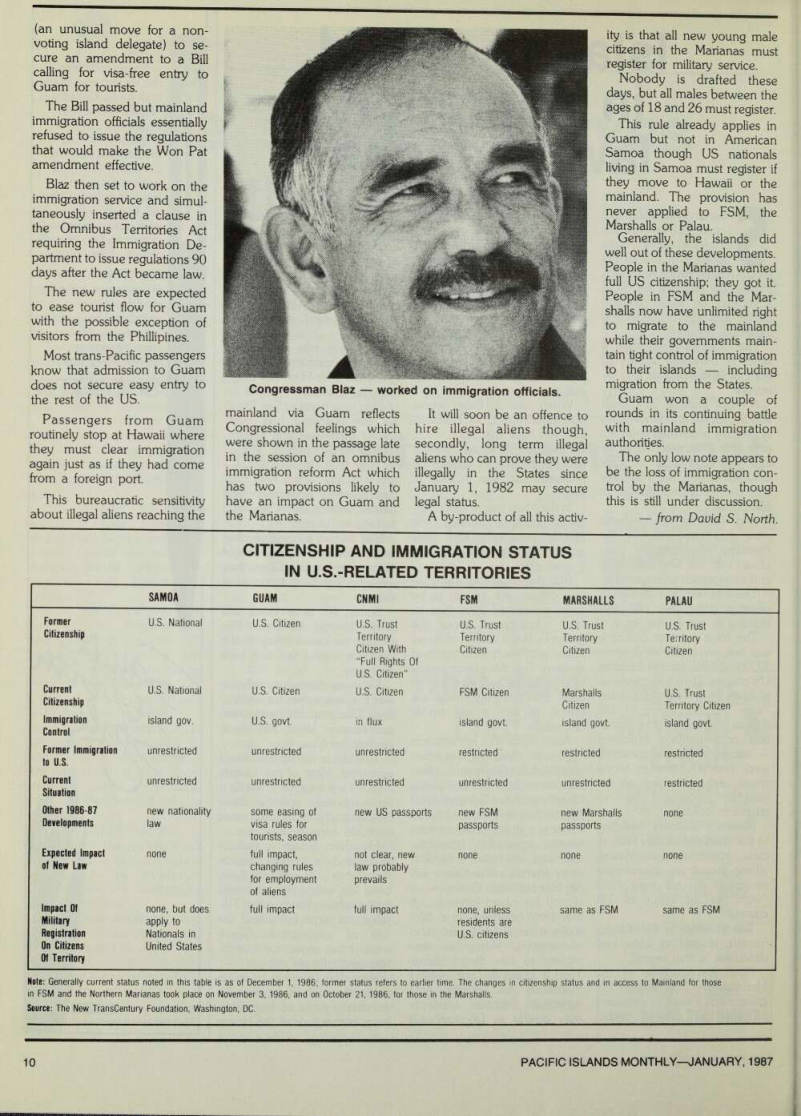
Congressman Blaz worked on immigration officials.
Citizenship And Immigration Status
In U.S.-Related Territories
Note: Generally current status noted in this table is as of December 1, 1986; former status refers to earlier time. The changes in citizenship status and in access to Mainland for those in FSM and the Northern Marianas took place on November 3,1986, and on October 21,1986, for those in the Marshalls.
Source: The New Trans Century Foundation, Washington, DC.
Samoa
Guam
Cnmi
Fsm
Marshalls
Palau
Former Citizenship U.S. National U.S. Citizen U.S. Trust Territory Citizen With “Full Rights Of U.S. Citizen”
U.S. Trust Territory Citizen U.S. Trust Territory Citizen U.S. Trust Territory Citizen Current Citizenship U.S. National U.S. Citizen U.S. Citizen FSM Citizen Marshalls Citizen U.S. Trust Territory Citizen Immigration Control island gov.
U.S. govt. in flux island govt. island govt. island govt.
Former Immigration to U.S. unrestricted unrestricted unrestricted restricted restricted restricted Current Situation unrestricted unrestricted unrestricted unrestricted unrestricted restricted Other 1986-87 Developments new nationality law some easing of visa rules for tourists, season new US passports new FSM passports new Marshalls passports none Expected Impact of New Law none full impact, changing rules for employment of aliens not clear, new law probably prevails none none none Impact Of Military Registration On Citizens Of Territory none, but does apply to Nationals in United States full impact full impact none, unless residents are U.S. citizens same as FSM same as FSM
Conch Shell blows
a loud note
In the Old Testament, the trumpets of Joshua brought the walls of Jertcho tumbling down. And in modem Tonga, a new trumpet is having a similar earth shaking effect.
This trumpet, a monthly news sheet called Kele’a (conch shell) has been a resounding success.
At its inception last July it was founded to explain the complexities of the sales tax legislation the print run was 2,000. By last month, 10,000 copies were printed and quickly snapped up by eager readers.
The secret of Kele’a’s success is simple old fashioned discl osure journalism. Indeed, its allegations have incurred the wrath of the nation’s police minister, Honourable Akau’ola.
In a report published by the Tonga Chronicle the minister was quoted as saying that the four-page mimeographed sheet was “doing nothing useful but trying to smear the image of the Legislative Assembly.”
He continued: “These people are against the govern ment and they have been edu cated overseas where a profes sor would have probably told them that it is bad for Tonga to remain a constitutional monar chy and that it should change.”
He urged individual MPs to sue the infant paper for no less than $lOO,OOO. He added that the actions of Kele’a are seen only in countries like some in Africa where there are constant riots and tyrannical dictator ships.
Ironically, the minister’s com ments were published in the same issue of the Chronicle that carried a reprint of an interview with King Taufa’ahau Tupou IV on the role of the press.
In the interview, the king said “People in Tonga tend to be oversensitive to criticism. In stead of examining the subst ance of criticism and trying to profit from it, if that is possible,
they think the criticism is a personal affront. I think this is quite the wrong attitude.
“It is the duty of public officials to see what substance there is in criticism and do what is right in accordance with their public duty.”
Though 17 years have pas sed since he said those things, those same public officials still appear not to have heeded his advice.
Viliami Fukofuka, principal of Tonga High School from 1979 to 1981 and editor of Kele’a told PIM that the paper’s efforts were directed at supplementing the other information put out by other channels including government publications The Chronicle and Radio A3Z.
“We do our best not to make the whole thing sensational be cazuse we see great danger in that. We don’t want people to feel our role is to expose state secrets. We just feel that at this stage the people have the right to know how the money the government receives is being spent.
“When people in authority see that the information has the
ring of truth, we’re confident they will do the right thing,” he said.
Among the allegations that have made Kele’a a best seller are: •That MPs received excessive entitlements totalling $177,000 during 10 days of fonos (public meetings) in July and August last year. •That MPs deliberately sche duled meetings after 6pm so that officials could be paid overtime rates that sometimes equalled two days pay for two hours work. •That per diem rates for gov ernment ministers travelling overseas were more than double the alowances for UN officials and American diplo mats. •That members of the Road Committee received more in salaries and travelling expenses than was spent on road repairs last year.
Two writs have been issued against members of the Legisla tive Assembly. In the first, two MPs allege that the assembly had not been following proper
procedure and was also omit ting reports of debates from the official record.
For example, though Kele’a was debated at some length in the chamber, there was no mention of this in the official record. The ommission was especially noticeable as the de bate was broadcast by Radio A3Z.
In the second writ a private citizen, Mr Ipeni Siale, alleges that 25 of the 28 assemblymen accepted excessive entitle ments. In one instance, a mem ber was alleged to have accepted $lO,OOO for two hours work.
Siale has asked the High Court to order all the MPs named in the writ to return the alleged overpayments and meet any court costs.
Siale’s solicitor, Mr Laki Niu, told PIM that the case was unlikely to be heard before this month. He said the case was unprecedented because the circumstances fall within the jurisdiction of the Supreme Court.
Normally, any legislator charged with an offence would be tried in Parliament by the police minister.
However, since the minister and most of the legislature are defendants, the Supreme Court is the only legal recourse for the plaintiff.
The people of Tonga have also indicated displeasure. Two petitions have called for the removal of the Sales Tax which triggered this popular protest.
The first petition from the people of Vava’u, the northern island group, was prepared by MPs Masao Paasi and Herbert Sanft. The second, calling for the revocation of the Sales Tax and the National Income Tax amendment, was backed by 11,000 signatures.
Tonga’s National Council of Churches has also sent a letter to the king expressing its con cern over the allegations in Kele’a.
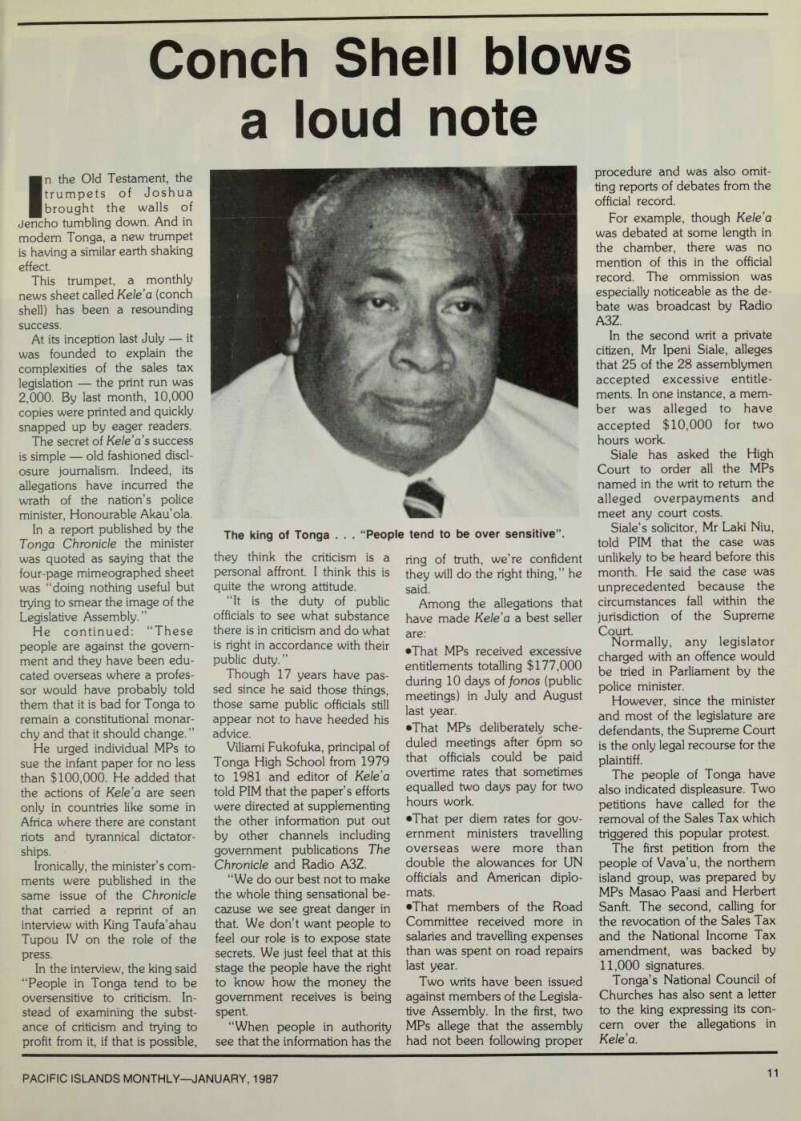
The king of Tonga . . . “People tend to be over sensitive”.
Advertisements & other items, pp. 12-13 (1 item)
<§ i ? 1
Strength
A vehicle’s strength depends on a complex interplay of varied factors. The overall design.
The body structure. The quality of the materials it is built of. The individual performance of the various mechanical components. Only when a vehicle is outstanding from 'every angle can it be said to possess genuine strength.
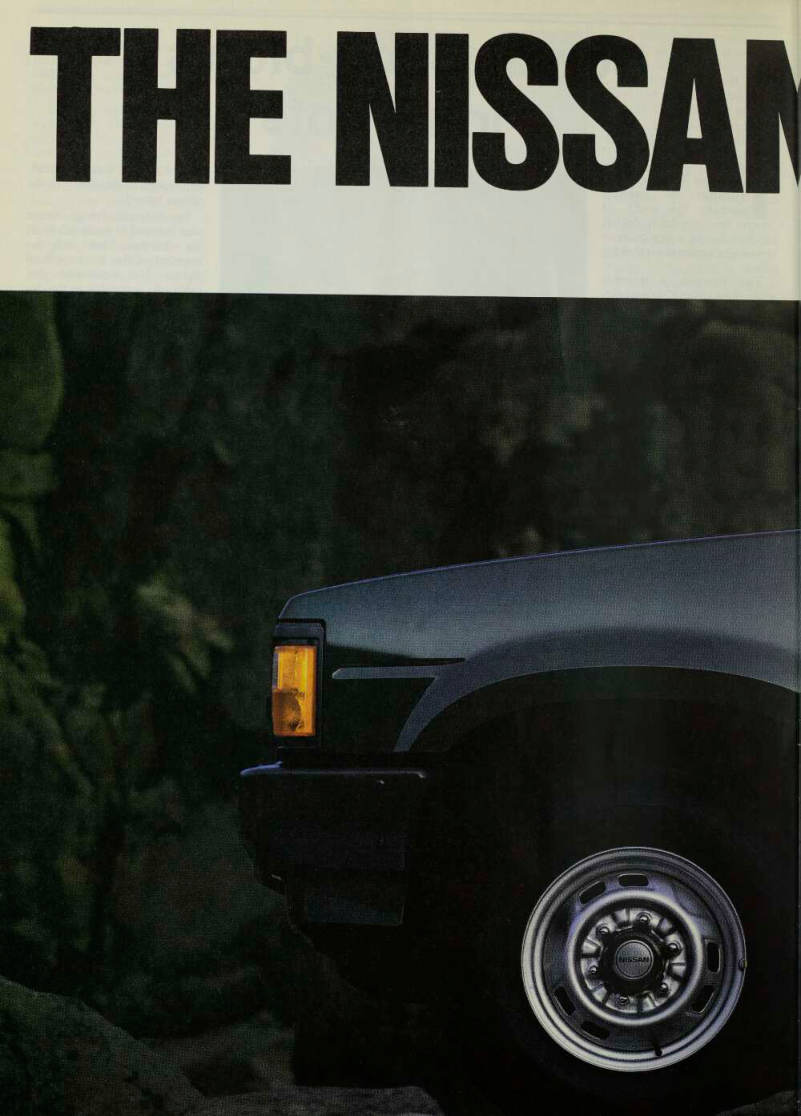
It is precisely this all-round excellence that gives the Nissan Pickup its extra margin of dependability. From the engine to the frame, the body panels to the suspension, the transmission to the bumpers, everything has been integrated into a vehicle of unsurpassed performance and durability.
In addition to the four usually found on ordinary makes, the closed-section The Nissan Pickup's ladder frame features a fifth cross member which - together with a more rational layout, strength. enables the Pickup to tolerate heavier loads.
For further structural rigidity, the side members are made of thicker steel plates.
Add to that a double-wishbone front suspension and a leaf-spring rear suspension, plus a large-capacity, power-packed engine, and it’s easy to see why more people depend on the Pickup to handle tough jobs on rough roads.
In other words, the Pickup has a singular strength that comes from a complete rational matching of diverse parts into one unbreakable whole.
And it succeeds because it has that intangible yet very real quality that makes a Nissan what it is—The Nissan Dimension.
Quality in motion
NISSAN
Convoy runs into trouble
Aiolence has flared again in New Caledonia when pro-and anti-independence forces clashed at Thio. A 14-year-old European youth was fatally shot and 11 people were injured after the November 15 incident.
The clashes occurred when a convoy of leaders and supporters from the Loyalist (antiindependence) party, RPCR were stoned as they left Thio to return to the capital Noumea after adressing a rally in front of the Thio town hall.
As the convoy left town they were stoned by about 50 Kanak militants, brawls broke out and one car was set alight. Three people were injured in the clash.
Reports said the situation de teriorated when the loyalist group returned to Thio and set fire to the bakery owned by a European supporter of the FLNKS, Mr Bernard Moule dous. Shots were reportedly fired by members of the RPCR group, and following the firing of the bakery the European youth, James Fels Tournier,
died after being shot in the chest.
A 21-year-old Kanak man, Georges Tomo, has been arrested and charged with assassination after admitting the shooting, police said.
And 13 FLNKS militants have been charged following the stone throwing. Among those arrested was Marie-Fran coise Machoro, sister of the late Eloi Machoro - the FLNKS leader killed by French police marksmen in January 1985.
RPCR leader Jacques Lafleur had organised the rally at Thio
in a bid to test whether law and order had been re-established in the town after the dramatic events of 1984 -1985.
Lafleur said his party’s lead ers wanted to “reassure and strengthen the loyalists of Thio” and prove that Thio “remains a part of the French republic”.
The small east coast nickel mining town hit the headlines in late 1984 when it became the focus of the FLNKS campaign of destabilisation and disruption of the countryside.
FLNKS militants held the town under seige for several
weeks and mining activity was halted.
Thio’s FLNKS mayor, Mr Louis Maperi told reporters he had approved the RPCR writ ten request for the Saturday morning rally and the use of the town hall for a local RPCR meeting. He said the spon taneous stoning of the convoy occurred because the FLNKS saw the arrival of Lafleur and the loyalist leadership as an extreme provocation.
The rally was attended by 200 people, sources said.
In the wake of the violence shots were fired at the suburban Noumea home of FLNKS lead er Mr Yeiwene Yeiwene.
Yeiwene’s wife and family were in the house when the
shots were fired at the windows but were unharmed. Yeiwene, * s a lso President of the Loyalty Islands Regional Coun ci l was in P a ris for talks with the French president at the time, Witnesses said the shots were by three masked men in arm V fatigues, another incident the Noumea printery used by the FLNKS newspaper, Bwenan do, was destroyed in an arson attack.
Meanwhile ‘he Thio loyalists “ lled L a meeting with the French sub-prefect responsible for the central area and asked that the Thio town council be dissolved and replaced by a spedal delegation.
Repercussions from the vio lence spread to Paris where
Prime Minister Jacques Chirac cancelled his scheduled meet ing with FLNKS president Jean- Marie Tjibaou.
Tjibaou met instead with Overseas Territories Minister Bernard Pons who described the Thio violence as “an un acceptable response to the gov ernment’s policy of dialogue in the territory and showed the FLNKS intended to rule the island by terror”.
Tjibaou decribed the incident as “provocation by the RPCR”.
Speculation has arisen follow ing the events in Thio that the incident was in some part en gineered by the RPCR to force Chirac to cancel the Tjibaou meeting and launch an attack on the FLNKS.
Committee of 24 visits S. Pacific
Vs attention focussed on the re-listing of New Caledonia with the UN Decolonisation Commit tee a UN mission submitttcd a report on the situation of another South Pacific territory, Tokelau, which is on the list of non-selfgoverning territories.
A mission from the UN Special Committee on Decolonisation which visited Tokelau in July noted that at this stage the 1700 people of Tokelau did not want to change the nature of their relationship with New Zealand, the administering power.
The mission was headed by Mr Ammar Amari of Tunisia and included representatives of the governments of Fiji and Trinidad and Tobago. The July visit was the third by a UN mission, the others being in 1976 and 1981. The mission s findings and recommendations were adopted by the UN Special Committee in a resolution passed in early September.
The mission, accompanied by UN staff members, the Secretary of the Office for Tokelau Affairs and an NZ Foreign Affairs department official, spent two weeks examining at first hand the situation in Tokelau and consulting Tokelauans on their wishes for the territory’s political future. The mission also visited Western Samoa, New Zealand and Fiji.
During their time in Tokelau the mission members spent two days on each of the territory’s three atolls, meeting with the various Councils of Elders, (taupulega) village workforces, (aumaga) women’s committees, youth representatives and members of the Tokelau Public Service.
Schools, hospitals, housing schemes and agricultural projects were visited by the mission.
The mission held special talks with the General Fono, Tokelau’s highest political body, noting in their report the inreasing degree of responsibility and decision making handed to the General Fono in recent years. The report recommended that New Zealand continue to encourage Tokelauans to assume an even greater role in running the territory’s affairs and urged New Zealand, in
co-operation with the Tokelau Public Service, to expand and intensify its program of political education in the country in order to improve people’s awareness of their choices in the process of self-determination.
In Apia the mission met with representatives of the UN Development Program, the FAO, the WHO and UN ESCO - organisations which along with New Zealand and Samoa provide Tokelau with assistance in the water, power, health, education, agriculture and fisheries fields.
In Fiji the mission members met with students from Tokelau at the University of the South Pacific, and talks were held with Tokelauan communities in Apia, Auck land and Wellington.
New Zealand government policy is that Tokelau should eventually undertake an act of self-determination and moves towards this are being taken at a pace acceptable to the people of Tokelau.
Mr H.H. Francis, the Tokelau Administrator, told the mission New Zealand had no intention of influencing Tokelau’s choice of future status, but pointed out that the territory could never be expected to achieve financial independence, and that while integration could bring advantages it could have a negative impact culturally.
NZ Foreign Affairs officials told the mission that NZ had no geo-political, strategic, economic or other interest in Tokelau, except to preserve its reputation as an administering power. Departmental secretary Mr Merwyn Norrish questioned the need for a formal vote of self-determination as part of the decolonisation process.
He said that should Tokelau decide to maintain the status quo or develop a unique relationship somewhere between integration and free association, then a less formal process might be appropriate so long as the UN agreed.
NZ Prime Minister David Lange told the mission he wanted to encourage Tokelau to take greater responsibil ity for managing its own affairs as and when it felt ready.
He reaffirmed that New Zealand would remain commit ted to providing Tokelau with continued financial support even as it gained more autonomy.
Advertisements & other items, p. 15 (1 item)
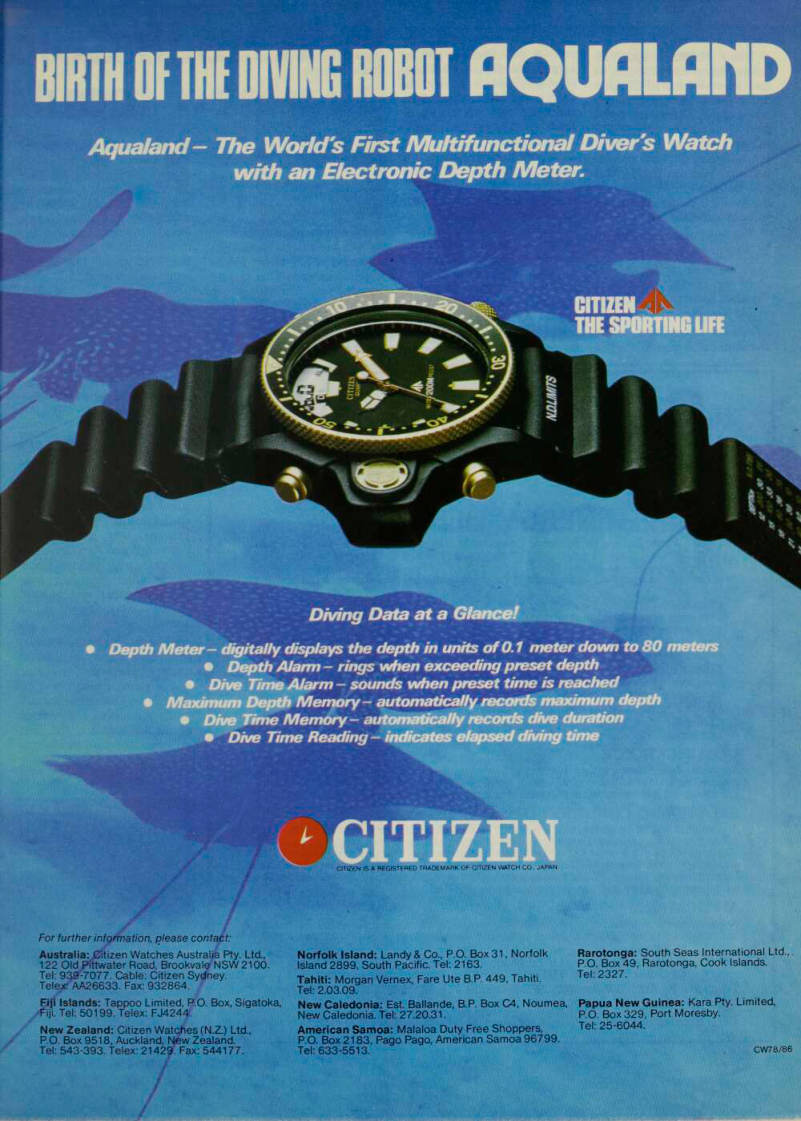
Smith Of Tk Diving Robot Fioufiuhd
Aqualand- The World's First Multifunctional Diver's Watch
with an Electronic Depth Meter.
\ o c>
CITIZEN
THE SPORTING LIFE
Diving Data at a Glance!
• Depth Meter — digitally displays the depth in units of 0.1 meter down to 80 meters • Depth Alarm - rings when exceeding preset depth • Dive Time Alarm - sounds when preset time is reached • Maximum Depth Memory - automatically records maximum depth • Dive Time Memory - automatically records dive duration • Dive Time Reading - indicates elapsed diving time For further information, please contact: Australia: Citizen Watches Australia Pty. Ltd, 122 Old Pittwater Road, Brookvale NSW 2100.
Tel: 930-7077. Cable: Citizen Sydney.
Telex: AA26633. Fax: 932864.
Fiji Islands: Tappoo Limited, P.O. Box, Sigatoka, /Fiji. Tel: 50199. Telex: FJ4244.
New Zealand: Citizen Watches (N.Z.) Ltd., P.O. Box 9518, Auckland, New Zealand.
Tel: 543-393. Telex: 21429. Fax: 544177.
Norfolk Island: Landy& Co., P.O. Box 31, Norfolk Island 2899, South Pacific. Tel: 2163.
Tahiti; Morgan Vernex, Fare Lite B.P. 449, Tahiti.
Tel: 2.03.09.
New Caledonia: Est. Ballande, B.P. Box C 4, Noumea, New Caledonia. Tel; 27.20.31.
American Samoa; Malaloa Duty Free Shoppers, P.O. Box 2183, Pago Pago, American Samoa 96799.
Tel: 633-5513.
Rarotonga; South Seas International Ltd.
P.O. Box 49, Rarotonga, Cook Islands.
Tel: 2327.
Papua New Guinea; Kara Pty. Limited, P.O. Box 329, Port Moresby.
Tel: 25-6044. / /
Kanak independence
Colonial justice: 'It could [?]all end badly'
leader Mr Jean-Marie Tjibaou said he fears that recent events in New Caledonia were an attempt by the extreme Right to destabilise the country and make conditions impossible for the holding of the self-de termination vote in July.
The FLNKS President was referring to the arson of a wharf, loading equipment and a dock belonging to Mr Robert Froin, a member of the North ern Regional Council. (Mr Tjibaou is president of the council). Damage was esti mated at 20 million cfp.
A week later the Noumea headquarters of the FLNKS were fire bombed, with the wooden facade destroyed be fore the fire was put out, and a guard dog belonging to FLNKS spokesman, Mr Yeiwene Yeiwene, was poisoned. Mr Yeiwene is also President of the Loyalty Islands Regional Coun cil, and the dog had been purchased after two Molotov cocktails were thrown at his home.
Tjibaou denounced the attacks, saying they were an attempt to provoke the FLNKS and to create a situation where the Chirac Government could justify the further militarisation of the territory and the post ponement of the referendum.
Tjibaou was speaking to re porters in Australia when he
attended the conference on Australia’s Pacific Connections, held by the Evatt Foundation.
He flew to Sydney from the United Nations HQ where he had spent three weeks lobbying for the relisting of New Caledo nia with the UN decolonisation committee.
“We’ve been lucky to be supported by the Forum and in the past two weeks we’ve had strong backing from other countries such as Indonesia and Vietnam,” he said.
Tjibaou said: “From the mo ment when the UN and its committee accept the resolution for the relisting, France will be obliged to provide information.
UN involvement will be a true test of whether France accepts that the process of decolonisa tion can become a reality.”
Referring to the FLNKS elec tion boycott and disruption of the countryside in November, ’B4, Mr Tjibaou said, “I think on the one hand the events of 1984 and their media coverage made New Caledonia known internationally especially in Francophone countries. Now people in the world know that New Caledonia exists, and that the Kanak people claim their independence.
“And because of our actions the South Pacific Forum coun tries have a stronger sense of
the potential for instability in the region. The Rainbow Warrior affair showed this colonial aspect of France in the Pacific there is now an awareness of the problem.
“Today the countries such as Australia, New Zealand and Fiji which didn’t show so much support in the past, are now much more determined be cause they are aware of the risks of instability. But also these countries now have more sympathy for us, they know us
better. ”
The FLNKS President warned that seeking UN in volvement “is the path prefer red by the Forum and the NAM the peaceful way of decol onising” but that if it was unsuccessful the FLNKS would be obliged to use other means.
During the time Tjibaou was at the UN tensions increased in the territory after the freeing without trial of the 7 men responsible for the December, ’B4, ambush and massacre of ten Kanak militants, including two of Tjibaou’s brothers.
The French state prosecutor failed to appeal against the examining magistrates decision to free the seven anti-independ ence settlers who had admitted the killings. Tjibaou alleged the
French government had inter vened to stop the appeal by the prosecutor, “perhaps to test us or to provoke us.” He said a document had been sighted from the prosecutor’s office which proved this.
Amnesty International had taken up the case. Tjibaou said, “for us it’s extra proof of the reality of colonial justice, that one can kill Kanaks with impun ity, that there is no need to be judged for killing Kanaks like dogs. ”
He added that the released men had returned to the north east coast “this will make more tensions and I fear it will all end badly.”
However, the Appeals Court later ruled that the men must stand trial. Helen Fraser.
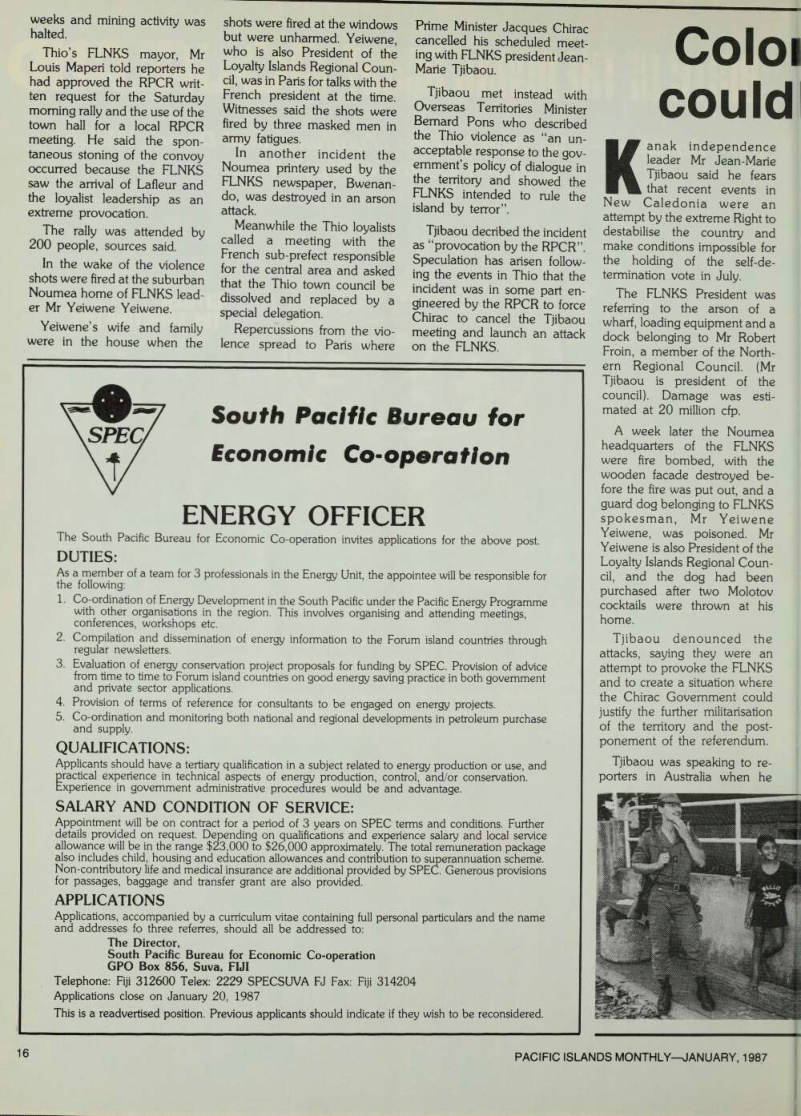
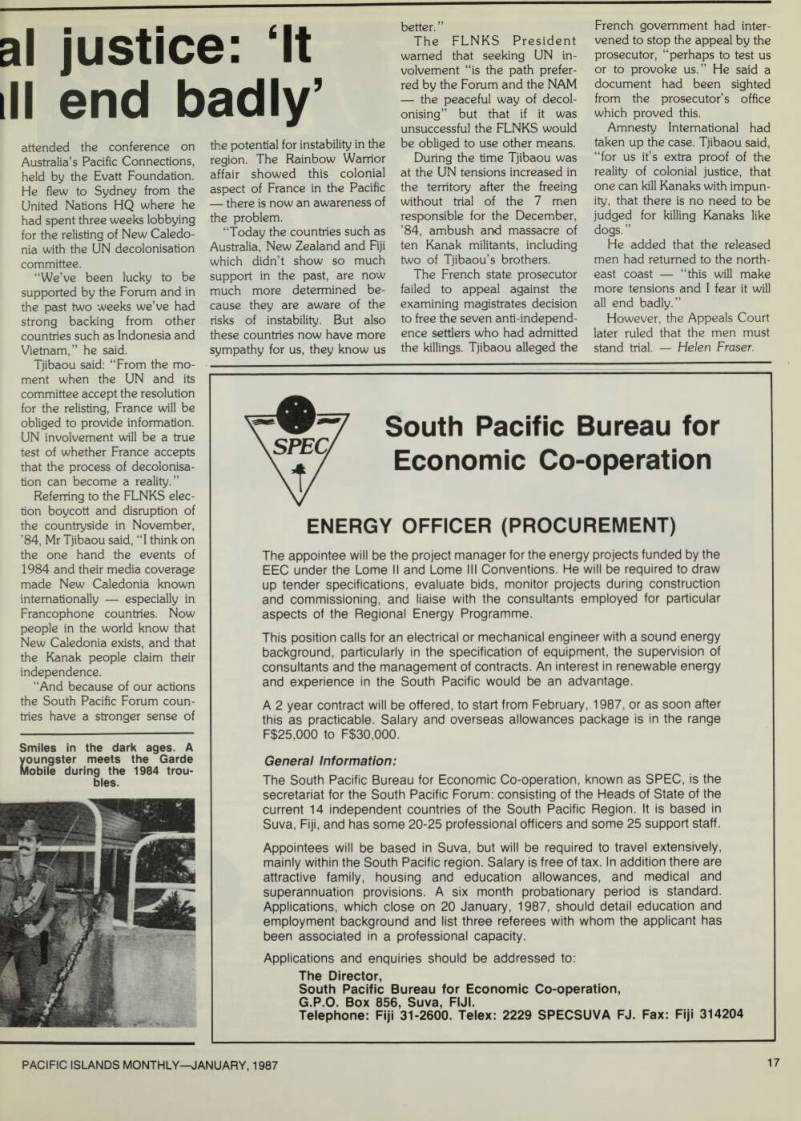
Smiles in the dark ages. A youngster meets the Garde Mobile during the 1984 trou bles.
Advertisements & other items, pp. 16-18 (2 items)
Economic Co-operation
SPEC
\v
South Pacific Bureau for
Economic Co-operation
ENERGY OFFICER
The South Pacific Bureau for Economic Co-operation invites applications for the above post.
DUTIES:
As a member of a team for 3 professionals in the Energy Unit, the appointee will be responsible for the following: 1. Co-ordination of Energy Development in the South Pacific under the Pacific Energy Programme with other organisations in the region. This involves organising and attending meetings, conferences, workshops etc. 2. Compilation and dissemination of energy information to the Forum island countries through regular newsletters. 3. Evaluation of energy conservation project proposals for funding by SPEC. Provision of advice from time to time to Forum island countries on good energy saving practice in both government and private sector applications. 4. Provision of terms of reference for consultants to be engaged on energy projects. 5. Co-ordination and monitoring both national and regional developments in petroleum purchase and supply.
QUALIFICATIONS:
Applicants should have a tertiary qualification in a subject related to energy production or use, and practical experience in technical aspects of energy production, control, and/or conservation.
Experience in government administrative procedures would be and advantage.
SALARY AND CONDITION OF SERVICE:
Appointment will be on contract for a period of 3 years on SPEC terms and conditions. Further details provided on request. Depending on qualifications and experience salary and local service allowance will be in the range $23,000 to $26,000 approximately. The total remuneration package also includes child, housing and education allowances and contribution to superannuation scheme.
Non-contributory life and medical insurance are additional provided by SPEC. Generous provisions for passages, baggage and transfer grant are also provided.
APPLICATIONS
Applications, accompanied by a curriculum vitae containing full personal particulars and the name and addresses fo three referres, should all be addressed to; The Director, South Pacific Bureau for Economic Co-operation GPO Box 856, Suva, FIJI Telephone: Fiji 312600 Telex: 2229 SPECSUVA FJ Fax; Fiji 314204 Applications close on January 20, 1987 This is a readvertised position. Previous applicants should indicate if they wish to be reconsidered.
SPEC
t
South Pacific Bureau for
Economic Co-operation
ENERGY OFFICER (PROCUREMENT)
The appointee will be the project manager for the energy projects funded by the EEC under the Lome II and Lome 111 Conventions. He will be required to draw up tender specifications, evaluate bids, monitor projects during construction and commissioning, and liaise with the consultants employed for particular aspects of the Regional Energy Programme.
This position calls for an electrical or mechanical engineer with a sound energy background, particularly in the specification of equipment, the supervision of consultants and the management of contracts. An interest in renewable energy and experience in the South Pacific would be an advantage.
A 2 year contract will be offered, to start from February, 1987, or as soon after this as practicable. Salary and overseas allowances package is in the range F 525,000 to F 530,000.
General Information: The South Pacific Bureau for Economic Co-operation, known as SPEC, is the secretariat for the South Pacific Forum; consisting of the Heads of State of the current 14 independent countries of the South Pacific Region. It is based in Suva, Fiji, and has some 20-25 professional officers and some 25 support staff.
Appointees will be based in Suva, but will be required to travel extensively, mainly within the South Pacific region. Salary is free of tax. In addition there are attractive family, housing and education allowances, and medical and superannuation provisions. A six month probationary period is standard.
Applications, which close on 20 January, 1987, should detail education and employment background and list three referees with whom the applicant has been associated in a professional capacity.
Applications and enquiries should be addressed to; The Director, South Pacific Bureau for Economic Co-operation, G.P.O. Box 856, Suva, FIJI.
Telephone: Fiji 31-2600. Telex: 2229 SPECSUVA FJ. Fax: Fiji 314204
* a " w^ v »vVW v '■ x \ ■•', v \,' v v ’• '■'"■"•• Av "'“t" - * •■•'"" ' ; :s ,'.v'\w '• ' .yv—' * ;; »►"■.: '''- w ■"•• >s •'•;:• ■■'■ •• '„ ■"" .->3*% 3^s* yvvv XV "' „ w N y XV *V ->x*xv4**y , v •■■ ■ y.;"- ' -r - - - "'•■ ■'■' - ''vvV\\\C' •■ • ■ V; ‘ \'.' x - N ''.'yyyy\y'''^SS^^ y '-' v ''' '''^yVyVyy^ ■ .——. »* ■ - :„ ~' « ■ -yyy —V., V«-yyy "' ■ -
* ;' NVVV y.. "
,y\y\ \**y -»>' -yyyyv ‘\v»» A new solution. An old problem.
In the past the old problem ofgetting access to water bourne locations was invariably met with old solutions.
Old solutions that either involved expensive time consuming, maintenance intensive construction. Or
cheap, temporary, floating hazards.
Such old solutions are now old hat.
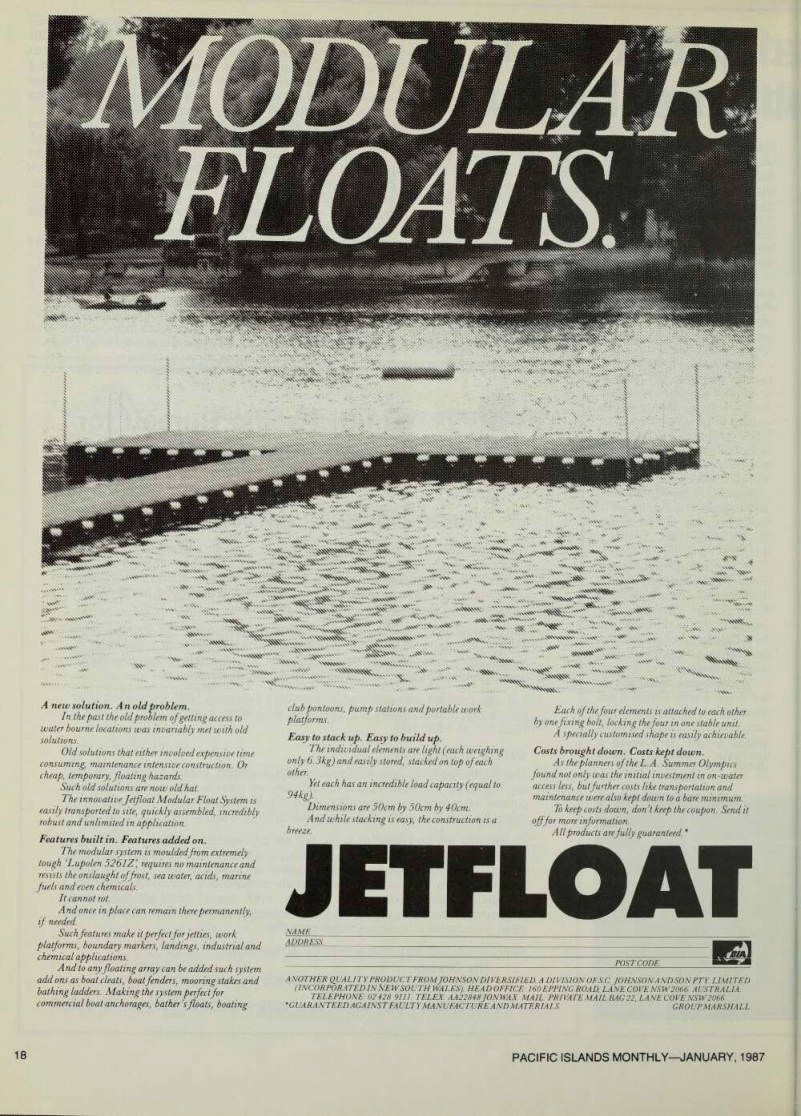
The innovativeJetfloat Modular Float System is easily transported to site, quickly assembled, incredibly robust and unlimited in application.
Features built in. Features added on.
The modular system is mouldedfrom extremely tough ‘Lupolen 5261Z’, requires no maintenance and resists the onslaught of frost, sea water, acids, marine fuels and even chemicals.
It cannot rot.
And once in place can remain there permanently, if needed.
Such features make it perfectfor jetties, work
platforms, boundary markers, landings, industrial and
chemical applications.
A nd to any floating array can be added such system add ons as boat cleats, boat fenders, mooring stakes and bathing ladders. Making the system perfect for commercial boat anchorages, bather’s floats, boating club pontoons, pump stations and portable work
platforms.
Easy to stack up. Easy to build up.
The individual elements are light (each weighing only 6.3 kg) and easily stored, stacked on top of each other.
Yet each has an incredible load capacity (equal to 94kg).
Dimensions are 50cm by 50cm by 40cm.
And while stacking is easy, the construction is a breeze.
Each of thefour elements is attached to each other by onefixing bolt, locking thefour in one stable unit.
A specially customised shape is easily achievable.
Costs brought down. Costs kept down.
As the planners of the L. A. Summer Olympics found not only was the initial investment in on-water access less, but further costs like transportation and maintenance were also kept down to a bare minimum.
To keep costs down, don’t keep the coupon. Send it off for more information.
All products arefully guaranteed. *
JETFLOAT
ANOTHER QUALITY PRODUCT FROM JOHNSON DIVERSIFIED A DIVISION OF S.C. JOHNSON AND SON PTY LIMITED. (INCORPORATED IN NEW SOUTH WALES). HEADOFFICE: 160 EPPING ROAD, LANE COVE NSW2O66. AUSTRALIA TELEPHONE: 02 428 9111 TELEX: AA22B4BJONWAX. MAIL: PRIVATE MAIL BAG 22, LANE COVE NSW2O66 *GUARANTEED AGAINST FAULTY MANUFACTURE AND MATERIALS. GROUP MARSHALL
al justice: ‘lt
ill end badly’
Libya trip wrangle
Accusations fly in Libya trip wrangle
The secretary-general of the Vanua’aku Party, Mr Barak Sope, ac cused Australian authorities of preventing a party of ni-Vanuatu from flying to Libya.
The group of 8 men, which included an Irian Jayan and a Kanak from New Caledonia were turned back at Sydney airport in mid-November.
The group had flown into Sydney from Port Vila via New Caledonia and were due to fly to Libya via Singapore and Athens.
A spokeswoman from Aus tralia’s Department of Immigra tion and Ethnic Affairs said the men were turned back after the Australian airline Qantas re fused to carry them as passen gers since their travel arrange ments were not complete.
With the airline refusing to carry them, the passengers could not be issued with transit documents for Australia, the spokeswoman said.
This was a “complete lie”
Sope said, arguing that the group had correct tickets through to Athens and pre-paid ticket advice (PTA’s) for the flight to Tripoli.
Sope said the tickets had been issued by the Qantas agent in Port Vila,(Air Pacific) and that “the Australian Gov ernment interfered to prevent the men flying to Libya”. He said use of PTAs was normal for travel to Libya.
The group was returned to Port Vila and flew to Libya eight days later by the same route using the same tickets without hindrance.
Sope, who had organised the voyage, criticised media reports that the men went to Libya for “terrorist training” and said the trip was for educational pur poses.
In a statement released in Port Vila after the group was
turned back Prime Minister Walter Lini declared that Vanuatu would never become a communist or terrorist state.
He said that Vanuatu’s rela tions with Libya were in line with his government’s policies of non-alignment, and accused the Western media of waging a deliberate propaganda cam paign against Libya’s Colonel Gaddafi and countries that have relations with Libya.
Sope told PIM; “We’ve had Libyans coming here, we’ve been over there for confer ences. This group is going mainly to look at their political system, and later they will come and see how the Vanua’aku Party works.
“Some of the group will receive journalism training over there. In a short time Libya will establish a People’s Bureau in Port Vila.
“If we wanted to do it (this trip) secretly nobody would have known and we wouldn’t have come through Australia.
We’re not terrorists and no-one is on this trip for terrorist training. ”
Sope said Vanuatu had a lot of diplomatic co-operation with Libya at the UN and in the Non-Aligned Movement.
“We have similar ideals, of helping countries who fight for their independence, which are quite important to us. We also think we can have economic gain from having diplomatic relations with Libya ... as a small but very rich country they provide aid to many African countries why not to Vanuatu?”
Sope said Vanuatu had a policy of independence and diversification in its foreign rela tions and aid. “If Australia can have diplomatic relations with Libya and Russia, why not us?” he asked.
“There are countries like South Africa that we don’t have diplomatic relations with but Australia and all the others have relations with them yet for them what South Africa is doing is wrong, so we can’t under stand.
“It’s never been proved to us that a country like Libya ex ports terrorism, but it has been proved to us that France ex ports terrorism, that the United States supplies arms to try and overthrow the government in Nicaragua.” Australia and everybody has diplomatic rela tions with South Africa, which helps to keep blacks under the thumb.”
Sope accused a former Radio Vanuatu reporter, Mr Kau Tau Yeong, who he said was linked with an opposition party and the French government, of circulating stories about terrorist training and Libya as part of an opposition campaign against him. Helen Fraser.
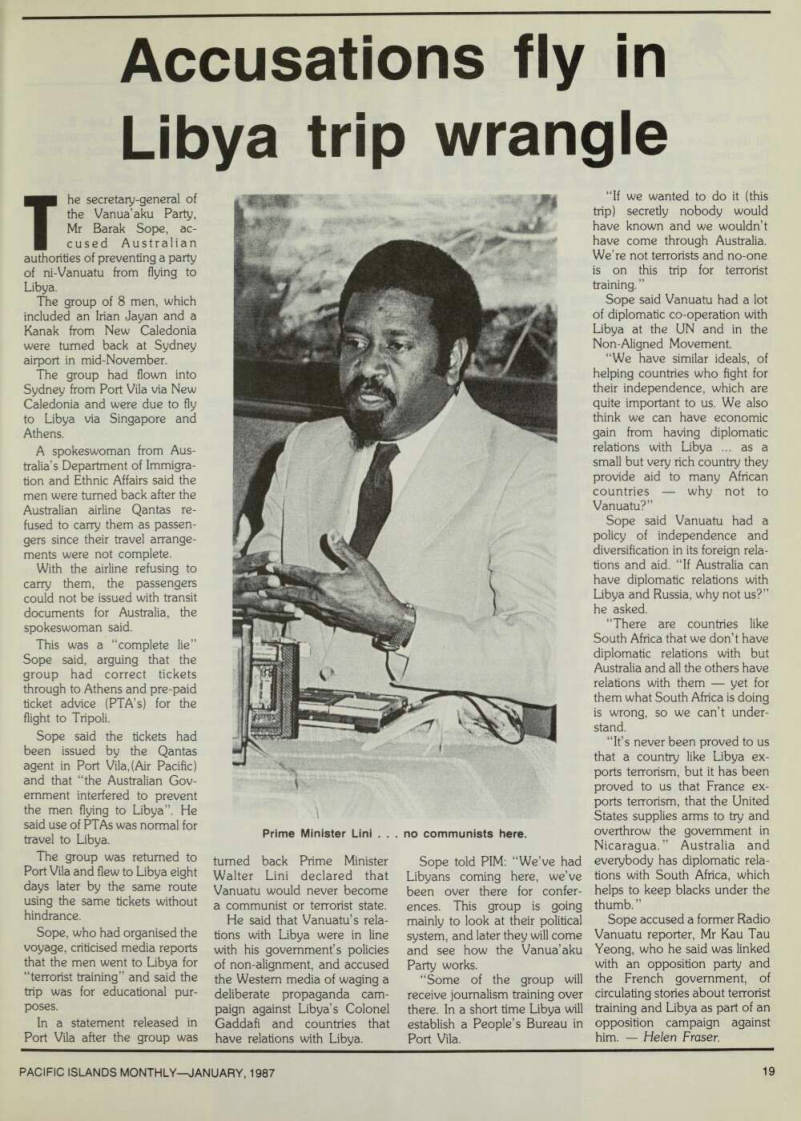
Prime Minister Uni ... no communists here.
from the islands press
From The Fiji Times, Suva All three Suva cemeteries have run out of burial sites.
The acting cemetery officer, Mr Ledua Koto, told The Fiji Times yesterday there was not a single grave site to be had at either the Suva Cemetery, the Chinese Cemetery or the New Extension Cemetery . . . newcomers were being turned away and probably had to find an alternative site at the Nasinu Cemetery.
A caption in the Cook Islands News, Rarotonga, of a warning light chained to a petrol drum.
One of the few remaining flashing lights marking the danger traffic zone in Nikao. The rest, valued at $4OO were stolen.
Like this one they were either chained to the drum or bolted to a signpost.
From The Norfolk Islander, Norfolk Island.
Did you know that “Norfolk Green” is the name given to the drug Marijuana that is now being grown on Norfolk and exported to both mainlands of New Zealand and Australia?
This shocking information was revealed at a combined meeting of the Service Clubs (Lions, Rotary, Quota and Rotaract) held at the South Pacific Hotel last Tuesday evening. In an address to the members of these organisations, Sergeant Paul Macintosh of the Norfolk Island Police Force, painted a depressing picture of how drugs are being grown on the island, taken in ever-growing amounts and now exported to both mainlands for use by drug addicts. We heard that there are three major growers on the island!
From The Tonga Chronicle, Nukualofa.
A 60-year-old Pangaimotu man died on Sept. 9 following an accident involving a .22 rifle. Vava’u correspondent Mr Lutoviko Tapueluelu writes that the Late Po’uli Ikahihifo was dragging a pig by its rope when the pig attacked him. Mr Tapueluelu butted the swine with his rifle, releasing the trigger and shooting him in the neck. He was rushed to Ngu Hospital where he was pronounced dead.
From a report by MR Mr Young Vivian on a one-man trade mission he made to Nauru to sell Niue-grown cucumbers and zucchinis as reported in Tohi Tala Niue.
Mr Vivian said the reception he received from the Nauruans was excellent. “Nauruans have big hearts. I think they deliberately leave out the word ‘No’ from their vocabulary when they are dealing with friends!” Mr Vivian said.
From the Papua New Guinea Post-Courier, Port Moresby.
A man has given himself up to Port Moresby police after allegedly shooting dead another man he thought was a duck at the Waigani swamp, on Wednesday.
From the Cook Islands News, Rarotonga.
A twenty-four-year-old youth stopped by police along with three other persons on the back road in Kavera said that he didn’t think he was breaking the law. The court heard that on July 26 the single labourer, Tino Tumai was driving a Honda CG motorbike carrying two people behind him and another in front when he was stopped.
From a letter signed by Joan P., Kolo J., Lose S., Viliamu F. K. and Ene D., in Tohl Tala Niue recording impressions of newly-installed cable television in Niue.
There is no doubt that the CNN News is excellent if you happen to be an American. The flooding in Idaho and the on-the-spot report of an armed hold-up in Texas is of no interest to us whatsoever, except to expose our children to such language as “gunman”, “hostage”, “smack”, shooting-up” and all those other lovely things that the Americans are fond of doing. Again the CNN Sports news is also excellent if you know such things as Red Sox, Oilers, Top of the Fifth, etc. Oh, by the way, you may be interested to know that Aussie Rules is equally as alien to us three hours of it was enough to drive the kids to bed!
From a letter by Makiuti Tongia in the Cook Islands News.
I for one, am for constitutional independence for our nation, and I am pleased to know that New Zealand’s Public servants are actually forcing our nation towards independence. We have been a full colony and a partial colony for too long. It’s time we let go of the yoke and smash it forever.
From The Fiji Times, Suva.
The leading video and music tape dealer in Fiji, South Pacific Recordings, says it has lost about $300,000 over the past three years to video piracy. “The pirates are operating so openly and blatantly that it is hard to believe,” the managing director of SPR, Mr Ravindra Patel, told The Fiji Times.
From The Fiji Times, Suva.
The Attorney-General and Minister for Justice, Mr Qoriniasi Bale, says there should be no objection or interference from outsiders if Tamavua villagers wish to submit to public flogging in accordance with their tradition. Mr Bale was responding to Fiji Times questions on whether the Tamavua flogging was illegal. Yesterday, The Fiji Times highlighted the report that Tamavua villagers are being flogged publicly when they are found guilty of disturbing the peace or causing problems in the village.
From the Cook Islands News, Rarotonga.
The Minister of Foreign Affairs Normen George has accused senior New Zealand public servants of obstructing the Cook Islands government ... Mr George said the Cook Islands felt like New Caledonia in reverse, while France was trying to hang on to its pacific colony some senior New Zealand civil servants appeared determined to force independence on the Cook Islands.
From the Cook Islands News, Rarotonga.
Suwarrow, one of the country’s atoll national parks is proving very popular with people overseas seeking a place in the sun.
The Chief Immigration Officer Tutai Tom has received 20 requests from people as far away as Scotland and Japan wanting to settle on or be caretakers of the island. All requests have been turned down.
survivor wins again
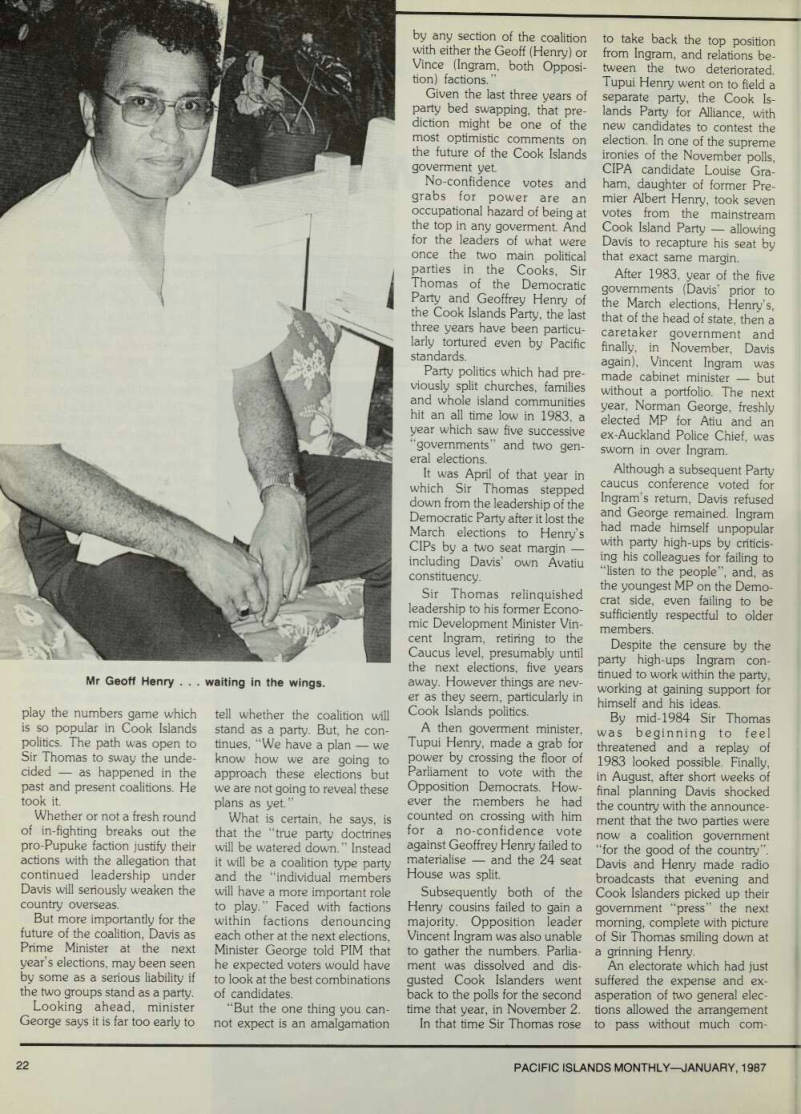
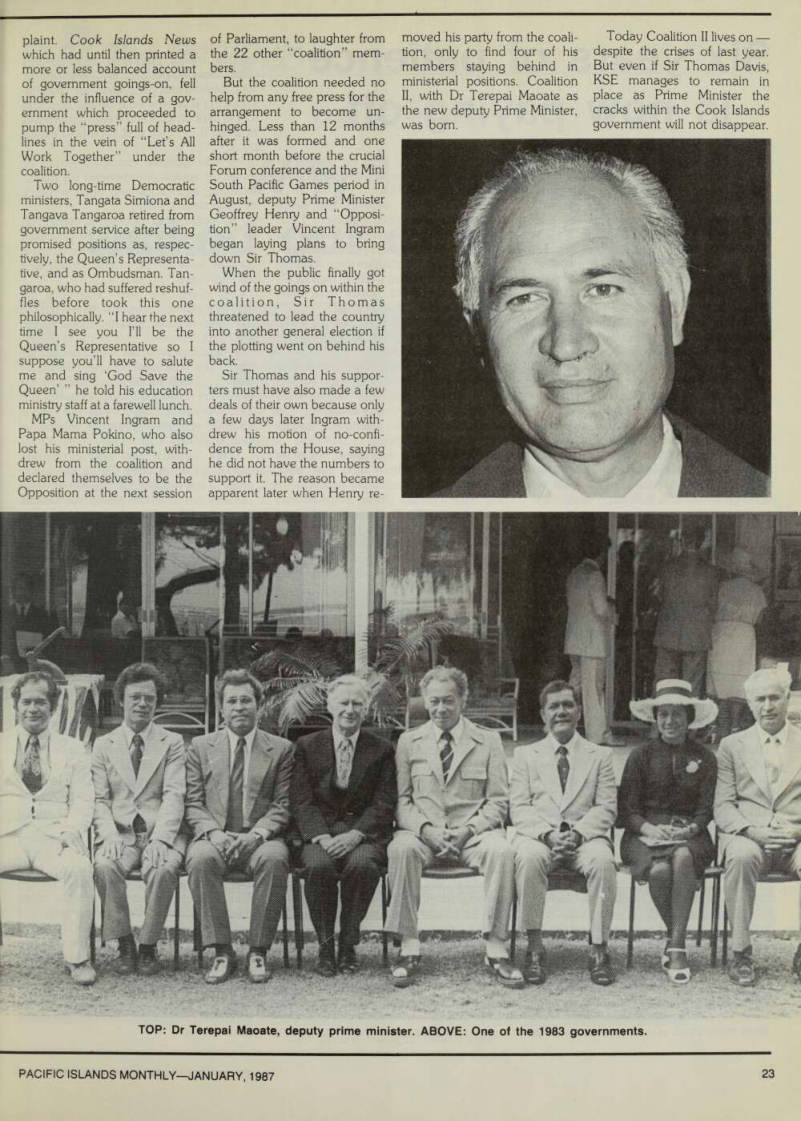
Sir Tom: The great survivor wins again
The coalition govern ment of the Cook Is lands was again on the verge of another split which threatened to dislodge Prime Minister, Sir Thomas Davis.
Once again, however, the great survivor triumphed.
Sir Thomas late last year had been facing increasing opposi tion from within his own Demo cratic Party following a series of development project failures and other public relations set backs.
However the crusty Sir Thomas has faced challenges before. Opposition leader Geoffrey Henry, when asked about rumors of Sir Tom’s impending demise, commented wryly, “I’ve been hearing that one since 1983”.
This time however the other side included long-time suppor ters like Foreign Affairs Minister Norman George and Outer Is land Affairs Minister Dr Pupuke Robati, a deputy Prime Minister prior to the coalition govern ments.
Dr Robati has been widely touted as the next Prime Minis ter if the pro-Pupuke faction within the coalition manage to oust Davis. Foreign Minister George, in an interview with PIM in September, confirmed this, saying, “. . . he has my total and absolute support as the successor to Sir Thomas.”
The Outer Islands Affairs Minister is seen as the only choice to replace Davis, the Foreign Minister being too young for the old-guard Demo cratic Party to support and present deputy Prime Minister Dr Terepai Maoate, despite
In the turbulent world of Cook Islands politics, things are often not as they seem. But amid continuing rumour and counter-rumour, prime minister Sir Thomas Davis, has shown himself to be the consummate politician. As a FIM special correspondent reports, even his opponents pay tribute to his skills.
some popular support, comes from the opposing party.
And although George has previously taken over as Acting Prime Minister, ahead of Roba ti, he also firmly rules out any suggestion that he’s aiming for the top position. “I consider myself to be a conscientious member of the coalition caucus rule me right out.”
Although leading politicians like George decline to assess Sir Thomas or even predict his future, many privately state that after years of service Sir Thomas is ready to be put out to pasture. Said one, “He’ll either have to step down gracefully or be removed.”
One scenario sees supporters of the present deputy Prime Minister, being asked some say lured to switch their support to Dr Robati, at the Caucus and, if need be, the House level.
The Maoate supporters, for mer members of the Opposition Cook Islands Party, together with the Democratic half of the coalition, would form a large by recent standards majority behind Dr Robati. Sir Thomas presumably would be asked to step down to be back benches and perhaps a top position in the Caucus.
Another, sweeter, scenario suggests that instead of step ping down he may be asked to step up and become Queen’s Representative, the country’s Head of State.
As for Sir Thomas himself the Prime Minister of the last eight years is said to be of two minds about retiring from the political arena. The other figure at the centre of the leadership rumors, Dr Robati, rarely if ever talks to reporters.
Obviously though, two can
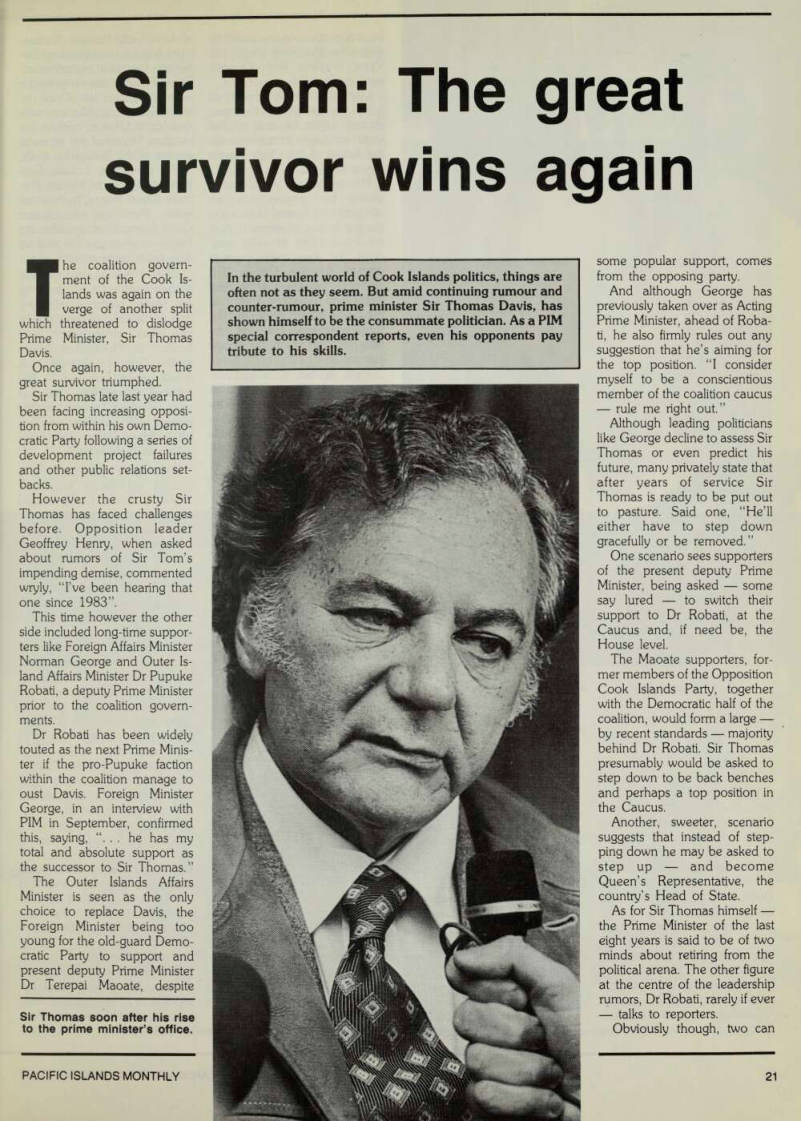
Sir Thomas soon after his rise to the prime minister’s office.
play the numbers game which is so popular in Cook Islands politics. The path was open to Sir Thomas to sway the unde cided as happened in the past and present coalitions. He took it.
Whether or not a fresh round of in-fighting breaks out the pro-Pupuke faction justify their actions with the allegation that continued leadership under Davis will seriously weaken the country overseas.
But more importantly for the future of the coalition, Davis as Prime Minister at the next year’s elections, may been seen by some as a serious liability if the two groups stand as a party.
Looking ahead, minister George says it is far too early to
tell whether the coalition will stand as a party. But, he con tinues, “We have a plan we know how we are going to approach these elections but we are not going to reveal these plans as yet.”
What is certain, he says, is that the “true party doctrines will be watered down.” Instead it will be a coalition type party and the “individual members will have a more important role to play.” Faced with factions within factions denouncing each other at the next elections, Minister George told PIM that he expected voters would have to look at the best combinations of candidates.
“But the one thing you can not expect is an amalgamation
by any section of the coalition with either the Geoff (Henry) or Vince (Ingram, both Opposi tion) factions.”
Given the last three years of party bed swapping, that pre diction might be one of the most optimistic comments on the future of the Cook Islands goverment yet.
No-confidence votes and grabs for power are an occupational hazard of being at the top in any goverment. And for the leaders of what were once the two main political parties in the Cooks, Sir Thomas of the Democratic Party and Geoffrey Henry of the Cook Islands Party, the last three years have been particu larly tortured even by Pacific standards.
Party politics which had pre viously split churches, families and whole island communities hit an all time low in 1983, a year which saw five successive “governments” and two gen eral elections.
It was April of that year in which Sir Thomas stepped down from the leadership of the Democratic Party after it lost the March elections to Henry’s CIPs by a two seat margin including Davis’ own Avatiu constituency.
Sir Thomas relinquished leadership to his former Econo mic Development Minister Vin cent Ingram, retiring to the Caucus level, presumably until the next elections, five years away. However things are nev er as they seem, particularly in Cook Islands politics.
A then goverment minister, Tupui Henry, made a grab for power by crossing the floor of Parliament to vote with the Opposition Democrats. How ever the members he had counted on crossing with him for a no-confidence vote against Geoffrey Henry failed to materialise and the 24 seat House was split.
Subsequently both of the Henry cousins failed to gain a majority. Opposition leader Vincent Ingram was also unable to gather the numbers. Parlia ment was dissolved and dis gusted Cook Islanders went back to the polls for the second time that year, in November 2.
In that time Sir Thomas rose
to take back the top position from Ingram, and relations be tween the two deteriorated.
Tupui Henry went on to field a separate party, the Cook Is lands Party for Alliance, with new candidates to contest the election. In one of the supreme ironies of the November polls, CIPA candidate Louise Gra ham, daughter of former Pre mier Albert Henry, took seven votes from the mainstream Cook Island Party allowing Davis to recapture his seat by that exact same margin.
After 1983, year of the five governments (Davis’ prior to the March elections, Henry’s, that of the head of state, then a caretaker government and finally, in November, Davis again), Vincent Ingram was made cabinet minister but without a portfolio. The next year, Norman George, freshly elected MP for Atiu and an ex-Auckland Police Chief, was sworn in over Ingram.
Although a subsequent Party caucus conference voted for Ingram’s return, Davis refused and George remained. Ingram had made himself unpopular with party high-ups by criticis ing his colleagues for failing to “listen to the people”, and, as the youngest MP on the Demo crat side, even failing to be sufficiently respectful to older members.
Despite the censure by the party high-ups Ingram con tinued to work within the party, working at gaining support for himself and his ideas.
By mid-1984 Sir Thomas was beginning to feel threatened and a replay of 1983 looked possible. Finally, in August, after short weeks of final planning Davis shocked the country with the announce ment that the two parties were now a coalition government “for the good of the country”.
Davis and Henry made radio broadcasts that evening and Cook Islanders picked up their government “press” the next morning, complete with picture of Sir Thomas smiling down at a grinning Henry.
An electorate which had just suffered the expense and ex asperation of two general elec tions allowed the arrangement to pass without much com
Mr Geoff Henry . . . waiting in the wings.
plaint. Cook Islands News which had until then printed a more or less balanced account of government goings-on, fell under the influence of a gov ernment which proceeded to pump the “press” full of head lines in the vein of “Let’s All Work Together” under the coalition.
Two long-time Democratic ministers, Tangata Simiona and Tangava Tangaroa retired from government service after being promised positions as, respec tively, the Queen’s Representa tive, and as Ombudsman. Tan garoa, who had suffered reshuf fles before took this one philosophically. “I hear the next time I see you I’ll be the Queen’s Representative so I suppose you’ll have to salute me and sing ‘God Save the Queen’ ” he told his education ministry staff at a farewell lunch.
MPs Vincent Ingram and Papa Mama Pokino, who also lost his ministerial post, with drew from the coalition and declared themselves to be the Opposition at the next session
of Parliament, to laughter from the 22 other “coalition” mem bers.
But the coalition needed no help from any free press for the arrangement to become un hinged. Less than 12 months after it was formed and one short month before the crucial Forum conference and the Mini South Pacific Games period in August, deputy Prime Minister Geoffrey Henry and “Opposi tion” leader Vincent Ingram began laying plans to bring down Sir Thomas.
When the public finally got wind of the goings on within the coalition, Sir Thomas threatened to lead the country into another general election if the plotting went on behind his back.
Sir Thomas and his suppor ters must have also made a few deals of their own because only a few days later Ingram with drew his motion of no-confi dence from the House, saying he did not have the numbers to support it. The reason became apparent later when Henry re
moved his party from the coali tion, only to find four of his members staying behind in ministerial positions. Coalition 11, with Dr Terepai Maoate as the new deputy Prime Minister, was born.
Today Coalition II lives on despite the crises of last year.
But even if Sir Thomas Davis, KSE manages to remain in place as Prime Minister the cracks within the Cook Islands government will not disappear.
TOP: Dr Terepai Maoate, deputy prime minister. ABOVE: One of the 1983 governments.
Six years of patience
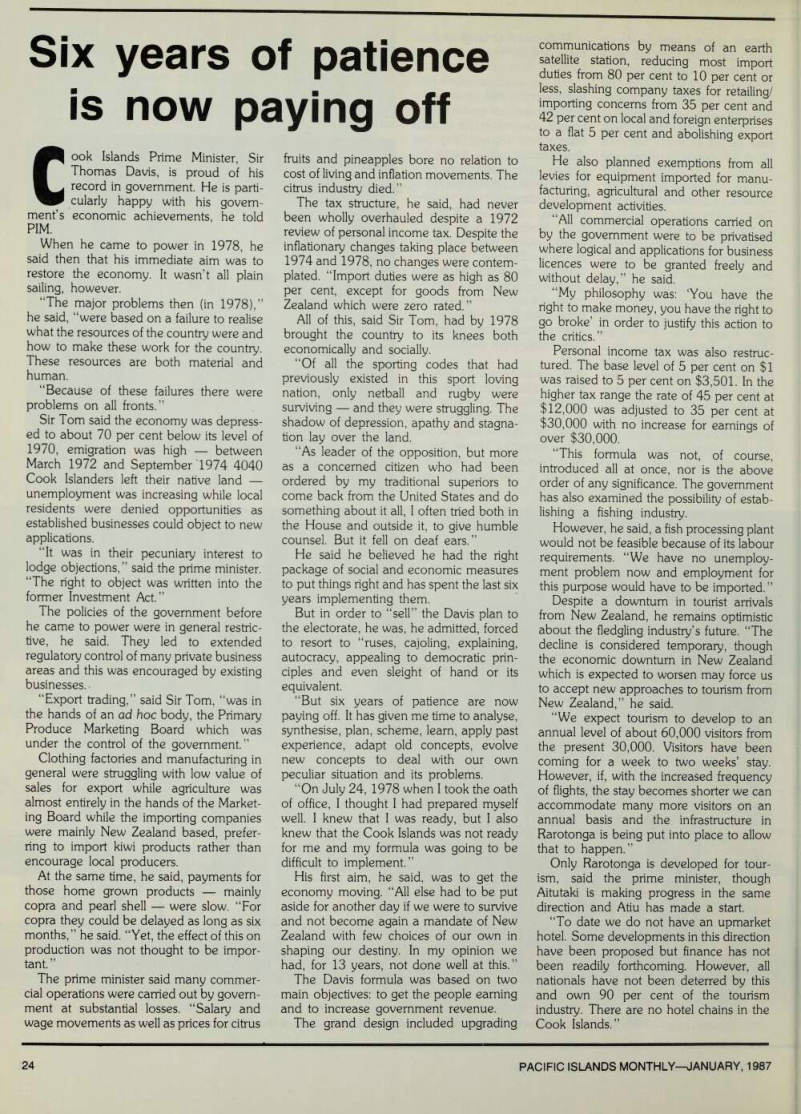
is now paying off
Cook Islands Prime Minister, Sir Thomas Davis, is proud of his record in government. He is parti cularly happy with his govern ment’s economic achievements, he told
Pim.
When he came to power in 1978, he said then that his immediate aim was to restore the economy. It wasn’t all plain sailing, however.
“The major problems then (in 1978),” he said, “were based on a failure to realise what the resources of the country were and how to make these work for the country.
These resources are both material and human.
“Because of these failures there were problems on all fronts.”
Sir Tom said the economy was depress ed to about 70 per cent below its level of 1970, emigration was high between March 1972 and September T 974 4040 Cook Islanders left their native land unemployment was increasing while local residents were denied opportunities as established businesses could object to new applications.
“It was in their pecuniary interest to lodge objections,” said the prime minister.
“The right to object was written into the former Investment Act.”
The policies of the government before he came to power were in general restric tive, he said. They led to extended regulatory control of many private business areas and this was encouraged by existing businesses.
“Export trading,” said Sir Tom, “was in the hands of an ad hoc body, the Primary Produce Marketing Board which was under the control of the government.”
Clothing factories and manufacturing in general were struggling with low value of sales for export while agriculture was almost entirely in the hands of the Market ing Board while the importing companies were mainly New Zealand based, prefer ring to import kiwi products rather than encourage local producers.
At the same time, he said, payments for those home grown products mainly copra and pearl shell were slow. “For copra they could be delayed as long as six months, ” he said. “Yet, the effect of this on production was not thought to be impor tant.”
The prime minister said many commer cial operations were carried out by govern ment at substantial losses. “Salary and wage movements as well as prices for citrus
fruits and pineapples bore no relation to cost of living and inflation movements. The citrus industry died.”
The tax structure, he said, had never been wholly overhauled despite a 1972 review of personal income tax. Despite the inflationary changes taking place between 1974 and 1978, no changes were contem plated. “Import duties were as high as 80 per cent, except for goods from New Zealand which were zero rated.”
All of this, said Sir Tom, had by 1978 brought the country to its knees both economically and socially.
“Of all the sporting codes that had previously existed in this sport loving nation, only netball and rugby were surviving and they were struggling. The shadow of depression, apathy and stagna tion lay over the land.
“As leader of the opposition, but more as a concerned citizen who had been ordered by my traditional superiors to come back from the United States and do something about it all, I often tried both in the House and outside it, to give humble counsel. But it fell on deaf ears.”
He said he believed he had the right package of social and economic measures to put things right and has spent the last six years implementing them.
But in order to “sell” the Davis plan to the electorate, he was, he admitted, forced to resort to “ruses, cajoling, explaining, autocracy, appealing to democratic prin ciples and even sleight of hand or its equivalent.
“But six years of patience are now paying off. It has given me time to analyse, synthesise, plan, scheme, learn, apply past experience, adapt old concepts, evolve new concepts to deal with our own peculiar situation and its problems.
“On July 24, 1978 when I took the oath of office, I thought I had prepared myself well. I knew that I was ready, but I also knew that the Cook Islands was not ready for me and my formula was going to be difficult to implement.”
His first aim, he said, was to get the economy moving. “All else had to be put aside for another day if we were to survive and not become again a mandate of New Zealand with few choices of our own in shaping our destiny. In my opinion we had, for 13 years, not done well at this.”
The Davis formula was based on two main objectives: to get the people earning and to increase government revenue.
The grand design included upgrading
communications by means of an earth satellite station, reducing most import duties from 80 per cent to 10 per cent or less, slashing company taxes for retailing/ importing concerns from 35 per cent and 42 per cent on local and foreign enterprises to a flat 5 per cent and abolishing export taxes.
He also planned exemptions from all levies for equipment imported for manu facturing, agricultural and other resource development activities.
“All commercial operations carried on by the government were to be privatised where logical and applications for business licences were to be granted freely and without delay,” he said.
“My philosophy was: ‘You have the right to make money, you have the right to go broke’ in order to justify this action to the critics.”
Personal income tax was also restruc tured. The base level of 5 per cent on $1 was raised to 5 per cent on $3,501. In the higher tax range the rate of 45 per cent at $12,000 was adjusted to 35 per cent at $30,000 with no increase for earnings of over $30,000.
“This formula was not, of course, introduced all at once, nor is the above order of any significance. The government has also examined the possibility of estab lishing a fishing industry.
However, he said, a fish processing plant would not be feasible because of its labour requirements. “We have no unemploy ment problem now and employment for this purpose would have to be imported. ”
Despite a downturn in tourist arrivals from New Zealand, he remains optimistic about the fledgling industry’s future. “The decline is considered temporary, though the economic downturn in New Zealand which is expected to worsen may force us to accept new approaches to tourism from New Zealand,” he said.
“We expect tourism to develop to an annual level of about 60,000 visitors from the present 30,000. Visitors have been coming for a week to two weeks’ stay.
However, if, with the increased frequency of flights, the stay becomes shorter we can accommodate many more visitors on an annual basis and the infrastructure in Rarotonga is being put into place to allow that to happen.”
Only Rarotonga is developed for tour ism, said the prime minister, though Aitutaki is making progress in the same direction and Atiu has made a start.
“To date we do not have an upmarket hotel. Some developments in this direction have been proposed but finance has not been readily forthcoming. However, all nationals have not been deterred by this and own 90 per cent of the tourism industry. There are no hotel chains in the Cook Islands.”
Why Levers
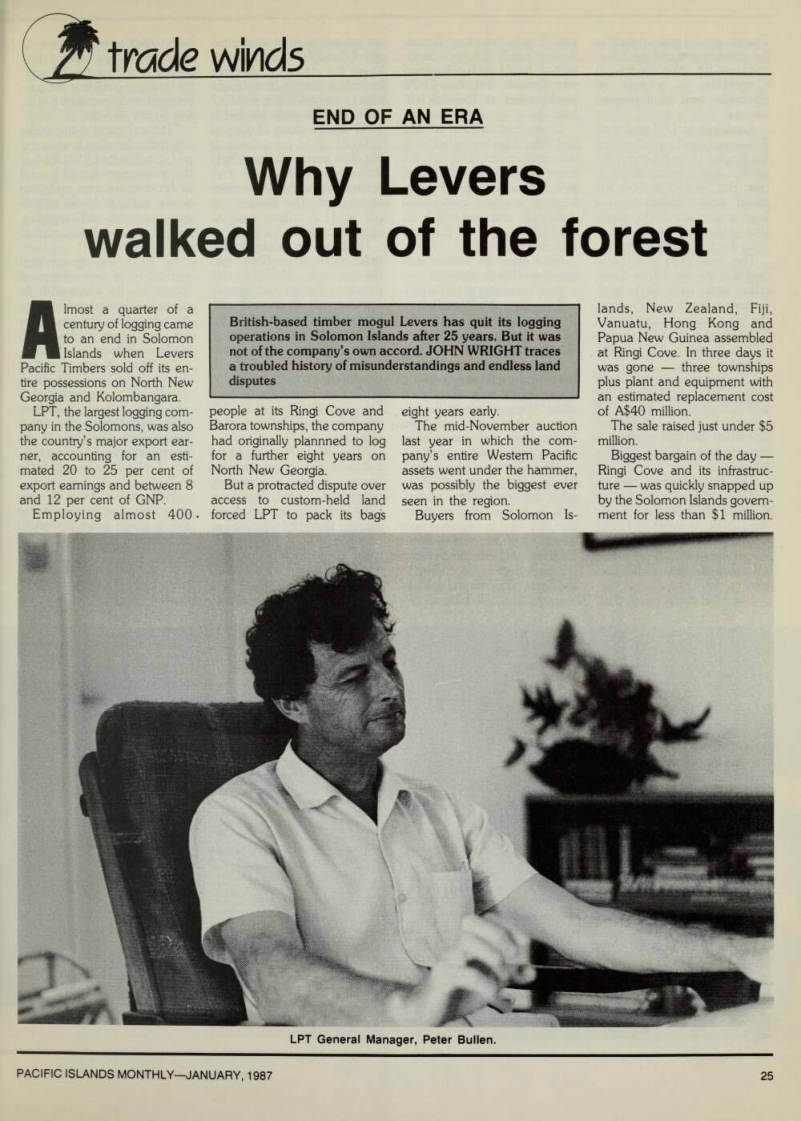
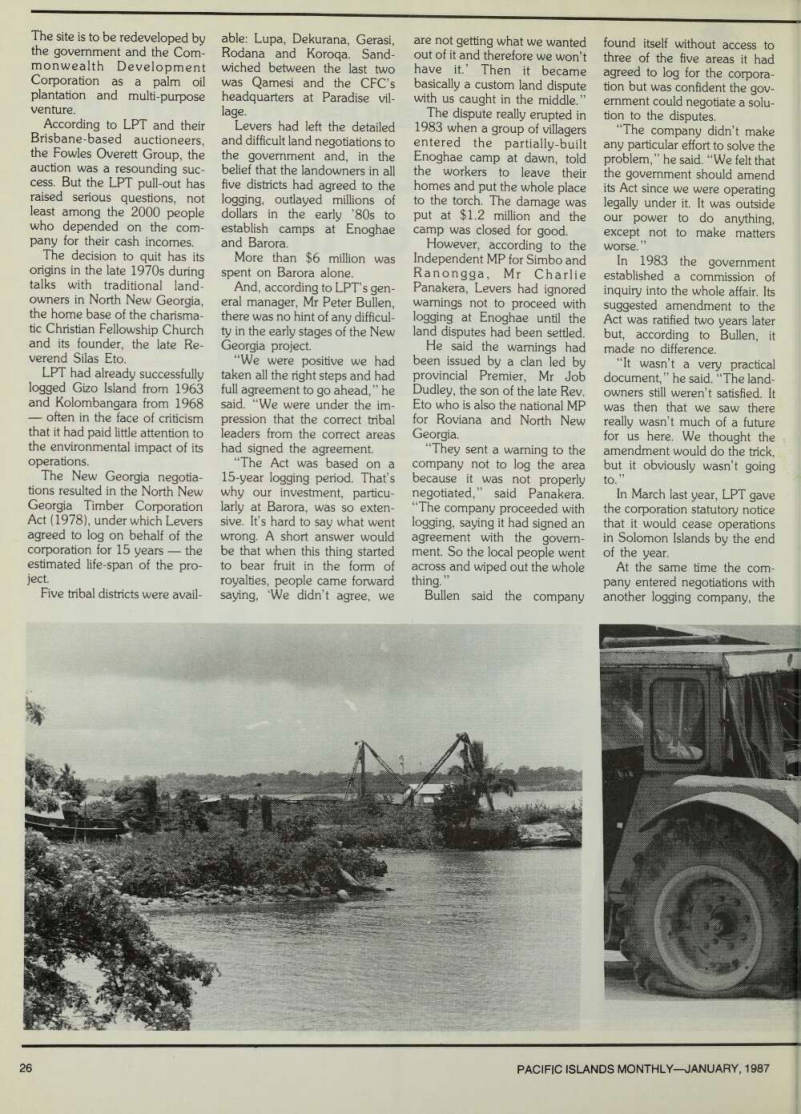
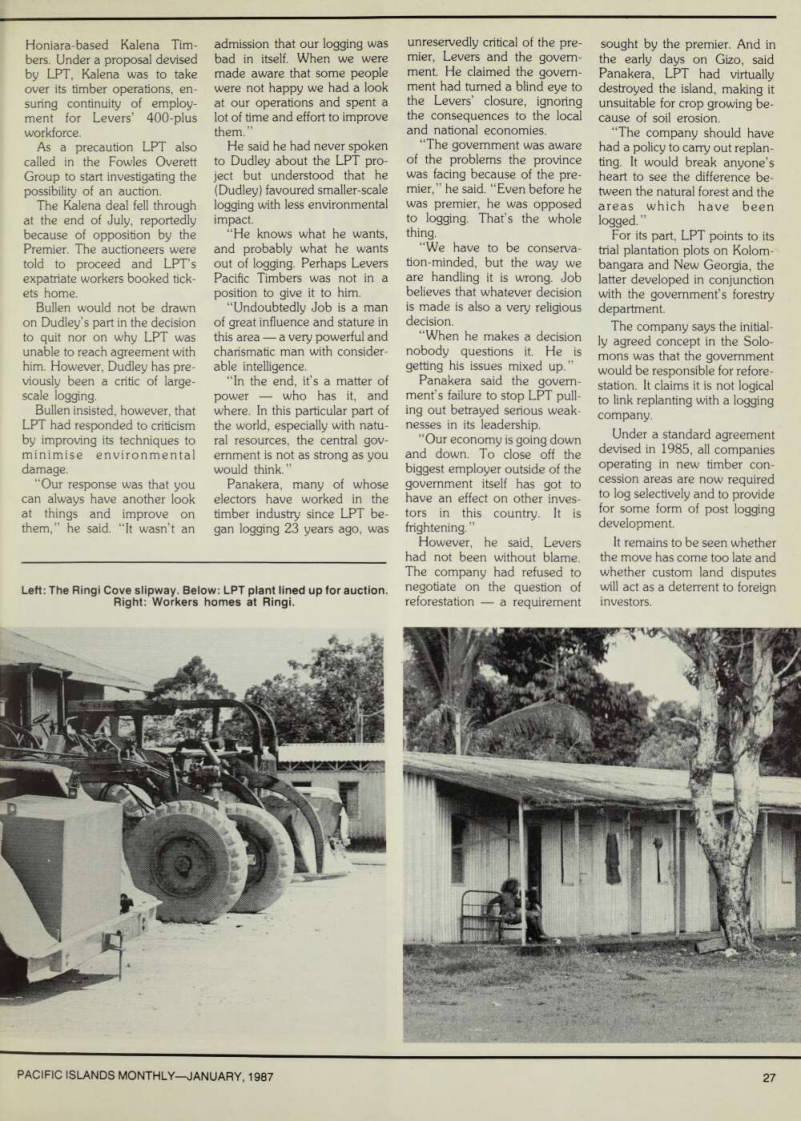
trade winds
End Of An Era
Why Levers walked out of the forest
Almost a quarter of a century of logging came to an end in Solomon Islands when Levers Pacific Timbers sold off its en tire possessions on North New Georgia and Kolombangara.
LPT, the largest logging com pany in the Solomons, was also the country’s major export ear ner, accounting for an esti mated 20 to 25 per cent of export earnings and between 8 and 12 per cent of GNP.
Employing almost 400.
British-based timber mogul Levers has quit its logging operations in Solomon Islands after 25 years. But it was not of the company’s own accord. JOHN WRIGHT traces a troubled history of misunderstandings and endless land disputes
people at its Ringi Cove and Barora townships, the company had originally plannned to log for a further eight years on North New Georgia, But a protracted dispute over access to custom-held land forced LPT to pack its bags
eight years early.
The mid-November auction last year in which the com pany’s entire Western Pacific assets went under the hammer, was possibly the biggest ever seen in the region.
Buyers from Solomon Is
lands, New Zealand, Fiji, Vanuatu, Hong Kong and Papua New Guinea assembled at Ringi Cove. In three days it was gone three townships plus plant and equipment with an estimated replacement cost of As4o million.
The sale raised just under $5 million.
Biggest bargain of the day Ringi Cove and its infrastruc ture was quickly snapped up by the Solomon Islands govern ment for less than $1 million.
LPT General Manager, Peter Bullen.
The site is to be redeveloped by the government and the Com monwealth Development Corporation as a palm oil plantation and multi-purpose venture.
According to LPT and their Brisbane-based auctioneers, the Fowles Overett Group, the auction was a resounding suc cess. But the LPT pull-out has raised serious questions, not least among the 2000 people who depended on the com pany for their cash incomes.
The decision to quit has its origins in the late 1970 s during talks with traditional land owners in North New Georgia, the home base of the charisma tic Christian Fellowship Church and its founder, the late Re verend Silas Eto.
LPT had already successfully
logged Gizo Island from 1963 and Kolombangara from 1968 often in the face of criticism that it had paid little attention to the environmental impact of its operations.
The New Georgia negotia tions resulted in the North New Georgia Timber Corporation Act (1978), under which Levers agreed to log on behalf of the corporation for 15 years the estimated life-span of the pro ject.
Five tribal districts were avail
able: Lupa, Dekurana, Gerasi, Rodana and Koroqa. Sand wiched between the last two was Qamesi and the CPC’s headquarters at Paradise vil lage.
Levers had left the detailed and difficult land negotiations to the government and, in the belief that the landowners in all five districts had agreed to the logging, outlayed millions of dollars in the early ’Bos to establish camps at Enoghae and Barora.
More than $6 million was spent on Barora alone.
And, according to LPT’s gen eral manager, Mr Peter Bullen, there was no hint of any difficul ty in the early stages of the New Georgia project.
“We were positive we had taken all the right steps and had full agreement to go ahead,” he said. “We were under the im pression that the correct tribal leaders from the correct areas had signed the agreement.
“The Act was based on a 15-year logging period. That’s why our investment, particu larly at Barora, was so exten sive. It’s hard to say what went wrong. A short answer would be that when this thing started to bear fruit in the form of royalties, people came forward saying, ‘We didn’t agree, we
are not getting what we wanted out of it and therefore we won’t have it.’ Then it became basically a custom land dispute with us caught in the middle. ”
The dispute really erupted in 1983 when a group of villagers entered the partially-built Enoghae camp at dawn, told the workers to leave their homes and put the whole place to the torch. The damage was put at $1.2 million and the camp was closed for good.
However, according to the Independent MP for Simbo and Ranongga, Mr Charlie Panakera, Levers had ignored warnings not to proceed with logging at Enoghae until the land disputes had been settled.
He said the warnings had been issued by a clan led by provincial Premier, Mr Job Dudley, the son of the late Rev.
Eto who is also the national MP for Roviana and North New Georgia.
“They sent a warning to the company not to log the area because it was not properly negotiated,” said Panakera.
“The company proceeded with logging, saying it had signed an agreement with the govern ment. So the local people went across and wiped out the whole thing.”
Bullen said the company
found itself without access to three of the five areas it had agreed to log for the corpora tion but was confident the gov ernment could negotiate a solu tion to the disputes.
“The company didn’t make any particular effort to solve the problem,” he said. “We felt that the government should amend its Act since we were operating legally under it. It was outside our power to do anything, except not to make matters worse.”
In 1983 the government established a commission of inquiry into the whole affair. Its suggested amendment to the Act was ratified two years later but, according to Bullen, it made no difference.
“It wasn’t a very practical document,” he said. “The land owners still weren’t satisfied. It was then that we saw there really wasn’t much of a future for us here. We thought the amendment would do the trick, but it obviously wasn’t going to.”
In March last year, LPT gave the corporation statutory notice that it would cease operations in Solomon Islands by the end of the year.
At the same time the com pany entered negotiations with another logging company, the
Honiara-based Kalena Tim bers. Under a proposal devised by LPT, Kalena was to take over its timber operations, en suring continuity of employ ment for Levers’ 400-plus workforce.
As a precaution LPT also called in the Fowles Overett Group to start investigating the possibility of an auction.
The Kalena deal fell through at the end of July, reportedly because of opposition by the Premier. The auctioneers were told to proceed and LPT’s expatriate workers booked tick ets home.
Bullen would not be drawn on Dudley’s part in the decision to quit nor on why LPT was unable to reach agreement with him. However, Dudley has pre viously been a critic of large scale logging.
Bullen insisted, however, that LPT had responded to criticism by improving its techniques to minimise environmental damage.
“Our response was that you can always have another look at things and improve on them,” he said. “It wasn’t an
admission that our logging was bad in itself. When we were made aware that some people were not happy we had a look at our operations and spent a lot of time and effort to improve them.”
He said he had never spoken to Dudley about the LPT pro ject but understood that he (Dudley) favoured smaller-scale logging with less environmental impact.
“He knows what he wants, and probably what he wants out of logging. Perhaps Levers Pacific Timbers was not in a position to give it to him.
“Undoubtedly Job is a man of great influence and stature in this area a very powerful and charismatic man with consider able intelligence.
“In the end, it’s a matter of power who has it, and where. In this particular part of the world, especially with natu ral resources, the central gov ernment is not as strong as you would think.”
Panakera, many of whose electors have worked in the timber industry since LPT be gan logging 23 years ago, was
unreservedly critical of the pre mier, Levers and the govern ment. He claimed the govern ment had turned a blind eye to the Levers’ closure, ignoring the consequences to the local and national economies.
“The government was aware of the problems the province was facing because of the pre mier,” he said. “Even before he was premier, he was opposed to logging. That’s the whole thing.
“We have to be conserva tion-minded, but the way we are handling it is wrong. Job believes that whatever decision is made is also a very religious decision.
“When he makes a decision nobody questions it. He is getting his issues mixed up.”
Panakera said the govern ment’s failure to stop LPT pull ing out betrayed serious weak nesses in its leadership.
“Our economy is going down and down. To close off the biggest employer outside of the government itself has got to have an effect on other inves tors in this country. It is frightening. ”
However, he said, Levers had not been without blame.
The company had refused to negotiate on the question of reforestation a requirement
sought by the premier. And in the early days on Gizo, said Panakera, LPT had virtually destroyed the island, making it unsuitable for crop growing be cause of soil erosion, “The company should have had a policy to carry out replan ting. It would break anyone’s heart to see the difference be tween the natural forest and the areas which have been logged.”
For its part, LPT points to its trial plantation plots on Kolom bangara and New Georgia, the latter developed in conjunction with the government’s forestry department.
The company says the initial jy agreed concept in the Solo mons was that the government would be responsible for refore station. It claims it is not logical to ii n k replanting with a logging company Under a , s ‘ andard devised in 1985 ’ all companies °P erafin 9 in new timber con c®ssion areas are now required to lo 9 selectively and to provide for some form of P ost lo 99>ng development.
It remains to be seen whether the move has come too late and whether custom land disputes will act as a deterrent to foreign investors.
Left: The Ringi Cove slipway. Below: LPT plant lined up for auction.
Right: Workers homes at Ringi.
stays in place
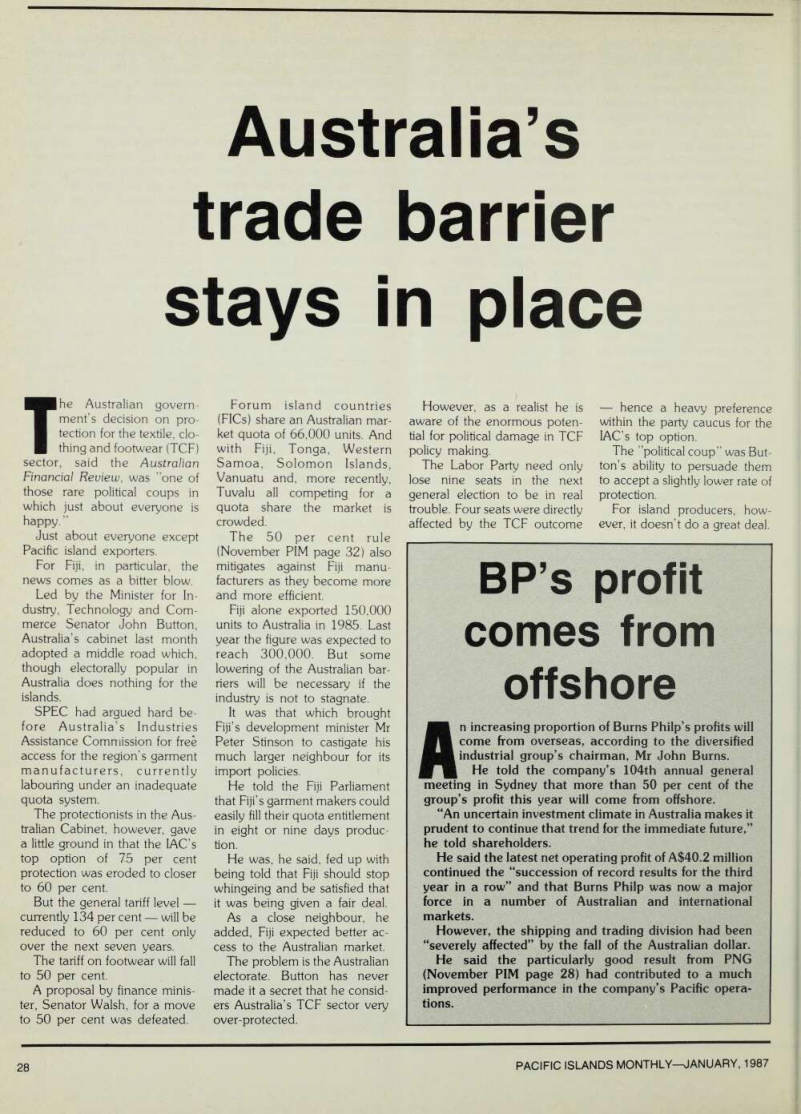
Australia’s trade barrier stays in place
The Australian govern ment’s decision on pro tection for the textile, clo thing and footwear (TCF) sector, said the Australian Financial Review, was ’’one of those rare political coups in which just about everyone is happy.”
Just about everyone except Pacific island exporters.
For Fiji, in particular, the news comes as a bitter blow.
Led by the Minister for In dustry, Technology and Com merce Senator John Button, Australia’s cabinet last month adopted a middle road which, though electorally popular in Australia does nothing for the islands.
SPEC had argued hard be fore Australia’s Industries Assistance Commission for free access for the region’s garment manufacturers, currently labouring under an inadequate quota system.
The protectionists in the Aus tralian Cabinet, however, gave a little ground in that the lAC’s top option of 75 per cent protection was eroded to closer to 60 per cent.
But the general tariff level currently 134 per cent will be reduced to 60 per cent only over the next seven years.
The tariff on footwear will fall to 50 per cent.
A proposal by finance minis ter, Senator Walsh, for a move to 50 per cent was defeated.
Forum island countries (FICs) share an Australian mar ket quota of 66,000 units. And with Fiji, Tonga, Western Samoa, Solomon Islands.
Vanuatu and. more recently, Tuvalu all competing for a quota share the market is crowded.
The 50 per cent rule (November PIM page 32) also mitigates against Fiji manu facturers as they become more and more efficient.
Fiji alone exported 150,000 units to Australia in 1985. Last year the figure was expected to reach 300,000. But some lowering of the Australian bar riers will be necessary if the industry is not to stagnate.
It was that which brought Fiji’s development minister Mr Peter Stinson to castigate his much larger neighbour for its import policies.
He told the Fiji Parliament that Fiji’s garment makers could easily fill their quota entitlement in eight or nine days produc tion.
He was, he said, fed up with being told that Fiji should stop whingeing and be satisfied that it was being given a fair deal.
As a close neighbour, he added, Fiji expected better ac cess to the Australian market.
The problem is the Australian electorate. Button has never made it a secret that he consid ers Australia’s TCF sector very over-protected.
I However, as a realist he is aware of the enormous poten tial for political damage in TCF policy making.
The Labor Party need only lose nine seats in the next general election to be in real trouble. Four seats were directly affected by the TCF outcome
hence a heavy preference within the party caucus for the lAC’s top option.
The ’’political coup” was But ton’s ability to persuade them to accept a slightly lower rate of protection.
For island producers, how ever, it doesn’t do a great deal.
BP’s profit
comes from offshore
An increasing proportion of Burns Fhilp’s profits will come from overseas, according to the diversified industrial group’s chairman, Mr John Burns.
He told the company’s 104th annual general meeting in Sydney that more than 50 per cent of the group’s profit this year will come from offshore.
“An uncertain investment climate in Australia makes it prudent to continue that trend for the immediate future,” he told shareholders.
He said the latest net operating profit of A 540.2 million continued the “succession of record results for the third year in a row” and that Burns Philp was now a major force in a number of Australian and international markets.
However, the shipping and trading division had been “severely affected” by the fall of the Australian dollar.
He said the particularly good result from PNG (November PIM page 28) had contributed to a much improved performance in the company’s Pacific opera tions.
High speed customs plan
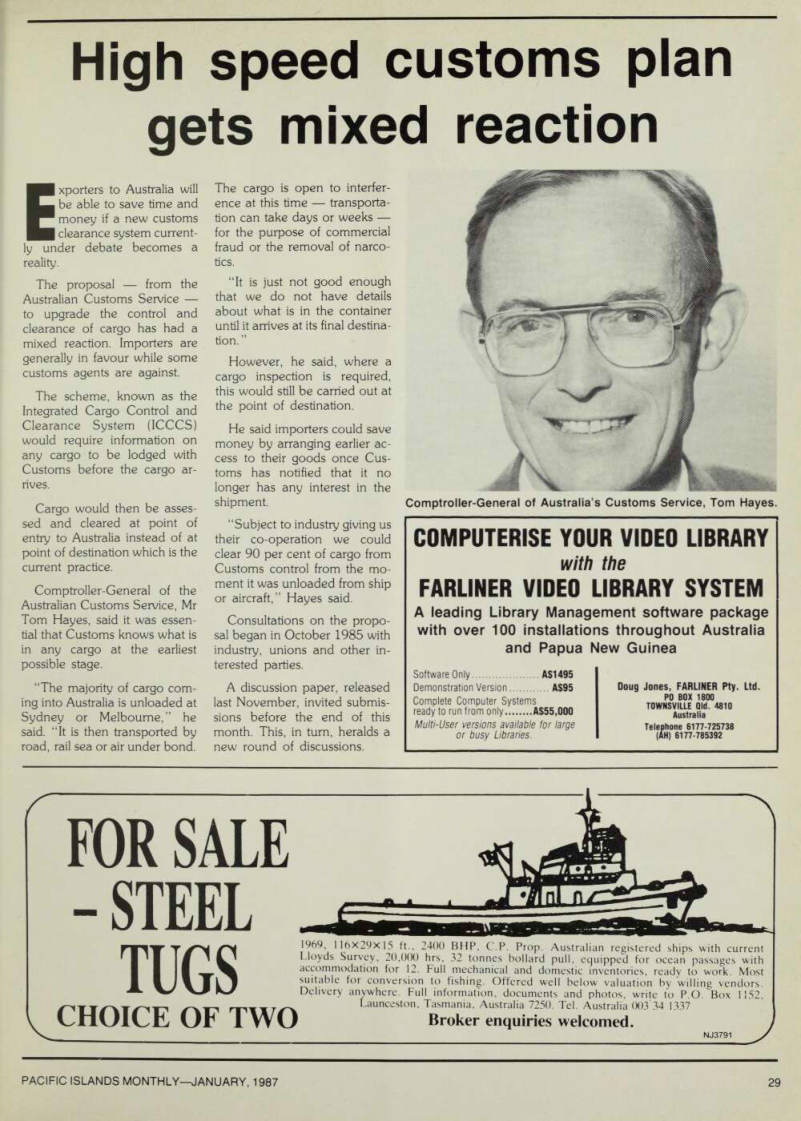
gets mixed reaction
Exporters to Australia will be able to save time and money if a new customs clearance system current ly under debate becomes a reality.
The proposal from the Australian Customs Service to upgrade the control and clearance of cargo has had a mixed reaction. Importers are generally in favour while some customs agents are against.
The scheme, known as the Integrated Cargo Control and Clearance System (ICCCS) would require information on any cargo to be lodged with Customs before the cargo ar rives.
Cargo would then be asses sed and cleared at point of entry to Australia instead of at point of destination which is the current practice.
Comptroller-General of the Australian Customs Service, Mr Tom Hayes, said it was essen tial that Customs knows what is in any cargo at the earliest possible stage.
“The majority of cargo com ing into Australia is unloaded at Sydney or Melbourne,” he said. “It is then transported by road, rail sea or air under bond.
The cargo is open to interfer ence at this time transporta tion can take days or weeks for the purpose of commercial fraud or the removal of narco tics.
“It is just not good enough that we do not have details about what is in the container until it arrives at its final destina tion. ”
However, he said, where a cargo inspection is required, this would still be carried out at the point of destination.
He said importers could save money by arranging earlier ac cess to their goods once Cus toms has notified that it no longer has any interest in the shipment.
“Subject to industry giving us their co-operation we could clear 90 per cent of cargo from Customs control from the mo ment it was unloaded from ship or aircraft,” Hayes said.
Consultations on the propo sal began in October 1985 with industry, unions and other in terested parties.
A discussion paper, released last November, invited submis sions before the end of this month. This, in turn, heralds a new round of discussions.
Comptroller-General of Australia’s Customs Service, Tom Hayes.
Advertisements & other items, pp. 29-31 (1 item)
- Steel
COMPUTERISE YOUR VIDEO LIBRARY
with the
FARLINER VIDEO LIBRARY SYSTEM
A leading Library Management software package
with over 100 installations throughout Australia and Papua New Guinea Software Only A 51495 Demonstration Version AS9S Complete Computer Systems ready to run from only A 555,000 Multi-User versions available for large or busy Libraries.
Doug Jones, FARLINER Pty. Ltd.
PO BOX 1800
TOWNSVILLE Old. 4810
Australia Telephone 6177-725738 (AH) 6177-785392
r v
FOR SALE
- STEEL
TUGS
CHOICE OF TWO
1969, 116X29X15 ft., 2400 BHP, C.P. Prop. Australian registered ships with current Lloyds Survey, 20,000 hrs, 32 tonnes bollard pull, equipped for ocean passages with accommodation for 12. Full mechanical and domestic inventories, ready to work. Most suitable for conversion to fishing. Offered well below valuation by willing vendors.
Delivery anywhere. Full information, documents and photos, write to P.O. Box 1152.
Launceston, Tasmania, Australia 7250. Tel. Australia 003’34 1337 Broker enquiries welcomed.
NJ3791
mao-wigging. Rock-filling, Pa
. ■ * A. %r m ■ A 4 ji j< p i> > HILUX 4WD Regular Cab, Long Wheelbase One tough truck just got tougher. Toyota’s dedication to superior performance vehicles takes a step forward today with the New Hilux.
A refined front grille and bumper design, new instrument panel for a feeling of spaciousness and command and plush colour co-ordinated trim are a few new additions to the New Hilux.
And extensive anti-corrosive galvanealed steel protection now includes the tailgate panel and rear door panel, making Hilux more durable than ever before.
Yet for all its improvements, the best of the original Hilux is also
TOYOTA
QUALITY SERVICE
AMERICAN SAMOA; BURNS PHILP (SOUTH SEA) CO., LTD., P.O. Box 129, Pago Pago. COOK ISLANDS: COOK ISLANII AUTOMOTIVE SUPPLIES COMPANY, A Division of Burns Philp (South Sea) Co., Ltd., G.P.O. Box 355, Suva. GUAM & MIC: Tamuning. KIRIBATI: TARAWA MOTORS, A Division of Bairiki Holdings Ltd., P.O. Box 36, Bairiki, Tarawa. NAURU: NAURU SERVICE IMPORTATION AUTOMOBILE DU PACIFIQUE, Rond-Point du Pacifique (Station Total) B.P. 438, Noumea. NIUE: BIE NORFOLK ISLAND: BORRY’S LIMITED. P.O. Box 169. PAPUA NEW GUINEA: ELA MOTORS, A Division of Burns Philß CORPORATION, P.O. Box 267, Saipan. SOLOMON ISLANDS: SOLOMON ISLANDS INVESTMENTS LTD., G.P.O. Box 140, TONGA; BURNS PHILP (TONGA) LTD., P.O. Box 55, Nukualofa. VANUATU: VANUATU MOTORS, A Division of Burns Philp BURNS PHILP (SOUTH SEA) CO., LTD., P.O. Box 188, Apia.
The New Hllux.
fic-Tougn
2% m v .., „ V 21 I m ► m % I V ■*n« * * >■ %, * p * n \ • r s i- H % , ? ■ l> •* , ere: a big tailgate conveniently hinged for quick loading and unloading; reinforced front suspension to smooth out le bumps, and bias-mounted, extra-heavy-duty rear shocks and knobbly tyres to take on any terrain.
Toyota’s long history of super-responsive engines, ruggedness, reliability and comfort goes without saying. And in the Hilux, it’s yours in both 2-wheel-drive and 4x4 versions.
So, after comprehensive testing and thorough quality control, the New Hilux is ready to bring a new standard of toughness to the Pacific.
And isn’t that exactly what you expect from Toyota?
Areas where galvanealed steel is used DING CORPORATION LTD., Private Bag, Rarotonga. FIJI: SIA: ATKINS KROLL, INC., 443 South Marine Drive,
’ERATIVE SOCIETY, Central Pacific. NEW CALEDONIA:
’HILP (SOUTH SEA) CO., LTD., P.O. Box 39. Alofi.
Ltd., P.O. Box 75. Port Moresby. SAIPAN: MICROL i. TAHITI; NIPPON AUTOMOTO, B.P. 342, Papeete tu) Ltd., P.O. Box 18. Port Vila. WESTERN SAMOA:
TOYOTA
New ship service
creates waves
Anew shipping service linking Australia with the South Pacific is lands and the US west coast has been launched.
It has been inaugurated by ACTA Shipping/PACE Line which is adding three vessels to its container fleet to handle the increased volume of trade ex pected.
PACE Line is offering a regu lar service, with sailings every 17 days from Australia calling at Lautoka, Suva, Honolulu, Vancouver and the US ports of Tacoma, San Francisco and Los Angeles.
Australian ports directly served by the new service are Melbourne, Sydney and Bris bane.
Fiji, and the South Pacific in general, is a new area of interest for ACTA which has appointed Bums, Philp, the leading ship ping agency in Fiji, to handle the service to the island group.
ACTA managing director Mr Christopher Cullen stressed that the company intends to become “aggressively indepen dent” as far as Fiji is concerned and aims to provide specialised services at competitive rates.
“We are confident that one of the first beneficiaries of the devalued (Australian) dollar will be improved trade with the South Pacific region.
“Already there are signs that the stranglehold established in Fiji by Japan is weakening as
our exports become more vi able,” said Cullen.
He said ACTA’s entry into the west coast and South Paci fic market will provide much needed stability in what has in recent years become a volatile area with significant collapses of shipping companies.
“We do not make a major move like this without careful thought,” he said.
“We have a definite interest in the trade through PAD (Paci fic Australia Direct) and noted substantial changes in the pat tern of cargo movements.
“We now have the opportun ity through PACE to cater for those changing circumstances,” said Cullen. “We have done our homework and we are fully committed to the long term in the trade.”
ACTA, he said, was already widely experienced in trading with the US west coast as part of the PAD consortium for the past 17 years.
The company has opened PACE Line offices in San Fran cisco and Los Angeles and plans further representative offices in major ports.
Brendan McCahill has been transferred from PACE New York office to manage the west coast operations while Mike Lusse, who joined the company from PAD, has also been appointed to a senior position.
The new service’s Australia manager is Martin Orchard who was involved in the commence
ment of ACTA’s North America and Canada service as market ing representative. He later moved to PACE Line’s Austra
lian head office becoming trade manager for the PACE east coast North America service in 1980.
The new shipping service between Australia, Fiji and the US nearly failed to get properly underway when an existing route operator sought a court injunction restraining Acta/Pace from providing the service.
Route competitor Sofrana Unilines brought the action two months after Acta announced the new service and the delay was one reason given by the Sydney judge in refusing Sofrana’s application.
Acta had previously been involved in the Fiji trade as a partner in PAD Line.
Acta felt that this partnership which involved Sofrana was due to end in October and that Acta from then on was free to compete on that route.
A spokesman for Acta told PIM: “The two companies couldn’t agree on what the legal position was. We thought we were free agents and Sofrana felt we were still their partner and shouldn’t compete. Finally, four days before we were due to load our first cargo, Sofrana sought an injunction.”
The application was denied on the day when loading was due to begin.
The judge took the view that Sofrana had known for some time that the new service was envisaged and that the timing of the court action would severely damage the defendant.
The court was also at pains to look after the interests of third parties namely the Acta clients who had cargo waiting to be loaded.
An offer by Sofrana to hold their vessel in Sydney and road and rail the Acta cargo from Melbourne and Brisbane was considered impractical.
Sofrana also claimed that Acta was undercutting their rates. However, the court felt that, again, third parties would be disadvantaged if competition was ruled out.
In an unusual move, the judge also awarded costs to Acta.
Advertisements & other items, pp. 32-34 (1 item)
Metropolitan Drilling And Blasting (Fiji) Ltd.
IVe do all Drilling, Blasting and Rock works throughout the South Pacific.
Former Contractors for the Vaturu Dam and the Queens Road, Viti Levu, Fiji Machinery: 850 Compressor ECM 350 Track Drills Portable Gear All equipment is available for hire with an experienced operator, and all jobs insured for Public Liability P.O. Box 27, Pacific Harbour, Deuba, Fiji Phone: Fiji 45338, Telex: FJ3251
mological exhibition
Australia deserves your attendance
1
The i
.Tec^ n °^°^
Ua^ a l n r e^e,
Ca^ 7 N SB7
MWdn 5 ' ’ nna \-fccw The \ote^ a^eaW ve 1
oW^ LS
O ' ,£o ' £Cl R ° N ' CS = wtfJ' oN
O“' CB °^fc^ pOW
SCIB RIF
co»P^ eBS
0N
*OSP* Ct
«»*!£* ov.^e R S S*** 8
%S> eW
Q o ° o ° — Q o O ° O O p\ease p^' on a vTec ßßO ' o9 ' ,£ ) Ra . aval'sr^°.: roa^'O \me u a^°° reQ' s s\^ c\a\ P re □ sp e mV bWfc ° w D c o^ □ f.oOBE 85 P*W cep v
COO^
Con poS' Tote'
Compact
but
big.
It used to be simple. In order to gain the maximum amount of interior space, cars necessarily had to have big bodies.
But then people also wanted compact family cars that were easier to handle and performed better. It came down to making a hard choice. Till Honda decided to challenge this state of affairs. Honda aimed to give people a lot of room in a small car that was easy to handle. So from the very start, Honda designed the Civic Sedan to realize an automotive goal that was considered virtually impossible—going for a compact body that would permit the maximum possible interior space to be realized.
And that's where Honda's MM philosophy makes the difference. It advocates minimum space for mechanisms and maximum space for utility. Honda's no-compromise approach combines superior performance with mechanical parts designed for compactness and high-density integration. Take the 12-valve engine for instance. Engineered for high power, it's also compact, durable, and economical. How about the high-performance suspension?
Light and compact, it takes up minimal space, allowing the car to have a lower, sleeker hood. Honda made the most effective use of available space wherever possible, leaving a generous interior space to ensure passenger comfort. That means plush, roomy seating for four adults with ample legroom for all. Take a look at the trunk. Deep and wide, it opens up right from the bumper line to take all the effort out of loading. Even the rear seatback folds down for extra loading convenience.
The end result is a deceptively orthodox sedan with a significantly higher level of driving enjoyment.
Compact but big. A paradox Honda challenged and solved. The Honda way. 0 c
fiC
4k£l®@ir ©Ml©®
Equipment may vary in some countries. * m i *» n BB H In 1986, Williams/Honda won the Formula I Constructors' Championship. In 1987, Honda's Formula I engines will power both Williams and Lotus. Thus, we will continue to polish our expertise at the pinnacle of automotive technology.
Canon obilll AUSTRALIA: Honda Australia Pty, Ltd. Lot 95 Sharps Road, Tullamarine, Victoria 3043; Bennett Honda Pty, Ltd. 250 Victoria Road, Wetherill Park, N.S.W. 2164/NEWZEALAND: NZMC Limited Manners Plaza, 57-65 Manners St., Wellington/PAPUA NEW GUINEA: Toba Pty, Ltd. PO. Box 503, Port Moresby/TAHITI: Honda Distribution S.A.R.L. B.R 1665, Papeete/KIRIBATI: Atoll Motor & Marino Services PO. Box 49, Bairiki Tarawa, Republic of Kiribati/U.S. TRUST TERRITORY: United Micronesia Development Association RO. Box 235, CHRB Saipan CM 96950/COOK ISLANDS: Cook Islands Motor Centre Ltd. PO. Box 74, Rarotonga/GUAM: Mark’s Motor Co., Inc. PO. Box DV, Agana/WESTERN SAMOA: Motor Distributors (Samoa) Ltd. PO. Box 576, Apia/SOLOMON ISLANDS: Lee Kwok Kuen & Co., Ltd. PO. Box 537 Honiara/NEW CALEDONIA: Societe Du Chalandage 8, Rue de la somme-B.P. 97, Noumea/NAURU: Nauru Cooperation Republic of Nauru/FIJI: Coral Island Motors Ltd. Robertson Road. Suva, Fiji/ AMERICAN SAMOA: Holiday Motors, Parts and Service PO. Box 968, Pago Pago, American Samoa 96799; Heleck’s Service Center Ltd. PO. Box 1138, Pago Pago, American Samoa 96799/TONGA: Tonga Industrial Traders PO. Box 1035, Nukualofa, Tonga/NORFOLK ISLAND: Duncombe Bay Garage New Cascade Road, Norfolk Island/VANUATU: Honda Farm Ltd. PO. Box 1031, Port Vila, Vanuatu
family album
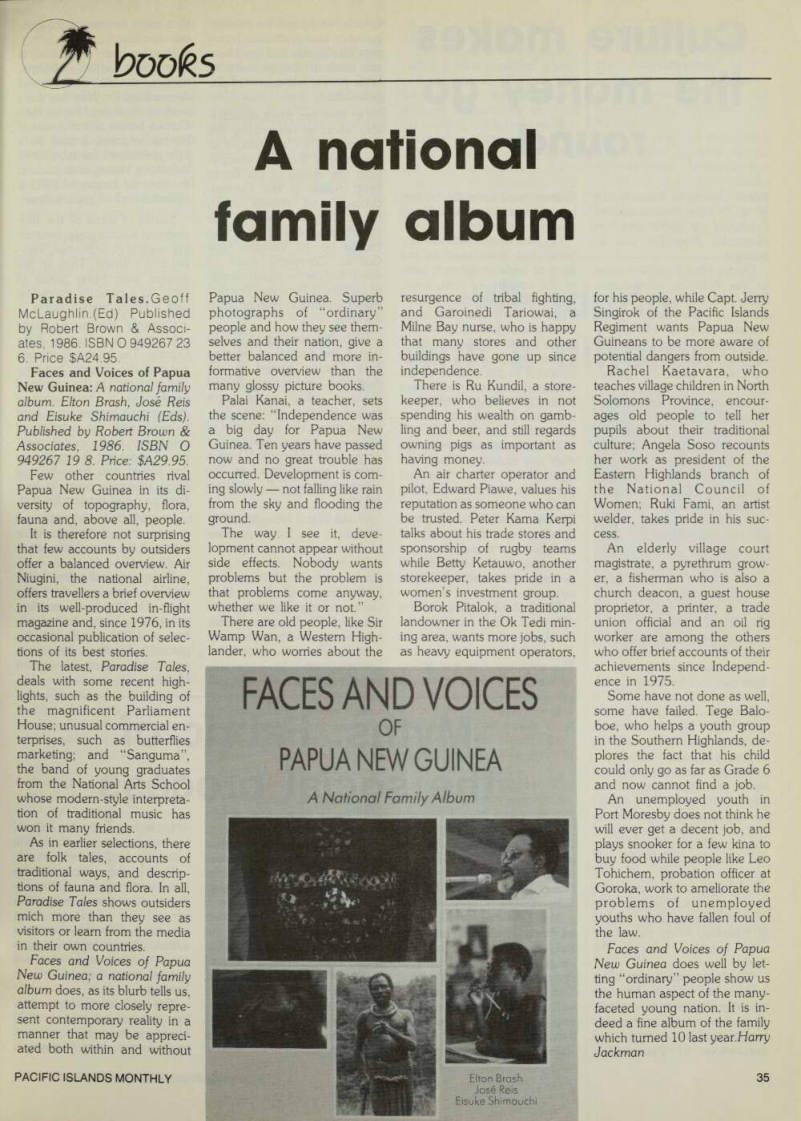
books
A national family album
Paradise Tales. Geoff McLaughlin.(Ed) Published by Robert Brown & Associ ates, 1986. ISBN 0 949267 23 6. Price $A24.95.
Faces and Voices of Papua New Guinea: A national family album. Elton Brash, Jose Reis and Eisuke Shimauchi (Eds).
Published by Robert Brown & Associates, 1986. ISBN O 949267 19 8. Price: $A29.95.
Few other countries rival Papua New Guinea in its di versity of topography, flora, fauna and, above all, people.
It is therefore not surprising that few accounts by outsiders offer a balanced overview. Air Niugini, the national airline, offers travellers a brief overview in its well-produced in-flight magazine and, since 1976, in its occasional publication of selec tions of its best stories.
The latest, Paradise Tales, deals with some recent high lights, such as the building of the magnificent Parliament House; unusual commercial en terprises, such as butterflies marketing; and “Sanguma”, the band of young graduates from the National Arts School whose modern-style interpreta tion of traditional music has won it many friends.
As in earlier selections, there are folk tales, accounts of traditional ways, and descrip tions of fauna and flora. In all, Paradise Tales shows outsiders mich more than they see as visitors or learn from the media in their own countries.
Faces and Voices of Papua New Guinea; a national family album does, as its blurb tells us, attempt to more closely repre sent contemporary reality in a manner that may be appreci ated both within and without
Papua New Guinea. Superb photographs of “ordinary” people and how they see them selves and their nation, give a better balanced and more in formative overview than the many glossy picture books.
Palai Kanai, a teacher, sets the scene: “Independence was a big day for Papua New Guinea. Ten years have passed now and no great trouble has occurred. Development is com ing slowly not falling like rain from the sky and flooding the ground.
The way I see it, deve lopment cannot appear without side effects. Nobody wants problems but the problem is that problems come anyway, whether we like it or not.”
There are old people, like Sir Wamp Wan, a Western High lander, who worries about the
resurgence of tribal fighting, and Garoinedi Tariowai, a Milne Bay nurse, who is happy that many stores and other buildings have gone up since independence.
There is Ru Kundil, a store keeper, who believes in not spending his wealth on gamb ling and beer, and still regards owning pigs as important as having money.
An air charter operator and pilot, Edward Piawe, values his reputation as someone who can be trusted. Peter Kama Kerpi talks about his trade stores and sponsorship of rugby teams while Betty Ketauwo, another storekeeper, takes pride in a women’s investment group.
Borok Pitalok, a traditional landowner in the Ok Tedi min ing area, wants more jobs, such as heavy equipment operators,
for his people, while Capt. Jerry Singirok of the Pacific Islands Regiment wants Papua New Guineans to be more aware of potential dangers from outside.
Rachel Kaetavara, who teaches village children in North Solomons Province, encour ages old people to tell her pupils about their traditional culture; Angela Soso recounts her work as president of the Eastern Highlands branch of the National Council of Women; Ruki Fami, an artist welder, takes pride in his suc cess.
An elderly village court magistrate, a pyrethrum grow er, a fisherman who is also a church deacon, a guest house proprietor, a printer, a trade union official and an oil rig worker are among the others who offer brief accounts of their achievements since Independ ence in 1975.
Some have not done as well, some have failed. Tege Balo boe, who helps a youth group in the Southern Highlands, de plores the fact that his child could only go as far as Grade 6 and now cannot find a job.
An unemployed youth in Port Moresby does not think he will ever get a decent job, and plays snooker for a few kina to buy food while people like Leo Tohichem, probation officer at Goroka, work to ameliorate the problems of unemployed youths who have fallen foul of the law.
Faces and Voices of Papua New Guinea does well by let ting “ordinary” people show us the human aspect of the many faceted young nation. It is in deed a fine album of the family which turned 10 last year .Harry Jackman
Culture makes
the money go round
From Cowrie to Kina: By Dr W. J. D. Mira (limited edition) Published by Spink and Son (Australia). Price $BO plus $5 postage.
Doctor Mira is no newcomer to the field of numismatics.
Many will be familiar with his work in New South Wales colonial currency. His catalo guing and study of Holey Dol lars and Dump has resulted in standard reference guides accepted throughout the numismatic world as standard references. He has many pub lished articles to his credit.
Even for such an eminent numismatist as Dr. Mira to write a book on ‘The Coinages, Currencies, Badges, Medals, Awards, and Decorations of Papua New Guinea’, as he sub-titles the volume is a daun ting task.
Much has been written on some of these areas, including past papers and books by Dr.
Mira. However there have al ways been huge gaps, and a work tying together past studies and new research was overdue.
The title From Cowrie to Kina may not be easily under stood by the layman but it indicates the change in curren cy in Papua New Guinea from the early shell currencies to the decimal currencies of today.
The layman may also not realise the significance of the colour of the cover (I am afraid I had to have it pointed out to me) which features the national colours of Papua New Guinea, red, black and gold. Also fea tured on the front cover is a photograph of the reverse of one of the gold German New Guinea coins featuring the Bird of Paradise, surely one of the most beautiful coins in the world.
Clearly the publication is not a coin catalogue. Dr. Mira has taken great pains to carefully place the coinages, currencies, badges, medals, awards, and decorations of Papua New
Guinea very carefully in his torical context, essential for any study of such items.
Dr. Mira begins with the way barter has been used as the basis of trade in different parts of the country pots, trays, mats and shell ornaments of Tami in the Huon Gulf were used to trade for taro, yams and sweet potato on the mainland.
More complex barter systems operated in the interior of the mainland as coastal goods were passed from village to village in a gradual process until remote penetration was achieved.
In the Sepik, mother of pearl shell was traded over and over again and by the time it had penetrated the interior, it had increased by over 300 per cent.
Dr. Mira spends some pages detailing several of the well known trade routes in opera tion long before the colonial period and the traditional cere monies used.
Many of these currencies are still used today such as the Tambu, made from a cowrie like shell fashioned into strips.
The strips are then joined into ‘fathoms’. A value for these
strips is set against the modem currency kina and toea. Today pigs, shells, axes and even beer are used in the payment of bride prices, settlements of dis putes etc.
Dr. Mira has spent consider able effort in researching the background for the history of the listing of ‘modem currency’ from the issuing of the Bums Philp Notes to the German coinage and private token issues. Included here is the superb issue of gold, silver and bronze by the German New Guinea Company most of which feature the superb design of the Bird of Paradise. The rare pieces command high prices at auctions.
With the passing of World War 1 the control of German New Guinea passed to the Australian Government. Seized German silver coins were melted down to produce Aus tralian coins. The acceptance of the new coins was made easier as the head of George V bore a striking resemblance to the administrator Col. Pether bridge.
World War 2 brought with it the issuing of a limited number of Japanese invasion notes.
Dr. Mira completes this sec tion of his book with reference to the issuing of Papua New Guinea coinage after independ ence in 1975. Coins and notes have been issued from that date bearing distinctive designs.
Special proof coins were also issued including 5, 10 and 100
Kina coins not issued for gen eral circulation.
The remainder of the book is concerned with emblems, badges, medals, awards and decorations. Dr. Mira has done work in this area of Papua New Guinea before and it is one of his pet interests. It may be a little specialised for most PNG collectors. However its place in the colonial history of PNG is essential and of great interest.
Stories of some of the reci pients of awards make fascinat ing reading of dedication, brav ery and courage. They lift the awards from being pieces of metal to a personal encounter with a fellow human being.
Certainly this is a classic reference for Papua New Guinea. The book will interest not only the collector but any one interested in the country. I would like to have seen a clearer map (names were hard to read) with the detailing of some the trade routes men tioned in the text. A history time line would also have been a good reference point to look back on when reading the text.
I would also have liked to see as a summary, a catalogue table listing all the pieces referred to in the book.
These are small points which should not take away the praise due to Dr. Mira for an excellent publication. With a limited edi tion of 1,000 it will, like the pieces it describes, become a
collectors’ item.
Hunter
John
Myths: Fabric of
the social process
Transformation of Polynesian Culture: Ed. Antony Hooper and Judith Huntsman. Pub lished by University Of Hawaii Press, 1986. ISSNOO79-3779.
Price: $24.
The book explores the dy namics of transformation within Polynesian societies from the structuralist perspective. It rep resents high intellectual calibre.
The ten contributors, several of whom are distinguished anthropologists, are intent on exploring the validity of a Polynesian cultural mode and
its permutations.
The belief persists that a parent Polynesian culture ex isted which was then exported to other islands. The Polynesian Islands are scattered over a much broader area than either Melanesia or Micronesia.
Further, Polynesian influ ences have infiltrated parts of both Melanesia (Fiji and Vanuatu) and Micronesia (Kiri bati). The cause of the trans formations within the Polyne sian cultural mode occupy most of the papers.
Ultimately, the query is where power comes from and how it is verified.
Most of the authors are also interested in myth (oral narra tives) as a key to unlocking the structures of Polynesian societies and the transformation within them. Anthropologists have handled myth far more constructively than have most historians.
The latter, except for a grow ing number of ethnographic historians, have often exposed myth to the scrutiny given to
written documents. Given the many gaps and distortions, his torians have then usually re pudiated myth as an invalid source for information.
An anthropologist would answer that perhaps they are looking for the wrong informa tion. As the papers in this book amply demonstrate, what myth does unfold is the social and political process, a way of “organising and interpreting history rather than chronicling it.”
Alan Howard argues in rela tion to his use of recorded oral narratives, collected in 1873: VJe must recognise these texts for what they are residues of living performances, recorded by individuals who had particu lar notions about what was worth recording . . . This is not to say Rotumans are incap able of reporting events accur ately; they do so all the time.
However, the statements re corded by early observers were not of specific events but of presumed usual practice . . .
All of the date . . . including the mythical texts, are relevant for interpreting Rotuman con ceptions of chieftainship and political structure.
Many of the authors in the book use myth and oral narra tive in the same way. Their quest is to understand how political structures were per ceived as working, actually did and the transformations which occurred through time. It is the interplay between these two explorations, the exploration of the diversity of a Polynesian mode and analysis of myth as a means of decoding structures, which provide the basis for the arguments espoused in the book.
Alan Howard compares political structure in Rotuma with the idealised Polynesian model. He notes that in Rotu ma chiefs draw authority from the people and not from defied ancestors.
From his exploration of two myths he develops an argu ment on how this change occurred. Howard sees the cause of this permutation as the interaction between the “cultu ral logic” and a particular en vironment. In small, isolated Rotuma with its medium popu lation, geneologies became truncated. Chiefs were not so distanced from the people; they
were not differentiated enough from each other.
In contrast to larger and more stratified societies such as Ton ga, Hawaii and Tahiti in which all major chiefs traced their ancestry directly to a defied ancestor, Rotuman district chiefs draw their authority more directly from their people.
Valerio Valeri likewise makes a similar exploration. His analy sis of the legend of “Umi” leads him to the conclusion that it is “the expression of some fun damental aspects of Hawaiian kingship and its relationship to society. ” He sees the legend as delineating the process by which a strong man through successful conquest becomes the king selected by the gods.
Adrienne Kaeppler looks to material culture, in particular feathered cloaks and capes, for an understanding of societal transformations. In ancient Hawaii cloaks of heavy mats were worn by all men in battle but the more elaborate feath ered cloaks of the chiefs afforded spiritual as well as physical protection. After Euro pean contact and a new mode of warfare, the cloaks lost their function.
They took on ceremonial and status function. Kaepler be lieves that: Artefacts and works of art are products of human action and interaction and are visual manifestations of social relationships.
Kamehameha signalled a change to a system based on military power rather than to geneological prestige. Stratifica tion increased. The increased number of feathered cloaks in dicates a shift in power which enabled chiefs to commend more and more feathers as taxes.
The colour of the chiefs’ cloaks changed from red (reli gious and status function) to yellow (political symbolism).
Kamehameha’s successors, however, transferred the values of a stratified society to a vague concept of status. The cloaks then gradually became works of art.
Marshall Sahlin’s paper is an analysis of myth from New Zealand and Hawaii, at oppo site ends of the Polynesian Triangle. Sahlins notes that in Hawaii the King redistributed the land among ruling chiefs.
The geneological organisation
of the underlying population was thereby eroded.
In contrast, in New Zealand, clan and tribe remained potent political entities. Sahlins bril liantly traces the differences through examination of ritual on sacrifice in Hawaii and can nibalism in Maori society.
The book has a sting in the tail. All of the authors cited are interested in exploring the transformation of political mod es. All seem to harbor, also, the notion of a distinct Polynesian
entity or structure.
Emund Leach, in his con cluding comments argues that the distinctiveness of the Polynesian culture is a reflec tion of former European atti tudes which expected uni formity.
Am I saying that Polynesia is a subjective figment of the ethnographic immagination which has no basis in objective experienced historical reality?
Not quite, perhaps, but nearly.
Sandra Rennie.
Whodunnit
with a difference
Murder on the Mataniko Bridge. By Ann M. Kengalu.
Published by Dellaponte, P.O.
Box 458, Honiara, Solomon Islands. Price $6 Not far from the Honiara public library is the Mataniko Bridge, a single-lane, wartime structure with a narrow walk way for pedestrians.
There, on a rainy night, when the Mataniko River was brim ming its banks, an expatriate in a peaked cap and a rain coat met a young New Zealand volunteer called Peter Macdo nald, stabbed him, and pushed his body into the river.
The expatriate escaped out to sea in a dinghy with an outboard motor. Next morning, some Ontong Java people found Macdonald’s body on a sandbank at the mouth of the river. Later, $lO,OOO was found in his bank account . . .
Where had Macdonald’s wealth come from, why had he been murdered and who was the expatriate who did him in?
These are the mysteries to be unravelled in Murder on the Mataniko Bridge, a new con tribution to the extremely small shelf of South Seas detective fiction. The author, who lives in Honiara, is a former New Zealander married to an Ontong Java man.
Her thriller is the first to come out of the Solomons since Georgina Seton’s Bring An other Glass of 1944.
The story revolves around Catherine Macdonald, the mur-
der victim’s sister, who goes to the Solomons a couple of years after the murder to try to establish that his wealth was obtained honestly.
The story unfolds briskly, if not always entirely plausibly, with much of it centred on Honiara’s principal meeting place, the Hotel Mendana.
Catherine also goes on a trip to Ontong Java, falls in love with an Anglican missionary, and learns about a rare shell called Cypraea guttata and a theory that the lost “almiranta” of the Spanish explorer Menda na ended its days on an Ontong Java reef.
This is a thriller with a differ ence by a writer of talent. The burgeoning love affair between Catherine and the missionary is especially well described.
Robert Langdon.
Fortune hunters met
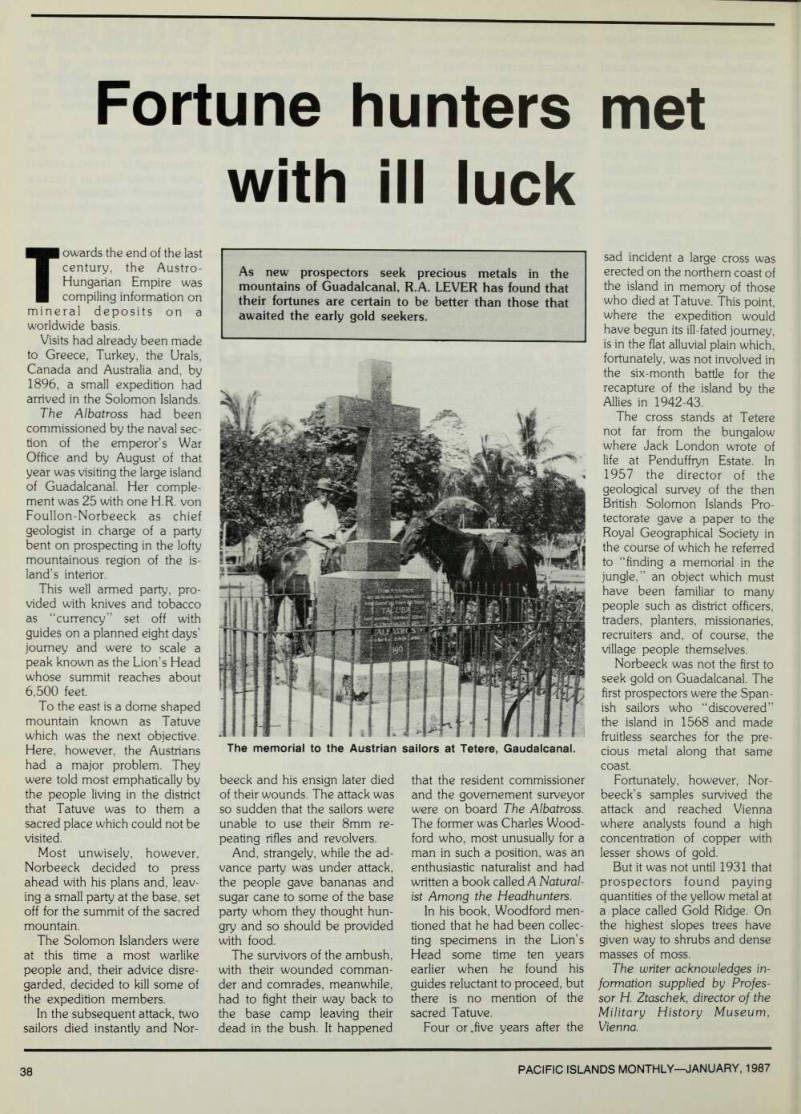
with ill luck
As new prospectors seek precious metals in the mountains of Guadalcanal, R.A. LEVER has found that their fortunes are certain to be better than those that awaited the early gold seekers.
Towards the end of the last century, the Austro- Hungarian Empire was compiling information on mineral deposits on a worldwide basis.
Visits had already been made to Greece, Turkey, the Urals, Canada and Australia and, by 1896, a small expedition had arrived in the Solomon Islands.
The Albatross had been commissioned by the naval sec tion of the emperor’s War Office and by August of that year was visiting the large island of Guadalcanal. Her comple ment was 25 with one H.R. von Foullon-Norbeeck as chief geologist in charge of a party bent on prospecting in the lofty mountainous region of the is land’s interior.
This well armed party, pro vided with knives and tobacco as “currency” set off with guides on a planned eight days’ journey and were to scale a peak known as the Lion’s Head whose summit reaches about 6,500 feet.
To the east is a dome shaped mountain known as Tatuve which was the next objective.
Here, however, the Austrians had a major problem. They were told most emphatically by the people living in the district that Tatuve was to them a sacred place which could not be visited.
Most unwisely, however, Norbeeck decided to press ahead with his plans and, leav ing a small party at the base, set off for the summit of the sacred mountain.
The Solomon Islanders were at this time a most warlike people and, their advice disre garded, decided to kill some of the expedition members.
In the subsequent attack, two sailors died instantly and Nor-
beeck and his ensign later died of their wounds. The attack was so sudden that the sailors were unable to use their Bmm re peating rifles and revolvers.
And, strangely, while the ad vance party was under attack, the people gave bananas and sugar cane to some of the base party whom they thought hun gry and so should be provided with food.
The survivors of the ambush, with their wounded comman der and comrades, meanwhile, had to fight their way back to the base camp leaving their dead in the bush. It happened
that the resident commissioner and the governement surveyor were on board The Albatross.
The former was Charles Wood ford who, most unusually for a man in such a position, was an enthusiastic naturalist and had written a book called A Natural ist Among the Headhunters.
In his book, Woodford men tioned that he had been collec ting specimens in the Lion’s Head some time ten years earlier when he found his guides reluctant to proceed, but there is no mention of the sacred Tatuve.
Four or .five years after the
sad incident a large cross was erected on the northern coast of the island in memory of those who died at Tatuve. This point, where the expedition would have begun its ill-fated journey, is in the flat alluvial plain which, fortunately, was not involved in the six-month battle for the recapture of the island by the Allies in 1942-43.
The cross stands at Tetere not far from the bungalow where Jack London wrote of life at Penduffryn Estate. In 1957 the director of the geological survey of the then British Solomon Islands Pro tectorate gave a paper to the Royal Geographical Society in the course of which he referred to “finding a memorial in the jungle,” an object which must have been familiar to many people such as district officers, traders, planters, missionaries, recruiters and, of course, the village people themselves.
Norbeeck was not the first to seek gold on Guadalcanal. The first prospectors were the Span ish sailors who “discovered” the island in 1568 and made fruitless searches for the pre cious metal along that same coast.
Fortunately, however, Nor beeck’s samples survived the attack and reached Vienna where analysts found a high concentration of copper with lesser shows of gold.
But it was not until 1931 that prospectors found paying quantities of the yellow metal at a place called Gold Ridge. On the highest slopes trees have given way to shrubs and dense masses of moss.
The writer acknowledges in formation supplied by Profes sor H. Ztaschek, director of the Military History Museum, Vienna.
The memorial to the Austrian sailors at Tetere, Gaudalcanal.
On line to the Pacific
The Micronesian Area Re search Centre at the University of Guam is expanding its service to the Pacific with in creased capacities for informa tion retrieval and materials acquisition. This increase is the continuation of growth and de velopment of the centre over the past several years.
In late 1982, a Micronesian Area Tropical Agricultural Data base was established as a co operative project of the Univer sity of Guam’s College of Agri culture and Life Sciences and the Robert F. Kennedy Mem orial Lebrary, and was funded under a grant from the United States Department of Agricul ture.
The major objective of the project was to gather in one location all published and un published documents produced in or about Micronesia concer ning tropical agriculture and related subjects, and to provide bibliographic information retrie val and document dissemina tion services.
The Micronesian Area Re search Centre (MARC) assumed responsibility for the database in 1985 and for the ultimate expansion of the model into a topically compre hensive access tool for the region and for users beyond as well.
“This will eventually be accessable on an international scale”, said Dr. Kenneth Car riveau. “And MARC will be better able to monitor its own usage with this system in place. ”
Interest in the Micronesian region and publications about it have increased exponentially over the past decade. However, access to this information has been restricted because of the nature of the tools themselves; published bibliographies and other databases generally are either topical in scope or limited to a specific geographic region; scholars and students have not
had access to a single, inter disciplinary and comprehensive reference tool to facilitate their studies.
In April 1986 the centre began to receive what has become 900 linear feet of docu ments related to the political, economic, and social changes on Guam. A three year project has begun which will identify, index, and microfilm the papers of Guam’s retired delegate to the US Congress, A.B. Won Pat. It is envisioned that the materials will be available for on-site use early in 1988.
MARC has long been recog nised as one of the area’s great locations of source materials on the Micronesian and Pacific re gion. Its collections consist of approximately 30,000 cata logued volumes, 200 current periodical titles, 20,000 photo graphs, 50,000 negatives, 1.000 slides, 200 sound recor dings, 50 video recordings, 3.000 maps, 400 linear feet of Spanish manuscripts, 100 linear feet of personal papers, 1700 microform units, and 75 drawers of vertical files materials.
MARC’s goal is to acquire, organise, and make available for use, everything that has been published about the re gion. The acquisitions budget for the centre is currently $17,500. However, a substan tial number of documents are acquired each year through gifts and exchanges.
In 1985-86 approximately 8,800 patrons used the collec tions, and they came from all over the world, as well as from around the Pacific.
Today MARC has a new and expanded responsibility in the western Pacific, and indeed, in the entire Pacific as the new Micronesian states in the region attain complete autonomy.
The research service needs of the region have increased and continue to do so. More stu dents from the region are enrol
led at the University of Guam and they become accustomed to using the centre’s facilities.
The various new political lead ers and government officials look to MARC to supply its needs for both historical and contemporary information and statistics.
MARC has one of the most complete map collections in the entire region. There are many still to be catalogued, and many more which are acquired reg ularly. The MARC geographer, Dr. Bruce Karolle, is presently working on a regional atlas.
“This will provide a basic island and place name coverage of Micronesia”, he said when he received a $5,000 grant for a preliminary publication.
Albert Williams and Kenneth Carriveau are the librarians and
they are both together with their staffs swamped with work and requests for informa tion. The new changes in politi cal status in the region have made for an increased volume of queries from all parts of the world.
In addition, the increased numbers of island students now studying their own history and culture in a more formalised way, have added to te work loads.
A good deal of the con temporary journals and periodi cals arc received on exchange.
In this way the centre works closely with the other institu tions in the region on a co operating basis in the exchange of information.
Dirk Anthony Ballendorf
Advertisements & other items, p. 39 (1 item)
117 York St., Sydney.
LOCAL AGENTS AND
REPRESENTATION
Cables: Henco Sydney.
G.P.O. Box 3949.
Telephone: 261 1955.
For specialised and
personalised buying
service throughout
the Pacific Islands
and the East.
Resident Agents in
PAPUA NEW GUINEA
RABAUL: M. 8. C. Seeto, P.O. Box 131, Rabaul.
Telephone 92 2919.
FIJI
K. Witherington Ltd., P.O. Box 293, Suva.
Telephone 22 356.
VANUATU
John Lum & Associates, P.O. Box 65, Santo.
Telephone 329.
SOLOMON ISLANDS
Mr. Ken Szetu, P.O. Box 45, Honiara.
Telephone 22 637. other Pacific Territories
mission
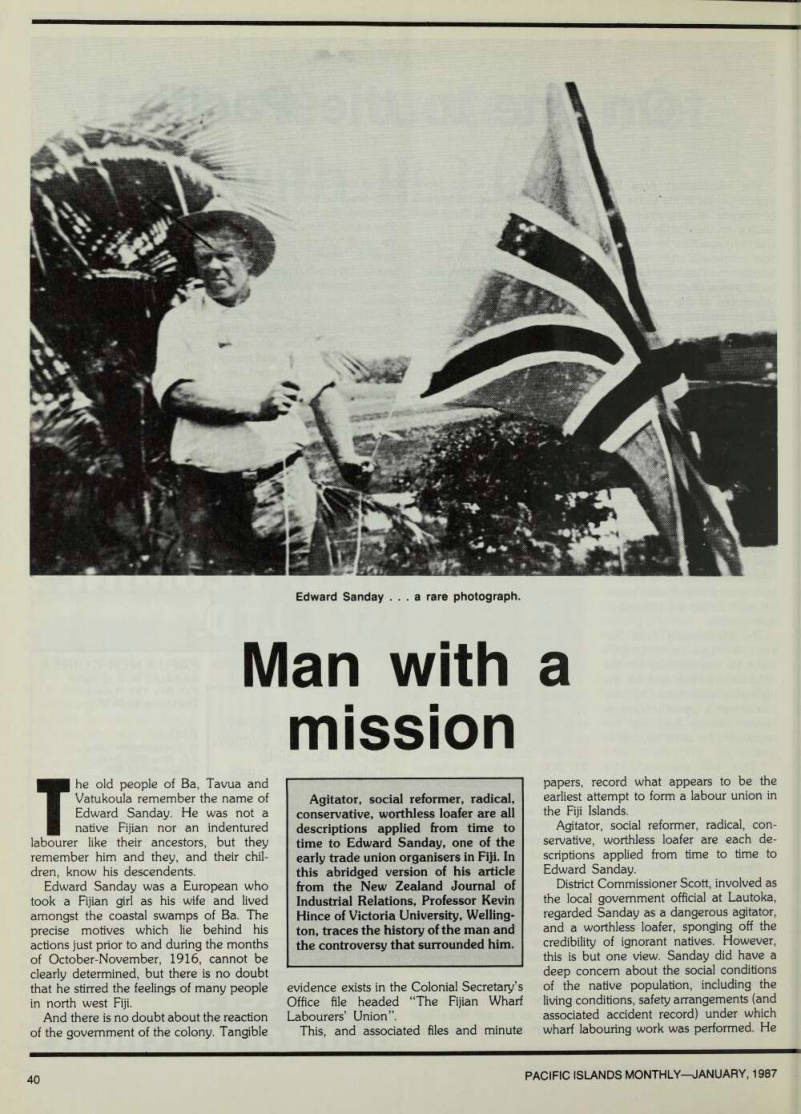
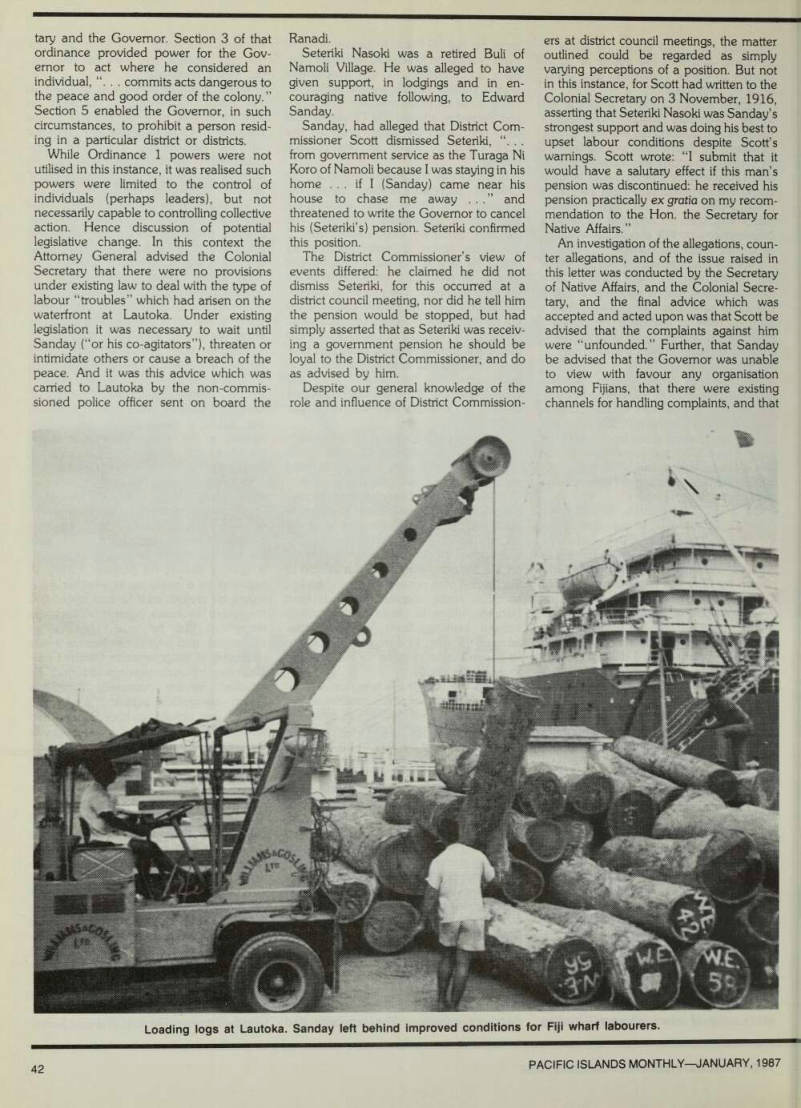

Man with a mission
Agitator, social reformer, radical, conservative, worthless loafer are all descriptions applied from time to time to Edward Sanday, one of the early trade union organisers in Fiji. In this abridged version of his article from the New Zealand Journal of Industrial Relations, Professor Kevin Hince of Victoria University, Welling ton, traces the history of the man and the controversy that surrounded him.
The old people of Ba, Tavua and Vatukoula remember the name of Edward Sanday. He was not a native Fijian nor an indentured labourer like their ancestors, but they remember him and they, and their chil dren, know his descendents.
Edward Sanday was a European who took a Fijian girl as his wife and lived amongst the coastal swamps of Ba. The precise motives which lie behind his actions just prior to and during the months of October-November, 1916, cannot be clearly determined, but there is no doubt that he stirred the feelings of many people in north west Fiji.
And there is no doubt about the reaction of the government of the colony. Tangible
evidence exists in the Colonial Secretary’s Office file headed “The Fijian Wharf Labourers’ Union”.
This, and associated files and minute
papers, record what appears to be the earliest attempt to form a labour union in the Fiji Islands.
Agitator, social reformer, radical, con servative, worthless loafer are each de scriptions applied from time to time to Edward Sanday.
District Commissioner Scott, involved as the local government official at Lautoka, regarded Sanday as a dangerous agitator, and a worthless loafer, sponging off the credibility of ignorant natives. However, this is but one view. Sanday did have a deep concern about the social conditions of the native population, including the living conditions, safety arrangements (and associated accident record) under which wharf labouring work was performed. He
Edward Sanday ... a rare photograph.
was also concerned about the abuse of authority?-including the abuse of native custom to create conformity and obedi ence by native labour.
Sanday sought to form a union, a “Fiji Wharf Labourers Union”. He was a member of the Australian Workers’ Union.
However, he placed limits to his radicalism by refusing to accept the association with that “inexpressible 1.W.W.”, and by indi cating that he would only assist the Fijians if they would, “ ... do things in a white man’s way (i.e.) no angry or unpleasant conversations no talk about punching etc. as is their usual old custom”
Personal characteristics of Sanday which are documented in the Colonial Office records suggest that he was born in Fiji of European parentage. Sanday was, in fact, bom in 1884 in the lower Hawkesbury River region of New South Wales. He was christened Edwin, although sometimes cal led Edward.
He joined his father, William Frederick Sanday in Fiji in 1900, and married a Fijian girl in 1908. He worked for the Colonial Sugar Refining Company (CSR) at Labasa and Ba (and had been discharged from the latter), had lived for some time in the Yasawas and was, in late 1916, living with his Fijian wife at the island of Nanuya in the mangroves near Ba.
On 19 October, 1916, a telephone message was received at the office of the Colonial Secretary in Suva from the District Commission, Lautoka, referring to “trouble” among wharf labourers em ployed by CSR and the Union Steamship Company (USS) as a result of “ . . . actions of a man Sanday”. The report suggested that the wharf may be paralysed, that the labourers were forming a union and demanding 4 shillings for an 8 hour day (the then current rate was 3 shillings a day, 5 shillings night plus provisions for a 12 hour day).
A letter from Sanday (dated 26 October, 1916) to the Governor amplified these complaints and demands as: unwhole some and insufficient food, dangerous working conditions, a request for a lean-to (shed), long tables and forms on the wharf as an eating place, and 4 shillings for 8 hours work.
The District Commissioner also asked for an examination of cables by Sanday from Lautoka to Sydney on 17 October, 1916. This request was then made to the acting superintendent of telegraphs, and the text delivered to the colonial secretary.
The relevant cable was addressed, “Secre tary, Trades Hall, Goulbum Street Syd ney”, and read “Have formed Fiji Wharf Labourers Union. Eight Hours. Can I receive recognition. Sanday.”
On 21 October, 1916 Mr Eva, manager of USS, after receiving a telephone report of a “strike of wharf labourers” loading
sugar on the SS Kauri requested govern ment permission to send 50 labourers from Suva to Lautoka on thr government launch Ranadi (which was scheduled to travel there for other reasons). The Colo nial Secretary advised the Governor that such permission be given, provided the USS Company agree to pay passage money.
In such a way the government could, the Colonial Secretary advised, avoid the accusation of giving direct government assistance to employers of labour. The Colonial Secretary also advised that 6 constables under a non-commissioned officer be sent at the same time by that launch, as temporary reinforcements for the Lautoka police. The Governor agreed.
The police on the Ranadi carried arms but no ammunition. Advice communicated to Inspector Stanlake of Lautoka was that the police should exercise care, that their foremost duty was to preserve peace and good order, but that upon “ . . . any glaring violation of the law the ringleaders should be arrested and the remainder dispersed”
On October 23 the District Commission er, Lautoka, advised the Colonial Secre tary by telegram that the ship was working satisfactorily, and everything was quiet.
That same day District Commissioner, Lautoka, advised the Colonial Secretary to place on record his complaints about Edward Sanday. Scott wrote that Sanday approached the SS Kauri when she arrived on the Saturday evening and a section of the Namoli men refused to work. Sanday, so Scott wrote, induced the men from Nadroga village to return to their village without working. Scott had, he states, advised the men to disregard Sanday, to let communal work stand for the time and to work the vessel.
Given the text of the telegram sent by Scott it appears that at this time the advice of the District Commissioner was accepted; although herein, perhaps lies one basis for the accusation by Sanday of an abuse of native customs by the District Commis sioner.
A memorandum titled “Disaffection amongst the Polynesian and Fijian Labour ers at Lautoka”, dated 8 November 1916, was hand delivered from CSR to the Governor. The memorandum indicated that the company had been paying the “Polynesians” 2 shillings a day for the hours worked on the steamers, and that when no vessels were in port some were offered other work under similar condi tions. The company also provided hut sites and paid the associated hut tax.
Sanday had organised workers to de mand 4 shillings per day, the company had offered 3 shillings but the men did not respond due to, the company asserted, Sanday’s influence. The company had
contemplated evicting the labourers from the huts because they were not working, but feared resistance.
Government response was to telegram the District Commissioner, Lautoka, to instruct him to offer his services to the manager of CSR, Lautoka, as a mediator with the “Polynesians. ” The District Com missioner confirmed that he would act accordingly, but the “Solomon Islanders” adhered to their demands.
In response to the telegram from the Colonial Secretary, the District Commis sioner’s offer of assistance was made, and accepted, by Mr Farquhar, Lautoka mana ger of CSR. The men had “scattered” so Scott sent a “tabua” (whale’s tooth) by “mata” (messenger) to the headman of the Solomon Islanders, asking the headman to come to see Scott the following day. The Bilosi (headman) and 6 others came.
Yagona was presented and Scott pointed out that it was best to work for 3 shillings a day (ss-6d a night), and referred to the threat of eviction. The Bilosi, according to Scott, was prepared to accept but stated a need to see his people.
Sanday, at this time, wrote to Scott asking the (rhetorical) question, “. . . why are you employing so much of the Government time trying to coerce Fijians ... to work for CSR Company 12 hours on the wharf . . ~” and complaining that it was not etiquette for a European to use the tabua.
District Commissioner Scott, clearly took the charges laid by Sanday seriously and sought to defend his position. Firstly, in response to a query as to whether Scott would be prejudiced if he had to act as a magistrate in cases against strikers, he responded that he would not be so influenced, and he did not believe it was necessary to assign another District Com missioner for such hearings. Second, he attacked Sanday personally (worthless loafer, dangerous agitator, etc.), and argued that actions such as Sanday had taken were undermining the confidence of the natives in the administration and were detrimental to the general peace and good order.
Immediately the “trouble” began the possibility of deporting Sanday was consi dered, but when information received indicated that Sanday was Fiji bom this course of action was abandoned. It is, of course, ironic, in retrospect, to ponder on this error of information. Deportation is one of the operational tools utilised by a colonial government whereby a threatened disturbance to the status quo could be minimised. Invocation of existing legislative controls, the involvement of the police and discussion of legislative change were other such means involved in this particular case.
The possibility of using Ordinance 1 of 1875 was discussed in memoranda invol ving the Attorney General, Colonial Secre
tary and the Governor. Section 3 of that ordinance provided power for the Governor to act where he considered an individual, “... commits acts dangerous to the peace and good order of the colony. ”
Section 5 enabled the Governor, in such circumstances, to prohibit a person residing in a particular district or districts.
While Ordinance 1 powers were not utilised in this instance, it was realised such powers were limited to the control of individuals (perhaps leaders), but not necessarily capable to controlling collective action. Hence discussion of potential legislative change. In this context the Attomey General advised the Colonial Secretary that there were no provisions under existing law to deal with the type of labour “troubles” which had arisen on the waterfront at Lautoka. Under existing legislation it was necessary to wait until Sanday (“or his co-agitators”), threaten or intimidate others or cause a breach of the peace. And it was this advice which was carried to Lautoka by the non-commissioned police officer sent on board the
Ranadi.
Seteriki Nasoki was a retired Buli of Namoli Village. He was alleged to have given support, in lodgings and in encouraging native following, to Edward Sanday.
Sanday, had alleged that District Commissioner Scott dismissed Seteriki, . . from government service as the Turaga Ni Koro of Namoli because I was staying in his home ... if I (Sanday) came near his house to chase me away ...” and threatened to write the Governor to cancel his (Seteriki’s) pension. Seteriki confirmed this position.
The District Commissioner’s view of events differed: he claimed he did not dismiss Seteriki, for this occurred at a district council meeting, nor did he tell him the pension would be stopped, but had simply asserted that as Seteriki was receiving a government pension he should be loyal to the District Commissioner, and do as advised by him.
Despite our general knowledge of the role and influence of District Commission-
ers at district council meetings, the matter outlined could be regarded as simply varying perceptions of a position. But not in this instance, for Scott had written to the Colonial Secretary on 3 November, 1916, asserting that Seteriki Nasoki was Sanday’s strongest support and was doing his best to upset labour conditions despite Scott’s warnings. Scott wrote; “I submit that it would have a salutary effect if this man’s pension was discontinued: he received his pension practically ex gratia on my recom mendation to the Hon. the Secretary for Native Affairs.”
An investigation of the allegations, coun ter allegations, and of the issue raised in this letter was conducted by the Secretary of Native Affairs, and the Colonial Secre tary, and the final advice which was accepted and acted upon was that Scott be advised that the complaints against him were “unfounded.” Further, that Sanday be advised that the Governor was unable to view with favour any organisation among Fijians, that there were existing channels for handling complaints, and that
Loading logs at Lautoka. Sanday left behind improved conditions for Fiji wharf labourers.
the Governor believed that this was not the time for “fomenting dissatisfaction,” “de precate (d) any action which may lead to strikes and to disturbance,” and that the action taken by Sanday was “. . . danger ous to the peace and order of the colony. ”
Later, Seteriki was advised that his pension had been granted in the usual way, and there were not sufficient grounds to withdraw that pension.
Associated with these events is the notion of a union. The name Fiji Wharf Labourers Union has been referred to; Sanday has been named as and has claimed to be the organiser, and he had made contact with the Australian trade union movement. Demands and threats were made in mid-October (and the Ranadi with labourers and police was sent to Lautoka), and further troubles (the withdrawal of labour by the Solomon Islanders and the intervention of the District Commissioner) occurred in early November.
Sanday registered (and appears to have been motivated by) concern with the condition of work on the wharf, in terms of both exploitation and safe working . .
Black Slavery . . . carried on here at CSR Company’s and USS Company’s wharf,” . . toiling 12 hours . . ~” . . been several Fijian and Solomon boys killed or crippled for life.”
Sanday asserted that Fijians at Namoli asked him about the principles and found ations of a union to defend British rights, and had begged him to be organiser.
District Commissioner Scott’s interpreta tion is quite different, but the attempt to organise and cause disruption of work tasks is common to both views.
The reality or the unreality of the conditions of work, the validity or invalidity of positions at the time, need not be debated. It is clear that beliefs, either felt by the natives or articulated by Sanday, provided a basis for the actions. And disturbances and collective action occurred as a result.
The notion of a “union” subscription is implied in the context of a 10 shilling entrance fee payable to Sanday. His role as a “paid organiser” is implied in refer ences to his followers giving him four shillings per week “. . .to endeavour to get their pay raised”. Such monetary amounts were also a basis for allegations by District Commissioner Scott, that San day was “feathering his own nest”.
The reaction to “unionisation” included sending additional labour, sending police reinforcements, examining the possibility of deporting or restricting the movement of leaders, awaiting the “false” move or “threat” or “intimidation” by leaders, the examination of all existing legislative con trols, and the consideration of new legisla tion.
In the final context the recognition of a new dimension of labour problems the union is best illustrated by the com munications between CSR management and government, and the meeting and discussions between Hedstrom, H. M.
Scott, the Governor and the Attorney General.
Before concluding this discussion, which has highlighted the concept of “union” within the totality of actions of the period, it is interesting, if not imperative, to mention two other items.
First, Sanday’s membership of the AWU an his expressed horror at the possible association of his name with the IWW have been mentioned. In the same minute paper (dated October 20, 1916) in which the Colonial Secretary discusses Sanday’s union membership there is a reference stating that: “Mr Eva mentioned to me (the Colonial Secretary) that there is a Mr McMillan in Suva who is supposed to be an agent for the Australian Worker’s Union”.
McMillan, however, whilst he was en route to Sydney, carried documents of U.S. citizenship. Given such identification, the time period and Sanday’s gratuitous reference, it is possible that McMillan was a representative or member of the IWW rather than the AWU, and that his pre sence in Fiji is coincidental. Although the link is far too tenuous to suggest other than a need for further investigation, it is interesting to note the reference in lan Turner’s Sydneys Burning to a Tom McMillan organising for the IWW in West ern Australia in 1914.
Second, in his letter of November 11, 1916 Sanday, inter alia, warns of trouble which might take place, “. . .if the head office of CSR company in Sydney does not abide by our reasonable demands”. The lack of confidence in local management, the conviction that authority lay offshore was to be a continual feature of labour relations in the sugar industry, waterfront, and later other industries (oil, airlines, travel, etc.) in Fiji. Similar concern has also emerged in more sophisticated industrial relations systems where transnational corporations operate.
Reactions to the beginnings of labour troubles and union activity reflect the relationship between commercial interests and the colonial government, and the style and process of colonial government when under challenge.
Gillion assesses the relationship of the CSR company to the colonial government, in or about this period, in the following terms: . . . the role of the CSR company in the determination of the policy of the Fiji Government was undoubtedly an impor tant role, although it was not as great as popularly believed in Fiji today to have been. It is true that the company was directly or indirectly responsible for a
Advertisements & other items, pp. 43-46 (1 item)
Go to the Head of the Class
X-770
Shetf Component Systems
Move up to New Personna Plus from Pioneer.
And put compact, advanced audio technology at your fingertips.
With the X-770, you’ll enjoy full-function remote control for amp, tuner, cassette deck, turntable, and even an optional CD player.
There’s Stereo Wide for expanded ambience from stereo signals plus Simulated Stereo for wide, stereo-like signals from even mono
signals.
And for power, the X-770 puts out a full X-330 *h*. 320 W (PMPO) to give you a full,
high-fidelity sound.
The X-770 also brings you great features like Mic Mixing, Dolby* B/C NR, and a 5-band graphic equalizer. A double auto-reverse cassette deck offers added listening convenience and tape dubbing. Also available are the more economical Systems / X-330 and X-110. * ..
The New Personna Plus from Pioneer. A class act in home audio convenience and enjoyment.
X-110 * “Dolby" and the double-D symbol are trademarks of Dolby Laboratories Licensing Corporation.
Nofe: The optional PD-X707(8K) CD player is shown above.
C.D PIONEER’
The future of sound and vision.
For further information, please contact: Australia; Pioneer Electronics Australia Pty. Ltd. (Incorporated in Victoria) p 9 Box 295 ’ Mordialloc, Victoria, 3195 Tel: 580-9911 Fiji Islands: Brijlal & Company, G.P.O. Box No. 362, Suva, Fiji Islands TeL 22258 New Zealand: Monaco Distributors Ltd., 2 Poland Road, Glenfield, Auckland New Zealand Tel; (09) 444-9144 Norfolk Island: Burnt Pine Traders Ltd., P.O. Box 21, Norfolk Island Vanuatu: Burns Philp (Vanuatu) Ltd., Vila, Vanuatu Nauru Island: Jacob Enterprises, P.O. Box N 0.4, Republic of Nauru Tahiti: Tahiti Hi-Fi, P.O. Box 848, Papeete, Tahiti New Caledonia: Menard Pacifique Sari, B.P. 3899, Noumea, New Caledonia Tel: 27*62.23 American Samoa: Transpac Corporation, P.O. Box 1477, Pago Pago, American Samoa 96799 Tel; 633-5224 Rarotonga: South Seas International Ltd., P.O. Box 49, Rarotonga, Cook Islands Tel: 2327
m % ;\ :•* rtr- - Sf:C vrc
OiG’T/?'-
ON SCWi'M IW«
NEC —at the forefront of the revolution
in digital home entertainment
With today's revolution in digital technology, there's only one name to trust to bring this revolution home - NEC. NEC is a leader in digital technology for everything from communications satellites to professional studio equipment. We put this same dedication to quality and innovation in our products made for the home to give you the utmost in performance.
In our Digital Monitor Receiver, advanced digital technology has made possible amazing conveniences like "picture in N9610A N9040A VHS HQ Hi-Fi VCR with “Double Azimuth” Four Head System Crisp picture and hi-fi sound are combined with steady noise-free special effects. WfM VHS HQ Stereo VCR With HQ video and stereo, both sound and picture are beyond comparison. picture" and still picture features. Our Digital VCR uses digital noise reduction technology to give you an extremely clear picture at any speed and features like digital picture memory.
The AVD-700 further enhances your entertainment system by adding natural, precise and low-noise surround sound effects,
using NEC-developed digital delay circuitry.
So if you're wondering what the digital revolution means to you, NEC has the answer.
N9034A
VHS HQ VCR
Incorporates the new HQ video system for visibly enhanced picture quality. Unified remote for both VCR and NEC TV.
VHS
SEC
International Home Electronics Division, NEC Building, 33-1, Shiba 5-chome, Minato-ku, Tokyo 108, JAPAN Telephone: Tokyo 03-456-3111- Cable: NEC TOKYO Telex: NECTOK J 22686
considerable proportion of the colony’s
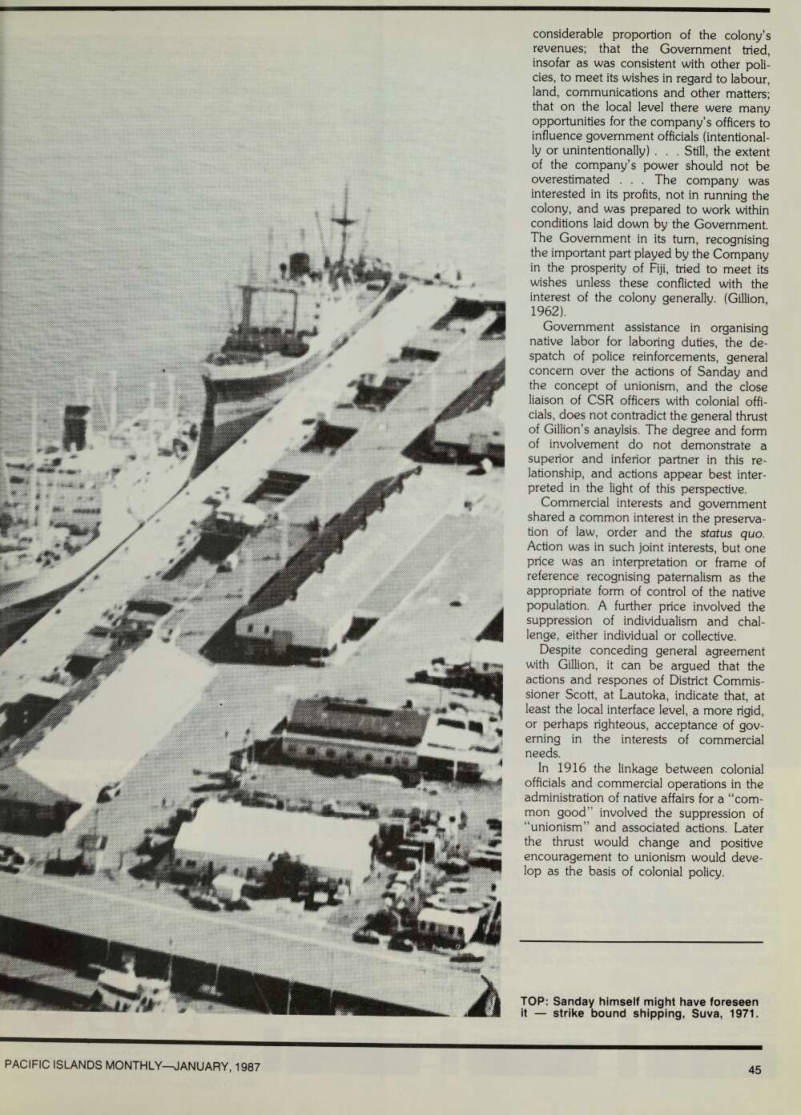
revenues; that the Government tried, insofar as was consistent with other poli cies, to meet its wishes in regard to labour, land, communications and other matters; that on the local level there were many opportunities for the company’s officers to influence government officials (intentional ly or unintentionally) . . . Still, the extent of the company’s power should not be overestimated . . . The company was interested in its profits, not in running the colony, and was prepared to work within conditions laid down by the Government.
The Government in its turn, recognising the important part played by the Company in the prosperity of Fiji, tried to meet its wishes unless these conflicted with the interest of the colony generally. (Gillion, 1962).
Government assistance in organising native labor for laboring duties, the de spatch of police reinforcements, general concern over the actions of Sanday and the concept of unionism, and the close liaison of CSR officers with colonial offi cials, does not contradict the general thrust of Gillion’s anaylsis. The degree and form of involvement do not demonstrate a superior and inferior partner in this re lationship, and actions appear best inter preted in the light of this perspective.
Commercial interests and government shared a common interest in the preserva tion of law, order and the status quo.
Action was in such joint interests, but one price was an interpretation or frame of reference recognising paternalism as the appropriate form of control of the native population. A further price involved the suppression of individualism and chal lenge, either individual or collective.
Despite conceding general agreement with Gillion, it can be argued that the actions and respones of District Commis sioner Scott, at Lautoka, indicate that, at least the local interface level, a more rigid, or perhaps righteous, acceptance of gov erning in the interests of commercial needs.
In 1916 the linkage between colonial officials and commercial operations in the administration of native affairs for a “com mon good” involved the suppression of “unionism” and associated actions. Later the thrust would change and positive encouragement to unionism would deve lop as the basis of colonial policy.
TOP: Sanday himself might have foreseen it - strike bound shipping, Suva, 1971.
transitions
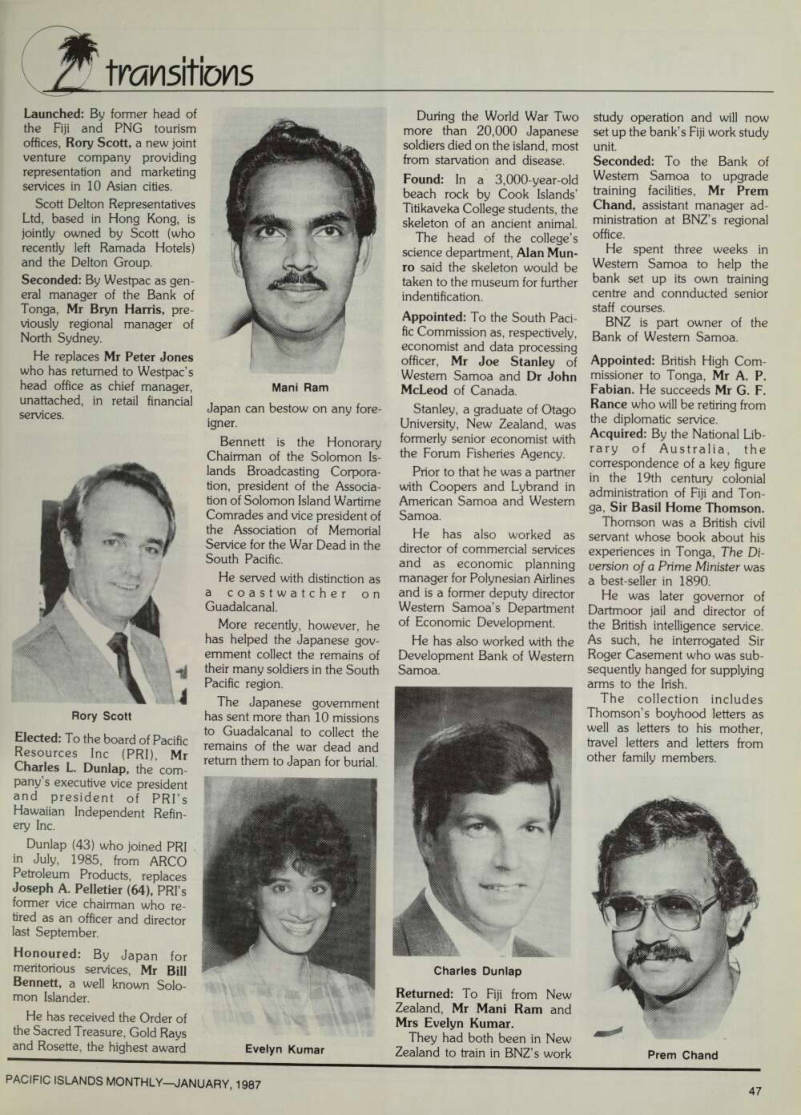
Launched: By former head of the Fiji and PNG tourism offices, Rory Scott, a new joint venture company providing representation and marketing services in 10 Asian cities.
Scott Delton Representatives Ltd, based in Hong Kong, is jointly owned by Scott (who recently left Ramada Hotels) and the Delton Group.
Seconded: By Westpac as gen eral manager of the Bank of Tonga, Mr Bryn Harris, pre viously regional manager of North Sydney.
He replaces Mr Peter Jones who has returned to Westpac’s head office as chief manager, unattached, in retail financial services.
Elected: To the board of Pacific Resources Inc (PRI), Mr Charles L. Dunlap, the com pany’s executive vice president and president of PRl’s Hawaiian Independent Refin ery Inc.
Dunlap (43) who joined PRI in July, 1985, from ARCO Petroleum Products, replaces Joseph A. Pelletier (64), PRl’s former vice chairman who re tired as an officer and director last September.
Honoured: By Japan for meritorious services, Mr Bill Bennett, a well known Solo mon Islander.
He has received the Order of the Sacred Treasure, Gold Rays and Rosette, the highest award
Japan can bestow on any fore igner.
Bennett is the Honorary Chairman of the Solomon Is lands Broadcasting Corpora tion, president of the Associa tion of Solomon Island Wartime Comrades and vice president of the Association of Memorial Service for the War Dead in the South Pacific.
He served with distinction as a coastwatcher on Guadalcanal.
More recently, however, he has helped the Japanese gov ernment collect the remains of their many soldiers in the South Pacific region.
The Japanese government has sent more than 10 missions to Guadalcanal to collect the remains of the war dead and return them to Japan for burial.
During the World War Two more than 20,000 Japanese soldiers died on the island, most from starvation and disease.
Found: In a 3,000-year-old beach rock by Cook Islands’
Titikaveka College students, the skeleton of an ancient animal.
The head of the college’s science department, Alan Mun ro said the skeleton would be taken to the museum for further indentification.
Appointed: To the South Paci fic Commission as, respectively, economist and data processing officer, Mr Joe Stanley of Western Samoa and Dr John McLeod of Canada.
Stanley, a graduate of Otago University, New Zealand, was formerly senior economist with the Forum Fisheries Agency.
Prior to that he was a partner with Coopers and Lybrand in American Samoa and Western Samoa.
He has also worked as director of commercial services and as economic planning manager for Polynesian Airlines and is a former deputy director Western Samoa’s Department of Economic Development.
He has also worked with the Development Bank of Western Samoa.
Returned: To Fiji from New Zealand, Mr Mani Ram and Mrs Evelyn Kumar.
They had both been in New Zealand to train in BNZ’s work
study operation and will now set up the bank’s Fiji work study unit.
Seconded: To the Bank of Western Samoa to upgrade training facilities, Mr Prem Chand, assistant manager ad ministration at BNZ’s regional office.
He spent three weeks in Western Samoa to help the bank set up its own training centre and connducted senior staff courses.
BNZ is part owner of the Bank of Western Samoa.
Appointed: British High Com missioner to Tonga, Mr A. P.
Fabian. He succeeds Mr G. F.
Ranee who will be retiring from the diplomatic service.
Acquired: By the National Lib rary of Australia, the correspondence of a key figure in the 19th century colonial administration of Fiji and Ton ga, Sir Basil Home Thomson.
Thomson was a British civil servant whose book about his experiences in Tonga, The Di version of a Prime Minister was a best-seller in 1890.
He was later governor of Dartmoor jail and director of the British intelligence service.
As such, he interrogated Sir Roger Casement who was sub sequently hanged for supplying arms to the Irish.
The collection includes Thomson’s boyhood letters as well as letters to his mother, travel letters and letters from other family members.
Rory Scott
Mani Ram
Evelyn Kumar
Charles Dunlap
Prem Chand
Deaths

Ratu Napolioni Dawai. The Tui Nadi died when his car struck a power pole near Nadi airport on November 17.
He was driving with his son, Ratu Navula and grandson Ratu Josefa Senator Ratu Napolioni Dawai had a long career as a civil servant, soldier and politic j an A keen sportsman, he was an enthusiastic rugby player and was closely connected with the Nadi rugby side.
He was for a long time the Roko Tui Ba and later became chairman of the Ba Provincial Council. It was then that he began work on the $1.3 million council complex opened by the prime minister last October.
His abiding concern had always been the development of the Western Division and it was over this issue that he made a dramatic exit from the Alliance Party in 1981 after criticising the government for what he called its neglect of the west.
Ratu Napolioni first entered parliament in April, 1977 when he won the Ba-Nadi Fijian communal seat for the Alliance with a large majority over Ratu Mosese Tuisawau.
After leaving the Alliance Party, he joined the Western United Front but lost his seat to the Alliance’s Mr Apisai Tora in the 1982 general election.
He was nominated by the Opposition to the senate shortly afterwards.
He leaves a widow and seven children. Ratu Napolioni was 65.
Anna Maria Christian, who was born on Norfolk Island in 1899, died in hospital on Octo ber 19.
She was one of the six children of James Adams and Amy Caroline (nee Christian), She married Benjamin Christian, who died several years ago, in 1941.
Her only child, daughter Hydie Narrell, returned to Nor folk from Australia for the funeral.
Panditamayal Sharma, retired headmaster and priest, died in
Suva aged 76 on November 5.
He taught in several schools on Viti Levu and also served as a visiting teacher in the Western Division.
After his education he work ed as a printer at Pacific Press Ltd and later became a teacher with the Methodist Mission School in Toorak, Suva.
He retired, after a distin guished career, as headmaster at Samabula Government School.
After his retirement, Pandit Sharma was involved in reli gious affairs as a Sanatan Dhar am priest.
He is survived by four sons, four daughters and several grandchildren.
Jack Fraser, a former long time resident of Norfolk Island died in New Zealand, aged 84 on October 12.
Mr Fraser and his wife Edith were married on the island and their four sons attended the Central School.
He was formerly a successful farmer on Norfolk and in his younger days was a keen foot baller.
He was awarded a medal for bravery after attempting to save the life of another islander in a well accident.
Kollie dc Roburt, the wife of the president of Nauru, Mr Hammer de Roburt died in Australia on November 11.
Dalipa Mahajan owner of Tacirua Transport Ltd died at the War Memorial Hospital in Suva on November 22. He was 95.
A pioneer of the Suva bus industry, Mr Mahajan started his service between Suva and Tamavua in 1936.
He built the business over the years from a single bus to the fleet of 38 that he left.
He was bom in Jallandar, Punjab and came to Fiji in 1914.
He was a supporter of many religious and educational insti tutes and was for many years president of the Samabula Sikh temple.
Mr Mahajan is survived by his wife Shiu Raji, nine children, six sons and three daughters and
23 grandchildren.
Advertisements & other items, pp. 48-49 (1 item)
The Total Test Equipment Solution
AWA
I 1
wviaiWiiiiiuiik'iii'Mm
of \ a / .ru AUU A
Wftrr AWA,
obte P r yo ur le of t pos SI ran marcom instruments Tfektronix eauioment to suit v ou every d s.
day
TTI
romises m o r e com l choices st ,«.r o ealancl Limited (A New *f total commiimcat ons I ny r cf, Watu Bay 37 Fr
PO B
a Phone 312744 Suv
ANSE
Te ex FJ2347 Ciblas “EXP Suva
FLUKE
HITACHI
Fax (Q79)3t437S
11111 i m 1111 11u
ILU
mm'7s
■m i n S !(5 B
TRADITIONALLY THE NAME
ASSOCIATED WITH PERFECTION
IN CIGARETTES
BENSON & HEDGES
20
Benson w Hedges
WMNiNG-SMOKING IS A HEALTH HAZARD
Pacific Stamp box
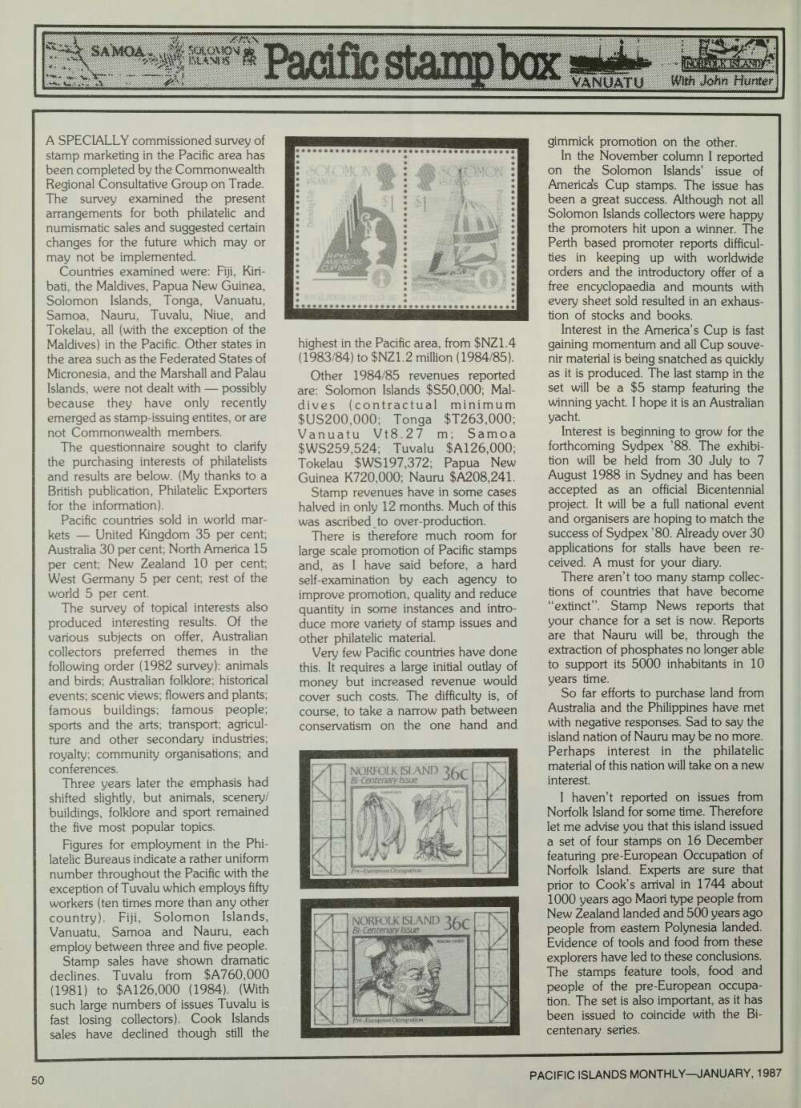
A SPECIALLY commissioned survey of stamp marketing in the Pacific area has been completed by the Commonwealth Regional Consultative Group on Trade.
The survey examined the present arrangements for both philatelic and numismatic sales and suggested certain changes for the future which may or may not be implemented.
Countries examined were: Fiji, Kiri bati, the Maldives, Papua New Guinea, Solomon Islands, Tonga, Vanuatu, Samoa, Nauru, Tuvalu, Niue, and Tokelau, all (with the exception of the Maldives) in the Pacific. Other states in the area such as the Federated States of Micronesia, and the Marshall and Palau Islands, were not dealt with possibly because they have only recently emerged as stamp-issuing cntites, or are not Commonwealth members.
The questionnaire sought to clarify the purchasing interests of philatelists and results are below. (My thanks to a British publication, Philatelic Exporters for the information).
Pacific countries sold in world mar kets United Kingdom 35 per cent; Australia 30 per cent; North America 15 per cent; New Zealand 10 per cent; West Germany 5 per cent; rest of the world 5 per cent.
The survey of topical interests also produced interesting results. Of the various subjects on offer, Australian collectors preferred themes in the following order (1982 survey): animals and birds; Australian folklore; historical events; scenic views; flowers and plants; famous buildings; famous people; sports and the arts; transport; agricul ture and other secondary industries; royalty; community organisations; and conferences.
Three years later the emphasis had shifted slightly, but animals, scenery/ buildings, fol Wore and sport remained the five most popular topics.
Figures for employment in the Phi latelic Bureaus indicate a rather uniform number throughout the Pacific with the exception of Tuvalu which employs fifty workers (ten times more than any other country). Fiji, Solomon Islands, Vanuatu, Samoa and Nauru, each employ between three and five people.
Stamp sales have shown dramatic declines. Tuvalu from $A760,000 (1981) to $A126,000 (1984). (With such large numbers of issues Tuvalu is fast losing collectors). Cook Islands sales have declined though still the
highest in the Pacific area, from SNZI.4 (1983/84) to SNZI.2 million (1984/85).
Other 1984/85 revenues reported are: Solomon Islands $550,000; Mal dives (contractual minimum $US200,000; Tonga $T263,000; Vanuatu Vt 8.27 m; Samoa $W5259,524; Tuvalu $A126,000; Tokelau $W5197,372; Papua New Guinea K 720,000; Nauru $A208,241.
Stamp revenues have in some cases halved in only 12 months. Much of this was ascribed To over-production.
There is therefore much room for large scale promotion of Pacific stamps and, as I have said before, a hard self-examination by each agency to improve promotion, quality and reduce quantity in some instances and intro duce more variety of stamp issues and other philatelic material.
Very few Pacific countries have done this. It requires a large initial outlay of money but increased revenue would cover such costs. The difficulty is, of course, to take a narrow path between conservatism on the one hand and
gimmick promotion on the other.
In the November column I reported on the Solomon Islands’ issue of America’s Cup stamps. The issue has been a great success. Although not all Solomon Islands collectors were happy the promoters hit upon a winner. The Perth based promoter reports difficul ties in keeping up with worldwide orders and the introductory offer of a free encyclopaedia and mounts with every sheet sold resulted in an exhaus tion of stocks and books.
Interest in the America’s Cup is fast gaining momentum and all Cup souve nir material is being snatched as quickly as it is produced. The last stamp in the set will be a $5 stamp featuring the winning yacht. I hope it is an Australian yacht.
Interest is beginning to grow for the forthcoming Sydpex ’BB. The exhibi tion will be held from 30 July to 7 August 1988 in Sydney and has been accepted as an official Bicentennial project. It will be a full national event and organisers are hoping to match the success of Sydpex ’BO. Already over 30 applications for stalls have been re ceived. A must for your diary.
There aren’t too many stamp collec tions of countries that have become “extinct”. Stamp News reports that your chance for a set is now. Reports are that Nauru will be, through the extraction of phosphates no longer able to support its 5000 inhabitants in 10 years time.
So far efforts to purchase land from Australia and the Philippines have met with negative responses. Sad to say the island nation of Nauru may be no more.
Perhaps interest in the philatelic material of this nation will take on a new interest.
I haven’t reported on issues from Norfolk Island for some time. Therefore let me advise you that this island issued a set of four stamps on 16 December featuring pre-European Occupation of Norfolk Island. Experts are sure that prior to Cook’s arrival in 1744 about 1000 years ago Maori type people from New Zealand landed and 500 years ago people from eastern Polynesia landed.
Evidence of tools and food from these explorers have led to these conclusions.
The stamps feature tools, food and people of the pre-European occupa tion. The set is also important, as it has been issued to coincide with the Bi centenary series.
yachts
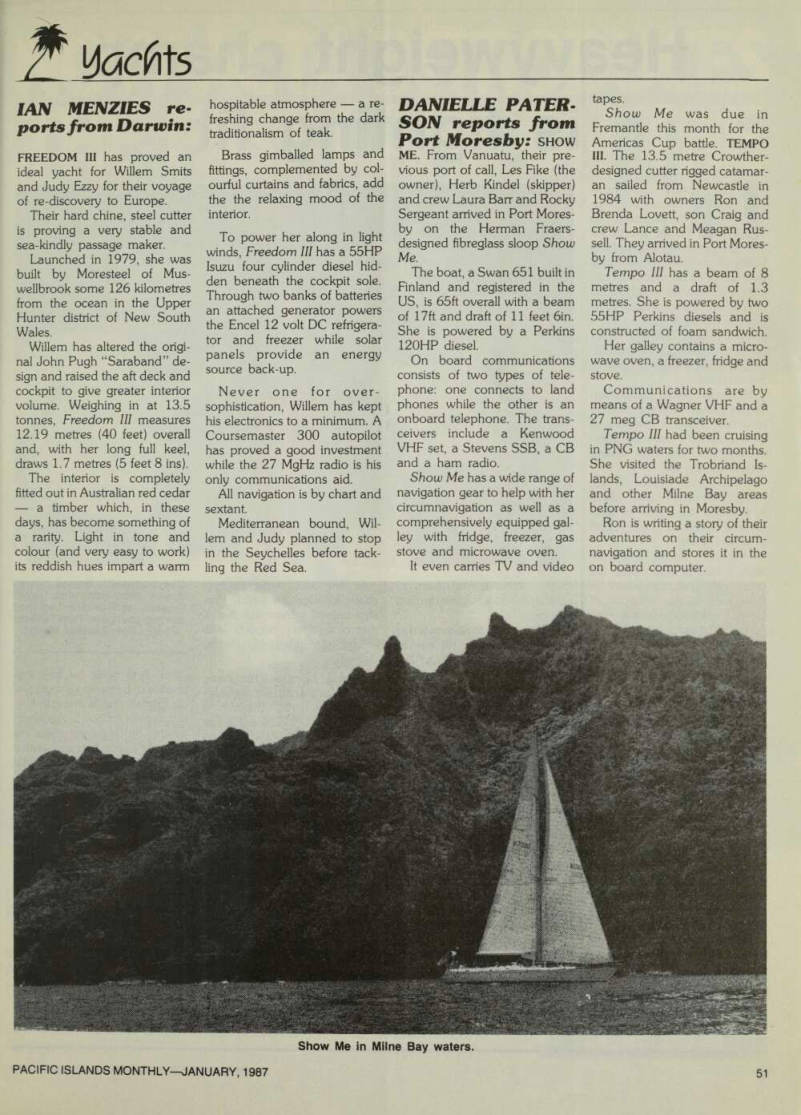
Lan Menzies Re
ports from Darwin:
FREEDOM 111 has proved an ideal yacht for Willem Smits and Judy Ezzy for their voyage of re-discovery to Europe.
Their hard chine, steel cutter is proving a very stable and sea-kindly passage maker.
Launched in 1979, she was built by Moresteel of Mus wellbrook some 126 kilometres from the ocean in the Upper Hunter district of New South Wales.
Willem has altered the origi nal John Pugh “Saraband” de sign and raised the aft deck and cockpit to give greater interior volume. Weighing in at 13.5 tonnes, Freedom 111 measures 12.19 metres (40 feet) overall and, with her long full keel, draws 1.7 metres (5 feet 8 ins).
The interior is completely fitted out in Australian red cedar a timber which, in these days, has become something of a rarity. Light in tone and colour (and very easy to work) its reddish hues impart a warm
hospitable atmosphere a re freshing change from the dark traditionalism of teak.
Brass gimballed lamps and fittings, complemented by col ourful curtains and fabrics, add the the relaxing mood of the interior.
To power her along in light winds, Freedom 111 has a 55HP Isuzu four cylinder diesel hid den beneath the cockpit sole.
Through two banks of batteries an attached generator powers the Encel 12 volt DC refrigera tor and freezer while solar panels provide an energy source back-up.
Never one for over sophistication, Willem has kept his electronics to a minimum, A Coursemaster 300 autopilot has proved a good investment while the 27 MgHz radio is his only communications aid.
All navigation is by chart and sextant.
Mediterranean bound, Wil lem and Judy planned to stop in the Seychelles before tack ling the Red Sea.
Danielle Pater
SON reports from
Port Moresby: show ME. From Vanuatu, their pre vious port of call, Les Fike (the owner), Herb Kindel (skipper) and crew Laura Barr and Rocky Sergeant arrived in Port Mores by on the Herman Fraers designed fibreglass sloop Show Me.
The boat, a Swan 651 built in Finland and registered in the US, is 65ft overall with a beam of 17ft and draft of 11 feet 6in.
She is powered by a Perkins 120 HP diesel.
On board communications consists of two types of tele phone: one connects to land phones while the other is an onboard telephone. The trans ceivers include a Kenwood VHF set, a Stevens SSB, a CB and a ham radio.
Show Me has a wide range of navigation gear to help with her circumnavigation as well as a comprehensively equipped gal ley with fridge, freezer, gas stove and microwave oven.
It even carries TV and video
tapes.
Show Me was due in Fremantle this month for the Americas Cup battle. TEMPO 111. The 13.5 metre Crowther designed cutter rigged catamar an sailed from Newcastle in 1984 with owners Ron and Brenda Lovett, son Craig and crew Lance and Meagan Rus sell. They arrived in Port Mores by from Alotau.
Tempo 111 has a beam of 8 metres and a draft of 1.3 metres. She is powered by two 55HP Perkins diesels and is constructed of foam sandwich.
Her galley contains a micro wave oven, a freezer, fridge and stove.
Communications are by means of a Wagner VHF and a 27 meg CB transceiver.
Tempo 111 had been cruising in PNG waters for two months.
She visited the Trobriand Is lands, Louisiade Archipelago and other Milne Bay areas before arriving in Moresby.
Ron is writing a story of their adventures on their circum navigation and stores it in the on board computer.
Show Me in Milne Bay waters.
Heavyweight champ
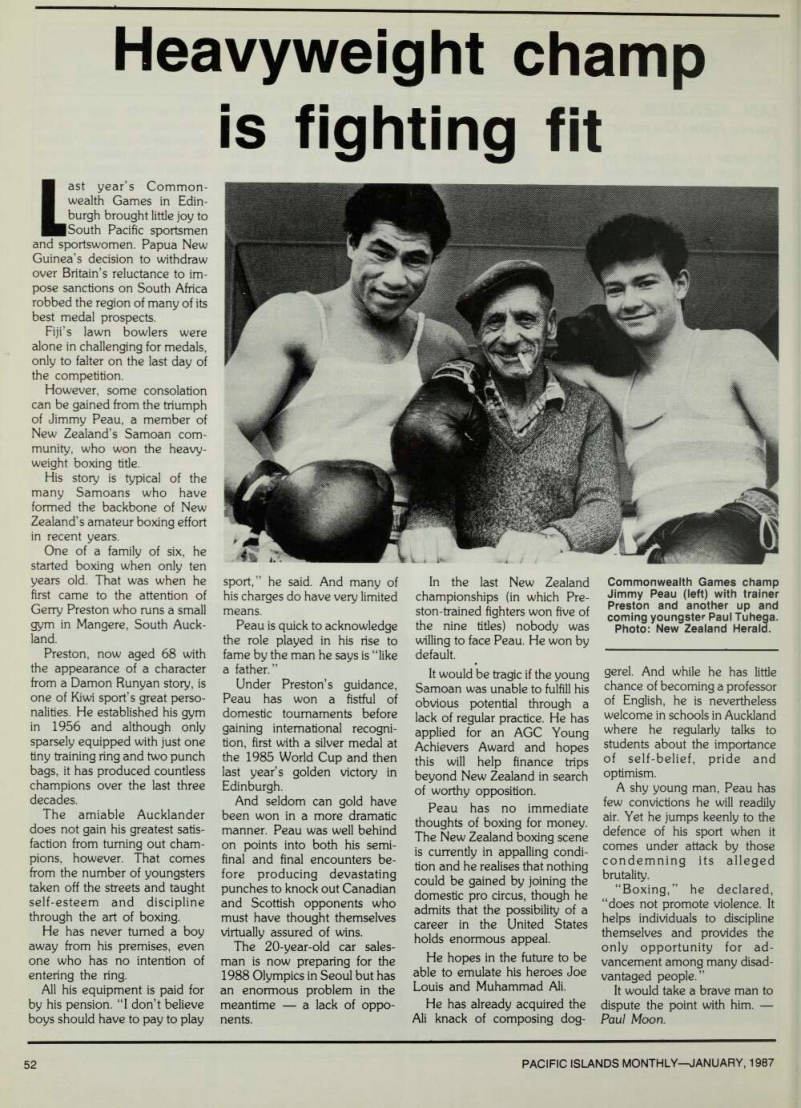
is fighting fit
Last year’s Common wealth Games in Edin burgh brought little joy to South Pacific sportsmen and sportswomen. Papua New Guinea’s decision to withdraw over Britain’s reluctance to im pose sanctions on South Africa robbed the region of many of its best medal prospects.
Fiji’s lawn bowlers were alone in challenging for medals, only to falter on the last day of the competition.
However, some consolation can be gained from the triumph of Jimmy Peau, a member of New Zealand’s Samoan com munity, who won the heavy weight boxing title.
His story is typical of the many Samoans who have formed the backbone of New Zealand’s amateur boxing effort in recent years.
One of a family of six, he started boxing when only ten years old. That was when he first came to the attention of Gerry Preston who runs a small gym in Mangere, South Auck land.
Preston, now aged 68 with the appearance of a character from a Damon Runyan story, is one of Kiwi sport’s great perso nalities. He established his gym in 1956 and although only sparsely equipped with just one tiny training ring and two punch bags, it has produced countless champions over the last three decades.
The amiable Aucklander does not gain his greatest satis faction from turning out cham pions, however. That comes from the number of youngsters taken off the streets and taught self-esteem and discipline through the art of boxing.
He has never turned a boy away from his premises, even one who has no intention of entering the ring.
All his equipment is paid for by his pension. “I don’t believe boys should have to pay to play
sport,” he said. And many of his charges do have very limited means.
Peau is quick to acknowledge the role played in his rise to fame by the man he says is “like a father.”
Under Preston’s guidance, Peau has won a fistful of domestic tournaments before gaining international recogni tion, first with a silver medal at the 1985 World Cup and then last year’s golden victory in Edinburgh.
And seldom can gold have been won in a more dramatic manner. Peau was well behind on points into both his semi final and final encounters be fore producing devastating punches to knock out Canadian and Scottish opponents who must have thought themselves virtually assured of wins.
The 20-year-old car sales man is now preparing for the 1988 Olympics in Seoul but has an enormous problem in the meantime a lack of oppo nents.
In the last New Zealand championships (in which Pre ston-trained fighters won five of the nine titles) nobody was willing to face Peau. He won by default.
It would be tragic if the young Samoan was unable to fulfill his obvious potential through a lack of regular practice. He has applied for an AGC Young Achievers Award and hopes this will help finance trips beyond New Zealand in search of worthy opposition.
Peau has no immediate thoughts of boxing for money.
The New Zealand boxing scene is currently in appalling condi tion and he realises that nothing could be gained by joining the domestic pro circus, though he admits that the possibility of a career in the United States holds enormous appeal.
He hopes in the future to be able to emulate his heroes Joe Louis and Muhammad Ali.
He has already acquired the Ali knack of composing dog
gerel. And while he has little chance of becoming a professor of English, he is nevertheless welcome in schools in Auckland where he regularly talks to students about the importance of self-belief, pride and optimism.
A shy young man, Peau has few convictions he will readily air. Yet he jumps keenly to the defence of his sport when it comes under attack by those condemning its alleged brutality.
“Boxing,” he declared, “does not promote violence. It helps individuals to discipline themselves and provides the only opportunity for ad vancement among many disad vantaged people.”
It would take a brave man to dispute the point with him.
Paul Moon.
Commonwealth Games champ Jimmy Peau (left) with trainer Preston and another up and coming youngster Paul Tuhega.
Photo: New Zealand Herald.
Advertisements & other items, p. 53 (1 item)
ACTA has charted a new course. A course
that will set a cracking pace on the Australia- Fiji run.
ACTA has built an enviable reputation in shipping from Australia to the East Coast of America. A reputation for reliability and ontime delivery that’s hard to match.
The good news is that you now expect the same standard of excellence between Australia and Fiji.
Because ACTA is determined to live up to its reputation in this new service which will be available from Melbourne, Sydney and Brisbane.
To find out more about life in the fast lane of shipping, make a phone call now to ACTA’s Fijian representatives, Burns Philp (SS) Co. Ltd on Suva: Tel 311 111.
Lautoka: Tel 60777
shipping schedules
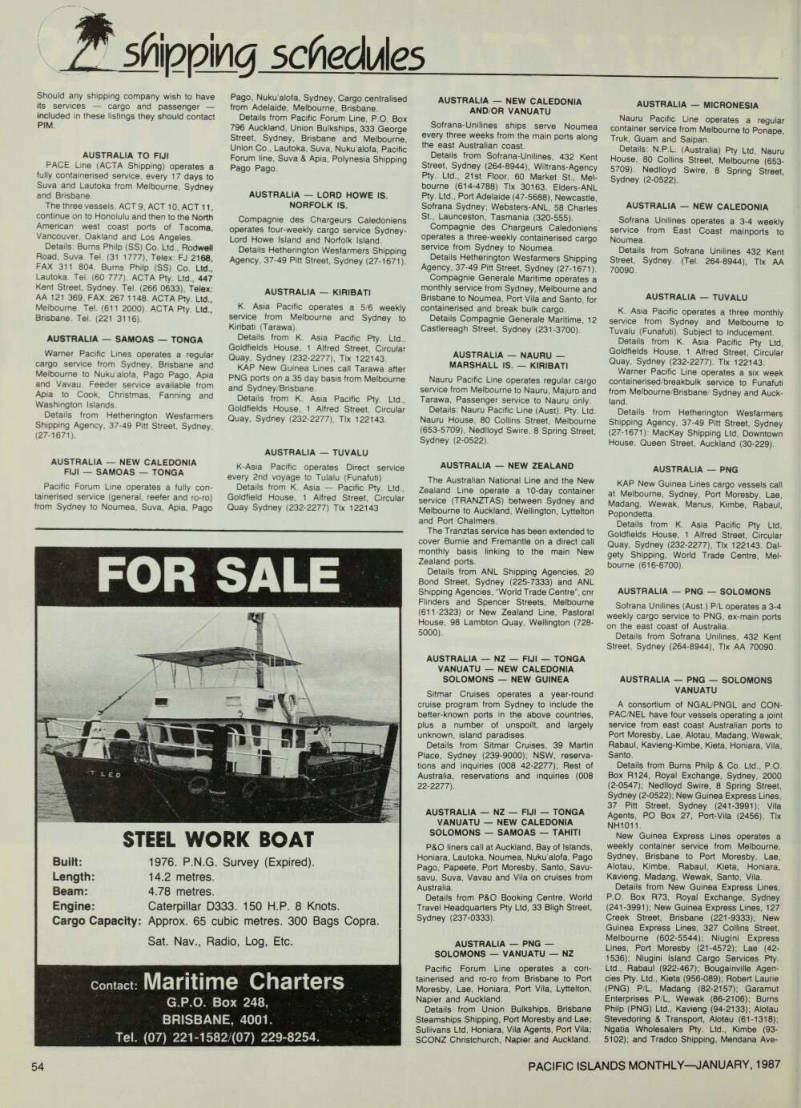
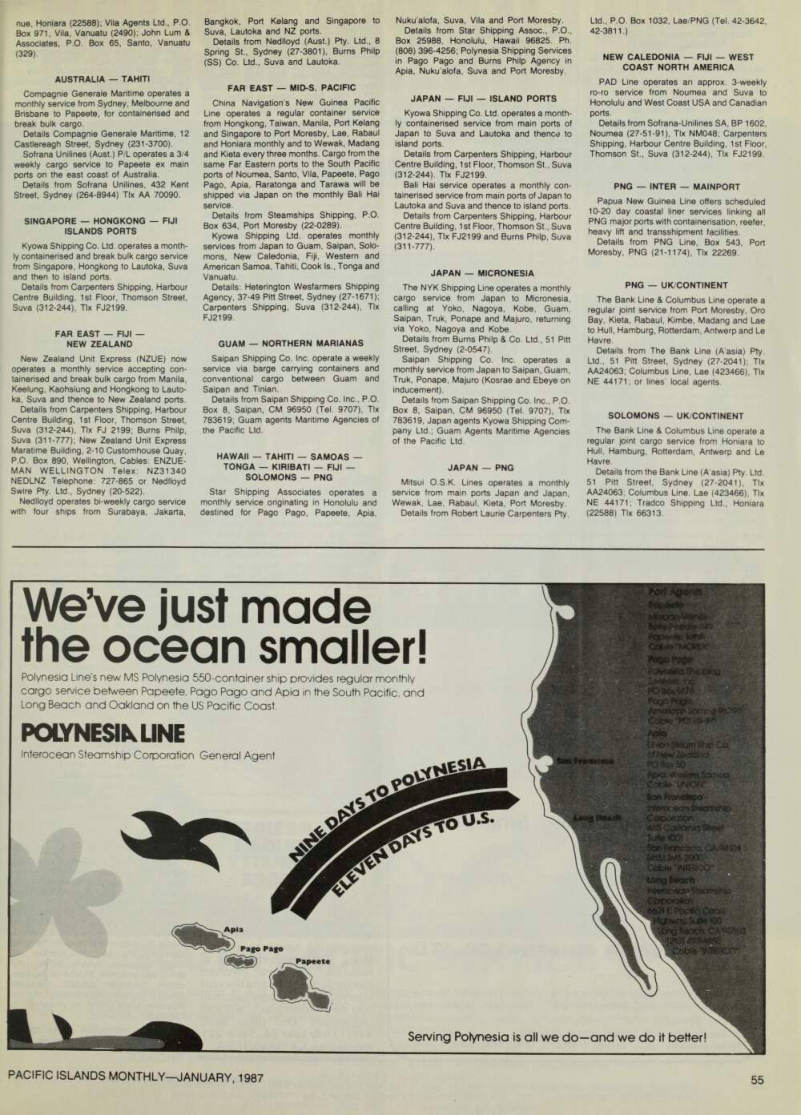
Should any shipping company wish to have its services cargo and passenger included in these listings they should contact
Pim.
Australia To Fiji
PACE Line (ACTA Shipping) operates a fully containerised service, every 17 days to Suva and Lautoka from Melbourne, Sydney and Brisbane.
The three vessels, ACT 9, ACT 10, ACT 11, continue on to Honolulu and then to the North American west coast ports of Tacoma.
Vancouver, Oakland and Los Angeles.
Details: Burns Philp (SS) Co. Ltd , Rodwell Road, Suva. Tel. (31 1777), Telex: FJ 2168, FAX 311 804. Burns Philp (SS) Co. Ltd., Lautoka. Tel. (60 777). ACTA Pty. Ltd., 447 Kent Street, Sydney. Tel. (266 0633), Telex; AA 121 369, FAX: 267 1148. ACTA Pty. Ltd..
Melbourne. Tel. (611 2000). ACTA Pty. Ltd.!
Brisbane. Tel. (221 3116).
Australia Samoas Tonga
Warner Pacific Lines operates a regular cargo service from Sydney, Brisbane and Melbourne to Nukualofa, Pago Pago, Apia and Vavau. Feeder service available from Apia to Cook, Christmas, Fanning and Washington Islands.
Details from Hetherington Wesfarmers Shipping Agency, 37-49 Pitt Street, Sydney, (27-1671).
Australia New Caledonia
Fiji Samoas Tonga
Pacific Forum Line operates a fully con tainerised service (general, reefer and ro-ro) from Sydney to Noumea, Suva, Apia, Pago
Pago, Nukualofa, Sydney, Cargo centralised from Adelaide, Melbourne, Brisbane.
Details from Pacific Forum Line, P.O. Box 796 Auckland, Union Bulkships, 333 George Street, Sydney, Brisbane and Melbourne, Union Co., Lautoka, Suva, Nukualofa. Pacific Forum line, Suva & Apia, Polynesia Shipping Pago Pago.
Australia Lord Howe Is.
Norfolk Is.
Compagnie des Chargeurs Caledoniens operates four-weekly cargo service Sydney- Lord Howe Island and Norfolk Island.
Details Hetherington Wesfarmers Shipping Agency. 37-49 Pitt Street, Sydney (27-1671).
Australia Kiribati
K. Asia Pacific operates a 5/6 weekly service from Melbourne and Sydney to Kiribati (Tarawa).
Details from K. Asia Pacific Pty. Ltd., Goldfields House, 1 Alfred Street, Circular Quay, Sydney (232-2277), Tlx 122143.
KAP New Guinea Lines call Tarawa after PNG ports on a 35 day basis from Melbourne and Sydney/Brisbane.
Details from K. Asia Pacific Pty. Ltd., Goldfields House, 1 Alfred Street, Circular Quay, Sydney (232-2277), Tlx 122143.
Australia Tuvalu
K-Asia Pacific operates Direct service every 2nd voyage to Tulalu (Funafuti) Details from K. Asia Pacific Pty. Ltd., Goldfield House, 1 Alfred Street, Circular Quay Sydney (232-2277) Tlx 122143
Australia New Caledonia
And Or Vanuatu
Sofrana-Unilines ships serve Noumea every three weeks from the main ports along the east Australian coast.
Details from Sofrana-Unilines, 432 Kent Street, Sydney (264-8944), Wiltrans-Agency Pty. Ltd., 21st Floor, 60 Market St., Mel bourne (614-4788) Tlx 30163. Elders-ANL Pty. Ltd., Port Adelaide (47-5688), Newcastle, Sofrana Sydney; Websters-ANL, 58 Charles St., Launceston, Tasmania (320-555).
Compagnie des Chargeurs Caledonians operates a three-weekly containerised cargo service from Sydney to Noumea.
Details Hetherington Wesfarmers Shipping Agency, 37-49 Pitt Street, Sydney (27-1671).
Compagnie Generale Maritime operates a monthly service from Sydney, Melbourne and Brisbane to Noumea, Port Vila and Santo, for containerised and break bulk cargo.
Details Compagnie Generale Maritime, 12 Castlereagh Street, Sydney (231-3700).
Australia Nauru
Marshall Is. Kiribati
Nauru Pacific Line operates regular cargo service from Melbourne to Nauru, Majuro and Tarawa, Passenger service to Nauru only.
Details: Nauru Pacific Line (Aust). Pty. Ltd.
Nauru House, 80 Collins Street, Melbourne (653-5709), Nedlloyd Swire, 8 Spring Street, Sydney (2-0522).
Australia New Zealand
The Australian National Line and the New Zealand Line operate a 10-day container service (TRANZTAS) between Sydney and Melbourne to Auckland, Wellington, Lyttelton and Port Chalmers.
The Tranztas service has been extended to cover Burnie and Fremantle on a direct call monthly basis linking to the main New Zealand ports.
Details from ANL Shipping Agencies, 20 Bond Street, Sydney (225-7333) and ANL Shipping Agencies. “World Trade Centre”, cnr Flinders and Spencer Streets, Melbourne (611-2323) or New Zealand Line, Pastoral House, 98 Lambton Quay, Wellington (728- 5000).
Australia Nz Fiji Tonga
Vanuatu New Caledonia
Solomons New Guinea
Sitmar Cruises operates a year-round cruise program from Sydney to include the better-known ports in the above countries, plus a number of unspoilt, and largely unknown, island paradises.
Details from Sitmar Cruises, 39 Martin Place, Sydney (239-9000); NSW, reserva tions and inquiries (008 42-2277); Rest of Australia, reservations and inquiries (008 22-2277).
Australia Nz Fiji Tonga
Vanuatu New Caledonia
Solomons Samoas Tahiti
P&O liners call at Auckland. Bay of Islands, Honiara, Lautoka, Noumea, Nukualofa, Pago Pago, Papeete, Port Moresby, Santo, Savu savu, Suva, Vavau and Vila on cruises from Australia.
Details from P&O Booking Centre, World Travel Headquarters Pty Ltd, 33 Bligh Street, Sydney (237-0333).
Australia Png
Solomons Vanuatu Nz
Pacific Forum Line operates a con tainerised and ro-ro from Brisbane to Port Moresby, Lae, Honiara, Port Vila, Lyttelton, Napier and Auckland.
Details from Union Bulkships, Brisbane Steamships Shipping, Port Moresby and Lae; Sullivans Ltd, Honiara, Vila Agents, Port Vila; SCONZ Christchurch, Napier and Auckland.
Australia Micronesia
Nauru Pacific Line operates a regular container service from Melbourne to Ponape, Truk, Guam and Saipan.
Details: N.P.L. (Australia) Pty Ltd, Nauru House, 80 Collins Street, Melbourne (653- 5709). Nedlloyd Swire. 8 Spring Street Sydney (2-0522).
Australia New Caledonia
Sofrana Unilines operates a 3-4 weekly service from East Coast mainports to Noumea.
Details from Sofrana Unilines 432 Kent Street, Sydney. (Tel. 264-8944), Tlx AA 70090.
Australia Tuvalu
K. Asia Pacific operates a three monthly service from Sydney and Melbourne to Tuvalu (Funafuti). Subject to inducement.
Details from K. Asia Pacific Pty Ltd, Goldfields House, 1 Alfred Street, Circular Quay, Sydney (232-2277). Tlx 122143.
Warner Pacific Line operates a six week containerised/breakbulk service to Funafuti from Melbourne/Brisbane/ Sydney and Auck land.
Details from Hetherington Wesfarmers Shipping Agency, 37-49 Pitt Street, Sydney (27-1671): Mac Kay Shipping Ltd, Downtown House, Queen Street, Auckland (30-229).
Australia Png
KAP New Guinea Lines cargo vessels call at Melbourne, Sydney, Port Moresby, Lae, Madang, Wewak, Manus, Kimbe, Rabaul, Popondetta.
Details from K. Asia Pacific Pty Ltd, Goldfields House, 1 Alfred Street, Circular Quay, Sydney (232-2277), Tlx 122143. Dal gety Shipping, World Trade Centre, Mel bourne (616-6700).
Australia Png Solomons
Sofrana Unilines (Aust.) P/L operates a 3-4 weekly cargo service to PNG, ex-main ports on the east coast of Australia.
Details from Sofrana Unilines, 432 Kent Street, Sydney (264-8944), Tlx AA 70090.
Australia Png Solomons
Vanuatu
A consortium of NGAL/PNGL and CON PAC/NEL have four vessels operating a joint service from east coast Australian ports to Port Moresby, Lae, Alotau, Madang, Wewak, Rabaul, Kavieng-Kimbe, Kieta, Honiara, Vila, Santo.
Details from Burns Philp & Co. Ltd., P.O.
Box R 124, Royal Exchange, Sydney. 2000 (2-0547); Nedlloyd Swire, 8 Spring Street, Sydney (2-0522); New Guinea Express Lines, 37 Pitt Street, Sydney (241-3991); Vila Agents, PO Box 27, Port-Vila (2456). Tlx
Nhioii.
New Guinea Express Lines operates a weekly container service from Melbourne, Sydney, Brisbane to Port Moresby, Lae, Alotau, Kimbe, Rabaul, Kieta, Honiara, Kavieng, Madang, Wewak, Santo, Vila.
Details from New Guinea Express Lines, P.O. Box R 73, Royal Exchange, Sydney (241-3991); New Guinea Express Lines, 127 Creek Street, Brisbane (221-9333); New Guinea Express Lines, 327 Collins Street, Melbourne (602-5544); Niugini Express Lines, Port Moresby (21-4572); Lae (42- 1536); Niugini Island Cargo Services Pty.
Ltd., Rabaul (922-467); Bougainville Agen cies Pty. Ltd., Kieta (956-089); Robert Laurie (PNG) P/L, Madang (82-2157); Garamut Enterprises P/L, Wewak (86-2106); Burns Philp (PNG) Ltd., Kavieng (94-2133); Alotau Stevedoring & Transport, Alotau (61-1318); Ngatia Wholesalers Pty. Ltd., Kimbe (93- 5102); and Tradco Shipping, Mendana Ave
nue, Honiara (22588); Vila Agents Ltd., P.O.
Box 971, Vila, Vanuatu (2490); John Lum & Associates, P.O. Box 65, Santo, Vanuatu (329).
Australia Tahiti
Compagnie Generate Maritime operates a monthly service from Sydney, Melbourne and Brisbane to Papeete, for containerised and break bulk cargo.
Details Compagnie Generate Maritime, 12 Castlereagh Street. Sydney (231-3700).
Sofrana Unilines (Aust.) P/L operates a 3/4 weekly cargo service to Papeete ex main ports on the east coast of Australia.
Details from Sofrana Unilines, 432 Kent Street, Sydney (264-8944) Tlx AA 70090.
Singapore Hongkong Fiji
Islands Ports
Kyowa Shipping Co. Ltd. operates a month ly containerised and break bulk cargo service from Singapore, Hongkong to Lautoka, Suva and then to island ports.
Details from Carpenters Shipping, Harbour Centre Building, Ist Floor, Thomson Street, Suva (312-244), Tlx FJ2199.
Far East Fiji
New Zealand
New Zealand Unit Express (NZUE) now operates a monthly service accepting con tainerised and break bulk cargo from Manila, Keelung, Kaohsiung and Hongkong to Lauto ka, Suva and thence to New Zealand ports.
Details from Carpenters Shipping, Harbour Centre Building, Ist Floor, Thomson Street, Suva (312-244), Tlx FJ 2199; Burns Philp, Suva (311-777); New Zealand Unit Express Maratime Building, 2-10 Customhouse Quay, P.O. Box 890, Wellington, Cables: ENZUE
Man Wellington Telex: Nz31340
NEDLNZ Telephone: 727-865 or Nedlloyd Swire Pty. Ltd., Sydney (20-522).
Nedlloyd operates bi-weekly cargo service with four ships from Surabaya, Jakarta,
Bangkok, Port Kelang and Singapore to Suva, Lautoka and NZ ports.
Details from Nedlloyd (Aust.) Pty. Ltd., 8 Spring St., Sydney (27-3801), Burns Philp (SS) Co. Ltd., Suva and Lautoka.
Far East Mid-S. Pacific
China Navigation’s New Guinea Pacific Line operates a regular container service from Hongkong, Taiwan, Manila, Port Kelang and Singapore to Port Moresby, Lae, Rabaul and Honiara monthly and to Wewak, Madang and Kieta every three months. Cargo from the same Far Eastern ports to the South Pacific ports of Noumea, Santo, Vila, Papeete. Pago Pago, Apia, Raratonga and Tarawa will be shipped via Japan on the monthly Bali Hai service.
Details from Steamships Shipping, P.O.
Box 634, Port Moresby (22-0289).
Kyowa Shipping Ltd. operates monthly services from Japan to Guam, Saipan, Solo mons, New Caledonia, Fiji, Western and American Samoa, Tahiti, Cook Is., Tonga and Vanuatu.
Details: Heterington Wesfarmers Shipping Agency, 37-49 Pitt Street, Sydney (27-1671); Carpenters Shipping, Suva (312-244), Tlx FJ2199.
Guam Northern Marianas
Saipan Shipping Co. Inc. operate a weekly service via barge carrying containers and conventional cargo between Guam and Saipan and Tinian.
Details from Saipan Shipping Co. Inc., P.O.
Box 8. Saipan, CM 96950 (Tel. 9707), Tlx 783619; Guam agents Maritime Agencies of the Pacific Ltd.
Hawaii Tahiti Samoas
Tonga Kiribati Fiji
Solomons Png
Star Shipping Associates operates a monthly service originating in Honolulu and destined for Pago Pago. Papeete, Apia,
Nukualofa, Suva, Vila and Port Moresby.
Details from Star Shipping Assoc., P. 0., Box 25988, Honolulu, Hawaii 96825. Ph. (808) 396-4256; Polynesia Shipping Services in Pago Pago and Burns Philp Agency in Apia, Nukualofa, Suva and Port Moresby.
Japan Fiji Island Ports
Kyowa Shipping Co. Ltd. operates a month ly containerised service from main ports of Japan to Suva and Lautoka and thence to island ports.
Details from Carpenters Shipping, Harbour Centre Building, Ist Floor, Thomson St., Suva (312-244). Tlx FJ2199.
Bali Hai service operates a monthly con tainerised service from main ports of Japan to Lautoka and Suva and thence to island ports.
Details from Carpenters Shipping, Harbour Centre Building, Ist Floor, Thomson St., Suva (312-244), Tlx FJ2199 and Burns Philp, Suva (311-777).
Japan Micronesia
The NYK Shipping Line operates a monthly cargo service from Japan to Micronesia, calling at Yoko, Nagoya, Kobe, Guam, Saipan, Truk, Ponape and Majuro, returning via Yoko, Nagoya and Kobe.
Details from Burns Philp & Co. Ltd., 51 Pitt Street. Sydney (2-0547).
Saipan Shipping Co. Inc. operates a monthly service from Japan to Saipan, Guam, Truk, Ponape, Majuro (Kosrae and Ebeye on inducement).
Details from Saipan Shipping Co. Inc., P.O.
Box 8, Saipan, CM 96950 (Tel. 9707), Tlx 783619, Japan agents Kyowa Shipping Com pany Ltd.; Guam Agents Maritime Agencies of the Pacific Ltd.
Japan Png
Mitsui O.S.K. Lines operates a monthly service from main ports Japan and Japan, Wewak, Lae, Rabaul, Kieta, Port Moresby.
Details from Robert Laurie Carpenters Pty.
Ltd., P.O. Box 1032, Lae/PNG (Tel. 42-3642, 42-3811.)
New Caledonia Fiji West
Coast North America
PAD Line operates an approx. 3-weekly ro-ro service from Noumea and Suva to Honolulu and West Coast USA and Canadian ports.
Details from Sofrana-Unilines SA, BP 1602, Noumea (27-51-91), Tlx NMO4B; Carpenters Shipping, Harbour Centre Building, Ist Floor, Thomson St., Suva (312-244), Tlx FJ2199.
Png Inter Mainport
Papua New Guinea Line offers scheduled 10-20 day coastal liner services linking all PNG major ports with containerisation, reefer, heavy lift and transshipment facilities.
Details from PNG Line, Box 543, Port Moresby, PNG (21-1174), Tlx 22269.
Png Uk/Continent
The Bank Line & Columbus Line operate a regular joint service from Port Moresby, Oro Bay, Kieta, Rabaul, Kimbe, Madang and Lae to Hull, Hamburg. Rotterdam, Antwerp and Le Havre.
Details from The Bank Line (A'asia) Pty.
Ltd., 51 Pitt Street, Sydney (27-2041); Tlx AA24063; Columbus Line, Lae (423466). Tlx NE 44171; or lines' local agents.
Solomons Uk/Continent
The Bank Line & Columbus Line operate a regular joint cargo service from Honiara to Hull, Hamburg, Rotterdam, Antwerp and Le Havre.
Details from the Bank Line (A'asia) Pty. Ltd. 51 Pitt Street, Sydney (27-2041). Tlx AA24063; Columbus Line. Lae (423466), Tlx NE 44171; Tradco Shipping Ltd., Honiara (22588) Tlx 66313.
New Zealand Australia
Papua New Guinea Solomon
Islands Vanuatu
Pacific Forum Line operates a con tainerised and ro-ro service from Lyttelton, Napier and Auckland to Brisbane, Port Moresby, Lae, Honiara and Port Vila.
Details from SCONZ Christchurch, Napier and Auckland: Union Bulkships, Brisbane; Steamships Shipping, Port Moresby and Lae; Sullivans Ltd., Honiara; Vila Agents, Port Vila.
Nz Cook Is. Niue Tahiti
New Zealand Line operates cargo services based on pallets and similar units from Auckland to Niue, Cook Islands and Tahiti.
Details from the NZ Shipping Agencies International Ltd., P.O. Box 3420, Auckland (797210); Waterfront Commission, P.O, Box 61. Rarotonga; Cook Islands; Shipping Office, Govt, of Niue, P.O. Box 107, Niue Island; Compagnie Maritime Polynesienne, P.O. Box 36, Papeete, Tahiti.
Nz Fiji
Reef operates a regular 18-day service from Auckland to Suva and Lautoka. Also passenger accommodation.
Details from Reef Shipping Agencies, PO Box 3382, Auckland, NZ (77-1221-3), Tlx 60633; MV Fijian Shipping Agencies Ltd.
Private Bag, Suva, Fiji (31-1056).
Pacific Line with one ship operates two weekly ro-ro cargo service New Zealand, Lautoka, Suva. No passengers.
Details: Sofrana Unilines, 18 Customs Street, Auckland (773-279) PO Box 3614, Tlx NZ2313. Carpenters Shipping, 100 Thomson Street, Suva (312-244), Tlx FJ2199.
Nz Fiji North America (Wc)
Blue Star Line Ltd. Pacific Coast container services. Only direct service to and from New Zealand. Blue Star vessels call at Suva and
Honolulu on NZ-U.S.-West Coast voyages.
Details from Blueport ACT (NZ) Ltd., PO Box 192, Wellington (739-029). Bums Philp (SS) Co. Ltd., GPO Box 355, Suva, Fiji (311-777), Tlx FJ2168 Burship.
NZ — FIJI — SAMOAS — TONGA Pacific Forum Line operates a con tainerised and ro-ro 21 day service from Auckland to Lautoka, Suva, Apia, Pago Pago and Nuku alofa.
Details from Pacific Forum Line, Auckland and Apia, Union Maritime, Lautoka, Suva and Nuku alofa; Polynesian Shipping, Pago Pago, Apia.
Nz — N. Caledonia — Vanuatu
— Png — Solomons
Sofrana Unilines with three ships operate to Vila and Santo, to Honiara and Papua New Guinea and to Norfolk Island and Noumea (No passengers).
Details from Sofrana Unilines, 18 Customs Street, Auckland (773-279), PO Box 3614, Tlx NZ2313.
Nz — Tahiti
Compagne Tahotienne Maritime SA (as CTM-Tahiti Line) operates one ship. MV Bounty III, monthly Papeete — New Zealand. (No passengers).
Details from Sofrana Unilines, PO Box 3614, 18 Customs St.. Auckland, Tlx NZ2313.
CTM-Tahiti Line, PO Box 9012, Papeete (39042), Tlx Tahitlin 322 FP Tahiti.
Nz — Tonga — Samoas
Warner Pacific Line services Auckland, Nukualofa, Vavau, Apia, Pago Pago fort nightly carrying general and freezer cargoes.
Details from McKay Shipping Ltd., Down town House, 21 Queen St., Auckland, PO Box 1372 (30-299). Cables MACSHIP, Telex NZ2554, Warner Pacific Line, Box 93, Nukualofa, Tonga; Mealelei (Western Samoa) Ltd. Private Bag, Apia, Western Samoa, Pacific Maritime Services, PO Box 2617, Pago Pago, American Samoa (633- 2728), cables: Pacmar SX2OS.
Tahiti New Caledonia
Vanuatu Solomon Is.
New Zealand Png
Singapore Europe
Polish Ocean Lines operate in a semi container type vessel to the following ports, from Papeete, Noumea, Santo, Vila, Yandina, Honiara, Auckland, Rabaul, Lae, Singapore, Port Klelang, Penang then to Mediterranean ports and Europe via the Suez Canal. (Other New Zealand ports subject to inducement).
Details from Universal Shipping Agencies Ltd., 6th Floor, 38 Fort Street, Auckland 1, New Zealand (390931, 390727, 32104), Tlx 21517.
Europe Tahiti
New Caledonia
Compagne Generate Maritime operates services from Europe and Mediterranean ports to Papeete and Noumea using three ro-ro and multi-purpose vessels thus ensuring a bi-monthly sailing to and from.
Details Compagne Generate Maritime, 12 Castlereagh Street, Sydney (231-3700).
Europe Tahiti
New Calendonia New Zealand
Vanuatu Solomons
Png Europe
Polish Ocean Lines offers regular monthly sailings for containerised and break bulk cargo, also conventional reefer space and reefer containers from Hamburg, Rotterdam, Dunkirk, Rouen to Papeete, Noumea, Auck land, Santo, Honiara, Rabaul, Lae, Singa pore, returning to Europe via Suez, other ports in South Pacific can be served directly with inducement or otherwise via tranship ment.
Details from Sotama, BP 9170, Papeete.
Tel. 427805 Tlx 373FP. Telex Sotama 373FP/SATO: BP C 2 Noumea Cedex Tel. 272094 Tlx 163NM/Universal Shipping Agencies PO Box 2282 Auckland Tel. 30930 Tlx 21517/Vanua Navigation PO Box 44 Vila Tel. 2027 Tlx 1033/Melan Chine Shipping Co. PO Box 71 Honiara Tel. 21678 Tix 66335/Steamships Shipping & Transport PO Box 1512 Rabaul Tel 922952 Tlx 92929/Steamships Trading Co.
Ltd. PO Box 85 Lae Tel. 424666 Tlx 42423/Union Steamship Co. of NZ Ltd. PO Box 50 Apia Tel. 21781 Tlx 225/Warner Pacific Line PO Box 93 Nukualofa Tel. 22088 Tlx 66219/Fiji Agents TBA.
Uk N. Continent Png
Solomons
The Bank Line & Columbus Line operate a regular joint cargo service from Hull. Ham burg, Bremen, Antwerp, Rotterdam and Le Havre to Port Moresby, Lae, Madang, Kimbe, Rabaul, Kieta and Honiara and on induce ment to Yandina.
Details from The Bank Line (A'asia) Pty.
Ltd., 51 Pitt Street. Sydney (27-2041), Tlx AA 24063. Columbus Line. Lae (42-3466). Tlx NE 44171; or lines local agents.
Uk/N. Continent Tahiti
N. Caledonia Vanuatu
The Bank Line & Columbus line operate a regular joint cargo service from Hull, Ham burg, Bremen, Antwerp, Rotterdam and Le Havre to Papeete, Noumea, Port-Vila and Santo.
Details from The Bank Line (A'sia) Pty. Ltd., 51 Pitt Street, Sydney (27-2041), Tlx AA 24063. Columbus Line, Lae (42-3466), Tlx NE 44171; Ets. A.M. Fare UTE, Papeete; Ets, Ballande, Noumea and other local agents.
U.S. Hawaii Micronesia
East Malaysia Brunei
Papua New Guinea
PM&O Lines operates two fully self-sus tained container vessels on a sailing frequen cy of every 30 days between the San Francisco Bay Area, Los Angeles, Honolulu and Majuro, Ebeye, Kosrae, Ponape, Truk, Saipan, Yap, Palau, Kota Kinabalu, Brunei, Lae, Kieta and Rabaul.
Details from PM&O Lines, 353 Sacramento Street, San Francisco, California 94111,
U.S.A. (415) 421-5400, Tlx 278016 Pmo
UR; Owner’s Representative P.O. Box 803, Saipan, N.M.I. 96950, PH: 234-6819 TLX
783-605 Cmcaa.
U.S. Hawaii Samoas
Kiribati Nauru
Nauru Pacific Line operates regular con ventional and container services from San Francisco and Honolulu to Christmas Island, Pago Pago, Apia, Tarawa and Nauru.
Details from N.P.L. (Australia) Pty. Ltd., Nauru House, 80 Collins Street, Melbourne (653-5709), Nauru Air and Shipping Agency, Suite 2803, 185 Berry Street, San Francisco, California 94107 (415-543-4517). Nauru Air and Shipping Agency, Suite 506, 841 Bishop St., Honolulu, HI 96813 (808-523-0441).
U.S. Noumea Fiji
PAD Line operates an approx. 3-weekly ro ro service from west coast USA and Canada to Noumea, Suva and Lautoka.
Details from Sofrana Unilines BP 1602, Noumea (27-51-91). Tlx NMO4B, Carpenters Shipping, Harbour Centre Building. Ist Floor, 100 Thomson Street, Suva (312-244), Tlx FJ2199, Trans-Austral Shipping Pty. Ltd., P.O. Box R 232, Royal Exchange, 2000 (231-8411), Tlx AA21204.
Australia Fui
Sofrana-Unilines (Fiji Express Line) oper ates to Suva and Lautoka every three weeks from the main ports on the east coast of Australia and monthly to Lautoka from Mel bourne and Sydney.
Details from Sofrana-Unilines, 432 Kent Street, Sydney (264-8944), Tlx AA 70090; Wiltrans Agency Pty. Ltd., 21st Floor, 60 Market St., Melbourne (614-4788); Tlx 30163; Elders-ANL Pty. Ltd., Port Adelaide, (47- 5688); Newcastle, Sofrana Sydney (264- 8944); Websters-ANL, 58 Charles St., Laun ceston, Tasmania (320-555); Carpenters Shipping, Harbour Centre Building, Ist Floor, Thomson Street, Suva, Fiji (312-244), Tlx FJ2199.
For further information please contact Andrea Wilkinson, ACTA Shipping, Syd ney. 266 0633.
Advertisements & other items, pp. 54-60 (1 item)
For Sale
* w
STEEL WORK BOAT
Built: 1976. P.N.G. Survey (Expired).
Length: 14.2 metres.
Beam: 4.78 metres.
Engine: Caterpillar D 333. 150 HP. 8 Knots.
Cargo Capacity: Approx. 65 cubic metres. 300 Bags Copra.
Sat. Nav., Radio, Log, Etc.
Contact:
Maritime Charters
G.P.O. Box 248,
BRISBANE, 4001.
Tel. (07) 221-1582/(07) 229-8254.
WeVe just made
the ocean smaller!
Polynesia Line's new MS Polynesia 550-container ship provides regular monthly cargo service between Papeete, Pago Pago and Apia in the South Pacific, and Long Beach and Oakland on the US Pacific Coast.
POLYNESIA LINE
Interocean Steamship Corporation General Agent
pOs
K 5gU si fk. £ vs {4451 <k v Apia Pago Pago Serving Polynesia is all we do—and we do it better!
KYOWA LINE
Japan Korea Taiwan Singapore
Hong Kong
To: Solomon Is., New Caledonia, Fiji, W. Samoa, A. Samoa, Tahiti, Vanuatu To: Guam, Saipan, Truk, Ponape, Majuro, Yap, Koror
Taiwan Hong Kong Singapore
Philippines
To; Papua New Guinea, Hawaii, Pacific Islands.
KYOWA SHIPPING CO., LTD.
HEAD OFFICE:
6th Floor., Klkushlma Bldg., 2-3, Hamamatsucho 2-chome, Mmato-ku, Tokyo 105, Japan Phone: 03(437)2885 (Rep.) Cables: "MARIQUEEN" Tokyo Telex: 242-4651 Kyowa J.
OSAKA OFFICE:
Dai San Fuji Bldg., 3-13, Itachibori 1-chome, Osaka 550. 06(533)5821 (Rep.) Cables: "MARIQUEEN" Osaka Telex: 525-6271 Ssiosa ,
NON-RESIDENT
AMERICAN
UNIVERSITY
DEGREES
It is possible - it is honestly possible -to earn good, usable Bachelor's, Master's, Doctorates, even Law Degrees from recognized American universities, without ever going to America. The time involved can be quite short, and the cost surprisingly low. May I air mail you free information, without obligation? Dr. John Bear, 41011 Little Lake Rd., Suite 221 Mendocino, CA 95460, U.S.A.
POLISH OCEAN LINES
General Management, 10 Lutego 24,81-364 GDYNIA, POLAND, Phone: 20-19-01, Cables: POLOCEAN Telex: 054-231 V Q Q 'I t; m " 'S' - ** Mm-'-'*#?
Mm ms IT < x X ■
M ills!
t- L« . w >•- * ✓ VH v»r» l I • V:• • * •i *r .•■••.I •T .• •, : Xr •x* l : .. * rvV‘ i v.v > * »V’v
VAsS
11V
SOUTH PACIFIC SERVICE |>
f |nn rno^l ?lLfSiy iC ?.i?,^ n , d ,rom: GDYNIA, HAMBURG, ROTTERDAM, MIDDLESBOROUGH/IMMINGHAM, RK ’ ROUEN ' PAPEETE (via PANAMA), NOUMEA, AUCKLAND, HONIARA, RABAUL, LAE, oiNbArOnE, by our multipurpose vessels carrying diy and reefer containers, reefer chambers, heavy lifts, breakbulk or
palletized, bulk liquids.
AUCKLAND Mr.
POLISH OCEAN LINES Representatives A. Sieradzki. Telex 21517 NZ “UNISHIP”. SYDNEY Mr. Walenciak. Telex 20428 AA “SLEIGH” t f kSSHI.eSJoi NEW CALEDONIA SATO Telex 163 NM “SATO". AUCKLAND UNIVERSAL SHIPPING AGENCIES LTD., Telex 21517 NZ UNISHIP . SOLOMONS MELAN CHINE SHIPPING CO., LTD Telex 66335 HO “SYMECO” PNG STEAMSHIPS TRADING CO., LTD Telex 42423 NE “STEAM".
SERVICE PAGE
ADVERTISING
ACTA 53
Aggie Greys 58 Amatil 49
AW A 48
Bank Line 59 Citizen Watches 15 Columbus Line 59 Henry Cumines 39 Hitachi 2 Honda Motor 34 Johnson Diversified 18 Kyowa Shipping 56 Maritime Charters 54 Mendocino Book Co 56 Metro Drill & Blast 32 Mitsubishi Motor 60 NEC C0rp... 46 Nissan Motor 12-13 Pioneer Electronic 43 Michael Pohl 58 Polish Ocean Lines 57 Polynesia Line 55 Sheaffer 9 M&S Simons 58 Sony Corp 4
SPEC 16-17
Sycotex 58 Tasman Fleet 29 Total Concept Exhibitions 33 Toyota Motor 30-31 Video 29
PACIFIC
SLANDS
IMONT H L Y I
AUSTRALIA: Distribution: The Herald and Weekly Times Ltd., 44-74 Flinders St., Melbourne, Vic., 3000. Advertising Reps Brisbane D. Wood, Anday Agency, CCA Centre, Dayboro Road, Closeburn 4520; Box 1918, GPO Brisbane, 4001; telephone (07) 289-4128. Adelaide Hastwell Williamson Rouse Pty. Ltd., PO Box 419, Norwood, SA, 5067 ; 59 Kensington Road, Norwood; telephone (08) 332-3322, telex 87113; Perth Allen & Associates, 7 Fore St., Perth, W.A., 6000, telephone (09) 328-9833, telex: AA94382.
FUI: Distribution and subscriptions. Desai Bookshops, P.O. Box 160, Suva. Fiji telephone Suva 23036.
Advertising Fiji Times & Herald Ltd., 20 Gordon St., Suva, telephone 31-4111, telex FJ2124.
FRENCH POLYNESIA: Distribution Hachette Pacifique 10 Ave., Bruat, Papeete, telephone 25-610.
HAWAII: UNITED STATES: Distribution - PIM, Hawaii, P.O. Box 22250, Honolulu, Hawaii. 96822 Advertising Brian C. Asgill, Apt. 1308,1676 Ala Moana Blvd., Honolulu, Hawaii, 96815, telephone (808) 955-9718.
JAPAN: Advertising and subscriptions Universal Media Corporation, GPO Box 46, Tokyo, telephone 666-3036, cable UNIMEDIA Tokyo, telex 2524665.
MALAYSIA: Advertising and subscriptions Worldwide Media Services, 57-B Komplex Damai, Jin Dato Haji Eusoff, Kuala Lumpur, telephone 63-9340, cables WORLDMEDIA Kuala Lumpur, telex 31533.
VANUATU: Distribution The Bookshop, HQ Box 210, Port Vila. Advertising Norman Bros. Bookshop. Port Vila, telephone 2232.
NEW CALEDONIA: Distribution Depot Centre de Presse Michel Pentecost. CBP2, Noumea, telephone 27-2434. 27-4729.
NEW ZEALAND: Distribution Gordon & Gotch, PO Box 584, 2 Carr Road, Mt. Roskill, Auckland 4. Advertising McKay International Media Reps. Ltd., c/o Albany P. 0., Auckland 10. New Zealand, telephone 413-9119.
Telex NZ22701, FAX 413-9110.
PAPUA NEW GUINEA: Distribution Gordon & Gotch, PO Box 3395, Port Moresby, telephone 25-4551,25-4855.
Advertising Ken Head, PNG Post-Courier, PO Box 85, Port Moresby, telephone 21-2577, telex 22120.
SOLOMON ISLANDS: Distribution and Advertising The Bookshop, (Norman Bros.) PO Box 503, Honiara.
PHILIPPINES: Advertising The GF Group, 12 San Ignacio St., Uroaneta Village, Makati, Metro Manila, telephone 817-7299, telex 45950 and 4233.
UNITED KINGDOM: The Herald & Weekly Times Ltd., No 1 Maltravers Street, London WC2R 3DZ, England, telephone (01) 836-5162, telex London 21989.
UNITED STATES MAINLAND: Advertising Joshua B.
Powers Jr., Powers International Inc., Suite 708, 271 Madison Ave., New York, NY 10016, telephone 867-9580, Subscriptions PIM, Hawaii, PO Box 22250, Honolulu, Hawaii, 96822.
SUBSCRIPTIONS
American Samoa...
Australia Canada Cook Islands Fiji French Polynesia...
Guam Hawaii Japan Kiribati Micronesia Nauru New Caledonia New Zealand Niue Norfolk Island Northern Marianas..
Papua New Guinea Solomon Islands Tonga Tuvala United Kingdom U.S. Mainland Vanuatu Western Samoa Elsewhere .. US$24
AUSS24
... US$3O
...NZ$36
AUSS26
... US$3O
... US$3O
... US$3O
... US$3O
, AUSS24
... US$3O
, AUSS24
... US$3O
...NZ$36
...NZ$3O
. AUSS24
... US$3O
. AUSS3S
, AUSS24
, AUSS24
.AUSS24
Stgl 5
... US$3O
.AUSS24
. AUSS24
.AUSS36
Payments by personal cheque are only acceptable in Australian (from a branch in Australia). U.S. and New Zealand currency. For all other remittances please send an international bank draft in Australian dollars.
Published monthly by Pacific Publications (Aust.) Pty.
Ltd. and printed in Australia by Quadricolor Industries Pty.
Ltd., Mulgrave, Vic.
WANTED TO
BUY IN
LARGE
QUANTITIES
Frozen coconut crabs, Fruit bats (Flying fox), Lobster tails, Giant clam mussels.
Please send enquiries with complete address, phone number and telex contact to:
Michael Pohl
Enterprises
Box 20219 Guam Main Facility Guam 96921 Telephone: (671) 646-8614 (671) 472-8224 Telex: (721) 6680 POHLFISH
NOW AVAILABLE!
PACIFIC ISLANDS YEAR BOOK
Due to demand the 15th edition has been reprinted and is available from P.I.M. at As3s plus p.p.
Stay at Aggie Grey’s . . . the South Pacific’s
legendary hotel.
Situated right in the heart of Western Samoa. Enjoy Polynesian style friendliness and senate, in tool surroundings, superb entertainment and food.
Magnificent white sand beaches only a short drive away. Ain conditioned rooms, swimming jxm)l and Jidl bar facilities, Bookings through I'nion Steamship Company of NZ. Pan Am, Air New Zealand or direc t to Aggie Grey’s. Apia. Western Samoa, Cables: ‘AGGIES’ Apia.
FOR SALE
Petbow Power Generator
Type TEIOOR2 AC
Current —415 V 3 phase 50 CYC RPM
1500. KVA 125
Rolls-Royce diesel Perfect condition. Price on application.
Sycotex Pty. Ltd.
Tel. (02) 519-2477 Tlx: Yarns AA24429
Planning a long Holiday
or Leave in Sydney?
BEAUTIFUL HOUSE AVAILABLE
15 MARCH 15 JUNE, 1987
Bushland setting on Sydney’s North Shore, I.G. pool; large ent. area: 3BR/study or 4BR; 2 bathrooms.
Aslsoo per month, walk in walk out, 2 cars also, neg.
Min letting 6 wks.
Contact M. & S. Simons
109 Browns Rd., Wahroonga, NSW. 2076. Australia.
Ph (02) 489-5137.
YOUR DIRECT EUROPEAN CONNECTION
*u
SJb
-.•S' "
Wi <■. «
EUROPE-SOUTH PACIFIC JOINT SERVICE
The South Pacific Specialists offer facilities for shipment of: Containers (FCL/LCL) and Breakbulk Cargo plus reefer space and deeptanks for carriage of vegetable oils and other liquid bulk cargo.
Carriers also accept heavy lifts, ‘ikr- overlength and cumber- Ports of Service: Loading; Papeete, Apia, Suva, Lautoka, Noumea, Port Vila, Santo, Honiara, Port Moresby, Lae,Madang, Kimbe, Rabaul, Kieta, Darwin.
For: Rotterdam, Antwerp, Hamburg, Hull, Dunkirk, U Havre.
-ROUND THE WORLD SERVICE
Additional ports on enquiry.
Please contact our regional offices for further information: The Bank Line (Australasia) Pty. Ltd.
Suite 801,51 Pitt Street Sydney N.S.W. 2000 Phone: 27 2041 Telex: 24063 Columbus Line Reederei GmbH P.O. Box 1667 Lae/Papua New Guinea Phone: 42 3466/42 3287 A.H. 42 2481 Telex: Colline NE 44 171
THE BANK LINE LTD LONDON
COLUMBUS LINE REEDEREI GMBH HAMBURG
C0L0024
Mitsubishi Motors Wish You A Happy New Year.
NOW 70 YEARS
ON THE ROAD TO PERFECTION
M&M. ou are at
looking
landmark in Japan’s industrial history: the 1917 Mitsubishi Model-A, country’s first series-production passenger car. Like a precious work of art, the Mitsubishi joy of the Mitsubishi
IkK)
\«/ pioneers though we doubt any of them could have imagined the spiritual influence the Model-A would have over the Mitsubishi products that followed.
Over the years, Mitsubishi engineers have lived up to the
example set by their predecessors,
building a reputation for innovaaA imu lU I U3 tion and quality and establishing builders, it was very a tradition of firsts for the com- A * advanced, incorpo- pany producing Japan’s first r'Qtinnr ac if diesel bus and 4WD diesel passenger car, for example.
And today, our engineers have
access to the knowhow and
technologies developed by other
engineers produced the Model-A with meticulous care, and coated its wooden body with traditional Oriental lacquer. And to its builders, it was very
advanced, incorpo-
rating as it did the very best materials and
technology available
at the time. In fact, the car was the pride and Mitsubishi companies, many of them leaders in their field, that gives us an added advantage. Take the Mitsubishi MP-90X, which incorporates the latest aerodynamic, electronic and materials technologies. This prototype for the automotive future was conceived to provide the ultimate benefits that the drivers of the world will soon be enjoying.
In design and engineering,
Mitsubishi Motors on with the same
pioneering
spirit it
had 70 years ago. carrying
S I N
Q iM1987 * 1 ■ 9
MITSUBISHI
MOTORS
The 1917 Mitsubishi Model-A, Japan’s first series-production car.
AMERICAN SAMOA: MORRIS SCANLAN SERVICE INC. P.O. Box 367, Pago Pago, Tel. 633-5520/AUSTRALIA: MITSUBISHI MOTORS AUSTRALIA LTD. Box 1851, G.P.O Adelaide, South Australia 5001, Tel 08-275-7111/FIJI; NIVIS MOTOR & MACHINERY CO., LTD. G.PO Box 150, Suva, Tel. 384425/FRENCH POLYNESIA (TAHITI): ETS-BREDIN FRERES ET FILS PO. Box 21, Papeete, Tahiti, Tel 4-202-58/ NEW CALEDONIA: SOCIETE DIMPORTATION D AUTO DU PACIFIQUE SUD S.A. B P 438 Rond Point du Pacifique, Noumea, Tel. 274144/NEW ZEALAND: TODD MOTORS CORPORATION Todd Park, Heriot Drive, Private Bag, Porirua, Tel 70-109/NORFOLK ISLAND: BORRYS LTD. P.O. Box 169, Norfolk Island, Tel 2114 NI/PAPUA NEW GUINEA: TOBA PTY. LTD. P.O. Box 503, Port Moresby, Tel. 21-7874/SOLOMON ISLANDS: R.C. SYMES PTY. LTD. P.O. Box 823, Honiara, Guadalcanal, Tel. 22131 /TONGA; SITANI MAPI CO., LTD. P.O. Box 83, Maku Olofa, Tel. 2 1-044/VANUATU: SOCOMETRA B.P 06 Route de Lagoa Port-Vila, Tel 2314/WESTERN SAMOA; A M. MACDONALD HOLDINGS LTD, PO. Box 576, Apia, Tel. 22022/SAIPAN/PONAPE/MAJURO/KOSRAE/TRUK/YAP/BELAU: MICRONESIAN MOTORS, INC. 997 South Marine Drive, Tamuning, Guam 96911, Tel. 646-6827 *