Pacific
Islands
Monthly
American Samoa US$2.00 Australia AS2.00 Cook Islands NZ$3.00 Fiji f$1.75 Hawaii US$2.50 Kiribati A$2.00 Nauru A$2.00 New Caledonia CFP250 New Zealand NZ$3.30 find. frt. and GST) Niue NZ$2.50 Norfolk Island A$2.00 Papua New Guinea K2.00 Solomon Islands SS2.00 Tahiti CFP300 Tonga P2.00 Tuvalu AS2.00
Usa Us$3.00
USTT and Guam US$2.50 Vanuatu VT2.00 Western Samoa T2.75 •Recommended retail price only Registered by Australia Post Publication No. NBP1210
December, 1986
4 Il[ift TWi ft L' rr n
ffiMiMiiri ?yiTflffiflfnK t> BKiiiiMSMMfc \;--, mMdmA *ja
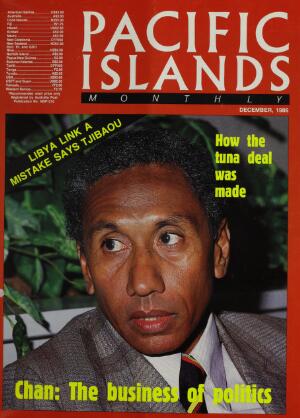
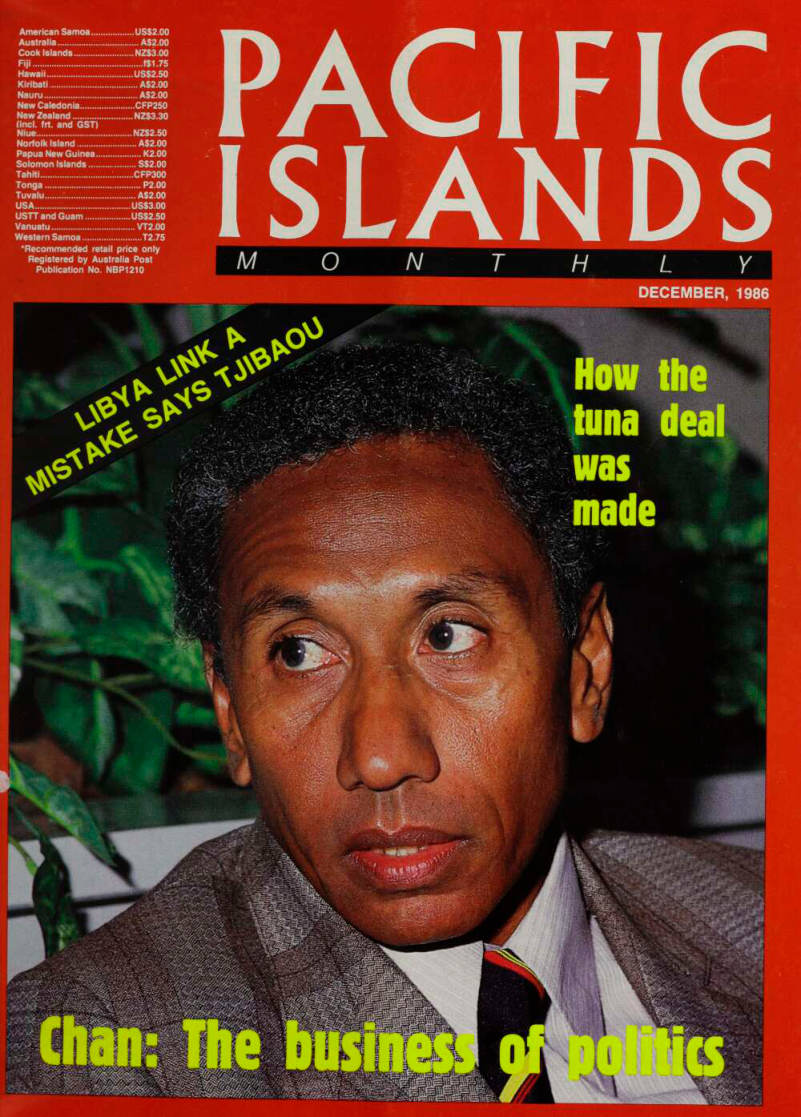
The Cover
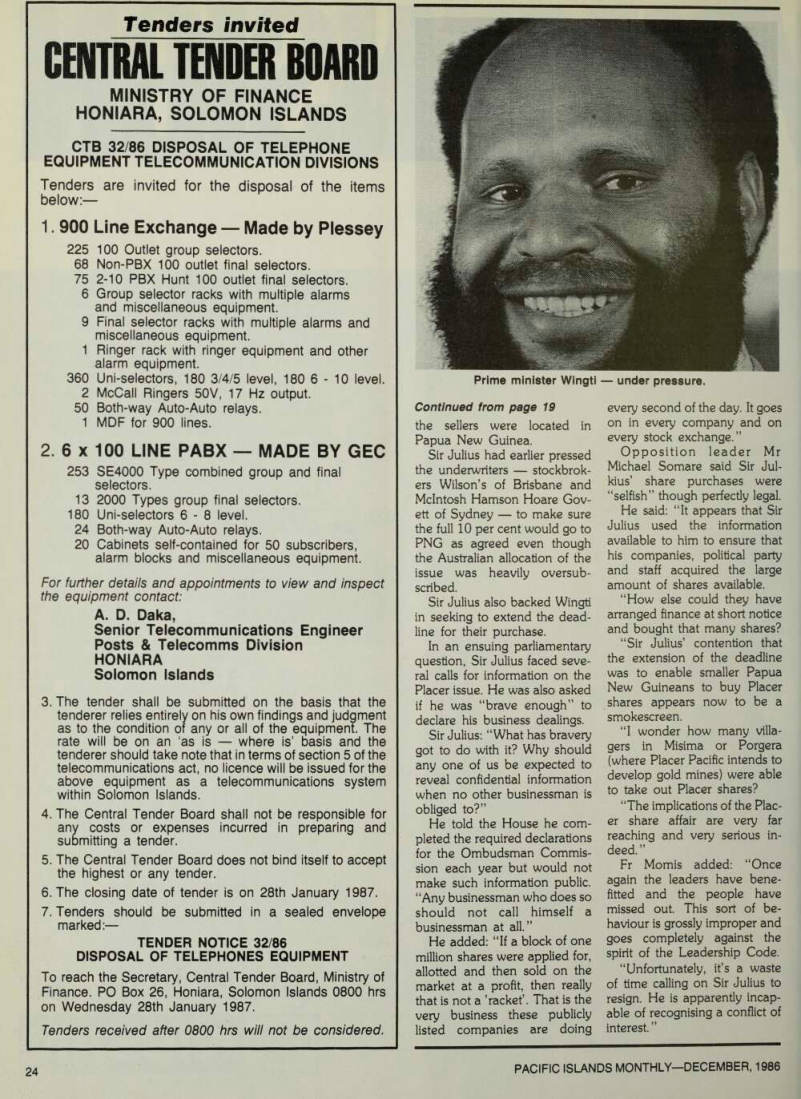
Sir Julius Chan.
Photo: Shar Adams
Advertisements & other items, pp. 2-3 (2 items)
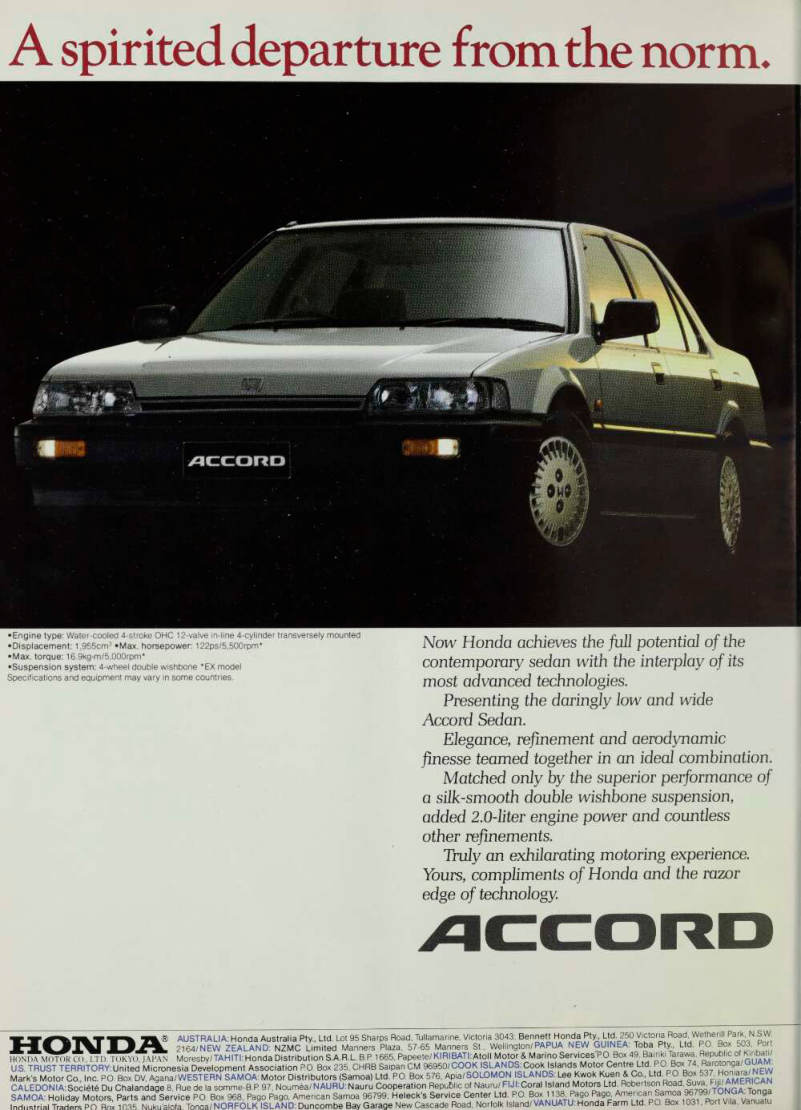
A spirited departure from the norm.
•Engine type: Water-cooled 4-stroke OHC 12-valve in-line 4-cylinder transversely mounted •Displacement: 1,955 cm 3 »Max. horsepower; 122ps/s,soorpm* •Max. torque: 16.9kg-m/s,ooorpm* •Suspension system: 4-wheel double wishbone *EX model Specifications and equipment may vary in some countries.
Now Honda achieves the full potential of the contemporary sedan with the interplay of its most advanced technologies.
Presenting the daringly low and wide Accord Sedan.
Elegance, refinement and aerodynamic finesse teamed together in an ideal combination.
Matched only by the superior performance of a silk-smooth double wishbone suspension, added 2.0-liter engine power and countless other refinements.
Truly an exhilarating motoring experience.
Yours, compliments of Honda and the razor edge of technology.
AUSTRALIA; Honda Australia Pty„ Ltd. Lot 95 Sharps Road, Tullamarine, Victoria 3043; Bennett Honda P\y Ltd 250 Victoria. Road WetherHl Park, NSW , 2164/NEW ZEALAND: NZMC Limited Manners Plaza, 57-65 Manners St , Wellington/PAPUA NEW GUINEA, Toba Pty., Ltd. PO. Box 503. For HONDA MOTOR CO., LTD. TOKYO, JAPAN Moresby/TAHITi: Honda Distribution S.A.R.L. B.P 1665, Papeete/ KIRIBATI: Atoll Motor & Marino Services Tarawa, Republicofgnbati/ U.S. TRUST TERRITORY: United Micronesia Development Association PO. Box 235, CHRB Saipan CM 96950/COOK SLANDS;Cooh.lslands I Motor Centre Ltd. P^O_Box R 74 Mark’s Motor Co., Inc. PO. Box DV, Agana/WESTERN SAMOA; Motor Distributors (Samoa) Ltd. PO. Box 576, Apia/SOLOMON ISLANDS: Lee Kwok Kuen &Co Ltd._RO^° CALEDONIA:Socidtd Du Chalandage 8, Rue de la somme-B.P. 97, Noumea/ NAURU: Nauru Cooperation Republic of Nauru/FIJLCoraI Island Motors Ltd Robertson Road, Suva SAMOA: Holiday Motors, Parts and Service PO. Box 968, Pago Pago, American Samoa 96799; Heleck’s Service Center Ltd. RQBal 38, Pago Paga Ame n . c . an p v 2 Industrial Traders PO Box 1035. Nukualofa. Tonaa/NORFOLK ISLAND; Duncombe Bay Garage New Cascade Road, Norfolk Island/ VANUATU. Honda Farm Ltd. PO Box 1031, Port Vila, Vanuatu
Pacific
ISLANDS
MONTHLY
Vol. 57, No. 12, December, 1986.
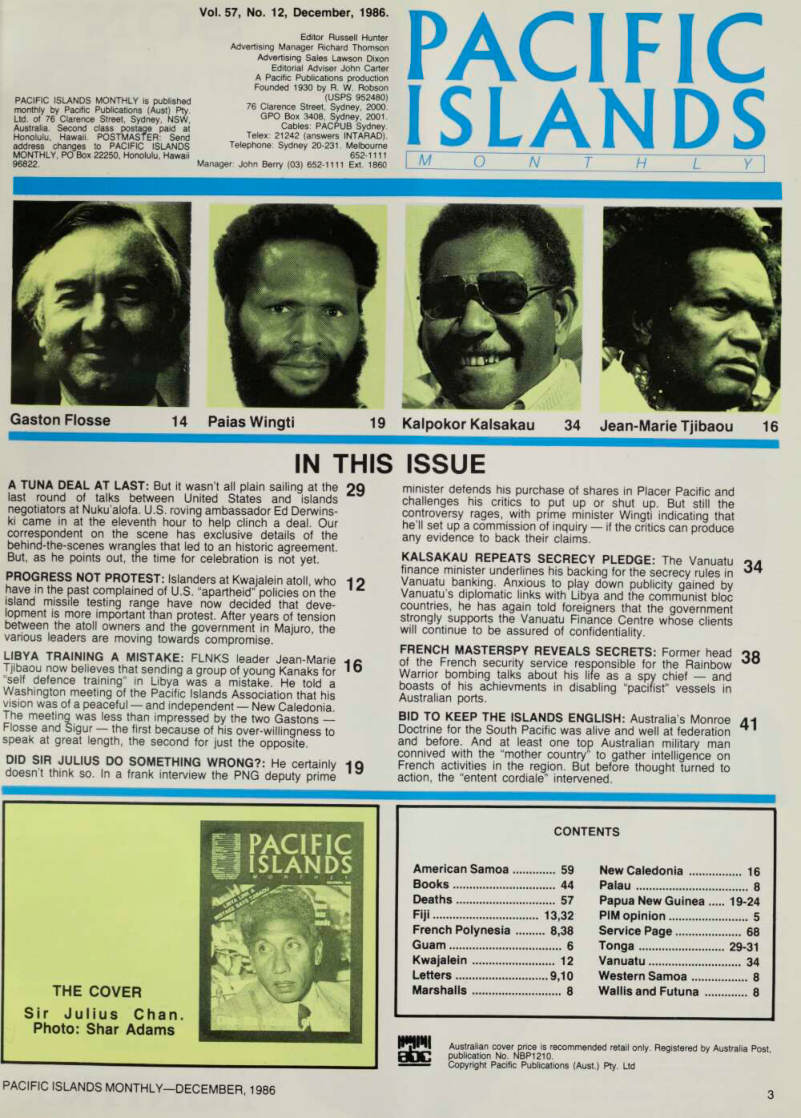
Gaston Flosse 14
PaiasWingti 19
Kalpokor Kalsakau 34
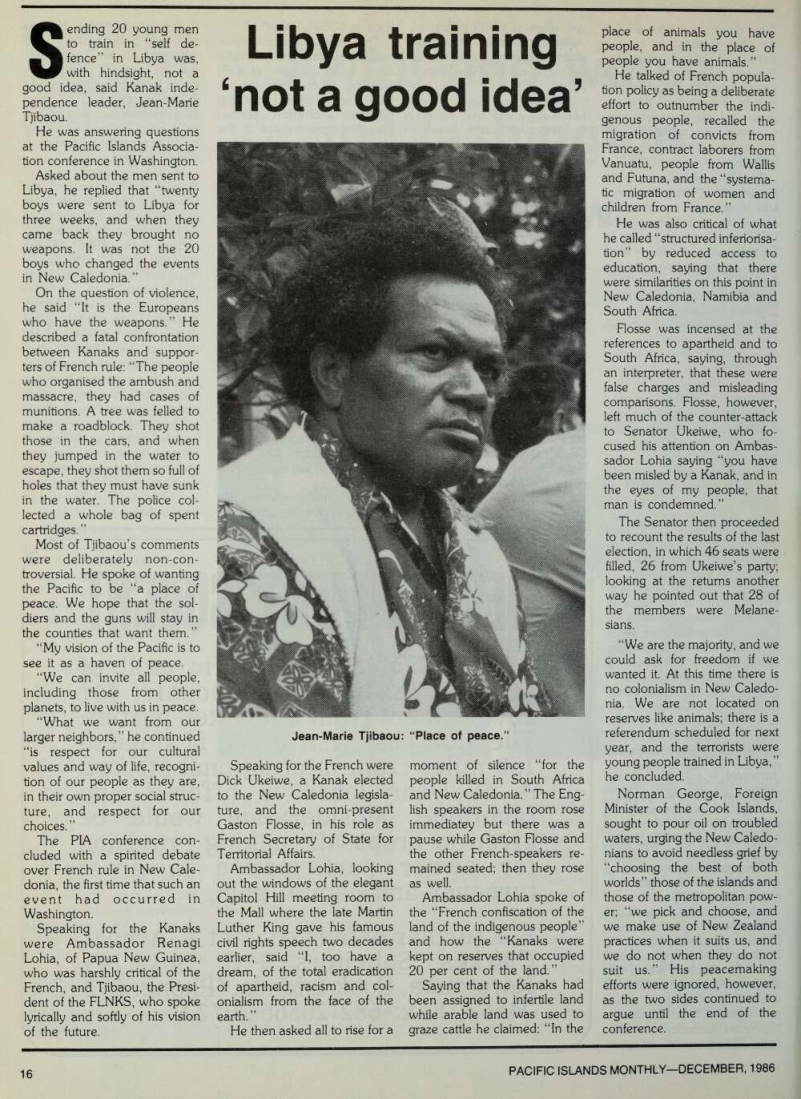
Jean-Marie Tjibaou 16
In This Issue
A TUNA DEAL AT LAST: But it wasn’t all plain sailing at the OQ last round of talks between United States and islands negotiators at Nukualofa. U.S. roving ambassador Ed Derwins ki came in at the eleventh hour to help clinch a deal. Our correspondent on the scene has exclusive details of the behind-the-scenes wrangles that led to an historic agreement.
But, as he points out, the time for celebration is not yet.
PROGRESS NOT PROTEST : Islanders at Kwajalein atoll, who 1 O have in the past complained of U.S. “apartheid” policies on the * island missile testing range have now decided that deve lopment is more important than protest. After years of tension between the atoll owners and the government in Majuro, the various leaders are moving towards compromise.
LIBYA TRAINING A MISTAKE: FLNKS leader Jean-Marie e Tjibaou now believes that sending a group of young Kanaks for ■& “self defence training” in Libya was a mistake. He told a Washington meeting of the Pacific Islands Association that his vision was of a peaceful and independent New Caledonia The meeting was less than impressed by the two Gastons Flosse and Sigur the first because of his over-willingness to speak at great length, the second for just the opposite.
DID SIR JULIUS DO SOMETHING WRONG?: He certainly 1Q doesn’t think so. In a frank interview the PNG deputy prime 1 *
minister defends his purchase of shares in Placer Pacific and challenges his critics to put up or shut up. But still the controversy rages, with prime minister Wingti indicating that he’ll set up a commission of inquiry if the critics can produce any evidence to back their claims.
KALSAKAU REPEATS SECRECY PLEDGE; The Vanuatu o„ finance minister underlines his backing for the secrecy rules in M Vanuatu banking. Anxious to play down publicity gained by Vanuatu's diplomatic links with Libya and the communist bloc countries, he has again told foreigners that the government strongly supports the Vanuatu Finance Centre whose clients will continue to be assured of confidentiality.
FRENCH MASTERSPY REVEALS SECRETS: Former head oo of the French security service responsible for the Rainbow 00 Warrior bombing talks about his life as a spy chief and boasts of his achievments in disabling “pacifist” vessels in Australian ports.
BID TO KEEP THE ISLANDS ENGLISH: Australia’s Monroe a-\ Doctrine for the South Pacific was alive and well at federation and before. And at least one top Australian military man connived with the “mother country” to gather intelligence on French activities in the region. But before thought turned to action, the “entent cordiale” intervened.
Contents
American Samoa 59 Books 44 Deaths 57 Fiji 13,32 French Polynesia 8,38 Guam 6 Kwajalein 12 Letters 9,10 Marshalls 8
New Caledonia 16 Palau 8 Papua New Guinea 19-24 PIM opinion 5 Service Page 68 Tonga 29-31 Vanuatu 34 Western Samoa 8 Wallis and Futuna 8
Australian cover price is recommended retail only. Registered by Australia Post publication No. NBPI2IO.
Copyright Pacific Publications (Aust.) Pty. Ltd
Advertisements & other items, pp. 3-4 (2 items)
Pacific Islands Monthly—December, 1986
3
Editor Russell Hunter Advertising Manager Richard Thomson Advertising Sales Lawson Dixon Editorial Adviser John Carter A Pacific Publications production Founded 1930 by R. W. Robson
(USPS 952480)
76 Clarence Street, Sydney, 2000.
GPO Box 3408, Sydney, 2001.
Cables: PACPUB Sydney.
Telex: 21242 (answers INTARAD).
Telephone: Sydney 20-231. Melbourne 652-1111 Manager: John Berry (03) 652-1111 Ext. 1860
PACIFIC ISLANDS MONTHLY is published monthly by Pacific Publications (Aust) Pty.
Ltd. of 76 Clarence Street, Sydney. NSW, Australia. Second class postage paid at Honolulu, Hawaii. POSTMASTER: Send address changes to PACIFIC ISLANDS MONTHLY, PO Box 22250, Honolulu, Hawaii 96822.
Trinitron
SONY.
m \
KV-2092AS
It's so tempting.
The colour you get from Sony's new Super Trinitron.
Our new Pan-Focus gun is computer-designed to make our famous colour even sharper and clearer. Our new Black Screen makes whites brilliant, blacks profound, every colour deeper and richer.
It's flatter and sguarer too.
For less reflection and superb clarity, even in the corners.
For those whose taste demands the best, Super Trinitron is the most delicious TV ever.
KV-1440AS
Trinitron
Fair shares for all
Pim Opinion
The recent predicament of Sir Julius Chan in Port Moresby will not have gone unnoticed elsewhere.
For every businesman-politician in the region risks the same treatment almost every day.
Sir Julius Chan’s defence that, as a businessman, he would have been foolish to pass up an opportunity to buy shares in Placer Pacific Ltd at a bargain price (within months of the company’s launch on the Sydney stock exchange with shares of $1 each, the price had trebled) is, on the surface, reasonable.
But, as always in politics, there are other considera tions.
The facts that Sir Julius is his country’s finance minister, that the PNG government negotiated hard for a large parcel of shares to be allocated within PNG and that he managed to round up more shares than just about anybody else in the country are all highly relevant.
It may also be relevant that several of the share applications with which he was connected were successful in full while most other applicants received only half of their requests for the highly-sought shares.
Now, had Sir Julius been a businessman with no interest in politics and no seat in the cabinet all the above would have passed unremarked.
But, as he well knows, people in public life are expected to behave differently from private citizens.
Rightly or wrongly, people expect their leaders to be above human failing. And to suggest, as a leading Australian newspaper, did that this is less true in undeveloped countries is a throwback to the paternal colonialism that has been widely rejected.
The question, of course, is: Has Sir Julius done anything wrong? It’s easier to ask than answer.
That he has done something at least technically wrong is clear from the country’s leadership code which prohibits leaders buying shares in foreign controlled companies without the prior permission of the Ombuds
man Commission. But he, at least, was open about it unlike others, including some of his critics in government and opposition who, it turns out, had also purchased shares.
That, of course, didn’t stop them from criticising Sir Julius.
Now, however, they’re all in the same boat MPs, judges, public servants and others including the mem bers of the Ombudsman Commission themselves (though one of them acquired his holding before his appointment and can hardly be held culpable for that).
It appears to be a constitutional impasse. If the inquiry finds that all leaders who have bought shares are in breach of the law, it could be possible for the Ombudsman Commission to issue retrospective permis sion for the purchases Under the circumstances that may be the most workable solution. But can the ombudsmen issue such permission to themselves?
And the wider issue is the acceptability or otherwise of MPs being involved in business dealings.
Sir Julius, for example, regarded his investment as just another business opportunity. So, presumably, did his colleagues, although a number of them did not hesitate to join the public outcry that greeted the announcement of Sir Julius’ market activity. But are business dealings the concern of MPs as private citizens or as very public politicians?
In any case, Sir Julius and the other MP’s will answer to the electors, as he has done so often before, and they will give their opinion in next year’s general election.
And, in passing, let’s note that it was Port Moresby’s vigorous free press that first brought the affair to light. Be it also noted that PNG has now signed a treaty of ’’mutual respect, friendship and co-operation” with a country in which that would not have been possible.
pacific report

Png, Indonesia
Sign Treaty
Papua New Guinea and Indonesia have signed a treaty committing the two countries not to threaten or use force against each other. The Treaty of Mutual Respect, Friendship and Co-operation was signed in Port Moresby by PNG foreign minister, Mr Legu Vagi and his Indonesian counterpart, Dr Mochtar Kusumaatmaja. At the signing cere mony, Dr Mochtar said the treaty repre sented a basis for building on what he called “A remarkable increase” in co operation between the two countries.
Under the treaty proposed by Papua New Guinea the two countries agree to settle any disputes by arbitration and conciliation. As a last resort, the United Nations could be asked to adjudicate.
Vagi said a framework for the peaceful resolution of disputes was highly desir able. The agreement also provides for mutual recognition of national interests along the 760-kilometre border. How ever, it does not allow for joint border military operations, nor for the extradition of each other’s citizens. Officials in Port Moresby said the treaty would not affect the status of the 11,000 Irian Jayan border crossers now living in Papua New Guinea. However, Dr Mochtar, in a later address to the PNG Press Club inti mated that Indonesia may seek joint military action on the border at a later date. He was asked about another treaty still under discussion that would provide for joint emergency search and rescue operations in the border area and whe ther such provisions could be used to disguise search and destroy missions against OPM activists. He replied that if Indonesia wanted a specific joint military action, "We would be frank about it.
There may come a time when we have such co-operation.” Vagi, however, later ruled out the use of force against the OPM rebels. In a meeting with repre sentatives of two Swedish women’s peace movements, he said the use of the PNG Defence Force against the OPM was very unlikely but, he said, the government would try to ensure through regular consultation that there was no border conflict. The Opposition claimed the treaty was an effort to legalise the genocide of Melanesians in Irian Jaya.
Opposition foreign affairs spokesman, Mr John Giheno, said the government had blundered in proposing the treaty and the motives behind it were sinister as it promoted the passive genocide of Melanesians in Indonesia's border pro vince. Giheno said the treaty also pre vented future PNG governments from raising concerns about human rights
abuses in Irian Jaya. He also said that PNG would not now be able to protest against any violation of its border by Indonesia without such a protest being considered unfriendly conduct.
Satellite Town
Goes To Tender
Fiji will invite overseas investors to tender for sites in the commercial centre of a satellite town to be developed at Valelevu, 10 kms north of Suva. Housing minister, Mr Edward Beddoes, said the venture would be the first of its kind in Fiji. The first stage, costing $2.5 million wilh include commercial and office pre mises, supermarkets, a market place and some housing. The project will be centred on the Nasinu district where the population has doubled to 40,000 in the last 10 years. Mr Beddoes said this could double again with the deve lopment of the satellite town. Valelevu already has an industrial estate with 30 factories and commercial premises. It will eventually be the centre of municipal administration for the area.
State Of Emergency
On French Island
France declared a state of emergency on its Pacific territory of Wallis and Futuna following reported unrest among local traditional chiefs. The decision was announced by the French Embassy in Canberra where a spokesman told Reu ters that the French High Commissioner in New Caledonia, Mr Jean Montpezat had declared the emergency and had sent 30 policemen from Noumea to re-inforce the five in the two island groups. The unrest followed the transfer of eight French public servants. Reuters reported that Wallis’ King Tavelua had expressed his disappointment at the transfers and that some high chiefs wanted to stage a protest outside the home of the administrator, Mr Jacques Le Henaff. Some members of the territo rial assembly told the newsagency by telephone that the emergency decision was unnecessary and an over-reaction.
The state of emergency was lifted after only one day, the French newsagency, AFP, reported, quoting Le Henaff as saying the situation had returned to normal. However, he told AFP that he would not hesitate to reimpose the emergency ruling if things again got out of hand. Wallis and Futuna has a population of about 10,000, mostly Polynesians.
Riots, Looting As
Okuk Dies
PNG highlands politician, Sir lambakey Okuk, died on November 14 reportedly of liver cancer. His death sparked riots and the looting of shops during a state funeral in Port Moresby. Highlanders who felt insulted that a national day of mourning had not been declared and that people were working normally, blocked main roads and fought with police. Local criminal elements took advantage of the confusion. Long time Port Moresby residents said it was the worst rioting the capital had seen. Later, there was further rioting as Sir lam bakey’s body was taken to the highlands centres of Mount Hagen, Goroka and, finally, Kundiawa near Sir lambakey’s home village. He was 32 and buried peacefully on November 23. Sir lam bakey was the last of the ’’action man” highlands politicians, a man who de sperately wanted to be the first high lands prime minister. A politician for whom the end was always more impor tant than the means, he was superseded by a younger, more intellectual brand of MP as typified by Mr Paias Wingti the first highlands prime minister.
Kenilorea Forced
To Quit
Solomon Islands prime minister, Sir Peter Kenilorea, resigned after losing the support of six senior ministers. He had earlier come under fire from all sides after accepting an aid offer from France's South Pacific minister, Mr Gas ton Flosse, to rebuild a school and other buildings in Sir Peter’s home village after the damage caused by Cyclone Namu.
Sir Peter vehemently denied any wrong doing saying all reconstruction aid was welcome. In his letter of resignation, he did not refer to the affair but merely noted that his support had dwindled to a level where could not effectively run the government. Parliament was to meet early this month to elect a new prime minister.
Call To Halt
Localisation Policy
A report on Papua New Guinea’s labour market has recommended that the gov ernment drop its policy of full localisation of the public service. Under current policy, all but the most technical posi tions are filled by Papua New Guineans.
In a report for the Institute of National Affairs in Port Moresby, Dr Paul McGavin of Flinders University, South Australia, said the government should be more concerned with developing the compe tence of nationals rather than giving them jobs. He said that for the deve lopment of the nation and of its citizens’ skills, localisation of jobs should not come too early. Dr McGavin’s report contains 52 recommendations, including an annual review of the labour market, continued government support for the Minumum Wages Board and the aboli tion of wage indexation.
No Entry For
Opm Deportee
The Papua New Guinea government has denied entry to an Irian Jayan originally deported in 1979. Foreign affairs officials rejected a visa application by Mr John Ondowame, who now lives in Sweden, on the grounds of his previous deporta tion and conviction of being a member of an Irian Jayan independence move ment. His visa application, originally approved, was later rejected. Ondo wame was to have accompanied two members of a Swedish women's peace movement to PNG.
Tourism Gets
Top Priority
Western Samoa has decided to make tourism development a very high priority.
The country's minister for economic developmemt Le Tagaloa Pita and fin ance minister Pualagi both told the national economic summit in Apia that the government was committed to deve loping the industry as the nation’s major earner of foreign currency. They said about $25 million had already been spent on improving the industry and more would be spent during the next five years. However, the conference empha sised the need to retain the country’s cultural identity in any tourism deve lopment and heavily rejected a sugges tion to open a casino.
Marshalls Get
Self Government
After 17 years of negotiations with the United States, the Marshall Islands have become self governing. The Compact of Free Association, now in effect, allows the Marshalls government to make its own laws while remaining dependent on the US in defence matters. The new status was marked by a state of the nation speech by president Amata Kabua who said it was not the govern ment but the people of the islands who should take credit for their emergence as a free nation. The change was
approved by the islanders in a referen dum last year. For nearly 40 years, the Marshall Islands had been part of the United States Trust Territory of the Pacific Islands. The compact applies for 15 years and is renewable.
No Deal For
Soviet Fleet
Kiribati announced it would not renew its fishing agreement with the Soviet Union.
The announcement came hard on the heels of the agreement reached by the United States and island officials on a fishery access deal. The Kiribati deal with the Soviet, which expired in Octo ber, was worth about $3 million. The Kiribati minister for natural resources, Mr Barbera Kirata, said the Soviets had wanted to reduce the number of their fishing boats and pay less than half the previous agreed rate.
Labour Wants To
Scrap Tv Deal
The Fiji Labour Party says it will try to scrap Fiji’s new television agreement with the Australian group owned by Mr Kerry Packer. The assistant secretary of the party, Mr Mahendra Chaudhry, said Mr Packer’s PBL Ltd had been given a 12-year monopoly on television in Fiji without a study of its social consequ ences. He told a Sydney conference on the Pacific that if Labour wins power in next year’s general elections, it will try to end the agreement.
Minister Raps
Union Bosses
Vanuatu’s trade union leaders have been criticised by home affairs minister, Mr Sethy Regenvanu. The minister said union chiefs had travelled overseas without his consent in contravention of the Trade Union Act. He said union leaders had also formed associations with external bodies, also without his permission. Regenvanu also said foreign organisations had come to Vanuatu and had become involved in the unions’ internal affairs. He said union leaders should spend more time in Vanuatu looking after the interests of their mem bers than travelling overseas.
Population At
Record Level
Tonga officials said they expect the national census, due to be held last month, to show a total population of more than 100,000 for the first time. The census was to be held throughout Tonga’s 36 inhabited islands from November 24-28. At the last full census
in 1976, the population was just over 90,000, nearly 13,000 more than in the 1966 count. A “mini census” in 1984 put the figure at 96,592. The government allotted about $23,000 for the census and statistical work which, for the first time will be done in Tonga rather than Fiji as previously. More than 400 teachers and statistics department officials will conduct the survey.
France Reviews
Vanuatu Aid
A French government ministerial com mittee on the South Pacific is to review France’s aid program in Vanuatu, cur rently amounting to about $24 million a year. The committee may decide to divert some of this money through a French economic co-operation fund for development projects in the region.
Reporting the impending establishment of the fund La Depeche De Tahiti said it would be welcomed by francophiles throughout the region who were “fed up” with the attitudes of certain countries hostile to the very idea of a French presence within the South Pacific. La Depeche named Vanuatu prime minis ter, Fr Walter Uni, pointing out that while he had the “bad taste” to criticise France, his country continued to receive French aid. The newspaper also re ported that French Polynesian Under Secretary of State for South Pacific Affairs, Gaston Flosse, who has never hidden his irritation at Vanuatu’s views, said: “French aid in the region must not be reduced." However, according to La Depeche he hinted that it might distri buted differently. He was reported to have said in Noumea: “French aid must be distributed differently. This is under review and countries like Vanuatu can not receive more money while they are doing all they can to chase us out of the Pacific.” Vanuatu, however, seemed un deterred at the implied threat. The country’s representative in the United Nations, Mr Robert Van Lirop, while speaking in support of New Caledonia's reinscription with the decolonisation committee, told the General Assembly: “We have also been told that economic aid to Vanuatu will be terminated if we persist in bringing the question of New Caledonia to the United Nations. This is a most unfortunate suggestion. Naturally we do not want to see this aid termin ated. Vanuatu is, after all, a small developing country. In fact it is one of the least developed countries. However, we will not be intimidated in this way, or in any other manner. Similar threats have been made and carried out against other countries. Vanuatu is not the first and probably will not be the last to be treated in this fashion. We regret this, but such is life. We have always believed that the administering power is above such actions. We still hope that it is. However, if it is not, Vanuatu will survive and New Caledonia will still become independent.
Nothing will stop that process."
Advertisements & other items, p. 7 (1 item)
in digital home entertainment
J a « <* «» :■ -■ ; -j
HBBi
M tHki
NEC —at the forefront of the revolution
in digital home entertainment
With today's revolution in digital technology, there's only one picture" and still picture features. Our Digital VCR uses digital name to trust to bring this revolution home - NEC. NEC is a noise reduction technology to give you an extremely clear leader in digital technology for everything from communica- picture at any speed and features like digital picture memory, tions satellites to professional studio equipment. We put this The AVD-700 further enhances your entertainment system by same dedication to quality and innovation in our products adding natural, precise and low-noise surround sound effects, made for the home to give you the utmost in performance. using NEC-developed digital delay circuitry.
In our Digital Monitor Receiver, advanced digital technology So if you're wondering what the digital revolution means to has made possible amazing conveniences like 'picture in you, NEC has the answer.
N9610A N9040A N9034A
VHS HQ Hi-Fi VCR with VHS HQ Stereo VCR VHS HQ VCR 'Double Azimuth” Four Head System With HQ video and stereo, both sound and Incorporates the new HQ video system for visibly enhanced picture quality. Unified remote for both VCR and NEC TV.
NEC
International Home Electronics Division, NEC Building, 33-1, Shiba 5-chome, Minato-ku, Tokyo 108, JAPAN Telephone: Tokyo 03-456-3111 Cable: NEC TOKYO Telex: NECTOK J 22686
Historic houses could
letters
Historic houses could be tourist attraction
Recently, Nahau Rooney, PNG’s minister for tourism, foreshadowed a new program for the industry which she de scribed as a future economic asset of importance.
One of the best attractions any country can offer visitors is the material legacy of its history embodied in historic monu ments. And, in PNG, Milne Bay and China Strait offer several historic buildings of potentially great tourist value.
Their survival however, is now in jeopardy. Overlooking the sea lanes used by cruise ships, these dilapidated buil dings are regularly visited by parties of tourists.
Two of these structures (erected in 1895 and c 1905) may fairly claim to be the earliest surviving buildings on that coast and may well be the oldest complete buildings still standing in PNG.
While many Pacific scholars will be aware of the origins of these buildings, others may be interested to know more.
The first is the resident magis trate’s house at Samarai. Now defaced by smoke and grime, its exact date of construction is unclear, but is probably pre -1914. It may have been partly rebuilt in 1942 when the town was partly demolished.
It appears to need only a coat of paint being structurally sound and could become a focal point for the tourist trade.
The second is St Paul’s Angli can Church at Samarai built in 1914 and the only builiding to survive the war unscathed. The steep-pitched roof is leaking badly leading to general decay inside.
A third at Fife Bay (Isuleilei) was built by the Rev C. F. Rich of the LMS after 1902 and is in excellent structural condition.
With a superb harbour view and being within easy reach of Alotau when the new road is built, this could again be a great tourist attraction. Generations of the Suau people were edu cated there over the past 80 years.
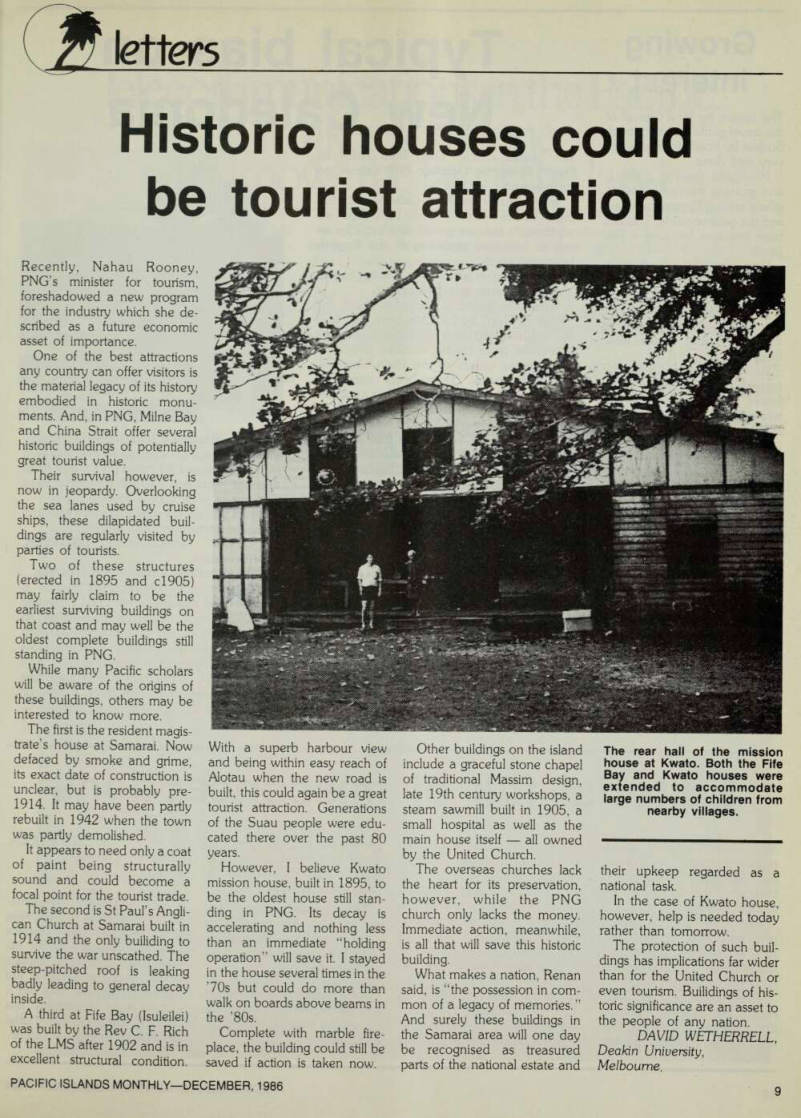
However, I believe Kwato mission house, built in 1895, to be the oldest house still stan ding in PNG. Its decay is accelerating and nothing less than an immediate “holding operation” will save it. I stayed in the house several times in the 70s but could do more than walk on boards above beams in the ’Bos.
Complete with marble fire place, the building could still be saved if action is taken now.
Other buildings on the island include a graceful stone chapel of traditional Massim design, late 19th century workshops, a steam sawmill built in 1905, a small hospital as well as the main house itself all owned by the United Church.
The overseas churches lack the heart for its preservation, however, while the PNG church only lacks the money.
Immediate action, meanwhile, is all that will save this historic building.
What makes a nation, Renan said, is “the possession in com mon of a legacy of memories.”
And surely these buildings in the Samarai area will one day be recognised as treasured parts of the national estate and
their upkeep regarded as a national task.
In the case of Kwato house, however, help is needed today rather than tomorrow.
The protection of such buil dings has implications far wider than for the United Church or even tourism. Builidings of his toric significance are an asset to the people of any nation.
David Wetherrell,
Deakin University, Melbourne.
The rear hall of the mission house at Kwato. Both the Fife Bay and Kwato houses were extended to accommodate large numbers of children from nearby villages.
Growing
interest
The review by Mr J Cornell of the travel guide and handbook Sudsee by Eberhard Stahn was very well done.
No doubt there is a strong and growing interest in Pacific affairs among German scholars and the general public. This has been the case for quite a few years.
With keen eyes and some times with sorrow we observe developments.
Mr Cornell mentions the ommissions in Stahn’s work of the Maoris and Papua New Guinea.
But one should add that the handbook series of Mai’s Reise fuhrer Verlag contains several books, each one dealing with certain regions of the Pacific.
Thus, number 15 is the volume on New Zealand, num ber 36 deals with Australia and, in number 33, I myself have written extensively on Papua New Guinea. Every book, then, should be seen in connection with the total presentation of Pacific publications in the Ger man language.
There are hundreds of high quality accounts in our book shelves, but, of course, they are hardly noticed by non-German speaking people.
Dr Friedrich Steinbauer,
German Pacific Society, Munich, West Germany.
Typical bias on New Caledonia
New Caledonia
The biased article “Dien Bien Thio” by Helen Fraser in October PIM cannot go unanswered.
When Fraser left New Caledonia claim ing to be the victim of “white bully boys” we all thought that we would now be in for an era of unbiased reporting in the English language press.
But this latest article was vintage biased and information-selective Fraser.
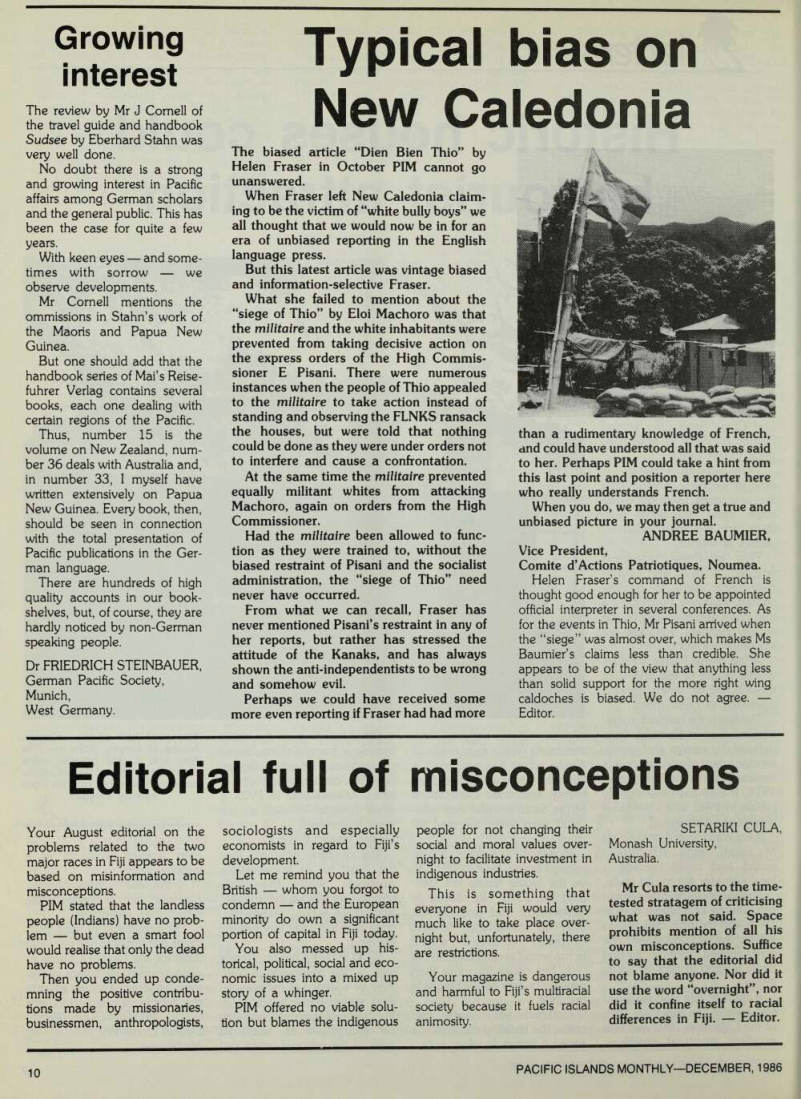
What she failed to mention about the “siege of Thio” by Eloi Machoro was that the militaire and the white inhabitants were prevented from taking decisive action on the express orders of the High Commis sioner E Pisani. There were numerous instances when the people of Thio appealed to the militaire to take action instead of standing and observing the FLNKS ransack the houses, but were told that nothing could be done as they were under orders not to interfere and cause a confrontation.
At the same time the militaire prevented equally militant whites from attacking Machoro, again on orders from the High Commissioner.
Had the militaire been allowed to func tion as they were trained to, without the biased restraint of Pisani and the socialist administration, the “siege of Thio” need never have occurred.
From what we can recall, Fraser has never mentioned Pisani’s restraint in any of her reports, but rather has stressed the attitude of the Kanaks, and has always shown the anti-independentists to be wrong and somehow evil.
Perhaps we could have received some more even reporting if Fraser had had more
than a rudimentary knowledge of French, and could have understood all that was said to her. Perhaps PIM could take a hint from this last point and position a reporter here who really understands French.
When you do, we may then get a true and unbiased picture in your journal.
Andree Baumier,
Vice President, Comite d’Actions Patriotiques, Noumea.
Helen Fraser’s command of French is thought good enough for her to be appointed official interpreter in several conferences. As for the events in Thio, Mr Pisani arrived when the “siege” was almost over, which makes Ms Baumier’s claims less than credible. She appears to be of the view that anything less than solid support for the more right wing caldoches is biased. We do not agree.
Editor.
Editorial full of misconceptions
Your August editorial on the problems related to the two major races in Fiji appears to be based on misinformation and misconceptions.
PIM stated that the landless people (Indians) have no problem but even a smart fool would realise that only the dead have no problems.
Then you ended up condemning the positive contribu- Hons made by missionaries, businessmen, anthropologists,
sociologists and especially economists in regard to Fiji’s development.
Let me remind you that the British whom you forgot to condemn and the European minority do own a significant portion of capital in Fiji today.
You also messed up his torical, political, social and eco nomic issues into a mixed up story of a whinger.
PIM offered no viable solu tion but blames the indigenous
people for not changing their social and moral values over night to facilitate investment in indigenous industries.
This is something that everyone in Fiji would very much like to take place over night but, unfortunately, there are restrictions.
Your magazine is dangerous and harmful to Fiji’s multiracial society because it fuels racial animosity.
Setariki Cula,
Monash University, Australia.
Mr Cula resorts to the time tested stratagem of criticising what was not said. Space prohibits mention of all his own misconceptions. Suffice to say that the editorial did not blame anyone. Nor did it use the word “overnight”, nor did it confine itself to racial differences in Fiji. Editor.
Advertisements & other items, p. 11 (1 item)
Telecommunications in the Pacific.
It takes someone
who knows the lay of the land No company is more familiar with the challenges of telecommunications in the Pacific Basin than Hawaiian Telephone.
Our experience here as an operating telephone company enables us to offer a range of services that many suppliers cannot.
In addition to providing our customers in the Pacific Basin with state-of-the-art equipment, we’ve worked with managers and engineers on: fundamental and strategic planning; network design; traffic engineering: marketing; human resources and international relations and operations.
To date, we’ve worked with military and government customers in Japan, Korea, Philippines, Indonesia, Guam and Micronesia.
Call Benjamin Fukumoto, Director of Government Communications, (808) 546-7890.
HAWAIIAN TEL SB
Beyond the call mm- . * st
not protest
New moves at KMR
Make progress not protest
A STORMY protests at the Kwajalein Missile Range (KMR) earlier this year propelled the American-controlled military base into headlines around the world. The six month “camp in” protest by Kwajalein land owners on military held land was put down by the Marshall Islands government when it forcibly evicted the islanders with court approved action.
When infuriated landowners responded with a physical blockade of the Ebeye pier, preventing Marshallese KMR workers from getting to their jobs at the base three miles away, the Marshall Islands gov ernment declared an unpre cedented state of emergency.
Calm returned to Ebeye when President Amata Kabua met with landowner leaders, persuading them to give up the protests.
Months after the demonstra tions ended at Kwajalein and Ebeye in May, Kwajalein lead ers are now seeking progress not protest.
Kwajalein leaders have con tended for years that both the United States and their own government ignore the severe social and public health prob lems on crowded Ebeye island.
With 8000 people living on 78 acres (24 hectares) Ebeye has one of the highest population densities in the Pacific.
Of that population, more than 5000 are Kwajalein land owners who cannot use two thirds of their atoll, the largest in the world, and lagoon which is a target for the MX and other US missiles launched from Cali fornia. Many other Marshall Islanders have moved to Ebeye looking for jobs at the missile range.
Since 1983, the young and energetic administration of Mayor Alvin Jacklick, Ebeye’s first elected mayor, has emerged as a leading force for change on an island that serves as the US Army’s labour camp.
Jacklick, along with other elected Kwajalein leaders, formed the Kwajalein Atoll De velopment Authority (KADA) which has designed a deve lopment plan that will, as part of
a $2OO million redevelopment scheme, disperse Ebeye’s population on six islands to the north which will be connected by a new reef causeway.
Despite an often tense re lationship between Kwajalein leaders and the national Mar shall Islands government in Ma juro 200 miles away, both sides are moving towards conciliation on long range development plans for the atoll.
For the US Army, improve ments in living conditions on Ebeye are essential to unhin dered use of the missile range which will be playing a central role in the Reagan administra tion’s controversial “Star Wars” weapons program. Despite years of Kwajalein landowner
calls for action on life threaten ing health conditions, and pro tests which met with US in difference, it is only in recent months after years of a military “boot camp” attitude prevailing in its relations to wards Ebeye that the Army has started working with Kwaja lein leaders.
One of the first improve ments KADA launched was the construction of a new power station and desalination plant that will operate off waste heat from the electrical generators.
At peak capacity, it is expected to produce about 300,000 gal lons of fresh water daily, and greatly reduce Ebeye’s depend ence on Kwajalein for fresh water which is now barged in by the Army several times a
week at substantial cost to the Marshallese.
The power plant is nearly finished and should go on line this month. The Army is cur rently in negotiation with KADA on the possibility of the Ebeye station providing a portion of KMR’s electricity needs.
Dispersing the congested Ebeye population, coupled with developing housing and zoning laws to allow for even deve lopment of recreation, housing and business areas, is the only way to solve community prob lems such as the burgeoning crime rate, said Mayor Jacklick.
To grapple with the population crunch KADA, which is funded through US grants, listed the multi-million causeway project as a top priority.
In behind-the-scenes-political maneouvering, however, Presi dent Kabua called for new housing developments on the atoll to be placed ahead of the causeway. A measure of the concilliatory attitude among the normally outspoken Kwajalein leaders was their response to the President’s plan which did not follow Kwajalein’s detailed 15-year development plan.
Jacklick immediately hailed the housing plan for Gugeegue, an island separated from Ebeye by six miles of reef and several islands, as a “good way to confront the population prob lem on Ebeye.” By moving people off Ebeye, it will give the government the opportunity to demolish old dilapidated houses there and build new housing, business and com munity facilities, he said.
An astute politician himself, Jacklick is certain that the estab lishment of a new community on Gugeegue will increase the demand for the causeway to Ebeye. The only way to get to Gugeegue now is by boat, an expensive mode of travel. The causeway project is in the final stages of review and could begin early next year.
According to the Compact of Free Association between the Marshalls and the US, KADA will receive about $2OO million for development work, which will include a new elementary school and Ebeye’s first high
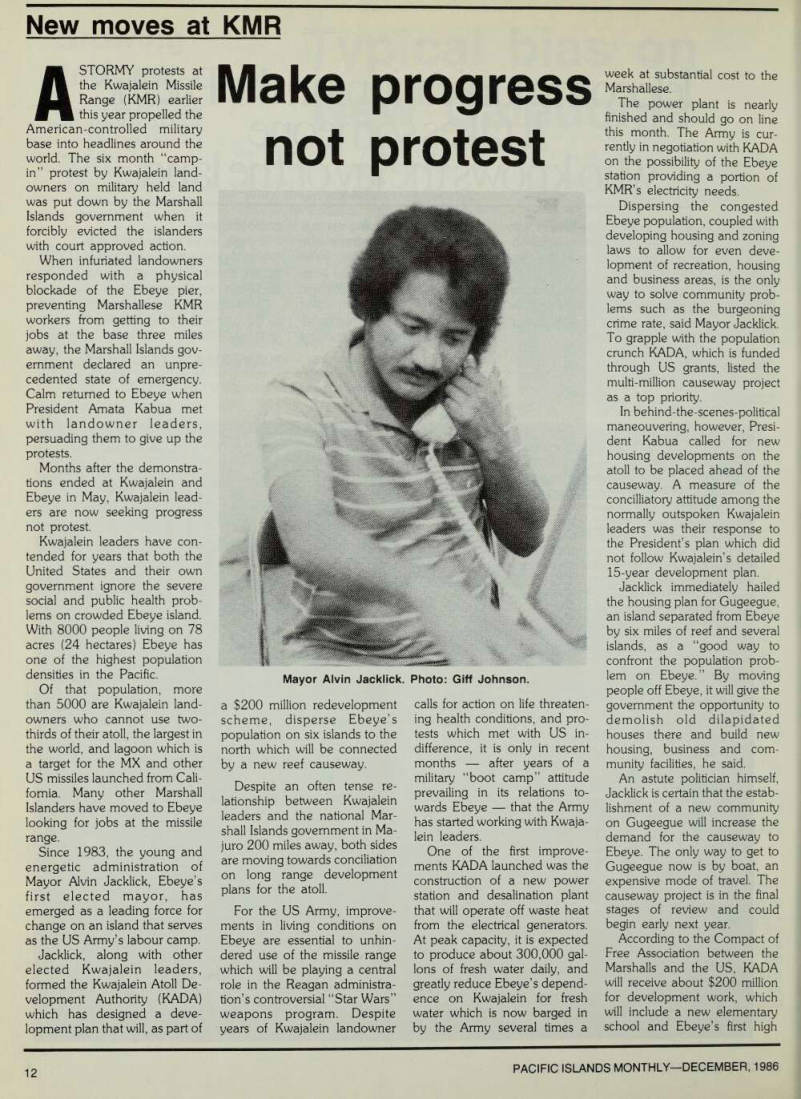
Mayor Alvin Jacklick. Photo: Gift Johnson.
school, sports fields now singularly lacking on Ebeye and community centres, town house clusters for the displaced Kwajalein landowners, and a variety of sanitation improve ments.
While trying to get its 15 year plan underway, KADA also has to fight fires on Ebeye resulting from years of neglect. Sanita tion conditions are woeful, and in mid-September KADA voted $50,000 in emergency funds to immediately construct several blocks of flush toilets for fami lies who use the Ebeye beaches to discharge human waste.
Ebeye’s life line to the out side world is its dock. To stave off the imminent collapse of the Ebeye pier resulting from poor construction and battering by container vessels, KADA is set to begin emergency repairs.
Although frequent disputes over the way the Marshall Is lands government distributes US compensation payments to the Kwajalein landowners could stir future protests, most Kwaja lein leaders are now focusing on giving their atoll a facelift.
But making Ebeye, labelled a “biological time bomb” by the UN during the 19705, and adjacent islands habitable is no small task.
If the US delivers promised financial aid and if the Army command at Kwajalein shows new initiative to aid Ebeye, conditions on Kwajalein afford the US the best chance it has had for achieving stability in what have traditionally been turbulent relations with the Marshallese.
Changing the face of Ebeye won’t solve inherent and visible inequities between Kwajalein’s country-club like atmosphere and high standard of living where the 3000 American technicians live and Ebeye three miles away.
But, observes Jacklick, the proposed developments will do much to alleviate the worst of the rampant disease, high suicide and youth crime rates, and life threatening public health conditions prevalent on Ebeye today.
The development of Kwaja lein Atoll “will give the kids better opportunities for the fu
ture,” said Jacklick.
Giff
Johnson.
make MPs pay
Writ seeks to make MPs pay
When King Tauja’ahau Tupou IV closed the Tongan Parliament early last month, he ended one of the most memor able legislative sittings in Ton ga’s history.
Among the highlights, a con troversial five per cent sales tax was imposed along with a flat 10 per cent income tax for all people with incomes above A 52,000.
After the passage of the legislation, parliamentarians conducted fonos, or public meetings in villages throughout the kingdom to explain the new law.
It was the second time in 123 years of parliament that such a series of meetings had been held.
And hard on the heels of the meetings came a monthly newspaper called Kelea (conch shell) published for the purpose of explaining the law. Since its first issue, the paper has be come a sensation.
People queue outside the Friendly Islands Bookstore in Nuku’alofa for the mimeog raphed sheet which has trum peted alarming allegations of mis-spending by high govern ment officials.
Meanwhile, some weeks pre viously a writ had been issued against 25 of the 28 members
of the legislative assembly by ’lpefi Siale of Ta’anea, Vava’u.
He seeks judgedment against the speaker of the house Kala nivalu Fotofili and finance minister James Cecil Conker, for authorising allegedly exces sive entitlements for legislators taking part in the fonos.
He calls for judgement against the other 23 alleging they knowingly accepted exces sive payments.
Siale claims in the writ that the named parliamentarians re ceived overpayments totalling
over $176,000. He calls for the MPs to refund the money and the cost of any future court proceedings.
The MPs had 28 days to respond to the allegations.
While the Kelea has served as a government watchdog, the Tonga Chronicle, the govern ment’s newspaper, had its coverage censored.
The report of the writ being filed ran on the front page of the Tongan language edition of October 31. However, the Eng lish edition was held for nearly a week at the printer. Eventually the edition went to press with no mention of the existence of the writ.
In a later issue the Chroni cle’s editor reprinted a 1969 interview with the king about the role of the press. In it, the king said the free press was needed and that leaders should learn to live with criticism.
Willy Fukofuka, editor of Kelea said he was pleased to see the reprint of the king’s comments on the role of the press because it reflected the views aired in the third issue of his paper.
The only MPs not named in the writ were Crown Prince Tupouto’a, prime minister Prince Fatafehi Tui’pelehake and deputy prime minister, Baron Tuita.
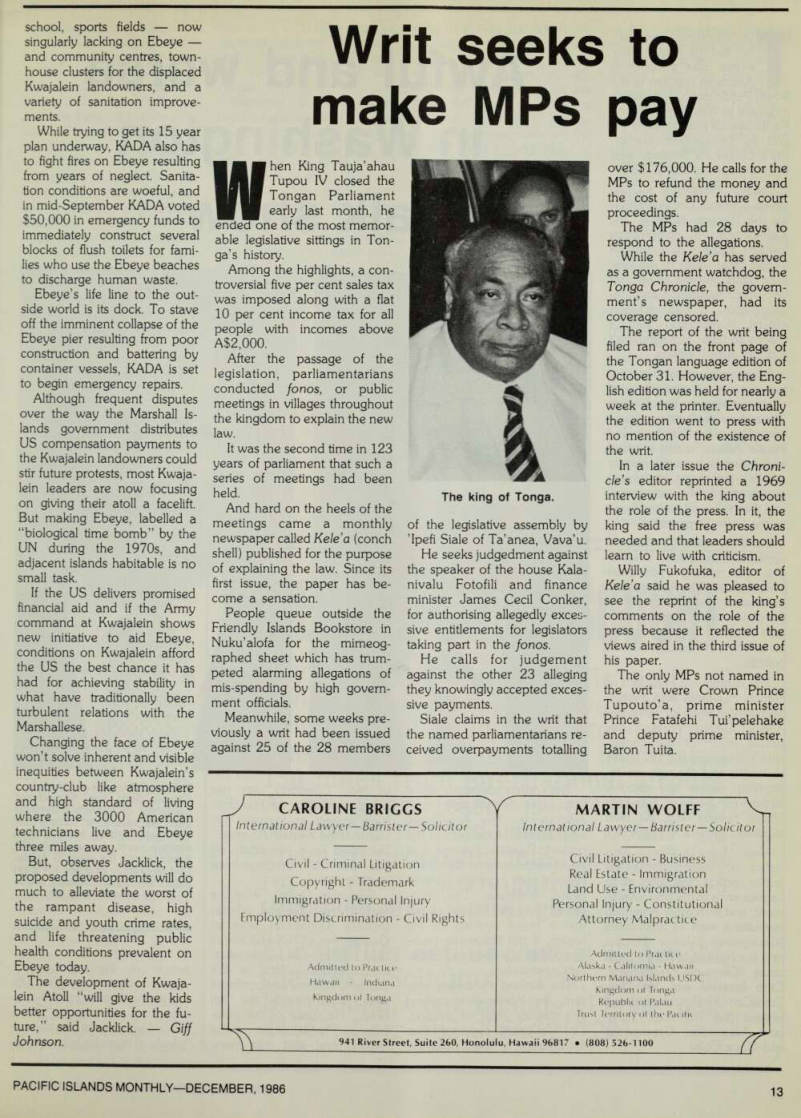
The king of Tonga.
Advertisements & other items, p. 13 (1 item)
J Caroline Briggs ' / Martin Wolff V,
International Lawyer—Barrister— Solicitor International Lawyer—Barrister—Solicitor Civil - Criminal Litigation Copyright - Trademark Immigration - Personal Injury Employment Discrimination - Civil Rights Civil Litigation - Business Real Estate - Immigration Land Use - Environmental Personal Injury - Constitutional Attorney Malpractice Admitted to Practice Hawaii - Indiana Kingdom of Tonga Admitted to Prac tic e Alaska - California - Hawaii Northern Mariana Islands USDC Kingdom ol Tonga Republic of Palau Trust Territory of the Pac itic 941 River Street, Suite 260, Honolulu, Hawaii 96817 • (808)526-1100 IT
in Washington
Awful and worse in Washington talk show
The US officials were aw ful, but the French were worse, was a common American reaction to the South Pacific policy conference mounted in Washington by the Pacific Islands Association (PIA) and by Georgetown Univer sity’s Center for Strategic and International Studies (CSIS).
Entitled “Oceania at a Cros sroad: Strategic Considerations for the Western Alliance” the well-organised conference brought a series of important Pacific basin issues to the fore: tuna rights, nuclear issues, de velopment assistance and de colonisation. It also provided official Washington with a chance to hear, first-hand, half a dozen island leaders.
But neither official Washing ton nor the news media paid much attention. Dr. Gaston Sigur, the new Assistant Secre tary of State for East Asian and Pacific Affairs, made a bland and optimistic opening speech, and left the room; his deputy participated in the next panel, and then followed his boss back to the State Department.
But if the ranking Americans appeared somewhat insensi tive, the ranking Frenchmen were more so. The Ambassador to Washington, Emmanuel de Margerie, while speaking ele gant English, was stiff-necked in his defence of France’s nuclear policies.
The flamboyant President of French Polynesia and French Secretary of State for Territorial Affairs, Gaston Flosse, con sumed much of the confer ence’s time, arguing his points at length and through an in terpreter. Flosse had another distinction; he was the only official present with his own television cameraman in tow.
Most of the audience con sisted of Washington-based public policy specialists with various arms of the US Govern ment, and with other American institutions such as universities (Georgetown, Johns Hopkin and the Naval Academy), think tanks (Carnegie Endowment, Cato Institute and the New Trans Century Foundation) and lobbies (the American Tuna boat Association, Greenpeace and Coca Cola).
The conference began with a discussion of strategic con siderations; the Americans emphasised the dangers of the growing Russian presence, and the disappointments that other nations had experienced with Soviet initiatives. They sug gested that the Russian threat was a major problem in the region, if not the major prob lem. Other speakers took diffe rent approaches.
The ranking Australian pre sent, the Washington embas sy’s deputy chief of mission, Tim McDonald, suggested that the question of “decolonisation
of New Caledonia was not being handled by the French in such a way as to meet the needs of the Western Alliance. ”
He called for a “sensitivity on the part of metropolitan powers.”
Similarly, Dalton West, a visiting New Zealand scholar (Massey University) now at Georgetown’s CSIS and one of the conference organisers, talked about looking at the problem from a Pacific point of view, from “inside the fish bowl.” He spoke of the prob lems of “militarisation of the region” and said that many
people in the region were “made nervous by the US decision to construct a 600-ship navy. ”
West pointed out that there is “plenty of room for hypocrisy in
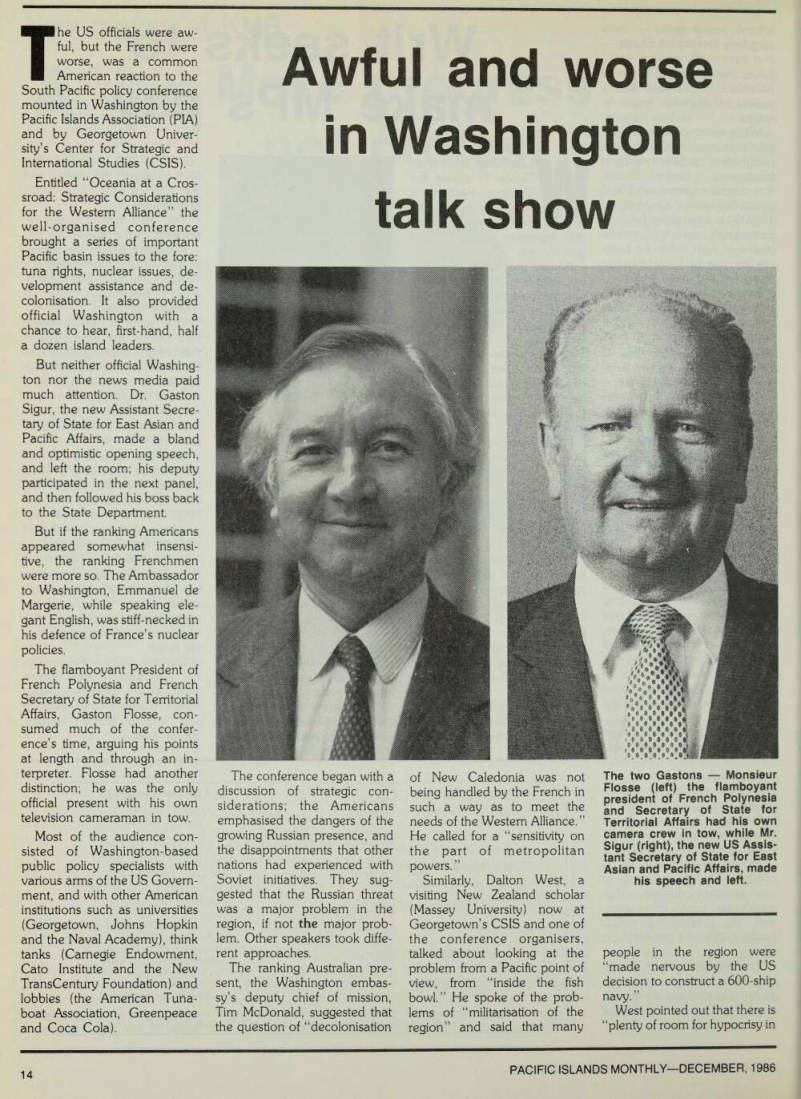
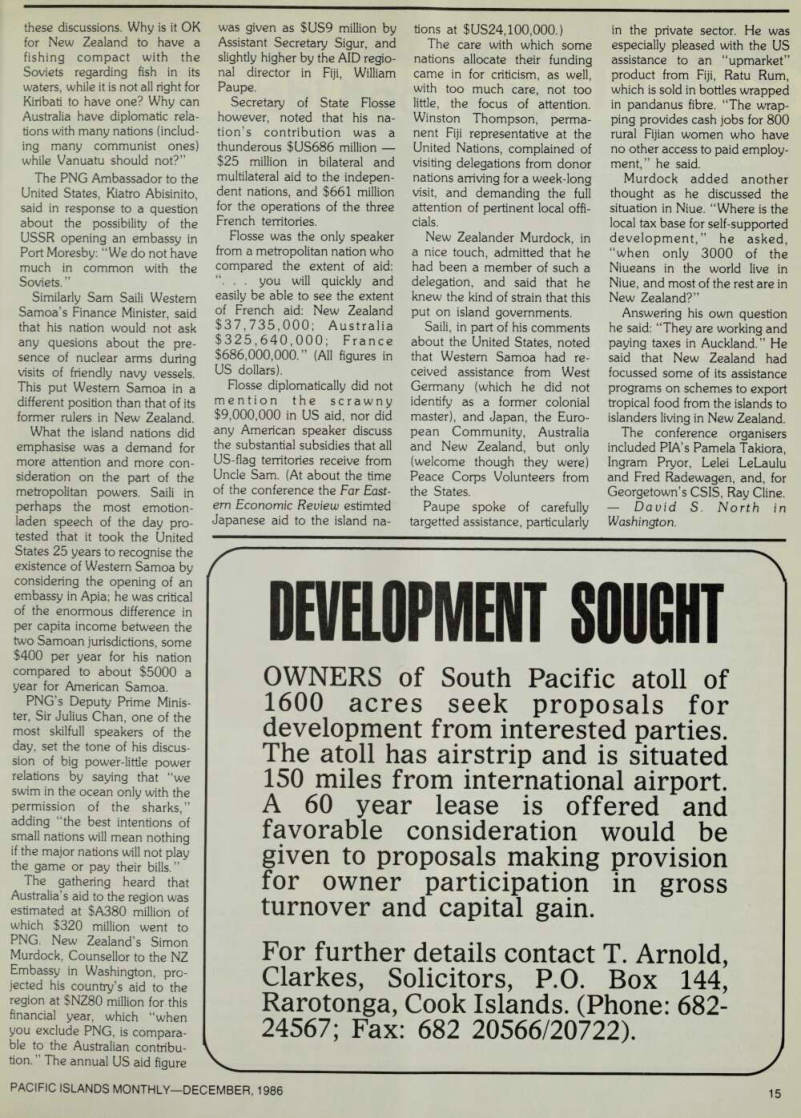
The two Gastons - Monsieur Flosse (left) the flamboyant
president of French Polynesia
and Secretary of State for Territorial Affairs had his own camera crew in tow, while Mr.
Sigur (right), the new US Assis tant Secretary of State for East Asian and Pacific Affairs, made his speech and left.
these discussions. Why is it OK for New Zealand to have a fishing compact with the Soviets regarding fish in its waters, while it is not all right for Kiribati to have one? Why can Australia have diplomatic rela tions with many nations (includ ing many communist ones) while Vanuatu should not?”
The PNG Ambassador to the United States, Kiatro Abisinito, said in response to a question about the possibility of the USSR opening an embassy in Port Moresby: “We do not have much in common with the Soviets. ”
Similarly Sam Saili Western Samoa’s Finance Minister, said that his nation would not ask any quesions about the pre sence of nuclear arms during visits of friendly navy vessels.
This put Western Samoa in a different position than that of its former rulers in New Zealand.
What the island nations did emphasise was a demand for more attention and more con sideration on the part of the metropolitan powers. Saili in perhaps the most emotion laden speech of the day pro tested that it took the United States 25 years to recognise the existence of Western Samoa by considering the opening of an embassy in Apia; he was critical of the enormous difference in per capita income between the two Samoan jurisdictions, some $4OO per year for his nation compared to about $5OOO a year for American Samoa.
PNG’s Deputy Prime Minis ter, Sir Julius Chan, one of the most skilfull speakers of the day, set the tone of his discus sion of big power-little power relations by saying that “we swim in the ocean only with the permission of the sharks,” adding “the best intentions of small nations will mean nothing if the major nations will not play the game or pay their bills.”
The gathering heard that Australia’s aid to the region was estimated at SA3BO million of which $320 million went to PNG. New Zealand’s Simon Murdock, Counsellor to the NZ Embassy in Washington, pro jected his country’s aid to the region at SNZBO million for this financial year, which “when you exclude PNG, is compara ble to the Australian contribu tion. ” The annual US aid figure
was given as SUS 9 million by Assistant Secretary Sigur, and slightly higher by the AID regio nal director in Fiji, William Paupe.
Secretary of State Flosse however, noted that his na tion’s contribution was a thunderous SUS6B6 million $25 million in bilateral and multilateral aid to the indepen dent nations, and $661 million for the operations of the three French territories.
Flosse was the only speaker from a metropolitan nation who compared the extent of aid: “. . . you will quickly and easily be able to see the extent of French aid: New Zealand $37,735,000; Australia
$325,640,000; France
$686,000,000.” (All figures in US dollars).
Flosse diplomatically did not mention the scrawny $9,000,000 in US aid, nor did any American speaker discuss the substantial subsidies that all US-flag territories receive from Uncle Sam. (At about the time of the conference the Far East ern Economic Review estimted Japanese aid to the island na
tions at $U524,100,000.) The care with which some nations allocate their funding came in for criticism, as well, with too much care, not too little, the focus of attention.
Winston Thompson, perma nent Fiji representative at the United Nations, complained of visiting delegations from donor nations arriving for a week-long visit, and demanding the full attention of pertinent local offi cials.
New Zealander Murdock, in a nice touch, admitted that he had been a member of such a delegation, and said that he knew the kind of strain that this put on island governments.
Saili, in part of his comments about the United States, noted that Western Samoa had re ceived assistance from West Germany (which he did not identify as a former colonial master), and Japan, the Euro pean Community, Australia and New Zealand, but only (welcome though they were) Peace Corps Volunteers from the States.
Paupe spoke of carefully targetted assistance, particularly
in the private sector. He was especially pleased with the US assistance to an “upmarket” product from Fiji, Ratu Rum, which is sold in bottles wrapped in pandanus fibre. “The wrap ping provides cash jobs for 800 rural Fijian women who have no other access to paid employ ment,” he said.
Murdock added another thought as he discussed the situation in Niue. “Where is the local tax base for self-supported development,” he asked, “when only 3000 of the Niueans in the world live in Niue, and most of the rest are in New Zealand?”
Answering his own question he said: “They are working and paying taxes in Auckland.” He said that New Zealand had focussed some of its assistance programs on schemes to export tropical food from the islands to islanders living in New Zealand.
The conference organisers included PlA’s Pamela Takiora, Ingram Pryor, Lelei LeLaulu and Fred Radewagen, and, for Georgetown’s CSIS, Ray Cline.
David S. North in
Washington.
Advertisements & other items, p. 15 (1 item)
Development Sought
OWNERS of South Pacific atoll of 1600 acres seek proposals for development from interested parties.
The atoll has airstrip and is situated 150 miles from international airport.
A 60 year lease is offered and favorable consideration would be given to proposals making provision for owner participation in gross turnover and capital gain.
For further details contact T. Arnold, Clarkes, Solicitors, P.O. Box 144, Rarotonga, Cook Islands. (Phone: 682- 24567; Fax: 682 20566/20722).
Libya training
‘not a good idea’
Sending 20 young men to train in “self de fence” in Libya was, with hindsight, not a good idea, said Kanak inde pendence leader, Jean-Marie Tjibaou.
He was answering questions at the Pacific Islands Associa tion conference in Washington.
Asked about the men sent to Libya, he replied that “twenty boys were sent to Libya for three weeks, and when they came back they brought no weapons. It was not the 20 boys who changed the events in New Caledonia.”
On the question of violence, he said “It is the Europeans who have the weapons.” He described a fatal confrontation between Kanaks and suppor ters of French rule: “The people who organised the ambush and massacre, they had cases of munitions. A tree was felled to make a roadblock. They shot those in the cars, and when they jumped in the water to escape, they shot them so full of holes that they must have sunk in the water. The police col lected a whole bag of spent cartridges.”
Most of Tjibaou’s comments were deliberately non-con troversial. He spoke of wanting the Pacific to be “a place of peace. We hope that the sol diers and the guns will stay in the counties that want them.”
“My vision of the Pacific is to see it as a haven of peace.
“We can invite all people, including those from other planets, to live with us in peace.
“What we want from our larger neighbors,” he continued “is respect for our cultural values and way of life, recogni tion of our people as they are, in their own proper social struc ture, and respect for our choices.”
The PIA conference con cluded with a spirited debate over French rule in New Cale donia, the first time that such an event had occurred in Washington.
Speaking for the Kanaks were Ambassador Renagi Lohia, of Papua New Guinea, who was harshly critical of the French, and Tjibaou, the Presi dent of the FLNKS, who spoke lyrically and softly of his vision of the future.
Speaking for the French were Dick Ukeiwe, a Kanak elected to the New Caledonia legisla ture, and the omni-present Gaston Flosse, in his role as French Secretary of State for Territorial Affairs.
Ambassador Lohia, looking out the windows of the elegant Capitol Hill meeting room to the Mall where the late Martin Luther King gave his famous civil rights speech two decades earlier, said “I, too have a dream, of the total eradication of apartheid, racism and col onialism from the face of the earth.”
He then asked all to rise for a
moment of silence “for the people killed in South Africa and New Caledonia. ” The Eng lish speakers in the room rose immediatey but there was a pause while Gaston Flosse and the other French-speakers re mained seated; then they rose as well.
Ambassador Lohia spoke of the “French confiscation of the land of the indigenous people” and how the “Kanaks were kept on reserves that occupied 20 per cent of the land.”
Saying that the Kanaks had been assigned to infertile land while arable land was used to graze cattle he claimed: “In the
place of animals you have people, and in the place of people you have animals.”
He talked of French popula tion policy as being a deliberate effort to outnumber the indi genous people, recalled the migration of convicts from France, contract laborers from Vanuatu, people from Wallis and Futuna, and the “systema tic migration of women and children from France.”
He was also critical of what he called “structured inferiorisa tion” by reduced access to education, saying that there were similarities on this point in New Caledonia, Namibia and South Africa.
Flosse was incensed at the references to apartheid and to South Africa, saying, through an interpreter, that these were false charges and misleading comparisons. Flosse, however, left much of the counter-attack to Senator Ukeiwe, who fo cused his attention on Ambas sador Lohia saying “you have been misled by a Kanak, and in the eyes of my people, that man is condemned.”
The Senator then proceeded to recount the results of the last election, in which 46 seats were filled, 26 from Ukeiwe’s party; looking at the returns another way he pointed out that 28 of the members were Melane sians.
“We are the majority, and we could ask for freedom if we wanted it. At this time there is no colonialism in New Caledo nia. We are not located on reserves like animals; there is a referendum scheduled for next year, and the terrorists were young people trained in Libya,” he concluded.
Norman George, Foreign Minister of the Cook Islands, sought to pour oil on troubled waters, urging the New Caledo nians to avoid needless grief by “choosing the best of both worlds” those of the islands and those of the metropolitan pow er; “we pick and choose, and we make use of New Zealand practices when it suits us, and we do not when they do not suit us.” His peacemaking efforts were ignored, however, as the two sides continued to argue until the end of the conference.
Jean-Marie Tjibaou: “Place of peace.”
Advertisements & other items, p. 17 (1 item)
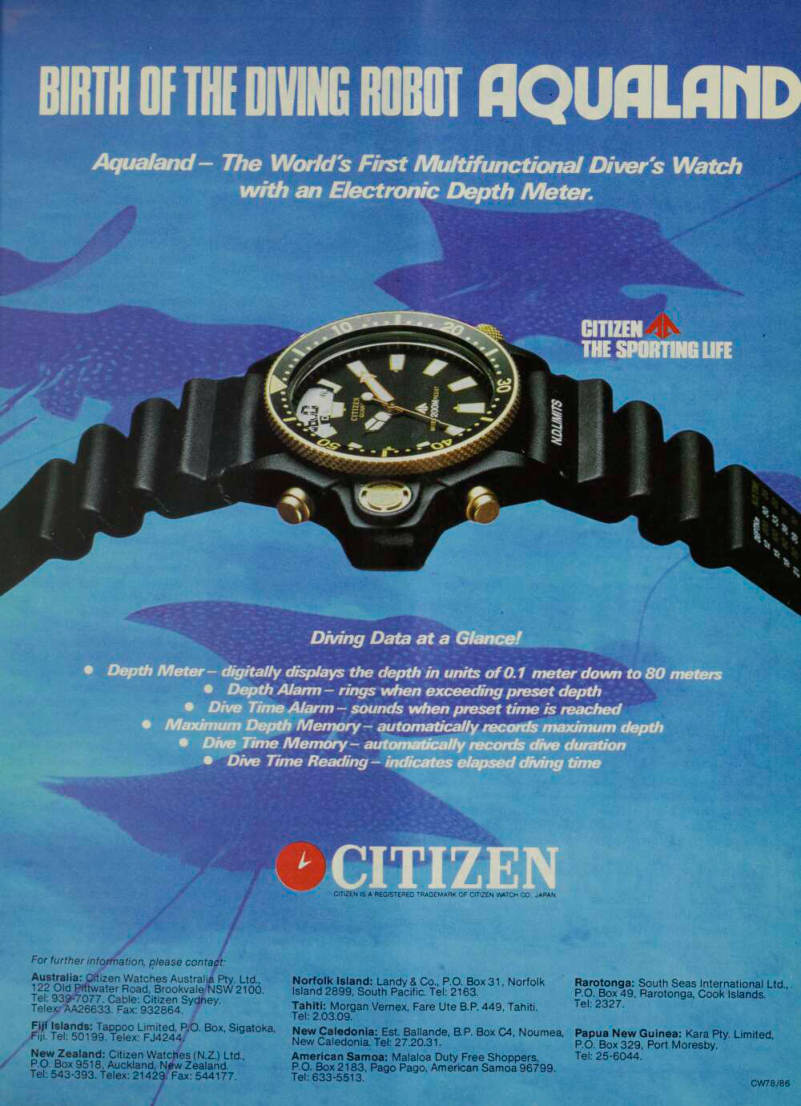
Hrih Of The Dnmg Robot Flqufllfllld
Aqua/and— The World's First Multifunctional Diver’s Watch
with an Electronic Depth Meter.
■ o Q m
Diving Data at a Glance!
THE
N6UFE
• V • Depth Meter- digitally displays the depth in units of 0.1 meter down to 80 meters • Depth Alarm - rings when exceeding preset depth • Dive Time Alarm sounds when preset time is reached • Maximum Depth Memory - automatically records maximum depth • Dive Time Memory - automatically records dive duration • Dive Time Reading - indicates elapsed diving time
CITIZEN
CITIZEN IS A REGISTERED TRADEMARK OF CITIZEN WATCH CO JAPAN For further information, please contact: Australia: Citizen Watches Australia Pty. Ltd, 122 Old Pfttwater Road, Brookvale NSW 2100.
Tel: 939-7077. Cable: Citizen Sydhey.
Telex; AA26633. Fax: 932864.
Fiji Islands: Tappoo Limited, P,O. Box, Sigatoka, Fiji. Tel: 50199. Telex: FJ4244.
New Zealand: Citizen Watches (N.Z.) Ltd., P.O. Box 9518, Auckland, New Zealand.
Tel: 543-393. Telex; 2142 a Fax: 544177.
Norfolk Island: Landy & Co., P.O. Box 31, Norfolk Rarotonga: South Seas International Ltd.
Island 2899, South Pacific. Tel: 2163. P.O. Box 49, Rarotonga, Cook Islands.
Tahiti: Morgan Vernex, Fare Lite B.P. 449, Tahiti. Tel: 2327 - Tel: 2.03.09.
New Caledonia: Est. Ballande, B.P. Box C 4, Noumea, Papua New Guinea: Kara Pty. Limited, New Caledonia. Tel: 27.20.31.
American Samoa: Malaloa Duty Free Shoppers, P.O. Box 2183, Pago Pago, American Samoa 96799.
Tel: 633-5513.
P.O. Box 329, Port Moresby.
Tel; 25-6044.
Voters swim
against the tide
Bucking the strong Democratic tide on the mainland, which saw the Republicans lose control of the Senate, Amer ica’s Pacific voters gave solid support to Republican candi dates. The results included:.
The defeat of Guam governor Richard Bordallo by Republi can territorial senator Joe Ada.
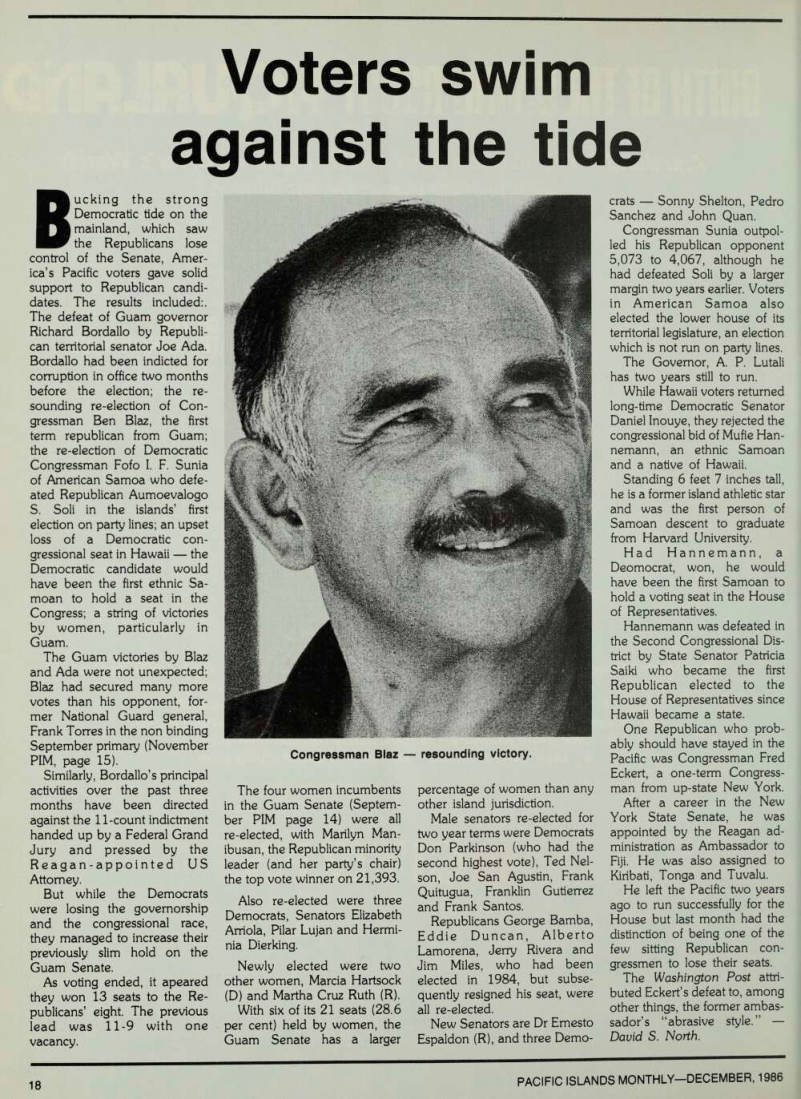
Bordallo had been indicted for corruption in office two months before the election; the re sounding re-election of Con gressman Ben Blaz, the first term republican from Guam; the re-election of Democratic Congressman Fofo I. F. Sunia of American Samoa who defe ated Republican Aumoevalogo S. Soli in the islands’ first election on party lines; an upset loss of a Democratic con gressional seat in Hawaii the Democratic candidate would have been the first ethnic Sa moan to hold a seat in the Congress; a string of victories by women, particularly in Guam.
The Guam victories by Blaz and Ada were not unexpected; Blaz had secured many more votes than his opponent, for mer National Guard general, Frank Torres in the non binding September primary (November PIM, page 15).
Similarly, Bordallo’s principal activities over the past three months have been directed against the 11-count indictment handed up by a Federal Grand Jury and pressed by the Reagan-appointed US Attorney.
But while the Democrats were losing the governorship and the congressional race, they managed to increase their previously slim hold on the Guam Senate.
As voting ended, it apeared they won 13 seats to the Re publicans’ eight. The previous lead was 11-9 with one vacancy.
The four women incumbents in the Guam Senate (Septem ber PIM page 14) were all re-elected, with Marilyn Man ibusan, the Republican minority leader (and her party’s chair) the top vote winner on 21,393.
Also re-elected were three Democrats, Senators Elizabeth Arriola, Pilar Lujan and Hermi nia Dierking.
Newly elected were two other women, Marcia Hartsock (D) and Martha Cruz Ruth (R).
With six of its 21 seats (28.6 per cent) held by women, the Guam Senate has a larger
percentage of women than any other island jurisdiction.
Male senators re-elected for two year terms were Democrats Don Parkinson (who had the second highest vote), Ted Nel son, Joe San Agustin, Frank Quitugua, Franklin Gutierrez and Frank Santos.
Republicans George Bamba, Eddie Duncan, Alberto Lamorena, Jerry Rivera and Jim Miles, who had been elected in 1984, but subse quently resigned his seat, were all re-elected.
New Senators are Dr Ernesto Espaldon (R), and three Demo
crats Sonny Shelton, Pedro Sanchez and John Quan.
Congressman Sunia outpol led his Republican opponent 5,073 to 4,067, although he had defeated Soli by a larger margin two years earlier. Voters in American Samoa also elected the lower house of its territorial legislature, an election which is not run on party lines.
The Governor, A. P. Lutali has two years still to run.
While Hawaii voters returned long-time Democratic Senator Daniel Inouye, they rejected the congressional bid of Mufie Han nemann, an ethnic Samoan and a native of Hawaii.
Standing 6 feet 7 inches tall, he is a former island athletic star and was the first person of Samoan descent to graduate from Harvard University.
Had Hannemann, a Deomocrat, won, he would have been the first Samoan to hold a voting seat in the House of Representatives.
Hannemann was defeated in the Second Congressional Dis trict by State Senator Patricia Saiki who became the first Republican elected to the House of Representatives since Hawaii became a state.
One Republican who prob ably should have stayed in the Pacific was Congressman Fred Eckert, a one-term Congress man from up-state New York.
After a career in the New York State Senate, he was appointed by the Reagan ad ministration as Ambassador to Fiji. He was also assigned to Kiribati, Tonga and Tuvalu.
He left the Pacific two years ago to run successfully for the House but last month had the distinction of being one of the few sitting Republican con gressmen to lose their seats.
The Washington Post attri buted Eckert’s defeat to, among other things, the former ambas sador’s “abrasive style.”
David S. North.
Congressman Blaz - resounding victory.
of politics
The business of politics
Papua New Guinea’s finance minister and deputy prime minister, Sir Julius Chan, acquired more than 800,000 keenly sought Placer Pacific shares through his family, family companies and his People’s Progress Party staff.
That was in July when the company was floated in Australia’s biggest ever stock market launch. Since the media made this public in October, there has been a long running public argument over the Chan purchases.
The Opposition, led by Mr Michael Somare and his deputy Fr John Momis have led the criticisms, saying that once again the leaders have benefited while the people have missed out.
Sir Julius has stood his ground, steadily ignoring cedis for his resignation, adding that he has nothing to hide.
Prime Minister Paias Wingti, however, found himself obliged to bend with the political wind in as much as he indicated that he will set up a commission of inquiry if Sir Julius’ critics can produce evidence of any wrong doing.
SINCLARE SOLOMON in Port Moresby has been following the controversy.
Sir Julius Chan, for the first time in his long political career, stands publicly accused of acting “im properly” by making a cool $1 million for his People’s Progress Party and for his family com panies.
Apart from the opposition leaders who howled for his resignation, Sir Julius took heavy criticism from the in fluential Melanesian Council of Churches as well as from sec tions of the very government of which he is deputy leader.
The council which represents the Roman Catholic and estab lished protestant churches in the country said: “The moral code of politicians amounts to hypocrisy, self interest, status and the trappings of office.
“Integrity, service and a genuine love and concern for the ordinary people who elected them seems to be ab sent as they continue day after day their ridiculous antics in the so-called house of parliament.
“This latest example of Sir Julius, self-professed crusader for ordinary Papua New Gui neans, is only another example of that hypocrisy which leaves this country in a state of cynicism. ”
Strong stuff. And for Sir Julius, one of the few politicians who run successful businesses (many run unsuccessful businesses) and a deeply reli gious man, particularly hard to take.
But he didn’t take long to reply. He said he had nothing to hide and had not attempted to conceal his share purchases.
“If I had wanted to be sneaky, I would have gone overseas,” he told the PNG press corps.
“I have been a businessman all my life and have never made money in politics. At the end of the day it’s the conscience that counts.
“I would take a similar gam ble again,” he added defiantly.
The various Chan concerns bought 818,700 shares or just on seven per cent of the PNG allocation.
Confirming that he had taken up the shares, he said, “It was done through the normal chan nels and no preferential treat ment was given. For example Lady Chan only received half of her requested allocation, like most other people.”
Sir Julius was at home in Rabaul when he was contacted by business advisers with a proposal to buy Placer shares.
He agreed and at the same time gave his guarantee for bank finance to fund the purchases.
He said the investment was aimed partly at paying off debts of more than K 1 million owed by his various companies. The shares were on-sold to the companies the week they were floated on the Sydney ex change.
He also agreed to guarantee the finance for People’s Prog ress Party officials to buy shares
in order to fund the 1987 election campaign. ’The party got half of what it asked for but, given the right price, we won’t have to fund our candidates next year.”
Said Sir Julius: “Placer Paci fic were not going to allocate the promised 12.8 million shares to PNG because the underwriters had visisted PNG and, based on the assumption that exchange controls were not
going to change in the near future, decided that only 1.5 million shares would be taken up in PNG.
“They returned to Australia and issued the other shares to their mates without informing the PNG government.”
According to Sir Julius, prime minister Paias Wingti was furious at this development and directed his finance minister to ensure that the full 12.8 million shares were allocated to PNG and to ensure that the country could absorb them.
As a result, at least 11 million shares were earmarked for PNG and this was later in creased to 11.7 million. The country’s exchange controls were temporarily relaxed so that local companies and indi viduals could make their purch ases.
Placer Pacific issued a total of 128,574,000 $1 shares and within minutes of trading these were changing hands at $2.
The shares have since peaked at over $3.
Ten days after trading began, three large parcels of shares were sold in one afternoon two for $BOO,OOO and one for $700,000. It was believed that
Continued on page 24
Advertisements & other items, pp. 19-20 (2 items)
Pathways To
INDEPENDENCE
the inside story of twenty five years in pre-independence Papua New Guinea, by the wife of administrator Sir Donald Cleland. Drily witty ... historically fascinating, a thoroughly good read. $14.95 at all good booksellers.
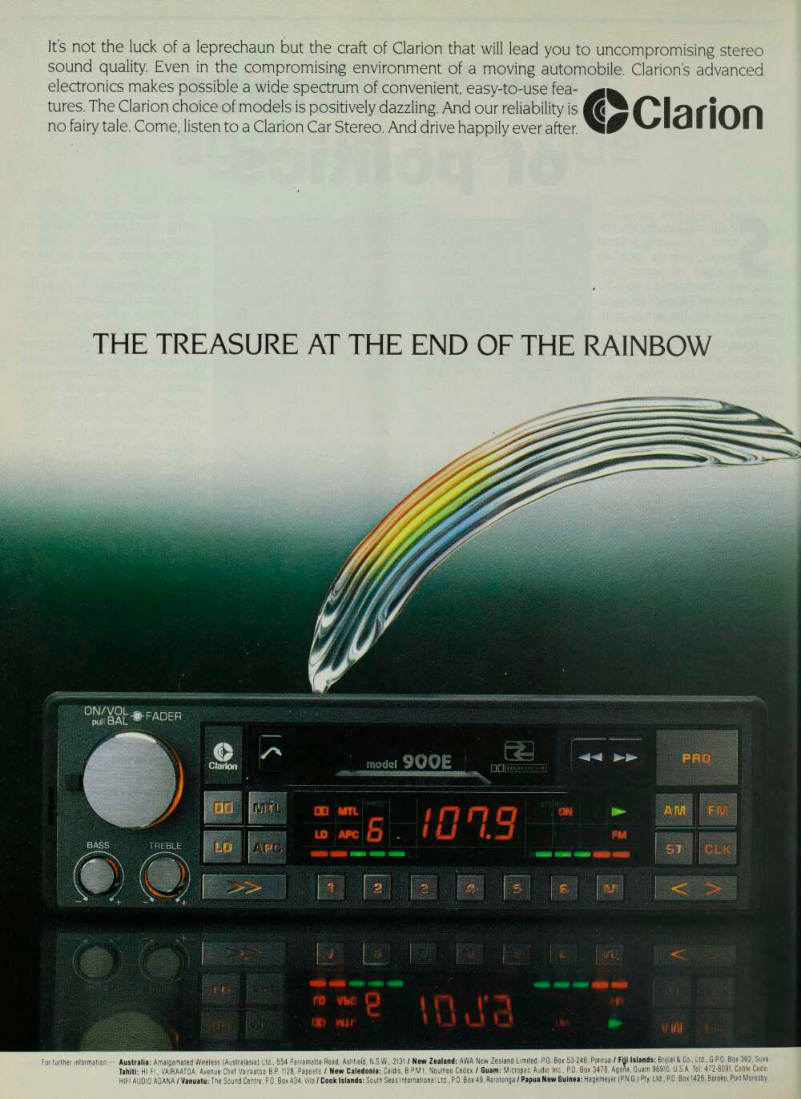
The Treasure At The End Of The Rainbow
Its not the luck of a leprechaun but the craft of Clarion that will lead you to uncompromising stereo sound quality. Even in the compromising environment of a moving automobile. Clarion’s advanced electronics makes possible a wide spectrum of convenient, easy-to-use features. The Clarion choice of models is positively dazzling. And our reliability is jf'vr'k no fairy tale. Come, listen to a Clarion Car Stereo. And drive happily ever after. I lILI I THE TREASURE AT THE END OF THE RAINBOW
■Sh FADER
© Clarion P Remodel 900 c
AW! FR
rad Em ®in n n
LD APC O . ILJ
< For further information Australia: Amalgamated Wireless (Australasia) Ltd., 554 Parramatta Road, Ashfiefd, N.S.W., 2131 1 New Zealand: AWA New Zealand Limited, P.O. Box 50-248, Ponrua / Fill Islands; Brijlal & Co, Ltd., G.P.O. Box 362, Suva Tahiti: HI FI., VAIRAATOA. Avenue Chef Vairaatoa B P. 1128, Papeete / New Caledonia; Caldls, 8.P.M1, Noumea Cedex / Guam: Micropac Audio Inc., P.O. Box 3478, Agana, Guam 96910, U S A. Tel: 472-8091, Cable Code: HIFI AUDIO AGANA / Vanuatu: The Sound Centre, P.O. Box 434, Vila / Cook Islands; South Seas International Ltd,, P.O. Box 49, Rarotonga / Papua New Guinea; Hagemeyer (P.N.G.) Pty. Ltd., P.O. Box 1428, Boroko, Port Moresby.
Chan: Making money


is not sinful
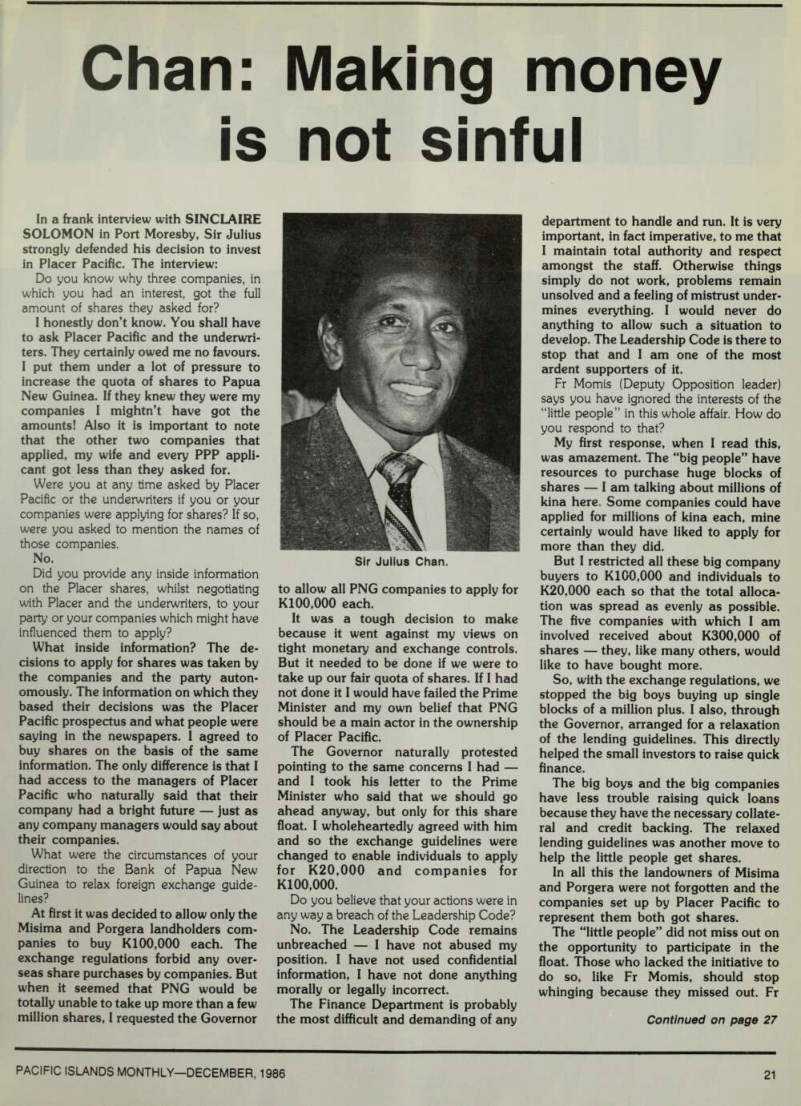
In a frank interview with SINCLAIRE SOLOMON in Port Moresby, Sir Julius strongly defended his decision to invest in Placer Pacific. The interview: Do you know why three companies, in which you had an interest, got the full amount of shares they asked for?
I honestly don’t know. You shall have to ask Placer Pacific and the underwri ters. They certainly owed me no favours.
I put them under a lot of pressure to increase the quota of shares to Papua New Guinea. If they knew they were my companies I mightn’t have got the amounts! Also it is important to note that the other two companies that applied, my wife and every PPP appli cant got less than they asked for.
Were you at any time asked by Placer Pacific or the underwriters if you or your companies were applying for shares? If so, were you asked to mention the names of those companies.
No.
Did you provide any inside information on the Placer shares, whilst negotiating with Placer and the underwriters, to your party or your companies which might have influenced them to apply?
What inside information? The de cisions to apply for shares was taken by the companies and the party auton omously. The information on which they based their decisions was the Placer Pacific prospectus and what people were saying in the newspapers. I agreed to buy shares on the basis of the same information. The only difference is that I had access to the managers of Placer Pacific who naturally said that their company had a bright future just as any company managers would say about their companies.
What were the circumstances of your direction to the Bank of Papua New Guinea to relax foreign exchange guide lines?
At first it was decided to allow only the Misima and Porgera landholders com panies to buy KlOO,OOO each. The exchange regulations forbid any over seas share purchases by companies. But when it seemed that PNG would be totally unable to take up more than a few million shares, I requested the Governor
to allow all PNG companies to apply for KlOO,OOO each.
It was a tough decision to make because it went against my views on tight monetary and exchange controls.
But it needed to be done if we were to take up our fair quota of shares. If I had not done it I would have failed the Prime Minister and my own belief that PNG should be a main actor in the ownership of Placer Pacific.
The Governor naturally protested pointing to the same concerns I had and I took his letter to the Prime Minister who said that we should go ahead anyway, but only for this share float. I wholeheartedly agreed with him and so the exchange guidelines were changed to enable individuals to apply for K 20,000 and companies for
Kloo,Ooo.
Do you believe that your actions were in any way a breach of the Leadership Code?
No. The Leadership Code remains unbreached I have not abused my position. I have not used confidential information, I have not done anything morally or legally incorrect.
The Finance Department is probably the most difficult and demanding of any
department to handle and run. It is very important, in fact imperative, to me that I maintain total authority and respect amongst the staff. Otherwise things simply do not work, problems remain unsolved and a feeling of mistrust under mines everything. I would never do anything to allow such a situation to develop. The Leadership Code is there to stop that and I am one of the most ardent supporters of it.
Fr Momis (Deputy Opposition leader) says you have ignored the interests of the “little people” in this whole affair. How do you respond to that?
My first response, when I read this, was amazement. The “big people” have resources to purchase huge blocks of shares I am talking about millions of kina here. Some companies could have applied for millions of kina each, mine certainly would have liked to apply for more than they did.
But I restricted all these big company buyers to KlOO,OOO and individuals to K 20,000 each so that the total alloca tion was spread as evenly as possible.
The five companies with which I am involved received about K 300,000 of shares they, like many others, would like to have bought more.
So, with the exchange regulations, we stopped the big boys buying up single blocks of a million plus. I also, through the Governor, arranged for a relaxation of the lending guidelines. This directly helped the small investors to raise quick finance.
The big boys and the big companies have less trouble raising quick loans because they have the necessary collate ral and credit backing. The relaxed lending guidelines was another move to help the little people get shares.
In all this the landowners of Misima and Porgera were not forgotten and the companies set up by Placer Pacific to represent them both got shares.
The “little people” did not miss out on the opportunity to participate in the float. Those who lacked the initiative to do so, like Fr Momis, should stop whinging because they missed out. Fr
Continued on page 27
Sir Julius Chan.
Momis considers it a sin to show good business sense. It is not a sin. We are a nation of entrepreneurs and traders, and no amount of idealistic wishful thinking will ever change that.
Papua New Guinea is never going to advance if the act of making business profits is seen as distasteful and some how downgrading. Development can never take place if everyone is expected to take a vow of poverty and chastity, as Father Momis undoubtedly has. I share Father Momis’s religious beliefs but not his economic ones. Fr Momis wants everyone to be given the chance to be What role did the Prime Minister play in securing more shares for Papua New Guinea and in making sure Papua New Guinea was able to absorb them?
We were both concerned when we learned that Papua New Guinea looked like only taking some 1.5 million shares.
As there were only a couple of weeks to go before the application period ended, he directed me to begin negotiations with Placer Pacific and their underwri ters to secure an assurance for a larger allocation of shares to Papua New Guinea. At the same time I was to take the “necessary actions” to enable Papua New Guinea to absorb whatever Placer Pacific could offer us
The initiatives taken, as you know, T™ }° T 3 ‘u® U ] a ' tlo " s *° K2 °’ oo ° for ,nd ! v,duids and KIOO.OOOfor companies “ d *° r 9 p hen 1 requested the Central Bank Gov « r "° r> Slr J denr V T ° Robert . t 0 lr "plement theS ® h ® expr f«cd his concern about thc outflow of liquidity * he move meant and * e •rregulanty of tempora , n ' v changing the guidelines for a s P eculatlve venture.
I took Sir Henry’s concerns up with the Pr ‘ me Minister bu ‘ he decided, and I a9r f ed ’ to push on to ensure * hat we took up whatever Placer Pacific could tu o • M The Prime Minister also obtained, through his own actions, an extension of one week for Papua New Guinea applications by Papua New Guinea citi zens and companies, That was the extent of the Prime Minister s involvement.
Advertisements & other items, pp. 22-25 (1 item)
m
/ aC?jdlSsa *, * N 1
Strength
A vehicle’s strength depends on a complex interplay of varied factors. The overall design.
The body structure. The quality of the materials it is built of. The individual performance of the various mechanical components. Only when a vehicle is outstanding from 'every angle can it be said to possess genuine strength.
It is precisely this all-round excellence that gives the Nissan Pickup its extra margin of dependability. From the engine to the frame, the body panels to the suspension, the transmission to the bumpers, everything has JramTaZ\ri kUp ’ S ladder frame features a fifth cross member areZnii for extra which, together with a more rational layout, For further structural rigidity, the side members are made of thicker steel plates.
Add to that a double-wishbone front suspension and a leaf-spring rear suspension, plus a large-capacity, power-packed engine, and it’s easy to see why more people depend on the Pickup to handle tough jobs on rough roads.
In other words, the Pickup has a singular strength that comes from a complete rational matching of diverse parts into one unbreakable whole.
And it succeeds because it has that intangible yet very real quality that makes a Nissan what it is—The Nissan Dimension.
Quality in motion
In addition to the four usually found on ordinary makes, the closed-section been integrated into a vehicle of unsurpassed performance and durability. strength. enables the Pickup to tolerate heavier loads.
Il NISSAN
Tenders invited
CENTRAL TENDER HOARD
MINISTRY OF FINANCE
HONIARA, SOLOMON ISLANDS
CTB 32/86 DISPOSAL OF TELEPHONE
EQUIPMENT TELECOMMUNICATION DIVISIONS
Tenders are invited for the disposal of the items below:— 1. 900 Line Exchange Made by Plessey 225 100 Outlet group selectors. 68 Non-PBX 100 outlet final selectors. 75 2-10 PBX Hunt 100 outlet final selectors. 6 Group selector racks with multiple alarms and miscellaneous equipment. 9 Final selector racks with multiple alarms and miscellaneous equipment. 1 Ringer rack with ringer equipment and other alarm equipment. 360 Uni-selectors, 180 3/4/5 level, 180 6 - 10 level. 2 McCall Ringers 50V, 17 Hz output. 50 Both-way Auto-Auto relays. 1 MDF for 900 lines. 2. 6 x 100 LINE PABX MADE BY GEC 253 SE4OOO Type combined group and final selectors. 13 2000 Types group final selectors. 180 Uni-selectors 6 - 8 level. 24 Both-way Auto-Auto relays. 20 Cabinets self-contained for 50 subscribers, alarm blocks and miscellaneous equipment.
For further details and appointments to view and inspect the equipment contact: A. D. Daka, Senior Telecommunications Engineer Posts & Telecomms Division
HONIARA
Solomon Islands 3. The tender shall be submitted on the basis that the tenderer relies entirely on his own findings and judgment as to the condition of any or all of the equipment. The rate will be on an ‘as is where is’ basis and the tenderer should take note that in terms of section 5 of the telecommunications act, no licence will be issued for the above equipment as a telecommunications system within Solomon Islands. 4. The Central Tender Board shall not be responsible for any costs or expenses incurred in preparing and submitting a tender. 5. The Central Tender Board does not bind itself to accept the highest or any tender. 6. The closing date of tender is on 28th January 1987. 7. Tenders should be submitted in a sealed envelope marked:—
TENDER NOTICE 32/86
DISPOSAL OF TELEPHONES EQUIPMENT
To reach the Secretary, Central Tender Board, Ministry of Finance. PC Box 26, Honiara, Solomon Islands 0800 hrs on Wednesday 28th January 1987.
Tenders received after 0800 hrs will not be considered.
TRADITIONALLY THE NAME
ASSOCIATED WITH PERFECTION
IN CIGARETTES
BENSON '& HEDGES
20
Bens ox w Hedges
WARNING-SMOKING IS A HEALTH HAZARD
Continued from page 19
the sellers were located in Papua New Guinea.
Sir Julius had earlier pressed the underwriters stockbrokers Wilson’s of Brisbane and Mclntosh Hamson Hoare Govett of Sydney to make sure the full 10 per cent would go to PNG as agreed even though the Australian allocation of the issue was heavily oversubscribed.
Sir Julius also backed Wingti in seeking to extend the deadline for their purchase.
In an ensuing parliamentary question, Sir Julius faced several calls for information on the Placer issue. He was also asked if he was “brave enough” to declare his business dealings.
Sir Julius: “What has bravery got to do with it? Why should any one of us be expected to reveal confidential information when no other businessman is obliged to?”
He told the House he completed the required declarations fer the Ombudsman Commission each year but would not make such information public.
“ Any businessman who does so should not call himself a businessman at all. ”
He added: “If a block of one million shares were applied for, allotted and then sold on the market at a profit, then really that is not a ’racket’. That is the very business these publicly listed companies are doing
every second of the day. It goes on in every company and on every stock exchange.”
Opposition leader Mr Michael Somare said Sir Jul kius’ share purchases were “selfish” though perfectly legal.
He said: “It appears that Sir Julius used the information available to him to ensure that his companies, political party and staff acquired the large amount of shares available.
“How else could they have arranged finance at short notice and bought that many shares?
“Sir Julius’ contention that the extension of the deadline was to enable smaller Papua New Guineans to buy Placer shares appears now to be a smokescreen.
“I wonder how many villa gers in Misima or Porgera (where Placer Pacific intends to develop gold mines) were able to take out Placer shares?
“The implications of the Plac er share affair are very far reaching and very serious in deed.”
Fr Momis added: “Once again the leaders have bene fitted and the people have missed out. This sort of be haviour is grossly improper and goes completely against the spirit of the Leadership Code.
“Unfortunately, it’s a waste of time calling on Sir Julius to resign. He is apparently incap able of recognising a conflict of interest.”
Prime minister Wingti - under pressure.
from the islands press
From the Papua New Guinea Post-Courier, Port Moresby Port Moresby’s men had to lose the grand final of the national basketball championship to save their necks, it has been claimed. Team manager, Peter Court, said yesterday the players wanted to boycott the grand final because of the threats but he and coach Fred Lavaki had talked them into playing. “We risked our lives if we won,” Court claimed after the team had arrived back in the Capital from Lae yesterday . . . Court claimed that an unknown spectator, speaking in Pidgin, had threatened his team members before the game that “sapos yu pela winim Arawa bai yu pela painim taim” meaning if you beat Arawa you will feel it.
From the Vanuatu Weekly, Port-Vila A 4-metre long shark failed in its attack on a man and his son of Emae recently. Robert Matuka, 60, and Alick, 21, both from Evae, were fishing on their canoe outside the reef when the shark made its first attack. The shark tried unsuccessfully to sink their canoe, the report said. Mr Fred Timakata, Speaker of Parliament and Emae MP, said during the attack the old man fell overboard when he attempted to slash the shark with a knife. He added that fortunately the shark was slow in making another attack and Robert climbed back into their canoe.
From Tohi Tala Niue, Alofi Cablevision was labelled a “trick of the Devil” by Common Roll member Morris Tafatu when the Legislative Assembly discussed a motion on duty-free television sets. It is understood that the debate in the Fono was a direct result from a circular letter from Bliss Cablevision which promised duty free television sets. Mr Tafatu argued that Bliss Cablevesion is a commercial enterprise and should be treated in the same manner as other commercial operations on the island. In the end the motion was thrown out by the Fono duty-free television had won the day.
From The Samoa Times, Apia The Bums Philp Kava Group have moved from the company’s bulk store after more than 10 years of daily gathering there during lunchtime. The change was made necessary by the transfer of their host, Manuleleua Sene, to manage a new wholesale branch of the company.
From the Cook Islands News, Rarotonga Australian Aid donated agriculture tools are on their way to the Northern Group to assist in community development work.
Each island will be getting an axe each and a two-man saw including files, all of which were received by the local manager of DSIR John Campbell.
From a letter by Willard Miller, in The Fiji Times, Suva A hurricane is going to hit these islands. It has been causing devastation elsewhere for 30 years. The biggest losers here will inevitably be Kai Viti. But everyone will feel the fatal impact.
Everyone’s life is going to be changed by the horror of commercial television broadcasting. Once it has come we will be helpless. We can only hope the Crown Law Office is preparing rigorous control legislation.
From the Papua New Guinea Post-Courier, Port Moresby SUVA: A husband-and-wife teaching team is being paid nearly K 20,000 a year at an isolated school where the only two students are their own children. Sukul Deo earns KlO,OOO as headmaster and his wife K9OOO as his assistant under the government school salary structure. Enrolment at the school on Mago island, in the Lau group east of Suva, was reduced to the Deos’ two children after a Japanese company bought the island late last year and the population of copra workers moved away. Education Minister Dr Ahmed Ali said the school was being kept open as the Japanese firm, Tokyu Corporation, had said that a number of families would return to Mago.
From The Samoa Times, Apia Mothers under 15 years of age were recorded for the first time last year and the number of mothers between the age of 15 and 19 years went up 4 per cent in 15 years. The largest number of mothers continued to be in the 20 to 24-year-old group but because of an increase of 12 per cent of births by this group in 15 years the number of mothers under 24 made up more than half of all the mothers for the first time last year.
From the Papua New Guinea Post-Courier, Port Moresby A road accident at Kudjip in the Western Highlands early this week had a bloody ending. The driver of a vehicle lost control and ran off the road. Two pedestrians a man and a woman in the car’s path were killed. Then relatives of the dead couple chased the driver and chopped his head off with an axe.
From the Papua New Guinea Post-Courier, Port Moresby A betelnut-lover has been “chewing over” a message at Port Moresby’s new Gordon market. It reads: “No chewing betelnut” and “please spit in the bins”. “The notices confuse me,” says the chewer, who wants to be called Mr Toothbrush.
“The first three words stop us from chewing betelnut. The second notice seems to allow us to chew and spit into bins provided,” he said.
From an article in the Cook Islands News, Rarotonga, on bush beer parties Atiu College students and SDA youth were given lectures on the problems facing young people today such as alcohol abuse leading to accidents, death, crime and noisiness.
From the Papua New Guinea Post-Courier, Port Moresby People should be left alone to fight and kill each other in tribal wars, and MP said yesterday. Mr Thomas Negints (Tambul-Nebilyer) made the call in Parliament, saying a law should be made barring the use of police to quell tribal violence. The comments come on the heels of a fight in Western Highlands Mr Negints’ home province.
From the Cook Islands News, Rarotonga The coldest afternoon since 1970 was recorded at 17 degrees last Sunday in Rarotonga. Officer in Charge at the Meteorological Office Paul Frost said the phenomenon, though not rare, was most unusual.
House hears accusations
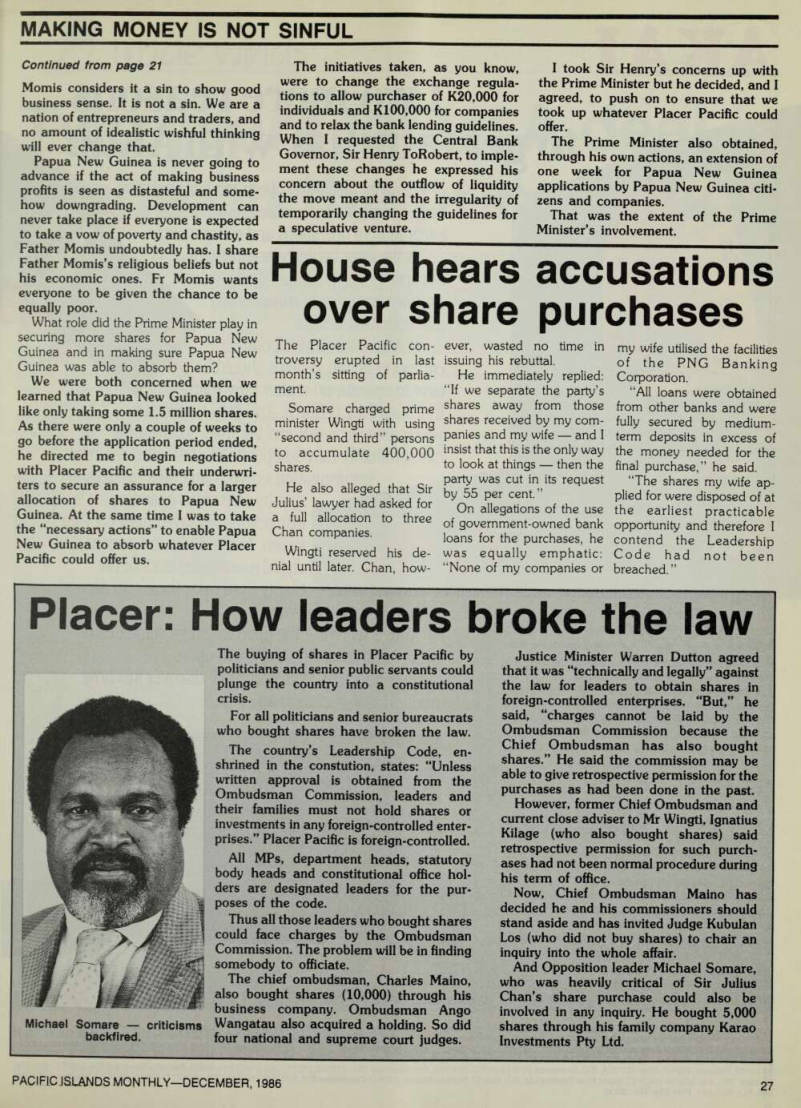
over share purchases
The Placer Pacific con troversy erupted in last month’s sitting of parlia ment.
Somare charged prime minister Wingti with using “second and third” persons to accumulate 400,000 shares.
He also alleged that Sir Julius’ lawyer had asked for a full allocation to three Chan companies.
Wingti reserved his de nial until later. Chan, how
ever, wasted no time in issuing his rebuttal.
He immediately replied: “If we separate the party’s shares away from those shares received by my com panies and my wife and I insist that this is the only way to look at things then the party was cut in its request by 55 per cent.”
On allegations of the use of government-owned bank loans for the purchases, he was equally emphatic: “None of my companies or
my wife utilised the facilities of the PNG Banking Corporation.
“All loans were obtained from other banks and were fully secured by medium term deposits in excess of the money needed for the final purchase,” he said.
“The shares my wife ap plied for were disposed of at the earliest practicable opportunity and therefore I contend the Leadership Code had not been breached. ”
Placer: How leaders broke the law
The buying of shares in Placer Pacific by politicians and senior public servants could plunge the country into a constitutional crisis.
For all politicians and senior bureaucrats who bought shares have broken the law.
The country’s Leadership Code, en shrined in the constution, states: “Unless written approval is obtained from the Ombudsman Commission, leaders and their families must not hold shares or investments in any foreign-controlled enter prises.” Placer Pacific is foreign-controlled.
All MPs, department heads, statutory body heads and constitutional office hol ders are designated leaders for the pur poses of the code.
Thus all those leaders who bought shares could face charges by the Ombudsman Commission. The problem will be in finding somebody to officiate.
The chief ombudsman, Charles Maino, also bought shares (10,000) through his business company. Ombudsman Ango Wangatau also acquired a holding. So did four national and supreme court judges.
Justice Minister Warren Dutton agreed that it was “technically and legally” against the law for leaders to obtain shares in foreign-controlled enterprises. “But,” he said, “charges cannot be laid by the Ombudsman Commission because the Chief Ombudsman has also bought shares.” He said the commission may be able to give retrospective permission for the purchases as had been done in the past.
However, former Chief Ombudsman and current close adviser to Mr Wingti, Ignatius Kilage (who also bought shares) said retrospective permission for such purch ases had not been normal procedure during his term of office.
Now, Chief Ombudsman Maino has decided he and his commissioners should stand aside and has invited Judge Kubulan Los (who did not buy shares) to chair an inquiry into the whole affair.
And Opposition leader Michael Somare, who was heavily critical of Sir Julius Chan’s share purchase could also be involved in any inquiry. He bought 5,000 shares through his family company Karao Investments Pty Ltd.
Michael Somare - criticisms backfired.
Advertisements & other items, pp. 27-28 (2 items)
Making Money Is Not Sinful
27
PACIFICJSLANDS MONTHLY—DECEMBER, 1986
Continued from page 21
MAKING MONEY IS NOT SINFUL
Akai
Two more reasons
to get familiar with Akai.
Simulated picture 8 0 The New VS-240 ms Video Cassette Recorder So easy to operate, almost all functions can be controlled from the slim wireless remote control unit • HQ System (High Quality Picture) • Noiseless Still Frame and Frame Advance • Wireless Remote with 10 keys and 4 programmes 2 weeks timer capability • Clock and Memory Backup • Safety Lock System • Akai’s Interactive Monitor System System M3I3FWR
IARUY
Midi Component System • CD-M 515 Compact Disc Player, 90dB plus of dynamic range • HX-MSISW Double Cassette Deck, high-speed dubbing, Dolby B and C Noise Reduction • AP-M313 Fully Automatic Turntable, linear tracking • SW-M515 Speaker System - full sound, low distortion • Quartz Synthesizer, 16-channel random preset • Surround System w/optional AE-S9O Surround Speakers • Wireless remote control • Total A/V compatibility • 160 watts of music power • 5-Band Graphic Equalizer Creativity has always been the hallmark of Akai; from research and design, to overall integration of operations and components.
It’s the force behind our consistent advancements in sound fidelity, video circuitry, component compatibility
and operation-design.
At Akai we believe all our components and systems should be easy to operate, no matter how functions they perform. And thdy should suit your particular needs and lifestyle. So, from the extraordinarily easy-to-operate VS-240 video recorder, featuring Altai’s own “Can’t Miss” system step-by-step video operating instructions displayed right on your screen, to the multi-component, digital sound excellence of our Clarity Systems - there’s an Akai system just right for you.
And, it will meet the incredibly high standards of quality and reliability Akai insist upon.
Take a look at Akai, and you’ll discover just how many reasons set us apart.
Akai-Creative At Heart.
AMERICAN SAMOA: Burns Philip (S.S.) Co., Ltd. P.O. Box 129, Pago Pago AUSTRALIA: Akai Audio/Video Australia Pty., Ltd. PO. Box 309, North Ryde, N.S.W. 2113 TEL: 887-2311 CENTRAL PACIFIC: Nauru Cooperative Society Nauru COOK ISLANDS: South Seas International Ltd. P.O. Box 49, Rarotonga TEL: 22327,26026-7 FIJI ISLANDS: Motibhai & Co., Ltd. PO Box 9175 Nadi Int. Airport TEL- 72477 MARIANA. J.C. Tenorio Enterprises P.O. Box 137, Saipan 96950 NEW CALEDONIA: Menard Pacifique S.A.R.L. 10, Rue Jean Janres, BP-3899, Noumea PAPUA NEW GUINEA: S.O. Svensson (N.G.) Ltd. P.O. Box 705, Port Moresby TEL: 212158,212111 SOLOMON ISLANDS: Security Electrical Co., Ltd. P.O. Box 174, Honiara TEL: 881 SOUTH PACIFIC: Burnt Pine Trading Ltd. PO. Box 21, Norfolk Islands TAHITI: ComimpexS.A. B.P 200, Papeete TEL; 20447/27759 VANUATU: The Sound Centre Ltd. P.O. Box 434, Port Vila TEL; 2035
Two years later: A deal is
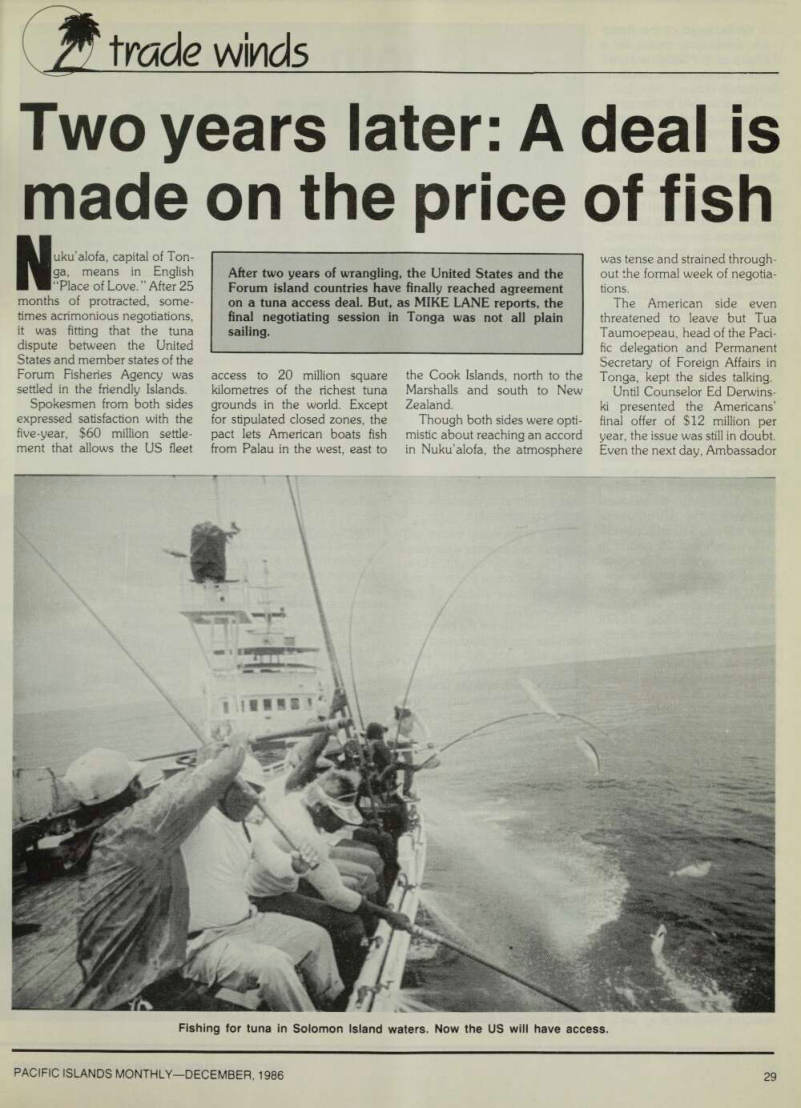
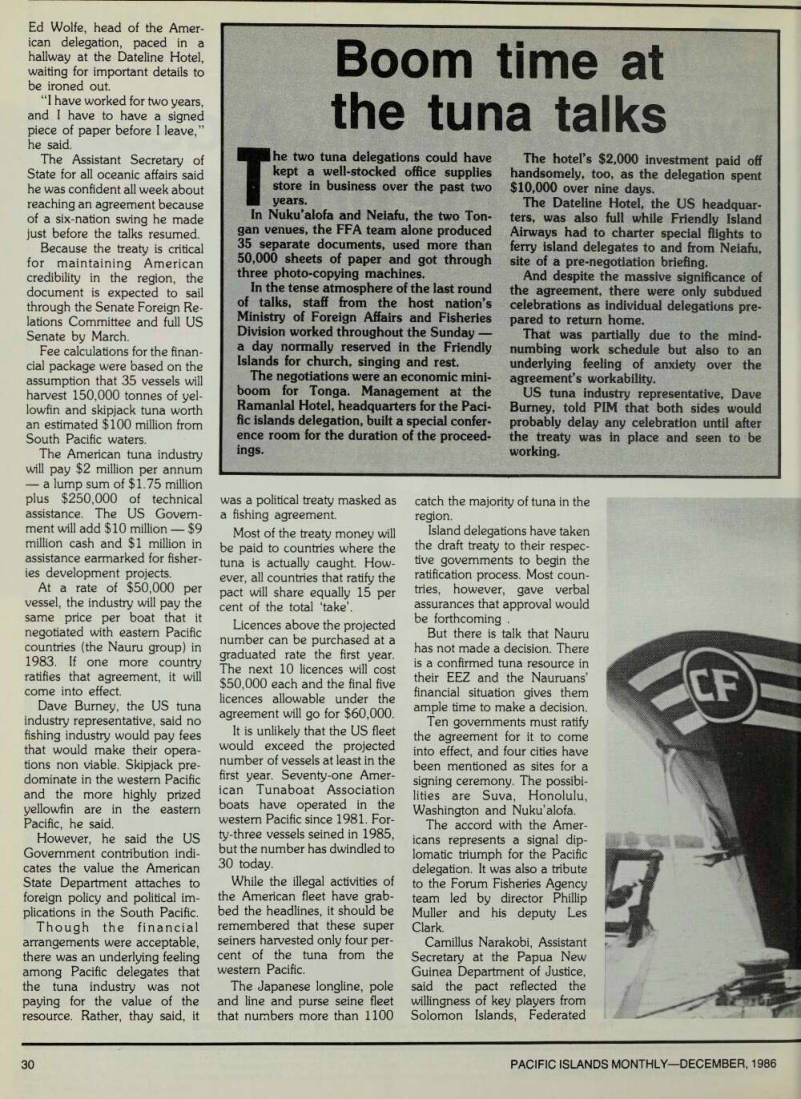
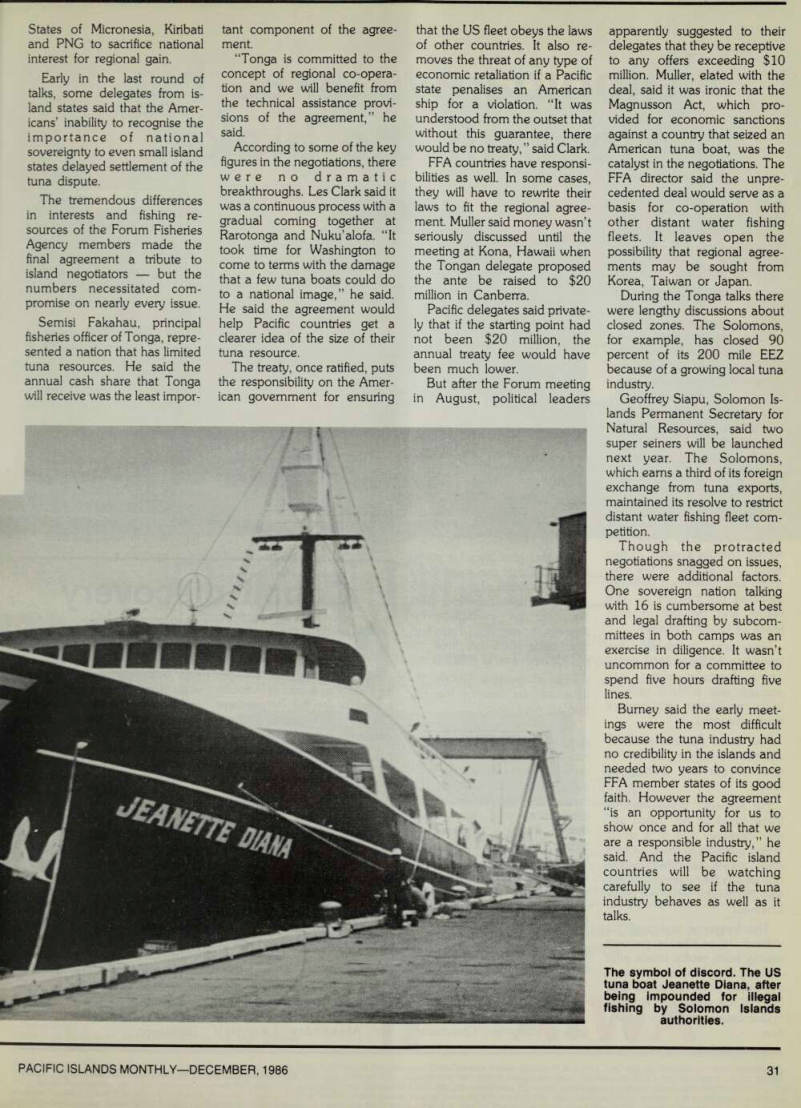
trade winds
Two years later: A deal is made on the price of fish
After two years of wrangling, the United States and the Forum island countries have finally reached agreement on a tuna access deal. But, as MIKE LANE reports, the final negotiating session in Tonga was not all plain sailing.
Nuku’alofa, capital of Ton ga, means in English “Place of Love. ” After 25 months of protracted, some times acrimonious negotiations, it was fitting that the tuna dispute between the United States and member states of the Forum Fisheries Agency was settled in the friendly Islands.
Spokesmen from both sides expressed satisfaction with the five-year, $6O million settle ment that allows the US fleet
access to 20 million square kilometres of the richest tuna grounds in the world. Except for stipulated closed zones, the pact lets American boats fish from Palau in the west, east to
the Cook Islands, north to the Marshalls and south to New Zealand.
Though both sides were optimistic about reaching an accord in Nukualofa, the atmosphere
was tense and strained through out the formal week of negotia tions.
The American side even threatened to leave but Tua Taumoepeau, head of the Paci fic delegation and Permanent Secretary of Foreign Affairs in Tonga, kept the sides talking.
Until Counselor Ed Derwins ki presented the Americans’ final offer of $l2 million per year, the issue was still in doubt.
Even the next day, Ambassador
Fishing for tuna in Solomon Island waters. Now the US will have access.
Ed Wolfe, head of the Amer ican delegation, paced in a hallway at the Dateline Hotel, waiting for important details to be ironed out.
“I have worked for two years, and I have to have a signed piece of paper before I leave, ” he said.
The Assistant Secretary of State for all oceanic affairs said he was confident all week about reaching an agreement because of a six-nation swing he made just before the talks resumed.
Because the treaty is critical for maintaining American credibility in the region, the document is expected to sail through the Senate Foreign Re lations Committee and full US Senate by March.
Fee calculations for the finan cial package were based on the assumption that 35 vessels will harvest 150,000 tonnes of yel lowfin and skipjack tuna worth an estimated $lOO million from South Pacific waters.
The American tuna industry will pay $2 million per annum a lump sum of $1.75 million plus $250,000 of technical assistance. The US Govern ment will add $lO million $9 million cash and $1 million in assistance earmarked for fisher ies development projects.
At a rate of $50,000 per vessel, the industry will pay the same price per boat that it negotiated with eastern Pacific countries (the Nauru group) in 1983. If one more country ratifies that agreement, it will come into effect.
Dave Burney, the US tuna industry representative, said no fishing industry would pay fees that would make their opera tions non viable. Skipjack pre dominate in the western Pacific and the more highly prized yellowfin are in the eastern Pacific, he said.
However, he said the US Government contribution indi cates the value the American State Department attaches to foreign policy and political im plications in the South Pacific.
Though the financial arrangements were acceptable, there was an underlying feeling among Pacific delegates that the tuna industry was not paying for the value of the resource. Rather, thay said, it
was a political treaty masked as a fishing agreement.
Most of the treaty money will be paid to countries where the tuna is actually caught. How ever, all countries that ratify the pact will share equally 15 per cent of the total ‘take’.
Licences above the projected number can be purchased at a graduated rate the first year.
The next 10 licences will cost $50,000 each and the final five licences allowable under the agreement will go for $60,000.
It is unlikely that the US fleet would exceed the projected number of vessels at least in the first year. Seventy-one Amer ican Tunaboat Association boats have operated in the western Pacific since 1981. For ty-three vessels seined in 1985, but the number has dwindled to 30 today.
While the illegal activities of the American fleet have grab bed the headlines, it should be remembered that these super seiners harvested only four per cent of the tuna from the western Pacific.
The Japanese longline, pole and line and purse seine fleet that numbers more than 1100
catch the majority of tuna in the region.
Island delegations have taken the draft treaty to their respec tive governments to begin the ratification process. Most coun tries, however, gave verbal assurances that approval would be forthcoming .
But there is talk that Nauru has not made a decision. There is a confirmed tuna resource in their EEZ and the Nauruans’ financial situation gives them ample time to make a decision.
Ten governments must ratify the agreement for it to come into effect, and four cities have been mentioned as sites for a signing ceremony. The possibi lities are Suva, Honolulu, Washington and Nuku’alofa.
The accord with the Amer icans represents a signal dip lomatic triumph for the Pacific delegation. It was also a tribute to the Forum Fisheries Agency team led by director Phillip Muller and his deputy Les Clark.
Camillus Narakobi, Assistant Secretary at the Papua New Guinea Department of Justice, said the pact reflected the willingness of key players from Solomon Islands, Federated
States of Micronesia, Kiribati and PNG to sacrifice national interest for regional gain.
Early in the last round of talks, some delegates from is land states said that the Amer icans’ inability to recognise the importance of national sovereignty to even small island states delayed settlement of the tuna dispute.
The tremendous differences in interests and fishing re sources of the Forum Fisheries Agency members made the final agreement a tribute to island negotiators but the numbers necessitated com promise on nearly every issue.
Semisi Fakahau, principal fisheries officer of Tonga, repre sented a nation that has limited tuna resources. He said the annual cash share that Tonga will receive was the least impor
tant component of the agree ment.
“Tonga is committed to the concept of regional co-opera tion and we will benefit from the technical assistance provi sions of the agreement,” he said.
According to some of the key figures in the negotiations, there were no dramatic breakthroughs. Les Clark said it was a continuous process with a gradual coming together at Rarotonga and Nuku’alofa. “It took time for Washington to come to terms with the damage that a few tuna boats could do to a national image,” he said.
He said the agreement would help Pacific countries get a clearer idea of the size of their tuna resource.
The treaty, once ratified, puts the responsibility on the Amer ican government for ensuring
that the US fleet obeys the laws of other countries. It also re moves the threat of any type of economic retaliation if a Pacific state penalises an American ship for a violation. “It was understood from the outset that without this guarantee, there would be no treaty,” said Clark.
FFA countries have responsi bilities as well. In some cases, they will have to rewrite their laws to fit the regional agree ment. Muller said money wasn’t seriously discussed until the meeting at Kona, Hawaii when the Tongan delegate proposed the ante be raised to $2O million in Canberra.
Pacific delegates said private ly that if the starting point had not been $2O million, the annual treaty fee would have been much lower.
But after the Forum meeting in August, political leaders
apparently suggested to their delegates that they be receptive to any offers exceeding $lO million. Muller, elated with the deal, said it was ironic that the Magnusson Act, which pro vided for economic sanctions against a country that seized an American tuna boat, was the catalyst in the negotiations. The FFA director said the unpre cedented deal would serve as a basis for co-operation with other distant water fishing fleets. It leaves open the possibility that regional agree ments may be sought from Korea, Taiwan or Japan.
During the Tonga talks there were lengthy discussions about closed zones. The Solomons, for example, has closed 90 percent of its 200 mile FEZ because of a growing local tuna industry.
Geoffrey Siapu, Solomon Is lands Permanent Secretary for Natural Resources, said two super seiners will be launched next year. The Solomons, which earns a third of its foreign exchange from tuna exports, maintained its resolve to restrict distant water fishing fleet com petition.
Though the protracted negotiations snagged on issues, there were additional factors.
One sovereign nation talking with 16 is cumbersome at best and legal drafting by subcom mittees in both camps was an exercise in diligence. It wasn’t uncommon for a committee to spend five hours drafting five lines.
Burney said the early meet ings were the most difficult because the tuna industry had no credibility in the islands and needed two years to convince FFA member states of its good faith. However the agreement “is an opportunity for us to show once and for all that we are a responsible industry,” he said. And the Pacific island countries will be watching carefully to see if the tuna industry behaves as well as it talks.
The symbol of discord. The US tuna boat Jeanette Diana, after being impounded for illegal fishing by Solomon Islands authorities.
Boom time at
the tuna talks
The two tuna delegations could have kept a well-stocked office supplies store in business over the past two years.
In Nuku’alofa and Neiafu, the two Ton gan venues, the FFA team alone produced 35 separate documents, used more than 50,000 sheets of paper and got through three photo-copying machines.
In the tense atmosphere of the last round of talks, staff from the host nation’s Ministry of Foreign Affairs and Fisheries Division worked throughout the Sunday a day normally reserved in the Friendly Islands for church, singing and rest.
The negotiations were an economic mini boom for Tonga. Management at the Ramanlal Hotel, headquarters for the Paci fic islands delegation, built a special confer ence room for the duration of the proceed ings.
The hotel’s $2,000 investment paid off handsomely, too, as the delegation spent $lO,OOO over nine days.
The Dateline Hotel, the US headquar ters, was also full while Friendly Island Airways had to charter special flights to ferry island delegates to and from Neiafu, site of a pre-negotiation briefing.
And despite the massive significance of the agreement, there were only subdued celebrations as individual delegations pre pared to return home.
That was partially due to the mind numbing work schedule but also to an underlying feeling of anxiety over the agreement’s workability.
US tuna industry representative, Dave Burney, told PIM that both sides would probably delay any celebration until after the treaty was in place and seen to be working.
Qionibaravi takes his
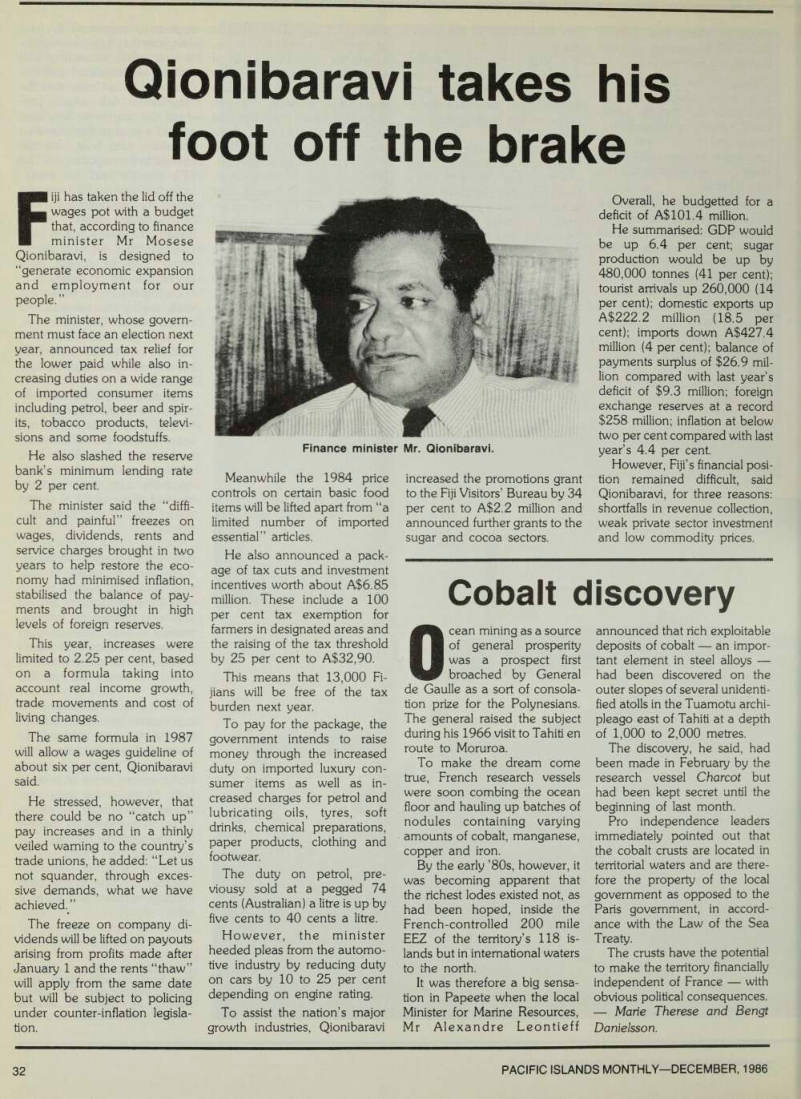
foot off the brake
Fiji has taken the lid off the wages pot with a budget that, according to finance minister Mr Mosese Qionibaravi, is designed to “generate economic expansion and employment for our people. ”
The minister, whose govern ment must face an election next year, announced tax relief for the lower paid while also in creasing duties on a wide range of imported consumer items including petrol, beer and spir its, tobacco products, televi sions and some foodstuffs.
He also slashed the reserve bank’s minimum lending rate by 2 per cent.
The minister said the “diffi cult and painful” freezes on wages, dividends, rents and service charges brought in two years to help restore the eco nomy had minimised inflation, stabilised the balance of pay ments and brought in high levels of foreign reserves.
This year, increases were limited to 2.25 per cent, based on a formula taking into account real income growth, trade movements and cost of living changes.
The same formula in 1987 will allow a wages guideline of about six per cent, Qionibaravi said.
He stressed, however, that there could be no “catch up” pay increases and in a thinly veiled warning to the country’s trade unions, he added: “Let us not squander, through exces sive demands, what we have achieved. ”
The freeze on company di vidends will be lifted on payouts arising from profits made after January 1 and the rents “thaw” will apply from the same date but will be subject to policing under counter-inflation legisla tion.
Meanwhile the 1984 price controls on certain basic food items will be lifted apart from “a limited number of imported essential” articles.
He also announced a pack age of tax cuts and investment incentives worth about A 56.85 million. These include a 100 per cent tax exemption for farmers in designated areas and the raising of the tax threshold by 25 per cent to A 532,90.
This means that 13,000 Fi jians will be free of the tax burden next year.
To pay for the package, the government intends to raise money through the increased duty on imported luxury con sumer items as well as in creased charges for petrol and lubricating oils, tyres, soft drinks, chemical preparations, paper products, clothing and footwear.
The duty on petrol, pre viousy sold at a pegged 74 cents (Australian) a litre is up by five cents to 40 cents a litre.
However, the minister heeded pleas from the automo tive industry by reducing duty on cars by 10 to 25 per cent depending on engine rating.
To assist the nation’s major growth industries, Qionibaravi
increased the promotions grant to the Fiji Visitors’ Bureau by 34 per cent to A 52.2 million and announced further grants to the sugar and cocoa sectors.
Overall, he budgetted for a deficit of A 5101.4 million.
He summarised: GDP would be up 6.4 per cent; sugar production would be up by 480,000 tonnes (41 per cent); tourist arrivals up 260,000 (14 per cent); domestic exports up A 5222.2 million (18.5 per cent); imports down A 5427.4 million (4 per cent); balance of payments surplus of $26.9 mil lion compared with last year’s deficit of $9.3 million; foreign exchange reserves at a record $258 million; inflation at below two per cent compared with last year’s 4.4 per cent.
However, Fiji’s financial posi tion remained difficult, said Qionibaravi, for three reasons: shortfalls in revenue collection, weak private sector investment and low commodity prices.
Finance minister Mr. Qionibaravi.
Cobalt discovery
Ocean mining as a source of general prosperity was a prospect first broached by General de Gaulle as a sort of consola tion prize for the Polynesians.
The general raised the subject during his 1966 visit to Tahiti en route to Moruroa.
To make the dream come true, French research vessels were soon combing the ocean floor and hauling up batches of nodules containing varying amounts of cobalt, manganese, copper and iron.
By the early ’Bos, however, it was becoming apparent that the richest lodes existed not, as had been hoped, inside the French-controlled 200 mile FEZ of the territory’s 118 is lands but in international waters to the north.
It was therefore a big sensa tion in Papeete when the local Minister for Marine Resources, Mr Alexandre Leontieff
announced that rich exploitable deposits of cobalt an impor tant element in steel alloys had been discovered on the outer slopes of several unidenti fied atolls in the Tuamotu archi pleago east of Tahiti at a depth of 1,000 to 2,000 metres.
The discovery, he said, had been made in February by the research vessel Charcot but had been kept secret until the beginning of last month.
Pro independence leaders immediately pointed out that the cobalt crusts are located in territorial waters and are there fore the property of the local government as opposed to the Paris government, in accord ance with the Law of the Sea Treaty.
The crusts have the potential to make the territory financially independent of France with obvious political consequences.
Marie Therese and Bengt
Danielsson.
Advertisements & other items, p. 33 (1 item)
Digital Director
System
""31 ’ II -.-5
AF B S
Digital Director
Compact Disc digital audio has sparkpd a revolution in the world of
sfea
music enjoyment. That’s why AIWA the Digital Director, the audio system that looks, feels, and sounds like no other system in the world.
A New Look
_f| COMPACT
mm
DIGITAL AUDIO
It’s precisely as wide as the two cassette mechanisms of its advanced Dolby* B/C double cassette deck with auto reverse.
The system unit has a sparkling mirrorized finish, with tastefully muted operation indicator lights shining from behind. And, the attractively angled AFBS speakers deliver better sound dispersion.
A New Feel
Immediately striking is the total system remote control keyboard.
Its easily operated function buttons are color coded for each source, allowing total system operation from your favorite position. Controls used less frequently are placed behind two swingdown panels on the system unit.
'Dolby and the double-D symbol are trademarks of Dolby Laboratories Licensing Corporation. ■Steel pipe shown is for display purposes only, and is not included.
A New Sound
To the incredible dynamics and fidelity of Compact Disc, the Digital Director adds AlWA’s exclusive AFBS speakers for powerful bass and highly accurate digital sound reproduction. Plus, built-in Surround Sound circuitry delivers exciting multi-dimensional high fidelity with optional Surround speakers.
AlWA’s VX-C27 Digital Director for a
New Sound Experience
AIWA
Aus ‘ ralia Pty- Ltd. 14 Gertrude St., Arncliffe. N.S.W. Australia 2205 AUSTRALIA PHONE: (597) 2388/Oceania Indent Agency (P.N.G.) Pty., Ltd. Ago St., Gordon Box 5518, Boroko Port JS, Pa P ua New Guinea PHONE: 256411/The Sound Centre Ltd. P.O. Box 434 Port Vila, Vanuatu PHONE: 2035/P. Hargovlnd Bros. 190 Renwick Road P.O. Box 490 Suva Fiji PHONE d"-. L ‘ d - 2 24 '2 36 Hobson Street, P.O. Box 5919, Auckland, New Zealand PHONE; (09) 399-175/Hifivox 79, rue de Sebastopol, Noumea, New Caledonia PHONE: 27.24.66/ p n nl^ C 7o C A Lmuted P 0 Box 517 Honiara. Solomon Islands PHONE: 131/Fare Hi-Fi Stereo Rue du Marechal Foch—P.O. Box 269, Papeete, Tahiti PHONE: 2-4814/Micropac Audio, Inc. r.U. Box 3478 Agana, Guam 96910 PHONE: 472-8091.472-8297/Rarotonoa Dutv Free Shnn Private Ran P n Ray Q 9 Raminnna r.rw-.u idonH/Kia... ratiiiA Cmmiali
bank secrecy
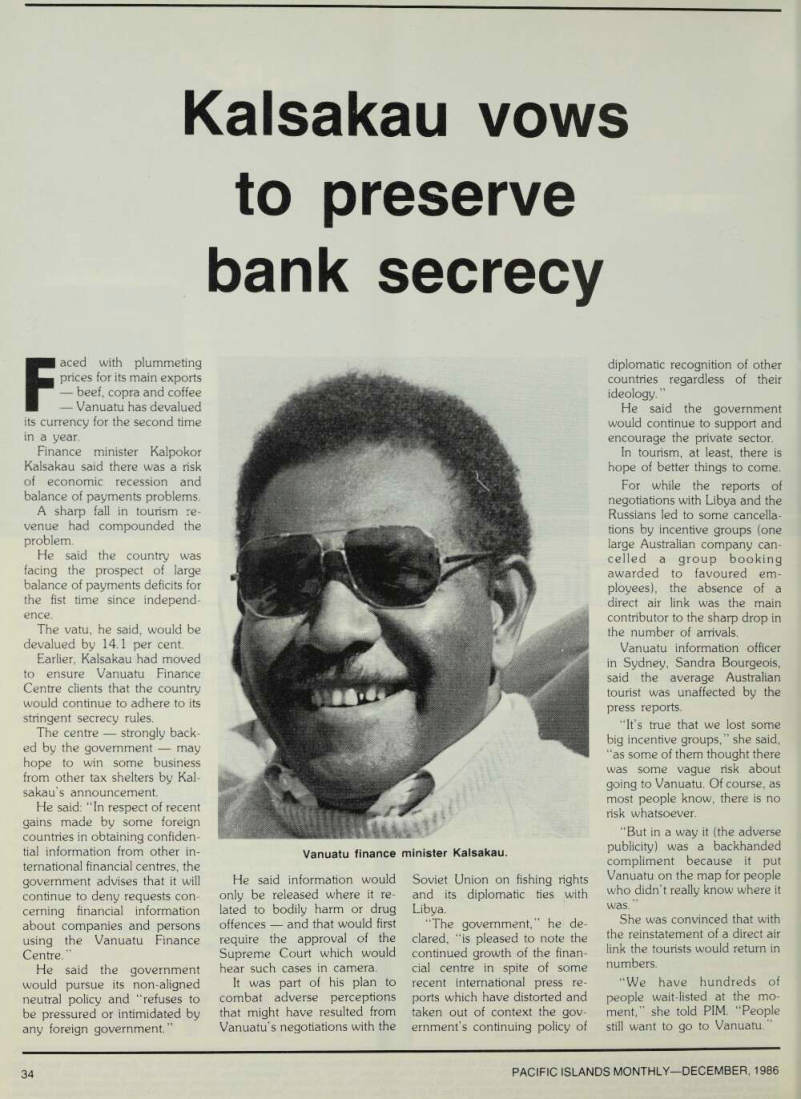
Kalsakau vows to preserve bank secrecy
Faced with plummeting prices for its main exports beef, copra and coffee Vanuatu has devalued its currency for the second time in a year.
Finance minister Kalpokor Kalsakau said there was a risk of economic recession and balance of payments problems.
A sharp fall in tourism re venue had compounded the problem.
He said the country was facing the prospect of large balance of payments deficits for the fist time since independ ence.
The vatu, he said, would be devalued by 14.1 per cent.
Earlier, Kalsakau had moved to ensure Vanuatu Finance Centre clients that the country would continue to adhere to its stringent secrecy rules.
The centre strongly back ed by the government may hope to win some business from other tax shelters by Kal sakau’s announcement.
He said: “In respect of recent gains made by some foreign countries in obtaining confiden tial information from other in ternational financial centres, the government advises that it will continue to deny requests con cerning financial information about companies and persons using the Vanuatu Finance Centre.”
He said the government would pursue its non-aligned neutral policy and “refuses to be pressured or intimidated by any foreign government.”
He said information would only be released where it re lated to bodily harm or drug offences and that would first require the approval of the Supreme Court which would hear such cases in camera.
It was part of his plan to combat adverse perceptions that might have resulted from Vanuatu’s negotiations with the
Soviet Union on fishing rights and its diplomatic ties with Libya.
“The government,” he de clared, “is pleased to note the continued growth of the finan cial centre in spite of some recent international press re ports which have distorted and taken out of context the gov ernment’s continuing policy of
diplomatic recognition of other countries regardless of their ideology.”
He said the government would continue to support and encourage the private sector.
In tourism, at least, there is hope of better things to come.
For while the reports of negotiations with Libya and the Russians led to some cancella tions by incentive groups (one large Australian company can celled a group booking awarded to favoured em ployees), the absence of a direct air link was the main contributor to the sharp drop in the number of arrivals.
Vanuatu information officer in Sydney, Sandra Bourgeois, said the average Australian tourist was unaffected by the press reports.
“It’s true that we lost some big incentive groups,” she said, “as some of them thought there was some vague risk about going to Vanuatu. Of course, as most people know, there is no risk whatsoever.
“But in a way it (the adverse publicity) was a backhanded compliment because it put Vanuatu on the map for people who didn’t really know where it was. ”
She was convinced that with the reinstatement of a direct air link the tourists would return in numbers.
“We have hundreds of people wait-listed at the mo ment,” she told PIM. “People still want to go to Vanuatu.”
Vanuatu finance minister Kalsakau.
Placer Pacific’
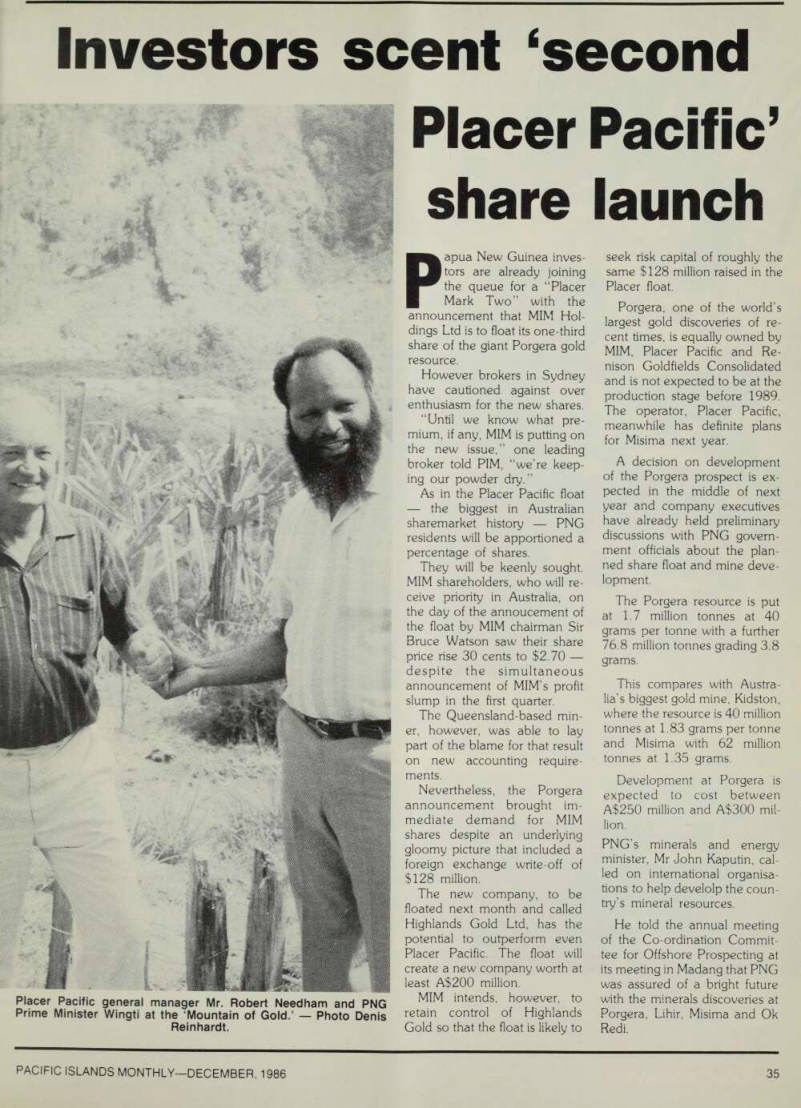
Investors scent ‘second
Placer Pacific’ share launch
Papua New Guinea inves tors are already joining the queue for a “Placer Mark Two” with the announcement that MIM Hol dings Ltd is to float its one-third share of the giant Porgera gold resource.
However brokers in Sydney have cautioned against over enthusiasm for the new shares.
“Until we know what pre mium, if any, MIM is putting on the new issue,” one leading broker told PIM, “we’re keep ing our powder dry.”
As in the Placer Pacific float the biggest in Australian sharemarket history PNG residents will be apportioned a percentage of shares.
They will be keenly sought.
MIM shareholders, who will re ceive priority in Australia, on the day of the annoucement of the float by MIM chairman Sir Bruce Watson saw their share price rise 30 cents to $2.70 despite the simultaneous announcement of MlM’s profit slump in the first quarter.
The Queensland-based min er, however, was able to lay part of the blame for that result on new accounting require ments.
Nevertheless, the Porgera announcement brought im mediate demand for MIM shares despite an underlying gloomy picture that included a foreign exchange write-off of $l2B million.
The new company, to be floated next month and called Highlands Gold Ltd, has the potential to outperform even Placer Pacific. The float will create a new company worth at least As2oo million.
MIM intends, however, to retain control of Highlands Gold so that the float is likely to
seek risk capital of roughly the same $l2B million raised in the Placer float.
Porgera, one of the world’s largest gold discoveries of re cent times, is equally owned by MIM, Placer Pacific and Re nison Goldfields Consolidated and is not expected to be at the production stage before 1989.
The operator, Placer Pacific, meanwhile has definite plans for Misima next year.
A decision on development of the Porgera prospect is ex pected in the middle of next year and company executives have already held preliminary discussions with PNG govern ment officials about the plan ned share float and mine deve lopment.
The Porgera resource is put at 1.7 million tonnes at 40 grams per tonne with a further 76.8 million tonnes grading 3.8 grams.
This compares with Austra lia’s biggest gold mine. Kidston, where the resource is 40 million tonnes at 1.83 grams per tonne and Misima with 62 million tonnes at 1.35 grams.
Development at Porgera is expected to cost between As2so million and As3oo mil lion.
PNG’s minerals and energy minister, Mr John Kaputin, cal led on international organisa tions to help develolp the coun try’s mineral resources.
He told the annual meeting of the Co-ordination Commit tee for Offshore Prospecting at its meeting in Madang that PNG was assured of a bright future with the minerals discoveries at Porgera, Lihir, Misima and Ok Redi.
Placer Pacific general manager Mr. Robert Needham and PNG Prime Minister Wingti at the ‘Mountain of Gold.’ Photo Denis Reinhardt.
Advertisements & other items, pp. 36-37 (1 item)
Hoaa-nuggmg, nocK-miing. pa
,\ % p M 1£ m m ■% ✓ 4 -1 I P K t=J ■ > HILUX 4WD Regular Cab, Long Wheelbase One tough truck just got tougher. Toyota’s dedication to superio performance vehicles takes a step forward today with the New Hilux A refined front grille and bumper design, new instrument panel for a feeling of spaciousness and command and plush colour co-ordinated trim are a few new additions to the New Hilux.
And extensive anti-corrosive galvanealed steel protection now includes the tailgate panel and rear door panel, making Hilux more durable than ever before.
Yet for all its improvements, the best of the original Hilux is also
TOYOTA
QUALITY SERVICE
AMERICAN SAMOA: BURNS PHILP (SOUTH SEA) CO., LTD., P.O. Box 129, Pago Pago. COOK ISLANDS: COOK ISLA AUTOMOTIVE SUPPLIES COMPANY, A Division of Burns Philp (South Sea) Co., Ltd., G.P.O. Box 355, Suva. GUAM & Ml Tamuning. KIRIBATI: TARAWA MOTORS, A Division of Bairiki Holdings Ltd., P.O. Box 36, Bairiki, Tarawa. NAURU: NAU SERVICE IMPORTATION AUTOMOBILE DU PACIFIQUE, Rond-Point du Pacifique (Station Total) B.P. 438, Noumea. NIUE; NORFOLK ISLAND: BORRY’S LIMITED, P.O. Box 169. PAPUA NEW GUINEA: ELA MOTORS, A Division of Burns Phi CORPORATION, P.O. Box 267. Saipan. SOLOMON ISLANDS: SOLOMON ISLANDS INVESTMENTS LTD., G.P.O. Box 14G TONGA: BURNS PHILP (TONGA) LTD., P.O. Box 55, Nukualofa. VANUATU: VANUATU MOTORS, A Division of Burns Phil di iDMCDuiiD/cniiTucciirn irn pn Rnviftfi Anin
inciougn. menewmiUK.
m i I i » !W % m k * - U 9 W v iere: a big tailgate conveniently hinged for quick loading and unloading; reinforced front suspension to smooth out ie bumps, and bias-mounted, extra-heavy-duty rear shocks and knobbly tyres to take on any terrain.
Toyota’s long history of super-responsive engines, ruggedness, reliability and comfort goes without saying. And in the Hilux, it’s yours in both 2-wheel-drive and 4x4 versions.
So, after comprehensive testing and thorough quality control, the New Hilux is ready to bring a new standard of toughness to the Pacific.
And isn’t that exactly what you expect from Toyota?
Areas where galvanealed steel is used iDING CORPORATION LTD., Private Bag, Rarotonga. FIJI: SIA: ATKINS KROLL, INC., 443 South Marine Drive, 3 ERATIVE SOCIETY, Central Pacific. NEW CALEDONIA: >HILP (SOUTH SEA) CO., LTD., P.O. Box 39, Alofi.
Ltd., P.O. Box 75, Port Moresby. SAIPAN: MICROL a. TAHITI: NIPPON AUTOMOTO, B.P. 342. Papeete, itu) Ltd., P.O. Box 18, Port Vila. WESTERN SAMOA:
TOYOTA
a spymaster
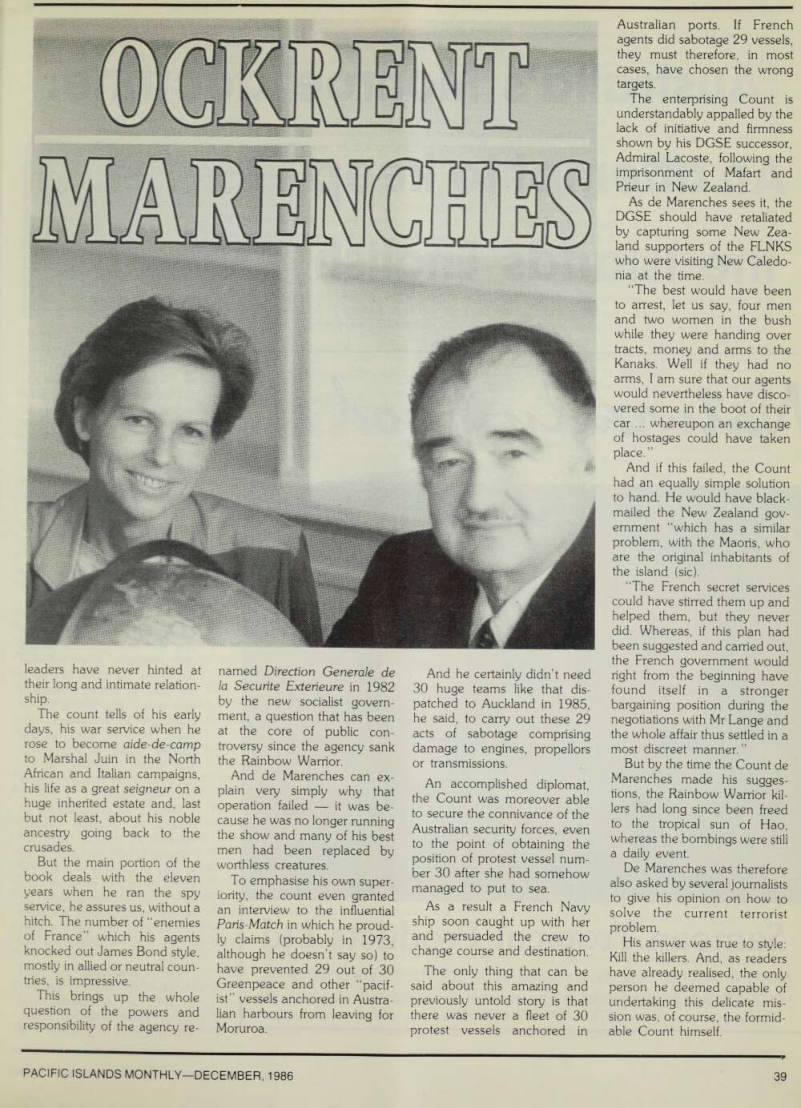
Confessions of a spymaster
Did French agents sabotage 29 foreign vessels in Australian harbours long before the notorious Rainbow Warrior scandal? MARIE-THERESE and BENGT DANIELSSON, recently returned from Paris,report that a former French espionage chief says that they did but that, as in the case of the Auckland bombing it may have gone very wrong.
In Paris recently we experi enced a strong sense of what the French call deja vu. We recalled the 1961 scenes of screaming ambulances racing through the streets with heavily armed police and troops guar ding all public buildings.
That was when French diehards from Algeria vented their anger over the loss of what they considered their home by killing innocent people in the streets of Paris.
Once again, it is France’s involvement with the Arab world that has sparked off simi lar terrorist incidents.
It was France’s continued arms sales to Iraq that had made her the mortal enemy of Iran, Iraq’s bitter opponent in the protracted Gulf War.
During those agitated weeks in Paris there also gushed forth a steady flow of books and articles about another category of terrorist the French secret agents working for the various intelligence services with which France is so richly endowed.
Incredibly enough at least
for us the authors of these colourful and highly critical accounts agreed on one point: that while an Arab bomb throw er is invariably labelled a terror ist, his French counterpart is always a patriot and often even a national hero.
This highly dubious distinc tion was most forcefully argued by two public men who, during the De Gaulle and Pompidou era, helped formulate French policy.
The first, Deputy Alain Peyrefitte, has been a cabinet minister no fewer than seven times but today exerts his pow er mainly by writing editorials and features in the widely read right-wing newspaper Le Figaro.
As a measure of his philoso
phy, he consistently calls the pro-independence Kanaks of New Caledonia terrorists.
However, he sees nothing wrong in the activities of French agents and was the first promin ent French politician to travel to Hao after the release of Major Alain Mafart and Captain Dominique Prieur.
Incidentally his son, Benoit, is press officer at the French Ato mic Test Centre (CEP) and is, among other things, entrusted with the strategic task of trans lating into French for publication in a military news letter all our contributions to
Pim.
So far, no translation rights have come our way, but we mind this less than the numer ous errors these French ver sions contain.
Another public servant who has made an even bigger splash in the French media in recent months has been the former boss (1970-81) of the agency for foreign intelligence opera tions (then called the SDECE),
Count Alexandre de Maren ches. And he did so by plunging into the still murky waters of the Rainbow Warrior scandal.
The normal rule for agents is silence, so there were a few gasps of surprise when de Marenches came out of the dark by publishing his memoirs as told to right wing journalist Christine Ockrent who had also been able to put questions to him.
The book, Dans le Secret des Princes curiously enough alludes not so much to his work as a spymaster but to his activities since he resigned (or was forced to) in 1981 when the socialists came to power.
As his awe-struck ghost writer explains, the Count has spent his life since then advising free of charge the leaders of the free world, most notably President Reagan, Mrs Thatch er and the kings of Spain and Morocco of communist plots.
We must conclude that it is exclusively out of gratitude to the benevolent count that these
leaders have never hinted at their long and intimate relationship- The count tells of his early days, his war service when he rose to become aide-de-camp to Marshal Juin in the North African and Italian campaigns, his life as a great seigneur on a huge inherited estate and, last but not least, about his noble ancestry going back to the crusades.
But the main portion of the book deals with the eleven years when he ran the spy service, he assures us, without a hitch. The number of enemies of France which his agents knocked out James Bond style, mostly in allied or neutral countries, is impressive.
This brings up the whole question of the powers and responsibility of the agency re-
named Direction Generate de la Securite Exterieure in 1982 by the new socialist govern ment, a question that has been at the core of public con troversy since the agency sank the Rainbow Warrior.
And de Marenches can ex plain very simply why that operation failed it was be cause he was no longer running the show and many of his best men had been replaced by worthless creatures, To emphasise his own super iority, the count even granted an interview to the influential Paris-Match in which he proud ly claims (probably in 1973, although he doesn’t say so) to have prevented 29 out of 30 Greenpeace and other “pacif ist” vessels anchored in Austra- Han harbours from leaving for Moruroa.
And he certainly didn’t need 30 huge teams like that dis patched to Auckland in 1985, he said, to carry out these 29 acts of sabotage comprising damage to engines, propellers or transmissions.
An accomplished diplomat, the Count was moreover able to secure the connivance of the Australian security forces, even to the point of obtaining the position of protest vessel num ber 30 after she had somehow managed to put to sea.
As a result a French Navy ship soon caught up with her and persuaded the crew to change course and destination.
The only thing that can be said about this amazing and previously untold story is that there was never a fleet of 30 protest vessels anchored in
Australian ports. If French agents did sabotage 29 vessels, they must therefore, in most cases, have chosen the wrong targets.
The enterprising Count is understandably appalled by the lack of initiative and firmness shown by his DGSE successor, Admiral Lacoste, following the imprisonment of Mafart and Prieur in New Zealand.
As de Marenches sees it, the DGSE should have retaliated by capturing some New Zea land supporters of the FLNKS who were visiting New Caledo nia at the time.
“The best would have been to arrest, let us say, four men and two women in the bush while they were handing over tracts, money and arms to the Kanaks. Well if they had no arms, I am sure that our agents would nevertheless have disco vered some in the boot of their car ... whereupon an exchange of hostages could have taken place.”
And if this failed, the Count had an equally simple solution to hand. He would have black mailed the New Zealand gov ernment “which has a similar problem, with the Maoris, who are the original inhabitants of the island (sic).
“The French secret services could have stirred them up and helped them, but they never did. Whereas, if this plan had been suggested and carried out, the French government would right from the beginning have found itself in a stronger bargaining position during the negotiations with Mr Lange and the whole affair thus settled in a most discreet manner.”
But by the time the Count de Marenches made his sugges tions, the Rainbow Warrior kil lers had long since been freed to the tropical sun of Hao, whereas the bombings were still a daily event.
De Marenches was therefore also asked by several journalists to give his opinion on how to solve the current terrorist problem.
His answer was true to style: Kill the killers. And, as readers have already realised, the only person he deemed capable of undertaking this delicate mis sion was, of course, the formid able Count himself.
Advertisements & other items, p. 38 (1 item)
Metropolitan Drilling And Blasting (Fiji) Ltd.
COMPUTERISE YOUR VIDEO LIBRARY
with the
FARLINER VIDEO LIBRARY SYSTEM
A leading Library Management software package
with over 100 installations throughout Australia and Papua New Guinea Software Only A 51495 Demonstration Version AS9S Complete Computer Systems ready to run from only A 555,000 Multi-User versions available for large or busy Libraries.
For further details contact: Doug Jones, FARLINER Pty. Ltd.
PO BOX 1800
TOWNSVILLE Old. 4810
Australia Telephone 6177-725738 (AH) 6177-785392
METROPOLITAN DRILLING AND BLASTING (FIJI) LTD.
We do all Drilling, Blasting and Rock works throughout the South Pacific.
Former Contractors for the Vaturu Dam and the Queens Road, Viti Levu, Fiji Machinery: 850 Compressor ECM 350 Track Drills Portable Gear All equipment is available for hire with an experienced operator, and all jobs insured for Public Liability P.O. Box 27, Pacific Harbour, Deuba, Fiji Phone: Fiji 45338, Telex: FJ3251
An attempt to keep

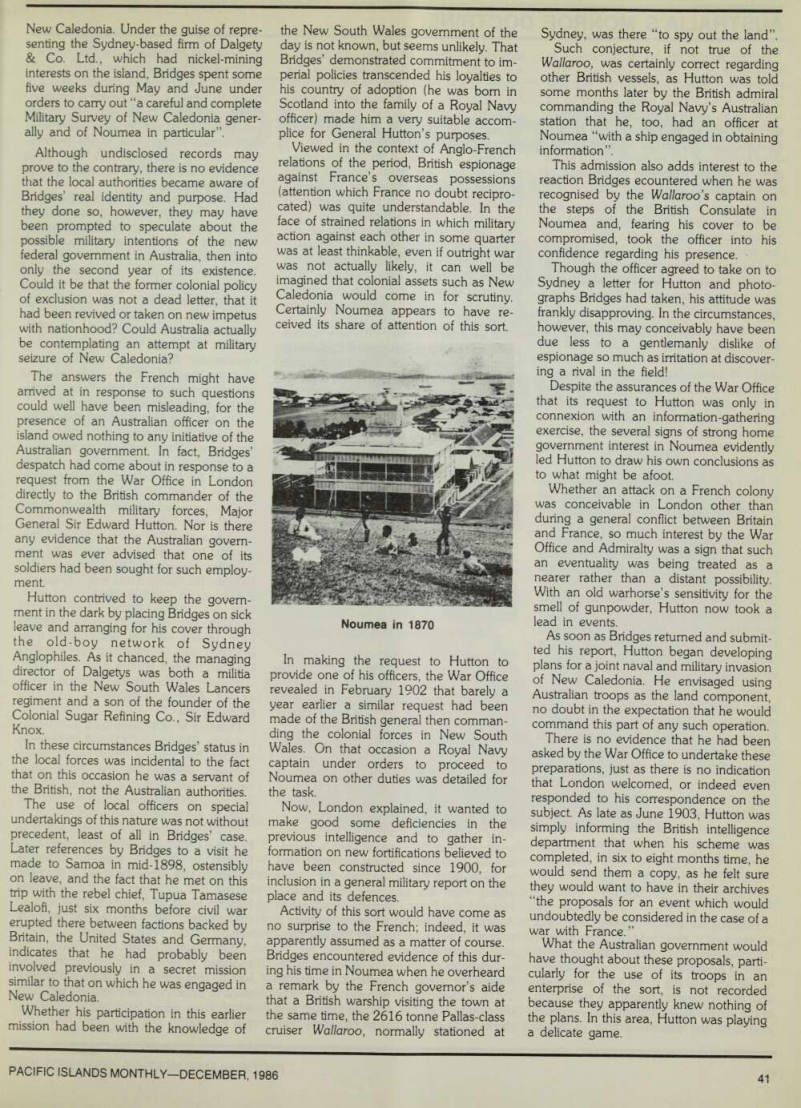
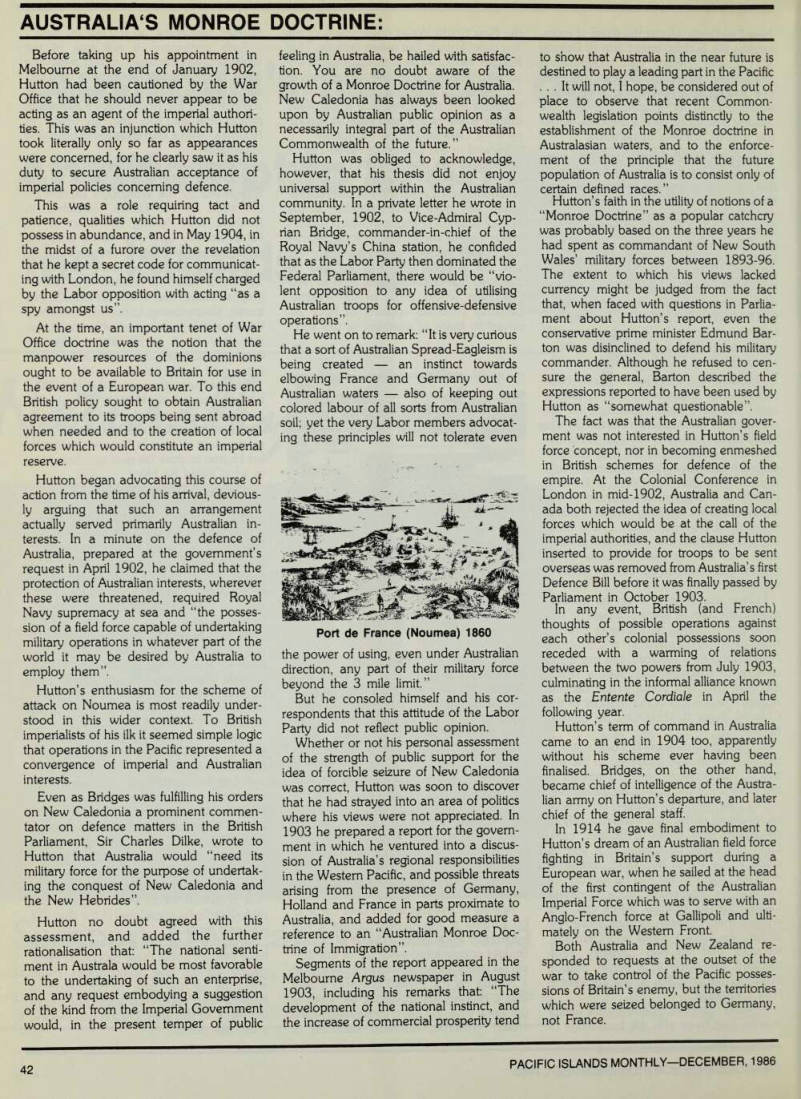
Australia’s Monroe doctrine:
An attempt to keep the islands English
French accusations of Australian ambitions in the Pacific are not new.
Since before Australia became a nation, French settlers in the region have sus pected the English speakers of wanting them out. Whatever the current think ing, there was once good reason for French suspicians. Chris Coulthard- Clark recalls Australia’s own Monroe doctrine.
From the time of British settlement, Australian colonists lived in apprehension of designs that other powers might have on their distant outpost in the Pacific in the event of a war in Europe. During the late nineteenth century, the rush for Pacific island territories by Bri tain’s rivals Germany and France even gave rise to an Australian version of the “Mon roe Doctrine”, promulgated at an intercolonial convention at Sydney in 1883.
As one recent historian has noted: “Unlike its American model . . . Australian spread eagleism did not in any signifi cant degree reflect an aggres sive and self-righteous demo cratic morality. Even imperial patriotism, the desire to extend the area of British civilisation and order, was but a minor ingredient in Australian mo tives. The chief object of the colonial policy of annexation was simply defensive, to ex clude all other foreign powers from the region.”
Without an underpinning of notions of manifest destiny, Australia’s “Monroe Doctrine” became largely irrelevant or at least inoperable once the island groups of principal con cern to it had been snapped up by colonising powers and their fate decided. This was a process which was completed by the 1890 s.
France might well have been surprised, therefore, to discover in 1902 an Australian army officer, Major William Bridges, spying against its possession of
New Caledonia. Under the guise of repre senting the Sydney-based firm of Dalgety & Co. Ltd., which had nickel-mining interests on the island, Bridges spent some five weeks during May and June under orders to carry out “a careful and complete Military Survey of New Caledonia gener ally and of Noumea in particular”.
Although undisclosed records may prove to the contrary, there is no evidence that the local authorities became aware of Bridges’ real identity and purpose. Had they done so, however, they may have been prompted to speculate about the possible military intentions of the new federal government in Australia, then into only the second year of its existence.
Could it be that the former colonial policy of exclusion was not a dead letter, that it had been revived or taken on new impetus with nationhood? Could Australia actually be contemplating an attempt at military seizure of New Caledonia?
The answers the French might have arrived at in response to such questions could well have been misleading, for the presence of an Australian officer on the island owed nothing to any initiative of the Australian government. In fact, Bridges’ despatch had come about in response to a request from the War Office in London directly to the British commander of the Commonwealth military forces, Major General Sir Edward Hutton. Nor is there any evidence that the Australian govern ment was ever advised that one of its soldiers had been sought for such employ ment.
Hutton contrived to keep the govern ment in the dark by placing Bridges on sick leave and arranging for his cover through the old-boy network of Sydney Anglophiles. As it chanced, the managing director of Dalgetys was both a militia officer in the New South Wales Lancers regiment and a son of the founder of the Colonial Sugar Refining Co., Sir Edward Knox.
In these circumstances Bridges’ status in the local forces was incidental to the fact that on this occasion he was a servant of the British, not the Australian authorities.
The use of local officers on special undertakings of this nature was not without precedent, least of all in Bridges’ case.
Later references by Bridges to a visit he made to Samoa in mid-1898, ostensibly on leave, and the fact that he met on this trip with the rebel chief, Tupua Tamasese Lealofi, just six months before civil war erupted there between factions backed by Britain, the United States and Germany, indicates that he had probably been involved previously in a secret mission similar to that on which he was engaged in New Caledonia.
Whether his participation in this earlier mission had been with the knowledge of
the New South Wales government of the day is not known, but seems unlikely. That Bridges’ demonstrated commitment to im perial policies transcended his loyalties to his country of adoption (he was bom in Scotland into the family of a Royal Navy officer) made him a very suitable accom plice for General Hutton’s purposes.
Viewed in the context of Anglo-French relations of the period, British espionage against France’s overseas possessions (attention which France no doubt recipro cated) was quite understandable. In the face of strained relations in which military action against each other in some quarter was at least thinkable, even if outright war was not actually likely, it can well be imagined that colonial assets such as New Caledonia would come in for scrutiny.
Certainly Noumea appears to have re ceived its share of attention of this sort.
In making the request to Hutton to provide one of his officers, the War Office revealed in February 1902 that barely a year earlier a similar request had been made of the British general then comman ding the colonial forces in New South Wales. On that occasion a Royal Navy captain under orders to proceed to Noumea on other duties was detailed for the task.
Now, London explained, it wanted to make good some deficiencies in the previous intelligence and to gather in formation on new fortifications believed to have been constructed since 1900, for inclusion in a general military report on the place and its defences.
Activity of this sort would have come as no surprise to the French; indeed, it was apparently assumed as a matter of course.
Bridges encountered evidence of this dur ing his time in Noumea when he overheard a remark by the French governor’s aide that a British warship visiting the town at the same time, the 2616 tonne Pallas-class cruiser Wallaroo, normally stationed at
Sydney, was there “to spy out the land”.
Such conjecture, if not true of the Wallaroo, was certainly correct regarding other British vessels, as Hutton was told some months later by the British admiral commanding the Royal Navy’s Australian station that he, too, had an officer at Noumea “with a ship engaged in obtaining information”.
This admission also adds interest to the reaction Bridges ecountered when he was recognised by the Wallaroo’s captain on the steps of the British Consulate in Noumea and, fearing his cover to be compromised, took the officer into his confidence regarding his presence.
Though the officer agreed to take on to Sydney a letter for Hutton and photo graphs Bridges had taken, his attitude was frankly disapproving. In the circumstances, however, this may conceivably have been due less to a gentlemanly dislike of espionage so much as irritation at discover ing a rival in the field!
Despite the assurances of the War Office that its request to Hutton was only in connexion with an information-gathering exercise, the several signs of strong home government interest in Noumea evidently led Hutton to draw his own conclusions as to what might be afoot.
Whether an attack on a French colony was conceivable in London other than during a general conflict between Britain and France, so much interest by the War Office and Admiralty was a sign that such an eventuality was being treated as a nearer rather than a distant possibility.
With an old warhorse’s sensitivity for the smell of gunpowder, Hutton now took a lead in events.
As soon as Bridges returned and submit ted his report, Hutton began developing plans for a joint naval and military invasion of New Caledonia. He envisaged using Australian troops as the land component, no doubt in the expectation that he would command this part of any such operation.
There is no evidence that he had been asked by the War Office to undertake these preparations, just as there is no indication that London welcomed, or indeed even responded to his correspondence on the subject. As late as June 1903, Hutton was simply informing the British intelligence department that when his scheme was completed, in six to eight months time, he would send them a copy, as he felt sure they would want to have in their archives “the proposals for an event which would undoubtedly be considered in the case of a war with France.”
What the Australian government would have thought about these proposals, parti cularly for the use of its troops in an enterprise of the sort, is not recorded because they apparently knew nothing of the plans. In this area, Hutton was playing a delicate game.
Noumea in 1870
Before taking up his appointment in Melbourne at the end of January 1902, Hutton had been cautioned by the War Office that he should never appear to be acting as an agent of the imperial authori ties. This was an injunction which Hutton took literally only so far as appearances were concerned, for he clearly saw it as his duty to secure Australian acceptance of imperial policies concerning defence.
This was a role requiring tact and patience, qualities which Hutton did not possess in abundance, and in May 1904, in the midst of a furore over the revelation that he kept a secret code for communicat ing with London, he found himself charged by the Labor opposition with acting “as a spy amongst us”.
At the time, an important tenet of War Office doctrine was the notion that the manpower resources of the dominions ought to be available to Britain for use in the event of a European war. To this end British policy sought to obtain Australian agreement to its troops being sent abroad when needed and to the creation of local forces which would constitute an imperial reserve.
Hutton began advocating this course of action from the time of his arrival, devious ly arguing that such an arrangement actually served primarily Australian in terests. In a minute on the defence of Australia, prepared at the government’s request in April 1902, he claimed that the protection of Australian interests, wherever these were threatened, required Royal Navy supremacy at sea and “the posses sion of a field force capable of undertaking military operations in whatever part of the world it may be desired by Australia to employ them”.
Hutton’s enthusiasm for the scheme of attack on Noumea is most readily under stood in this wider context. To British imperialists of his ilk it seemed simple logic that operations in the Pacific represented a convergence of imperial and Australian interests.
Even as Bridges was fulfilling his orders on New Caledonia a prominent commen tator on defence matters in the British Parliament, Sir Charles Dilke, wrote to Hutton that Australia would “need its military force for the purpose of undertak ing the conquest of New Caledonia and the New Hebrides”.
Hutton no doubt agreed with this assessment, and added the further rationalisation that: “The national senti ment in Australa would be most favorable to the undertaking of such an enterprise, and any request embodying a suggestion of the kind from the Imperial Government would, in the present temper of public
feeling in Australia, be hailed with satisfac tion. You are no doubt aware of the growth of a Monroe Doctrine for Australia.
New Caledonia has always been looked upon by Australian public opinion as a necessarily integral part of the Australian Commonwealth of the future.”
Hutton was obliged to acknowledge, however, that his thesis did not enjoy universal support within the Australian community. In a private letter he wrote in September, 1902, to Vice-Admiral Cyp rian Bridge, commander-in-chief of the Royal Navy’s China station, he confided that as the Labor Party then dominated the Federal Parliament, there would be “vio lent opposition to any idea of utilising Australian troops for offensive-defensive operations”.
He went on to remark: “It is very curious that a sort of Australian Spread-Eagleism is being created an instinct towards elbowing France and Germany out of Australian waters also of keeping out colored labour of all sorts from Australian soil; yet the very Labor members advocat ing these principles will not tolerate even
the power of using, even under Australian direction, any part of their military force beyond the 3 mile limit.”
But he consoled himself and his cor respondents that this attitude of the Labor Party did not reflect public opinion.
Whether or not his personal assessment of the strength of public support for the idea of forcible seizure of New Caledonia was correct, Hutton was soon to discover that he had strayed into an area of politics where his views were not appreciated. In 1903 he prepared a report for the govern ment in which he ventured into a discus sion of Australia’s regional responsibilities in the Western Pacific, and possible threats arising from the presence of Germany, Holland and France in parts proximate to Australia, and added for good measure a reference to an “Australian Monroe Doc trine of Immigration”.
Segments of the report appeared in the Melbourne Argus newspaper in August 1903, including his remarks that: “The development of the national instinct, and the increase of commercial prosperity tend
to show that Australia in the near future is destined to play a leading part in the Pacific . . . It will not, I hope, be considered out of place to observe that recent Common wealth legislation points distinctly to the establishment of the Monroe doctrine in Australasian waters, and to the enforce ment of the principle that the future population of Australia is to consist only of certain defined races.”
Hutton’s faith in the utility of notions of a “Monroe Doctrine” as a popular catchcry was probably based on the three years he had spent as commandant of New South Wales’ military forces between 1893-96.
The extent to which his views lacked currency might be judged from the fact that, when faced with questions in Parlia ment about Hutton’s report, even the conservative prime minister Edmund Bar ton was disinclined to defend his military commander. Although he refused to cen sure the general, Barton described the expressions reported to have been used by Hutton as “somewhat questionable”.
The fact was that the Australian gover nment was not interested in Hutton’s field force concept, nor in becoming enmeshed in British schemes for defence of the empire. At the Colonial Conference in London in mid-1902, Australia and Can ada both rejected the idea of creating local forces which would be at the call of the imperial authorities, and the clause Hutton inserted to provide for troops to be sent overseas was removed from Australia’s first Defence Bill before it was finally passed by Parliament in October 1903.
In any event, British (and French) thoughts of possible operations against each other’s colonial possessions soon receded with a warming of relations between the two powers from July 1903, culminating in the informal alliance known as the Entente Cordiale in April the following year.
Hutton’s term of command in Australia came to an end in 1904 too, apparently without his scheme ever having been finalised. Bridges, on the other hand, became chief of intelligence of the Austra lian army on Hutton’s departure, and later chief of the general staff.
In 1914 he gave final embodiment to Hutton’s dream of an Australian field force fighting in Britain’s support during a European war, when he sailed at the head of the first contingent of the Australian Imperial Force which was to serve with an Anglo-French force at Gallipoli and ulti mately on the Western Front.
Both Australia and New Zealand re sponded to requests at the outset of the war to take control of the Pacific posses sions of Britain’s enemy, but the territories which were seized belonged to Germany, not France.
Port de France (Noumea) 1860
Advertisements & other items, p. 40 (1 item)
hijCtwMiily Q'OcA ...
ouds
Sam® 3 * festsra SS x 42 COf n i S 1 %
Samoan Tropical Products Ltd
APIA: P.O. Box 1550, Apia Western Samoa, Ph: 21535, TLX: 793210 SAMTROP SX.
HONOLULU: Suite 2H, 485 Kapahuiu Avenue, Honolulu, Hawaii 96815. Ph; 734 3233, 734
2711. TLX: 723 8202 HIDE.
books
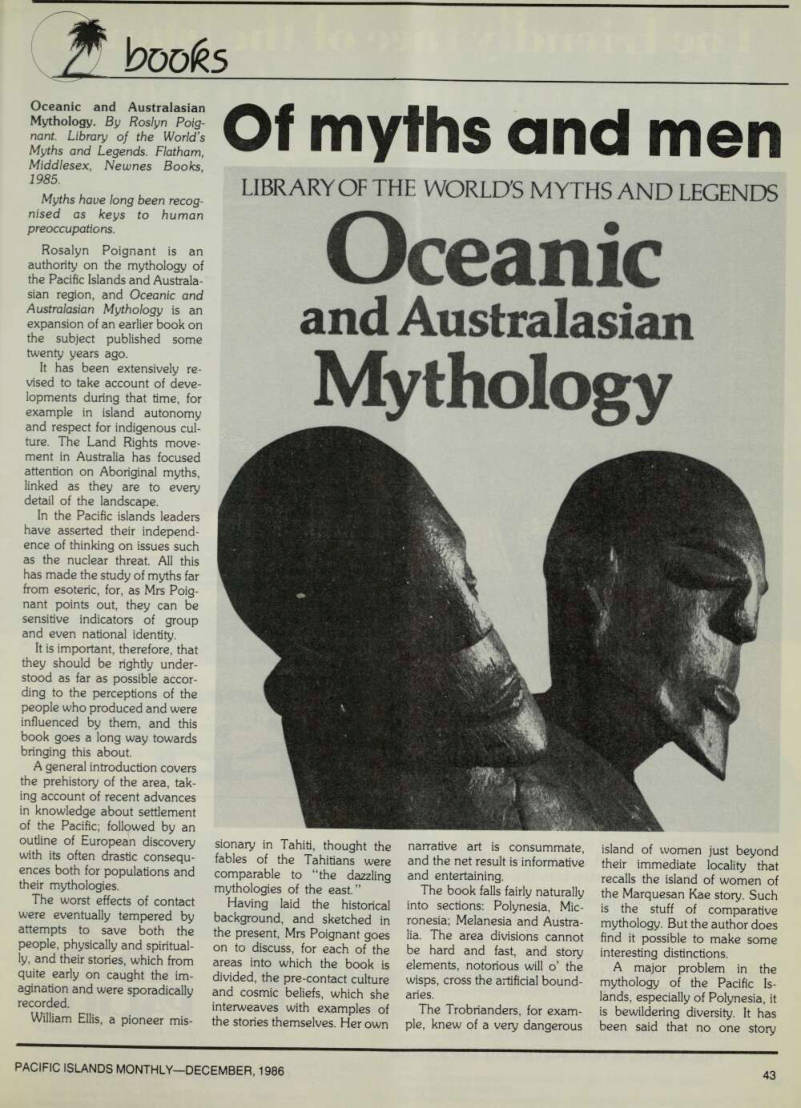


Oceanic and Australasian Mythology. By Roslyn Poig nant. Library of the Worlds Myths and Legends. Flatham, Middlesex, Newnes Books, 1985.
Myths have long been recog nised as keys to human preoccupations.
Rosalyn Poignant is an authority on the mythology of the Pacific Islands and Australa sian region, and Oceanic and Australasian Mythology is an expansion of an earlier book on the subject published some twenty years ago.
It has been extensively re vised to take account of deve lopments during that time, for example in island autonomy and respect for indigenous cul ture. The Land Rights move ment in Australia has focused attention on Aboriginal myths, linked as they are to every detail of the landscape.
In the Pacific islands leaders have asserted their independ ence of thinking on issues such as the nuclear threat. All this has made the study of myths far from esoteric, for, as Mrs Poig nant points out, they can be sensitive indicators of group and even national identity.
It is important, therefore, that they should be rightly under stood as far as possible accor ding to the perceptions of the people who produced and were influenced by them, and this book goes a long way towards bringing this about.
A general introduction covers the prehistory of the area, tak ing account of recent advances in knowledge about settlement of the Pacific; followed by an outline of European discovery with its often drastic consequ ences both for populations and their mythologies.
The worst effects of contact were eventually tempered by attempts to save both the people, physically and spiritual ly, and their stories, which from quite early on caught the im agination and were sporadically recorded.
William Ellis, a pioneer mis-
sionary in Tahiti, thought the fables of the Tahitians were comparable to “the dazzling mythologies of the east.”
Having laid the historical background, and sketched in the present, Mrs Poignant goes on to discuss, for each of the areas into which the book is divided, the pre-contact culture and cosmic beliefs, which she interweaves with examples of the stories themselves. Her own
narrative art is consummate, and the net result is informative and entertaining.
The book falls fairly naturally into sections: Polynesia, Micronesia; Melanesia and Australia. The area divisions cannot be hard and fast, and story elements, notorious will o’ the wisps, cross the artificial boundaries - The Trobrianders, for exampie, knew of a very dangerous
island of women just beyond their immediate locality that recalls the island of women of the Marquesan Kae story. Such is the stuff of comparative mythology. But the author does find it possible to make some interesting distinctions, A major problem in the mythology of the Pacific Is lands, especially of Polynesia, it is bewildering diversity. It has been said that no one story
exists in its entirety right across this region, and there are nearly as many versions as there are islands.
There is only consensus of a very loose kind of fundamental matters such as the fate of the soul after death. Roslyn Poig nant meets this difficulty head on; she chooses to follow one coherent account rather than attempt to synthesise, and in this way she manages to make sense of the confusion of the raw sources without deceiving the reader as to the authority of any particular version over an other.
Polynesia has the largest share of the book, and its mythology is probably best know, through famous charac ters like Maui with his land fishing, and Hina, here desig nated “the universal woman”, to be seen beating tapa in the moon. The stories are long, often interrelated in saga-like manner, even in the incomplete form in which they survive, full of action and, as throughout this collection, appararently free of ethics; there is little of virtue or its reward.
Micronesian tales have a cer tain courtliness, even the origi nal cosmic rock being addres sed by an honorific that trans lates as “Sir”. In this section is quoted a story that is clearly related to the migration route to Kiribati from Samoa (islands grow where flowers are flung north of Samoa Tarawa, Bern and Tabiteuea); and an other gives the origin of the division into three districts of Fais. Both myths have obvious practical application.
In Polynesian and Microne sian stories important roles are often taken by fish. In Mic ronesia there are the porpoise girls, who are stranded with their human husbands until they can find their tails and swim away (Roslyn Poignant calls this the “swan-maiden” theme but it seems closer to stories of mermaids).
In Polynesia humans could be on fraternal or even amor ous terms with fish, mainly dolphins and whales. Consider ing the watery environment this may come as no surprise, espe cially given the high level of intelligence now established for dolphins by scientific research.
More puzzling is the part played by eels, unless, as Ros lyn Poignant suggests, this is a manifestation of the almost uni versal mythological motif of the snake.
Melanesia is somewhat of a special case, in that many areas have only relatively recently been contacted. It is possible to see the folklore in action.
Stories are told, for example, by the Tangu and others, that incorporate the arrival of white men and their “cargo”.
Papua New Guineans, it is here suggested, have a fairly pragmatic and localised out look, being more concerned with the origin of the tribe than of the universe. As one would expect, the stories from smaller island Melanesia have more in common with other island based mythologies.
The myths of Aboriginal Aus tralia do not sit particularly well with other sections of the book.
Links can be traced; but here men seem to be utterly domin ated by vast spiritual beings, such as the great Wondjina, depicted without mouths lest they bring too much rain, and the übiquitous many-named Rainbow Snake.
The disciplines imposed with in Aboriginal society are
evidently closely linked to validating myths such as that of the Tjilpa or native cat-men, told by the Aranda to validate the rite of subincision (thought by some, however, to be an attempt to make men more like women).
The snake that swallows and then regurgitates, too (story of Kunapipi, p. 149) is closely associated with traumatic initia tion rites that in themselves cement the individual powerful ly into his place and fate.
Nevertheless the sense of tragic “primal inevitability” that Mrs Poignant sees in tales such as “Kunmanggur the Rainbow Snake and Tjiniman the Bat” is modified by belief in reincarna tion.
Plenty of information is given on where to go for other ver sions, more detail, or further discussion. A look at some of the original collections shows how rash the “psychological generalisations” the author warns us against can be. She also warns against interpreting too literally what was perhaps meant “only as a metaphor”.
The text is one thing, and one cannot do justice in a short space to the richness and varie ty of the material encompassed in it. It is complemented by
numerous fine illustrations, many of them photographs in color and black and white, of art and cult objects, drums, carvings, rock and bark pain tings, assemblages of wood, cord and feathers endowed in the correct circumstances with spiritual immanence.
There are also drawings and paintings from the early explor ers’ expeditions. One of the noticeable “expansions” from the earlier book is the inclusion of more modem photographs, many by Axel Poignant, that bring the content right into the present. A particularly welcome addition, this time from the early period, is the Tuamotuan Creation Chart, a gem that illustrates (but remember the caveat about metaphor) one group’s ideas of the nature of the universe and man’s place in it.
Mrs Poignant’s book is a fine overall introduction to the myths of the Pacific and Austra lia, with many insights and asides for further pondering. It is published as one of a series on world mythologies. Some readers will be looking to other volumes, say on Malaysia, Japan and South America, to
follow up her clues.
Jennifer
Terrell.
Advertisements & other items, pp. 44-45 (1 item)
Air (Ip
Tlie friendly face of the Islands
brings you a new era in space.
V?
I rQ jr & =9 m 'LJ ?r ir.
Now, air travellers throughout the Pacific can experience a whole new way to travel.
In fact, you could call it the beginning of a new era. In space, comfort and frequency.
The ATR42 is part of a new generation of turbo-prop aircraft. It’s an aircraft in which you’ll feel right at home, from the moment you step into the wide, spacious cabin.
With its air conditioned, pressurised interior and comfortable four abreast seating, it offers all the features you’d find on a larger jet aircraft.
The ATR’s 42 seat configuration and efficient turbo-prop operation, enables us to fly more people to more Pacific destinations more often than ever before.
Our flight attendants look forward to welcoming you aboard the latest addition to our fleet, soon.
The ATR42. A new service for the Pacific.
AIR (IP
PACIFIC
FIJI’S INTERNATIONAL AIRLINE
Go to the Head of the Class •M ' \ m HI X 770 X-110 Move up to New Personna Plus from Pioneer.
And put compact, advanced audio technology at your fingertips.
With the X-770, you’ll enjoy full-function remote control for amp, tuner, cassette deck, turntable, and even an optional CD player.
There’s Stereo Wide for expanded ambience from stereo signals plus Simulated Stereo for wide, stereo-like signals from even mono
signals.
And for power, the X-770 puts out a full X-330 320 W (PMPO) to give you a full,
high-fidelity sound.
The X-770 also brings you great features like Mic Mixing, Dolby* B/C NR, and a 5-band graphic equalizer. A double auto-reverse cassette deck offers added listening convenience and tape dubbing. Also available are the more economical Systems / X-330 and X-110.
The New Personna Plus from Pioneer. A class act in home audio convenience and enjoyment. * “Dolby" and the double-D symbol are trademarks of Dolby Laboratories Licensing Corporation.
Nofe: The optional PD-X707(8K) CD player is shown above.
CD PIONEER
The future of sound and vision.
For further information, please contact; Australia: Pioneer Electronics Australia Pty. Ltd. (Incorporated in Victoria) P-0. Box 295, Mordialloc, Victoria, 3195 Tel: 580-9911 Fiji Islands: Brijlal & Company, G.P.O. Box No. 362, Suva, Fiji Islands Tel: 22258 New Zealand: Monaco Distributors Ltd., 2 Poland Road, Glenfield Auckland New Zealand Tel: (09) 444-9144 Norfolk Island: Burnt Pine Traders Ltd., P.O. Box 21, Norfolk Island Vanuatu: Burns Philo (Vanuatu) Itd Vila Vam,at,, Nauru Island: Jacob Enterprises, P.O. Box N 0.4, Republic of Nauru Tahiti: Tahiti Hi-Fi, P.O. Box 848, Papeete, Tahiti New Caledonia: Menard Pacifique Sari, B.P. 3899, Noumea, New Caledonia Tel; 27-62.23 American Samoa: Transpac Corporation, P.O. Box 1477, Pago Pago, American Samoa 96799 Tel; 633-5224 Rarotonga: South Seas International Ltd., P.O. Box 49, Rarotonga, Cook Islands Tel; 2327
Hand made for a pittance
Froduction of Women’s Hand icraft in Fiji by Tuga Vulaono Nacanaitaba. Published by New Zealand Coalition for Trade and Development, Wel lington, N.Z., 1984. SNZIO.
Isbn 0-908617-04-6.
This is a research project, spon sored by the New Zealand Coalition for Trade and Development and the Centre for Applied Studies in Develop ment, USF, Suva.
Its presentation lists of tables, figures, appendices, bib liography and footnotes is the work of a well-organised researcher; the report could well be a small thesis.
However, this should not dis suade those interested in Fijian handicraft from reading it. In fact, some of the information on the effect of handicraft produc
tion on the economies of small villages would be valuable reading for those who seek to understand Fijian rural condi tions.
The report is centred on case studies of village women and their handicraft production on Vatulele, Moce, Oneata, Komo and Koro islands. The author has looked at what sort of return these women get for their production efforts, at the way each island and in some cases how villages on each island specialises in a particular type of handicraft, and the difficulties of marketing.
She does not describe the actual preparation of materials and production methods of the masi (bark cloth), and ibe (mats); this is well documented in other publications.
She has concentrated on de
scribing the part that handicraft production plays economically within the lives of the house hold and the village. A major revelation (at least for this read er), is that a village woman can expect a return of $1.50 for a small piece of mosi 12 inches by 18 inches, which took her ten hours to produce.
These hours take into account the collection of the trees used from gardens which are often quite a distance from her home, preparation of the material, actual manufacture of the mosi and drying times for the dyes. What a miserable reward for such skill.
Other figures reveal the frustrations village women have to deal with in getting their handicraft to market. It can cost up to $lOO for a roll of 10
to page 47
from page 46
assorted mats to be transported from their island to the Suva markets.
Research showed that these mats may return $199; deduct the boatman’s fee and the stall holder’s commission and the maximum return for the pro ducer is in the order of 30 cents per hour; the likely return would be less.
These tables alone should be compulsory reading for every tourist who contemplates the purchase of a piece of masi or ibe as a memento of their visit.
Perhaps some may think twice before trying to knock $1 off the price.
Tauga Vulaono Nacanaitaba, in her conclusion, calls for more co-operation among the va rious groups which seek to assist the village women with either training or marketing. At present each group offers diffe rent advice on the same prob lems and this causes confusion among the women whom they are trying to help.
Government Development plans increasingly include handicrafts and its production as matters for assistance but with little concrete result.
Perhaps these agencies should read this report to see where the need for real action lies.
Ngaire Douglas.
The problems
with microstates
States, Microstates and Is lands (ED) Edward Dommen and Philippe Hein This book provides a rich source of information on the problems and possibilities of islands and microstates facing the challenges of the modern world.
The first few chapters attempt to define a microstate and to list their characteristics. It is gener ally agreed that microstates are not only small physically but also economically. Chapter 3 gives a further demarcation.
Smallness can be externally imposed on people, (the divide and rule principle) or internally
generated. Small is not seen as beautiful but synonomous with a special set of constraints.
These are listed on p. 41 as: insularity and isolation; re source limitations; dependence on a very narrow range of agricultural products; distance from markets; serious balance of payments problems; narrow range of local skills; depend ence on one or few large companies; heavy dependence on aid and external institutions; proneness to certain natural disasters; and fragile natural ecologies.
All authors agree that micros tates and islands generally face problems. All agree that their viability is of critical importance.
The divergences occur on whe ther or not they believe the problems can be overcome and by what means. There are elements of doom expressed in the book.
For instance Anthony Dol man, Senior Consultant at the Institute of Social Studies, The Hague writes: “It is difficult to see how small island producers can even compete with more efficient, lower cost and geog raphically less disadvantaged developing countries.”
Even those island states which in the ’7os could produce excess fish, fruit, vegetables, light manufacturing, plastics, paper and boats cannot now compete well on the world market.
The book also makes refer ence to better times in the Pacific in the pre-colonial era.
Colonists are held responsible for the decline in the range of crops and the destruction of local food systems. However it is also true that in former times, on atolls such as Kiribati and the Marshall Islands, suffering was experienced during drought periods even when coconut trees died. All was not always rosy for all Pacific is lands in the past.
But elements of hope are also expressed in the book. Mr Dolman further states that small
island countries may identify new development paths that larger developing countries may one day be forced to travel. Microstates could be come the laboratories in which alternative development strategies are shaped by self reliance. Still, such expressions of hope do not provide guide lines on how microstates will attain viability.
Chapter 6 provides the most optimistic and concrete guide lines for further development of microstates. There it is argued that the cultural background of many island developing coun tries is more conducive to the transfer of technology than other developing countries. Is land communities can be parti cularly suitable locations for offshore investment. They are largely the products of Euro pean maritime culture.
Also they have a higher pri mary and secondary school en rolment ratio than other deve loping countries of the same income level. The chapter goes on to outline the needs of Pacific islands information and techniques in market re search, management, finance, organisation and advertising. It is further claimed that island developing countries would be wise to develop on the basis of assets they have human resources.
It appears that the underlying assumption behind most of the reasoning in the book is that all must aspire to share in the Western standard of living. That assumption is debatable. It could be argued that the West ern standard of living, with all its advantages and disadvantages, is not suitable for all countries and has usually been forced on areas to ensure a market for Western goods.
Yet many would argue that the days of subsistence are over; that Island States need to enter the world economy. The Western Samoan Government states that: “Theoretically, an island country has two options.
It can remain a small, closed society at a subsistence level which would probably provide adequate quantity (not neces sarily quality) of food but none of the consumer goods, medi cines and other modern con veniences that come with eco nomic development.
“Alternatively, it can have access to these things by be coming integrated with the world economy through the promotion of the type of deve lopment which allows for greater and more beneficial ex change. In fact, the first is not really an option. There are few, if any, small societies which having had access to certain amenities have rejected them and gone back peacefully to the traditional ways of their ances tors. Having become a part of the international economy, it is then a question of preserving what is best in traditional values and developing the economy so that it becomes more reliant on trade and less on aid Other Pacific island states, however, such as Kiribati, still believe in the efficacy of a subsistence level economy. In Chapter 7, “Foreign Trade in Goods and Services” the same idea, that there are prospects for increasing self-reliance on a number of small islands, is expressed.
What appears more viable, however are schemes for col lective self-reliance and regional co-operation. This brings us around full circle to the senti ment offered in the beginning of the book that as it is easier to exploit small and isolated com munities, the way to survive is to become part of a group which can offer resistance.
No doubt many researchers will disagree with much that is in States Microstates and Is lands. Still, the book provides much stimulus for thought and reminds us that a good deal more research is needed to provide answers, however tentative, to the issues raised
Sandra Rennie.
Advertisements & other items, p. 48 (1 item)
Kenwood
m 9 o o SpCCtrUm Spectrum 1058 II ■— s««Beries 8250 W x 2 (Dynamic Power) power amplifier ■Separate control amplifier with CD and Video selectors ■Automatic quartz-synthesizer tuning 820 random memory presets BTwice-a-day timer ■ Double auto-reverse cassette deck with relay-play and high-speed dubbing ■ Programmable linear-tracking direct-drivP turntable B4OOW (max.) speakers ■ Options; CD player, graphic equalizer, surround processor, remote control, headphones, microphone
So nice to come home to
The Spectrum series are no ordinary stereo systems. For one thing, they offer you pure hi-fi sound.
For example, the Spectrum 1058 shown has professional separate power and control amplifiers. With its CD input selector, it’s ready to give you the full dynamic impact of digital sound!
Spectrum 1058 also helps you enjoy your music. Look at the versatile double auto-reverse cassette deck, computerized automatic tuner and full remote controller and you will see what we mean.
No matter what the time of day, you’ll always be ready to come home to your Spectrum hi-fi stereo system.
KENWOOD CORPORATION
Shionogi Shibuya Building, 17-5, 2-chome Shibuya, Shibuya-ku, Tokyo 150, Japan TRIO-KENWOOD (AUSTRALIA) PTY. LTD. (incorporated in n.sw.) 4E Woodcock Place, Lane Cove. N.S.W. 2066, Australia NEW ZEALAND JOHN GILBERT & CO., LTD. Auckland Tel. 0011-64-9-30839 FUJI PEPE'S DUTY FREE CENTRE LTD. Tel. 25496, 25497 PAPUA NEW GUINEA SO. SVENSSON (N.G.) LTD. Port Moresby Tel. 212158, 212111 SOLOMON ISLANDS TECHNIQUE RADIOS CENTRE LTD. Honiara Tel. 416 NEW CALEDONIA HI-FI VOX Noumea Tel. 27-2466, 28-2931 VANUATU FUNG CHOI LUEN. Ftort-Vila Tel. 2556
TAHITI MAISON AURORE Papeete Tel. 29703
AMERICAN SAMOA ISLAND PACIFIC AGENCIES, INC. Pago Pago Tel. 633-4687
REPUBLIC OF NAURU NAURU CO-OPERATIVE SOCIETY
MARIANA ISLANDS JO. TENORIO ENTERPRISES Saipan Tel. 6445
The politics
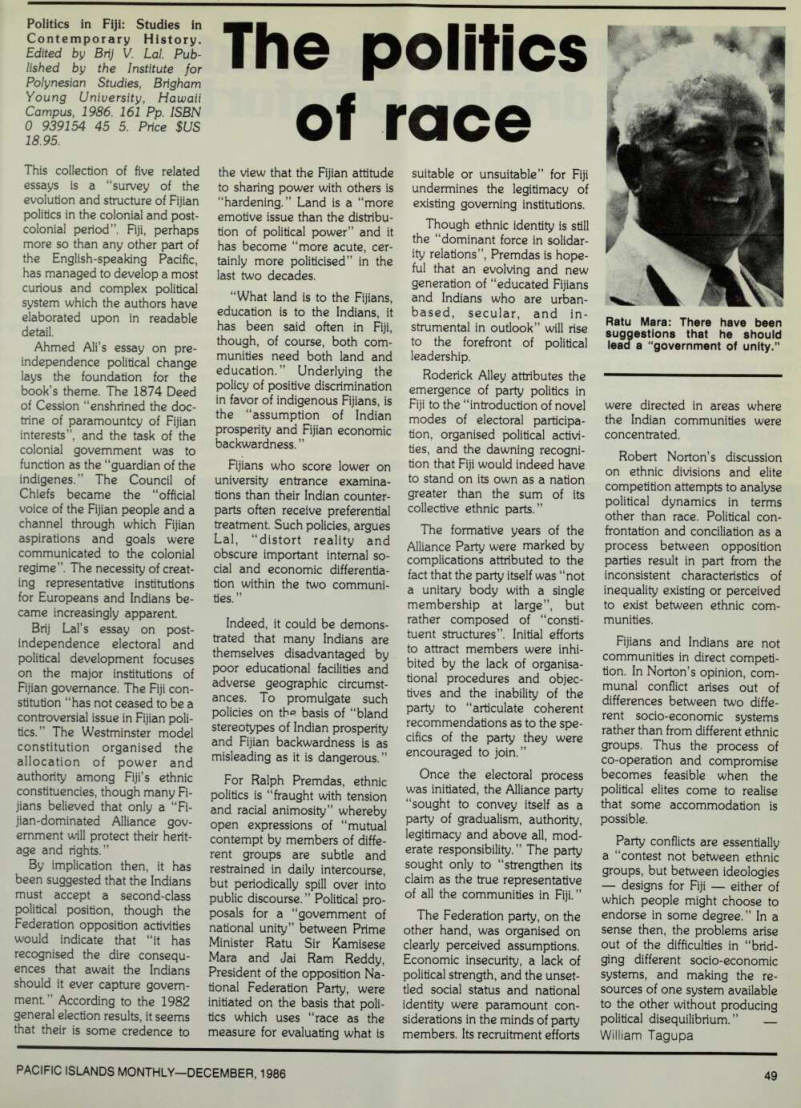
of race
Politics in Fiji: Studies in Contemporary History.
Edited by Brij V. Lai. Pub lished by the Institute for Polynesian Studies, Brigham Young University, Hawaii Campus, 1986. 161 Pp. ISBN 0 939154 45 5. Price SUS 18.95.
This collection of five related essays is a “survey of the evolution and structure of Fijian politics in the colonial and post colonial period”. Fiji, perhaps more so than any other part of the English-speaking Pacific, has managed to develop a most curious and complex political system which the authors have elaborated upon in readable detail.
Ahmed Ali’s essay on pre independence political change lays the foundation for the book’s theme. The 1874 Deed of Cession “enshrined the doc trine of paramountcy of Fijian interests”, and the task of the colonial government was to function as the “guardian of the indigenes.” The Council of Chiefs became the “official voice of the Fijian people and a channel through which Fijian aspirations and goals were communicated to the colonial regime”. The necessity of creat ing representative institutions for Europeans and Indians be came increasingly apparent.
Brij Lai’s essay on post independence electoral and political development focuses on the major institutions of Fijian governance. The Fiji con stitution “has not ceased to be a controversial issue in Fijian poli tics.” The Westminster model constitution organised the allocation of power and authority among Fiji’s ethnic constituencies, though many Fi jians believed that only a “Fi jian-dominated Alliance gov ernment will protect their herit age and rights.”
By implication then, it has been suggested that the Indians must accept a second-class political position, though the Federation opposition activities would indicate that “it has recognised the dire consequ ences that await the Indians should it ever capture govern ment” According to the 1982 general election results, it seems that their is some credence to
the view that the Fijian attitude to sharing power with others is “hardening.” Land is a “more emotive issue than the distribu tion of political power” and it has become “more acute, cer tainly more politicised” in the last two decades.
“What land is to the Fijians, education is to the Indians, it has been said often in Fiji, though, of course, both com munities need both land and education.” Underlying the policy of positive discrimination in favor of indigenous Fijians, is the “assumption of Indian prosperity and Fijian economic backwardness. ”
Fijians who score lower on university entrance examina tions than their Indian counter parts often receive preferential treatment. Such policies, argues Lai, “distort reality and obscure important internal so cial and economic differentia tion within the two communi ties.”
Indeed, it could be demons trated that many Indians are themselves disadvantaged by poor educational facilities and adverse geographic circumst ances. To promulgate such policies on th*> basis of “bland stereotypes of Indian prosperity and Fijian backwardness is as misleading as it is dangerous. ”
For Ralph Premdas, ethnic politics is “fraught with tension and racial animosity” whereby open expressions of “mutual contempt by members of diffe rent groups are subtle and restrained in daily intercourse, but periodically spill over into public discourse.” Political pro posals for a “government of national unity” between Prime Minister Ratu Sir Kamisese Mara and Jai Ram Reddy, President of the opposition Na tional Federation Party, were initiated on the basis that poli tics which uses “race as the measure for evaluating what is
suitable or unsuitable” for Fiji undermines the legitimacy of existing governing institutions.
Though ethnic identity is still the “dominant force in solidar ity relations”, Premdas is hope ful that an evolving and new generation of “educated Fijians and Indians who are urban based, secular, and in strumental in outlook” will rise to the forefront of political leadership.
Roderick Alley attributes the emergence of party politics in Fiji to the “introduction of novel modes of electoral participa tion, organised political activi ties, and the dawning recogni tion that Fiji would indeed have to stand on its own as a nation greater than the sum of its collective ethnic parts.”
The formative years of the Alliance Party were marked by complications attributed to the fact that the party itself was “not a unitary body with a single membership at large”, but rather composed of “consti tuent structures”. Initial efforts to attract members were inhi bited by the lack of organisa tional procedures and objec tives and the inability of the party to “articulate coherent recommendations as to the spe cifics of the party they were encouraged to join.”
Once the electoral process was initiated, the Alliance party “sought to convey itself as a party of gradualism, authority, legitimacy and above all, mod erate responsibility. ” The party sought only to “strengthen its claim as the true representative of all the communities in Fiji. ”
The Federation party, on the other hand, was organised on clearly perceived assumptions.
Economic insecurity, a lack of political strength, and the unset tled social status and national identity were paramount con siderations in the minds of party members. Its recruitment efforts
were directed in areas where the Indian communities were concentrated.
Robert Norton’s discussion on ethnic divisions and elite competition attempts to analyse political dynamics in terms other than race. Political con frontation and conciliation as a process between opposition parties result in part from the inconsistent characteristics of inequality existing or perceived to exist between ethnic com munities.
Fijians and Indians are not communities in direct competi tion. In Norton’s opinion, com munal conflict arises out of differences between two diffe rent socio-economic systems rather than from different ethnic groups. Thus the process of co-operation and compromise becomes feasible when the political elites come to realise that some accommodation is possible.
Party conflicts are essentially a “contest not between ethnic groups, but between ideologies designs for Fiji either of which people might choose to endorse in some degree.” In a sense then, the problems arise out of the difficulties in “brid ging different socio-economic systems, and making the re sources of one system available to the other without producing political disequilibrium.”
William Tagupa
Ratu Mara: There have been suggestions that he should lead a “government of unity.”
Advertisements & other items, pp. 50-51 (1 item)
How solid thinking leads
to pure driving comfort.
At Mazda, we’re not comfortable with easy answers. After all, anyone can deliver a small, efficient car. But creating such a car that’s truly comfortable, a car that’s exciting yet not wearing, takes solid R&D followed by long hard thinking. Just the kind of thinking that went into the design of the new Mazda 323.
The Hard Reality Small cars are lightweight for efficiency. However, a lightweight body is easily affected by vibration, which creates noise, the feeling of a harsh ride, and affects handling as well. The solution is to make the body more rigid. Unfortunately, conventional wisdom had it that you can’t increase rigidity without increasing weight. Fortunately, Mazda has never accepted the conventional wisdom, as our success with the rotary engine has shown.
Mazda engineers put the technology of Continuous Wave Laser Holography to work. This technology had enabled automakers to actually see vibrations to within 0.1 microns of accuracy.
In effect, you can see where noise is coming from. This technology had been used to analyze engine parts, but before Mazda tackled the problem it had never been possible with an entire body.
Good Vibrations You can see the results of this kind
of analysis below. Sound you can see.
When the body is vibrated to approximate varying highway speeds and road conditions we can actually see where disturbing low frequency sounds originate and eliminate them by increasing rigidity through structural changes or by damping. And increased rigidity improves not only comfort, but handling too.
The result is pure comfort. Not the comfort you see in the trimmings that make a car’s interior a pleasant place.
It’s the comfort you can feel even after several hours of driving.
The Mazda Frame of Mind At Mazda, our engineers have never been comfortable with the conventional “wisdom.” It’s this frame of mind which has led to innovations like the acclaimed TTL suspension system, and now, the new Mazda 323, which has just won West Germany’s Golden Steering Wheel Award.
The new Mazda 323; a solid achievement that’s as smooth as can be. 11 - © Mazda Motor Corporation ft' ** ■— • Interferometric patterns are created by laser holography to show the location and volume of vibration.
Each stripe shows a mere 0.12 microns of vibration.
Pacific stamp box
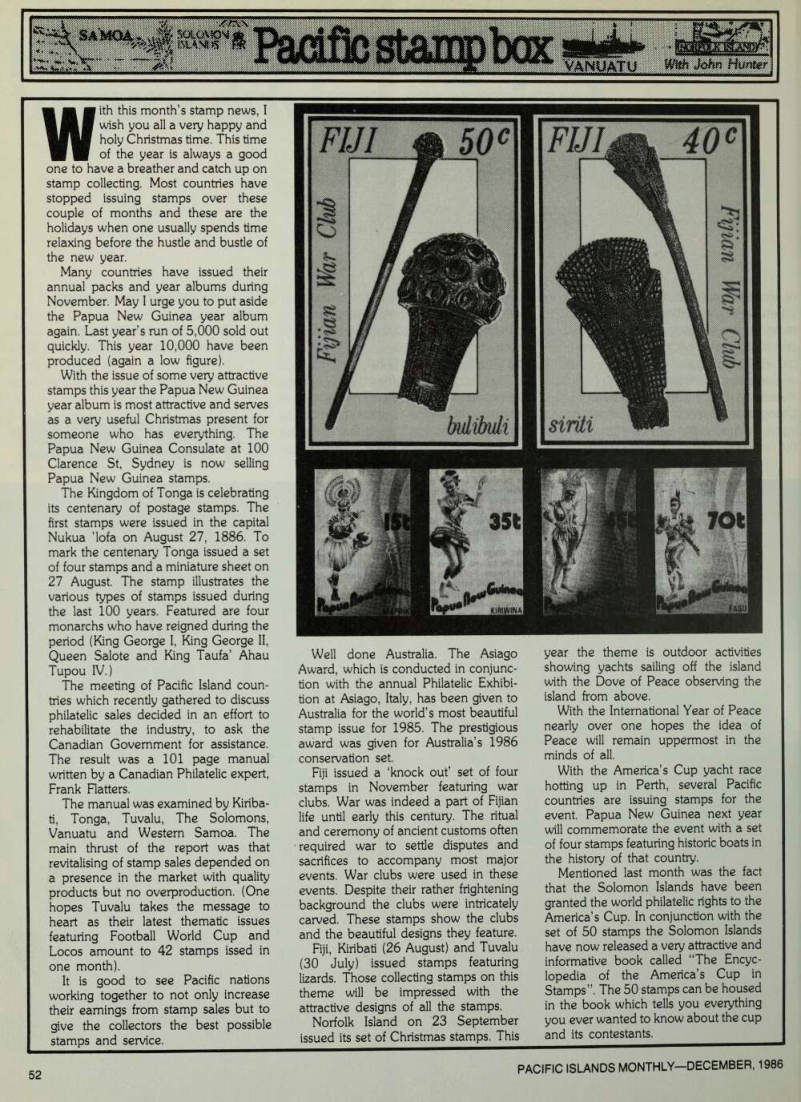
With this month’s stamp news, I wish you all a very happy and holy Christmas time. This time of the year is always a good one to have a breather and catch up on stamp collecting. Most countries have stopped issuing stamps over these couple of months and these are the holidays when one usually spends time relaxing before the hustle and bustle of the new year.
Many countries have issued their annual packs and year albums during November. May I urge you to put aside the Papua New Guinea year album again. Last year’s run of 5,000 sold out quickly. This year 10,000 have been produced (again a low figure).
With the issue of some very attractive stamps this year the Papua New Guinea year album is most attractive and serves as a very useful Christmas present for someone who has everything. The Papua New Guinea Consulate at 100 Clarence St, Sydney is now selling Papua New Guinea stamps.
The Kingdom of Tonga is celebrating its centenary of postage stamps. The first stamps were issued in the capital Nukua ’lofa on August 27, 1886. To mark the centenary Tonga issued a set of four stamps and a miniature sheet on 27 August. The stamp illustrates the various types of stamps issued during the last 100 years. Featured are four monarchs who have reigned during the period (King George I, King George 11, Queen Salote and King Taufa’ Ahau Tupou IV.) The meeting of Pacific Island coun tries which recently gathered to discuss philatelic sales decided in an effort to rehabilitate the industry, to ask the Canadian Government for assistance.
The result was a 101 page manual written by a Canadian Philatelic expert, Frank Flatters.
The manual was examined by Kiriba ti, Tonga, Tuvalu, The Solomons, Vanuatu and Western Samoa. The main thrust of the report was that revitalising of stamp sales depended on a presence in the market with quality products but no overproduction. (One hopes Tuvalu takes the message to heart as their latest thematic issues featuring Football World Cup and Locos amount to 42 stamps issed in one month).
It is good to see Pacific nations working together to not only increase their earnings from stamp sales but to give the collectors the best possible stamps and service.
Well done Australia. The Asiago Award, which is conducted in conjunction with the annual Philatelic Exhibition at Asiago, Italy, has been given to Australia for the world’s most beautiful stamp issue for 1985. The prestigious award was given for Australia’s 1986 conservation set.
Fiji issued a ‘knock out’ set of four stamps in November featuring war clubs. War was indeed a part of Fijian life until early this century. The ritual and ceremony of ancient customs often required war to settle disputes and sacrifices to accompany most major events. War clubs were used in these events. Despite their rather frightening background the clubs were intricately carved. These stamps show the clubs and the beautiful designs they feature.
Fiji, Kiribati (26 August) and Tuvalu (30 July) issued stamps featuring lizards. Those collecting stamps on this theme will be impressed with the attractive designs of all the stamps.
Norfolk Island on 23 September issued its set of Christmas stamps. This
year the theme is outdoor activities showing yachts sailing off the island with the Dove of Peace observing the island from above.
With the International Year of Peace nearly over one hopes the idea of Peace will remain uppermost in the minds of all.
With the America’s Cup yacht race hotting up in Perth, several Pacific countries are issuing stamps for the event. Papua New Guinea next year will commemorate the event with a set of four stamps featuring historic boats in the history of that country.
Mentioned last month was the fact that the Solomon Islands have been granted the world philatelic rights to the America’s Cup. In conjunction with the set of 50 stamps the Solomon Islands have now released a very attractive and informative book called “The Encyc lopedia of the America’s Cup in Stamps”. The 50 stamps can be housed in the book which tells you everything you ever wanted to know about the cup and its contestants.
Advertisements & other items, p. 53 (1 item)
counts
OLYHPIC
The Stationery and Diary People.
SYSTEM
V» ftSSSH" I Foun*
CARDS
«3S: I
lull
W-
Commercial, School, Household
Stationery and Diaries.
Fast and efficient export service.
d
coiuns
OLYUPIC
COLLINS OLYMPIC LIMITED
P.O. BOX 476, AUCKLAND, 1
NEW ZEALAND.
PHONE: (9) 484-009
TELEX: N.Z. 21293 (EDUNLOP)
CABLES: GRAPHICOL
New team for Henderson
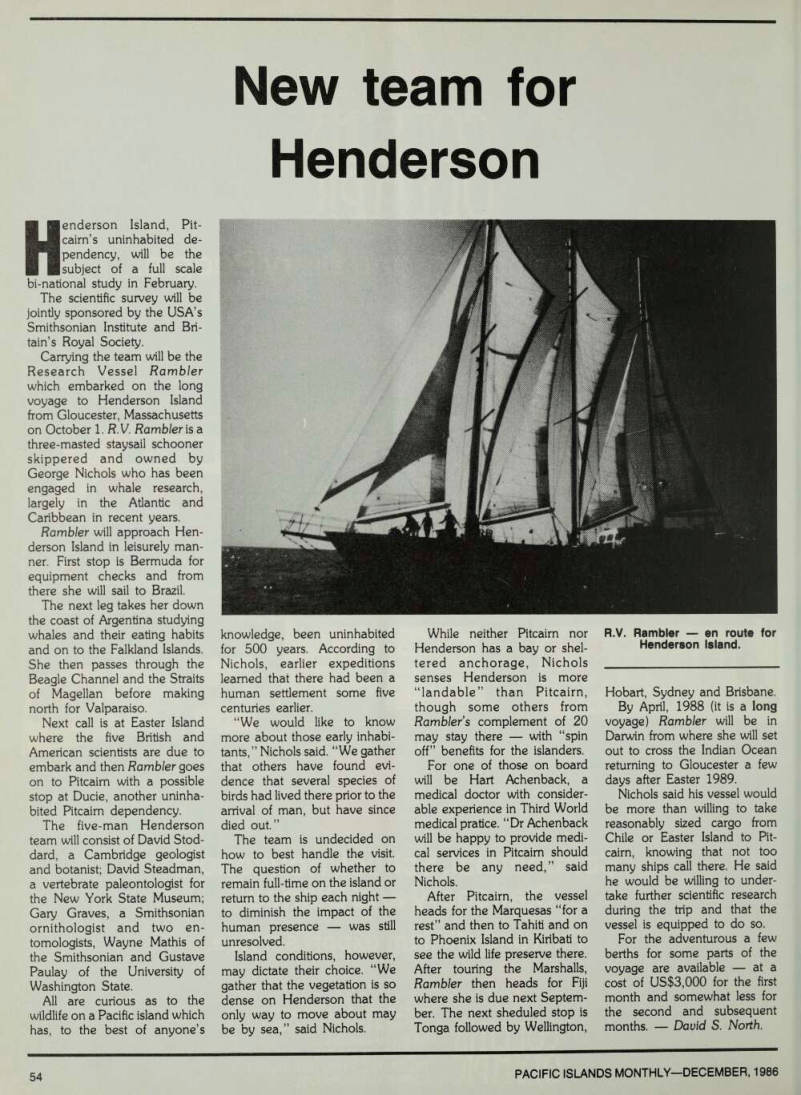
Henderson
Henderson Island, Pit cairn’s uninhabited de pendency, will be the subject of a full scale bi-national study in February.
The scientific survey will be jointly sponsored by the USA’s Smithsonian Institute and Bri tain’s Royal Society.
Carrying the team will be the Research Vessel Rambler which embarked on the long voyage to Henderson Island from Gloucester, Massachusetts on October 1. R.V. Rambler is a three-masted staysail schooner skippered and owned by George Nichols who has been engaged in whale research, largely in the Atlantic and Caribbean in recent years.
Rambler will approach Hen derson Island in leisurely man ner. First stop is Bermuda for equipment checks and from there she will sail to Brazil.
The next leg takes her down the coast of Argentina studying whales and their eating habits and on to the Falkland Islands.
She then passes through the Beagle Channel and the Straits of Magellan before making north for Valparaiso.
Next call is at Easter Island where the five British and American scientists are due to embark and then Rambler goes on to Pitcairn with a possible stop at Ducie, another uninha bited Pitcairn dependency.
The five-man Henderson team will consist of David Stod dard, a Cambridge geologist and botanist; David Steadman, a vertebrate paleontologist for the New York State Museum; Gary Graves, a Smithsonian ornithologist and two en tomologists, Wayne Mathis of the Smithsonian and Gustave Paulay of the University of Washington State.
All are curious as to the wildlife on a Pacific island which has, to the best of anyone’s
knowledge, been uninhabited for 500 years. According to Nichols, earlier expeditions learned that there had been a human settlement some five centuries earlier.
“We would like to know more about those early inhabi tants,” Nichols said. “We gather that others have found evi dence that several species of birds had lived there prior to the arrival of man, but have since died out.”
The team is undecided on how to best handle the visit.
The question of whether to remain full-time on the island or return to the ship each night to diminish the impact of the human presence was still unresolved.
Island conditions, however, may dictate their choice. “We gather that the vegetation is so dense on Henderson that the only way to move about may be by sea,” said Nichols.
While neither Pitcairn nor Henderson has a bay or shel tered anchorage, Nichols senses Henderson is more “landable” than Pitcairn, though some others from Rambler’s complement of 20 may stay there with “spin off” benefits for the islanders.
For one of those on board will be Hart Achenback, a medical doctor with consider able experience in Third World medical pratice. “Dr Achenback will be happy to provide medi cal services in Pitcairn should there be any need,” said Nichols.
After Pitcairn, the vessel heads for the Marquesas “for a rest” and then to Tahiti and on to Phoenix Island in Kiribati to see the wild life preserve there.
After touring the Marshalls, Rambler then heads for Fiji where she is due next Septem ber. The next sheduled stop is Tonga followed by Wellington,
Hobart, Sydney and Brisbane.
By April, 1988 (it is a long voyage) Rambler will be in Darwin from where she will set out to cross the Indian Ocean returning to Gloucester a few days after Easter 1989.
Nichols said his vessel would be more than willing to take reasonably sized cargo from Chile or Easter Island to Pit cairn, knowing that not too many ships call there. He said he would be willing to under take further scientific research during the trip and that the vessel is equipped to do so.
For the adventurous a few berths for some parts of the voyage are available at a cost of US$3,OOO for the first month and somewhat less for the second and subsequent
months.
David S. North.
R.V. Rambler - en route for Henderson Island.
Bad news for the Nius
Papua New Guinea’s “other” daily news paper, Niugini Nius has been placed in receiver ship. Accountants Deloitte Has kins and Sells, who had been running the company finances since the financial controller was sacked early this year were appointed receiver-managers.
The newspaper has had a chequered history since its ori ginal launch in July, 1979. It was owned at that time by Mr Ray Thurecht.
The paper made some prog ress in the early years but, possibly due to its Lae printing base, was never able to make significant inroads into the mar ket share of the Port Moresby based Post-Courier.
The paper did, however, make something of a name as a hard-hitting outspoken journal.
But Thurecht decided his journalists had gone too far when, on the eve of the queen’s visit in 1982, the paper carried a comment column heavily critical of the royal family.
Thurecht withdrew the paper from sale for that day promp ting his two expatriate journal ists editor and sub editor to go on strike.
The proprietor turned to the other newspaper houses for help, suggesting that one of them might “lend” a journalist or two to produce the next day’s issue.
Word Publishing Company, a church owned newspaper house, had already had infor mal discussions about the pos sible purchase of the title and now, at a hastily arranged meeting with Thurecht, a deal was struck.
Word agreed to produce the daily for a fixed period while the title changed hands. However, Word’s owners later failed to ratify the decision and an arrangement was reached whereby Port Moresby businessman, John Haugie ac quired the title which was to be managed by Word.
The newspaper was re-de signed and relaunched in Feb ruary, 1983 with an aggressive marketing campaign and quick ly became accepted as a viable
alternative publication to the well estabalished Post Courier.
Meanwhile, however, Word had problems. The financial wounds left by a fire which destroyed its printing plant the previous December proved too deep and, in August, Word announced a sweeping prog ram of cost cuts mostly through redundancies.
Word offered to sell its press and ancillary equipment to Niugini Nius but later changed its mind, setting the scene for a bitter and protracted row.
Nius obtained finance through the government-spon sored National Investors Scheme and from the govern ment-owned PNG Banking Corporation with the assistance of a government guarantee for the loan.
Meanwhile Haugie formed a new board that included PNGBC chief manager, Peter Nichols as well as Nichols’ close friend and Haugie’s business associate Jeffrey Wall. He had previously attracted gen eral manager Russell Hunter away from Word.
But it was to be an inauspi cious beginning. The PNGBC declined to release cash for capital purchases until the gov ernment guarantee was in place. Meanwhile, Nius was obliged to ask Word to carry on printing, for which the bank was prepared to release money.
Meanwhile, Word’s recently reconstructed board had de cided that it wanted to either own Nius or enforce payment of previous debts, Nius went off the streets in June, 1986 when it refused to acknowlege the debt in return for continued printing only to
reappear a week later using its own plant all of which had been installed in 10 days.
Despite the unbudgetted ex pense of printing at Word and the uncertainty caused by the six-month delay (waiting for the guarantee documents) in acquiring its own plant, Nius began to rebuild its circulation.
But it was too late. The staggering burden of debt (now put at A 53.2 million) was de stined to weigh the company down.
Hunter resigned in August over a disagreement with ele ments of the board.
Wall took over the day to day running of the enterprise, but despite the arrival of a new editor the paper failed fire.
Nichols was fired by the bank as questions were asked in parliament not only about the Nius loans but also about the bank's funding of pur chases of Placer Pacific shares. Nichols left the coun try and was subsequently refused re-entry.
Shortly afterwards, Wall, an experienced and expert political strategist with links to many of the country’s leading politi cians, also left claiming he had been subjected to political pressure.
He claimed there had been politically motivated attempts to secure the cancellation of his visa because of his friendship with several politicians.
Nine days after Wall left the country, the receivership deci sion was announced.
Advertisements & other items, pp. 55-56 (1 item)
Pacific History
THE JOURNAL OF
Volume XXI 1986 1-2 Articles on: lotete and South Marquesan politics (Nicholas Thomas); Oral traditons among the Binandere (John Waiko); Cook and the Transits of Mercury and Venus (Charles Herdendorf); Sea level changes and Pacific prehistory (John Gibbons and Fergus Clunie); Evolution of Pacific canoe rigs (Adrian Horridge). 3-4 Special Issue on Contemporary Issues in the Pacific: Decolonization and beyond (Barrie MacDonald); Termination of the US Trusteeship in Micronesia (Robert Kiste); Aid and dependent development (Bruce Knapman); A decade of independence in Papua New Guinea (Jim Griffin); Regionalism, strategic denial and security (Richard Herr); The Nuclear Issue (Stewart Firth); Recent developments in French Polynesia (Barrie Shineberg); Pacific Islands Agriculture in the late 20th Century (R. G. Ward). $A20 ($US25) annually from The Editors, Journal of Pacific History Inc., c/o Research School of Pacific Studies, ANU, GPO BOX 4, Canberra, ACT 2601, Australia.
J^ v M
FUSILADE
The GRASS
WEEDKILLER! for
selective control of grass weeds in broadleaf crops.
feoRHO*
'V
ORTHENE
The SYSTEMIC
INSECTICIDE! for
use in rice and vegetable crops. &
PMSAFB
use, always
R6ADLABEIS
CAUBFULLt
IMP'*
rat WORLDS MOST EFTECTm
KILLER Of RATS AND HJCE
FURADAN
The granular Insecticide/ nematicide! for bananas, vegetables, sugarcane & rice.
FUNGINEX
The FUNGICIDAL
DIP! for treating cane sets before planting.
Controls Pineapple disease.
TALON WB
Kills RATS and MICE fast!
At home, or on the farm. The World’s most effective rodenticide.
I
ATTACK
Kills a wide range of insect pests. Can be used on most crops. -
GRAMOXOIME
WEEDKILLER
4 DESICCANT
GRAMOXONE
The fast acting TOTAL weedkiller can be used in most crops! Will not poison soil. For LONGTERM control, add DIURON 80.
For full details on any ICI product, address your enquiry to “Export”, mi Maw » SmifoH P n Rrw Qnn AUCKLAND. NEW ZEALAND.
transitions
Cancelled: The Cook Islands permanent resident status of controversial cancer therapist Dr. Milan Byrch.
An immigration department official said the minister for immigration Mr. Norman George had cancelled the resi dence certificates of Byrch and his wife Marylin Gardner.
Byrch and his family had been in the Cook Islands for about 18 months before the certificates were granted in 1978. As New Zealand citizens, they qualified for residence after one year.
Byrch then went to the USA where he served half of a six year prison sentence for fraud, grand theft and practising medi cine without a licence. The certificates were cancelled ear lier this year while the Byrch family was holidaying in Tahiti and was reported to be plan ning to return to New Zealand.
Elected: President of the Tonga Medical Association, Dr. Tevita Fuloka. The vice-president is Dr. Maika Kinahoi with Dr.
Siaosi ’Aho as secretary and Dr. Seini Kupu as treasurer.
Appointed: Acting director of parks and recreation for Amer ican Samoa, Leroy L. Leroux.
Known as his successful pro fessional boxing career as the Pago Kid, Leroux had 44 pro fessional bouts and held the All-Samoan middleweight championship before he quit the ring to join the US Navy in 1973.
He was previously the finan cial manager in the Office of Development Planning before being appointed to his new position.
Appointed: New Caledonia Government Tourist Office’s promotions and publicity manager for Australia, Norellc Feehan.
The Manager (Australia), Henri Maniquant said the new position was part of an overall strategy by the tourist office to increase communication be tween the industry and the general public.
Ms Feehan was previously a publicity officer with ABC Radio and before that was
promotions co-ordinator for UTA French Airlines.
Mr Maniquant said it was important to maintain and build on the current upward trend of travel to New Caledonia.
Appointed: General manager of Friendly Island Airways, Paul Karalus, the former manager of South Pacific Island Airways.
A former St John’s High School teacher, Mr Karalus (37) takes over from Robert Moin of Australia who had been acting manager of FIA since the airilne’s inception in November last year.
Launched: New banknotes for Solomon Islands. The new notes are in denominations of $2, $5, $lO, $2O and $5O and incorporate the Solomon Is lands coat of arms in place of the portraits of the queen.
Resigned: PNG Land Trans port Chairman, Margaret Loko claiming “political interfer ence.” A court had earlier or
dered that a Singapore company, Pan Pacific, be given a licence to assemble cars from imported parts and that it also licence en 3 ** dea ' er ’ S . ‘ „ , „ ,
Trln.nl fM° f S,Sn M n!°
Bmirno°M f? '
Bourne, Ms Loko said: “There “ t “ rauch poli “ c ?! i " terfer : y ° U . an( L Tra^ e . and Kwawra Minister, Mr. Galeva Demolished: One of Port Moresby’s best known landmarks, the bowling club at Ela Beach.
The club, along with the court house, the public library and the RSL club have all been given notices to quit by the National Capital District Interim Commission in order to make way for the planned redevelopment of the beach area.
Elected: National Fisherman of the Year, Harinandan Singh of Rewa, Fiji.
Mr Singh, of Kasavu in Lokia became a full time fisherman when the sugar industry closed down in the area.
Rei " stated : Seven sacked workers at New Guinea Bevera 3 es °f Lae, PNG after an Arbitration Tribunal ruled in their favour The seven had been dismis sed for drinking on company premises but th S e tribunal P up V held their appeals, accepting their evidence that senior, man agement personnel were allowed to drink liquor on com pany premises.
The men had been out of * or months, Recalled: Solomon Islands permanent representative to the UN in New York, Mr.
Francis Saemala.
A Ministry of Foreign Affairs statement said he was being recalled because of the high cost of keeping him and his family in new York.
Deaths
Nancy Adin of Maewo at Port Vila Central Hospital, after a long illness.
Before the Anglican Church became independent, Nancy had been a teacher on her island of Maewo while also working as a member of the Mothers Union.
Later she attended the Malmaluan Theological College in PNG and returned to teach at Torgil mission school an Ambae.
She became ill in 1979 and was sent to Australia for treat ment in 1984.
Despite her illness, Nancy continued to carry out some of her duties and was particularly active in women’s organisa tions.
Hari Charan, well known Fiji personality died at Auckland.
Mr Charan’s professional life as a teacher and lawyer will have touched many hundreds of Fiji residents.
Born at Nausori in 1906, Mr Charan taight for ,many years at Natabua and Suva. He was the founder of the Deenban
dhoo High School, now the Indian College.
He also found time to both study and practice law, being associated with the legal prac tice of Mr A IN. Deoki, MLC for many years in Suva.
He migrated with his family to New Zealand in the 1960’s and taught there at the Wesley College until his retirement.
His Auckland funeral was attended by many people with Fiji connections.
Tugaga Maulalo, a judge of the Western Samoan Land and Titles Court, died at his home, reportedly from a heart attack.
Before joining the judiciary, judge Tugaga served in parlia ment as representative for Safune, Savaii.
Motu’apuaka Tonga’s leading matapule (talking chief) was buried at the Mala’e Lahi ceme tery at Te’ekiu.
He died in Seattle, Washing ton, USA and his body was flown home and carried to his people at the Te’ekiu estate for funeral services and the traditio nal pongipongi ceremony.
Born in Neiafu, Vava’u in 1910 and christened Sione
Alaipulotu, Motu’apuaka was educated at Tonga College where he began a distinguished career as a poet, musician and composer.
He was formally installed by the late queen Salote Tupou 111 to the Motu’apuaka matapule title and estate in 1944 on the death of his father, ’lnoke Tu’alau Motu’apuaka.
The matapule title gave him the right to sit at the king’s right and to direct the taumafa cere mony during the traditional royal installation.
The highlight of his matapule career was in 1967 when he directed the taumafa ceremony at the coronation of King Taufa’ahau Tupou IV.
His funeral service was attended by the Prince Regent Fatafehi Tu’ipelehake, Princess Melenaite, Prince Lavaka-ata, Princess Nanasipau’u, Princess Salote Mafile’o Pilolevu Tuita, Baron Tuita of ’Utungake as well as politicians, family and friends.
His son Soakai was accom panying the king on his Asia- European tour as security officer.
Advertisements & other items, p. 58 (1 item)
South Pacific Bureau for
\SPEC/
W Economic Co-operation
Applications are invited for the position listed below, which will become available early in 1987.
PROGRAMME CONTROLLER
SOUTH PACIFIC TELECOMMUNICATIONS DEVELOPMENT PROGRAMME
The occupant of this position is leader of a small highly professional staff unit implementing a regional telecommunication development programme under the supervisory direction of an inter-governmental Programme Management Group comprising telecommunications representatives from each of the participating Island nations.
The duties of the position involve the development and management, within the overall regional programme, of specific assistance to national programmes by the application of appropriate planning, design and installation expertise utilising natural resources to the maximum extent practicable supplemented by specialist assistance from appropriate telecom authorities including principally Australia and New Zealand and from the ITU.
Major responsibilities of the Programme Controller include liaison with bodies involved in funding development in the region, negotiations with authorities and manufacturers regarding the supply of appropriate telecom equipment, and liaison with other international and national bodies involved in the planning, installation and operation of telecommunication networks.
The successful applicant will be a professional engineer with the qualifications and experience for admission to Member of the Institution of Engineers Australia, or equivalent. The position requires experience in the planning and installation of telecommunication services particularly in the rural section, and demonstrated professional and managerial capability to establish and implement a major telecommunication programme. The total remuneration package is expected to be in the vicinity of Fiji dollars 50,000 p.a.
A 3-year contract will be offered, available from March 1987.
General Information:
The South Pacific Bureau for Economic Co-operation, known as SPEC, is the secretariat for the South Pacific Forum: consisting of the Heads of State of the current 14 independent countries of the South Pacific Region. It is based in Suva, Fiji, and has some 20-25 professional officers and some 25 support staff.
Appointees will be based in Suva, but will be required to travel extensively, mainly within the South Pacific region. Tax free salaries at a regional level apply, together with attractive family, housing and education allowances, and medical and superannuation provisions. A six-month probationary period is standard.
Applications, which close on 24th December, 1986, should detail education and employment background and list three referees with whom the applicant has been associated m a professional capacity.
Applications and enquiries should be addressed to:
The Director,
South Pacific Bureau for Economic Co-operation, GPO Box 856, Suva, FIJI.
Telephone: Fiji 31-2600. Telex: 2229 SPECSUVA FJ. Fax: Fiji 31-4204
yachts
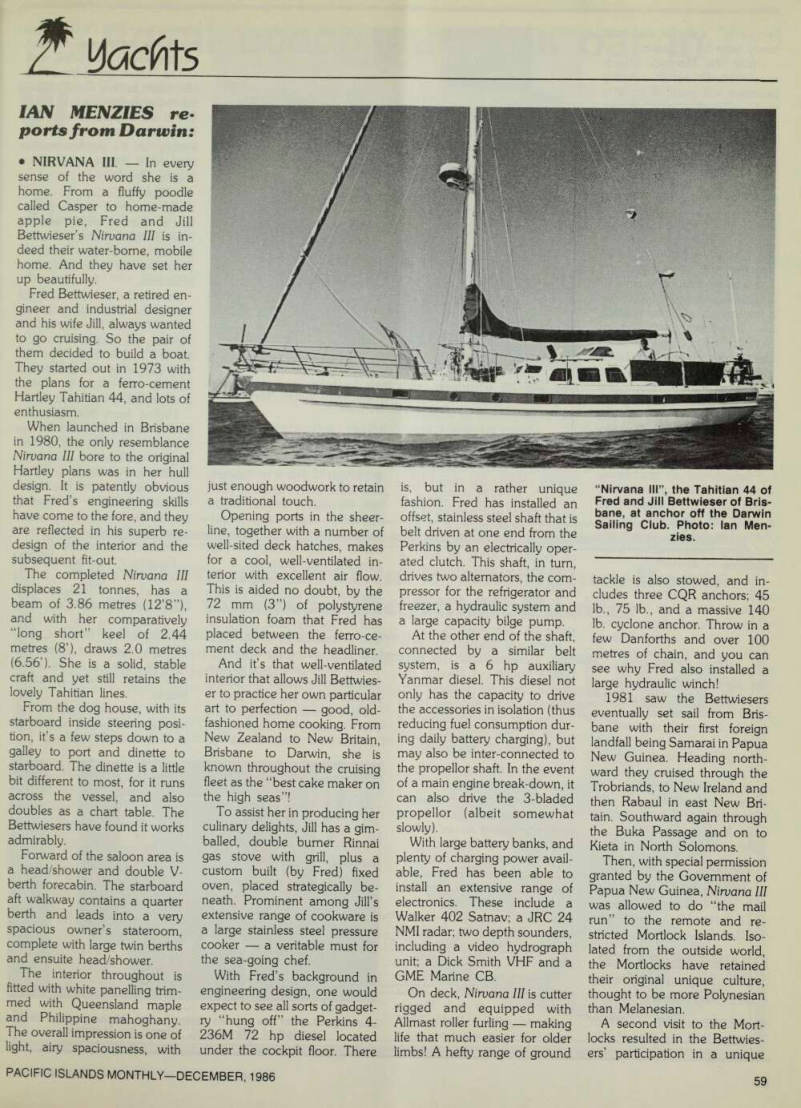
Lan Menzies Re
ports from Darwin:
• NIRVANA 111. In every sense of the word she is a home. From a fluffy poodle called Casper to home-made apple pie, Fred and Jill Bettwieser’s Nirvana 111 is in deed their water-borne, mobile home. And they have set her up beautifully.
Fred Bettwieser, a retired en gineer and industrial designer and his wife Jill, always wanted to go cruising. So the pair of them decided to build a boat.
They started out in 1973 with the plans for a ferro-cement Hartley Tahitian 44, and lots of enthusiasm.
When launched in Brisbane in 1980, the only resemblance Nirvana 111 bore to the original Hartley plans was in her hull design. It is patently obvious that Fred’s engineering skills have come to the fore, and they are reflected in his superb re design of the interior and the subsequent fit-out.
The completed Nirvana 111 displaces 21 tonnes, has a beam of 3.86 metres (12’8”), and with her comparatively “long short” keel of 2.44 metres (8’), draws 2.0 metres (6.56’). She is a solid, stable craft and yet still retains the lovely Tahitian lines.
From the dog house, with its starboard inside steering posi tion, it’s a few steps down to a galley to port and dinette to starboard. The dinette is a little bit different to most, for it runs across the vessel, and also doubles as a chart table. The Bettwiesers have found it works admirably.
Forward of the saloon area is a head/shower and double V berth forecabin. The starboard aft walkway contains a quarter berth and leads into a very spacious owner’s stateroom, complete with large twin berths and ensuite head/shower.
The interior throughout is fitted with white panelling trim med with Queensland maple and Philippine mahoghany.
The overall impression is one of light, airy spaciousness, with
just enough woodwork to retain a traditional touch.
Opening ports in the sheer line, together with a number of well-sited deck hatches, makes for a cool, well-ventilated in terior with excellent air flow.
This is aided no doubt, by the 72 mm (3”) of polystyrene insulation foam that Fred has placed between the ferro-ce ment deck and the headliner.
And it’s that well-ventilated interior that allows Jill Bettwies er to practice her own particular art to perfection good, old fashioned home cooking. From New Zealand to New Britain, Brisbane to Darwin, she is known throughout the cruising fleet as the “best cake maker on the high seas”!
To assist her in producing her culinary delights, Jill has a gim balled, double burner Rinnai gas stove with grill, plus a custom built (by Fred) fixed oven, placed strategically be neath. Prominent among Jill’s extensive range of cookware is a large stainless steel pressure cooker a veritable must for the sea-going chef.
With Fred’s background in engineering design, one would expect to see all sorts of gadget ry “hung off” the Perkins 4- 236 M 72 hp diesel located under the cockpit floor. There
is, but in a rather unique fashion. Fred has installed an offset, stainless steel shaft that is belt driven at one end from the Perkins by an electrically oper ated clutch. This shaft, in turn, drives two alternators, the com pressor for the refrigerator and freezer, a hydraulic system and a large capacity bilge pump.
At the other end of the shaft, connected by a similar belt system, is a 6 hp auxiliary Yanmar diesel. This diesel not only has the capacity to drive the accessories in isolation (thus reducing fuel consumption dur ing daily battery charging), but may also be inter-connected to the propellor shaft. In the event of a main engine break-down, it can also drive the 3-bladed propellor (albeit somewhat slowly).
With large battery banks, and plenty of charging power avail able, Fred has been able to install an extensive range of electronics. These include a Walker 402 Satnav; a JRC 24 NMI radar; two depth sounders, including a video hydrograph unit; a Dick Smith VHF and a GME Marine CB.
On deck, Nirvana 111 is cutter rigged and equipped with Allmast roller furling making life that much easier for older limbs! A hefty range of ground
tackle is also stowed, and in cludes three CQR anchors; 45 lb., 75 lb., and a massive 140 lb. cyclone anchor. Throw in a few Danforths and over 100 metres of chain, and you can see why Fred also installed a large hydraulic winch! 1981 saw the Bettwiesers eventually set sail from Bris bane with their first foreign landfall being Samarai in Papua New Guinea. Heading north ward they cruised through the Trobriands, to New Ireland and then Rabaul in east New Bri tain. Southward again through the Buka Passage and on to Kieta in North Solomons.
Then, with special permission granted by the Government of Papua New Guinea, Nirvana 111 was allowed to do “the mail run” to the remote and re stricted Mortlock Islands. Iso lated from the outside world, the Mortlocks have retained their original unique culture, thought to be more Polynesian than Melanesian.
A second visit to the Mort locks resulted in the Bettwies ers’ participation in a unique
“Nirvana III”, the Tahitian 44 of Fred and Jill Bettwieser of Bris bane, at anchor off the Darwin Sailing Club. Photo: Ian Men zies.
Port Moresby
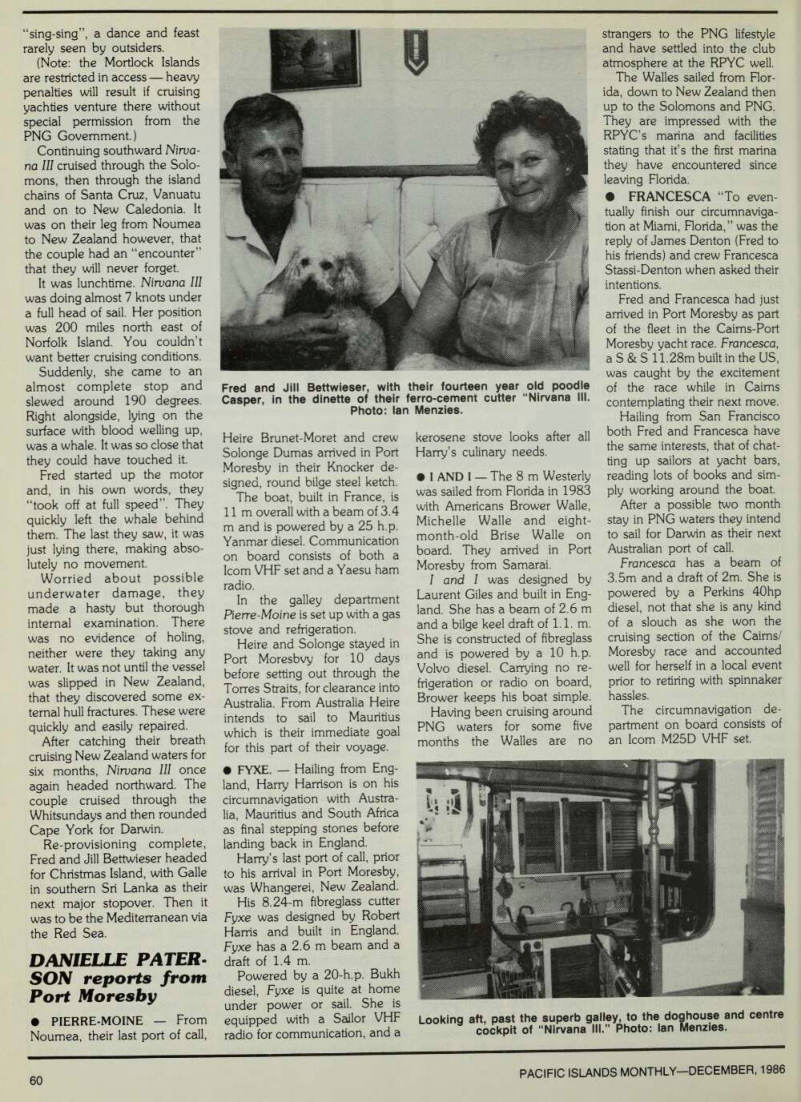
“sing-sing”, a dance and feast rarely seen by outsiders. (Note: the Mortlock Islands are restricted in access heavy penalties will result if cruising yachties venture there without special permission from the PNG Government.) Continuing southward Nirva na 111 cruised through the Solo mons, then through the island chains of Santa Cruz, Vanuatu and on to New Caledonia. It was on their leg from Noumea to New Zealand however, that the couple had an “encounter” that they will never forget.
It was lunchtime. Nirvana 111 was doing almost 7 knots under a full head of sail. Her position was 200 miles north east of Norfolk Island. You couldn’t want better cruising conditions.
Suddenly, she came to an almost complete stop and slewed around 190 degrees.
Flight alongside, lying on the surface with blood welling up, was a whale. It was so close that they could have touched it Fred started up the motor and, in his own words, they “took off at full speed”. They quickly left the whale behind them. The last they saw, it was just lying there, making abso lutely no movement.
Worried about possible underwater damage, they made a hasty but thorough internal examination. There was no evidence of holing, neither were they taking any water. It was not until the vessel was slipped in New Zealand, that they discovered some ex ternal hull fractures. These were quickly and easily repaired.
After catching their breath cruising New Zealand waters for six months, Nirvana 111 once again headed northward. The couple cruised through the Whitsundays and then rounded Cape York for Darwin.
Re-provisioning complete, Fred and Jill Bettwieser headed for Christmas Island, with Galle in southern Sri Lanka as their next major stopover. Then it was to be the Mediterranean via the Red Sea.
Danielle Pater
SON reports from
Port Moresby
• Pierre-Moine From
Noumea, their last port of call,
Heire Brunet-Moret and crew Solonge Dumas arrived in Port Moresby in their Knocker de signed, round bilge steel ketch.
The boat, built in France, is 11m overall with a beam of 3.4 m and is powered by a 25 h.p.
Yanmar diesel. Communication on board consists of both a Icom VHF set and a Yaesu ham radio.
In the galley department Pierre-Moine is set up with a gas stove and refrigeration.
Heire and Solonge stayed in Port Moresbvy for 10 days before setting out through the Torres Straits, for clearance into Australia. From Australia Heire intends to sail to Mauritius which is their immediate goal for this part of their voyage. • FYXE. Hailing from Eng land, Harry Harrison is on his circumnavigation with Austra lia, Mauritius and South Africa as final stepping stones before landing back in England.
Harry’s last port of call, prior to his arrival in Port Moresby, was Whangerei, New Zealand.
His 8.24-m fibreglass cutter Fyxe was designed by Robert Harris and built in England.
Fyxe has a 2.6 m beam and a draft of 1.4 m.
Powered by a 20-h.p. Bukh diesel, Fyxe is quite at home under power or sail. She is equipped with a Sailor VHF radio for communication, and a
kerosene stove looks after all Harry’s culinary needs. • I AND I The 8 m Westerly was sailed from Florida in 1983 with Americans Brower Walle, Michelle Walle and eight month-old Brise Walle on board. They arrived in Port Moresby from Samarai.
I and I was designed by Laurent Giles and built in Eng land. She has a beam of 2.6 m and a bilge keel draft of 1.1. m.
She is constructed of fibreglass and is powered by a 10 h.p.
Volvo diesel. Carrying no re frigeration or radio on board, Brower keeps his boat simple.
Having been cmising around PNG waters for some five months the Walles are no
strangers to the PNG lifestyle and have settled into the club atmosphere at the RPYC well.
The Walles sailed from Flor ida, down to New Zealand then up to the Solomons and PNG.
They are impressed with the RPYC’s marina and facilities stating that it’s the first marina they have encountered since leaving Florida. • FRANCESCA “To even tually finish our circumnaviga tion at Miami, Florida,” was the reply of James Denton (Fred to his friends) and crew Francesca Stassi-Denton when asked their intentions.
Fred and Francesca had just arrived in Port Moresby as part of the fleet in the Caims-Port Moresby yacht race. Francesca, a S & S 11.28 m built in the US, was caught by the excitement of the race while in Caims contemplating their next move.
Hailing from San Francisco both Fred and Francesca have the same interests, that of chat ting up sailors at yacht bars, reading lots of books and sim ply working around the boat.
After a possible two month stay in PNG waters they intend to sail for Darwin as their next Australian port of call.
Francesca has a beam of 3.5 m and a draft of 2m. She is powered by a Perkins 40hp diesel, not that she is any kind of a slouch as she won the cruising section of the Caims/ Moresby race and accounted well for herself in a local event prior to retiring with spinnaker hassles.
The circumnavigation de partment on board consists of an Icom M2SD VHF set.
Fred and Jill Bettwieser, with their fourteen year old poodle Casper, In the dinette of their ferro-cement cutter “Nirvana III.
Photo: Ian Menzies.
Looking aft, past the superb galley, to the doghouse and centre cockpit of "Nirvana III.” Photo: Ian Menzies.
Royal coach puts his oar in
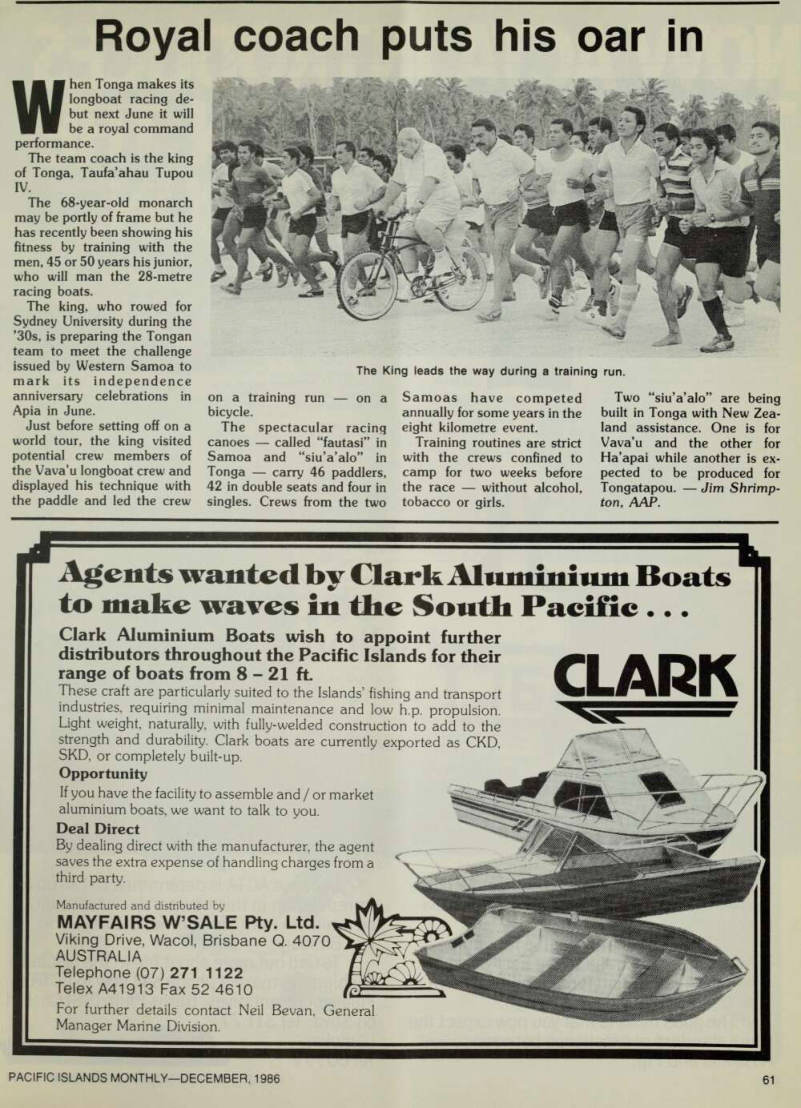
When Tonga makes its longboat racing de but next June it will be a royal command performance.
The team coach is the king of Tonga, Taufa’ahau Tupou IV.
The 68-year-old monarch may be portly of frame but he has recently been showing his fitness by training with the men, 45 or 50 years his junior, who will man the 28-metre racing boats.
The king, who rowed for Sydney University during the ’3os, is preparing the Tongan team to meet the challenge issued by Western Samoa to mark its independence anniversary celebrations in Apia in June.
Just before setting off on a world tour, the king visited potential crew members of the Vava’u longboat crew and displayed his technique with the paddle and led the crew
on a training run on a bicycle.
The spectacular racing canoes called “fautasi” in Samoa and “siu’a’alo” in Tonga carry 46 paddlers, 42 in double seats and four in singles. Crews from the two
Samoas have competed annually for some years in the eight kilometre event.
Training routines are strict with the crews confined to camp for two weeks before the race without alcohol, tobacco or girls.
Two “siu’a’alo” are being built in Tonga with New Zea land assistance. One is for Vava’u and the other for Ha’apai while another is ex pected to be produced for
Tongatapou.
Jim Shrimp-
ton , AAP.
The King leads the way during a training run.
Advertisements & other items, pp. 61-62 (1 item)
Clark
Agents wanted by Clark Aluminium Boats
to make waves in the South Pacific ...
Clark Aluminium Boats wish to appoint further distributors throughout the Pacific Islands for their range of boats from 8 - 21 ft These craft are particularly suited to the Islands’ fishing and transport industries, requiring minimal maintenance and low h.p. propulsion.
Light weight, naturally, with fully-welded construction to add to the strength and durability. Clark boats are currently exported as CKD, SKD, or completely built-up.
Opportunity If you have the facility to assemble and / or market aluminium boats, we want to talk to you.
Deal Direct By dealing direct with the manufacturer, the agent saves the extra expense of handling charges from a third party.
Manufactured and distributed by
MAYFAIRS W’SALE Pty. Ltd.
Viking Drive, Wacol, Brisbane Q. 4070
AUSTRALIA
Telephone (07) 271 1122 Telex A 41913 Fax 52 4610 For further details contact Neil Bevan, General Manager Marine Division.
H Ml ACTA has charted a new course. A course that will set a cracking pace on the Australians run.
ACTA has built an enviable reputation in shipping from Australia to the East Coast of America. A reputation for reliability and ontime delivery that’s hard to match.
The good news is that you now expect the same standard of excellence between Australia and Fiji.
Because ACTA is determined to live up to its reputation in this new service which will be available from Melbourne, Sydney and Brisbane.
To find out more about life in the fast lane of shipping, make a phone call now to ACTA’s Fijian representatives, Burns Philp(SS) Co. Ltd., on Suva: Tel 311 777, Lautoka: Tel 60777
ACT 0003
shipping schedules
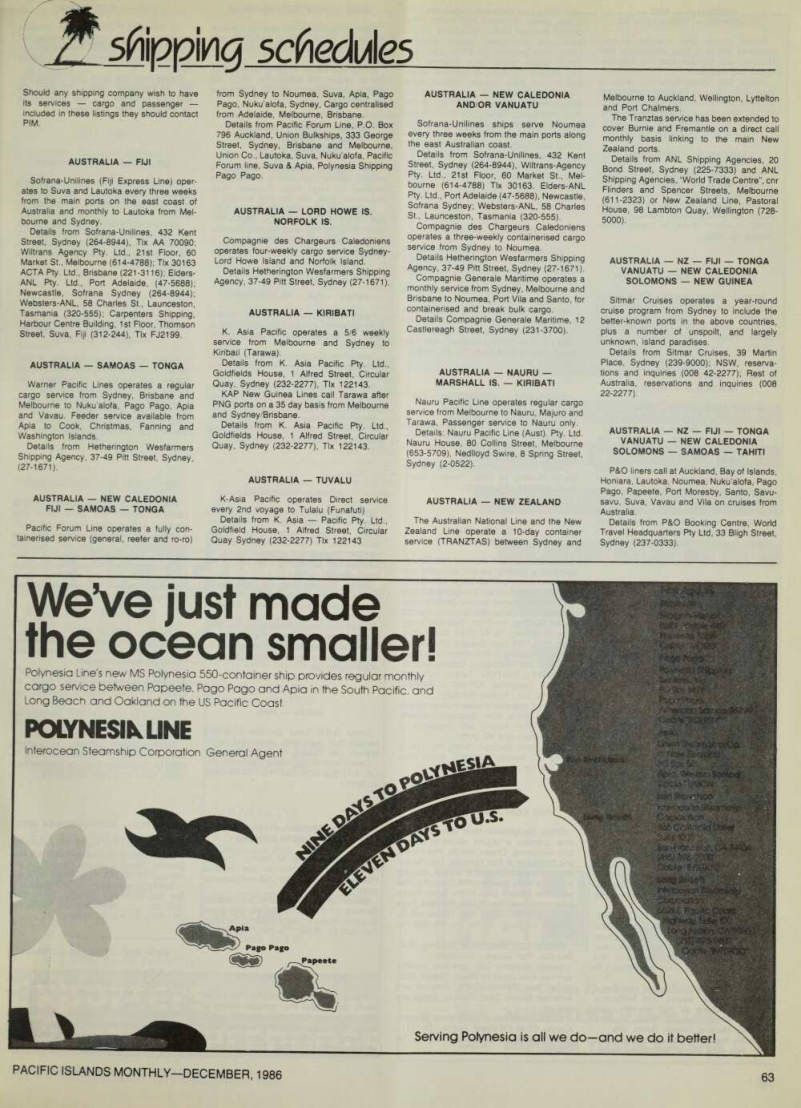
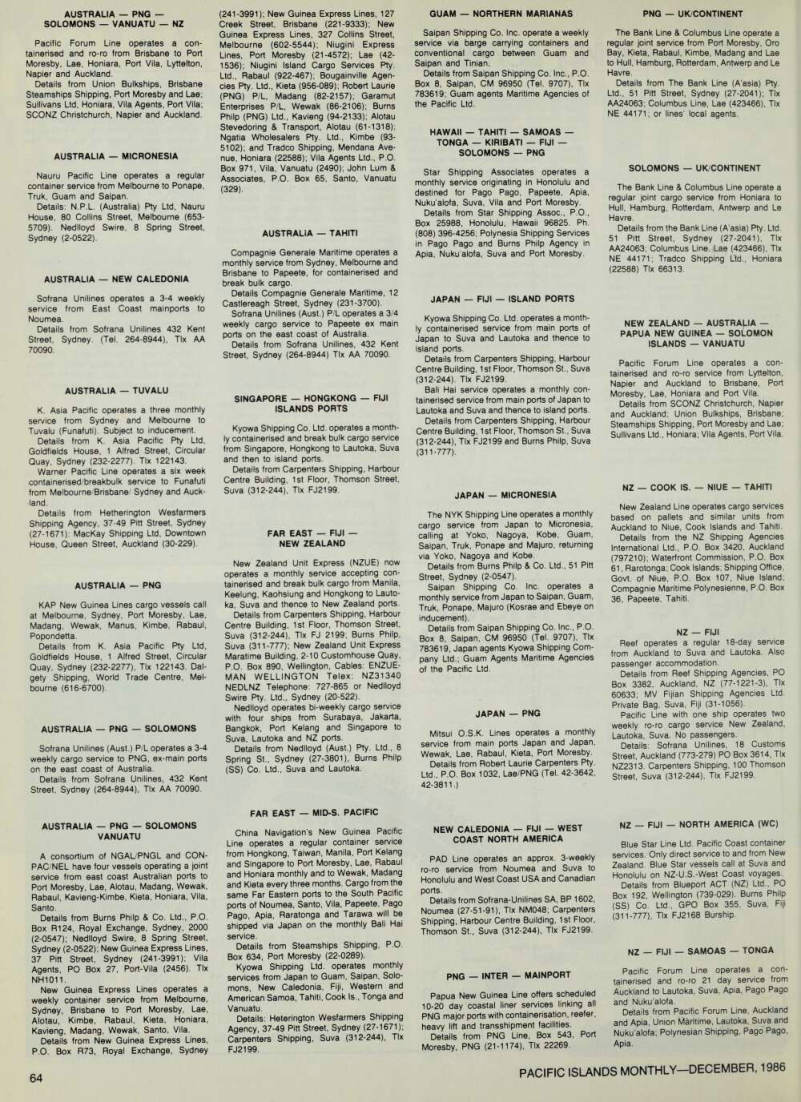
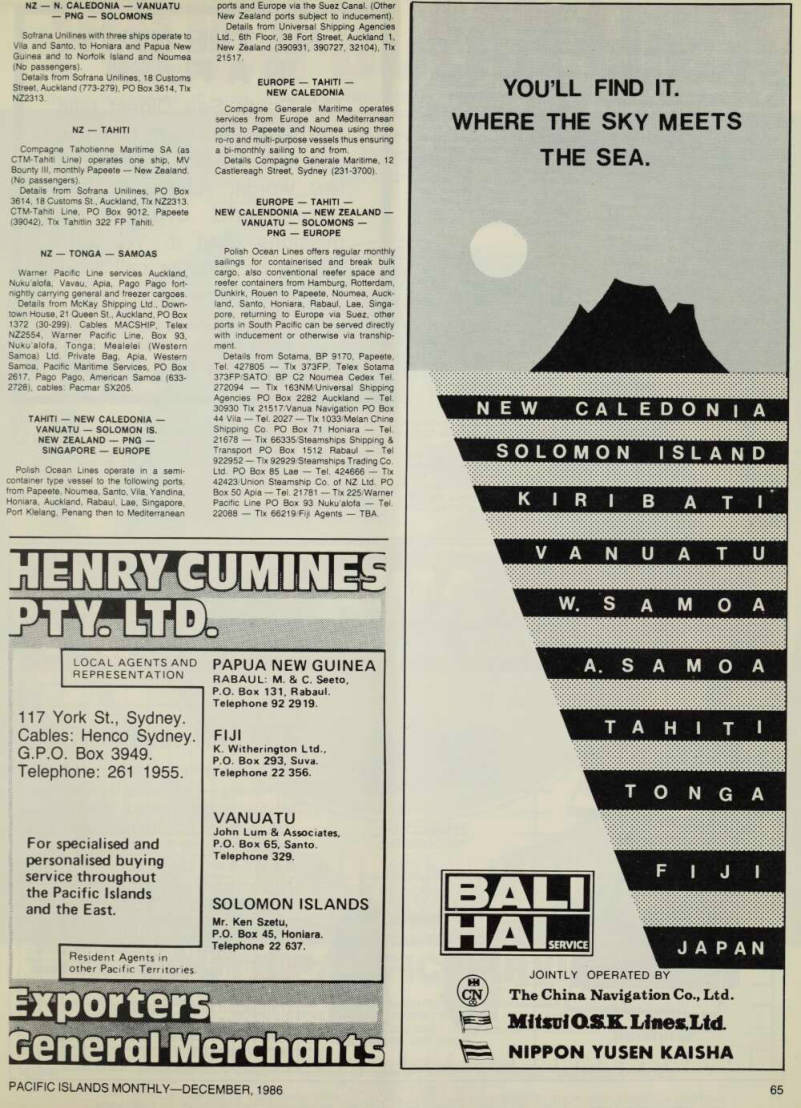
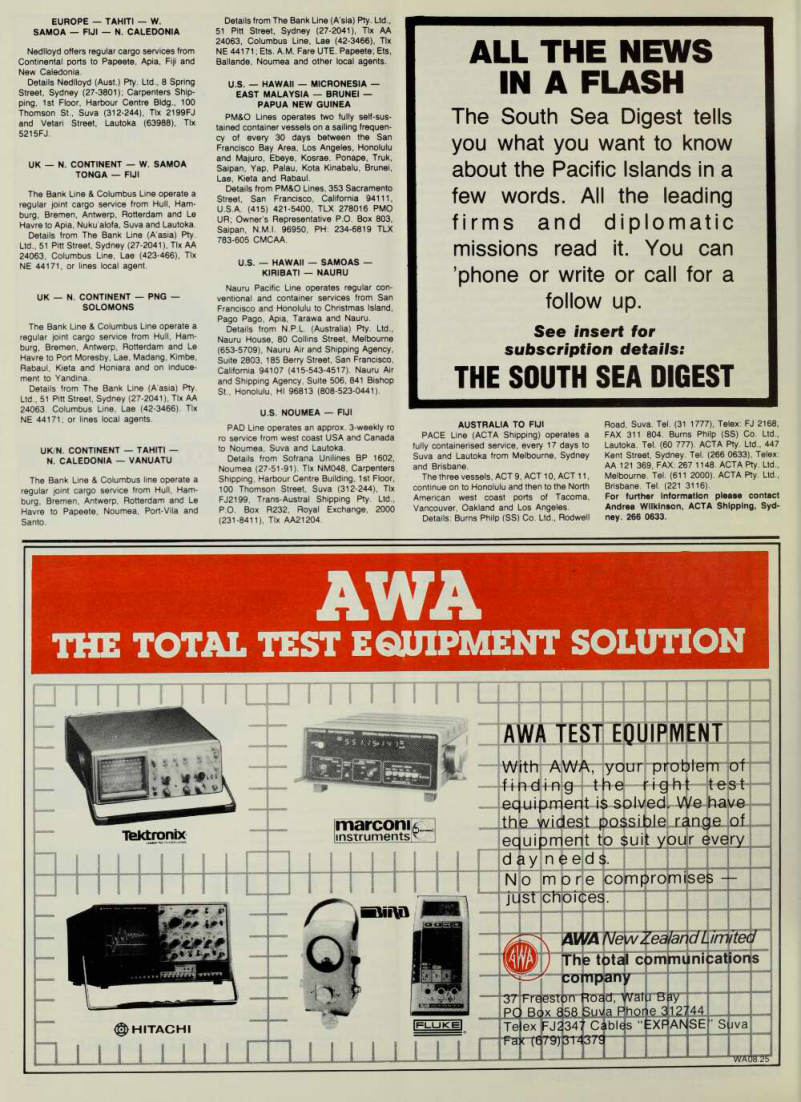
Should any shipping company wish to have its services cargo and passenger included in these listings they should contact
Pim.
Australia Fiji
Sofrana-Unilines (Fiji Express Line) oper ates to Suva and Lautoka every three weeks from the main ports on the east coast of Australia and monthly to Lautoka from Mel bourne and Sydney.
Details from Sofrana-Unilines, 432 Kent Street, Sydney (264-8944), Tlx AA 70090; Wiltrans Agency Pty. Ltd., 21st Floor, 60 Market St., Melbourne (614-4788), Tlx 30163 ACTA Pty. Ltd., Brisbane (221-3116); Elders- ANL Pty. Ltd., Port Adelaide, (47-5688); Newcastle, Sofrana Sydney (264-8944); Websters-ANL, 58 Charles St., Launceston, Tasmania (320-555); Carpenters Shipping, Harbour Centre Building, Ist Floor, Thomson Street, Suva. Fiji (312-244), Tlx FJ2199.
Australia Samoas Tonga
Warner Pacific Lines operates a regular cargo service from Sydney, Brisbane and Melbourne to Nukualofa, Pago Pago, Apia and Vavau. Feeder service available from Apia to Cook, Christmas, Fanning and Washington Islands.
Details from Hetherington Wesfarmers Shipping Agency, 37-49 Pitt Street, Sydney, (27-1671).
Australia New Caledonia
Fiji Samoas Tonga
Pacific Forum Line operates a fully con tainerised service (general, reefer and ro-ro)
from Sydney to Noumea, Suva, Apia, Pago Pago, Nukualofa, Sydney, Cargo centralised from Adelaide, Melbourne, Brisbane.
Details from Pacific Forum Line, P.O. Box 796 Auckland, Union Bulkships, 333 George Street, Sydney, Brisbane and Melbourne, Union Co., Lautoka, Suva, Nukualofa, Pacific Forum line, Suva & Apia, Polynesia Shipping Pago Pago.
Australia Lord Howe Is.
Norfolk Is.
Compagnie des Chargeurs Caledoniens operates four-weekly cargo service Sydney- Lord Howe Island and Norfolk Island.
Details Hetherington Wesfarmers Shipping Agency, 37-49 Pitt Street, Sydney (27-1671).
Australia Kiribati
K. Asia Pacific operates a 5/6 weekly service from Melbourne and Sydney to Kiribati (Tarawa).
Details from K. Asia Pacific Pty. Ltd., Goldfields House, 1 Alfred Street, Circular Quay, Sydney (232-2277), Tlx 122143.
KAP New Guinea Lines call Tarawa after PNG ports on a 35 day basis from Melbourne and Sydney/Brisbane.
Details from K. Asia Pacific Pty. Ltd., Goldfields House, 1 Alfred Street, Circular Quay. Sydney (232-2277), Tlx 122143.
Australia Tuvalu
K-Asia Pacific operates Direct service every 2nd voyage to Tulalu (Funafuti) Details from K. Asia Pacific Pty. Ltd., Goldfield House, 1 Alfred Street, Circular Quay Sydney (232-2277) Tlx 122143
Australia New Caledonia
And/Or Vanuatu
Sofrana-Unilines ships serve Noumea every three weeks from the main ports along the east Australian coast.
Details from Sofrana-Unilines, 432 Kent Street, Sydney (264-8944), Wiltrans-Agency Pty. Ltd., 21st Floor, 60 Market St.. Mel bourne (614-4788) Tlx 30163. Elders-ANL Pty. Ltd., Port Adelaide (47-5688), Newcastle, Sofrana Sydney; Websters-ANL, 58 Charles St., Launceston, Tasmania (320-555).
Compagnie des Chargeurs Caledoniens operates a three-weekly containerised cargo service from Sydney to Noumea.
Details Hetherington Wesfarmers Shipping Agency, 37-49 Pitt Street, Sydney (27-1671).
Compagnie Generale Maritime operates a monthly service from Sydney, Melbourne and Brisbane to Noumea, Port Vila and Santo, for containerised and break bulk cargo.
Details Compagnie Generale Maritime, 12 Castlereagh Street, Sydney (231-3700).
Australia Nauru
Marshall Is. Kiribati
Nauru Pacific Line operates regular cargo service from Melbourne to Nauru, Majuro and Tarawa, Passenger service to Nauru only.
Details: Nauru Pacific Line (Aust). Pty. Ltd.
Nauru House, 80 Collins Street, Melbourne (653-5709), Nedlloyd Swire, 8 Spring Street, Sydney (2-0522).
Australia New Zealand
The Australian National Line and the New Zealand Line operate a 10-day container service (TRANZTAS) between Sydney and
Melbourne to Auckland, Wellington, Lyttelton and Port Chalmers.
The Tranztas service has been extended to cover Burnie and Fremantle on a direct call monthly basis linking to the main New Zealand ports.
Details from ANL Shipping Agencies, 20 Bond Street, Sydney (225-7333) and ANL Shipping Agencies, "World Trade Centre", cnr Flinders and Spencer Streets, Melbourne (611-2323) or New Zealand Line, Pastoral House, 98 Lambton Quay. Wellington (728- 5000).
Australia Nz Fiji Tonga
Vanuatu New Caledonia
Solomons New Guinea
Sitmar Cruises operates a year-round cruise program from Sydney to include the better-known ports in the above countries, plus a number of unspoilt, and largely unknown, island paradises.
Details from Sitmar Cruises, 39 Martin Place, Sydney (239-9000); NSW, reserva tions and inquiries (008 42-2277); Rest of Australia, reservations and inquiries (008 22-2277).
Australia Nz Fiji Tonga
Vanuatu New Caledonia
Solomons Samoas Tahiti
P&O liners call at Auckland, Bay of Islands, Honiara, Lautoka, Noumea, Nukualofa, Pago Pago, Papeete, Port Moresby, Santo, Savu savu, Suva, Vavau and Vila on cruises from Australia.
Details from P&O Booking Centre. World Travel Headquarters Pty Ltd, 33 Bligh Street,
Sydney (237-0333).
Australia Png
Solomons Vanuatu Nz
Pacific Forum Line operates a con tainerised and ro-ro from Brisbane to Port Moresby, Lae, Honiara, Port Vila, Lyttelton, Napier and Auckland.
Details from Union Bulkships, Brisbane Steamships Shipping, Port Moresby and Lae; Sullivans Ltd, Honiara, Vila Agents, Port Vila; SCONZ Christchurch, Napier and Auckland.
Australia Micronesia
Nauru Pacific Line operates a regular container service from Melbourne to Ponape, Truk, Guam and Saipan.
Details: N.P.L. (Australia) Pty Ltd. Nauru House, 80 Collins Street, Melbourne (653- 5709). Nedlloyd Swire, 8 Spring Street, Sydney (2-0522).
Australia New Caledonia
Sofrana Unilines operates a 3-4 weekly service from East Coast mainports to Noumea.
Details from Sofrana Unilines 432 Kent Street, Sydney. (Tel. 264-8944), Tlx AA 70090.
Australia Tuvalu
K. Asia Pacific operates a three monthly service from Sydney and Melbourne to Tuvalu (Funafuti). Subject to inducement.
Details from K. Asia Pacific Pty Ltd, Goldfields House. 1 Alfred Street, Circular Quay, Sydney (232-2277). Tlx 122143.
Warner Pacific Line operates a six week containerised/breakbulk service to Funafuti from Melbourne/Brisbane/ Sydney and Auck land.
Details from Hetherington Wesfarmers Shipping Agency, 37-49 Pitt Street, Sydney (27-1671): Mac Kay Shipping Ltd, Downtown House, Queen Street, Auckland (30-229).
Australia Png
KAP New Guinea Lines cargo vessels call at Melbourne, Sydney, Port Moresby, Lae, Madang. Wewak, Manus, Kimbe, Rabaul, Popondetta.
Details from K. Asia Pacific Pty Ltd, Goldfields House, 1 Alfred Street, Circular Quay, Sydney (232-2277), Tlx 122143. Dal gety Shipping, World Trade Centre, Mel bourne (616-6700).
Australia Png Solomons
Sofrana Unilines (Aust.) P/L operates a 3-4 weekly cargo service to PNG, ex-main ports on the east coast of Australia.
Details from Sofrana Unilines. 432 Kent Street, Sydney (264-8944), Tlx AA 70090.
Australia Png Solomons
Vanuatu
A consortium of NGAL/PNGL and CON PAC/NEL have four vessels operating a joint service from east coast Australian ports to Port Moresby, Lae, Alotau, Madang, Wewak, Rabaul, Kavieng-Kimbe, Kieta, Honiara, Vila, Santo.
Details from Burns Philp & Co. Ltd., P.O.
Box R 124, Royal Exchange, Sydney, 2000 (2-0547); Nedlloyd Swire, 8 Spring Street, Sydney (2-0522); New Guinea Express Lines, 37 Pitt Street, Sydney (241-3991); Vila Agents, PO Box 27, Port-Vila (2456). Tlx
Nhioii.
New Guinea Express Lines operates a weekly container service from Melbourne, Sydney, Brisbane to Port Moresby, Lae, Alotau, Kimbe, Rabaul, Kieta, Honiara, Kavieng, Madang, Wewak, Santo, Vila.
Details from New Guinea Express Lines, P.O. Box R 73, Royal Exchange, Sydney
(241-3991); New Guinea Express Lines, 127 Creek Street, Brisbane (221-9333); New Guinea Express Lines, 327 Collins Street, Melbourne (602-5544); Niugini Express Lines. Port Moresby (21-4572); Lae (42- 1536); Niugini Island Cargo Services Pty.
Ltd., Rabaul (922-467); Bougainville Agen cies Pty. Ltd., Kieta (956-089); Robert Laurie (PNG) P/L, Madang (82-2157); Garamut Enterprises P/L, Wewak (86-2106); Burns Philp (PNG) Ltd., Kavieng (94-2133); Alotau Stevedoring & Transport, Alotau (61-1318); Ngatia Wholesalers Pty. Ltd., Kimbe (93- 5102); and Tradco Shipping, Mendana Ave nue, Honiara (22588); Vila Agents Ltd., P.O.
Box 971, Vila, Vanuatu (2490); John Lum & Associates, P.O. Box 65, Santo, Vanuatu (329).
Australia Tahiti
Compagnie Generale Maritime operates a monthly service from Sydney, Melbourne and Brisbane to Papeete, for containerised and break bulk cargo.
Details Compagnie Generale Maritime, 12 Castlereagh Street, Sydney (231-3700).
Sofrana Unilines (Aust.) P/L operates a 3/4 weekly cargo service to Papeete ex main ports on the east coast of Australia.
Details from Sofrana Unilines, 432 Kent Street. Sydney (264-8944) Tlx AA 70090.
Singapore Hongkong Fiji
Islands Ports
Kyowa Shipping Co. Ltd. operates a month ly containerised and break bulk cargo service from Singapore, Hongkong to Lautoka, Suva and then to island ports.
Details from Carpenters Shipping, Harbour Centre Building, Ist Floor, Thomson Street, Suva (312-244), Tlx FJ2199.
Far East Fiji
New Zealand
New Zealand Unit Express (NZUE) now operates a monthly service accepting con tainerised and break bulk cargo from Manila, Keelung, Kaohsiung and Hongkong to Lauto ka, Suva and thence to New Zealand ports.
Details from Carpenters Shipping, Harbour Centre Building. Ist Floor, Thomson Street, Suva (312-244), Tlx FJ 2199; Burns Philp, Suva (311-777); New Zealand Unit Express Maratime Building, 2-10 Customhouse Quay, P.O. Box 890, Wellington, Cables: ENZUE
Man Wellington Telex: Nz31340
NEDLNZ Telephone: 727-865 or Nedlloyd Swire Pty. Ltd., Sydney (20-522).
Nedlloyd operates bi-weekly cargo service with four ships from Surabaya. Jakarta, Bangkok, Port Kelang and Singapore to Suva, Lautoka and NZ ports.
Details from Nedlloyd (Aust.) Pty. Ltd., 8 Spring St., Sydney (27-3801), Burns Philp (SS) Co. Ltd., Suva and Lautoka.
Far East Mid-S. Pacific
China Navigation's New Guinea Pacific Line operates a regular container service from Hongkong, Taiwan, Manila, Port Kelang and Singapore to Port Moresby, Lae, Rabaul and Honiara monthly and to Wewak, Madang and Kieta every three months. Cargo from the same Far Eastern ports to the South Pacific ports of Noumea, Santo. Vila, Papeete, Pago Pago, Apia, Raratonga and Tarawa will be shipped via Japan on the monthly Bali Hai service.
Details from Steamships Shipping, P.O.
Box 634, Port Moresby (22-0289).
Kyowa Shipping Ltd. operates monthly services from Japan to Guam, Saipan, Solo mons, New Caledonia, Fiji, Western and American Samoa, Tahiti, Cook Is., Tonga and Vanuatu.
Details: Heterington Wesfarmers Shipping Agency, 37-49 Pitt Street, Sydney (27-1671); Carpenters Shipping, Suva (312-244), Tlx FJ2199.
Guam Northern Marianas
Saipan Shipping Co. Inc. operate a weekly service via barge carrying containers and conventional cargo between Guam and Saipan and Tinian.
Details from Saipan Shipping Co. Inc., P.O.
Box 8, Saipan, CM 96950 (Tel. 9707), Tlx 783619; Guam agents Maritime Agencies of the Pacific Ltd.
Hawaii Tahiti Samoas
Tonga Kiribati Fiji
Solomons Png
Star Shipping Associates operates a monthly service originating in Honolulu and destined for Pago Pago, Papeete, Apia, Nukualofa, Suva, Vila and Port Moresby.
Details from Star Shipping Assoc., P. 0., Box 25988, Honolulu, Hawaii 96825. Ph. (808) 396-4256; Polynesia Shipping Services in Pago Pago and Burns Philp Agency in Apia, Nukualofa, Suva and Port Moresby.
Japan Fiji Island Ports
Kyowa Shipping Co. Ltd. operates a month ly containerised service from main ports of Japan to Suva and Lautoka and thence to island ports.
Details from Carpenters Shipping, Harbour Centre Building, Ist Floor, Thomson St., Suva (312-244). Tlx FJ2199.
Bali Hai service operates a monthly con tainerised service from main ports of Japan to Lautoka and Suva and thence to island ports.
Details from Carpenters Shipping, Harbour Centre Building, Ist Floor, Thomson St., Suva (312-244), Tlx FJ2199 and Burns Philp, Suva (311-777).
Japan Micronesia
The NYK Shipping Line operates a monthly cargo service from Japan to Micronesia, calling at Yoko, Nagoya, Kobe, Guam, Saipan, Truk, Ponape and Majuro, returning via Yoko, Nagoya and Kobe.
Details from Burns Philp & Co. Ltd., 51 Pitt Street, Sydney (2-0547).
Saipan Shipping Co. Inc. operates a monthly service from Japan to Saipan, Guam, Truk, Ponape, Majuro (Kosrae and Ebeye on inducement).
Details from Saipan Shipping Co. Inc., P.O.
Box 8, Saipan, CM 96950 (Tel. 9707), Tlx 783619, Japan agents Kyowa Shipping Com pany Ltd.; Guam Agents Maritime Agencies of the Pacific Ltd.
Japan Png
Mitsui O.S.K. Lines operates a monthly service from main ports Japan and Japan, Wewak, Lae, Rabaul, Kieta, Port Moresby.
Details from Robert Laurie Carpenters Pty.
Ltd., P.O. Box 1032, Lae/PNG (Tel. 42-3642, 42-3811.)
New Caledonia Fiji West
Coast North America
PAD Line operates an approx. 3-weekly ro-ro service from Noumea and Suva to Honolulu and West Coast USA and Canadian ports.
Details from Sofrana-Unilines SA, BP 1602, Noumea (27-51-91), Tlx NMO4B; Carpenters Shipping, Harbour Centre Building, Ist Floor, Thomson St.. Suva (312-244), Tlx FJ2199.
Png Inter Mainport
Papua New Guinea Line offers scheduled 10-20 day coastal liner services linking all PNG major ports with containerisation, reefer, heavy lift and transshipment facilities.
Details from PNG Line, Box 543, Port Moresby, PNG (21-1174), Tlx 22269.
Png Uk/Continent
The Bank Line & Columbus Line operate a regular joint service from Port Moresby, Oro Bay, Kieta, Rabaul, Kimbe, Madang and Lae to Hull, Hamburg, Rotterdam, Antwerp and Le Havre.
Details from The Bank Line (A'asia) Pty.
Ltd., 51 Pitt Street, Sydney (27-2041); Tlx AA24063; Columbus Line, Lae (423466), Tlx NE 44171; or lines' local agents.
Solomons Uk/Continent
The Bank Line & Columbus Line operate a regular joint cargo service from Honiara to Hull, Hamburg, Rotterdam, Antwerp and Le Havre.
Details from the Bank Line (A'asia) Pty. Ltd. 51 Pitt Street, Sydney (27-2041), Tlx AA24063; Columbus Line. Lae (423466), Tlx NE 44171; Tradco Shipping Lid.. Honiara (22588) Tlx 66313.
New Zealand Australia
Papua New Guinea Solomon
Islands Vanuatu
Pacific Forum Line operates a con tainerised and ro-ro service from Lyttelton, Napier and Auckland to Brisbane, Port Moresby, Lae. Honiara and Port Vila.
Details from SCONZ Christchurch, Napier and Auckland; Union Bulkships, Brisbane; Steamships Shipping, Port Moresby and Lae; Sullivans Ltd., Honiara; Vila Agents, Port Vila.
Nz Cook Is. Niue Tahiti
New Zealand Line operates cargo services based on pallets and similar units from Auckland to Niue, Cook Islands and Tahiti.
Details from the NZ Shipping Agencies International Ltd., P.O. Box 3420, Auckland (797210); Waterfront Commission, P.O. Box 61, Rarotonga; Cook Islands; Shipping Office, Govt, of Niue, P.O. Box 107, Niue Island; Compagnie Maritime Polynesienne, P.O. Box 36, Papeete, Tahiti.
Nz Fiji
Reef operates a regular 18-day service from Auckland to Suva and Lautoka. Also passenger accommodation.
Details from Reef Shipping Agencies, PO Box 3382, Auckland, NZ (77-1221-3), Tlx 60633; MV Fijian Shipping Agencies Ltd.
Private Bag, Suva, Fiji (31-1056).
Pacific Line with one ship operates two weekly ro-ro cargo service New Zealand, Lautoka, Suva. No passengers.
Details: Sofrana Unilines, 18 Customs Street. Auckland (773-279) PO Box 3614, Tlx NZ2313. Carpenters Shipping, 100 Thomson Street, Suva (312-244), Tlx FJ2199.
Nz Fiji North America (Wc)
Blue Star Line Ltd. Pacific Coast container services. Only direct service to and from New Zealand. Blue Star vessels call at Suva and Honolulu on NZ-U.S,-West Coast voyages.
Details from Blueport ACT (NZ) Ltd., PO Box 192, Wellington (739-029). Burns Philp (SS) Co. Ltd., GPO Box 355, Suva, Fiji (311-777), Tlx FJ2168 Burship.
Nz Fiji Samoas Tonga
Pacific Forum Line operates a con tainerised and ro-ro 21 day service from Auckland to Lautoka, Suva, Apia, Pago Pago and Nukualofa.
Details from Pacific Forum Line, Auckland and Apia, Union Maritime, Lautoka, Suva and Nukualofa; Polynesian Shipping, Pago Pago, Apia.
Nz N. Caledonia Vanuatu
Png Solomons
Sofrana Unilines with three ships operate to Vila and Santo, to Honiara and Papua New Guinea and to Norfolk Island and Noumea (No passengers).
Details from Sofrana Unilines, 18 Customs Street, Auckland (773-279), PO Box 3614, Tlx NZ2313.
Nz Tahiti
Compagne Tahotienne Maritime SA (as CTM-Tahiti Line) operates one ship, MV Bounty 111. monthly Papeete New Zealand. (No passengers).
Details from Sofrana Unilines, PO Box 3614, 18 Customs St., Auckland, Tlx NZ2313.
CTM-Tahiti Line, PO Box 9012, Papeete (39042), Tlx Tahitlin 322 FP Tahiti.
Nz Tonga Samoas
Warner Pacific Line services Auckland, Nukualofa, Vavau, Apia, Pago Pago fort nightly carrying general and freezer cargoes.
Details from McKay Shipping Ltd., Down town House, 21 Queen St., Auckland, PO Box 1372 (30-299). Cables MACSHIP, Telex NZ2554, Warner Pacific Line, Box 93, Nukualofa, Tonga; Mealelei (Western Samoa) Ltd. Private Bag, Apia, Western Samoa, Pacific Maritime Services, PO Box 2617, Pago Pago, American Samoa (633- 2728), cables: Pacmar SX2OS.
Tahiti New Caledonia
Vanuatu - Solomon Is.
New Zealand Png
Singapore Europe
Polish Ocean Lines operate in a semi container type vessel to the following ports, from Papeete, Noumea, Santo, Vila, Vandina, Honiara, Auckland, Rabaul, Lae, Singapore, Port Klelang, Penang then to Mediterranean
ports and Europe via the Suez Canal. (Other New Zealand ports subject to inducement).
Details from Universal Shipping Agencies Ltd., 6th Floor, 38 Fort Street, Auckland 1, New Zealand (390931, 390727, 32104), Tlx 21517.
Europe Tahiti
New Caledonia
Compagne Generale Maritime operates services from Europe and Mediterranean ports to Papeete and Noumea using three ro-ro and multi-purpose vessels thus ensuring a bi-monthly sailing to and from.
Details Compagne Generale Maritime, 12 Castlereagh Street, Sydney (231-3700).
Europe Tahiti
New Calendonia New Zealand
Vanuatu Solomons
Png Europe
Polish Ocean Lines offers regular monthly sailings for containerised and break bulk cargo, also conventional reefer space and reefer containers from Hamburg, Rotterdam, Dunkirk, Rouen to Papeete, Noumea, Auck land, Santo, Honiara, Rabaul, Lae, Singa pore, returning to Europe via Suez, other ports in South Pacific can be served directly with inducement or otherwise via tranship ment.
Details from Sotama, BP 9170, Papeete, Tel. 427805 Tlx 373FP. Telex Sotama 373FP/SATO: BP C 2 Noumea Cedex Tel. 272094 Tlx 163NM/Universal Shipping Agencies PO Box 2282 Auckland Tel. 30930 Tlx 21517/Vanua Navigation PO Box 44 Vila Tel. 2027 Tlx 1033/Melan Chine Shipping Co. PO Box 71 Honiara Tel. 21678 Tix 66335/Steamships Shipping & Transport PO Box 1512 Rabaul Tel 922952 Tlx 92929/Steamships Trading Co.
Ltd. PO Box 85 Lae Tel. 424666 Tlx 42423/Union Steamship Co. of NZ Ltd. PO Box 50 Apia Tel. 21781 Tlx 225/Warner Pacific Line PO Box 93 Nukualofa Tel. 22088 Tlx 66219/Fiji Agents TBA.
Europe Tahiti W.
Samoa Fiji N. Caledonia
Nedlloyd offers regular cargo services from Continental ports to Papeete, Apia, Fiji and New Caledonia.
Details Nedlloyd (Aust.) Pty. Ltd., 8 Spring Street, Sydney (27-3801); Carpenters Ship ping, Ist Floor, Harbour Centre Bldg., 100 Thomson St„ Suva (312-244), Tlx 2199FJ and Vetari Street, Lautoka (63988), Tlx 5215FJ.
Uk N. Continent W. Samoa
Tonga Fiji
The Bank Line & Columbus Line operate a regular joint cargo service from Hull, Ham burg, Bremen, Antwerp, Rotterdam and Le Havre to Apia, Nukualofa, Suva and Lautoka.
Details from The Bank Line (A’asia) Pty.
Ltd., 51 Pitt Street, Sydney (27-2041), Tlx AA 24063, Columbus Line, Lae (423-466), Tlx NE 44171, or lines local agent.
Uk N. Continent Png
Solomons
The Bank Line & Columbus Line operate a regular joint cargo service from Hull, Ham burg, Bremen, Antwerp, Rotterdam and Le Havre to Port Moresby, Lae. Madang. Kimbe, Rabaul, Kieta and Honiara and on induce ment to Vandina.
Details from The Bank Line (A’asia) Pty.
Ltd., 51 Pitt Street, Sydney (27-2041), Tlx AA 24063. Columbus Line, Lae (42-3466). Tlx NE 44171; or lines local agents.
Uk/N. Continent Tahiti
N. Caledonia Vanuatu
The Bank Line & Columbus line operate a regular joint cargo service from Hull, Ham burg, Bremen, Antwerp, Rotterdam and Le Havre to Papeete, Noumea, Port-Vila and Santo.
Details from The Bank Line (A’sia) Pty. Ltd., 51 Pitt Street, Sydney (27-2041), Tlx AA 24063, Columbus Line, Lae (42-3466), Tlx NE 44171; Ets. A.M. Fare UTE. Papeete: Ets, Ballande, Noumea and other local agents.
U.S. Hawaii Micronesia
East Malaysia Brunei
Papua New Guinea
PM&O Lines operates two fully self-sus tained container vessels on a sailing frequen cy of every 30 days between the San Francisco Bay Area, Los Angeles, Honolulu and Majuro, Ebeye, Kosrae, Ponape, Truk, Saipan, Yap, Palau, Kota Kinabalu, Brunei, Lae, Kieta and Rabaul.
Details from PM&O Lines, 353 Sacramento Street, San Francisco, California 94111,
U.S.A. (415) 421-5400, Tlx 278016 Pmo
UR; Owner's Representative P.O. Box 803, Saipan, N.M.I. 96950, PH; 234-6819 TLX
783-605 Cmcaa.
U.S. Hawaii Samoas
Kiribati Nauru
Nauru Pacific Line operates regular con ventional and container services from San Francisco and Honolulu to Christmas Island, Pago Pago, Apia. Tarawa and Nauru.
Details from N.P.L. (Australia) Pty. Ltd., Nauru House, 80 Collins Street, Melbourne (653-5709), Nauru Air and Shipping Agency, Suite 2803, 185 Berry Street, San Francisco, California 94107 (415-543-4517). Nauru Air and Shipping Agency, Suite 506, 841 Bishop St,, Honolulu, HI 96813 (808-523-0441).
U.S. Noumea Fiji
PAD Line operates an approx. 3-weekly ro ro service from west coast USA and Canada to Noumea, Suva and Lautoka.
Details from Sofrana Unilines BP 1602, Noumea (27-51-91). Tlx NMO4B, Carpenters Shipping, Harbour Centre Building, Ist Floor, 100 Thomson Street, Suva (312-244), Tlx FJ2199, Trans-Austral Shipping Pty. Ltd., P.O. Box R 232, Royal Exchange, 2000 (231-8411), Tlx AA21204.
Australia To Fiji
PACE Line (ACTA Shipping) operates a fully containerised service, every 17 days to Suva and Lautoka from Melbourne, Sydney and Brisbane.
The three vessels, ACT 9, ACT 10, ACT 11, continue on to Honolulu and then to the North American west coast ports of Tacoma, Vancouver, Oakland and Los Angeles.
Details: Burns Philp (SS) Co. Ltd., Rodwell
Road, Suva. Tel. (31 1777). Telex: FJ 2168, FAX 311 804. Burns Philp (SS) Co. Ltd., Lautoka. Tel. (60 777). ACTA Pty. Ltd., 447 Kent Street, Sydney. Tel. (266 0633), Telex: AA 121 369, FAX: 267 1148. ACTA Pty. Ltd., Melbourne. Tel. (611 2000). ACTA Pty. Ltd., Brisbane. Tel. (221 3116).
For further information please contact Andrea Wilkinson, ACTA Shipping, Syd ney. 266 0633.
Advertisements & other items, pp. 63-72 (1 item)
We’ve just made
the ocean smaller!
Polynesia Line's new MS Polynesia 550-container ship provides regular monthly cargo service between Papeete. Pago Pago and Apia in the South Pacific, and Long Beach and Oakland on the US Pacific Coast.
POLYNESIMJNE
Interocean Steamship Corporation General Agent K o Q TO Sk 3 5* ¥ V <6 Apia Pago Pago Papeete Serving Polynesia is all we do-and we do it better!
YOU’LL FIND IT.
WHERE THE SKY MEETS
THE SEA.
NEW CALEDONIA
SOLOMON ISLAND
KIRI B ATI
VANUATU
W. S A M O A
.SA M O A
TAHITI
tonga
JOINTLY OPERATED BY
The China Navigation Co., Ltd.
MltsuiQ&K LinesXtd.
NIPPON YUSEN KAISHA
JuL^j^XIL^LA^XLuLiX^J^S
LOCAL AGENTS AND
REPRESENTATION
117 York St., Sydney.
Cables; Henco Sydney.
G.P.O. Box 3949.
Telephone: 261 1955.
For specialised and
personalised buying
service throughout
the Pacific Islands and the East.
PAPUA NEW GUINEA
RABAUL. M. & C. Seeto, P.O. Box 131, Rabaul.
Telephone 92 2919.
FIJI
K. Witherington Ltd., P.O. Box 293, Suva.
Telephone 22 356.
VANUATU
John Lum & Associates, P.O. Box 65, Santo.
Telephone 329.
SOLOMON ISLANDS
Mr. Ken Szetu, P.O. Box 45, Honiara.
Telephone 22 637.
Resident Agents in other Pacific Territories
ALL THE NEWS
IN A FLASH
The South Sea Digest tells you what you want to know about the Pacific Islands in a few words. All the leading firms and diplomatic missions read it. You can ’phone or write or call for a follow up.
See insert for subscription details:
THE SOUTH SEA DIGEST
AWA
THE TOTAL TEST EQUIPMENT SOLUTION
of ton 0 Q fine JLQm msaesssm marcom instruments €- ■fektromx ent ou r eve ip sui N mises ompro m choi
just
I#*
/ATT/
an o & mumcat ta ons com waro Ba 37 eg 302 M Bju a Rho EG Bo as SE EX
PAN
Su bias “
IFLUK
34 va Te ex Fart l
HITACHI
l_i_L
679) 1 37
LI i ;
WAUS
POLISH OCEAN LINES
General Management, 10 Lutego 24,81-364 GDYNIA, POLAND, Phone: 20-19-01, Cables: POLOCEAN Telex: 054-231 © £ m n s> •rk 5$ CT & &
Sfe
I.W
SOUTH PACIFIC SERVICE
ANTWFBp mO nI^fSC /iC |A?,cK, d HAMBURG, ROTTERDAM, MIDDLESBOROUGH/IMMINGHAM, B»jr4lnQC C I UNK RK| ~R OUEN ’ PAPEETE < via PANAMA), NOUMEA, AUCKLAND, HONIARA, RABAUL, LAE, oiiNoArUßc, by our multipurpose vessels carrying dry and reefer containers, reefer chambers, heavy lifts, breakbulk or palletized, bulk liquids.
Awn u ao POLISH OCEAN LINES Representatives AUCKLAND Mr. A. Sieradzki. Telex 21517 NZ “UNISHIP”. SYDNEY Mr. Walenciak. Telex 20428 AA “SLEIGH” p wtmccm 296 FP “COUTIMEX”. NEW CALEDONIA SATO Telex? 63 NM “SATO”. AUCKLAND UNIVERSAL SHIPPING AGENCIES LTD., Telex 21517 NZ^UNISHIP^SOLOMONS MELAN CHINE SHIPPING CO., LTD Telex 66335 HO “SYMECO" PNG
p
SERVICE PAGE
ADVERTISING
ACTA 62
Aggie Grey’s 68 Air Pacific 42 Aiwa 33 Akai 28 Amatil 25
AW A 66
Bali Hai Service 65 Bank Line 69 Chicago Pty Ltd 68 Citizen Watches 17 Clarion Shoji 20 Clark Al. Boats 61 Clarkes 15 Collins Olympic 53 Columbus Line 69 Dame Rachel Clelland 49 Hawaii Telephone 11 Henry Cumines 65 Honda Motor 2
ICINZ Ltd 56
Journal Pac. History 55 Kenwood 48 Lawyers 27 Mazda Motor 50-51 Metro Drill & Blast 38 Mitsubishi Motor 72 Nissan Motor 22-23 NEC Corp 7 Pioneer Electronic 45 Michael Pohl 68 Polish Ocean Lines 67 Polynesia Line 63 Samoan Trop. Products 40 Sony Corp 4
SPEC 58
Tenders 24 Toyota Motor 36-37 Toyota Motor * 70-71 Video 38
PACIFIC
SLANDS
IMONT H L Y
AUSTRALIA: Distribution: The Herald and Weekly Times Ltd., 44-74 Flinders St., Melbourne, Vic., 3000. Advertising Reps Brisbane D. Wood, Anday Agency, CCA Centre, Dayboro Road, Closebum 4520; Box 1918, GPO Brisbane, 4001; telephone (07) 289-4128. Adelaide Hastwell Williamson Rouse Ry. Ltd., PO Box 419, Norwood, SA, 5067; 59 Kensington Road, Norwood; telephone (08) 332-3322, telex 87113; Perth Allen & Associates, 7 Fore St., Perth, W.A., 6000, telephone (09) 328-9833, telex; AA94382.
FIJI: Distribution and subscriptions. Desai Bookshops, P.O. Box 160, Suva, Fiji telephone Suva 23036.
Advertising Fiji Times & Herald Ltd., 20 Gordon St., Suva, telephone 31-4111, telex FJ2124.
FRENCH POLYNESIA: Distribution Hachette Pacifique 10 Ave., Bruat, Papeete, telephone 25-610.
HAWAII; UNITED STATES: Distribution PIM, Hawaii, P.O. Box 22250, Honolulu, Hawaii, 96822. Advertising Brian C. Asgill, Apt. 1308,1676 Ala Moana Blvd., Honolulu.
Hawaii, 96815, telephone (808) 955-9718.
JAPAN: Advertising and subscriptions Universal Media Corporation, GPO Box 46, Tokyo, telephone 666-3036, cable UNIMEDIA Tokyo, telex 2524665.
MALAYSIA: Advertising and subscriptions Worldwide Media Services, 57-B Komplex Damai, Jin Dato Haji Eusoff, Kuala Lumpur, telephone 63-9340, cables WORLDMEDIA Kuala Lumpur, telex 31533.
VANUATU: Distribution The Bookshop, HQ Box 210, Port Vila. Advertising Norman Bros. Bookshop, Port Vila, telephone 2232.
NEW CALEDONIA: Distribution Depot Centre de Presse Michel Pentecost. CBP2, Noumea, telephone 27-2434, 27-4729.
NEW ZEALAND: Distribution Gordon & Gotch, PO Box 584, 2 Carr Road. Mt. Roskill, Auckland 4. Advertising McKay International Media Reps. Ltd., do Albany P. 0., Auckland 10, New Zealand, telephone 413-9119, Telex NZ22701, FAX 413-9110.
PAPUA NEW GUINEA: Distribution Gordon & Gotch, PO Box 3395, Port Moresby, telephone 25-4551,25-4855.
Advertising Ken Head, PNG Post-Courier, PO Box 85, Port Moresby, telephone 21-2577, telex 22120.
SOLOMON ISLANDS: Distribution and Advertising The Bookshop, (Norman Bros.) PO Box 503, Honiara.
PHILIPPINES: Advertising The GF Group, 12 San Ignacio St., Uroaneta Village, Makati, Metro Manila, telephone 817-7299. telex 45950 and 4233.
UNITED KINGDOM: The Herald & Weekly Times Ltd., No 1 Maltravers Street, London WC2R 3DZ, England, telephone (01) 836-5162, telex London 21989.
UNITED STATES MAINLAND: Advertising Joshua B.
Powers Jr., Powers International Inc., Suite 708, 271 Madison Ave., New York, NY 10016, telephone 867-9580, Subscriptions PIM, Hawaii, PO Box 22250, Honolulu, Hawaii, 96822,
SUBSCRIPTIONS
American Samoa Australia —...
Canada Cook Islands Fiji French Polynesia...
Guam... ...
Hawaii... ...
Japan Kiribati Micronesia ...
Nauru New Caledonia New Zealand Niue ...
Norfolk Island Northern Marianas..
Papua New Guinea Solomon Islands Tonga Tuvala United Kingdom...
U.S. Mainland Vanuatu Western Samoa...
Elsewhere ... .. US$24
AUSS24
... US$3O
...NZ$36
, AUSS26
... US$3O
...US$3O
... US$3O
... US$3O
. AUSS24
... US$3O
. AUSS24
... US$3O
...NZ$36
...NZ$3O
. AUSS24
... US$3O
. AUSS3S
. AUSS24
. AUSS24
.AUSS24
Stgl 5
...US$3O
. AUSS24
AUSS24
AUSS36
Payments by personal cheque are only acceptable in Australian (from a branch in Australia). U.S. and New Zealand currency. For all other remittances please send an international bank draft in Australian dollars.
Published monthly by Pacific Publications (Aust.) Pty.
Ltd. and printed in Australia by Quadricolor Industries Pty.
Ltd., Mulgrave, Vic.
WANTED TO
BUY IN
LARGE
QUANTITIES
Frozen coconut crabs, Fruit bats (Flying fox), Lobster tails, Giant clam mussels.
Please send enquiries with complete address, phone number and telex contact to:
Michael Pohl
Enterprises
Box 20219 Guam Main Facility Guam 96921 Telephone: (671) 646-8614 (671) 472-8224 Telex: (721) 6680 POHLFISH
NOW AVAILABLE!
PACIFIC ISLANDS YEAR BOOK
Due to demand the 15th edition has been reprinted and is available from P.I.M. at As3s plus p.p.
Stay at Aggie Grey’s . . . the South Pacific’s
legendary hotel.
Situated right in the heart of Western Samoa. Enjoy Polynesian style friendliness and service, in cool surroundings. superb entertainment and fcxid.
Magnificent white sand beac hes only a short drive away. Airconditioned rooms, swimming |kk)l andJull hat facilities.
Bcxikings through I'nion Steamship Company of NZ. Pan Am. Air New Zealand or direc t to Aggie Grey's. Apia. Western Samoa. Cables: ‘AGGIES' A|)ia.
ALL THE
NEWS IN A
FLASH
The South Sea Digest tells you what you want to know about the Pacific Islands in a few words. All the leading firms and diplomatic missions read it. You can phone or write or call for a follow up.
See insert for subscription details:
THE SOUTH SEA DIGEST
FOR SALE
KNAUER PAVER
PLANT
Fully Automatic, Stationary, Multilayer Paver Plant, in good condition.
Includes Knauer 400-3, Mixer, Auto, batching, Molds, Pallets, etc.
Can be inspected in operation.
P.O.A.
CHICAGO COMPANY
P/L P.O. Box 2261, Nth. Parramatta, NSW, Australia.
PH.: (02) 630-7333
TWX; AA 75420 CHICO FAX
(02) 630-7522.
BANK LINE and
COLUMBUS LINE
24 day service to
Europe.
Need we say more...
D G The Joint Service Partners offer facilities for shipment of: Containers (FCL/LCL) and Break-bulk Cargo plus reefer space and deeptanks for carriage of vegetable oils and other liquid bulk cargo.
Carriers also accept heavy lifts, overlength and cumbersome parcels.
Ports of Service: Loading: Papeete, Apia, Suva, Lautoka, Noumea, Port Vila, Santo, Honiara, Port Moresby, Lae, Madang, Kimbe, Rabaul, Kieta, Darwin. For: Rotterdam, Antwerp, Hamburg, Hull, Dunkirk, Le Havre.
Additional ports on enquiry.
Please contact our regional offices for further information: The Bank Line (Australasia) Pty Ltd Columbus Line Reederei GmbH Suite 801, 51 Pitt St, P.O. Box 1667, Lae/Papua New Guinea.
Sydney, NSW, Australia 2000 Phone: 423466/423287/A.H. 422481 Phone 27 2041 Telex 24063 Telex; Colline NE 44171 The South Pacific Specialists for over 75 years
0.3 s™ 805
db(A)
[O2-SFD2S]
Full-Floating
Power Train
Steering Wheel Vibration Virtually non-existent, elevating comfort to a new all-time high.
Indicates maximum vibration level of the wheel Equivalent Noise Level at Driver’s Ear Drastically reduced by sound-absorbing materials and comprehensive engine design. * Measured and calculated according to ISO.
The forklift designed
for greater comfort, less vibration.
Toyota Introduces
SR m @ V Toyota, the leader in innovation, creates a revolution in the forklift industry.
The revolutionary new 1-3 ton engine powered series forklifts; maximum-performance vehicles designed for maximum-operator comfort.
A full-floating power train practically eliminates vibration. Advanced engineering “floats” the entire engine on a cushion of rubber, with no direct attachment to the frame. Surrounding main engine parts also vibrate freely, drastically reducing structural vibration. Rubber sealing on engine hood and floorboard, and sound-absorbing materials, all add up to the many innovations that raise Toyota’s new series’ comfort level far above other forklifts.
Also exclusive to the 1-3 ton series is the 3-litre 1Z direct injection diesel engine. Delivering greater horsepower and less fuel consumption.
Increased performance, increased comfort.
But don’t just take our word. Take a test drive and feel.
Toyota’s new 1-3 ton series forklifts are in a class by themselves.
Comfort-class.
60
P S /2,400rpm
JIS PS 102-SFD2S]
(57 HP/2,400 rpm SAE NET)
Engine Horsepower The new 1Z diesel engine delivers more power, more efficiency.
58CP ec
(114 f/min.) Lifting Speed Now the job gets done faster than ever. 2,000 k 8
[O2-SFD2S]
(4,400 lbs) Max. Drawbar Pull Scales inclines hauling a full load, easily. 19.5
km/ h
(12.1 mile/h) Max. Travel Speed Work cycles are dramatically increased for greater efficiency.
A decision you can be comfortable with.
TOYOTA
Maintenance Integrated monitoring centre, easy access to parts.
Inspection and servicing amazingly easy.
Durability
Overheating “fail-safe” system, rigorously tested; built rugged.
Service Network Extensive. After sales support in almost every country in the world.
Reliability
Design priority no. 1 ensuring operator safety through Toyota reliability.
Wide Variation Even greater productivity and comfort available with a wide selection of models.
TOYOTA
AMERICAN SAMOA: BURNS PHILP (S.S.) CO., LTD. TEL: 633-4281 AUSTRALIA: THIESS TOYOTA PTY, LTD. TEL: 526-0333 FIJI: AUTOMOTIVE SUPPLIES CO., A DIVISION OF BURNS PHILP (S.S.) CO., LTD.
TEL: 383444
GUAM: ATKINS, KROLL, INC. TEL: 646-1876
NEW CALEDONIA: SERVICE IMPORTATION AUTOMOBILE DU PACIFIQUE
TEL: 27-41-44
NEW ZEALAND: ANDREWS & BEAVEN INDUSTRIAL EQUIPMENT LTD.
TEL; 2780940
PAPUA NEW GUINEA; EIA MOTORS, BURNS PHILP (P.N.G.), LTD.
AUTOMOTIVE DIVISION TEL: 217036
VANUATU: VANUATU MOTORS, A DIVISION OF BURNS PHILP (VANUATU) LTD.
TEL: VILA 2341
WESTERN SAMOA: BURNS PHILP (S.S.) CO., LTD. TEL: 22611 And distributors around the world. 02-5FD25 W
Wynn’s Safari Rally was run this year from Sept. 20th to the 28th over a 6,600 kilometre course from Sydney to Darwin.
Led by defending champion Andrew Marathon Man’’ Cowan of Team Sonauto- Mitsubishi in his prototype Pajero 4WD, Mitsubishi not only repeated last year’s overall and marathon class victories, but also swept the first five places overall.
Of the 135 vehicles entered, only 61 managed to finish this year’s fast-paced seven-day race across a landscape that ranged from rolling hills to savannah grasslands to a harsh, otherworldly terrain of spinifex, rocks, sand and mud. Many professional rally drivers and their factoryequipped, factory-supported prototypes were forced into early retirement by the daunting course.
In view of such trying conditions, and an overall survival rate of 45%, the presence of seven Mitsubishi 4WD vehicles in the top 10 is impressive proof of Mitsubishi Motors' 4WD performance and reliability.
Impressive, too, is the fact that a Mitsubishi Canter 4WD, acting as a support truck, was the only vehicle of its kind and class to AMERICAN SAMOA: MORRIS SCANLAN SERVICE INC. P.O. Box 367, Pago Pago, Tel. 633-5520/AUSTRALIA; MITSUBISHI MOTORS AUSTRALIA LTD. Box 1851, G.P.O. Adelaide, South Australia 5001, Tel 08-275-7111/FIJI: NIVIS MOTOR & MACHINERY CO., LTD. G.P.O.
Box 150, Suva, Tel. 384425/FRENCH POLYNESIA (TAHITI): ETS-BREDIN FRERES ET FILS P.O. Box 21, Papeete, Tahiti, Tel. 4-202-58/ NEW CALEDONIA: SOCIETE D'IMPORTATION D AUTO DU PACIFIQUE SUD S.A. B.P. 438 Rond Point du Pacifique, Noumea, Tel. 274144/ NEW ZEALAND: TODD MOTORS CORPORATION Todd Park, Heriot Drive, Private Bag, Porirua, Tel. 70-109/NORFOLK ISLAND: BORRYS LTD. PO. Box 169, Norfolk Island, Tel. 2114 NI/PAPUA NEW GUINEA; TOBA PTY. LTD. PO. Box 503, Port Moresby, Tel 21-7874/SOLOMON ISLANDS: R.C. SYMES PTY. LTD. P.O. Box 823, Honiara, Guadalcanal, Tel. 22131/TONGA: SITANI MAPI CO., LTD. PO. Box 83, Maku Olofa, Tel 2 1-044/VANUATU: SOCOMETRAB.P. 06 Route de Lagon, Port-Vila, Tel. 2314/WESTERN SAMOA; A M. MACDONALD HOLDINGS LTD.
PO. Box 576, Apia, Tel. 22022/SAIPAN/PONAPE/MAJURO/KOSRAE/TRUK/YAP/BELAU: MICRONESIAN MOTORS, INC. 997 South Marine Drive, Tamuning, Guam 96911, Tel. 646-6827 complete the entire course. But then each of these vehicles has seven decades of automotive experience behind them and a half century of four-wheel-drive engineering expertise designed into them.
A
MITSUBISHI
MOTORS