Pacific
Islands
Monthly
American Samoa US$2.OO Australia A 52.00 Cook Islands NZ$3.OO Fiji 151.75 Hawaii US$2.5O Kiribati A 52.00 Nauru A 52.00 New Caledonia ...CFP2SO New Zealand NZ$3.3O find. frt. and GST) Niue NZ$2.5O Norfolk Island A 52.00 Papua New Guinea K 2.00 Solomon Islands 552.00 Tahiti CFP3OO Tonga P 2.00 Tuvalu A 52.00
Usa Us$3.Oo
USTTand Guam US$2.5O Vanuatu VT2.00 Western Samoa T 2.75 ‘Recommended retail price only Registered by Australia Post Publication No. NBPI2IO
BA iHi i I H ilB Ki«l»
PE|ili]l j
I|J M T
fi I I wk] ■ I I [ 4yV T m m
I Ra T* Ki H
MO rtl mi 11 £4 r I fl>T«fii
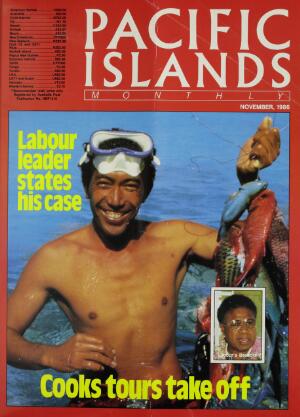
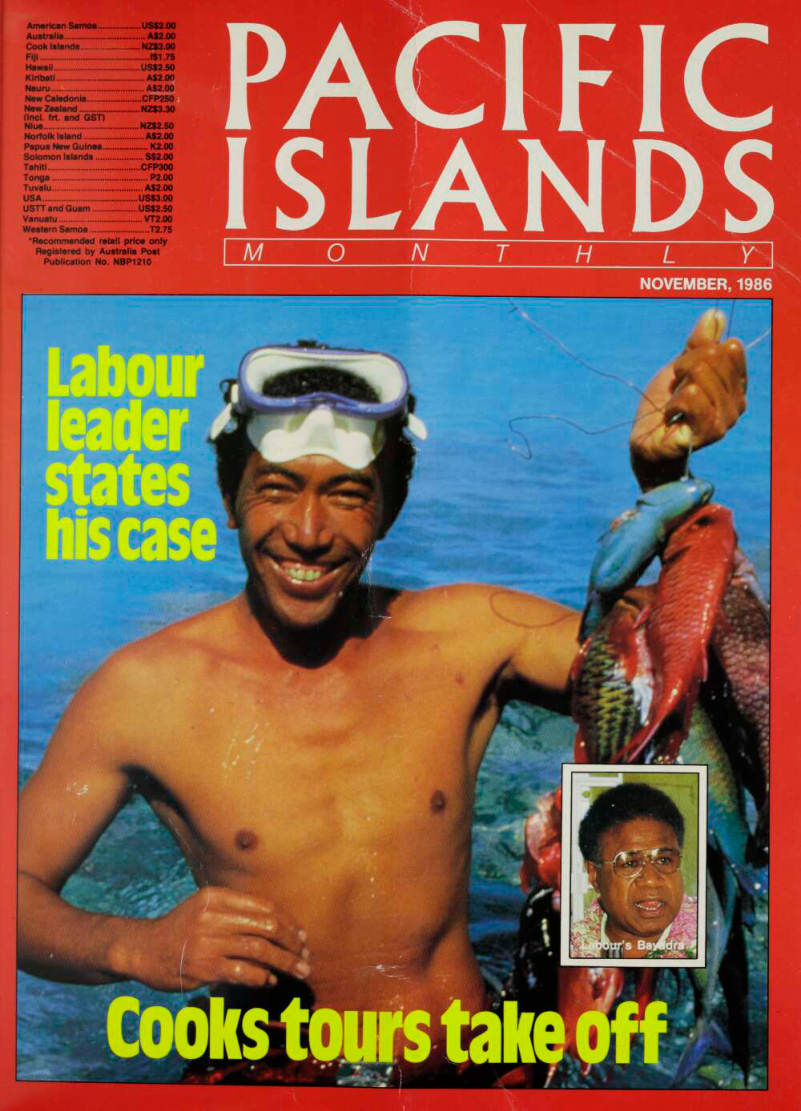
The Cover
A great catch in the Cook Islands. Photo: Clare Leimbach.
Advertisements & other items, p. 2 (1 item)
So we thought you'd prefer
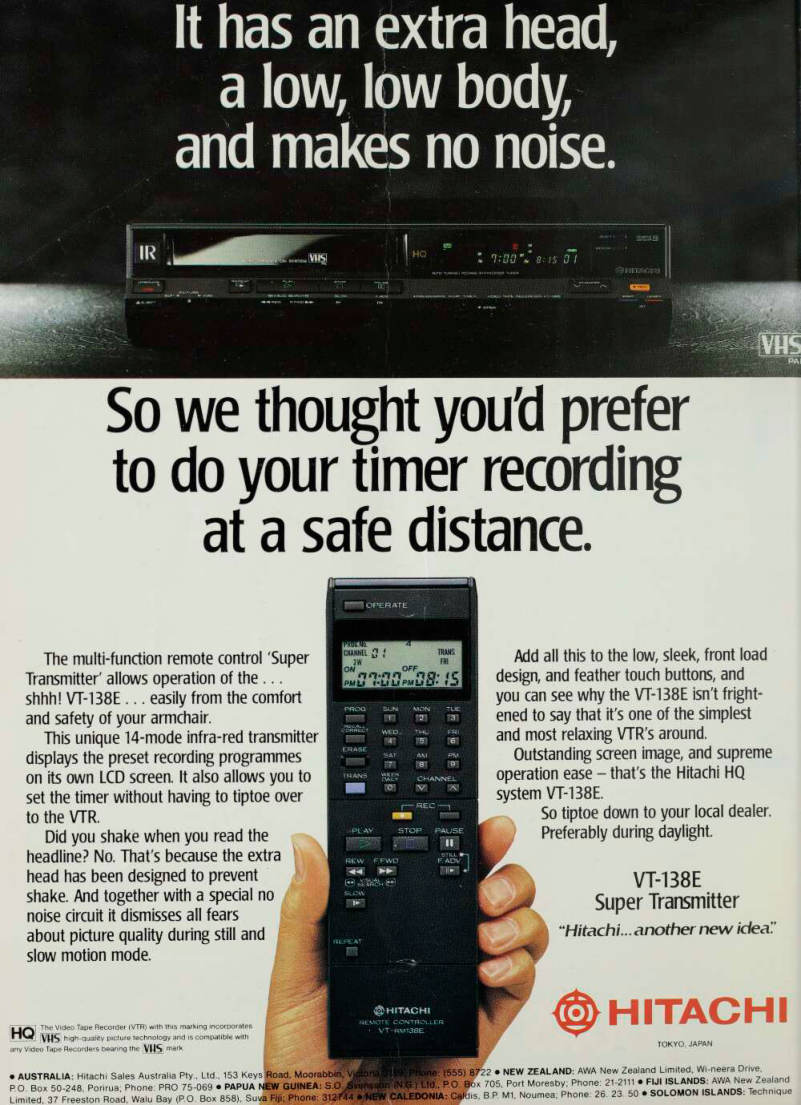
It has an extra head,
a low, low body,
and makes no noise.
PA I
So we thought you'd prefer
to do your timer recording
at a safe distance.
The multi-function remote control 'Super Transmitter’ allows operation of the ... shhh! VT-138E ... easily from the comfort and safety of your armchair.
This unique 14-mode infra-red transmitter displays the preset recording programmes on its own LCD screen. It also allows you to set the timer without having to tiptoe over to the VTR.
Did you shake when you read the headline? No. That's because the extra head has been designed to prevent shake. And together with a special no noise circuit it dismisses all fears about picture quality during still and slow motion mode.
The Video Tape Recorder (VTR) with this marking incorporates VMS high-quality picture technology and is compatible with m any Video Tape Recorders bearing the VMS mark. • AUSTRALIA: Hitachi Sales Australia Pty., Ltd., 153 Keys P.O. Box 50-248. Porirua; Phone: PRO 75-069 • PAPUA Limited, 37 Freeston Road, Walu Bay (P.O. Box 858), Su
TRANS
CHANNEL
OFF
ON nn
I'Ll U PMU
PM Li
Phone Add all this to the low, sleek, front load design, and feather touch buttons, and you can see why the VT-138E isn't frightened to say that it's one of the simplest and most relaxing VTR's around.
Outstanding screen image, and supreme operation ease - that’s the Hitachi HQ system VT-138E.
So tiptoe down to your local dealer.
Preferably during daylight.
VT-138E
Super Transmitter
Hitachi... another new idea’.
HITACHI
TOKYO, JAPAN
<2 • NEW ZEALAND: AWA New Zealand Limited, Wi-neera Drive, jx 705, Port Moresby; Phone: 21-2111 • FIJI ISLANDS: AWA New Zealand lie R p MmimM 1 Phnnfi- 26 23. 50 • SOLOMON ISLANDS: Technique
Pacific
Islands
Monthly
» VI. V/ » j MV. I I , MV VVII I VV I , I JUVJ.
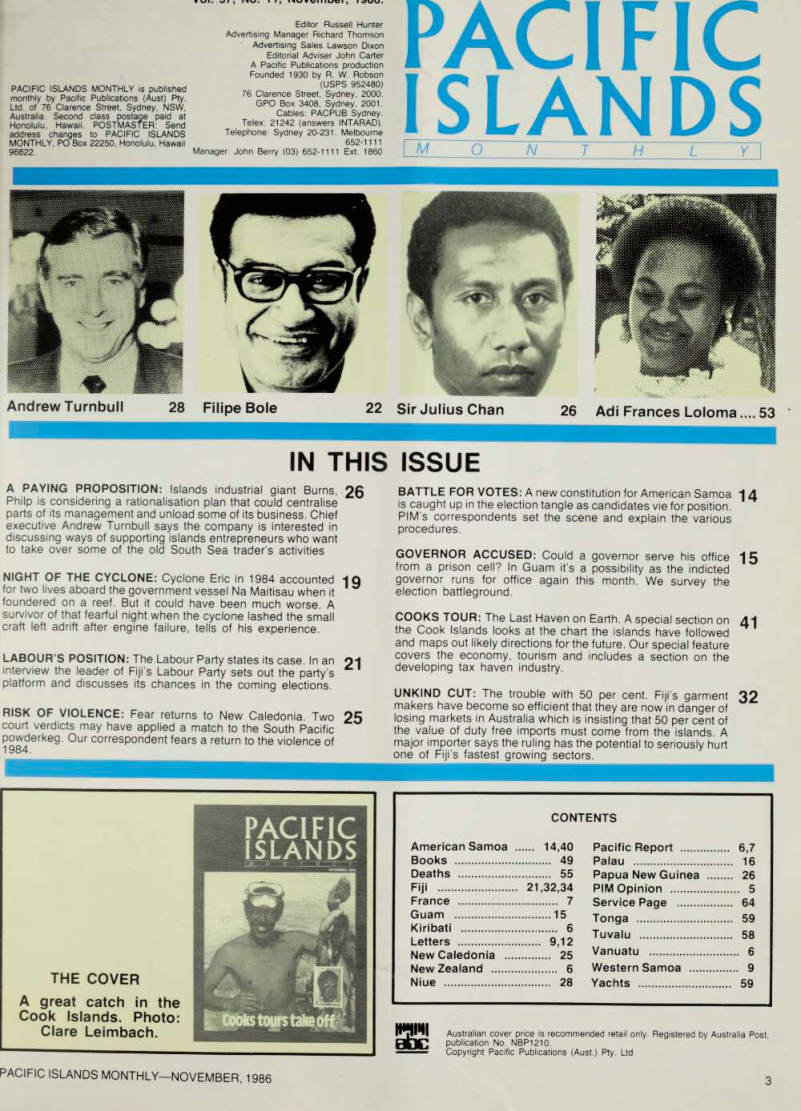
Andrew Turnbull 28
Filipe Bole 22
Sir Julius Chan 26
Adi Frances L010ma... 53
In This Issue
A PAYING PROPOSITION: Islands industrial giant Burns, 26 Philp is considering a rationalisation plan that could centralise parts of its management and unload some of its business. Chief executive Andrew Turnbull says the company is interested in discussing ways of supporting islands entrepreneurs who want to take over some of the old South Sea trader’s activities NIGHT OF THE CYCLONE: Cyclone Eric in 1984 accounted i Q for two lives aboard the government vessel Na Maitisau when it ' * foundered on a reef. But it could have been much worse. A survivor of that fearful night when the cyclone lashed the small craft left adrift after engine failure, tells of his experience.
LABOUR’S POSITION: The Labour Party states its case. In an 21 interview the leader of Fiji’s Labour Party sets out the party’s 1 platform and discusses its chances in the coming elections.
RISK OF VIOLENCE: Fear returns to New Caledonia. Two 25 court verdicts may have applied a match to the South Pacific powderkeg. Our correspondent fears a return to the violence of 1984.
BATTLE FOR VOTES: A new constitution for American Samoa *| 4 is caught up in the election tangle as candidates vie for position.
PlM’s correspondents set the scene and explain the various procedures.
GOVERNOR ACCUSED: Could a governor serve his office “\ 5 from a prison cell? In Guam it’s a possibility as the indicted governor runs for office again this month. We survey the
election battleground.
COOKS TOUR: The Last Haven on Earth. A special section on A*\ the Cook Islands looks at the chart the islands have followed and maps out likely directions for the future. Our special feature covers the economy, tourism and includes a section on the
developing tax haven industry.
UNKIND CUT: The trouble with 50 per cent. Fiji's garment 32 makers have become so efficient that they are now in danger of losing markets in Australia which is insisting that 50 per cent of the value of duty free imports must come from the islands. A major importer says the ruling has the potential to seriously hurt one of Fiji’s fastest growing sectors.
Contents
American Samoa 14,40 Books 49 Deaths 55 Fiji 21,32,34 France 7 Guam 15 Kiribati 6 Letters 9,12 New Caledonia 25 New Zealand 6 Niue 28
Pacific Report 6,7 Palau 16 Papua New Guinea 26 PIM Opinion 5 Service Page 64 Tonga 59 Tuvalu 58 Vanuatu 6 Western Samoa 9 Yachts 59
Australian cover price is recommended retail only. Registered by Australia Post, publication No. NBP1210.
Copyright Pacific Publications (Aust.) Pty. Ltd
Advertisements & other items, pp. 3-4 (2 items)
Pacific Islands Monthly—November, 1986
3
Editor Russell Hunter Advertising Manager Richard Thomson Advertising Sales Lawson Dixon Editorial Adviser John Carter A Pacific Publications production Founded 1930 by R. W. Robson
(USPS 952480)
76 Clarence Street, Sydney, 2000.
GPO Box 3408, Sydney, 2001.
Cables: PACPUB Sydney.
Telex: 21242 (answers INTARAD).
Telephone: Sydney 20-231. Melbourne 652-1111 Manager: John Berry (03) 652-1111 Ext. 1860
PACIFIC ISLANDS MONTHLY is published monthly by Pacific Publications (Aust) Pty.
Ltd. of 76 Clarence Street, Sydney, NSW, Australia. Second class postage paid at Honolulu, Hawaii. POSTMASTER: Send address changes to PACIFIC ISLANDS MONTHLY, PO Box 22250, Honolulu, Hawaii 96822.
Trinitron
SUJN Y
KV-2092AS
It's so tempting.
The colour you get from Sony's new Super Trinitron.
Our new Pan-Focus gun is computer-designed to make our famous colour even sharper and clearer. Our new Black Screen makes whites brilliant, blacks profound, every colour deeper and richer.
It's flatter and sguarer too.
For less reflection and superb clarity, even in the corners.
For those whose taste demands the best, Super Trinitron is the most delicious TV ever.
KVI44OAS
Trinitron
More to politics
Pim Opinion
More to politics than votes
Countries in the region are keeping a careful eye on events in Fiji. The birth of the Fiji Labour Party has aroused mixed feelings of admiration and anti cipation.
For while some might envy the very existence and apparent support of the new political force, others have breathlessly awaited the announcement of its policy platform for other reasons.
There is nothing quite like the word "nationalisation” to strike dread into the hearts of foreign investors and although the new party has been careful to stress that it welcomes offshore finance for the right projects, the fateful word is heard loudest in foreign parts.
Fiji, with its “gilt edged” status as a favourite Pacific island investment destination, has been the envy of its neighbours since independence. That could change.
For, rightly or wrongly, the money men to the south-west, in particular, would tend to steer well clear of any country with the word “nationalisation” in its political vocabulary.
As a new party, Labour may have something to learn about the impact abroad of statements intended only for political impact at home. It is almost always a mistake to think nobody outside is listening in.
In any case, there are better and safer ways of achieving national participation in the economy as Mr Turnbull of Burns, Philp makes clear (Page 29).
Perhaps “localisation” would be a better word than nationalisation.” For if indigenous people can be persuaded, assisted or both to take up the parts of Burns, Philp that the company is suggesting it might unload in the future, this would have the effect of “freeing” local industry from foreign control without the trauma of a mass flight of capital.
And without that capital, Labour campaign promises of
improved services across the board will be just so much political hot air.
Again, without capital investment, the first to suffer will be those whom Labour holds dearest and among whom it can expect to find a natural constituency.
Other parties in the region will want to know, however, how Labour proposes to fund its ambitious program.
Benefits always have to be paid for and Labour, allied as it is with the trade union movement, is denied the traditional weapon of reduced government spending.
That leaves the electorally unpopular option of increased taxation.
The new party, in that respect, may have handed its older rival a valuable big stick.
On the other hand Labour can begin to look like one of the first political movements in the South Pacific to offer a genuine consensus that cuts across tribal and personal ity lines.
That would indeed be a potential point of departure for all kinds of political destinations. Fiji’s last election without television possibly represents a last opportunity to campaign on policies rather than personalities. In future, television’s propensity to focus on visible, moving photogenic people as opposed to “dull” policy issues will be very difficult to avoid.
If it can survive the next election intact and current signs are that it can the Fiji Labour Party will almost certainly represent the most significant political deve lopment in the South Pacific since the beginnings of independence. Its philoshopy is well capable of export to nearby nations where trade unions have so far adopted mainly passive political roles.
But the Fiji party may learn sooner rather than later that there’s more to politics than votes and that policy cannot be constructed for purely domestic consumption.
pacific report
Tuna Deal At
Tenth Talks
Negotiators for the United States and the Forum Fisheries Agency agreed on a 5-year multilateral tuna treaty at the tenth round of talks in Nuku’alofa. Under the terms of the agreement, Pacific island countries are guaranteed a minimum of US$6O million with more money possible if additional vessels seek licences or if the price of tuna rises. The fee package was calculated on a fleet size of 35 boats. The $l2 million annual fee has two components. The tuna industry will pay $1.75 million and provide an additio nal $250,000 in technical assistance.
The US government will add $lO million $9 million in cash grants and $1 million for development projects in the fisheries sector. The FFA will administer all the funds though 15 per cent of the cash fee will be divided equally among the countries that ratify the treaty. The balance of the money will be paid out to countries where fish are caught. Island delegates left Tonga to report to their respective governments on the draft treaty and to start the ratification pro cess. Pacific states must proceed to ratification before the pact can come into force. US officials said they expect the treaty will pass the full senate by March, 1987. Though an agreement was finally reached, the talks appeared stalled until counsellor Ed Derwinski arrived from Washington with the final American offer.
“I almost exceeded my limit," he told PIM. “We got a temporary black eye from the Jeanette Diana. These negotiations refocussed the relationship between the US and its Pacific friends with a positive end result for everyone,” the State Department’s roving ambassador added. FFA president Phillip Muller said he was elated over the deal as it provided a foundation for improved relations with the United States and established a basis for co-operation with other distant water fishing fleets. Mike Lane.
Salii Issues
Government Bonds
President Lazarus Salii of Palau com pleted a US$4OO million dollar deal for the small republic that has defaulted on its overseas debt (August PIM pl 2). He said after a visit to Hawaii that he “finalised issuance of the revenue bonds” which he called “a great thing for Palau.” The president said the revenue producing bonds would be used to help develop housing, air transport and tele communications for the cash-strapped republic of 15,000. An administration press release added that the projects would include the construction of a new capital city, a government office com-
plex, water and sewer systems, power distribution, health, retirement and tour ism related programs. The president said that since the bond issue was under the aegis of the Palau National Deve lopment Bank, it did not require Palau Congressional approval and that “only the president can handle it directly.” The money for the bonds was held in escrow and could not be released until feasibility studies for each project had been completed, he said. The president said that Wall Street brokers Matthews and Wright had co-operated with the deve lopment bank on the bond issue. The broking firm raised the US$4OO million from mainland financial institutions. The capital, raised in New York, is to be repaid from revenue raised by the various projects. The president said the money would be used to reduce Palau’s staggering debt. Fie added the bond issue was totally separate from the proposed Compact of Free Association between Palau and the United States which is embroiled in legal dispsutes over U.S. defence requirements which Palau’s Supreme Court contends con flicts with the republic’s nuclear-free constitution. The president said he would call another referendum on the issue.
Region’S Health Care
‘A Tragedy’
A seminar at the Australian National Centre for Development Studies in Can berra was told that the deteriorating health situation in the South Pacific was a tragedy. Ms Abby Bloom, of Sydney University’s School of Tropical Medicine told the seminar there was a rapid increase in malaria, tuberculosis and respiratory conditions in Papua New Guinea, Vanuatu and Solomon Islands.
In Fiji, Tonga and Western Samoa, she said, rapid life-style changes had
caused an alarming increase in de generative diseases including hyperten sion, diabetes and cancer. Dr Jeff Richardson of the Economics Depart ment at Macquarrie University said Papua New Guinea's health service was near collapse. It was not, he said, committing funds where they were most needed while the health status of PNG's population was worse than that in other nations at similar stages of development.
This could be attributed to an overall decline in health services, a cut in the number of trained personnel, poor de livery of health care and a lack of attention to the improvement of water supplies,- he said.
Australia Joins
Sea Bed Miners
Australia has become a full member of the Suva-based Committee for Co ordination of Joint Prospecting for Mine ral Resources in South Pacific Offshore Areas (CCOP/SOPAC) which comprises most of the Forum nations plus Guam. It was established in 1972 under the auspices of the Economic and Social Commission for Asia and the Pacific (ESCAP) to assist members in policy formation and implementation of prog rams for evaluation, development and management of marine mineral re sources. Australia will contribute A 5250,000 to the committee’s budget for this year and the Australian Department of Foreign Affairs said Australia’s membership refelected its close ties with the countries of the South Pacific.
Move To Outlaw
Cigarette Ads
Dr Balram Iyer of the Fiji Medical Association, has announced that the association plans to campaign for a ban on cigarette advertising. Fie was com menting on a recent directive by the Ministry of FHealth to ban smoking in all patient areas in government hospitals. It was expected that the ministry ban would be extended to all ministry pre mises.
Boulekone Wins
Court Appeal
Vanuatu’s opposition leader, Mr Vincent Boulekone, won a Supreme Court appeal against the loss of his seat in parliament. The full bench of the court comprising the chief justice, Mr Justice Cooke and judges from Fiji and Papua New Guinea, ruled that Boulekone had been unjustly deprived of his seat.
Boulekone, president of the Union of Moderate Parties, had been ruled ineligi ble to return to parliament by the Speaker because he had failed to attend
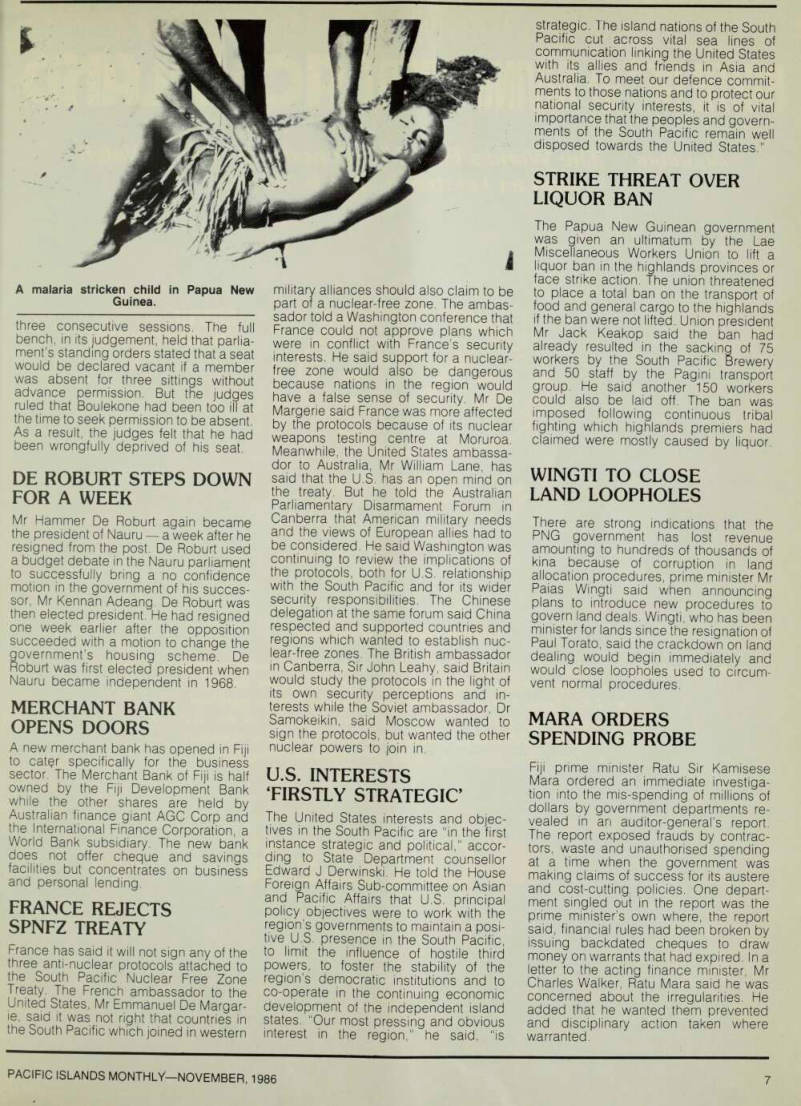
PNG Prime Minister Paias Wingti.
three consecutive sessions. The full bench, in its judgement, held that parlia ment’s standing orders stated that a seat would be declared vacant if a member was absent for three sittings without advance permission. But the judges ruled that Boulekone had been too ill at the time to seek permission to be absent.
As a result, the judges felt that he had been wrongfully deprived of his seat.
De Roburt Steps Down
For A Week
Mr Hammer De Roburt again became the president of Nauru a week after he resigned from the post. De Roburt used a budget debate in the Nauru parliament to successfully bring a no confidence motion in the government of his succes sor, Mr Kennan Adeang. De Roburt was then elected president. He had resigned one week earlier after the opposition succeeded with a motion to change the government’s housing scheme. De Roburt was first elected president when Nauru became independent in 1968.
Merchant Bank
Opens Doors
A new merchant bank has opened in Fiji to catpr specifically for the business sector. The Merchant Bank of Fiji is half owned by the Fiji Development Bank while the other shares are held by Australian finance giant AGC Corp and the International Finance Corporation, a World Bank subsidiary. The new bank does not offer cheque and savings facilities but concentrates on business and personal lending.
France Rejects
Spnfz Treaty
France has said it will not sign any of the three anti-nuclear protocols attached to the South Pacific Nuclear Free Zone Treaty. The French ambassador to the United States, Mr Emmanuel De Merger ie, said it was not right that countries in the South Pacific which joined in western
military alliances should also claim to be part of a nuclear-free zone. The ambas sador told a Washington conference that France could not approve plans which were in conflict with France's security interests. He said support for a nuclear free zone would also be dangerous because nations in the region would have a false sense of security. Mr De Margerie said France was more affected by the protocols because of its nuclear weapons testing centre at Moruroa.
Meanwhile, the United States ambassa dor to Australia, Mr William Lane, has said that the U.S. has an open mind on the treaty. But he told the Australian Parliamentary Disarmament Forum in Canberra that American military needs and the views of European allies had to be considered. He said Washington was continuing to review the implications of the protocols, both for U.S. relationship with the South Pacific and for its wider security responsibilities. The Chinese delegation at the same forum said China respected and supported countries and regions which wanted to establish nuc lear-free zones. The British ambassador in Canberra, Sir John Leahy, said Britain would study the protocols in the light of its own security perceptions and in terests while the Soviet ambassador, Dr Samokeikin, said Moscow wanted to sign the protocols, but wanted the other nuclear powers to join in.
U.S. Interests
‘Firstly Strategic
The United States interests and objec tives in the South Pacific are “in the first instance strategic and political,” accor ding to State Department counsellor Edward J Derwinski. He told the House Foreign Affairs Sub-committee on Asian and Pacific Affairs that U.S. principal policy objectives were to work with the region’s governments to maintain a posi tive U.S. presence in the South Pacific, to limit the influence of hostile third powers, to foster the stability of the region’s democratic institutions and to co-operate in the continuing economic development of the independent island states. “Our most pressing and obvious interest in the region,” he said, “is
strategic. The island nations of the South Pacific cut across vital sea lines of communication linking the United States with its allies and friends in Asia and Australia. To meet our defence commit ments to those nations and to protect our national security interests, it is of vital importance that the peoples and govern ments of the South Pacific remain well disposed towards the United States.”
Strike Threat Over
Liquor Ban
The Papua New Guinean government was given an ultimatum by the Lae Miscellaneous Workers Union to lift a liquor ban in the highlands provinces or face strike action. The union threatened to place a total ban on the transport of food and general cargo to the highlands if the ban were not lifted. Union president Mr Jack Keakop said the ban had already resulted in the sacking of 75 workers by the South Pacific Brewery and 50 staff by the Pagini transport group. He said another 150 workers could also be laid off. The ban was imposed following continuous tribal fighting which highlands premiers had claimed were mostly caused by liquor.
Wingti To Close
Land Loopholes
There are strong indications that the PNG government has lost revenue amounting to hundreds of thousands of kina because of corruption in land allocation procedures, prime minister Mr Paias Wingti said when announcing plans to introduce new procedures to govern land deals. Wingti, who has been minister for lands since the resignation of Paul Torato, said the crackdown on land dealing would begin immediately and would close loopholes used to circum vent normal procedures.
Mara Orders
Spending Probe
Fiji prime minister Ratu Sir Kamisese Mara ordered an immediate investiga tion into the mis-spending of millions of dollars by government departments re vealed in an auditor-general’s report.
The report exposed frauds by contrac tors, waste and unauthorised spending at a time when the government was making claims of success for its austere and cost-cutting, policies. One depart ment singled out in the report was the prime minister’s own where, the report said, financial rules had been broken by issuing backdated cheques to draw money on warrants that had expired. In a letter to the acting finance minister, Mr Charles Walker, Ratu Mara said he was concerned about the irregularities. He added that he wanted them prevented and disciplinary action taken where warranted.
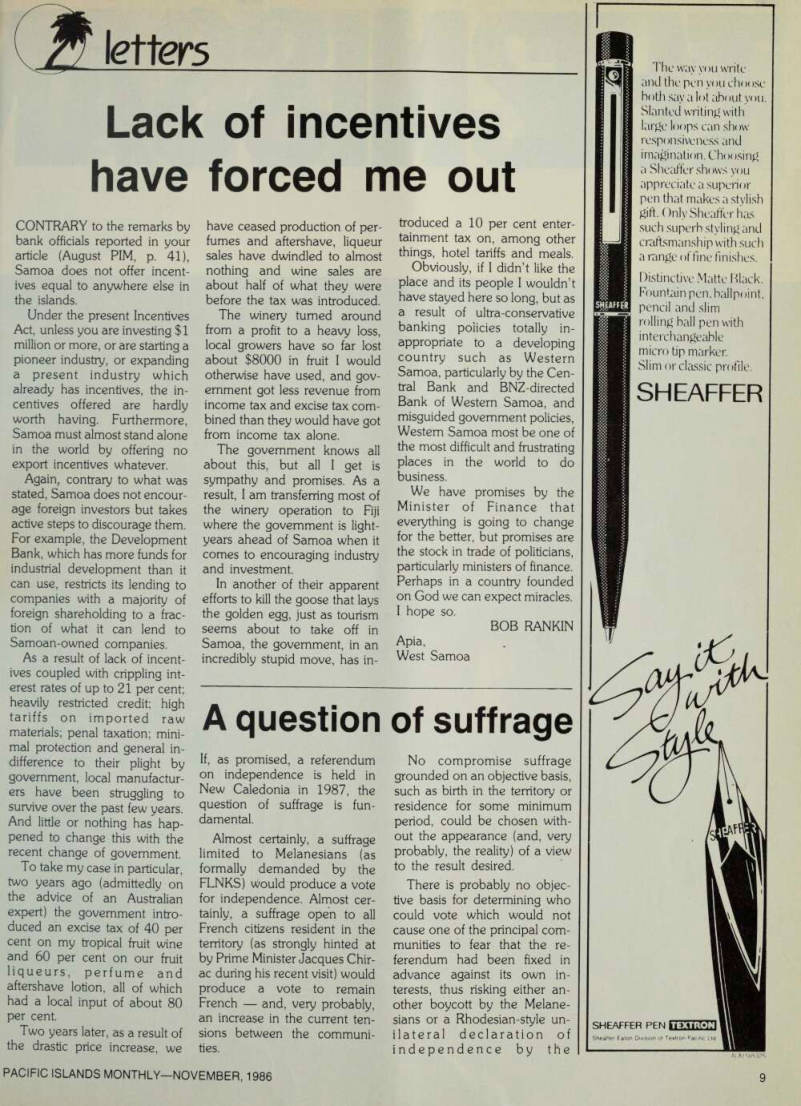
A malaria stricken child in Papua New Guinea.
Advertisements & other items, p. 8 (1 item)
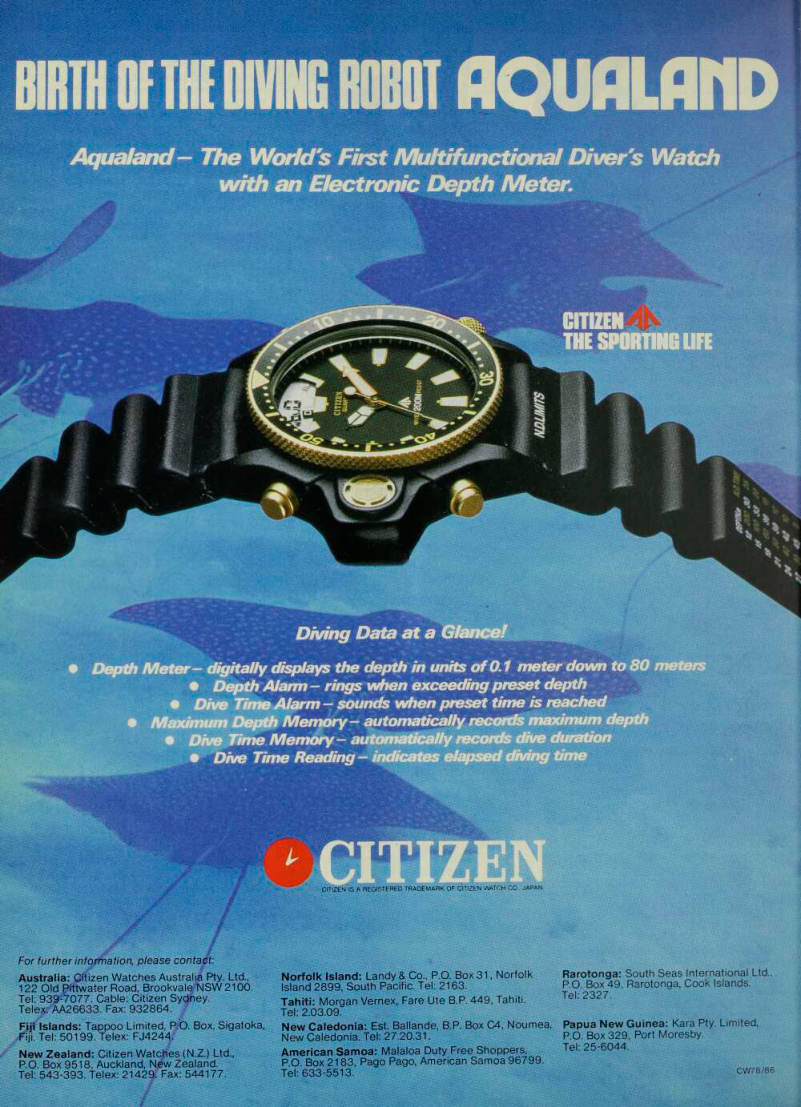
Birth Of The Diving Robot Flqufllfflld
Aqualand The World's First Multifunctional Diver's Watch
with an Electronic Depth Meter.
CITIZEN
V '1 o Q S' V. i
Diving Data at a Glance!
• Depth Meter - digitally displays the depth in units of 0.1 meter down to 80 meters • Depth Alarm- rings when exceeding preset depth • Dive Time Alarm - sounds when preset time is reached • Maximum Depth Memory - automatically records maximum depth • Dive Time Memory- automatically records dive duration • Dive Time Reading-indicates elapsed diving time b^ CITIZEN IS A REGISTERED TRADEMARK OF CITIZEN WATCH CO. JAPAN For further information, please contact: Australia: Citizen Watches Australia Pty. Ltd, 122 Old Pittwater Road, Brookvale NSW 2100.
Tel: 939-7077. Cable: Citizen Sydney.
Telex; AA26633. Fax: 932864.
Fiji Islands: Tappoo Limited, P:0. Box, Sigatoka, /Fiji. Tel: 50199. Telex: FJ4244.
New Zealand; Citizen Watches (N.Z.) Ltd., P.O. Box 9518, Auckland, NPw Zealand.
Tel: 543-393. Telex: 21429. Fax: 544177.
Norfolk Island: Landy & Co., P.O. Box 31, Norfolk Island 2899, South Pacific. Tel: 2163.
Tahiti: Morgan Vernex, Fare Ute B.P. 449, Tahiti.
Tel; 2.03.09.
New Caledonia: Est. Ballande, B.P. Box C 4, Noumea, New Caledonia. Tel; 27.20.31.
American Samoa: Malaloa Duty Free Shoppers, P O Box 2183, Pago Pago, American Samoa 96799.
Tel; 633-5513.
Rarotonga: South Seas International Ltd.
P.O. Box 49, Rarotonga, Cook Islands.
Tel: 2327.
Papua New Guinea: Kara Pty. Limited, P.O. Box 329, Port Moresby.
Tel: 25-6044.
letters
Lack of incentives have forced me out
CONTRARY to the remarks by bank officials reported in your article (August PIM, p. 41), Samoa does not offer incent ives equal to anywhere else in the islands.
Under the present Incentives Act, unless you are investing $1 million or more, or are starting a pioneer industry, or expanding a present industry which already has incentives, the in centives offered are hardly worth having. Furthermore, Samoa must almost stand alone in the world by offering no export incentives whatever.
Again, contrary to what was stated, Samoa does not encour age foreign investors but takes active steps to discourage them.
For example, the Development Bank, which has more funds for industrial development than it can use, restricts its lending to companies with a majority of foreign shareholding to a frac tion of what it can lend to Samoan-owned companies.
As a result of lack of incent ives coupled with crippling int erest rates of up to 21 per cent; heavily restricted credit; high tariffs on imported raw materials; penal taxation; mini mal protection and general in difference to their plight by government, local manufactur ers have been struggling to survive over the past few years.
And little or nothing has hap pened to change this with the recent change of government.
To take my case in particular, two years ago (admittedly on the advice of an Australian expert) the government intro duced an excise tax of 40 per cent on my tropical fruit wine and 60 per cent on our fruit liqueurs, perfume and aftershave lotion, all of which had a local input of about 80 per cent.
Two years later, as a result of the drastic price increase, we
have ceased production of per fumes and aftershave, liqueur sales have dwindled to almost nothing and wine sales are about half of what they were before the tax was introduced.
The winery turned around from a profit to a heavy loss, local growers have so far lost about $BOOO in fruit I would otherwise have used, and gov ernment got less revenue from income tax and excise tax com bined than they would have got from income tax alone.
The government knows all about this, but all I get is sympathy and promises. As a result, I am transferring most of the winery operation to Fiji where the government is light years ahead of Samoa when it comes to encouraging industry and investment.
In another of their apparent efforts to kill the goose that lays the golden egg, just as tourism seems about to take off in Samoa, the government, in an incredibly stupid move, has in
troduced a 10 per cent enter tainment tax on, among other things, hotel tariffs and meals.
Obviously, if I didn’t like the place and its people I wouldn’t have stayed here so long, but as a result of ultra-conservative banking policies totally in appropriate to a developing country such as Western Samoa, particularly by the Cen tral Bank and BNZ-directed Bank of Western Samoa, and misguided government policies, Western Samoa most be one of the most difficult and frustrating places in the world to do business.
We have promises by the Minister of Finance that everything is going to change for the better, but promises are the stock in trade of politicians, particularly ministers of finance.
Perhaps in a country founded on God we can expect miracles.
I hope so.
Bob Rankin
Apia, West Samoa
A question of suffrage


If, as promised, a referendum on independence is held in New Caledonia in 1987, the question of suffrage is fun damental.
Almost certainly, a suffrage limited to Melanesians (as formally demanded by the FLNKS) ul/ould produce a vote for independence. Almost cer tainly, a suffrage open to all French citizens resident in the territory (as strongly hinted at by Prime Minister Jacques Chir ac during his recent visit) would produce a vote to remain French and, very probably, an increase in the current ten sions between the communi ties.
No compromise suffrage grounded on an objective basis, such as birth in the territory or residence for some minimum period, could be chosen with out the appearance (and, very probably, the reality) of a view to the result desired.
There is probably no objec tive basis for determining who could vote which would not cause one of the principal com munities to fear that the re ferendum had been fixed in advance against its own in terests, thus risking either an other boycott by the Melane sians or a Rhodesian-style un ilateral declaration of independence by the
Europeans and, in either case, a general breakdown of law and order.
In these circumstances, con sideration should be given to a suffrage grounded on a single subjective basis the willing ness of each French citizen resident in New Caledonia to declare irrevocably that his or her future rests with the territory and to accept the risks which flow from such a declaration.
The right to vote could be limited to those Caledonians, regardless of their ethnic origin, prepared to accept that their French nationality would terminate and be replaced with Kanaky nationality in the event that a majority of Caledonians prepared to make the same commitment chose independ ence. Under such a system, all Caledonians who consider themselves, above all, Caledo nian would vote and no one else.
While no compromise could be fully acceptable to all con cerned, this would offer the
possibility of producing a re ferendum which would attract the participation, and a result which would enjoy the respect, of major segments of all Caledonian communities.
Melanesians might accept that non-Melanesians prepared to pledge their futures irrevocably to the territory should have a right to vote.
On the other hand, non- Melanesians would have trou ble supporting an argument that they should be permitted to determine the future of the territory if they refuse to pledge their own futures to it.
It is possible that, if a referen dum were so structured, both sides could see themselves as potential winners.
Such a solution would be profoundly democratic, permit ting the Caledonian peoples themselves to determine who would vote on the future of the territory.
John V. Whitbeck
Place de la Concorde, Paris
Advertisements & other items, pp. 9-11 (1 item)
Sheaffer
The way you write and tile pen you choose both say a lot about you.
Slanted writing with large loops can show responsiveness and imagination. Choosing a Sheaffer shows you appreciate a superior pen that makes a stylish gift. Only Sheaffer has such superb styling and craftsmanship with such a range of tine finishes.
Distinctive Matte Black.
Fountain pen. ballpoint, pencil and slim rolling ball pen with interchangeable micro tip marker.
Slim or classic profile.
SHEAFFER
•At
SHEAFFER PEN
Al A/SHSI?S
TKMSSM
I* I ai m % > - . sr ,<i' . ' -'^3s- - Jfe" ■ ■■ ■. *m : 5T ♦ w
Strength
-m*- 1 The Nissan Pickup’s ladder frame frame and body are built for extra strength.
A vehicle’s strength depends on a complex interplay of varied factors. The overall design.
The body structure. The quality of the materials it is built of. The individual performance of the various mechanical components. Only when a vehicle is outstanding from every angle can it be said to possess genuine strength.
It is precisely this all-round excellence that gives the Nissan Pickup its extra margin of dependability. From the engine to the frame, the body panels to the suspension, the transmission to „ i the bumpers, everything has been integrated into a vehicle of unsurpassed performance and durability.
In addition to the four usually found on ordinary makes, the closed-section features a fifth cross member which, together with a more rational layout, enables the Pickup to tolerate heavier loads.
For further structural rigidity, the side members are made of thicker steel plates.
Add to that a double-wishbone front suspension and a leaf-spring rear suspension, plus a large-capacity, power-packed engine, and it’s easy to see why more people depend on the Pickup to handle tough jobs on rough roads.
In other words, the Pickup has a singular strength that comes from a complete rational matching of diverse parts into one unbreakable whole.
And it succeeds because it has that intangible yet very real quality that makes a Nissan what it is—The Nissan Dimension.
Quality in motion
NISSAN
Time to ask questions
Your June PIM interview with Barak Sope, General Secretary of the Vanuaaku Party makes one wonder if Father Walter Lini, Mr Sope, or, for that matter, your interviewer, has ever bothered to read Amnesty’s report on Libya, which documents an extreme abuse of human rights.
If the Vanuatu government truly admires Col Gaddafi, do they also admire the things he has boasted of, such as assassinating even his Libyan political opponents (“stray dogs”), at home and abroad as well?
Australian academics have returned from Tripoli and Benghazi sickened by having had to watch public executions of students take place at the universities where they have been working.
Chinese factory-workers, themselves hardly enjoying any very advanced forms of democracy, have in recent times been unable to contain their disgust at political conditions in Libya after spending 18 months there on contract.
If it is reactions of this kind to Libyan government policies that Mr Robert Crain (PIM August) means by his words “right wing” and “anti-independence”, then he seems to be using a language other than English. Newspeak perhaps.
Is it true that Vanuatu government leaders are not only very friendly with Libyan supporters of Gaddafi, but also with
Cuban supporters of Castro? Is the reason they express for this friendliness that Libya and Cuba exemplify the kind of independ ence they admire? Afghanistan too, perhaps? Vietnam? Poland? etc.
It is time that those who actually do strongly believe in the cause of democracy and national self-determination started asking questions not merely about coun tries like these, but also, for example, about the countries of Soviet Central Asia, about the Ukraine and about the Baltic states.
And of course about Russia itself.
Yes, Canberra’s complaining about Vanuatu’s acceptance of Libyan representa tion, and Canberra’s anxiety about Soviet fishing agreements, do indeed seem hypocritical. If the leaders of Vanuatu value independence and human rights, it is they who should be complaining to Canberra about Canberra’s continual hobnobbing within Soviet client-states, who are the world’s worst enemies of independence. It is Vanuatu who should be requesting Can berra to delay the granting of representa tion to Libya and such countries, at least until the Libyan people are free enough to elect their own government.
R. J. Beveridge
Monash University, Australia
Uranium sales
THE Australian Government has announced that it will re sume the sale of uranium to France.
As most people are aware, uranium is one of the materials necessary for the manufacture of nuclear weapons. It seems quite strange that Australia, having signed the South Pacific Nuclear-Free Zone Treaty and as a member of the South Pacific Forum, will now be supplying France with nuclear materials.
Quite strange, indeed. With friends like these, why worry about the Russians?
Michael Lafreniere
Honiara, Solomon Islands
Aid co-operation
I would like to call your atten tion to an error in the article “US Hints at Separate Tuna Deal” (July PIM p 25).
The article includes a report of a United States Agency for International Development (USAID) sponsored South Pacific fisheries development conference in Honolulu on May 10-12.
That conference was de signed to bring together Pacific island nations’ fisheries and de velopment planning officials to participate in the design and implementation of a new USAID-funded fisheries deve lopment project for the region.
The report, on balance, is quite accurate. However, on page 26 1 am quoted as saying that “...it might be possible (for USAID) to co-operate with other donors in the region on some projects, though USAID normally preferred to go it
alone.”
What I actually said was that USAID would welcome co operation with other donors in the region on some projects, but that “some other donors preferred to go it alone.”
USAID takes pride in its past and current efforts to negotiate jointly funded development assistance projects throughout the South Pacific. Over the past several years, the major donor countries in the region have experienced severe budgetary problems and it consequently makes good sense to leverage aid assistance by co-operating with each other and by seeking joint funding opportunities.
For example, during the past year USAID has jointly funded with New Zealand Aid a much needed Computer Sciences Training Centre at USP. USAID has also co-operated with Norwegain Aid administered by SPEC to provide funding for an important water supply project in the Cook Islands.
I am grateful for the opportunity to clarify this issue since we believe that co-opera tion among donors is an impor tant effort to bring about maxi mum benefit to the people of the South Pacific island nations whom we are dedicated to serve.
William E. Paupe,
Regional Director,
Usaid,
Suva.
Advertisements & other items, p. 13 (1 item)
We can’t tell you everything we’ve done
in the Pacific. But we can
tell you why we were chosen to do it.
While some of the work Hawaiian Tel has done in the Pacific is confidential, the reason why we are so often chosen by the US. military and Pacific Basin governments is public knowledge.
Everyone knows that Hawaiian Tel can readily supply state-of-the-art telecommunications equipment to even the most remote corner of the globe.
To date, we’ve worked with military and government customers in Japan, Korea, Philippines, Indonesia, Guam and Micronesia.
That’s why we can say, in all confidence, that there’s no secret to choosing the right telecommunications company for your military or government communications needs.
All you have to know is Hawaiian Tel. For more information contact: Benjamin Fukumoto, Director of Government Communications, (808) 546-7890.
HAWAIIAN TEL FiTB
Beyond the call
The long road
to reform
Anew constitution for American Samoa has embarked on the long and uncertain road to ratification.
Sixty-two delegates at the Constitutional Convention have given the 20-year-old document a comprehensive overhaul, expanding the Sen ate and expanding and renam ing the High Court, creating impeachment procedures and making a number of other fundamental changes.
Once the convention had completed the draft document, Governor A.P. Lutali scheduled a late September meeting with with Assistant U.S. Secretary of Interior for Territorial and In ternational Affairs, Richard T.
Montoya in Honolulu.
Knowing that the Secretary of Interior plays a key role in the ratification, the Governor wanted Montoya’s advice. The Governor will then take the draft back to the islands, the convention will reconvene and accept or reject the secretary’s suggestions.
The procedure then, in the eyes of the department, is that the American Samoan legisla ture, the Fono, would then have to accept the document and then submit it to the people for ratification.
There was some doubt that all this could be done in time for this month’s elections.
But even when the people have made their decision, it’s not the end of the drama.
The next step is to obtain clearance by the Secretary of Interior (and Interior has been supportive of the project in a “hands-off” way, carefully not sending an observer to the Constitutional Convention).
Until recently, the Secretary’s approval would have been all that was required but the Congress has changed the law, making it mandatory that the American Samoan constitution must be cleared by Congress.
Bringing the document be fore that body, however, may present a major obstacle not because of changes made by the convention but because of other, older elements of the Samoan document.
It has been suggested that it may not be in the interest of the American Samoa government to force the Congress to consid er, among other things, the matai voting system. This sys tem, used to elect the Senate, restricts the vote and service in the Senate to matais, who are generally middle-aged to elder ly males (only a handful of women have ever secured the title).
At a time when one-person one-vote and women’s suffrage are about as well established on the mainland as the rock of Gibraltar, a number of con gressmen and senators are like ly to balk at the Samoan traditional voting system.
One potential way round this would be for the Congress to pass another law allowing the Secretary of Interior to pass on the Samoan constitution. The secretary is in a somewhat different position than a senator or congressman, and the feeling here is that he would be amen able to accepting a constitution containing the matai system, provided that the changes proposed by the Constitutional Convention were otherwise non-controversial.
A clause-by-clause compari son of the 1967 constitution and the current draft shows a number of changes: • A prohibition against non- Samoans setting up small businesses in direct competition with existing enterprises “own ed and operated by persons born of American Samoan ancestry,” a provision which may cause some discomfort on the mainland; • The first mention in a Samoan constitution of trial by
jury, something brought to the islands a few years ago by a court case which came from the High Court to the U.S. District Court here in DC; • The first statement of environmental rights and a stiff provision against nuclear ener gy which would become acceptable only with the prior approval of a two-thirds vote of the ’’entire membership of each House of the Legislature”; • A hard-to-follow provision on official languages: “Samoan and English shall be the official languages of American Samoa, except that Samoan shall be required for public acts and transactions only as required by law”; • An expansion of the Sen ate from 18 to 20 members, to be elected for four year terms “in accordance with Samoan custom,” a reference to the matai system; • A potential expansion of the House of Representatives, from 20 to 24 members, should the Fono so decide. In addition there is a non-voting member from the lightly populated Swains Island; • A sweeping impeachment section covering “the Gov ernor, Lt Governor, heads of principal departments and offices, justices and judges.”
The House of Representatives, by a majority vote, can call for an impeachment procedure be fore the Senate, where a two thirds vote is required. (The Secretary of Interior was under stood to be concerned about the possibility of the impeach ment of justices of the High Court who are currently appointed by him); • An expansion of the High Court renamed the Supreme Court from two to three lawyer judges (positions filled to date by appointees from the mainland) and from two to three non-lawyer American Sa moan judges. (The Samoans must be registered matais).
There is some concern in Washington that there may not be enough work for four judges, let alone six; • The creation of a new Land and Titles Court with at least six Samoan associate judges; • A two-term limit on the Governor’s service, except that after a full (four-year) term has intervened a Governor can seek office again. (In other words, Peter Coleman could run again in the future); • A requirement that the governor must be a U.S. na tional of American Samoan ancestry. • A provision, much like that in the mainland constitution, setting up a procedure for suc cession in the case of a Gov ernor’s disability; • A provision for a special election to the office of Lt Governor should that office be come vacant with more than 12 months left in the term. If the vacancy is to be of shorter duration, the Governor may appoint a successor with the approval of the legislature.
But none of the these provi sions are in force now, and may not be if the constitution runs into any of the potential barriers mentioned 'earlier. from David S. North in Washington.
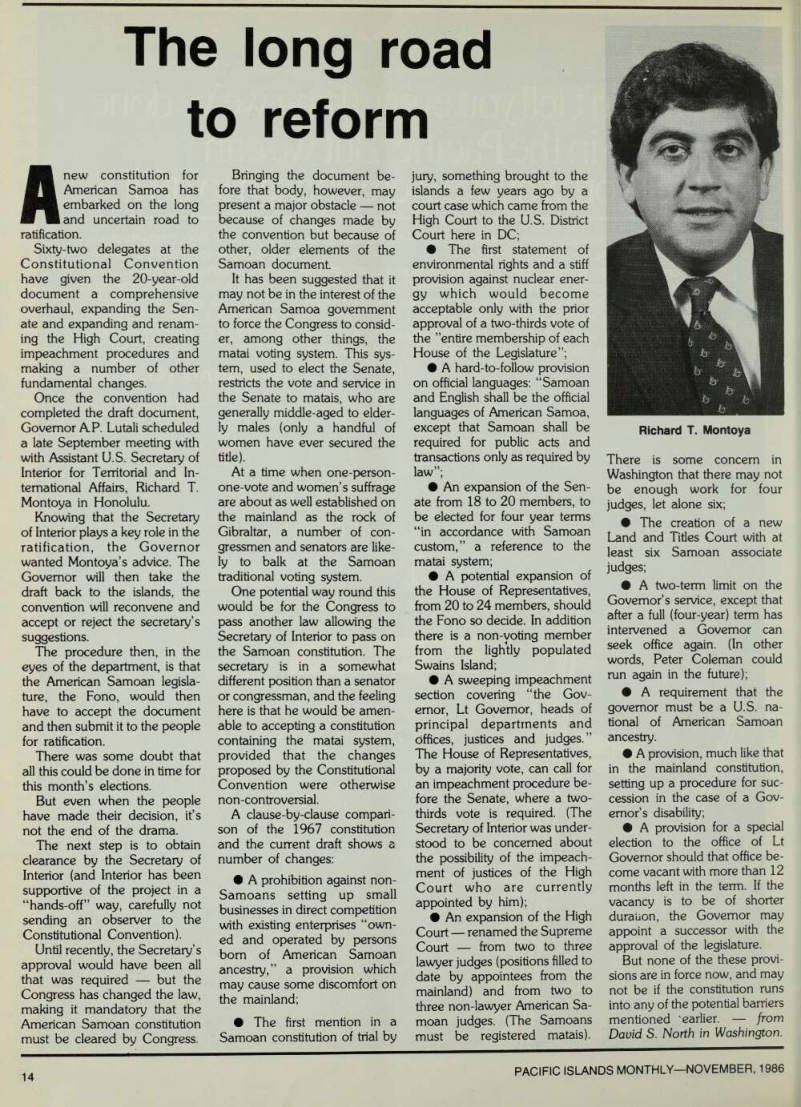
Richard T. Montoya
Governor faces polls
and court charges
Congressman Ben Blaz, the Guam Republican, and Fofo Sunia, the Sa moan Democrat, are favourites to win this month’s elections in the US territories, while indicted Guam Governor, Ricardo Bordallo, faces an up hill fight.
Guam and American Samoa will also elect members of their legislatures with Guam’s Demo crats showing marginally more strength than the Republicans in the September primaries.
American Samoa’s elections, to the Territorial House of Repre sentatives and Senate, are traditionally non-partisan.
The Guam election has been more exciting than the Amer ican Samoa contest. A couple of days before the September 9 primary, the United States Attorney for Guam announced that Democrat Governor Bor dallo had been indicted for corruption, (see box).
Bordallo and his running mate, the sitting Lt Governor, Edward Reyes, won re-nomina tion handily with 10,493 votes to 5,995 for the ticket of Carl Guttierez (for Governor) and John Aquon for Lt Governor.
Both the latter gave up their seats in the Guam Senate in their bids for higher office.
Meanwhile, in the Republi can primary, one team of sena tors beat another with Joe Ada and Frank Bias (no relation to Congressman Blaz) getting 8,084 votes to 6,003 for Thomas Tanaka and Tony Un pingco. Bordallo and Reyes now face of against Ada and Bias.
The Governor and his supporters claim that the indict ments are politically motivated and arranged by the Reagan administration’s allies on the island; their Republican oppo nents say that the indictments
show that the Governor is unfit for office.
The race for the Governor’s chair, however, overshadows the attempt by Blaz to secure another term in his contest with the former Adjutant-General of the Guam National Guard, Frank Torres. (Torres, a Demo crat, had first sought to run for
the non-voting seat in the Fede ral House of Representatives while on leave from his position with the National Guard. He was forced to retire and now seeks office, as did Blaz two years ago, as a former general.) Blaz has served in the US Marines (September RIM pl 2); he succeeded in his second
attempt, in 1984, to retire long time Democrat Congressman Won Pat.
The September primary vote showed that the two Democra tic candidates for Governor shared 52 per cent of the total vote, with the two Republican slates sharing 45 per cent. (There were some write-ins and a small third party as well).
The main questions now are: How many Guttierez suppor ters will vote for Bordallo and how badly will the Governor be hurt by the corruption charge?
While the primary vote gave some clues as to the gubernato rial vote, it gave much stronger indications as to the outcome of the Blaz-Torres race. Neither man was opposed for his party’s nomination. Guam vo ters had a choice of congressio nal primary ballots, Republican or Democratic if they chose the Democratic one they could only vote for Torres, while the Re publican ticket carried only Blaz’s name Blaz polled 19,675 votes 63 per cent against 11,101 (35 per cent) for Torres. In political polling circles that would be called a 100 per cent sample and strongly suggests a Blaz victory this month unless he provides his opponent with an enormous campaign blunder.
Congressman Sunia was similarly favoured in the quiet campaign in American Samoa, where party labels will appear on the Congressional ballots for the first time. Sunia’s Republi can opponent, as he was two years ago, is Soli Aumoeualo go. Sunia beat him that time by 5,946 to 3,120 and is expected to repeat the performance.
Guam is also witnessing a hard-fought battle for control of its 21-member single house legislature, the Senate. Each of
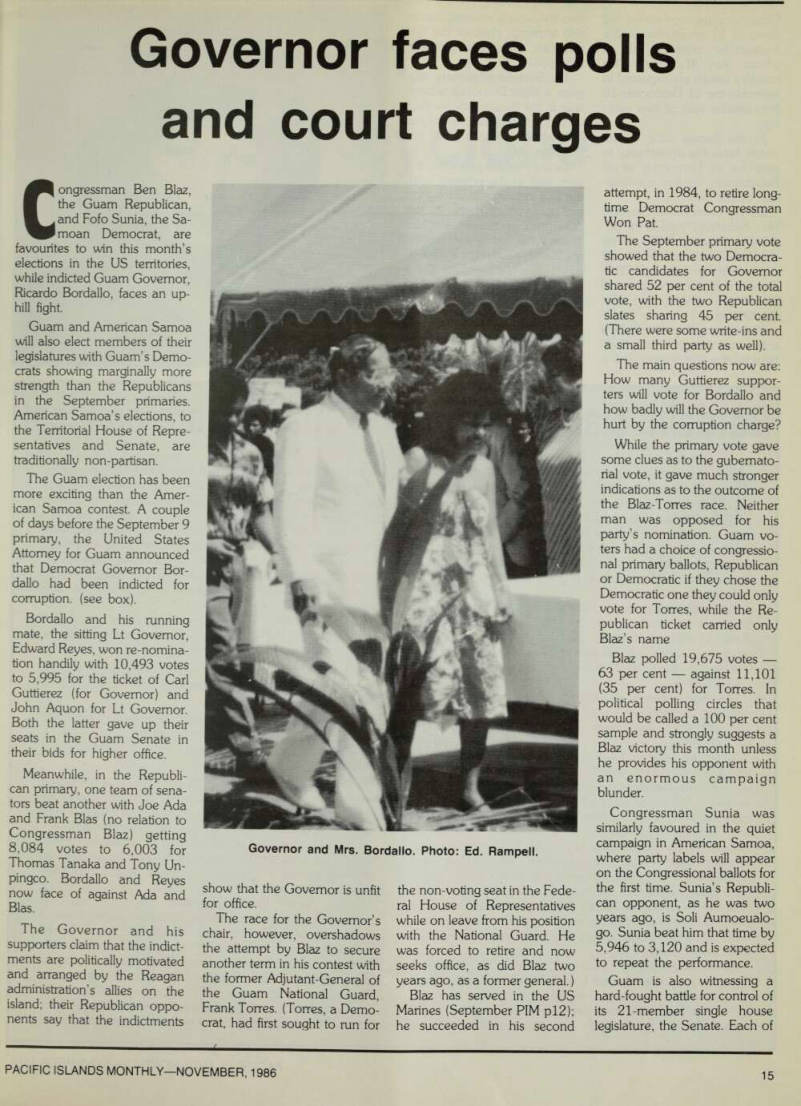
Governor and Mrs. Bordallo. Photo: Ed. Rampell.
Guam’s parties nominated full slates of 21 candidates in the September primary, all of whom run at large. This month’s results are expected to resemble the 11 Democrats-10 Republicans split of two years ago.
In the Senate race, Guam voters have the opportunity to vote for all Democrats or all Republicans, or any combination of the two.
Sitting Democratic Senator, Don Parkinson, topped the primary poll with 10,969 votes, closely followed on the Democratic side by Senators Elizabeth Arriola, Ted Nelson and Pilar Lujan, all with more than 10,000 votes.
The ranking Republican, by a substantial margin, was incumbent Marilyn Manibusan, who is
also the Senate minority leader and territorial chair of the Re publican Party. (September PIM pl 4) The September primary sug gests a slight Democrat advan tage in the Senate race their winning candidates averaged 8,284 votes against 7,538 for the Republicans, Guam’s female politicians did very well in the primary, with the four incumbents among the top six vote-catchers in the combined returns. Further down in the lists were newcom ers Martha Cruz Rath, a Repub lican, and Marcia Hartsock, a Democrat, both given a chance for success this month. from David S. North in Washington,
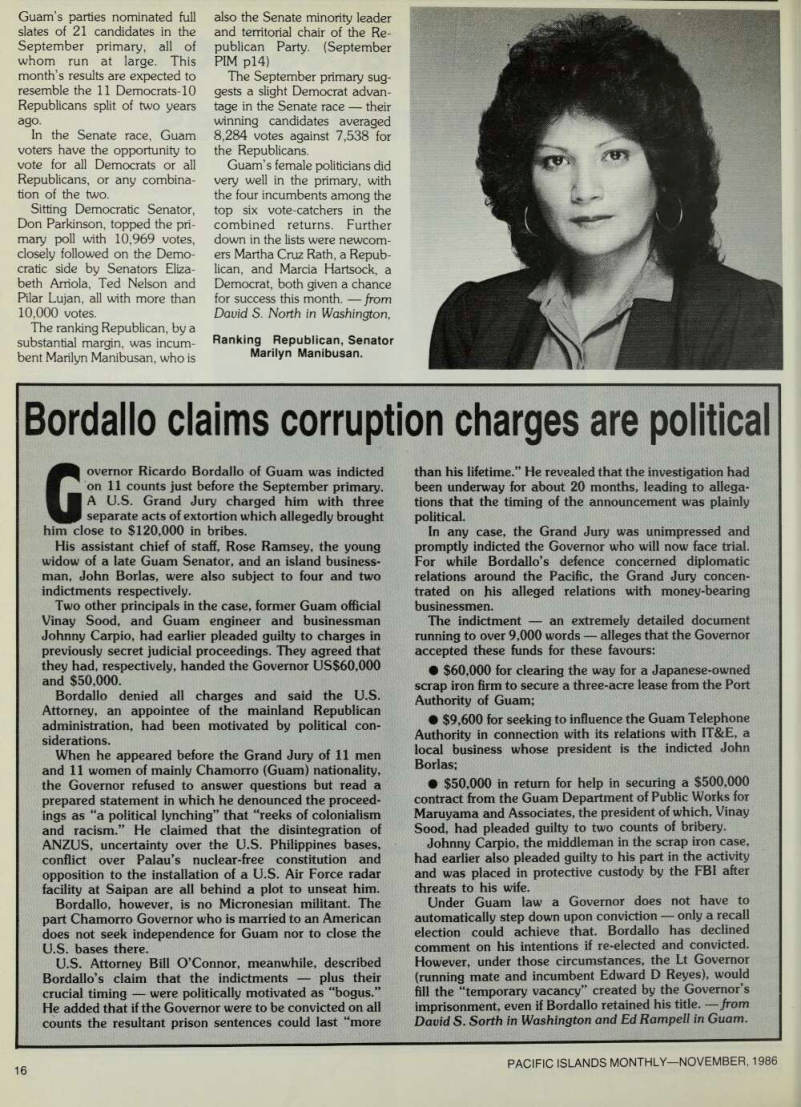
Ranking Republican, Senator Marilyn Manibusan.
Bordallo claims corruption charges are political
Governor Ricardo Bordallo of Guam was indicted on 11 counts just before the September primary.
A U.S. Grand Jury charged him with three separate acts of extortion which allegedly brought him close to $120,000 in bribes.
His assistant chief of staff. Rose Ramsey, the young widow of a late Guam Senator, and an island business man, John Borlas, were also subject to four and two indictments respectively.
Two other principals in the case, former Guam official Vinay Sood, and Guam engineer and businessman Johnny Carpio, had earlier pleaded guilty to charges in previously secret judicial proceedings. They agreed that they had, respectively, handed the Governor US$6O,OOO and $50,000.
Bordallo denied all charges and said the U.S.
Attorney, an appointee of the mainland Republican administration, had been motivated by political con siderations.
When he appeared before the Grand Jury of 11 men and 11 women of mainly Chamorro (Guam) nationality, the Governor refused to answer questions but read a prepared statement in which he denounced the proceed ings as “a political lynching” that “reeks of colonialism and racism.” He claimed that the disintegration of ANZUS, uncertainty over the U.S. Philippines bases, conflict over Palau’s nuclear-free constitution and opposition to the installation of a U.S. Air Force radar facility at Saipan cure all behind a plot to unseat him.
Bordallo, however, is no Micronesian militant. The part Chamorro Governor who is married to an American does not seek independence for Guam nor to close the U.S. bases there.
U.S. Attorney Bill O’Connor, meanwhile, described Bordallo’s claim that the indictments plus their crucial timing were politically motivated as “bogus.”
He added that if the Governor were to be convicted on all counts the resultant prison sentences could last “more
than his lifetime.” He revealed that the investigation had been underway for about 20 months, leading to allega tions that the timing of the announcement was plainly political.
In any case, the Grand Jury was unimpressed and promptly indicted the Governor who will now face trial.
For while Bordallo’s defence concerned diplomatic relations around the Pacific, the Grand Jury concen trated on his alleged relations with money-bearing businessmen.
The indictment an extremely detailed document running to over 9,000 words alleges that the Governor accepted these funds for these favours: • $60,000 for clearing the way for a Japanese-owned scrap iron firm to secure a three-acre lease from the Port Authority of Guam; • $9,600 for seeking to influence the Guam Telephone Authority in connection with its relations with IT&E, a local business whose president is the indicted John Borlas; • $50,000 in return for help in securing a $500,000 contract from the Guam Department of Public Works for Maruyama and Associates, the president of which, Vinay Sood, had pleaded guilty to two counts of bribery.
Johnny Carpio, the middleman in the scrap iron case, had earlier also pleaded guilty to his part in the activity and was placed in protective custody by the FBI after threats to his wife.
Under Guam law a Governor does not have to automatically step down upon conviction only a recall election could achieve that. Bordallo has declined comment on his intentions if re-elected and convicted.
However, under those circumstances, the Lt Governor (running mate and incumbent Edward D Reyes), would fill the “temporary vacancy” created by the Governor’s imprisonment, even if Bordallo retained his title. —from David S. Sorth in Washington and Ed Rampell in Guam.
Night of
the cyclone
In late 1984 the 274-ton Government vessel Na Mataisau was converted to auxiliary sail on an experi mental fuel-saving study funded by the Asian Deve lopment Bank.
The project was supervised by a British firm of marine consultants, Mac Alister Elliott and Partners Ltd. In January, 1985 I arrived from England to complete the study by spending three months on the ship train ing the crew and collecting performance data.
After spending a few days making some modifications to the rig and getting to know the officers and crew the ship was ready for sea on January 16.
We were bound for the Lau Group with the prime minister Ratu Sir Kamisese Mara and a party of government officials as passengers, calling at Kambara, Lakemba, Thithia and Vanua Mbalavu.
On the morning of our de parture the weather forecast warned that cyclone Eric was 500 miles WNW of Nadi and moving towards the Fiji Group.
The cyclone’s position and pre dicted course were plotted on the chart and the master, Cap tain Roderick Maharak, noted suitable cyclone anchorages in the Lau Group but there was no suggestion of cancelling the voyage.
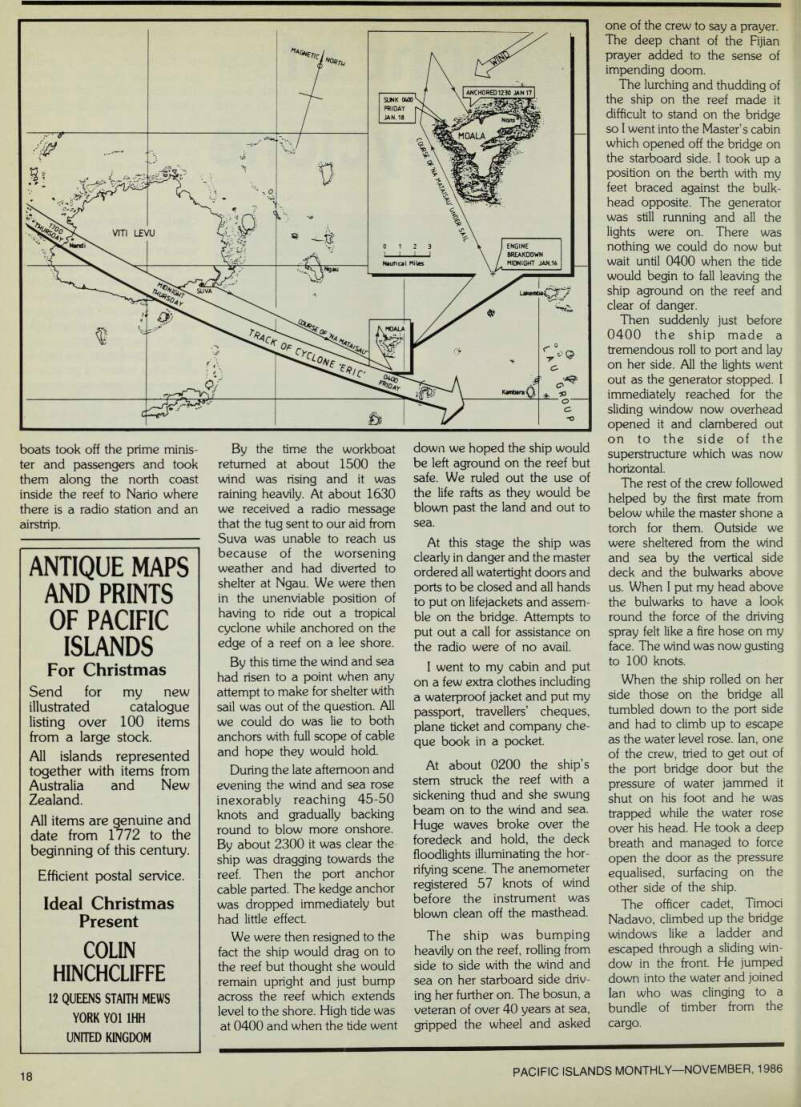
We left Suva at 1400 in a light south-easterly breeze via the Nukulau passage and set a course to pass south of the island of Moala on our way to Kambara.
Just after midnight, when we were about six miles south of Moala, the single main engine broke down. An exhaust valve had fallen inside a cylinder, causing extensive damage which could not be repaired.
By this time cyclone Eric was
The tragic loss of the Fiji government vessel Na Mataisau during cyclone Eric in 1984 with the loss of two lives could have been a worse disaster. The Prime Minister and his party were taken off the doomed vessel hours before the storm struck. CHRIS TEMPLE, who nearly became a victim in the tragedy, recalls that fearsome night.
clearly approaching the Fiji group and a cyclone warning wsa in force for the Western Division. As soon as it was clear the the engine could not be repaired the master requested a tug and a second ship to come from Suva to assist us and take off our 15 passengers.
In the meantime we had an alternative means of propulsion in the sails and two courses were open to us. We could either make our way under sail towards Suva and risk meeting the cyclone before we reached safety or make for Moala to land the prime minister and his party and hopefully reach the shelter of the main settlement at Naroi on the NE point of the island before the cyclone struck.
The latter course was de cided upon as offering the better prospect of safety for the ship, passengers and crew.
The ship sailed towards Moala making about five knots with the wind on the beam and by early morning we were off the west point of the island.
From here the course along the north coast to Naroi was much closer to the wind and progress was slow. To add to our difficul ties the wind changed direction forcing us to tack to windward to reach our objective.
The cyclone was now re ported to be 50 miles WNW off Nandi. By late morning it was clear we would not reach the safety of Naroi before the weather deteriorated and it was decided to anchor off the reef on the north coast of the island to land the prime minister and passengers. At 12.30 we came to anchor off the reef opposite the village of Maloku. The weather was still fine but the cyclone was fast approaching.
The workboat was launched and together with local fishing
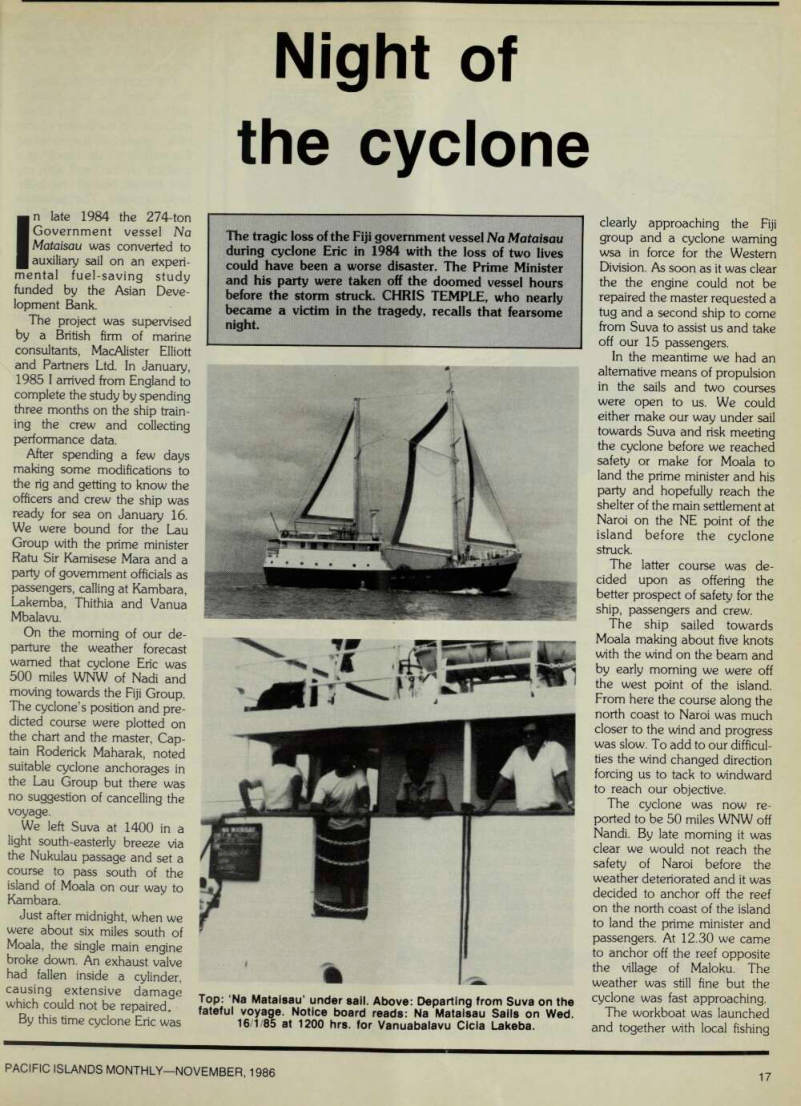
Top: Na Mataisau’ under sail. Above: Departing from Suva on the fateful voyage. Notice board reads: Na Mataisau Sails on Wed. 16/1/85 at 1200 hrs. for Vanuabalavu Cicia Lakeba.
boats took off the prime minister and passengers and took them along the north coast inside the reef to Nario where there is a radio station and an airstrip.
By the time the workboat returned at about 1500 the wind was rising and it was raining heavily. At about 1630 we received a radio message that the tug sent to our aid from Suva was unable to reach us because of the worsening weather and had diverted to shelter at Ngau. We were then in the unenviable position of having to ride out a tropical cyclone while anchored on the edge of a reef on a lee shore.
By this time the wind and sea had risen to a point when any attempt to make for shelter with sail was out of the question. All we could do was lie to both anchors with full scope of cable and hope they would hold.
During the late afternoon and evening the wind and sea rose inexorably reaching 45-50 knots and gradually backing round to blow more onshore.
By about 2300 it was clear the ship was dragging towards the reef. Then the port anchor cable parted. The kedge anchor was dropped immediately but had little effect.
We were then resigned to the fact the ship would drag on to the reef but thought she would remain upright and just bump across the reef which extends level to the shore. High tide was at 0400 and when the tide went
down we hoped the ship would be left aground on the reef but safe. We ruled out the use of the life rafts as they would be blown past the land and out to sea.
At this stage the ship was clearly in danger and the master ordered all watertight doors and ports to be closed and all hands to put on lifejackets and assem ble on the bridge. Attempts to put out a call for assistance on the radio were of no avail.
I went to my cabin and put on a few extra clothes including a waterproof jacket and put my passport, travellers’ cheques, plane ticket and company che que book in a pocket.
At about 0200 the ship’s stem struck the reef with a sickening thud and she swung beam on to the wind and sea.
Huge waves broke over the foredeck and hold, the deck floodlights illuminating the hor rifying scene. The anemometer registered 57 knots of wind before the instrument was blown clean off the masthead.
The ship was bumping heavily on the reef, rolling from side to side with the wind and sea on her starboard side driv ing her further on. The bosun, a veteran of over 40 years at sea, gripped the wheel and asked
one of the crew to say a prayer.
The deep chant of the Fijian prayer added to the sense of impending doom.
The lurching and thudding of the ship on the reef made it difficult to stand on the bridge so I went into the Master’s cabin which opened off the bridge on the starboard side. I took up a position on the berth with my feet braced against the bulk head opposite. The generator was still running and all the lights were on. There was nothing we could do now but wait until 0400 when the tide would begin to fall leaving the ship aground on the reef and clear of danger.
Then suddenly just before 0400 the ship made a tremendous roll to port and lay on her side. All the lights went out as the generator stopped. I immediately reached for the sliding window now overhead opened it and clambered out on to the side of the superstructure which was now horizontal.
The rest of the crew followed helped by the first mate from below while the master shone a torch for them. Outside we were sheltered from the wind and sea by the vertical side deck and the bulwarks above us. When I put my head above the bulwarks to have a look round the force of the driving spray felt like a fire hose on my face. The wind was now gusting to 100 knots.
When the ship rolled on her side those on the bridge all tumbled down to the port side and had to climb up to escape as the water level rose. lan, one of the crew, tried to get out of the port bridge door but the pressure of water jammed it shut on his foot and he was trapped while the water rose over his head. He took a deep breath and managed to force open the door as the pressure equalised, surfacing on the other side of the ship.
The officer cadet, Timoci Nadavo, climbed up the bridge windows like a ladder and escaped through a sliding win dow in the front. He jumped down into the water and joined lan who was clinging to a bundle of timber from the cargo.
Advertisements & other items, pp. 18-19 (1 item)
Antique Maps
AND PRINTS
OF PACIFIC
ISLANDS
For Christmas Send for my new illustrated catalogue listing over 100 items from a large stock.
All islands represented together with items from Australia and New Zealand.
All items are genuine and date from 1772 to the beginning of this century.
Efficient postal service.
Ideal Christmas Present
COLIN
HINCHCLIFFE
12 QUEENS STAITH MEWS
YORK YOIIHH
UNITED KINGDOM
Can you find the “P” in the symbol above? The drop of oil? The island? The sail of a Polynesian voyaging canoe? In it are all of these elements and more, because its the new corporate symbol for Pacific Resources, Inc.—the most dynamic and progressive energy company in the whole booming Pacific Basin. PRI is dedicated to American Samoa and the Pacific, helping to mold their economic destiny. We will continue to pioneer petroleum products, gas and alternative energies and to participate fully in community service activities. From now on when you see this symbol, we hope that’s what you’ll remember. PRI &
Powering the Pacific
PRI South Pacific, Inc. • A Company For more information, contact Rusty Betham in American Samoa at 633-5331.
Three seamen were below
when the ship rolled over.
Akapusi Lako was in the galley looking for some food and Jovilesi Matanisiga and Jonetarie Gu were on the steps leading down from the bridge to the lower deck. Lake managed to escape but the other two were *°^ ed - After a few minutes sitting on the side of the superstructure during which time the rest of the crew had just managed to escape through the window, I was engulfed by a torrent of water. At first 1 thought it was a huge wave breaking over the ship and I clung on to the rail to
prevent my being swept away.
However, it soon dawned on me I was going down with the ship so I let go and surfaced in raging seas in pitch darkness with no sign of the ship or her crew. I made out a small light and began to swim towards it calling out to make contact with an . y u° t J 6r s l V rviv ° rs - , . t .
I had swallowed quite a lot of water and was finding it difficult to keep my head above the breaking waves. Luckily the master was not far away and he called back and told me to swim towards the light. I made to wards the light which turned out to be a lifebuoy light held
up by one of the crew. When I reached it I found most of the survivors together clinging to various pieces of flotsam. With great relief I joined them, taking hold of a piece of deck grating, The confused breaking seas and torTentia] rain driven before , one made conditions difficult for survivors in the water but we attempted to make towards the shore which was illuminated by ii q htninq y The wind and sea gradually abated as dawn approached the first light found the exhausted survivors in a group
clinging to various bits of float ing wreckage. The second en gineer, Annais Wong, was hav ing great difficulty staying afloat until the others took off his overalls which were weighed down by the spanners and tools he had put in his pockets in case we needed to use the workboat.
The officer cadet Timoci was on a gas bottle, lan on a bundle of timber, the engineer cadet on the spare wheel from the prime minister’s Land Rover and others with hatch boards and gratings. I remarked to William Tigarea, with whom I was shar ing a deck grating, it looked just like a scene from a film. He replied, “No. Much worse. Film bullshit. This real.”
As we drew close to the shore at about 0600 punts appeared from the village of Maloku and rescued us. The Fijian crew showed their usual courtesy in refusing to be the first to be hauled out of the sea, deferring this privilege to the older and more exhausted men.
The villagers of Maloku showed us great hospitality, greeting us with dry clothes and a breakfast of lemon tea and doughnuts. We stayed as their guests for four days, sitting out a second cyclone, Nigel, in the safety of their homes on Satur day night until we were picked up by the government vessel Cagidonu on Monday morning.
When we were assembled ashore our fears were con firmed two of our shipmates had been lost. The five village punts searched the area of the wreck all day to no avail. No one will ever know why these two did not take their chance to escape when the ship rolled.
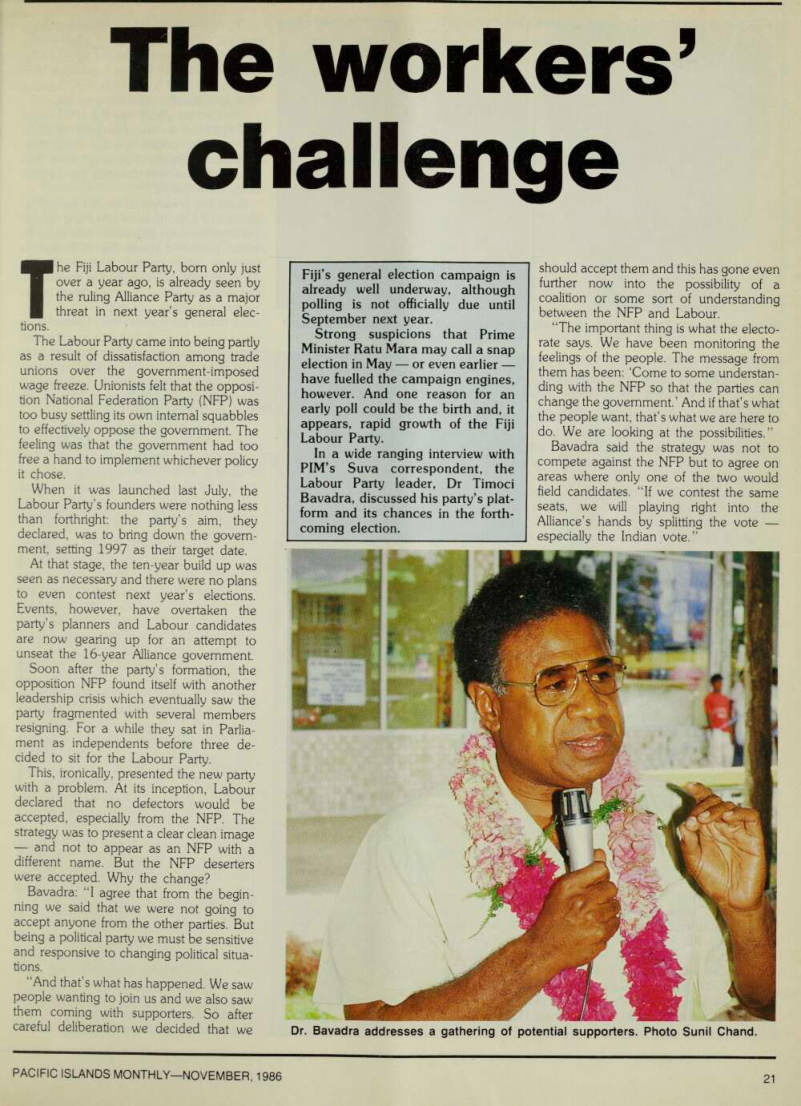
In daylight we could see the wreck lying upright in about 60 feet of water, the upper parts of the masts showing above the surface. She had bumped across the reef and fallen on her side into a deep narrow gulley off the west point of Moala, near the village of Nuku.
Though the ship was lost with the lives of two of her crew I fear if we had not been able to get to Moala under sail the chances of anyone surviving on the open sea in that cyclone would have been very slim indeed.
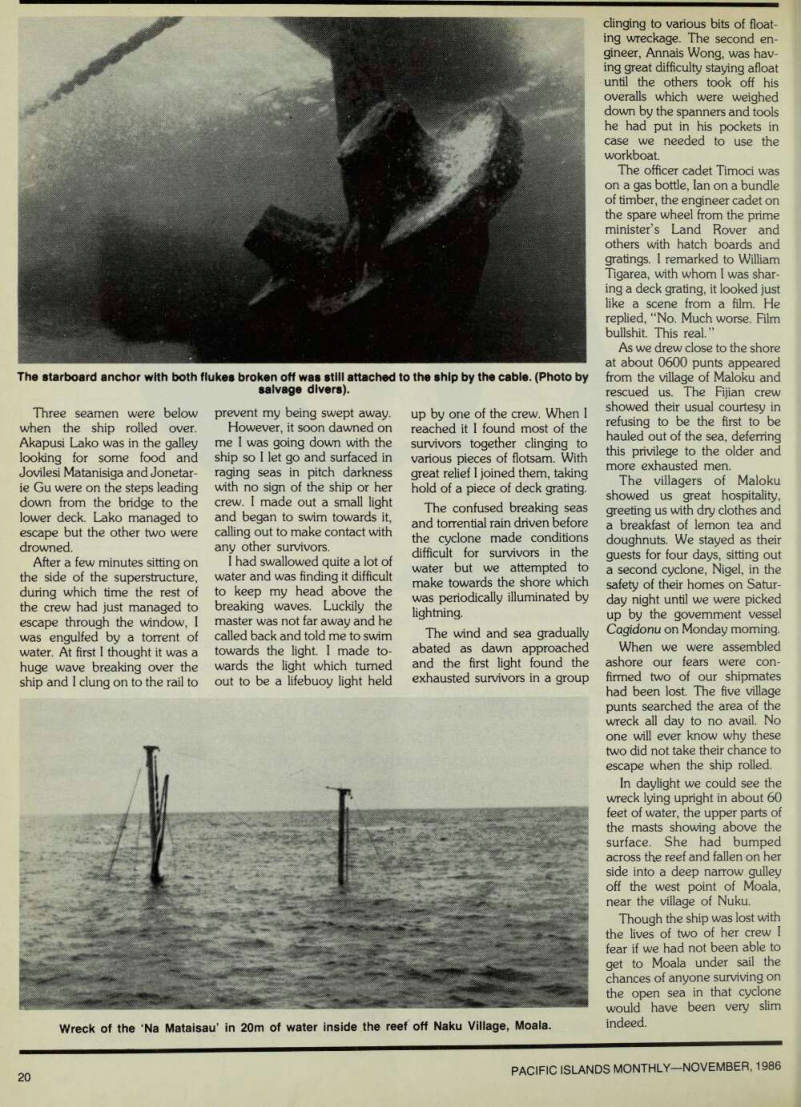
The starboard anchor with both flukes broken off was still attached to the ship by the cable. (Photo by salvage divers).
Wreck of the Na Mataisau’ in 20m of water inside the reef off Naku Village, Moala.
challenge

The workers’ challenge
The Fiji Labour Party, born only just over a year ago, is already seen by the ruling Alliance Party as a major threat in next year’s general elec tions.
The Labour Party came into being partly as a result of dissatisfaction among trade unions over the government-imposed wage freeze. Unionists felt that the opposi tion National Federation Party (NFP) was too busy settling its own internal squabbles to effectively oppose the government. The feeling was that the government had too free a hand to implement whichever policy it chose.
When it was launched last July, the Labour Party’s founders were nothing less than forthright: the party’s aim, they declared, was to bring down the govern ment, setting 1997 as their target date.
At that stage, the ten-year build up was seen as necessary and there were no plans to even contest next year’s elections.
Events, however, have overtaken the party’s planners and Labour candidates are now gearing up for an attempt to unseat the 16-year Alliance government.
Soon after the party’s formation, the opposition NFP found itself with another leadership crisis which eventually saw the party fragmented with several members resigning. For a while they sat in Parlia ment as independents before three de cided to sit for the Labour Party.
This, ironically, presented the new party with a problem. At its inception, Labour declared that no defectors would be accepted, especially from the NFP. The strategy was to present a clear clean image and not to appear as an NFP with a different name. But the NFP deserters were accepted. Why the change?
Bavadra: “I agree that from the begin ning we said that we were not going to accept anyone from the other parties. But being a political party we must be sensitive and responsive to changing political situa tions.
“And that’s what has happened. We saw people wanting to join us and we also saw them coming with supporters. So after careful deliberation we decided that we
Fiji’s general election campaign is already well underway, although polling is not officially due until September next year.
Strong suspicions that Prime Minister Ratu Mara may call a snap election in May or even earlier have fuelled the campaign engines, however. And one reason for an early poll could be the birth and, it appears, rapid growth of the Fiji Labour Party.
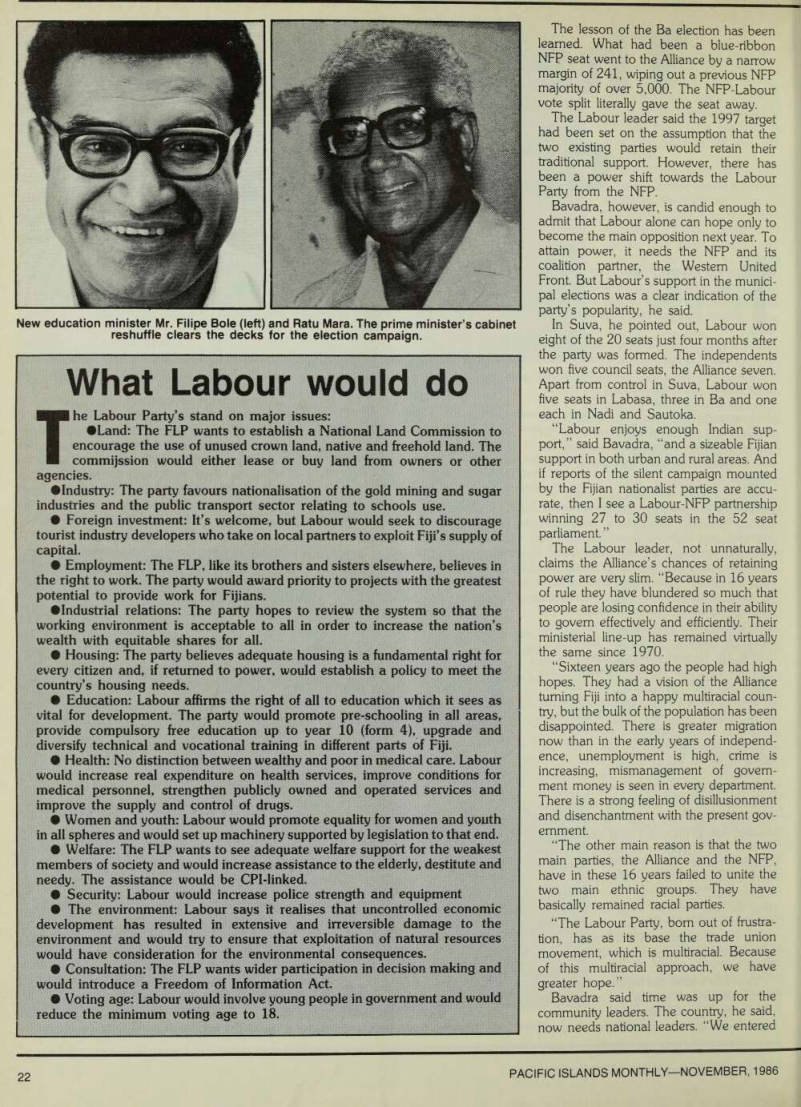
In a wide ranging interview with PlM’s Suva correspondent, the Labour Party leader, Dr Timoci Bavadra, discussed his party’s plat form and its chances in the forth coming election.
should accept them and this has gone even further now into the possibility of a coalition or some sort of understanding between the NFP and Labour.
“The important thing is what the electo rate says. We have been monitoring the feelings of the people. The message from them has been: ‘Come to some understan ding with the NFP so that the parties can change the government.’ And if that’s what the people want, that’s what we are here to do. We are looking at the possibilities.”
Bavadra said the strategy was not to compete against the NFP but to agree on areas where only one of the two would field candidates. “If we contest the same seats, we will playing right into the Alliance’s hands by splitting the vote especially the Indian vote.”
Dr. Bavadra addresses a gathering of potential supporters. Photo Sunil Chand.
The lesson of the Ba election has been learned. What had been a blue-ribbon NFP seat went to the Alliance by a narrow margin of 241, wiping out a previous NFP majority of over 5,000. The NFP-Labour vote split literally gave the seat away.
The Labour leader said the 1997 target had been set on the assumption that the two existing parties would retain their traditional support. However, there has been a power shift towards the Labour Party from the NFP.
Bavadra, however, is candid enough to admit that Labour alone can hope only to become the main opposition next year. To attain power, it needs the NFP and its coalition partner, the Western United Front. But Labour’s support in the munici pal elections was a clear indication of the party’s popularity, he said.
In Suva, he pointed out, Labour won eight of the 20 seats just four months after the party was formed. The independents won five council seats, the Alliance seven.
Apart from control in Suva, Labour won five seats in Labasa, three in Ba and one each in Nadi and Sautoka.
“Labour enjoys enough Indian sup port,” said Bavadra, “and a sizeable Fijian support in both urban and rural areas. And if reports of the silent campaign mounted by the Fijian nationalist parties are accu rate, then I see a Labour-NFP partnership winning 27 to 30 seats in the 52 seat parliament. ”
The Labour leader, not unnaturally, claims the Alliance’s chances of retaining power are very slim. “Because in 16 years of rule they have blundered so much that people are losing confidence in their ability to govern effectively and efficiently. Their ministerial line-up has remained virtually the same since 1970.
“Sixteen years ago the people had high hopes. They had a vision of the Alliance turning Fiji into a happy multiracial coun try, but the bulk of the population has been disappointed. There is greater migration now than in the early years of independ ence, unemployment is high, crime is increasing, mismanagement of govern ment money is seen in every department.
There is a strong feeling of disillusionment and disenchantment with the present gov ernment.
“The other main reason is that the two main parties, the Alliance and the NFP, have in these 16 years failed to unite the two main ethnic groups. They have basically remained racial parties.
“The Labour Party, bom out of frustra tion, has as its base the trade union movement, which is multiracial. Because of this multiracial approach, we have greater hope.”
Bavadra said time was up for the community leaders. The country, he said, now needs national leaders. “We entered
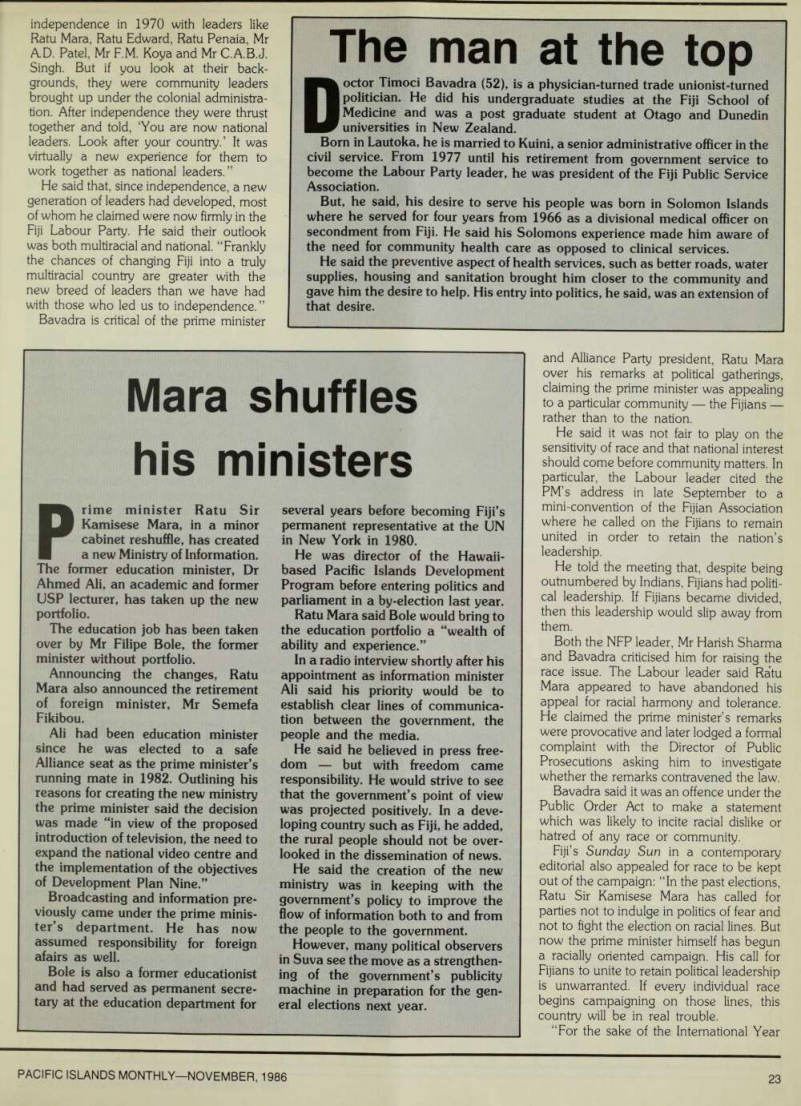
New education minister Mr. Filipe Bole (left) and Ratu Mara. The prime minister’s cabinet reshuffle clears the decks for the election campaign.
independence in 1970 with leaders like Ratu Mara, Ratu Edward, Ratu Penaia, Mr AD. Patel, Mr F.M. Koya and Mr C.A.B.J.
Singh. But if you look at their back grounds, they were community leaders brought up under the colonial administra tion. After independence they were thrust together and told, ‘You are now national leaders. Look after your country.’ It was virtually a new experience for them to work together as national leaders.”
He said that, since independence, a new generation of leaders had developed, most of whom he claimed were now firmly in the Fiji Labour Party. He said their outlook was both multiracial and national. “Frankly the chances of changing Fiji into a truly multiracial country are greater with the new breed of leaders than we have had with those who led us to independence. ”
Bavadra is critical of the prime minister
and Alliance Party president, Ratu Mara over his remarks at political gatherings, claiming the prime minister was appealing to a particular community the Fijians rather than to the nation.
He said it was not fair to play on the sensitivity of race and that national interest should come before community matters. In particular, the Labour leader cited the PM’s address in late September to a mini-convention of the Fijian Association where he called on the Fijians to remain united in order to retain the nation’s leadership.
He told the meeting that, despite being outnumbered by Indians, Fijians had politi cal leadership. If Fijians became divided, then this leadership would slip away from them.
Both the NFP leader, Mr Harish Sharma and Bavadra criticised him for raising the race issue. The Labour leader said Ratu Mara appeared to have abandoned his appeal for racial harmony and tolerance.
He claimed the prime minister’s remarks were provocative and later lodged a formal complaint with the Director of Public Prosecutions asking him to investigate whether the remarks contravened the law.
Bavadra said it was an offence under the Public Order Act to make a statement which was likely to incite racial dislike or hatred of any race or community.
Fiji’s Sunday Sun in a contemporary editorial also appealed for race to be kept out of the campaign; “In the past elections, Ratu Sir Kamisese Mara has called for parties not to indulge in politics of fear and not to fight the election on racial lines. But now the prime minister himself has begun a racially oriented campaign. His call for Fijians to unite to retain political leadership is unwarranted. If every individual race begins campaigning on those lines, this country will be in real trouble.
“For the sake of the International Year
of Peace, political leaders, especially the prime minister, would do well to keep race out of it.”
Bavadra claimed the prime minister’s speech was an indication that the Alliance Party was worried. “In the beginning when the Labour Party was formed, he de scribed it as ‘balolo’ (a sea delicacy that rises once a year and then disappears) but we have proved him wrong.”
For the first time, he said, many Fijians had learned the difference between traditional (chiefly) and political leadership.
“I have been able to explain to them their democratic right to chose the party and the man they want as far as politics is concerned, while at the same time retain ing their loyalty to their traditional chiefs. ”
But in the face of such strong attacks the Alliance Party has been far from idle. It has been preparing financially for the election through fund raising dinners and other activities. It already has $35,000 in de posits and needs about $200,000 to fund its campaign, whereas Labour estimates it will need over $300,000.
Political pundits in Fiji still put the Alliance Party ahead, seeing the NFP- Labour marriage of convenience as doubt ful in electoral terms.
Also, no other party has yet come up with a charismatic leader of the stature both physical and political of Ratu Mara.
Fiji Labour Party leader, Dr. Timoci Bavadra (left) consults with party and trade union official Mahendra Chaudhry during a rally at Ba. Photo: Sunil Chand.
What Labour would do
The Labour Party’s stand on major issues: •Land: The FLP wants to establish a National Land Commission to encourage the use of unused crown land, native and freehold land. The commijssion would either lease or buy land from owners or other agencies. •Industry: The party favours nationalisation of the gold mining and sugar industries and the public transport sector relating to schools use. • Foreign investment: It’s welcome, but Labour would seek to discourage tourist industry developers who take on local partners to exploit Fiji’s supply of capital. • Employment: The FLP, like its brothers and sisters elsewhere, believes in the right to work. The party would award priority to projects with the greatest potential to provide work for Fijians. •Industrial relations: The party hopes to review the system so that the working environment is acceptable to all in order to increase the nation’s wealth with equitable shares for all. • Housing: The party believes adequate housing is a fundamental right for every citizen and, if returned to power, would establish a policy to meet the country’s housing needs. • Education: Labour affirms the right of all to education which it sees as vital for development. The party would promote pre-schooling in all areas, provide compulsory free education up to year 10 (form 4), upgrade and diversify technical and vocational training in different parts of Fiji. • Health: No distinction between wealthy and poor in medical care. Labour would increase reed expenditure on health services, improve conditions for medical personnel, strengthen publicly owned and operated services and improve the supply and control of drugs. • Women and youth: Labour would promote equality for women and youth in all spheres and would set up machinery supported by legislation to that end. • Welfare: The FLP wants to see adequate welfare support for the weakest members of society and would increase assistance to the elderly, destitute and needy. The assistance would be CPI-linked. • Security: Labour would increase police strength and equipment • The environment: Labour says it realises that uncontrolled economic development has resulted in extensive and irreversible damage to the environment and would try to ensure that exploitation of natural resources would have consideration for the environmental consequences. • Consultation: The FLP wants wider participation in decision making and would introduce a Freedom of Information Act. • Voting age: Labour would involve young people in government and would reduce the minimum voting age to 18.
The man at the too
Doctor Timoci Bavadra (52), is a physician-turned trade unionist-turned politician. He did his undergraduate studies at the Fiji School of Medicine and was a post graduate student at Otago and Dunedin universities in New Zealand.
Born in Lautoka, he is married to Kuini, a senior administrative officer in the civil service. From 1977 until his retirement from government service to become the Labour Party leader, he was president of the Fiji Public Service Association.
But, he said, his desire to serve his people was born in Solomon Islands where he served for four years from 1966 as a divisional medical officer on secondment from Fiji. He said his Solomons experience made him aware of the need for community health care as opposed to clinical services.
He said the preventive aspect of health services, such as better roads, water supplies, housing and sanitation brought him closer to the community and gave him the desire to help. His entry into politics, he said, was an extension of that desire.
Mara shuffles
his ministers
Prime minister Ratu Sir Kamisese Mara, in a minor cabinet reshuffle, has created a new Ministry of Information.
The former education minister. Dr Ahmed Ali, an academic and former USP lecturer, has taken up the new portfolio.
The education job has been taken over by Mr Filipe Bole, the former minister without portfolio.
Announcing the changes, Ratu Mara also announced the retirement of foreign minister, Mr Semefa Fikibou.
Ali had been education minister since he was elected to a safe Alliance seat as the prime minister’s running mate in 1982. Outlining his reasons for creating the new ministry the prime minister said the decision was made “in view of the proposed introduction of television, the need to expand the national video centre and the implementation of the objectives of Development Plan Nine.”
Broadcasting and information previously came under the prime minister s department. He has now assumed responsibility for foreign afairs as well.
Bole is also a former educationist and had served as permanent secretary at the education department for
several years before becoming Fiji’s permanent representative at the UN in New York in 1980.
He was director of the Hawaii based Pacific Islands Development Program before entering politics and parliament in a by-election last year.
Ratu Mara said Bole would bring to the education portfolio a “wealth of ability and experience.”
In a radio interview shortly after his appointment as information minister AJi said his priority would be to establish clear lines of communica tion between the government, the people and the media.
He said he believed in press free dom but with freedom came responsibility. He would strive to see that the government’s point of view was projected positively. In a deve loping country such as Fiji, he added, the rural people should not be over looked in the dissemination of news.
He said the creation of the new ministry was in keeping with the government’s policy to improve the flow of information both to and from the people to the government.
However, many political observers in Suva see the move as a strengthen ing of the government’s publicity machine in preparation for the gen eral elections next year.
Advertisements & other items, p. 24 (1 item)
The Total Test Equipment Solution
AWA
I marconifc instruments r Tektronix r mam o ** ' W:*P S#* % • I jr Q
FLUKE
HITACHI
AWA TEST EQUIPMENT
With AWA, your problem of finding the right test equipment is solved. We have the widest possible range of
Court decision
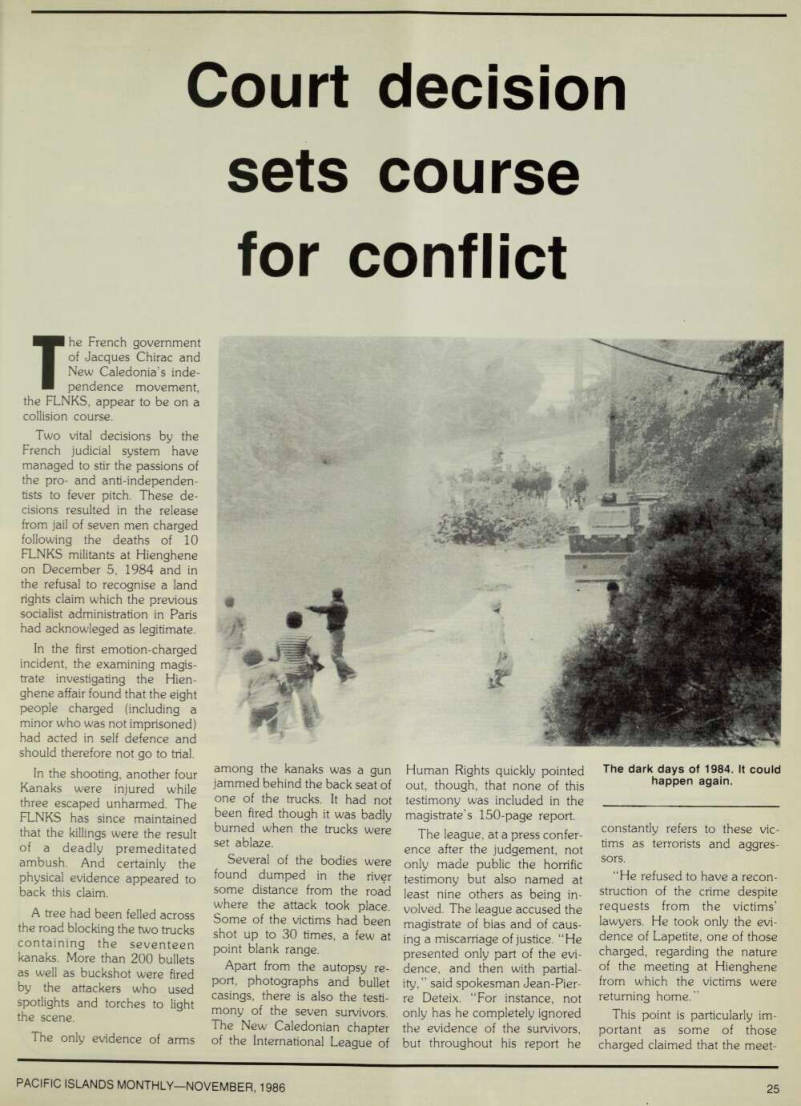

sets course for conflict
The French government of Jacques Chirac and New Caledonia’s inde pendence movement, the FLNKS, appear to be on a collision course.
Two vital decisions by the French judicial system have managed to stir the passions of the pro- and anti-independen tists to fever pitch. These de cisions resulted in the release from jail of seven men charged following the deaths of 10 FLNKS militants at Hienghene on December 5, 1984 and in the refusal to recognise a land rights claim which the previous socialist administration in Paris had acknowleged as legitimate.
In the first emotion-charged incident, the examining magis trate investigating the Hien ghene affair found that the eight people charged (including a minor who was not imprisoned) had acted in self defence and should therefore not go to trial.
In the shooting, another four Kanaks were injured while three escaped unharmed. The FLNKS has since maintained that the killings were the result of a deadly premeditated ambush. And certainly the physical evidence appeared to back this claim.
A tree had been felled across the road blocking the two trucks containing the seventeen kanaks. More than 200 bullets as well as buckshot were fired by the attackers who used spotlights and torches to light the scene.
The only evidence of arms
among the kanaks was a gun jammed behind the back seat of one of the trucks. It had not been fired though it was badly burned when the trucks were set ablaze.
Several of the bodies were found dumped in the river some distance from the road where the attack took place.
Some of the victims had been shot up to 30 times, a few at point blank range.
Apart from the autopsy re port, photographs and bullet casings, there is also the testi mony of the seven survivors.
The New Caledonian chapter of the International League of
Human Rights quickly pointed out, though, that none of this testimony was included in the magistrate’s 150-page report.
The league, at a press confer ence after the judgement, not only made public the horrific testimony but also named at least nine others as being in volved. The league accused the magistrate of bias and of caus ing a miscarriage of justice. “He presented only part of the evi dence, and then with partial ity,” said spokesman Jean-Pier re Deteix. “For instance, not only has he completely ignored the evidence of the survivors, but throughout his report he
constantly refers to these vic tims as terrorists and aggres sors.
“He refused to have a recon struction of the crime despite requests from the victims’ lawyers. He took only the evi dence of Lapetite, one of those charged, regarding the nature of the meeting at Hienghene from which the victims were returning home.”
This point is particularly im portant as some of those charged claimed that the meet
The dark days of 1984. It could happen again.
ing, which they had not attended, resolved to chase all of the whites out of the Hien ghene valley. Survivors’ accounts as well as those of many others claimed the meet ing was held to explain a decision, announced in Noumea the day before by FLNKS leader, Jean-Marie Tjibaou, to end all disruptions around the territory resulting from the boycott of the Novem ber 18 elections. The barriers at Hienghene had already been lifted.
“The magistrate didn’t men tion either that the kanaks had also suffered because of the political unrest,” said Deteix, “that terrified women and chil dren from a village near Hien ghene had slept in the bush for several nights after being told that the militia of Lafleur (the territory’s right-wing strong man) were going to descend on their village.”
The league, along with the Comite Pierre Declercq an FLNKS support group named after a murdered independence leader demanded that those charged over the Hienghene killings be brought to trial, that the examining magistrate be removed from all cases invol ving independence supporters and returned to France and that all FLNKS political prisoners be freed. They also announced their intention to alert Amnesty International, the International League of Human Rights and the European Commission of Human Rights.
By presenting their case to the international community and maintaining calm through
out the territory the front is obviously hoping to beat France at its own game. The movement is convinced that the Chirac regime is deliberately seeking to provoke a violent reaction. France has been placed in the hot seat at the current session of the UN Gen eral Assembly by the South Pacific Forum and the Non aligned Movement which have strongly supported New Cale donia’s reinscription with the UN decolonisation committee.
It is, the front argues, perhaps in France’s interest to be able to paint the front as a terrorist movement in order to justify its continued presence in New Caledonia.
The front cites, as further evidence of provocation, the
land rights decision. The ad ministration has moved to in stall a French loyalist on proper ty which the previous Paris government had agreed should be returned to the kanaks.
But by keeping its militants under control, the front has, to some extent, succeeded in pin ning the aggressor’s tag on France. It remains to be seen whether the front can maintain this position. The next potential test was seen as the appeal against the Hien-ghene judge ment, due to be heard at the beginning of this month.
That appeal was to decide whether the eight charged with murder, attempted murder and wilfull injury will go to trial.
Sue Williams.
a likely prospect
Oil men survey a likely prospect
What may be the world’s biggest recent oil find is being outlined in the lagifu field in PNG’s Southern Highlands. The excitement is already being felt in Australian sharemar kets where there has been strong upward pressure on the stock of the partners in PPL 17, the lease that covers this field.
Interest is centred on lagifu 3, the well which confirmed the width of the field and yielded flow rates of up to 4,000 barrels per day. Estimates of the size of the field now go as high as 500 million barrels. Further discoveries are also expected in the region with as many as ten other large formations listed for drilling.
The huge prospects of the area, regarded as an extension of similar oil producing zones in neighbouring Indonesia, are illus trated by activity at the drillsite following the initial discovery. Things looked impor tant enough for senior executives of the senior American partner Gulf Oil to fly over the remote area seeking possible pipeline routes.
Also, the huge platform carried on drilling and found further reserves, this time gas. And if there is a second, deeper oil reserve, the economic viability of the field will be substantially upgraded.
Denis Reinhardt.
Advertisements & other items, pp. 26-27 (2 items)
Correspondents
WANTED
Lt. Col. Lew Scott, USAF Retired, would like to correspond with anyone interested, any subject, any country, with or without stamps exchange. I answer all letters.
Write to me at 305 Caliente Drive, San Leandro, CA 94578,
USA.
Metropolitan Drilling And Blasting (Fiji) Ltd.
We do all Drilling, Blasting and Rock works throughout the South Pacific.
Former Contractors for the Vaturu Dam and the Queens Road, Viti Levu, Fiji Machinery; 850 Compressor ECM 350 Track Drills Portable Gear All equipment is available for hire with an experienced operator, and all jobs insured for Public Liability P.O. Box 27, Pacific Harbour, Deuba, Fiji Phone: Fiji 45338, Telex: FJ3251
Wjfewm :
AF BS
F BS
Digital Director
Compact Disc digital audio has sparked a revolution in the world of music enjoyment. That’s why AIWA the Digital Director, the audio system that looks, feels, and sounds like no other system in the world.
A New Look
It’s precisely as wide as the two cassette mechanisms of its advanced Dolby* B/C double cassette deck with auto reverse.
The system unit has a sparkling mirrorized finish, with tastefully muted operation indicator lights shining from behind. And, the attractively angled AFBS speakers deliver better sound dispersion.
_T| COMPACT
q3o§qb
A New Feel
Immediately striking is the total system remote control keyboard.
Its easily operated function buttons are color coded for each source, allowing total system operation from your favorite position. Controls used less frequently are placed behind two swinqdown panels on the system unit. ‘Dolby and the double-D symbol are trademarks of Dolby Laboratories Licensing Corporation. ■Steel pipe shown is for display purposes only, and is not included.
DIGITAL AUDIO
A New Sound
To the incredible dynamics and fidelity of Compact Disc, the Digital Director adds AlWA’s exclusive AFBS speakers for powerful bass and highly accurate digital sound reproduction. Plus, built-in Surround Sound circuitry delivers exciting multi-dimensional high fidelity with optional Surround speakers.
AlWA’s VX-C27 Digital Director for a
New Sound Experience
AIWA
Mwesby, S pTpi?a^w'^uin^PHONE S ?^Ti C /Ti!f «^Mn^r^ 1 U * tra l'fw 2^r\ A D PHONE: (597) 2388/oceania lnde "« Agency (P.N.G.) Pty., Ltd. Ago St., Gordon Box 5518, Boroko, Port OidcniiiM t i, ... .P. 25641 1/The Sound Centre Ltd. P.O. Box 434 Port Vila. Vanuatu PHONE: 2035/P. Haronvlnri Bros 190 RernA/irk Rnarl P O Rnv 4Qn Rnua Pin Pi-inMP- -24350/Milaw Tradina Co Ltd 994 V™ wTh*™ r V Box 434 Port Vila - Vanuatu PHONE: 2035/P. Hargovlnd Bros. 190 Renwick Road P.O. Box 490 Suva Fiji PHONE: Harvest Paritir i imLno A S l r ® et ’ PO . Box 59 1 9 ; Auckland, New Zealand PHONE; (09) 399-175/Hifivox 79, rue de Sebastopol, Noumea, New Caledonia PHONE: 27.24.66/ P .0™ Bc> x^^f7 BAgana 8 Q ua m St ® reo Ru - du „ M are_chal Foch- p .O. Box 269, Papeete, Tahiti PHONE: 2-4814/Micropac Audio, Inc. n_
Burns, Philp may
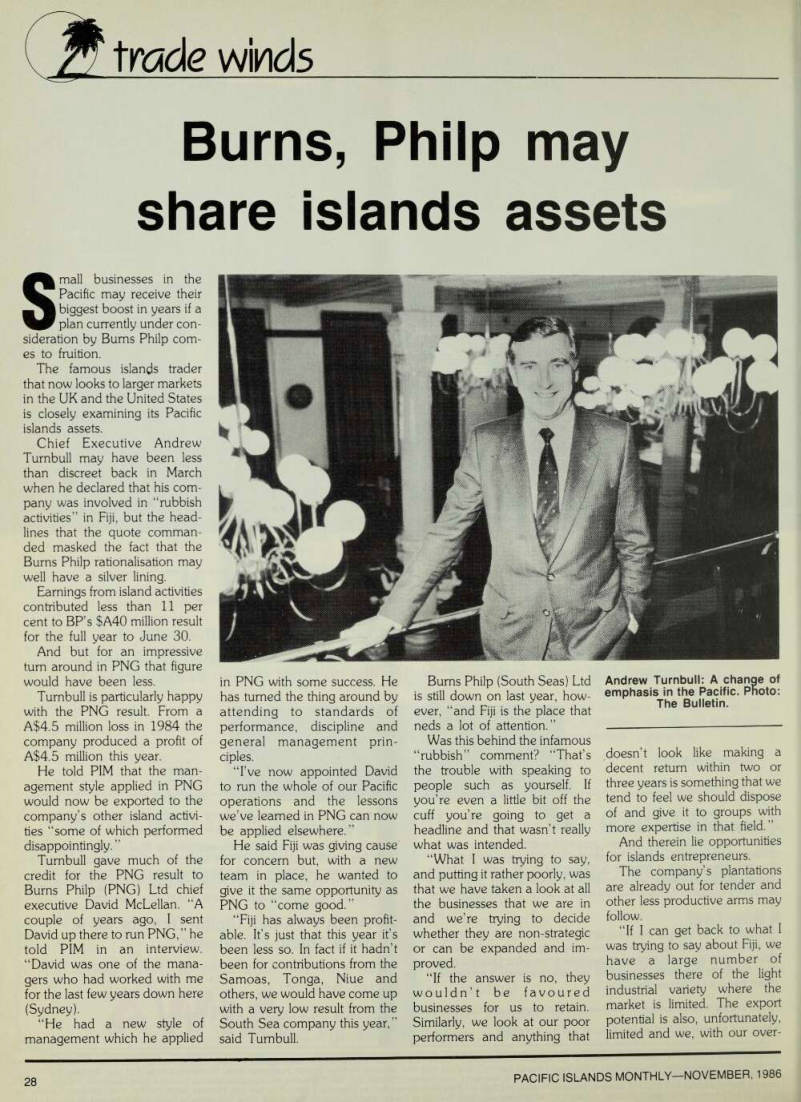
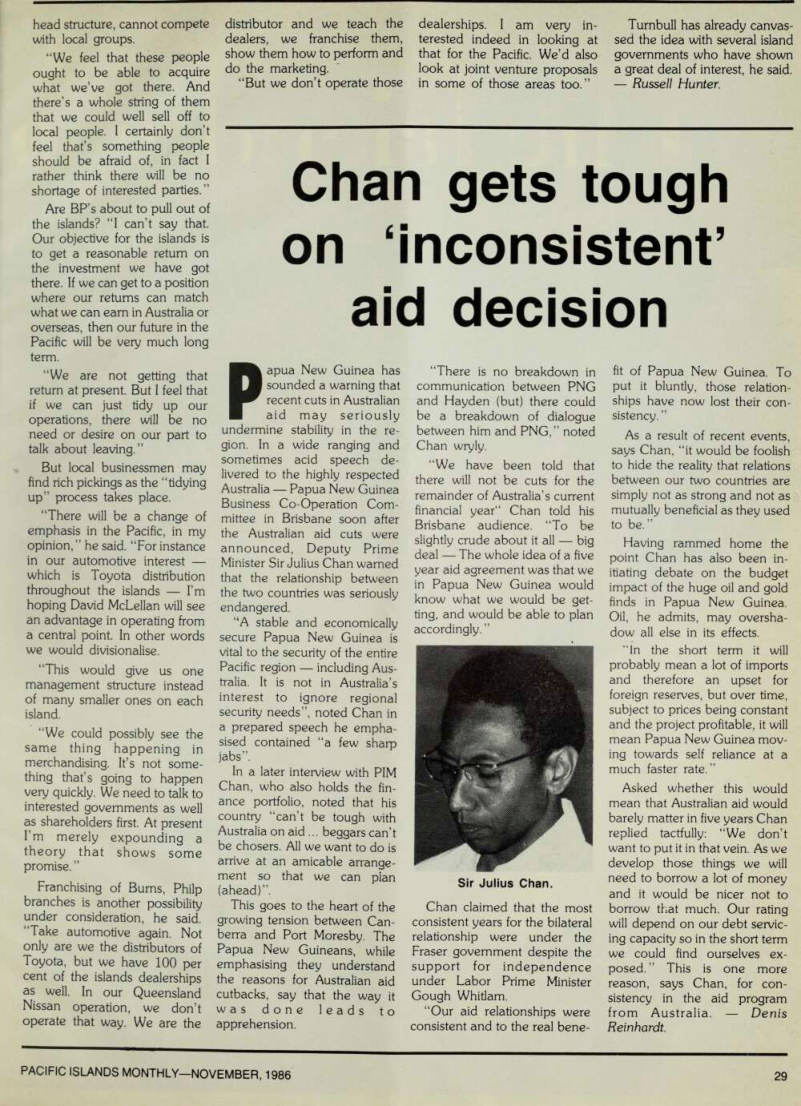
trade winds
Burns, Philp may share islands assets
Small businesses in the Pacific may receive their biggest boost in years if a plan currently under con sideration by Bums Philp com es to fruition.
The famous islands trader that now looks to larger markets in the UK and the United States is closely examining its Pacific islands assets.
Chief Executive Andrew Turnbull may have been less than discreet back in March when he declared that his com pany was involved in “rubbish activities” in Fiji, but the head lines that the quote comman ded masked the fact that the Burns Philp rationalisation may well have a silver lining.
Earnings from island activities contributed less than 11 per cent to BP’s SA4O million result for the full year to June 30.
And but for an impressive turn around in PNG that figure would have been less.
Turnbull is particularly happy with the PNG result. From a A 54.5 million loss in 1984 the company produced a profit of A 54.5 million this year.
He told PIM that the man agement style applied in PNG would now be exported to the company’s other island activi ties “some of which performed disappointingly.”
Turnbull gave much of the credit for the PNG result to Burns Philp (PNG) Ltd chief executive David McLellan. “A couple of years ago, I sent David up there to run PNG,” he told PIM in an interview.
“David was one of the mana gers who had worked with me for the last few years down here
(Sydney).
“He had a new style of management which he applied
in PNG with some success. He has turned the thing around by attending to standards of performance, discipline and general management prin ciples.
“I’ve now appointed David to run the whole of our Pacific operations and the lessons we’ve learned in PNG can now be applied elsewhere.”
He said Fiji was giving cause for concern but, with a new team in place, he wanted to give it the same opportunity as PNG to “come good.”
“Fiji has always been profit able. It’s just that this year it’s been less so. In fact if it hadn’t been for contributions from the Samoas, Tonga, Niue and others, we would have come up with a very low result from the South Sea company this year,” said Turnbull.
Burns Philp (South Seas) Ltd is still down on last year, how ever, “and Fiji is the place that neds a lot of attention.”
Was this behind the infamous “rubbish” comment? “That’s the trouble with speaking to people such as yourself. If you’re even a little bit off the cuff you’re going to get a headline and that wasn’t really what was intended.
“What I was trying to say, and putting it rather poorly, was that we have taken a look at all the businesses that we are in and we’re trying to decide whether they are non-strategic or can be expanded and im proved.
“If the answer is no, they wouldn’t be favoured businesses for us to retain.
Similarly, we look at our poor performers and anything that
doesn’t look like making a decent return within two or three years is something that we tend to feel we should dispose of and give it to groups with more expertise in that field.”
And therein lie opportunities for islands entrepreneurs.
The company’s plantations are already out for tender and other less productive arms may follow.
“If I can get back to what I was trying to say about Fiji, we have a large number of businesses there of the light industrial variety where the market is limited. The export potential is also, unfortunately, limited and we, with our over
Andrew Turnbull: A change of emphasis in the Pacific. Pnoto: The Bulletin.
head structure, cannot compete with local groups.
“We feel that these people ought to be able to acquire what we’ve got there. And there’s a whole string of them that we could well sell off to local people. I certainly don’t feel that’s something people should be afraid of, in fact I rather think there will be no shortage of interested parties.”
Are BP’s about to pull out of the islands? “I can’t say that.
Our objective for the islands is to get a reasonable return on the investment we have got there. If we can get to a position where our returns can match what we can earn in Australia or overseas, then our future in the Pacific will be very much long term.
“We are not getting that return at present. But I feel that if we can just tidy up our operations, there will be no need or desire on our part to talk about leaving.”
But local businessmen may find rich pickings as the “tidying up” process takes place.
“There will be a change of emphasis in the Pacific, in my opinion,” he said. “For instance in our automotive interest which is Toyota distribution throughout the islands I’m hoping David McLellan will see an advantage in operating from a central point. In other words we would divisionalise.
“This would give us one management structure instead of many smaller ones on each island.
“We could possibly see the same thing happening in merchandising. It’s not some thing that’s going to happen very quickly. We need to talk to interested governments as well as shareholders first. At present I’m merely expounding a theory that shows some promise. ”
Franchising of Bums, Philp
branches is another possibility under consideration, he said.
“Take automotive again. Not only are we the distributors of Toyota, but we have 100 per cent of the islands dealerships as well. In our Queensland Nissan operation, we don’t operate that way. We are the
distributor and we teach the dealers, we franchise them, show them how to perform and do the marketing.
“But we don’t operate those
dealerships. I am very in terested indeed in looking at that for the Pacific. We’d also look at joint venture proposals in some of those areas too.”
Turnbull has already canvas sed the idea with several island governments who have shown a great deal of interest, he said.
Russell Hunter.
Chan gets tough
on ‘inconsistent’ aid decision
Papua New Guinea has sounded a warning that recent cuts in Australian aid may seriously undermine stability in the re gion. In a wide ranging and sometimes acid speech de livered to the highly respected Australia Papua New Guinea Business Co-Operation Com mittee in Brisbane soon after the Australian aid cuts were announced, Deputy Prime Minister Sir Julius Chan warned that the relationship between the two countries was seriously endangered.
“A stable and economically secure Papua New Guinea is vital to the security of the entire Pacific region including Aus tralia. It is not in Australia’s interest to ignore regional security needs”, noted Chan in a prepared speech he empha sised contained “a few sharp jabs”.
In a later interview with PIM Chan, who also holds the fin ance portfolio, noted that his country “can’t be tough with Australia on aid ... beggars can’t be chosers. All we want to do is arrive at an amicable arrange ment so that we can plan (ahead)”.
This goes to the heart of the growing tension between Can berra and Port Moresby. The Papua New Guineans, while emphasising they understand the reasons for Australian aid cutbacks, say that the way it was done leads to apprehension.
“There is no breakdown in communication between PNG and Hayden (but) there could be a breakdown of dialogue between him and PNG,” noted Chan wryly.
“We have been told that there will not be cuts for the remainder of Australia’s current financial year“ Chan told his Brisbane audience. “To be slightly crude about it all big deal The whole idea of a five year aid agreement was that we in Papua New Guinea would know what we would be get ting, and would be able to plan accordingly.”
Chan claimed that the most consistent years for the bilateral relationship were under the Fraser government despite the support for independence under Labor Prime Minister Gough Whitlam.
“Our aid relationships were consistent and to the real bene
fit of Papua New Guinea. To put it bluntly, those relation ships have now lost their con sistency. ”
As a result of recent events, says Chan, “it would be foolish to hide the reality that relations between our two countries are simply not as strong and not as mutually beneficial as they used to be.”
Having rammed home the point Chan has also been in itiating debate on the budget impact of the huge oil and gold finds in Papua New Guinea.
Oil, he admits, may oversha dow all else in its effects.
“In the short term it will probably mean a lot of imports and therefore an upset for foreign reserves, but over time, subject to prices being constant and the project profitable, it will mean Papua New Guinea mov ing towards self reliance at a much faster rate.”
Asked whether this would mean that Australian aid would barely matter in five years Chan replied tactfully; “We don’t want to put it in that vein. As we develop those things we will need to borrow a lot of money and it would be nicer not to borrow that much. Our rating will depend on our debt servic ing capacity so in the short term we could find ourselves ex posed. ” This is one more reason, says Chan, for con sistency in the aid program
from Australia.
Reinhardt.
Denis
Sir Julius Chan.
Advertisements & other items, pp. 30-31 (1 item)
e men
Tk
m m mmmm V m % * as s I ■ .
e o
f tke isl
e islands
d % ■ I It’s always there on board our rainbow in the sky.
You’ll be made to feel right at home because you’ll be flying with people you know. Fly with us soon, around the Pacific and enjoy the new feel of our airline.
Call your travel agent or Air Pacific... the friendly face of the islands.
ntanc
FIJI'S INTERNATIONAL AIRLINE
garment makers
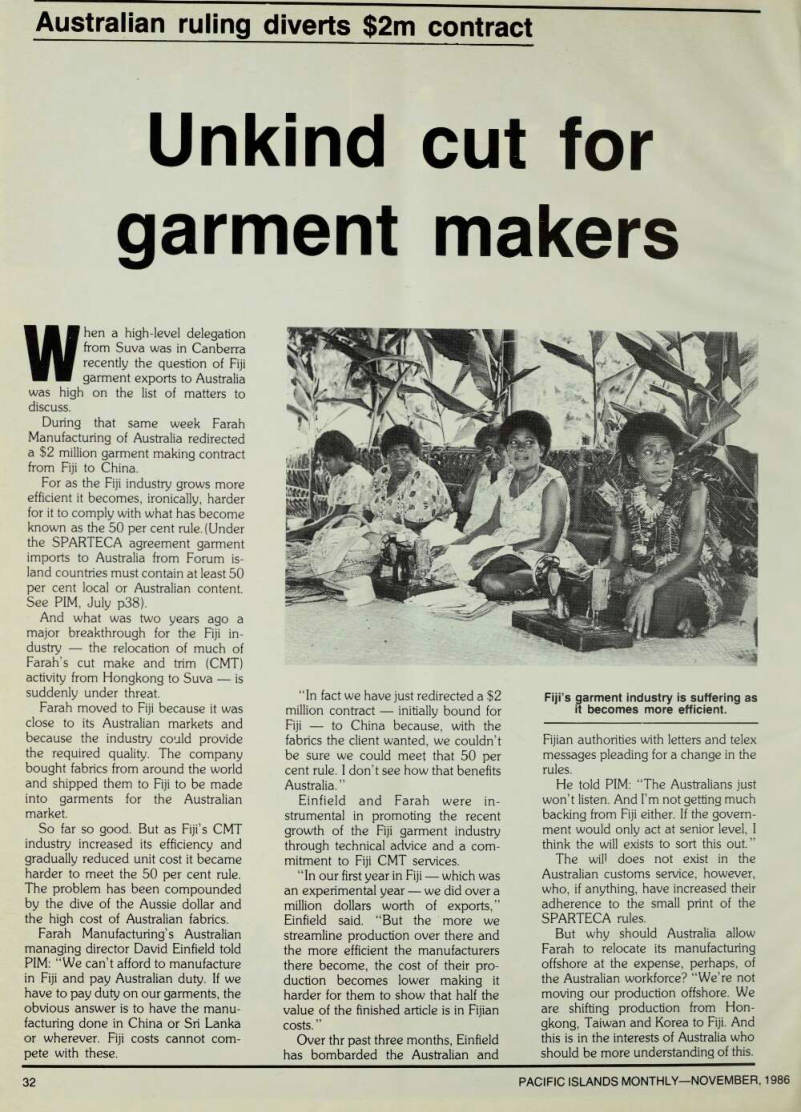
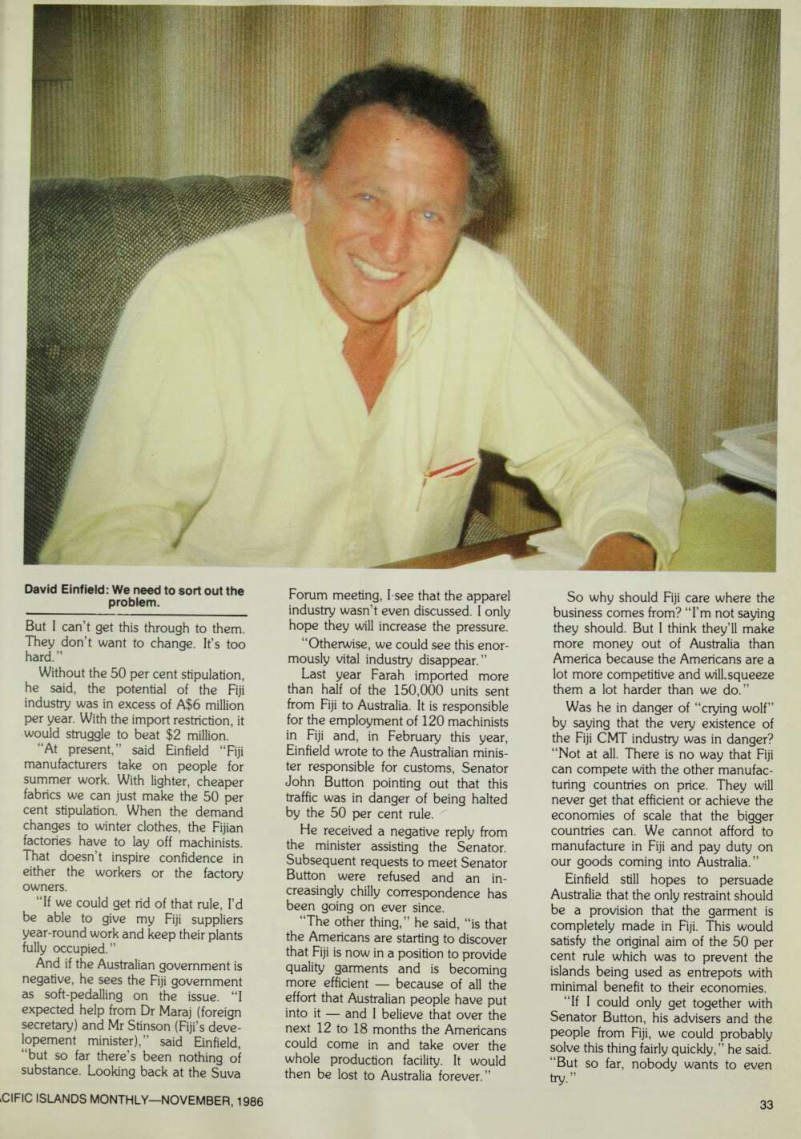
Australian ruling diverts s2m contract
Unkind cut for garment makers
When a high-level delegation from Suva was in Canberra recently the question of Fiji garment exports to Australia was high on the list of matters to discuss.
During that same week Farah Manufacturing of Australia redirected a $2 million garment making contract from Fiji to China.
For as the Fiji industry grows more efficient it becomes, ironically, harder for it to comply with what has become known as the 50 per cent rule. (Under the SPARTECA agreement garment imports to Australia from Forum is land countries must contain at least 50 per cent local or Australian content.
See PIM, July p3B).
And what was two years ago a major breakthrough for the Fiji in dustry the relocation of much of Farah’s cut make and trim (CMT) activity from Hongkong to Suva is suddenly under threat.
Farah moved to Fiji because it was close to its Australian markets and because the industry could provide the required quality. The company bought fabrics from around the world and shipped them to Fiji to be made into garments for the Australian market.
So far so good. But as Fiji’s CMT industry increased its efficiency and gradually reduced unit cost it became harder to meet the 50 per cent rule.
The problem has been compounded by the dive of the Aussie dollar and the high cost of Australian fabrics.
Farah Manufacturing’s Australian managing director David Einfield told PIM; “We can’t afford to manufacture in Fiji and pay Australian duty. If we have to pay duty on our garments, the obvious answer is to have the manu facturing done in China or Sri Lanka or wherever. Fiji costs cannot com pete with these.
“In fact we have just redirected a $2 million contract initially bound for Fiji to China because, with the fabrics the client wanted, we couldn’t be sure we could meet that 50 per cent rule. I don’t see how that benefits Australia. ”
Einfield and Farah were in strumental in promoting the recent growth of the Fiji garment industry through technical advice and a com mitment to Fiji CMT services.
“In our first year in Fiji which was an experimental year we did over a million dollars worth of exports,”
Einfield said. “But the more we streamline production over there and the more efficient the manufacturers there become, the cost of their pro duction becomes lower making it harder for them to show that half the value of the finished article is in Fijian costs. ”
Over thr past three months, Einfield has bombarded the Australian and
Fijian authorities with letters and telex messages pleading for a change in the rules.
He told FIM: “The Australians just won’t listen. And I’m not getting much backing from Fiji either. If the govern ment would only act at senior level, I think the will exists to sort this out.”
The will does not exist in the Australian customs service, however, who, if anything, have increased their adherence to the small print of the SPARTECA rules.
But why should Australia allow Farah to relocate its manufacturing offshore at the expense, perhaps, of the Australian workforce? “We’re not moving our production offshore. We are shifting production from Hon gkong, Taiwan and Korea to Fiji. And this is in the interests of Australia who should be more understanding of this.
Fiji’s garment industry is suffering as it becomes more efficient.
But I can’t get this through to them.
They don’t want to change. It’s too hard.”
Without the 50 per cent stipulation, he said, the potential of the Fiji industry was in excess of As 6 million per year. With the import restriction, it would struggle to beat $2 million.
“At present,” said Einfield “Fiji manufacturers take on people for summer work. With lighter, cheaper fabrics we can just make the 50 per cent stipulation. When the demand changes to winter clothes, the Fijian factories have to lay off machinists.
That doesn’t inspire confidence in either the workers or the factory owners.
“If we could get rid of that rule, I’d be able to give my Fiji suppliers year-round work and keep their plants fully occupied.”
And if the Australian government is negative, he sees the Fiji government as soft-pedalling on the issue. “I expected help from Dr Maraj (foreign secretary) and Mr Stinson (Fiji’s deve jopement minister),” said Einfield, “but so far there’s been nothing of substance. Looking back at the Suva
Forum meeting, I see that the apparel industry wasn’t even discussed. I only hope they will increase the pressure.
“Otherwise, we could see this enor mously vital industry disappear.”
Last year Farah imported more than half of the 150,000 units sent from Fiji to Australia. It is responsible for the employment of 120 machinists in Fiji and, in February this year, Einfield wrote to the Australian minis ter responsible for customs, Senator John Button pointing out that this traffic was in danger of being halted by the 50 per cent rule.
He received a negative reply from the minister assisting the Senator.
Subsequent requests to meet Senator Button were refused and an in creasingly chilly correspondence has been going on ever since.
“The other thing,” he said, “is that the Americans are starting to discover that Fiji is now in a position to provide quality garments and is becoming more efficient because of all the effort that Australian people have put into it and I believe that over the next 12 to 18 months the Americans could come in and take over the whole production facility. It would then be lost to Australia forever.”
So why should Fiji care where the business comes from? “I’m not saying they should. But I think they’ll make more money out of Australia than America because the Americans are a lot more competitive and will.squeeze them a lot harder than we do.”
Was he in danger of “crying wolf” by saying that the very existence of the Fiji CMT industry was in danger?
“Not at all. There is no way that Fiji can compete with the other manufac turing countries on price. They will never get that efficient or achieve the economies of scale that the bigger countries can. We cannot afford to manufacture in Fiji and pay duty on our goods coming into Australia.”
Einfield still hopes to persuade Australia that the only restraint should be a provision that the garment is completely made in Fiji. This would satisfy the original aim of the 50 per cent rule which was to prevent the islands being used as entrepots with minimal benefit to their economies.
“If I could only get together with Senator Button, his advisers and the people from Fiji, we could probably solve this thing fairly quickly,” he said.
“But so far, nobody wants to even try.”
David Einfield: We need to sort out the problem.
Advertisements & other items, p. 33 (1 item)
33
CIFIC ISLANDS MONTHLY—NOVEMBER, 1986
major export earner
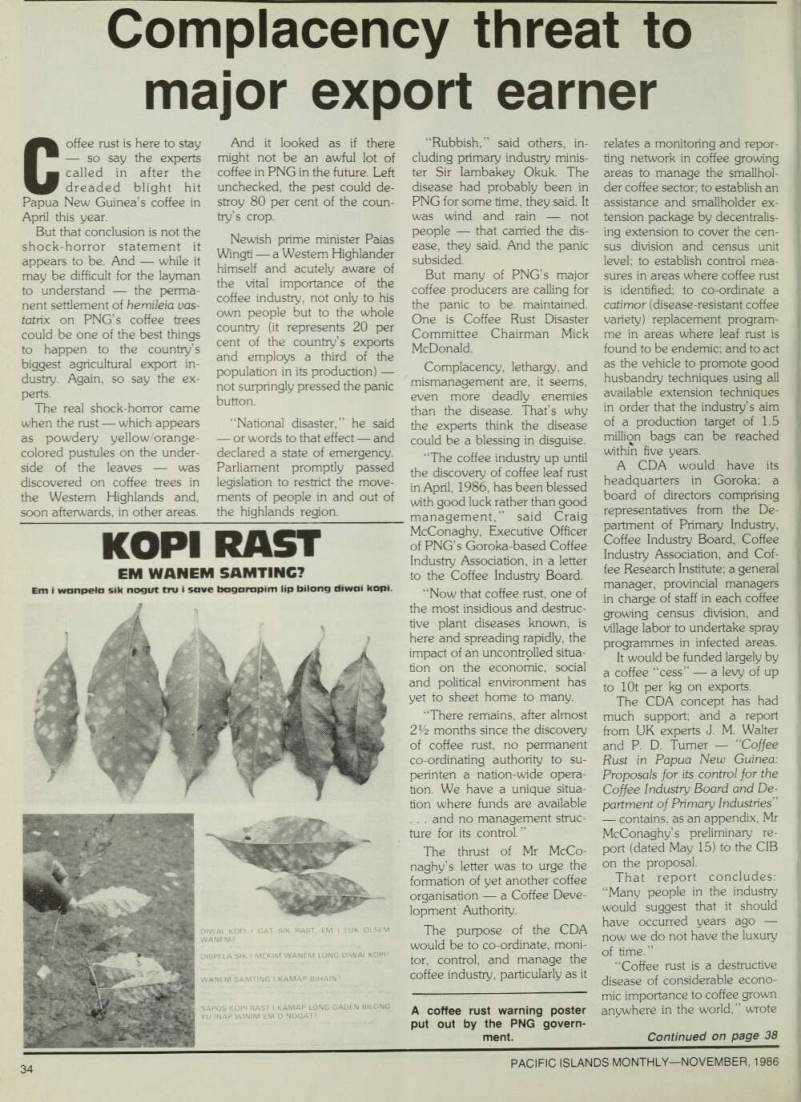


Complacency threat to major export earner
Coffee rust is here to stay so say the experts called in after the dreaded blight hit Papua New Guinea’s coffee in April this year.
But that conclusion is not the shock-horror statement it appears to be. And while it may be difficult for the layman to understand the perma nent settlement of hemileia uas tatrix on PNG’s coffee trees could be one of the best things to happen to the country’s biggest agricultural export in dustry. Again, so say the ex perts.
The real shock-horror came when the rust which appears as powdery yellow/orange colored pustules on the under side of the leaves was discovered on coffee trees in the Western Highlands and, soon afterwards, in other areas.
And it looked as if there might not be an awful lot of coffee in PNG in the future. Left unchecked, the pest could de stroy 80 per cent of the coun try’s crop.
Newish prime minister Paias Wingti a Western Highlander himself and acutely aware of the vital importance of the coffee industry, not only to his own people but to the whole country (it represents 20 per cent of the country’s exports and employs a third of the population in its production) not surpringly pressed the panic button.
“National disaster,” he said or words to that effect and declared a state of emergency.
Parliament promptly passed legislation to restrict the move ments of people in and out of the highlands region.
“Rubbish,” said others, in cluding primary industry minis ter Sir lambakey Okuk. The disease had probably been in PNG for some time, they said. It was wind and rain not people that carried the dis ease, they said. And the panic subsided.
But many of PNG’s major coffee producers are calling for the panic to be. maintained.
One is Coffee Rust Disaster Committee Chairman Mick McDonald.
Complacency, lethargy, and mismanagement are, it seems, even more deadly enemies than the disease. That’s why the experts think the disease could be a blessing in disguise.
“The coffee industry up until the discovery of coffee leaf rust in April, 1986, has been blessed with good luck rather than good management,” said Craig McConaghy, Executive Officer of PNG’s Goroka-based Coffee Industry Association, in a letter to the Coffee Industry Board.
“Now that coffee rust, one of the most insidious and destruc tive plant diseases known, is here and spreading rapidly, the impact of an uncontrolled situa tion on the economic, social and political environment has yet to sheet home to many.
“There remains, after almost 2Vfe months since the discovery of coffee rust, no permanent co-ordinating authority to su perinten a nation-wide opera tion. We have a unique situa tion where funds are available . . . and no management struc ture for its control.”
The thrust of Mr McCo naghy’s letter was to urge the formation of yet another coffee organisation a Coffee Deve lopment Authority.
The purpose of the CDA would be to co-ordinate, moni tor, control, and manage the coffee industry, particularly as it
relates a monitoring and repor ting network in coffee growing areas to manage the smallhol der coffee sector; to establish an assistance and smallholder ex tension package by decentralis ing extension to cover the cen sus division and census unit level; to establish control mea sures in areas where coffee rust is identified; to co-ordinate a catimor (disease-resistant coffee variety) replacement program me in areas where leaf rust is found to be endemic; and to act as the vehicle to promote good husbandry techniques using all available extension techniques in order that the industry’s aim of a production target of 1.5 million bags can be reached within five years.
A CDA would have its headquarters in Goroka; a board of directors comprising representatives from the De partment of Primary Industry, Coffee Industry Board, Coffee Industry Association, and Cof fee Research Institute; a general manager, provincial managers in charge of staff in each coffee growing census division, and village labor to undertake spray programmes in infected areas.
It would be funded largely by a coffee “cess” a levy of up to lOt per kg on exports.
The CDA concept has had much support: and a report from UK experts J. M. Walter and P. D. Turner “Coffee Rust in Papua New Guinea: Proposals for its control for the Coffee Industry Board and De partment of Primary Industries’’ contains, as an appendix, Mr McConaghy’s preliminary re port (dated May 15) to the CIB on the proposal.
That report concludes: “Many people in the industry would suggest that it should have occurred years ago now we do not have the luxury of time.”
“Coffee rust is a destructive disease of considerable econo mic importance to coffee grown anywhere in the world,” wrote
Continued on page 38
A coffee rust warning poster put out by the PNG govern ment.
Continued from page 34
, . KT i plant pathologist B. N. Muthap pa m volume 4 of the CRI publication PNG Coffee, in Ocotber 1985 - only months bef ° re Tf discovered m e G ighlands.
“Coffee rust has now been recorded in most of the coffee growing countries. Small out breaks of this disease have occurred on three occasions in Papua New Guinea. In each case, in 1892, 1903 and 1965, the disease was in an isolated area and it was successfully eradicated.
“Coffee in Papua New
Guinea is at present believed to be fr ee fr° m this devastating djsease if there is anothe = outbreak in futu quick action have to be taken to eradi . cate the disease on site - Walter and Turner, though, say that eradication, on a practi cal basis, is not only impossible, but unnecessary. On the other hand, they say that the advent of coffee rust makes it essential that the long-planned re habilitation programme begins at once, And economist Paul Bod man, in the July 1986 CIB Coffee Report, predicts that, within five years, there could be
a 50 per cent drop in smallhol der production in some areas if no effective extension is put in place.
Another factor supporting immediate action is the fear expressed at a May meeting of all sections of the Kainantu (E.
H. Province) community that, if rust is not identified in its early stages, coffee growers might be afraid to report an outbreak if it means that not only their own coffee but that of neighbours would be de stroyed, leading to possible re prisals and compensation claims.
The disease first observed in 1861 and believed to have originated in Ethiopia was recorded in Sri Lanka in 1868 and thereafter spread from country to country: India, Sumatra, Java, Fiji, the Philip pines, Tonkin, Borneo, Malaysia, PNG (the 1892, 1903 and 1965 outbreaks already mentioned), Samoa, Vanuatu, New Caledonia, Eastern China, Hainan, Natal, Mauritius, Re union, Madagascar, Tanzania, Kenya, Transvaal, Zimbabwe, Congo, Mozambique, Zanzibar, Cameroons, Ivory Coast, Dahomey, Sudan, Togoland, Brazil, Paraguay, Argentina, Nicaragua, Bolivia, Peru, El Salvador, Honduras, Guatema la, Mexico, Equador and Col ombia.
The disease has caused va rious degrees of damage to these countries’ economies, but none has been so severely affected as Sri Lanka where within five years of the discov ery of the disease coffee rust had spread throughout every plantation. They were soon abandoned. Could this happen in Papua New Guinea?
It has already been made clear to quote DPI economist Paul Barker that “coffee rust is a disease with which PNG will have to live.”
A levy is already being col lected on coffee exports in order to establish an effective disease control service.
The disease control program me which includes both control (on affected crops) and prophylactic (on disease-free crops) spraying is currently being administered by the DPI.
Coffee rehabilitation is being undertaken by smallholders on the advice of the DPI and sometimes by plantations or management agencies.
Coffee research is being undertaken by the DPI and the CRI. Quarantine is the re sponsibility of the DPI. Funding is provided by that levy and by the national and provincial gov ernments.
The disease will have no effect on the export earnings of July/September this year estimated at K 55 million, more than double the K 25.43 million for October/December 1985.
And total exports this year could exceed the 1983/84 fi gure of 952,000 bags.
Bui the CIB expects a drop in smallholder output next year the degree of that drop depen ding on the effectiveness of the control/extension service. With in five years, the situation unless controlled could bring about a 50 per cent drop in smallholder production. It took eight years to happen in Sri Lanka.
But possibly Sri Lankan plantations weren’t already suffering from years of neglect.
That’s what the Walter/Tumer report says is wrong with PNG’s coffee smallholdings.
“. . . 70 per cent or so of production is derived from plantings of over 200,000 small growers. Upkeep standards in these plantings . . . are often poor, creating conditions under which any attempted control would be very difficult or im possible ...”
The Walter/Turner report says: “It is also worth noting at the outset that the appearance of coffee rust (in other coun tries) has not been followed by a disastrous collapse of the coffee industry in the country concerned, except for the his torical Ceylon experience.
Given routine control mea sures, the pathogen can be controlled quite easily within acceptable limits.
“In fact, by necessitating the introduction of good agronomic standards as a factor in disease control, yields have actually increased. A similar phe nomenon could be expected in
Png.”
Jane Belfield
Advertisements & other items, pp. 35-37 (1 item)
Kenwood
V © A o o o o El 1
Spectrum si
Imm ■■■series ■ 1- Spectrum 1058 1250 W x 2 (Dynamic Power) power amplifier ■ Separate control amplifier with CD and Video selectors ■Automatic quartz-synthesizer tuning 820 random memory presets BTwice-a-day timer ■ Double auto-reverse cassette deck with relay-play and high-speed dubbing ■ Programmable linear-tracking direct-drive turntable B4OOW (max.) speakers ■ Options: CD player, graphic equalizer, surround processor, remote control, headphones, microphone
So nice to come home to
The Spectrum series are no ordinary stereo systems. For one thing, they offer you pure hi-fi sound.
For example, the Spectrum 1058 shown has professional separate power and control amplifiers. With its CD input selector, it’s ready to give you the full dynamic impact of digital sound! bpectrum 1058 also helps you enjoy your music. Look at the versatile double auto-reverse cassette deck, computerized automatic tuner and full remote controller and you will see what we mean.
No matter what the time of day, you’ll always be ready to come home to your Spectrum hi-fi stereo system.
KENWOOD CORPORATION
Shionogi Shibuya Building, 17-5, 2-chbme Shibuya, Shibuya-ku, Tokyo 150, Japan TRIOKENWOOD (AUSTRALIA) PTY. LTD. (incorporated in nsw) 4E Woodcock Place, Lane Cove, N.S.W. 2066, Australia NEW ZEALAND JOHN GILBERT & CO., LTD. Auckland Tel. 0011-64-9-30839 FUJI PEPE'S DUTY FREE CENTRE LTD. Tel. 25496, 25497 PAPUA NEW GUINEA SO. SVENSSON (N.G.) LTD. Port Moresby Tel. 212158, 212111 SOLOMON ISLANDS TECHNIQUE RADIOS CENTRE LTD. Honiara Tel. 416 NEW CALEDONIA HI-FI VOX Noumea Tel. 27-2466, 28-2931 VANUATU FUNG CHOI LUEN. Port-Vila Tel. 2556
TAHITI MAISON AURORE Papeete Tel. 29703
AMERICAN SAMOA ISLAND PACIFIC AGENCIES, INC. Pago Pago Tel. 633-4687
REPUBLIC OF NAURU NAURU CO-OPERATIVE SOCIETY
MARIANA ISLANDS JC. TENORIO ENTERPRISES Saipan Tel. 6445
Hugging, RocK-Bitmg, ra
\\VM ’ ' “ % «r p ■ 4^ I M V 4'^i < 1C w V HILUX 4WD Regular Cab, Long Wheelbase S&i .-• One tough truck just got tougher. Toyota’s dedication to superior performance vehicles takes a step forward today with the New Hilux A refined front grille and bumper design, new instrument panel for a feeling of spaciousness and command and plush colour co-ordinated trim are a few new additions to the New Hilux.
And extensive anti-corrosive galvanealed steel protection now includes the tailgate panel and rear door panel, making Hilux more durable than ever before.
Yet for all its improvements, the best of the original Hilux is also
TOYOTA
QUALITY SERVICE
AMERICAN SAMOA; BURNS PHILP (SOUTH SEA) CO., LTD,, P.O. Box 129 Pago PagtxCOOK ISLANDS; COOK ISLAM AUTOMOTIVE SUPPLIES COMPANY, A Division of Burns Philp (South Sea) Co., Ltd., 355, Suva GUAM & M c Tamuning. KIRIBATI; TARAWA MOTORS, A Division of Bairiki Holdings Ltd., P.O Box 36 Bairiki. Tarawa NAURU: NAUR SERVICE IMPORTATION AUTOMOBILE DU PACIFIQUE, Rond-Point du Pacifique (Station Total) B.P. 438, Noumea. NIUE. » NORFOLK ISLAND: BORRY’S LIMITED, P.O. Box 169. PAPUA NEW GUINEA: ELA MOTORS, A Division of Burns Phil| CORPORATION, P.O. Box 267, Saipan. SOLOMON ISLANDS: SOLOMON ISLANDS INVESTMENTS LTD.. G.P.O. Sox 174, J TONGA: BURNS PHILP (TONGA) LTD., P.O. Box 55, Nukualofa. VANUATU: VANUATU MOTORS, A Division of Burns Phup
-jougn. me new miux.
i- * V N I r : f * 4 I m 1 B 4 i-. * 1 e: a big tailgate conveniently hinged for quick loading and unloading; reinforced front suspension to smooth out bumps, and bias-mounted, extra-heavy-duty rear shocks and knobbly tyres to take on any terrain.
Toyota’s long history of super-responsive engines, ruggedness, reliability and comfort goes without saying. And in the Hilux, it’s yours in both 2-wheel-drive and 4X4 versions.
So, after comprehensive testing and thorough quality control, the New Hilux is ready to bring a new standard of toughness to the Pacific.
And isn’t that exactly what you expect from Toyota? *sf Areas where galvanealed steel is used MG CORPORATION LTD., Private Bag, Rarotonga. FIJI: \\ ATKINS KROLL, INC., 443 South Marine Drive, RATIVE SOCIETY, Central Pacific. NEW CALEDONIA: LP (SOUTH SEA) CO., LTD., P.O. Box 39, Alofi. d„ P.O. Box 75, Port Moresby. SAIPAN: MICROL
rAHITI; NIPPON AUTOMOTO, B.P. 342, Papeete
I Ltd., P.O. Box 18, Port Vila. WESTERN SAMOA:
TOYOTA
Okuk knocks back
new coffee body
PNG’s Primary Industry Minister, Sir lambakey Okuk, scrapped plans for a Coffee Development Authority. He said it would only duplicate services already provided by the government.
Sir lambakey said such a body would not overcome any shortcomings in the provision of extension services to smallholder growers.
“Creating another institution won’t in itself solve any problems,” he said. “It won’t overcome any lack of expert specialised services to smallholder growers.”
Instead, his department, the Coffee Board and provin cial governments would each sign a memo of understan ding that would bind all parties to a unified effort to control coffee rust and complete the rehabilitation of smallholdings in every coffee growing region of the country.
Meanwhile, coffee buyers in Australia, where PNG’s arabica commands some 30 per cent of the market (13,000 tonnes) by virtue of its quality, are following developments closely.
Arabica, of which PNG is the only major producing nation, is used mainly in the production of high quality whole roast beans sold as ground coffee for use in percolators, drip-filters and espresso machines.
It is less resistant to coffee rust than the more prolific Robusta variety used predominantly for instant coffee and for blending with Arabica.
It is because of its coffee rust-free status that PNG has become the prime Arabica producer.
Coffee buyer for the giant Nestle group in Australia, Mr Don Meade, told PIM: “Yes, we are following deve lopments in PNG. From our end, I think it’s clear there won’t be any discernible effect this season.
“As far as the future is concerned, the authorities there cure well aware of what needs to be done and have a ; spraying programme already underway as well as other measures.
“If they relax on that, it will probably overtake them. If they continue vigilant, it might even improve the crop.”
Advertisements & other items, p. 39 (1 item)
Cm) Pioneer
I I I FS X 770 X-110 Move up to New Personna Plus from Pioneer.
And put compact, advanced audio technology at your fingertips.
With the X-770, you’ll enjoy full-function remote control for amp, tuner, cassette deck, turntable, and even an optional CD player.
There’s Stereo Wide for expanded ambience from stereo signals plus Simulated Stereo for wide, stereo-like signals from even mono signals.
And for power, the X-770 puts out a full 320 W (PMPO) to give you a full,
high-fidelity sound.
The X-770 also brings you great features like Mic Mixing, Dolby* B/C NR, and a 5-band graphic equalizer. A double auto-reverse cassette deck offers added listening convenience and tape dubbing. Also available are the more economical Systems X-330 and X-110.
The New Personna Plus from Pioneer. A class act in home audio convenience and enjoyment.
X-330 * “Dolby" and the double-D symbol are trademarks of Dolby Laboratories Licensing Corporation.
Note: The optional PD-X707(8K) CD player is shown above.
CM) PIONEER
The future of sound and vision.
For further information, please contact: Australia; Pioneer Electronics Australia Pty. Ltd. (Incorporated in Victoria), P.O. Box 295, Mordialloc, Victoria, 3195 Tel; 580-9911 Fiji Islands: Brijlal & Company, G.P.O. Box No. 362, Suva, Fiji Islands Tel; 22258 New Zealand; Monaco Distributors Ltd., 2 Poland Road, Glenfield, Auckland New Zealand Tel: (09) 444-9144 Norfolk Island: Burns Philp (Norfolk Island) Ltd., P.O. Box 21, Norfolk Island Vanuatu: Burns Philp (Vanuatu) Ltd., Vila, Vanuatu Nauru Island: Jacob Enterprises, P.O. Box N 0.4, Republic of Nauru Tahiti; Tahiti Hi-Fi, P.O. Box 848, Papeete, Tahiti New Caledonia: Menard Pacifique Sari, B.P. 3899, Noumea, New Caledonia Tel: 27*62*23 American Samoa: Transpac Corporation, P.O. Box 1477, Pago Pago, American Samoa 96799 Tel: 633-5224 Rarotonga: South Seas International Ltd., P.O. Box 49, Rarotonga, Cook Islands Tel: 2327 Papua New Guinea: Bali Merchants Pty. Ltd., P.O. Box 6103, Boroko Tel: 254887
Reagan makes it legal:
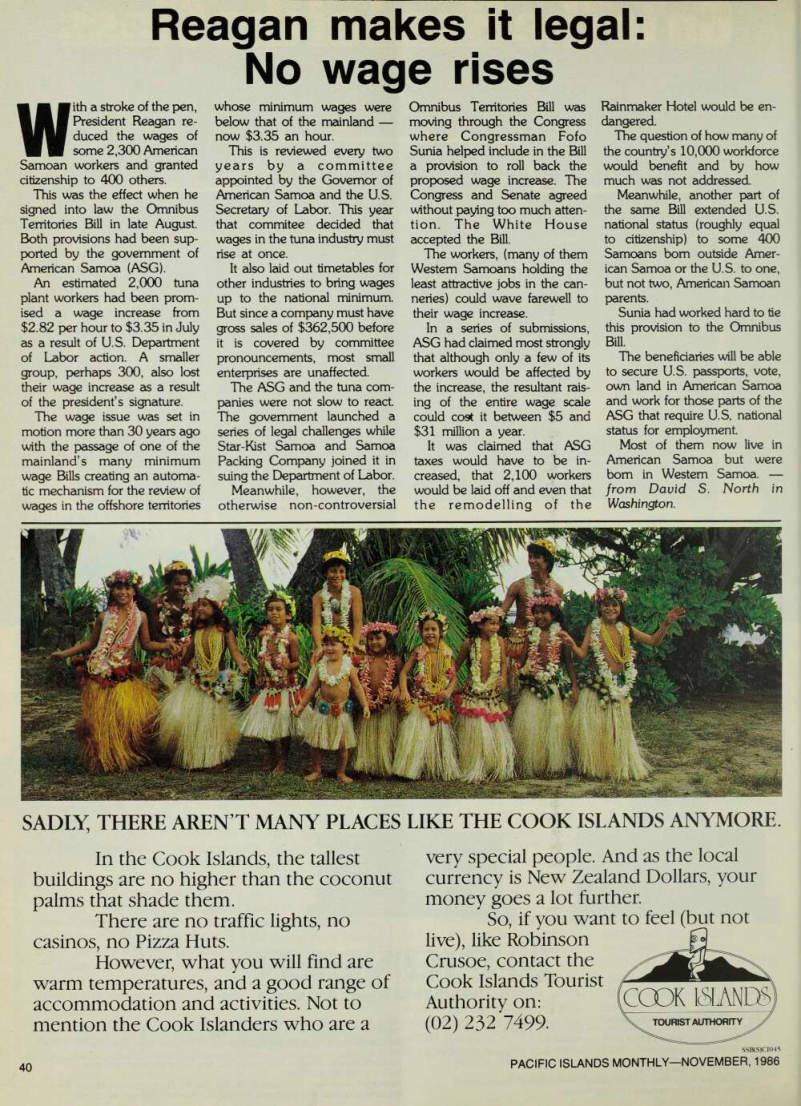
No wage rises
With a stroke of the pen, President Reagan re duced the wages of some 2,300 American Samoan workers and granted citizenship to 400 others.
This was the effect when he signed into law the Omnibus Territories Bill in late August.
Both provisions had been sup ported by the government of American Samoa (ASG).
An estimated 2,000 tuna plant workers had been prom ised a wage increase from $2.82 per hour to $3.35 in July as a result of U.S. Department of Labor action. A smaller group, perhaps 300, also lost their wage increase as a result of the president’s signature.
The wage issue was set in motion more than 30 years ago with the passage of one of the mainland’s many minimum wage Bills creating an automa tic mechanism for the review of wages in the offshore territories
whose minimum wages were below that of the mainland now $3.35 an hour.
This is reviewed every two years by a committee appointed by the Governor of American Samoa and the U.S.
Secretary of Labor. This year that commitee decided that wages in the tuna industry must rise at once.
It also laid out timetables for other industries to bring wages up to the national minimum.
But since a company must have gross sales of $362,500 before it is covered by committee pronouncements, most small enterprises are unaffected.
The ASG and the tuna com panies were not slow to react The government launched a series of legal challenges while Star-Kist Samoa and Samoa Packing Company joined it in suing the Department of Labor.
Meanwhile, however, the otherwise non-controversial
Omnibus Territories Bill was moving through the Congress where Congressman Fofo Sunia helped include in the Bill a provision to roll back the proposed wage increase. The Congress and Senate agreed without paying too much atten tion. The White House accepted the Bill.
The workers, (many of them Western Samoans holding the least attractive jobs in the can neries) could wave farewell to their wage increase.
In a series of submissions, ASG had claimed most strongly that although only a few of its workers would be affected by the increase, the resultant rais ing of the entire wage scale could cost it between $5 and $3l million a year.
It was claimed that ASG taxes would have to be in creased, that 2,100 workers would be laid off and even that the remodelling of the
Rainmaker Hotel would be en dangered.
The question of how many of the country’s 10,000 workforce would benefit and by how much was not addressed.
Meanwhile, another part of the same Bill extended U.S. national status (roughly equal to citizenship) to some 400 Samoans bom outside Amer ican Samoa or the U.S. to one, but not two, American Samoan parents.
Sunia had worked hard to tie this provision to the Omnibus Bill.
The beneficiaries will be able to secure U.S. passports, vote, own land in American Samoa and work for those parts of the ASG that require U.S, national status for employment.
Most of them now live in American Samoa but were bom in Western Samoa. from David S. North in Washington.
Advertisements & other items, p. 40 (1 item)
;Cook Kmnds
* »S‘ SADLY, THERE AREN’T MANY PLACES LIKE THE COOK ISLANDS ANYMORE.
In the Cook Islands, the tallest buildings are no higher than the coconut palms that shade them.
There are no traffic lights, no casinos, no Pizza Huts.
However, what you will find are warm temperatures, and a good range of accommodation and activities. Not to mention the Cook Islanders who are a very special people. And as the local currency is New Zealand Dollars, your money goes a lot further.
So, if you want to feel (but not live), like Robinson Crusoe, contact the Cook Islands Tourist Authority on: (02) 232 7499.
;COOK kMNDS
TOURIST AUTHORITY
With Progress
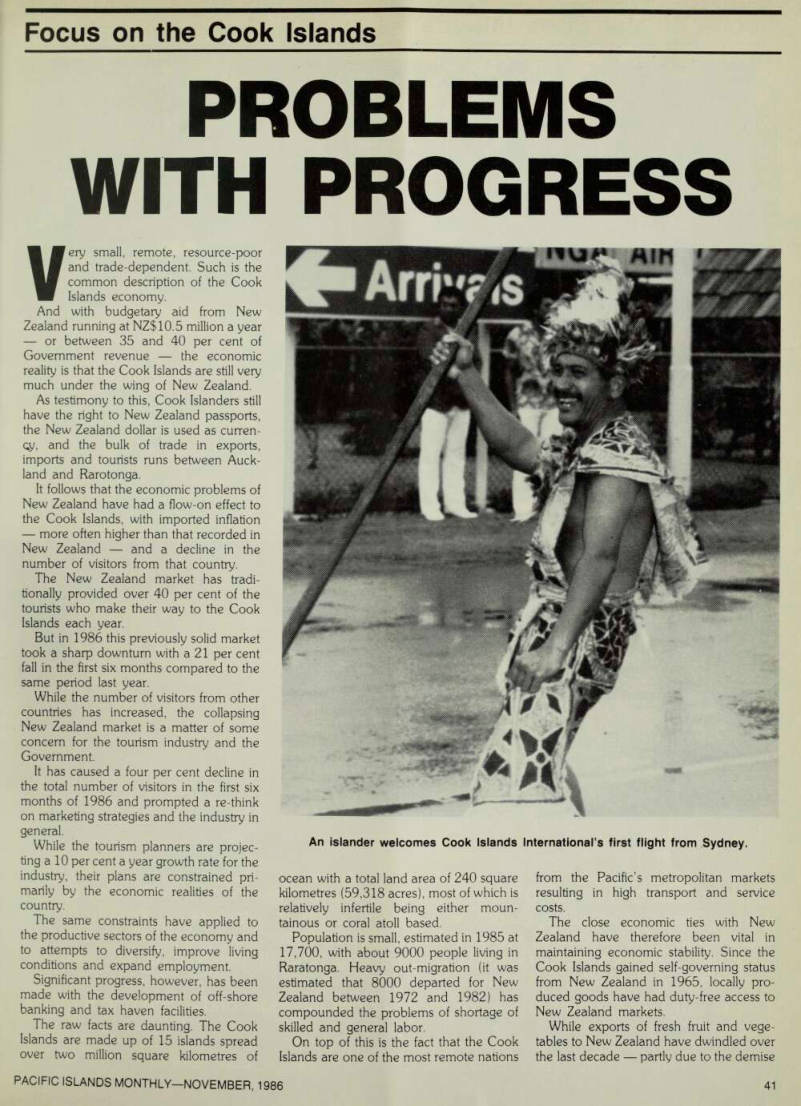
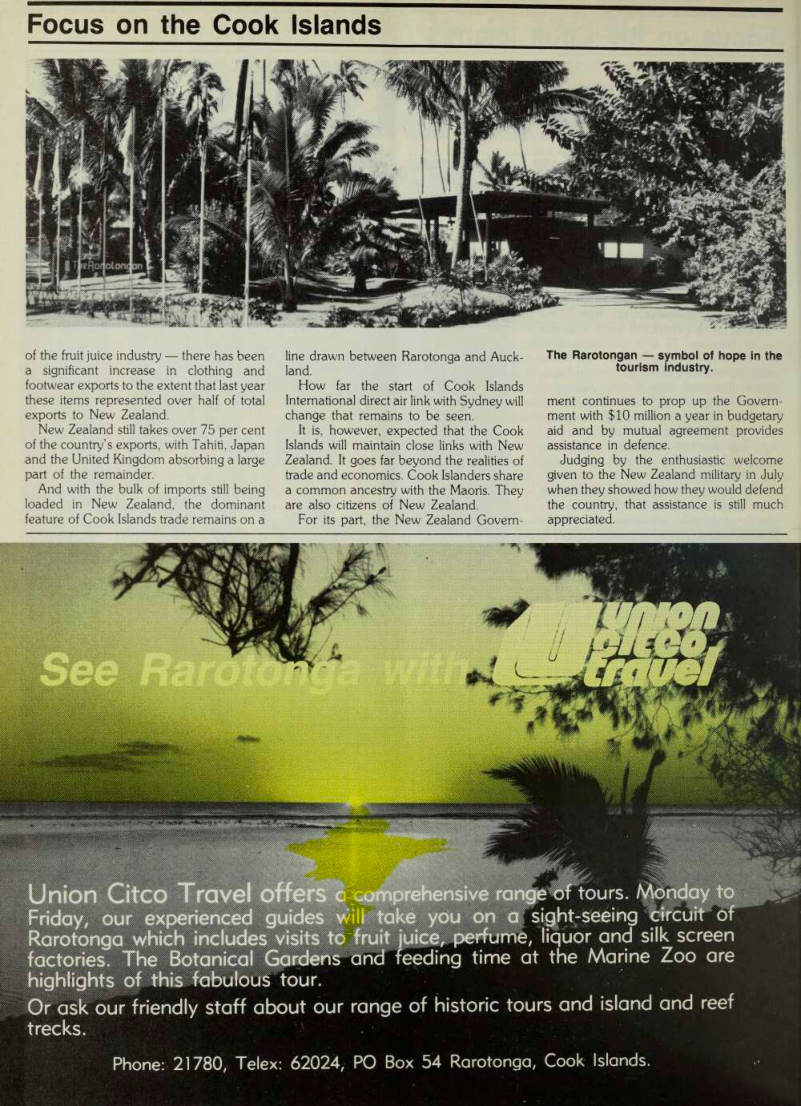
Problems
Very small, remote, resource-poor and trade-dependent. Such is the common description of the Cook Islands economy.
And with budgetary aid from New Zealand running at NZ$lO.5 million a year or between 35 and 40 per cent of Government revenue the economic reality is that the Cook Islands are still very much under the wing of New Zealand.
As testimony to this, Cook Islanders still have the right to New Zealand passports, the New Zealand dollar is used as curren cy, and the bulk of trade in exports, imports and tourists runs between Auck land and Rarotonga.
It follows that the economic problems of New Zealand have had a flow-on effect to the Cook Islands, with imported inflation more often higher than that recorded in New Zealand and a decline in the number of visitors from that country.
The New Zealand market has tradi tionally provided over 40 per cent of the tourists who make their way to the Cook Islands each year.
But in 1986 this previously solid market took a sharp downturn with a 21 per cent fall in the first six months compared to the same period last year.
While the number of visitors from other countries has increased, the collapsing New Zealand market is a matter of some concern for the tourism industry and the Government.
It has caused a four per cent decline in the total number of visitors in the first six months of 1986 and prompted a re-think on marketing strategies and the industry in general.
While the tourism planners are projec ting a 10 per cent a year growth rate for the industry, their plans are constrained pri marily by the economic realities of the country.
The same constraints have applied to the productive sectors of the economy and to attempts to diversify, improve living conditions and expand employment.
Significant progress, however, has been made with the development of off-shore banking and tax haven facilities.
The raw facts are daunting. The Cook Islands are made up of 15 islands spread over two million square kilometres of
ocean with a total land area of 240 square kilometres (59,318 acres), most of which is relatively infertile being either moun tainous or coral atoll based.
Population is small, estimated in 1985 at 17,700, with about 9000 people living in Raratonga. Heavy out-migration (it was estimated that 8000 departed for New Zealand between 1972 and 1982) has compounded the problems of shortage of skilled and general labor.
On top of this is the fact that the Cook Islands are one of the most remote nations
from the Pacific’s metropolitan markets resulting in high transport and service costs.
The close economic ties with New Zealand have therefore been vital in maintaining economic stability. Since the Cook Islands gained self-governing status from New Zealand in 1965, locally pro duced goods have had duty-free access to New Zealand markets.
While exports of fresh fruit and vege tables to New Zealand have dwindled over the last decade partly due to the demise
An islander welcomes Cook Islands International’s first flight from Sydney.
of the fruit juice industry there has been a significant increase in clothing and footwear exports to the extent that last year these items represented over half of total exports to New Zealand.
New Zealand still takes over 75 per cent of the country’s exports, with Tahiti, Japan and the United Kingdom absorbing a large part of the remainder.
And with the bulk of imports still being loaded in New Zealand, the dominant feature of Cook Islands trade remains on a
line drawn between Rarotonga and Auck land.
How far the start of Cook Islands International direct air link with Sydney will change that remains to be seen.
It is, however, expected that the Cook Islands will maintain close links with New Zealand. It goes far beyond the realities of trade and economics. Cook Islanders share a common ancestry with the Maoris. They are also citizens of New Zealand.
For its part, the New Zealand Govern
merit continues to prop up the Govern ment with $lO million a year in budgetary aid and by mutual agreement provides assistance in defence.
Judging by the enthusiastic welcome given to the New Zealand military in July when they showed how they would defend the country, that assistance is still much appreciated.
The Rarotongan symbol of hope In the tourism industry.
Advertisements & other items, pp. 42-43 (2 items)
Focus on the Cook Islands
a 'sight-seeing
iiliy tak on gu ce ife tours. Mon
rfume, liquor and silk screen
Union Citco Travel
Friday, our experienced Rarotonga which includes visits to truit jt , . factories. The Botanical Gardens and feeding time at the Marine Zoo are highlights of this fabulous tour.
Or ask our friendly staff about our range of historic tours and island and reef trecks.
Phone: 21780, Telex: 62024, PO Box 54 Rarotonga, Cook Islands.
Stay In Style.
The Rarotongan Resort Hotel, the Cook Islands’ premier resort and ideal offshore alternative for your holiday, honeymoon, business trip or convention.
Your accommodation, in garden or beachfront setting and never further than a short walk from the beach, combines with the top quality, services and amenities you expect from international resort living. |“T Relax . . . Enjoy the unhurried Cook Island way of life and let the Rarotongan Resort’s hospitality take care of you!
P 5 1
_JhG
Rarotongan
Resort Hotel The Cook Island’s Premier Resort.
For further information on; □ Holidays □ Conventions please send coupon to:
OCEANIA RESORTS. P.O. BOX 018.
QUEEN VICTORIA BUILDING.
SYDNEY NSW 2000 AUSTRALIA.
Name Address
Postcode
haven
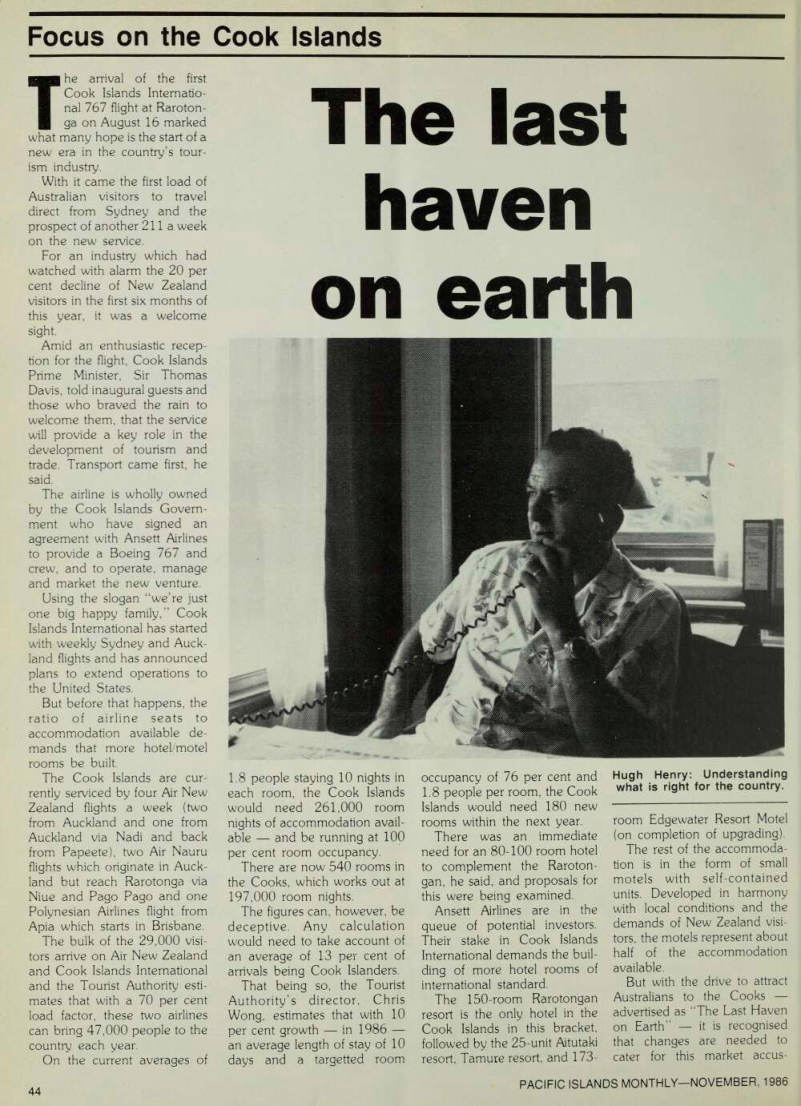
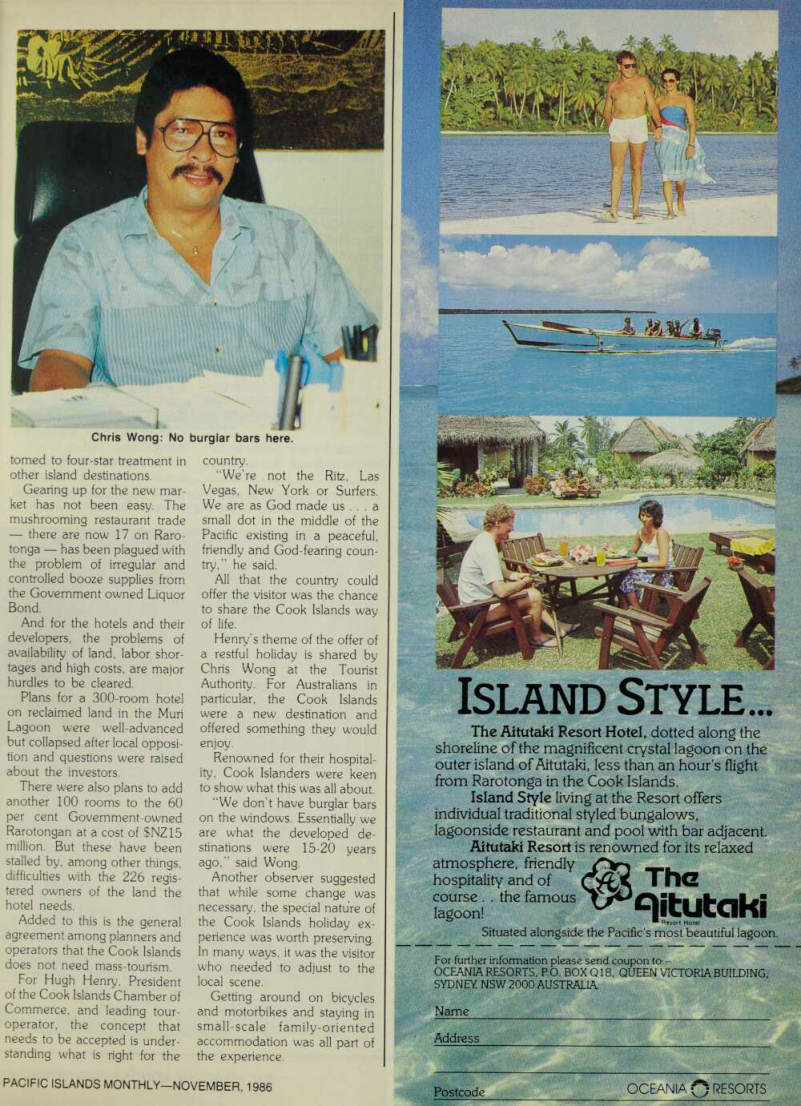
The last haven on earth
The arrival of the first Cook Islands Internatio nal 767 flight at Raroton ga on August 16 marked what many hope is the start of a new era in the country’s tour ism industry.
With it came the first load of Australian visitors to travel direct from Sydney and the prospect of another 211 a week on the new service.
For an industry which had watched with alarm the 20 per cent decline of New Zealand visitors in the first six months of this year, it was a welcome sight.
Amid an enthusiastic recep tion for the flight, Cook Islands Prime Minister, Sir Thomas Davis, told inaugural guests and those who braved the rain to welcome them, that the service will provide a key role in the development of tourism and trade. Transport came first, he said.
The airline is wholly owned by the Cook Islands Govern ment who have signed an agreement with Ansett Airlines to provide a Boeing 767 and crew, and to operate, manage and market the new venture.
Using the slogan “we’re just one big happy family,” Cook Islands International has started with weekly Sydney and Auck land flights and has announced plans to extend operations to the United States.
But before that happens, the ratio of airline seats to accommodation available de mands that more hotel/motel rooms be built.
The Cook Islands are cur rently serviced by four Air New Zealand flights a week (two from Auckland and one from Auckland via Nadi and back from Papeete), two Air Nauru flights which originate in Auck land but reach Rarotonga via Niue and Pago Pago and one Polynesian Airlines flight from Apia which starts in Brisbane.
The bulk of the 29,000 visi tors arrive on Air New Zealand and Cook Islands International and the Tourist Authority esti mates that with a 70 per cent load factor, these two airlines can bring 47,000 people to the country each year.
On the current averages of
1.8 people staying 10 nights in each room, the Cook Islands would need 261,000 room nights of accommodation avail able and be running at 100 per cent room occupancy.
There are now 540 rooms in the Cooks, which works out at 197,000 room nights.
The figures can, however, be deceptive. Any calculation would need to take account of an average of 13 per cent of arrivals being Cook Islanders.
That being so. the Tourist Authority’s director, Chris Wong, estimates that with 10 per cent growth in 1986 an average length of stay of 10 days and a targetted room
occupancy of 76 per cent and 1.8 people per room, the Cook Islands would need 180 new rooms within the next year.
There was an immediate need for an 80-100 room hotel to complement the Raroton gan, he said, and proposals for this were being examined.
Ansett Airlines are in the queue of potential investors.
Their stake in Cook Islands International demands the buil ding of more hotel rooms of international standard.
The 150-room Rarotongan resort is the only hotel in the Cook Islands in this bracket, followed by the 25-unit Aitutaki resort. Tamure resort, and 173-
room Edgewater Resort Motel (on completion of upgrading).
The rest of the accommoda tion is in the form of small motels with self-contained units. Developed in harmony with local conditions and the demands of New Zealand visi tors, the motels represent about half of the accommodation available.
But with the drive to attract Australians to the Cooks advertised as “The Last Haven on Earth" it is recognised that changes are needed to cater for this market accus-
Hugh Henry: Understanding what is right for the country.
tomed to four-star treatment in other island destinations.
Gearing up for the new mar ket has not been easy. The mushrooming restaurant trade there are now 17 on Raro tonga has been plagued with the problem of irregular and controlled booze supplies from the Government owned Liquor Bond.
And for the hotels and their developers, the problems of availability of land, labor shor tages and high costs, are major hurdles to be cleared.
Plans for a 300-room hotel on reclaimed land in the Muri Lagoon were well-advanced but collapsed after local opposi tion and questions were raised about the investors.
There were also plans to add another 100 rooms to the 60 per cent Government-owned Rarotongan at a cost of SNZIS million. But these have been stalled by. among other things, difficulties with the 226 regis tered owners of the land the hotel needs.
Added to this is the general agreement among planners and operators that the Cook Islands does not need mass-tourism.
For Hugh Henry. President of the Cook Islands Chamber of Commerce, and leading tour operator. the concept that needs to be accepted is under standing what is right for the
country.
“We’re not the Ritz, Las Vegas. New York or Surfers.
We are as God made us ... a small dot in the middle of the Pacific existing in a peaceful, friendly and God-fearing coun try,” he said.
All that the country could offer the visitor was the chance to share the Cook Islands way of life.
Henry’s theme of the offer of a restful holiday is shared by Chris Wong at the Tourist Authority. For Australians in particular, the Cook Islands were a new destination and offered something they would enjoy.
Renowned for their hospital ity. Cook Islanders were keen to show what this was all about.
“We don't have burglar bars on the windows. Essentially we are what the developed de stinations were 15-20 years ago," said Wong.
Another observer suggested that while some change was necessary, the special nature of the Cook Islands holiday ex perience was worth preserving.
In many ways, it was the visitor who needed to adjust to the local scene.
Getting around on bicycles and motorbikes and staying in small-scale family-oriented accommodation was all part of the experience.
Chris Wong: No burglar bars here.
Advertisements & other items, p. 45 (1 item)
Island Style...
A M i * \ r
The Aitutaki Resort Hotel, dotted along the shoreline of the magnificent crystal lagoon on the outer island of Aitutaki, less than an hour’s flight from Rarotonga in the Cook Islands.
Island Style living at the Resort offers
individual traditional styled bungalows,
lagoonside restaurant and pool with bar adjacent.
Aitutaki Resort is renowned for its relaxed
atmosphere, friendly
hospitality and of C&n * • lhe famo, ‘ 5 * Resort Hotel Situated alongside the Pacific’s most beautiful lagoon.
For further information please send coupon to;- OCEANIA RESORTS, P.O. BOX 018, QUEEN VICTORIA BUILDING,
SYDNEY NSW 2000 AUSTRALIA
Name Address Postcode
OCEANIA 0 RESORTS
corporate big fish
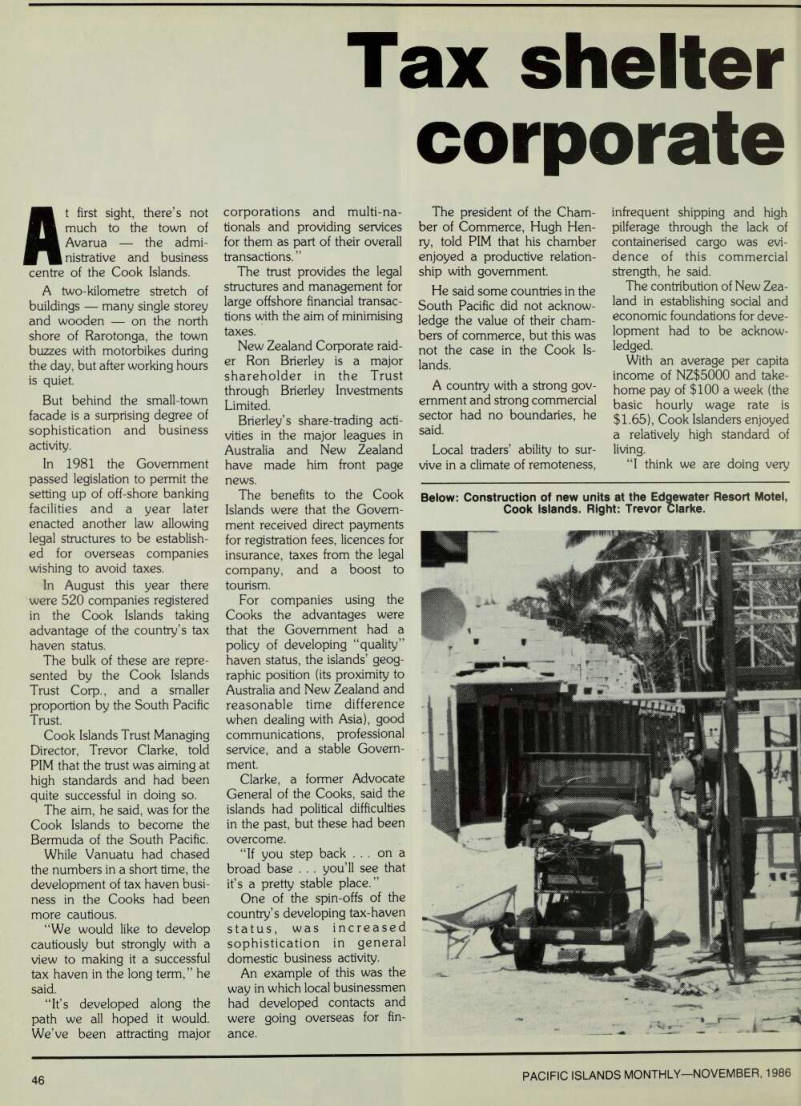
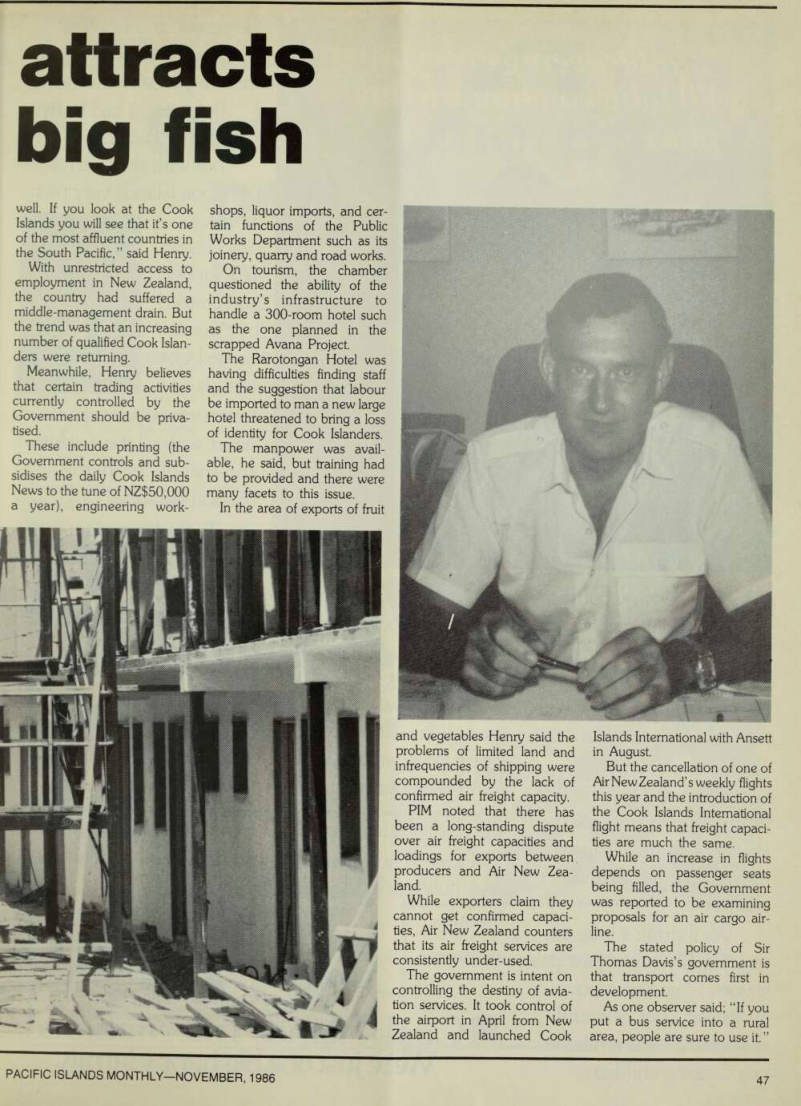
Tax shelter attracts corporate big fish
At first sight, there’s not much to the town of Avarua the admi nistrative and business centre of the Cook Islands.
A two-kilometre stretch of buildings many single storey and wooden on the north shore of Rarotonga, the town buzzes with motorbikes during the day, but after working hours is quiet.
But behind the small-town facade is a surprising degree of sophistication and business activity.
In 1981 the Government passed legislation to permit the setting up of off-shore banking facilities and a year later enacted another law allowing legal structures to be establish ed for overseas companies wishing to avoid taxes.
In August this year there were 520 companies registered in the Cook Islands taking advantage of the country’s tax haven status.
The bulk of these are repre sented by the Cook Islands Trust Corp., and a smaller proportion by the South Pacific Trust.
Cook Islands Trust Managing Director, Trevor Clarke, told PIM that the trust was aiming at high standards and had been quite successful in doing so.
The aim, he said, was for the Cook Islands to become the Bermuda of the South Pacific.
While Vanuatu had chased the numbers in a short time, the development of tax haven busi ness in the Cooks had been more cautious.
“We would like to develop cautiously but strongly with a view to making it a successful tax haven in the long term,” he said.
“It’s developed along the path we all hoped it would.
We’ve been attracting major
corporations and multi-na tionals and providing services for them as part of their overall transactions.”
The trust provides the legal structures and management for large offshore financial transac tions with the aim of minimising taxes.
New Zealand Corporate raid er Ron Brierley is a major shareholder in the Trust through Brierley Investments Limited.
Brierley’s share-trading acti vities in the major leagues in Australia and New Zealand have made him front page news.
The benefits to the Cook Islands were that the Govern ment received direct payments for registration fees, licences for insurance, taxes from the legal company, and a boost to tourism.
For companies using the Cooks the advantages were that the Government had a policy of developing “quality” haven status, the islands’ geog raphic position (its proximity to Australia and New Zealand and reasonable time difference when dealing with Asia), good
communications, professional
service, and a stable Govern ment.
Clarke, a former Advocate General of the Cooks, said the islands had political difficulties in the past, but these had been overcome.
“If you step back ... on a broad base . . . you’ll see that it’s a pretty stable place.”
One of the spin-offs of the country’s developing tax-haven status, was increased sophistication in general domestic business activity.
An example of this was the way in which local businessmen had developed contacts and were going overseas for fin ance.
The president of the Cham ber of Commerce, Hugh Hen ry, told PIM that his chamber enjoyed a productive relation ship with government.
He said some countries in the South Pacific did not acknow ledge the value of their cham bers of commerce, but this was not the case in the Cook Is lands.
A country with a strong gov ernment and strong commercial sector had no boundaries, he said.
Local traders’ ability to sur vive in a climate of remoteness,
infrequent shipping and high pilferage through the lack of containerised cargo was evi dence of this commercial strength, he said.
The contribution of New Zea land in establishing social and economic foundations for deve lopment had to be acknow ledged.
With an average per capita income of NZ$5OOO and take home pay of $lOO a week (the basic hourly wage rate is $1.65), Cook Islanders enjoyed a relatively high standard of living.
“I think we are doing very
Below: Construction of new units at the Edgewater Resort Motel, Cook Islands. Right: Trevor Clarke.
well. If you look at the Cook Islands you will see that it’s one of the most affluent countries in the South Pacific,” said Henry, With unrestricted access to employment in New Zealand, the country had suffered a middle-management drain. But the trend was that an increasing number of qualified Cook Islanders were returning.
Meanwhile, Henry believes that certain trading activities currently controlled by the Government should be privati se d- These include printing (the Government controls and subsidises the daily Cook Islands News to the tune of NZ$5O,OOO a year), engineering work-
shops, liquor imports, and cer tain functions of the Public Works Department such as its joinery, quarry and road works.
On tourism, the chamber questioned the ability of the industry’s infrastructure to handle a 300-room hotel such as the one planned in the scrapped Avana Project, The Rarotongan Hotel was having difficulties finding staff and the suggestion that labour be imported to man a new large hotel threatened to bring a loss of identity for Cook Islanders.
The manpower was avail able, he said, but training had to be provided and there were many facets to this issue, In the area of exports of fruit
and vegetables Henry said the problems of limited land and infrequencies of shipping were compounded by the lack of confirmed air freight capacity.
PIM noted that there has been a long-standing dispute over air freight capacities and loadings for exports between producers and Air New Zealand.
While exporters claim they cannot get confirmed capacities, Air New Zealand counters that its air freight services are consistently under-used.
The government is intent on controlling the destiny of aviation services. It took control of the airport in April from New Zealand and launched Cook
Islands International with Ansett in August, But the cancellation of one of Air New Zealand’s weekly flights this year and the introduction of the Cook Islands International flight means that freight capaci ties are much the same, While an increase in flights depends on passenger seats being filled, the Government was reported to be examining proposals for an air cargo air line.
The stated policy of Sir Thomas Davis’s government is that transport comes first in development, As one observer said; “If you put a bus service into a rural area, people are sure to use it. ”
Advertisements & other items, p. 48 (1 item)
T>-W /»fA airline, a
: ¥f 8 the people and tropical ' 3 deli g hts °f the Cook Islands V f s f" /AiSk-A r are now just six hours away. jr\\\ W& f • ‘ \Jy< tj / , i t ‘y# „ ’ *%m Before, you had to fly — ■ Jp~ % !\Wtl /" all over the pacific - But with the birth ot ■ JUjifa the Cook Islands very own
k ttJKKP brand new
767 supplied
and crewed * ■ / i by Ansett, u A- named Cook I Islands ■ International, you can fly mi I ■■■ —iii—mi ■ -mm direct with all the warmth and friendliness of this •.-*>■■ [ >l ? / '-'b tropical paradise. ,rrr V Jg To find Ollt more COn- ■■• 81 tact your local travel agent, then you come to And have a laugh or any Ansett travel centre or VV the Cook Islands, two. Then you've seen the °>T k'f 1 * International, first I’ll show you our history real Cook Islands!’ or treet. y C' on ... our churches... Parliament If 55-yea.-old Exham (02 House...then I’ll show you Wichmans words describe on (03)6681401. the real Cook Islands... the holiday destination Exham and the worlds I’ll take you home you’ve been waiting for, friendliest family are alonff secluded beaches wait no longer, because waiting to welcome you. diOllg beciuueu UtTCICIICTb, r? Subject to Government approval TARB 8827 through palm trees and wild Sydiey 2001. flowers... to my village... Please send me more on your airline to meet my family and holkkys m the Islands friends. Well drink a little tea Name: over freshly baked paw paw Address: —•.”••• *** scones. Chat about our ’.. 8-- Postcode:
~:l“'f ® Cook Mands International.
our dancing children. Were just one big happy family; r.nrlnnrl Stewart & Roache C 114542 TARB 8827
peace plea
books
State of the art peace plea
American Lake: Nuclear Peril in the Pacific By Peter Hayes, Lyuba Zarsky and Walden Bello Penguin, 529 pp. $A14.95 Never have the Superpowers been so prepared for nuclear war than in this International Year of Peace and, for added irony, the region which bears the name Pacific is just as likely as Europe to be the trigger point for conflict.
Notes the introduction to this highly detailed and depressing
book; “Here, as in Europe, both the United States and the Soviet Union have vital politi cal, economic and strategic in terests. Indeed, it was in the Pacific, not in Europe, that the first atomic bomb was ex ploded.”
It should be explained that “Pacific” also takes in such key parts of the ocean’s northwest reaches as Russia’s Vladivostok coast, Japan and Korea, the last seen as the greatest East-West flashpoint of all “The De militarised Zone (DMZ) of the Korean peninsula is the most
militarised place on earth”.
As the first part of the title makes clear, the authors be lieve that the USA is the pre eminent military power in the region. It is a conclusion with which not even the worst Red scaremonger in Washington could disagree despite feeling that the imbalance favours the right party, and should stay that way.
But the second part of the title is bound to cause dis agreement, the authors arguing that the large American pre sence, and its continuing build
up, is dangerously destabilising in that it encourages a Soviet response. In short, “arms rac ing” which cannot be controlled and whose effects if the weapons are used, deliberately or otherwise, would be catas trophic for all of humanity.
The counter argument, in the words of U.S. political and military leaders from the end of WW2 to the present day, is that communists must be deterred, by every means possible, from pursuing their ambitions. In peacetime, this entails what is termed “coercive diplomacy”,
Advertisements & other items, p. 49 (1 item)
m
es \P f>° *s** V C w 5 - With the Lees Post Debarker the labour intensive job of cleaning posts becomes a problem of the past.
With an output of up to 240 posts per hour savings are made in terms of manpower, energy and money. ★ Lees Post Debarker is also available fitted with an electric motor.
For more details fill in the coupon and send for a free brochure.
A :v Wi r Lees Industries Ltd., P.O. Box 29, Rangiora, M.Z.
Please send me your free brochure on the Post Debarker.
Name: Address: I i Ml
that is walking softly but
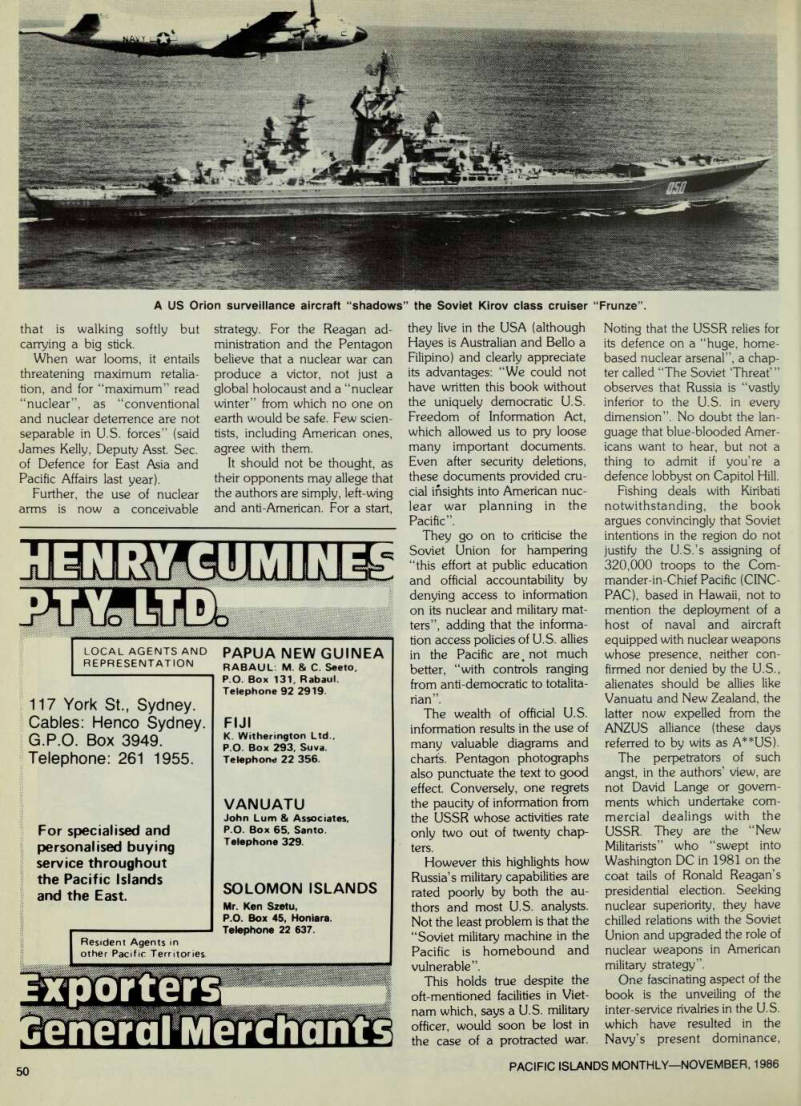
carrying a big stick.
When war looms, it entails threatening maximum retalia tion, and for “maximum” read “nuclear”, as “conventional and nuclear deterrence are not separable in U.S. forces” (said James Kelly, Deputy Asst. Sec. of Defence for East Asia and Pacific Affairs last year).
Further, the use of nuclear arms is now a conceivable
strategy. For the Reagan ad ministration and the Pentagon believe that a nuclear war can produce a victor, not just a global holocaust and a “nuclear winter” from which no one on earth would be safe. Few scien tists, including American ones, agree with them.
It should not be thought, as their opponents may allege that the authors are simply, left-wing and anti-American. For a start,
they live in the USA (although Hayes is Australian and Bello a Filipino) and clearly appreciate its advantages: “We could not have written this book without the uniquely democratic U.S.
Freedom of Information Act, which allowed us to pry loose many important documents.
Even after security deletions, these documents provided cru cial insights into American nuc lear war planning in the Pacific”.
They go on to criticise the Soviet Union for hampering “this effort at public education and official accountability by denying access to information on its nuclear and military mat ters”, adding that the informa tion access policies of U.S. allies in the Pacific are 4 not much better, “with controls ranging from anti-democratic to totalita rian”.
The wealth of official U.S. information results in the use of many valuable diagrams and charts. Pentagon photographs also punctuate the text to good effect. Conversely, one regrets the paucity of information from the USSR whose activities rate only two out of twenty chap ters.
However this highlights how Russia’s military capabilities are rated poorly by both the au thors and most U.S. analysts.
Not the least problem is that the “Soviet military machine in the Pacific is homebound and vulnerable”.
This holds true despite the oft-mentioned facilities in Viet nam which, says a U.S. military officer, would soon be lost in the case of a protracted war.
Noting that the USSR relies for its defence on a “huge, home based nuclear arsenal”, a chap ter called “The Soviet Threat’” observes that Russia is “vastly inferior to the U.S. in every dimension”. No doubt the lan guage that blue-blooded Amer icans want to hear, but not a thing to admit if you’re a defence lobbyst on Capitol Hill.
Fishing deals with Kiribati notwithstanding, the book argues convincingly that Soviet intentions in the region do not justify the U.S.’s assigning of 320,000 troops to the Com mander-in-Chief Pacific (CINC PAC), based in Hawaii, not to mention the deployment of a host of naval and aircraft equipped with nuclear weapons whose presence, neither con firmed nor denied by the U.S., alienates should be allies like Vanuatu and New Zealand, the latter now expelled from the ANZUS alliance (these days referred to by wits as A**US).
The perpetrators of such angst, in the authors’ view, are not David Lange or govern ments which undertake com mercial dealings with the USSR. They are the “New Militarists” who “swept into Washington DC in 1981 on the coat tails of Ronald Reagan’s presidential election. Seeking nuclear superiority, they have chilled relations with the Soviet Union and upgraded the role of nuclear weapons in American military strategy”.
One fascinating aspect of the book is the unveiling of the inter-service rivalries in the U.S. which have resulted in the Navy’s present dominance,
A US Orion surveillance aircraft “shadows” the Soviet Kirov class cruiser “Frunze”
especially in the Pacific where CINCPAC is now traditionally a naval appointment.
In the Navy’s view, it is said, “control of the seas especial ly the Pacific and the Indian oceans is the key to match ing Soviet land-based power on the great Eurasian continent.
Seapower and the quest for global maritime supremacy have become the keynote of the Reagan military build-up”.
By 1984, Navy Secretary Lehman had defeated his Army and Air Force opposition and could boast that: “If challenged, we (the Navy) will be capable of sending any opponent to the bottom”. Again, there is no distinction between nuclear and conventional weaponry. As then senior State Department official Paul Wolfowitz said last year, “We have only one Navy, not one conventionally capable Navy and one nuclear capable Navy”.
Well documented are the post WW2 stages which saw the U.S. first concentrating on nuc lear weapons in which it had a pioneering superiority through a “conventional” phase (the Vietnam war) and
back to nuclear reliance again.
This coincided with moving from the philosophy of “con taining” communism to the pre sent notion of trying to “roll it back”. The 1940 s was the last time that rollback was in vogue.
Now it is having a “militant revival”.
Today’s U.S. planners have stopped licking their wounds from Vietnam and have taken the offensive to show that the world’s strongest power cannot be fooled with. What clearly worries the authors is that attempts to play real life Rambo may one day include a nuclear component, intentional or not, which could trigger the feared WW3.
Much of the book’s detail focusses on the terrifying weaponry in nuclear arsenals and the strategy which might determine their use.
The text is not hard for the lay reader to follow. Indeed, as noted, “this book is in large part a translation of military jargon into plain English”. But for my money, the most interesting parts are where humanity out shines technology, as in the chapter describing the unequal
struggle of the Marshall island ers to resist the nuclearisation of their territory (Kwajalein missile testing range is said to have contributed more to the arms race than any other place on earth).
Do we feel our region has contributed to freedom and democracy when we learn that the Pacific has served as Amer ica’s major site for testing and modernising nuclear weapons systems (until the Atmospheric Test Ban Treaty in 1963) and delivery systems (still in prog ress) since the dawn of the atomic age?
A harder question; What should be done to arrest the present trend? The authors’ view is to spread the “Kiwi Disease” denying port ac cess to nuclear warships as widely as possible, the theory being that “the superpowers are likely to find mutual Pacific disarmament in their interest only when pressed by a regio nal concert of allies and non aligned Pacific states”.
Although there are few pre cedents when it comes to nuc lear conflict “the bomb” has only been dropped twice in
history they cite the restrain ing influence of America’s allies in 1958 when the U.S. came close to using it against China (over the Taiwan straits issue).
They suggest that a real Nuclear Free Zone Treaty, one banning the passage of weapons and the conducting of nuclear related activities, should be adopted.
In this regard, David Lange’s policy on port visits could be adopted, while Australia may reconsider hosting the three U.S. communications bases.
Clearly, however, they have less faith in governments than in the supporters of the nuclear free Pacific movement, regional churches, trade unionists and social democratic political par ties.
Least faith of all is placed in those who control the 50,000 nuclear warheads stationed worldwide. And not only their intentions but their compe tence: “If the world topples over the nuclear brink, it will be because of poor decisions, ter rifying weapons deployed in aggressive fashion, organisa tions running amok, a mis
understanding.
Robin
Osborne.
Advertisements & other items, pp. 50-51 (1 item)
117 York St., Sydney.
LOCAL AGENTS AND
REPRESENTATION
Cables: Henco Sydney
G.P.O. Box 3949.
Telephone: 261 1955.
For specialised and
personalised buying
service throughout
the Pacific Islands
and the East.
PAPUA NEW GUINEA
RABAUL: M. & C. Seeto, P.O. Box 131, Rabaul.
Telephone 92 2919.
FIJI
K. Witherington Ltd., P.O. Box 293, Suva.
Telephone 22 356.
VANUATU
John Lum & Associates, P.O. Box 65, Santo.
Telephone 329.
SOLOMON ISLANDS
Mr. Ken Szetu, P.O. Box 45, Honiara.
Telephone 22 637.
Resident Agents in other Pacific Territories
The fully mobile Concrete
Mixer (even in muddy conditions)
The Lees Hydramixer makes mixing concrete on site that much easier plus it saves time, money and manpower.
The Lees Hydramixer, tested and proven for years, Transports to any location on 7 ton truck.
Is self loading from materials dumped on site.
Discharges via a swivel shute and places mixed concrete from bucket up to 2745 mm (9ft.) high.
Has bowl capacity 1.15m 3 (1 V2yds) up to 4.5m 3 (6yds) per hour.
Load gauge for accurate weight mixes. f Patented n R t For more details fill in this coupon for a free brochure.
Lees Industries Ltd.
P.O. Box 29, Rangiora, M.Z.
Name: Address: PM
than meanings
More to words than meanings
A Word-list of South Island Maori. By Ray Harlow. Pub lished by the Linguistic Society of Hew Zealand, Auckland,
1985. 116 Pp. Isbn O
9597603 6 9.
In May 1840 the Rev. James Watkin arrived with his fam ily at Waikouaiti to found a Wesleyan mission. Since 1831 he had been in Tonga and he is reported to have spoken Tongan fluently.
He did not much like Waikouaiti nor Maori which he immediately set to leam. In 1843 he wrote that “speaking Maori distresses me greatly” and he took his family to Sydney the following year.
Waikouaiti had been “a place rivalling in proportion to its population the Bay of Islands in wickedness than which the sun shines not on a worse in the whole world.”
Yet Watkin left us the nearest thing we have to a dictionary of South Island Maori which Ray Harlow has now reorganised and edited for the Linguistic Society.
Watkin had arrived expecting to preach in North Island Maori.
The Rev. J. Buller of Kaipara had given him some books printed in Maori and with his fluency in Tongan Watkin had not anticipated any language problems.
The people of the South Island could not understand them. He wrote to Buller, “1 read to some of them out of the New Testament published at Paihia, but ‘Kahore e matou was the reply when I asked the question ‘Do you understand?’ 1 found I must have another alphabet o express correctly the sounds of this language.”
He began to write down the vocabularly of South Island Maori in a notebook with the help of informants like Haerer oa. It is on that notebook, now in the Hocken Library, that this book is based.
Using this he arranged for liturgical material to be printed
in South Island Maori at Man gungu in the Hokianga of which one booklet survives, He Puka Ako i te Korero Maori. This booklet, had been republished as an appendix to the word-list.
It records the first appearance of a language in print and is dated 1841.
Some 140 years later the South Island Maori Keri Hulme published The Bone People, now arguably the best known New Zealand novel after the Booker Prize. The Maori we read in The Bone People is not of the North Island, is not of the well-known Williams Dictionary of the Maori Language but rather of the word-list Watkin and Harlow (and informants like Haereroa) have given us here.
There are not a lot of other sources for Hulme’s Maori. The Oxford University Press has published the journal of John Boultbee. Boultbee was a sea ler on the coast south of Waikouaiti in 1825-1828 and his journal includes a word-list of 216 items which the Maori poet Hone Tuwhare has been doing some work on. Mantell (27 items), Shortland (all Kaita hu dialect), Harwood (29 items), Wohlers and the note books of James Beattie are really our only other sources.
You will notice these are all European names. South Island Maori is still spoken but, as Keri Hulme herself has written, her “Ngai Tahu dialect is practically extinct today, because the mis sionaries (the first people to use Maori as a written language extensively) were based in the North Island and assigned sound values to letters accord ing to what was current speech there.
“South Island Maori has been under seige from both English and North Island Maori for at least 150 years. What is perhaps most significant about A Word-list of South Island Maori is it appeared in 1985 not 1845.
Something worse underlines all this to which we find a clue in Watkin’s notebook. On pages 94-95 there is a long section of words headed ka ikoa o ka mate: 35 items dealing with disease.
In 1827 John Boultbee found the southern chief Te Wera “in a most dreadful state owing to the ‘fafa’, a disease common to these people. I was told that the first symptoms of it was a wryness of the mouth, and a discharge from the eyes.
The ravages it makes on the face, eyes, nose, mouth and at last on the feet and hands, is terrible. The victim of this dis ease generally dies in a half putrid state.”
Boultbee found Te Wera’s face “scarcely human, and I turned away with mingled feel ings of pity and disgust from an object so forbidding.”
An account of the South Island Maori published in Paris in 1826 described, “Natives . . . who have lost their feet and hands; their bodies are frightful ly thin and their extremities rot away. ” Among the diseases for which South Island Maori appears to have coined new words after the coming of Euro pean ships seems to have been leprosy.
A Word-list of South Island Maori is divided into three sec tions. After a discussion of South Island Maori we are given the word-list itself (cross indexed to other sources of South Island Maori). This is followed by an English-Maori index to allow readers to quick ly find which Maori word to look up in the main list.
Harlow is convinced “the language reflected in the list (is) a dialect of Maori and not a separate, though closely re lated, language.” In an earlier study Harlow found this South Island dialect was “more similar to some North Island dialects than are some pairs of North Island dialects to each other.
My guess is that at the moment
all these dialect differences are gradually being smoothed out and we are witnessing the emergence of something like a ‘standard Maori’.”
But dialects can tell us as much as archaeology about the Pacific’s past. When Watkin reach the South Island in 1840 he found Kaitahu consolidating their conquest of that island which they had taken over from Kati Mamoe during the pre vious 200 years. Through inter marriage those two tribal dialects had combined. Harlow suggests we can leam at least two things by studying Watkin’s resultant word-list. (1) Watkin’s dialect shares word-forms with several North Island East Coast dialects of Maori. This is linguistic evi dence for the Kati Mamoe and Kaitahu traditions of an East Coast origin. (2) Marked differences with those East Coast dialects poss ibly point us to borrowings from even earlier South Island occu pants: the Waitaha who lived there prior to the “Little Ice Age” of 1600-1800.
What I would like to call “the Waitaha traces”, the differ ences, are principally to be found in some vocabulary differences and the replace ment of /ng/ by /k/. You will have noticed how Ngai Tahu became Kaitahu above.
With other differences we must be more cautious. Watkin spoke Tongan perhaps too well! His word-list “pulls” South Island Maori in the direction of that language. The North Island Maori word for male (tone) becomes taane in Watkins’s word-list. We are on our way to the Tongan word taane.
We forget how influential lex icographers can be. Dr Johnson pushed English pronunciation in the direction of his own Scottish dialect when he com piled the spellings in his diction ary. Webster pulled another branch of English into another direction with his spellings.
Watkin, perhaps through the influence of his Wesleyan pamphlets printed at Mangun gu, may have given South Island Maori a slightly Tongan flavour.
Clearly there is more to a word-list or a dictionary than merely the means to look up
the meaning of a word.
D. S.
Long
transitions


Married: In Fiji’s “wedding of the decade” uniting two of the country’s noblest families, Ratu Epinisa Cakobau and Adi Frances Loloma.
The wedding took place on Bau, the traditional home of Fiji’s paramount chiefs. The bridegroom, a 26-year-old civil servant, bears one of the most famous names in South Pacific history and is the eldest son of paramount chief and former governor-general Ratu Sir George Cakobau by his second marriage.
The bride, 23, is third of six daughters of Ratu Josaia Lolo ma of the island of Batiki.
More than 1,000 official guests (and several hundred unofficial ones) made their way to Bau by motor canoe.
A fleet of more than 20 of the “water taxis” were on stand-by on the wedding day earning up to As26o apiece for their own ers which resulted in a boat men’s party later. It was re ported to have outlasted the official one.
Up to a dozen dignitaries, perspiring in suits and ties, crammed into each of the tiny, leaking canoes for the rocky 12-minute voyage from the mainland.
The official guests included the governor-general, prime minister, ambassadors, high commissioners and a veritable Who’s Who of Fiji society.
The 45-minute service was traditional Wesleyan and was conducted wholly in Fijian. The stone and brick church on Bau seats only about 500 and many guests sat outside on chairs and mats to hear the service relayed by loudspeaker.
Later, the official guests sat down to a wedding feast for which five cattle, eight turtles, 12 pigs, 150 chickens, 150 crabs and about 300 fish were cooked in a “lovo”.
The 24-dish meal was washed down by bottles of Australian white wine.
However, the feast was staid compared with the eve-of-wed ding party on Bau when the
island rocked to the boisterous singing of the Bau and Batiki clans each trying to outdo the other.
The ceremony of Tevuteuu or the giving of wedding gifts by the bride’s and groom’s fami lies, preceded the party.
The result was three Bau buildings filled with a vast varie ty of gifts, enough to last the happy couple a lifetime on their return from a honeymoon in Australia, New Zealand and Hawaii. Jim Shrimpton,
Aap.
Appointed: Secretary-general of the SPC, Palauni M Tuiaso sopo for many years assistant to the American Samoa gov ernors.
Tuiasosopo was a contender for the secretary-general’s posi tion in 1971 but lost out when Fred Betham of Western Samoa and Gala Gala Rarua of PNG tied in the voting.
Rama later withdrew in favour of Betham. Tuiasosopo has had a long association with the SPC as American Samoan delegate.
Installed; As chief of Ulawa, Solomon Islands Governor- General Sir Baddeley Devesi.
The ceremony took place on the last day of Sir Baddeley’s tour of the islands of Makira and Ulawa.
Training: As a sumo wrestler in Japan, Tongan-American John Fele’unga.
He is known in Inazawa by his sumo name, Takamioo.
Fele’unga, from Hawaii, is the son of Semisi Fele’unga formerly of Vaotu’u.
His interest in sumo came from watching it on television in Honolulu. However, he did not know he would have to under go the initiation rite of matawari in which apprentice wrestlers must sit with their legs wide
The happy couple in Fiji’s wedding of the year. Photo: AAP.
apart and touch the floor with their foreheads.
Fele’unga couldn’t do it, so a group of “helpful” colleagues sat on his back.
Appointed: Managing Director of Burns Philp (South Seas) Ltd, Ross McDonald.
Mr McDonald, who replaces Bill Williams was formerly Managing Director of Burns Philp in Vanuatu. He is re placed in Port Vila by Abe Rajbaum formerly manager of American Samoa. Jim Scott, regional manager in Lae, PNG moves to American Samoa.
In Port Moresby, David McLellan, former managing director of Bums Philp (PNG) Ltd has been appointed as chief executive for all of the com pany’s Pacific operations.
Withdrawn: From the Niue- New Zealand trade, the Fetu Moana and Tiare Moana.
Both ships will be replaced by a New Zealand-manned container ship and a Cook Islands-registered conventional vessel. Niue will now be serviced by the Cook Islands flag carrier M.V. Raro Tai which will operate on a five-week turnaround.
The two old faithfuls are due to be withdrawn from service before the end of next month following agreement by the governments of Niue, Cook Islands and New Zealand.
The new direct service be tween! Alofi and Auckland is expected to be of great benefit to agricultural exporters.
Nuie Premier, Sir Robert Rex urged all exporters and potential exporters to make full use of the service.
Installed: 1986 Miss Charity Queen, Jane Sharan, 19, in Fiji’s Hibiscus Festival.
Miss Sharan won a new car worth F$ 17,000.
The Miss Hibiscus crown was won by Irene Butt, 22, who hopes to take her mother to Los Angeles with her prize.
Appointed: New SPC Plant Protection Officer, Robert Macfarlane.
Based in Suva, Mr Macfar lane will work with the SPC tropical agriculturalist on the region’s plant protection prob lems and has special re sponsibility for advice on the use and regulation of pesticides, control of plant pests and dis
eases, plant quarantine and in troduction of new species.
Mr Macarlane, from Britain, was previously senior research officer (entomology) at the Dodo Creek research station in Solomon Islands.
The SPC also announced the appointment of rural technolo gy officer, Madame Daniele Carpentier from France.
Mme Carpentier was pre viously deputy director of the Solar Bio-energy Research Group of the Atomic Energy Commission in France.
Appointed: General manager of Fiji Television Corporation Ltd, David Hall of Australia.
His appointment was announced after a board meet ing by chairman Lynton Taylor.
Hall was previously station manager of GLVB at Traralgon, Victoria.
Appointed: Lecturer in health management and co-ordinator of a new health management program at USP, Suva, Dr Sitaleki Finau of Tonga.
Dr Finau has wide experi ence of medical work in the islands region, having worked in a number of projects includ ing sports medicine, a primary health care review, respiratory infections among children, food requirements after cyclones, a health study in Tokelau and World Health Organisation stu dies.
Retired: Commissioner of the Fiji Prisons Service, Lt-Col.
Mosese Buadroma after 41 years of continuous govern ment service.
Lt-Col Buadromo was bom at Lakeba in 1927 and joined the prisons service in 1984 after serving in the army.
He has been replaced by the new acting commissioner, Lt- Col. Inosi Tawakedrau assisted by the acting deputy commissioner Mr. A. Vosani bolo.
Retired: After 38 years in the Tonga government service, Laitia Fifita chief meteorologi cal officer.
Mr Fifita previously worked for the Pacific Meteorological Service in Laucala Bay, Suva for three years.
He is also deputy editor of the monthly Catholic news paper, Raumu’a Lelei.
Invested: As a knight in traditio nal style, Sir Paulias Matane.
Dressed in the manner befit ting a head man of his clan, Sir Paulias, flanked by two Tum huans was dubbed a knight by PNG Governor-General Sir Kingsford Dibela at Sir
Paulias’ village, Viviran in the Gazelle Peninsula.
At nearby Kokopo high school, Dame Rosa Tokiel also received her award clad in traditional dress and was accorded the treatment of a chief.
Advertisements & other items, pp. 53-54 (1 item)
What Is Going On
IN THE WORLD?
TRADE,ECONOMICS, HUMAN RIGHTS,
MILITARISM, POVERTY, TECHNOLOGY,
REFUGEES, WOMEN, MEDIA . . .
KEEP UP TO DATE WITH THIRD WORLD
DEVELOPMENTS BY READING THE
IDEAS CENTRE BULLETIN!
The Ideas Centre Bulletin contains synopses of the major articles appearing in over 200 journals concerned with Third World issues, set out under SUBJECT and COUNTRY headings for easy reference.
Photocopies of the original articles can be supplied upon request.
The articles are selected by the expert educational staff of the Ideas Centre (the Education Unit of the Freedom From Hunger Campaign), and represent the best current views on global development.
THE IDEAS CENTRE BULLETIN: FOR TEACHERS, STUDENTS,
JOURNALISTS, DEVELOPMENT WORKERS AND OTHERS WHO
NEED TO BE INFORMED . . . PUBLISHED MONTHLY, ANNUAL
SUBSCRIPTION $25 INDIVIDUAL, $3O INSTITUTION.
SUBSCRIBE NOW
Name: Postal Address: Return with payment to: The Ideas Centre, GPO Box 3930 Sydney 2001 (02) 267-9230.
P
LINCOLN
ARC WELDING
WELDERS, WELDING SUPPLIES
240 V POWER SOURCES
& Weldanpower 175 Portable Welder/ Power Source • Petrol, and diesel with impulse start or with electric start and undercarriage. • Current range 60-175 amps AC • Electrode range 2.0-4.omm • AC auxiliary power 240 V, 4.5 kW, 50 Hz • Roll frame is standard except for electric start model.
Weldanpower 225 AC/DC Portable Welder/Power Source Two models, petrol or diesel Current range 50-225 amps AC 70-250 amps DC Electrode range 2.0-s.omm #AC auxiliary power 240 V, 6kW, 50Hz Electric start is standard on both models. r?
Dis-gen 25kVA
Generating set,
240 V, 50Hz
Powered by the Perkins 3 cyl. diesel: low speed, quiet and robust machine. Suitable for home and shed electric power. 1C 140 Welder and
Battery Charger
Plug-in 240 V welder complete with leads and 15 amp 3 pin plug Electrode range 2.0-3.2 mm Latest solid state components provide continuous variable current control even while welding.
AC225-S workshop welder with larger capacity also available Lincoln Accessories and Electrodes Linctong electrode holder, light, cool, comfortable.
Insulated and with replaceable parts.
Twistong 400 electrode holder, fully insulated, handle twists to lock onto electrode stub.
Well balanced and comfortable to use. (See picture.) Coolshield 4 welding shield with flip-up front. Clear, inner lens gives protection during deslagging and weld cleaning operations.
Lincoln also supply cables, clamps, gloves and a range of electrodes.
Dis-gen 6.SkVA Basic Generating
set, 240 V, 50Hz
Realiable, 1500 rpm, smoothrunning auxiliary generating set.
Inbuilt engine protection and safety features on the alternator assure peace of mind.
Powered by the Kubota 4-cycle diesel engine with indirect injection.
IT' o O <O, 0
EEH3EL
\ARC WELDING\
CARPENTERS MOTORS ELA MOTORS COMPONENTS
SUVA. Phone 313644 PORT MORESBY. Phone 217036 The Lincoln Electric Co. (Australia) Pty. Ltd. (Inc. in N.S.W.) 35 Bryant Street, Padstow. N.S.W. 2211 Phone 772 7222. Tlx 22792 LE177.25/18 Slatter
Deaths
Adi Nanise Taiki Ranawai.
The Tui Ba collapsed at a festival ground in Ba town and was rushed to the Methodist Hospital but was found to be dead on arrival.
She had been suffering from diabetes and a heart condition.
A village spokesman, Mr Josefa Naisua, said chiefs from Tavua to Nadroga had been personally informed of the death in the traditional way.
“We personally went to the chiefs taking tabua and yaqona and traditionally informed them about her death,” he told The Fiji Times.
Adi Nanise, who was based at Nailaga village had an area known as Tiliva Bukuya exten ding to the west side of the Ba river.
The other Tui Ba who is based at Sorokoba village on the Tavua side of the town has an area extending to the east side of the river.
Adi Nanise, 64, a widower, had no children.
Her funeral, at the chiefly bure at Nailaga, was attended by more than 1,000 mourners.
Among them were the forests minister, Ratu Sir Josaia Tavai qia, health minister Dr Apenisa Kurisaqila, housing and urban affairs minister Ted Beddoes, Ratu William Toganivalu, Ratu Josua Toganivalu, chiefs from throughout the Western Divi sion and prominent Ba businessmen.
Kelepi Funilagi Gucake.
Brother of Lady Liku, widow of the late Ratu Sir Lala Sukuna.
Gucake, a member of the chiefly yauusa Vuanirewa of Tubou died at the CWM hospi tal after suffering a stroke in Lomaloma, Vanuabalavu, on his way to Fiji’s Great Council of Chiefs meeting in Somo somo.
The Tui Nayau and prime minister’s son, Ratu Finau
Mara, led the mourners at the funeral.
Joe Yaniakis. At Blenheim, New Zealand after a long ill ness.
He and his wife Gloria (Arthur) had been married for some years and were closely connected with Norfolk Island.
They have one son, Tyrone.
Dr Nane Zozzingao. The senior Papua New Guinean doctor of Finschafen, Morobe Province, died at Port Moresby General Hospital.
His body was flown to his home for a funeral service.
Josepha Michael Oiterong.
Former first lady of the Repub lic of Palau. She suffered a stroke earlier this year followed by kidney complications and died on August 25.
One of the “grandes dames” of Palau, she became, in 1940, one of the first Palauans to be trained as a nurse in Guam and served as a nursing supervisor at MacDonald Memorial HospU tal, Koror until 1963.
During the 1950 s she was
active in a number of women’s related organisations and issues.
This outgoing, ebullient lead er was one of the key organisers of the Ekei Women’s Group.
She attended many confer ences dealing with women’s issues in the Pacific both throughout the region and fur ther afield.
Josepha’s husband, teacher Alfonso Oiterong, was Palau’s first and second vice-president.
Following the assassination of President Haruo Remelik, he became interim president for a two-month period.
However, he lost the subse quent election to the current president, Lazarus Salii.
It was then that Josepha began to ail. Funeral activities took place at her Koror home for about four weeks.
old explorers
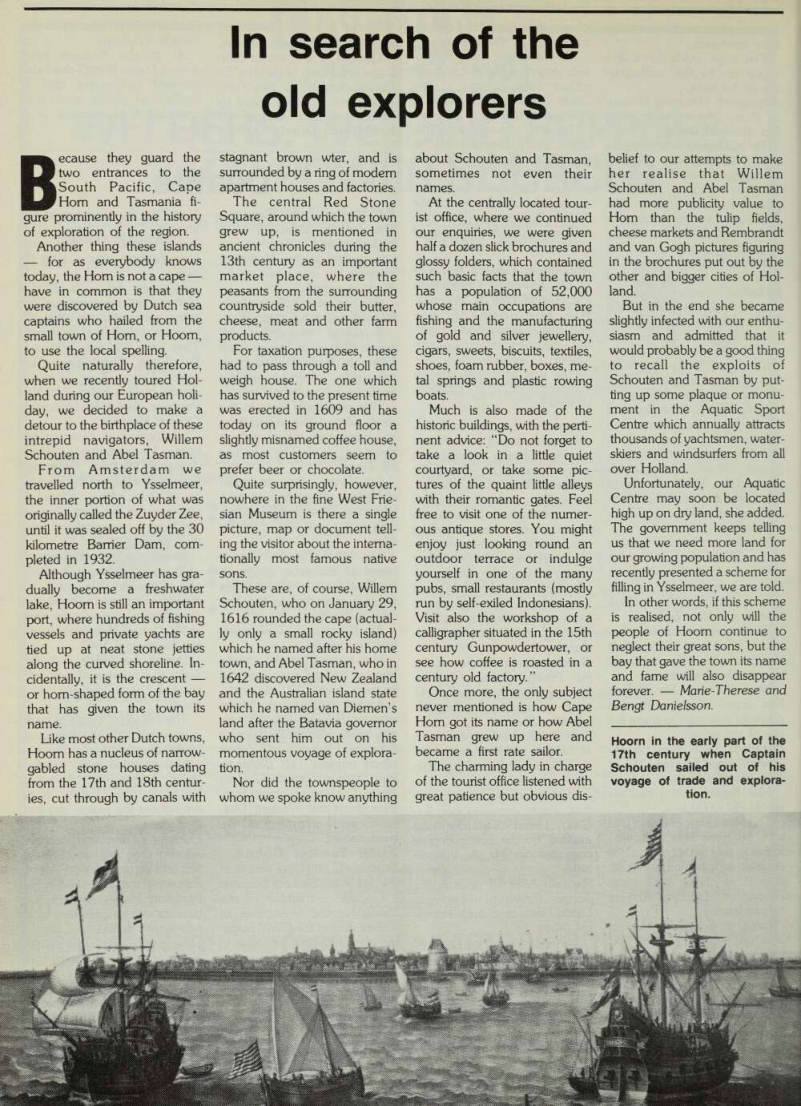
In search of the old explorers
Because they guard the two entrances to the South Pacific, Cape Horn and Tasmania fi gure prominently in the history of exploration of the region.
Another thing these islands for as everybody knows today, the Horn is not a cape have in common is that they were discovered by Dutch sea captains who hailed from the small town of Horn, or Hoom, to use the local spelling.
Quite naturally therefore, when we recently toured Hol land during our European holi day, we decided to make a detour to the birthplace of these intrepid navigators, Willem Schouten and Abel Tasman.
From Amsterdam we travelled north to Ysselmeer, the inner portion of what was originally called the Zuyder Zee, until it was sealed off by the 30 kilometre Barrier Dam, com pleted in 1932.
Although Ysselmeer has gra dually become a freshwater lake, Hoom is still an important port, where hundreds of fishing vessels and private yachts are tied up at neat stone jetties along the curved shoreline. In cidentally, it is the crescent or hom-shaped form of the bay that has given the town its name.
Like most other Dutch towns, Hoom has a nucleus of narrow gabled stone houses dating from the 17th and 18th centur ies, cut through by canals with
stagnant brown wter, and is surrounded by a ring of modem apartment houses and factories.
The central Red Stone Square, around which the town grew up, is mentioned in ancient chronicles during the 13th century as an important market place, where the peasants from the surrounding countryside sold their butter, cheese, meat and other farm products.
For taxation purposes, these had to pass through a toll and weigh house. The one which has survived to the present time was erected in 1609 and has today on its ground floor a slightly misnamed coffee house, as most customers seem to prefer beer or chocolate.
Quite surprisingly, however, nowhere in the fine West Frie sian Museum is there a single picture, map or document tell ing the visitor about the interna tionally most famous native sons.
These are, of course, Willem Schouten, who on January 29, 1616 rounded the cape (actual ly only a small rocky island) which he named after his home town, and Abel Tasman, who in 1642 discovered New Zealand and the Australian island state which he named van Diemen’s land after the Batavia governor who sent him out on his momentous voyage of explora tion.
Nor did the townspeople to whom we spoke know anything
about Schouten and Tasman, sometimes not even their names.
At the centrally located tour ist office, where we continued our enquiries, we were given half a dozen slick brochures and glossy folders, which contained such basic facts that the town has a population of 52,000 whose main occupations are fishing and the manufacturing of gold and silver jewellery, cigars, sweets, biscuits, textiles, shoes, foam rubber, boxes, me tal springs and plastic rowing boats.
Much is also made of the historic buildings, with the perti nent advice: “Do not forget to take a look in a little quiet courtyard, or take some pic tures of the quaint little alleys with their romantic gates. Feel free to visit one of the numer ous antique stores. You might enjoy just looking round an outdoor terrace or indulge yourself in one of the many pubs, small restaurants (mostly run by self-exiled Indonesians).
Visit also the workshop of a calligrapher situated in the 15th century Gunpowdertower, or see how coffee is roasted in a century old factory.”
Once more, the only subject never mentioned is how Cape Horn got its name or how Abel Tasman grew up here and became a first rate sailor.
The charming lady in charge of the tourist office listened with great patience but obvious dis
belief to our attempts to make her realise that Willem Schouten and Abel Tasman had more publicity value to Horn than the tulip fields, cheese markets and Rembrandt and van Gogh pictures figuring in the brochures put out by the other and bigger cities of Hol land.
But in the end she became slightly infected with our enthu siasm and admitted that it would probably be a good thing to recall the exploits of Schouten and Tasman by put ting up some plaque or monu ment in the Aquatic Sport Centre which annually attracts thousands of yachtsmen, water skiers and windsurfers from all over Holland.
Unfortunately, our Aquatic Centre may soon be located high up on dry land, she added.
The government keeps telling us that we need more land for our growing population and has recently presented a scheme for filling in Ysselmeer, we are told.
In other words, if this scheme is realised, not only will the people of Hoom continue to neglect their great sons, but the bay that gave the town its name and fame will also disappear forever. Marie-Therese and Bengt Danielsson.
Hoorn in the early part of the 17th century when Captain Schouten sailed out of his voyage of trade and explora tion.
Advertisements & other items, p. 57 (1 item)
Lautoka: Jk
HHH
ACTA has charted a new course. A course that will set a cracking pace on the Australia- Fiji run.
ACTA has built an enviable reputation in shipping from Australia to the East Coast of America. A reputation for reliability and ontime delivery that’s hard to match.
The good news is that you now expect the same standard of excellence between Australia and Fiji.
Because ACTA is determined to live up to its reputation in this new service which will be available from Melbourne, Sydney and Brisbane.
To find out more about life in the fast lane of shipping, make a phone call now to ACTA’s Fijian representatives, Burns Philp (SS) Co. Ltd., on Suva: Tel 311 777. j
Lautoka: Jk
Tel 60777
ACT 0003
Pacific stamp box
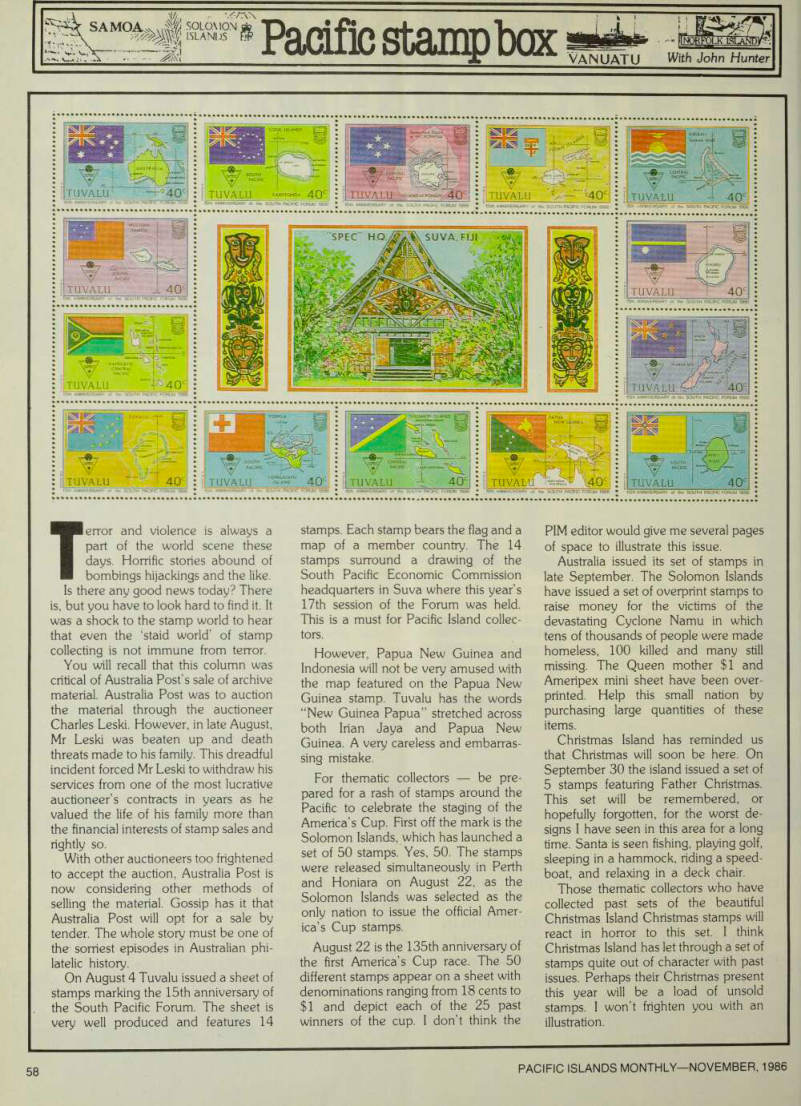
Terror and violence is always a part of the world scene these days. Horrific stories abound of bombings hijackings and the like.
Is there any good news today? There is, but you have to look hard to find it. It was a shock to the stamp world to hear that even the ‘staid world’ of stamp collecting is not immune from terror.
You will recall that this column was critical of Australia Post’s sale of archive material. Australia Post was to auction the material through the auctioneer Charles Leski. However, in late August, Mr Leski was beaten up and death threats made to his family. This dreadful incident forced Mr Leski to withdraw his services from one of the most lucrative auctioneer’s contracts in years as he valued the life of his family more than the financial interests of stamp sales and rightly so.
With other auctioneers too frightened to accept the auction, Australia Post is now considering other methods of selling the material. Gossip has it that Australia Post will opt for a sale by tender. The whole story must be one of the sorriest episodes in Australian philatelic history.
On August 4 Tuvalu issued a sheet of stamps marking the 15th anniversary of the South Pacific Forum. The sheet is very well produced and features 14
stamps. Each stamp bears the flag and a map of a member country. The 14 stamps surround a drawing of the South Pacific Economic Commission headquarters in Suva where this year’s 17th session of the Forum was held.
This is a must for Pacific Island collectors.
However, Papua New Guinea and Indonesia will not be very amused with the map featured on the Papua New Guinea stamp. Tuvalu has the words “New Guinea Papua” stretched across both i rian j aya and p apua New Guinea. A very careless and embarras- S j n g mistake. . .. , j thematlc c ° ec ors e J 3 ™' g ared f ° r a ra ? h ° f s , tam P s around J 6 Pacific to celebra e e s aging o e menca s lrs 0 e ' s e So '°™°" Is ' ands ’ which has launched a set ° , stamps. Yes, 50. e s amps were released simultaneously ,n Perth an , Honiara on ugus ’ as e Solomon s ands was se ec e as e onl P " a6on t 0 lssue the offlclal Amer ' lca s stam P s - August 22 is the 135th anniversary of the first America’s Cup race. The 50 different stamps appear on a sheet with denominations ranging from 18 cents to $1 and depict each of the 25 past winners of the cup. I don’t think the
PIM editor would give me several pages of space to illustrate this issue.
Australia issued its set of stamps in late September. The Solomon Islands have issued a set of overprint stamps to raise money for the victims of the devastating Cyclone Namu in which tens of thousands of people were made homeless, 100 killed and many still missing. The Queen mother $1 and Ameripex mini sheet have been over printed. Help this small nation by purchasing large quantities of these items.
Christmas Island has reminded us that Christmas will soon be here. On September 30 the island issued a set of 5 stamps featuring Father Christmas.
This set will be remembered, or hopefully forgotten, for the worst de signs I have seen in this area for a long time. Santa is seen fishing, playing golf, sleeping in a hammock, riding a speed boat, and relaxing in a deck chair.
Those thematic collectors who have collected past sets of the beautiful Christmas Island Christmas stamps will react in horror to this set. I think Christmas Island has let through a set of stamps quite out of character with past issues. Perhaps their Christmas present this year will be a load of unsold stamps. I won’t frighten you with an illustration.
Advertisements & other items, p. 59 (1 item)
Benson u Hedges
B
T RADSTiONALLY THE NAME
ASSOCIATED WITH PERFECTION
IN CIGARETTES
BENSON & HEDGES
20
Benson u Hedges
WARNING-SMOKING IS A HEALTH HAZARD
shipping schedules
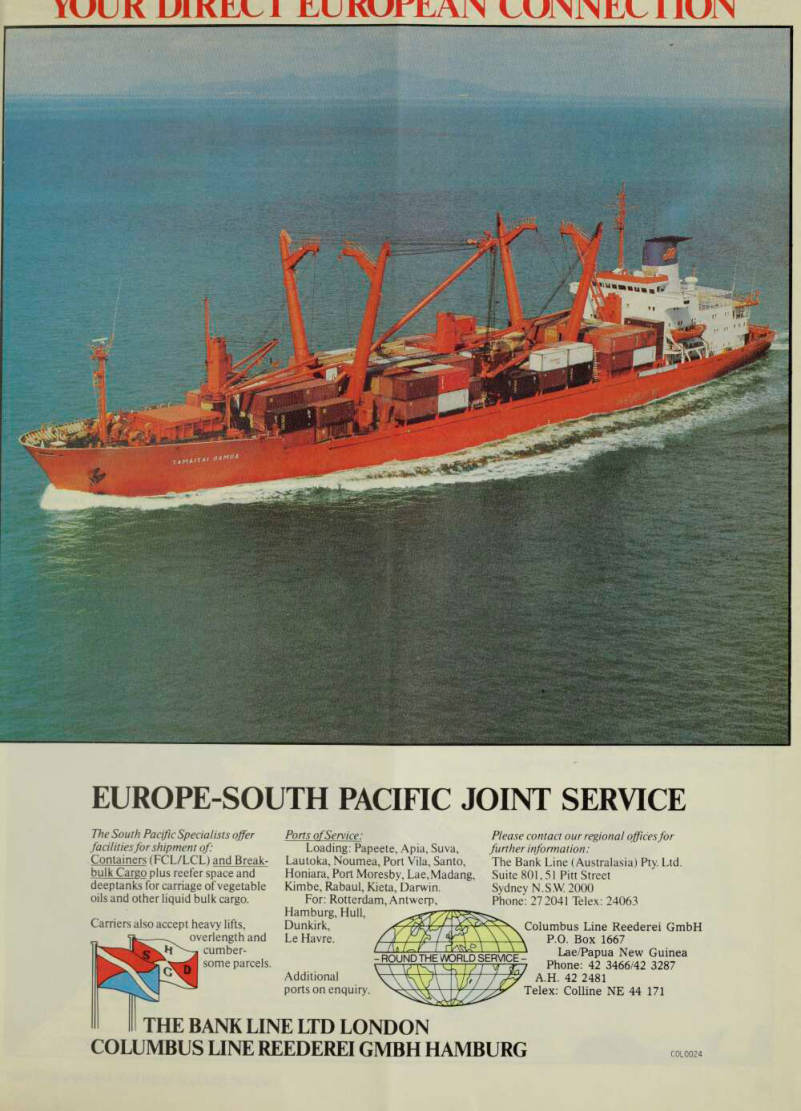
Should any shipping company wish to have its services cargo and passenger included in these listings they should contact
Pim.
Australia Fiji
Sofrana-Unilines (Fiji Express Line) oper ates to Suva and Lautoka every three weeks from the main ports on the east coast of Australia and monthly to Lautoka from Mel bourne and Sydney.
Details from Sofrana-Unilines, 432 Kent Street, Sydney (264-8944), Tlx AA 70090: Wiltrans Agency Pty. Ltd., 21st Floor, 60 Market St,, Melbourne (614-4788); Tlx 30163 ACTA Pty. Ltd., Brisbane (221-3116); Elders- ANL Pty. Ltd., Port Adelaide, (47-5688); Newcastle, Sofrana Sydney (264-8944); Websters-ANL, 58 Charles St., Launceston, Tasmania (320-555); Carpenters Shipping, Harbour Centre Building, Ist Floor, Thomson Street, Suva, Fiji (312-244), Tlx FJ2199.
Australia Samoas Tonga
Warner Pacific Lines operates a regular cargo service from Sydney, Brisbane and Melbourne to Nukualofa, Pago Pago, Apia and Vavau. Feeder service available from Apia to Cook, Christmas, Fanning and Washington Islands.
Details from Hetherington Wesfarmers Shipping Agency. 37-49 Pitt Street, Sydney, (27-1671).
Australia New Caledonia
Fiji Samoas Tonga
Pacific Forum Line operates a fully con tainerised service (general, reefer and ro-ro) from Sydney to Noumea, Suva, Apia, Pago Pago, Nukualofa, Sydney, Cargo centralised from Adelaide, Melbourne, Brisbane.
Details from Pacific Forum Line. P.O. Box 796 Auckland, Union Bulkships, 333 George Street, Sydney, Brisbane and Melbourne, Union Co., Lautoka, Suva, Nukualofa, Pacific Forum line Apia, Polynesia Shipping Pago Pago.
Australia Lord Howe Is.
Norfolk Is.
Compagnie des Chargeurs Caledoniens
operates four-weekly cargo service Sydney- Lord Howe Island and Norfolk Island.
Details Hetherington Wesfarmers Shipping Agency, 37-49 Pitt Street, Sydney (27-1671),
Australia Kiribati
K. Asia Pacific operates a 5/6 weekly service from Melbourne and Sydney to Kiribati (Tarawa).
Details from K. Asia Pacific Pty. Ltd., Goldfields House, 1 Alfred Street, Circular Quay, Sydney (232-2277), Tlx 122143.
KAP New Guinea Lines call Tarawa after PNG ports on a 35 day basis from Melbourne and Sydney/Brisbane.
Details from K. Asia Pacific Pty. Ltd., Goldfields House, 1 Alfred Street, Circular Quay, Sydney (232-2277), Tlx 122143.
Australia Tuvalu
K-Asia Pacific operates Direct service every 2nd voyage to Tulalu (Funafuti) Details from K. Asia Pacific Pty. Ltd., Goldfield House. 1 Alfred Street. Circular Quay Sydney (232-2277) Tlx 122143
Australia New Caledonia
And/Or Vanuatu
Sofrana-Unilines ships serve Noumea every three weeks from the main ports along the east Australian coast.
Details from Sofrana-Unilines, 432 Kent Street, Sydney (264-8944), Wiltrans-Agency Pty. Ltd., 21st Floor, 60 Market St., Mel bourne (614-4788) Tlx 30163 ACTA Pty. Ltd., Brisbane (221-3116). Elders-ANL Pty. Ltd., Port Adelaide (47-5688), Newcastle, Sofrana Sydney; Websters-ANL, 58 Charles St., Launceston, Tasmania (320-555).
Compagnie des Chargeurs Caledoniens operates a three-weekly containerised cargo service from Sydney to Noumea.
Details Hetherington Wesfarmers Shipping Agency, 37-49 Pitt Street, Sydney (27-1671).
Compagnie Generale Maritime operates a monthly service from Sydney, Melbourne and Brisbane to Noumea, Port Vila and Santo, for containerised and break bulk cargo.
Details Compagnie Generale Maritime, 12 Castlereagh Street, Sydney (231-3700).
Australia Nauru
Marshall Is. Kiribati
Nauru Pacific Line operates regular cargo service from Melbourne to Nauru, Majuro and Tarawa, Passenger service to Nauru only.
Details: Nauru Pacific Line (Aust). Pty. Ltd.
Nauru House, 80 Collins Street, Melbourne (653-5709), Nedlloyd Swire, 8 Spring Street,
Sydney (2-0522).
Australia New Zealand
The Australian National Line and the New Zealand Line operate a 10-day container service (TRANZTAS) between Sydney and Melbourne to Auckland, Wellington, Lyttelton and Port Chalmers.
The Tranztas service has been extended to cover Burnie and Fremantle on a direct call monthly basis linking to the main New Zealand ports.
Details from ANL Shipping Agencies, 20 Bond Street, Sydney (225-7333) and ANL Shipping Agencies, “World Trade Centre”, cnr Flinders and Spencer Streets, Melbourne (611-2323) or New Zealand Line, Pastoral House, 98 Lambton Quay, Wellington (728- 5000).
Australia Nz Fiji Tonga
Vanuatu New Caledonia
Solomons New Guinea
Sitmar Cruises operates a year-round cruise program from Sydney to include the better-known ports in the above countries, plus a number of unspoilt, and largely unknown, island paradises.
Details from Sitmar Cruises, 39 Martin Place, Sydney (239-9000); NSW, reserva tions and inquiries (008 42-2277); Rest of Australia, reservations and inquiries (008 22-2277).
Australia Nz Fiji Tonga
Vanuatu New Caledonia
Solomons Samoas Tahiti
P&O liners call at Auckland, Bay of Islands, Honiara, Lautoka, Noumea, Nukualofa, Pago Pago, Papeete, Port Moresby, Santo, Savu savu, Suva, Vavau and Vila on cruises from Australia.
Details from P&O Booking Centre, World Travel Headquarters Pty Ltd, 33 Bligh Street, Sydney (237-0333).
Australia Png
Solomons Vanuatu Nz
Pacific Forum Line operates a con tainerised and ro-ro from Brisbane to Port
Moresby, Lae, Honiara, Port Vila, Lyttelton, Napier and Auckland.
Details from Union Bulkships, Brisbane Steamships Shipping, Port Moresby and Lae; Sullivans Ltd, Honiara, Vila Agents, Port Vila; SCONZ Christchurch, Napier and Auckland.
Australia Micronesia
Nauru Pacific Line operates a regular container service from Melbourne to Ponape, Truk, Guam and Saipan.
Details: N.P.L. (Australia) Pty Ltd, Nauru House, 80 Collins Street, Melbourne (653- 5709). Nedlloyd Swire, 8 Spring Street,
Sydney (2-0522).
Australia New Caledonia
Sofrana Unilines operates a 3-4 weekly service from East Coast mainports to Noumea.
Details from Sofrana Unilines 432 Kent Street, Sydney. (Tel. 264-8944), Tlx AA 70090.
Australia Tuvalu
K. Asia Pacific operates a three monthly service from Sydney and Melbourne to Tuvalu (Funafuti). Subject to inducement.
Details from K. Asia Pacific Pty Ltd, Goldfields House, 1 Alfred Street, Circular Quay, Sydney (232-2277). Tlx 122143.
Warner Pacific Line operates a six week containerised/breakbulk service to Funafuti from Melbourne/Brisbane/ Sydney and Auck land.
Details from Hetherington Shipping Agency, 37-49 Pitt Street, Sydney (27-1671): Mac Kay Shipping Ltd, Downtown House, Queen Street, Auckland (30-229).
Australia Png
KAP New Guinea Lines cargo vessels call at Melbourne, Sydney, Port Moresby, Lae, Madang, Wewak, Manus, Kimbe, Rabaul, Popondetta.
Details from K. Asia Pacific Pty Ltd, Goldfields House, 1 Alfred Street, Circular Quay, Sydney (232-2277), Tlx 122143. Dal gety Shipping, World Trade Centre, Mel bourne (616-6700).
Australia Png Solomons
Sofrana Unilines (Aust.) P L operates a 3-4 weekly cargo service to PNG, ex-main ports on the east coast of Australia.
Details from Sofrana Unilines, 432 Kent Street, Sydney (264-8944), Tlx AA 70090.
Australia Png Solomons
Vanuatu
A consortium of NGALPNGL and CON PAC NEL have four vessels operating a joint service from east coast Australian ports to Port Moresby, Lae, Alotau, Madang, Wewak, Rabaul, Kavieng-Kimbe, Kieta, Honiara, Vila, Santo.
Details from Burns Philp & Co. Ltd., P.O.
Box R 124, Royal Exchange, Sydney, 2000 (2-0547); Nedlloyd Swire, 8 Spring Street, Sydney (2-0522): New Guinea Express Lines, 37 Pitt Street, Sydney (241-3991); Vila Agents. PO Box 27, Port-Vila (2456). Tlx
Nhioii.
New Guinea Express Lines operates a weekly container service from Melbourne, Sydney, Brisbane to Port Moresby, Lae, Alotau, Kimbe, Rabaul, Kieta, Honiara, Kavieng, Madang, Wewak, Santo, Vila.
Details from New Guinea Express Lines, P.O. Box R 73, Royal Exchange, Sydney (241-3991): New Guinea Express Lines, 127 Creek Street, Brisbane (221-9333); New Guinea Express Lines, 327 Collins Street, Melbourne (602-5544); Niugini Express Lines, Port Moresby (21-4572); Lae (42- 1536): Niugini Island Cargo Services Pty.
Ltd., Rabaul (922-467); Bougainville Agen cies Pty. Ltd., Kieta (956-089); Robert Laurie (PNG) P/L, Madang (82-2157): Garamut Enterprises P L, Wewak (86-2106): Burns Philp (PNG) Ltd., Kavieng (94-2133); Alotau
Stevedoring & Transport, Alotau (61-1318); Ngatia Wholesalers Pty. Ltd., Kimbe (93- 5102); and Tradco Shipping, Mendana Ave nue, Honiara (22588); Vila Agents Ltd., P.O.
Box 971, Vila, Vanuatu (2490); John Lum & Associates, P.O. Box 65, Santo, Vanuatu (329).
Australia Tahiti
Compagnie Generale Maritime operates a monthly service from Sydney, Melbourne and Brisbane to Papeete, for containerised and break bulk cargo.
Details Compagnie Generale Maritime, 12 Castlereagh Street, Sydney (231-3700).
Sofrana Unilines (Aust.) P L operates a 3/4 weekly cargo service to Papeete ex main ports on the east coast of Australia.
Details from Sofrana Unilines, 432 Kent Street, Sydney (264-8944) Tlx AA 70090.
Singapore Hongkong Fiji
Islands Ports
Kyowa Shipping Co. Ltd. operates a month ly containerised and break bulk cargo service from Singapore, Hongkong to Lautoka, Suva and then to island ports.
Details from Carpenters Shipping, Harbour Centre Building, Ist Floor, Thomson Street, Suva (312-244), Tlx FJ2199.
Far East Fiji
New Zealand
New Zealand Unit Express (NZUE) now operates a monthly service accepting con tainerised and break bulk cargo from Manila, Keelung, Kaohsiung and Hongkong to Lauto ka, Suva and thence to New Zealand ports.
Details from Carpenters Shipping, Harbour Centre Building, Ist Floor, Thomson Street, Suva (312-244), Tlx FJ 2199: Burns Philp, Suva (311-777); New Zealand Unit Express Maratime Building, 2-10 Customhouse Quay, P.O. Box 890, Wellington, Cables: ENZUE
Man Wellington Telex; Nz31340
NEDLNZ Telephone: 727-865 or Nedlloyd Swire Pty. Ltd., Sydney (20-522).
Nedlloyd operates bi-weekly cargo service with four ships from Surabaya, Jakarta,
Bangkok, Port Kelang and Singapore to Suva, Lautoka and NZ ports.
Details from Nedlloyd (Aust.) Pty. Ltd., 8 Spring St., Sydney (27-3801), Burns Philp (SS) Co. Ltd., Suva and Lautoka.
Far East Mid-S. Pacific
China Navigation’s New Guinea Pacific Line operates a regular container service from Hongkong, Taiwan, Manila, Port Kelang and Singapore to Port Moresby, Lae, Rabaul and Honiara monthly and to Wewak, Madang and Kieta every three months. Cargo from the same Far Eastern ports to the South Pacific ports of Noumea, Santo, Vila, Papeete, Pago Pago, Apia, Raratonga and Tarawa will be shipped via Japan on the monthly Bali Hai service.
Details from Steamships Shipping, P.O.
Box 634, Port Moresby (22-0289).
Kyowa Shipping Ltd. operates monthly services from Japan to Guam, Saipan, Solo mons, New Caledonia, Fiji, Western and American Samoa, Tahiti, Cook Is., Tonga and Vanuatu.
Details: Heterington Wesfarmers Shipping Agency, 37-49 Pitt Street, Sydney (27-1671); Carpenters Shipping, Suva (312-244), Tlx FJ2199.
Guam Northern Marianas
Saipan Shipping Co. Inc. operate a weekly service via barge carrying containers and conventional cargo between Guam and Saipan and Tinian.
Details from Saipan Shipping Co. Inc., P.O.
Box 8, Saipan, CM 96950 (Tel. 9707), Tlx 783619; Guam agents Maritime Agencies of the Pacific Ltd.
Hawaii Tahiti Samoas
Tonga Kiribati Fiji
Solomons Png
Star Shipping Associates operates a monthly service originating in Honolulu and destined for Pago Pago, Papeete, Apia, Nukualofa, Suva, Vila and Port Moresby.
Details from Star Shipping Assoc., P. 0., Box 25988, Honolulu, Hawaii 96825. Ph. (808) 396-4256; Polynesia Shipping Services in Pago Pago and Burns Philp Agency in Apia, Nukualofa, Suva and Port Moresby.
Japan Fiji Island Ports
Kyowa Shipping Co. Ltd. operates a month ly containerised service from main ports of Japan to Suva and Lautoka and thence to island ports.
Details from Carpenters Shipping, Harbour Centre Building, Ist Floor, Thomson St., Suva (312-244). Tlx FJ2199.
Bali Hai service operates a monthly con tainerised service from main ports of Japan to Lautoka and Suva and thence to island ports.
Details from Carpenters Shipping, Harbour Centre Building, Ist Floor, Thomson St., Suva (312-244), Tlx FJ2199 and Burns Philp, Suva (311-777).
Japan Micronesia
The NVK Shipping Line operates a monthly cargo service from Japan to Micronesia, calling at Yoko, Nagoya, Kobe, Guam, Saipan, Truk, Ponape and Majuro, returning via Yoko, Nagoya and Kobe.
Details from Burns Philp & Co. Ltd., 51 Pitt Street, Sydney (2-0547).
Saipan Shipping Co. Inc. operates a monthly service from Japan to Saipan, Guam, Truk, Ponape, Majuro (Kosrae and Ebeye on inducement).
Details from Saipan Shipping Co. Inc., P.O.
Box 8, Saipan, CM 96950 (Tel. 9707), Tlx 783619, Japan agents Kyowa Shipping Com pany Ltd.; Guam Agents Maritime Agencies of the Pacific Ltd.
Japan Png
Mitsui O.S.K. Lines operates a monthly service from main ports Japan and Japan, Wewak, Lae, Rabaul, Kieta, Port Moresby.
Details from Robert Laurie Carpenters Pty.
Ltd., P.O. Box 1032, Lae/PNG (Tel. 42-3642, 42-3811.)
New Caledonia Fiji West
Coast North America
PAD Line operates an approx. 3-weekly ro-ro service from Noumea and Suva to Honolulu and West Coast USA and Canadian ports.
Details from Sofrana-Unilines SA, BP 1602, Noumea (27-51-91), Tlx NMO4B; Carpenters Shipping, Harbour Centre Building, Ist Floor, Thomson St.. Suva (312-244), Tlx FJ2199.
Png Inter Mainport
Papua New Guinea Line offers scheduled 10-20 day coastal liner services linking all PNG major ports with containerisation, reefer, heavy lift and transshipment facilities.
Details from PNG Line, Box 543, Port Moresby, PNG (21-1174), Tlx 22269.
Png Uk/Continent
The Bank Line & Columbus Line operate a regular joint service from Port Moresby, Oro Bay, Kieta, Rabaul, Kimbe, Madang and Lae to Hull, Hamburg, Rotterdam, Antwerp and Le Havre.
Details from The Bank Line (A'asia) Pty.
Ltd., 51 Pitt Street, Sydney (27-2041); Tlx AA24063; Columbus Line, Lae (423466), Tlx NE 44171; or lines' local agents.
Solomons Uk/Continent
The Bank Line & Columbus Line operate a regular joint cargo service from Honiara to Hull, Hamburg, Rotterdam, Antwerp and Le Havre.
Details from the Bank Line (A'asia) Pty. Ltd. 51 Pitt Street, Sydney (27-2041), Tlx AA24063; Columbus Line. Lae (423466), Tlx NE 44171; Tradco Shipping Ltd., Honiara (22588) Tlx 66313.
New Zealand Australia
Papua New Guinea Solomon
Islands Vanuatu
Pacific Forum Line operates a con tainerised and ro-ro service from Lyttelton, Napier and Auckland to Brisbane, Port Moresby, Lae, Honiara and Port Vila.
Details from SCONZ Christchurch, Napier and Auckland; Union Bulkships, Brisbane; Steamships Shipping, Port Moresby and Lae; Sullivans Ltd., Honiara; Vila Agents, Port Vila.
Nz Cook Is. Niue Tahiti
New Zealand Line operates cargo services based on pallets and similar units from Auckland to Niue, Cook Islands and Tahiti.
Details from the NZ Shipping Agencies International Ltd., P.O. Box 3420, Auckland (797210); Waterfront Commission, P.O. Box
61, Rarotonga; Cook Islands; Shipping Office,
Govt, of Niue, P.O. Box 107, Niue Island; Compagnie Maritime Polynesienne, P.O. Box 36, Papeete, Tahiti.
Nz Fiji
Reef operates a regular 18-day service from Auckland to Suva and Lautoka. Also passenger accommodation.
Details from Reef Shipping Agencies, PO Box 3382, Auckland, NZ (77-1221-3), Tlx 60633; MV Fijian Shipping Agencies Ltd.
Private Bag, Suva, Fiji (31-1056).
Pacific Line with one ship operates two weekly ro-ro cargo service New Zealand, Lautoka, Suva. No passengers.
Details: Sofrana Unilines, 18 Customs Street, Auckland (773-279) PO Box 3614, Tlx NZ2313. Carpenters Shipping, 100 Thomson Street, Suva (312-244), Tlx FJ2199.
Nz Fiji North America (Wc)
Blue Star Line Ltd. Pacific Coast container services. Only direct service to and from New Zealand. Blue Star vessels call at Suva and Honolulu on NZ-U.S.-West Coast voyages.
Details from Blueport ACT (NZ) Ltd., PO Box 192, Wellington (739-029). Burns Philp (SS) Co. Ltd., GPO Box 355, Suva, Fiji (311-777), Tlx FJ2168 Burship.
Nz Fiji Samoas Tonga
Pacific Forum Line operates a con tainerised and ro-ro 21 day service from Auckland to Lautoka, Suva, Apia, Pago Pago and Nukualofa.
Details from Pacific Forum Line, Auckland and Apia, Union Maritime, Lautoka, Suva and
Nuku alofa; Polynesian Shipping, Pago Pago.
Nz N. Caledonia Vanuatu
Png Solomons
Sofrana Unilines with three ships operate to Vila and Santo, to Honiara and Papua New Guinea and to Norfolk Island and Noumea (No passengers).
Details from Sofrana Unilines, 18 Customs Street. Auckland (773-279), PO Box 3614, Tlx NZ2313.
Nz Tahiti
Compagne Tahotienne Maritime SA (as CTM-Tahiti Line) operates one ship, MV Bounty 111, monthly Papeete New Zealand. (No passengers).
Details from Sofrana Unilines, PO Box 3614, 18 Customs St.. Auckland, Tlx NZ2313.
CTM-Tahiti Line, PO Box 9012, Papeete (39042), Tlx Tahitlin 322 FP Tahiti.
Nz Tonga - Samoas
Warner Pacific Line services Auckland, Nukualofa. Vavau, Apia, Pago Pago fort nightly carrying general and freezer cargoes.
Details from McKay Shipping Ltd., Down town House, 21 Queen St., Auckland, PO Box 1372 (30-299). Cables MACSHIP, Telex NZ2554, Warner Pacific Line, Box 93,.
Nukualofa, Tonga; Mealelei (Western Samoa) Ltd. Private Bag, Apia, Western Samoa, Pacific Maritime Services, PO Box 2617, Pago Pago, American Samoa (633- 2728), cables: Pacmar SX2OS.
Tahiti New Caledonia
Vanuatu Solomon Is.
New Zealand Png
Singapore Europe
Polish Ocean Lines operate in a semi container type vessel to the following ports, from Papeete, Noumea, Santo, Vila, Yandina, Honiara, Auckland, Rabaul, Lae, Singapore, Port Klelang, Penang then to Mediterranean ports and Europe via the Suez Canal. (Other New Zealand ports subject to inducement).
Details from Universal Shipping Agencies Ltd., 6th Floor, 38 Fort Street, Auckland 1, New Zealand (390931, 390727, 32104), Tlx 21517.
Europe Tahiti
New Caledonia
Compagne Generate Maritime operates services from Europe and Mediterranean ports to Papeete and Noumea using three ro-ro and multi-purpose vessels thus ensuring a bi-monthly sailing to and from.
Details Compagne Generate Maritime, 12 Castlereagh Street, Sydney (231-3700).
Europe Tahiti
New Calendonia New Zealand
Vanuatu Solomons
Png Europe
Polish Ocean Lines offers regular monthly sailings for containerised and break bulk cargo, also conventional reefer space and reefer containers from Hamburg, Rotterdam, Dunkirk, Rouen to Papeete, Noumea, Auck land, Santo, Honiara, Rabaul, Lae, Singa pore, returning to Europe via Suez, other ports in South Pacific can be served directly with inducement or otherwise via tranship ment.
Details from Sotama, BP 9170, Papeete, Tel. 427805 Tlx 373. Telex Sotama 373FP/SATO: BP C 2 Noumea Cedex Tel. 272094 Tlx 163NM/Universal Shipping Agencies PO Box 2282 Auckland Tel. 30930 Tlx 21517/Vanua Navigation PO Box 44 Vila Tel. 2027 Tlx 1033/Melan Chine Shipping Co. PO Box 71 Honiara Tel. 21678 Tix 66335/Steamships Shipping & Transport PO Box 1512 Rabaul Tel 922952 Tlx 92929/Steamships Trading Co.
Ltd. PO Box 85 Lae Tel. 424666 Tlx 42423/Union Steamship Co. of NZ Ltd. PO Box 50 Apia Tel. 21781 Tlx 225/Warner Pacific Line PO Box 93 Nukualofa Tel. 22088 Tlx 66219/Fiji Agents TBA.
Europe Tahiti W.
Samoa Fiji N. Caledonia
Nedlloyd offers regular cargo services from Continental ports to Papeete, Apia, Fiji and New Caledonia.
Details Nedlloyd (Aust.) Pty. Ltd., 8 Spring Street, Sydney (27-3801); Carpenters Ship ping, Ist Floor, Harbour Centre Bldg., 100 Thomson St„ Suva (312-244), Tlx 2199FJ and Vetari Street, Lautoka (63988), Tlx 5215FJ.
Uk N. Continent W. Samoa
Tonga Fiji
The Bank Line & Columbus Line operate a regular joint cargo service from Hull, Ham burg, Bremen, Antwerp, Rotterdam and Le Havre to Apia, Nukualofa, Suva and Lautoka.
Details from The Bank Line (A’asia) Pty.
Ltd,, 51 Pitt Street, Sydney (27-2041), Tlx AA 24063, Columbus Line, Lae (423-466), Tlx NE 44171, or lines local agent.
Uk N. Continent Png
Solomons
The Bank Line & Columbus Line operate a regular joint cargo service from Hull, Ham burg, Bremen, Antwerp, Rotterdam and Le Havre to Port Moresby, Lae, Madang, Kimbe, Rabaul. Kieta and Honiara and on induce ment to Yandina.
Details from The Bank Line (A'asia) Pty.
Ltd., 51 Pitt Street, Sydney (27-2041), Tlx AA 24063. Columbus Line, Lae (42-3466), Tlx NE 44171; or lines local agents.
Uk/N. Continent Tahiti
N. Caledonia Vanuatu
The Bank Line & Columbus line operate a regular joint cargo service from Hull, Ham burg, Bremen, Antwerp, Rotterdam and Le Havre to Papeete, Noumea, Port-Vila and Santo.
Details from The Bank Line (A'sia) Pty. Ltd., 51 Pitt Street, Sydney (27-2041), Tlx AA
24063, Columbus Line, Lae (42-3466), Tlx NE 44171; Ets. A.M. Fare UTE. Papeete; Ets, Ballande, Noumea and other local agents.
U.S. Hawaii Micronesia
East Malaysia Brunei
Papua New Guinea
PM&O Lines operates two fully self-sus tained container vessels on a sailing frequen cy of every 30 days between the San Francisco Bay Area, Los Angeles, Honolulu and Majuro, Ebeye, Kosrae, Ponape, Truk, Saipan, Yap, Palau, Kota Kinabalu, Brunei, Lae. Kieta and Rabaul.
Details from PM&O Lines, 353 Sacramento Street, San Francisco, California 94111,
U.S.A. (415) 421-5400, Tlx 278016 Pmo
UR; Owner’s Representative P.O. Box 803, Saipan. N.M.I. 96950, PH: 234-6819 TLX
783-605 Cmcaa.
U.S. Hawaii - Samoas
Kiribati Nauru
Nauru Pacific Line operates regular con ventional and container services from San Francisco and Honolulu to Christmas Island, Pago Pago, Apia, Tarawa and Nauru.
Details from N.P.L. (Australia) Pty. Ltd., Nauru House, 80 Collins Street, Melbourne (653-5709), Nauru Air and Shipping Agency, Suite 2803, 185 Berry Street, San Francisco, California 94107 (415-543-4517). Nauru Air and Shipping Agency, Suite 506, 841 Bishop St.. Honolulu, HI 96813 (808-523-0441).
U.S. Noumea Fiji
PAD Line operates an approx. 3-weekly io ro service from west coast USA and Canada to Noumea, Suva and Lautoka.
Details from Sofrana Unilines BP 1602, Noumea (27-51-91). Tlx NMO4B, Carpenters Shipping, Harbour Centre Building, Ist Floor, 100 Thomson Street, Suva (312-244), Tlx FJ2199, Trans-Austral Shipping Pty. Ltd., P.O. Box R 232, Royal Exchange, 2000 (231-8411), Tlx AA21204.
Advertisements & other items, pp. 60-68 (1 item)
Careers In Fisheries
Australian
Maritime College
Today's fishing industry needs men and women with practical and technological expertise for careers in:
• CATCHING • GEAR TECHNOLOGY
• MANAGEMENT • SEAFOOD TECHNOLOGY
• MARKETING • FISHERIES RESEARCH
The Australian Maritime College's School of Fisheries offers courses designed to meet this need.
Bachelor of Applied Science (Fisheries Technology)
Duration: Three years, full-time.
Entrance Requirements: Normally, satisfactory HSC results in mathematics, English and a science subject. Otherwise suitable applicants lacking these qualifications will be given special consideration.
Graduate Diploma in Fisheries Technology Duration: One year, commencing Februaiy.
Entrance Requirements: First degree/diploma in a life or physical science or engineering discipline. Graduates/diplomates i’ business, management, economics or a numerate discipline, and nor, graduates with considerable experience in the fishing industry will also be considered.
There are no course fees for Australian residents other than the $250 p.a. government higher education administration fee, and courses are approved under TEAS.
Some scholarships and grants are also available.
For further information, contact: The Admissions Officer, w Australian Maritime College ?
PO Box 986, i
LAUNCESTON, Tas. 7250
FOR
40 FT. WORK BOAT
PROFESSIONALLY
RESTORED
SALE
BY MICK NESBITT
AND PAUL NOLAN
$A89,000
THIS BOAT HAS EVERYTHING
Gardener Engine. 5 KVA Alternator. Auto Pilot (R.C.) For full particulars contact: Paul Doughty. Ph Aust (02) 516-3974. (02) 818-1555 or write to P.O. BOX 39, Camperdown, N.S.W., 2050, Australia.
IUUKUIKLti HU KV7rL/\i> UUJIMNHU 1 lUi>
U»
EUROPE-SOUTH PACIFIC JOINT SERVICE
The South Pacific Specialists offer facilities for shipment of: Containers (FCL/LCL) and Breakbulk Cargo plus reefer space and deeptanks for carriage of vegetable oils and other liquid bulk cargo.
Carriers also accept heavy lifts, overlength and cumbersome parcels.
Ports ofService: Loading: Papeete, Apia, Suva, Lautoka, Noumea, Port Vila, Santo, Honiara, Port Moresby, Lae,Madang, Kimbe, Rabaul, Kieta, Darwin.
For: Rotterdam, Antwerp, Hamburg, Hull Dunkirk, >^7 Le Havre.
Please contact our regional offices for further information: The Bank Line (Australasia) Pty. Ltd.
Suite 801,51 Pitt Street Sydney N.S.W. 2000 Phone: 27 2041 Telex: 24063 Additional ports on enquiry. vyx Columbus Line Reederei GmbH \\\ P.O. Box 1667 - ROUND THE WORLD SERVICE - rl Lae/P S? U ?, 1 y Phone: 42 3466/42 3287 jU /Jy A.H. 42 2481 A/ 7 T '“ l ex: Colline NE 44 171
THE BANK LINE LTD LONDON
COLUMBUS LINE REEDEREI GMBH HAMBURG
We’ve just made
the ocean smaller!
Polynesia Line's new MS Polynesia 550-container ship provides regular monthly cargo service between Papeete. Pago Pago and Apia in the South Pacific, and Long Beach and Oakland on the US Pacific Coast.
POLYNESIA LINE
Interocean Steamship Corporation General Agent Apia Pago Pago
t*CSl£
<>c£ 9 & o 3* a 3 V m* Serving Polynesia is all we do-and we do it better! _^Papeete
KYOWA LINE
Japan Korea Taiwan Singapore
Hong Kong
To; Solomon Is., New Caledonia, Fiji, W. Samoa, A. Samoa, Tahiti, Vanuatu To: Guam, Saipan. Truk, Ponape, Majuro, Yap, Koror
Taiwan Hong Kong Singapore
Philippines
To: Papua New Guinea, Hawaii, Pacific Islands.
kvow \ KYOWA SHIPPING CO., LTD.
HEAD OFFICE:
6th Floor, Kikushima Bldg , 2-3, Hamamatsucho 2-chome. Mmato-ku, Tokyo 105. Japan Phone: 03(437)2885 (Rep I Cables: MARIQUEEN Tokyo Telex: 242-4651 Kyowa J
OSAKA OFFICE:
Dai San Fuji Bldg.. 3-13, Itachibori 1-chome, Osaka 550. 06(533)5821 (Rep > Cables: MARIQUEEN' Osaka Telex: 525-6271 Ssiosa ,
SERVICE PAGE
ADVERTISING
ACTA 57
Aggie Grey’s 64 Air Pacific ..30-31 Aitutaki Resort 45 Aiwa 27 Amatil 59 Antique Maps 18 Aust. Maritime Coll 59
AW A 24
Bank Line 61 Boat for sale 60 Citizen Watches 8 Columbus Line 61 Cook Islands International 48 Cook Is. Tourist Authority 40 Hawaii Telephone 13 Henry Cumines 50 Hitachi 2 Ideas Centre 53 Kenwood 35 Kyowa Shipping 63 Lees Industries 49 & 51 Lincoln Electric 54 Metro Drill & Blast 26 Metro Power 64 Michael Pohl 64 Mitsubishi Motor 68 Nissan Motor 10-11 Pioneer Electronic 39 Polish Ocean Lines 65 Polynesia Line 62
P.R.I 19
Rarotongan Resort 43 Scott 26 Sheaffer Pen Textron 9 Sony Corp 4 Toyota Motor 36-37 Toyota Motor 66-67
PACIFIC
SLANDS
IMONT H L Y
AUSTRALIA: Distribution: The Herald and Weekly Times Ltd., 44-74 Flinders St., Melbourne, Vic., 3000. Advertising Reps Brisbane D. Wood, Anday Agency, CCA Centre, Dayboro Road, Closebum 4520, Box 1918, GPO Brisbane, 4001; telephone (07) 289-4128. Adelaide Hastwell Williamson Rouse Pty. Ltd., PO Box 419, Norwood, SA, 5067; 59 Kensington Road, Norwood; telephone (08) 332-3322, telex 87113; Perth Allen & Associates, 7 Fore St., Perth, W.A., 6000, telephone (09) 328-9833, telex: AA94382.
FUI: Distribution and subscriptions Desai Bookshops, P.O. Box 160, Suva, Fiji telephone Suva 23036.
Advertising Fiji Times & Herald Ltd., 20 Gordon St., Suva, telephone 31-4111, telex FJ2124.
FRENCH POLYNESIA: Distribution Hachette Pacifique 10 Ave., Bruat, Papeete, telephone 25-610.
HAWAII: UNITED STATES: Distribution PIM, Hawaii, P.O. Box 22250, Honolulu, Hawaii, 96822. Advertising Brian C. Asgill, Apt. 1308,1676 Ala Moana Blvd., Honolulu, Hawaii, 96815, telephone (808) 955-9718.
JAPAN: Advertising and subscriptions Universal Media Corporation, GPO Box 46, Tokyo, telephone 666-3036, cable UNIMEDIA Tokyo, telex 2524665.
MALAYSIA: Advertising and subscriptions Worldwide Media Services, 57-B Komplex Damai, Jin Dato Haji Eusoff, Kuala Lumpur, telephone 63-9340, cables WORLDMEDIA Kuala Lumpur, telex 31533.
VANUATU: Distribution The Bookshop, HQ Box 210, Port Vila. Advertising Norman Bros. Bookshop, Port Vila, telephone 2232.
NEW CALEDONIA: Distribution Depot Centre de Presse Michel Pentecost. CBP2, Noumea, telephone 27-2434, 27-4729.
NEW ZEALAND: Distribution Gordon & Gotch, PO Box 584, 2 Carr Road, Mt. Roskill, Auckland 4 Advertising McKay International Media Reps. Ltd., c/o Albany P. 0., Auckland 10, New Zealand, telephone 413-9119.
Telex NZ22701, FAX 413-9110.
PAPUA NEW GUINEA: Distribution Gordon & Gotch, PO Box 3395, Port Moresby, telephone 25-4551, 25-4855.
Advertising Ken Head, PNG Post-Courier, PO Box 85, Port Moresby, telephone 21-2577, telex 22120.
SOLOMON ISLANDS: Distribution and Advertising The Bookshop, (Norman Bros.) PO Box 503, Honiara.
PHILIPPINES: Advertising The GF Group, 12 San Ignacio St., Uroaneta Village, Makati, Metro Manila, telephone 817-7299, telex 45950 and 4233.
UNITED KINGDOM: The Herald & Weekly Times Ltd., No 1 Maltravers Street, London WC2R 3DZ, England, telephone (01) 836-5162, telex London 21989.
UNITED STATES MAINLAND: Advertising Joshua B.
Powers Jr., Powers International Inc., Suite 708, 271 Madison Ave., New York, NY 10016, telephone 867-9580, telex 236514. Subscriptions PIM, Hawaii, PO Box 22250, Honolulu, Hawaii, 96822.
SUBSCRIPTIONS
American Samoa US$24 Australia ..AUSS24 Canada US$3O Cook Islands . NZ$36 Fiji AUSS26 French Polynesia US$3O Guam .. US$3O Hawaii US$3O Japan US$3O Kiribati AUSS24 Micronesia US$3O Nauru AUSS24 New Caledonia US$3O New Zealand NZ$36 Niue NZ$3O Norfolk Island AUSS24 Northern Marianas —... US$3O Papua New Guinea AUSS3S Solomon Islands AUSS24 Tonga —... AUSS24 Tuvala AUSS24 United Kingdom Stgl 5 U.S. Mainland US$3O Vanuatu AUSS24 Western Samoa AUSS24 Elsewhere AUSS36 Payments by personal cheque are only acceptable in Australian (from a branch in Australia). U.S. and New Zealand currency. For all other remittances please send an international bank draft in Australian dollars.
Published monthly by Pacific Publications (Aust.) Pty.
Ltd. and printed in Australia by Quadricolor Industries Pty.
Ltd.,
FOR SALE
Sinclair Spectrum & QL software & hardware; Catalogue available.
DATA SAFE, Shop 15, Stapleton Arcade. 51 Old Barrenjoey Rd., Avalon Beach, Sydney, N S W.
(Sydney 02-918-2225).
WANTED TO
BUY IN
LARGE
QUANTITIES
Frozen coconut crabs, Fruit bats (Flying fox), Lobster tails, Giant clam mussels.
Please send enquiries with complete address, phone number and telex contact to:
Michael Pohl
Enterprises
Box 20219 Guam Main Facility Guam 96921 Telephone: (671) 646-8614 (671) 472-8224 Telex: (721) 6680 POHLFISH
NOW AVAILABLE!
PACIFIC ISLANDS YEAR BOOK
Due to demand the 15th edition has been reprinted and is available from P.I.M. at As3s plus p.p.
TRACTOR PARTS
Ph
Stay at Aggie Grey’s . . . the South Pacific’s
legendary hotel.
Situated right in the heart of Western Samoa. Enjoy Polynesian style friendliness and service, in tool surroundings, superb entertainment and food.
Magnificent while sand beaches only a short drive- away. Airconditioned rooms, swimming poo’l and Jull bar facilities.
Bookings through I'nion Steamship Company of NZ. Pan Am, Air New Zealand or direc t to Aggie Grey’s, Apia. Western Samoa. Cables: ‘AGGIES' Apia.
MULISH UlitAN lIHtS
General Management, 10 Lutego 24,81-364 GDYNIA, POLAND, Phone; 20-19-01, Cables: POLOCEAN Telex: 054-231 & Q & m r*»•> i
V’-A'V
•312 ;v.-. v»i * ✓ ,• * if. v»r »• : ... •- ■y\Vv .'.Tv w: » • ; [ Vrt vr* -l U** .v’i* - .•* •
SOUTH PACIFIC SERVICE
We offer monthly service to and from: GDYNIA, HAMBURG, ROTTERDAM, MIDDLESBOROUGH/IMMINGHAM, ANTWERP, DUNKIRK, ROUEN, PAPEETE (via PANAMA), NOUMEA, AUCKLAND, HONIARA, RABAUL, LAE, SINGAPORE, by our multipurpose vessels carrying dry and reefer containers, reefer chambers, heavy lifts, breakbulk or
palletized, bulk liquids.
A 1 POLISH OCEAN LINES Representatives
AUCKLAND Mr. A. Sieradzki. Telex 21517 NZ “UNISHIP”. SYDNEY Mr. Walenciak. Telex 20428 AA “SLEIGH”
TALJITI O^TA „ A T POLISH OCEAN LINES Agents Telex 296 FP “COUTIMEX”. NEW CALEDONIA SATO Telex 163 NM “SATO”. AUCKLAND UNIVERSAL SHIPPING AGENCIES LTD., Telex 21517 NZ “UNISHIP”. SOLOMONS MELAN CHINE SHIPPING CO., LTD Telex 66335 HO “SYMECO". PNG STEAMSHIPS TRADING CO., LTD Telex 42423 NE “STEAM”.
s>
Full-Floating
Power Train
UJ G
[O2-5 FD25]
Steering Wheel Vibration Virtually non-existent, elevating comfort to a new all-time high. * Indicates maximum vibration level of the wheel
oU j db(A)
[o2-SFD2S] j Equivalent Noise Level at Driver’s Ear Drastically reduced by sound-absorbing materials and comprehensive engine design. * Measured and calculated according to ISO.
The forklift designed
for greater comfort, less vibration.
Sh II 0
ill
0 a Toyota, the leader in innovation, creates a revolution in the forklift industry.
The revolutionary new 1-3 ton engine powered series forklifts; maximum-performance vehicles designed for maximum-operator comfort.
A full-floating power train practically eliminates vibration. Advanced engineering “floats” the entire engine on a cushion of rubber, with no direct attachment to the frame. Surrounding main engine parts also vibrate freely, drastically reducing structural vibration. Rubber sealing on engine hood and floorboard, and sound-absorbing materials, all add up to the many innovations that raise Toyota’s new series’ comfort level far above other forklifts.
Also exclusive to the 1-3 ton series is the 3-litre 1Z direct injection diesel engine. Delivering greater horsepower and less fuel consumption.
Increased performance, increased comfort.
But don’t just take our word. Take a test drive and feel.
Toyota’s new 1-3 ton series forklifts are in a class by themselves.
Comfort-class.
Toyota Introduces
bU
K /2,400 rpm
JIS PS [O2-SFD2S]
(57 HP 2,400 rpm SAE NET)
/sec,.
[O2-SFD2S]
(114 f/min.) Engine Horsepower The new 1Z diesel engine delivers more power, more efficiency.
Lifting Speed Now the job gets done faster than ever.
TOYOTA
ZUUU- NV"' '-
Ah/V/ Vy Vy (4,400 lbs) I (12.1 mile/h) Max. Drawbar Pull Scales inclines hauling a full load, easily.
Max. Travel Speed Work cycles are dramatically increased for greater efficiency.
A decision you can be comfortable with.
Maintenance Integrated monitoring centre, easy access to parts.
Inspection and servicing amazingly easy.
Durability
Overheating “fail-safe” system, rigorously tested; built rugged.
Service Network Extensive. After sales support in almost every country in the world.
Reliability
Design priority no. 1 ensuring operator safety through Toyota reliability.
Wide Variation Even greater productivity and comfort available with a wide selection of models.
TOYOTA
AMERICAN SAMOA: BURNS PHILP (S.S.) CO., LTD. TEL: 633-4281 AUSTRALIA: THIESS TOYOTA PTY, LTD. TEL: 526-0333 FIJI: AUTOMOTIVE SUPPLIES CO., A DIVISION OF BURNS PHILP (S.S.) CO., LTD.
TEL: 383444
GUAM: ATKINS, KROLL, INC. TEL; 646-1876
NEW CALEDONIA: SERVICE IMPORTATION AUTOMOBILE DU PACIFIQUE
TEL: 27-41-44
NEW ZEALAND: ANDREWS & BEAVEN INDUSTRIAL EQUIPMENT LTD.
TEL; 2780940
PAPUA NEW GUINEA: ELA MOTORS, BURNS PHILP (P.N.G.), LTD.
AUTOMOTIVE DIVISION TEL; 217036
VANUATU: VANUATU MOTORS, A DIVISION OF BURNS PHILP (VANUATU) LTD.
TEL: VILA 2341
WESTERN SAMOA: BURNS PHILP (S.S.) CO., LTD. TEL: 22611 And distributors around the world. 02-5FD25 W
Marco Polo’s Silk Road
was 21,000 kilometres long
We can repeat his journey in just 8 hours.
This three-dimensional simulator can reproduce road conditions similar to those experienced by Marco Polo on his four-year, 21,000-kilometre odyssey.
From 1271 to 1275, Venetian merchant Marco Polo made a perilous journey across Asia to China. Sharing Marco Polo's enterprising spirit, we followed in his footsteps on an exploration of another kind.
Our purpose was to see how our vehicles would stand up to stresses placed on their components. Whereas some auto makers gather data through extensive field testing, we thought a faster way would be to have a machine able to reconstruct roads like those travelled by the adventurous Venetian.
Such thinking led us to a fully computerized three-dimensional vibration test simulator which can be programmed to recreate virtually any road condition. Using the simulator to reproduce the Silk Road, we learned how our vehicles would fare in just eight hours.
The three-dimensional simulator is just one way we test our vehicles. Cur goal is to make sure vehicles wearing the Three Diamonds brand travel the roads of the world with confidence. Marco Polo, we hope, would be pleased to know that we looked to him for inspiration.
A
MITSUBISHI
MOTORS
AMERICAN SAMOA: MORRIS SCANLAN SERVICE INC. PO. Box 367, Pago Pago, Tel. 633-5520/ AUSTRALIA: MITSUBISHI MOTORS AUSTRALIA LTD. Box 1851, G.P.O Adelaide, South Australia 5001. Tel. 08-275-7111/FIJI: NIVIS MOTOR & MACHINERY CO., LTD. OPa Box 150, Suva, Tel. 384425/FRENCH POLYNESIA (TAHITI): ETS-BREDIN FRERES ET FILS PO. Box 21, Papeete, Tahiti, Tel. 4-202-58/ NEW CALEDONIA: SOCIETE D IMPORTATION D AUTO DU PACIFIQUE SUD S.A. B P 438 Rond Point du Pacifique, Noumea, Tel. 274144/ NEW ZEALAND: TODD MOTORS CORPORATION Todd Park, Herlot Drive, Private bag, Porirua, Tel 70-109/NORFOLK ISLAND: BORRYS LTD. PO Box 169, Norfolk Island, Tel 2114 NI/PAPUA NEW GUINEA: TOBA PTY. LTD. PO. Box 503, Port Moresby, Tel 21-7874 SOLOMON ISLANDS: R.C. SYMES PTY. LTD. PO Box 823, Honiara, Guadalcanal, Tel. 22131/TONGA: SITANI MAPI CO., LTD. P O Box 83, Maku Olofa, Tel. 2 1-044/VANUATU: SOCOMETRA B.P. 06 Route de Lagon, Port-Vila, Tel. 2314/WESTERN SAMOA: A M. MACDONALD HOLDINGS LTD.
PO Box 576, Apia, Tel 22022 / SAIPAN / PON APE/MAJURO/KOSRAE/TRUK/YAP/BELAU: MICRONESIAN MOTORS, INC. 997 South Marine Drive, Tamuning, Guam 96911, Tel. 646-6827