Advertisements & other items, pp. 1-3 (3 items)
I- 3 lt M Li IT 1 I 11 hKI
PACIFIC
ISLANDS
MONTHLY
American Samoa US$2.OO Australia A 52.00 Cook Islands NZ$3.OO Fiji f 51.75 Hawaii US$2.5O Kiribati A 52.00 Nauru .. A 52.00 New Caledonia CFP2SO New Zealand NZ$3.3O find. frt. and GST) Niue NZ$2.5O Norfolk Island A 52.00 Papua New Guinea K 2.00 Solomon Islands 552.00 Tahiti CFP3OO Tonga P 2.00 Tuvalu A 52.00
USA US$3.OO
USTT and Guam US$2.5O Vanuatu VT2.00 Western Samoa T 2.75 •Recommended retail price only Registered by Australia Post Publication No. NBPI2IO
OCTOBER, 1986
u r T( v ' a*A (*> -' ; yJ i j i,* m <J I- 3 lt M Li IT 1 I 11 hKI \W. g \ 111 ii I\ • • I r i i
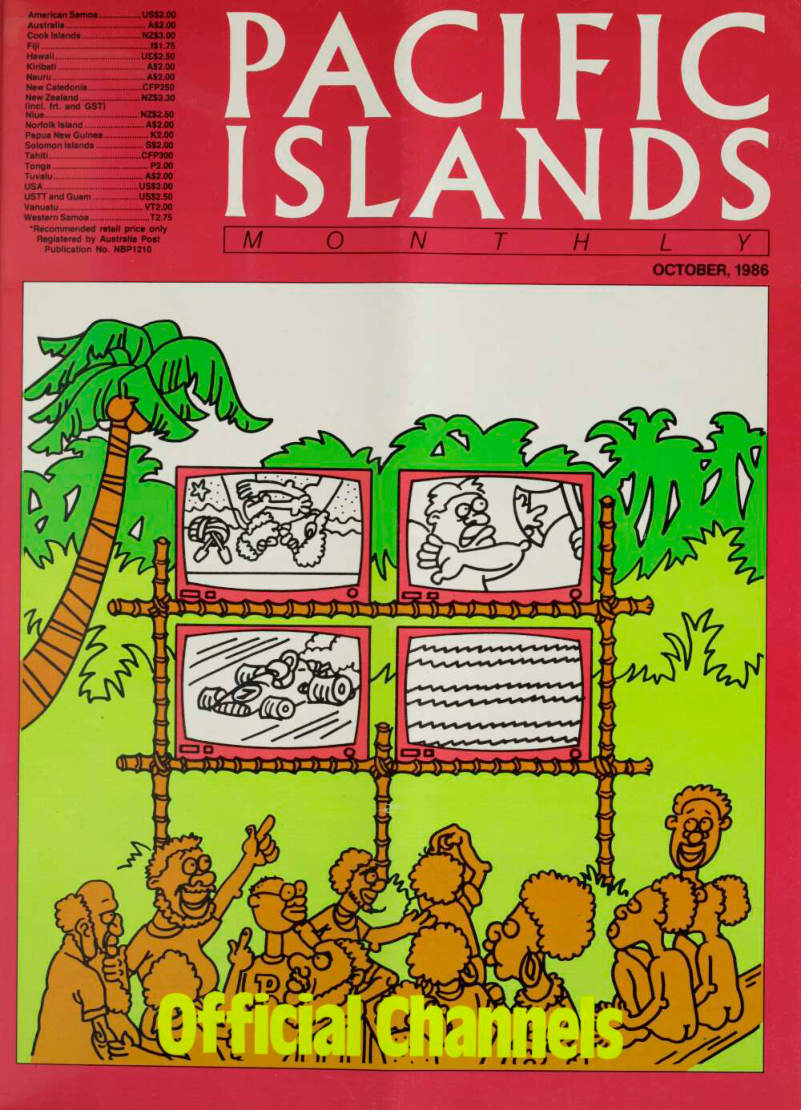
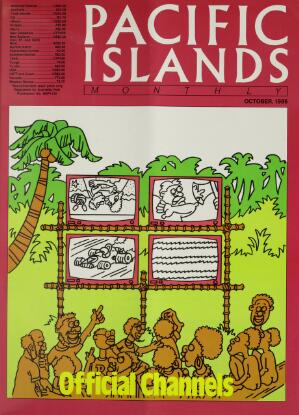
THE COVER
Selecting the right chan nel. By guest artist Robert Bosch.
Honda, constantly setting new standards when it comes to car design
now brings you the Prelude 2.0i-16. What does meet the eye is the Prelude’s styling. Its low, angled front slices through the air, and the wide tread stance grips the road firmly for superb maneuverability. What you can’t see is the heart of this elegant new model the 2.0-liter 16-valve Double Overhead Camshaft (DOHC) engine. It comes with
Honda’s original Programmed Fuel Injection system
(PGM-FI) for quick engine response.
This perfect marriage between styling and performance offers the ultimate in touring satisfaction. All this plus a long list of other Honda extras put the new Prelude into a class of its own.
Find out what it really means to enjoy a car all it takes is a test drive. m .Of-/ • Engine type: Water-cooled 4-stroke DOHC 16-valve in-line 4-cylinder • Fuel supply system; PGM-FI • Displacement: 1,958 cm 3 • Maximum horsepower: 137PS/6,ooorpm • Maximum torque: 17.3 kg-m/ s,ooorpm •Suspension: Double wishbone (front), MacPherson strut (rear) •Dimensions (L X WX H): 4,375 X 1,690 X 1,295 mm AUSTRALIA; Honda Australia Pty., Ltd. Lot 95 Sharps Road, Tullamarine, Victoria 3043; Bennett Honda Pty., Ltd. 250 Victoria Road, Wetherill Park, N SW 2164/NEW ZEALAND: NZMC Limited Manners Plaza, 57-65 Manners St., Wellington/PAPUA NEW GUINEA; Toba Pty., Ltd. P.O. Box 503, Port Moresby/ HONDA MOTOR CO LTD TOKYO JAPAN TAHITI: Honda Distribution S.A.R.L. B.P. 1665, Papeete/KIRIBATI: Atoll Motor & Marino Services P.O. Box 49, Bairiki Tarawa, Republic of Kiribati - TRUST TERRITORY: United Micronesia Development Association P.O. Box 235, CHRB Saipan CM 96950/COOK ISLANDS: Cook Islands Motor Centre Ltd. P.O. Box 74, Rarotonga/GUAM Mark s Motor Co., Inc. P.O. Box DV, Agana/WESTERN SAMOA: Motor Distributors (Samoa) Ltd. P.O. Box 576, Apia/SOLOMON ISLANDS: Lee Kwok Kuen & Co., Ltd. Box 537 Honmra/Ntw CALEDONIA: Soci6t6 Du Chalandage 8, Rue de la somme-B.P. 97, Noum6a/NAURU: Nauru Cooperation Republic of Nauru/FIJI: Coral Island Motors Ltd. Robertsqn Road ’
SAMOA: Holiday Motors. Parts and Service P.O. Box 968, Pago Pago, American Samoa 96799; Heleck’s Service Center Ltd. P.O. Box 1138, Pago Pago, American Samoa 96799/TONGA^ Tonga i~^i.n dTAnno/Kinopni k’ iQi akjh Raw Mp\a/ p.aQraHp RnaH Nnrfnlk Island/VANUATU Honda Farm Ltd. P.O. Box 1031, Port Vila, Vanuatu
Pacific
ISLANDS
MONTHLY
Vol. 57, No. 10, October, 1986.
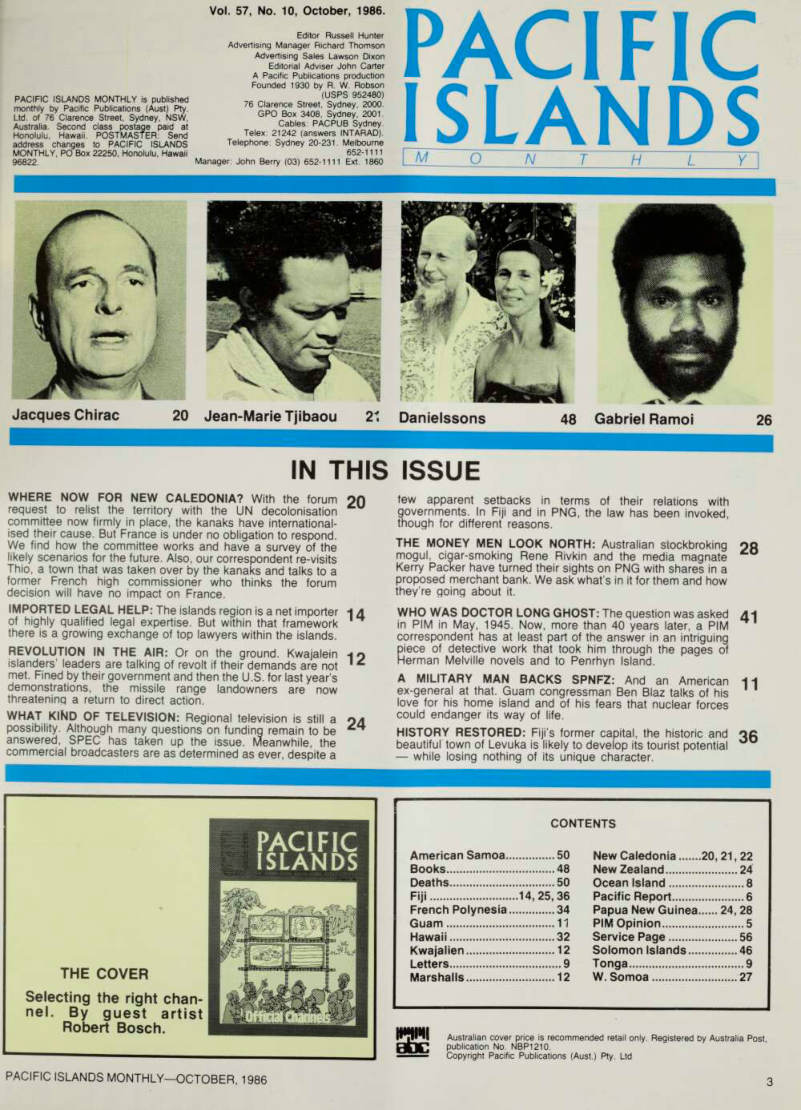
Jacques Chirac 20
Jean-Marie Tjibaou 21
Danielssons 48
Gabriel Ramoi 26
In This Issue
WHERE NOW FOR NEW CALEDONIA? With the forum OQ request to relist the territory with the UN decolonisation w committee now firmly in place, the kanaks have international ised their cause. But France is under no obligation to respond.
We find how the committee works and have a survey of the likely scenarios for the future. Also, our correspondent re-visits Thio, a town that was taken over by the kanaks and talks to a former French high commissioner who thinks the forum decision will have no impact on France.
IMPORTED LEGAL HELP: The islands region is a net importer -i A of highly qualified legal expertise. But within that framework there is a growing exchange of top lawyers within the islands.
REVOLUTION IN THE AIR: Or on the ground. Kwajalein -i 9 islanders’ leaders are talking of revolt if their demands are not met. Fined by their government and then the U.S. for last year’s demonstrations, the missile range landowners are now threatening a return to direct action.
WHAT KIND OF TELEVISION: Regional television is still a nA possibility. Although many questions on funding remain to be answered, SPEC has taken up the issue. Meanwhile, the commercial broadcasters are as determined as ever, despite a
tew apparent setbacks in terms of their relations with governments. In Fiji and in PNG, the law has been invoked, though for different reasons.
THE MONEY MEN LOOK NORTH: Australian stockbroking Oft mogul, cigar-smoking Rene Rivkin and the media magnate ° Kerry Packer have turned their sights on PNG with shares in a proposed merchant bank. We ask what’s in it for them and how they’re going about it.
WHO WAS DOCTOR LONG GHOST : The guestion was asked in PIM in May, 1945. Now, more than 40 years later, a PIM correspondent has at least part of the answer in an intriguing piece of detective work that took him through the pages of Herman Melville novels and to Penrhyn Island.
A MILITARY MAN BACKS SPNF2: And an American 1i ex-general at that. Guam congressman Ben Blaz talks of his 1 love for his home island and of his fears that nuclear forces could endanger its way of life.
HISTORY RESTORED: Fiji’s former capital, the historic and og beautiful town of Levuka is likely to develop its tourist potential while losing nothing of its unigue character.
Contents
American Samoa 50 Books 48 Deaths 50 Fiji 14,25,36 French Polynesia 34 Guam 11 Hawaii 32 Kwajalien 12 Letters 9 Marshalls 12
New Caledonia 20,21,22 New Zealand 24 Ocean Island 8 Pacific Report 6 Papua New Guinea 24, 28 PIM Opinion 5 Service Page 56 Solomon Islands 46 Tonga 9 W. Somoa 27
Australian cover price is recommended retail only. Registered by Australia Post, publication No. NBPI2IO.
Copyright Pacific Publications (Aust.) Pty. Ltd
Advertisements & other items, pp. 3-4 (2 items)
3
PACIFIC ISLANDS MONTHLY—OCTOBER, 1986
Editor Russell Hunter Advertising Manager Richard Thomson Advertising Sales Lawson Dixon Editorial Adviser John Carter A Pacific Publications production Founded 1930 by R. W. Robson
(USPS 952480)
76 Clarence Street, Sydney, 2000.
GPO Box 3408, Sydney, 2001.
Cables: PACPUB Sydney.
Telex: 21242 (answers INTARAD), Telephone: Sydney 20-231. Melbourne 652-1111 Manager: John Berry (03) 652-1111 Ext. 1860
PACIFIC ISLANDS MONTHLY is published monthly by Pacific Publications (Aust) Pty.
Ltd. of 76 Clarence Street, Sydney. NSW, Australia. Second class postage paid at Honolulu, Hawaii. POSTMASTER: Send address changes to PACIFIC ISLANDS MONTHLY, PO Box 22250, Honolulu, Hawaii 96822.
Sony.
r \ m
righter
ur
KV-2092AS
T \/ i.
It's so tempting.
The colour you get from Sony's new Super Trinitron.
Our new Pan-Focus gun is computer-designed to make our famous colour even sharper and clearer. Our new Black Screen makes whites brilliant, blacks profound, every colour deeper and richer.
It's flatter and sguarer too.
For less reflection and superb clarity, even in the corners.
For those whose taste demands the best, Super Trinitron is the
KV-1440AS
the channels
Pim Opinion
Time to change the channels
It is important for every nation to see itself on television if that country’s national cultural identity is not to be eroded. Thus Mr Martin of Television New Zealand which seeks to broadcast a region-wide public service system.(Page 24).
Meanwhile, NTN’s Mr Finlay sees it as a natural progression for countries to support a state-run service as well as a commercial channel.
As a cornered politician might remark, there is much to be said for both sides.
A regional public service station is a fine idea. For once, people would be asked what they want to see on television as opposed to being offered something that advertisers want to buy time in. The problem arises in who it is that will be answering the question.
To expect politicians to stay out of that is asking too much of them. The TVNZ proposal of countries recording their own material for broadcast would, we suspect, open the floodgates. Once people have digested the novelty of seeing their own country on their own television, what then? Ministerial broadcasts? MPs officially opening pet projects?
There has to be a limit. But if TVNZ seeks to set that limit, shrill cries of neocolonialism will surely follow. An editorial board with representatives from the various receiving nations might overcome such a difficulty. But there’s always the danger that these too might become political appointments.
Not that the commercial stations will be above giving time to politicians. But they, at least, are saddled with the constraint of keeping their advertisers on screen and on side. And therein lies another problem.
For if commercial TV sees its job as to entertain, the less appealing and possibly more vital areas will find it hard to compete for time and advertising with canned cops and robber-car chase-kitchen sink dramas that will do nothing to protect or develop cultural sovereignty.
And, on a more general level, television will have a murderous effect on individual countries’ radio stations which already reach more people than television can hope to find in the coming ten years.
At the same time, to pretend that television won’t or shouldn’t happen is to deny islands people the opportunity to see and judge for themselves.
For this reason the TVNZ proposal deserves con
sideration in that it provides an alternative. At the same time, to ask it to do the job the commercials want to do is asking far too much of a basic four-hours-a-day broadcaster.
The vital question is: Who’s going to pay for it? There must be an argument for the kiwis paying for their influence through support for the service. It seems fair. It may even seem fair to New Zealand at present.
But, as Radio Australia might discover, governments can take away as easily as they can give and external services are often the first to feel the pinch in times of domestic stress. That could leave the island nations with a choice of committing unbudgeted funds or accepting a reduced service.
Commercial stations, too, are not immune to financial sickness. For despite the high hopes of the advertising agencies (the real winners in the TV battle) and the stations themselves, there must be some doubt remain ing in everybody’s minds that the market is simply not biq enough.
A solution might be to deregulate the airwaves. Let the professional risk-takers fight it out and may the best broadcaster win, while supporting a low cost public service system with inbuilt checks on political misuse.
It may not even be too much to hope that some portion of government revenue from television might go towards support for public service broadcasting.
Commercial broadcasters in most countries are pre pared to compete for audiences with state-run television and there seems no reason why they should expect a clear field in the Pacific. In any case, satellite broadcas ting is such that exclusive contracts are going to be hard to enforce.
For example, if a viewer in Fiji chooses to turn to a regional service to the exclusion of the local “exclusive” broadcaster, who can or should prevent him?
Fears of a population gorged on the Coca Cola culture to the exclusion of its own heritage are probably unfounded. The commercial stations will conform to sensible regulations covering content if only to protect their licences. In any case, most island cultures are both vital and dynamic and probably well able to recover from the initial shock of broadcast television. They are not, as some people fear, unable to look after their traditions.
But freedom of choice in television is enjoyed practically world wide. Why not here?
pacific report
Bougainville
Trebles Profit
Bougainville Copper Ltd lifted earnings by more than 177 per cent in the six months to June 30. Higher gold prices and increased production coupled with lower net financing and operating costs resulting from the fall in oil prices and the collapse of the Australian dollar brought about an improved profit from A513.42m in the corresponding period last year to this year’s A 537.18 milliion.
Announcing an interim dividend of about 10c a share, the directors said bullion prices had risen from an average US$3lO per ounce in the first half of 1985 to US$343. They predicted a continuation of these conditions, though political uncertainties could lift prices further. Copper prices fell to an average U 5564.5 cents per pound compared with 65 cents in the first half of last year.
This represented the lowest price in real terms since the the 30s.
Equality For
School Children
The three government-run high schools in Western Samoa Samoa College, Avele and Vaipouli will have sixth form students only from 1990 under a new policy announced by education minister, Le Mamea Ropati. The minister told parliament that the three schools will drop their form three classes, cutting out forms four and five over the following two years. The current discriminatory prac tice of allowing European or part Euro pean children to start school at five years while Samoans must wait a further six months, will be abolished. The selection of form two students for the high schools will also cease. Selection for entry to the sixth form schools will take place in the fifth form.
Japanese Lead
In Vehicle Sales
Japanese vehicle manufacturer, Toyota, led the Papua New Guinea vehicle market in the first half of this year, selling 1093 new vehicles out of a total of 3301, representing a 33 per cent market share.
Next was the Nissan-Datsun range (18.5 per cent), Mitsubishi (12.4 per cent) and Isuzu (8 per cent). Mazda led in the passenger vehicles section with 25.5 per cent. Toyota was second (18 per cent ),Nissan-Datsun (15.8 per cent), Suzuki (15.3 per cent) and Mitsubishi (12.9 per cent) followed. Toyota also headed the commercial vehicle section with 38 per cent. As the Australian dollar continued weak, however, Australian car makers may make some inroads.
Fishing Company
Reduces Losses
The Ika Fishing Corporation of Fiji, a government statutory authority which began operations in 1975, has reported an improvement in performance for the year ending June 30. Its losses were the lowest for seven years. General mana ger, Captain John Harrison said the corporation had expected to make a profit, but poor catches in May reversed the position. The current fishing season had been extended by two months because of improved catches and better prices offered by the buyer, Pacific Fishing Company, of Levuka.
Runway To
Be Extended
Work was due to be completed this month on runway extensions at Hender son Airport in Guadalcanal, Solomon Islands. International aircraft will now be able to land on the new sections co vering 1100 metres. The $6.5 million project is financed by Kuwait Funding and the contractor is Dongsan Construc tion of South Korea.
Us May Back
Nuclear Treaty
The chairman of. the US Senate foreign relations committee, Senator Richard Lugar, said he expected President Reagan would support the South Pacific Nuclear Free Zone treaty. Sen Lugar said the United States would sign the protocols attached to the treaty because it appeared to be compatible with US foreign policy. His comments came less
than 24 hours after a senior Soviet foreign relations official, Mr Mikhail Kapitsa confirmed in Wellington that the Soviet Union would also sign the pro tocols as soon as the treaty was ratified by more Pacific countries. The protocols ban the use, manufacture, stationing and testing of nuclear weapons in the region.
Sln To Reduce
Nickel Output
Major New Caledonia nickel producer, Societe Le Nickel is to cut production for the rest of the year because of a world market glut. SLN manager, Mr Paul Bliek said in Noumea that the company was limiting output as its part in efforts to help nurse the industry back to health. He said the company would reduce its 1986 output target of 44,000 tonnes by up to 2,000 tonnes. The production cut was expected to lead to reductions in bene fits for the company’s 2,300 staff more than six per cent of New Caledonia’s total workforce. The territory is the world’s third largest nickel producer after Canada and the Soviet Union.
Forum Told Of
Uranium Plan
Members of the South Pacific Forum were told in advance of Australia’s decision to lift the ban on uranium sales to France, said Australian foreign minis ter, Mr Bill Hayden. He said they were told of the measure at the Suva forum meeting ten days before it was announced in the Australian Budget. He said that they had had ample time to protest against the decision in that period but had not done so. PNG foreign minister, Legu Vagi who had attended the forum said after the decision was publicly announced that his country was “disappointed.” He added: “It further confirms Papua New Guinea’s misgiv ings about the shortcomings of the South Pacific Nuclear Free Zone Treaty.”
Chiefs Want To
Bring Back Courts
Fiji’s Great Council of Chiefs the supreme body overseeing the interests of the Fijian community has approved the re-introduction of the Fijian court system. This would mean that Fijians could be tried for minor offences by a village magistrate. Each of the four administrative divisions will have a Fijian magistrate. The move is part of an overhaul of the Fijian administration recommended by Mr Rodney Cole of the Australian National University.
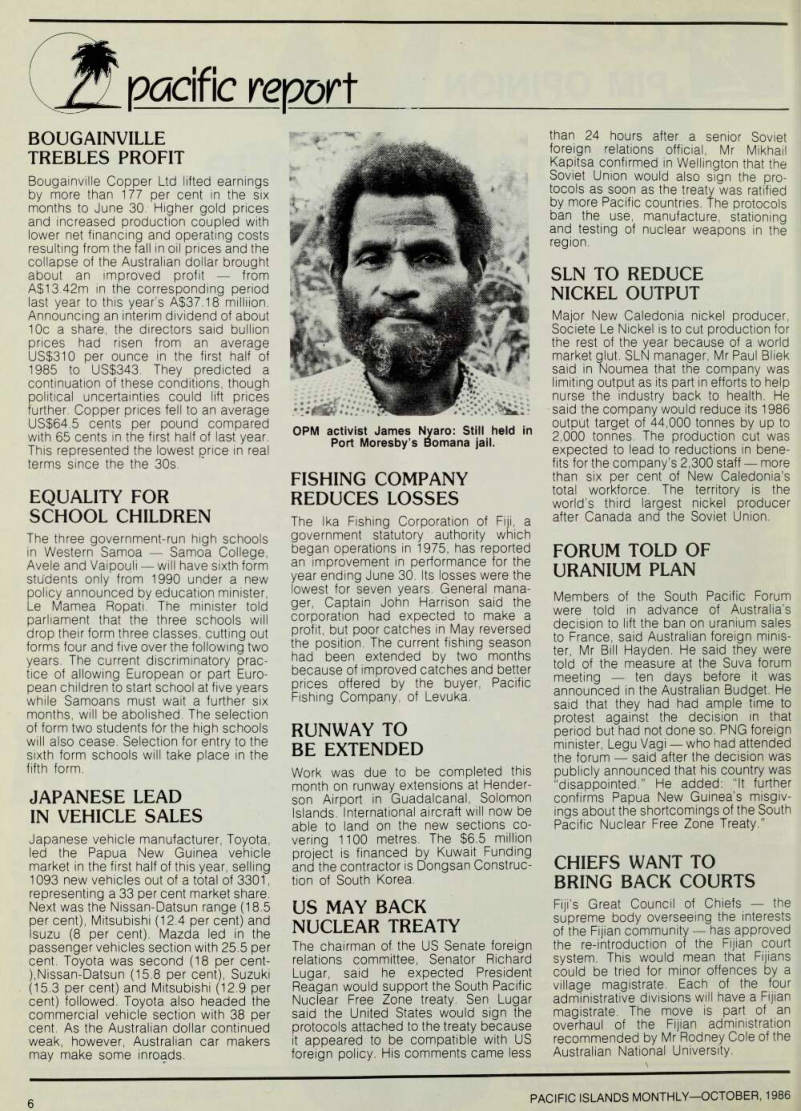
OPM activist James Nyaro: Still held in Port Moresby’s Bomana jail.
Opm Rebels
Kept Silent
Four Irian Jayan independence move ment leaders left Port Moresby’s Boma na jail after nine months on the first leg of a journey to Ghana. PNG foreign minis ter, Legu Vagi, banned journalists from speaking to the four, who will later travel on to a Scandinavian country. The four were Gerard Tommy, Ries Wader, David Timka and Donald Derey. They had crossed the border into PNG last year seeking refugee status. PNG agreed to help find a host country. With them on the border crossing and in Bomana jail was self-styled OPM leader James Nyaro who was to have joined the Ghana-bound group but withdrew on health grounds.
Star Wars Role
For Kwajalein
The United States plans to build a US$l.3 million complex on Kwajalein atoll next year as part of President Reagan’s Strategic Defence Initiative (SDI) often referred to as Star Wars according to data sent to the US Congress. The complex would be used to launch targets for missiles known as Braduskill interceptors which are de signed to hit enemy warheads in space during their journey towards the United States.
Hawke Accused
On Aid Cut
Papua New Guinea has accused the Australian government of breaching a memorandum of understanding be tween the two countries concerning Australian aid. The complaint was con tained in letter from PNG prime minister, Mr Paias Wingti, to his Canberra coun terpart, Mr Bob Hawke. The letter said there should have been consultation before the Australian decision to reduce aid by Aslo million was announced. PNG’s finance minister Sir Julius Chan told parliament that this had not been done and that the country was disappointed. He said Australia had not done the right thing by not informing PNG before cutting its aid.
Cash Grant
For Causeway
Japan has given Kiribati a grant of Asl.3 million for the second stage of a project involving the building of a causeway and navigation channel. The grant was announced in Suva after an exchange of notes by the Japanese ambassador to Fiji, Mr Kukuo Yoshida and the Kiribati communications minister, Mr Taomati luta. The money will be used to pave a 400-metre causeway between Betio is land, the country’s commercial centre, and Bairiki island, the administrative centre of the capital, Tarawa. Some of the money will be used to buy a
navigational marker for the fisheries channel. The first stage of the project, costing about As 4 million involved the building of the causeway and a navigational channel.
New Tuna Boats
On Order
Solomon Islands government has or dered two new tuna fishing boats from an Australian shipbuilder in what is thought to be the largest contract ever entered into by the government. The order is for two 57-metre purse-seiners at a cost of about As 9 million each. Each boat is twice as large as the govern ment’s National Development Corpora tion’s only operating purse-seiner.
Radio Australia
Budget Review
The management of Radio Australia is conducting a major review of operations, following large cuts in the organisation’s budget. The controller, Mr Peter Barnett, said there was a strong possibility of restrictions on the current output. In an austere Budget handed down by Austra lian treasurer, Mr Paul Keating, Radio Australia’s parent, the Australian Broad casting Corporation, had its operating budget reduced by more than Aslo million.
Japanese Tourists
The Big Spenders
Japanese tourists are the biggest spen ding visitors to Fiji, according to the Fiji Visitors Bureau. The average Japanese tourist, it said, spends at least Asloo a day. The bureau general manager, Mr Malalai Gucake, said of the other major national groups, Australians average $6O per day, the Americans $53 and the New Zealanders $49. In the first half of this year, American tourists increased by 47 per cent to just over 31,000. There were smaller increases in the numbers of Canadian, British and New Zealand tourists while arrivals from Australia declined slightly.
Us Optimistic
On Tuna Deal
The United States is optimistic on reaching agreement on a tuna access agreement with Pacific island nations before the end of this year. US State Department spokesman, Mr Charles Redman, said Washington would wel come an agreement because of Soviet moves to conclude fishery agreements in the region. Nine rounds of talks spanning two years ended in the Cook Islands in August without success. A further round is due in Tonga this month.
Some influential officials told PIM at the South Pacific Forum in Suva that they were now more hopeful of an agreement this year. (September PIM, P2l).
Fishermen Drift
For 88 Days
Three Kiribati fishermen who drifted 700 kilometres in an open boat over 88 days were reunited with their families. The men disappeared on April 4 when the outboard motor on their plywood boat broke down. They were found by a Nauruan fisherman off Nauru. They sur vived the ordeal by collecting rainwater in their waterproof jackets and by catch ing fish to eat.
Forum Line Sees
Slump In Profit
The Pacific Forum shipping line expects a 50 per cent reduction in profit this year, the chairman, Mr Dan Tufui, said in Suva, He said the line expected a profit of about AsBoo,ooo, although the final figure could be higher. He told a meeting of representatives of the ten Pacific governments which own the line that a larger vessel to replace the "Forum New Zealand” was expected next February.
Crown Land
Handed Over
Fiji’s deputy prime minister, Ratu David Toganivalu, said it was unlikely that any more crown land would be re-classified as native reserves. His statement fol lowed a row over the transfer of some 4,000 hectares of crown land into native reserves. The move was criticised by the opposition National Federal Party and the Labour Party which claimed it was a device to win Fijian votes in next year’s general election. Ratu David assured the country, however, that the government approach to land matters would con tinue to reflect the multi-racial policy of the ruling Alliance Party. He said the land in question rightly belonged to native landowners and it could be argued that the crown held it merely in trust.
Public Servants
Must Re-Apply
The Solomon Islands government dis missed senior public servants and advertised their positions as part of a campaign to improve government ad ministration. A government announce ment said that all new appointments would be on a three-year contract basis.
Among those dismissed were all perma nent secretaries of ministries. All can re-apply for their jobs, although the public service ministry said there could be no guarantees that all would be re-employed in their previous positions.
The government hopes to trim the size of the bureaucracy at senior levels. Other measures included the abolition of all vacancies, suspension of officials taking leave without pay, reductions in the sizes of some ministries and a call for volunt ary retirements.
Advertisements & other items, p. 7 (1 item)
£= air neat
n " > lkWianMcy Jt css I n v 'i - !J £ Ni C*si bolitf.
3136
The Pacific’s Number One
More to this island than caves
letters
Tofua is known as the place in Tonga where Captain Bligh came ashore 196 years ago. In PIM of June last year, Bengt Danielsson claimed the re discovery of the Bligh cave, without being able to produce a photograph of it.
In PIM of September last year, again attention is paid to Tofua and again to the Bligh cave. This time with a photo graph that indicates that Kim Gravelle and Bill Verity have been there, although no cave is shown, but the opposite island Kao is.
All this might give the im pression that there is nothing more interesting on Tofua than
the “might-have-been-Bligh
cave”. Tofua has many caves with stony beaches, as do many other less remote islands.
Tofua is a magnificent island with dense unspoiled jungle on steep slopes with huge ferns, parrots and wild pigs. There is one village, Hokula (10 houses and three churches), plus two smaller settlements called Ha’amatu’a and Manaka.
Tofua is, in fact, a half sunk en volcano, almost round and five miles in diameter. The crater is two-thirds lake (called Lofia) and-one third active vol cano. Very few people on Tofua have been down to the lake.
Last July we went there ourselves a zigzag voyage with whatever was available on boats which took us 13 days.
Traffic to and from Tofua goes mainly over the nearest inhab ited island of Kotu.
There are several places to go ashore on Tofua, but all are difficult and tricky. Approaching
In August PIM the source quoted in the article “Foreign business beats a slow re treat,” was wrongly identified as John Bailey. This should have read John Hailey whose report “Indigenous Business in Fiji” was quoted in the article. The error is regretted.
a possible landing place from a little fishing boat makes you think you’re heading for a steep cliff and that you need to be a seal to get ashore.
Very close to the beach the helmsman says “puna ki lalo palangi”, then, you’ve got to jump. If you miss that you wait for the next right wave.
Going to the east side of Tofua, passing a little settlement of kava-planters called Manaka, to the top takes three to four hours climbing over a foot-wide almost invisible track.
From the top it has a beauti ful view over the lake and the impressive smoking volcano below. Going down into the crater over loose gravel is tricky.
The slopes are steep. You’ve got to watch every step.
In the part of the crater that is still active, a desert of red brown gravel, are in fact three little volcanoes. The two small est are dead. The biggest pro duces constant sulphur fumes which can be seen on islands 50 miles away.
Down by the foot of the live volcano we revealed to our guide, Finau, a kava planter from Tofua, that the actual aim of this trip was to go up to the live volcano in order to see what it looks like inside. He didn’t like the idea but was not unco-operative. With careful steps we went up.
On the edge of the crater through the smoke we saw a vertical wall straight down.
Finau, beyond his fear, found it necessary to throw some stones into the crater before we went down to the lake where we went for a swim.
The water wasn’t salty nor
sticky, but sweet and soft as rain water. With the aid of a snorkel the lake proved not to be lifeless at all.
Although the water was green from algae, which re stricted the view, it was clear that the rocky bottom close to the edge was completely crowded with little shells.
Farther on, there were a lot of underwater insects.
After five days we managed to get a boat off from Tofua, a 14-foot boat mainly of ply wood, driven by 40 hp out board motor, which tends to stall at every wave. A nutshell loaded with 10 people, two dogs and luggage. No life jack ets, no radio and sharks in sight.
Tofua is more than only a cave.
Paul De Leeuw
And Sanita Tulipulotu
Nukualofa Tonga
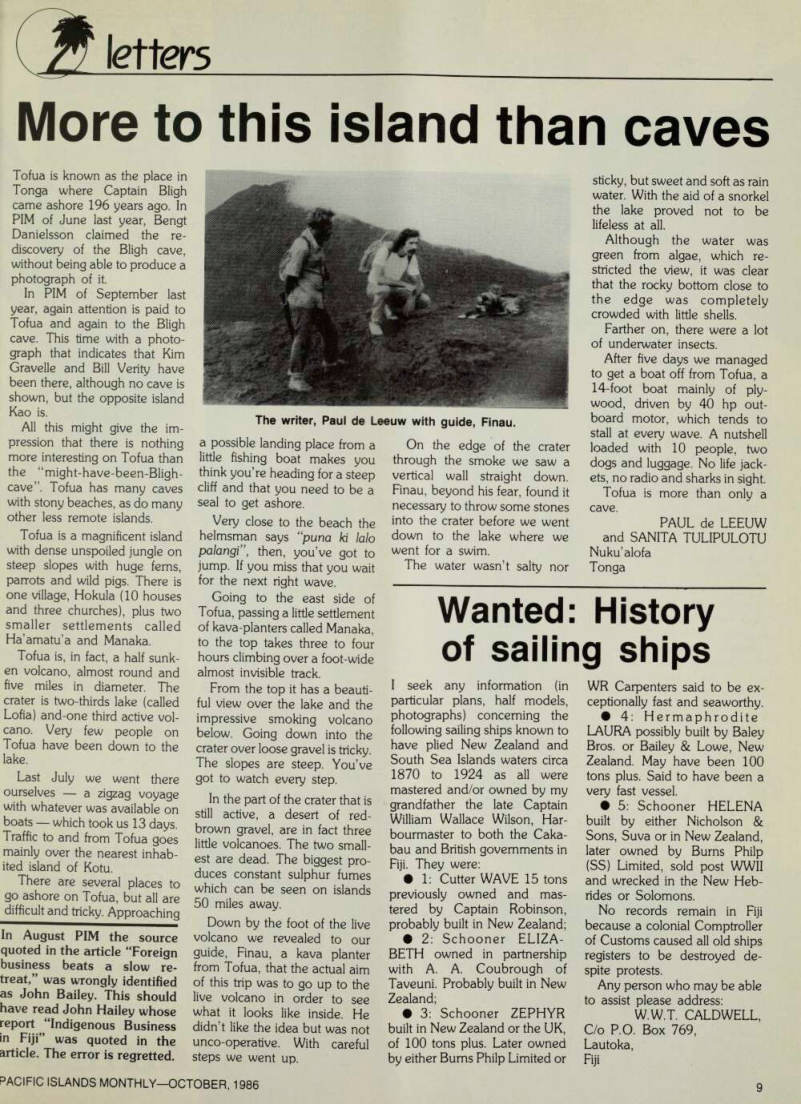
The writer, Paul de Leeuw with guide, Finau.
Wanted: History
of sailing ships
I seek any information (in particular plans, half models, photographs) concerning the following sailing ships known to have plied New Zealand and South Sea Islands waters circa 1870 to 1924 as all were mastered and/or owned by my grandfather the late Captain William Wallace Wilson, Har bourmaster to both the Caka bau and British governments in Fiji. They were: • 1: Cutter WAVE 15 tons previously owned and mas tered by Captain Robinson, probably built in New Zealand; • 2: Schooner ELIZA BETH owned in partnership with A. A. Coubrough of Taveuni. Probably built in New Zealand; • 3: Schooner ZEPHYR built in New Zealand or the UK, of 100 tons plus. Later owned by either Bums Philp Limited or
WR Carpenters said to be ex ceptionally fast and seaworthy. • 4; Hermaphrodite LAURA possibly built by Baley Bros, or Bailey & Lowe, New Zealand. May have been 100 tons plus. Said to have been a very fast vessel. • 5: Schooner HELENA built by either Nicholson & Sons, Suva or in New Zealand, later owned by Burns Philp (SS) Limited, sold post WWII and wrecked in the New Heb rides or Solomons.
No records remain in Fiji because a colonial Comptroller of Customs caused all old ships registers to be destroyed de spite protests.
Any person who may be able to assist please address:
W.W.T. Caldwell,
C/o P.O. Box 769, Lautoka, Fiji
Advertisements & other items, p. 10 (1 item)
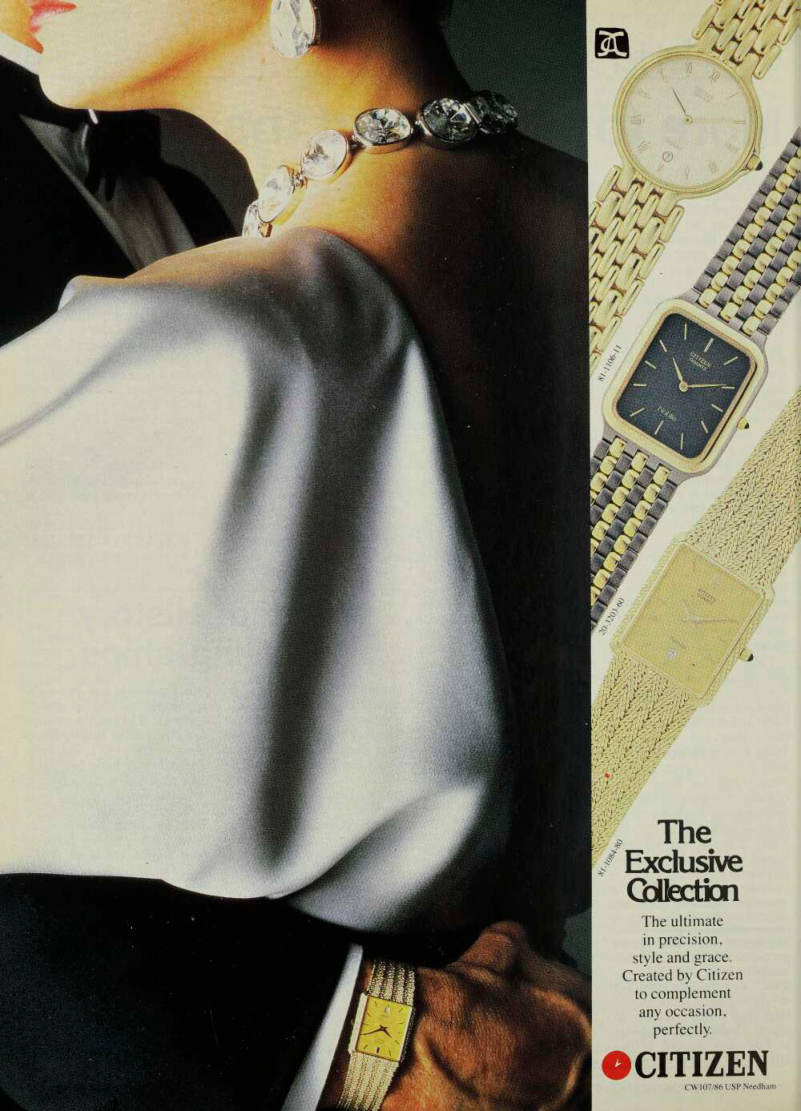
•Citizen
mm- ■sep $
The
Exclusive
Collection
The ultimate in precision, style and grace.
Created by Citizen to complement any occasion, perfectly.
•CITIZEN
CWIO7/86 USP Needham
home to his island
A soldier goes home to his island
Guam Congressman Ben Blaz, who has emerged as the principal US political leader suppor ting nuclear non-proliferation in the South Pacific, says he does so because he is a son of the islands.
“We are all island people,” he said recently on a visit to San Francisco. “We feed off the resources of the sea. Those resources are migratory.
“We eat tuna, for instance.
The resources are so fragile.
You can’t see radioactivity. And there is the possibility of some thing going violently wrong.
You could have an enormous tidal wave and island people could wake up some morning and their homes would be gone. And they would be gone. ”
These are not the customary sentiments of a customary American politician. Congress man Blaz, however, does not fit anyone’s customary descrip tion.
Ben Blaz is a Chamorro, a native Guamanian bom on the island on February 14, 1928.
As an adolescent, he experi enced the hardships of the Japanese occupation. That time of hunger and privation was not without its rewards, he says. “I was with my father and with my grandfather 24 hours a day. I was given the wisdom they had accumulated over the years.
We suffered for every ounce of sup beans and com.
“One day, my father said to me, ‘I think you are going to be OK; you have discovered the sweetness of the saltiness of sweat’.”
Inspired by the “sweetness of the saltiness of sweat,” young Blaz won a scholarship to Notre Dame University at South Bend, Indiana. Upon gradua tion in 1951, he entered the United States Marine Corps.
Promotions and decorations came regularly.
He had been liberated on
Guam Congressman Ben Blaz, a Republican, has suddenly emerged as the most prominent American politician supporting the New Zealand position on atomic weapons and atomic-powered warships. Because he is a retired US Marine Corps brigadier general and a member of the Armed Services Committee of the US House of Representatives, his views carry special weight. RALPH CRAIB interviewed him in San Francisco.
Guam by the Ninth Regiment of the Marines; he later assumed command of that regi ment in Japan after being promoted to full colonel.
“When I took command of the Ninth Marines, ” he says, “it was a supreme moment. I only wished that the guys in the village on Guam could have seen me.”
Congressman Blaz ended his military career in 1980 with the rank of brigadier-general after 29 years of active duty. He served as military representa tive of the US Joint Chiefs of Staff in talks with the Soviet Union in Helsinki and holds a whole galaxy of medals for combat service and meritorious achievement.
On return to civilian life, he taught at the University of Guam, trying to inspire his young Chamorro students with the unlimited possibilities he believes the future holds for them. His own “incredible odyssey” is a model, he says.
“When I look back on my career in the Marine Corps for all of those years, I realise that the place that means absolutely the most to me, in the twilight of my years, is that little island of Guam,” the member of Con gress says.
“The people who mean most to me are my people, the island people of Guam. The farther away I travel, the more I want to be back with the people of Guam.”
The travels, his experience negotiating with the Soviet Un ion and travelling within it, have all made the congressman
acutely aware of the dangers of nuclear proliferation. He has visited Tahiti and finds that the French “are being arbitrary” and not “giving any thought to New Zealand and Australia.”
He muses about the fact that the Enola Gay left Tinian, part of the same island chain as Guam, to deliver the first ato mic bomb in Japan and talks about the continuing effort to clean up Bikini at both econo mic and human cost. And he thinks about the Chernobyl accident and the possibility of accidents elsewhere, particu larly somewhere in the Pacific.
“I find this problem very difficult,” he says. “Maybe we (mankind) need a few little areas where there’s a haven from nuclear worries. I think that the focus may be changing.
People are saying, ‘hey, this lake is getting choppy. We better take another look.’ I don’t think that the United States ever realised what a precious gem this ocean is, what gems these islands are.”
The congressman defines himself, as do many American military men, as a “peacekeep er.” His career in the Marine Corps was largely that of being prepared to use force so that its use would never be neces sary. His public pronounce ments, however, stress the strategic value of Guam and of its Air Force and Navy bases.
He placed particular emphasis upon Guam’s military import ance during the long period of instability in the Philippines be fore the Marcos regime col lapsed.
Some time ago, because of public criticism of some former military men receiving both pension and a salary in a new job, legislation was enacted prohibiting former active duty officers from receiving pensions while in Congress. Congress man Blaz is the only member of Congress so penalised.
He receives an annual salary of $75,000 as a member of the House of Representatives but has had to give up his Marine Corps pension of $45,000 per annum. This, not surprisingly, disturbs him. “I think soldiers should have the same rights as shoemakers, doctors and lawyers,” he says.
One of Congressman Blaz’s highest priorities is his pursuit of Commonwealth status in Guam’s relationship with the United States. The proposal, first put forth seriously in 1980, would give Guam greater autonomy while preserving its ties to the United States.
Some Washington observers feel that Blaz’s many abilities and strong force of personality gives Commonwealth status a better chance of attainment than has existed in the past.
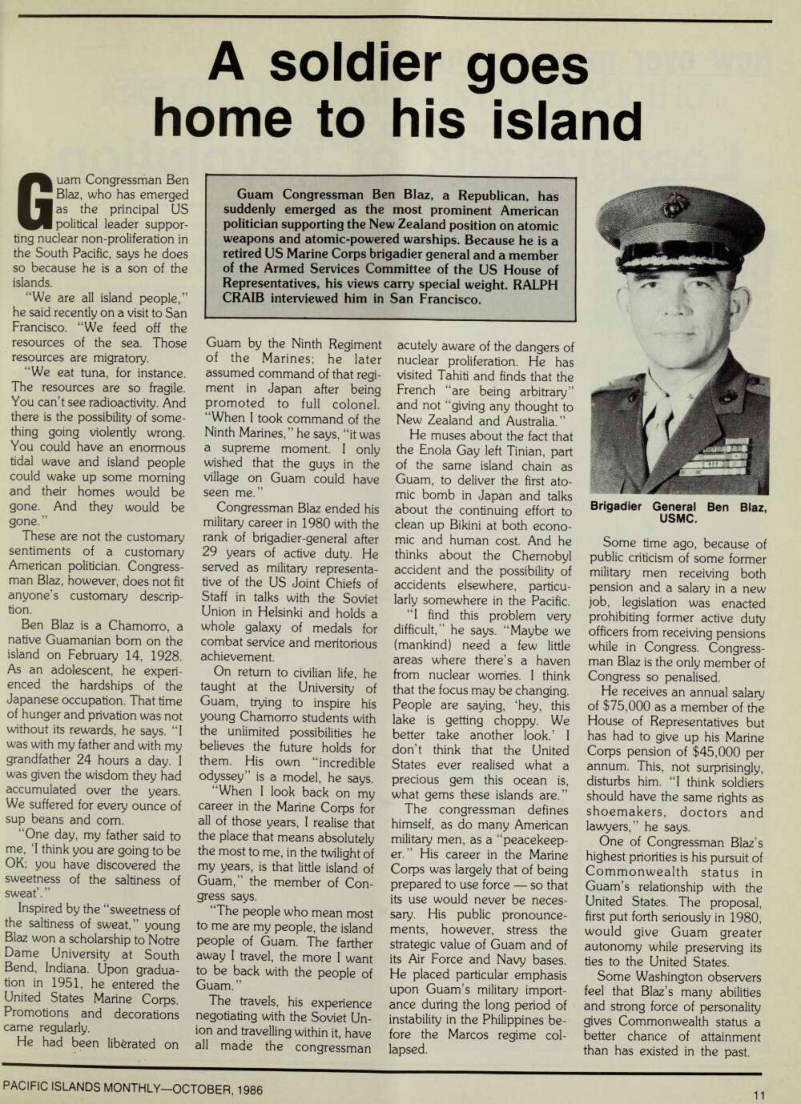
Brigadier General Ben Blaz,
Usmc.
Leaders talk of ‘revolution’
Row over missile range lease
Where now for the Re public of the Marshall Islands (RMI)? One year on from the eruption of protest when the land lease agreement for Kwajalein Missile Range (KMR) expired on September 30, 1985 the row rumbles on.
Landowners of the Kwajelein Atoll Corporation (KAC) led a series of demonstrations, sit-ins and blockades in a campaign of civil disobedience aimed at hal ting the work of the KMR.
Now one of the protest lead ers, Senator Ataji Bales has warned that the protest is far from over and could culminate “in revolution.”
Bales (who is also KAC chair man), Ebeye mayor, Alvin Jacklick and KAC treasurer, Julian Riklon also assert, how ever, that their campaign is against “American apartheid” as well as for nuclear disarma ment and independence.
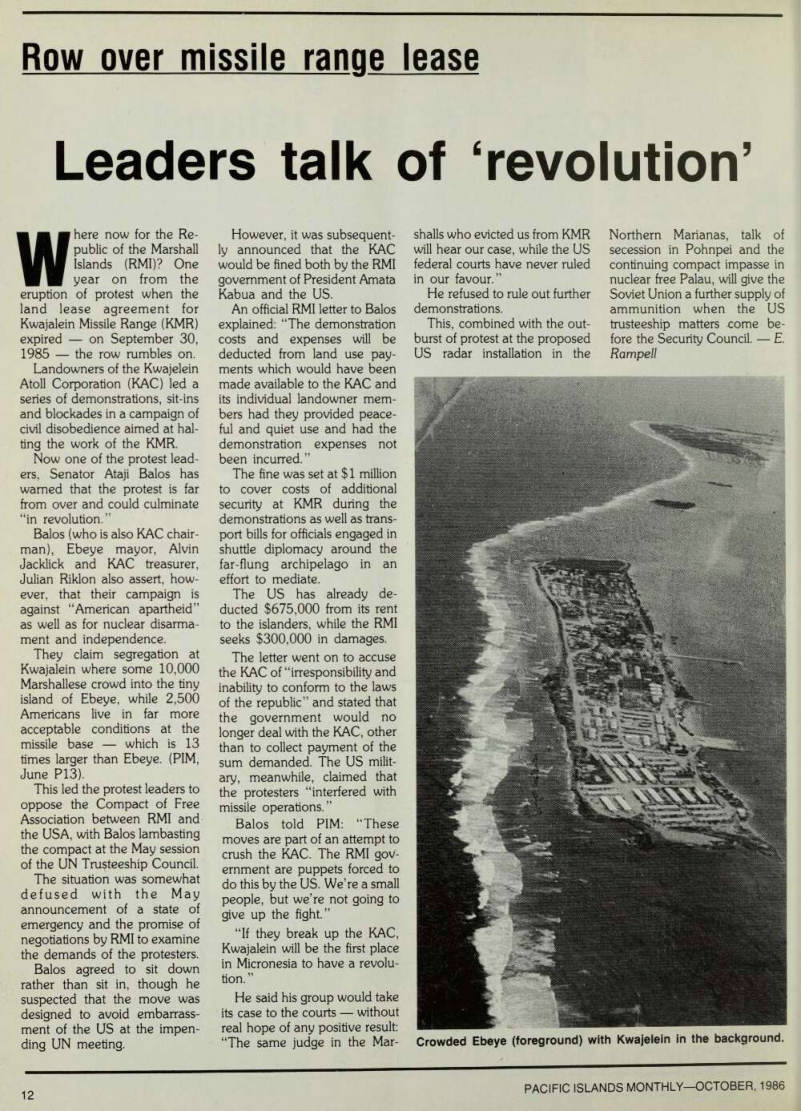
They claim segregation at Kwajalein where some 10,000 Marshallese crowd into the tiny island of Ebeye, while 2,500 Americans live in far more acceptable conditions at the missile base which is 13 times larger than Ebeye. (PIM, June Pl 3).
This led the protest leaders to oppose the Compact of Free Association between RMI and the USA, with Balos lambasting the compact at the May session of the UN Trusteeship Council.
The situation was somewhat defused with the May announcement of a state of emergency and the promise of negotiations by RMI to examine the demands of the protesters.
Balos agreed to sit down rather than sit in, though he suspected that the move was designed to avoid embarrass ment of the US at the impen ding UN meeting.
However, it was subsequent ly announced that the KAC would be fined both by the RMI government of President Amata Kabua and the US.
An official RMI letter to Bales explained: “The demonstration costs and expenses will be deducted from land use pay ments which would have been made available to the KAC and its individual landowner mem bers had they provided peace ful and quiet use and had the demonstration expenses not been incurred.”
The fine was set at $1 million to cover costs of additional security at KMR during the demonstrations as well as trans port bills for officials engaged in shuttle diplomacy around the far-flung archipelago in an effort to mediate.
The US has already de ducted $675,000 from its rent to the islanders, while the RMI seeks $300,000 in damages.
The letter went on to accuse the KAC of “irresponsibility and inability to conform to the laws of the republic” and stated that the government would no longer deal with the KAC, other than to collect payment of the sum demanded. The US milit ary, meanwhile, claimed that the protesters “interfered with missile operations.”
Bales told PIM: “These moves are part of an attempt to crush the KAC. The RMI gov ernment are puppets forced to do this by the US. We’re a small people, but we’re not going to give up the fight.”
“If they break up the KAC, Kwajalein will be the first place in Micronesia to have a revolu tion.”
He said his group would take its case to the courts without real hope of any positive result: “The same judge in the Mar
shalls who evicted us from KMR will hear our case, while the US federal courts have never ruled in our favour.”
He refused to rule out further demonstrations.
This, combined with the out burst of protest at the proposed US radar installation in the
Northern Marianas, talk of secession in Pohnpei and the continuing compact impasse in nuclear free Palau, will give the Soviet Union a further supply of ammunition when the US trusteeship matters come be
fore the Security Council.
E.
Rampell
Crowded Ebeye (foreground) with Kwajelein in the background.
Advertisements & other items, p. 13 (1 item)
Telecommunications inthe Pacific
It tales someone
who knows the lay of the land.
No company is more familiar with In addition to providing our custhe challenges of telecommunlca- tomers In the Pacific Basin with tlons in the Pacific Basin than Ha- state-of-the-art equipment, weV© wallan Telephone. worked with managers and engl- Our experience here os an oper- neers on: fundamental and strategic atlng telephone company enables planning; network design; traffic us to offer a range of services that engineering; marketing; human remany suppliers cannot. sources and International relations and operations.
To date, we’ve worked with military and government customers In Japan, Korea, Philippines, Indonesia. Guam and Micronesia.
Call Benjamin Fukumoto, Director of Government Communications, (808) 546-7890.
HAWAIIAN TEL QB
Beyond the call
Judges join the legal trade

legal trade
One of the most intriguing items in the South Paci fic import-export trade is that of judicial talent.
Britain, New Zealand and the United States are among the exporters: American Samoa, the Cooks, the Solomons and Tuvalu among the importers; while Fiji plays both roles, simultaneously importing and exporting judges.
Perhaps the most remarkable aspect of these arrangements, to American eyes, is the role played from a distance by Lon don’s Law Lords. They serve as the highest court of appeal for Fiji, Tuvalu and other island jurisdictions, as they do for all of New Zealand’s legal contests and for some cases arising in the Queensland courts. (Austra lia’s own High Court serves as the highest tribunal for most Australian legal matters).
The Law Lords, more formally the Judicial Committee of Her Majesty’s Privy Council, are selected from the member ship of the House of Lords.
They have the last word on the interpretation of the United Kingdom’s statutes, and have preserved this role for many of the nations that used to be part of the British Empire.
Although the number of Pacific-based cases reaching the Privy Council is modest, the Law Lords’ role can be a powerful one.
A few years ago, for exam ple, they over-ruled the Gov ernment of New Zealand on an immigration case, holding that a New Zealand statute should be interpreted in such a way as to make most of Western Samoa’s population legal residents of New Zealand. (PIM, Jan., ’B5).
The Prime Ministers of the two countries had a hurried summit meeting and subse quently New Zealand’s Parlia ment moved quickly (and unanimously) to limit the effect of the Law Lords’ ruling, and, in the process, provided instant
citizenship to a number of Sa moans resident in New Zealand who had previously been re garded as illegal aliens.
The setting for the Law Lords in session is an informal one according to Ratu Josua Brown Toganivalu, who visited their chambers while serving as Fiji’s High Commissioner in London.
“I thought I was going to see a truly impressive, formal opera tion,” he told me once, “but it was just a bunch of men, sitting around a table in a small room, talking with each other and interrupting each other.”
While the Law Lords extend their influence to the Pacific without ever leaving Westmins ter, there is a small body of men (no women seem to be in
volved) who work full or part time in the islands’ judicial trade. Fiji’s court system, for example, is largely staffed by such persons.
The highest of Fiji’s courts is the Fiji Court of Appeal, which has five working members, three New Zealanders and two Fiji citizens. All are appointed by Fiji’s Governor-General to serve in these part-time posi tions.
The Court meets three times a year, in March, June and October, for sessions of four to six weeks, depending on the workload. The presiding officer of the Court, who does not, in fact, sit on cases, is Sir Timoci Tuivaga, a Fijian who also serves as Chief of Fiji’s
Supreme Court (the nation’s principal trial court) from which decisions can be appealed to the Court of Appeal.
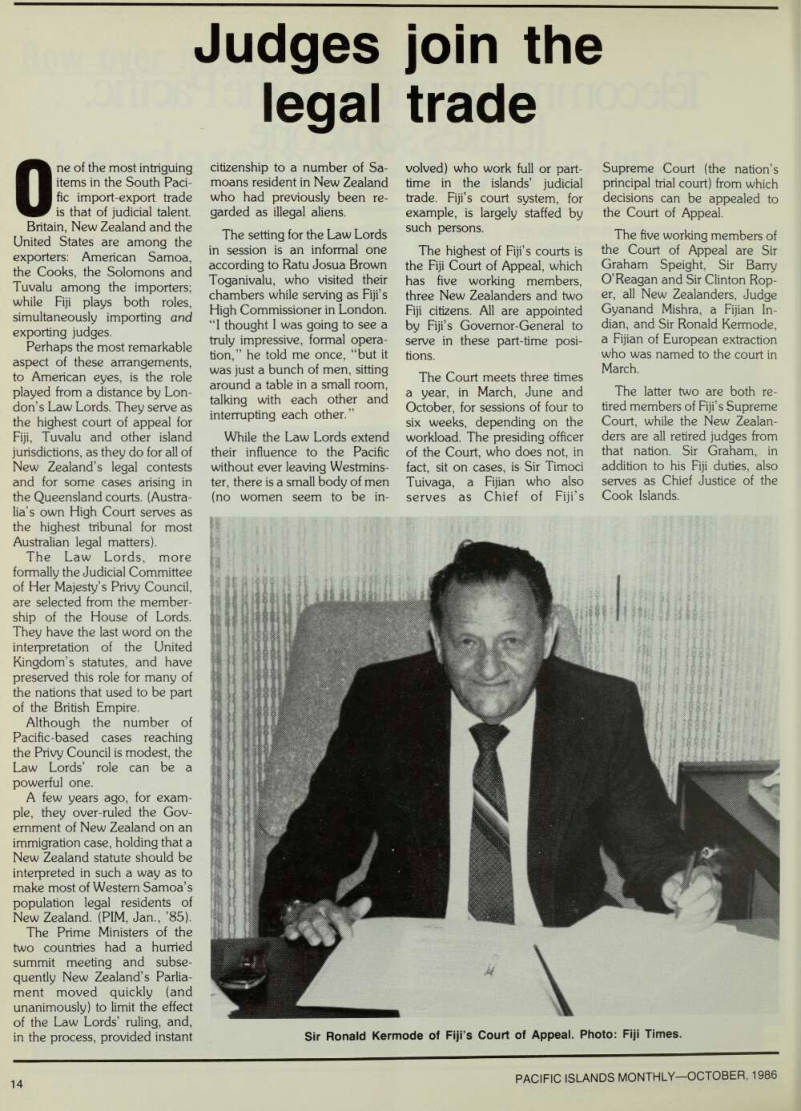
The five working members of the Court of Appeal are Sir Graham Speight, Sir Barry O’Reagan and Sir Clinton Rop er, all New Zealanders, Judge Gyanand Mishra, a Fijian In dian, and Sir Ronald Kermode, a Fijian of European extraction who was named to the court in March.
The latter two are both re tired members of Fiji’s Supreme Court, while the New Zealan ders are all retired judges from that nation. Sir Graham, in addition to his Fiji duties, also serves as Chief Justice of the Cook Islands.
Sir Ronald kermode of Fiji’s Court of Appeal. Photo: Fiji Times.
These judges work in groups of three, usually two New Zealanders and one Fijian citizen. The formalities of court are strictly observed, with wigs and gowns required of the judges and of the lawyers appearing before them. The only sartorial sign of the islands to be seen in their modest courtrooms is the uniform worn by the member of the Fiji Royal Police in attendance.
The judges, probably with their wigs and gowns in mind, have secured airconditioning for their rooms, though Fiji’s Parliament, which meets in a small building a few yards from the courtrooms, does not in dulge in that luxury. Fiji’s Sen ate and House of Representa tives, incidentally, take turns using a single room for their deliberations, an economy measure.
Fiji’s Supreme Court is also dominated by imported talent.
There are seven judges, four of them expatriates. The quartet includes a British lawyer, a New Zealander, and two Irishmen who spent a number of years in judicial positions in British Afri ca. The three Fiji citizens, prob ably not accidentally, are repre sentatives of Fiji’s three ethnic groups.
Fiji, however, is both an exporter and an importer of judicial talent, with the exports going to Tuvalu. That nation,
with only some 8000 inhabi tants, has enlisted Fijian judges to help run its complex, six layer judicial system.
Tuvalu’s court system starts at the grass roots with Island Magistrate courts; the magis trates are not lawyers, but are older men respected by their communities.
A decision in these courts can be appealed to the national Magistrates’ Court, and from there to a Senior Magistrate’s Court. From there the appeal goes, sequentially, to Tuvalu’s High Court, to the Court of Appeal in Fiji, and from there to the Law Lords.
To some extent the upper reaches of this structure appear only on paper. While Fiji’s Chief Magistrate, makes about two trips a year to Tuvalu (at Tuvalu expense) to preside over the Senior Magistrate’s Court, the High Court is with out a Chief Justice.
Sir Timoci had held the post but resigned because of the pressure of other business. This is in keepng with his comments to the press, in April, that Fiji’s Supreme Court was overbur dened (a condition that relates to the fact that any Fijian citizen can take any matter directly to that court, short-circuiting the system of magistrate’s courts).
According to Feve Tipu, Tuvalu’s High Commissioner to Fiji (and to Papua New
Guinea), the Government of New Zealand has been asked to find a new Chief Justice for Tuvalu. He also told me that few cases have been heard by the Fiji Court of Appeal and none, to his knowledge, had ever gone as far as the Law Lords.
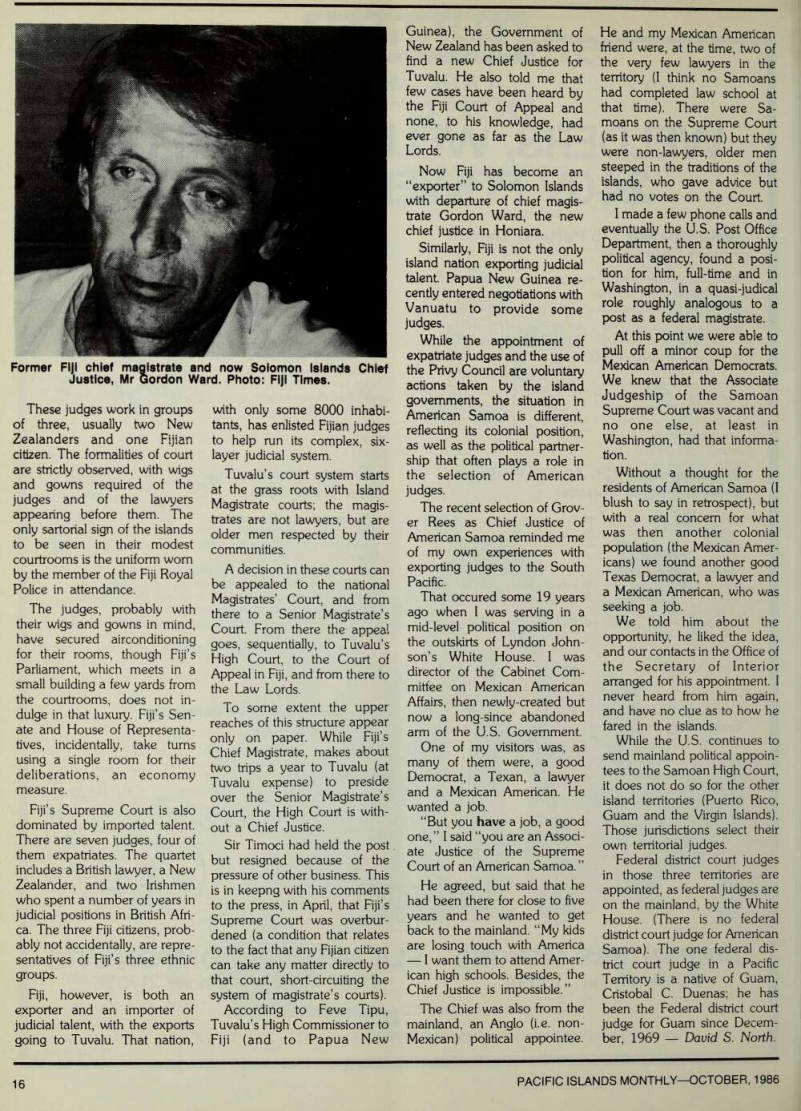
Now Fiji has become an “exporter” to Solomon Islands with departure of chief magis trate Gordon Ward, the new chief justice in Honiara.
Similarly, Fiji is not the only island nation exporting judicial talent. Papua New Guinea re cently entered negotiations with Vanuatu to provide some judges.
While the appointment of expatriate judges and the use of the Privy Council are voluntary actions taken by the island governments, the situation in American Samoa is different, reflecting its colonial position, as well as the political partner ship that often plays a role in the selection of American judges.
The recent selection of Grov er Rees as Chief Justice of American Samoa reminded me of my own experiences with exporting judges to the South Pacific.
That occured some 19 years ago when I was serving in a mid-level political position on the outskirts of Lyndon John son’s White House. I was director of the Cabinet Com mittee on Mexican American Affairs, then newly-created but now a long-since abandoned arm of the U.S. Government.
One of my visitors was, as many of them were, a good Democrat, a Texan, a lawyer and a Mexican American. He wanted a job.
“But you have a job, a good one,” I said “you are an Associ ate Justice of the Supreme Court of an American Samoa. ”
He agreed, but said that he had been there for close to five years and he wanted to get back to the mainland. “My kids are losing touch with America I want them to attend Amer ican high schools. Besides, the Chief Justice is impossible.”
The Chief was also from the mainland, an Anglo (i.e. non- Mexican) political appointee.
He and my Mexican American friend were, at the time, two of the very few lawyers in the territory (I think no Samoans had completed law school at that time). There were Sa moans on the Supreme Court (as it was then known) but they were non-lawyers, older men steeped in the traditions of the islands, who gave advice but had no votes on the Court.
I made a few phone calls and eventually the U.S. Post Office Department, then a thoroughly political agency, found a posi tion for him, full-time and in Washington, in a quasi-judical role roughly analogous to a post as a federal magistrate.
At this point we were able to pull off a minor coup for the Mexican American Democrats.
We knew that the Associate Judgeship of the Samoan Supreme Court was vacant and no one else, at least in Washington, had that informa tion.
Without a thought for the residents of American Samoa (I blush to say in retrospect), but with a real concern for what was then another colonial population (the Mexican Amer icans) we found another good Texas Democrat, a lawyer and a Mexican American, who was seeking a job.
We told him about the opportunity, he liked the idea, and our contacts in the Office of the Secretary of Interior arranged for his appointment. I never heard from him again, and have no clue as to how he fared in the islands.
While the U.S. continues to send mainland political appoin tees to the Samoan High Court, it does not do so for the other island territories (Puerto Rico, Guam and the Virgin Islands).
Those jurisdictions select their own territorial judges.
Federal district court judges in those three territories are appointed, as federal judges are on the mainland, by the White House. (There is no federal district court judge for American Samoa). The one federal dis trict court judge in a Pacific Territory is a native of Guam, Cristobal C. Duenas; he has been the Federal district court judge for Guam since Decem ber, 1969 David S. North.
Former Fiji chief magistrate and now Solomon Islands Chief Justice, Mr Gordon Ward. Photo: FIJI Times.
Advertisements & other items, pp. 15-19 (1 item)
240 V Power Sources
ARC WELDING
WELDERS, WELDING SUPPLIES
Weldanpower 175 Portable Welder/ Power Source • Petrol, and diesel with impulse start or with electric start and undercarriage. • Current range 60-175 amps AC • Electrode range 2.0-4.omm • AC auxiliary power 240 V, 4.5 kW, 50 Hz • Roll frame is standard except for electric start model.
Weldanpower 225 AC/DC Portable Welder/Power Source • Two models, petrol or diesel • Current range 50-225 amps AC 70-250 amps DC • Electrode range 2.0-s.omm • AC auxiliary power 240 V, 6kW, 50Hz • Electric start is standard on both models. r?
Dis-gen 25kVA
Generating set,
240 V, 50Hz
Powered by the Perkins 3 cyl. diesel; low speed, quiet and robust machine. Suitable for home and shed electric power.
Dte^qen 1C 140 Welder and
Battery Charger
• Plug-in 240 V welder complete with leads and 15 amp 3 pin plug • Electrode range 2.0-3.2 mm • Latest solid state components provide continuous variable current control even while welding.
AC225-S workshop welder with larger capacity also available Lincoln Accessories and Electrodes Linctong electrode holder, light, cool, comfortable.
Insulated and with replaceable parts.
Twistong 400 electrode holder, fully insulated, handle twists to lock onto electrode stub.
Well balanced and comfortable to use. (See picture.) Coolshield 4 welding shield with flip-up front. Clear, inner lens gives protection during deslagging and weld cleaning operations.
Lincoln also supply cables, clamps, gloves and a range of electrodes.
Dis-gen 6.SkVA Basic Generating
set, 240 V, 50Hz
Realiable, 1500 rpm, smoothrunning auxiliary generating set.
Inbuilt engine protection and safety features on the alternator assure peace of mind.
Powered by the Kubota 4-cycle diesel engine with indirect injection.
BEEHEU
[ARC WELDING]
A CD o O
CARPENTERS MOTORS ELA MOTORS COMPONENTS
SUVA. Phone 313644 PORT MORESBY. Phone 217036 The Lincoln Electric Co. (Australia) Pty. Ltd. (Inc. in N.S.W.) 35 Bryant Street, Padstow. N.S.W. 2211 Phone 772 7222. Tlx 22792 LE177.25/18 Slatter
f. m
PLL
DIRECT ACCESS
FREO i METER
ENTER
National
FM-LW-MW-SW PLL SYNTHESIZED RECEIVER RF-B6D
RF-B6OL
i
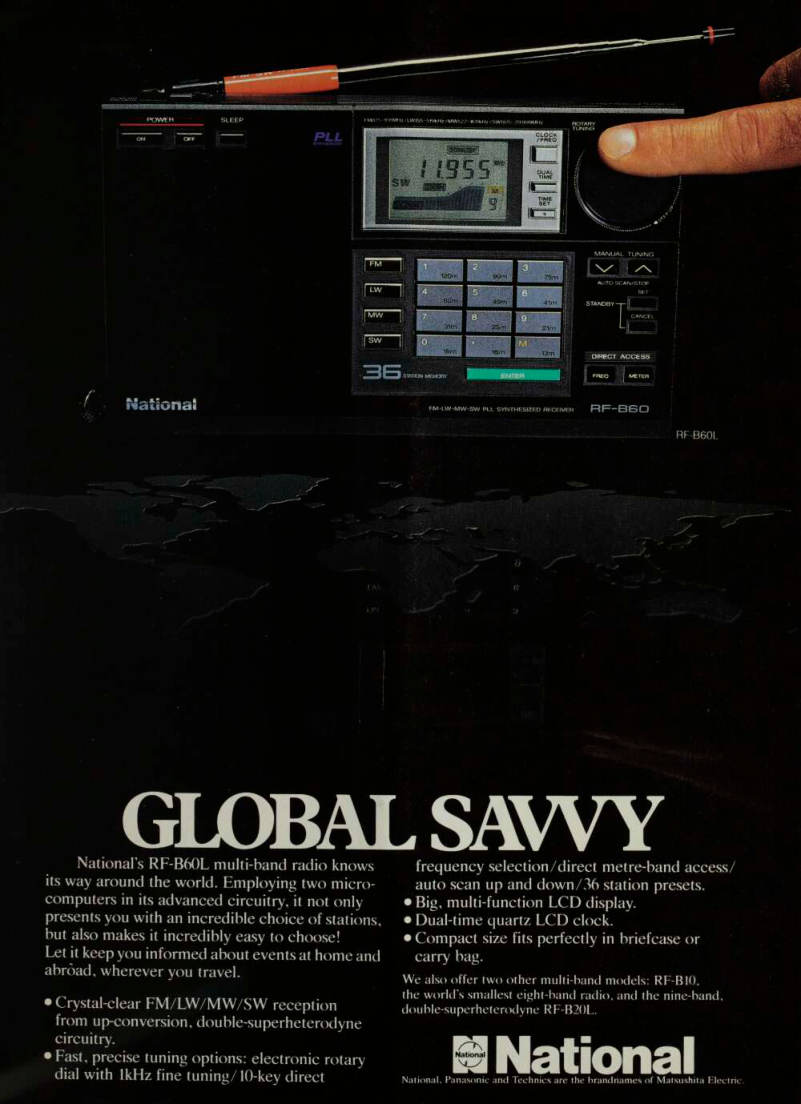
GLOBALSAVVY
National's RF-B6OL multi-band radio knows its way around the world. Employing two microcomputers in its advanced circuitry, it not only presents you with an incredible choice of stations, but also makes it incredibly easy to choose!
Let it keep you informed about events at home and abroad, wherever you travel. • Crystal-clear FM/LW/MW/SW reception from up-conversion, double-superheterodyne
circuitry.
• Fast, precise tuning options: electronic rotary dial with IkHz fine tuning/10-key direct frequency selection/direct metre-band access/ auto scan up and down/36 station presets. • Big, multi-function LCD display. • Dual-time quartz LCD clock. • Compact size fits perfectly in briefcase or
carry bag.
We also offer two other multi-hand models: RF-810, the world's smallest eight-hand radio, and the nine-hand, douhle-superheterodyne RF-B2OL.
National
National. Panasonic anti Technics are the hrandnames of Matsushita Electric
VV\ \\\ WV WV \\\ \\\ \\\ \\\ \\V WV \\\ \\\ \\\ \\\ \\\ \\\ \\\ VA \\\ \\\ \\\ \\\ \\\ \\\ \\\ \\\ \\\ \\\ \ A \\\ \\\ \\\ \\\ \\\ \\\ \\\ \\\ \\\ \\\ \\\ WV \V\ \\\ \\\ \\\ \\\ \\\ \\\ \\\ \\\ \\\ \\\ \\\ \\\ \\\ VV V \ wv wv \\\ \\\ \\\ \\\ \w \w \w \w w\ vwepv \w \w \w \w \w w\ m w\ \\\ \\\ w\ \w \m wv wv wv wv wv wv wv wv wv wv \\\ v/v\!% wvwv \\\ wv \\\ \\\ \\\ \\\ \\\ wv \\\ \\\ wv \\ i WV WV \\\ \\\ \\\ \\\ WWW W\ W\ W\ W\ VA W\ V o». m\\ A\ w\ wv w\ w\ w\ w\ w\ w\ w\ w\ w\ wv w\ \w w\ \w w\ w\ \w pw WV WV V'VAV wv wv wv wv wv wv wv wv wv wv wv wv wv wv wv »\\ W>TA\ WV WV WV WV WV WV WV WV WV WV WV WV WV WV WV' W\ WV WV WV WV WV WV WV WV WV WV WV WV WV WV WV WV V WV WV WV WV WV WV WV WV WV WV& WV WV WV WV WV WV V IV WV WWA wv wv wv wv wv wv wv wv wv wv mvhv wv wv wv wv wv vv L\w\ 0° c \\l\
JXSH
mu \\\v.« vw \\\ \\\ \\\ w \\\ m \\\ wv ww
f
Only Ericsson
covers the
Pacific from
coast to coast
to coast to coast
to coast...
Ericsson telecommunications has been in the Pacific region for over 20 years.
Over that period, we have provided and installed around 80% of the public exchanges for administrations in the region.
Around 50% of all private PABX telephone systems have also been installed by Ericsson.
What this means, is that Ericsson has a solid commitment to support maintenance and after sales service to the region from coast to coast to coast...
ERICSSON
Contact: Russ Collins L. M. Ericsson Pty. Ltd. 61 Riggall Street, Broadmeadows.
Victoria. Australia 3047
A milestone on the road
For the Kanak Socialist national Liberation Front (FLNKS) this year’s South Pacific Forum meeting in Suva represents a major milestone.
The forum decision to sup port the territory’s re-inscription on the United Nations decol onisation list does not mean independence is just around the comer.
However, it does represent an important moral victory for the front and a considerable source of pressure that the Chirac administration in Paris will find difficult to ignore.
The unanimous vote by the 13 forum members has given the front a new credibility that it could mot otherwise have achieved. The UN committee of 24 probably won’t consider the issue before January. But already the new status that the forum decision has conferred
With France and the forum on a collision course over New Caledonia, tension is mounting again in the territory. At the same time, the UN has been brought into the debate for the first time a notable lobbying coup for the pro-independence FLNKS. Here, PIM writers survey the scene.
on the FLNKS has begun to take effect.
A delegation from the front was likely to be granted a hearing in the US State Depart ment in Washington as a direct result of the forum decision, It’s understood the arrange ments were made through the US embassy in Fiji between the FLNKS forum delegation and US officials, The FLNKS and the New
Caledonia issue was also likely to be raised at a conference of the non-aligned movement last month. Vanuatu had been charged by the forum with the responsibility to bring the kanaks’ case before the meeting.
An FLNKS delegation led by Jean-Marie Tjibaou and Yann Celene Uregei also planned to attend the Zimbabwe meeting to lobby in the FLNKS interest.
Jean-Marie Tjibaou was to travel to Washington after the Harare meeting. Such a repre sentation of the kanak case can not be easily dismissed de spite the French show of in dignation immediately after the forum decision. Noumea loyal ists who had also sent a delega tion to Suva in an effort to nullify the FLNKS presence, accused the forum members of meddling in French affairs.
“The future of Caledonia is up to the Caledonians,” said the president of the territorial congress, Dick Ukewei, a mem ber of the anti-independence RFCR party.
The French minister re sponsible for the New Caledo nia portfolio, Bernard Pons, claimed the forum decision showed a lack of understanding of the territory’s problems among its regional neighbours.
Once the issue is before the Committee of 24, however, France is unlikely to win much sympathy with such sentiments and re-inscription (New Cale donia was on the list until 1947 when it was taken off in a unilateral action by France) is virtually a foregone conclusion.
Little appreciated as it was by France, the forum decision has also helped maintain a certain equilibrium in New Caledonia.
It was certainly a major factor keeping the FLNKS from quit ting the territory’s political in stitutions the four regional councils and the territorial con gress.
At least two powerful parties within the front FULK and UPN had wanted the FLNKS to pull out in protest at the new plans for the territory’s future which, they had been convinced, clearly showed the Chirac government’s intention of keeping New Caledonia firm ly under French rule.
However, at the FLNKS con gress at Lifou in August the biggest party, Union Caledo nienne, led by Jean-Marie Tjibaou, successfully argued that the regions three of which the front controls had become an “important tool”
and that the front should, at least for the time being, continue to take part.
Had the congress opted out, there is little doubt that trouble would have erupted again. That is something the front does not , However, the congress made it clear that it was prepared for that risk if the French government refuses to play ball. The meeting passed a motion reaffining the front’s position that only the kanak population should be allowed to vote in next year’s independence referendum.
Should the French government ignore this demand, the referendum will be boycotted, the political institutions dumped and “civil disobedience” recommenced.
Certainly, the referendum is shaping up as the next major
hurdle for New Caledonia. The forum vote and the likely re inscription on the UN list are likely to increase the pressure on France for electoral reform in time for the referendum, So far however there is no sign that France will submit to pressure Pons is adamant that all those on the electoral roll will vote despite the FLNKS de mand which > he sa V s - is ridicu
ous -
But it’s not yet clear that these seemingly entrenched and opposed positions are final.
Both sides have said they are willing to negotiate, but if the provocative rhetoric, taken as gospel by the territory’s volatile and passionately involved population, continues, how much ground will either side be
able to give?
Sue Williams.
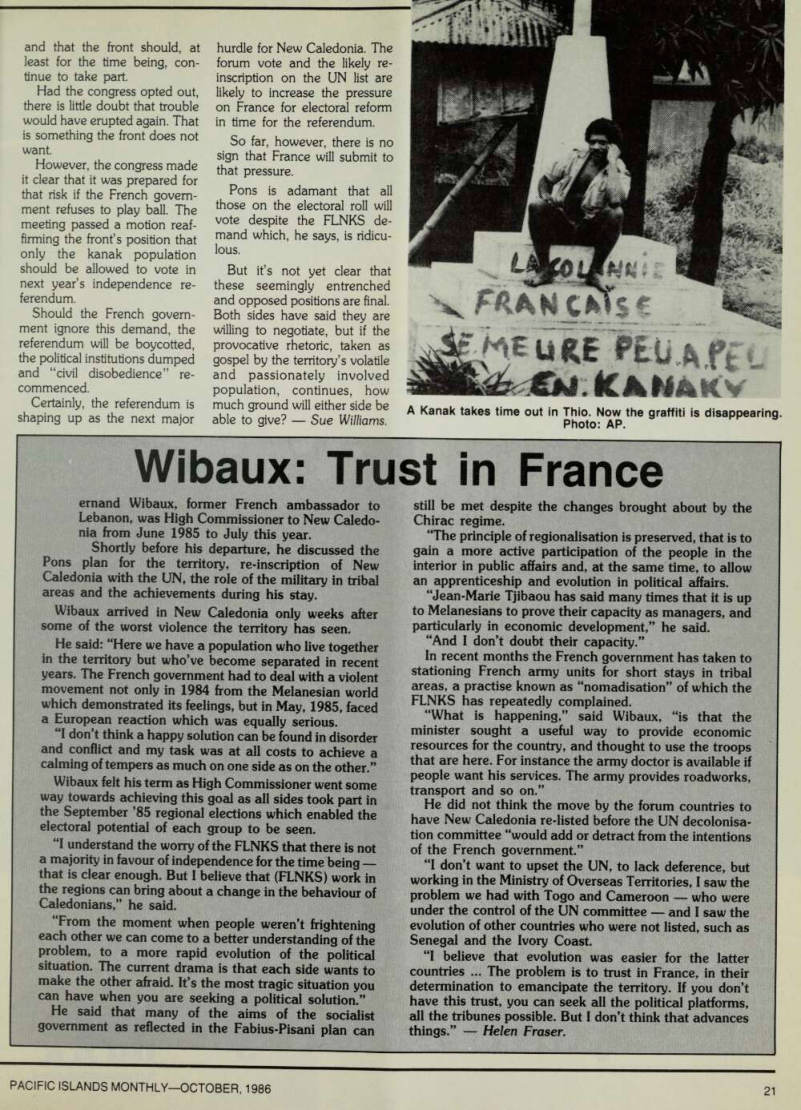
A Kanak takes time out in Thio. Now the graffiti is disappearing.
Photo: AP.
The committee of 24
The UN Special Committee on the Implementation of the Declaration on Decolonisation, often known as the Committee of 24, is currently chaired by Cuba.
The chairman is almost always a coun try’s permanent UN representative and works more on a personal than a national basis.
Current membership is: Afghanistan, Bulgaria, Chile, China, Congo, Cuba, Czechoslovakia, Ethiopa, Fiji, India, In donesia, Iran, Iraq, Ivory Coast, Mali, Sweden, Sierra Leone, Syria, Trinidad and Tobago, Tunisia, USSR, Tanzania, Vene zuela and Yugoslavia.
The committee meets throughout the year and aims to complete its business prior to the opening of the General Assembly.
A meeting in January will draw up a list of work for 1987, when the New Caledonia issue will be formally discussed.
The committee has a list of countries which it considers to be non-self governing territories. The forum request is for the committee to add New Caledonia to that list.
Once a country or territory appears on the list, the committee examines deve lopments there at least once a year. Any member of the committee or any
interested non member can address the hearings.
The committee is also able to hear petitioners from interested non-governmen tal bodies.
But what is most likely to annoy France is the fact that the committee, on a more or less regular basis, sends visiting missions to the listed territories to examine deve lopments, including those towards a change of status.
France, however, is under no obligation to allow entry to such missions.
A sub committee draws up a report which, if adopted by the whole body, is then transmitted with any recommendations to the General Assembly for consideration.
The committee has in the past overseen acts of self determination in other non self-governing territories but is not in a position to force the pace towards any referendum.
Again, however, France is under no obligation to co-operate with the commit tee and would be within her rights to ignore it completely.
This, though, would almost inevitably lead to anti-French resolutions being de bated by the General Assembly, drawing international attention to the status of New Caledonia which is what the FLNKS and the forum seek to achieve.
Wibaux: Trust in France
crnand Wibaux, former French ambassador to Lebanon, was High Commissioner to New Caledo nia from June 1985 to July this year.
Shortly before his departure, he discussed the Pons plan for the territory, re-inscription of New Caledonia with the UN, the role of the military in tribal areas and the achievements during his stay.
Wibaux arrived in New Caledonia only weeks after some of the worst violence the territory has seen.
He said: “Here we have a population who live together in the territory but who’ve become separated in recent years. The French government had to deal with a violent movement not only in 1984 from the Melanesian world which demonstrated its feelings, but in May, 1985, faced a European reaction which was equally serious.
“I don’t think a happy solution can be found in disorder and conflict and my task was at all costs to achieve a calming of tempers as much on one side as on the other.”
Wibaux felt his term as High Commissioner went some way towards achieving this goal as all sides took part in the September ’B5 regional elections which enabled the electoral potential of each group to be seen.
“1 understand the worry of the FLNKS that there is not a majority in favour of independence for the time being that is clear enough. But I believe that (FLNKS) work in the regions can bring about a change in the behaviour of Caledonians,” he said.
“From the moment when people weren’t frightening each other we can come to a better understanding of the problem, to a more rapid evolution of the political situation. The current drama is that each side wants to make the other afraid. It’s the most tragic situation you can have when you are seeking a political solution.”
He said that many of the aims of the socialist government as reflected in the Fabius-Pisani plan can
still be met despite the changes brought about by the Chirac regime.
“The principle of regionalisation is preserved, that is to gain a more active participation of the people in the interior in public affairs and, at the same time, to allow an apprenticeship and evolution in political affairs.
“Jean-Marie Tjibaou has said many times that it is up to Melanesians to prove their capacity as managers, and particularly in economic development,” he said.
“And 1 don’t doubt their capacity.”
In recent months the French government has taken to stationing French army units for short stays in tribal areas, a practise known as “nomadisation” of which the FLNKS has repeatedly complained.
“What is happening,” said Wibaux, “is that the minister sought a useful way to provide economic resources for the country, and thought to use the troops that are here. For instance the army doctor is available if people want his services. The army provides roadworks, transport and so on.”
He did not think the move by the forum countries to have New Caledonia re-listed before the UN decolonisa tion committee “would add or detract from the intentions of the French government.”
“1 don’t want to upset the UN, to lack deference, but working in the Ministry of Overseas Territories, I saw the problem we had with Togo and Cameroon who were under the control of the UN committee and I saw the evolution of other countries who were not listed, such as Senegal and the Ivory Coast.
“I believe that evolution was easier for the latter countries ... The problem is to trust in France, in their determination to emancipate the territory. If you don’t have this trust, you can seek all the political platforms, all the tribunes possible. But I don’t think that advances
things.”
Helen Fraser.
Advertisements & other items, p. 22 (1 item)
At the end ol the rainhow
you'll (inti Fiji.
FIJI'S INTERNATIONAL AIRLINE
Dien Bien Thio:
calm returns
The French called it Dien Bien Thio a bitter recollection of the pro longed siege and then defeat of their armed forces by Ho Chi Minh during the Viet namese war of independence 30 years earlier.
For three weeks in late 1984 the FLNKS held the east coast mining town of Thio under siege.
Several days before, the kanak independence flag had flown at the gendarmerie when it was captured by the FLNKS the first of several through out the territory to be captured by them and later released.
The name became a house hold word in France for the right wing a symbol of the shame brought on France by the socialist government, and for the left a word to denote the kanak struggle for independ ence.
Led by militant kanak leader Eloi Machoro, the FLNKS cut the town into sectors, with seven road blocks separating and controlling them. Mines, shops and businesses were closed. The National Front mayor was forced to leave while cars, petrol and boats were commandeered by the
Flnks.
Townsfolk were allowed out for exercise at dusk and the French army evacuated those who could produce medical certificates.
When the FLNKS conducted a house to house search and requisitioned all guns and ammunition, the French de cided to act. Elite marksmen were sent in by helicopter to ambush Machoro and his band.
But due to a navigational error, the helicopters landed on
the wrong side of the bridge and the men were captured by the FLNKS.
The symbols became intensi fied humiliation for France, pride for the kanaks.
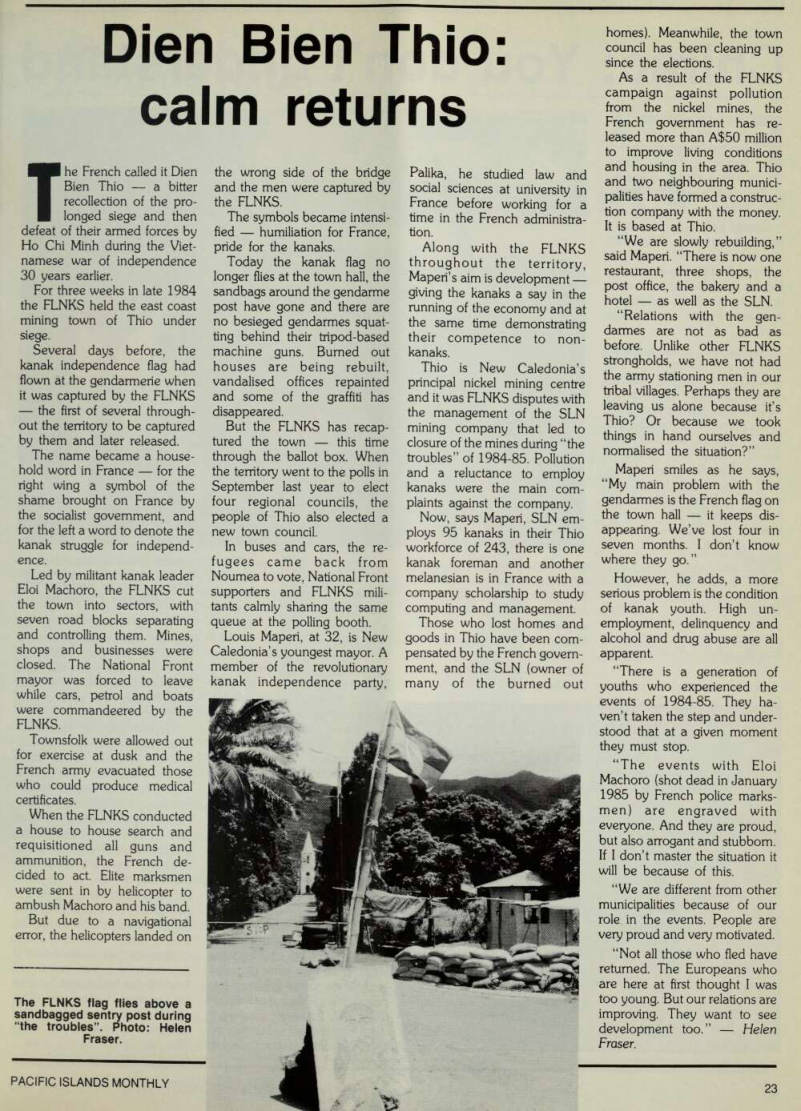
Today the kanak flag no longer flies at the town hall, the sandbags around the gendarme post have gone and there are no besieged gendarmes squat ting behind their tripod-based machine guns. Burned out houses are being rebuilt, vandalised offices repainted and some of the graffiti has disappeared.
But the FLNKS has recap tured the town this time through the ballot box. When the territory went to the polls in September last year to elect four regional councils, the people of Thio also elected a new town council.
In buses and cars, the re fugees came back from Noumea to vote, National Front supporters and FLNKS mili tants calmly sharing the same queue at the polling booth.
Louis Maperi, at 32, is New Caledonia’s youngest mayor. A member of the revolutionary kanak independence party,
Palika, he studied law and social sciences at university in France before working for a time in the French administra tion.
Along with the FLNKS throughout the territory, Maperi’s aim is development giving the kanaks a say in the running of the economy and at the same time demonstrating their competence to non kanaks.
Thio is New Caledonia’s principal nickel mining centre and it was FLNKS disputes with the management of the SLN mining company that led to closure of the mines during “the troubles” of 1984-85. Pollution and a reluctance to employ kanaks were the main com plaints against the company.
Now, says Maperi, SLN em ploys 95 kanaks in their Thio workforce of 243, there is one kanak foreman and another melanesian is in France with a company scholarship to study computing and management.
Those who lost homes and goods in Thio have been com pensated by the French govern ment, and the SLN (owner of many of the burned out
homes). Meanwhile, the town council has been cleaning up since the elections.
As a result of the FLNKS campaign against pollution from the nickel mines, the French government has re leased more than Asso million to improve living conditions and housing in the area. Thio and two neighbouring munici palities have formed a construc tion company with the money.
It is based at Thio.
“We are slowly rebuilding,” said Maperi. “There is now one restaurant, three shops, the post office, the bakery and a hotel as well as the SLN.
“Relations with the gen darmes are not as bad as before. Unlike other FLNKS strongholds, we have not had the army stationing men in our tribal villages. Perhaps they are leaving us alone because it’s Thio? Or because we took things in hand ourselves and normalised the situation?”
Maperi smiles as he says, “My main problem with the gendarmes is the French flag on the town hall it keeps dis appearing. We’ve lost four in seven months. I don’t know where they go.”
However, he adds, a more serious problem is the condition of kanak youth. High un employment, delinquency and alcohol and drug abuse are all apparent.
“There is a generation of youths who experienced the events of 1984-85. They ha ven’t taken the step and under stood that at a given moment they must stop.
“The events with Eloi Machoro (shot dead in January 1985 by French police marks men) are engraved with everyone. And they are proud, but also arrogant and stubborn.
If I don’t master the situation it will be because of this.
“We are different from other municipalities because of our role in the events. People are very proud and very motivated.
“Not all those who fled have returned. The Europeans who are here at first thought I was too young. But our relations are improving. They want to see
development too.”
Helen
Fraser.
The FLNKS flag flies above a sandbagged sentry post during “the troubles”. Photo: Helen Fraser.
Chirac: You don’t understand
French prime minister, Mr Jacques Chirac, de fended his government’s policies in New Caledo nia with a mighty sideswipe at his Australian counterpart Bob Hawke.
Shortly before the end of his visit to the territory, Chirac said he was confused and dis appointed by comments by Hawke published in the French press in the week before his voyage to France’s Pacific pos sessions.
Hawke was quoted as saying that he was disappointed that the previous socialist govern ment’s plans for the territory had been dropped and warning of the potential for tragedy. The French prime minister pro duced a letter from Hawke in which the Australian leader said: “Our wish is to help ensure that the problems (in New Caledonia) are resolved peacefully in the interests of all inhabitants of that multi-racial society, ”
Chirac retorted: “This is very different to the public com ments of Mr Hawke. French policy in New Caledonia is not dangerous. We are going to do exactly what he wants us to do.”
The French prime minister
was responding to questions following remarks he made to PlM’s Sue Williams at his offi cial reception the night before at which he had accused Hawke of acting stupidly and indicated his willingness to wel come a change of government in Canberra.
At his press conference, Chir ac also explained that he wanted to reinforce links be tween Australia and France which had existed for a very long time. He similarly wanted to improve France’s standing with other South Pacific nations and stressed that this had been one of the goals of his voyage along with a relaunch of New Caledonia’s battered economy and the start of negotiations on the territory’s status after next year’s scheduled independence referendum.
As a public relations exercise for the French loyalists, his visit was an unmitigated success.
Chirac was everywhere warmly received, although he visited only loyalist strongholds.
For the rest, however, the prime minister would not take long to count his achievements.
Considering his comments on Bob Hawke, he could hardly claim to be nearer his declared goal of improved relations be tween France and Australia.
He did, however, promise a large injection of French money to restart the economy, but a
question mark remains over the territory’s political stability in the coming years and the input of private investment to support state money and ensure long term development.
His talks with the independ ence movement, the FLNKS, did not go well. Both sides emerged from an hour of talks saying they had been “useful.”
However, FLNKS leader, Jean- Marie Tjibaou, admitted that little had been achieved except the formal opening of negotia tions on the formula for the referendum.
France says all those on the electoral roll will take part. The FLNKS insists that only kanaks should vote. The independence movement has warned that if this demand is not met it will boycott the ballot and boycott the political institutions. This could result in a return to the turmoil and violence of 1984- 85.
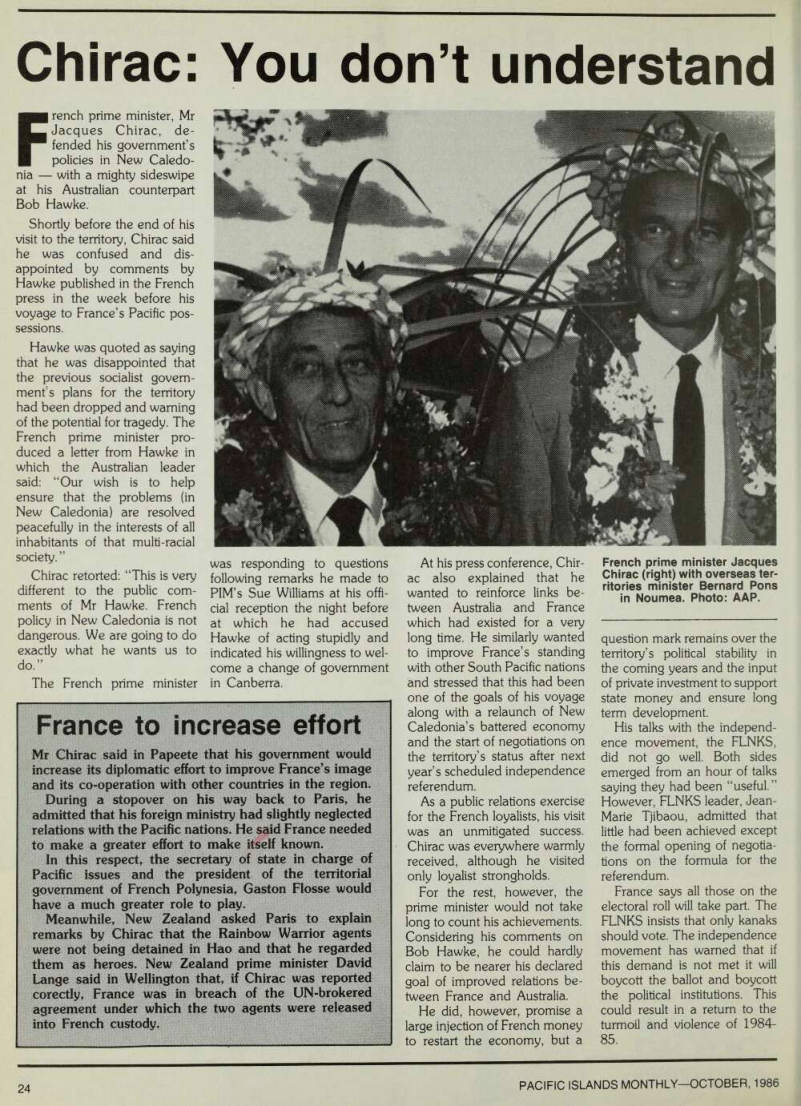
French prime minister Jacques Chirac (right) with overseas ter ritories minister Bernard Pons in Noumea. Photo: AAP.
France to increase effort
Mr Chirac said in Papeete that his government would increase its diplomatic effort to improve France’s image and its co-operation with other countries in the region.
During a stopover on his way back to Paris, he admitted that his foreign ministry had slightly neglected relations with the Pacific nations. He said France needed to make a greater effort to make itself known.
In this respect, the secretary of state in charge of Pacific issues and the president of the territorial government of French Polynesia, Gaston Flosse would have a much greater role to play.
Meanwhile, New Zealand asked Paris to explain remarks by Chirac that the Rainbow Warrior agents were not being detained in Hao and that he regarded them as heroes. New Zealand prime minister David Lange said in Wellington that, if Chirac was reported corectly, France was in breach of the UN-brokered agreement under which the two agents were released into French custody.
the TV race
trade winds
New runner enters the TV race
It’s a troubled time for television. With PNG effectively banning broadcast TV until 1988 and Fiji hinting that the exclusive deal with PBL of Australia may not be so exclusive after all, the picture is hazy.
Adding to the interference has been the TV New Zealand proposal to broadcast public service television to the whole region.
The proposal was received by the Suva forum meeting with some countries known to be broadly in favour.
This, coupled with PNG prime minister Paias Wingti’s adamant opposition to the immediate introduction of broadcast televi sion, has made most observers think again.
The TVNZ plan, as outlined by consul tant Allan Martin in a keynote address at the 1986 Parkinson Memorial Lecture series at USP, is to broadcast to the region by means of its Instelsat facility.
Societies such as those in the Pacific, he said, “have a right to expect that such a medium as powerful as television will be used to protect local culture.
“The stimuli for behaviour and stan dards should still come from local pulpits and platforms and not from the West Coast of America.
“It is important for every nation to see itself on television if that country’s national cultural identity is not to be eroded ... ultimately, political sovereignty rests on cultural sovereignty.”
But where will the money come from?
The proposal now in place would require increased or diverted funding from the forum with support from other agen cies.
Critics point out, however, that without long term guarantees, the forum would not be in a position to commit itself to funding such a service because if the funds dry up the forum could be left with a financial millstone.
Also, there may simply not be enough
spare cash in the forum kitty.
One man undeterred by the New Zealand plan is PBL managing director, Mr Lynton Taylor. “I don’t view them as competition,” he told PIM. “That’s not because they’re not commercial, but be cause, at the moment there’s no indication of where the money will come from.
“As I understand it, they are asking the forum countries to come up with some money. And I don’t know if any of the forum countries are eager to do that.”
Mr Taylor is of the view, also, that Fiji has not specifically reserved the right to enter into something like the TVNZ propo sal as it stands. “Fiji has retained the right
to establish its own internal service,” he said.
But if the Fiji parliament decides to proceed with a New Zealand option?
“That’s a hypothetical question and I don’t propose to answer it.”
In any case, the TVNZ plan is still some way in the distance.
The paper read to the forum has been referred to a SPEC sub committee to evaluate and report. This effectively ended its discussion in the forum meetings in Suva.
SPEC director, Mr Henry Naisali, told PIM: “The experts will examine the various aspects of the proposal and report back to the full SPEC committee. I don’t think that’s likely to happen before the end of this year.”
The New Zealand proposal contained a costing, he explained, but the question of funding “is still up in the air.”
Meanwhile, in PNG, Niugini Television Network (NTN), the first TV broadcaster to be granted a licence, has been stymied by legislation.
The company had challenged the deci sion by Wingti to suspend broadcasting until after a commission of inquiry into its likely effects had reported probably next year.
The PNG national court looked as though it would find in favour of the company, so Wingti, as predicted by several insiders, promptly took his case to a higher court Parliament and passed a Bill outlawing broadcast TV before 1988.
The National Court, two days after the Bill was passed, did find in favour of NTN, a subsidiary of the Parry Corporation’s Newcastle Broadcasting Network (NBN) in Australia.
The agreement with the previous So mare government should stand, ruled chief justice Sir Buri Kidu. NTN then moved to challenge the new legislation on con stitutional grounds. With an election in
Media magnate Kerry Packer. His PBL Ltd. has several proposals in place.
PNG next year, of course, all things can change, although NTN will still be out of pocket at least Asl2 million. The company had employed a substantial staff and, even after the parliament decision, continued to film news events and shot some library footage of parliament.
The company also remained committed to its staff training program.
PBL’s Taylor is, understandably perhaps, undeterred. The legislation puts them back at level pegging in the race to be the first TV broadcaster in PNG now that NTN’s plan to commence operations on July 18 has had to be ditched.
PBL had planned to commence in January. Said Taylor: “I think PNG is quite right to delay television until its impact can be properly estimated.”
But to put all plans on hold until 1988?
“Well, it may not actually take that long. ”
Depending on who forms the PNG government at this time next year, he could be right.
By then, however, the New Zealand proposal is likely to be firmly in place and will have been discussed at the 1987 forum meeting in Apia.
But the funding question remains cru cial. Naisali told PIM; “The forum made no decision on funding because there was no paper. It was down for discussion under any other business, but it was never raised, mainly because the decision was made by the pre-forum committee to have it thrashed out by SPECTEL (the telecom munications sub committee).”
Would that body be able to make a recommendation on funding? “Possibly, but that’s speculation. They might also say SPEC should look around for potential donors and I might put my begging cap on and go begging.”
General manager of NTN, Mr Murray
Finlay, is unworried by the TVNZ move. “I don’t know if it will ever get off the ground,” he said. “I think it will be hard to get agreement with 13 different countries all with different needs who won’t want to stump up their money to pay for it.”
Finlay sees some benefits from the new legislation. “We have a fully valid and binding agreement with the state which was fully endorsed by the national court.
That is still a document that says we are entitled to broadcast.
All that this present Act has sought to do is defer it. We still have a right to broadcast, albeit deferred a right which 1 might add no-one else has. This act significantly changes the game in that PTC (Post and Telecommunications Corporation) licences are no longer sufficient. There now has to be a licence from the head of state acting under advice.
“Under the terms of our agreement which has now been pronounced true and valid, the state now has to assist us to get our licence. It is under no obligation to assist anyone else to get a licence.”
Finlay is adamant that the PNG market cannot support two commercial television stations. “We have always seen the logical progression for PNG as having a state-run broadcaster and a commercial station.
“All the worthy objectives that Mr Wingti talks about are perhaps best served by a state-run national broadcaster and there ought to be a commercial broadcaster who does what a commercial broadcaster does best and that is entertain people.”
Mr Kerry Packer, owner of PBL, may be less than entertained, however, by the fact that the TVNZ play is being masterminded by Mr Nigel Dick a former Packer television executive.
Debate makes legal waves
The law has been brought into the TV debate in more ways than one. In PNG, NTN mounted a legal challenge to the decision by Parliament to ban broad cast television until 1988. The challenge was on constitutional grounds.
In Fiji, the minister for economic development, planning and tourism, Mr Peter Stinson, invoked the law in an other manner by issuing a writ against The Fiji Times and the Fiji Labour Party alleging defamation and claiming dam ages.
The writ also sought to prevent the publication of further similar matter.
The newspaper had reported a call by the Labour Party for an investigation of
the agreement between the government and PBL.
The PNG case was set down for hearing this month unless resolved jointly before then. However, in an unusual move, the government and NTN issued a joint statement in which Mr Wingti acknowleged that an agreement existed between the state and the com pany and that it was realistic to expect the company would not waive rights under that agreement without recom pense.
For its part, NTN declared itself mindful of the wishes of the National Parliament in passing the act.
All of which appeared to set the stage for an early settlement.
TVNZ offers ‘a small basic service’
TV New Zealand sees its offer to broadcast public service television to the South Pacific as aid project, but failing that, said TVNZ’s Mr Allan Martin, there could be the possibilty of a government-supported loan system. “This would necessitate some commercials being built into the system to pay for the loan interest,” he told PIM.
“The media keeps seeing it as a battle between Packer and us,” he said. “Some people here might even see it that way, but as far as I am concerned if Packer and the others can pull off these commercial deals around the Pacific, then that’s good commercial business.
“But we’re talking about a public service system that’s designed to do something else and operate on a different basis altogether.”
He said it would be a small basic service operating four hours per day that would give the outlying islands a service also. “It would give them a basic system on to which they could build a degree of sophistication later on,” he said.
He said it would also be a “truly Pacific” system, presented by Pacific islanders. “We are talking about setting up a Piacific islands broadcasting organisation that would tell us what they want.”
So what’s in it for TVNZ? “That’s quite a common question.
But there’s not a lot in it for us because we would be supporting the system to the extent of about half a million dollars a year so there would be no money involved for us.”
He said the trigger for the offer was the announcement by Australia of the third Aussat with a footprint covering the Pacific. “When that happened Intelsat reduced its prices, making this proposal possible.”
There was little in it for TVNZ, though there was a possibility of some influence in the region for New Zealand “and a chance to do something worthwhile on a public service system.”
He said it was not a commercial conflict with the Packer organisation or anybody else, “although we have influenced some of the islanders to think again about what commercial television would do to them.”
Cerman-style beer,

Brewers get ahead in export market
brewed in the South Pacific, is about to make a major effort in the competitive Hawaii market.
Western Samoa Breweries Ltd hopes to be able to fund all imports of packaging and raw materials from export earnings within the next 12 months.
The company is aiming at the Hawaii market with its 350 ml export lager bottles, with a modified up-market label.
The target is to sell between 1500 and 2000 cases a month after an introductory phase, said manager Mr Wolfgang Hofmann.
It was an expensive risk, he told PIM, but one that the brewery had to take. “Obvious ly, small breweries do not have the mighty power of large con cerns, so we have to find a niche in the market,” said Hof mann.
It required very thorough market segmentation, with target groups clearly defined for effective promotions.
“We brew in the German beer tradition,” he said, “and tastings carried out have given us a very promising, positive response. ”
The company, with a work force of 90, also brews San Miguel under licence. The Brauhaase group of Hamburg, West Germany currently pro vides brewing consultancy and management services.
The expected 1986 output of 4.5 million litres is split 85 per cent for the domestic market and 15 per cent for export. The company’s market leader, Vaili ma beer, accounts for 80 per cent of local sales and 60 per cent of exports.
The company is owned by the Western Samoa govern ment (54 per cent), the West German government finance company (12.7 per cent), the Republic of Nauru (10 per cent) with three private West German investors, the San Miguel Corp and local and overseas inves tors holding the remainder.
Ready for export ... production at Vailima.
Advertisements & other items, p. 27 (1 item)
The Total Test Equipment Solution
AWA
[ 1 1 *1 * marconiA_ instrument's v Tfektromx i r *i"V
0 HITACHI
fFLUKB
□JIM
Money
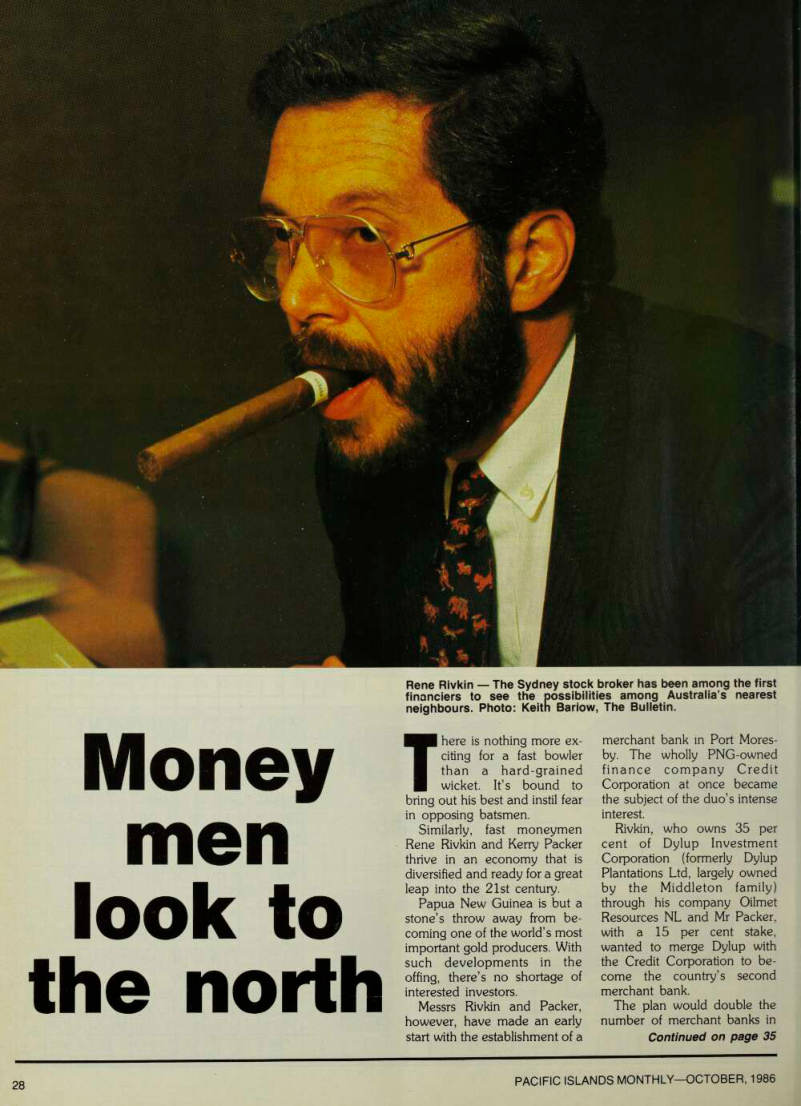


men look to the north
There is nothing more ex citing for a fast bowler than a hard-grained wicket. It’s bound to bring out his best and instil fear in opposing batsmen.
Similarly, fast moneymen Rene Rivkin and Kerry Packer thrive in an economy that is diversified and ready for a great leap into the 21st century.
Papua New Guinea is but a stone’s throw away from be coming one of the world’s most important gold producers. With such developments in the offing, there’s no shortage of interested investors.
Messrs Rivkin and Packer, however, have made an early start with the establishment of a
merchant bank in Port Mores by. The wholly PNG-owned finance company Credit Corporation at once became the subject of the duo’s intense interest.
Rivkin, who owns 35 per cent of Dylup Investment Corporation (formerly Dylup Plantations Ltd, largely owned by the Middleton family) through his company Oilmet Resources NL and Mr Packer, with a 15 per cent stake, wanted to merge Dylup with the Credit Corporation to be come the country’s second merchant bank.
The plan would double the number of merchant banks in
Continued on page 35
Rene Rivkin The Sydney stock broker has been among the first financiers to see the possibilities among Australia’s nearest neighbours. Photo: Keith Barlow, The Bulletin.
PNG. Resource Investment Fin ance Ltd, jointly owned by the PNG Banking Corporation (a government-owned commer cial bank), the Commonwealth Bank of Australia and the Hon gkong and Shanghai Bank, set up as a merchant bank in 1982.
The reason for the Credit Corporation play was that Dylup Investments, while classi fied as an investment bank, could perform only as a passive investor in established com panies.
The company like its plantation forefather oper ates in PNG but is listed on the Sydney exchange from where it derives a strong capital base.
So, from being a “mere” investment banker, the com pany wanted to see itself in the more diversified world of mer chant banking.
Dylup’s first major acquisition PNG Associated Industries (September PIM P 6) — after talks with other possible suitors had all fallen through, was seen as a natural precursor to a Dylup-Credit Corporation mar riage.
PNGAI is a $5O million dollar a year operation which has the nationwide franchise for Mazda and Suzuki motor vehicles, an acoholic drinks distribution company and an air condition ing and refigeration company.
Credit Corporation has oper ated since 1978 and has been competing in the lease finance market with three others PNGBC-owned Nambawan Finance, Westpac-controlled AGC Pacific and the Bums Philp-Indosuez Bank joint ven ture, Indoniu Finance.
In terms of size, Credit Corporation ranks second with assets of K 13.8 million (A 522.6 million). The largest is Namba wan with K2l million (As 43 million). AGC is third with K 13.7 million (A 522.3 million).
Smallest is Indoniu with K 6.9 million (A 511.2 million).
Politically, Credit Corpora tion would be a good partner for Dylup, being a totally PNG owned company. The Dylup proposal of a 45 per cent stake in Credit Corporation in ex change for a similar holding in
Dylup was put to the Credit Corporation board by Rivkin the day after he signed the PNGAI deal.
Dylup’s managing director True Nguyen told PIM at the time: “If they don’t want to come to us, it will be up to us to set up a competing organisation which we don’t want to do.
“In the meantime, I’m pushing for a merchant banking licence and I’m confident of finding a local partner if the corporation doesn’t want to come forward.
“As you know from the ex perience in Australia, small fin ance companies which try to start up fall to the established large ones.
“We have a large network and sophisticated training facili ties,” said Nguyen. He added that Credit Corporation was well managed, with founding managing director Mr Garth Mdlwaine still at the helm.
He agreed that a merger with Dylup would present the corporation with a ready-made market in vehicle financing through Dylup’s ownership of Mazda agents, PNG Motors,
which is estimated to have about 30 per cent of the passenger vehicle market.
Dylup, meanwhile, continues to study its PNG portfolio with an eye to further acquisitions and investments.
With As3s million to spend, the company is in a happy position.
Further down the track for Dylup, the plan to launch a PNG stock exchange (May PIM P 32) is certain to be a big attraction. The Placer Pacific float highlighted the potential
when 3,000 people in this comparatively small nation bought shares, with many others losing out as the issue was heavily oversubscribed.
In fact, finance minister Sir Julius Chan mentioned the need for share trading in Port Moresby when addressing the local chamber of commerce.
Sir Julius has been keen on the idea for some time (May PIM P 32) and the advent of Dylup Investments will give him further encouragement. Bill Chakrauarti.
Sir Julius Chan: Keen to see a stock exchange.
Advertisements & other items, pp. 29-31 (1 item)
Bexs ox and Hedges
a
TRADITIONALLY THE NAME
ASSOCIATED WITH PERFECTION
IN CIGARETTES
BENSON & HEDGES
20
Bexs ox and Hedges
WARNING-SMOKING IS A HEALTH HAZARD
TOYOTA THINKS
CARS AND TRUCKS DRIVEN INTH
PACIFIC SHOULD BE SHUT
FOR THE PACIFIC.
Holdings Ltd., RO. Box 36, Bairiki, Tarawa.
NAURU: NAURU COOPERATIVE SOCIETY, Central Pacifi
NEW CALEDONIA: SERVICE IMPORTATION
AUTOMOBILE DU PACIFIQUE, Rond-Point du Pacifique (Station Total) B.P 438, Noumea.
NORFOLK ISLAND: BORRY’S LIMITED, PO. Box 169.
PAPUA NEW GUINEA: ELA MOTORS, A Division of 3 Burns Philp (PNG) Ltd., PO. Box 75, Port Moresby.
SAIPAN: MICROL CORPORATION, PO. Box 267, Saipan
TOYOTA
QUALITY SERVICE
AMERICAN SAMOA: BURNS PHILP (SOUTH SEA) CO., LTD., PO. Box 129, Pago Pago.
COOK ISLANDS: COOK ISLANDS TRADING
CORPORATION LTD., Private Bag, Rarotonga.
FIJI: AUTOMOTIVE SUPPLIES COMPANY, A Division of Burns Philp (South Sea) Co., Ltd., G.P.O. Box 355, Suva.
GUAM & MICRONESIA: ATKINS KROLL, INC., 443 South Marine Drive, Tamuning.
KIRIBATI: TARAWA MOTORS, A Division of Bairiki
All our cars and trucks have special Pacific Island featnres.
And, of course, like cars and trucks we build for the rest of the world, those for the Pacific benefit from comprehensive testing and thorough quality control.
It’s ail part of our effort to create high-quality, highly reliable cars and trucks.
Specifically for you. And specifically for the places you drive.
For instance, Toyota Hi lux trucks are outfitted with extra-heavy-duty shocks and reinforced suspension.
And cars like Toyota Corolla receive special engine underplating, and a suspension modified to give added road clearance.
Meanwhile, we make additional use of special galvanealed steel in both our cars and trucks to help prevent corrosion.
Areas where galvanealed steel is used
HILUX
• Crown • Cressida • Corona • Corolla • Starlet • Dyna • Hiace • Liteace • Coaster • Stout • Hilux 4X2/4X4 • Land Cruiser • Heavy Duty Truck
•LOMON ISLANDS: SOLOMON ISLANDS
VESTMENTS LTD., G.P.O. Box 174, Honiara
HITI: NIPPON AUTOMOTO, B.P 342, Papeete.
•NGA; BURNS PHILP (SOUTH SEA) CO., LTD., P.O. x 55, Nuku’alofa.
NUATU: VANUATU MOTORS, A Division of Burns ilp (Vanuatu) Ltd., P.O. Box 18, Port Vila. iSTERN SAMOA: BURNS PHILP (SOUTH SEA) CO. )., P.O. Box 188, Apia.
TOYOTA
on the deep slopes
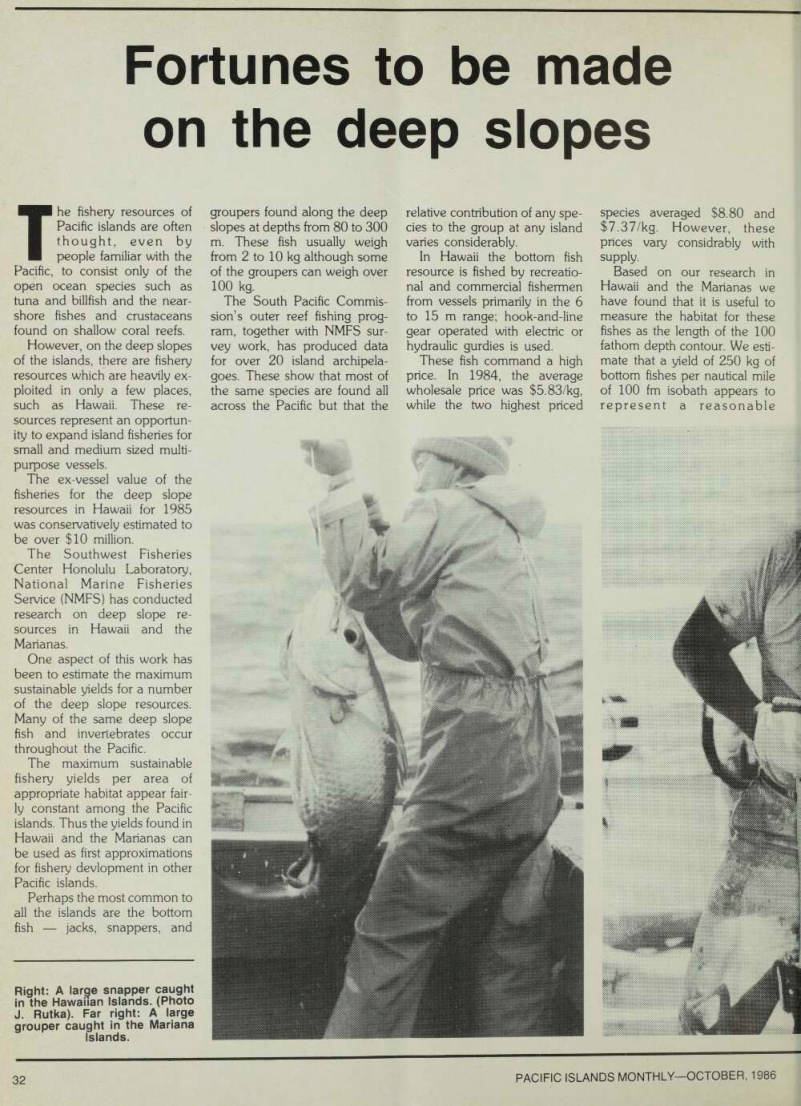

Fortunes to be made on the deep slopes
The fishery resources of Pacific islands are often thought, even by people familiar with the Pacific, to consist only of the open ocean species such as tuna and billfish and the near shore fishes and crustaceans found on shallow coral reefs.
However, on the deep slopes of the islands, there are fishery resources which are heavily ex ploited in only a few places, such as Hawaii. These re sources represent an opportun ity to expand island fisheries for small and medium sized multi purpose vessels.
The ex-vessel value of the fisheries for the deep slope resources in Hawaii for 1985 was conservatively estimated to be over $lO million.
The Southwest Fisheries Center Honolulu Laboratory, National Marine Fisheries Service (NMFS) has conducted research on deep slope re sources in Hawaii and the Marianas.
One aspect of this work has been to estimate the maximum sustainable yields for a number of the deep slope resources.
Many of the same deep slope fish and invertebrates occur throughout the Pacific.
The maximum sustainable fishery yields per area of appropriate habitat appear fair ly constant among the Pacific islands. Thus the yields found in Hawaii and the Marianas can be used as first approximations for fishery devlopment in other Pacific islands.
Perhaps the most common to all the islands are the bottom fish jacks, snappers, and
groupers found along the deep slopes at depths from 80 to 300 m. These fish usually weigh from 2 to 10 kg although some of the groupers can weigh over 100 kg.
The South Pacific Commis sion’s outer reef fishing prog ram, together with NMFS sur vey work, has produced data for over 20 island archipela goes. These show that most of the same species are found all across the Pacific but that the
relative contribution of any spe cies to the group at any island
varies considerably.
In Hawaii the bottom fish resource is fished by recreatio nal and commercial fishermen from vessels primarily in the 6 to 15 m range; hook-and-line gear operated with electric or hydraulic gurdies is used.
These fish command a high price. In 1984, the average wholesale price was $5.83/kg, while the two highest priced
species averaged $B.BO and $7.37/kg. However, these prices vary considrably with supply.
Based on our research in Hawaii and the Marianas we have found that it is useful to measure the habitat for these fishes as the length of the 100 fathom depth contour. We esti mate that a yield of 250 kg of bottom fishes per nautical mile of 100 fm isobath appears to represent a reasonable
Right: A large snapper caught in the Hawaiian Islands. (Photo J. Rutka). Far right: A large grouper caught in the Mariana Islands.
achipelago average for the maximum sustainable yield that can be expected from the bot tom fish resource.
Thus an island chain with a length of 100 fm isobath of 500 nmi (about the size of the Marianas) can expect a maxi mum sustainable yield of 125 metric tons per year from its deep slope bottom fish fishery.
At a price of $5/kg this landing would be valued at $0.6 million. If the resource were fished by a fleet of 20 vessels the average landing per vessel would be 6.3 metric tons valued at $31,250.
Another deep slope resource which appears Pacific wide is deepwater shrimp. These are caught in baited traps in depths from 400 to 750 m. Although these shrimps (there are several related species) command a
premium price (about $5.50/kg in Hawaii), the depth at which they are caught makes fishing for them an expensive propositi° n - There have been several commercial ventures for these resources both in Hawaii and the Marianas but most have not proven successful. We estimate an archipelago average maximum sustainable yield of 200 kg of shrimp per square nautical mile of habitat.
Thus for an archipelago which has 1000 square nautical miles of habitat in the appropriate depth range (which is about the area of the deepwater shrimp habitat in the Marianas) the annual maximum sustainable yeild for the deepwater
shrim resource is 200 metric tons. At a price of $5.50/kg the value of this landing would be $l.l million.
Again, a fleet of 20 vessels harvesting this resource would have an average annual landing per vessel of 10 metric tons with a value of $55,000.
Although the value of these deep slope resources is very small in comparision to tuna, they are significant compared to the shallow water reef resources. Further they can be fished with small to to medium sized vessels and can be marketed locally on most islands to hotels and restaurants.
The biggest concerns facing development of deep slope fisheries are over capitalisation
and overfishing. Initial catch rates in certain areas may be very high and when extrapo lated over the habitat area of the archipelago may encourage large capital investment in the fishery, However, these initial catch rates should not be taken to represent long term averages, Due to the limited habitat area it is easy to heavily fish the deep slope resources; to avoid the boom and bust cycle which often occurs in island fisheries it may be necessary to regulate the fishery. Jeffrey Polouina.
The author is leader of the Artificial Reef and Enhance ment Program at the National Marine Fisheries Service, Hon olulu Laboratory.
Advertisements & other items, p. 33 (1 item)
Samoan Tropical Products Ltd
A Q'MXji' . . . co m C
APIA: P.O. Box 1550, Apia Western Samoa, Ph: 21535. TLX: 793210 SAMTROP SX.
HONOLULU: Suite 2H, 485 Kapahuiu Avenue, Honolulu, Hawaii 96815. Ph: 734 3233, 734
2711. TLX: 723 8202 HIDE.
French territory
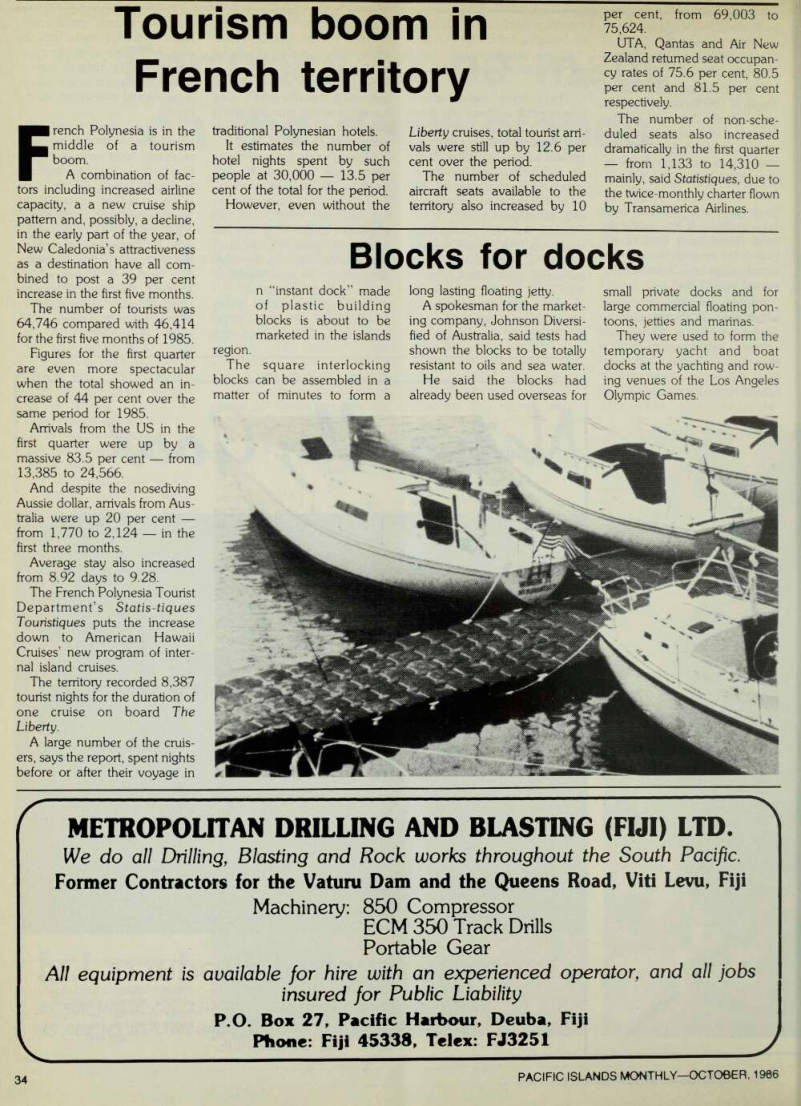
Tourism boom in French territory
French Polynesia is in the middle of a tourism boom.
A combination of fac tors including increased airline capacity, a a new cruise ship pattern and, possibly, a decline, in the early part of the year, of New Caledonia’s attractiveness as a destination have all com bined to post a 39 per cent increase in the first five months.
The number of tourists was 64,746 compared with 46,414 for the first five months of 1985.
Figures for the first quarter are even more spectacular when the total showed an in crease of 44 per cent over the same period for 1985.
Arrivals from the US in the first quarter were up by a massive 83.5 per cent from 13,385 to 24,566.
And despite the nosediving Aussie dollar, arrivals from Aus tralia were up 20 per cent from 1,770 to 2,124 in the first three months.
Average stay also increased from 8.92 days to 9.28.
The French Polynesia Tourist Department’s Statis-tiques Touristiques puts the increase down to American Hawaii Cruises’ new program of inter nal island cruises.
The territory recorded 8,387 tourist nights for the duration of one cruise on board The Liberty.
A large number of the cruis ers, says the report, spent nights before or after their voyage in
traditional Polynesian hotels.
It estimates the number of hotel nights spent by such people at 30,000 13.5 per cent of the total for the period.
However, even without the
Liberty cruises, total tourist arri vals were still up by 12.6 per cent over the period.
The number of scheduled aircraft seats available to the territory also increased by 10
per cent, from 69,003 to 75,624.
UTA, Qantas and Air New Zealand returned seat occupan cy rates of 75.6 per cent, 80.5 per cent and 81.5 per cent respectively.
The number of non-sche duled seats also increased dramatically in the first quarter from 1,133 to 14,310 mainly, said Statistiques, due to the twice-monthly charter flown by Transamerica Airlines.
Blocks for docks
n “instant dock” made of plastic building blocks is about to be marketed in the islands region.
The square interlocking blocks can be assembled in a matter of minutes to form a
long lasting floating jetty.
A spokesman for the market ing company, Johnson Diversi fied of Australia, said tests had shown the blocks to be totally resistant to oils and sea water.
He said the blocks had already been used overseas for
small private docks and for large commercial floating pon toons, jetties and marinas.
They were used to form the temporary yacht and boat docks at the yachting and row ing venues of the Los Angeles Olympic Games.
Advertisements & other items, p. 34 (1 item)
Metropolitan Drilling And Blasting (Fui) Ltd.
VJe do all Drilling, Blasting and Rock works throughout the South Pacific.
Former Contractors for the Vaturu Dam and the Queens Road, Viti Lcvu, Fiji Machinery: 850 Compressor ECM 350 Track Drills Portable Gear All equipment is available for hire with an experienced operator, and all jobs insured for Public Liability P.O. Box 27, Pacific Harbour, Deuba, Fiji Phone: Fiji 45338, Telex: FJ3251
city dwellers
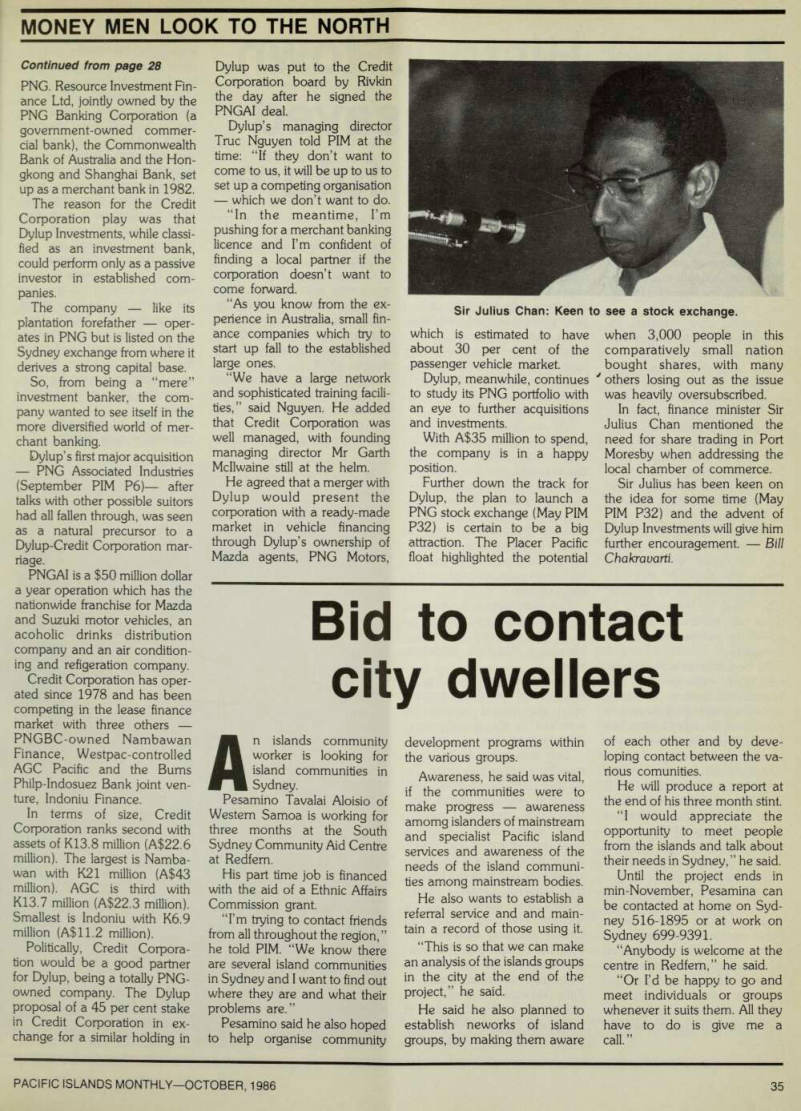
Bid to contact city dwellers
An islands community worker is looking for island communities in Sydney.
Pesamino Tavalai Aloisio of Western Samoa is working for three months at the South Sydney Community Aid Centre at Redfem.
His part time job is financed with the aid of a Ethnic Affairs Commission grant.
“I’m trying to contact friends from all throughout the region,” he told PIM. “We know there are several island communities in Sydney and I want to find out where they are and what their problems are.”
Pesamino said he also hoped to help organise community
development programs within the various groups.
Awareness, he said was vital, if the communities were to make progress awareness amomg islanders of mainstream and specialist Pacific island services and awareness of the needs of the island communi ties among mainstream bodies.
He also wants to establish a referral service and and main tain a record of those using it.
“This is so that we can make an analysis of the islands groups in the city at the end of the project,” he said.
He said he also planned to establish neworks of island groups, by making them aware
of each other and by deve loping contact between the va rious comunities.
He will produce a report at the end of his three month stint.
“I would appreciate the opportunity to meet people from the islands and talk about their needs in Sydney, ” he said.
Until the project ends in min-November, Pesamina can be contacted at home on Syd ney 516-1895 or at work on Sydney 699-9391.
“Anybody is welcome at the centre in Redfern,” he said.
“Or I’d be happy to go and meet individuals or groups whenever it suits them. All they have to do is give me a call.”
Advertisements & other items, p. 35 (1 item)
Money Men Look To The North
35
PACIFIC ISLANDS MONTHLY—OCTOBER, 1986
Continued from page 28
MONEY MEN LOOK TO THE NORTH
Historic town
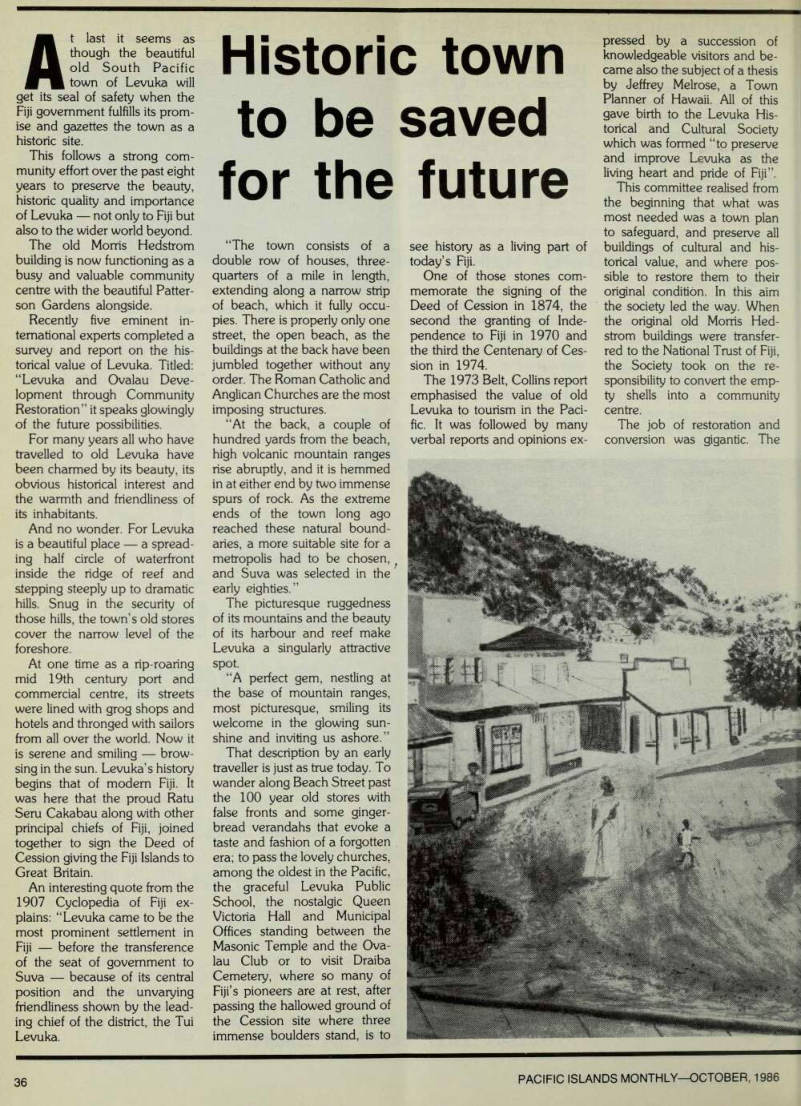
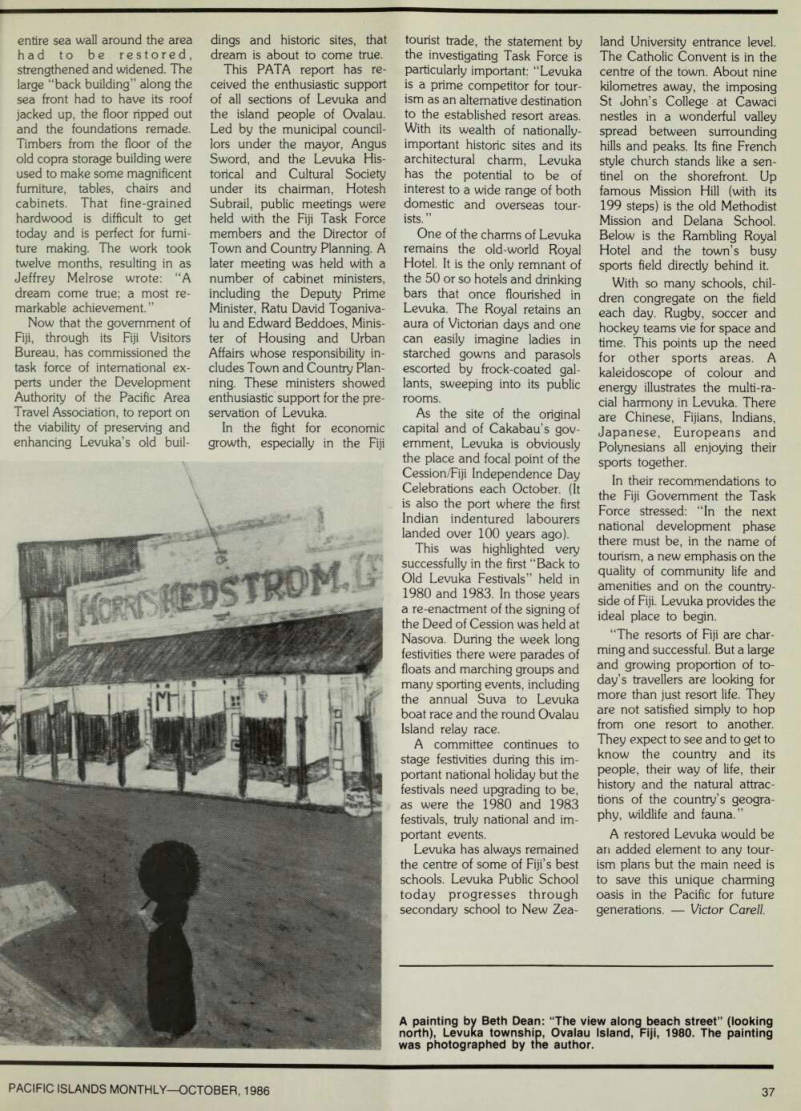
to be saved for the future
At last it seems as though the beautiful old South Pacific town of Levuka will get its seal of safety when the Fiji government fulfills its prom ise and gazettes the town as a historic site.
This follows a strong com munity effort over the past eight years to preserve the beauty, historic quality and importance of Levuka not only to Fiji but also to the wider world beyond.
The old Morris Hedstrom building is now functioning as a busy and valuable community centre with the beautiful Patter son Gardens alongside.
Recently five eminent in ternational experts completed a survey and report on the his torical value of Levuka. Titled: “Levuka and Ovalau Deve lopment through Community Restoration” it speaks glowingly of the future possibilities.
For many years all who have travelled to old Levuka have been charmed by its beauty, its obvious historical interest and the warmth and friendliness of its inhabitants.
And no wonder. For Levuka is a beautiful place a spread ing half circle of waterfront inside the ridge of reef and stepping steeply up to dramatic hills. Snug in the security of those hills, the town’s old stores cover the narrow level of the foreshore.
At one time as a rip-roaring mid 19th century port and commercial centre, its streets were lined with grog shops and hotels and thronged with sailors from all over the world. Now it is serene and smiling brow sing in the sun. Levuka’s history begins that of modern Fiji. It was here that the proud Ratu Seru Cakabau along with other principal chiefs of Fiji, joined together to sign the Deed of Cession giving the Fiji Islands to Great Britain.
An interesting quote from the 1907 Cyclopedia of Fiji ex plains; “Levuka came to be the most prominent settlement in Fiji before the transference of the seat of government to Suva because of its central position and the unvarying friendliness shown by the lead ing chief of the district, the Tui Levuka.
“The town consists of a double row of houses, three quarters of a mile in length, extending along a narrow strip of beach, which it fully occu pies. There is properly only one street, the open beach, as the buildings at the back have been jumbled together without any order. The Roman Catholic and Anglican Churches are the most imposing structures.
“At the back, a couple of hundred yards from the beach, high volcanic mountain ranges rise abruptly, and it is hemmed in at either end by two immense spurs of rock. As the extreme ends of the town long ago reached these natural bound aries, a more suitable site for a metropolis had to be chosen, and Suva was selected in the early eighties.”
The picturesque ruggedness of its mountains and the beauty of its harbour and reef make Levuka a singularly attractive spot.
“A perfect gem, nestling at the base of mountain ranges, most picturesque, smiling its welcome in the glowing sun shine and inviting us ashore.”
That description by an early traveller is just as true today. To wander along Beach Street past the 100 year old stores with false fronts and some ginger bread verandahs that evoke a taste and fashion of a forgotten era; to pass the lovely churches, among the oldest in the Pacific, the graceful Levuka Public School, the nostalgic Queen Victoria Hall and Municipal Offices standing between the Masonic Temple and the Ova lau Club or to visit Draiba Cemetery, where so many of Fiji’s pioneers are at rest, after passing the hallowed ground of the Cession site where three immense boulders stand, is to
see history as a living part of today’s Fiji.
One of those stones com memorate the signing of the Deed of Cession in 1874, the second the granting of Inde pendence to Fiji in 1970 and the third the Centenary of Ces sion in 1974.
The 1973 Belt, Collins report emphasised the value of old Levuka to tourism in the Paci fic. It was followed by many verbal reports and opinions ex
pressed by a succession of knowledgeable visitors and be came also the subject of a thesis by Jeffrey Melrose, a Town Planner of Hawaii. All of this gave birth to the Levuka His torical and Cultural Society which was formed “to preserve and improve Levuka as the living heart and pride of Fiji”.
This committee realised from the beginning that what was most needed was a town plan to safeguard, and preserve all buildings of cultural and his torical value, and where pos sible to restore them to their original condition. In this aim the society led the way. When the original old Morris Hed strom buildings were transfer red to the National Trust of Fiji, the Society took on the re sponsibility to convert the emp ty shells into a community centre.
The job of restoration and conversion was gigantic. The
entire sea wall around the area had to be restored, strengthened and widened. The large “back building” along the sea front had to have its roof jacked up, the floor ripped out and the foundations remade.
Timbers from the floor of the old copra storage building were used to make some magnificent furniture, tables, chairs and cabinets. That fine-grained hardwood is difficult to get today and is perfect for fumiture making. The work took twelve months, resulting in as Jeffrey Melrose wrote: “A dream come true; a most remarkable achievement.”
Now that the government of Fiji, through its Fiji Visitors Bureau, has commissioned the task force of international experts under the Development Authority of the Pacific Area Travel Association, to report on the viability of preserving and enhancing Levuka’s old buil-
dings and historic sites, that dream is about to come true, This PATA report has re ceived the enthusiastic support of all sections of Levuka and the island people of Ovalau.
Led by the municipal council lors under the mayor, Angus Sword, and the Levuka His torical and Cultural Society under its chairman, Hotesh Subrail, public meetings were held with the Fiji Task Force members and the Director of Town and Country Planning. A later meeting was held with a number of cabinet ministers, including the Deputy Prime Minister, Ratu David Toganiva lu and Edward Beddoes, Minis ter of Housing and Urban Affairs whose responsibility in eludes Town and Country Plan ning. These ministers showed enthusiastic support for the pre servation of Levuka.
In the fight for economic growth, especially in the Fiji
tourist trade, the statement by the investigating Task Force is particularly important: “Levuka is a prime competitor for tour ism as an alternative destination to the established resort areas.
With its wealth of nationally important historic sites and its architectural charm, Levuka has the potential to be of interest to a wide range of both domestic and overseas tour ists.”
One of the charms of Levuka remains the old-world Royal Hotel. It is the only remnant of the 50 or so hotels and drinking bars that once flourished in Levuka. The Royal retains an aura of Victorian days and one can easily imagine ladies in starched gowns and parasols escorted by frock-coated gal lants, sweeping into its public rooms.
As the site of the original capital and of Cakabau’s gov ernment, Levuka is obviously the place and focal point of the Cession/Fiji Independence Day Celebrations each October. (It is also the port where the first Indian indentured labourers landed over 100 years ago).
This was highlighted very successfully in the first “Back to Old Levuka Festivals” held in 1980 and 1983. In those years a re-enactment of the signing of the Deed of Cession was held at Nasova. During the week long festivities there were parades of floats and marching groups and many sporting events, including the annual Suva to Levuka boat race and the round Ovalau Island relay race.
A committee continues to stage festivities during this im portant national holiday but the festivals need upgrading to be, as were the 1980 and 1983 festivals, truly national and im portant events.
Levuka has always remained the centre of some of Fiji’s best schools. Levuka Public School today progresses through secondary school to New Zea
land University entrance level.
The Catholic Convent is in the centre of the town. About nine kilometres away, the imposing St John’s College at Cawaci nestles in a wonderful valley spread between surrounding hills and peaks. Its fine French style church stands like a sen tinel on the shorefront. Up famous Mission Hill (with its 199 steps) is the old Methodist Mission and Delana School.
Below is the Rambling Royal Hotel and the town’s busy sports field directly behind it.
With so many schools, chil dren congregate on the field each day. Rugby, soccer and hockey teams vie for space and time. This points up the need for other sports areas. A kaleidoscope of colour and energy illustrates the multi-ra cial harmony in Levuka. There are Chinese, Fijians, Indians, Japanese, Europeans and Polynesians all enjoying their sports together.
In their recommendations to the Fiji Government the Task Force stressed: “In the next national development phase there must be, in the name of tourism, a new emphasis on the quality of community life and amenities and on the country side of Fiji. Levuka provides the ideal place to begin.
“The resorts of Fiji are char ming and successful. But a large and growing proportion of to day’s travellers are looking for more than just resort life. They are not satisfied simply to hop from one resort to another.
They expect to see and to get to know the country and its people, their way of life, their history and the natural attrac tions of the country’s geogra phy, wildlife and fauna.”
A restored Levuka would be an added element to any tour ism plans but the main need is to save this unique charming oasis in the Pacific for future
generations.
Victor Carell.
A painting by Beth Dean: “The view along beach street” (looking north), Levuka township, Ovalau Island, Fiji, 1980. The painting was photographed by the author.
Yachts
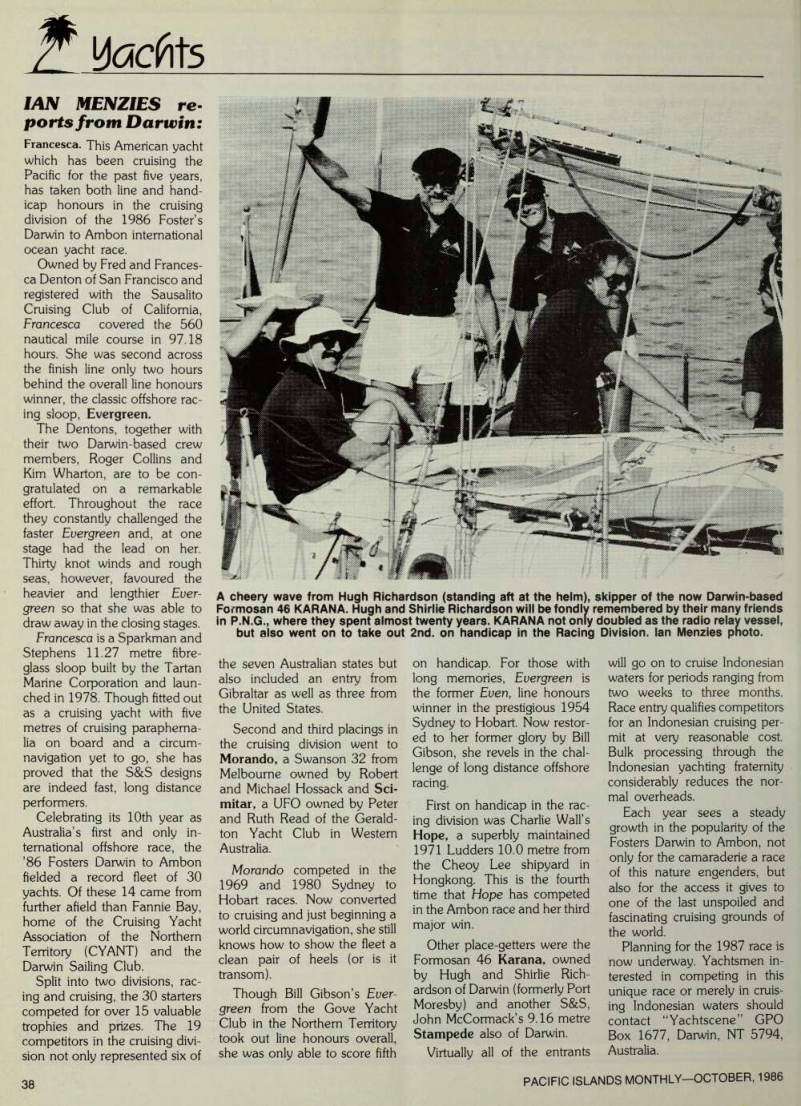
Ian Menzies Re
ports from Darwin:
Francesca. This American yacht which has been cruising the Pacific for the past five years, has taken both line and hand icap honours in the cruising division of the 1986 Foster’s Darwin to Ambon international ocean yacht race.
Owned by Fred and Frances ca Denton of San Francisco and registered with the Sausalito Cruising Club of California, Francesca covered the 560 nautical mile course in 97.18 hours. She was second across the finish line only two hours behind the overall line honours winner, the classic offshore rac ing sloop, Evergreen, The Dentons, together with their two Darwin-based crew members, Roger Collins and Kim Wharton, are to be con gratulated on a remarkable effort. Throughout the race they constantly challenged the faster Evergreen and, at one stage had the lead on her.
Thirty knot winds and rough seas, however, favoured the heavier and lengthier Ever green so that she was able to draw away in the closing stages.
Francesca is a Sparkman and Stephens 11.27 metre fibre glass sloop built by the Tartan Marine Corporation and laun ched in 1978. Though fitted out as a cruising yacht with five metres of cruising parapherna lia on board and a circum navigation yet to go, she has proved that the S&S designs are indeed fast, long distance performers.
Celebrating its 10th year as Australia’s first and only in ternational offshore race, the ’86 Fosters Darwin to Ambon fielded a record fleet of 30 yachts. Of these 14 came from further afield than Fannie Bay, home of the Cruising Yacht Association of the Northern Territory (CYANT) and the Darwin Sailing Club.
Split into two divisions, rac ing and cruising, the 30 starters competed for over 15 valuable trophies and prizes. The 19 competitors in the cruising divi sion not only represented six of
the seven Australian states but also included an entry from Gibraltar as well as three from the United States.
Second and third placings in the cruising division went to Morando, a Swanson 32 from Melbourne owned by Robert and Michael Hossack and Sci mitar, a UFO owned by Peter and Ruth Read of the Gerald ton Yacht Club in Western Australia.
Morando competed in the 1969 and 1980 Sydney to Hobart races. Now converted to cruising and just beginning a world circumnavigation, she still knows how to show the fleet a clean pair of heels (or is it transom).
Though Bill Gibson’s Ever green from the Gove Yacht Club in the Northern Territory took out line honours overall, she was only able to score fifth
on handicap. For those with long memories, Evergreen is the former Even, line honours winner in the prestigious 1954 Sydney to Hobart. Now restor ed to her former glory by Bill Gibson, she revels in the chal lenge of long distance offshore racing.
First on handicap in the rac ing division was Charlie Wall’s Hope, a superbly maintained 1971 Ludders 10.0 metre from the Cheoy Lee shipyard in Hongkong. This is the fourth time that Hope has competed in the Ambon race and her third major win.
Other place-getters were the Formosan 46 Karana, owned by Hugh and Shirlie Rich ardson of Darwin (formerly Port Moresby) and another S&S, John McCormack’s 9.16 metre Stampede also of Darwin.
Virtually all of the entrants
will go on to cruise Indonesian waters for periods ranging from two weeks to three months.
Race entry qualifies competitors for an Indonesian cruising per mit at very reasonable cost.
Bulk processing through the Indonesian yachting fraternity considerably reduces the nor mal overheads.
Each year sees a steady growth in the popularity of the Fosters Darwin to Ambon, not only for the camaraderie a race of this nature engenders, but also for the access it gives to one of the last unspoiled and fascinating cruising grounds of the world.
Planning for the 1987 race is now underway. Yachtsmen in terested in competing in this unique race or merely in cruis ing Indonesian waters should contact “Yachtscene” GPO Box 1677, Darwin, NT 5794, Australia.
A cheery wave from Hugh Richardson (standing aft at the helm), skipper of the now Darwin-based Formosan 46 KARANA. Hugh and Shirlie Richardson will be fondly remembered by their many friends in P.N.G., where they spent almost twenty years. KARANA not only doubled as the radio relay vessel, but also went on to take out 2nd. on handicap in the Racing Division. lan Menzies photo.
Advertisements & other items, p. 39 (1 item)
coilms
Olympic
The Stationery and Diary People
SYSTEM
Collins V K
V» «=UM ’ -
Accpw.t Form.
BSSSSS
CARDS
eSS: tils V i LU - >sV iWw .
Commercial, School, Household
Stationery and Diaries.
Fast and efficient export service.
d
couins
OLYMPIC
COLLINS OLYMPIC LIMITED
P.O. BOX 476, AUCKLAND, 1
NEW ZEALAND.
PHONE: (9) 484-009
TELEX: N.Z. 21293 (EDUNLOP)
CABLES: GRAPHICOL
from the islands press
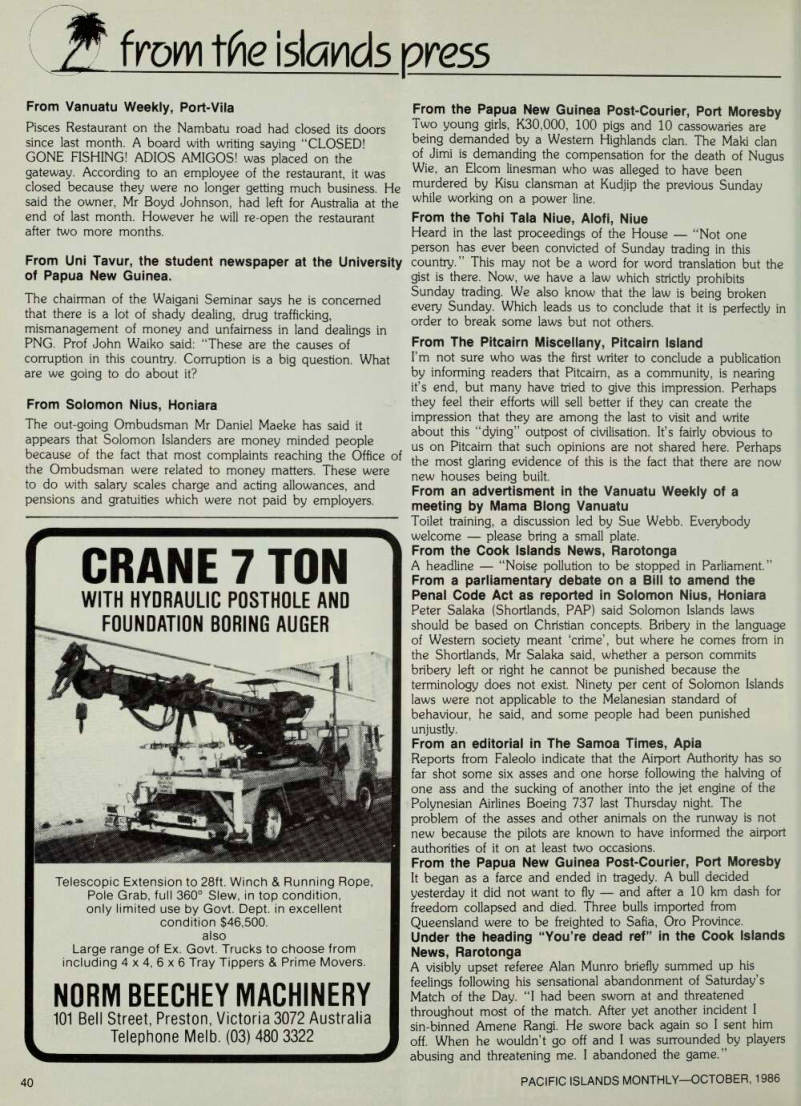
From Vanuatu Weekly, Port-Vila Pisces Restaurant on the Nambatu road had closed its doors since last month. A board with writing saying “CLOSED!
GONE FISHING! ADIOS AMIGOS! was placed on the gateway. According to an employee of the restaurant, it was closed because they were no longer getting much business. He said the owner, Mr Boyd Johnson, had left for Australia at the end of last month. However he will re-open the restaurant after two more months.
From Uni Tavur, the student newspaper at the University of Papua New Guinea.
The chairman of the Waigani Seminar says he is concerned that there is a lot of shady dealing, drug trafficking, mismanagement of money and unfairness in land dealings in PNG. Prof John Waiko said: “These are the causes of corruption in this country. Corruption is a big question. What are we going to do about it?
From Solomon Nius, Honiara The out-going Ombudsman Mr Daniel Maeke has said it appears that Solomon Islanders are money minded people because of the fact that most complaints reaching the Office of the Ombudsman were related to money matters. These were to do with salary scales charge and acting allowances, and pensions and gratuities which were not paid by employers.
From the Papua New Guinea Post-Courier, Port Moresby Two young girls, K 30,000, 100 pigs and 10 cassowaries are being demanded by a Western Highlands clan. The Maki clan of Jimi is demanding the compensation for the death of Nugus Wie, an Elcom linesman who was alleged to have been murdered by Kisu clansman at Kudjip the previous Sunday while working on a power line.
From the Tohi Tala Niue, Alofi, Niue Heard in the last proceedings of the House “Not one person has ever been convicted of Sunday trading in this country.” This may not be a word for word translation but the gist is there. Now, we have a law which strictly prohibits Sunday trading. We also know that the law is being broken every Sunday. Which leads us to conclude that it is perfectly in order to break some laws but not others.
From The Pitcairn Miscellany, Pitcairn Island I’m not sure who was the first writer to conclude a publication by informing readers that Pitcairn, as a community, is nearing it’s end, but many have tried to give this impression. Perhaps they feel their efforts will sell better if they can create the impression that they are among the last to visit and write about this “dying” outpost of civilisation. It’s fairly obvious to us on Pitcairn that such opinions are not shared here. Perhaps the most glaring evidence of this is the fact that there are now new houses being built.
From an advertisment in the Vanuatu Weekly of a meeting by Mama Blong Vanuatu Toilet training, a discussion led by Sue Webb. Everybody welcome please bring a small plate.
From the Cook Islands News, Rarotonga A headline “Noise pollution to be stopped in Parliament.”
From a parliamentary debate on a Bill to amend the Penal Code Act as reported in Solomon Nius, Honiara Peter Salaka (Shortlands, PAP) said Solomon Islands laws should be based on Christian concepts. Bribery in the language of Western society meant ‘crime’, but where he comes from in the Shortlands, Mr Salaka said, whether a person commits bribery left or right he cannot be punished because the terminology does not exist. Ninety per cent of Solomon Islands laws were not applicable to the Melanesian standard of behaviour, he said, and some people had been punished unjustly.
From an editorial in The Samoa Times, Apia Reports from Faleolo indicate that the Airport Authority has so far shot some six asses and one horse following the halving of one ass and the sucking of another into the jet engine of the Polynesian Airlines Boeing 737 last Thursday night. The problem of the asses and other animals on the runway is not new because the pilots are known to have informed the airport authorities of it on at least two occasions.
From the Papua New Guinea Post-Courier, Port Moresby It began as a farce and ended in tragedy. A bull decided yesterday it did not want to fly and after a 10 km dash for freedom collapsed and died. Three bulls imported from Queensland were to be freighted to Safia, Oro Province.
Under the heading “You’re dead ref” in the Cook Islands News, Rarotonga A visibly upset referee Alan Munro briefly summed up his feelings following his sensational abandonment of Saturday’s Match of the Day. “I had been sworn at and threatened throughout most of the match. After yet another incident I sin-binned Amene Rangi. He swore back again so I sent him off. When he wouldn’t go off and I was surrounded by players abusing and threatening me. I abandoned the game.”
Advertisements & other items, p. 40 (1 item)
Crane 7 Ton
WITH HYDRAULIC POSTHOLE AND
FOUNDATION BORING AUGER
m Telescopic Extension to 28ft. Winch & Running Rope, Pole Grab, full 360° Slew, in top condition, only limited use by Govt. Dept, in excellent condition $46,500. also Large range of Ex. Govt. Trucks to choose from including 4 x 4, 6 x 6 Tray Tippers & Prime Movers.
NORM BEECHEY MACHINERY
101 Bell Street, Preston, Victoria 3072 Australia Telephone Melb. (03) 480 3322
Long Ghost
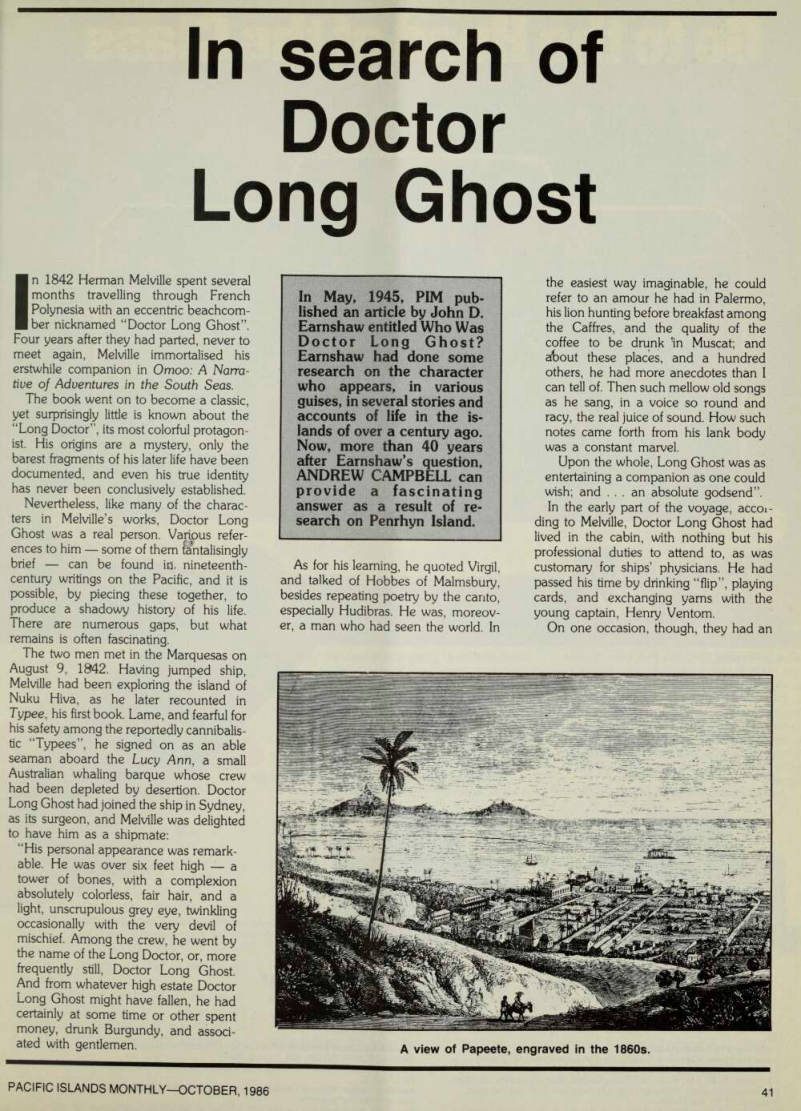

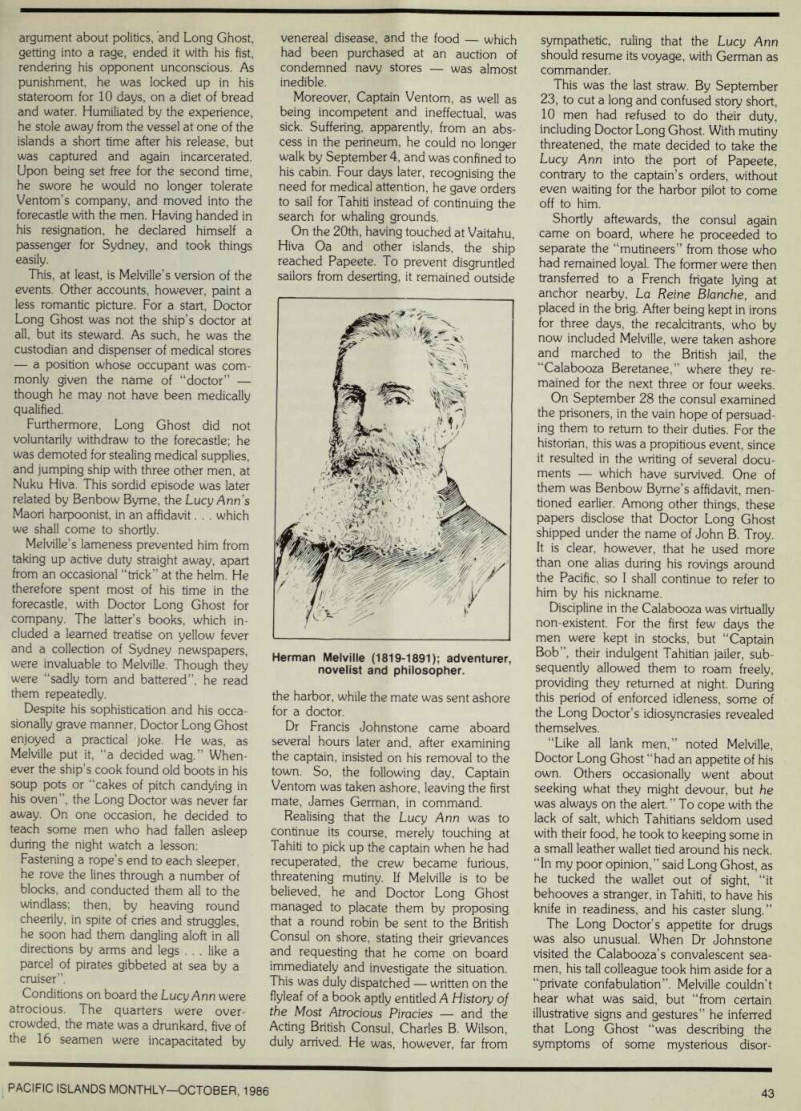
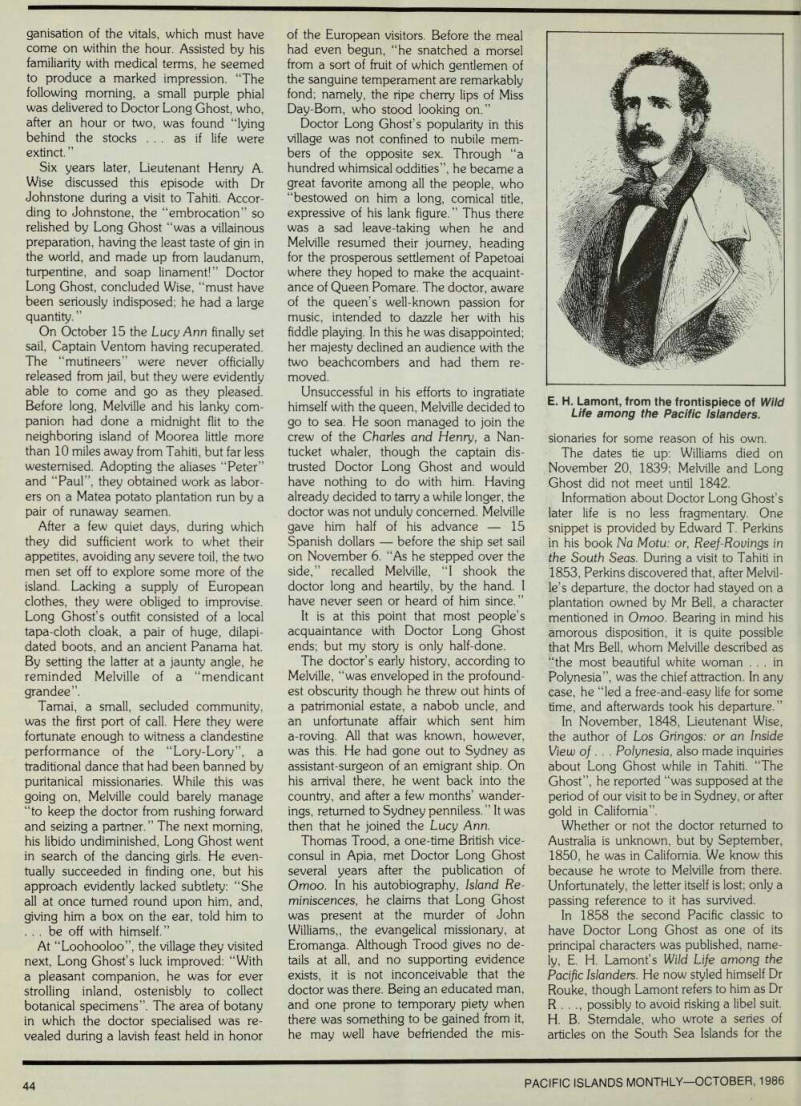
In search of Doctor Long Ghost
In 1842 Herman Melville spent several months travelling through French Polynesia with an eccentric beachcom ber nicknamed “Doctor Long Ghost”.
Four years after they had parted, never to meet again, Melville immortalised his erstwhile companion in Omoo: A Narra tive of Adventures in the South Seas.
The book went on to become a classic, yet surprisingly little is known about the “Long Doctor”, its most colorful protagon ist. His origins are a mystery, only the barest fragments of his later life have been documented, and even his true identity has never been conclusively established.
Nevertheless, like many of the charac ters in Melville’s works, Doctor Long Ghost was a real person. Various refer ences to him some of them ifntalisingly brief can be found ia, nineteenth century writings on the Pacific, and it is possible, by piecing these together, to produce a shadowy history of his life.
There are numerous gaps, but what remains is often fascinating.
The two men met in the Marquesas on August 9, 1842. Having jumped ship, Melville had been exploring the island of Nuku Hiva, as he later recounted in Typee, his first book. Lame, and fearful for his safety among the reportedly cannibalis tic “Typees”, he signed on as an able seaman aboard the Lucy Ann, a small Australian whaling barque whose crew had been depleted by desertion. Doctor Long Ghost had joined the ship in Sydney, as its surgeon, and Melville was delighted to have him as a shipmate: “His personal appearance was remark able. He was over six feet high a tower of bones, with a complexion absolutely colorless, fair hair, and a light, unscrupulous grey eye, twinkling occasionally with the very devil of mischief. Among the crew, he went by the name of the Long Doctor, or, more frequently still, Doctor Long Ghost.
And from whatever high estate Doctor Long Ghost might have fallen, he had certainly at some time or other spent money, drunk Burgundy, and associ ated with gentlemen.
In May, 1945, PIM pub lished an article by John D.
Earnshaw entitled Who Was Doctor Long Ghost?
Earnshaw had done some research on the character who appears, in various guises, in several stories and accounts of life in the is lands of over a century ago.
Now, more than 40 years after Earnshaw’s question,
Andrew Campbell Can
provide a fascinating answer as a result of re search on Penrhyn Island.
As for his learning, he quoted Virgil, and talked of Hobbes of Malmsbury, besides repeating poetry by the canto, especially Hudibras. He was, moreover, a man who had seen the world. In
the easiest way imaginable, he could refer to an amour he had in Palermo, his lion hunting before breakfast among the Caffres, and the quality of the coffee to be drunk 'in Muscat; and about these places, and a hundred others, he had more anecdotes than I can tell of. Then such mellow old songs as he sang, in a voice so round and racy, the real juice of sound. How such notes came forth from his lank body was a constant marvel.
Upon the whole, Long Ghost was as entertaining a companion as one could wish; and ... an absolute godsend”.
In the early part of the voyage, accoi ding to Melville, Doctor Long Ghost had lived in the cabin, with nothing but his professional duties to attend to, as was customary for ships’ physicians. He had passed his time by drinking “flip”, playing cards, and exchanging yams with the young captain, Henry Ventom.
On one occasion, though, they had an
A view of Papeete, engraved in the 1860s.
argument about politics, and Long Ghost, getting into a rage, ended it with his fist, rendering his opponent unconscious. As punishment, he was locked up in his stateroom for 10 days, on a diet of bread and water. Humiliated by the experience, he stole away from the vessel at one of the islands a short time after his release, but was captured and again incarcerated.
Upon being set free for the second time, he swore he would no longer tolerate Ventom’s company, and moved into the forecastle with the men. Having handed in his resignation, he declared himself a passenger for Sydney, and took things easily.
This, at least, is Melville’s version of the events. Other accounts, however, paint a less romantic picture. For a start, Doctor Long Ghost was not the ship’s doctor at all, but its steward. As such, he was the custodian and dispenser of medical stores a position whose occupant was com monly given the name of “doctor” though he may not have been medically qualified.
Furthermore, Long Ghost did not voluntarily withdraw to the forecastle; he was demoted for stealing medical supplies, and jumping ship with three other men, at Nuku Hiva. This sordid episode was later related by Benbow Byme, the Lucy Ann’s Maori harpoonist, in an affidavit. . . which we shall come to shortly.
Melville’s lameness prevented him from taking up active duty straight away, apart from an occasional “trick” at the helm. He therefore spent most of his time in the forecastle, with Doctor Long Ghost for company. The latter’s books, which in cluded a learned treatise on yellow fever and a collection of Sydney newspapers, were invaluable to Melville. Though they were “sadly tom and battered”, he read them repeatedly.
Despite his sophistication and his occa sionally grave manner, Doctor Long Ghost enjoyed a practical joke. He was, as Melville put it, “a decided wag.” When ever the ship’s cook found old boots in his soup pots or “cakes of pitch candying in his oven”, the Long Doctor was never far away. On one occasion, he decided to teach some men who had fallen asleep during the night watch a lesson: Fastening a rope’s end to each sleeper, he rove the lines through a number of blocks, and conducted them all to the windlass; then, by heaving round cheerily, in spite of cries and struggles, he soon had them dangling aloft in all directions by arms and legs . . . like a parcel of pirates gibbeted at sea by a cruiser”.
Conditions on board the Lucy Ann were atrocious. The quarters were over crowded, the mate was a drunkard, five of the 16 seamen were incapacitated by
venereal disease, and the food which had been purchased at an auction of condemned navy stores was almost inedible.
Moreover, Captain Ventom, as well as being incompetent and ineffectual, was sick. Suffering, apparently, from an abs cess in the perineum, he could no longer walk by September 4, and was confined to his cabin. Four days later, recognising the need for medical attention, he gave orders to sail for Tahiti instead of continuing the search for whaling grounds.
On the 20th, having touched at Vaitahu, Hiva Oa and other islands, the ship reached Papeete. To prevent disgruntled sailors from deserting, it remained outside
the harbor, while the mate was sent ashore for a doctor.
Dr Francis Johnstone came aboard several hours later and, after examining the captain, insisted on his removal to the town. So, the following day, Captain Ventom was taken ashore, leaving the first mate, James German, in command.
Realising that the Lucy Ann was to continue its course, merely touching at Tahiti to pick up the captain when he had recuperated, the crew became furious, threatening mutiny. If Melville is to be believed, he and Doctor Long Ghost managed to placate them by proposing that a round robin be sent to the British Consul on shore, stating their grievances and requesting that he come on board immediately and investigate the situation.
This was duly dispatched written on the flyleaf of a book aptly entitled A History of the Most Atrocious Piracies and the Acting British Consul, Charles B. Wilson, duly arrived. He was, however, far from
sympathetic, ruling that the Lucy Ann should resume its voyage, with German as commander.
This was the last straw. By September 23, to cut a long and confused story short, 10 men had refused to do their duty, including Doctor Long Ghost. With mutiny threatened, the mate decided to take the Lucy Ann into the port of Papeete, contrary to the captain’s orders, without even waiting for the harbor pilot to come off to him.
Shortly aftewards, the consul again came on board, where he proceeded to separate the “mutineers” from those who had remained loyal. The former were then transferred to a French frigate lying at anchor nearby, La Heine Blanche, and placed in the brig. After being kept in irons for three days, the recalcitrants, who by now included Melville, were taken ashore and marched to the British jail, the “Calabooza Beretanee,” where they re mained for the next three or four weeks.
On September 28 the consul examined the prisoners, in the vain hope of persuad ing them to return to their duties. For the historian, this was a propitious event, since it resulted in the writing of several docu ments which have survived. One of them was Benbow Byrne’s affidavit, men tioned earlier. Among other things, these papers disclose that Doctor Long Ghost shipped under the name of John B. Troy.
It is clear, however, that he used more than one alias during his rovings around the Pacific, so I shall continue to refer to him by his nickname.
Discipline in the Calabooza was virtually non-existent. For the first few days the men were kept in stocks, but “Captain Bob”, their indulgent Tahitian jailer, sub sequently allowed them to roam freely, providing they returned at night. During this period of enforced idleness, some of the Long Doctor’s idiosyncrasies revealed themselves.
“Like all lank men,” noted Melville, Doctor Long Ghost “had an appetite of his own. Others occasionally went about seeking what they might devour, but he was always on the alert. ” To cope with the lack of salt, which Tahitians seldom used with their food, he took to keeping some in a small leather wallet tied around his neck.
“In my poor opinion,” said Long Ghost, as he tucked the wallet out of sight, “it behooves a stranger, in Tahiti, to have his knife in readiness, and his caster slung.”
The Long Doctor’s appetite for drugs was also unusual. When Dr Johnstone visited the Calabooza’s convalescent sea men, his tall colleague took him aside for a “private confabulation”. Melville couldn’t hear what was said, but “from certain illustrative signs and gestures” he inferred that Long Ghost “was describing the symptoms of some mysterious disor
Herman Melville (1819-1891); adventurer, novelist and philosopher.
ganisation of the vitals, which must have come on within the hour. Assisted by his familiarity with medical terms, he seemed to produce a marked impression. “The following morning, a small purple phial was delivered to Doctor Long Ghost, who, after an hour or two, was found “lying behind the stocks ... as if life were extinct. ”
Six years later, Lieutenant Henry A.
Wise discussed this episode with Dr Johnstone during a visit to Tahiti. Accor ding to Johnstone, the “embrocation” so relished by Long Ghost “was a villainous preparation, having the least taste of gin in the world, and made up from laudanum, turpentine, and soap linament!” Doctor Long Ghost, concluded Wise, “must have been seriously indisposed; he had a large quantity. ”
On October 15 the Lucy Ann finally set sail, Captain Ventom having recuperated.
The “mutineers” were never officially released from jail, but they were evidently able to come and go as they pleased.
Before long, Melville and his lanky com panion had done a midnight flit to the neighboring island of Moorea little more than 10 miles away from Tahiti, but far less westernised. Adopting the aliases “Peter” and “Paul”, they obtained work as labor ers on a Matea potato plantation run by a pair of runaway seamen.
After a few quiet days, during which they did sufficient work to whet their appetites, avoiding any severe toil, the two men set off to explore some more of the island. Lacking a supply of European clothes, they were obliged to improvise.
Long Ghost’s outfit consisted of a local tapa-cloth cloak, a pair of huge, dilapi dated boots, and an ancient Panama hat.
By setting the latter at a jaunty angle, he reminded Melville of a “mendicant grandee”.
Tamai, a small, secluded community, was the first port of call. Here they were fortunate enough to witness a clandestine performance of the “Lory-Lory”, a traditional dance that had been banned by puritanical missionaries. While this was going on, Melville could barely manage “to keep the doctor from rushing forward and seizing a partner. ” The next morning, his libido undiminished, Long Ghost went in search of the dancing girls. He even tually succeeded in finding one, but his approach evidently lacked subtlety: “She all at once turned round upon him, and, giving him a box on the ear, told him to . . . be off with himself.”
At “Loohooloo”, the village they visited next, Long Ghost’s luck improved: “With a pleasant companion, he was for ever strolling inland, ostenisbly to collect botanical specimens”. The area of botany in which the doctor specialised was re vealed during a lavish feast held in honor
of the European visitors. Before the meal had even begun, “he snatched a morsel from a sort of fruit of which gentlemen of the sanguine temperament are remarkably fond; namely, the ripe cherry lips of Miss Day-Bom, who stood looking on.”
Doctor Long Ghost’s popularity in this village was not confined to nubile mem bers of the opposite sex. Through “a hundred whimsical oddities”, he became a great favorite among all the people, who “bestowed on him a long, comical title, expressive of his lank figure.” Thus there was a sad leave-taking when he and Melville resumed their journey, heading for the prosperous settlement of Papetoai where they hoped to make the acquaint ance of Queen Pomare. The doctor, aware of the queen’s well-known passion for music, intended to dazzle her with his fiddle playing. In this he was disappointed; her majesty declined an audience with the two beachcombers and had them re moved.
Unsuccessful in his efforts to ingratiate himself with the queen, Melville decided to go to sea. He soon managed to join the crew of the Charles and Henry, a Nan tucket whaler, though the captain dis trusted Doctor Long Ghost and would have nothing to do with him. Having already decided to tarry a while longer, the doctor was not unduly concerned. Melville gave him half of his advance Spanish dollars before the ship set sail on November 6. “As he stepped over the side,” recalled Melville, “I shook the doctor long and heartily, by the hand. I have never seen or heard of him since.”
It is at this point that most people’s acquaintance with Doctor Long Ghost ends; but my story is only half-done.
The doctor’s early history, according to Melville, “was enveloped in the profound est obscurity though he threw out hints of a patrimonial estate, a nabob uncle, and an unfortunate affair which sent him a-roving. All that was known, however, was this. He had gone out to Sydney as assistant-surgeon of an emigrant ship. On his arrival there, he went back into the country, and after a few months’ wander ings, returned to Sydney penniless. ” It was then that he joined the Lucy Ann.
Thomas Trood, a one-time British vice consul in Apia, met Doctor Long Ghost several years after the publication of Omoo. In his autobiography, Island Re miniscences, he claims that Long Ghost was present at the murder of John Williams,, the evangelical missionary, at Eromanga. Although Trood gives no de tails at all, and no supporting evidence exists, it is not inconceivable that the doctor was there. Being an educated man, and one prone to temporary piety when there was something to be gained from it, he may well have befriended the mis-
sionaries for some reason of his own.
The dates tie up: Williams died on November 20, 1839; Melville and Long Ghost did not meet until 1842.
Information about Doctor Long Ghost’s later life is no less fragmentary. One snippet is provided by Edward T. Perkins in his book Na Motu: or, Reef-Rovings in the South Seas. During a visit to Tahiti in 1853, Perkins discovered that, after Melvil le’s departure, the doctor had stayed on a plantation owned by Mr Bell, a character mentioned in Omoo. Bearing in mind his amorous disposition, it is quite possible that Mrs Bell, whom Melville described as “the most beautiful white woman ... in Polynesia”, was the chief attraction. In any case, he “led a free-and-easy life for some time, and afterwards took his departure.”
In November, 1848, Lieutenant Wise, the author of Los Gringos: or an Inside View of . . . Polynesia, also made inquiries about Long Ghost while in Tahiti. “The Ghost”, he reported “was supposed at the period of our visit to be in Sydney, or after gold in California”.
Whether or not the doctor returned to Australia is unknown, but by September, 1850, he was in California. We know this because he wrote to Melville from there.
Unfortunately, the letter itself is lost; only a passing reference to it has survived.
In 1858 the second Pacific classic to have Doctor Long Ghost as one of its principal characters was published, name ly, E. H. Lament’s Wild Life among the Pacific Islanders. He now styled himself Dr Rouke, though Lamont refers to him as Dr R . . possibly to avoid risking a libel suit.
H. B. Sterndale, who wrote a series of articles on the South Sea Islands for the
E. H. Lament, from the frontispiece of Wild Life among the Pacific Islanders.
Auckland Weekly News in 1890, was the first person to point out that Doctor Long Ghost and Dr R ... are the same person, but this should be obvious to anyone who has read both books.
Lamont met the doctor in San Francisco during the second half of 1852. He was arranging a trading voyage through the South Pacific and, after hearing about Long Ghost’s knowledge of the region, gladly took him on. The Chatham, an American clipper brig commanded by George Snow, accordingly set sail on October 14 with the two landsmen and a crew of eight on board.
After a month or so at sea, the ship called at the Marquesas, the scene of Long Ghost’s abortive attempt to abscond with his ship’s medicines 10 years before. The voyage then continued through the Tuamotus, the Society Islands, and south ern Cooks, before heading back to Cali fornia.
Lamont, unlike Melville, did not enjoy Doctor Long Ghost’s company. He quar relled incessantly with him, and swore that they would never work together again, even if the doctor “opened ... a path to the wealth of Croesus.” The cause of their mutual dislike is not clear, but perhaps Lamont was simply too strait-laced to enjo\/ the eccentric traits in his partner. It is also likely that Long Ghost’s high-handed ness grated on Lamont, whose own ego was somewhat inflated.
At one stage, the doctor almost caused the expedition to be abandoned. After a series of arguments with Lamont, he irritably ordered the ship’s cook to prepare him some food . The cook refused, pointing out that his fire was out, where-
upon; The Doctor, who had taken an anti pathy to the boy, after some coarse language, knocked him down. The captain, who had already retired to his cabin, now interposed, saying, very properly, that he would not allow any one to interfere with his crew, and that if they did wrong it was his business to correct them. The Doctor replied that he was quite able to correct them himself, and would strike any man on board, from the captain to the cook, who was insolent to him. The captain declared this an act of mutiny, and going on deck, ordered the vessel hard up for Tahiti . . .
Doctor Long Ghost’s mood was not improved by an incident that occurred a few weeks later. On the morning of January 7, as the Chatham proceeded homewards, she struck a reef off Penrhyn Island. Nobody was injured, but the ship was wrecked. Although the island had been on the charts since 1788, Lamont and his companions were probably the first Europeans to go ashore.
Understandably, they were frightened for their lives. Penrhyn Islanders were reputed to be cannibals at that time, and this seemed to be borne out the next morning, when the castaways were round ed up and escorted to an isolated marae.
After a series of rituals had been carried out, Lamont and the doctor were each handed a coconut, which convinced them that they were about to be sacrificed.
Stretching out a “long, bony hand” to his companion, Long Ghost said: “I think we may bid farewell to each other, Lamont; we are selected first to be cooked; I suppose they want to put us in condition by feeding us first.”
In fact, the Americans’ fears were completely unfounded. Penrhyn Islanders were not cannibals; the performance at the marae was simply a kind of ceremonial welcome; and they were treated with kindness throughout their stay.
Doctor Long Ghost did not take to the life of a castaway. There was no alcohol, or other artificial stimulants, and the only other educated man present got on his nerves. Consequently, when his shipmates built a large hut in wich to store materials for constructing a boat, he volunteered to take charge of it, rarely emerging from his self-imposed confinement.
Penrhyn Island’s strict marriage rules were particularly irksome to the doctor.
Since he, like all the other castaways, had been adopted by a local family, he was prohibited from dallying with any of his newly acquired female relatives. When one of them rejected his advances on these grounds, he was piqued, becoming an instant misogynist;
Suddenly, to the surprise of those who had been acquainted with his amorous character in the other islands, he issued a ukase to the effect that whoever harbored a regard for any of the nut-brown maids . . . would fall under his displeasure and forfeit his esteem.
Meanwhile, the captain and some of his crew had been enlarging and decking over the Chatham’s boat, which had been washed ashore, in the hope of escaping from the island. By the middle of March, it was ready, and they decided to set sail as soon as there was a fair trade wind. Before departing, Lamont wanted to explore parts of the atoll he had not yet visited, so he arranged to rendezvous at the boat in ten days’ time.
Lamont kept the appointment, but Doctor Long Ghost did not. With Captain Snow, the mate, and the second mate, he had done another one of his characteristic midnight flits. As the islanders cried, “The boat is gone, the Long Man is gone”, it dawned on Lamont that he had been abandoned.
Contemporary newspaper reports show that the doctor and his fellow deserters reached Manihiki, some two hundred miles to the west-south-west, on March 26.
There they were informed by a Mr Williams, agent for Hort Brothers, that a vessel would soon be arriving to collect mother-of-pearl. After waiting for more than a month, the captain became impa tient and decided to risk sailing to Samoa.
Long Ghost did not relish the idea of another voyage in their frail boat, how ever, so he sabotaged it while the others were away obtaining provisions.
All four were therefore forced to remain on Manihiki until August, when the Caro line Hort finally arrived. Its master, Cap tain Hort, reluctantly agreed to take two of them to Valparaiso, providing they prom ised not to reveal the location of Penrhyn to anyone else, as he wished to establish a pearl fishery on the island before it became widely known. Forty-two days later, Cap tain Snow and Doctor Long Ghost arrived in Chile. ★ Shortly afterwards, the Long Doctor disappears from contemporary records. In 1856 Thomas Trood met him in Concep cion, where he had married and settled, but it is not known whether he ever returned to the South Seas. Although he had revealed to Lamont various “schemes for amassing great fortunes” there such as establishing a pearling operation on Penrhyn, or settling on Mauke to grow “tobacco, coffee, cotton, indigo, and all the spices of the East” none of these appear to have gone beyond the pipe dream stage. In short, unlikely as it seems, the beachcomber finally succumbed to domesticity . . . the Ghost was laid.
Penrhyn Islanders, 1853; despite their fearsome appearance, they treated Doctor Long Ghost and his companions with kindness.
Advertisements & other items, p. 42 (1 item)
(M) Pioneer
I I X 770 f m J&, /4.
s j'W'
love up to New Personna Plus from Pioneer, did put compact, advanced audio technology t your fingertips.
With the X-770, you’ll enjoy full-function 3mote control for amp, tuner, cassette deck, jrntable, and even an optional CD player, here’s Stereo Wide for expanded ambience 'om stereo signals plus Simulated Stereo for /ide, stereo-like signals from even mono
ignals.
And for power, the X-770 puts out a full 320 W (PMPO) to give you a full,
high-fidelity sound.
The X-770 also brings you great features like Mic Mixing, Dolby* B/C NR, and a 5-band graphic equalizer. A double auto-reverse cassette deck offers added listening convenience and tape dubbing. Also available are the more economical Systems X-330 and X-110.
The New Personna Plus from Pioneer. A class act in home audio convenience and enjoyment.
X-330 X-110 / y' ‘“Dolby” and the double-D symbol are trademarks of Dolby Laboratories Licensing Corporation.
Note: The optional PD-X707(8K) CD player is shown above.
(M) PIONEER
The future of sound and vision.
For further information, please contact; Australia: Pioneer Electronics Australia Pty. Ltd. (Incorporated in Victoria), P.O. Box 295, Mordialloc, Victoria, 3195 Tel: 580-9911 Fiji Islands: Brijlal & Company, G.P.O. Box No. 362, Suva, Fiji Islands Tel: 22258 New Zealand: Monaco Distributors Ltd., 2 Poland Road, Glenfield, Auckland, New Zealand Tel: (09) 444-9144 0-1 K I A >• f s-v I lv Nauru Island: Jacob Enterprises, P.O. Box N 0.4, Republic of Nauru Tahiti: Tahiti Hi-Fi, P.O. Box 848, Papeete, Tahiti New Caledonia: Menard Pacifique Sari, B.P. 3899, Noumea, New Caledonia Tel: 27-62-23 American Samoa: Transpac Corporation, P.O. Box 1477, Pago Pago, American Samoa 96799 Tel: 633-5224 □ or.r.trtr.no. q«iith qqqc intomatinnal ItH PD Rn* 49 Rarotonoa. Cook Islands Tel: 2327
Pacific stamp box
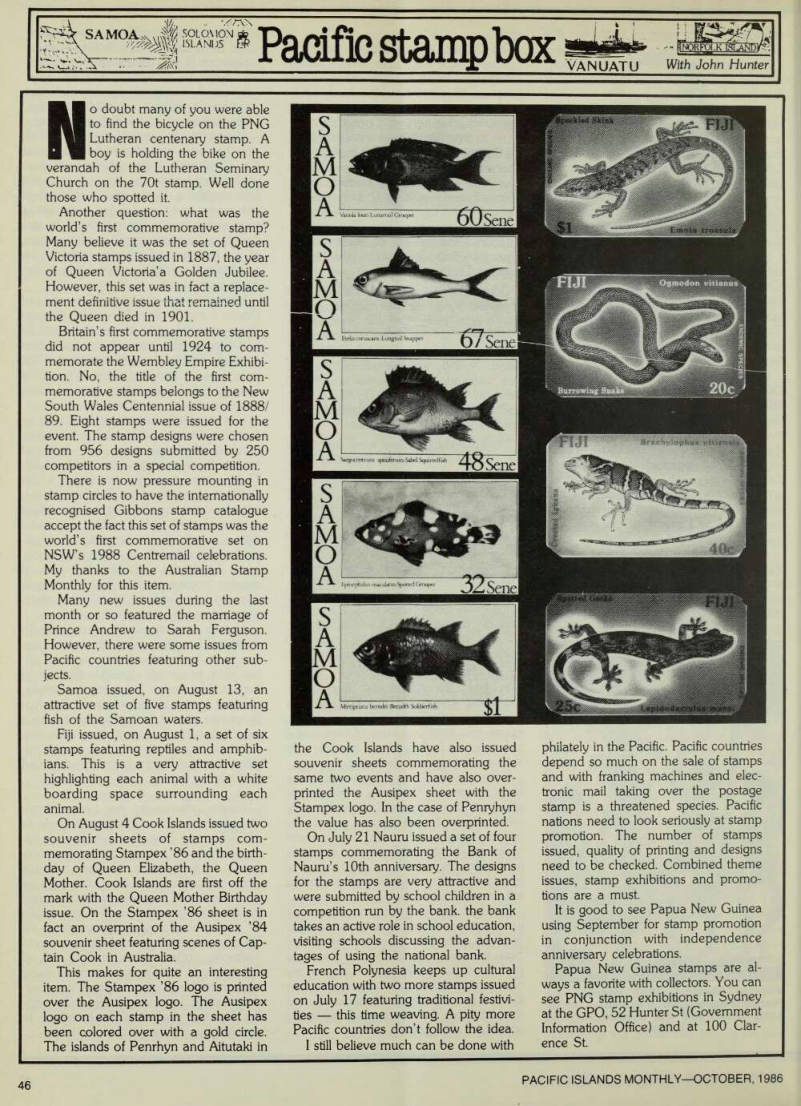
No doubt many of you were able to find the bicycle on the PNG Lutheran centenary stamp. A boy is holding the bike on the verandah of the Lutheran Seminary Church on the 70t stamp. Well done those who spotted it.
Another question: what was the world’s first commemorative stamp?
Many believe it was the set of Queen Victoria stamps issued in 1887, the year of Queen Victoria’a Golden Jubilee.
However, this set was in fact a replace ment definitive issue that remained until the Queen died in 1901.
Britain’s first commemorative stamps did not appear until 1924 to com memorate the Wembley Empire Exhibi tion. No, the title of the first com memorative stamps belongs to the New South Wales Centennial issue of 1888/ 89. Eight stamps were issued for the event. The stamp designs were chosen from 956 designs submitted by 250 competitors in a special competition.
There is now pressure mounting in stamp circles to have the internationally recognised Gibbons stamp catalogue accept the fact this set of stamps was the world’s first commemorative set on NSW’s 1988 Centremail celebrations.
My thanks to the Australian Stamp Monthly for this item.
Many new issues during the last month or so featured the marriage of Prince Andrew to Sarah Ferguson.
However, there were some issues from Pacific countries featuring other sub jects.
Samoa issued, on August 13, an attractive set of five stamps featuring fish of the Samoan waters.
Fiji issued, on August 1, a set of six stamps featuring reptiles and amphib ians. This is a very attractive set highlighting each animal with a white boarding space surrounding each animal.
On August 4 Cook Islands issued two souvenir sheets of stamps com memorating Stampex ’B6 and the birth day of Queen Elizabeth, the Queen Mother. Cook Islands are first off the mark with the Queen Mother Birthday issue. On the Stampex ’B6 sheet is in fact an overprint of the Ausipex ’B4 souvenir sheet featuring scenes of Cap tain Cook in Australia.
This makes for quite an interesting item. The Stampex ’B6 logo is printed over the Ausipex logo. The Ausipex logo on each stamp in the sheet has been colored over with a gold circle.
The islands of Penrhyn and Aitutaki in
the Cook Islands have also issued souvenir sheets commemorating the same two events and have also over printed the Ausipex sheet with the Stampex logo. In the case of Fenryhyn the value has also been overprinted.
On July 21 Nauru issued a set of four stamps commemorating the Bank of Nauru’s 10th anniversary. The designs for the stamps are very attractive and were submitted by school children in a competition run by the bank, the bank takes an active role in school education, visiting schools discussing the advan tages of using the national bank.
French Polynesia keeps up cultural education with two more stamps issued on July 17 featuring traditional festivi ties this time weaving. A pity more Pacific countries don’t follow the idea.
I still believe much can be done with
philately in the Pacific. Pacific countries depend so much on the sale of stamps and with franking machines and elec tronic mail taking over the postage stamp is a threatened species. Pacific nations need to look seriously at stamp promotion. The number of stamps issued, quality of printing and designs need to be checked. Combined theme issues, stamp exhibitions and promo tions are a must.
It is good to see Papua New Guinea using September for stamp promotion in conjunction with independence anniversary celebrations.
Papua New Guinea stamps are al ways a favorite with collectors. You can see PNG stamp exhibitions in Sydney at the GPO, 52 Hunter St (Government Information Office) and at 100 Clar ence St.
Need the Dcmielssons
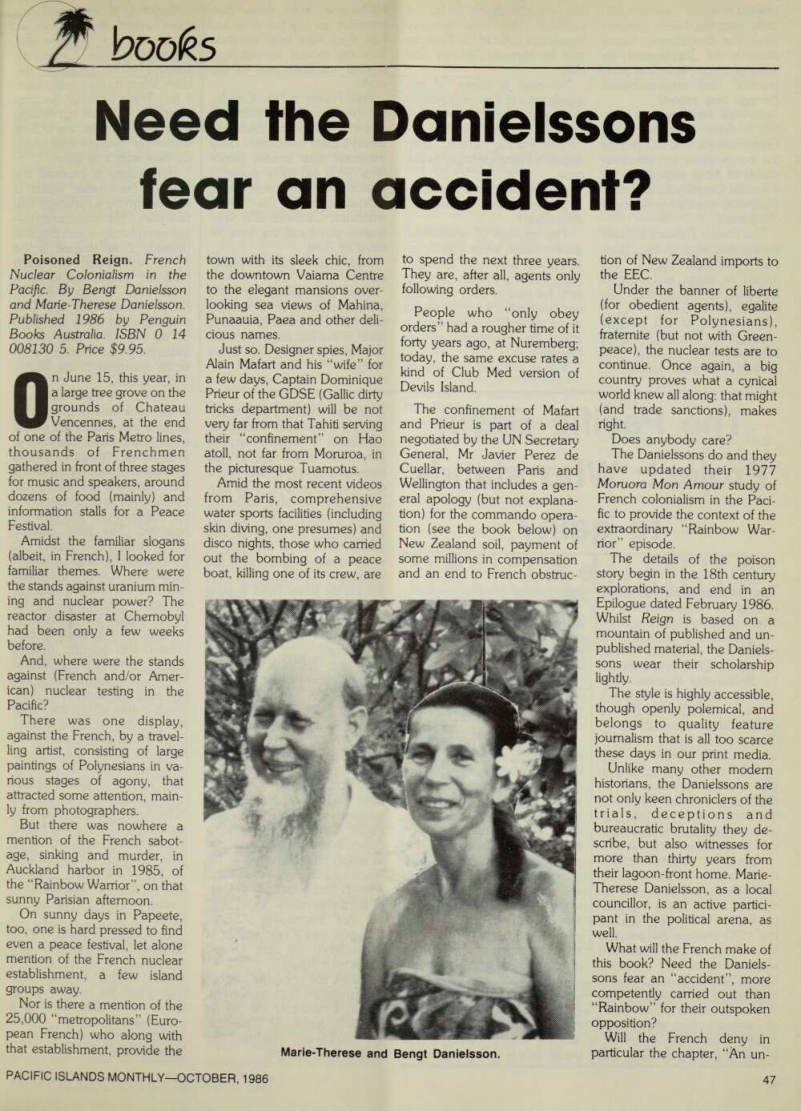
books
Need the Dcmielssons fear an accident?
Poisoned Reign. French Nuclear Colonialism in the Pacific. By Bengt Danielsson and Marie-Therese Danielsson.
Published 1986 by Penguin Books Australia. ISBN 0 14 008130 5. Price $9.95.
On June 15, this year, in a large tree grove on the grounds of Chateau Vencennes, at the end of one of the Paris Metro lines, thousands of Frenchmen gathered in front of three stages for music and speakers, around dozens of food (mainly) and information stalls for a Peace Festival.
Amidst the familiar slogans (albeit, in French), I looked for familiar themes. Where were the stands against uranium min ing and nuclear power? The reactor disaster at Chernobyl had been only a few weeks before.
And, where were the stands against (French and/or Amer ican) nuclear testing in the Pacific?
There was one display, against the French, by a travel ling artist, consisting of large paintings of Polynesians in va rious stages of agony, that attracted some attention, main ly from photographers.
But there was nowhere a mention of the French sabot age, sinking and murder, in Auckland harbor in 1985, of the “Rainbow Warrior”, on that sunny Parisian afternoon.
On sunny days in Papeete, too, one is hard pressed to find even a peace festival, let alone mention of the French nuclear establishment, a few island groups away.
Nor is there a mention of the 25,000 “metropolitans” (Euro pean French) who along with that establishment, provide the
town with its sleek chic, from the downtown Vaiama Centre to the elegant mansions over looking sea views of Mahina, Punaauia, Paea and other deli cious names.
Just so. Designer spies, Major Alain Mafart and his “wife” for a few days, Captain Dominique Prieur of the GDSE (Gallic dirty tricks department) will be not very far from that Tahiti serving their “confinement” on Hao atoll, not far from Moruroa, in the picturesque Tuamotus.
Amid the most recent videos from Paris, comprehensive water sports facilities (including skin diving, one presumes) and disco nights, those who carried out the bombing of a peace boat, killing one of its crew, are
to spend the next three years.
They are, after all, agents only following orders.
People who “only obey orders” had a rougher time of it forty years ago, at Nuremberg; today, the same excuse rates a kind of Club Med version of Devils Island.
The confinement of Mafart and Prieur is part of a deal negotiated by the UN Secretary General, Mr Javier Perez de Cuellar, between Paris and Wellington that includes a gen eral apology (but not explana tion) for the commando opera tion (see the book below) on New Zealand soil, payment of some millions in compensation and an end to French obstruc-
tion of New Zealand imports to the EEC.
Under the banner of liberte (for obedient agents), egalite (except for Polynesians), fratemite (but not with Green peace), the nuclear tests are to continue. Once again, a big country proves what a cynical world knew all along: that might (and trade sanctions), makes right.
Does anybody care?
The Danielssons do and they have updated their 1977 Moruora Mon Amour study of French colonialism in the Paci fic to provide the context of the extraordinary “Rainbow War rior” episode.
The details of the poison story begin in the 18th century explorations, and end in an Epilogue dated February 1986.
Whilst Reign is based on a mountain of published and un published material, the Daniels sons wear their scholarship lightly.
The style is highly accessible, though openly polemical, and belongs to quality feature journalism that is all too scarce these days in our print media.
Unlike many other modem historians, the Danielssons are not only keen chroniclers of the trials, deceptions and bureaucratic brutality they de scribe, but also witnesses for more than thirty years from their lagoon-front home. Marie- Therese Danielsson, as a local councillor, is an active partici pant in the political arena, as well.
What will the French make of this book? Need the Daniels sons fear an “accident”, more competently carried out than “Rainbow” for their outspoken opposition?
Will the French deny in particular the chapter, “An un
Marie-Therese and Bengt Danielsson.
healthy situation”, wherein offi cially supplied health statistics show the deteriorating health situation for Polynesians for cases of cancer, as well as other medical and environmental damage they report?
As with the “Rainbow War rior”, there may be some French people who will criticise the competence (or incompe tence) of those responsible for what the Danielssons describe.
They may even be temporarily disciplined.
The French Defence Minister during the time of the “War rior” sabotage, Hemu, was forced to resign and Admiral Lacoste, of Intelligence, was relieved of his post.
But Hemu is still a close colleague of French President Mitterand and enjoyed con siderable electoral success in
the recent elections. As for the Admiral, he was recently appointed head of the Founda tion for National Defence Stu dies.
No one, it seems, of any significance in France questions the legitimacy of “la bombe” or France’s right to test it in the South Pacific which, they argue, is French territory in any case.
And, Australia and New Zea land government protests and opposition?
The motives of antipodean governments, some French in tellectuals say, are far from pure. From a French perspec tive, the goal of both Canberra and Wellington is to remove the more powerful France from a region that they regard as their inheritance.
It was, after all in 1888, in
Melbourne, that these two countries got together even be fore they were both separate from the mother country and divided up their part of the world.
With France in New Caledo nia (in Australia’s Melanesia) and Polynesia (New Zealand’s sphere), these two cannot easily dominate their smaller neigh bors. With the more powerful France absent and some sort of independence for the French territories, Canberra and Wel lington could call the tune in stead of Paris.
And, what about the Polyne sians?
They seem to be scarcely remembered, even at festival time little more than the exotic meat in the fast food sandwich
(or, is it a pie?).
Grant
McCall.
to gain?
The Pacific Basin Project: Who stands to gain?
The Emerging Pacific Com munity: A Regional Perspec tive. Edited by Robert L Dow ner and Bruce J. Dickson. Pub lished by Westuiew Press, Colorado, USA, and supplied in Britain by Bowker Pub lishing Company, Epping, Essex. 24 sp. ISBN 0 86531864 6. Price £20.75.
The proceedings of a confer ence (such as provides the text of this book) may not at first glance offer promise of an interesting volume. But when the book is about an idea, not about a conference, the result can be valuable.
Little is said about the confer ence, or the interaction of its participants, and so on. All we are told is that it was a gather ing held in Washington D.C. in late 1983 of some 200 scholars and others from 16 nations to assess progress and prospects of the Pacific regional commun ity concept. This forum marked a major milestone in three years of research into the Pacific Basin Project, by the U.S.based Centre for Strategic and
International Studies.
What follows is a collection of addresses given by eminent persons from the Pacific rim countries, which, taken as a whole, offer a valuable view of both the problems and the opportunities presented by the idea of a formalised Pacific community.
The keynote comes from for mer Australian PM, Malcolm Fraser, the delegate with the greatest governmental experi ence. He is both practical and visionary, leaving no doubt about his own intense support for the community idea. He proposes a new code on pro tection to cover industrial goods and services: “The first element in the code would be a total and absolute commitment on the part of any signatory not to raise protection of any form direct, indirect, legal or “illegal” against any other signatory 95 He goes on; “There are times in the history of states, of nations, and, indeed, of the world when the timely act of
great and farsighted people can move the course of history for the better... I believe there are very real sensitivities in the world at present. . . and that is one reason why I quite un ashamedly use this particular forum to make a plea to those in a position of authority and power to do what they can to see that we do not repeat the mistakes of earlier times. Let the Pacific states build a great community of nations and give governments the wisdom and the strength to overcome the difficulties. ”
As the dialogue develops, many different viewpoints are offered, each naturally depen ding on the background of its giver. Some delegates from ASEAN countries are apprehensive about something that might over-shadow their hard-won regional unit. They want “assurance and credible guarantees that the proposed Pacific Community (1) is not a camouflaged anti-Communist or simply anti-Soviet group. (2) is not a subtle device to split the ASEAN countries from the rest of the developing world ... (3) will not manoeuvre ASEAN countries into a relationship of dependency on the United States and Japan ...”
Others are concerned about the question of membership.
Would China and the Soviet Union be included? Difficulties are foreseen whether the answer is yes or no.
Concern is expressed by some about the motives of those who are the strongest advocates of the community concept in particular the USA. What do they really want it for? Trade benefits? Security reasons? Unspoken but evident is the suspicion that the U.S. is supportive because that coun try itself stands to gain.
Here surely is exposed the hub of the matter which is touched on by surprisingly few delegates. No community just as no family can function properly if self-interest is the prime motivation for each member. There has to be a wider vision of what the com munity would exist for. One aim expressed which just might be big enough to unite such a disparate group of nations is “to tackle questions in the North- South debate.”
Perhaps the major weakness of the book (and of the confer ence) is that it does not offer a single South Pacific island view.
Only one delegate, Roniti Teiwaki of Kiribati (representing the University of the South Pacific) was even present; but his utterances, if any, are not recorded. The New Zealand and Australian delegates do their best to fill the gaps, but it is insufficient. It seems preposter ous that the insights and im aginative contribution of the Pacific islands are ignored.
Much of the book is con cerned with specific detailed aspects of the subject. But on the whole it avoids falling into the kind of super-fine detail which makes all but the super specialist feel decidedly drowsy.
Even the language is relatively free from jargon, the one not able exception being a Cana dian academic who stupefies one with sentences such as this: “The basic rules to guide the structuring of a regional collec tive decision-making system will have to orient the interactions of the participating govern ments toward collaborative measures in the common in terest. ”
This is an important book because it deals with an impor tant issue. It offers a good amount of input for those con cerned with the question of the future of the Pacific nations as a community of interests and that ought to be most of us.
Edward Peters.
transitions
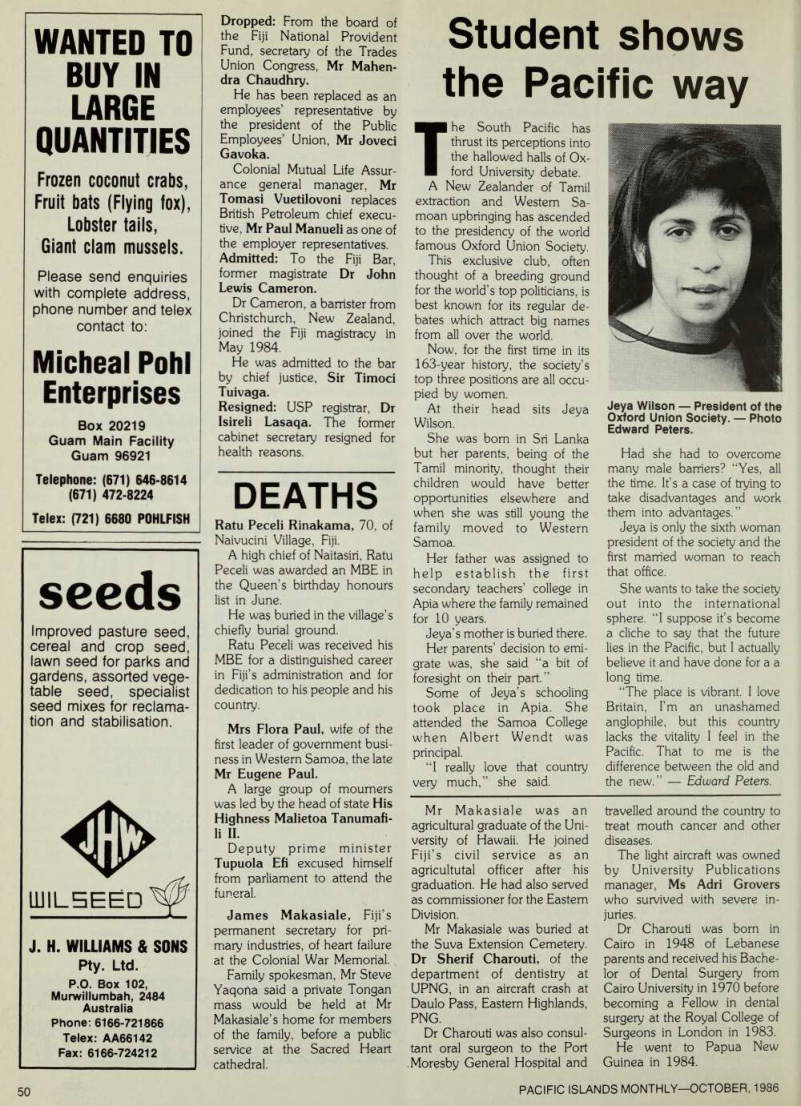
invited: To dinner with the Queen. Western Samoan light heavyweight boxer Don Ulberg was among 50 guests invited by Queen Elizabeth and the Duke of Edinburgh to a special dinner to mark the clos ing of the Commonwealth Games.
Ulberg and the other guests met the royal family at the function which took place in the garden of the historic Holyrood House in Edinburgh, the games venue.
He was also selected as one of the guests to attend a lunch hosted by the Prince of Wales.
“We talked with Princess Diana all throughout the lunch,” he said.
Resigned: Professor of Biology at the University of Papua New Guinea, Dr Dick Morton following an alleged asault on his girlfriend at a party.
Prof Morton was quoted by the campus newspaper Uni Tavur as writing that a student asked his girlfriend for a cigarette and then snatched the packet saying he would keep them all.
When she protested, “he rip ped the rings from her nose and ears and the tee-shirt and bra from her breasts.
“I realise that this assault is very minor compared to abduc tion and rape or even the black eyes and swollen lips that we often see on girl students.
“But I am human and with this has gone all interest that I had in the development of this university.” He said he would stay on to give the university time to find a replacement.
Acting vice-chancellor, Mr Nick Human accepted that Prof Morton’s resignation will be effective from November 30.
Mr Human wrote to Prof Morton: “I understand how you feel about this incident because even I, as a full-blooded Papua New Guinean, have failed to understand why many of my countrymen behave in that manner without any provoca tion.
“Even fairly high levels of education have done nothing to erase that streak of violence
that seems to run through most Papua New Guinean males.
“A lot of well-meaning people are going to be chased out of this country and others are not going to come here only because of the actions of a small percentage of the popula tion.”
Prof Morton had been in PNG for five and a half years.
Appointed: New provincial sec retary for Malaita, Solomon Is lands, Mr Emilio Bulu.
He replaces former secretary, Mr Tim Leni who had been suspended and returned to his former position as administrator in the Ministry of Home Affairs and Provincial Government.
Seconded: From the University of PNG’s Language and Litera ture Department to the Prime Minister’s Department, Dr Micael Olsson.
Known to students as “the man in black” because of his frequent all black attire, Dr Olsson is due to return to the department at the beginning of next year.
Dismissed: Air Pacific com pany secretary, Mr Rajendra Singh.
The airline’s chief executive, Mr John Schaap, said he had been summarily dismissed following an internal investiga tion. He refused to say why Mr Singh was dismissed or why an inquiry was found necessary.
Mr Singh had worked for the airline for 15 years, being appointed company secretary in July last year.
Resigned: Female warden at the University of PNG, Ms Dorothy Tekwie.
Ms Tekwie, a former female student vice-president, said she was leaving to pursue a career in politics.
“I feel cramped here. I’m leaving for higher ambitions and I think it’s time for a change,” she said.
Ms Tekwie was to return to her native West Sepik province as a Pangu Pati organiser.
Appointed: Chairman of Fiji’s Constituency Boundaries Com mission, retired Supreme Court judge, Sir Ronald Kermode.
His appointment was announced by the governor
general, Ratu Sir Penaia Gani lau who also announced the appointment of new commis sion members Mr Jonetani Bai and Mr Ram Vilash.
Sir Ronald’s appointment was made on the advice of the prime minister, Ratu Sir Kamisese Mara and opposi tion leader Mr Harish Shar ma.
Left: Archivist at the New Guinea Collection at UPNG, Mr Andrew Griffin.
Mr Griffin was also a co editor of the Papua New Guinea Dictionary of Con temporary Biography (May PIM, p 24) which work will be continued by chief editor Mr Jim Griffin.
Andrew Griffin’s position has been localised by Mr Sam Raima.
Transferred: Labasa magistrate Mr Howard Morrison after a nine month term in Fiji’s north ern division.
Mr Morrison has moved to Suva and is replaced by Mr Timothy Broad of Bay of Is lands, New Zealand.
Declared: First “Mrs Samoa”
Mrs Lia Meredith at a pageant organised by the St Marys Old Girls Association at Apia’s Tusi tala Hotel.
Returned: To Norfolk Island as new manager of the Hillcrest Hotel, Mr Stephen Christian after an absence of some 12 years.
Mr Christian had worked for Ansett in Sydney before operat ing a snack bar and delicatessen in Brisbane. With him on the island is his wife of four months, Debbie.
Appointed: To the governor of American Samoa’s staff, High Chief Faiivae A. Galea’i.
Faiivae, a former senator, is the governor’s special assistant on cultural, legislative and political affairs.
Dropped: From the board of the Fiji National Provident Fund, secretary of the Trades Union Congress, Mr Mahen dra Chaudhry.
He has been replaced as an employees’ representative by the president of the Public Employees’ Union, Mr Joveci Gavoka.
Colonial Mutual Life Assur ance general manager, Mr Tomasi Vuetilovoni replaces British Petroleum chief execu tive, Mr Paul Manueli as one of the employer representatives.
Admitted: To the Fiji Bar, former magistrate Dr John Lewis Cameron.
Dr Cameron, a barrister from Christchurch, New Zealand, joined the Fiji magistracy in May 1984.
He was admitted to the bar by chief justice, Sir Timoci Tuivaga.
Resigned: USP registrar, Dr Isireli Lasaqa. The former cabinet secretary resigned for health reasons.
Advertisements & other items, pp. 49-50 (1 item)
xporters
<=; O
LOCAL AGENTS AND
REPRESENTATION
428 George St., Sydney.
Cables: Henco Sydney.
G.P.O. Box 3949.
Telephone: 232 5377.
PAPUA NEW GUINEA
RABAUL: M. & C. Seeto, P.O. Box 131, Rabaul.
Telephone 92 2919.
FIJI
K. Witherington Ltd., P.O- Box 293, Suva.
Telephone 22 356.
For specialised and
personalised buying
service throughout
the Pacific Islands and the East.
Resident Agents in other Pacific Territories.
VANUATU
John Lum & Associates, P.O. Box 65, Santo.
Telephone 329.
Mr. Ken Szetu, P.O. Box 45, Honiara.
Telephone 22 637. *3
xporters
WANTED TO
BUY IN
LARGE
QUANTITIES
Frozen coconut crabs, Fruit bats (Flying fox), Lobster tails, Giant clam mussels.
Please send enquiries with complete address, phone number and telex contact to:
Micheal Pohl
Enterprises
Box 20219 Guam Main Facility Guam 96921 Telephone: (671) 646-8614 (671) 472-8224 Telex: (721) 6680 POHLFISH
seeds
Improved pasture seed, cereal and crop seed, lawn seed for parks and gardens, assorted vegetable seed, specialist seed mixes for reclamation and stabilisation.
UJILSEED V
J. H. WILLIAMS & SONS
Pty. Ltd.
P.O. Box 102, Murwillumbah, 2484 Australia Phone: 6166-721866 Telex: AA66142 Fax: 6166-724212
Deaths
Ratu Peceli Rinakama, 70, of Naivucini Village, Fiji.
A high chief of Naitasiri, Ratu Peceli was awarded an MBE in the Queen’s birthday honours list in June.
He was buried in the village’s chiefly burial ground.
Ratu Peceli was received his MBE for a distinguished career in Fiji’s administration and for dedication to his people and his country.
Mrs Flora Paul, wife of the first leader of government busi ness in Western Samoa, the late Mr Eugene Paul.
A large group of mourners was led by the head of state His Highness Malietoa Tanumafi li 11.
Deputy prime minister Tupuola Efi excused himself from parliament to attend the funeral.
James Makasiale, Fiji’s permanent secretary for pri mary industries, of heart failure at the Colonial War Memorial.
Family spokesman, Mr Steve Yaqona said a private Tongan mass would be held at Mr Makasiale’s home for members of the family, before a public service at the Sacred Heart cathedral.
Mr Makasiale was an agricultural graduate of the Uni versity of Hawaii. He joined Fiji’s civil service as an agricultutal officer after his graduation. He had also served as commissioner for the Eastern Division.
Mr Makasiale was buried at the Suva Extension Cemetery.
Dr Sherif Charouti, of the department of dentistry at UPNG, in an aircraft crash at Daulo Pass, Eastern Highlands,
Png.
Dr Charouti was also consul tant oral surgeon to the Port Moresby General Hospital and
travelled around the country to treat mouth cancer and other diseases.
The light aircraft was owned by University Publications manager, Ms Adri Grovers who survived with severe in juries.
Dr Charouti was bom in Cairo in 1948 of Lebanese parents and received his Bache lor of Dental Surgery from Cairo University in 1970 before becoming a Fellow in dental surgery at the Royal College of Surgeons in London in 1983.
He went to Papua New Guinea in 1984.
Student shows
the Pacific way
The South Pacific has thrust its perceptions into the hallowed halls of Ox ford University debate.
A New Zealander of Tamil extraction and Western Sa moan upbringing has ascended to the presidency of the world famous Oxford Union Society.
This exclusive club, often thought of a breeding ground for the world’s top politicians, is best known for its regular de bates which attract big names from all over the world.
Now, for the first time in its 163-year history, the society’s top three positions are all occu pied by women.
At their head sits Jeya Wilson.
She was bom in Sri Lanka but her parents, being of the Tamil minority, thought their children would have better opportunities elsewhere and when she was still young the family moved to Western Samoa.
Her father was assigned to help establish the first secondary teachers’ college in Apia where the family remained for 10 years.
Jeya’s mother is buried there.
Her parents’ decision to emi grate was, she said “a bit of foresight on their part.”
Some of Jeya’s schooling took place in Apia. She attended the Samoa College when Albert Wendt was principal.
“I really love that country very much,” she said.
Had she had to overcome many male barriers? “Yes, all the time. It’s a case of trying to take disadvantages and work them into advantages.”
Jeya is only the sixth woman president of the society and the first married woman to reach that office.
She wants to take the society out into the international sphere. “I suppose it’s become a cliche to say that the future lies in the Pacific, but I actually believe it and have done for a a long time.
“The place is vibrant. I love Britain, I’m an unashamed anglophile, but this country lacks the vitality I feel in the Pacific. That to me is the difference between the old and the new.” Edward Peters.
Jeya Wilson President of the Oxford Union Society. Photo Edward Peters.
Advertisements & other items, p. 51 (1 item)
Tdon wb
Deals the
winning
hand in rat
control!
talon WB is a world breakthrough in killing rats and mice. Developed by ICI Tasman In New Zealand talon WB is a sure way to Increase profits by eliminating RAT DAMAGE TO CROPS! & So ss Sr cs C SOLID BLOCKS Can be wired or nailed out of reach of children & animals. Easily handled - won t blow away.
WATERPROOF Safe Y ear round use - will not dissolve, resists mould for extended periods.
DEADLY
Kills even the toughest rats - Including those resistant to warfarin based poisons.
EFFECTIVE
POWERFUL
Highly attractive to rats & mice - no pre-baiting is required.
Kills more rats - a lethal dose can be consumed In a single feed.
Do not lay baits In places accessible to children, pets and domestic animals. Wash hands and exposed skin before meals and after work. Do not store near food or feed. Bum or bury all rodent bodies and uneaten bait. Empty containers should not be re-used but disposed of safely.
Udonwß
TcT\ A Product of ICI Tasman Limited P.O Box 900, Auckland, New Zealand
WARNING
Whatever your crops COCOA COCONUTS SUGARCANE.
RATS KILL PROFITS! NOW TALON WB KILLS RATS!
shipping schedules

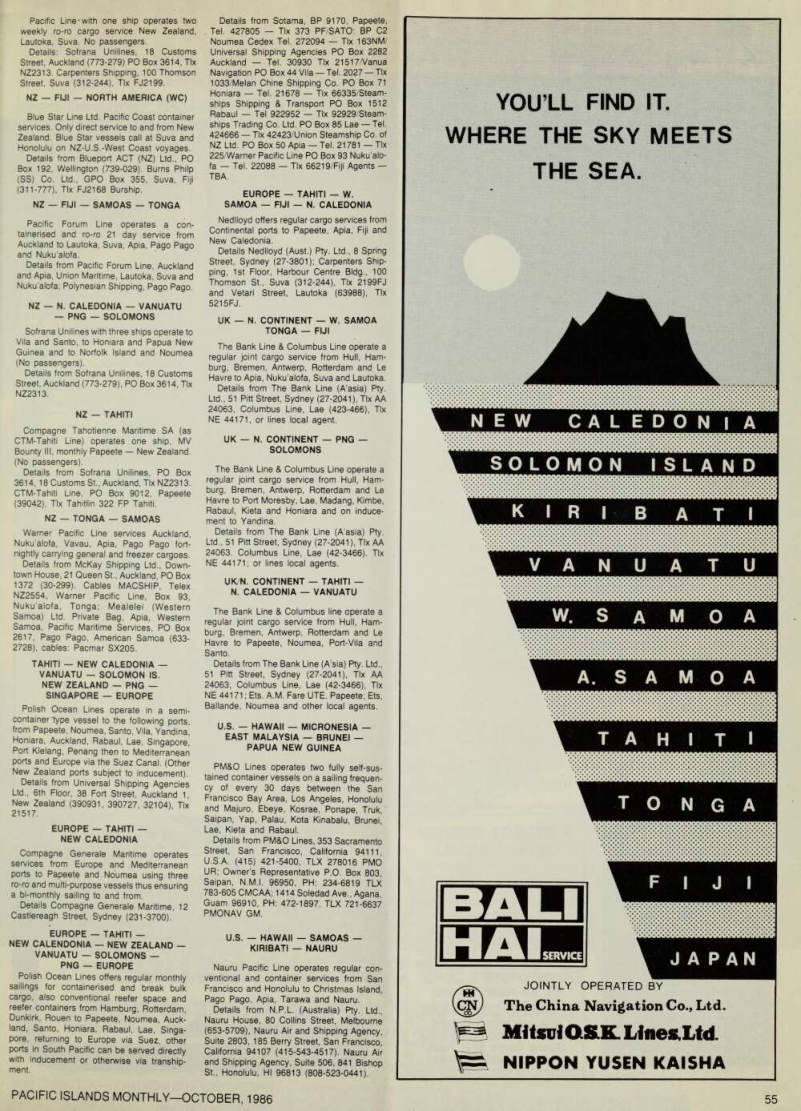
Should any shipping company wish to have its services cargo and passenger included in these listings they should contact
Pim.
Australia Fiji
Sofrana-Unilines (Fiji Express Line) oper ates to Suva and Lautoka every three weeks from the main ports on the east coast of Australia and monthly to Lautoka from Mel bourne and Sydney.
Details from Sofrana-Unilines, 432 Kent Street, Sydney (264-8944), Tlx AA 70090; Wiltrans Agency Pty. Ltd., 21st Floor, 60 Market St., Melbourne (614-4788); Tlx 30163 ACTA Pty, Ltd., Brisbane (221-3116); Elders- ANL Pty. Ltd., Port Adelaide, (47-5688); Newcastle, Sofrana Sydney (264-8944); Websters-ANL, 58 Charles St., Launceston, Tasmania (320-555); Carpenters Shipping, Harbour Centre Building, Ist Floor, Thomson Street, Suva, Fiji (312-244), Tlx FJ2199.
Australia Samoas Tonga
Warner Pacific Lines operates a regular cargo service from Sydney, Brisbane and Melbourne to Nukualofa, Pago Pago, Apia and Vavau. Feeder service available from Apia to Cook, Christmas, Fanning and
Washington Islands.
Details from Hetherington Wesfarmers Shipping Agency, 37-49 Pitt Street. Sydney, (27-1671).
Australia New Caledonia
Fiji Samoas Tonga
Pacific Forum Line operates a fully con tainerised service (general, reefer and ro-ro) from Sydney to Noumea, Suva, Apia, Pago Pago, Nukualofa, Sydney, Cargo centralised from Adelaide, Melbourne, Brisbane.
Details from Pacific Forum Line, P.O. Box 796 Auckland, Union Bulkships, 333 George Street, Sydney, Brisbane and Melbourne, Union Co., Lautoka, Suva, Nukualofa, Pacific Forum line Apia, Polynesia Shipping Pago
Pago.
Australia Lord Howe Is.
Norfolk Is.
Compagnie des Chargeurs Caledoniens operates four-weekly cargo service Sydney- Lord Howe Island and Norfolk Island.
Details Hetherington Wesfarmers Shipping Agency, 37-49 Pitt Street, Sydney (27-1671).
Australia Kiribati
K. Asia Pacific operates a 5/6 weekly service from Melbourne and Sydney to Kiribati (Tarawa).
Details from K. Asia Pacific Pty. Ltd., Goldfields House, 1 Alfred Street. Circular Quay, Sydney (232-2277), Tlx 122143.
KAP New Guinea Lines call Tarawa after PNG ports on a 35 day basis from Melbourne and Sydney/Brisbane.
Details from K. Asia Pacific Pty. Ltd., Goldfields House, 1 Alfred Street, Circular Quay, Sydney (232-2277), Tlx 122143.
Australia Tuvalu
K-Asia Pacific operates Direct service every 2nd voyage to Tulalu (Funafuti) Details from K. Asia Pacific Pty. Ltd., Goldfield House, 1 Alfred Street, Circular Quay Sydney (232-2277) Tlx 122143
Australia New Caledonia
And/Or Vanuatu
Sofrana-Unilines ships serve Noumea every three weeks from the main ports along the east Australian coast.
Details from Sofrana-Unilines, 432 Kent Street, Sydney (264-8944), Wiltrans-Agency Pty. Ltd., 21st Floor, 60 Market St., Mel bourne (614-4788) Tlx 30163 ACTA Pty. Ltd., Brisbane (221-3116). Elders-ANL Pty. Ltd., Port Adelaide (47-5688), Newcastle, Sofrana Sydney; Websters-ANL, 58 Charles St., Launceston, Tasmania (320-555).
Compagnie des Chargeurs Caledoniens operates a three-weekly containerised cargo service from Sydney to Noumea.
Details Hetherington Wesfarmers Shipping Agency. 37-49 Pitt Street, Sydney (27-1671).
Compagnie Generale Maritime operates a monthly service from Sydney, Melbourne and Brisbane to Noumea, Port Vila and Santo, for containerised and break bulk cargo.
Details Compagnie Generale Maritime, 12 Castlereagh Street, Sydney (231-3700).
Australia Nauru
Marshall Is. Kiribati
Nauru Pacific Line operates regular cargo service from Melbourne to Nauru, Majuro and Tarawa, Passenger service to Nauru only.
Details: Nauru Pacific Line (Aust). Pty. Ltd.
Nauru House, 80 Collins Street, Melbourne (653-5709), Nedlloyd Swire, 8 Spring Street, Sydney (2-0522).
Australia New Zealand
The Australian National Line and the New Zealand Line operate a 10-day container service (TRANZTAS) between Sydney and Melbourne to Auckland, Wellington, Lyttelton and Port Chalmers.
The Tranztas service has been extended to cover Burnie and Fremantle on a direct call monthly basis linking to the main New Zealand ports.
Details from ANL Shipping Agencies, 20 Bond Street, Sydney (232-0444) and ANL Shipping Agencies, “World Trade Centre", cnr Flinders and Spencer Streets, Melbourne (611-2323) or New Zealand Line, Pastoral House, 98 Lambton Quay, Wellington (728- 5000).
Australia Nz Fiji Tonga
Vanuatu New Caledonia
Solomons New Guinea
Sitmar Cruises operates a year-round cruise program from Sydney to include the better-known ports in the above countries, plus a number of unspoilt, and largely unknown, island paradises.
Details from Sitmar Cruises, 39 Martin Place, Sydney (239-9000); NSW. reserva tions and inquiries (008 42-2277); Rest of Australia, reservations and inquiries (008 22-2277).
Australia Nz Fiji Tonga
Vanuatu New Caledonia
Solomons Samoas Tahiti
P&O liners call at Auckland, Bay of Islands, Honiara, Lautoka, Noumea, Nukualofa, Pago Pago, Papeete, Port Moresby, Santo, Savu savu, Suva, Vavau and Vila on cruises from Australia.
Details from P&O Booking Centre, World Travel Headquarters Pty Ltd, 33 Bligh Street, Sydney (237-0333).
Australia Png
Solomons Vanuatu Nz
Pacific Forum Line operates a con tainerised and ro-ro from Brisbane to Port Moresby, Lae, Honiara, Port Vila, Lyttelton, Napier and Auckland.
Details from Union Bulkships, Brisbane Steamships Shipping, Port Moresby and Lae; Sullivans Ltd, Honiara, Vila Agents, Port Vila; SCONZ Christchurch, Napier and Auckland.
Australia Micronesia
Nauru Pacific Line operates a regular container service from Melbourne to Ponape, Truk, Guam and Saipan.
Details: N.P.L. (Australia) Pty Ltd, Nauru House, 80 Collins Street, Melbourne (653- 5709). Nedlloyd Swire, 8 Spring Street, Sydney (2-0522).
Australia New Caledonia
Sofrana Unilines operates a 3-4 weekly service from East Coast mainports to Noumea.
Details from Sofrana Unilines 432 Kent Street, Sydney. (Tel. 264-8944), Tlx AA 70090.
Australia Tuvalu
K. Asia Pacific operates a three monthly service from Sydney and Melbourne to Tuvalu (Funafuti). Subject to inducement.
Details from K. Asia Pacific Pty Ltd, Goldfields House, 1 Alfred Street, Circular Quay, Sydney (232-2277). Tlx 122143.
Warner Pacific Line operates a six week containerised/breakbulk service to Funafuti from Melbourne/Brisbane/ Sydney and Auck land.
Details from Hetherington Wesfarmers Shipping Agency, 37-49 Pitt Street, Sydney (27-1671): Mac Kay Shipping Ltd, Downtown House, Queen Street, Auckland (30-229).
Australia Png
KAP New Guinea Lines cargo vessels call at Melbourne, Sydney, Port Moresby, Lae, Madang, Wewak, Manus. Kimbe, Rabaul, Popondetta.
Details from K. Asia Pacific Pty Ltd, Goldfields House, 1 Alfred Street. Circular Quay, Sydney (232-2277), Tlx 122143. Dal gety Shipping, World Trade Centre, Mel bourne (616-6700).
Australia Png Solomons
Sofrana Unilines (Aust.) P/L operates a 3-4 weekly cargo service to PNG, ex-main ports on the east coast of Australia.
Details from Sofrana Unilines, 432 Kent Street. Sydney (264-8944), Tlx AA 70090.
Australia - Png - Solomons
Vanuatu
A consortium of NGAUPNGL and CON PAC/NEL have four vessels operating a joint service from east coast Australian ports to Port Moresby, Lae, Alotau, Madang, Wewak, Rabaul, Kavieng-Kimbe, Kieta, Honiara, Vila, Santo.
Details from Burns Philp & Co. Ltd., P.O.
Box R 124, Royal Exchange, Sydney, 2000 (2-0547); Nedlloyd Swire, 8 Spring Street, Sydney (2-0522); New Guinea Express Lines, 37 Pitt Street, Sydney (241-3991); Vila Agents, PO Box 27, Porl-Vila (2456). Tlx
Nhioii.
New Guinea Express Lines operates a weekly container service from Melbourne, Sydney, Brisbane to Port Moresby, Lae, Alotau, Kimbe, Rabaul, Kieta, Honiara, Kavieng, Madang, Wewak, Santo, Vila.
Details from New Guinea Express Lines, P.O. Box R 73, Royal Exchange, Sydney (241-3991); New Guinea Express Lines, 127 Creek Street, Brisbane (221-9333); New Guinea Express Lines, 327 Collins Street, Melbourne (602-5544); Niugini Express Lines, Port Moresby (21-4572); Lae (42- 1536); Niugini Island Cargo Services Pty.
Ltd., Rabaul (922-467); Bougainville Agen cies Pty. Ltd., Kieta (956-089); Robert Laurie (PNG) P/L, Madang (82-2157); Garamut Enterprises P/L, Wewak (86-2106); Burns Philp (PNG) Ltd., Kavieng (94-2133): Alotau Stevedoring & Transport, Alotau (61-1318); Ngatia Wholesalers Pty. Ltd., Kimbe (93- 5102); and Tradco Shipping, Mendana Ave nue, Honiara (22588); Vila Agents Ltd., P.O.
Box 971, Vila, Vanuatu (2490); John Lum & Associates. P.O. Box 65, Santo, Vanuatu (329).
Australia Tahiti
Compagnie Generate Maritime operates a monthly service from Sydney, Melbourne and Brisbane to Papeete, for containerised and break bulk cargo.
Details Compagnie Generate Maritime, 12 Castlereagh Street, Sydney (231-3700).
Sofrana Unilines (Aust.) P/L operates a 3/4 weekly cargo service to Papeete ex main ports on the east coast of Australia.
Details from Sofrana Unilines, 432 Kent Street, Sydney (264-8944) Tlx AA 70090.
Singapore Hongkong Fiji
Islands Ports
Kyowa Shipping Co. Ltd. operates a month ly containerised and break bulk cargo service from Singapore, Hongkong to Lautoka, Suva and then to island ports.
Details from Carpenters Shipping, Harbour Centre Building, Ist Floor, Thomson Street, Suva (312-244), Tlx FJ2199.
Far East Fiji
New Zealand
New Zealand Unit Express (NZUE) now operates a monthly service accepting con tainerised and break bulk cargo from Manila, Keelung, Kaohsiung and Hongkong to Lauto ka, Suva and thence to New Zealand ports.
Details from Carpenters Shipping, Harbour Centre Building, Ist Floor, Thomson Street, Suva (312-244), Tlx FJ 2199; Burns Philp, Suva (311-777); New Zealand Unit Express Maratime Building, 2-10 Customhouse Quay, P.O. Box 890, Wellington, Cables: ENZUE
Man Wellington Telex: Nz31340
NEDLNZ Telephone: 727-865 or Nedlloyd Swire Pty. Ltd., Sydney (20-522).
Nedlloyd operates bi-weekly cargo service with four ships from Surabaya, Jakarta, Bangkok, Port Kelang and Singapore to Suva, Lautoka and NZ ports.
Details from Nedlloyd (Aust.) Pty. Ltd., 8 Spring St., Sydney (27-3801), Burns Philp (SS) Co. Ltd., Suva and Lautoka.
Far East Mid-S. Pacific
China Navigation's New Guinea Pacific Line operates a regular container service from Hongkong, Taiwan, Manila, Port Kelang
and Singapore to Port Moresby, Lae, Rabaul and Honiara monthly and to Wewak, Madang and Kieta every three months. Cargo from the same Far Eastern ports to the South Pacific ports of Noumea, Santo, Vila, Papeete, Pago Pago. Apia, Raratonga and Tarawa will be shipped via Japan on the monthly Bali Hai service.
Details from Steamships Shipping, P.O.
Box 634, Port Moresby (22-0289).
Kyowa Shipping Ltd. operates monthly services from Japan to Guam, Saipan, Solo mons, New Caledonia, Fiji, Western and American Samoa, Tahiti, Cook Is., Tonga and Vanuatu.
Details: Heterington Wesfarmers Shipping Agency, 37-49 Pitt Street, Sydney (27-1671); Carpenters Shipping, Suva (312-244), Tlx FJ2199.
Guam Northern Marianas
Saipan Shipping Co. Inc. operate a weekly service via barge carrying containers and conventional cargo between Guam and Saipan and Tinian.
Details from Saipan Shipping Co. Inc., P.O.
Box 8. Saipan, CM 96950 (Tel. 9707), Tlx 783619; Guam agents Maritime Agencies of the Pacific Ltd.
Hawaii Tahiti Samoas -
Tonga Kiribati Fiji
Solomons Png
Star Shipping Associates operates a monthly service originating in Honolulu and destined for Pago Pago, Papeete, Apia, Nukualofa, Suva, Vila and Port Moresby.
Details from Star Shipping Assoc., P. 0., Box 25988, Honolulu, Hawaii 96825. Ph. (808) 396-4256; Polynesia Shipping Services in Pago Pago and Burns Philp Agency in Apia, Nukualofa, Suva and Port Moresby.
Japan Fiji Island Ports
Kyowa Shipping Co. Ltd. operates a month ly containerised service from main ports of Japan to Suva and Lautoka and thence to island ports.
Details from Carpenters Shipping, Harbour Centre Building, Ist Floor, Thomson St., Suva (312-244). Tlx FJ2199.
Bali Hai service operates a monthly con tainerised service from main ports of Japan to Lautoka and Suva and thence to island ports.
Details from Carpenters Shipping, Harbour Centre Building, Ist Floor, Thomson St., Suva (312-244), Tlx FJ2199 and Burns Philp, Suva (311-777).
Japan Micronesia
The NYK Shipping Line operates a monthly cargo service from Japan to Micronesia, calling at Yoko, Nagoya, Kobe, Guam, Saipan, Truk, Ponape and Majuro, returning via Yoko, Nagoya and Kobe.
Details from Burns Philp & Co. Ltd., 51 Pitt Street, Sydney (2-0547).
Saipan Shipping Co. Inc. operates a monthly service from Japan to Saipan, Guam, Truk, Ponape, Majuro (Kosrae and Ebeye on
inducement).
Details from Saipan Shipping Co. Inc., P.O.
Box 8, Saipan, CM 96950 (Tel. 9707), Tlx 783619, Japan agents Kyowa Shipping Com pany Ltd.; Guam Agents Maritime Agencies of the Pacific Ltd.
Japan Png
Mitsui O.S.K. Lines operates a monthly service from main ports Japan and Japan, Wewak, Lae, Rabaul, Kieta, Port Moresby.
Details from Robert Laurie Carpenters Pty.
Ltd., P.O. Box 1032, Lae/PNG (Tel. 42-3642, 42-3811.)
New Caledonia Fiji West
Coast North America
PAD Line operates an approx. 3-weekly ro-ro service from Noumea and Suva to Honolulu and West Coast USA and Canadian ports.
Details from Sofrana-Unilines SA, BP 1602, Noumea (27-51-91), Tlx NMO4B; Carpenters Shipping, Harbour Centre Building, Ist Floor, Thomson St., Suva (312-244), Tlx FJ2199.
Png Inter Mainport
Papua New Guinea Line offers scheduled 10-20 day coastal liner services linking all PNG major ports with containerisation, reefer, heavy lift and transshipment facilities.
Details from PNG Line, Box 543, Port Moresby, PNG (21-1174), Tlx 22269.
Png Uk/Continent
The Bank Line & Columbus Line operate a regular joint service from Port Moresby, Oro Bay, Kieta, Rabaul, Kimbe, Madang and Lae to Hull, Hamburg, Rotterdam, Antwerp and Le Havre.
Details from The Bank Line (A’asia) Pty.
Ltd., 51 Pitt Street, Sydney (27-2041); Tlx AA24063; Columbus Line, Lae (423466), Tlx NE 44171; or lines’ local agents.
Solomons Uk/Continent
The Bank Line & Columbus Line operate a regular joint cargo service from Honiara to Hull, Hamburg, Rotterdam, Antwerp and Le Havre.
Details from the Bank Line (A’asia) Pty. Ltd. 51 Pitt Street, Sydney (27-2041), Tlx AA24063; Columbus Line. Lae (423466), Tlx NE 44171; Tradco Shipping Ltd., Honiara (22588) Tlx 66313.
New Zealand - Australia
Papua New Guinea Solomon
Islands Vanuatu
Pacific Forum Line operates a con tainerised and ro-ro service from Lyttelton, Napier and Auckland to Brisbane, Port Moresby, Lae, Honiara and Port Vila.
Details from SCONZ Christchurch, Napier and Auckland; Union Bulkships, Brisbane; Steamships Shipping, Port Moresby and Lae; Sullivans Ltd., Honiara; Vila Agents, Port Vila.
Nz Cook Is. Niue Tahiti
New Zealand Line operates cargo services based on pallets and similar units from Auckland to Niue, Cook Islands and Tahiti.
Details from the NZ Shipping Agencies International Ltd., P.O. Box 3420, Auckland (797210); Waterfront Commission, P.O. Box 61, Rarotonga; Cook Islands; Shipping Office, Govt, of Niue, P.O. Box 107, Niue Island; Compagnie Maritime Polynesienne, P.O. Box 36, Papeete, Tahiti.
Nz Fiji
Reef operates a regular 18-day service from Auckland to Suva and Lautoka. Also passenger accommodation.
Details from Reef Shipping Agencies, PO Box 3382, Auckland, NZ (77-1221-3), Tlx 60633; MV Fijian Shipping Agencies Ltd.
Private Bag, Suva, Fiji (31-1056).
Pacific Line-with one ship operates two weekly ro-ro cargo service New Zealand, Lautoka, Suva. No passengers.
Details: Sofrana Unilines, 18 Customs Street, Auckland (773-279) PO Box 3614, Tlx NZ2313. Carpenters Shipping, 100 Thomson Street, Suva (312-244), Tlx FJ2199.
Nz Fiji North America (Wc)
Blue Star Line Ltd. Pacific Coast container services. Only direct service to and from New Zealand. Blue Star vessels call at Suva and Honolulu on NZ-U.S.-West Coast voyages.
Details from Blueport ACT (NZ) Ltd., PO Box 192, Wellington (739-029). Burns Philp (SS) Co. Ltd., GPO Box 355, Suva, Fiji (311-777), Tlx FJ2168 Burship.
Nz - Fiji Samoas - Tonga
Pacific Forum Line operates a con tainerised and ro-ro 21 day service from Auckland to Lautoka, Suva, Apia, Pago Pago and Nuku’alofa.
Details from Pacific Forum Line, Auckland and Apia, Union Maritime, Lautoka, Suva and Nukualofa; Polynesian Shipping, Pago Pago.
Nz N. Caledonia Vanuatu
Png Solomons
Sofrana Unilines with three ships operate to Vila and Santo, to Honiara and Papua New Guinea and to Norfolk Island and Noumea (No passengers).
Details from Sofrana Unilines, 18 Customs Street, Auckland (773-279), PO Box 3614, Tlx NZ2313.
Nz Tahiti
Compagne Tahotienne Maritime SA (as CTM-Tahiti Line) operates one ship, MV Bounty 111, monthly Papeete New Zealand. (No passengers).
Details from Sofrana Unilines, PO Box 3614, 18 Customs St., Auckland, Tlx NZ2313.
CTM-Tahiti Line, PO Box 9012, Papeete (39042), Tlx Tahitlin 322 FP Tahiti.
Nz Tonga Samoas
Warner Pacific Line services Auckland, Nuku’alofa, Vavau, Apia, Pago Pago fort nightly carrying general and freezer cargoes.
Details from McKay Shipping Ltd., Down town House, 21 Queen St., Auckland, PO Box 1372 (30-299). Cables MACSHIP, Telex NZ2554, Warner Pacific Line, Box 93, Nuku’alofa, Tonga; Mealelei (Western Samoa) Ltd. Private Bag, Apia, Western Samoa, Pacific Maritime Services, PO Box 2617, Pago Pago, American Samoa (633- 2728), cables: Pacmar SX2OS.
Tahiti - New Caledonia
Vanuatu Solomon Is.
New Zealand Png
Singapore Europe
Polish Ocean Lines operate in a semi container‘type vessel to the following ports, from Papeete, Noumea, Santo, Vila, Yandina, Honiara, Auckland, Rabaul, Lae, Singapore, Port Klelang, Penang then to Mediterranean ports and Europe via the Suez Canal. (Other New Zealand ports subject to inducement).
Details from Universal Shipping Agencies Ltd., 6th Floor, 38 Fort Street, Auckland 1, New Zealand (390931, 390727, 32104) Tlx 21517.
Europe Tahiti
New Caledonia
Compagne Generate Maritime operates services from Europe and Mediterranean ports to Papeete and Noumea using three ro-ro and multi-purpose vessels thus ensuring a bi-monthly sailing to and from.
Details Compagne Generate Maritime, 12 Castlereagh Street, Sydney (231-3700).
Europe Tahiti
New Calendonia New Zealand
Vanuatu Solomons
Png Europe
Polish Ocean Lines offers regular monthly sailings for containerised and break bulk cargo, also conventional reefer space and reefer containers from Hamburg, Rotterdam, Dunkirk, Rouen to Papeete, Noumea, Auck land, Santo, Honiara, Rabaul, Lae, Singa pore, returning to Europe via Suez, other ports in South Pacific can be served directly with inducement or otherwise via tranship ment.
Details from Sotama, BP 9170, Papeete, . Tel. 427805 Tlx 373 PF/SATO: BP C 2 Noumea Cedex Tel. 272094 Tlx 163 NM/ Universal Shipping Agencies PO Box 2282 Auckland Tel. 30930 Tlx 21517/Vanua Navigation PO Box 44 Vila Tel. 2027 Tlx 1033/Melan Chine Shipping Co. PO Box 71 Honiara Tel. 21678 Tix 66335/Steam ships Shipping & Transport PO Box 1512 Rabaul Tel 922952 Tlx 92929/Steam ships Trading Co. Ltd. PO Box 85 Lae Tel. 424666 Tlx 42423/Union Steamship Co. of NZ Ltd. PO Box 50 Apia Tel. 21781 Tlx 225/Warner Pacific Line PO Box 93 Nukualo fa Tel. 22088 Tlx 66219/Fiji Agents
Tba.
Europe Tahiti W.
Samoa Fiji N. Caledonia
Nedlloyd offers regular cargo services from Continental ports to Papeete, Apia, Fiji and New Caledonia.
Details Nedlloyd (Aust.) Pty. Ltd., 8 Spring Street, Sydney (27-3801); Carpenters Ship ping, Ist Floor, Harbour Centre Bldg., 100 Thomson St., Suva (312-244), Tlx 2199FJ and Vetari Street, Lautoka (63988), Tlx 5215FJ.
Uk N. Continent W. Samoa
Tonga Fiji
The Bank Line & Columbus Line operate a regular joint cargo service from Hull, Ham burg, Bremen, Antwerp, Rotterdam and Le Havre to Apia, Nuku’alofa, Suva and Lautoka.
Details from The Bank Line (A’asia) Pty.
Ltd., 51 Pitt Street, Sydney (27-2041), Tlx AA 24063, Columbus Line, Lae (423-466), Tlx NE 44171, or lines local agent.
Uk N. Continent Png
Solomons
The Bank Line & Columbus Line operate a regular joint cargo service from Hull, Ham burg, Bremen, Antwerp, Rotterdam and Le Havre to Port Moresby, Lae, Madang, Kimbe, Rabaul, Kieta and Honiara and on induce ment to Vandina.
Details from The Bank Line (A’asia) Pty.
Ltd., 51 Pitt Street, Sydney (27-2041), Tlx AA 24063. Columbus Line, Lae (42-3466). Tlx NE 44171; or lines local agents.
Uk/N. Continent Tahiti
N. Caledonia Vanuatu
The Bank Line & Columbus line operate a regular joint cargo service from Hull, Ham burg, Bremen. Antwerp, Rotterdam and Le Havre to Papeete, Noumea, Port-Vila and Santo.
Details from The Bank Line (A’sia) Pty. Ltd., 51 Pitt Street, Sydney (27-2041), Tlx AA 24063, Columbus Line, Lae (42-3466), Tlx NE 44171; Ets. A.M. Fare UTE. Papeete; Ets, Ballande, Noumea and other local agents.
U.S. Hawaii Micronesia
East Malaysia Brunei
Papua New Guinea
PM&O Lines operates two fully self-sus tained container vessels on a sailing frequen cy of every 30 days between the San Francisco Bay Area, Los Angeles, Honolulu and Majuro, Ebeye, Kosrae, Ponape, Truk, Saipan, Yap, Palau, Kota Kinabalu, Brunei, Lae, Kieta and Rabaul.
Details from PM&O Lines, 353 Sacramento Street, San Francisco, California 94111,
U.S.A. (415) 421-5400, Tlx 278016 Pmo
UR; Owner's Representative P.O. Box 803, Saipan, N.M.I. 96950, PH: 234-6819 TLX 783-605 CMCAA; 1414 Soledad Ave., Agana, Guam 96910, PH: 472-1897, TLX 721-6637
Pmonav Gm.
U.S. Hawaii Samoas
Kiribati Nauru
Nauru Pacific Line operates regular con ventional and container services from San Francisco and Honolulu to Christmas Island, Pago Pago, Apia, Tarawa and Nauru.
Details from N.P.L. (Australia) Pty, Ltd., Nauru House, 80 Collins Street, Melbourne (653-5709), Nauru Air and Shipping Agency, Suite 2803, 185 Berry Street, San Francisco, California 94107 (415-543-4517). Nauru Air and Shipping Agency, Suite 506, 841 Bishop St., Honolulu, HI 96813 (808-523-0441).
Advertisements & other items, pp. 52-60 (1 item)
John Saxon Bryant
?CT3TO3SS:sggSSSSg
wit
AND ASSOCIATES
SHIPBROKERS
ANCHOR HANDLING SUPPLY VESSELS
£L 3SS* ' - V m 1.) Built 1972, in A.B.S.
SURVEY Australian Registered Ship 56 metres 360 tns deck cargo. Suit T.E.U. Containers; Refrig. Fuel and water cap. 1496 tns.
Could suit mini tanker uses.
Bulk cargo system 3750 c.f.
Presently fitted for bulk cement. Twin Screw 4000 8.H.P., Aux. 600K.W. Air cond. accom. 9 crew plus 10 [ \ pass. 2. ANOTHER similar to above, 52 metres. Others available 46 and 34 metres. 3. Tugs several, 20 to 55tn. pull. 4. Intercat 195 passengers. $700,000, Ships, Trawlers, Landing Barges.
John Saxon Bryant and
Associates Shipbrokers.
“Mataram House” (69A).
Warnervale N.S.W. 2259.
(043) 92-1875 TLX. AA27113
We’ve just made
the ocean smaller!
Polynesia Line's new MS Polynesia 550-container ship provides regular monthly cargo service between Papeete, Pago Pago and Apia in the South Pacific, and Long Beach and Oakland on the US Pacific Coast.
POLYNESIM.INE
Interocean Steamship Corporation General Agent Pago Pago Oh u O TO Sk 3 & %• v Cotßf •; 6625 t If. Suite K» CA ■ " W ' ,■.■ V;
CoOWMOREX'
Hopo rOQC Wyneski Shipping PoBox«7a PcjgoPago, Amerlccir! Samoa 96799 co&v'vcm^- Union SiaomSh*>Ca • Apia. Western Samoa [. -v I ' SuitelOW -CA94104 'V* Serving Polynesia is all we do—and we do it better!
BANK LINE and
COLUMBUS LINE
24 day service to
Europe.
Need we say more...
Ft D G The Joint Service Partners offer facilities for shipment of: Containers (FCiyLCL) and Break-bulk Cargo plus reefer space and deeptanks for carriage of vegetable oils and other liquid bulk cargo.
Carriers also accept heavy lifts, overlength and cumbersome parcels.
Ports of Service: Loading: Papeete, Apia, Suva, Lautoka, Noumea, Port Vila, Santo, Honiara, Port Moresby, Lae, Madang, Kimbe, Rabaul, Kieta, Darwin. For: Rotterdam, Antwerp, Hamburg, Hull, Dunkirk, Le Havre.
Additional ports on enquiry.
Please contact our regional offices for further information: The Bank Line (Australasia) Pty Ltd Columbus Line Reederei GmbH Suite 801, 51 Pitt St, P.O. Box 1667, Lae/Papua New Guinea.
Sydney, NSW, Australia 2000 Phone: 423466/423287/A.H. 422481 Phone-27 2041 Telex 24063 Telex: Colline NE 44171 The South Pacific Specialists for over 7 5 years
YOU’LL FIND IT.
WHERE THE SKY MEETS
THE SEA.
NEW CALEDONIA
SOLOMON ISLAND
KIRI B ATI
VANUATU
W. S A M O A
A. S A M O A
TAHITI
tonga - Y a
JOINTLY OPERATED BY
The China Navigation Co., Ltd.
MJtsulOSK.Lifies.Ltd.
NIPPON YUSEN KAISHA
SERVICE PAGE
ADVERTISING
Aggie Grey’s 56 Air New Zealand 7 Air Pacific 22 Amatil 29
AWA 27
Bali Hai Services 55 Bank Line 54 Norm Beechey 40 Beljaars 56 J. S. Bryant 52 Citizen Watches 10 Collins Olympic 39 Henry Cumines 49 Dewhurst 56 L. M. Ericsson 18-19 Hawaii Telephone 13 Honda Motor 2
ICI 51
Lincoln Electric 15 Matsushita/National 17 Metro. Drill & Blast 34 Metro Power 56 Mitsubishi Motor 60 Pioneer Electronic 42 Michael Pohl 50 Polish Ocean Lines 57 Samoan Tropical Prod 33 Sony Corp 4 Toyota Motor 30-31 Toyota Motor 58-59 J. H. Williams & Sons 50
MMITOM
AUSTRALIA: Distribution: The Herald and Weekly Times Ltd,, 44-74 Flinders St., Melbourne, Vic., 3000. Advertising Reps — Brisbane — D. Wood, Anday Agency, CCA Centre, Dayboro Road, Closeburn 4520; Box 1918, GPO Brisbane, 4001; telephone (07) 289-4128. Adelaide — Hastwell Williamson Rouse Ry. Ltd., PO Box 419, Norwood, SA, 5067; 59 Kensington Road, Norwood; telephone (08) 332-3322, telex 87113; Perth — Allen & Associates, 7 Fore St., Perth, W.A., 6000, telephone (09) 328-9833, telex: AA94382.
FUI: Distribution and subscriptions, — Desai Bookshops, P.O. Box 160, Suva, Fiji telephone Suva 23036.
Advertising — Fiji Times & Herald Ltd., 20 Gordon St., Suva, telephone 31-4111, telex FJ2124.
FRENCH POLYNESIA: Distribution — Hachette Pacifique 10 Ave., Bruat, Papeete, telephone 25-610.
HAWAII: UNITED STATES: Distribution - PIM, Hawaii.
P.O. Box 22250, Honolulu, Hawaii, 96822. Advertising — Brian C. Asgill, Apt. 1308,1676 Ala Moana Blvd., Honolulu, Hawaii, 96815, telephone (808) 955-9718.
JAPAN AND KOREA: Advertising and subscriptions — Universal Media Corporation, GPO Box 46, Tokyo, telephone 666-3036, cable UNIMEDIA Tokyo, telex 2524665.
MALAYSIA: Advertising and subscriptions — Worldwide Media Services, 57-B Komplex Damai, Jin Dato Haji Eusoff, Kuala Lumpur, telephone 63-9340, cables WORLDMEDIA Kuala Lumpur, telex 31533.
VANUATU: Distribution — The Bookshop, HQ Box 210, Port Vila, Advertising — Norman Bros. Bookshop, Port Vila, telephone 2232.
NEW CALEDONIA; Distribution — Depot Centre de Presse Michel Pentecost. CBP2, Noumea, telephone 27-2434, 27-4729.
NEW ZEALAND: Distribution — Gordon & Gotch, PO Box 584, 2 Carr Road, Mt. Roskill, Auckland 4 — Advertising — McKay International Media Reps. Ltd., c/o Albany P.O., Auckland 10, New Zealand, telephone 413-9119.
Telex NZ22701, FAX 413-9110.
PAPUA NEW GUINEA: Distribution — Gordon & Gotch, PO Box 3395, Port Moresby, telephone 25-4551,25-4855.
Advertising — Ken Head, PNG Post-Courier, PO Box 85, Port Moresby, telephone 21-2577, telex 22120.
SOLOMON ISLANDS: Distribution and Advertising — The Bookshop, (Norman Bros.) PO Box 503, Honiara.
PHILIPPINES: Advertising — The GF Group, 12 San Ignacio St., Uroaneta Village, Makati, Metro Manila, telephone 817-7299, telex 45950 and 4233.
UNITED KINGDOM: The Herald & Weekly Times Ltd., No 1 Maltravers Street, London WC2R 3DZ, England, telephone (01) 836-5162, telex London 21989.
UNITED STATES MAINLAND; Advertising - Joshua B.
Powers Jr., Powers International Inc., Suite 708, 271 Madison Ave., New York, NY 10016, telephone 867-9580, telex 236514. Subscriptions — PIM, Hawaii, PO Box 22250, Honolulu. Hawaii. 96822.
SUBSCRIPTIONS
American Samoa...
Australia Canada Cook Islands Fiji French Polynesia...
Guam Hawaii Japan Kiribati Micronesia Nauru New Caledonia New Zealand Niue Norfolk Island Northern Marianas..
Papua New Guinea Solomon Islands Tonga Tuvala United Kingdom U.S. Mainland Vanuatu Western Samoa Elsewhere ... US$24
AUS$24
... US$30 -NZ$36
AUS$26
... US$30 ... US$30 ... US$30 ... US$30
. AUS$24
...US$30
, AUS$24
... US$30 ...NZ$36 ...NZ$30
,AUS$24
... US$30
. AUS$35
.AUS$24
.AUS$24
. AUS$24
Stg15 ...US$30
. AUS$24
.AUS$24
.AUS$36
Payments by personal cheque are only acceptable in Australian (from a branch in Australia). U.S. and New Zealand currency. For all other remittances please send an international bank draft in Australian dollars.
Published monthly by Pacific Publications (Aust.) Pty.
Ltd. and printed in Australia by Quadricolor Industries Pty.
Ltd., Mulgrave, Vic.
BUILDING
Housing, Commercial, Industrial, Maintenance, Additions, New Work, Design, anywhere throughout Pacific.
Contact: DEWHURST BUILDERS.
R.D.7 TEPUKE, N.Z. Ph. (075) 43 0899.
ALL THE
NEWS IN A
FLASH
The South Sea Digest tells you what you want to know aboutthe Pacific Islands m a few words All the leading firms and diplomatic missions r ead it You can phone or write or call for a follow up See insert for subscription details
THE SOUTH SEA DIGEST
NOW AVAILABLE!
PACIFIC ISLANDS YEAR BOOK
Due to demand the 15th edition has been reprinted and is available from P.I.M. at As3s plus p.p.
TRACTOR PARTS
Metro Power, the Sydney Parts ributor will arrange air or sea freight as required. • New and used tractors and backhoes Ford & BMW industrial and marine engines Special prices on new BSD Ford engines Ph: Sydney (02) 774 5522. Telex; 176886 183 Beaconsfield St., Revesby, Sydney N S W, 2212
Stay at Aggie Grey’s . . . the South Pacific’s
legendary hotel.
Situated right in the heart of Western Samoa. Enjoy Polynesian style friendliness and service, in tool surroundings, superb entertainment and food.
Magnificent while sand beac hes only a short drive- away. Airconditioned rooms, swimming |xk)l and Jull bar facilities.
Bookings through I’nion Steamship Company of NZ, Pan Am, Air New Zealand or direc t to Aggie Grey’s, Apia, Western Samoa. Cables: ‘AGGIES’ Apia.
HOSPITALITY INDUSTRY
LOCUM AVAILABLE
Husband and wife management team aged 40 and 39, no children, energetic, ex-accountant 2 years hands on management experience in the hospitality industry, part owners of resort in South Pacific, more than 6 years experience in Pacific area. Will be available mid December, 1986, for short or long term engagements.
For full details, contact:
E. AND P. BELJAARS,
Bokissa Island Resort, PO Box 261, Santo Vanuatu.
Phone Santo 855, Telex Vanuatu 1099 (BKISSA)
POLISH OCEAN LINES
General Management, 10 Lutego 24,81-364 GDYNIA, POLAND, Phone: 20-19-01, Cables: POLOCEAN Telex: 054-231 Q >-v as fy S J fV‘. .'•V
SOUTH PACIFIC SERVICE
service t 0 and from: GDYNIA, HAMBURG, ROTTERDAM, MIDDLESBOROUGH/IMMINGHAM, P rir D ! JNKIRK ' ROUEN, PAPEETE (via PANAMA), NOUMEA, AUCKLAND, HONIARA, RABAUL, LAE, SINGAPORE, by our multipurpose vessels carrying dry and reefer containers, reefer chambers, heavy lifts, breakbulk or palletized, bulk liquids. t .. nil A « POLISH OCEAN LINES Representatives AUCKLAND Mr. A. Sieradzki. Telex 21517 NZ “UNISHIP”. SYDNEY Mr. Walenciak. Telex 20428 AA “SLEIGH”
TAHITI SOTAMA Telex
AGENCIES LTD.. Telex
POLISH OCEAN LINES Agents
296 FP “COUTIMEX". NEW CALEDONIA SATO Telex 163 NM “SATO”. AUCKLAND UNIVERSAL SHIPPING 21517 N 7 “I JNISHIP” QHI DMOMC MCI am puikic r*r\ iin ceooc qki^
a> 0.3 s™ 80.5
db(A):
[O2-5FD251
Full-Floating
Power Train
Steering Wheel Vibration Virtually non-existent, elevating comfort to a new all-time high. * Indicates maximum vibration level of the wheel Equivalent Noise Level at Driver’s Ear Drastically reduced by sound-absorbing material ; and comprehensive engin design. * Measured and calculated according to IS (
The forklift designed
for greater comfort, less vibration.
Toyota Introduces
SR m m m.
V Toyota, the leader in innovation, creates a revolution in the forklift industry.
The revolutionary new 1-3 ton engine powered series forklifts; maximum-performance vehicles designed for maximum-operator comfort.
A full-floating power train practically eliminates vibration. Advanced engineering “floats” the entire engine on a cushion of rubber, with no direct attachment to the frame. Surrounding main engine parts also vibrate freely, drastically reducing structural vibration. Rubber sealing on engine hood and floorboard, and sound-absorbing materials, all add up to the many innovations that raise Toyota’s new series’ comfort level far above other forklifts.
Also exclusive to the 1-3 ton series is the 3-litre 1Z direct injection diesel engine. Delivering greater horsepower and less fuel consumption.
Increased performance, increased comfort.
But don’t just take our word. Take a test drive and feel.
Toyota’s new 1-3 ton series forklifts are in a class by themselves.
Comfort-class.
30
P s /2 / 400 rpm
JIS PS [O2-SFD2S]
(57 HP/2,400 rpm SAE NET)
580
mm /f
sec.
[O2-SFD2S]
(114 f/min.) Engine Horsepower The new 1Z diesel engine delivers more power, more efficiency.
Lifting Speed Now the job gets done faster than ever. .
TOYOT
02
2000™ 195 km/h
(4,400 lbs) I (12.1 mile/h) Max, Drawbar Pull Scales inclines hauling a full load, easily.
Max, Travel Speed Work cycles are dramatically increased for greater efficiency.
A decision you can be comfortable with.
Maintenance Integrated monitoring centre, easy access to parts.
Inspection and servicing amazingly easy.
Durability
Overheating “fail-safe” system, rigorously tested; built rugged.
Service Network Extensive. After sales support in almost every country in the world.
Reliability
Design priority no. 1 ensuring operator safety through Toyota reliability.
Wide Variation Even greater productivity and comfort available with a wide selection of models.
TOYOTA
AMERICAN SAMOA: BURNS PHILP (S.S.) CO., LTD. TEL: 633-4281 AUSTRALIA: THIESS TOYOTA PTY, LTD. TEL: 526-0333 FIJI: AUTOMOTIVE SUPPLIES CO., A DIVISION OF BURNS PHILP (S.S.) CO., LTD.
TEL: 383444
GUAM: ATKINS, KROLL, INC. TEL: 646-1876
NEW CALEDONIA: SERVICE IMPORTATION AUTOMOBILE DU PACIFIQUE
TEL: 27-41-44
NEW ZEALAND: ANDREWS & BEAVEN INDUSTRIAL EQUIPMENT LTD.
TEL: 2780940
PAPUA NEW GUINEA: ELA MOTORS, BURNS PHILP (P.N.G.), LTD.
AUTOMOTIVE DIVISION TEL: 217036
VANUATU: VANUATU MOTORS, A DIVISION OF BURNS PHILP (VANUATU) LTD.
TEL: VILA 2341
WESTERN SAMOA: BURNS PHILP (S.S.) CO., LTD. TEL: 22611 And distributors around the world. -5FD25 W
i—•* . ' : *:; - ; v ... . :;.£ifii*
i%|Bi
BL» "
* Jj-" mil
5* SP)
We build them.
1 .
Over four hundred years ago, Leonardo da Vinc[ drew up plans for submarines, helicopters, jet planes—even an automobile. Unfortunately, he didn't have the technology to build any of them.
Today at Mitsubishi, we don't have that problem. Of course, many of our ideas are still years ahead of their time. But our engineers can transform those ideas into working prototypes.
Take our MP-90X concept car. It stands out. Sleek, aerodynamic shape, amazing 0.22 Cd. Exceptionally advanced electronics—a navigation system that lets you pinpoint your exact position on a video map, via satellite; computerised diagnostic system that immediately informs you of any potential problem.
Then there's the communications system that keeps you in touch with your home or office, and the electronic mail system. Even the windows dim with increased daylight, to cut glare.
The engineering is years ahead, too: high-response four-wheel steering, active control brakes and suspension, and an AMERICAN SAMOA: MORRIS SCANLAN SERVICE INC. PO. Box 367, Pago Pago, Tel. 633-5520/AUSTRALIA: MITSUBISHI MOTORS AUSTRALIA LTD. Box 1851, G.PO. Adelaide, South Australia 5001, Tel. 08-275-71 11 /FIJI: NIVIS MOTOR & MACHINERY CO., LTD. G.PO Box 150. Suva. Tel 384425/FRENCH POLYNESIA (TAHITI): ETS-BREDIN FRERES ET FILS PO Box 21. Papeete, Tahiti, Tel 4-202-58/ NEW CALEDONIA: SOCIETE D IMPORTATION D AUTO DU PACIFIQUE SUD S.A, B.P 438 Rond Point du Pacifique, Noumea, Tel. 274144/ NEW ZEALAND; TODD MOTORS CORPORATION Todd Park, Heriot Drive, Private Bag, Porirua. Tel 70-109/NORFOLK ISLAND: BORRYS LTD. PO. Box 169, Norfolk Island, Tel 2114 NI/PAPUA NEW GUINEA; TOBA PTY. LTD. PO. Box 503, Port Moresby. Tel 21-7874/SOLOMON ISLANDS: R.C. SYMES PTY, LTD. PO. Box 823, Honiara, Guadalcanal, Tel 22131 /TONGA: SITANI MAPI CO., LTD. PO Box 83. Maku Olofa, Tel. 2 1-044/VANUATU: SOCOMETRA B.P 06 Route de Lagon, Port-Vila, Tel. 2314/WESTERN SAMOA: A M MACDONALD HOLDINGS LTD PO Box 576, Apia, Tel 22022/ SAIPAN/PONAPE/MAJURO/KOSRAE/TRUK/YAP/BELAU: MICRONESSIAN MOTORS. INC. 997 South Marine Drive, Tamuning, Guam 96911, Tel. 646-6827
Leonardo da Vinci
dreamed of machines
that one day would be
engine that controls its speed according to road conditions.
It all adds up to a vehicle that puts you in charge. It may take some time before you'll find all this equipped in your everyday family car. But if we have anything to say about it, it won't take four hundred years.
A
MITSUBISHI
MOTORS