Pacific

Islands
Monthly
American Samoa US$2.OO Australia A 52.00 Cook Islands NZ$3.OO Fiji F 51.75 Hawaii US$2.5O Kiribati A 52.00 Nauru A 52.00 New Caledonia CFP2SO New Zealand NZ$3.OO Niue NZ$2.5O Norfolk Island A 52.00 Papua New Guinea K 52.00 Solomon Islands 552.00 Tahiti CFP3OO Tonga P 2.00 Tuvalu A 52.00
Usa Us$3.Oo
USTT and Guam US$2.5O Vanuatu VT2.00 Western Samoa T 2.75 •Recommended retail price only Registered by Australia Post Publication No. NBPI2IO
September, 1986
« T I hf* 1 'A K'’‘ I -m fjipS 'x** : ;k i I I : .'kSk li— r ! "bf ,¥fl
gm M The aftermath
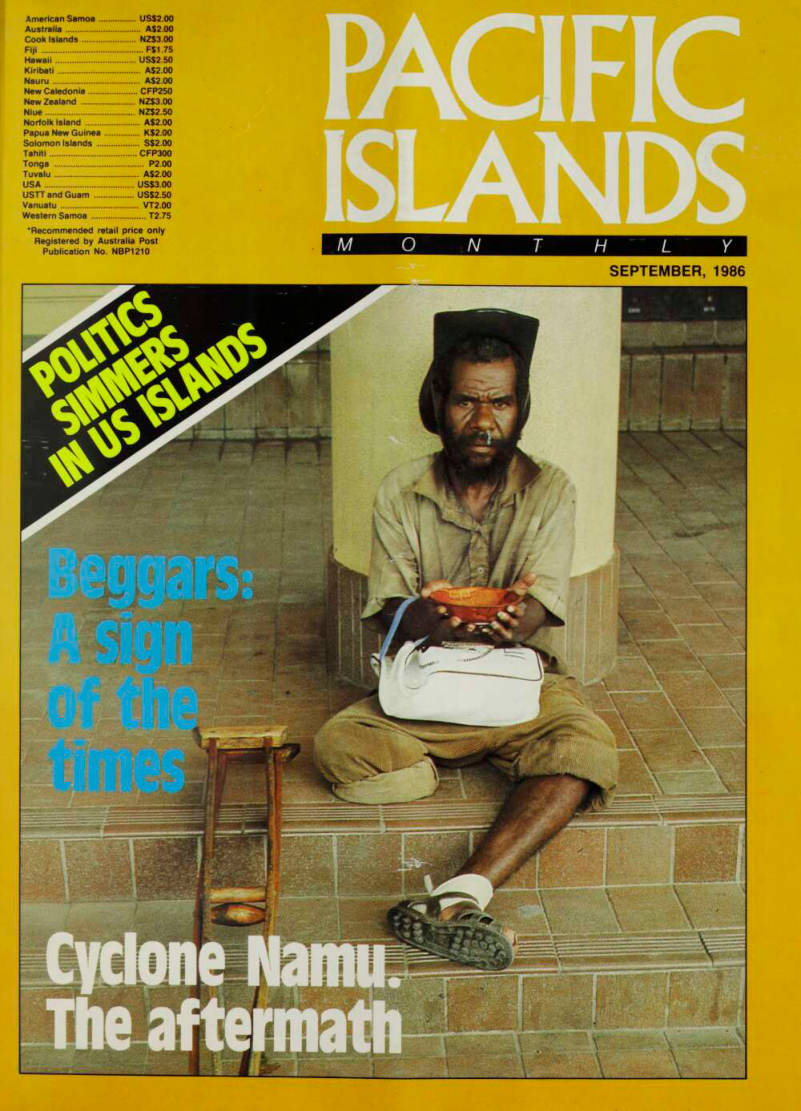
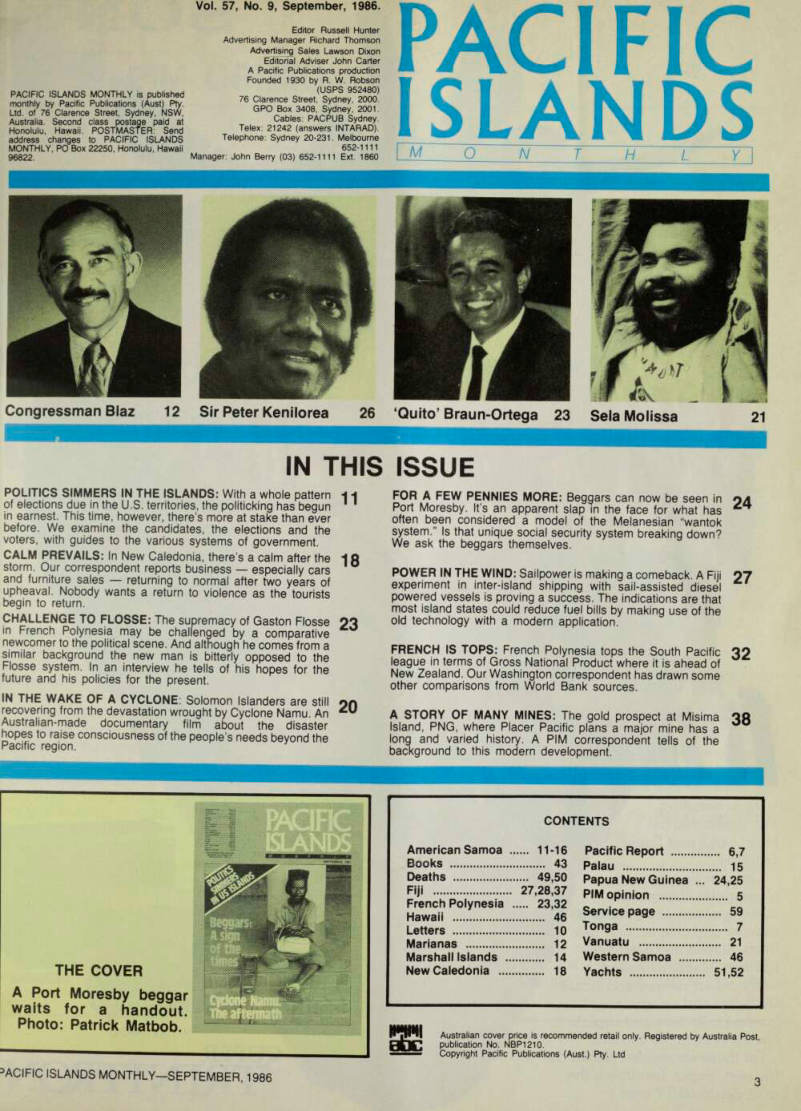
The Cover
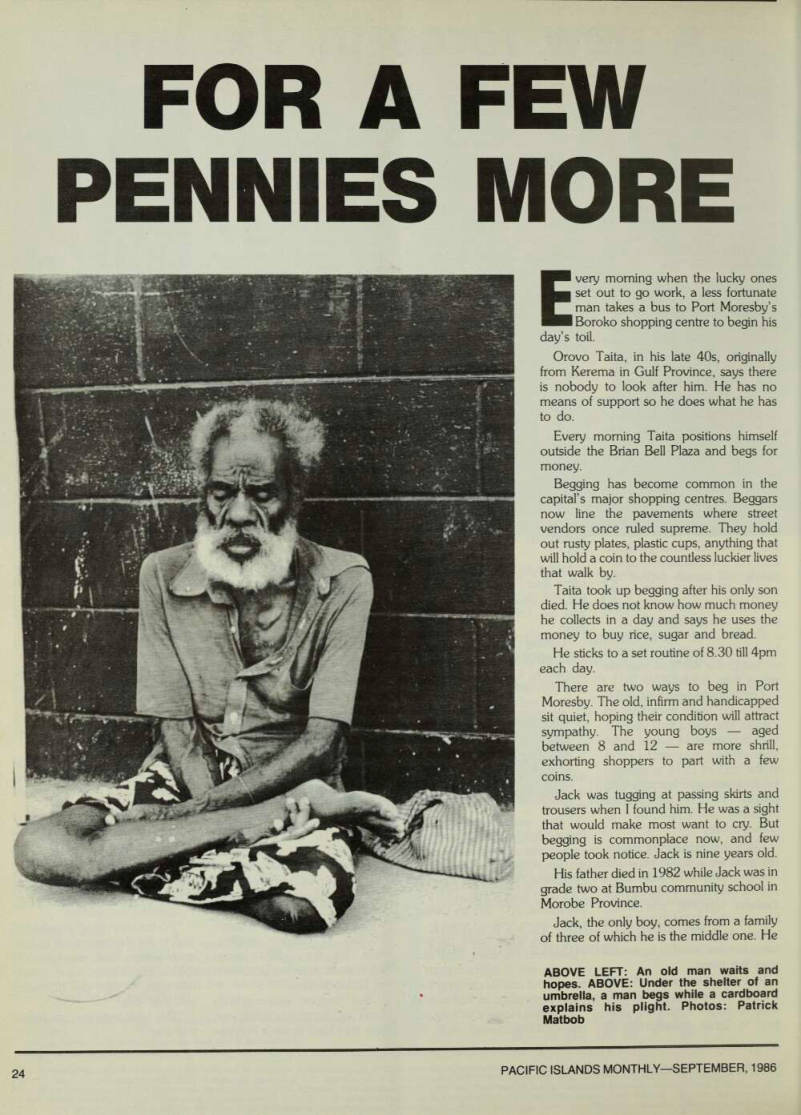
A Port Moresby beggar waits for a handout.
Photo: Patrick Matbob.
Advertisements & other items, p. 2 (1 item)
So we thought you'd prefer
It has an extra head,
a low, low body,
and makes no noise.
So we thought you'd prefer
to do your timer recording
at a safe distance.
The multi-function remote control 'Super Transmitter' allows operation of the ... shhh! VT-138E... easily from the comfort and safety of your armchair.
This unique 14-mode infra-red transmitter displays the preset recording programmes on its own LCD screen. It also allows you to set the timer without having to tiptoe over to the VTR.
Did you shake when you read the headline? No. That's because the extra head has been designed to prevent shake. And together with a special no noise circuit it dismisses all fears
about picture quality during still and
slow motion mode.
CHANNEL
n < 2W
ON OFF
nn-nn^gg:
TRANS
FRJ
•i J Li PM I
Add all this to the low, sleek, front load design, and feather touch buttons, and you can see why the VT-138E isn't frightened to say that it's one of the simplest and most relaxing VTR's around.
Outstanding screen image, and supreme operation ease - that’s the Hitachi HQ system VT-138E.
So tiptoe down to your local dealer.
Preferably during daylight.
VT-138E
Super Transmitter
Hitachi... another new idea'.
The Video Tape Recorder (VTR) with this marking incorporates IVHSI high-quality picture technology and is compatible with any Video Tape Recorders bearing the VHSI mark.
HITACHI
TOKYO, JAPAN
• AUSTRALIA: Hitachi Sales Australia Pty., Ltd., 153 Keys] P.O. Box 50-248, Porirua; Phone; PRO 75-069 • PAPUA Limited, 37 Freeston Road, Walu Bay (P.O. Box 858), Suv| PaHinc P.ontro ItH PH Roy 46R Honiara' Phone* 416 P.O. >2 • NEW ZEALAND: AWA New Zealand Limited. Wi-neera Drive, 705, Port Moresby: Phone: 21-2111 • FIJI ISLANDS: AWA New Zealam B.P Ml, Noumea; Phone: 26. 23. 50 • SOLOMON ISLANDS: Techniqu
Pacific
Islands
Monthly
PACIFIC ISLANDS MONTHLY is published monthly by Pacific Publications (Aust) Pty.
Ltd. of 76 Clarence Street, Sydney, NSW, Australia. Second class postage paid at Honolulu, Hawaii. POSTMASTER: Send address changes to PACIFIC ISLANDS MONTHLY, PO Box 22250, Honolulu, Hawaii 96822.
Vol. 57, No. 9, September, 1986.
Congressman Blaz 12
Sir Peter Kenilorea 26
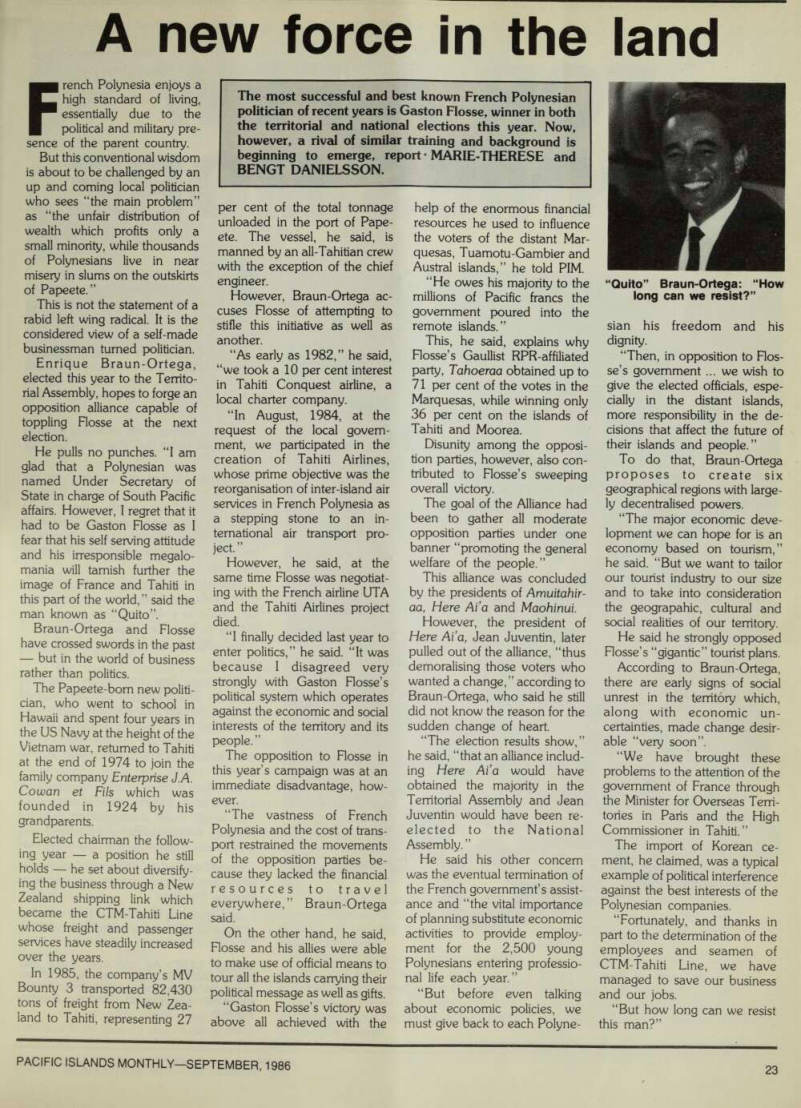
‘Quito’ Braun-Ortega 23
Sela Molissa 21
In This Issue
POLITICS SIMMERS IN THE ISLANDS: With a whole pattern i i of elections due in the U.S. territories, the politicking has begun 1 1 in earnest. This time, however, there’s more at stake than ever before. We examine the candidates, the elections and the voters, with guides to the various systems of government.
CALM PREVAILS: In New Caledonia, there’s a calm after the Ift storm. Our correspondent reports business especially cars and furniture sales returning to normal after two years of upheaval. Nobody wants a return to violence as the tourists begin to return.
CHALLENGE TO FLOSSE: The supremacy of Gaston Flosse in French Polynesia may be challenged by a comparative newcomer to the political scene. And although he comes from a similar background the new man is bitterly opposed to the Flosse system. In an interview he tells of his hopes for the future and his policies for the present.
IN THE WAKE OF A CYCLONE: Solomon Islanders are still on recovering from the devastation wrought by Cyclone Namu. An Australian-made documentary film about the disaster hopes to raise consciousness of the people’s needs beyond the Pacific region.
FOR A FEW PENNIES MORE: Beggars can now be seen in 04 Port Moresby. It’s an apparent slap in the face for what has " often been considered a model of the Melanesian “wantok system.” Is that unique social security system breaking down'?
We ask the beggars themselves.
POWER IN THE WIND: Sailpower is making a comeback. A Fiji 27 experiment in inter-island shipping with sail-assisted diesel powered vessels is proving a success. The indications are that most island states could reduce fuel bills by making use of the old technology with a modern application.
FRENCH IS TOPS: French Polynesia tops the South Pacific 32 league in terms of Gross National Product where it is ahead of New Zealand. Our Washington correspondent has drawn some other comparisons from World Bank sources.
A STORY OF MANY MINES: The gold prospect at Misima 38 Island, PNG, where Placer Pacific plans a major mine has a long and varied history. A PIM correspondent tells of the background to this modern development.
Contents
American Samoa 11-16 Books 43 Deaths 49,50 Fiji 27,28,37 French Polynesia 23,32 Hawaii 46 Letters 10 Marianas 12 Marshall Islands 14 New Caledonia 18
Pacific Report 6,7 Palau 15 Papua New Guinea ... 24,25 PIM opinion 5 Service page 59 Tonga 7 Vanuatu 21 Western Samoa 46 Yachts 51,52
Australian cover price is recommended retail only. Registered by Australia Post, publication No. NBPI2IO.
Copyright Pacific Publications (Aust.) Pty. Ltd
Advertisements & other items, pp. 3-4 (2 items)
Pacific Islands Monthly—September, 1986
3
Editor Russell Hunter Advertising Manager Richard Thomson Advertising Sales Lawson Dixon Editorial Adviser John Carter A Pacific Publications production Founded 1930 by R. W. Robson
(USPS 952480)
76 Clarence Street, Sydney, 2000.
GPO Box 3408, Sydney, 2001.
Cables: PACPUB Sydney.
Telex: 21242 (answers INTARAD).
Telephone: Sydney 20-231. Melbourne 652-1111 Manager: John Berry (03) 652-1111 Ext. 1860
Trinitron
sony:
ML -
KV-2092AS
Its so tempting.
The colour you get from Sony's new Super Trinitron.
Our new Pan-Focus gun is computer-designed to make our famous colour even sharper and clearer. Our new Black Screen makes whites brilliant, blacks profound, every colour deeper and richer.
It's flatter and sguarer too.
For less reflection and superb clarity, even in the corners.
For those whose taste demands the best, Super Trinitron is the most delicious TV ever.
KV-1440AS
Trinitron
moral high ground
Pim Opinion
US losing the moral high ground
Once again, the Russians have upped the ante in the diplomatic poker game with the Americans. The pot is commercial and political influence in the South Pacific.
The Soviet announcement that Mr Gorbachev would support the South Pacific Nuclear Free Zone concept came just after the US and the forum island countries failed to reach agreement on a fisheries access deal.
The Soviet leader also appeared to have occupied the moral high ground by announcing that he intended to start talks on limiting the movements of nuclear weapons within the region.
Meanwhile, instead of attempting the near-impossible multilateral fisheries treaty, the Russians have opted for bilateral agreements which are easier to establish.
It’s a Russian victory in a wider war for the hearts and minds of the people of the region. At the same time, however, Mr Gorbachev’s statement (page 6) deserves ■close examination. He does not, for example, specify who he is going to talk to about restricting nuclear weapons in the region. Nor when.lf he really wanted to be taken seriously, Mr Gorbachev might have committed the Soviet Union to the protocols of the South Pacific Nuclear Free Zone Treaty which would require the Soviet Union not to manufacture, station or test nuclear devices in the region: not to use or threaten the use of nuclear weaponry against signatories to the treaty; not to test nuclear armaments in the region.
For the Soviets, it’s not too much to ask. They have nothing to lose. Also, they lack the restriction placed on the US administration by democratic controls, which, ironically, mitigate against the treaty. The US Congress delegation which toured the region early this year (PIM, July P 23) was of the view that the treaty would only encourage people to distrust the nuclear deterrent.
It’s a view that has torpedoed US relations with the
island nations for some time past. And without an educational effort in Washington by those who know better, it’s a view that will continue to sour any US efforts in the region.
As things stand, the US is sidelined without a fishing agreement, while the Soviet Union continues to gather friends and influence. The Russian attitude to the nuclear issue is also in contrast to the US stance, which pushes Washington further into the cold.
But the US effort has not been botched beyond repair.
With the benefit of hindsight, it’s possible to say that the multilateral tuna effort on which so many hopes were placed was over ambitious. Through the Forum Fisheries Agency, there were those attending the talks who had little interest in distant-water fishing fleets. This has led, inevitably, to other issues being dragged into an arena already crowded with claims and counter claims.
Again, with hindsight, it’s possible to speculate that the US might have been better advised to deal only with those countries which signed the Nauru agreement and which have a fairly uniform policy on distant-water fleet access. But that could still be done, using the contact and trust that has been built up over the past two years of talks.
The bilateral aid negotiations with Fiji (RlM,August P2O) also represent cause for optimism.
But the Americans must know that they can’t have it both ways. It’s not possible for them or Australia to express doubts about other nations’ foreign dealings while, for example, the US proposes to sell subsidised wheat to the Soviet Union with which it also has a fishery agreement.
So while that battle for hearts and minds is by no means over, the Americans are beginning to look like losers. Washington really needs to get its act to gether.
pacific report
Soviets Back Nuclear
Free Zone Flan
The Soviet Union supported the declara tion of a South Pacific nuclear free zone and would start immediate talks on reducing naval activity in the area. The statement was issued by the Soviet embassy in Wellington in the name of the Russian leader Mr Mikhail Gorbachev.
However the statement did not say with whom the talks would be held nor did it make clear whether Russia would sign the protocols attached to the South Pacific Nuclear Free Zone Treaty. Mr Gorbachev also said the Soviet Union wished to extend ties with “the youngest independent participants in the region’s political life.” However US spokesmen remained sceptical about the Gor bachev speech. The US view is still that Moscow’s plans in the regions are "purely disruptive.”
Countries Agree
On Salt Deal
Five Pacific countries have reach agree ment to buy solar salt, a new export product from Kiribati being mass pro duced on Christmas Island. Fiji, Hawaii, American Samoa and Western Samoa have agreed to import about 20,000 tonnes of the salt following negotiations with a promotional team from Kiribati.
The team also hopes to conclude deals with Tonga, Vanuatu, Solomon Islands and New Zealand.
Private Hospital
Plan Approved
The Fiji government has approved a plan to build a major private hospital in Suva.
The one-hundred bed hospital will be run by the US-based Mercy International Health Services and will cost $lO million.
The hospital is also intended to serve as a medical training centre, in co-opera tion with the Fiji School of Medicine and other South Pacific institutions.
Refugees ‘Ready To
Go Home’
Up to one third of the Irian Jayans now living in refugee camps in Papua New Guinea are ready to return to their homes across the border, according to the UN High Commissioner for Refugees. The 10,000 Irian Jayans crossed the border in 1984 following clashes between inde pendentist OPM guerrillas and Indone sian authorities. A new UNHCR report says more than 600 have already re turned voluntarily this year. However, although one third are ready to return, another third will return only if their safety can be guaranteed.
Teachers Protest At
‘Rough Treatment
The Australian Teachers Federation has formally protested to the French embas sy in Canberra over what it described as the intimidation of an official in New Caledonia. The federation's deputy gen eral secretary, Mr Richard Walsham, said he was searched and questioned by officials at Noumea’s Tontouta airport when leaving the territory. He said officials had photocopied his diary con taining names and addresses, confis cated a cassette tape and asked him who he had seen during his visit.
Walsham said he had been to the territory to discuss a possible aid prog ram with Kanak schools. He said he met with teachers, trade unionists and what he described as militant members of the Kanak Socialist National Liberation Front. The federation has requested an apology, the return of the tape and a promise that those named in the diary would not be harassed.
Cash Aid For
Credit Unions
American Catholic Relief Services (CRS) signed a four year grant agreement with the South Pacific Association of Credit Unions totalling U 55250,000. The CRS grant is designed to provide new and existing credit union leagues throughout the South Pacific with technical assist
ance and special start-up services. The project co-ordinator is Professor Jose Avila of the Bergengren Credit Union Training Centre in Suva.
New Shipping
Route Discovered
The Australian Navy announced the discovery of a new shipping route off the north coast of PNG. Helped by satellite photographs, the Navy ship, Flinders, found the new passage through the Star reef between Ward Hunt Strait and the northern port of Lae. The new route could cut 30 to 40 nautical miles off journeys between the southern coast and Lae and about 160 nautical miles off journeys between Australia and PNG.
The route would also be strategically important in time of war.
Eec Grant To
Improve Airports
The European Commission has approved a grant of US$5 million to assist the development of South Pacific air communications. The three and a half year program will help upgrade five airports: Nausori (Fiji), Bonriki (Kiribati), Fua’amotu (Tonga), Funafuti (Tuvalu) and Bauerfield (Vanuatu).
Athletes May Be
Compensated
PNG prime minister Mr Paias Wingti said he would consider reimbursing the country’s athletes for the expense and effort in training for the Commonwealth Games. Mr Wingti stopped the PNG team from attending the Edinburgh games in protest at Britain’s lack of commitment to economic sanctions against South Africa.
Labour Party
Would Nationalise
The first annual convention of the Fiji Labour Party heard that a Labour gov ernment would nationalise the gold min ing industry, public transport and the country’s tuna cannery. Party president, Dr Timoci Bavadra told the Lautoka convention that nationalisation would boost the domestic economy and that public transport was too important to be left to the private sector. He also called for a more equitable distribution of land and indicated that a special body to monitor the activities of the Native Land Trust Board would be considered. The Labour Party is backed by the majority of the country’s trade unions.
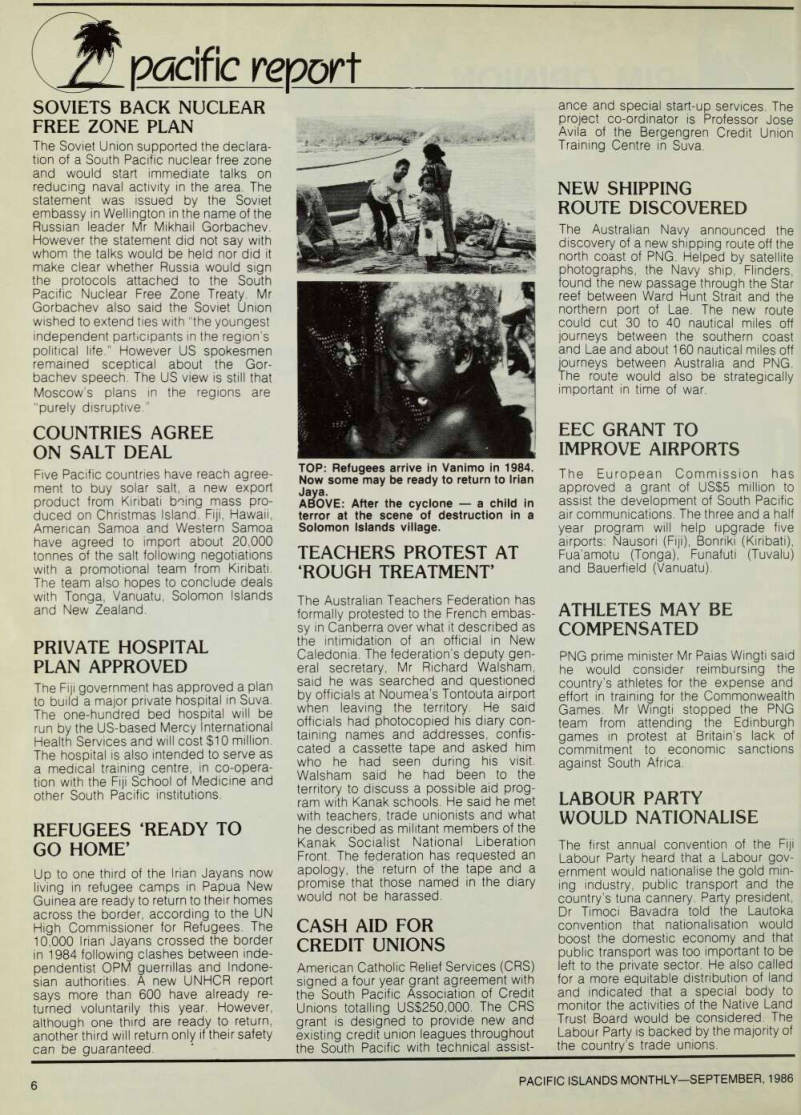
TOP: Refugees arrive in Vanimo in 1984.
Now some may be ready to return to Irian Java.
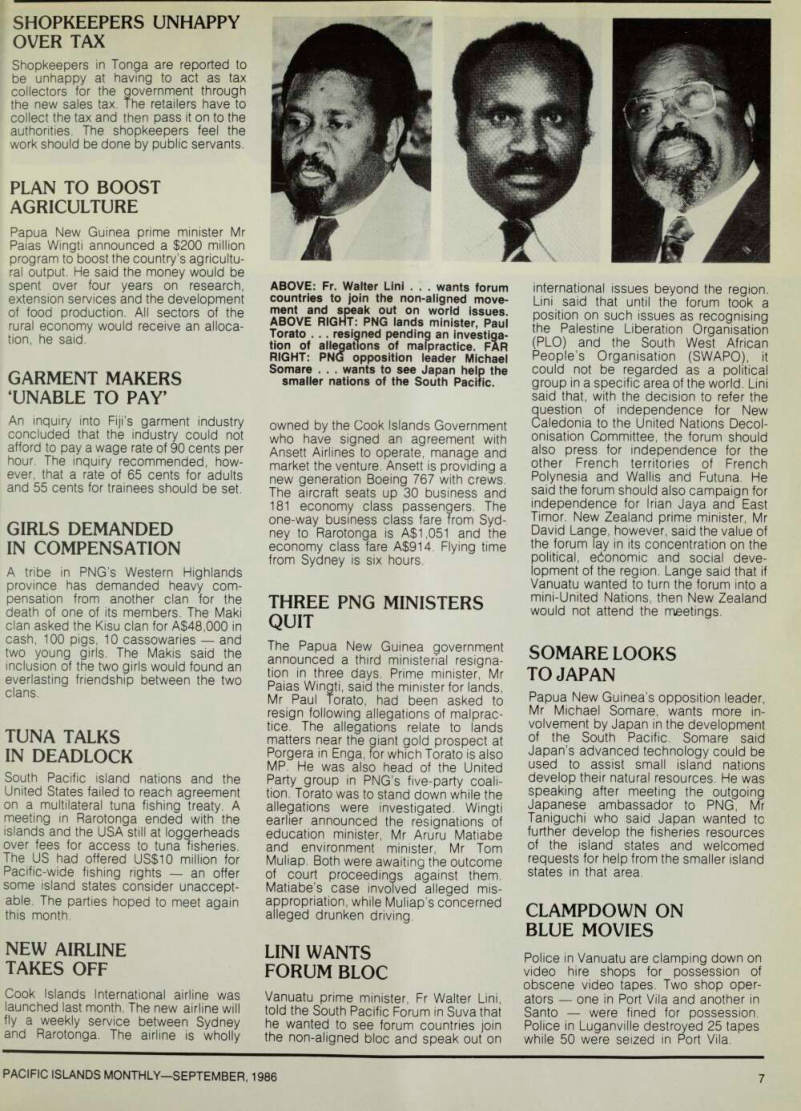
ABOVE: After the cyclone a child in terror at the scene of destruction in a Solomon Islands village.
Shopkeepers Unhappy
Over Tax
Shopkeepers in Tonga are reported to be unhappy at having to act as tax collectors for the government through the new sales tax. The retailers have to collect the tax and then pass it on to the authorities. The shopkeepers feel the work should be done by public servants.
Plan To Boost
Agriculture
Papua New Guinea prime minister Mr Paias Wingti announced a $2OO million program to boost the country’s agricultu ral output. He said the money would be spent over four years on research, extension services and the development of food production. All sectors of the rural economy would receive an alloca tion, he said.
Garment Makers
‘Unable To Pay’
An inquiry into Fiji’s garment industry concluded that the industry could not afford to pay a wage rate of 90 cents per hour. The inquiry recommended, how ever, that a rate of 65 cents for adults and 55 cents for trainees should be set.
Girls Demanded
In Compensation
A tribe in PNG's Western Highlands province has demanded heavy com pensation from another clan for the death of one of its members. The Maki clan asked the Kisu clan for A 548,000 in cash, 100 pigs, 10 cassowaries and two young girls. The Makis said the inclusion of the two girls would found an everlasting friendship between the two clans.
Tuna Talks
In Deadlock
South Pacific island nations and the United States failed to reach agreement on a multilateral tuna fishing treaty. A meeting in Rarotonga ended with the islands and the USA still at loggerheads over fees for access to tuna fisheries.
The US had offered US$lO million for Pacific-wide fishing rights an offer some island states consider unaccept able. The parties hoped to meet again this month.
New Airline
Takes Off
Cook Islands International airline was launched last month. The new airline will fly a weekly service between Sydney and Rarotonga. The airline is wholly
owned by the Cook Islands Government who have signed an agreement with Ansett Airlines to operate, manage and market the venture. Ansett is providing a new generation Boeing 767 with crews.
The aircraft seats up 30 business and 181 economy class passengers. The one-way business class fare from Syd ney to Rarotonga is A 51,051 and the economy class fare As9l4. Flying time from Sydney is six hours.
Three Png Ministers
Quit
The Papua New Guinea government announced a third ministerial resigna tion in three days. Prime minister, Mr Paias Wingti, said the minister for lands, Mr Paul Torato, had been asked to resign following allegations of malprac tice. The allegations relate to lands matters near the giant gold prospect at Porgera in Enga, for which Torato is also MP. He was also head of the United Party group in PNG’s five-party coali tion. Torato was to stand down while the allegations were investigated. Wingti earlier announced the resignations of education minister, Mr Arum Matiabe and environment minister, Mr Tom Muliap. Both were awaiting the outcome of court proceedings against them.
Matiabe’s case involved alleged mis appropriation, while Muliap’s concerned alleged drunken driving.
Uni Wants
Forum Bloc
Vanuatu prime minister, Fr Walter Lini, told the South Pacific Forum in Suva that he wanted to see forum countries join the non-aligned bloc and speak out on
international issues beyond the region.
Uni said that until the forum took a position on such issues as recognising the Palestine Liberation Organisation (PLO) and the South West African People's Organisation (SWAPO), it could not be regarded as a political group in a specific area of the world. Uni said that, with the decision to refer the question of independence for New Caledonia to the United Nations Decol onisation Committee, the forum should also press for independence for the other French territories of French Polynesia and Wallis and Futuna. He said the forum should also campaign for independence for Irian Jaya and East Timor. New Zealand prime minister, Mr David Lange, however, said the value of the forum lay in its concentration on the political, economic and social deve lopment of the region. Lange said that if Vanuatu wanted to turn the forum into a mini-United Nations, then New Zealand would not attend the meetings.
Somare Looks
To Japan
Papua New Guinea’s opposition leader, Mr Michael Somare, wants more in volvement by Japan in the development of the South Pacific. Somare said Japan’s advanced technology could be used to assist small island nations develop their natural resources. He was speaking after meeting the outgoing Japanese ambassador to PNG, Mr Taniguchi who said Japan wanted to further develop the fisheries resources of the island states and welcomed requests for help from the smaller island states in that area,
Clampdown On
Blue Movies
Police in Vanuatu are clamping down on video hire shops for possession of obscene video tapes. Two shop oper ators one in Port Vila and another in Santo were fined for possession.
Police in Luganville destroyed 25 tapes while 50 were seized in Port Vila.
ABOVE: Fr. Walter Lini ... wants forum countries to join the non-aligned move ment and speak out on world issues.
ABOVE RIGHT: PNG lands minister, Paul
Torato ... resigned pending an investiga
tion of alienations of malpractice. FAR RIGHT: PNG opposition leader Michael Somare . . . wants to see Japan help the smaller nations of the South Pacific.
Advertisements & other items, pp. 8-9 (1 item)
Thewssai
: r* . iiag ■ ■ *~v , * 3 iN * Sr
Strength
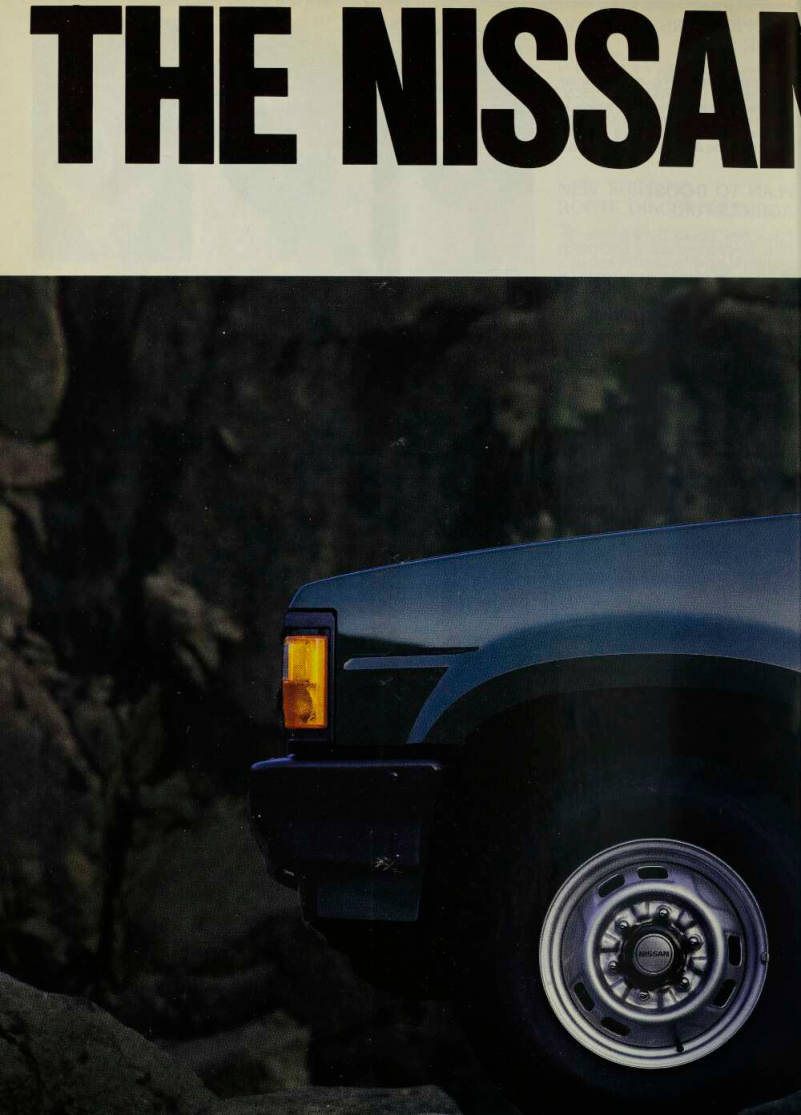
■ —i^— A vehicle’s strength depends on a complex interplay of varied factors. The overall design.
The body structure. The quality of the materials it is built of. The individual performance of the various mechanical components. Only when a vehicle is outstanding from every angle can it be said to possess genuine strength.
It is precisely this all-round excellence that gives the Nissan Pickup its extra margin of dependability. From the engine to the frame, the body panels to the suspension, the transmission to the bumpers, everything has been integrated into a vehicle of unsurpassed performance and durability.
In addition to the four usually found on ordinary makes, the closed-section The Nissan Pickup * ladder frame features a fifth cross member which, together with a more rational layout, enables the Pickup to tolerate heavier loads.
For further structural rigidity, the side members are made of thicker steel plates.
Add to that a double-wishbone front suspension and a leaf-spring rear suspension, plus a large-capacity, power-packed engine, and it’s easy to see why more people depend on the Pickup to handle tough jobs on rough roads.
In other words, the Pickup has a singular strength that comes from a complete rational matching of diverse parts into one unbreakable whole.
And it succeeds because it has that intangible yet very real quality that makes a Nissan what it is—The Nissan Dimension. frame and body are built for extra strength.
Quality in motion
NISSAN
NISSAN
Pathetic opinion and sloppy
letters
production values
Much better than the mutual back-slapping
Recent issues of PIM strongly suggest that the venerable publication is doing its best to make its regional competitors look good.
As a regular reader of PIM over a 15-year period, I feel entitled to comment on the lamentable decline in both con tent and layout in recent years.
The quality of feature articles has become so thin as to be almost non-existent and the general appearance of the magazine would do little justice to a surban charity newsletter with its ill-matched headlines and sloppy production values.
One can’t help observing that some of the contributors who helped PIM maintain a reason able standard, such as Robert Kiste, Floyd Takeuchi and Nor man Douglas do not seem to be writing for the magazine any longer.
Did they know something sooner than the readers? Thank God at least the Danielssons are still submitting copy.
But probably the most ob vious aspect of this decline in standards is the quality of the editorials these days.
The effort calling itself ‘PIM opinion’ on Libya and Vanuatu was as pathetic as I have ever seen. I note the editorials these days seem to feature a lot of blank space.
Is this an indication of the editor’s understanding of his topic?
If PIM can’t lift its game it deserves to be consigned to the trash can of journalistic history.
Perhaps the kindest thing its publishers could do would be to ackowledge its advancing years and increasing feebleness by giving it a golden handshake and sending it into retirement.
William Bennett
Flora Street Sutherland, NSW *The ill-tempered Mr Bennett is in a minority. PIM sales continue to increase editor.
As a former PIM reader who has returned to the fold after a number of years, I write to record my appreciation of how the magazine has changed.
From what I recall in the old days, PIM was something full of social chit chat and academic mutual back slapping.
The latest issue I have seen, (August) is, by comparison, full of news and analysis as opposed to rehashed reports that appeared in the local press some time ago.
However, I must agree with Mr Crain (August PIM, letters) that your editorial in June “The Cost of Links With Libya” is wide of the mark.
One suspects that, for one thing, Vanuatu simply seeks to make the point that it does have the right to establish relations with whomsoever it pleases. As a sovereign nation, surely that right is undeniable.
The “concerns” voiced by Australia and others smack of paternalism we’re big enough to deal with Libya and the Soviets, but you’ll have to grow up first.
Likewise on fisheries deal ings. Both New Zealand and the USA have fisheries agree ments with the Soviet Union, as PIM has reported on several occasions. How then can these two countries get upset when Kiribati or Vanuatu or anybody else seeks similar commercial agreements?
As for Vanuatu becoming isolated, it seems increasingly that the majority of island states are swinging round towards the Vanuatu-Kiribati position.
That said, thanks for the “new” PIM. I now look forward to it each month. (Name witheld for professional reasons), Boroko, PNG.
Pitcairn pen
pal, please?
I am writing to RIM to seek a penfriend on Pitcairn Island.
I am deeply interested in the fascinating history of this island, which sheltered the Bounty mutineers of 1789. I have studied the story so closely that I am able to draw a map of the island from memory, which I enclose.
My great dream is to corres pond with a girl who lives on Pitcairn Island. Beyond that, I hope one day to be able to go to Pitcairn to see first-hand what it is like.
I am 26 years of age, and I love black hair and deep brown eves.
Piero Pirisi
Via Silvestro II N2l 00767 Rome, Italy
Politics simmer
in US islands
GUAM faces two hotly contested rounds of elections this year, while American Samoa may have an interesting, one round election.
The political fates of Guam’s governor, Ricardo Bordallo, its congressman, Ben Blaz, and Samoa’s congressman, Fofo unia, will be on the line.
Guam’s voters will elect both a governor and a lieutenant governor, a congressman and all 21 members of the one house legislature, the senate.
At least two slates for gov ernor and It. governor are ex pected to run in both the Republican and Democratic pri maries this month with the surviving tickets competing with each other in the November general elections.
The two mainland political parties are well-organised on Guam and are roughly evenly matched. The incumbent con gressman is a Republican, while the sitting governor is a Demo crat. The current line-up in the Senate is 11 to 9 Democratic, with one vacancy.
The governorship of Samoa is not up for grabs until Novem ber, 1988; this year Congress man Sunia is running for re election to his seat in the House of Representatives and may be opposed by former governor Peter Tali Coleman.
Sunia sits with the Democrats in the National House, while Coleman is the chairman of the newly organised Republican Party of Samoa. The Samoan legislature, historically not elected along party lines, is to be chosen as well.
Facing off against each other in Guam’s September 6 pri mary are the four govemor/lt. governor slates; Democratic: Governor Ricardo Bordallo, Carl Gutierez. Lt. Governor Ed ward Reyes, John Aguon.
Republican: Governor Joe Ada, Tommie Tanaka. Lt. Gov ernor Frank Bias, Tony Unpingco.
Bordallo and Reyes are the incumbents; Gutierez is Speaker of the Senate, and all five of the other candidates are members of the Senate. (That six of the twenty current mem bers of the Senate, all men, are not running for re-election is a plus for the four women in the Senate, all of whom are run ning for re-election.) The race for the seat in the House of Representatives may be a hot one again this year; Blaz, after losing once to the longtime House member, Won Pat, narrowly defeated him in November, 1984. Pat then tried to use his contacts among the Democrats of the House (who have controlled that body for 52 of the last 56 years) to overturn the Blaz victory, claim ing that Blaz needed an abso lute majority of the vote, not the plurality that he enjoyed. Pat’s efforts were in vain.
This year the Democratic candidate is expected to be General Frank Torres, the head of Guam’s unit of the U.S.
National Guard.
Torres has announced for the seat and appears to have no contest in the primary, as Blaz has no contest in the Republi can primary.
The Democrats have apparently decided that Guam voters like Generals (Blaz won his star in the U.S. Marines, the first islander to secure flag rank in the American’s regular armed forces). Governor Bor dallo appointed Torres Adjutant General of Guam’s National Guard.
Torres announced that he was taking a leave of absence from this position when he declared his candidacy (on June 30); Torres’ non-resigna tion from the Guard may be a subject of controversy as the mainland tradition has been
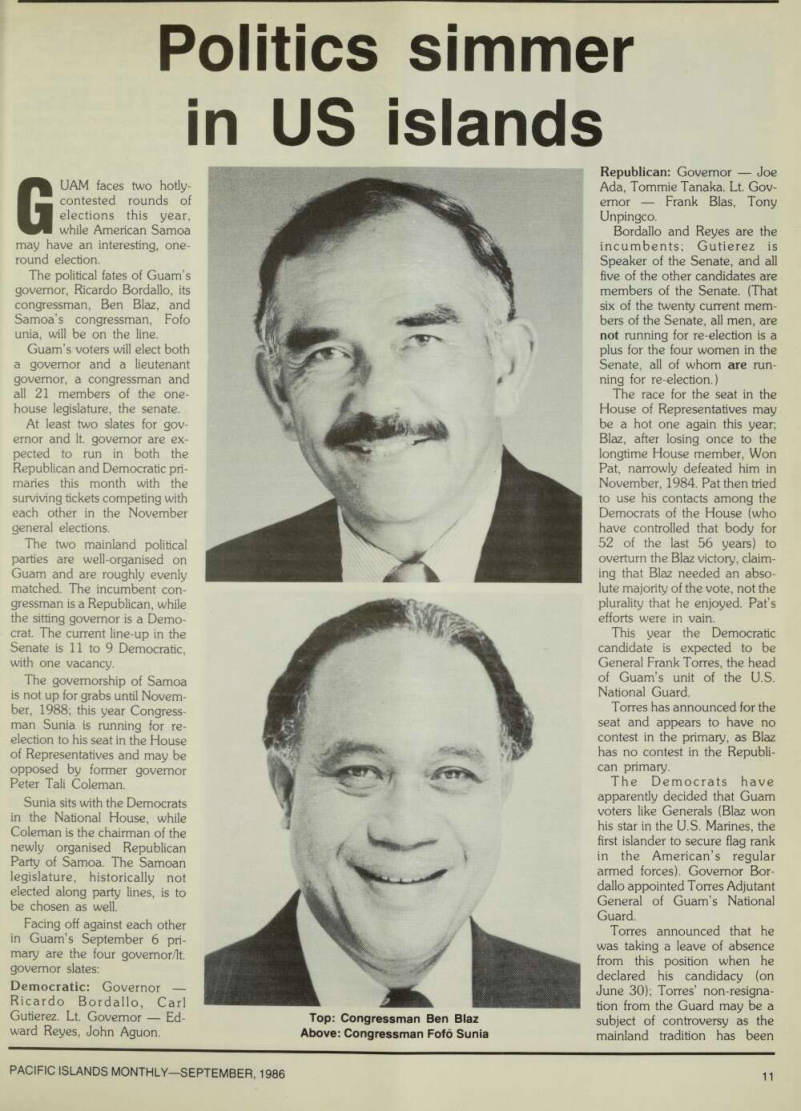
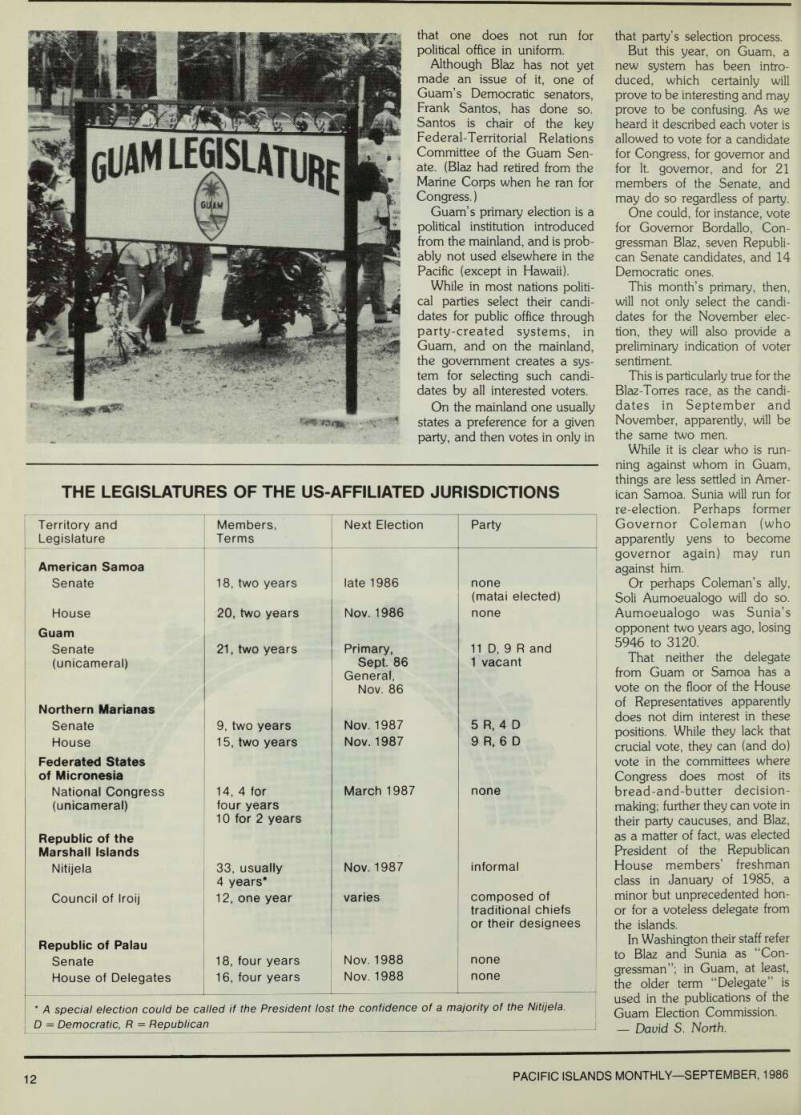
Top: Congressman Ben Blaz Above: Congressman Fofo Sunia
that one does not run for political office in uniform.
Although Blaz has not yet made an issue of it, one of Guam’s Democratic senators, Frank Santos, has done so.
Santos is chair of the key Federal-Territorial Relations Committee of the Guam Sen ate. (Blaz had retired from the Marine Corps when he ran for Congress.) Guam’s primary election is a political institution introduced from the mainland, and is prob ably not used elsewhere in the Pacific (except in Hawaii).
While in most nations politi cal parties select their candi dates for public office through party-created systems, in Guam, and on the mainland, the government creates a sys tem for selecting such candi dates by all interested voters.
On the mainland one usually states a preference for a given party, and then votes in only in
that party’s selection process.
But this year, on Guam, a new system has been intro duced, which certainly will prove to be interesting and may prove to be confusing. As we heard it described each voter is allowed to vote for a candidate for Congress, for governor and for It. governor, and for 21 members of the Senate, and may do so regardless of party.
One could, for instance, vote for Governor Bordallo, Con gressman Blaz, seven Republi can Senate candidates, and 14 Democratic ones.
This month’s primary, then, will not only select the candi dates for the November elec tion, they will also provide a preliminary indication of voter sentiment.
This is particularly true for the Blaz-Torres race, as the candi dates in September and November, apparently, will be the same two men.
While it is clear who is run ning against whom in Guam, things are less settled in Amer ican Samoa. Sunia will run for re-election. Perhaps former Governor Coleman (who apparently yens to become governor again) may run against him.
Or perhaps Coleman’s ally, Soli Aumoeualogo will do so.
Aumoeualogo was Sunia’s opponent two years ago, losing 5946 to 3120.
That neither the delegate from Guam or Samoa has a vote on the floor of the House of Representatives apparently does not dim interest in these positions. While they lack that crucial vote, they can (and do) vote in the committees where Congress does most of its bread-and-butter decision making; further they can vote in their party caucuses, and Blaz, as a matter of fact, was elected President of the Republican House members’ freshman class in January of 1985, a minor but unprecedented hon or for a voteless delegate from the islands.
In Washington their staff refer to Blaz and Sunia as “Con gressman”; in Guam, at least, the older term “Delegate” is used in the publications of the Guam Election Commission.
David S. North.
The Legislatures Of The Us-Affiliated Jurisdictions
* A special election could be called if the President lost the confidence of a majority of the Nitijela.
D = Democratic, R = Republican
Territory and Legislature Members, Terms Next Election Party American Samoa Senate 18, two years late 1986 none (matai elected) House 20, two years Nov. 1986 none Guam Senate 21, two years Primary, 11 D, 9 R and (unicameral) Sept. 86 General, Nov. 86 1 vacant Northern Marianas Senate 9, two years Nov. 1987 5 R, 4 D House Federated States 15, two years Nov. 1987 9 R, 6 D of Micronesia National Congress (unicameral) 14, 4 for four years 10 for 2 years March 1987 none Republic of the Marshall Islands Nitijela 33, usually 4 years* Nov. 1987 informal Council of Iroij 12, one year varies composed of traditional chiefs or their designees Republic of Palau Senate 18, four years Nov. 1988 none House of Delegates 16, four years Nov. 1988 none
say in decisions
Soviets have a say in decisions
A strange crew of decision makers, including Russian diplomats, will decide when and perhaps if the three Micronesian nations are to re ceive the billions of dollars promised by the United States.
The governments of the Federated States of Micronesia, the Republic of the Marshall Islands and the Republic of Palau want to enter into their new associations with the US, which, for its part, is keen to get with the new arrangements.
Congress has already voted the first money to the islands, but none will be handed over until the Compact of Free Association takes effect.
And that’s where the unusual group of decision makers com es into the picture.
Normally, the US Congress votes to spend money and, normally, the administration does so, unless the president vetoes the appropriation Bill or otherwise blocks the money.
So far, there have been no roadblocks in Washington as far as the promised US$3 billion is concerned. The problems have arisen in Palau and in New York.
Justice Gibson, a mainlan der, sitting in the Supreme Court of Palau, has ruled that the republic did not vote to approve the Compact of Free Association. His decision was that the 72 per cent support for the compact in the most recent Palau referendum is insuffi cient.
He ruled that Palau’s con stitution clearly requires a 75 per cent margin a defeat for President Lazarus Salii and a victory for the plaintiff, Chief Ibedul Yutaka Gibbons.
Salii immediately appealed against the ruling to the apellate division of the nation’s supreme court. And like many island courts that lack a steady stream of business, Palau’s appellate division sits irregularly.
It meets when required and its members normally three are appointed by the chief justice.
Whoever hears the appeal, Washington observers point out that, even if Justice Gibson’s ruling is upheld, there is an other avenue for the pro-com pact forces.
The 75 per cent rule is written into the Palau constitu tion (July PIM, p 7) which could probably be amended to a lower figure by the compact’s supporters.
The Palau establishment has,
however, consistently avoided this in the past.
It is also not inconceivable that the government in Washington might decide, un ilaterally, that 72 per cent is enough of a majority to show that the Palauans on the whole are in favour of the compact.
And that’s where the Rus sians come back into the pic ture.
The view from Moscow is that the US is steadily throwing a ring of bases around the Soviets and sees the compact as a strategic device.
This makes the situation at the UN murky. While the UN Trusteeship Council has voted overwhelmingly for termination only the Russians disagreed the next step is up to the Security Council where the Russians have hinted strongly
that their veto may come into play.
But a security trusteeship has never been terminated before.
There are no clear precedents on procedure so that the US and its allies as well as the Russians may find themselves jockeying for position.
And since procedural ques tions are often determined by the views of the presiding offic er, the timing of any hearing will be vital.
During this month the Secur ity Council is chaired by the Soviet representative. Next month it rotates to the pro-west United Arab Emirates and then to the United Kingdom and then to the US itself.
The US, therefore, is quite likely to seek to delay any moves at least until after
September.
David North.
How the leaders come to power
The legislature of American Samoa is called the Fono; the lower house is appor tioned by population and elected by univer sal suffrage; the upper house is elected by persons (largely men) holding the traditio nal title of matai.
The governor is elected directly, and although the current governor identifies himself as a national Democrat, as the previous one called himself a national Republican, elections are non-partisan.
Mainland type party-line elections occur in Guam, where all 21 members of the Senate are elected at large; two months before the general election each major party picks up to 21 candidates in pri maries.
Each voter can vote for up to 21 candidates in the primary and in the general. The Governor is elected directly in a partisan election.
The Senate of the Northern Marianas is divided three seats per island; the lower house is apportioned by population, with 13 seats allocated to the more populous Saipan, and one each to Tinian and Rota.
The Governor is elected directly.
The Federated States of Micronesia have one of the more complex systems among those described here. Each of the four states (Kosrae, Pohnpei, Truk and Yap) elect a four-year senator; the president and the vice president are chosen from these four by the fourteen members of the National Congress; then by elections are held to replace the president and the vice president.
The other ten seats are apportioned by population and elected directly for two-year terms. Thus, comparing this system to that of the mainland, a single body, the National Congress, plays the role of the U.S. Senate (equal representation for states), of the U.S.
House of Representatives (representation by population) and of the Electoral College (which formally chooses the U.S. Presi dent).
The Republic of the Marshall Islands follows the British pattern; the lower (and more powerful) house is elected directly, and the members then choose a president who is the head of government.
If the president were to lose the confi dence of the majority a resignation would be expected; there is an informal division between 23 members supporting the gov ernment, the Ailin Kein Ad (Our Islands) party, and ten members backing the opposition, the Ainikien Dri Majol (The Voice of the Marshalls).
The other legislative body Marshallese do not use the concept of an upper and a lower house is the Council of Iroij, which consists of twelve traditional chiefs or their deputies. The Council does not have the power to overrule the Nitijela, and has powers confined to traditional matters, such as titles and land tenure.
In the Republic of Palau the senate is based on population and the House has one representative from each state. The presi dent and the vice president are elected directly and separately.
Compliments
to the Senator
I see a lot of state senators, and you do not look like one.”
The comment, meant as a compliment, was accepted as such by Guam Senator Marilyn Manibusan.
Making the comment was the chief clerk of the committee, a woman who had seen many a state senator, but few were young, petite, female and Cha morro. The senator is all that and more.
She had made the long trip to Washington to testify on the proposed Guam Common wealth Act before the House of Representatives Committee on
Interior and Insular Affairs; Guam’s congressman Ben Blaz had facilitated her appearance.
While in Washington she was also working on a conference to protest against the dumping of nuclear waste in the Pacific.
Senator Manibusan carried a collection of titles into the hear ing room. In addition to being the only Republican woman in the Guam Senate she is the minority leader of the body, a representative of the Senate on Guam’s Commission on Self- Determination and the Territor ial chair of the Republican Party.
Bom on Guam, she spent
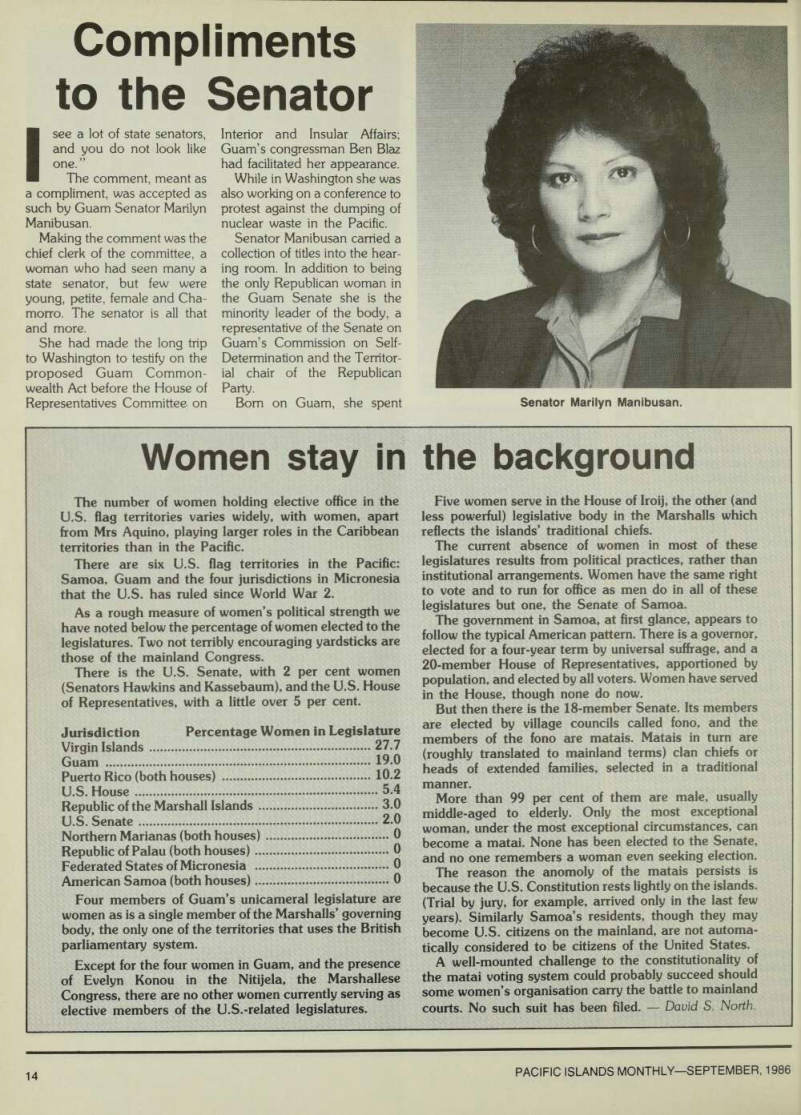
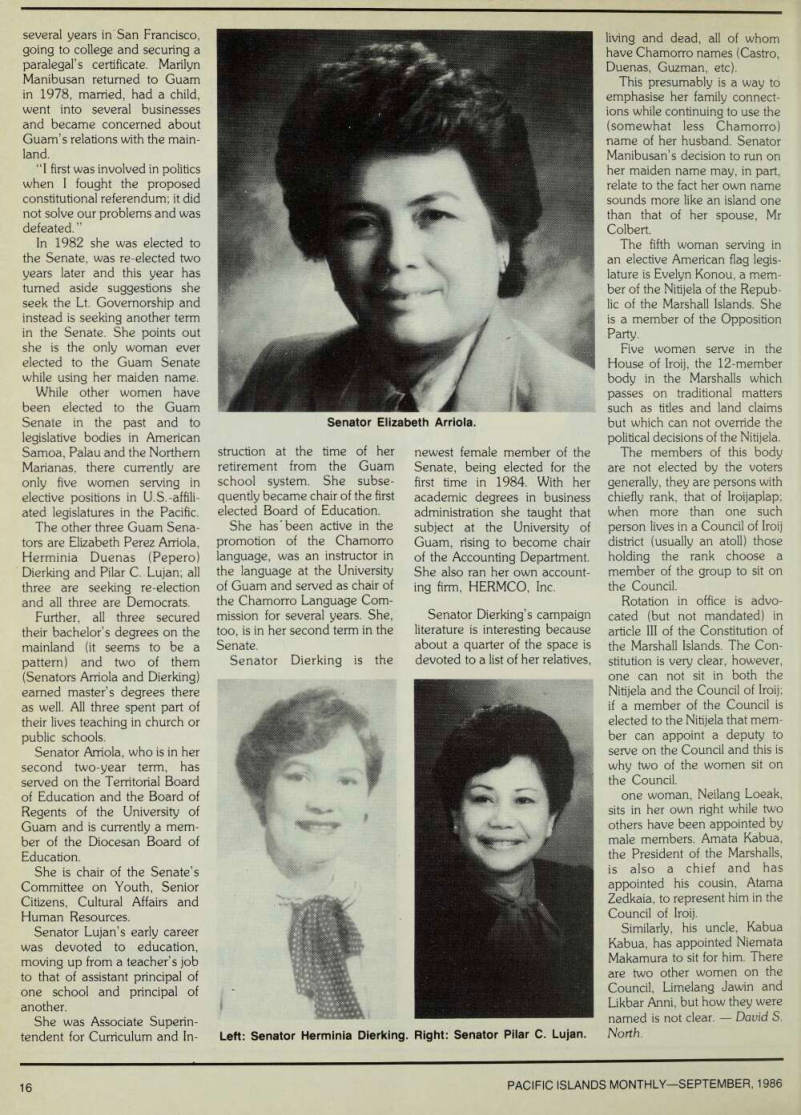
Senator Marilyn Manibusan.
several years in San Francisco, going to college and securing a paralegal’s certificate. Marilyn Manibusan returned to Guam in 1978, married, had a child, went into several businesses and became concerned about Guam’s relations with the main land.
“I first was involved in politics when I fought the proposed constitutional referendum; it did not solve our problems and was defeated. ”
In 1982 she was elected to the Senate, was re-elected two years later and this year has turned aside suggestions she seek the Lt. Governorship and instead is seeking another term in the Senate. She points out she is the only woman ever elected to the Guam Senate while using her maiden name.
While other women have been elected to the Guam Senate in the past and to legislative bodies in American Samoa, Palau and the Northern Marianas, there currently are only five women serving in elective positions in U.S. -affili ated legislatures in the Pacific.
The other three Guam Sena tors are Elizabeth Perez Arriola, Herminia Duenas (Pepero) Dierking and Pilar C. Lujan; all three are seeking re-election and all three are Democrats.
Further, all three secured their bachelor’s degrees on the mainland (it seems to be a pattern) and two of them (Senators Arriola and Dierking) earned master’s degrees there as well. All three spent part of their lives teaching in church or public schools.
Senator Arriola, who is in her second two-year term, has served on the Territorial Board of Education and the Board of Regents of the University of Guam and is currently a mem ber of the Diocesan Board of Education.
She is chair of the Senate’s Committee on Youth, Senior Citizens, Cultural Affairs and Human Resources.
Senator Lujan’s early career was devoted to education, moving up from a teacher’s job to that of assistant principal of one school and principal of another.
She was Associate Superin tendent for Curriculum and In-
struction at the time of her retirement from the Guam school system. She subse quently became chair of the first elected Board of Education.
She has'been active in the promotion of the Chamorro language, was an instructor in the language at the University of Guam and served as chair of the Chamorro Language Com mission for several years. She, too, is in her second term in the Senate.
Senator Dierking is the
newest female member of the Senate, being elected for the first time in 1984. With her academic degrees in business administration she taught that subject at the University of Guam, rising to become chair of the Accounting Department.
She also ran her own account ing firm, HERMCO, Inc.
Senator Dierking’s campaign literature is interesting because about a quarter of the space is devoted to a list of her relatives,
living and dead, all of whom have Chamorro names (Castro, Duenas, Guzman, etc).
This presumably is a way to emphasise her family connect ions while continuing to use the (somewhat less Chamorro) name of her husband. Senator Manibusan’s decision to run on her maiden name may, in part, relate to the fact her own name sounds more like an island one than that of her spouse, Mr Colbert.
The fifth woman serving in an elective American flag legis lature is Evelyn Konou, a mem ber of the Nitijela of the Repub lic of the Marshall Islands. She is a member of the Opposition Party.
Five women serve in the House of Iroij, the 12-member body in the Marshalls which passes on traditional matters such as titles and land claims but which can not override the political decisions of the Nitijela.
The members of this body are not elected by the voters generally, they are persons with chiefly rank, that of Iroijaplap; when more than one such person lives in a Council of Iroij district (usually an atoll) those holding the rank choose a member of the group to sit on the Council.
Rotation in office is advo cated (but not mandated) in article 111 of the Constitution of the Marshall Islands. The Con stitution is very clear, however, one can not sit in both the Nitijela and the Council of Iroij; if a member of the Council is elected to the Nitijela that mem ber can appoint a deputy to serve on the Council and this is why two of the women sit on the Council. one woman, Neilang Loeak, sits in her own right while two others have been appointed by male members. Amata Kabua, the President of the Marshalls, is also a chief and has appointed his cousin, Atama Zedkaia, to represent him in the Council of Iroij.
Similarly, his uncle, Kabua Kabua, has appointed Niemata Makamura to sit for him. There are two other women on the Council, Limelang Jawin and Likbar Anni, but how they were
named is not clear.
David S.
North.
Senator Elizabeth Arriola
Left: Senator Herminia Dierking. Right: Senator Pilar C. Lujan
Women stay in the background
The number of women holding elective office in the U.S. flag territories varies widely, with women, apart from Mrs Aquino, playing larger roles in the Caribbean territories than in the Pacific.
There are six U.S. flag territories in the Pacific: Samoa, Guam and the four jurisdictions in Micronesia that the U.S. has ruled since World War 2.
As a rough measure of women’s political strength we have noted below the percentage of women elected to the legislatures. Two not terribly encouraging yardsticks are those of the mainland Congress.
There is the U.S. Senate, with 2 per cent women (Senators Hawkins and Kassebaum), and the U.S. House of Representatives, with a little over 5 per cent.
Jurisdiction Percentage Women in Legislature Virgin Islands 27.7 Guam 19.0 Puerto Rico (both houses) 10.2 U.S. House 5.4 Republic of the Marshall Islands 3.0 U.S. Senate 2.0 Northern Marianas (both houses) 0 Republic of Palau (both houses) 0 Federated States of Micronesia 0 American Samoa (both houses) 0 Four members of Guam’s unicameral legislature are women as is a single member of the Marshalls’ governing body, the only one of the territories that uses the British parliamentary system.
Except for the four women in Guam, and the presence of Evelyn Konou in the Nitijela, the Marshallese Congress, there are no other women currently serving as elective members of the U.S.-related legislatures.
Five women serve in the House of Iroij, the other (and less powerful) legislative body in the Marshalls which reflects the islands’ traditional chiefs.
The current absence of women in most of these legislatures results from political practices, rather than institutional arrangements. Women have the same right to vote and to run for office as men do in all of these legislatures but one, the Senate of Samoa.
The government in Samoa, at first glance, appears to follow the typical American pattern. There is a governor, elected for a four-year term by universal suffrage, and a 20-member House of Representatives, apportioned by population, and elected by all voters. Women have served in the House, though none do now.
But then there is the 18-member Senate. Its members are elected by village councils called fono, and the members of the fono are matais. Matais in turn are (roughly translated to mainland terms) clan chiefs or heads of extended families, selected in a traditional manner.
More than 99 per cent of them are male, usually middle-aged to elderly. Only the most exceptional woman, under the most exceptional circumstances, can become a matai. None has been elected to the Senate, and no one remembers a woman even seeking election.
The reason the anomoly of the matais persists is because the U.S. Constitution rests lightly on the islands. (Trial by jury, for example, arrived only in the last few years). Similarly Samoa’s residents, though they may become U.S. citizens on the mainland, are not automa tically considered to be citizens of the United States.
A well-mounted challenge to the constitutionality of the matai voting system could probably succeed should some women’s organisation carry the battle to mainland
courts. No such suit has been filed.
David S. North.
Advertisements & other items, pp. 15-17 (1 item)
Powering the Pacific
Can you find the “P” in the symbol above? The drop of oil? The island? The sail of a Polynesian voyaging canoe? In it are all of these elements and more, because it’s the new corporate symbol for Pacific Resources, Inc. — the most dynamic and progressive energy company in the whole booming Pacific Basin. PRI is dedicated to American Samoa and the Pacific, helping to mold their economic destiny. We will continue to pioneer petroleum products, gas and alternative energies and to participate fully in community service activities. From now on when you see this symbol, we hope that’s what you’ll remember. PRI
PRI South Pacific, Inc. • A PRI Company For more information, contact Rusty Betham in American Samoa at 633-5331.
ARC WELDING
WELDERS, WELDING SUPPLIES
240 V POWER SOURCES
Weldanpower 175 Portable Welder/ Power Source • Petrol, and diesel with impulse start or with electric start and undercarriage. • Current range 60-175 amps AC • Electrode range 2.0-4.omm • AC auxiliary power 240 V, 4.5 kW, 50 Hz • Roll frame is standard except for electric start model.
Weldanpower 225 AC/DC Portable Welder/Power Source • Two models, petrol or diesel • Current range 50-225 amps AC 70-250 amps DC • Electrode range 2.0-s.omm • AC auxiliary power 240 V, 6kW, 50Hz • Electric start is standard on both models. r?
IC 140 Welder and
Battery Charger
• Plug-in 240 V welder complete with leads and 15 amp 3 pin plug • Electrode range 2.0-3.2 mm • Latest solid state components provide continuous variable current control even while welding.
AC225-S workshop welder with larger capacity also available Lincoln Accessories and Electrodes Linctong electrode holder, light, cool, comfortable.
Insulated and with replaceable parts.
Twistong 400 electrode holder, fully insulated, handle twists to lock onto electrode stub.
Well balanced and comfortable to use. (See picture.) Coolshield 4 welding shield with flip-up front. Clear, inner lens gives protection during deslagging and weld cleaning operations.
Lincoln also supply cables, clamps, gloves and a range of electrodes.
Dis-gen 25kVA
Generating set,
240 V, 50Hz
Powered by the Perkins 3 cyl. diesel: low speed, quiet and robust machine. Suitable for home and shed electric power.
Dis-gen 6.SkVA Basic Generating
set, 240 V, 50Hz
Realiable, 1500 rpm, smoothrunning auxiliary generating set.
Inbuilt engine protection and safety features on the alternator assure peace of mind.
Powered by the Kubota 4-cycle diesel engine with indirect injection.
dehsm-,
[ARC WELDING]
cn o o «!
CARPENTERS MOTORS ELA MOTORS COMPONENTS
SUVA. Phone 313644 PORT MORESBY. Phone 217036 The Lincoln Electric Co. (Australia) Pty. Ltd. (Inc. in N.S.W.) 35 Bryant Street, Padstow. N.S.W. 2211 Phone 772 7222. Tlx 22792 LE177.25/18 Slatter
The calm after the storm
The offices on the seventh floor of Noumea’s In dosuez Bank building give the impression of emptiness.
Furnished only with functio nal desks, barely enough chairs and telephones, the office walls, apart from a few posters, are bare.
But despite the spartan sur roundings, there is an air of quiet determination and in dustry. Architects’ plans for ma jor tourist complexes, details of a proposed information service as well as several other deve lopment projects are laid out on the desk tops and are mulled over, added to and discussed by a handful of staff.
The offices are the main administrative bases for three of New Caledonia’s four regions the three controlled by the Kanak Socialist National Liberation Front (FLNKS).
It’s a far different environ ment from the ramshackle two storey house on the poorer side of the city, which served as the front’s HQ at the start of its struggle for the French terri tory’s independence and de notes significant progress to wards that goal.
It also signals a clear strategy change. The emphasis is now on development of the regions to demonstrate the ability of the Kanak people to govern re sponsibly.
Despite warnings of a pos sible return to violence in the face of the French govern ment’s new plans for the future of New Caledonia, it’s clear that that is an option nobody wants to see revived.
FLNKS leader Jean-Marie Tjibaou has tried to remain positive. Shortly after the plan was endorsed by the French National Assembly in Paris, he declared that there were at least some good aspects.
The regions had been left in place and an all-important re ferendum on the question of independence had been sche duled for the latter half of next year.
Signs of normality are returning to New Caledonia. The economy is recovering from a stormy two years. Building has started again; car and furniture sales are buoyant.
There are even a few tourists to be seen. But the independence movement is still active while maintaining a low profile. SUE WILLIAMS reports
While the front was not ex pected to accept the new sta tute which strips the regions of much of their autonomy and scraps the office which had been responsible for buying back land for the Kanak people, it was expected to vote to stay within the institutions of the regions at the FLNKS congress due to be held after the South Pacific Forum.
A decision along such lines would certainly fit the new image the front wants to pre sent and, more importantly, could indicate the existence of a deal with the Chirac govern ment in Paris ensuring an open door for the independentists and a readiness to consider the demands of the Kanaks’ elected representatives.
While this prospect would be less than palatable to the strong anti-independence forces in Noumea, there appears to be a more positive attitude to the future of the territory in that camp as well.
Most loyalists would say that, since the election of the con servative Chirac government last March, the territory’s prob lems have been solved.
They are now convinced that they have a Paris government sympathetic to their views.
Consequently there has been a return of confidence in Noumea. There is a new energy about the city.
There is also emerging a new and somewhat paternalistic (cynics might say patronising) view of the Kanaks, perhaps indicating a willingness to “for give” the events of the past two years and work for the future.
The daily newspaper Les Nouvelles, is these days full of goodwill-type stories. We are told, for instance, what a mar
vellous job the military is doing in the Melanesian villages giving medical assistance, stag ing sporting events and gener ally getting involved.
Not seen', however, are the reports carried by the FLNKS newspaper, Bwenando, of alleged abuses by the military such as the early morning raids and the destruction of property.
We are also told by Les Nouvelles that the Melanesians living outside of Noumea are to be given the opportunity to prove they are responsible citi zens by being allowed to once again buy alcohol during the week.
Alcohol sales in the bush had been banned since the eruption of political unrest before November 28, 1984. The ban stayed in place in Noumea at weekends as well.
Although news of the work in progress or being attempted in the regions is now being re ported in the press, the extent of the organisation involved and the determination of the FLNKS-held councils to suc ceed is not well understood in the loyalist camp.
Most of these people live in Noumea and most would con sider the regions a useless en terprise and that the return to order in the bush can only be attributed to the efforts of the conservatives whose return to power in France has put the FLNKS in its place.
Certainly the front has main tained a low profile, but it is obviously in its long term in terest to keep things calm and avoid arousing the passions of their opponents who have alrady proved themselves a militant force.
It is also in the interest of the right wing to help keep the
peace and foster the new found optimism.
The economy has taken a fearsome battering over the past 20 months and this could not have continued without heavy social cost to the whole community.
Now the tourists are starting to return. The holiday industry is not out of trouble yet, but the 4,500 bookings which flowed from an intensive television campaign in Australia have brought a few sighs of relief.
Building has also started to recover and general consump tion such as car and furniture sales is now back to normal.
A further injection of Asloo million in aid promised by the Paris government will further boost the economy.
Despite the FLNKS criticism of the French government’s plans for New Caledonia, Mr Bernard Pons, its author and minister in charge of the terri tory, may have struck a work able formula.
With the right wing tamed by a new sense of security, he is tacitly allowing the FLNKS, through the regional councils, to solidify its base and take charge of the direction of the Kanak people.
But there remain in the front many who doubt the minister’s motives. Most of his public pronouncements, after all, have been blatantly pro-loyalist.
But behind the rhetoric, Mr Pons and his government must realise they cannot afford to ignore the FLNKS and risk further outbreaks of violence particularly in view of their hopes to dislodge president Francois Mitterand in the 1988 elections.
The socialist president has already proved to be a thorn in the side of the conservative government and has the con stitutional power to dissolve parliament and delare fresh elections a step he would no doubt take if he thought he could bring his own party back into power.
Advertisements & other items, p. 19 (1 item)
Ocitizen
m*n. \ '\ 0
itW
V S H V
The
Exclusive
Collection
The ultimate in precision, style and grace.
Created by Citizen to complement any occasion, perfectly
OCITIZEN
CWIO7/86USP Needham
After Namu: Life must go on
More than 1000 people dead, 90,000 that’s one third of the popu lation homeless and damage to property put at Asloo million.
The bald statistics are the measure of the worst cyclone in living memory and, indeed, in oral legend that hurled itself against the east coast of the Solomon Islands on May 18 this year.
The trauma of lives lost, homes destroyed and property damaged is bad enough, but the long term repercussions of Cyclone Namu go further.
Entire communities are now dependent on international re lief agencies, on hand-outs of food, clothing, shelter and cooking implements.
In the absence of thatch, plastic sheeting is used for roof ing. Where swollen rivers have swept away food gardens, where soils are leached, where villagers must wait five years for new sago palms to mature, their staple diet is now tinned meat or fish and hard biscuits.
Will they ever return to their traditional subsistence liveli * Chris Ashton is an Austra lian freelance journalist who was based in Papua new Guinea before its independ ence. He has travelled through out the Pacific.
The devastation caused by Cyclone Namu caught the attention of the world when it struck Solomon Islands on May 18. Here, CHRIS ASHTON* discusses the aftermath of the tragedy as seen through the eyes of an Australian documentary film unit who landed in the disaster area within days of Namu’s deadly arrival.
hoods, or will they now acquire a taste for the imported fare?
And how is this island state, with a fragile cash economy at the best of times, to recover so much lost ground?
These are among the ques tions posed by a one-hour documentary program pro duced by the Australian Gov ernment film unit, Film Austra lia, with funding by the Austra lian Development Assistance Bureau.
The central focus of the film is the aftermath of Cyclone Namu. A four-man film crew flew into Honiara six days after the cyclone struck and spent 18 days recording the havoc left in its wake.
Villagers, impressively fluent English speakers, told them what had happened and what their communities must now do to rebuild their shattered lives.
A doctor flown in by the National Safety Council of Aus tralia tells of an operation car ried out under near-impossible conditions in the early hours of the morning to save the life of a small girl suffering from an abcess.
Prime Minister Sir Peter Kenilorea tells of his country’s commitment to recovery.
One of the hazards of a calamity like Cyclone Namu was the breakdown of the traditional sanitary systems and the consequent spread of dis ease.
The nation’s health depart ment and the National Council of Women broadcast warnings to the village people to boil all drinking water, to wash their hands after the toilet and to drain off stagnant pools, breed ing grounds for malaria carrying mosquitoes.
But the old adage that every cloud has a silver lining also applied. The National Disaster Council and the public services swung into action and were equal to the crisis.
The Solomons also drew support from a wide variety of neighbours: Red Cross person nel from PNG, Australia and New Zealand; Hercules air transports from the Australian and New Zealand air forces carrying fuel, medical teams and supplies.
Other emergency relief came
from the Australian and French navies. Australian sailors de fused explosives that, until the arrival of Namu, had lain buried since World War Two, blew up log jams where swollen rivers had swept whole forests down stream, repaired buckled bridges and brought in vital water purification plants.
The film is not solely about Cyclone Namu and its aftermath, however. This is set, rather, against a profile island mini-state in many ways typical of its South Pacific neighbours.
A Methodist mission film, shot in 1910, offers splendid re-enactments of tribal fighting, blackbirders recruiting and abducting islanders for the Queensland and Fiji canefields and the activities of the Christ ian missions.
Other archival film shows the ferocity of the war fought be tween the Allies and Japan while more recent material shows how vulnerable are is land economies to slight fluctuations in world commodi ty prices and the fragile equilib rium between the traditional ways and the western ’pop’ culture and the cash economy.
The issues are familiar enough. But against the stark background of Cyclone Namu they will raise consciousness among television audiences beyond the South Pacific.
To the wider world, the stereotype image of palm-fring ed beaches, blue lagoons and bounteous nature will be jolted by the effects of a disastrous cyclone.
Cyclone Namu goes some way towards correcting the tourist’s image of the islands.
But at a more practical level, it is a teaching aid that may be valuable in other island states that have also, and will again, face the fury of a cyclone.
The Australian Broadcasting Corporation screened Cyclone Namu in two parts in successive weeks in July. It is now avail able as a video cassette in Fiji, PNG, New Zealand and Solo mon Islands. The price will be less than As2o.
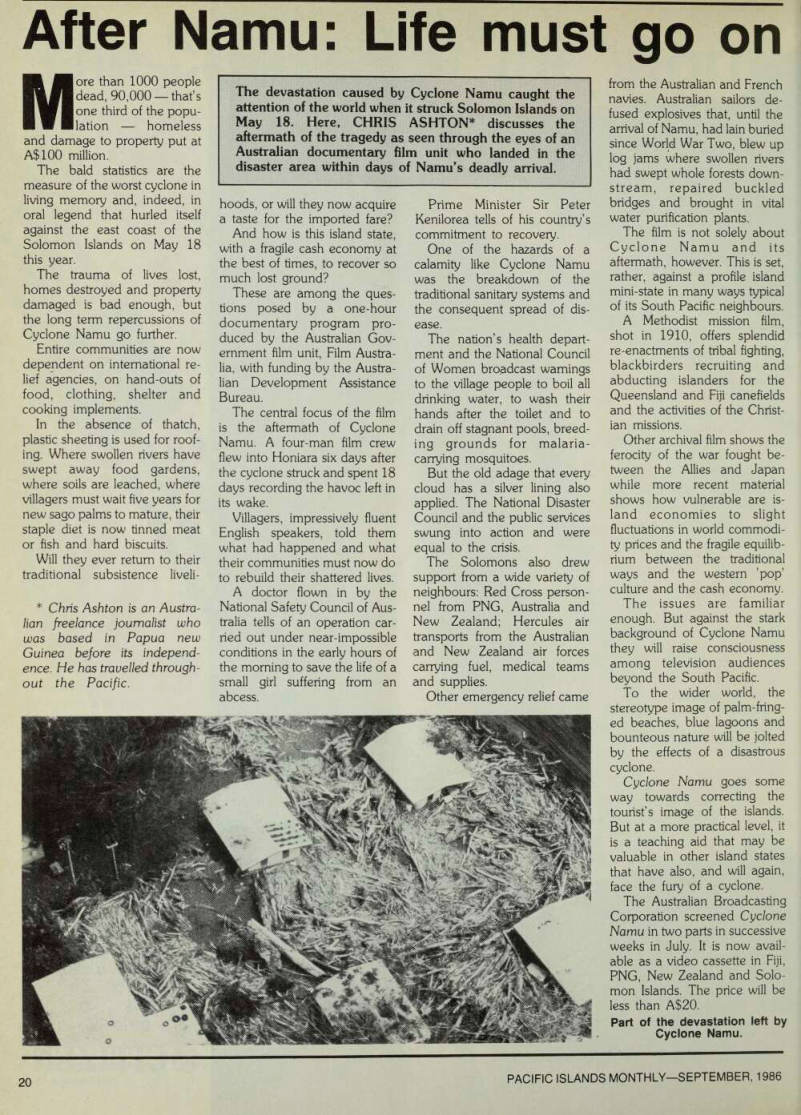
Part of the devastation left by Cyclone Namu.
on fishing talks

Forum changes tack on fishing talks
The next round of mul tilateral fishing talks be tween the United States and South Pacific nations is likely to result in a happier outcome, according to senior participants at the South Pacific Forum in Suva last month.
After five years of sometimes bitter exchanges, high seas arrests of US registered fishing boats and a drift of disaffected states towards agreements with the Soviet Union, forum dele gates emerged confident that a satisfactory cash deal will be struck, perhaps late this month.
“We felt that it won’t be too hard to resolve at the next talks,” one insider candidly told
Pim.
The next round of multilate ral negotiations is scheduled for a Micronesian venue.
In a comparatively brief dis cussion which followed the pre sentation of a report by the Forum Fisheries Agency chief, Mr Philip Muller, nations voted to speed up the process.
Both in the plenary meeting and later in the informal discus sions at their Fijian Hotel re treat, regional leaders worked over the terms on which a settlement might be reached with Washington and how the proceeds might be distributed around the region.
Countering an American offer of US$7 million yearly over the next five years, the forum members will drop their claim of US$l6 million annual ly to US$lO million per year together with a licencing fee per boat of US$5O,OOO.
Forum leaders are likely also to settle on a distribution formu la for the proceeds. This would involve 25 per cent of the fee being distributed among the treaty signatories with the ba lance being apportioned accor ding to reported catches from the various EEZs.
This fits closely with the kind of agreement Vanuatu has been negotiating with the Soviet Union. Interestingly enough, Moscow’s latest pro
posals are due for presentation to the Lini government on the eve of the next scheduled round of US multilateral talks in which Vanuatu has also been taking a close interest.
However, according to forum sources, there has been no criticism of “brinkmanship” over the Vanuatu position.
In an interview before the forum, Vanuatu foreign minis ter Mr Sela Molisa downplayed regional fears of a Soviet pre sence, saying it is all a question of selling fish to the highest bidder.
And Vanuatu has apparently convinced at least some Pacific
neighbours of the validity of this strategy.
According to New Zealand prime minister, Mr David Lange, who only a matter of months ago was expressing concern at Vanuatu treating with the Soviets, “Vanuatu is in the business of securing the best return for its fish. If the Americans outbid Moscow, I am sure that Father Lini will be delighted. ”
The Vanuatu leader, said Lange, was misread by both Lange’s predecessor, Sir Robert Muldoon, and by for mer Australian prime minister, Mr Malcolm Fraser.
Continued page 35
From page 21 “What happened after a combination of Messrs Mul doon and Fraser leaning on him was that he went to Cuba, Libya and Russia and I doubt that was their strategy,” said Lange.
“It is better for us not to move him on to another axis,” he added, downplaying pre vious pressure on Vanuatu.
“They are not given to the worst excesses of Marxist- Leninist rigorous economy drives. They are people who take the best prices for com modities, register the most pro fitable ships, provide tax havens and go to church,” Lange said in a briefing for New Zealand journalists.
Fomm leaders individually stressed that they felt now was the time for a settlement with Washington since the US had given so much ground.
“The United States has come to grips with the fundamental problem,” said Lange, “that it cannot allow its foreign policy interests to be directed by the (American) Tunaboat Associa tion.
“And the Pacific has come to
grips with the problem that it cannot allow its most valuable resource for some countries to go unexploited or exploited without a return.”
In words which other mem bers of the fomm indicated to PIM refelct their views, Lange added: “It is in the interests of them all to have an understan ding between the US State Department and the Fomm Fisheries Agency, whereby an economic return is guaranteed.
“That may well mean a form of assistance which is beyond that which fishing companies are able to pay in fact you can call that a subsidy, or you can call that common sense.
Denis Reinhardt.
Lange: “Call it common sense.”
‘A diplomatic
watershed’
As a telex to the United Nations was on the wire from Suva to New York, where it was to be delivered by the Vanuatu permanent representative, French observers continued to express displeasure.
The telex requested the UN to relist New Caledonia in the number of non self-governing territories through the committee of 24 the UN Committee on Decolonisa tion.
The decision was recognised in Suva as a watershed.
France successfully asked the UN in 1947 to consider the territory an integral part of the mother country, and so it has remained.
French leaders, however, still have formidable weapons in their armoury and both diplomatic and trade pressures can be expected as France attempts to stem the flow towards support for independence.
For while the forum once again expressed support for a peaceful transition to independence and ackowledged some positive aspects in the approach of the new French government, it was disappointed that “the change in French policy ... was a significant backward step.”
Forum members will now pursue their objective of relisting New Caledonia through their memberships of various international groupings.
The forum members noted also that, if the coming referendum ruled out the prospect of independence, this was likely to exacerbate rather than resolve problems in the territory.
Advertisements & other items, pp. 21-22 (1 item)
Sheaffer
f Q The way you write and the pen you choose both say a lot about you.
Slanted writing with large loops can show responsiveness and imagination. Choosing a Sheaffer shows you appreciate a superior pen that makes a stylish gift. Only Sheaffer has such superb styling and craftsmanship with such a range of fine finishes.
Distinctive Matte Black.
Fountain pen, ballpoint, pencil and slim rolling hall pen with interchangeable micro tip marker.
Slim or classic profile.
SHEAFFER
SHEAFFER PEN
Al A/SMS3PS
fc. - ,s."
I* n? . . I mm
AFBS
Digital Director
Compact Disc digital audio has sparkefl a revolution in the world of music enjoyment. That’s why AIWA the Digital Director, the audio system that looks, feels, and sounds like no other system in the world.
A New Look
It’s precisely as wide as the two cassette mechanisms of its advanced Dolby* B/C double cassette deck with auto reverse.
The system unit has a sparkling mirrorized finish, with tastefully muted operation indicator lights shining from behind. And, the attractively angled AFBS speakers deliver better sound dispersion.
A New Feei
Immediately striking is the total system remote control keyboard.
Its easily operated function buttons are color coded for each source, allowing total system operation from your favorite position. Controls used less frequently are placed behind two swingdown panels on the system unit. * Dolby and the double-D symbol are trademarks of Dolby Laboratories Licensing Corporation. ■Steel pipe shown is for display purposes only, and is not included.
n COMPACT
DIGITAL AUDIO
A New Sound
To the incredible dynamics and fidelity of Compact Disc, the Digital Director adds AlWA’s exclusive AFBS speakers for powerful bass and highly accurate digital sound reproduction. Plus, built-in Surround Sound circuitry delivers exciting multi-dimensional high fidelity with optional Surround speakers.
AlWA’s VX-C27 Digital Director for a
New Sound Experience
AIWA'
AIWA Australia Pty., Ltd. 14 Gertrude St., Arncliffe. N.S.W. Australia 2205 AUSTRALIA PHONE: (597) 2388/Oceania Indent Agency (P.N.G.) Pty., Ltd. Ago SL, GordonphnSonp Moresby, Papua New Guinea PHONE; 256411/The Sound Centre Ltd. P.O. Box 434 Port Vila, Vanuatu PHONE: 2035/P. Hargovlnd Bros. 190 Renwick Road PO_ &ox 490 S N F J jL 24350/Milaw Trading Co., Ltd. 224-236 Hobson Street, P.O. Box 5919, Auckland, New Zealand PHONE: (09) 399-175/Hifivox 79, rue de Sebastopol, Noumea, New 27.2 66 Harvest Pacific Limited P.O. Box 517, Honiara, Solomon Islands PHONE; 131/Fare Hi-Fi Stereo Rue du Marechal Foch-P.O. Box 269 Papeete, Tahiti PHONE J® - P.O. Box 3478 Agana, Guam 96910 PHONE: 472-8091, 472-8297/Rarotonga Duty Free Shop Private Bag P.O. Box 92. Rarotonga. Cook Island/Nauru Co-Operative Society Republic of Nauru
A new force in the land
French Polynesia enjoys a high standard of living, essentially due to the political and military pre sence of the parent country.
But this conventional wisdom is about to be challenged by an up and coming local politician who sees “the main problem” as “the unfair distribution of wealth which profits only a small minority, while thousands of Polynesians live in near misery in slums on the outskirts of Papeete.”
This is not the statement of a rabid left wing radical. It is the considered view of a self-made businessman turned politician.
Enrique Braun-Ortega, elected this year to the Territo rial Assembly, hopes to forge an opposition alliance capable of toppling Flosse at the next election.
He pulls no punches. “I am glad that a Polynesian was named Under Secretary of State in charge of South Pacific affairs. However, I regret that it had to be Gaston Flosse as I fear that his self serving attitude and his irresponsible megalo mania will tarnish further the image of France and Tahiti in this part of the world,” said the man known as “Quito”.
Braun-Ortega and Flosse have crossed swords in the past but in the world of business rather than politics.
The Papeete-born new politi cian, who went to school in Hawaii and spent four years in the US Navy at the height of the Vietnam war, returned to Tahiti at the end of 1974 to join the family company Enterprise J.A.
Cowan et Fils which was founded in 1924 by his grandparents.
Elected chairman the follow ing year a position he still holds he set about diversify ing the business through a New Zealand shipping link which became the CTM-Tahiti Line whose freight and passenger services have steadily increased over the years.
In 1985, the company’s MV Bounty 3 transported 82,430 tons of freight from New Zea land to Tahiti, representing 27
The most successful and best known French Polynesian politician of recent years is Gaston Flosse, winner in both the territorial and national elections this year. Now, however, a rival of similar training and background is beginning to emerge, report * MARIE-THERESE and
Bengt Danielsson.
per cent of the total tonnage unloaded in the port of Pape ete. The vessel, he said, is manned by an all-Tahitian crew with the exception of the chief engineer.
However, Braun-Ortega ac cuses Flosse of attempting to stifle this initiative as well as another.
“As early as 1982,” he said, “we took a 10 per cent interest in Tahiti Conquest airline, a local charter company.
“In August, 1984, at the request of the local govern ment, we participated in the creation of Tahiti Airlines, whose prime objective was the reorganisation of inter-island air services in French Polynesia as a stepping stone to an in ternational air transport pro ject.”
However, he said, at the same time Flosse was negotiat ing with the French airline UTA and the Tahiti Airlines project died.
“I finally decided last year to enter politics,” he said. “It was because I disagreed very strongly with Gaston Flosse’s political system which operates against the economic and social interests of the territory and its people. ”
The opposition to Flosse in this year’s campaign was at an immediate disadvantage, how ever.
“The vastness of French Polynesia and the cost of trans port restrained the movements of the opposition parties be cause they lacked the financial resources to travel everywhere,” Braun-Ortega said.
On the other hand, he said, Flosse and his allies were able to make use of official means to tour all the islands carrying their political message as well as gifts.
“Gaston Flosse’s victory was above all achieved with the
help of the enormous financial resources he used to influence the voters of the distant Mar quesas, Tuamotu-Gambier and Austral islands,” he told PIM.
“He owes his majority to the millions of Pacific francs the government poured into the remote islands.”
This, he said, explains why Flosse’s Gaullist RPR-affiliated party, Tahoeraa obtained up to 71 per cent of the votes in the Marquesas, while winning only 36 per cent on the islands of Tahiti and Moorea.
Disunity among the opposi tion parties, however, also con tributed to Flosse’s sweeping overall victory.
The goal of the Alliance had been to gather all moderate opposition parties under one banner “promoting the general welfare of the people.”
This alliance was concluded by the presidents of Arnuitahir aa, Here Ai’a and Maohinui.
However, the president of Here Ai’a, Jean Juventin, later pulled out of the alliance, “thus demoralising those voters who wanted a change, ” according to Braun-Ortega, who said he still did not know the reason for the sudden change of heart.
“The election results show,” he said, “that an alliance includ ing Here Ai’a would have obtained the majority in the Territorial Assembly and Jean Juventin would have been re elected to the National Assembly. ”
He said his other concern was the eventual termination of the French government’s assist ance and “the vital importance of planning substitute economic activities to provide employ ment for the 2,500 young Polynesians entering professio nal life each year.”
“But before even talking about economic policies, we must give back to each Polyne-
sian his freedom and his dignity.
“Then, in opposition to Flos se’s government ... we wish to give the elected officials, espe cially in the distant islands, more responsibility in the de cisions that affect the future of their islands and people.”
To do that, Braun-Ortega proposes to create six geographical regions with large ly decentralised powers.
“The major economic deve lopment we can hope for is an economy based on tourism,” he said. “But we want to tailor our tourist industry to our size and to take into consideration the geograpahic, cultural and social realities of our territory.
He said he strongly opposed Flosse’s “gigantic” tourist plans.
According to Braun-Ortega, there are early signs of social unrest in the territory which, along with economic un certainties, made change desir able “very soon”.
“We have brought these problems to the attention of the government of France through the Minister for Overseas Terri tories in Paris and the High Commissioner in Tahiti.”
The import of Korean ce ment, he claimed, was a typical example of political interference against the best interests of the Polynesian companies.
“Fortunately, and thanks in part to the determination of the employees and seamen of CTM-Tahiti Line, we have managed to save our business and our jobs.
“But how long can we resist this man?”
“Quito” Braun-Ortega: “How long can we resist?”
Pennies More
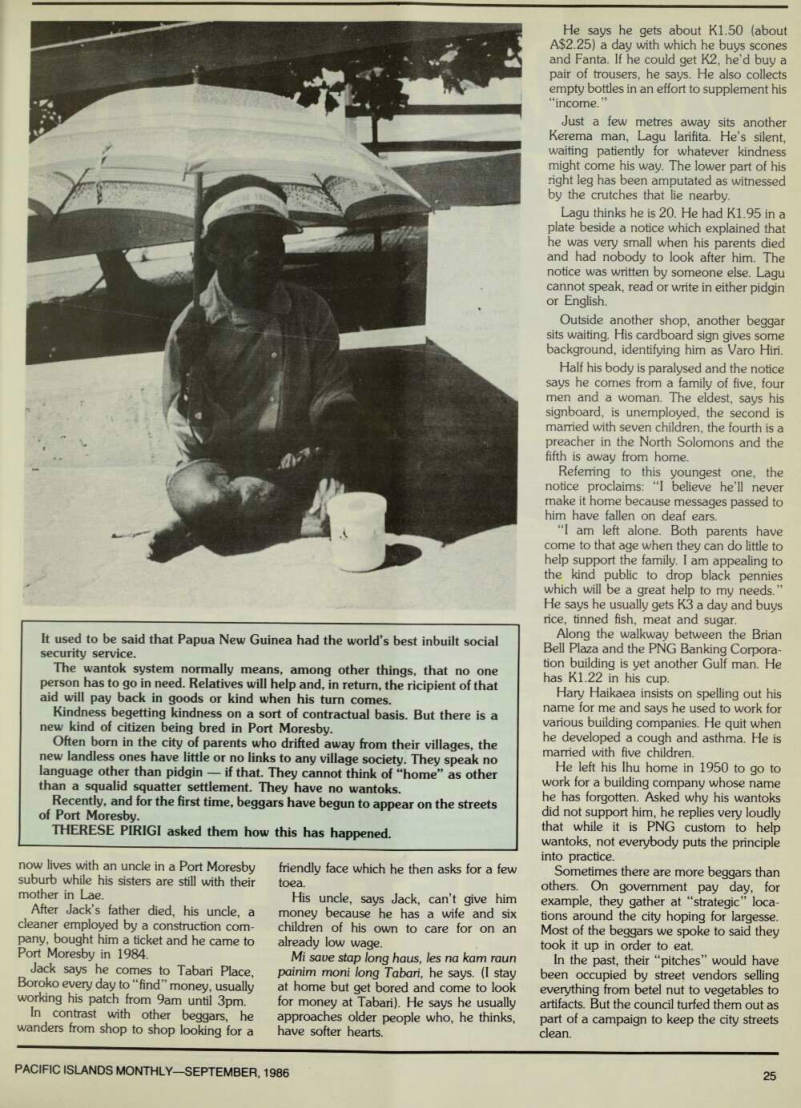
For A Few
Every morning when the lucky ones set out to go work, a less fortunate man takes a bus to Port Moresby’s Boroko shopping centre to begin his clay’s toil.
Orovo Taita, in his late 40s, originally from Kerema in Gulf Province, says there is nobody to look after him. He has no means of support so he does what he has to do.
Every morning Taita positions himself outside the Brian Bell Plaza and begs for money.
Begging has become common in the capital’s major shopping centres. Beggars now line the pavements where street vendors once ruled supreme. They hold out rusty plates, plastic cups, anything that will hold a coin to the countless luckier lives that walk by.
Taita took up begging after his only son died. He does not know how much money he collects in a day and says he uses the money to buy rice, sugar and bread.
He sticks to a set routine of 8.30 till 4pm each day.
There are two ways to beg in Port Moresby. The old, infirm and handicapped sit quiet, hoping their condition will attract sympathy. The young boys aged between 8 and 12 are more shrill, exhorting shoppers to part with a few coins.
Jack was tugging at passing skirts and trousers when I found him. He was a sight that would make most want to cry. But begging is commonplace now, and few people took notice. Jack is nine years old.
His father died in 1982 while Jack was in grade two at Bumbu community school in Morobe Province.
Jack, the only boy, comes from a family of three of which he is the middle one. He
ABOVE LEFT: An old man waits and hopes. ABOVE: Under the shelter of an umbrella, a man begs while a cardboard explains his plight. Photos: Patrick Matbob
It used to be said that Papua New Guinea had the world’s best inbuilt social security service.
The wantok system normally means, among other things, that no one person has to go in need. Relatives will help and, in return, the ricipient of that aid will pay back in goods or kind when his turn comes.
Kindness begetting kindness on a sort of contractual basis. But there is a new kind of citizen being bred in Port Moresby.
Often born in the city of parents who drifted away from their villages, the new landless ones have little or no links to any village society. They speak no language other than pidgin if that. They cannot think of “home” as other than a squalid squatter settlement. They have no wantoks.
Recently, and for the first time, beggars have begun to appear on the streets of Port Moresby.
THERESE PIRIGI asked them how this has happened.
now lives with an uncle in a Port Moresby suburb while his sisters are still with their mother in Lae.
After Jack s father died, his uncle, a cleaner employed by a construction company, bought him a ticket and he came to Port Moresby in 1984.
Jack says he comes to Tabari Place, Boroko every day to “find” money, usually working his patch from 9am until 3pm.
In contrast with other beggars, he wanders from shop to shop looking for a
friendly face which he then asks for a few toea.
His uncle, says Jack, can’t give him money because he has a wife and six children of his own to care for on an already low wage.
Mi save stop long haus, les na kam raun painim moni long Tabari, he says. (I stay at home but get bored and come to look for money at Tabari). He says he usually approaches older people who, he thinks, have softer hearts.
He says he gets about K 1.50 (about A 52.25) a day with which he buys scones and Fanta. If he could get K 2, he’d buy a pair of trousers, he says. He also collects empty bottles in an effort to supplement his “income. ”
Just a few metres away sits another Kerema man, Lagu larifita. He’s silent, waiting patiently for whatever kindness might come his way. The lower part of his right leg has been amputated as witnessed by the crutches that lie nearby.
Lagu thinks he is 20. He had K 1.95 in a plate beside a notice which explained that he was very small when his parents died and had nobody to look after him. The notice was written by someone else. Lagu cannot speak, read or write in either pidgin or English.
Outside another shop, another beggar sits waiting. His cardboard sign gives some background, identifying him as Varo Hiri.
Half his body is paralysed and the notice says he comes from a family of five, four men and a woman. The eldest, says his signboard, is unemployed, the second is married with seven children, the fourth is a preacher in the North Solomons and the fifth is away from home.
Referring to this youngest one, the notice proclaims: “I believe he’ll never make it home because messages passed to him have fallen on deaf ears.
“I am left alone. Both parents have come to that age when they can do little to help support the family. I am appealing to the kind public to drop black pennies which will be a great help to my needs.”
He says he usually gets K 3 a day and buys rice, tinned fish, meat and sugar.
Along the walkway between the Brian Bell Plaza and the PNG Banking Corpora tion building is yet another Gulf man. He has K 1.22 in his cup.
Hary Haikaea insists on spelling out his name for me and says he used to work for various building companies. He quit when he developed a cough and asthma. He is married with five children.
He left his Ihu home in 1950 to go to work for a building company whose name he has forgotten. Asked why his wantoks did not support him, he replies very loudly that while it is PNG custom to help wantoks, not everybody puts the principle into practice.
Sometimes there are more beggars than others. On government pay day, for example, they gather at “strategic” loca tions around the city hoping for largesse.
Most of the beggars we spoke to said they took it up in order to eat.
In the past, their “pitches” would have been occupied by street vendors selling everything from betel nut to vegetables to artifacts. But the council turfed them out as part of a campaign to keep the city streets clean.
Advertisements & other items, p. 26 (1 item)
Jetfloat
* ■ 0 2 A new solution. An old problem.
In the past the old problem of getting access to water bourne locations was invariably met with old solutions.
Old solutions that either involved expensive lime consuming maintenance intensive construction. Or cheap, temporary, floating hazards.
Such old solutions are now old hat.
The innovativeJetfloat Modular Float System is easily transported to site, quickly assembled, incredibly robust and unlimited in application.
Features built in. Features added on.
The modular system is moulded from extremely tough ‘Lupolen 5261Z’ requires no maintenance and resists the onslaught of frost, sea water, acids, marine fuels and even chemicals.
It cannot rot.
And once in place can remain there permanently, if needed.
Such features make it perfectforjetties, work platforms, boundary markers, landings, industrial and
chemical applications.
A nd to any floating array can be added such system add ons as boat cleats, boat fenders, mooring stakes and bathing ladders. Making the system perfect for commercial boat anchorages, bather’s floats, boating club pontoons, pump stations and portable work
platforms.
Easy to stack up. Easy to build up.
The individual elements are light (each weighing only 6.3 kg) and easily stored, stacked on top of each other.
Yet each has an incredible load capacity (equal to 94kg).
Dimensions are 50cm by 50cm by 40cm.
And while stacking is easy, the construction is a breeze.
Each of thefour elements is attached to each other by onefixing bolt, locking the four in one stable unit.
A specially customised shape is easily achievable.
Costs brought down. Costs kept down.
As the planners of the L.A. Summer Olympics found not only was the initial investment in on-water access less, butfurther costs like transportation and maintenance were also kept down to a bare minimum.
To keep costs down, don’t keep the coupon. Send it
off for more information.
All products arefully guaranteed. *
JETFLOAT
POSTCODE.
ANOTHER QUALITY PRODUCT FROM JOHNSON DIVERSIFIED A DIfJSjON OF SCJOHNSON AND SON PTY LIMITED (INCORPORATED IN NEW SOUTH WALES). HEADOFFICE: 160 EPP {fffOADLANE COVE TELEPHONE: 02428 9111. TELEX: AA22B4BJONWAX. MAIL: PRIVATE MAIL BAG 22, LANE COVE NS W 2066.
•GUARANTEED AGAINST FAULTY MANUFACTURE AND MATERIALS
GROUPMARSHALL
shipping efficiency

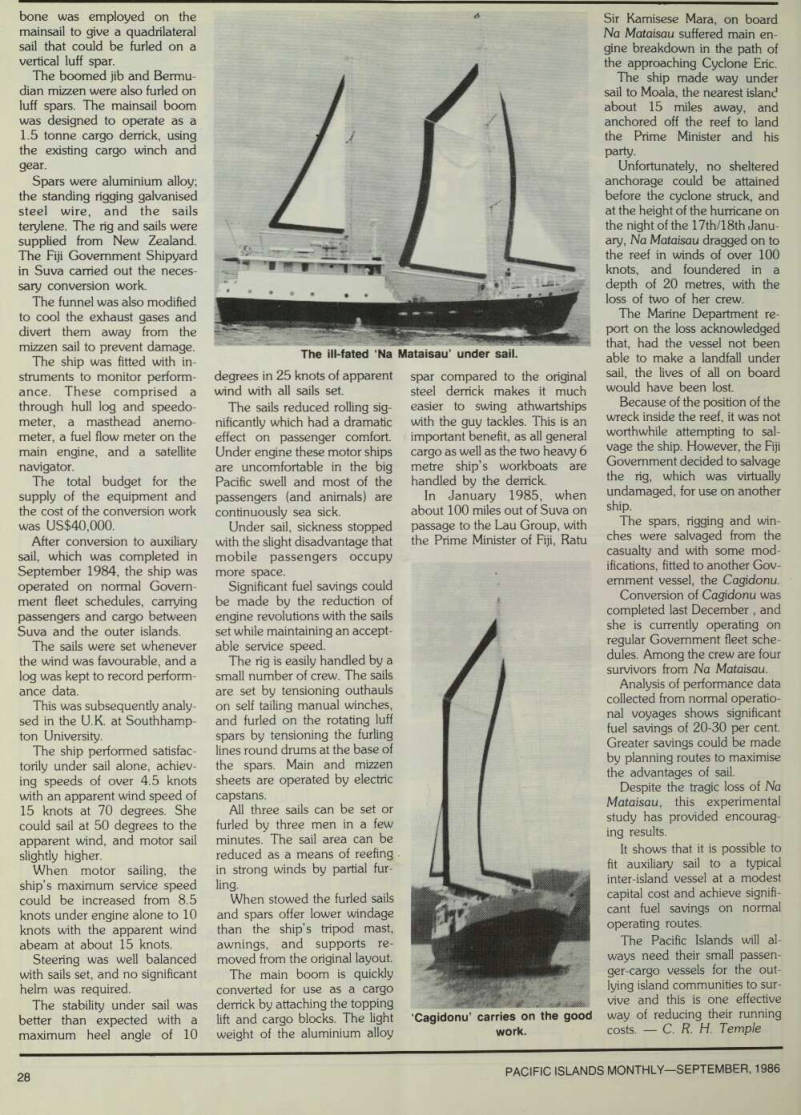
trade winds
Sail power hoists shipping efficiency
FIJI, like all Pacific Island nations, depends on in ter-island shipping sus tain its economic, politi cal and social life. The small inter-island passenger-cargo vessels, generally built in times of cheap fuel, are not efficient to run.
Shipping consumes a large proportion of the fuel and fore ign exchange budgets. All fuel has to be imported and one sixth is used for shipping.
In the ten years between 1970 and 1980, fuel costs rose fourteen times, consumption by 70 per cent and the total import
Despite the tragic loss of a vessel and two lives during a cyclone, an experiment in inter-island shipping using sail as well as diesel power is proving to be a success. Sail power has helped reduce fuel bills and has made voyages less unpleasant for passengers.
bill rose nearly twenty-five times.
At the request of the Fiji Government, the Asian Deve lopment Bank funded a study to assess the value of fitting auxiliary sail to existing vessels to save fuel. Mac Alister Elliott and Partners Ltd., a British firm of international marine and fisheries consultants, were re
cruited to carry out this study on the Fiji Government Fleet of inter-island vessels.
The project selected a typical inter-island motor ship from the Fiji Government fleet for conversion to auxiliary sail. She was the Na Mataisau, a 27 metre LOA, 274 GRT steel passenger cargo vessel, powered by a single GM V 6-71
diesel engine.
An appropriate rig was de signed to satisfy the require ments of simplicity, reliability and ease of handling within a modest budget.
A soft sail ketch rig was chosen, with manually oper ated roller furling on all sails.
The sail area of 201 sq. metres was designed to give a heel angle of 10 degrees in about 20 knots of apparent wind, when reefing would begin.
The layout of the ship lent itself to a two masted configura tion with the mainsail over the cargo hold. A standing wish
bone was employed on the mainsail to give a quadrilateral sail that could be furled on a vertical luff spar.
The boomed jib and Bermu dian mizzen were also furled on luff spars. The mainsail boom was designed to operate as a 1.5 tonne cargo derrick, using the existing cargo winch and gear.
Spars were aluminium alloy; the standing rigging galvanised steel wire, and the sails terylene. The rig and sails were supplied from New Zealand.
The Fiji Government Shipyard in Suva carried out the neces sary conversion work.
The funnel was also modified to cool the exhaust gases and divert them away from the mizzen sail to prevent damage.
The ship was fitted with in struments to monitor perform ance. These comprised a through hull log and speedo meter, a masthead anemo meter, a fuel flow meter on the main engine, and a satellite navigator.
The total budget for the supply of the equipment and the cost of the conversion work was US$4O,OOO.
After conversion to auxiliary sail, which was completed in September 1984, the ship was operated on normal Govern ment fleet schedules, carrying passengers and cargo between Suva and the outer islands.
The sails were set whenever the wind was favourable, and a log was kept to record perform ance data.
This was subsequently analy sed in the U.K. at Southhamp ton University.
The ship performed satisfac torily under sail alone, achiev ing speeds of over 4.5 knots with an apparent wind speed of 15 knots at 70 degrees. She could sail at 50 degrees to the apparent wind, and motor sail slightly higher.
When motor sailing, the ship’s maximum service speed could be increased from 8.5 knots under engine alone to 10 knots with the apparent wind abeam at about 15 knots.
Steering was well balanced with sails set, and no significant helm was required.
The stability under sail was better than expected with a maximum heel angle of 10
degrees in 25 knots of apparent wind with all sails set.
The sails reduced rolling sig nificantly which had a dramatic effect on passenger comfort.
Under engine these motor ships are uncomfortable in the big Pacific swell and most of the passengers (and animals) are continuously sea sick.
Under sail, sickness stopped with the slight disadvantage that mobile passengers occupy more space.
Significant fuel savings could be made by the reduction of engine revolutions with the sails set while maintaining an accept able service speed.
The rig is easily handled by a small number of crew. The sails are set by tensioning outhauls on self tailing manual winches, and furled on the rotating luff spars by tensioning the furling lines round drums at the base of the spars. Main and mizzen sheets are operated by electric capstans.
All three sails can be set or furled by three men in a few minutes. The sail area can be reduced as a means of reefing in strong winds by partial fur ling.
When stowed the furled sails and spars offer lower windage than the ship’s tripod mast, awnings, and supports re moved from the original layout.
The main boom is quickly converted for use as a cargo derrick by attaching the topping lift and cargo blocks. The light weight of the aluminium alloy
spar compared to the original steel derrick makes it much easier to swing athwartships with the guy tackles. This is an important benefit, as all general cargo as well as the two heavy 6 metre ship’s workboats are handled by the derrick.
In January 1985, when about 100 miles out of Suva on passage to the Lau Group, with the Prime Minister of Fiji, Ratu
Sir Kamisese Mara, on board Na Mataisau suffered main en gine breakdown in the path of the approaching Cyclone Eric.
The ship made way under sail to Moala, the nearest island about 15 miles away, and anchored off the reef to land the Prime Minister and his party.
Unfortunately, no sheltered anchorage could be attained before the cyclone struck, and at the height of the hurricane on the night of the 17th/18th Janu ary, Na Mataisau dragged on to the reef in winds of over 100 knots, and foundered in a depth of 20 metres, with the loss of two of her crew.
The Marine Department re port on the loss acknowledged that, had the vessel not been able to make a landfall under sail, the lives of all on board would have been lost.
Because of the position of the wreck inside the reef, it was not worthwhile attempting to sal vage the ship. However, the Fiji Government decided to salvage the rig, which was virtually undamaged, for use on another ship.
The spars, rigging and win ches were salvaged from the casualty and with some mod ifications, fitted to another Gov ernment vessel, the Cagidonu.
Conversion of Cagidonu was completed last December, and she is currently operating on regular Government fleet sche dules. Among the crew are four survivors from Na Mataisau.
Analysis of performance data collected from normal operatio nal voyages shows significant fuel savings of 20-30 per cent.
Greater savings could be made by planning routes to maximise the advantages of sail.
Despite the tragic loss of Na Mataisau, this experimental study has provided encourag ing results.
It shows that it is possible to fit auxiliary sail to a typical inter-island vessel at a modest capital cost and achieve signifi cant fuel savings on normal operating routes.
The Pacific Islands will al ways need their small passen ger-cargo vessels for the out lying island communities to sur vive and this is one effective way of reducing their running
costs.
C. R. H. Temple
The ill-fated Na Mataisau’ under sail.
‘Cagidonu’ carries on the good work.
Advertisements & other items, pp. 27-31 (1 item)
The Total Test Equipment Solution
AWA
AWA
m *# marconi^ instruments T Tektronix r Bii\o ) o r
FLUKEI
HITACHI
i ■MI
EQUIP
With aWh; fynur
fin4iß|§ I tpq righ
equipment is solved the widest possible range o equipment to suit your every oble of te st 14 d ay n e e;d o more compromises st choices.
AWA New Zealand Lim F3X total com ny 37 Frocston Road. Wain Bay PO Box 858 Suva Phone 312 Te ex FJ2347 Cables (679)31 unications 44 ° n E ( AN SE
WAOS
POWER
PLL
manual tuning L\A MW l sw i: B
FREQ ■: ME TEW
National
FM-LW-MW-SW PLL SYNTHESIZED RECEIVER RF-BSO
RF-B6OL
lr ■
GLOBAL SAWY
National's RF-B6OL multi-band radio knows its way around the world. Employing two microcomputers in its advanced circuitry, it not only presents you with an incredible choice of stations, but also makes it incredibly easy to choose!
Let it keep you informed about events at home and abroad, wherever you travel.
• Crystal-clear FM/LW/MW/SW reception
from up-conversion, double-superheterodyne
circuitry.
• Fast, precise tuning options: electronic rotary dial with IkFlz fine tuning/10-key direct frequency selection/direct metre-band access/ auto scan up and down/36 station presets. • Big, multi-function LCD display. • Dual-time quartz LCD clock. • Compact size fits perfectly in briefcase or carry bag.
We also offer two other multi-band models: RF-810. the world's smallest eight-band radio, and the nine-band, double-superheterodyne RF-B2OL.
National
National. Panasonic and Technics are the brandnames of Matsushita Electric.
TOYOTA THINKS
CARS AND TRUCKS DRIVEN IN THE
PACIFIC SHOULD RE RDIU
FOR THE PACIFIC.
Holdings Ltd., RO. Box 36, Bairiki, Tarawa.
NAURU: NAURU COOPERATIVE SOCIETY, Central PacJ
NEW CALEDONIA: SERVICE IMPORTATION
AUTOMOBILE DU PACIFIQUE, Rond-Point du Pacifique (Station Total) B.P 438, Noumea.
NORFOLK ISLAND: BORRY’S LIMITED, PO. Box 169.
PAPUA NEW GUINEA: ELA MOTORS, A Division of Burns Philp (PNG) Ltd., PO. Box 75, Port Moresby.
SAIPAN: MICROL CORPORATION, PO. Box 267, Saipa
TOYOTA
QUALITY SERVICE
AMERICAN SAMOA: BURNS PHILP (SOUTH SEA) CO., LTD., PO. Box 129, Pago Pago.
COOK ISLANDS: COOK ISLANDS TRADING
CORPORATION LTD., Private Bag, Rarotonga.
FIJI; AUTOMOTIVE SUPPLIES COMPANY, A Division of Burns Philp (South Sea) Co., Ltd., G.P.O. Box 355, Suva.
GUAM & MICRONESIA: ATKINS KROLL, INC., 443 South Marine Drive, Tamuning.
KIRIBATI: TARAWA MOTORS, A Division of Bairiki
' * ■ m * •fjpui.%** 4*3EaP‘^sl m All our cars and trucks have special Pacific Islaod features.
For instance, Toyota Hilux trucks are outfitted with extra-heavy-duty shocks and reinforced suspension.
And cars like Toyota Corolla receive special engine underplating, and a suspension modified to give added road clearance.
Meanwhile, we make additional use of special galvanealed steel in both our cars and trucks to help prevent corrosion.
And, of course, like cars and trucks we build for the rest of the world, those for the Pacific benefit from comprehensive testing and thorough quality control.
It’s ail part of our effort to create high-quality, highly reliable cars and trucks.
Specifically for you. And specifically for the places you drive.
Areas where galvanealed steel is used
COROLLA
HILUX
• Crown • Cressida • Corona • Corolla • Starlet • Dyna • Hiace • Liteace • Coaster • Stout • Hilux 4X2 /4X 4 • Land Cruiser • Heavy Duty Truck
LOMON ISLANDS: SOLOMON ISLANDS
ESTMENTS LTD., G.P.O. Box 174, Honiara.
ilTI: NIPPON AUTOMOTO, B.P 342, Papeete
NGA: BURNS PHILP (SOUTH SEA) CO., LTD., P.O. c 55, Nuku’alofa.
MUATU: VANUATU MOTORS, A Division of Burns Ip (Vanuatu) Ltd., P.O. Box 18, Port Vila.
ISTERN SAMOA: BURNS PHILP (SOUTH SEA) CO.
P.O. Box 188, Apia.
TP#
French do best
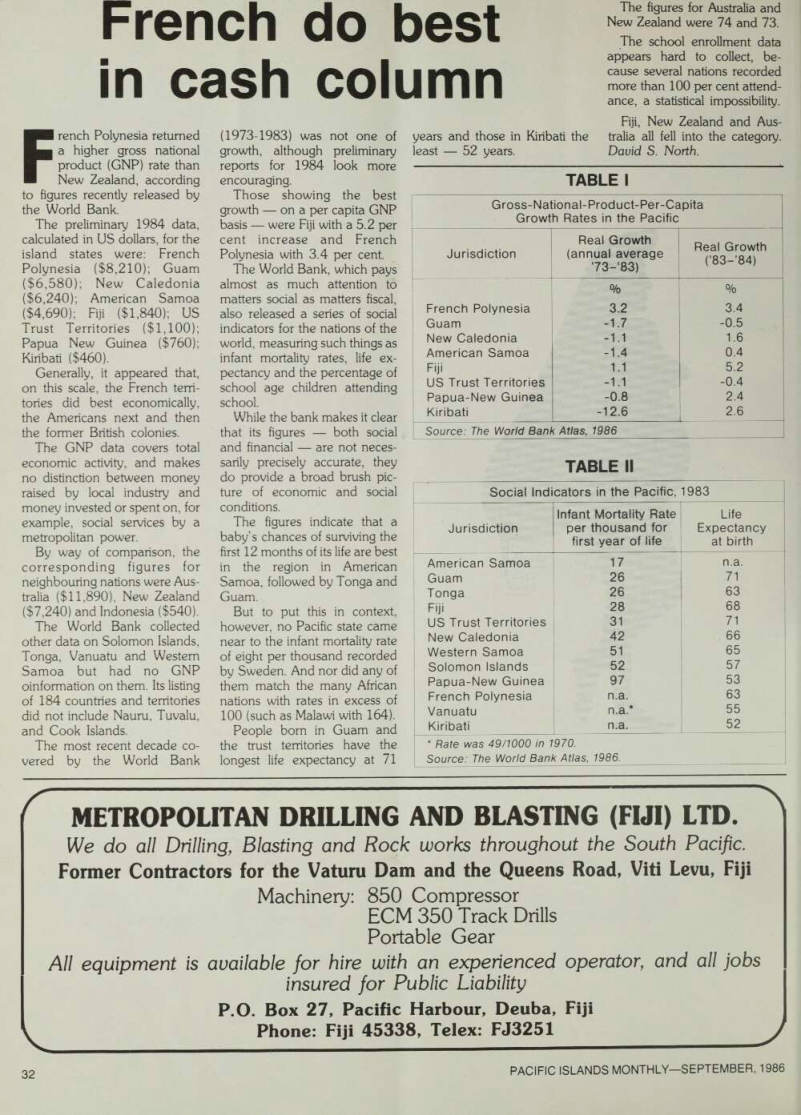
in cash column
French Polynesia returned a higher gross national product (GNP) rate than New Zealand, according to figures recently released by the World Bank.
The preliminary 1984 data, calculated in US dollars, for the island states were: French Polynesia ($8,210); Guam ($6,580); New Caledonia ($6,240); American Samoa ($4,690); Fiji ($1,840); US Trust Territories ($1,100); Papua New Guinea ($760); Kiribati ($460).
Generally, it appeared that, on this scale, the French terri tories did best economically, the Americans next and then the former British colonies.
The GNP data covers total economic activity, and makes no distinction between money raised by local industry and money invested or spent on, for example, social services by a metropolitan power.
By way of comparison, the corresponding figures for neighbouring nations were Aus tralia ($11,890), New Zealand ($7,240) and Indonesia ($540).
The World Bank collected other data on Solomon Islands, Tonga, Vanuatu and Western Samoa but had no GNP oinformation on them. Its listing of 184 countries and territories did not include Nauru, Tuvalu, and Cook Islands.
The most recent decade co vered by the World Bank
(1973-1983) was not one of growth, although preliminary reports for 1984 look more encouraging.
Those showing the best growth on a per capita GNP basis were Fiji with a 5.2 per cent increase and French Polynesia with 3.4 per cent.
The World Bank, which pays almost as much attention to matters social as matters fiscal, also released a series of social indicators for the nations of the world, measuring such things as infant mortality rates, life ex pectancy and the percentage of school age children attending school.
While the bank makes it clear that its figures both social and financial are not neces sarily precisely accurate, they do provide a broad brush pic ture of economic and social conditions.
The figures indicate that a baby’s chances of surviving the first 12 months of its life are best in the region in American Samoa, followed by Tonga and Guam.
But to put this in context, however, no Pacific state came near to the infant mortality rate of eight per thousand recorded by Sweden. And nor did any of them match the many African nations with rates in excess of 100 (such as Malawi with 164).
People bom in Guam and the trust territories have the longest life expectancy at 71
years and those in Kiribati the least 52 years.
The figures for Australia and New Zealand were 74 and 73.
The school enrollment data appears hard to collect, be cause several nations recorded more than 100 per cent attend ance, a statistical impossibility.
Fiji, New Zealand and Aus tralia all fell into the category.
David S. North.
Table 1
Gross-National-Product-Per-Capita Growth Rates in the Pacific Jurisdiction Real Growth (annual average 73-83) Real Growth (’83-84) % % French Polynesia 3.2 3.4 Guam -1.7 -0.5 New Caledonia -1.1 1.6 American Samoa -1.4 0.4 Fiji 1.1 5.2 US Trust Territories -1.1 -0.4 Papua-New Guinea -0.8 2.4 Kiribati -12.6 26 Source: The World Bank Atlas, 1986
Table Ii
Social Indicators in the Pacific, 1983 Infant Mortality Rate Life Jurisdiction per thousand for Expectancy first year of life at birth American Samoa 17 n.a.
Guam 26 71 Tonga 26 63 Fiji 28 68 US Trust Territories 31 71 New Caledonia 42 66 Western Samoa 51 65 Solomon Islands 52 57 Papua-New Guinea 97 53 French Polynesia n.a. 63 Vanuatu n.a.* 55 Kiribati n.a. 52 * Rate was 49/1000 in 1970.
Source: The World Bank Atlas, 1986.
Advertisements & other items, pp. 32-34 (1 item)
Metropolitan Drilling And Blasting (Fiji) Ltd.
I Me do all Drilling, Blasting and Rock works throughout the South Pacific.
Former Contractors for the Vatum Dam and the Queens Road, Viti Levu, Fiji Machinery: 850 Compressor ECM 350 Track Drills Portable Gear All equipment is available for hire with an experienced operator, and all jobs insured for Public Liability P.O. Box 27, Pacific Harbour, Deuba, Fiji Phone: Fiji 45338, Telex: FJ3251
Goto the Head of the Class
■t. i m 1 V m\ -m
Ban f K R 1
» km “ “n ■ m x 770 x X-110 Move up to New Personna Plus from Pioneer.
And put compact, advanced audio technology at your fingertips.
With the X-770, you’ll enjoy full-function remote control for amp, tuner, cassette deck, turntable, and even an optional CD player.
There’s Stereo Wide for expanded ambience from stereo signals plus Simulated Stereo for wide, stereo-like signals from even mono signals.
And for power, the X-770 puts out a full 320 W (PMPO) to give you a full,
high-fidelity sound.
The X-770 also brings you great features like Mic Mixing, Dolby* B/C NR, and a 5-band graphic equalizer. A double auto-reverse cassette deck offers added listening convenience and tape dubbing. Also available are the more economical Systems X-330 and X-110.
The New Personna Plus from Pioneer. A class act in home audio convenience and enjoyment.
X-330 •“Dolby" and the double-D symbol are trademarks of Dolby Laboratories Licensing Corporation.
Note: The optional PD-X707(8K) CD player is shown above.
CtD piomeer
The future of sound and vision.
For further information, please contact: Australia: Pioneer Electronics Australia Pty. Ltd. (Incorporated in Victoria), P-0. Box 295, Mordialloc, Victoria, 3195 Tel: 580-9911 Fiji Islands: Brijlal & Company, G.P.O. Box No. 362, Suva, Fiji Islands Tel; 22258 New Zealand: Monaco Distributors Ltd., 2 Poland Road, Glenfield Auckland New Zealand Tel: (09) 444-9144 Norfolk Island; Burns Philp (Norfolk Island) Ltd., P.O. Box 21, Norfolk Island Vanuatu; Burns Philp (Vanuatu) Ltd., Vila, Vanuatu Nauru Island; Jacob Enterprises, P.O. Box N 0.4, Republic of Nauru Tahiti: Tahiti Hi-Fi, P.O. Box 848, Papeete, Tahiti New Caledonia: Menard Pacifique Sari, B.P. 3899, Noumea, New Caledonia Tel: 27-62-23 American Samoa: Transpac Corporation, P.O. Box 1477, Pago Pago, American Samoa 96799 Tel; 633-5224 Rarotonga: South Seas International Ltd., P.O. Box 49, Rarotonga, Cook Islands Tel: 2327 Papua New Guinea: Bali Merchants Pty. Ltd., P.O. Box 6103, Boroko Tel: 254887
At the end ol the rainbow you II li ml Fiji.
FIJI'S INTERNATIONAL AIRLINE
Hard to hold down two jobs
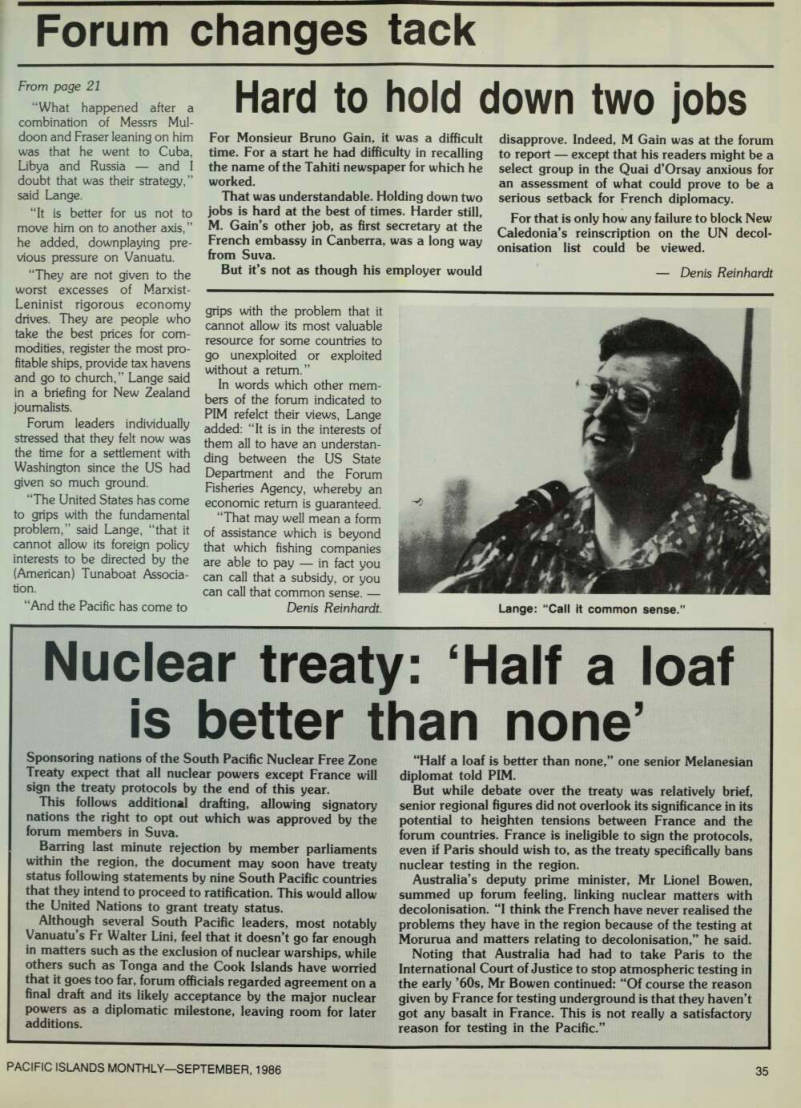
For Monsieur Bruno Gain, it was a difficult time. For a start he had difficulty in recalling the name of the Tahiti newspaper for which he worked.
That was understandable. Holding down two jobs is hard at the best of times. Harder still, M. Gain’s other job, as first secretary at the French embassy in Canberra, was a long way from Suva.
But it’s not as though his employer would
disapprove. Indeed, M Gain was at the forum to report except that his readers might be a select group in the Quai d’Orsay anxious for an assessment of what could prove to be a serious setback for French diplomacy.
For that is only how any failure to block New Caledonia’s reinscription on the UN decol onisation list could be viewed.
Denis Reinhardt
is better than none’
Nuclear treaty: ‘Half a loaf is better than none’
Sponsoring nations of the South Pacific Nuclear Free Zone Treaty expect that all nuclear powers except France will sign the treaty protocols by the end of this year.
This follows additional drafting, allowing signatory nations the right to opt out which was approved by the fomm members in Suva.
Barring last minute rejection by member parliaments within the region, the document may soon have treaty status following statements by nine South Pacific countries that they intend to proceed to ratification. This would allow the United Nations to grant treaty status.
Although several South Pacific leaders, most notably Vanuatu’s Fr Walter Lini, feel that it doesn’t go far enough in matters such as the exclusion of nuclear warships, while others such as Tonga and the Cook Islands have worried that it goes too far, forum officials regarded agreement on a final draft and its likely acceptance by the major nuclear powers as a diplomatic milestone, leaving room for later additions.
“Half a loaf is better than none,” one senior Melanesian diplomat told PIM.
But while debate over the treaty was relatively brief, senior regional figures did not overlook its significance in its potential! to heighten tensions between France and the forum countries. France is ineligible to sign the protocols, even if Paris should wish to, as the treaty specifically bans nuclear testing in the region.
Australia’s deputy prime minister, Mr Lionel Bowen, summed up forum feeling, linking nuclear matters with decolonisation. “I think the French have never realised the problems they have in the region because of the testing at Momma and matters relating to decolonisation,” he said.
Noting that Australia had had to take Paris to the International Court of Justice to stop atmospheric testing in the early ’6os, Mr Bowen continued: “Of course the reason given by France for testing underground is that they haven’t got any basalt in France. This is not really a satisfactory reason for testing in the Pacific.”
Advertisements & other items, p. 36 (1 item)
Kenwood
m o o o A SpCCtrUm Spectrum 1058 I— series 8250Wx2 (Dynamic Power) power amplifier BSeparate control amplifier with CD and Video selectors quartz-synthesizer tuning 820 random memory presets ■Twice-a-day timer ■ Double auto-reverse cassette deck with relay-play and high-speed dubbing ■ Programmable linear-tracking direct-drive turntable B4OOW (max.) speakers BOptions: CD player, graphic equalizer, surround processor, remote control, headphones, microphone
So nice to come home to
The Spectrum series are no ordinary stereo systems. For one thing, they offer you pure hi-fi sound.
For example, the Spectrum 1058 shown has professional separate power and control amplifiers. With its CD input selector, it’s ready to give you the full dynamic impact of digital sound!
Spectrum 1058 also helps you enjoy your music Look at the versatile double auto-reverse cassette deck, computerized automatic tuner and full remote controller and you will see what we mean.
No matter what the time of day, you’ll always be ready to come home to your Spectrum hi-fi stereo system.
KENWOOD CORPORATION
Shionogi Shtouya Building. 17-5. 2-chbme Shibuya. Shibuya-ku. Tokyo 150, Japan TRIOKENWOOD (AUSTRALIA) PTY. LTD. (incorporated in n&wi 4E Woodcock Place. Lane Cove. N S W. 2066. Australia NEW ZEALAND JOHN GILBERT & CO , LTD. Auckland Tel 0011-64-9-30839 FUJI PERE S DUTY FREE CENTRE LTD Tel. 25496. 25497 PAPUA NEW GUINEA SO. SVENSSON (N.G.) LTD. Pdrt Moresby Tel. 212158, 212111 SOLOMON ISLANDS TECHNIQUE RADIOS CENTRE LTD Honiara Tel. 416 NEW CALEDONIA HI-FI VOX Noumea Tel 27-2466. 28-2931 VANUATU FUNG CHOI LUEN Port-Vila Tel. 2556 TAHITI MAI SON AURORE Papeete Tel 29703 AMERICAN SAMOA ISLAND PACIFIC AGENCIES. INC. Pago Pago Tel. 633-4687
REPUBLIC OF NAURU NAURU CO-OPERATIVE SOCIETY
MARIANA ISLANDS JC. TENORIO ENTERPRISES Saipan Tel 6445
the brunt of adjustment
Self employed bear the brunt of adjustment
Fiji’s self employed especially the sugarcane farmers have borne the brunt of the govern ment’s tough measures to ad just to plummeting export prices.
According to an IMF survey of the Fijian economy, sugar growers’ real incomes fell by more than half between 1980 and 1984.
The IMF traces the reasons back to the late 70s. Since 1977 annual cost of living adjust ments have been based on wage guidelines announced by the Tripartite Forum comprising representatives of the govern ment, the trade unions and the employers’ associations.
Fiji, nevertheless, is poised to resume economic growth after a period of crippling deteriora tion in its terms of trade.
The country was hit hard by the sharp decline in commodity prices during 1984 when the world price of sugar, Fiji’s major export, fell by 40 per cent only to tumble by another 20 per cent the following year.
And while a large proportion of Fiji’s crop is sold under long term contract at fixed prices, the weighted average price de clined by about 20 per cent between 1983 and 1985, said the survey.
Meanwhile, the world price of coconut oil, another export staple, plummeted by about 50 per cent in 1985 following an ’B4 peak.
Price dives in Fiji’s other exports fish, gold and for estry products were less spectacular, but average returns were down by about 10 per cent last year.
With import prices edging up slightly, the country’s terms of trade deteriorated by an esti mated 14 per cent last year after a 4 per cent decline in 1984.
In 1984 the government stepped in. Convinced (they were proved right) that com modity prices would deteriorate still further in 1985, they insti tuted an adjustment program.
Fiji’s process of adjustment to plummeting commodity prices has had the most effect on the country’s self-employed, particularly the sugarcane growers whose real incomes were more than halved between 1980 and 1984. However, according to an IMF survey, the nation now has real prospects for economic growth.
This involved a wage freeze, budget tightening and a squeeze on domestic credit and money supply the classic IMF response.
The package of measures was painful, but it seems to have worked. Reduced domes tic demand contained inflation (4.4 per cent last year) while the balance of payments position improved.
Real gross domestic product (GDP), however, fell by about 2 per cent largely due the ravages of cyclones.
“While real incomes,” said the IMF (adjusted for the terms of trade) were declining, wages and salaries were protected by the forum guidelines.
“The burden of adjustment and the consequent pressure to lower real incomes thus fell entirely on workers not protected by these guidelines the non unionised workers and the self employed, includ ing sugarcane farmers.”
Others were protected by the Tripartite Forum guidelines under which wages were normally increased by a margin closely resembling the previous year’s inflation rate.
This led to the 1984 intro duction of the wage freeze after the forum members failed to reach voluntary agreement to curb wage increases.
The wage freeze, in effect, lives on. The government had* originally hoped to replace it with something more flexible at the end of last year by which time the forum might have negotiated a formula.
It didn’t happen and a gov ernment-imposed 2.25 per cent cost of living increase for all workers was decreed.
“The implied further decline in real wages is an essential
element of the government’s strategy to increase public sec tor savings, restore cost com petitiveness and promote exter nal adjustment,” said the IMF.
The wage policy pursued un til 1984, says the survey, saw the wages and salary bill soar by 50 per cent between 1981 and 1984 about twice the rate of increase in tax revenue.
“In order to contain the budget deficit, the government accommodated the increase in the wage and salary bill by reducing its investment outlays capital expenditure as a proportion of total expenditure in fact fell from 27 per cent in 1982 to 13 per cent in 1984,” said the survey.
And although some other current expenditure increased sharply last year (including the cost of repairs to damage caused by four cyclones), total current expenditure declined slightly the first such decline ever recorded.
On the other side of the equation, however, the external position was helped significant ly by insurance payouts for the same cyclone damage.
These amounted to about Fs3l million in the first half of 1985 with a further Fsl2 mil lion expected in the second half.
This contributed to a balance of payments surplus of Fsl2 million, about the same as the previous year.
“This represented a substan tial improvement over the pre vious three years when deficits were recorded,” according to the report’s author, Sukhdev Shah of the IMF’s Asian depart ment.
He is carefully optimistic on the prospects for growth.
Fiji’s ninth development plan (1986-1990) aims at real GDP annual growth of 5 per cent.
The government intends to place emphasis on resource based industries, such as for estry and fishery products, sugarcane, coconuts, cocoa, ginger and gold.
Wage restraint and a planned shift towards consumption based taxes to control demand complete the basic picture.
The development plan’s objectives, however, “will de pend substantially on both weather conditions and the world economic environment,” said Shah.
K The immediate outlook for the latter has improved as a result of sharp declines in world oil prices and interest rates.
“Thus there is cause for reasonable optimism that Fiji can achieve sustained growth. ”
Advertisements & other items, p. 37 (1 item)
seeds
Improved pasture seed, cereal and crop seed, lawn seed for parks and gardens, assorted vegetable seed, specialist seed mixes for reclamation and stabilisation.
IIIIUSEED^'
J. H. WILLIAMS & SONS
Pty. Ltd.
P.O. Box 102, Murwillumbah, 2484 Australia Phone: 6166-721866 Telex: AA66142 Fax: 6166-724212
Misima:
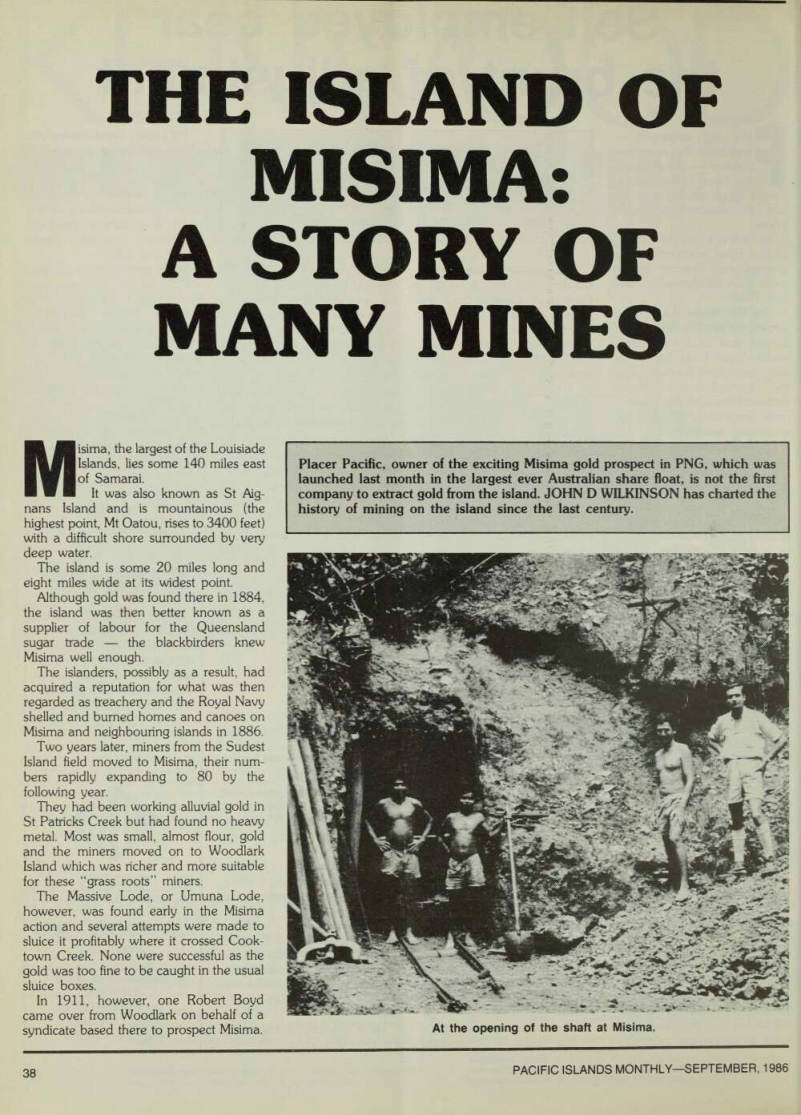
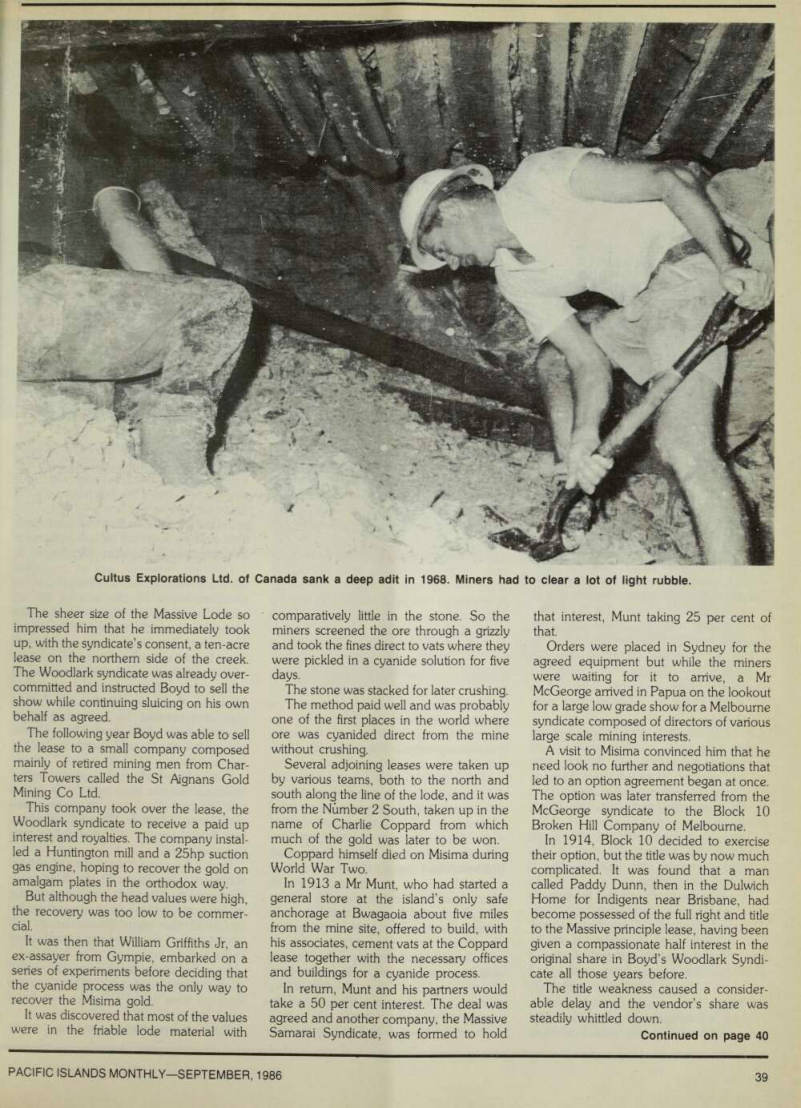
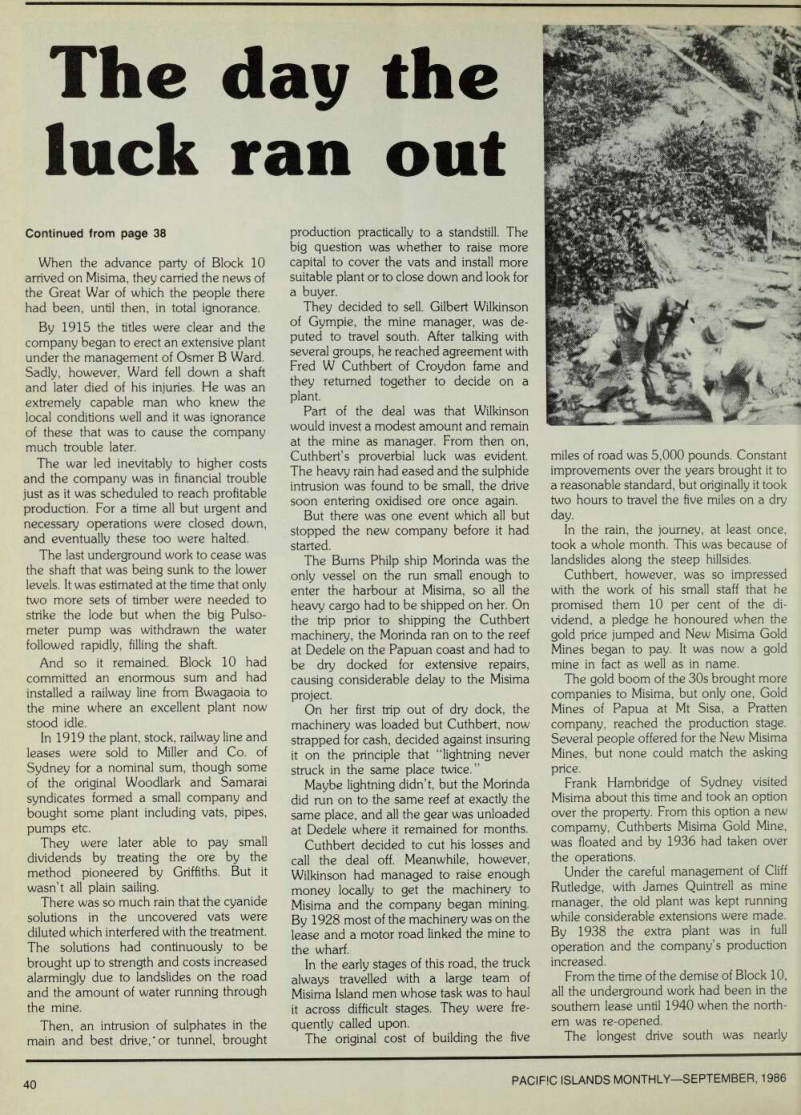
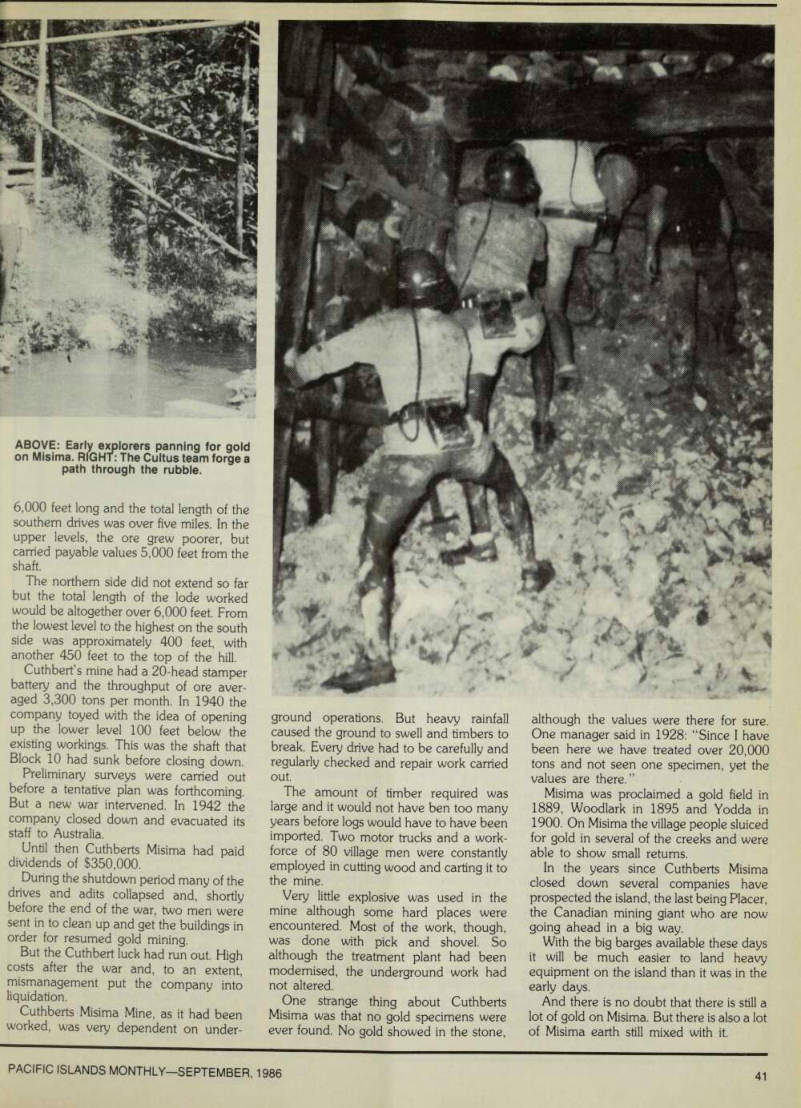
The Island Of
A Story Of
Many Mines
Misima, the largest of the Louisiade Islands, lies some 140 miles east of Samarai.
It was also known as St Aig nans Island and is mountainous (the highest point, Mt Oatou, rises to 3400 feet) with a difficult shore surrounded by very deep water.
The island is some 20 miles long and eight miles wide at its widest point.
Although gold was found there in 1884, the island was then better known as a supplier of labour for the Queensland sugar trade the blackbirders knew Misima well enough.
The islanders, possibly as a result, had acquired a reputation for what was then regarded as treachery and the Royal Navy shelled and burned homes and canoes on Misima and neighbouring islands in 1886.
Two years later, miners from the Sudest Island field moved to Misima, their num bers rapidly expanding to 80 by the following year.
They had been working alluvial gold in St Patricks Creek but had found no heavy metal. Most was small, almost flour, gold and the miners moved on to Woodlark Island which was richer and more suitable for these “grass roots” miners.
The Massive Lode, or Umuna Lode, however, was found early in the Misima action and several attempts were made to sluice it profitably where it crossed Cook town Creek. None were successful as the gold was too fine to be caught in the usual sluice boxes.
In 1911, however, one Robert Boyd came over from Woodlark on behalf of a syndicate based there to prospect Misima.
Placer Pacific, owner of the exciting Misima gold prospect in PNG, which was launched last month in the largest ever Australian share float, is not the first company to extract gold from the island. JOHN D WILKINSON has charted the history of mining on the island since the last century.
At the opening of the shaft at Misima.
The sheer size of the Massive Lode so impressed him that he immediately took up, with the syndicate’s consent, a ten-acre lease on the northern side of the creek.
The Woodlark syndicate was already overcommitted and instructed Boyd to sell the show while continuing sluicing on his own behalf as agreed.
The following year Boyd was able to sell the lease to a small company composed mainly of retired mining men from Charters Towers called the St Aignans Gold Mining Co Ltd.
This company took over the lease, the Woodlark syndicate to receive a paid up interest and royalties. The company installed a Huntington mill and a 25hp suction gas engine, hoping to recover the gold on amalgam plates in the orthodox way.
But although the head values were high, the recovery was too low to be commercia l- It was then that William Griffiths Jr, an ex-assayer from Gympie, embarked on a series of experiments before deciding that the cyanide process was the only way to recover the Misima gold.
It was discovered that most of the values were in the friable lode material with
comparatively little in the stone. So the miners screened the ore through a grizzly and took the fines direct to vats where they were pickled in a cyanide solution for five days.
The stone was stacked for later crushing.
The method paid well and was probably one of the first places in the world where ore was cyanided direct from the mine without crushing.
Several adjoining leases were taken up by various teams, both to the north and south along the line of the lode, and it was from the Number 2 South, taken up in the name of Charlie Coppard from which much of the gold was later to be won.
Coppard himself died on Misima during World War Two.
In 1913 a Mr Munt, who had started a general store at the island’s only safe anchorage at Bwagaoia about five miles from the mine site, offered to build, with his associates, cement vats at the Coppard lease together with the necessary offices and buildings for a cyanide process.
In return, Munt and his partners would take a 50 per cent interest. The deal was agreed and another company, the Massive Samarai Syndicate, was formed to hold
that interest, Munt taking 25 per cent of that.
Orders were placed in Sydney for the agreed equipment but while the miners were waiting for it to arrive, a Mr McGeorge arrived in Papua on the lookout for a large low grade show for a Melbourne syndicate composed of directors of various large scale mining interests, A visit to Misima convinced him that he need look no further and negotiations that led to an option agreement began at once.
The option was later transferred from the McGeorge syndicate to the Block 10 Broken Hill Company of Melbourne, In 1914, Block 10 decided to exercise their option, but the title was by now much complicated. It was found that a man called Paddy Dunn, then in the Dulwich Home for Indigents near Brisbane, had become possessed of the full right and title to the Massive principle lease, having been given a compassionate half interest in the original share in Boyd’s Woodlark Syndi cate all those years before, The title weakness caused a consider able delay and the vendor’s share was steadily whittled down,
Continued on page 40
Cultus Explorations Ltd. of Canada sank a deep adit in 1968. Miners had to clear a lot of light rubble.
When the advance party of Block 10 arrived on Misima, they carried the news of the Great War of which the people there had been, until then, in total ignorance.
By 1915 the titles were clear and the company began to erect an extensive plant under the management of Osmer B Ward.
Sadly, however, Ward fell down a shaft and later died of his injuries. He was an extremely capable man who knew the local conditions well and it was ignorance of these that was to cause the company much trouble later.
The war led inevitably to higher costs and the company was in financial trouble just as it was scheduled to reach profitable production. For a time all but urgent and necessary operations were closed down, and eventually these too were halted.
The last underground work to cease was the shaft that was being sunk to the lower levels. It was estimated at the time that only two more sets of timber were needed to strike the lode but when the big Pulso meter pump was withdrawn the water followed rapidly, filling the shaft.
And so it remained. Block 10 had committed an enormous sum and had installed a railway line from Bwagaoia to the mine where an excellent plant now stood idle.
In 1919 the plant, stock, railway line and leases were sold to Miller and Co. of Sydney for a nominal sum, though some of the original Woodlark and Samarai syndicates formed a small company and bought some plant including vats, pipes, pumps etc.
They were later able to pay small dividends by treating the ore by the method pioneered by Griffiths. But it wasn’t all plain sailing.
There was so much rain that the cyanide solutions in the uncovered vats were diluted which interfered with the treatment.
The solutions had continuously to be brought up to strength and costs increased alarmingly due to landslides on the road and the amount of water running through the mine.
Then, an intrusion of sulphates in the main and best drive,‘or tunnel, brought
production practically to a standstill. The big question was whether to raise more capital to cover the vats and install more suitable plant or to close down and look for a buyer.
They decided to sell. Gilbert Wilkinson of Gympie, the mine manager, was de puted to travel south. After talking with several groups, he reached agreement with Fred W Cuthbert of Croydon fame and they returned together to decide on a plant.
Fart of the deal was that Wilkinson would invest a modest amount and remain at the mine as manager. From then on, Cuthbert’s proverbial luck was evident.
The heavy rain had eased and the sulphide intrusion was found to be small, the drive soon entering oxidised ore once again.
But there was one event which all but stopped the new company before it had started.
The Bums Philp ship Morinda was the only vessel on the run small enough to enter the harbour at Misima, so all the heavy cargo had to be shipped on her. On the trip prior to shipping the Cuthbert machinery, the Morinda ran on to the reef at Dedele on the Papuan coast and had to be dry docked for extensive repairs, causing considerable delay to the Misima project.
On her first trip out of dry dock, the machinery was loaded but Cuthbert, now strapped for cash, decided against insuring it on the principle that “lightning never struck in the same place twice.”
Maybe lightning didn’t, but the Morinda did run on to the same reef at exactly the same place, and all the gear was unloaded at Dedele where it remained for months.
Cuthbert decided to cut his losses and call the deal off. Meanwhile, however, Wilkinson had managed to raise enough money locally to get the machinery to Misima and the company began mining.
By 1928 most of the machinery was on the lease and a motor road linked the mine to the wharf.
In the early stages of this road, the truck always travelled with a large team of Misima Island men whose task was to haul it across difficult stages. They were fre quently called upon.
The original cost of building the five
miles of road was 5,000 pounds. Constant improvements over the years brought it to a reasonable standard, but originally it took two hours to travel the five miles on a dry day.
In the rain, the journey, at least once, took a whole month. This was because of landslides along the steep hillsides.
Cuthbert, however, was so impressed with the work of his small staff that he promised them 10 per cent of the di vidend, a pledge he honoured when the gold price jumped and New Misima Gold Mines began to pay. It was now a gold mine in fact as well as in name.
The gold boom of the 30s brought more companies to Misima, but only one, Gold Mines of Papua at Mt Sisa, a Pratten company, reached the production stage.
Several people offered for the New Misima Mines, but none could match the asking price.
Frank Hambridge of Sydney visited Misima about this time and took an option over the property. From this option a new compamy, Cuthberts Misima Gold Mine, was floated and by 1936 had taken over the operations.
Under the careful management of Cliff Rutledge, with James Quintrell as mine manager, the old plant was kept running while considerable extensions were made.
By 1938 the extra plant was in full operation and the company’s production increased.
From the time of the demise of Block 10, all the underground work had been in the southern lease until 1940 when the north ern was re-opened.
The longest drive south was nearly
6,000 feet long and the total length of the southern drives was over five miles. In the upper levels, the ore grew poorer, but carried payable values 5,000 feet from the shaft.
The northern side did not extend so far but the total length of the lode worked would be altogether over 6,000 feet. From the lowest level to the highest on the south side was approximately 400 feet, with another 450 feet to the top of the hill.
Cuthberfs mine had a 20-head stamper battery and the throughput of ore aver aged 3,300 tons per month. In 1940 the company toyed with the idea of opening up the lower level 100 feet below the existing workings. This was the shaft that Block 10 had sunk before closing down.
Preliminary surveys were carried out before a tentative plan was forthcoming.
But a new war intervened. In 1942 the company closed down and evacuated its staff to Australia.
Until then Cuthberts Misima had paid dividends of $350,000.
During the shutdown period many of the drives and adits collapsed and, shortly before the end of the war, two men were sent in to clean up and get the buildings in order for resumed gold mining.
But the Cuthbert luck had run out. High costs after the war and, to an extent, mismanagement put the company into liquidation.
Cuthberts Misima Mine, as it had been worked, was very dependent on under-
ground operations. But heavy rainfall caused the ground to swell and timbers to break. Every drive had to be carefully and regularly checked and repair work carried out.
The amount of timber required was large and it would not have ben too many years before logs would have to have been imported. Two motor trucks and a workforce of 80 village men were constantly employed in cutting wood and carting it to the mine.
Very little explosive was used in the mine although some hard places were encountered. Most of the work, though, was done with pick and shovel. So although the treatment plant had been modernised, the underground work had not altered.
One strange thing about Cuthberts Misima was that no gold specimens were ever found. No gold showed in the stone,
although the values were there for sure, One manager said in 1928: “Since I have been here we have treated over 20,000 tons and not seen one specimen, yet the values are there.”
Misima was proclaimed a gold field in 1889, Woodlark in 1895 and Yodda in 1900. On Misima the village people sluiced for gold in several of the creeks and were able to show small returns, In the years since Cuthberts Misima closed down several companies have prospected the island, the last being Placer, the Canadian mining giant who are now going ahead in a big way.
With the big barges available these days it will be much easier to land heavy equipment on the island than it was in the early days.
And there is no doubt that there is still a lot of gold on Misima. But there is also a lot of Misima earth still mixed with it.
ABOVE: Early explorers panning for gold on Misima. RIGHT: The Cultus team forge a path through the rubble.
Advertisements & other items, p. 40 (1 item)
The day the
40
PACIFIC ISLANDS MONTHLY—SEPTEMBER, 1986
The day the luck ran out
Continued from page 38
Pacific stamp box
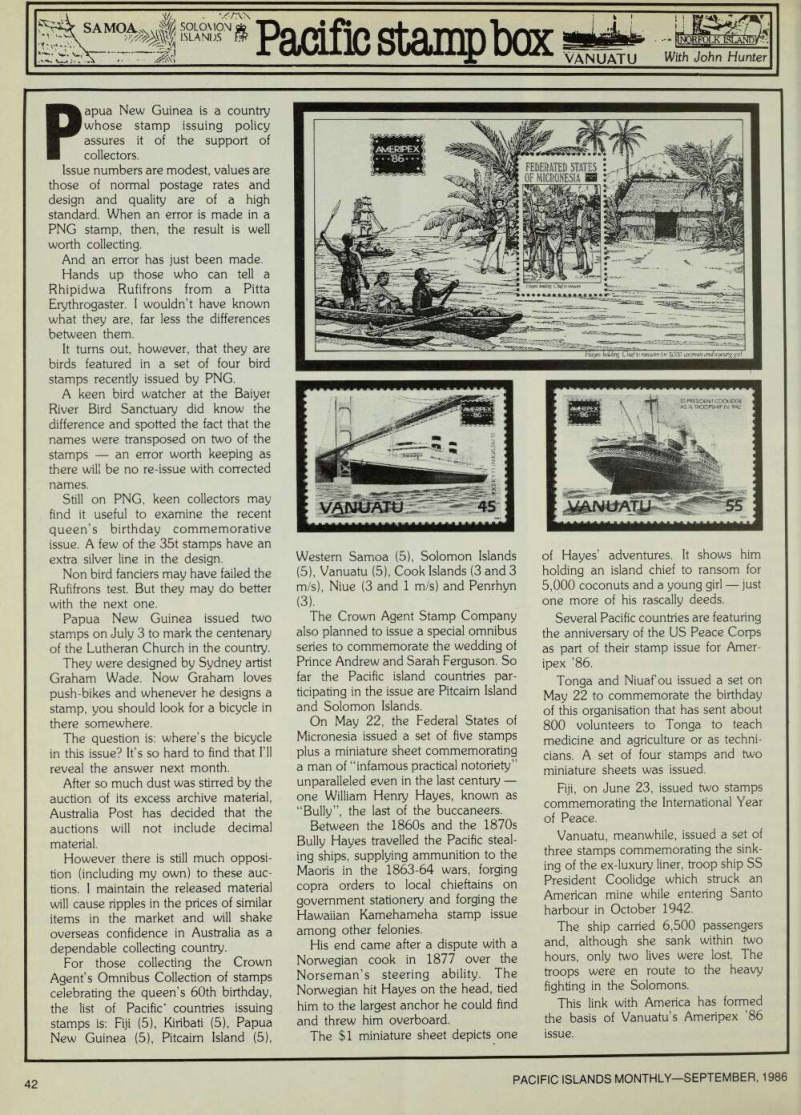
Papua New Guinea is a country whose stamp issuing policy assures it of the support of collectors.
Issue numbers are modest, values are those of normal postage rates and design and quality are of a high standard. When an error is made in a PNG stamp, then, the result is well worth collecting.
And an error has just been made.
Hands up those who can tell a Rhipidwa Rufifrons from a Pitta Erythrogaster. I wouldn’t have known what they are, far less the differences between them.
It turns out, however, that they are birds featured in a set of four bird stamps recently issued by PNG.
A keen bird watcher at the Baiyer River Bird Sanctuary did know the difference and spotted the fact that the names were transposed on two of the stamps an error worth keeping as there will be no re-issue with corrected names.
Still on PNG, keen collectors may find it useful to examine the recent queen’s birthday commemorative issue. A few of the 35t stamps have an extra silver line in the design.
Non bird fanciers may have failed the Rufifrons test. But they may do better with the next one.
Papua New Guinea issued two stamps on July 3 to mark the centenary of the Lutheran Church in the country.
They were designed by Sydney artist Graham Wade. Now Graham loves push-bikes and whenever he designs a stamp, you should look for a bicycle in there somewhere.
The question is: where’s the bicycle in this issue? It’s so hard to find that I’ll reveal the answer next month.
After so much dust was stirred by the auction of its excess archive material, Australia Post has decided that the auctions will not include decimal material.
However there is still much opposi tion (including my own) to these auc tions. I maintain the released material will cause ripples in the prices of similar items in the market and will shake overseas confidence in Australia as a dependable collecting country.
For those collecting the Crown Agent’s Omnibus Collection of stamps celebrating the queen’s 60th birthday, the list of Pacific* countries issuing stamps is: Fiji (5), Kiribati (5), Papua New Guinea (5), Pitcairn Island (5),
Western Samoa (5), Solomon Islands (5), Vanuatu (5), Cook Islands (3 and 3 m/s), Niue (3 and 1 m/s) and Penrhyn (3).
The Crown Agent Stamp Company also planned to issue a special omnibus series to commemorate the wedding of Prince Andrew and Sarah Ferguson. So far the Pacific island countries par ticipating in the issue are Pitcairn Island and Solomon Islands.
On May 22, the Federal States of Micronesia issued a set of five stamps plus a miniature sheet commemorating a man of “infamous practical notoriety” unparalleled even in the last century one William Henry Hayes, known as “Bully”, the last of the buccaneers.
Between the 1860 s and the 1870 s Bully Hayes travelled the Pacific steal ing ships, supplying ammunition to the Maoris in the 1863-64 wars, forging copra orders to local chieftains on government stationery and forging the Hawaiian Kamehameha stamp issue among other felonies.
His end came after a dispute with a Norwegian cook in 1877 over the Norseman’s steering ability. The Norwegian hit Hayes on the head, tied him to the largest anchor he could find and threw him overboard.
The $1 miniature sheet depicts one
of Hayes’ adventures. It shows him holding an island chief to ransom for 5,000 coconuts and a young girl just one more of his rascally deeds.
Several Pacific countries are featuring the anniversary of the US Peace Corps as part of their stamp issue for Amer ipex ’B6.
Tonga and Niuafou issued a set on May 22 to commemorate the birthday of this organisation that has sent about 800 volunteers to Tonga to teach medicine and agriculture or as techni cians. A set of four stamps and two miniature sheets was issued.
Fiji, on June 23, issued two stamps commemorating the International Year of Peace.
Vanuatu, meanwhile, issued a set of three stamps commemorating the sink ing of the ex-luxury liner, troop ship SS President Coolidge which struck an American mine while entering Santo harbour in October 1942.
The ship carried 6,500 passengers and, although she sank within two hours, only two lives were lost. The troops were en route to the heavy fighting in the Solomons.
This link with America has formed the basis of Vanuatu’s Ameripex ’B6 issue.
A white man caught
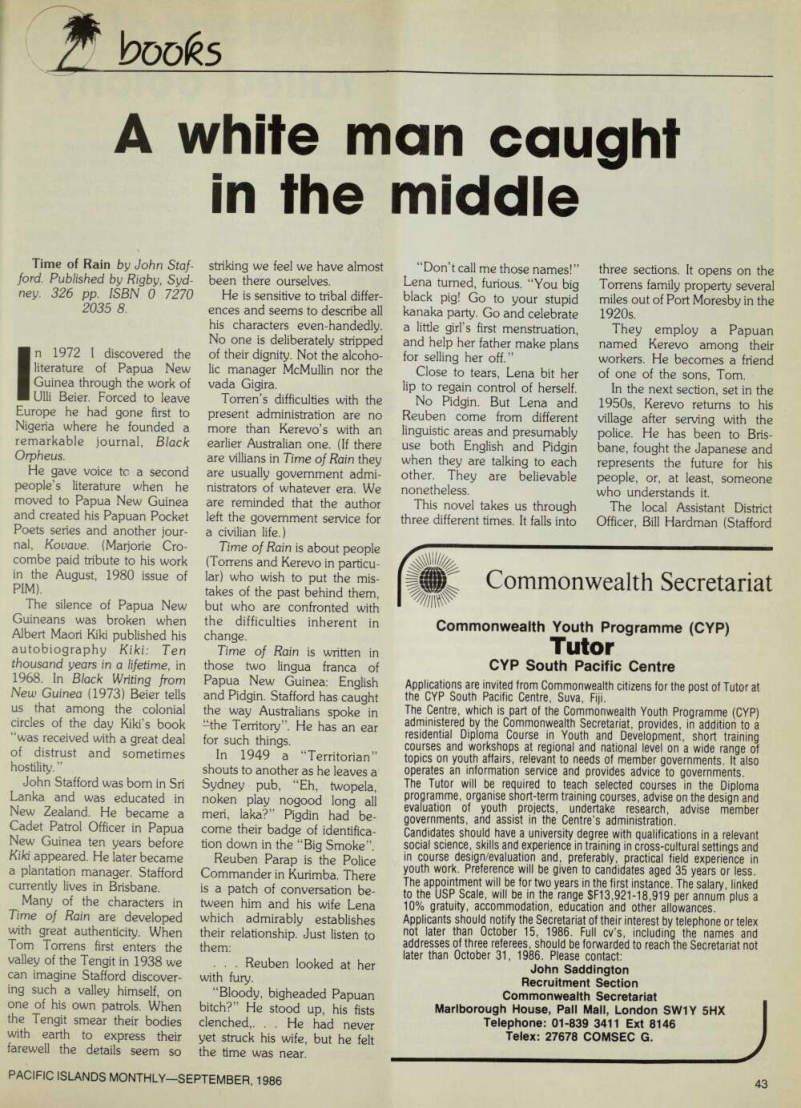
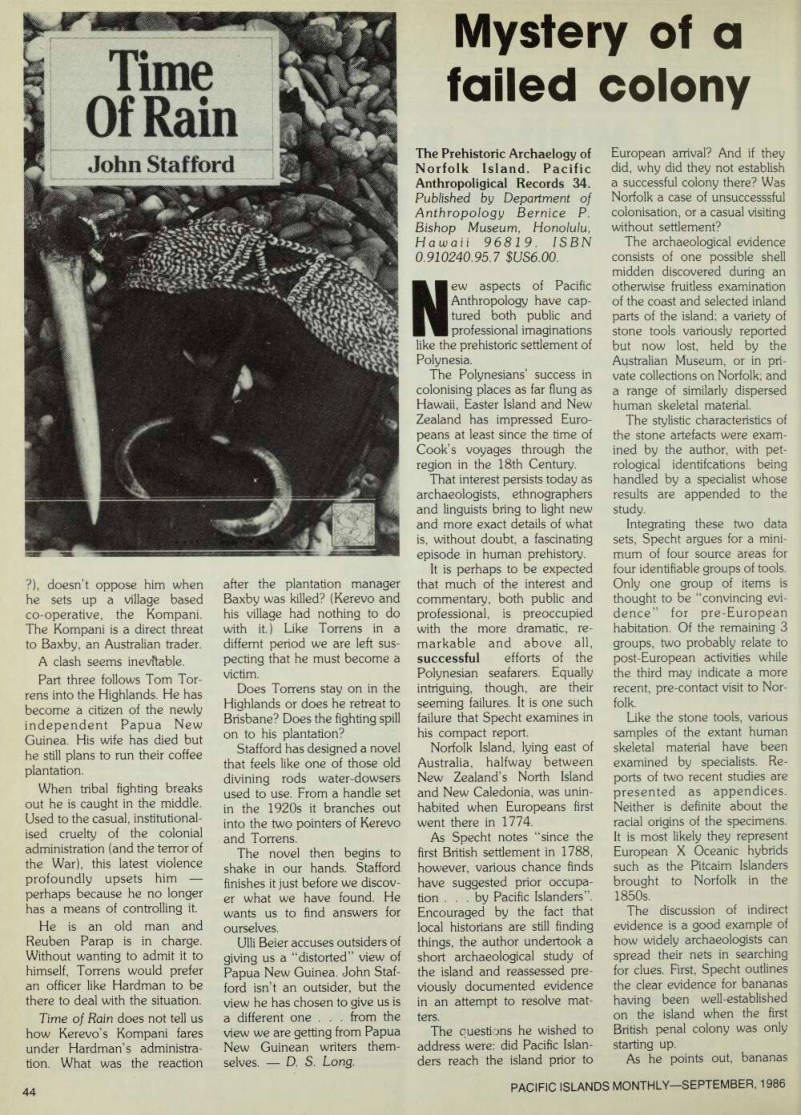
books
A white man caught in the middle
Time of Rain by John Staf ford. Published by R/gby, Syd ney. 326 pp. ISBN 0 7270 2035 8.
In 1972 I discovered the literature of Papua New Guinea through the work of Ulli Beier. Forced to leave Europe he had gone first to Nigeria where he founded a remarkable journal, Black Orpheus.
He gave voice to a second people’s literature when he moved to Papua New Guinea and created his Papuan Pocket Poets series and another jour nal, Kouaue. (Marjorie Cro combe paid tribute to his work in the August, 1980 issue of
Pim).
The silence of Papua New Guineans was broken when Albert Maori Kiki published his autobiography Kiki: Ten thousand years in a lifetime, in 1968. In Black Writing from New Guinea (1973) Beier tells us that among the colonial circles of the day Kiki’s book “was received with a great deal of distrust and sometimes hostility. ”
John Stafford was bom in Sri Lanka and was educated in New Zealand. He became a Cadet Patrol Officer in Papua New Guinea ten years before Kiki appeared. He later became a plantation manager. Stafford currently lives in Brisbane.
Many of the characters in Time of Rain are developed with great authenticity. When Tom Torrens first enters the valley of the Tengit in 1938 we can imagine Stafford discover ing such a valley himself, on one of his own patrols. When the Tengit smear their bodies with earth to express their farewell the details seem so
striking we feel we have almost been there ourselves.
He is sensitive to tribal differ ences and seems to describe all his characters even-handedly.
No one is deliberately stripped of their dignity. Not the alcoho lic manager McMullin nor the vada Gigira.
Torren’s difficulties with the present administration are no more than Kerevo’s with an earlier Australian one. (If there are villians in Time of Rain they are usually government admi nistrators of whatever era. We are reminded that the author left the government service for a civilian life.) Time of Rain is about people (Torrens and Kerevo in particu lar) who wish to put the mis takes of the past behind them, but who are confronted with the difficulties inherent in change.
Time of Rain is written in those two lingua franca of Papua New Guinea: English and Pidgin. Stafford has caught the way Australians spoke in “the Territory”. He has an ear for such things.
In 1949 a “Territorian” shouts to another as he leaves a Sydney pub, “Eh, twopela, noken play nogood long all meri, laka?” Pigdin had be come their badge of identifica tion down in the “Big Smoke”.
Reuben Parap is the Police Commander in Kurimba. There is a patch of conversation be tween him and his wife Lena which admirably establishes their relationship. Just listen to them: . . . Reuben looked at her with fury.
“Bloody, bigheaded Papuan bitch?” He stood up, his fists clenched,. . . He had never yet struck his wife, but he felt the time was near.
“Don’t call me those names!”
Lena turned, furious. “You big black pig! Go to your stupid kanaka party. Go and celebrate a little girl’s first menstruation, and help her father make plans for selling her off.”
Close to tears, Lena bit her lip to regain control of herself.
No Pidgin. But Lena and Reuben come from different linguistic areas and presumably use both English and Pidgin when they are talking to each other. They are believable nonetheless.
This novel takes us through three different times. It falls into
three sections. It opens on the Torrens family property several miles out of Port Moresby in the 19205.
They employ a Papuan named Kerevo among their workers. He becomes a friend of one of the sons, Tom.
In the next section, set in the 19505, Kerevo returns to his village after serving with the police. He has been to Bris bane, fought the Japanese and represents the future for his people, or, at least, someone who understands it.
The local Assistant District Officer, Bill Hardman (Stafford
?), doesn’t oppose him when he sets up a village based co-operative, the Kompani.
The Kompani is a direct threat to Baxby, an Australian trader.
A clash seems inevitable.
Part three follows Tom Tor rens into the Highlands. He has become a citizen of the newly independent Papua New Guinea. His wife has died but he still plans to run their coffee plantation.
When tribal fighting breaks out he is caught in the middle.
Used to the casual, institutional ised cruelty of the colonial administration (and the terror of the War), this latest violence profoundly upsets him perhaps because he no longer has a means of controlling it.
He is an old man and Reuben Parap is in charge.
Without wanting to admit it to himself, Torrens would prefer an officer like Hardman to be there to deal with the situation.
Time of Rain does not tell us how Kerevo’s Kompani fares under Hardman’s administra tion. What was the reaction
after the plantation manager Baxby was killed? (Kerevo and his village had nothing to do with it.) Like Torrens in a differnt period we are left sus pecting that he must become a victim.
Does Torrens stay on in the Highlands or does he retreat to Brisbane? Does the fighting spill on to his plantation?
Stafford has designed a novel that feels like one of those old divining rods water-dowsers used to use. From a handle set in the 1920 s it branches out into the two pointers of Kerevo and Torrens.
The novel then begins to shake in our hands. Stafford finishes it just before we discov er what we have found. He wants us to find answers for ourselves.
Dili Beier accuses outsiders of giving us a “distorted” view of Papua New Guinea. John Staf ford isn’t an outsider, but the view he has chosen to give us is a different one . . . from the view we are getting from Papua New Guinean writers them
selves.
D. S. Long.
Advertisements & other items, p. 43 (1 item)
Commonwealth Secretariat
r|» m
Commonwealth Youth Programme (CYP)
Tutor
CYP South Pacific Centre Applications are invited from Commonwealth citizens for the post of Tutor at the CYP South Pacific Centre, Suva, Fiji.
The Centre, which is part of the Commonwealth Youth Programme (CYP) administered by the Commonwealth Secretariat, provides, in addition to a residential Diploma Course in Youth and Development, short training courses and workshops at regional and national level on a wide range of topics on youth affairs, relevant to needs of member governments. It also operates an information service and provides advice to governments.
The Tutor will be required to teach selected courses in the Diploma programme, organise short-term training courses, advise on the design and evaluation of youth projects, undertake research, advise member governments, and assist in the Centre’s administration.
Candidates should have a university degree with qualifications in a relevant social science, skills and experience in training in cross-cultural settings and in course design/evaluation and, preferably, practical field experience in youth work. Preference will be given to candidates aged 35 years or less.
The appointment will be for two years in the first instance. The salary, linked to the USP Scale, will be in the range $F13,921-18,919 per annum plus a 10% gratuity, accommodation, education and other allowances.
Applicants should notify the Secretariat of their interest by telephone or telex not later than October 15, 1986. Full cv’s, including the names and addresses of three referees, should be forwarded to reach the Secretariat not later than October 31, 1986. Please contact: John Saddington Recruitment Section Commonwealth Secretariat Marlborough House, Pall Mall, London SWIY SHX Telephone: 01-839 3411 Ext 8146 Telex: 27678 COMSEC G.
failed colony
Mystery of a failed colony
The Prehistoric Archaelogy of Norfolk Island. Pacific Anthropoligical Records 34.
Published by Department of Anthropology Bernice P.
Bishop Museum, Honolulu, Hawaii 96819. ISBN
0.910240.95.7 Sus6.Oo.
New aspects of Pacific Anthropology have cap tured both public and professional imaginations like the prehistoric settlement of Polynesia.
The Polynesians’ success in colonising places as far flung as Hawaii, Easter Island and New Zealand has impressed Euro peans at least since the time of Cook’s voyages through the region in the 18th Century.
That interest persists today as archaeologists, ethnographers and linguists bring to light new and more exact details of what is, without doubt, a fascinating episode in human prehistory.
It is perhaps to be expected that much of the interest and commentary, both public and professional, is preoccupied with the more dramatic, re markable and above all, successful efforts of the Polynesian seafarers. Equally intriguing, though, are their seeming failures. It is one such failure that Specht examines in his compact report.
Norfolk Island, lying east of Australia, halfway between New Zealand’s North Island and New Caledonia, was unin habited when Europeans first went there in 1774.
As Specht notes “since the first British settlement in 1788, however, various chance finds have suggested prior occupa tion ... by Pacific Islanders”.
Encouraged by the fact that local historians are still finding things, the author undertook a short archaeological study of the island and reassessed pre viously documented evidence in an attempt to resolve mat ters.
The questions he wished to address were: did Pacific Islan ders reach the island prior to
European arrival? And if they did, why did they not establish a successful colony there? Was Norfolk a case of unsuccesssful colonisation, or a casual visiting without settlement?
The archaeological evidence consists of one possible shell midden discovered during an otherwise fruitless examination of the coast and selected inland parts of the island; a variety of stone tools variously reported but now lost, held by the Australian Museum, or in pri vate collections on Norfolk; and a range of similarly dispersed human skeletal material.
The stylistic characteristics of the stone artefacts were exam ined by the author, with pet rological identifcations being handled by a specialist whose results are appended to the study.
Integrating these two data sets, Specht argues for a mini mum of four source areas for four identifiable groups of tools.
Only one group of items is thought to be “convincing evi dence” for pre-European habitation. Of the remaining 3 groups, two probably relate to post-European activities while the third may indicate a more recent, pre-contact visit to Nor folk.
Like the stone tools, various samples of the extant human skeletal material have been examined by specialists. Re ports of two recent studies are presented as appendices.
Neither is definite about the racial origins of the specimens.
It is most likely they represent European X Oceanic hybrids such as the Pitcairn Islanders brought to Norfolk in the 1850 s.
The discussion of indirect evidence is a good example of how widely archaeologists can spread their nets in searching for clues. First, Specht outlines the clear evidence for bananas having been well-established on the island when the first British penal colony was only starting up.
As he points out, bananas
grow vegetatively (i.e. from suckers) and so it is extremely improbable that they drifted to the island and then established themselves over one kilometre inland and some height above sea level.
Second, there is a suggestion that a species of rat, Rattus exulans, was introduced before Cook’s first tour. A small, deli cate creature, R. exulans is native to the Pacific but owes its distribution to human agencies.
It may be the small rat described in early journals as having devastated the colony’s food supplies.
While previously thought not to have been on Norfolk, its presence today has lately been demonstrated and its early in troduction made reasonable definite by the discovery of an R. exulans skeleton in 700-800 year old sediments in the is land’s old cemetery area.
Summing up his exhaustive survey of the evidence, Specht argues that: “the best in terpretation ... is that there was certainly one arrival from Eastern Polynesia, probably about ADIOOO to 1400, and possibly a second between ADI4OO and 1774.
“The first landing may have originated from North Island New Zealand, the Cook Islands, or the Society Islands; the puta tive later landing would most likely have come from South Island New Zealand.”
He buttresses these conten tions with the results of compu ter simulations of drift voyages in the Pacific. Although the Kermadec Islands near New Zealand are the point of origin for most of the successful simu lated landings on Norfolk, bananas do not grow there.
The simulations suggest Ton ga, and the Cook and Society Islands as other possibilities, the latter two of which are most likely in view of the nature of the stone tools and drift material.
Having got this far, Specht points out that regardless of where people may have come from or how many times they came, the question of their fate on Norfolk remains unresolved.
While there is some support for the idea that the island was not a regular port-of-call for Polynesian sailors, this does not mean people did not attempt to settle permanently there.
The planting of bananas, which take 12 months to ma ture, certainly suggests people intended to stay. What, then, prevented their survival in the longer term?
The answer may be that many of the food crops normal ly used in the Pacific were not brought to Norfolk and this, coupled with the relative pover ty of local marine and other resources, meant the settlers were doomed from the start.
Alternatively, the group may not have constituted a viable breeding population, regardless of the state of their resource base.
Disappointingly, the evi dence available does not allow the author to do more than present these possibilities. He can only conclude that more archaeological work needs to be done if we wish to more fully explore the constraints on hu man settlement in the Pacific.
Like its companion volumes in the Pacific Anthropological Records series, Specht’s report is well-produced and very rea sonably priced. Its clearly printed text is interspersed with quite a few adequately labelled figures and tables.
The only criticism I have with regard to presentation is that most of the black and white
photographs are unclear. The body of the text is written in an academic rather than popular style, but is as jargon-free as could be expected and so is accessible to both professionals and interested laymen alike.
However, some of the tables and, more particularly, the three appendices, are strictly for the technically-minded who are familiar with arcane geological and osteological terms and methods. In short, the report is not for everyone, but frustrating as its inconclusive ness is it would be a useful addition to the library of any student of Pacific anthropology.
lan Lilley.
Movements away
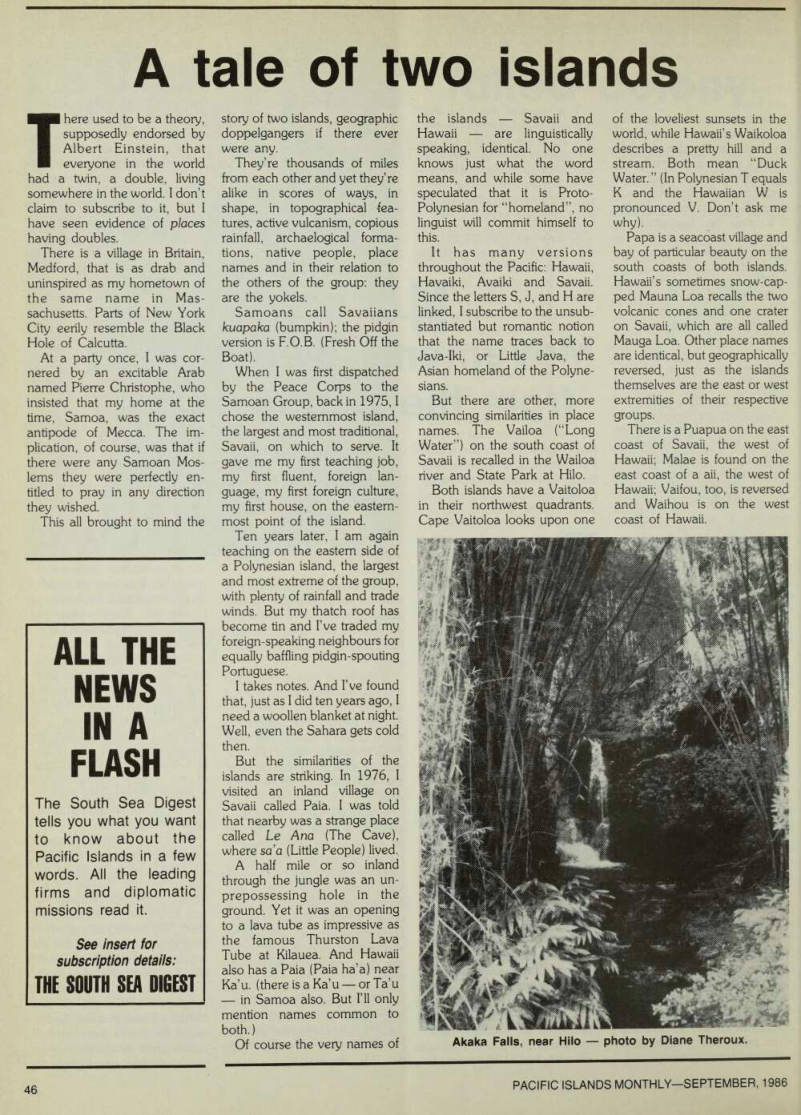
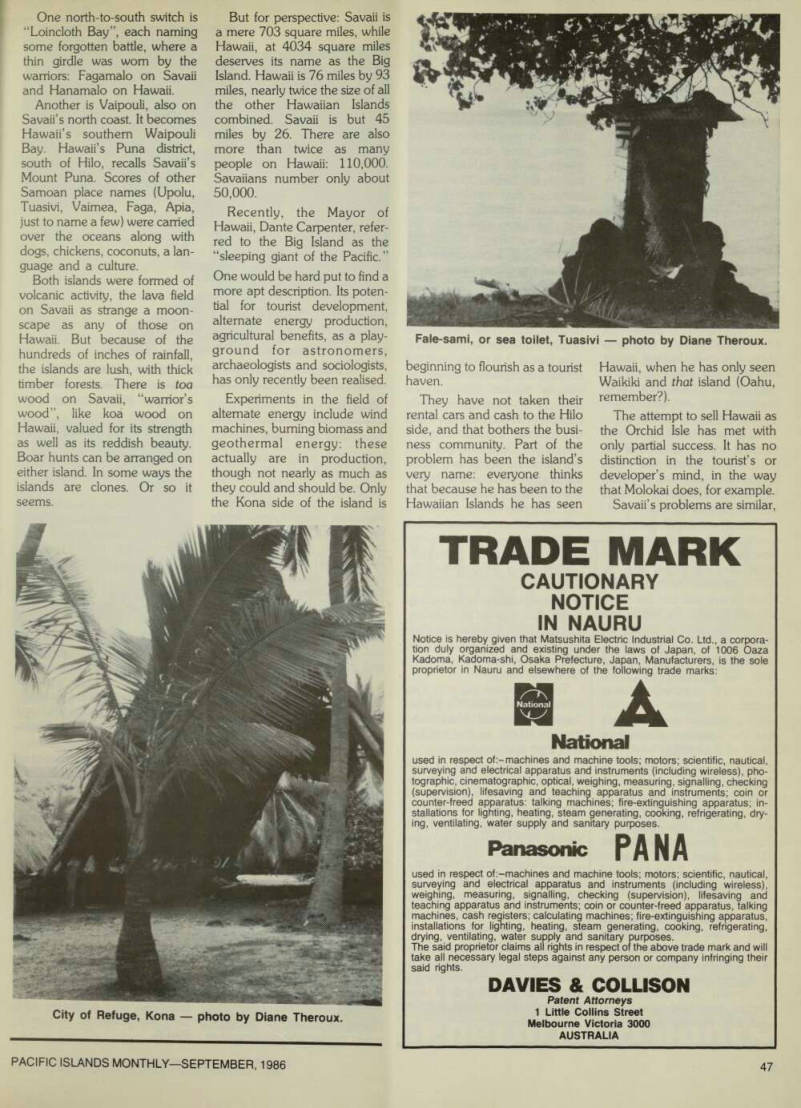
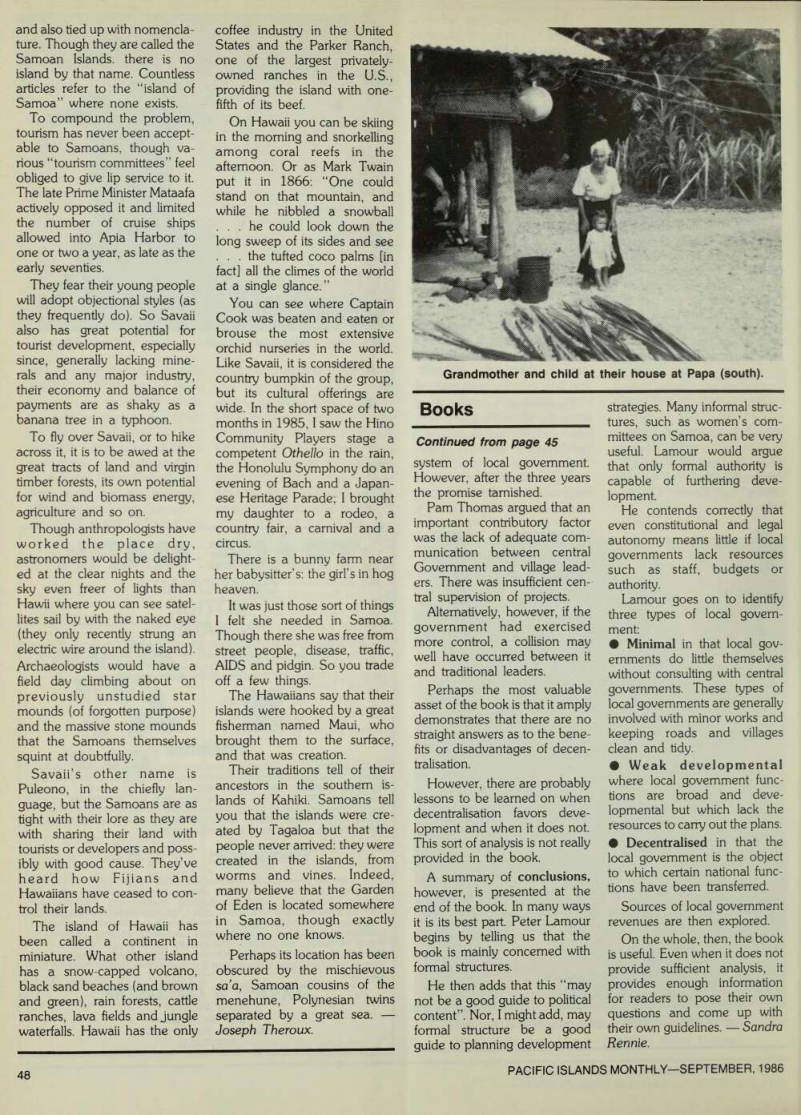
from the centre
Decentralisation in the South Pacific: Local, Provincial and State Government in Twenty Countries, University of the South Pacific, 1985 The above book covering decentralisation in most of the many islands of the Pacific contains contribu tions from almost an equal number of authors. A mam moth task has been attempted.
The book is divided into three sections corresponding with the major areas of the Pacific Melanesia, Polynesia and Micronesia.
Each island is dealt with separately although more detail is given to some rather than others. Tonga gets short shrift whereas Papua New Guinea receives prime attention. It appears that some authors have first-hand information of the island on which they wrote others appear to glean their information solely from secondary sources.
It is a pity that more informa tion and opinions was not sought from Islanders them selves. nevertheless a wealth of detailed information is provided on administrative structures, political development and their history. As such, Decentralisa tion in the South Pacific appears as an excellent refer ence book.
But any book becomes more
valuable when it goes beyond the details to provide analysis.
The discussion is generally put within the context of former colonial overseership, modern political development with some attention being paid to indigenous forms of political control.
The different chapters vary in amount of analysis paid to the juxtaposition of all three in the administrative forms which have evolved to their present state.
If the book proves one thing it is that decentralisation is not a uniform movement in the Paci fic. In French Polynesia it is more or less a transfer from the French system rather than a natural process which reflects the aspirations of those islan ders.
In Western Samoa, local gov ernment is based on the values inherent in a hierarchically valued system of chiefly titles.
In Fiji there is a dual system of local government one for Melanesian Fijians and the other for the Indian Fijians.
Decentralisation obviously
serves different purposes, it can also give rise to different emo tions.
Obviously attitudes to decen tralisation change through time.
PNG is a classic example. In the wake of independence in the 70s, decentralisation was
fashionable. It was equated with decolonisation.
Yet even before the 80s there were those who saw extensive decentralisation as a step to wards secession.
So, in PNG, caution came to be expressed. In countries of ethnic or provincial diversity, governments may want to make symbolic gestures to de centralisation. Yet, at the same time, fears may be aroused.
As in Vanuatu, there may be apprehension over regionalisa tion or separatism. In contrast in more homogenous or smaller island states such as Tuvalu or Cooks, the hope exists that local government can hasten development.
At times, the book does delve into vital enquiry such as whe ther or not local structures are actually facilitating or hindering the development process.
Pam Thomas’ chapter on Western Samoa is one of the best. She outlines the outcome of the central Government’s policy of strengthening the link ages between villagers and na tional policy makers.
Rural Development projects were to be based on commer cial village ventures. Once dis cussed in the village council (fono ) a project request was sent to the Rural Development Unit. The traditional system of local government provided the organisation needed for raising the initial costs and labor force.
The Rural Development Program in Western Samoa started off very successfully be cause the central Government could plug into the existing
Continued on page 48
system of local government.
However, after the three years the promise tarnished.
Pam Thomas argued that an important contributory factor was the lack of adequate com munication between central Government and village lead ers. There was insufficient cen tral supervision of projects.
Alternatively, however, if the government had exercised more control, a collision may well have occurred between it and traditional leaders.
Perhaps the most valuable asset of the book is that it amply demonstrates that there are no straight answers as to the bene fits or disadvantages of decen tralisation.
However, there are probably lessons to be learned on when decentralisation favors deve lopment and when it does not.
This sort of analysis is not really provided in the book.
A summary of conclusions, however, is presented at the end of the book. In many ways it is its best part. Peter Lamour begins by telling us that the book is mainly concerned with formal structures.
He then adds that this “may not be a good guide to political content”. Nor, I might add, may formal structure be a good guide to planning development
strategies. Many informal struc tures, such as women’s com mittees on Samoa, can be very useful. Lamour would argue that only formal authority is capable of furthering deve lopment.
He contends correctly that even constitutional and legal autonomy means little if local governments lack resources such as staff, budgets or authority.
Lamour goes on to identify three types of local govern ment; • Minimal in that local gov ernments do little themselves without consulting with central governments. These types of local governments are generally involved with minor works and keeping roads and villages clean and tidy. • Weak developmental where local government func tions are broad and deve lopmental but which lack the resources to carry out the plans. • Decentralised in that the local government is the object to which certain national func tions have been transferred.
Sources of local government revenues are then explored.
On the whole, then, the book is useful. Even when it does not provide sufficient analysis, it provides enough information for readers to pose their own questions and come up with
their own guidelines.
Sandra
Rennie.
Advertisements & other items, p. 45 (1 item)
45
PACjFIC ISLANDS MONTHLY—SEPTEMBER, 1986
A tale of two islands
There used to be a theory, supposedly endorsed by Albert Einstein, that everyone in the world had a twin, a double, living somewhere in the world. I don’t claim to subscribe to it, but I have seen evidence of places having doubles.
There is a village in Britain, Medford, that is as drab and uninspired as my hometown of the same name in Mas sachusetts. Parts of New York City eerily resemble the Black Hole of Calcutta.
At a party once, I was cor nered by an excitable Arab named Pierre Christophe, who insisted that my home at the time, Samoa, was the exact antipode of Mecca. The im plication, of course, was that if there were any Samoan Mos lems they were perfectly en titled to pray in any direction they wished.
This all brought to mind the
story of two islands, geographic doppelgangers if there ever were any.
They’re thousands of miles from each other and yet they’re alike in scores of ways, in shape, in topographical fea tures, active vulcanism, copious rainfall, archaelogical forma tions, native people, place names and in their relation to the others of the group: they are the yokels.
Samoans call Savaiians kuapaka (bumpkin); the pidgin version is F. 0.8. (Fresh Off the Boat).
When I was first dispatched by the Peace Corps to the Samoan Group, back in 1975,1 chose the westernmost island, the largest and most traditional, Savaii, on which to serve. It gave me my first teaching job, my first fluent, foreign lan guage, my first foreign culture, my first house, on the eastern most point of the island.
Ten years later, I am again teaching on the eastern side of a Polynesian island, the largest and most extreme of the group, with plenty of rainfall and trade winds. But my thatch roof has become tin and I’ve traded my foreign-speaking neighbours for equally baffling pidgin-spouting Portuguese.
I takes notes. And I’ve found that, just as I did ten years ago, I need a woollen blanket at night.
Well, even the Sahara gets cold then.
But the similarities of the islands are striking. In 1976, I visited an inland village on Savaii called Paia. I was told that nearby was a strange place called Le Ana (The Cave), where sa’a (Little People) lived.
A half mile or so inland through the jungle was an un prepossessing hole in the ground. Yet it was an opening to a lava tube as impressive as the famous Thurston Lava Tube at Kilauea. And Hawaii also has a Paia (Paia ha’a) near Ka’u. (there is a Ka’u or Ta’u in Samoa also. But I’ll only mention names common to both.) Of course the very names of
the islands Savaii and Hawaii are linguistically speaking, identical. No one knows just what the word means, and while some have speculated that it is Proto- Polynesian for “homeland”, no linguist will commit himself to this.
It has many versions throughout the Pacific: Hawaii, Havaiki, Avaiki and Savaii.
Since the letters S, J, and H are linked, 1 subscribe to the unsub stantiated but romantic notion that the name traces back to Java-lki, or Little Java, the Asian homeland of the Polyne sians.
But there are other, more convincing similarities in place names. The Vailoa (“Long Water”) on the south coast of Savaii is recalled in the Wailoa river and State Park at Hilo.
Both islands have a Vaitoloa in their northwest quadrants.
Cape Vaitoloa looks upon one
of the loveliest sunsets in the world, while Hawaii’s Waikoloa describes a pretty hill and a stream. Both mean “Duck Water. ” (In Polynesian T equals K and the Hawaiian W is pronounced V. Don’t ask me why).
Papa is a seacoast village and bay of particular beauty on the south coasts of both islands.
Hawaii’s sometimes snow-cap ped Mauna Loa recalls the two volcanic cones and one crater on Savaii, which are all called Mauga Loa. Other place names are identical, but geographically reversed, just as the islands themselves are the east or west extremities of their respective groups.
There is a Puapua on the east coast of Savaii, the west of Hawaii; Malae is found on the east coast of a aii, the west of Hawaii; Vaifou, too, is reversed and Waihou is on the west coast of Hawaii.
Akaka Falls, near Hilo photo by Diane Theroux.
One north-to-south switch is “Loincloth Bay”, each naming some forgotten battle, where a thin girdle was worn by the warriors: Fagamalo on Savaii and Hanamalo on Hawaii.
Another is Vaipouli, also on Savaii’s north coast. It becomes Hawaii’s southern Waipouli Bay. Hawaii’s Puna district, south of Hilo, recalls Savaii’s Mount Puna. Scores of other Samoan place names (Upolu, Tuasivi, Vaimea, Faga, Apia, just to name a few) were carried over the oceans along with dogs, chickens, coconuts, a lan guage and a culture.
Both islands were formed of volcanic activity, the lava field on Savaii as strange a moon scape as any of those on Hawaii. But because of the hundreds of inches of rainfall, the islands are lush, with thick timber forests. There is too wood on Savaii, “warrior’s wood”, like koa wood on Hawaii, valued for its strength as well as its reddish beauty.
Boar hunts can be arranged on either island. In some ways the islands are clones. Or so it seems.
But for perspective: Savaii is a mere 703 square miles, while Hawaii, at 4034 square miles deserves its name as the Big Island. Hawaii is 76 miles by 93 miles, nearly twice the size of all the other Hawaiian Islands combined. Savaii is but 45 miles by 26. There are also more than twice as many people on Hawaii: 110,000.
Savaiians number only about 50,000.
Recently, the Mayor of Hawaii, Dante Carpenter, refer red to the Big Island as the “sleeping giant of the Pacific.”
One would be hard put to find a more apt description. Its poten tial for tourist development, alternate energy production, agricultural benefits, as a play ground for astronomers, archaeologists and sociologists, has only recently been realised.
Experiments in the field of alternate energy include wind machines, burning biomass and geothermal energy: these actually are in production, though not nearly as much as they could and should be. Only the Kona side of the island is
beginning to flourish as a tourist haven.
They have not taken their rental cars and cash to the Hilo side, and that bothers the busi ness community. Part of the problem has been the island’s very name: everyone thinks that because he has been to the Hawaiian Islands he has seen
Hawaii, when he has only seen Waikiki and that island (Oahu, remember?).
The attempt to sell Hawaii as the Orchid Isle has met with only partial success. It has no distinction in the tourist’s or developer’s mind, in the way that Molokai does, for example.
Savaii’s problems are similar,
City of Refuge, Kona photo by Diane Theroux.
Fale-sami, or sea toilet, Tuasvi photo by Diane Theroux.
and also tied up with nomencla ture. Though they are called the Samoan Islands, there is no island by that name. Countless articles refer to the “island of Samoa” where none exists.
To compound the problem, tourism has never been accept able to Samoans, though va rious “tourism committees” feel obliged to give lip service to it.
The late Prime Minister Mataafa actively opposed it and limited the number of cruise ships allowed into Apia Harbor to one or two a year, as late as the early seventies.
They fear their young people will adopt objectional styles (as they frequently do). So Savaii also has great potential for tourist development, especially since, generally lacking mine rals and any major industry, their economy and balance of payments are as shaky as a banana tree in a typhoon.
To fly over Savaii, or to hike across it, it is to be awed at the great tracts of land and virgin timber forests, its own potential for wind and biomass energy, agriculture and so on.
Though anthropologists have worked the place dry, astronomers would be delight ed at the clear nights and the sky even freer of lights than Hawii where you can see satel lites sail by with the naked eye (they only recently strung an electric wire around the island).
Archaeologists would have a field day climbing about on previously unstudied star mounds (of forgotten purpose) and the massive stone mounds that the Samoans themselves squint at doubtfully.
Savaii’s other name is Puleono, in the chiefly lan guage, but the Samoans are as tight with their lore as they are with sharing their land with tourists or developers and poss ibly with good cause. They’ve heard how Fijians and Hawaiians have ceased to con trol their lands.
The island of Hawaii has been called a continent in miniature. What other island has a snow-capped volcano, black sand beaches (and brown and green), rain forests, cattle ranches, lava fields and jungle waterfalls. Hawaii has the only
coffee industry in the United States and the Parker Ranch, one of the largest privately owned ranches in the U.S., providing the island with one fifth of its beef.
On Hawaii you can be skiing in the morning and snorkelling among coral reefs in the afternoon. Or as Mark Twain put it in 1866: “One could stand on that mountain, and while he nibbled a snowball ... he could look down the long sweep of its sides and see ... the tufted coco palms [in fact] all the climes of the world at a single glance.”
You can see where Captain Cook was beaten and eaten or brouse the most extensive orchid nurseries in the world.
Like Savaii, it is considered the country bumpkin of the group, but its cultural offerings are wide. In the short space of two months in 1985,1 saw the Hino Community Players stage a competent Othello in the rain, the Honolulu Symphony do an evening of Bach and a Japan ese Heritage Parade; I brought my daughter to a rodeo, a country fair, a carnival and a circus.
There is a bunny farm near her babysitter’s: the girl’s in hog heaven.
It was just those sort of things I felt she needed in Samoa.
Though there she was free from street people, disease, traffic, AIDS and pidgin. So you trade off a few things.
The Hawaiians say that their islands were hooked by a great fisherman named Maui, who brought them to the surface, and that was creation.
Their traditions tell of their ancestors in the southern is lands of Kahiki. Samoans tell you that the islands were cre ated by Tagaloa but that the people never arrived: they were created in the islands, from worms and vines. Indeed, many believe that the Garden of Eden is located somewhere in Samoa, though exactly where no one knows.
Perhaps its location has been obscured by the mischievous sa’a, Samoan cousins of the menehune, Polynesian twins separated by a great sea.
Joseph Theroux.
Grandmother and child at their house at Papa (south).
Advertisements & other items, pp. 46-48 (2 items)
News
ALL THE
IN A
FLASH
The South Sea Digest tells you what you want to know about the Pacific Islands in a few words. All the leading firms and diplomatic missions read it.
See insert for subscription details:
THE SOUTH SEA DIGEST
TRADE MARK
CAUTIONARY
NOTICE
IN NAURU
Notice is hereby given that Matsushita Electric Industrial Co. Ltd., a corporation duly organized and existing under the laws of Japan, of 1006 Oaza Kadoma, Kadoma-shi, Osaka Prefecture, Japan, Manufacturers, is the sole proprietor in Nauru and elsewhere of the following trade marks: B 9 A
National
used in respect of:-machines and machine tools; motors; scientific, nautical, surveying and electrical apparatus and instruments (including wireless), photographic, cinematographic, optical, weighing, measuring, signalling, checking (supervision), lifesaving and teaching apparatus and instruments; coin or counter-freed apparatus: talking machines; fire-extinguishing apparatus: installations for lighting, heating, steam generating, cooking, refrigerating, drying, ventilating, water supply and sanitary purposes.
Panasonic RAN A
used in respect of:-machines and machine tools; motors; scientific, nautical, surveying and electrical apparatus and instruments (including wireless), weighing, measuring, signalling, checking (supervision), lifesaving and teaching apparatus and instruments; coin or counter-freed apparatus, talking machines, cash registers; calculating machines; fire-extinguishing apparatus, installations for lighting, heating, steam generating, cooking, refrigerating, drying, ventilating, water supply and sanitary purposes.
The said proprietor claims all rights in respect of the above trade mark and will take all necessary legal steps against any person or company infringing their said rights.
DAVIES & COLLISON
Patent Attorneys 1 Little Collins Street Melbourne Victoria 3000
AUSTRALIA
Books
48
PACIFIC ISLANDS MONTHLY—SEPTEMBER, 1986
Continued from page 45
Books
transitions
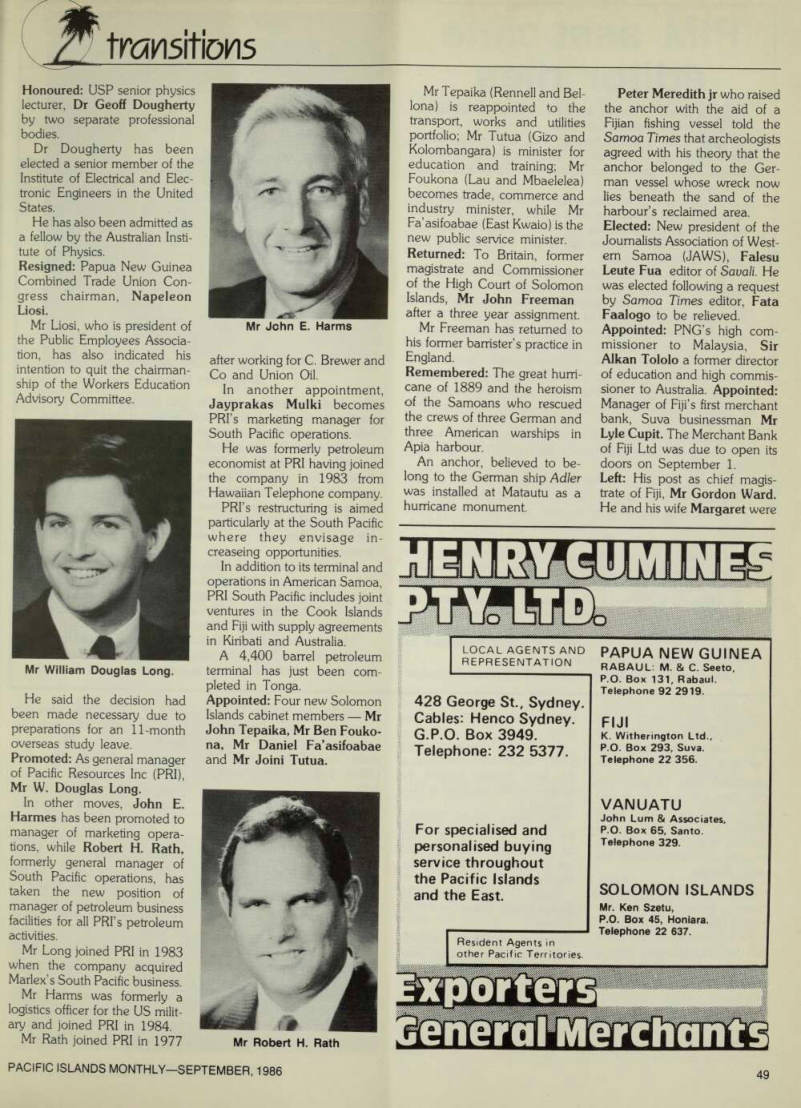
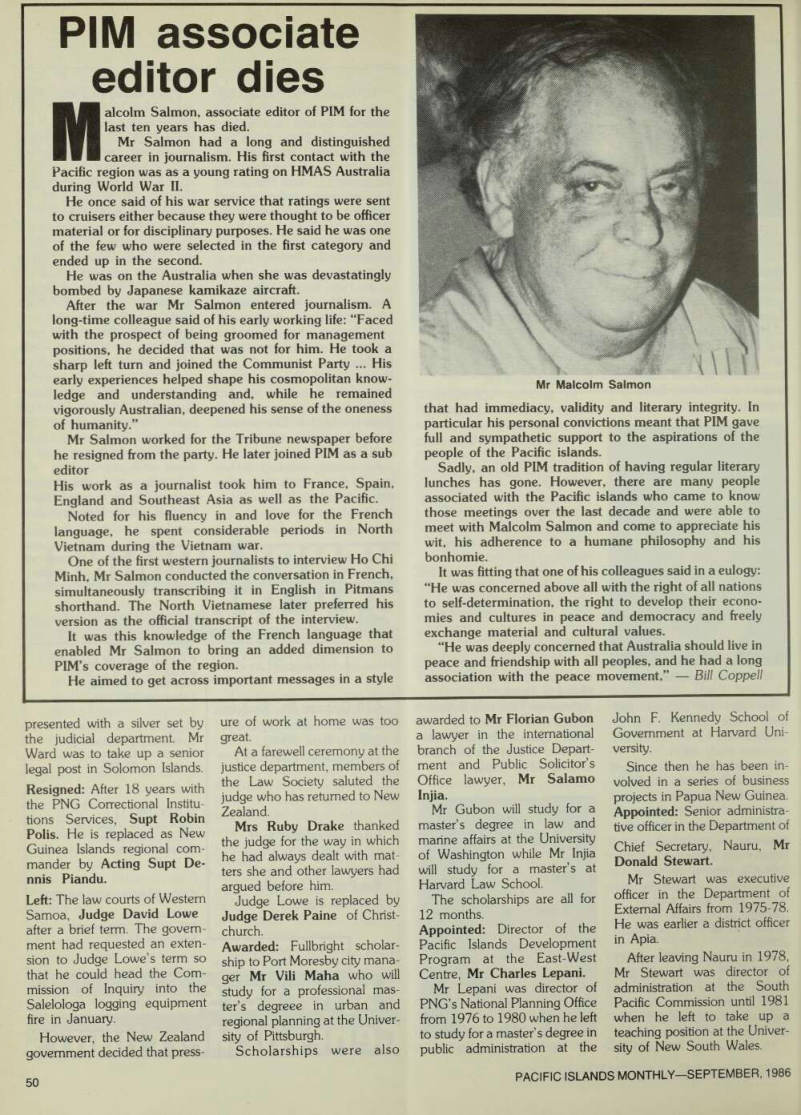
Honoured: USP senior physics lecturer, Dr Geoff Dougherty by two separate professional bodies.
Dr Dougherty has been elected a senior member of the Institute of Electrical and Elec tronic Engineers in the United States.
He has also been admitted as a fellow by the Australian Insti tute of Physics.
Resigned: Papua New Guinea Combined Trade Union Con gress chairman, Napeleon Liosi.
Mr Liosi, who is president of the Public Employees Associa tion, has also indicated his intention to quit the chairman ship of the Workers Education Advisory Committee.
He said the decision had been made necessary due to preparations for an 11 -month overseas study leave.
Promoted: As general manager of Pacific Resources Inc (PRI), Mr W. Douglas Long.
In other moves, John E.
Harmes has been promoted to manager of marketing opera tions, while Robert H. Rath, formerly general manager of South Pacific operations, has taken the new position of manager of petroleum business facilities for all PRl’s petroleum activities.
Mr Long joined PRI in 1983 when the company acquired Marlex’s South Pacific business.
Mr Harms was formerly a logistics officer for the US milit ary and joined PRI in 1984.
Mr Rath joined PRI in 1977
after working for C. Brewer and Co and Union Oil.
In another appointment, Jayprakas Mulki becomes FRl’s marketing manager for South Pacific operations.
He was formerly petroleum economist at PRI having joined the company in 1983 from Hawaiian Telephone company.
PRl’s restructuring is aimed particularly at the South Pacific where they envisage in creaseing opportunities.
In addition to its terminal and operations in American Samoa, PRI South Pacific includes joint ventures in the Cook Islands and Fiji with supply agreements in Kiribati and Australia.
A 4,400 barrel petroleum terminal has just been com pleted in Tonga.
Appointed: Four new Solomon Islands cabinet members Mr John Tepaika, Mr Ben Fouko na, Mr Daniel Fa’asifoabae and Mr Joini Tutua.
Mr Tepaika (Rennell and Bel- Iona) is reappointed to the transport, works and utilities portfolio; Mr Tutua (Gizo and Kolombangara) is minister for education and training; Mr Foukona (Lau and Mbaelelea) becomes trade, commerce and industry minister, while Mr Fa asifoabae (East Kwaio) is the new public service minister.
Returned: To Britain, former magistrate and Commissioner of the High Court of Solomon Islands, Mr John Freeman after a three year assignment.
Mr Freeman has returned to his former barrister’s practice in England.
Remembered: The great hurricane of 1889 and the heroism of the Samoans who rescued the crews of three German and three American warships in Apia harbour.
An anchor, believed to belong to the German ship Adler was installed at Matautu as a hurricane monument.
Peter Meredith jr who raised the anchor with the aid of a Fijian fishing vessel told the Samoa Times that archeologists agreed with his theory that the anchor belonged to the Ger man vessel whose wreck now lies beneath the sand of the harbour’s reclaimed area.
Elected: New president of the Journalists Association of West em Samoa (JAWS), Falesu Leute Fua editor of Sauali. He was elected following a request by Samoa Times editor, Fata Faalogo to be relieved.
Appointed: PNG’s high com missioner to Malaysia, Sir Alkan Tololo a former director of education and high commis sioner to Australia. Appointed: Manager of Fiji’s first merchant bank, Suva businessman Mr Lyle Cupit. The Merchant Bank of Fiji Ltd was due to open its doors on September 1.
Left: His post as chief magis trate of Fiji, Mr Gordon Ward, He and his wife Margaret were
Mr William Douglas Long.
Mr John E. Harms
Mr Robert H. Rath
presented with a silver set by the judicial department. Mr Ward was to take up a senior legal post in Solomon Islands.
Resigned: After 18 years with the PNG Correctional Institu tions Services, Supt Robin Polis. He is replaced as New Guinea Islands regional com mander by Acting Supt De nnis Piandu.
Left: The law courts of Western Samoa, Judge David Lowe after a brief term. The govern ment had requested an exten sion to Judge Lowe’s term so that he could head the Com mission of Inquiry into the Salelologa logging equipment fire in January.
However, the New Zealand government decided that press
ure of work at home was too great.
At a farewell ceremony at the justice department, members of the Law Society saluted the judge who has returned to New Zealand.
Mrs Ruby Drake thanked the judge for the way in which he had always dealt with mat ters she and other lawyers had argued before him.
Judge Lowe is replaced by Judge Derek Paine of Christ church.
Awarded: Fullbright scholar ship to Port Moresby city mana ger Mr Vili Maha who will study for a professional mas ter’s degreee in urban and regional planning at the Univer sity of Pittsburgh.
Scholarships were also
awarded to Mr Florian Gubon a lawyer in the international branch of the Justice Depart ment and Public Solicitor’s Office lawyer, Mr Salamo Injia.
Mr Gubon will study for a master’s degree in law and marine affairs at the University of Washington while Mr Injia will study for a master’s at Harvard Law School.
The scholarships are all for 12 months.
Appointed: Director of the Pacific Islands Development Program at the East-West Centre, Mr Charles Lepani.
Mr Lepani was director of PNG’s National Planning Office from 1976 to 1980 when he left to study for a master’s degree in public administration at the
John F. Kennedy School of Government at Harvard Uni versity.
Since then he has been in volved in a series of business projects in Papua New Guinea.
Appointed: Senior administra tive officer in the Department of Chief Secretary, Nauru, Mr Donald Stewart.
Mr Stewart was executive officer in the Department of External Affairs from 1975-78.
He was earlier a district officer in Apia.
After leaving Nauru in 1978, Mr Stewart was director of administration at the South Pacific Commission until 1981 when he left to take up a teaching position at the Univer sity of New South Wales.
Advertisements & other items, p. 49 (1 item)
XporteTs
rrrr
B
LOCAL AGENTS AND
REPRESENTATION
428 George St., Sydney.
Cables; Henco Sydney.
G.P.O. Box 3949.
Telephone: 232 5377.
For specialised and
personalised buying
service throughout
the Pacific Islands and the East.
Resident Agents in other Pacific Territories.
PAPUA NEW GUINEA
RABAUL: M. & C. Seeto, P.O. Box 131, Rabaul.
Telephone 92 2919.
FIJI
K. Witherington Ltd., P.O. Box 293, Suva.
Telephone 22 356.
VANUATU
John Lum & Associates, P.O. Box 65, Santo.
Telephone 329.
SOLOMON ISLANDS
Mr. Ken Szetu, P.O. Box 45, Honiara.
Telephone 22 637.
XporteTs
PIM associate
editor dies
Malcolm Salmon, associate editor of PIM for the last ten years has died.
Mr Salmon had a long and distinguished career in journalism. His first contact with the Pacific region was as a young rating on HMAS Australia during World War 11.
He once said of his war service that ratings were sent to cruisers either because they were thought to be officer material or for disciplinary purposes. He said he was one of the few who were selected in the first category and ended up in the second.
He was on the Australia when she was devastatingly bombed by Japanese kamikaze aircraft.
After the war Mr Salmon entered journalism. A long-time colleague said of his early working life: “Faced with the prospect of being groomed for management positions, he decided that was not for him. He took a sharp left turn and joined the Communist Party ... His early experiences helped shape his cosmopolitan know ledge and understanding and, while he remained vigorously Australian, deepened his sense of the oneness of humanity.”
Mr Salmon worked for the Tribune newspaper before he resigned from the party. He later joined PIM as a sub editor His work as a journalist took him to France, Spain, England and Southeast Asia as well as the Pacific.
Noted for his fluency in and love for the French language, he spent considerable periods in North Vietnam during the Vietnam war.
One of the first western journalists to interview Ho Chi Minh, Mr Salmon conducted the conversation in French, simultaneously transcribing it in English in Pitmans shorthand. The North Vietnamese later preferred his version as the official transcript of the interview.
It was this knowledge of the French language that enabled Mr Salmon to bring an added dimension to PlM’s coverage of the region.
He aimed to get across important messages in a style
that had immediacy, validity and literary integrity. In particular his personal convictions meant that PIM gave full and sympathetic support to the aspirations of the people of the Pacific islands.
Sadly, an old PIM tradition of having regular literary lunches has gone. However, there are many people associated with the Pacific islands who came to know those meetings over the last decade and were able to meet with Malcolm Salmon and come to appreciate his wit, his adherence to a humane philosophy and his bonhomie.
It was fitting that one of his colleagues said in a eulogy: “He was concerned above all with the right of all nations to self-determination, the right to develop their econo mies and cultures in peace and democracy and freely exchange material and cultural values.
“He was deeply concerned that Australia should live in peace and friendship with all peoples, and he had a long
association with the peace movement,”
Bill Coppell
Mr Malcolm Salmon
yachts
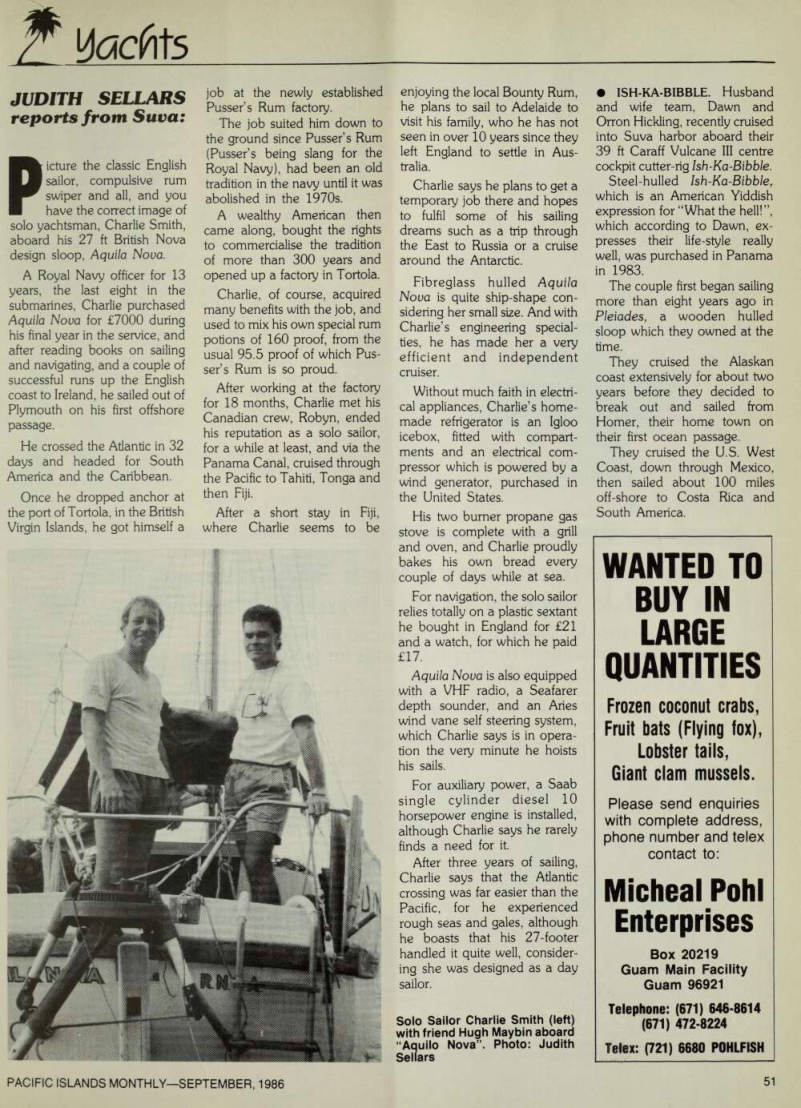
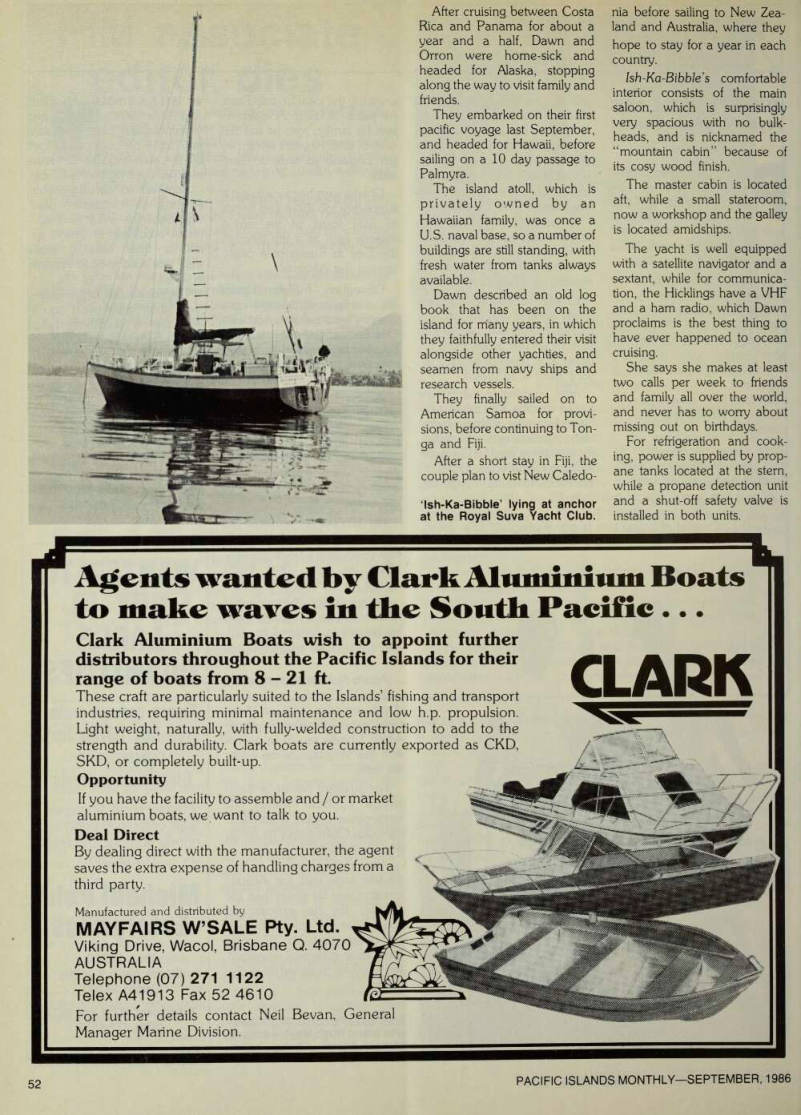
Judith Sellars
reports from Suva:
Picture the classic English sailor, compulsive rum swiper and all, and you have the correct image of solo yachtsman, Charlie Smith, aboard his 27 ft British Nova design sloop, Aquila Nova.
A Royal Navy officer for 13 years, the last eight in the submarines, Charlie purchased Aquila Nova for £7OOO during his final year in the service, and after reading books on sailing and navigating, and a couple of successful runs up the English coast to Ireland, he sailed out of Plymouth on his first offshore passage.
He crossed the Atlantic in 32 days and headed for South America and the Caribbean.
Once he dropped anchor at the port of Tortola, in the British Virgin Islands, he got himself a
job at the newly established Pusser’s Rum factory.
The job suited him down to the ground since Pusser’s Rum (Pusser’s being slang for the Royal Navy), had been an old tradition in the navy until it was abolished in the 19705.
A wealthy American then came along, bought the rights to commercialise the tradition of more than 300 years and opened up a factory in Tortola.
Charlie, of course, acquired many benefits with the job, and used to mix his own special rum potions of 160 proof, from the usual 95.5 proof of which Pus ser’s Rum is so proud.
After working at the factory for 18 months, Charlie met his Canadian crew, Robyn, ended his reputation as a solo sailor, for a while at least, and via the Panama Canal, cruised through the Pacific to Tahiti, Tonga and then Fiji.
After a short stay in Fiji, where Charlie seems to be
enjoying the local Bounty Rum, he plans to sail to Adelaide to visit his family, who he has not seen in over 10 years since they left England to settle in Aus tralia.
Charlie says he plans to get a temporary job there and hopes to fulfil some of his sailing dreams such as a trip through the East to Russia or a cruise around the Antarctic.
Fibreglass hulled Aquila Nova is quite ship-shape con sidering her small size. And with Charlie’s engineering special ties, he has made her a very efficient and independent cruiser.
Without much faith in electri cal appliances, Charlie’s home made refrigerator is an Igloo icebox, fitted with compart ments and an electrical com pressor which is powered by a wind generator, purchased in the United States.
His two burner propane gas stove is complete with a grill and oven, and Charlie proudly bakes his own bread every couple of days while at sea.
For navigation, the solo sailor relies totally on a plastic sextant he bought in England for £2l and a watch, for which he paid £l7.
Aquila Nova is also equipped with a VHF radio, a Seafarer depth sounder, and an Aries wind vane self steering system, which Charlie says is in opera tion the very minute he hoists his sails.
For auxiliary power, a Saab single cylinder diesel 10 horsepower engine is installed, although Charlie says he rarely finds a need for it.
After three years of sailing, Charlie says that the Atlantic crossing was far easier than the Pacific, for he experienced rough seas and gales, although he boasts that his 27-footer handled it quite well, consider ing she was designed as a day sailor.
• ISH-KA-BIBBLE. Husband and wife team, Dawn and Orron Hickling, recently cruised into Suva harbor aboard their 39 ft Caraff Vulcane 111 centre cockpit cutter-rig Ish-Ka-Bibble.
Steel-hulled Ish-Ka-Bibble, which is an American Yiddish expression for “What the hell!”, which according to Dawn, ex presses their life-style really well, was purchased in Panama in 1983.
The couple first began sailing more than eight years ago in Pleiades, a wooden hulled sloop which they owned at the time.
They cruised the Alaskan coast extensively for about two years before they decided to break out and sailed from Homer, their home town on their first ocean passage.
They cruised the U.S. West Coast, down through Mexico, then sailed about 100 miles off-shore to Costa Rica and South America.
Solo Sailor Charlie Smith (left) with friend Hugh Maybin aboard “Aquilo Nova”. Photo: Judith Sellars
After cruising between Costa Rica and Panama for about a year and a half, Dawn and Orron were home-sick and headed for Alaska, stopping along the way to visit family and friends.
They embarked on their first pacific voyage last September, and headed for Hawaii, before sailing on a 10 day passage to Palmyra.
The island atoll, which is privately owned by an Hawaiian family, was once a U.S. naval base, so a number of buildings are still standing, with fresh water from tanks always available.
Dawn described an old log book that has been on the island for many years, in which they faithfully entered their visit alongside other yachties, and seamen from navy ships and research vessels.
They finally sailed on to American Samoa for provi sions, before continuing to Ton ga and Fiji.
After a short stay in Fiji, the couple plan to vist New Caledo
nia before sailing to New Zea land and Australia, where they hope to stay for a year in each country.
Ish-Ka-Bibble’s comfortable interior consists of the main saloon, which is surprisingly very spacious with no bulk heads, and is nicknamed the “mountain cabin” because of its cosy wood finish.
The master cabin is located aft, while a small stateroom, now a workshop and the galley is located amidships.
The yacht is well equipped with a satellite navigator and a sextant, while for communica tion, the Hicklings have a VHF and a ham radio, which Dawn proclaims is the best thing to have ever happened to ocean cruising.
She says she makes at least two calls per week to friends and family all over the world, and never has to worry about missing out on birthdays.
For refrigeration and cook ing, power is supplied by prop ane tanks located at the stern, while a propane detection unit and a shut-off safety valve is installed in both units.
Ish-Ka-Bibble’ lying at anchor at the Royal Suva Yacht Club.
Advertisements & other items, pp. 51-53 (1 item)
Quantities
WANTED TO
BUY IN
LARGE
QUANTITIES
Frozen coconut crabs, Fruit bats (Flying fox), Lobster tails, Giant clam mussels.
Please send enquiries with complete address, phone number and telex contact to:
Micheal Pohl
Enterprises
Box 20219 Guam Main Facility Guam 96921 Telephone: (671) 646-8614 (671) 472-8224 Telex: (721) 6680 POHLFISH
Agents wanted by dark Aluminium Boats
to make waves in the South Pacific •..
Clark Aluminium Boats wish to appoint further distributors throughout the Pacific Islands for their range of boats from 8 - 21 ft These craft are particularly suited to the Islands’ fishing and transport industries, requiring minimal maintenance and low h.p. propulsion.
Light weight, naturally, with fully-welded construction to add to the strength and durability. Clark boats are currently exported as CKD, SKD, or completely built-up.
Opportunity If you have the facility to assemble and / or market aluminium boats, we want to talk to you.
Deal Direct By dealing direct with the manufacturer, the agent saves the extra expense of handling charges from a third party.
Manufactured and distributed by
MAYFAIRS W’SALE Pty. Ltd.
Viking Drive, Wacol, Brisbane Q. 4070
AUSTRALIA
Telephone (07) 271 1122 Telex A 41913 Fax 52 4610 For further details contact Neil Bevan, General Manager Marine Division.
CLARK
HIP
I
TRADITIONALLY THE NAME
ASSOCIATED WITH PERFECTION
IN CIGARETTES
BENSON & HEDGES
m m 20 -
Bmsoi it, w Hedges
WARNING-SMOKING IS A HEALTH HAZARD
ONLY THE BEST WILL DO.
stripping schedules
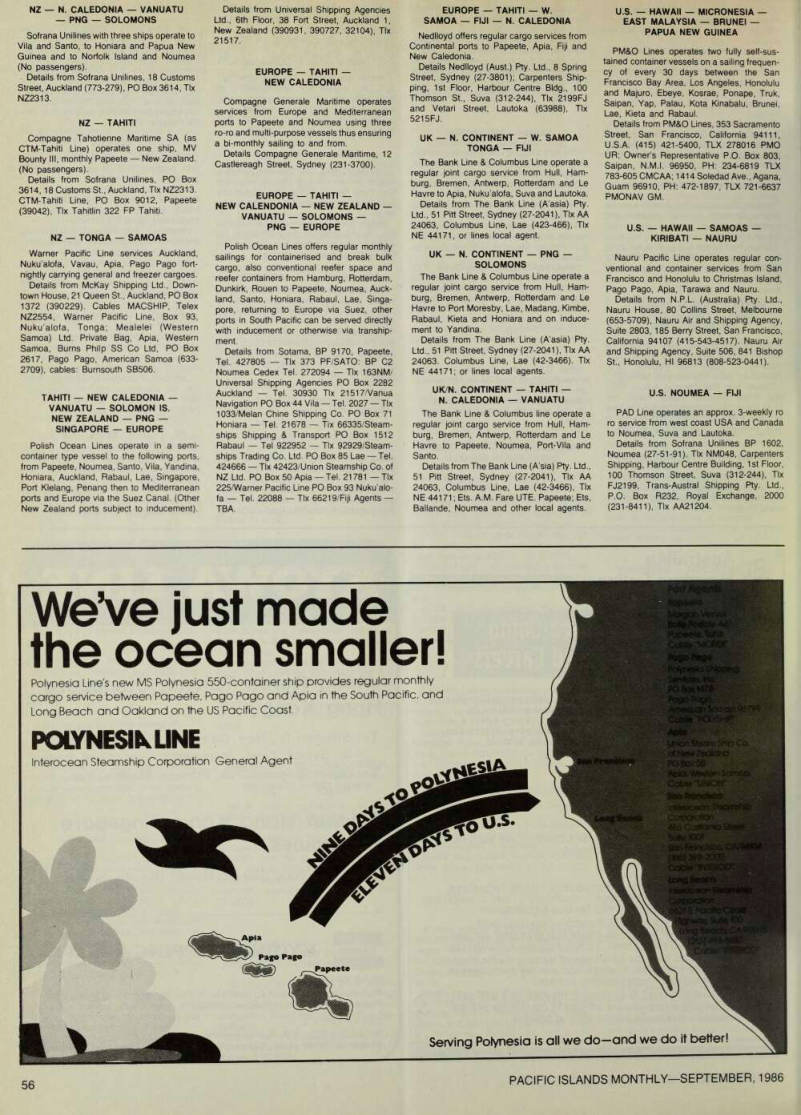
Should any shipping company wish to have its services cargo and passenger included in these listings they should contact
Pim.
Australia Fiji
Sofrana-Unilines (Fiji Express Line) oper ates to Suva and Lautoka every three weeks from the main ports on the east coast of Australia and monthly to Lautoka from Mel bourne and Sydney.
Details from Sofrana-Unilines, 432 Kent Street, Sydney (264-8944), Tlx AA 70090; Wiltrans Agency Pty. Ltd., 21st Floor, 60 Market St.. Melbourne (614-4788); Tlx 30163 ACTA Pty. Ltd., Brisbane (221-3116); Elders- ANL Pty. Ltd., Port Adelaide, (47-5688); Newcastle, Sofrana Sydney (264-8944); Websters-ANL, 58 Charles St., Launceston, Tasmania (320-555); Carpenters Shipping, Harbour Centre Building, Ist Floor, Thomson Street, Suva. Fiji (312-244), Tlx FJ2199.
Australia Samoas Tonga
Warner Pacific Lines operates a regular cargo service from Sydney, Brisbane and Melbourne to Nukualofa, Pago Pago, Apia and Vavau. Feeder service available from Apia to Cook, Christmas, Fanning and Washington Islands.
Details from Hetherington Wesfarmers Shipping Agency, 37-49 Pitt Street, Sydney, (27-1671).
Australia New Caledonia
Fiji Samoas Tonga
Pacific Forum Line operates a fully con tainerised service (general, reefer and ro-ro) from Sydney to Noumea, Lautoka, Suva, Apia, Pago Pago, Nukualofa, Sydney, Cargo centralised from Adelaide, Melbourne, Bris bane.
Details from Pacific Forum Line, P.O. Box 796 Auckland, Union Bulkships, 333 George Street, Sydney, Brisbane and Melbourne, Union Co., Lautoka, Suva, Nukualofa, Pacific Forum line Apia, Polynesia Shipping Pago Pago.
Australia Lord Howe Is.
Norfolk Is.
Compagnie des Chargeurs Caledoniens operates four-weekly cargo service Sydney- Lord Howe Island and Norfolk Island.
Details Hetherington Wesfarmers Shipping Agency, 37-49 Pitt Street, Sydney (27-1671).
Australia Kiribati
K. Asia Pacific operates a 5/6 weekly service from Melbourne and Sydney to Kiribati (Tarawa).
Details from K. Asia Pacific Pty. Ltd., Goldfields House, 1 Alfred Street, Circular Quay. Sydney (232-2277), Tlx 122143.
KAP New Guinea Lines call Tarawa after PNG ports on a 35 day basis from Melbourne and Sydney/Brisbane.
Details from K. Asia Pacific Pty. Ltd., Goldfields House, 1 Alfred Street, Circular Quay, Sydney (232-2277), Tlx 122143.
Australia Tuvalu
K-Asia Pacific operates Direct service every 2nd voyage to Tuvalu (Funafuti) Details from K. Asia Pacific Pty. Ltd., Goldfield House, 1 Alfred Street, Circular Quay Sydney (232-2277) Tlx 122143
Australia New Caledonia
And/Or Vanuatu
Sofrana-Unilines ships serve Noumea every three weeks from the main ports along the east Australian coast.
Details from Sofrana-Unilines, 432 Kent Street, Sydney (264-8944), Wiltrans-Agency Pty. Ltd., 21st Floor, 60 Market St., Mel bourne (614-4788) Tlx 30163 ACTA Pty. Ltd., Brisbane (221-3116). Elders-ANL Pty. Ltd., Port Adelaide (47-5688), Newcastle, Sofrana Sydney: Websters-ANL, 58 Charles St., Launceston, Tasmania (320-555).
Compagnie des Chargeurs Caledonians operates a three-weekly containerised cargo service from Sydney to Noumea.
Details Hetherington Wesfarmers Shipping Agency, 37-49 Pitt Street, Sydney (27-1671).
Compagnie Generate Maritime operates a monthly service from Sydney, Melbourne and Brisbane to Noumea, Port Vila and Santo, for containerised and break bulk cargo.
Details Compagnie Generale Maritime, 12 Castlereagh Street, Sydney (231-3700).
Australia Nauru
Marshall Is. Kiribati
Nauru Pacific Line operates regular cargo service from Melbourne to Nauru, Majuro and Tarawa, Passenger service to Nauru only.
Details; Nauru Pacific Line (Aust). Pty. Ltd.
Nauru House, 80 Collins Street, Melbourne (653-5709), Nedlloyd Swire, 8 Spring Street, Sydney (2-0522).
Australia New Zealand
The Australian National Line and the New Zealand Line operate a 10-day container service (TRANZTAS) between Sydney and Melbourne to Auckland, Wellington, Lyttelton and Port Chalmers.
The Tranztas service has been extended to cover Burnie and Fremantle on a direct call monthly basis linking to the main New Zealand ports.
Details from ANL Shipping Agencies, 20 Bond Street, Sydney (232-0444) and ANL Shipping Agencies, “World Trade Centre”, cnr Flinders and Spencer Streets, Melbourne (611-2323) or New Zealand Line, Pastoral House, 98 Lambton Quay, Wellington (728- 5000).
Australia Nz Fiji Tonga
Vanuatu New Caledonia
Solomons New Guinea
Sitmar Cruises operates a year-round cruise program from Sydney to include the better-known ports in the above countries, plus a number of unspoilt, and largely unknown, island paradises.
Details from Sitmar Cruises, 39 Martin Place, Sydney (239-9000); NSW, reserva tions and inquiries (008 42-2277); Rest of Australia, reservations and inquiries (008 22-2277).
Australia Nz Fiji Tonga
Vanuatu New Caledonia
Solomons Samoas Tahiti
P&O liners call at Auckland, Bay of Islands, Honiara, Lautoka, Noumea, Nukualofa, Pago Pago, Papeete, Port Moresby, Santo, Savu savu, Suva, Vavau and Vila on cruises from Australia.
Details from P&O Booking Centre, World Travel Headquarters Pty Ltd, 33 Bligh Street,
Sydney (237-0333).
Australia Png
Solomons Vanuatu Nz
Pacific Forum Line operates a con tainerised and ro-ro from Brisbane to Port Moresby, Lae, Honiara, Port Vila, Lyttelton, Napier and Auckland.
Details from Union Bulkships, Brisbane Steamships Shipping, Port Moresby and Lae; Sullivans Ltd, Honiara, Vila Agents, Port Vila; SCONZ Christchurch, Napier and Auckland.
Australia Micronesia
Nauru Pacific Line operates a regular container service from Melbourne to Ponape, Truk, Guam and Saipan.
Details: N.P.L. (Australia) Pty Ltd, Nauru House, 80 Collins Street, Melbourne (653- 5709). Nedlloyd Swire, 8 Spring Street,
Sydney (2-0522).
Australia New Caledonia
Sofrana Unilines operates a 3-4 weekly service from East Coast mainports to Noumea.
Details from Sofrana Unilines 432 Kent Street, Sydney. (Tel. 264-8944), Tlx AA 70090.
Australia Tuvalu
K. Asia Pacific operates a three monthly service from Sydney and Melbourne to Tuvalu (Funafuti). Subject to inducement.
Details from K. Asia Pacific Pty Ltd, Goldfields House, 1 Alfred Street, Circular Quay, Sydney (232-2277). Tlx 122143.
Warner Pacific Line operates a six week containerised/breakbulk service to Funafuti from Melbourne/Brisbane/ Sydney and Auck land.
Details from Hetherington Wesfarmers Shipping Agency, 37-49 Pitt Street, Sydney (27-1671); Mac Kay Shipping Ltd, Downtown House, Queen Street, Auckland (30-229).
Australia Png
KAP New Guinea Lines cargo vessels call at Melbourne, Sydney, Port Moresby, Lae, Madang, Wewak, Manus, Kimbe, Rabaul, Popondetta.
Details from K. Asia Pacific Pty Ltd, Goldfields House, 1 Alfred Street, Circular Quay, Sydney (232-2277), Tlx 122143. Dal gety Shipping, World Trade Centre, Mel bourne (616-6700).
Australia Png Solomons
Sofrana Unilines (Aust.) P/L operates a 3-4 weekly cargo service to PNG, ex-main ports on the east coast of Australia.
Details from Sofrana Unilines, 432 Kent Street, Sydney (264-8944), Tlx AA 70090:
Australia Png Solomons
Vanuatu
A consortium of NGAL/PNGL and CON PAC/NEL have four vessels operating a joint service from east coast Australian ports to Port Moresby, Lae, Alotau, Madang, Wewak, Rabaul, Kavieng-Kimbe, Kieta, Honiara, Vila, Santo.
Details from Burns Philp & Co. Ltd., P.O.
Box R 124, Royal Exchange, Sydney, 2000 (2-0547); Nedlloyd Swire, 8 Spring Street, Sydney (2-0522); New Guinea Express Lines, 37 Pitt Street, Sydney (241-3991); Vila Agents, PO Box 27, Port-Vila (2456). Tlx
Nhioii.
New Guinea Express Lines operates a weekly container service from Melbourne, Sydney, Brisbane to Port Moresby, Lae, Alotau, Kimbe, Rabaul, Kieta, Honiara, Kavieng, Madang, Wewak, Santo, Vila.
Details from New Guinea Express Lines, P.O. Box R 73, Royal Exchange, Sydney (241-3991); New Guinea Express Lines, 127 Creek Street, Brisbane (221-9333); New Guinea Express Lines, 327 Collins Street, Melbourne (602-5544); Niugini Express Lines, Port Moresby (21-4572); Lae (42- 1536); Niugini Island Cargo Services Pty.
Ltd., Rabaul (922-467); Bougainville Agen cies Pty. Ltd., Kieta (956-089); Robert Laurie (PNG) P/L, Madang (82-2157); Garamut Enterprises P/L, Wewak (86-2106); Burns Philp (PNG) Ltd., Kavieng (94-2133); Alotau Stevedoring & Transport, Alotau (61-1318); Ngatia Wholesalers Pty. Ltd., Kimbe (93- SI 02); and Tradco Shipping, Mendana Ave nue, Honiara (22588); Vila Agents Ltd., P.O.
Box 971, Vila, Vanuatu (2490); John Lum & Associates, P.O. Box 65, Santo, Vanuatu (329).
Australia Tahiti
Compagnie Generate Maritime operates a monthly service from Sydney, Melbourne and Brisbane to Papeete, for containerised and break bulk cargo.
Details Compagnie Generale Maritime, 12 Castlereagh Street, Sydney (231-3700).
Sofrana Unilines (Aust.) P/L operates a 3/4 weekly cargo service to Papeete ex main ports on the east coast of Australia.
Details from Sofrana Unilines, 432 Kent Street, Sydney (264-8944) Tlx AA 70090.
Singapore Hongkong Fiji
Islands Ports
Kyowa Shipping Co. Ltd. operates a month ly containerised and break bulk cargo service from Singapore, Hongkong to Lautoka, Suva and then to island ports.
Details from Carpenters Shipping, Harbour Centre Building, Ist Floor, Thomson Street, Suva (312-244), Tlx FJ2199.
Far East Fiji
New Zealand
New Zealand Unit Express (NZUE) now operates a monthly service accepting con tainerised and break bulk cargo from Manila, Keelung, Kaohsiung and Hongkong to Lauto ka, Suva and thence to New Zealand ports.
Details from Carpenters Shipping, Harbour Centre Building, Ist Floor, Thomson Street, Suva (312-244), Tlx FJ 2199; Burns Philp, Suva (311-777); New Zealand Unit Express Maritime Building, 2-10 Customhouse Quay, P.O. Box 890, Wellington, Cables: ENZUE
Man Wellington Telex: Nz31340
NEDLNZ Telephone; 727-865 or Nedlloyd Swire Pty. Ltd., Sydney (20-522).
Nedlloyd operates bi-weekly cargo service with four ships from Surabaya, Jakarta, Bangkok, Port Kelang and Singapore to Suva, Lautoka and NZ ports.
Details from Nedlloyd (Aust.) Pty. Ltd., 8 Spring St., Sydney (27-3801), Burns Philp (SS) Co. Ltd., Suva and Lautoka.
Far East Mid-S. Pacific
China Navigation’s New Guinea Pacific Line operates a regular container service from Hongkong, Taiwan, Manila, Port Kelang and Singapore to Port Moresby, Lae, Rabaul and Honiara monthly and to Wewak, Madang and Kieta every three months. Cargo from the same Far Eastern ports to the South Pacific
ports of Noumea, Santo, Vila, Papeete, Pago Pago, Apia, Raratonga and Tarawa will be shipped via Japan on the monthly Bali Hai service.
Details from Steamships Shipping, P.O.
Box 634, Pori Moresby (22-0289).
Kyowa Shipping Ltd. operates monthly services from Japan to Guam, Saipan, Solo mons, New Caledonia, Fiji, Western and American Samoa, Tahiti, Cook Is., Tonga and Vanuatu.
Details: Heterington Wesfarmers Shipping Agency, 37-49 Pitt Street, Sydney (27-1671); Carpenters Shipping, Suva (312-244), Tlx FJ2199.
Guam Northern Marianas
Saipan Shipping Co. Inc. operate a weekly service via barge carrying containers and conventional cargo between Guam and Saipan and Tinian.
Details from Saipan Shipping Co. Inc., P.O.
Box 8, Saipan, CM 96950 (Tel. 9707), Tlx 783619; Guam agents Maritime Agencies of the Pacific Ltd.
Hawaii Tahiti Samoas
Tonga Kiribati Fiji
Solomons Png
Star Shipping Associates operates a monthly service originating in Honolulu and destined for Pago Pago, Papeete, Apia, Nuku’alofa, Suva, Vila and Port Moresby.
Details from Star Shipping Assoc., P. 0., Box 25988, Honolulu, Hawaii 96825. Ph. (808) 396-4256; Polynesia Shipping Services in Pago Pago and Burns Philp Agency in Apia, Nuku’alofa, Suva and Port Moresby.
Japan Fiji Island Ports
Kyowa Shipping Co. Ltd. operates a month ly containerised service from main ports of Japan to Suva and Lautoka and thence to island ports.
Details from Carpenters Shipping, Harbour Centre Building, Ist Floor, Thomson St., Suva (312-244). Tlx FJ2199.
Bali Hai service operates a monthly con tainerised service from main ports of Japan to Lautoka and Suva and thence to island ports.
Details from Carpenters Shipping, Harbour Centre Building, Ist Floor, Thomson St., Suva (312-244), Tlx FJ2199 and Burns Philp, Suva (311-777).
Japan Micronesia
The NYK Shipping Line operates a monthly cargo service from Japan to Micronesia, calling at Yoko, Nagoya, Kobe, Guam, Saipan, Truk, Ponape and Majuro, returning via Yoko, Nagoya and Kobe.
Details from Burns Philp & Co. Ltd., 51 Pitt Street, Sydney (2-0547).
Saipan Shipping Co. Inc. operates a monthly service from Japan to Saipan, Guam, Truk, Ponape, Majuro (Kosrae and Ebeye on inducement).
Details from Saipan Shipping Co. Inc., P.O.
Box 8, Saipan, CM 96950 (Tel. 9707), Tlx 783619, Japan agents Kyowa Shipping Com pany Ltd.; Guam Agents Maritime Agencies of the Pacific Ltd.
Japan Png
Mitsui O.S.K. Lines operates a monthly service from main ports Japan and Wewak, Lae, Rabaul, Kieta, Port Moresby.
Details from Robert Laurie Carpenters Pty.
Ltd., P.O. Box 1032, Lae/PNG (Tel. 42-3642, 42-3811.)
New Caledonia Fiji West
Coast North America
PAD Line operates an approx. 3-weekly ro-ro service from Noumea and Suva to Honolulu and West Coast USA and Canadian ports.
Details from Sofrana-Unilines SA, BP 1602, Noumea (27-51-91), Tlx NMO4B; Carpenters Shipping, Harbour Centre Building, Ist Floor, Thomson St., Suva (312-244), Tlx FJ2199.
Png Inter Mainport
Papua New Guinea Line offers scheduled 10-20 day coastal liner services linking all PNG major ports with containerisation, reefer, heavy lift and transshipment facilities.
Details from PNG Line, Box 543, Port Moresby, PNG (21-1174), Tlx 22269.
Png Uk/Continent
The Bank Line & Columbus Line operate a regular joint service from Port Moresby, Oro Bay, Kieta, Rabaul, Kimbe, Madang and Lae to Hull, Hamburg, Rotterdam, Antwerp and Le Havre.
Details from The Bank Line (A’asia) Pty.
Ltd., 51 Pitt Street, Sydney (27-2041); Tlx AA24063; Columbus Line, Lae (423466), Tlx NE 44171; or lines’ local agents.
Solomons Uk/Continent
The Bank Line & Columbus Line operate a regular joint cargo service from Honiara to Hull, Hamburg, Rotterdam, Antwerp and Le Havre.
Details from the Bank Line (A’asia) Pty. Ltd. 51 Pitt Street. Sydney (27-2041), Tlx AA24063; Columbus Line. Lae (423466), Tlx NE 44171; Tradco Shipping Ltd., Honiara (22588) Tlx 66313.
New Zealand Australia
Papua New Guinea Solomon
Islands Vanuatu
Pacific Forum Line operates a con tainerised and ro-ro service from Lyttelton, Napier and Auckland to Brisbane, Port Moresby, Lae, Honiara and Port Vila.
Details from SCONZ Christchurch, Napier and Auckland; Union Bulkships, Brisbane; Steamships Shipping, Port Moresby and Lae; Sullivans Ltd., Honiara; Vila Agents, Pori Vila.
Nz Cook Is. Niue Tahiti
New Zealand Line operates cargo services based on pallets and similar units from Auckland to Niue, Cook Islands and Tahiti.
Details from the NZ Shipping Agencies International Ltd., P.O. Box 3420, Auckland (797210); Waterfront Commission, P.O. Box 61, Rarotonga; Cook Islands; Shipping Office, Govt, of Niue, P.O. Box 107, Niue Island: Compagnie Maritime Polynesienne, P.O. Box 36, Papeete, Tahiti.
Nz Fiji
Reef operates a regular 18-day service from Auckland to Suva and Lautoka. Also passenger accommodation.
Details from Reef Shipping Agencies, PO Box 3382, Auckland, NZ (77-1221-3), Tlx 60633; MV Fijian Shipping Agencies Ltd.
Private Bag, Suva, Fiji (31-1056).
Pacific Line with one ship operates two weekly ro-ro cargo service New Zealand, Lautoka, Suva. No passengers.
Details: Sofrana Unilines, 18 Customs Street, Auckland (773-279) PO Box 3614, Tlx NZ2313. Carpenters Shipping, 100 Thomson Street, Suva (312-244), Tlx FJ2199.
Nz Fiji North America (Wc)
Blue Star Line Ltd. Pacific Coast container services. Only direct service to and from New Zealand. Blue Star vessels call at Suva and Honolulu on NZ-U.S.-West Coast voyages.
Details from Blueport ACT (NZ) Ltd., PO Box 192, Wellington (739-029). Burns Philp (SS) Co. Ltd., GPO Box 355, Suva, Fiji (311-777), Tlx FJ2168 Burship.
Nz Fiji Samoas - Tonga
Pacific Forum Line operates a con tainerised and ro-ro 21 day service from Auckland to Lautoka, Suva, Apia, Pago Pago and Nuku'alofa.
Details from Pacific Forum Line, Auckland and Apia, Union Maritime, Lautoka, Suva and Nukualofa; Polynesian Shipping, Pago Pago.
Nz N. Caledonia Vanuatu
Png Solomons
Sofrana Unilines with three ships operate to Vila and Santo, to Honiara and Papua New Guinea and to Norfolk Island and Noumea (No passengers).
Details from Sofrana Unilines, 18 Customs Street. Auckland (773-279), PO Box 3614, Tlx NZ2313.
Nz Tahiti
Compagne Tahotienne Maritime SA (as CTM-Tahiti Line) operates one ship, MV Bounty 111, monthly Papeete New Zealand. (No passengers).
Details from Sofrana Unilines, PO Box 3614, 18 Customs St., Auckland. Tlx NZ2313.
CTM-Tahiti Line, PO Box 9012, Papeete (39042), Tlx Tahitlin 322 FP Tahiti.
Nz Tonga Samoas
Warner Pacific Line services Auckland, Nukualofa, Vavau, Apia, Pago Pago fort nightly carrying general and freezer cargoes.
Details from McKay Shipping Ltd., Down town House, 21 Queen St., Auckland, PO Box 1372 (390229). Cables MACSHIP, Telex NZ2554, Warner Pacific Line, Box 93, Nuku’alofa, Tonga; Mealelei (Western Samoa) Ltd. Private Bag, Apia, Western Samoa, Burns Philp SS Co Ltd, PO Box 2617, Pago Pago, American Samoa (633- 2709), cables: Burnsouth 58506.
Tahiti New Caledonia
Vanuatu Solomon Is.
New Zealand Png
Singapore Europe
Polish Ocean Lines operate in a semi container type vessel to the following ports, from Papeete, Noumea, Santo, Vila, Yandina, Honiara, Auckland. Rabaul, Lae, Singapore, Port Klelang, Penang then to Mediterranean ports and Europe via the Suez Canal. (Other New Zealand ports subject to inducement).
Details from Universal Shipping Agencies Ltd., 6th Floor, 38 Fort Street, Auckland 1, New Zealand (390931, 390727, 32104), Tlx 21517.
Europe Tahiti
New Caledonia
Compagne Generate Maritime operates services from Europe and Mediterranean ports to Papeete and Noumea using three ro-ro and multi-purpose vessels thus ensuring a bi-monthly sailing to and from.
Details Compagne Generate Maritime, 12 Castlereagh Street, Sydney (231-3700).
Europe Tahiti
New Calendonia New Zealand
Vanuatu Solomons
Png Europe
Polish Ocean Lines offers regular monthly sailings for containerised and break bulk cargo, also conventional reefer space and reefer containers from Hamburg, Rotterdam, Dunkirk, Rouen to Papeete, Noumea, Auck land, Santo, Honiara, Rabaul, Lae, Singa pore, returning to Europe via Suez, other ports in South Pacific can be served directly with inducement or otherwise via tranship ment.
Details from Sotama, BP 9170, Papeete, Tel. 427805 Tlx 373 PF/SATO; BP C 2 Noumea Cedex Tel. 272094 Tlx 163 NM/ Universal Shipping Agencies PO Box 2282 Auckland Tel. 30930 Tlx 21517/Vanua Navigation PO Box 44 Vila Tel. 2027 Tlx 1033/Melan Chine Shipping Co. PO Box 71 Honiara Tel. 21678 Tix 66335/Steam ships Shipping & Transport PO Box 1512 Rabaul Tel 922952 Tlx 92929/Steam ships Trading Co. Ltd. PO Box 85 Lae Tel. 424666 Tlx 42423/Union Steamship Co. of NZ Ltd, PO Box 50 Apia Tel. 21781 Tlx 225A/Varner Pacific Line PO Box 93 Nukualo fa Tel. 22088 Tlx 66219/Fiji Agents
Tba.
Europe Tahiti W.
Samoa Fiji N. Caledonia
Nedlloyd offers regular cargo services from Continental ports to Papeete, Apia, Fiji and New Caledonia.
Details Nedlloyd (Aust.) Pty. Ltd., 8 Spring Street, Sydney (27-3801); Carpenters Ship ping, Ist Floor, Harbour Centre Bldg., 100 Thomson St., Suva (312-244), Tlx 2199FJ and Vetari Street, Lautoka (63988), Tlx 5215FJ.
Uk N. Continent W. Samoa
Tonga Fiji
The Bank Line & Columbus Line operate a regular joint cargo service from Hull, Ham burg, Bremen, Antwerp, Rotterdam and Le Havre to Apia, Nukualofa, Suva and Lautoka.
Details from The Bank Line (A’asia) Pty.
Ltd., 51 Pitt Street, Sydney (27-2041), Tlx AA 24063, Columbus Line, Lae (423-466), Tlx NE 44171, or lines local agent.
Uk N. Continent Png
Solomons
The Bank Line & Columbus Line operate a regular joint cargo service from Hull, Ham burg, Bremen, Antwerp, Rotterdam and Le Havre to Port Moresby, Lae, Madang, Kimbe, Rabaul, Kieta and Honiara and on induce ment to Yandina.
Details from The Bank Line (A’asia) Pty.
Ltd., 51 Pitt Street, Sydney (27-2041), Tlx AA 24063. Columbus Line, Lae (42-3466). Tlx NE 44171; or lines local agents.
Uk/N. Continent Tahiti
N. Caledonia Vanuatu
The Bank Line & Columbus line operate a regular joint cargo service from Hull, Ham burg, Bremen, Antwerp, Rotterdam and Le Havre to Papeete, Noumea, Port-Vila and Santo.
Details from The Bank Line (A’sia) Pty. Ltd., 51 Pitt Street, Sydney (27-2041), Tlx AA 24063, Columbus Line, Lae (42-3466), Tlx NE 44171; Ets. A.M. Fare UTE. Papeete; Ets, Ballande, Noumea and other local agents.
U.S. Hawaii Micronesia
East Malaysia Brunei
Papua New Guinea
PM&O Lines operates two fully self-sus tained container vessels on a sailing frequen cy of every 30 days between the San Francisco Bay Area, Los Angeles, Honolulu and Majuro, Ebeye, Kosrae, Ponape, Truk, Saipan, Yap, Palau, Kota Kinabalu, Brunei, Lae, Kieta and Rabaul.
Details from PM&O Lines, 353 Sacramento Street, San Francisco, California 94111,
U.S.A. (415) 421-5400, Tlx 278016 Pmo
UR; Owner’s Representative P.O. Box 803, Saipan, N.M.I. 96950, PH: 234-6819 TLX 783-605 CMCAA; 1414 Soledad Ave., Agana, Guam 96910, PH: 472-1897, TLX 721-6637
Pmonav Gm.
U.S. Hawaii Samoas
Kiribati Nauru
Nauru Pacific Line operates regular con ventional and container services from San Francisco and Honolulu to Christmas Island, Pago Pago, Apia, Tarawa and Nauru.
Details from N.P.L. (Australia) Pty. Ltd., Nauru House, 80 Collins Street, Melbourne (653-5709), Nauru Air and Shipping Agency, Suite 2803, 185 Berry Street, San Francisco, California 94107 (415-543-4517). Nauru Air and Shipping Agency, Suite 506, 841 Bishop St., Honolulu, HI 96813 (808-523-0441).
U.S. Noumea Fiji
PAD Line operates an approx. 3-weekly ro ro service from west coast USA and Canada to Noumea, Suva and Lautoka.
Details from Sofrana Unilines BP 1602, Noumea (27-51-91). Tlx NMO4B, Carpenters Shipping, Harbour Centre Building, Ist Floor, 100 Thomson Street, Suva (312-244), Tlx FJ2199, Trans-Austral Shipping Pty. Ltd., P.O. Box R 232, Royal Exchange, 2000 (231-8411), Tlx AA21204.
Advertisements & other items, pp. 55-60 (1 item)
Kyowa Line
Japan Korea Taiwan Singapore
Hong Kong
To: Solomon Is., New Caledonia, Fiji, W. Samoa, A. Samoa, Tahiti, Vanuatu To: Guam, Saipan, Truk, Ponape, Majuro, Yap, Koror
Taiwan Hong Kong Singapore
Philippines
To: Papua New Guinea, Hawaii, Pacific Islands.
KYOWA SHIPPING CO., LTD.
HEAD OFFICE:
6th Floor , Kikushima Bldg , 2-3, Hamamatsucho 2-chome, Mmato-ku, Tokyo 105, Japan Phone: 03(437)2885 (Rep ) Cables: MARIQUEEN" Tokyo Telex: 242-4651 Kyowa J.
OSAKA OFFICE:
Dai San Fuji Bldg. 3-13, Itachibori 1-chome, Osaka 550. 06(533)5821 (Rep.> Cables: MARIQUEEN" Osaka Telex: 525-6271 Ssiosa .
® Australian
Maritime College
Courses for Sea-Going
and Shore Based Careers
The Australian Maritime College. Australia's national hlqher education institution for the training and education of personnel for the maritime and fishing Industry offers a range of unique courses at certificate, diploma, degree and graduate diploma levels, through its three Schools:
Engineering,.,
Marine Engineering and Radiocommunications, Maritime Electronics and Engineering
Nautical Studies.,,
Navigation, Maritime Economics and Business Hydrographic Surveying
Fisheries,,.
Certificates of Competency. Fishing Technology.
Fisheries Biology, Management and Seafood Handling.
The courses are structured to combine practical work experience with lectures to ensure that graduates are well placed to find employment, both in Australia and overseas.
Students also have the advantage of training on the most up-to-date equipment available and can live on campus in the comfortable accommodation provided.
If you are interested In studying at the AMC for a well paid, challenging career, you are advised to contact the nearest Australian diplomatic post as soon as possible.
NJ67J4
We’ve just made
the ocean smaller!
Polynesia Line's new MS Polynesia 550-container ship provides regular monthly cargo service between Papeete, Pago Pago and Apia in the South Pacific, and Long Beach and Oakland on the US Pacific Coast.
POLYNESIM.INE
Interocean Steamship Corporation General Agent Ed Oh 3* £ VS & V * Apia Pago Pago /—■ .Papeete Serving Polynesia is all we do—and we do it better!
POLISH OCEAN LINES
General Management, 10 Lutego 24,81-364 GDYNIA, POLAND, Phone: 20-19-01, Cables: POLOCEAN Telex: 054-231 © & U ■7T m ■ I.' I s O' H v-v H PS
SOUTH PACIFIC SERVICE
ANTWi?Rp mo nliKVfS[)' iC |A?,IK. d from: GDYNIA. HAMBURG, ROTTERDAM, MIDDLESBOROUGH/IMMINGHAM, AnS^lnDc D ,l JNK RK '~R OUEN ' PAPEETE (via PANAMA), NOUMEA, AUCKLAND, HONIARA, RABAUL, LAE, oiiNUArUnh, by our multipurpose vessels carrying dry and reefer containers, reefer chambers, heavy lifts, breakbulk or palletized, bulk liquids.
AiiPk'i AMn u ao . POLISH OCEAN LINES Representatives AUCKLAND Mr. A. Sieradzki. Telex 21517 NZ “UNISHIP”. SYDNEY Mr. Walenciak. Telex 2042 b AA “SLEIGH"
AGENcfS T rm Tp fpy 2 9i 6 r i F 7 k?7°‘ n” Ttle?l63 S NM “SATO”. AUCKLAND UNIVERSAL SHIPPING AGENCIES LTD., Telex 21517 NZ UNISHIP . SOLOMONS MELAN CHINE SHIPPING CO., LTD Telex 66335 HO “SYMECO”. PNG
SERVICE PAGE
ADVERTISING
Aggie Greys 58 Air Pacific 34 Aiwa 22 Amatil 53 Aust. Maritime Coll 55
AWA 27
Beljaars 58 Citizen Watches 19 Clark Aluminium Boats ... 52 Columbus Line 59 Commonwealth Sec 43 Henry Cumines 49 Dewhurst 58 Hitachi 2 Johnson Diversified 26 Kyowa Shipping 55 Lincoln Electric 17 Matsushita National 29 Matsushita National 47 Metro. Drill & Blast 32 Metro Power 58 Michael Pohl 51 Mitsubishi Motor 60 Nissan Motor 8-9
P.R.I 15
Pioneer Electronic 33 Polish Ocean Lines 57 Sheaffer Pens 21 Sony Corp 4 Toyota Motor 30-31 Trio Kenwood 36 J. H. Williams 33
[PACfflrfK
\mMm
MCDIWIMLW
AUSTRALIA: Distribution The Herald and Weekly Times Ltd , 44-74 Flinders St., Melbourne, Vie., 3000 Advertising Repe Brisbane D Wood, Anday Agency, CCA Centre, Daytxxo Road. Closebum 4520; Box 1918, GPO Brisbane, 4001 telephone (07) 28S-4128 Adsiskto Hastwell Williamson Rouse Ply Ltd., PO Box 419 Norwood, SA, 5067; 59 Kensington Road. Norwood, telephone (08) 332-3322. telex 87113: Perth Allen & Associates, 7 Fore St., Perth, W.A., 6000, telephone (09) 328-9833, telex: AA94382.
FVJI: Distribution and subscriptions Desai Bookshops, P O Box 160, Suva, Fiji, telephone Suva 23036 Advertising Fiji Times & Herald Ltd . 20 Gordon St,, Suva, telephone 31-4111, telex FJ2124 FRENCH POLYNESIA: Distribution Hachette Pacifique. 10 Ave Bruat, Papeete, telephone 25610 HAWAII, UNITED STATES: Distribution PIM, Hawaii PO Box 22250. Honolulu, Hawaii, 96822 Advertising Bnan C Asgill, Apt 1308, 1676 Ala Moana Blvd , Honolulu.
Hawaii 96815, telephone (808) 955-9718 JAPAN: Advertising and subscriptions Universal Media Corporation, GPO Box 46, Tokyo, telephone 666-3036, cables UNIMEDIA Tokyo, telex 2524665.
MALAYSIA: Advertising and subscriptions Worldwide Media Services. 57-B Komplex Damai, Jin Dato Haji Eusoft, Kuala Lumpur, telephone 63-9340, cables WORLDMEDIA Kuala Lumpur telex 31533 VANUATU: Distribution The Bookshop, HQ Box 210, Port Vila. Advertising Norman Bros. Bookshop, Port Vila, telephone 2232.
NEW CALEDONIA: Distribution Depot Centre de Presse Michel Pentecost, CBP2, Noumea, telephone 27-2434, 27-4729 NEW ZEALAND: Distribution Gordon & Gotch. PO Box 584, 2 Carr Road. Mt Rosk.il, Auckland 4
PAPUA NEW GUINEA: Distribution Gordon & Goto*, PO Box 3395, Port Moresby, telephone 25-4551, 25-4855 Advertising Ken Head, PNG Post-Couner, PO Box 85, Port Moresby, telephone 21-2577, telex 22120 SOLOMON ISLANDS; Distribution and Advertising The Bookshop, (Norman Bros.) PO Box 503, Honiara PHILIPPINES: Advertising The GF Group. 12 San Ignacio St.. Uroaneta Village. Makati, Metro Manila, telephone 817-7299, telex 45950 and 4233 UNITED KINGDOM: The Herald & Weekly Times Ltd . No 1 Mattravers Street. London WC2R 3D2, England, telephone 01 836 5162, telex London 21989 UNITED STATES MAINLAND: Advertising Joshua B.
Powers Jr., Powers International Inc., Suite 708, 271 Madison Ave., New York, NY 10016, telephone 867-9580, telex 236514. Subscriptions PIM, Hawaii, PO Box 22250, Honolulu, Hawaii, 96822.
SUBSCRIPTIONS
American Samoa US$24 Australia AUSS24 Canada US$3O Cook Islands NZ$36 Fiji AUSS26 French Polynesia US$3O Guam US$3O Hawaii US$3O Japan US$3O Kiribati AUSS24 Micronesia US$3O Nauru AUSS24 New Caledonia US$3O New Zealand NZ$36 Niue NZ$3O Norfolk Island AUSS24 Northern Marianas US$3O Papua New Guinea AUSS3S Solomon Islands AUSS24 Tonga AUSS24 Tuvalu AUSS24
United Kingdom Stgls
US Mainland US$3O Vanuatu AUSS24 Western Samoa AUSS24
Elsewhere AUSS36
Payments by personal cheque are only acceptable in Australian (from a branch in Australia), U S and New Zealand currency For all other remittances please send an international bank draft in Australian dollars Published monthly by Pacific Publications (Aust.) Pty Ltd and pnnted in Australia by; Quadricolor International Telephone (03) 551 3333
ALL THE
NEWS IN A
FLASH
The South Sea Digest tells you what you want to know about the Pacific Islands in a few words. All the leading firms and diplomatic missions read it. You can phone or write or call for a follow up See insert for subscription details
THE SOUTH SEA BI6EST
NOW AVAILABLE!
PACIFIC ISLANDS YEAR BOOK
Due to demand the 15th edition has been reprinted and is available from P.I.M. at As3s plus p.p.
BUILDING
Housing, Commercial, Industrial, Maintenance, Additions, New Work, Design, anywhere throughout Pacific.
Contact: DEWHURST BUILDERS.
R.D.7 TEPUKE, N.Z. Ph. (075) 43 0899.
TRACTOR PARTS
Metro Power, the Sydney Parts ibutor will arrange air or sea freight as required.
New and used tractors and backhoes • Ford & BMW industrial and marine engines • Special prices on new BSD Ford engines Ph: Sydney (02) 774 5522. Telex: 176886 183 Beaconsfieid St., Revesby, Sydney N.S.W. 2212
Stay at Aggie Grey’s . . . the South Pacific’s
legendary hotel.
Situated right in the heart of Western Samoa. Enjoy Polynesian style friendliness and service, in cool surroundings, superb entertainment and food.
Magnificent while sand beaches only a short drive away. Airconditioned rooms, swimming |xk>l and Jull bar facilities.
Bookings through I’nion Steamship Company of NZ, Pan Am. Air New Zealand or dire c t to Aggie Grey’s, Apia, Western Samoa. Cables: 'AGGIES' Apia.
HOSPITALITY INDUSTRY
LOCUM AVAILABLE
Husband and wife management team aged 40 and 39, no children, energetic, ex-accountant 2 years hands on management experience in the hospitality industry, part owners of resort in South Pacific, more than 6 years experience in Pacific area. Will be available mid December, 1986, for short or long term engagements.
For full details, contact:
E. AND P. BELJAARS,
Bokissa Island Resort, PO Box 261, Santo Vanuatu.
Phone Santo 855, Telex Vanuatu 1099 (BKISSA)
YOUR DIRECT EUROPEAN CONNECTION
>u» • u
EUROPE-SOUTH PACIFIC JOINT SERVICE
The South Pacific Specialists offer facilities for shipment of: Containers (FCL/LCL) and Breakbulk Cargo plus reefer space and deeptanks for carriage of vegetable oils and other liquid bulk cargo.
Carriers also accept heavy lifts, overlength and cumbersome parcels.
Ports of Service: Loading: Papeete, Apia, Suva, Lautoka, Noumea, Port Vila, Santo, Honiara, Port Moresby, Lae,Madang, Kimbe, Rabaul, Kieta, Darwin.
For: Rotterdam, Antwerp, Hamburg, Hull, Dunkirk,
LeHavre - tk
Additional ports on enquiry.
ROUND THE WORLD SERVICE -
Please contact our regional offices for further information: The Bank Line (Australasia) Pty. Ltd.
Suite 801,51 Pitt Street Sydney N.S.W. 2000 Phone: 27 2041 Telex: 24063 Columbus Line Reederei GmbH P.O. Box 1667 Lae/Papua New Guinea Phone: 42 3466/42 3287 A.H. 42 2481 Telex: Colline NE 44 171
THE BANK LINE LTD LONDON
COLUMBUS LINE REEDEREI GMBH HAMBURG
C0L0024
Marco Polo's Silk Road
was 21,000 kilometres long.
We can repeat his journey in just 8 hours.
This three-dimensional simulator can reproduce road conditions similar to those experienced by Marco Polo on his four-year, 21,000-kilometre odyssey.
From 1271 to 1275, Venetian merchant Marco Polo made a perilous journey across Asia to China. Sharing Marco Polo's enterprising spirit, we followed in his footsteps on an exploration of another kind.
Our purpose was to see how our vehicles would stand up to stresses placed on their components. Whereas some auto makers gather data through extensive field testing, we thought a faster way would be to have a machine able to reconstruct roads like those travelled by the adventurous Venetian, Such thinking led us to a fully computerized three-dimensional vibration test simulator which can be programmed to recreate virtually any road condition. Using the simulator to reproduce the Silk Road, we learned how our vehicles would fare in just eight hours.
The three-dimensional simulator is just one way we test our vehicles. Our goal is to make sure vehicles wearing the Three Diamonds brand travel the roads of the world with confidence. Marco Polo, we hope, would be pleased to know that we looked to him for inspiration.
A
MITSUBISHI
MOTORS
AMERICAN SAMOA: MORRIS SCANLAN SERVICE INC. PO Box 367, Pago Pago, Tel. 633-5520/AUSTRALIA: MITSUBISHI MOTORS AUSTRALIA LTD. Box 1851, G.P.O Adelaide, South Australia 5001, Tel. 08-275-7111/FIJI: NIVIS MOTOR & MACHINERY CO., LTD. G PO Box 150, Suva, Tel. 384425/FRENCH POLYNESIA (TAHITI): ETS-BREDIN FRERES ET FILS PO. Box 21, Papeete, Tahiti, Tel. 4-202-58/ NEW CALEDONIA; SOCIETE D IMPORTATION D AUTO DU PACIFIQUE SUD S.A. B.P. 438 Rond Point du Pacifique, Noumea, Tel. 274144/ NEW ZEALAND: TODD MOTORS CORPORATION Todd Park, Heriot Drive, Private Bag, Porirua, Tel. 70-109/NORFOLK ISLAND: BORRYS LTD. PO Box 169, Norlolk Island, Tel. 2114 NI/PAPUA NEW GUINEA: TOBA PTY. LTD. PO. Box 503, Port Moresby, Tel. 21-7874/SOLOMON ISLANDS: R.C. SYMES PTY. LTD. PO. Box 823, Honiara, Guadalcanal, Tel. 221 31 /TONGA; SITANI MAPI CO., LTD. PO. Box 83, Maku Olofa, Tel 2 1-044/VANUATU; SOCOMETRA B.P. 06 Route de Lagon, Port-Vila, Tel. 2314/WESTERN SAMOA: A M MACDONALD HOLDINGS LTD.
PO Box 576, Apia. Tel 22022/SAIPAN/PONAPE/MAJURO/KOSRAE/TRUK/YAP/BELAU: MICRONESIAN MOTORS, INC. 997 South Marine Drive, Tamuning, Guam 96911, Tel. 646-6827