Paqfic

Islands
M O N T H L Y
American Samoa US$2.00 Australia AS2.00 Cook Islands NZ$3.00 Fiji f$1.75 Hawaii US$2.50 Kiribati AS2.00 Nauru AS2.00 New Caledonia CFP250 New Zealand NZ$3.00 Niue NZ$2.50 Norfolk Island AS2.00 Papua New Guinea K2.00 Solomon Islands S$2.00 Tahiti CFP300 Tonga P2.00 Tuvalu AS2.00
Usa Us$3.00
USTTand Guam US$2.50 Vanuatu VT2.00 Western Samoa T2.75 •Recommended retail price only Registered by Australia Post Publication No. NBP1210
August, 1986
jiara plays
w| P . j| rM ® J i.. *4. 7
ft [III■ I 8 T * ■ aKi 111 IVTI I I ii. j 111 »j i ft 11 < ir< i*i j ii r i'll mm- - •,■ n^rgr^" 1 ' j i& >^HPe?*.. >■ i *1
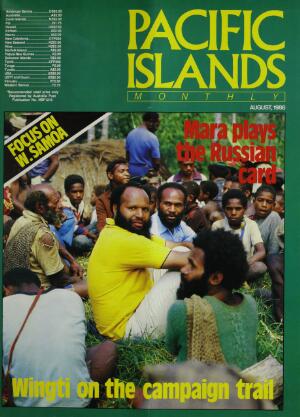
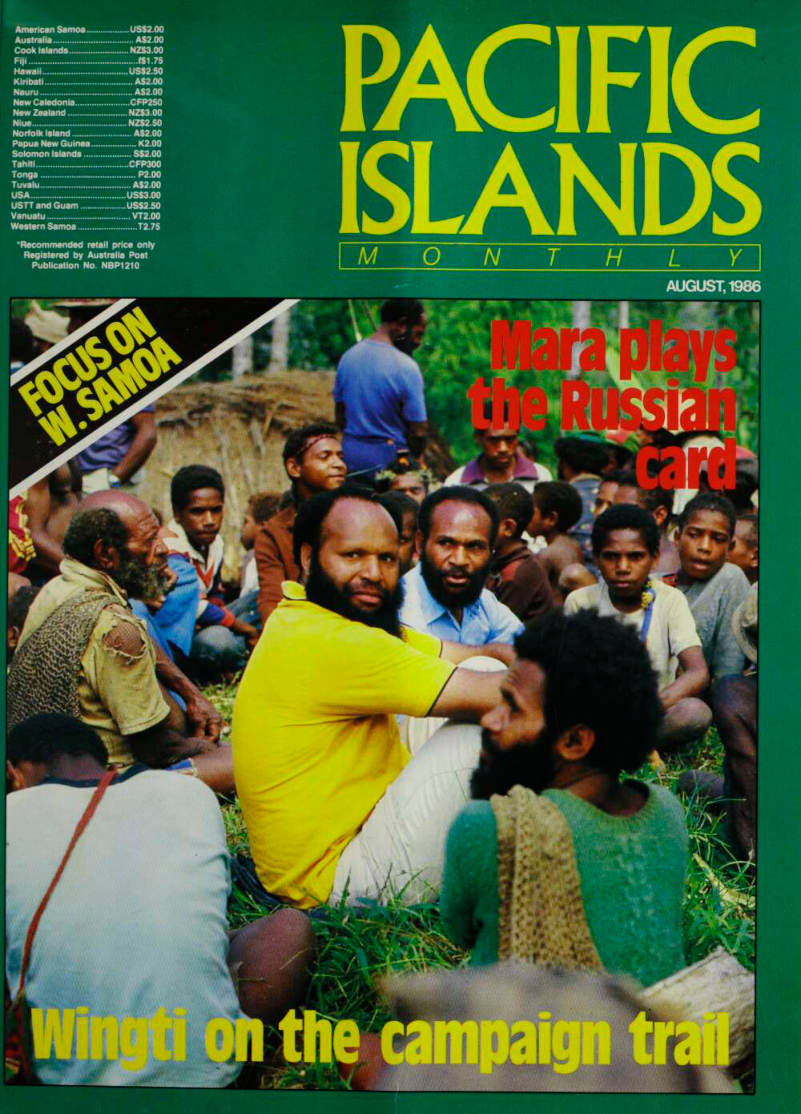
The Cover
PNG Prime Minister Paias Wingti meets villa gers in the highlands.
Photo: Shar Adams.
Advertisements & other items, p. 2 (1 item)
a.o i-/s
p Honda, constantly setting new standards when it comes to car design, now brings you the Prelude 2.0i-16. What does meet the eye is the Prelude’s styling. Its low, angled front slices through the air, and the wide tread stance grips the road firmly for superb maneuverability. What you can’t see is the heart of this elegant new model the 2.0-liter 16-valve Double Overhead Camshaft (DOHC) engine. It comes with
Honda’s original Programmed Fuel Injection system
(PGM-FI) for quick engine response.
This perfect marriage between styling and performance offers the ultimate in touring satisfaction. All this plus a long list of other Honda extras put the new Prelude into a class of its own.
Find out what it really means to enjoy a car all it takes is a test drive.
X I I .r
a.o i-/s
• Engine type: Water-cooled 4-stroke DOHC 16-valve in-line 4-cylinder • Fuel supply system: PGM-FI • Displacement: 1,958 cm 3 • Maximum horsepower: 137PS/6,ooorpm • Maximum torque: 17.3 kg-m/ s,ooorpm • Suspension: Double wishbone (front), MacPherson strut (rear) • Dimensions (L X W X H); 4,375 X 1,690 X 1,295 mm AUSTRALIA; Honda Australia Pty., Ltd. Lot 95 Sharps Road, Tullamarine, Victoria 3043; Bennett Honda Pty., Ltd. 250 Victoria Road, w ®^Te r, ‘ l Ra !*’ 2164/NEW ZEALAND: NZMC Limited Manners Plaza, 57-65 Manners St„ Wellmgton/PAPUA NEW GUINEA: Toba Pty., Ltd. P.O. Box 503, Port Moresby/ HONDA MOTOR CO LTD TOKYO JAPAN TAHITI: Honda Distribution S.A.R.L, B.P. 1665, Papeete/KIRIBATI: Atoll Motor & Marino Services P.O. Box 49 Bairiki Tarawa, Re P S.
TRUST TERRITORY; United Micronesia Development Association P.O. Box 235, CHRB Saipan CM 96950/COOK ISLANDS: Cook Islands Motor Centre Ltd. P.O. Box 7A.Raio\onga/G\J . ' a/NEW Motor Co., Inc. P.O. Box DV, Agana/WESTERN SAMOA: Motor Distributors (Samoa) Ltd. P.O. Box 576, Apia/SOLOMON ISLANDS: Lee Kwok Kuen &Co Ltd. P.O. Box 537- H°ngra/NE CALEDONIA: Soci6t6 Du Chalandage 8, Rue de la somme-B.P, 97, Noum6a/NAURU: Nauru Cooperation Republic of Nauru/FIJI: Coral Island Motors Ltd. Robertson R ° ad 'F^/ AME , SAMOA; Holiday Motors. Parts and Service P.O. Box 968, Pago Pago, American Samoa 96799: Heleck’s Service Center Ltd. p a Box 1138, P3g° Pago, American Samoa Tonga Industrial Traders PO Box 1035, Nukualofa, Tonga/NORFOLK ISLAND: Duncombe Bay Garage New Cascade Road, Norfolk Island/VANUATU: Honda Farm Ltd. P.O, Box 1031, Port Vila, Vanuatu
Islands
Pacific
Monthly
Vol. 57, No. 8, August, 1986.
PACIFIC ISLANDS MONTHLY is published monthly by Pacific Publications (Aust) Pty.
Ltd. of 76 Clarence Street, Sydney, NSW, Australia. Second class postage paid at Honolulu, Hawaii. POSTMASTER: Send address changes to PACIFIC ISLANDS MONTHLY, PO Box 22250. Honolulu, Hawaii 96822.
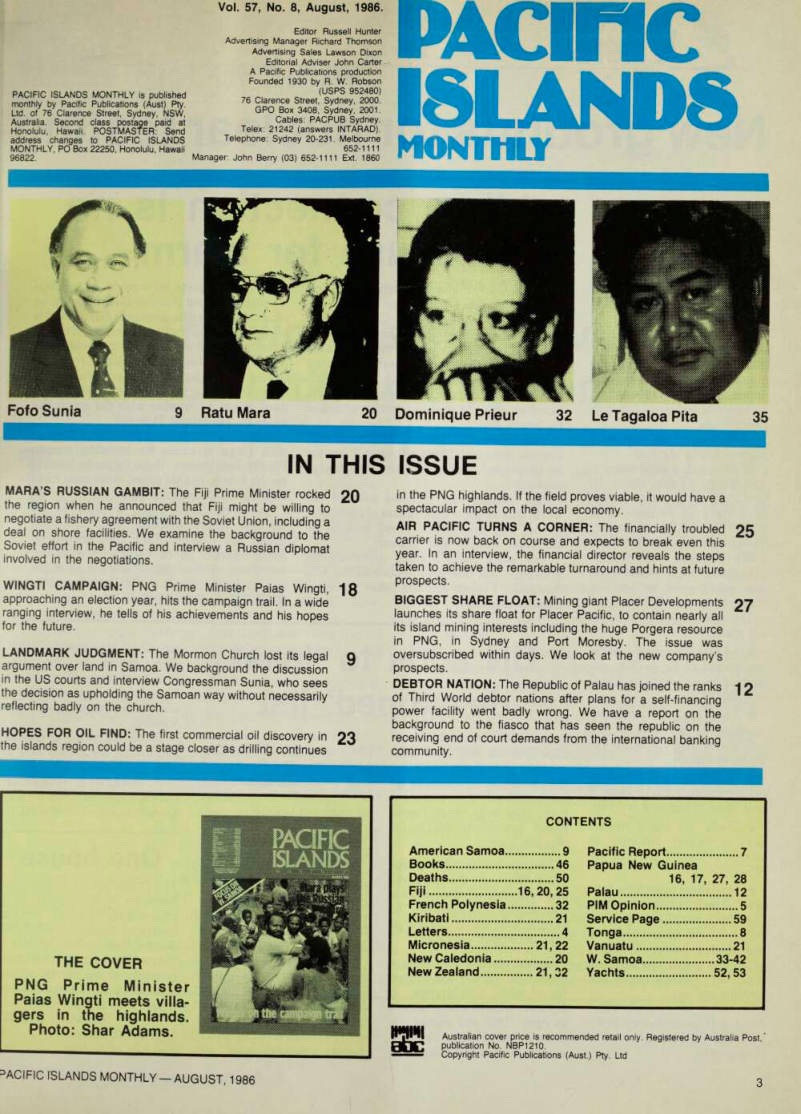
Fofo Sunia 9
Ratu Mara 20
Dominique Prieur 32
LeTaqaloa Pita 35
In This Issue
MARA’S RUSSIAN GAMBIT: The Fiji Prime Minister rocked 20 the region when he announced that Fiji might be willing to negotiate a fishery agreement with the Soviet Union, including a deal on shore facilities. We examine the background to the Soviet effort in the Pacific and interview a Russian diplomat involved in the negotiations.
WINGTI CAMPAIGN: PNG Prime Minister Paias Wingti, “|8 approaching an election year, hits the campaign trail. In a wide ranging interview, he tells of his achievements and his hopes for the future.
LANDMARK JUDGMENT: The Mormon Church lost its legal Q argument over land in Samoa. We background the discussion in the US courts and interview Congressman Sunia, who sees the decision as upholding the Samoan way without necessarily reflecting badly on the church.
HOPES FOR OIL FIND: The first commercial oil discovery in 23 the islands region could be a stage closer as drilling continues
in the PNG highlands. If the field proves viable, it would have a spectacular impact on the local economy.
AIR PACIFIC TURNS A CORNER: The financially troubled 25 carrier is now back on course and expects to break even this year. In an interview, the financial director reveals the steps taken to achieve the remarkable turnaround and hints at future prospects.
BIGGEST SHARE FLOAT: Mining giant Placer Developments 27 launches its share float for Placer Pacific, to contain nearly all its island mining interests including the huge Porgera resource in PNG, in Sydney and Port Moresby. The issue was oversubscribed within days. We look at the new company’s prospects.
DEBTOR NATION: The Republic of Palau has joined the ranks 1 O of Third World debtor nations after plans for a self-financing power facility went badly wrong. We have a report on the background to the fiasco that has seen the republic on the receiving end of court demands from the international banking community.
Contents
American Samoa 9 Books 46 Deaths 50 Fiji 16, 20, 25 French Polynesia 32 Kiribati 21 Letters 4 Micronesia 21,22 New Caledonia 20 New Zealand 21,32
Pacific Report 7 Papua New Guinea 16, 17, 27, 28 Palau 12 PIM Opinion 5 Service Page 59 Tonga 8 Vanuatu 21 W. Samoa 33-42 Yachts 52,53
Australian cover price is recommended retail oniy. Registered by Australia Post ' publication No. NBPI2IO.
Copyright Pacific Publications (Aust.) Pty. Ltd
Advertisements & other items, p. 3 (1 item)
Pacific Islands Monthly —August, 1986
3
Editor Russell Hunter Advertising Manager Richard Thomson Advertising Sales Lawson Dixon Editorial Adviser John Carter A Pacific Publications production Founded 1930 by R. W. Robson
(USPS 952480)
76 Clarence Street, Sydney, 2000.
GPO Box 3408, Sydney, 2001.
Cables: PACPUB Sydney, Telex: 21242 (answers INTARAD).
Telephone: Sydney 20-231. Melbourne 652-1111 Manager: John Berry (03) 652-1111 Ext. 1860
New grounds for nuclear testing
letters
By coincidence I found an argument for replacement of the French atomic tests. I never met before.
The French tests at Moruroa are by way of a “reward” from Gen. de Gaulle for the bravery of the people of French Polynesia, when they opted for the Free French and not for the Vichy government in the second world war.
Now if the French ever leave, it will not be because of local opposition. They will need an honourable reason to move to another site.
To speed up that process, I suggest the He de Sein.
He de Sein is a small island in the Atlantic Ocean, about 10 km west of Brittany in the department of Finistere. It is known for the Breton love of freedom, since on 18 June 1940 the entire male popula tion opted for the Free French and sailed over to join de Gaulle in nearby England.
The advantages of this site are many: • As real citizens of France, the people of He de Sein de serve a reward equal to that of Polynesia. • There is no need for annexation, because no one will doubt that the island be longs to France. • Of course, the island has to be depopulated. No problem, it was done voluntarily in 1940. • There are many military sites in western Britanny, so everyone there is used to sol diers. • No danger exists if the tests are carried out when winds blow from the east then all pollution will spread over an uninhabited ocean. (Statistics show that winds are normally west, but everyone knows that statistics are lies).
K.Velt
Nieuwe Bussummerweg 124 NL-1272-CL Huizen Netherlands.
Libya connection is no
cause for alarm
I am extremely depressed at the right-wing anti independence tendencies of PIM.
Your June editorial, The Cost of Links With Libya, omitted to say that Fr Lini has said more than once that he is against terrorism or that he expressed solidarity with New Zealand when the French bombed the Rainbow Warrior or that he did likewise with the three countries attacked by South Africa.
You condemn Vanuatu for having dip lomatic links with Libya although it has yet to be proved that Libya has slaughtered anybody.
Just because the US has assured the world that Libya is behind acts of terrorism, in no way constitutes proof enough to slaughter women and children.
You state that “nobody gives aid for nothing”. But this also applies to the US, Australia, France and the other so-called friendly powers.
Vanuatu expects no support from Libya only trade and possible investment in an effort to broaden its economic base. If aid is offered, I’m sure it will be considered by the government, along with its implications.
You state that Col Ghaddafi routinely orders the executions of political oppo nents. Must you be reminded that the US gave refuge to another who did much the same Ferdinand Marcos?
And if establishing diplomatic relations with Libya is cause for isolation among Pacific neighbours, then Australia should be the first to run for cover, since they have had such relations for years.
Our neighbours have a right to be worried about anything that concerns them, but 1 would think they should be more worried about French colonialism, terrorism, nuclear testing and US attempts to use the Pacific as a nuclear freeway.
Robert G. Crain.
Port Vila.
developed’ list
UN adds to ‘least developed’ list
Your Pacific Report article on page 9 of the May 1986 issue headed: “Two Seek Least De veloped Status.” (Kiribati/Tuva lu) contained the statement that: “The only other Pacific Island nation on the list is Western Samoa.”
That was true until December 17, 1985, when the UN Gen eral Assembly adopted resolu tion 40/233 and decided: “to include Vanuatu in the list of least developed countries.”
Samoa recently completed a successful UNDP-sponsored round-table Conference in Geneva, with its major donors in April 1986 and invited the newest Pacific LDC, Vanuatu, to send an observer delegation.
Both Samoa and Vanuatu as LDCs are eligible for UN Capi tal Development Fund assist ance, which is administered by UNDP in addition to our techni cal assistance under both coun try and inter-country programs.
However, your article is cor rect on the fact that (at its 22nd second session in March 1986) the UN Committee for Deve lopment Planning recom mended that both Kiribati and Tuvalu should be granted Least Developed Country status.
You may also be interested to know that, while UNDP Country Programs for Fiji and Tonga have already been approved by the UNDP Gov erning Council (in June 1985), country programs were pre
sented in June (for the 1987- 1991 period) for: the Cook Islands; Kiribati; Niue; Papua New Guinea; Samoa; Solomon Islands; Tokelau; Tuvalu and Vanuatu.
Thanks for all the invaluable information we always find in your publication.
Leon S. Woskoff
Deputy Chief, Regional Bureau for Asia and the Pacific, UNDP.
One house
The parliament of Kiribati, the Maneaba ni Maungataby is a unicameral house, not a bicameral house as stated by Sandra Rennie (May 1986).
In addition, Makin is the most northerly of the islands in the Gilberts group being a few miles north of Butaritari.
Richard Overy
Librarian/Archivist Republic of Kiribati.
co-ordinated region
Pim Opinion
The world’s most over co-ordinated region
The only country in the South Pacific region with a landless middle class has a problem. Surprisingly, perhaps, the problem isn’t crime.
Indeed, the landless people themselves have no problem. Rather, the society in which they live has the problem, Fiji’s Indians, the descendants of indentured labourers, form the backbone of the country’s small business community. But, it seems, when they hire labour they tend to hire their own kind. So, presumably, do Fiji’s Melanesian businessmen.
The fact remains, however, that there are more Indian employers than there are Melanesian employers, thus Fijians find it increasingly difficult to find work.
Force bosses to be equal opportunity employers, suggests an East-West Centre researcher (page 16).
Force the banks to lend to more Fijian businessmen, he adds.
It s all been tried before which doesn’t necessarily mean that it shouldn’t be tried again. But the initiative to promote indigenous enterprise in the islands has to come from the indigenous people of the islands.
Several not enough have showed the way.
Without access to special treatment some have built businesses to rival the offshore giants. Most, if asked their secret of success, would cite a willingness to work extremely hard combined with a will to succeed. “At last we can believe in ourselves,” says Mr Wingti (page 18) and in that statement may be found the key to business development.
It won’t be found in studies, however academically sound, of business conditions in the island nations.
Seminars, workshops, discussion groups and informa
tion exchanges are all very well for those doing the discussing and the exchanging. All too infrequently, however, are the people under study present at these august gatherings.
The region has had just about all the "co-ordinating” it can take.
Indeed, Pacific islanders may well be the most studied people around today. There will be few universities in the world whose dust-shrouded shelves of doctoral theses do not contain at least one or two learned works on the South Pacific.
First it was the missionaries, then the explorers and the businessmen/opportunity seekers. Now, however, it’s the age of the researcher. The procession through the islands of anthropologists, sociologists, nutritionists, economists and whateverists seems never-ending.
Research opens up avenues for yet more research with dozens of agencies within the UN alone commis sioning studies of something or other before revealing to a breathless world, as did a recent UN report, that fishery resources are a vital to the island economies and need to be developed. Doubtless, the region’s planners are grateful for the tip.
On the other hand, the various studies may be useful to potential aid donors as a guide to where to spend their money.
But the problems facing the islands are generally well-known and understood. No amount of studying, co-ordinating or liaising is going to solve them.
And if the money spent on research over the years had been invested in indigenous industries, there would be no need for all the research and all the aid.
Advertisements & other items, p. 6 (1 item)
Tdon wb
Deals the
winning
hand in rat
control!
TALON WB Is a world breakthrough In killing rats and mice. Developed by ICI Tasman In New Zealand talon wb Is a sure way to Increase profits by eliminating RAT DAMAGE TO CROPS! & £ S'# 6 S 7 Sr G y * ob °**>o, SOLID BLOCKS Can be wired or nailed out of reach of children & animals. Easily handled - won't blow away.
WATERPROOF Safe year round use - will not dissolve, resists mould for extended periods.
DEADLY
Kills even the toughest rats - Including those resistant to warfarin based poisons.
EFFECTIVE
POWERFUL
Highly attractive to rats & mice - no pre-baiting is required.
Kills more rats - a lethal dose can be consumed In a single feed. do not lay baits in places accessible to children, pets and domestic animals, wash hands and exposed skin before meals and after work, do not store near food or feed. Bum or bury all , rodent bodies and uneaten bait. Empty containers should not be re-used but disposed of
VJ a
■ Xdon wb
ICQ A Product of ICI Tasman Limited P.O Box 900, Auckland, New Zealand
WARNING
) safely Whatever your crops COCOA COCONUTS SUGARCANE.
RATS KILL PROFITS! NOW TALON WB KILLS RATS!
pacific report
Special Border
Zone Planned
Papua New Guinea will consider setting up a 60-kilometre special development zone alomg its border with Indonesia.
The development along the border corri dor would include plans for roads, improved health facilities and village markets. The national government would take over responsibility for the zone from the two provincial governments, a spokesman for prime minister, Mr Paias Wingti, said. Indonesia is already under taking major development on its side of the border, including resettlement sites for transmigration immigrants and the trans-Irian highway.
Aid For Fruit
Juice Exporter
The Fiji government is to provide $370,000 for the country’s largest fruit juice manufacturer to help the company stay afloat. The parliament-approved sum came in response to a request from Fiji Citrus Products for $1.5 million. The Fiji Development Bank holds shares in the company which processes pine apples and oranges grown at its Vanua Levu orchards for the domestic market and for New Zealand. The company hopes to expand into Australia and other overseas markets.
Pacific Investment
Company Folds
A Malaysian investment agency, specialising in the South Pacific region, is being dissolved because of mounting debts. The Malaysian Overseas Invest ment Corporation MOIC owes banks and other creditors more than $2O million and all employees have received dismissal notices. The corporation was established four years ago with en couragement from Malaysian prime minister Dr Mahathir, as the first of five Malaysian companies seeking closer economic ties with the South Pacific nations. Apart from a hotel project in Suva, none of MOIC’s joint ventures in other South Pacific countries made any headway. The Fiji government is seeking new partners for the 200-room hotel on the seafront at Suva. Minister for econo mic development, Mr Peter Stinson said the failure of MOIC would not affect plans to build the hotel as the Malaysian company had not put in any money. The government, which was to have had a 30 per cent share in the hotel, had already received indications of interest from local and overseas parties.
Aviation Growth
Creates Problems
An aviation industry expert said the rapid growth of civil aviation in the Asia-Pacific region was posing challenges in provid ing suitable airports, tourism deve lopment and building the right kinds of aircraft for the region. The Managing Director of Singapore Airlines, Mr Cheong Choong Kong, told a seminar for industry executives that the In ternational Civil Aviation Organisation was predicting an annual growth rate of 10 per cent for passengers and 11 per cent for freight in the six years to 1992.
By that time, he said, the ICAO expected airlines in the region to be carrying 33 per cent of the world’s passengers and 37 per cent of international freight, surpassing Europe. Mr Cheong said airports were being built or expanded to meet future needs in many countries in the region including Australia, New Zea land and Tonga. He said United States manufacturers were beginning to design aircraft to meet the long-range needs of the region and that tourism was making a major contribution to expansion.
Breath Tests
For Drivers
The Fiji parliament passed a Bill to allow the introduction of breathalyser tests.
The Bill will empower the police to test drivers at random and enter property without warrants to carry out these tests.
Offenders face fines of up to $l5OO, disqualification and imprisonment. In troducing the Bill, the minister for trans port, Mr Tora, said breathalyser testing would help reduce the number of alco hol-related accidents on Fiji’s roads. The deputy speaker, Mr Vijay Paramanadam, however, accused the government of eroding the rights of citizens and said the Bill could be a forerunner to laws which could turn the country into a police state.
Sex And The
Secretive Society
The Papua New Guinea government plans to ban sex education in the country’s schools. Education minister, Mr Arum Matiabe, said PNG was a secretive society and sexual matters were not discussed openly by any age group. He said high school students were aroused by sex education lessons and many had been practising what they had learned of human reproduction. Mr Matiabe said statistics which show an increasing incidence of venereal dis ease among high school students sup ported his planned measure. He also planned to remove all pictures of human reproductive organs from school scien ce texts.
Indonesia Rejects
Irian Jayans
Indonesia refused to take back nine Irian Jayans who fled their home province for Australia last August. The Indonesian foreign minister, Dr Mochtar, said had informed his Australian counterpart, Mr Hayden, that the nine should not be returned. He said he also told Mr Hayden, during talks in Manila, that Indonesia would not object if Australia wanted more people from Irian Jaya.
Last August 11 Indonesians from the border province arrived by canoe in northern Australia. The Australian gov ernment has since granted two of them refugee status and has promised to find a third country in which they can settle.
Australia had suggested that the other nine be returned.
Cash Boost For
Sea Bed Mining
A search for sea bed mineral deposits in the South Pacific has been aided by a $3 million grant from the United Nations Development Program. The grant, to be spent over the next five years, was announced in Suva following a meeting of the Committee for Co-ordinating Offshore Prospecting in the South Paci fic (CCOP/SOPAC). The money is to help member states hire expert help to seek out manganese, phosphates and other minerals on the sea bed as well as on land. The members of CCOP/SOPAC are: Cook Islands, Fiji, Guam, Kiribati, New Zealand, Papua New Guinea, Solo mon Islands, Tonga, Tuvalu and Western Samoa. Australia is likely to seek membership at the group’s annual meet ing next month.
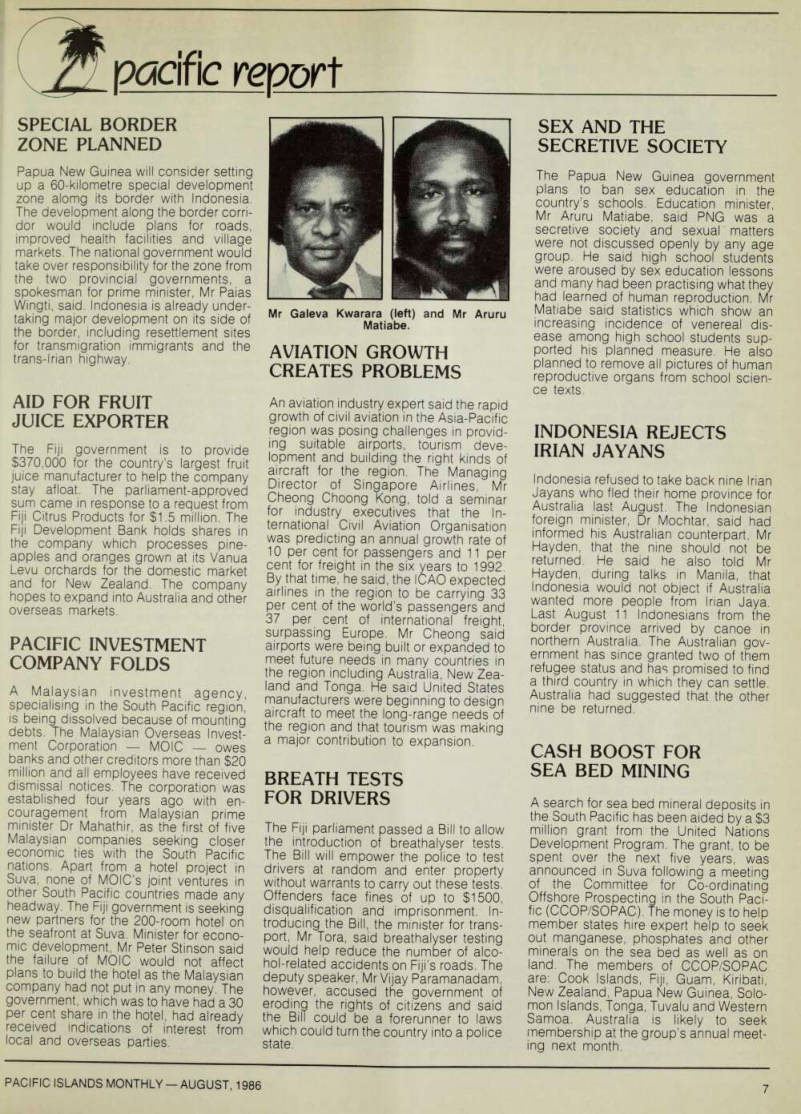
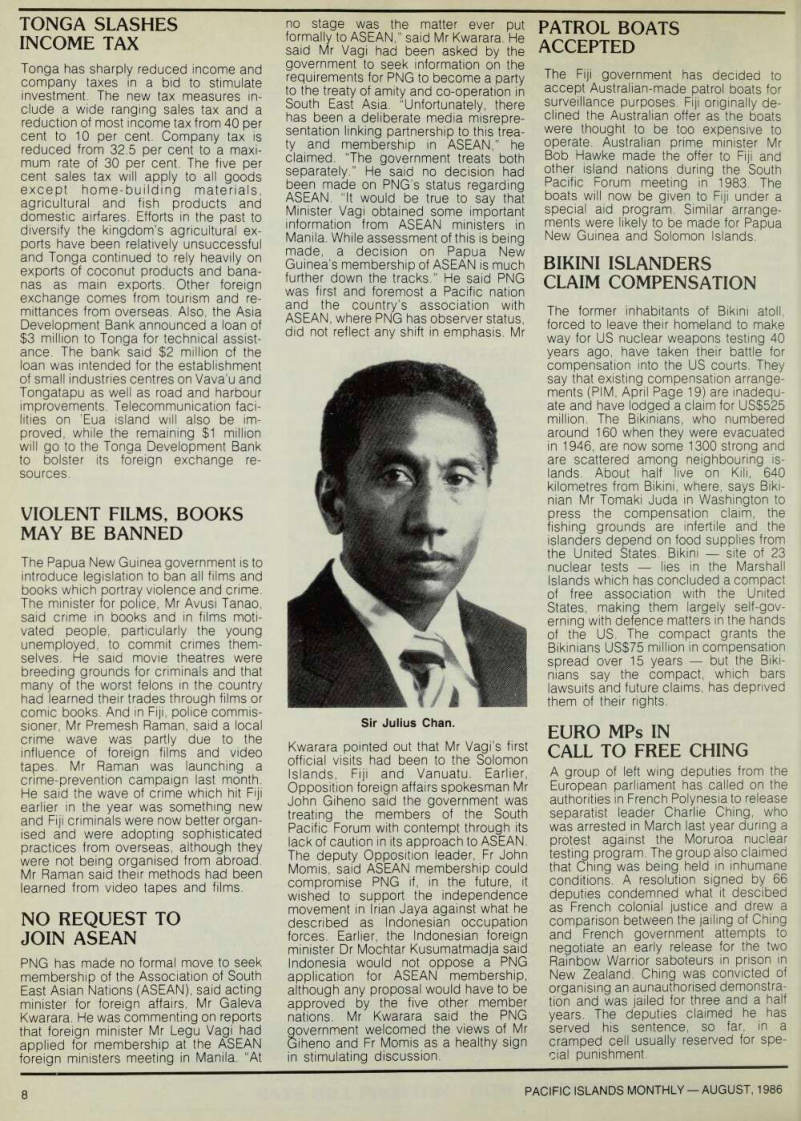
Mr Galeva Kwarara (left) and Mr Aruru Matiabe.
Tonga Slashes
Income Tax
Tonga has sharply reduced income and company taxes in a bid to stimulate investment. The new tax measures in clude a wide ranging sales tax and a reduction of most income tax from 40 per cent to 10 per cent. Company tax is reduced from 32.5 per cent to a maxi mum rate of 30 per cent. The five per cent sales tax will apply to all goods except home-building materials, agricultural and fish products and domestic airfares. Efforts in the past to diversify the kingdom’s agricultural ex ports have been relatively unsuccessful and Tonga continued to rely heavily on exports of coconut products and bana nas as main exports. Other foreign exchange comes from tourism and re mittances from overseas. Also, the Asia Development Bank announced a loan of $3 million to Tonga for technical assist ance. The bank said $2 million of the loan was intended for the establishment of small industries centres on Vava’u and Tongatapu as well as road and harbour improvements. Telecommunication faci lities on 'Eua island will also be im proved, while the remaining $1 million will go to the Tonga Development Bank to bolster its foreign exchange re sources.
Violent Films. Books
May Be Banned
The Papua New Guinea government is to introduce legislation to ban all films and books which portray violence and crime.
The minister for police, Mr Avusi Tanao, said crime in books and in films moti vated people, particularly the young unemployed, to commit crimes them selves. He said movie theatres were breeding grounds for criminals and that many of the worst felons in the country had learned their trades through films or comic books. And in Fiji, police commis sioner, Mr Premesh Raman, said a local crime wave was partly due to the influence of foreign films and video tapes. Mr Raman was launching a crime-prevention campaign last month.
He said the wave of crime which hit Fiji earlier in the year was something new and Fiji criminals were now better organ ised and were adopting sophisticated practices from overseas, although they were not being organised from abroad.
Mr Raman said their methods had been learned from video tapes and films.
No Request To
Join Asean
PNG has made no formal move to seek membership of the Association of South East Asian Nations (ASEAN), said acting minister for foreign affairs, Mr Galeva Kwarara. He was commenting on reports that foreign minister Mr Legu Vagi had applied for membership at the ASEAN foreign ministers meeting in Manila. “At
no stage was the matter ever put formally to ASEAN,” said Mr Kwarara. He said Mr Vagi had been asked by the government to seek information on the requirements for PNG to become a party to the treaty of amity and co-operation in South East Asia. “Unfortunately, there has been a deliberate media misrepre sentation linking partnership to this trea ty and membership in ASEAN,” he claimed. “The government treats both separately.” He said no decision had been made on PNG's status regarding ASEAN. “It would be true to say that Minister Vagi obtained some important information from ASEAN ministers in Manila. While assessment of this is being made, a decision on Papua New Guinea’s membership of ASEAN is much further down the tracks.” He said PNG was first and foremost a Pacific nation and the country’s association with ASEAN, where PNG has observer status, did not reflect any shift in emphasis. Mr
Kwarara pointed out that Mr Vagi’s first official visits had been to the Solomon Islands, Fiji and Vanuatu. Earlier, Opposition foreign affairs spokesman Mr John Giheno said the government was treating the members of the South Pacific Forum with contempt through its lack of caution in its approach to ASEAN.
The deputy Opposition leader, Fr John Momis, said ASEAN membership could compromise PNG if, in the future, it wished to support the independence movement in Irian Jaya against what he described as Indonesian occupation forces. Earlier, the Indonesian foreign minister Dr Mochtar Kusumatmadja said Indonesia would not oppose a PNG application for ASEAN membership, although any proposal would have to be approved by the five other member nations. Mr Kwarara said the PNG government welcomed the views of Mr Giheno and Fr Momis as a healthy sign in stimulating discussion.
Patrol Boats
Accepted
The Fiji government has decided to accept Australian-made patrol boats for surveillance purposes. Fiji originally de clined the Australian offer as the boats were thought to be too expensive to operate. Australian prime minister Mr Bob Hawke made the offer to Fiji and other island nations during the South Pacific Forum meeting in 1983. The boats will now be given to Fiji under a special aid program. Similar arrange ments were likely to be made for Papua New Guinea and Solomon Islands.
Bikini Islanders
Claim Compensation
The former inhabitants of Bikini atoll, forced to leave their homeland to make way for US nuclear weapons testing 40 years ago, have taken their battle for compensation into the US courts. They say that existing compensation arrange ments (PIM, April Page 19) are inadequ ate and have lodged a claim for US$525 million. The Bikinians, who numbered around 160 when they were evacuated in 1946, are now some 1300 strong and are scattered among neighbouring is lands. About half live on Kili, 640 kilometres from Bikini, where, says Biki nian Mr Tomaki Juda in Washington to press the compensation claim, the fishing grounds are infertile and the islanders depend on food supplies from the United States. Bikini site of 23 nuclear tests lies in the Marshall Islands which has concluded a compact of free association with the United States, making them largely self-gov erning with defence matters in the hands of the US. The compact grants the Bikinians US$75 million in compensation spread over 15 years but the Biki nians say the compact, which bars lawsuits and future claims, has deprived them of their rights.
Euro Mps In
Call To Free Ching
A group of left wing deputies from the European parliament has called on the authorities in French Polynesia to release separatist leader Charlie Ching, who was arrested in March last year during a protest against the Moruroa nuclear testing program. The group also claimed that Ching was being held in inhumane conditions. A resolution signed by 66 deputies condemned what it descibed as French colonial justice and drew a comparison between the jailing of Ching and French government attempts to negotiate an early release for the two Rainbow Warrior saboteurs in prison in New Zealand. Ching was convicted of organising an aunauthorised demonstra tion and was jailed for three and a half years. The deputies claimed he has served his sentence, so far, in a cramped cell usually reserved for spe cial punishment.
Sir Julius Chan.
Mormons land in court
The Mormon church lost, and the government of American Samoa won a complicated land owner ship controversy in a Washing ton court.
Federal District Court judge, Oliver Gasch ruled that the disputed tract of land, just out side Pago Pago, belonged to the Pauiloa family and not to the Mormons.
Judge Gasch’s decision be gins with this sentence: “This case involves the Mormon church, title to land that has been in dispute since the turn of the century and the Fa’aa Samoa the Samoan way of thinking and doing.”
The land, known as Malaeimi, is the site of a Mor mon missionary compound.
Part of it, where the title is not in dispsute, lies under the Samoan Communitu College.
The Mormons first leased the land in 1906; the family leader or matai with whom thr Mor mons had been dealing, died in 1929 and a court determined that the rent should continue to be paid to his widow, Sala taima.
In 1953, after a change to the territorial law which made it possible to sell non-communal lands to non-Samoans, the widow sold the land to the church for $30,000.
These transactions took place against the background of the Samoan land tenure laws which draw distinctions among com munal-owned land (which cov ers most of the land in Amer ican Samoa), freehold land and individually-held land.
Communal-owned land can be alienated only to a person of at least 50 per cent Samoan blood. Members of the Pauiloa family contended that the widow had no right to sell the land, while the church main tained otherwise.
By 1979, after several earlier rounds in court, the family decided to start farming part of the tract. The Mormons brought a trespass action.
The family replied that the 1953 deed was void and by 1983 the High Court of Amer-
A land dispute between the Mormon church and a Samoan family that has rolled on since 1906 has finally been settled — in the family’s favour. DAVID S. NORTH in Washington reviews the case and its wider implica tions for American Samoa.
ican Samoa had ruled in favour of the family.
The church then appealed against the High Court’s ruling to the Secretary of the Interior in his role as administrator of the territory.
He, however, refused to overturn the decision of the court and was, in turn, sued by the church which took the matter into the US District Court for the District of Col umbia.
The government of American Samoa intervened in the case on the side of both the Secre tary of the Interior and the Pauiloa family. Attorney-Gen eral L. Su’esu’e Lutu argued the case along with the main land lawyers, Mark Sisk and Arnold Leibowitz. Marcus Faust, another Washington lawyer, spoke for the Mormons.
Since the church had lost its appeals both to the High Court of American Samoa and the
Secretary of the Interior, they took the offensive, making five claims that they had been tre ated incorrectly.
As the case began, both the Department of the Interior and the government of Samoa asked the court to dismiss all five claims.
Judge Gasch, after studying the competing briefs, promptly ruled against the Mormons on all five counts saying that they had ’’failed to raise a valid constitutional or federal statu tory claim.”
The losing party had 60 days to appeal, though no sign of any further action was forth coming.
Meanwhile, however, the Mormons continued to occupy the property, through the operation of a lease that is not in dispute.
Samoan legal questions in frequently reach mainland courts (probably less often than
The Samoan land case was not simply a struggle over legal title to a valuable tract of land, it was also a major, if cautious battle between two major powers.
Taking the initiative was the Corporation of the Presiding Bishop of the Church of Jesus Christ of Latter Day Saints the powerful and fabulously wealthy Mormon church.
On the other side was the Samoan government establishment and the mainland Department of the Interior, not to mention the Pauiloa family.
The Mormon lawyers threw the book at their Samoan opponents, contending that the church’s constitutional rights had been infringed by Samoa’s land tenure system which bars the sale of communal-owned land to anyone who is less than half pure Samoan.
Similarly, the attorneys tried to discredit the entire Samoan judicial system on the ground that the judges lack lifetime tenure.
Lawyers for the Samoan side resisted the claim, but everyone involved on that side insists that “ours is not an anti-Mormon position.”
Congressman Sunia, for example, who announced his support for the decision, went out of his way to appear on Salt Lake City (Mormon headquarters) television to make the point that he did not regard the decision as casting any aspersions on the church.
Fijian cases, for example, might reach the Law Lords in Lon don, an even greater distance) and there was concern that the touchy question of the ethnicity provisions of the Samoan land law would be subject to judicial scrutiny.
Since mainland courts, in dealing with black-white issues, have been vigorous in rejecting what appears to be ethnic bias in voting, education and work place arrangements, there was some concern that the Samoan Land Tenure Act would come under hostile examination many miles from Fa’aa Samoa.
But it didn’t happen.
For although the Mormons were at pains to raise this issue, the court ruled that this provi sion in the law had never been reached; in effect, since the widow had no right to sell the land, to whom she sold it did not matter.
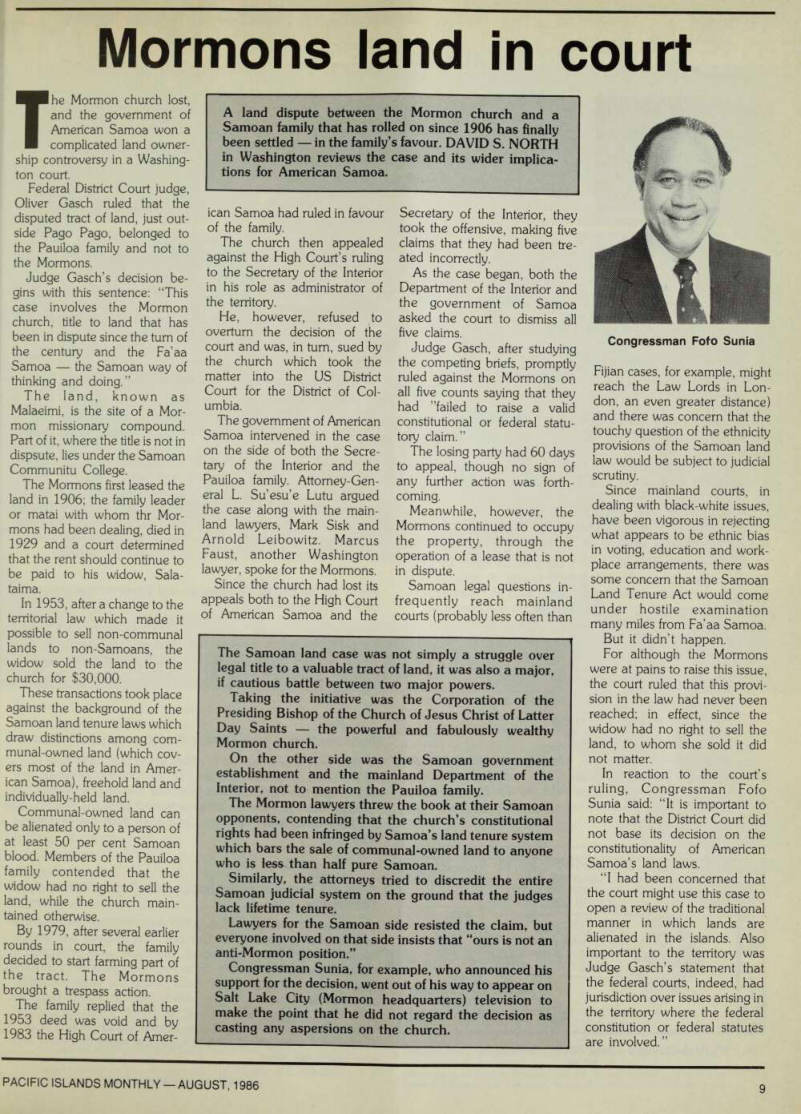
In reaction to the court’s ruling, Congressman Fofo Sunia said: “It is important to note that the District Court did not base its decision on the constitutionality of American Samoa’s land laws.
“I had been concerned that the court might use this case to open a review of the traditional manner in which lands are alienated in the islands. Also important to the territory was Judge Gasch’s statement that the federal courts, indeed, had jurisdiction over issues arising in the territory where the federal constitution or federal statutes are involved.”
Congressman Fofo Sunia
from THE islands press
From the Papua New Guinea Post-Courier, Port Moresby Meat company James Barnes Limited is considering pulling out of its K8 million investment in a Madang cannery.
Prime Minister Mr Wingti has reacted strongly, saying: “The company was unable to grasp the fact that it was not dealing with a banana republic run by some King Bong-Bong.”
The company wants to pull out because of Government refusal to grant it a canned meat monopoly.
From the Papua New Guinea Post-Courier, Port Moresby A Lae gang operating in the Three-Mile area has claimed responsibility for the robbery of the PNG Banking Corporation market sub-branch.
In a letter to the Post-Courier office in Lae, a member of the “Itninin Force 585” said the gang was a highly organised one, with branches in Port Moresby, Wau, Bulolo and Mumeng.
From notes in the PNG University of Technology newsletter The Reporter on a talk on “Explosion of metals in water-a study”.
Can metal explode in water? The answer is yes, if the metal is molten and if the water is in a liquid state.
From a letter in The Fiji Times by D. Pratap, Korolevu, on the taking of park land for a TV tower site.
To the powers that be, to them I say you are right, let us give all our playgrounds and parks for TV towers. A generation of zombies is an internationally recognised sign of a developed country. If we could model our zombies on the American model rather than on the Australian, we would be so far out that we would be really IN.
From the Solomon Nius, Honiara A sanitation project providing 133 latrines for six villages in New Tanabuti, north-east Guadalcanal, was officially opened by the Minister of Health for Guadalcanal Province, Mr Samuel Topilu, at New Tanabuti last Thursday.
During the opening ceremony, which was attended by nearly 200 people, the Director of Peace Corps volunteers in Solomon Islands,Mr Duane Beard said that finance and Peace Corps assistance was available, but without co-operation there would not be any projects.
From the Papua New Guinea Post-Courier, Port Moresby.
The Defence Force should play an active part in the United Nations peace-keeping missions, Primary Industry Minister Sir lambakey Okuk has said.
Sir lambakey said in Lae PNG should help maintain world peace by sending the Defence Force to trouble spots.
It was a “poor excuse that we cannot afford the expense”, he said.
From an advertisement in The Fiji Times, Suva A very rich young Asian man, permanent resident in New Zealand, educated in Britain, a graduate, currently studying for a higher degree, and also working in an secure extremely well paid job, seeks a young wife from the Fijian Asian Community, Hindu, Muslim or Christian. Beauty is the only requirement.
From a letter by Bernard Claudel, Hongkong, in The Fiji Times, Suva.
This is my first visit to Fiji and I want to publicly say how impressed I have been with the friendly attitude of the people of this country.
I arrived on an Air Pacific flight from Sydney. The flight attendants were cheerful, friendly and helpful and then the smiling immigration officials and a most helpful, courteous Customs officer who, after asking me a few questions, directed me out of the Customs hall ... I will go back to Hong Kong and France and rave about Fiji and its wonderful attributes.
From the students’ newspaper Uni Tavur of the University of Papua New Guinea.
Luavi House is to be opened to visitors all day until midnight on a trial basis for a month next semester. A security committee has been set up, comprising of some female students, to keep a record of things that happen during the trial period.
From the Papua New Guinea Post-Courier, Port Moresby A fight over a pig has left a village councillor dead and 16 men injured in the Chauve area of the Chimbu province.
Police said the fight broke out betwen the Nogefaro and Agorigo clans of Chauve because a man from the Agorigo clan allegedly killed a pig belonging to a man from the Nogefaro clan.
From the Reporter of the Papua New Guinea University of Technology, Lae.
Compared to previous years, 1985 was relatively incident free with respect to Security on Campus. The average was about two break and enters per month, but these were principally in the Staff Amenities Centre, Haus Kopi and Academic Buildings.
There were 7 attempted car thefts during the year, but each case was unsuccessful, or the vehicle was recovered. Reported petty theft averaged about three per month involving clothes, bicycles left outside at night and plundering of garden plots.
There were a couple of hold-ups, several cases of assault and one attempted rape.
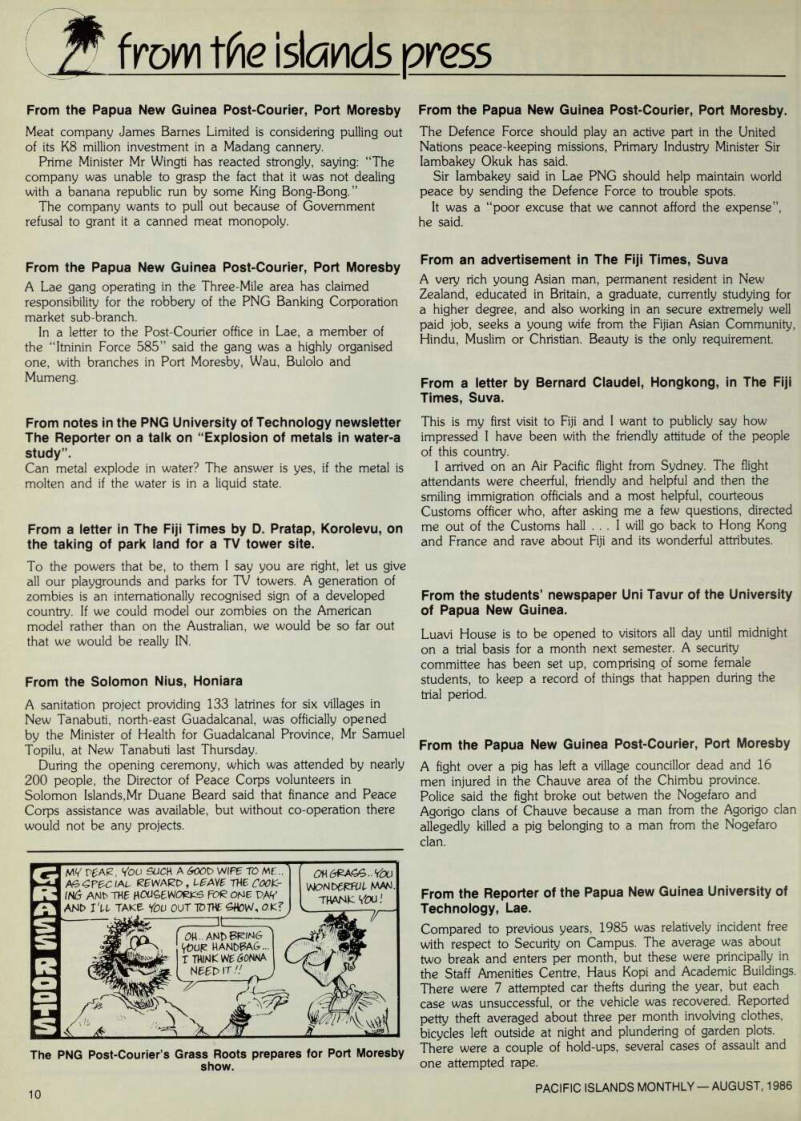
The PNG Post-Courier’s Grass Roots prepares for Port Moresby show.
Advertisements & other items, p. 11 (1 item)
Go to the Head of the Class
*?•>] fesjs r*™ !
*• * F X 770
iii
X Go ahead, move up to Pioneer’s New Personna Plus X-770 shelf-component system, and discover peerless perfection.
This super-sophisticated mini-sized sound system offers full-function remote control for amp, tuner, cassette deck, turntable, and the optional CD player. Together, they put cutting edge audio technology at your command as Pioneer alone can.
Simulated Stereo lets you enjoy wide, stereo-like signals from mono signals. And Stereo Wide brings you expanded ambience from stereo signals, so you’re as turned on as possible no matter what you tune in!
Power? 320 W Peak Music Power Output from the double auto-reverse cassette deck/amplifier. You’ll flip over the music, without flipping the tape over, as well as enjoy double cassette convenience.
Of course, the X-770 also brings you great features like 5-band graphic equalizer, Mic Mixing, Dolby* B/C NR, and more.
The New Personna X-770. Go for it and go to the head of the class. * "Dolby” and the double-D symbol are trademarks of Dolby Laboratories Licensing Corporation.
Note; The optional PD-X707(8K) CD player is showrrabove.
(U) PIONEER
The future of sound and vision.
For further information, please contact; Australia: Pioneer Electronics Australia Pty. Ltd. (Incorporated in Victoria), P-0. Box 295, Mordialloc, Victoria, 3195 Tel; 580-9911 Fiji Islands: Brijlal & Company, G.P.O. Box No. 362, Suva, Fiji Islands Tel: 22258 New Zealand: Monaco Distributors Ltd., 2 Poland Road, Glenfield, Auckland, New Zealand Tel: (09) 444-9144 Norfolk Island: Burns Philp (Norfolk Island) Ltd., P.O. Box 21, Norfolk Island Vanuatu: Burns Philp (Vanuatu) Ltd, Vila, Vanuatu Nauru Island; Jacob Enterprises, P.O. Box No. 4, Republic of Nauru Tahiti: Tahiti Hi-Fi, P.O. Box 848, Papeete, Tahiti New Caledonia: Menard Pacifique Sari, B.P. 3899, Noumea, New Caledonia Tel: 27-62-23 American Samoa: Transpac Corporation, P.O. Box 1477, Pago Pago, American Samoa 96799 Tel: 633-5224 Rarotonga: South Seas International Ltd, P.O. Box 49, Rarotonga, Cook Islands Tel: 2327 Papua New Guinea: Bali Merchants Pty. Ltd, P.O. Box 6103, Boroko Tel: 254887
Power plant
fall-out leaves islands in debt
An electric power fiasco has put the Republic of Palau among the ranks of the Third World debtor nations.
The fall-out from the power project has seen Carlos Salii, brother of President Lazarus Salii, under investigation by the judiciary for allegedly accepting a $1.5 million bribe while he was speaker of the House of Delegates.
And the House was even considering impeaching the president, alleging bribery and power peddling.
Present Speaker of the House, Santos Olikong said: “IPSECO is breaking my heart.
It was supposed to be self paying, but instead it costs Palau 15 cents per second.
“As of September 1985, the cost of the project and interest payments has skyrocketed to $35 million.”
This is a staggering debt for the tiny Western Pacific island state of 15,000. It is almost double the government’s annual budget.
IPSECO International Power Systems Ltd is a British company which, in May 1983, entered into a contract with Palau to construct a badly needed power plant and fuel farm.
Company president, Mr Gor don Mochrie, was reported as assuring the OEK Palau’s National Congress that the entire project would be self financing through the sale of electricity and fuel.
Instead, IPSECO has entered the language as a term implying fiscal misfortune. The deal has plunged the fledgling republic into debt of economic night mare proportions.
Conspiracy theories abound as a small island state is thrown into debt by an ambitious power plan that failed spectacularly. E. Rampell in Palau tells the story of a financial fiasco.
Funding for the project came via London’s National Westminster Bank and the loans were guaranteed by a multinational consortium of banks including: Morgan Gren fell of London, Orion Bank of Canada, the Bank of Scotland, the Bank of Tokyo and Morgan Guaranty Trust of New York.
In April last year Palau de faulted on its foreign debt. In December the banks sued the tiny republic in a New York court for over $35 million.
The plot then thickened when IPSECO declared bank ruptcy in London.
Mochrie, meanwhile, had be come a creditor of his former company, putting in a claim for 29,615 pounds.
In June, Palau struck back, suing IPSECO in the Supreme Court in Koror, claiming $750,000 for non-delivery and non-installation of the power plant’s fifth generator, although the company had been paid in full for the diesel engine.
A representative of the British manufacturer, Crossley En gines, was interviewed in Palau in June when he claimed that his company had not been paid for the four generators installed at the plant.
Palau had already paid IPSE CO for the generators and Crossley were now seeking payment from that company, said the representative.
Assistant attorney general Eric Basse said that Palau has filed a claim with IPSECO’s
London liquidator, chartered accountants, Cork Gully, in addition to its law suit in Koror.
Basse threatened to seize IPSECO’s assets if the claim goes unpaid.
Meanwhile, conspiracy theories are rife in Palau, the only Pacific Island state to have lost a president to an assassin in recent times.
Leaders such as Olikong speculate that IPSECO is part of a plot to force Palau to enter into the proposed Compact of Free Association with the Un ited States.
Palau has been US-adminis tered since 1947 as part of a UN Trusteeship. In three plebis cites since 1983, Palau has failed to overturn the nuclear free provisions if its constitution, which made it the world’s first nuclear-free nation.
The conspiracy theory hypothesises that by bankrup ting Palau, the emerging nation will have to accept the compact along with US military and strategic nuclear interests in the Pacific in exchange for Amer ican aid.
Furthermore, the IPSECO plant would provide any future US military base at Babeldoab the largest island in Mic ronesia with a ready made power source and fuel storage facility.
And the fact that there has been a mysterious dearth of news coverage of IPSECO in the regional press is fuelling
suspicions of behind-the-scenes skulduggery.
IPSECO has a plant in the Marshalls and had been trying to sell power projects through out the South Pacific.
While debate rages, the fiscal fiasco continues along with periodic power shortages and a crippling foreign debt burden for a power project that has yet to light a single lamp for the people of Palau.
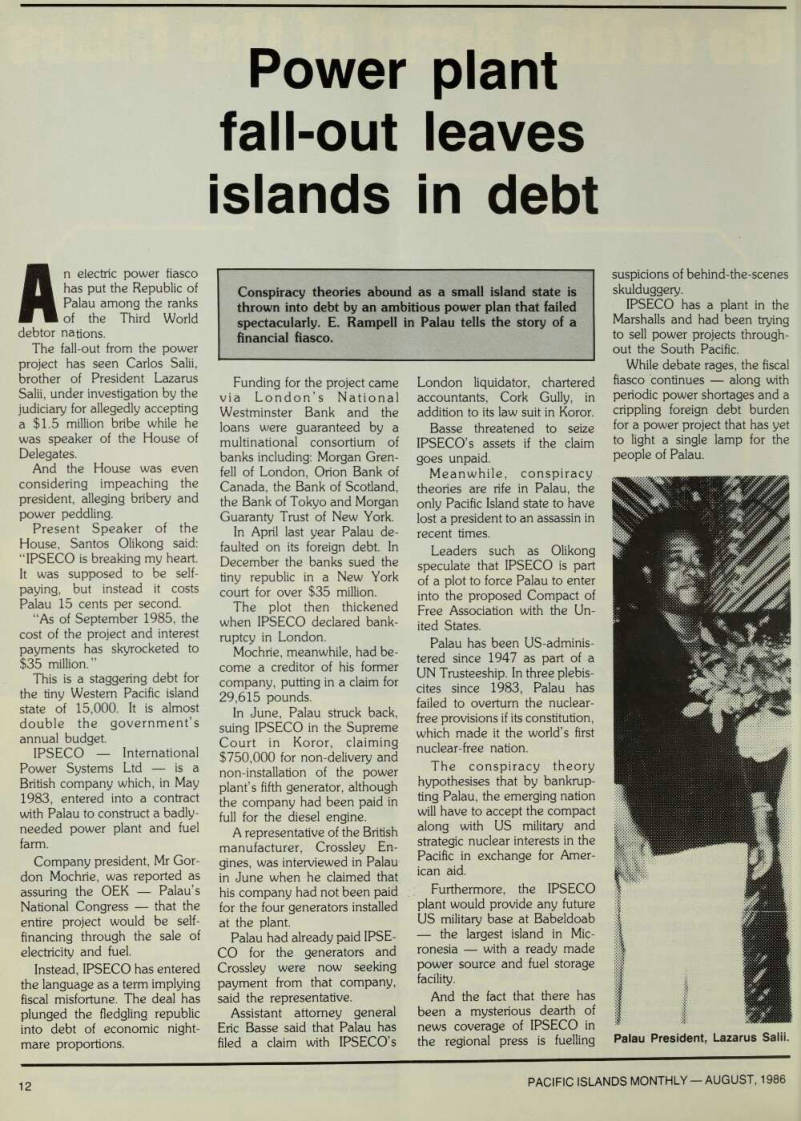
Palau President, Lazarus Salii.
Advertisements & other items, pp. 13-15 (1 item)
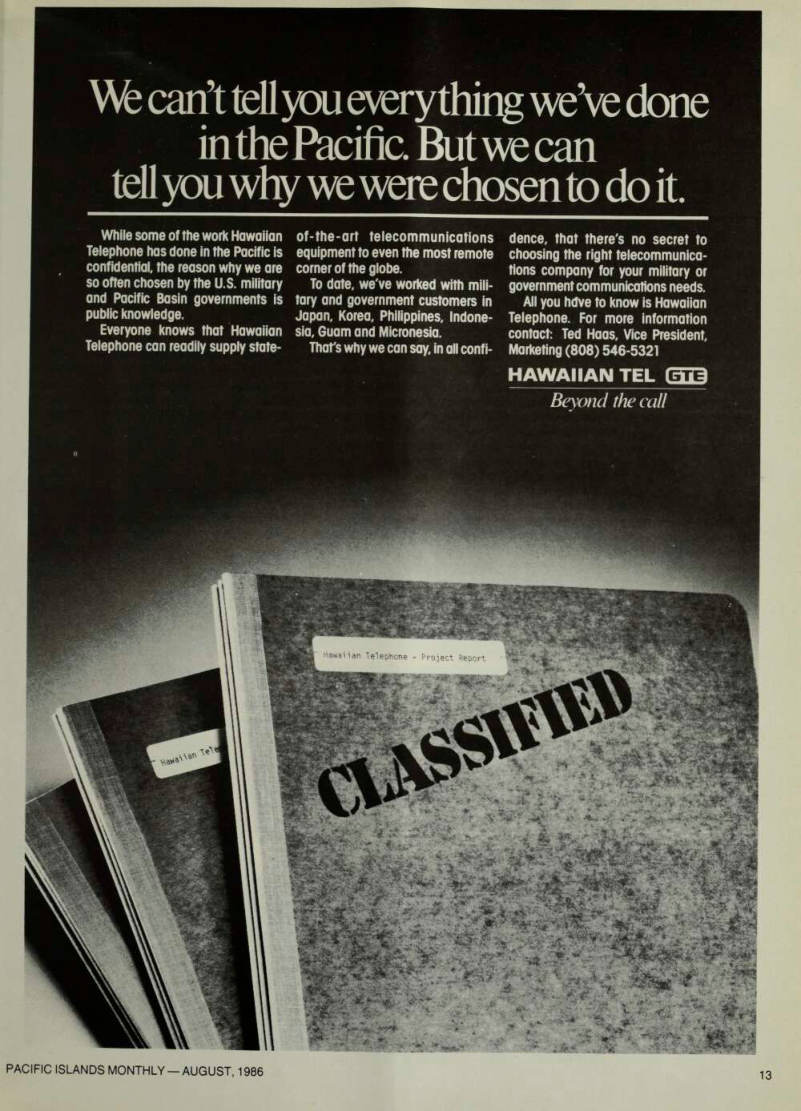
in the Pacific. But we can
We can’t tell you everything we’ve done
tell you why we were chosen to do it.
While some of the work Hawaiian Telephone has done in the Pacific is confidential, the reason why we are so often chosen by the U.S. military and Pacific Basin governments is public knowledge.
Everyone knows that Hawaiian Telephone can readily supply stateof-the-art telecommunications equipment to even the most remote corner of the globe.
To date, we've worked with military and government customers in Japan, Korea, Philippines, Indonesia, Guam and Micronesia.
That's why we can say, in all confidence, that there's no secret to choosing the right telecommunications company tor your military or government communications needs.
All you hdve to know is Hawaiian Telephone. For more information contact: Ted Haas, Vice President, Marketing (808) 546-5321
HAWAIIAN TEL fnT3
Beyond the
O m ’.>r m * m £ S - * t; m Mum s , *
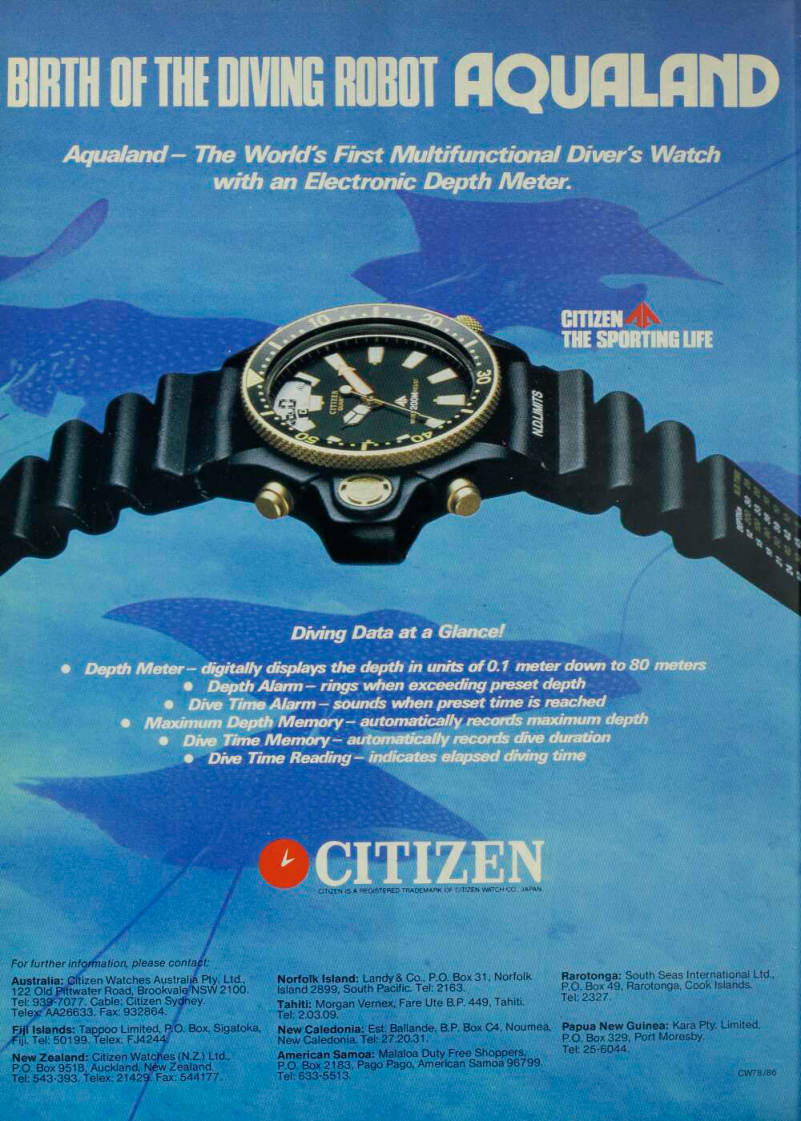
HRIN Of THE DfflNß ROBOT fIQUfIUUID
Aqua/and— The World's First Multifunctional Diver's Watch
with an Electronic Depth Meter.
\ Q * ■ i is
Diving Data at a Glance!
• Depth Meter- digitally displays the depth in units of 0.1 meter down to 80 meters • Depth Alarm-rings when exceeding preset depth • Dive Time Alarm - sounds when preset time is reached • Maximum Depth Memory automatically records maximum depth * Dive Time Memory- automatically records dive duration • Dive Time Reading-indicates elapsed diving time For further information, please contact: Australia: Citizen Watches Australia Pty. Ltd, 122 Old Pittwater Road, Brookvale NSW 2100.
Tel; 939-7077. Cable; Citizen Sydney.
Telex: AA26633. Fax: 932864.
Fiji Islands: Tappoo Limited, P.O. Box, Sigatoka, /Fiji. Tel: 50199. Telex; FJ4244.
New Zealand: Citizen Watches (N.Z.) Ltd., P.O. Box 9518, Auckland, New Zealand.
Tel: 543-393. Telex: 21429: Fax: 544177. mi CITIZEN IS A REGISTERED TRADEMARK OF CITIZEN WATCH CO . JAPAN Norfolk Island: Landy& Co., P.O. Box 31, Norfolk Island 2899, South Pacific. Tel; 2163.
Tahiti; Morgan Vernex, Fare Lite B.P. 449, Tahiti.
Tel: 2.03.09.
New Caledonia: Est. Ballande, B.P. Box C 4, Noumea, New Caledonia. Tel: 27.20.31.
American Samoa: Malaloa Duty Free Shoppers, P O. Box 2183, Pago Pago, American Samoa 96799.
Tel: 633-5513.
Rarotonga: South Seas International Ltd., P.O. Box 49, Rarotonga, Cook Islands.
Tel; 2327.
Papua New Guinea: Kara Pty. Limited, P.O. Box 329, Port Moresby.
Tel: 25-6044.
How to see 200 food
and drink companies
in just four days.
AIFE 86. Australia’s biggest international trade-only food and drink exhibition.
Your chance to see the people and products of2oo Australian and international companies, under one roof, in just four working days.
For food service buyers, exhibits range from exclusive specialty foods for restaurateurs through to portion control packs for mass catering.
Retail buyers can assess the sales potential of hundreds of products in one cost-effective visit.
To whet your appetite, here are just some of the A ustralian and international products you'll be seeing at AIFE 86: A Bakery products A specialty foods A fast foods A drinks - alcoholic and non-alcoholic A portion control packs A canned and frozen foods A dairy products A meat and poultry A seafoods a Salon Culinaire.
So, if you’d like to see a year’s worth of food and drinks, and still have 361 days to spare, join us at
AIFE 86.
Royal Exhibition Building, Melbourne. 22-25 September: Monday, Wednesday, Thursday 10am-6pm: Tuesday lOam-Spm.
For further information contact the organisers, Australian Exhibition Services Pty Ltd, on (03) 2674500.
OH^ l -
IIOH
BE
N BOaOINGI
BAEAES7BB
H E
U S T
R A E
\ i H
» NT !*" I oMNK
Tris s£P oN Buaomoi
T H E
fOO
E X H
l-l* RO H
WANTED TO
BUY IN
LARGE
QUANTITIES
Frozen coconut crabs, Fruit bats (Flying fox), Lobster tails, Giant clam mussels.
Please send enquiries with complete address, phone number and telex contact to:
Micheal Pohl
Enterprises
Box 20219 Guam Main Facility Guam 96921 Telephone: (671) 646-8614 (671) 472-8224 Telex: (721) 6680 POHLFISH
seeds
Improved pasture seed, cereal and crop seed, lawn seed for parks and gardens, assorted vegetable seed, specialist seed mixes for reclamation and stabilisation.
WILEEED y
J. H. WILLIAMS & SONS
Pty. Ltd.
P.O. Box 102, Murwillumbah, 2484 Australia Phone: 6166-721866 Telex: AA66142 Fax; 6166-724212
Foreign business beats a slow reteat
Racial attitudes in the Fiji business community are highlighted in the results of a survey carried out by Hawaii-based researchers.
A cross section of the coun try’s entrepreneurs were sur veyed in a program organised by the East-West Centre’s Paci fic Island Development Program.
The results, contained in a report by John Bailey, contri bute to a hard hitting critique of indigenous Fijian business con ditions.
Bailey found that, in general, the workforce was largely un tapped, with great potential in the rural areas.
His report, “Indigenous Busi ness in Fiji,” is heavily critical of several groups.
Fijians, in particular, he claims, are finding it increasing ly difficult to find employment.
“Many of the major locally owned companies continue to
employ a majority of Indian labour, and one must question the impartiality of their selection policies as equal opportunity employers.
“Such recruitment policies do little to encourage Fijian applicants, and this situation is aggravated by the fact that few of these jobs are advertised.
“Word of mouth and perso nal contacts are a dominant feature of job-seeking in Fiji,” he claims.
Bailey estimates that there is one small firm for every 40 people in Fiji, which ratio cor responds with similar figures for the UK and Australia.
But “although the private business sector is composed predominently of sole traders and partnerships, in reality it is dominated by a few large com panies that generate the large sales turnover.”
These are the Carpenters
Group, Burns Philp, Central Manufacturing and Western Mining with the locally-owned Punja’s and R.B. Patel’s.
In 1981, says Bailey, an estimated 12,200 Fijians were employed in the private sector.
“Although they represented one third of the total number employed in the private sector, the great majority were em ployed only as semi-skilled or unskilled labour.
“Only 2,040 Fijians held senior salaried positions, a mere 17 per cent of all Fijians em ployed.”
The past 10 years, in particu lar, has seen the gradual ad vance of locally-owned enter prise at the expense of the traditionally dominant foreign owned companies.
Foreign capital, says Bailey, is in retreat despite the incentives offered by the gov ernment.
“During the past 15 years
foreign investment has drifted away from the Pacific islands for four main reasons: • The independence of many nations, which encour aged a return of land to traditio nal landholders and govern ments; • Falling commodity prices; • A management succession problem among many small foreign-owned concerns and • A search for economies of scale.
“This dramatic disengage ment and retreat from the Paci fic is apparent in such examples as the withdrawal of the US multinational Brewer Corpora tion from the Solomon Islands, the sale of Burns Philp retail properties in Fiji, the rationalisa tion that created Industrial Marine Engineering Ltd (IMEL), with the loss of 100 jobs and the complete withdra wal of Barclays Bank from Fiji and the Pacific in 1985.”
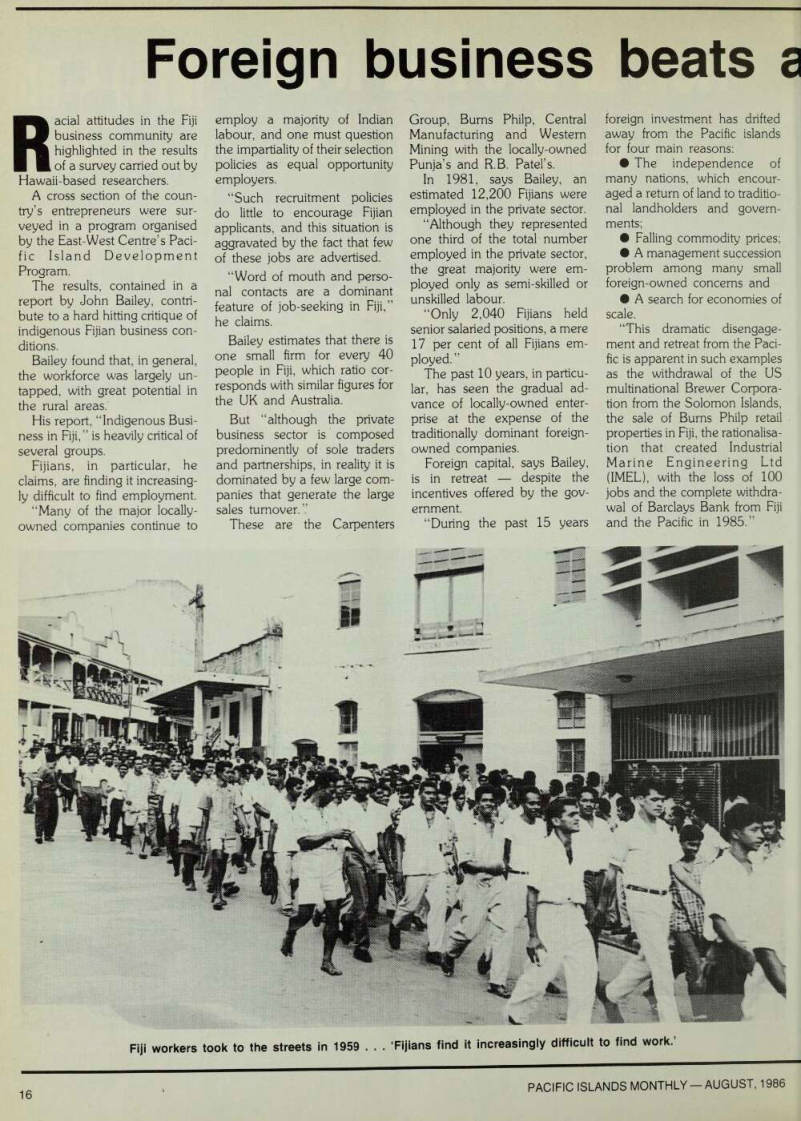
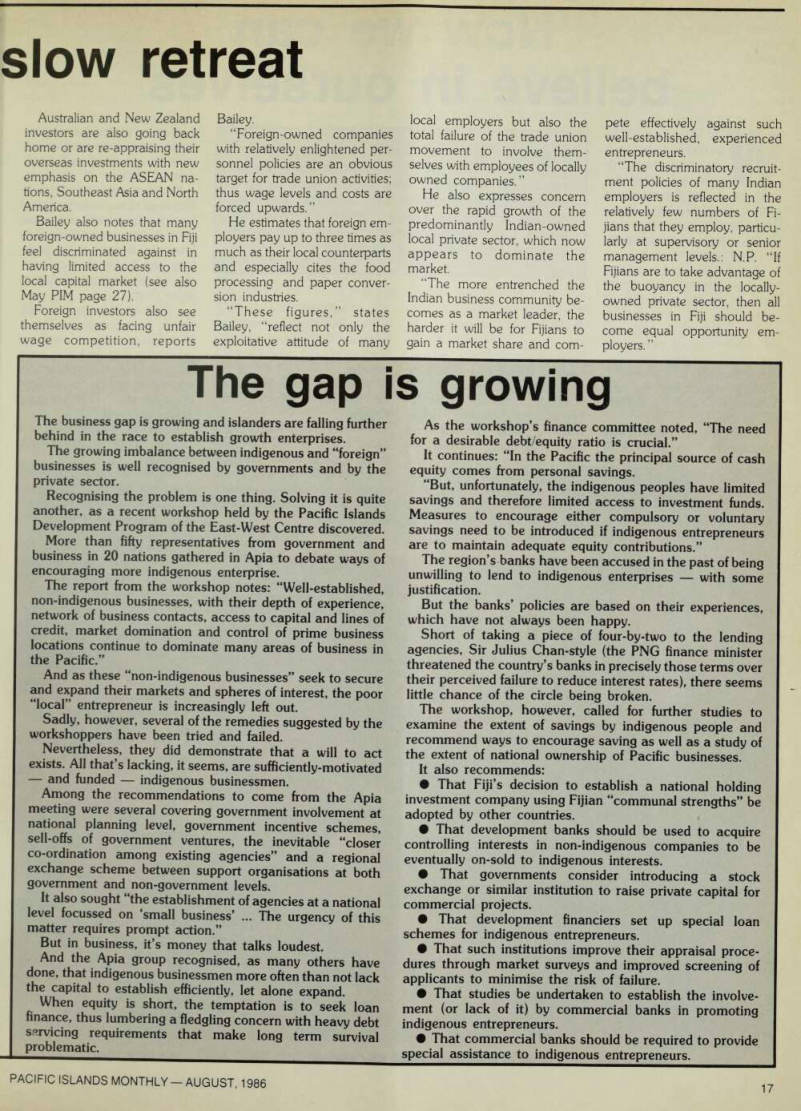
Fiji workers took to the streets in 1959 ... ‘Fijians find it increasingly difficult to find work.’
Australian and New Zealand investors are also going back home or are re-appraising their overseas investments with new emphasis on the ASEAN na tions, Southeast Asia and North America.
Bailey also notes that many foreign-owned businesses in Fiji feel discriminated against in having limited access to the local capital market (see also May PIM page 27).
Foreign investors also see themselves as facing unfair wage competition, reports
Bailey.
“Foreign-owned companies with relatively enlightened per sonnel policies are an obvious target for trade union activities; thus wage levels and costs are forced upwards.”
He estimates that foreign em ployers pay up to three times as much as their local counterparts and especially cites the food processing and paper conver sion industries.
“These figures,” states Bailey, “reflect not only the exploitative attitude of many
local employers but also the total failure of the trade union movement to involve them selves with employees of locally owned companies.”
He also expresses concern over the rapid growth of the
predominantly Indian-owned
local private sector, which now appears to dominate the market.
“The more entrenched the Indian business community be comes as a market leader, the harder it will be for Fijians to gain a market share and com
pete effectively against such well-established, experienced entrepreneurs.
“The discriminatory recruit ment policies of many Indian employers is reflected in the relatively few numbers of Fi jians that they employ, particu larly at supervisory or senior management levels.: N.P. “If Fijians are to take advantage of the buoyancy in the locally owned private sector, then all businesses in Fiji should be come equal opportunity em ployers. ”
The gap is growing
The business gap is growing and islanders are falling further behind in the race to establish growth enterprises.
The growing imbalance between indigenous and “foreign” businesses is well recognised by governments and by the private sector.
Recognising the problem is one thing. Solving it is quite another, as a recent workshop held by the Pacific Islands Development Program of the East-West Centre discovered.
More than fifty representatives from government and business in 20 nations gathered in Apia to debate ways of encouraging more indigenous enterprise.
The report from the workshop notes: “Well-established, non-indigenous businesses, with their depth of experience, network of business contacts, access to capital and lines of credit, market domination and control of prime business locations continue to dominate many areas of business in the Pacific.”
And as these “non-indigenous businesses” seek to secure and expand their markets and spheres of interest, the poor “local” entrepreneur is increasingly left out.
Sadly, however, several of the remedies suggested by the workshoppers have been tried and failed.
Nevertheless, they did demonstrate that a will to act exists. All that’s lacking, it seems, are sufficiently-motivated and funded indigenous businessmen.
Among the recommendations to come from the Apia meeting were several covering government involvement at national planning level, government incentive schemes, sell-offs of government ventures, the inevitable “closer co-ordination among existing agencies” and a regional exchange scheme between support organisations at both government and non-government levels.
It also sought “the establishment of agencies at a national level focussed on ‘small business’ ... The urgency of this matter requires prompt action.”
But in business, it’s money that talks loudest.
And the Apia group recognised, as many others have done, that indigenous businessmen more often than not lack the capital to establish efficiently, let alone expand.
When equity is short, the temptation is to seek loan finance, thus lumbering a fledgling concern with heavy debt servicing requirements that make long term survival problematic.
As the workshop’s finance committee noted, “The need for a desirable debt/equity ratio is crucial.”
It continues: “In the Pacific the principal source of cash equity comes from personal savings.
“But, unfortunately, the indigenous peoples have limited savings and therefore limited access to investment funds.
Measures to encourage either compulsory or voluntary savings need to be introduced if indigenous entrepreneurs are to maintain adequate equity contributions.”
The region’s banks have been accused in the past of being unwilling to lend to indigenous enterprises with some justification.
But the banks’ policies are based on their experiences, which have not always been happy.
Short of taking a piece of four-by-two to the lending agencies, Sir Julius Chan-style (the PNG finance minister threatened the country’s banks in precisely those terms over their perceived failure to reduce interest rates), there seems little chance of the circle being broken.
The workshop, however, called for further studies to examine the extent of savings by indigenous people and recommend ways to encourage saving as well as a study of the extent of national ownership of Pacific businesses.
It also recommends: • That Fiji’s decision to establish a national holding investment company using Fijian “communal strengths” be adopted by other countries. • That development banks should be used to acquire controlling interests in non-indigenous companies to be eventually on-sold to indigenous interests. • That governments consider introducing a stock exchange or similar institution to raise private capital for commercial projects. • That development financiers set up special loan schemes for indigenous entrepreneurs. • That such institutions improve their appraisal proce dures through market surveys and improved screening of applicants to minimise the risk of failure. • That studies be undertaken to establish the involve ment (or lack of it) by commercial banks in promoting indigenous entrepreneurs. • That commercial banks should be required to provide special assistance to indigenous entrepreneurs.
believe in ourselves’
‘Now we can believe in ourselves’
With next year’s June general election looming and not even a year at the helm of Papua New Guinea politics behind him, Paias Wingti says his government has already notched up some signi ficant achievements.
The Wingti-Chan coalition has now entered what seems likely to be its most difficult period with economic activity slowing, corruption and law and order issues still high on the agenda and the general stability of the coalition in question.
Wingti agrees that the time between now and the election will be difficult.
“Our most important achievement,” he said, “is in giving our people a sense of confidence in their country.
“The other achievements you can monitor and measure in monetary terms, but I think the excitement of giving them
The run up to an election is a crucial time for any government. But for PNG prime minister Paias Wingti, in office for less than a year with a widespread coalition to hold together, the bur den is especially heavy. DENIS REINHARDT found him on the campaign trail, not at all dismayed by the task ahead.
confidence in themselves and that Papua New Guineans can do things is the major achievememt of this govern ment,” Wingti told PIM in a wide ranging interview.
Wingti, who served as his predecessor’s deputy before resigning early last year and then challenging Michael So mare, is convinced that his is a ministry that will deliver the goods for his countrymen.
“We have a better ministry and the most experienced men who have been in govern
ment,” he said. “For instance, in Sir Julius Chan we not only have a former prime minister but a world-recognised finance minister.
“And there are many others too, like mines minister, John Kaputin. ”
A revival in community confi dence is also behind the break in the cycle of public violence, argues the 35-year-old prime minister possibly the world’s youngest democratically elected leader.
“We have controlled the law
and order situation. It has be come stable because it comes back to people’s self confi dence,” he said.
“In the past, people were frustrated. They were frustrated because the people at the time gave the impression that they knew the answers to the prob lems and the people were wait ing for government leaders to solve them.
“Whereas this time, I said: ‘Look, each one of you Papua New Guineans must stand on your own feet and you must solve all your own problems by yourselves and no one else can do it for you.’ That has gone across very well.”
Economic management is a harder, more enduring task, however.
“When we came into office, there was little liquid cash in the banking system, and because of that, interest rates were very high and rising.
“It was 17 per cent for ordinary lending and, for short terms, it went as high as 27 per cent and (even) the banks were rushing for the quick money.
“So when we took office we took a hand in that and clear directions were given to the banks on which sectors they could lend to in accordance with government priorities.”
According to Wingti, the re sults are evident.
“Now you see a situation where interest rates are down to 12 per cent and that’s a big achievement,” he argues.
But it is not something that has been gained without strong resistance from the banks who say the fixing of rates by gov ernment decree has altered the risk factors and may force them to make losses.
Wingti also claims early suc cess in reducing taxation.
“The previous government was going to increase taxes on basic foodstuffs for our people.
We decided not to increase those taxes.”
Similarly, bureaucratic re strictions on licences for PMV (public transport) operators have been lifted.
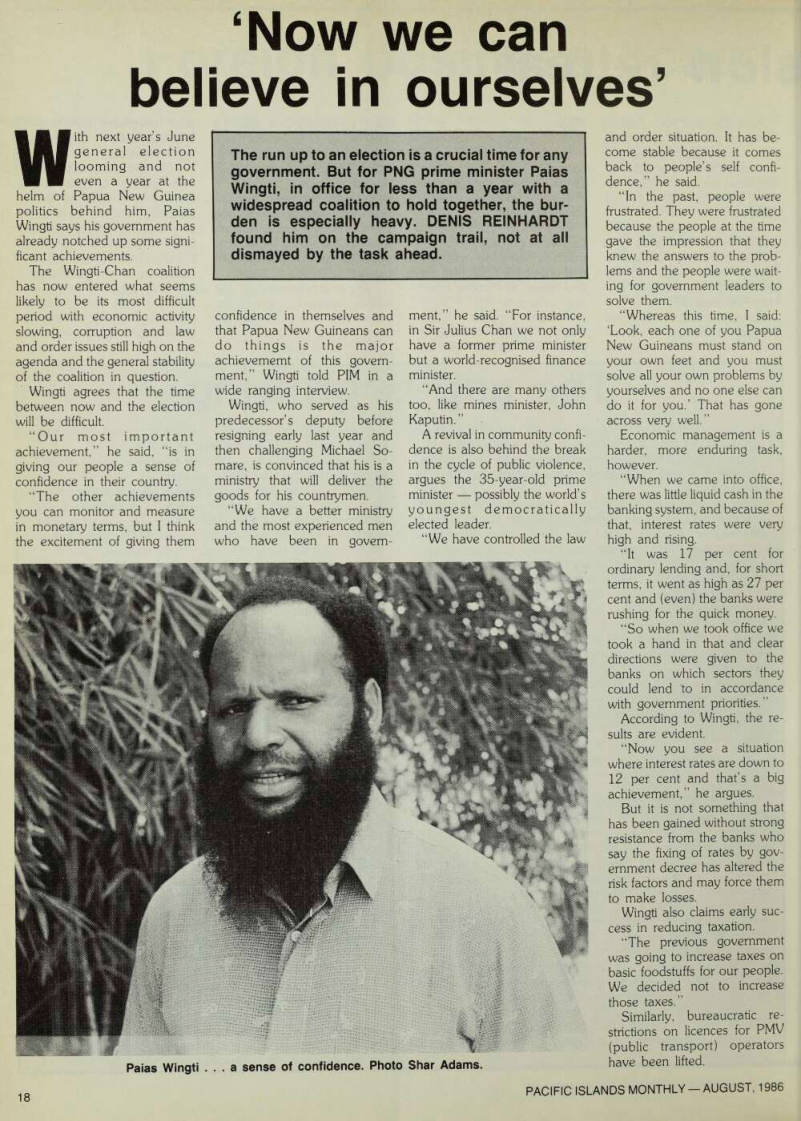
Paias Wingti ... a sense of confidence. Photo Shar Adams.
The approach we have taken is that the people know how to spend money much better than the government. So why should we collect money from people when they can spend it more efficiently.”
With Wingti’s government already subject to a bout of whisperings about corruption, which has become a hallmark of public life in Port Moresby, Wingti, whose own public stan ding remains unimpeached, maintains that his government “has tackled corruption in a much more forceful manner.”
“People feel the difference now in Port Moresby,” he said.
“Because in the past you had the prime minister going for long lunches with business friends I’m not saying I haven’t got any business friends I am saying that his govern ment was run on an ad hoc basis. ”
It is a theme which the ascetic Wingti likes to pursue.
‘ I here was no senousness in cabinet whereas now individual ministers are encouraged to perform.
“I don’t interfere with their portfolios or go over their heads in matters in their ministries.
“My office is to act as a co-ordination (centre). Now that people have seen the changes, there is a feeling in the public service that we are get ting somewhere and we have inspired people.”
Wingti is coy about what may become his other great achieve ment the balancing of rela tions with Indonesia by persuading Jakarta to accept the role of the United Nations High Commissioner for Re fugees in the border camps housing an estimated 10,000 Irian Jayans who have taken refuge on PNG soil.
“Our relations with Indonesia are very vital and we realise this fact. The only area of concern has been the border,” Wingti explained cautiously.
but now I can say there are better relations with Indonesia where therq is respect and understanding. ”
But this rapprochement which has brought about meet ings between both countries’ defence chiefs will not extend to joint military patrols against the Free Papua Movement or OPM which is seeking independence for Irian Jaya.
“The OPM is a declining force which does not cause any major threat to the stability of this country.”
The long term future of Papua New Guinea may be guaranteed by decisions the Wingti government takes, be fore the general elections, on the huge gold and possible oil reserves in PNG.
The recently announced Placer Pacific Limited float, the largest company launch in Au stralasian history, has indicated the revenue to come from the Porgera and Misima gold de;posits.
Equally important is the oil drilling program in the South ern Highlands around Tari.
Wingti has been told private ly that the latest well being drilled at lagifu south of Tari may prove up the greatest oil discovery anywhere in the world in the last decade.
If it does, PNG could see its current budget revenue doubled within ten years.
Wingti is likely to have to make landmark decisions on both gold and oil before the election. He emphasises that the predicted huge revenues must be spent wisely.
“We will be redirecting the revenue towards the rural areas of Papua New Guinea where 85 per cent of our people live.
“Because those resources are non-renewable and will be come exhausted, then if we direct those resources into agri culture that would make this economy become a very strong economy. ”
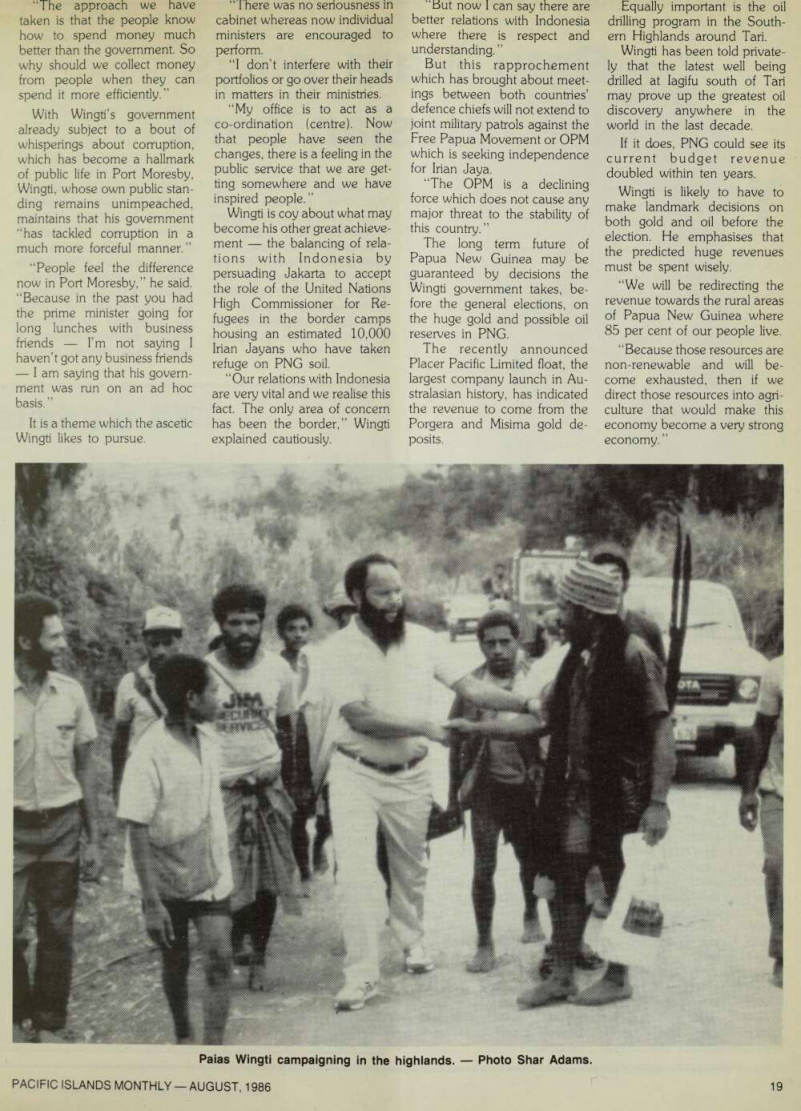
Paias Wingti campaigning in the highlands. Photo Shar Adams.
Ratu Mara plays
the Russian card
You are perhaps now thinking, here we go again the Russians are coming, the Russians are com ing. The Russians aren’t com ing, they’re here.
Thus Admiral Ronald R.J.
Hays, US Commander in Chief (Pacific) at a recent press con ference.
The admiral was addressing himself to the build-up of Rus sian naval forces in the Pacific, and indicated that, so far at least, the US was well placed to contain any immediate threat.
Doubtless, that’s true.
On the diplomatic and com mercial fronts, however, the US is less well placed.
The rot, from a Washington viewpoint, began with the sig ning of the Kiribati-Soviet fishing agreement.
It continues as Vanuatu seems ever more likely to con clude an agreement giving the Soviets shore facilities.
It looked like running riot when Fiji’s Ratu Mara told a Honolulu press conference that he might consider a similar agreement, although this was later toned down by his foreign affairs secretary.
Nevertheless, the point was not lost on the Russians.
There is further potential for erosion of US prestige with the Soviets giving possibly their strongest hint yet (see box) that they might use their veto against the US when the Micronesian question comes before the UN Security Council.
Ratu Mara told reporters dur ing a Honolulu visit that Fiji was now interested in pursuing a fisheries agreement with the Soviet Union so long as the price was right.
He also, in an apparent about face on previous policy, said the Soviet fleet might be able to negotiate shore facilities.
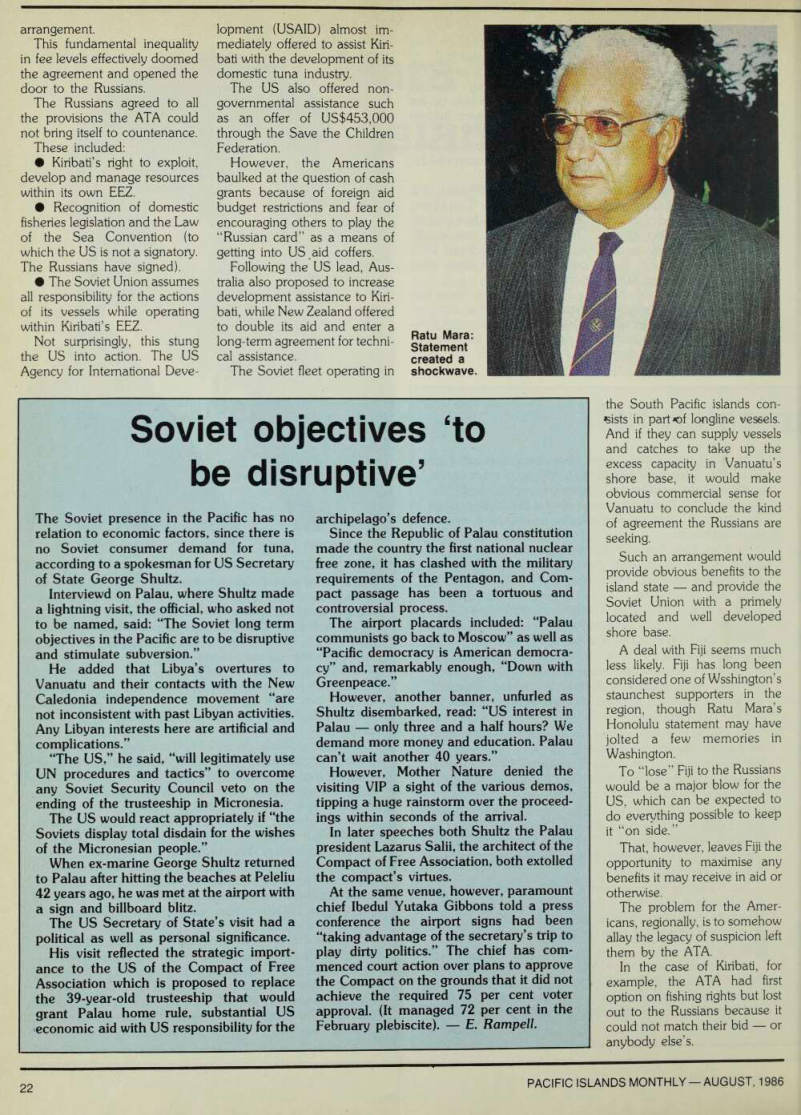
His remarks sent a shock wave throughout the region,
with the Americans, the Austra lians and the New Zealanders particularly nonplussed.
For when US Secretary of State George Shultz visited Fiji last year, the host prime minis ter was critical of the Kiribati agreement.
However, a spokesman for the Russian embassy in Can berra told PIM that no formal reply had been received from Fiji to the Russian invitation to negotiate a bilateral fishing agreement.
And Fiji’s secretary for fore ign affairs, a few days after his prime minister’s surprise state ment, was able to defuse the situation by stressing that the Soviet offer of co-operation in several economic areas was only one of many under con sideration by Fiji.
A spokesman at the US embassy in Suva told PIM that, in the light of this, no reply to Ratu Mara’s statement was deemed necessary.
The prime minister’s re marks, however, may reflect a degree of frustration on US aid negotiations and the sugar quota.
Fiji is due to become the first South Pacific island nation to negotiate a bilateral deve lopment aid agreement with the US.
However, progress has been slow with- the wording of the document taking some time to work out.
Ratu Mara’s well-timed state ment could reasonably be ex pected to have the effect of hurrying along the aid deal with a possible reassessment of the sugar quota.
The bilateral aid talks are also reflected in Fijian support for the US efforts to negotiate a unique multilateral fishery agreement with the island states, though some of the participants are known to have become frustrated at the slow progress.
Vanuatu, meanwhile, was evaluating proposals put to them by the Soviets for fishery access with shore facilities.
Fr Lini’s government, how ever, is keeping its options open by taking a close interest in the progress of the multilateral fishery talks with the US.
Vanuatu currently has an underused tuna processing plant.
More detailed negotiations with the Russians are expected.
Ratu Mara’s remarks fol lowed a meeting of the Stan ding Committee of the Pacific Island Conference in Honolulu.
Chaired by the Fiji prime minis ter, the committee consists of the presidents of FSM and Kiribati, the prime ministers of Papua New Guinea and the
Cook Islands, the governors of Guam and Hawaii and the president of Congress of New Caledonia.
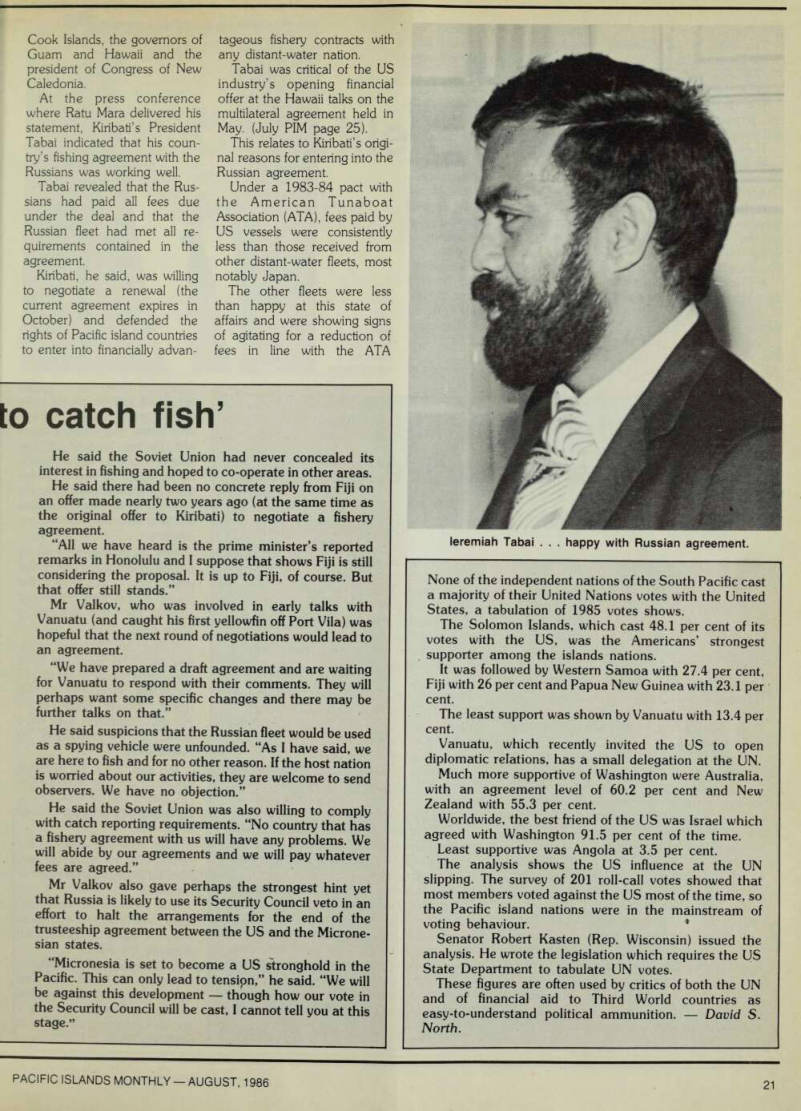
At the press conference where Ratu Mara delivered his statement, Kiribati’s President Tabai indicated that his coun try’s fishing agreement with the Russians was working well.
Tabai revealed that the Rus sians had paid all fees due under the deal and that the Russian fleet had met all re quirements contained in the agreement.
Kiribati, he said, was willing to negotiate a renewal (the current agreement expires in October) and defended the rights of Pacific island countries to enter into financially advan
tageous fishery contracts with any distant-water nation.
Tabai was critical of the US industry’s opening financial offer at the Hawaii talks on the multilateral agreement held in May. (July PIM page 25).
This relates to Kiribati’s origi nal reasons for entering into the Russian agreement.
Under a 1983-84 pact with the American Tunaboat Association (ATA), fees paid by US vessels were consistently less than those received from other distant-water fleets, most notably Japan.
The other fleets were less than happy at this state of affairs and were showing signs of agitating for a reduction of fees in line with the ATA
None of the independent nations of the South Pacific cast a majority of their United Nations votes with the United States, a tabulation of 1985 votes shows.
The Solomon Islands, which cast 48.1 per cent of its votes with the US, was the Americans’ strongest supporter among the islands nations.
It was followed by Western Samoa with 27.4 per cent, Fiji with 26 per cent and Papua New Guinea with 23.1 per cent.
The least support was shown by Vanuatu with 13.4 per cent.
Vanuatu, which recently invited the US to open diplomatic relations, has a small delegation at the UN.
Much more supportive of Washington were Australia, with an agreement level of 60.2 per cent and New Zealand with 55.3 per cent.
Worldwide, the best friend of the US was Israel which agreed with Washington 91.5 per cent of the time.
Least supportive was Angola at 3.5 per cent.
The analysis shows the US influence at the UN slipping. The survey of 201 roll-call votes showed that most members voted against the US most of the time, so the Pacific island nations were in the mainstream of voting behaviour. * Senator Robert Hasten (Rep. Wisconsin) issued the analysis. He wrote the legislation which requires the US State Department to tabulate UN votes.
These figures are often used by critics of both the UN and of financial aid to Third World countries as easy-to-understand political ammunition. David S.
North.
leremiah Tabai ... happy with Russian agreement.
arrangement.
This fundamental inequality in fee levels effectively doomed the agreement and opened the door to the Russians.
The Russians agreed to all the provisions the ATA could not bring itself to countenance.
These included; • Kiribati’s right to exploit, develop and manage resources within its own FEZ. • Recognition of domestic fisheries legislation and the Law of the Sea Convention (to which the US is not a signatory.
The Russians have signed). • The Soviet Union assumes all responsibility for the actions of its vessels while operating within Kiribati’s FEZ.
Not surprisingly, this stung the US into action. The US Agency for International Deve
lopment (USAID) almost im mediately offered to assist Kiri bati with the development of its domestic tuna industry.
The US also offered non governmental assistance such as an offer of U 55453,000 through the Save the Children Federation.
However, the Americans baulked at the question of cash grants because of foreign aid budget restrictions and fear of encouraging others to play the “Russian card” as a means of getting into US aid coffers.
Following the US lead, Aus tralia also proposed to increase development assistance to Kiri bati, while New Zealand offered to double its aid and enter a long-term agreement for techni cal assistance.
The Soviet fleet operating in
the South Pacific islands con sists in part of longline vessels.
And if they can supply vessels and catches to take up the excess capacity in Vanuatu’s shore base, it would make obvious commercial sense for Vanuatu to conclude the kind of agreement the Russians are seeking.
Such an arrangement would provide obvious benefits to the island state and provide the Soviet Union with a primely located and well developed shore base.
A deal with Fiji seems much less likely. Fiji has long been considered one of Wsshington’s staunchest supporters in the region, though Ratu Mara’s Honolulu statement may have jolted a few memories in Washington.
To “lose” Fiji to the Russians would be a major blow for the US, which can be expected to do everything possible to keep it “on side.”
That, however, leaves Fiji the opportunity to maximise any benefits it may receive in aid or otherwise.
The problem for the Amer icans, regionally, is to somehow allay the legacy of suspicion left them by the ATA.
In the case of Kiribati, for example, the ATA had first option on fishing rights but lost out to the Russians because it could not match their bid or anybody else’s.
Ratu Mara: Statement created a shockwave.
‘We are here to catch fish'
The Pacific islands nations need money and Russia needs fish and that is the sole basis for fishery agreement negotiations in the region, according to a Soviet spokesman.
Third Secretary at the Soviet embassy in Canberra, Mr Vladimir Valkov, told PIM in an interview: “We have dozens of agreements with various countries on fishing.
These include New Zealand, Singapore and Japan.
“We fish for tuna in the Atlantic and also in the Indian Ocean, but the South Pacific is the richest region for tuna. That’s why we want to fish here also.”
He did not see the Soviet Union as competing with the US for fishing rights. “I’d suggest there is enough fish for everyone who is interested. And all distant-water fleets are interested in the Pacific. It doesn’t matter to us what other countries are fishing in the area and that includes the United States.
“We are here to fish,” he said. “It is a straight commercial proposition. To say, as some people have, that we want to establish bases of influence is rubbish.
We are a maritime nation and this region should not be closed to us. There is no reason for it to be.
“When nations want to conclude mutually beneficial agreements, who can, or should, stop them?”
He said the shore facilities argument had been exaggerated as any far distant fleet would require bases.
“We have to change crews, for instance. We have to refuel, reprovision with food and fresh water. We may need repair facilities. And we are prepared to pay for any facilities we use. ”We already have access to port facilities in New Zealand. It’s normal.”
Mr Valkov said the Soviets would not be seeking shore bases in Kiribati as the kind of facilities they required were not available.
“Our decision to seek shore bases is purely in the interests of efficiency. It costs money and time to send vessels home every time they need repairs or a crew change.”
He said the Soviet Union had never concealed its interest in fishing and hoped to co-operate in other areas.
He said there had been no concrete reply from Fiji on an offer made nearly two years ago (at the same time as the original offer to Kiribati) to negotiate a fishery agreement.
“All we have heard is the prime minister’s reported remarks in Honolulu and I suppose that shows Fiji is still considering the proposal. It is up to Fiji, of course. But that offer still stands.”
Mr Valkov, who was involved in early talks with Vanuatu (and caught his first yellowfin off Port Vila) was hopeful that the next round of negotiations would lead to an agreement.
“We have prepared a draft agreement and are waiting for Vanuatu to respond with their comments. They will perhaps want some specific changes and there may be further talks on that.”
He said suspicions that the Russian fleet would be used as a spying vehicle were unfounded. “As I have said, we are here to fish and for no other reason. If the host nation is worried about our activities, they are welcome to send observers. We have no objection.”
He said the Soviet Union was also willing to comply with catch reporting requirements. “No country that has a fishery agreement with us will have any problems. We will abide by our agreements and we will pay whatever fees are agreed.”
Mr Valkov also gave perhaps the strongest hint yet that Russia is likely to use its Security Council veto in an effort to halt the arrangements for the end of the trusteeship agreement between the US and the Microne sian states.
“Micronesia is set to become a US stronghold in the Pacific. This can only lead to tension,” he said, “We will be against this development though how our vote in the Security Council will be cast, I cannot tell you at this stage.”
be disruptive’
Soviet objectives ‘to be disruptive’
The Soviet presence in the Pacific has no relation to economic factors, since there is no Soviet consumer demand for tuna, according to a spokesman for US Secretary of State George Shultz.
Interviewd on Palau, where Shultz made a lightning visit, the official, who asked not to be named, said: “The Soviet long term objectives in the Pacific are to be disruptive and stimulate subversion.”
He added that Libya’s overtures to Vanuatu and their contacts with the New Caledonia independence movement “are not inconsistent with past Libyan activities.
Any Libyan interests here are artificial and complications.”
“The US,” he said, “will legitimately use UN procedures and tactics” to overcome any Soviet Security Council veto on the ending of the trusteeship in Micronesia.
The US would react appropriately if “the Soviets display total disdain for the wishes of the Micronesian people.”
When ex-marine George Shultz returned to Palau after hitting the beaches at Peleliu 42 years ago, he was met at the airport with a sign and billboard blitz.
The US Secretary of State’s visit had a political as well as personal significance.
His visit reflected the strategic import ance to the US of the Compact of Free Association which is proposed to replace the 39-year-old trusteeship that would grant Palau home rule, substantial US economic aid with US responsibility for the
archipelago’s defence.
Since the Republic of Palau constitution made the country the first national nuclear free zone, it has clashed with the military requirements of the Pentagon, and Com pact passage has been a tortuous and controversial process.
The airport placards included: “Palau communists go back to Moscow” as well as “Pacific democracy is American democra cy” and, remarkably enough, “Down with Greenpeace.”
However, another banner, unfurled as Shultz disembarked, read: “US interest in Palau only three and a half hours? We demand more money and education. Palau can’t wait another 40 years.”
However, Mother Nature denied the visiting VIP a sight of the various demos, tipping a huge rainstorm over the proceed ings within seconds of the arrival.
In later speeches both Shultz the Palau president Lazarus Salii, the architect of the Compact of Free Association, both extolled the compact’s virtues.
At the same venue, however, paramount chief Ibedul Yutaka Gibbons told a press conference the airport signs had been “taking advantage of the secretary’s trip to play dirty politics.” The chief has com menced court action over plans to approve the Compact on the grounds that it did not achieve the required 75 per cent voter approval. (It managed 72 per cent in the February plebiscite). E. Rampell.
Oil drillers hope
trade winds
Oil drillers hope for ‘the big one’
After years of painful di sappointment, the first real oil discovery in the Pacific islands may be at hand.
In the remote, largely unde veloped Southern Highlands Province of Papua New Guinea, a drilling program has been widely tipped as an indi cator that the declaration of the country’s first commercially vi able field may be very near even allowing for today’s de pressed prices.
Only last year, oil analysts were pinning their hopes on the abortive Mananda 3 well which failed to flow sufficient quanti ties of oil after highly encourag ing discoveries nearby.
Now attention has turned to the lagifu 3 well.
Announcements following lagifu 2 in the permit area known as PPL 17 suggest that lagifu is a major new oil discovery.
Some of the companies in volved in the program believe that the discovery contains re
coverable oil reserves of at least 150 million barrels with the liklihood of doubling or tripling this reserve through further drilling.
Among the distinguishing fe atures of the lagifu basin is the high densities of hydrocarbon liquid compared to the high gas ratios in the previously explored Juha field. lagifu, with an estimated 450 barrels/acre foot, rates at ten times Juha’s oil levels.
The reason why lagifu 3, budgeted at $l7 million, is so important is that it could lift the reserves above the 200 million barrel level, at which point the field could become commercial even at a world price low of $l5 per barrel.
The impact on PNG’s eco nomy would be spectacular, outranking any of the boom revenues from Bougainville Copper.
For a start, a major pipeline costing at least US$5OO million would have to be built to the sea, most likely to Madang or
Wewak on the north coast.
The total capital cost of the development at lagifu is esti mated at US$1.11 billion.
At present the shareholding in the lagifu field is split be tween the American oil major, Gulf, recently taken over by Chevron (25 per cent), BP (25 per cent), Pioneer Concrete (15 per cent), Merlin (25 per cent), BHP (12.5 per cent) and the Sydney-based PNG explorer Oil Search (10 per cent).
Pioneer Concrete owns 23 per cent of Oil Search and is expected, in the long term, to make a bid for the company.
Despite the world price col lapse, the exploration partners decided in May to press ahead with a further series of explora tion wells.
The site at lagifu 3 is 3.5 km north west of lagifu 2 and down-dip. Drilling to target depth is expected to take until the end of this month after which another month of testing is expected.
Some analysts are predicting
that this could well lift reserves to 300-plus million barrels.
In addition, yet to be drilled are the Hedinia and Kutuba features which lie within 20 km of lagifu. There is even a suggestion that the three struc tures might be one huge oil basin.
Informed circles told PIM that Chevron considers its PNG acreage around lagifu to be the company’s best prospective area for a large oil discovery anywhere in the world.
Meanwhile the related drilling partnership at Juha appears to have reached the conclusion that a reigning world price of US$2O per barrel would be needed to justify development.
This project was costed as a separate development from lagifu, although the two might share some pipeline facilities.
Studies recently prepared for the PNG government suggest that oil could yield as much as US$l.l billion in tax revenue by the turn of the century.
Denis Reinhardt.
Advertisements & other items, pp. 23-24 (1 item)
Metropolitan Drilling And Blasting (Fiji) Ltd.
We do all Drilling, Blasting and Rock works throughout the South Pacific.
Former Contractors for the Vaturu Dam and the Queens Road, Viti Levu, Fiji Machinery: 850 Compressor ECM 350 Track Drills Portable Gear All equipment is available for hire with an experienced operator, and all jobs insured for Public Liability P.O. Box 27, Pacific Harbour, Deuba, Fiji Phone: Fiji 45338. Telex: FJ3251
6
counts
OLYHPIC
The Stationery and Diary People.
SYSTEM
Collins *7 t U« Flat' Account
CARDS
gqum Form I mu *BB#*
Commercial, School, Household
Stationery and Diaries.
Fast and efficient export service.
COLLINS OLYMPIC LIMITED
/-I/-VT tTNC P.O. BOX476,AUCKLAND, 1
11111 I I] \ NEW ZEALAND.
PHONE: (9) 484-009
OIYNPIC telex:nz - 2i293 ( edunlop )
CABLES: GRAPHICOL
Air Pacific’s happy landing
Troubled carrier Air Pacific is on course for a drama tic turn around this finan cial year and could even break even after a period of profit drought.
The airline, currently admi nistered by Qantas, can see calmer skies ahead after losses of Fslo million and Fsll mil lion over the past two years.
The Project America route with a chartered DC 10 between Nadi and Hawaii had accounted for close to half the loss, a company executive ex plained.
Financial director Mr Alan Moore, on secondment from Qantas, told PIM: “We’re pro jecting a near break even result in this financial year.”
He said the change was attributable to a number of factors.
“Primarily, it’s due to a rationalisation of route opera tions,” he said.
The cancellation of the Pro ject America service was also important, Moore told PIM.
“It was costing us approx imately $5 million a year in losses.
“The introduction of the 747 service between Sydney and Nadi, which increased the genuine revenue base of the company” was another con tributing factor.
“The Project America service had dollars there but they were being sold for 50 cents,” he said.
He also said that efficiencies in policies and procedures insti-
tuted since the Qantas team arrived had also made a major contribution to the expected improved result.
“There has also been a major drive on cost control.”
For the future, he hoped the introduction of more suitable aircraft on domestic and regio nal routes would take place this year.
“These would be forty to fifty
seat turbo prop aircraft.
“We also hope to see greater capacity on our domestic services and greater frequency on the close regional services,” he told PIM.
Air Pacific’s Alan Moore ... major drive on cost control.
Geologists go
to the market
Pacific Islands gold explor er, Austpac Gold N.L. last month issued a pros pectus to raise AsB mil lion for extensive exploration of 16 epithermal prospects and one other gold prospect. (PIM, July, page 32).
The issue was almost im mediately oversubscribed.
Formed by the team of geologists who planned the Kennecott/Niugini Mining successful exploration in PNG, Austpac holds ground in Papua New Guinea, Solomon Islands, Vanuatu and Fiji.
The issue, which is for 32 million fully-paid 25 cent shares and 16 million free 1989 op tions, is underwritten by Mel bourne brokers May and
Mellon The main thrust of the com pany’s gold search is along the Pacific “ring of fire” volcanic zone.
The recent discoveries at Lihir, Simberi, the Emperor de posit at Vatakoula in Fiji, and the famous Martha lode ore body at Waihi in New Zealand are all “boiling zone” epither mal deposits and have led geologists to re-appraise the gold mining potential of the whole region.
Austpac, with their experi ence gained from the Kenne cott/Niugini program, was an early starter in the gold rush, acquiring prospects throughout the islands.
The company now holds
eight areas in Fiji, two in Vanuatu, four in Solomon Is lands and three in PNG.
Austpac’s initial programs in clude a continuation of drill testing at the Vuda prospect in Fiji, geological mapping and sampling, drill target delineation and, where appropriate, said a company statement, drill testing of its other prospects.
The cost of this, plus recon naissance of additional areas, is expected to exceed $4 million over the next two years.
The directors intend to spread the cost through joint ventures on some properties.
As well as its gold exploration activity, Austpac also holds 9.9 per cent of the recently floated industrial, Montoro Resources Ltd. which is developing a major clay building products facility near Sydney.
Montoro will hold a 19.8 per cent interest in Austpac.
Queen of the cruise
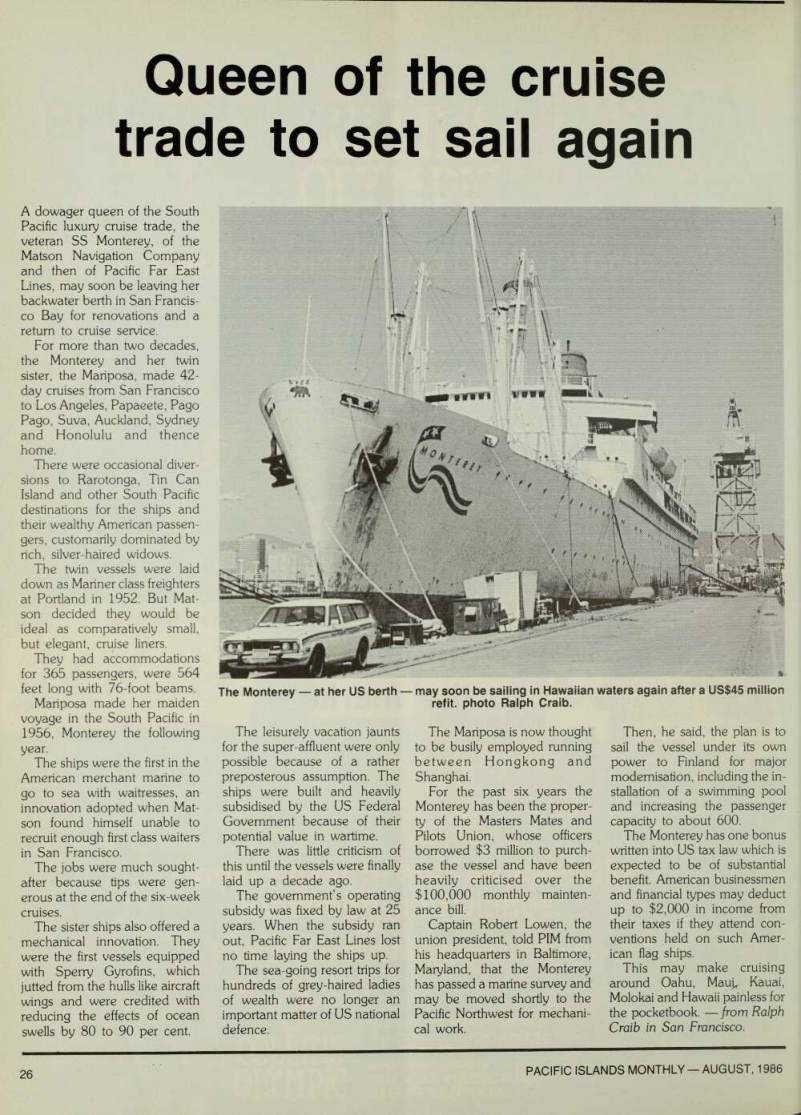
trade to set sail again
A dowager queen of the South Pacific luxury cruise trade, the veteran SS Monterey, of the Matson Navigation Company and then of Pacific Far East Lines, may soon be leaving her backwater berth in San Francis co Bay for renovations and a return to cruise service.
For more than two decades, the Monterey and her twin sister, the Mariposa, made 42day cruises from San Francisco to Los Angeles, Papaeete, Pago Pago, Suva, Auckland, Sydney and Honolulu and thence home.
There were occasional diver sions to Rarotonga, Tin Can Island and other South Pacific destinations for the ships and their wealthy American passen gers, customarily dominated by rich, silver-haired widows.
The twin vessels were laid down as Mariner class freighters at Portland in 1952. But Mat son decided they would be ideal as comparatively small, but elegant, cruise liners.
They had accommodations for 365 passengers, were 564 feet long with 76-foot beams.
Mariposa made her maiden voyage in the South Pacific in 1956, Monterey the following year.
The ships were the first in the American merchant marine to go to sea with waitresses, an innovation adopted when Mat son found himself unable to recruit enough first class waiters in San Francisco.
The jobs were much sought after because tips were gen erous at the end of the six-week cruises.
The sister ships also offered a mechanical innovation. They were the first vessels equipped with Sperry Gyrofins, which jutted from the hulls like aircraft wings and were credited with reducing the effects of ocean swells by 80 to 90 per cent.
The leisurely vacation jaunts for the super-affluent were only possible because of a rather preposterous assumption. The ships were built and heavily subsidised by the US Federal Government because of their potential value in wartime.
There was little criticism of this until the vessels were finally laid up a decade ago.
The government’s operating subsidy was fixed by law at 25 years. When the subsidy ran out, Pacific Far East Lines lost no time laying the ships up.
The sea-going resort trips for hundreds of grey-haired ladies of wealth were no longer an important matter of US national defence.
The Mariposa is now thought to be busily employed running between Hongkong and Shanghai.
For the past six years the Monterey has been the proper ty of the Masters Mates and Pilots Union, whose officers borrowed $3 million to purch ase the vessel and have been heavily criticised over the $lOO,OOO monthly mainten ance bill.
Captain Robert Lowen, the union president, told FIM from his headquarters in Baltimore, Maryland, that the Monterey has passed a marine survey and may be moved shortly to the Pacific Northwest for mechani cal work.
Then, he said, the plan is to sail the vessel under its own power to Finland for major modernisation, including the in stallation of a swimming pool and increasing the passenger capacity to about 600.
The Monterey has one bonus written into US tax law which is expected to be of substantial benefit. American businessmen and financial types may deduct up to $2,000 in income from their taxes if they attend con ventions held on such Amer ican flag ships.
This may make cruising around Oahu, MauL Kauai, Molokai and Hawaii painless for the pocketbook. from Ralph Craib in San Francisco.
The Monterey at her US berth may soon be sailing in Hawaiian waters again after a US$45 million refit, photo Ralph Craib.
turns world’s eyes

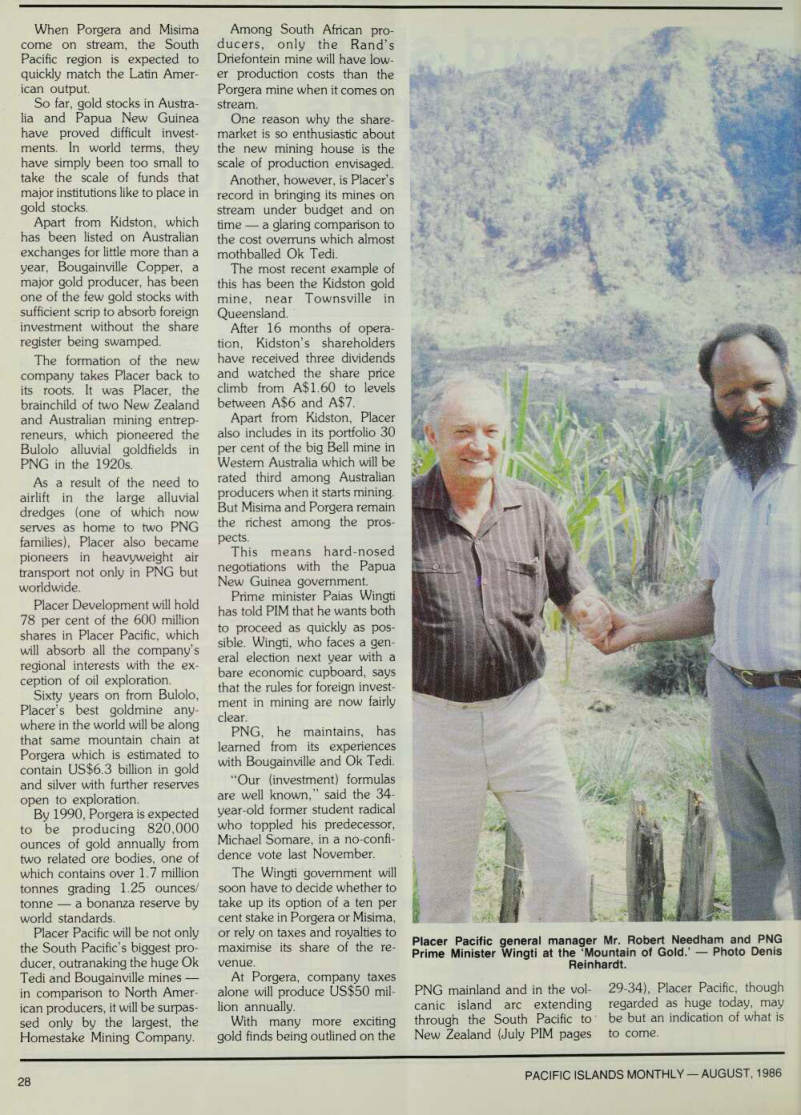
Record share float turns world’s eyes on South Pacific
Placer Pacific Ltd, Austra lia’s biggest ever com pany float, is likely to focus world attention on the South Pacific as a premier gold bearing region.
A subsidiary of Placer Deve lopment Ltd., North America’s sixth largest mining house, Placer Pacific is launched on the Sydney stock exchange this month and is already oversub scribed.
When the prospectus was issued in June, investors cla moured for the paper promp ting one commentator to re mark that every , time he saw a queue at the Sydney exchange,
As investors clamour for shares in Australia’s largest ever public float, DENIS REINHARDT examines the prospects for Placer Pacific, the new mining giant with extensive regional interests.
he would stand in it in the hope that a Placer Pacific prospectus might be at the other end.
The prospectus, for the re cord, invited shareholdings from Australian and Papua New Guinean citizens, offering 128 million $1 shares.
Placer Pacific will not only include 70 per cent of one of Australia’s biggest gold mines, Kidston, but will also have the
Misima Island and Porgera “ad vanced exploration prospects” in Papua New Guinea.
Both are scheduled to begin gold production within three years.
Porgera, to the west of Mount Hagen, is in PNG’s remote Enga province and is regarded as the world’s richest post-war gold find.
The new company is likely to
quickly gain international atten tion because, as events in South Africa escalate, gold in vestors will be searching for more stable homes for their funds.
Australasia is alreadu a signi ficant gold producer and is growing.
Australia and PNG produced 92.7 tonnes or 7.6 per cent of the non-communist world out put of 1212.8 tonnes of gold last year, compared to South Africa’s 673 tonnes (55.5 per cent) and Latin America’s 162.7 tonnes (13.4 per cent).
Fiji’s output from the Emper or mine was 1.4 tonnes.
When Porgera and Misima come on stream, the South Pacific region is expected to quickly match the Latin Amer ican output.
So far, gold stocks in Austra lia and Papua New Guinea have proved difficult invest ments. In world terms, they have simply been too small to take the scale of funds that major institutions like to place in gold stocks.
Apart from Kidston, which has been listed on Australian exchanges for little more than a year, Bougainville Copper, a major gold producer, has been one of the few gold stocks with sufficient scrip to absorb foreign investment without the share register being swamped.
The formation of the new company takes Placer back to its roots. It was Placer, the brainchild of two New Zealand and Australian mining entrep reneurs, which pioneered the Bulolo alluvial goldfields in PNG in the 19205.
Asa result of the need to airlift in the large alluvial dredges (one of which now serves as home to two PNG families), Placer also became pioneers in heavyweight air transport not only in PNG but worldwide.
Placer Development will hold 78 per cent of the 600 million shares in Placer Pacific, which will absorb all the company’s regional interests with the ex ception of oil exploration.
Sixty years on from Bulolo, Placer’s best goldmine any where in the world will be along that same mountain chain at Porgera which is estimated to contain US$6.3 billion in gold and silver with further reserves open to exploration.
By 1990, Porgera is expected to be producing 820,000 ounces of gold annually from two related ore bodies, one of which contains over 1.7 million tonnes grading 1.25 ounces/ tonne a bonanza reserve by world standards.
Placer Pacific will be not only the South Pacific’s biggest pro ducer, outranaking the huge Ok Tedi and Bougainville mines in comparison to North Amer ican producers, it will be surpas sed only by the largest, the Homestake Mining Company.
Among South African pro ducers, only the Rand’s Driefontein mine will have low er production costs than the Porgera mine when it comes on stream.
One reason why the share market is so enthusiastic about the new mining house is the scale of production envisaged.
Another, however, is Placer’s record in bringing its mines on stream under budget and on time a glaring comparison to the cost overruns which almost mothballed Ok Tedi.
The most recent example of this has been the Kidston gold mine, near Townsville in Queensland.
After 16 months of opera tion, Kidston’s shareholders have received three dividends and watched the share price climb from A 51.60 to levels between As 6 and As 7.
Apart from Kidston, Placer also includes in its portfolio 30 per cent of the big Bell mine in Western Australia which will be rated third among Australian producers when it starts mining.
But Misima and Porgera remain the richest among the pros pects.
This means hard-nosed negotiations with the Papua New Guinea government.
Prime minister Paias Wingti has told PIM that he wants both to proceed as quickly as pos sible. Wingti, who faces a gen eral election next year with a bare economic cupboard, says that the rules for foreign invest ment in mining are now fairly clear.
PNG, he maintains, has learned from its experiences with Bougainville and Ok Tedi.
“Our (investment) formulas are well known,” said the 34year-old former student radical who toppled his predecessor, Michael Somare, in a no-confi dence vote last November.
The Wingti government will soon have to decide whether to take up its option of a ten per cent stake in Porgera or Misima, or rely on taxes and royalties to maximise its share of the re venue.
At Porgera, company taxes alone will produce USSSO mil lion annually.
With many more exciting gold finds being outlined on the
PNG mainland and in the vol canic island arc extending through the South Pacific to' New Zealand (July PIM pages
29-34), Placer Pacific, though regarded as huge today, may be but an indication of what is to come.
Placer Pacific general manager Mr. Robert Needham and PNG Prime Minister Wingti at the ‘Mountain of Gold.’ Photo Denis Reinhardt.
Advertisements & other items, pp. 27-31 (1 item)
The Total Test Equipment Solution
AWA
rmimujiinnmra
% % * With
AWA,
ft nd i n the te st na We ha ve ih
lejiange
marconiA instruments V Tektronix eaui ou eve ry
day
o re compromises oices. m st choi r ' *0 4 r> Q 4
Zealand Li.
ted
!a mi Th total commumcat 3any ons com 37 Fr ston Walu Bay x 858 uya Phon 12 44
HITACHI
|FLU<
34 ble
EXPAN
SE Su ex va Fa 79)31 WA0825
At tli
een
<1 of tli
e ramoow h
youll find Fiji,
PACIFIC ISLANDS MONTHLY —AUGUST, 1986
PACIFIC
FIJI’S INTERNATIONAL AIR^JE
* * T-y * WD Reg ularCab. L ena Wheelbase
TOYOTA THINKS
CARS AND TRUCKS DRIVEN IN TH
PACIFIC SHOULD RE DDIIT
FDR THE PACIFIC.
TOYOTA
QUAUTY SERVICE
AMERICAN SAMOA: BURNS PHILP (SOUTH SEA) CO., LTD., P.O. Box 129, Pago Pago.
COOK ISLANDS: COOK ISLANDS TRADING
CORPORATION LTD., Private Bag, Rarotonga.
FIJI: AUTOMOTIVE SUPPLIES COMPANY, A Division of Burns Philp (South Sea) Co., Ltd., G.P.O. Box 355, Suva.
GUAM & MICRONESIA: ATKINS KROLL, INC., 443 South Marins Drive, Tamuning.
KIRIBATI: TARAWA MOTORS, A Division of Bairiki Holdings Ltd., P.O. Box 36, Bairiki, Tarawa.
NAURU: NAURU COOPERATIVE SOCIETY, Central Pac
NEW CALEDONIA: SERVICE IMPORTATION
AUTOMOBILE DU PACIFIQUE, Rond-Point du Pacifiqui (Station Total) B.P. 438, Noumea.
NORFOLK ISLAND: BORRY’S LIMITED, P.O. Box 169 PAPUA NEW GUINEA: ELA MOTORS, A Division of Burns Philp (PNG) Ltd., P.O. Box 75, Port Moresby.
SAIPAN: MICROL CORPORATION, P.O. Box 267, Saiq
All our tars and tracks have special Pacific Island features.
For instance, Toyota Hilux trucks are outfitted with extra-heavy-duty shocks and reinforced suspension.
And cars like Toyota Corolla receive special engine underplating, and a suspension modified to give added road clearance.
Meanwhile, we make additional use of special galvanealed steel in both our cars and trucks to help prevent corrosion.
And, of course, like cars and trucks we build for the rest of the world, those for the Pacific benefit from comprehensive testing and thorough quality control.
It’s all part of our effort to create high-quality, highly reliable cars and trucks.
Specifically for you. And specifically for the places you drive. <&L Areas where galvanealed steel is used £
COROLLA
H,LUX
• Crown • Cressida • Corona • Corolla • Starlet • Dyna • Hiace • Liteace • Coaster • Stout • Hilux 4X2 /4X4* Land Cruiser • Heavy Duty Truck
)LOMON ISLANDS: SOLOMON ISLANDS
VESTMENTS LTD., G.P.O. Box 174, Honiara.
iHITI: NIPPON AUTOMOTO, B.P. 342, Papeete
)NGA: BURNS PHILP (SOUTH SEA) CO.. LTD., P.O. >x 55, Nuku’alofa.
INUATU: VANUATU MOTORS, A Division of Burns iilp (Vanuatu) Ltd., P.O. Box 18, Port Vila.
ESTERN SAMOA: BURNS PHILP (SOUTH SEA) CO D., P.O. Box 188, Apia. w
‘Club Med’ justice
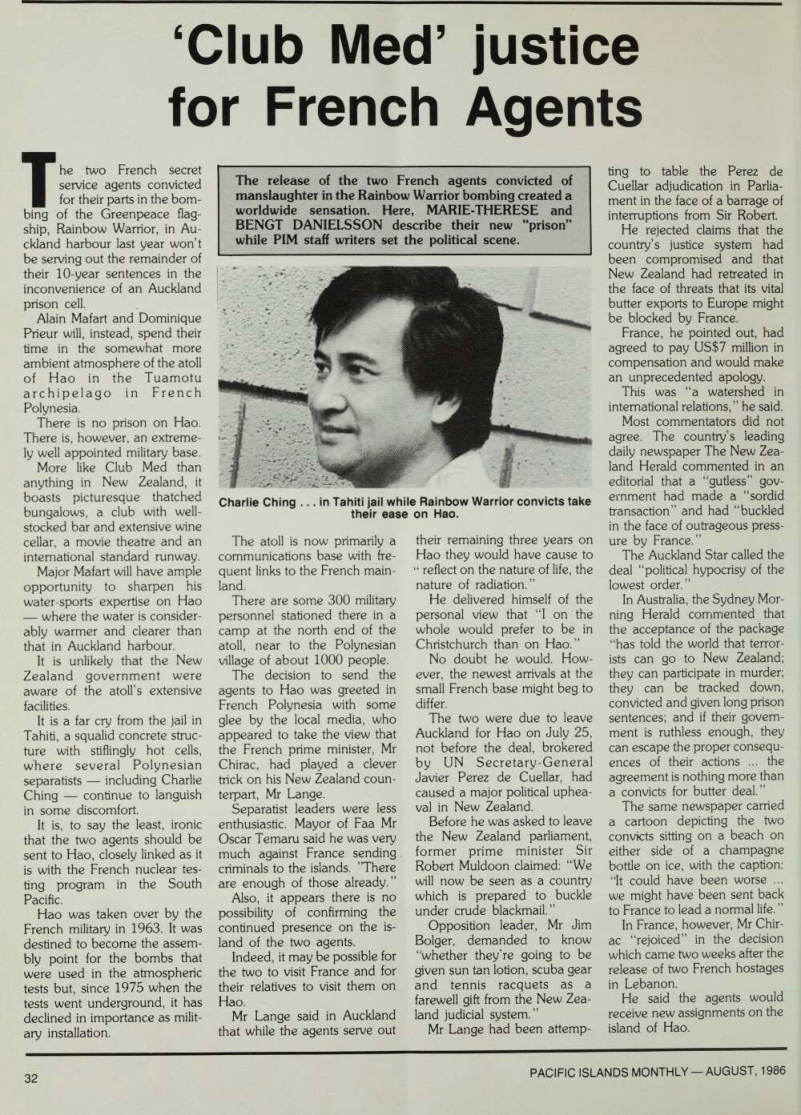
for French Agents
The two French secret service agents convicted for their parts in the bom bing of the Greenpeace flag ship, Rainbow Warrior, in Au ckland harbour last year won’t be serving out the remainder of their 10-year sentences in the inconvenience of an Auckland prison cell.
Alain Mafart and Dominique Prieur will, instead, spend their time in the somewhat more ambient atmosphere of the atoll of Hao in the Tuamotu archipelago in French Polynesia.
There is no prison on Hao.
There is, however, an extreme ly well appointed military base.
More like Club Med than anything in New Zealand, it boasts picturesque thatched bungalows, a club with well stocked bar and extensive wine cellar, a movie theatre and an international standard runway.
Major Mafart will have ample opportunity to sharpen his water-sports expertise on Hao where the water is consider ably warmer and clearer than that in Auckland harbour.
It is unlikely that the New Zealand government were aware of the atoll’s extensive facilities.
It is a far cry from the jail in Tahiti, a squalid concrete struc ture with stiflingly hot cells, where several Polynesian separatists including Charlie Ching continue to languish in some discomfort.
It is, to say the least, ironic that the two agents should be sent to Hao, closely linked as it is with the French nuclear tes ting program in the South Pacific.
Hao was taken over by the French military in 1963. It was destined to become the assem bly point for the bombs that were used in the atmospheric tests but, since 1975 when the tests went underground, it has declined in importance as milit ary installation.
The release of the two French agents convicted of manslaughter in the Rainbow Warrior bombing created a worldwide sensation. Here, MARIE-THERESE and BENGT DANIELSSON describe their new “prison” while PIM staff writers set the political scene.
The atoll is now primarily a communications base with fre quent links to the French main land.
There are some 300 military personnel stationed there in a camp at the north end of the atoll, near to the Polynesian village of about 1000 people.
The decision to send the agents to Hao was greeted in French Polynesia with some glee by the local media, who appeared to take the view that the French prime minister, Mr Chirac, had played a clever trick on his New Zealand coun terpart, Mr Lange.
Separatist leaders were less enthusiastic. Mayor of Faa Mr Oscar Temaru said he was very much against France sending criminals to the islands. ’’There are enough of those already.”
Also, it appears there is no possibility of confirming the continued presence on the is land of the two agents.
Indeed, it may be possible for the two to visit France and for their relatives to visit them on Hao.
Mr Lange said in Auckland that while the agents serve out
their remaining three years on Hao they would have cause to “ reflect on the nature of life, the nature of radiation.”
He delivered himself of the personal view that “I on the whole would prefer to be in Christchurch than on Hao.”
No doubt he would. How ever, the newest arrivals at the small French base might beg to differ.
The two were due to leave Auckland for Hao on July 25, not before the deal, brokered by UN Secretary-General Javier Perez de Cuellar, had caused a major political uphea val in New Zealand.
Before he was asked to leave the New Zealand parliament, former prime minister Sir Robert Muldoon claimed: “We will now be seen as a country which is prepared to buckle under crude blackmail.”
Opposition leader, Mr Jim Bolger, demanded to know “whether they’re going to be given sun tan lotion, scuba gear and tennis racquets as a farewell gift from the New Zea land judicial system.”
Mr Lange had been attemp
ting to table the Perez de Cuellar adjudication in Parlia ment in the face of a barrage of interruptions from Sir Robert.
He rejected claims that the country’s justice system had been compromised and that New Zealand had retreated in the face of threats that its vital butter exports to Europe might be blocked by France.
France, he pointed out, had agreed to pay US$7 million in compensation and would make an unprecedented apology.
This was “a watershed in international relations,” he said.
Most commentators did not agree. The country’s leading daily newspaper The New Zea land Herald commented in an editorial that a “gutless” gov ernment had made a “sordid transaction” and had “buckled in the face of outrageous press ure by France.”
The Auckland Star called the deal “political hypocrisy of the lowest order.”
In Australia, the Sydney Mor ning Herald commented that the acceptance of the package “has told the world that terror ists can go to New Zealand; they can participate in murder; they can be tracked down, convicted and given long prison sentences; and if their govern ment is ruthless enough, they can escape the proper consequ ences of their actions ... the agreement is nothing more than a convicts for butter deal.”
The same newspaper carried a cartoon depicting the two convicts sitting on a beach on either side of a champagne bottle on ice, with the caption: “It could have been worse ... we might have been sent back to France to lead a normal life. ”
In France, however, Mr Chir ac “rejoiced” in the decision which came two weeks after the release of two French hostages in Lebanon.
He said the agents would receive new assignments on the island of Hao.
Charlie Ching ... in Tahiti jail while Rainbow Warrior convicts take their ease on Hao.
Samoa In Focus
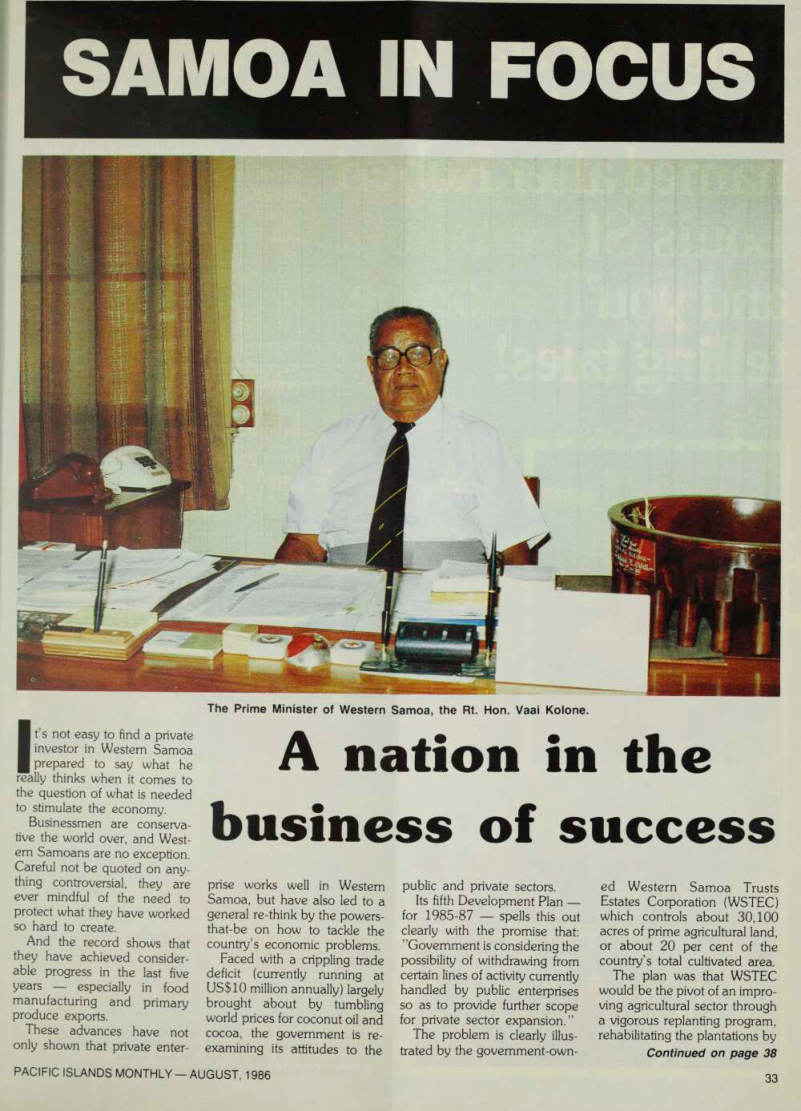

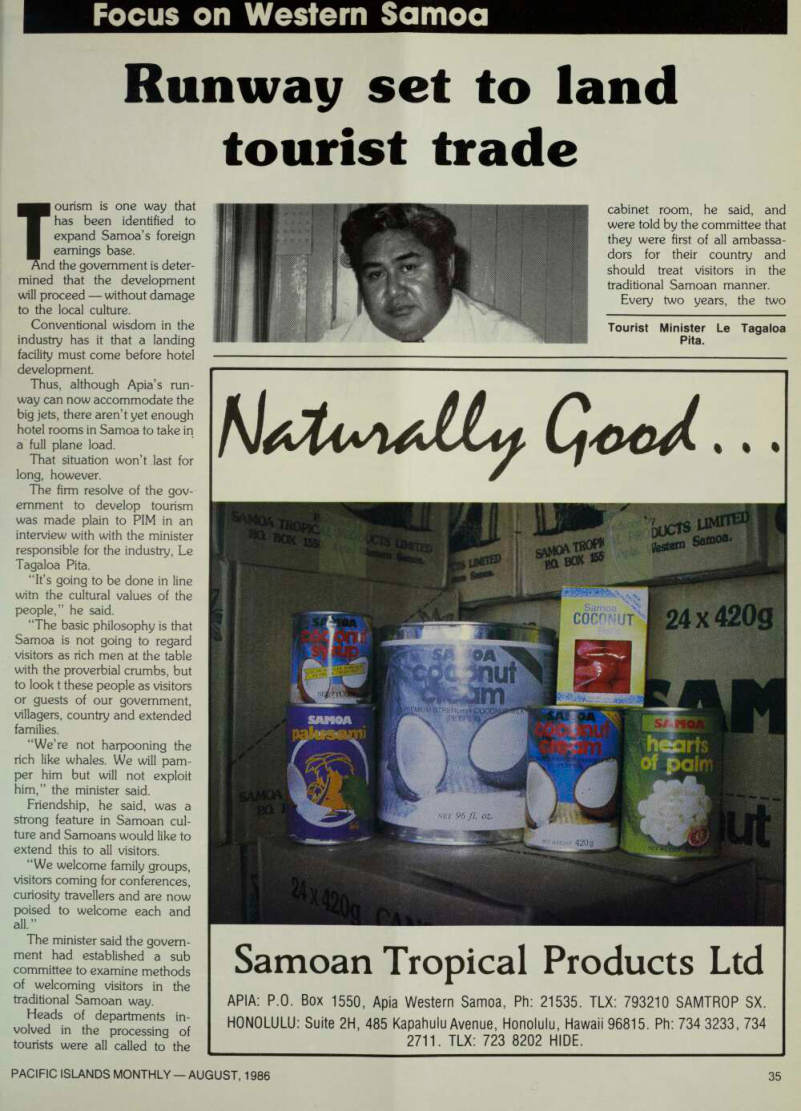
A nation In the business of success
it’s not easy to find a private investor in Western Samoa prepared to say what he really thinks when it comes to the question of what is needed to stimulate the economy.
Businessmen are conserva tive the world over, and West ern Samoans are no exception.
Careful not be quoted on any thing controversial, they are ever mindful of the need to protect what they have worked so hard to create.
And the record shows that they have achieved consider able progress in the last five years especially in food manufacturing and primary produce exports.
These advances have not only shown that private enter
prise works well in Western Samoa, but have also led to a general re-think by the powers that-be on how to tackle the country’s economic problems.
Faced with a crippling trade deficit (currently running at US$lO million annually) largely brought about by tumbling world prices for coconut oil and cocoa, the government is re examining its attitudes to the
public and private sectors.
Its fifth Development Flan for 1985-87 spells this out clearly with the promise that: ’’Government is considering the possibility of withdrawing from certain lines of activity currently handled by public enterprises so as to provide further scope for private sector expansion.”
The problem is clearly illus trated by the govemment-own
ed Western Samoa Trusts Estates Corporation (WSTEC) which controls about 30,100 acres of prime agricultural land, or about 20 per cent of the country’s total cultivated area.
The plan was that WSTEC would be the pivot of an impro ving agricultural sector through a vigorous replanting program, rehabilitating the plantations by
Continued on page 38
The Prime Minister of Western Samoa, the Rt. Hon. Vaai Kolone
upgrading management and by development of new areas.
But due to heavy operating losses amounting to $3.6 mil lion in 1983 and, in turn, an inability to implement replan ting programs, it was unable to meet its commitments.
Initiatives to allow the corporation to operate as a statutory body independent of government were tried, but it is understood that WSTEC’s los ses have continued to mount and the enterprise is again under review.
The government replaced board members with ’’pro fessionals with technical and entrepreneurial knowledge” and removed MPs who had previously sat on the board.
While the posiotion of WSTEC continues to be a matter of some concern for the government, it is also a subject of keen interest to the private sector, where businessmen see considerable opportunities if WSTEC’s extensive operations were to be offered.
Advertisements & other items, p. 34 (1 item)
Tusitala
the premier hotel in the heart of Polynesia... Western Samoa. An international standard hotel in an exotic tropical setting.
Service is the friendliest in the South Pacific. The cuisine superb.
Rooms are air-conditioned with full private facilities. There’s swimming, floodlit tennis, nightly entertainment, cocktail bar, dancing. Golf, bowls, snorkelling, shopping, are minutes away. Enjoy picnics on deserted white sand beaches... explore lush
ramfolest.
* Tusitala is Western Samoan for (‘teller of tales’! It was tie affectionate »• V \ 5 ar n - P M •>.
THE
TUSITALA
WESTERN SAMOA
Enquire through Your Local TVavel Agent • Polynesian Airlines • Air New Zealand Travlex • Flag Inns • Utell International • Instant Hotels of Australia The Tusitala. P.O. Box 101, Apia, Western Samoa.
Telephone: (ISD 685) 21122. Cables: Tusitala. Telex 2265 X.
Runway set to land
Focus on Western Samoa
Runway set to land tourist trade
ourism is one way that has been identified to ■ expand Samoa’s foreign earnings base. ™nd the government is deter mined that the development will proceed without damage to the local culture.
Conventional wisdom in the industry has it that a landing facility must come before hotel development.
Thus, although Apia’s run way can now accommodate the big jets, there aren’t yet enough hotel rooms in Samoa to take in a full plane load.
That situation won’t last for long, however.
The firm resolve of the gov ernment to develop tourism was made plain to PIM in an interview with with the minister responsible for the industry, Le Tagaloa Pita.
“It’s going to be done in line witn the cultural values of the people,” he said.
“The basic philosophy is that Samoa is not going to regard visitors as rich men at the table with the proverbial crumbs, but to look t these people as visitors or guests of our government, villagers, country and extended families.
“We’re not harpooning the rich like whales. We will pam per him but will not exploit him,” the minister said.
Friendship, he said, was a strong feature in Samoan cul ture and Samoans would like to extend this to all visitors.
“We welcome family groups, visitors coming for conferences, curiosity travellers and are now poised to welcome each and all.”
The minister said the govern ment had established a sub committee to examine methods of welcoming visitors in the traditional Samoan way.
Heads of departments in volved in the processing of tourists were all called to the
cabinet room, he said, and were told by the committee that they were first of all ambassa dors for their country and should treat visitors in the traditional Samoan manner.
Every two years, the two
Tourist Minister Le Tagaloa Pita.
officials who are judged to have performed best in this regard, will win an overseas'trip as a prize for their efforts.
The government has also launched a village-level educa tion program to help people adapt to tourism.
Le Tagaloa said the govern ment hoped visitors would stay in villages. “We are encourag ing this and developing facili ties. Perhaps villages can put up hotels, motels and guest houses on Samoan lines.
“The whole aima is to have visitors exposed to Samoan cul tures and values,” he said.
Samoa did not want tourism to develop a “canned culture”.
Instead, the government wanted visitors absorbed into local traditions rather than the other way round.
He said the governement did, however, warmly welcome foreign investment in tourism adding that a number of deve lopments were planned.
Building of the 227-room
Royal Samoan Hotel at Apia would proceed “as soon as possible. ”
One condition for this deve lopment was the extension of the international airport run way, and this had now been done with the assistance of Japanese aid.
Asked about reports that the governors of American Samoa had applied pressure to the US State Department to prevent Hawaii Air’s plan to start a direct Honolulu-Apia DCS service, Le Tagaloa Pita said: “The isolationist thinking that promoted this is too narrow.
“It’s based on a misunder standing of the geography of the area.” The Samoans were one country, one race, he said.
“It’s a very condescending attitude,” he added.
On the question of Samoa’s current meagre T 55,000 budget for the promotion of tourism, he said it was hoped that a supplementary budget of T 150,000 would be approved.
Advertisements & other items, pp. 35-37 (1 item)
A ltXwuMy Q'MjA . , .
cocr IT m n
Samoan Tropical Products Ltd
APIA: P.O. Box 1550, Apia Western Samoa, Ph: 21535. TLX: 793210 SAMTROP SX.
HONOLULU: Suite 2H, 485 Kapahuiu Avenue, Honolulu, Hawaii 96815. Ph: 734 3233, 734
2711. TLX: 723 8202 HIDE.
Pacific Corprpercialßaplf Lirpited
Affiliated: Bank of Hawaii Westpac Banking Corp, Australia Full International Domestic Banking Services • Apia • Western Samoa • Telex 231 PACCOM SX • Cable PACCOM • Telephone 20 QOO
‘We’re still
behind
the
competition’
Marketing Samoa as a tourist attraction has been put in the hands of the newly-formed Western Samoa Visitors Bureau headed by Vensel Margraff.
Margraff told PIM that there was little his office could achieve with a budget of T 55,000.
“We’re very concerned that we are far behind other places such as the Cook Islands, Fiji and Vanuatu.”
It was a very competitive industry he said, with Samoa vying for the same “slice of the cake” as these neighbouring countries.
In addition to its need for an extra 500 rooms (Samoa currently has 350 rooms of international standard), the country also needed training for this industry that needed to be developed.
It was, after all, a hospitality industry, he said, and it was vital that there were high standards of service throughout.
Uppermost in his mind, he said, was the need to develop a good saleable product. This, coupled with high standards and good promotion would help Samoa draw people from the main tourist markets.
—/ -- —w . -w.
As famous as the South Seas... Aggie Grey’s Hotel in Apia, Western Samoa is set in lush, tropical gardens with fully air conditioned accommodation for up to 180 guests. The food and entertainment are superb and the fabulous pool is always inviting.
And there’s more to the hotel than high standards there’s Aggie and the legendary friendliness of Western Samoa. They make you so at home, you’ll never want to leave.
Bookings through any travel agent
or airline or direct to Aggie Greys Hotel
Phone 22880 Apia Jelex 2575 X
APIA: WESTERN SAMOA
BURNETT 4227
The business of success
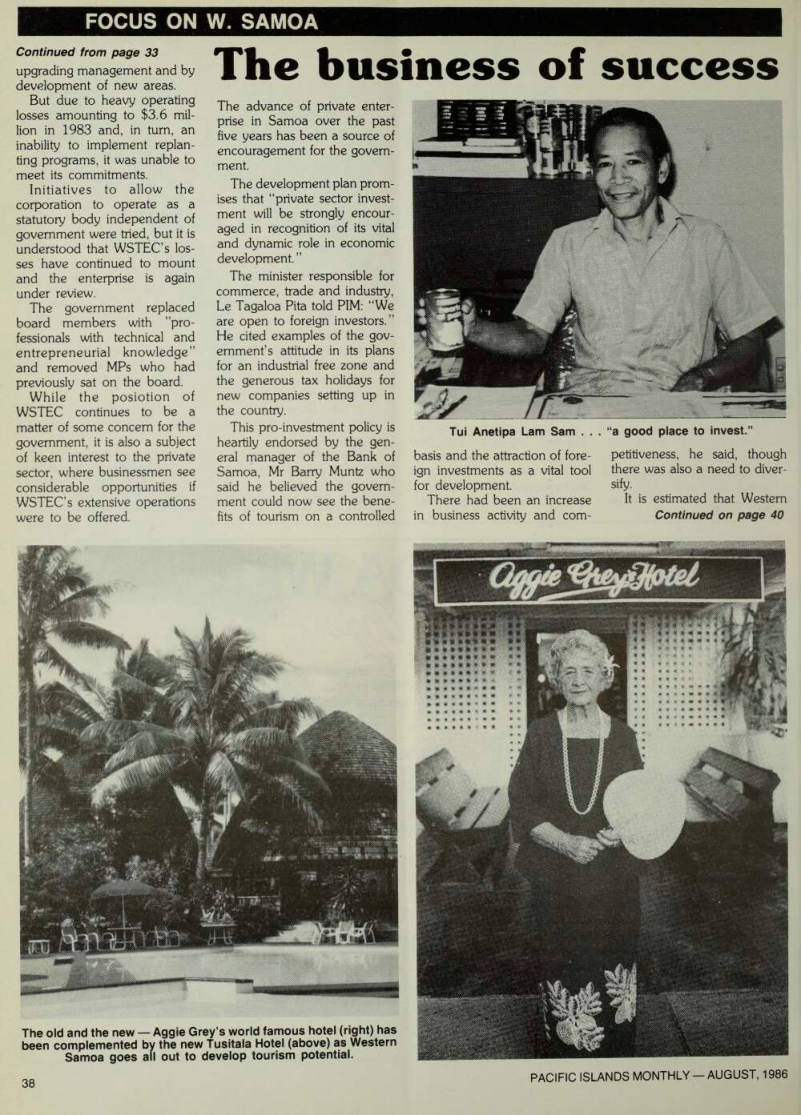
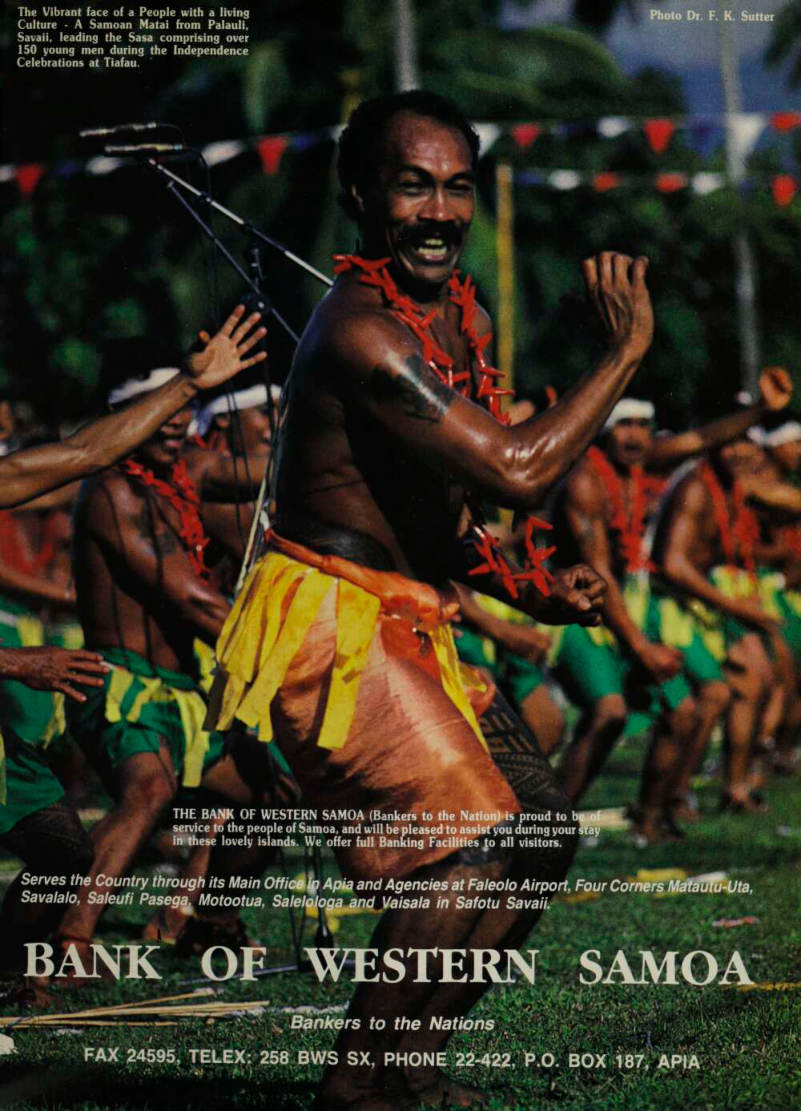
The advance of private enter prise in Samoa over the past five years has been a source of encouragement for the govern ment.
The development plan prom ises that “private sector invest ment will be strongly encour aged in recognition of its vital and dynamic role in economic development. ”
The minister responsible for commerce, trade and industry, Le Tagaloa Pita told PIM: “We are open to foreign investors.”
He cited examples of the gov ernment’s attitude in its plans for an industrial free zone and the generous tax holidays for new companies setting up in the country.
This pro-investment policy is heartily endorsed by the gen eral manager of the Bank of Samoa, Mr Barry Muntz who said he believed the govern ment could now see the bene fits of tourism on a controlled
basis and the attraction of fore ign investments as a vital tool for development.
There had been an increase in business activity and com
petitiveness, he said, though there was also a need to diver sify.
It is estimated that Western
Continued on page 40
The old and the new Aggie Grey’s world famous hotel (right) has been complemented by the new Tusitala Hotel (above) as Western Samoa goes all out to develop tourism potential.
Tui Anetipa Lam Sam ... “a good place to invest.”
Samoa has a total of 77,211 hectares of land under tree crops. About 39,000 hectares have coconut trees, 6,000 hec tares have cocoa and the rest is under various combinations of coconut, cocoa and banana.
With coconut oil, copra and coconut meal representing TlB million of Samoa’s 1985 export of T 32.4 million, plummeting coconut oil prices (down from U 551,430 per ton in 1984 to US$24O a ton in June this year) are a major concern.
Falling cocoa prices have compounded the problem and production has tumbled from 2,000 tons in the early ’7os to an expected output this year of a meagre 400 tons.
“We are really very, very worried about it,” said the minister. “The coconut oil price is hitting us very^hard.
“But we are struggling on.
We have no alternative but to push our exports such as coco nut cream, taro and beer.”
One company, Samoan Tropical Products Ltd has steadily increased its exports of canned coconut cream and, to a lesser extent, coconut syrup from TBOO,OOO in 1982 to T 2 million last year and an ex pected T 2.5 million this year.
And Prinut (W. Samoa) Ltd has dramatically increased its shipments of whole coconuts and taro to Australia and the United States.
Western Samoa Breweries Ltd, makers of Vailima Beer, expect to cover all their material costs within the next 12 months from export earnings in the Hawaii market.
Samoan Tropical Products is
the largest producer and expor ter of coconut cream, which makes up 97 per cent of the output of its Apia cannery.
The government has a 20 per cent stake in the company, while the remainder is held by Hawaii-based American inves tor, Floyd Fitzpatrick.
Eighty per cent of the com pany’s export ends up in New Zealand while the remainder is shared by America and Aus tralia.
Samoan Tropical Products is a working example of the many spin-off manufacturing oppor tunities to be found from coco nuts.
It’s hardly surprising, then, that its general manager, Tui Anetipa Lam Sam, won the prize at a Suva trade meeting last year for naming the greatest number of uses for coconut. He listed 61.
Meanwhile, New Zealand de mand for the company’s 420gram cans of hearts of palm could not be met.
The cans retail at $lO each.
But production is limited by the fact that extracting the heart means killing the tree.
Tui Anetipa Lam Sam said that, despite tough competition from suppliers in Malaysia, the Philippines, Singapore and Central America, Samoan Tropical Products’ performance was exceeding expectations.
Samoa was an ideal place to invest in, he said. “The ideal investor here is somebody who comes in with his funds, his know-how and his knowledge of the market he is aiming at.
“There are tremendous opportunities here,” he said.
Advertisements & other items, pp. 38-40 (3 items)
Focus On W. Samoa
38
Continued from page 33
PACIFIC ISLANDS MONTHLY —AUGUST, 1986
Bank Of Western Samoa
The Vibrant face of a People with a living Culture - A Samoan Matai from Palauli, Savaii, leading the Sasa comprising over 150 young men during the Independence Celebrations at Tiafau.
Photo Dr. F. K. Sutter t \ r" 1 \ I * * V I' vn , I 1 % THE BANK OF WESTERN SAMOA (Bankers to the Nation) is proud to service to the people of Samoa, and will be pleased to assist you during your Say in these lovely islands. We offer full Banking Facilities |o all visitors.
Serves the Country through its Main Office ip Apia and Agencies at Faleolo Airport, Four Corners MataLjfu-Uta, Sava la 10, Saleufi Motootua, SalelQlogaand Vaisala in Safotu Savaii.
BANK OF WESTERN SAMOA
t Ba to the Nations ,• ■ i 1 ' FAX 24595, TELEX: 258 BWS SX, PHONE ■ KaHt n
22-422, P.O. BOX 187, APIA
- ■■ ■ r •>•. t , T
We call it home.
You’ll call it
Paradise.
Western Samoa is our home, the coral continent of the South Pacific is our playground.
We’ve been criss crossing these islands for over 27 years now. It stands to reason we can show them to you better than any other airline.
Explore them with us on a Polypass. 30 days unlimited travel for just US$799. or plan your own island hopping holiday.
We fly to over eight idyllic South Pacific destinations offering business and economy class.
For details contact your travel agent or Polynesian Airlines. Sydney 268 1431. Melbourne 668 1277, Auckland 79 4824, Wellington 72 2544. Apia 2 1261, Pago Pago 699 9126, Suva 313511, Nandi 7 2499, Rarotonga 2 3669, Nukualofa 2 1565.
POLYNESIAN
AIRLINES
DAVID FROST 281
See Serene Samoa with For your comfort and ensured enjoyable holiday, We specialise in all your ground arrangements.
Pre-booking of your Samoa accomodation, transfers and fun tours Fa'a Samoa (Samoan Way).
Contact; Maraea Slade, Telex: 210 SX Western Samoa.
P.O. Box 635, Telephone: 21861.
The Business Of Success
40
PACIFIC ISLANDS MONTHLY —AUGUST, 1986
Continued from page 38
THE BUSINESS OF SUCCESS
major breakthrough
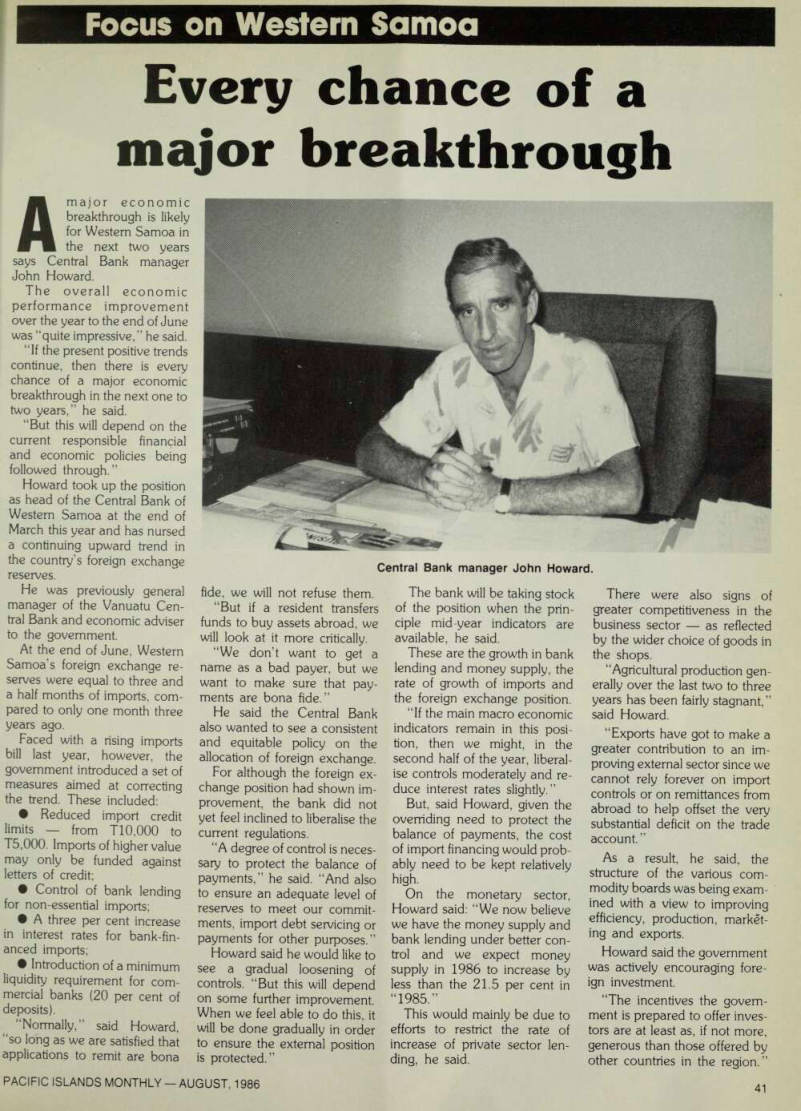
Every chance of a major breakthrough
A major economic breakthrough is likely for Western Samoa in the next two years says Central Bank manager John Howard.
The overall economic performance improvement over the year to the end of June was “quite impressive,” he said.
“If the present positive trends continue, then there is every chance of a major economic breakthrough in the next one to two years,” he said.
“But this will depend on the current responsible financial and economic policies being followed through.”
Howard took up the position as head of the Central Bank of Western Samoa at the end of March this year and has nursed a continuing upward trend in the country’s foreign exchange reserves.
He was previously general manager of the Vanuatu Cen tral Bank and economic adviser to the government.
At the end of June, Western Samoa’s foreign exchange re serves were equal to three and a half months of imports, com pared to only one month three years ago.
Faced with a rising imports bill last year, however, the government introduced a set of measures aimed at correcting the trend. These included: • Reduced import credit limits from TlO,OOO to T 5,000. Imports of higher value may only be funded against letters of credit; • Control of bank lending for non-essential imports; • A three per cent increase in interest rates for bank-fin anced imports; • Introduction of a minimum liquidity requirement for com mercial banks (20 per cent of deposits).
“Normally,” said Howard, “so long as we are satisfied that applications to remit are bona
fide, we will not refuse them.
“But if a resident transfers funds to buy assets abroad, we will look at it more critically.
“We don’t want to get a name as a bad payer, but we want to make sure that pay ments are bona fide.”
He said the Central Bank also wanted to see a consistent and equitable policy on the allocation of foreign exchange.
For although the foreign ex change position had shown im provement, the bank did not yet feel inclined to liberalise the current regulations.
“A degree of control is neces sary to protect the balance of payments,” he said. “And also to ensure an adequate level of reserves to meet our commit ments, import debt servicing or payments for other purposes.”
Howard said he would like to see a gradual loosening of controls. ‘‘But this will depend on some further improvement.
When we feel able to do this, it will be done gradually in order to ensure the external position is protected.”
The bank will be taking stock of the position when the prin ciple mid-year indicators are available, he said.
These are the growth in bank lending and money supply, the rate of growth of imports and the foreign exchange position.
“If the main macro economic indicators remain in this posi tion, then we might, in the second half of the year, liberal ise controls moderately and re duce interest rates slightly.”
But, said Howard, given the overriding need to protect the balance of payments, the cost of import financing would prob ably need to be kept relatively high.
On the monetary sector, Howard said: “We now believe we have the money supply and bank lending under better con trol and we expect money supply in 1986 to increase by less than the 21.5 per cent in “1985.”
This would mainly be due to efforts to restrict the rate of increase of private sector len ding, he said.
There were also signs of greater competitiveness in the business sector as reflected by the wider choice of goods in the shops.
“Agricultural production gen erally over the last two to three years has been fairly stagnant,” said Howard.
“Exports have got to make a greater contribution to an im proving external sector since we cannot rely forever on import controls or on remittances from abroad to help offset the very substantial deficit on the trade account. ”
As a result, he said, the structure of the various com modity boards was being exam ined with a view to improving efficiency, production, market ing and exports.
Howard said the government was actively encouraging fore ign investment.
“The incentives the govern ment is prepared to offer inves tors are at least as, if not more, generous than those offered by other countries in the region.”
Central Bank manager John Howard.
Advertisements & other items, p. 42 (1 item)
Health Dept, warning:
* > >1 wherever excellence is a way of life, the swing is to Rothmans King Size, The best tobacco money can buy gives you true King Size flavour. i
MAJBLt
' € I m.
I A / *Ol I I MR mmm • ■' -w m 7 i I i i , ftMB
Health Dept, warning:
smoking endangers health.
Low/middletar.
An island way of death
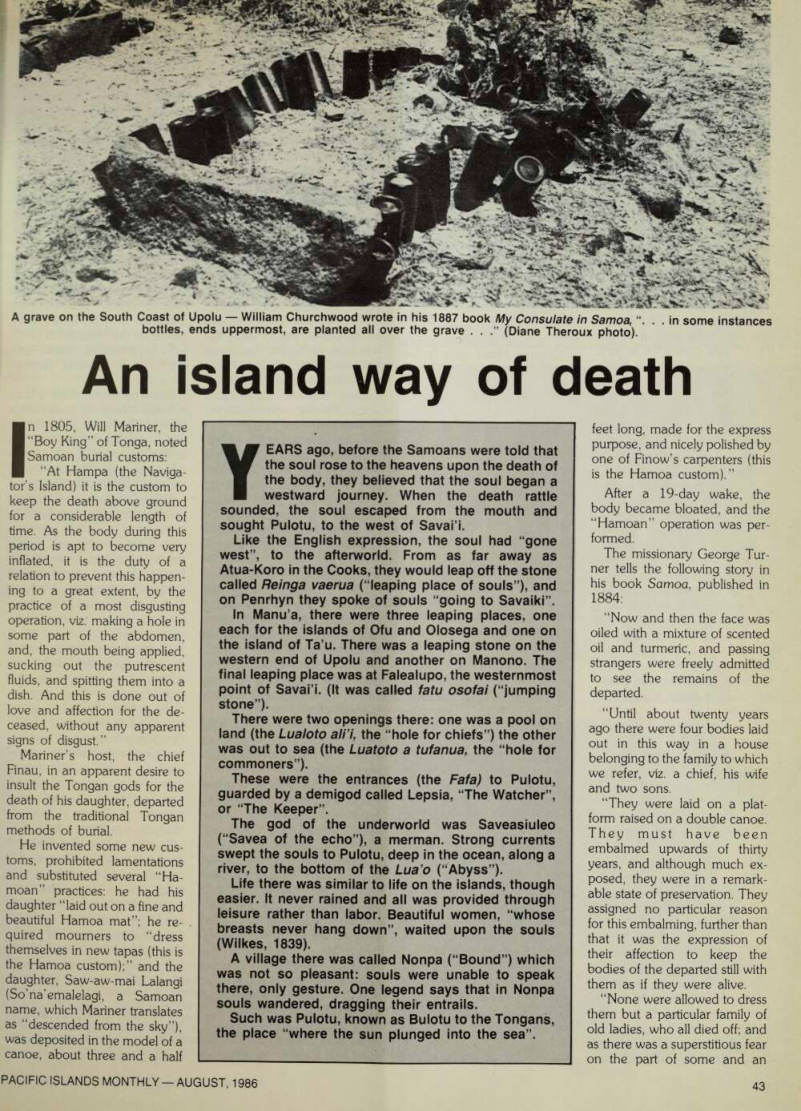
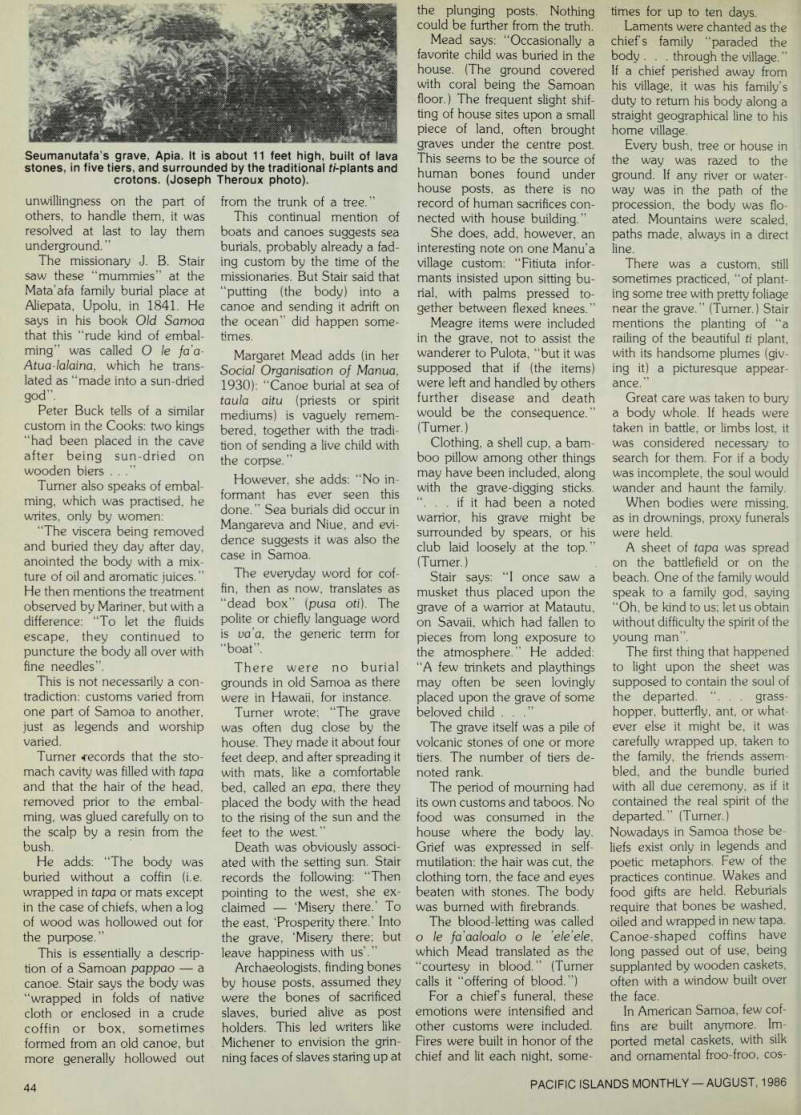
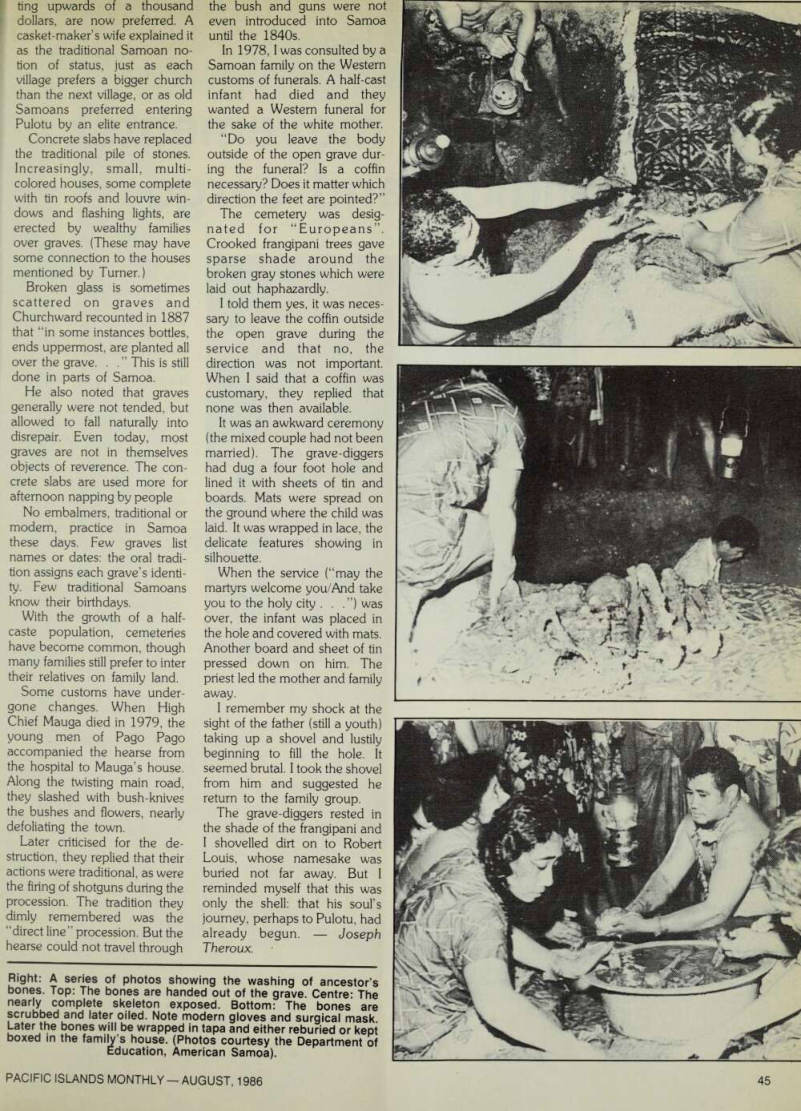
In 1805, Will Mariner, the “Boy King” of Tonga, noted Samoan burial customs: “At Hampa (the Naviga tor’s Island) it is the custom to keep the death above ground for a considerable length of time. As the body during this period is apt to become very inflated, it is the duty of a relation to prevent this happen ing to a great extent, by the practice of a most disgusting operation, viz. making a hole in some part of the abdomen, and, the mouth being applied, sucking out the putrescent fluids, and spitting them into a dish. And this is done out of love and affection for the de ceased, without any apparent signs of disgust.”
Mariner’s host, the chief Finau, in an apparent desire to insult the Tongan gods for the death of his daughter, departed from the traditional Tongan methods of burial.
He invented some new cus toms, prohibited lamentations and substituted several “Ha moan” practices: he had his daughter “laid out on a fine and beautiful Hamoa mat”; he re quired mourners to “dress themselves in new tapas (this is the Hamoa custom);” and the daughter, Saw-aw-mai Lalangi (So’na’emalelagi, a Samoan name, which Mariner translates as “descended from the sky”), was deposited in the model of a canoe, about three and a half
YEARS ago, before the Samoans were told that the soul rose to the heavens upon the death of the body, they believed that the soul began a westward journey. When the death rattle sounded, the soul escaped from the mouth and sought Pulotu, to the west of Savai’i.
Like the English expression, the soul had “gone west”, to the afterworld. From as far away as Atua-Koro in the Cooks, they would leap off the stone called Reinga vaerua (“leaping place of souls”), and on Penrhyn they spoke of souls “going to Savaiki”.
In Manu’a, there were three leaping places, one each for the islands of Ofu and Olosega and one on the island of Ta’u. There was a leaping stone on the western end of Upolu and another on Manono. The final leaping place was at Falealupo, the westernmost point of Savai’i. (It was called fatu osofai (“jumping stone”).
There were two openings there: one was a pool on land (the Lualoto ali’i, the “hole for chiefs”) the other was out to sea (the Luatoto a tufanua, the “hole for commoners”).
These were the entrances (the Fafa) to Pulotu, guarded by a demigod called Lepsia, “The Watcher”, or “The Keeper”.
The god of the underworld was Saveasiuleo (“Savea of the echo”), a merman. Strong currents swept the souls to Pulotu, deep in the ocean, along a river, to the bottom of the Lua’o (“Abyss”).
Life there was similar to life on the islands, though easier. It never rained and all was provided through leisure rather than labor. Beautiful women, “whose breasts never hang down”, waited upon the souls (Wilkes, 1839).
A village there was called Nonpa (“Bound”) which was not so pleasant: souls were unable to speak there, only gesture. One legend says that in Nonpa souls wandered, dragging their entrails.
Such was Pulotu, known as Bulotu to the Tongans, the place “where the sun plunged into the sea”.
feet long, made for the express purpose, and nicely polished by one of Finow’s carpenters (this is the Hamoa custom).”
After a 19-day wake, the body became bloated, and the “Hamoan” operation was per formed.
The missionary George Tur ner tells the following story in his book Samoa, published in 1884: “Now and then the face was oiled with a mixture of scented oil and turmeric, and passing strangers were freely admitted to see the remains of the departed.
“Until about twenty years ago there were four bodies laid out in this way in a house belonging to the family to which we refer, viz. a chief, his wife and two sons.
“They were laid on a plat form raised on a double canoe.
They must have been embalmed upwards of thirty years, and although much ex posed, they were in a remark able state of preservation. They assigned no particular reason for this embalming, further than that it was the expression of their affection to keep the bodies of the departed still with them as if they were alive.
“None were allowed to dress them but a particular family of old ladies, who all died off; and as there was a superstitious fear on the part of some and an
A grave on the South Coast of Upolu-William Churchwood wrote in his 1887 book My Consulate in Samoa , .. in some instances bottles, ends uppermost, are planted all over the grave . . (Diane Theroux photo).
unwillingness on the part of others, to handle them, it was resolved at last to lay them underground.”
The missionary J. B. Stair saw these “mummies” at the Mata’afa family burial place at Aliepata, Upolu, in 1841. He says in his book Old Samoa that this “rude kind of embal ming” was called O le fa’a- Atua-lalaina, which he trans lated as “made into a sun-dried god”.
Peter Buck tells of a similar custom in the Cooks: two kings “had been placed in the cave after being sun-dried on wooden biers ...”
Turner also speaks of embal ming, which was practised, he writes, only by women: “The viscera being removed and buried they day after day, anointed the body with a mix ture of oil and aromatic juices. ”
He then mentions the treatment observed by Mariner, but with a difference: “To let the fluids escape, they continued to puncture the body all over with fine needles”.
This is not necessarily a con tradiction: customs varied from one part of Samoa to another, just as legends and worship varied.
Turner records that the sto mach cavity was filled with tapa and that the hair of the head, removed prior to the embal ming, was glued carefully on to the scalp by a resin from the bush.
He adds: “The body was buried without a coffin (i.e. wrapped in tapa or mats except in the case of chiefs, when a log of wood was hollowed out for the purpose.”
This is essentially a descrip tion of a Samoan pappao a canoe. Stair says the body was “wrapped in folds of native cloth or enclosed in a crude coffin or box, sometimes formed from an old canoe, but more generally hollowed out
from the trunk of a tree.”
This continual mention of boats and canoes suggests sea burials, probably already a fad ing custom by the time of the missionaries. But Stair said that “putting (the body) into a canoe and sending it adrift on the ocean” did happen some times.
Margaret Mead adds (in her Social Organisation of Manua, 1930): “Canoe burial at sea of toula aitu (priests or spirit mediums) is vaguely remem bered, together with the tradi tion of sending a live child with the corpse.”
However, she adds: “No in formant has ever seen this done.” Sea burials did occur in Mangareva and Niue, and evi dence suggests it was also the case in Samoa.
The everyday word for cof fin, then as now, translates as “dead box” ( pusa oti). The polite or chiefly language word is vo'a, the generic term for “boat”.
There were no burial grounds in old Samoa as there were in Hawaii, for instance.
Turner wrote; “The grave was often dug close by the house. They made it about four feet deep, and after spreading it with mats, like a comfortable bed, called an epa. there they placed the body with the head to the rising of the sun and the feet to the west.”
Death was obviously associ ated with the setting sun. Stair records the following: “Then pointing to the west, she ex claimed ‘Misery there.’ To the east, ‘Prosperity there.’ Into the grave, ‘Misery there; but leave happiness with us’.”
Archaeologists, finding bones by house posts, assumed they were the bones of sacrificed slaves, buried alive as post holders. This led writers like Michener to envision the grin ning faces of slaves staring up at
the plunging posts. Nothing could be further from the truth.
Mead says; “Occasionally a favorite child was buried in the house. (The ground covered with coral being the Samoan floor.) The frequent slight shif ting of house sites upon a small piece of land, often brought graves under the centre post.
This seems to be the source of human bones found under house posts, as there is no record of human sacrifices con nected with house building.”
She does, add, however, an interesting note on one Manu’a village custom: “Fitiuta infor mants insisted upon sitting bu rial, with palms pressed to gether between flexed knees.”
Meagre items were included in the grave, not to assist the wanderer to Fulota, “but it was supposed that if (the items) were left and handled by others further disease and death would be the consequence.” (Turner.) Clothing, a shell cup, a bam boo pillow among other things may have been included, along with the grave-digging sticks. . . if it had been a noted warrior, his grave might be surrounded by spears, or his club laid loosely at the top.” (Turner.) Stair says: “I once saw a musket thus placed upon the grave of a warrior at Matautu, on Savaii, which had fallen to pieces from long exposure to the atmosphere.” He added: “A few trinkets and playthings may often be seen lovingly placed upon the grave of some beloved child . . .”
The grave itself was a pile of volcanic stones of one or more tiers. The number of tiers de noted rank.
The period of mourning had its own customs and taboos. No food was consumed in the house where the body lay.
Grief was expressed in self mutilation: the hair was cut, the clothing torn, the face and eyes beaten with stones. The body was burned with firebrands.
The blood-letting was called o le fa’aaloalo o le ’ele’ele, which Mead translated as the “courtesy in blood.” (Turner calls it “offering of blood.”) For a chief’s funeral, these emotions were intensified and other customs were included.
Fires were built in honor of the chief and lit each night, some
times for up to ten days.
Laments were chanted as the chief’s family “paraded the body . . . through the village. ”
If a chief perished away from his village, it was his family’s duty to return his body along a straight geographical line to his home village.
Every bush, tree or house in the way was razed to the ground. If any river or water way was in the path of the procession, the body was flo ated. Mountains were scaled, paths made, always in a direct line.
There was a custom, still sometimes practiced, “of plant ing some tree with pretty foliage near the grave.” (Turner.) Stair mentions the planting of “a railing of the beautiful ti plant, with its handsome plumes (giv ing it) a picturesque appear ance.”
Great care was taken to bury a body whole. If heads were taken in battle, or limbs lost, it was considered necessary to search for them. For if a body was incomplete, the soul would wander and haunt the family.
When bodies were missing, as in drownings, proxy funerals were held.
A sheet of tapa was spread on the battlefield or on the beach. One of the family would speak to a family god, saying “Oh, be kind to us; let us obtain without difficulty the spirit of the young man”.
The first thing that happened to light upon the sheet was supposed to contain the soul of the departed. “. . . grass hopper, butterfly, ant, or what ever else it might be, it was carefully wrapped up, taken to the family, the friends assem bled, and the bundle buried with all due ceremony, as if it contained the real spirit of the departed.” (Turner.) Nowadays in Samoa those be liefs exist only in legends and poetic metaphors. Few of the practices continue. Wakes and food gifts are held. Reburials require that bones be washed, oiled and wrapped in new tapa.
Canoe-shaped coffins have long passed out of use, being supplanted by wooden caskets, often with a window built over the face.
In American Samoa, few cof fins are built anymore. Im ported metal caskets, with silk and ornamental froo-froo, cos
Seumanutafa’s grave, Apia. It is about 11 feet high, built of lava stones, in five tiers, and surrounded by the traditional ti-plants and crotons. (Joseph Theroux photo).
ting upwards of a thousand dollars, are now preferred. A casket-maker’s wife explained it as the traditional Samoan no tion of status, just as each village prefers a bigger church than the next village, or as old Samoans preferred entering Pulotu by an elite entrance.
Concrete slabs have replaced the traditional pile of stones.
Increasingly, small, multi colored houses, some complete with tin roofs and louvre win dows and flashing lights, are erected by wealthy families over graves. (These may have some connection to the houses mentioned by Turner.) Broken glass is sometimes scattered on graves and Churchward recounted in 1887 that “in some instances bottles, ends uppermost, are planted all over the grave. . . ” This is still done in parts of Samoa.
He also noted that graves generally were not tended, but allowed to fall naturally into disrepair. Even today, mpst graves are not in themselves objects of reverence. The con crete slabs are used more for afternoon napping by people No embalmers, traditional or modem, practice in Samoa these days. Few graves list names or dates: the oral tradi tion assigns each grave’s identi ty. Few traditional Samoans know their birthdays.
With the growth of a half caste population, cemeteries have become common, though many families still prefer to inter their relatives on family land.
Some customs have under gone changes. When High Chief Mauga died in 1979, the young men of Pago Pago accompanied the hearse from the hospital to Mauga’s house.
Along the twisting main road, they slashed with bush-knives the bushes and flowers, nearly defoliating the town.
Later criticised for the de struction, they replied that their actions were traditional, as were the firing of shotguns during the procession. The tradition they dimly remembered was the “direct line” procession. But the hearse could not travel through
the bush and guns were not even introduced into Samoa until the 1840 s.
In 1978,1 was consulted by a Samoan family on the Western customs of funerals. A half-cast infant had died and they wanted a Western funeral for the sake of the white mother.
“Do you leave the body outside of the open grave dur ing the funeral? Is a coffin necessary? Does it matter which direction the feet are pointed?”
The cemetery was desig nated for “Europeans”.
Crooked frangipani trees gave sparse shade around the broken gray stones which were laid out haphazardly.
I told them yes, it was neces sary to leave the coffin outside the open grave during the service and that no, the direction was not important.
When I said that a coffin was customary, they replied that none was then available.
It was an awkward ceremony (the mixed couple had not been married). The grave-diggers had dug a four foot hole and lined it with sheets of tin and boards. Mats were spread on the ground where the child was laid. It was wrapped in lace, the delicate features showing in silhouette.
When the service (“may the martyrs welcome you/And take you to the holy city . . ,”)was over, the infant was placed in the hole and covered with mats.
Another board and sheet of tin pressed down on him. The priest led the mother and family away.
I remember my shock at the sight of the father (still a youth) taking up a shovel and lustily beginning to fill the hole. It seemed brutal. I took the shovel from him and suggested he return to the family group.
The grave-diggers rested in the shade of the frangipani and I shovelled dirt on to Robert Louis, whose namesake was buried not far away. But I reminded myself that this was only the shell: that his soul’s journey, perhaps to Pulotu, had already begun. Joseph Theroux.
Right: A series of photos showing the washing of ancestor’s bones. Top: The bones are handed out of the grave. Centre: The nearly complete skeleton exposed. Bottom: The bones are scrubbed and later oiled. Note modern gloves and surgical mask Later the bones will be wrapped in tapa and either reburied or kept boxed in the family’s house. (Photos courtesy the Department of Education, American Samoa).
books
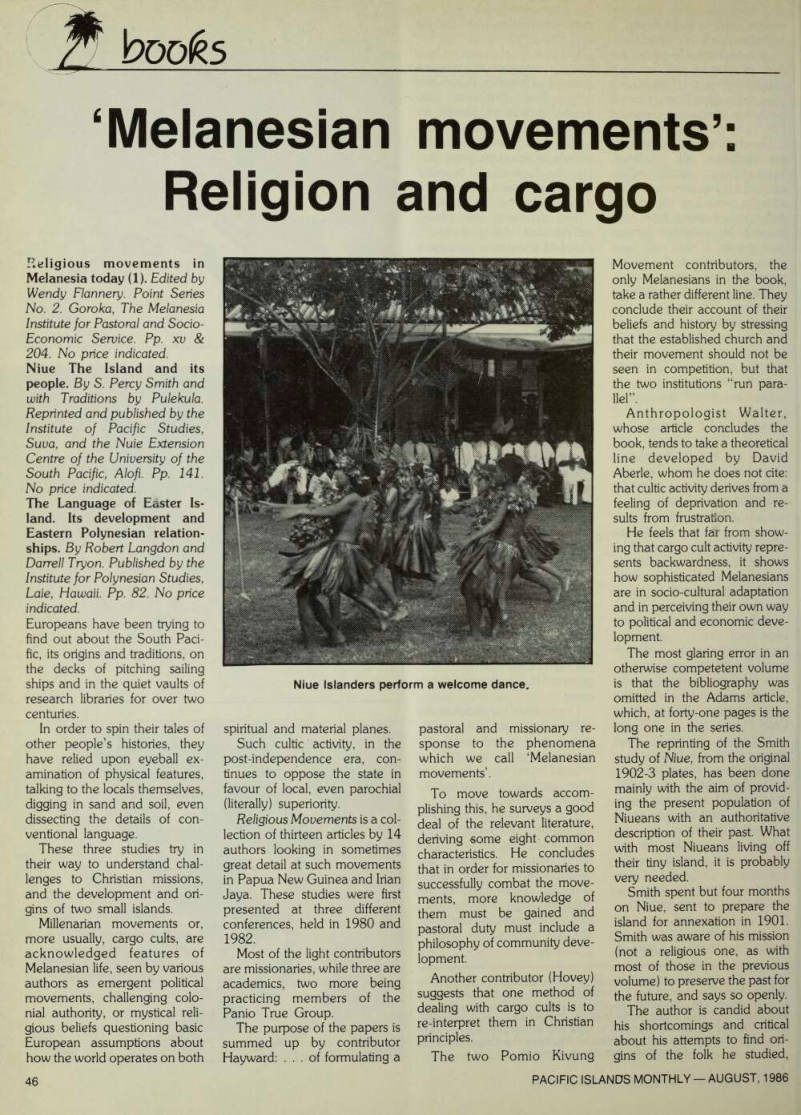
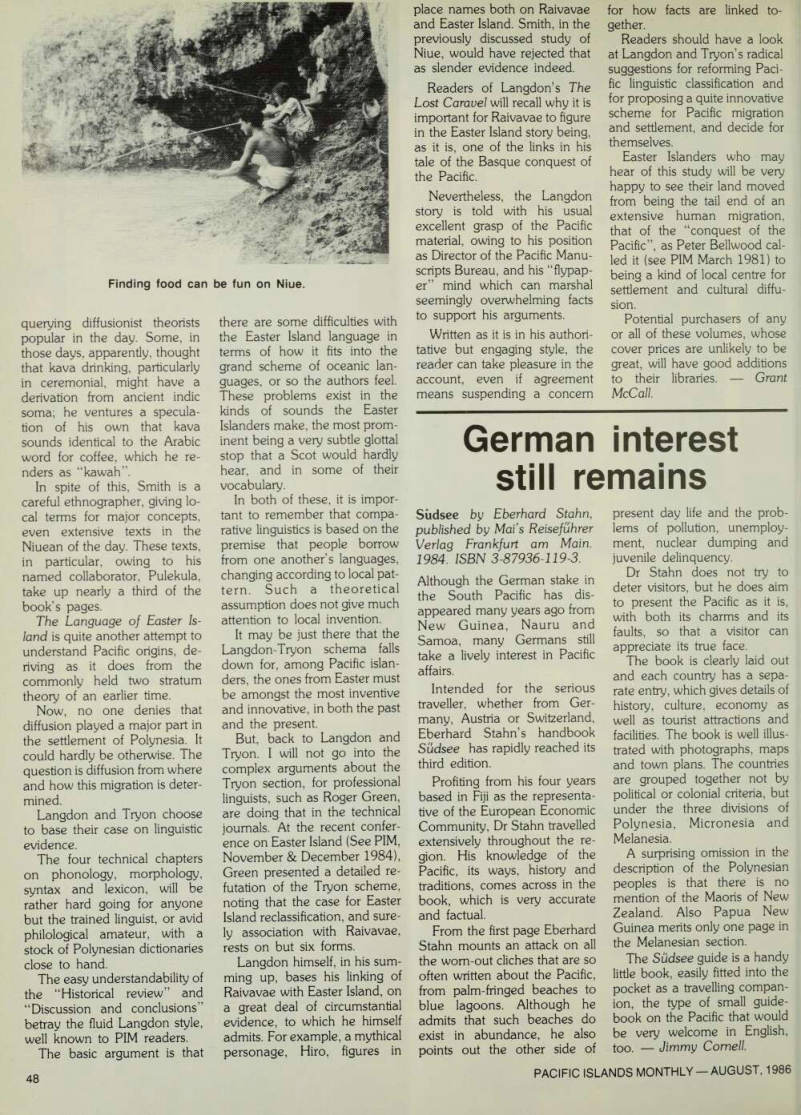
‘Melanesian movements’: Religion and cargo
Religious movements in Melanesia today (1). Edited by Wendy Flannery. Point Series No. 2. Goroka, The Melanesia Institute for Pastoral and Socio- Economic Service. Pp. xv & 204. No price indicated.
Niue The Island and its people. By S. Percy Smith and with Traditions by Pulekula.
Reprinted and published by the Institute of Pacific Studies, Suva, and the Nuie Extension Centre of the University of the South Pacific, Alofi. Pp. 141.
No price indicated.
The Language of Easter Is land. Its development and Eastern Polynesian relation ships. By Robert Langdon and Darrell Tiyon. Published by the Institute for Polynesian Studies, Laie, Hawaii. Pp. 82. No price indicated.
Europeans have been trying to find out about the South Paci fic, its origins and traditions, on the decks of pitching sailing ships and in the quiet vaults of research libraries for over two centuries.
In order to spin their tales of other people’s histories, they have relied upon eyeball ex amination of physical features, talking to the locals themselves, digging in sand and soil, even dissecting the details of con ventional language.
These three studies try in their way to understand chal lenges to Christian missions, and the development and ori gins of two small islands.
Millenarian movements or, more usually, cargo cults, are acknowledged features of Melanesian life, seen by various authors as emergent political movements, challenging colo nial authority, or mystical reli gious beliefs questioning basic European assumptions about how the world operates on both
spiritual and material planes.
Such cultic activity, in the post-independence era, con tinues to oppose the state in favour of local, even parochial (literally) superiority.
Religious Movements is a col lection of thirteen articles by 14 authors looking in sometimes great detail at such movements in Papua New Guinea and Irian Jaya. These studies were first presented at three different conferences, held in 1980 and 1982.
Most of the light contributors are missionaries, while three are academics, two more being practicing members of the Panio True Group.
The purpose of the papers is summed up by contributor Hayward: ... of formulating a
pastoral and missionary re sponse to the phenomena which we call ‘Melanesian movements’.
To move towards accom plishing this, he surveys a good deal of the relevant literature, deriving some eight common characteristics. He concludes that in order for missionaries to successfully combat the move ments, more knowledge of them must be gained and pastoral duty must include a philosophy of community deve lopment.
Another contributor (Hovey) suggests that one method of dealing with cargo cults is to re-interpret them in Christian principles.
The two Pomio Kivung
Movement contributors, the only Melanesians in the book, take a rather different line. They conclude their account of their beliefs and history by stressing that the established church and their movement should not be seen in competition, but that the two institutions “run para llel”.
Anthropologist Walter, whose article concludes the book, tends to take a theoretical line developed by David Aberle, whom he does not cite; that cultic activity derives from a feeling of deprivation and re sults from frustration.
He feels that far from show ing that cargo cult activity repre sents backwardness, it shows how sophisticated Melanesians are in socio-cultural adaptation and in perceiving their own way to political and economic deve lopment.
The most glaring error in an otherwise competetent volume is that the bibliography was omitted in the Adams article, which, at forty-one pages is the long one in the series.
The reprinting of the Smith study of Niue, from the original 1902-3 plates, has been done mainly with the aim of provid ing the present population of Niueans with an authoritative description of their past. What with most Niueans living off their tiny island, it is probably very needed.
Smith spent but four months on Niue, sent to prepare the island for annexation in 1901.
Smith was aware of his mission (not a religious one, as with most of those in the previous volume) to preserve the past for the future, and says so openly.
The author is candid about his shortcomings and critical about his attempts to find ori gins of the folk he studied,
Niue Islanders perform a welcome dance.
querying diffusionist theorists popular in the day. Some, in those days, apparently, thought that kava drinking, particularly in ceremonial, might have a derivation from ancient indie soma; he ventures a specula tion of his own that kava sounds identical to the Arabic word for coffee, which he re nders as “kawah”.
In spite of this, Smith is a careful ethnographer, giving lo cal terms for major concepts, even extensive texts in the Niuean of the day. These texts, in particular, owing to his named collaborator, Pulekula, take up nearly a third of the book’s pages.
The Language of Easter Is land is quite another attempt to understand Pacific origins, de riving as it does from the commonly held two stratum theory of an earlier time.
Now, no one denies that diffusion played a major part in the settlement of Polynesia. It could hardly be otherwise. The question is diffusion from where and how this migration is deter mined.
Langdon and Tryon choose to base their case on linguistic evidence.
The four technical chapters on phonology, morphology, syntax and lexicon, will be rather hard going for anyone but the trained linguist, or avid philological amateur, with a stock of Polynesian dictionaries close to hand.
The easy understandability of the “Historical review” and “Discussion and conclusions” betray the fluid Langdon style, well known to PIM readers.
The basic argument is that
there are some difficulties with the Easter Island language in terms of how it fits into the grand scheme of oceanic lan guages, or so the authors feel.
These problems exist in the kinds of sounds the Easter Islanders make, the most prom inent being a very subtle glottal stop that a Scot would hardly hear, and in some of their vocabulary.
In both of these, it is impor tant to remember that compa rative linguistics is based on the premise that people borrow from one another’s languages, changing according to local pat tern. Such a theoretical assumption does not give much attention to local invention.
It may be just there that the Langdon-Tryon schema falls down for, among Pacific islan ders, the ones from Easter must be amongst the most inventive and innovative, in both the past and the present.
But, back to Langdon and Tryon. I will not go into the complex arguments about the Tryon section, for professional linguists, such as Roger Green, are doing that in the technical journals. At the recent confer ence on Easter Island (See PIM, November & December 1984), Green presented a detailed re futation of the Tryon scheme, noting that the case for Easter Island reclassification, and sure ly association with Raivavae, rests on but six forms.
Langdon himself, in his sum ming up, bases his linking of Raivavae with Easter Island, on a great deal of circumstantial evidence, to which he himself admits. For example, a mythical personage, Hiro, figures in
place names both on Raivavae and Easter Island. Smith, in the previously discussed study of Niue, would have rejected that as slender evidence indeed.
Readers of Langdon’s The Lost Caravel will recall why it is important for Raivavae to figure in the Easter Island story being, as it is, one of the links in his tale of the Basque conquest of the Pacific.
Nevertheless, the Langdon story is told with his usual excellent grasp of the Pacific material, owing to his position as Director of the Pacific Manu scripts Bureau, and his “flypap er” mind which can marshal seemingly overwhelming facts to support his arguments.
Written as it is in his authori tative but engaging style, the reader can take pleasure in the account, even if agreement means suspending a concern
for how facts are linked to gether.
Readers should have a look at Langdon and Tryon’s radical suggestions for reforming Paci fic linguistic classification and for proposing a quite innovative scheme for Pacific migration and settlement, and decide for themselves.
Easter Islanders who may hear of this study will be very happy to see their land moved from being the tail end of an extensive human migration, that of the “conquest of the Pacific”, as Peter Bellwood cal led it (see PIM March 1981) to being a kind of local centre for settlement and cultural diffu sion.
Potential purchasers of any or all of these volumes, whose cover prices are unlikely to be great, will have good additions
to their libraries.
Grant
McCall.
Finding food can be fun on Niue.
Advertisements & other items, p. 47 (1 item)
Bens on w Hedges
nm ifa
TRADITIONALLY THE NAME
ASSOCIATED WITH PERFECTION
IN CIGARETTES
BENSON & HEDGES
20
Bens on w Hedges
WARNING-SMOKING IS A HEALTH HAZARD
ONLY THE BEST WILL DO.
German interest
still remains
Siidsee by Eberhard Stahn, published by Mai’s Reisefuhrer Verlag Frankfurt am Main.
1984. Isbn 3-87936-119-3.
... , .. , i Although the German stake in the South Pacific has d.sappeared many years ago from New Guinea, Nauru and Samoa many Germans still take a lively interest in Pacific a " a ' rs - Intended for the serious traveller, whether from Germany, Austria or Switzerland, Eberhard Stahn’s handbook Sudsee has rapidly reached its third edition.
Profiting from his four years based in Fiji as the representative of the European Economic Community, Dr Stahn travelled extensively throughout the region. His knowledge of the Pacific, its ways, history and traditions, comes across in the book, which is very accurate and factual.
From the first page Eberhard Stahn mounts an attack on all the wom-out cliches that are so often written about the Pacific, from palm-fringed beaches to blue lagoons. Although he admits that such beaches do exist in abundance, he also points out the other side of
present day life and the prob lems of pollution, unemploy ment, nuclear dumping and juvenile delinquency.
Dr Stahn does not try to bu( he does aim to present the Padfic as it is> both charms and its so a visitor can appredate its face , j be book is clearly laid out and each country has a sepa rate entry, which gives details of history, culture, economy as we ll as tourist attractions and facilities. The book is well illus trated with photographs, maps and town plans. The countries are grouped together not by political or colonial criteria, but under the three divisions of Polynesia, Micronesia and Melanesia, A surprising omission in the description of the Polynesian peoples is that there is no mention of the Maoris of New Zealand. Also Papua New Guinea merits only one page in the Melanesian section, The Siidsee guide is a handy little book, easily fitted into the pocket as a travelling compan ion, the type of small guide book on the Pacific that would be very welcome in English,
too.
Jimmy Cornell.
transitions
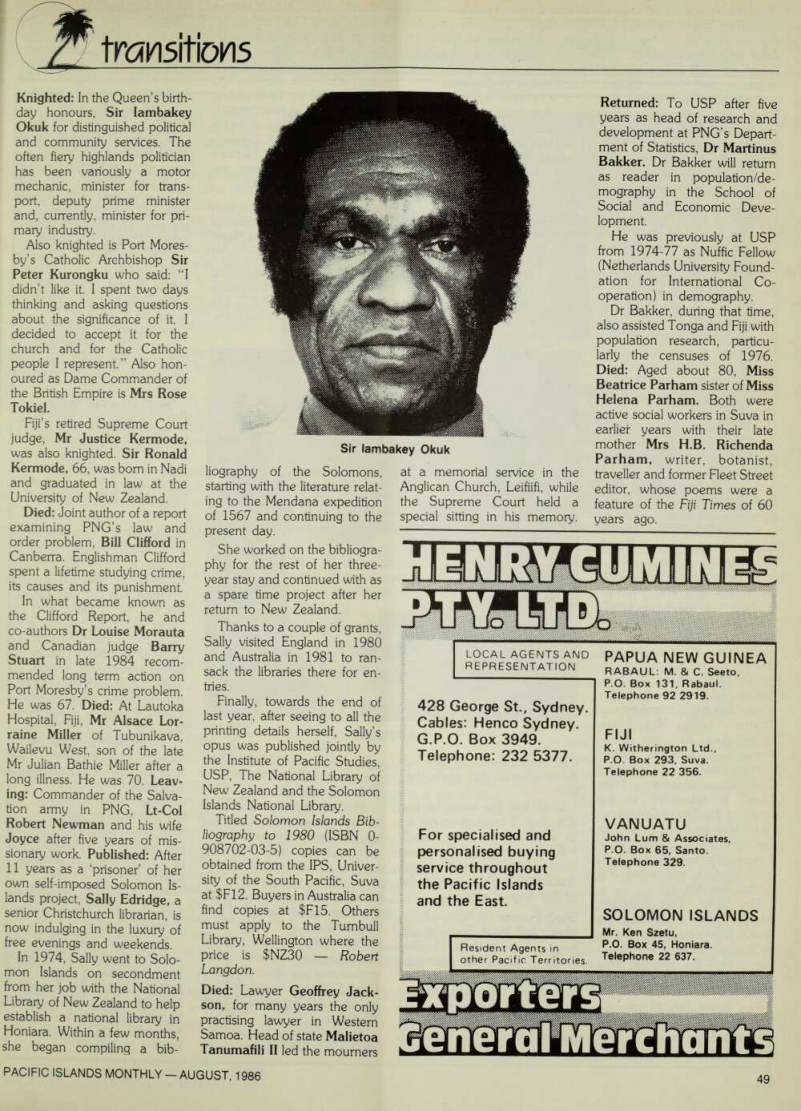
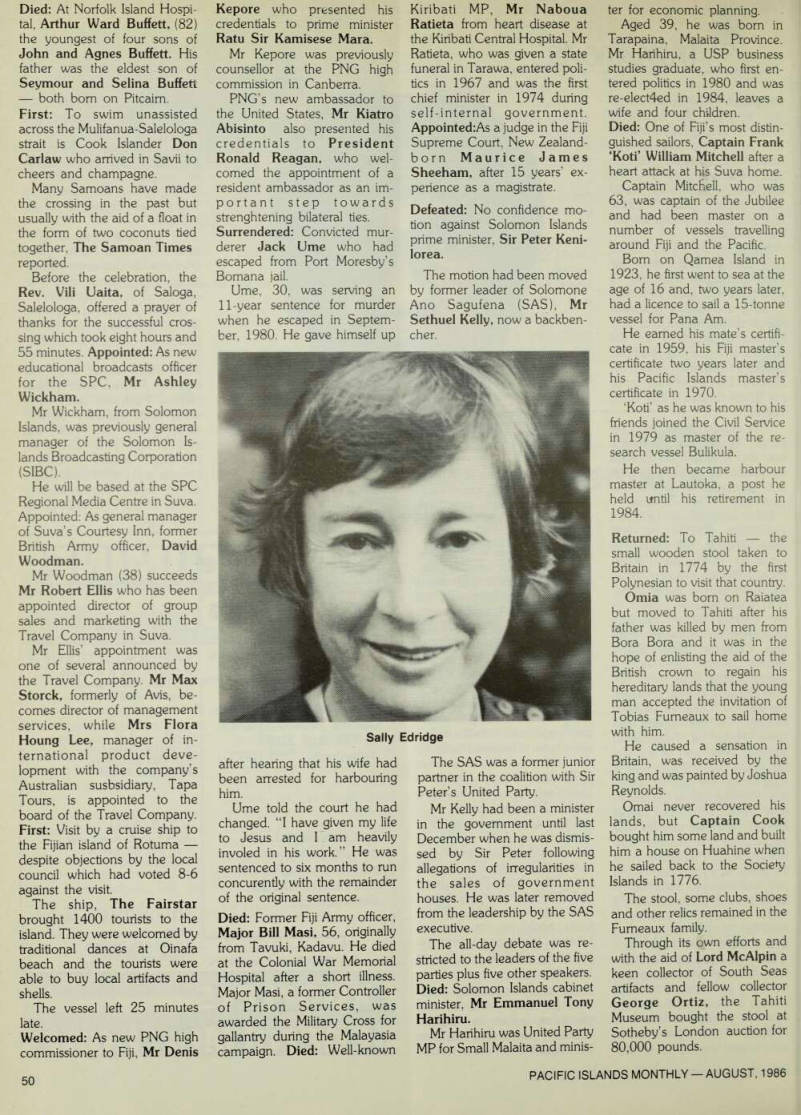
Knighted: In the Queen’s birth day honours, Sir lambakey Okuk for distinguished political and community services. The often fiery highlands politician has been variously a motor mechanic, minister for trans port, deputy prime minister and, currently, minister for pri mary industry.
Also knighted is Port Mores by’s Catholic Archbishop Sir Peter Kurongku who said: “I didn’t like it. I spent two days thinking and asking questions about the significance of it. I decided to accept it for the church and for the Catholic people I represent. ” Also hon oured as Dame Commander of the British Empire is Mrs Rose Tokiel.
Fiji’s retired Supreme Court judge. Mr Justice Kermode, was also knighted. Sir Ronald Kermode, 66, was bom in Nadi and graduated in law at the University of New Zealand.
Died: Joint author of a report examining PNG’s law and order problem, Bill Clifford in Canberra. Englishman Clifford spent a lifetime studying crime, its causes and its punishment.
In what became known as the Clifford Report, he and co-authors Dr Louise Morauta and Canadian judge Barry Stuart in late 1984 recom mended long term action on Port Moresby’s crime problem.
He was 67. Died: At Lautoka Hospital, Fiji, Mr Alsace Lor raine Miller of Tubunikava, Wailevu West, son of the late Mr Julian Bathie Miller after a long illness. He was 70. Leav ing: Commander of the Salva tion army in PNG, Lt-Col Robert Newman and his wife Joyce after five years of mis sionary work. Published: After 11 years as a ‘prisoner’ of her own self-imposed Solomon Is lands project, Sally Edridge, a senior Christchurch librarian, is now indulging in the luxury of free evenings and weekends.
In 1974, Sally went to Solo mon Islands on secondment from her job with the National Library of New Zealand to help establish a national library in Honiara. Within a few months, she began compiling a bib-
liography of the Solomons, starting with the literature relat ing to the Mendana expedition of 1567 and continuing to the present day.
She worked on the bibliogra phy for the rest of her three year stay and continued with as a spare time project after her return to New Zealand.
Thanks to a couple of grants, Sally visited England in 1980 and Australia in 1981 to ran sack the libraries there for en tries.
Finally, towards the end of last year, after seeing to all the printing details herself, Sally’s opus was published jointly by the Institute of Pacific Studies, USP, The National Library of New Zealand and the Solomon Islands National Library.
Titled Solomon Islands Bib liography to 1980 (ISBN 0- 908702-03-5) copies can be obtained from the IPS, Univer sity of the South Pacific, Suva at SFI2. Buyers in Australia can find copies at SFIS. Others must apply to the Turnbull Library, Wellington where the price is SNZ3O Robert Langdon.
Died: Lawyer Geoffrey Jack son, for many years the only practising lawyer in Western Samoa. Head of state Malietoa Tanumafili II led the mourners
at a memorial service in the Anglican Church, Leifiifi, while the Supreme Court held a special sitting in his memory.
Returned: To USP after five years as head of research and development at PNG’s Depart ment of Statistics, Dr Martinus Bakker. Dr Bakker will return as reader in population/de mography in the School of Social and Economic Deve lopment.
He was previously at USP from 1974-77 as Nuffic Fellow (Netherlands University Found ation for International Co operation) in demography.
Dr Bakker, during that time, also assisted Tonga and Fiji with population research, particu larly the censuses of 1976.
Died: Aged about 80, Miss Beatrice Parham sister of Miss Helena Parham. Both were active social workers in Suva in earliet years with their late mother Mrs H.B. Richcnda Parham, writer, botanist, traveller and former Fleet Street editor, whose poems were a feature of the Fiji Times of 60 years ago.
Sir lambakey Okuk
Died: At Norfolk Island Hospi tal, Arthur Ward Buffett, (82) the youngest of four sons of John and Agnes Buffett. His father was the eldest son of Seymour and Selina Buffett both bom on Pitcairn.
First: To swim unassisted across the Mulifanua-Salelologa strait is Cook Islander Don Carlaw who arrived in Savii to cheers and champagne.
Many Samoans have made the crossing in the past but usually with the aid of a float in the form of two coconuts tied together, The Samoan Times reported.
Before the celebration, the Rev. Vili Uaita, of Saloga, Salelologa, offered a prayer of thanks for the successful cros sing which took eight hours and 55 minutes. Appointed: As new educational broadcasts officer for the SPC, Mr Ashley Wickham.
Mr Wickham, from Solomon Islands, was previously general manager of the Solomon Is lands Broadcasting Corporation
(Sibc).
He will be based at the SPC Regional Media Centre in Suva.
Appointed: As general manager of Suva’s Courtesy Inn, former British Army officer, David Woodman.
Mr Woodman (38) succeeds Mr Robert Ellis who has been appointed director of group sales and marketing with the Travel Company in Suva.
Mr Ellis’ appointment was one of several announced by the Travel Company. Mr Max Storck, formerly of Avis, be comes director of management services, while Mrs Flora Houng Lee, manager of in ternational product deve lopment with the company’s Australian susbsidiary, Tapa Tours, is appointed to the board of the Travel Company.
First: Visit by a cruise ship to the Fijian island of Rotuma despite objections by the local council which had voted 8-6 against the visit.
The ship, The Fairstar brought 1400 tourists to the island. They were welcomed by traditional dances at Oinafa beach and the tourists were able to buy local artifacts and shells.
The vessel left 25 minutes late.
Welcomed: As new PNG high commissioner to Fiji, Mr Denis
Kepore who presented his credentials to prime minister Ratu Sir Kamisese Mara.
Mr Kepore was previously counsellor at the PNG high commission in Canberra.
PNG’s new ambassador to the United States, Mr Kiatro Abisinto also presented his credentials to President Ronald Reagan, who wel comed the appointment of a resident ambassador as an im portant step towards strengthening bilateral ties.
Surrendered: Convicted mur derer Jack Ume who had escaped from Port Moresby’s Bomana jail.
Ume, 30, was serving an 11-year sentence for murder when he escaped in Septem ber, 1980. He gave himself up
after hearing that his wife had been arrested for harbouring him.
Ume told the court he had changed. “I have given my life to Jesus and I am heavily involed in his work.” He was sentenced to six months to run concurently with the remainder of the original sentence.
Died: Former Fiji Army officer, Major Bill Masi, 56, originally from Tavuki, Kadavu. He died at the Colonial War Memorial Hospital after a short illness.
Major Masi, a former Controller of Prison Services, was awarded the Military Cross for gallantry during the Malayasia campaign. Died: Well-known
Kiribati MP, Mr Naboua Ratieta from heart disease at the Kiribati Central Hospital. Mr Ratieta, who was given a state funeral in Tarawa, entered poli tics in 1967 and was the first chief minister in 1974 during self-internal government.
Appointed:As a judge in the Fiji Supreme Court, New Zealand born Maurice James Sheeham, after 15 years’ ex perience as a magistrate.
Defeated; No confidence mo tion against Solomon Islands prime minister, Sir Peter Keni lorea.
The motion had been moved by former leader of Solomone Ano Sagufena (SAS), Mr Sethuel Kelly, now a backben cher.
The SAS was a former junior partner in the coalition with Sir Peter’s United Party.
Mr Kelly had been a minister in the government until last December when he was dismis sed by Sir Peter following allegations of irregularities in the sales of government houses. He was later removed from the leadership by the SAS executive.
The all-day debate was re stricted to the leaders of the five parties plus five other speakers.
Died: Solomon Islands cabinet minister, Mr Emmanuel Tony Harihiru.
Mr Harihiru was United Party MP for Small Malaita and minis
ter for economic planning.
Aged 39, he was born in Tarapaina, Malaita Province.
Mr Harihiru, a USP business studies graduate, who first en tered politics in 1980 and was re-elect4ed in 1984, leaves a wife and four children.
Died: One of Fiji’s most distin guished sailors, Captain Frank ‘Koti’ William Mitchell after a heart attack at his Suva home.
Captain Mitchell, who was 63, was captain of the Jubilee and had been master on a number of vessels travelling around Fiji and the Pacific.
Born on Qamea Island in 1923, he first went to sea at the age of 16 and, two years later, had a licence to sail a 15-tonne vessel for Pana Am.
He earned his mate’s certifi cate in 1959, his Fiji master’s certificate two years later and his Pacific Islands master’s certificate in 1970. ‘Koti’ as he was known to his friends joined the Civil Service in 1979 as master of the re search vessel Bulikula.
He then became harbour master at Lautoka, a post he held until his retirement in 1984.
Returned: To Tahiti the small wooden stool taken to Britain in 1774 by the first Polynesian to visit that country.
Omia was born on Raiatea but moved to Tahiti after his father was killed by men from Bora Bora and it was in the hope of enlisting the aid of the British crown to regain his hereditary lands that the young man accepted the invitation of Tobias Fumeaux to sail home with him.
He caused a sensation in Britain, was received by the king and was painted by Joshua Reynolds.
Omai never recovered his lands, but Captain Cook bought him some land and built him a house on Huahine when he sailed back to the Society Islands in 1776.
The stool, some clubs, shoes and other relics remained in the Fumeaux family.
Through its own efforts and with the aid of Lord McAlpin a keen collector of South Seas artifacts and fellow collector George Ortiz, the Tahiti Museum bought the stool at Sotheby’s London auction for 80,000 pounds.
Sally Edridge
Advertisements & other items, p. 49 (1 item)
fe'n'eVal Merchants
TTTT
io .
LOCAL AGENTS AND
REPRESENTATION
428 George St., Sydney.
Cables: Henco Sydney.
G.P.O. Box 3949.
Telephone: 232 5377.
PAPUA NEW GUINEA
RABAUL: M. & C. Seeto, P.O. Box 131, Rabaul.
Telephone 92 2919.
FIJI
K. Witherington Ltd., P.O. Box 293, Suva.
Telephone 22 356.
For specialised and
personalised buying
service throughout
the Pacific Islands and the East.
Resident Agents in other Pacific Territories.
VANUATU
John Lum & Associates, P.O. Box 65, Santo.
Telephone 329.
SOLOMON ISLANDS
Mr. Ken Szetu, P.O. Box 45, Honiara.
Telephone 22 637.
fe'n'eVal Merchants
Pacific stamp box
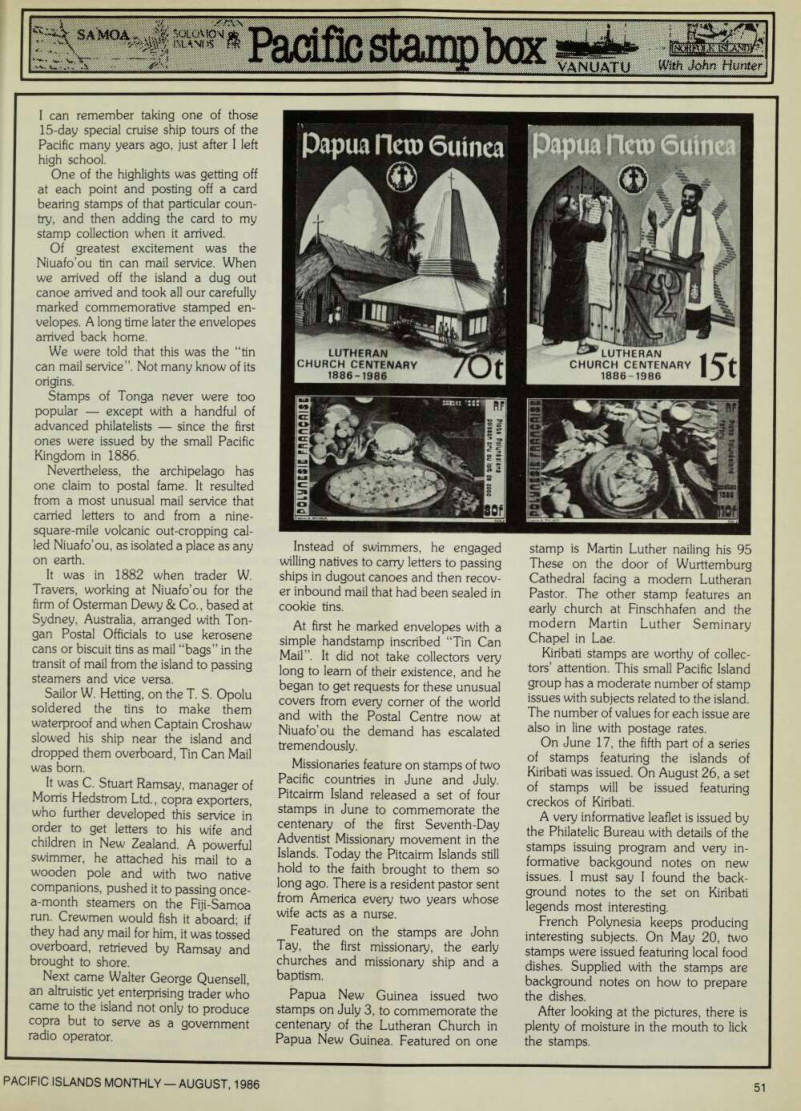
I can remember taking one of those 15-day special cruise ship tours of the Pacific many years ago, just after I left high school.
One of the highlights was getting off at each point and posting off a card bearing stamps of that particular coun try, and then adding the card to my stamp collection when it arrived.
Of greatest excitement was the Niuafo’ou tin can mail service. When we arrived off the island a dug out canoe arrived and took all our carefully marked commemorative stamped en velopes. A long time later the envelopes arrived back home.
We were told that this was the “tin can mail service”. Not many know of its origins.
Stamps of Tonga never were too popular except with a handful of advanced philatelists since the first ones were issued by the small Pacific Kingdom in 1886.
Nevertheless, the archipelago has one claim to postal fame. It resulted from a most unusual mail service that carried letters to and from a nine square-mile volcanic out-cropping cal led Niuafo’ou, as isolated a place as any on earth.
It was in 1882 when trader W.
Travers, working at Niuafo’ou for the firm of Osterman Dewy & Co., based at Sydney, Australia, arranged with Ton gan Postal Officials to use kerosene cans or biscuit tins as mail “bags” in the transit of mail from the island to passing steamers and vice versa.
Sailor W. Hetting, on the T. S. Opolu soldered the tins to make them waterproof and when Captain Croshaw slowed his ship near the island and dropped them overboard, Tin Can Mail was born.
It was C. Stuart Ramsay, manager of Morris Hedstrom Ltd., copra exporters, who further developed this service in order to get letters to his wife and children in New Zealand. A powerful swimmer, he attached his mail to a wooden pole and with two native companions, pushed it to passing once a-month steamers on the Fiji-Samoa run. Crewmen would fish it aboard; if they had any mail for him, it was tossed overboard, retrieved by Ramsay and brought to shore.
Next came Walter George Quensell, an altruistic yet enterprising trader who came to the island not only to produce copra but to serve as a government radio operator.
Instead of swimmers, he engaged willing natives to carry letters to passing ships in dugout canoes and then recov er inbound mail that had been sealed in cookie tins.
At first he marked envelopes with a simple handstamp inscribed “Tin Can Mail”. It did not take collectors very long to learn of their existence, and he began to get requests for these unusual covers from every corner of the world and with the Postal Centre now at Niuafo’ou the demand has escalated tremendously.
Missionaries feature on stamps of two Pacific countries in June and July.
Pitcairm Island released a set of four stamps in June to commemorate the centenary of the first Seventh-Day Adventist Missionary movement in the Islands. Today the Pitcairm Islands still hold to the faith brought to them so long ago. There is a resident pastor sent from America every two years whose wife acts as a nurse.
Featured on the stamps are John Tay, the first missionary, the early churches and missionary ship and a baptism.
Papua New Guinea issued two stamps on July 3, to commemorate the centenary of the Lutheran Church in Papua New Guinea. Featured on one
stamp is Martin Luther nailing his 95 These on the door of Wurttemburg Cathedral facing a modern Lutheran Pastor. The other stamp features an early church at Finschhafen and the modern Martin Luther Seminary Chapel in Lae.
Kiribati stamps are worthy of collec tors’ attention. This small Pacific Island group has a moderate number of stamp issues with subjects related to the island.
The number of values for each issue are also in line with postage rates.
On June 17, the fifth part of a series of stamps featuring the islands of Kiribati was issued. On August 26, a set of stamps will be issued featuring creckos of Kiribati.
A very informative leaflet is issued by the Philatelic Bureau with details of the stamps issuing program and very in formative backgound notes on new issues. I must say I found the back ground notes to the set on Kiribati legends most interesting.
French Polynesia keeps producing interesting subjects. On May 20, two stamps were issued featuring local food dishes. Supplied with the stamps are background notes on how to prepare the dishes.
After looking at the pictures, there is plenty of moisture in the mouth to lick the stamps.
yachts
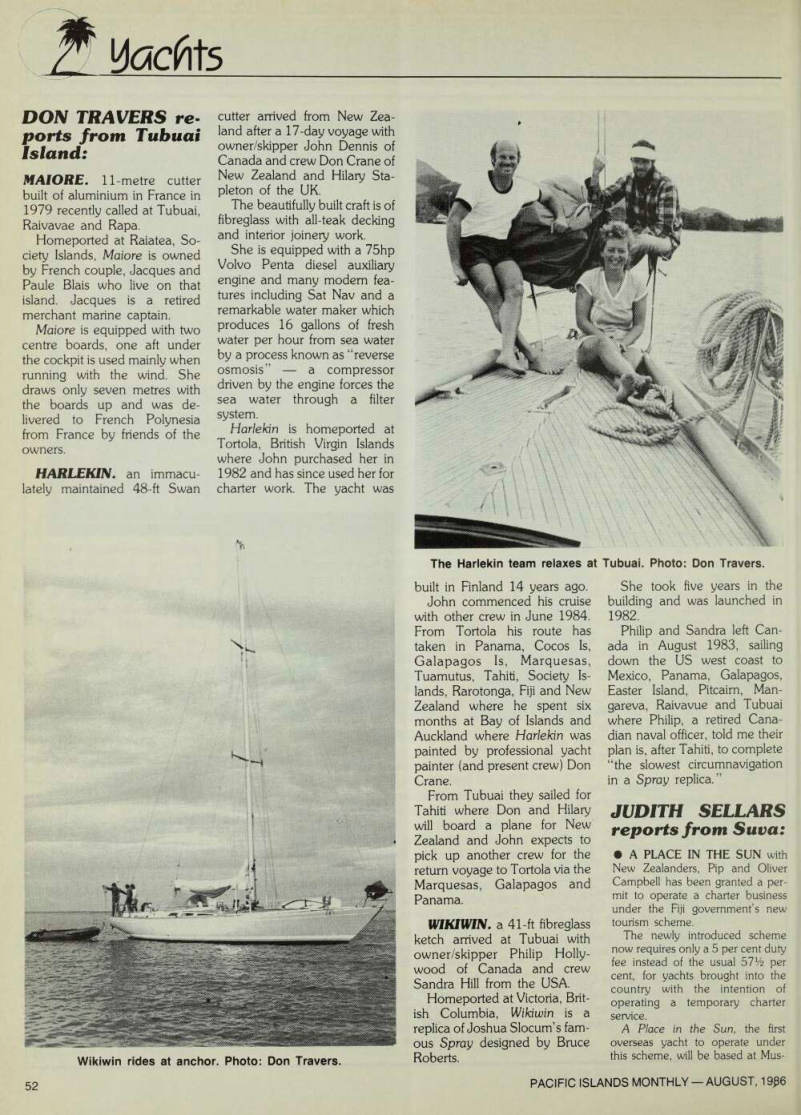
Don Travers Re
ports from Tubuai
Island: MAIORE. 11 -metre cutter built of aluminium in France in 1979 recently called at Tubuai, Raivavae and Rapa.
Homeported at Raiatea, So ciety Islands, Maiore is owned by French couple, Jacques and Paule Blais who live on that island. Jacques is a retired merchant marine captain.
Maiore is equipped with two centre boards, one aft under the cockpit is used mainly when running with the wind. She draws only seven metres with the boards up and was de livered to French Polynesia from France by friends of the owners.
HARLEKIN. an immacu lately maintained 48-ft Swan
cutter arrived from New Zea land after a 17-day voyage with owner/skipper John Dennis of Canada and crew Don Crane of New Zealand and Hilary Sta pleton of the UK.
The beautifully built craft is of fibreglass with all-teak decking and interior joinery work.
She is equipped with a 75hp Volvo Penta diesel auxiliary engine and many modem fea tures including Sat Nav and a remarkable water maker which produces 16 gallons of fresh water per hour from sea water by a process known as “reverse osmosis” a compressor driven by the engine forces the sea water through a filter system.
Harlekin is homeported at Tortola, British Virgin Islands where John purchased her in 1982 and has since used her for charter work. The yacht was
built in Finland 14 years ago.
John commenced his cruise with other crew in June 1984.
From Tortola his route has taken in Panama, Cocos Is, Galapagos Is, Marquesas, Tuamutus, Tahiti, Society Is lands, Rarotonga, Fiji and New Zealand where he spent six months at Bay of Islands and Auckland where Harlekin was painted by professional yacht painter (and present crew) Don Crane.
From Tubuai they sailed for Tahiti where Don and Hilary will board a plane for New Zealand and John expects to pick up another crew for the return voyage to Tortola via the Marquesas, Galapagos and Panama.
WIKIWIN . a 41-ft fibreglass ketch arrived at Tubuai with owner/skipper Philip Holly wood of Canada and crew Sandra Hill from the USA.
Homeported at Victoria, Brit ish Columbia, Wikiwin is a replica of Joshua Slocum’s fam ous Spray designed by Bruce Roberts.
She took five years in the building and was launched in 1982.
Philip and Sandra left Can ada in August 1983, sailing down the US west coast to Mexico, Panama, Galapagos, Easter Island, Pitcairn, Man gareva, Raivavue and Tubuai where Philip, a retired Cana dian naval officer, told me their plan is, after Tahiti, to complete “the slowest circumnavigation in a Spray replica.”
Judith Sellars
reports from Suva:
• A PLACE IN THE SUN with New Zealanders, Pip and Oliver Campbell has been granted a per mit to operate a charter business under the Fiji government’s new tourism scheme.
The newly introduced scheme now requires only a 5 per cent duty fee instead of the usual 57 Vz per cent, for yachts brought into the country with the intention of operating a temporary charter service.
A Place in the Sun, the first overseas yacht to operate under this scheme, will be based at Mus
Wikiwin rides at anchor. Photo: Don Travers.
The Harlekln team relaxes at Tubuai. Photo: Don Travers.
ket Cove Resort on Molololailai island in the western Mamanuca group.
Launched in New Zealand in 1980. A Place in the Sun is a 45ft American Mobjack design by L.
Francis Herreshoff, constructed of four skins of New Zealand heart kauri.
The decks are double or triple diagonal kauri, overlaid with teak.
Teak is also used for all exterior trim while the interior finish is in solid mahogany.
The galley is equipped with a 4-bumer Roden stove with a large oven and grill, a deep freeze, instant hot water to shower and sink, and a Hoovermatic washing machine.
Two heads and a separate stateroom assure personal comfort and privacy for the six passengers per chartered cruise.
The ketch is rigged with lofty spars for light airs and easy reefing and furling for the strongest of winds.
Pip and Oliver opted for Fiji to operate their South Pacific island charter business after their un fortunate grounding on Suva’s main reef in July last year.
The ketch was badly holed on the starboard side of the hull, but after a few months of dedicated work at Whippy’s Boatyard in Suva, she looked just fine.
Pip and Oliver will operate their Fiji island charter business from June to September, when they will return to New Zealand’s Bay of Islands to continue chartering dur ing the New Zealand yachting season. • Defiance. It is not uncommon nowadays to come across a yacht that is exceptionally well outfitted with the latest, up-to-date com munication and navigation equip ment.
Defiance a Swan 51 sloop moored at the Royal Suva Yacht Club recently.
Owned and skippered by Austra lian, Marshall Phillips, Defiance boasted a full Brooks and Gate house Hercules 190 Instruments system, which among many other functions, displayed information such as wind velocity, boat speed and battery charge, as well as a depth sounder and a compass.
The sloop was also equipped with a Shipmate Satellite navigator and a Furuno weather fax machine which upon request printed up-to date weather maps for any specific area, complete with aeroplanes that might be flying high above the earth at that time.
As well as a 400 watt Codin SSB radio and a Furuno Radar, the skipper and crew have for more easy handling, an automatic pilot system and a furling headsail on a Hood Seafurl system.
Skipper, Marshall Phillips might be remembered by yachtsmen as
the owner of the popular Sweet Caroline fleet of ocean racing yachts, which he recently traded in exchange for the Swan 51, a design with comfortable, fast, cruising in mind.
Phillips, with his crew of six, are following the steps of the first solo sailor to circumnavigate the world, Joshua Slocum, way back in 1792.
They plan to pick up a film crew in Chile and complete a document ary of the historic voyage, (ex pected to be on Australian televi sion in a year), with emphasis on the Cape Horn passage, known as one of the most difficult ocean crossings in the world.
Defiance first set sail from Syd ney in March 1986 to compete in the Sydney to Mooloolaba Yacht race, more as an excuse to get them started on their world cruise.
The sloop then cruised up through the Barrier Reef, stopping over at most of the islands, such as Lady Muscrave Island, Great Kep pel Island, South Percy Island, Scawfell Island and Hamilton Is land, where they also took part in the Hamilton Island series in the cruising division, winning both line and handicap honours.
From there, they island hopped up to Townsville, then to Cairns, where they had to take shelter 2V2 miles up-river from Cyclone Manu, which was threatening the Queens land coast at the time.
After the cyclone eventually fiz zled out, the crew celebrated with an all-night party with fellow yachts men from PNG’s Di Hard another cruising yacht that was also up river.
Once Defiance was re-fitted she set sail for Vanuatu, Archin Island, Port Sandwich, Epi Island and then on to Vila for a week before a four day passage in 30 knot North Westerlies for the first couple of days, then the usual South East Trades for the remainder of the cruise to Suva.
After a short stop-over in Suva, Defiance was then heading for Tonga, Rarotonga, Tahiti, Pitcairn Island, Easter Island, Juan Fernan dez and Robinson Crusoe Islands off the coast of Argentina, before calling into Valparaiso.
The Swan 51 design, by Argenti nian, German Frers and built in Helsinki, Finland by Nautor, was a development of the two successful British and American ocean racing yachts, “Blizzard” and “Arcadia,” respectively.
The hull is fibreglass while the decks are teak laid.
The interior, also teak, has a large galley, complete with a gas stove and oven, two refrigerators and one freezer, hot and cold pressurised water and leather upholstered cushions in the saloon.
For auxiliary power, “Defiance” has a 78 horse power Perkins Diesel engine
for tourism
A ‘new face’ for tourism
Fiji’s image in its tourist markets needs a new face, delegates at the 25th tourism convention were told.
In his keynote address, prime minister Ratu Sir Kamisese Mara said he did not believe that a face a distinct identity to influence the quality of the experiences of the tourist had been adequately estab lished.
In doing this, a delicate ba lance had to be struck between quality, reliability, efficiency and the authentic Fiji atmos phere.
The challenge, said the prime minister, was to preserve Fiji’s heritage and to build on it and share it with visitors to the country.
The government was firmly committed to the tourist in dustry and was convinced that in the short to medium term it could contribute most towards real economic growth and job creation in Fiji.
Ratu Mara’s call for the deve lopment of a market face for Fiji was taken up by other guest speakers and delegates at the three-day convention in the Fiji Hyatt Regency.
One U.S. travel wholesaler told delegates that what the market needed was Fijians promoting their country as a tourist destination. It was no good sending Europeans, he stressed.
In an hour-long presentation to the convention, representa tives of the airline also gave details of the financial plight it had flown into between 1980 and 1985 before breaking even this year (see also page 25).
By March last year Air Pacific had accumulated losses of Fs36 million and when Qantas took over the management of the airline, it needed to gener ate Fs3 milion per year just to meet debt servicing require ments.
Air Pacific’s marketing director, John Campbell said that in 1985-86 the airline was forecasting a break even result which represented an Fsll mil lion turnaround.
“We now have greater confi dence in the future,” he said, adding that the approach was now one of “cautious expan sion. ”
The airline had set its sights on the Japan market, he said, as research had discovered that this sector was underserviced.
Other speakers appealed to the industry not to forget its base markets in New Zealand and Austrlaia.
One delegate said the perception of Fiji in these major markets was changing and that unfavourable exchange rates were not the only reason why the numbers of Australian and New Zealand tourists were de clining.
Hard to recruit staff
The University of the South Pacific is finding it difficult to attract staff, particularly in the areas of science and accoun ting.
Staff costs, at FsB.3 million, accounted for 70 per cent of total 1985 expenditure of F 511.7 million, according to the university’s annual report.
Last year, USP had the same resources, in real terms, as in 1984, though lower inflation, brought about in part by the government’s wage freeze, les sened the impact on budgets, says Vice-Chancellor Geoffrey Caston in his introduction to the
report.
“There is, however, no room in our budget for new deve lopments unless they can be funded by cutting back existing activities,” he warns.
However, the proportion of regional citizens on the univer sity staff had risen to about 60 per cent.
Funds allocated for staff salaries were underspent as a result of unfilled vacancies, and some of this money was di verted to library books, equip ment, renovations to staff houses and maintenance work on student accommodation.
shipping schedules
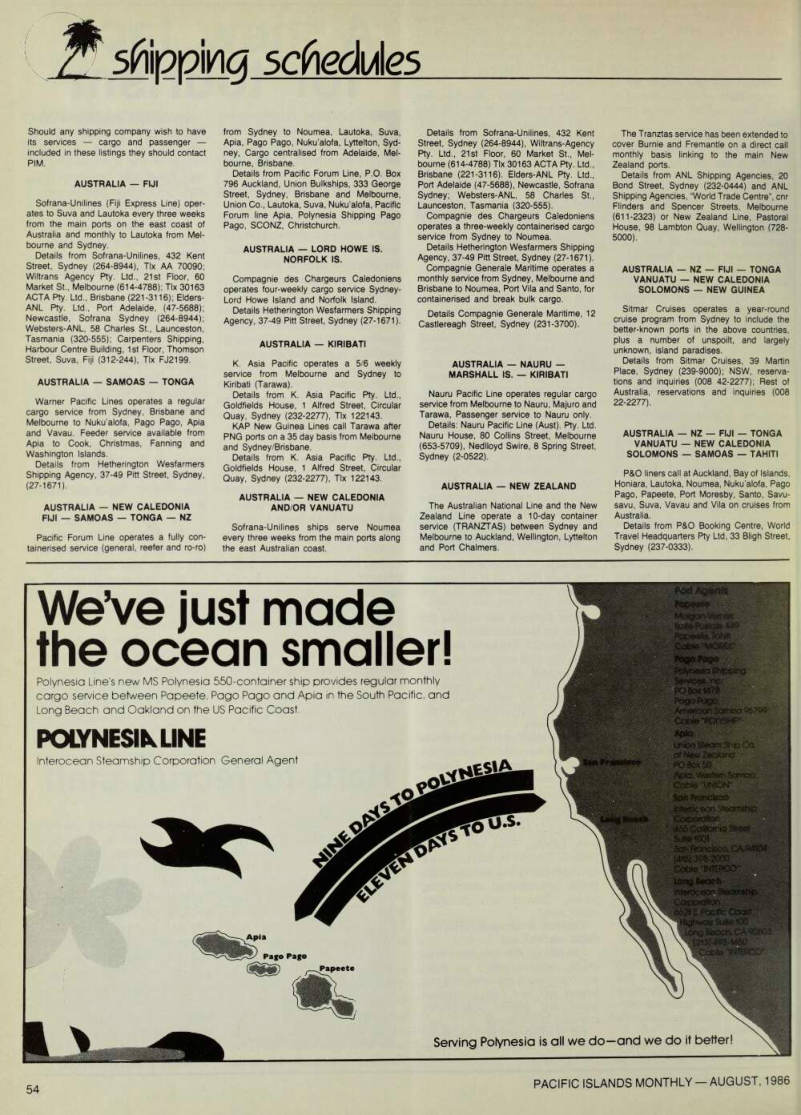
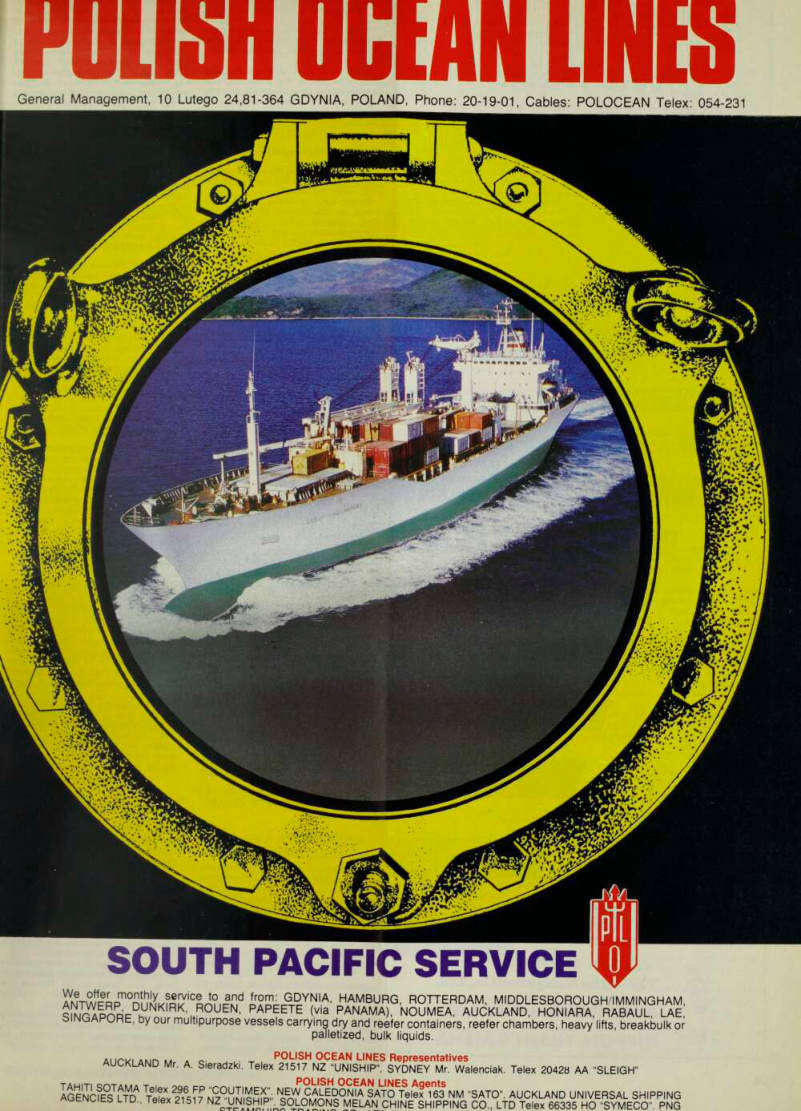
Should any shipping company wish to have its services cargo and passenger included in these listings they should contact
Pim.
Australia Fiji
Sofrana-Unilines (Fiji Express Line) oper ates to Suva and Lautoka every three weeks from the main ports on the east coast of Australia and monthly to Lautoka from Mel bourne and Sydney.
Details from Sofrana-Unilines, 432 Kent Street, Sydney (264-8944), Tlx AA 70090; Wiltrans Agency Pty. Ltd., 21st Floor, 60 Market St., Melbourne (614-4788); Tlx 30163 ACTA Pty. Ltd., Brisbane (221-3116); Elders- ANL Pty. Ltd., Port Adelaide, (47-5688); Newcastle, Sofrana Sydney (264-8944); Websters-ANL, 58 Charles St., Launceston, Tasmania (320-555); Carpenters Shipping, Harbour Centre Building, Ist Floor, Thomson Street, Suva, Fiji (312-244), Tlx FJ2199.
Australia Samoas Tonga
Warner Pacific Lines operates a regular cargo service from Sydney, Brisbane and Melbourne to Nukualofa, Pago Pago, Apia and Vavau. Feeder service available from Apia to Cook, Christmas, Fanning and Washington Islands.
Details from Hetherington Wesfarmers Shipping Agency, 37-49 Pitt Street, Sydney, (27-1671).
Australia New Caledonia
Fiji Samoas Tonga Nz
Pacific Forum Line operates a fully con tainerised service (general, reefer and ro-ro)
from Sydney to Noumea, Lautoka, Suva, Apia, Pago Pago, Nukualofa, Lyttelton, Syd ney, Cargo centralised from Adelaide, Mel bourne, Brisbane.
Details from Pacific Forum Line, P.O. Box 796 Auckland, Union Bulkships, 333 George Street, Sydney, Brisbane and Melbourne, Union Co., Lautoka, Suva, Nukualofa, Pacific Forum line Apia, Polynesia Shipping Pago Pago, SCONZ, Christchurch.
Australia Lord Howe Is.
Norfolk Is.
Compagnie des Chargeurs Caledoniens operates four-weekly cargo service Sydney- Lord Howe Island and Norfolk Island.
Details Hetherington Wesfarmers Shipping Agency. 37-49 Pitt Street, Sydney (27-1671).
Australia Kiribati
K. Asia Pacific operates a 5/6 weekly service from Melbourne and Sydney to Kiribati (Tarawa).
Details from K. Asia Pacific Pty. Ltd., Goldfields House, 1 Alfred Street, Circular Quay, Sydney (232-2277), Tlx 122143.
KAP New Guinea Lines call Tarawa after PNG ports on a 35 day basis from Melbourne and Sydney/Brisbane.
Details from K. Asia Pacific Pty. Ltd., Goldfields House, 1 Alfred Street, Circular Quay, Sydney (232-2277), Tlx 122143.
Australia New Caledonia
And/Or Vanuatu
Sofrana-Unilines ships serve Noumea every three weeks from the main ports along the east Australian coast.
Details from Sofrana-Unilines, 432 Kent Street, Sydney (264-8944), Wiltrans-Agency Pty. Ltd., 21st Floor, 60 Market St., Mel bourne (614-4788) Tlx 30163 ACTA Pty. Ltd., Brisbane (221-3116). Elders-ANL Pty. Ltd., Port Adelaide (47-5688), Newcastle, Sofrana Sydney; Websters-ANL, 58 Charles St., Launceston, Tasmania (320-555).
Compagnie des Chargeurs Caledoniens operates a three-weekly containerised cargo service from Sydney to Noumea.
Details Hetherington Wesfarmers Shipping Agency, 37-49 Pitt Street, Sydney (27-1671).
Compagnie Generale Maritime operates a monthly service from Sydney, Melbourne and Brisbane to Noumea, Port Vila and Santo, for containerised and break bulk cargo.
Details Compagnie Generale Maritime, 12 Castlereagh Street, Sydney (231-3700).
Australia Nauru
Marshall Is. Kiribati
Nauru Pacific Line operates regular cargo service from Melbourne to Nauru, Majuro and Tarawa, Passenger service to Nauru only.
Details: Nauru Pacific Line (Aust). Pty. Ltd.
Nauru House, 80 Collins Street, Melbourne (653-5709), Nedlloyd Swire, 8 Spring Street,
Sydney (2-0522).
Australia New Zealand
The Australian National Line and the New Zealand Line operate a 10-day container service (TRANZTAS) between Sydney and Melbourne to Auckland, Wellington, Lyttelton and Port Chalmers.
The Tranztas service has been extended to cover Burnie and Fremantle on a direct call monthly basis linking to the main New Zealand ports.
Details from ANL Shipping Agencies, 20 Bond Street, Sydney (232-0444) and ANL Shipping Agencies, “World Trade Centre", cnr Flinders and Spencer Streets, Melbourne (611-2323) or New Zealand Line, Pastoral House, 98 Lambton Quay, Wellington (728- 5000).
Australia Nz Fiji Tonga
Vanuatu New Caledonia
Solomons New Guinea
Sitmar Cruises operates a year-round cruise program from Sydney to include the better-known ports in the above countries, plus a number of unspoilt, and largely unknown, island paradises.
Details from Sitmar Cruises, 39 Martin Place, Sydney (239-9000); NSW, reserva tions and inquiries (008 42-2277); Rest of Australia, reservations and inquiries (008 22-2277).
Australia Nz Fiji Tonga
Vanuatu New Caledonia
Solomons Samoas Tahiti
P&O liners call at Auckland, Bay of Islands, Honiara, Lautoka, Noumea, Nukualofa, Pago Pago, Papeete, Port Moresby, Santo, Savu savu, Suva, Vavau and Vila on cruises from Australia.
Details from P&O Booking Centre, World Travel Headquarters Pty Ltd, 33 Bligh Street, Sydney (237-0333).
Australia Png
Solomons Vanuatu Nz
Pacific Forum Line operates a con tainerised and ro-ro from Brisbane to Port Moresby, Lae, Honiara, Port Vila, Lyttelton, Napier and Auckland.
Details from Union Bulkships, Brisbane Steamships Shipping, Port Moresby and Lae; Sullivans Ltd, Honiara, Vila Agents, Port Vila; SCONZ Christchurch, Napier and Auckland.
Australia Micronesia
Nauru Pacific Line operates a regular container service from Melbourne to Ponape, Truk, Guam and Saipan.
Details: N.P.L. (Australia) Pty Ltd, Nauru House, 80 Collins Street, Melbourne (653- 5709). Nedlloyd Swire, 8 Spring Street, Sydney (2-0522).
Australia New Caledonia
Sofrana Unilines operates a 3-4 weekly service from East Coast mainports to Noumea.
Details from Sofrana Unilines 432 Kent Street, Sydney. (Tel. 264-8944), Tlx AA 70090.
Australia Tuvalu
K. Asia Pacific operates a three monthly service from Sydney and Melbourne to Tuvalu (Funafuti). Subject to inducement.
Details from K. Asia Pacific Pty Ltd, Goldfields House, 1 Alfred Street, Circular Quay, Sydney (232-2277). Tlx 122143.
Warner Pacific Line operates a six week containerised/breakbulk service to Funafuti from Melbourne/Brisbane/ Sydney and Auck land.
Details from Hetherington Wesfarmers Shipping Agency, 37-49 Pitt Street, Sydney (27-1671): Mac Kay Shipping Ltd, Downtown House, Queen Street, Auckland (30-229).
Australia Png
KAP New Guinea Lines cargo vessels call at Melbourne, Sydney, Port Moresby, Lae, Madang, Wewak, Manus, Kimbe, Rabaul, Popondetta.
Details from K. Asia Pacific Pty Ltd, Goldfields House, 1 Alfred Street, Circular Quay, Sydney (232-2277), Tlx 122143. Dal gety Shipping, World Trade Centre, Mel bourne (616-6700).
Australia Png Solomons
Sofrana Unilines (Aust.) P/L operates a 3-4 weekly cargo service to PNG, ex-main ports on the east coast of Australia.
Details from Sofrana Unilines, 432 Kent Street, Sydney (264-8944), Tlx AA 70090.
Australia Png Solomons
Vanuatu
A consortium of NGAL/PNGL and CON PAC/NEL have four vessels operating a joint service from east coast Australian ports to Port Moresby, Lae, Alotau, Madang, Wewak, Rabaul, Kavieng-Kimbe, Kieta, Honiara, Vila, Santo.
Details from Burns Philp & Co. Ltd., P.O.
Box R 124, Royal Exchange, Sydney, 2000 (2-0547); Nedlloyd Swire, 8 Spring Street, Sydney (2-0522); New Guinea Express Lines, 37 Pitt Street, Sydney (241-3991); Vila Agents, PO Box 27, Port-Vila (2456). Tlx
Nhioii.
New Guinea Express Lines operates a weekly container service from Melbourne, Sydney, Brisbane to Port Moresby, Lae.
Alotau, Kimbe, Rabaul, Kieta, Honiara, Kavieng, Madang, Wewak, Santo, Vila.
Details from New Guinea Express Lines, P.O. Box R 73, Royal Exchange, Sydney (241-3991); New Guinea Express Lines, 127 Creek Street, Brisbane (221-9333); New Guinea Express Lines, 327 Collins Street, Melbourne (602-5544); Niugini Express Lines, Port Moresby (21-4572); Lae (42- 1536); Niugini Island Cargo Services Pty.
Ltd., Rabaul (922-467); Bougainville Agen cies Pty. Ltd., Kieta (956-089); Robert Laurie (PNG) P/L, Madang (82-2157); Garamut Enterprises P/L, Wewak (86-2106); Burns Philp (PNG) Ltd., Kavieng (94-2133); Alotau Stevedoring & Transport, Alotau (61-1318); Ngatia Wholesalers Pty. Ltd., Kimbe (93- SI 02); and Tradco Shipping, Mendana Ave nue, Honiara (22588); Vila Agents Ltd., P.O.
Box 971, Vila, Vanuatu (2490); John Lum & Associates, P.O. Box 65, Santo, Vanuatu (329).
Australia Tahiti
Compagnie Generate Maritime operates a monthly service from Sydney, Melbourne and Brisbane to Papeete, for containerised and break bulk cargo.
Details Compagnie Generate Maritime, 12 Castlereagh Street, Sydney (231-3700).
Sofrana Unilines (Aust.) P/L operates a 3/4 weekly cargo service to Papeete ex main ports on the east coast of Australia.
Details from Sofrana Unilines, 432 Kent Street, Sydney (264-8944) Tlx AA 70090.
Singapore Hongkong Fiji
Islands Ports
Kyowa Shipping Co. Ltd. operates a month ly containerised and break bulk cargo service from Singapore, Hongkong to Lautoka, Suva and then to island ports.
Details from Carpenters Shipping, Harbour Centre Building, Ist Floor, Thomson Street, Suva (312-244), Tlx FJ2199.
Far East Fiji
New Zealand
New Zealand Unit Express (NZUE) now operates a monthly service accepting con tainerised and break bulk cargo from Manila, Keelung, Kaohsiung and Hongkong to Lauto ka, Suva and thence to New Zealand ports.
Details from Carpenters Shipping, Harbour Centre Building, Ist Floor, Thomson Street, Suva (312-244), Tlx FJ 2199; Burns Philp, Suva (311-777); P&O S.N. Co. Wellington (736-477) or Nedlloyd Swire Pty. Ltd., Sydney (20-522).
Nedlloyd operates bi-weekly cargo service with four ships from Surabaya, Jakarta, Bangkok, Port Kelang and Singapore to Suva, Lautoka and NZ ports.
Details from Nedlloyd (Aust.) Pty. Ltd., 8 Spring St., Sydney (27-3801), Burns Philp (SS) Co. Ltd., Suva and Lautoka.
Far East Mid-S. Pacific
China Navigation’s New Guinea Pacific Line operates a regular container service from Hongkong, Taiwan, Manila, Port Kelang and Singapore to Port Moresby, Lae, Rabaul and Honiara monthly and to Wewak, Madang and Kieta every three months. Cargo from the same Far Eastern ports to the South Pacific ports of Noumea, Santo, Vila, Papeete, Pago Pago, Apia, Raratonga and Tarawa will be shipped via Japan on the monthly Bali Hai service.
Details from Steamships Shipping, P.O.
Box 634, Port Moresby (22-0289).
Kyowa Shipping Ltd. operates monthly services from Japan to Guam, Saipan, Solo mons, New Caledonia, Fiji, Western and American Samoa, Tahiti, Cook Is., Tonga and Vanuatu.
Details: Heterington Wesfarmers Shipping Agency, 37-49 Pitt Street, Sydney (27-1671): Carpenters Shipping, Suva (312-244), Tlx FJ2199.
uumm numncnn wimhimnmo Saipan Shipping Co. Inc. operate a weekly service via barge carrying containers and conventional cargo between Guam and Saipan and Tinian.
Details from Saipan Shipping Co. Inc., P.O.
Box 8, Saipan. CM 96950 (Tel. 9707), Tlx 783619; Guam agents Maritime Agencies of the Pacific Ltd.
Hawaii Tahiti Samoas
Tonga Kiribati Fiji
Solomons Png
Star Shipping Associates operates a monthly service originating in Honolulu and destined for Pago Pago, Papeete. Apia, Nukualofa, Suva, Vila and Port Moresby.
Details from Star Shipping Assoc., P. 0., Box 25988, Honolulu, Hawaii 96825. Ph. (808) 396-4256; Polynesia Shipping Services in Pago Pago and Burns Philp Agency in Apia, Nukualofa, Suva and Port Moresby.
Japan Fiji Island Ports
Kyowa Shipping Co. Ltd. operates a month ly containerised service from main ports of Japan to Suva and Lautoka and thence to island ports.
Details from Carpenters Shipping, Harbour Centre Building, Ist Floor, Thomson St., Suva (312-244). Tlx FJ2199.
Bali Hai service operates a monthly con tainerised service from main ports of Japan to Lautoka and Suva and thence to island ports.
Details from Carpenters Shipping, Harbour Centre Building, Ist Floor, Thomson St., Suva (312-244), Tlx FJ2199 and Burns Philp, Suva (311-777).
Japan Micronesia
The NYK Shipping Line operates a monthly cargo service from Japan to Micronesia, calling at Yoko, Nagoya, Kobe, Guam, Saipan, Truk, Ponape and Majuro, returning via Yoko, Nagoya and Kobe.
Details from Burns Philp & Co. Ltd., 51 Pitt Street. Sydney (2-0547).
Saipan Shipping Co. Inc. operates a monthly service from Japan to Saipan, Guam, Truk, Ponape, Majuro (Kosrae and Ebeye on inducement).
Details from Saipan Shipping Co. Inc., P.O.
Box 8. Saipan, CM 96950 (Tel. 9707), Tlx 783619, Japan agents Kyowa Shipping Com pany Ltd.; Guam Agents Maritime Agencies of the Pacific Ltd.
Japan Png
Mitsui O.S.K. Lines operates a monthly service from main ports Japan and Port Moresby, Rabaul, Lae, Madang, Kieta and Kimbe.
Details from Robert Laurie Carpenters Pty.
Ltd., P.O. Box 1032, Lae/PNG (Tel. 42-3642, 42-3811.)
New Caledonia Fiji West
Coast North America
PAD Line operates an approx. 3-weekly ro-ro service from Noumea and Suva to Honolulu and West Coast USA and Canadian ports.
Details from Sofrana-Unilines SA, BP 1602, Noumea (27-51-91), Tlx NMO4B; Carpenters Shipping, Harbour Centre Building, Ist Floor, Thomson St., Suva (312-244), Tlx FJ2199.
Png Inter Mainport
Papua New Guinea Line offers scheduled 10-20 day coastal liner services linking all PNG major ports with containerisation, reefer, heavy lift and transshipment facilities.
Details from PNG Line, Box 543, Port Moresby, PNG (21-1174), Tlx 22269.
Png Uk/Continent
The Bank Line & Columbus Line operate a regular joint service from Port Moresby, Oro Bay, Kieta, Rabaul, Kimbe, Madang and Lae
to nun, namourg, noneroam, Mmwery any i-e Havre.
Details from The Bank Line (A’asia) Pty.
Ltd., 51 Pitt Street, Sydney (27-2041); Tlx AA24063; Columbus Line, Lae (423466), Tlx NE 44171; or lines’ local agents.
Solomons Uk/Continent
The Bank Line & Columbus Line operate a regular joint cargo service from Honiara to Hull, Hamburg, Rotterdam, Antwerp and Le Havre.
Details from the Bank Line (A’asia) Pty. Ltd. 51 Pitt Street, Sydney (27-2041), Tlx AA24063; Columbus Line. Lae (423466), Tlx NE 44171; Tradco Shipping Ltd., Honiara (22588) Tlx 66313.
New Zealand Australia
Papua New Guinea Solomon
Islands Vanuatu
Pacific Forum Line operates a con tainerised and ro-ro service from Lyttelton, Napier and Auckland to Brisbane, Port Moresby, Lae, Honiara and Port Vila.
Details from SCONZ Christchurch, Napier and Auckland; Union Bulkships, Brisbane; Steamships Shipping, Port Moresby and Lae; Sullivans Ltd., Honiara; Vila Agents, Port Vila.
Nz Cook Is. Niue Tahiti
New Zealand Line operates cargo services based on pallets and similar units from Auckland to Niue, Cook Islands and Tahiti.
Details from the NZ Shipping Agencies International Ltd., P.O. Box 3420, Auckland (797210); Waterfront Commission, P.O. Box 61, Rarotonga; Cook Islands; Shipping Office, Govt, of Niue, P.O. Box 107, Niue Island; Compagnie Maritime Polynesienne, P.O. Box 36, Papeete, Tahiti.
Nz Fiji
Reef operates a regular 18-day service from Auckland to Suva and Lautoka. Also passenger accommodation.
Details from Reef Shipping Agencies, PO Box 3382, Auckland, NZ (77-1221-3), Tlx 60633; MV Fijian Shipping Agencies Ltd.
Private Bag, Suva, Fiji (31-1056).
Pacific Line with one ship operates two weekly ro-ro cargo service New Zealand, Lautoka, Suva. No passengers.
Details: Sofrana Unilines, 18 Customs Street, Auckland (773-279) PO Box 3614, Tlx NZ2313. Carpenters Shipping, 100 Thomson Street, Suva (312-244), Tlx FJ2199.
Nz Fiji North America (Wc)
Blue Star Line Ltd. Pacific Coast container services. Only direct service to and from New Zealand. Blue Star vessels call at Suva and Honolulu on NZ-U.S.-West Coast voyages.
Details from Blueport ACT (NZ) Ltd., PO Box 192, Wellington (739-029). Burns Philp (SS) Co. Ltd., GPO Box 355, Suva, Fiji
(311-777), Tlx FJ2168 Burship.
Nz Fiji Samoas Tonga
Pacific Forum Line operates a con tainerised and ro-ro 21 day service from Auckland to Lautoka, Suva, Apia, Pago Pago and Nukualofa.
Details from Pacific Forum Line, Auckland and Apia, Union Maritime, Lautoka, Suva and Nukualofa; Polynesian Shipping, Pago Pago.
Nz N. Caledonia Vanuatu
Png Solomons
Sofrana Unilines with three ships operate to Vila and Santo, to Honiara and Papua New Guinea and to Norfolk Island and Noumea (No passengers).
Details from Sofrana Unilines, 18 Customs Street, Auckland (773-279), PO Box 3614 Tlx NZ2313.
Nz Tahiti
Compagne Tahotienne Maritime SA (as CTM-Tahiti Line) operates one ship, MV Bounty 111, monthly Papeete New Zealand. (No passengers).
Details from Sofrana Unilines, PO Box 3614, 18 Customs St., Auckland, Tlx NZ2313.
CTM-Tahiti Line, PO Box 9012, Papeete (39042), Tlx Tahitlin 322 FP Tahiti.
Nz Tonga Samoas
Warner Pacific Line services Auckland, Nukualofa, Vavau, Apia, Pago Pago fort nightly carrying general and freezer cargoes.
Details from McKay Shipping Ltd., Down town House, 21 Queen St., Auckland, PO Box 1372 (30-299). Cables MACSHIP, Telex NZ2554, Warner Pacific Line, Box 93, Nukualofa, Tonga; Mealelei (Western Samoa) Ltd. Private Bag, Apia, Western Samoa, Pacific Maritime Services, PO Box 2617, Pago Pago, American Samoa (633- 2728), cables; Pacmar SX2OS.
Tahiti New Caledonia
Vanuatu Solomon Is.
New Zealand Png
Singapore Europe
Polish Ocean Lines operate in a semi container type vessel to the following ports, from Papeete, Noumea, Santo, Vila, Yandina, Honiara, Auckland. Rabaul, Lae, Singapore, Port Klelang, Penang then to Mediterranean ports and Europe via the Suez Canal. (Other New Zealand ports subject to inducement).
Details from Universal Shipping Agencies Ltd., 6th Floor, 38 Fort Street, Auckland 1, New Zealand (390931, 390727, 32104), Tlx 21517.
Europe Tahiti
New Caledonia
Compagne Generate Maritime operates services from Europe and Mediterranean ports to Papeete and Noumea using three ro-ro and multi-purpose vessels thus ensuring a bi-monthly sailing to and from.
Details Compagne Generate Maritime, 12 Castlereagh Street, Sydney (231-3700).
Europe Tahiti
New Calendonia New Zealand
Vanuatu Solomons
Png Europe
Polish Ocean Lines offers regular monthly sailings for containerised and break bulk cargo, also conventional reefer space and reefer containers from Hamburg, Rotterdam, Dunkirk, Rouen to Papeete, Noumea, Auck land, Santo, Honiara, Rabaul, Lae, Singa pore, returning to Europe via Suez, other ports in South Pacific can be served directly with inducement or otherwise via tranship ment.
Details from Sotama, BP 9170, Papeete, Tel. 427805 Tlx 373 PF/SATO. BP C 2 Noumea Cedex Tel. 272094 Tlx 163 NM/ Universal Shipping Agencies PO Box 2282 Auckland Tel. 30930 Tlx 21517/Vanua Navigation PO Box 44 Vila Tel. 2027 Tlx 1033/Melan Chine Shipping Co. PO Box 71 Honiara Tel. 21678 Tix 66335/Steam ships Shipping & Transport PO Box 1512 Rabaul Tel 922952 Tlx 92929/Steam ships Trading Co. Ltd. PO Box 85 Lae Tel. 424666 Tlx 42423/Union Steamship Co. of NZ Ltd. PO Box 50 Apia Tel. 21781 Tlx 225/Warner Pacific Line PO Box 93 Nukualo fa Tel. 22088 Tlx 66219/Fiji Agents
Tba.
Europe Tahiti W.
Samoa Fiji N. Caledonia
Nedlloyd offers regular cargo services from Continental ports to Papeete, Apia, Fiji and New Caledonia.
Details Nedlloyd (Aust.) Pty. Ltd., 8 Spring
Street, Sydney (27-3801); Carpenters Ship
ping, Ist Floor, Harbour Centre Bldg., 100 Thomson St.. Suva (312-244), Tlx 2199FJ and Vetari Street, Lautoka (63988), Tlx 5215FJ.
Uk N. Continent W. Samoa
Tonga Fiji
The Bank Line & Columbus Line operate a regular joint cargo service from Hull, Ham burg, Bremen, Antwerp, Rotterdam and Le Havre to Apia. Nukualofa, Suva and Lautoka.
Details from The Bank Line (A’asia) Pty.
Ltd., 51 Pitt Street, Sydney (27-2041), Tlx AA 24063, Columbus Line, Lae (423-466), Tlx NE 44171, or lines local agent.
Uk N. Continent Png
Solomons
The Bank Line & Columbus Line operate a regular joint cargo service from Hull, Ham burg, Bremen, Antwerp, Rotterdam and Le Havre to Port Moresby, Lae, Madang, Kimbe, Rabaul, Kieta and Honiara and on induce ment to Yandina.
Details from The Bank Line (A’asia) Pty.
Ltd., 51 Pitt Street, Sydney (27-2041), Tlx AA 24063. Columbus Line. Lae (42-3466). Tlx NE 44171; or lines local agents.
Uk/N. Continent Tahiti
N. Caledonia Vanuatu
The Bank Line & Columbus line operate a regular joint cargo service from Hull, Ham burg, Bremen, Antwerp, Rotterdam and Le Havre to Papeete, Noumea, Port-Vila and Santo.
Details from The Bank Line (A sia) Pty. Ltd., 51 Pitt Street, Sydney (27-2041), Tlx AA 24063, Columbus Line, Lae (42-3466), Tlx NE 44171; Ets. A.M. Fare UTE. Papeete; Ets, Ballande, Noumea and other local agents.
U.S. Hawaii Micronesia
East Malaysia Brunei
Papua New Guinea
PM&O Lines operates two fully self-sus tained container vessels on a sailing frequen cy of every 30 days between the San Francisco Bay Area, Los Angeles, Honolulu and Majuro, Ebeye, Kosrae, Ponape, Truk, Saipan, Yap, Palau, Kota Kinabalu, Brunei, Lae, Kieta and Rabaul.
Details from PM&O Lines, 353 Sacramento Street, San Francisco, California 94111,
U.S.A. (415) 421-5400, Tlx 278016 Pmo
UR; Owner's Representative P.O. Box 803, Saipan, N.M.I. 96950, PH: 234-6819 TLX 783-605 CMCAA; 1414 Soledad Ave., Agana, Guam 96910, PH: 472-1897, TLX 721-6637
Pmonav Gm.
U.S. Hawaii Samoas
Kiribati Nauru
Nauru Pacific Line operates regular con ventional and container services from San Francisco and Honolulu to Christmas Island, Pago Pago. Apia, Tarawa and Nauru.
Details from N.P.L. (Australia) Pty. Ltd., Nauru House, 80 Collins Street, Melbourne (653-5709), Nauru Air and Shipping Agency, Suite 2803, 185 Berry Street, San Francisco, California 94107 (415-543-4517). Nauru Air and Shipping Agency, Suite 506, 841 Bishop St., Honolulu. HI 96813 (808-523-0441).
U.S. Noumea Fiji
PAD Line operates an approx. 3-weekly ro ro service from west coast USA and Canada to Noumea, Suva and Lautoka.
Details from Sofrana Unilines BP 1602, Noumea (27-51-91). Tlx NMO4B, Carpenters Shipping, Harbour Centre Building, Ist Floor, 100 Thomson Street, Suva (312-244), Tlx FJ2199, Trans-Austral Shipping Pty. Ltd., P.O. Box R 232, Royal Exchange, 2000 (231-8411), Tlx AA21204.
Advertisements & other items, pp. 54-60 (1 item)
WeVe just made
the ocean smaller!
Polynesia Line's new MS Polynesia 550-container ship provides regular monthly cargo service between Papeete, Pago Pago and Apia in the South Pacific, and Long Beach and Oakland on the US Pacific Coast.
POLYNESIA LINE
Interocean Steamship Corporation General Agent 96790 Co.
•1ESI&
q£ & To fh £ vs & * v CA90603 Apia Cofcte Pago Pago Papeete Serving Polynesia is all we do-and we do it better!
POLISH OCEAN UNIS
General Management, 10 Lutego 24,81-364 GDYNIA, POLAND, Phone: 20-19-01, Cables; POLOCEAN Telex; 054-231 © Q >■: & 7a % r:v 7T *'s v 'v* & K*? % * ?sft Wt*{
SOUTH PACIFIC SERVICE
ANTWFRP 00 ™ 1 ilL?S? iC SU?.IS d HAMBURG, ROTTERDAM, MIDDLESBOROUGH/IMMINGHAM, ANTWERP. DUNKIRK, ROUEN, PAPEETE (via PANAMA), NOUMEA, AUCKLAND, HONIARA, RABAUL, LAE, SINGAPORE, by our multipurpose vessels carrying dry and reefer containers, reefer chambers, heavy’ lifts, breakbulk or palletized, bulk liquids. ai iru'i AMn m ao- ... POLISH OCEAN LINES Representatives AUCKLAND Mr. A. Sieradzki. Telex 21517 NZ “UNISHIP”. SYDNEY Mr. Walenciak. Telex 20428 AA “SLEIGH”
MutiNUtb LIU., Telex 21517 Nz O UNJSHIP MELAN CHINE SHIPPING CO.. LTD Telex 66335 HO “SYMECO”. PNG
YOU’LL FIND IT.
WHERE THE SKY MEETS
THE SEA.
NEW CALEDONIA
SOLOMON ISLAND
KIRI B ATI
VANUATU
W. S A M O A
A. S A M O A
TAHITI
tonga .Ti
JOINTLY OPERATED BY
.CN/' The China Navigation Co., Ltd.
Mitsui O&K. LlnesXtd.
\==. NIPPON YUSEN KAISHA
SERVICE PAGE
ADVERTISING
Aggie Grey’s 37,58 Air Pacific 29 Amatil 47 Aust. Exhibition Services. 15
AWA... 27
Bali Hai Services 56 Bank Line 59 Beljaars 58 Citizen Watches 14 Collins Olympic 24 Dewhurst 58 Hawaii Teleohone 13 Henry Cumines 49 Honda Motor 2 I. 2 Maraea Slade 40 Metro. Drill & Blast 23 Mitsubishi Motor 60 Micheal Pohl 15 Pacific Commercial Bank. 36 Pioneer Electronics 11 Polish Ocean Lines 55 Polynesia Line 54 Polynesian Airlines 40 Rothmans 42 Samoan Trop. Products ... 35 Toyota Motors 30,31 Tusitala Hotel 34 Vailima 38 Wade 58 J. Williams & Sons 15
[PANTOS
MCDMITIHIMf
AUSTRALIA; Distribution: The Herald and Weekly Times Ltd , 44-74 Flinders St., Melbourne, Vic., 3000 Advertising R«p« Brisbane D Wood, Anday Agency, CCA Centre. Dayboro Road, Closebum 4520; Box 1918, GPO Brisbane. 4001; telephone (07) 289-4128 Adelaide Hastwell Williamson Rouse FTy Ltd., PO Box 419 Norwood, SA, 5067; 59 Kensington Road, Norwood telephone (08) 332-3322, telex 87113; Perth Allen & Associates, 7 Fore St., Perth, W.A., 6000, telephone (09) 328-9833, telex: AA94382.
FVJI Distribution and subscriptions Desai Book shops, PO Box 160. Suva. Fiji, telephone Suva 23036 Advertising Fiji Times & Herald Ltd , 20 Gordon St., Suva, telephone 31-4111, telex FJ2124 FRENCH POLYNESIA: Distribution Hachette Pacifique, 10 Ave Bruat, Papeete, telephone 25610 HAWAII. UNITED STATES: Distribution - PIM, Hawaii, PO Box 22250, Honolulu. Hawaii, 96822 Advertising Brian C Asgill, Apt 1308, 1676 Ala Moana Blvd , Honolulu, Hawaii 96815, telephone (808) 955-9718 JAPAN AND KOREA: Advertising and subscriptions Universal Media Corporation, GPO Box 46, Tokyo, telephone 666-3036, cables UNIMEDIA Tokyo, telex 2524665.
MALAYSIA: Advertising and subscription* Worldwide Media Services. 57-B Komplex Damai, Jin Dato Haji Eusoft, Kuala Lumpur, telephone 63-9340, cables WORLDMEDIA Kuala Lumpur telex 31533 VANUATU: Distribution The Bookshop, HQ Box 210, Port Vila. Advertising Norman Bros. Bookshop, Port Vila, telephone 2232.
NEW CALEDONIA: Distribution Depot Centre de Presse Michel Pentecost. CBP2, Noumea, telephone 27-2434. 27-4729.
NEW ZEALAND; Distribution Gordon & Gotch. PO Box 584, 2 Carr Road, Mt Rosk.il, Auckland 4
PAPUA NEW GUINEA; Dtotrlbutton Gordon & Goto*.
PO Box 3395, Port Moresby, telephone 25-4551, 25-4855 Advertising Ken Head, PNG Post-Courier, PO Box 85, Pori Moresby, telephone 21-2577, telex 22120 SOLOMON ISLANDS: Distribution and Advertising The Bookshop. (Norman Bros.) PO Box 503, Honiara.
PHILIPPINES: Advertising The GF Group. 12 San Ignacio St., Uroaneta Village, Makati. Metro Manila, telephone 817-7299, telex 45950 and 4233 UNITED KINGDOM; The Herald & Weekly Times Ltd., No 1 Martravers Street,London WC2R 3DZ, England, telephone 01 836 5162, telex London 21989 UNITED STATES MAINLAND: Advertising Joshua B.
Powers Jr., Powers International Inc., Suite 708, 271 Madison Ave., New York, NY 10016, telephone 867-9580, telex 236514. Subscriptions PIM, Hawaii, PO Box 22250, Honolulu, Hawaii, 96822.
SUBSCRIPTIONS
American Samoa ...
Australia Canada Cook Islands Fiji French Polynesia...
Guam Hawaii Japan Kiribati Micronesia Nauru New Caledonia New Zealand Niue Norfolk Island Northern Marianas.
Papua New Guinea Solomon Islands Tonga Tuvalu United Kingdom US Mainland Vanuatu Western Samoa Elsewhere ...US$24
,AUSS24
...US$3O
...NZ$36
AUSS26
...US$3O
...US$3O
...US$3O
...US$3O
.AUSS24
...US$3O
.AUSS24
...US$3O
...NZ$36
...NZ$3O
.AUSS24
...US$3O
.AUSS3S
.AUSS24
,AUSS24
,AUSS24
Stgls
...US$3O
,AUSS24
AUSS24
,AUSS36
Payments by personal cheque are only acceptable in Australian (from a branch in Australia), U S and New Zealand currency For all other remittances please send an international bank draft in Australian dollars Published monthly by Pacific Publications (Aust.) Pty Ltd and pnnted in Australia by Quadricolor Industries Pty Ltd , Mulgrave, Vic.
ALL THE
NEWS IN A
FLASH
The South Sea Digest tells you what you want to know about the Pacific Islands in a few words All the leading firms and diplomatic missions read it You can phone or write or call for a follow up See insert for subscription details
THE SOUTH SEA DIGEST
NOW AVAILABLE!
PACIFIC ISLANDS YEAR BOOK
Due to demand the 15th edition has been reprinted and is available from P.I.M. at As3s plus p.p.
BUILDING
Housing, Commercial, Industrial, Maintenance, Additions, New Work, Design, anywhere throughout Pacific.
Contact: DEWHURST BUILDERS.
R.D.7 TEPUKE, N.Z. Ph. (075) 43 0899.
Stay at Aggie Grey’s . . . the South Pacific’s
legendary hotel.
Situated right in the heart of Western Samoa. Enjoy Polynesian style friendliness and service, in cool surroundings, superb entertainment and food.
Magnificent white sand beaches only a short drive away. Airconditioned rooms, swimming pool andiull bar facilities.
Bookings through I’nion Steamship Company of NZ, Pan Am, Air New Zealand or direct to Aggie Grey’s, Apia, Western Samoa. Cables: ‘AGGIES’ Apia.
HOSPITALITY INDUSTRY
LOCUM AVAILABLE
Husband and wife management team aged 40 and 39, no children, energetic, ex-accountant 2 years hands on management experience in the hospitality industry, part owners of resort in South Pacific, more than 6 years experience in Pacific area, will be available mid December, 1986, for short or long term engagements.
For full details, contact:
E. AND P. BELJAARS,
Bokissa Island Resort, PO Box 261, Santo Vanuatu.
Phone Santo 855, Telex Vanuatu 1099 (BKISSA)
EARN EXPORT/IMPORT PROFITS IN 60 DAYS
Let us show you how to start an export/import business right away. You can begin with little or no capital in your spare or full time. You will receive all necessary guidance and contacts to succeed. Start your own business or extend an existing one and enjoy the profits of success. Since 1946, others like you have asked for our 24 page booklet with full details.
For your copy send $2 (refundable) to;
Dept. RIM 4 ANTHONY WADE (AUSTRALIA)
CONSULTANTS. RO. Box 583, NEUTRAL BAY,
NSW 2089, AUSTRALIA AW22C
BANK LINE and
COLUMBUS LINE
24 day service to
Europe.
Need we say more...
D G The Joint Service Partners offer facilities for shipment of; Containers (FCL/LCL) and Break-bulk Cargo plus reefer space and deeptanks for carriage of vegetable oils and other liquid bulk cargo.
Carriers also accept heavy lifts, overlength and cumbersome parcels.
Ports of Service: Loading; Papeete, Apia, Suva, Lautoka, Noumea, Port Vila, Santo, Honiara, Port Moresby, Lae, Madang, Kimbe, Rabaul, Kieta, Darwin. For: Rotterdam, Antwerp, Hamburg, Hull, Dunkirk, Le Havre.
Additional ports on enquiry.
Please contact our regional offices for further information: The Bank Line (Australasia) Pty Ltd Columbus Line Reederei GmbH Suite 801, 51 Pitt St, p.o. Box 1667, Lae/Papua New Guinea.
Sydney, NSW, Australia 2000 Phone: 423466/423287/A.H. 422481 Phone 27 2041 Telex 24063 Telex; Colline NE 44171 The South Pacific Specialists for over 75 years
We can repeat his journey in just 8 hours.
This three-dimensional simulator can reproduce road conditions similar to those experienced by Marco Polo on his four-year, 21,000-kilometre odyssey.
From 1271 to 1275, Venetian merchant Marco Polo made a perilous journey across Asia to China. Sharing Marco Polo's enterprising spirit, we followed in his footsteps on an exploration of another kind.
Our purpose was to see how our vehicles would stand up to stresses placed on their components. Whereas some auto makers gather data through extensive field testing, we thought a faster way would be to have a machine able to reconstruct roads like those travelled by the adventurous Venetian.
Such thinking led us to a fully computerized three-dimensional vibration test simulator which can be programmed to recreate virtually any road condition. Using the simulator to reproduce the Silk Road, we learned how our vehicles would fare in just eight hours.
The three-dimensional simulator is just one way we test our vehicles. Our goal is to make AMERICAN SAMOA; MORRIS SCANLAN SERVICE INC. P.O. Box 367, Pago Pago, Tel. 633-5520/AUSTRALIA: MITSUBISHI MOTORS AUSTRALIA LTD Box 1851 G.P.O Adelaide, South Australia 5001, Tel. 08-275-7111 /FIJI: NIVIS MOTOR & MACHINERY CO., LTD. G.PO Box 150 Suva, Tel 384425/FRENCH POLYNESIA (TAHITI): ETS-BREDIN FRERES ET FILS P.O. Box 21, Papeete, Tahiti, Tel. 4-202-58/ NEW CALEDONIA: SOCIETE D IMPORTATION D AUTO DU PACIFIQUE SUD S.A. B P 438 Rond Point du Pacifique, Noumea, Tel. 274144/ NEW ZEALAND: TODD MOTORS CORPORATION Todd Park, Heriot Drive, Private Bag, Porirua, Tel 70-109/NORFOLK ISLAND: BORRYS LTD. PO Box 169, Norfolk Island, Tel. 2114 NI/PAPUA NEW GUINEA: TOBA PTY. LTD. PO. Box 503, Port Moresby, Tel 21-7874/SOLOMON ISLANDS: R.C. SYMES PTY. LTD. P.O. Box 823, Honiara, Guadalcanal, Tel. 22131 /TONGA: SITANI MAPI CO., LTD. P.O, Box 83, Maku Olofa, Tel. 2 1-044/VANUATU: SOCOMETRA B P. 06 Route de Lagon, Port-Vila, Tel. 2314/WESTERN SAMOA: A M. MACDONALD HOLDINGS LTD.
P.O. Box 576, Apia! Tel. 22022/SAIPAN/PONAPE/MAJURO/KOSRAE/TRUK/YAP/BELAU: MICRONESIAN MOTORS, INC. 997 South Marine Drive, Tamuning, Guam 96911, Tel. 646-6827 sure vehicles wearing the Three Diamond brand travel the roads of the world with confidence. Marco Polo, we hope, would be pleased to know that we looked to him for inspiration.
A
MITSUBISHI
MOTORS