Pacific


Advertisements & other items, pp. 2-3 (2 items)
0 Hitachi
However
your
family
K T - K i m .. * % ii? r \ • Infra-red auto focus • Totally automatic white balance • FI .2 macro lens with 6X power zoom • Minimum illumination of 10 lux • Electronic viewfinder • Only 2.5 kg without battery • 3-way power supply • Saticon picture tube • 4-hour recording time • Connect direct to TV for playback and programme recording using accessories
this
Hitachi
will catch
them.
Wherever your family goes to get away from it all, the new, fully automatic Hitachi VHS MOVIE will follow.
All you do is pop in a standard VHS cassette and point. Then play it on any existing VHS home video deck.
The automatic focus, auto iris, fully automatic white balance, "no-light" shooting (10 lux) and one-touch power zoom F 1.2 lens give you a perfect image of your family, everytime. Automatically, and for up to four hours of shooting with an E 240 VHS cassette.
Then use VHS MOVIE'S electronic viewfinder to review what you've just recorded. There's no heavy equipment to carry with no wires to tangle up your family adventures. And it's so easy to use, the kids can even catch Dad trying out his favourite escapes.
Automatically.
WS MOWE
VM-200E
Makes
Home Movies
Automatic
VHS
0 HITACHI
• AUSTRALIA: Hitachi Sales Australia Pty., Ltd., 153 Keys Road, Moorabbin, Victoria 3189; Phone; (555) 8722 • NEW ZEALAND: AWA New Zealand Limited, Wi-neera Drive, PO. Box 50-248, Porirua; Phone; PRO 75-069 • PAPUA NEW GUINEA: S.O. Svensson (N.G.) Ltd., P.O. Box 705, Port Moresby; Phone: 21-2111 • FIJI Limited, 37 Freeston Road, Walu Bay (P.O. Box 858), Suva Fiji; Phone: 312744 • NEW CALEDONIA: Caldis, B.P Ml, Noumea; Phone; 26. 23. 50 Radios Centre Ltd., P.O. Box 465, Honiara; Phone: 416 SOLOMON ISLANDS: Technique
Islands
PACIFIC
MONTHLY
voi. Of, mo. /, Juiy, laoD
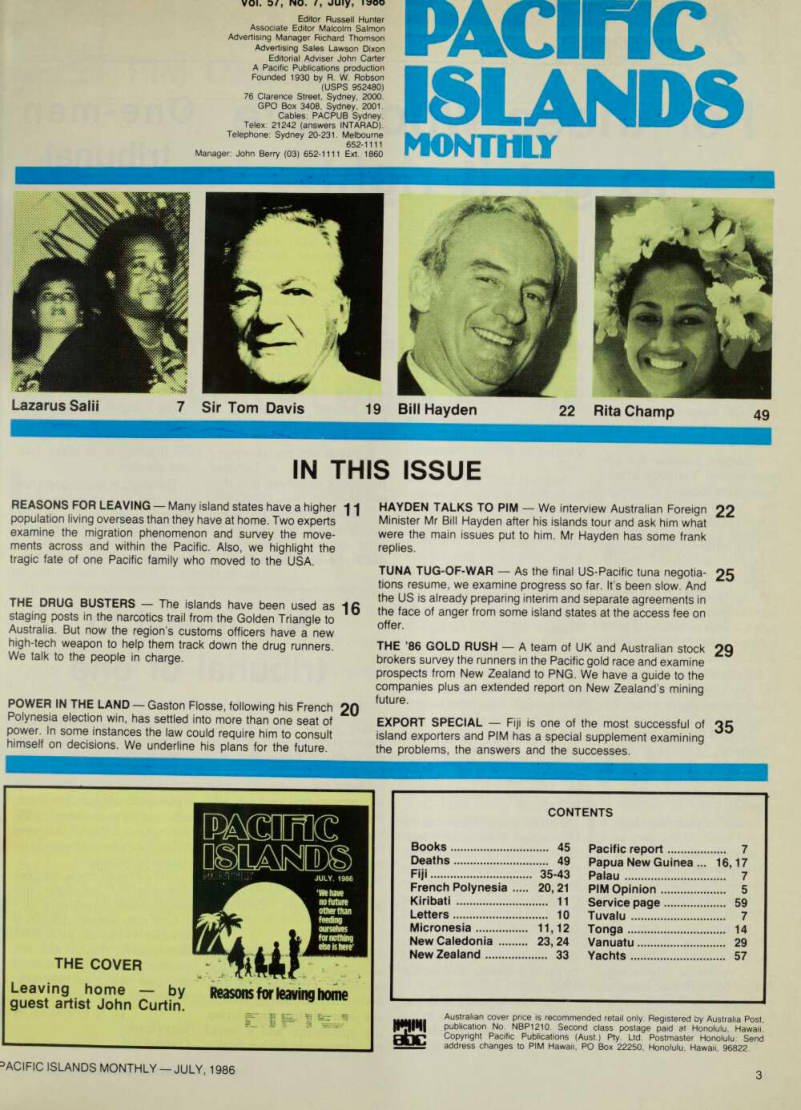
Lazarus Salii 7
Sir Tom Davis 19
Bill Hayden 22
Rita Champ 49
In This Issue
REASONS FOR LEAVING Many island states have a higher *| *| population living overseas than they have at home. Two experts examine the migration phenomenon and survey the move ments across and within the Pacific. Also, we highlight the tragic fate of one Pacific family who moved to the USA.
THE DRUG BUSTERS The islands have been used as 1 £ staging posts in the narcotics trail from the Golden Triangle to Australia. But now the region’s customs officers have a new high-tech weapon to help them track down the drug runners.
We talk to the people in charge.
POWER IN THE LAND Gaston Flosse, following his French 20 Polynesia election win, has settled into more than one seat of power. In some instances the law could require him to consult himself on decisions. We underline his plans for the future.
HAYDEN TALKS TO PIM —We interview Australian Foreign 22 Minister Mr Bill Hayden after his islands tour and ask him what were the main issues put to him. Mr Hayden has some frank replies.
TUNA TUG-OF-WAR —As the final US-Pacific tuna negotia- 25 tions resume, we examine progress so far. It’s been slow. And the US is already preparing interim and separate agreements in the face of anger from some island states at the access fee on offer.
THE ’B6 GOLD RUSH A team of UK and Australian stock 29 brokers survey the runners in the Pacific gold race and examine prospects from New Zealand to PNG. We have a guide to the companies plus an extended report on New Zealand’s mining future.
EXPORT SPECIAL Fiji is one of the most successful of 35 island exporters and PIM has a special supplement examining the problems, the answers and the successes.
Contents
Books 45 Deaths 49 Fiji 35-43 French Polynesia 20, 21 Kiribati 11 Letters 10 Micronesia 11,12 New Caledonia 23, 24 New Zealand 33
Pacific report 7 Papua New Guinea ... 16,17 Palau 7 PIM Opinion 5 Service page 59 Tuvalu 7 Tonga 14 Vanuatu 29 Yachts 57
Australian cover price is recommended retail only. Registered by Australia Post, publication No. NBPI2IO. Second class postage paid at Honolulu, Hawaii.
Copyright Pacific Publications (Aust.) Pty. Ltd. Postmaster Honolulu: Send address changes to PIM Hawaii, PO Box 22250, Honolulu, Hawaii, 96822,
Advertisements & other items, p. 3 (1 item)
3
PACIFIC ISLANDS MONTHLY —JULY, 1986
Editor Russell Hunter Associate Editor Malcolm Salmon Advertising Manager Richard Thomson Advertising Sales Lawson Dixon Editorial Adviser John Carter A Pacific Publications production Founded 1930 by R. W. Robson
(USPS 952480)
76 Clarence Street, Sydney, 2000.
GPO Box 3408, Sydney. 2001.
Cables: PACPUB Sydney.
Telex: 21242 (answers INTARAD).
Telephone: Sydney 20-231. Melbourne 652-1111 Manager: John Berry (03) 652-1111 Ext. 1860
to get it right

letters
For those who have to get it right
One-man tribunal
In doing some research the other day prepartory to writing an article, I turned to your “Pacific Chronology” section in the 15th Edition of the PIM Yearbook hoping to find a shortcut to identifying some dates. I didn’t.
Are you aware that some how, old Louis Antoine de Bougainville who visited Tahiti in 1768, slipped through the cracks between 1767 and 1769? Curious.
I checked the other five edi tions of your Yearbook which I have in my library. He’s present and accounted for in the 4th edition (1942) edited by R.W.
Robson; the 10th (1968) and the 11th (1972), edited by Judy Tudor.
But he isn’t in the 14th (1981). Now did John Carter edit de Bougainville out when he took over as editor for some reason? If so, I’d like to know what it was.
Or did Ms Tudor leave the old boy’s name scrawled on a small slip of paper which flut tered, unseen, to the floor when she handed the files over to her successor? Then, of course, it would have been swept up while the cleaning lady was tidying, to end its identity in the dustbin.
I think he probably ought to be put back. At the very least, he was Tahiti’s first recorded French tourist and got a bust and a street and who knows what all, to commemorate the occasion.
I wonder, too, if Capt. Don Domingo de Boenechea shouldn’t rate a mention in your venerable chronology?
According to Robert Langdon, he dropped by Tahiti from Peru in 1772 and took three Tahi tians away with him.
Then he returned in 1774,
planted a pair of Franciscan Friars and the first European buildings (wooden pre-fabs) on Tahiti. He sailed on to Ra’iatea, returned to Tahiti, died of natu ral causes and was buried there.
The friars, by then, were so paralysed with culture shock they had to be taken away from that “awful’’ place leaving be hind their European mission house. Regardless of their track record, wouldn’t that make them the first Christian miss ionaries to live on Polynesian soil?
And wouldn’t that give the Catholics the dubious distinc tion of giving it a go, first?
Later, when using your chronology for another reason, I discovered that you are not consistent in listing the com plete independence or self government dates of numerous Pacific countries including; Western Samoa, Cook Islands, Nauru, Fiji, Niue and Papua New Guinea. The years are there, but not the days. I had to look up each one individually, which would have been accept able if you’d left all the rest our.
But you didn’t. You gave full dates to Solomon Islands, Tuvalu, Kiribati, Marshall Is., FSM, Vanuatu and the Repub lic of Palau (shouldn’t it be Belau?) Though you mention that the U.S. signed a treaty of friend ship with Tuvalu and Kiribati relinquishing claims to islands in those groups, you neglect to mention that in 1980, (June 11), a similar treaty was signed between the U.S. and the Cook Islands. The treaties with the three countries were approved by the U.S. Senate on June 21, 1983.
In this package, the U.S. also agreed to give up claims to the Tokelaus. Total islands in volved was 26! The Treaty of
Friendship was ratified and signed between the Cook Is. and the U.S. on 9 September 1983. I don’t have the ratificat ion dates for the other countries involved but I’m sure they will appear in the Chronology of your next PIM Yearbook.
I deeply appreciate the very existence of the PIM Yearbook and the tremendous service you perform in producing it.
For myself, I consider it in dispensible.
It travels with me wherever I go along with a battered paperback dictionary and the saurus as my basic necessities.
I imagine there are many people besides myself who de pend on your Yearbook for quick reference because there
The PIM article about land matters in Hawaii was most informative. Their system con trasts with today’s land situation in Fiji.
All non-native agricultural land usage and disputation is dealt with by an Agricultural Tribunal comprised of a single person, who would have to hold one of the most important and powerful positions in the South West Pacific today.
The Tribunal, without benefit of practical legal or judicial experience pronounces his de cision which is, in effect, final and absolute.
The effect in recent years has been that, with exception of the sugar industry, set up entirely by CSR long before Fiji became independent there is virtually no substantial agricultural in-
No appeal to tribunal of one
simply is no other compact Pacific encyclopaedia or alma nac in existence in English, that I’ve ever heard of.
I hope you continue to publ ish, expand and enrich it and thoroughly re-edit it in the years to come for the sake of all researchers, students and people “who need to get it right.’’
Mel Kernahan
Newport Beach, California,
Usa.
* John Carter writes: The ommission has occurred be tween the 11th and 12th edi tions. The chronology section was revised then (not during my editorship) and it could have happened at that time.
dustry in Fiji today. This, not withstanding Fiji’s many thousands of hectares of rich, fertile land.
Experienced investors and developers will not lay them selves open to the whim of the Agricultural Tribunal, knowing full well they have effectively no means of redress.
PlM’s Hawaii article indicates that they do not suffer this development impediment.
One may assume that this is because in Hawaii, as in most democracies, they would not countenance Fiji’s almost medieval one man rule over agricultural land.
D. F. Parkinson
Sunnybank Queensland
than an empty gesture
Pim Opinion
Nuclear treaty more than an empty gesture
It would be easy to view the South Pacific Nuclear Free Zone Treaty, in the light of likely reactions overseas, as little more now than an empty gesture by a group of countries that can’t make the treaty stick.
There is also the view that the treaty is too loose and non-commital to mean anything at all.
Again, it could be seen as an effort by a frustrated minority, a plea to be left alone by the big boys of the world.
And, in the final analysis, what good is a nuclear free zone not recognised by the nuclear powers?
Or, for that matter, one that is not recognised by all of the forum countries?
Part of the answer is that it will do nothing to halt the arms race, French nuclear testing or superpower regional ambition.
What the treaty does do, however, is place on record at the highest level the feelings of the people of the South Pacific, the majority of whom are worried about the risk to their environment presented by a nuclear presence.
The treaty was never going to end French nuclear testing or the passage through the ocean of nuclear ordinance and the signatories knew it.
But the treaty does provide a focus for the varying views of the region. It provides our neighbours with a single entity that goes some way towards encapsulating the forum nations’ with a few notable exceptions views on the nuclear issue.
As Mr Bill Hayden points out (Page 22) the forum states are different, sovereign and they make their own judgements. Which makes consensus an elusive quarry.
The treaty, with all the trade-offs, compromises and
politicking that went into it, remains an expression of the views of the majority of the islanders.
They are worried about the nuclear threat. Worried, but not frantic. On dumping and testing they are adamant.
And while on that subject, it should be borne in mind that a united stance by the South Pacific Forum nations will further isolate France within the region. Not that this has worried France greatly in the past, but a steady build-up of pressure will have some future effect. France has shown many times that she will not be moved from her colonies without severe pressure.
And the forum countries can help ensure that the pressure remains political rather than physical.
There may also be some useful spin-off benefits from the treaty. It has certainly contributed to a higher international awareness of the South Pacific Forum nations which has turned a not always welcome spotlight on such issues as relations with the Russians and the Libyans.
And if the treaty has helped the islands to learn to live with a suddenly interested world it has also helped project the island perspective.
Something of that perspective may even rub off.
Contact with islands people may bring some Americans to be less strongly of the view that anybody who distrusts nuclear weapons is at best anti-American and at worst a communist.
The world may be learning something of the Pacific way while the people of the Pacific take up their proper place in the world.
If that’s all the treaty achieves, it will be enough. For now, at least.
Advertisements & other items, p. 6 (1 item)
National
CZZI
□ ,0
A New Generation VTR
with a Mind of Its Own.
National’s new NV-GlO is a VTR that thinks hard about simple operation.
So you can use it with ease—even if you’ve never owned a piece of video equipment before!
Simply insert a prerecorded cassette with its record tab removed, and the intelligent GlO will switch itself on and begin play. Should you try to record over such a cassette, it will be automatically ejected. You can even eject when the power is off at just the touch of a button.
VMS
For all its brains, the GlO has an incredibly compact body. But one that packs such special features as Super One-Touch Timer Recording that lets you set start and stop times freely, a 14-day/4-programme timer that guides you step-by-step through the programming process with flashing prompts, Cue & Review with Search Lock, and Super-
Still, Super-Still-Advance, and Super-
Fine-Slow playback.
GlO. The intelligent choice for quality and convenience.
National
Your attention is drawn to the fact that recording pre-recorded tapes o discs or other published or broadca National, Panasonic and Technics are the brandnames of Matsushita Electric.
pacific report


Cyclone Devastates
Solomon Islands
Cyclone Namu caused at least 102 deaths with many reported missing. The island of Guadcalcanal was hardest hit, and an international relief operation was immediately launched with help from throughout the region and from Britain and the US. Prime Minister Sir Peter Kenilorea said the country urgently needed emergency shelter for the 90,000 people who lost their homes.
Health officials were worried about the possibility of a major disease outbreak and reported that, in Honiara, dozens of people had been treated for dysentry and eye diseases. Officials warned that, ten days after Namu struck, many parts were still without safe drinking water, Australian Associated Press reported that relief officials were concerned at possible malpractices in the distribution of food aid. The AAP report said some food was being given to distributors’ relatives and some had been diverted for sale. Police were investigating the claims. Sir Peter declared June 2 a day of national mourning as the Australian Navy ship Stalwart arrived in Honiara with tonnes of food, construction materials, tarpaulins, telecommunica tions equipment, water purification plants and steel pylons. However, five tonnes of food donated by village people on Efate, Vanuatu could not be accepted because of quarantine regulations. Un ited Nations funding sources have com mitted US$l.5 million for relief and rehabilitation work. Mr Andrew Nori, who was directing the relief work, said it could be three years before Solomon Islands recovers from the disaster.
Meanwhile, a New Zealand company donated an unusual gift. The manager of the Kiwi Ice Cream Company, Mr Bill Bracks, said he had given 1,000 litres of ice cream to help raise the morale of the islanders who, he said, were good customers, buying some 30,000 to 40,000 litres annually.
Bulekon To Fight
Dismissal Order
Leader of Vanuatu's opposition, Mr Vin cent Bulekon, has promised a Supreme Court challenge to an order by the Speaker, Mr Fred Timakata, that his seat be declared vacant after he had failed to attend three consecutive sittings of Parliament without obtaining the Speaker’s permission. Meanwhile the sitting of Parliament proceeded despite an Opposition boycott. Opposition MPs walked out in protest at Mr Timakata’s decision to vote with the government on a resolution seeking to suspend stan ding orders.
Court Bid To
Halt Compact
THE Republic of Palau’s controversial Compact of Free Association ratification process once again erupted with dissent on the threshold of final US Congressio nal and United Nations approval. On May 20, paramount chief Ibedel Yutaka Gibbons filed a law suit at the ROP Supreme Court against compact pas sage. The high chief and several other plaintiffs name Palau President Lazarus Salii as defendant in the suit, alleging that the compact conflicts with the ROP constitution. In particular, the complaint charges that the compact violates Palau’s constitutional ban on nuclear weapons and gives the US military too many sweeping concessions in what has been the world’s only strategic trust. The suit states that the ROP constitution stipulates that any agreement which “authorises use, testing, storage or disposal of nuclear, toxic, chemical, gas or bioligical weapons intended for use in warfare shall require approval of not less than three-quarters of the votes cast in a referendum. “The 75 per cent issue has been a constant thorn in the side of compact passage, preventing its appro val in a series of political status plebis cites. An accord ballyhooed as a “new, improved compact”, was reached, signed and voted on February 21 resulting, this time, in a 72 per cent approval rating from the voters. Besides attacking the compact on the 75 per cent and nuclear issues, the complaint goes on to charge that the administration “intentionally or negligently misinformed” voters in a US financed $400,000 plebis cite political education program that was not “fair or impartial.” The Palau Senate, too, has expressed last-minute fears regarding the compact. On May 30, it passed a joint resolution stating that any amendments to the accord are subject to final approval by the Palau National Congress (OEK) which is anxious that
the US Congress may adversely amend Palau’s compact as it did the Federated States of Micronesia and Republic of the Marshall Islands’ compacts. The resolu tion has been transmitted to the house of delegates for their approval. And on May 28, the Soviet Union voted “nyet” on T. termination, although Great Bri tain, France, and the United States outvoted it. However, according to the U. charter, article 83, “alteration or amendment” of a strategic trust “shall be exercised by the security council” where the Soviets hold veto power. E.
Rampell.
Libya Link Affects
Tax Haven Status
Vanuatu’s reputation as a safe tax haven for foreign investors may have been harmed by the country’s decision to establish diplomatic links with Libya.
Vanuatu’s finance minister Mr Kalpokor Kalsakau said the government was trying to repair any damage caused. He said the government had not anticipated the impact the Libya link would have. He said the government would advertise in foreign publications to assure potential investors that relations with Libya would not affect foreign investments. Vanuatu, meanwhile, has also established dip lomatic relations with Nicaragua. A joint statement said both countries were de termined to contribute to world peace.
Gold Explorer’S Link
With Hongkong
Gold explorer and miner City and Sub urban Properties Ltd have obtained shareholder approval for a change of name to City Resources. At the same time, directors announced the acquisi tion of a “major interest” in Hongkong in return for a 50 per cent share of its Palmer River Queensland mine and its Vanuatu operations. This will allow City access to the Hongkong market.
Teachers To Get
Salary Payments
The government of Fiji has agreed to pay Fs2.B million it owes in salaries to assistant teachers arising from the re grading of teachers under an award.
Payment is an out-of-court settlement.
The Fiji Teachers Confederation had taken legal action against the Ministry of Education to enforce payment of the money owing because of a mistake in calculations by the Public Service Com mission.
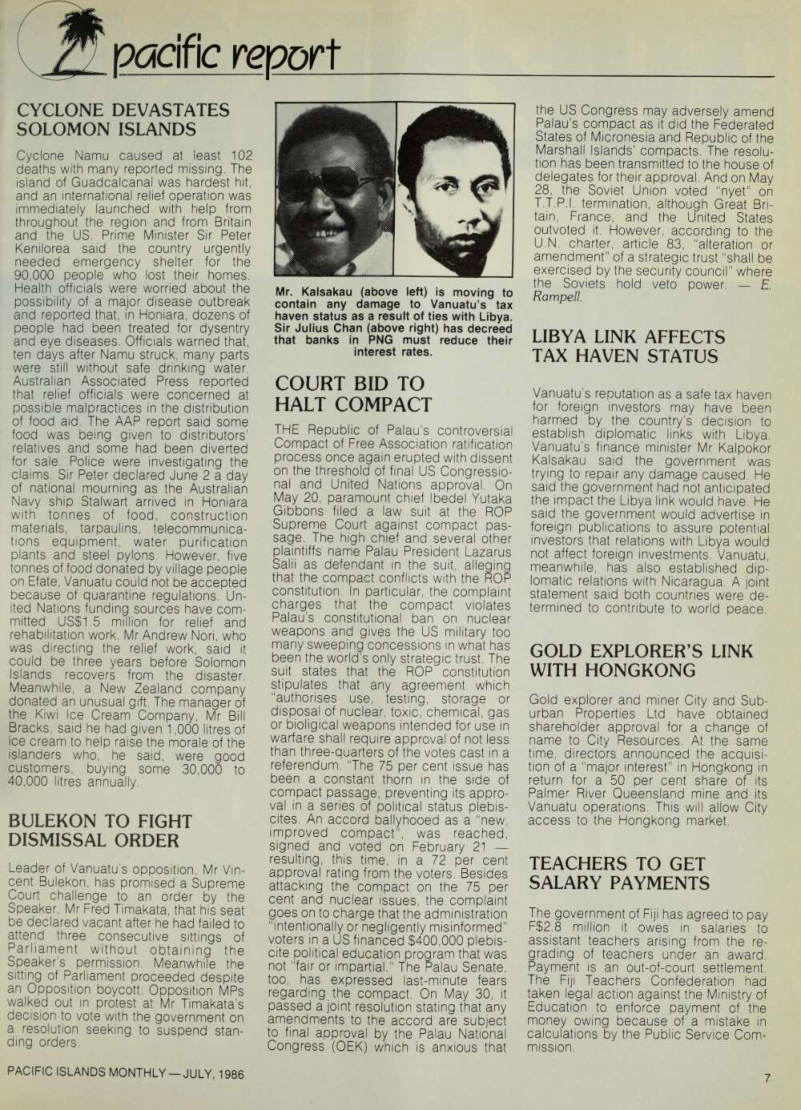
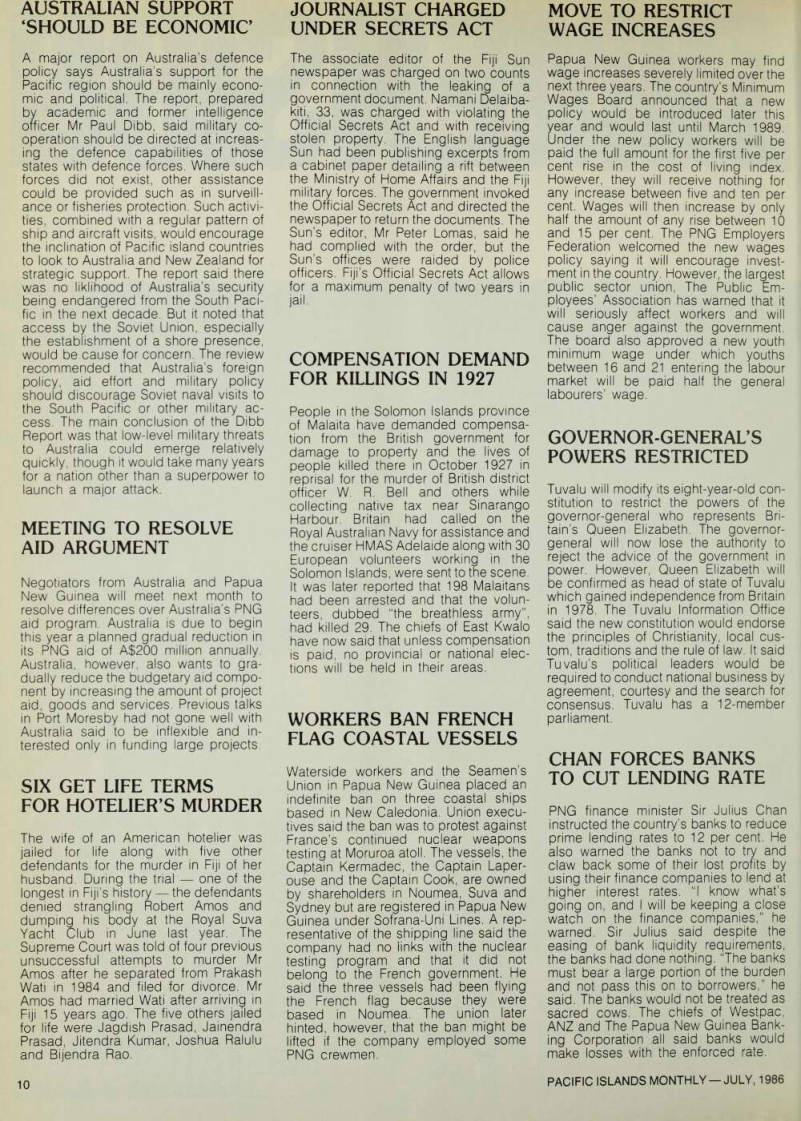
Mr. Kalsakau (above left) is moving to contain any damage to Vanuatu’s tax haven status as a result of ties with Libya.
Sir Julius Chan (above right) has decreed that banks in PNG must reduce their interest rates.
Australian Support
‘Should Be Economic
A major report on Australia’s defence policy says Australia’s support for the Pacific region should be mainly econo mic and political. The report, prepared by academic and former intelligence officer Mr Paul Dibb, said military co operation should be directed at increas ing the defence capabilities of those states with defence forces. Where such forces did not exist, other assistance could be provided such as in surveill ance or fisheries protection. Such activi ties, combined with a regular pattern of ship and aircraft visits, would encourage the inclination of Pacific island countries to look to Australia and New Zealand for strategic support. The report said there was no liklihood of Australia’s security being endangered from the South Paci fic in the next decade. But it noted that access by the Soviet Union, especially the establishment of a shore presence, would be cause for concern. The review recommended that Australia’s foreign policy, aid effort and military policy should discourage Soviet naval visits to the South Pacific or other military ac cess. The main conclusion of the Dibb Report was that low-level military threats to Australia could emerge relatively quickly, though it would take many years for a nation other than a superpower to launch a major attack.
Meeting To Resolve
Aid Argument
Negotiators from Australia and Papua New Guinea will meet next month to resolve differences over Australia’s PNG aid program. Australia is due to begin this year a planned gradual reduction in its PNG aid of As2oo million annually.
Australia, however, also wants to gra dually reduce the budgetary aid compo nent by increasing the amount of project aid, goods and services. Previous talks in Port Moresby had not gone well with Australia said to be inflexible and in terested only in funding large projects.
Six Get Life Terms
For Hotelier’S Murder
The wife of an American hotelier was jailed for life along with five other defendants for the murder in Fiji of her husband. During the trial one of the longest in Fiji’s history the defendants denied strangling Robert Amos and dumping his body at the Royal Suva Yacht Club in June last year. The Supreme Court was told of four previous unsuccessful attempts to murder Mr Amos after he separated from Prakash Wati in 1984 and filed for divorce. Mr Amos had married Wati after arriving in Fiji 15 years ago. The five others jailed for life were Jagdish Prasad, Jainendra Prasad, Jitendra Kumar, Joshua Ralulu and Bijendra Rao.
Journalist Charged
Under Secrets Act
The associate editor of the Fiji Sun newspaper was charged on two counts in connection with the leaking of a government document. Namani Delaiba kiti, 33, was charged with violating the Official Secrets Act and with receiving stolen property. The English language Sun had been publishing excerpts from a cabinet paper detailing a rift between the Ministry of Home Affairs and the Fiji military forces. The government invoked the Official Secrets Act and directed the newspaper to return the documents. The Sun’s editor, Mr Peter Lomas, said he had complied with the order, but the Sun’s offices were raided by police officers. Fiji’s Official Secrets Act allows for a maximum penalty of two years in jail.
Compensation Demand
For Killings In 1927
People in the Solomon Islands province of Malaita have demanded compensa tion from the British government for damage to property and the lives of people killed there in October 1927 in reprisal for the murder of British district officer W. R. Bell and others while collecting native tax near Sinarango Harbour. Britain had called on the Royal Australian Navy for assistance and the cruiser HMAS Adelaide along with 30 European volunteers working in the Solomon Islands, were sent to the scene.
It was later reported that 198 Malaitans had been arrested and that the volun teers, dubbed “the breathless army”, had killed 29. The chiefs of East Kwalo have now said that unless compensation is paid, no provincial or national elec tions will be held in their areas.
Workers Ban French
Flag Coastal Vessels
Waterside workers and the Seamen’s Union in Papua New Guinea placed an indefinite ban on three coastal ships based in New Caledonia. Union execu tives said the ban was to protest against France's continued nuclear weapons testing at Moruroa atoll. The vessels, the Captain Kermadec, the Captain Laper ouse and the Captain Cook, are owned by shareholders in Noumea, Suva and Sydney but are registered in Papua New Guinea under Sofrana-Uni Lines. A rep resentative of the shipping line said the company had no links with the nuclear testing program and that it did not belong to the French government. He said the three vessels had been flying the French flag because they were based in Noumea. The union later hinted, however, that the ban might be lifted if the company employed some PNG crewmen.
Move To Restrict
Wage Increases
Papua New Guinea workers may find wage increases severely limited over the next three years. The country’s Minimum Wages Board announced that a new policy would be introduced later this year and would last until March 1989.
Under the new policy workers will be paid the full amount for the first five per cent rise in the cost of living index.
However, they will receive nothing for any increase between five and ten per cent. Wages will then increase by only half the amount of any rise between 10 and 15 per cent. The PNG Employers Federation welcomed the new wages policy saying it will encourage invest ment in the country. However, the largest public sector union, The Public Em ployees’ Association has warned that it will seriously affect workers and will cause anger against the government.
The board also approved a new youth minimum wage under which youths between 16 and 21 entering the labour market will be paid half the general labourers’ wage.
Governor-General’S
Powers Restricted
Tuvalu will modify its eight-year-old con stitution to restrict the powers of the governor-general who represents Bri tain’s Queen Elizabeth. The governor general will now lose the authority to reject the advice of the government in power. However, Queen Elizabeth will be confirmed as head of state of Tuvalu which gained independence from Britain in 1978. The Tuvalu Information Office said the new constitution would endorse the principles of Christianity, local cus tom, traditions and the rule of law. It said Tuvalu’s political leaders would be required to conduct national business by agreement, courtesy and the search for consensus. Tuvalu has a 12-member parliament.
Chan Forces Banks
To Cut Lending Rate
PNG finance minister Sir Julius Chan instructed the country’s banks to reduce prime lending rates to 12 per cent. He also warned the banks not to try and claw back some of their lost profits by using their finance companies to lend at higher interest rates. “I know what’s going on, and I will be keeping a close watch on the finance companies,” he warned. Sir Julius said despite the easing of bank liquidity requirements, the banks had done nothing. “The banks must bear a large portion of the burden and not pass this on to borrowers," he said. The banks would not be treated as sacred cows. The chiefs of Westpac, ANZ and The Papua New Guinea Bank ing Corporation all said banks would make losses with the enforced rate.
Advertisements & other items, pp. 8-9 (1 item)
Mrrhh|
in s 1 a ' aa:; *la ail* a:-;V : ”-4 1 |w . - '-tH©. x - n 1 ■ i I ‘
; lip MB » iM m «mv.- . *J « i » a * fev m m Wm
Strength
The Nissan Pickup's ladder frame frame and body are built for extra strength.
A vehicle’s strength depends on a complex interplay of varied factors. The overall design.
The body structure. The quality of the materials it is built of. The individual performance of the various mechanical components. Only when a vehicle is outstanding from every angle can it be said to possess genuine strength.
It is precisely this all-round excellence that gives the Nissan Pickup its extra margin of dependability. From the engine to the frame, the body panels to the suspension, the transmission to the bumpers, everything has been integrated into a vehicle of unsurpassed performance and durability.
In addition to the four usually found on ordinary makes, the closed-section features a fifth cross member which, together with a more rational layout, enables the Pickup to tolerate heavier loads.
For further structural rigidity, the side members are made of thicker steel plates.
Add to that a double-wishbone front suspension and a leaf-spring rear suspension, plus a large-capacity, power-packed engine, and it’s easy to see why more people depend on the Pickup to handle tough jobs on rough roads.
In other words, the Pickup has a singular strength that comes from a complete rational matching of diverse parts into one unbreakable whole.
And it succeeds because it has that intangible yet very real quality that makes a Nissan what it is—The Nissan Dimension.
Quality in motion
Reasons for leaving
Too many people, not enough land; too few resources, not enough money; great expecta tions, poor results is this how Pacific islanders view their home lives?
In many instances the answer appears to be ‘yes’.
And many of these people find the only workable solution to be migration to one of the Pacific rim’s developed coun tries. And once they have gone, they rarely return for other than short holidays.
Inevitably, too, it’s the most skilled workers who leave, de priving their homelands of any return on their investments in education.
That’s how the population migration problem is often de bated.
However, evidence is emer ging of a different, more com plex scenario.
In his paper “Population and economic development in the island nations of the South Pacific’’Dennis Ah rlberg argues that there is no aggregate regio nal picture.
“There is no evidence of significant impact of population on economic development ... for Fiji, Solomon Islands, Ton ga, Vanuatu, Western Samoa or a larger sample of SPC members for the late 19705.”
However, he does see sup port for a negative impact of population on Fiji’s deve lopment between 1956 and 1983.
“Most nations plan to create jobs in the rural sector. How ever, serious barriers to this policy exist. Among these are insufficient investment, land te nure arrangements, capital in tensive crops and technologies, migration and rising expecta tions tied to urban employ ment,” notes Ahlberg.
“If a child’s future income is determined by his or her pa rents’ income, and poor parents have more children than richer parents, the population growth
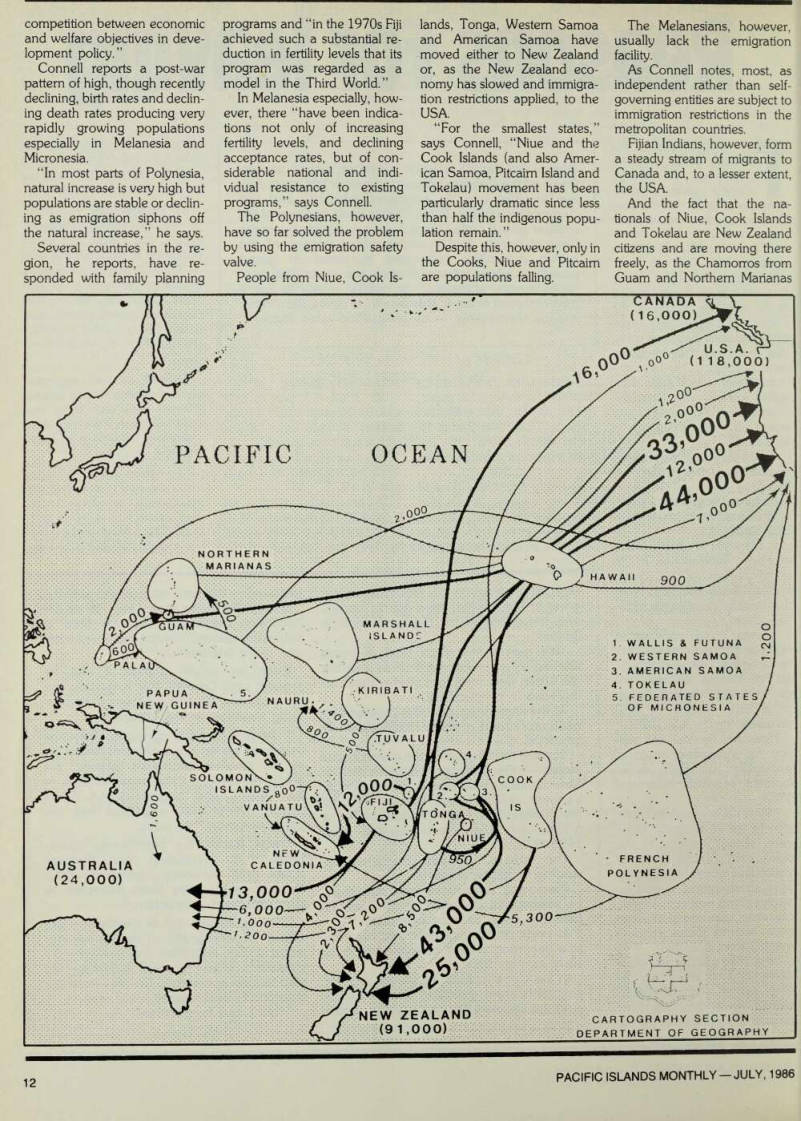
One of the Pacific islands’ staple exports is people.
Some of the greatest concentrations of islanders now live in cities such as Auckland, Honolulu and Los Angeles rather than in the Pacific itself. In some of the smaller island states there are more people overseas than at home. And if conventional images of the region are often conceived in terms of island paradises where a tranquil existence in conditions of “subsistence affluence” is readily available for a small amount of work, this is not the perception in the islands themselves as emigration rates show.
... worsens the distribution of income,” he writes in his paper, published in the collection “Selected Issues in Pacific Is lands Development” by the ANU’s National Centre for De velopment Studies.
The only data Ahlberg could find on income distribution came from Fiji where, depen ding on whether you’re rich or poor, the picture is either very
rosy or very gloomy.
“In 1968 4.9 per cent of private income went to the bottom 20 per cent of the population,” he records.
This rose to 5.1 per cent in 1972 but collapsed to 3.7 per cent in 1977.
The corresponding figures for the top 20 per cent were; 48.2, 47.7, and 53.3. In other words, by 1977 the top fifth of the
population accounted for more than half of the nation’s income while the bottom fifth could call on less than one twenty-fifth.
In “Paradise Left” a chap ter of a book studying migration around the Pacific rim to be published in the USA this year John Connell of the Sydney University geography depart ment agrees with Ahlberg that population growth rates in most South Pacific island countries are still high by world stan dards.
Connell has an aggregate regional growth rate of around 2.5 per cent and notes that some observers have suggested a looming crisis as population outstrips resources.
“A critical issue in future development is that of maintaining, let alone impro ving, existing standards of living in the face of both rapid popu lation increases and intensified
Population pressure on resources is not great in the Pacific, says John Connell, and the potential for mechanisation is limited.
This means that rural land is being worked by a smaller residual population (as urban drift continues) but without an increase in productivity.
At the same time, growing populations need more food either home grown or imported.
Connell reports that of the seven larger states Fiji, French Polynesia, Papua New Guinea, Solomon Islands, Tonga, Vanuatu and Western Samoa only PNG increased food production at a greater rate than its population from 1965-1978.
The others dropped considerably, leading to higher imports.
Previously productive land may even be abandoned in favour of remittances from the cities or from overseas.
In parts of Fiji migration had resulted in a declining area of cultivated land as early as the 19505.
In the Cook Islands, he states, regular payments from overseas appear to en courage middle-aged and elderly people
to abandon full-time agricultural activity.
Especially in the atoll states, lands are becoming neglected and the idea of achieving self-sufficiency becomes more and more implausible.
Even on larger islands it can be argued, says Connell, that migration is a far more lucrative investment than any thing available in the village.
“The processes of agricultural decline that have earlier gone on elsewshere, as in the smaller Caribbean islands, are being repeated on the small islands of the Pacific and especially on those where international migration has be come common,” he says.
These trends are continuing, some times at an increasing pace, through urban drift “whereas increased urban demand might have been expected to stimulate rural production.”
“The establishment of capitalism and with it the emergence of cash cropping, wage labour, migration and greater indi vidualism within nuclear families, has also tended to separate families from the community and women from men.
“This trend is universal.”
competition between economic and welfare objectives in deve lopment policy.”
Connell reports a post-war pattern of high, though recently declining, birth rates and declin ing death rates producing very rapidly growing populations especially in Melanesia and Micronesia.
“In most parts of Polynesia, natural increase is very high but populations are stable or declin ing as emigration siphons off the natural increase,” he says.
Several countries in the re gion, he reports, have re sponded with family planning
programs and “in the 1970 s Fiji achieved such a substantial re duction in fertility levels that its program was regarded as a model in the Third World.”
In Melanesia especially, how ever, there “have been indica tions not only of increasing fertility levels, and declining acceptance rates, but of con siderable national and indi vidual resistance to existing programs,” says Connell.
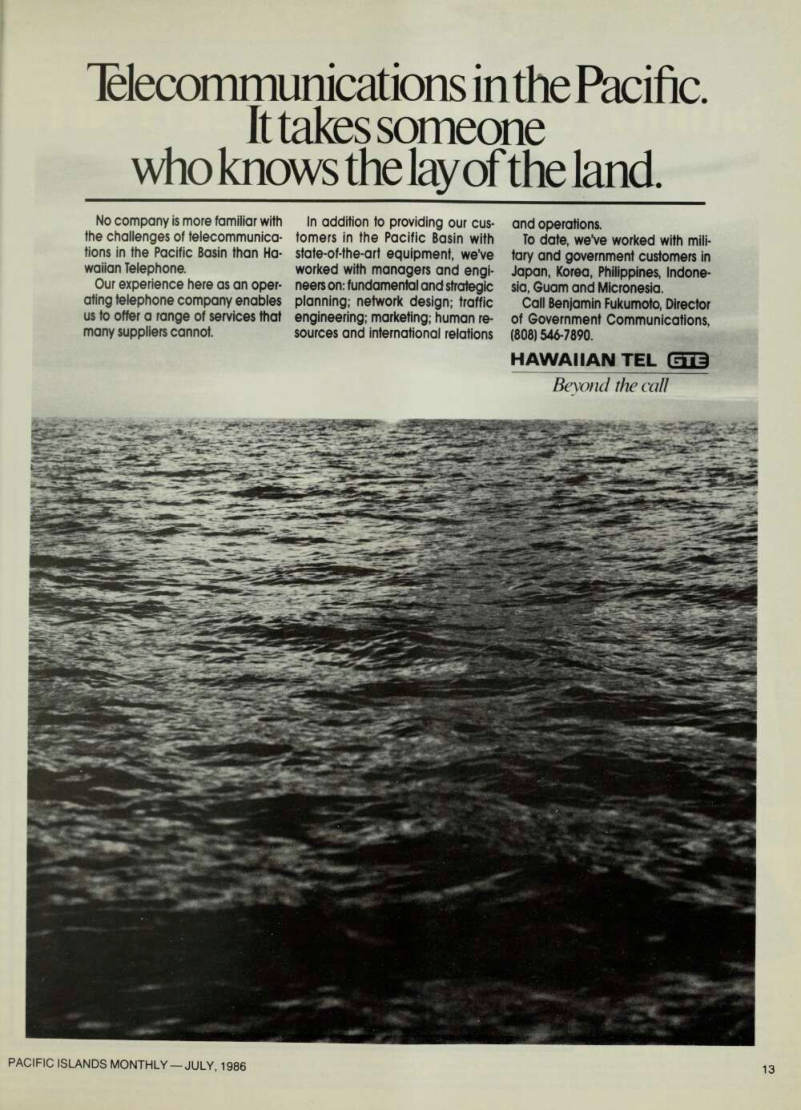
The Polynesians, however, have so far solved the problem by using the emigration safety valve.
People from Niue, Cook Is
lands, Tonga, Western Samoa and American Samoa have moved either to New Zealand or, as the New Zealand eco nomy has slowed and immigra tion restrictions applied, to the
Usa.
“For the smallest states,” says Connell, “Niue and the Cook Islands (and also Amer ican Samoa, Pitcairn Island and Tokelau) movement has been particularly dramatic since less than half the indigenous popu lation remain.”
Despite this, however, only in the Cooks, Niue and Pitcairn are populations falling.
The Melanesians, however, usually lack the emigration facility.
As Connell notes, most, as independent rather than self governing entities are subject to immigration restrictions in the metropolitan countries.
Fijian Indians, however, form a steady stream of migrants to Canada and, to a lesser extent, the USA.
And the fact that the na tionals of Niue, Cook Islands and Tokelau are New Zealand citizens and are moving there freely, as the Chamorros from Guam and Northern Marianas
move to the USA, seems to suggest an underlying desire to emigrate that is stifled else where by immigration restric tions.
However, notes Connell, the signing of the Compact of Free Association between the former entities of the Trust Territory of the Pacific Islands (Palau, Mar shall Islands, Northern Marianas and FSM) and the USA allows free movement be tween those states and the US.
And “although Micronesians are not well-placed for Amer ican employment (by virtue of distance, language ability and skills) it is likely that out migration will increase substan tially within the next decade.”
Also, there is the possibility that Australia may be soon be more willing to accept Pacific islanders, especially from Kiri bati and Tuvalu.
“If this proves to be the case,” says Connell “Australian employment opportunities will be welcomed throughout the Pacific. ”
Few would argue with this conclusion.
Already, says Connell, “ex cluding Papua New Guinea, more than one out of every ten Pacific islanders are in the met ropolitan countries fringing the region, and, excluding French Polynesia (and New Zealand Maoris and Hawaiians) one third of all Polynesians are overseas. ”
Though data is scarce, says Connell, it appears, that most emigration is permanent.
Thus, the number of Pacific islanders in Australia more than doubled between 1971 and 1981, although growth may have slowed recently as a result of New Zealand migration re strictions.
In the USA the number at least doubled in about the same period.
Connell also notes the chan ging attitute in the islands to work in the agricultural sector which “has been losing pre stige. ”
Throughout the region there are fewer and fewer young men willing to work in the gardens seeing cash employment in the urban service industries as more attractive.
In some countries education is geared to that outlook. “In Kiribati, attempts to introduce vocational education in com munity high schools have been strongly opposed by parents concerned that their children will be unable to obtain bureaucratic employment,” says Connell, while many educational systems “inevitably result in a disdain for rural life. ”
Connell quotes Tongan anthropologist ‘Epeli Hau’ of a: “Once you are educated, once your mind is expanded, subsistence on a remote little island is simply unacceptable ...
Psychologically we are no longer islanders. Travel has changed our material values and expectations, drained us of talent, changed outlooks within families and transformed eating
habits ... We have no future other than feeding ourselves, for nothing else is here.”
“Invariably,” says Connell, “migration results in the loss of the most energetic, skilled and innovative individuals and this loss is not compensated either by remittances or by urban and national development.”
What’s more, the brain drain is likely to continue.
The process of migrants (urban and international) retur ning remittances to their kin at home fuels a desire for goods which, once acquired, encour age the tendency to want more, which in turn leads to a need for more wage employment and so it goes.
“Earlier wants,” says Con nell, “have become needs.”
Indeed, Ahlberg cites other
writers (including Connell) when he states that “remitt ances are primarily spent on imported consumption goods and the church.”
And external migration is but an extension of internal migra tion urban drift.
Ahlberg reports that, in Fiji, the Central region has had an exceptionally high inflow which reflected high outflows of popu lation in the agricultural areas.
The picture is the same in the Solomon Islands with predomi nantly young men seeking wage employment.
And while Ahlberg’s study did not include Papua New Guinea, it would be hard to argue that Port Moresby’s con siderable problems are not caused by migration. staff writers.
Island families who migrate to the golden opportunities of the USA do not always find what they are looking for.
Many find themselves confined in little better than ghetto conditions in the large US cities.
Alcohol, drugs and crime are one inevitable result of this environment.
Frustration at being unable to enjoy the standard of living of those around them who seem to acquire effortless wealth leads many immig rants to despair It may have led one young Tongan man to his grave, as Ralph Craib reports from San Francisco.
The young Tongan father shot and killed his estranged wife while hol ding police off in a 48-hour siege.
He himself was shot dead by police when they dynamited their way into the convenience food store in Fort Worth, Texas.
This gun-slinging Texas shoot-out went on for so long that ice cream vendors set up stands nearby for the throngs of people who drove to witness the scene.
Malone (Maro) Mataele, 27, went to a Kwik Pantry food store where his estranged wife, Casandra, known as Sane, was employed and took her hostage.
The store is in the suburban com munity of Euless, where some 800
Tongans have settled in the past few years.
It’s a small piece of Nukualofa deep in the heart of Texas, it seems.
Police tried repeatedly to negotiate a peaceful outcome to the hostage drama. They begged Mataele to let his wife go free and to throw down his .38 calibre pistol.
One of Mataele’s brothers spoke to him on the telephone while another went into the store against police orders to try and talk the young father out of his anger.
It was when the brother was told on the telephone by Mataele that he had already killed his wife, that the waiting police decided to act.
Officers said that they feared Mataele, reported as “increasingly hostile” in telephone conversations, would kill the brother who had gone inside.
They said Matele had twice earlier agreed to surrender but had then reneged.
His major concern, police said, was to see his 8-year-old daughter.
The negotiating officers said they would make sure he saw her all he wanted if he would only throw his gun into the street.
Instead of disarming himself, he aimed his gun at one of the police entering the dynamited back door.
He died moments later in a hail of police fire.
Advertisements & other items, pp. 13-16 (2 items)
Telecominunications in the Pacific
It takes someone
who knows the lay of the land.
No company is more familiar with the challenges of telecommunications in the Pacific Basin than Hawaiian Telephone.
Our experience here as an operating telephone company enables us to offer a range of services that many suppliers cannot.
In addition to providing our customers in the Pacific Basin with state-of-the-art equipment, we’ve worked with managers and engineers on: fundamental and strategic planning; network design; traffic engineering; marketing; human resources and international relations and operations.
To date, we’ve worked with military and government customers in Japan, Korea, Philippines, Indonesia, Guam and Micronesia.
Call Benjamin Fukumoto, Director of Government Communications, (808)546-7890.
HAWAIIAN TEL HTR
Beyond the call
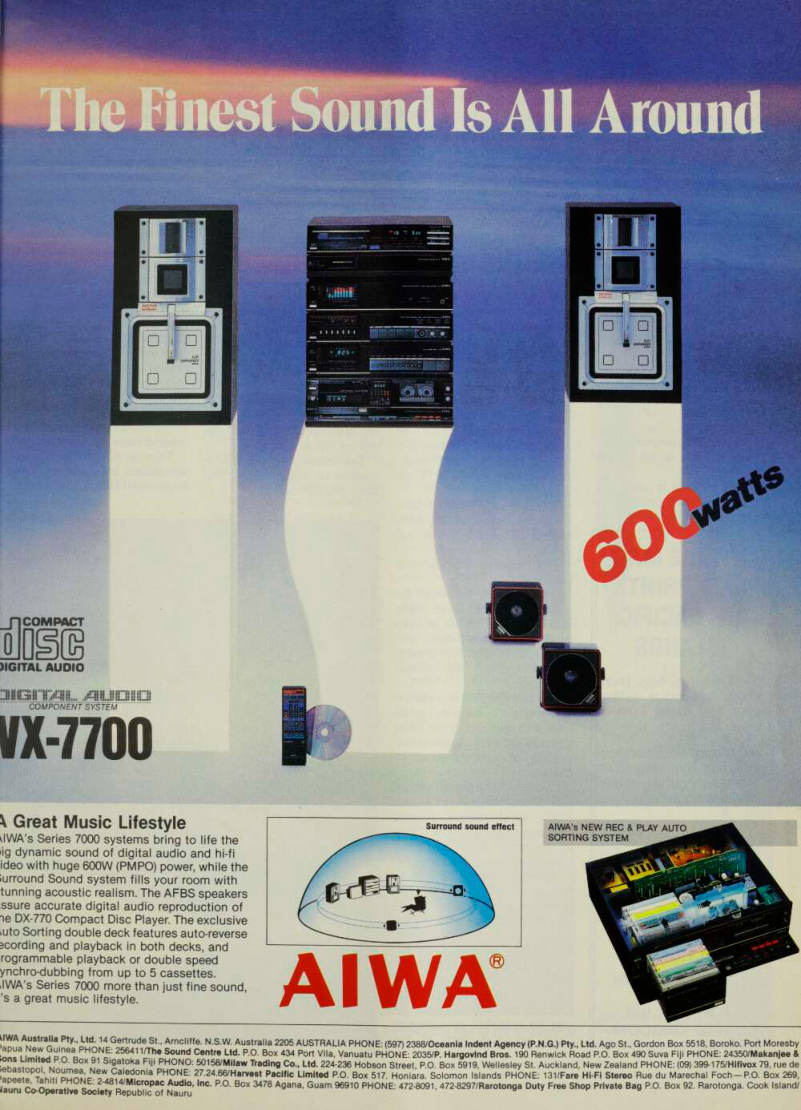
)IGITAL AUDIO
3IBBT/8L jfIIOOHO
COMPONENT SYSTEM
lIX-7700
\ Great Music Lifestyle
JWA’s Series 7000 systems bring to life the iig dynamic sound of digital audio and hi-fi ideo with huge 600 W (PMPO) power, while the iurround Sound system fills your room with tunning acoustic realism. The AFBS speakers ssure accurate digital audio reproduction of ie DX-770 Compact Disc Player. The exclusive kUto Sorting double deck features auto-reverse scording and playback in both decks, and rogrammable playback or double speed ynchro-dubbing from up to 5 cassettes.
JWA’s Series 7000 more than just fine sound, ’s a great music lifestyle.
I Surround sound effect
AlWA’s NEW REC & PLAY AUTO
SORTING SYSTEM
AIWA
>l!!^r ra r ta - P^il^ll: G £ l rude St ’’ Arncl,ffe - N S W - Australia 2205 AUSTRALIA PHONE: (597) 2388/Oceania Indent Agency (P.N.G.) Pty., Ltd. Ago St., Gordon Box 5518, Boroko. Port Moresby i imLoAQ 256411/The Sound Centre Ltd. P.O. Box 434 Port Vila, Vanuatu PHONE; 2035/P. Hargovlnd Bros. 190 Renwick Road P.O. Box 490 Suva Fiji PHONE: 24350/Makanjee & ' 80x91 S '9 atoka F| j' PHONO: 50158/Milaw Trading Co., Ltd. 224-236 Hobson Street, P.O. Box 5919, Wellesley St. Auckland, New Zealand PHONE: (09) 399-175/Hifivox 79, rue de Znll p P ?l’h N f°Duntic N^ Q C . a^ fedoma PHONE: 27.24.66/Harvest Pacific Limited P.O. Box 517. Honiara. Solomon Islands PHONE: 131/Fare Hi-Fi Stereo Rue du Marechal Foch-P.O. Box 269, laum Co-Ope ti Sod ty R o ™^ o AUdi °’ ln °' R °' B ° X 3478 A93na ’ GU3m 96910 PHONE: 472 ' 8091 - 472-8297/Rarotonga Duty Free Shop Private Bag P.O. Box 92. Rarotonga. Cook Island/
ANTIQUE MAPS
AND PRINTS
OF PACIFIC
ISLANDS
Send for my new illustrated catalogue listing over 100 items from a large stock.
All islands represented together with items from Australia and New Zealand.
All items are genuine and date from 1772 to the beginning of this century.
Efficient postal service.
COLIN
HINCHCLIFFE
12 QUEENS STAITH
MEWS
YORK YOI IHH
UNITED KINGDOM
Reasons for leaving
Battle To Bust
If the Pel-Air inquiry which covered alleged drug traf ficking proved anything, it proved that, at the very least, serious attempts have been made to stage illegal drugs through Papua New Guinea en route to Australia.
Most people, particularly ex patriates, are aware of the PNG “drugs scene” which extends to locally available herbal mari juana.
Fewer, however, are aware of the large scale attempts to smuggle heroin, usually from the Golden Triangle, into Aus tralia through the South Pacific islands.
At least, that is, until the Pel-Air affair brought it to in ternational prominence.
The Pel-Air inquiry, estab lished by the PNG government under former prime minister Michael Somare and extended by current prime minister Paias Wingti, is due to report to the Parliament next month.
It centred on the aborted search by PNG customs officers of an Australian aircraft at Port Moresby.
Dogs trained to sniff out drugs had reacted positively to the aircraft, but after a call from
The island states of the South Pacific have been used as staging posts in the international narcotics trade because of their remote and often under-patrolled nature. Now, however, the region’s customs services are making a joint effort to stem the flow.
one of the passengers, then prime minister Somare arrived at the airport, the search was called off and the aircraft allowed to leave.
Other evidence unearthed in Australia has shown that there were attempts to bring heroin into Australia through PNG.
Australian and PNG customs officials are unable to give fi gures to illustrate just how much drug running is going on.
But they do know that there have been other cases.
While the Pel-Air inquiry was taking place in Port Moresby, a regional drugs “summit” meet ing was taking place in Can berra.
This brought together cus toms and police officers from the South Pacific region as well as officers from Interpol.
The regional co-operation continues.
The problem, however, for customs officers is to keep watch on one of the world’s largest expanse of water, with thousands of islands and mas sive and often very remote coastlines.
The islands route is attractive to smugglers because small ships and light aircraft can often travel long distances unnoticed.
That, at least, is about to change.
Australian customs official Col Vassarotti told PIM that PNG, as Australia’s nearest neighbour, was seen as a “likely staging post” for drug smug gling.
“There is a degree of history associated with that (drug run ning from Asia through PNG to Australia), but there is no recent history that I’m in a position to talk about,” he said.
“But certainly we have every reason to believe that narcotics have been staged through PNG in the same way that Australia can be regarded as- a staging point for other parts of this
region, for example New Zealand.”
Mr Vassarotti, Assistant Comptroller-General, Barrier Enforcement A, said Australia was New Zealand’s main source of narcotics.
He believed that the majority of drugs staged through PNG and other Pacific islands were moved in small craft “and we have some evidence of that.”
Australia maintains a string of customs posts around its nothem seaboard, where speciallytrained officers are posted.
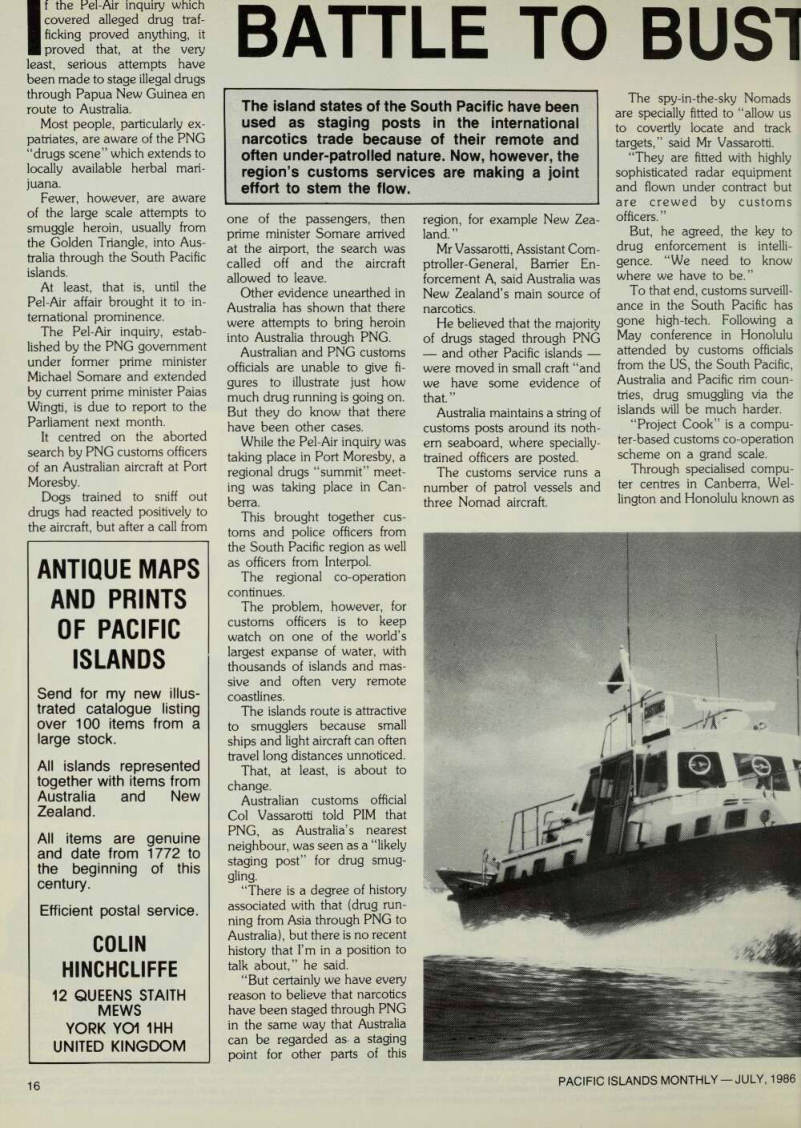
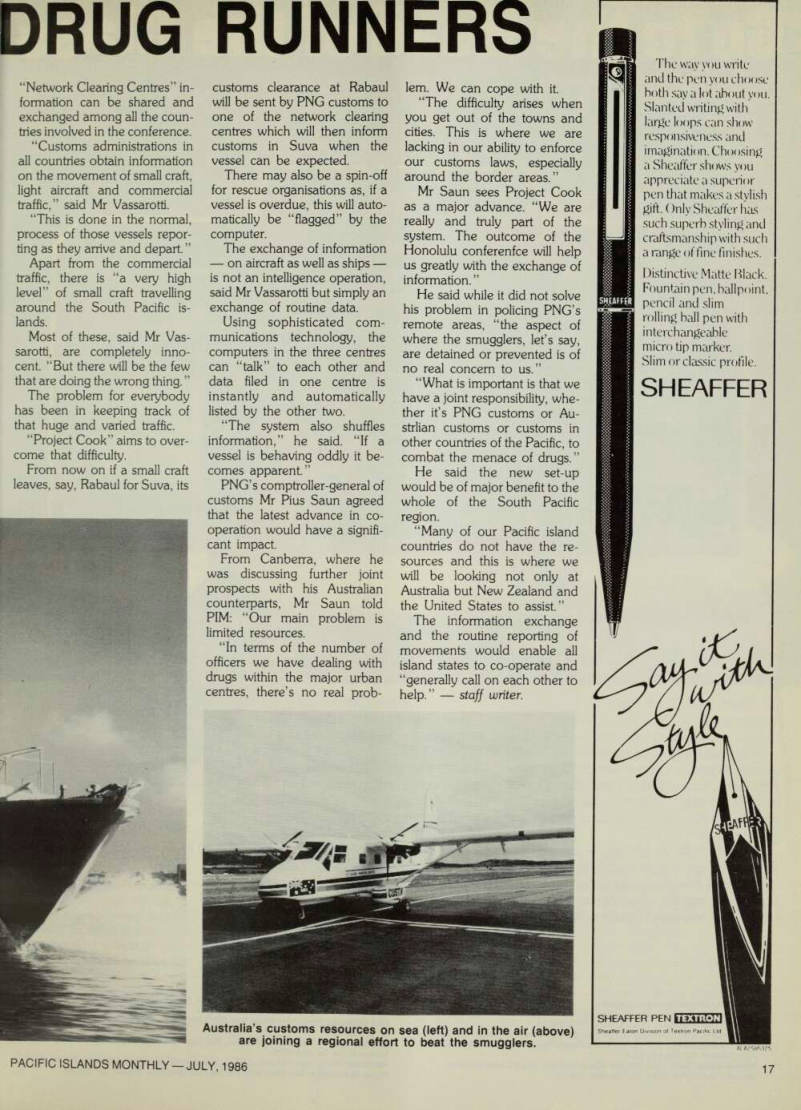
The customs service runs a number of patrol vessels and three Nomad aircraft.
The spy-in-the-sky Nomads are specially fitted to “allow us to covertly locate and track targets,” said Mr Vassarotti.
“They are fitted with highly sophisticated radar equipment and flown under contract but are crewed by customs officers. ”
But, he agreed, the key to drug enforcement is intelli gence. “We need to know where we have to be.”
To that end, customs surveill ance in the South Pacific has gone high-tech. Following a May conference in Honolulu attended by customs officials from the US, the South Pacific, Australia and Pacific rim coun tries, drug smuggling via the islands will be much harder.
“Project Cook” is a compu ter-based customs co-operation scheme on a grand scale.
Through specialised compu ter centres in Canberra, Wel lington and Honolulu known as
“Network Clearing Centres” in formation can be shared and exchanged among all the coun tries involved in the conference.
“Customs administrations in all countries obtain information on the movement of small craft, light aircraft and commercial traffic,” said Mr Vassarotti.
“This is done in the normal, process of those vessels repor ting as they arrive and depart. ”
Apart from the commercial traffic, there is “a very high level” of small craft travelling around the South Pacific is lands.
Most of these, said Mr Vas sarotti, are completely inno cent. “But there will be the few that are doing the wrong thing. ”
The problem for everybody has been in keeping track of that huge and varied traffic.
“Project Cook” aims to over come that difficulty.
From now on if a small craft leaves, say, Rabaul for Suva, its
customs clearance at Rabaul will be sent by PNG customs to one of the network clearing centres which will then inform customs in Suva when the vessel can be expected.
There may also be a spin-off for rescue organisations as, if a vessel is overdue, this will auto matically be “flagged” by the computer.
The exchange of information on aircraft as well as ships is not an intelligence operation, said Mr Vassarotti but simply an exchange of routine data.
Using sophisticated com munications technology, the computers in the three centres can “talk” to each other and data filed in one centre is instantly and automatically listed by the other two.
“The system also shuffles information,” he said. “If a vessel is behaving oddly it be comes apparent.”
PNG’s comptroller-general of customs Mr Pius Saun agreed that the latest advance in co operation would have a signifi cant impact.
From Canberra, where he was discussing further joint prospects with his Australian counterparts, Mr Saun told PIM: “Our main problem is limited resources.
“In terms of the number of officers we have dealing with drugs within the major urban centres, there’s no real prob
lem. We can cope with it.
“The difficulty arises when you get out of the towns and cities. This is where we are lacking in our ability to enforce our customs laws, especially around the border areas.”
Mr Saun sees Project Cook as a major advance. “We are really and truly part of the system. The outcome of the Honolulu conferenfce will help us greatly with the exchange of information. ”
He said while it did not solve his problem in policing PNG’s remote areas, “the aspect of where the smugglers, let’s say, are detained or prevented is of no real concern to us.”
“What is important is that we have a joint responsibility, whe ther it’s PNG customs or Au strian customs or customs in other countries of the Pacific, to combat the menace of drugs.”
He said the new set-up would be of major benefit to the whole of the South Pacific region.
“Many of our Pacific island countries do not have the re sources and this is where we will be looking not only at Australia but New Zealand and the United States to assist.”
The information exchange and the routine reporting of movements would enable all island states to co-operate and “generally call on each other to
help.”
staff writer.
Australia’s customs resources on sea (left) and in the air (above) are joining a regional effort to beat the smugglers.
Advertisements & other items, pp. 17-18 (1 item)
Sheaffer
f The way you write and the pen you choose both say a lot about you Slanted writing with large loops can show responsiveness and imagination. Choosing a Sheaffer shows you appreciate a superior pen that makes a stylish gift. Only Sheaffer has such superb styling and craftsmanship with such a range of fine finishes.
Distinctive Matte Black.
Fountain pen. ballpoint, pencil and slim rolling ball pen with interchangeable micro tip marker.
Slim or classic profile.
SHEAFFER
k •At
SHEAFFER PEN
Go to the Head of the Glass ?• p m mm X 770 □ ill Go ahead, move up to Pioneer’s New Personna Plus X-770 shelf-component system, and discover peerless perfection.
This super-sophisticated mini-sized sound system offers full-function remote control for amp, tuner, cassette deck, turntable, and the optional CD player. Together, they put cutting edge audio technology at your command as Pioneer alone can.
Simulated Stereo lets you enjoy wide, stereo-like signals from mono signals. And Stereo Wide brings you expanded ambience from stereo signals, so you’re as turned on as possible no matter what you tune in!
Power? 320 W Peak Music Power Output from the double auto-reverse cassette deck/amplifier. You’ll flip over the music, without flipping the tape over, as well as enjoy double cassette convenience.
Of course, the X-770 also brings you great features like 5-band graphic equalizer, Mic Mixing, Dolby* B/C NR, and more.
The New Personna X-770. Go for it and go to the head of the class. * “Dolby" and the double-D symbol are trademarks of Dolby Laboratories Licensing Corporation.
Note: The optional PD-X707(8K) CD player is showrrabove.
Qb PIONEER
The future of sound and vision.
For further information, please contact: Australia: Pioneer Electronics Australia Pty. Ltd. (Incorporated in Victoria), P.O. Box 295, Mordialloc, Victoria, 3195 Tel: 580-9911 Fiji Islands: Brijlal & Company, G.P.O. Box No. 362, Suva, Fiji Islands Tel; 22258 New Zealand: Monaco Distributors Ltd., 2 Poland Road, Glenfield, Auckland, New Zealand Tel: (09) 444-9144 Norfolk Island: Burns Philp (Norfolk Island) Ltd., P.O. Box 21, Norfolk Island Vanuatu: Burns Philp (Vanuatu) Ltd., Vila, Vanuatu Nauru Island: Jacob Enterprises, P.O. Box No. 4, Republic of Nauru Tahiti: Tahiti Hi-Fi, P.O, Box 848, Papeete, Tahiti New Caledonia: Menard Pacifique Sari, B.P. 3899, Noumea, New Caledonia Tel: 27*62.23 American Samoa: Transpac Corporation, P.O. Box 1477, Pago Pago, American Samoa 96799 Tel: 633-5224 Rarotonga; South Seas International Ltd, P.O. Box 49, Rarotonga, Cook Islands Tel: 2327 Papua New Guinea: Bali Merchants Pty. Ltd, P.O. Box 6103, Boroko Tel: 254887
bulk buying plan
Oil summit rejects bulk buying plan
South Pacific Forum energy ministers met in Suva to consid er a World Bank report on the supply and pricing of oil and petroleum products in the is lands.
The report, instigated by is land governments to examine supply options and landed costs of oil, was given a thorough going over by the group chaired by Sir Tom Davis, the current forum chairman.
Apart from its lending facili ties, the World Bank has a management support program and it was under its auspices that a group of consultants funded by the United Nations Development Program were commissioned to carry out a study.
The object of the exercise was to establish whether the island nations could achieve economies of scale by forming a bulk purchasing group for oil.
The experts said the forum nations could increase their market muscle by buying to gether as a joint business ven ture.
They would then be in a position to call tenders from around the world.
The report suggested that, by taking up a large supply of oil, then on-selling to individual countries, the joint venture would be able to attract more competitive tenders.
The system would allow the successful tenderer to deposit fuel at all those ports able to accommodate large tankers.
It was also suggested that the oil would be sold at these points to existing marketing com panies who would become the local wholesalers.
They would also be responsi ble for on-shipping to smaller states unable to harbour the big tankers.
With nearly ail of the South Pacific Forum nations heavily dependent on imported oil for their energy needs, the regional heads are getting together to try to reduce their oil bills.
PlM’s Suva correspondent reports.
The forum oil requirement, the group estimated, is 16,000 barrels per day and the island nations spend $260 million a year at current oil prices.
The consultants said that, under their arrangement, that figure could have been shaved by $9 million.
The Suva meeting looked briefly at studies on the supply and prices of petroleum.
The consultants had agreed that there were opportunities for the forum nations to reduce the cost of petroleum products both off-shore and, in many cases, at home.
They also agreed that a re gional refinery would be grossly uneconomic (perhaps finally laying to rest a proposal bruited around the region for at least five years).
Some questions remained: • Has the decline in oil prices reduced the need for action? • Is a national or regional approach the best way to re duce oil costs? • What would be the best way of establishing a tender? • How much would it cost to administer a regional agree ment?
The Suva meeting has appointed a sub-committee to consider the region’s response to the World Bank report.
The meeting’s spokesman Mr Filipe Bole, Fiji’s minister with out portfolio, said the gathering had been highly successful.
But he said there was little point in pursuing the idea of the regional states consolidating their requirements into a single oil supply contract.
Nevertheless, he insisted, there are other opportunities for achieving worthwhile savings.
Delegates felt emphasis should be placed on efforts to improve the existing system through the oil companies.
All agreed that more informa tion was needed and offers of assistance from Australia and the oil companies in the gathering and processing of data were readily accepted.
In the longer term, the forum will investigate opportunities that may be open to the Micronesian countries as well as the possibility of supply from the new refinery being commis sioned in New Zealand.
Australia and Indonesia can also expect approaches.
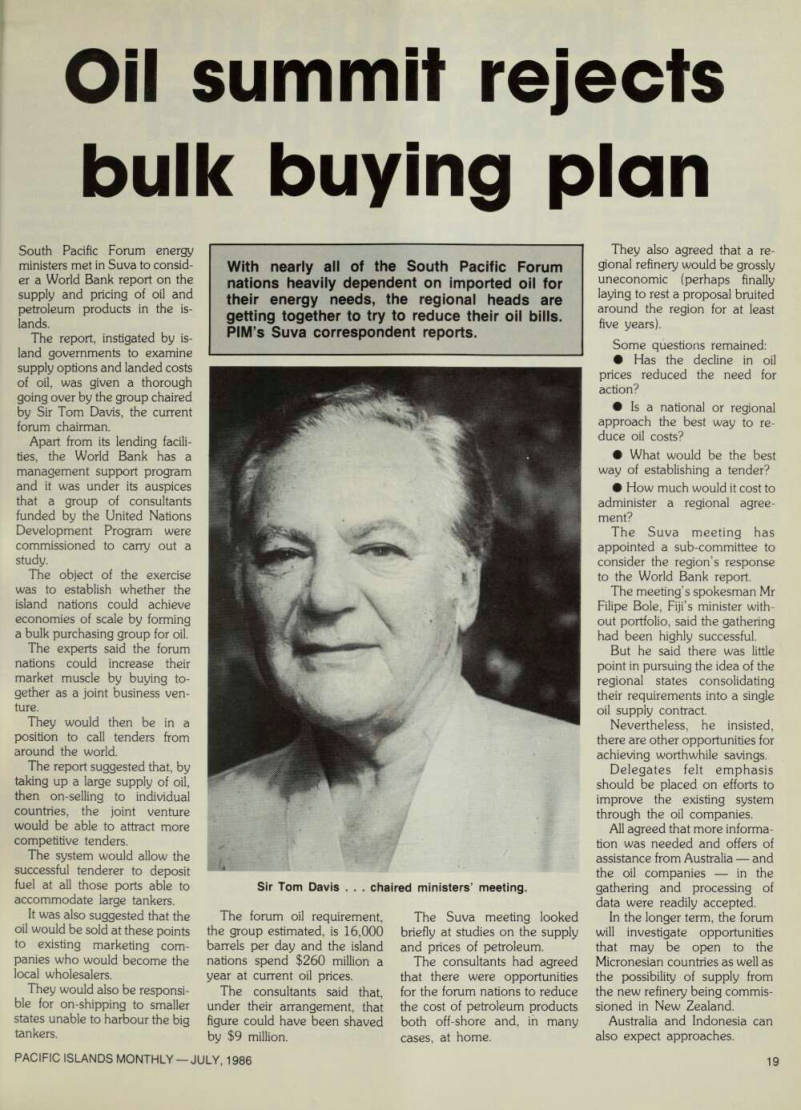
Sir Tom Davis ... chaired ministers’ meeting.
the seats of power
Flosse settles into the seats of power
Concurrent with the March territorial elections in French Polynesia, resul ting in a victory for in cumbent Premier Gaston Flos se and his Tahoeraa Party (PIM May 86, p. 25), and totally overshadowed by them, was a separate election to fill the territory’s two seats in the French National Assembly.
The seats for the first time allocated on a proportional basis in a single constituency comprising the whole of French Polynesia went to Gaston Flosse and his right hand man Alexandre Leontieff, due to the inability of the opposition lead ers to agree on a common list.
The latter found the self administered bitter pill particu larly hard to swallow, as the total number of ballots cast in favor of their six competing lists was an impressive 43,771 whereas the winning Tahoeraa team obtained only 30,571 votes.
The high turnout was solely due to the fact that, quite exceptionally, these “national” elections were this time held jointly with the territorial polls, which alone are able to arouse the passions of the local voters.
Normally, no such “package deal” is offered, and as a result voter turnout in these “na tional” elections is feeble, due to their futility.
For what can the two forlorn representatives of the Polyne sian people achieve in the French parliament in Paris, made up of a vastly superior number of deputies (increased by the socialist government from 491 to 577), who know nothing and care even less about the very special problems of 170,000 natives in a remote South Sea colony?
How little weight the wishes and protests of the overseas deputies carry was most clearly demonstrated during the 1984 crisis in New Caldedonia, when
the Melanesian deputy Rock Pidjot spoke either to an empty or a hostile house.
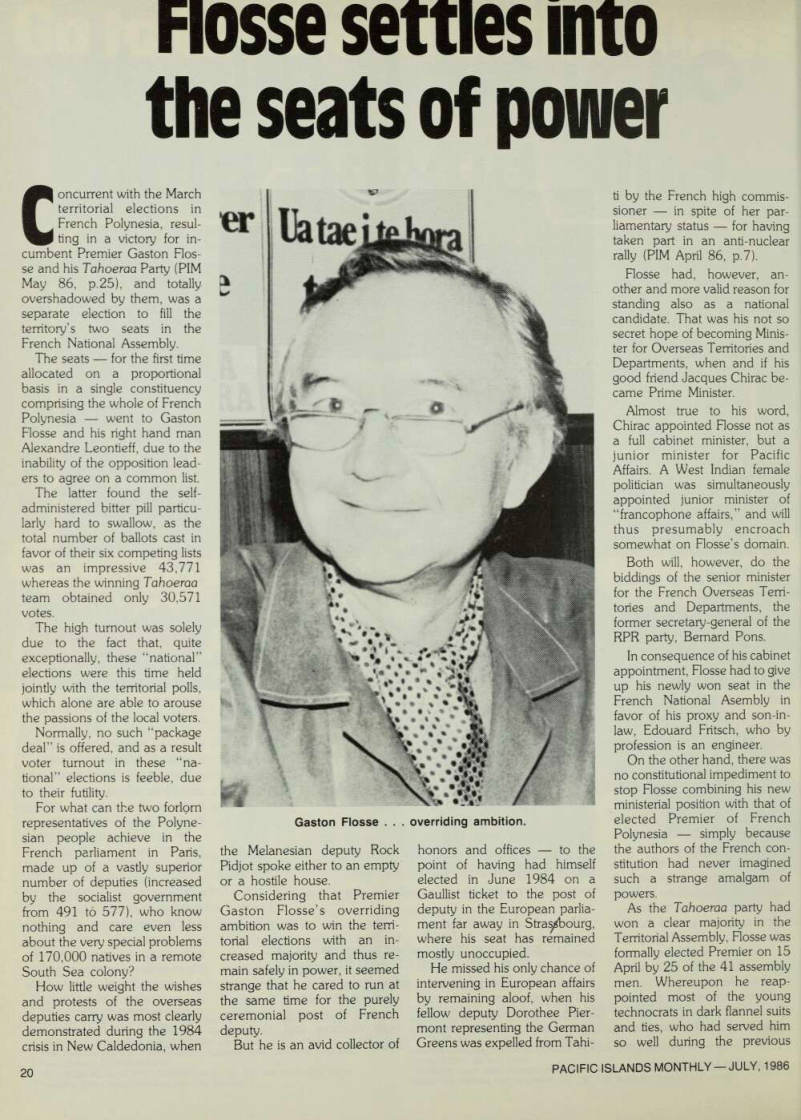
Considering that Premier Gaston Flosse’s overriding ambition was to win the terri torial elections with an in creased majority and thus re main safely in power, it seemed strange that he cared to run at the same time for the purely ceremonial post of French deputy.
But he is an avid collector of
honors and offices to the point of having had himself elected in June 1984 on a Gaullist ticket to the post of deputy in the European parlia ment far away in Strasbourg, where his seat has remained mostly unoccupied.
He missed his only chance of intervening in European affairs by remaining aloof, when his fellow deputy Dorothee Pier mont representing the German Greens was expelled from Tahi
ti by the French high commis sioner in spite of her par liamentary status for having taken part in an anti-nuclear rally (PIM April 86, p. 7).
Flosse had, however, an other and more valid reason for standing also as a national candidate. That was his not so secret hope of becoming Minis ter for Overseas Territories and Departments, when and if his good friend Jacques Chirac be came Prime Minister.
Almost true to his word, Chirac appointed Flosse not as a full cabinet minister, but a junior minister for Pacific Affairs. A West Indian female politician was simultaneously appointed junior minister of “francophone affairs,” and will thus presumably encroach somewhat on Flosse’s domain.
Both will, however, do the biddings of the senior minister for the French Overseas Terri tories and Departments, the former secretary-general of the RPR party, Bernard Pons.
In consequence of his cabinet appointment, Flosse had to give up his newly won seat in the French National Asembly in favor of his proxy and son-in law, Edouard Fritsch, who by profession is an engineer.
On the other hand, there was no constitutional impediment to stop Flosse combining his new ministerial position with that of elected Premier of French Polynesia simply because the authors of the French con stitution had never imagined such a strange amalgam of powers.
As the Tahoeraa party had won a clear majority in the Territorial Assembly, Flosse was formally elected Premier on 15 April by 25 of the 41 assembly men. Whereupon he reap pointed most of the young technocrats in dark flannel suits and ties, who had served him so well during the previous
Gaston Flosse ... overriding ambition.
term, to the same ministenal posts in his ten-man local gov ernment.
Incidentally, a first attempt to convene the Assembly on 11 April came to nothing, due to the lack of a quorum, resulting from the decision of the princi pal opposition parties to boycott all sessions until the courts had heeded their request to condemn the Tahoeraa party for electoral fraud.
Then at the second convoca tion, when only a simple major ity was required to achieve a quorum, newly elected assemblyman Oscar Temaru, popped up like a jack in the box and virtually stole the show with an impassioned, two-hour speech in favor of immediate and complete independence.
As we have previously re ported, high commissioner Ber nard Gerard had sworn to get Temaru, even if he had to use the flimsiest pretext (PIM March 86, pp 20-22).
But so many Polynesians approved of Temaru’s stand that he was catapaulted into the Territorial Assembly, together with the second candidate on his list, James Salmon. So instead of ending up in jail, like another independence fighter, Charlie Ching, here was Temarse in the Assembly, in front of the TV cameras, speak ing to the Polynesian people in their own tongue.
Still another newly elected assemblyman, J. M. Raapoto, took advantage of this opportunity to make his more moderate, pro-Polynesian views heard.
It was therefore something of an anti-climax, when Gaston Flosse eventually strode to the rostrum and began reading a long catalogue of social and economic measures he prom ised his new government would deliver.
In fact, his speech was most noteworthy for the total absence of any references to the two most burning issues: a local referendum for or against continued nuclear testing at Moruroa, and a thorough health survey of the whole Polynesian population to be carried out by impartial medical doctors.
Yet, before March 16, Flosse had constantly favored these proposals both in public and in
discussions with t-rench cabinet ministers (PIM March 85, pp. 29-30).
What Flosse did say in his inaugural speech was essential ly that he still has an absolute faith in a free enterprise system of the American type, based on tourism and with a very soft welcome mat for all foreign investors.
The main stumbling block in Flosse’s view is the virtual monopoly held by the French UTA airline, which is totally opposed to low fare charter flights and prefers to restrict the number of regular flights, so as to be sure of full aircraft.
To emphasise the point, Flos se flew the following day to Paris (to be initiated into the mysteries of his ministerial duties), not on UTA but on a Qantas plane.
The day after that, UTA announced expanded Pacific services on such a magnificent scale that there will be 10,000 additional seats during the rest
ot the year.
The local UTA director in sisted the timing of this announcement was pure coincidence.
At the local level, meanwhile, a most curious situation now arises. Flosse the Premier should take orders from Flosse the cabinet minister. Up to now, the role and duty of the gov ernor, recently restyled high commissioner, has been to keep a watchful eye on the Premier and the whole local government and tell them what the constitution allows them to do.
But the high commissioner was in his turn simply the executor of the policies decided by his superior the Parisian minister for overseas territories and departments. With the triangular rule just instituted, what will happen to the new high commissioner, old Pacific hand, Pierre Angeli, governor of French Polynesia from 1969 to 1973.
in the wider Pacific context, as Flosse has already on several occasions explained his role will be that of a French ambassador whose main task will be to implement the policy recently formulated by Mitterand’s for mer adviser Regis Debray.
This aims to offer large-scale cultural exchange programs and generous grants to other Pacific governments, personali ties and students in the hope that the whole nuclear issue will eventually be washed away by the general flood of good-will thus generated. (PIM March 86, pp 20-22).
So far, however, all previous attempts by French cabinet ministers, diplomats, high com missioners and special emissar ies, including Regis Debray, have failed to soften opposition to the Mururoa tests.
As a local derm, Flosse may be more acceptable to other Pacific leaders. Only time can tell if it will work Marie- Therese and Bengt Danielsson
Science probes the mystery
of seafood poisoning
Sea food poisoning the scourge of many Pacific islands is less of a mystery now than it was, thanks to research by a team of scientists.
New Zealand volunteer Dominic McCarthy with his Kiri bati counterpart Temakei Teba no have helped the scientific community come close to a breakthrough after their study of ciguatoxic fish poisoning.
In co-operation with USP and the University of Hawaii, the microscopic single cell algae which cause the poisoning were collected for examination.
The Kiribati team collected the organism from fish caught in the atolls, and were able to give the Hawaii scientists a regular supply of the algae.
The Hawaii researchers, as a result, are close to identifying the chemical characteristics of the ciguatoxin molecule.
The two Kiribati scientists, in fact, became the world’s major supplier at that time. Even though it meant storing boxes of fish in ice and flying them
from Tarawa to Hawaii. With sparse ice making facilities, it was no easy task.
However, as far as the Hawaii researchers were con cerned, it was batter than the previous method of collection taking samples from re staurants in Japan or France.
Fish poisoning can be fatal but is more often debilitating and painful with a lengthy re covery period.
Thousands of Pacific fisher men are struck down each year, with Kiribati and Tokelau suffering the highest incidence in the region.
McCarthy and Tebano sur veyed all 16 islands in the Gilberts group, the former Brit ish colony, to establish the distribution of toxic fish and gain historical information on the existence of the poison in different islands.
They found the toxin in 14 of the 16 islands surveyed.
Once ciguatoxin enters the food chain it can stay there for years. McCarthy recalled re
search over 25 years ago that found the organism in decline.
The latest information finds, however, that nothing has changed.
Island notions that the dis ease is seasonal can be dis counted, says McCarthy. This appears to occur only because the fish that carry the organism may be seasonal visitors.
Ciguatoxic fish poisoning can be very localised. One side of a small atoll can be toxic with a beach 500 metres or so away free of symptoms.
And an area previously thought toxin free can suddenly have the organism turn up.
One test for fish poisoning is to feed suspect fish to a cat and then closely monitor the reac tion for three hours. The cat will be unharmed but will simply regurgitate any infected fish.
While none of the resear chers have yet found a “cure” the work is continuing, thanks to the dedication of the Kiribati team.
Hayden signals Australia's 'concerns'
The South Pacific Nuclear Free Zone Treaty (SPNFZ) was one of the major themes of Austra lian Foreign Minister Bill Hayden’s tour of the Pacific islands, he told PIM in an exclusive interview.
He also encountered concern over the Soviet presence.
He told PIM; “There was pretty evident concern over the potential for Russian activity in the Pacific a concern that this might lead to superpower
rivalry and the sort of com petitiveness and tensions that it might bring in its wake.
“On the other hand, coun tries also acknowledged that there is a need for a number of the island states, most of which have very narrow resource bases, to take up any legitimate commercial prospect that be comes available.
“They feel a keen need to have independent sources of commercial income. We re
spect and recognise that.
“But I suspect this is a point that we’ll hear more of as time goes by.”
There is a body of opinion in Washington that feels Austra lia’s attitude to the Russian overtures is complacent.
Hayden rejects that view.
“I don’t believe that the Americans have said that there has been any complacency on Australia’s part.
“At every contact I’ve had
with them bilaterally, they have commended the role that Aus tralia plays and acknowledged that Australia can fulfill a pro ductive role in this region much more successfully than the Americans generally can on past experience.”
Mr Hayden also discussed Vanuatu’s relationship with Libya. He was reminded in Port Vila that Vanuatu had a sovereign right to establish rela tions with any country it
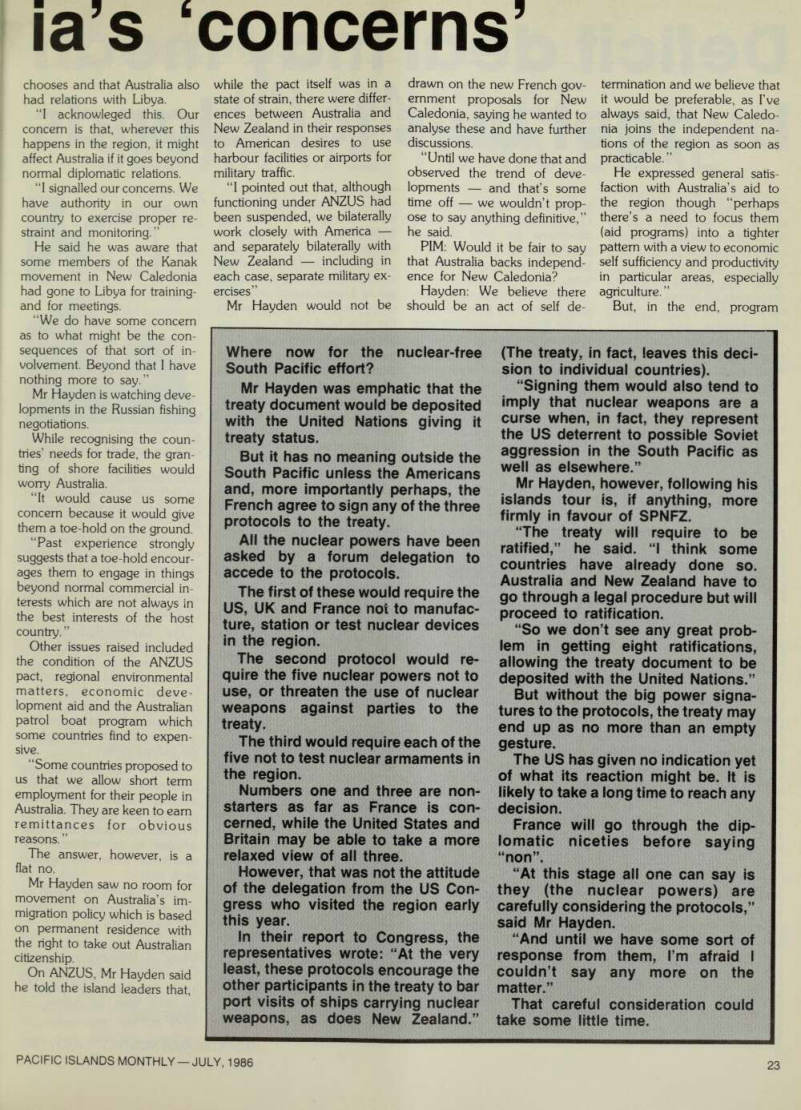
Mr. Hayden is no stranger to the Pacific. During a previous visit he made friends with the Raun Raun Theatre Group in Goroka, PNG.
chooses and that Australia also had relations with Libya.
“I acknowleged this. Our concern is that, wherever this happens in the region, it might affect Australia if it goes beyond normal diplomatic relations.
“I signalled our concerns. We have authority in our own country to exercise proper re straint and monitoring.”
He said he was aware that some members of the Kanak movement in New Caledonia had gone to Libya for training and for meetings.
“We do have some concern as to what might be the con sequences of that sort of in volvement. Beyond that I have nothing more to say.”
Mr Hayden is watching deve lopments in the Russian fishing negotiations.
While recognising the coun tries’ needs for trade, the gran ting of shore facilities would worry Australia.
“It would cause us some concern because it would give them a toe-hold on the ground.
“Past experience strongly suggests that a toe-hold encour ages them to engage in things beyond normal commercial in terests which are not always in the best interests of the host country. ”
Other issues raised included the condition of the ANZUS pact, regional environmental matters, economic deve lopment aid and the Australian patrol boat program which some countries find to expen sive.
“Some countries proposed to us that we allow short term employment for their people in Australia. They are keen to earn remittances for obvious reasons. ”
The answer, however, is a flat no.
Mr Hayden saw no room for movement on Australia’s im migration policy which is based on permanent residence with the right to take out Australian citizenship.
On ANZUS, Mr Hayden said he told the island leaders that,
while the pact itself was in a state of strain, there were differ ences between Australia and New Zealand in their responses to American desires to use harbour facilities or airports for military traffic.
“I pointed out that, although functioning under ANZUS had been suspended, we bilaterally work closely with America and separately bilaterally with New Zealand including in each case, separate military ex ercises”
Mr Hayden would not be
drawn on the new French government proposals for New Caledonia, saying he wanted to analyse these and have further discussions.
“Until we have done that and observed the trend of developments and that’s some time off we wouldn’t propose to say anything definitive,” he said.
PIM: Would it be fair to say that Australia backs independence for New Caledonia?
Hayden: We believe there should be an act of self de-
termination and we believe that it would be preferable, as I’ve always said, that New Caledo nia joins the independent na tions of the region as soon as practicable. ”
He expressed general satis faction with Australia’s aid to the region though “perhaps there’s a need to focus them (aid programs) into a tighter pattern with a view to economic self sufficiency and productivity in particular areas, especially agriculture.”
But, in the end, program
Where now for the nuclear-free South Pacific effort?
Mr Hayden was emphatic that the treaty document would be deposited with the United Nations giving it treaty status.
But it has no meaning outside the South Pacific unless the Americans and, more importantly perhaps, the French agree to sign any of the three protocols to the treaty.
All the nuclear powers have been asked by a forum delegation to accede to the protocols.
The first of these would require the US, UK and France not to manufac ture, station or test nuclear devices in the region.
The second protocol would re quire the five nuclear powers not to use, or threaten the use of nuclear weapons against parties to the treaty.
The third would require each of the five not to test nuclear armaments in the region.
Numbers one and three are non starters as far as France is con cerned, while the United States and Britain may be able to take a more relaxed view of all three.
However, that was not the attitude of the delegation from the US Con gress who visited the region early this year.
In their report to Congress, the representatives wrote: “At the very least, these protocols encourage the other participants in the treaty to bar port visits of ships carrying nuclear weapons, as does New Zealand.”
(The treaty, In fact, leaves this deci sion to individual countries).
“Signing them would also tend to imply that nuclear weapons are a curse when, in fact, they represent the US deterrent to possible Soviet aggression in the South Pacific as well as elsewhere.”
Mr Hayden, however, following his islands tour is, if anything, more firmly in favour of SPNFZ.
“The treaty will require to be ratified,” he said. “I think some countries have already done so.
Australia and New Zealand have to go through a legal procedure but will proceed to ratification.
“So we don’t see any great prob lem in getting eight ratifications, allowing the treaty document to be deposited with the United Nations.”
But without the big power signa tures to the protocols, the treaty may end up as no more than an empty gesture.
The US has given no indication yet of what its reaction might be. It is likely to take a long time to reach any decision.
France will go through the dip lomatic niceties before saying “non”.
“At this stage all one can say is they (the nuclear powers) are carefully considering the protocols,” said Mr Hayden.
“And until we have some sort of response from them, I’m afraid I couldn’t say any more on the matter.”
That careful consideration could take some little time.
priorities were a matter for negotiation with the recipient countries.
In the case of PNG, the biggest recipient of Australian aid, Mr Hayden said there was a slow move towards project, as opposed to budgetary, aid.
All Australian aid, with the exception of PNG, is project aid.
“We are now proposing that a portion of the budget 1 think it’s $6 million dollars this year should go to project aid and this proportion will grow over time,” he said.
If that rate was accelerated too quickly PNG and Austra lia would have trouble in mobilising assessments and submissions.
“Neither of us have sufficient skilled, experienced people in those areas at this point be
cause neither of us have had to work in this area.”
Project aid, said Mr Hayden, lends “more concreteness and has a better realtionahisp to the principles of maximising the rate of economic deve lopment. ”
Did he see Australia as hav ing an opinion forming role in the South Pacific?
Hayden: We are no opinion former. We don’t want to fulfill that role. An opinion former would tend to represent a na tional personality overshadow ing other countries, imposing, perhaps, its values or views on other countries.
“We want none of those roles. We’re separate, sovereign independent and we make our own judgements. We want countries to respect that right because we respect it in other countries.”
budget cuts for islands
Deficit deal may mean budget cuts for islands
The US federal government is at war with itself over how to handle the worst budget deficit in two centuries of the country’s history.
And this means budgetary uncertainty all across the Cen tral and South Pacific in island dependencies and affiliates which receive an annual sub sidy of $187.7 million from Washington.
Some $8.2 million has already been chopped from island (excluding Hawaii) budgets early this year as part of the Pacific contribution to US fiscal solvency.
But more will be taken de pending on events, including a US Supreme Court decision expected this month.
The cuts, thus far, do not
appear to be terribly damaging.
They have meant reduced allocations for long distance telephone calls and off-island travel and some salary reduc tions.
American Samoa has intro duced a two per cent sales tax for the first time in the territory’s history. The Pago Pago Marine Railway has been transferred to private ownership and a private owner is being sought for the Rainmaker Hotel, Tutuila’s most important tourist hostelry.
Congressman Fofo I. F.
Sunia, American Samoa’s non voting member of Congress, was able to report in his regular radio broadcast from Washing ton that he had successfully won an allocation of $1.2 mil lion for classrooms and a new
school gymnasium, $1 million for a housing loan program and $600,000 for new medical equipment.
He said he had been working to ensure that American Samoa would have a capital improve ment budget of $6.5 million in the new fiscal year.
But cuts could come later even though Congressman Sunia said the powerful House of Representatives’ Committee on Interior and Insular Affairs supported his goals.
Frank Quimby, press assis tant to Guam’s non-voting Congressman Ben Blaz, said Guam had suffered no signifi cant budget cuts this year and no capital improvement pro jects had been lost.
Guam depends to an ex traordinary extent on federal funds which come in at the combined rate of some $621 million a year.
But there is no conflict be tween that figure and the lesser $187.7 to island governments as the Guam figure includes a huge military component spent on the island but not given to the Guam government.
The Guam money, in fact, breaks down into $334 million in civilian and military salaries, $ll2 million in federal govern ment purchases and $72 mil lion in various federal social programs including pensions, food stamps and welfare pay ments.
Uncertainty over some of these funds arises because the US Congress, alarmed at huge budget deficits, passed legisla tion known as the Gramm- Rudman-Hollings Act.
If this law is upheld by the Supreme Court, it will result in flat, across-the-board budget cuts in many non-social govern ment programs.
The measure has been
much-criticised in the US be cause it will remove discretion from local government authori ties.
In the worst possible cases envisioned by critics, jail guards and hospital nurses may be fired although money could be saved by trimming less essential programs.
The Gramm-Rudman-Holl ings legislation passed, how ever, because Republican President Ronald Reagan and a House of Representatives con trolled by opposition Demo crats could not agree on any other way to trim the burgeon ing federal deficit.
Gramm-Rudman-Hollings has already embroiled Guam in a costly dispute. Federal law provides that all federal taxes collected in Guam should be rebated to the territory a matter of some $3O million each year.
Guam lost $1.29 million of this money earlier this syear and wants it back.
It could lose a lot more in future if Washington applies Gramm-Rudman-Hollings to funds that it once said should be sent back to Agana.
Ralph Craib.
Congressman Sunia won cash for schools and housing.
Advertisements & other items, p. 24 (1 item)
Hayden signals ‘concern’
24
PACIFIC ISLANDS MONTHLY-JULY, 1986
from page 23
Separate Tuna Deal
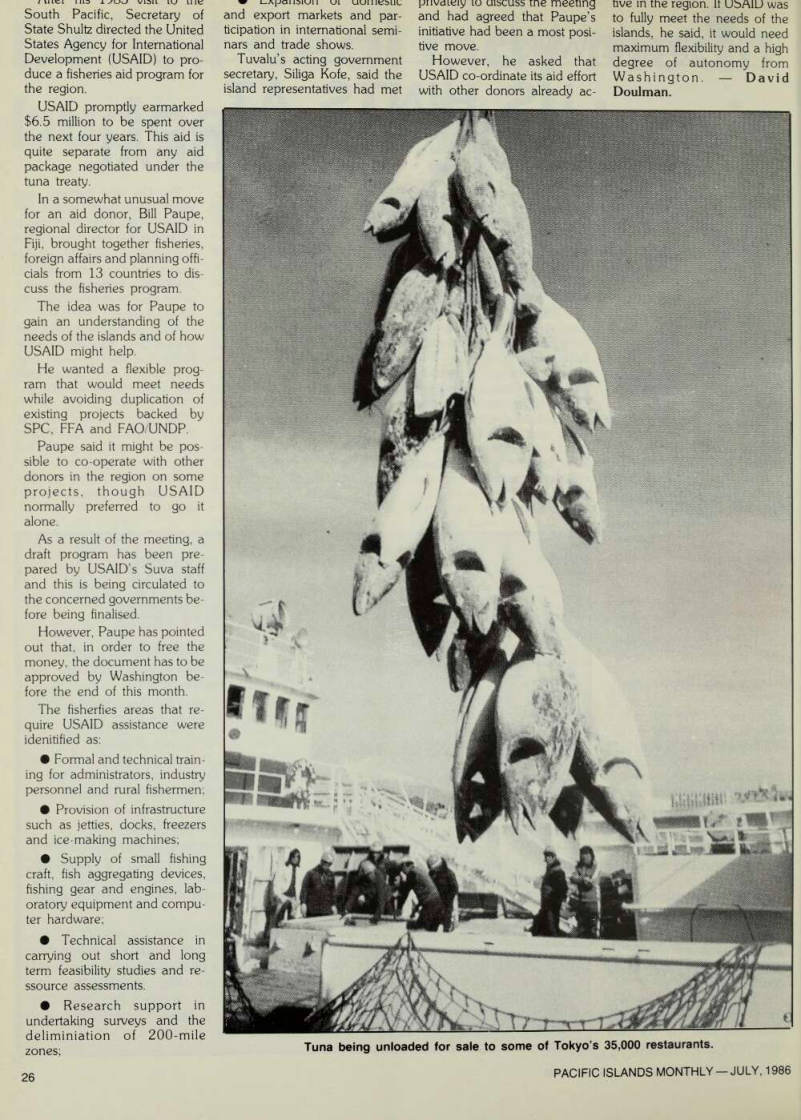
trade winds
Us Hints At
When the marathon tuna talks reconvene in Rarotonga this month, it may be for the last time.
The previous round of talks on a multilateral tuna agree ment between the Unites States and the South Pacific island nations snagged on the issues of access fees and closed zones.
Now, however, the US side is anxious for agreement and Ambassador Ed Wolfe, leader of the American team, has hinted that, if the Rarotonga meeting fails to reach agree ment, interim deals might be possible with Palau, FSM and Kiribati.
This, from the US point of view, would help cement rela tions with the strategically im portant Micronesian islands and counter the Russian presence in Kiribati.
The May session at the East- West Centre in Honolulu in volved the US and 16 island countries. Wolfe, in a public lecture shortly afterwards, indi cated that progress at the Hon olulu and previous Canberra talks had slowed.
Unconfirmed reports say that the US delegation proposed an access fee of US$2 million in a lump sum to be paid by the industry with a US government aid package of approximately the same amount.
However, the island nations are looking for more than that.
Further, despite the US lump sum offer, it is understood that US fishermen would prefer a per-trip method of calculating access fees.
Island representatives were guarded in their comments after the Honolulu meeting. There seems to be a sense of frustra tion and creeping apathy to wards the talks as a result of the slow progress.
But it is understood that some countries were extremely dissatisfied with the US cash offer. And, given the fees cur
rently paid by the US fleet, that offer appears to be unaccept able.
Wolfe, the State Depart ment’s deputy assistant secre tary for oceans and fisheries affairs, spoke candidly in his lecture of the importance the US attaches to the speedy conclusion of a tuna treaty.
He also made it known that factors other than tuna for example strategic considera tions also had an impact on US thinking regarding a treaty.
He added that this fisheries treaty was the most compli cated so far attempted by the State Department as so many different countries were in volved.
US Secretary of State
George Shultz, he said, maintained constant contact with developments in the negotiati° ns - Wolfe freely acknowledged that the Danica affair (when a US tuna boat was arrested and impounded for illegal fishing) in PNG in 1982 and the similar Jeanette Diana incident in the Solomon Islands in 1984 had soured relations between the US and the region as a whole, Under the proposed treaty, however, the US would accept responsibility for its vessels.
Wolfe added that potentially contentious issues such as catch reporting requirements and the placing of scientific observers on US vessels had been suecessfully resolved.
The US tuna industry, said Wolfe, had been heavily in volved in the talks, as it was in all similar fisheries negotiations with other countries, in order to ensure that there would be little or no industry opposition to the treaty when it went to Congress for ratification.
Although the treaty talks had been at times slow and tedious, Wolfe said the US team had developed a great deal of trust and respect for the island nego tiators.
He felt that a similar trust and respect existed in their camp and that there was a basis for long term co-operation.
Meanwhile fisheries aid talks have been progressing on an other front.
L lliO J- ViOiL IKJ Lilt: South Pacific, Secretary of State Shultz directed the United States Agency for International Development (USAID) to pro duce a fisheries aid program for the region.
USAID promptly earmarked $6.5 million to be spent over the next four years. This aid is quite separate from any aid package negotiated under the tuna treaty.
In a somewhat unusual move for an aid donor, Bill Paupe, regional director for USAID in Fiji, brought together fisheries, foreign affairs and planning offi cials from 13 countries to dis cuss the fisheries program.
The idea was for Paupe to gain an understanding of the needs of the islands and of how USAID might help.
He wanted a flexible prog ram that would meet needs while avoiding duplication of existing projects backed by
Spc, Ffa And Fao/Undp.
Paupe said it might be pos sible to co-operate with other donors in the region on some projects, though USAID normally preferred to go it alone.
As a result of the meeting, a draft program has been pre pared by USAID’s Suva staff and this is being circulated to the concerned governments be fore being finalised.
However, Paupe has pointed out that, in order to free the money, the document has to be approved by Washington be fore the end of this month.
The fisheries areas that re quire USAID assistance were identified as: • Formal and technical train ing for administrators, industry personnel and rural fishermen; • Provision of infrastructure such as jetties, docks, freezers and ice-making machines; • Supply of small fishing craft, fish aggregating devices, fishing gear and engines, lab oratory equipment and compu ter hardware; • Technical assistance in carrying out short and long term feasibility studies and re ssource assessments. • Research support in undertaking surveys and the deliminiation of 200-mile zones;
w i-Ajjaiiouji i ui uuuiesLK, and export markets and participation in international seminars and trade shows.
Tuvalu’s acting government secretary, Siliga Kofe, said the island representatives had met
puvdLeiy iu uiscuss me meenng and had agreed that Paupe’s initiative had been a most positive move.
However, he asked that USAID co-ordinate its aid effort with other donors already ac-
nve in me region, it ÜbAIU was to fully meet the needs of the islands, he said, it would need maximum flexibility and a high degree of autonomy from
Washington.
David
Doulman.
Tuna being unloaded for sale to some of Tokyo’s 35,000 restaurants.
‘Yawning chasm’
divides the sides
Palau, FSM and Kiribati reached a fisheries management agreement with the US in March and this may be behind Wolfe’s hint of a separate deal.
The same three countries had a deal with the American Tunaboat Association (ATA) until 1984.
Wolfe’s optimism for agreement at the July talks was not shared by several island negotiators before the Rarotonga meeting.
Various reports put the islands’ cash demand at between US$l5 million and US$2O million. However, it seems the lower figure is more accurate.
There also appeared to be some confusion among island delegates over what, exactly, the US was offering.
Nevertheless, there is a very large gap between the Americans’ $2 mil lion and the islands’ expectation of
$l5 million and there is no doubt that some delegates were incensed by the US industry offer.
The US already pays some $1.5 million for rights in PNG alone.
The Americans appear to be modelling their approach on the Japanese system where the Japan ese governement offers tied aid and goods and services while the in dustry also pays fees.
But, as things stood at least before Rarotonga, there was a yawning chasm between the US offer and what the Japanese industry already pays.
Also, there may be some differ ences in the US camp. For while the officials are pressing for a lump sum payment, sources within the in dustry have indicated that they can see advantages of per-trip pay ments.
SPIA’s problems chronicled

The multiple problems of George Wray’s South Pacific Island Airways in Washing ton, in the South Pacific and over Norway have been spelled out to the US Congress.
A report recently released by Congress’s investigative arm, is, in effect, a diary of SPIA’s relations with the US Federal Aviation Administration (FAA) and the US coiirts.
The General Accounting Office report starts with a spot check of SPIA maintenance work in Honolulu on August 10 and 11, 1983 in which unspeci fied problems were said to have been discovered.
From there on it was mostly downhill for SPIA.
The report continues, cover ing a variety of mechanical, organisational and airborne problems, until May 29 last year when the FAA effectively grounded most of SPIA’s fleet for lack of “good faith effort” to comply with FAA regulations covering anti-noise “hush kits”
South Pacific Island Airways (SPIA) had a turbulent time after a brave attempt to cater for and encourage inter-island air travel. A new report from Washing ton’s watchdog group The General Accounting Office, chronicles SPIA’s troubles. PlM’s Washington cor respondent DAVID S. NORTH reports.
noted (PIM, September 1985) as costing up to US$2 million per plane.
SPIA’s woes in between these two dates included: • Numerous FAA inspec tions in Hawaii, Guam and American Samoa, usually resul ting in renewed FAA demands for better safety compliance. • Four FAA-criticised flights over the North Pole (from Alas ka to Amsterdam) carrying Un ited Nations peace keeping troops including one flight in which the SPIA pilot was warned by the Royal Norwe gian Air Force that he was heading (with a contingent of Fijian troops) for Soviet air space only 50 miles distant.
• A crash, on July 21, 1984, in American Samoa in which one person died. According to the GAO, “An FAA investigator determines that the accident was caused by a break in a rusty elevator cable”. • An October 12, 1984 FAA emergency order revoking the carrier’s operating certificate.
SPIA lost a subsequent US court battle later that same month, and then tried to file as a brand new carrier.
That approach was thwarted as the FAA found that SPIA’s president “made false state ments to the FAA concerning the Boeing 707 engine reliabil ity program and deliberately tried to mislead the agency.”
The GAO summary does not mention the SFIA bankruptcy petition (PIM September, 1985).
However, the objective of the GAO investigation into FAA SPIA relations has relatively little to do with airline safety.
GOA examined SPIA’s list of troubles as well as those of a small California airline, Flight Trails, out of its concern for the supervision of military charters following the 1985 holiday sea son crash in Canada of a plane carrying US troops returning home from the UN Sinai force.
The GAO found a major problem here but reported it in its usual understated way: “Our review of FAA docu ments did not disclose any evidence of communication be tween FAA and the military aircraft command.”
The report did not invite SPIA’s comments, though a later, final GAO report will include its own analysis as well as comments from the airlines and the FAA.
Advertisements & other items, p. 27 (1 item)
The Total Test Equipment Solution
AWA
P marcom instruments Tektronix r Q 1 1
HITACHI
IFLUKEI
U
The good old days
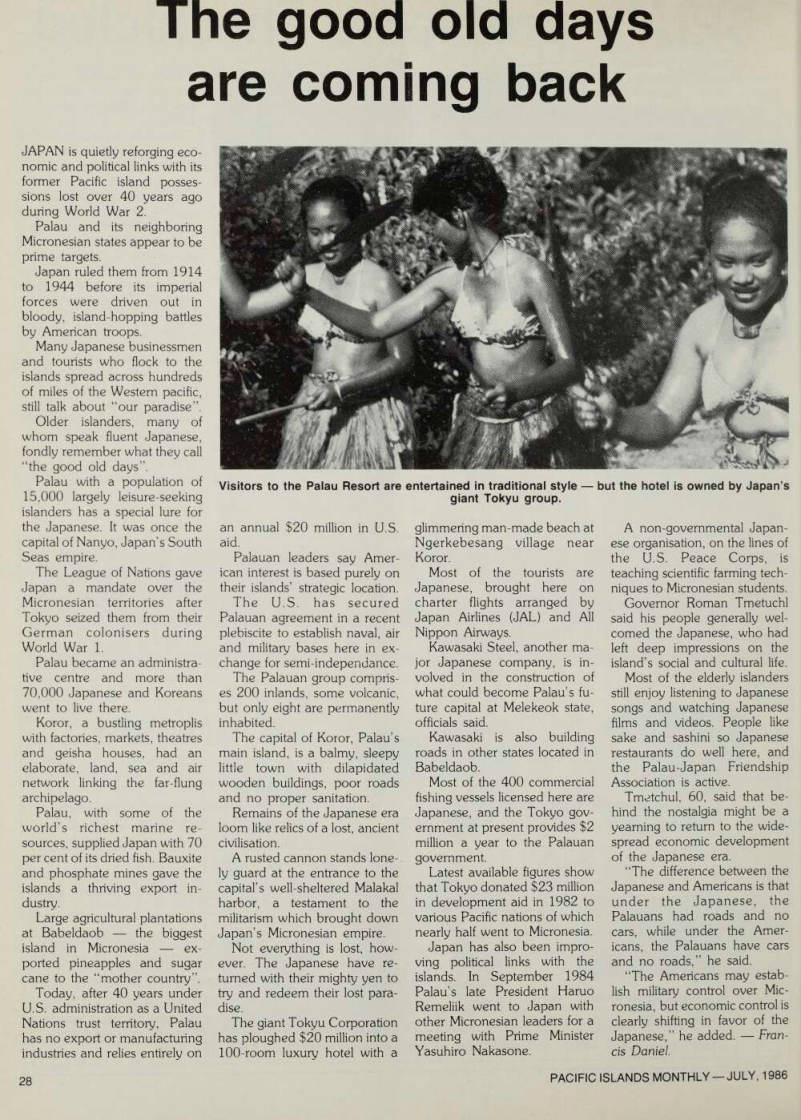
are coming back
JAPAN is quietly reforging eco nomic and political links with its former Pacific island posses sions lost over 40 years ago during World War 2.
Palau and its neighboring Micronesian states appear to be prime targets.
Japan ruled them from 1914 to 1944 before its imperial forces were driven out in bloody, island-hopping battles by American troops.
Many Japanese businessmen and tourists who flock to the islands spread across hundreds of miles of the Western pacific, still talk about “our paradise”.
Older islanders, many of whom speak fluent Japanese, fondly remember what they call “the good old days”.
Palau with a population of 15.000 largely leisure-seeking islanders has a special lure for the Japanese. It was once the capital of Nanyo, Japan’s South Seas empire.
The League of Nations gave Japan a mandate over the Micronesian territories after Tokyo seized them from their German colonisers during World War 1.
Palau became an administra tive centre and more than 70.000 Japanese and Koreans went to live there.
Koror, a bustling metroplis with factories, markets, theatres and geisha houses, had an elaborate, land, sea and air network linking the far-flung archipelago.
Palau, with some of the world’s richest marine re sources, supplied Japan with 70 per cent of its dried fish. Bauxite and phosphate mines gave the islands a thriving export in dustry.
Large agricultural plantations at Babeldaob the biggest island in Micronesia ex ported pineapples and sugar cane to the “mother country”.
Today, after 40 years under U.S. administration as a United Nations trust territory, Palau has no export or manufacturing industries and relies entirely on
an annual $2O million in U.S. aid.
Palauan leaders say Amer ican interest is based purely on their islands’ strategic location.
The U.S. has secured Palauan agreement in a recent plebiscite to establish naval, air and military bases here in ex change for semi-independance.
The Palauan group compris es 200 inlands, some volcanic, but only eight are permanently inhabited.
The capital of Koror, Palau’s main island, is a balmy, sleepy little town with dilapidated wooden buildings, poor roads and no proper sanitation.
Remains of the Japanese era loom like relics of a lost, ancient civilisation.
A rusted cannon stands lone ly guard at the entrance to the capital’s well-sheltered Malakal harbor, a testament to the militarism which brought down Japan’s Micronesian empire.
Not everything is lost, how ever. The Japanese have re turned with their mighty yen to try and redeem their lost para dise.
The giant Tokyu Corporation has ploughed $2O million into a 100-room luxury hotel with a
glimmering man-made beach at Ngerkebesang village near Koror.
Most of the tourists are Japanese, brought here on charter flights arranged by Japan Airlines (JAL) and All Nippon Airways.
Kawasaki Steel, another ma jor Japanese company, is in volved in the construction of what could become Palau’s fu ture capital at Melekeok state, officials said.
Kawasaki is also building roads in other states located in Babeldaob.
Most of the 400 commercial fishing vessels licensed here are Japanese, and the Tokyo gov ernment at present provides $2 million a year to the Palauan government.
Latest available figures show that Tokyo donated $23 million in development aid in 1982 to various Pacific nations of which nearly half went to Micronesia.
Japan has also been impro ving political links with the islands. In September 1984 Palau’s late President Haruo Remeliik went to Japan with other Micronesian leaders for a meeting with Prime Minister Yasuhiro Nakasone.
A non-governmental Japan ese organisation, on the lines of the U.S. Peace Corps, is teaching scientific farming tech niques to Micronesian students.
Governor Roman Tmetuchl said his people generally wel comed the Japanese, who had left deep impressions on the island’s social and cultural life.
Most of the elderly islanders still enjoy listening to Japanese songs and watching Japanese films and videos. People like sake and sashini so Japanese restaurants do well here, and the Palau-Japan Friendship Association is active.
Tmetchul, 60, said that be hind the nostalgia might be a yearning to return to the wide spread economic development of the Japanese era.
“The difference between the Japanese and Americans is that under the Japanese, the Palauans had roads and no cars, while under the Amer icans, the Palauans have cars and no roads,” he said.
“The Americans may estab lish military control over Mic ronesia, but economic control is clearly shifting in favor of the Japanese,” he added. Fran cis Daniel.
Visitors to the Palau Resort are entertained in traditional style but the hotel is owned by Japan’s giant Tokyu group.
Brokers Bullish
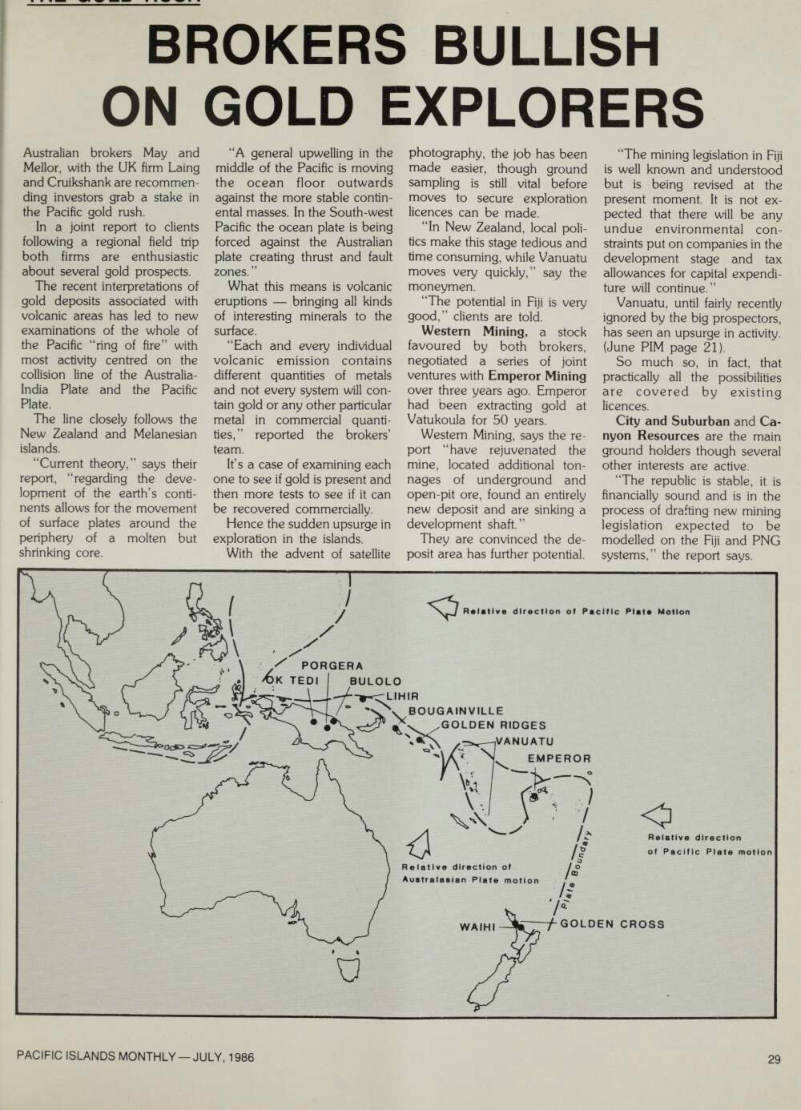
On Gold Explorers
Australian brokers May and Mellor, with the UK firm Laing and Cruikshank are recommen ding investors grab a stake in the Pacific gold rush.
In a joint report to clients following a regional field trip both firms are enthusiastic about several gold prospects.
The recent interpretations of gold deposits associated with volcanic areas has led to new examinations of the whole of the Pacific “ring of fire” with most activity centred on the collision line of the Australia- India Plate and the Pacific Plate.
The line closely follows the New Zealand and Melanesian islands.
“Current theory,” says their report, “regarding the deve lopment of the earth’s conti nents allows for the movement of surface plates around the periphery of a molten but shrinking core.
“A general upwelling in the middle of the Pacific is moving the ocean floor outwards against the more stable contin ental masses. In the South-west Pacific the ocean plate is being forced against the Australian plate creating thrust and fault zones. ”
What this means is volcanic eruptions bringing all kinds of interesting minerals to the surface.
“Each and every individual volcanic emission contains different quantities of metals and not every system will con tain gold or any other particular metal in commercial quanti ties,” reported the brokers’ team.
It’s a case of examining each one to see if gold is present and then more tests to see if it can be recovered commercially.
Hence the sudden upsurge in exploration in the islands.
With the advent of satellite
photography, the job has been made easier, though ground sampling is still vital before moves to secure exploration licences can be made.
“In New Zealand, local poli tics make this stage tedious and time consuming, while Vanuatu moves very quickly,” say the moneymen.
“The potential in Fiji is very good,” clients are told.
Western Mining, a stock favoured by both brokers, negotiated a series of joint ventures with Emperor Mining over three years ago. Emperor had been extracting gold at Vatukoula for 50 years.
Western Mining, says the re port “have rejuvenated the mine, located additional ton nages of underground and open-pit ore, found an entirely new deposit and are sinking a development shaft.”
They are convinced the de posit area has further potential.
“The mining legislation in Fiji is well known and understood but is being revised at the present moment. It is not ex pected that there will be any undue environmental con straints put on companies in the development stage and tax allowances for capital expendi ture will continue.”
Vanuatu, until fairly recently ignored by the big prospectors, has seen an upsurge in activity. (June PIM page 21).
So much so, in fact, that practically all the possibilities are covered by existing licences.
City and Suburban and Ca nyon Resources are the main ground holders though several other interests are active.
“The republic is stable, it is financially sound and is in the process of drafting new mining legislation expected to be modelled on the Fiji and PNG systems,” the report says.
Advertisements & other items, pp. 30-31 (1 item)
For The Pacific.
TOYOTA THINKS
CARS AND TRUCKS DRIVHIINTHI
PACIFIC SHOULD BE BHIU
FOR THE PACIFIC.
TOYOTA
QUALITY SERVICE
AMERICAN SAMOA; BURNS PHILP (SOUTH SEA) CO., LTD., P.O. Box 129, Pago Pago.
COOK ISLANDS: COOK ISLANDS TRADING
CORPORATION LTD., Private Bag, Rarotonga.
FIJI: AUTOMOTIVE SUPPLIES COMPANY, A Division of Burns Philp (South Sea) Co., Ltd., G.P.O. Box 355, Suva.
GUAM & MICRONESIA: ATKINS KROLL, INC., 443 South Marine Drive, Tamuning.
KIRIBATI: TARAWA MOTORS, A Division of Bairiki Holdings Ltd., P.O. Box 36, Bairiki, Tarawa.
NAURU: NAURU COOPERATIVE SOCIETY, Central Pacil
NEW CALEDONIA: SERVICE IMPORTATION
AUTOMOBILE DU PACIFIQUE, Rond-Point du Pacifique (Station Total) B.P. 438, Noumea.
NORFOLK ISLAND: BORRY’S LIMITED, P.O. Box 169.
PAPUA NEW GUINEA: ELA MOTORS, A Division of Burns Philp (PNG) Ltd., P.O. Box 75, Port Moresby.
SAIPAN: MICROL CORPORATION, P.O. Box 267, Saipai
&. :JOW
£ mm ** - . &*■ - . ” ae ,« ♦ ~«*■ All our cars and tracks have special Pacific Island features.
And, of course, like cars and trucks we build for the rest of the world, those for the Pacific benefit from comprehensive testing and thorough quality control.
It’s all part of our effort to create high-quality, highly reliable cars and trucks.
Specifically for you. And specifically for the places you drive.
For instance, Toyota Hilux trucks are outfitted with extra-heavy-duty shocks and reinforced suspension.
And cars like Toyota Corolla receive special engine underplating, and a suspension modified to give added road clearance.
Meanwhile, we make additional use of special galvanealed steel in both our cars and trucks to help prevent corrosion.
Areas where galvanealed steel is used i\
COROLLA
HILUX
• Crown • Cressida • Corona • Corolla • Starlet • Dyna • Hiace • Liteace • Coaster • Stout • Hilux 4X2/ 4 x 4 • Land Cruiser • Heavy Duty Truck
.OMON ISLANDS: SOLOMON ISLANDS
iSTMENTS LTD., G.P.O. Box 174, Honiara.
ITT: NIPPON AUTOMOTO. B.P. 342, Papeete
IGA: BURNS PHILP (SOUTH SEA) CO., LTD., P.O. 55, Nukualofa. lUATU: VANUATU MOTORS, A Division of Burns i (Vanuatu) Ltd., P.O. Box 18, Port Vila.
STERN SAMOA: BURNS PHILP (SOUTH SEA) CO., , P.O. Box 188, Apia.
Your guide to the gold rush
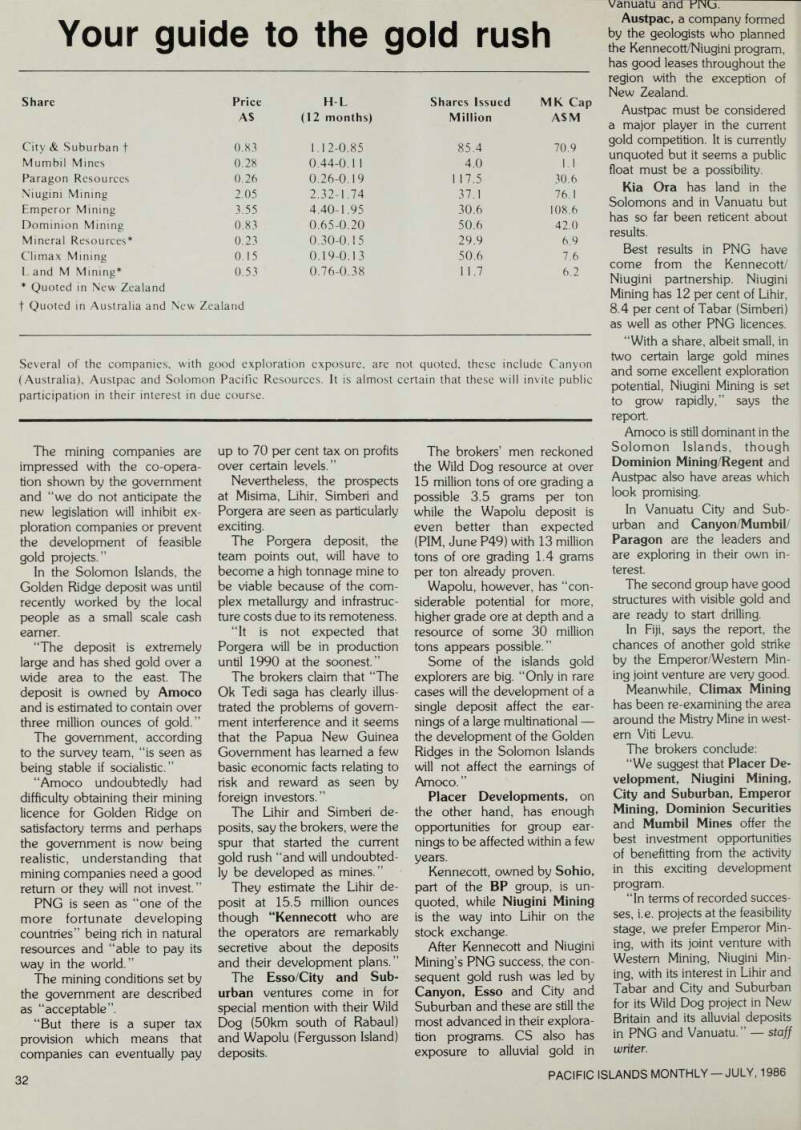
Several of the companies, with good exploration exposure, are not quoted, these include Canyon (Australia), Austpac and Solomon Pacific Resources. It is almost certain that these will invite public participation in their interest in due course.
The mining companies are impressed with the co-opera tion shown by the government and “we do not anticipate the new legislation will inhibit ex ploration companies or prevent the development of feasible gold projects.”
In the Solomon Islands, the Golden Ridge deposit was until recently worked by the local people as a small scale cash earner.
“The deposit is extremely large and has shed gold over a wide area to the east. The deposit is owned by Amoco and is estimated to contain over three million ounces of gold.”
The government, according to the survey team, “is seen as being stable if socialistic.”
“Amoco undoubtedly had difficulty obtaining their mining licence for Golden Ridge on satisfactory terms and perhaps the government is now being realistic, understanding that mining companies need a good return or they will not invest.”
PNG is seen as “one of the more fortunate developing countries” being rich in natural resources and “able to pay its way in the world.”
The mining conditions set by the government are described as “acceptable”.
“But there is a super tax provision which means that companies can eventually pay
up to 70 per cent tax on profits over certain levels.”
Nevertheless, the prospects at Misima, Lihir, Simberi and Porgera are seen as particularly exciting.
The Porgera deposit, the team points out, will have to become a high tonnage mine to be viable because of the com plex metallurgy and infrastruc ture costs due to its remoteness.
“It is not expected that Porgera will be in production until 1990 at the soonest.”
The brokers claim that “The Ok Tedi saga has clearly illus trated the problems of govern ment interference and it seems that the Papua New Guinea Government has learned a few basic economic facts relating to risk and reward as seen by foreign investors.”
The Lihir and Simberi de posits, say the brokers, were the spur that started the current gold rush “and will undoubted ly be developed as mines.”
They estimate the Lihir de posit at 15.5 million ounces though “Kennecott who are the operators are remarkably secretive about the deposits and their development plans.”
The Esso/City and Sub urban ventures come in for special mention with their Wild Dog (50km south of Rabaul) and Wapolu (Fergusson Island) deposits.
The brokers’ men reckoned the Wild Dog resource at over 15 million tons of ore grading a possible 3.5 grams per ton while the Wapolu deposit is even better than expected (PIM, June P 49) with 13 million tons of ore grading 1.4 grams per ton already proven.
Wapolu, however, has “con siderable potential for more, higher grade ore at depth and a resource of some 30 million tons appears possible.”
Some of the islands gold explorers are big. “Only in rare cases will the development of a single deposit affect the ear nings of a large multinational the development of the Golden Ridges in the Solomon Islands will not affect the earnings of Amoco.”
Placer Developments, on the other hand, has enough opportunities for group ear nings to be affected within a few years.
Kennecott, owned by Sohio, part of the BP group, is un quoted, while Niugini Mining is the way into Lihir on the stock exchange.
After Kennecott and Niugini Mining’s PNG success, the con sequent gold rush was led by Canyon, Esso and City and Suburban and these are still the most advanced in their explora tion programs. CS also has exposure to alluvial gold in
Vanuatu and Austpac, a company formed by the geologists who planned the Kennecott/Niugini program, has good leases throughout the region with the exception of New Zealand.
Austpac must be considered a major player in the current gold competition. It is currently unquoted but it seems a public float must be a possibility.
Kia Ora has land in the Solomons and in Vanuatu but has so far been reticent about results.
Best results in PNG have come from the Kennecott/ Niugini partnership. Niugini Mining has 12 per cent of Lihir, 8.4 per cent of Tabar (Simberi) as well as other PNG licences.
“With a share, albeit small, in two certain large gold mines and some excellent exploration potential, Niugini Mining is set to grow rapidly,” says the report.
Amoco is still dominant in the Solomon Islands, though Dominion Mining/Regent and Austpac also have areas which look promising.
In Vanuatu City and Sub urban and Canyon/Mumbil/ Paragon are the leaders and are exploring in their own in terest.
The second group have good structures with visible gold and are ready to start drilling.
In Fiji, says the report, the chances of another gold strike by the Emperor/Western Min ing joint venture are very good.
Meanwhile, Climax Mining has been re-examining the area around the Mistry Mine in west ern Viti Levu.
The brokers conclude; “We suggest that Placer De velopment, Niugini Mining, City and Suburban, Emperor Mining, Dominion Securities and Mumbil Mines offer the best investment opportunities of benefitting from the activity in this exciting development program.
“In terms of recorded succes ses, i.e. projects at the feasibility stage, we prefer Emperor Min ing, with its joint venture with Western Mining, Niugini Min ing, with its interest in Lihir and Tabar and City and Suburban for its Wild Dog project in New Britain and its alluvial deposits in PNG and Vanuatu.” staff writer.
Share Price H L Shares Issued MK Cap A$ (12 months) Million A$M City & Suburban f 0.83 1.12-0.85 85.4 70.9 Mumbil Mines 0.28 0.44-0.1 1 4.0 l.l Paragon Resources 0.26 0.26-0.19 1 17.5 30.6 Niugini Mining 2,05 2.32-1.74 37.1 76.1 Emperor Mining 3.55 4.40-1.95 30.6 108.6 Dominion Mining 0.83 0.65-0.20 50.6 42.0 Mineral Resources* 0.23 0.30-0.15 29.9 6.9 Climax Mining 0.15 0.19-0.13 50.6 7.6 L and M Mining* 0.53 0.76-0.38 11.7 6.2 * Quoted in New Zealand t Quoted in Australia and New Zealand
conservationist fire
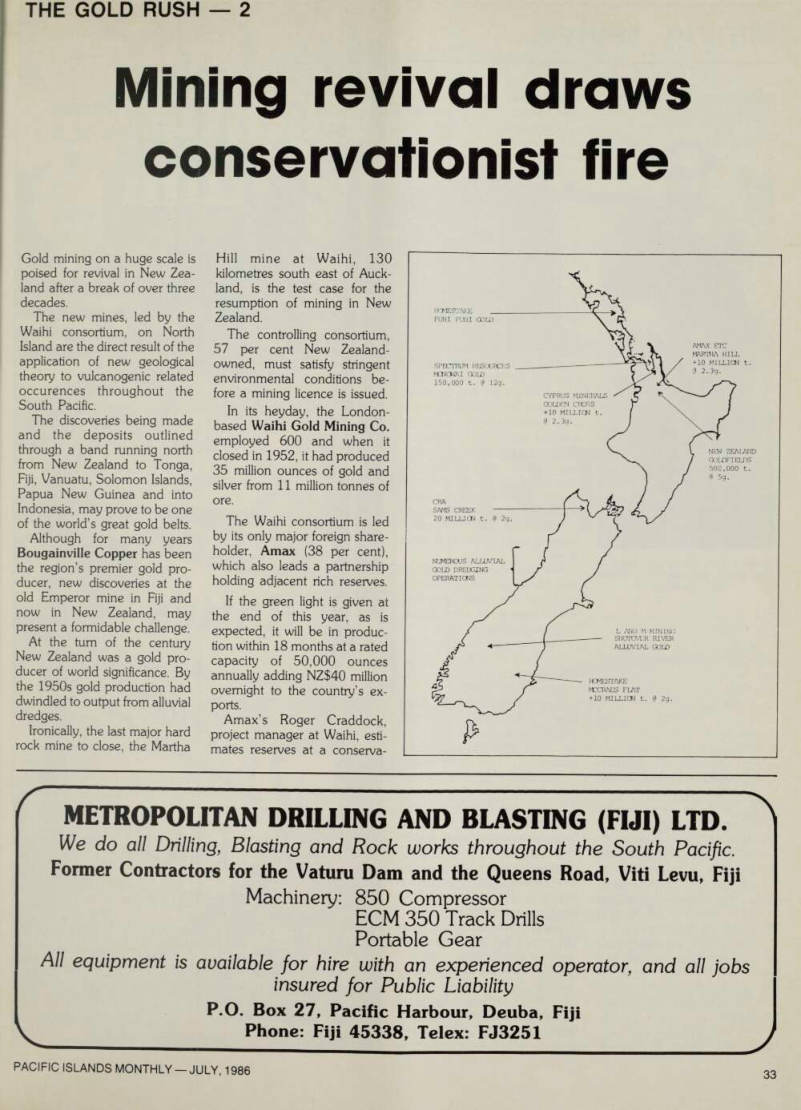
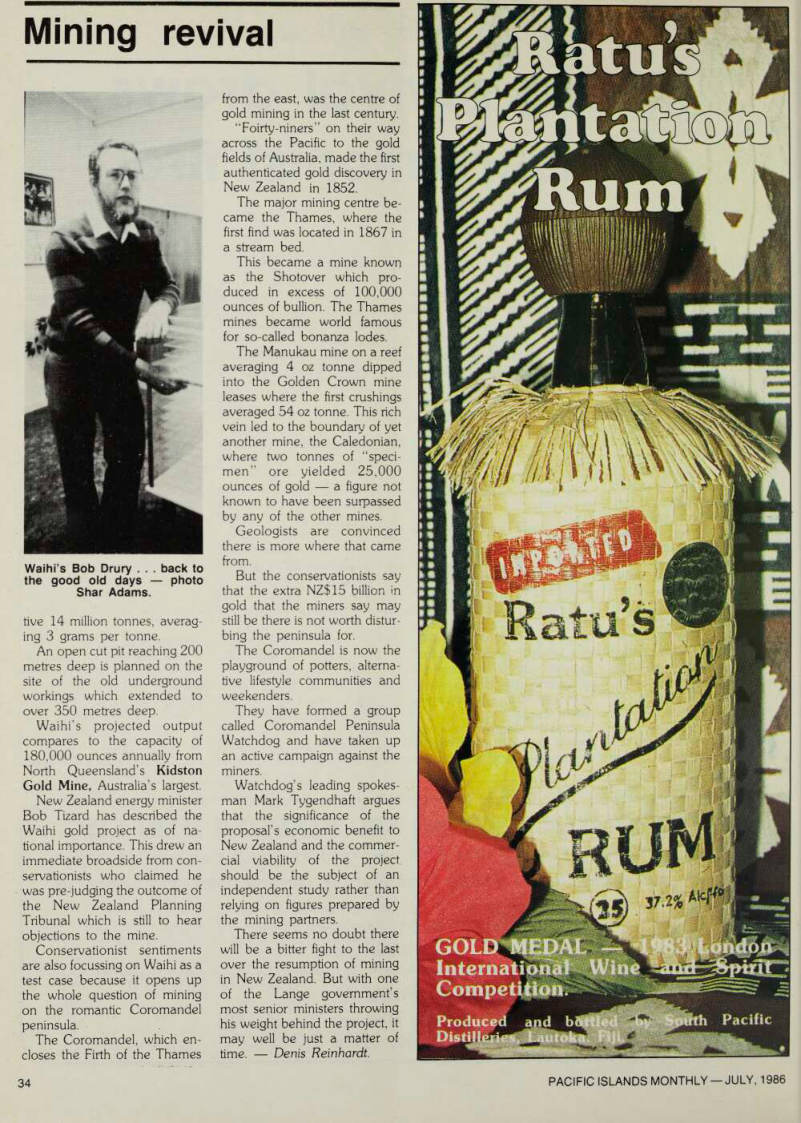
The Gold Rush 2
Mining revival draws conservationist fire
Gold mining on a huge scale is poised for revival in New Zealand after a break of over three decades.
The new mines, led by the Waihi consortium, on North Island are the direct result of the application of new geological theory to vulcanogenic related occurences throughout the
So if aci^c - .
The discoveries being made and the deposits outlined through a band running north from Mew Zea Land to Tonga, Fiji, Vanuatu. Solomon Islands, Papua New Guinea and into Indonesia, may prove to be one of the world’s great gold belts.
Although for many years Bougainville Copper has been the region’s premier gold producer, new discoveries at the old Emperor mine in Fiji and now in New Zealand, may present a formidable challenge.
At the turn of the century New Zealand was a gold producer of world significance. By the 1950 s gold production had dwindled to output from alluvial dredges.
Ironically, the last major hard rock mine to close, the Martha
Hill mine at Waihi, 130 kilometres south east of Auck land, is the test case for the resumption of mining in New Zealand.
The controlling consortium, 57 per cent New Zealand owned, must satisfy stringent environmental conditions be fore a mining licence is issued.
In its heyday, the London based Waihi Gold Mining Co. employed 600 and when it closed in 1952, it had produced 35 million ounces of gold and silver from 11 million tonnes of ore.
The Waihi consortium is led by its only major foreign share holder, Amax (38 per cent), which also leads a partnership holding adjacent rich reserves.
If the green light is given at the end of this year, as is expected, it will be in produc tion within 18 months at a rated capacity of 50,000 ounces annually adding NZ$4O million overnight to the country’s ex ports.
Amax’s Roger Craddock, project manager at Waihi, esti mates reserves at a conserve-
tive 14 million tonnes, averag ing 3 grams per tonne.
An open cut pit reaching 200 metres deep is planned on the site of the old underground workings which extended to over 350 metres deep.
Waihi’s projected output compares to the capacity of 180,000 ounces annually from North Queensland’s Kidston Gold Mine, Australia’s largest.
New Zealand energy minister Bob Tizard has described the Waihi gold project as of na tional importance. This drew an immediate broadside from con servationists who claimed he was pre-judging the outcome of the New Zealand Planning Tribunal which is still to hear objections to the mine.
Conservationist sentiments are also focussing on Waihi as a test case because it opens up the whole question of mining on the romantic Coromandel peninsula.
The Coromandel, which en closes the Firth of the Thames
from the east, was the centre of gold mining in the last century.
“Foirty-niners” on their way across the Pacific to the gold fields of Australia, made the first authenticated gold discovery in New Zealand in 1852.
The major mining centre be came the Thames, where the first find was located in 1867 in a stream bed.
This became a mine known as the Shotover which pro duced in excess of 100,000 ounces of bullion. The Thames mines became world famous for so-called bonanza lodes.
The Manukau mine on a reef averaging 4 oz tonne dipped into the Golden Crown mine leases where the first crushings averaged 54 oz tonne. This rich vein led to the boundary of yet another mine, the Caledonian, where two tonnes of “speci men” ore yielded 25,000 ounces of gold a figure not known to have been surpassed by any of the other mines.
Geologists are convinced there is more where that came from.
But the conservationists say that the extra NZ$l5 billion in gold that the miners say may still be there is not worth distur bing the peninsula for.
The Coromandel is now the playground of potters, alterna tive lifestyle communities and weekenders.
They have formed a group called Coromandel Peninsula Watchdog and have taken up an active campaign against the miners.
Watchdog’s leading spokes man Mark Tygendhaft argues that the significance of the proposal’s economic benefit to New Zealand and the commer cial viability of the project, should be the subject of an independent study rather than relying on figures prepared by the mining partners.
There seems no doubt there will be a bitter fight to the last over the resumption of mining in New Zealand. But with one of the Lange government’s most senior ministers throwing his weight behind the project, it may well be just a matter of
time.
Denis Reinhardt.
Waihi’s Bob Drury ... back to the good old days photo Shar Adams.
Advertisements & other items, pp. 33-35 (1 item)
Metropolitan Drilling And Blasting (Fiji) Ltd.
We do all Drilling, Blasting and Rock works throughout the South Pacific.
Former Contractors for the Vaturu Dam and the Queens Road, Viti Levu, Fiji Machinery: 850 Compressor ECM 350 Track Drills Portable Gear All equipment is available for hire with an experienced operator, and all jobs insured for Public Liability P.O. Box 27, Pacific Harbour, Deuba, Fiji Phone: Fiji 45338. Telex: FJ3251
* 55 I m \ A 1 (V* P 37.2% Atc uai Hi* in • m 11
Expo ’B6
a million
dollar
success
Fiji’s Expo ’B6 which shop windowed the nation’s manufacturing industry, exports, tourism and investment opportunities has been an outright success.
The four-day event at
Sydney’s prestigious
Centrepoint attracted substantial export inquiries.
The one-day investment seminar, which opened the promotion, was attended by over 400 Australian businessmen and produced, within a few days, 50 joint venture investment inquiries, some from very substantial business houses.
The trades exhibition brought in an immediate $2.8 million in confirmed sales mainly furniture, garments and timber products with a further $4.5 million sales under negotiation.
Sales over the next year, as a direct result of Expo ’B6, are estimated to be worth $10.6 million.
There were 450 business registrations from those attending the exhibition, with 216 reliable inquiries regarding Fiji products.
There were also approaches from 36 potential Australian agents.
More than 4,000 members of the public attended the event over the four days.
Australia, New Zealand
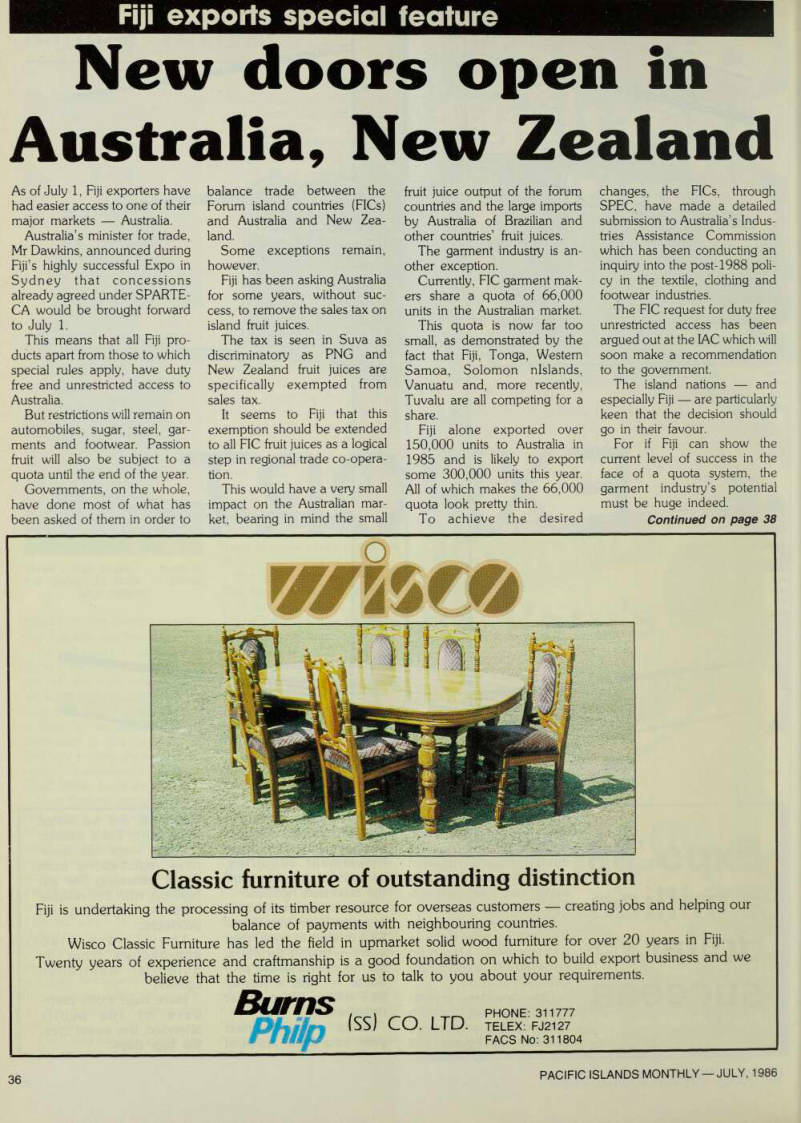

Fiji exports special feature
New doors open in Australia, New Zealand
As of July 1, Fiji exporters have had easier access to one of their major markets Australia.
Australia’s minister for trade, Mr Dawkins, announced during Fiji’s highly successful Expo in Sydney that concessions already agreed under SPARTE CA would be brought forward to July 1.
This means that all Fiji pro ducts apart from those to which special rules apply, have duty free and unrestricted access to Australia.
But restrictions will remain on automobiles, sugar, steel, gar ments and footwear. Passion fruit will also be subject to a quota until the end of the year.
Governments, on the whole, have done most of what has been asked of them in order to
balance trade between the Forum island countries (FICs) and Australia and New Zea land.
Some exceptions remain, however.
Fiji has been asking Australia for some years, without suc cess, to remove the sales tax on island fruit juices.
The tax is seen in Suva as discriminatory as PNG and New Zealand fruit juices are specifically exempted from sales tax.
It seems to Fiji that this exemption should be extended to all FIC fruit juices as a logical step in regional trade co-opera tion.
This would have a very small impact on the Australian mar ket, bearing in mind the small
fruit juice output of the forum countries and the large imports by Australia of Brazilian and other countries’ fruit juices.
The garment industry is an other exception.
Currently, FIC garment mak ers share a quota of 66,000 units in the Australian market.
This quota is now far too small, as demonstrated by the fact that Fiji, Tonga, Western Samoa, Solomon nlslands, Vanuatu and, more recently, Tuvalu are all competing for a share.
Fiji alone exported over 150,000 units to Australia in 1985 and is likely to export some 300,000 units this year.
All of which makes the 66,000 quota look pretty thin.
To achieve the desired
changes, the FICs, through SPEC, have made a detailed submission to Australia’s Indus tries Assistance Commission which has been conducting an inquiry into the post-1988 poli cy in the textile, clothing and footwear industries.
The FIC request for duty free unrestricted access has been argued out at the lAC which will soon make a recommendation to the government.
The island nations and especially Fiji are particularly keen that the decision should go in their favour.
For if Fiji can show the current level of success in the face of a quota system, the garment industry’s potential must be huge indeed.
Continued on page 38
There is, however, another, potentially more serious, problem.
Under SPARTECA, products exported to Australia and New Zealand must have at least 50 per cent local content.
This is especially hard on the islands nations who, lacking domestic resources, are obliged to import large amounts of raw materials.
The rule is intended to stop the islands being used as a conduit for foreign goods to gain easy access to Australia and New Zealand.
FICs, however, have no con trol over the prices of the raw materials they have to import and, with recurring increases, it is becoming harder and harder to meet the 50 per cent require ment.
This is aggravated by the fact that most Fiji manufacturers are aiming at the quality end of the market and are therefore using expensive fabrics.
There are provisions in SPARTECA for movement on the 50 per cent rule, but Fiji’s experience has shown that this
Continued on page 40
has been rather strictly con trolled.
Bearing in mind that SPAR TECA is an economic agree ment based on good will and geopolitical considerations, it would be unfortunate if Austra lia and New Zealand became “hung up” on the 50 per cent rule.
For if SPARTECA was in tended to foster economic de velopment and employment in the islands, the 50 per cent rule is currently restricting the very growth that the agreement was intended to produce.
Advertisements & other items, pp. 36-37 (1 item)
Hfssco
o
r
Classic furniture of outstanding distinction
Fiji is undertaking the processing of its timber resource for overseas customers creating jobs and helping our balance of payments with neighbouring countries.
Wisco Classic Furniture has led the field in upmarket solid wood furniture for over 20 years in Fiji.
Twenty years of experience and craftmanship is a good foundation on which to build export business and we believe that the time is right for us to talk to you about your requirements.
Bums
Philp
(SS) CO. LTD.
PHONE: 311777
TELEX: FJ2127
FACS No: 311804
m * . -f./ y • - m * I ■•v v V *> x * r * ft <( r & i * t i yr> i* M I •I f DMp- ■y / K S i a v i , «
A taste
of the
tropics
Where in the world will you find exotic tropical fruits this fresh, this
readily available? Only
from Fiji.
Exporters of the world’s finest fruits, fish and vegetables from the heart of the Pacific. *
Photo: THE FIJIAN RESORT
Contact the Fiji National Marketing Authority P.O. Box 5085, Raiwaqa, Suva, Fiji.
Telex: 2413 NMA FJ Cable: NATION MARK, Phone; 385-888.
Jobs more important
than trade figures
Jobs are more important than fi gures, according to Peter Thomson, Fiji’s consul-general in Sydney and one of the front line “troops” in the assault on Australia’s markets.
“Manufacturing industries create jobs for our people,” he said. “That’s why exports are so vital in Fiji’s development.
“There is still much to be done,” he said. “But Mr Dawkins’ announce ment of the early removal of many of the trade restrictions represents a real opportunity.”
For although the traditional ex ports of gold and coconut oil still dominated Fiji’s exports to Australia, “there have been meaningful in creases in garments, furniture, tim ber products and fresh produce.”
Mr Thomson said Fiji was very grateful for Australia’s decision to bring forward the easing of the restrictions by six months.
“For Fiji export industries in
particular the furniture industry it means an extra six months of duty free access that they would not otherwise have had,” he told PIM.
“There will be a definite and im mediate impact on Fiji exports.”
Mr Thomson said the Fiji govern ment, while extremely grateful for Australia’s helpful decision, still hoped to continue to improve access for Fiji exports.
“Fiji businessmen have shown that they can compete with the best.
Despite the restrictions, many of which have now been removed, our exports have been moving ahead at a steady pace.
“If we can do that while restric tions are in place, we must be able to do even better now.
“I believe the Australian govern ment’s decision represents a wonderful opportunity and it’s up to Fiji’s exporters now not to let that opportunity pass them by.”
The world gets a taste of the tropics
Recognising the potential for development of Fiji’s natural resources of fruits, vegetables and marine life, the govern ment, in 1971, established the National Marketing Authority.
The NMA today establishes and administers national policy for balancing supply and de mand of the products within Fiji and also for the rapidly deve loping export markets.
The original efforts of the NMA were directed at facilitat ing the movement of agricultu ral products from the outer, more remote, islands to the population centres of the two main islands with the ultimate goal of a more equitable distribution of national income.
Soon afterwards, however, the authority undertook several new programs aimed at the overall development of agricul ture and fisheries to cater for increasing local demand, to
promote local self-sufficiency and, in many product areas, to reduce Fiji’s dependence on imports and to cater for the emerging export markets.
Over the past few years, Fiji’s exports have expanded signifi cantly, partly as a result of the NMA effort.
Representatives have taken part in several overseas trade displays to promote Fiji’s wide variety of tropical fruits and vegetables.
Much of Fiji’s produce under the name “A Taste of the Tropics” is familiar worldwide. Items such as coco nuts, papayas, mangos, yams, avocados and chillies grow in abundance.
Other products such as taro, cassava and breadfruit, while less widely known, have proven popular exports to countries with well established Pacific and Caribbean island communities.
But possibly Fiji’s most note worthy success has been with ginger exports. Fiji ginger is considered among the best in the world and the NMA ships ginger raw, crystallised, dried or in syrup form.
While having exported main ly fresh fruits and vegetables until fairly recently, the authority has identified a rapid ly increasing worldwide de mand for “consumer pack aged” goods.
Accordingly, in a joint ven ture with a private Fiji com pany, Wise Seafood Exports, the authority began processing and packaging a wide variety of agricultural products using combinations of gas flushing and/or vacuum packing.
This venture is proving to be highly successful, with top qua lity produce being shipped daily to world markets under the
label ’’Food from Paradise.”
Today the NMA is a major economic force in Fiji, em ploying over 100 staff in 10 offices throughout the country.
Annual sales are in excess of $3 million and the authority now regularly ships more than ten products to centres in Australia, New Zealand, Canada, USA, Japan, Europe and other South Pacific nations.
NMA chief executive, Ratu Epeli Kanaimawi, points proud ly to NMA achievements and optimistically predicts exports of over $5O million in the not-so distant future.
For complete information about the extensive variety of tropical fruits and vegetables available, the National Market ing Authority can be contacted at PO Box 5085, Raiwaqa, Suva, Fiji. Telephone 385888, telex FJ2413.
Advertisements & other items, pp. 38-39 (2 items)
Fiji exports special feature
Continued from page 36
reputation.
“A first rate
It means
the world
Jim Huey. Westpac’s Chief Manager Pacific Islands.
“To us at Westpac reputation is everything.
In the world of banking, there is no greater asset than a first rate reputation. Westpac’s reputation is based on our strength.
We’re Fiji’s largest and most experienced banking group with 11 branches, 18 agencies, 111 private and 126 school agencies spread all over Fiji. But our reputation extends beyond Fiji also.
In the Pacific Island nations of Vanuatu and the Solomon Islands we have branch offices. In Kiribati, in conjunction with the Bank of Kiribati. we operate subsidiaries in Bairiki, and
Betio.
And our affiliates, the National Bank ' of Tuvalu, the Pacific Commercial Bank of Western Samoa and the Bank of Tonga, help us to cover the rest of the Pacific. [u?
TUVALU
7
. SOLO MOW
SAMOA
And globally we are a major banking force, ranking 68th in the world by assets, 43rd by shareholders’ equity and 20th by profits ★ We have offices in 22 countries which means that we can serve our clients better.
Today, you need a bank that can deliver a comprehensive range of sophisticated international services, supported by the latest communications systems. But you also need a bank which hasn’t lost the ‘personal touch’.
That’s why we're also known as ‘Fiji’s friendliest bank’.
Fiji’s friendliest and one of the world’s biggest.
Now, that’s a first rate reputation if ever I heard one." * Source: The Banker Magazine. July 1985.
Fiji’s World Bank
Westpac’s World:
Bahrain* Beijing* Chicago* Frankfurt* Hong Kong* Houston* Honiara* Jakarta* Jersey" Kuala Lumpur* London* Los Angeles* Manila* New York* Port Moresby* San Francisco* Seoul* Singapore* Suva* Sydney* Tarawa* Tokyo* Vila* Wellington* (Affiliates in Apia, Funafuti and Nukualofa) cm rm vO
Statistics tell story of trsde imbalance
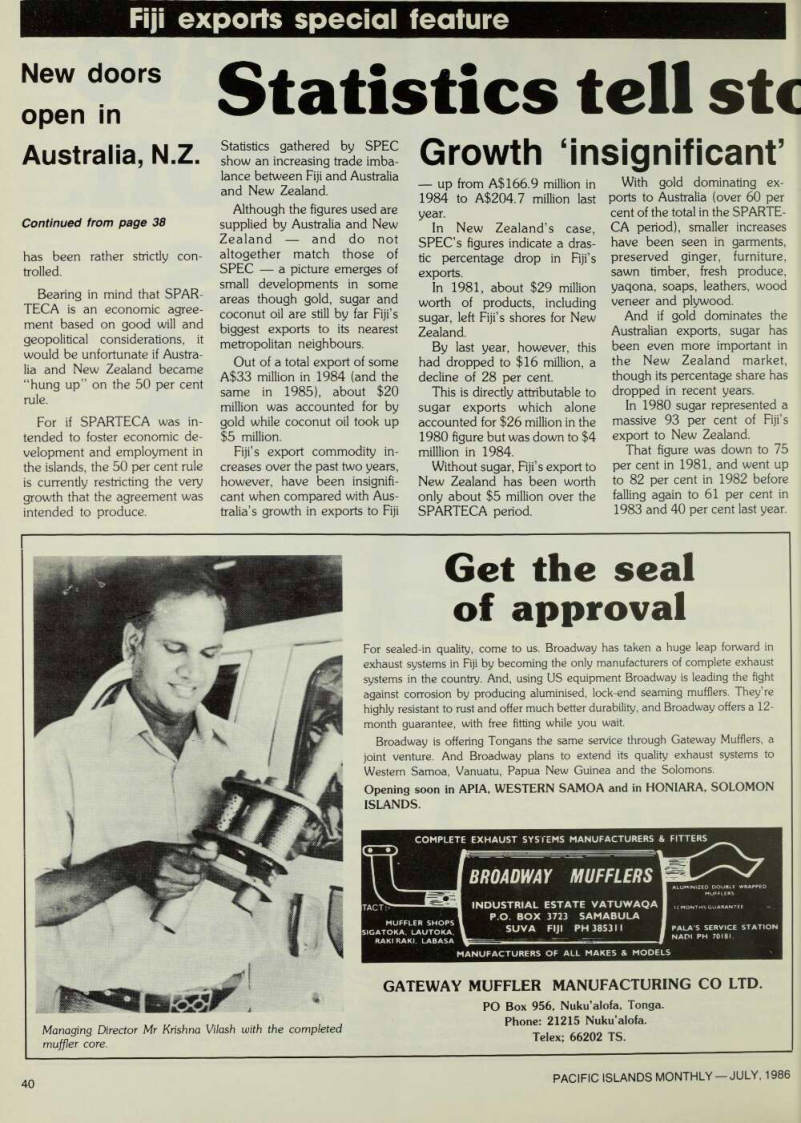
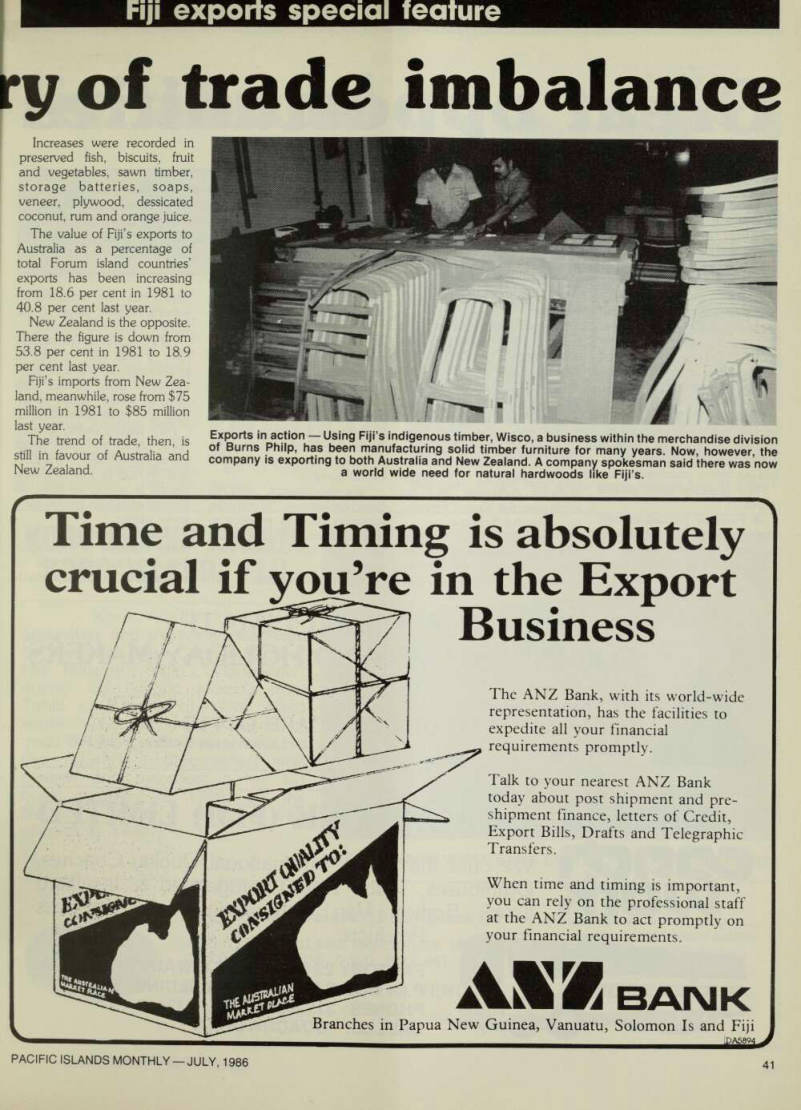
Statistics gathered by SPEC show an increasing trade imba lance between Fiji and Australia and New Zealand.
Although the figures used are supplied by Australia and New Zealand and do not altogether match those of SPEC a picture emerges of small developments in some areas though gold, sugar and coconut oil are still by far Fiji’s biggest exports to its nearest metropolitan neighbours.
Out of a total export of some As 33 million in 1984 (and the same in 1985), about $2O million was accounted for by gold while coconut oil took up $5 million.
Fiji’s export commodity in creases over the past two years, however, have been insignifi cant when compared with Aus tralia’s growth in exports to Fiji
Growth ‘insignificant’
up from A 5166.9 million in 1984 to A 5204.7 million last year.
In New Zealand’s case, SPEC’s figures indicate a dras tic percentage drop in Fiji’s exports.
In 1981, about $29 million worth of products, including sugar, left Fiji’s shores for New Zealand.
By last year, however, this had dropped to $l6 million, a decline of 28 per cent.
This is directly attributable to sugar exports which alone accounted for $26 million in the 1980 figure but was down to $4 milllion in 1984.
Without sugar, Fiji’s export to New Zealand has been worth only about $5 million over the SPARTECA period.
With gold dominating ex ports to Australia (over 60 per cent of the total in the SPARTE CA period), smaller increases have been seen in garments, preserved ginger, furniture, sawn timber, fresh produce, yaqona, soaps, leathers, wood veneer and plywood.
And if gold dominates the Australian exports, sugar has been even more important in the New Zealand market, though its percentage share has dropped in recent years.
In 1980 sugar represented a massive 93 per cent of Fiji’s export to New Zealand.
That figure was down to 75 per cent in 1981, and went up to 82 per cent in 1982 before falling again to 61 per cent in 1983 and 40 per cent last year.
Increases were recorded in preserved fish, biscuits, fruit and vegetables, sawn timber, storage batteries, soaps, veneer, plywood, dessicated coconut, rum and orange juice.
The value of Fiji’s exports to Australia as a percentage of total Forum island countries’ exports has been increasing from 18.6 per cent in 1981 to 40.8 per cent last year.
New Zealand is the opposite.
There the figure is down from 53.8 per cent in 1981 to 18.9 per cent last year.
Fiji’s imports from New Zea land, meanwhile, rose from $75 million in 1981 to $B5 million last year.
The trend of trade, then, is still in favour of Australia and New Zealand.
Exports in action Using Fiji’s indigenous timber, Wisco, a business within the merchandise division of Burns Philp, has been manufacturing solid timber furniture for many years. Now, however, the company is exporting to both Australia and New Zealand. A company spokesman said there was now a world wide need for natural hardwoods like Fiji’s.
Advertisements & other items, pp. 40-41 (3 items)
40
Fiji exports special feature
PACIFIC ISLANDS MONTHLY-JULY, 1986
Continued from page 38
New doors open in Australia, N.Z.
of approval
OK K.
I m Managing Director Mr Krishna Vilash with the completed muffler core.
Get the seal
of approval
For sealed-in quality, come to us. Broadway has taken a huge leap forward in exhaust systems in Fiji by becoming the only manufacturers of complete exhaust systems in the country. And, using US equipment Broadway is leading the fight against corrosion by producing aluminised, lock-end seaming mufflers. They’re highly resistant to rust and offer much better durability, and Broadway offers a 12month guarantee, with free fitting while you wait.
Broadway is offering Tongans the same service through Gateway Mufflers, a joint venture. And Broadway plans to extend its quality exhaust systems to Western Samoa, Vanuatu, Papua New Guinea and the Solomons.
Opening soon in APIA, WESTERN SAMOA and in HONIARA, SOLOMON
ISLANDS.
GATEWAY MUFFLER MANUFACTURING CO LTD.
PO Box 956, Nukualofa, Tonga.
Phone: 21215 Nukualofa.
Telex; 66202 TS.
Time and Timing is absolutely
crucial if you’re in the Export
£ B W V The ANZ Bank, with its world-wide representation, has the facilities to expedite all your financial requirements promptly.
Talk to your nearest ANZ Bank today about post shipment and preshipment finance, letters of Credit, Export Bills, Drafts and Telegraphic Transfers.
When time and timing is important, you can rely on the professional staff at the ANZ Bank to act promptly on your financial requirements.
ASH!
BANK
Branches in Papua New Guinea, Vanuatu, Solomon Is and Fiji
Fiji exports special feature
ry of trade imbalance
Great opportunities lie ahead

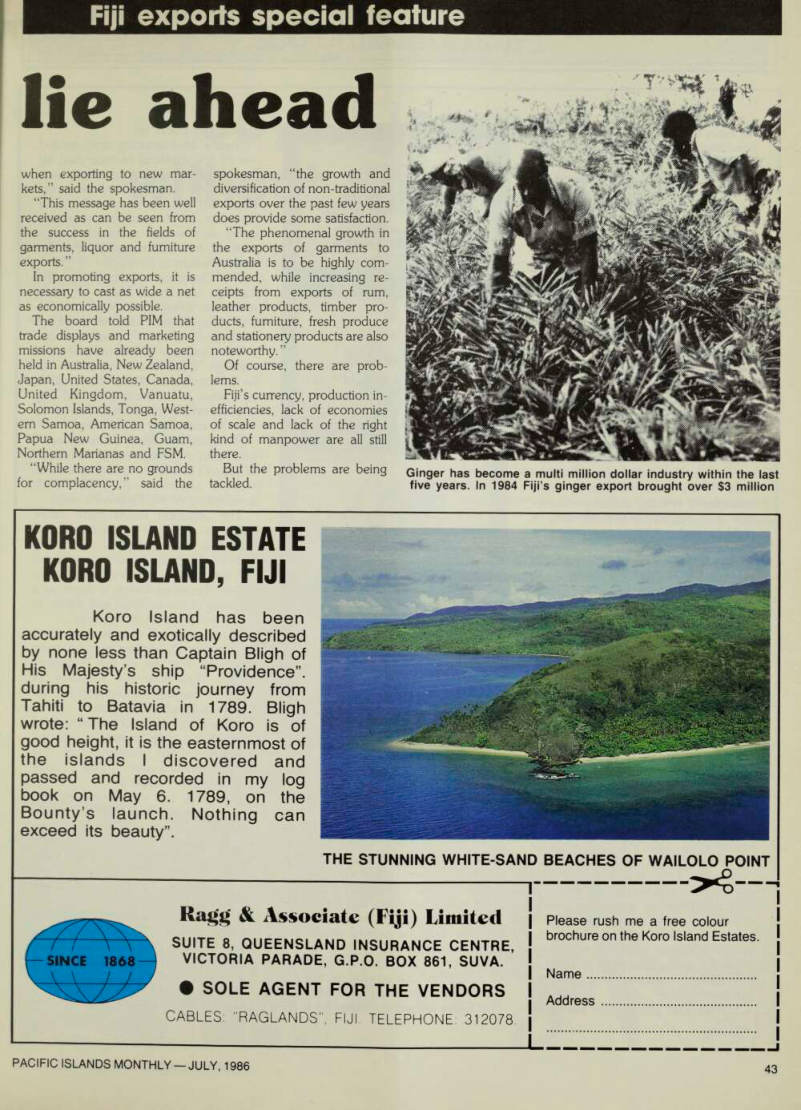
Fiji’s Economic Development Board, which is charged with supporting the country’s export effort, sees further success ahead.
The board told PIM it has identified opportunities in gar ments, furniture, fresh pawpaw and mango, seafoods (especial ly crayfish), leather goods, pro cessed timber products, cut tropical flowers, paper pro ducts, processed fruits and vegetables and processed orange, passionfruit and pine apple juices.
The EDB’s Trade Division carries out a continuing trade promotion program to assist both existing and potential ex porters.
This program takes several forms: • Personal discussions with entrepreneurs for advice on overseas markets, access to these markets under various trade agreements, distribution
channels and potential impor ters. • Setting up links between Fiji companies and potential overseas customers. • Seminars for exporters on various overseas markets and their documentation and quarantine requirements. • Trade displays, marketing missions and market research under the various aid schemes available. • Distribution of relevant news and information to the country’s exporters.
The board also maintains links with the manufacturers’ association to help improve ac cess conditions for Fiji in target markets overseas and to administer the Export Promo tion Incentive Scheme.
It also reviews the nation’s export performance in a more informal manner through its contacts with Fiji exporters and
Fiji’s exporters can expect continued success in several areas. The country’s Economic Deve lopment Board describes the export perform ance of the garment industry as “phenomenal” and points to further opportunities.
through follow-up action on overseas trade displays.
Fiji, said a board spokesman, is a relative newcomer to export markets and therefore has to be promoted as a supplier of high quality goods and produce.
For example, the board was instrumental in persuading the government to amend the Fruit Export Marketing Act in order to tighten up on the issue of export licences.
“We also attempt,” said the board spokesman, “to convince exporters of fresh produce to market their products as a group and not undercut each other.
“Substantial success in this
regard has been achieved for exports of fresh ginger to the United States and Canada.”
Fiji’s overseas representatives have a vital role to play in promoting exports and the EDB maintains close contact with them to review market condi tions and other developments.
Fiji’s private sector, govern ment unions and rural sector are all represented on the EDB and, though its role in quality control is mainly advisory, its recommendations tend to carry some weight.
“Our educational role has a major objective of stressing to exporters the importance of maintaining quality standards
when exporting to new mar kets,” said the spokesman.
“This message has been well received as can be seen from the success in the fields of garments, liquor and furniture exports. ”
In promoting exports, it is necessary to cast as wide a net as economically possible.
The board told PIM that trade displays and marketing missions have already been held in Australia, New Zealand, Japan, United States, Canada, United Kingdom, Vanuatu, Solomon Islands, Tonga, West ern Samoa, American Samoa, Papua New Guinea, Guam, Northern Marianas and FSM.
“While there are no grounds for complacency,” said the
spokesman, “the growth and diversification of non-traditional exports over the past few years does provide some satisfaction.
“The phenomenal growth in the exports of garments to Australia is to be highly com mended, while increasing re ceipts from exports of rum, leather products, timber pro ducts, furniture, fresh produce and stationery products are also noteworthy. ”
Of course, there are prob lems.
Fiji’s currency, production in efficiencies, lack of economies of scale and lack of the right kind of manpower are all still there.
But the problems are being tackled.
Ginger has become a multi million dollar industry within the last five years. In 1984 Fiji’s ginger export brought over $3 million
Advertisements & other items, pp. 42-43 (3 items)
Fiji exports special feature
■work
WE HAVE THE IDEAL CLIMATE
a FOR INVESTORS AND HOLIDAY MAKERS
For further information contact: The Director
EDB ECONOMIC DEVELOPMENT BOARD OF FIJI
lst Floor. Velop House, 371 Victoria Pde„ P.O Box 2303, Government Buildings, Suva, Fiji.
Telex: 2355 EDB FJ Telephone: 315988 (7 lines)
conch
■work
COACHWORK (FIJI) LIMITED
We offer the Finest, International Quality Coaches, Omnibuses, Truck Trays, Refrigerated & Insulated Truck Bodies, Van Conversions and Fibreglass Products.
FACTORY 23 SONOMA ST. WALL) BAY, SUVA.
P.O. BOX 2445, GOVT. BUILDING, SUVA.
PHONES: 311200 TELEX: FJ2417
CABLES: “COACHWORK”
KORO ISLAND ESTATE
KORO ISLAND, FIJI
Koro Island has been accurately and exotically described by none less than Captain Bligh of His Majesty’s ship “Providence”, during his historic journey from Tahiti to Batavia in 1789. Bligh wrote: “The Island of Koro is of good height, it is the easternmost of the islands I discovered and passed and recorded in my log book on May 6. 1789, on the Bounty’s launch. Nothing can exceed its beauty”. fff . mmf*- THE STUNNING WHITE-SAND BEACHES OF WAILOLO POINT , 3*g—
SINCE 1868
Ragg & Associate (Fiji) Limited
SUITE 8, QUEENSLAND INSURANCE CENTRE,
VICTORIA PARADE, G.P.O. BOX 861, SUVA.
• SOLE AGENT FOR THE VENDORS
CABLES: "RAGLANDS', FIJI, TELEPHONE; 312078
Please rush me a free colour brochure on the Koro Island Estates.
Name Address
Fiji exports special feature
lie ahead
Pacific stamp box
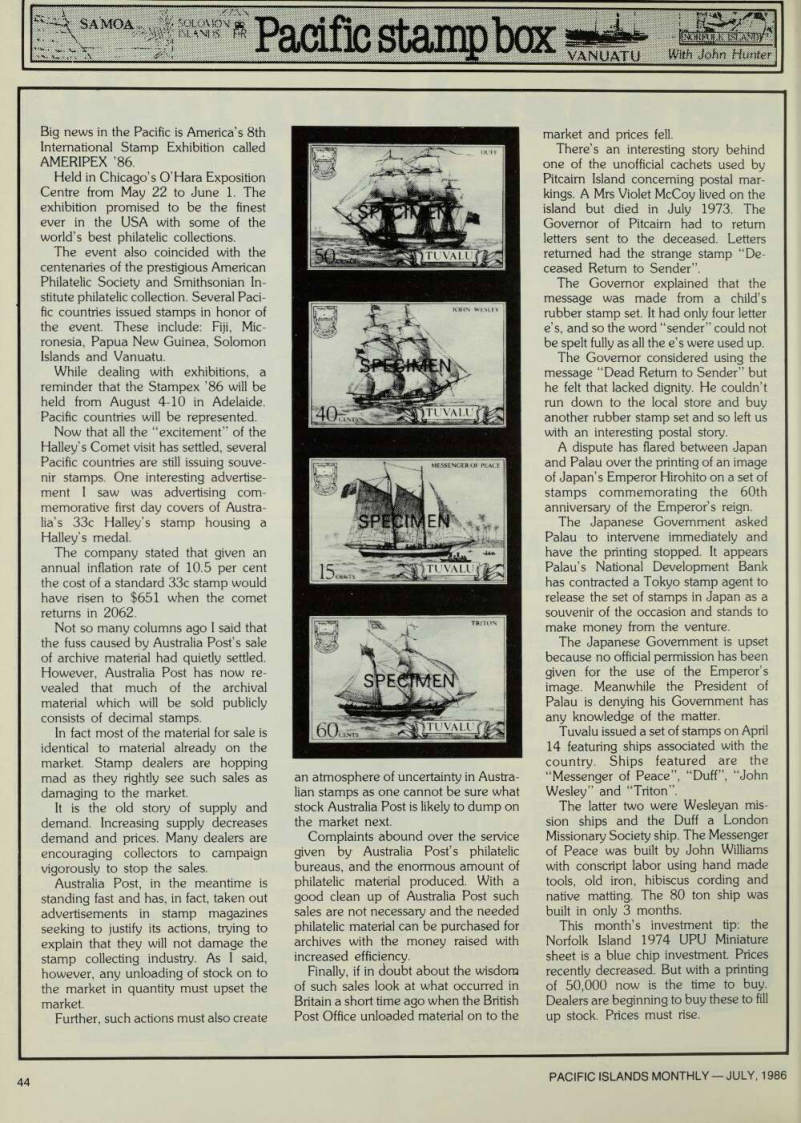
Big news in the Pacific is America’s Bth International Stamp Exhibition called
Ameripex ’B6.
Held in Chicago’s O’Hara Exposition Centre from May 22 to June 1. The exhibition promised to be the finest ever in the USA with some of the world’s best philatelic collections.
The event also coincided with the centenaries of the prestigious American Philatelic Society and Smithsonian In stitute philatelic collection. Several Paci fic countries issued stamps in honor of the event. These include: Fiji, Mic ronesia, Papua New Guinea, Solomon Islands and Vanuatu.
While dealing with exhibitions, a reminder that the Stampex ’B6 will be held from August 4-10 in Adelaide.
Pacific countries will be represented.
Now that all the “excitement” of the Halley’s Comet visit has settled, several Pacific countries are still issuing souve nir stamps. One interesting advertise ment 1 saw was advertising com memorative first day covers of Austra lia’s 33c Halley’s stamp housing a Halley’s medal.
The company stated that given an annual inflation rate of 10.5 per cent the cost of a standard 33c stamp would have risen to $651 when the comet returns in 2062.
Not so many columns ago I said that the fuss caused by Australia Post’s sale of archive material had quietly settled.
However, Australia Post has now re vealed that much of the archival material which will be sold publicly consists of decimal stamps.
In fact most of the material for sale is identical to material already on the market. Stamp dealers are hopping mad as they rightly see such sales as damaging to the market.
It is the old story of supply and demand. Increasing supply decreases demand and prices. Many dealers are encouraging collectors to campaign vigorously to stop the sales.
Australia Post, in the meantime is standing fast and has, in fact, taken out advertisements in stamp magazines seeking to justify its actions, trying to explain that they will not damage the stamp collecting industry. As I said, however, any unloading of stock on to the market in quantity must upset the market.
Further, such actions must also create
an atmosphere of uncertainty in Austra lian stamps as one cannot be sure what stock Australia Post is likely to dump on the market next.
Complaints abound over the service given by Australia Post’s philatelic bureaus, and the enormous amount of philatelic material produced. With a good clean up of Australia Post such sales are not necessary and the needed philatelic material can be purchased for archives with the money raised with increased efficiency.
Finally, if in doubt about the wisdom of such sales look at what occurred in Britain a short time ago when the British Post Office unloaded material on to the
market and prices fell.
There’s an interesting story behind one of the unofficial cachets used by Pitcairn Island concerning postal mar kings. A Mrs Violet McCoy lived on the island but died in July 1973. The Governor of Pitcairn had to return letters sent to the deceased. Letters returned had the strange stamp “De ceased Return to Sender”.
The Governor explained that the message was made from a child’s rubber stamp set. It had only four letter e’s, and so the word “sender” could not be spelt fully as all the e’s were used up.
The Governor considered using the message “Dead Return to Sender” but he felt that lacked dignity. He couldn’t run down to the local store and buy another rubber stamp set and so left us with an interesting postal story.
A dispute has flared between Japan and Palau over the printing of an image of Japan’s Emperor Hirohito on a set of stamps commemorating the 60th anniversary of the Emperor’s reign.
The Japanese Government asked Palau to intervene immediately and have the printing stopped. It appears Palau’s National Development Bank has contracted a Tokyo stamp agent to release the set of stamps in Japan as a souvenir of the occasion and stands to make money from the venture.
The Japanese Government is upset because no official permission has been given for the use of the Emperor’s image. Meanwhile the President of Palau is denying his Government has any knowledge of the matter.
Tuvalu issued a set of stamps on April 14 featuring ships associated with the country. Ships featured are the “Messenger of Peace”, “Duff”, “John Wesley” and “Triton”.
The latter two were Wesleyan mis sion ships and the Duff a London Missionary Society ship. The Messenger of Peace was built by John Williams with conscript labor using hand made tools, old iron, hibiscus cording and native matting. The 80 ton ship was built in only 3 months.
This month’s investment tip: the Norfolk Island 1974 UPU Miniature sheet is a blue chip investment. Prices recently decreased. But with a printing of 50,000 now is the time to buy.
Dealers are beginning to buy these to fill up stock. Prices must rise.
Joyful journey
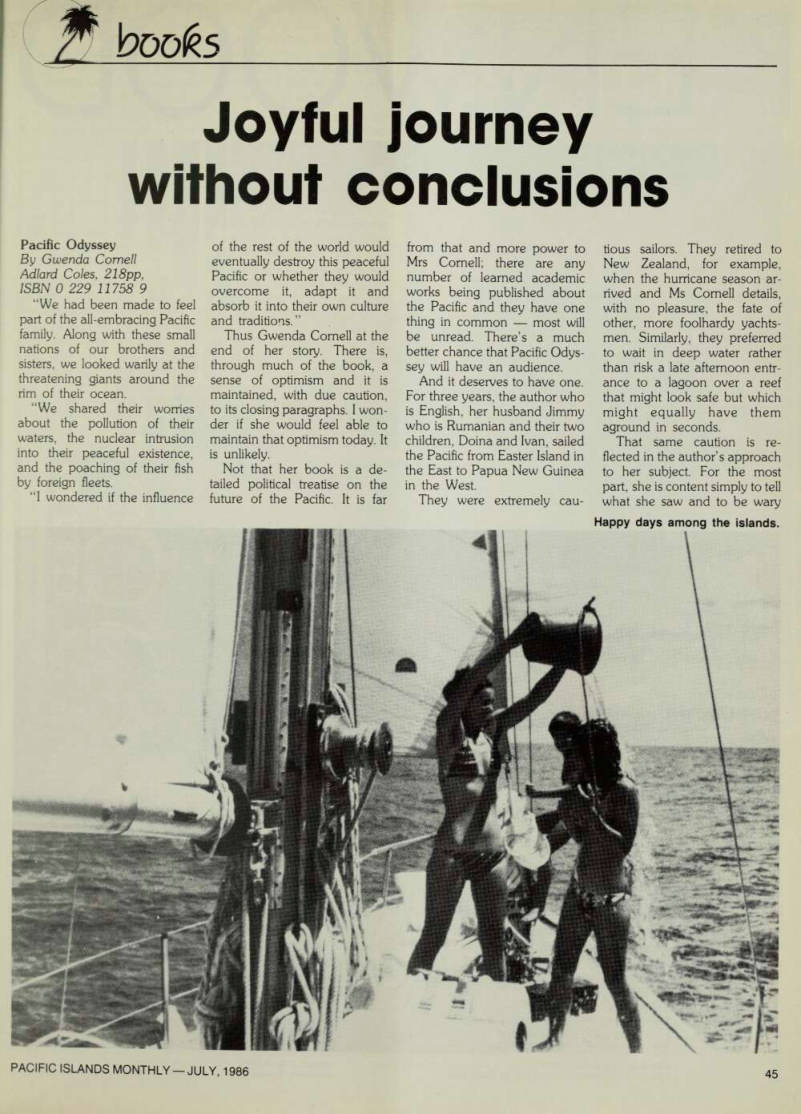

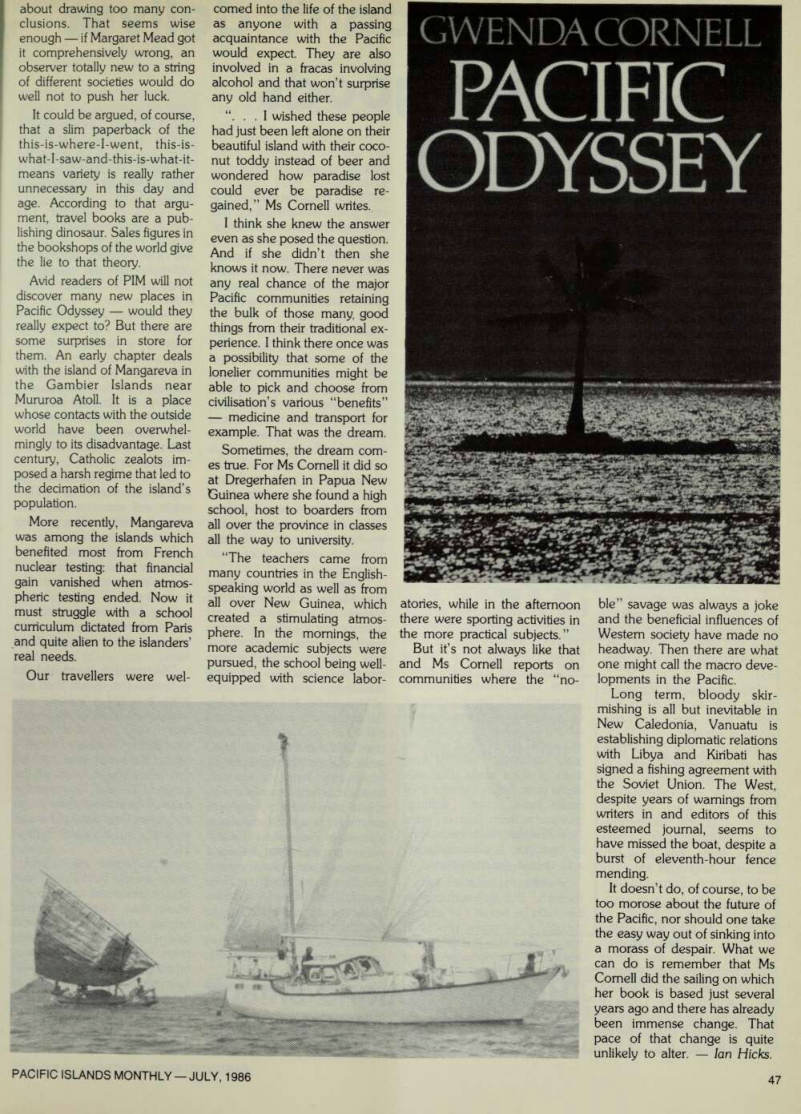
books
Joyful journey without conclusions
Pacific Odyssey By Gwenda Cornell Adlard Coles, 218 pp,
Isbn 0 229 11758 9
“We had been made to feel part of the all-embracing Pacific family. Along with these small nations of our brothers and sisters, we looked warily at the threatening giants around the rim of their ocean.
“We shared their worries about the pollution of their waters, the nuclear intrusion into their peaceful existence, and the poaching of their fish by foreign fleets.
“I wondered if the influence
of the rest of the world would eventually destroy this peaceful Pacific or whether they would overcome it, adapt it and absorb it into their own culture and traditions.”
Thus Gwenda Cornell at the end of her story. There is, through much of the book, a sense of optimism and it is maintained, with due caution, to its closing paragraphs. I won der if she would feel able to maintain that optimism today. It is unlikely.
Not that her book is a de tailed political treatise on the future of the Pacific. It is far
from that and more power to Mrs Cornell; there are any number of learned academic works being published about the Pacific and they have one thing in common most will be unread. There’s a much better chance that Pacific Odys sey will have an audience.
And it deserves to have one.
For three years, the author who is English, her husband Jimmy who is Rumanian and their two children, Doina and Ivan, sailed the Pacific from Easter Island in the East to Papua New Guinea in the West.
They were extremely cau
tious sailors. They retired to New Zealand, for example, when the hurricane season ar rived and Ms Cornell details, with no pleasure, the fate of other, more foolhardy yachts men. Similarly, they preferred to wait in deep water rather than risk a late afternoon entr ance to a lagoon over a reef that might look safe but which might equally have them aground in seconds.
That same caution is re flected in the author’s approach to her subject. For the most part, she is content simply to tell what she saw and to be wary
Happy days among the islands.
about drawing too many con clusions. That seems wise enough if Margaret Mead got it comprehensively wrong, an observer totally new to a string of different societies would do well not to push her luck.
It could be argued, of course, that a slim paperback of the this-is-where-I-went, this-is what-I-saw-and-this-is-what-itmeans variety is really rather unnecessary in this day and age. According to that argu ment, travel books are a pub lishing dinosaur. Sales figures in the bookshops of the world give the lie to that theory.
Avid readers of PIM will not discover many new places in Pacific Odyssey would they really expect to? But there are some surprises in store for them. An early chapter deals with the island of Mangareva in the Gambier Islands near Mururoa Atoll. It is a place whose contacts with the outside world have been overwhel mingly to its disadvantage. Last century, Catholic zealots im posed a harsh regime that led to the decimation of the island’s population.
More recently, Mangareva was among the islands which benefited most from French nuclear testing: that financial gain vanished when atmos pheric testing ended. Now it must struggle with a school curriculum dictated from Paris and quite alien to the islanders’ real needs.
Our travellers were wel
comed into the life of the island as anyone with a passing acquaintance with the Pacific would expect. They are also involved in a fracas involving alcohol and that won’t surprise any old hand either. . .1 wished these people had just been left alone on their beautiful island with their coco nut toddy instead of beer and wondered how paradise lost could ever be paradise re gained,” Ms Cornell writes.
I think she knew the answer even as she posed the question.
And if she didn’t then she knows it now. There never was any real chance of the major Pacific communities retaining the bulk of those many, good things from their traditional ex perience. I think there once was a possibility that some of the lonelier communities might be able to pick and choose from civilisation’s various “benefits” medicine and transport for example. That was the dream.
Sometimes, the dream com es true. For Ms Cornell it did so at Dregerhafen in Papua New Guinea where she found a high school, host to boarders from all over the province in classes all the way to university.
“The teachers came from many countries in the English speaking world as well as from all over New Guinea, which created a stimulating atmos phere. In the mornings, the more academic subjects were pursued, the school being well equipped with science labor-
atories, while in the afternoon there were sporting activities in the more practical subjects.”
But it’s not always like that and Ms Cornell reports on communities where the “no
ble” savage was always a joke and the beneficial influences of Western society have made no headway. Then there are what one might call the macro deve lopments in the Pacific.
Long term, bloody skir mishing is all but inevitable in New Caledonia, Vanuatu is establishing diplomatic relations with Libya and Kiribati has signed a fishing agreement with the Soviet Union. The West, despite years of warnings from writers in and editors of this esteemed journal, seems to have missed the boat, despite a burst of eleventh-hour fence mending.
It doesn’t do, of course, to be too morose about the future of the Pacific, nor should one take the easy way out of sinking into a morass of despair. What we can do is remember that Ms Cornell did the sailing on which her book is based just several years ago and there has already been immense change. That pace of that change is quite
unlikely to alter.
lan Hicks.
Advertisements & other items, p. 46 (1 item)
Kenwood
m m Q e o
Spectrum
[.Spectrum 1058 1250 W x 2 (Dynamic Power) power amplifier control amplifier with CD and Video selectors B Automatic quartz-synthesizer tuning 820 random memory presets BTwice-a-day timer B Double auto-reverse cassette deck with relay-play and high-speed dubbing BProgrammable linear-tracking direct-drive turntable B4OOW (max.) speakers BOptions; CD player, graphic equalizer, surround processor, remote control, headphones, microphone
So nice to come home to
The Spectrum series are no ordinary stereo systems. For one thing, they offer you pure hi-fi sound.
For example, the Spectrum 1058 shown has professional separate power and control amplifiers. With its CD input selector, it’s ready to give you the full dynamic impact of digital sound!
Spectrum 1058 also helps you enjoy your music. Look at the versatile double auto-reverse cassette deck, computerized automatic tuner and full remote controller and you will see what we mean.
No matter what the time of day, you’ll always be ready to come home to your Spectrum hi-fi stereo system.
KENWOOD CORPORATION
Shionogi Shibuya Building, 17-5, 2-chbme Shibuya, Shibuya-ku, Tokyo 150, Japan TRIO-KENWOOD (AUSTRALIA) PTY. LTD. (incorporated in nsw) 4E Woodcock Place, Lane Cove. N.S.W. 2066, Australia NEW ZEALAND JOHN GILBERT & CO., LTD. Auckland Tel, 0011-64-9-30839 FUJI PEPE'S DUTY FREE CENTRE LTD. Tel. 25496, 25497 PAPUA NEW GUINEA SO. SVENSSON (N.G.) LTD. Port Moresby Tel. 212158, 212111 SOLOMON ISLANDS TECHNIQUE RADIOS CENTRE LTD. Honiara Tel. 416 NEW CALEDONIA HI-FI VOX Noumea Tel. 27-2466, 28-2931 VANUATU FUNG CHOI LUEN. Pbrt-Vila Tel. 2556
TAHITI MAISON AURORE Papeete Tel. 29703
AMERICAN SAMOA ISLAND PACIFIC AGENCIES, INC. Pago Pago Tel. 633-4687
REPUBLIC OF NAURU NAURU CO-OPERATIVE SOCIETY
MARIANA ISLANDS JC. TENORIO ENTERPRISES Saipan Tel. 6445
the goods
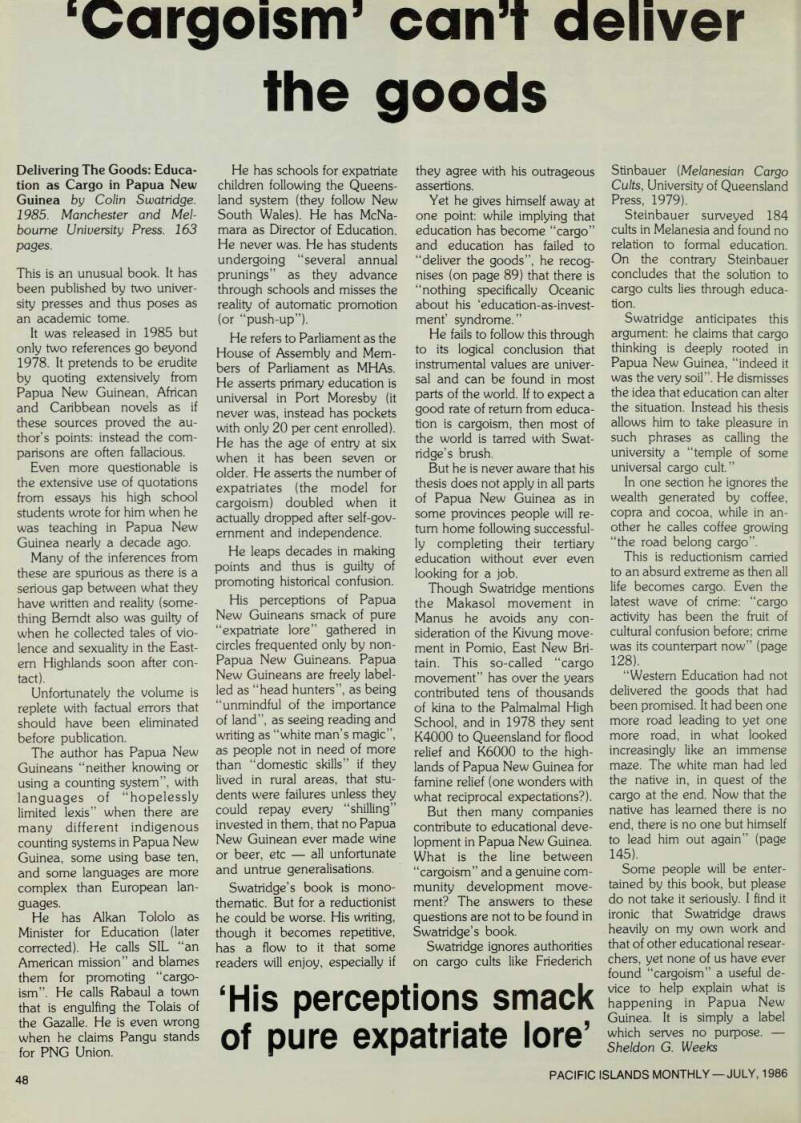
‘Cargoism’ can’t deliver the goods
Delivering The Goods: Educa tion as Cargo in Papua New Guinea by Colin Swatridge. 1985. Manchester and Mel bourne University Press. 163 pages.
This is an unusual book. It has been published by two univer sity presses and thus poses as an academic tome.
It was released in 1985 but only two references go beyond 1978. It pretends to be erudite by quoting extensively from Papua New Guinean, African and Caribbean novels as if these sources proved the au thor’s points: instead the com parisons are often fallacious.
Even more questionable is the extensive use of quotations from essays his high school students wrote for him when he was teaching in Papua New Guinea nearly a decade ago.
Many of the inferences from these are spurious as there is a serious gap between what they have written and reality (some thing Bemdt also was guilty of when he collected tales of vio lence and sexuality in the East ern Highlands soon after con tact).
Unfortunately the volume is replete with factual errors that should have been eliminated before publication.
The author has Papua New Guineans “neither knowing or using a counting system”, with languages of “hopelessly limited lexis” when there are many different indigenous counting systems in Papua New Guinea, some using base ten, and some languages are more complex than European lan guages.
He has Alkan Tololo as Minister for Education (later corrected). He calls SIL “an American mission” and blames them for promoting “cargo ism”. He calls Rabaul a town that is engulfing the Tolais of the Gazalle. He is even wrong when he claims Pangu stands for PNG Union.
He has schools for expatriate children following the Queens land system (they follow New South Wales). He has McNa mara as Director of Education.
He never was. He has students undergoing “several annual prunings” as they advance through schools and misses the reality of automatic promotion (or “push-up”).
He refers to Parliament as the House of Assembly and Mem bers of Parliament as MHAs.
He asserts primary education is universal in Port Moresby (it never was, instead has pockets with only 20 per cent enrolled).
He has the age of entry at six when it has been seven or older. He asserts the number of expatriates (the model for cargoism) doubled when it actually dropped after self-gov ernment and independence.
He leaps decades in making points and thus is guilty of promoting historical confusion.
His perceptions of Papua New Guineans smack of pure “expatriate lore” gathered in circles frequented only by non- Papua New Guineans. Papua New Guineans are freely label led as “head hunters”, as being “unmindful of the importance of land”, as seeing reading and writing as “white man’s magic”, as people not in need of more than “domestic skills” if they lived in rural areas, that stu dents were failures unless they could repay every “shilling” invested in them, that no Papua New Guinean ever made wine or beer, etc all unfortunate and untrue generalisations.
Swatridge’s book is mono thematic. But for a reductionist he could be worse. His writing, though it becomes repetitive, has a flow to it that some readers will enjoy, especially if
they agree with his outrageous assertions.
Yet he gives himself away at one point: while implying that education has become “cargo” and education has failed to “deliver the goods”, he recog nises (on page 89) that there is “nothing specifically Oceanic about his ‘education-as-invest ment’ syndrome.”
He fails to follow this through to its logical conclusion that instrumental values are univer sal and can be found in most parts of the world. If to expect a good rate of return from educa tion is cargoism, then most of the world is tarred with Swat ridge’s brush.
But he is never aware that his thesis does not apply in all parts of Papua New Guinea as in some provinces people will re turn home following successful ly completing their tertiary education without ever even looking for a job.
Though Swatridge mentions the Makasol movement in Manus he avoids any con sideration of the Kivung move ment in Pomio, East New Bri tain. This so-called “cargo movement” has over the years contributed tens of thousands of kina to the Palmalmal High School, and in 1978 they sent K4OOO to Queensland for flood relief and K6OOO to the high lands of Papua New Guinea for famine relief (one wonders with what reciprocal expectations?).
But then many companies contribute to educational deve lopment in Papua New Guinea.
What is the line between “cargoism” and a genuine com munity development move ment? The answers to these questions are not to be found in Swatridge’s book.
Swatridge ignores authorities on cargo cults like Friederich
‘His perceptions smack of pure expatriate lore’
Stinbauer ( Melanesian Cargo Cults, University of Queensland Press, 1979).
Steinbauer surveyed 184 cults in Melanesia and found no relation to formal education.
On the contrary Steinbauer concludes that the solution to cargo cults lies through educa tion.
Swatridge anticipates this argument: he claims that cargo thinking is deeply rooted in Papua New Guinea, “indeed it was the very soil”. He dismisses the idea that education can alter the situation. Instead his thesis allows him to take pleasure in such phrases as calling the university a “temple of some universal cargo cult.”
In one section he ignores the wealth generated by coffee, copra and cocoa, while in an other he calles coffee growing “the road belong cargo”.
This is reductionism carried to an absurd extreme as then all life becomes cargo. Even the latest wave of crime: “cargo activity has been the fruit of cultural confusion before; crime was its counterpart now” (page 128).
“Western Education had not delivered the goods that had been promised. It had been one more road leading to yet one more road, in what looked increasingly like an immense maze. The white man had led the native in, in quest of the cargo at the end. Now that the native has learned there is no end, there is no one but himself to lead him out again” (page 145).
Some people will be enter tained by this book, but please do not take it seriously. I find it ironic that Swatridge draws heavily on my own work and that of other educational resear chers, yet none of us have ever found “cargoism” a useful de vice to help explain what is happening in Papua New Guinea. It is simply a label which serves no purpose.
Sheldon G. Weeks
transitions
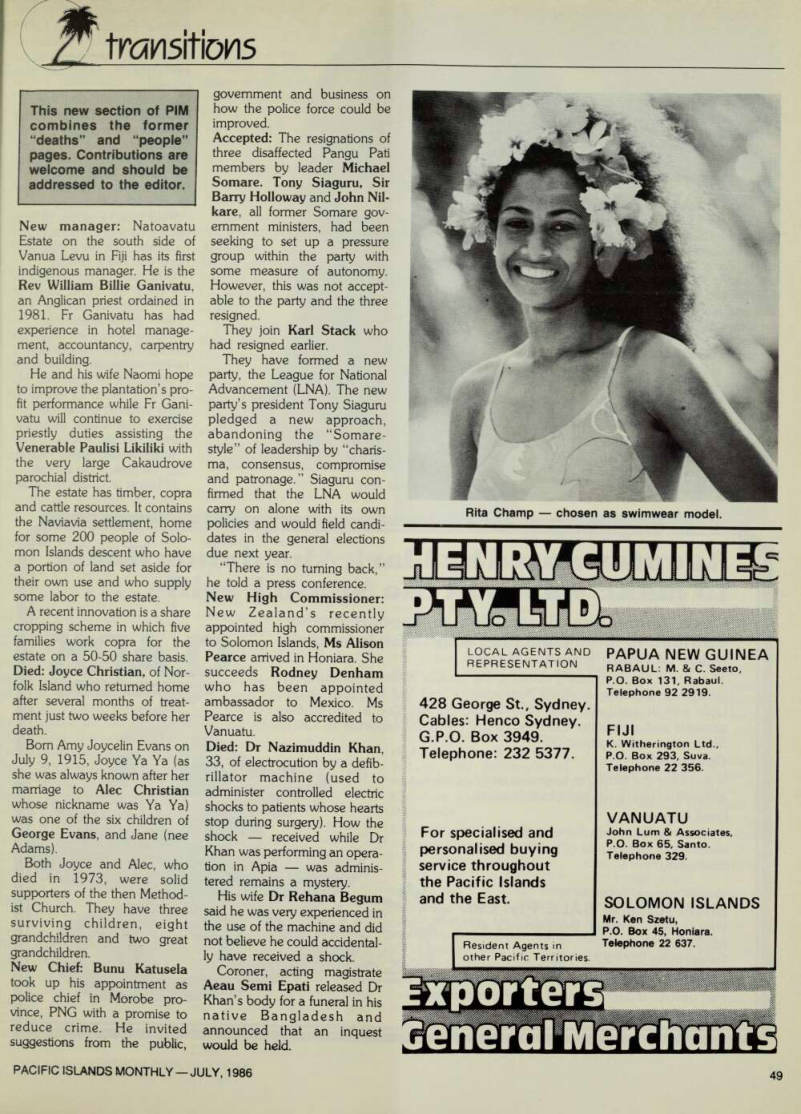
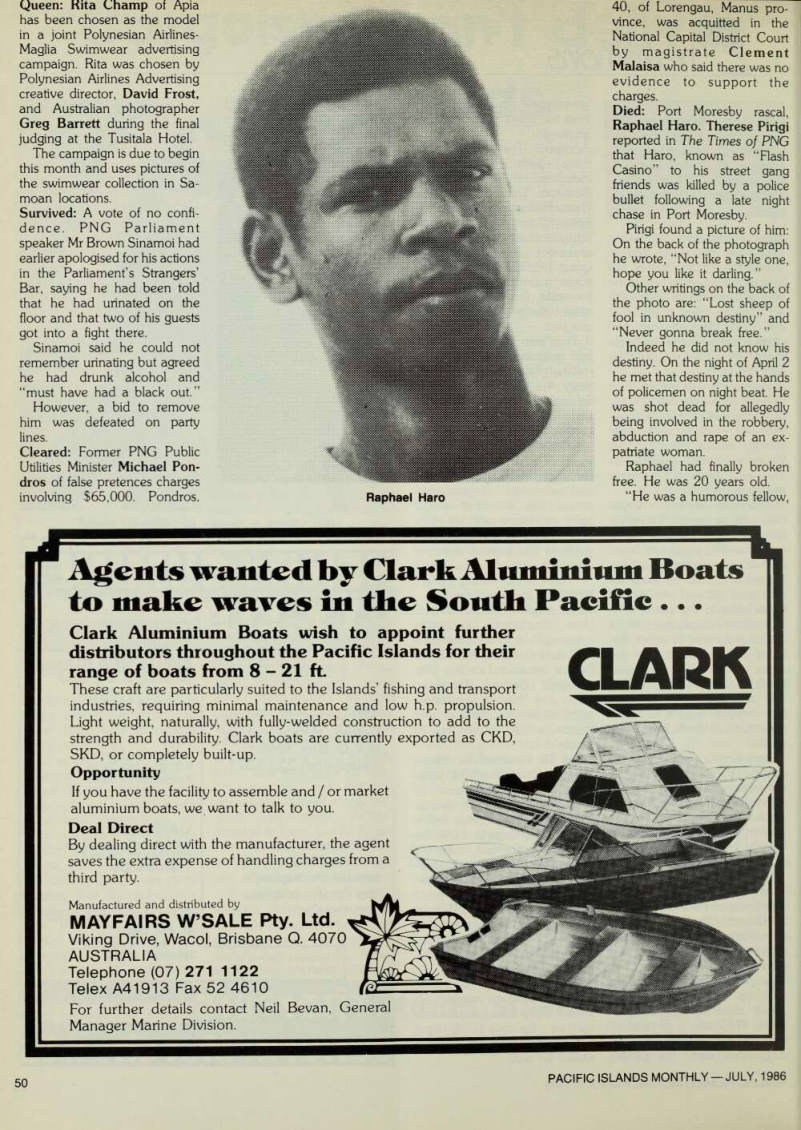
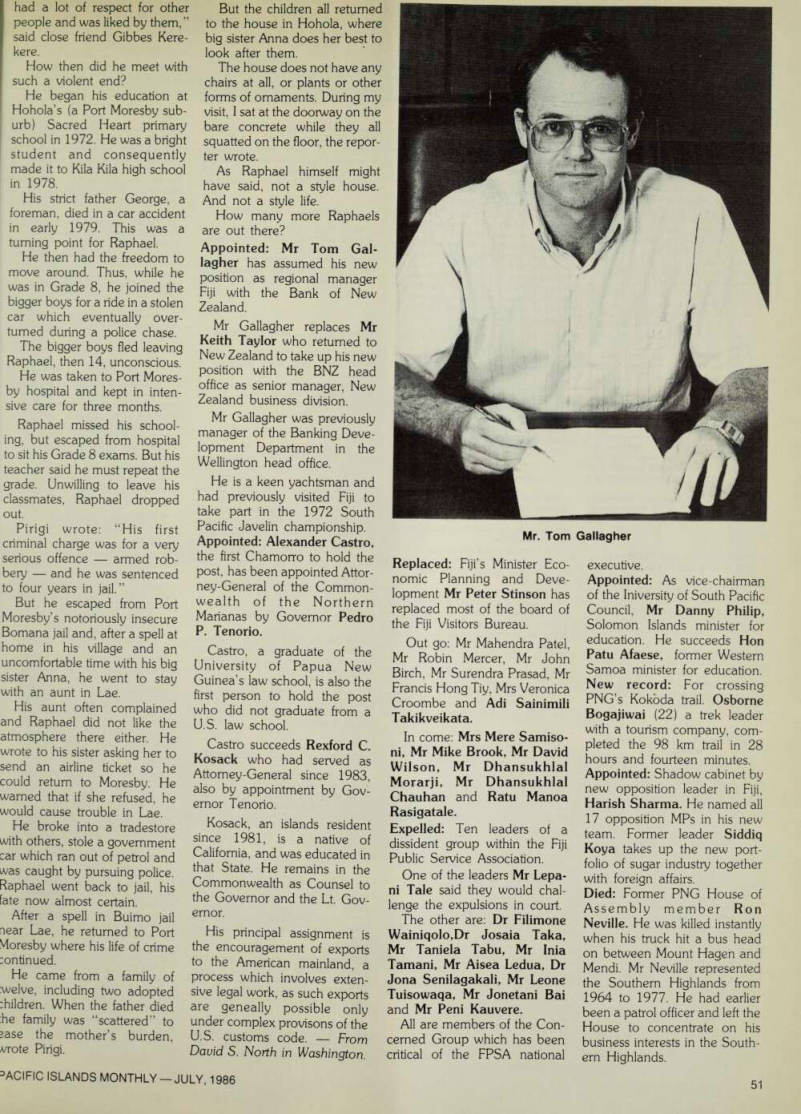
This new section of PIM combines the former “deaths” and “people” pages. Contributions are welcome and should be addressed to the editor.
New manager: Natoavatu Estate on the south side of Vanua Levu in Fiji has its first indigenous manager. He is the Rev William Billie Ganivatu, an Anglican priest ordained in 1981. Fr Ganivatu has had experience in hotel manage ment, accountancy, carpentry and building.
He and his wife Naomi hope to improve the plantation’s pro fit performance while Fr Gani vatu will continue to exercise priestly duties assisting the Venerable Paulisi Likiliki with the very large Cakaudrove parochial district.
The estate has timber, copra and cattle resources. It contains the Naviavia settlement, home for some 200 people of Solo mon Islands descent who have a portion of land set aside for their own use and who supply some labor to the estate.
A recent innovation is a share cropping scheme in which five families work copra for the estate on a 50-50 share basis.
Died: Joyce Christian, of Nor folk Island who returned home after several months of treat ment just two weeks before her death.
Bom Amy Joycelin Evans on July 9, 1915, Joyce Ya Ya (as she was always known after her marriage to Alec Christian whose nickname was Ya Ya) was one of the six children of George Evans, and Jane (nee Adams).
Both Joyce and Alec, who died in 1973, were solid supporters of the then Method ist Church. They have three surviving children, eight grandchildren and two great grandchildren.
New Chief: Bunu Katusela took up his appointment as police chief in Morobe pro vince, PNG with a promise to reduce crime. He invited suggestions from the public,
government and business on how the police force could be improved.
Accepted: The resignations of three disaffected Pangu Pati members by leader Michael Somare. Tony Siaguru, Sir Barry Holloway and John Nil kare, all former Somare gov ernment ministers, had been seeking to set up a pressure group within the party with some measure of autonomy.
However, this was not accept able to the party and the three resigned.
They join Karl Stack who had resigned earlier.
They have formed a new party, the League for National Advancement (LNA). The new party’s president Tony Siaguru pledged a new approach, abandoning the “Somare style” of leadership by “charis ma, consensus, compromise and patronage.” Siaguru con firmed that the LNA would carry on alone with its own policies and would field candi dates in the general elections due next year.
“There is no turning back,” he told a press conference.
New High Commissioner: New Zealand’s recently appointed high commissioner to Solomon Islands, Ms Alison Pearce arrived in Honiara. She succeeds Rodney Denham who has been appointed ambassador to Mexico. Ms Pearce is also accredited to Vanuatu.
Died: Dr Nazimuddin Khan, 33, of electrocution by a defib rillator machine (used to administer controlled electric shocks to patients whose hearts stop during surgery). How the shock received while Dr Khan was performing an opera tion in Apia was adminis tered remains a mystery.
His wife Dr Rehana Begum said he was very experienced in the use of the machine and did not believe he could accidental ly have received a shock.
Coroner, acting magistrate Aeau Semi Epati released Dr Khan’s body for a funeral in his native Bangladesh and announced that an inquest would be held.
Rita Champ chosen as swimwear model.
Queen: Rita Champ of Apia has been chosen as the model in a joint Polynesian Airlines- Maglia Swimwear advertising campaign. Rita was chosen by Polynesian Airlines Advertising creative director, David Frost, and Australian photographer Greg Barrett during the final judging at the Tusitala Hotel.
The campaign is due to begin this month and uses pictures of the swimwear collection in Sa moan locations.
Survived: A vote of no confi dence. PNG Parliament speaker Mr Brown Sinamoi had earlier apologised for his actions in the Parliament’s Strangers’
Bar, saying he had been told that he had urinated on the floor and that two of his guests got into a fight there.
Sinamoi said he could not remember urinating but agreed he had drunk alcohol and “must have had a black out.”
However, a bid to remove him was defeated on party lines.
Cleared: Former PNG Public Utilities Minister Michael Fon dros of false pretences charges involving $65,000. Pondros.
40, of Lorengau, Manus pro vince, was acquitted in the National Capital District Court by magistrate Clement Malaisa who said there was no evidence to support the charges.
Died: Port Moresby rascal, Raphael Haro. Therese Pirigi reported in The Times of PNG that Haro, known as “Flash Casino” to his street gang friends was killed by a police bullet following a late night chase in Port Moresby.
Pirigi found a picture of him: On the back of the photograph he wrote, “Not like a style one, hope you like it darling.”
Other writings on the back of the photo are: “Lost sheep of fool in unknown destiny” and “Never gonna break free.”
Indeed he did not know his destiny. On the night of April 2 he met that destiny at the hands of policemen on night beat. He was shot dead for allegedly being involved in the robbery, abduction and rape of an ex patriate woman.
Raphael had finally broken free. He was 20 years old.
“He was a humorous fellow,
Raphael Haro
had a lot of respect for other people and was liked by them,” said close friend Gibbes Kere kere.
How then did he meet with such a violent end?
He began his education at Hohola’s (a Port Moresby sub urb) Sacred Heart primary school in 1972. He was a bright student and consequently made it to Kila Kila high school in 1978.
His strict father George, a foreman, died in a car accident in early 1979. This was a turning point for Raphael.
He then had the freedom to move around. Thus, while he was in Grade 8, he joined the bigger boys for a ride in a stolen car which eventually over turned during a police chase.
The bigger boys fled leaving Raphael, then 14, unconscious.
He was taken to Port Mores by hospital and kept in inten sive care for three months.
Raphael missed his school ing, but escaped from hospital to sit his Grade 8 exams. But his teacher said he must repeat the grade. Unwilling to leave his classmates, Raphael dropped out.
Pirigi wrote: “His first criminal charge was for a very serious offence armed rob bery and he was sentenced to four years in jail.”
But he escaped from Port Moresby’s notoriously insecure Bomana jail and, after a spell at home in his village and an uncomfortable time with his big sister Anna, he went to stay with an aunt in Lae.
His aunt often complained and Raphael did not like the atmosphere there either. He wrote to his sister asking her to send an airline ticket so he could return to Moresby. He warned that if she refused, he would cause trouble in Lae.
He broke into a tradestore with others, stole a government car which ran out of petrol and was caught by pursuing police.
Raphael went back to jail, his fate now almost certain.
After a spell in Buimo jail iear Lae, he returned to Port Moresby where his life of crime continued.
He came from a family of twelve, including two adopted children. When the father died he family was “scattered” to case the mother’s burden, vrote Pirigi.
But the children all returned to the house in Hohola, where big sister Anna does her best to look after them.
The house does not have any chairs at all, or plants or other forms of ornaments. During my visit, I sat at the doorway on the bare concrete while they all squatted on the floor, the repor ter wrote.
As Raphael himself might have said, not a style house.
And not a style life.
How many more Raphaels are out there?
Appointed: Mr Tom Gal lagher has assumed his new position as regional manager Fiji with the Bank of New Zealand.
Mr Gallagher replaces Mr Keith Taylor who returned to New Zealand to take up his new position with the BNZ head office as senior manager, New Zealand business division.
Mr Gallagher was previously manager of the Banking Deve lopment Department in the Wellington head office.
He is a keen yachtsman and had previously visited Fiji to take part in the 1972 South Pacific Javelin championship.
Appointed: Alexander Castro, the first Chamorro to hold the post, has been appointed Attor ney-General of the Common wealth of the Northern Marianas by Governor Pedro P. Tenorio.
Castro, a graduate of the University of Papua New Guinea’s law school, is also the first person to hold the post who did not graduate from a U.S. law school.
Castro succeeds Rexford C.
Kosack who had served as Attorney-General since 1983, also by appointment by Gov ernor Tenorio.
Kosack, an islands resident since 1981, is a native of California, and was educated in that State. He remains in the Commonwealth as Counsel to the Governor and the Lt. Gov ernor.
His principal assignment is the encouragement of exports to the American mainland, a process which involves exten sive legal work, as such exports are geneally possible only under complex provisons of the U.S. customs code. From David S. North in Washington.
Replaced: Fiji’s Minister Eco nomic Planning and Deve lopment Mr Peter Stinson has replaced most of the board of the Fiji Visitors Bureau.
Out go: Mr Mahendra Patel, Mr Robin Mercer, Mr John Birch, Mr Surendra Prasad, Mr Francis Hong Tiy, Mrs Veronica Croombe and Adi Sainimili Takikveikata.
In come: Mrs Mere Samiso ni, Mr Mike Brook, Mr David Wilson, Mr Dhansukhlal Morarji, Mr Dhansukhlal Chauhan and Ratu Manoa Rasigatale.
Expelled: Ten leaders of a dissident group within the Fiji Public Service Association.
One of the leaders Mr Lepa ni Tale said they would chal lenge the expulsions in court.
The other are; Dr Filimone Wainiqolo,Dr Josaia Taka, Mr Taniela Tabu, Mr Inia Tamani, Mr Aisea Ledua, Dr Jona Senilagakali, Mr Leone Tuisowaqa, Mr Jonetani Bai and Mr Peni Kauvere.
All are members of the Con cerned Group which has been critical of the FPSA national
executive.
Appointed: As vice-chairman of the Iniversity of South Pacific Council, Mr Danny Philip, Solomon Islands minister for education. He succeeds Hon Patu Afaese, former Western Samoa minister for education.
New record: For crossing PNG’s Kokbda trail. Osborne Bogajiwai (22) a trek leader with a tourism company, com pleted the 98 km trail in 28 hours and fourteen minutes.
Appointed: Shadow cabinet by new opposition leader in Fiji, Harish Sharma. He named all 17 opposition MPs in his new team. Former leader Siddiq Koya takes up the new port folio of sugar industry together with foreign affairs.
Died: Former PNG House of Assembly member Ron Neville. He was killed instantly when his truck hit a bus head on between Mount Hagen and Mendi. Mr Neville represented the Southern Highlands from 1964 to 1977. He had earlier been a patrol officer and left the House to concentrate on his business interests in the South ern Highlands.
Mr. Tom Gallagher
Advertisements & other items, pp. 49-50 (1 item)
Z Ii H
Mum
LOCAL AGENTS AND
REPRESENTATION
428 George St., Sydney.
Cables: Henco Sydney.
G.P.O. Box 3949.
Telephone: 232 5377.
PAPUA NEW GUINEA
RABAUL: M. & C. Seeto, P.O. Box 131, Rabaul.
Telephone 92 2919.
FIJI
K. Witherington Ltd., P.O. Box 293, Suva.
Telephone 22 356.
For specialised and
personalised buying
service throughout
the Pacific Islands and the East.
VANUATU
John Lum & Associates, P.O. Box 65, Santo.
Telephone 329.
SOLOMON ISLANDS
Mr. Ken Szetu, P.O. Box 45, Honiara.
Telephone 22 637. .. . W Resident Agents in other Pacific Territories.
CLARK
Agents wanted by Clark Aluminium Boats
to make waves in the South Pacific . •.
Clark Aluminium Boats wish to appoint further distributors throughout the Pacific Islands for their range of boats from 8 - 21 ft These craft are particularly suited to the Islands’ fishing and transport industries, requiring minimal maintenance and low h.p. propulsion.
Light weight, naturally, with fully-welded construction to add to the strength and durability. Clark boats are currently exported as CKD, SKD, or completely built-up.
Opportunity If you have the facility to assemble and / or market aluminium boats, we want to talk to you.
Deal Direct By dealing direct with the manufacturer, the agent saves the extra expense of handling charges from a third party.
Manufactured and distributed by
MAYFAIRS W’SALE Pty. Ltd
Viking Drive, Wacol, Brisbane Q. 4070
AUSTRALIA
Telephone (07) 271 1122 Telex A 41913 Fax 52 4610 For further details contact Neil Sevan, General Manager Marine Division.
W,
shipping schedules
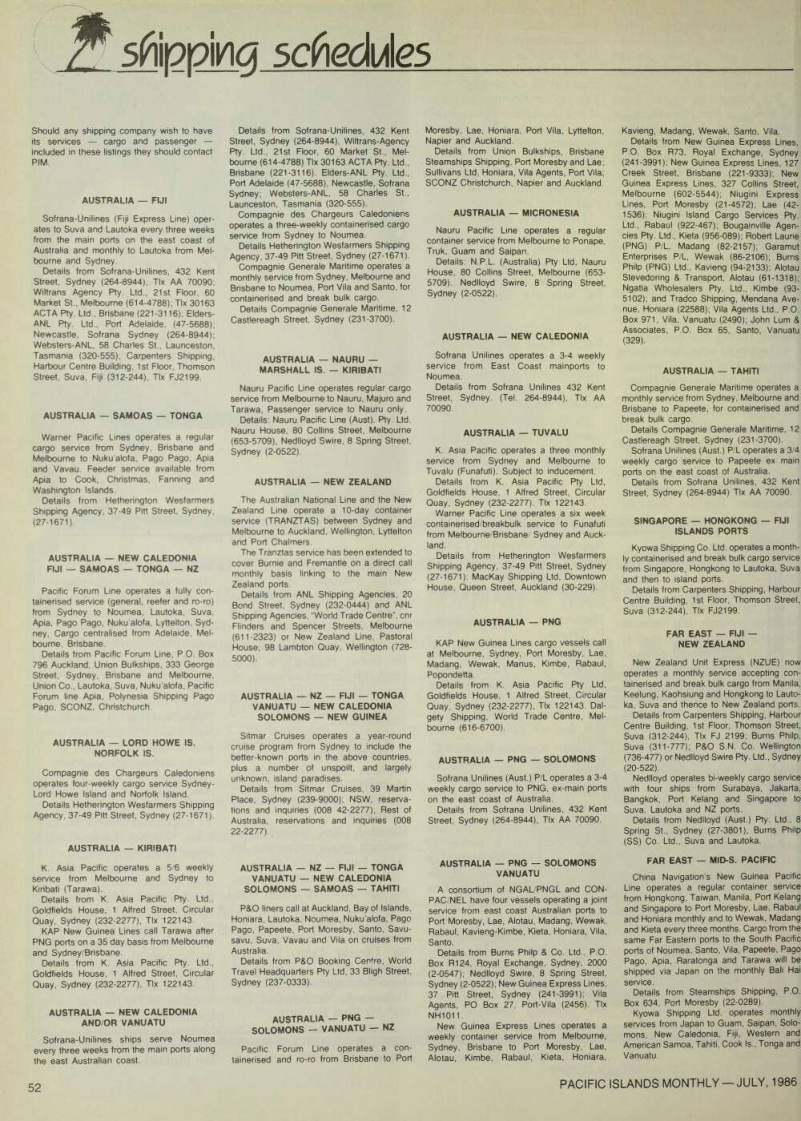
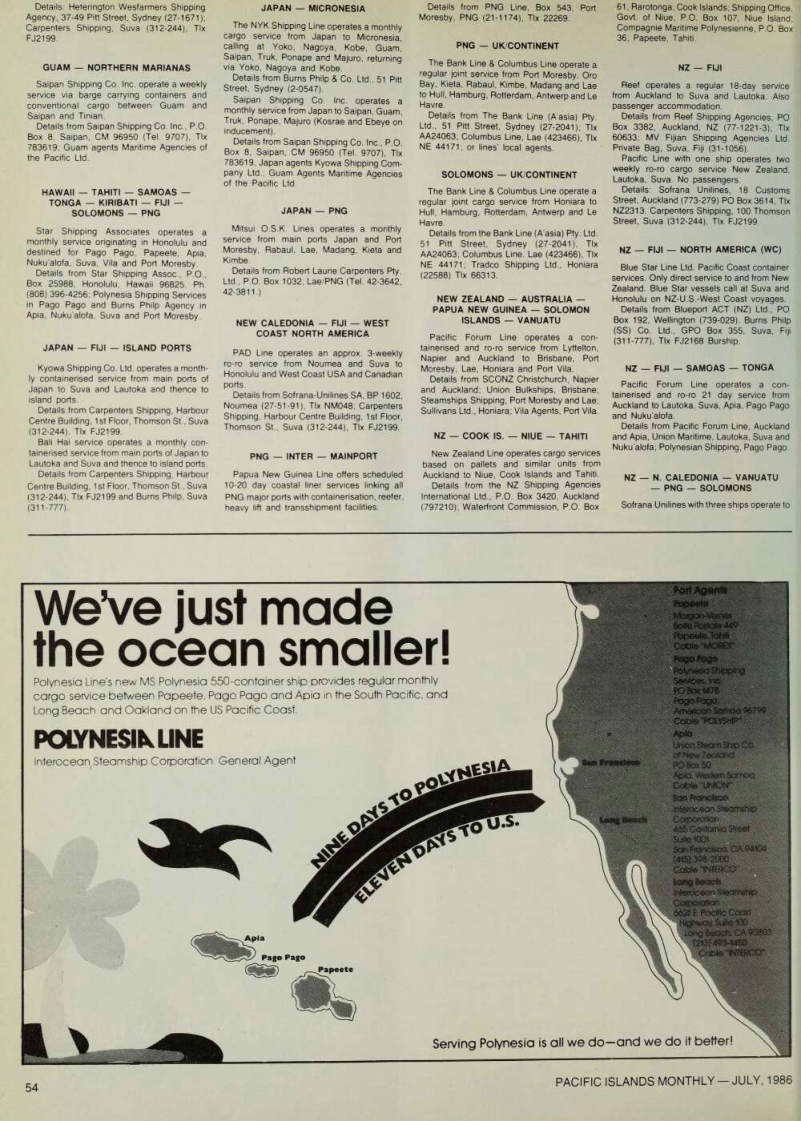
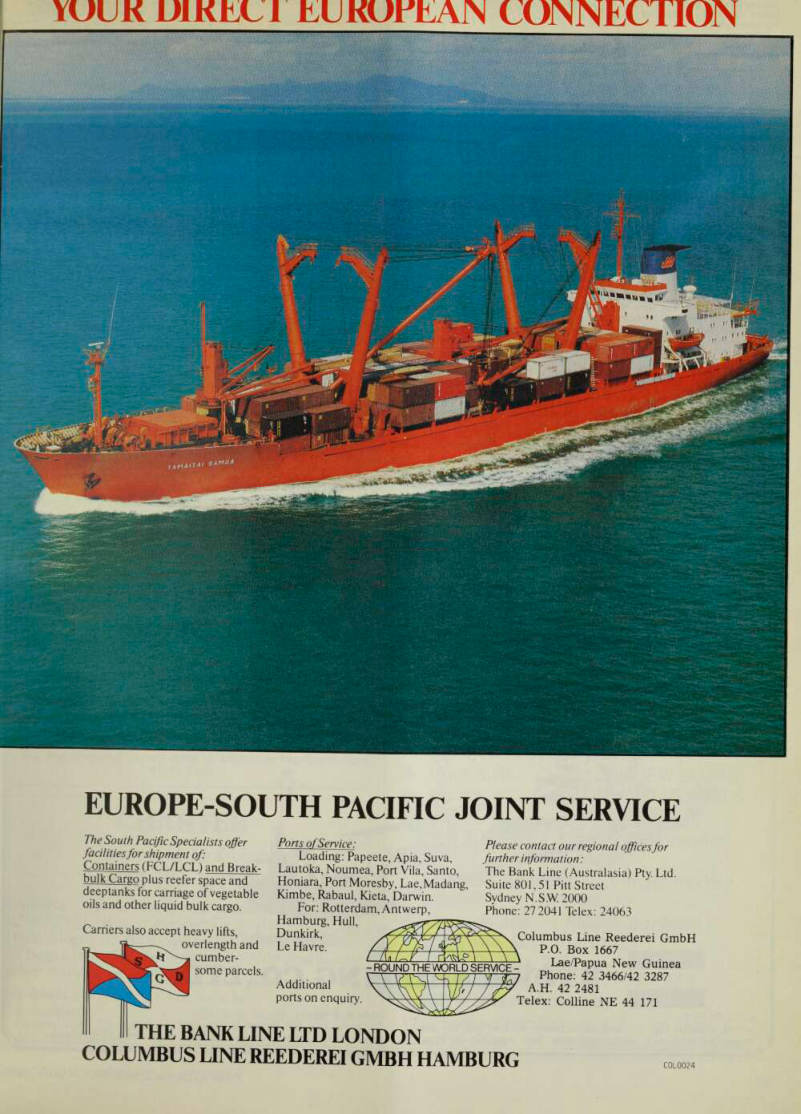
Should any shipping company wish to have its services cargo and passenger included in these listings they should contact
Pim.
Australia Fiji
Sofrana-Unilines (Fiji Express Line) oper ates to Suva and Lautoka every three weeks from the main ports on the east coast of Australia and monthly to Lautoka from Mel bourne and Sydney.
Details from Sofrana-Unilines, 432 Kent Street. Sydney (264-8944), Tlx AA 70090; Wittrans Agency Pty. Ltd., 21st Floor, 60 Market St., Melbourne (614-4788); Tlx 30163 ACTA Pty. Ltd., Brisbane (221-3116); Elders- ANL Pty. Ltd., Port Adelaide, (47-5688); Newcastle, Sofrana Sydney (264-8944); Websters-ANL, 58 Charles St., Launceston, Tasmania (320-555); Carpenters Shipping, Harbour Centre Building, Ist Floor, Thomson Street. Suva, Fiji (312-244), Tlx FJ2199.
Australia Samoas Tonga
Warner Pacific Lines operates a regular cargo service from Sydney, Brisbane and Melbourne to Nukualofa. Pago Pago. Apia and Vavau. Feeder service available from Apia to Cook, Christmas, Fanning and Washington Islands.
Details from Hetherington Wesfarmers Shipping Agency, 37-49 Pitt Street. Sydney. (27-1671).
Australia New Caledonia
Fiji Samoas Tonga Nz
Pacific Forum Line operates a fully con tainerised service (general, reefer and ro-ro) from Sydney to Noumea, Lautoka, Suva.
Apia, Pago Pago, Nukualofa, Lyttelton, Syd ney, Cargo centralised from Adelaide, Mel bourne, Brisbane.
Details from Pacific Forum Line, P.O. Box 796 Auckland, Union Bulkships, 333 George Street, Sydney, Brisbane and Melbourne, Union Co., Lautoka, Suva, Nukualofa, Pacific Forum line Apia. Polynesia Shipping Pago Pago, SCONZ, Christchurch.
Australia Lord Howe Is.
Norfolk Is.
Compagnie des Chargeurs Caledoniens operates four-weekly cargo service Sydney- Lord Howe Island and Norfolk Island.
Details Hetherington Wesfarmers Shipping Agency, 37-49 Pitt Street, Sydney (27-1671).
Australia Kiribati
K. Asia Pacific operates a 5/6 weekly service from Melbourne and Sydney to Kiribati (Tarawa).
Details from K. Asia Pacific Pty. Ltd., Goldfields House, 1 Alfred Street, Circular Quay, Sydney (232-2277), Tlx 122143.
KAP New Guinea Lines call Tarawa after PNG ports on a 35 day basis from Melbourne
and Sydney/Brisbane.
Details from K. Asia Pacific Pty. Ltd., Goldfields House, 1 Alfred Street, Circular Quay, Sydney (232-2277), Tlx 122143.
Australia New Caledonia
And/Or Vanuatu
Sofrana-Unilines ships serve Noumea every three weeks from the main ports along the east Australian coast.
Details from Sofrana-Unilines, 432 Kent Street, Sydney (264-8944), Wiltrans-Agency Pty. Ltd., 21st Floor, 60 Market St., Mel bourne (614-4788) Tlx 30163 ACTA Pty. Ltd., Brisbane (221-3116). Elders-ANL Pty. Ltd., Port Adelaide (47-5688), Newcastle, Sofrana Sydney; Websters-ANL, 58 Charles St., Launceston, Tasmania (320-555).
Compagnie des Chargeurs Caledoniens operates a three-weekly containerised cargo service from Sydney to Noumea.
Details Hetherington Wesfarmers Shipping Agency, 37-49 Pitt Street, Sydney (27-1671).
Compagnie Generate Maritime operates a monthly service from Sydney, Melbourne and Brisbane to Noumea, Port Vila and Santo, for containerised and break bulk cargo.
Details Compagnie Generate Maritime, 12 Castlereagh Street, Sydney (231-3700).
Australia Nauru
Marshall Is. Kiribati
Nauru Pacific Line operates regular cargo service from Melbourne to Nauru, Majuro and Tarawa, Passenger service to Nauru only.
Details: Nauru Pacific Line (Aust). Pty. Ltd.
Nauru House, 80 Collins Street, Melbourne (653-5709), Nedlloyd Swire, 8 Spring Street, Sydney (2-0522).
Australia New Zealand
The Australian National Line and the New Zealand Line operate a 10-day container service (TRANZTAS) between Sydney and Melbourne to Auckland, Wellington, Lyttelton and Port Chalmers.
The Tranztas service has been extended to cover Burnie and Fremantle on a direct call monthly basis linking to the main New Zealand ports.
Details from ANL Shipping Agencies, 20 Bond Street, Sydney (232-0444) and ANL Shipping Agencies, “World Trade Centre”, cnr Flinders and Spencer Streets. Melbourne (611-2323) or New Zealand Line, Pastoral House, 98 Lambton Quay, Wellington (728- 5000).
Australia Nz Fiji Tonga
Vanuatu New Caledonia
Solomons New Guinea
Sitmar Cruises operates a year-round cruise program from Sydney to include the better-known ports in the above countries, plus a number of unspoilt, and largely unknown, island paradises.
Details from Sitmar Cruises, 39 Martin Place, Sydney (239-9000); NSW, reserva tions and inquiries (008 42-2277); Rest of Australia, reservations and inquiries (008 22-2277).
Australia Nz Fiji Tonga
Vanuatu New Caledonia
Solomons Samoas Tahiti
P&O liners call at Auckland, Bay of Islands, Honiara, Lautoka, Noumea, Nukualofa, Pago Pago, Papeete, Port Moresby, Santo, Savu savu, Suva, Vavau and Vila on cruises from Australia.
Details from P&O Booking Centre, World Travel Headquarters Pty Ltd, 33 Bligh Street, Sydney (237-0333).
Australia Png
Solomons Vanuatu Nz
Pacific Forum Line operates a con tainerised and ro-ro from Brisbane to Port
Moresby, Lae, Honiara, Port Vila, Lyttelton, Napier and Auckland.
Details from Union Bulkships, Brisbane Steamships Shipping, Port Moresby and Lae; Sullivans Ltd, Honiara, Vila Agents, Port Vila; SCONZ Christchurch, Napier and Auckland.
Australia Micronesia
Nauru Pacific Line operates a regular container service from Melbourne to Ponape, Truk, Guam and Saipan.
Details: N.P.L. (Australia) Pty Ltd, Nauru House, 80 Collins Street, Melbourne (653- 5709). Nedlloyd Swire, 8 Spring Street, Sydney (2-0522).
Australia New Caledonia
Sofrana Unilines operates a 3-4 weekly service from East Coast mainports to Noumea.
Details from Sofrana Unilines 432 Kent Street, Sydney. (Tel. 264-8944), Tlx AA 70090.
Australia Tuvalu
K. Asia Pacific operates a three monthly service from Sydney and Melbourne to Tuvalu (Funafuti). Subject to inducement.
Details from K. Asia Pacific Pty Ltd, Goldfields House, 1 Alfred Street, Circular Quay, Sydney (232-2277). Tlx 122143.
Warner Pacific Line operates a six week containerised/breakbulk service to Funafuti from Melbourne/Brisbane/ Sydney and Auck land.
Details from Hetherington Wesfarmers Shipping Agency, 37-49 Pitt Street, Sydney (27-1671): Mac Kay Shipping Ltd, Downtown House, Queen Street, Auckland (30-229).
Australia Png
KAP New Guinea Lines cargo vessels call at Melbourne, Sydney, Port Moresby, Lae, Madang, Wewak, Manus, Kimbe, Rabaul, Popondetta.
Details from K. Asia Pacific Pty Ltd, Goldfields House, 1 Alfred Street, Circular Quay, Sydney (232-2277), Tlx 122143. Dal gety Shipping, World Trade Centre, Mel bourne (616-6700).
Australia Png Solomons
Sofrana Unilines (Aust.) P/L operates a 3-4 weekly cargo service to PNG, ex-main ports on the east coast of Australia.
Details from Sofrana Unilines, 432 Kent Street, Sydney (264-8944), Tlx AA 70090.
Australia Png Solomons
Vanuatu
A consortium of NGAL/PNGL and CON PAC/NEL have four vessels operating a joint service from east coast Australian ports to Port Moresby, Lae, Alotau, Madang, Wewak, Rabaul, Kavieng-Kimbe, Kieta, Honiara, Vila, Santo.
Details from Burns Philp & Co. Ltd., P.O.
Box R 124, Royal Exchange, Sydney, 2000 (2-0547); Nedlloyd Swire, 8 Spring Street, Sydney (2-0522); New Guinea Express Lines, 37 Pitt Street, Sydney (241-3991); Vila Agents, PO Box 27, Port-Vila (2456). Tlx
Nhioii.
New Guinea Express Lines operates a weekly container service from Melbourne, Sydney, Brisbane to Port Moresby, Lae, Alotau, Kimbe, Rabaul, Kieta, Honiara,
Kavieng, Madang, Wewak, Santo, Vila.
Details from New Guinea Express Lines, P.O. Box R 73, Royal Exchange, Sydney (241-3991); New Guinea Express Lines, 127 Creek Street, Brisbane (221-9333); New Guinea Express Lines, 327 Collins Street, Melbourne (602-5544); Niugini Express Lines. Port Moresby (21-4572); Lae (42- 1536); Niugini Island Cargo Services Pty.
Ltd., Rabaul (922-467); Bougainville Agen cies Pty. Ltd., Kieta (956-089); Robert Laurie (PNG) P/L, Madang (82-2157); Garamut Enterprises P/L, Wewak (86-2106); Burns Philp (PNG) Ltd., Kavieng (94-2133); Alotau Stevedoring & Transport, Alotau (61-1318); Ngatia Wholesalers Pty. Ltd., Kimbe (93- SI 02); and Tradco Shipping, Mendana Ave nue, Honiara (22588); Vila Agents Ltd., P.O.
Box 971, Vila, Vanuatu (2490); John Lum & Associates, P.O. Box 65, Santo, Vanuatu (329).
Australia Tahiti
Compagnie Generate Maritime operates a monthly service from Sydney, Melbourne and Brisbane to Papeete, for containerised and break bulk cargo.
Details Compagnie Generate Maritime, 12 Castlereagh Street, Sydney (231-3700).
Sofrana Unilines (Aust.) P/L operates a 3/4 weekly cargo service to Papeete ex main ports on the east coast of Australia.
Details from Sofrana Unilines, 432 Kent Street, Sydney (264-8944) Tlx AA 70090.
Singapore Hongkong Fiji
Islands Ports
Kyowa Shipping Co. Ltd. operates a month ly containerised and break bulk cargo service from Singapore, Hongkong to Lautoka, Suva and then to island ports.
Details from Carpenters Shipping, Harbour Centre Building, Ist Floor, Thomson Street, Suva (312-244), Tlx FJ2199.
Far East Fiji
New Zealand
New Zealand Unit Express (NZUE) now operates a monthly service accepting con tainerised and break bulk cargo from Manila, Keelung, Kaohsiung and Hongkong to Lauto ka, Suva and thence to New Zealand ports.
Details from Carpenters Shipping, Harbour Centre Building, Ist Floor, Thomson Street, Suva (312-244), Tlx FJ 2199; Burns Philp, Suva (311-777); P&O S.N. Co. Wellington (736-477) or Nedlloyd Swire Pty. Ltd., Sydney (20-522).
Nedlloyd operates bi-weekly cargo service with four ships from Surabaya, Jakarta, Bangkok, Port Kelang and Singapore to Suva, Lautoka and NZ ports.
Details from Nedlloyd (Aust.) Pty. Ltd., 8 Spring St., Sydney (27-3801), Burns Philp (SS) Co. Ltd., Suva and Lautoka.
Far East Mid-S. Pacific
China Navigation s New Guinea Pacific Line operates a regular container service from Hongkong, Taiwan, Manila, Port Kelang and Singapore to Port Moresby, Lae, Rabaul and Honiara monthly and to Wewak, Madang and Kieta every three months. Cargo from the same Far Eastern ports to the South Pacific ports of Noumea, Santo, Vila, Papeete, Pago Pago, Apia, Raratonga and Tarawa will be shipped via Japan on the monthly Bali Hai service.
Details from Steamships Shipping, P.O.
Box 634, Port Moresby (22-0289).
Kyowa Shipping Ltd. operates monthly services from Japan to Guam, Saipan, Solo mons, New Caledonia, Fiji, Western and American Samoa, Tahiti, Cook Is., Tonga and Vanuatu.
Details: Heterington Wesfarmers Shipping Agency, 37-49 Pitt Street, Sydney (27-1671); Carpenters Shipping, Suva (312-244), Tlx FJ2199.
Guam Northern Marianas
Saipan Shipping Co. Inc. operate a weekly service via barge carrying containers and conventional cargo between Guam and Saipan and Tinian.
Details from Saipan Shipping Co. Inc., P.O.
Box 8, Saipan, CM 96950 (Tel. 9707), Tlx 783619; Guam agents Maritime Agencies of the Pacific Ltd.
Hawaii Tahiti Samoas
Tonga Kiribati Fiji
Solomons Png
Star Shipping Associates operates a monthly service originating in Honolulu and destined for Pago Pago, Papeete, Apia, Nukualofa, Suva, Vila and Port Moresby Details from Star Shipping Assoc., P. 0., Box 25988, Honolulu, Hawaii 96825. Ph. (808) 396-4256; Polynesia Shipping Services in Pago Pago and Burns Philp Agency in Apia, Nukualofa, Suva and Port Moresby.
Japan Fiji Island Ports
Kyowa Shipping Co. Ltd. operates a month ly containerised service from main ports of Japan to Suva and Lautoka and thence to island ports.
Details from Carpenters Shipping, Harbour Centre Building, Ist Floor, Thomson St.. Suva (312-244). Tlx FJ2199.
Bali Hai service operates a monthly con tainerised service from main ports of Japan to Lautoka and Suva and thence to island ports.
Details from Carpenters Shipping, Harbour Centre Building, Ist Floor, Thomson St,, Suva (312-244), Tlx FJ2199 and Burns Philp, Suva (311-777).
Japan Micronesia
The NYK Shipping Line operates a monthly cargo service from Japan to Micronesia, calling at Yoko, Nagoya, Kobe, Guam, Saipan, Truk, Ponape and Majuro, returning via Yoko, Nagoya and Kobe.
Details from Burns Philp & Co. Ltd., 51 Pitt Street, Sydney (2-0547).
Saipan Shipping Co. Inc. operates a monthly service from Japan to Saipan, Guam, Truk, Ponape, Majuro (Kosrae and Ebeye on inducement).
Details from Saipan Shipping Co. Inc., P.O, Box 8, Saipan. CM 96950 (Tel. 9707), Tlx 783619, Japan agents Kyowa Shipping Com pany Ltd.; Guam Agents Maritime Agencies of the Pacific Ltd.
Japan Png
Mitsui O.S.K. Lines operates a monthly service from main ports Japan and Port Moresby, Rabaul, Lae, Madang, Kieta and Kimbe.
Details from Robert Laurie Carpenters Pty.
Ltd., P.O. Box 1032, Lae/PNG (Tel. 42-3642, 42-3811.)
New Caledonia Fiji West
Coast North America
PAD Line operates an approx. 3-weekly ro-ro service from Noumea and Suva to Honolulu and West Coast USA and Canadian ports.
Details from Sofrana-Unilines SA, BP 1602.
Noumea (27-51-91), Tlx NMO4B; Carpenters Shipping. Harbour Centre Building, Ist Floor, Thomson St., Suva (312-244), Tlx FJ2199.
Png Inter Mainport
Papua New Guinea Line offers scheduled 10-20 day coastal liner services linking all PNG major ports with containerisation, reefer, heavy lift and transshipment facilities.
Details from PNG Line, Box 543, Port Moresby, PNG (21-1174), Tlx 22269.
Png Uk/Continent
The Bank Line & Columbus Line operate a regular joint service from Port Moresby, Oro Bay, Kieta, Rabaul, Kimbe, Madang and Lae to Hull, Hamburg, Rotterdam, Antwerp and Le Havre.
Details from The Bank Line (A'asia) Pty, Ltd., 51 Pitt Street, Sydney (27-2041); Tlx AA24063; Columbus Line, Lae (423466), Tlx NE 44171; or lines’ local agents.
Solomons Uk/Continent
The Bank Line & Columbus Line operate a regular joint cargo service from Honiara to Hull, Hamburg, Rotterdam, Antwerp and Le Havre.
Details from the Bank Line (A'asia) Pty. Ltd. 51 Pitt Street, Sydney (27-2041), Tlx AA24063; Columbus Line. Lae (423466), Tlx NE 44171; Tradco Shipping Ltd., Honiara (22588) Tlx 66313.
New Zealand Australia
Papua New Guinea Solomon
Islands Vanuatu
Pacific Forum Line operates a con tainerised and ro-ro service from Lyttelton, Napier and Auckland to Brisbane, Port Moresby, Lae, Honiara and Port Vila.
Details from SCONZ Christchurch, Napier and Auckland; Union Bulkships, Brisbane; Steamships Shipping, Port Moresby and Lae; Sullivans Ltd., Honiara; Vila Agents, Port Vila.
Nz Cook Is. Niue Tahiti
New Zealand Line operates cargo services based on pallets and similar units from Auckland to Niue, Cook Islands and Tahiti.
Details from the NZ Shipping Agencies International Ltd., P.O. Box 3420, Auckland (797210); Waterfront Commission, P.O. Box
61, Rarotonga; Cook Islands; Shipping Office, Govt, of Niue, P.O. Box 107, Niue Island; Compagnie Maritime Polynesienne, P.O. Box 36, Papeete, Tahiti.
Nz Fiji
Reef operates a regular 18-day service from Auckland to Suva and Lautoka. Also passenger accommodation.
Details from Reef Shipping Agencies, PO Box 3382, Auckland, NZ (77-1221-3), Tlx 60633; MV Fijian Shipping Agencies Ltd.
Private Bag, Suva, Fiji (31-1056).
Pacific Line with one ship operates two weekly ro-ro cargo service New Zealand, Lautoka, Suva. No passengers.
Details: Sofrana Unilines, 18 Customs Street, Auckland (773-279) PO Box 3614, Tlx NZ2313. Carpenters Shipping, 100 Thomson Street, Suva (312-244), Tlx FJ2199.
Nz Fiji North America (Wc)
Blue Star Line Ltd. Pacific Coast container services. Only direct service to and from New Zealand. Blue Star vessels call at Suva and Honolulu on NZ-U.S.-West Coast voyages.
Details from Blueport ACT (NZ) Ltd., PO Box 192, Wellington (739-029). Burns Philp (SS) Co. Ltd., GPO Box 355, Suva, Fiji (311-777), Tlx FJ2168 Burship.
Nz Fiji Samoas Tonga
Pacific Forum Line operates a con tainerised and ro-ro 21 day service from Auckland to Lautoka, Suva, Apia, Pago Pago and Nukualofa.
Details from Pacific Forum Line. Auckland and Apia, Union Maritime, Lautoka, Suva and Nukualofa; Polynesian Shipping, Pago Pago.
Nz N. Caledonia Vanuatu
Png Solomons
Sofrana Unilines with three ships operate to
viica anu oamu, i u nuinaia anu rapua iycw Guinea and to Norfolk Island and Noumea (No passengers).
Details from Sofrana Unilines, 18 Customs Street. Auckland (773-279), PO Box 3614, Tlx NZ2313.
Nz Tahiti
Compagne Tahotienne Maritime SA (as CTM-Tahiti Line) operates one ship, MV Bounty 111, monthly Papeete New Zealand. (No passengers).
Details from Sofrana Unilines, PO Box 3614, 18 Customs St., Auckland, Tlx NZ2313.
CTM-Tahiti Line, PO Box 9012, Papeete (39042), Tlx Tahitlin 322 FP Tahiti.
Nz Tonga Samoas
Warner Pacific Line services Auckland, Nukualofa, Vavau, Apia, Pago Pago fort nightly carrying general and freezer cargoes.
Details from McKay Shipping Ltd., Down town House, 21 Queen St., Auckland, PO Box 1372 (30-299). Cables MACSHIP, Telex NZ2554, Warner Pacific Line, Box 93, Nukualofa, Tonga; Mealelei (Western Samoa) Ltd. Private Bag, Apia, Western Samoa, Pacific Maritime Services, PO Box 2617, Pago Pago, American Samoa (633- 2728), cables: Pacmar SX2OS.
Tahiti New Caledonia
Vanuatu Solomon Is.
New Zealand Png
Singapore Europe
Polish Ocean Lines operate in a semi container type vessel to the following ports, from Papeete, Noumea, Santo, Vila, Yandina, Honiara, Auckland, Rabaul. Lae, Singapore, Port Klelang, Penang then to Mediterranean ports and Europe via the Suez Canal. (Other New Zealand ports subject to inducement) Details from Universal Shipping Agencies Ltd., 6th Floor, 38 Fort Street, Auckland 1,
(New i ix 21517.
Europe Tahiti
New Caledonia
Compagne Generate Maritime operates services from Europe and Mediterranean ports to Papeete and Noumea using three ro-ro and multi-purpose vessels thus ensuring a bi-monthly sailing to and from.
Details Compagne Generate Maritime, 12 Castlereagh Street. Sydney (231-3700).
Europe Tahiti
New Calendonia New Zealand
Vanuatu Solomons
Png Europe
Polish Ocean Lines offers regular monthly sailings for containerised and break bulk cargo, also conventional reefer space and reefer containers from Hamburg, Rotterdam, Dunkirk, Rouen to Papeete, Noumea, Auck land, Santo, Honiara, Rabaul, Lae, Singa pore, returning to Europe via Suez, other ports in South Pacific can be served directly with inducement or otherwise via tranship ment.
Details from Sotama, BP 9170, Papeete, Tel. 427805 Tlx 373 PF SATO: BP C 2 Noumea Cedex Tel. 272094 Tlx 163 NM/ Universal Shipping Agencies PO Box 2282 Auckland Tel. 30930 Tlx 21517/Vanua Navigation PO Box 44 Vila —Tel. 2027 —Tlx 1033/Melan Chine Shipping Co. PO Box 71 Honiara Tel. 21678 Tix 66335/Steam ships Shipping & Transport PO Box 1512 Rabaul Tel 922952 Tlx 92929/Steam ships Trading Co. Ltd. PO Box 85 Lae Tel. 424666 Tlx 42423/Union Steamship Co. of NZ Ltd. PO Box 50 Apia Tel. 21781 Tlx 225/Warner Pacific Line PO Box 93 Nuku’alo fa Tel. 22088 Tlx 66219/Fiji Agents
Tba.
Europe Tahiti W.
Samoa Fiji N. Caledonia
Nedlloyd offers regular cargo services from
uonnneniai pons to Papeete, Apia, Fiji and New Caledonia.
Details Nedlloyd (Aust.) Pty. Ltd., 8 Spring Street, Sydney (27-3801); Carpenters Ship ping, Ist Floor, Harbour Centre Bldg., 100 Thomson St., Suva (312-244), Tlx 2199FJ and Vetari Street, Lautoka (63988), Tlx 5215FJ.
Uk N. Continent W. Samoa
Tonga Fiji
The Bank Line & Columbus Line operate a regular joint cargo service from Hull, Ham burg, Bremen, Antwerp, Rotterdam and Le Havre to Apia, Nukualofa, Suva and Lautoka.
Details from The Bank Line (A'asia) Pty.
Ltd., 51 Pitt Street, Sydney (27-2041), Tlx AA 24063, Columbus Line, Lae (423-466), Tlx NE 44171, or lines local agent.
Uk N. Continent Png
Solomons
The Bank Line & Columbus Line operate a regular joint cargo service from Hull, Ham burg, Bremen, Antwerp, Rotterdam and Le Havre to Port Moresby, Lae, Madang, Kimbe, Rabaul, Kieta and Honiara and on induce ment to Yandina.
Details from The Bank Line (A’asia) Pty.
Ltd., 51 Pitt Street, Sydney (27-2041), Tlx AA 24063. Columbus Line. Lae (42-3466). Tlx NE 44171; or lines local agents.
Uk/N. Continent Tahiti
N. Caledonia Vanuatu
The Bank Line & Columbus line operate a regular joint cargo service from Hull, Ham burg, Bremen, Antwerp, Rotterdam and Le Havre to Papeete, Noumea, Port-Vila and Santo.
Details from The Bank Line (A sia) Pty. Ltd., 51 Pitt Street, Sydney (27-2041), Tlx AA 24063, Columbus Line, Lae (42-3466), Tlx NE 44171; Ets. A M, Fare UTE. Papeete; Ets, Ballande, Noumea and other local agents.
U.S. Hawaii Micronesia
East Malaysia Brunei
Papua New Guinea
PM&O Lines operates two fully self-sus tained container vessels on a sailing frequen cy of every 30 days between the San Francisco Bay Area, Los Angeles, Honolulu and Majuro. Ebeye, Kosrae, Ponape, Truk, Saipan, Yap, Palau, Kota Kinabalu, Brunei, Lae, Kieta and Rabaul.
Details from PM&O Lines, 353 Sacramento Street, San Francisco, California 94111
U.S.A. (415) 421-5400, Tlx 278016 Pmo
UR; Owner's Representative P.O. Box 803, Saipan, N.M.I. 96950, PH: 234-6819 TLX 783-605 CMCAA; 1414 Soledad Ave., Agana, Guam 96910, PH: 472-1897, TLX 721-6637
Pmonav Gm.
U.S. Hawaii Samoas
Kiribati Nauru
Nauru Pacific Line operates regular con ventional and container services from San Francisco and Honolulu to Christmas Island, Pago Pago, Apia, Tarawa and Nauru.
Details from N.P.L. (Australia) Pty. Ltd., Nauru House, 80 Collins Street, Melbourne (653-5709), Nauru Air and Shipping Agency, Suite 2803, 185 Berry Street, San Francisco, California 94107 (415-543-4517). Nauru Air and Shipping Agency, Suite 506, 841 Bishop St„ Honolulu, HI 96813 (808-523-0441).
U.S. Noumea Fiji
PAD Line operates an approx. 3-weekly ro ro service from west coast USA and Canada to Noumea, Suva and Lautoka.
Details from Sofrana Unilines BP 1602, Noumea (27-51-91). Tlx NMO4B, Carpenters Shipping, Harbour Centre Building, Ist Floor, 100 Thomson Street, Suva (312-244), Tlx FJ2199, Trans-Austral Shipping Pty. Ltd., P.O. Box R 232, Royal Exchange. 2000 (231-8411), Tlx AA21204,
Advertisements & other items, pp. 53-56 (1 item)
Beivs on w Hedges
TRADITIONALLY THE NAME
ASSOCIATED WITH PERFECTION
IN CIGARETTES
BENSON & HEDGES
20
Beivs on w Hedges
WARNING-SMOKING IS A HEALTH HAZARD
ONLY THE BEST WILL DO
We’ve just made
the ocean smaller!
Polynesia Line's new MS Polynesia 550-container ship provides regular monthly cargo service between Papeete, Pago Pago and Apia in the South Pacific, and Long Beach and Oakland on the US Pacific Coast.
POLYNESIMINE
Interocean Steamship Corporation General Agent I \ I ? 6h U T® 3 3 5* V V mi m* m Apia Pago Pago Serving Polynesia is all we do—and we do it better!
YUCKUIKLCI ECKUrEAN CONNECTION
*■ iBSJftiWR'
EUROPE-SOUTH PACIFIC JOINT SERVICE
The South Pacific Specialists offer facilities for shipment of: Containers (FCL/LCL) and Breakbulk Cargo plus reefer space and deeptanks for carriage of vegetable oils and other liquid bulk cargo.
Carriers also accept heavy lifts, „ Ifcr-—overlength and cumbersome parcels.
Ports of Service: Loading; Papeete, Apia, Suva, Lautoka, Noumea, Port Vila, Santo, Honiara, Port Moresby, Lae,Madang, Kimbe, Rabaul, Kieta, Darwin.
For: Rotterdam, Antwerp, Hamburg, Hull, Dunkirk, Le Havre.
- ROUND THE WORLD SERVICE
Additional ports on enquiry Please contact our regional offices for further information: The Bank Line (Australasia) Pty. Ltd.
Suite 801,51 Pitt Street Sydney N.S.W. 2000 Phone; 272041 Telex: 24063 Columbus Line Reederei GmbH P.O. Box 1667 Lae/Papua New Guinea Phone: 42 3466/42 3287 A.H. 42 2481 Telex: Colline NE 44 171
THE BANK LINE LTD LONDON
COLUMBUS LINE REEDEREI GMBH HAMBURG
YOUR BUSINESS PARTNER
Japan S. Korea Taiwan Singapore Hong Kong To: Solomon Is., New Caledonia, Fiji, W. Samoa, A. Samoa, Tahiti, Cook Is., Tonga, Vanuatu, Tuvalu. Nauru To: Guam, Saipan, Truk, Ponape, Majuro, Yap, Koror i •• U
Taiwan Hong Kong Singapore Philippines
To: Papua New Guinea, Pacific Islands. ,£r-< I i :
KYOWA
KYOWA SHIPPING CO., LTD.
HEAD OFFICE
6th Floor., Kikushima Bldg., 2-3, Hamamatsucho 2-chome, Minato-ku, Tokyo 105, Japan
OSAKA OFFICE:
Dai San Fuji Bldg., 3-13, Itachibori 1-chome, Osaka 550.
Phone: 03(437)2885 (Rep.) Cables: “MARIQUEEN" Tokyo Telex: 242-4651 Kyowa J. J Phone: 06(533)5821 (Rep.) Cables: “MARIQUEEN" Osaka Telex: 525-6271 SsiosaJ
yachts
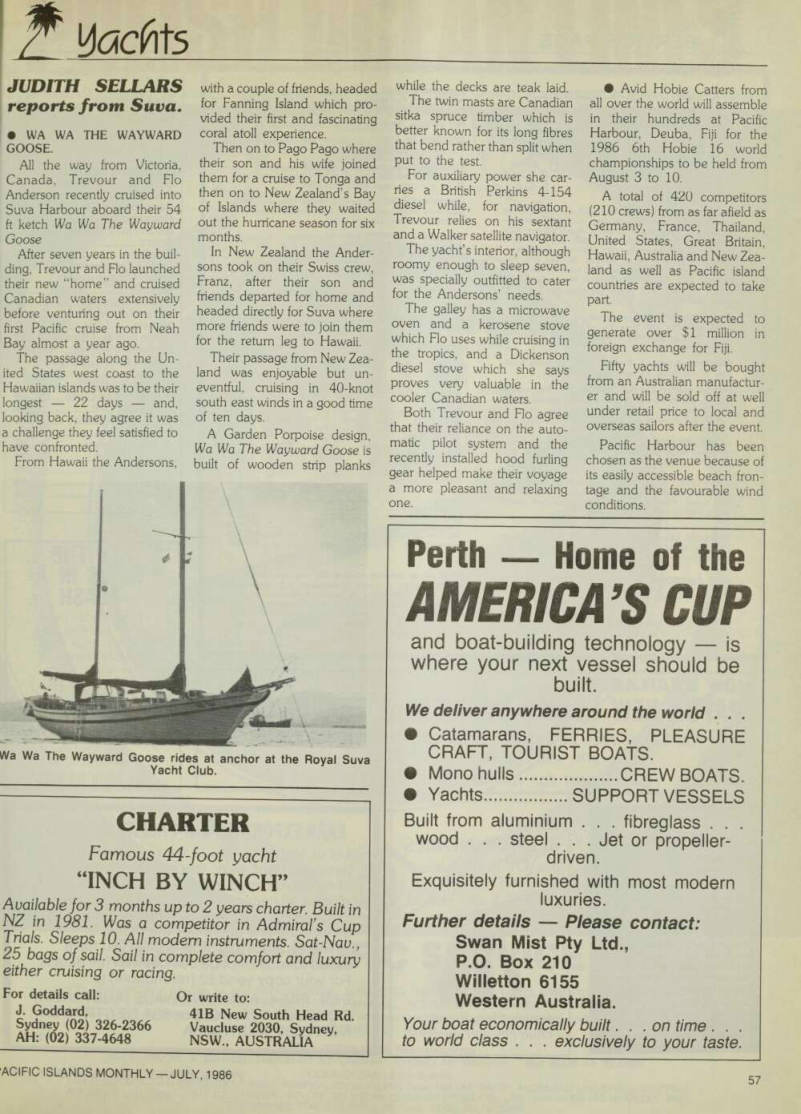
Judith Sellars
reports from Suva.
• Wa Wa The Wayward
Goose.
All the way from Victoria, Canada, Trevour and Flo Anderson recently cruised into Suva Harbour aboard their 54 ft ketch Wa Wa The Wayward Goose After seven years in the buil ding, Trevour and Flo launched their new “home” and cruised Canadian waters extensively before venturing out on their first Pacific cruise from Neah Bay almost a year ago.
The passage along the Un ited States west coast to the Hawaiian islands was to be their longest 22 days and, looking back, they agree it was a challenge they feel satisfied to have confronted.
From Hawaii the Andersons,
with a couple of friends, headed for Fanning Island which pro vided their first and fascinating coral atoll experience.
Then on to Pago Pago where their son and his wife joined them for a cruise to Tonga and then on to New Zealand’s Bay of Islands where they waited out the hurricane season for six months.
In New Zealand the Ander sons took on their Swiss crew, Franz, after their son and friends departed for home and headed directly for Suva where more friends were to join them for the return leg to Hawaii.
Their passage from New Zea land was enjoyable but un eventful, cruising in 40-knot south east winds in a good time of ten days.
A Garden Porpoise design, Wa Wa The Wayward Goose is built of wooden strip planks
while the decks are teak laid.
The twin masts are Canadian sitka spruce timber which is better known for its long fibres that bend rather than split when put to the test.
For auxiliary power she car ries a British Perkins 4-154 diesel while, for navigation, Trevour relies on his sextant and a Walker satellite navigator.
The yacht’s interior, although roomy enough to sleep seven, was specially outfitted to cater for the Andersons’ needs.
The galley has a microwave oven and a kerosene stove which Flo uses while cruising in the tropics, and a Dickenson diesel stove which she says proves very valuable in the cooler Canadian waters.
Both Trevour and Flo agree that their reliance on the auto matic pilot system and the recently installed hood furling gear helped make their voyage a more pleasant and relaxing one.
• Avid Hobie Carters from all over the world will assemble in their hundreds at Pacific Harbour, Deuba, Fiji for the 1986 6th Hobie 16 world championships to be held from August 3 to 10.
A total of 420 competitors (210 crews) from as far afield as Germany, France, Thailand, United States, Great Britain, Hawaii, Australia and New Zea land as well as Pacific island countries are expected to take part.
The event is expected to generate over $1 million in foreign exchange for Fiji.
Fifty yachts will be bought from an Australian manufactur er and will be sold off at well under retail price to local and overseas sailors after the event.
Pacific Harbour has been chosen as the venue because of its easily accessible beach fron tage and the favourable wind conditions.
Wa Wa The Wayward Goose rides at anchor at the Royal Suva Yacht Club.
Advertisements & other items, pp. 57-60 (2 items)
57
ACIFIC ISLANDS MONTHLY —JULY, 1986
America’S Cup
Perth Home of the
and boat-building technology is
where your next vessel should be built.
We deliver anywhere around the world . . . • Catamarans, FERRIES, PLEASURE
CRAFT, TOURIST BOATS.
• Mono hulls CREW BOATS.
• Yachts SUPPORT VESSELS
Built from aluminium . . . fibreglass . . . wood . . . steel ... Jet or propellerdriven.
Exquisitely furnished with most modern luxuries.
Further details Please contact: Swan Mist Pty Ltd., P.O. Box 210 Willetton 6155 Western Australia.
Your boat economically built... on time . . . to world class . . . exclusively to your taste.
CHARTER
Famous 44-foot yacht
“INCH BY WINCH”
Available for 3 months up to 2 years charter. Built in NZ in 1981. Was a competitor in Admiral's Cup Trials. Sleeps 10. All modem instruments. Sat-Nav., 25 bags of sail. Sail in complete comfort and luxury either cruising or racing.
For details call: J. Goddard, Sydney (02) 326-2366 AH: (02) 337-4648 Or write to: 418 New South Head Rd.
Vaucluse 2030, Sydney,
NSW., AUSTRALIA
SERVICE PAGE
Mitsubishi Motor 60 Nissan Motor 8-9
NMA 37
Pioneer Electronic 18 Polish Ocean Lines 59 Polynesia Line 54 Ragg & Associates 43 Sheaffer Pens 17 S. P. Distilleries 34 Toyota Motor 30-31 Trio-Kenwood 46 Wade 58 Wisco 36
urns
A AUSTRALIA Distribution; The Herald and Weekly Times Ltd , 44-74 Flinders St., Melbourne, Vic., 3000 Advertising Reps Brisbane D Wood, Anday Agency, CCA Centre, Dayboro Road, Closebum 4520; Box 1918, GPO Brisbane, 4001, telephone (07) 289-4128 Adelaide Hastweil Williamson Rouse Fty Ltd , PO Box 419 Norwood, SA, 5067; 59 Kensington Road. Norwood, telephone (08) 332-3322, telex 87113 Perth Allen & Associates, 7 Fore St„ Perth, W.A., 6000, telephone (09) 328-9833, telex; AA94382, FUI: Distribution snd subscriptions Desai Bookshops. PO Box 160, Suva, Fiji, telephone Suva 23036 Advertising Fiji Times & Herald Ltd , 20 Gordon St..
Suva, telephone 31-4111, telex FJ2124 FRENCH POLYNESIA: Distribution Hachette Pacifique, 10 Ave Bruat, Papeete, telephone 25610 HAWAII, UNITED STATES; Distribution - PIM. Hawaii, PO Box 22250, Honolulu, Hawaii, 96822 Advertising Bnan C Asgill, Apt 1308, 1676 Ala Moana Blvd , Honolulu, Hawaii 96815, telephone (808) 955-9718 JAPAN AND KOREA: Advertising and subscriptions Universal Media Corporation, GPO Box 46, Tokyo, telephone 666-3036, cables UNIMEDIA Tokyo, telex 2524665.
MALAYSIA: Advertising and subscription^ Worldwide Media Services, 57-B Komplex Damai, Jin Dato Haji Eusott, Kuala Lumpur, telephone 63-9340, cables WORLDMEDIA Kuala Lumpur telex 31533 VANUATU: Distribution The Bookshop, HQ Box 210, Port Vila. Advertising Norman Bros Bookshop, Port Vila, telephone 2232.
NEW CALEDONIA: Distribution Depot Centre de Presse Michel Pentecost, CBP2, Noumea, telephone 27-2434, 27-4729 NEW ZEALAND; Distribution Gordon & Gotch, PO Box 584, 2 Carr Road, Mt Rosk il, Auckland 4
PAPUA NEW GUINEA: Distribution Gordon & Goteh.
PO Box 3396, Port Moresby, telephone 25-4551.25-4856 Advertising Ken Head, PNG Post-Couner, PO Box 85, Port Moresby, telephone 21-2577, telex 22120 SOLOMON ISLANDS: Distribution and Advertising The Bookshop, (Norman Bros.) PO Box 503, Honiara PHILIPPINES: Advertising The GF Group. 12 San Ignacio St Uroaneta Village. Makati. Metro Manila, telephone 817-7299, telex 45950 and 4233 UNITED KINGDOM: The Herald & Weekly Times Ltd., No 1 Maltravers Street. London WC2R 3DZ, England, telephone 01 836 5162, telex London 21989 UNITED STATES MAINLAND: Advertising Joshua B.
Powers Jr„ Powers International Inc., Suite 708, 271 Madison Ave., New York, NY 10016, telephone 867-9580, telex 236514. Subscriptions PIM, Hawaii, PO Box 22250, Honolulu, Hawaii, 96822.
SUBSCRIPTIONS
American Samoa ...
Australia Canada Cook Islands Fiji French Polynesia...
Guam Hawaii Japan Kiribati Micronesia Nauru New Caledonia New Zealand Niue Norfolk Island Northern Marianas.
Papua New Guinea Solomon Islands Tonga Tuvalu United Kingdom US Mainland Vanuatu Western Samoa Elsewhere ...US$24
,AUSS24
...US$3O
...NZ$36
.AUSS26
...US$3O
...US$3O
...US$3O
...US$3O
.AUSS24
...US$3O
AUSS24
.US$3O
... NZ$36
...NZ$3O
AUSS24
...US$3O
AUSS3S
.AUSS24
AUSS24
AUSS24
Stqls
...US$3O
.AUSS24
AUSS24
.AUSS36
Payments by personal cheque are only acceptable in Australian (from a branch in Australia), U S. and New Zealand currency For all other remittances please send an international bank draft in Australian dollars Published monthly by Pacific Publications (Aust.) Pty Ltd and pnnted in Australia by Quadricolor Industries F*ty Ltd , Mulgrave, Vic.
ALL THE
NEWS IN A
FLASH
The South Sea Digest tells you what you want to know about the Pacific Islands in a few words All the leading firms and diplomatic missions read it You can phone or write or call for a follow up See insert lor subscription details
THE SOUTH SEA DIGEST
NOW AVAILABLE!
PAPUA NEW GUINEA BUSINESS & TRAVEL GUIDE Contains over 250 pages crammed with all the facts you want to know on P.N.G.
See insert for further details and price.
Stay at Aggie Grey’s . . . the South Pacific’s
legendary hotel.
Situated right in the heart of Western Samoa. Enjoy Polynesian style friendliness and service, in cool surroundings, superb entertainment and food.
Magnificent while sand beaches only a short drive away. Airconditioned rooms, swimming pool and Jull bar facilities.
Bookings through l T nion Steamship Company of NZ. Pan Am, Air New Zealand or direct to Aggie Grey’s, Apia. Western Samoa. Cables: ‘AGGIES’ Apia.
BAGOT
BELLFOUNDRIES
Box 421, North Adelaide, S.A. 5006. Australia Tel: +6l 8 267 1306 4 Beautiful tuned bells for churches and missions
EARN EXPORT/IMPORT PROFITS IN 60 DAYS
Let us show you how to start an export/import business right away. You can begin with little or no capital in your spare or full time. You will receive all necessary guidance and contacts to succeed. Start your own business or extend an existing one and enjoy the profits of success. Since 1946, others like you have asked for our 24 page booklet with full details.
For your copy send $2 (refundable) to;
Dept. RIM 4 ANTHONY WADE (AUSTRALIA)
CONSULTANTS, RO. Box 583, NEUTRAL BAY,
NSW 2089, AUSTRALIA AW??C
rULISn UUIAN LINKS
General Management, 10 Lutego 24,81-364 GDYNIA, POLAND, Phone: 20-19-01, Cables: POLOCEAN Telex: 054-231 © © fv i V- -3TY m % '•T Jk * ■ V or M
OF O \m T
ir Henry Moi
dto do it all
If Sir
Morton Stanley
tall over again.
had
He’d find Livingstone faster with Mitsubishi 4WD.
jßm
In 1871 Henry Stanley was sent to find Dr. David Livingstone, thought lost in Africa.
Their meeting resulted in the famous greeting,
"Dr. Livingstone, I presume".
Though too late for Stanley, Mitsubishi four-wheel-drive expertise helps blaze trails for today's explorers. Mitsubishi built its first 4WD vehicle back in 1934. Today, we tackle the world's toughest terrain so that others with the spirit of adventure can break new ground with confidence.
Currently the toughest challenge for motor vehicles is the Paris-Dakar Rally. This year's race was a gruelling 22-day, 14,000-kilometre journey. Only 54 of the 364 starters made it to Dakar in Africa. But, as predicted, the Pajero won the Marathon Class for the fourth consecutive year. It went the distance without replacing a single major part. What's more, seven out of the nine Marathon Class finishers were Pajeros.
Stanley beat similar odds when he found Livingstone. His journey would have been much faster, and certainly much easier, with dependable Mitsubishi 4WD technology.
Because our goal is to ensure that Three Diamonds brand vehicles and the people who buy them travel the world with confidence.
A
MITSUBISHI
MOTORS
AMERICAN SAMOA: MORRIS SCANLAN SERVICE INC. PO. Box 367, Pago Pago, Tel. 633-5520/AUSTRALIA: MITSUBISHI MOTORS AUSTRALIA LTD Box 1851 G.P.O Adelaide, South Australia 5001, Tel. 08-275-7111/FIJI; NIVIS MOTOR & MACHINERY CO., LTD. G.P.O.
Box 150 Suva Tel 384425/FRENCH POLYNESIA (TAHITI): ETS-BREDIN FRERES ET FILS PO. Box 21, Papeete. Tahiti, Tel. 4-202-58/ NEW CALEDONIA: SOCIETE D IMPORTATION D AUTO DU PACIFIQUE SUD S.A. B.P 438 Rond Point du Pacifique. Noumea, Tel. 274144/ NEW ZEALAND* TODD MOTORS CORPORATION Todd Park. Heriot Drive. Private Bag. Porirua, Tel 70-109/NORFOLK ISLAND: BORRYS LTD. PO Box 169, Norfolk Island, Tel. 2114 NI/PAPUA NEW GUINEA: TOBA PTY. LTD. PO. Box 503, Port Moresby, Tel 21-7874/SOLOMON ISLANDS: R.C. SYMES PTY. LTD. PO. Box 823, Honiara, Guadalcanal, Tel. 22131/TONGA; SITANI MAPI CO., LTD. P O. Box 83, Maku Olofa, Tel. 2 1-044/VANUATU: SOCOMETRA B P 06 Route de Lagon, Port-Vila, Tel. 2314/WESTERN SAMOA: A M. MACDONALD HOLDINGS LTD.
PO. Box 576, Apia, Tel 22022/SAIPAN/PONAPE/MAJURO/KOSRAE/TRUK/YAP/BELAU: MICRONESIAN MOTORS, INC. 997 South Marine Drive, Tamuning, Guam 96911, Tel. 646-6827