Pacific
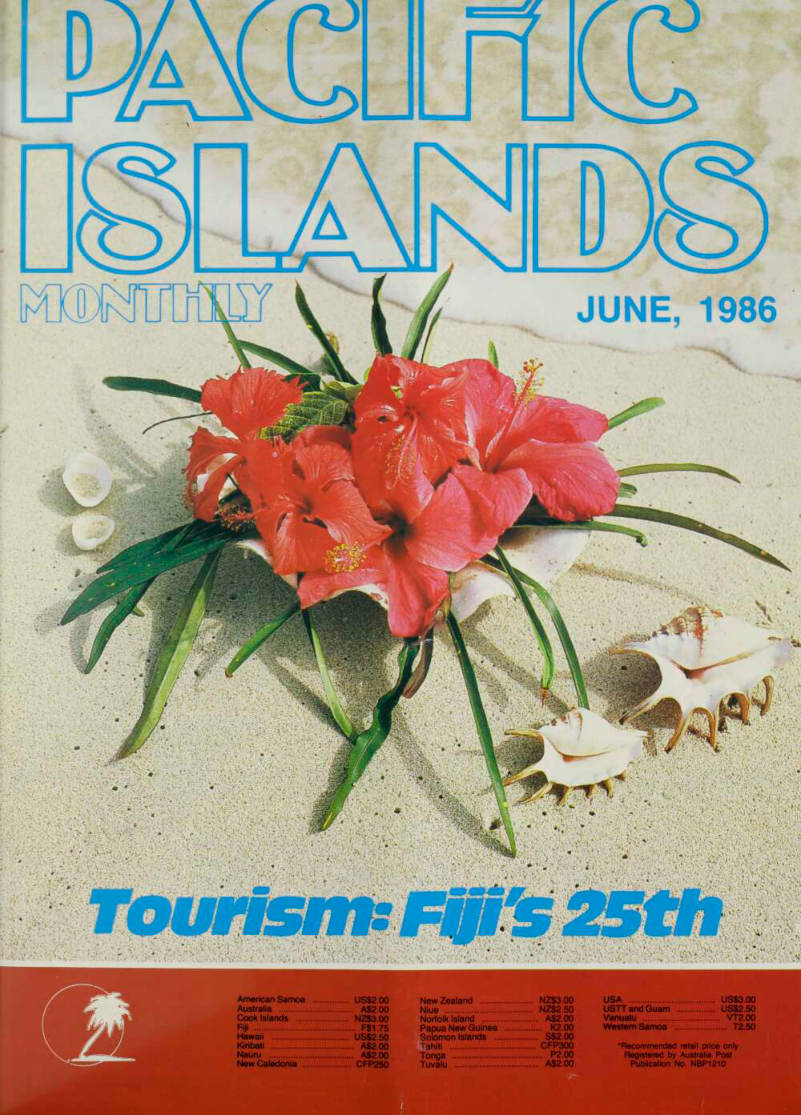

Islands
Monthly
June, 1986
Tourism: FU'S 25th
American Samoa US$2.OO Australia A 52.00 Cook Islands NZ$3.OO Fiji F 51.75 Hawaii US$2.5O Kiribati A 52.00 Nauru A 52.00 New Caledonia CFP2SO
New Zealand NZ$3.OO Niue NZ$2.5O Norfolk Island A 52.00 Papua New Guinea K 2.00 Solomon Islands 552.00 Tahiti CFP3OO Tonga P 2.00 Tuvalu A 52.00
Usa Us$3.Oo
USTT and Guam US$2.5O Vanuatu VT2.00 Western Samoa T 2.50 •Recommended retail price only Registered by Australia Post Publication No. NBPI2IO
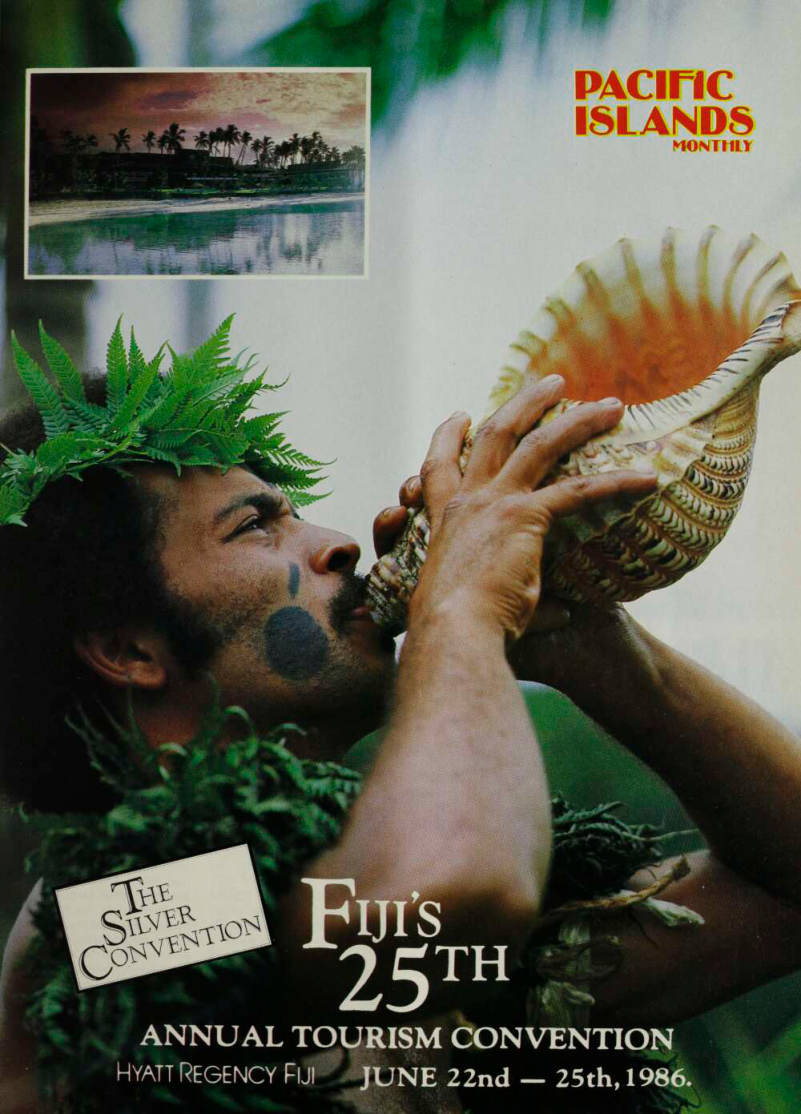
The Cover
An image of tourism.
Photo: Robin Smith
The cover price of Pacific Islands Monthly is increased from this issue. Please see the cover page for full details. We regret the necessity for a price increase but should point out that it is the first increase in over two years at a time of high inflation. Our labor, materials and distribution costs have all greatly increased during that time. Most of these increased costs have been contained during a period when the magazine has been spending more on quality journalism in a bid to enlarge and improve our coverage of the region. This effort will continue.
Advertisements & other items, pp. 2-3 (2 items)
Honda, constantly setting new standards when it comes to car design,
now brings you the Prelude 2.0i-16. What does meet the eye is the Prelude’s styling. Its low, angled front slices through the air, and the wide tread stance grips the road firmly for superb maneuverability. What you can’t see is the heart of this elegant new model the 2.0-liter 16-valve Double Overhead Camshaft (DOHC) engine. It comes with
Honda’s original Programmed Fuel Injection system
(PGM-FI) for quick engine response.
This perfect marriage between styling and performance offers the ultimate in touring satisfaction. All this plus a long list of other Honda extras put the new Prelude into a class of its own.
Find out what it really means to enjoy a car all it takes is a test drive. p. nr MI Ws .08-/ • Engine type: Water-cooled 4-stroke DOHC 16-valve in-line 4-cylinder • Fuel supply system: PGM-FI • Displacement: 1,958 cm 3 • Maximum horsepower: 137PS/6,ooorpm • Maximum torque: 17.3 kg-m/ s,ooorpm •Suspension: Double wishbone (front), MacPherson strut (rear) • Dimensions (Lx Wx H); 4,375 X 1,690 X 1,295 mm AUSTRALIA: Honda Australia Pty., Ltd. Lot 95 Sharps Road, Tullamarine, Victoria 3043; Bennett Honda Pty., Ltd. 250 Victoria Road, Wetherill Park, N.SW 2164/NEW ZEALAND: NZMC Limited Manners Plaza, 57-65 Manners St, Wellington/PAPUA NEW GUINEA; Toba Pty., Ltd. P.O- Box 503, Port Moresby/ HONDA MOTOR CO LTD TOKYO JAPAN TAHITI: Honda Distribution S.A.R.L. B.P. 1665, Papeete/KIRIBATI: Atoll Motor & Marino Services P.O. Box 49 Bairiki Tarawa, Repubhc o in a i • TRUST TERRITORY; United Micronesia Development Association P.O. Box 235, CHRB Saipan CM 96950/COOK ISLANDS: Cook Islands Motor Centre Ltd. P.O. Box Motor Co., Inc. P.O. Box DV, Agana/WESTERN SAMOA: Motor Distributors (Samoa) Ltd. P.O. Box 576, Apia/SOLOMON ISLANDS: Lee Kwok Kuen &Co Ltd. P.O. Box 537, Honiara/Ntw CALEDONIA: Soci6t6 Du Chalandage 8, Rue de la somme-B.P. 97, Noum6a/NAURU: Nauru Cooperation Republic of Nauru/FIJI: Coral Island Motors Ltd. Robertson Road Suva, Fiji/AME C SAMOA: Holiday Motors, Parts and Service P.O. Box 968, Pago Pago, American Samoa 96799; Heleck’s Service Center Ltd. P.O Box 1 1138.. Pago Pago, American Samoa 96799/TONGA^ Tonga Industrial Traders P.O. Box 1035, Nukualofa, Tonga/NORFOLK ISLAND: Duncombe Bay Garage New Cascade Road, Norfolk Island/VANUATU. Honda Farm Ltd. P.O. Box 1031, Port Vila, Vanuatu
Pacific
ISLANDS
MONTHLY
Vol. 57, No. 6. June, 1986
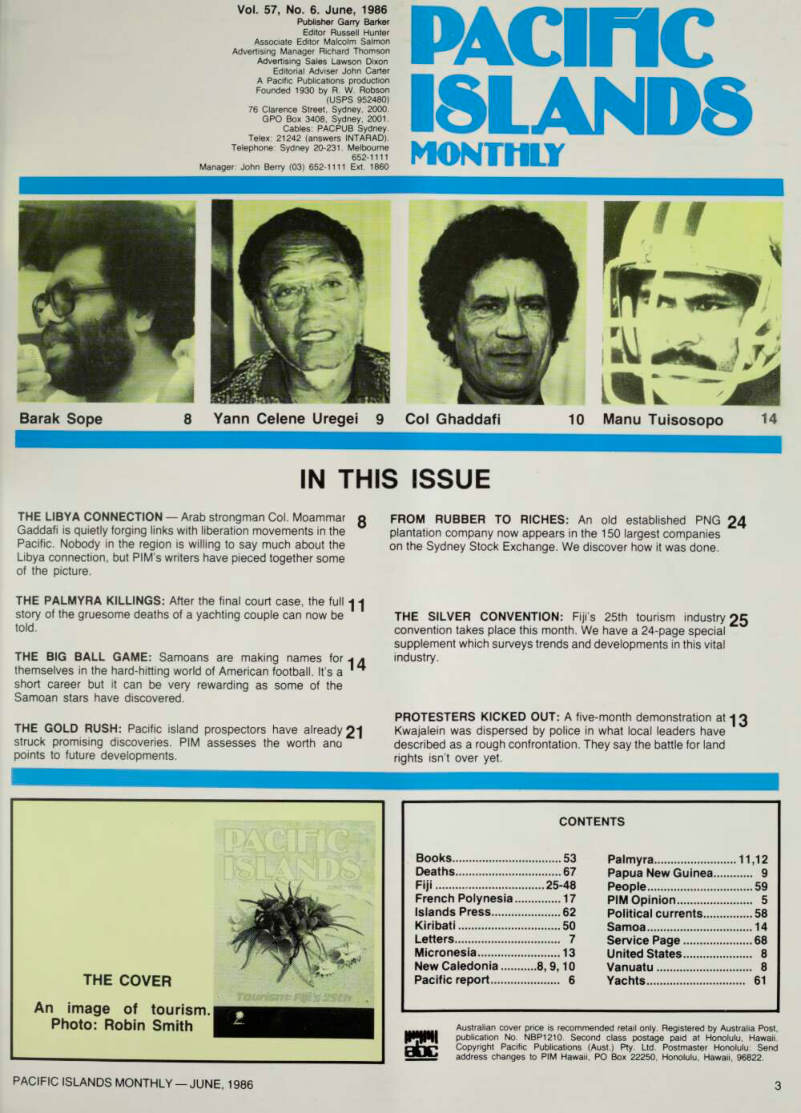
Barak Sope 8
Yann Celene Uregei 9
Col Ghaddafi 10
Manu Tuisosopo 14
In This Issue
THE LIBYA CONNECTION Arab strongman Col. Moammar o Gaddafi is quietly forging links with liberation movements in the Pacific. Nobody in the region is willing to say much about the Libya connection, but PlM’s writers have pieced together some of the picture.
THE PALMYRA KILLINGS: After the final court case, the full -j story of the gruesome deaths of a yachting couple can now be 1 told.
THE BIG BALL GAME: Samoans are making names for * * themselves in the hard-hitting world of American football. It’s a short career but it can be very rewarding as some of the Samoan stars have discovered.
THE GOLD RUSH: Pacific island prospectors have already 2“| struck promising discoveries. PIM assesses the worth ana points to future developments.
FROM RUBBER TO RICHES: An old established PNG 24 plantation company now appears in the 150 largest companies on the Sydney Stock Exchange. We discover how it was done.
THE SILVER CONVENTION: Fiji’s 25th tourism industry 25 convention takes place this month. We have a 24-page special supplement which surveys trends and developments in this vital industry.
PROTESTERS KICKED OUT: A five-month demonstration at -J 3 Kwajalein was dispersed by police in what local leaders have described as a rough confrontation. They say the battle for land rights isn’t over yet.
Contents
Books 53 Deaths 67 Fiji 25-48 French Polynesia 17 Islands Press 62 Kiribati 50 Letters 7 Micronesia 13 New Caledonia 8,9,10 Pacific report 6
Palmyra 11,12 Papua New Guinea 9 People 59 PIM Opinion 5 Political currents 58 Samoa 14 Service Page 68 United States 8 Vanuatu 8 Yachts 61
Australian cover price is recommended retail only. Registered by Australia Post, publication No. NBPI2IO. Second class postage paid at Honolulu, Hawaii.
Copyright Pacific Publications (Aust.) Pty. Ltd. Postmaster Honolulu: Send address changes to PIM Hawaii, PO Box 22250, Honolulu, Hawaii, 96822.
Advertisements & other items, pp. 3-4 (2 items)
3
PACIFIC ISLANDS MONTHLY —JUNE, 1986
Publisher Garry Barker Editor Russell Hunter Associate Editor Malcolm Salmon Advertising Manager Richard Thomson Advertising Sales Lawson Dixon Editorial Adviser John Carter A Pacific Publications production Founded 1930 by R. W. Robson
(USPS 952480)
76 Clarence Street, Sydney, 2000.
GPO Box 3408, Sydney, 2001.
Cables: PACPUB Sydney.
Telex: 21242 (answers INTARAD).
Telephone: Sydney 20-231. Melbourne 652-1111 Manager: John Berry (03) 652-1111 Ext. 1860
Benson w Hedges
H W. )J\ 20
WARNING-SMOKING IS ft HEALTH HAZARD
m
ONLY THE BEST WILL DO.
(Pfhe Benson and Hedges Company Pty.. Ltd. 1983 CC1426 83 JWT016.P351
with Libya
Pim Opinion
The cost of links with Libya
The spectacle of Fr Walter Lini expressing solidarity with Col Ghaddafi has sent a shockwave through the region.
Fr Lini and his fellow party members, meanwhile, spread their hands in a gesture of puzzlement and ask why everybody is suddenly so interested in the Libya connection.
At the same time Mr Uregei points out that the perpetrators of local terrorism are certainly not Libyan.
Fr Lini confides to the Colonel that he regrets the fact that small children were killed by the bombs of a superpower.
He then announces formal diplomatic relations with Libya, adding that it’s nobody’s business but Vanuatu’s.
The Vanuatu prime minister, his aides pointed out, was the first in the region to express his feelings regarding the US raid on Libya and the events that followed.
All well and good, so far. That is until we recall that Fr Lini was less than vocal when terrorists, wherever they may have struck, gunned down or bombed innocent children. Mr Uregei’s voice, too, was somewhat muted on these occasions.
There seems to be a perception here that there are “good” terrorists and “bad” terrorists. It’s a pretty poor perception. From wherever you stand on the political
spectrum, it is not possible for any respectable govern ment to condone the slaughter of innocents.
Nevertheless, that is the attitude both Fr Uni and Mr Uregei have adopted by default in their one-sided approach to Col Ghaddafi’s Libya.
They are dealing, let’s remember, with a man who routinely orders the executions of political opponents, a man who has at the very least sheltered terrorists and encouraged if not directly supported them.
The notion that it is necessary to accept money and/or support from any source available is a dangerous one for two reasons.
Firstly because nobody gives aid for nothing. There is the risk that island groups will not be able to keep Libya at arm’s length while taking its money and or its assistance and support.
Secondly because countries or movements siding with Libya could find themselves isolated within the South Pacific region whereas Libya will never be more than a distant friend.
Both Fr Uni and Mr Uregei are politically experienced enough to know of the risks, yet both seem prepared to accept them. That’s their right.
But their neighbors have a right to be worried.
pacific report
Melanesian ’Guests’
Sent Home
A group of 70 Irian Jayans were returned to Asia island near Sorong village after three months detention in Koror, Palau.
The men were arrested in early February for fishing for trochus shells at Helen’s Reef, about 60 miles outside Indonesian waters, which they claim as a traditional fishing ground, Indonesia and Palau were unable to agree who should bear the cost of repatriation. Finally, the company that hired the fishermen paid for their return. During their time in Palau the detainees had carried out public works and were described as “super guests”.
Coffe Rust
Quarantine Law
Urgent amendments to Papua New Guinea’s quarantine laws were passed by parliament following an outbreak of coffee rust that threatened the country’s $3OO million industry. The outbreak occurred in five highlands areas. The quarantine law restricts all movement in and out of the Western Highlands.
However industry leaders say the out break will not seriously affect this year’s crop. They said there had been panic and misunderstanding among the gov ernment officials. The PNG Coffee In dustry Association’s executive director Craig McConaghy said the disease could be controlled and that spraying had already been done by the larger plantations. He agreed, however, there could be difficulties for the many small coffee farms.
Tjibaou Slams
French Proposal
FLNKS leader Jean-Marie Tjibaou de scribed the new French government proposals for the future of New Caledo nia as a provocation. The four regional councils are to have their authority curtailed by the new minister in charge of New Caledonia, Mr Bernard Pons, who said a referendum on independc ence will be held within a year. Mr Tjibaou accused the government of abandoning earlier promises on moves towards independence and said it could not be trusted.
Easier Access
For Forum Exports
As of July 1, most South Pacific Forum countries’ exports will have duty free entry to Australia, six months earlier than originally planned. Australia’s trade minister Mr Dawkins said the date had
been brought forward in an effort to further reduce the trade imbalance be tween Australia and the forum nations.
He made the announcement at the opening of Fiji’s trade exhibition in Sydney.
Pangu Trio Form
Breakaway Group
Three leading members of Papua New Guinea’s opposiiton Pangu Party have left the party to form their own poltical grouping. Sir Barry Holloway, John Nil kare and Tony Siaguru all former ministers in the Somare government say the party and the country need a new direction.
Aid To Repair
Cyclone Damage
The British government gave Fiji an immediate grant of $45,000 for relief work following the devastating cyclone and flooding. Survey teams were sent out to estimate the extent of the damage while evacuation centres were opened and some 8,000 people were being fed by the government. New Zealand pro vided two helicopters to help the relief operation. Eight people died in the floods.
Funds For Roads
And Wharf Projects
The World and Bank and the Asia Development Bank have lent Vanuatu $5 million for wharf and road building developments. The loans, repayable over fifty years, carry no interest.
Reagan Refuses
Spnfz Backing
President Reagan has refused to commit his government to signing the South Pacific Nuclear Free Zone treaty. A senior White House spokesman said after the president had met with Austra lia’s prime minister Mr Hawke that no decision on the treaty was imminent.
Burns Philp Buys
Us Company
Burns Philp bought the American Fleischmanns company and full control of Dixie Inc for $2OO million. Both companies are involved in yeast and vinegar production. A Burns Philp spokesman said the two companies dominated the American and Canadian yeast markets and the move reflected Australia’s growing importance in world food markets.
Us Ready To End
Trusteeship
The United States has formally advised the United Nations that it is ready to terminate its trusteeship over more than 2,000 islands in Micronesia, A spokes man said the Micronesian states were ready to assume their rightful place in the world. The United States wants the UN Trusteeship Council to certify to the Security Council that the 100,000 people of the territory have exercised their right to self determination. The hope is that the Security Council will give final appro val next month to the dismantling of the trust. The Soviet Union, however, is expected to oppose the accords reached between the US and the Mar shall Islands, FSM, Palau and the North ern Marianas under which the US retains its responsibility for defence.
Reserve Bank Warns
Against Protectionism
The Reserve Bank of Fiji has warned the government against imposing excessive protection measures for local products.
The bank, in its quarterly report, says that by the end of 1984 36 categories of goods were subject to import restric tions. Last year, controls were imposed in eight other areas. The bank has warned that a lack of overseas competi tion might lead to inefficient allocation of resources. The report is critical of import substitution saying a small country such as Fiji should have an export-oriented economy. The bank also criticised the Ministry of Finance’s ability to estimate its debt service commitments, saying Fiji’s budget estimates over the past six years had consistently over-predicted debt servicing expenditure.
Taa Makes Air
Niugini An Offer
One of Australia’s two major domestic airlines, TAA, has offered to take over the management of Air Niugini. Senior TAA officials have already had talks with Air Niugini management and aviation minis ter Mrs Nahau Rooney.
New Disease
Hits Sugar Industry
Papua New Guinea's sugar industry was affected by a mystery disease that could threaten half the $3 million crop. The area at risk covered about 6,000 hec tares of cane in the Ramu valley. There were reports that production could be slashed by up to 80 per cent and doubts that the country could meet its export quota of 10,000 tonnes to the United States.
letters
Television In Fiji
A cautionary tale from the USA
After working as a Peace Corps volunteer in the School of Education at the University of the South Pacific in Suva for three years, I came to develop an appreciation and understan ding of the people, culture, traditions, and sociological con ditions in Fiji. I recently read that Fiji may soon be getting television.
There are certainly a lot of benefits to be derived from the introduction of new telecom munications technology in Fiji, and television can be put to use for a variety of informative, educational, and developmen tal purposes if properly control led and developed by the Fiji Government. Locally produced programs dealing with inter island and South Pacific region al news, health education, agri culture, instructional television for schools, and sports could have a fairly positive effect on the appropriate development of the country. It should be noted, however, that television is not without its pitfalls, particularly when commercial entertain ment and imported programs come into the picture.
Over 2500 publications on the effects of television have been published over the past 20 years. One of the more comprehensive publications is a U.S. Government document published by the National Insti tute of Mental Health entitled Television and Behavior: Ten Years of Scientific Progress and Implications for the Eighties.
This document is a compilation of research done by leading psychologists and communica tions experts which analyses the effects of television on cogni tion, the association between viewing violence on television and subsequent aggressive be havior, and the effects on chil dren. Unfortunately, the bulk of the research done concludes that there are many negative
effects associated with heavy TV viewing, and that there is a clear-cut association between viewing violence and subse quent aggressiveness among children and young adults.
The average American watches seven hours of TV a day, yet 70 per cent of all Americans don’t know who their own congressmen and senators are, or what the three main branches of U.S. govern ment are, according to one survey. Even people who watch a fair amount of educational TV do not know where Fiji or New Zealand are, or why there is so much trouble going on in the Middle East. How many hours a day might the average Fiji citizen watch TV? Will people devote less time to social and domestic obligations, and more time to a medium which is more convenient and accessible than a standard VCR system? Do video programs always make people more knowledgeable?
The famous Canadian com munications theorist Marshall McLuhan once said, “the medium is the message.” If information is presented by radio or television, people will always believe it, whether it is true or not. Will Fijian chiefs and Indian patriarchs lose their influence on the younger gen eration when trying to compete with this very pervasive medium of television? Some people in the United States refer to television as the electric parent. Will the introduction of TV in Fiji in areas with electricity cause greater urbanisation and migration from the non-electric areas, thereby increasing crime, unemployment and other social problems? Marshall McLuhan also said: “When identity dis appears with technological in novation, violence is the natural recourse. ”
If educationally-based gov ernment TV is first introduced,
it is quite conceivable that com mercial, imported, canned programming could follow as a result of public demand and the influence of businessmen and advertisers. The possible negative effects of an inunda tion of violent “cops and rob bers” shows which are de signed for middle class western audiences are obvious. Again, there is much research to verify the fact that excessive violence in the media can act as a catalyst for criminal activities.
The content quality of en tertainment media in the United States has declined substan tially over the past 10 years, and over the past five years violence on television has risen more than 100 per cent. The average American child has seen over 20,000 murders on television by the time he or she is 18. U.S. Senate hearings have even been held recently to question the content of what is shown on television. If Fiji is to receive satellite transmissions of foreign broadcasting then perhaps the above should be considered.
There are a great many fac tors which must be taken into consideration when introducing new technologies in developing countries. Potential effects on
social hierarchies, religious be liefs, and cultural norms must all be taken into account. Basic needs and priorities for both urban and rural populations need to be assessed with particular respect to socio-eco nomic conditions. Will poor un employed urban dwellers feel left out when TV arrives? Will crime increase from the intake of more technological material goods among the middle class population? Will traditional lifestyles diminish when trying to compete with new imported technologies? Will movies like Death Wish II and Scarface aid the appropriate development and betterment of society in the South Pacific? How long will educational television last be fore entertainment media are brought into the picture by public demand?
There are, of course, many other economic and political implications to take into account. These are just a few things that the citizens and residents of Fiji should take into consideration in regard to tele vision in the South Pacific.
Steven A. Davis
Texas A&M University College Station Texas, USA
Bras no part of traditional PNG dance
traditional PNG dance
I refer to an item in PIM March (p5O) regarding Papua New Guinean dancers “covering up” so as not to offend the Queen at the Royal tournament.
I am a Papua New Guinean and a dancer when at high school. I do not agree with “traditional bras.” This is not our culture.
The Queen has been to many parts of the world and
would not be worried about real traditional dress. Prince Charles and the Pope weren’t, so why should she be?
Our culture is our own, and our dances should not be altered because some people are more embarrassed than the Queen would ever be.
Mary Kewas
Mackay, Qld., Australia
The Libya conne[?]
Despite repeated war nings by regional gov ernments demanding that Libya keep its nose out of the Pacific, evidence now suggests Col Moammar Ghad dafi has succeeded in building a support base in this part of the world.
For more than a year now, rumours have been circulating about the Libyan connection mainly initiated by the Tripoli visit in 1984 by 17 members of New Caledonia’s Kanak Social ist National Liberation Front
(Flnks).
That particular trip appears now to have been nothing more than a publicity stunt by the front to let the world know that it should be taken seriously.
However, more recently, the rumours and fears have been fuelled again by a more serious some say much more sinister turn of events.
It is now claimed that several political groups in the region have decided to join forces with Col Ghaddafi to form an alliance with the Libyan strongman.
The allegations first came to light in the weekly FLNKS newspaper Bwenando. It has alleged that Ghaddafi has formed a revolutionary commit tee with the ruling Vanuaaku Party in Port Vila, the OPM in Irian Jaya and one of the FLNKS member parties, the United Front for Kanak Libera tion. (FULK) The fact that the FLNKS
journal has chosen to reveal the claimed alliance and the in volvement of one of its mem bers gives the story a great deal of credibility. But otherwise it remains unconfirmed.
Vanuatu prime minister Father Walter Lini has denied
the involvement of his party and the other so-called mem bers have chosen to stay silent on the subject.
FULK’s leader Yann Celene Uregei, who, along with five of his party colleagues, attended the conference of liberation
movements in Tripoli in March, was nowhere to be found and had obviously decided to lie low for a while rather than face not only the glare of publicity, especially in light of Libya’s confrontations with the United States, but also to avoid any
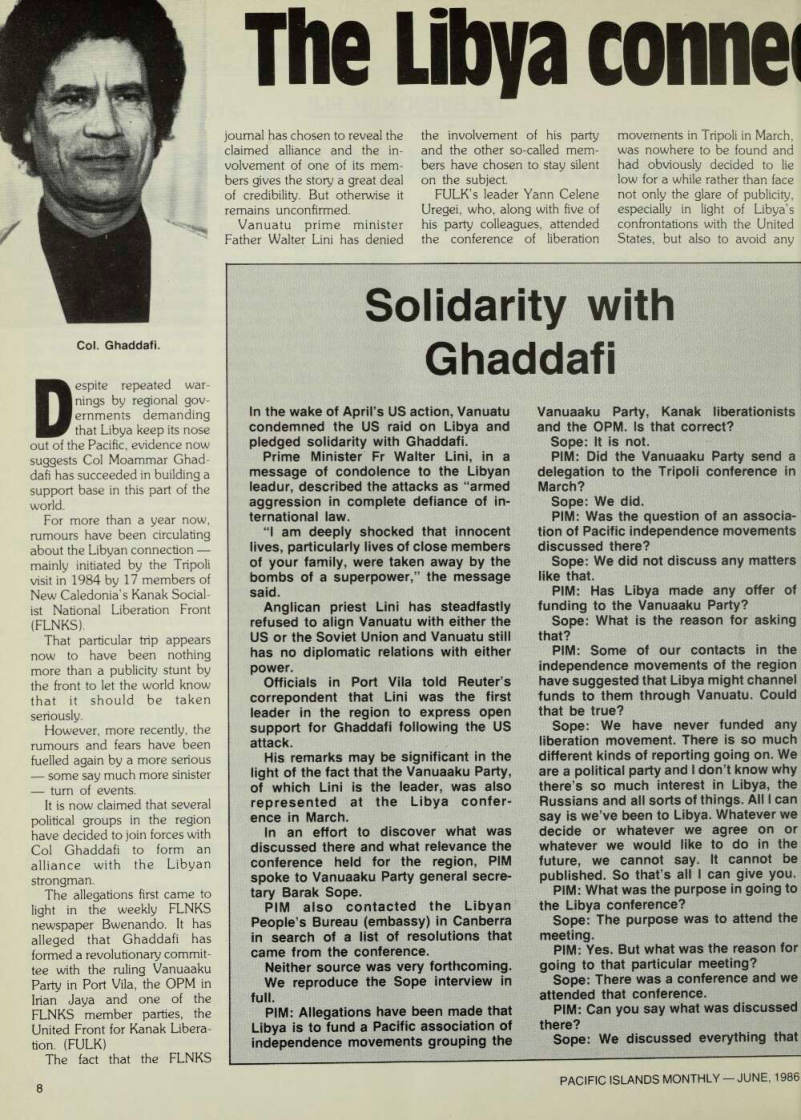
Col. Ghaddafi.
problems with the FLNKS which remains firmly opposed to any connections with Ghad dafi.
Consequently, the alliance, if it exists, remains shadowy.
According to Bwenando, the alliance was first formed last
December with Uregei signing up the FLNKS.
When the front’s political bureau was told of the move, however, it immediately annul led its “membership” and made it clear it wanted no part of any deal involving Libya.
It also told Uregei, who at that time was foreign affairs spokesman for the front, that it would not take part in the March Tripoli conference.
Uregei subsequently led a delegation of members of his own party to the conference. It
was at that meeting, apparently, that the revolutionary commit tee was finalised with Uregei’s FULK taking the place of the
Flnks.
Funding for the committee has undoubtedly come from Ghaddafi who was already known to have contributed generous sums to organisations such as FULK much of which, sources claim, has been deposited in a Port Vila bank.
Exactly what kind of action the alliance will promote is, again, difficult to say.
However, it has been re vealed that a member of Uregei’s group and one of the six who travelled to the Tripoli conference will be returning to Libya for a six month “training course. ”
While suggestions of an alliance of this kind have caused alarm among other re gional governments, not to mention the French authorities, reaction should perhaps be kept in perspective.
Uregei is a canny politician who has been at the forefront of the New Caledonian political scene for more than 20 years.
He is dedicated to an indepen dent New Caledonia and although he has always been seen as something of an intiner ant ambassador by the FLNKS, he has proved an effective foreign affairs spokesman travelling and lobbying endless ly to “spread the word” and try to win support.
He has also learned that one of the most efficient ways of keeping things moving is to keep the issue on the front pages of the world’s press.
By flirting publicly with Libya he has managed exactly that, even though it has resulted in his suspension as foreign affairs minister in the provisional Kanaky government by the political bureau of the FLNKS.
The suspension has led to much speculation that Uregei’s FULK thought to have about 2,000 followers in New Caledo nia could part company with the mainstream FLNKS to form a radical splinter group.
FULK maintains that it will not quit the front. However, relations between the two groups are obviously under strain.
The issue is likely to be settled once and for all at the next congress of the FLNKS.
Meanwhile, in Port Moresby, OPM sources indicated that there are renewed hopes for overseas funding for the battle to separate Irian Jaya from Indonesia.
Former guerrilla leaders Seth Rumkorem and Jacob Prai were recently in Moscow, PIM was told. “We’re hoping that, because of Moscow’s new found interest in the region, we might be able to find some money there,” said one source.
He added that it was thought possible Russia might channel
support through Libya.
Madang-based spokesman Moses Werol confirmed that the OPM was represented at the Tripoli meeting.
“Some of our people from Europe were there,” he said. “I don’t know all the details yet.
Asked if there was any possibility of a Pacific grouping of independence movements supported by Libya, Mr Werol replied: “That’s what we hear from Libya. We’re hoping for sup port or at least a guarantee that we will have what we need.
“We’re a small organisation.
We need help from any coun try. At the moment I think Libya is willing to give us help. But up to now we have nothing posi tive. ”
He said the OPM had re ceived no money from Libya.
PIM: Has there been any offer of funding by Libya?
Werol; Not up to now. But there’s a promise there. I don’t know any details yet because we are waiting for our congress in Vanuatu in June. Maybe congress will give positive in formation on what countries will support us.
Werol explained that the congress would comprise all the factions of the OPM under one umbrella-type “revolutionary council.”
The revolutionary council will wage the propaganda and dip lomatic battle, he said, “while those inside the bush will come under the military council.”
He confirmed that the OPM congress was “very likely” to have observers from New Cale donia and the Vanuaaku Party “because we are all Melane sians. ”
Australia’s foreign minister Mr Bill Hayden was expected to discuss relations with Libya when he visited Vanuatu late last month.
He stated earlier, however, that Australia took the view that foreign relations were a sovereign matter for Vanuatu and did not wish to interfere.
He would, however, be seek ing “clarification”.
He said in Honiara that he was worried about Libya’s pre sence anywhere and Australia would be particularly con cerned if Vanuatu’s relationship led to aJJbyan involvement in the Pacific that went beyond normal diplomatic activity.
Solidarity with Ghaddafi
Ghaddafi
In the wake of April’s US action, Vanuatu condemned the US raid on Libya and pledged solidarity with Ghaddafi.
Prime Minister Fr Walter Lini, in a message of condolence to the Libyan leadur, described the attacks as “armed aggression in complete defiance of in ternational law.
“I am deeply shocked that innocent lives, particularly lives of close members of your family, were taken away by the bombs of a superpower,” the message said.
Anglican priest Lini has steadfastly refused to align Vanuatu with either the US or the Soviet Union and Vanuatu still has no diplomatic relations with either power.
Officials in Port Vila told Reuter’s correpondent that Lini was the first leader in the region to express open support for Ghaddafi following the US attack.
His remarks may be significant in the light of the fact that the Vanuaaku Party, of which Lini is the leader, was also represented at the Libya confer ence in March.
In an effort to discover what was discussed there and what relevance the conference held for the region, PIM spoke to Vanuaaku Party general secre tary Barak Sope.
PIM also contacted the Libyan People’s Bureau (embassy) in Canberra in search of a list of resolutions that came from the conference.
Neither source was very forthcoming.
We reproduce the Sope interview in full.
PIM: Allegations have been made that Libya is to fund a Pacific association of independence movements grouping the
Vanuaaku Party, Kanak liberationists and the OPM. Is that correct?
Sope: It is not.
PIM: Did the Vanuaaku Party send a delegation to the Tripoli conference in March?
Sope: We did.
PIM: Was the question of an associa tion of Pacific independence movements discussed there?
Sope: We did not discuss any matters like that.
PIM: Has Libya made any offer of funding to the Vanuaaku Party?
Sope: What is the reason for asking that?
PIM: Some of our contacts in the independence movements of the region have suggested that Libya might channel funds to them through Vanuatu. Could that be true?
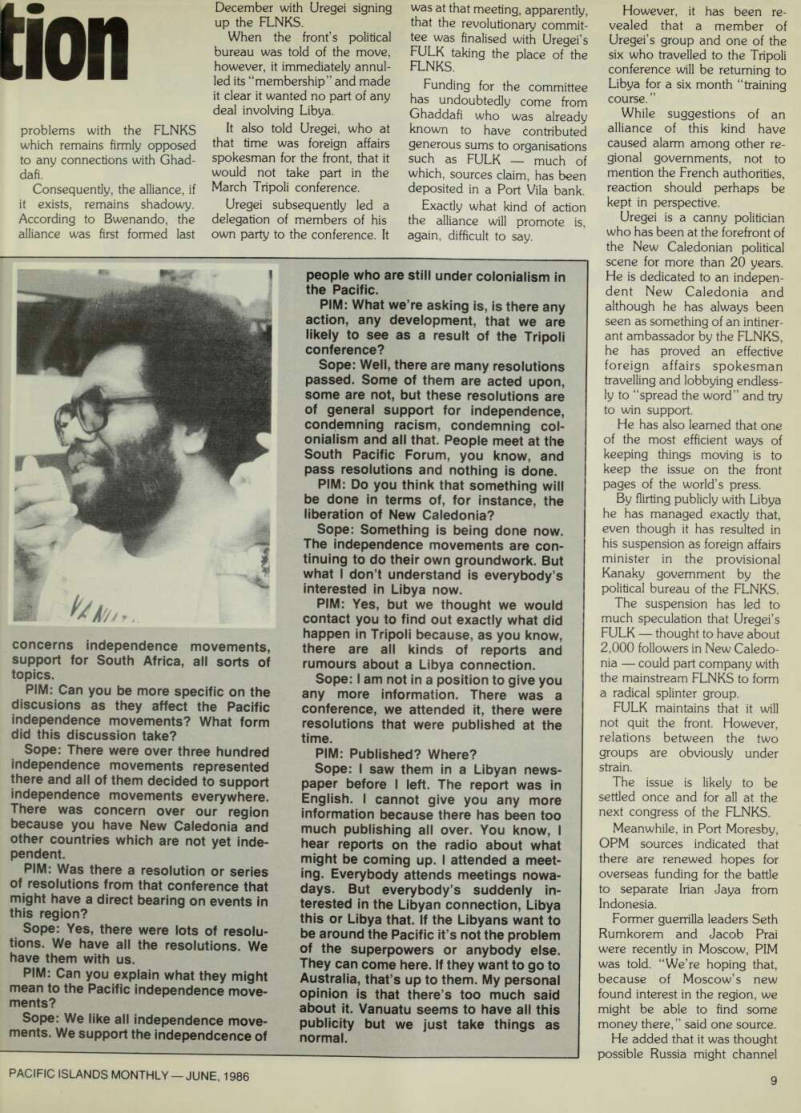
Sope: We have never funded any liberation movement. There is so much different kinds of reporting going on. We are a political party and I don’t know why there’s so much interest in Libya, the Russians and all sorts of things. All I can say is we’ve been to Libya. Whatever we decide or whatever we agree on or whatever we would like to do in the future, we cannot say. It cannot be published. So that’s all I can give you.
PIM: What was the purpose in going to the Libya conference?
Sope: The purpose was to attend the meeting.
PIM: Yes. But what was the reason for going to that particular meeting?
Sope: There was a conference and we attended that conference.
PIM: Can you say what was discussed there?
Sope: We discussed everything that
concerns independence movements, support for South Africa, all sorts of topics.
PIM: Can you be more specific on the discusions as they affect the Pacific independence movements? What form did this discussion take?
Sope: There were over three hundred independence movements represented there and all of them decided to support independence movements everywhere.
There was concern over our region because you have New Caledonia and other countries which are not yet inde pendent.
PIM: Was there a resolution or series of resolutions from that conference that might have a direct bearing on events in this region?
Sope: Yes, there were lots of resolu tions. We have all the resolutions. We have them with us.
PIM: Can you explain what they might mean to the Pacific independence move ments?
Sope: We like ail independence move ments. We support the independcence of
people who are still under colonialism in the Pacific.
PIM: What we’re asking is, is there any action, any development, that we are likely to see as a result of the Tripoli conference?
Sope; Well, there are many resolutions passed. Some of them are acted upon, some are not, but these resolutions are of general support for independence, condemning racism, condemning col onialism and all that. People meet at the South Pacific Forum, you know, and pass resolutions and nothing is done.
PIM: Do you think that something will be done in terms of, for instance, the liberation of New Caledonia?
Sope: Something is being done now.
The independence movements are con tinuing to do their own groundwork. But what I don’t understand is everybody’s interested in Libya now.
PIM: Yes, but we thought we would contact you to find out exactly what did happen in Tripoli because, as you know, there are all kinds of reports and rumours about a Libya connection.
Sope: I am not in a position to give you any more information. There was a conference, we attended it, there were resolutions that were published at the time.
PIM: Published? Where?
Sope: I saw them in a Libyan news paper before I left. The report was in English. I cannot give you any more information because there has been too much publishing all over. You know, I hear reports on the radio about what might be coming up. I attended a meet ing. Everybody attends meetings nowa days. But everybody’s suddenly in terested in the Libyan connection, Libya this or Libya that. If the Libyans want to be around the Pacific it’s not the problem of the superpowers or anybody else.
They can come here. If they want to go to Australia, that’s up to them. My personal opinion is that there’s too much said about it. Vanuatu seems to have ail this publicity but we just take things as normal.
Propaganda by Australia
Australia
While the media were chasing around New Caledonia in search of Yann Celene Uregei, the man himself was on a mini trip around the South Pacific.
Despite his suspension from the posi tion of FLNKS foreign affairs spokesman because of his Libya links, he was nevertheless accorded ministerial status in Papua New Guinea where he met the acting foreign minister Galeva Kwarara and acting foreign secretary Sir Alkan Tololo.
In Honiara, Uregei was interviewed by the Solomon Islands Broadcasting Service.
He was at pains to point out that the FLNKS is “not a unified political party” but consists of seven pressure groups each of which remains autonomous with in the framework of its own political party.
“The congress of my own political party which met in January decided on my participation at the conference in Tripoli the conference of liberation movements.
“It was thus as secretary general of my own party FULK that I led a delegation of my party to attend this conference. My party took its position from the demand of the Kanak people for independence.
“That’s why we attended the confer ence. The so-called FLNKS decision about our attendance was in fact only the decision of three groups of the seven within the FLNKS.
“There is, therfore, no consensus in favour of this strange co-called decision to dismiss the minister for external affairs of the provisional government.
“It therefore appears that these three parties declined to meet with other liberation movements and thus placed themselves in a position favouring col onialism and French imperialism.
“It therefore appears that the party is a victim of a campaign of distortion by the western media and press.
Interviewer: You must have seen this conference in Tripoli as very important.
That is why you attended even though three factions within the FLNKS didn’t approve. What did you gain from the Tripoli liberation conference?
Uregei: 302 organisations from all over the world united in Tripoli on March 17 and 18 to plan a program for the fight against imperialism, colonialism, racism and apartheid.
The conference decided to establish a world revolutionary force and a re volutionary front worldwide which will
comprise, at the same time, both state governments and political organisations of small peoples and nations The conference decided to counteract arrogance and hegemony worldwide.
The best demonstration of this hege mony Is the recent American attack on Libya.
It decided, in the first place, that New Caledonia and other French colonies must be liberated. The struggle for independence of the Kanak people and that of West Papua was explained to the conference.
I also wish to speak of international terrorism. I believe that in the matter of terrorism the peoples of the Pacific are also victims of the propaganda of the media particularly of the western countries.
In the region this propaganda is, in particular, put out by Australia. We don’t need to look elsewhere for terrorism because it continues to be visible In the Pacific region.
The continuance of French colonialism in the Pacific region, the French nuclear tests, the dynamiting of the Greenpeace vessel, arms traffic between Australia and New Caledonia are local terrorism.
Within New Caledonia we have seen the dynamiting of the Palais de Justice in Noumea and the Ministry of Finance.
Those reponsible for these acts have not yet been found. What I wish to point out in this respect is that none of these actions were the work of Col Ghaddafi or Libya but are obviously those of France and those who support its politics.
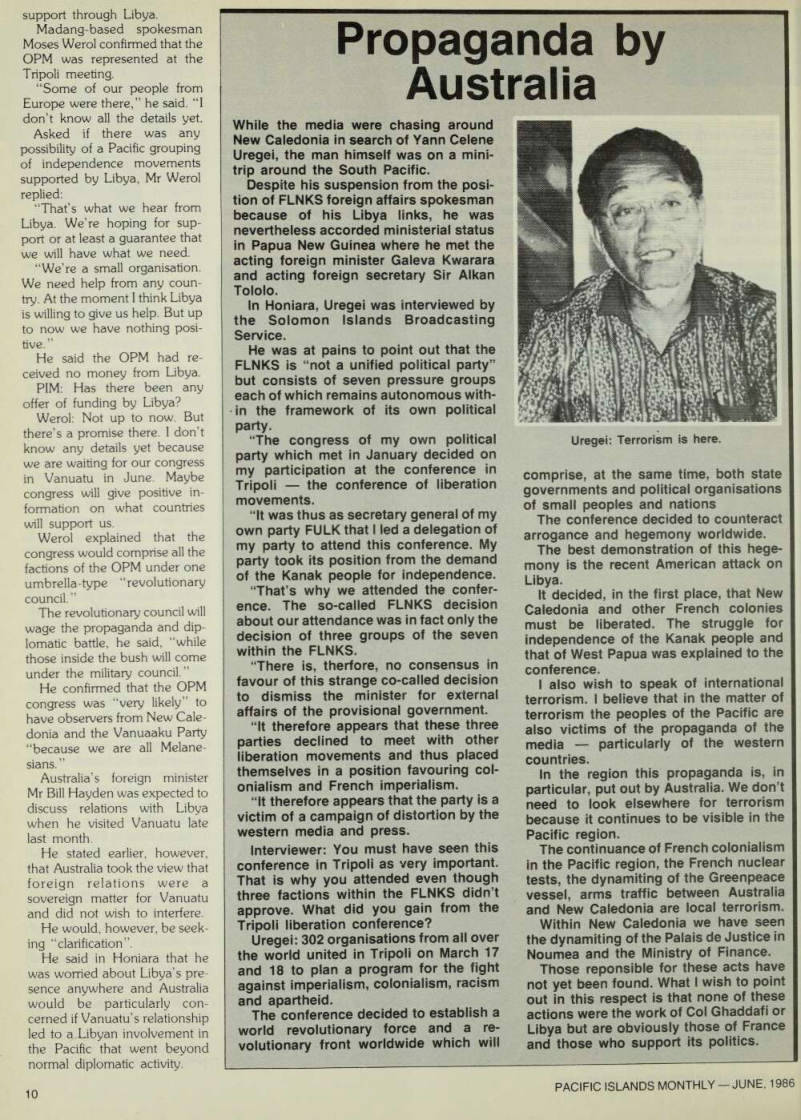
Uregei: Terrorism is here.
Palmyra saga
End of 12-year Palmyra saga of piracy, murder
One of the most unusual cases in modern Amer ican jurisprudence a story involving piracy, circumstantial evidence, mur der and prison escape finally came to its end in San Francis co in March when Stephanie Stearns, a 39-year-old Los Angeles office manager, was acquitted.
The end to a drama that began in August of 1974 at Palmyra atoll, 1600 kilometres south of Hawaii, was suspense ful. Jurors told U.S. District Judge Samuel King, who came with the case from Honolulu where it originated, that they were tied 6-6 but did not indicate whether this position was fixed. The judge returned them for further deliberations.
They reported subsequently that they were now split 10-2.
Defence attorneys wanted a mistrial but the judge ordered more deliberations.
Stearns, a compact woman who wore business suits to her trial, fidgeted and was obvious ly nervous. Her mother, also in court, displayed tension. But Stearns was a free woman when the jurors made their final return to the courtroom which is high atop the 20-storey Fede ral Office Building near the San Francisco City Hall.
The skyscraper courtroom was much removed in time, distance and setting from the events which were laid out during the weeks of the trial.
Herewith a narrative; In the fall of 1974, the luxurious 38-foot ketch Sea Wind of San Diego, California,
PIM has often over the years reported on aspects of the grim events of August 1974 in Palmyra lagoon, most recently in our August ’B5 issue (p. 59) where we reported that a jury in San Francisco had found Buck Duane Walker guilty of the first-degree murder of Eleanor “Muff” Graham of San Diego, USA, at Palmyra in August 1974.
The marathon court hearings came to an end in March with the acquittal in San Francisco of Walker’s companion, Stephanie Stearns, who faced a charge of murdering Eleanor Graham’s husband, Malcolm.
Now RALPH CRAIB in San Francisco surveys the whole 12-year saga in an exclusive report for PIM.
was anchored in the Palmyra lagoon while its owners, Eleanor (Muff) Graham and her husband, Malcolm (Mac) Gra ham, fished and used the beaches. They were a wealthy couple and their vessel was abundantly supplied.
But Sea Wind soon had unwelcome company. The ketch lola limped into the la goon. It was crewed by Stearns and her boy friend, Buck Duane Walker, now 47. The newcomer was in ill repair and its hippie duo were poorly supplied. The vessel had to be bailed out daily by hand to keep it afloat.
Oceanographer, Norman Sanders, who was a witness at Walker’s trial in San Francisco last June, said that the situation at Palmyra wasn’t nice. The lagoon, he said, was awash with sharks, poisonous fish and hu man hostility. He said that he made plans to leave Palmyra
within a few days and that he also advised the Grahams to do so.
“If the 200
inches of rain
per year and the rapa cious sharks were bad ,
the culture
dash between
the hippies
and the
establishment
was worse ..
“I wrote in my log book,” the oceanographer said, “that it was a place where even the vinyl would rot.” If the 200 inches of rain per year and the rapacious sharks were bad, he
said, the “culture clash between the hippies and the establish ment” was worse.
Sanders told the court of hiding behind a palm tree in fear when Walker used a pistol to shoot one type of fish in the lagoon that was edible. This placed in the record of the trial Walker’s possession of a weapon. Sanders subsequently left Palmyra.
The Grahams’ equipment aboard the Sea Wind included a radio transmitter which en abled them to communicate with friends on the U.S. main land and in Hawaii. They main tained weekly radio schedules.
On August 28, 1974, Graham contacted Curt Shoemaker, a Honolulu amateur radio oper ator who had previously re layed messages to members of the Graham family. Graham told Shoemaker that the Sea Wind and the lola were still at Palmyra and that the lola was to leave in a few days. Graham said that the two people from the lola, whom he knew as Mr and Mrs Allen, were coming to his ketch that evening for a bon voyage party.
Graham was never heard from again. No trace of him has ever been found. Remains, subsequently identified as those of his wife, did however turn up seven years later.
Two months after that Aug ust 1974 radio message, the repainted Sea Wind sailed into the Ala Wai Yacht Harbor, just a stroll from the luxury hotels of Oahu’s Waikiki. When other yachtsmen recognised the well known boat, Walker told them
that he had taken the boat over after its owners had been lost in a storm while fishing in their rubber dinghy.
Someone tipped the authori ties. When federal agents approached the Sea Wind, Walker went over the side and successfully hid beneath a cata maran’s hulls. Steams fled ashore. Both were apprehended a few days later.
In the absence of proof, the government did not file charges of murder. Walker admitted the theft of the Sea Wind and was convicted of it. He was also convicted on drug charges from which he was fleeing when he and Steams took the lola to Palmyra.
Then, in 1983, a metal box showing fire scars washed ashore on a Palmyra beach. It contained human bone re mnants and experts were able to identify these as the remains of Mrs Graham.
Murder charges were filed in the U.S. District Court in Hawaii. But attorneys were successful in getting an order for a change of venue. They argued that an unprejudiced trail could not be held in Hon olulu because of the amount of publicity given to the unusual case. The decision was also made to hold separate trials for the two defendants.
Before his trial for murder last year, Walker had been sent enced to prison, had been transported to McNeil Island, a federal penitentiary in the State of Washington, had escaped and had been recaptured in Arizona. A chunky man, he brightened the austere federal court in San Francisco by appearing in aloha shirts.
4 Walker paid
dearly for a
prison inde
scretion. He
bragged to a
fellow inmate
that he had
made Graham
‘walk the
plank’ at
Palmyra . . .”
Walker paid dearly for a prison indiscretion. He bragged to a fellow inmate that he had made Graham “walk the plank” at Palmyra. The man, who was given new identity by federal authorities, was under protection of authorities until he testified at Walker’s murder trial.
Last June 12, the 12 mem bers of the jury took but two hours to rule that Walker was
guilty of the murder of Mrs Graham. Assistant United States Attorney Elliot Enoki built his case on the circumstan tial evidence he had available to him. He made much of the fact that Walker did not report the alleged disappearance of the Grahams when he sailed their boat to Hawaii.
The government contended that Mrs Graham’s body had been placed in a metal locker or
box and set afire. Somehow, years later, the tides brought the grisly evidence to shore. A South African yachtsman found the box and bones.
When Walker and Steams reached Palmyra, prosecutor Enoki said, they were down and out, had to catch their food or barter for it. “Suddenly, 200 yards away, there were the Grahams with every provision known to man,” said Enoki.
“Only two people could have committed the murder,” he said. “Only two people on earth. ”
Walker’s attorney argued un successfully that no one on earth could truly tell what hap pened at Palmyra. But the jury obviously agreed that Walker did know. Judge King sent enced Walker to life imprison ment. That sentence cannot be begun until he has served ear lier sentences involving theft of the Sea Wind and drug
‘ Walker
be eligible,
under current
law, to begin
applying for
parole in the
year 2006 ..
charges. He will be eligible, under current law, to begin applying for parole in the year 2006.
Miss Steams’ murder trial began in February. Judge King immediately dismissed a charge that she killed Malcolm (Mac) Graham. He said that the gov ernment had failed to prove that a murder had happened during the theft of the Gra hams’ yacht.
Her defence portrayed her as a hapless person who had no other choice but to make use of the Grahams’ boat to return to civilisation. She contended that she believed that the Grahams had died during a fishing trip.
The jury was willing to believe that few women would have been much of a match for Walker, the tough ex-convict and escape artist.
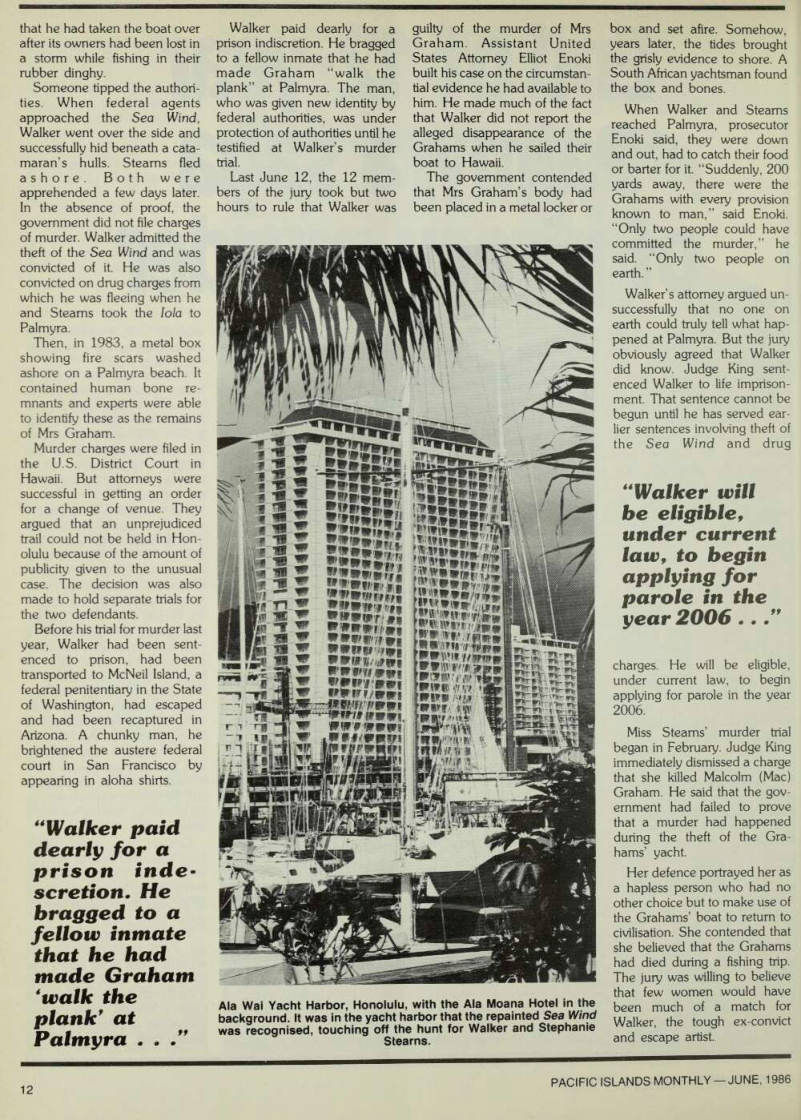
Ala Wai Yacht Harbor, Honolulu, with the Ala Moana Hotel in the background. It was in the yacht harbor that the repainted Sea Wind was recognised, touching off the hunt for Walker and Stephanie Stearns.
against ‘apartheid’
Islanders sit in against ‘apartheid’
When 210 protesting Marshall Islanders were forcibly removed by police from the US missile facility at Kwajalein atoll, a five month “sit-in” came to an abrupt end.
But the islanders say they’re not beaten yet. Bruised, perhaps, but not beaten.
The sit-in was a protest at what some islanders claim is the lack of a lease agreement, the use of their atoll as a missile testing site and what they claim is a US version of apartheid in the US-administered UN Trust Territory of the Pacific Islands.
Marshallese senator Ataji Balos, chairman of the Kwaja lein Atoll Corporation (KAC) which staged the five-month protest, described the events of their eviction in a dramatic telephone interview.
He said: “On Monday even ing the judge of the High Court of the Marshall Islands issued an order of eminent domain, condemning the land we were occupying and stating that it was needed for immediate use.
“Police from Majuro were sent to Kwajalein to serve the order. We were given one hour to respond.
“I requested to talk to my lawyer which was refused. In one hour the police moved our people ladies, elders, chil dren from our camps. We refused to move from the Paci fic and Ocean View clubs which we were occupying.
“The police used force and handcuffed ladies. Two, three guys lifted them into trucks.
Two ladies fainted and went to hospital. The police were really rough on them.”
Balos said the police took the people to the docks and kept them in uncovered boats for the night.
Landowners at Kwajalein island, the US missile testing range in the Marshall Islands, recently were evicted after a five-month protest sit-in on their ancestral land. They claim US policy is akin to “apartheid” and reject the land lease agreement signed by their government and the US. ED RAMPELL reports.
“The following morning at 6am they took us against our will to Ebeye. I was hand cuffed.”
The Ebeye people, mean while, had learned of the condi tion of the “boat people” and large numbers of them were waiting at the dock.
Balos: “The dock was filled with our people. They jumped into the boats and were thrown off by security.
“We went to nearby South Loi island where we were left until the afternoon. There was no food, water or shelter. We were sent water by our people. ”
In an official statement, Kwajalein Missile Range (KMR) public affairs officer Pat Rob bins said: “With limited assist ance from Kwajalein Missile Range, the Majuro police were able to remove all the demon strators from the four islands within the atoll.”
Robbins put the number of protesters at 140 while about 70 more were removed from three other off-limits isles Meek, a US launching site for minuteman missiles, Enewetok and Omelek, radar tracking and communication stations.
The KAC is protesting against a lease agreement which ex pired last October and was later extended.
Under the terms of the land use agreement, the landowners were paid US$7 million per annum or about $l2OO
each. According to KAC lawyer George Allen, “the landowners are seeking to negotiate directly with the US government, as happens at places like Okinawa and Christchurch, New Zea land.”
The US, however, has been negotiating with the Marshall Islands government and on March 11 both sides signed an agreement extending the ex pired lease.
According to KMR spokes man Robbins, the Marshallese High Court gave ownership of the land to the Republic of the Marshall Islands’ government on April 21. Under the law of eminent domain, said Robbins, the Marshallese government will retain possession of the land at the US military installa tion for three years.
Allen, however, contends that “the law of eminent do main only affects six of the 120 parcels of land at Kwajalein” and insists that the dispute is far from over.
He told FIM that “complex litigation” has been filed chal lenging the military’s right to restrict people from unconde mned land. Defendants cited include Secretary of Defence Caspar Weinberger and Secre tary of the Army John Marsh.
Ebeye mayor Alvin Jacklick also believes the trouble in paradise is far from over. He said: “One to two thousand landowners are occupying the Ebeye dock in order to return to
Kwajalein and re-occupy their land.”
The sit-in had also prevented between 600 and 700 Marshal lese labourers from travelling to KMR to work, said Jacklick, and the response to an army edict that absentees would lose their jobs was for many people to walk across the reef to work.
Both Bales and Jacklick stress that there is more at stake than a land agreement.
Balos claims that “the situa tion at Kwajalein atoll is de finitely like apartheid. Our kids aren’t allowed to attend high school at Kwajalein. There isn’t any at Ebeye.
“We can’t use their hospital; ours is inadequate. Their high standard of living three miles away makes Kwajalein island look like a paradise and Ebeye a slum.
“They mistreat and look down on our people as if we are not human beings” and, while South Africa had abolished the notorious pass laws, “Marshal lese still need a pass to travel to Kwajalein. They don’t allow us to live there.”
Kwajalein, thirteen times lar ger than Ebeye, has less than a third of Ebeye’s population (2,500 compared to 8,000).
The Marshallese militants have vowed to continue their protest. Balos and Jacklick plan to petition the UN and will campaign against the proposed compact of free association which would give the US the right to continue using KMR for at least another 30 years.
“The landowners are deter mined to spread the sit-in all over the atoll by walking the reef,” said the mayor.
Balos added: “We are a small people, but we are not going to give up fighting for our rights. ”
American Samoans

migrating to the US take on a wide variety of occupations but few match the endeavor of men like Mosi Tatupu, Terry Tautola, Wilson Faumuina, Manu Tuiasosopo and Jack Thomp son.
All of these are grid-iron footballers, practitioners of an art which, like cricket, is a sport notable mainly for its total lack of comprehension in large areas of the world.
Yet it is one of the most popular of spectator sports in the mainland US and, thus, offers, through athletic scholar ships, a chance of getting an extensive, and expensive, education which otherwise would be unavailable to many young men.
Because Samoans start early to play with the oval Rugby style football a version of which is used in American football, they take naturally to grid-iron and, today, between 70 and 80 young Samoans are to be found playing collegiate football in the US. University College, Los Angeles, Long Beach State, Washington State, Long Beach City College, and Uni versity of Southern California are among the many major university sides including Sa moans in their ranks.
From there many have be come professionals. Those named above are, today, the best-known and, of them all, the most famous is Mosi Tatupu who plays with the New Eng land Patriots.
He was born in Pago Pago in 1955 and moved to Hawaii as a boy during his father’s efforts to further a professional boxing career. Young Mosi had no pugilistic aspirations, but loved football and was soon one of the most successful players in Hawaiian schoolboy grade grid iron history. Leading mainland colleges, searching for football talent, quickly offered scholar ships and he chose University of Southern California, joining their team, the USC Trojans.
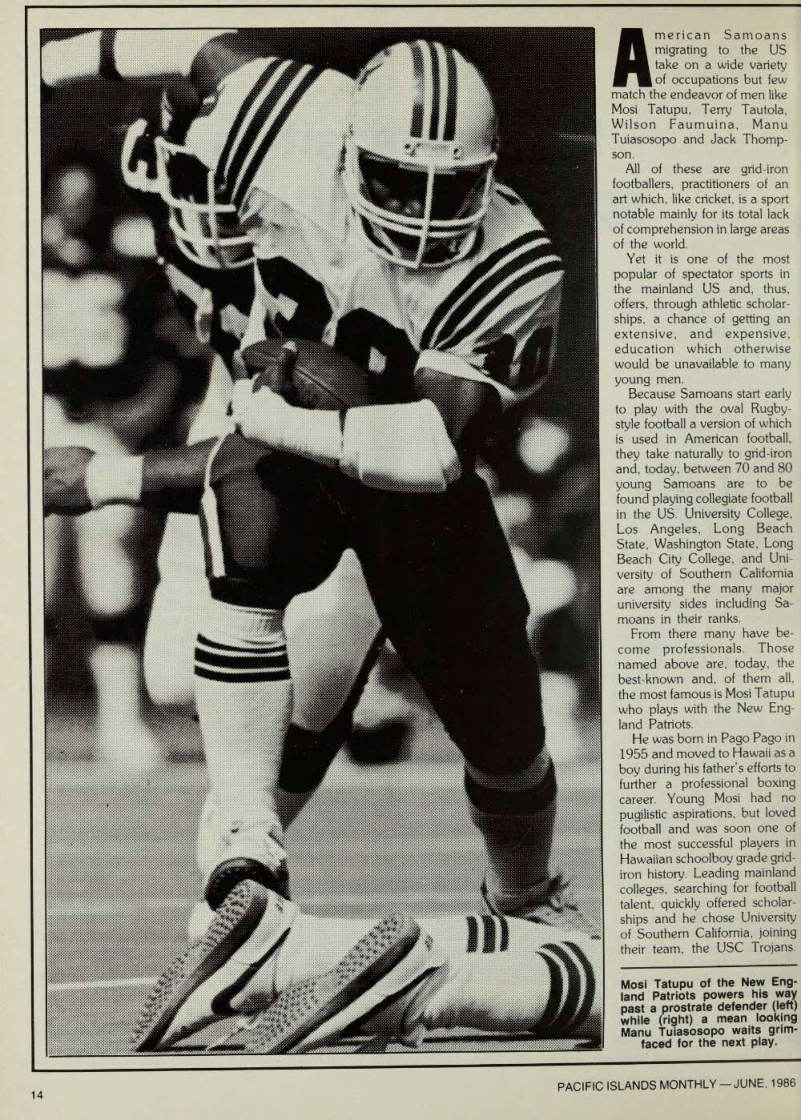
Mosi Tatupu of the New Eng land Patriots powers his way past a prostrate defender (left) while (right) a mean looking
Manu Tuiasosopo waits grim
faced for the next play.
A whole new ball game
He is still remembered in col legiate circles for the proficiency of his tackling.
In 1978 the New England Patriots, one of the US National Football League’s most popular clubs, drafted him into its paid ranks. Since then he has played in over 110 successive games, a record equalled by only three other Patriot players.
He is a “running back” whose forte is to carry the ball the last vital few yards to touchdown when the defence is at its most ferocious.
Tatupu stands exactly 6ft tall and weighs 16 stone, which makes him a comparative light weight in the National League where monstrous men rejoicing in names like “The Refrigera tor” and “Man Mountain” are commonly seen. But he has a low centre of gravity and ex tremely powerful legs, which gives him the ability to bulldoze his way through the smallest gap in the last desperate seconds of a score.
Off the field Tatupu is equally popular, spending many hours working for various charities,
notably animal welfare, the mentally handicapped and the Cancer Society. He is also to be found often visiting high schools in deprived areas, giv ing speeches on the importance of self-esteem and the value of a good eduction.
In between times Tatupu has started a business called, perhaps oddly, “The Snowin’
Samoan’s Hawaiian Style Shaved Ice Store.”
How he got the nickname, “The Snowin’ Samoan” is a bit of a mystery, but probably is related to the fact that some of his most brilliant performances were seen on snow-covered fields quite unlike the atmos phere of his homeland.
Mosi is married, with a daughter, Linnea Mosiula, and a son, Mosiula Mealofa. He will be 31 soon and therefore has a limited life left in professional football. Friends believe that on retirement he may turn to poli tics, perhaps back in Hawaii where his American career be gan and where he has many kinsmen very proud of his success. Paul Moon.
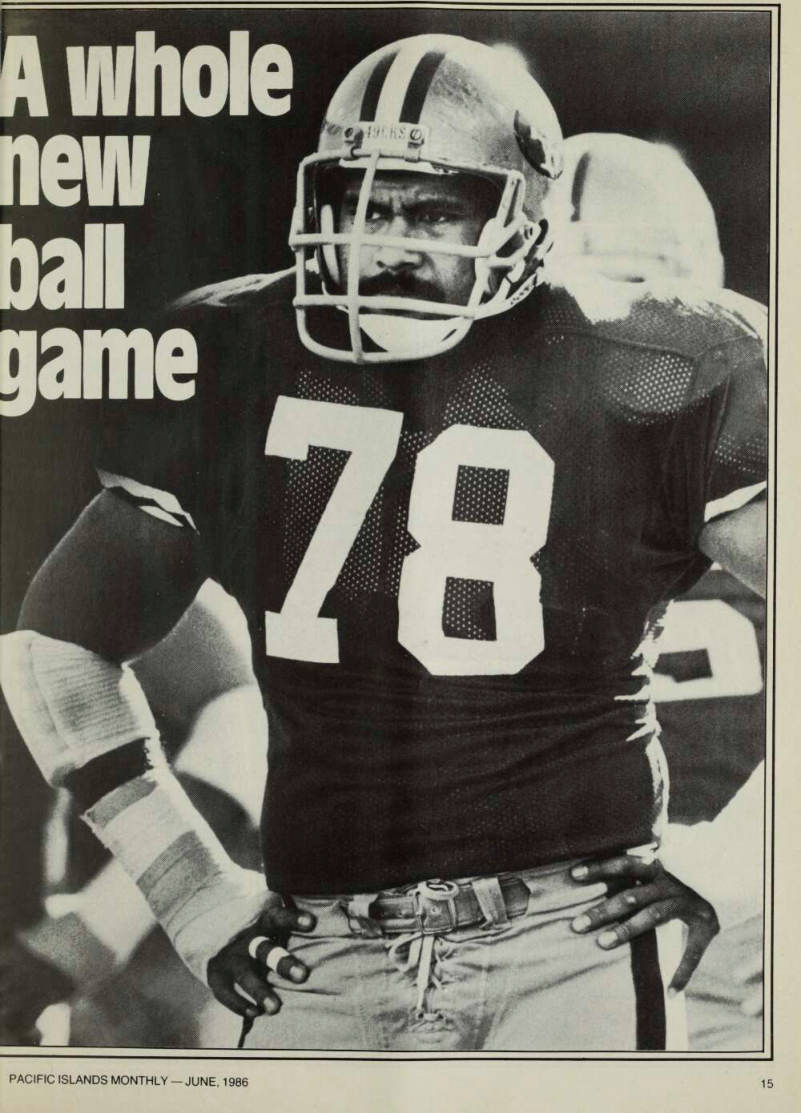
Manu Tuiasosopo of the San Francisco 49ers takes a tackle in his stride.
Advertisements & other items, pp. 16-19 (1 item)
The Total Test Equipment Solution
AWA
AW w iSS fi ©d . We ns th marcom 6 instruments^ Tfektronix ent to sui eve our ea ui d s. 4r ses compr om
chpi
ust ces. r 0* t P I#*
ited
ndLim
ala
AM (A O ew/.e n ati tal ons mm uni Ba Road. Walu es SE XP AN
FLUK
ble 34 va
HITACHI
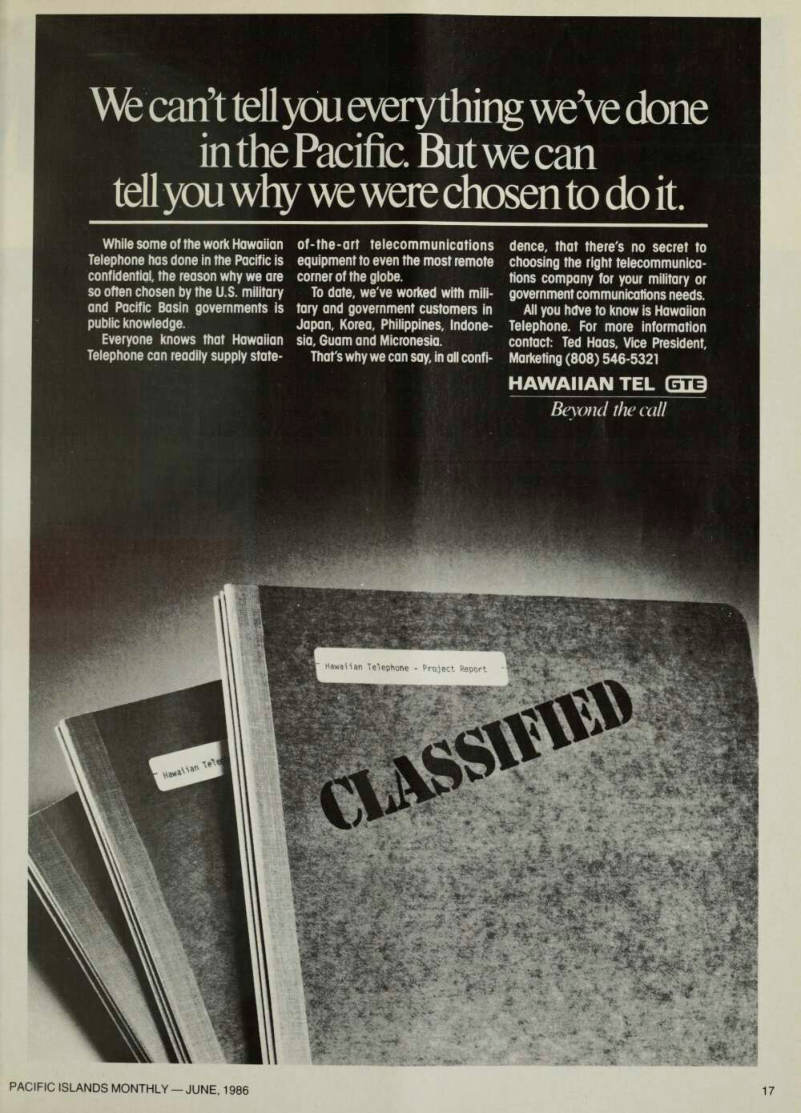
We can’t tell you everything we’ve done
in the Pacific. But we can
tell you why we were chosen to do it.
While some of the work Hawaiian Telephone has done in the Pacific is confidential, the reason why we are so often chosen by the U.S. military and Pacific Basin governments is public knowledge.
Everyone knows that Hawaiian Telephone can readily supply stateof-the-art telecommunications equipment to even the most remote corner of the globe.
To date, we've worked with military and government customers in Japan, Korea, Philippines, Indonesia, Guam and Micronesia.
That's why we can say, in all confidence, that there's no secret to choosing the right telecommunications company for your military or government communications needs.
All you hdve to know is Hawaiian Telephone. For more information contact: Ted Haas, Vice President, Marketing (808) 546-5321
HAWAIIAN TEL SO
Beyond the call
*;js : f'5 1
— i.' m f I I m *: V s -..« -■■ ■■■ ««s L i y.-’v . ®s -■■■ ■ ■.-•"•••■■■ ”.: M ! m i ■ j v : '
■SllSliilisill
wmm
Innovation
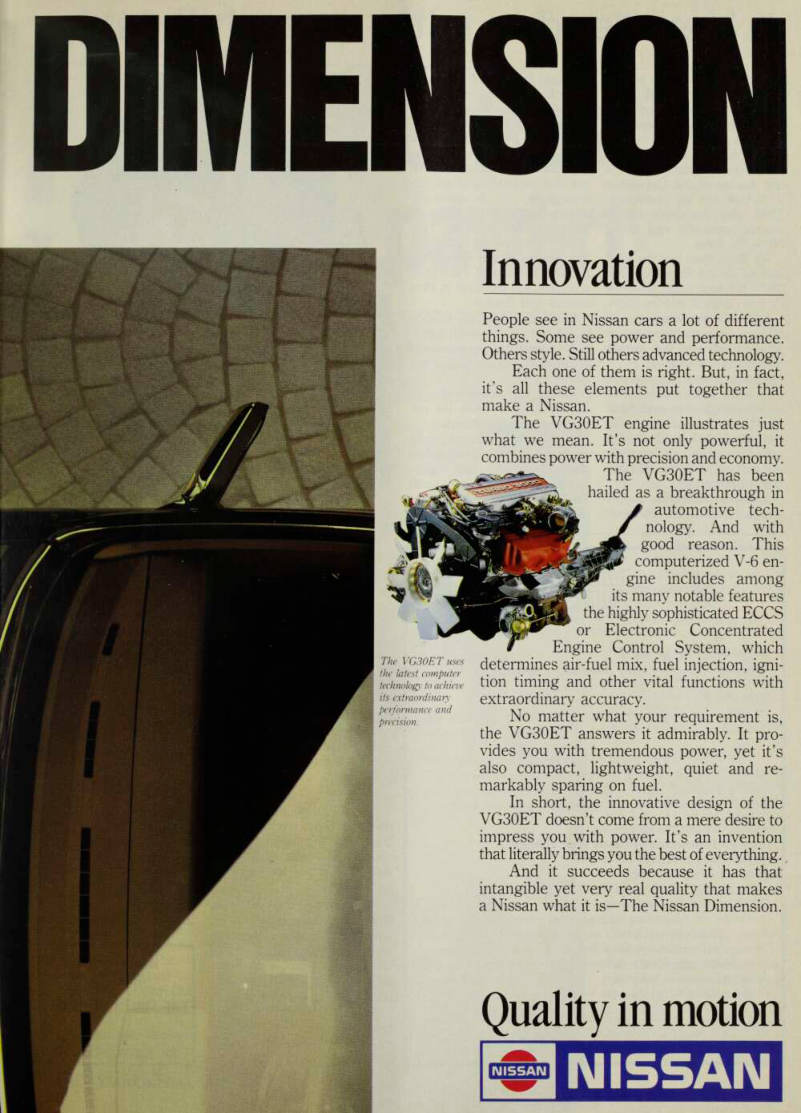
The VG3OET uses the latest computer technology to achieve its extraordinary performance and precision.
People see in Nissan cars a lot of different things. Some see power and performance.
Others style. Still others advanced technology.
Each one of them is right. But, in fact, it’s all these elements put together that make a Nissan.
The VG3OET engine illustrates just what we mean. It’s not only powerful, it combines power with precision and economy.
The VG3OET has been hailed as a breakthrough in automotive technology. And with good reason. This computerized V-6 engine includes among its many notable features the highly sophisticated ECCS or Electronic Concentrated Engine Control System, which determines air-fuel mix, fuel injection, ignition timing and other vital functions with extraordinary accuracy.
No matter what your requirement is, the VG3OET answers it admirably. It provides you with tremendous power, yet it’s also compact, lightweight, quiet and remarkably sparing on fuel.
In short, the innovative design of the VG3OET doesn’t come from a mere desire to impress you. with power. It’s an invention that literally brings you the best of everything.
And it succeeds because it has that intangible yet very real quality that makes a Nissan what it is—The Nissan Dimension. 4 *
Quality in motion
ii NISSAN
New leader with an uphill task
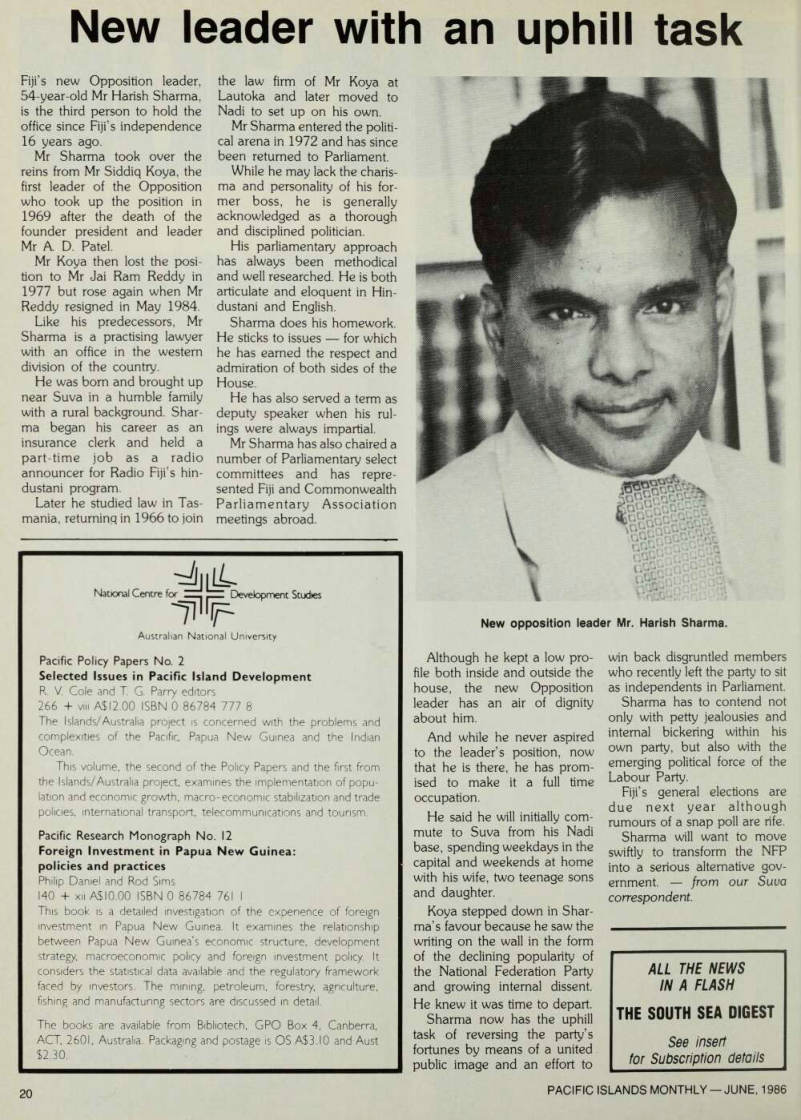
Fiji’s new Opposition leader, 54-year-old Mr Harish Sharma, is the third person to hold the office since Fiji’s independence 16 years ago.
Mr Sharma took over the reins from Mr Siddiq Koya, the first leader of the Opposition who took up the position in 1969 after the death of the founder president and leader Mr A. D. Patel.
Mr Koya then lost the posi tion to Mr Jai Ram Reddy in 1977 but rose again when Mr Reddy resigned in May 1984.
Like his predecessors, Mr Sharma is a practising lawyer with an office in the western division of the country.
He was bom and brought up near Suva in a humble family with a rural background. Shar ma began his career as an insurance clerk and held a part-time job as a radio announcer for Radio Fiji’s hin dustani program.
Later he studied law in Tas mania, returning in 1966 to join
the law firm of Mr Koya at Lautoka and later moved to Nadi to set up on his own.
Mr Sharma entered the politi cal arena in 1972 and has since been returned to Parliament.
While he may lack the charis ma and personality of his for mer boss, he is generally acknowledged as a thorough and disciplined politician.
His parliamentary approach has always been methodical and well researched. He is both articulate and eloquent in Hin dustani and English.
Sharma does his homework.
He sticks to issues for which he has earned the respect and admiration of both sides of the House.
He has also served a term as deputy speaker when his rul ings were always impartial.
Mr Sharma has also chaired a number of Parliamentary select committees and has repre sented Fiji and Commonwealth Parliamentary Association meetings abroad.
Although he kept a low pro file both inside and outside the house, the new Opposition leader has an air of dignity about him.
And while he never aspired to the leader’s position, now that he is there, he has prom ised to make it a full time occupation.
He said he will initially com mute to Suva from his Nadi base, spending weekdays in the capital and weekends at home with his wife, two teenage sons and daughter.
Koya stepped down in Shar ma’s favour because he saw the writing on the wall in the form of the declining popularity of the National Federation Party and growing internal dissent.
He knew it was time to depart.
Sharma now has the uphill task of reversing the party’s fortunes by means of a united public image and an effort to
win back disgruntled members who recently left the party to sit as independents in Parliament.
Sharma has to contend not only with petty jealousies and internal bickering within his own party, but also with the emerging political force of the Labour Party.
Fiji’s general elections are due next year although rumours of a snap poll are rife.
Sharma will want to move swiftly to transform the NFP into a serious alternative gov ernment. from our Suva correspondent.
New opposition leader Mr. Harish Sharma.
Advertisements & other items, p. 20 (1 item)
National Centre for __ __ Development Studies
National Centre for Development Studies ■fp Australian National University Pacific Policy Papers No. 2 Selected Issues in Pacific Island Development R. V. Cole and T. G. Parry editors 266 + viii A 512.00 ISBN 0 86784 777 8 The Islands/Australia project is concerned with the problems and complexities of the Pacific Papua New Guinea and the Indian Ocean.
This volume, the second of the Policy Papers and the first from the Islands/Australia project, examines the implementation of population and economic growth, macro-economic stabilization and trade policies, international transport, telecommunications and tourism.
Pacific Research Monograph No. 12 Foreign Investment in Papua New Guinea: policies and practices Philip Daniel and Rod Sims 140 4- xn A$ 10.00 ISBN 0 86784 761 I This book is a detailed investigation of the experience of foreign investment in Papua New Guinea. It examines the relationship between Papua New Guinea’s economic structure, development strategy, macroeconomic policy and foreign investment policy. It considers the statistical data available and the regulatory framework faced by investors. The mining, petroleum, forestry, agriculture, fishing and manufacturing sectors are discussed in detail.
The books are available from Bibliotech, GPO Box 4, Canberra, ACT, 2601, Australia. Packaging and postage is OS A 53.10 and Aust $2.30.
ALL THE NEWS
IN A FLASH
THE SOUTH SEA DIGEST
See insert lor Subscription details
strike paydirt
trade winds
Prospectors strike paydirt
THE islands of the West ern Pacific are experien cing a gold rush on a scale unprecedented in this century: Fiji, New Zealand, Vanuatu, the Solomon Islands, Papua New Guinea, and even tiny Palau, are being beset by modem prospectors and, most excitingly, all are yielding new discoveries of gold.
The rush developed in Papua New Guinea, fired by the spectacular discoveries at Porgera and Lihir, and has spread in the last year to the other island nations.
These modern prospectors are not the lone adventurers of previous times, but organised exploration groups using ex perienced geologists with sophisticated technologies and are backed by substantial finan cial resources.
This activity has arisen from a world wide resurgence of in terest in gold exploration, but is largely Australian based and financed from Australian sources.
It is an extension of the current gold boom in Australia which has seen the deve lopment of a host of small mines and several large ones, including the highly profitable and much publicised Kidston mine in Queensland.
The rush has attracted both established companies and groups looking to raise capital through the Australian stock markets; for these the Pacific Islands have become a fashion able “address”. This boom has
As the Pacific gold rush gathers momentum, consultant W.A. McGEE surveys the scene with particular focus on the prospectors, their dis coveries and their dreams.
the potential to bring great benefits to the people of the islands, but there are risks, and it requires careful management by the governments involved.
The prospectors are hoping to find another gold deposit like that discovered on the small island of Lihir in Papua New Guinea, by Kennecott Ex plorations (Australia) Ltd., the local arm of the giant American copper company, though a somewhat lesser discovery would be acceptable.
In early December, informa tion on the size of this deposit was at last released, effectively quelling the speculation that had been rampant.
The reserves announced are 137 million tonnes with an average grade of 2.7 grams per tonne of gold, implying that the deposit contains some 360 ton nes of gold metal. On present prices this amount of gold has a value of about SUS4,OOO mil lion.
The figures describe the de posit as it is in the ground, and do not report the quantities that can actually be extracted, although at least 90 per cent of this gold is likely to be econo mically recoverable. Kennecott and their junior Australian part ner in this project, Niugini Mining Ltd., have reason to feel satisfied with their explora tion team.
Interestingly though, after the announcement, the price of shares in Niugini Mining fell on Australian markets as investors shaved off the over-expecta tions of the deposit.
They apparently preferred not to speculate on extensions to it, even though the
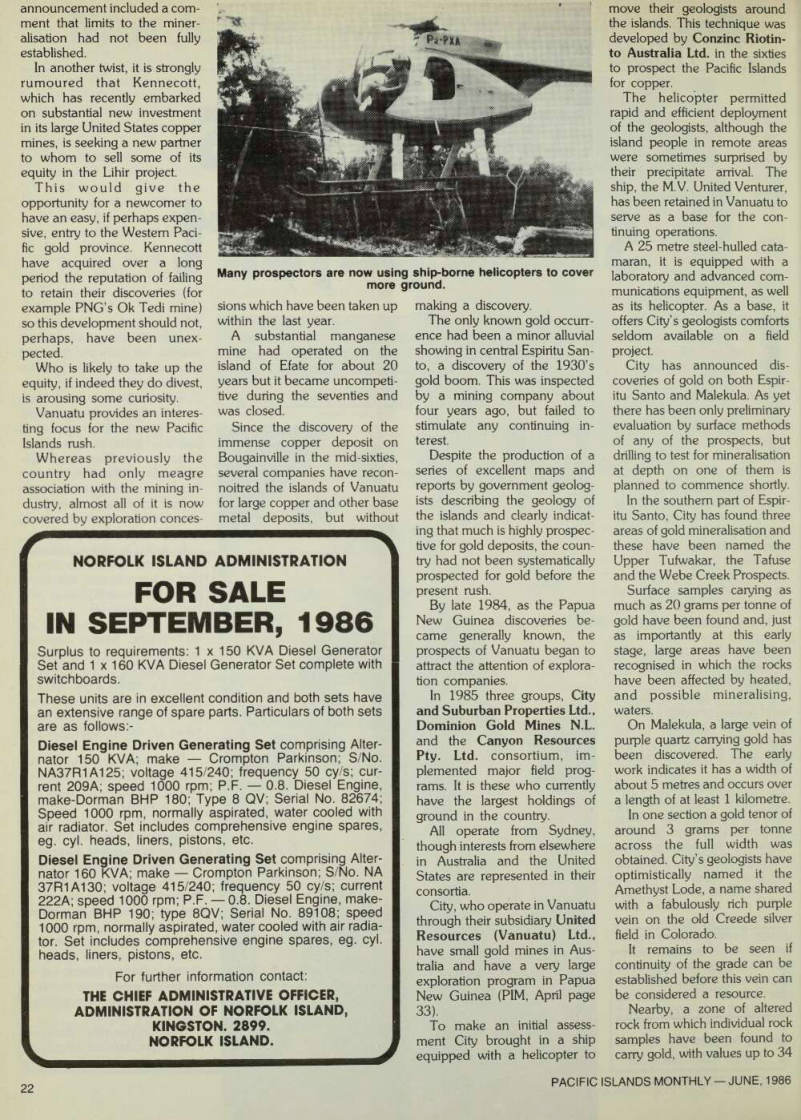
Panning for gold in a Vanuatu stream.
announcement included a com ment that limits to the miner alisation had not been fully established.
In another twist, it is strongly rumoured that Kennecott, which has recently embarked on substantial new investment in its large United States copper mines, is seeking a new partner to whom to sell some of its equity in the Lihir project.
This would give the opportunity for a newcomer to have an easy, if perhaps expen sive, entry to the Western Paci fic gold province. Kennecott have acquired over a long period the reputation of failing to retain their discoveries (for example PNG’s Ok Tedi mine) so this development should not, perhaps, have been unex pected.
Who is likely to take up the equity, if indeed they do divest, is arousing some curiosity.
Vanuatu provides an interes ting focus for the new Pacific Islands rush.
Whereas previously the country had only meagre association with the mining in dustry, almost all of it is now covered by exploration conces-
sions which have been taken up within the last year.
A substantial manganese mine had operated on the island of Efate for about 20 years but it became uncompeti tive during the seventies and was closed.
Since the discovery of the immense copper deposit on Bougainville in the mid-sixties, several companies have recon noitred the islands of Vanuatu for large copper and other base metal deposits, but without
making a discovery.
The only known gold occurr ence had been a minor alluvial showing in central Espiritu San to, a discovery of the 1930’s gold boom. This was inspected by a mining company about four years ago, but failed to stimulate any continuing in terest.
Despite the production of a series of excellent maps and reports by government geolog ists describing the geology of the islands and clearly indicat ing that much is highly prospec tive for gold deposits, the coun try had not been systematically prospected for gold before the present rush.
By late 1984, as the Papua New Guinea discoveries be came generally known, the prospects of Vanuatu began to attract the attention of explora tion companies.
In 1985 three groups, City and Suburban Properties Ltd., Dominion Gold Mines N.L. and the Canyon Resources Pty. Ltd. consortium, im plemented major field prog rams. It is these who currently have the largest holdings of ground in the country.
All operate from Sydney, though interests from elsewhere in Australia and the United States are represented in their consortia.
City, who operate in Vanuatu through their subsidiary United Resources (Vanuatu) Ltd., have small gold mines in Aus tralia and have a very large exploration program in Papua New Guinea (PIM, April page 33).
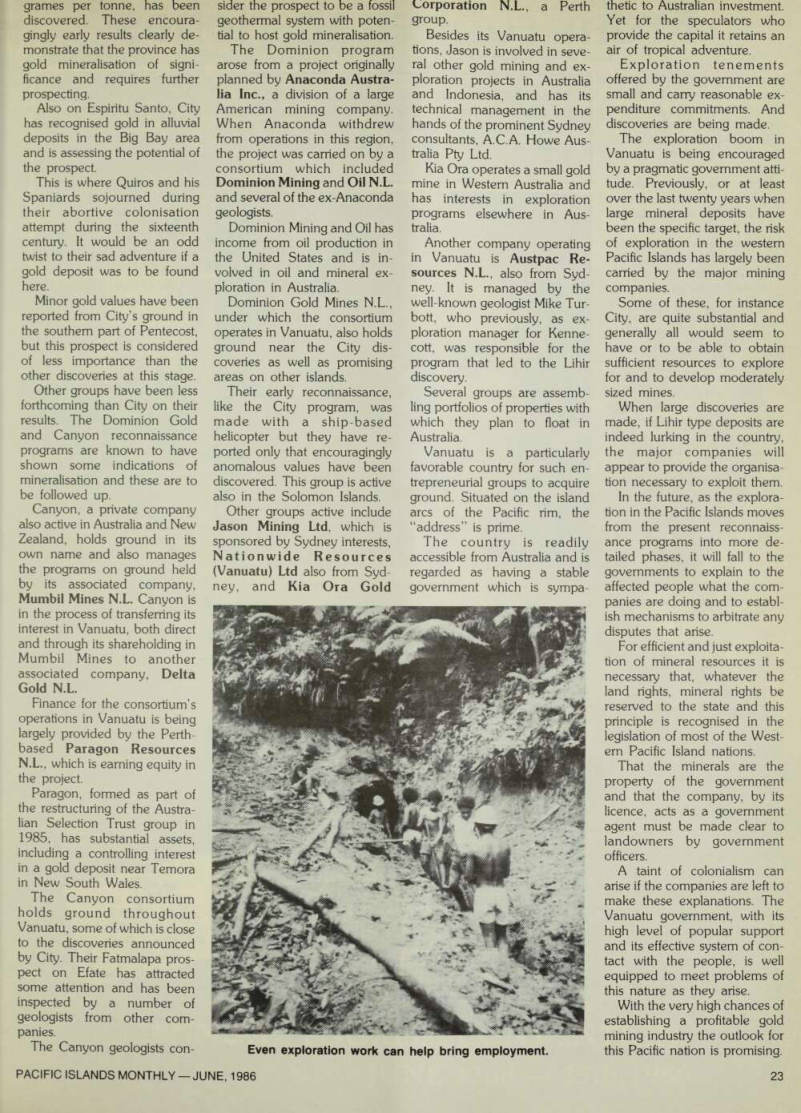
To make an initial assess ment City brought in a ship equipped with a helicopter to
move their geologists around the islands. This technique was developed by Conzinc Riotin to Australia Ltd. in the sixties to prospect the Pacific Islands for copper.
The helicopter permitted rapid and efficient deployment of the geologists, although the island people in remote areas were sometimes surprised by their precipitate arrival. The ship, the M.V. United Venturer, has been retained in Vanuatu to serve as a base for the con tinuing operations.
A 25 metre steel-hulled cata maran, it is equipped with a laboratory and advanced com munications equipment, as well as its helicopter. As a base, it offers City’s geologists comforts seldom available on a field project.
City has announced dis coveries of gold on both Espir itu Santo and Malekula. As yet there has been only preliminary evaluation by surface methods of any of the prospects, but drilling to test for mineralisation at depth on one of them is planned to commence shortly.
In the southern part of Espir itu Santo, City has found three areas of gold mineralisation and these have been named the Upper Tufwakar, the Tafuse and the Webe Creek Prospects.
Surface samples carying as much as 20 grams per tonne of gold have been found and, just as importantly at this early stage, large areas have been recognised in which the rocks have been affected by heated, and possible mineralising, waters.
On Malekula, a large vein of purple quartz carrying gold has been discovered. The early work indicates it has a width of about 5 metres and occurs over a length of at least 1 kilometre.
In one section a gold tenor of around 3 grams per tonne across the full width was obtained. City’s geologists have optimistically named it the Amethyst Lode, a name shared with a fabulously rich purple vein on the old Creede silver field in Colorado.
It remains to be seen if continuity of the grade can be established before this vein can be considered a resource.
Nearby, a zone of altered rock from which individual rock samples have been found to carry gold, with values up to 34
Many prospectors are now using ship-borne helicopters to cover more ground.
grames per tonne, has been discovered. These encoura gingly early results clearly de monstrate that the province has gold mineralisation of signi ficance and requires further prospecting.
Also on Espiritu Santo, City has recognised gold in alluvial deposits in the Big Bay area and is assessing the potential of the prospect.
This is where Quiros and his Spaniards sojourned during their abortive colonisation attempt during the sixteenth century. It would be an odd twist to their sad adventure if a gold deposit was to be found here.
Minor gold values have been reported from City’s ground in the southern part of Pentecost, but this prospect is considered of less importance than the other discoveries at this stage.
Other groups have been less forthcoming than City on their results. The Dominion Gold and Canyon reconnaissance programs are known to have shown some indications of mineralisation and these are to be followed up.
Canyon, a private company also active in Australia and New Zealand, holds ground in its own name and also manages the programs on ground held by its associated company, Mumbil Mines N.L. Canyon is in the process of transferring its interest in Vanuatu, both direct and through its shareholding in Mumbil Mines to another associated company, Delta Gold N.L.
Finance for the consortium’s operations in Vanuatu is being largely provided by the Perth based Paragon Resources N.L., which is earning equity in the project.
Paragon, formed as part of the restructuring of the Austra lian Selection Trust group in 1985, has substantial assets, including a controlling interest in a gold deposit near Temora in New South Wales.
The Canyon consortium holds ground throughout Vanuatu, some of which is close to the discoveries announced by City. Their Fatmalapa pros pect on Efate has attracted some attention and has been inspected by a number of geologists from other com panies.
The Canyon geologists con
sider the prospect to be a fossil geothermal system with poten tial to host gold mineralisation.
The Dominion program arose from a project originally planned by Anaconda Austra lia Inc,, a division of a large American mining company.
When Anaconda withdrew from operations in this region, the project was carried on by a consortium which included Dominion Mining and Oil N.L. and several of the ex-Anaconda geologists.
Dominion Mining and Oil has income from oil production in the United States and is in volved in oil and mineral ex ploration in Australia.
Dominion Gold Mines N.L., under which the consortium operates in Vanuatu, also holds ground near the City dis coveries as well as promising areas on other islands.
Their early reconnaissance, like the City program, was made with a ship-based helicopter but they have re ported only that encouragingly anomalous values have been discovered. This group is active also in the Solomon Islands.
Other groups active include Jason Mining Ltd, which is sponsored by Sydney interests, Nationwide Resources (Vanuatu) Ltd also from Syd ney, and Kia Ora Gold
Corporation N.L., a Perth group.
Besides its Vanuatu opera tions, Jason is involved in seve ral other gold mining and ex ploration projects in Australia and Indonesia, and has its technical management in the hands of the prominent Sydney consultants, A.C.A. Howe Aus tralia Pty Ltd.
Kia Ora operates a small gold mine in Western Australia and has interests in exploration programs elsewhere in Aus tralia.
Another company operating in Vanuatu is Austpac Re sources N.L.. also from Syd ney. It is managed by the well-known geologist Mike Tur bott, who previously, as ex ploration manager for Kenne cott, was responsible for the program that led to the Lihir discovery.
Several groups are assemb ling portfolios of properties with which they plan to float in Australia.
Vanuatu is a particularly favorable country for such en trepreneurial groups to acquire ground. Situated on the island arcs of the Pacific rim, the “address” is prime.
The country is readily accessible from Australia and is regarded as having a stable government which is sympa-
thetic to Australian investment.
Yet for the speculators who provide the capital it retains an air of tropical adventure.
Exploration tenements offered by the government are small and carry reasonable ex penditure commitments. And discoveries are being made.
The exploration boom in Vanuatu is being encouraged by a pragmatic government atti tude. Previously, or at least over the last twenty years when large mineral deposits have been the specific target, the risk of exploration in the western Pacific Islands has largely been carried by the major mining companies.
Some of these, for instance City, are quite substantial and generally all would seem to have or to be able to obtain sufficient resources to explore for and to develop moderately sized mines.
When large discoveries are made, if Lihir type deposits are indeed lurking in the country, the major companies will appear to provide the organisa tion necessary to exploit them.
In the future, as the explora tion in the Pacific Islands moves from the present reconnaiss ance programs into more de tailed phases, it will fall to the governments to explain to the affected people what the com panies are doing and to establ ish mechanisms to arbitrate any disputes that arise.
For efficient and just exploita tion of mineral resources it is necessary that, whatever the land rights, mineral rights be reserved to the state and this principle is recognised in the legislation of most of the West ern Pacific Island nations.
That the minerals are the property of the government and that the company, by its licence, acts as a government agent must be made clear to landowners by government officers.
A taint of colonialism can arise if the companies are left to make these explanations. The Vanuatu government, with its high level of popular support and its effective system of con tact with the people, is well equipped to meet problems of this nature as they arise.
With the very high chances of establishing a profitable gold mining industry the outlook for this Pacific nation is promising.
Even exploration work can help bring employment.
Advertisements & other items, p. 22 (1 item)
For Sale
NORFOLK ISLAND ADMINISTRATION
IN SEPTEMBER, 1986
Surplus to requirements: 1 x 150 KVA Diesel Generator Set and 1 x 160 KVA Diesel Generator Set complete with switchboards.
These units are in excellent condition and both sets have an extensive range of spare parts. Particulars of both sets are as follows:- Diesel Engine Driven Generating Set comprising Alternator 150 KVA; make Crompton Parkinson; S/No.
NA37R1A125; voltage 415/240; frequency 50 cy/s; current 209 A; speed 1000 rpm; P.F. 0.8. Diesel Engine, make-Dorman BMP 180; Type 8 QV; Serial No. 82674; Speed 1000 rpm, normally aspirated, water cooled with air radiator. Set includes comprehensive engine spares, eg. cyl. heads, liners, pistons, etc.
Diesel Engine Driven Generating Set comprising Alternator 160 KVA; make Crompton Parkinson; S/No. NA 37R1A130; voltage 415/240; frequency 50 cy/s; current 222 A; speed 1000 rpm; P.F. — 0.8. Diesel Engine, make- Dorman BMP 190; type BQV; Serial No. 89108; speed 1000 rpm, normally aspirated, water cooled with air radiator. Set includes comprehensive engine spares, eg. cyl. heads, liners, pistons, etc.
For further information contact:
THE CHIEF ADMINISTRATIVE OFFICER,
ADMINISTRATION OF NORFOLK ISLAND,
KINGSTON. 2899.
NORFOLK ISLAND.
From rubber to riches
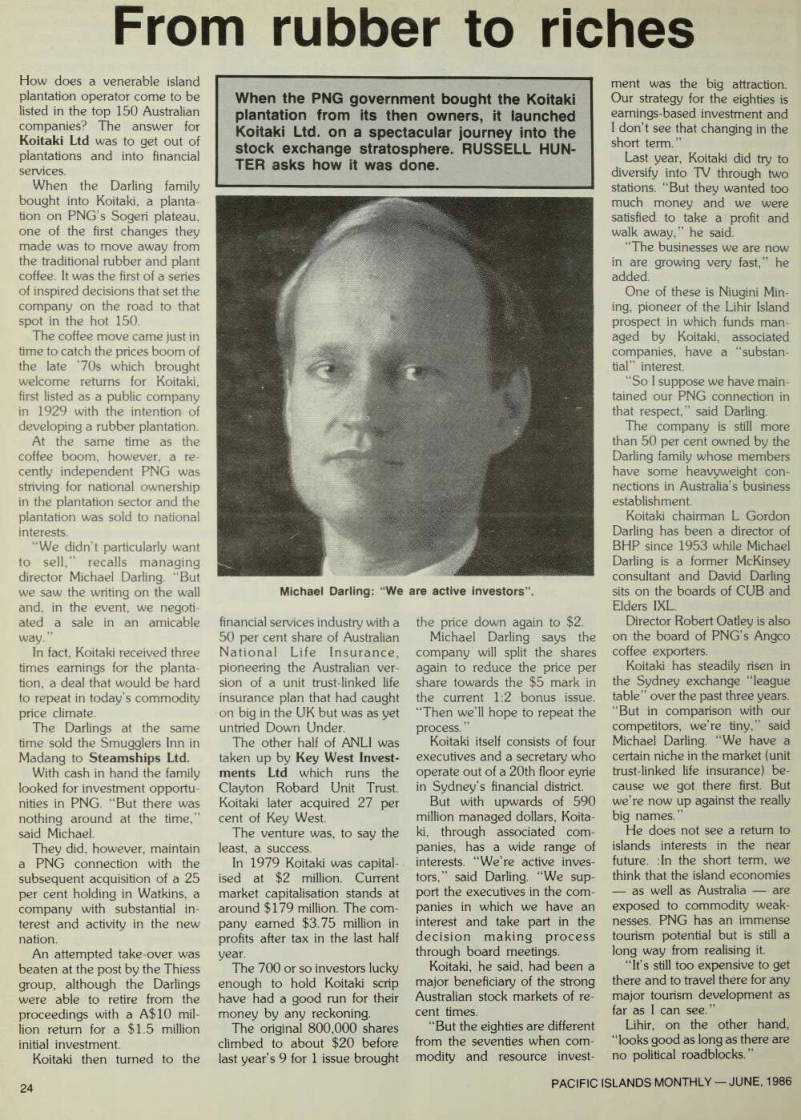
How does a venerable island plantation operator come to be listed in the top 150 Australian companies? The answer for Koitaki Ltd was to get out of plantations and into financial services.
When the Darling family bought into Koitaki, a planta tion on PNG’s Sogeri plateau, one of the first changes they made was to move away from the traditional rubber and plant coffee. It was the first of a series of inspired decisions that set the company on the road to that spot in the hot 150.
The coffee move came just in time to catch the prices boom of the late ’7os which brought welcome returns for Koitaki, first listed as a public company in 1929 with the intention of developing a rubber plantation.
At the same time as the coffee boom, however, a re cently independent PNG was striving for national ownership in the plantation sector and the plantation was sold to national interests.
“We didn’t particularly want to sell,” recalls managing director Michael Darling. “But we saw the writing on the wall and, in the event, we negoti ated a sale in an amicable way. ”
In fact, Koitaki received three times earnings for the planta tion, a deal that would be hard to repeat in today’s commodity price climate.
The Darlings at the same time sold the Smugglers Inn in Madang to Steamships Ltd.
With cash in hand the family looked for investment opportu nities in PNG. “But there was nothing around at the time,” said Michael.
They did, however, maintain a PNG connection with the subsequent acquisition of a 25 per cent holding in Watkins, a company with substantial in terest and activity in the new nation.
An attempted take-over was beaten at the post by the Thiess group, although the Darlings were able to retire from the proceedings with a Aslo mil lion return for a $1.5 million initial investment.
Koitaki then turned to the
When the PNG government bought the Koitaki plantation from its then owners, it launched Koitaki Ltd. on a spectacular journey into the stock exchange stratosphere. RUSSELL HUN TER asks how it was done.
financial services industry with a 50 per cent share of Australian National Life Insurance, pioneering the Australian ver sion of a unit trust-linked life insurance plan that had caught on big in the UK but was as yet untried Down Under.
The other half of ANLI was taken up by Key West Invest ments Ltd which runs the Clayton Robard Unit Trust.
Koitaki later acquired 27 per cent of Key West.
The venture was, to say the least, a success.
In 1979 Koitaki was capital ised at $2 million. Current market capitalisation stands at around $179 million. The com pany earned $3.75 million in profits after tax in the last half year.
The 700 or so investors lucky enough to hold Koitaki scrip have had a good run for their money by any reckoning.
The original 800,000 shares climbed to about $2O before last year’s 9 for 1 issue brought
the price down again to $2.
Michael Darling says the company will split the shares again to reduce the price per share towards the $5 mark in the current 1:2 bonus issue.
“Then we’ll hope to repeat the process. ”
Koitaki itself consists of four executives and a secretary who operate out of a 20th floor eyrie in Sydney’s financial district.
But with upwards of 590 million managed dollars, Koita ki, through associated com panies, has a wide range of interests. “We’re active inves tors,” said Darling. “We sup port the executives in the com panies in which we have an interest and take part in the decision making process through board meetings.
Koitaki, he said, had been a major beneficiary of the strong Australian stock markets of re cent times.
“But the eighties are different from the seventies when com modity and resource invest
ment was the big attraction.
Our strategy for the eighties is earnings-based investment and I don’t see that changing in the short term.”
Last year, Koitaki did try to diversify into TV through two stations. “But they wanted too much money and we were satisfied to take a profit and walk away,” he said.
“The businesses we are now in are growing very fast,” he added.
One of these is Niugini Min ing, pioneer of the Lihir Island prospect in which funds man aged by Koitaki, associated companies, have a “substan tial” interest.
“So I suppose we have main tained our PNG connection in that respect,” said Darling.
The company is still more than 50 per cent owned by the Darling family whose members have some heavyweight con nections in Australia’s business establishment.
Koitaki chairman L Gordon Darling has been a director of BHP since 1953 while Michael Darling is a former McKinsey consultant and David Darling sits on the boards of CUB and Elders IXL.
Director Robert Oatley is also on the board of PNG’s Angco coffee exporters.
Koitaki has steadily risen in the Sydney exchange “league table” over the past three years.
“But in comparison with our competitors, we’re tiny,” said Michael Darling. “We have a certain niche in the market (unit trust-linked life insurance) be cause we got there first. But we’re now up against the really big names.”
He does not see a return to islands interests in the near future. ;In the short term, we think that the island economies as well as Australia are exposed to commodity weak nesses. PNG has an immense tourism potential but is still a long way from realising it.
“It’s still too expensive to get there and to travel there for any major tourism development as far as I can see.”
Lihir, on the other hand, “looks good as long as there are no political roadblocks.”
Michael Darling: “We are active investors”.
Advertisements & other items, p. 25 (1 item)
I-L Jwf*-
pacific
ISLANDS
MOM 111 V
;V.^ : 2* >
I-l JWF*-
<ufs
25 th
ANNUAL TOURISM CONVENTION
Hyatt Regency Fiji june 22nd 25th, 1986.
The Silver Convention welcomes the world
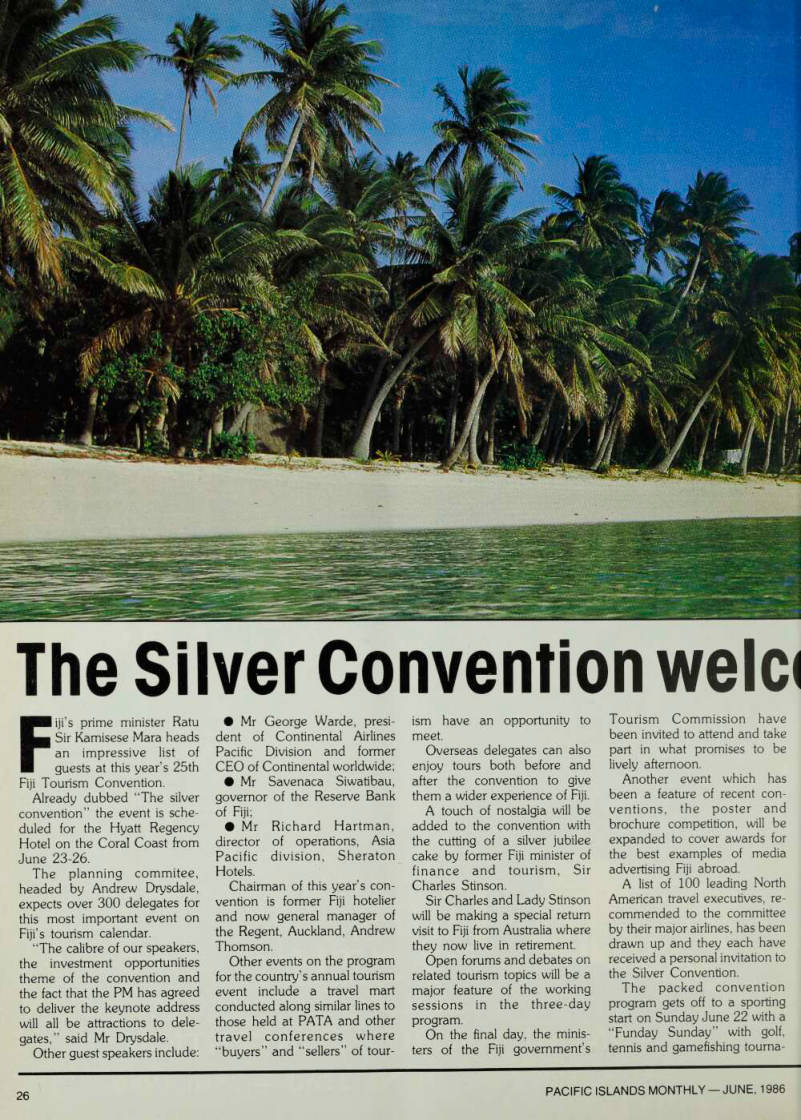
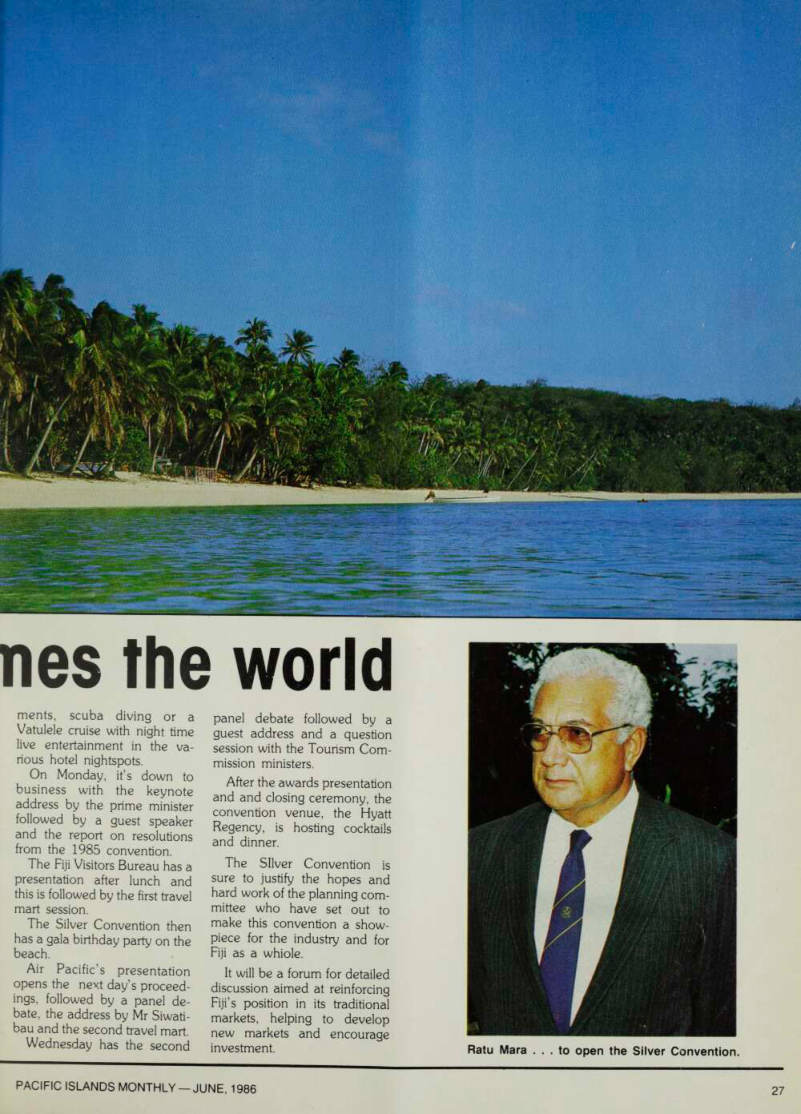
Fiji’s prime minister Ratu Sir Kamisese Mara heads an impressive list of guests at this year’s 25th Fiji Tourism Convention.
Already dubbed “The silver convention” the event is scheduled for the Hyatt Regency Hotel on the Coral Coast from June 23-26.
The planning commitee, headed by Andrew Drysdale, expects over 300 delegates for this most important event on Fiji’s tourism calendar.
“The calibre of our speakers, the investment opportunities theme of the convention and the fact that the PM has agreed to deliver the keynote address will all be attractions to delegates,” said Mr Drysdale.
Other guest speakers include:
• Mr George Warde, presi dent of Continental Airlines Pacific Division and former CEO of Continental worldwide; • Mr Savenaca Siwatibau, governor of the Reserve Bank of Fiji; • Mr Richard Hartman, director of operations, Asia Pacific division, Sheraton Hotels.
Chairman of this year’s con vention is former Fiji hotelier and now general manager of the Regent, Auckland, Andrew Thomson.
Other events on the program for the country’s annual tourism event include a travel mart conducted along similar lines to those held at PATA and other travel conferences where “buyers” and “sellers” of tour
ism have an opportunity to meet.
Overseas delegates can also enjoy tours both before and after the convention to give them a wider experience of Fiji.
A touch of nostalgia will be added to the convention with the cutting of a silver jubilee cake by former Fiji minister of finance and tourism, Sir Charles Stinson.
Sir Charles and Lady Stinson will be making a special return visit to Fiji from Australia where they now live in retirement.
Open forums and debates on related tourism topics will be a major feature of the working sessions in the three-day program.
On the final day, the minis ters of the Fiji government’s
Tourism Commission have been invited to attend and take part in what promises to be lively afternoon.
Another event which has been a feature of recent con ventions, the poster and brochure competition, will be expanded to cover awards for the best examples of media advertising Fiji abroad.
A list of 100 leading North American travel executives, re commended to the committee by their major airlines, has been drawn up and they each have received a personal invitation to the Silver Convention.
The packed convention program gets off to a sporting start on Sunday June 22 with a “Funday Sunday” with golf, tennis and gamefishing tourna
ments, scuba diving or a Vatulele cruise with night time live entertainment in the va rious hotel nightspots.
On Monday, it’s down to business with the keynote address by the prime minister followed by a guest speaker and the report on resolutions from the 1985 convention.
The Fiji Visitors Bureau has a presentation after lunch and this is followed by the first travel mart session.
The Silver Convention then has a gala birthday party on the beach.
Air Pacific’s presentation opens the next day’s proceed ings, followed by a panel de bate, the address by Mr Siwati bau and the second travel mart.
Wednesday has the second
panel debate followed by a guest address and a question session with the Tourism Com mission ministers.
After the awards presentation and and closing ceremony, the convention venue, the Hyatt Regency, is hosting cocktails and dinner.
The Silver Convention is sure to justify the hopes and hard work of the planning com mittee who have set out to make this convention a show piece for the industry and for Fiji as a whiole.
It will be a forum for detailed discussion aimed at reinforcing Fiji’s position in its traditional markets, helping to develop new markets and encourage investment.
Ratu Mara...to open the Silver Convention.
Advertisements & other items, p. 28 (1 item)
Hyatt Regency(£
BREATHTAKINGLY HYATT
On the Coral Coast at Korolevu; unspoiled, unchanged Crystal clear lagoons, white sand beaches, tropical blue waters of the South Pacific. The perfect Setting for relaxation is here at Hyatt Regency Fiji.
Everything about this resort hotel is warm and inviting. From its own private island to the colour-burst of the coral reefs. From 26 acres of tropical gardens to the blue skies and bronzing sun. * Enjoy exotic cocktails and innovative cuisine at 8 exciting restaurants and bars.
Indulge in a multitude of watersports; above the waves on windsurfers and canoes, or beneath the waves, snorkelling or scuba diving. Even on land, leisure takes you by the hand; horseback riding, tennis, golfing, or simply bathing in the sun.
Hyatt Regency Fiji, where the romance and relaxatic of the’South Pacific islands can still be found.
Don’t you
YOU WERE
here: m
4ryi\
igi -<0
% ' * ) jt i * ■ • . f: K. . '-vm a* ■ . -V .
'V'.
KTk ?* ;
HYATT REGENCY(£
For reservations, call the hotel 30555, telex 3237.
In Australia call (008) 222 188 lotto "*X , hi Sydney call (02) 3212622. Ormitact your'', rmvel nlanner or>vour nearest Hvatt.% i - ' * * *' i. * travel planner oryour nearest t* ? yr. ■ ft • &
Planners keep watch
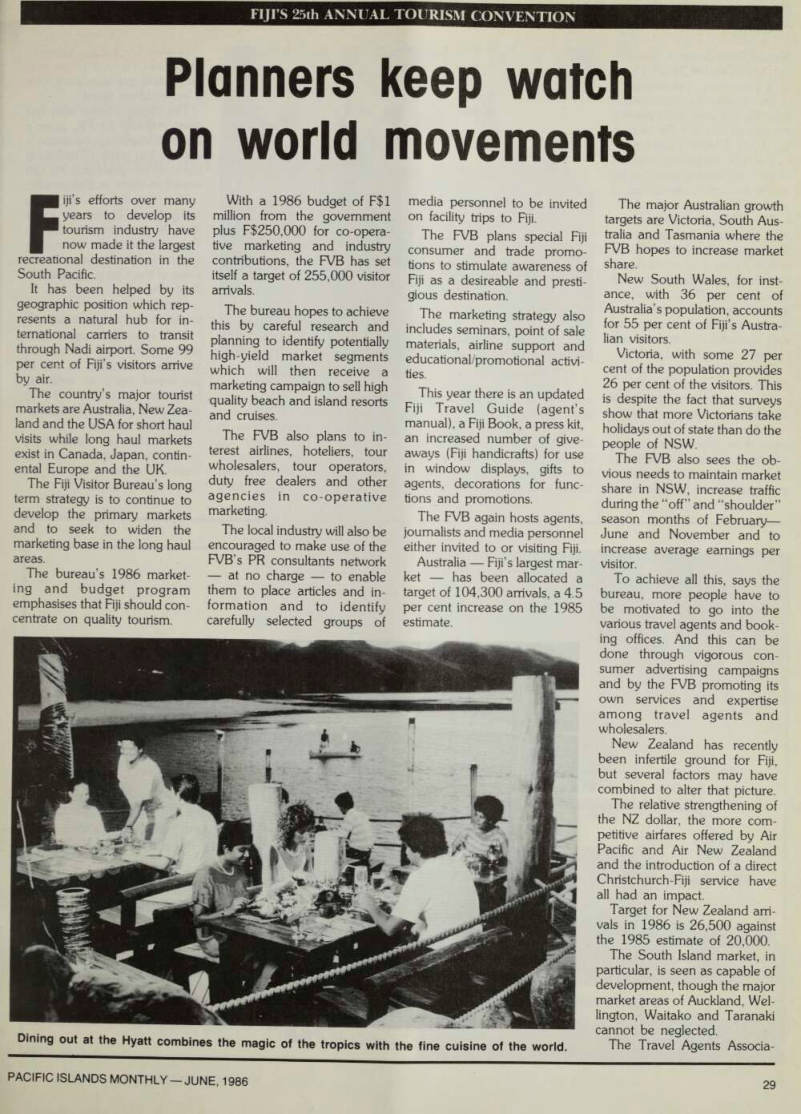
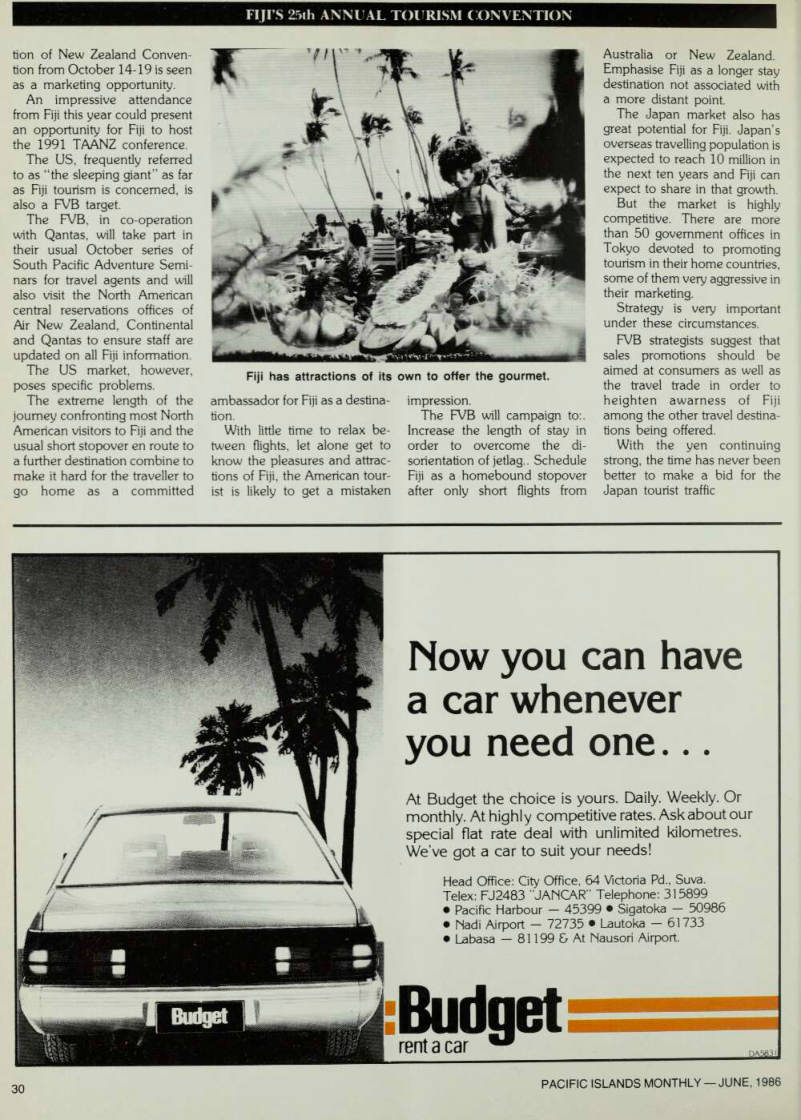
on world movements
Fiji’s efforts over many years to develop its tourism industry have now made it the largest recreational destination in the South Pacific.
It has been helped by its geographic position which rep resents a natural hub for in ternational carriers to transit through Nadi airport. Some 99 per cent of Fiji’s visitors arrive by air.
The country’s major tourist markets are Australia, New Zea land and the USA for short haul visits while long haul markets exist in Canada, Japan, contin ental Europe and the UK.
The Fiji Visitor Bureau’s long term strategy is to continue to develop the primary markets and to seek to widen the marketing base in the long haul areas.
The bureau’s 1986 market ing and budget program emphasises that Fiji should con centrate on quality tourism.
With a 1986 budget of Fsl million from the government plus F 5250,000 for co-opera tive marketing and industry contributions, the FVB has set itself a target of 255,000 visitor arrivals.
The bureau hopes to achieve this by careful research and planning to identify potentially high-yield market segments which will then receive a marketing campaign to sell high quality beach and island resorts and cruises.
The FVB also plans to in terest airlines, hoteliers, tour wholesalers, tour operators, duty free dealers and other agencies in co-operative marketing.
The local industry will also be encouraged to make use of the FVB’s PR consultants network at no charge to enable them to place articles and in formation and to identify carefully selected groups of
media personnel to be invited on facility trips to Fiji.
The FVB plans special Fiji consumer and trade promo tions to stimulate awareness of Fiji as a desireable and presti gious destination.
The marketing strategy also includes seminars, point of sale materials, airline support and educational/promotional activi ties.
This year there is an updated Fiji Travel Guide (agent’s manual), a Fiji Book, a press kit, an increased number of give aways (Fiji handicrafts) for use in window displays, gifts to agents, decorations for func tions and promotions.
The FVB again hosts agents, journalists and media personnel either invited to or visiting Fiji.
Australia Fiji’s largest mar ket has been allocated a target of 104,300 arrivals, a 4.5 per cent increase on the 1985 estimate.
The major Australian growth targets are Victoria, South Aus tralia and Tasmania where the FVB hopes to increase market share.
New South Wales, for inst ance, with 36 per cent of Australia’s population, accounts for 55 per cent of Fiji’s Austra lian visitors.
Victoria, with some 27 per cent of the population provides 26 per cent of the visitors. This is despite the fact that surveys show that more Victorians take holidays out of state than do the people of NSW.
The FVB also sees the ob vious needs to maintain market share in NSW, increase traffic during the “off” and “shoulder” season months of February— June and November and to increase average earnings per visitor.
To achieve all this, says the bureau, more people have to be motivated to go into the various travel agents and book ing offices. And this can be done through vigorous con sumer advertising campaigns and by the FVB promoting its own services and expertise among travel agents and wholesalers.
New Zealand has recently been infertile ground for Fiji, but several factors may have combined to alter that picture.
The relative strengthening of the NZ dollar, the more com petitive airfares offered by Air Pacific and Air New Zealand and the introduction of a direct Christchurch-Fiji service have all had an impact.
Target for New Zealand arri vals in 1986 is 26,500 against the 1985 estimate of 20,000.
The South Island market, in particular, is seen as capable of development, though the major market areas of Auckland, Wel lington, Waitako and Taranaki cannot be neglected.
The Travel Agents Associa
Dining out at the Hyatt combines the magic of the tropics with the fine cuisine of the world.
tion of New Zealand Conven tion from October 14-19 is seen as a marketing opportunity.
An impressive attendance from Fiji this year could present an opportunity for Fiji to host the 1991 TAANZ conference.
The US, frequently referred to as “the sleeping giant’’ as far as Fiji tourism is concerned, is also a FVB target.
The FVB, in co-operation with Qantas, will take part in their usual October series of South Pacific Adventure Semi nars for travel agents and will also visit the North American central reservations offices of Air New Zealand, Continental and Qantas to ensure staff are updated on all Fiji information.
The US market, however, poses specific problems.
The extreme length of the journey confronting most North American visitors to Fiji and the usual short stopover en route to a further destination combine to make it hard for the traveller to go home as a committed
ambassador for Fiji as a destina tion.
With little time to relax be tween flights, let alone get to know the pleasures and attrac tions of Fiji, the American tour ist is likely to get a mistaken
impression.
The FVB will campaign to:.
Increase the length of stay in order to overcome the di sorientation of jetlag.. Schedule Fiji as a homebound stopover after only short flights from
Australia or New Zealand.
Emphasise Fiji as a longer stay destination not associated with a more distant point.
The Japan market also has great potential for Fiji. Japan’s overseas travelling population is expected to reach 10 million in the next ten years and Fiji can expect to share in that growth.
But the market is highly competitive. There are more than 50 government offices in Tokyo devoted to promoting tourism in their home countries, some of them very aggressive in their marketing.
Strategy is very important under these circumstances.
FVB strategists suggest that sales promotions should be aimed at consumers as well as the travel trade in order to heighten awarness of Fiji among the other travel destina tions being offered.
With the yen continuing strong, the time has never been better to make a bid for the Japan tourist traffic
Fiji has attractions of its own to offer the gourmet.
Advertisements & other items, pp. 29-31 (3 items)
29
PACIFIC ISLANDS MONTHLY —JUNE, 1986
FIJI’S 25th ANNUAL TOURISM CONVENTION
30
FIJI’S 25th ANNUAL TOURISM CONVENTION
PACIFIC ISLANDS MONTHLY —JUNE, 1986
Budget
Now you can have
a car whenever
you need one...
At Budget the choice is yours. Daily. Weekly. Or monthly. At highly competitive rates. Ask about our special flat rate deal with unlimited kilometres.
We’ve got a car to suit your needs!
Head Office: City Office, 64 Victoria Pd., Suva.
Telex: FJ2483 “JANCAR" Telephone: 315899 • Pacific Harbour 45399 • Sigatoka 50986 • Nadi Airport 72735 • Lautoka 61733 • Labasa 81199 & At Nausori Airport.
Budget
rent a car
On reflection, wouldn’t you
rather be in Fiji?
mm V In \ The Regent of Fiji.
Where all the trappings of civilisation are delicately disguised as a traditional Fijian village. This resort revitalises.
Inspires. And beckons.
the Regent of Fiji
A REGENT ©INTERNATIONAL HOTEL
AUCKLAND. BANGKOK. BEVERLY HILLS. CHICAGO. DUSSELDORF. FIJI. HONG KONG. KUALA LUMPUR. LONDON. MELBOURNE. NEW YORK. OKINAWA.
AUSTRALIA TOLL FREE 008-022-800; FIJI 70700, TELEX 5214.
SYDNEY.
Weight of the dollar debate
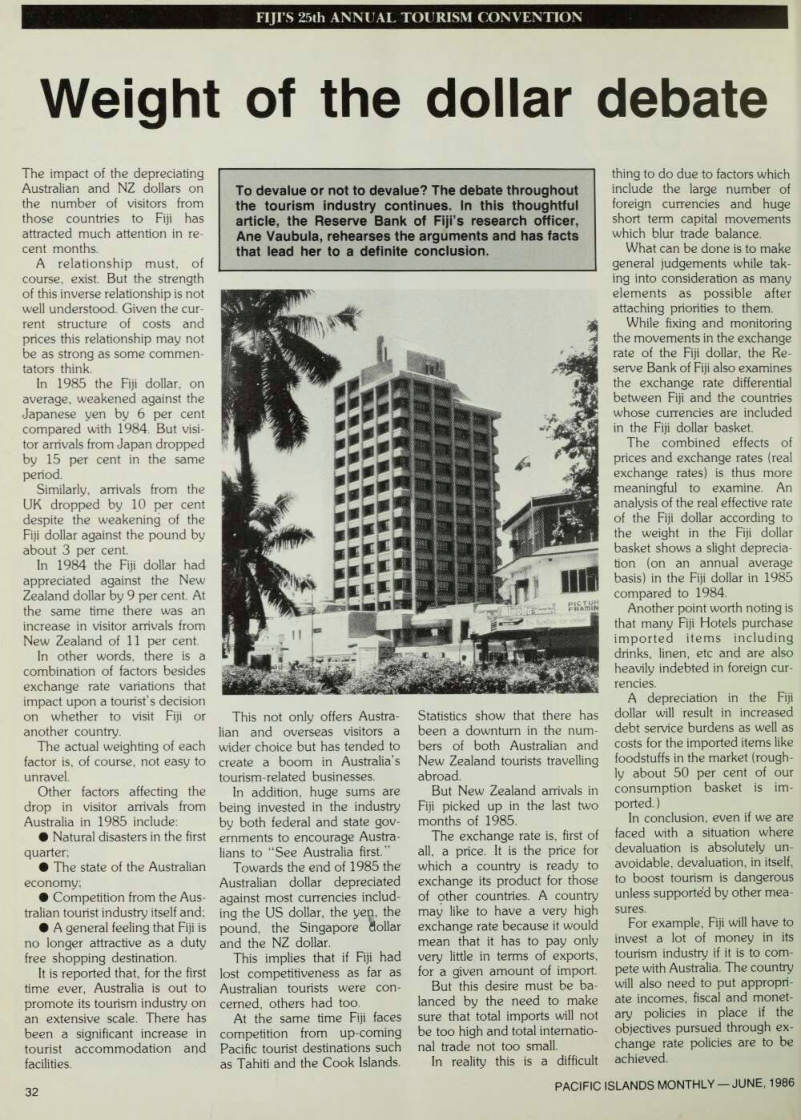
The impact of the depreciating Australian and NZ dollars on the number of visitors from those countries to Fiji has attracted much attention in re cent months.
A relationship must, of course, exist. But the strength of this inverse relationship is not well understood. Given the cur rent structure of costs and prices this relationship may not be as strong as some commen tators think.
In 1985 the Fiji dollar, on average, weakened against the Japanese yen by 6 per cent compared with 1984. But visi tor arrivals from Japan dropped by 15 per cent in the same period.
Similarly, arrivals from the UK dropped by 10 per cent despite the weakening of the Fiji dollar against the pound by about 3 per cent.
In 1984 the Fiji dollar had appreciated against the New Zealand dollar by 9 per cent. At the same time there was an increase in visitor arrivals from New Zealand of 11 per cent.
In other words, there is a combination of factors besides exchange rate variations that impact upon a tourist’s decision on whether to visit Fiji or another country.
The actual weighting of each factor is, of course, not easy to unravel.
Other factors affecting the drop in visitor arrivals from Australia in 1985 include; • Natural disasters in the first quarter; • The state of the Australian economy; • Competition from the Aus tralian tourist industry itself and; • A general feeling that Fiji is no longer attractive as a duty free shopping destination.
It is reported that, for the first time ever, Australia is out to promote its tourism industry on an extensive scale. There has been a significant increase in tourist accommodation and facilities.
To devalue or not to devalue? The debate throughout the tourism industry continues. In this thoughtful article, the Reserve Bank of Fiji’s research officer, Ane Vaubula, rehearses the arguments and has facts that lead her to a definite conclusion.
This not only offers Austra lian and overseas visitors a wider choice but has tended to create a boom in Australia’s tourism-related businesses.
In addition, huge sums are being invested in the industry by both federal and state gov ernments to encourage Austra lians to “See Australia first.”
Towards the end of 1985 the Australian dollar depreciated against most currencies includ ing the US dollar, the yen, the pound, the Singapore dollar and the NZ dollar.
This implies that if Fiji had lost competitiveness as far as Australian tourists were con cerned, others had too.
At the same time Fiji faces competition from up-coming Pacific tourist destinations such as Tahiti and the Cook Islands.
Statistics show that there has been a downturn in the num bers of both Australian and New Zealand tourists travelling abroad.
But New Zealand arrivals in Fiji picked up in the last two months of 1985.
The exchange rate is, first of all, a price. It is the price for which a country is ready to exchange its product for those of qther countries. A country may like to have a very high exchange rate because it would mean that it has to pay only very little in terms of exports, for a given amount of import.
But this desire must be ba lanced by the need to make sure that total imports will not be too high and total internatio nal trade not too small.
In reality this is a difficult
thing to do due to factors which include the large number of foreign currencies and huge short term capital movements which blur trade balance.
What can be done is to make general judgements while tak ing into consideration as many elements as possible after attaching priorities to them.
While fixing and monitoring the movements in the exchange rate of the Fiji dollar, the Re serve Bank of Fiji also examines the exchange rate differential between Fiji and the countries whose currencies are included in the Fiji dollar basket.
The combined effects of prices and exchange rates (real exchange rates) is thus more meaningful to examine. An analysis of the real effective rate of the Fiji dollar according to the weight in the Fiji dollar basket shows a slight deprecia tion (on an annual average basis) in the Fiji dollar in 1985 compared to 1984.
Another point worth noting is that many Fiji Hotels purchase imported items including drinks, linen, etc and are also heavily indebted in foreign cur rencies.
A depreciation in the Fiji dollar will result in increased debt service burdens as well as costs for the imported items like foodstuffs in the market (rough ly about 50 per cent of our consumption basket is im ported. ) In conclusion, even if we are faced with a situation where devaluation is absolutely un avoidable, devaluation, in itself, to boost tourism is dangerous unless supported by other mea sures.
For example, Fiji will have to invest a lot of money in its tourism industry if it is to com pete with Australia. The country will also need to put appropri ate incomes, fiscal and monet ary policies in place if the objectives pursued through ex change rate policies are to be achieved.
Advertisements & other items, pp. 32-34 (2 items)
32
FIJI’S 25th ANNUAL TOURISM CONVENTION
PACIFIC ISLANDS MONTHLY —JUNE, 1986
Happy Anniversary from The Fiji Mocambo.
Nadi’s most accommodating hotel.
-r- ■ -i.' r# f & k r & \ The Nadi area’s largest, most popular hotel is also celebrating 2 1 years of experience and excellence of service to Fiji holiday makers and business travellers.
Situated just four minutes from Nadi International Airport, the Fiji Mocambo is a superb combination of quiet luxurious rooms, top international cuisine and a wide array of sports and recreational facilities. With our newest addition, the Mocambo now boasts 124 beautifully appointed, air-conditioned rooms every bne with a commanding view from its private patio.
Golf tennis swimming cruises sightseeing duty free shopping and more! Day or night, our experienced, friendly restaurant and bar staff are on hand to offer food and beverage suggestions from our extensive selections. See and do it all from the Fiji Mocambo. *¥i§i P.O. Box 9195, Nadi International Airport, Fiji Telephone: 72000 Telex: FJ5147 Cable: MOCAMBI
A SHANGRI-LA INTERNATIONAL HOTEL
ADMARK 01
LV'f
■ ■ . air /
Special airline.
To special place
Air New Zealand. A very special airline.
America's Travel Holiday magazine voted us the "best foreign airline". Not just once, but the last five years in succession!
We're proud of the accolade. Proud to offer an unsurpassed service, to an astonishing variety of very special places.
London. Singapore. Tokyo. Los Angeles Vancouver ana Honolulu. Australia, the South Pacific Islands and our home, New Zealand.
Our /47'sfjy the world in style. First Gass.
Pacific Gass. Economy.
Big New 767's provide extra links between New Zealand, Australia and the Pacific Islands
CHRISTCHURCH
plus additional domestic capacity.
Within New Zealand our 737's and F27's fly to 23 cities, towns and resorts. Many, more beautiful than anywhere else in the world.
When only the best is good enough, we take special pride in serving you. Call us, or your travel Agent for more information.
air new
The Pacific’s Number One
2187 R
Incentive is
boost for tourism
The government of Fiji provides a package of incentives to assist the tourist industry.
For example, under the Hotels Aid Ordinance a hotel owner may set off 55 per cent of his capital expenditure (less the cost of the land) against annual chargeable income stemming from the hotel or extension.
This can continue until the amount is claimed in full.
This investment allowance is in addition to any ordinary depreciation allowance the hotel owner may enjoy.
As an alternative, owners may opt for a cash subsidy of up to seven per cent of the approved capital expenditure.
The net expenditure after the set off of the subsidy may be entirely written off within 15 years.
Cruise operators can also qualify for government incen tives.
If an operator cannot have a suitable boat built locally, he may qualify for import duty concessions on any carft he brings in from overseas.
And where an operator does decide to build his boat locally, he may be able to set off 55 per cent of the construction cost against income from that craft or others or against income from other tourism facilities car ried out by the vessel’s owner.
Similar concessions can be granted, at the discretion of the
Minister of Finance, for imports of specialised furniture, air con ditioning units, fridges, cookers and other tourism require ments.
Investment allowances simi lar to those granted under the Hotels Aid Act above may also be available for projects allied with or supportive of the tour ism industry.
This applies particularly where the project expenditure is incurred in setting up a facility whereby Fiji’s natural flora, fauna and other natural char acteristics, or the history and culture of Fiji, are used to promote tourism.
In this case the taxpayer can qualify for a cost write off to the extent of 55 per cent against profit.
And really big spenders are able to negotiate special arrangements with the Fijian government.
Again, as a tourism incentive, the government channels funds through the FDB to be used as ’’seed money” for investment as equity and loans in major hotel development projects.
The FDB uses this allocation to borrow additionally, within its approved gearing guideliens, in order to create a larger pool of funds for this specific pur pose.
Government guarantees are available, where necessary, to the FDB to raise additional resources.
In addition, FNPF funding available for loans to the hotel industry would be channelled through the FDB in order to increase the amount of funding available from the FNFF for hotel construction.
In addition all contributions to the Fiji Visitors Bureau, which includes funds for co operative marketing, qualify for deductions equivalent to 150 per cent of the contributions against chargeable income.
The government, in general, recognises the vital role of pri vate investment both local and foreign and, in fact, makes no distinction between local and overseas investors in the awar ding of investment incentives.
The government is especially keen to encourage foreign in vestment where the capital re
'The government is especially keen to encourage foreign investment*
quirement is high and local technological and managerial skills are not yet available; and joint ventures between local and foreign interests, parti cualarly where the overseas involvement may lead to the penetration or expansion of export markets.
Overseas investment requires approval by the Business and Industrial Development Com mittee of Fiji (BIDC), a proce dure that need take no longer than four weeks to complete.
Also, key managerial posi tions may be filled by expatriate personnel without time limit.
However, the investor is ex pected to to make arrange ments to train Icoal staff mem bers with the ultimate aim of replacing expatriate expertise.
Work permits are normally granted for an initial period of three years. However, investors bringing in F 5200,000 or more may be granted seven year permits.
This kind of approach has helped the industry to an aver age growth rate of 20 per cent between 1960 and 1973, which, in turn, led to a boom in hotel construction financed mostly by foreign capital.
The international oil crisis which struck the whole world in 1973 had an adverse effect on growth, but by 1979, the record of 1973 had been surpassed.
In 1984 tourism generated Fsl6o million in foreign ex change earnings.
Advertisements & other items, pp. 35-37 (2 items)
Fiji’S 251 H Annual Tourism Convention
We Have The Ideal Climate
a FOR INVESTORS AND HOLIDAY MAKERS
For further information contact: The Director EDB \ ECONOMIC DEVELOPMENT BOARD OF FIJI Isl Floor, Velop House, 371 Victoria Pde., P.O. Box 2303, Government Buildings, Suva, Fiji.
Telex: 2355 EDB FJ Telephone: 315988 (7 lines)
■ mi r * m ■ v» -'S* ' •■£?-' '. - HMHBeii 3m * - HILUX 4WD Regular Cab, Long, Wheelbase
TOYOTA THIN
CARS AND TRUCKS DRUM
PACIFIC SHOULD RE Nil
OR THE PACIFIC
QUALITY SERVICE
AMERICAN SAMOA: BURNS PHILP (SOUTH SEA) CO., LTD., P.O. Box 129, Pago Pago.
COOK ISLANDS: COOK ISLANDS TRADING
CORPORATION LTD., Private Bag, Rarotonga.
FIJI: AUTOMOTIVE SUPPLIES COMPANY, A Division of Burns Philp (South Sea) Co., Ltd.. G.P.O. Box 355, Suva.
GUAM & MICRONESIA: ATKINS KROLL, INC., 443 South Marine Drive, Tamuning.
KIRIBATI: TARAWA MOTORS, A Division of Bairiki Holdings Ltd., P.O. Box 36, Bairiki, Tarawa.
NAURU: NAURU COOPERATIVE SOCIETY, Central Pa
NEW CALEDONIA: SERVICE IMPORTATION
AUTOMOBILE DU PACIFIQUE, Rond-Point du Pacifiqi (Station Total) B.P. 438, Noumea.
NORFOLK ISLAND: BORRY’S LIMITED. P.O. Box 161 PAPUA NEW GUINEA: ELA MOTORS. A Division of Burns Philp (PNG) Ltd.. P.O. Box 75, Port Moresby. eAiDAki! mioroi CORPORATION. P.O. Box 267, Sail
* mm m m % ■ % m *■-.■•■- ■rst -
ill
* 33r“^. i *-ST All our cars and trucks have special Pacific Island features.
And, of course, like cars and trucks we build for the rest of the world, those for the Pacific
benefit from comprehensive testing and thorough
quality control.
It’s ail part of our effort to create high-quality, highly reliable cars and trucks.
Specifically for you. And specifically for the places you drive.
For instance, Toyota Hilux trucks are outfitted with extra-heavy-duty shocks and reinforced suspension.
And cars like Toyota Corolla receive special engine underplating, and a suspension modified to give added road clearance.
Meanwhile, we make additional use of special galvanealed steel in both our cars and trucks to help prevent corrosion.
Areas where galvanealed steel is used
COROLLA
Ji
HILUX
• Crown • Cressida • Corona • Corolla • Starlet • Dyna • Hiace • Liteace • Coaster • Stout • Hilux 4X2 / 4x 4 • Land Cruiser • Heavy Duty Truck
JLOMON ISLANDS: SOLOMON ISLANDS
VESTMENTS LTD., G.P.O. Box 174, Honiara.
'HUI: NIPPON AUTOMOTO. B.P. 342. Papeete
ONGA: BURNS PHILP (SOUTH SEA) CO.. LTD., P.O. ox 55, Nuku’alofa.
HUATU: VANUATU MOTORS, A Division of Burns oilp (Vanuatu) Ltd., P.O. Box 18, Port Vila.
ASTERN SAMOA: BURNS PHILP (SOUTH SEA) CO., D., P.O. Box 188, Apia.
XOYOTA
Top facilities at convention venue
Venue for the Silver Conven tion is the Hyatt Regency on Fiji’s famous Coral Coast.
The hotel with its distinctive Fijian architectural influence, was opened 1979 making it the newest of Fiji’s major resort hotels.
It is built on a 28 acre setting at a white sandy beach in the wide blue Pacific.
The low-rise hotel has two wings of three storeys the
Nadi wing and the Suva wing.
The restaurants feature both casual and luxurious dining rep resenting cuisine from around the world with a wide variety of entertainment from jazz and classics to island-style music available in the cocktail lounges.
The 249 guest rooms are furnished with a Fijian flavour.
All have balconies, 200 of which have ocean views and 50
with attractive mountain aspects.
All rooms come with stocked mini-bar and all are air condi tioned.
The Regency Club on the top floor of the Suva wing consists of 23 rooms and is a “hotel within a hotel.”
It combines the best of old fashioned service with all the advantages a modem deluxe hotel can provide for the dis
criminating traveller.
Regency Club costs an additional Fs2o (plus 5 per cent tax) per night.
For the extra money, club users get individual service.
Club rooms have compliment ary flowers, fruits, French for mula soap, shampoo, bath crystals, a bath robe and slip pers.
Free newspapers and contin ental breakfasts are available each morning, while com plimentary afternoon tea is served on the balcony, and free cocktails and hors d’oeuvres are served before dinner.
Before you retire, the liquers and mints are also free of charge.
Three Regency Club hostes ses are on hand to deal with restaurant reservations and free tennis and golf bookings.
The Hyatt Regency has a variety of restaurants and cock tail lounges from the world renowned Hugo’s where the superb cuisine complements the striking decor and design, to the smaller Walu restaurant named after a local fish.
The Walu is an open air casual restaurant in tropical set ting.
The Silver Convention venue also has the Cafe Korolevu with breathtaking views and facilities to dine inside or outdoors.
The Hibiscus Lounge with its resident band will take you through to the early hours, while the Explorer’s Lounge is dedicated to Abel Tasman, the first western explorer to visit Fiji in 1643.
Advertisements & other items, p. 38 (2 items)
38
FIJI’S 25th ANNUAL TOURISM CONVENTION
PACIFIC ISLANDS MONTHLY —JUNE, 1986
FULSee it all.
She smiling attention of the world’s most genuinely friendly people, on some of the most unbelievably beautiful tropical islands in the world. This is Fiji. The way the world should be.
Fiji is more. More than you’ve seen or experienced before. Every sight and sport imaginable in crystal clear waters. Rivers, rafting and rapids.
Tropic green mountains to climb.
Trails and rides. Games of all kinds, to watch or to be in. People to meet whose many cultures differ so much from yours.
There is just one Fiji. There are three hundred islands of it. Come laze in the sun, or come see it all.
FIJI VISITORS BUREAU - LOS ANGELES
6151 West Century Boulevard, Suite 524, Los Angeles. Calif. 90045 Toll Free: CALIF 800-338-5686.
Nationwide: 800-621-9604. Phone; 417 2234 Telex; 759972.
FIJI VISITORS BUREAU - AUCKLAND
Suite 605 Tower Block. Canterbury Building, 47 High Street, Auckland, New Zealand. Phone; 732 133/732 134. Telex: 60897.
FIJI VISITORS BUREAU SYDNEY
38 Martin Place, Sydney, NSW 2000, Australia. Phone; 231 4800. Telex: 72585.
FIJI VISITORS BUREAU TOKYO
Noa Building {loth Floor), 3-5,2-Chome Azabudai, Minato-Ku, Tokyo 106, Japan. Phone: (03) 587 2038. Telex; 32150.
FUI VISITORS BUREAU - FIJI
Suva Thomson Street, GPO Box 92, Suva. Phone: 22867. Telex; 2180.
Nadi PO Box 9217, Nadi Airport. Phone: 72433. FVB 917 GREENWOOD MAXWELL CAMPBELL
NEWKS
INTERNATIONAL CUP
1986 Preliminary Event: Fiji vs the World Main Tournament: Newks International Cup September 12-21 Over S5OOO in prizes!
Entry forms available now Contact: Dennis A McElrath John Newcombe iSP> Tennis Ranch P 0 Box 9074 Nadi Airport Fiji Ph: 73360 Tlx 5292FJ Fax: 72931
pulls
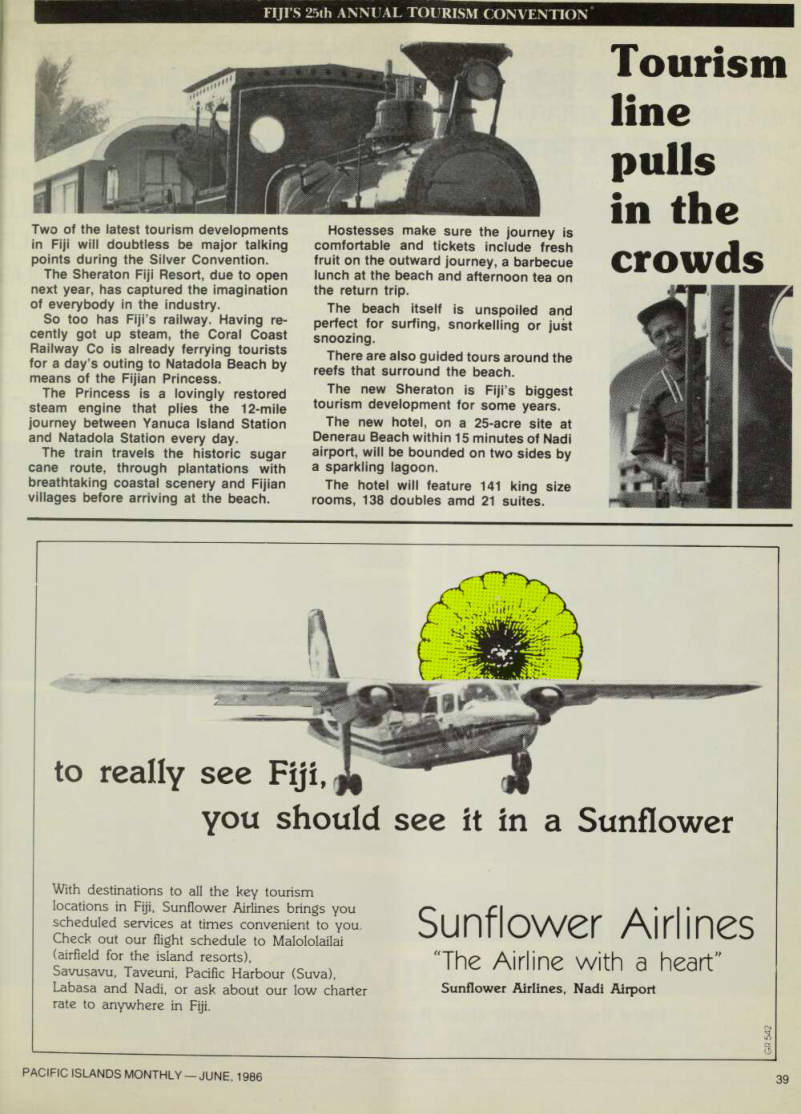
Tourism line pulls in the crowds
Two of the latest tourism developments in Fiji will doubtless be major talking points during the Silver Convention.
The Sheraton Fiji Resort, due to open next year, has captured the imagination of everybody in the industry.
So too has Fiji’s railway. Having re cently got up steam, the Coral Coast Railway Co is already ferrying tourists for a day’s outing to Natadola Beach by means of the Fijian Princess.
The Princess is a lovingly restored steam engine that plies the 12-mile journey between Yanuca Island Station and Natadola Station every day.
The train travels the historic sugar cane route, through plantations with breathtaking coastal scenery and Fijian villages before arriving at the beach.
Hostesses make sure the journey is comfortable and tickets include fresh fruit on the outward journey, a barbecue lunch at the beach and afternoon tea on the return trip.
The beach itself is unspoiled and perfect for surfing, snorkelling or just snoozing.
There are also guided tours around the reefs that surround the beach.
The new Sheraton is Fiji’s biggest tourism development for some years.
The new hotel, on a 25-acre site at Denerau Beach within 15 minutes of Nadi airport, will be bounded on two sides by a sparkling lagoon.
The hotel will feature 141 king size rooms, 138 doubles amd 21 suites.
Advertisements & other items, pp. 39-40 (2 items)
39
FIJI’S 25th ANNUAL TOURISM CONVENTION*
PACIFIC ISLANDS MONTHLY —JUNE, 1986
Sunflower Airlines
v
to really see Fiji,
you should see it in a Sunflower With destinations to all the key tourism locations in Fiji, Sunflower Airlines brings you scheduled services at times convenient to you.
Check out our flight schedule to Malololailai (airfield for the island resorts), Savusavu, Taveuni, Pacific Harbour (Suva), Labasa and Nadi, or ask about our low charter rate to anywhere in Fiji.
Sunflower Airlines
"The Airline with a heart”
Sunflower Airlines, Nadi Airport GR 542
DING. . . SAILING. . . MOVIES. . . CORAL VIEWING. . . DISCC DWING. . . LAWN BOWLING. . . BICYCLE RIDING. . . VOLLEYBALL
DIMMING... JOGGING... WINDSURFING... SNORKELLING
JNBATHING. . . LIBRARY. . . WATER SKIING. . . SIGHTSEEING. . .
DOKING DEMONSTRATIONS. . . STORY TELLING. . . REEF WALKING BH DRIVES. . . GAMES ROOM. . . BASKET WEAVING. . . SHOPI
)URS.
DURS
ENNI
\IU FIREWALKING. , . SCUBA DIVING. . . BAY FISHING, . . VILL AEROBICS .. . PLAYSCHOOL. . . BINGO. . . GOLF DANCING. . . SWIMMING. . . DINING. . . HORSE RIDING MOVIES. . . CORAL VIEWING. . . DISCO. . ROWING. . . L
. BICYCLE RIDING... VOLLEYBALL... SWIMMING
. WINDSURFING .. . SNORKELLING. . . SUNBATHING WATER SKIING. . . SIGHTSEEING. . . FISH COO J 5 r * « “ . 0 m y
@ The FIJIAN Resort
More than a world class Resort. It’s a private, luxurious Island.
PRIVATE MAIL BAG, NADI INTERNATIONAL AIRPORT, FIJI
TELEPHONE: 50155. TELEX: FJ4241. CABLE: RESORTS
A SHANGRI-LA INTERNATIONAL HOTEL
Guest speakers of international renown
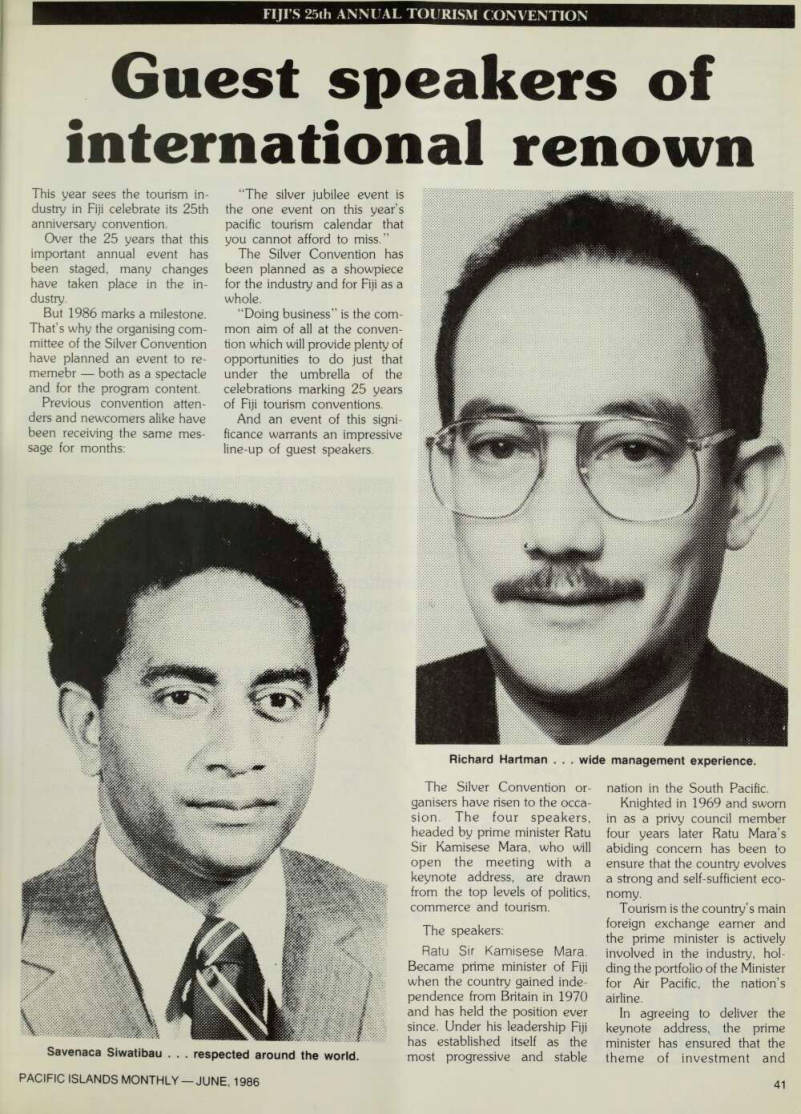
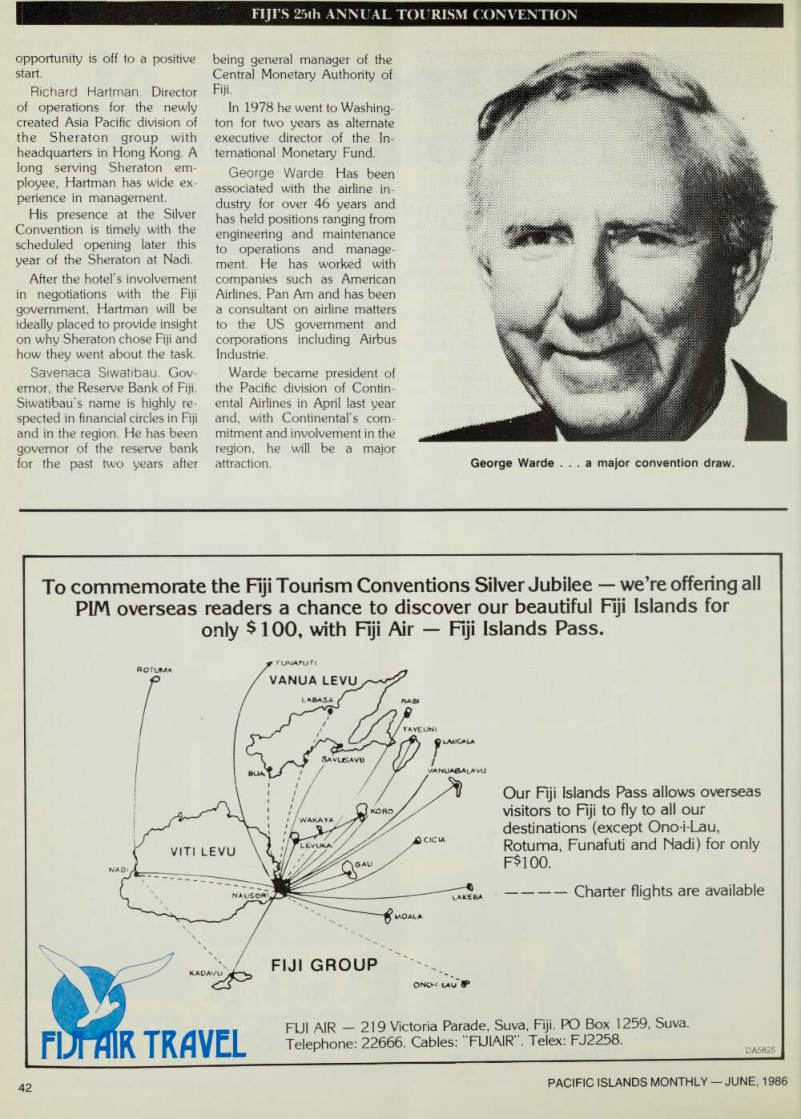
international renown
This year sees the tourism in dustry in Fiji celebrate its 25th anniversary convention.
Over the 25 years that this important annual event has been staged, many changes have taken place in the in dustry.
But 1986 marks a milestone.
That’s why the organising com mittee of the Silver Convention have planned an event to re memebr both as a spectacle and for the program content.
Previous convention atten dee and newcomers alike have been receiving the same mes sage for months;
“The silver jubilee event is the one event on this year’s pacific tourism calendar that you cannot afford to miss.”
The Silver Convention has been planned as a showpiece for the industry and for Fiji as a whole.
“Doing business” is the com mon aim of all at the conven tion which will provide plenty of opportunities to do just that under the umbrella of the celebrations marking 25 years of Fiji tourism conventions.
And an event of this signi ficance warrants an impressive line-up of guest speakers.
The Silver Convention organisers have risen to the occasion. The four speakers, headed by prime minister Ratu Sir Kamisese Mara, who will open the meeting with a keynote address, are drawn from the top levels of politics, commerce and tourism.
The speakers: Ratu Sir Kamisese Mara, Became prime minister of Fiji when the country gained independence from Britain in 1970 and has held the position ever since. Under his leadership Fiji has established itself as the most progressive and stable
nation in the South Pacific, Knighted in 1969 and sworn in as a privy council member four years later Ratu Mara’s abiding concern has been to ensure that the country evolves a strong and self-sufficient eco nomy.
Tourism is the country’s main '° rei S n exchan 3f earner and the pnme minister is actively involved in the industry, hoi ding the portfolio of the Minister for Air Pacific, the nation’s airline.
In agreeing to deliver the keynote address, the prime minister has ensured that the theme of investment and
Savenaca Siwatibau...respected around the world.
Richard Hartman...wide management experience.
opportunity is off to a positive start.
Richard Hartman, Director of operations for the newly created Asia Pacific division of the Sheraton group with headquarters in Hong Kong. A long serving Sheraton em ployee, Hartman has wide ex perience in management.
His presence at the Silver Convention is timely with the scheduled opening later this year of the Sheraton at Nadi.
After the hotel’s involvement in negotiations with the Fiji government. Hartman will be ideally placed to provide insight on why Sheraton chose Fiji and how they went about the task.
Savenaca Siwatibau. Gov ernor, the Reserve Bank of Fiji.
Siwatibau’s name is highly re spected in financial circles in Fiji and in the region. He has been governor of the reserve bank for the past two years after
being general manager of the Central Monetary Authority of Fiji.
In 1978 he went to Washing ton for two years as alternate executive director of the In ternational Monetary Fund.
George Warde. Has been associated with the airline in dustry for over 46 years and has held positions ranging from engineering and maintenance to operations and manage ment. He has worked with companies such as American Airlines, Pan Am and has been a consultant on airline matters to the US government and corporations including Airbus Industrie.
Warde became president of the Pacific division of Contin ental Airlines in April last year and, with Continental’s com mitment and involvement in the region, he will be a major attraction.
George Warde...a major convention draw.
Advertisements & other items, pp. 41-43 (3 items)
41
FIJI’S 25th ANNUAL TOURISM CONVENTION
PACIFIC ISLANDS MONTHLY —JUNE, 1986
Fiji’S 25Ch Annual Tourism Convention
Irtravel
To commemorate the Fiji Tourism Conventions Silver Jubilee we’re offering all PIM overseas readers a chance to discover our beautiful Fiji Islands for only $ 100, with Fiji Air Fiji Islands Pass.
RoruMA
f FUNAFUTI
VANUA LEVU
LabaSa /
HABI
TAVfcUN
lAiocala SavuEAYU
VA NUA&A LA YU
KjORO
wakaya
L6.VUKA
V 111
LEVU
GAU
NAUSOBi
lAOAL*
Our Fiji Islands Pass allows overseas
visitors to Fiji to fly to all our
destinations (except Ono-i-Lau,
Rotuma, Funafuti and Nadi) for only
Fsloo.
Charter flights are available
FIJI GROUP
ONcm-lau 9
IRTRAVEL
FUI AIR 219 Victoria Parade, Suva, Fiji. PO Box 1259, Suva.
Telephone: 22666. Cables: “FUIAIR”. Telex: FJ2258.
DA5825
A JLJLt Avis we believe that a friendly smile and a helping hand really do make all the difference.
The people of Fiji are among the friendliest in the world and our staff are no exception.
We make renting a car in Fiji a pleasure.
Late model vehicles immaculately maintained to Avis standards internationally, locations all over Fiji plus the kind of service only Avis can offer, will help make your Fiji experience a memorable one.
Rent Avis and rent a genuine Fiji smile. r
AVIS FIJI. RENT A SMILE.
To confirm Reservations: FIJI : 72233 (Nadi), 313833 (Suva) AUSTRALIA : (008) 225533 (Toll Free), (02) 5162877 (Sydney) NEW ZEALAND : (09) 792545 (Toll Free) LLS.A. : (800) 3312112 (Toll Free) HAWAII : (800) 3311212 (Toll Free) CANADA ; 1 -800-2680303 (Toll Free) 1-800-2682310 (Toll Free) British Columbia 6220770 Toronto U.K. : 01-8488733
V\c try harder
- WA09.40
In the beginning...
■ suppose it all began with Northern Hotels. Sir Hugh Ragg started his chain of hospitality in the early fifties culminating with the deve lopment of Korolevu Beach Hotel, ably operated by Bill and Kathy Clarke.
This set the tone of what a South Pacific resort was all about, and highly successful it proved to be.
The point was that nobody at this stage had professional sta tus as far as hotel management was concerned. It was a fully amateur adventure. But after all the human race was started by a pair of amateurs.
In 1960 another group of amateurs got in on the act.
I had spent 18 months fool ing around with 1,600,000 square feet of concrete com prising the new jet runway at Nadi. If I never saw another bag of cement it would still be too soon!
I met an American, Pete Slimmer, and an Australian, Ray Wilson, and got into the hotel game with the creation of Skylodge at Nadi Airport.
Our calling card proudly announced “American, Austra lian and Irish spoken fluently.
English understood.”
We, of course, were also amateurs. Maybe a new breed of hotel cat, but amateurs nevertheless.
Time passed by during which we were joined by a group of PanAm pilots (professionals in the air, but very amateurish on the ground), acquiring the Mocambo Hotel (built by Barry Philp) and finally developing the Fijian at Yanuca.
Having been project mana ger for the construction, I got the job as general manager, not on any professional qualifica tions, but because 1 knew where all the plumbing was located.
Then the professionals ar rived. Travelodge, The Regent, Hyatt, Courtesy Inn etc.
Having served a stint with
Fiji’s tourist industry is in a state of flux, says industry pioneer PADDY DOYLE, who also asks some questions and offers a few answers.
The Fiji Visitors Bureau, which gives you exposure to advertis ing and a lot of public relations, I suppose I had by then ac quired a certain amount of professionalism by “osmosis”.
I therefore offer comments on the basis that 1 have seen it all even if I don’t know it all.
One thing that bugs me is the number of divisional meetings that seem to be held daily at the large hotels. If you ring the G.M. (on a first name basis) you invariably find he is holding a rooms banqueting, mainten ance, F&B etc. division meeting and will call you back, which rarely happens.
The way to get through is to say the Prime Minister wants a word with him.
Robert Townsend (my man agement guru) of Avis fame, says, on the subject of meetings “The fewer the better”, and favors a weekly meeting of department heads of fixed duration at a fixed time for
information, not problem sol ving.
This allows the top brass to spend more time with their guests, the raw material of the hospitality industry. A general manager has got to be seen to be believed.
Fiji is at present in a state of flux. We are urged by airlines and wholesalers to build more rooms and promptly react by closing down hotels.
We complain for years that we are dominated by the Aus tralian market while at no stage have we developed a strategy for penetrating that so called “sleeping giant”, North America.
Now we take on large chunks of the States when a city like Los Angeles could flood Fiji if properly motivated.
In this respect, I believe Fiji has not really worked out the image it wishes to create. Gol den beaches, palm trees, the
sun? Australia has it all, and better. Big game fishing? Ever heard of Cairns? Duty free?
Singapore, Hong Kong and Sears Roebuck do a better job.
Food? Read about Bali.
Somehow we have to paint an image of the people, the culture and the environment before the individual products.
We are really trying to play chess without creating the chessboard in the first place. In a world where tourists are either hi-jacked, shot, blown up or hate “honkies”, Fiji is unique.
The history of Fiji as a colony that was never taken by force of arms is unique. The dedication to the royal family is unique.
The simple artifacts made by villagers out of palm leaves are unique. The Sandalwood trade, The Reverend Baker, mul ticultural society, anti-gun laws etc. are all to some degree taken for granted when they could be welded into a major draw card for our industry.
Finally, I believe that our government has some home work to do.
The cost of liquor, in particu lar wines, is giving Fiji a high price image. The restrictions on certain food imports makes it hard to compete in the in ternational market, where these items are an expected norm.
Substitution should be encour aged but so also should the quality of the substitute.
Fiji needs a North American terminator. By hook or by crook this is a must even if it means bending bi-laterals, lob bying at the United Nations or sending President Reagan a ton of yaona! In a world where airlines sell long haul traffic, we are disadvantaged to a great extent by our “whistle stop” status.
So much for the fulminations of a crusty old SOB who should have been put out to grass years ago. I hope our conven tion this year produces some really constructive thinking. We badly need it.
From The Crow’S Nest
Advertisements & other items, pp. 44-45 (2 items)
44
FIJI’S 25th ANNUAL TOURISM CONVENTION
PACIFIC ISLANDS MONTHLY —JUNE, 1986
“Four Jewels”
A b!
BS . -
In a green & lovely land
TH€ TflNOfl GROUP OF FIJI
Hotels of Character & Distinction
THE TANOA HOTEL
SKYLODGE HOTEL
RAKIRAKI HOTEL
FIJI PALMS BEACH CLUB
p O BOX 9211 NADI AIRPORT FIJI CENTRAL RESERVATIONS: TELEX FJ 5174 PHONE 72300
OR INTERNATIONALLY UTELL. US REPS-UNIREP
I DC
Aussies spend
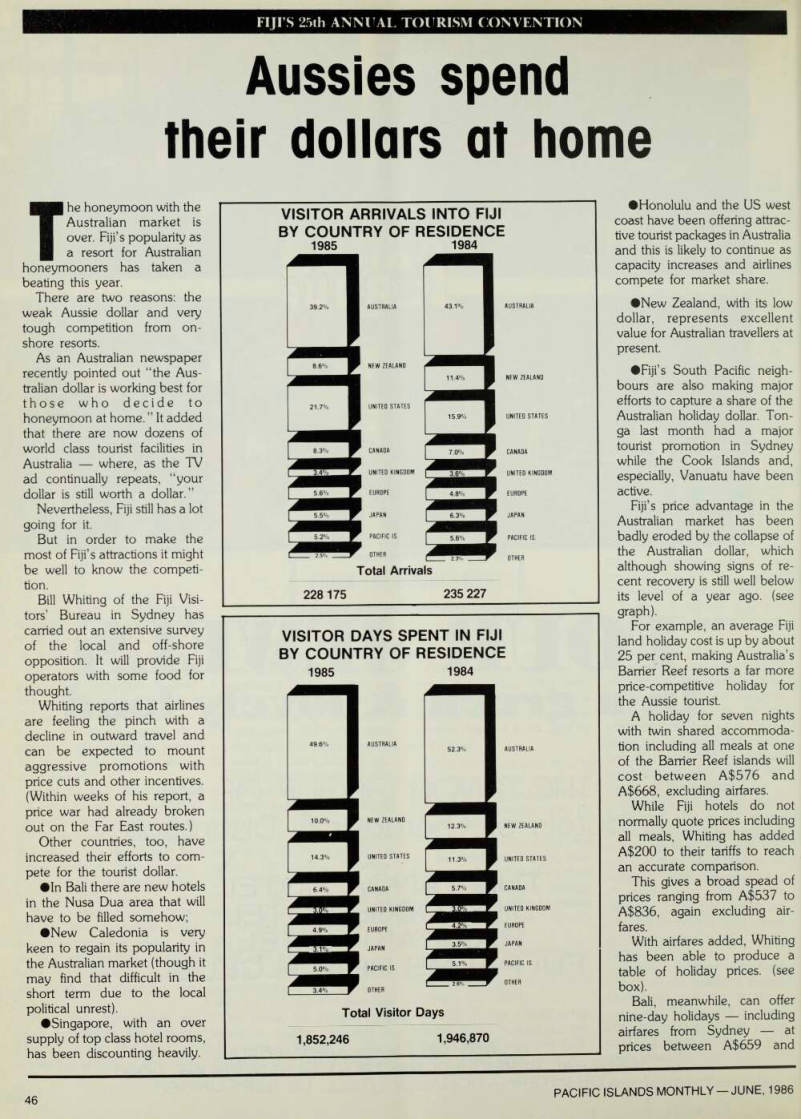
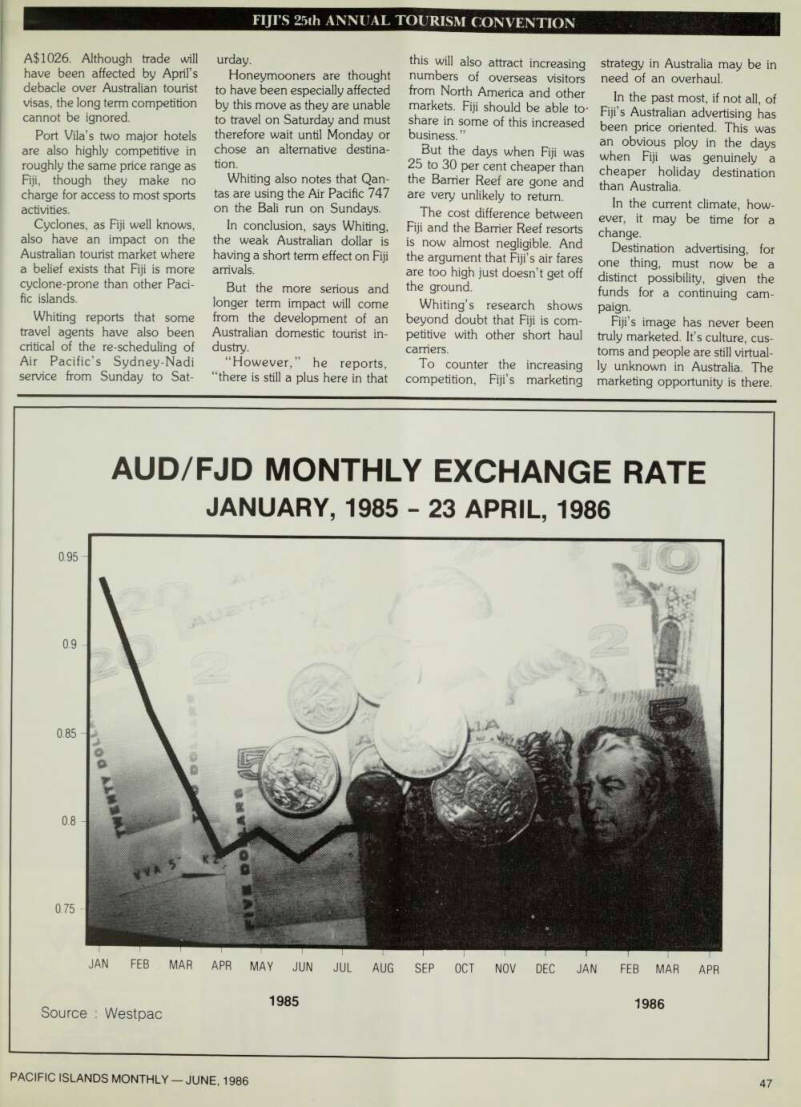
their dollars at home
The honeymoon with the Australian market is over. Fiji’s popularity as a resort for Australian honeymooners has taken a beating this year.
There are two reasons: the weak Aussie dollar and very tough competition from on shore resorts.
As an Australian newspaper recently pointed out “the Aus tralian dollar is working best for those who decide to honeymoon at home. ” It added that there are now dozens of world class tourist facilities in Australia where, as the TV ad continually repeats, “your dollar is still worth a dollar.”
Nevertheless, Fiji still has a lot going for it.
But in order to make the most of Fiji’s attractions it might be well to know the competi tion.
Bill Whiting of the Fiji Visi tors’ Bureau in Sydney has carried out an extensive survey of the local and off-shore opposition. It will provide Fiji operators with some food for thought.
Whiting reports that airlines are feeling the pinch with a decline in outward travel and can be expected to mount aggressive promotions with price cuts and other incentives. (Within weeks of his report, a price war had already broken out on the Far East routes.) Other countries, too, have increased their efforts to com pete for the tourist dollar. •In Bali there are new hotels in the Nusa Dua area that will have to be filled somehow; •New Caledonia is very keen to regain its popularity in the Australian market (though it may find that difficult in the short term due to the local political unrest). •Singapore, with an over supply of top class hotel rooms, has been discounting heavily.
•Honolulu and the US west coast have been offering attrac tive tourist packages in Australia and this is likely to continue as capacity increases and airlines compete for market share. •New Zealand, with its low dollar, represents excellent value for Australian travellers at present. •Fiji’s South Pacific neigh bours are also making major efforts to capture a share of the Australian holiday dollar. Ton ga last month had a major tourist promotion in Sydney while the Cook Islands and, especially, Vanuatu have been active.
Fiji’s price advantage in the Australian market has been badly eroded by the collapse of the Australian dollar, which although showing signs of re cent recovery is still well below its level of a year ago. (see graph).
For example, an average Fiji land holiday cost is up by about 25 per cent, making Australia’s Barrier Reef resorts a far more price-competitive holiday for the Aussie tourist.
A holiday for seven nights with twin shared accommoda tion including all meals at one of the Barrier Reef islands will cost between A 5576 and As66B, excluding airfares.
While Fiji hotels do not normally quote prices including all meals, Whiting has added As2oo to their tariffs to reach an accurate comparison.
This gives a broad spead of prices ranging from A 5537 to AsB36, again excluding air fares.
With airfares added, Whiting has been able to produce a table of holiday prices, (see box).
Bali, meanwhile, can offer nine-day holidays including airfares from Sydney at prices between A 5659 and
A 51026. Although trade will have been affected by April’s debacle over Australian tourist visas, the long term competition cannot be ignored.
Port Vila’s two major hotels are also highly competitive in roughly the same price range as Fiji, though they make no charge for access to most sports activities.
Cyclones, as Fiji well knows, also have an impact on the Australian tourist market where a belief exists that Fiji is more cyclone-prone than other Paci fic islands.
Whiting reports that some travel agents have also been critical of the re-scheduling of Air Pacific’s Sydney-Nadi service from Sunday to Sat
urday.
Honeymooners are thought to have been especially affected by this move as they are unable to travel on Saturday and must therefore wait until Monday or chose an alternative destina tion.
Whiting also notes that Qan tas are using the Air Pacific 747 on the Bali run on Sundays.
In conclusion, says Whiting, the weak Australian dollar is having a short term effect on Fiji arrivals.
But the more serious and longer term impact will come from the development of an Australian domestic tourist in dustry.
“However,” he reports, “there is still a plus here in that
this will also attract increasing numbers of overseas visitors from North America and other markets. Fiji should be able to* share in some of this increased business. ”
But the days when Fiji was 25 to 30 per cent cheaper than the Barrier Reef are gone and are very unlikely to return.
The cost difference between Fiji and the Barrier Reef resorts is now almost negligible. And the argument that Fiji’s air fares are too high just doesn’t get off the ground.
Whiting’s research shows beyond doubt that Fiji is com petitive with other short haul carriers.
To counter the increasing competition, Fiji’s marketing
strategy in Australia may be in need of an overhaul.
In the past most, if not all, of Fiji’s Australian advertising has been price oriented. This was an obvious ploy in the days when Fiji was genuinely a cheaper holiday destination than Australia.
In the current climate, how ever, it may be time for a change.
Destination advertising, for one thing, must now be a distinct possibility, given the funds for a continuing cam paign.
Fiji’s image has never been truly marketed. It’s culture, cus toms and people are still virtual ly unknown in Australia. The marketing opportunity is there.
Advertisements & other items, pp. 47-48 (3 items)
Aud/Fjd Monthly Exchange Rate
JANUARY, 1985-23 APRIL, 1986
47
FIJI’S 25th ANNUAL TOURISM CONVENTION
PACIFIC ISLANDS MONTHLY —JUNE, 1986
At the end oi the rainhow
you II lintl Fiji.
FIJI'S INTERNATIONAL AIRLINE
expectations
Gold find outshines expectations
The Wapolu gold find on Fer gusson Island, PNG, continues to exceed earlier expectations.
The prospecting company re ports that a mining program may be under consideration before the end of the year.
Early results from an exten sive diamond and air core drill ing program on the project have been announced by City and Suburban which holds a 50 per cent interest in the prospect with Esso PNG Inc, Significant gold mineralisa tion was intersected in six of 10 drill holes during the first quar ter of this year, the best in tersections being six metres at 2.34 grams per tonne gold, four at 2.12, four at 1.98 and six at 1.45 Fifty-two reverse circulation air core holes during the same quarter produced significant gold mineralisation in 25, the best intersections being 16 metres at 2.34 grams per tonne (including six metres at 4.83), 10 at 2.26 and 14 at 3.20 (including two at 7.78).
“Most holes were drilled to depths of 20 to 30 metres, some terminating in mineralisa tion,” says the company’s quarterly report to stock ex changes.
“Drilling extended known better grade gold mineralisation from the Newwa zone to the Kweama zone, a horizontal dist ance of approximately one kilometre,” says the report.
“Indications are that this zone will have a higher average grade than that defined in other zones on the prospect, possibly in the range of three grams per tonne gold.”
The company reported that other field during the quarter continued to reflect the exist ence of gold mineralisation in termittently for five kilometres to the west and 10 kilometres to the east of the central resource.
To the west, grid based soil sampling program was com pleted over a two-kilomtre by one-kilometre alluvial area, with grades of up to 0.95 grams per tonne gold in the surface soils.
The joint venture partners have drilled a total of 212 diamond and air core holes on Wapolu since the discovery of
the prospect some 19 months ago.
“It seems that our first esti mates of only 1.4 grams per tonne gold in the surface material were very conservative indeed, considering the better grades below the central re source and mineralisation in a number of other areas on the prospect,” the company’s director Mr John Bailey said.
“Metallurgical testing and pre-feasibility studies have been planned for this quarter and we may well be considering a min ing program before the end of this year.”
The company also reports further high-grade gold in tersections at Wild Dog, on the east coast of New Britain and good results from elsewhere in
Png.
in seminars
Investors meet in seminars
Major US corporations were expected to take part in the Pacific Islands Association (PIA) investment seminar in San Francisco this month.
Entitled “Investment in De velopment in the Pacific Is lands”, the seminar aims to bring together representatives of the private and public sec tors.
Corporations such as Star kist, Bank of America, Peat
Marwick and Mitchell, Pacific Resources Inc, C Brewer and other US heavyweights were expected at the seminar from June 12-14.
Pacific ministers for deve lopment, finance, trade and tourism were also expected to be among the 200 attending the seminar.
Some noted observers have predicted that the Pacific islands will attract investment worth
US$5,OOO million over the next 20 years.
In addition the emerging Micronesian entities have reached agreement on their compacts of free association with the US, which will bring an influx of around $2 billion over the next 15 years.
All this has encouraged US investors and potential inves tors to take a greater interest in the region.
Since 1981, PIA has pro vided a forum for dialogue between the island decision makers and the US through these informal seminars.
Council builds a business bridge
Fiji’s business relationship with Austra lia has been strengthened by the forma tion of the Australia Fiji Business Council.
The council’s first meeting in Sydney heard that some 32 companies had indicated positive interest. The same meeting agreed on an interim budget and executive committee.
The council aims to foster friendship and understanding between the two countries as well as trade.
Support for trade, investment, techni cal and economic co-operation and tour ism are also high on the priorities list.
The council also intends to encourage educational and personnel exchanges and private sector training schemes.
It will be a lobby, too, that can ensure that both governments take the needs of the private sector into account when making policy.
There will also be a “mirror” group to be based in Fiji and this will maintain regular contact with the Sydney council along much the same lines as the PNG Australia Business Co-operation Council which has been operating for the past three years.
An inauguration dinner for the council was held in Sydney on May 1 and was
attended by prime minister Ratu Sir Kamisese Mara.
Fiji’s economy is highly trade oriented.
Westpac’s country report has sugar accounting for between 55 and 60 per cent of export earnings (though the 1985 cyclones badly affected the harvest).
Fiji also exports substantial amounts of gold, timber and canned fish, with tourism also a major export activity.
Fiji’s trade with Australia showed a heavy imbalance in Australia’s favor in 1984/85.
Australia’s exports to Fiji mainly petroleum and related products and cereals stood at U 55160.2 million with imports from Fiji gold and fixed vegetable oils and fats at US$4O.l million.
With recently improved access for Fiji’s garments, however, a small correc tion may be expected for 1986.
The UK, on the other hand, is still Fiji’s major export destination, taking 29 per cent of output in 1984.
However, this picture is gradually changing with the UK share declining as Australia’s slowly increases.
Australia accounted for 13.7 per cent of Fiji’s exports in 1984.
Two Lapero[?]e wreck or one? Confro[?]ation a Albi
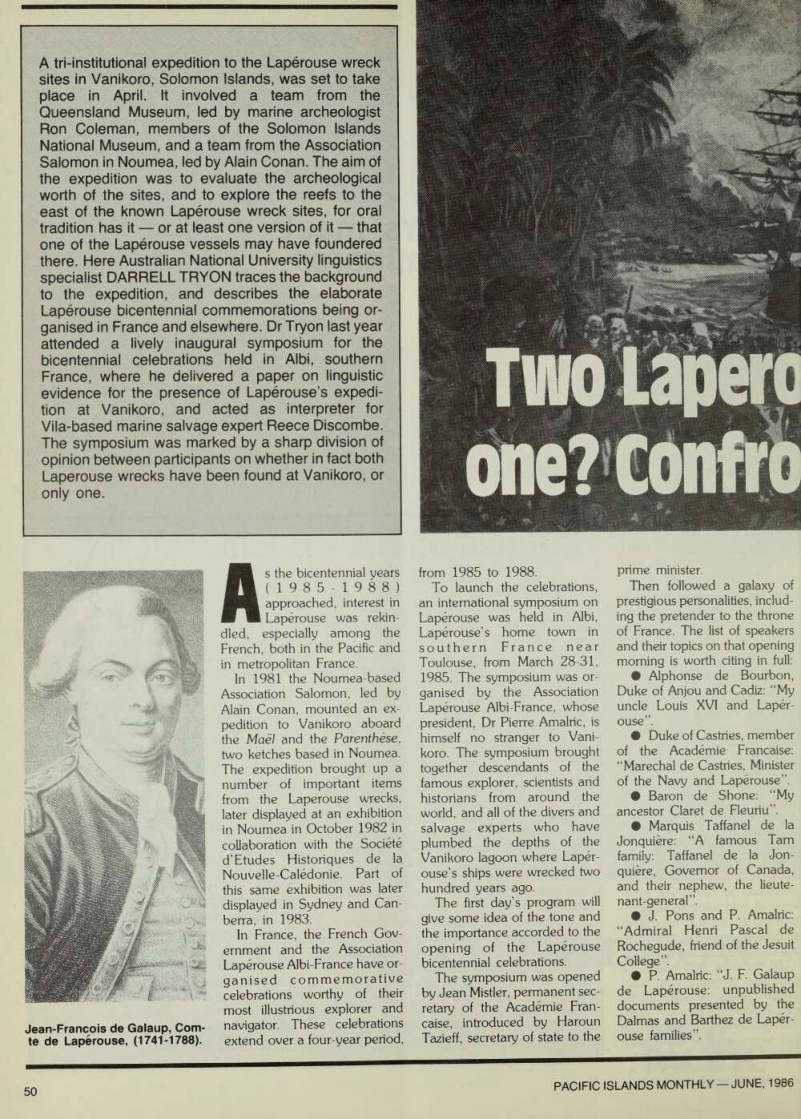
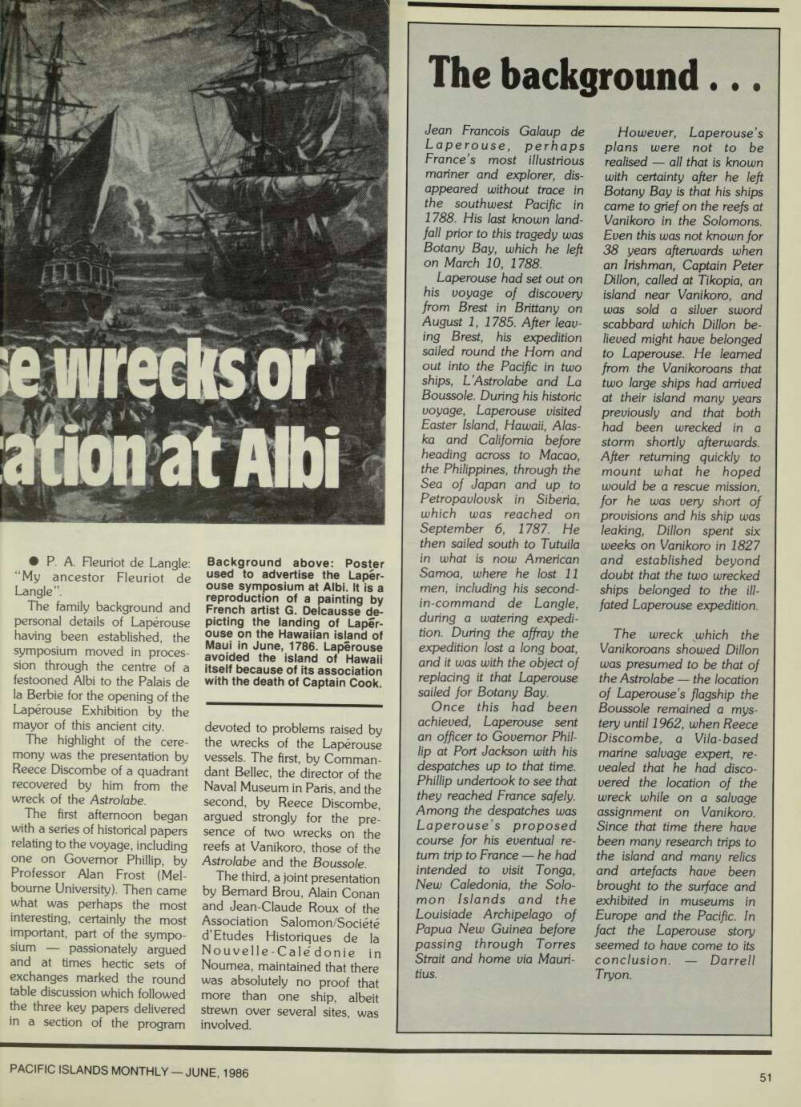
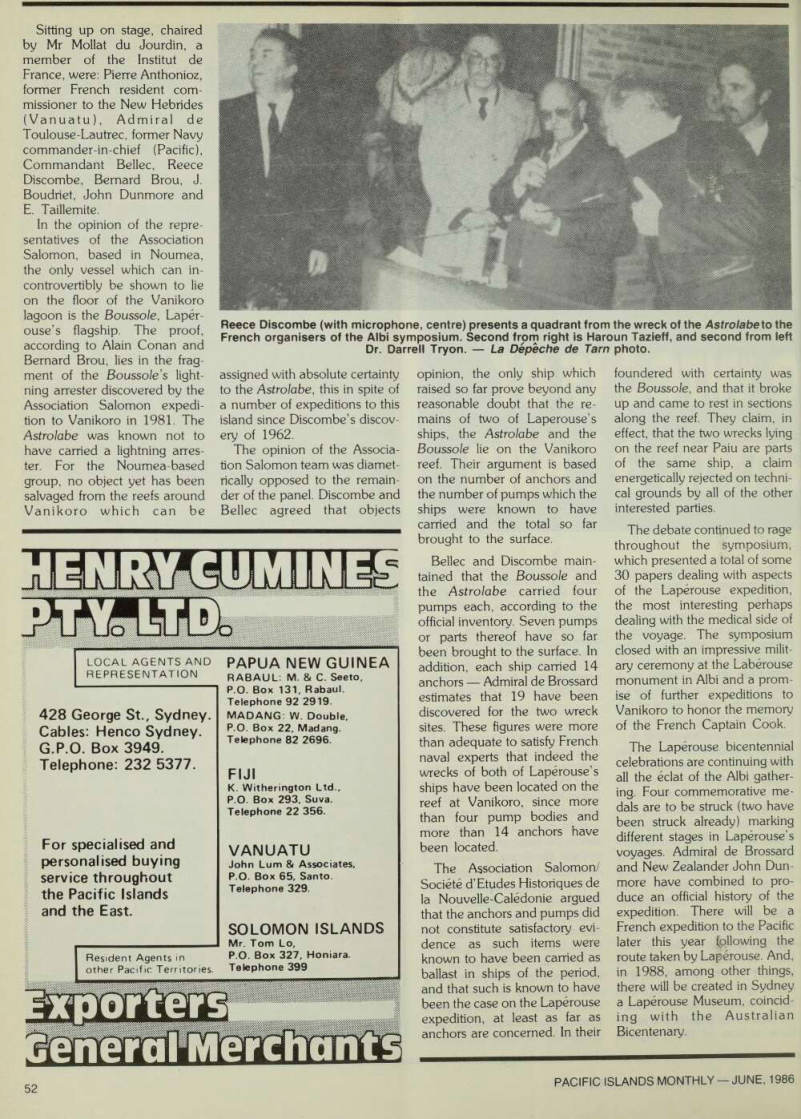
one? Confro[?]
A tri-institutional expedition to the Laperouse wreck sites in Vanikoro, Solomon Islands, was set to take place in April. It involved a team from the Queensland Museum, led by marine archeologist Ron Coleman, members of the Solomon Islands National Museum, and a team from the Association Salomon in Noumea, led by Alain Conan. The aim of the expedition was to evaluate the archeological worth of the sites, and to explore the reefs to the east of the known Laperouse wreck sites, for oral tradition has it or at least one version of it that one of the Laperouse vessels may have foundered there. Here Australian National University linguistics specialist DARRELL TRYON traces the background to the expedition, and describes the elaborate Laperouse bicentennial commemorations being or ganised in France and elsewhere. DrTryon last year attended a lively inaugural symposium for the bicentennial celebrations held in Albi, southern France, where he delivered a paper on linguistic evidence for the presence of Laperouse’s expedi tion at Vanikoro, and acted as interpreter for Vila-based marine salvage expert Reece Discombe.
The symposium was marked by a sharp division of opinion between participants on whether in fact both Laperouse wrecks have been found at Vanikoro, or only one.
As the bicentennial years (1985-1988) approached, interest in Laperouse was rekin dled, especially among the French, both in the Pacific and in metropolitan France.
In 1981 the Noumea-based Association Salomon, led by Alain Conan, mounted an ex pedition to Vanikoro aboard the Mae/ and the Parenthese , two ketches based in Noumea.
The expedition brought up a number of important items from the Laperouse wrecks, later displayed at an exhibition in Noumea in October 1982 in collaboration with the Societe d’Etudes Historiques de la Nouvelle-Caledonie. Part of this same exhibition was later displayed in Sydney and Can berra, in 1983.
In France, the French Gov ernment and the Association Laperouse Albi-France have or ganised commemorative celebrations worthy of their most illustrious explorer and navigator. These celebrations extend over a four-year period,
from 1985 to 1988.
To launch the celebrations, an international symposium on Laperouse was held in Albi, Laperouse’s home town in southern France near Toulouse, from March 28-31, 1985. The symposium was or ganised by the Association Laperouse Albi-France, whose president, Dr Pierre Amalric, is himself no stranger to Vani koro. The symposium brought together descendants of the famous explorer, scientists and historians from around the world, and all of the divers and salvage experts who have plumbed the depths of the Vanikoro lagoon where Laper ouse’s ships were wrecked two hundred years ago.
The first day’s program will give some idea of the tone and the importance accorded to the opening of the Laperouse bicentennial celebrations.
The symposium was opened by Jean Mistier, permanent sec retary of the Academie Fran caise, introduced by Haroun Tazieff, secretary of state to the
prime minister.
Then followed a galaxy of prestigious personalities, includ ing the pretender to the throne of France. The list of speakers and their topics on that opening morning is worth citing in full: • Alphonse de Bourbon, Duke of Anjou and Cadiz: “My uncle Louis XVI and Laper ouse”. • Duke of Castries, member of the Academic Francaise: “Marechal de Castries, Minister of the Navy and Laperouse”. • Baron de Shone: “My ancestor Claret de Fleuriu”. • Marquis Taffanel de la Jonquiere: “A famous Tarn family; Taffanel de la Jon quiere, Governor of Canada, and their nephew, the lieute nant-general”. • J. Pons and P. Amalric; “Admiral Henri Pascal de Rochegude, friend of the Jesuit College”. • P. Amalric; “J. F. Galaup de Laperouse: unpublished documents presented by the Dalmas and Barthez de Laper ouse families”.
Jean-Francois de Galaup, Com te de Laperouse, (1741-1788).
• P. A. Fleuriot de Langle; “My ancestor Fleuriot de Langle”.
The family background and personal details of Laperouse having been established, the symposium moved in proces sion through the centre of a festooned Albi to the Palais de la Berbie for the opening of the Laperouse Exhibition by the mayor of this ancient city.
The highlight of the cere mony was the presentation by Reece Discombe of a quadrant recovered by him from the wreck of the Astrolabe.
The first afternoon began with a series of historical papers relating to the voyage, including one on Governor Phillip, by Professor Alan Frost (Mel bourne University). Then came what was perhaps the most interesting, certainly the most important, part of the sympo sium passionately argued and at times hectic sets of exchanges marked the round table discussion which followed the three key papers delivered in a section of the program
devoted to problems raised by the wrecks of the Laperouse vessels. The first, by Comman dant Bellec, the director of the Naval Museum in Paris, and the second, by Reece Discombe, argued strongly for the pre sence of two wrecks on the reefs at Vanikoro, those of the Astrolabe and the Boussole.
The third, a joint presentation by Bernard Brou, Alain Conan and Jean-Claude Roux of the Association Salomon/Societe d’Etudes Historiques de la Nouvelle-Cale donie in Noumea, maintained that there was absolutely no proof that more than one ship, albeit strewn over several sites, was involved.
Background above: Poster used to advertise the Laper ouse symposium at Albi. It is a reproduction of a painting by French artist G. Delcausse de picting the landing of Laper ouse on the Hawaiian island of Maui in June, 1786. Laperouse avoided the island of Hawaii itself because of its association with the death of Captain Cook.
Sitting up on stage, chaired by Mr Mollat du Jourdin, a member of the Institut de France, were: Pierre Anthonioz, former French resident com missioner to the New Hebrides (Vanuatu), Admiral de Toulouse-Lautrec, former Navy commander-in-chief (Pacific), Commandant Bellec, Reece Discombe, Bernard Brou, J.
Boudriet, John Dunmore and E. Taillemite.
In the opinion of the repre sentatives of the Association Salomon, based in Noumea, the only vessel which can in controvertibly be shown to lie on the floor of the Vanikoro lagoon is the Boussole, Laper ouse’s flagship. The proof, according to Alain Conan and Bernard Brou, lies in the frag ment of the Boussole’s light ning arrester discovered by the Association Salomon expedi tion to Vanikoro in 1981. The Astrolabe was known not to have carried a lightning arres ter. For the Noumea-based group, no object yet has been salvaged from the reefs around Vanikoro which can be
assigned with absolute certainty to the Astrolabe, this in spite of a number of expeditions to this island since Discombe’s discov ery of 1962.
The opinion of the Associa tion Salomon team was diamet rically opposed to the remain der of the panel. Discombe and Bellec agreed that objects
opinion, the only ship which raised so far prove beyond any reasonable doubt that the re mains of two of Laperouse’s ships, the Astrolabe and the Boussole lie on the Vanikoro reef. Their argument is based on the number of anchors and the number of pumps which the ships were known to have carried and the total so far brought to the surface.
Bellec and Discombe main tained that the Boussole and the Astrolabe carried four pumps each, according to the official inventory. Seven pumps or parts thereof have so far been brought to the surface. In addition, each ship carried 14 anchors Admiral de Brossard estimates that 19 have been discovered for the two wreck sites. These figures were more than adequate to satisfy French naval experts that indeed the wrecks of both of Laperouse’s ships have been located on the reef at Vanikoro, since more than four pump bodies and more than 14 anchors have been located.
The Association Salomon/ Societe d’Etudes Historiques de la Nouvelle-Caledonie argued that the anchors and pumps did not constitute satisfactory evi dence as such items were known to have been carried as ballast in ships of the period, and that such is known to have been the case on the Laperouse expedition, at least as far as anchors are concerned. In their
foundered with certainty was the Boussole, and that it broke up and came to rest in sections along the reef. They claim, in effect, that the two wrecks lying on the reef near Paiu are parts of the same ship, a claim energetically rejected on techni cal grounds by all of the other interested parties.
The debate continued to rage throughout the symposium, which presented a total of some 30 papers dealing with aspects of the Laperouse expedition, the most interesting perhaps dealing with the medical side of the voyage. The symposium closed with an impressive milit ary ceremony at the Laberouse monument in Albi and a prom ise of further expeditions to Vanikoro to honor the memory of the French Captain Cook.
The Laperouse bicentennial celebrations are continuing with all the eclat of the Albi gather ing. Four commemorative me dals are to be struck (two have been struck already) marking different stages in Laperouse’s voyages. Admiral de Brossard and New Zealander John Dun more have combined to pro duce an official history of the expedition. There will be a French expedition to the Pacific later this year fpllowing the route taken by Laperouse. And, in 1988, among other things, there will be created in Sydney a Laperouse Museum, coincid ing with the Australian Bicentenary.
Reece Discombe (with microphone, centre) presents a quadrant from the wreck of the Astrolabe to the French organisers of the Albi symposium. Second from right is Haroun Tazieff, and second from left Dr. Darrell Tryon.- La Dépêche de Tarn photo.
The background...
Jean Francois Galaup de
Laperouse, perhaps
France’s most illustrious mariner and explorer, dis appeared without trace in the southwest Pacific in 1788. His last known land fall prior to this tragedy was Botany Bay, which he left on March 10, 1788.
Laperouse had set out on his voyage of discovery from Brest in Brittany on August 1, 1785. After leav ing Brest, his expedition sailed round the Horn and out into the Pacific in two ships, L ’Astrolabe and La Boussole. During his historic voyage, Laperouse visited Easter Island, Hawaii, Alas ka and California before heading across to Macao, the Philippines, through the Sea of Japan and up to Petropavlovsk in Siberia, which was reached on September 6, 1787. He then sailed south to Tutuila in what is now American Samoa, where he lost 11 men, including his second in-command de Langle, during a watering expedi tion. During the affray the expedition lost a long boat, and it was with the object of replacing it that Laperouse sailed for Botany Bay.
Once this had been achieved, Laperouse sent an officer to Governor Phil lip at Port Jackson with his despatches up to that time.
Phillip undertook to see that they reached France safely.
Among the despatches was Laperouse’s proposed course for his eventual re turn trip to France he had intended to visit Tonga, New Caledonia, the Solo mon Islands and the Louisiade Archipelago of Papua New Guinea before passing through Torres Strait and home via Mauri tius.
However, Laperouses plans were not to be realised — all that is known with certainty after he left Botany Bay is that his ships came to grief on the reefs at Vanikoro in the Solomons.
Even this was not known for 38 years afterwards when an Irishman, Captain Peter Dillon, called at Tikopia, an island near Vanikoro, and was sold a silver sword scabbard which Dillon be lieved might have belonged to Laperouse. He learned from the Vanikoroans that two large ships had arrived at their island many years previously and that both had been wrecked in a storm shortly afterwards.
After returning quickly to mount what he hoped would be a rescue mission, for he was very short of provisions and his ship was leaking, Dillon spent six weeks on Vanikoro in 1827 and established beyond doubt that the two wrecked ships belonged to the ill fated Laperouse expedition.
The wreck which the Vanikoroans showed Dillon was presumed to be that of the Astrolabe — the location of Laperouses flagship the Boussole remained a mys tery until 1962, when Reece Discombe, a Vila-based marine salvage expert, re vealed that he had disco vered the location of the wreck while on a salvage assignment on Vanikoro.
Since that time there have been many research trips to the island and many relics and artefacts have been brought to the surface and exhibited in museums in Europe and the Pacific. In fact the Laperouse story seemed to have come to its
conclusion.
Darrell
Tryon.
Advertisements & other items, pp. 51-52 (2 items)
Hm at Albi
51
« wrecks or Hm at Albi
PACIFIC ISLANDS MONTHLY —JUNE, 1986
zuHtiaos
LOCAL AGENTS AND
REPRESENTATION
428 George St., Sydney.
Cables: Henco Sydney.
G.P.O. Box 3949.
Telephone: 232 5377.
For specialised and
personalised buying
service throughout
the Pacific Islands
and the East.
Resident Agents in other Pacific Territories.
PAPUA NEW GUINEA
RABAUL: M. & C. Seeto, P.O. Box 131, Rabaul.
Telephone 92 2919.
MADANG; W. Double, P.O. Box 22, Madang.
Telephone 82 2696.
FIJI
K. Witherington Ltd., P.O. Box 293, Suva.
Telephone 22 356.
VANUATU
John Lum & Associates, P.O. Box 65, Santo.
Telephone 329.
SOLOMON ISLANDS
Mr. Tom Lo, P.O. Box 327, Honiara.
Telephone 399
zuHtiaos
in guidebooks to Fiji
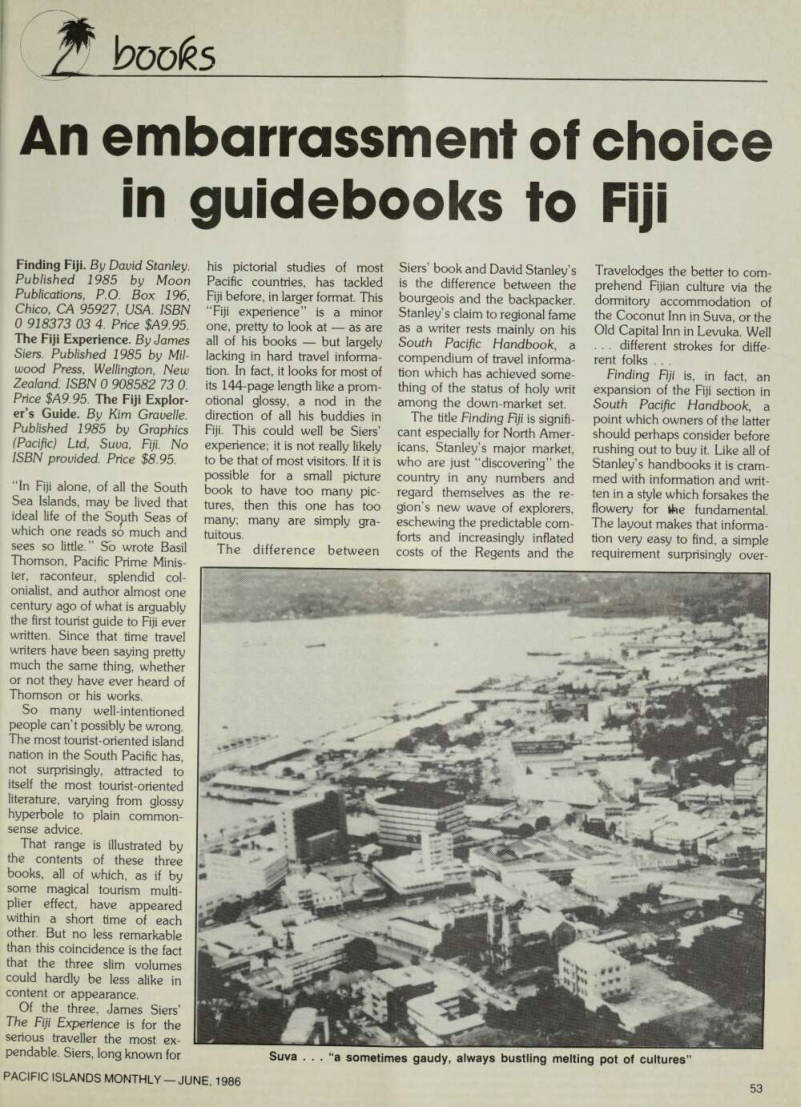
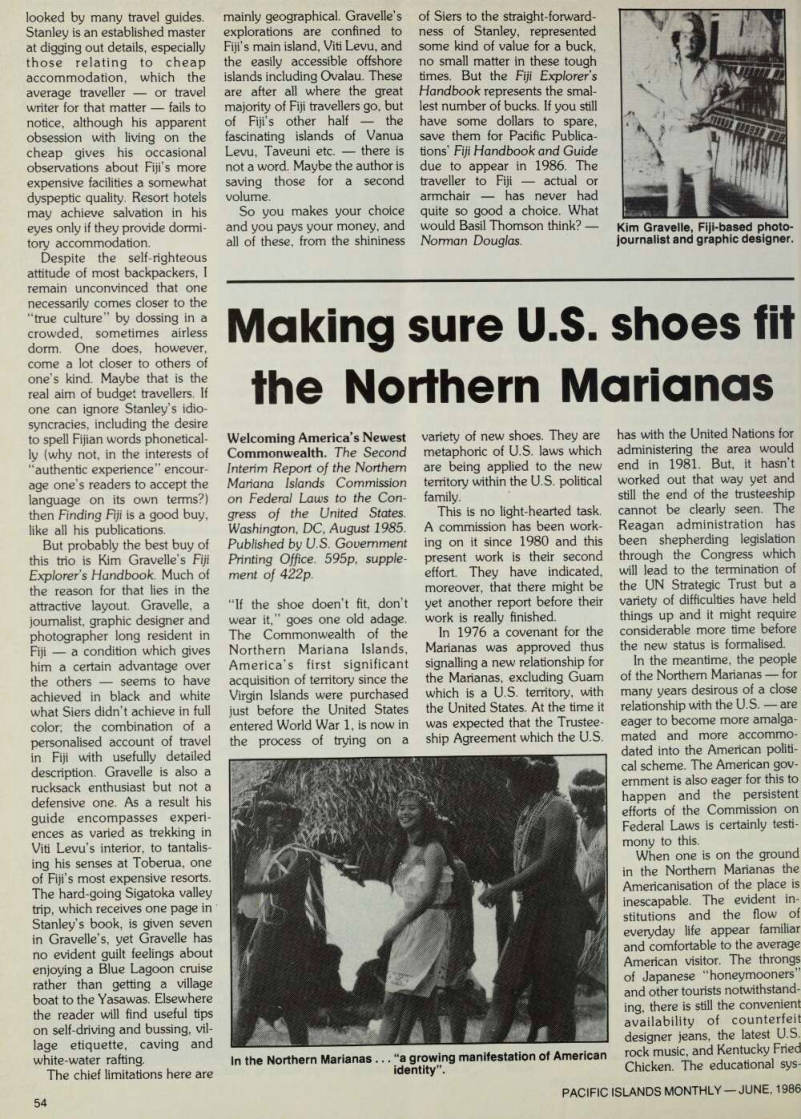
books
An embarrassment of choice in guidebooks to Fiji
Finding Fiji. By David Stanley.
Published 1985 by Moon Publications, P.O. Box 196,
Chico, Ca 95927, Usa. Isbn
0 918373 03 4. Price $A9.95.
The Fiji Experience. By James Siers. Published 1985 by Mil wood Press, Wellington, New Zealand. ISBN 0 908582 73 0.
Price $A9.95. The Fiji Explor er’s Guide. By Kim Grauelle.
Published 1985 by Graphics (Pacific) Ltd, Suva, Fiji. No ISBN provided. Price $8.95.
“In Fiji alone, of all the South Sea Islands, may be lived that ideal life of the South Seas of which one reads so much and sees so little.” So wrote Basil Thomson, Pacific Prime Minis ter, raconteur, splendid col onialist, and author almost one century ago of what is arguably the first tourist guide to Fiji ever written. Since that time travel writers have been saying pretty much the same thing, whether or not they have ever heard of Thomson or his works.
So many well-intentioned people can’t possibly be wrong.
The most tourist-oriented island nation in the South Pacific has, not surprisingly, attracted to itself the most tourist-oriented literature, varying from glossy hyperbole to plain common sense advice.
That range is illustrated by the contents of these three books, all of which, as if by some magical tourism multi plier effect, have appeared within a short time of each other. But no less remarkable than this coincidence is the fact that the three slim volumes could hardly be less alike in content or appearance.
Of the three, James Siers’
The Fiji Experience is for the serious traveller the most ex pendable. Siers, long known for
his pictorial studies of most Pacific countries, has tackled 5? bef ° re ’ in larger format This FIJI ex P erien f e is a minor one > P rett V look at —as are all of his books - but largely lacking in hard travel information. In fact, it looks for most of its 144-page length like a promotional glossy, a nod in the Erection of all his buddies in Fiji. This could well be Siers’ ex P er ience; it is not really likely to be that of most visitors. If it is P° ssib^e f°r a picture book to have too many pictures, then this one has too many; many are simply S 19 ’
“*““»■ The difference between
Siers’book and David Stanley’s is the difference between the bour 9 e °is and the backpacker.
Stanley’s claim to regional fame as a writer rests mainly on his South Pacific Handbook, a compendium of travel information which has achieved something of the status of holy writ among the down-market set.
The title Finding Fiji is significant especially for North Americans, Stanley’s major market, who are just “discovering” the country in any numbers and regard themselves as the region’s new wave of explorers, eschewi ng the predictable comforts and increasingly inflated costs of the Regents and the
Travelodges the better to com prehend Fijian culture via the dormitory accommodation of the Coconut Inn in Suva, or the Old Capital Inn in Levuka Well ... different strokes for diffe rent folks .
Finding Fiji is, in fact an expansion of the Fiji section in South Pacific Handbook, a point which owners of the latter should perhaps consider before rushing out to buy it. Like all of Stanley’s handbooks it is cram med with information and writ ten in a style which forsakes the flowery for the fundamental The layout makes that informa tion very easy to find, a simple requirement surprisingly over-
Suva...“a sometimes gaudy, always bustling melting pot of cultures”
looked by many travel guides.
Stanley is an established master at digging out details, especially those relating to cheap accommodation, which the average traveller or travel writer for that matter fails to notice, although his apparent obsession with living on the cheap gives his occasional observations about Fiji’s more expensive facilities a somewhat dyspeptic quality. Resort hotels may achieve salvation in his eyes only if they provide dormi tory accommodation.
Despite the self-righteous attitude of most backpackers, 1 remain unconvinced that one necessarily comes closer to the “true culture” by dossing in a crowded, sometimes airless dorm. One does, however, come a lot closer to others of one’s kind. Maybe that is the real aim of budget travellers. If one can ignore Stanley’s idio syncracies, including the desire to spell Fijian words phonetical ly (why not, in the interests of “authentic experience” encour age one’s readers to accept the language on its own terms?) then Finding Fiji is a good buy, like all his publications.
But probably the best buy of this trio is Kim Gravelle’s Fiji Explorer’s Handbook. Much of the reason for that lies in the attractive layout. Gravelle, a journalist, graphic designer and photographer long resident in Fiji a condition which gives him a certain advantage over the others seems to have achieved in black and white what Siers didn’t achieve in full color; the combination of a personalised account of travel in Fiji with usefully detailed description. Gravelle is also a rucksack enthusiast but not a defensive one. As a result his guide encompasses experi ences as varied as trekking in Viti Levu’s interior, to tantalis ing his senses at Toberua, one of Fiji’s most expensive resorts.
The hard-going Sigatoka valley trip, which receives one page in Stanley’s book, is given seven in Gravelle’s, yet Gravelle has no evident guilt feelings about enjoying a Blue Lagoon cruise rather than getting a village boat to the Yasawas. Elsewhere the reader will find useful tips on self-driving and bussing, vil lage etiquette, caving and white-water rafting.
The chief limitations here are
mainly geographical. Gravelle’s explorations are confined to Fiji’s main island, Viti Levu, and the easily accessible offshore islands including Ovalau. These are after all where the great majority of Fiji travellers go, but of Fiji’s other half the fascinating islands of Vanua Levu, Taveuni etc. there is not a word. Maybe the author is saving those for a second volume.
So you makes your choice and you pays your money, and all of these, from the shininess
of Siers to the straight-forward ness of Stanley, represented some kind of value for a buck, no small matter in these tough times. But the Fiji Explorers Handbook represents the smal lest number of bucks. If you still have some dollars to spare, save them for Pacific Publica tions’ Fiji Handbook and Guide due to appear in 1986. The traveller to Fiji actual or armchair has never had quite so good a choice. What would Basil Thomson think?
Norman Douglas.
Kim Gravelle, Fiji-based photo journalist and graphic designer.
Making sure U.S. shoes fit
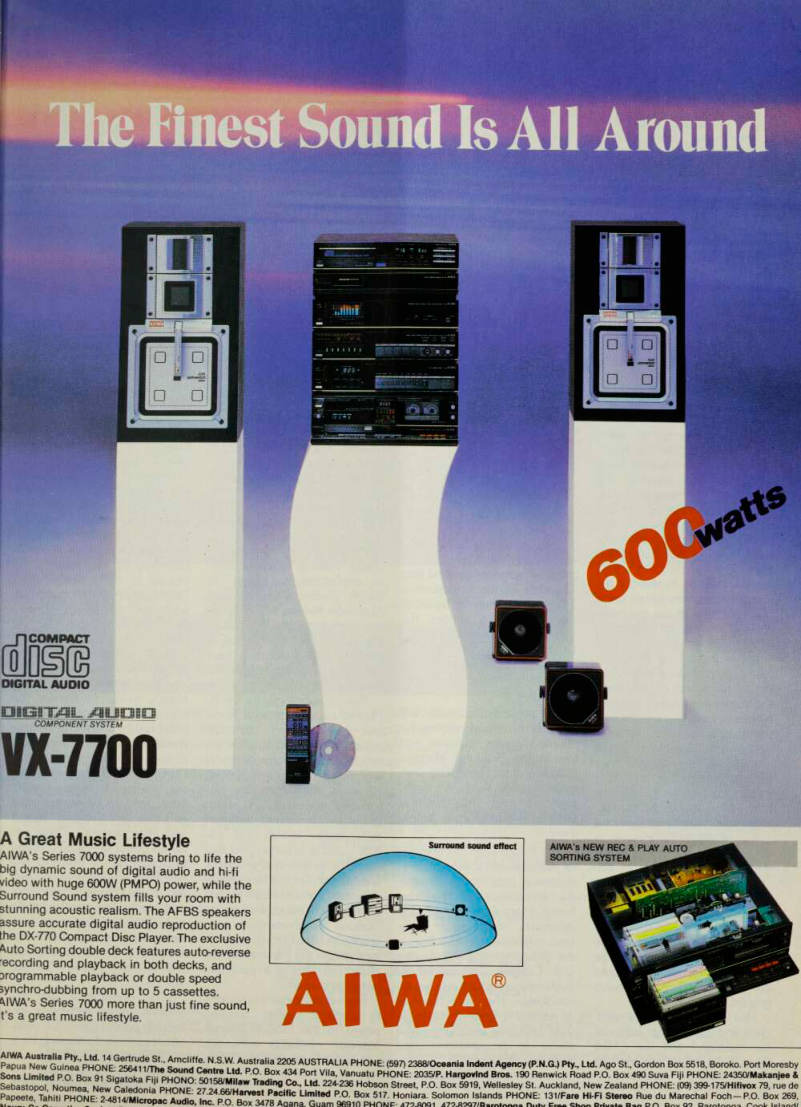
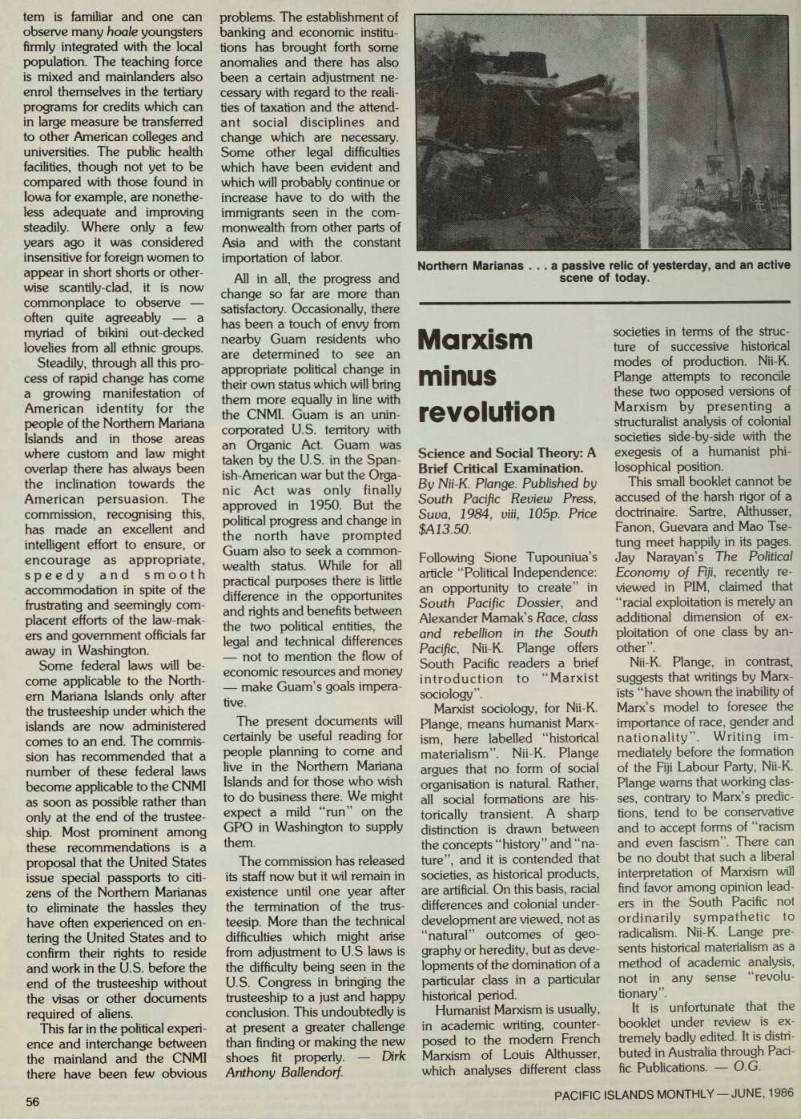
the Northern Marianas
Welcoming America’s Newest Commonwealth. The Second Interim Report of the Northern Mariana Islands Commission on Federal Laws to the Congress of the United States.
Washington, DC, August 1985.
Published by U.S. Government Printing Office. 595 p, supplement of 422 p.
“If the shoe doen’t fit, don’t wear it,” goes one old adage, The Commonwealth of the Northern Mariana Islands, America’s first significant acquisition of territory since the Virgin Islands were purchased just before the United States entered World War 1, is now in the process of trying on a
variety of new shoes. They are metaphoric of U.S. laws which are being applied to the new territory within the U.S. political family.
This is no light-hearted task, A commission has been work ing on it since 1980 and this present work is their second effort. They have indicated, moreover, that there might be yet another report before their work is really finished.
In 1976 a covenant for the Marianas was approved thus signalling a new relationship for the Marianas, excluding Guam which is a U.S. territory, with the United States. At the time it was expected that the Trustee ship Agreement which the U.S.
has with the United Nations for administering the area would end in 1981. But, it hasn’t worked out that way yet and still the end of the trusteeship cannot be clearly seen. The Reagan administration has been shepherding legislation through the Congress which will lead to the termination of the UN Strategic Trust but a variety of difficulties have held things up and it might require considerable more time before the new status is formalised.
In the meantime, the people of the Northern Marianas for many years desirous of a close relationship with the U.S. are eager to become more amalga mated and more accommo dated into the American politi cal scheme. The American gov ernment is also eager for this to happen and the persistent efforts of the Commission on Federal Laws is certainly testi mony to this.
When one is on the ground in the Northern Marianas the Americanisation of the place is inescapable. The evident in stitutions and the flow of everyday life appear familiar and comfortable to the average American visitor. The throngs of Japanese “honeymooners” and other tourists notwithstand ing, there is still the convenient availability of counterfeit designer jeans, the latest U.S. rock music, and Kentucky Fried Chicken. The educational sys
In the Northern Marianas...“a growing manifestation of American identity”.
tern is familiar and one can observe many hoale youngsters firmly integrated with the local population. The teaching force is mixed and mainlanders also enrol themselves in the tertiary programs for credits which can in large measure be transferred to other American colleges and universities. The public health facilities, though not yet to be compared with those found in lowa for example, are nonethe less adequate and improving steadily. Where only a few years ago it was considered insensitive for foreign women to appear in short shorts or other wise scantily-clad, it is now commonplace to observe often quite agreeably a myriad of bikini out-decked lovelies from all ethnic groups.
Steadily, through all this pro cess of rapid change has come a growing manifestation of American identity for the people of the Northern Mariana Islands and in those areas where custom and law might overlap there has always been the inclination towards the American persuasion. The commission, recognising this, has made an excellent and intelligent effort to ensure, or encourage as appropriate, speedy and smooth accommodation in spite of the frustrating and seemingly com placent efforts of the law-mak ers and government officials far away in Washington.
Some federal laws will be come applicable to the North ern Mariana Islands only after the trusteeship under which the islands are now administered comes to an end. The commis sion has recommended that a number of these federal laws become applicable to the CNMI as soon as possible rather than only at the end of the trustee ship. Most prominent among these recommendations is a proposal that the United States issue special passports to citi zens of the Northern Marianas to eliminate the hassles they have often experienced on en tering the United States and to confirm their rights to reside and work in the U.S. before the end of the trusteeship without the visas or other documents required of aliens.
This far in the political experi ence and interchange between the mainland and the CNMI there have been few obvious
problems. The establishment of banking and economic institu tions has brought forth some anomalies and there has also been a certain adjustment ne cessary with regard to the reali ties of taxation and the attend ant social disciplines and change which are necessary.
Some other legal difficulties which have been evident and which will probably continue or increase have to do with the immigrants seen in the com monwealth from other parts of Asia and with the constant importation of labor.
All in all, the progress and change so far are more than satisfactory. Occasionally, there has been a touch of envy from nearby Guam residents who are determined to see an appropriate political change in their own status which will bring them more equally in line with the CNM1. Guam is an unin corporated U.S. territory with an Organic Act. Guam was taken by the U.S. in the Span ish-American war but the Orga nic Act was only finally approved in 1950. But the political progress and change in the north have prompted Guam also to seek a common wealth status. While for all practical purposes there is little difference in the opportunites and rights and benefits between the two political entities, the legal and technical differences — not to mention the flow of economic resources and money — make Guam’s goals impera tive.
The present documents will certainly be useful reading for people planning to come and live in the Northern Mariana Islands and for those who wish to do business there. We might expect a mild “run” on the GFO in Washington to supply them.
The commission has released its staff now but it wil remain in existence until one year after the termination of the trus teesip. More than the technical difficulties which might arise from adjustment to U.S laws is the difficulty being seen in the U.S. Congress in bringing the trusteeship to a just and happy conclusion. This undoubtedly is at present a greater challenge than finding or making the new
shoes fit properly.
Dirk
Anthony Ballendorf.
Northern Marianas...a passive relic of yesterday, and an active scene of today.
Advertisements & other items, p. 55 (1 item)
Aiwa
COMPACT
DIGITAL AUDIO
OIGITOL J«jaiO
COMPONENT SYSTEM
VX-7700
A Great Music Lifestyle
AlWA’s Series 7000 systems bring to life the big dynamic sound of digital audio and hi-fi video with huge 600 W (PMPO) power, while the Surround Sound system fills your room with stunning acoustic realism. The AFBS speakers assure accurate digital audio reproduction of the DX-770 Compact Disc Player. The exclusive Auto Sorting double deck features auto-reverse 'ecording and playback in both decks, and arogrammable playback or double speed synchro-dubbing from up to 5 cassettes.
MWA’s Series 7000 more than just fine sound, t’s a great music lifestyle.
Surround sound effect
AIWA
AlWA’s NEW REC & PLAY AUTO
SORTING SYSTEM
Papua New Guinea NS -W-Australia 2205 AUSTRALIA PHONE; (597) 2388/Oceania Indent Agency (P.N.G.) Pty., Ltd. Ago St., Gordon Box 5518, Boroko. Port Moresby h td ' P ° B ° X 434 Port Vila ’ Vanuatu PHONE: 2035/P- Hargovlnd Bros. 190 Renwick Road P.O Box 490 Suva Fiji PHONE: 24350/Makanjee ft Sebastopol, Noumea, New Caledonia Street ’ P ° B ° X 5919 ’ We " eS ' ey St Auckland - New Zealand PHONE; W 399-175/Hifivox 79, rue de 80X91 Si9at ° ka F * p HONO: 5015& MI la Ltd.224-236 Hobson 2 7 -24 D 6^ H « rveBt Pacific Limited PO. Box 517. Honiara. Solomon Islands PHONE; 131/Fare Hi-Fi Stereo Rue du Marechal Foch-P.O. Box 269, u • 48 14/Microp ac Audio, Inc. P.O. Box 3478 Aoana. Guam 96910 PHONF- 479-ft9Q7/B amtnnna Hutu Proo Qhnn Driuato Ran PO Rnv Q O Darnfr\nno Caalt IclanH/
revolution
Marxism minus revolution
Science and Social Theory: A Brief Critical Examination.
By Nii-K. Flange. Published by South Pacific Review Press, Suva, 1984, uiii, 105 p. Price $A13.50.
Following Sione Tupouniua’s article “Political Independence; an opportunity to create” in South Pacific Dossier, and Alexander Mamak’s Race, class and rebellion in the South Pacific, Nii-K. Flange offers South Pacific readers a brief introduction to “Marxist sociology”.
Marxist sociology, for Nii-K.
Flange, means humanist Marx ism, here labelled “historical materialism”. Nii-K. Flange argues that no form of social organisation is natural. Rather, all social formations are his torically transient. A sharp distinction is drawn between the concepts “history” and “na ture”, and it is contended that societies, as historical products, are artificial. On this basis, racial differences and colonial under development are viewed, not as “natural” outcomes of geo graphy or heredity, but as deve lopments of the domination of a particular class in a particular historical period.
Humanist Marxism is usually, in academic writing, counter posed to the modem French Marxism of Louis Althusser, which analyses different class
societies in terms of the struc ture of successive historical modes of production. Nii-K.
Flange attempts to reconcile these two opposed versions of Marxism by presenting a structuralist analysis of colonial societies side-by-side with the exegesis of a humanist phi losophical position.
This small booklet cannot be accused of the harsh rigor of a doctrinaire. Sartre, Althusser, Fanon, Guevara and Mao Tse tung meet happily in its pages.
Jay Narayan’s The Political Economy of Fiji, recently re viewed in PIM, claimed that “racial exploitation is merely an additional dimension of ex ploitation of one class by an other”.
Nii-K. Flange, in contrast, suggests that writings by Marx ists “have shown the inability of Marx’s model to foresee the importance of race, gender and nationality”. Writing im mediately before the formation of the Fiji Labour Party, Nii-K.
Flange warns that working clas ses, contrary to Marx’s predic tions, tend to be conservative and to accept forms of “racism and even fascism”. There can be no doubt that such a liberal interpretation of Marxism will find favor among opinion lead ers in the South Pacific not ordinarily sympathetic to radicalism. Nii-K. Lange pre sents historical materialism as a method of academic analysis, not in any sense “revolu tionary”.
It is unfortunate that the booklet under review is ex tremely badly edited. It is distri buted in Australia through Pad
fic Publications.
O.G.
Advertisements & other items, p. 57 (1 item)
Go to the Head of the Class
f# M F 5 x 770
□lliiE
Go ahead, move up to Pioneer’s New Personna Plus X-770 shelf-component system, and discover peerless perfection.
This super-sophisticated mini-sized sound system offers full-function remote control for amp, tuner, cassette deck, turntable, and the optional CD player. Together, they put cutting edge audio technology at your command as Pioneer alone can.
Simulated Stereo lets you enjoy wide, stereo-like signals from mono signals. And Stereo Wide brings you expanded ambience from stereo signals, so you’re as turned on as possible no matter what you tune in!
Power? 320 W Peak Music Power Output from the double auto-reverse cassette deck/amplifier. You’ll flip over the music, without flipping the tape over, as well as enjoy double cassette convenience.
Of course, the X-770 also brings you great features like 5-band graphic equalizer, Mic Mixing, Dolby* B/C NR, and more.
The New Personna X-770. Go for it and go to the head of the class. * “Dolby” and the double-D symbol are trademarks of Dolby Laboratories Licensing Corporation Note: The optional PD-X707(8K) CD player is shown above
dO PIONEER
The future of sound and vision.
For further information, please contact; Australia: Pioneer Electronics Australia Pty. Ltd. (Incorporated in Victoria), P-0. Box 295, Mordialloc, Victoria, 3195 Tel: 580-9911 Fiji Islands: Brijlal & Company, G.P.O. Box No. 362, Suva, Fiji Islands Tel: 22258 New Zealand: Monaco Distributors Ltd, 2 Poland Road, Glenfield, Auckland New Zealand Tel: (09) 444-9144 Norfolk Island: Bums Philp (Norfolk Island) Ltd, P.O. Box 21, Norfolk Island Vanuatu: Bums Philp (Vanuatu) Ltd, Vila, Vanuatu Nauru Island: Jacob Enterprises, P.O. Box N 0.4,.4, Republic of Nauru Tahiti: Tahiti Hi-Fi, P.O. Box 848, Papeete, Tahiti New Caledonia: Menard Pacifique Sari, B.P. 3899, Noumea, New Caledonia Tel: 27-62.23 American Samoa: Transpac Corporation, P.O. Box 1477, Pago Pago, American Samoa 96799 Tel: 633-5224 Rarotonga: South Seas International Ltd, P.O. Box 49, Rarotonga, Cook Islands Tel: 2327 Papua New Guinea: Bali Merchants Pty. Ltd, P.O. Box 6103, Boroko Tel; 254887
Pacific stamp box
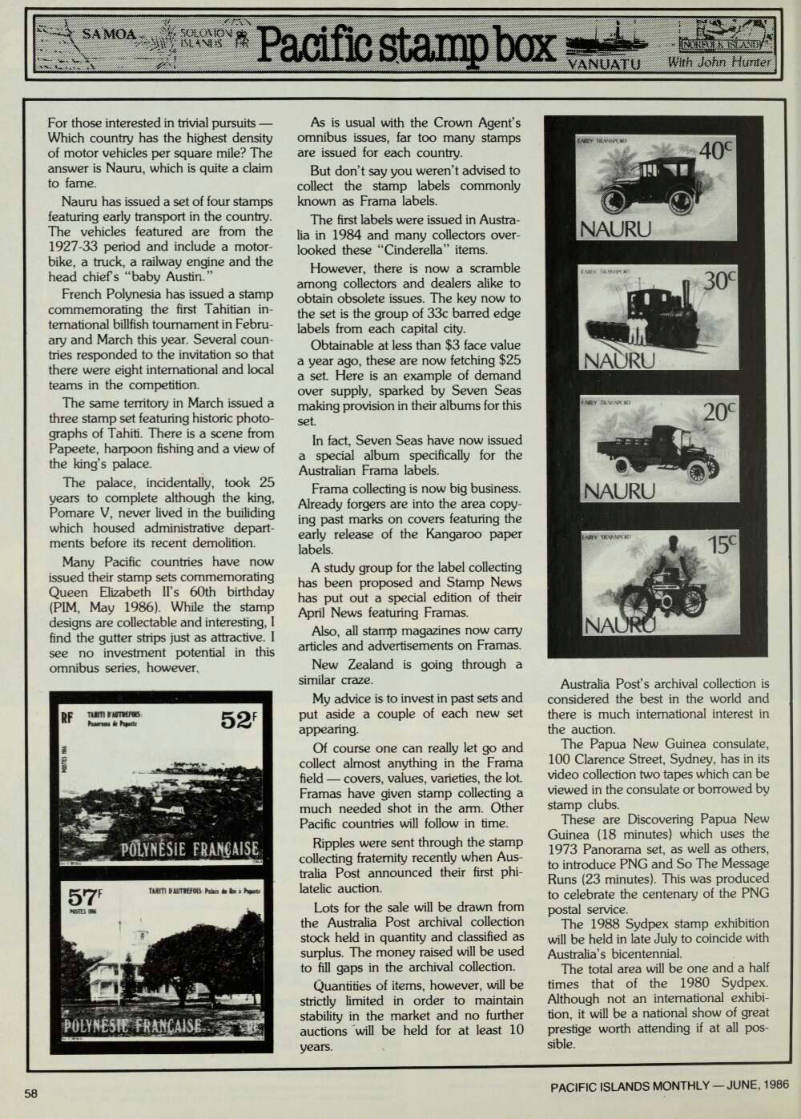
For those interested in trivial pursuits Which country has the highest density of motor vehicles per square mile? The answer is Nauru, which is quite a claim to fame.
Nauru has issued a set of four stamps featuring early transport in the country.
The vehicles featured are from the 1927-33 period and include a motor bike, a truck, a railway engine and the head chiefs “baby Austin.”
French Polynesia has issued a stamp commemorating the first Tahitian in ternational billfish tournament in Febru ary and March this year. Several coun tries responded to the invitation so that there were eight international and local teams in the competition.
The same territory in March issued a three stamp set featuring historic photo graphs of Tahiti. There is a scene from Papeete, harpoon fishing and a view of the king’s palace.
The palace, incidentally, took 25 years to complete although the king, Pomare V, never lived in the builiding which housed administrative depart ments before its recent demolition.
Many Pacific countries have now issued their stamp sets commemorating Queen Elizabeth 11’s 60th birthday (PIM, May 1986). While the stamp designs are collectable and interesting, I find the gutter strips just as attractive. I see no investment potential in this omnibus series, however.
As is usual with the Crown Agent’s omnibus issues, far too many stamps are issued for each country.
But don’t say you weren’t advised to collect the stamp labels commonly known as Frama labels.
The first labels were issued in Austra lia in 1984 and many collectors over looked these “Cinderella” items.
However, there is now a scramble among collectors and dealers alike to obtain obsolete issues. The key now to the set is the group of 33c barred edge labels from each capital city.
Obtainable at less than $3 face value a year ago, these are now fetching $25 a set Here is an example of demand over supply, sparked by Seven Seas making provision in their albums for this set In fact. Seven Seas have now issued a special album specifically for the Australian Frama labels.
Frama collecting is now big business.
Already forgers are into the area copy ing past marks on covers featuring the early release of the Kangaroo paper labels.
A study group for the label collecting has been proposed and Stamp News has put out a special edition of their April News featuring Framas.
Also, all stamp magazines now carry articles and advertisements on Framas.
New Zealand is going through a similar craze.
My advice is to invest in past sets and put aside a couple of each new set appearing.
Of course one can really let go and collect almost anything in the Frama field covers, values, varieties, the lot Framas have given stamp collecting a much needed shot in the arm. Other Pacific countries will follow in time.
Ripples were sent through the stamp collecting fraternity recently when Aus tralia Post announced their first phi latelic auction.
Lots for the sale will be drawn from the Australia Post archival collection stock held in quantity and classified as surplus. The money raised will be used to fill gaps in the archival collection.
Quantities of items, however, will be strictly limited in order to maintain stability in the market and no further auctions will be held for at least 10 years.
Australia Post’s archival collection is considered the best in the world and there is much international interest in the auction.
The Papua New Guinea consulate, 100 Clarence Street, Sydney, has in its video collection two tapes which can be viewed in the consulate or borrowed by stamp clubs.
These are Discovering Papua New Guinea (18 minutes) which uses the 1973 Panorama set, as well as others, to introduce PNG and So The Message Runs (23 minutes). This was produced to celebrate the centenary of the PNG postal service.
The 1988 Sydpex stamp exhibition will be held in late July to coincide with Australia’s bicentennial.
The total area will be one and a half times that of the 1980 Sydpex.
Although not an international exhibi tion, it will be a national show of great prestige worth attending if at all pos sible.
people
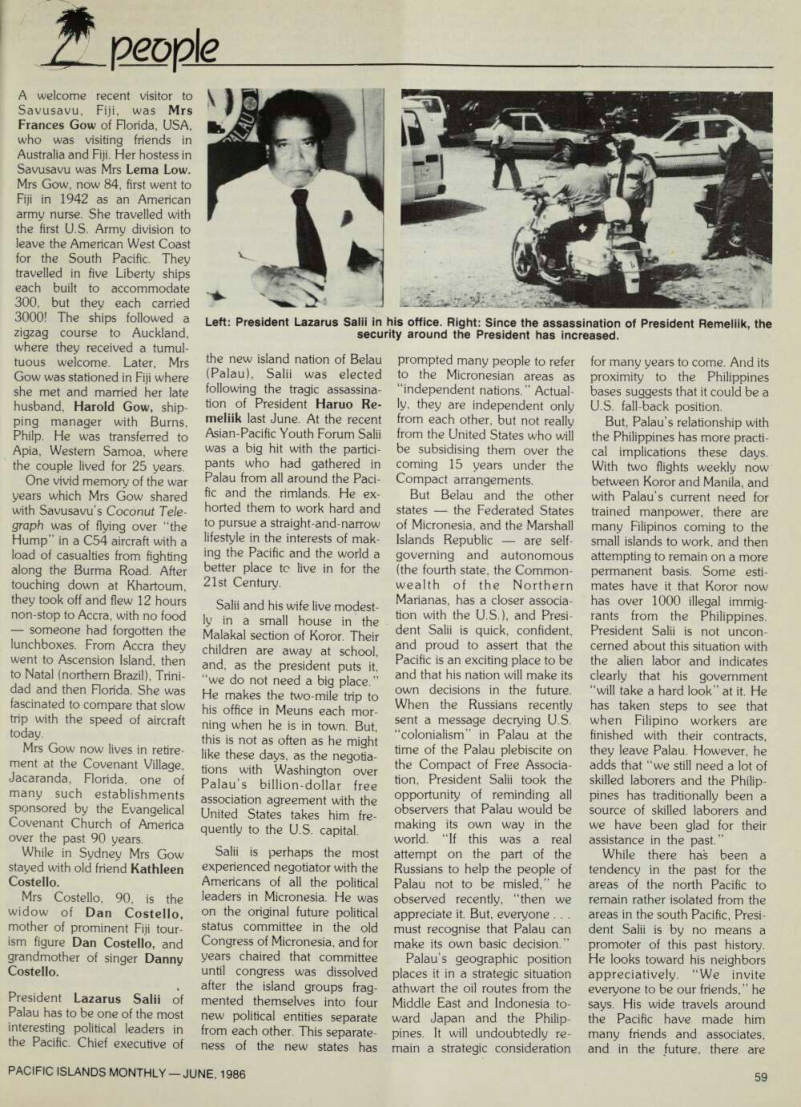
A welcome recent visitor to Savusavu, Fiji, was Mrs Frances Gow of Florida, USA, who was visiting friends in Australia and Fiji. Her hostess in Savusavu was Mrs Lema Low.
Mrs Gow, now 84, first went to Fiji in 1942 as an American army nurse. She travelled with the first U.S. Army division to leave the American West Coast for the South Pacific. They travelled in five Liberty ships each built to accommodate 300, but they each carried 3000! The ships followed a zigzag course to Auckland, where they received a tumul tuous welcome. Later, Mrs Gow was stationed in Fiji where she met and married her late husband, Harold Gow, ship ping manager with Burns, Philp. He was transferred to Apia, Western Samoa, where the couple lived for 25 years.
One vivid memory of the war years which Mrs Gow shared with Savusavu’s Coconut Tele graph was of flying over “the Hump” in a C 54 aircraft with a load of casualties from fighting along the Burma Road. After touching down at Khartoum, they took off and flew 12 hours non-stop to Accra, with no food someone had forgotten the lunchboxes. From Accra they went to Ascension Island, then to Natal (northern Brazil), Trini dad and then Florida. She was fascinated to compare that slow trip with the speed of aircraft today.
Mrs Gow now lives in retire ment at the Covenant Village, Jacaranda, Florida, one of many such establishments sponsored by the Evangelical Covenant Church of America over the past 90 years.
While in Sydney Mrs Gow stayed with old friend Kathleen Costello.
Mrs Costello, 90, is the widow of Dan Costello, mother of prominent Fiji tour ism figure Dan Costello, and grandmother of singer Danny Costello.
President Lazarus Salii of Palau has to be one of the most interesting political leaders in the Pacific. Chief executive of
the new island nation of Belau (Palau), Salii was elected following the tragic assassina tion of President Haruo Re meliik last June. At the recent Asian-Pacific Youth Forum Salii was a big hit with the partici pants who had gathered in Palau from all around the Paci fic and the rimlands. He ex horted them to work hard and to pursue a straight-and-narrow lifestyle in the interests of mak ing the Pacific and the world a better place to live in for the 21st Century.
Salii and his wife live modest ly in a small house in the Malakal section of Koror. Their children are away at school, and, as the president puts it, “we do not need a big place.”
He makes the two-mile trip to his office in Meuns each mor ning when he is in town. But, this is not as often as he might like these days, as the negotia tions with Washington over Palau’s billion-dollar free association agreement with the United States takes him fre quently to the U.S. capital.
Salii is perhaps the most experienced negotiator with the Americans of all the political leaders in Micronesia. He was on the original future political status committee in the old Congress of Micronesia, and for years chaired that committee until congress was dissolved after the island groups frag mented themselves into four new political entities separate from each other. This separate ness of the new states has
prompted many people to refer to the Micronesian areas as “independent nations.” Actual ly, they are independent only from each other, but not really from the United States who will be subsidising them over the coming 15 years under the Compact arrangements.
But Belau and the other states the Federated States of Micronesia, and the Marshall Islands Republic are self governing and autonomous (the fourth state, the Common wealth of the Northern Marianas, has a closer associa tion with the U.S.), and Presi dent Salii is quick, confident, and proud to assert that the Pacific is an exciting place to be and that his nation will make its own decisions in the future.
When the Russians recently sent a message decrying U.S.
“colonialism” in Palau at the time of the Palau plebiscite on the Compact of Free Associa tion, President Salii took the opportunity of reminding all observers that Palau would be making its own way in the world. “If this was a real attempt on the part of the Russians to help the people of Palau not to be misled,” he observed recently, “then we appreciate it. But, everyone . . . must recognise that Palau can make its own basic decision.”
Palau’s geographic position places it in a strategic situation athwart the oil routes from the Middle East and Indonesia to ward Japan and the Philip pines. It will undoubtedly re main a strategic consideration
for many years to come. And its proximity to the Philippines bases suggests that it could be a U.S. fall-back position.
But, Palau’s relationship with the Philippines has more practi cal implications these days.
With two flights weekly now between Koror and Manila, and with Palau’s current need for trained manpower, there are many Filipinos coming to the small islands to work, and then attempting to remain on a more permanent basis. Some esti mates have it that Koror now has over 1000 illegal immig rants from the Philippines.
President Salii is not uncon cerned about this situation with the alien labor and indicates clearly that his government “will take a hard look” at it. He has taken steps to see that when Filipino workers are finished with their contracts, they leave Palau. However, he adds that “we still need a lot of skilled laborers and the Philip pines has traditionally been a source of skilled laborers and we have been glad for their assistance in the past.”
While there has been a tendency in the past for the areas of the north Pacific to remain rather isolated from the areas in the south Pacific, Presi dent Salii is by no means a promoter of this past history.
He looks toward his neighbors appreciatively. “We invite everyone to be our friends,” he says. His wide travels around the Pacific have made him many friends and associates, and in the future, there are
Left: President Lazarus Salii in his office. Right: Since the assassination of President Remeliik, the security around the President has increased.
bound to be more. There is much that the island nations both north and south of the equator have to learn from each other, and the Palauans are eager for more exchange.
And what does Mr Salii think of the French and their colonial policies in the Pacific.
“I think the French policies are way out-dated,” he said recent ly in his office, and he feels that the models which have been used between his country and the United States free association as a political status offer much promise and hope for the French and the people of New Caledonia. “I think that is the direction they should move in,” he said con fidently. As for nuclear testing, Salii is even stronger. “I am totally opposed to that. We’ve taken a stand . . . (We ask) that such activity be terminated.”
President Salii believes that the future of Palau is very bright, and one can sense that he intends to optimise the brightness. There is much activ ity in Koror these days, and a growing articulation with the greater world beyond the Palauan waters. The recent convention of the Pacific-Asian Youth Forum held in Palau demonstrated that the people there have the organisational ability to accommodate aptly large groups of diverse people in short order. A growing num ber of hotel rooms and even luxury resorts promise to keep Palau moving ahead toward a living standard for the people which will encourage affluence and make Palau a much larger spot on the Pacific map. Dirk Anthony Ballendorf.
Solomon Islands has a new British High Commissioner, John Bramble Noss, who took up duties in Honiara on March 17.
Mr Noss replaces George Stansfield, CBE, who left the country in March after a three year assignment.
Mr Noss has seen service in Lebanon, Denmark, the USSR, Chile, and the USA.
His most recent appointment was in New York, where he served in the British consulate general for four years.
Chairman of Solomon Islands’
Public Service Commission, Sir Fred Osifelo, retired on March 31 after 41 years in government
service.
An official reception in his honor was held at Rove Police Club, Honiara, attended by the Prime Minister, Sir Peter Keni lorea, and many government officers.
The prime minister expressed gratitude to Sir Fred on behalf of the government and people of the Solomon Islands for the loyal and dedicated service he had rendered to the country during his 41 years of service both as a public servant, Speaker of the Legislative Gov erning Council, and chairman of the Public Service Commis sion.
“There is much to thank him for; a colleague, statesman and friend of enormous distinction,”
Sir Peter said.
Throughout his distinguished career he demonstrated admin istrative skills of very high and outstanding merit, and with his dedication to duty and con tinued loyalty should serve as an example to us all, Sir Peter told guests.
Sir Fred was born in October 15, 1928, on Malaita.
Outlining Sir Fred’s career, the prime minister said his 41 years’ service started on April 22, 1945, under the colonial administration as a so-called Learner Clerk in the then Sec retariat.
He continued to receive promotions in various clerical grades until he became Higher Clerical Officer in 1958.
Sir Fred applied to join the Administration Cadre in 1960, and the following year was appointed Assistant Administra tion Officer (Cadet).
He was appointed a member of the Pidgin English Examina tion Board in 1962, and in 1964/65 attended an adminis tration course in Britain.
He sat and passed the local law exams in 1966, and in 1967 was promoted to Admin istrative Officer (District Offic er), Class B. In 1970 he was promoted to Deputy Commis sioner of Lands, and in 1971 became first SI District Com missioner in charge of Eastern District. A year later, he was promoted to Administrative Officer Class A, the highest grade in the Administration Cadre.
He became Commissioner of
Lands in 1974 and was first Senior Secretary to Local Gov ernment, equivalent to what is now known as Permanent Sec retary.
Sir Fred retired from the Public Service in 1975, and was appointed chairman of the then Public Service Advisory Board and also Speaker of the Legisla tive Government Council.
In 1978, when the Solomon Islands attained independence and gained its own constitution, he became chairman of the Public Service Commission, a position he held until his retire ment.
For his dedicated service to the government, Sir Fred was decorated in 1972 with an MBE. Five years later he be came the first Solomon Islander to be knighted by Queen Eliza beth.
As a keen sportsman, he was manager of the Solomon Is lands team to the 1975 South Pacific Games in Guam.
A man with no formal educa tion, Sir Fred recently wrote a book, Kanaka Boy, which re lates his life story (see review in PIM, Nov. ’B5, p4l).
Among other things Sir Fred told the guests at the reception, he encouraged fellow public servants to be serious and stick to whatever jobs they under take in truly serving their people and the country. He advised them not to be put off easily in their work or despair merely because they were not in a good mood or were unhappy with their boss.
“I am only leaving the service,” he said. “But I will still be part of the community.”
Officials from the South Pacific Bureau for Economic Co operation (SPEC) and the United Nations Pacific Energy Development Program (UN PEDP), both based in Fiji, were at Honolulu’s East-West Center in March to discuss possible collaboration. Trevor Sofield and Murray Ellis of SPEC, Pe ter Johnston and George Tavanavanua of UNPEDP met with Pacific Islands Deve lopment Proram (PIDP) Acting director Tc o Fairbairn and PIDP staff Sofield is deputy director and Ellis is senior ener gy officer at SPEC. Johnston is project manager and Tavana vanua is petroleum officer at
Unpedp.
Janice Pearson of the Cook Islands joined the East-West Center’s Pacific Islands Devel opment Program in February for a six-month internship. She will write a paper on indigenous business policy in the Cook Islands.
The first resident ambassador of the Republic of China (Taiwan) to Solomon Islands, Chi-Kun Ning, has presented his credentials to the SI Governor- General, Sir Baddeley Devesi.
The governor-general told Mr Ning at the ceremony that since Solomon Islands and Taiwan entered a common understanding in upgrading diplomatic relations from con sular level to full ambassadorial status, some progress had been achieved in the consolidation of the relationship. Appointment of the first resident ROC ambassador was a part of that process.
Sir Baddeley said; “There are countries whose intention in making friends is to do so simply for support at internatio nal forums, or to have support for their ideologies. Solomon Islands believes in ties that result in tangible benefits.”
The governor-general added that he was happy that much had already been achieved in co-operation in the fields of agriculture, fisheries, manpow er training and sports.
Norfolk Island’s oldest resi dent, Miss Charlotte Bailey, celebrated her 101st birthday on March 3.
She is one of the six children of Emily Wellesley Christian (born on Pitcairn) and George Bailey of Devon, England, who came to Norfolk via New Zea land in the 1870 s.
In 1985, for her 100th birth day, 100 palm trees were planted in the Norfolk Island Hospital grounds, and the “Charlotte Bailey Place” a seat and small garden was dedicated in her honor opposite the Fletcher Christian Apart ments.
On the 101st birthday, a further palm tree the 101st was planted in the hospital grounds near the Baby Clinic.
The tree was planted by Char lotte’s youngest grand-nephew, Edward Christian-Bailey.
All set for big race
yachts
First acceptances are in for the 1986 Foster’s Darwin to Ambon race.
First yachts off the rank were Alanel from Victoria and Sundancer 111 from Western Aus- Alanel, an 11 metre fibre glass craft from the Hastings Yacht Club on Westemport Bay, is described by her owner Alan Anderson as not a fast boat Built and launched by Alan in
1976 as a cruising yacht Alanel was used to explore Tasmanian waters extensively before ven ‘udng forth on a Pacific cn i*f e in 1983. , e was ex P in Darwin late last month after waiting out the cyclone season in Cairns.
Sundancer 111 shows Freman tie as her home port but was last month to be found at Groote Eyland t s a remote min . in g community in the Gulf of Carpentaria.
An 11.6 metre cruising sloop,
her owner Noel Small has been accepted as an affiliated mem ber of the Gove Yacht Club under whose colours he will sail in the Darwin-Ambon event.
Both Aland and Sundancer 111 have indicated that they will go on to cruise Indonesian waters extensively after the race.
Race acceptance includes the issue of an Indonesian sailing clearance permit.
At the and of last month, there had already been 29
expressions of interest from Darwin yachts for the Darwin- Ambon race.
And with a grand total of more than 60 expressions of interest received, the organising committee is now even more confident that it will be a record fleet that sets sail on August 2.
The race administrator can be contacted at GPO Box 1677, Darwin, NT 5794, Aus tralia. (telephone 089 277614 telex AA 84004).
Advertisements & other items, p. 61 (1 item)
Clark
A
Agents wanted by Clark Aluminium Boats
to make waves in the South Pacific ...
Clark Aluminium Boats wish to appoint further distributors throughout the Pacific Islands for their range of boats from 8 - 21 ft These craft are particularly suited to the Islands’ fishing and transport industries, requiring minimal maintenance and low h.p. propulsion.
Light weight, naturally, with fully-welded construction to add to the strength and durability. Clark boats are currently exported as CKD, SKD, or completely built-up.
Opportunity If you have the facility to assemble and / or market aluminium boats, we want to talk to you.
Deal Direct By dealing direct with the manufacturer, the agent saves the extra expense of handling charges from a third party.
Manufactured and distributed by
MAYFAIRS W’SALE Pty. Ltd.
Viking Drive, Wacol, Brisbane Q. 4070
AUSTRALIA
Telephone (07) 271 1122 Telex A 41913 Fax 52 4610 For further details contact Neil Bevan, General Manager Marine Division.
SEa
from the islands press
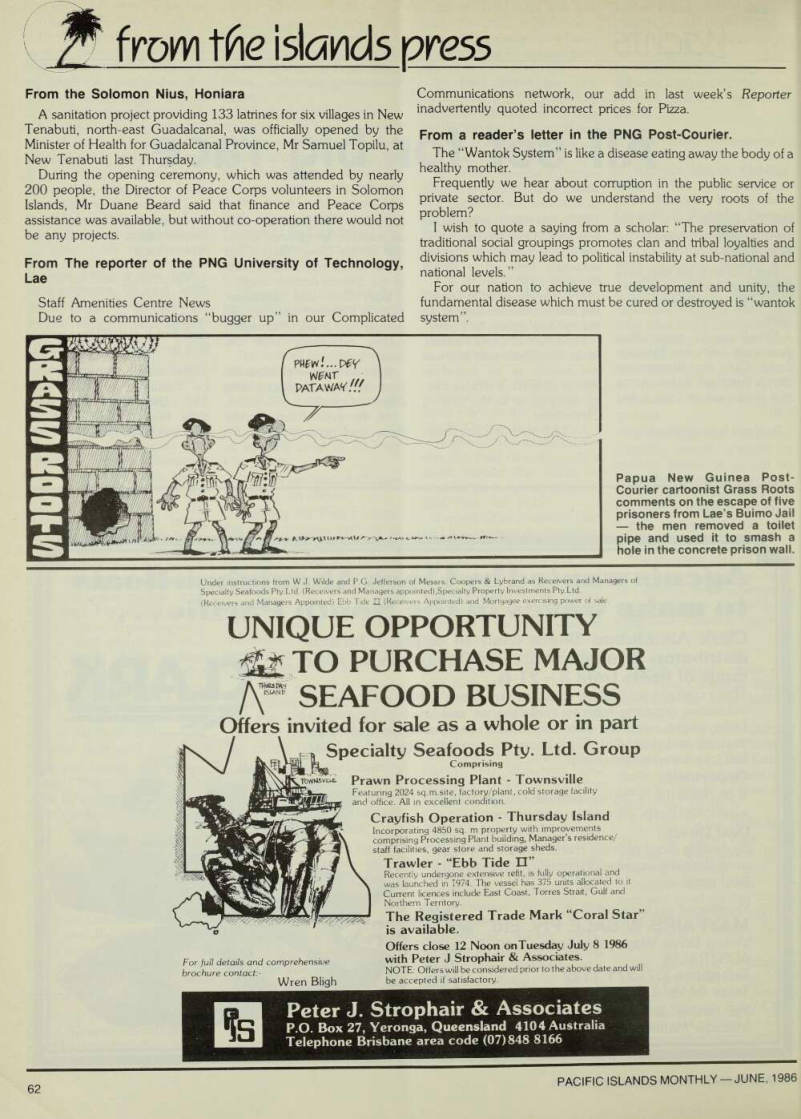
From the Solomon Nius, Honiara A sanitation project providing 133 latrines for six villages in New Tenabuti, north-east Guadalcanal, was officially opened by the Minister of Health for Guadalcanal Province, Mr Samuel Topilu, at New Tenabuti last Thursday.
During the opening ceremony, which was attended by nearly 200 people, the Director of Peace Corps volunteers in Solomon Islands, Mr Duane Beard said that finance and Peace Corps assistance was available, but without co-operation there would not be any projects.
From The reporter of the PNG University of Technology, Lae Staff Amenities Centre News Due to a communications “bugger up” in our Complicated
Communications network, our add in last week’s Reporter inadvertently quoted incorrect prices for Pizza.
From a reader’s letter in the PNG Post-Courier.
The “ Wantok System” is like a disease eating away the body of a healthy mother.
Frequently we hear about corruption in the public service or private sector. But do we understand the very roots of the problem?
I wish to quote a saying from a scholar: “The preservation of traditional social groupings promotes clan and tribal loyalties and divisions which may lead to political instability at sub-national and national levels.”
For our nation to achieve true development and unity, the fundamental disease which must be cured or destroyed is “wantok system”.
Papua New Guinea Post- Courier cartoonist Grass Roots comments on the escape of five prisoners from Lae’s Buimo Jail -the men removed a toilet pipe and used it to smash a hole in the concrete prison wall.
Advertisements & other items, p. 62 (1 item)
Unique Opportunity
Under instructions from W.J. Wilde and P.G. Jefferson of Messrs. Coopers & Lybrand as Receivers and Managers of Specialty Seafoods Pty.Ltd. (Receivers and Managers appointed),Specialty Property Investments Pty.Ltd. (Receivers and Managers Appointed) Ebb Tide II (Receivers Appointed) and Mortgagee exercising power of sale. nbeaßvy
TO PURCHASE MAJOR
SEAFOOD BUSINESS
Offers invited for sale as a whole or in part
Specialty Seafoods Pty. Ltd. Group
Comprising Prawn Processing Plant - Townsville Featuring 2024 sq.m.site, factory/plant, cold storage facility and office. All in excellent condition.
Crayfish Operation - Thursday Island
Incorporating 4850 sq. m property with improvements comprising Processing Plant building, Manager’s residence/ staff facilities, gear store and storage sheds.
Trawler - “Ebb Tide IT Recently undergone extensive refit, is fully operational and was launched in 1974. The vessel has 375 units allocated to it.
Current licences include East Coast, Torres Strait, Gulf and Northern Territory.
The Registered Trade Mark “Coral Star” is available.
For full details and comprehensive brochure contact:-
Wren Bligh
Offers close 12 Noon on Tuesday July 8 1986 with Peter J Strophair & Associates.
NOTE: Offers will be considered prior to the above date and will be accepted if satisfactory. fa
Peter J. Strophair & Associates
P.O. Box 27, Ycronga, Queensland 4104 Australia Telephone Brisbane area code (07)848 8166
shipping schedules
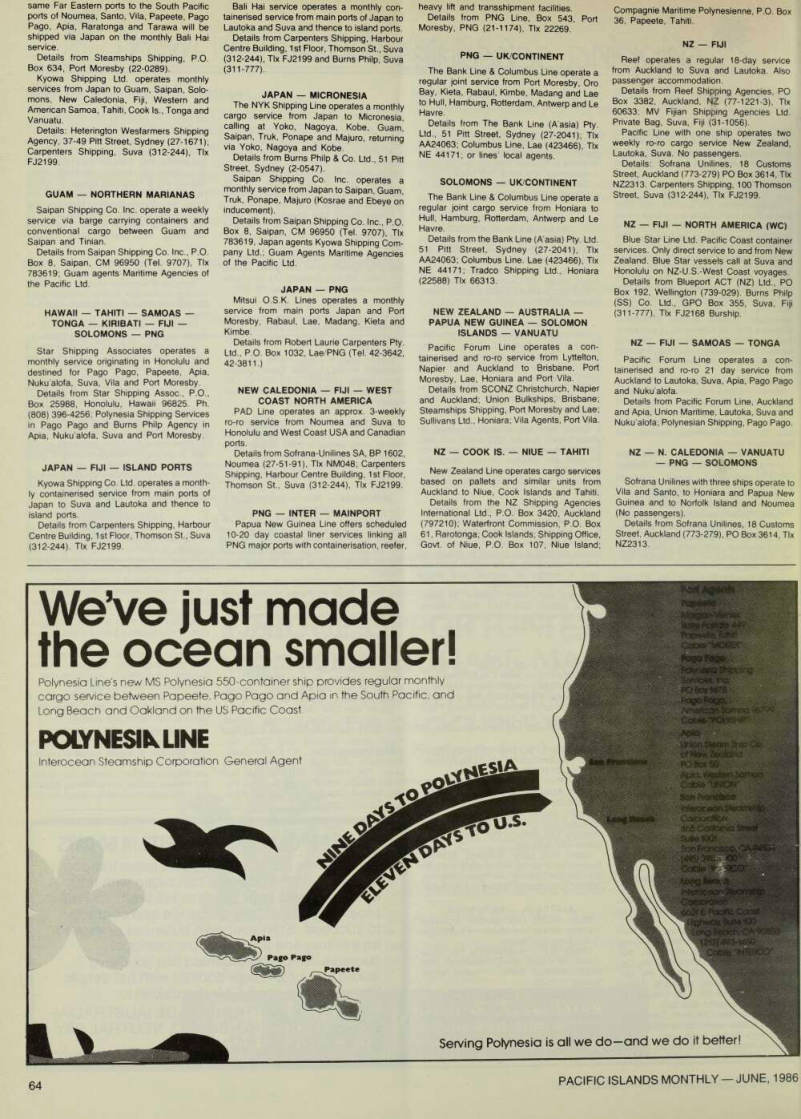
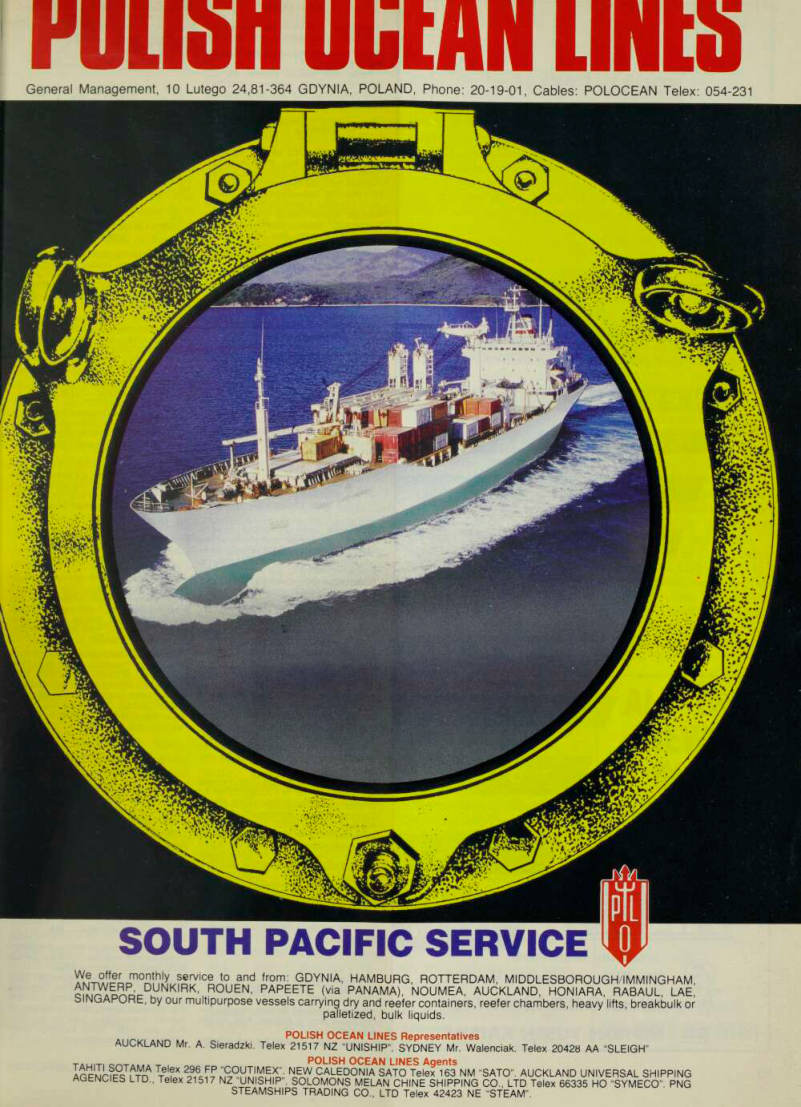
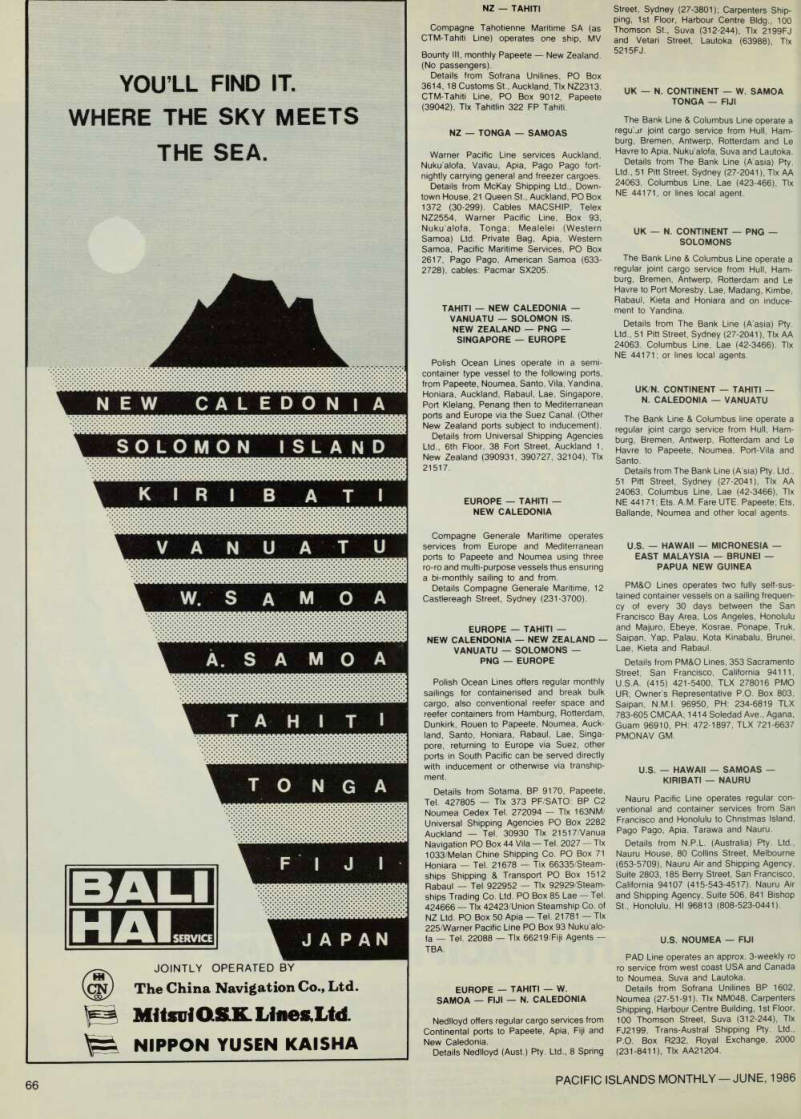
Should any shipping company wish to have its services cargo and passenger included in these listings they should contact
Pim.
Australia Fiji
Sofrana-Unilines (Fiji Express Line) oper ates to Suva and Lautoka every three weeks from the main ports on the east coast of Australia and monthly to Lautoka from Mel bourne and Sydney.
Details from Sofrana-Unilines, 432 Kent Street. Sydney (264-8944), Tlx AA 70090; Wiltrans Agency Pty. Ltd., 21st Floor, 60 Market St.. Melbourne (614-4788); Tlx 30163 ACTA Pty. Ltd., Brisbane (221-3116); Elders- ANL Pty. Ltd., Port Adelaide, (47-5688); Newcastle, Sofrana Sydney (264-8944); Websters-ANL, 58 Charles St., Launceston, Tasmania (320-555); Carpenters Shipping, Harbour Centre Building, Ist Floor, Thomson Street, Suva. Fiji (312-244), Tlx FJ2199.
Australia Samoas Tonga
Warner Pacific Lines operates a regular cargo service from Sydney, Brisbane and Melbourne to Nukualofa, Pago Pago. Apia and Vavau. Feeder service available from Apia to Cook, Christmas, Fanning and Washington Islands.
Details from Hetherington Wesfarmers Shipping Agency, 37-49 Pitt Street, Sydney, (27-1671).
Australia New Caledonia
Fiji Samoas Tonga Nz
Pacific Forum Line operates a fully con tainerised service (general, reefer and ro-ro) from Sydney to Noumea, Lautoka, Suva, Apia, Pago Pago, Nukualofa, Lyttelton, Syd ney, Cargo centralised from Adelaide, Mel bourne, Brisbane.
Details from Pacific Forum Line, P.O. Box 796 Auckland, Union Bulkships, 333 George Street. Sydney, Brisbane and Melbourne, Union Co., Lautoka, Suva, Nukualofa. Pacific Forum line Apia, Polynesia Shipping Pago Pago, SCONZ, Christchurch.
Australia Lord Howe Is.
Norfolk Is.
Compagnie des Chargeurs Caledonians operates four-weekly cargo service Sydney- Lord Howe Island and Norfolk Island.
Details Hetherington Wesfarmers Shipping Agency, 37-49 Pitt Street, Sydney (27-1671).
Australia Kiribati
K. Asia Pacific operates a 5/6 weekly service from Melbourne and Sydney to Kiribati (Tarawa).
Details from K. Asia Pacific Pty. Ltd., Goldfields House, 1 Alfred Street, Circular Quay, Sydney (232-2277), Tlx 122143.
KAP New Guinea Lines call Tarawa after PNG ports on a 35 day basis from Melbourne and Sydney/Brisbane.
Details from K. Asia Pacific Pty. Ltd., Goldfields House, 1 Alfred Street, Circular Quay, Sydney (232-2277), Tlx 122143.
Australia New Caledonia
And/Or Vanuatu
Sofrana-Unilines ships serve Noumea every three weeks from the main ports along the east Australian coast.
Details from Sofrana-Unilines, 432 Kent Street, Sydney (264-8944), Wiltrans-Agency Pty. Ltd., 21st Floor, 60 Market St., Mel bourne (614-4788) Tlx 30163 ACTA Pty. Ltd., Brisbane (221-3116). Elders-ANL Pty. Ltd., Port Adelaide (47-5688), Newcastle, Sofrana Sydney; Websters-ANL, 58 Charles St., Launceston, Tasmania (320-555).
Compagnie des Chargeurs Caledoniens operates a three-weekly containerised cargo service from Sydney to Noumea.
Details Hetherington Wesfarmers Shipping Agency. 37-49 Pitt Street, Sydney (27-1671).
Compagnie Generate Maritime operates a monthly service from Sydney, Melbourne and Brisbane to Noumea, Port Vila and Santo, for containerised and break bulk cargo.
Details Compagnie Generate Maritime, 12 Castlereagh Street, Sydney (231-3700).
Australia Nauru
Marshall Is. Kiribati
Nauru Pacific Line operates regular cargo service from Melbourne to Nauru, Majuro and Tarawa, Passenger service to Nauru only.
Details: Nauru Pacific Line (Aust). Pty. Ltd.
Nauru House, 80 Collins Street, Melbourne (653-5709), Nedlloyd Swire, 8 Spring Street, Sydney (2-0522).
Australia New Zealand
The Australian National Line and the New Zealand Line operate a 10-day container service (TRANZTAS) between Sydney and Melbourne to Auckland, Wellington, Lyttelton and Port Chalmers.
The Tranztas service has been extended to cover Burnie and Fremantle on a direct call monthly basis linking to the main New Zealand ports.
Details from ANL Shipping Agencies, 20 Bond Street, Sydney (232-0444) and ANL Shipping Agencies, “World Trade Centre”, cnr Flinders and Spencer Streets, Melbourne (611-2323) or New Zealand Line, Pastoral House, 98 Lambton Quay, Wellington (728- 5000).
Australia Nz Fiji Tonga
Vanuatu New Caledonia
Solomons New Guinea
Sitmar Cruises operates a year-round cruise program from Sydney to include the better-known ports in the above countries, plus a number of unspoilt, and largely unknown, island paradises.
Details from Sitmar Cruises, 39 Martin Place, Sydney (239-9000); NSW, reserva tions and inquiries (008 42-2277); Rest of Australia, reservations and inquiries (008 22-2277).
Australia Nz Fiji Tonga
Vanuatu New Caledonia
Solomons Samoas Tahiti
P&O liners call at Auckland, Bay of Islands, Honiara, Lautoka, Noumea, Nukualofa, Pago Pago, Papeete, Port Moresby, Santo, Savu savu, Suva, Vavau and Vila on cruises from Australia.
Details from P&O Booking Centre, World Travel Headquarters Pty Ltd, 33 Bligh Street, Sydney (237-0333).
Australia Png
Solomons Vanuatu Nz
Pacific Forum Line operates a con tainerised and ro-ro from Brisbane to Port Moresby, Lae, Honiara, Port Vila, Lyttelton, Napier and Auckland.
Details from Union Bulkships, Brisbane Steamships Shipping, Port Moresby and Lae; Sullivans Ltd, Honiara, Vila Agents, Port Vila; SCONZ Christchurch, Napier and Auckland.
Australia Micronesia
Nauru Pacific Line operates a regular container service from Melbourne to Ponape, Truk. Guam and Saipan.
Details: N.P.L. (Australia) Pty Ltd, Nauru House, 80 Collins Street, Melbourne (653- 5709). Nedlloyd Swire, 8 Spring Street
Sydney (2-0522).
Australia New Caledonia
Sofrana Unilines operates a 3-4 weekly service from East Coast mainports to Noumea.
Details from Sofrana Unilines 432 Kent Street, Sydney. (Tel. 264-8944), Tlx AA 70090.
Australia Tuvalu
K. Asia Pacific operates a three monthly service from Sydney and Melbourne to Tuvalu (Funafuti). Subject to inducement.
Details from K. Asia Pacific Pty Ltd, Goldfields House, 1 Alfred Street, Circular Quay, Sydney (232-2277). Tlx 122143.
Warner Pacific Line operates a six week containerised/breakbulk service to Funafuti from Melbourne/Brisbane/ Sydney and Auck land.
Details from Hetherington Wesfarmers Shipping Agency, 37-49 Pitt Street, Sydney (27-1671): Mac Kay Shipping Ltd, Downtown House, Queen Street, Auckland (30-229).
Australia Png
KAP New Guinea Lines cargo vessels call at Melbourne, Sydney, Port Moresby, Lae, Madang, Wewak, Manus, Kimbe, Rabaul, Popondetta.
Details from K. Asia Pacific Pty Ltd, Goldfields House, 1 Alfred Street, Circular Quay. Sydney (232-2277), Tlx 122143, Dal gety Shipping, World Trade Centre, Mel bourne (616-6700).
Australia Png Solomons
Sofrana Unilines (Aust.) P/L operates a 3-4 weekly cargo service to PNG, ex-main ports on the east coast of Australia.
Details from Sofrana Unilines, 432 Kent Street, Sydney (264-8944), Tlx AA 70090.
Australia Png Solomons
Vanuatu
A consortium of NGAL/PNGL and CON PAC/NEL have four vessels operating a joint service from east coast Australian ports to Port Moresby, Lae, Alotau, Madang, Wewak, Rabaul, Kavieng-Kimbe, Kieta, Honiara, Vila, Santo.
Details from Burns Philp & Co. Ltd., P.O.
Box R 124, Royal Exchange. Sydney, 2000 (2-0547): Nedlloyd Swire, 8 Spring Street, Sydney (2-0522); New Guinea Express Lines, 37 Pitt Street, Sydney (241-3991); Vila Agents, PO Box 27, Port-Vila (2456). Tlx
Nhioii.
New Guinea Express Lines operates a weekly container service from Melbourne, Sydney, Brisbane to Port Moresby, Lae, Alotau, Kimbe, Rabaul, Kieta. Honiara, Kavieng, Madang, Wewak. Santo, Vila.
Details from New Guinea Express Lines, P.O. Box R 73, Royal Exchange, Sydney (241-3991); New Guinea Express Lines, 127 Creek Street, Brisbane (221-9333); New Guinea Express Lines, 327 Collins Street, Melbourne (602-5544); Niugini Express Lines, Port Moresby (21-4572); Lae (42- 1536); Niugini Island Cargo Services Pty.
Ltd., Rabaul (922-467); Bougainville Agen
cies Pty. Ltd., Kieta (956-089): Robert Laurie (PNG) P/L, Madang (82-2157); Garamut Enterprises P/L, Wewak (86-2106); Burns Philp (PNG) Ltd., Kavieng (94-2133); Alotau Stevedoring & Transport, Alotau (61-1318); Ngatia Wholesalers Pty. Ltd., Kimbe (93- 5102); and Tradco Shipping, Mendana Ave nue, Honiara (22588); Vila Agents Ltd., P.O.
Box 971, Vila, Vanuatu (2490); John Lum & Associates, P.O. Box 65, Santo, Vanuatu (329).
Australia Tahiti
Compagnie Generate Maritime operates a monthly service from Sydney, Melbourne and Brisbane to Papeete, for containerised and break bulk cargo.
Details Compagnie Generate Maritime, 12 Castlereagh Street, Sydney (231-3700).
Sofrana Unilines (Aust.) P/L operates a 3/4 weekly cargo service to Papeete ex main ports on the east coast of Australia.
Details from Sofrana Unilines, 432 Kent Street, Sydney (264-8944) Tlx AA 70090.
Singapore Hongkong Fiji
Islands Ports
Kyowa Shipping Co. Ltd. operates a month ly containerised and break bulk cargo service from Singapore, Hongkong to Lautoka, Suva and then to island ports.
Details from Carpenters Shipping, Harbour Centre Building. Ist Floor, Thomson Street.
Suva (312-244), Tlx FJ2199.
Far East Fiji
New Zealand
New Zealand Unit Express (NZUE) now operates a monthly service accepting con tainerised and break bulk cargo from Manila, Keelung, Kaohsiung and Hongkong to Lauto ka, Suva and thence to New Zealand ports.
Details from Carpenters Shipping, Harbour Centre Building, Ist Floor, Thomson Street, Suva (312-244), Tlx FJ 2199; Burns Philp, Suva (311-777); P&O S.N. Co. Wellington (736-477) or Nedlloyd Swire Pty. Ltd., Sydney (20-522).
Nedlloyd operates bi-weekly cargo service with four ships from Surabaya, Jakarta, Bangkok, Port Kelang and Singapore to Suva, Lautoka and NZ ports.
Details from Nedlloyd (Aust.) Pty, Ltd., 8 Spring St., Sydney (27-3801), Burns Philp (SS) Co. Ltd., Suva and Lautoka.
Far East Mid-S. Pacific
China Navigation's New Guinea Pacific Line operates a regular container service from Hongkong. Taiwan, Manila, Port Kelang and Singapore to Port Moresby, Lae, Rabaul and Honiara monthly and to Wewak, Madang and Kieta every three months. Cargo from the
same Far Eastern ports to the South Pacific ports of Noumea, Santo, Vila, Papeete, Pago Pago, Apia, Raratonga and Tarawa will be shipped via Japan on the monthly Bali Hai service.
Details from Steamships Shipping, P.O.
Box 634, Port Moresby (22-0289).
Kyowa Shipping Ltd. operates monthly services from Japan to Guam, Saipan, Solo mons, New Caledonia, Fiji, Western and American Samoa, Tahiti, Cook Is., Tonga and Vanuatu.
Details: Heterington Wesfarmers Shipping Agency, 37-49 Pitt Street, Sydney (27-1671); Carpenters Shipping, Suva (312-244), Tlx FJ2199.
Guam Northern Marianas
Saipan Shipping Co. Inc. operate a weekly service via barge carrying containers and conventional cargo between Guam and Saipan and Tinian.
Details from Saipan Shipping Co. Inc., P.O.
Box 8, Saipan, CM 96950 (Tel. 9707), Tlx 783619; Guam agents Maritime Agencies of the Pacific Ltd.
Hawaii Tahiti Samoas
Tonga Kiribati Fiji
Solomons Png
Star Shipping Associates operates a monthly service originating in Honolulu and destined for Pago Pago, Papeete, Apia.
Nukualofa, Suva, Vila and Port Moresby.
Details from Star Shipping Assoc., P. 0..
Box 25988, Honolulu, Hawaii 96825. Ph. (808) 396-4256; Polynesia Shipping Services in Pago Pago and Burns Philp Agency in Apia, Nukualofa, Suva and Port Moresby.
Japan Fiji Island Ports
Kyowa Shipping Co. Ltd. operates a month ly containerised service from main ports of Japan to Suva and Lautoka and thence to island ports.
Details from Carpenters Shipping, Harbour Centre Building, Ist Floor, Thomson St., Suva (312-244). Tlx FJ2199.
Bali Hai service operates a monthly con tainerised service from main ports of Japan to Lautoka and Suva and thence to island ports.
Details from Carpenters Shipping, Harbour Centre Building, Ist Floor, Thomson St., Suva (312-244), Tlx FJ2199 and Burns Philp, Suva (311-777).
Japan Micronesia
The NYK Shipping Line operates a monthly cargo service from Japan to Micronesia, calling at Yoko, Nagoya, Kobe, Guam, Saipan, Truk, Ponape and Majuro, returning via Yoko, Nagoya and Kobe.
Details from Burns Philp & Co. Ltd., 51 Pitt Street. Sydney (2-0547).
Saipan Shipping Co. Inc. operates a monthly service from Japan to Saipan, Guam, Truk, Ponape, Majuro (Kosrae and Ebeye on inducement).
Details from Saipan Shipping Co. Inc., P.O.
Box 8, Saipan, CM 96950 (Tel. 9707), Tlx 783619, Japan agents Kyowa Shipping Com pany Ltd.; Guam Agents Maritime Agencies of the Pacific Ltd.
Japan Png
Mitsui O.S.K. Lines operates a monthly service from main ports Japan and Port Moresby, Rabaul, Lae, Madang, Kieta and Kimbe.
Details from Robert Laurie Carpenters Pty.
Ltd., P.O. Box 1032, Lae/PNG (Tel. 42-3642, 42-3811.)
New Caledonia Fiji West
Coast North America
PAD Line operates an approx. 3-weekly ro-ro service from Noumea and Suva to Honolulu and West Coast USA and Canadian ports.
Details from Sofrana-Unilines SA, BP 1602, Noumea (27-51-91), Tlx NMO4B; Carpenters Shipping, Harbour Centre Building, Ist Floor.
Thomson St„ Suva (312-244), Tlx FJ2199.
Png Inter Mainport
Papua New Guinea Line offers scheduled 10-20 day coastal liner services linking all PNG major ports with containerisation, reefer,
heavy lift and transshipment facilities.
Details from PNG Line, Box 543, Port Moresby, PNG (21-1174), Tlx 22269.
Png Uk/Continent
The Bank Line & Columbus Line operate a regular joint service from Port Moresby, Oro Bay, Kieta, Rabaul, Kimbe, Madang and Lae to Hull, Hamburg, Rotterdam, Antwerp and Le Havre.
Details from The Bank Line (A’asia) Pty.
Ltd., 51 Pitt Street, Sydney (27-2041); Tlx AA24063; Columbus Line, Lae (423466), Tlx NE 44171; or lines’ local agents.
Solomons Uk/Continent
The Bank Line & Columbus Line operate a regular joint cargo service from Honiara to Hull, Hamburg, Rotterdam, Antwerp and Le Havre.
Details from the Bank Line (A’asia) Pty. Ltd. 51 Pitt Street, Sydney (27-2041), Tlx AA24063; Columbus Line. Lae (423466), Tlx NE 44171; Tradco Shipping Ltd., Honiara (22588) Tlx 66313.
New Zealand Australia
Papua New Guinea Solomon
Islands Vanuatu
Pacific Forum Line operates a con tainerised and ro-ro service from Lyttelton, Napier and Auckland to Brisbane, Port Moresby, Lae, Honiara and Port Vila.
Details from SCONZ Christchurch, Napier and Auckland; Union Bulkships, Brisbane; Steamships Shipping, Port Moresby and Lae; Sullivans Ltd., Honiara; Vila Agents, Port Vila.
Nz Cook Is. Niue Tahiti
New Zealand Line operates cargo services based on pallets and similar units from Auckland to Niue, Cook Islands and Tahiti.
Details from the NZ Shipping Agencies International Ltd., P.O. Box 3420, Auckland (797210); Waterfront Commission, P.O. Box 61. Rarotonga; Cook Islands; Shipping Office, Govt, of Niue, P.O. Box 107, Niue Island;
Compagnie Maritime Polynesienne, P.O. Box 36, Papeete, Tahiti.
Nz Fiji
Reef operates a regular 18-day service from Auckland to Suva and Lautoka. Also passenger accommodation.
Details from Reef Shipping Agencies, PO Box 3382, Auckland, NZ (77-1221-3), Tlx 60633; MV Fijian Shipping Agencies Ltd.
Private Bag, Suva, Fiji (31-1056).
Pacific Line with one ship operates two weekly ro-ro cargo service New Zealand, Lautoka, Suva. No passengers.
Details: Sofrana Unilines, 18 Customs Street, Auckland (773-279) PO Box 3614, Tlx NZ2313. Carpenters Shipping, 100 Thomson Street, Suva (312-244), Tlx FJ2199.
Nz Fiji North America (Wc)
Blue Star Line Ltd. Pacific Coast container services. Only direct service to and from New Zealand. Blue Star vessels call at Suva and Honolulu on NZ-U.S.-West Coast voyages.
Details from Blueport ACT (NZ) Ltd., PO Box 192, Wellington (739-029). Burns Philp (SS) Co. Ltd., GPO Box 355, Suva, Fiji (311-777), Tlx FJ2168 Burship.
Nz Fiji Samoas Tonga
Pacific Forum Line operates a con tainerised and ro-ro 21 day service from Auckland to Lautoka, Suva, Apia, Pago Pago and Nukualofa.
Details from Pacific Forum Line, Auckland and Apia, Union Maritime, Lautoka, Suva and Nukualofa; Polynesian Shipping, Pago Pago.
Nz N. Caledonia Vanuatu
Png Solomons
Sofrana Unilines with three ships operate to Vila and Santo, to Honiara and Papua New Guinea and to Norfolk Island and Noumea (No passengers).
Details from Sofrana Unilines, 18 Customs Street, Auckland (773-279), PO Box 3614, Tlx NZ2313.
Nz Tahiti
Compagne Tahotienne Maritime SA (as CTM-Tahiti Line) operates one ship, MV Bounty 111, monthly Papeete New Zealand. (No passengers).
Details from Sofrana Unilines, PO Box 3614, 18 Customs St., Auckland, Tlx NZ2313.
CTM-Tahiti Line, PO Box 9012, Papeete (39042), Tlx Tahitlin 322 FP Tahiti,
Nz Tonga Samoas
Warner Pacific Line services Auckland, Nukualofa, Vavau, Apia, Pago Pago fort nightly carrying general and freezer cargoes.
Details from McKay Shipping Ltd., Down town House, 21 Queen St., Auckland, PO Box 1372 (30-299). Cables MACSHIP, Telex NZ2554, Warner Pacific Line, Box 93, Nukualofa, Tonga; Mealelei (Western Samoa) Ltd. Private Bag, Apia, Western Samoa, Pacific Maritime Services, PO Box 2617, Pago Pago, American Samoa (633- 2728), cables; Pacmar SX2OS.
Tahiti New Caledonia
Vanuatu Solomon Is.
New Zealand Png
Singapore Europe
Polish Ocean Lines operate in a semi container type vessel to the following ports, from Papeete, Noumea, Santo, Vila, Yandina, Honiara, Auckland, Rabaul, Lae, Singapore, Port Klelang, Penang then to Mediterranean ports and Europe via the Suez Canal. (Other New Zealand ports subject to inducement).
Details from Universal Shipping Agencies Ltd., 6th Floor, 38 Fort Street, Auckland 1, New Zealand (390931, 390727, 32104), Tlx 21517.
Europe Tahiti
New Caledonia
Compagne Generate Maritime operates services from Europe and Mediterranean ports to Papeete and Noumea using three ro-ro and multi-purpose vessels thus ensuring a bi-monthly sailing to and from.
Details Compagne Generate Maritime, 12 Castlereagh Street, Sydney (231-3700).
Europe Tahiti
New Calendonia New Zealand
Vanuatu Solomons
Png Europe
Polish Ocean Lines offers regular monthly sailings for containerised and break bulk cargo, also conventional reefer space and reefer containers from Hamburg, Rotterdam, Dunkirk, Rouen to Papeete, Noumea. Auck land, Santo, Honiara, Rabaul, Lae, Singa pore, returning to Europe via Suez, other ports in South Pacific can be served directly with inducement or otherwise via tranship ment.
Details from Sotama, BP 9170, Papeete, Tel, 427805 Tlx 373 PF/SATO: BP C 2 Noumea Cedex Tel. 272094 Tlx 163 NM/ Universal Shipping Agencies PO Box 2282 Auckland Tel. 30930 Tlx 21517A/anua Navigation PO Box 44 Vila Tel. 2027 Tlx 1033/Melan Chine Shipping Co. PO Box 71 Honiara Tel. 21678 Tix 66335/Steam ships Shipping & Transport PO Box 1512 Rabaul Tel 922952 Tlx 92929/Steam ships Trading Co. Ltd. PO Box 85 Lae Tel. 424666 Tlx 42423/Union Steamship Co. of NZ Ltd. PO Box 50 Apia Tel. 21781 Tlx 225/Warner Pacific Line PO Box 93 Nukualo fa Tel. 22088 Tlx 66219/Fiji Agents
Tba.
Europe Tahiti - W.
Samoa Fiji N. Caledonia
Nedlloyd offers regular cargo services from Continental ports to Papeete, Apia, Fiji and New Caledonia.
Details Nedlloyd (Aust.) Pty. Ltd., 8 Spring
Street, Sydney (27-3801); Carpenters Ship ping, Ist Floor, Harbour Centre Bldg., 100 Thomson St„ Suva (312-244), Tlx 2199FJ and Vetari Street, Lautoka (63988), Tlx 5215FJ.
Uk N. Continent W. Samoa
Tonga Fiji
The Bank Line & Columbus Line operate a regular joint cargo service from Hull, Ham burg, Bremen, Antwerp, Rotterdam and Le Havre to Apia, Nukualofa, Suva and Lautoka.
Details from The Bank Line (A’asia) Pty.
Ltd., 51 Pitt Street, Sydney (27-2041), Tlx AA 24063, Columbus Line, Lae (423-466), Tlx NE 44171, or lines local agent.
Uk N. Continent Png
Solomons
The Bank Line & Columbus Line operate a regular joint cargo service from Hull, Ham burg, Bremen, Antwerp, Rotterdam and Le Havre to Pori Moresby, Lae, Madang, Kimbe, Rabaul, Kieta and Honiara and on induce ment to Yandina.
Details from The Bank Line (A’asia) Pty, Ltd., 51 Pitt Street, Sydney (27-2041), Tlx AA 24063. Columbus Line, Lae (42-3466). Tlx NE 44171; or lines local agents.
Uk/N. Continent Tahiti
N. Caledonia Vanuatu
The Bank Line & Columbus line operate a regular joint cargo service from Hull, Ham burg, Bremen, Antwerp, Rotterdam and Le Havre to Papeete, Noumea, Port-Vila and Santo.
Details from The Bank Line (A sia) Pty. Ltd., 51 Pitt Street, Sydney (27-2041), Tlx AA 24063, Columbus Line, Lae (42-3466), Tlx NE 44171; Ets. A.M. Fare UTE. Papeete; Ets, Ballande, Noumea and other local agents.
U.S. Hawaii Micronesia
East Malaysia Brunei
Papua New Guinea
PM&O Lines operates two fully self-sus tained container vessels on a sailing frequen cy of every 30 days between the San Francisco Bay Area. Los Angeles, Honolulu and Majuro. Ebeye, Kosrae, Ponape, Truk, Saipan, Yap, Palau, Kota Kinabalu, Brunei, Lae, Kieta and Rabaul.
Details from PM&O Lines, 353 Sacramento Street, San Francisco, California 94111,
U.S.A. (415) 421-5400, Tlx 278016 Pmo
UR; Owner's Representative P.O. Box 803, Saipan, N.M.I, 96950, PH: 234-6819 TLX 783-605 CMCAA; 1414 Soledad Ave., Agana, Guam 96910, PH: 472-1897, TLX 721-6637
Pmonav Gm.
U.S. Hawaii Samoas
Kiribati Nauru
Nauru Pacific Line operates regular con ventional and container services from San Francisco and Honolulu to Christmas Island, Pago Pago, Apia, Tarawa and Nauru.
Details from N.P.L. (Australia) Pty. Ltd., Nauru House, 80 Collins Street, Melbourne (653-5709), Nauru Air and Shipping Agency, Suite 2803, 185 Berry Street, San Francisco, California 94107 (415-543-4517). Nauru Air and Shipping Agency, Suite 506, 841 Bishop St., Honolulu, HI 96813 (808-523-0441).
U.S. Noumea Fiji
PAD Line operates an approx. 3-weekly ro ro service from west coast USA and Canada to Noumea, Suva and Lautoka.
Details from Sofrana Unilines BP 1602, Noumea (27-51-91). Tlx NMO4B, Carpenters Shipping, Harbour Centre Building, Ist Floor, 100 Thomson Street, Suva (312-244), Tlx FJ2199, Trans-Austral Shipping Pty. Ltd., P.O. Box R 232, Royal Exchange, 2000 (231-8411), Tlx AA21204.
Advertisements & other items, pp. 63-66 (1 item)
Earn Export/Import Profits In 60 Days
Let us show you how to start an export/import business right away. You can begin with little or no capital in your spare or full time. You will receive all necessary guidance and contacts to succeed. Start your own business or extend an existing one and enjoy the profits of success. Since 1946, others like you have asked for our 24 page booklet with full details.
For your copy send $2 (refundable) to:
Dept. RIM 4 ANTHONY WADE (AUSTRALIA)
CONSULTANTS, P.O. Box 583, NEUTRAL BAY,
NSW 2089, AUSTRALIA
WeVe just made
the ocean smaller!
Polynesia Line's new MS Polynesia 550-container ship provides regular monthly cargo service between Papeete. Pago Pago and Apia in the South Pacific, and Long Beach and Oakland on the US Pacific Coast
POLYNESIA LINE
Interocean Steamship Corporation General Agent Apia & u =tO fk vs 5* 5* V Pago Pago Serving Polynesia is all we do—and we do it better! .
mm uiitAN unis
General Management, 10 Lutego 24,81-364 GDYNIA, POLAND, Phone: 20-19-01, Cables: POLOCEAN Telex: 054-231 © & Ji Wt a m m £ m iM - J?/ S • s »>* * *'V ’•r $ »*1
SOUTH PACIFIC SERVICE «
and from: GDYNIA ’ HAMBURG, ROTTERDAM, MIDDLESBOROUGH/IMMINGHAM, R o P H. D . UNKIRK -, ROUEN ' p AP EE TE (via PANAMA), NOUMEA, AUCKLAND, HONIARA, RABAUL, LAE, biiNLaAKUHt, by our multipurpose vessels carrying dry and reefer containers, reefer chambers, heavy lifts, breakbulk or palletized, bulk liquids.
Aiin/I Akin >1 * POLISH OCEAN LINES Representatives AUCKLAND Mr. A. Sieradzki. Telex 21517 NZ “UNISHIP”. SYDNEY Mr. Walenciak. Telex 20428 AA “SLEIGH”
TAum -r , POLISH OCEAN LINES Agents ACFNr?F^ T T 6 f X caled ONlA SATO Telex 163 NM “SATO”. AUCKLAND UNIVERSAL SHIPPING AGENCIES LTD., Telex 21517 NZ UNISHIP . SOLOMONS MELAN CHINE SHIPPING CO., LTD Telex 66335 HO “SYMECO”. PNG STEAMSHIPS TRADING CO., LTD Telex 42423 NE “STEAM”.
YOU’LL FIND IT.
WHERE THE SKY MEETS
THE SEA.
NEW CALEDONIA
SOLOMON ISLAND
KIRI B ATI
VANUATU
W. S A M O A
.SAMOA
TAHITI
TONGA
- T A
SERVICE
■ m.
JOINTLY OPERATED BY
iQjj The China Navigation Co., Ltd.
Mitsui OtSJL LlnesXtd.
NIPPON YUSEN KAISHA
deaths
Vicente D. Sablan On Saipan on March 22, aged 62.
Vicente D. Sablan served as mayor of Saipan for 14 con secutive years, from 1962 to 1976.
Commonwealth of the Northern Mariana Islands Gov ernor Pedro P. Tenorio ordered flags of the CNMI to be flown at half mast in honor of Mr Sab lan, before a state funeral at Mt Carmel Church, with burial to follow at Chalan Kanoa Ceme tery.
Governor Tenorio said in a message to Sablan’s widow Felicidad and the late mayor’s family: “As your husband and father was a prominent citizen of our Commonwealth and our previous governmental sys tems, with his contributions to our political, social and econo mic development, we feel it is most proper that we offer to accord him a state funeral cere mony. While we strongly feel that such recognition and re spect is due to your father, we wish to undertake such a cere mony only on your family’s concurrence. ”
Mr Sablan was vice-president of the Saipan Grand Hotel at the time of his death, a position he had held since 1975.
He was elected to the Saipan Municipal Congress in 1949 and served there until 1957. He was elected mayor in 1962, and never lost an election for that position.
Sablan attended the Japan ese technical college on Saipan, and also graduated from the Japanese public school in 1938.
He worked for the naval government from 1945-50; and from 1950-54 he worked as a storekeeper for the Naval Sup ply Center. From 1954-57 he worked for the 360th Compo sive Service Company as com ptroller and timekeeper. He also worked from 1957-60 as chief guard for the Naval Technical Training Unit (NTTU), and as a storekeeper for the Trust Territory Govern ment from 1960-62.
Mataifale Toeainia In San Francisco on March 25,
aged 61.
Hundreds of mourners were expected from the South Pacific and Hawaii in San Francisco in early April for three funeral services honoring the Rev Mataifale Toeaina, the founder and guiding spirit of the 34congregation First Samoan Full Gospel Pentecostal Church.
Mr Toeaina was returing from New Zealand where he had gone to begin a new congregation when he became ill. He was hospitalised in Hawaii but then returned to his home in San Francisco where he died in hospital.
A native of Ofu, Manua, American Samoa, Mr Toeaina came to San Francisco in 1952 and was employed as a steel worker.
In 1962, while attending a church service in Oakland across the bay from San Fran cisco, he received what his wife called “a call from the Lord”.
He was directed, she said, “to lead his people as Moses led the people of Israel”. From the modest beginning of sharing quarters with an Episcopalian congregation in San Francisco’s working class Mission District, the church grew continuously.
The 34 congregations now in existence include churches in American Samoa, Western Samoa, New Zealand, Hawaii, Texas, Oklahoma, California and Stuttgart, West Germany, where a large number of Sa moans ' serve in the United States Army.
Mr Toeaina is survived by his wife, Lefete Tuiasosopo Toeaina; by two natural sons, and eight adopted children, by three sisters and two brothers.
The funeral services were all to be held in San Francisco, the city at which the churchman will be buried. Ralph Craib in San Francisco.
Georges Pisier In Paris on March 13, aged 75.
Mr Pisier at the time of his death was the honorary presi dent of New Caledonia’s His torical Studies Society (SEH).
Born in Saigon, he became a graduate of the National School of Overseas France, Paris, and gained degrees in Oriental lan
guages and law.
In his career in the adminis tration of Overseas France, he served in Indochina from 1933 to 1950, and in New Caledonia from 1950 to 1966. He was for a number of years in charge of the economic affairs section of New Caledonia’s administra tion.
Greatly interested in the his tory of New Caledonia, he became a foundation member of the SEH in 1969, and served on its administrative council from that time until his return to France a few months before his death.
The SEH published a num ber of his works on aspects of the history of the territory.
It said in an obituary tribute in its quarterly bulletin (No. 67, March-June, 1986): “In everything he did he showed the qualities of the true his torian: careful documentation, rigorous respect for the facts, and probity in their presenta tion. But with all this, he also had a talent for bringing to life the characters, events and places he was discussing.”
The obituary added that Georges Pisier was enamored of the sea ... a love reflected not only in subjects he chose to write about, but also in his frequent voyages in New Caledonian waters aboard his trimaran, Mareua 111.
PIM last had occasion to quote from Mr Pisier’s work in its issue of December 1985 (p 39), when it used sections of his admirable essay on the remarkable events of Septem ber-October, 1940, when an Australian warship played a key role in keeping New Caledonia on the Allied side in what 14 months later was to become the Pacific War.
Elsie Robinson In Suva on March 9, aged 91.
Mrs Robinson, formerly of Savusavu, was the widow of Fred Robinson and mother of Mrs Merle Thompson, of Nana nu-i-Ra Island.
She was the daughter of the late Mr and Mrs Robert Lepper, of Namawa plantation, Savusa vu East, and sister of Mrs Ann
Haynes (Maravu, Savusavu), Mrs Eileen (Bunny) Morgan (Australia), Miss Sarah Lepper (deceased), Alfred Lepper (de ceased), and Mrs Narvey Pal mer (deceased).
Her funeral was held at the (Anglican) Holy Trinity Cathed ral, Suva.
Frank Dig. Aldan On Saipan on March 17, aged 33.
Saipan’s former Fire Division chief, Mr Aldan was found dead at his home by two police officers who went to check on him after he failed to respond to repeated radio calls from the Department of Public Safety.
Fire fighters and a police honor guard escorted the body from Aldan’s father’s house in Garapan to the Kristo Rai Church before the burial at the Chalan Kanoa Cemetery. Gov ernor Pedro P. Tenorio and his wife Sophie also attended the funeral, as did members of the Fifth Legislature, government officials, family and friends.
Department of Public Safety Director Felix Cabrera said in a eulogy: “Frank only saw the best in everyone. He provided a wonderful balance in my life, which I will miss. And so ! will keep a special place in my heart for him.”
Advertisements & other items, pp. 67-72 (1 item)
All The
NEWS
IN A
PUSH
The South Sea Digest tells you what you want to know about the Pacific islands in a few words. All the leading firms and diplomatic missions read it.
See insert for subscription details:
THE SOUTH SEA DIGEST
fgf
SERVICE PAGE
ADVERTISING
Afrp Hair Care 68 Aggie Grey 68 Air New Zealand 34 Air Pacific 48 Aiwa 55 Amatil 4
A.N.U 20
Avis 43
AWA 16
Bali Hai Service 66 Bank Line 69 Budget Rent-A-Car 30 Clark Al. Boats 61
Economic Development
Board 35 Fiji Air 42 Fiji Mocambo Hotel 33 Fiji Visitors Bureau 38 Fijian Hotel 40 Hawaii Telephone 17 Henry Cumines 52 Honda Motor 2 Hyatt Regency of Fiji 28 Mail Forwarding 68 Mitsubishi Motor 72 Newks Tennis Ranch 38 Nissan 18-19 Norfolk Island 22 Pioneer Electronic 57 Polish Ocean Lines 65 Polynesia Line 64 Regent of Fiji 31
Strophairs 62
Sunflower Airlines 39 Tanoa Hotels 45 Toyota Motor 36-37 Toyota Motor 70-71 Wade 63
tmm
A AUSTRALIA: Distribution; The Herald and Weekly Times Ltd , 44-74 Flinders St.. Melbourne, Vic.. 3000 Advsrtlstog Rep* Brisbane D Wood, Anday Agency, CCA Centre, Dayboro Road. Closebum 4520; Box 1918, GPO Brisbane. 4001, telephone (07) 289-4128 Adeiatd* Hastwell Williamson Rouse Pty Ltd , PO Box 419 Nor wood. SA, 5067; 59 Kensington Road. Norwood; telephone (08) 332-3322, telex 87113, Perth Allen & Associates, Suite 2, 284 Stirling St., Perth, WA, 6000, telephone (09) 328-9593 or (09) 328-9363 FUI: Distribution sod subscriptions - Desai Bookshops, PO Box 160. Suva, Fiji, telephone Suva 23036 Advertising Fiji Times & Herald Ltd , 20 Gordon St., Suva, telephone 31-4111, telex FJ2124 FRENCH POLYNESIA: Distribution Hachette Pacifique, 10 Ave Bruat, Papeete, telephone 25610 HAWAII, UNITED STATES; Distribution PIM, Hawaii PO Box 22250. Honolulu, Hawaii, 96822 Advertising Bnan C Asgill, Apt 1308, 1676 Ala Moana Blvd , Honolulu, Hawaii 96815, telephone (808) 955-9718 Japan and Korea: Advertising and subscriptions Universal Media Corporation. GPO Box 46, Tokyo, telephone 666-3036, cables UNIMEDIA Tokyo, telex 9524665.
MALAYSIA Advertising and subscription* Worldwide Media Services, 57-B Komplex Damai, Jin Dato Haji Eusotl. Kuala Lumpur, telephone 63-9340, cables WORLDMEDIA Kuala Lumpur telex 31533 VANUATU: Distribution The Bookshop, HQ Box 210, Port Vila. Advertising Norman Bros. Bookshop, Port Vila, telephone 2232.
NEW CALEDONIA: Distribution Depot Centre de Presse Michel Pentecost, CBP2, Noumea, telephone 27-2434, 27-4729.
NEW ZEALAND; Distribution Gordon & Gotch, PO Box 584, 2 Carr Road. Mt Rosk 11, Auckland 4 Advertising International Media Representatives Ltd , PO Box 10259.
Balmoral, Auckland 4, 'elephone 605-909, 792-370, telex NZ21404
PAPUA NEW GUINEA: Distribution Gordon & Gotch, PO Box 3395, Port Moresby, telephone 25-4551. 25-4855 Advertising Ken Head, PNG Post-Courier, PO Box 85, Port Moresby, telephone 21-2577, telex 22120.
SOLOMON ISLANDS: Distribution and Advertising - The Bookshop, (Norman Bros.) PO Box 503, Honiara PHILIPPINES: Advertising The GF Group, 12 San Ignado St.. Uroaneta Village, Makati, Metro Manila, telephone 817-7299, telex 45950 and 4233 UNITED KINGDOM; The Herald & Weekly Times Ltd , No 1 Maltravers Street,London WC2R 3DZ, England, telephone 01 836 5162, telex London 21989 UNITED STATES MAINLAND; Advertising Joshua B Powers Jr , Powers International Inc., 551 Fifth Ave , New York, New York 10 017, telephone 867-9580, telex 236514 Subscriptions PIM, Hawaii, PO Box 22250, Honolulu, Hawaii. 96822
SUBSCRIPTIONS
American Samoa US$24 Australia AUSS24 Canada US$3O Cook Islands NZ$36 Fiji AUSS26 French Polynesia US$3O Guam US$3O Hawaii US$3O Japan US$3O Kiribati AUSS24 Micronesia US$3O Nauru AUSS24 New Caledonia US$3O New Zealand NZ$36 Niue NZ$3O Norfolk Island AUSS24 Northern Marianas US$3O Papua New Guinea AUSS3S Solomon Islands AUSS24 Tonga AUSS24 Tuvalu AUSS24 United Kingdom Stgls US Mainland US$3O Vanuatu AUSS24 Western Samoa AUSS24 Elsewhere AUSS36 Payments by personal cheque are only acceptable in Australian (from a branch in Australia), U S and New Zealand currency For all other remittances please send an international bank draft in Australian dollars Published monthly by Pacific Publications (Aust) Pty Ltd and pnnted in Australia by Quadncolor Industnes Pty Ltd , Mulgrave. Vic.
ALL THE
NEWS IN A
FLASH
The South Sea Digest tells you what you want to know about the Pacific Islands in a few words All the leading firms and diplomatic missions read it You can phone or write or call for a follow up See insert for subscription details
THE SOUTH SEA DIGEST
NOW AVAILABLE!
PAPUA NEW GUINEA BUSINESS & TRAVEL GUIDE Contains over 250 pages crammed with all the facts you want to know on P.N.G.
See insert for further details and price.
Stay at Aggie Grey’s . . . the South Pacific’s
legendary hotel.
Situated right in the heart of Western Samoa. Enjoy Polynesian style friendliness and service, in cool surroundings, superb entertainment and food.
Magnificent white sand beaches only a short drive away. Airconditioned rooms, swimming pool andJull bar facilities.
Bookings through Union Steamship Company of NZ, Pan Am, Air New Zealand or direct to Aggie Grey’s, Apia. Western Samoa. Cables: ‘AGGIES’ Apia.
AFRO HAIR CARE
Importers and Distributors of
BLACK HAIR CARE PRODUCTS
in Australia and the South Pacific Specialised products for all Afro-type hair • Shampoos • Conditioners • Hairdressings • Curl Products (including Curl Kits)
MAIL ORDER CONVENIENCE
Retail or wholesale contact us for price list and brochures
AFRO HAIR CARE
3 Wedge Court, Glen Waverley, Victoria, Australia 3150 Telephone (03) 233 2642
Travelling
abroad or on
the move?
Let us be your postbox and be sure to get your mail.
For details, write to: The Manager, Mail Forwarding and Agency Services, P.O. Box 22, Palmerston North, New Zealand.
BANK LINE and
COLUMBUS LINE
24 day service to
Europe.
Need we say more...
D G The Joint Service Partners offer facilities for shipment of: Containers (FCiyLCL) and Break-bulk Cargo plus reefer space and deeptanks for carriage of vegetable oils and other liquid bulk cargo.
Carriers also accept heavy lifts, overlength and cumbersome parcels.
Ports of Service: Loading; Papeete, Apia, Suva, Lautoka, Noumea, Port Vila, Santo, Honiara, Port Moresby, Lae, Madang, Kimbe, Rabaul, Kieta, Darwin. For: Rotterdam, Antwerp, Hamburg, Hull, Dunkirk, Le Havre.
Additional ports on enquiry.
Please contact our regional offices for further information: The Bank Line (Australasia) Pty Ltd Columbus Line Reederei GmbH Suite 801, 51 Pitt St, p.o. Box 1667, Lae/Papua New Guinea.
Sydney, NSW, Australia 2000 Phone; 423466/423287/A.H. 422481 Phone 27 2041 Telex 24063 Telex: Colline NE 44171 The South Pacific Specialists for over 75 years
38 HP,
2500 rpm
SAE net [2SDK7] 520 k 8
[2SDK7]
30
% tano
Forward
[2SGK6, 2SDK6 -7-8]
MORE DRIVE POWER
The Toyota Skid Steer Loader’s diesel engine delivers power to spare. There’s power enough to carry a big load—up to 520 kg. That kind of performance is tough to beat.
MORE LOAD HANDLING
The Toyota Skid Steer Loader is compact.
Yet, with an operating load of 520 kg, it’s capable of bringing out some big loads.
It offers the capacity you need to tackle high-volume materials quickly and efficiently. And there’s also the 2SDKB with a 600 kg capacity and the 2SGK6 and 2SDK6 with a 460 kg capacity.
MORE GRADEABILITY
With plenty of power, 4-wheel drive ai deep-lug tires, our Skid Steer Loader c handle work in steep, sloping areas.
Which makes its on-site versatility all t more impressive.
Our numbers
add up to "MORE”
r/i Toyota products are known for their high level of overall performance. And the new Toyota Skid Steer Loader is a powerful example of what we mean. When you compare, you’ll discover our Skid Steer Loader gives you more of what you’re looking for. More power and performance.
More versatility - with attachments to handle virtually any kind of job. And best of all, it’s backed by Toyota quality and reliability. So whether you’re in construction, landscaping or manufacturing, you owe it to yourself to check out the Toyota Skid Steer Loader.
When you do, we think you’ll like the way our numbers add up.
-Toyota Presents the
RAIAII era
MORE
I [2SCK6, 2SDK6 -7 81
0.31
cu. m.
Bucket Capacity
[2SDK7]
1730 mm Clearance Circle
I2SDK7]
ORE EFFECTIVE DUMPING
e Toyota Skid Steer Loader’s 47° cket-dumping angle makes it easier to load high-viscosity materials—such as y or manure. Plus, the bucket is selfel ing to prevent spills.
MORE LOAD CAPACTTY
We gave our Skid Steer Loader a big bucket so you can handle a wide range of materials. Which means you can handle a variety of jobs, and get them done that much sooner. In addition, our 2SDKB offers 0.34 cu. m. bucket capacity and our 2SGK6 and 2SDK6 offer a 0.28 cu. m. capacity.
MORE MANEUVERABILITY
With a 1,730 mm clearance circle (with standard bucket), the Toyota Skid Steer Loader virtually turns around in its own tracks. Which means it can get you into—and out of—work areas where it’s impossible to take a larger rig.
TOYOTA
AMERICAN SAMOA: BURNS PHILP (S.S.) CO., LTD. TEL: 633-4281 AUSTRALIA: THIESS TOYOTA PTY, LTD. TEL: 526-3333 FIJI: AUTOMOTIVE SUPPLIES CO., A DIVISION OF BURNS PHILP (S.S.) CO., LTD. TEL: 383444
GUAM: ATKINS, KROLL, INC. TEL: 646-1876
NEW CALEDONIA: SERVICE IMPORTATION AUTOMOBILE DU PACIFIQUE TEL: 28-28-48 NEW ZEALAND: ANDREWS & BEAVEN INDUSTRIAL EQUIPMENT LTD, TEL: 2780940 PAPUA NEW GUINEA: ELA MOTORS, BURNS PHILP (P.N.G.), LTD. AUTOMOTIVE DIVISION
TEL: 217036
VANUATU: VANUATU MOTORS, A DIVISION OF BURNS PHILP (VANUATU) LTD TEL' VILA 2341 WESTERN SAMOA; BURNS PHILP (S.S.) CO., LTD. TEL: 22611 And distributors around the world.
rER LOADER
m i •f m He’d find Livingstone faster with Mitsubishi 4WD. m In 1871 Henry Stanley was sent to find Dr. David Livingstone, thought lost in Africa.
Their meeting resulted in the famous greeting, "Dr. Livingstone, I presume".
Though too late for Stanley, Mitsubishi four-wheel-drive expertise helps blaze trails for today's explorers. Mitsubishi built its first 4WD vehicle back in 1934. Today, we tackle the world's toughest terrain so that others with the spirit of adventure can break new ground with confidence.
Currently the toughest challenge for motor vehicles is the Paris-Dakar Rally. This year's race was a gruelling 22-day, 14,000-kilometre journey. Only 54 of the 364 starters made it to Dakar in Africa. But, as predicted, the Pajero won the Marathon Class for the fourth consecutive year. It went the distance without replacing a single major part. What's more, seven out of the nine Marathon Class finishers were Pajeros.
Stanley beat similar odds when he found AMERICAN SAMOA: MORRIS SCANLAN SERVICE INC. P.O Box 367, Pago Pago, Tel. MOTORS AUSTRALIA LTD. Box 1851, G.P.O Adelaide, South Australia 5001, Tel. 08-275-71 11 /FIJI: NIVIS MOTOR & MACHINERY CO LTD_ G_RO Box 150 Suva, Tel. 384425/FRENCH POLYNESIA (TAHITI): ETS-BREDIN FRERES ET FILS PO. Box 21 Papeete Tahiti, Tel 4-202-58/ NEW CALEDONIA: SOCIETE D'IMPORTATION D AUTO DU PACIFIQUE SUD S.A. B P 438 I Rond Point du' NEW ZEALAND: TODD MOTORS CORPORATION Todd Park, Heriot Drive, Private Bag, Ponrua, Tel. 70-109/NORFOLK ISLAND. BOHKYb LTD PO Box 169, Norfolk Island, Tel. 2114 NI/PAPUA NEW GUINEA: TOBA PTY. LTD, PO. Box 503, Port Moresby, -7874 /SOLOMON ISLANDS: R.C. SYMES PTY. LTD. P.O. Box 823, Honiara, Guadalcanal, Tel. 22131 /TONGA; SITANI MAPI CO 1 LTD. PO Box Olofa.
Tel. 2 1-044/VANUATU: SOCOMETRA BP 06 Route de Lagon, Port-Vila, Tel. 2314/WESTERN P.O. Box 576, Apia, Tel. 22022/SAIPAN/PONAPE/MAJURO/KOSRAE/TRUK/YAP /BELAU: MICRONESIAN MOTORS, INC. 997 South Marine Drive, Tamuning, Guam 96911, Tel. 646-6827
If Sir Henry Morton Stanley
had to do it all over again. v v* *6 \\<s. 13 Livingstone. His journey would have been much faster, and certainly much easier, with dependable Mitsubishi 4WD technology.
Because our goal is to ensure that Three Diamonds brand vehicles and the people who buy them travel the world with confidence.
A
MITSUBISHI
MOTORS