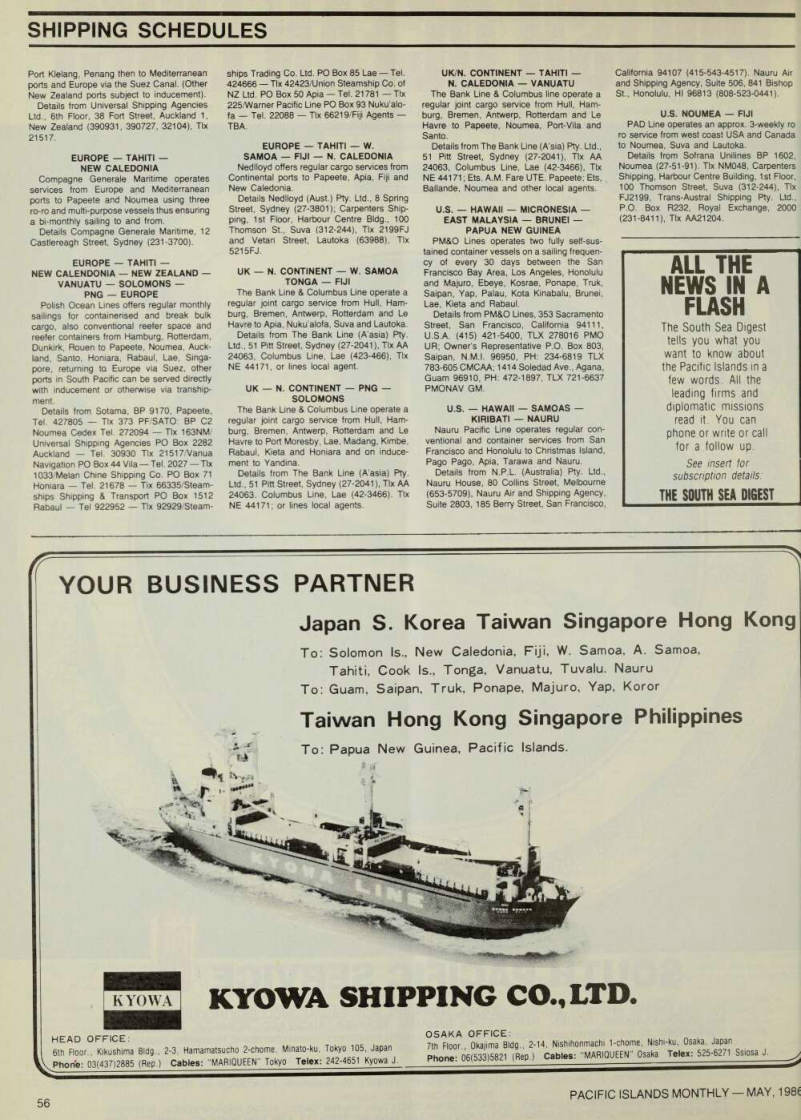
Monthly

Pacific
Islands
mmtm
May, 1986
American Samoa US$l.75 Australia *51.50 Cook Islands NZS2SO F$l.5O Hawaii US$l.95 Kiribati A 51.75 Nauru A 51.75 New Caledonia CFPI9O
New Zealand NZ$2.5O Niue NZ$l.75 Norfolk Island A 51.50 Papua New Guinea K 51.50 Solomon Islands 551.50 Tahiti CFP22O Tonga PI .50 Tuvalu A 51.75
Usa U 552.25
USTT and Guam US$l.95 Vanuatu VT1.50 Western Samoa T 2.10 ‘Recommended retail price only Registered by Australia Post Publication No. NBPI2IO
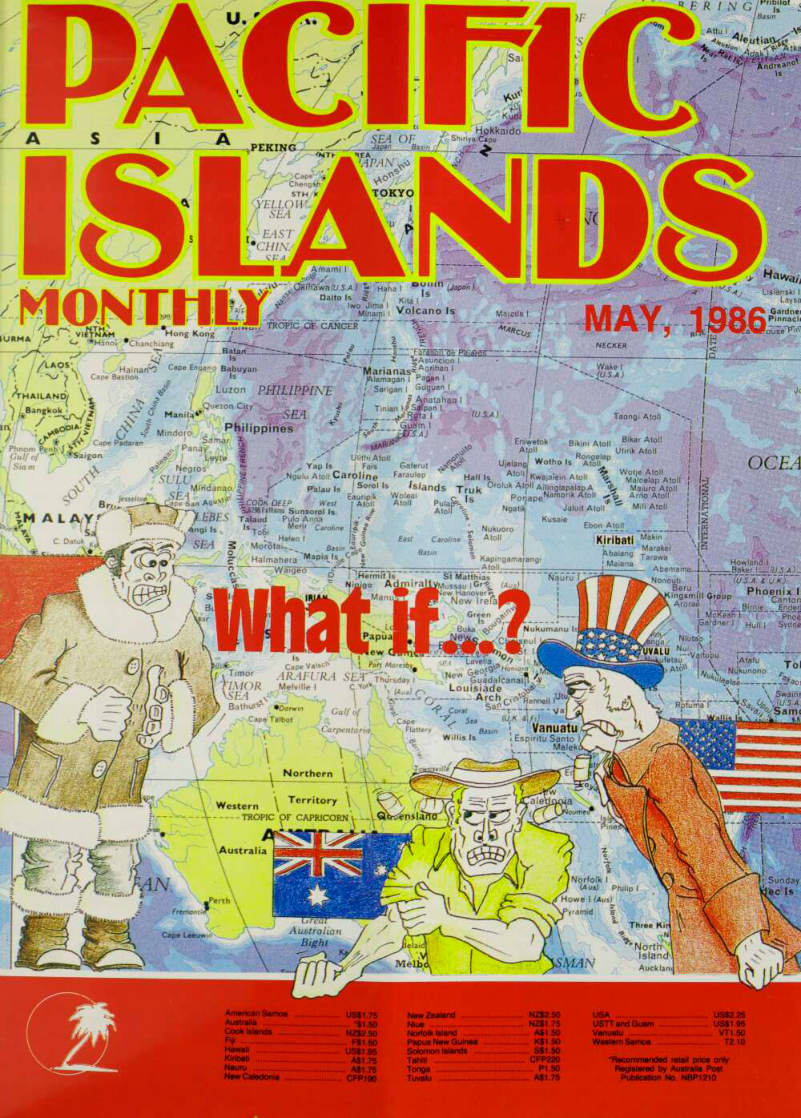
The Cover
Montage by guest artist John Curtin.
Advertisements & other items, pp. 2-3 (2 items)
0 Hitachi
However
your
family
n m & ▲ Sr'*' '> • -. s %
this
Hitachi
will catch
them.
Wherever your family goes to get away from it all, the new, fully automatic Hitachi VHS MOVIE will follow.
All you do is pop in a standard VHS cassette and point. Then play it on any existing VHS home video deck.
The automatic focus, auto iris, fully automatic white balance, "no-light" shooting (10 lux) and one-touch power zoom F 1.2 lens give you a perfect image of your family, everytime. Automatically, and for up to four hours of shooting with an E 240 VHS cassette.
Then use VHS MOVIE'S i electronic viewfinder to 1 review what you've just recorded. There's no heavy equipment to carry with no wires to tangle up your family adventures. And it's so easy to use, the kids can even catch Dad trying out his favourite escapes.
Automatically.
WS MOW£
VM-200E
• Infra-red auto focus • Totally automatic white balance • F 1.2 macro lens with 6X power zoom • Minimum illumination of 10 lux • Electronic viewfinder • Only 2.5 kg without battery • 3-way power supply • Saticon picture tube • 4-hour recording time • Connect direct to TV for playback and programme recording using accessories
VHS
PAL
Makes
Home Movies
Automatic
0 HITACHI
• AUSTRALIA: Hitachi Sales Australia Pty., Ltd., 153 Keys Road, Moorabbin, Victoria 3189; Phone: (555) 8722 • NEW ZEALAND: AWA New Zealand Limited, Wi-neera Drive, PO. Box 50-248, Porirua; Phone: PRO 75-069 • PAPUA NEW GUINEA: S.O. Svensson (N.G.) Ltd., P.O. Box 705, Port Moresby; Phone: 21-2111 • FIJI ISLANDS: AWA New Zealand Limited. 37 Freeston Road, Walu Bay (P.O. Box 858), Suva Fiji; Phone: 312744 • NEW CALEDONIA: Caldis, B.P Ml, Noumea; Phone: 26. 23. 50 • SOLOMON ISLANDS: Technique Radios Centre Ltd., P.O. Box 465, Honiara; Phone: 416
Pacific
ISLANDS
MONTHLY
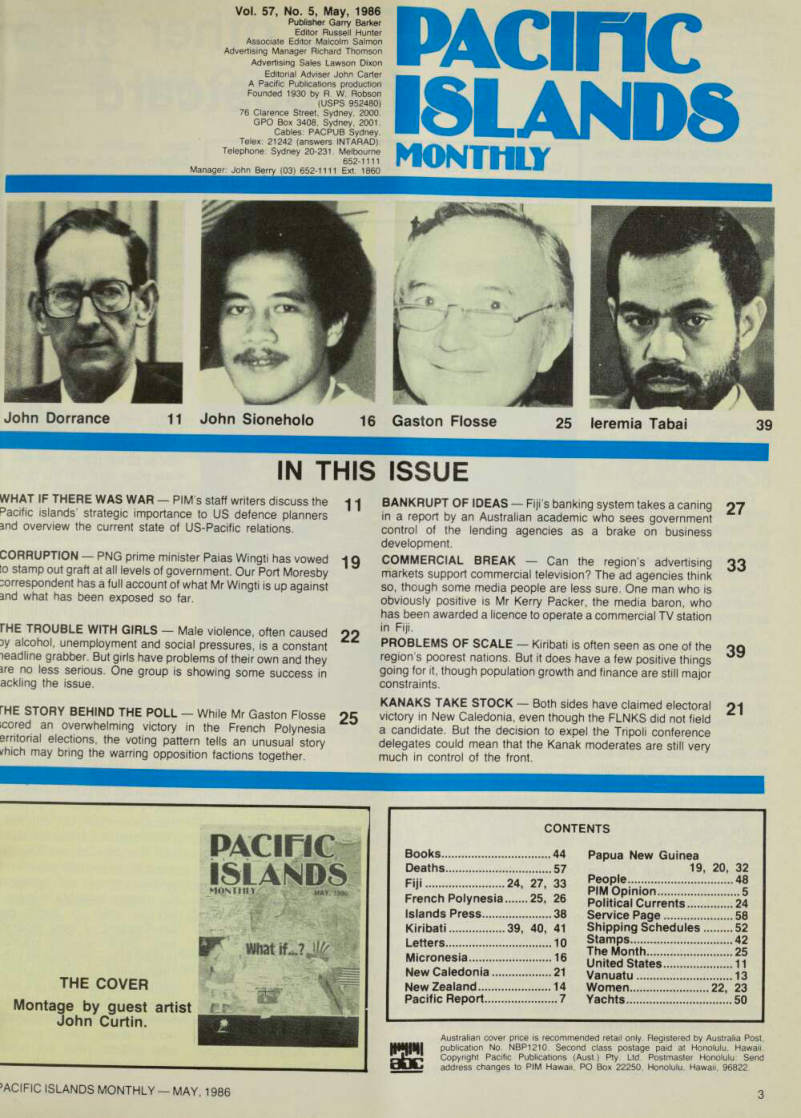
Vol. 57, No. 5, May, 1986
John Dorrance 11
John Sioneholo 16
Gaston Flosse 25
leremia Tabai 39
In This Issue
WHAT IF THERE WAS WAR PlM’s staff writers discuss the i-j Pacific islands’ strategic importance to US defence planners and overview the current state of US-Pacific relations.
CORRUPTION PNG prime minister Paias Wingti has vowed -I Q to stamp out graft at all levels of government. Our Port Moresby 157 aorrespondent has a full account of what Mr Wingti is up against and what has been exposed so far.
FHE TROUBLE WITH GIRLS Male violence, often caused 22 ay alcohol, unemployment and social pressures, is a constant leadline grabber. But girls have problems of their own and they ire no less serious. One group is showing some success in ackling the issue.
FHE STORY BEHIND THE POLL While Mr Gaston Flosse 25 icored an overwhelming victory in the French Polynesia ° erritorial elections, the voting pattern tells an unusual story Yhich may bring the warring opposition factions together.
BANKRUPT OF IDEAS Fiji’s banking system takes a caning 07 in a report by an Australian academic who sees government control of the lending agencies as a brake on business development.
COMMERCIAL BREAK Can the region’s advertising 33 markets support commercial television? The ad agencies think so, though some media people are less sure. One man who is obviously positive is Mr Kerry Packer, the media baron, who has been awarded a licence to operate a commercial TV station in Fiji.
PROBLEMS OF SCALE Kiribati is often seen as one of the qq region’s poorest nations. But it does have a few positive things going for it, though population growth and finance are still major constraints.
KANAKS TAKE STOCK Both sides have claimed electoral 21 victory in New Caledonia, even though the FLNKS did not field a candidate. But the decision to expel the Tripoli conference delegates could mean that the Kanak moderates are still very much in control of the front.
Contents
Books 44 Deaths 57 Fiji 24, 27, 33 _. O . ’
French Polynesia 25, 26 Islands Press 38 Kiribati 39, 40, 41 Letters 10 Mi( , mnoe io ic Micronesia... 16 New Caledonia 21 New Zealand 14 Pacific Report 7
Papua New Guinea 19, 20, 32 4 ?
PIM Opinion 5 Po ,j tj( £| Currents 24 Service Page 58 Shipping Schedules 52
Stamps... 42
The Month 25 Unjted States 11 Vanuatu 13 Women 22, 23 Yachts 50
Australian cover price is recommended retail only. Registered by Australia Post, publication No. NBPI2IO. Second class postage paid at Honolulu, Hawaii.
Copyright Pacific Publications (Aust.) Pty. Ltd. Postmaster Honolulu: Send address changes to PIM Hawaii, PO Box 22250, Honolulu, Hawaii, 96822.
Advertisements & other items, p. 3 (1 item)
3
ACIFIC ISLANDS MONTHLY MAY, 1986
Publisher Garry Barker Editor Russell Hunter Associate Editor Malcolm Salmon Advertising Manager Richard Thomson Advertising Sales Lawson Dixon Editorial Adviser John Carter A Pacific Publications production Founded 1930 by R. W. Robson
(USPS 952480)
76 Clarence Street, Sydney, 2000.
GPO Box 3408, Sydney, 2001.
Cables: PACPUB Sydney.
Telex: 21242 (answers INTARAD).
Telephone: Sydney 20-231. Melbourne 652-1111 Manager: John Berry (03) 652-1111 Ext. 1860
Tahiti: The other side
of the postcard
Tahiti: a picture postcard vision with lagoon, dramatically plun ging mountainsides, flowers, coconut palms, and smiling women. All the signs of prosperity are there; a gross domestic product which puts French Polynesia just behind Australia and New Zealand in terms of living standards, large and expensive motor cars on the roads, VCRs in many households.
But in the shanty towns of Papeete and Faaa, the Tahiti- Paradise myth is brutally jolted: here thousands of Polynesians live crowded 10, 15 or more to the dwelling in conditions of doubtful hygiene. The houses are built of plywood, and are piled together in the bottoms of valleys. The luckiest inhabitants have jobs on the legal minimum wage, but the others the majority are unemployed.
Delinquency and Saturday night drunkenness are on the rise. Drugs have made their appearance. A Faaa policeman says it’s better not to go out after six in the evening.
Tahiti, which contains 72 per cent of the 172,000 inhabitants of French Polynesia, presents this contrast between the main beneficiaries of prosperity metropolitan public servants, Chinese, and demis (people of mixed race) and a marginal ised Polynesian society.
Going to work in French Polynesia can be very lucrative, even if living costs are high.
Apart from the fact that there is no income tax, a public servant receives a salary 84 per cent higher than he would be getting at home. Then there are va rious expatriation benefits and, after three years, six months leave on local rates of pay. If he retires there, he receives a pension boosted to 75 per cent of the salary he earned while working. In the public service the minimum monthly salary is (French francs) 9000 ($A1740 approx.), while in the private sector it is less than FF4OOO (about $A775). Importers and retailers, for whom the per missible mark-up on imports is 47 per cent, are guaranteed a comfortable income.
In the view of most people consulted by AFP, the imba lances between a small minority enjoying a high standard of living and the mass of jobless Polynesians have become so
CATHERINE ABBATI, correspondent of Agence France-Presse (AFP), was recently in Tahiti where she filed the following report.
glaring that in the years ahead they could touch off a social and political explosion.
“Everything is there to pro duce a New Caledonia-style situation,” says the Centrist Senator Daniel Millaud. “There is no middle class. People have the feeling that it’s always the same people who do well, while they are condemned simply to marking time. This feeling could one day give rise to movements with some very tough de mands. ”
One Polynesian in two is under 20, four out of five are under 40. As things stand neith er the CEP nuclear testing program, established in French
Polynesia in 1964, nor the administration, nor the com mercial tertiary sector, can generate enough jobs to meet the needs of the younger gen erations, who also want to join the consumer society. Even tourism, in which the territorial government has set the ambi tious goal of doubling hotel capacity by 1988, will not be able to create the 2500 to 3000 new jobs needed each year.
“If we’re not very careful, there are risks of economic, political and social upheavals,” says High Commissioner Ber nard Gerard, who points out that “the Tahitians are Polyne sian and French so long as the
latter condition ensures the betterment of the former.”
Among a population with a traditional reputation for hospitality, signs of xenophobia are making their appearance.
“The jobless, ” says Jacqui Drol let, leader of the pro-independ ence la Mana Te Nunaa move ment, “feel that those who come to work in Polynesia are taking their jobs.” He too is worried at the risk of an explo sion in the 10 years or so ahead.
Jean Juventin, one of French Polynesia’s two deputies to the National Assembly in Paris, says; “The young people are starting to become racist. Too many people coming from out side to fill the places of Polyne sians plays right into the hands of the independentists. ”
Vice-president of French Polynesia’s territorial govern ment, Alexandre Leontieff, warns against dramatising the situation. But, he says, there is a problem of “cohabitation” a minor one for the moment, but one which could become im portant unless great care is taken. He believes it might be wise to institute a “period of observation” for newcomers for example, in the matter of purchasing land or to “re quire three years residence in French Polynesia as a condition of entering the administration.”
The high commissioner is more forthright: he says “a brake must be put on immigra tion,” and some unpopular measures must be adopted.
“We must look at the introduc tion of income tax, reducing the pay gap between the public and private sectors, and lowering the margins available to impor ters in order to foster the development of local produc tion.” Such measures are ne cessary to prevent what he calls “the suicidal case for a poverty stricken independence in which everybody would be equal” from gaining “a following which would shock many people” who hitherto have not taken such arguments seriously.
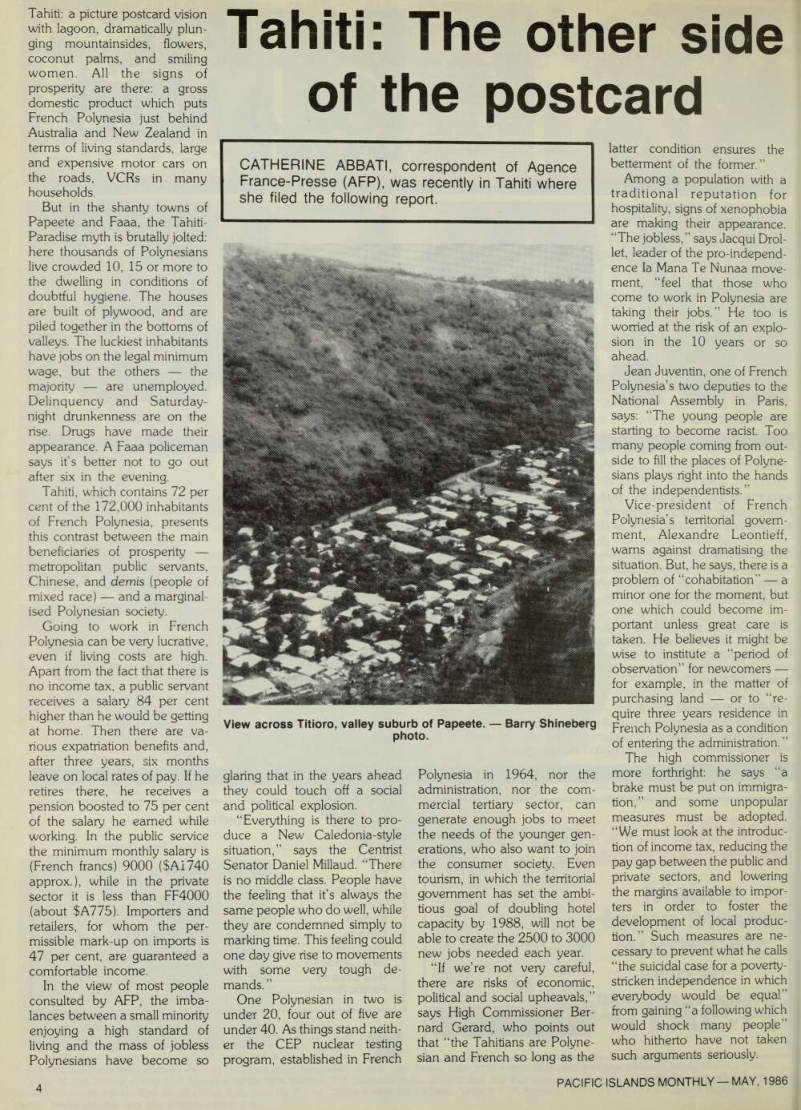
View across Titioro, valley suburb of Papeete.-Barry Shineberg photo.
with the superpowers
Pim Opinion
Learning to live with the superpowers
We don’t want superpower involvement here it’s a familiar cry around these shores. We most certainly do, however, want superpower dollars or roubles.
The perception that superpower rivalry can be kept at arms length while at the same time playing the Americans and the Russians against each other in, for example, the bidding for tuna deals is naive in the extreme.
The Americans, in particular, on the other hand, need to relearn their knowledge of the region and its problems of scale the smallness of which appears to be difficult for the US, more used to thinking in terms of megamil lions, to grasp.
The Russians have bought fishing rights in Kiribati (which, along with Tuvalu, has recently hired a consultant to help them persuade the UN to add their names to that of Western Samoa on the list of least developed countries) for what, to them, is little more than a few beads and steel axes. It has cost them the price of a handful of low grade missiles, a morning’s target practice.
Which makes it all the harder for islanders to understand why the Americans are haggling over fishing fees.
This has led to resentment, especially among the younger educated people who have no memories of the generally welcome US presence during World War 11. The opinions of Mr Sioneholo (page 17) are not untypical and the US would do well to heed what he has to say.
Fears that the Russians are gaining some kind of foothold in the South Pacific are, however, unfounded.
Island nations have as much in common with the Russians as with the eskimos a need to rely on renewable resources.
The Kiribati —Russian deal was born of sheer frustra tion and any similar agreement with Vanuatu will probably be for the same pragmatic reason.
But all the Russians will get for their money is fish and, presumably, some knowledge of the sea bed.
The Americans, for the same, in their terms negligible, outlay could achieve so much more if they could once understand that deals with Russia are made out of necessity and are not an attempt to undermine US interests.
Most island people would welcome any US presence.
Commanders of US Navy vessels who have visited, for instance, Port Moresby, in the past few years will be able to tell of the somewhat over exuberant welcome they have received. That goodwill still exists.
The islanders would prefer to deal with the US and their traditional trade and aid partners. But this does not mean that they should or will sell their resources cheaply or subsidise American tuna boats. Why, they ask, should the poor nations sell their resources at knockdown prices to the rich?
But the islands need to be aware that trade and aid can’t be one way traffic. The Americans are understand ably unwilling to be drawn into a Dutch auction with the Russians. There are indications that Washington could be interested in increased aid to the region in the not too distant future. But they are wary of the islands’ tactic of playing one aid donor against another to get the best deal and would especially have no truck with any attempt to use them to up the bidding vis-a-vis Australia or New Zealand.
At present the US and islands have a somewhat distorted view of each other and the tuna negotiations could be seen as a point of departure towards greater understanding and better things in the future.
At least there will be no more talk in Washington of messages in bottles. That particular bottle from Raroton ga has most certainly reached its intended destination.
The road to a more personal and perhaps more immediate means of dialogue is now open. It would be a pity if either party started to erect barricades.
Advertisements & other items, p. 6 (1 item)
National’s new VHS Movie
does more ...so you do less.
National’s new VHS Movie NV-M3 onepiece camera/recorder is so easy to handle, so simple.to operate, that great recording and playback of family fun and other special events requires little more than your attention. Here are just some of its remarkable advantages: Simple Operation with Auto Focus ns The NV-M3 employs an infrared sensor to gauge distance and
guide focusing—
automatically.
So you can hold and shoot with just one hand.
White balance adjustment is also automatic. A Newvicon pickup tube provides low light sensitivity to 10 lux—you can even shoot by candlelight! An electronic viewfinder/ monitor adds onthe-spot playback m capability. Compact and lightweight (2.Bkg without battery pack) design with convenientlyplaced control buttons.
Direct TV Playback/Recording You’ll never need a separate video cassette recorder to play back your own cassettes or prerecorded VHS software. The NV-M3 connects directly to your TV set, and offers Still and Cue & Review functions. And if your TV is equipped with separate audio/video output terminals, you can even record TV programmes by adding the VW-KM3E line adaptor.
Standard VHS Video Cassette Operation The NV-M3 can record up four hours on a standard VHS video cassette (NV-E240), while
a rechargeable
battery pack lets you shoot for two hours at a time. AC and car battery ]x)wer can also be used. Nationals VHS Movie NV-M3. In a class by itself for quality and convenience. to
VHS
National
National. Panasonic and Technics are the brandnames of Matsushita Electric.
pacific report
Forum-Us Tuna Deal
In Sight
The eighth round of multilateral fishing talks between the United States aand the South Pacific Forum nations were due to begin in Hawaii early this month.
While no agreement was reached in the April round in Canberra, the parties issued a statement saying some prog ress had been made during the week long session. The two key issues still to be resolved are levels of fees to be paid by US vessels for fishing rights and areas from which US boats will be excluded. The forum nations are seek ing fees similar to those already paid by the other foreign fleets, while the Amer icans have maintained they have a need for special consideration because of their unfamiliarity with local fishing con ditions and their unique difficulties under US legislation. However, the island na tions point to the fact that their proposals are similar to the conditions the US imposes on distant water fleets operat ing in its own waters. Estimates of the 1984 American Tunaboat Association catch in the central and western Pacific suggest a total of 220,000 tonnes compared with less than 10,000 tonnes in 1980.
Mara Launches Petrol
Pricing Probe
Fiji’s ruling Alliance Party’s decisioin making body, the National Council, has urged the government to consider na tionalising three oil companies operating in the country Mobil, Shell and BP.
The plan has the support of prime minister Ratu Sir Kamisese Mara who has asked the body to submit a more detailed proposal. Mara had earlier criticised the companies for not passing on the benefits of the world oil price slump and accused them of making excessive profits at the government’s expense. He has appointed a committee of ministers to examine oil price fixing methods.
Pollution Alert At Ok
Tedi Mine
Australian scientists have expressed mounting concern about pollution from Papua New Guinea's Ok Tedi gold and copper mine in the country’s Western Province. The Australian High Commis sion in Port Moresby asked mine officials for technical information following a request from the Australian Conserva tion Foundation in Canberra whose concern increased after the PNG gov-
ernment allowed the mine to continue operations without a permanent dam to retain mine waste. Scientists are con cerned over metals from the Fly River flowing into the Torres Straits.
Mamaloni Fined For
Airport Offences
Solomon Islands Opposition leader and former prime minister Mr Solomon Mamaloni was fined $215 in Honiara Magistrates Court after being convicted of offences at the capital’s airport last October. The court heard that Mamaloni had threatened to blow up a small private aircraft. He was convicted on charges of carrying a lighted cigarette within 15 metres of an aircraft being refuelled, disorderly conduct and threatening a person.
Davis Presses For
Regional Air Rules
The Cook Islands is pushing for a uniform system of regulations governing civil aviation in the South Pacific. Prime minister Sir Tom Davis has put the proposal to the South Pacific Bureau for Economic Co-operation in Suva.
Medical Spending “All
Wrong”
The South Pacific Regional Health Directors’ Conference in Noumea heard that while huge sums were being spent
worldwide to find a cure for AIDS many countries still had trouble controlling diseases such as malaria and leprosy because of lack of funds. Doctor Quen tin Reilly, Papua New Guinea’s Secre tary for Health, said some researchers studying the AIDS outbreak were using grant funds in their quest for a Nobel Prize. He said priorities in world medical spending were all wrong.
Bougainville
Profit Soars
Bougainville Copper Ltd. made a profit in 1985 of K2B million (SA37 million approx.), up by 150 per cent on the previous year's figure. The government will get K 41.6 million ($A55.4 million approx.) out of the company’s income through taxes, dividends and royalties, an increase of 10 per cent on the previous year. The total dividend will be seven toea a share.
Businessmen Seek
Devaluation
A group of leading business figures in Fiji have called for the Fiji dollar to be devalued by some 20 per cent. The campaign was spearheaded by Mr Jeffrey Reid, chairman of Western Min ing, who said the country could gain more for its exports if the dollar were devalued. But deputy prime minister and finance minister Mr Mosese Qioni baravi rejected the proposal. He was backed by tourism and commercial sector leaders who said the economy would be severely damaged by higher import costs.
Png, Indonesia To
Combine Against Opm
Indonesia and PNG are likely to take a joint stand against Irian Jaya separatist rebels after PNG Defence Force com mander General Tony Huai visited In donesian military chief, General Benny Murdani in Jakarta. General Huai said there was an urgent need to stamp out rebel activities on the border which had caused unnecessary trouble for the two countries. He described the OPM rebels as a nuisance and a bunch of terrorists.
General Huai also inspected resettle ment camps for returned border cros sers in Irian Jaya.
Uni Hints At Soviet
Fish Pact
Vanuatu prime minister Walter Uni con firmed that he is studying the possibility of a fishing agreement with the Soviet
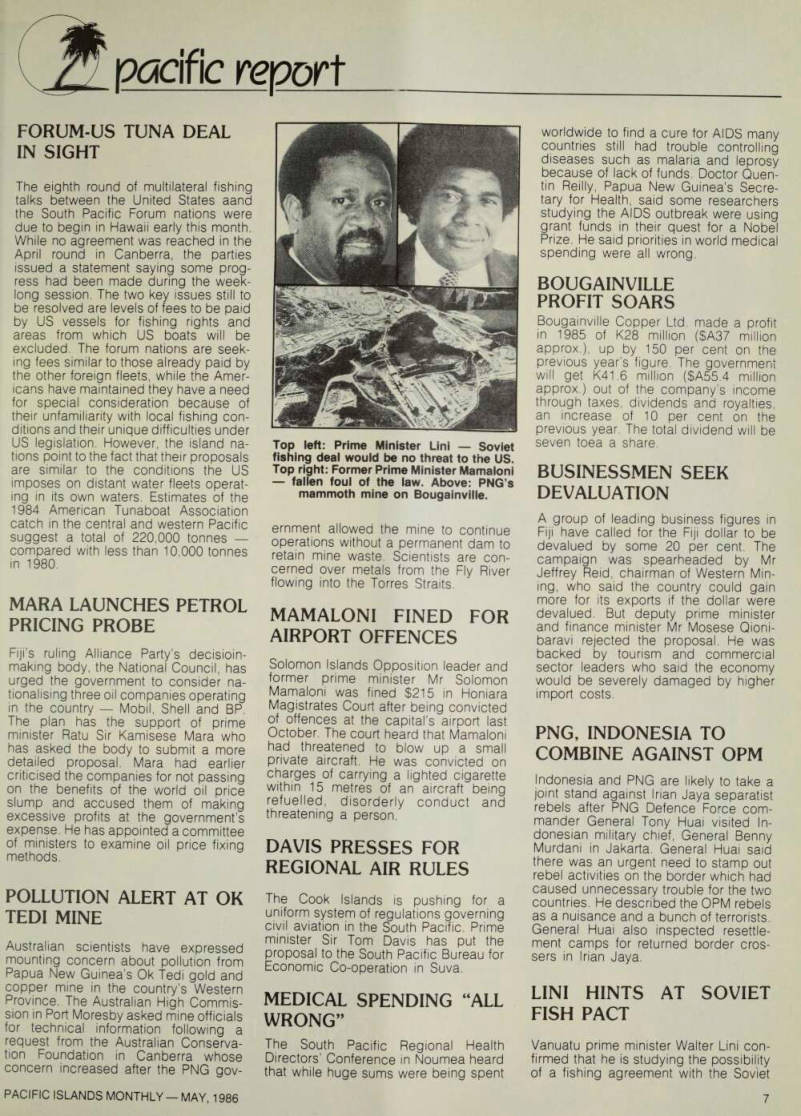
Top left: Prime Minister Lini-Soviet fishing deal would be no threat to the US.
Top right: Former Prime Minister Mamaloni -fallen foul of the law. Above: PNG’s mammoth mine on Bougainville.
Union. He told Reuters that he wanted to keep the superpowers out and allow Vanuatu to develop its own identity, though this would not stop him from making a fishing deal with the Soviets.
He said he did not see this as a threat to the United States. The subject is likely to be discussed when Australia’s foreign minister Mr Hayden tours the region this month. A spokesman for Mr Hayden said in Canberra that Australia had reservations about such agreements but recognised that any decision was a matter for individual countries. However, the Australian government believes that agreements of this nature may allow the Russians to gain greater influence in the region. A spokesman for Father Uni told Radio Australia that Vanuatu had asked the Soviets for more details of a fishing application last year but that these had not yet been received.
Two Seek Least
Developed Status
Two of the most isolated Pacific Island states, Kiribati and Tuvalu, expect to be added to the United Nations list of least developed countries. This will allow them access to concessional loans from the World Bank and the International Monetary Fund while their exports will also qualify for special tariff rates under the General Agreement on Tariffs and Trade. The only other Pacific island nation on the list is Western Samoa.
Kiribati and Tuvalu hired a consultant to help in their submission to the UN. He is Mr Ron Fergie, formerly a statistician with the PNG government. Previous attempts by the two countries for least developed nation status were rejected on the grounds that they do not have low rates of literacy and gross domestic product. However, Radio Australia re ported that, having gained the support of the UN Development Planning Com mittee, their addition to the list is now far more likely.
Palau Agrees To
Us Bases
After years of resistance, Palau has agreed to the installation of US military bases in exchange for partial independ ence and increased aid. The deal if ratified will remove the last obstacle to the construction of an arc of US defence installations in the Western Pacific stretching from the Northern Marianas to Guam, the Marshall Islands and Palau. However, the vote for the "Compact of Free Association” which would leave defence in US hands for the next 50 years has still to be ratified by the US Congress and the UN Trustee ship and Security councils. The US said Palauan leaders has already con ducted surveys for building a submarine base at the sheltered Malakal harbour and an air base near Palau international airport. Reuter.
Png Looks Far
Afield For Aid
Papua New Guinea expects to receive more than SA2SO million worth of aid over the next five years from countries other than Australia as a result of recent changes in government policy. Foreign Minister Legu Vagi told the PNG Parlia ment in March that the new policy of accepting aid tied to purchases of equipment and expertise from donor countries would allow PNG to be more aggressive in seeking assistance. New projects already under discussion in clude a British proposal to extend Port Moresby airport, and a Japanese plan to link the capital with the city of Lae via a trans-island highway. Mr Vagi said the European Economic Community would also play an increasingly important part in PNG’s development. Mr Vagi appealed to the US, Canada and indi vidual European countries to consider providing assistance to PNG.
Province, State,
Poser In S.L
The Solomon Islands Minister for Home Affairs, Andrew Nori, has appointed a six-man committee to review the provin cial government system, which, at pre sent, is based on seven provincial assemblies with elections every three years. Mr Nori said the committee would study the possible introduction of state governments. The government of Solo mon Mamaloni, who believes in decen tralisation, created the present system but the present government of Sir Peter Kenilorea prefers a more centralised system.
Lapita Homeland
Project Success
One pf the richest archeological sites in the Pacific has been located on Papua New Guinea’s Bismarck Archipelago by a major international research expedi tion organised by the Australian National University (ANU). The university said the expedition found strong evidence of long-term settlements in the archipelago by people associated with Lapita pot tery, the people who later swept through the Pacific. The Lapita Homeland Pro ject was organised by the ANU’s pre history department of the Research School of Pacific Studies and brought together 11 research teams from Austra lia, New Zealand and the United States, including leading researchers in Pacific prehistory. The project chartered a small ship, the Dick Smith Explorer, for six months to service the scientists working in the Bismarck Archipelago, off the north-east coast of PNG. The co-ordina tor of the project, Dr Chris Gosden, a visiting fellow in the prehistory depart
merit, said the expedition was an out standing success in terms of expanding the number of known Lapita sites.
Sixteen new sites have been recorded including one which is believed to be the richest found in the Pacific, on Elaoua Island, north of the New Ireland main land. — MS.
Png Govt. Sells
Off Its Houses
All PNG government-owned houses pro vided for politicians and public servants, except the houses of the governor general and the prime minister, will be put up for sale, Prime Minister Paias Wingti has announced. Housing allow ances will be given instead of accommodation, and low-interest loans made available for home-buyers through government-controlled finance institu tions. Complaining that maintenance of government houses had proved to be a big hole in the government's pocket, Mr Wingti said it was "not the state’s responsibility to look after these people”, and added; “we will be saving millions and millions of kina by carrying out this exercise." It is anticipated that house prices will fall with thousands of prop erties flooding the market.
Tonga Ceremony
For New Wharf
King Taufa'ahau Tupou IV of Tonga has formally commissioned an extension to the Queen Salote Wharf at Tonga’s main port of Nukualofa. Funds for the project were provided by the Australian Deve lopment Assistance Bureau. Australian High Commissioner to Tonga, Brian Smith, said in handing over the wharf that it was one of the largest sheet piling wharves in the southern hemisphere, using 2500 tonnes of steel. The exten sion provides three new berths — one international, and two inter-island. Mr Smith said the project was a good example of co-ordination among Tongan and Australian engineers.
Remelhk’S Killers
Get 35 Years
Three men convicted of the assassina tion of Palau president Haruo Remeliik have been sent to prison. Melwert Tmetuchl and Anghenio Sabino received 35-year sentences while co-defendent Leslie Tewid received 25 years. The three had faced maximum sentences of life imprisonment. Saipan judge Robert Hefner, the head of a three-judge panel that convicted the men, did not explain why the sentences were lower than the maximum permitted. The three will be come eligible for parole after serving one-third of their sentences.
Advertisements & other items, p. 8 (1 item)
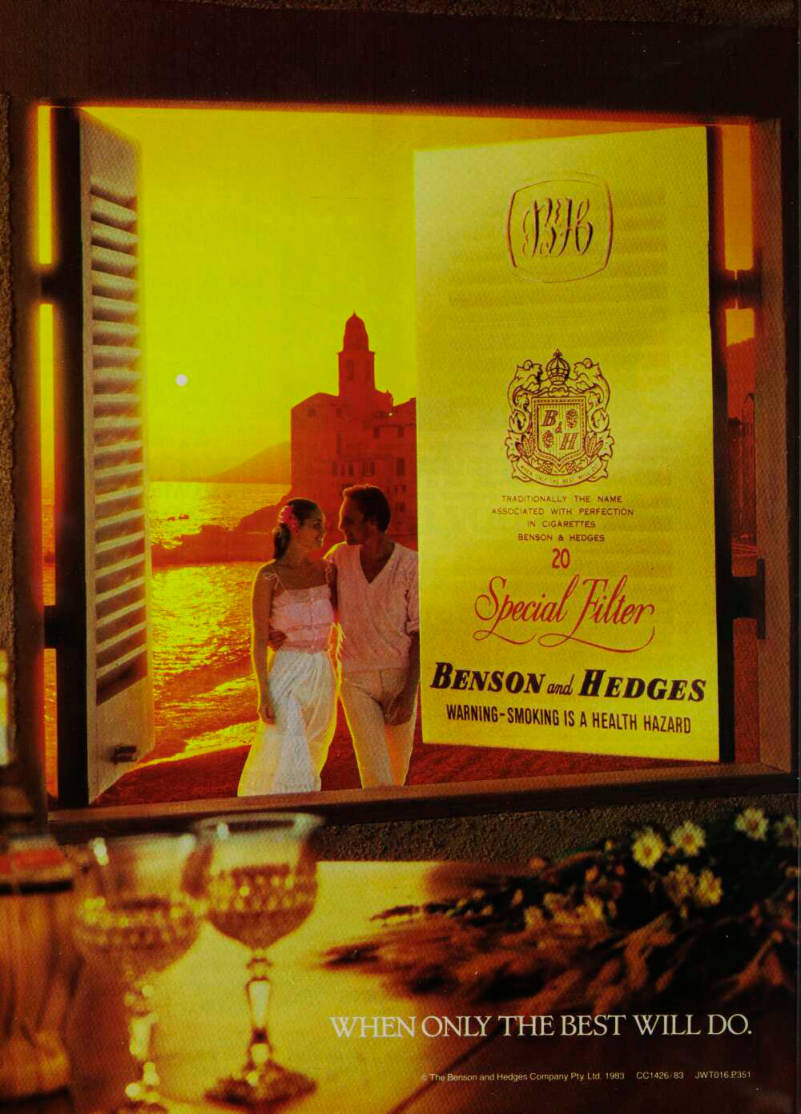
Bens on w Hedges
: i n
TRADn iONALLY THE NAME
ASSOCIATED WITH PERFECTION
IN CIGARETTES
BENSON & HEDGES
20 )
Bens on w Hedges
WARNING-SMOKING IS A HEALTH HAZARD
letters
In quest of tales of old ships
I would be most grateful if you would publish this searcher in your letters to the editor page please.
I seek any information (in particular plans, half models, photographs) concerning the following sailing ships known to have plied the New Zealand and South Sea Islands waters circa 1870 to 1924, as all were mastered and or owned by my grandfather, the late Captain William Wallace Wilson, har bormaster to both the Cakobau and British governments in Fiji.
They were: 1. Cutter Wave, 15 tons, previously owned and mas tered by Captain Robinson, probably built in New Zealand. 2. Schooner Elizabeth, own ed in partnership with A. A.
Coubrough of Taveuni. Prob ably built in New Zealand. 3. Schooner Zephyr, built in New Zealand or the UK, of 100 tons plus. Later owned either by Bums Philp Ltd or W. R.
Carpenters. Said to be excep tionally fast and seaworthy. 4. Hermaphrodite Laura, possibly built by Baley Bros or Bailey & Lowe, New Zealand.
May have been 100 tons plus.
Said to have been a very fast vessel. 5. Schooner Helena, built by either Nicholson & Sons, Suva, or in New Zealand, later owned by Burns Philp (SS) Ltd, sold after World War II and wrecked in the New Hebrides or Solomons.
No records remain in Fiji because a colonial comptroller of Customs caused all old ships registers to be destroyed, de spite protests.
Would any person who may be able to assist please com municate with me at the address below.
W. W. T. Caldwell
P.O. Box 769 Lautoka Fiji
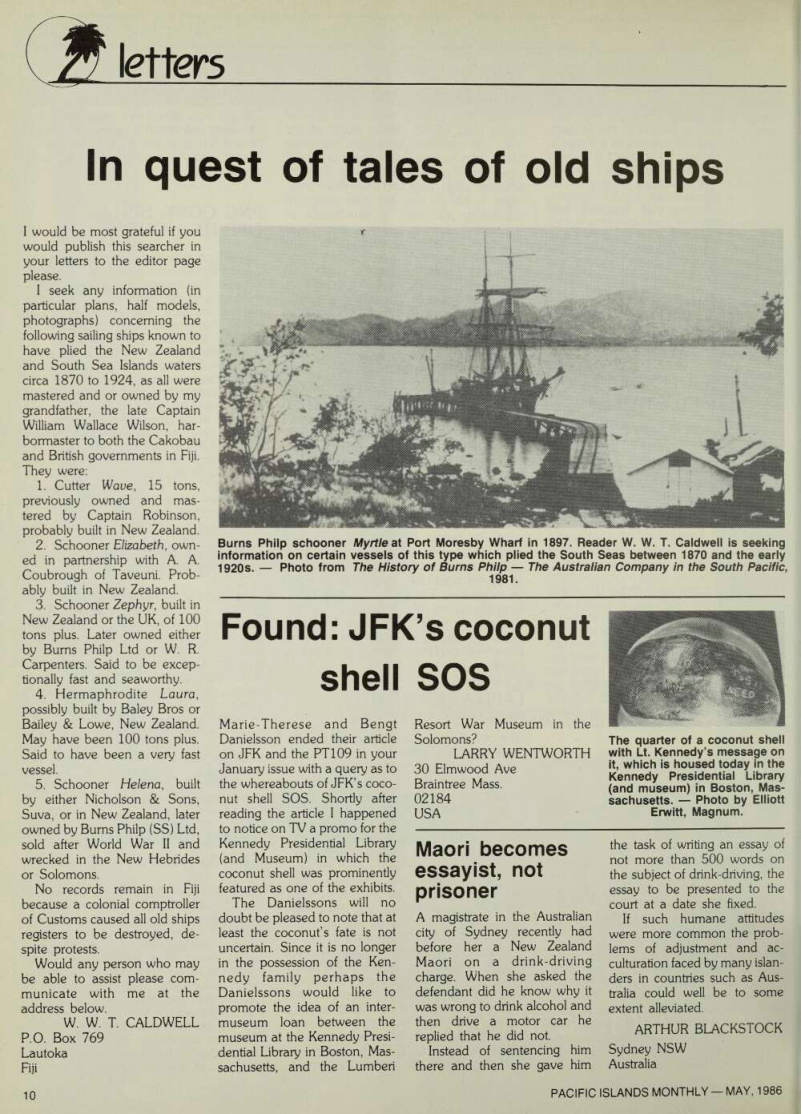
Burns Philp schooner Myrtle at Port Moresby Wharf in 1897. Reader W. W. T. Caldwell is seeking information on certain vessels of this type which plied the South Seas between 1870 and the early 19205. Photo from The History of Burns Philp The Australian Company in the South Pacific, 1981.
Found: JFK’s coconut
shell SOS
Marie-Therese and Bengt Danielsson ended their article on JFK and the PTIO9 in your January issue with a query as to the whereabouts of JFK’s coco nut shell SOS. Shortly after reading the article I happened to notice on TV a promo for the Kennedy Presidential Library (and Museum) in which the coconut shell was prominently featured as one of the exhibits.
The Danielssons will no doubt be pleased to note that at least the coconut’s fate is not uncertain. Since it is no longer in the possession of the Ken nedy family perhaps the Danielssons would like to promote the idea of an inter museum loan between the museum at the Kennedy Presi dential Library in Boston, Mas sachusetts, and the Lumberi
Resort War Museum in the Solomons?
Larry Wentworth
30 Elmwood Ave Braintree Mass. 02184
Usa
The quarter of a coconut shell with Lt. Kennedy’s message on it, which is housed today in the Kennedy Presidential Library (and museum) in Boston, Mas sachusetts.-Photo by Elliott Erwitt, Magnum.
essayist, not
Maori becomes essayist, not prisoner
A magistrate in the Australian city of Sydney recently had before her a New Zealand Maori on a drink-driving charge. When she asked the defendant did he know why it was wrong to drink alcohol and SLdtt he dd to no, Car Instead of sentencing him there and then she gave him
the task of writing an essay of not more than 500 words on the subject of drink-driving, the essay to be presented to the court at a date she fixed.
If such humane attitudes were more common the prob lems of adjustment and ac culturation faced by many islan ders in countries such as Aus tralia could well be to some extent alleviated.
Arthur Blackstock
Sydney NSW Australia
the islands
if war came to the islands
Defence, by its very na ture, is concerned with the future. So says the New Zealand government discussion paper which calls for public submis sions on the country’s defence posture.
The statement is one area, at least, where New Zealand and the US might find common ground in the regional defence debate.
Against the backdrop of the sudden increase in US interest in the region, the NZ statement does more than state the ob vious.
That is not to say that the new US interest is defence motivated. It isn’t. It stems from a number of stimuli, not least prolonged diplomatic urgings by Australia and New Zealand that the “watery continent” should not be taken for granted as a US sympathiser.
But there are other spurs to US interest. Years of Jolly Ro ger tactics by the American Tunaboat Association culmin ated in the Kiribati-Russian fishing deal and in J approaches by the Soviets to |-r other island states. Vanuatu. J according to prime minister "
Walter Lini (PIM last issue) will consider an expected Russian fishing proposal “on its com mercial merits.”
This has not altogether pleased the US. However, there is now an understanding in Washington of the islands’ problems and a tuna deal that gives island nations a fair return for the harvesting of their re- t source is the likely outcome of 1 continuing talks, now without an ATA presence on the Amer ican team.
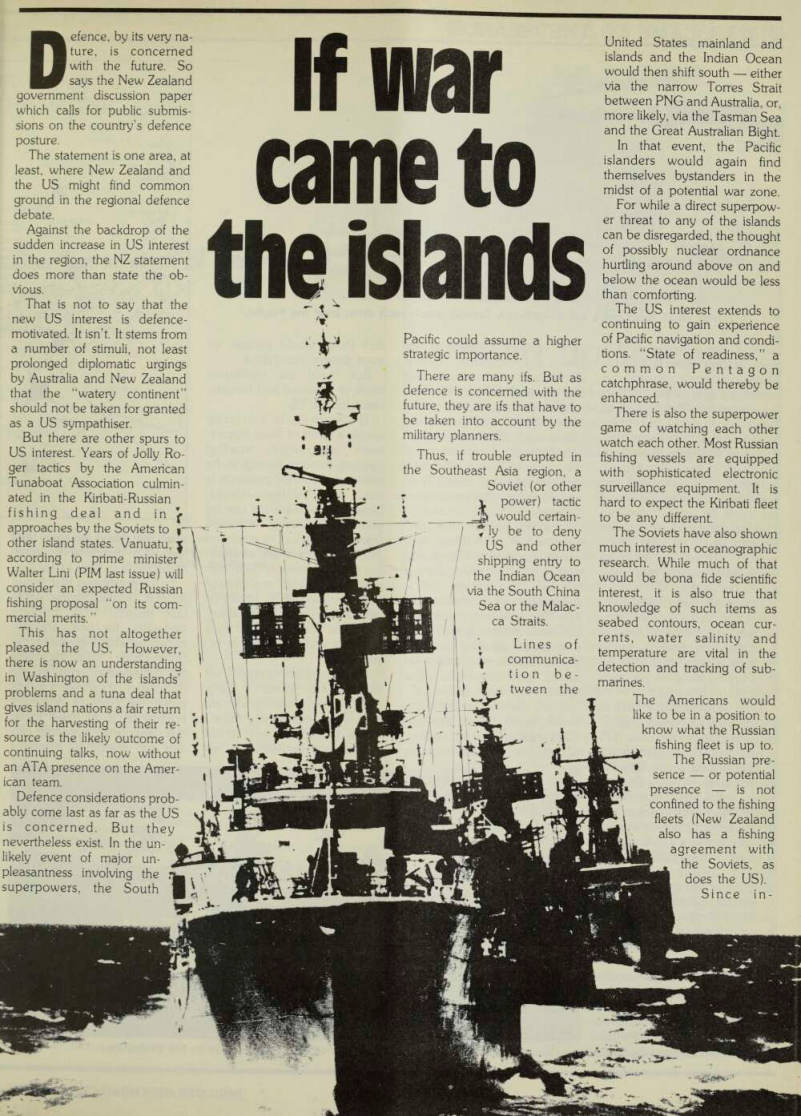
Defence considerations prob ably come last as far as the US < is concerned. But they nevertheless exist. In the un- ’ likely event of major un- JJjj pleasantness involving the superpowers, the South J
Pacific could assume a higher strategic importance.
There are many ifs. But as defence is concerned with the future, they are ifs that have to be taken into account by the military planners.
Thus, if trouble erupted in the Southeast Asia region, a
Soviet (or other i, power) tactic Jk would certain
“ 7 ly be to deny
US and other shipping entry to the Indian Ocean via the South China Sea or the Malac ca Straits.
Lines of I communica tion be - 1 < tween the
United States mainland and islands and the Indian Ocean would then shift south either via the narrow Torres Strait between PNG and Australia, or, more likely, via the Tasman Sea and the Great Australian Bight.
In that event, the Pacific islanders would again find themselves bystanders in the midst of a potential war zone.
For while a direct superpow er threat to any of the islands can be disregarded, the thought of possibly nuclear ordnance hurtling around above on and below the ocean would be less than comforting.
The US interest extends to continuing to gain experience of Pacific navigation and condi tions. “State of readiness,” a common Pentagon catchphrase, would thereby be enhanced.
There is also the superpower game of watching each other watch each other. Most Russian fishing vessels are equipped with sophisticated electronic surveillance equipment. It is hard to expect the Kiribati fleet to be any different.
The Soviets have also shown much interest in oceanographic research. While much of that would be bona fide scientific interest, it is also true that knowledge of such items as seabed contours, ocean cur rents, water salinity and temperature are vital in the detection and tracking of sub marines.
The Americans would like to be in a position to know what the Russian fishing fleet is up to. i The Russian pre sence or potential presence is not confined to the fishing fleets (New Zealand also has a fishing agreement with the Soviets, as does the US).
I Since in-
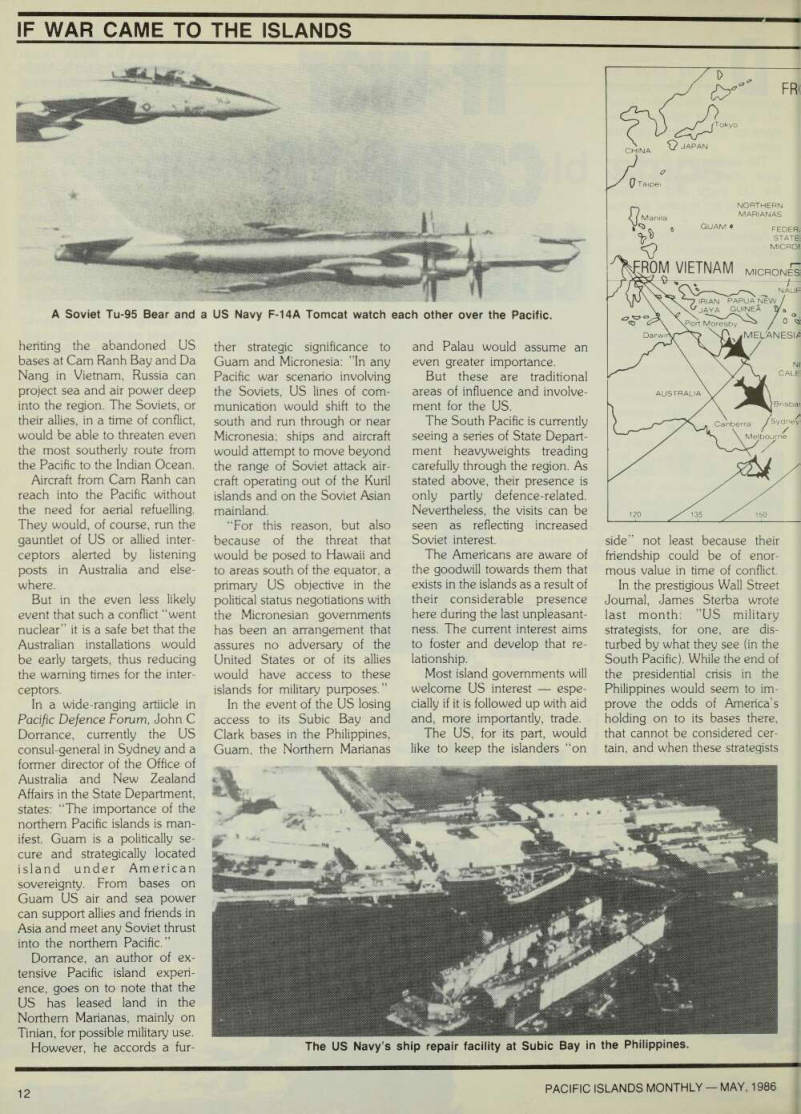
heriting the abandoned US bases at Cam Ranh Bay and Da Nang in Vietnam, Russia can project sea and air power deep into the region. The Soviets, or their allies, in a time of conflict, would be able to threaten even the most southerly route from the Pacific to the Indian Ocean.
Aircraft from Cam Ranh can reach into the Pacific without the need for aerial refuelling.
They would, of course, run the gauntlet of US or allied inter ceptors alerted by listening posts in Australia and else where.
But in the even less likely event that such a conflict “went nuclear” it is a safe bet that the Australian installations would be early targets, thus reducing the warning times for the inter ceptors.
In a wide-ranging artiicle in Pacific Defence Forum, John C Dorrance, currently the US consul-general in Sydney and a former director of the Office of Australia and New Zealand Affairs in the State Department, states: “The importance of the northern Pacific islands is man ifest. Guam is a politically se cure and strategically located island under American sovereignty. From bases on Guam US air and sea power can support allies and friends in Asia and meet any Soviet thrust into the northern Pacific.”
Dorrance, an author of ex tensive Pacific island experi ence, goes on to note that the US has leased land in the Northern Marianas, mainly on Tinian, for possible military use.
However, he accords a fur
ther strategic significance to Guam and Micronesia: ”In any Pacific war scenario involving the Soviets, US lines of com munication would shift to the south and run through or near Micronesia; ships and aircraft would attempt to move beyond the range of Soviet attack air craft operating out of the Kuril islands and on the Soviet Asian mainland.
“For this reason, but also because of the threat that would be posed to Hawaii and to areas south of the equator, a primary US objective in the political status negotiations with the Micronesian governments has been an arrangement that assures no adversary of the United States or of its allies would have access to these islands for military purposes.”
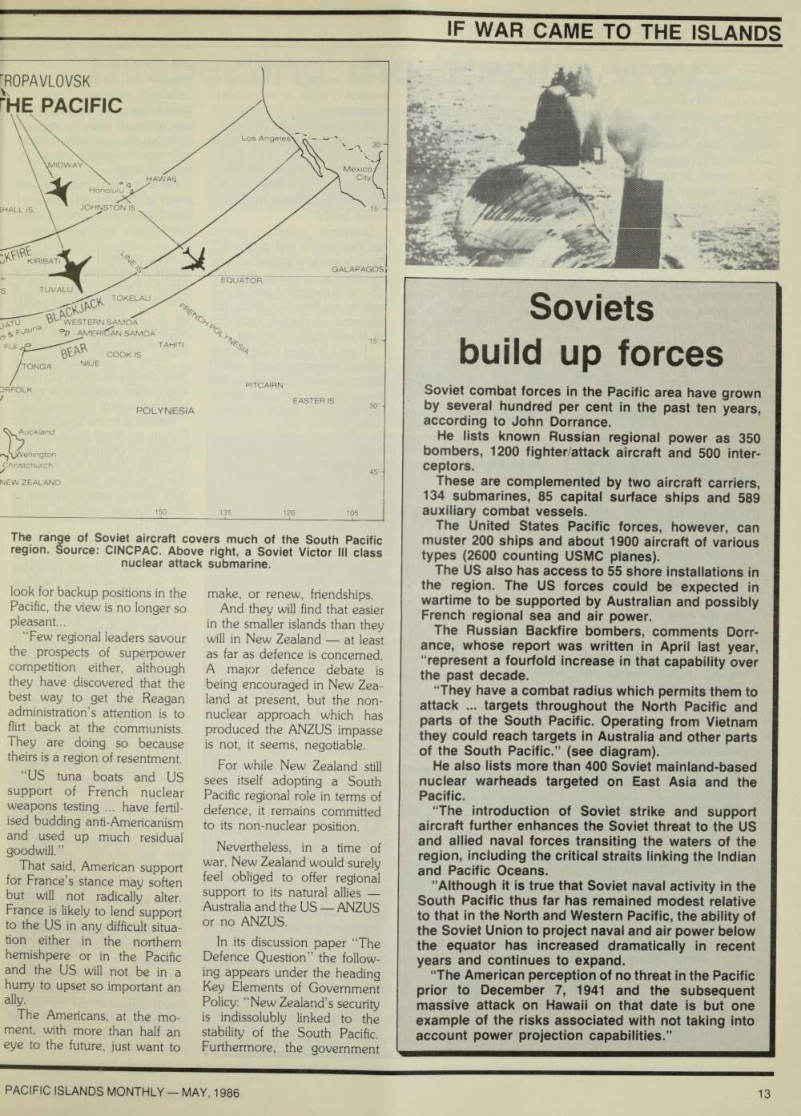
In the event of the US losing access to its Subic Bay and Clark bases in the Philippines, Guam, the Northern Marianas
and Palau would assume an even greater importance.
But these are traditional areas of influence and involve ment for the US.
The South Pacific is currently seeing a series of State Depart ment heavyweights treading carefully through the region. As stated above, their presence is only partly defence-related.
Nevertheless, the visits can be seen as reflecting increased Soviet interest.
The Americans are aware of the goodwill towards them that exists in the islands as a result of their considerable presence here during the last unpleasant ness. The current interest aims to foster and develop that re lationship.
Most island governments will welcome US interest espe cially if it is followed up with aid and, more importantly, trade.
The US, for its part, would like to keep the islanders “on
side” not least because their friendship could be of enor mous value in time of conflict.
In the prestigious Wall Street Journal, James Sterba wrote last month; ”US military strategists, for one, are dis turbed by what they see (in the South Pacific). While the end of the presidential crisis in the Philippines would seem to im prove the odds of America’s holding on to its bases there, that cannot be considered cer tain, and when these strategists
A Soviet Tu-95 Bear and a US Navy F-14A Tomcat watch each other over the Pacific.
The US Navy’s ship repair facility at Subic Bay in the Philippines.
look for backup positions in the Pacific, the view is no longer so pleasant...
“Few regional leaders savour the prospects of superpower competition either, although they have discovered that the best way to get the Reagan administration’s attention is to flirt back at the communists.
They are doing so because theirs is a region of resentment.
“US tuna boats and US support of French nuclear weapons testing ... have fertil ised budding anti-Americanism and used up much residual goodwill. ”
That said, American support for France’s stance may soften but will not radically alter.
France is likely to lend support to the US in any difficult situa tion either in the northern hemishpere or in the Pacific and the US will not be in a hurry to upset so important an ally.
The Americans, at the mo ment, with more than half an eye to the future, just want to
make, or renew, friendships.
And they will find that easier in the smaller islands than they will in New Zealand at least as far as defence is concerned.
A major defence debate is being encouraged in New Zea land at present, but the non nuclear approach which has produced the ANZUS impasse is not, it seems, negotiable.
For while New Zealand still sees itself adopting a South Pacific regional role in terms of defence, it remains committed to its non-nuclear position.
Nevertheless, in a time of war, New Zealand would surely feel obliged to offer regional support to its natural allies Australia and the US ANZUS or no ANZUS.
In its discussion paper “The Defence Question” the follow ing appears under the heading Key Elements of Government Policy: “New Zealand’s security is indissolubly linked to the stability of the South Pacific.
Furthermore, the government
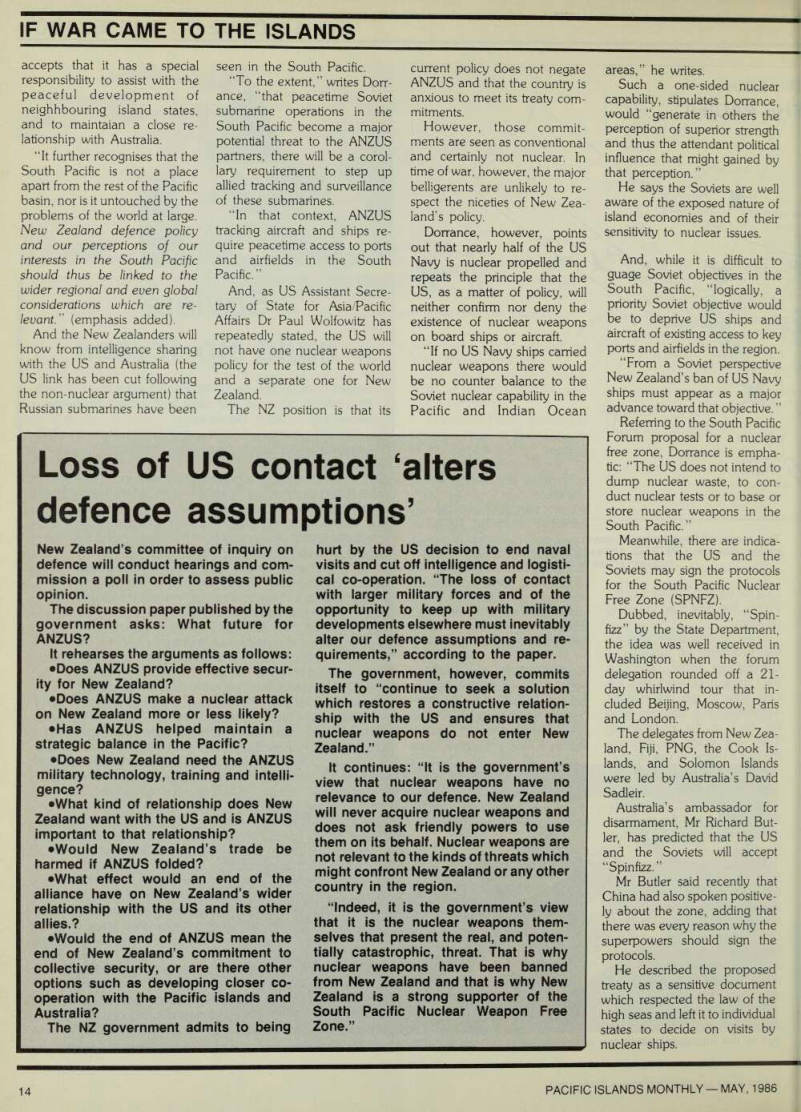
The range of Soviet aircraft covers much of the South Pacific region. Source: CINCPAC. Above right, a Soviet Victor III class nuclear attack submarine.
accepts that it has a special responsibility to assist with the peaceful development of neighhbouring island states, and to maintaian a close re lationship with Australia.
“It further recognises that the South Pacific is not a place apart from the rest of the Pacific basin, nor is it untouched by the problems of the world at large.
New Zealand defence policy and our perceptions of our interests in the South Pacific should thus be linked to the wider regional and even global considerations which are re levant. ” (emphasis added).
And the New Zealanders will know from intelligence sharing with the US and Australia (the US link has been cut following the non-nuclear argument) that Russian submarines have been
seen in the South Pacific.
“To the extent,” writes Dorr ance, “that peacetime Soviet submarine operations in the South Pacific become a major potential threat to the ANZUS partners, there will be a corol lary requirement to step up allied tracking and surveillance of these submarines.
“In that context, ANZUS tracking aircraft and ships re quire peacetime access to ports and airfields in the South Pacific.”
And, as US Assistant Secre tary of State for Asia/Pacific Affairs Dr Paul Wolfowitz has repeatedly stated, the US will not have one nuclear weapons policy for the test of the world and a separate one for New Zealand.
The NZ position is that its
current policy does not negate ANZUS and that the country is anxious to meet its treaty com mitments.
However, those commit ments are seen as conventional and certainly not nuclear. In time of war, however, the major belligerents are unlikely to re spect the niceties of New Zea land’s policy.
Dorrance, however, points out that nearly half of the US Navy is nuclear propelled and repeats the principle that the US, as a matter of policy, will neither confirm nor deny the existence of nuclear weapons on board ships or aircraft.
“If no US Navy ships carried nuclear weapons there would be no counter balance to the Soviet nuclear capability in the Pacific and Indian Ocean
areas,” he writes.
Such a one-sided nuclear capability, stipulates Dorrance, would “generate in others the perception of superior strength and thus the attendant political influence that might gained by that perception.”
He says the Soviets are well aware of the exposed nature of island economies and of their sensitivity to nuclear issues.
And, while it is difficult to guage Soviet objectives in the South Pacific, “logically, a priority Soviet objective would be to deprive US ships and aircraft of existing access to key ports and airfields in the region.
“From a Soviet perspective New Zealand’s ban of US Navy ships must appear as a major advance toward that objective. ”
Referring to the South Pacific Forum proposal for a nuclear free zone, Dorrance is empha tic: “The US does not intend to dump nuclear waste, to con duct nuclear tests or to base or store nuclear weapons in the South Pacific.”
Meanwhile, there are indica tions that the US and the Soviets may sign the protocols for the South Pacific Nuclear Free Zone (SPNFZ).
Dubbed, inevitably, “Spin fizz” by the State Department, the idea was well received in Washington when the forum delegation rounded off a 21day whirlwind tour that in cluded Beijing, Moscow, Paris and London.
The delegates from New Zea land, Fiji, PNG, the Cook Is lands, and Solomon Islands were led by Australia’s David Sadleir.
Australia’s ambassador for disarmament, Mr Richard But ler, has predicted that the US and the Soviets will accept “Spinfizz.”
Mr Butler said recently that China had also spoken positive ly about the zone, adding that there was every reason why the superpowers should sign the protocols.
He described the proposed treaty as a sensitive document which respected the law of the high seas and left it to individual states to decide on visits by nuclear ships.
Advertisements & other items, p. 12 (1 item)
If War Came To The Islands
12
PACIFIC ISLANDS MONTHLY MAY, 1986
Soviets
build up forces
Soviet combat forces in the Pacific area have grown by several hundred per cent in the past ten years, according to John Dorrance.
He lists known Russian regional power as 350 bombers, 1200 fighter/attack aircraft and 500 inter ceptors.
These are complemented by two aircraft carriers, 134 submarines, 85 capital surface ships and 589 auxiliary combat vessels.
The United States Pacific forces, however, can muster 200 ships and about 1900 aircraft of various types (2600 counting USMC planes).
The US also has access to 55 shore installations in the region. The US forces could be expected in wartime to be supported by Australian and possibly French regional sea and air power.
The Russian Backfire bombers, comments Dorr ance, whose report was written in April last year, “represent a fourfold increase in that capability over the past decade.
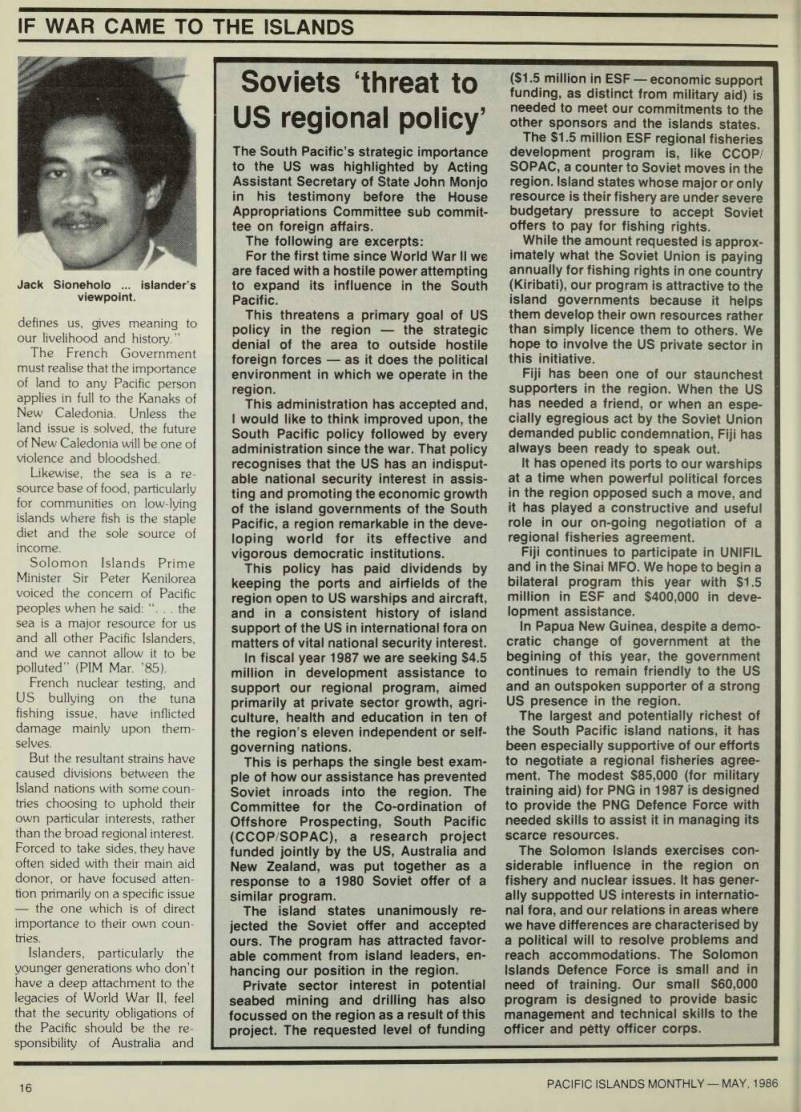
“They have a combat radius which permits them to attack ... targets throughout the North Pacific and parts of the South Pacific. Operating from Vietnam they could reach targets in Australia and other parts of the South Pacific.” (see diagram).
He also lists more than 400 Soviet mainland-based nuclear warheads targeted on East Asia and the Pacific.
“The introduction of Soviet strike and support aircraft further enhances the Soviet threat to the US and allied naval forces transiting the waters of the region, including the critical straits linking the Indian and Pacific Oceans. ’’Although it is true that Soviet naval activity in the South Pacific thus far has remained modest relative to that in the North and Western Pacific, the ability of the Soviet Union to project naval and air power below the equator has increased dramatically in recent years and continues to expand.
“The American perception of no threat in the Pacific prior to December 7, 1941 and the subsequent massive attack on Hawaii on that date is but one example of the risks associated with not taking into account power projection capabilities.”
Advertisements & other items, p. 13 (1 item)
If War Came To The Islands
13
PACIFIC ISLANDS MONTHLY MAY, 1986
defence assumptions’
Loss of US contact ‘alters defence assumptions’
New Zealand’s committee of inquiry on defence will conduct hearings and com mission a poll in order to assess public opinion.
The discussion paper published by the government asks: What future for
Anzus?
It rehearses the arguments as follows: •Does ANZUS provide effective secur ity for New Zealand? •Does ANZUS make a nuclear attack on New Zealand more or less likely? •Has ANZUS helped maintain a strategic balance in the Pacific? •Does New Zealand need the ANZUS military technology, training and intelli gence? •What kind of relationship does New Zealand want with the US and is ANZUS important to that relationship? •Would New Zealand’s trade be harmed if ANZUS folded? •What effect would an end of the alliance have on New Zealand’s wider relationship with the US and its other allies.? •Would the end of ANZUS mean the end of New Zealand’s commitment to collective security, or are there other options such as developing closer co operation with the Pacific islands and Australia?
The NZ government admits to being
hurt by the US decision to end naval visits and cut off intelligence and logisti cal co-operation. “The loss of contact with larger military forces and of the opportunity to keep up with military developments elsewhere must inevitably alter our defence assumptions and re quirements,” according to the paper.
The government, however, commits itself to “continue to seek a solution which restores a constructive relation ship with the US and ensures that nuclear weapons do not enter New Zealand.”
It continues: “It is the government’s view that nuclear weapons have no relevance to our defence. New Zealand will never acquire nuclear weapons and does not ask friendly powers to use them on its behalf. Nuclear weapons are not relevant to the kinds of threats which might confront New Zealand or any other country in the region.
“Indeed, it is the government’s view that it is the nuclear weapons them selves that present the real, and poten tially catastrophic, threat. That is why nuclear weapons have been banned from New Zealand and that is why New Zealand is a strong supporter of the South Pacific Nuclear Weapon Free Zone.”
Advertisements & other items, p. 14 (1 item)
If War Came To The Islands
14
PACIFIC ISLANDS MONTHLY MAY, 1986
Respecting the ‘Pacific Way’
JACK SIONEHOLO, a Niuean graduate of Welling ton’s Victoria University who is now engaged in research on Pacific foreign policy issues, presents an Islander’s viewpoint on current international controversies in the region.
In the wake of political inde pendence, most Pacific Island nations have been engaged in a search for identity, for selfhood, among the ruins left behind by colonialism.
But these efforts are being frustrated by the insensitive, disrespectful, and arrogant be havior of two traditional Pacific powers who happen to be the region’s two major remaining colonial powers: the United States and France.
Their behavior is seen by Islanders to be a direct attack on their fundamental values.
The island environments threatened are the basic corner stones of “the Pacific Way”: universal kinship ties, the land, and the sea.
The island peoples have a great respect for the value of kinship ties, which are operative universally in their societies and generally function as extensions of immediate relations and as flexible rules for social, econo mic and political behavior.
Recent events are increasing ly encouraging islanders to be lieve that the real enemy is closer to home than they were originally led to believe, and a general feeling of resentment is arising. In some parts “anti” feelings have taken root, feel ings quite alien to the Pacific Way, particularly in relation to French nuclear testing at Moruroa. The fact is that unless the French can be persuaded in one way or another to take heed of this resentment, it is possible that these “anti” feel ings will be transformed into something more than just feel ings.
Foreign nations must be aware that Pacific politics is not Western politics, but a com bination, with values of the Pacific Way. Elections are not always decided on issues, but rather on personal and usually private appeals to several score voters in the constituencies.
This is possible because the constituencies are so minute. Of vital importance in these circumstances are family links, village or tribal connections.
popularity based on past achievements, and strong church orientation. Personality politics features strongly, which possibly accounts for the re latively large number of coali tion governments in the region.
Therefore, it is more than likely
that international issues are de cided not on the basis of na tional interest, or still less popu lar interest, but by interests from outside, particularly in favor of a country giving or thought likely to give the greatest amount of aid.
Land is an important compo nent of individual and group identities, and often a determi nant of status.
The great writer Professor Albert Wendt summed it up very well when he wrote; “The land is our greatest blessing from God, our most precious inheritance from our fore fathers. Without it we would have no roots, we would be a canoe without a secure anchor, birds with no permanent and safe resting ground. The land
defines us, gives meaning to our livelihood and history.”
The French Government must realise that the importance of land to any Pacific person applies in full to the Kanaks of New Caledonia. Unless the land issue is solved, the future of New Caledonia will be one of violence and bloodshed.
Likewise, the sea is a re source base of food, particularly for communities on low-lying islands where fish is the staple diet and the sole source of income.
Solomon Islands Prime Minister Sir Peter Kenilorea voiced the concern of Pacific peoples when he said: “. . . the sea is a major resource for us and all other Pacific Islanders, and we cannot allow it to be polluted” (PIM Mar. ’B5).
French nuclear testing, and US bullying on the tuna fishing issue, have inflicted damage mainly upon them selves.
But the resultant strains have caused divisions between the Island nations with some coun tries choosing to uphold their own particular interests, rather than the broad regional interest.
Forced to take sides, they have often sided with their main aid donor, or have focused atten tion primarily on a specific issue the one which is of direct importance to their own coun tries.
Islanders, particularly the younger generations who don’t have a deep attachment to the legacies of World War 11, feel that the security obligations of the Pacific should be the re sponsibility of Australia and
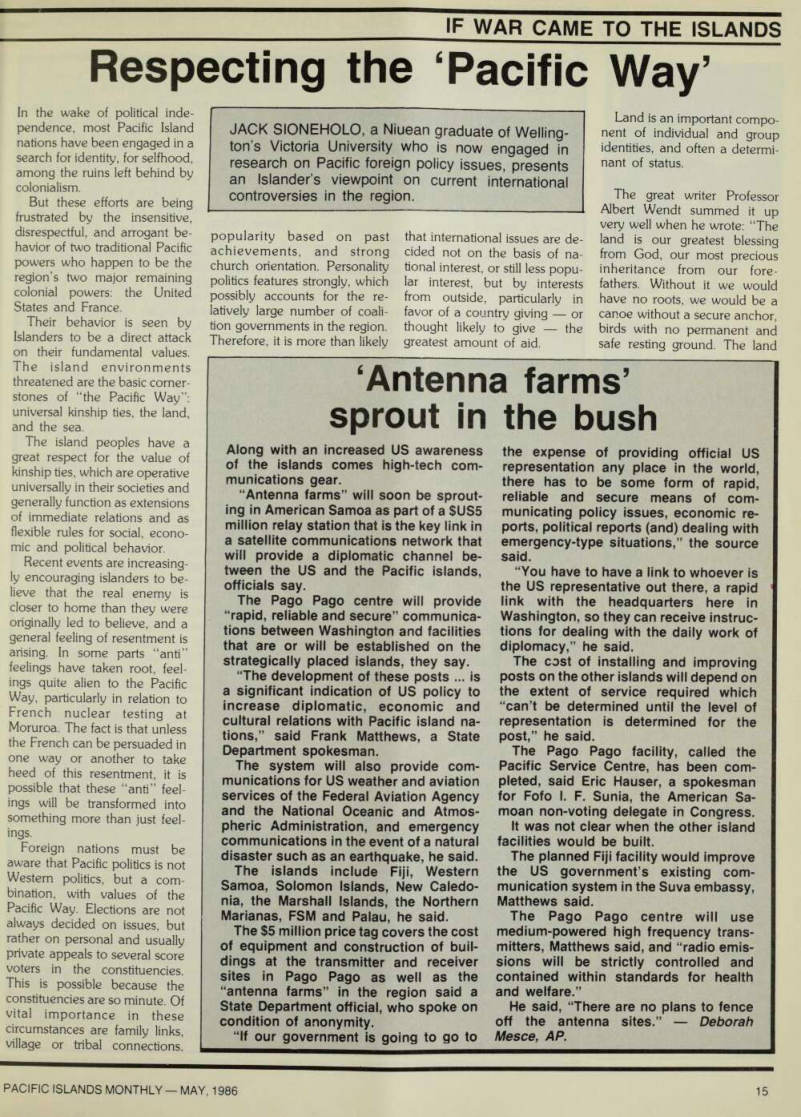
Jack Sioneholo... islander’s viewpoint.
New Zealand, with the support of Fiji and Papua New Guinea.
They view ANZUS as out of date, and really only serving U.S. interests. Their view is reinforced by the fact that the U.S. now is seen as supporting French arguments in favor of nuclear testing.
But in recent times islanders have become suspicious that Australia appears to be playing to the tune called by Washing ton, a suspicion supported by U.S. pressure on Australia to isolate New Zealand on secur ity-intelligence matters, follow ing the New Zealand stand on U.S. port visits.
The island nations are young and have national economic growth and self-sufficiency as their primary aims. They have faith that these should be the main goals of their efforts.
But recent French and U.S. behavior indicates that their own national and security in terests must be the island gov ernments’ prime concern.
These two big countries must reform their colonial habits, and take seriously the warning sig nals that are there. They can do this by conducting their policy towards the region in relation to its people, context, nature and environment as a whole, with
particular emphasis on econo mic needs and traditional values.
In the meantime it is hard for island leaders to choose be tween national and regional interests when the two offen ders are not only threatening their livelihoods, but are also encouraging divisions between the Micronesian-Melanesian countries (who are more vocal in their stances on specific issues), and Polynesian nations (who always have the tendency to side with New Zealand and Australia).
The U.S. and especially France must co-operate with local opinion, because the islan ders are very much aware of
their current motives both with in and outside the region, and both should pay utmost respect to the Pacific Way.
It is precisely their present line of policy which has caused disillusioned island countries to look elsewhere for the help they desperately need. Most recently it is countries of the Far East who have publicly announced their willingness to support Pacific nations’ development efforts. Communist countries are not too far behind, as was indicated by the fishing deal between Kiribati and the Soviet Union. Arab countries such as Libya also aspire to play a role.
Islanders’ patience can only last for so long.
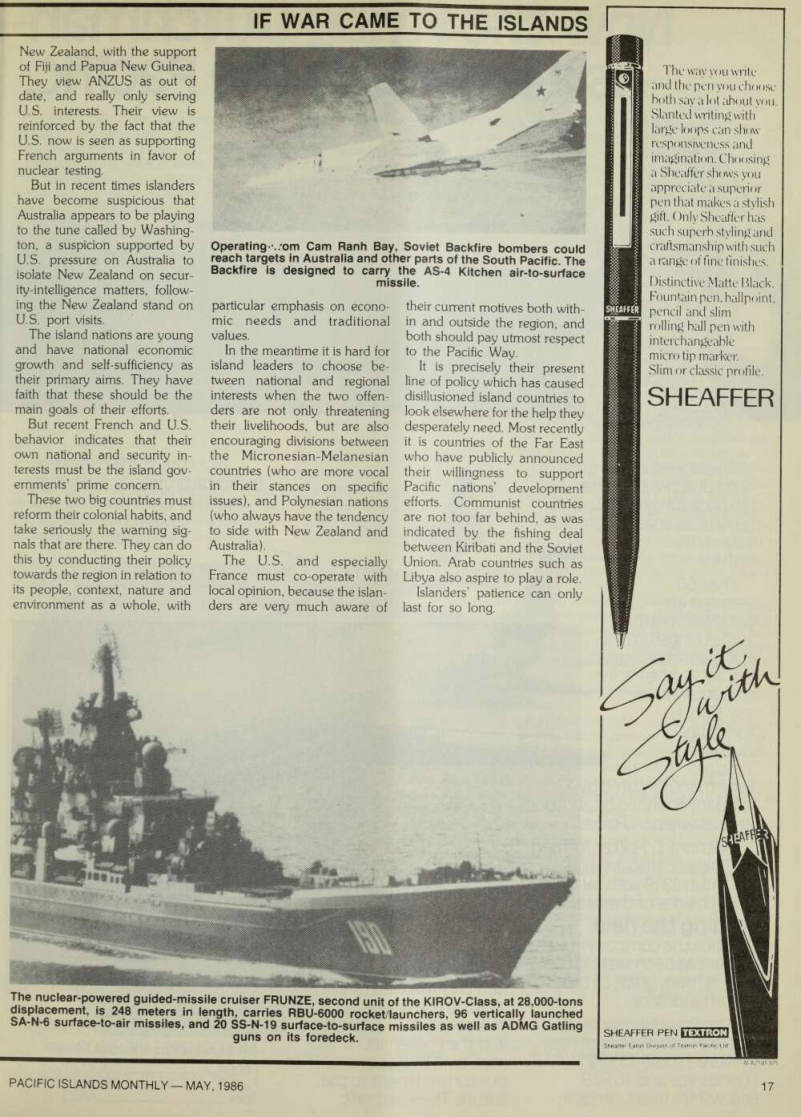
The nuclear-powered guided-missile cruiser FRUNZE, second unit of the KIROV-Class, at 28,000-tons displacement, is 248 meters in length, carries RBU-6000 rocket/launchers, 96 vertically launched SA-N-6 surface-to-air missiles, and 20 SS-N-19 surface-to-surface missiles as well as ADMG Gatling guns on its foredeck.
Operating [?]om Cam Ranh Bay, Soviet Backfire bombers could reach targets in Australia and other parts of the South Pacific. The Backfire is designed to carry the AS-4 Kitchen air-to-surface missile.
‘Antenna farms’
sprout in the bush
Along with an increased US awareness of the islands comes high-tech com munications gear.
“Antenna farms” will soon be sprout ing in American Samoa as part of a SUSS million relay station that is the key link in a satellite communications network that will provide a diplomatic channel be tween the US and the Pacific islands, officials say.
The Pago Pago centre will provide “rapid, reliable and secure” communica tions between Washington and facilities that are or will be established on the strategically placed islands, they say.
“The development of these posts ... is a significant indication of US policy to increase diplomatic, economic and cultural relations with Pacific island na tions,” said Frank Matthews, a State Department spokesman.
The system will also provide com munications for US weather and aviation services of the Federal Aviation Agency and the National Oceanic and Atmos pheric Administration, and emergency communications in the event of a natural disaster such as an earthquake, he said.
The islands include Fiji, Western Samoa, Solomon Islands, New Caledo nia, the Marshall Islands, the Northern Marianas, FSM and Palau, he said.
The $5 million price tag covers the cost of equipment and construction of buil dings at the transmitter and receiver sites in Pago Pago as well as the “antenna farms” in the region said a State Department official, who spoke on condition of anonymity.
“If our government is going to go to
the expense of providing official US representation any place in the world, there has to be some form of rapid, reliable and secure means of com municating policy issues, economic re ports, political reports (and) dealing with emergency-type situations,” the source said.
“You have to have a link to whoever is the US representative out there, a rapid link with the headquarters here in Washington, so they can receive instruc tions for dealing with the daily work of diplomacy,” he said.
The cost of installing and improving posts on the other islands will depend on the extent of service required which “can’t be determined until the level of representation is determined for the post,” he said.
The Pago Pago facility, called the Pacific Service Centre, has been com pleted, said Eric Hauser, a spokesman for Fofo I. F. Sunia, the American Sa moan non-voting delegate in Congress.
It was not clear when the other island facilities would be built.
The planned Fiji facility would improve the US government’s existing com munication system in the Suva embassy, Matthews said.
The Pago Pago centre will use medium-powered high frequency trans mitters, Matthews said, and “radio emis sions will be strictly controlled and contained within standards for health and welfare.”
He said, “There are no plans to fence off the antenna sites.’’ Deborah Mesce, AP.
Advertisements & other items, p. 15 (1 item)
If War Came To The Islands
15
PACIFIC ISLANDS MONTHLY MAY, 1986
US regional policy’
Soviets ‘threat to US regional policy’
The South Pacific’s strategic importance to the US was highlighted by Acting Assistant Secretary of State John Monjo in his testimony before the House Appropriations Committee sub commit tee on foreign affairs.
The following are excerpts: For the first time since World War II we are faced with a hostile power attempting to expand its influence in the South Pacific.
This threatens a primary goal of US policy in the region the strategic denial of the area to outside hostile foreign forces as it does the political environment in which we operate in the region.
This administration has accepted and, I would like to think improved upon, the South Pacific policy followed by every administration since the war. That policy recognises that the US has an indisput able national security interest in assis ting and promoting the economic growth of the island governments of the South Pacific, a region remarkable in the deve loping world for its effective and vigorous democratic institutions.
This policy has paid dividends by keeping the ports and airfields of the region open to US warships and aircraft, and in a consistent history of island support of the US in international fora on matters of vital national security interest.
In fiscal year 1987 we are seeking $4.5 million in development assistance to support our regional program, aimed primarily at private sector growth, agri culture, health and education in ten of the region s eleven independent or self governing nations.
This is perhaps the single best exam ple of how our assistance has prevented Soviet inroads into the region. The Committee for the Co-ordination of Offshore Prospecting, South Pacific (CCOP/SOPAC), a research project funded jointly by the US, Australia and New Zealand, was put together as a response to a 1980 Soviet offer of a similar program.
The island states unanimously re jected the Soviet offer and accepted ours. The program has attracted favor able comment from island leaders, en hancing our position in the region.
Private sector interest in potential seabed mining and drilling has also focussed on the region as a result of this project. The requested level of funding
($1.5 million in ESF economic support funding, as distinct from military aid) is needed to meet our commitments to the other sponsors and the islands states.
The $1.5 million ESF regional fisheries development program is, like CCOP/ SOPAC, a counter to Soviet moves in the region. Island states whose major or only resource is their fishery are under severe budgetary pressure to accept Soviet offers to pay for fishing rights.
While the amount requested is approx imately what the Soviet Union is paying annually for fishing rights in one country (Kiribati), our program is attractive to the island governments because it helps them develop their own resources rather than simply licence them to others. We hope to involve the US private sector in this initiative.
Fiji has been one of our staunchest supporters in the region. When the US has needed a friend, or when an espe cially egregious act by the Soviet Union demanded public condemnation, Fiji has always been ready to speak out.
It has opened its ports to our warships at a time when powerful political forces in the region opposed such a move, and it has played a constructive and useful role in our on-going negotiation of a regional fisheries agreement.
Fiji continues to participate in UNIFIL and in the Sinai MFO. We hope to begin a bilateral program this year with $1.5 million in ESF and $400,000 in deve lopment assistance.
In Papua New Guinea, despite a demo cratic change of government at the begining of this year, the government continues to remain friendly to the US and an outspoken supporter of a strong US presence in the region.
The largest and potentially richest of the South Pacific island nations, it has been especially supportive of our efforts to negotiate a regional fisheries agree ment. The modest $85,000 (for military training aid) for PNG in 1987 is designed to provide the PNG Defence Force with needed skills to assist it in managing its scarce resources.
The Solomon Islands exercises con siderable influence in the region on fishery and nuclear issues. It has gener ally suppotted US interests in internatio nal fora, and our relations in areas where we have differences are characterised by a political will to resolve problems and reach accommodations. The Solomon Islands Defence Force is small and in need of training. Our small $60,000 program is designed to provide basic management and technical skills to the officer and petty officer corps.
Advertisements & other items, pp. 16-18 (3 items)
If War Came To The Islands
16
PACIFIC ISLANDS MONTHLY MAY, 1986
If War Came To The Islands
17
PACIFIC ISLANDS MONTHLY —MAY, 1986
Sheaffer
I J The way y( mj write and the pen you choose both say a lot about you.
Slanted writing with large loops can show responsiveness and imagination. Choosing a Sheaffer shows you appreciate a superior pen that makes a stylish gift. Only Sheaffer has such superb styling and craftsmanship with such a range of fine finishes.
Distinctive Matte Black.
Fountain pen. ballpoint, pencil and slim rolling ball pen with interchangeable micro tip marker.
Slim or classic profile.
SHEAFFER
k •M
SHEAFFER PEN
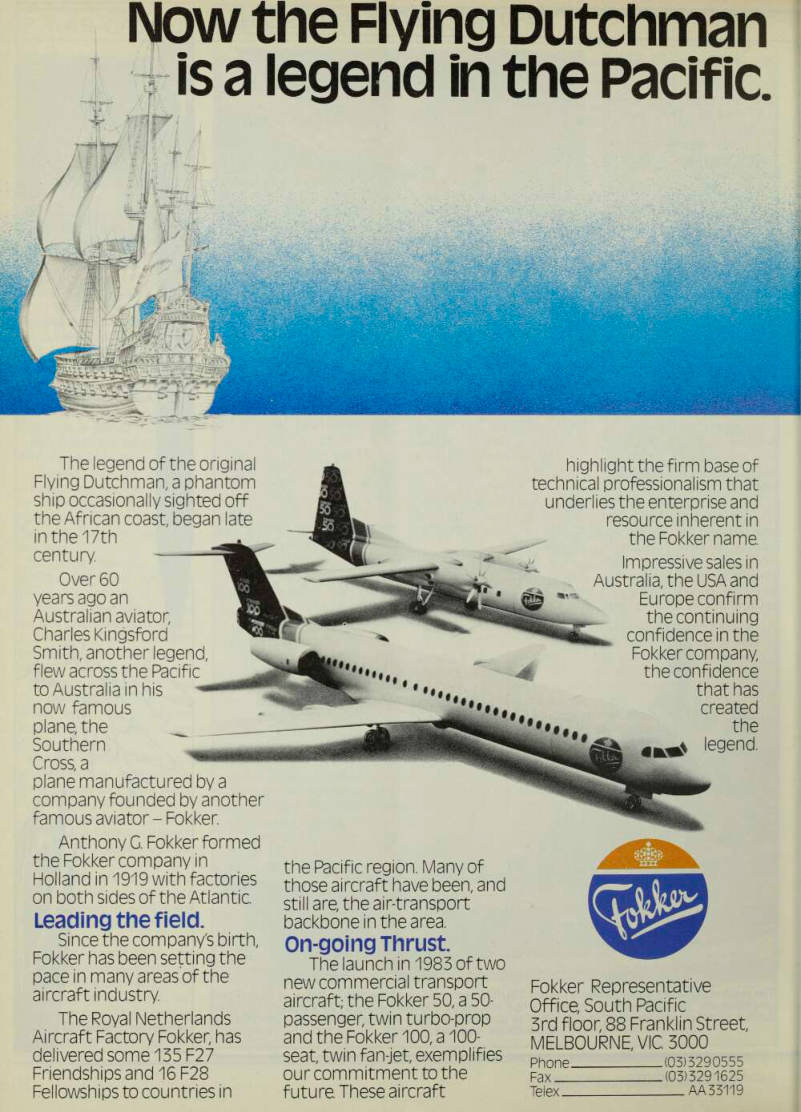
Now the Flying Dutchman
is a legend in the Pacific.
t -X r; m i ■-1 ■ ■ w wtmk if* i® The legend of the original Flying Dutchman, a phantom ship occasionally sighted off the African coast, began late in the 17th century.
Over 60 years ago an Australian aviator, Charles Kingsford Smith, another legend, flew across the Pacific to Australia in his now famous plane, the Southern Cross, a plane manufactured by a company founded by another famous aviator - Fokker.
Anthony C. Fokker formed the Fokker company in Holland in 1919 with factories on both sides of the Atlantic leading the field.
Since the company's birth, Fokker has been setting the pace in many areas of the aircraft industry.
The Royal Netherlands Aircraft Factory Fokker, has delivered some 135 F 27 Friendships and 16 F2B Fellowships to countries in highlight the firm base of technical professionalism that underlies the enterprise and resource inherent in the Fokker name Impressive sales in Australia, the USA and Europe confirm the continuing confidence in the Fokker company, the confidence that has created the a legend. *• • » *•*»
SLA
the Pacific region. Many of those aircraft have been, and still are, the air-transport backbone in the area.
On-going Thrust.
The launch in 1983 of two new commercial transport aircraft; the Fokker 50, a 50passenger, twin turbo-prop and the Fokker 100, a 100seat, twin fan-jet, exemplifies our commitment to the future These aircraft Fokker Representative Office, South Pacific 3rd floor, 88 Franklin Street,
MELBOURNE, VIC. 3000
Phone (05)5290555 Fax (05)5291625 Telex AA55119
the surface
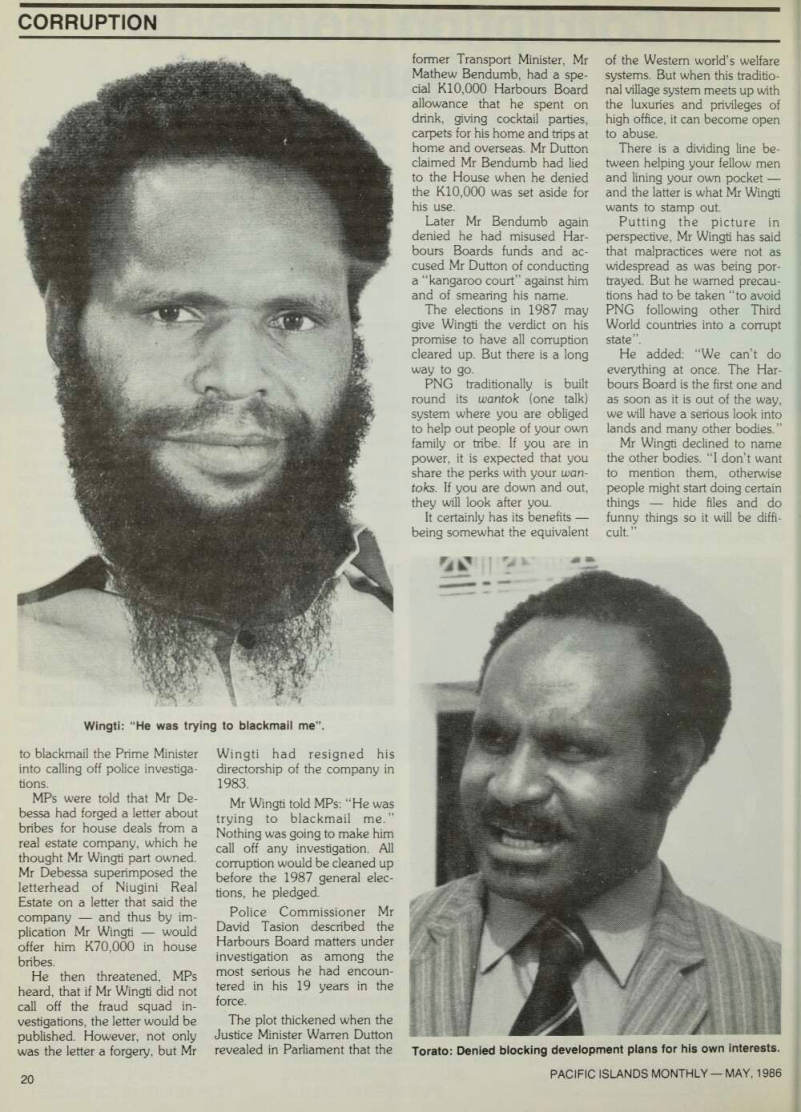
Corruption comes to the surface
THE year 1985 saw two men tirelessly campaign against corruption in Papua New Guinea’s corridors of power.
They were Catholic priest and politician Father John Momis and an aspiring young political leader called Paias Wingti.
Fr Momis repeatedly called for inquiries into mismanagement, misuse of public funds, accepting bribes and favoritism, saying the root cause of PNG’s violent crime was “white-collar crime by safari jacket criminals and the briefcase brigade”.
Mr Wingti fought the issue head-on, demanding inquiries into specific cases what he called the conspiracy over the issue of TV broadcasting and into ministers’ dealings with the controversial airline Pelair.
In March 1985 the two men switched allegiances through the wheeling and dealing of political parties during
a vote of no-confidence which failed in the then government of Michael Somare. Mr Wingti became Leader of the Opposition after earlier resigning as deputy prime minister. Fr Momis swapped from being Opposition leader to being Mr Somare’s deputy.
Fr Momis then had very little to say about corruption and Mr Wingti accused him of missing a “golden chance” to back up his corruption claims with facts.
“My reading of the Bible tells me that Jesus Christ said sinners can be saved but that hypocrites will never go to Heaven,” Mr Wingti said. “I’ve done my part to assist Fr Momis, but he has missed his chance. His credibility is now questionable.”
PNG’s prime minister Paias Wingti has pledged to stamp out corruption in high places before next year’s general elec tion. TIM SINCLAIR in Port Moresby reports that he is pulling no punches in his drive to clean up the corridors of power.
When Mr Wingti made it to power as Prime Minister last November, it was a different story. He has fearlessly tackled the sickness in all quarters and recently pledged that all corruption would be weeded out before the 1987 general elections.
The voluble Mr Paul Torato had been Lands Minister for only just over a month when he announced he was pushing for an inquiry into all land deals made since 1975.
People think there is widespread corruption in land deals and we have to clear that up,” he announced. “I don’t want corruption in land deals.”
A month later he revealed that development worth K2OO million was being hindered by Lands Board inefficiencies. “In the last six months, nothing has been done. No land titles, no work,
everything is in a mess. ”
And he dismissed the board chairman, Mr Konze Kara, because, he said, his appointment by the Somare government had not been made according to correct legal procedures. All deals made under his chairmanship would have to be reconsidered, he said.
Alarmed board officials quickly pointed out that such a move could lead to the government being sued for millions of kina by people who thought they had been given land approvals.
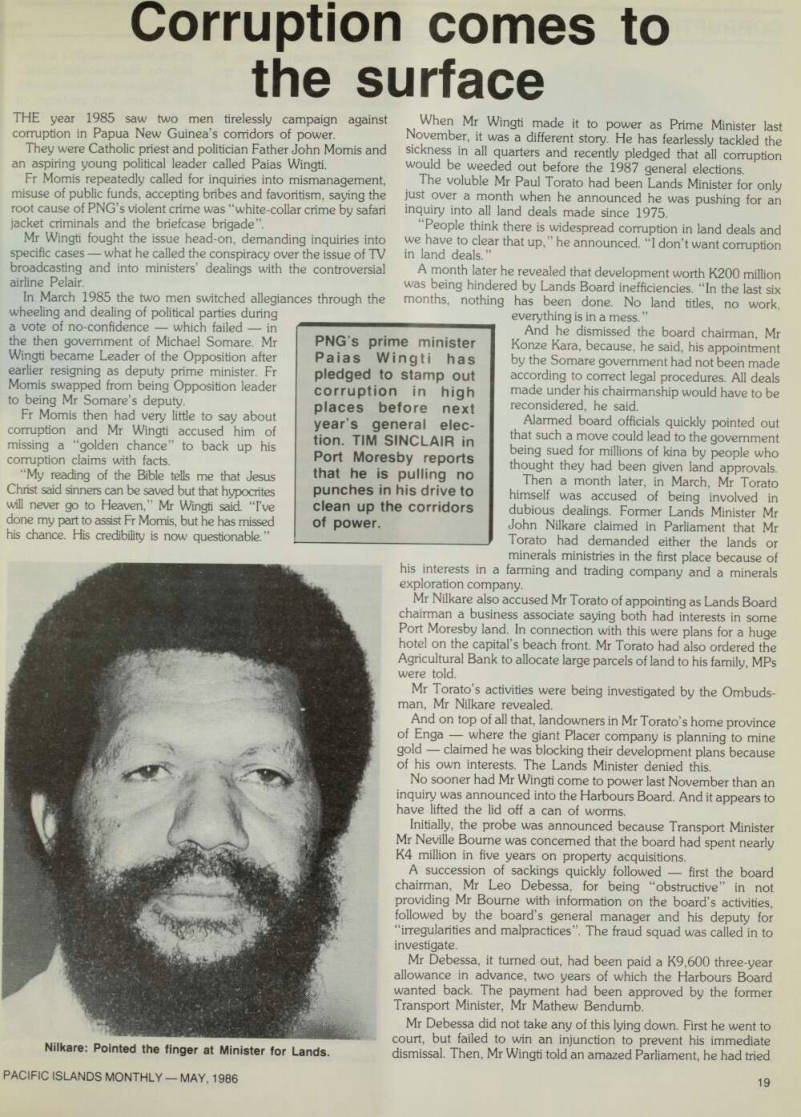
Then a month later, in March, Mr Torato himself was accused of being involved in dubious dealings. Former Lands Minister Mr John Nilkare claimed in Parliament that Mr Torato had demanded either the lands or minerals ministries in the first place because of
his interests in a farming and trading company and a minerals exploration company.
Mr Nilkare also accused Mr Torato of appointing as Lands Board chairman a business associate saying both had interests in some Port Moresby land. In connection with this were plans for a huge hotel on the capital’s beach front. Mr Torato had also ordered the Agricultural Bank to allocate large parcels of land to his family, MPs were told.
Mr Torato’s activities were being investigated by the Ombuds man, Mr Nilkare revealed.
And on top of all that, landowners in Mr Torato’s home province of Enga where the giant Placer company is planning to mine gold claimed he was blocking their development plans because of his own interests. The Lands Minister denied this.
No sooner had Mr Wingti come to power last November than an inquiry was announced into the Harbours Board. And it appears to have lifted the lid off a can of worms.
Initially, the probe was announced because Transport Minister Mr Neville Bourne was concerned that the board had spent nearly K 4 million in five years on property acquisitions.
A succession of sackings quickly followed first the board chairman, Mr Leo Debessa, for being “obstructive” in not providing Mr Bourne with information on the board’s activities, followed by the board’s general manager and his deputy for “irregularities and malpractices”. The fraud squad was called in to investigate.
Mr Debessa, it turned out, had been paid a K 9,600 three-year allowance in advance, two years of which the Harbours Board wanted back. The payment had been approved by the former Transport Minister, Mr Mathew Bendumb.
Mr Debessa did not take any of this lying down. First he went to court, but failed to win an injunction to prevent his immediate dismissal. Then, Mr Wingti told an amazed Parliament, he had tried
Nilkare: Pointed the finger at Minister for Lands.
to blackmail the Prime Minister into calling off police investiga tions.
MPs were told that Mr De bessa had forged a letter about bribes for house deals from a real estate company, which he thought Mr Wingti part owned.
Mr Debessa superimposed the letterhead of Niugini Real Estate on a letter that said the company and thus by im plication Mr Wingti would offer him K 70,000 in house bribes.
He then threatened, MPs heard, that if Mr Wingti did not call off the fraud squad in vestigations, the letter would be published. However, not only was the letter a forgery, but Mr
Wingti had resigned his directorship of the company in 1983.
Mr Wingti told MPs; “He was trying to blackmail me.”
Nothing was going to make him call off any investigation. All corruption would be cleaned up before the 1987 general elec tions, he pledged.
Police Commissioner Mr David Tasion described the Harbours Board matters under investigation as among the most serious he had encoun tered in his 19 years in the force.
The plot thickened when the Justice Minister Warren Dutton revealed in Parliament that the
former Transport Minister, Mr Mathew Bendumb, had a spenal KlO,OOO Harbours Board allowance that he spent on drink, giving cocktail parties, carpets for his home and trips at home and overseas. Mr Dutton claimed Mr Bendumb had lied to the House when he denied the KlO,OOO was set aside for his use.
Later Mr Bendumb again denied he had misused Harhours Boards funds and accused Mr Dutton of conducting a “kangaroo court” against him and of smearing his name.
The elections in 1987 may give Wingti the verdict on his promise to have all corruption cleared up. But there is a long way to go.
PNG traditionally is built round its wantok (one talk) system where you are obliged to help out people of your own family or tribe. If you are in power, it is expected that you share the perks with your wantoks. If you are down and out, they will look after you.
It certainly has its benefits being somewhat the equivalent
of the Western world’s welfare systems. But when this traditio nal village system meets up with the luxuries and privileges of high office, it can become open to abuse, There is a dividing line de tween helping your fellow men and lining your own pocket and the latter is what Mr Wingti wants to stamp out.
Putting the picture in perspective, Mr Wingti has said that malpractices were not as widespread as was being por frayed. But he warned precau tions had to be taken “to avoid PNG following other Third World countries into a corrupt state”.
He added: “We can’t do everything at once. The Har hours Board is the first one and as soon as it is out of the way, we will have a serious look into lands and many other bodies.”
Mr Wingti declined to name the other bodies. “I don’t want to mention them, otherwise people might start doing certain things hide files and do funny things so it will be diffi cult. ”
Wingti: “He was trying to blackmail me”.
Torato: Denied blocking development plans for his own interests.
an election victory
Both sides claim an election victory
New Caledonia’s independ ence movement, the Kanak Socialist Nationalist Liberation Front (FLNKS), is proclaiming victory after the March French legislative elections even though it fielded no candidates.
The front had decided to boycott the poll and spent several weeks before the event lobbying support for the deci sion among the Kanak people and asking them not to vote.
The appeal overwhelmingly succeeded.
From the results, it is clear that the vast majority of Melanesians stayed away from the ballot boxes. Only 50 per cent of those eligible to vote throughout the territory did so.
And that propori
tion was largely made up of anti-independ ence supporters of the right wing RPCR party.
Two other groups also stood candidates, the Independents Union, made up of two parties not associ
ated with the FLNKS and Verite Fratemite Vivre Francais, made up of a group of disillusioned former National Front mem bers.
Between them these two or ganisations managed to poll only 11 per cent of the vote.
The remaining 89 per cent went to the RPCR’s two candi dates Jacques Lafleur and Melanesian school teacher, Maurice Nenou, who will now be the territory’s two repre sentatives in the French Parlia ment.
The FLNKS boycott decision was made for two reasons to underline the view that the elections were the concern of France, not Kanaky, which is the name given by the front to their planned independent New Caledonia, and under the new
proportional representation sys tem it would have been unlikely that any FLNKS candidate would win a seat.
There was, however, also a very important third considera tion that of the front’s unity.
Unity, to the FLNKS, has been vital in establishing the front as a serious representative of the Kanak people. And that image was in grave danger of falling apart in the lead-up to the poll with one of the more militant parties, FULK, deman ding a boycott and the more moderate and more widely supported Unione Caledo nien, led by Jean-Marie Tjibaou supporting participation.
The brawl could have spilled
The French national elections may not radically alter any equations in New Caledonia as the Kanaks continue their independence campaign in the face of determined opposition from the mainly French right wing groups. SUE WILLIAMS in Noumea surveys the battleground as both sides wait for the smoke to clear and for a sign from the new administration in Paris.
over into the public arena with the potential danger of fractur ing the movement.
In an effort to maintain its precious image of unity, Unione Caledonien virtually conceded defeat to FULK led by the then foreign affairs spokesman for the FLNKS, Yann Celene Uregei.
The moderates had also hoped this “victory” to Mr Uregei would silence his out spoken criticisms of the direction taken by the front’s leadership and cool his enthu siasm for soliciting support from countries outside the region, namely Libya and the govern ment of Colonel Moammar Gaddafi.
This hope was short-lived however. Mr Uregei took his right hand man, John Peu, the
FLNKS representative in Aus tralia and Pierre Quaeze, the front s delegate to the United Nations to Tripoli in March for an international conference of liberation movements including such organisations as the PLO.
The main policy-making body of the FLNKS, the Politi cal Bureau, had made it clear it did not want to be involved in the Tripoli meeting and wanted no truck with Libya.
It subsequently suspended Mr Uregei from his official duties. As a measure of its displeasure, the Australian gov ernment has also withdrawn Mr Peu’s visa, effectively preven ting him from returning to Aus tralia.
The suspension of one of its most senior members could certainly be a turning point for the front. The decision was unanimous among the front’s member groups, with the ob vious exception of the two FULK delegates.
This shows the moderates to be firmly in control and this is likely to be an impor tant factor in the front’s deal ings with the new right wing French government which has pledged itself to observe the wishes of the majority in New Caledonia on the inde pendence issue.
The new prime minister Jac ques Chirac has promised a referendum on independence in the coming months. He has also promised a restoration of law and order and a massive
investment program for the territory.
While this may sound like tough and decisive action and, while the anti-independentists believe it will mean an end to any talk of self rule, Mr Chirac’s plans don’t differ greatly from those drawn up by the previous socialist government.
Certainly, if a referendum is held, this year and everybody on the electoral roll is allowed to vote, the independence movement will lose.
However, Mr Chirac has not said that this will be the only referendum held. He could well announce another at a later stage.
But this is still in the realm of
speculation and, meanwhile, Tjibaou says he is concentrat ing on the impending vote whenever it may be held.
His greatest priority is the development of the regions.
Three of the four in the territory are
FLNKS strongholds.
At this stage Mr Chirac will probably leave the regions in place, with the possibility of a few minor changes to placate the right wing.
A disciplined and determined force which probably repre sents the greatest danger of a return to violence in these areas.
There are certainly groups within the rightist fold who are well armed and ready to fight if they feel threatened.
The situation has really be come one of “wait and see”.
Tjibaou has followed the rules of the game set out by the previous government and has put his cards on the table.
The next move will have to come from the new administra tion in Paris.
Womens work may help
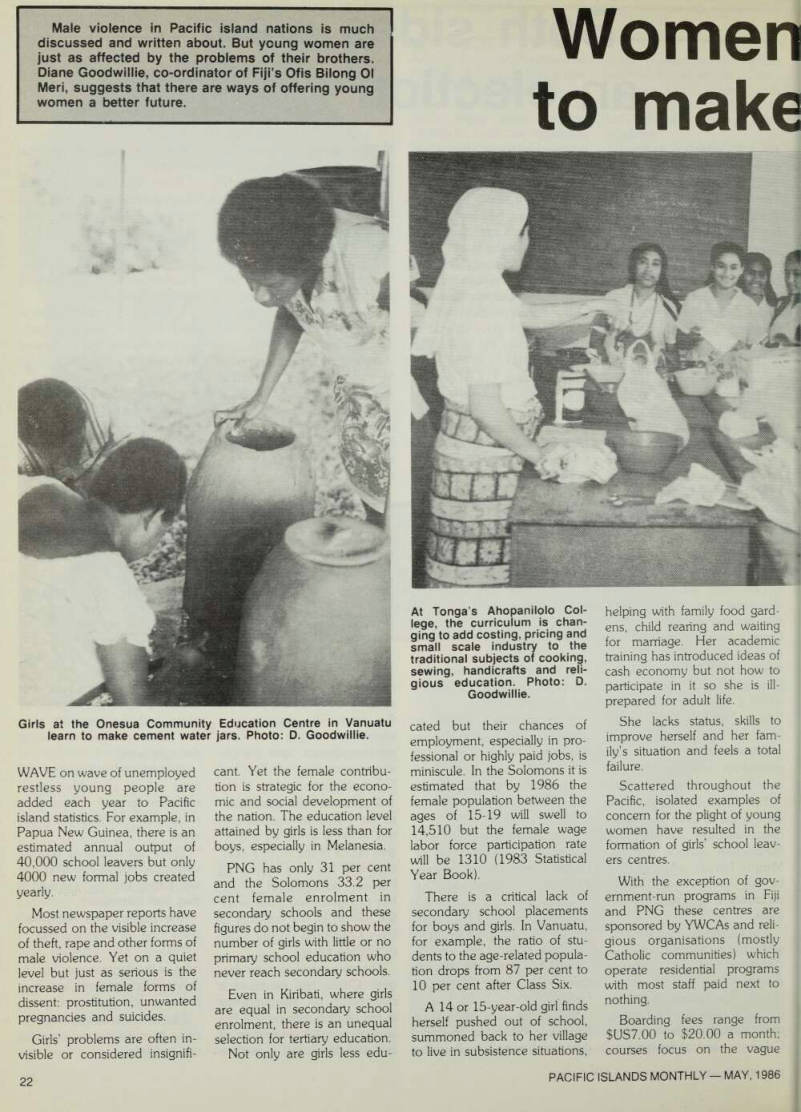
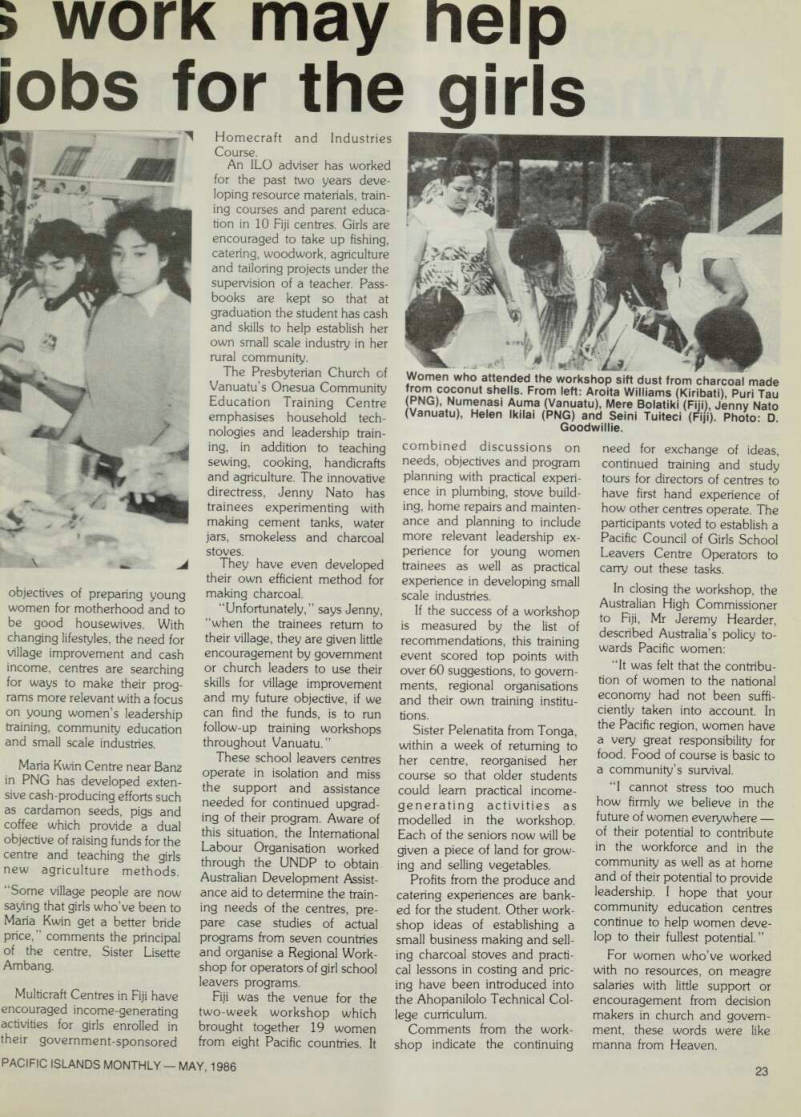
to make jobe for the girls
Male violence in Pacific island nations is much discussed and written about. But young women are just as affected by the problems of their brothers.
Diane Goodwillie, co-ordinator of Fiji’s Ofis Bilong 01 Meri, suggests that there are ways of offering young women a better future.
WAVE on wave of unemployed restless young people are added each year to Pacific island statistics. For example, in Papua New Guinea, there is an estimated annual output of 40,000 school leavers but only 4000 new formal jobs created yearly.
Most newspaper reports have focussed on the visible increase of theft, rape and other forms of male violence. Yet on a quiet level but just as serious is the increase in female forms of dissent: prostitution, unwanted pregnancies and suicides.
Girls’ problems are often in visible or considered insignifi
cant. Yet the female contribu tion is strategic for the econo mic and social development of the nation. The education level attained by girls is less than for boys, especially in Melanesia.
PNG has only 31 per cent and the Solomons 33.2 per cent female enrolment in secondary schools and these figures do not begin to show the number of girls with little or no primary school education who never reach secondary schools.
Even in Kiribati, where girls are equal in secondary school enrolment, there is an unequal selection for tertiary education.
Not only are girls less edu-
cated but their chances of employment, especially in pro fessional or highly paid jobs, is miniscule. In the Solomons it is estimated that by 1986 the female population between the ages of 15-19 will swell to 14,510 but the female wage labor force participation rate will be 1310 (1983 Statistical Year Book).
There is a critical lack of secondary school placements for boys and girls. In Vanuatu, for example, the ratio of stu dents to the age-related popula tion drops from 87 per cent to 10 per cent after Class Six.
A 14 or 15-year-old girl finds herself pushed out of school, summoned back to her village to live in subsistence situations,
helping with family food gard ens, child rearing and waiting for marriage. Her academic training has introduced ideas of cash economy but not how to participate in it so she is ill prepared for adult life.
She lacks status, skills to improve herself and her fam ily’s situation and feels a total failure.
Scattered throughout the Pacific, isolated examples of concern for the plight of young women have resulted in the formation of girls’ school leav ers centres.
With the exception of gov ernment-run programs in Fiji and PNG these centres are sponsored by YWCAs and reli gious organisations (mostly Catholic communities) which operate residential programs with most staff paid next to nothing.
Boarding fees range from SUS7.OO to $20.00 a month; courses focus on the vague
Girls at the Onesua Community Education Centre in Vanuatu learn to make cement water jars. Photo: D. Goodwillie.
At Tonga’s Ahopanilolo Col lege, the curriculum is chan ging to add costing, pricing and small scale industry to the traditional subjects of cooking, sewing, handicrafts and reli gious education. Photo: D.
Goodwillie.
objectives of preparing young women for motherhood and to be good housewives. With changing lifestyles, the need for village improvement and cash income, centres are searching for ways to make their prog rams more relevant with a focus on young women’s leadership training, community education and small scale industries.
Maria Kwin Centre near Banz in PNG has developed exten sive cash-producing efforts such as cardamon seeds, pigs and coffee which provide a dual objective of raising funds for the centre and teaching the girls new agriculture methods.
“Some village people are now saying that girls who’ve been to Maria Kwin get a better bride price,” comments the principal of the centre, Sister Lisette Ambang.
Multicraft Centres in Fiji have encouraged income-generating activities for girls enrolled in their government-sponsored
Homecraft and Industries Course.
An ILO adviser has worked for the past two years deve loping resource materials, train ing courses and parent educa tion in 10 Fiji centres. Girls are encouraged to take up fishing, catering, woodwork, agriculture and tailoring projects under the supervision of a teacher. Pass books are kept so that at graduation the student has cash and skills to help establish her own small scale industry in her rural community.
The Presbyterian Church of Vanuatu’s Onesua Community Education Training Centre emphasises household tech nologies and leadership train ing, in addition to teaching sewing, cooking, handicrafts and agriculture. The innovative directress, Jenny Nato has trainees experimenting with making cement tanks, water jars, smokeless and charcoal stoves.
They have even developed their own efficient method for making charcoal.
“Unfortunately,” says Jenny, “when the trainees return to their village, they are given little encouragement by government or church leaders to use their skills for village improvement and my future objective, if we can find the funds, is to run follow-up training workshops throughout Vanuatu.”
These school leavers centres operate in isolation and miss the support and assistance needed for continued upgrad ing of their program. Aware of this situation, the International Labour Organisation worked through the UNDP to obtain Australian Development Assist ance aid to determine the train ing needs of the centres, pre pare case studies of actual programs from seven countries and organise a Regional Work shop for operators of girl school leavers programs.
Fiji was the venue for the two-week workshop which brought together 19 women from eight Pacific countries. It
combined discussions on needs, objectives and program planning with practical experi ence in plumbing, stove build ing, home repairs and mainten ance and planning to include more relevant leadership ex perience for young women trainees as well as practical experience in developing small scale industries.
If the success of a workshop is measured by the list of recommendations, this training event scored top points with over 60 suggestions, to govern ments, regional organisations and their own training institu tions.
Sister Pelenatita from Tonga, within a week of returning to her centre, reorganised her course so that older students could leam practical income generating activities as modelled in the workshop.
Each of the seniors now will be given a piece of land for grow ing and selling vegetables.
Profits from the produce and catering experiences are bank ed for the student. Other work shop ideas of establishing a small business making and sell ing charcoal stoves and practi cal lessons in costing and pric ing have been introduced into the Ahopanilolo Technical Col lege curriculum.
Comments from the work shop indicate the continuing
need for exchange of ideas, continued training and study tours for directors of centres to have first hand experience of how other centres operate. The participants voted to establish a Pacific Council of Girls School Leavers Centre Operators to carry out these tasks.
In closing the workshop, the Australian High Commissioner to Fiji, Mr Jeremy Hearder, described Australia’s policy to wards Pacific women: “It was felt that the contribu tion of women to the national economy had not been suffi ciently taken into account. In the Pacific region, women have a very great responsibility for food. Food of course is basic to a community’s survival.
“I cannot stress too much how firmly we believe in the future of women everywhere of their potential to contribute in the workforce and in the community as well as at home and of their potential to provide leadership. I hope that your community education centres continue to help women deve lop to their fullest potential.”
For women who’ve worked with no resources, on meagre salaries with little support or encouragement from decision makers in church and govern ment, these words were like manna from Heaven.
Women who attended the workshop sift dust from charcoal made from coco untshells. From left: Aroita Williams (Kiribati), Puri Tau PNG), Numenasi Auma (Vanuatu), Mere Bolatiki (Fiji), Jenny Nato (Vanuatu), Helen Ikilai (PNG) and Seini Tuiteci (Fiji). Photo: D.
Goodwillie.
Advertisements & other items, p. 23 (1 item)
[?]s worK may help
jobs for the girls
What’s in a name?
DID you know that Sir Tore Lokoloko, former Governor- General of Papua New Guinea, was the son of a traditional paramount chief of the Moripip people of Gulf Province?
Or that John Kadiba was the first Papua New Guinean to be appointed a college lecturer overseas? Where was Deputy Opposition Leader, Father John Momis, bom? At Sala maua, Morobe Province on March 3, 1942.
Which ministries were held by lambakey Okuk in the first National Coalition Govern ment? Agriculture, Transport and Civil Aviation, and Educa tion (for only a month).
Did you know that Sir Julius Chan studied Agricultural Sci ence at the University of Queensland in the late 19505?
Or that Tegi Ebial, the son of a tribal war leader, was President of the Nipa Local Government Council for 16 years before becoming Premier of Southern Highlands Province?
Who was the first Papua New Guinean to be commissioned an officer in the Australian Regular Army in 1963? Second Lieutenant Edward Diro, who went on to become the first national Commander of the Papua New Guinea Defence Force and a Brigadier General.
Did you know that Gabriel Waipek, from Minj, Western Highlands Province, now Southern Highlands Provincial Secretary, obtained a degree in Education from UPNG at the age of 40-plus? Or that Dr James Jacobi, the popular Port Moresby medical practitioner and long-time president of the PNG Rugby Football Leauge, served during World War II in the Royal Australian Air Force, No. 30 Squadron (Beaufigh ters)?
Did you know that Peter Donigi, the well-known lawyer, finalised and signed Papua New Guinea’s accession agreement to the Lome Convention?
All these facts, which have
been supplied by the persons themselves, will be included with countless other biographi cal details in a book now in preparation to be published next year. The book is to be called the Papua New Guinea Dictionary of Contemporary Biography or PNGDCB for short.
The PNGDCB will provide short biographies or life histor ies of prominent and repre sentative figures in the nation’s recent past.
It will include persons who have made a significant con tribution since 1945 in the fields of politics, government and public life at national, provincial and local levels, in the churches and education, in the judiciary, police and security forces, in business and the professions, and in the arts, media and sport. Traditional leaders will also be included.
The editors currently esti mate that the book will contain about 1700 entries varying in length according to the signi ficance of the subject.
The longest entry will be 2500 words (for Mr Michael Somare), the next longest will be 2000 words (Sir John Guise, Sir Julius Chan, Mr Paias Wing ti and pehaps others) and so on in reducing lengths down to short “Who’s Who” type en tries of about 100 words for the lesser mortals.
The whole volume will con tain about 500,000 words.
Roughly three quarters of the entries will be for Papua New Guinea nationals, and the re mainder for expatriates. A wide range of authors are being invited to contribute entries on a voluntary basis.
A detailed questionnaire in English, Pidgin and Motu is being sent out with a covering letter to all persons who may be included.
All information supplied is treated with discretion and is not made public.
Completed questionnaires
will not only provide essential information for the PNGDCB, but will be of use in any future publication projects such as a Who’s Who in Papua New Guinea, or any number of specialist directories which may be produced in years to come.
It is also envisaged that supple ments to the PNGDCB will be published from time to time.
The biographical information collected is being stored on computer in a specially de signed data base. Each person who has been identified as a possible candidate for the PNGDCB will have a separate entry in the data base.
Entries will record details such as date and place of birth, parents, education, languages spoken and written, marriage, career, public activities and any special achievements. Details of other sources (books, news paper articles, directories, etc.) which give further biographical details will also be noted.
No details are recorded that are not either volunteered or already available in print. There are no plans to allow public access to the data base.
The editors of the PNGDCB are largely starting from scratch.
There is, to date, no Who’s Who in Papua New Guinea or any publication like it.
A full-scale Papua New Guinea National Biography, re cording in full, with scholarly precision, the lives of all the mighty dead, is far too ambi tious for current resources. A number of Papua New Gui neans are included in the British publication Who’s Who, the standard reference work for up-to-date information on to day’s influential and famous.
More are included in Who’s Who in Oceania, but the useful ness of this publication can be judged by a glance at some of the entries. Roy Evara appears under Roy, and the present Minister for Primary Industry appears twice once as Okuk, lambakey Palma, and again,
two entries later, as Okuk, Lambakey.
There is, in fact, very little easily accessible or convenient ly published information on Papua New Guinea’s leading personalities. And what exists can be frustratingly inaccurate and incomplete.
In addition, there is the prob lem that Papua New Guinea was until recently without writ ten records about its people and its past.
In any case, say the editors, the biographical history of a nation should be written by the widest possible range of people who possess specialist know ledge and insights, or who have a desire to use their writing skills to contribute to an important work of reference.
For this reason, the editors are inviting volunteer authors to participate. Where possible the editors will give guidance to available sources and will also advise on the length and format of entries.
The editors, however, ask volunteers not to rush to contri bute entries for Somare, Chan, Wingti, Momis, Okuk, Guise, Kiki, Cleland, Wedega, Diro, Matane, Taureka, Olewale, Abal, Kekedo, Gunther, Sama na, Hannett, Yaliwan, Hasluck, Bouraga, Rooney, Wamp, Groves, Yauwiga, Waiko, Vangeke, Johnson, Zurecnuoc, Kaputin, Kidu, Lokoloko, Abel, Kilage, Holloway, Abaijah, McCarthy, Eri, Morauta, Gire gire, Debila, Kondom, Yali, Paliau, Sigob, Goava, Rama, Wagambie, Watson, Ambo, Tokwepota, Leahy, Aba, Tolo lo, Mead, Chatterton, Arek, Kasaipwalova, Kabu, Sinclair, Toliman, Simogen . . .
All correspondence should be directed to: Andrew Griffin, Co-Editor, Papua New Guinea Directory of Contemporary Biography, Box 319, University P. 0., National Capital District, Papua New Guinea.
Flosse landslide victory
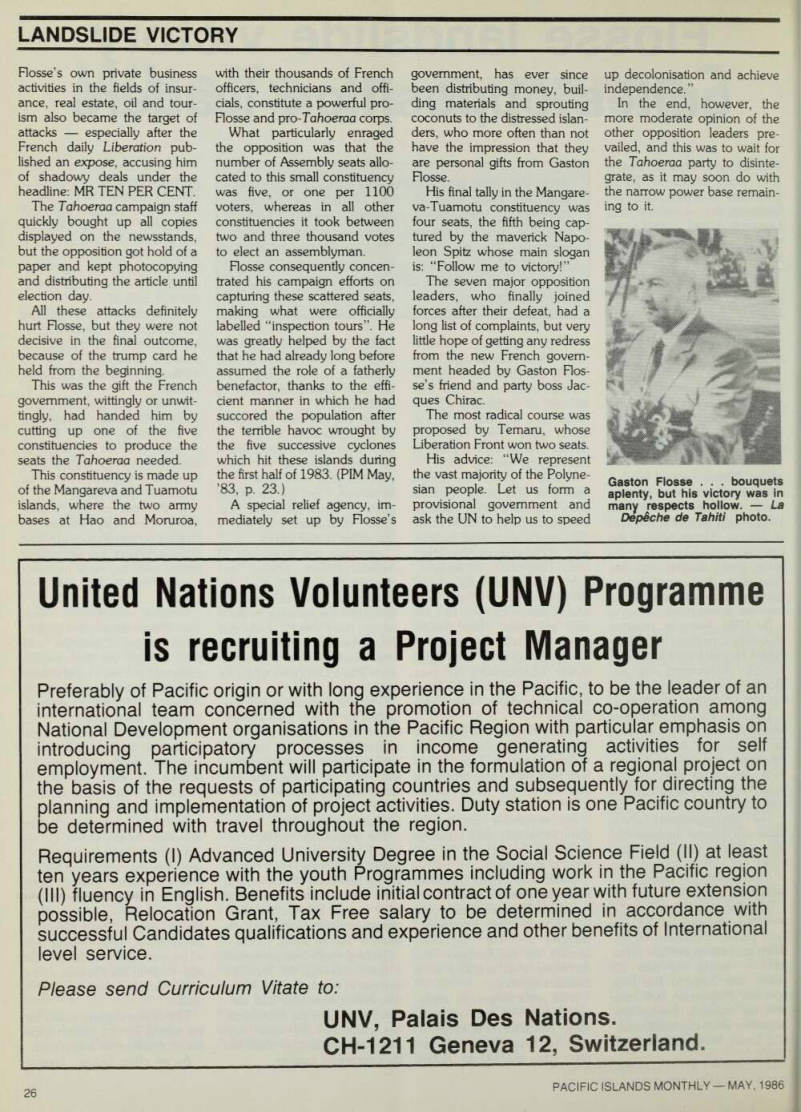
unites opposition leaders
The election score at closing time stood at 21 to 20 in Tahoeraa’s favor. But the following day, a recount in a Leeward Island constituency saw the Tahoeraa candidate returned with a four-vote margin.
Two independent assembly men, elected on their own separate platforms, promptly decided to jump on the winning bandwaggon, giving Flosse a final 24 to 17 majority.
But that is not the whole picture.
On a straight vote count, Tahoeraa actually polled less than the badly fragmented opposition parties 45,000 to 30,000.
The Flosse victory was a repeat performance of the pre vious territorial elections in 1982, when his party obtained as little as 30 per cent of the votes and only 13 out of the 30 scats then making up the Assembly, but nonetheless managed to put together a coalition government.
By 1985, however, most of his coalition partners had aban doned him and were moreover roundly denouncing his au thoritarian manner and accus ing him of corrupt practices.
The only solution for Flosse was to ask the French govern ment to dissolve the Territorial Assembly and call new elec tions two years early in the hope of being returned with a solid majority of his own.
The Paris government (which alone can dissolve the assembly and authorise new local elec tions) not only complied, but also increased the number of seats from 30 to 41.
By doing so it acceded to the repeated requests of all the local parties, motivated by the sharp population increase in the territory during the past 20 years, due both to the high post-war Polynesian birth rate and the massive French im "nigration since the nuclear tes ing bases were established in 1963.
After the most pessionete end vicious territories election cempeign in the history of French Polynesie, incumbent premier Geston Flosse end his ruling Tahoeraa perty won en outright mejority. But, sey MARIE-THERESE end BENGT DANIELSSON, there ere elements in the voting pettern thet indicete different priorities emong the electorete.
In accordance with the new, more liberal policies introduced during the 1982 elections, the Paris government also this time allowed all candidates 10 mi nutes time on radio and TV, which gave them an equal chance of reaching the voters in the outlying islands.
Flosse’s smart campaign managers and public relations men, mostly French expatri ates, immediately tried to make Tahoeraa’s economic policies and achievements the main issue. They could, for instance, rightly assert that inflation had diminished from 16 per cent when Flosse took over, to 8 per cent last year. Huge invest ments have also been made in the tourist industry, with huge hotels mushrooming all over the Society Islands (PIM April) creating hundreds of new em ployes.
Eighty Korean and Japanese fishing boats last year paid 100 million francs in licence fees with boat stores and provisions accounting for even bigger sums.
An enormous number of commercial and office buildings have also gone up in and around Papeete.
Social and welfare measures taken by Flosse’s government have been equally impressive though the household budgets of most Polynesian families are still far below the minimum level required for a decent existence.
It is nevertheless an undis puted fact that the minimum wage, which for most workers is also the maximum wage, has risen from 42,000 to 75,000
francs per month between 1982 and 1986, while the child allowance was increased during the same period from 2800 to 5500 francs.
Last but not least thousands of impoverished voters felt grateful to Flosse’s government for price controls on most essential food items, which, un fortunately from the nutritional point of view, are flour, rice, sugar, condensed milk and a few other tinned goods.
Although the thousands of leaflets, folders, posters and manifestos distributed by Tahoeraas did not exactly formulate the message in these words, there was no doubt that Flosse had managed to drag an impressive number of Polyne sians into a European-type eco nomy.
Flosse’s message to the 10,000 to 12,000 new French voters was different. He con centrated less on the material benefits of his years in power and took a strong line on protecting them against the per ceived threat of a pro-inde pendence avalanche.
The opposition leaders re torted that they could and would have done much better, if they had been in power, and then began hammering home what instead became the main campaign issue: Flosse’s incon siderate use of public funds.
To begin with they presented a table showing the lopsided manner in which the Tahoeraa dominated Assembly had allo cated money to the municipali ties controlled by their own party, as compared to those run by opposition mayors.
Worst treated was, not unex pectedly, Faaa, whose mayor is Flosse’s number one bogey man, Oscar Temaru, the most vociferous pro-independence and anti-bomb politician in the colony. Total allocation for his township in ’B3-’B5 was 3 mil lion francs, while Flosse’s Pirae got 477 million.
Flosse’s expenses for running the government, and the num ber of limousines and expatriate attaches employed by his 10 ministries, so came in for heavy criticism.
As well as the special funds of about 3000 million francs used in a sovereign manner by the premier and his ministers to subsidise friendly groups who formed “recreational” or “cultural” associations.
Is this not to buy voters, asked the angry opposition.
Flosse’s cutting answer was that while in power, the opposition parties used the same methods to win friends and influence voters.
Another contentious issue was Flosse’s distribution of gifts.
From before Christmas and right through the three-month campaign period, Flosse toured the islands, distributing building materials, outboard motors, food and even toys.
If the gifts were bought with taxpayers’ money, how was it that they were delivered by squads of men dressed in Tahoeraa T-shirts and election caps? asked the opposition.
And if they were bought with Tahoeraa funds, where did all this money come from? At any rate, insisted opposition leader and incumbent deputy Jean Juventin, since the dissolution of the old Territorial Assembly, Flosse headed only a caretaker government, which meant that all he was legally entitled to do was to sit in his Papeete office and handle minor, urgent affairs.
The la mana party asked for the setting up of a parliamenta rian committee to investigate.
As so often before, Gaston
Flosse’s own private business activities in the fields of insur ance, real estate, oil and tour ism also became the target of attacks especially after the French daily Liberation pub lished an expose, accusing him of shadowy deals under the headline: MR TEN PER CENT.
The Tahoeraa campaign staff quickly bought up all copies displayed on the newsstands, but the opposition got hold of a paper and kept photocopying and distributing the article until election day.
All these attacks definitely hurt Flosse, but they were not decisive in the final outcome, because of the trump card he held from the beginning.
This was the gift the French government, wittingly or unwit tingly, had handed him by cutting up one of the five constituencies to produce the seats the Tahoeraa needed.
This constituency is made up of the Mangareva and Tuamotu islands, where the two army bases at Hao and Moruroa,
with their thousands of French officers, technicians and offi cials, constitute a powerful pro- Flosse and pro -Tahoeraa corps.
What particularly enraged the opposition was that the number of Assembly seats allo cated to this small constituency was five, or one per 1100 voters, whereas in all other constituencies it took between two and three thousand votes to elect an assemblyman.
Flosse consequently concen trated his campaign efforts on capturing these scattered seats, making what were officially labelled “inspection tours”. He was greatly helped by the fact that he had already long before assumed the role of a fatherly benefactor, thanks to the effi cient manner in which he had succored the population after the terrible havoc wrought by the five successive cyclones which hit these islands during the first half of 1983. (PIM May, ’B3, p. 23.) A special relief agency, im mediately set up by Flosse’s
government, has ever since been distributing money, buil ding materials and sprouting coconuts to the distressed islan ders, who more often than not have the impression that they are personal gifts from Gaston Flosse.
His final tally in the Mangare va-Tuamotu constituency was four seats, the fifth being cap tured by the maverick Napo leon Spitz whose main slogan is: “Follow me to victory!”
The seven major opposition leaders, who finally joined forces after their defeat, had a long list of complaints, but very little hope of getting any redress from the new French govern ment headed by Gaston Flos se’s friend and party boss Jac ques Chirac.
The most radical course was proposed by Temaru, whose Liberation Front won two seats.
His advice: “We represent the vast majority of the Polyne sian people. Let us form a provisional government and ask the UN to help us to speed
up decolonisation and achieve independence.”
In the end, however, the more moderate opinion of the other opposition leaders pre vailed, and this was to wait for the Tahoeraa party to disinte grate, as it may soon do with the narrow power base remain ing to it.
Gaston Flosse... bouquets aplenty, but his victory was in many respects hollow.- La Depeche de Tahiti photo.
Advertisements & other items, pp. 25-26 (2 items)
25
'ACIFIC ISLANDS MONTHLY —MAY, 1986
is recruiting a Project Manager
United Nations Volunteers (UNV) Programme
Preferably of Pacific origin or with long experience in the Pacific, to be the leader of an international team concerned with the promotion of technical co-operation among National Development organisations in the Pacific Region with particular emphasis on introducing participatory processes in income generating activities for self employment. The incumbent will participate in the formulation of a regional project on the basis of the requests of participating countries and subsequently for directing the planning and implementation of project activities. Duty station is one Pacific country to be determined with travel throughout the region.
Requirements (I) Advanced University Degree in the Social Science Field (II) at least ten years experience with the youth Programmes including work in the Pacific region (111) fluency in English. Benefits include initial contract of one year with future extension possible, Relocation Grant, Tax Free salary to be determined in accordance with successful Candidates qualifications and experience and other benefits of International level service.
Please send Curriculum Vitate to: UNV, Palais Des Nations.
CH-1211 Geneva 12, Switzerland.
trade winds
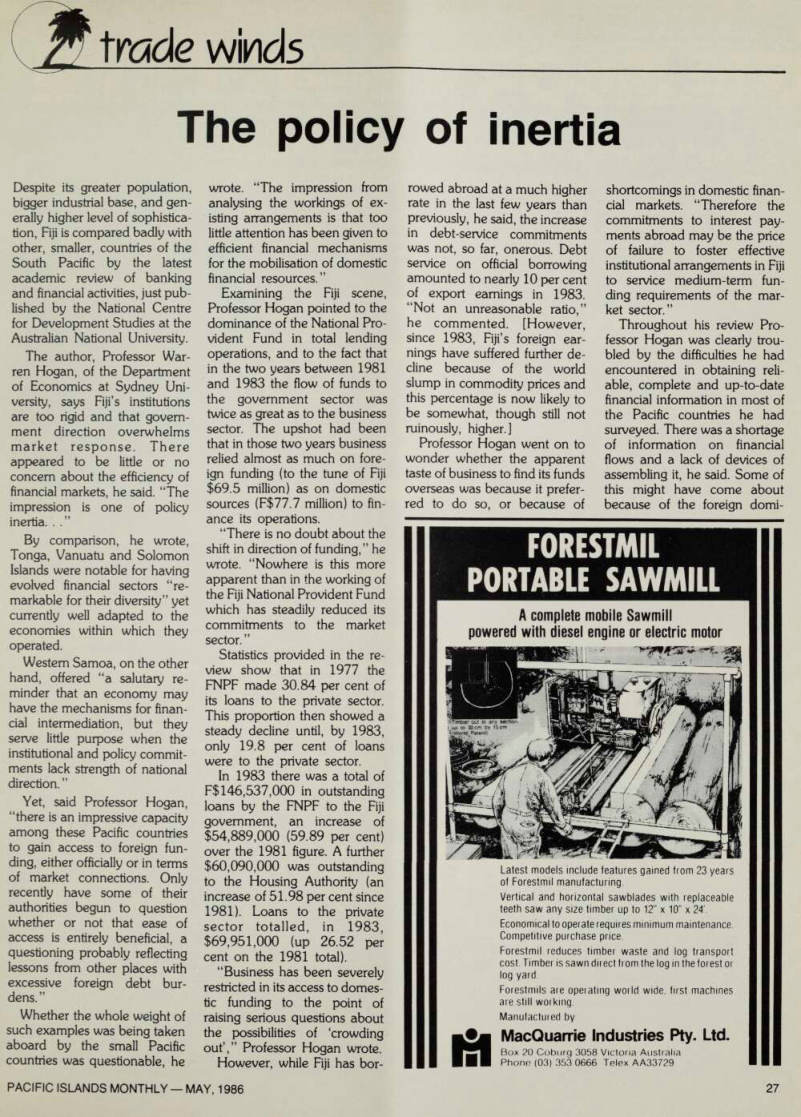

The policy of inertia
Despite its greater population, bigger industrial base, and gen erally higher level of sophistica tion, Fiji is compared badly with other, smaller, countries of the South Pacific by the latest academic review of banking and financial activities, just pub lished by the National Centre for Development Studies at the Australian National University.
The author, Professor War ren Hogan, of the Department of Economics at Sydney Uni versity, says Fiji’s institutions are too rigid and that govern ment direction overwhelms market response. There appeared to be little or no concern about the efficiency of financial markets, he said. “The impression is one of policy inertia. .
By comparison, he wrote, Tonga, Vanuatu and Solomon Islands were notable for having evolved financial sectors “re markable for their diversity” yet currently well adapted to the economies within which they operated.
Western Samoa, on the other hand, offered “a salutary re minder that an economy may have the mechanisms for finan cial intermediation, but they serve little purpose when the institutional and policy commit ments lack strength of national direction. ”
Yet, said Professor Hogan, “there is an impressive capacity among these Pacific countries to gain access to foreign fun ding, either officially or in terms of market connections. Only recently have some of their authorities begun to question whether or not that ease of access is entirely beneficial, a questioning probably reflecting lessons from other places with excessive foreign debt bur dens. ”
Whether the whole weight of such examples was being taken aboard by the small Pacific countries was questionable, he
wrote. “The impression from analysing the workings of ex isting arrangements is that too little attention has been given to efficient financial mechanisms for the mobilisation of domestic financial resources.”
Examining the Fiji scene, Professor Hogan pointed to the dominance of the National Pro vident Fund in total lending operations, and to the fact that in the two years between 1981 and 1983 the flow of funds to the government sector was twice as great as to the business sector. The upshot had been that in those two years business relied almost as much on fore ign funding (to the tune of Fiji $69.5 million) as on domestic sources (F 577.7 million) to fin ance its operations.
“There is no doubt about the shift in direction of funding,” he wrote. “Nowhere is this more apparent than in the working of the Fiji National Provident Fund which has steadily reduced its commitments to the market sector. ”
Statistics provided in the re view show that in 1977 the FNPF made 30.84 per cent of its loans to the private sector.
This proportion then showed a steady decline until, by 1983, only 19.8 per cent of loans were to the private sector.
In 1983 there was a total of F$ 146,537,000 in outstanding loans by the FNPF to the Fiji government, an increase of $54,889,000 (59.89 per cent) over the 1981 figure. A further $60,090,000 was outstanding to the Housing Authority (an increase of 51.98 per cent since 1981). Loans to the private sector totalled, in 1983, $69,951,000 (up 26.52 per cent on the 1981 total).
“Business has been severely restricted in its access to domes tic funding to the point of raising serious questions about the possibilities of ‘crowding out’,” Professor Hogan wrote.
However, while Fiji has bor
rowed abroad at a much higher rate in the last few years than previously, he said, the increase in debt-service commitments was not, so far, onerous. Debt service on official borrowing amounted to nearly 10 per cent of export earnings in 1983.
“Not an unreasonable ratio,” he commented. [However, since 1983, Fiji’s foreign earnings have suffered further dedine because of the world slump in commodity prices and this percentage is now likely to be somewhat, though still not ruinously, higher. ] Professor Hogan went on to wonder whether the apparent taste of business to find its funds overseas was because it preferred to do so, or because of
shortcomings in domestic finan dal markets. “Therefore the commitments to interest pay ments abroad may be the price of failure to foster effective institutional arrangements in Fiji to service medium-term fun ding requirements of the mar ket sector.”
Throughout his review Pro fessor Hogan was clearly trou bled by the difficulties he had encountered in obtaining reli able, complete and up-to-date financial information in most of the Pacific countries he had surveyed. There was a shortage of information on financial flows and a lack of devices of assembling it, he said. Some of this might have come about because of the foreign domi
nance of the business sector.
Most financially notable of the five countries reviewed was Vanuatu which had made vigorous efforts to develop as an international finance centre, mainly as a tax haven. The relative success of this scheme appeared to be stimulating an interest in similar possibilities for Tonga and Western Samoa.
Meantime, as Professor Hogan noted, Vanuatu’s status as a tax haven and an emerging finanical centre enabled it to provide a range of services not available in other parts of the South Pacific.
But, he said, “complexity of financial arrangements is not necessarily a measure of matur ity. It may well equally reflect confusion and gross segmenta tion of what are minuscule financial markets.”
The Pacific economies relied heavily on foreign transfers to support gross domestic capital formation, he said. For most the main instrument had been offi cial development assistance.
However, foreign borrowings, including loans through Eurofi nance markets, had lately assumed much greater promin ence, along with direct foreign investment.
“Each of the five countries under review has participated in Eurofinance activities with four of the five (Western Samoa being the exception) showing transactions outside the inter bank market: in short, funds were drawn for purposes other than financial management.
“But, because of the vagaries of the Pacific economies, brought about by severe clima tic effects upon export crops (such as the cyclones and the 1983 drought which damaged Fiji’s sugar and tourism in come), the balance of pay ments and its financing hao crucial effect.
“Therefore, a major question is whether or not that access to international financing has been beneficial to the development of domestic financing arrange ments,” he wrote.
Fiji sheep meat
Fiji’s experiments with produc tion of sheep meat seem to be going well after some early failures. Since 37 Barbados Blackbelly hair sheep arrived on Makogai Island in April, 1980, breeding has progressed well. The type is suitable for tropical conditions, unlike breeds tried earlier. Flock num bers have now increased to the point where a surplus for slaughter is available.
Through Australian aid Quirk’s Refrigeration, Pty Ltd., of Mel bourne, has put in a chiller, a generator to provide power, and a self-contained refriger ated container to take chilled carcasses to Suva by barge.
Early production levels are intended to serve only the local market with chilled lamb, re placing imported frozen lamb, and thereby saving foreign ex change. Later there may be sufficient production to supply neighboring island countries.
The Makogai chiller has a
capacity to hold 50 carcasses at just above freezing point.
Quirk’s sent Mark Anderton to Fiji for three weeks to install, commission and test the equip ment and train the project manager and his staff in its operation. Burton Consoli dated, Pty Ltd., also of Austra lia, who built the chiller room and the container sent Lex Herd to oversee their side of the project and Kooline Refrigera tion of Suva provided a re frigeration mechanic and an electrician. • • • Japan has given $lOO,OOO to the Pacific Islands Development Program operated by the East- West Centre in Honolulu.
Hawaii governer, George Ariyoshi, who is one of eight island leaders on the standing committee of the Pacific Islands Conference, accepted the donation saying “Japan follows the way of being helpful with out being overpowering” in offering assistance to the Pacific island nations.
Advertisements & other items, pp. 27-31 (1 item)
Forestmil
PORTABLE SAWMILL
A complete mobile Sawmill powered with diesel engine or electric motor u k % m Latest models include features gained from 23 years of Forestmil manufacturing.
Vertical and horizontal sawblades with replaceable teeth saw any size timber up to 12" x 10" x 24'.
Economical to operate requires minimum maintenance.
Competitive purchase price.
Forestmil reduces timber waste and log transport cost. Timber is sawn direct from the log in the forest or log yard Forestmils aie opeiating world wide, first machines are still working Manufactuied by MacQuarrie Industries Pty. Ltd.
Box 20 Coburg 3058 Victoria Australia Phono (03) 353 0666 Telex AA33729
AWA
THE TOTAL TEST EQUIPMENT SOLUTION
B Tfektronix **> ; • ’ 00 i*»
(g> HITACHI
I I I
marcom fc instruments r r O r Iflukel
mmi or m wing rhoi flouflLflnc
Aqualand— The World's First Multifunctional Diver's
with an Electronic Depth Meter.
N 6 LIFE
V r * y
Glance
Diving Data at a
Depth Meter- digitally displays the depth in units of 0.1 meter down to 80 meters • Depth Alarm - rings when exceeding preset depth • Dive Time Alarm - sounds when preset time is reached • Maximum Depth Memory - automatically records maximum depth • Dive Time Memory- automatically records dive duration • Dive Time Reading- indicates elapsed diving time / CITIZEN IS A REGISTERED TRADEMARK OF CITIZEN WATCH CO. JAPAN For further information, please contact: Australia: Citizen Watches Australia Pty. Ltd, 122 Old Pittwater Road, Brookvale NSW2IOO.
Tel: 939-7077. Cable: Citizen Sydney Telex; AA26633. Fax: 932864.
Norfolk island: Landy& Co., P.O. Box 31, Norfolk Island 2899, South Pacific. Tel: 2163.
Fiji Islands: Tappoo Limited, P.O. Box, Sigatoka, Fiji. Tel: 50199. Telex: FJ4244.
Tahiti; Morgan Vernex, Fare Lite B.P. 449, Tahiti.
Tel: 2.03.09.
Rarotonga: South Seas International Ltd.
P.O. Box 49, Rarotonga, Cook Islands.
Tel; 2327.
New Zealand: Citizen Watches (N.Z.) Ltd.
P.O. Box 9518, Auckland, New Zealand.
Tel: 543-393. Telex: 21429. Fax: 544177.
New Caledonia; Est. Ballande, B.P. Box C 4, Noumea, Papua New Guinea: Kara Pty. Limited New Caledonia. Tel: 27.20.31. p.O. Box 329, Port Moresby.
American Samoa: Malaloa Duty Free Shoppers, Tel: 25-6044.
P.O. Box 2183, Pago Pago, American Samoa 96799.
Te1:633 ' 5513 - CWT3/66
V • 5 € * * *'■
Stt
* ,5- >* sV M : tM r h:~- - -o: ■St- -: *Sk S - *
TOVOIA THINKS
CARS AND TRUCKS DRIVEN IN IRE
PACIFIC SHOULD RE RUIEI
FDR THE PACIFIC.
TOYOTA
QUALITY SERVICE
AMERICAN SAMOA: BURNS PHILP (SOUTH SEA) CO., LTD., P.O. Box 129, Pago Pago.
COOK ISLANDS: COOK ISLANDS TRADING
CORPORATION LTD., Private Bag, Rarotonga.
FIJI: AUTOMOTIVE SUPPLIES COMPANY, A Division of Burns Philp (South Sea) Co., Ltd., G.P.O. Box 355, Suva.
GUAM & MICRONESIA: ATKINS KROLL, INC., 443 South Marine Drive, Tamuning.
KIRIBATI: TARAWA MOTORS, A Division of Bairiki Holdings Ltd., P.O. Box 36, Bairiki, Tarawa.
NAURU: NAURU COOPERATIVE SOCIETY, Central Pa
NEW CALEDONIA: SERVICE IMPORTATION
AUTOMOBILE DU PACIFIQUE, Rond-Point du Pacifiqi (Station Total) B.P. 438, Noumea.
NORFOLK ISLAND: BORRY’S LIMITED, P.O. Box 16!
PAPUA NEW GUINEA: ELA MOTORS, A Division of Burns Philp (PNG) Ltd., P.O. Box 75, Port Moresby.
SAIPAN: MICROL CORPORATION, P.O. Box 267, Saif
4 r
m&rJPS » '^' w -"■*“ *&'■
4 £ 4 » • " :f;‘
MHKaP'
,JK; ■"'' a a*» ■ * »„ «•*■ All oar cars and trucks have special Pacific Island features.
For instance, Toyota Hi lux trucks are outfitted with extra-heavy-duty shocks and reinforced suspension.
And cars like Toyota Corolla receive special engine underplating, and a suspension modified to give added road clearance.
Meanwhile, we make additional use of special galvanealed steel in both our cars and trucks to help prevent corrosion.
And, of course, like cars and trucks we build for the rest of the world, those for the Pacific benefit from comprehensive testing and thorough
quality control.
It’s all part of our effort to create high-quality, highly reliable cars and trucks.
Specifically for you. And specifically for the places yOU drive. Areas where galvanealed steel is used
COROLLA
HILUX
• Crown • Cressida • Corona • Corolla • Starlet • Dyna • Hiace • Liteace • Coaster • Stout • Hilux 4x2/4X4* Land Cruiser • Heavy Duty Truck
.OMON ISLANDS: SOLOMON ISLANDS
rSTMENTS LTD., G.P.O. Box 174, Honiara
!ITI: NIPPON AUTOMOTO, B.P. 342, Papeete
*GA: BURNS PHILP (SOUTH SEA) CO., LTD., PO 55, Nuku’alofa. lUATU: VANUATU MOTORS, A Division of Burns P (Vanuatu) Ltd., P.O. Box 18, Port Vila.
STERN SAMOA: BURNS PHILP (SOUTH SEA) CO.
PO. Box 188, Apia.
TOYOTA
Brokers bullish on PNG
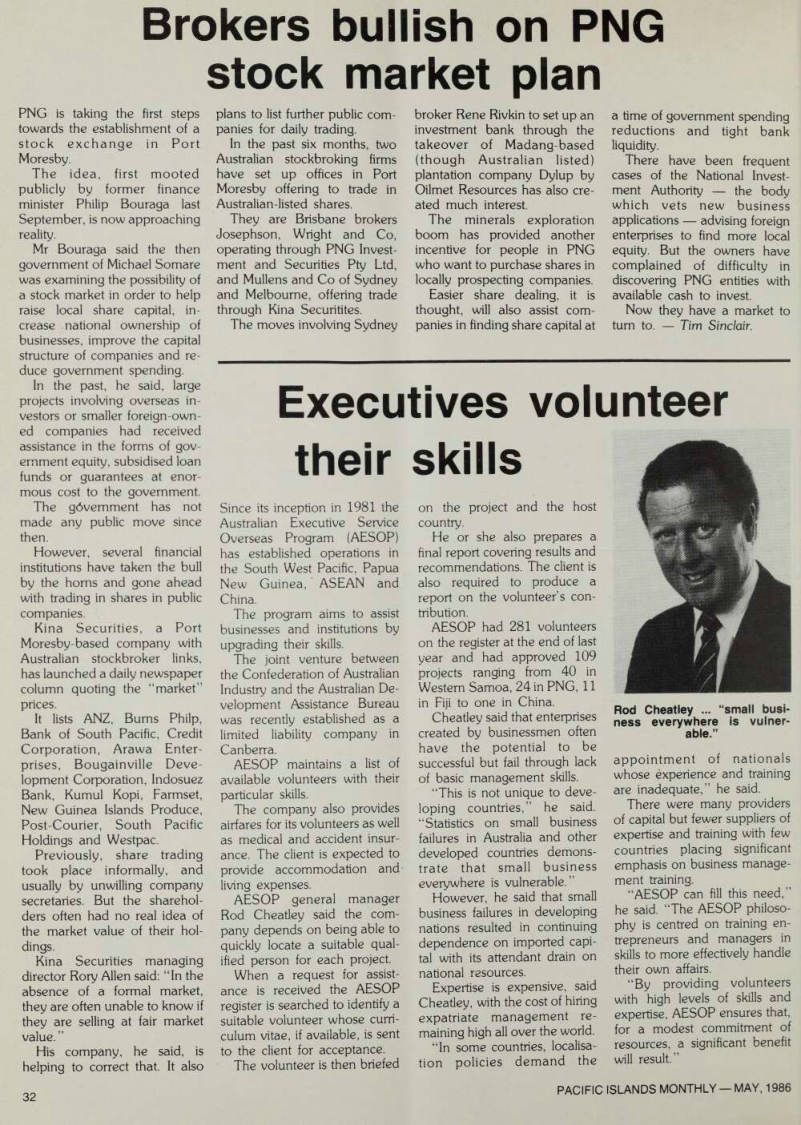
stock market plan
PNG is taking the first steps towards the establishment of a stock exchange in Port Moresby.
The idea, first mooted publicly by former finance minister Philip Bouraga last September, is now approaching reality.
Mr Bouraga said the then government of Michael Somare was examining the possibility of a stock market in order to help raise local share capital, in crease national ownership of businesses, improve the capital structure of companies and re duce government spending.
In the past, he said, large projects involving overseas in vestors or smaller foreign-own ed companies had received assistance in the forms of gov ernment equity, subsidised loan funds or guarantees at enor mous cost to the government.
The g6vemment has not made any public move since then.
However, several financial institutions have taken the bull by the horns and gone ahead with trading in shares in public companies.
Kina Securities, a Port Moresby-based company with Australian stockbroker links, has launched a daily newspaper column quoting the “market” prices.
It lists ANZ, Burns Philp, Bank of South Pacific, Credit Corporation, Arawa Enter prises, Bougainville Deve lopment Corporation, Indosuez Bank, Kumul Kopi, Farmset, New Guinea Islands Produce, Post-Courier, South Pacific Holdings and Westpac.
Previously, share trading took place informally, and usually by unwilling company secretaries. But the sharehol ders often had no real idea of the market value of their hol dings.
Kina Securities managing director Rory Allen said: “In the absence of a formal market, they are often unable to know if they are selling at fair market value.”
His company, he said, is helping to correct that. It also
plans to list further public com panies for daily trading.
In the past six months, two Australian stockbroking firms have set up offices in Port Moresby offering to trade in Australian-listed shares.
They are Brisbane brokers Josephson, Wright and Co, operating through PNG Invest ment and Securities Pty Ltd, and Mullens and Co of Sydney and Melbourne, offering trade through Kina Securities.
The moves involving Sydney
broker Rene Rivkin to set up an investment bank through the takeover of Madang-based (though Australian listed) plantation company Dylup by Oilmet Resources has also cre ated much interest.
The minerals exploration boom has provided another incentive for people in PNG who want to purchase shares in locally prospecting companies.
Easier share dealing, it is thought, will also assist com panies in finding share capital at
a time of government spending reductions and tight bank liquidity.
There have been frequent cases of the National Invest ment Authority the body which vets new business applications advising foreign enterprises to find more local equity. But the owners have complained of difficulty in discovering PNG entities with available cash to invest.
Now they have a market to
turn to.
Tim Sinclair.
Executives volunteer
their skills
Since its inception in 1981 the Australian Executive Service Overseas Program (AESOP) has established operations in the South West Pacific, Papua New Guinea, ASEAN and China.
The program aims to assist businesses and institutions by upgrading their skills.
The joint venture between the Confederation of Australian Industry and the Australian De velopment Assistance Bureau was recently established as a limited liability company in Canberra.
AESOP maintains a list of available volunteers with their particular skills.
The company also provides airfares for its volunteers as well as medical and accident insur ance. The client is expected to provide accommodation and living expenses.
AESOP general manager Rod Cheatley said the com pany depends on being able to quickly locate a suitable qual ified person for each project.
When a request for assist ance is received the AESOP register is searched to identify a suitable volunteer whose curri culum vitae, if available, is sent to the client for acceptance.
The volunteer is then briefed
on the project and the host country.
He or she also prepares a final report covering results and recommendations. The client is also required to produce a report on the volunteer’s con tribution.
AESOP had 281 volunteers on the register at the end of last year and had approved 109 projects ranging from 40 in Western Samoa, 24 in PNG, 11 in Fiji to one in China.
Cheatley said that enterprises created by businessmen often have the potential to be successful but fail through lack of basic management skills.
“This is not unique to deve loping countries,” he said.
“Statistics on small business failures in Australia and other developed countries demons trate that small business everywhere is vulnerable.”
However, he said that small business failures in developing nations resulted in continuing dependence on imported capi tal with its attendant drain on national resources.
Expertise is expensive, said Cheatley, with the cost of hiring expatriate management re maining high all over the world.
“In some countries, localisa tion policies demand the
appointment of nationals whose experience and training are inadequate,” he said.
There were many providers of capital but fewer suppliers of expertise and training with few countries placing significant emphasis on business manage ment training.
“AESOP can fill this need,” he said. “The AESOP philoso phy is centred on training en trepreneurs and managers in skills to more effectively handle their own affairs.
“By providing volunteers with high levels of skills and expertise, AESOP ensures that, for a modest commitment of resources, a significant benefit will result.”
Rod Cheatley... “small busi ness everywhere is vulner able.”
commercial break?
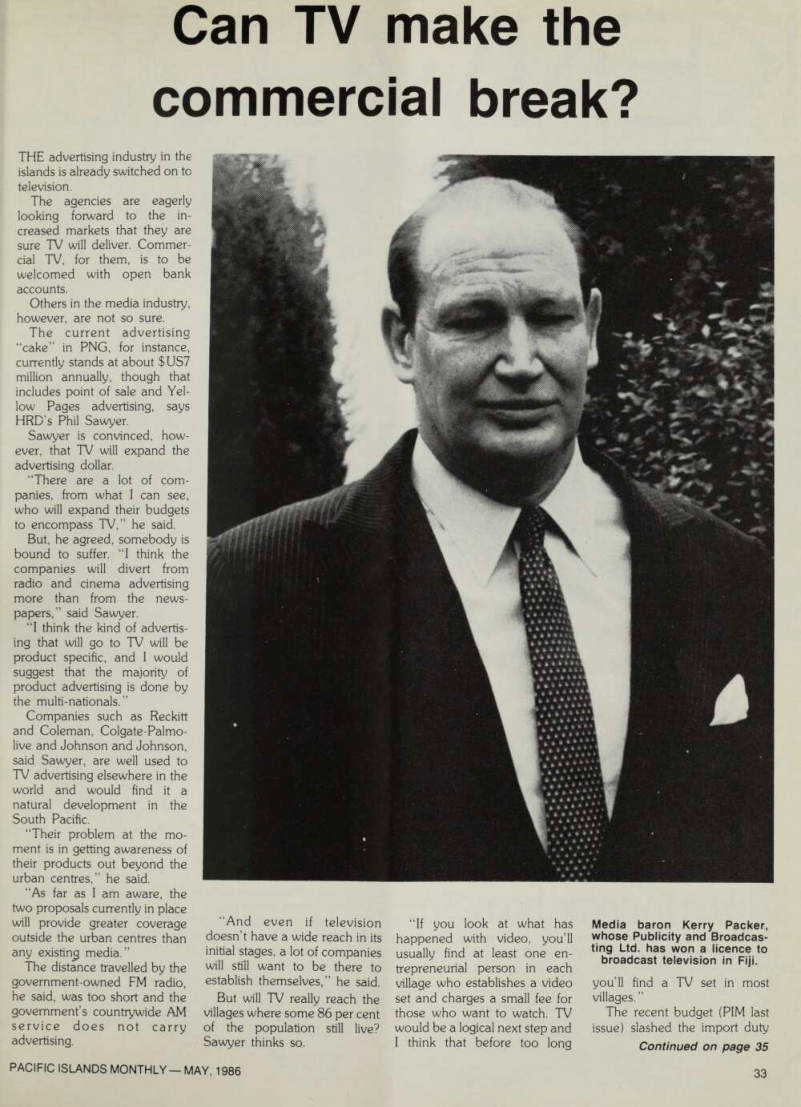

Can TV make the commercial break?
THE advertising industry in the islands is already switched on to television.
The agencies are eagerly looking forward to the in creased markets that they are sure TV will deliver. Commer cial TV, for them, is to be welcomed with open bank accounts.
Others in the media industry, however, are not so sure.
The current advertising “cake” in PNG, for instance, currently stands at about SUS 7 million annually, though that includes point of sale and Yel low Pages advertising, says HRD’s Phil Sawyer.
Sawyer is convinced, how ever, that TV will expand the advertising dollar.
“There are a lot of com panies, from what I can see, who will expand their budgets to encompass TV,” he said.
But, he agreed, somebody is bound to suffer. “I think the companies will divert from radio and cinema advertising more than from the news papers,” said Sawyer.
“I think the kind of advertis ing that will go to TV will be product specific, and I would suggest that the majority of product advertising is done by the multi-nationals.”
Companies such as Reckitt and Coleman, Colgate-Palmo live and Johnson and Johnson, said Sawyer, are well used to TV advertising elsewhere in the world and would find it a natural development in the South Pacific.
“Their problem at the mo ment is in getting awareness of their products out beyond the urban centres,” he said.
“As far as I am aware, the two proposals currently in place will provide greater coverage outside the urban centres than any existing media.”
The distance travelled by the government-owned FM radio, he said, was too short and the government’s countrywide AM service does not carry advertising.
“And even if television doesn’t have a wide reach in its initial stages, a lot of companies will still want to be there to establish themselves,” he said.
But will TV really reach the villages where some 86 per cent of the population still live?
Sawyer thinks so.
“If you look at what has happened with video, you’ll usually find at least one en trepreneurial person in each village who establishes a video set and charges a small fee for those who want to watch. TV would be a logical next step and I think that before too long
you’ll find a TV set in most villages.”
The recent budget (PIM last issue) slashed the import duty
Continued on page 35
Media baron Kerry Packer, whose Publicity and Broadcas ting Ltd. has won a licence to broadcast television in Fiji.
Continued from page 33 on luxury goods from up to 85 per cent to 50 per cent. This, says Sawyer, will have the effect of reducing TV prices in the stores by about 25 per cent, TV’s impact on the local media scene is harder to prediet. The country is currently served by two daily English language newspapers, an upmarket weekly and a pidgin weekly.
The market is dominated by the PNG Post-Courier with a daily sale of 30,000-plus.
General manager Don Kennedy is less than convinced that TV is going to be a such a wonderful thing.
It s all very well to talk about expanding the market, but it seems to me that we have a certain market here, a certain and limited number of people who advertise,” he said.
If we have TV, it’s going to have to compete in an already fiercely competitive situation.
One result would be fewer newspapers.”
Kennedy also questions the ability of the TV companies to
produce local programming other than news bulletins. He worries that canned overseas material with, to say the least, limited relevance to PNG would become the order of the day.
“I know the TV companies will have done their home work,” he said. “But I wonder just how much they are aware of the market conditions here. I don’t see TV becoming corn mercially viable for quite some time to come.”
With most companies strap ped by high interest rates, he said, advertising budgets are often the first to feel the pinch.
Another competitor would make things uncomfortable for all concerned including the TV companies, he said, “They are talking about a large capital investment,” he said, “and I personally doubt the capacity of the market to give them a return.”
Even if TV did achieve its proposed market penetration, said Kennedy, the kind of pro ducts advertised may not appeal or be available to village dwellers.
Ross Addison of Fiji’s Wilson- Addison, however, is convinced TV “will bring Fiji into the 21st century. ”
“From my experience in the advertising industry and in tele vision in Australia, I think that television, apart from taking some of the revenue from the other media, will also generate its own revenue through marketing opportunities like direct response marketing which television can offer,” he said.
Addison believes, also, that TV will bring Fiji’s small businesses, who “do their own thing” in advertising, into the agency fold. “Most of them don’t retain the services of an ad agency, but with television they will have to because they don’t have the level of sophistication to go it alone.”
He says the current advertis ing spending in Fiji is about SUS 6 million which could ex pand to SUS 9 million within 18 months of television’s launch.
“The debate rages on here within the various factions about what’s good and bad
about it, but I think it ? s going to bring us into the 21st century and into touch with the outside world,” he said.
“It’s just a fact of life that it has to be commercial televi sion. ”
He accepts the fact that Fiji’s newspapers, already locked in a fierce competition for advertis ing revenue, are going to be affected.
“It’s going to make them become more sophisticated and give us more input, more de mographics that we’ve been asking for and haven’t got. It’s going to bring more sophistica tion to the media industry in general.”
Fiji currently supports two English language dailies and their Sunday sisters, two Fijian weeklies and a Hindi weekly.
The Fiji Times is the market leader and general manager Rex Gardner, while accepting the fact that the existing media are going to feel the pinch from TV, is not yet convinced that the profits are there for the television operators.
“Initially the newspapers will feel the pinch. It seems that some of the larger corporations here will divide their budget to accommodate TV.
“Some of the local businesses will be curious for a while and will probably divert some of their advertising to TV.”
The newspapers’ share of the advertising market will dimin ish, he said, with the market eventually expanding as TV becomes accepted.
“But the print media’s traditional markets will remain.
For instance, there’s pretty keen competition between the supermarkets here, and the print media can offer them the kind of service that television cannot,” he said.
He puts the market at around SUSS million which he sees expaning by some 20 per cent over a three to four year period.
“I wouldn’t expect any TV station to make roaring profits here initially. In fact I wouldn’t expect it to make any profits at all for the first few years,” he said.
“But I don’t see television as a major blow for us in the longer term.”
Advertisements & other items, p. 34 (1 item)
Kenwood
■ - ■v m © o o o o
Spectrum
■ mb isenes Spectrum 1058 ■ 125Wx2 power amplifier control amplifier with CD and Video selectors ■ Automatic quartz-synthesizer tuning H2O random memory presets ■Twice-a-day timer ■ Double auto-reverse cassette deck with relay-play and high-speed dubbing ■Programmable lineartracking direct-drive turntable HAOOW (max.) speakers ■Options: CD player, graphic equalizer, surround processor, remote control, headphones, microphone.
So nice to come home to
The Spectrum series are no ordinary stereo systems. For one thing, they offer you pure hi-fi sound.
For example, Spectrum 1058 shown to the right has professional separate power and control amplifiers. With its CD input selector, it’s ready to give you the full dynamic impact of digital sound!
Spectrum series also help you enjoy your music. Look at the versatile double auto-reverse cassette deck, computerized automatic tuner and full remote control and you will see what we mean.
No matter what the time of day, you’ll always be ready to come home to your Spectrum hi-fi stereo system.
TRIO-KEN WOOD CORPORATION
Shionogi Shibuya Building, 17-5, 2-chome Shibuya, Shibuya-ku, Tokyo 150, Japan TRIO-KENWOOD (AUSTRALIA) PTY. LTD. (incorporated in nsw) 4E Woodcock Place, Lane Cove, N S W. 2066, Australia NEW ZEALAND JOHN GILBERT & CO., LTD. Auckland Tel. 0011-64-9-30839 FUJI PEPE'S DUTY FREE CENTRE LTD. Tel. 25496, 25497 PAPUA NEW GUINEA SO. SVENSSON (N.G.) LTD. Port Moresby Tel. 212158, 212111 SOLOMON ISLANDS TECHNIQUE RADIOS CENTRE LTD. Honiara Tel. 416 NEW CALEDONIA HI-FI VOX Noumea Tel. 27-2466, 28-2931 VANUATU FUNG CHOI LUEN. Port-Vila Tel. 2556 TAHITI MAI SON AURORE Papeete Tel. 29703 AMERICAN SAMOA ISLAND PACIFIC AGENCIES, INC. Pago Pago Tel. 633-4687
REPUBLIC OF NAURU NAURU CO-OPERATIVE SOCIETY
MARIANA ISLANDS JC. TENORIO ENTERPRISES Saipan Tel. 6445
Broadcasting students
tune in to training
“Television is going to happen” is the definite view of at least one influential islands group. So much so, in fact, that they are preparing now to be expert broadcasters by the time it does happen.
The World Association for Christian Communication Pacific Region (WACC-PAC) will next month commence a series of courses on TV awareness in Fiji.
There have already been courses in PNG where the Communications Insti tute in Goroka has conducted several video awareness programs since 1980.
However, the Fiji course is the first to be funded by the London-based WACC, an ecumenical body made up of media, press and publishing organisations.
Seru Verebalavu, chairman of WACC PAC says: “Because of so much talk of TV coming into the Pacific countries, we are conducting TV workshops to create
awareness among churches on the role it will play.”
He said the content and programming of islands TV would have to be watched carefully.
He said, “Therefore we are preparing people to meet this now rapidly expan ding electronic medium.”
The cost per participant in the Fiji course would be Fssoo for travel and stationery alone. However, of that, the Pacific Council of Churches in Fiji is donating Fs2oo.
The 20 participants in the three-month course will be drawn from churches in Fiji as well as from government and media organisations.
Another part of the WACC-PAC prog ram is to hold a similar workshop-type course in PNG in 1986-87. Maureen Mopio.
Advertisements & other items, p. 35 (1 item)
Can Tv Make The Commercial Break?
35
PACIFIC ISLANDS MONTHLY MAY, 1986
Joint venturers prepare
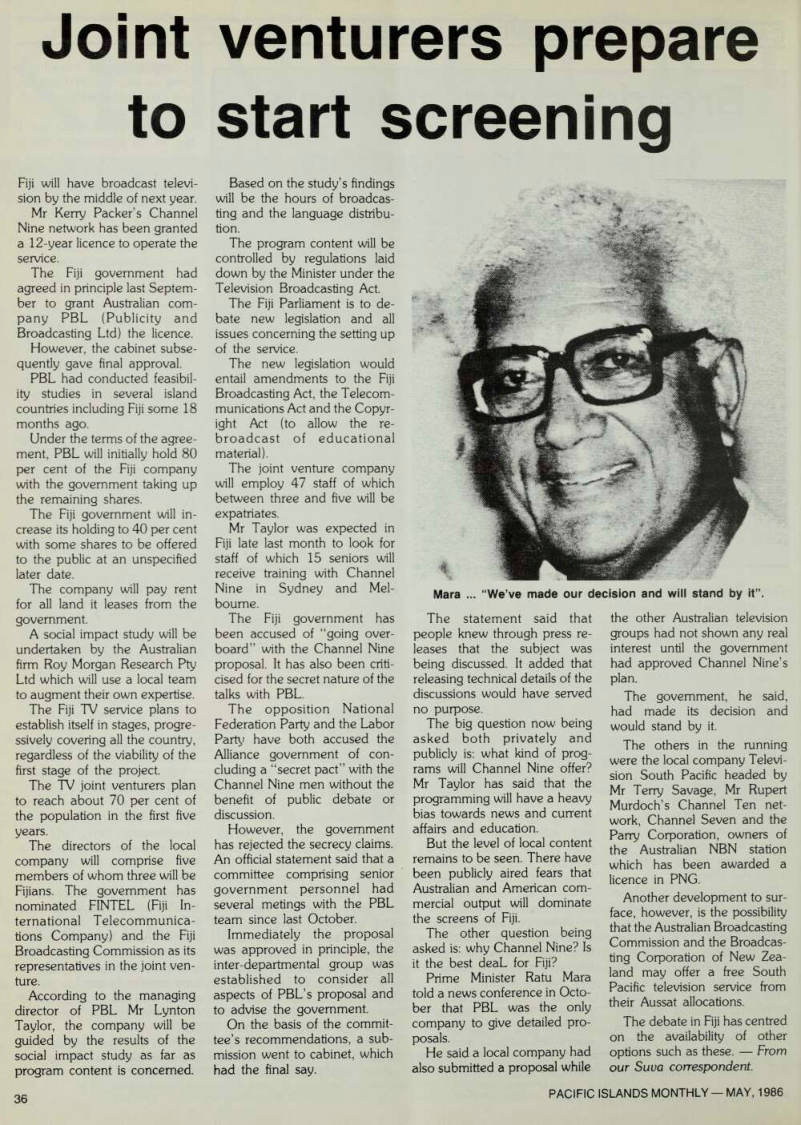
to start screening
Fiji will have broadcast televi sion by the middle of next year.
Mr Kerry Packer’s Channel Nine network has been granted a 12-year licence to operate the service.
The Fiji government had agreed in principle last Septem ber to grant Australian com pany PBL (Publicity and Broadcasting Ltd) the licence.
However, the cabinet subse quently gave final approval.
PBL had conducted feasibil ity studies in several island countries including Fiji some 18 months ago.
Under the terms of the agree ment, PBL will initially hold 80 per cent of the Fiji company with the government taking up the remaining shares.
The Fiji government will in crease its holding to 40 per cent with some shares to be offered to the public at an unspecified later date.
The company will pay rent for all land it leases from the government.
A social impact study will be undertaken by the Australian firm Roy Morgan Research Pty Ltd which will use a local team to augment their own expertise.
The Fiji TV service plans to establish itself in stages, progre ssively covering all the country, regardless of the viability of the first stage of the project.
The TV joint venturers plan to reach about 70 per cent of the population in the first five years.
The directors of the local company will comprise five members of whom three will be Fijians. The government has nominated FINTEL (Fiji In ternational Telecommunica tions Company) and the Fiji Broadcasting Commission as its representatives in the joint ven ture.
According to the managing director of PBL Mr Lynton Taylor, the company will be guided by the results of the social impact study as far as program content is concerned.
Based on the study’s findings will be the hours of broadcas ting and the language distribu tion.
The program content will be controlled by regulations laid down by the Minister under the Television Broadcasting Act.
The Fiji Parliament is to de bate new legislation and all issues concerning the setting up of the service.
The new legislation would entail amendments to the Fiji Broadcasting Act, the Telecom munications Act and the Copyr ight Act (to allow the re broadcast of educational material).
The joint venture company will employ 47 staff of which between three and five will be expatriates.
Mr Taylor was expected in Fiji late last month to look for staff of which 15 seniors will receive training with Channel Nine in Sydney and Mel bourne.
The Fiji government has been accused of “going over board” with the Channel Nine proposal. It has also been criti cised for the secret nature of the talks with PBL.
The opposition National Federation Party and the Labor Party have both accused the Alliance government of con cluding a “secret pact” with the Channel Nine men without the benefit of public debate or discussion.
However, the government has rejected the secrecy claims.
An official statement said that a committee comprising senior government personnel had several metings with the PBL team since last October.
Immediately the proposal was approved in principle, the inter-departmental group was established to consider all aspects of PBL’s proposal and to advise the government.
On the basis of the commit tee’s recommendations, a sub mission went to cabinet, which had the final say.
The statement said that people knew through press re leases that the subject was being discussed. It added that releasing technical details of the discussions would have served no purpose.
The big question now being asked both privately and publicly is: what kind of prog rams will Channel Nine offer?
Mr Taylor has said that the programming will have a heavy bias towards news and current affairs and education.
But the level of local content remains to be seen. There have been publicly aired fears that Australian and American com mercial output will dominate the screens of Fiji.
The other question being asked is: why Channel Nine? Is it the best deaL for Fiji?
Prime Minister Ratu Mara told a news conference in Octo ber that PBL was the only company to give detailed pro posals.
He said a local company had also submitted a proposal while
the other Australian television groups had not shown any real interest until the government had approved Channel Nine’s plan.
The government, he said, had made its decision and would stand by it.
The others in the running were the local company Televi sion South Pacific headed by Mr Terry Savage, Mr Rupert Murdoch’s Channel Ten net work, Channel Seven and the Parry Corporation, owners of the Australian NBN station which has been awarded a licence in PNG.
Another development to sur face, however, is the possibility that the Australian Broadcasting Commission and the Broadcas ting Corporation of New Zea land may offer a free South Pacific television service from their Aussat allocations.
The debate in Fiji has centred on the availability of other options such as these. From our Suva correspondent.
Mara... “We’ve made our decision and will stand by it”.
an early hold
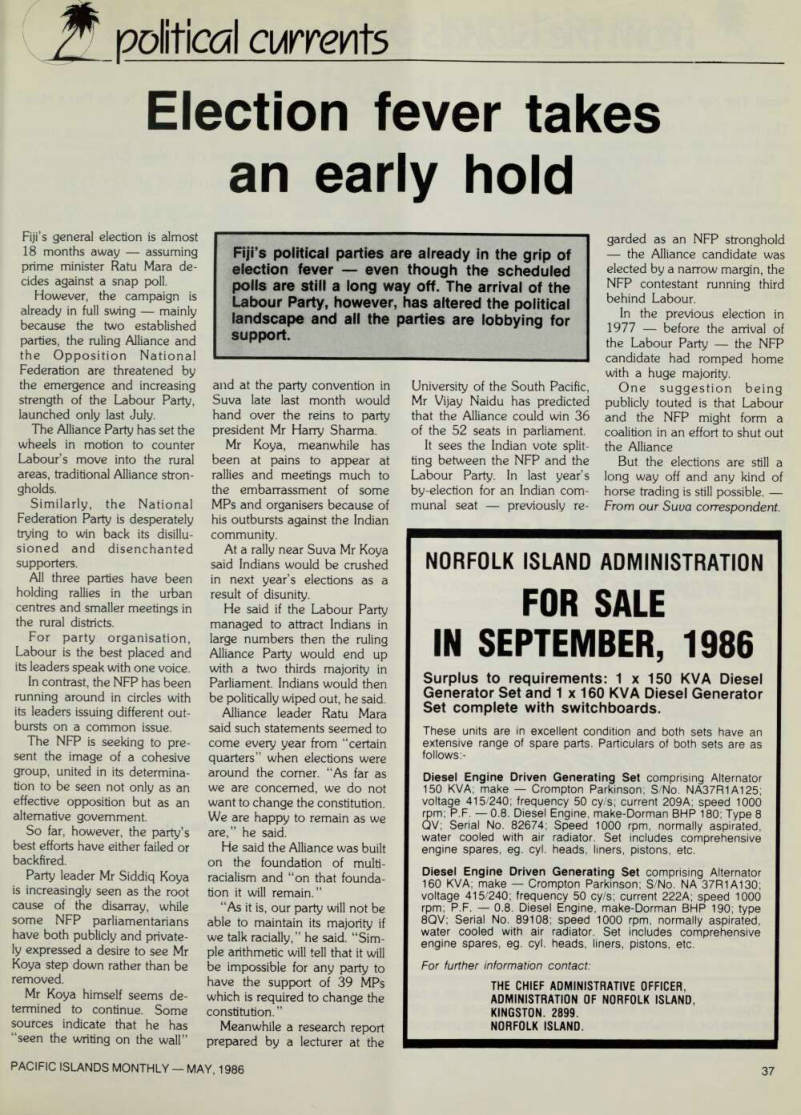
political currents
Election fever takes an early hold
Fiji’s general election is almost 18 months away assuming prime minister Ratu Mara de cides against a snap poll.
However, the campaign is already in full swing mainly because the two established parties, the ruling Alliance and the Opposition National Federation are threatened by the emergence and increasing strength of the Labour Party, launched only last July.
The Alliance Party has set the wheels in motion to counter Labour’s move into the rural areas, traditional Alliance stron gholds.
Similarly, the National Federation Party is desperately trying to win back its disillu sioned and disenchanted supporters.
All three parties have been holding rallies in the urban centres and smaller meetings in the rural districts.
For party organisation, Labour is the best placed and its leaders speak with one voice.
In contrast, the NFP has been running around in circles with its leaders issuing different out bursts on a common issue.
The NFP is seeking to pre sent the image of a cohesive group, united in its determina tion to be seen not only as an effective opposition but as an alternative government.
So far, however, the party’s best efforts have either failed or backfired.
Party leader Mr Siddiq Koya is increasingly seen as the root cause of the disarray, while some NFP parliamentarians have both publicly and private ly expressed a desire to see Mr Koya step down rather than be removed.
Mr Koya himself seems de termined to continue. Some sources indicate that he has “seen the writing on the wall”
Fiji’s political parties are already in the grip of election fever even though the scheduled polls are still a long way off. The arrival of the Labour Party, however, has altered the political landscape and all the parties are lobbying for support.
and at the party convention in Suva late last month would hand over the reins to party president Mr Harry Sharma.
Mr Koya, meanwhile has been at pains to appear at rallies and meetings much to the embarrassment of some MPs and organisers because of his outbursts against the Indian community.
At a rally near Suva Mr Koya said Indians would be crushed in next year’s elections as a result of disunity.
He said if the Labour Party managed to attract Indians in large numbers then the ruling Alliance Party would end up with a two thirds majority in Parliament. Indians would then be politically wiped out, he said.
Alliance leader Ratu Mara said such statements seemed to come every year from “certain quarters” when elections were around the comer. “As far as we are concerned, we do not want to change the constitution.
We are happy to remain as we are,” he said.
He said the Alliance was built on the foundation of multi racialism and “on that founda tion it will remain.”
“As it is, our party will not be able to maintain its majority if we talk racially,” he said. “Sim ple arithmetic will tell that it will be impossible for any party to have the support of 39 MPs which is required to change the constitution.”
Meanwhile a research report prepared by a lecturer at the
University of the South Pacific, Mr Vijay Naidu has predicted that the Alliance could win 36 of the 52 seats in parliament.
It sees the Indian vote split ting between the NFP and the Labour Party. In last year’s by-election for an Indian com munal seat previously re
garded as an NFP stronghold the Alliance candidate was elected by a narrow margin, the NFP contestant running third behind Labour.
In the previous election in 1977 before the arrival of the Labour Party the NFP candidate had romped home with a huge majority.
One suggestion being publicly touted is that Labour and the NFP might form a coalition in an effort to shut out the Alliance But the elections are still a long way off and any kind of horse trading is still possible.
From our Suva correspondent.
Advertisements & other items, p. 37 (1 item)
For Sale
NORFOLK ISLAND ADMINISTRATION
IN SEPTEMBER, 1986
Surplus to requirements: 1 x 150 KVA Diesel Generator Set and 1 x 160 KVA Diesel Generator Set complete with switchboards.
These units are in excellent condition and both sets have an extensive range of spare parts. Particulars of both sets are as follows;- Diesel Engine Driven Generating Set comprising Alternator 150 KVA; make Crompton Parkinson; S/No. NA37R1A125; voltage 415/240; frequency 50 cy/s; current 209 A; speed 1000 rpm; P.F. 0.8. Diesel Engine, make-Dorman BMP 180; Type 8 QV; Serial No. 82674; Speed 1000 rpm, normally aspirated, water cooled with air radiator. Set includes comprehensive engine spares, eg. cyl. heads, liners, pistons, etc.
Diesel Engine Driven Generating Set comprising Alternator 160 KVA; make Crompton Parkinson; S/No. NA 37R1A130; voltage 415/240; frequency 50 cy/s; current 222 A; speed 1000 rpm; P.F. 0.8. Diesel Engine, make-Dorman BMP 190; type BQV; Serial No. 89108; speed 1000 rpm, normally aspirated, water cooled with air radiator. Set includes comprehensive engine spares, eg. cyl. heads, liners, pistons, etc.
For further information contact:
THE CHIEF ADMINISTRATIVE OFFICER,
ADMINISTRATION OF NORFOLK ISLAND,
KINGSTON. 2899.
NORFOLK ISLAND.
from the islands press
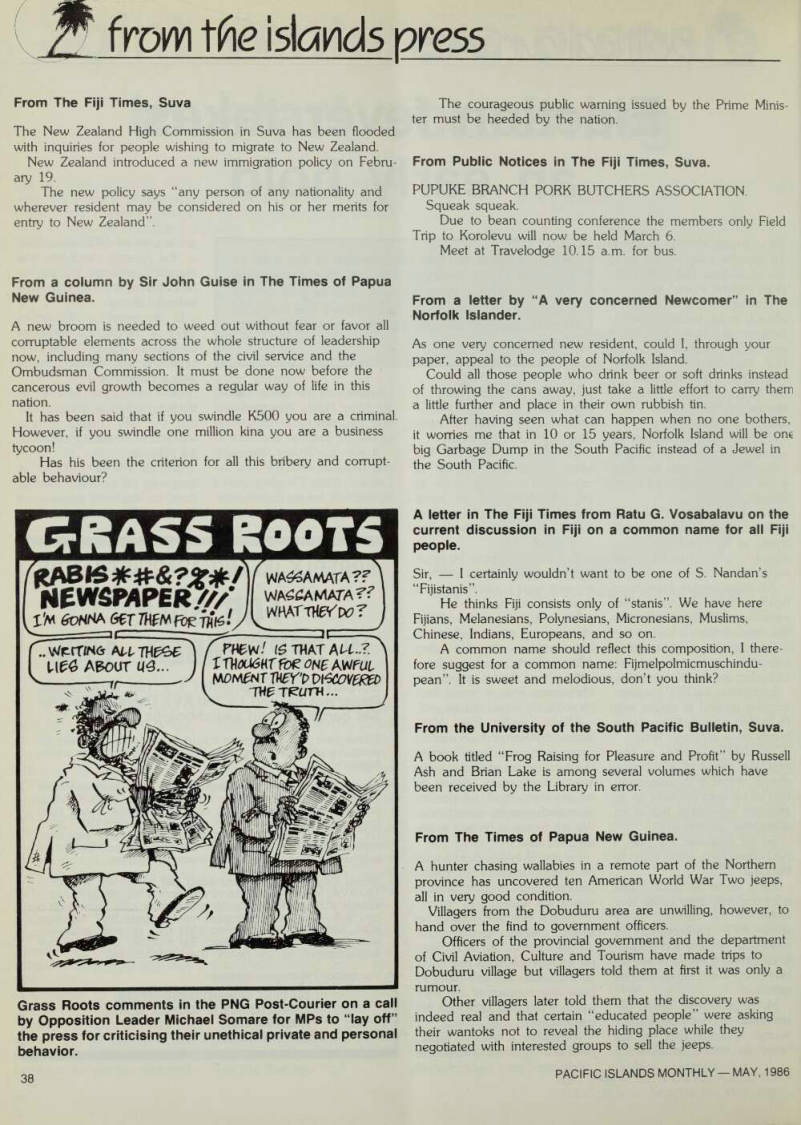
From The Fiji Times, Suva The New Zealand High Commission in Suva has been flooded with inquiries for people wishing to migrate to New Zealand.
New Zealand introduced a new immigration policy on Febru ary 19.
The new policy says “any person of any nationality and wherever resident may be considered on his or her merits for entry to New Zealand”.
From a column by Sir John Guise in The Times of Papua New Guinea.
A new broom is needed to weed out without fear or favor all corruptable elements across the whole structure of leadership now, including many sections of the civil service and the Ombudsman Commission. It must be done now before the cancerous evil growth becomes a regular way of life in this nation.
It has been said that if you swindle K5OO you are a criminal.
However, if you swindle one million kina you are a business tycoon!
Has his been the criterion for all this bribery and corrupt able behaviour?
The courageous public warning issued by the Prime Minis ter must be heeded by the nation.
From Public Notices in The Fiji Times, Suva.
Pupuke Branch Pork Butchers Association.
Squeak squeak.
Due to bean counting conference the members only Field Trip to Korolevu will now be held March 6.
Meet at Travelodge 10.15 a.m. for bus.
From a letter by “A very concerned Newcomer” in The Norfolk Islander.
As one very concerned new resident, could I, through your paper, appeal to the people of Norfolk Island.
Could all those people who drink beer or soft drinks instead of throwing the cans away, just take a little effort to carry them a little further and place in their own rubbish tin.
After having seen what can happen when no one bothers, it worries me that in 10 or 15 years, Norfolk Island will be one big Garbage Dump in the South Pacific instead of a Jewel in the South Pacific.
A letter in The Fiji Times from Ratu G. Vosabalavu on the current discussion in Fiji on a common name for all Fiji people.
Sir, I certainly wouldn’t want to be one of S. Nandan’s “Fijistanis”.
He thinks Fiji consists only of “stanis”. We have here Fijians, Melanesians, Polynesians, Micronesians, Muslims, Chinese, Indians, Europeans, and so on.
A common name should reflect this composition, I there fore suggest for a common name: Fijmelpolmicmuschindu pean”. It is sweet and melodious, don’t you think?
From the University of the South Pacific Bulletin, Suva.
A book titled “Frog Raising for Pleasure and Profit” by Russell Ash and Brian Lake is among several volumes which have been received by the Library in error.
From The Times of Papua New Guinea.
A hunter chasing wallabies in a remote part of the Northern province has uncovered ten American World War Two jeeps, all in very good condition.
Villagers from the Dobuduru area are unwilling, however, to hand over the find to government officers.
Officers of the provincial government and the department of Civil Aviation, Culture and Tourism have made trips to Dobuduru village but villagers told them at first it was only a rumour.
Other villagers later told them that the discovery was indeed real and that certain “educated people” were asking their wantoks not to reveal the hiding place while they negotiated with interested groups to sell the jeeps.
Grass Roots comments in the PNG Post-Courier on a call by Opposition Leader Michael Somare for MPs to “lay off” the press for criticising their unethical private and personal behavior.
Kiribati: The problems,
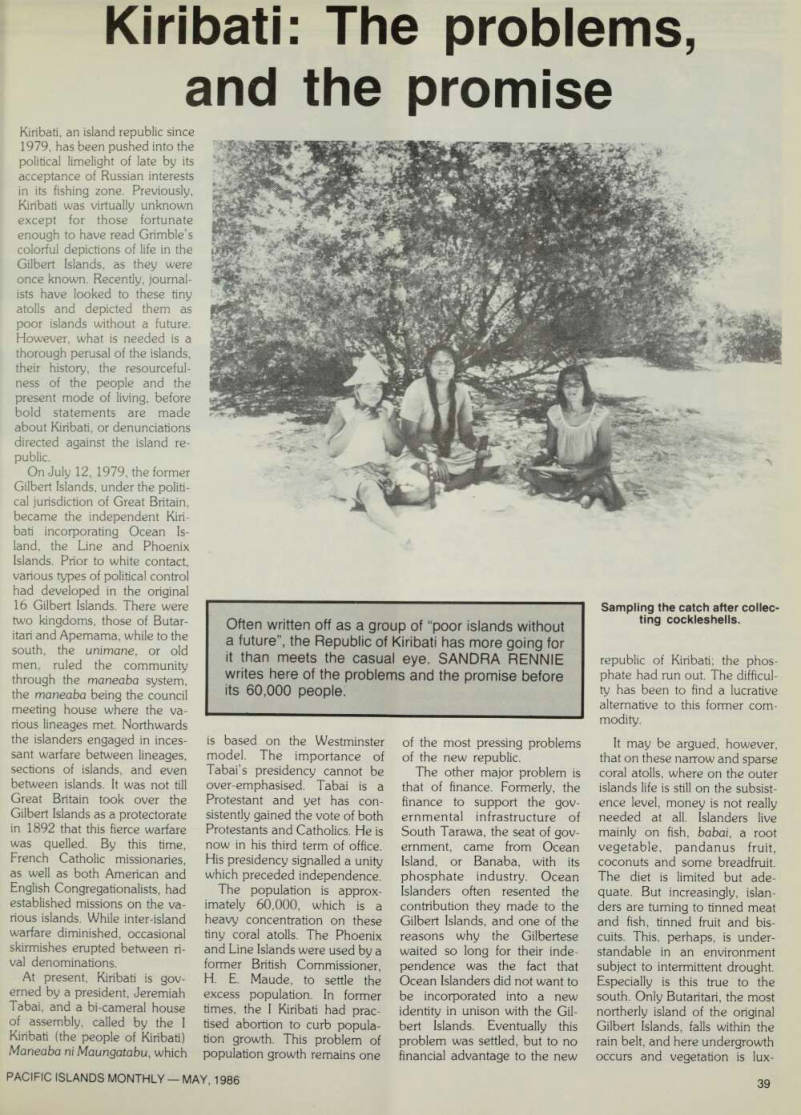
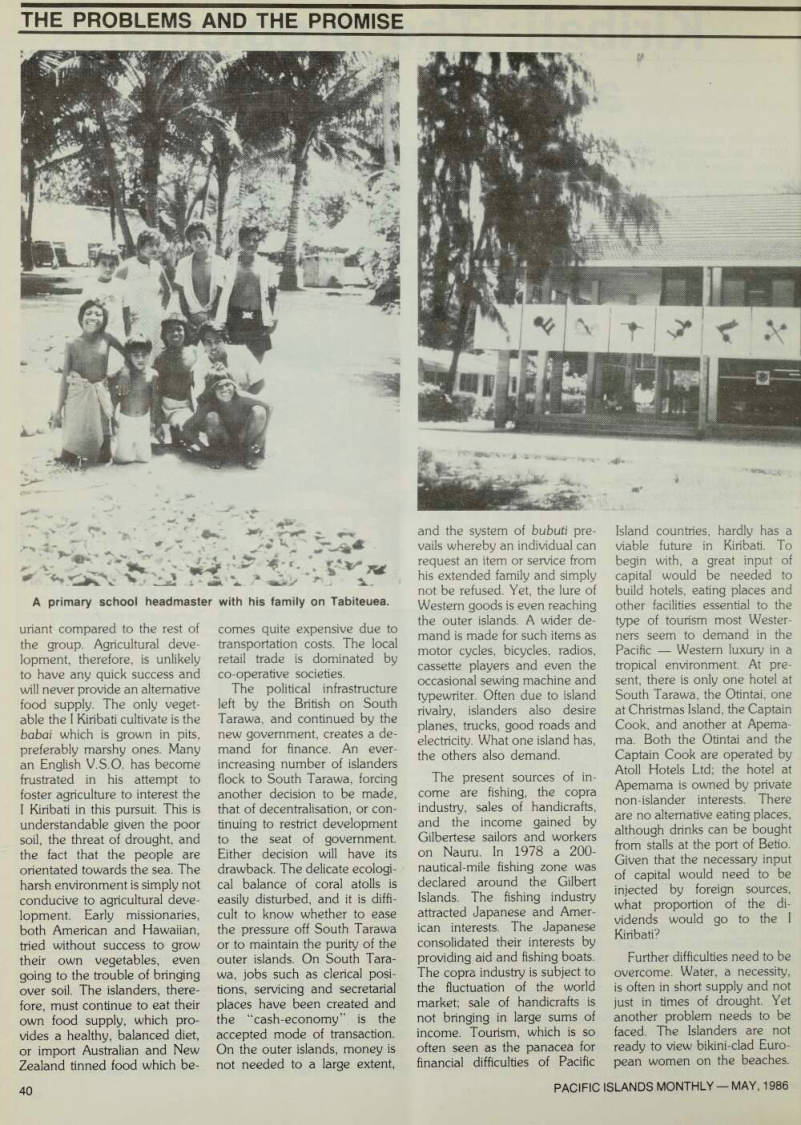
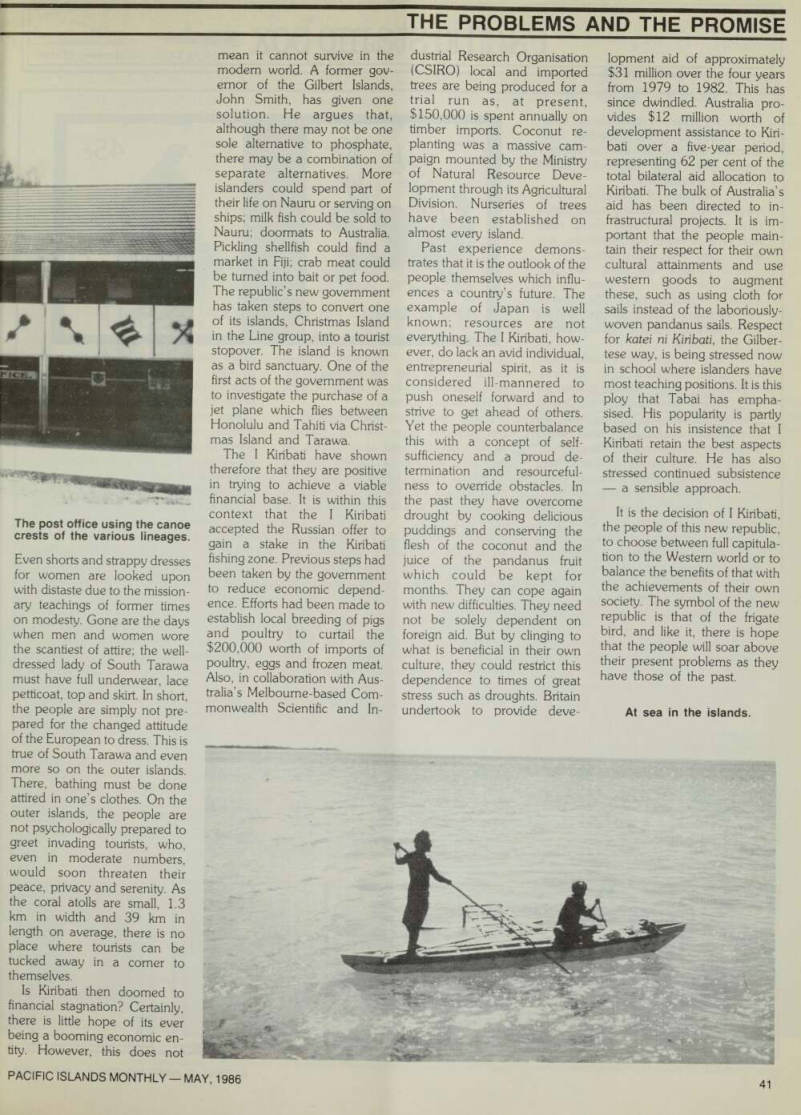
and the promise
Kiribati, an island republic since 1979, has been pushed into the political limelight of late by its acceptance of Russian interests in its fishing zone. Previously, Kiribati was virtually unknown except for those fortunate enough to have read Grimble’s colorful depictions of life in the Gilbert Islands, as they were once known. Recently, journal ists have looked to these tiny atolls and depicted them as poor islands without a future.
However, what is needed is a thorough perusal of the islands, their history, the resourceful ness of the people and the present mode of living, before bold statements are made about Kiribati, or denunciations directed against the island re public.
On July 12, 1979, the former Gilbert Islands, under the politi cal jurisdiction of Great Britain, became the independent Kiri bati incorporating Ocean Is land, the Line and Phoenix Islands. Prior to white contact, various types of political control had developed in the original 16 Gilbert Islands. There were two kingdoms, those of Butar itari and Apemama, while to the south, the unimane, or old men, ruled the community through the maneaba system, the maneaba being the council meeting house where the va rious lineages met. Northwards the islanders engaged in inces sant warfare between lineages, sections of islands, and even between islands. It was not till Great Britain took over the Gilbert Islands as a protectorate in 1892 that this fierce warfare was quelled. By this time, French Catholic missionaries, as well as both American and English Congregationalists, had established missions on the va rious islands. While inter-island warfare diminished, occasional skirmishes erupted between ri val denominations.
At present, Kiribati is gov erned by a president, Jeremiah Tabai, and a bi-cameral house of assembly, called by the I Kiribati (the people of Kiribati) Maneaba ni Maungatabu, which
Often written off as a group of “poor islands without a future”, the Republic of Kiribati has more going for it than meets the casual eye. SANDRA RENNIE writes here of the problems and the promise before its 60,000 people.
is based on the Westminster model. The importance of Tabai’s presidency cannot be over-emphasised. Tabai is a Protestant and yet has con sistently gained the vote of both Protestants and Catholics. He is now in his third term of office.
His presidency signalled a unity which preceded independence.
The population is approx imately 60,000, which is a heavy concentration on these tiny coral atolls. The Phoenix and Line Islands were used by a former British Commissioner, H. E. Maude, to settle the excess population. In former times, the I Kiribati had prac tised abortion to curb popula tion growth. This problem of population growth remains one
of the most pressing problems of the new republic.
The other major problem is that of finance. Formerly, the finance to support the gov ernmental infrastructure of South Tarawa, the seat of gov ernment, came from Ocean Island, or Banaba, with its phosphate industry. Ocean Islanders often resented the contribution they made to the Gilbert Islands, and one of the reasons why the Gilbertese waited so long for their inde pendence was the fact that Ocean Islanders did not want to be incorporated into a new identity in unison with the Gil bert Islands. Eventually this problem was settled, but to no financial advantage to the new
republic of Kiribati; the phos phate had run out. The difficul ty has been to find a lucrative alternative to this former com modity.
It may be argued, however, that on these narrow and sparse coral atolls, where on the outer islands life is still on the subsist ence level, money is not really needed at all. Islanders live mainly on fish, babai, a root vegetable, pandanus fruit, coconuts and some breadfruit.
The diet is limited but ade quate. But increasingly, islan ders are turning to tinned meat and fish, tinned fruit and bis cuits. This, perhaps, is under standable in an environment subject to intermittent drought.
Especially is this true to the south. Only Butaritari, the most northerly island of the original Gilbert Islands, falls within the rain belt, and here undergrowth occurs and vegetation is lux-
Sampling the catch after collec ting cockleshells.
uriant compared to the rest of the group. Agricultural development, therefore, is unlikely to have any quick success and will never provide an alternative food supply. The only vegetable the I Kiribati cultivate is the babai which is grown in pits, preferably marshy ones. Many an English V.S.O. has become frustrated in his attempt to foster agriculture to interest the I Kiribati in this pursuit. This is understandable given the poor soil, the threat of drought, and the fact that the people are orientated towards the sea. The harsh environment is simply not conducive to agricultural development. Early missionaries, both American and Hawaiian, tried without success to grow their own vegetables, even going to the trouble of bringing over soil. The islanders, therefore, must continue to eat their own food supply, which provides a healthy, balanced diet, or import Australian and New Zealand tinned food which be-
comes quite expensive due to transportation costs. The local retail trade is dominated by co-operative societies, The political infrastructure left by the British on South Tarawa, and continued by the new government, creates a de mand for finance. An ever increasing number of islanders flock to South Tarawa, forcing another decision to be made, that of decentralisation, or con tinuing to restrict development to the seat of government, Either decision will have its drawback. The delicate ecologi cal balance of coral atolls is easily disturbed, and it is diffi cult to know whether to ease the pressure off South Tarawa or to maintain the purity of the outer islands. On South Tara wa, jobs such as clerical posi tions, servicing and secretarial places have been created and the “cash-economy” is the accepted mode of transaction, On the outer islands, money is not needed to a large extent,
and the system of bubuti pre vails whereby an individual can request an item or service from his extended family and simply not be refused. Yet, the lure of Western goods is even reaching the outer islands. A wider de mand is made for such items as motor cycles, bicycles, radios, cassette players and even the occasional sewing machine and typewriter. Often due to island rivalry, islanders also desire planes, trucks, good roads and electricity. What one island has, the others also demand.
The present sources of in come are fishing, the copra industry, sales of handicrafts, and the income gained by Gilbertese sailors and workers on Nauru. In 1978 a 200nautical-mile fishing zone was declared around the Gilbert Islands. The fishing industry attracted Japanese and Amer ican interests. The Japanese consolidated their interests by providing aid and fishing boats.
The copra industry is subject to the fluctuation of the world market; sale of handicrafts is not bringing in large sums of income. Tourism, which is so often seen as the panacea for financial difficulties of Pacific
Island countries, hardly has a viable future in Kiribati. To begin with, a great input of capital would be needed to build hotels, eating places and other facilities essential to the type of tourism most Wester ners seem to demand in the Pacific Western luxury in a tropical environment. At pre sent, there is only one hotel at South Tarawa, the Otintai, one at Christmas Island, the Captain Cook, and another at Apema ma. Both the Otintai and the Captain Cook are operated by Atoll Hotels Ltd; the hotel at Apemama is owned by private non-islander interests. There are no alternative eating places, although drinks can be bought from stalls at the port of Betio.
Given that the necessary input of capital would need to be injected by foreign sources, what proportion of the di vidends would go to the I Kiribati?
Further difficulties need to be overcome. Water, a necessity, is often in short supply and not just in times of drought. Yet another problem needs to be faced. The Islanders are not ready to view bikini-clad Euro pean women on the beaches.
A primary school headmaster with his family on Tabiteuea.
Even shorts and strappy dresses for women are looked upon with distaste due to the mission ary teachings of former times on modesty. Gone are the days when men and women wore the scantiest of attire; the well dressed lady of South Tarawa must have full underwear, lace petticoat, top and skirt. In short, the people are simply not pre pared for the changed attitude of the European to dress. This is true of South Tarawa and even more so on the outer islands.
There, bathing must be done attired in one’s clothes. On the outer islands, the people are not psychologically prepared to greet invading tourists, who, even in moderate numbers, would soon threaten their peace, privacy and serenity. As the coral atolls are small, 1.3 km in width and 39 km in length on average, there is no place where tourists can be tucked away in a comer to themselves.
Is Kiribati then doomed to financial stagnation? Certainly, there is little hope of its ever being a booming economic en tity. However, this does not
mean it cannot survive in the modem world. A former gov ernor of the Gilbert Islands, John Smith, has given one solution. He argues that, although there may not be one sole alternative to phosphate, there may be a combination of separate alternatives. More islanders could spend part of their life on Nauru or serving on ships; milk fish could be sold to Nauru; doormats to Australia.
Pickling shellfish could find a market in Fiji; crab meat could be turned into bait or pet food.
The republic’s new government has taken steps to convert one of its islands, Christmas Island in the Line group, into a tourist stopover. The island is known as a bird sanctuary. One of the first acts of the government was to investigate the purchase of a jet plane which flies between Honolulu and Tahiti via Christ mas Island and Tarawa.
The I Kiribati have shown therefore that they are positive in trying to achieve a viable financial base. It is within this context that the I Kiribati accepted the Russian offer to gain a stake in the Kiribati fishing zone. Previous steps had been taken by the government to reduce economic depend ence. Efforts had been made to establish local breeding of pigs and poultry to curtail the $200,000 worth of imports of poultry, eggs and frozen meat.
Also, in collaboration with Aus tralia’s Melbourne-based Com monwealth Scientific and In
dustrial Research Organisation (CSIRO) local and imported trees are being produced for a trial run as, at present, $150,000 is spent annually on timber imports. Coconut re planting was a massive cam paign mounted by the Ministry of Natural Resource Deve lopment through its Agricultural Division. Nurseries of trees have been established on almost every island.
Past experience demons trates that it is the outlook of the people themselves which influ ences a country’s future. The example of Japan is well known; resources are not everything. The I Kiribati, how ever, do lack an avid individual, entrepreneurial spirit, as it is considered ill-mannered to push oneself forward and to strive to get ahead of others.
Yet the people counterbalance this with a concept of self sufficiency and a proud de termination and resourceful ness to override obstacles. In the past they have overcome drought by cooking delicious puddings and conserving the flesh of the coconut and the juice of the pandanus fruit which could be kept for months. They can cope again with new difficulties. They need not be solely dependent on foreign aid. But by clinging to what is beneficial in their own culture, they could restrict this dependence to times of great stress such as droughts. Britain undertook to provide deve
lopment aid of approximately $3l million over the four years from 1979 to 1982. This has since dwindled. Australia pro vides $l2 million worth of development assistance to Kiri bati over a five-year period, representing 62 per cent of the total bilateral aid allocation to Kiribati. The bulk of Australia’s aid has been directed to in frastructural projects. It is im portant that the people main tain their respect for their own cultural attainments and use western goods to augment these, such as using cloth for sails instead of the laboriously woven pandanus sails. Respect for katei ni Kiribati, the Gilber tese way, is being stressed now in school where islanders have most teaching positions. It is this ploy that Tabai has empha sised. His popularity is partly based on his insistence that I Kiribati retain the best aspects of their culture. He has also stressed continued subsistence a sensible approach.
It is the decision of I Kiribati, the people of this new republic, to choose between full capitula tion to the Western world or to balance the benefits of that with the achievements of their own society. The symbol of the new republic is that of the frigate bird, and like it, there is hope that the people will soar above their present problems as they have those of the past.
The post office using the canoe crests of the various lineages.
At sea in the islands.
Advertisements & other items, pp. 40-41 (2 items)
The Problems And The Promise
40
PACIFIC ISLANDS MONTHLY —MAY, 1986
The Problems And The Promise
41
PACIFIC ISLANDS MONTHLY MAY, 1986
Pacific stamp box
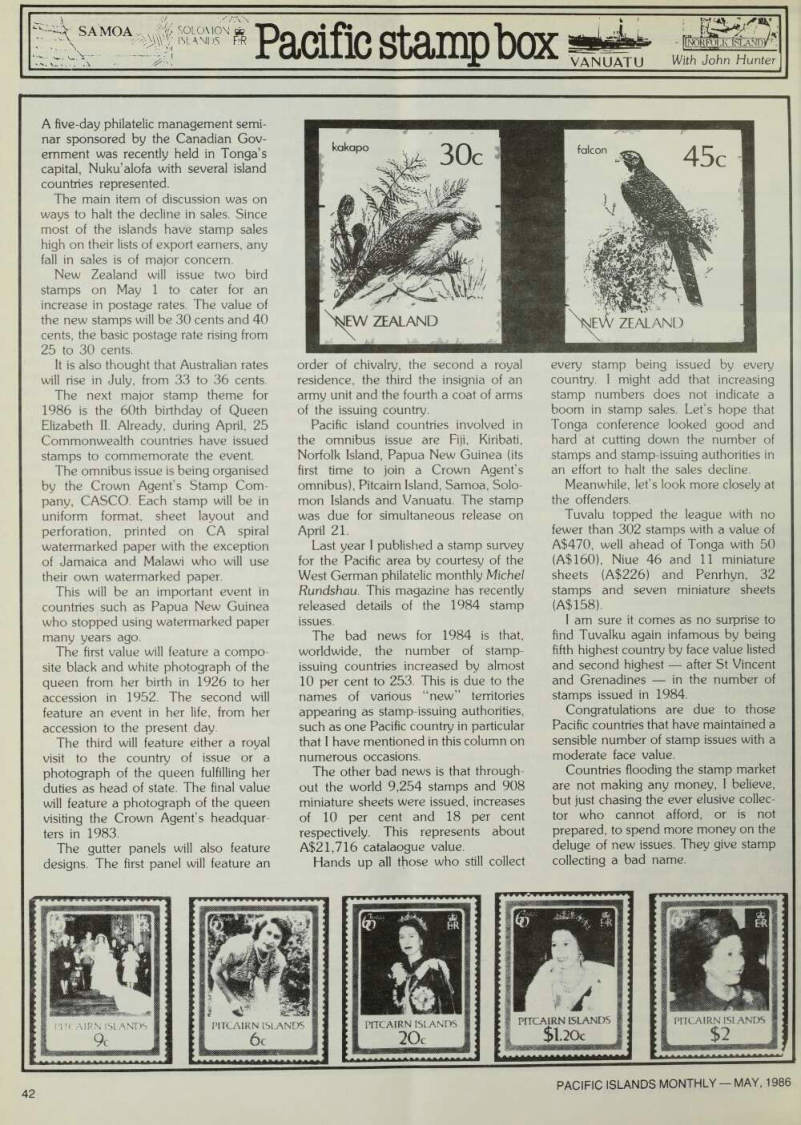
A five-day philatelic management semi nar sponsored by the Canadian Gov ernment was recently held in Tonga’s capital, Nuku’alofa with several island countries represented.
The main item of discussion was on ways to halt the decline in sales. Since most of the islands have stamp sales high on their lists of export earners, any fall in sales is of major concern.
New Zealand will issue two bird stamps on May 1 to cater for an increase in postage rates. The value of the new stamps will be 30 cents and 40 cents, the basic postage rate rising from 25 to 30 cents.
It is also thought that Australian rates will rise in July, from 33 to 36 cents.
The next major stamp theme for 1986 is the 60th birthday of Queen Elizabeth 11. Already, during April, 25 Commonwealth countries have issued stamps to commemorate the event.
The omnibus issue is being organised by the Crown Agent’s Stamp Com pany, CASCO. Each stamp will be in uniform format, sheet layout and perforation, printed on CA spiral watermarked paper with the exception of Jamaica and Malawi who will use their own watermarked paper.
This will be an important event in countries such as Papua New Guinea who stopped using watermarked paper many years ago.
The first value will feature a compo site black and white photograph of the queen from her birth in 1926 to her accession in 1952. The second will feature an event in her life, from her accession to the present day.
The third will feature either a royal visit to the country of issue or a photograph of the queen fulfilling her duties as head of state. The final value will feature a photograph of the queen visiting the Crown Agent’s headquar ters in 1983.
The gutter panels will also feature designs. The first panel will feature an
order of chivalry, the second a royal residence, the third the insignia of an army unit and the fourth a coat of arms of the issuing country.
Pacific island countries involved in the omnibus issue are Fiji, Kiribati, Norfolk Island, Papua New Guinea (its first time to join a Crown Agent’s omnibus), Pitcairn Island, Samoa, Solo mon Islands and Vanuatu. The stamp was due for simultaneous release on April 21.
Last year 1 published a stamp survey for the Pacific area by courtesy of the West German philatelic monthly Michel Rundshau. This magazine has recently released details of the 1984 stamp issues.
The bad news for 1984 is that, worldwide, the number of stamp issuing countries increased by almost 10 per cent to 253. This is due to the names of various “new” territories appearing as stamp-issuing authorities, such as one Pacific country in particular that I have mentioned in this column on numerous occasions.
The other bad news is that through out the world 9,254 stamps and 908 miniature sheets were issued, increases of 10 per cent and 18 per cent respectively. This represents about A 521,716 catalogue value.
Hands up all those who still collect
every stamp being issued by every country. I might add that increasing stamp numbers does not indicate a boom in stamp sales. Let’s hope that Tonga conference looked good and hard at cutting down the number of stamps and stamp-issuing authorities in an effort to halt the sales decline.
Meanwhile, let’s look more closely at the offenders.
Tuvalu topped the league with no fewer than 302 stamps with a value of As47o, well ahead of Tonga with 50 (A$ 160), Niue 46 and 11 miniature sheets (A 5226) and Penrhyn, 32 stamps and seven miniature sheets (AslsB).
I am sure it comes as no surprise to find Tuvalku again infamous by being fifth highest country by face value listed and second highest after St Vincent and Grenadines in the number of stamps issued in 1984.
Congratulations are due to those Pacific countries that have maintained a sensible number of stamp issues with a moderate face value.
Countries flooding the stamp market are not making any money, I believe, but just chasing the ever elusive collec tor who cannot afford, or is not prepared, to spend more money on the deluge of new issues. They give stamp collecting a bad name.
Advertisements & other items, p. 43 (1 item)
The Treasure At The End Of The Rainbow
It's not the luck of a leprechaun but the craft of Clarion that will lead you to uncompromising stereo sound quality. Even in the compromising environment of a moving automobile. Clarion's advanced electronics makes possible a wide spectrum of convenient, easy-to-use features. The Clarion choice of models is positively dazzling. And our reliability is nofairytale. Come, listen to a Clarion Car Stereo. And drive happily ever after. IUI I THE TREASURE AT THE END OF THE RAINBOW ° n^9, l *fader a model 900 E < > For further information lalTit[ a hT pf "Ifijo aat ni f 81 6 S S (Aus,r f asia) 554 Parramatta Road, Ashfield. NSW, 2131 / New Zealand: AWA New Zealand Limited, PO Box 50-248, Porirua / Fiji Islands: Brijlal &Co Lid GPO Box 362 Suva HIFI AUDIO AGANA / Vanuatu" The Sound N ™. Ca ' edonia: Caldis - B PMI - Noumea Cedex 1 Guam: Mlcr °P ac Aad '° 'nc PO Box 3478, Agana, Guam 96910, US A Tel 472-8091, Cable Code uatu. The Sound Centre, P 0 Box 434, Vila / Cook Islands: Souih Seas International Ltd, PO Box 49, Rarotonga / Papua New Guinea: Hagemeyer (PNG) Pty Ltd. PO Box 1428, Boroko, Port Moresby
who helped make Fiji
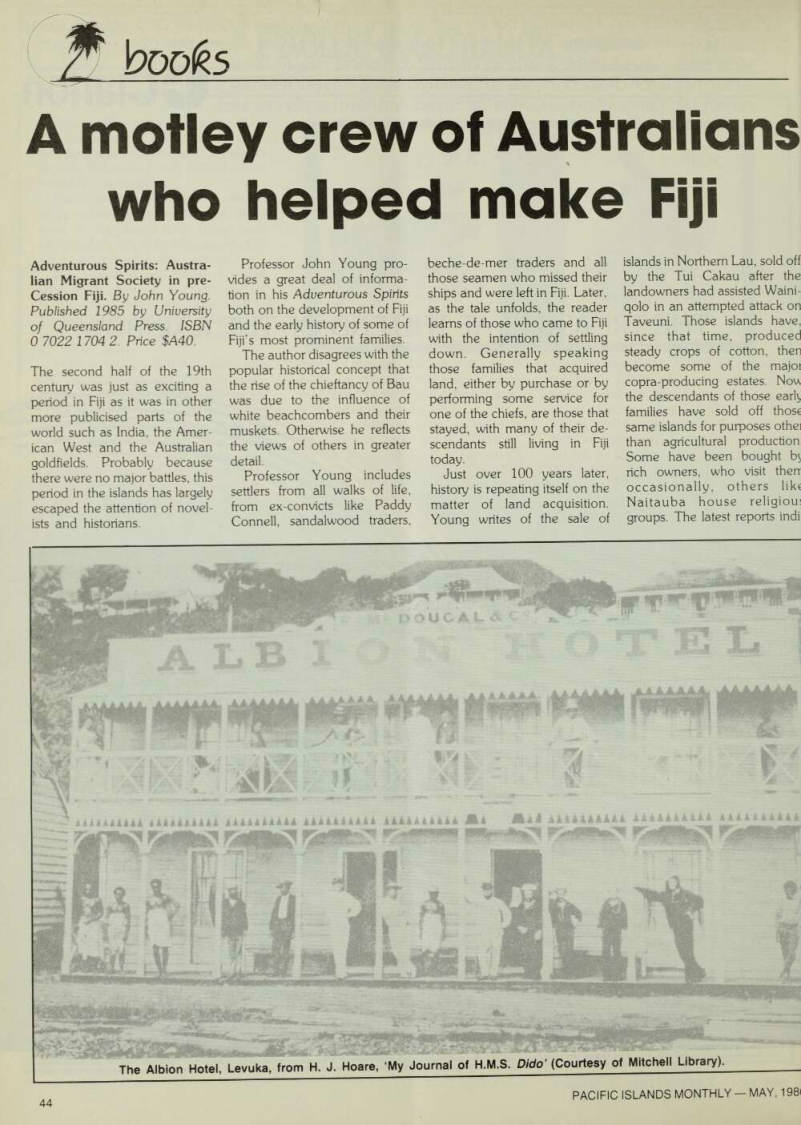
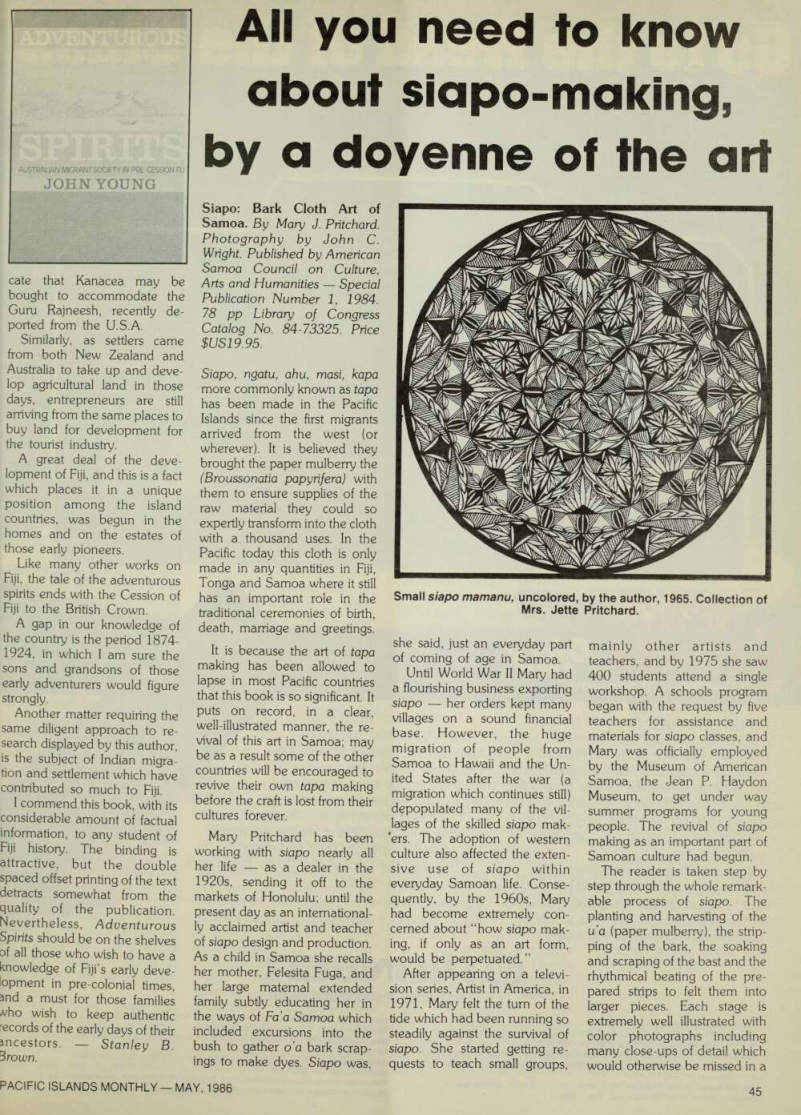
books
A motley crew of Australians who helped make Fiji
Adventurous Spirits: Austra lian Migrant Society in pre cession Fiji. By John Young.
Published 1985 by University of Queensland Press. ISBN 0 70221704 2. Price SA4O.
The second half of the 19th century was just as exciting a period in Fiji as it was in other more publicised parts of the world such as India, the Amer ican West and the Australian goldfields. Probably because there were no major battles, this period in the islands has largely escaped the attention of novel ists and historians.
Professor John Young pro vides a great deal of informa tion in his Adventurous Spirits both on the development of Fiji and the early history of some of Fiji’s most prominent families.
The author disagrees with the popular historical concept that the rise of the chieftancy of Bau was due to the influence of white beachcombers and their muskets. Otherwise he reflects the views of others in greater detail.
Professor Young includes settlers from all walks of life, from ex-convicts like Paddy Connell, sandalwood traders,
beche-de-mer traders and all those seamen who missed their ships and were left in Fiji. Later, as the tale unfolds, the reader learns of those who came to Fiji with the intention of settling down. Generally speaking those families that acquired land, either by purchase or by performing some service for one of the chiefs, are those that stayed, with many of their descendants still living in Fiji today.
Just over 100 years later, history is repeating itself on the matter of land acquisition.
Young writes of the sale of
islands in Northern Lau, sold off by the Tui Cakau after the landowners had assisted Waini qolo in an attempted attack on Taveuni. Those islands have, since that time, produced steady crops of cotton, then become some of the major copra-producing estates. Now the descendants of those earh, families have sold off those same islands for purposes other than agricultural production, Some have been bought rich owners, who visit then occasionally, others like Naitauba house religiou; groups. The latest reports indi
The Albion Hotel, Levuka, from H. J. Hoare, My Journal of H.M.S. Dido’ (Courtesy of Mitchell Library).
cate that Kanacea may be bought to accommodate the Gum Rajneesh, recently de ported from the U.S.A.
Similarly, as settlers came from both New Zealand and Australia to take up and deve lop agricultural land in those days, entrepreneurs are still arriving from the same places to buy land for development for the tourist industry.
A great deal of the deve lopment of Fiji, and this is a fact which places it in a unique position among the island countries, was begun in the homes and on the estates of those early pioneers.
Like many other works on Fiji, the tale of the adventurous spirits ends with the Cession of Fiji to the British Crown.
A gap in our knowledge of the country is the period 1874- 1924, in which I am sure the sons and grandsons of those early adventurers would figure strongly.
Another matter requiring the same diligent approach to re search displayed by this author, is the subject of Indian migra tion and settlement which have contributed so much to Fiji.
I commend this book, with its considerable amount of factual information, to any student of Fiji history. The binding is attractive, but the double spaced offset printing of the text detracts somewhat from the quality of the publication.
Nevertheless, Adventurous
Spirits should be on the shelves of all those who wish to have a knowledge of Fiji’s early deve lopment in pre-colonial times, and a must for those families A/ho wish to keep authentic 'ecords of the early days of their ancestors. Stanley B. 3rown.
about siapo-making,

All you need to know
by a doyenne of the art
Siapo: Bark Cloth Art of Samoa. By Mary J. Pritchard.
Photography by John C.
Wright. Published by American Samoa Council on Culture, Arts and Humanities Special Publication Number 1, 1984. 78 pp Library of Congress Catalog No. 84-73325. Price $U519.95.
Siapo, ngatu, ahu, masi, kapa more commonly known as tapa has been made in the Pacific Islands since the first migrants arrived from the west (or wherever). It is believed they brought the paper mulberry the (Broussonatia papyrifera) with them to ensure supplies of the raw material they could so expertly transform into the cloth with a thousand uses. In the Pacific today this cloth is only made in any quantities in Fiji, Tonga and Samoa where it still has an important role in the traditional ceremonies of birth, death, marriage and greetings.
It is because the art of tapa making has been allowed to lapse in most Pacific countries that this book is so significant. It puts on record, in a clear, well-illustrated manner, the re vival of this art in Samoa; may be as a result some of the other countries will be encouraged to revive their own tapa making before the craft is lost from their cultures forever.
Mary Pritchard has been working with siapo nearly all her life as a dealer in the 19205, sending it off to the markets of Honolulu; until the present day as an international ly acclaimed artist and teacher of siapo design and production.
As a child in Samoa she recalls her mother, Felesita Fuga, and her large maternal extended family subtly educating her in the ways of Fa’a Samoa which included excursions into the bush to gather o’a bark scrap ings to make dyes. Siapo was,
she said, just an everyday part of coming of age in Samoa.
Until World War II Mary had a flourishing business exporting siapo her orders kept many villages on a sound financial base. However, the huge migration of people from Samoa to Hawaii and the United States after the war (a migration which continues still) depopulated many of the viljages of the skilled siapo makers. The adoption of western culture also affected the extensive use of siapo within everyday Samoan life. Consequently, by the 19605, Mary had become extremely concerned about “how siapo making, if only as an art form, would be perpetuated. ”
After appearing on a television series, Artist in America, in 1971, Mary felt the turn of the tide which had been running so steadily against the survival of siapo. She started getting requests to teach small groups,
mainly other artists and teachers, and by 1975 she saw 400 students attend a single workshop. A schools program began with the request by five teachers for assistance and materials for siapo classes, and Mary was officially employed by the Museum of American Samoa, the Jean P. Haydon Museum, to get under way summer programs for young people. The revival of siapo making as an important part of Samoan culture had begun, The reader is taken step by step through the whole remark able process of siapo. The planting and harvesting of the ua (paper mulberry), the strip ping of the bark, the soaking and scraping of the bast and the rhythmical beating of the pre pared strips to felt them into larger pieces. Each stage is extremely well illustrated with color photographs including many close-ups of detail which would otherwise be missed in a
Small siapo mamanu, uncolored, by the author, 1965. Collection of Mrs. Jette Pritchard.
wide angle shot. The decorating of siapo, the natural dyes used and the origins of the most frequently used design ele ments, are so clearly described that the finished product takes on a whole new meaning when the viewer is able to identify certain characteristics. Many of the photographs are siapo pieces from the 19th century which have been preserved in museums and private collec tions; others compare pieces made by the rubbing method (siapo tasina) and the freehand drawing method (siapo mama nu) each of which is meticu lously described by the author.
Mary Pritchard, while receiv ing much praise herself for her
talents and contribution to pre serving this vital part of Samoan culture, in turn extends her praise and admiration to the women who influenced her own style so greatly. Her fon dest memories are of the times she spent in Leone, her hus band’s village, and joined in the traditional siapo group with Tui’uil Leoso and Kolone Fai’ivae Leoso. Mary hopes that her book will help the perpetuation of siapo. “If it does,” she says, “credit must go to all the siapo makers of the past, whose gift to us enriches our lives. ” Her book also cele brates the graciousness of the women of Leone.
The writer’s recent experi
ence with a large group of American tourists revealed that their respect for, and interest in, siapo increased tenfold when they were made aware of how it was produced and of its long traditions. They admitted to buying much more than they would otherwise have done.
The availability of Mary Prit chard’s book should help this knowledge to be more disseminated still, and thereby open up more markets in tour ism, creating a demand for greater production of quality siapo. As for me, I’m inspired to go out and plant some Brous
sonatia papyrifera.
Ngaire
Douglas.
Advertisements & other items, p. 46 (1 item)
Go to the Head of the Class
T»1 '■ •H . I
*li! J.;—
m m F 770 X m Go ahead, move up to Pioneer’s New Personna Plus X-770 shelf-component system, and discover peerless perfection.
This super-sophisticated mini-sized sound system offers full-function remote control for amp, tuner, cassette deck, turntable, and the optional CD player. Together, they put cutting edge audio technology at your command as Pioneer alone can.
Simulated Stereo lets you enjoy wide, stereo-like signals from mono signals. And Stereo Wide brings you expanded ambience from stereo signals, so you’re as turned on as possible no matter what you tune in!
Power? 320 W Peak Music Power Output from the double auto-reverse cassette deck/amplifier. You’ll flip over the music, without flipping the tape over, as well as enjoy double cassette convenience.
Of course, the X-770 also brings you great features like 5-band graphic equalizer, Mic Mixing, Dolby* B/C NR, and more.
The New Personna X-770. Go for it and go to the head of the class. * “Dolby" and the double-D symbol are trademarks of Dolby Laboratories Licensing Corporation.
Note: The optional PD-X707(8K) CD player is shown above.
Ofi PIONEER
The future of sound and vision.
For further information, please contact; Australia: Pioneer Electronics Australia Pty. Ltd. (Incorporated in Victoria), P.O. Box 295, Mordialloc, Victoria, 3195 Tel; 580-9911 Fiji Islands: Brijlal & Company, G.P.O. Box No. 362, Suva, Fiji Islands Tel: 22258 New Zealand; Monaco Distributors Ltd., 2 Poland Road, Glenfield, Auckland, New Zealand Tel: (09) 444-9144 ~. . . .
Norfolk Island; Burns Philp (Norfolk Island) Ltd., P.O. Box 21, Norfolk Island Vanuatu: Burns Philp (Vanuatu) Ltd., Vila, Vanuatu Nauru Island: Jacob Enterprises, P.O. Box No. 4, Republic of Nauru Tahiti: Tahiti Hi-Fi, P.O. Box 848, Papeete, Tahiti New Caledonia: Menard Pacifique Sari, B.P. 3899, Noumea, New Caledonia Amen'can 2 Samoa: Transpac Corporation. P.O. Bo* 1477, Pago Pago, American Ltd, P.O. Bo* 49, m Co<*■£-.«= 2327 Paoua New Guinea: Bali Merchants Pty. Ltd., P.O. Box 6103, Boroko Tel. 25 8
The roller-coaster story
of labor in Hawaii
Working in Hawaii: A Labor History. By Edward A.
Beechert. Published by Univer sity of Hawaii Press, 1985.
ISBN 0 8248 08908. Price
Sus3O.
This study “examines the social relations of production as they evolved along with the structure of the sugar industry, the politi cal structure of Hawaii, and the consciousness of the worker. ” It is the author’s working assump tion that the “transformation of Hawaiian society by the arrival of western influence and ideas touched every aspect of Hawaiian life.” This was espe cially evident in the changing nature of labor.
The initial chapter summa rises the major cultural char acteristics of traditional Hawaiian society. Changes which occurred after western contact “affected different parts of society at different times and in different ways,” and was apt to be “most dramatic for those living near the centers of Euro pean concentration. ” It is in the port towns and communities that the “system of exchange and labor” was being estab lished.
With particular respect to such a development, Beechert :oncludes that the “transition from a society based upon communal use to one based
upon commodity exchange meant that the Hawaiian com moner now retained many of the obligations of the former relationship but few of its bene fits.”
By the late 1830 s, deter mined efforts to shift the control of labor and land to cash crop enterprises became apparent.
The decline of the Hawaiian population and the influx of expatriates into the islands pre cipitated dramatic changes in the nature of land ownership and control over free labor.
Such changes marked the irreversible move from a largely subsistence economy to a mar ket and wage labor regime.
Freehold land enables entre preneurs to initiate large scale cash crop ventures. The short age of island labor, however, necessitated a concerted search for overseas sources of cheap and available labor to work the burgeoning sugar plantations.
“Behind the facade of the Hawaiian government, the planters drove relentlessly to ward their goal of an adequate labor supply.”
By 1852, the importation of Asian contract labor com menced in earnest with the first shipload of contracted laborers from China. “The principal sources of labor were sufficient ly impressed with the opportun ity for a cash wage that they
came in large numbers. Condi tions at home were sufficiently harsh to make offers from Hawaii seem golden.”
With the enactment of the 1876 Reciprocity Treaty, Hawaiian sugar entered the American market tariff-free.
Though advantage lasted only 15 years, unprecedented prosperity resulted. The re storation of American tariff pro tection for domestic sugar pro duce revived initiatives to annex the islands to the United States, a fact which materialised in 1898.
Once such obstacles were overcome, the major issue for the largely Asiatic labor force was how to secure better wages and living conditions. While the plantations resisted such efforts with a variety of often creative strategies, other members of the socio-economic oligarchy protested against the indignities of the system. “The staggering wealth produced by the sugar industry blinded its proprietors to the defects. Wages were only the most immediate and direct cause of labor unrest. Dignity and opportunity ranked equally high in the minds of the work ers. ” The demands of the plantation labor force were “compounded by the fact that the planters were passing through a stage of transition
between coolie labor and free labor.”
The movement to organise labor unions graduated to mili tant initiatives. The Japanese language press and organisa tion provided a forum to debate the issues of wages, hours, working conditions and “above all, the question of dignity.” In contrast, the Filipino organisa tions had “nothing approaching the local federated structure” characteristic of their Japanese counterparts. The gaps of diffe rent culture and language did not permit mutual understand ing. In the aftermath of the momentous 1920 and 1924 strikes, the territorial govern ment enacted a series of laws designed to “nip in the bud any organising efforts by the Filipino or the Japanese.”
In spite of organising and legislation successes during the 19405, travail continued to per sist in the form of communist party activities within the Hawaii waterfront union. This issue had broader ramifications for the prospect of statehood for the islands in view of some resistance in the American con gress. Beechert concludes that “the history of workers in Hawaii lies in an examination of the lead of working-class con sciousness in response to each stage of development of the Hawaiian political economy.”
Yet, it would be important to note that the “working class has been unable to challenge capitalist hegemony because it is split into factions.” Though “one cannot assume that his tory has stopped at this point or that the basic struggle of class interests has ceased.”
This volume is well research ed and follows a readable his torical scenario. While some theoretical observations are occasionally inserted in the fac tual narrative, there is no com prehensive analysis of the na ture and scope of the changing nature of labor, and how island society itself is changed. Ethnic ity is a dominant characteristic of labor, yet considerably more needs to be said about how each group differs from the other.
This study, however, is pragmatic and useful, and is a significant contribution to an understanding of organised
labor in Hawaii.
William
Tagupa.
people
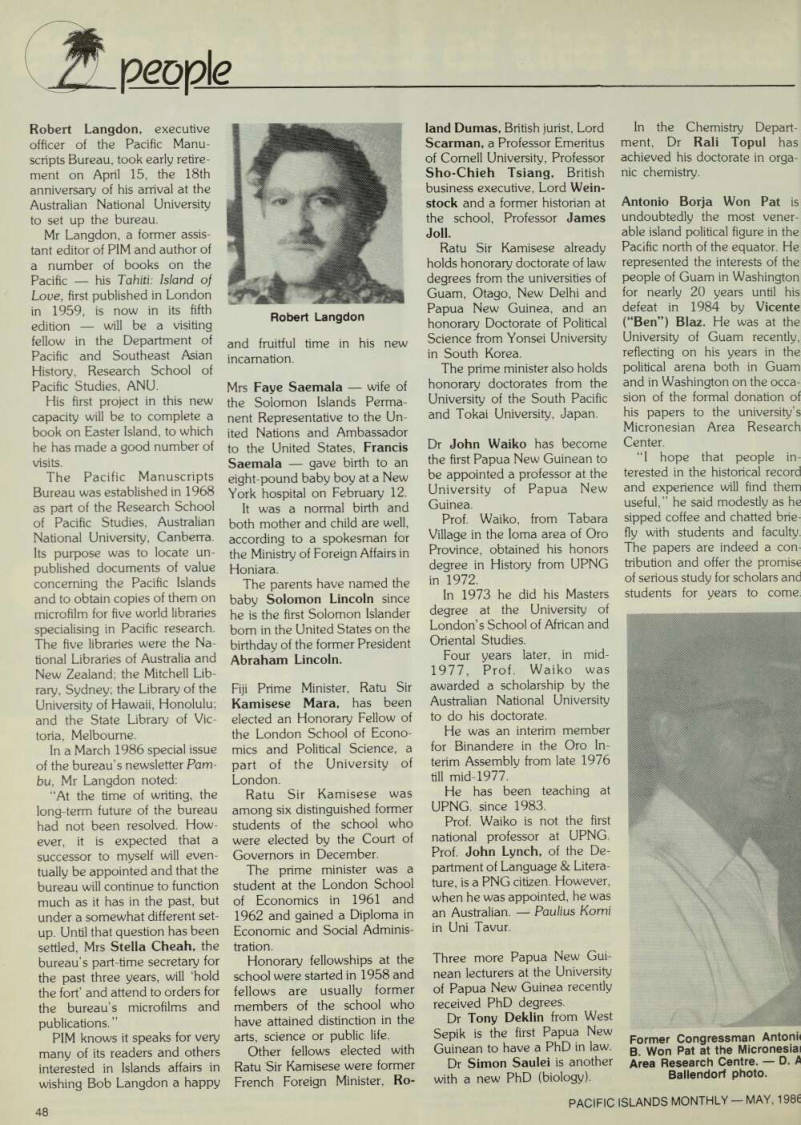
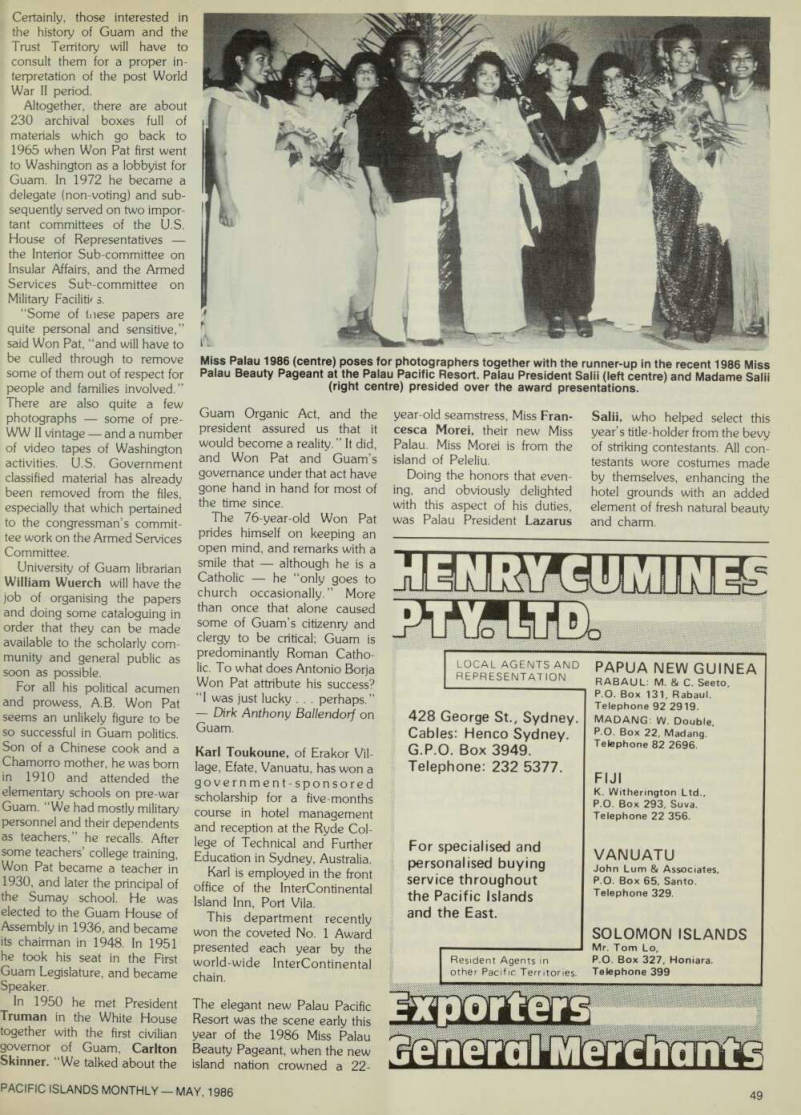
Robert Langdon, executive officer of the Pacific Manu scripts Bureau, took early retire ment on April 15, the 18th anniversary of his arrival at the Australian National University to set up the bureau.
Mr Langdon, a former assis tant editor of PIM and author of a number of books on the Pacific his Tahiti: Island of Love, first published in London in 1959, is now in its fifth edition will be a visiting fellow in the Department of Pacific and Southeast Asian History, Research School of Pacific Studies, ANU.
His first project in this new capacity will be to complete a book on Easter Island, to which he has made a good number of visits.
The Pacific Manuscripts Bureau was established in 1968 as part of the Research School of Pacific Studies, Australian National University, Canberra.
Its purpose was to locate un published documents of value concerning the Pacific Islands and to obtain copies of them on microfilm for five world libraries specialising in Pacific research.
The five libraries were the Na tional Libraries of Australia and New Zealand; the Mitchell Lib rary, Sydney; the Library of the University of Hawaii, Honolulu; and the State Library of Vic toria, Melbourne.
In a March 1986 special issue of the bureau’s newsletter Pam bu, Mr Langdon noted; “At the time of writing, the long-term future of the bureau had not been resolved. How ever, it is expected that a successor to myself will even tually be appointed and that the bureau will continue to function much as it has in the past, but under a somewhat different set up. Until that question has been settled, Mrs Stella Cheah, the bureau’s part-time secretary for the past three years, will ‘hold the fort’ and attend to orders for the bureau’s microfilms and publications. ”
PIM knows it speaks for very many of its readers and others interested in Islands affairs in wishing Bob Langdon a happy
and fruitful time in his new incarnation.
Mrs Faye Saemala wife of the Solomon Islands Perma nent Representative to the Un ited Nations and Ambassador to the United States, Francis Saemala gave birth to an eight-pound baby boy at a New York hospital on February 12.
It was a normal birth and both mother and child are well, according to a spokesman for the Ministry of Foreign Affairs in Honiara.
The parents have named the baby Solomon Lincoln since he is the first Solomon Islander bom in the United States on the birthday of the former President Abraham Lincoln.
Fiji Prime Minister, Ratu Sir Kamisese Mara, has been elected an Honorary Fellow of the London School of Econo mics and Political Science, a part of the University of London.
Ratu Sir Kamisese was among six distinguished former students of the school who were elected by the Court of Governors in December.
The prime minister was a student at the London School of Economics in 1961 and 1962 and gained a Diploma in Economic and Social Adminis tration.
Honorary fellowships at the school were started in 1958 and fellows are usually former members of the school who have attained distinction in the arts, science or public life.
Other fellows elected with Ratu Sir Kamisese were former French Foreign Minister, Ro
land Dumas, British jurist, Lord Scarman, a Professor Emeritus of Cornell University, Professor Sho-Chieh Tsiang, British business executive, Lord Wein stock and a former historian at the school, Professor James Joll.
Ratu Sir Kamisese already holds honorary doctorate of law degrees from the universities of Guam, Otago, New Delhi and Papua New Guinea, and an honorary Doctorate of Political Science from Yonsei University in South Korea.
The prime minister also holds honorary doctorates from the University of the South Pacific and Tokai University, Japan.
Dr John Waiko has become the first Papua New Guinean to be appointed a professor at the University of Papua New Guinea.
Prof. Waiko, from Tabara Village in the loma area of Oro Province, obtained his honors degree in History from UPNG in 1972.
In 1973 he did his Masters degree at the University of London’s School of African and Oriental Studies.
Four years later, in mid -1977, Prof. Waiko was awarded a scholarship by the Australian National University to do his doctorate.
He was an interim member for Binandere in the Oro In terim Assembly from late 1976 till mid-1977.
He has been teaching at UPNG. since 1983.
Prof. Waiko is not the first national professor at UPNG.
Prof. John Lynch, of the De partment of Language & Litera ture, is a PNG citizen. However, when he was appointed, he was an Australian. Paulius Komi in Uni Tavur.
Three more Papua New Gui nean lecturers at the University of Papua New Guinea recently received PhD degrees.
Dr Tony Deklin from West Sepik is the first Papua New Guinean to have a PhD in law.
Dr Simon Saulei is another with a new PhD (biology).
In the Chemistry Depart ment, Dr Rali Topui has achieved his doctorate in orga nic chemistry.
Antonio Borja Won Fat is undoubtedly the most vener able island political figure in the Pacific north of the equator. He represented the interests of the people of Guam in Washington for nearly 20 years until his defeat in 1984 by Vicente (“Ben”) Blaz. He was at the University of Guam recently, reflecting on his years in the political arena both in Guam and in Washington on the occa sion of the formal donation of his papers to the university’s Micronesian Area Research Center.
“I hope that people in terested in the historical record and experience will find them useful,” he said modestly as he sipped coffee and chatted brie fly with students and faculty.
The papers are indeed a con tribution and offer the promise of serious study for scholars and students for years to come.
Robert Langdon
Former Congressman Antonu[?] B. Won Pat at the Micronesia[?] Area Research Centre.-D. A Ballendorf photo.
Certainly, those interested in the history of Guam and the Trust Territory will have to consult them for a proper in terpretation of the post World War II period.
Altogether, there are about 230 archival boxes full of materials which go back to 1965 when Won Pat first went to Washington as a lobbyist for Guam. In 1972 he became a delegate (non-voting) and sub sequently served on two impor tant committees of the U.S.
House of Representatives the Interior Sub-committee on Insular Affairs, and the Armed Services Sub-committee on Military Facility s.
“Some of tnese papers are quite personal and sensitive,” said Won Pat, “and will have to be culled through to remove some of them out of respect for people and families involved.”
There are also quite a few photographs some of pre- WW II vintage and a number of video tapes of Washington activities. U.S. Government classified material has already been removed from the files, especially that which pertained to the congressman’s commit tee work on the Armed Services Committee.
University of Guam librarian William Wuerch will have the job of organising the papers and doing some cataloguing in order that they can be made available to the scholarly com munity and general public as soon as possible.
For all his political acumen and prowess, A.B. Won Pat seems an unlikely figure to be so successful in Guam politics.
Son of a Chinese cook and a Chamorro mother, he was born in 1910 and attended the elementary schools on pre-war Guam. “We had mostly military personnel and their dependents as teachers,” he recalls. After some teachers’ college training, Won Pat became a teacher in 1930, and later the principal of the Sumay school. He was elected to the Guam House of Assembly in 1936, and became its chairman in 1948. In 1951 he took his seat in the First Guam Legislature, and became Speaker.
In 1950 he met President Truman in the White House together with the first civilian governor of Guam, Carlton Skinner. “We talked about the
Guam Organic Act, and the president assured us that it would become a reality. ” It did, and Won Pat and Guam’s governance under that act have gone hand in hand for most of the time since.
The 76-year-old Won Pat prides himself on keeping an open mind, and remarks with a smile that although he is a Catholic he “only goes to church occasionally.’’ More than once that alone caused some of Guam’s citizenry and clergy to be critical; Guam is predominantly Roman Catho lic. To what does Antonio Borja Won Pat attribute his success?
“I was just lucky . . . perhaps.”
Dirk Anthony BaWendorf on Guam.
Karl Toukoune, of Erakor Vil lage, Efate, Vanuatu, has won a government-sponsored scholarship for a five-months course in hotel management and reception at the Ryde Col lege of Technical and Further Education in Sydney, Australia.
Karl is employed in the front office of the Inter Continental Island Inn, Port Vila.
This department recently won the coveted No. 1 Award presented each year by the world-wide Inter Continental chain.
The elegant new Palau Pacific Resort was the scene early this year of the 1986 Miss Palau Beauty Pageant, when the new island nation crowned a 22-
year-old seamstress, Miss Francesca Morei, their new Miss Palau. Miss Morei is from the island of Peleliu.
Doing the honors that evening, and obviously delighted with this aspect of his duties, was Palau President Lazarus
Salii, who helped select this year’s title-holder from the bevy of striking contestants. All con testants wore costumes made by themselves, enhancing the hotel grounds with an added element of fresh natural beauty and charm.
Miss Palau 1986 (centre) poses for photographers together with the runner-up in the recent 1986 Miss Palau Beauty Pageant at the Palau Pacific Resort. Palau President Salii (left centre) and Madame Salii (right centre) presided over the award presentations.
Advertisements & other items, p. 49 (2 items)
49
ACIFIC ISLANDS MONTHLY MAY, 1986
428 George St., Sydney.
m
LOCAL AGENTS AND
REPRESENTATION
428 George St., Sydney.
Cables: Henco Sydney.
G.P.O. Box 3949.
Telephone: 232 5377.
PAPUA NEW GUINEA
RABAUL: M. & C. Seeto, P.O. Box 131, Rabaul.
Telephone 92 2919.
MADANG: W. Double, P.O. Box 22, Madang.
Telephone 82 2696.
FIJI
K. Witherington Ltd., P.O. Box 293, Suva.
Telephone 22 356.
For specialised and
personalised buying
service throughout
the Pacific Islands and the East.
VANUATU
John Lum & Associates, P.O. Box 65, Santo.
Telephone 329.
SOLOMON ISLANDS
Mr. Tom Lo, P.O. Box 327, Honiara.
Telephone 399 Resident Agents in other Pacific Territories.
yachts
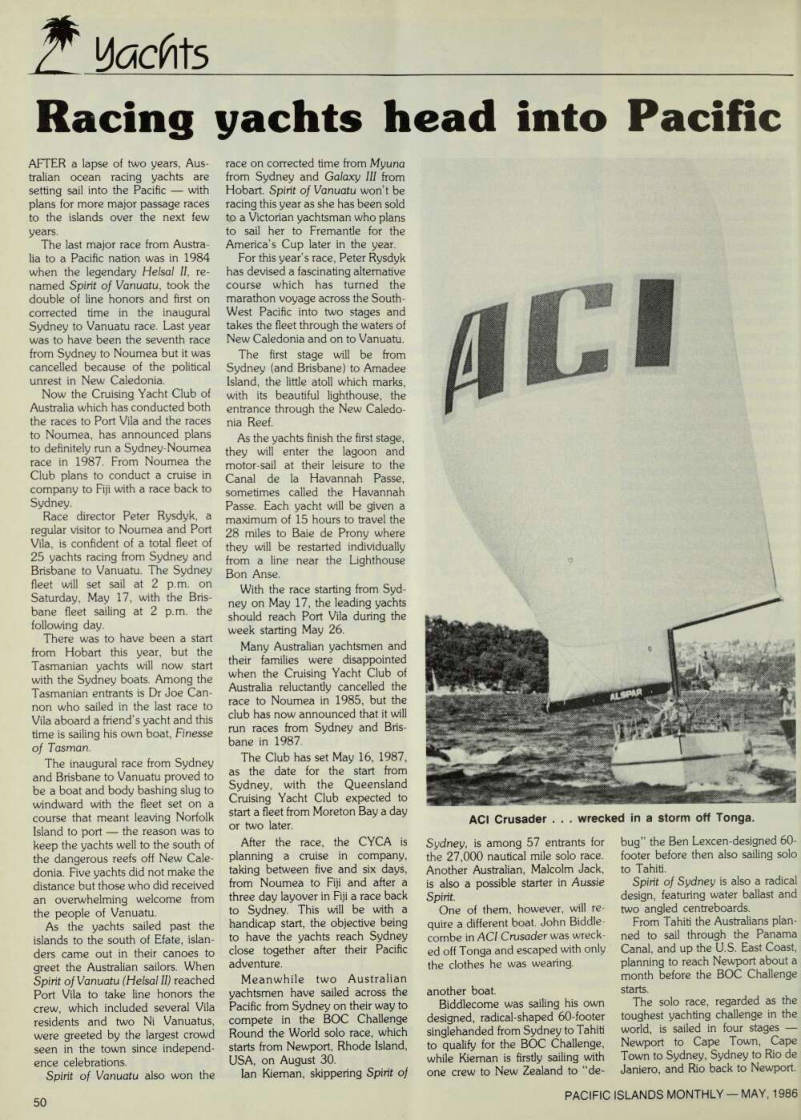
Racing yachts head into Pacific
AFTER a lapse of two years, Aus tralian ocean racing yachts are setting sail into the Pacific with plans for more major passage races to the islands over the next few years.
The last major race from Austra lia to a Pacific nation was in 1984 when the legendary Helsal 11, re named Spirit of Vanuatu, took the double of line honors and first on corrected time in the inaugural Sydney to Vanuatu race. Last year was to have been the seventh race from Sydney to Noumea but it was cancelled because of the political unrest in New Caledonia.
Now the Cruising Yacht Club of Australia which has conducted both the races to Port Vila and the races to Noumea, has announced plans to definitely run a Sydney-Noumea race in 1987. From Noumea the Club plans to conduct a cruise in company to Fiji with a race back to Sydney.
Race director Peter Rysdyk, a regular visitor to Noumea and Port Vila, is confident of a total fleet of 25 yachts racing from Sydney and Brisbane to Vanuatu. The Sydney fleet will set sail at 2 p.m. on Saturday, May 17, with the Bris bane fleet sailing at 2 p.m. the following day.
There was to have been a start from Hobart this year, but the Tasmanian yachts will now start with the Sydney boats. Among the Tasmanian entrants is Dr Joe Can non who sailed in the last race to Vila aboard a friend’s yacht and this time is sailing his own boat, Finesse of Tasman.
The inaugural race from Sydney and Brisbane to Vanuatu proved to be a boat and body bashing slug to windward with the fleet set on a course that meant leaving Norfolk Island to port the reason was to keep the yachts well to the south of the dangerous reefs off New Cale donia. Five yachts did not make the distance but those who did received an overwhelming welcome from the people of Vanuatu.
As the yachts sailed past the islands to the south of Efate, islan ders came out in their canoes to greet the Australian sailors. When Spirit of Vanuatu (Helsal II) reached Port Vila to take line honors the crew, which included several Vila residents and two Ni Vanuatus, were greeted by the largest crowd seen in the town since independ ence celebrations.
Spirit of Vanuatu also won the
race on corrected time from Myuna from Sydney and Galaxy 111 from Hobart. Spirit of Vanuatu won’t be racing this year as she has been sold to a Victorian yachtsman who plans to sail her to Fremantle for the America’s Cup later in the year.
For this year’s race, Peter Rysdyk has devised a fascinating alternative course which has turned the marathon voyage across the South- West Pacific into two stages and takes the fleet through the waters of New Caledonia and on to Vanuatu.
The first stage will be from Sydney (and Brisbane) to Amadee Island, the little atoll which marks, with its beautiful lighthouse, the entrance through the New Caledo nia Reef.
As the yachts finish the first stage, they will enter the lagoon and motor-sail at their leisure to the Canal de la Havannah Passe, sometimes called the Havannah Passe. Each yacht will be given a maximum of 15 hours to travel the 28 miles to Baie de Prony where they will be restarted individually from a line near the Lighthouse Bon Anse.
With the race starting from Syd ney on May 17, the leading yachts should reach Port Vila during the week starting May 26.
Many Australian yachtsmen and their families were disappointed when the Cruising Yacht Club of Australia reluctantly cancelled the race to Noumea in 1985, but the club has now announced that it will run races from Sydney and Bris bane in 1987.
The Club has set May 16, 1987, as the date for the start from Sydney, with the Queensland Cruising Yacht Club expected to start a fleet from Moreton Bay a day or two later.
After the race, the CYC A is planning a cruise in company, taking between five and six days, from Noumea to Fiji and after a three day layover in Fiji a race back to Sydney. This will be with a handicap start, the objective being to have the yachts reach Sydney close together after their Pacific adventure.
Meanwhile two Australian yachtsmen have sailed across the Pacific from Sydney on their way to compete in the BOC Challenge Round the World solo race, which starts from Newport, Rhode Island, USA, on August 30. lan Kieman, skippering Spirit of
Sydney, is among 57 entrants for the 27,000 nautical mile solo race.
Another Australian, Malcolm Jack, is also a possible starter in Aussie Spirit.
One of them, however, will re quire a different boat. John Biddle combe in ACI Crusader was wreck ed off Tonga and escaped with only the clothes he was wearing. another boat.
Biddlecome was sailing his own designed, radical-shaped 60-footer singlehanded from Sydney to Tahiti to qualify for the BOC Challenge, while Kieman is firstly sailing with one crew to New Zealand to “de
bug” the Ben Lexcen-designed 60footer before then also sailing solo to Tahiti.
Spirit of Sydney is also a radical design, featuring water ballast and two angled centreboards.
From Tahiti the Australians plan ned to sail through the Panama Canal, and up the U.S. East Coast, planning to reach Newport about a month before the BOC Challenge starts.
The solo race, regarded as the toughest yachting challenge in the world, is sailed in four stages Newport to Cape Town, Cape Town to Sydney, Sydney to Rio de Janiero, and Rio back to Newport.
ACI Crusader... wrecked In a storm off Tonga.
Advertisements & other items, p. 51 (1 item)
Missing Crew & Yacht
a :
MARK McKENNA
AGE 30 6'
BROWN HAIR GREEN EYES
AMERICAN
GAIL HARRISON
AGE 35 5'3"
DARK HAIR AND EYES
AMERICAN
YACHT ‘AZILIA’ - a 46
centre cockpit sloop in white fibreglass with blue stripe.
Registration 559927.
VESSEL LEFT RAROTONGA, COOK ISLANDS
ON 30 OCTOBER, 1985
SKIPPERED BY JAMES SHEARER OF OPUA, NZ Anyone with information please inform
SECURITY & GENERAL INSURANCE CO LTD
31 MARKET STREET, SYDNEY AUSTRALIA
TELEPHONE (02) 2651111. TELEX AA75524. FAX (02) 290 2883 A REWARD WILL BE PAID IF INFORMATION LEADS TO YACHT’S RECOVERY
shipping schedules
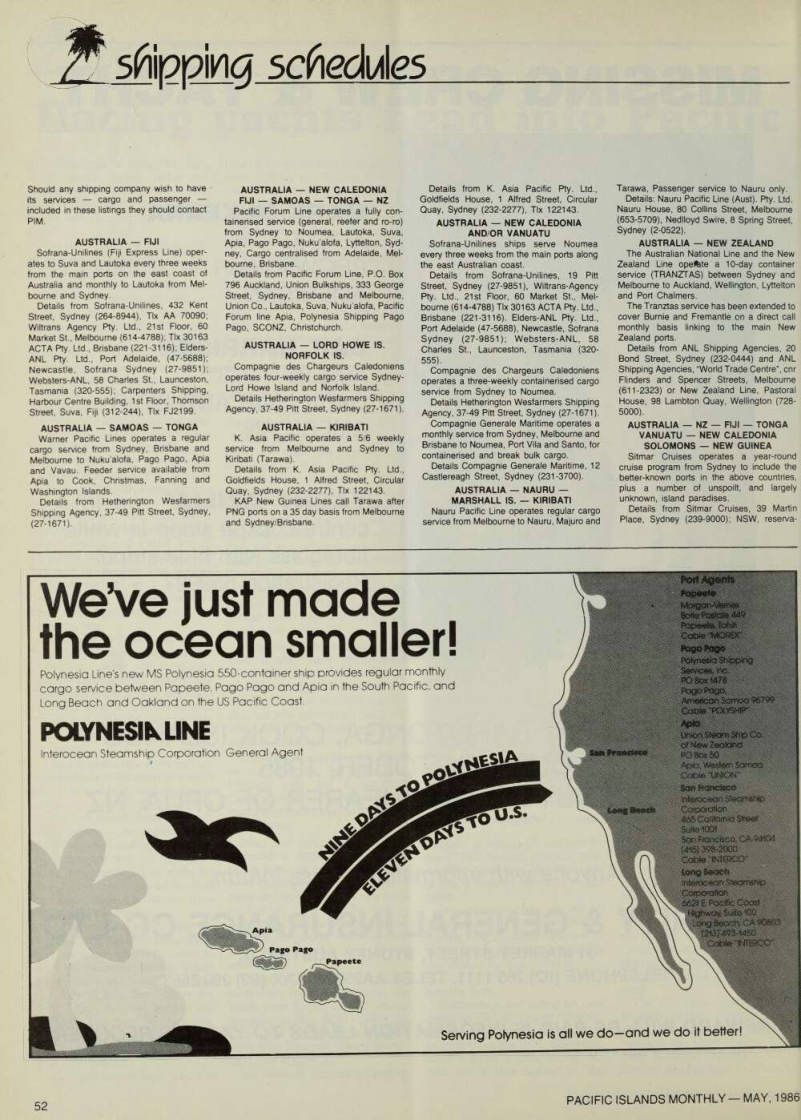
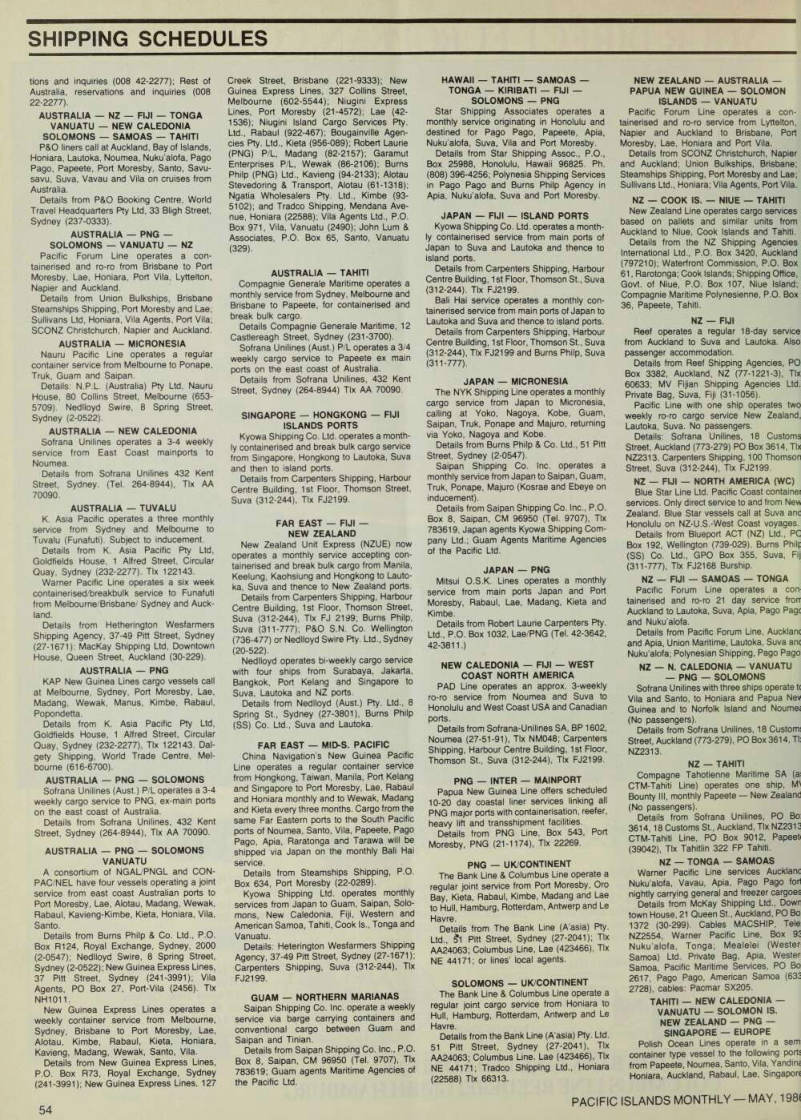
Should any shipping company wish to have its services cargo and passenger included in these listings they should contact
Pim.
Australia Fiji
Sofrana-Unilines (Fiji Express Line) oper ates to Suva and Lautoka every three weeks from the main ports on the east coast of Australia and monthly to Lautoka from Mel bourne and Sydney.
Details from Sofrana-Unilines, 432 Kent Street, Sydney (264-8944), Tlx AA 70090; Wiltrans Agency Pty. Ltd., 21st Floor, 60 Market St.. Melbourne (614-4788); Tlx 30163 ACTA Pty. Ltd., Brisbane (221-3116); Elders- ANL F > ty. Ltd., Port Adelaide, (47-5688); Newcastle. Sofrana Sydney (27-9851); Websters-ANL, 58 Charles St., Launceston, Tasmania (320-555); Carpenters Shipping, Harbour Centre Building, Ist Floor, Thomson Street, Suva, Fiji (312-244), Tlx FJ2199.
Australia Samoas Tonga
Warner Pacific Lines operates a regular cargo service from Sydney, Brisbane and Melbourne to Nukualofa, Pago Pago, Apia and Vavau. Feeder service available from Apia to Cook, Christmas, Fanning and Washington Islands.
Details from Hetherington Wesfarmers Shipping Agency, 37-49 Pitt Street, Sydney, (27-1671).
Australia New Caledonia
Fiji Samoas Tonga Nz
Pacific Forum Line operates a fully con tainerised service (general, reefer and ro-ro) from Sydney to Noumea, Lautoka, Suva, Apia, Pago Pago, Nukualofa, Lyttelton, Syd ney. Cargo centralised from Adelaide, Mel bourne, Brisbane.
Details from Pacific Forum Line, P.O. Box 796 Auckland, Union Bulkships, 333 George Street, Sydney, Brisbane and Melbourne, Union Co.. Lautoka, Suva, Nukualofa, Pacific Forum line Apia, Polynesia Shipping Pago Pago, SCONZ, Christchurch.
Australia Lord Howe Is.
Norfolk Is.
Compagnie des Chargeurs Caledoniens operates four-weekly cargo service Sydney- Lord Howe Island and Norfolk Island.
Details Hetherington Wesfarmers Shipping Agency, 37-49 Pitt Street, Sydney (27-1671).
Australia Kiribati
K. Asia Pacific operates a 5/6 weekly service from Melbourne and Sydney to Kiribati (Tarawa).
Details from K. Asia Pacific Pty. Ltd., Goldfields House, 1 Alfred Street, Circular Quay, Sydney (232-2277), Tlx 122143.
KAP New Guinea Lines call Tarawa after PNG ports on a 35 day basis from Melbourne and Sydney/Brisbane.
Details from K. Asia Pacific Pty. Ltd., Goldfields House, 1 Alfred Street, Circular Quay, Sydney (232-2277), Tlx 122143.
Australia New Caledonia
And/Or Vanuatu
Sofrana-Unilines ships serve Noumea every three weeks from the main ports along the east Australian coast.
Details from Sofrana-Unilines, 19 Pitt Street, Sydney (27-9851), Wiltrans-Agency Pty. Ltd., 21st Floor, 60 Market St., Mel bourne (614-4788) Tlx 30163 ACTA Pty. Ltd., Brisbane (221-3116). Elders-ANL Pty. Ltd., Port Adelaide (47-5688), Newcastle, Sofrana Sydney (27-9851); Websters-ANL, 58 Charles St., Launceston, Tasmania (320- 555).
Compagnie des Chargeurs Caledoniens operates a three-weekly containerised cargo service from Sydney to Noumea.
Details Hetherington Wesfarmers Shipping Agency, 37-49 Pitt Street, Sydney (27-1671).
Compagnie Generale Maritime operates a monthly service from Sydney, Melbourne and Brisbane to Noumea, Port Vila and Santo, for containerised and break bulk cargo.
Details Compagnie Generale Maritime, 12 Castlereagh Street, Sydney (231-3700).
Australia Nauru
Marshall Is. Kiribati
Nauru Pacific Line operates regular cargo service from Melbourne to Nauru, Majuro and
Tarawa, Passenger service to Nauru only.
Details: Nauru Pacific Line (Aust). Pty. Ltd.
Nauru House, 80 Collins Street, Melbourne (653-5709), Nedlloyd Swire, 8 Spring Street, Sydney (2-0522).
Australia New Zealand
The Australian National Line and the New Zealand Line opetete a 10-day container service (TRANZTAS) between Sydney and Melbourne to Auckland, Wellington, Lyttelton and Port Chalmers.
The Tranztas service has been extended to cover Burnie and Fremantle on a direct call monthly basis linking to the main New Zealand ports.
Details from ANL Shipping Agencies, 20 Bond Street, Sydney (232-0444) and ANL Shipping Agencies, “World Trade Centre”, cnr Flinders and Spencer Streets, Melbourne (611-2323) or New Zealand Line, Pastoral House, 98 Lambton Quay, Wellington (728- 5000).
Australia Nz Fiji Tonga
Vanuatu New Caledonia
Solomons New Guinea
Sitmar Cruises operates a year-round cruise program from Sydney to include the better-known oorts in the above countries, plus a number of unspoilt, and largely unknown, island paradises.
Details from Sitmar Cruises, 39 Martin Place, Sydney (239-9000); NSW, reserva
tions and inquiries (008 42-2277); Rest of Australia, reservations and inquiries (008 22-2277).
Australia Nz Fiji Tonga
Vanuatu New Caledonia
Solomons Samoas Tahiti
P&O liners call at Auckland, Bay of Islands, Honiara, Lautoka, Noumea, Nukualofa, Pago Pago, Papeete, Port Moresby, Santo, Savu savu, Suva, Vavau and Vila on cruises from Australia.
Details from P&O Booking Centre, World Travel Headquarters Pty Ltd, 33 Bligh Street, Sydney (237-0333).
Australia Png
Solomons Vanuatu Nz
Pacific Forum Line operates a con tainerised and ro-ro from Brisbane to Port Moresby, Lae, Honiara, Port Vila, Lyttelton, Napier and Auckland.
Details from Union Bulkships, Brisbane Steamships Shipping, Port Moresby and Lae; Sullivans Ltd, Honiara, Vila Agents, Port Vila; SCONZ Christchurch, Napier and Auckland.
Australia Micronesia
Nauru Pacific Line operates a regular container service from Melbourne to Ponape, Truk, Guam and Saipan.
Details: N.P.L. (Australia) Pty Ltd, Nauru House, 80 Collins Street, Melbourne (653- 5709). Nedlloyd Swire, 8 Spring Street, Sydney (2-0522).
Australia New Caledonia
Sofrana Unilines operates a 3-4 weekly service from East Coast mainports to Noumea.
Details from Sofrana Unilines 432 Kent Street, Sydney. (Tel. 264-8944), Tlx AA 70090.
Australia Tuvalu
K. Asia Pacific operates a three monthly service from Sydney and Melbourne to Tuvalu (Funafuti). Subject to inducement.
Details from K. Asia Pacific Pty Ltd, Goldfields House, 1 Alfred Street, Circular Quay, Sydney (232-2277). Tlx 122143.
Warner Pacific Line operates a six week containerised/breakbulk service to Funafuti from Melbourne/Brisbane/ Sydney and Auck land.
Details from Hetherington Wesfarmers Shipping Agency, 37-49 Pitt Street, Sydney (27-1671): Mac Kay Shipping Ltd, Downtown House, Queen Street, Auckland (30-229).
Australia Png
KAP New Guinea Lines cargo vessels call at Melbourne, Sydney, Port Moresby, Lae, Madang, Wewak, Manus, Kimbe, Rabaul, Popondetta.
Details from K. Asia Pacific Pty Ltd, Goldfields House, 1 Alfred Street, Circular Quay, Sydney (232-2277), Tlx 122143. Dal gety Shipping, World Trade Centre, Mel bourne (616-6700).
Australia Png Solomons
Sofrana Unilines (Aust.) P/L operates a 3-4 weekly cargo service to PNG, ex-main ports on the east coast of Australia.
Details from Sofrana Unilines, 432 Kent Street, Sydney (264-8944), Tlx AA 70090.
Australia Png Solomons
Vanuatu
A consortium of NGAUPNGL and CON PAC/NEL have four vessels operating a joint service from east coast Australian ports to Port Moresby, Lae, Alotau, Madang, Wewak, Rabaul, Kavieng-Kimbe, Kieta, Honiara, Vila, Santo.
Details from Burns Philp & Co. Ltd., P.O.
Box R 124, Royal Exchange, Sydney, 2000 (2-0547); Nedlloyd Swire, 8 Spring Street, Sydney (2-0522); New Guinea Express Lines, 37 Pitt Street, Sydney (241-3991); Vila Agents, PO Box 27, Port-Vila (2456). Tlx
Nhioii.
New Guinea Express Lines operates a weekly container service from Melbourne, Sydney, Brisbane to Port Moresby, Lae, Alotau, Kimbe, Rabaul, Kieta, Honiara, Kavieng, Madang, Wewak, Santo, Vila.
Details from New Guinea Express Lines, P.O. Box R 73, Royal Exchange, Sydney (241-3991); New Guinea Express Lines, 127
Creek Street, Brisbane (221-9333); New Guinea Express Lines, 327 Collins Street, Melbourne (602-5544); Niugini Express Lines, Port Moresby (21-4572); Lae (42- 1536); Niugini Island Cargo Services Pty.
Ltd., Rabaul (922-467); Bougainville Agen cies Pty. Ltd., Kieta (956-089); Robert Laurie (PNG) P/L, Madang (82-2157); Garamut Enterprises P/L, Wewak (86-2106); Burns Philp (PNG) Ltd., Kavieng (94-2133); Alotau Stevedoring & Transport, Alotau (61-1318); Ngatia Wholesalers Pty. Ltd., Kimbe (93- SI 02); and Tradco Shipping, Mendana Ave nue, Honiara (22588); Vila Agents Ltd., P.O.
Box 971, Vila, Vanuatu (2490); John Lum & Associates, P.O. Box 65, Santo, Vanuatu (329).
Australia Tahiti
Compagnie Generate Maritime operates a monthly service from Sydney, Melbourne and Brisbane to Papeete, for containerised and break bulk cargo.
Details Compagnie Generate Maritime, 12 Castlereagh Street, Sydney (231-3700).
Sofrana Unilines (Aust.) P/L operates a 3/4 weekly cargo service to Papeete ex main ports on the east coast of Australia.
Details from Sofrana Unilines, 432 Kent Street, Sydney (264-8944) Tlx AA 70090.
Singapore Hongkong Fiji
Islands Ports
Kyowa Shipping Co. Ltd. operates a month ly containerised and break bulk cargo service from Singapore, Hongkong to Lautoka, Suva and then to island ports.
Details from Carpenters Shipping, Harbour Centre Building, Ist Floor, Thomson Street, Suva (312-244), Tlx FJ2199.
Far East Fiji
New Zealand
New Zealand Unit Express (NZUE) now operates a monthly service accepting con tainerised and break bulk cargo from Manila, Keelung, Kaohsiung and Hongkong to Lauto ka, Suva and thence to New Zealand ports.
Details from Carpenters Shipping, Harbour Centre Building. Ist Floor, Thomson Street, Suva (312-244), Tlx FJ 2199; Burns Philp, Suva (311-777); P&O S.N. Co. Wellington (736-477) or Nedlloyd Swire Pty. Ltd., Sydney (20-522).
Nedlloyd operates bi-weekly cargo service with four ships from Surabaya, Jakarta, Bangkok, Port Kelang and Singapore to Suva, Lautoka and NZ ports.
Details from Nedlloyd (Aust.) Pty. Ltd., 8 Spring St., Sydney (27-3801), Burns Philp (SS) Co. Ltd., Suva and Lautoka.
Far East Mid-S. Pacific
China Navigation’s New Guinea Pacific Line operates a regular container service from Hongkong, Taiwan, Manila, Port Kelang and Singapore to Port Moresby, Lae, Rabaul and Honiara monthly and to Wewak, Madang and Kieta every three months. Cargo from the same Far Eastern ports to the South Pacific ports of Noumea, Santo, Vila, Papeete, Pago Pago, Apia, Raratonga and Tarawa will be shipped via Japan on the monthly Bali Hai service.
Details from Steamships Shipping, P.O.
Box 634, Port Moresby (22-0289).
Kyowa Shipping Ltd. operates monthly services from Japan to Guam, Saipan, Solo mons, New Caledonia, Fiji, Western and American Samoa, Tahiti, Cook Is., Tonga and Vanuatu.
Details: Heterington Wesfarmers Shipping Agency, 37-49 Pitt Street, Sydney (27-1671); Carpenters Shipping, Suva (312-244), Tlx FJ2199.
Guam Northern Marianas
Saipan Shipping Co. Inc. operate a weekly service via barge carrying containers and conventional cargo between Guam and Saipan and Tinian.
Details from Saipan Shipping Co. Inc., P.O.
Box 8, Saipan, CM 96950 (Tel. 9707), Tlx 783619; Guam agents Maritime Agencies of the Pacific Ltd.
Hawaii Tahiti Samoas
Tonga Kiribati Fiji
Solomons Png
Star Shipping Associates operates a monthly service originating in Honolulu and destined for Pago Pago, Papeete, Apia, Nukualofa, Suva, Vila and Port Moresby.
Details from Star Shipping Assoc., P. 0., Box 25988, Honolulu, Hawaii 96825. Ph. (808) 396-4256; Polynesia Shipping Services in Pago Pago and Burns Philp Agency in Apia, Nukualofa, Suva and Port Moresby.
Japan Fiji Island Ports
Kyowa Shipping Co. Ltd. operates a month ly containerised service from main ports of Japan to Suva and Lautoka and thence to island ports.
Details from Carpenters Shipping, Harbour Centre Building, Ist Floor, Thomson St., Suva (312-244). Tlx FJ2199.
Bali Hai service operates a monthly con tainerised service from main ports of Japan to Lautoka and Suva and thence to island ports.
Details from Carpenters Shipping, Harbour Centre Building, Ist Floor, Thomson St., Suva (312-244), Tlx FJ2199 and Burns Philp, Suva (311-777).
Japan Micronesia
The NYK Shipping Line operates a monthly cargo service from Japan to Micronesia, calling at Yoko, Nagoya, Kobe, Guam, Saipan, Truk, Ponape and Majuro, returning via Yoko, Nagoya and Kobe.
Details from Burns Philp & Co. Ltd., 51 Pitt Street, Sydney (2-0547).
Saipan Shipping Co. Inc. operates a monthly service from Japan to Saipan, Guam, Truk, Ponape, Majuro (Kosrae and Ebeye on inducement).
Details from Saipan Shipping Co. Inc., P.O.
Box 8, Saipan, CM 96950 (Tel. 9707), Tlx 783619, Japan agents Kyowa Shipping Com pany Ltd.; Guam Agents Maritime Agencies of the Pacific Ltd.
Japan Png
Mitsui O.S.K. Lines operates a monthly service from main ports Japan and Port Moresby, Rabaul, Lae, Madang, Kieta and Kimbe.
Details from Robert Laurie Carpenters Pty.
Ltd., P.O. Box 1032, Lae/PNG (Tel. 42-3642, 42-3811.)
New Caledonia Fiji West
Coast North America
PAD Line operates an approx. 3-weekly ro-ro service from Noumea and Suva to Honolulu and West Coast USA and Canadian ports.
Details from Sofrana-Unilines SA, BP 1602, Noumea (27-51-91), Tlx NMO4B; Carpenters Shipping, Harbour Centre Building, Ist Floor, Thomson St., Suva (312-244), Tlx FJ2199.
Png Inter Mainport
Papua New Guinea Line offers scheduled 10-20 day coastal liner services linking all PNG major ports with containerisation, reefer, heavy lift and transshipment facilities.
Details from PNG Line, Box 543, Port Moresby, PNG (21-1174), Tlx 22269.
Png Uk/Continent
The Bank Line & Columbus Line operate a regular joint service from Port Moresby, Oro Bay, Kieta, Rabaul, Kimbe, Madang and Lae to Hull, Hamburg, Rotterdam. Antwerp and Le Havre.
Details from The Bank Line (A’asia) Pty.
Ltd., Si Pitt Street, Sydney (27-2041); Tlx AA24063; Columbus Line, Lae (423466), Tlx NE 44171; or lines’ local agents.
Solomons Uk/Continent
The Bank Line & Columbus Line operate a regular joint cargo service from Honiara to Hull, Hamburg, Rotterdam, Antwerp and Le Havre.
Details from the Bank Line (A’asia) Pty. Ltd. 51 Pitt Street, Sydney (27-2041), Tlx AA24063; Columbus Line. Lae (423466), Tlx NE 44171; Tradco Shipping Ltd., Honiara (22588) Tlx 66313.
New Zealand Australia
Papua New Guinea Solomon
Islands Vanuatu
Pacific Forum Line operates a con tainerised and ro-ro service from Lyttelton, Napier and Auckland to Brisbane, Port Moresby, Lae, Honiara and Port Vila.
Details from SCONZ Christchurch, Napier and Auckland; Union Bulkships, Brisbane; Steamships Shipping, Port Moresby and Lae; Sullivans Ltd., Honiara: Vila Agents, Port Vila.
Nz Cook Is. Niue Tahiti
New Zealand Line operates cargo services based on pallets and similar units from Auckland to Niue, Cook Islands and Tahiti.
Details from the NZ Shipping Agencies International Ltd., P.O. Box 3420, Auckland (797210); Waterfront Commission, P.O. Box 61, Rarotonga; Cook Islands; Shipping Office, Govt, of Niue, P.O. Box 107, Niue Island; Compagnie Maritime Polynesienne, P.O. Box 36, Papeete, Tahiti.
Nz Fiji
Reef operates a regular 18-day service from Auckland to Suva and Lautoka. Also passenger accommodation.
Details from Reef Shipping Agencies, PO Box 3382, Auckland, NZ (77-1221-3), Tlx 60633; MV Fijian Shipping Agencies Ltd.
Private Bag, Suva, Fiji (31-1056).
Pacific Line with one ship operates two weekly ro-ro cargo service New Zealand, Lautoka, Suva. No passengers.
Details; Sofrana Unilines, 18 Customs Street, Auckland (773-279) PO Box 3614, Tlx NZ2313. Carpenters Shipping, 100 Thomson Street, Suva (312-244), Tlx FJ2199.
Nz Fiji North America (Wc)
Blue Star Line Ltd. Pacific Coast container services. Only direct service to and from New Zealand. Blue Star vessels call at Suva and Honolulu on NZ-U.S.-West Coast voyages.
Details from Blueport ACT (NZ) Ltd., PO Box 192, Wellington (739-029). Burns Philp (SS) Co. Ltd., GPO Box 355, Suva, Fiji (311-777), Tlx FJ2168 Burship.
Nz Fiji Samoas Tonga
Pacific Forum Line operates a con tainerised and ro-ro 21 day service fronr Auckland to Lautoka, Suva, Apia, Pago Page and Nukualofa.
Details from Pacific Forum Line, Aucklanc and Apia, Union Maritime, Lautoka, Suva anc Nukualofa; Polynesian Shipping, Pago Pago
Nz N. Caledonia Vanuatu
Png Solomons
Sofrana Unilines with three ships operate tc Vila and Santo, to Honiara and Papua New Guinea and to Norfolk Island and Noumej (No passengers).
Details from Sofrana Unilines, 18 Customs Street, Auckland (773-279), PO Box 3614, Tl; NZ2313.
Nz Tahiti
Compagne Tahotienne Maritime SA (as CTM-Tahiti Line) operates one ship, M\ Bounty 111, monthly Papeete New Zealand
(No passengers).
Details from Sofrana Unilines, PO Bo: 3614,18 Customs St., Auckland, Tlx NZ2313 CTM-Tahiti Line, PO Box 9012, Papeeti (39042), Tlx Tahitlin 322 FP Tahiti.
Nz Tonga Samoas
Warner Pacific Line services Auckland Nukualofa, Vavau, Apia, Pago Pago fori nightly carrying general and freezer cargoes Details from McKay Shipping Ltd., Down town House, 21 Queen St., Auckland, PO Bo 1372 (30-299). Cables MACSHIP, Tele NZ2554, Warner Pacific Line, Box 92 Nukualofa, Tonga; Mealelei (Westen Samoa) Ltd. Private Bag, Apia, Westen Samoa, Pacific Maritime Services, PO Bo 2617, Pago Pago, American Samoa (633 2728), cables: Pacmar SX2OS.
Tahiti New Caledonia
Vanuatu Solomon Is.
New Zealand Png
Singapore Europe
Polish Ocean Lines operate in a sem container type vessel to the following ports from Papeete, Noumea, Santo, Vila, Yandins Honiara, Auckland, Rabaul, Lae, Singapore
Port Klelang, Penang then to Mediterranean ports and Europe via the Suez Canal. (Other New Zealand ports subject to inducement).
Details from Universal Shipping Agencies Ltd., 6th Floor, 38 Fort Street, Auckland 1, New Zealand (390931, 390727, 32104), Tlx 21517.
Europe Tahiti
New Caledonia
Compagne Generals Maritime operates services from Europe and Mediterranean ports to Papeete and Noumea using three ro-ro and multi-purpose vessels thus ensuring a bi-monthly sailing to and from.
Details Compagne Generals Maritime, 12 Castlereagh Street, Sydney (231-3700).
Europe Tahiti
New Calendonia New Zealand
Vanuatu Solomons
Png Europe
Polish Ocean Lines offers regular monthly sailings for containerised and break bulk cargo, also conventional reefer space and reefer containers from Hamburg, Rotterdam, Dunkirk, Rouen to Papeete, Noumea, Auck land, Santo, Honiara, Rabaul, Lae, Singa pore, returning to Europe via Suez, other ports in South Pacific can be served directly with inducement or otherwise via tranship ment.
Details from Sotama, BP 9170, Papeete.
Tel. 427805 Tlx 373 PF/SATO; BP C 2 Noumea Cedex Tel. 272094 Tlx 163 NM/ Universal Shipping Agencies PO Box 2282 Auckland Tel. 30930 Tlx 21517/Vanua Navigation PO Box 44 Vila Tel. 2027 Tlx 1033/Melan Chine Shipping Co. PO Box 71 Honiara Tel. 21678 Tix 66335/Steam ships Shipping & Transport PO Box 1512 Rabaul Tel 922952 Tlx 92929/Steam
ships Trading Co. Ltd. PO Box 85 Lae Tel. 424666 Tlx 42423/Union Steamship Co. of NZ Ltd. PO Box 50 Apia Tel. 21781 Tlx 225/Warner Pacific Line PO Box 93 Nukualo fa Jel. 22088 Tlx 66219/Fiji Agents
Tba.
Europe Tahiti W.
Samoa Fiji N. Caledonia
Nedlloyd offers regular cargo services from Continental ports to Papeete, Apia, Fiji and New Caledonia.
Details Nedlloyd (Aust.) Pty. Ltd., 8 Spring Street, Sydney (27-3801); Carpenters Ship ping, Ist Floor, Harbour Centre Bldg., 100 Thomson St., Suva (312-244), Tlx 2199FJ and Vetari Street, Lautoka (63988), Tlx 5215FJ.
Uk N. Continent W. Samoa
Tonga Fiji
The Bank Line & Columbus Line operate a regular joint cargo service from Hull, Ham burg, Bremen, Antwerp, Rotterdam and Le Havre to Apia. Nukualofa, Suva and Lautoka.
Details from The Bank Line (A'asia) Pty.
Ltd., 51 Pitt Street, Sydney (27-2041), Tlx AA 24063, Columbus Line, Lae (423-466), Tlx NE 44171, or lines local agent.
Uk N. Continent Png
Solomons
The Bank Line & Columbus Line operate a regular joint cargo service from Hull, Ham burg, Bremen. Antwerp, Rotterdam and Le Havre to Port Moresby, Lae, Madang, Kimbe, Rabaul, Kieta and Honiara and on induce ment to Yandina.
Details from The Bank Line (A'asia) Pty.
Ltd., 51 Pitt Street, Sydney (27-2041), Tlx AA 24063. Columbus Line, Lae (42-3466). Tlx NE 44171; or lines local agents.
Uk/N. Continent Tahiti
N. Caledonia Vanuatu
The Bank Line & Columbus line operate a regular joint cargo service from Hull, Ham burg, Bremen, Antwerp, Rotterdam and Le Havre to Papeete, Noumea, Port-Vila and Santo.
Details from The Bank Line (A’sia) Pty. Ltd., 51 Pitt Street, Sydney (27-2041), Tlx AA 24063, Columbus Line, Lae (42-3466), Tlx NE 44171; Ets. A.M. Fare UTE. Papeete; Ets, Ballande, Noumea and other local agents.
U.S. Hawaii Micronesia
East Malaysia Brunei
Papua New Guinea
PM&O Lines operates two fully self-sus tained container vessels on a sailing frequen cy of every 30 days between the San Francisco Bay Area, Los Angeles, Honolulu and Majuro, Ebeye, Kosrae, Ponape, Truk, Saipan, Yap, Palau, Kota Kinabalu, Brunei, Lae, Kieta and Rabaul.
Details from PM&O Lines, 353 Sacramento Street, San Francisco, California 94111,
U.S.A. (415) 421-5400, Tlx 278016 Pmo
UR; Owner's Representative P.O. Box 803, Saipan, N.M.I. 96950, PH; 234-6819 TLX 783-605 CMCAA; 1414 Soledad Ave., Agana, Guam 96910, PH; 472-1897, TLX 721-6637
Pmonav Gm.
U.S. Hawaii Samoas
Kiribati Nauru
Nauru Pacific Line operates regular con ventional and container services from San Francisco and Honolulu to Christmas Island, Pago Pago, Apia, Tarawa and Nauru.
Details from N.P.L. (Australia) Pty. Ltd., Nauru House, 80 Collins Street, Melbourne (653-5709), Nauru Air and Shipping Agency, Suite 2803, 185 Berry Street, San Francisco,
California 94107 (415-543-4517). Nauru Air and Shipping Agency, Suite 506, 841 Bishop St., Honolulu, HI 96813 (808-523-0441).
U.S. Noumea Fiji
PAD Line operates an approx. 3-weekly ro ro service from west coast USA and Canada to Noumea, Suva and Lautoka.
Details from Sofrana Unilines BP 1602, Noumea (27-51-91). Tlx NMO4B, Carpenters Shipping, Harbour Centre Building, Ist Floor, 100 Thomson Street, Suva (312-244), Tlx FJ2199, Trans-Austral Shipping Pty. Ltd., P.O. Box R 232, Royal Exchange, 2000 (231-8411), Tlx AA21204.
Advertisements & other items, pp. 52-56 (1 item)
We’ve just made
the ocean smaller!
Polynesia Line's new MS Polynesia 550-container ship provides regular monthly cargo service between Papeete, Pago Pago and Apia in the South Pacific, and Long Beach and Oakland on the US Pacific Coast.
POLYNESIA LINE
Interocean Steamship Corporation General Agent oh & K U- O 3* * V p ■ Papeete Apia, , - .• Beach Cable Serving Polynesia is all we do—and we do it better!
YOUR DIRECT EUROPEAN CONNECTION
■u« SB
EUROPE-SOUTH PACIFIC JOINT SERVICE
The South Pacific Specialists offer facilities for shipment of: Containers (FCL/LCL) and Breakbulk Cargo plus reefer space and deeptanks for carriage of vegetable oils and other liquid bulk cargo.
Carriers also accept heavy lifts, „ *ikr- —\ overlength and cumber- ! some parcels.
Ports of Service: Please contact our regional offices for Loading; Papeete, Apia, Suva, further information: Lautoka, Noumea, Port Vila, Santo, The Bank Line (Australasia) Pty. Ltd.
Honiara, Port Moresby, Lae,Madang, Suite 801,51 Pitt Street Kimbe, Rabaul, Kieta, Darwin. Sydney N.S.W 2000 For: Rotterdam, Antwerp, Phone; 27 2041 Telex: 24063 Hamburg, Hull, Dunkirk, Le Havre.
Additional ports on enquiry.
ROUND THE WORLD SERVICE -
Columbus Line Reederei GmbH P.O. Box 1667 Lae/Papua New Guinea Phone: 42 3466/42 3287 42 2481 Colline NE 44 171
THE BANK LINE LTD LONDON
COLUMBUS LINE REEDEREI GMBH HAMBURG
POLISH OCEAN LINES
General Management, 10 Lutego 24,81-364 GDYNIA, POLAND, Phone; 20-19-01, Cables: POLOCEAN Telex: 054-231 Q Q m ft m r s ' m Uft®*?
SR V
SOUTH PACIFIC SERVICE
r / MnA!!?DD mo^MlL^[)' iC oi?,^. n , d I rom: GDY NIA, HAMBURG, ROTTERDAM, MIDDLESBOROUGH/IMMINGHAM, c^Kll.nQc D i JNKRK ', ROUEN ’ PAPEETE (via PANAMA), NOUMEA, AUCKLAND, HONIARA, RABAUL, LAE, oiiNoArUnh, Dy our multipurpose vessels carrying dry and reefer containers, reefer chambers, heavy lifts, breakbulk or palletized, bulk liquids. ai ir'ui AMn » A POLISH OCEAN LINES Representatives AUCKLAND Mr. A. Sieradzki. Telex 21517 NZ “UNISHIP”. SYDNEY Mr. Walenciak. Telex 20428 AA “SLEIGH” tawiti catama -r . POLISH OCEAN LINES Agents AGENrfpq T NEW CALEDONIA SATO Telex 163 NM “SATO”. AUCKLAND UNIVERSAL SHIPPING AGENCIES LTD., Telex 21517 NZ UNISHIP . SOLOMONS MELAN CHINE SHIPPING CO., LTD Telex 66335 HO “SYMECO”. PNG
ALL THE
NEWS IN A
FLASH
The South Sea Digest tells you what you want to know about the Pacific Islands in a few words. All the leading firms and diplomatic missions read it. You can phone or write or call for a follow up.
See insert for subscription details:
THE SOUTH SEA DIGEST
YOUR BUSINESS PARTNER
Japan S. Korea Taiwan Singapore Hong Kong To: Solomon Is., New Caledonia, Fiji, W. Samoa, A. Samoa, Tahiti, Cook Is., Tonga, Vanuatu, Tuvalu. Nauru To: Guam, Saipan, Truk, Ponape, Majuro, Yap, Koror
Taiwan Hong Kong Singapore Philippines
To: Papua New Guinea, Pacific Islands. * * UL
KYOWA
KYOWA SHIPPING CO., LTD.
HEAD OFFICE:
6th Floor., Kikushima Bldg., 2-3, Hamamatsucho 2-chome, Minato-ku, Tokyo 105, Japan Phone: 03(437)2885 (Rep.) Cables: “MARIQUEEN" Tokyo Telex: 242-4651 Kyowa J.
OSAKA OFFICE;
7th Floor., Okajima Bldg., 2-14, Nishihonmachi 1-chome, Nishi-ku, Osaka, Japan Phone: 06(533)5821 (Rep.) Cables: "MARIQUEEN” Osaka Telex: 525-6271 Ssiosa J.
deaths
Ruta Pekamu Maoate Tixier In the Cook Islands in Febru ary, aged 69.
The late Mama Ruta Tixier was born in Ngatangiia on October 18, 1916, the sixth child of the late Teariki Pekamu Maoate and Pare Makimou.
She was married to a Tahi tian, Thomas Renney Tunuia rere Tautu Tixier.
In her youth, she excelled at a number of sports, particularly tennis.
Having come from a well to do family, she followed the example of her brothers and sisters and played a leading role in business, church activities, girl guides and child welfare.
Over the last 25 years Mama Ruta was a pioneer in the field of women’s craft, patchwork activities, drawing and design.
She played a leading role in the Cook Islands Women’s Federa tion, the Women’s Deve lopment Resource Centre and numerous clubs throughout Rarotonga and Avatiu in particular.
In 1972, she represented the Cook Islands at a Pan-Pacific cultural conference in New Zea land. Her craft talents were seen in many displays at in ternational-level conferences.
Having spent 21 years in the northern group, especially in Manihiki, Ruta became very popular among the people.
This popularity continued right through to the time she re turned to Rarotonga. She also gave notable support to the Avarua CICC ekalesia through out the years.
In the field of arts, Mama Ruta travelled with the Ivi Maori Cultural Group to Brisbane in 1984 as a consultant in the craft work of the Cook Islands, and at last year’s Arts Festival in Tahiti. She was also a member of the national arts group assis ting in craft and patchwork (Tiuaevae) activities.
For the last six years Mama Ruta has been a very popular figure in the Maeva Rau arts and family store in downtown Avarua owned by Mata and Parau.
She will be sadly missed by all.
This is certainly another sad departure of the daughters of Takitumu, a loving child from the Ngati Maoate clan and the family Kuri-kuri of Ngati Tan giia.
Elsa Margaret Watson In Queensland, Australia, on March 3, aged 97.
Mrs Watson was bom in Apia, Western Samoa, the eld est of the six children of Captain August Soffinger and his wife Margaret (nee Fruean).
She married in 1910 and went to Australia in 1913. She gave three sons and one daughter to the services in World War 11, but unfortunately lost her youngest son, Des mond, who was the pilot of a Liberator bomber and was lost over Italy at the tender age of 19.
Although Mrs Watson made several trips overseas, one with her younger daughter to visit her son’s grave in Milan, Italy, and two trips back to the land of her birth, she preferred to live in Australia.
She was a remarkable lady with an extensive knowledge of Samoa with its rich history and many legends, and was at one time governess to the children of the then governor of the colony, Wilhelm Solf. She was fluent in German, English, and, of course, Samoan.
She was much loved and will be sadly missed. Vale Elsa Manuia le malaga! O. C.
Blood.
Hari Lai In Ba, Fiji, on March 5, aged 70.
After arriving from India in the late 19305, Mr Lai worked as a peddler, selling goods from house to house between Rakir aki and Lautoka.
He did this for 20 years before setting up his first shop, Hari Lai Dosa and Sons, in Ba in the early 19605.
In 1969 he expanded the business by opening a second shop, Anita Fancy Store in Ba.
It was followed by the open ing of a Hari Lai Dosa and Co shop in Lautoka in the early 19705.
The business expanded fur ther in the mid-70s with the opening of a jewellery division, Anita Gold Industries Ltd. in Ba.
All the shops were closed for two days out of respect for their founder.
Athol James In Suva on February 22, aged 65.
Mr James went to Fiji in January, 1982, on a three-year contract under a New Zealand staffing assistant scheme as officer in charge of the in vestigation section in Fiji’s In land Revenue Department.
He was also responsible for training local investigation officers.
He was engaged for a further period and his contract was due to expire in April, 1986.
Before his Fiji assignment, Mr James was a retired district inspector in the New Zealand Inland Revenue Department in Wellington.
He had several years of ex perience in tax investigation work.
Mr James was an active member of the Suva Bowling Club.
Jo Strlnger-Menzies On Norfolk Island in February.
Born at Kaitangata, New Zealand, in the early ’2os, Jo attended a series of schools during her childhood as her parents moved around but completed her secondary schooling at Timaru.
Taking up tailoring, Jo went through all the angles of that trade during her apprenticeship with tutors from London tailoring, dressmaking, uphol stery.
A break from her trade saw Jo receiving instruction and be coming a nurse at a mental institution near Dunedin. She was nursing when she married lan Menzies. They had three boys, John, David and Peter and a daughter Andrina.
Later, Jo met and married Leslie Stringer on Norfolk Is land in 1977, and they lived in “Little Green Lane.”
Some seven years ago, Jo purchased the late “Rangi’s” dressmaking business, changed the name to “Jo’s” and it was next door to Bill’s Butchery opposite the airport that Jo established a thriving little busi ness which over the years has been a boon to the locals.
Ever present with her capabi lities was her effervescent personality, and she acquired many friends during the time she and Les have been on the island, working hard for Lions, particularly so during the time that Les was President. The Norfolk Islander.
Mohammed Tahir In Ba, Fiji, on March 12, aged 60.
Mr Tahir operated the Rolex Milk Bar which also sells duty free goods, frozen food, and novelty items. They are also wholesalers of many local goods.
He initially operated in the centre of Ba town and later moved his shop to the Tavua end of the town where it is still located.
Mr Tahir was also the assis tant treasurer of the Ba branch of the Fiji Muslim League for the last 10 years.
Advertisements & other items, pp. 57-60 (1 item)
All The News
IN A FLASH
THE SOUTH SEA DIGEST
See insert for Subscription details
BAGOT
BELLFOUNDRIES
Box 421, North Adelaide, S.A. 5006. Australia Tel: +6l 8 267 1306 Beautiful tuned bells for churches and missions
It
SERVICE PAGE
ADVERTISING
ALL THE NEWS
IN A FLASH
THE SOUTH SEA DIGEST
See insert for Subscription details
SITUATION
WANTED
Dr of Pharmacy/MBA, experienced in sales, marketing, management with profit-loss responsibilities, health industries, export/retail management.
Seeks opportunity outside U.S. utilising professional/ entrepreneurial skills.
Contact Box 161, 702 Washington St., Venice, California 90292, U.S.A.
Telex 664851. Ph. (213) 306- 2427.
m.
[LAW
mmeit
AUSTRALIA: CMrtrlbutton: The Herald and Weekly Times Ltd , 44-74 Flinders St., Melbourne, Vic., 3000. Advertising Reps Brisbane D Wood, Anday Agency, CCA Centre, Dayboro Road, Closebum 4520; Box 1918, GPO Brisbane. 4001; telephone (07) 289-4128. Adelaide Hastwell Williamson Rouse Pty Ltd., PO Box 419 Norwood, SA, 5067; 59 Kensington Road, Norwood; telephone (08) 332-3322, telex 87113; Perth Allen & Associates, Suite 2, 284 Stirling St., Perth, WA, 6000, telephone (09) 328-9593 or (09) 328-9363 FVJI: Distribution and subscriptions Desai Bookshops. P.O. Box 160, Suva, Fiji, telephone Suva 23036 Advertising Fiji Times & Herald Ltd , 20 Gordon St., Suva, telephone 31-4111, telex FJ2124 FRENCH POLYNESIA: Distribution Hachette Padfique, 10 Ave Bruat, Papeete, telephone 25610.
HAWAII, UNITED STATES. Distribution PIM, Hawaii.
PO Box 22250, Honolulu, Hawaii, 96822 Advertising Brian C Asgill, Apt. 1308, 1676 Ala Moana Blvd., Honolulu, Hawaii, 96815, telephone (808) 955-9718.
Japan and Korea: Advertising and subscriptions Universal Media Corporation, GPO Box 46. Tokyo, telephone 666-3036, cables UNIMEDIA Tokyo, telex 2524665.
MALAYSIA. Advertising and subscriptions Worldwide Media Services, 57-B Komplex Damai, Jin Dato Haji EusoH, Kuala Lumpur, telephone 63-9340, cables WORLDMEDIA Kuala Lumpur, telex 31533.
VANUATU: Distribution The Bookshop, HQ Box 210, Port Vila. Advertising Norman Bros. Bookshop, Port Vila, telephone 2232.
NEW CALEDONIA: Distribution Depot Centre de Presse Michel Pentecost, CBP2, Noumea, telephone 27-2434, 27-4729.
NEW ZEALAND: Distribution Gordon & Gotch, PO Bex 584, 2 Carr Road, Mt Roskill, Auckland 4 Advertising International Media Representatives Ltd . PO Box 10259, Balmoral, Auckland 4, telephone 605-909, 792-370, telex NZ21404
PAPUA NEW GUINEA: Dtetribotloo Gordon & Gotch, PO Box 3395, Port Moresby, telephone 25-4551.25-4865 Advertising Ken Head, PNG Post-Courier, PO Box 85, Port Moresby, telephone 21-2577, telex 22120.
SOLOMON ISLANDS; Distribution and Advertising The Bookshop, (Norman Bros.) PO Box 503, Honiara.
PHILIPPINES: Advertising The GF Group, 12 San Ignacio St., Uroaneta Village, Makati, Metro Manila, telephone 817-7299, telex 45950 and 4233.
UNITED KINGDOM: The Herald & Weekly Times Ltd., No 1 Maltravers Street,London WC2R 3DZ, England, telephone 01 836 5162, telex London 21989 UNITED STATES MAINLAND: Advertising Joshua B Powers Jr,, Powers International Inc., 551 Fifth Ave., New York, New York 10 017, telephone 867-9580, telex 236514.
Subscriptions PIM, Hawaii, PO Box 22250, Honolulu, Hawaii. 96822
SUBSCRIPTIONS
American Samoa Australia Canada Cook Islands Fiji French Polynesia Guam Hawaii Japan Kiribati Micronesia Nauru New Caledonia New Zealand Niue Norfolk Island Northern Marianas Papua New Guinea Solomon Islands Tonga Tuvalu United Kingdom U. S. Mainland Vanuatu Western Samoa Elsewhere
. SUS2I
AustslB
. SUS 27
. NZ$3O
Austsl9
. SUS 22
. SUS 23
. SUS 23
, SUS 22
Austsl9
. SUS 23
Austs2l
. SUS 22
. NZ$3O
. NZ$3O
AustslB
SUS 23
Austs23 Austsl9 Austsl9 Austsl9 .. Stgsls
.. SUS 27
Austsl9 Austsl9 Austs2s Payments by personal cheque are only acceptable in Australian (from a branch in Australia), U.S. and New Zealand currency. For all other remittances please send an international bank draft in Australian dollars Published monthly by Pacific Publications (Aust.) Pty.
Ltd. and printed in Australia by Quadricolor Industries Pty. Ltd., Mulgrave, Vic.
NOW AVAILABLE!
PAPUA NEW GUINEA BUSINESS & TRAVEL GUIDE Contains over 250 pages crammed with all the facts you want to know on P.N.G.
See insert for further details and price.
Stay at Aggie Grey’s . . . the South Pacific’s
legendary hotel.
Situated right in the heart of Western Samoa. Enjoy Polynesian style friendliness and service, in cool surroundings, superb entertainment and food.
Magnificent white sand beaches only a short drive away. Airconditioned rooms, swimming pool and full bar facilities.
Bookings through Union Steamship Company of NZ, Pan Am, Air New Zealand or direct to Aggie Grey’s, Apia, Western Samoa. Cables: AGGIES’ Apia.
Travelling
abroad or on
the move?
Let us be your postbox and be sure to get your mail.
For details, write to: The Manager, Mail Forwarding and Agency Services, P.O. Box 22, Palmerston North, New Zealand.
EARN EXPORT/IMPORT PROFITS IN 60 DAYS
Let us show you how to start an export/import business right away. You can begin with little or no capital in your spare or full time. You will receive all necessary guidance and contacts to succeed. Start your own business or extend an existing one and enjoy the profits of success. Since 1946, others like you have asked for our 24 page booklet with full details.
For your copy send $2 (refundable) to:
Dept. RIM 4 ANTHONY WADE (AUSTRALIA)
CONSULTANTS. PO. Box 583, NEUTRAL BAY,
NSW 2089, AUSTRALIA AW22 <
TOYOTA PRESENTS
THE “MORE” MACHINE
Toyota believe in giving you more for your money. And that’s just what our new three-wheeled electric forklift does. Look it over closely. Compare. You’ll see that no matter how you measure it, the new Toyota electric forklift challenges the very best of its class. And best of all, it offers you world-famous Toyota reliability. We build more quality in, so you get more value out. 66 (all 48V models)
MORE LOAD HANDLING
POWER A powerful 6.6 kW load handling motor takes on the biggest jobs with ease something that can’t be said for most electrics. 320 - (2FBEIO 48V model)
MORE EFFICIENCY -
QUICKER LIFT SPEED
Wasted time is wasted money. So Toyota help you get the job done.
Fast. Its 320 mm/sec. lift speed is among the quickest in this class.
mm /s
TOYOTAIEI
2x27 kW (all 48V models) MORE DRIVE POWER Twin 2 7 kW drive motors deliver torque and power that rival even engine-powered forklifts. And overpower most other electrics in this class. 1350 mm (minimum turning radius, 2FBEIO model)
MORI MANOEUVRABILITY
With a remarkably small 1350 mm turning radius, and rugged, compact body, this new Toyota is at home in cramped quarters. m M r
THREE-WHEELER
(2FBEIO 48V model with cushion tyres)
MORE DRIVE SPEED
You can zip from one work area to another at a brisk 12.5 km/h top speed - among the best in this class.
■iQ%(tano)
i5 -minute ratings 2FBEIO 48V model)
MORE GRADEABILITY
With front-wheel drive traction and powerful twin drive motors, it can haul a full load up the steepest of inclines even up to 18% tanO!
MORE OPERATING EASE
All controls, including power steering, are designed to help the operator do his job quickly and easily. • A Toyota forklift. See for yourself one day soon.
MORE ECONOMY Toyota build in the kind of reliability and durability that result in long-term economy. • Options and standard features differ according to region. • Specifications are subject to change without notice.
TOYOTA
■ AMERICAN SAMOA: BURNS PHILP (S.S.) CO., LTD. TEL: 633-4281 ■ AUSTRALIA: THIESS TOYOTA PTY, LTD. TEL: 526-0333
■ FIJI: AUTOMOTIVE SUPPLIES CO
A DIVISION OF BURNS PHILP (S.S.) do., LTD. TEL; 383444 ■ GUAM: ATKINS, KROLL, INC. TEL: 646-1876 " xl, W CALEDONIA: SERVICE IMPORTATION AUTOMOBILE DU PACIFIQUE I rl • y 7-d1 -A.A ■ NEW ZEALAND: ANDREWS & BEAVEN INDUSTRIAL EQUIPMENT LTD. TEL: 2780940
■ PAPUA NEW GUINEA; ELA MOTORS,
BURNS PHILP (P.N.G.), LTD. AUTOMOTIVE DIVISION TEL: 217036 ■ VANUATU/VANUATU MOTORS, A DIVISION OF BURNS PHILP (VANUATU) LTD.
TEL: VILA 2341
■ WESTERN SAMOA: BURNS PHILP (S.S.) CO., LTD. TEL: 22611 And distributors around the world.
- h ' , It ** -1:
I S i iSHSK §
m* ♦ W hm m w& H i. m I,
Mitsubishi Motors salutes
Sir Edmund Halley.
We’ve seen his comet twice and look forward to the third time.
The 1917 Mitsubishi Model-A.
In 1870, Mitsubishi embarked on a starstudded journey in the field of transportation.
We've had our eye on the future ever since.
When Halley's comet passed by in 1910, we had already turned our attention to landbased transport. Soon after, we built Japan's first series-production automobile, the 1917 Mitsubishi Model-A. We followed this with Japan's first trucks and four-wheel-drive cars.
And we went on to manufacture vehicles able to meet almost every need on earth.
But we didn't stop there: the Three-Diamonds mark is on the bows of ships, the wings of aircraft, and the grilles of cars and trucks. We'll keep developing newer and better means of transport as we continue the transfer of technology within the Mitsubishi group of companies.
AMERICAN SAMOA: MORRIS SCANLAN SERVICE INC. P.O. Box 367, Pago Pago, Tel. 633-5520/AUSTRALIA; MITSUBISHI MOTORS AUSTRALIA LTD Box 1851, G.P.O Adelaide, South Australia 5001, Tel 08-275-7111/FIJI: NIVIS MOTOR & MACHINERY CO., LTD. G.P.O.
Box 150, Suva, Tel. 384425/FRENCH POLYNESIA (TAHITI): ETS-BREDIN FRERES ET FILS P.O. Box 21, Papeete, Tahiti, Tel. 4-202-58/ NEW CALEDONIA; SOCIETE D IMPORTATION D AUTO DU PACIFIQUE SUD S.A. B.P 438 Rond Point du Pacifique, Noumea, Tel. 274144/ NEW ZEALAND: TODD MOTORS CORPORATION Todd Park, Heriot Drive, Private Bag, Porirua, Tel. 70-109/NORFOLK ISLAND: BORRYS LTD. P.O. Box 169, Norfolk Island, Tel. 2114 NI/PAPUA NEW GUINEA: TOBA PTY. LTD. P.O. Box 503, Port Moresby, Tel. 21-7874/SOLOMON ISLANDS; R.C. SYMES PTY. LTD. P.O. Box 823, Honiara, Guadalcanal, Tel. 22131/TONGA: SITANI MAPI CO., LTD. P.O. Box 83, Maku Olofa, Tel. 2 1 -044/VANUATU; SOCOMETRA B.P 06 Route de Lagon, Port-Vila, Tel. 2314/WESTERN SAMOA; A M. MACDONALD HOLDINGS LTD.
P.O Box 576, Apia, Tel 22022/SAIPAN/PONAPE/MAJURO/KOSRAE/TRUK/YAP/BELAU: MICRONESIAN MOTORS, INC. 997 South Marine Drive, Tamuning, Guam 96911, Tel. 646-6827 When Halley's comet returns in the 21st century, we will be there with transportation for this ever-changing world.
A
MITSUBISHI
MOTORS