Pacific
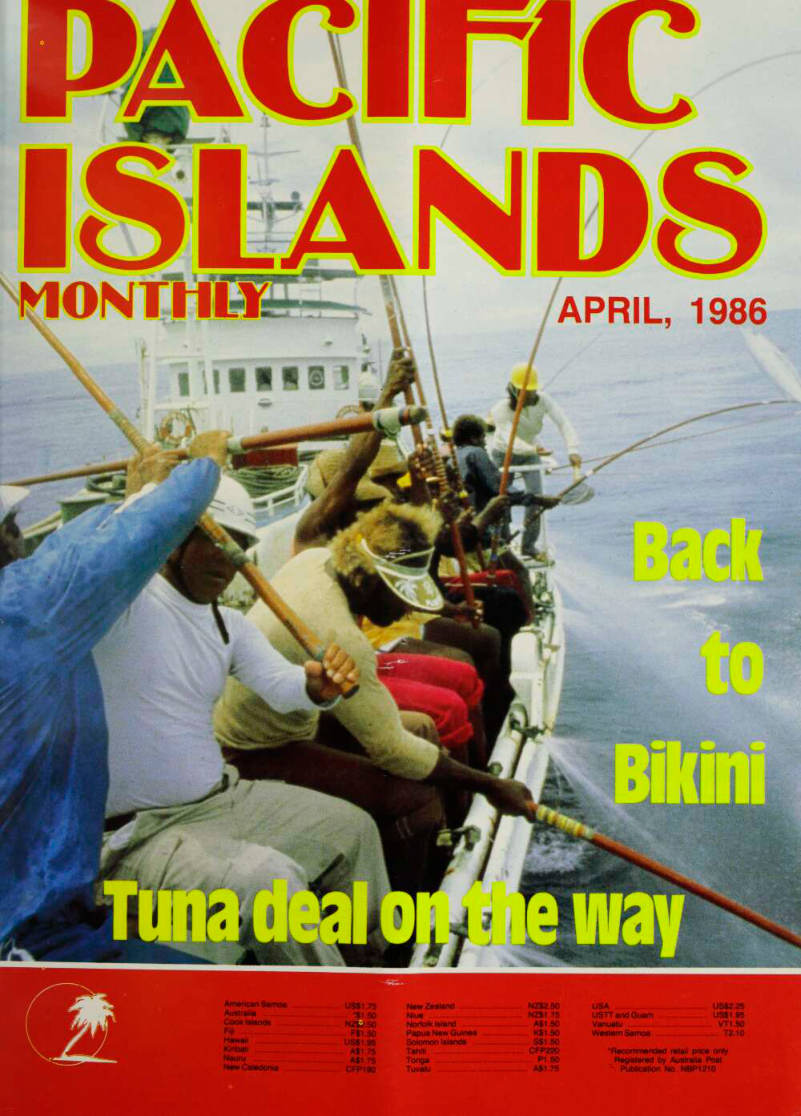

Islands
Montmly
April, 1986
' \ ,4\ Bikini
Tuna deal oiflke way
American Samoa US$l.75 Australia 50 Cook Islands NZ$2.5O Fi l' F 51.50 Hawa " US$l.95 Kmbati Asi .75 Nauru A 51.75 New Caledonia CFPI9O
New Zealand NZ$2.5O Niue NZ$l.75 Norfolk Island A 51,50 Papua New Guinea K 51.50 Solomon Islands 551.50 Tahiti CFP22O Tonga PI .50 Tuvalu A 51.75
Usa Us$2.25
USTT and Guam US$1.95 Vanuatu VT1.50 Western Samoa T2.10 'Recommended retail price only Registered by Australia Post Publication No. NBP1210
The Cover
A Japanese pole and line crew taking skipjack tuna off the Solomon Islands.
The traditional method has been adapted to local condi tions. Photo: Taiyo Fishery.
Advertisements & other items, pp. 2-3 (2 items)
Honda, constantly setting new standards when it comes to car design,
now brings you the Prelude 2.0i-16. What does meet the eye is the Prelude’s styling. Its low, angled front slices through the air, and the wide tread stance grips the road firmly for superb maneuverability. What you can’t see is the heart of this elegant new model the 2.0-liter 16-valve Double Overhead Camshaft (DOHC) engine. It comes with
Honda’s original Programmed Fuel Injection system
(PGM-FI) for quick engine response.
This perfect marriage between styling and performance offers the ultimate in touring satisfaction. All this plus a long list of other Honda extras put the new Prelude into a class of its own.
Find out what it really means to enjoy a car all it takes is a test drive. a m.
S.OI-/6
• Engine type: Water-cooled 4-stroke DOHC 16-valve in-line 4-cylinder • Fuel supply system: PGM-FI • Displacement: • Maximum horsepower: 137PS/6,ooorpm • Maximum torque: 17.3 kg-m/ s,ooorpm • Suspension: Double wishbone (front), MacPherson strut (rear) • Dimensions (L XW X H): 4,375 X 1,690 X 1,295 mm AUSTRALIA: Honda Australia Pty„ Ltd. Lot 95 Sharps Road, Tullamarine, Victoria 3043; Bennett Honda Pty., Ltd. 250 Victoria Road. Wethenll Park, N.S.W. 2164/NEW ZEALAND: NZMC Limited Manners Plaza, 57-65 Manners St, Wellington/PAPUA NEW GUINEA: Toba Pty., Ltd. P.O. Box 503, Port Moresby/ HONDA MOTOR CO LTD TOKYO JAPAN TAHITI: Honda Distribution S.A.R.L. B.P. 1665, Papeete/KIRIBATI: Atoll Motor & Marino Services P.O. Box 49, Bairiki Tarawa, Republic of Kiribati/U S.
TRUST TERRITORY: United Micronesia Development Association P.O. Box 235, CHRB Saipan CM 96950/COOK ISLANDS: Cook Islands Motor Centre Ltd. P.O. Box 74, Rarotonga/GUAM. Mark ; s Motor Co., Inc. P.O. Box DV, Agana/WESTERN SAMOA: Motor Distributors (Samoa) Ltd. P.O. Box 576, Apia/SOLOMON ISLANDS: Lee Kwok Kuen & Co., Ltd. P.O Box 537 Honiara/NEW CALEDONIA: Soci6t6 Du Chalandage 8, Rue de la somme-B.P. 97, Noum6a/NAURU: Nauru Cooperation Republic of Nauru/FIJI: Coral Island Motors Ltd. Robertson Road. Suva, Fiji/AMtHiOAiN SAMOA: Holiday Motors, Parts and Service P.O. Box 968, Pago Pago, American Samoa 96799: Heleck's Service Center Ltd. P.O. Box 1138, Pago Pago, American Samoa 96799/TONGA. Tonga Industrial Traders P.O. Box 1035, Nukualofa, Tonga/NORFOLK ISLAND: Duncombe Bay Garage New Cascade Road, Norfolk Island/VANUATU: Honda Farm Ltd. P.O. Box 1031, Port Vila, Vanuatu
Islands
PAcIFIC
monthly
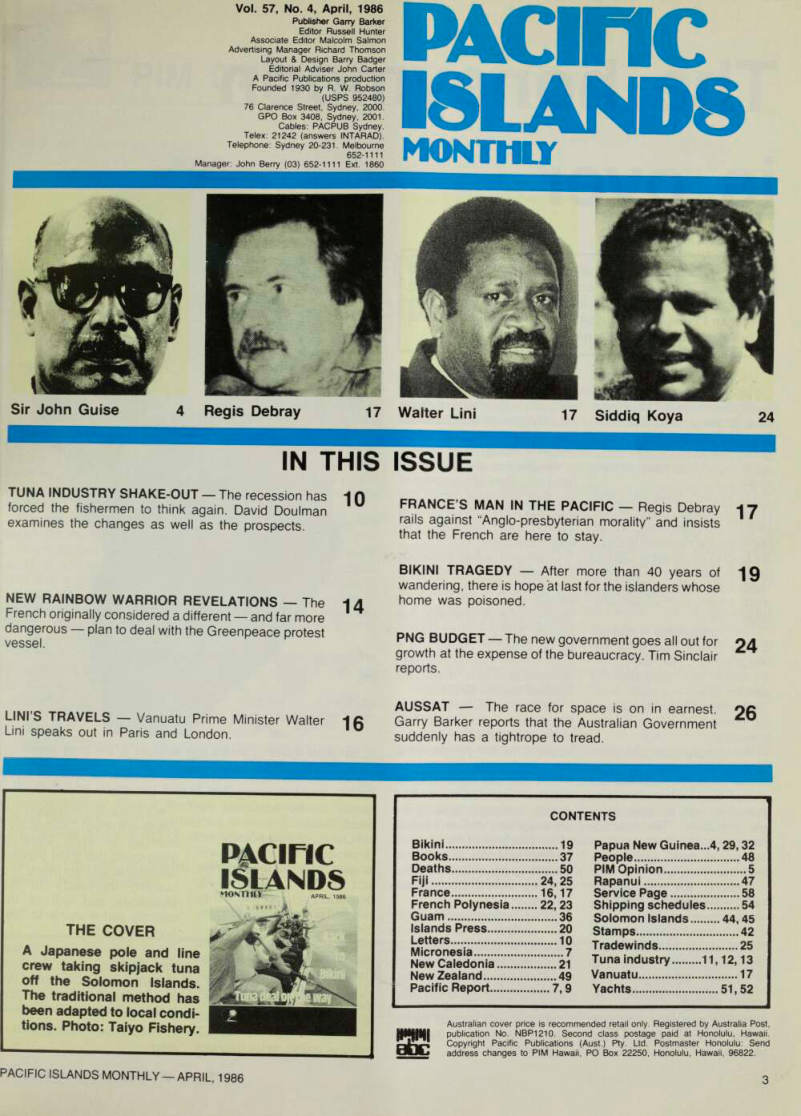
Vol. 57, No. 4, April, 1986
Sir John Guise 4
Regis Debray 17
Walter Uni 17
Siddiq Koya 24
In This Issue
TUNA INDUSTRY SHAKE-OUT The recession has 1 Q forced the fishermen to think again. David Doulman W examines the changes as well as the prospects.
New Rainbow Warrior Revelations The 14
French originally considered a different and far more 1H dangerous plan to deal with the Greenpeace protest vessel.
LINI’S TRAVELS Vanuatu Prime Minister Walter 1 C Uni speaks out in Paris and London. 1 u
FRANCE’S MAN IN THE PACIFIC Regis Debray -17 rails against “Anglo-presbyterian morality” and insists 1 ' that the French are here to stay.
BIKINI TRAGEDY After more than 40 years of “J 0 wandering, there is hope at last for the islanders whose home was poisoned.
PNG BUDGET The new government goes all out for 04 growth at the expense of the bureaucracy. Tim Sinclair " reports.
AUSSAT The race for space is on in earnest. Ofi Garry Barker reports that the Australian Government suddenly has a tightrope to tread.
Contents
Bikini 19 Books 37 Deaths 50 Fiji 24, 25 France 16,17 French Polynesia 22, 23 Guam 36 Islands Press 20 Letters 10 Micronesia 7 New Caledonia 21 New Zealand 49 Pacific Report 7,9
Papua New Guinea... 4,29,32 People 48 PIM Opinion 5 Rapanui 47 Service Page 58 Shipping schedules 54 Solomon Islands 44,45 Stamps 42 Tradewinds 25 Tuna industry 11,12,13 Vanuatu 17 Yachts 51,52
Australian cover price is recommended retail only. Registered by Australia Post, publication No. NBPI2IO. Second class postage paid at Honolulu, Hawaii.
Copyright Pacific Publications (Aust.) Pty. Ltd. Postmaster Honolulu: Send address changes to PIM Hawaii, PO Box 22250, Honolulu, Hawaii, 96822.
Advertisements & other items, p. 3 (1 item)
Pacific Islands Monthly —April, 1986
3
Publisher Garry Barker Editor Russell Hunter Associate Editor Malcolm Salmon Advertising Manager Richard Thomson Layout & Design Barry Badger Editorial Adviser John Carter A Pacific Publications production Founded 1930 by R. W. Robson
(USPS 952480)
76 Clarence Street, Sydney, 2000.
GPO Box 3408, Sydney, 2001.
Cables: PACPUB Sydney.
Telex: 21242 (answers INTARAD).
Telephone: Sydney 20-231. Melbourne 652-1111 Manager: John Berry (03) 652-1111 Ext. 1860
The honeymoon
is over
Papua New Guinea’s three million people are gov erned by 19 provincial assemblies and a national government as well as local government councils.
Veteran PNG politician and former Governor-General Sir John Guise says it’s gone too far.
The introduction of native Local Government Councils in PNG in about 1948 was seen by many as a first step towards giving the local people some say in the administtation of their areas.
The system, however, came under the heavy hand of the District Commissioner whose authority was exercised through his Local Government Officer, in most cases the ADC, who became the senior local govern ment adviser in that particular council area.
The councils were and still are bodies elected by the village people. They have pow ers to raise head taxes from the people. These normally aver aged out at K 5 or K 6 per year for males and K 1 or K 2 for females.
The councils were also given minor court powers to settle village disputes, assisted by council constables who had limited powers to arrest head tax defaulters. The councils were also given authority to engage in cash crop deve lopment.
However, the court powers and the authority for economic development were later with drawn in new legislation follow ing the report of a Canberra appointed inquiry which was never made public.
There are numerous com plaints by village tax payers regarding the use of their money for small village projects such as water wells, water sup
ply systems, water tanks and aid posts with a lack of assist ance to projects such as bread and scone baking by village women’s groups.
Villagers not only pay council head tax. They are required to pay their provincial community and high school fees as well as medical and Parents and Citi zens Association fees.
Copra and coffee producers must contribute to their respec tive stabilisation funds, while villages also contribute to the upkeep of their churches and pastors. And you don’t have to be an expert to realise that if there is more than one Christian denomination in a village, the financial burden doubles.
It is a wonder, then, that the Central Provincial Government in its dictatorial fashion, has imposed on the people a fur ther head tax for 1986.
And this was done, it sems, without seeking the views of the people. It is worth recalling the old adage that you can’t fool all of the people all of the time a barbed reminder to those in temporary power in the Central province where elections are not far off.
Which brings this column to a final analysis of the growing patterns of difficulty that must be confronted with courage if the silent majority the voters are to feel secure in their everyday lives. These are; •Goods and services for the people are mostly in the realm of imagination.
•We are the most heavily taxed and over-regulated people in the whole of the South Pacific. •Our economic structure and develolpment strategy, as well as our resources on land sea and air seem to be heavily dependent on and directed by rich and powerful foreign inves tors.
This may not augur well for the development of a strong national middle class commun ity which is vitally important for the country’s economic stabil ity. Our development direction must be altered to an all national course, or we may face
the anger of our people in the not-too-distant future. •Our beautiful homeland has inherited through “democratic” exercises so many levels of government that it has become unworkable and top heavy. It is horribly insensitive to the aspirations and will of the majority and is unable to “de liver the goods.”
It is clear that we must face this challenge with honesty, sincerity and courage. We should realise that the warning bells are already sounding.
The ten year honeymoon is over.
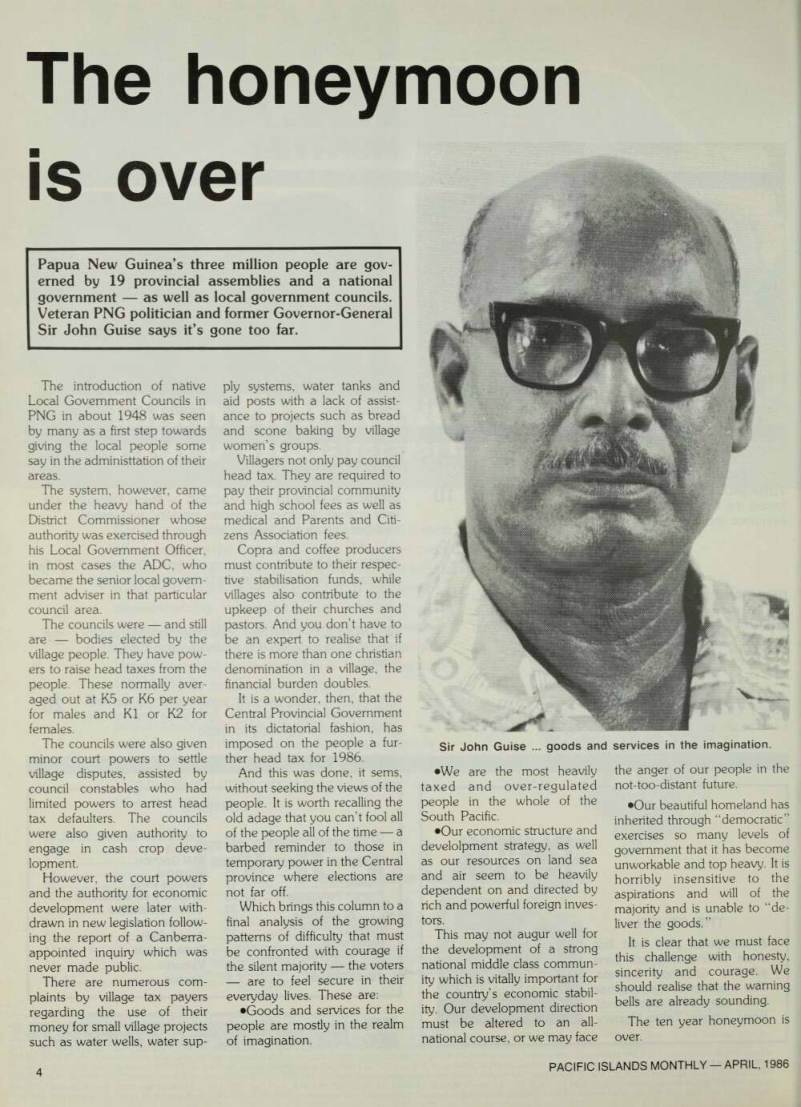
Sir John Guise ... goods and services in the imagination.
Rough crossings
Pim Opinion
Rough crossings for TV channels
Television needn’t be a curse for developing nations.
But it all too often is. It has become associated, rightly or wrongly, with the Coca Cola, cops, robbers and car chase culture packaged so successfully in the United States. Unfortunately, this gives a somewhat distorted view of the world (not to mention the US) to new viewers.
Commercial TV is just that commercial. It aims to make profit through the sale of advertising time and the programs have to aim at a mass audience. The more viewers, the more advertising revenue.
It is this, perhaps, that is giving both PNG and, it seems, Fiji pause for thought.
There are two ways of approaching the problem. Firstly, there could be a cost to the host nation in terms of cultural erosion.
With the best will in the world it will hardly be possible to program local content to any great extent without a massive and expensive training effort. With the exception of news and current affairs content, local programs are going to be hard to produce.
Secondly, bearing in mind the nature of the competing stations, the local advertising markets may simply not be big enough to support national TV networks.
It is for these reasons that the possibility of Australia’s government-owned ABC entering the fray is, to say the least
interesting.
Radio Australia already has a history of outstanding service to the region and a parallel TV service without advertising could be seen as attractive.
In PNG, for instance, those who want and can afford television already have it through satellite receivers dotted around the country. Will those viewers be persuaded to turn to a °cal channel, and will enough new sets be sold to make that :hannel viable?
And in Fiji, with its thriving video industry, that second question must also apply.
Whoever wins the satellite battle, the islands are going to have television available. A sensible initial approach might be to let that happen and let those who want to receive it do so through privately owned receivers, which could, presumably, be taxed as luxury items.
Real development, meanwhile, can still be achieved by radio which has the potential to reach more people.
An “open sky” approach could maintain freedom of choice for viewers while retaining the host nations’ ability to levy licence fees on broadcasters as well as taxes on receivers. The problem of cultural erosion would, of course, remain. But it could be approached under licensing agreements. The question that needs to be asked is, would the commercial stations agree to compete for audiences and advertising in the islands as they now do in Australia and New Zealand?
If the answer is affirmative, there seems nothing to stop the islands nations licensing more than one company. Provided that local requirements can be accommodated, there may be an argument for regional licensing with more than one country striking the same deals with more than one broadcaster.
Monopolies may look atractive for all sorts of reasons in the short term. They can easily be later regretted but far less easily altered.
Island nations could also “test the water” by encouraging development of commercial FM radio with the possibility of TV licences later if the market is proved. FM is cheaper to establish and cheaper to run. There already exists, in most island communities, a nucleus of skill and experience to make it work.
For while nobody doubts the sincerity of the competing stations in their commitments to local content, it’s hard to see them making it work without large and long term spending which may or may not be returned in advertising revenue.
If the current plans come to fruition, and the investment is not returned, somebody will have to pick up the bill.
Russell Hunter has been appointed editor of Pacific Islands Monthly. Mr Hunter, 37, was editor of an English daily newspaper oe/ore spending five years in Papua New Guinea as general manager of Word Publishing Company Pty Ltd and Niugini Nius Pty Ltd. He replaces Garry Barker who is taking up a new position with the Herald and Weekly Times Group in Melbourne, Australia.
Advertisements & other items, p. 6 (1 item)
National
W\ VMS
Vsleo Cassette Recorder NV-GlO l&i&ftlittUi
A New GenerationVTß
with a Mind of Its Own.
National’s new NV-GlO is a VTR that thinks hard about simple operation.
So you can use it with ease—even if you’ve never owned a piece of video equipment before!
Simply insert a prerecorded cassette with its record tab removed, and the intelligent GlO will switch itself on and begin play. Should you try to record over such a cassette, it will be automatically ejected. You can even eject when the power is off at just the touch of a button.
For all its brains, the GlO has an incredibly compact body. But one that packs such special features as Super One-Touch Timer Recording that lets you set start and stop times freely, a 14-day/4-programme timer that guides you step-by-step through the programming process with flashing prompts, Cue & Review with Search Lock, and Super- Still, Super-Still-Advance, and Super-
Fine-Slow playback.
GlO. The intelligent choice for quality and convenience. Operation
National
National, Panasonic and Technics are the brandnames of Matsushita Electric.
Your attention ts drawn to the that recording pre-recorded tf discs or other publish material may infringe copyright
pacific report
Remeliik: Three
Convicted
The three men facing charges of murder and conspiracy for the assassination of Palau’s President Haruo I. Remeliik (PIM Feb. p 7) were convicted in Koror on March 6. Melwert Tmetuchl, Leslie Tewid, and Anghenio Sabino were ac cused of the fatal shooting of Remeliik as he stepped from his car outside his home on June 30, 1985. A three-judge panel headed by Judge Robert Hefner of Saipan, Northern Marianas, deliber ated for about five hours before voting unanimously to convict all three men, according to Palau Attorney-General Russell Weller. “This is the climax of eight months of investigation,” said Wel ler. "It’s been a long haul. Right now the reaction is one of satisfaction and fatigue as much as anything.” Guam attorney Randy Cunliffe, who represented Tme tuchl during the trial, had checked out of his hotel room on the afternoon of March 6, and was not immediately reachable by phone. The three men, who had been free on bail during the trial, were taken to Koror’s national prison to await senten cing. All three face mandatory life sent ences with the possibility of parole for the murder conviction, Weller said. Each also faces a five-year sentence for the conspiracy conviction. On July 22, the trio and a fourth man, Francisco Gib bons, were charged in the killing. The charges against the four were dropped on August 16 after a lie detector test administered to an important witness indicated her testimony could be unreli able. The three were later charged a second time and trial began on February 24. Remeliik became the tiny republic’s first elected president in 1980, and was re-elected in 1984. In a special election held last September, voters elected Lazarus Salii to succeed him. “I'm happy that this case is finally brought to a conclusion,” Salii said after the verdict was announced. During the trial, the prosecution introduced a witness who testified she overheard the three men plan the killing, and another witness who testified that he sold a .30-calibre rifle and ammunition to Tmetuchl before the killing. AAP.
Palau Compact
Strife Won’T Die
Opinions are divided in Palau over the result of a February 21 plebiscite on the draft of the proposed Compact of Free Association with the United States About 72 per cent of the 7500 votes counted supported the draft, but this is still below the 75 per cent vote required to override the constitutional ban on the entry, use or storage of nuclear material
in Palau. Palau President Lazarus Salii supports the American view that only a simple majority is needed in the light of the U.S. pledge not to store, test or use nuclear weapons in Palau, and the acceptance by Palau of U.S. policy neither confirming not denying nuclear capability of its naval vessels in Palau waters. Other Palauans however oppose this view, and maintain that the draft of the compact has not been approved.
Court action could follow.
“More People”
Cries Lafleur
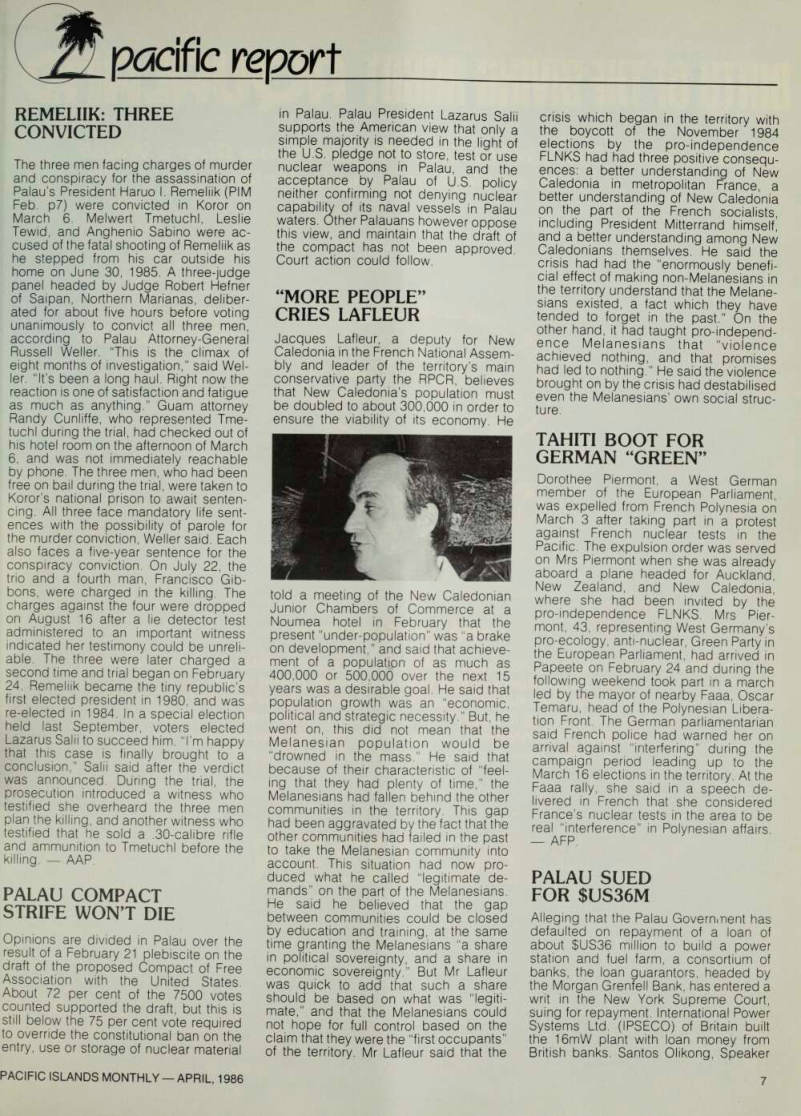
Jacques Lafleur, a deputy for New Caledonia in the French National Assem bly and leader of the territory’s main conservative party the RPCR, believes that New Caledonia’s population must be doubled to about 300,000 in order to ensure the viability of its economy. He
told a meeting of the New Caledonian Junior Chambers of Commerce at a Noumea hotel in February that the present “under-population” was “a brake on development," and said that achieve ment of a population of as much as 400,000 or 500,000 over the next 15 years was a desirable goal. He said that population growth was an “economic, political and strategic necessity.” But, he went on, this did not mean that the Melanesian population would be “drowned in the mass.” He said that because of their characteristic of “feel ing that they had plenty of time,” the Melanesians had fallen behind the other communities in the territory. This gap had been aggravated by the fact that the other communities had failed in the past to take the Melanesian community into account. This situation had now pro duced what he called “legitimate de mands” on the part of the Melanesians.
He said he believed that the gap between communities could be closed by education and training, at the same time granting the Melanesians “a share in political sovereignty, and a share in economic sovereignty.” But Mr Lafleur was quick to add that such a share should be based on what was “legiti mate,” and that the Melanesians could not hope for full control based on the claim that they were the “first occupants" of the territory. Mr Lafleur said that the
crisis which began in the territory with the boycott of the November 1984 elections by the pro-independence FLNKS had had three positive consequ ences: a better understanding of New Caledonia in metropolitan France, a better understanding of New Caledonia on the part of the French socialists, including President Mitterrand himself! and a better understanding among New Caledonians themselves. He said the crisis had had the “enormously benefi cial effect of making non-Melanesians in the territory understand that the Melane sians existed, a fact which they have tended to forget in the past.” On the other hand, it had taught pro-independ ence Melanesians that “violence achieved nothing, and that promises had led to nothing.” He said the violence brought on by the crisis had destabilised even the Melanesians’ own social struc ture.
Tahiti Boot For
German “Green”
Dorothee Piermont, a West German member of the European Parliament, was expelled from French Polynesia on March 3 after taking part in a protest against French nuclear tests in the Pacific. The expulsion order was served on Mrs Piermont when she was already aboard a plane headed for Auckland, New Zealand, and New Caledonia, where she had been invited by the pro-independence FLNKS. Mrs Pier mont, 43, representing West Germany’s pro-ecology, anti-nuclear, Green Party in the European Parliament, had arrived in Papeete on February 24 and during the following weekend took part in a march led by the mayor of nearby Faaa, Oscar Temaru, head of the Polynesian Libera tion Front. The German parliamentarian said French police had warned her on arrival against “interfering” during the campaign period leading up to the March 16 elections in the territory. At the Faaa rally, she said in a speech de livered in French that she considered France’s nuclear tests in the area to be real “interference” in Polynesian affairs.
Afp.
Palau Sued
For Sus36M
Alleging that the Palau Government has defaulted on repayment of a loan of about SUS 36 million to build a power station and fuel farm, a consortium of banks, the loan guarantors, headed by the Morgan Grenfell Bank, has entered a writ in the New York Supreme Court, suing for repayment. International Power Systems Ltd. (IPSECO) of Britain built the 16mW plant with loan money from British banks. Santos Olikong, Speaker
or paiau s Mouse or Delegates, said IPSECO had promised that the sale of power and fuel would be enough to pay for the loan. “IPSECO is breaking my heart,” said Mr Olikong. “It was sup posed to be self-paying, but instead it is costing about 15 cents a second.” By early December last year, the debt was estimated to have grown to $35,885,623.43, and it was reported that Palau would begin paying $62,500 in quarterly interest by March, 1986.
“Islands ’B6”
In Victoria B.C.
A conference entitled Islands 'B6 Conference of the Islands of the World, will be held in Victoria, British Columbia, Canada, from May 8-10. The conference will take place in the context of Vancouv er’s massive Expo 'B6, which runs from May 2 to October 13. The islands conference will be on the three themes: Islands Past; Islands Present: Appropri ate Technology for Islands Development Today; and Islands Future. A conference brochure says of the final session: “Because of their geographical isolation
and related transportation costs, the industrial age largely bypassed the islands of the world. In the new, de centralised age of technology, islands societies should be able to compete more successfully for lightweight, in formation-based, exportable industries.
But can they?” Announced speakers at the sessions of Islands 'B6 include Dr James Boutilier, Dr Peter Baskerville, Dr Neville Hall, Dr Bryan Farrell, Dr Te’o Fairbairn, Dr David Lowenthal, Dr Michael P. Hamnett, Dr Robert C. Kiste, and Felipe Bole.
Exxon Windfall
For A.Samoa
The government of American Samoa stands to receive a sum of $U5372,000 from the fund of $2.1 billion that the Exxon Corporation must pay to the U.S. federal government for overcharges on crude oil during the period when oil was subject to federal price controls. The money will be distributed to all 50 states the District of Columbia, and the insular possessions of the U.S. The formula for allotment is based on each entity's consumption of refined petroleum pro ducts between January, 1975, and Janu ary, 1981, when price controls were lifted. The states and territories must agree to use their portion of the fund for certain energy conservation programs.
American bamoas congressman Fofo I.
Sunia said: “I am very pleased with this announcement. The money awarded to American Samoa will enable the territo rial government to greatly strengthen its efforts toward making the islands more energy-efficient.”
Divorce Airline
Style (1)
The Vanuatu Government is discussing the future of its international airline, Air Vanuatu, with Air Pacific, Air Nauru and Air Caledonie following the termination by Ansett Airlines of Australia of its agreement with the government to man age and operate Air Vanuatu. Talks between Ansett and the government over a new agreement broke down over the government’s insistence on payment of royalties by Ansett. While visiting London, Vanuatu Prime Minister Fr Wal ter Uni said his government may ask the Australian Government to intervene in the dispute with Ansett, Fr Lini said Air Hong Kong had entered the discussion, and two Port-Vila businessmen, John King, formerly with Ansett and Tom Bayer, might introduce a new venture.
Divorce Airline
Style (2)
The three-year contract with Dutch air line KLM to manage Air Niugini ended in March and KLM will not renew the contract because it does not agree with the conditions imposed by the Papua New Guinea Government, which is put ting out tenders for a new management contract.
Si2M Lawsuit Is Finally
Settled
A SUSI 2 million 6-year-old lawsuit filed against the Pacific Daily News by the president of the Marshall Islands has been settled out of court. The settlement was announced jointly by President Amata Kabua and the Gannett Co., the newspaper’s owner. The suit stemmed from reports published in 1978 when the Marshall Islands and other islands in the Trust Territory of the Pacific Islands were forming their own governments.
The reports said the Republic of Nauru made secret and illegal loans to the Marshall Islands Political Status Com mission and alleged that the Nauru government agreed to make a SUS6OO,OOO loan to back a Marshalls separatist movement. A US District Court jury in Honolulu last November (PIM December 1985, page 7) found the articles false and defamatory. However, the defendants were found not liable as the reports were not published reckless ly or with malice. The joint statement said: “With the experience of this lawsuit behind them, the parties agree that the loan was made to support the self
government process.” The statement said the loan was not negotiated or authorised in a secret fashion
Tuvalu’S ‘No’
To Republic
A select committee of the Tuvalu Parlia ment has been canvassing the people of the country’s nine atolls for their views on whether the country should remain an independent constitutional monarchy with the British reigning monarch as its head and the Westminster type of parliament, or become a republic like Kiribati, Vanuatu and Nauru. The com munity of only one atoll wanted a republic, but the committee reported general consensus on the issue of preserving Tuvaluan customs and tradi tions. The Tuvaluan news-sheet Tuvalu Echoes commented; “It is crucial at this stage for the committee to draw a solid line between Tuvalu customs and tradi tions, and the fundamental rights of an individual. Anyone will agree in principle that there are certain aspects of Tuvalu customs and tradition which are totally in conflict with rights of an individual."
Stamps, Money,
Talks In Tonga
A five-day philatelic management semi nar, sponsored by the Canadian Gov ernment and a Canadian philatelic ex pert, Frank Platters, was held in Nukualo fa, Tonga’s capital, in March. Several island countries, who have relied on the international stamp market for much of their income, were represented at the seminar. Methods of arresting the de cline ifl their stamp sales were dis cussed.
Cooks Fertility
God A Winner
Around the globe, in vitro fertilisation teams are struggling to improve pre gnancy rates. A Canadian group has let its secret out a Cook Islands silver dollar which bears the symbol of a fertility god. With the first 75 patients
studied, only seven pregnancies occured after embryo transfer. But 10 of the next 45 patients became pregnant.
The only difference in treatment was that the silver coin had been placed on top of a vital piece of equipment in the lab.
The National Times, Sydney.
Advertisements & other items, p. 8 (1 item)
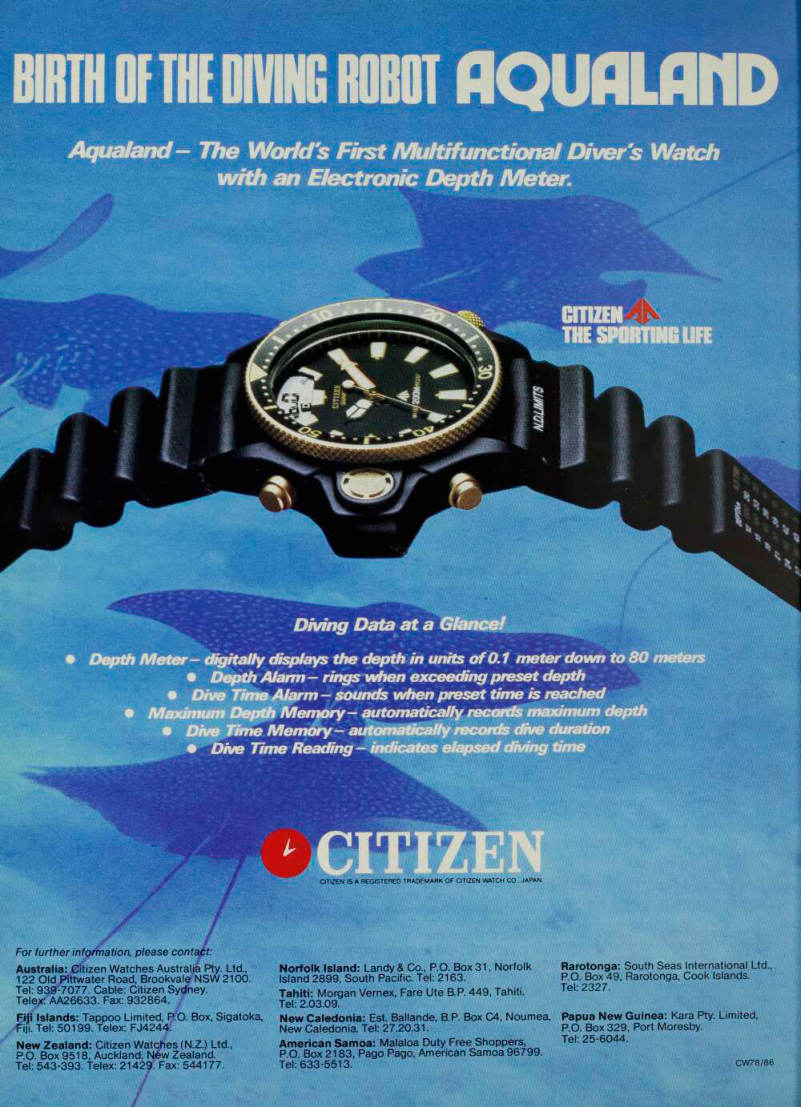
BIRTH OF fflt DMNG ROBOT flQUflLfll«>
Aqualand— The World's First Multifunctional Diver's Watch
with an Electronic Depth Meter.
THE SPORTING LIFE
,4 s I k .
HK ■■f G at
Diving Data
• Depth Meter- digitally displays the depth in units of 0.1 meter down to 80 • Depth Alarm - rings when exceeding preset depth • Dive Time Alarm - sounds when preset time is reached • Maximum Depth Memory - automatically records maximum depth • Dive Time Memory- automatically records dive duration • Dive Time Reading -indicates elapsed diving time m For further information, please contact: Australia: Citizen Watches Australia Pty. Ltd, 122 Old Pittwater Road, Brookvale NSW 2100.
Tel: 939-7077. Cable; Citizen Sydney.
Telex: AA26633. Fax: 932864.
Fiji Islands: Tappoo Limited, P.O. Box, Sigatoka, Fiji. Tel: 50199. Telex; FJ4244.
New Zealand: Citizen Watches (N.Z.) Ltd., P.O. Box 9518, Auckland, New Zealand.
Tel; 543-393. Telex; 21429- Fax: 544177.
Norfolk Island: Landy & Co., P.O. Box 31, Norfolk Island 2899, South Pacific. Tel: 2163.
Tahiti: Morgan Vernex, Fare Ute B.P. 449, Tahiti.
Tel: 2.03.09.
New Caledonia: Est. Ballande, B.P. Box C 4, Noumea, New Caledonia. Tel: 27.20.31.
American Samoa: Malaloa Duty Free Shoppers, P.O. Box 2183, Pago Pago, American Samoa 96799.
Tel: 633-5513.
Rarotonga: South Seas International Ltd., P.O. Box 49, Rarotonga, Cook Islands.
Tel: 2327.
Papua New Guinea: Kara Pty. Limited, P.O. Box 329, Port Moresby.
Tel: 25-6044.
letters
How PT109’s skipper said “thanks”
I was interested to see the story of JFK and the PTIO9, in the January issue of PIM.
I knew Biuku Gasa and Aaron Kumana (not Kuman, as in the article) well, as they had been pupils at our Methodist school at Roviana, of which I was headmaster. After the war, I followed up the story of JFK.
It is most interesting and exciting to hear that there is now a museum on Rendova, at Lumberi, and I enclose one or two items that may be of interest to you.
For instance, there is the story of the rescue of Kennedy and his men, as seen by Aaron Kumana. There is also the story by Jonothan Bia, who followed up the report that the Amer icans were in distress, and led a relief party to Olosana Island.
The third item is a copy of a letter written by Kennedy to Biuku.
I am sending copies of this material to the district officer at Gizo, with a few photos of the Solomon Islanders mentioned, with a request that it be added to the items displayed in the museum at Lumberi Island.
Trusting that this may be of some interest to you.
(Rev.) E. C. Leadley
Auckland, New Zealand Copy of a letter sent by the late President Kennedy to N.
Biuku Gasa.
The White House, Washington.
March 11, 1961 Dear Biuku, Rev. E. C. Leadley has recently sent me your very kind mes sage, and I can’t tell you how delighted I was to know that you are well and prospering in your home so many thousands of miles away from Washington.
Like you, I am eternally grateful for the act of Divine Providence which brought me and my companions together with you and your friends who so valorously effected our res cue during time of war. Need less to say, I am deeply moved by your expressions, and I hope that the new responsibili ties which are mine may be exercised for the benefit of my own countrymen and the wel
fare of all our brothers in Christ.
You will always have a special place in my mind and heart, and I wish you and your people continued prosperity and good health.
Sincerely,
Kennedy
Biuku Gasa Madou, Wana Wana Lagoon, British Solomon Islands Protectorate
A sunken city
off Nan Madol?
I would like to comment on the investigations on the archeological site of Nan Madol (Temuen), Ponape Island, Mic ronesia, and to follow the claims of another city sunken off the front of the present one (PIM Feb. p 43). I am most interested to see published the inscriptions on the remains of the sunken city.
Having visited Nan Madol some years ago, it is a talking point all Ponapean people should be proud of. The ancient city ranks in its splendor with other sites around the
world. What a pity many of the relics of this ancient citadel and its culture have found their way to Eureopean museums and private collections around the world. I believe serious efforts should be made to recover or, if not, photograph these pieces.
Perhaps this island civilisation could be older than accepted up to the present day?
More ancient cities of the past are coming to light through more serious-minded investiga tions, and with the help of satellite photos.
Norton C. Redsell,
Olde World Archaeology, Sydney, NSW,.
Australia
For an Oceanic
Airlines
“By uniting we stand, by divid ing we fall.” (John Dick inson. ) Throughout history the Paci fic Islands and their people have been seduced for the welfare of foreign governments and companies with little bene fit to themselves. Even today, we see neighboring airlines us ing the Islands’ airlines not because they want to help those countries but because they use it as a means of increasing their dominance over the Pacific.
Is it not time to form Oceanic Airlines?. It is time for the Pacific Islanders to combine as one entity to promote the rich ness and diversity they offer.
No longer is there need to act as a sidekick for Australia, but let Australia be a sidekick to Oceania.
By combining the regional airways to form Oceanic Air lines everbody has control of the people’s airline. It is yours.
Who benefits: Certainly not Ansett!
Michael Meehan,
(Hopes Inc.) Darra, Qld., Australia
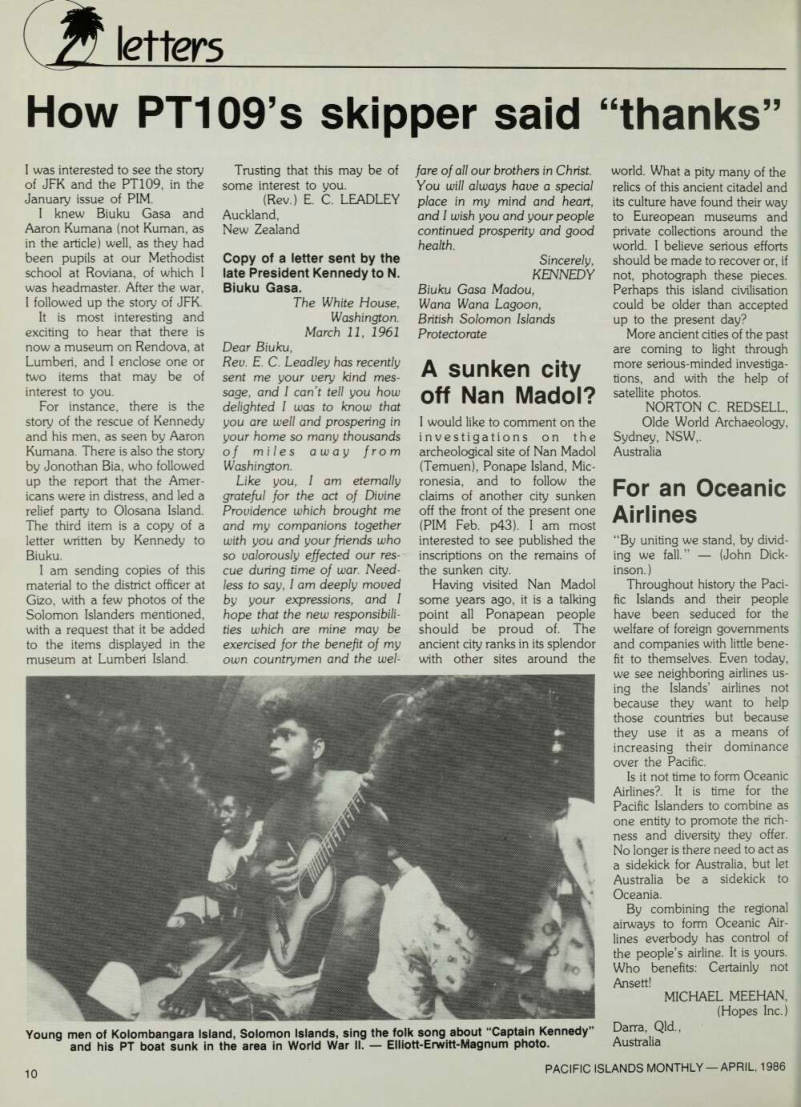
Young men of Kolombangara Island, Solomon Islands, sing the folk song about “Captain Kennedy” and his PT boat sunk in the area in World War II. - Elliott-Erwitt-Magnum photo.
Tuna fleet rifles out
recession
DESPITE periodic im provements in market conditions the world tuna industry has re mained depressed since the onset of the 1981 recession.
This has resulted in internation al restructuring of the industry.
Some of the more important changes that have occurred since 1981 include: • Radically altered patterns of resource exploitation, espec ially for the US purse seine fleet. This has involved a move ment from traditional fishing grounds in the eastern Pacific to fishing grounds in the central and western Pacific. • The closure of all major tuna processing plants on the US mainland. Only one small cannery with a processing capa city of 10,000 tonnes per annum remains operational in the continental United States. • A rise in canning indus-
Since recession hit the tuna industry in 1981, there has been a restructuring. Catches in the islands region have, however, continued to increase. David Doul man* surveys recent developments and points out that despite the public utterances of governments signifi cant onshore developments are still a long way over the horizon.
tries especially in Thailand based on the utilisation of low-cost and efficient labor and imported raw material (tuna). • Continued reductions in the size of the Japanese pole and-line and long-line fleets through government-instituted rationalisation programs. • Concerted efforts by European fleets to develop a purse seine tuna fishery in the Indian Ocean. • A trend toward basing purse seiners in the islands region as a means of improving their operational efficiency.
These changes, coupled with the general pessimism and un certainty surrounding the in ternational tuna industry, sug gest that the recession since 1981 is related to fundamental and deep-seated changes that are stil evolving.
The impact of these worldwide changes has been strongly felt in the islands re gion. This region covers a large tract of the central and western Pacific Ocean and includes the geographical areas of Mi cronesia, Melanesia and Polynesia. The region’s tuna
resources are exploited by dis tant-water fishing fleets as well as by fleets based at ports within the region.
In 1984 an estimated 35 per cent of the total world tuna catch was taken in the region.
Local processing facilities for example in American Samoa, Fiji and the Solomon Islands utilise part of the catch landed by the fleets based there.
Distant-water fishing fleets
*Dr Doulman is a research fellow at the East-West Center in Honolulu and is director of the Multinational Corporations in the Pacific Tuna Industry Project being undertaken by the centre’s Pacific Islands De velopment Program. He was previously chief fisheries economist in the Department of Primary Industry in PNG.
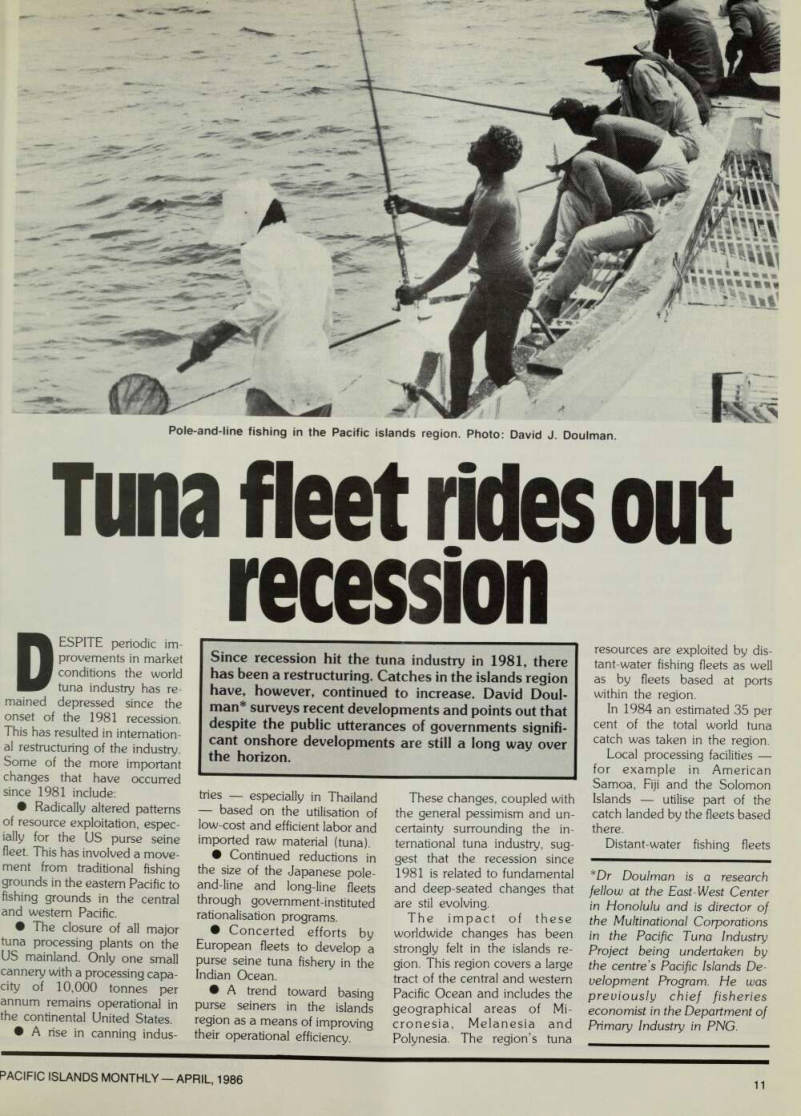
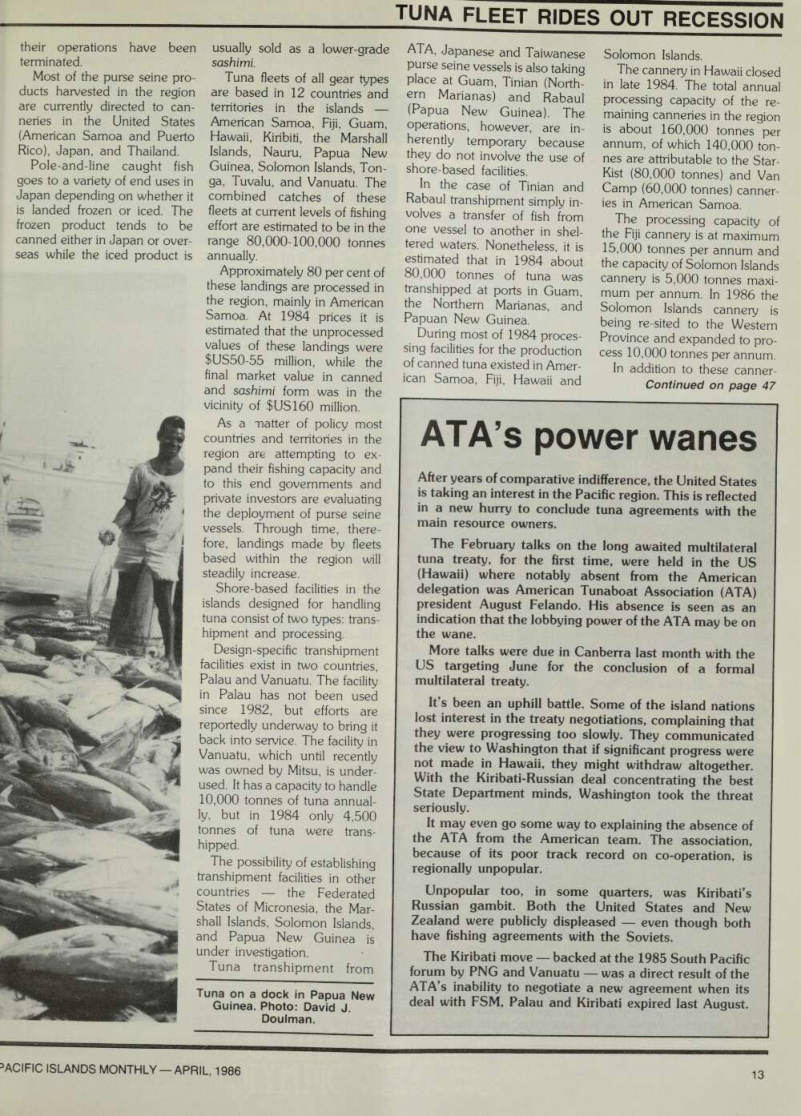
Pole-and-line fishing in the Pacific islands region. Photo: David J. Doulman.
using purse seine, long-line and pole-and-line fishing techniques operate throughout the year in islands waters. These vessels come from at least 10 countries though most are of US, Japan ese, Taiwanese and Korean registrations.
All foreign vessels legally fishing in the region operate under licence.
For a fee, island nations assign the owners of foreign fishing vessels a right to operate in their respective economic zones.
The right to fish is for a specified period usually two months and owners and operators must observe proce dures laid down by the licensing nation. Thus, the island coun tries derive revenue from their
tuna though the revenue is small, usually less than five per cent of the market value of the fish harvested.
The Japanese purse seine fleet consists of 32 single seiners and eight group seiners. How ever, the latter vessels operate in the Pacific islands region for only about four months each year.
The single seiners target almost exclusively on the fisher ies zones of Papua New Guinea and the Federated States of Micronesia. These zones have become the traditional fishing grounds for this fleet because they are proven and produc tive.
The Japanese single purse seine fleet caught approximate ly 100,000 tonnes of fish in
In 1984 about 110 purse seiners operated in the islands region. Approximately 65 of these were affiliated to the American Tunaboat Association (ATA) and of either US, Carribean or Central American registrations. In 1984 the ATA had about 85 operational vessels in the fleet. The ATA represents formally the interests of US tuna vessel owners and informally US citizens and companies operating vessels under foreign flags. The association has customarily negotiated fishing access agreements with foreign governments in Latin America and the Pacific islands.
In 1984 the US fleet harvested, according to the US Government’s National Marine Fisheries Service, 171,000 tonnes offish in the central and western Pacific.
However, 1984 catch estimates for the ATA fleet (which is larger than the US fleet) infer that ATA-affiliated vessels harvested about 220,000 tonnes in the region.
Despite the large number of ATA vessels operating in the region in 1984 the association had no fishing agreements with several island countries for most of 1984 and no agreements in 1985. Papua New Guinea, for example, has had no agreement with the ATA since 1982 despite the fact that Papua New Guinea’s EEZ is one of the most important zones for purse seining in the region.
Nonetheless, association vessels were not denied access to Papua New Guinea’s waters in 1983, 1984 and 1985 but rather were licensed to operate under the terms and conditions of the Papua New Guinea/Japan Fisheries Arrangement which has been in force since 1981. Under this agreement ATA vessels are treated by Papua New Guinea as though they were Japanese vessels for licensing purposes.
Fleets of other registrations (for example, Taiwanese, Korean and Filipino whose countries do not have access agreements with Papua New Guinea) are also treated in the same way as ATA vessels although negotiations are in progress to establish bilateral access arrangements with agencies in these countries. Similarly, since 1984 island states have been engaged in a series of negotia tions to establish a multilateral tuna access agreement with the United States.
1984. The other purse seine fleets from Korea, Taiwan, Phi lippines, Mexico, etc., operating in the region took about 50,000 tonnes in the same year.
A small Soviet Union tuna fleet consisting of purse seine and long-line vessels has oper ated in international waters in the Pacific islands region for several years. However, prior to the conclusion of the controver sial fisheries agreement be tween Kiribati and Russia in late 1985, no Soviet vessels had been licensed to fish in the Zones of island states.
While the Kiribati/Soviet agreement prohibits vessels from operating in the country’s territorial areas and denies them port access, it is expected that Soviet approaches will be made to other countries in the Pacific islands with proposals to develop shore-based facilities.
These would be primarily established to service the Rus sian fleet but they could also be used to service fleets of other countries.
In terms of total landings of tuna in the region about 630.000 tonnes in 1984 about 370,000 tonnes (or 59 per cent) were made by purse sein vessels and about 35 per cent by the ATA fleet, (see box) As part of the international restructuring of the tuna in dustry, purse seine landings in the islands have increased from 90.000 tonnes in 1980 to 370.000 tonnes in 1984 an overall increase of 310 per cent.
In 1980 the ATA fleet took less than 10,000 tonnes of fish in the region.
Long-line fleets operating in the Pacific islands region are now almost exclusively fishing for the Japanese sashimi mar ket, as many of the vessels that formerly fished for abacore have ceased operations.
This contraction has been primarily due to financial con siderations; tuna landed by long-line vessels, which is signi ficantly more costly per unit of production than other forms of tuna fishing, is not price-com petitive when the product is to be canned.
Other considerations such as declining catch rates have also
played some part in the decline of the long-line fishery. How ever a sizeable fleet of smaller class distant-water long liners continues to operate in the region, principally in Mic ronesia.
In the mid-1970s albacore tuna long-line fleets based in the Pacific islands operated from ports in American Samoa, French Polynesia, and Vanuatu. Today these fleets are largely reduced in size, and, in the case of French Polynesia,
their operations have been terminated.
Most of the purse seine pro ducts harvested in the region are currently directed to can neries in the United States (American Samoa and Puerto Rico), Japan, and Thailand.
Pole-and-line caught fish goes to a variety of end uses in Japan depending on whether it is landed frozen or iced. The frozen product tends to be canned either in Japan or over seas while the iced product is
usually sold as a lower-grade sashimi.
Tuna fleets of all gear types are based in 12 countries and territories in the islands American Samoa, Fiji, Guam, Hawaii, Kiribiti, the Marshall Islands, Nauru, Papua New Guinea, Solomon Islands, Ton ga, Tuvalu, and Vanuatu. The combined catches of these fleets at current levels of fishing effort are estimated to be in the range 80,000-100,000 tonnes annually.
Approximately 80 per cent of these landings are processed in the region, mainly in American Samoa. At 1984 prices it is estimated that the unprocessed values of these landings were SUSSO-55 million, while the final market value in canned and sashimi form was in the vicinity of SUSI6O million.
As a matter of policy most countries and territories in the region are attempting to ex pand their fishing capacity and to this end governments and private investors are evaluating the deployment of purse seine vessels. Through time, there fore, landings made by fleets based within the region will steadily increase.
Shore-based facilities in the islands designed for handling tuna consist of two types: trans hipment and processing.
Design-specific transhipment facilities exist in two countries, Palau and Vanuatu. The facility in Palau has not been used since 1982, but efforts are reportedly underway to bring it back into service. The facility in Vanuatu, which until recently was owned by Mitsu, is under used. It has a capacity to handle 10,000 tonnes of tuna annual ly, but in 1984 only 4,500 tonnes of tuna were trans hipped.
The possibility of establishing transhipment facilities in other countries the Federated States of Micronesia, the Mar shall Islands, Solomon Islands, and Papua New Guinea is under investigation.
Tuna transhipment from
ATA, Japanese and Taiwanese purse seine vessels is also taking place at Guam, Tinian (North ern Marianas) and Rabaul (Papua New Guinea). The operations, however, are in herently temporary because they do not involve the use of shore-based facilities.
In the case of Tinian and Rabaul transhipment simply in volves a transfer of fish from one vessel to another in shel tered waters. Nonetheless, it is estimated that in 1984 about 80,000 tonnes of tuna was transhipped at ports in Guam, the Northern Marianas, and Papuan New Guinea.
During most of 1984 proces sing facilities for the production of canned tuna existed in Amer ican Samoa, Fiji, Hawaii and
Solomon Islands.
The cannery in Hawaii closed in late 1984. The total annual processing capacity of the re maining canneries in the region is about 160,000 tonnes per annum, of which 140,000 ton nes are attributable to the Star- Kist (80,000 tonnes) and Van Camp (60,000 tonnes) canner ies in American Samoa.
The processing capacity of the Fiji cannery is at maximum 15,000 tonnes per annum and the capacity of Solomon Islands cannery is 5,000 tonnes maxi mum per annum. In 1986 the Solomon Islands cannery is being re-sited to the Western Province and expanded to pro cess 10,000 tonnes per annum.
In addition to these canner-
Continued on page 47
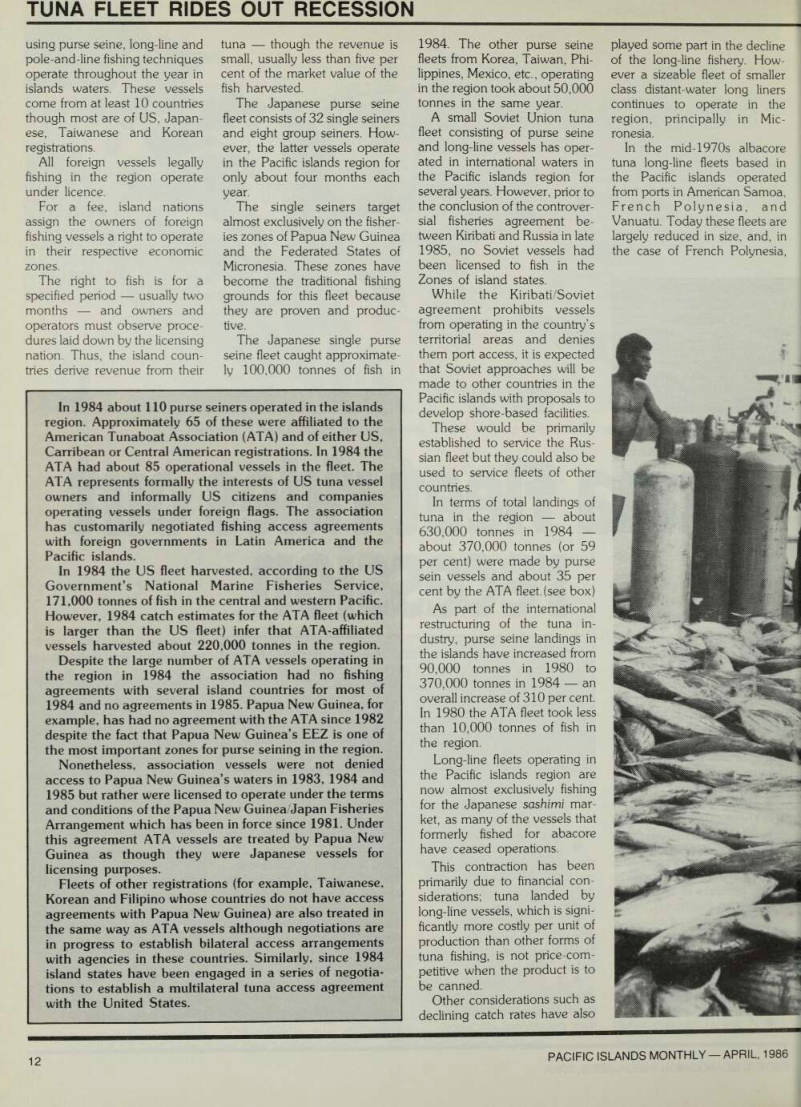
Tuna on a dock in Papua New Guinea. Photo: David J.
Doulman.
ies, Papua New Guinea is negotiating with developers for the establishment of a small cannery. Similarly, according to recent press reports, a cannery is to be established in the Marshall Islands.
Other tuna processing in the region involves the production of katsuobushi (smoked tuna).
Facilities for the production of this product are located in Solo mon Islands and the Marshall Islands. Both facilities are small and produce for export to Japan.
The many changes that have taken place internationally in the tuna industry have not yet fully worked themselves out.
There are indications that the tuna industry is gaining some
stability and that this trend should continue, albeit in a modest way.
The Pacific Islands will re main a crucial production area for the world’s tuna fishing fleets, and it is expected that there will be a continuing trans fer of capital primarily in the form of fishing vessels to countries in the region as means of improving the op erational efficiency of fleets and of securing preferential access to the region’s tuna resources.
So long as current market conditions persist, however, no significant increase in the re gion’s processing capacity is expected despite what govern ments say and want about the establishment of domestic tuna industries.
Advertisements & other items, p. 12 (1 item)
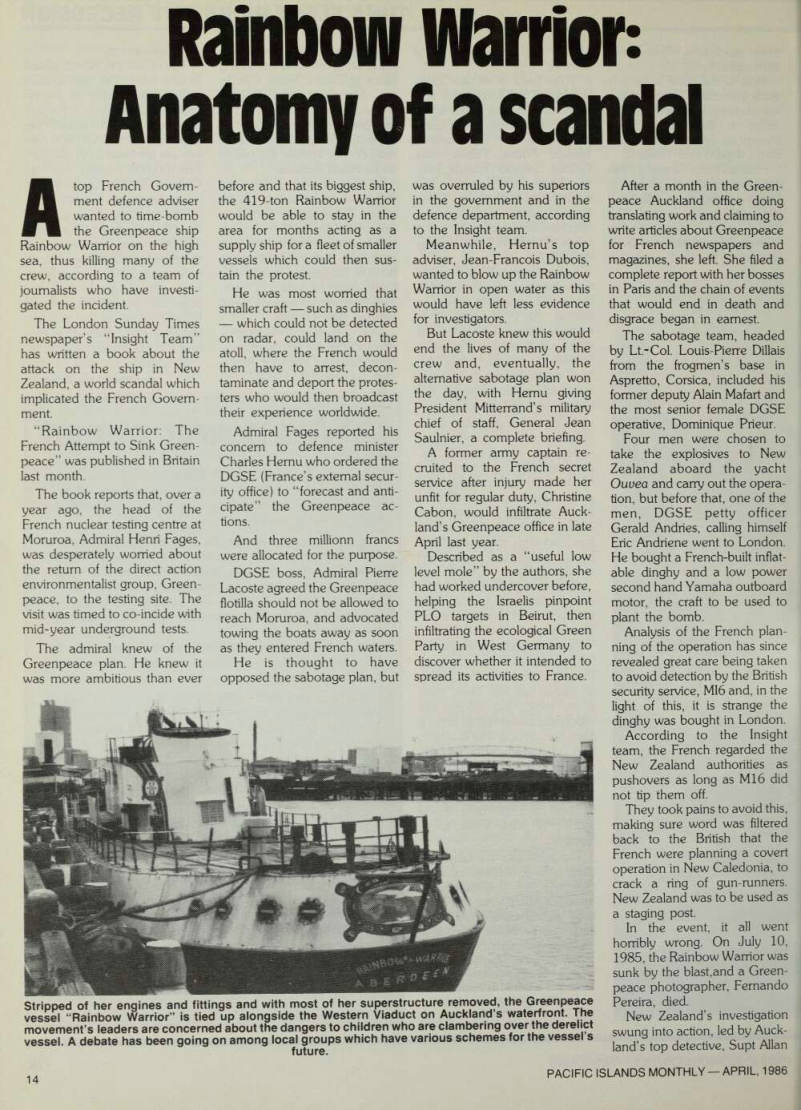
Tuna Fleet Rides Out Recession
ATA’s power wanes
After years of comparative indifference, the United States is taking an interest in the Pacific region. This is reflected in a new hurry to conclude tuna agreements with the main resource owners.
The February talks on the long awaited multilateral tuna treaty, for the first time, were held in the US (Hawaii) where notably absent from the American delegation was American Tunaboat Association (ATA) president August Felando. His absence is seen as an indication that the lobbying power of the ATA may be on the wane.
More talks were due in Canberra last month with the US targeting June for the conclusion of a formal multilateral treaty.
It’s been an uphill battle. Some of the island nations lost interest in the treaty negotiations, complaining that they were progressing too slowly. They communicated the view to Washington that if significant progress were not made in Hawaii, they might withdraw altogether.
With the Kiribati-Russian deal concentrating the best State Department minds, Washington took the threat seriously.
It may even go some way to explaining the absence of the ATA from the American team. The association, because of its poor track record on co-operation, is regionally unpopular.
Unpopular too, in some quarters, was Kiribati’s Russian gambit. Both the United States and New Zealand were publicly displeased even though both have fishing agreements with the Soviets.
The Kiribati move backed at the 1985 South Pacific forum by PNG and Vanuatu was a direct result of the ATA’s inability to negotiate a new agreement when its deal with FSM, Palau and Kiribati expired last August.
Advertisements & other items, p. 13 (1 item)
Tuna Fleet Rides Out Recession
13
ACIFIC ISLANDS MONTHLY —APRIL, 1986
Rainbow warrior:

Anatomy of a scandal
Atop French Govern ment defence adviser wanted to time-bomb the Greenpeace ship Rainbow Warrior on the high sea, thus killing many of the crew, according to a team of journalists who have investi gated the incident.
The London Sunday Times newspaper’s “Insight Team” has written a book about the attack on the ship in New Zealand, a world scandal which implicated the French Govern ment.
“Rainbow Warrior: The French Attempt to Sink Green peace” was published in Britain last month.
The book reports that, over a year ago, the head of the French nuclear testing centre at Moruroa, Admiral Henri Pages, was desperately worried about the return of the direct action environmentalist group, Green peace, to the testing site. The visit was timed to co-incide with mid-year underground tests.
The admiral knew of the Greenpeace plan. He knew it was more ambitious than ever
before and that its biggest ship, the 419-ton Rainbow Warrior would be able to stay in the area for months acting as a supply ship for a fleet of smaller vessels which could then sus tain the protest.
He was most worried that smaller craft such as dinghies which could not be detected on radar, could land on the atoll, where the French would then have to arrest, decon taminate and deport the protes ters who would then broadcast their experience worldwide.
Admiral Pages reported his concern to defence minister Charles Hernu who ordered the DGSE (France’s external secur ity office) to “forecast and anti cipate” the Greenpeace ac tions.
And three millionn francs were allocated for the purpose.
DGSE boss, Admiral Pierre Lacoste agreed the Greenpeace flotilla should not be allowed to reach Moruroa, and advocated towing the boats away as soon as they entered French waters.
He is thought to have opposed the sabotage plan, but
was overruled by his superiors in the government and in the defence department, according to the Insight team.
Meanwhile, Hernu’s top adviser, Jean-Francois Dubois, wanted to blow up the Rainbow Warrior in open water as this would have left less evidence for investigators.
But Lacoste knew this would end the lives of many of the crew and, eventually, the alternative sabotage plan won the day, with Hemu giving President Mitterrand’s military chief of staff, General Jean Saulnier, a complete briefing.
A former army captain re cruited to the French secret service after injury made her unfit for regular duty, Christine Gabon, would infiltrate Auck land’s Greenpeace office in late April last year.
Described as a “useful low level mole” by the authors, she had worked undercover before, helping the Israelis pinpoint PLO targets in Beirut, then infiltrating the ecological Green Party in West Germany to discover whether it intended to spread its activities to France.
After a month in the Green peace Auckland office doing translating work and claiming to write articles about Greenpeace for French newspapers and magazines, she left. She filed a complete report with her bosses in Paris and the chain of events that would end in death and disgrace began in earnest.
The sabotage team, headed by Lt.-Col. Louis-Pierre Dillais from the frogmen’s base in Aspretto, Corsica, included his former deputy Alain Mafart and the most senior female DGSE operative, Dominique Prieur.
Four men were chosen to take the explosives to New Zealand aboard the yacht Ouuea and carry out the opera tion, but before that, one of the men, DGSE petty officer Gerald Andries, calling himself Eric Andriene went to London.
He bought a French-built inflat able dinghy and a low power second hand Yamaha outboard motor, the craft to be used to plant the bomb.
Analysis of the French plan ning of the operation has since revealed great care being taken to avoid detection by the British security service, MI6 and, in the light of this, it is strange the dinghy was bought in London.
According to the Insight team, the French regarded the New Zealand authorities as pushovers as long as Ml 6 did not tip them off.
They took pains to avoid this, making sure word was filtered back to the British that the French were planning a covert operation in New Caledonia, to crack a ring of gun-runners.
New Zealand was to be used as a staging post.
In the event, it all went horribly wrong. On July 10, 1985, the Rainbow Warrior was sunk by the blast,and a Green peace photographer, Fernando Pereira, died.
New Zealand’s investigation swung into action, led by Auck land’s top detective, Supt Allan
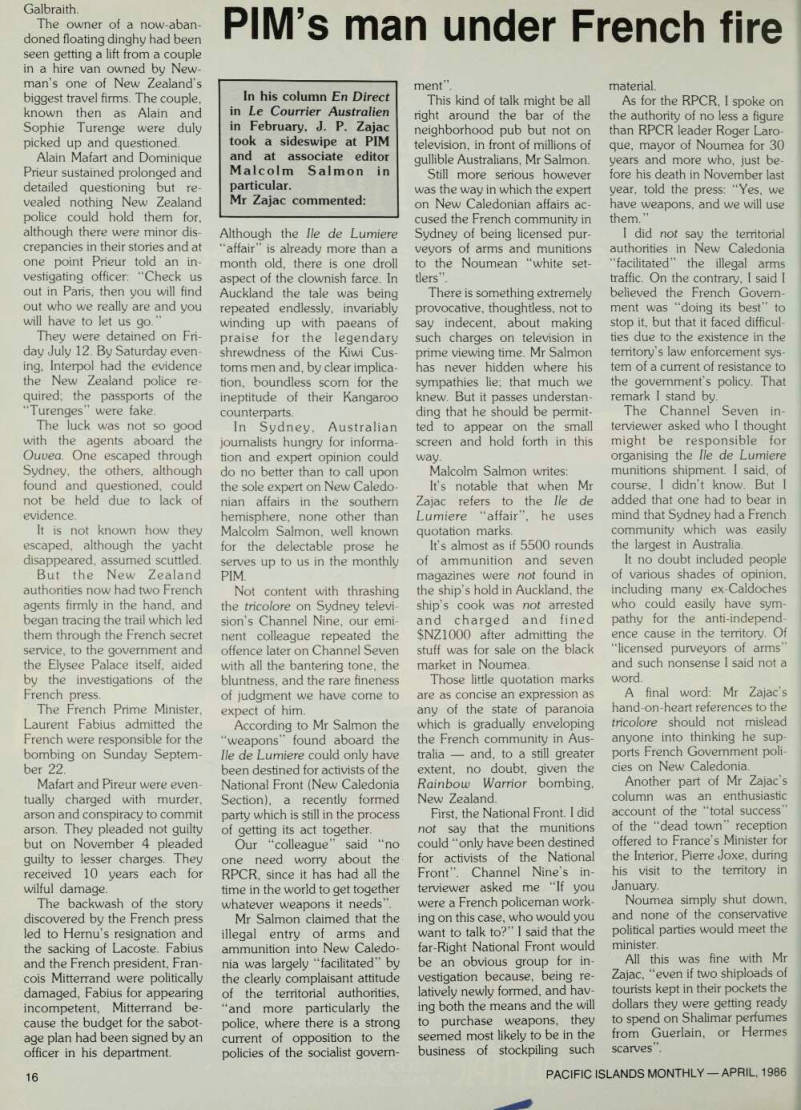
Stripped of her engines and fittings and with most of her superstructure removed, the Greenpeace vessel “Rainbow Warrior” is tied up alongside the Western Viaduct on Auckland’s waterfront. The movement’s leaders are concerned about the dangers to children who are clambering over the derelict vessel. A debate has been going on among local groups which have various schemes for the vessel s future.
Galbraith.
The owner of a now-aban doned floating dinghy had been seen getting a lift from a couple in a hire van owned by New man’s one of New Zealand’s biggest travel firms. The couple, known then as Alain and Sophie Turenge were duly picked up and questioned.
Alain Mafart and Dominique Prieur sustained prolonged and detailed questioning but re vealed nothing New Zealand police could hold them for, although there were minor dis crepancies in their stories and at one point Prieur told an in vestigating officer: “Check us out in Paris, then you will find out who we really are and you will have to let us go.”
They were detained on Fri day July 12. By Saturday even ing, Interpol had the evidence the New Zealand police re quired; the passports of the “Turenges” were fake.
The luck was not so good with the agents aboard the Ouuea. One escaped through Sydney, the others, although found and questioned, could not be held due to lack of evidence.
It is not known how they escaped, although the yacht disappeared, assumed scuttled.
But the New Zealand authorities now had two French agents firmly in the hand, and began tracing the trail which led them through the French secret service, to the government and the Elysee Palace itself, aided by the investigations of the French press.
The French Prime Minister, Laurent Fabius admitted the French were responsible for the bombing on Sunday Septem ber 22.
Mafart and Pireur were even tually charged with murder, arson and conspiracy to commit arson. They pleaded not guilty but on November 4 pleaded guilty to lesser charges. They received 10 years each for wilful damage.
The backwash of the story discovered by the French press led to Hernu’s resignation and the sacking of Lacoste. Fabius and the French president, Fran cois Mitterrand were politically damaged, Fabius for appearing incompetent, Mitterrand be cause the budget for the sabot age plan had been signed by an officer in his department.
Advertisements & other items, p. 15 (1 item)
couins
0
OLYnPIC
The Stationery and Diary People.
SYSTEM
CARDS
n.-»t I a snl - - -
Commercial, School, Household
Stationery and Diaries.
Fast and efficient export service. 6
comns
OLYnPIC
COLLINS OLYMPIC LIMITED
P.O. BOX 476, AUCKLAND, 1
NEW ZEALAND.
PHONE: (9) 484-009
TELEX: N.Z. 21293 (EDUNLOP)
CABLES: GRAPHICOL
PIM’s man under French fire
In his column En Direct in Le Courrier Australien in February, J. P. Zajac took a sideswipe at PIM and at associate editor Malcolm Salmon in particular.
Mr Zajac commented:
Although the He de Lumiere “affair” is already more than a month old, there is one droll aspect of the clownish farce. In Auckland the tale was being repeated endlessly, invariably winding up with paeans of praise for the legendary shrewdness of the Kiwi Cus toms men and, by clear implica tion, boundless scorn for the ineptitude of their Kangaroo counterparts.
In Sydney, Australian journalists hungry for informa tion and expert opinion could do no better than to call upon the sole expert on New Caledo nian affairs in the southern hemisphere, none other than Malcolm Salmon, well known for the delectable prose he serves up to us in the monthly
Pim.
Not content with thrashing the tricolore on Sydney televi sion’s Channel Nine, our emi nent colleague repeated the offence later on Channel Seven with all the bantering tone, the bluntness, and the rare fineness of judgment we have come to expect of him.
According to Mr Salmon the “weapons” found aboard the He de Lumiere could only have been destined for activists of the National Front (New Caledonia Section), a recently formed party which is still in the process of getting its act together.
Our “colleague” said “no one need worry about the RPCR, since it has had all the time in the world to get together whatever weapons it needs”.
Mr Salmon claimed that the illegal entry of arms and ammunition into New Caledo nia was largely “facilitated” by the clearly complaisant attitude of the territorial authorities, “and more particularly the police, where there is a strong current of opposition to the policies of the socialist govern
ment”.
This kind of talk might be all right around the bar of the neighborhood pub but not on television, in front of millions of gullible Australians, Mr Salmon.
Still more serious however was the way in which the expert on New Caledonian affairs ac cused the French community in Sydney of being licensed pur veyors of arms and munitions to the Noumean “white set tlers”.
There is something extremely provocative, thoughtless, not to say indecent, about making such charges on television in prime viewing time. Mr Salmon has never hidden where his sympathies lie; that much we knew. But it passes understan ding that he should be permit ted to appear on the small screen and hold forth in this way.
Malcolm Salmon writes; It’s notable that when Mr Zajac refers to the He de Lumiere “affair”, he uses quotation marks.
It’s almost as if 5500 rounds of ammunition and seven magazines were not found in the ship’s hold in Auckland, the ship’s cook was not arrested and charged and fined SNZIOOO after admitting the stuff was for sale on the black market in Noumea.
Those little quotation marks are as concise an expression as any of the state of paranoia which is gradually enveloping the French community in Aus tralia and, to a still greater extent, no doubt, given the Rainbow Warrior bombing, New Zealand.
First, the National Front. I did not say that the munitions could “only have been destined for activists of the National Front”. Channel Nine’s in terviewer asked me “If you were a French policeman work ing on this case, who would you want to talk to?” I said that the far-Right National Front would be an obvious group for in vestigation because, being re latively newly formed, and hav ing both the means and the will to purchase weapons, they seemed most likely to be in the business of stockpiling such
material.
As for the RPCR, I spoke on the authority of no less a figure than RPCR leader Roger Laro que, mayor of Noumea for 30 years and more who, just be fore his death in November last year, told the press; “Yes, we have weapons, and we will use them.”
I did not say the territorial authorities in New Caledonia “facilitated” the illegal arms traffic. On the contrary, I said I believed the French Govern ment was “doing its best” to stop it, but that it faced difficul ties due to the existence in the territory’s law enforcement sys tem of a current of resistance to the government’s policy. That remark I stand by.
The Channel Seven in terviewer asked who I thought might be responsible for organising the He de Lumiere munitions shipment. I said, of course, I didn’t know. But I added that one had to bear in mind that Sydney had a French community which was easily the largest in Australia.
It no doubt included people of various shades of opinion, including many ex-Caldoches who could easily have sym pathy for the anti-independ ence cause in the territory. Of “licensed purveyors of arms” and such nonsense 1 said not a word.
A final word; Mr Zajac’s hand-on-heart references to the tricolore should not mislead anyone into thinking he sup ports French Government poli cies on New Caledonia.
Another part of Mr Zajac’s column was an enthusiastic account of the “total success” of the “dead town” reception offered to France’s Minister for the Interior, Pierre Joxe, during his visit to the territory in January.
Noumea simply shut down, and none of the conservative political parties would meet the minister.
All this was fine with Mr Zajac, “even if two shiploads of tourists kept in their pockets the dollars they were getting ready to spend on Shalimar perfumes from Guerlain, or Hermes scarves”.
uni speaks out in plain language
Vanuatu Prime Minister Walter Lini in last month’s trip to Paris and London pulled no punches in either capital.
He roundly condemned French policies in the Pacific and made his displeasure clear to Mrs Thatcher over Britain’s tardiness in delivering aid money.
Nevertheless, he predicted a greater role for France in the Pacific.
Lini, who addressed the first summit of French-speaking nations in Bislama, said he heard words of regret from the French when he took them to task over nuclear tests.
He said his attack prompted a half-hour speech of justification from French president Francois Mitterrand “that we felt was almost apologetic as far as their presence in the region was concerned. ”
He said that if Mitterrand was sincere he should stop the tests as soon as an agreement emerged between the United States and the Soviet Union to cut back their nuclear arsenals.
Lini said France’s attempts to build a special partnership with developing nations was likely to win it friends in the region despite irritation over its reluctance to cut loose its territories of New Caledonia, Tahiti and Wallis and Futuna.
“As soon as English-speaking countries in the region realise they might get better aid deals they’ll turn to France rather than to the anglophone world,” he said.
Vanuatu was about to sign a comprehensive five-year aid package with France for education, agriculture, medicine and research.
It had also sought to be a full associate in aid schemes and language-development projects outlined during the three-day summit. The country hoped to win publishing contracts and a video assembly line area.
Lini said Mitterrand’s ambition to spawn a French-speaking club of nations rivalling the British Commonwealth would depend on France’s ability to break with colonial attitudes and give small
nations a full role in the new league.
Many African and Arab leaders taking part in the 38-nation summit were irritated by Mitterrand’s overriding concern for the defence of the French language, he said.
“We believe France is one of the forces that destroyed culture.
Why should we try to defend that culture now?” he said.
Once in London, however, Lini told reporters that Vanuatu now had a closer relationship with France than Britain which cut its budgetary aid last year.
Vanuatu was awaiting the Soviet Union to propose fishing rights in territorial waters and perhaps request port facilities, he said.
Lini said the application would be assessed on its merits: “I don’t understand why everyone gets itchy when we sign an agreement with the Russians yet New Zealand can get away with it,” he said.
Australia, too, did not escape unscathed. Lini accused the Australian government of political expediency in pushing through the treaty on the South Pacific Nuclear Free Zone.
“I think they are being hasty and they are being dishonest with the people of Australia,” he said in an interview.
They are prepared to declare the whole Pacific a nuclear- free state yet they are not prepared to make their own country a nuclear-free state,” he said.
“It seems to me they are not being consistent.”
Vanuatu, together with Tonga, refused to sign the treaty formulated at last year’s South Pacific Forum in Rarotonga.
“We might reconsider the treaty but I don’t believe France will stop nuclear testing in the Pacific just because a treaty has been signed.
“We cannot see the point in signing a treaty for an area which we do not control.”
Lini said the treaty was premature as terms such as nuclear dumping and nuclear storage had not been properly defined and the treaty had not been ratified by the major nuclear powers.
‘Hostility towards France’ Debray
France’s proposed South Paci fic university (PIM last issue) was discussed at the first meet ing of the South Pacific Coun cil, set up by President Mitter rand to clean up France’s regio nal image.
With Walter Lini at large elsewhere in the country claim ing headlines for his anti-French stance, Mr Mitterrand presided over the council’s first meeting.
State secretary for higher education, Roger-Gerard Schwartzenberg said the uni versity would be based in Tahiti with classes also being held in New Caledonia. But he said Paris was open to requests to instal facilities in independent states in the nregion.
Asked if the establishment of the university could be seen as a means of insulating the 330,000 French citizens in the Pacific from over 20 million English speakers in the same
region, Mr Schwartzenberg re plied; “This is simply a measure to mark the presence of our culture, our science.”
Science Minister Hubert Cu rien said the council also adopted 50 projects aimed at boosting scientific co-operation with island states in ocean re search, medicine, energy and the environment.
He said France was in terested in working with scien tists from Australia as well as the US in those fields.
The council, whose secretary general is former Che Guevara confidant Regis Debray, was set up by President Mitterrand after a prolonged campaign against the French regional presence in general and its nuclear testing program in particular by the South Pacific Forum countries.
Debray had earlier noted during a recent visit to the region a “certain feeling of
hostility towards France by
English-speaking people
there. ”
In a recent interview with the Paris daily Liberation Debray was unabashedly nationalistic.
He saw no reason to give up testing “in our home of Mororua. ”
“If France wants an auton omous foreign policy, it must have its own strategic means,” he said.
Debray attributed antagon ism towards the French pre sence in the Pacific to “an Anglo-Presbyterian morality” which he said was spread through the region by the Uni versity of Fiji. (He presumably meant the University of the South Pacific).
He said the forum had used the idea of making the region nuclear-free as a pretext for destroying the French influ ence, “of rubber-stamping un
ilateral Anglo-Saxon domina tion.”
“France has a right to be an equal member of the Pacific family,” he declared, adding that the seas would be a source of great riches in the next century.
Regis Debray: Anglo-Saxon domination' spread by USP.
Advertisements & other items, p. 18 (1 item)
CD jockey.
an 5
(y) PlOf\J€-EJR
_J-| COM PACT
o ° isc ,rays can 4,6 p u,,ed ° ut only one at a time.
Be your own
CD jockey.
“6-Pack” and “1-Pack” magazine loaders are included. Extra “6-Packs” (optional) let you build your own CD library. It’s an idea that works!
PD-M6(BK)
A World’s First! 6-Disc Multi-Play CD
No Compact Disc player gives you more—more music, more convenience, more rich and dynamic digital sound.
Because it’s the only player with a “6-pack” loader for up
to six CDs at a time.
Memory-program up to 32 songs, from any of the six discs. In a flash you’re a smooth “CD jockey.”
Or, cue up Random Play and let the built-in computer choose the playlist. Music lovers never had it so good.
Search and Repeat, Pause and more—all yours to command on the full-function wireless Remote Controller, included. The disc in play is held rock-steady by our New Disc Stabilizer, and the “smart” fluorescent display
knows all, tells all—clearly.
Tune in to the ingenious PD-M 6, now reaching stores near you. It’s another world’s first from Pioneer—leaders in laser-digital innovation and the proven masters of
hi-fi sound.
(U) PIONEER'
For further information, please contact: Australia: Pioneer Electronics Australia Pty. Ltd. (Incorporated in Victoria), P.O. Box 295, Mordialloc, Victoria, 3195 Tel: 580-9911 Fuji Islands: Brijlal & Company, G.P.O. Box No. 362, Suva, Fiji Islands Tel: 22258 New Zealand: Monaco Distributors Ltd, 2 Poland Road, Glenfield, Auckland, New Zealand Tel: (09) 444-9144 Norfolk Island: Burns Philp (Norfolk Island) Ltd, P.O. Box 21, Norfolk Island Vanuatu: Burns Philp (Vanuatu) Ltd, Vila, Vanuatu Naum Island: Jacob Enterprises, P.O. Box No. 4, Republic of Nauru Tahiti: Tahiti Hi-Fi, P.O. Box 848, Papeete, Tahiti New Caledonia: Menard Pacifique Sari, B.P. 3899, Noumea, New Caledonia Tel: 27.62.23 American Samoa: Transpac Corporation, P.O. Box 1477, Pago Pago, American Samoa 96799 Tel: 633-5224 Rarotonga: South Seas International Ltd, P.O. Box 49, Rarotonga, Cook Islands Tel. 2327 Papua New Guinea: Bali Merchants Pty. Ltd, P.O. Box 6103, Boroko Tel: 254887
New hope for Bikini
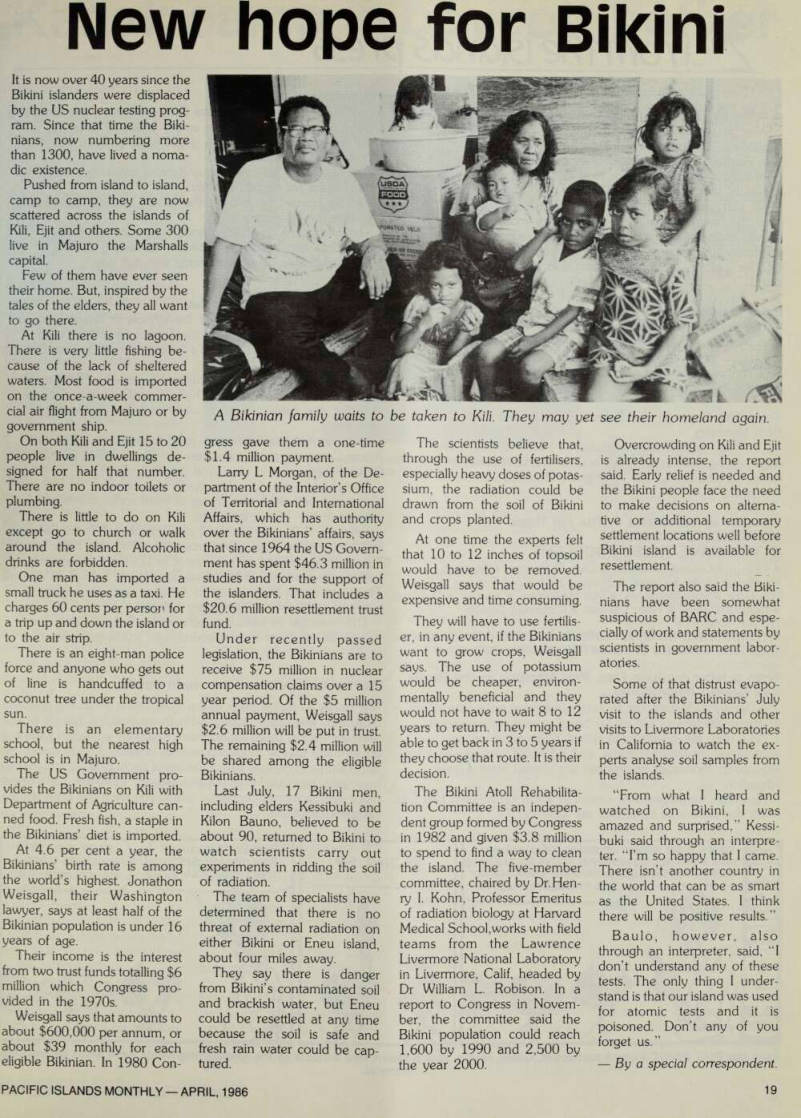
It is now over 40 years since the Bikini islanders were displaced by the US nuclear testing prog ram. Since that time the Biki nians, now numbering more than 1300, have lived a noma dic existence.
Pushed from island to island, camp to camp, they are now scattered across the islands of Kili, Ejit and others. Some 300 live in Majuro the Marshalls capital.
Few of them have ever seen their home. But, inspired by the tales of the elders, they all want to go there.
At Kili there is no lagoon.
There is very little fishing be cause of the lack of sheltered waters. Most food is imported on the once-a-week commer cial air flight from Majuro or by government ship.
On both Kili and Ejit 15 to 20 people live in dwellings de signed for half that number.
There are no indoor toilets or plumbing.
There is little to do on Kili except go to church or walk around the island. Alcoholic drinks are forbidden.
One man has imported a small truck he uses as a taxi. He charges 60 cents per person for a trip up and down the island or to the air strip.
There is an eight-man police force and anyone who gets out of line is handcuffed to a coconut tree under the tropical sun.
There is an elementary school, but the nearest high school is in Majuro.
The US Government pro vides the Bikinians on Kili with Department of Agriculture can ned food. Fresh fish, a staple in the Bikinians’ diet is imported.
At 4.6 per cent a year, the Bikinians’ birth rate is among the world’s highest. Jonathon Weisgall, their Washington lawyer, says at least half of the Bikinian population is under 16 years of age.
Their income is the interest from two trust funds totalling $6 million which Congress pro vided in the 19705.
Weisgall says that amounts to about $600,000 per annum, or about $39 monthly for each eligible Bikinian. In 1980 Con-
gress gave them a one-time $1.4 million payment.
Larry L Morgan, of the De partment of the Interior’s Office of Territorial and International Affairs, which has authority over the Bikinians’ affairs, says that since 1964 the US Govern ment has spent $46.3 million in studies and for the support of the islanders. That includes a $20.6 million resettlement trust fund.
Under recently passed legislation, the Bikinians are to receive $75 million in nuclear compensation claims over a 15 year period. Of the $5 million annual payment, Weisgall says $2.6 million will be put in trust.
The remaining $2.4 million will be shared among the eligible Bikinians.
Last July, 17 Bikini men, including elders Kessibuki and Kilon Bauno, believed to be about 90, returned to Bikini to watch scientists carry out experiments in ridding the soil of radiation.
The team of specialists have determined that there is no threat of external radiation on either Bikini or Eneu island, about four miles away.
They say there is danger from Bikini’s contaminated soil and brackish water, but Eneu could be resettled at any time because the soil is safe and fresh rain water could be cap tured.
The scientists believe that, through the use of fertilisers, especially heavy doses of potas sium, the radiation could be drawn from the soil of Bikini and crops planted.
At one time the experts felt that 10 to 12 inches of topsoil would have to be removed.
Weisgall says that would be expensive and time consuming.
They will have to use fertilis er, in any event, if the Bikinians want to grow crops, Weisgall says. The use of potassium would be cheaper, environ mentally beneficial and they would not have to wait 8 to 12 years to return. They might be able to get back in 3 to 5 years if they choose that route. It is their decision.
The Bikini Atoll Rehabilita tion Committee is an indepen dent group formed by Congress in 1982 and given $3.8 million to spend to find a way to clean the island. The five-member committee, chaired by Dr. Hen ry I. Kohn, Professor Emeritus of radiation biology at Harvard Medical School,works with field teams from the Lawrence Livermore National Laboratory in Livermore, Calif, headed by Dr William L. Robison. In a report to Congress in Novem ber, the committee said the Bikini population could reach 1,600 by 1990 and 2,500 by the year 2000.
Overcrowding on Kili and Ejit is already intense, the report said. Early relief is needed and the Bikini people face the need to make decisions on alterna tive or additional temporary settlement locations well before Bikini island is available for resettlement.
The report also said the Biki nians have been somewhat suspicious of BARC and espe cially of work and statements by scientists in government labor atories.
Some of that distrust evapo rated after the Bikinians’ July visit to the islands and other visits to Livermore Laboratories in California to watch the ex perts analyse soil samples from the islands.
“From what I heard and watched on Bikini, I was amazed and surprised,” Kessi buki said through an interpre ter. “I’m so happy that I came.
There isn’t another country in the world that can be as smart as the United States. I think there will be positive results.”
Baulo, however, also through an interpreter, said, “I don’t understand any of these tests. The only thing I under stand is that our island was used for atomic tests and it is poisoned. Don’t any of you forget us.”
By a special correspondent.
A Bikinian family waits to be taken to Kili. They may yet see their homeland again.
from the is lan press
A letter by D. S. Reynolds in The Norfolk Islander Why do we have a public holiday on Norfolk Island for Australia’s “Australia Day” holiday?
In Australia, they don’t celebrate our Foundation Day, Anniversary (Bounty) day or Norfolk Day, which are very important dates for Norfolk Island.
We can well do without an Australian holiday that indirectly costs the Norfolk Island residents a lot of money paid public holiday rates for both public and private sectors; overtime rates for those businesses that do operate; staff for plane arrivals, etc., etc., etc. all for something that is so remote from our island.
From the Papua New Guinea Post-Courier, Port Moresby.
The leader of the Japanese Youth Goodwill Cruises now in Port Moresby could not believe his eyes when he stepped off the cruise ship, Nippon Maru, yesterday.
“I cannot believe there are so many Japanese cars. Have you got Australian cars too?” Mr Nakamura asked.
From The Drum in the Papua New Guinea Post-Courier, Port Moresby The College of External Studies in Port Moresby, after experiencing numerous break and enters, lashed out and bought a padlock for the front gate. The lock was stolen the first night.
From an advertisement in The Fiji Times
No Need To Worry
If You Have These Problems
★ Fatigue ★ General Weakness ★ Lack of Stamina ★ Stomach Troubles ★ Ulcers ★ Gastric ★ Stress ★ High Blood Pressure ★ Sexual Impotence ★ Poor Hormones ★ Dull Metabolism ★ Anemia ★ Diabetes ★ Nervous Disease ★ Heart Diseases ★ Cancerous Growth.
Try with confidence
International Reputed Korean Ginseng Coming Right
FROM THE DOMAINS OF MAHATMA GUATAM BUDHA From a letter by Julie Free, Port Moresby in the Papua New Guinea Post-Courier It deeply saddened me to read your front page story (Feb. 4) about children as old as 10 being denied an education.
How dare the government spend K 23 million on an extravagant Parliament House and K 300,000 on new cars for MPs when thousands of children are denied even a basic education?
How can we expect this nation to stand on its own two feet when the citizens of tomorrow are illiterate?
From the Papua New Guinea Post-Courier, Port Moresby Pornographic magazines, an empty carton of beer, K 2 in cash, cassettes, betelnut and a guitar have all been found in cells at Beon Jail, Madang.
And yesterday jail chief Pious Kerepia suspended three top Beon officers for neglect of duty.
He has blamed the trio for the escape of eight dangerous prisoners two weeks ago.
The head of Western Province’s Ningerum jail, Kutilini Engnui, has also been suspended for selling alcohol.
All suspensions have been made with full pay.
From Tuvalu Echoes, Funafuti.
School children from one of the schools in Ames, lowa in USA who successfully located the Tuvalu hero, Mr Toma Fakapae celebrated the Tuvalu’s Independence Day on October 1, 1985.
In a letter to the Broadcasting and Information Officer, Mr Holland Panapa, Ms Suzanne Kelly, a teacher of the school said that the children were in white uniforms during the celebration.
Suzanne Kelly said that they tried to imitate a game that Peace Corps members who were on Nui in 1982 and 1983 showed them how to play local games.
The children ate cupcakes made of coconuts.
The children were also trying to learn some words and phrases in the Tuvalu language.
Suzanne Kelly also enclosed photographs of Toma Fakapae and two military men taken around in 1942. Ms Kelly told Mr Panapa that children of her school in USA are exchanging letters with students of Motufoua Secondary School at Vaitupu.
There are about 50 students in America who are having pen-pals at Motufoua Secondary School.
The Principal of Motufoua school, Mr Pafini Nouata has helped the students to correspond with students in America.
From some islands of the North Pacific...
Not strictly from the press of the islands with which we normally deal, but, assuredly, dealing with those amazing islands of the northern Pacific, called Japan: From a recently-published page in a government gazette recording recently-registered trade marks. Mr lan D.Burt was granted use of the name Sachi Bukuro, which may be roughly translated from the Japanese as “lucky bag,” as a brand name for the money purses he sells which are made from tanned kangaroo scrotums.
How the PNG Post-Courier’s cartoonist, Grass Roots, saw a report that schools in the Eastern Highlands were short of teaching material.
Kanak camp in boycott bother
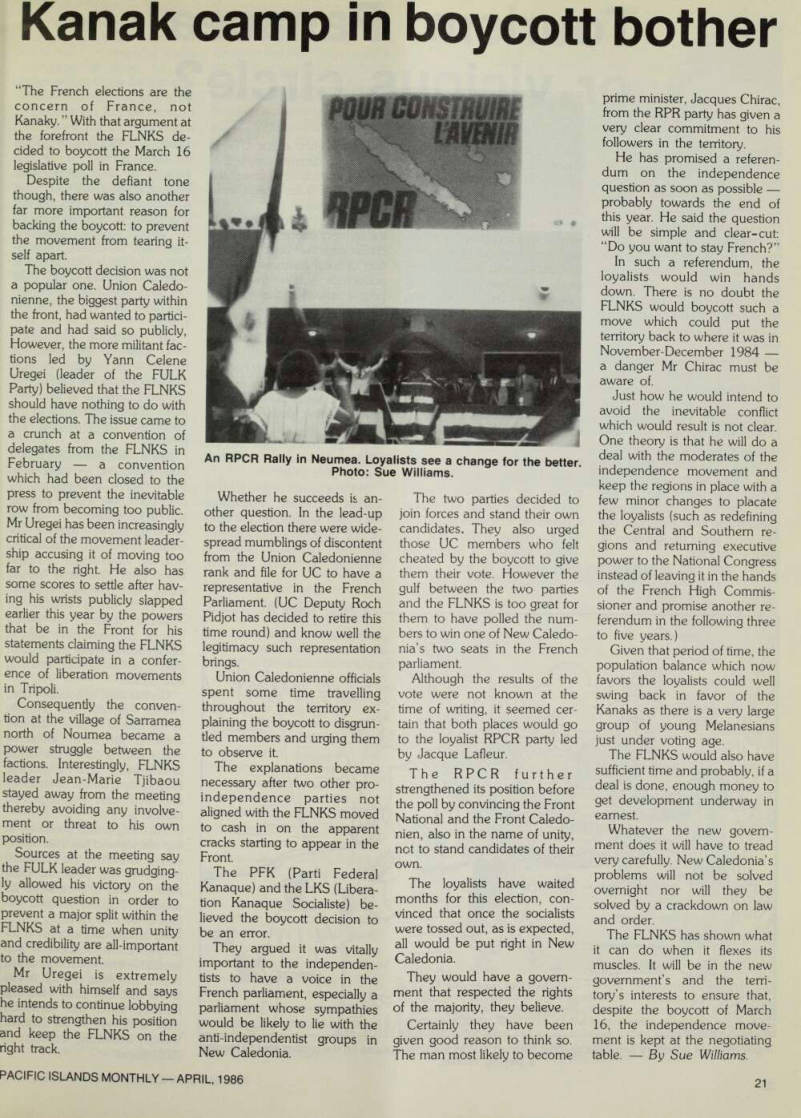
“The French elections are the concern of France, not Kanaky. ” With that argument at the forefront the FLNKS de cided to boycott the March 16 legislative poll in France.
Despite the defiant tone though, there was also another far more important reason for backing the boycott: to prevent the movement from tearing it self apart.
The boycott decision was not a popular one. Union Caledo nienne, the biggest party within the front, had wanted to partici pate and had said so publicly, However, the more militant fac tions led by Yann Celene Uregei (leader of the FULK Party) believed that the FLNKS should have nothing to do with the elections. The issue came to a crunch at a convention of delegates from the FLNKS in February a convention which had been closed to the press to prevent the inevitable row from becoming too public.
Mr Uregei has been increasingly critical of the movement leader ship accusing it of moving too far to the right. He also has some scores to settle after hav ing his wrists publicly slapped earlier this year by the powers that be in the Front for his statements claiming the FLNKS would participate in a confer ence of liberation movements in Tripoli.
Consequently the conven tion at the village of Sarramea north of Noumea became a power struggle between the factions. Interestingly, FLNKS leader Jean-Marie Tjibaou stayed away from the meeting thereby avoiding any involve ment or threat to his own position.
Sources at the meeting say the FULK leader was grudging ly allowed his victory on the boycott question in order to prevent a major split within the FLNKS at a time when unity and credibility are all-important to the movement.
Mr Uregei is extremely pleased with himself and says he intends to continue lobbying hard to strengthen his position and keep the FLNKS on the right track.
Whether he succeeds is an other question. In the lead-up to the election there were wide spread mumblings of discontent from the Union Caledonienne rank and file for UC to have a representative in the French Parliament. (UC Deputy Roch Pidjot has decided to retire this time round) and know well the legitimacy such representation brings.
Union Caledonienne officials spent some time travelling throughout the territory ex plaining the boycott to disgrun tled members and urging them to observe it.
The explanations became necessary after two other pro independence parties not aligned with the FLNKS moved to cash in on the apparent cracks starting to appear in the Front.
The PFK (Parti Federal Kanaque) and the LKS (Libera tion Kanaque Socialiste) be lieved the boycott decision to be an error.
They argued it was vitally important to the independen tists to have a voice in the French parliament, especially a parliament whose sympathies would be likely to lie with the anti-independentist groups in New Caledonia.
The two parties decided to join forces and stand their own candidates. They also urged those UC members who felt cheated by the boycott to give them their vote. However the gulf between the two parties and the FLNKS is too great for them to have polled the num bers to win one of New Caledo nia’s two seats in the French parliament.
Although the results of the vote were not known at the time of writing, it seemed cer tain that both places would go to the loyalist RFCR party led by Jacque Lafleur.
The RFCR further strengthened its position before the poll by convincing the Front National and the Front Caledo nien, also in the name of unity, not to stand candidates of their own.
The loyalists have waited months for this election, con vinced that once the socialists were tossed out, as is expected, all would be put right in New Caledonia.
They would have a govern ment that respected the rights of the majority, they believe.
Certainly they have been given good reason to think so.
The man most likely to become
prime minister, Jacques Chirac, from the RPR party has given a very clear commitment to his followers in the territory.
He has promised a referen dum on the independence question as soon as possible probably towards the end of this year. He said the question will be simple and clear-cut: “Do you want to stay French?”
In such a referendum, the loyalists would win hands down. There is no doubt the FLNKS would boycott such a move which could put the territory back to where it was in November-December 1984 a danger Mr Chirac must be aware of.
Just how he would intend to avoid the inevitable conflict which would result is not clear.
One theory is that he will do a deal with the moderates of the independence movement and keep the regions in place with a few minor changes to placate the loyalists (such as redefining the Central and Southern re gions and returning executive power to the National Congress instead of leaving it in the hands of the French High Commis sioner and promise another re ferendum in the following three to five years.) Given that period of time, the population balance which now favors the loyalists could well swing back in favor of the Kanaks as there is a very large group of young Melanesians just under voting age.
The FLNKS would also have sufficient time and probably, if a deal is done, enough money to get development underway in earnest.
Whatever the new govern ment does it will have to tread very carefully. New Caledonia’s problems will not be solved overnight nor will they be solved by a crackdown on law and order.
The FLNKS has shown what it can do when it flexes its muscles. It will be in the new government’s and the terri tory’s interests to ensure that, despite the boycott of March 16, the independence move ment is kept at the negotiating
table.
By Sue Williams.
An RPCR Rally in Neumea. Loyalists see a change for the better.
Photo: Sue Williams.
Tourism: Panacea
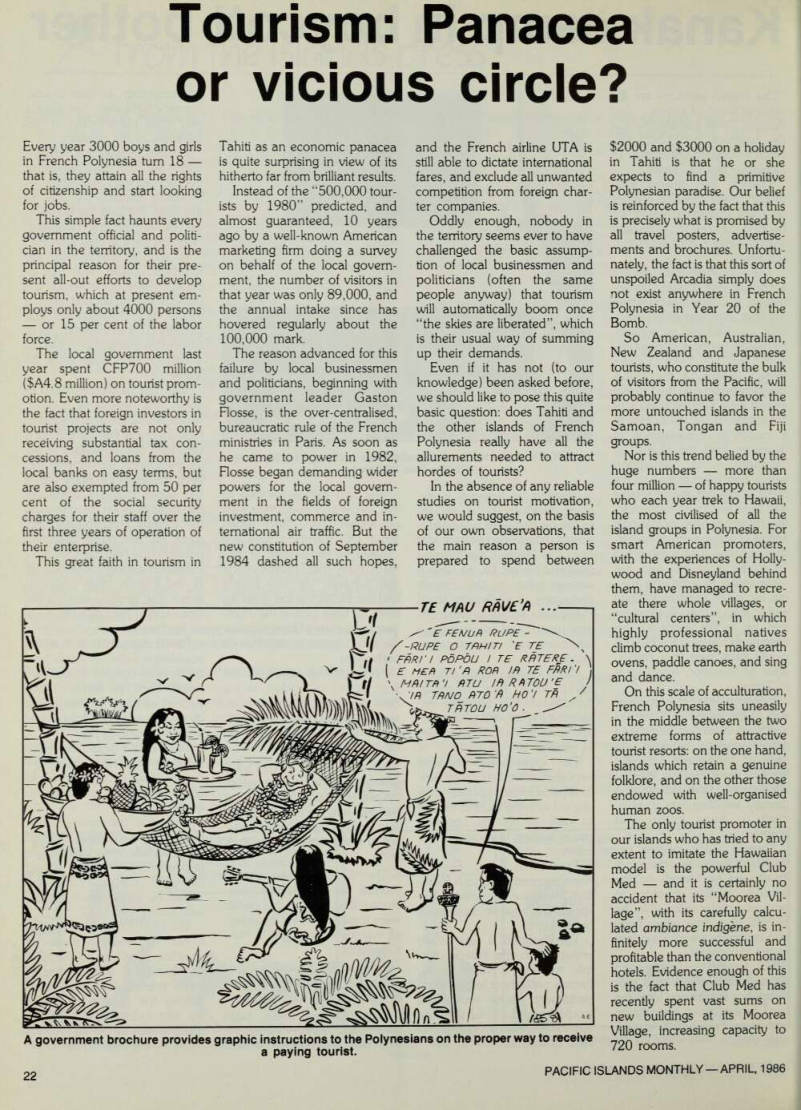
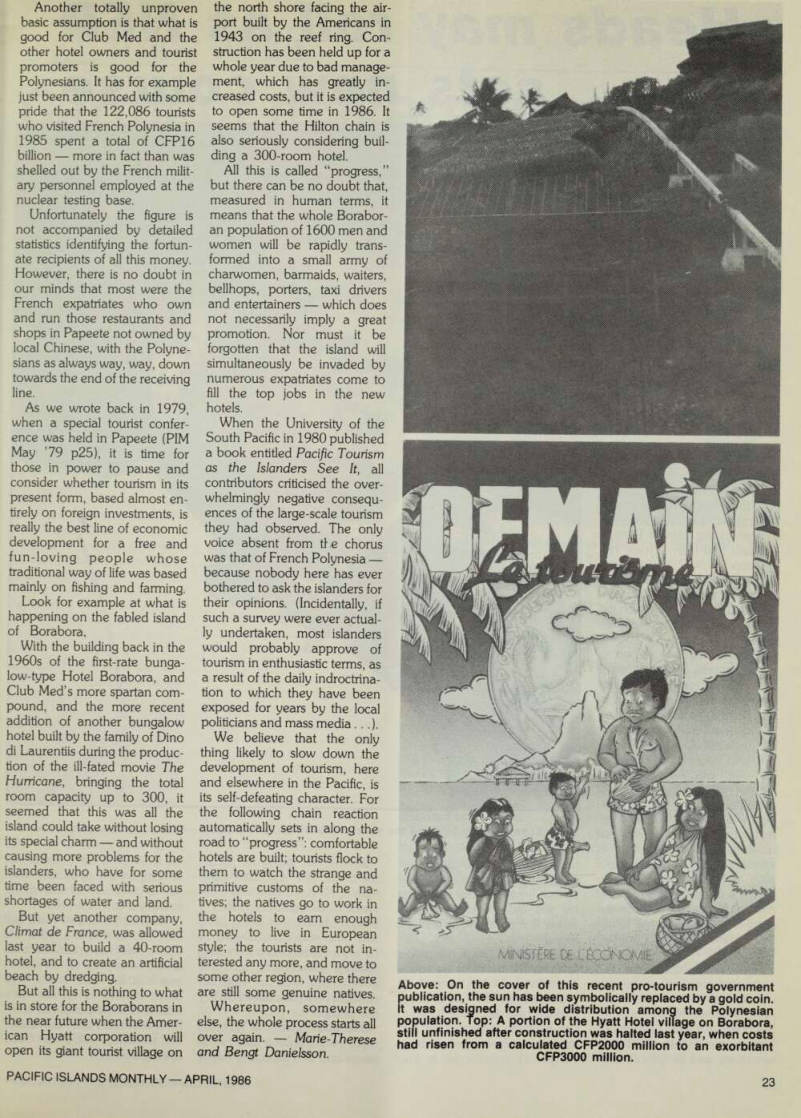
or vicious circle?
Every year 3000 boys and girls in French Polynesia turn 18 that is, they attain all the rights of citizenship and start looking for jobs.
This simple fact haunts every government official and politi cian in the territory, and is the principal reason for their pre sent all-out efforts to develop tourism, which at present em ploys only about 4000 persons or 15 per cent of the labor force.
The local government last year spent CFP7OO million (SA4.B million) on tourist prom otion. Even more noteworthy is the fact that foreign investors in tourist projects are not only receiving substantial tax con cessions, and loans from the local banks on easy terms, but are also exempted from 50 per cent of the social security charges for their staff over the first three years of operation of their enterprise.
This great faith in tourism in
Tahiti as an economic panacea is quite surprising in view of its hitherto far from brilliant results.
Instead of the “500,000 tour ists by 1980” predicted, and almost guaranteed, 10 years ago by a well-known American marketing firm doing a survey on behalf of the local govern ment, the number of visitors in that year was only 89,000, and the annual intake since has hovered regularly about the 100,000 mark.
The reason advanced for this failure by local businessmen and politicians, beginning with government leader Gaston Flosse, is the over-centralised, bureaucratic rule of the French ministries in Paris. As soon as he came to power in 1982, Flosse began demanding wider powers for the local govern ment in the fields of foreign investment, commerce and in ternational air traffic. But the new constitution of September 1984 dashed all such hopes,
and the French airline UTA is still able to dictate international fares, and exclude all unwanted competition from foreign char ter companies.
Oddly enough, nobody in the territory seems ever to have challenged the basic assump tion of local businessmen and politicians (often the same people anyway) that tourism will automatically boom once “the skies are liberated”, which is their usual way of summing up their demands.
Even if it has not (to our knowledge) been asked before, we should like to pose this quite basic question: does Tahiti and the other islands of French Polynesia really have all the allurements needed to attract hordes of tourists?
In the absence of any reliable studies on tourist motivation, we would suggest, on the basis of our own observations, that the main reason a person is prepared to spend between
$2OOO and $3OOO on a holiday in Tahiti is that he or she expects to find a primitive Polynesian paradise. Our belief is reinforced by the fact that this is precisely what is promised by all travel posters, advertise ments and brochures. Unfortu nately, the fact is that this sort of unspoiled Arcadia simply does not exist anywhere in French Polynesia in Year 20 of the Bomb.
So American, Australian, New Zealand and Japanese tourists, who constitute the bulk of visitors from the Pacific, will probably continue to favor the more untouched islands in the Samoan, Tongan and Fiji groups.
Nor is this trend belied by the huge numbers more than four million of happy tourists who each year trek to Hawaii, the most civilised of all the island groups in Polynesia. For smart American promoters, with the experiences of Holly wood and Disneyland behind them, have managed to recre ate there whole villages, or “cultural centers”, in which highly professional natives climb coconut trees, make earth ovens, paddle canoes, and sing and dance.
On this scale of acculturation, French Polynesia sits uneasily in the middle between the two extreme forms of attractive tourist resorts: on the one hand, islands which retain a genuine folklore, and on the other those endowed with well-organised human zoos.
The only tourist promoter in our islands who has tried to any extent to imitate the Hawaiian model is the powerful Club Med and it is certainly no accident that its “Moorea Vil lage”, with its carefully calcu lated ambiance indigene, is in finitely more successful and profitable than the conventional hotels. Evidence enough of this is the fact that Club Med has recently spent vast sums on new buildings at its Moorea Village, increasing capacity to 720 rooms.
A government brochure provides graphic instructions to the Polynesians on the proper way to receive a paying tourist.
Another totally unproven basic assumption is that what is good for Club Med and the other hotel owners and tourist promoters is good for the Polynesians. It has for example just been announced with some pride that the 122,086 tourists who visited French Polynesia in 1985 spent a total of CFPI6 billion more in fact than was shelled out by the French milit ary personnel employed at the nuclear testing base.
Unfortunately the figure is not accompanied by detailed statistics identifying the fortun ate recipients of all this money.
However, there is no doubt in our minds that most were the French expatriates who own and run those restaurants and shops in Papeete not owned by local Chinese, with the Polyne sians as always way, way, down towards the end of the receiving line.
As we wrote back in 1979, when a special tourist confer ence was held in Papeete (PIM May ’79 p 25), it is time for those in power to pause and consider whether tourism in its present form, based almost en tirely on foreign investments, is really the best line of economic development for a free and fun-loving people whose traditional way of life was based mainly on fishing and farming.
Look for example at what is happening on the fabled island of Borabora.
With the building back in the
1960 s of the first-rate bunga
low-type Hotel Borabora, and Club Med’s more spartan com pound, and the more recent addition of another bungalow hotel built by the family of Dino di Laurentiis during the produc tion of the ill-fated movie The Hurricane, bringing the total room capacity up to 300, it seemed that this was all the island could take without losing its special charm and without causing more problems for the islanders, who have for some time been faced with serious shortages of water and land.
But yet another company, Climat de France, was allowed last year to build a 40-room hotel, and to create an artificial beach by dredging.
But all this is nothing to what is in store for the Boraborans in the near future when the Amer ican Hyatt corporation will open its giant tourist village on
the north shore facing the air port built by the Americans in 1943 on the reef ring. Con struction has been held up for a whole year due to bad manage ment, which has greatly in creased costs, but it is expected to open some time in 1986. It seems that the Hilton chain is also seriously considering buil ding a 300-room hotel.
All this is called “progress,” but there can be no doubt that, measured in human terms, it means that the whole Borabor an population of 1600 men and women will be rapidly trans formed into a small army of charwomen, barmaids, waiters, bellhops, porters, taxi drivers and entertainers which does not necessarily imply a great promotion. Nor must it be forgotten that the island will simultaneously be invaded by numerous expatriates come to fill the top jobs in the new hotels.
When the University of the South Pacific in 1980 published a book entitled Pacific Tourism as the Islanders See It, all contributors criticised the over whelmingly negative consequ ences of the large-scale tourism they had observed. The only voice absent from the chorus was that of French Polynesia because nobody here has ever bothered to ask the islanders for their opinions. (Incidentally, if such a survey were ever actual ly undertaken, most islanders would probably approve of tourism in enthusiastic terms, as a result of the daily indroctrina tion to which they have been exposed for years by the local politicians and mass media ...).
We believe that the only thing likely to slow down the development of tourism, here and elsewhere in the Pacific, is its self-defeating character. For the following chain reaction automatically sets in along the road to “progress”: comfortable hotels are built; tourists flock to them to watch the strange and primitive customs of the na tives; the natives go to work in the hotels to earn enough money to live in European style; the tourists are not in terested any more, and move to some other region, where there are still some genuine natives.
Whereupon, somewhere else, the whole process starts all over again. Marie-Therese and Bengt Danielsson.
Above: On the cover of this recent pro-tourism government publication, the sun has been symbolically replaced by a gold coin.
It was designed for wide distribution among the Polynesian population. Top: A portion of the Hyatt Hotel village on Borabora, still unfinished after construction was halted last year, when costs had risen from a calculated CFP2000 million to an exorbitant CFP3000 million.
Heads may roll as NFP
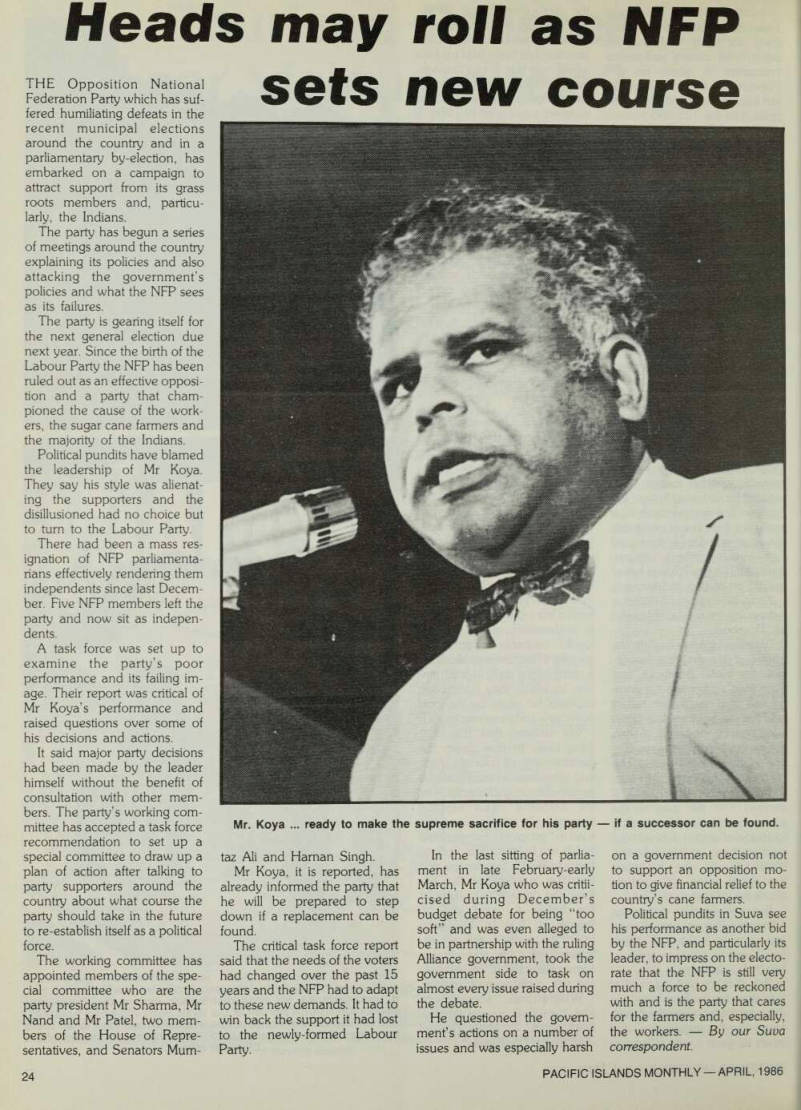
sets new course
THE Opposition National Federation Party which has suf fered humiliating defeats in the recent municipal elections around the country and in a parliamentary by-election, has embarked on a campaign to attract support from its grass roots members and, particu larly, the Indians.
The party has begun a series of meetings around the country explaining its policies and also attacking the government’s policies and what the NFP sees as its failures.
The party is gearing itself for the next general election due next year. Since the birth of the Labour Party the NFP has been ruled out as an effective opposi tion and a party that cham pioned the cause of the work ers, the sugar cane farmers and the majority of the Indians.
Political pundits have blamed the leadership of Mr Koya.
They say his style was alienat ing the supporters and the disillusioned had no choice but to turn to the Labour Party.
There had been a mass res ignation of NFP parliamenta rians effectively rendering them independents since last Decem ber. Five NFP members left the party and now sit as indepen dents.
A task force was set up to examine the party’s poor performance and its failing im age. Their report was critical of Mr Koya’s performance and raised questions over some of his decisions and actions.
It said major party decisions had been made by the leader himself without the benefit of consultation with other mem bers. The party’s working com mittee has accepted a task force recommendation to set up a special committee to draw up a plan of action after talking to party supporters around the country about what course the party should take in the future to re-establish itself as a political force.
The working committee has appointed members of the spe cial committee who are the party president Mr Sharma, Mr Nand and Mr Patel, two mem bers of the House of Repre sentatives, and Senators Mum-
taz Ali and Harnan Singh.
Mr Koya, it is reported, has already informed the party that he will be prepared to step down if a replacement can be found.
The critical task force report said that the needs of the voters had changed over the past 15 years and the NFP had to adapt to these new demands. It had to win back the support it had lost to the newly-formed Labour Party.
In the last sitting of parlia ment in late February-early March, Mr Koya who was critii cised during December’s budget debate for being “too soft” and was even alleged to be in partnership with the ruling Alliance government, took the government side to task on almost every issue raised during the debate.
He questioned the govern ment’s actions on a number of issues and was especially harsh
on a government decision not to support an opposition mo tion to give financial relief to the country’s cane farmers.
Political pundits in Suva see his performance as another bid by the NFP, and particularly its leader, to impress on the electo rate that the NFP is still very much a force to be reckoned with and is the party that cares for the farmers and, especially, the workers. By our Suva correspondent.
Mr. Koya ... ready to make the supreme sacrifice for his party if a successor can be found.
Garment makers close ranks
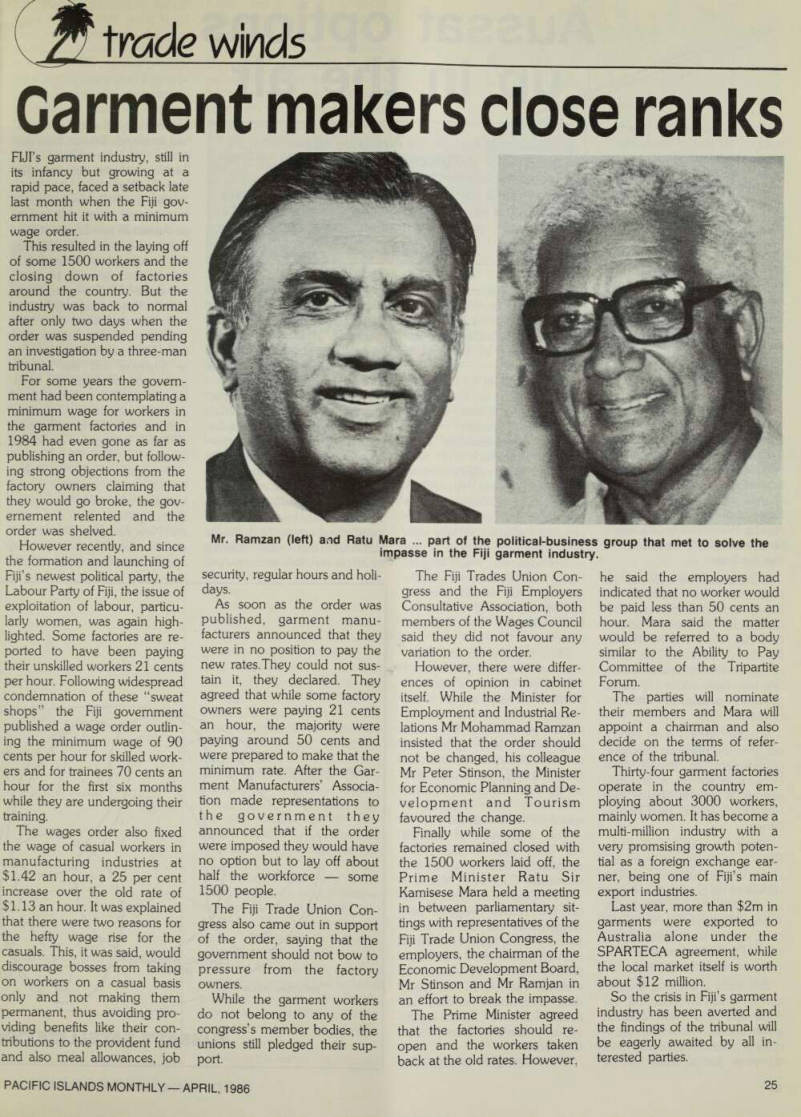
trade wields
Fiji’s garment industry, still in its infancy but growing at a rapid pace, faced a setback late last month when the Fiji gov ernment hit it with a minimum wage order.
This resulted in the laying off of some 1500 workers and the closing down of factories around the country. But the industry was back to normal after only two days when the order was suspended pending an investigation by a three-man tribunal.
For some years the govern ment had been contemplating a minimum wage for workers in the garment factories and in 1984 had even gone as far as publishing an order, but follow ing strong objections from the factory owners claiming that they would go broke, the gov ernement relented and the order was shelved.
However recently, and since the formation and launching of Fiji’s newest political party, the Labour Party of Fiji, the issue of exploitation of labour, particu larly women, was again high lighted. Some factories are re ported to have been paying their unskilled workers 21 cents per hour. Following widespread condemnation of these “sweat shops” the Fiji government published a wage order outlin ing the minimum wage of 90 cents per hour for skilled work ers and for trainees 70 cents an hour for the first six months while they are undergoing their training.
The wages order also fixed the wage of casual workers in manufacturing industries at $1.42 an hour, a 25 per cent increase over the old rate of $1.13 an hour. It was explained that there were two reasons for the hefty wage rise for the casuals. This, it was said, would discourage bosses from taking on workers on a casual basis only and not making them permanent, thus avoiding pro viding benefits like their con tributions to the provident fund and also meal allowances, job
security, regular hours and holi days.
As soon as the order was published, garment manu facturers announced that they were in no position to pay the new rates. They could not sus tain it, they declared. They agreed that while some factory owners were paying 21 cents an hour, the majority were paying around 50 cents and were prepared to make that the minimum rate. After the Gar ment Manufacturers’ Associa tion made representations to the government they announced that if the order were imposed they would have no option but to lay off about half the workforce some 1500 people.
The Fiji Trade Union Con gress also came out in support of the order, saying that the government should not bow to pressure from the factory owners.
While the garment workers do not belong to any of the congress’s member bodies, the unions still pledged their sup port.
The Fiji Trades Union Con gress and the Fiji Employers Consultative Association, both members of the Wages Council said they did not favour any variation to the order.
However, there were differ ences of opinion in cabinet itself. While the Minister for Employment and Industrial Re lations Mr Mohammad Ramzan insisted that the order should not be changed, his colleague Mr Peter Stinson, the Minister for Economic Planning and De velopment and Tourism favoured the change.
Finally while some of the factories remained closed with the 1500 workers laid off, the Prime Minister Ratu Sir Kamisese Mara held a meeting in between parliamentary sit tings with representatives of the Fiji Trade Union Congress, the employers, the chairman of the Economic Development Board, Mr Stinson and Mr Ramjan in an effort to break the impasse.
The Prime Minister agreed that the factories should re open and the workers taken back at the old rates. However,
he said the employers had indicated that no worker would be paid less than 50 cents an hour. Mara said the matter would be referred to a body similar to the Ability to Pay Committee of the Tripartite Forum.
The parties will nominate their members and Mara will appoint a chairman and also decide on the terms of refer ence of the tribunal.
Thirty-four garment factories operate in the country em ploying about 3000 workers, mainly women. It has become a multi-million industry with a very promsising growth poten tial as a foreign exchange ear ner, being one of Fiji’s main export industries.
Last year, more than s2m in garments were exported to Australia alone under the SFARTECA agreement, while the local market itself is worth about $l2 million.
So the crisis in Fiji’s garment industry has been averted and the findings of the tribunal will be eagerly awaited by all in terested parties.
Mr. Ramzan (left) and Ratu Mara ... part of the political-business group that met to solve the impasse in the Fiji garment industry.
Aussat options
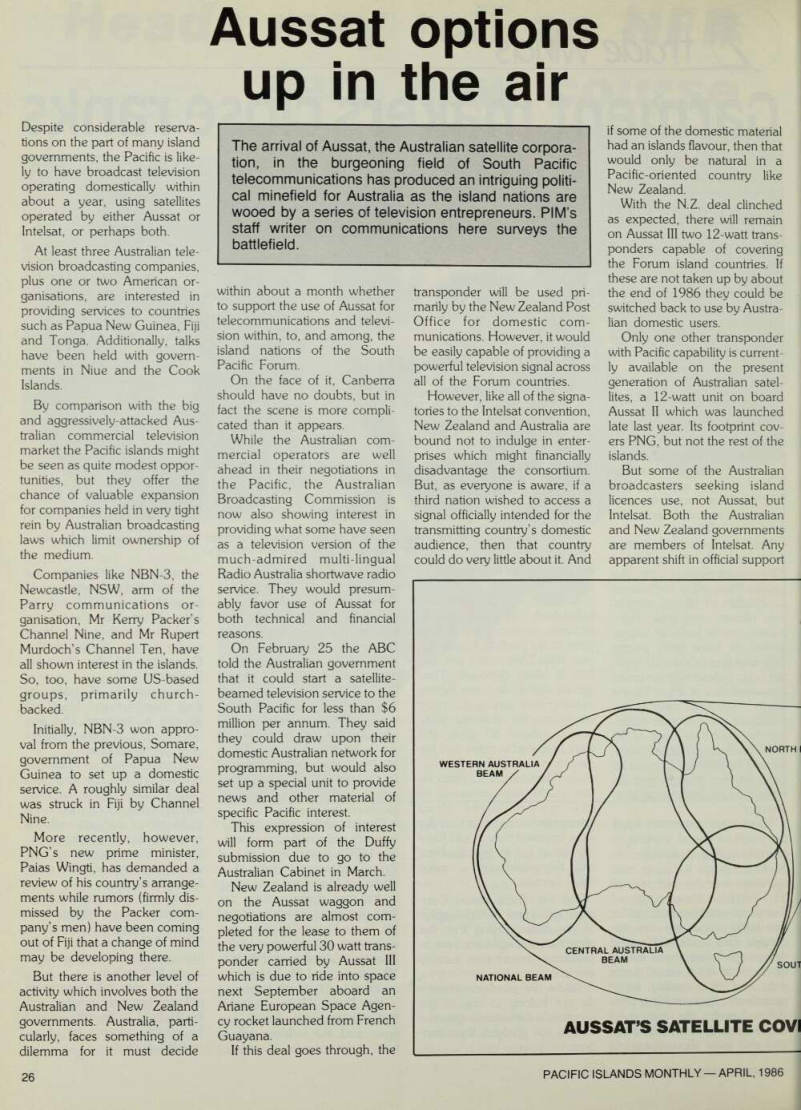
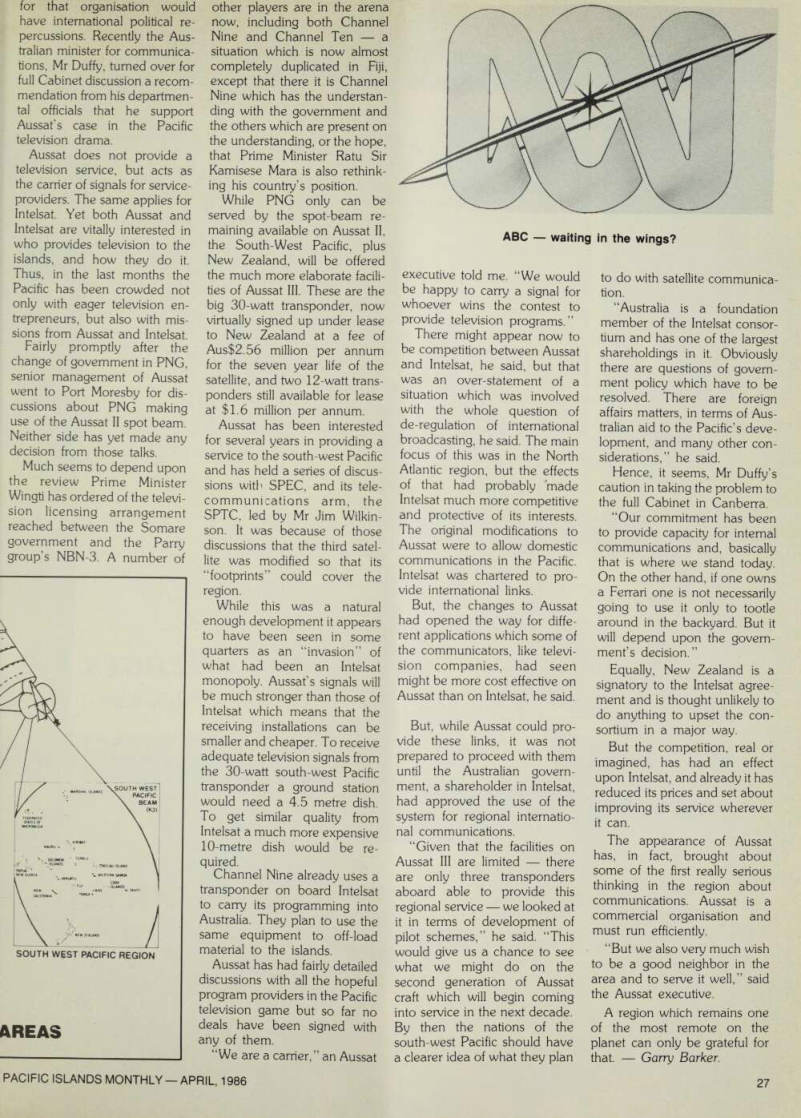
up in the air
Despite considerable reserva tions on the part of many island governments, the Pacific is like ly to have broadcast television operating domestically within about a year, using satellites operated by either Aussat or Intelsat, or perhaps both.
At least three Australian tele vision broadcasting companies, plus one or two American or ganisations, are interested in providing services to countries such as Papua New Guinea, Fiji and Tonga. Additionally, talks have been held with govern ments in Niue and the Cook Islands.
By comparison with the big and aggressively-attacked Aus tralian commercial television market the Pacific islands might be seen as quite modest oppor tunities, but they offer the chance of valuable expansion for companies held in very tight rein by Australian broadcasting laws which limit ownership of the medium.
Companies like NBN-3, the Newcastle, NSW, arm of the Parry communications or ganisation, Mr Kerry Packer’s Channel Nine, and Mr Rupert Murdoch’s Channel Ten, have all shown interest in the islands.
So, too, have some US-based groups, primarily church backed.
Initially, NBN-3 won appro val from the previous, Somare, government of Papua New Guinea to set up a domestic service. A roughly similar deal was struck in Fiji by Channel Nine.
More recently, however, PNG’s new prime minister, Paias Wingti, has demanded a review of his country’s arrange ments while rumors (firmly dis missed by the Packer com pany’s men) have been coming out of Fiji that a change of mind may be developing there.
But there is another level of activity which involves both the Australian and New Zealand governments. Australia, parti cularly, faces something of a dilemma for it must decide
The arrival of Aussat, the Australian satellite corpora tion, in the burgeoning field of South Pacific telecommunications has produced an intriguing politi cal minefield for Australia as the island nations are wooed by a series of television entrepreneurs. PlM’s staff writer on communications here surveys the battlefield.
within about a month whether to support the use of Aussat for telecommunications and televi sion within, to, and among, the island nations of the South Pacific Forum.
On the face of it, Canberra should have no doubts, but in fact the scene is more compli cated than it appears.
While the Australian com mercial operators are well ahead in their negotiations in the Pacific, the Australian Broadcasting Commission is now also showing interest in providing what some have seen as a television version of the much-admired multi-lingual Radio Australia shortwave radio service. They would presum ably favor use of Aussat for both technical and financial reasons.
On February 25 the ABC told the Australian government that it could start a satellite beamed television service to the South Pacific for less than $6 million per annum. They said they could draw upon their domestic Australian network for programming, but would also set up a special unit to provide news and other material of specific Pacific interest.
This expression of interest will form part of the Duffy submission due to go to the Australian Cabinet in March.
New Zealand is already well on the Aussat waggon and negotiations are almost com pleted for the lease to them of the very powerful 30 watt trans ponder carried by Aussat 111 which is due to ride into space next September aboard an Ariane European Space Agen cy rocket launched from French Guayana.
If this deal goes through, the
transponder will be used pri marily by the New Zealand Post Office for domestic com munications. However, it would be easily capable of providing a powerful television signal across all of the Forum countries.
However, like all of the signa tories to the Intelsat convention, New Zealand and Australia are bound not to indulge in enter prises which might financially disadvantage the consortium.
But, as everyone is aware, if a third nation wished to access a signal officially intended for the transmitting country’s domestic audience, then that country could do very little about it. And
if some of the domestic material had an islands flavour, then that would only be natural in a Pacific-oriented country like New Zealand.
With the N.Z. deal clinched as expected, there will remain on Aussat 111 two 12-watt trans ponders capable of covering the Forum island countries. If these are not taken up by about the end of 1986 they could be switched back to use by Austra lian domestic users.
Only one other transponder with Pacific capability is current ly available on the present generation of Australian satel lites, a 12-watt unit on board Aussat II which was launched late last year. Its footprint cov ers PNG, but not the rest of the islands.
But some of the Australian broadcasters seeking island licences use, not Aussat, but Intelsat. Both the Australian and New Zealand governments are members of Intelsat. Any apparent shift in official support
for that organisation would have international political re percussions. Recently the Aus tralian minister for communica tions, Mr Duffy, turned over for full Cabinet discussion a recom mendation from his departmen tal officials that he support Aussat’s case in the Pacific television drama.
Aussat does not provide a television service, but acts as the carrier of signals for service providers. The same applies for Intelsat. Yet both Aussat and Intelsat are vitally interested in who provides television to the islands, and how they do it.
Thus, in the last months the Pacific has been crowded not only with eager television en trepreneurs, but also with mis sions from Aussat and Intelsat.
Fairly promptly after the change of government in PNG, senior management of Aussat went to Port Moresby for dis cussions about PNG making use of the Aussat II spot beam.
Neither side has yet made any decision from those talks.
Much seems to depend upon the review Prime Minister Wingti has ordered of the televi sion licensing arrangement reached between the Somare government and the Parry group’s NBN-3. A number of
other players are in the arena now, including both Channel Nine and Channel Ten a situation which is now almost completely duplicated in Fiji, except that there it is Channel Nine which has the understan ding with the government and the others which are present on the understanding, or the hope, that Prime Minister Ratu Sir Kamisese Mara is also rethink ing his country’s position.
While PNG only can be served by the spot-beam re maining available on Aussat 11, the South-West Pacific, plus New Zealand, will be offered the much more elaborate facili ties of Aussat 111. These are the big 30-watt transponder, now virtually signed up under lease to New Zealand at a fee of Auss2.s6 million per annum for the seven year life of the satellite, and two 12-watt trans ponders still available for lease at $1.6 million per annum.
Aussat has been interested for several years in providing a service to the south-west Pacific and has held a series of discus sions with SPEC, and its tele communications arm, the SPTC, led by Mr Jim Wilkin son. It was because of those discussions that the third satel lite was modified so that its “footprints” could cover the region.
While this was a natural enough development it appears to have been seen in some quarters as an “invasion” of what had been an Intelsat monopoly. Aussat’s signals will be much stronger than those of Intelsat which means that the receiving installations can be smaller and cheaper. To receive adequate television signals from the 30-watt south-west Pacific transponder a ground station would need a 4.5 metre dish.
To get similar quality from Intelsat a much more expensive 10-metre dish would be re quired.
Channel Nine already uses a transponder on board Intelsat to carry its programming into Australia. They plan to use the same equipment to off-load material to the islands.
Aussat has had fairly detailed discussions with all the hopeful program providers in the Pacific television game but so far no deals have been signed with any of them.
“We are a carrier,” an Aussat
executive told me. “We would be happy to carry a signal for whoever wins the contest to provide television programs.”
There might appear now to be competition between Aussat and Intelsat, he said, but that was an over-statement of a situation which was involved with the whole question of de-regulation of international broadcasting, he said. The main focus of this was in the North Atlantic region, but the effects of that had probably "made Intelsat much more competitive and protective of its interests.
The original modifications to Aussat were to allow domestic communications in the Pacific.
Intelsat was chartered to pro vide international links.
But, the changes to Aussat had opened the way for diffe rent applications which some of the communicators, like televi sion companies, had seen might be more cost effective on Aussat than on Intelsat, he said.
But, while Aussat could pro vide these links, it was not prepared to proceed with them until the Australian govern ment, a shareholder in Intelsat, had approved the use of the system for regional internatio nal communications.
“Given that the facilities on Aussat 111 are limited there are only three transponders aboard able to provide this regional service we looked at it in terms of development of pilot schemes,” he said. “This would give us a chance to see what we might do on the second generation of Aussat craft which will begin coming into service in the next decade.
By then the nations of the south-west Pacific should have a clearer idea of what they plan
to do with satellite communica tion.
“Australia is a foundation member of the Intelsat consor tium and has one of the largest
shareholdings in it. Obviously
there are questions of govern ment policy which have to be resolved. There are foreign affairs matters, in terms of Aus tralian aid to the Pacific’s deve lopment, and many other con siderations, ” he said.
Hence, it seems, Mr Duffy’s caution in taking the problem to the full Cabinet in Canberra.
“Our commitment has been to provide capacity for internal communications and, basically that is where we stand today.
On the other hand, if one owns a Ferrari one is not necessarily going to use it only to tootle around in the backyard. But it will depend upon the govern ment’s decision.”
Equally, New Zealand is a signatory to the Intelsat agree ment and is thought unlikely to do anything to upset the con sortium in a major way.
But the competition, real or imagined, has had an effect upon Intelsat, and already it has reduced its prices and set about improving its service wherever it can.
The appearance of Aussat has, in fact, brought about some of the first really serious thinking in the region about communications. Aussat is a commercial organisation and must run efficiently.
“But we also very much wish to be a good neighbor in the area and to serve it well,” said the Aussat executive.
A region which remains one of the most remote on the planet can only be grateful for
that.
Garry Barker.
ABC waiting in the wings?
Advertisements & other items, p. 28 (1 item)
Ben so\ wd Hedges
(\m I) SB r M
TRADfTiONALLY THE NAME
ASSOCIATED WITH PERFECTION
IN CIGARETTES
BENSON & HEDGES
20
Ben so\ wd Hedges
WARNING-SMOKING IS A HEALTH HAZARD
7* #•» r ll*
Chan puts brake on spending
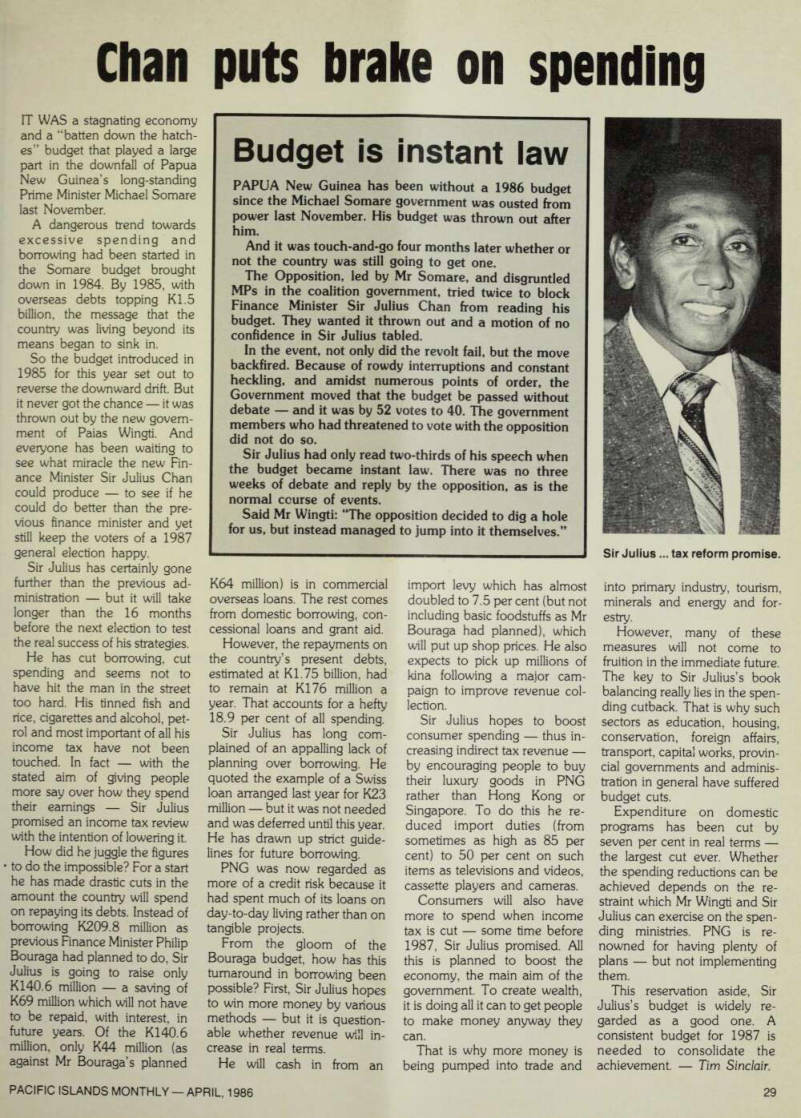
IT WAS a stagnating economy and a “batten down the hatch es” budget that played a large part in the downfall of Papua New Guinea’s long-standing Prime Minister Michael Somare last November.
A dangerous trend towards excessive spending and borrowing had been started in the Somare budget brought down in 1984. By 1985, with overseas debts topping K 1.5 billion, the message that the country was living beyond its means began to sink in.
So the budget introduced in 1985 for this year set out to reverse the downward drift. But it never got the chance it was thrown out by the new govern ment of Paias Wingti. And everyone has been waiting to see what miracle the new Fin ance Minister Sir Julius Chan could produce to see if he could do better than the pre vious finance minister and yet still keep the voters of a 1987 general election happy.
Sir Julius has certainly gone further than the previous ad ministration but it will take longer than the 16 months before the next election to test the real success of his strategies.
He has cut borrowing, cut spending and seems not to have hit the man in the street too hard. His tinned fish and rice, cigarettes and alcohol, pet rol and most important of all his income tax have not been touched. In fact with the stated aim of giving people more say over how they spend their earnings Sir Julius promised an income tax review with the intention of lowering it.
How did he juggle the figures to do the impossible? For a start he has made drastic cuts in the amount the country will spend on repaying its debts. Instead of borrowing K 209.8 million as previous Finance Minister Philip Bouraga had planned to do, Sir Julius is going to raise only K 140.6 million a saving of K 69 million which will not have to be repaid, with interest, in future years. Of the K 140.6 million, only K 44 million (as against Mr Bouraga’s planned
K 64 million) is in commercial overseas loans. The rest comes from domestic borrowing, con cessional loans and grant aid.
However, the repayments on the country’s present debts, estimated at K 1.75 billion, had to remain at K 176 million a year. That accounts for a hefty 18.9 per cent of all spending.
Sir Julius has long com plained of an appalling lack of planning over borrowing. He quoted the example of a Swiss loan arranged last year for K 23 million but it was not needed and was deferred until this year.
He has drawn up strict guide lines for future borrowing.
PNG was now regarded as more of a credit risk because it had spent much of its loans on day-to-day living rather than on tangible projects.
From the gloom of the Bouraga budget, how has this turnaround in borrowing been possible? First, Sir Julius hopes to win more money by various methods but it is question able whether revenue will in crease in real terms.
He will cash in from an
import levy which has almost doubled to 7.5 per cent (but not including basic foodstuffs as Mr Bouraga had planned), which will put up shop prices. He also expects to pick up millions of kina following a major cam paign to improve revenue col lection.
Sir Julius hopes to boost consumer spending thus in creasing indirect tax revenue by encouraging people to buy their luxury goods in PNG rather than Hong Kong or Singapore. To do this he re duced import duties (from sometimes as high as 85 per cent) to 50 per cent on such items as televisions and videos, cassette players and cameras.
Consumers will also have more to spend when income tax is cut some time before 1987, Sir Julius promised. All this is planned to boost the economy, the main aim of the government. To create wealth, it is doing all it can to get people to make money anyway they can.
That is why more money is being pumped into trade and
into primary industry, tourism, minerals and energy and for estry.
However, many of these measures will not come to fruition in the immediate future.
The key to Sir Julius’s book balancing really lies in the spen ding cutback. That is why such sectors as education, housing, conservation, foreign affairs, transport, capital works, provin cial governments and adminis tration in general have suffered budget cuts.
Expenditure on domestic programs has been cut by seven per cent in real terms the largest cut ever. Whether the spending reductions can be achieved depends on the re straint which Mr Wingti and Sir Julius can exercise on the spen ding ministries. PNG is re nowned for having plenty of plans but not implementing them.
This reservation aside, Sir Julius’s budget is widely re garded as a good one. A consistent budget for 1987 is needed to consolidate the
achievement.
Tim Sinclair.
Sir Julius ... tax reform promise.
Budget is instant law
PAPUA New Guinea has been without a 1986 budget since the Michael Somare government was ousted from power last November. His budget was thrown out after him.
And it was touch-and-go four months later whether or not the country was still going to get one.
The Opposition, led by Mr Somare, and disgruntled MPs in the coalition government, tried twice to block Finance Minister Sir Julius Chan from reading his budget. They wanted it thrown out and a motion of no confidence in Sir Julius tabled.
In the event, not only did the revolt fail, but the move backfired. Because of rowdy interruptions and constant heckling, and amidst numerous points of order, the Government moved that the budget be passed without debate and it was by 52 votes to 40. The government members who had threatened to vote with the opposition did not do so.
Sir Julius had only read two-thirds of his speech when the budget became instant law. There was no three weeks of debate and reply by the opposition, as is the normal course of events.
Said Mr Wingti: “The opposition decided to dig a hole for us, but instead managed to jump into it themselves,”
Advertisements & other items, pp. 30-31 (1 item)
Pacific Should He Built
- i •, • V *' £4S WD Regulac Cab, Long. Wheelbase
TOYOTA THINKS
GARS ANDTRUGKS DRIVEN IN I
PACIFIC SHOULD HE BUILT
FOR THE PACIFIC
TOYOTA
QUALITY SERVICE
AMERICAN SAMOA: BURNS PHILP (SOUTH SEA) CO., LTD., P.O. Box 129, Pago Pago.
COOK ISLANDS: COOK ISLANDS TRADING
CORPORATION LTD., Private Bag. Rarotonga.
FLU: AUTOMOTIVE SUPPLIES COMPANY, A Division of Burns Philp (South Sea) Co., Ltd., G.P.O. Box 355, Suva.
GUAM & MICRONESIA: ATKINS KROLL, INC., 443 South Marine Drive, Tamuning.
KIRIBATI: TARAWA MOTORS. A Division of Bairiki Holdings Ltd., P.O. Box 36, Bairiki, Tarawa.
NAURU: NAURU COOPERATIVE SOCIETY, Central Pa
NEW CALEDONIA: SERVICE IMPORTATION
AUTOMOBILE DU PACIFIQUE, Rond-Point du Pacifiq (Station Total) B.P. 438, Noumea.
NORFOLK ISLAND: BORRY’S LIMITED, P.O. Box 16 PAPUA NEW GUINEA: ELA MOTORS, A Division of Burns Philp (PNG) Ltd., P.O. Box 75, Port Moresby.
SAIPAN: MICROL CORPORATION, P.O. Box 267, Sai|
All onr cars and tracks have special Pacific Island features.
■Mf L
uz uty suspension For instance, Toyota Hilux trucks are outfitted with extra-heavy-duty shocks and reinforced suspension.
And cars like Toyota Corolla receive special engine underplating, and a suspension modified to give addec road clearance.
Meanwhile, we make additional use of special galvanealed steel in both our cars and trucks to help prevent corrosion.
And, of course, like cars and trucks we build for the rest of the world, those for the Pacific benefit from comprehensive testing and thorough quality control.
It’s all part of our effort to create high-quality, highly reliable cars and trucks.
Specifically for you. And specifically for the places you drive. Areas where galvanealed steel is used
HILUX
• Crown • Cressida • Corona • Corolla • Starlet • Dyna • Hiace • Liteace • Coaster • Stout • Hilux 4X2/ 4x4 • Land Cruiser • Heavy Duty Truck
LOMON ISLANDS: SOLOMON ISLANDS
ESTMENTS LTD., G.P.O. Box 174, Honiara.
IITI; NIPPON AUTOMOTO. B.P. 342, Papeete.
*GA; BURNS PHILP (SOUTH SEA) CO., LTD., P.O. 55, Nuku’alofa. lUATU: VANUATU MOTORS, A Division of Burns p (Vanuatu) Ltd., P.O. Box 18, Port Vila.
STERN SAMOA: BURNS PHILP (SOUTH SEA) CO ..P.O. Box 188. Apia.
TOYOTA
media heavyweights

Wingti shuts out the media heavyweights
The Papua New Guinea Prime Minister is not a “box watcher. ”
And as yet he certainly does not reckon his three million countrymen can afford to be come television addicts.
But in the past few moths, he has had to put up with a barrage of lobbying from high powered media organisations each vying to grab the PNG TV broadcasting market.
Last month, Mr Wingti angri ly cut short a meeting with “market place” TV group Media Niugini, when he realised representatives of Ker ry Packer’s media team were present.
Up to eight TV companies, including Rupert Murdoch’s Channel Ten, have been mak ing representations to the PNG Government. There have also been concerted campaigns by satellite interests including Aus tralia’s AUSSAT, the worldwide Intelsat and America’s Pacstar
But no more.
Tired of representatives beat ing a path to his door, he has firmly shut it and put the whole matter in the hands of a public inquiry.
Unlike the previous Somare government which was hur riedly pushing to get TV on the air, issuing licences before there was statutory control Wingti reckons that TV is a prestigious luxury the country can ill afford, especially as the deteriorating radio service is in desperate need of improvement.
Mr Wingti has elevated his communications ministry in the Cabinet pecking order, demon strating the value he places on controlling communications, which he sees as an important tool to promote national deve lopment. And radio is one of the best ways to reach the majority of his people who live far from urban amenities.
But in taking his stand, Wing ti has had to contend with the independent statutory body, the Post and Telecommunica tions Board, which has different ideas. Its deputy chairman, Catholic priest Fr Danny Coyle, has been waging a lengthy publicity campaign, preaching the gospel of the “cheap rate”
Pacstar.
In fact all the recent TV lobbying has been going on while the PTC had already signed an agreement with the American corporation TRT in January 1985 to use its Pacstar satellite for PNG com munications. Fr Coyle is a member of the Pacstar board of directors.
But as far as Mr Wingti’s government is concerned, Pac star is still only one of the options open to it. His Com munications Minister’s bid to assert control over the indepen dent-minded PTC has led to a
court battle over attempts to dismiss board members.
Now a public inquiry will set out to establish a policy to regulate broadcasting for the next 20 years, said Com munications Minister Mr Gab riel Ramoi.
It will look into whether the present Acts of Parliament are adequate to cover TV broad casting, which body should control it, how it should be financed, whether there should be advertising and if so how much and how many channels there should be and which
would best suit PNG.
Tim
Sinclair.
Wingti ... not a “box watcher”.
Advertisements & other items, p. 32 (1 item)
The Total Test Equipment Solution
AWA
m ■ marconiA_ instruments Tfektronix r O 1
HITACHI
Iflukel
Ell
Paydirt in the islands
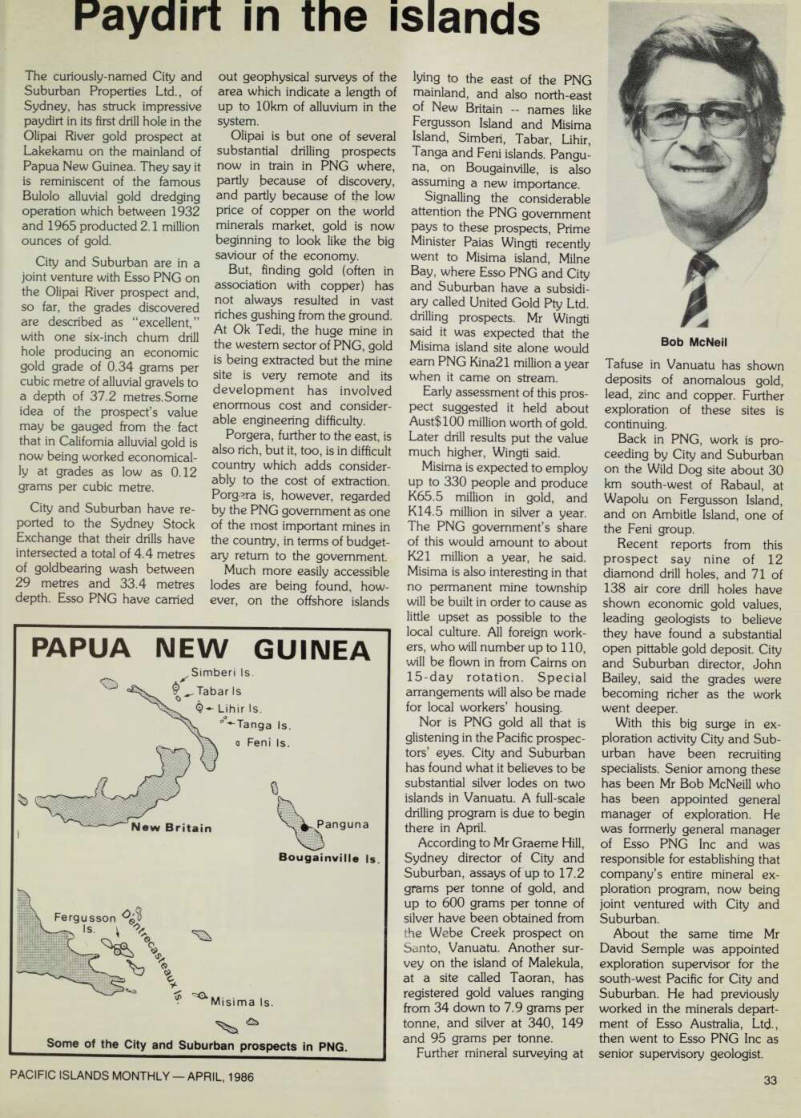
The curiously-named City and Suburban Properties Ltd., of Sydney, has struck impressive paydirt in its first drill hole in the Olipai River gold prospect at Lakekamu on the mainland of Papua New Guinea. They say it is reminiscent of the famous Bulolo alluvial gold dredging operation which between 1932 and 1965 producted 2.1 million ounces of gold.
City and Suburban are in a joint venture with Esso PNG on the Olipai River prospect and, so far, the grades discovered are described as “excellent,” with one six-inch chum drill hole producing an economic gold grade of 0.34 grams per cubic metre of alluvial gravels to a depth of 37.2 metres. Some idea of the prospect’s value may be gauged from the fact that in California alluvial gold is now being worked economical ly at grades as low as 0.12 grams per cubic metre.
City and Suburban have re ported to the Sydney Stock Exchange that their drills have intersected a total of 4.4 metres of goldbearing wash between 29 metres and 33.4 metres depth. Esso PNG have carried
out geophysical surveys of the area which indicate a length of up to 10km of alluvium in the system.
Olipai is but one of several substantial drilling prospects now in train in PNG where, partly because of discovery, and partly because of the low price of copper on the world minerals market, gold is now beginning to look like the big saviour of the economy.
But, finding gold (often in association with copper) has not always resulted in vast riches gushing from the ground.
At Ok Tedi, the huge mine in the western sector of PNG, gold is being extracted but the mine site is very remote and its development has involved enormous cost and consider able engineering difficulty.
Porgera, further to the east, is also rich, but it, too, is in difficult country which adds consider ably to the cost of extraction.
Porgera is, however, regarded by the PNG government as one of the most important mines in the country, in terms of budget ary return to the government.
Much more easily accessible lodes are being found, how ever, on the offshore islands
lying to the east of the PNG mainland, and also north-east of New Britain names like Fergusson Island and Misima Island, Simberi, Tabar, Lihir, Tanga and Feni islands. Pangu na, on Bougainville, is also assuming a new importance.
Signalling the considerable attention the PNG government pays to these prospects, Prime Minister Paias Wingti recently went to Misima island, Milne Bay, where Esso PNG and City and Suburban have a subsidi ary called United Gold Pty Ltd. drilling prospects. Mr Wingti said it was expected that the Misima island site alone would earn PNG Kina2l million a year when it came on stream.
Early assessment of this pros pect suggested it held about Austsloo million worth of gold.
Later drill results put the value much higher, Wingti said.
Misima is expected to employ up to 330 people and produce K 65.5 million in gold, and K 14.5 million in silver a year.
The PNG government’s share of this would amount to about K2l million a year, he said.
Misima is also interesting in that no permanent mine township will be built in order to cause as little upset as possible to the local culture. All foreign work ers, who will number up to 110, will be flown in from Cairns on 15-day rotation. Special arrangements will also be made for local workers’ housing.
Nor is PNG gold all that is glistening in the Pacific prospec tors’ eyes. City and Suburban has found what it believes to be substantial silver lodes on two islands in Vanuatu. A full-scale drilling program is due to begin there in April.
According to Mr Graeme Hill, Sydney director of City and Suburban, assays of up to 17.2 grams per tonne of gold, and up to 600 grams per tonne of silver have been obtained from the Webe Creek prospect on Santo, Vanuatu. Another sur vey on the island of Malekula, at a site called Taoran, has registered gold values ranging from 34 down to 7.9 grams per tonne, and silver at 340, 149 and 95 grams per tonne.
Further mineral surveying at
Tafuse in Vanuatu has shown deposits of anomalous gold, lead, zinc and copper. Further exploration of these sites is continuing.
Back in PNG, work is pro ceeding by City and Suburban on the Wild Dog site about 30 km south-west of Rabaul, at Wapolu on Fergusson Island, and on Ambitle Island, one of the Feni group.
Recent reports from this prospect say nine of 12 diamond drill holes, and 71 of 138 air core drill holes have shown economic gold values, leading geologists to believe they have found a substantial open pittable gold deposit. City and Suburban director, John Bailey, said the grades were becoming richer as the work went deeper.
With this big surge in ex ploration activity City and Sub urban have been recruiting specialists. Senior among these has been Mr Bob McNeill who has been appointed general manager of exploration. He was formerly general manager of Esso PNG Inc and was responsible for establishing that company’s entire mineral ex ploration program, now being joint ventured with City and Suburban.
About the same time Mr David Semple was appointed exploration supervisor for the south-west Pacific for City and Suburban. He had previously worked in the minerals depart ment of Esso Australia, Ltd., then went to Esso PNG Inc as senior supervisory geologist.
Bob McNeil
Advertisements & other items, pp. 33-34 (2 items)
Papua New Guinea
Some of the City and Suburban prospects in PNG.
Aiwa*
IN i Every system in AlWA’s S.P.A.N. lineup delivers the dynamic impact and delicate sound expression of digital audio.
That's because every system is equipped with AlWA’s DX-770 digital audio Compact Disc player. From the top-of-the-line V-1200 series to simple systems that please budgetminded music lovers.
And. synchro-recording from the CD player or any other source, wireless remote control, auto function selection, double speed dubbing from tape to tape, and programmable record, tape, and CD playback are just a few of the many features available in AlWA’s S.P.A.N. lineup. So why wait for the future in audio? Enjoy it today with AIWA.
n COMPACT
mm
DIGITAL AUDIO
H Hi B High-performance S.P.A.N. component system
V-120KH
AIWA*
UWA Australia Pty., Ltd 14 Gertrude St., Arncliffe. N.S.W. Australia 2205 AUSTRALIA PHONE: (597) 2388/Oceania Indent Agency (P.N.G ) Ply.. Ltd Ago St Jew Guinea PHONE: 256411/The Sound Centre Ltd P.O. Box 434 Port Vila, Vanuatu PHONE: 2035/P. Hargovlnd Bros 190 Renwick Road P.O. Box >ons Limited P.O, box 91 Sigatoka Fiji PHONE; 50158/Milaw Trading Co., Ltd 224-236 Hobson Street, P.O. Box 5919, Auckland, New Zealand Phone; )3^175^ OX J?: nL 269 Paoeete Joumea, New Caledonia PHONE; 27.24.66/Harvest Pacific Limited P.O. Box 517. Honiara. Solomon Islands PHONE, 131/FareHi-F. Stereo Rue d p u n Ma^^ ahiti Phone: 2-4814/Micropac Audio, Inc. P.O. Box 3478 Agana, Guam 96910 PHONE; 472-8091,472-8297/Rarotonga Duty Free Shop Private Bag P.O. Box 92. Rarotonga. Cook Island/Nauru )o-Operative Society Republic of Nauru
Niue: Is TV the answer, or has
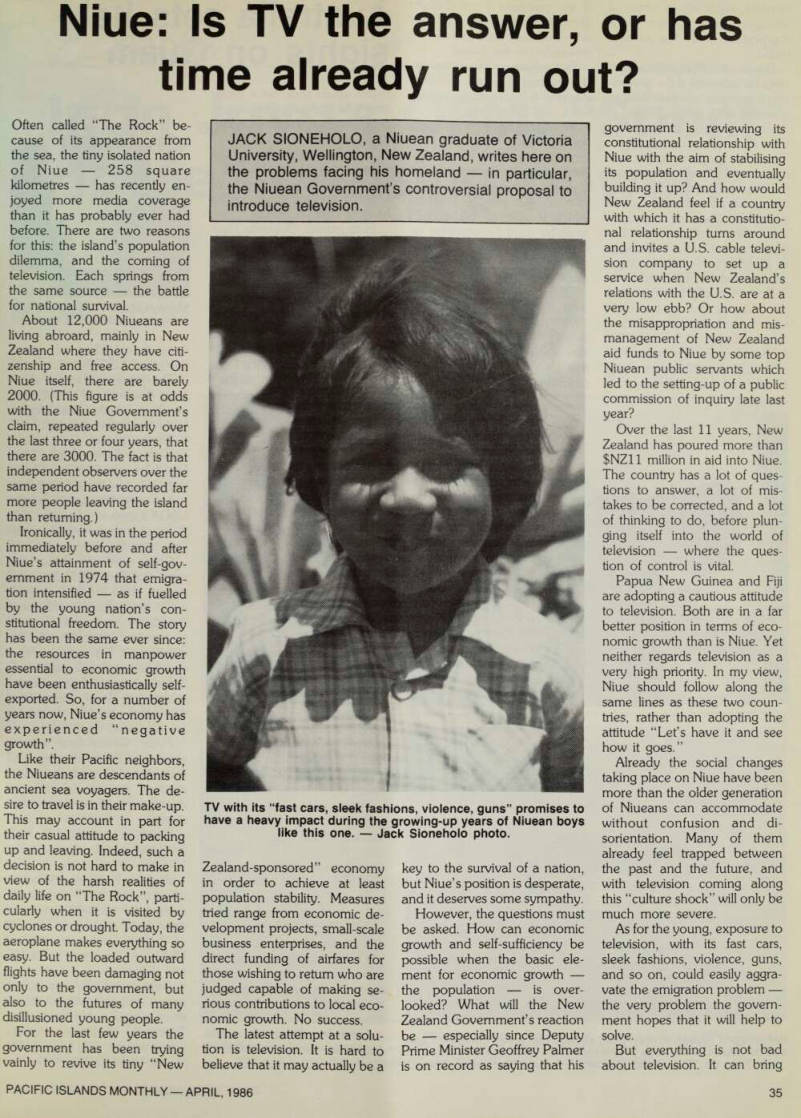
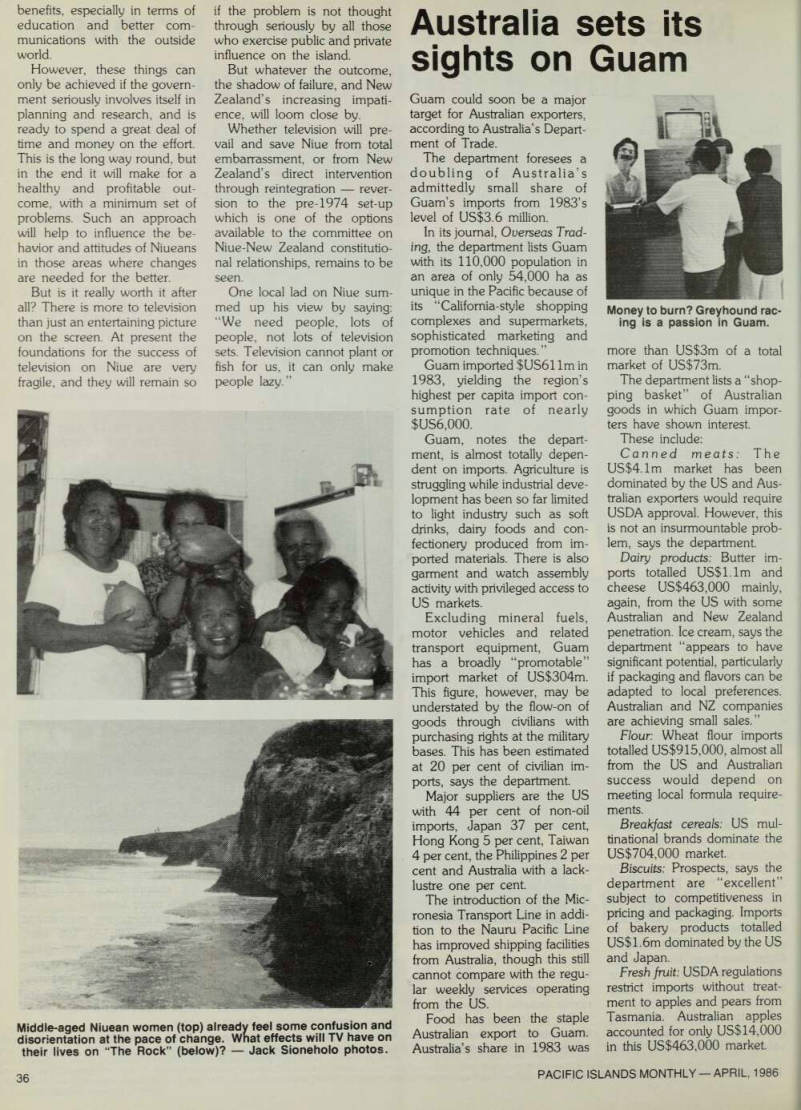
time already run out?
Often called “The Rock” be cause of its appearance from the sea, the tiny isolated nation of Niue 258 square kilometres has recently en joyed more media coverage than it has probably ever had before. There are two reasons for this: the island’s population dilemma, and the coming of television. Each springs from the same source the battle for national survival.
About 12,000 Niueans are living abroard, mainly in New Zealand where they have citi zenship and free access. On Niue itself, there are barely 2000. (This figure is at odds with the Niue Government’s claim, repeated regularly over the last three or four years, that there are 3000. The fact is that independent observers over the same period have recorded far more people leaving the island than returning.) Ironically, it was in the period immediately before and after Niue’s attainment of self-gov ernment in 1974 that emigra tion intensified as if fuelled by the young nation’s con stitutional freedom. The story has been the same ever since: the resources in manpower essential to economic growth have been enthusiastically self exported. So, for a number of years now, Niue’s economy has experienced “negative growth”.
Like their Pacific neighbors, the Niueans are descendants of ancient sea voyagers. The de sire to travel is in their make-up.
This may account in part for their casual attitude to packing up and leaving. Indeed, such a decision is not hard to make in view of the harsh realities of daily life on “The Rock”, parti cularly when it is visited by cyclones or drought. Today, the aeroplane makes everything so easy. But the loaded outward flights have been damaging not only to the government, but also to the futures of many disillusioned young people.
For the last few years the government has been trying vainly to revive its tiny “New
JACK SIONEHOLO, a Niuean graduate of Victoria University, Wellington, New Zealand, writes here on the problems facing his homeland in particular, the Niuean Government’s controversial proposal to introduce television.
Zealand-sponsored” economy in order to achieve at least population stability. Measures tried range from economic de velopment projects, small-scale business enterprises, and the direct funding of airfares for those wishing to return who are judged capable of making se rious contributions to local eco nomic growth. No success.
The latest attempt at a solu tion is television. It is hard to believe that it may actually be a
key to the survival of a nation, but Niue’s position is desperate, and it deserves some sympathy.
However, the questions must be asked. How can economic growth and self-sufficiency be possible when the basic ele ment for economic growth the population is over looked? What will the New Zealand Government’s reaction be especially since Deputy Prime Minister Geoffrey Palmer is on record as saying that his
government is reviewing its constitutional relationship with Niue with the aim of stabilising its population and eventually building it up? And how would New Zealand feel if a country with which it has a constitutio nal relationship turns around and invites a U.S. cable televi sion company to set up a service when New Zealand’s relations with the U.S. are at a very low ebb? Or how about the misappropriation and mis management of New Zealand aid funds to Niue by some top Niuean public servants which led to the setting-up of a public commission of inquiry late last year?
Over the last 11 years, New Zealand has poured more than SNZII million in aid into Niue.
The country has a lot of ques tions to answer, a lot of mis takes to be corrected, and a lot of thinking to do, before plun ging itself into the world of television where the ques tion of control is vital.
Papua New Guinea and Fiji are adopting a cautious attitude to television. Both are in a far better position in terms of eco nomic growth than is Niue. Yet neither regards television as a very high priority. In my view, Niue should follow along the same lines as these two coun tries, rather than adopting the attitude “Let’s have it and see how it goes.”
Already the social changes taking place on Niue have been more than the older generation of Niueans can accommodate without confusion and di sorientation. Many of them already feel trapped between the past and the future, and with television coming along this “culture shock” will only be much more severe.
As for the young, exposure to television, with its fast cars, sleek fashions, violence, guns, and so on, could easily aggra vate the emigration problem the very problem the govern ment hopes that it will help to solve.
But everything is not bad about television. It can bring
TV with its “fast cars, sleek fashions, violence, guns” promises to have a heavy impact during the growing-up years of Niuean boys like this one. Jack Sioneholo photo.
benefits, especially in terms of education and better com munications with the outside world.
However, these things can only be achieved if the govern ment seriously involves itself in planning and research, and is ready to spend a great deal of time and money on the effort.
This is the long way round, but in the end it will make for a healthy and profitable out come, with a minimum set of problems. Such an approach will help to influence the be havior and attitudes of Niueans in those areas where changes are needed for the better.
But is it really worth it after all? There is more to television than just an entertaining picture on the screen. At present the foundations for the success of television on Niue are very fragile, and they will remain so
if the problem is not thought through seriously by all those who exercise public and private influence on the island.
But whatever the outcome, the shadow of failure, and New Zealand’s increasing impati ence, will loom close by.
Whether television will pre vail and save Niue from total embarrassment, or from New Zealand’s direct intervention through reintegration rever sion to the pre-1974 set-up which is one of the options available to the committee on Niue-New Zealand constitutio nal relationships, remains to be seen.
One local lad on Niue sum med up his view by saying: “We need people, lots of people, not lots of television sets. Television cannot plant or fish for us, it can only make people lazy.”
Australia sets its sights on Guam
Guam could soon be a major target for Australian exporters, according to Australia’s Depart ment of Trade.
The department foresees a doubling of Australia’s admittedly small share of Guam’s imports from 1983’s level of US$3.6 million.
In its journal, Overseas Trad ing, the department lists Guam with its 110,000 population in an area of only 54,000 ha as unique in the Pacific because of its “ Califomia-style shopping complexes and supermarkets, sophisticated marketing and promotion techniques.”
Guam imported SUS6IIm in 1983, yielding the region’s highest per capita import con sumption rate of nearly
Sus6,Ooo.
Guam, notes the depart ment, is almost totally depen dent on imports. Agriculture is struggling while industrial deve lopment has been so far limited to light industry such as soft drinks, dairy foods and con fectionery produced from im ported materials. There is also garment and watch assembly activity with privileged access to US markets.
Excluding mineral fuels, motor vehicles and related transport equipment, Guam has a broadly “promotable” import market of USs3o4m.
This figure, however, may be understated by the flow-on of goods through civilians with purchasing rights at the military bases. This has been estimated at 20 per cent of civilian im ports, says the department.
Major suppliers are the US with 44 per cent of non-oil imports, Japan 37 per cent, Hong Kong 5 per cent, Taiwan 4 per cent, the Philippines 2 per cent and Australia with a lack lustre one per cent.
The introduction of the Mic ronesia Transport Line in addi tion to the Nauru Pacific Line has improved shipping facilities from Australia, though this still cannot compare with the regu lar weekly services operating from the US.
Food has been the staple Australian export to Guam.
Australia’s share in 1983 was
more than USs3m of a total market of USs73m.
The department lists a “shop ping basket” of Australian goods in which Guam impor ters have shown interest.
These include: Canned meats: The USs4.lm market has been dominated by the US and Aus tralian exporters would require USDA approval. However, this is not an insurmountable prob lem, says the department.
Daily products: Butter im ports totalled USsl.lm and cheese U 55463,000 mainly, again, from the US with some Australian and New Zealand penetration. Ice cream, says the department “appears to have significant potential, particularly if packaging and flavors can be adapted to local preferences.
Australian and NZ companies are achieving small sales.”
Flour: Wheat flour imports totalled U 55915,000, almost all from the US and Australian success would depend on meeting local formula require ments.
Breakfast cereals: US mul tinational brands dominate the U 55704,000 market.
Biscuits: Prospects, says the department are “excellent” subject to competitiveness in pricing and packaging. Imports of bakery products totalled USsl.6m dominated by the US and Japan.
Fresh fruit: USDA regulations restrict imports without treat ment to apples and pears from Tasmania. Australian apples accounted for only US$l4,OOO in this U 55463,000 market.
Middle-aged Niuean women (top) already feel some confusion and disorientation at the pace of change. What effects will TV have on their lives on “The Rock” (below)? Jack Sioneholo photos.
Money to burn? Greyhound rac ing is a passion in Guam.
Irian Jaya’s OPM: “Spent
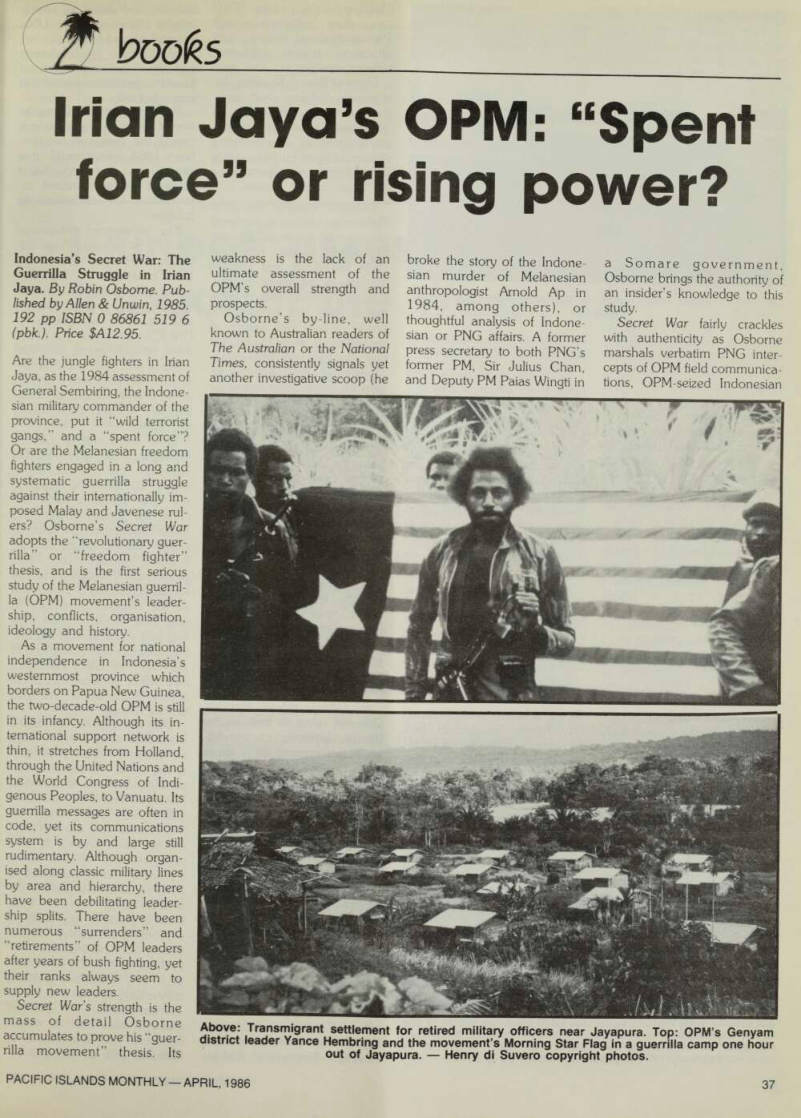
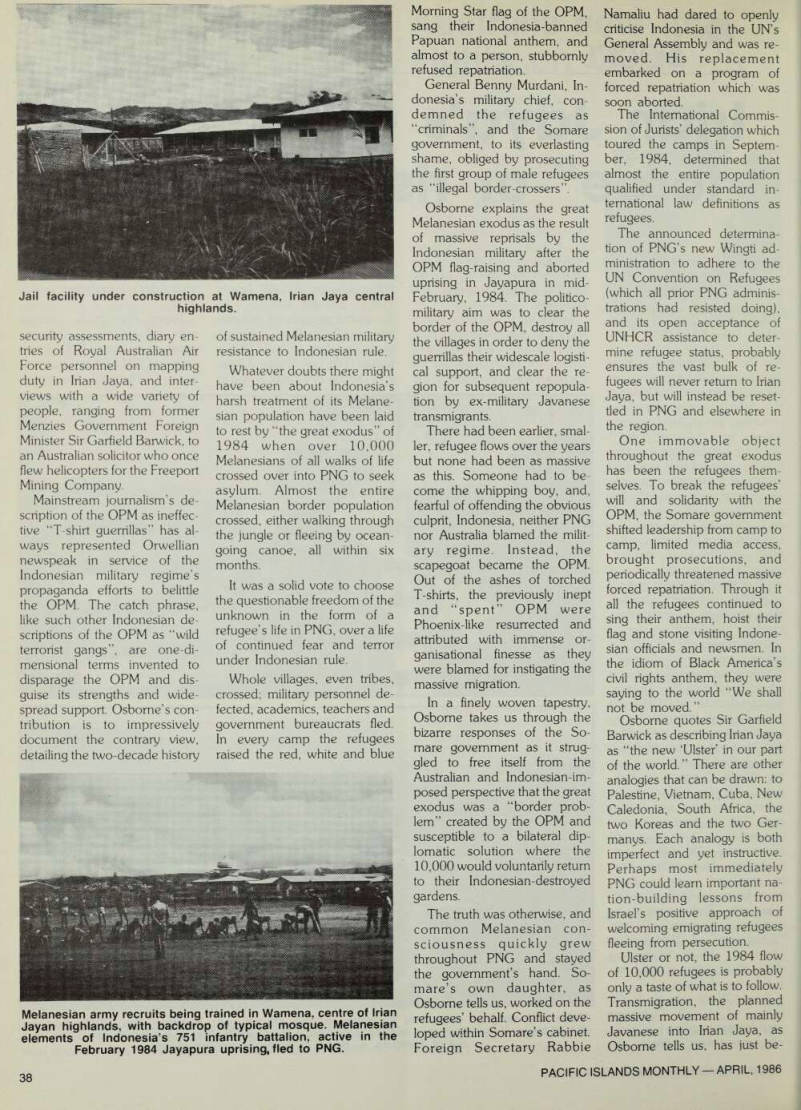
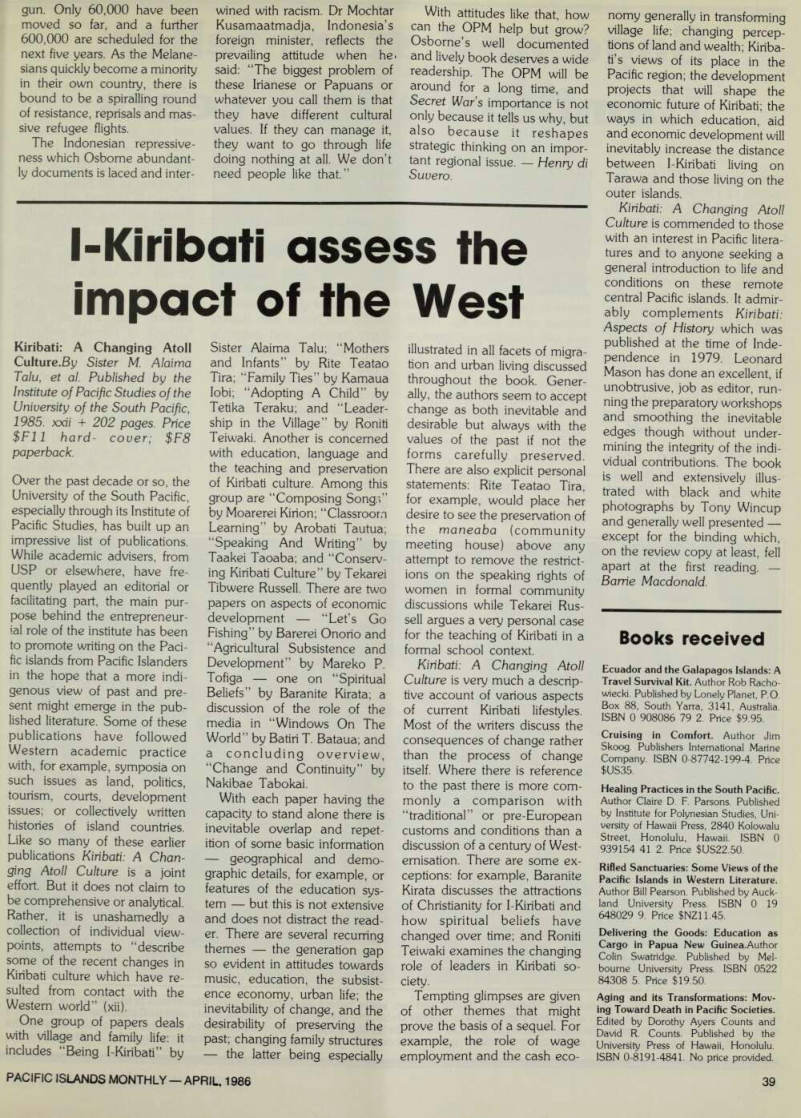
books
Irian Jaya’s OPM: “Spent force” or rising power?
Indonesia’s Secret War: The Guerrilla Struggle in Irian Jaya. By Robin Osborne. Pub lished by Alien & Unwin, 1985. 192 pp ISBN 0 86861 519 6 (pbk.). Price $A12.95.
Are the jungle fighters in Irian Jaya, as the 1984 assessment of General Sembiring, the Indone sian military commander of the province, put it “wild terrorist gangs,” and a “spent force”?
Or are the Melanesian freedom fighters engaged in a long and systematic guerrilla struggle against their internationally im posed Malay and Javenese rul ers? Osborne’s Secret War adopts the “revolutionary guer rilla” or “freedom fighter” thesis, and is the first serious study of the Melanesian guerril la (OPM) movement’s leader ship, conflicts, organisation, ideology and history.
As a movement for national independence in Indonesia’s westernmost province which borders on Papua New Guinea, the two-decade-old OPM is still in its infancy. Although its in ternational support network is thin, it stretches from Holland, through the United Nations and the World Congress of Indi genous Peoples, to Vanuatu. Its guerrilla messages are often in code, yet its communications system is by and large still rudimentary. Although organ ised along classic military lines by area and hierarchy, there have been debilitating leader ship splits. There have been numerous “surrenders” and “retirements” of OPM leaders after years of bush fighting, yet their ranks always seem to supply new leaders.
Secret War’s strength is the mass of detail Osborne accumulates to prove his “guer rilla movement” thesis. Its
weakness is the lack of an ultimate assessment of the OPM’s overall strength and prospects.
Osborne’s by-line, well known to Australian readers of The Australian or the National Times, consistently signals yet another investigative scoop (he
broke the story of the Indone sian murder of Melanesian anthropologist Arnold Ap in 1984, among others), or thoughtful analysis of Indone sian or PNG affairs. A former press secretary to both PNG’s former PM, Sir Julius Chan, and Deputy PM Paias Wingti in
a Somare government, Osborne brings the authority of an insider’s knowledge to this study.
Secret War fairly crackles with authenticity as Osborne marshals verbatim PNG inter cepts of OPM field communica tions, OPM-seized Indonesian
Above: Transmigrant settlement for retired military officers near Jayapura. Top: OPM’s Genyam district leader Yance Hembring and the movement’s Morning Star Flag in a guerrilla camp one hour out of Jayapura. Henry di Suvero copyright photos.
security assessments, diary en tries of Royal Australian Air Force personnel on mapping duty in Irian Jaya, and inter views with a wide variety of people, ranging from former Menzies Government Foreign Minister Sir Garfield Barwick, to an Australian solicitor who once flew helicopters for the Freeport Mining Company.
Mainstream journalism’s de scription of the OPM as ineffec tive “T-shirt guerrillas” has al ways represented Orwellian newspeak in service of the Indonesian military regime’s propaganda efforts to belittle the OPM. The catch phrase, like such other Indonesian de scriptions of the OPM as “wild terrorist gangs”, are one-di mensional terms invented to disparage the OPM and dis guise its strengths and wide spread support. Osborne’s con tribution is to impressively document the contrary view, detailing the two-decade history
of sustained Melanesian military resistance to Indonesian rule.
Whatever doubts there might have been about Indonesia’s harsh treatment of its Melane sian population have been laid to rest by “the great exodus” of 1984 when over 10,000 Melanesians of all walks of life crossed over into PNG to seek asylum. Almost the entire Melanesian border population crossed, either walking through the jungle or fleeing by ocean going canoe, all within six months.
It was a solid vote to choose the questionable freedom of the unknown in the form of a refugee’s life in PNG, over a life of continued fear and terror under Indonesian rule.
Whole villages, even tribes, crossed; military personnel de fected, academics, teachers and government bureaucrats fled.
In every camp the refugees raised the red, white and blue
Morning Star flag of the OPM, sang their Indonesia-banned Papuan national anthem, and almost to a person, stubbornly refused repatriation.
General Benny Murdani, In donesia’s military chief, con demned the refugees as “criminals”, and the Somare government, to its everlasting shame, obliged by prosecuting the first group of male refugees as “illegal border-crossers”.
Osborne explains the great Melanesian exodus as the result of massive reprisals by the Indonesian military after the OPM flag-raising and aborted uprising in Jayapura in mid- February, 1984. The politico military aim was to clear the border of the OPM, destroy all the villages in order to deny the guerrillas their widescale logisti cal support, and clear the re gion for subsequent repopula tion by ex-military Javanese transmigrants.
There had been earlier, smal ler, refugee flows over the years but none had been as massive as this. Someone had to be come the whipping boy, and, fearful of offending the obvious culprit, Indonesia, neither PNG nor Australia blamed the milit ary regime. Instead, the scapegoat became the OPM.
Out of the ashes of torched T-shirts, the previously inept and “spent” OPM were Phoenix-like resurrected and attributed with immense or ganisational finesse as they were blamed for instigating the massive migration.
In a finely woven tapestry, Osborne takes us through the bizarre responses of the So mare government as it strug gled to free itself from the Australian and Indonesian-im posed perspective that the great exodus was a “border prob lem” created by the OPM and susceptible to a bilateral dip lomatic solution where the 10,000 would voluntarily return to their Indonesian-destroyed gardens.
The truth was otherwise, and common Melanesian con sciousness quickly grew throughout PNG and stayed the government’s hand. So mare’s own daughter, as Osborne tells us, worked on the refugees’ behalf. Conflict deve loped within Somare’s cabinet.
Foreign Secretary Rabbie
Namaliu had dared to openly criticise Indonesia in the UN’s General Assembly and was re moved. His replacement embarked on a program of forced repatriation which was soon aborted.
The International Commis sion of Jurists’ delegation which toured the camps in Septem ber, 1984, determined that almost the entire population qualified under standard in ternational law definitions as refugees.
The announced determina tion of PNG’s new Wingti ad ministration to adhere to the UN Convention on Refugees (which all prior PNG adminis trations had resisted doing), and its open acceptance of UNHCR assistance to deter mine refugee status, probably ensures the vast bulk of re fugees will never return to Irian Jaya, but will instead be reset tled in PNG and elsewhere in the region.
One immovable object throughout the great exodus has been the refugees them selves. To break the refugees’ will and solidarity with the OPM, the Somare government shifted leadership from camp to camp, limited media access, brought prosecutions, and periodically threatened massive forced repatriation. Through it all the refugees continued to sing their anthem, hoist their flag and stone visiting Indone sian officials and newsmen. In the idiom of Black America’s civil rights anthem, they were saying to the world “We shall not be moved.’’
Osborne quotes Sir Garfield Barwick as describing Irian Jaya as “the new ‘Ulster’ in our part of the world.” There are other analogies that can be drawn: to Palestine, Vietnam, Cuba, New Caledonia, South Africa, the two Koreas and the two Ger manys. Each analogy is both imperfect and yet instructive.
Perhaps most immediately PNG could learn important na tion-building lessons from Israel’s positive approach of welcoming emigrating refugees fleeing from persecution.
Ulster or not, the 1984 flow of 10,000 refugees is probably only a taste of what is to follow.
Transmigration, the planned massive movement of mainly Javanese into Irian Jaya, as Osborne tells us, has just be
Jail facility under construction at Wamena, Irian Jaya central highlands.
Melanesian army recruits being trained in Wamena, centre of Irian Jayan highlands, with backdrop of typical mosque. Melanesian elements of Indonesia’s 751 infantry battalion, active in the February 1984 Jayapura uprising, fled to PNG.
gun. Only 60,000 have been moved so far, and a further 600,000 are scheduled for the next five years. As the Melane sians quickly become a minority in their own country, there is bound to be a spiralling round of resistance, reprisals and mas sive refugee flights.
The Indonesian repressive ness which Osborne abundant ly documents is laced and inter
wined with racism. Dr Mochtar Kusamaatmadja, Indonesia’s foreign minister, reflects the prevailing attitude when he. said: “The biggest problem of these Irianese or Papuans or whatever you call them is that they have different cultural values. If they can manage it, they want to go through life doing nothing at all. We don’t need people like that.”
With attitudes like that, how can the OPM help but grow?
Osborne’s well documented and lively book deserves a wide readership. The OPM will be around for a long time, and Secret War’s importance is not only because it tells us why, but also because it reshapes strategic thinking on an impor
tant regional issue.
Henrv di
Suvero.
impact of the West
I-Kiribati assess the impact of the West
Kiribati: A Changing Atoll Culture.By Sister M. Alaima Talu, et al. Published by the Institute of Pacific Studies of the University of the South Pacific, 1985. xxii + 202 pages. Price SFII hard- cover; SFB paperback.
Over the past decade or so, the University of the South Pacific, especially through its Institute of Pacific Studies, has built up an impressive list of publications.
While academic advisers, from USP or elsewhere, have fre quently played an editorial or facilitating part, the main pur pose behind the entrepreneur ial role of the institute has been to promote writing on the Paci fic islands from Pacific Islanders in the hope that a more indi genous view of past and pre sent might emerge in the pub lished literature. Some of these publications have followed Western academic practice with, for example, symposia on such issues as land, politics, tourism, courts, development issues; or collectively written histories of island countries.
Like so many of these earlier publications Kiribati: A Chan ging Atoll Culture is a joint effort. But it does not claim to be comprehensive or analytical.
Rather, it is unashamedly a collection of individual view points, attempts to “describe some of the recent changes in Kiribati culture which have re sulted from contact with the Western world” (xii).
One group of papers deals with village and family life: it includes “Being I-Kiribati” by
Sister Alaima Talu; “Mothers and Infants” by Rite Teatao Tira; “Family Ties” by Kamaua lobi; “Adopting A Child” by Tetika Teraku; and “Leader ship in the Village” by Roniti Teiwaki. Another is concerned with education, language and the teaching and preservation of Kiribati culture. Among this group are “Composing Songs” by Moarerei Kirion; “Classroom Learning” by Arobati Tautua; “Speaking And Writing” by Taakei Taoaba; and “Conserv ing Kiribati Culture” by Tekarei Tibwere Russell. There are two papers on aspects of economic development “Let’s Go Fishing” by Barerei Onorio and “Agricultural Subsistence and Development” by Mareko P.
Tofiga one on “Spiritual Beliefs” by Baranite Kirata; a discussion of the role of the media in “Windows On The World” by Batiri T. Bataua; and a concluding overview, “Change and Continuity” by Nakibae Tabokai.
With each paper having the capacity to stand alone there is inevitable overlap and repet ition of some basic information geographical and demo graphic details, for example, or features of the education sys tem but this is not extensive and does not distract the read er. There are several recurring themes the generation gap so evident in attitudes towards music, education, the subsist ence economy, urban life; the inevitability of change, and the desirability of preserving the past; changing family structures the latter being especially
illustrated in all facets of migra tion and urban living discussed throughout the book. Gener ally, the authors seem to accept change as both inevitable and desirable but always with the values of the past if not the forms carefully preserved.
There are also explicit personal statements; Rite Teatao Tira, for example, would place her desire to see the preservation of the maneaba (community meeting house) above any attempt to remove the restrict ions on the speaking rights of women in formal community discussions while Tekarei Rus sell argues a very personal case for the teaching of Kiribati in a formal school context.
Kiribati: A Changing Atoll Culture is very much a descrip tive account of various aspects of current Kiribati lifestyles.
Most of the writers discuss the consequences of change rather than the process of change itself. Where there is reference to the past there is more com monly a comparison with “traditional” or pre-European customs and conditions than a discussion of a century of West ernisation. There are some ex ceptions: for example, Baranite Kirata discusses the attractions of Christianity for I-Kiribati and how spiritual beliefs have changed over time; and Roniti Teiwaki examines the changing role of leaders in Kiribati so ciety.
Tempting glimpses are given of other themes that might prove the basis of a sequel. For example, the role of wage employment and the cash eco
nomy generally in transforming village life; changing percep tions of land and wealth; Kiriba ti’s views of its place in the Pacific region; the development projects that will shape the economic future of Kiribati; the ways in which education, aid and economic development will inevitably increase the distance between I-Kiribati living on Tarawa and those living on the outer islands.
Kiribati: A Changing Atoll Culture is commended to those with an interest in Pacific litera tures and to anyone seeking a general introduction to life and conditions on these remote central Pacific islands. It admir ably complements Kiribati: Aspects of History which was published at the time of Inde pendence in 1979. Leonard Mason has done an excellent, if unobtrusive, job as editor, run ning the preparatory workshops and smoothing the inevitable edges though without under mining the integrity of the indi vidual contributions. The book is well and extensively illus trated with black and white photographs by Tony Wincup and generally well presented — except for the binding which, on the review copy at least, fell apart at the first reading. —
Barrie Macdonald.
Books received
Ecuador and the Galapagos Islands: A Travel Survival Kit. Author Rob Racho wiecki. Published by Lonely Planet, P.O.
Box 88, South Yarra, 3141, Australia.
ISBN 0 908086 79 2. Price $9.95.
Cruising in Comfort. Author Jim Skoog. Publishers International Marine Company. ISBN 0-87742-199-4. Price
Sus3S.
Healing Practices in the South Pacific.
Author Claire D. F. Parsons. Published by Institute for Polynesian Studies, Uni versity of Hawaii Press, 2840 Kolowalu Street, Honolulu, Hawaii. ISBN 0 939154 41 2. Price 5U522.50.
Rifled Sanctuaries; Some Views of the Pacific Islands in Western Literature.
Author Bill Pearson. Published by Auck land University Press. ISBN 0 19 648029 9. Price $NZ11.45.
Delivering the Goods: Education as Cargo in Papua New Guinea. Author Colin Swatridge. Published by Mel bourne University Press. ISBN 0522 84308 5. Price $19.50.
Aging and its Transformations: Mov ing Toward Death in Pacific Societies.
Edited by Dorothy Ayers Counts and David R. Counts. Published by the University Press of Hawaii, Honolulu.
ISBN 0-8191-4841. No price provided.
Sage and story-teller:
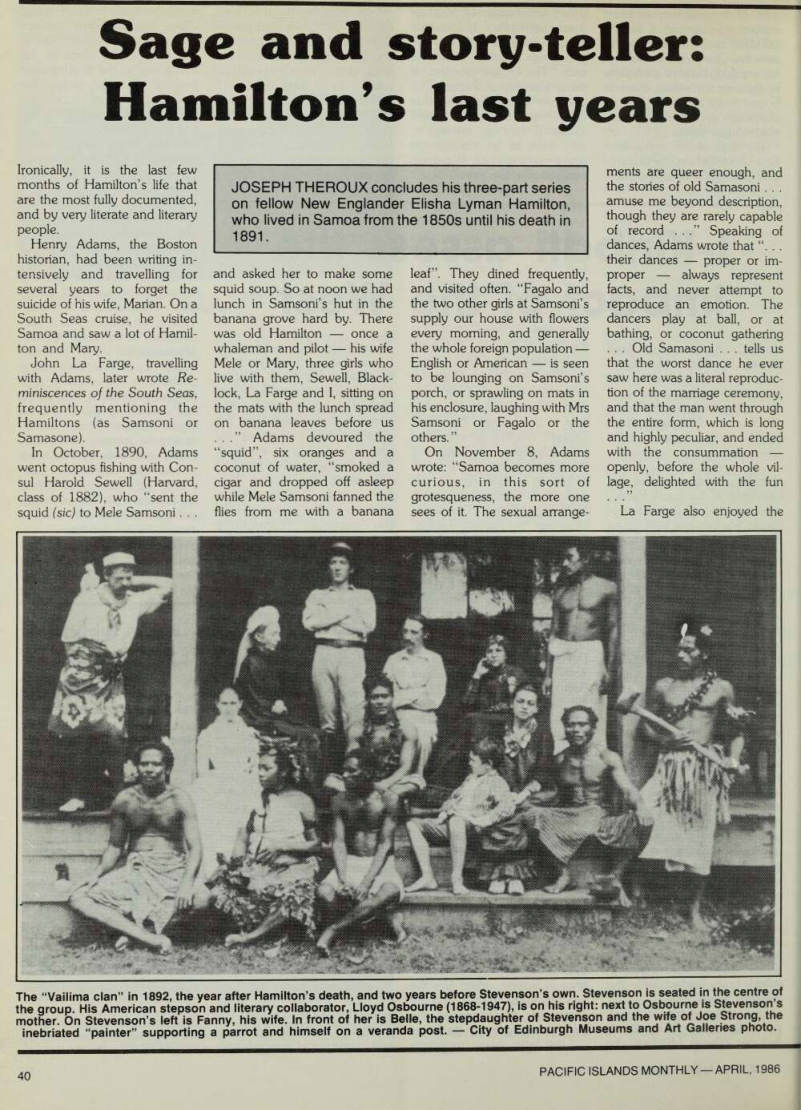
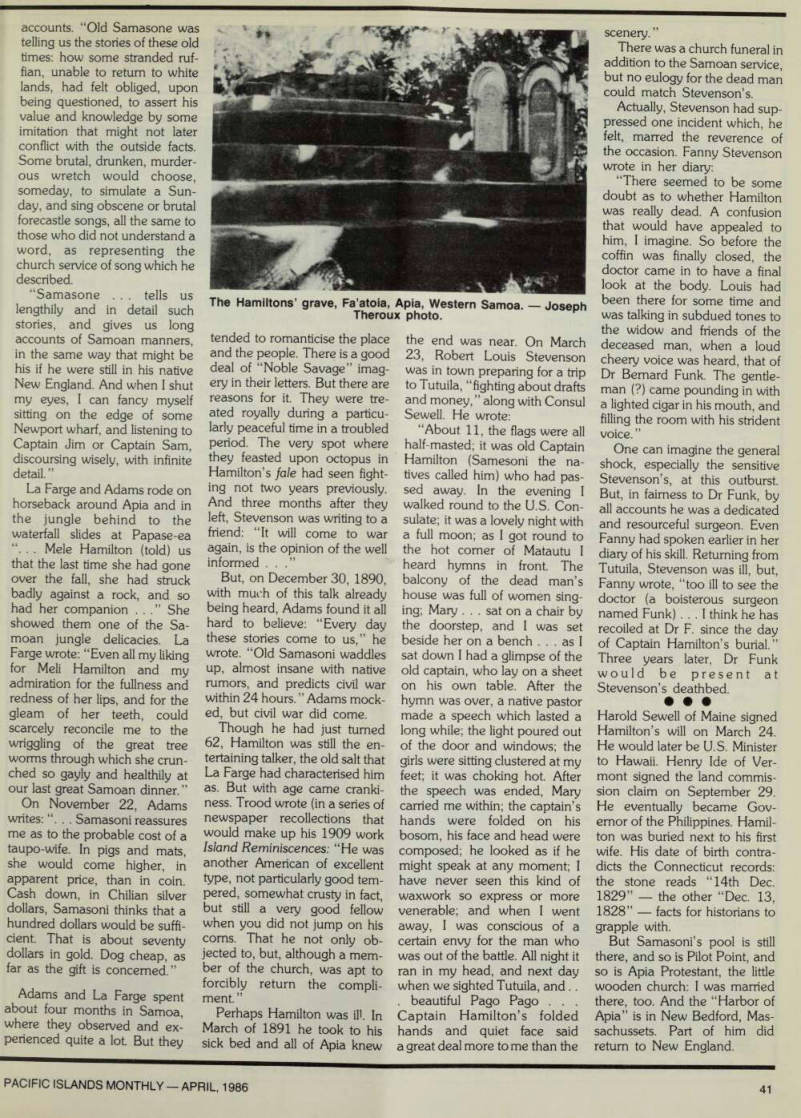
Hamilton’s last years
Ironically, it is the last few months of Hamilton’s life that are the most fully documented, and by very literate and literary people.
Henry Adams, the Boston historian, had been writing in tensively and travelling for several years to forget the suicide of his wife, Marian. On a South Seas cruise, he visited Samoa and saw a lot of Hamil ton and Mary.
John La Farge, travelling with Adams, later wrote Re miniscences of the South Seas, frequently mentioning the Hamiltons (as Samsoni or Samasone).
In October, 1890, Adams went octopus fishing with Con sul Harold Sewell (Harvard, class of 1882), who “sent the squid (sic) to Mele Samsoni. . .
JOSEPH THEROUX concludes his three-part series on fellow New Englander Elisha Lyman Hamilton, who lived in Samoa from the 1850 s until his death in 1891.
and asked her to make some squid soup. So at noon we had lunch in Samsoni’s hut in the banana grove hard by. There was old Hamilton once a whaleman and pilot his wife Mele or Mary, three girls who live with them, Sewell, Black lock, La Farge and I, sitting on the mats with the lunch spread on banana leaves before us . . .” Adams devoured the “squid”, six oranges and a coconut of water, “smoked a cigar and dropped off asleep while Mele Samsoni fanned the flies from me with a banana
leaf”. They dined frequently, and visited often. “Fagalo and the two other girls at Samsoni’s supply our house with flowers every morning, and generally the whole foreign population English or American is seen to be lounging on Samsoni’s porch, or sprawling on mats in his enclosure, laughing with Mrs Samsoni or Fagalo or the others. ”
On November 8, Adams wrote: “Samoa becomes more curious, in this sort of grotesqueness, the more one sees of it. The sexual arrange
merits are queer enough, and the stories of old Samasoni . . . amuse me beyond description, though they are rarely capable of record ...” Speaking of dances, Adams wrote that . . their dances proper or im proper always represent facts, and never attempt to reproduce an emotion. The dancers play at ball, or at bathing, or coconut gathering . . . Old Samasoni . . . tells us that the worst dance he ever saw here was a literal reproduc tion of the marriage ceremony, and that the man went through the entire form, which is long and highly peculiar, and ended with the consummation openly, before the whole vil lage, delighted with the fun 99 La Farge also enjoyed the
The “Vailima clan” in 1892, the year after Hamilton’s death, and two years before Stevenson’s own. Stevenson is seated in the centre of the group. His American stepson and literary collaborator, Lloyd Osbourne (1868-1947), is on his right: next to Osbourne is Stevenson s mother. On Stevenson’s left is Fanny, his wife. In front of her is Belle, the stepdaughter of Stevenson and the wife of Joe Strong, the inebriated “painter” supporting a parrot and himself on a veranda post. City of Edinburgh Museums and Art Galleries photo.
accounts. “Old Samasone was telling us the stories of these old times: how some stranded ruf fian, unable to return to white lands, had felt obliged, upon being questioned, to assert his value and knowledge by some imitation that might not later conflict with the outside facts.
Some brutal, drunken, murder ous wretch would choose, someday, to simulate a Sun day, and sing obscene or brutal forecastle songs, all the same to those who did not understand a word, as representing the church service of song which he described.
“Samasone .. . tells us lengthily and in detail such stories, and gives us long accounts of Samoan manners, in the same way that might be his if he were still in his native New England. And when I shut my eyes, I can fancy myself sitting on the edge of some Newport wharf, and listening to Captain Jim or Captain Sam, discoursing wisely, with infinite detail.”
La Farge and Adams rode on horseback around Apia and in the jungle behind to the waterfall slides at Papase-ea “. . . Mele Hamilton (told) us that the last time she had gone over the fall, she had struck badly against a rock, and so had her companion ...” She showed them one of the Sa moan jungle delicacies. La Farge wrote: “Even all my liking for Meli Hamilton and my admiration for the fullness and redness of her lips, and for the gleam of her teeth, could scarcely reconcile me to the wriggling of the great tree worms through which she crun ched so gayly and healthily at our last great Samoan dinner. ”
On November 22, Adams writes: “. . . Samasoni reassures me as to the probable cost of a taupo-wife. In pigs and mats, she would come higher, in apparent price, than in coin.
Cash down, in Chilian silver dollars, Samasoni thinks that a hundred dollars would be suffi cient. That is about seventy dollars in gold. Dog cheap, as far as the gift is concerned.”
Adams and La Farge spent about four months in Samoa, where they observed and ex perienced quite a lot. But they
tended to romanticise the place and the people. There is a good deal of “Noble Savage” imag ery in their letters. But there are reasons for it. They were tre ated royally during a particu larly peaceful time in a troubled period. The very spot where they feasted upon octopus in Hamilton’s fale had seen fight ing not two years previously.
And three months after they left, Stevenson was writing to a friend: “It will come to war again, is the opinion of the well informed ...”
But, on December 30, 1890, with much of this talk already being heard, Adams found it all hard to believe: “Every day these stories come to us,” he wrote. “Old Samasoni waddles up, almost insane with native rumors, and predicts civil war within 24 hours. ” Adams mock ed, but civil war did come.
Though he had just turned 62, Hamilton was still the en tertaining talker, the old salt that La Farge had characterised him as. But with age came cranki ness. Trood wrote (in a series of newspaper recollections that would make up his 1909 work Island Reminiscences: “He was another American of excellent type, not particularly good tem pered, somewhat crusty in fact, but still a very good fellow when you did not jump on his corns. That he not only ob jected to, but, although a mem ber of the church, was apt to forcibly return the compli ment. ”
Perhaps Hamilton was ill In March of 1891 he took to his sick bed and all of Apia knew
the end was near. On March 23, Robert Louis Stevenson was in town preparing for a trip to Tutuila, “fighting about drafts and money, ” along with Consul Sewell. He wrote: “About 11, the flags were all half-masted; it was old Captain Hamilton (Samesoni the na tives called him) who had pas sed away. In the evening I walked round to the U.S. Con sulate; it was a lovely night with a full moon; as I got round to the hot comer of Matautu I heard hymns in front. The balcony of the dead man’s house was full of women sing ing; Mary ... sat on a chair by the doorstep, and I was set beside her on a bench ... as I sat down I had a glimpse of the old captain, who lay on a sheet on his own table. After the hymn was over, a native pastor made a speech which lasted a long while; the light poured out of the door and windows; the girls were sitting clustered at my feet; it was choking hot. After the speech was ended, Mary carried me within; the captain’s hands were folded on his bosom, his face and head were composed; he looked as if he might speak at any moment; I have never seen this kind of waxwork so express or more venerable; and when I went away, I was conscious of a certain envy for the man who was out of the battle. All night it ran in my head, and next day when we sighted Tutuila, and . . . beautiful Pago Pago . . .
Captain Hamilton’s folded hands and quiet face said a great deal more to me than the
scenery. ”
There was a church funeral in addition to the Samoan service, but no eulogy for the dead man could match Stevenson’s.
Actually, Stevenson had sup pressed one incident which, he felt, marred the reverence of the occasion. Fanny Stevenson wrote in her diary: “There seemed to be some doubt as to whether Hamilton was really dead. A confusion that would have appealed to him, I imagine. So before the coffin was finally closed, the doctor came in to have a final look at the body. Louis had been there for some time and was talking in subdued tones to the widow and friends of the deceased man, when a loud cheery voice was heard, that of Dr Bernard Funk. The gentle man (?) came pounding in with a lighted cigar in his mouth, and filling the room with his strident voice. ”
One can imagine the general shock, especially the sensitive Stevenson’s, at this outburst.
But, in fairness to Dr Funk, by all accounts he was a dedicated and resourceful surgeon. Even Fanny had spoken earlier in her diary of his skill. Returning from Tutuila, Stevenson was ill, but, Fanny wrote, “too ill to see the doctor (a boisterous surgeon named Funk) ... I think he has recoiled at Dr F. since the day of Captain Hamilton’s burial.”
Three years later, Dr Funk would be present at Stevenson’s deathbed. • • • Harold Sewell of Maine signed Hamilton’s will on March 24.
He would later be U.S. Minister to Hawaii. Henry Ide of Ver mont signed the land commis sion claim on September 29.
He eventually became Gov ernor of the Philippines. Hamil ton was buried next to his first wife. His date of birth contra dicts the Connecticut records: the stone reads “14th Dec. 1829” the other “Dec. 13, 1828” facts for historians to grapple with.
But Samasoni’s pool is still there, and so is Pilot Point, and so is Apia Protestant, the little wooden church; I was married there, too. And the “Harbor of Apia” is in New Bedford, Mas sachussets. Part of him did return to New England.
The Hamiltons’ grave, Fa’atoia, Apia, Western Samoa. Joseph Theroux photo.
Pacific stamp box
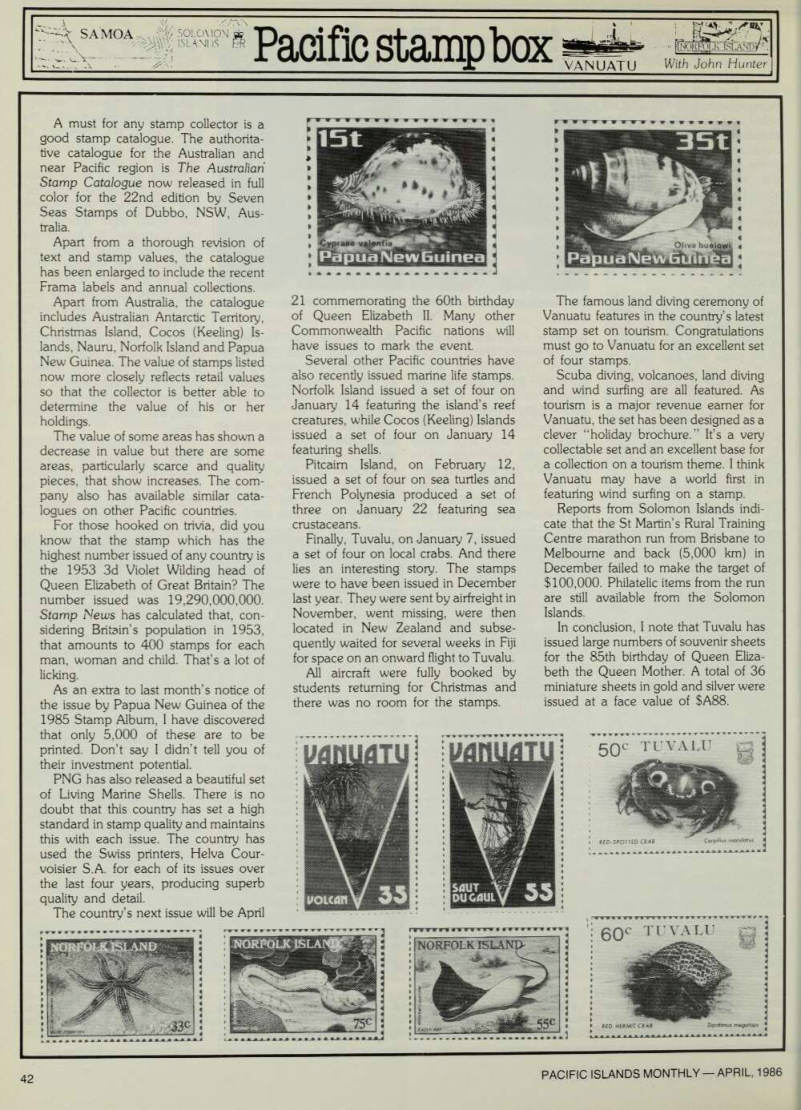
A must for any stamp collector is a good stamp catalogue. The authorita tive catalogue for the Australian and near Pacific region is The Australian Stamp Catalogue now released in full color for the 22nd edition by Seven Seas Stamps of Dubbo, NSW, Aus tralia.
Apart from a thorough revision of text and stamp values, the catalogue has been enlarged to include the recent Frama labels and annual collections.
Apart from Australia, the catalogue includes Australian Antarctic Territory, Christmas Island, Cocos (Keeling) Is lands, Nauru, Norfolk Island and Papua New Guinea. The value of stamps listed now more closely reflects retail values so that the collector is better able to determine the value of his or her holdings.
The value of some areas has shown a decrease in value but there are some areas, particularly scarce and quality pieces, that show increases. The com pany also has available similar cata logues on other Pacific countries.
For those hooked on trivia, did you know that the stamp which has the highest number issued of any country is the 1953 3d Violet Wilding head of Queen Elizabeth of Great Britain? The number issued was 19,290,000,000.
Stamp News has calculated that, con sidering Britain’s population in 1953, that amounts to 400 stamps for each man, woman and child. That’s a lot of licking.
As an extra to last month’s notice of the issue by Papua New Guinea of the 1985 Stamp Album, I have discovered that only 5,000 of these are to be printed. Don’t say I didn’t tell you of their investment potential.
PNG has also released a beautiful set of Living Marine Shells. There is no doubt that this country has set a high standard in stamp quality and maintains this with each issue. The country has used the Swiss printers, Helva Cour voisier S.A. for each of its issues over the last four years, producing superb quality and detail.
The country’s next issue will be April
21 commemorating the 60th birthday of Queen Elizabeth 11. Many other Commonwealth Pacific nations will have issues to mark the event Several other Pacific countries have also recently issued marine life stamps.
Norfolk Island issued a set of four on January 14 featuring the island’s reef creatures, while Cocos (Keeling) Islands issued a set of four on January 14 featuring shells.
Pitcairn Island, on February 12, issued a set of four on sea turtles and French Polynesia produced a set of three on January 22 featuring sea crustaceans.
Finally, Tuvalu, on January 7, issued a set of four on local crabs. And there lies an interesting story. The stamps were to have been issued in December last year. They were sent by airfreight in November, went missing, were then located in New Zealand and subse quently waited for several weeks in Fiji for space on an onward flight to Tuvalu.
All aircraft were fully booked by students returning for Christmas and there was no room for the stamps.
The famous land diving ceremony of Vanuatu features in the country’s latest stamp set on tourism. Congratulations must go to Vanuatu for an excellent set of four stamps.
Scuba diving, volcanoes, land diving and wind surfing are all featured. As tourism is a major revenue earner for Vanuatu, the set has been designed as a clever “holiday brochure.” It’s a very collectable set and an excellent base for a collection on a tourism theme. I think Vanuatu may have a world first in featuring wind surfing on a stamp.
Reports from Solomon Islands indi cate that the St Martin’s Rural Training Centre marathon run from Brisbane to Melbourne and back (5,000 km) in December failed to make the target of $lOO,OOO. Philatelic items from the run are still available from the Solomon Islands.
In conclusion, I note that Tuvalu has issued large numbers of souvenir sheets for the 85th birthday of Queen Eliza beth the Queen Mother. A total of 36 miniature sheets in gold and silver were issued at a face value of SABB.
Advertisements & other items, p. 43 (1 item)
Ddon wb
Deals the
winning
hand In rat
control!
TALON WB is a world breakthrough In killing rats and mice. Developed by ICI Tasman In New Zealand TALON wb is a sure way to Increase profits by eliminating RAT DAMAGE TO CROPS! is i? ss K/U se ts C c o o-e CD £ SOLID BLOCKS Can be wired or nailed out of reach of children & animals. Easily handled - won t blow away.
WATERPROOF Safe year round use - will not dissolve. resist-Tmould for extended periods.
DEADLY
Kills even the toughest rats - Including those resistant to warfarin based poisons.
EFFECTIVE
POWERFUL
Highly attractive to rats & mice - no pre-baiting Is required.
Kills more rats - a lethal dose can be consumed In a single feed.
Do not lay baits In places accessible to children, pets and domestic animals. Wash hands and exposed skin before meals and after work. Do not store near food or feed. Bum or bury all rodent bodies and uneaten bait. Empty containers should not be re-used but disposed of safely.
Ikkm
ICI \ A Product of ICI Tasman Limited P.O Box 900, Auckland, New Zealand
WARNING
m / s .
Whatever your crops - COCOA - COCONUTS - SUGARCANE.
RATS KILL PROFITS! NOW TALON WB KILLS RATS!
‘Wanderers’ bring trouble to town
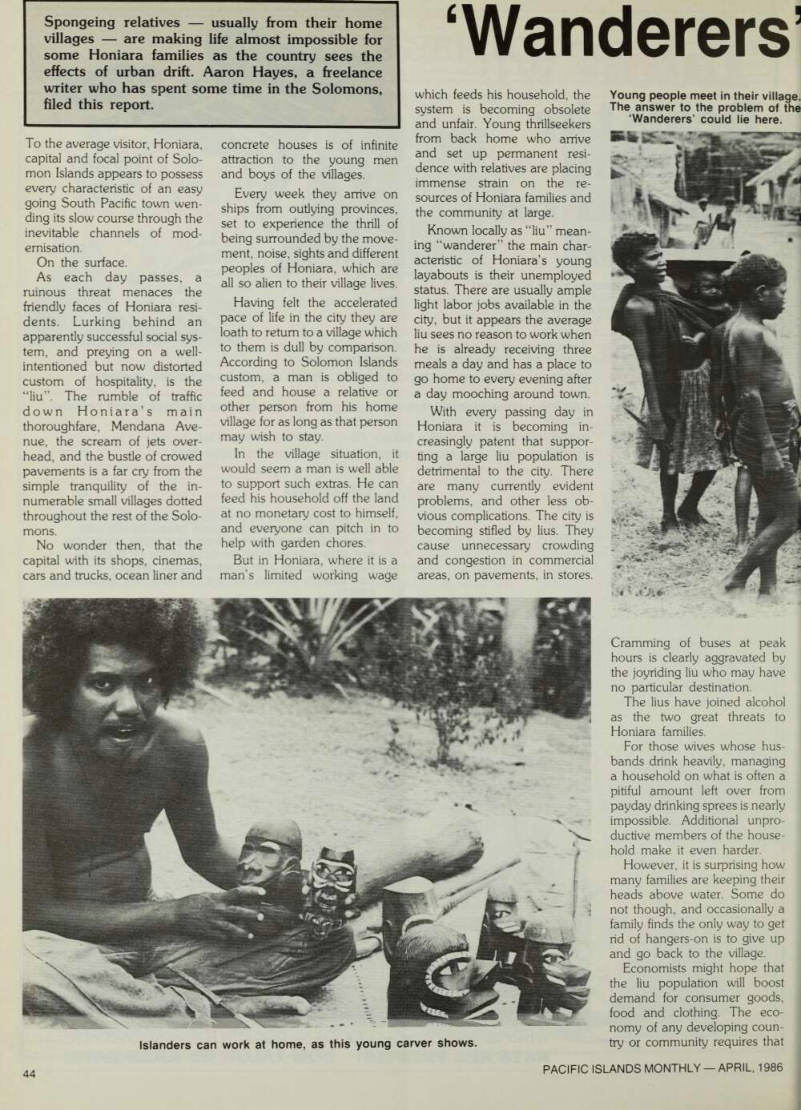
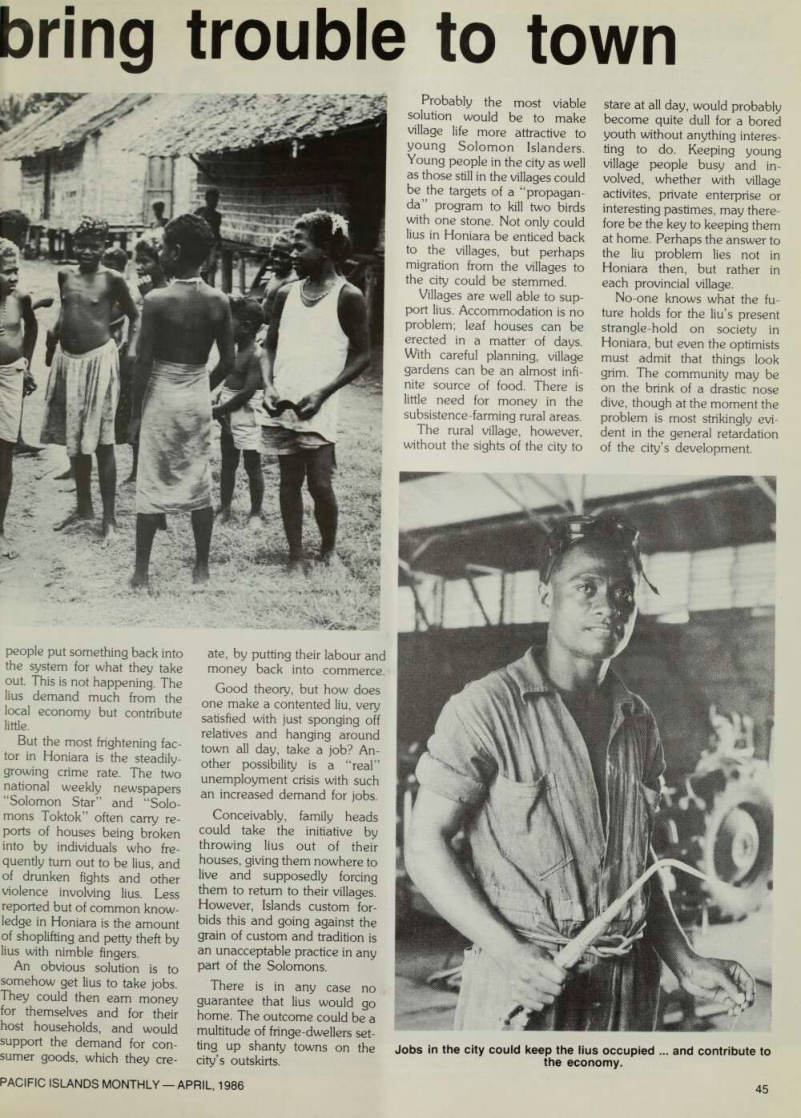
Spongeing relatives usually from their home villages are making life almost impossible for some Honiara families as the country sees the effects of urban drift. Aaron Hayes, a freelance writer who has spent some time in the Solomons, filed this report.
To the average visitor, Honiara, capital and focal point of Solo mon Islands appears to possess every characteristic of an easy going South Pacific town wen ding its slow course through the inevitable channels of mod ernisation.
On the surface.
As each day passes, a ruinous threat menaces the friendly faces of Honiara resi dents. Lurking behind an apparently successful social sys tem, and preying on a well intentioned but now distorted custom of hospitality, is the “liu”. The rumble of traffic down Honiara’s main thoroughfare, Mendana Ave nue, the scream of jets over head, and the bustle of crowed pavements is a far cry from the simple tranquility of the in numerable small villages dotted throughout the rest of the Solo mons.
No wonder then, that the capital with its shops, cinemas, cars and trucks, ocean liner and
concrete houses is of infinite attraction to the young men and boys of the villages.
Every week they arrive on ships from outlying provinces, set to experience the thrill of being surrounded by the move ment, noise, sights and different peoples of Honiara, which are all so alien to their village lives.
Having felt the accelerated pace of life in the city they are loath to return to a village which to them is dull by comparison.
According to Solomon Islands custom, a man is obliged to feed and house a relative or other person from his home village for as long as that person may wish to stay.
In the village situation, it would seem a man is well able to support such extras. He can feed his household off the land at no monetary cost to himself, and everyone can pitch in to help with garden chores.
But in Honiara, where it is a man’s limited working wage
which feeds his household, the system is becoming obsolete and unfair. Young thrillseekers from back home who arrive and set up permanent resi dence with relatives are placing immense strain on the re sources of Honiara families and the community at large.
Known locally as “liu” mean ing “wanderer” the main char acteristic of Honiara’s young layabouts is their unemployed status. There are usually ample light labor jobs available in the city, but it appears the average liu sees no reason to work when he is already receiving three meals a day and has a place to go home to every evening after a day mooching around town.
With every passing day in Honiara it is becoming in creasingly patent that suppor ting a large liu population is detrimental to the city. There are many currently evident problems, and other less ob vious complications. The city is becoming stifled by lius. They cause unnecessary crowding and congestion in commercial areas, on pavements, in stores.
Cramming of buses at peak hours is clearly aggravated by the joyriding liu who may have no particular destination.
The lius have joined alcohol as the two great threats to Honiara families.
For those wives whose hus bands drink heavily, managing a household on what is often a pitiful amount left over from payday drinking sprees is nearly impossible. Additional unpro ductive members of the house hold make it even harder.
However, it is surprising how many families are keeping their heads above water. Some do not though, and occasionally a family finds the only way to get rid of hangers-on is to give up and go back to the village.
Economists might hope that the liu population will boost demand for consumer goods, food and clothing. The eco nomy of any developing coun try or community requires that
Islanders can work at home, as this young carver shows.
Young people meet in their village.
The answer to the problem of the ‘Wanderers’ could lie here.
people put something back into the system for what they take out. This is not happening. The lius demand much from the local economy but contribute little.
But the most frightening fac tor in Honiara is the steadily growing crime rate. The two national weekly newspapers “Solomon Star” and “Solo mons Toktok” often carry re ports of houses being broken into by individuals who fre quently turn out to be lius, and of drunken fights and other violence involving lius. Less reported but of common know ledge in Honiara is the amount of shoplifting and petty theft by lius with nimble fingers.
An obvious solution is to somehow get lius to take jobs.
They could then earn money for themselves and for their host households, and would support the demand for con sumer goods, which they ere
ate, by putting their labour and money back into commerce.
Good theory, but how does one make a contented liu, very satisfied with just sponging off relatives and hanging around town all day, take a job? An other possibility is a “real” unemployment crisis with such an increased demand for jobs.
Conceivably, family heads could take the initiative by throwing lius out of their houses, giving them nowhere to live and supposedly forcing them to return to their villages.
However, Islands custom for bids this and going against the grain of custom and tradition is an unacceptable practice in any part of the Solomons.
There is in any case no guarantee that lius would go home. The outcome could be a multitude of fringe-dwellers set ting up shanty towns on the city’s outskirts.
Probably the most viable solution would be to make village life more attractive to young Solomon Islanders.
Young people in the city as well as those still in the villages could be the targets of a “propagan da” program to kill two birds with one stone. Not only could lius in Honiara be enticed back to the villages, but perhaps migration from the villages to the city could be stemmed.
Villages are well able to sup port lius. Accommodation is no problem; leaf houses can be erected in a matter of days.
With careful planning, village gardens can be an almost infi nite source of food. There is little need for money in the subsistence-farming rural areas.
The rural village, however, without the sights of the city to
stare at all day, would probably become quite dull for a bored youth without anything interes ting to do. Keeping young village people busy and in volved, whether with village activites, private enterprise or interesting pastimes, may there fore be the key to keeping them at home. Perhaps the answer to the liu problem lies not in Honiara then, but rather in each provincial village.
No-one knows what the fu ture holds for the liu’s present strangle-hold on society in Honiara, but even the optimists must admit that things look grim. The community may be on the brink of a drastic nose dive, though at the moment the problem is most strikingly evi dent in the general retardation of the city’s development.
Jobs in the city could keep the lius occupied ... and contribute to the economy.
Advertisements & other items, pp. 45-46 (2 items)
bring trouble to town
The Treasure At The End Of The Rainbow
It's not the luck of a leprechaun but the craft of Clarion that will lead you to uncompromising stereo sound quality. Even in the compromising environment of a moving automobile. Clarion's advanced electronics makes possible a wide spectrum of convenient, easy-to-use features. The Clarion choice of models is positively dazzling. And our reliability is I O rjrvr| no fairy tale. Come, listen to a Clarion Car Stereo. And drive happily ever after.
ON . / K9, FADER
mode! 900 E
01
WIT
□P MTU
LD AK
AFO
M For further information Australia: Amalgamated Wireless (Australasia) Ltd, 554 Parramatta Road, Ashfield. NSW , 2131 / New Zealand: AWA New Zealand Limited, PO Box 50-248, Pomua / Fiji Islands: &Co • l J 1 dx 362. Suva Tahiti: HI FI VAIRAATOA. Avenue Chef Vairaatoa B P 1128, Papeete / New Caledonia: Caldis. B.PMI, Noumea Cedex / Guam: Micropac Audio Inc, PO Box 3478, Agana Guam 96910. US A TeL 472-809 L Cable Code.
Hifi audio AGANA / Vanuatu; The Sound Centre PO Box 434, Vila / Cook Islands; South Seas International Ltd, PO Box 49, Rarotonga / Papua New Guinea: Hagemeyer (PN G ) Pty Ltd, PO Box 1428, Boroko. Port Moresby
the offing
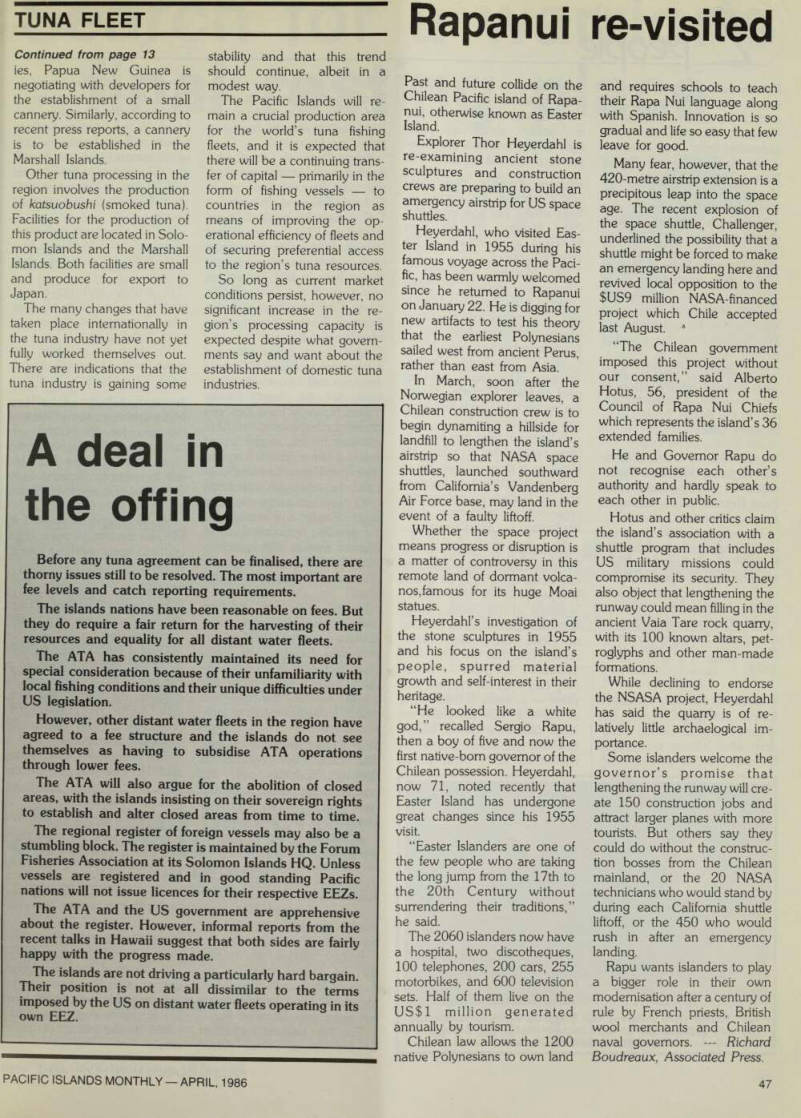
A deal in the offing
Before any tuna agreement can be finalised, there are thorny issues still to be resolved. The most important are fee levels and catch reporting requirements.
The islands nations have been reasonable on fees. But they do require a fair return for the harvesting of their resources and equality for all distant water fleets.
The ATA has consistently maintained its need for special consideration because of their unfamiliarity with local fishing conditions and their unique difficulties under US legislation.
However, other distant water fleets in the region have agreed to a fee structure and the islands do not see themselves as having to subsidise ATA operations through lower fees.
The ATA will also argue for the abolition of closed areas, with the islands insisting on their sovereign rights to establish and alter closed areas from time to time.
The regional register of foreign vessels may also be a stumbling block. The register is maintained by the Forum Fisheries Association at its Solomon Islands HQ. Unless vessels are registered and in good standing Pacific nations will not issue licences for their respective EEZs.
The ATA and the US government are apprehensive about the register. However, informal reports from the recent talks in Hawaii suggest that both sides are fairly happy with the progress made.
The islands are not driving a particularly hard bargain.
Their position is not at all dissimilar to the terms imposed by the US on distant water fleets operating in its own EEZ.
Rapanui re-visited
Past and future collide on the Chilean Pacific island of Rapa nui, otherwise known as Easter Island.
Explorer Thor Heyerdahl is re-examining ancient stone sculptures and construction crews are preparing to build an emergency airstrip for US space shuttles.
Heyerdahl, who visited Eas ter Island in 1955 during his famous voyage across the Paci fic, has been warmly welcomed since he returned to Rapanui on January 22. He is digging for new artifacts to test his theory that the earliest Polynesians sailed west from ancient Perns, rather than east from Asia.
In March, soon after the Norwegian explorer leaves, a Chilean construction crew is to begin dynamiting a hillside for landfill to lengthen the island’s airstrip so that NASA space shuttles, launched southward from California’s Vandenberg Air Force base, may land in the event of a faulty liftoff.
Whether the space project means progress or disruption is a matter of controversy in this remote land of dormant volca nos, famous for its huge Moai statues.
Heyerdahl’s investigation of the stone sculptures in 1955 and his focus on the island’s people, spurred material growth and self-interest in their heritage.
“He looked like a white god,” recalled Sergio Rapu, then a boy of five and now the first native-born governor of the Chilean possession. Heyerdahl, now 71, noted recently that Easter Island has undergone great changes since his 1955 visit.
“Easter Islanders are one of the few people who are taking the long jump from the 17th to the 20th Century without surrendering their traditions,” he said.
The 2060 islanders now have a hospital, two discotheques, 100 telephones, 200 cars, 255 motorbikes, and 600 television sets. Half of them live on the US$l million generated annually by tourism.
Chilean law allows the 1200 native Polynesians to own land
and requires schools to teach their Rapa Nui language along with Spanish. Innovation is so gradual and life so easy that few leave for good.
Many fear, however, that the 420-metre airstrip extension is a precipitous leap into the space age. The recent explosion of the space shuttle, Challenger, underlined the possibility that a shuttle might be forced to make an emergency landing here and revived local opposition to the SUS 9 million NASA-financed project which Chile accepted last August. * “The Chilean government imposed this project without our consent,” said Alberto Hotus, 56, president of the Council of Rapa Nui Chiefs which represents the island’s 36 extended families.
He and Governor Rapu do not recognise each other’s authority and hardly speak to each other in public.
Hotus and other critics claim the island’s association with a shuttle program that includes US military missions could compromise its security. They also object that lengthening the runway could mean filling in the ancient Vaia Tare rock quarry, with its 100 known altars, pet roglyphs and other man-made formations.
While declining to endorse the NSASA project, Heyerdahl has said the quarry is of re latively little archaelogical im portance.
Some islanders welcome the governor’s promise that lengthening the runway will cre ate 150 construction jobs and attract larger planes with more tourists. But others say they could do without the construc tion bosses from the Chilean mainland, or the 20 NASA technicians who would stand by during each California shuttle liftoff, or the 450 who would rush in after an emergency landing.
Rapu wants islanders to play a bigger role in their own modernisation after a century of rule by French priests, British wool merchants and Chilean naval governors. Richard Boudreaux, Associated Press.
Advertisements & other items, p. 47 (1 item)
Tuna Fleet
47
PACIFIC ISLANDS MONTHLY —APRIL, 1986
Continued from page 13
TUNA FLEET
people
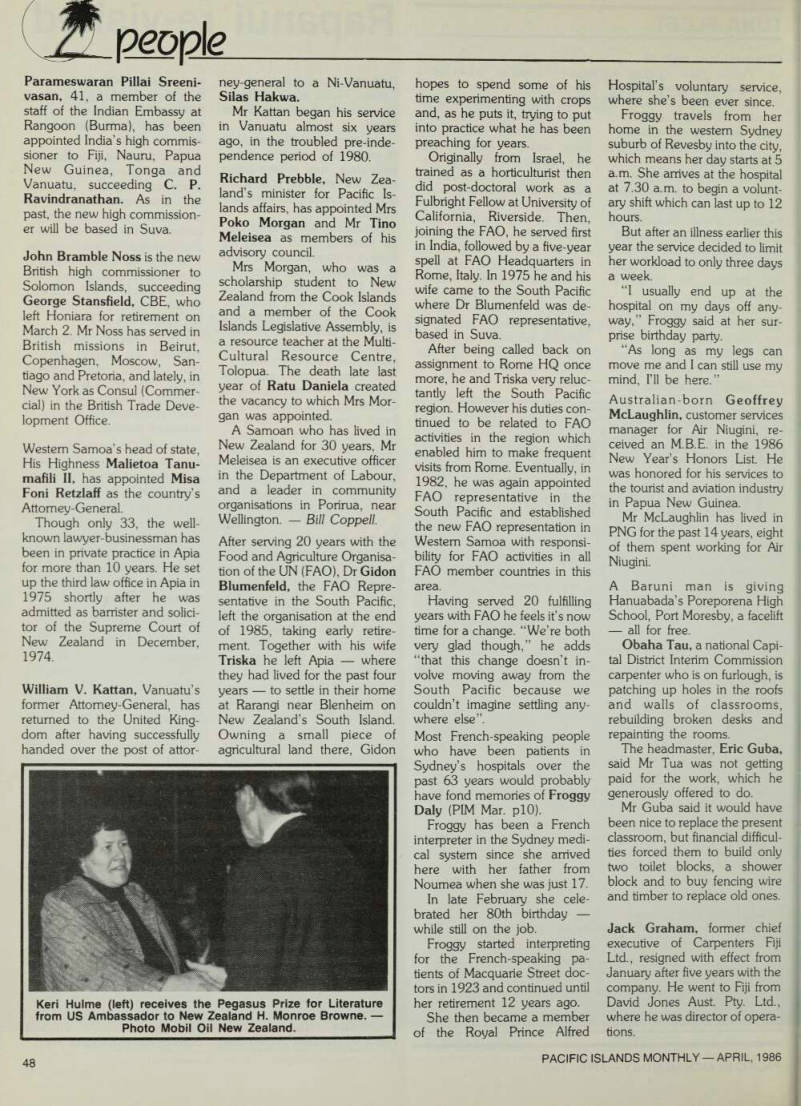
Parameswaran Pillai Sreeni vasan, 41, a member of the staff of the Indian Embassy at Rangoon (Burma), has been appointed India’s high commis sioner to Fiji, Nauru, Papua New Guinea, Tonga and Vanuatu, succeeding C. P.
Ravindranathan. As in the past, the new high commission er will be based in Suva.
John Bramble Noss is the new British high commissioner to Solomon Islands, succeeding George Stansfield, CBE, who left Honiara for retirement on March 2. Mr Noss has served in British missions in Beirut, Copenhagen, Moscow, San tiago and Pretoria, and lately, in New York as Consul (Commer cial) in the British Trade Deve lopment Office.
Western Samoa’s head of state, His Highness Malietoa Tanu mafili 11, has appointed Misa Foni Retzlaff as the country’s Attorney-General.
Though only 33, the well known lawyer-businessman has been in private practice in Apia for more than 10 years. He set up the third law office in Apia in 1975 shortly after he was admitted as barrister and solici tor of the Supreme Court of New Zealand in December, 1974.
William V. Kattan, Vanuatu’s former Attorney-General, has returned to the United King dom after having successfully handed over the post of attor
ney-general to a Ni-Vanuatu, Silas Hakwa.
Mr Kattan began his service in Vanuatu almost six years ago, in the troubled pre-inde pendence period of 1980.
Richard Prebble, New Zea land’s minister for Pacific Is lands affairs, has appointed Mrs Poko Morgan and Mr Tino Meleisea as members of his advisory council.
Mrs Morgan, who was a scholarship student to New Zealand from the Cook Islands and a member of the Cook Islands Legislative Assembly, is a resource teacher at the Multi- Cultural Resource Centre, Tolopua. The death late last year of Ratu Daniela created the vacancy to which Mrs Mor gan was appointed.
A Samoan who has lived in New Zealand for 30 years, Mr Meleisea is an executive officer in the Department of Labour, and a leader in community organisations in Porirua, near Wellington. Bill Coppell.
After serving 20 years with the Food and Agriculture Organisa tion of the UN (FAO), Dr Gidon Blumenfeld, the FAO Repre sentative in the South Pacific, left the organisation at the end of 1985, taking early retire ment. Together with his wife Triska he left Apia where they had lived for the past four years to settle in their home at Rarangi near Blenheim on New Zealand’s South Island.
Owning a small piece of agricultural land there, Gidon
hopes to spend some of his time experimenting with crops and, as he puts it, trying to put into practice what he has been preaching for years.
Originally from Israel, he trained as a horticulturist then did post-doctoral work as a Fulbright Fellow at University of California, Riverside. Then, joining the FAO, he served first in India, followed by a five-year spell at FAO Headquarters in Rome, Italy. In 1975 he and his wife came to the South Pacific where Dr Blumenfeld was de signated FAO representative, based in Suva.
After being called back on assignment to Rome HQ once more, he and Triska very reluc tantly left the South Pacific region. However his duties con tinued to be related to FAO activities in the region which enabled him to make frequent visits from Rome. Eventually, in 1982, he was again appointed FAO representative in the South Pacific and established the new FAO representation in Western Samoa with responsi bility for FAO activities in all FAO member countries in this area.
Having served 20 fulfilling years with FAO he feels it’s now time for a change. “We’re both very glad though,” he adds “that this change doesn’t in volve moving away from the South Pacific because we couldn’t imagine settling any where else”.
Most French-speaking people who have been patients in Sydney’s hospitals over the past 63 years would probably have fond memories of Froggy Daly (PIM Mar. plO).
Froggy has been a French interpreter in the Sydney medi cal system since she arrived here with her father from Noumea when she was just 17.
In late February she cele brated her 80th birthday while still on the job.
Froggy started interpreting for the French-speaking pa tients of Macquarie Street doc tors in 1923 and continued until her retirement 12 years ago.
She then became a member of the Royal Prince Alfred
Hospital’s voluntary service, where she’s been ever since.
Froggy travels from her home in the western Sydney suburb of Revesby into the city, which means her day starts at 5 a.m. She arrives at the hospital at 7.30 a.m. to begin a volunt ary shift which can last up to 12 hours.
But after an illness earlier this year the service decided to limit her workload to only three days a week.
“I usually end up at the hospital on my days off any way,” Froggy said at her sur prise birthday party.
“As long as my legs can move me and I can still use my mind, I’ll be here.”
Australian-born Geoffrey McLaughlin, customer services manager for Air Niugini, re ceived an M.B.E. in the 1986 New Year’s Honors List. He was honored for his services to the tourist and aviation industry in Papua New Guinea.
Mr McLaughlin has lived in PNG for the past 14 years, eight of them spent working for Air Niugini.
A Baruni man is giving Hanuabada’s Poreporena High School, Port Moresby, a facelift all for free.
Obaha Tau, a national Capi tal District Interim Commission carpenter who is on furlough, is patching up holes in the roofs and walls of classrooms, rebuilding broken desks and repainting the rooms.
The headmaster, Eric Cuba, said Mr Tua was not getting paid for the work, which he generously offered to do.
Mr Cuba said it would have been nice to replace the present classroom, but financial difficul ties forced them to build only two toilet blocks, a shower block and to buy fencing wire and timber to replace old ones.
Jack Graham, former chief executive of Carpenters Fiji Ltd., resigned with effect from January after five years with the company. He went to Fiji from David Jones Aust. Pty. Ltd., where he was director of opera tions.
Keri Hulme (left) receives the Pegasus Prize for Literature from US Ambassador to New Zealand H. Monroe Browne.
Photo Mobil Oil New Zealand.
final resting place
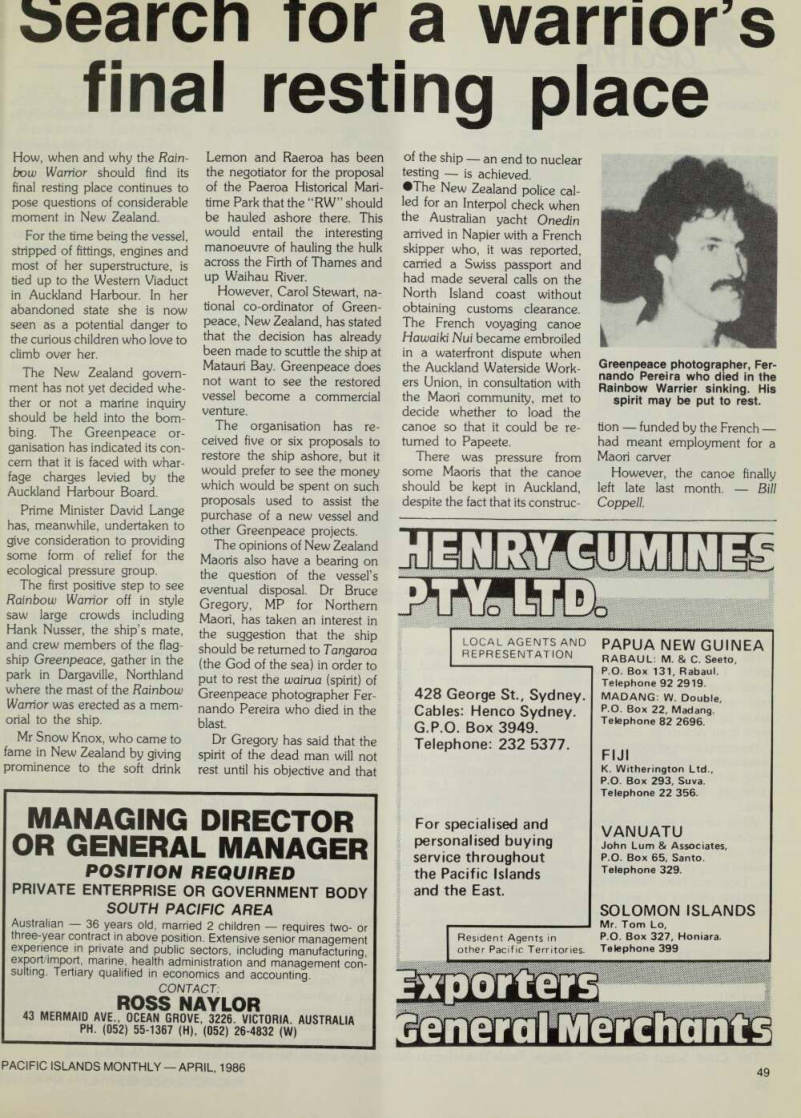
searcn tor a warrior's final resting place
How, when and why the Rain bow Wanior should find its final resting place continues to pose questions of considerable moment in New Zealand.
For the time being the vessel, stripped of fittings, engines and most of her superstructure, is tied up to the Western Viaduct in Auckland Harbour. In her abandoned state she is now seen as a potential danger to the curious children who love to climb over her.
The New Zealand govern ment has not yet decided whe ther or not a marine inquiry should be held into the bom bing. The Greenpeace or ganisation has indicated its con cern that it is faced with whar fage charges levied by the Auckland Harbour Board.
Prime Minister David Lange has, meanwhile, undertaken to give consideration to providing some form of relief for the ecological pressure group.
The first positive step to see Rainbow Warrior off in style saw large crowds including Hank Nusser, the ship’s mate, and crew members of the flag ship Greenpeace, gather in the park in Dargaville, Northland where the mast of the Rainbow Warrior was erected as a mem orial to the ship.
Mr Snow Knox, who came to fame in New Zealand by giving prominence to the soft drink
Lemon and Raeroa has been the negotiator for the proposal of the Paeroa Historical Mari time Park that the “RW” should be hauled ashore there. This would entail the interesting manoeuvre of hauling the hulk across the Firth of Thames and up Waihau River.
However, Carol Stewart, na tional co-ordinator of Green peace, New Zealand, has stated that the decision has already been made to scuttle the ship at Matauri Bay. Greenpeace does not want to see the restored vessel become a commercial venture.
The organisation has re ceived five or six proposals to restore the ship ashore, but it would prefer to see the money which would be spent on such proposals used to assist the purchase of a new vessel and other Greenpeace projects.
The opinions of New Zealand Maoris also have a bearing on the question of the vessel’s eventual disposal. Dr Bruce Gregory, MP for Northern Maori, has taken an interest in the suggestion that the ship should be returned to Tangaroa (the God of the sea) in order to put to rest the wairua (spirit) of Greenpeace photographer Fer nando Pereira who died in the blast.
Dr Gregory has said that the spirit of the dead man will not rest until his objective and that
of the ship an end to nuclear testing is achieved. •The New Zealand police cal led for an Interpol check when the Australian yacht Onedin arrived in Napier with a French skipper who, it was reported, carried a Swiss passport and had made several calls on the North Island coast without obtaining customs clearance.
The French voyaging canoe Hawaiki Nui became embroiled in a waterfront dispute when the Auckland Waterside Work ers Union, in consultation with the Maori community, met to decide whether to load the canoe so that it could be re turned to Papeete.
There was pressure from some Maoris that the canoe should be kept in Auckland, despite the fact that its construc-
tion funded by the French had meant employment for a Maori carver However, the canoe finally left late last month. Bill Coppell.
Greenpeace photographer, Fer nando Pereira who died in the Rainbow Warrier sinking. His spirit may be put to rest.
Advertisements & other items, p. 49 (1 item)
xWortefs
I
LOCAL AGENTS AND
REPRESENTATION
428 George St., Sydney.
Cables: Henco Sydney.
G.P.O. Box 3949.
Telephone: 232 5377.
For specialised and
personalised buying
service throughout
the Pacific Islands and the East. -3 Resident Agents in other Pacific Territories.
PAPUA NEW GUINEA
RABAUL: M. & C. Seeto, P.O. Box 131, Rabaul.
Telephone 92 2919.
MADANG: W. Double, P.O. Box 22, Madang.
Telephone 82 2696.
FIJI
K. Witherington Ltd., P.O. Box 293, Suva.
Telephone 22 356.
VANUATU
John Lum & Associates, P.O. Box 65, Santo.
Telephone 329.
SOLOMON ISLANDS
Mr. Tom Lo, P.O. Box 327, Honiara.
Telephone 399
xWortefs
MANAGING DIRECTOR
OR GENERAL MANAGER
POSITION REQUIRED
PRIVATE ENTERPRISE OR GOVERNMENT BODY
SOUTH PACIFIC AREA
Australian 36 years old, married 2 children requires two- or three-year contract in above position. Extensive senior management experience in private and public sectors, including manufacturing, export/import, marine, health administration and management consulting. Tertiary qualified in economics and accounting.
CONTACT:
ROSS NAYLOR
43 MERMAID AVE., OCEAN GROVE, 3226. VICTORIA. AUSTRALIA PH. (052) 55-1367 (H), (052) 26-4832 (W)
deaths
Vainerere Tangatapoto On Mangaia, Cook Islands, on January 19, aged 74.
A native of Atiu, Papa Vaine rere Tangatapoto was a leading member of the Atiu community both at home and in Raro tonga.
The founder of the Life Boys and Girls Brigade movements in the Cook Islands, Papa Tan gatapoto served as the speaker for the Ui Ariki on the island of Atiu, and was the first local principal appointed for Atiu Pri mary School.
He supervised renovative work on many important buil dings on his home island, in cluding the CICC Church and Rongomatane Are Ariki.
After gaining the Maui Po mare medal twice, Papa Tanga tapoto became a teacher at primary school level at the age 15. He joined the crew of the Tagua in 1934 as cabin boy for six years, returning to Atiu Primary in 1940.
Serving national interests, Papa Vainerere Tangatapoto attended a ministerial confer ence in Manila in 1978 and another parliamentary confer ence in Australia four years later.
His service to the Cook Is lands’ Legislative Assembly spans over two decades. He held various senior positions before he announced his retire ment from politics in 1982.
His many services to the Atiu community were recognised in 1982 when he gained the Order of the British Empire award.
While serving in his capacity as speaker to the Atiu House of Ariki, Papa Tangatapoto led several delegations to Raroton ga, Tahiti and New Zealand to negotiate matters of benefit to the Atiu people.
Herbert Murray In Suva on February 17, aged about 80.
Mr Murray, a former director of Morris Hedstroms, was the deputy chief scout of Fiji.
The Chief Scout Commis
sioner, Jerry Tikaram, said that Mr Murray’s death was a great loss to the movement.
“I always leaned on him for advice. We will miss him a lot, ” he said.
He said Mr Murray had been involved in the Scout move ment in Fiji for more than 45 years.
A spokesman for the Fiji Scout Association said Mr Mur ray had reached the highest position in the Scout movement an ordinary person could attain.
The Governor-General of Fiji becomes the Chief Scout by his official position. The deputy chief scout is the next most important person.
Mr Murray had recently been awarded an OBE for his services to the country and the Scout movement.
Tuivakano In Nukualofa on January 19, aged 93.
Tongan nobleman the Hon orable Tuivakano composed the original Fijian national farewell song, Isa Lei.
The Hon. Tuivakano had close ties with the house of the Tui Soso in Nukunuku, Lake ba, Lau, Fiji.
He composed the music and lyric of the Tongan ballad, Sii Lile. The late father of Fiji Prime Minister Ratu Sir Kamisese Mara, Ratu Tevita Uluilakeba, translated the song into Fijian in 1914.
Former Radio Fiji announcer, Ratu Josua Bogidrau, told The Fiji Times that Sii Lile was brought to Fiji by a group of Tongans led by the Honorable Veikune in 1914.
He said the Tongans used to sing the song every night during yaqona sessions at Naiqaqi, site of the present Fiji Broadcasting Commission headquarters.
Isa Lei was first sung when the Tongan group was being farewelled at Suva Wharf.
The Hon. Tuivakano was buried in his village of Nukunu ku, five miles outside Nukualo fa. His funeral service was attended by more than 2000 mourners, including the King of Tonga, Taufa’ahau Tupou IV.
Robert H. Green In Melbourne on February 9, aged 101.
The Rev. Robert Green was a Methodist missionary in Fiji from 1921 to 1942, and is especially remembered there for his period (1937-42) as principal of the Davuilevu Training Centre for Methodist clergy and teachers, where he trained many of the present church leaders.
A small, white-haired man, Mr Green travelled extensively throughout his successive cir cuits of Kadavu, Nadroga, Lau and Bau, on foot or small boat. (He was shipwrecked three times!) He was the circuit minis ter for the Lau province in 1935, when the church marked the centenary of the arrival of the gospel by building the im posing Centenary Church at Lakeba, with its miles of traditional coconut ropework in the roof.
An early advocate of the independence of Fiji and in particular of its Methodist Church, he was honored to give a keynote address at the inaugural service of the newly independent Methodist Church of Fiji in Suva in 1964.
Robert Green maintained a close interest in his wide circle of relations, over 200 of whom attended the celebration of his 100th birthday in Melbourne in 1985.
On that occasion he also received messages from the Queen and from the Prime Minister of Fiji, Ratu Sir Kamisese Mara, who recalled Mr Green’s time in Lakeba.
After finally retiring from active ministry in 1968, he wrote his memoirs, copies of which are in church archives in both Fiji and Australia. A.D. W.
Brian Taylor In Port Moresby on January 13, aged 39.
Mr Taylor, Australian-born but a naturalised Papua New Guinea citizen, was secretary of the PNG Rugby League. Be fore turning his attention to rugby league, he was involved
in basketball and rugby union after arriving in the country in 1972.
Mr Taylor had been admitted to Port Moresby General Hospital suffering from malaria and bronchitis.
The Bums Philp personnel manager, Brian Mcßitchie, said that when his condition deterio rated, he was told to go to Australia for further treatment.
He refused.
In mid-December, he broke his right leg in four places after being attacked by a gang out side his home in Hohola.
Doctors said it would take four months for the leg to heal.
Mr Taylor was an Ela Motors personnel manager.
As a PNG citizen, he had been adopted by the Yabumbe family of Chambri Lakes, Ambunti, in East Sepik Pro vince.
In 1981, Mr Taylor went through the Sepik “skin-cut ting” initiation ceremony to pave the way for his citizenship.
“I regard the initiation and all PNG customs as the basis for strong character building,” he said at the time.
Mahendra Kumar Indar In Lautoka, Fiji, on January 8, aged 69.
Mr Indar served as a Nadi town councillor for two terms, from 1977-79 and 1983-85. In both terms he represented Namaka Ward as a Ratepayers and Citizens Association member.
Mr Indar retired at the age of 55 after working as a Fiji Electricity Authority plant oper ator at the Nadi Airport power house.
He served as secretary of the Nadi Arya Samaj and as assis tant secretary of the Arya Prati nidhi Sabha of Fiji.
The immediate past mayor of Nadi, Manu Patel, described Mr Indar as a dedicated councillor who was very effective in both of his terms on the council.
“He spent a lot of time on council affairs and served on practically all committees in the six years he served as a mem ber,” Mr Patel said.
yachts
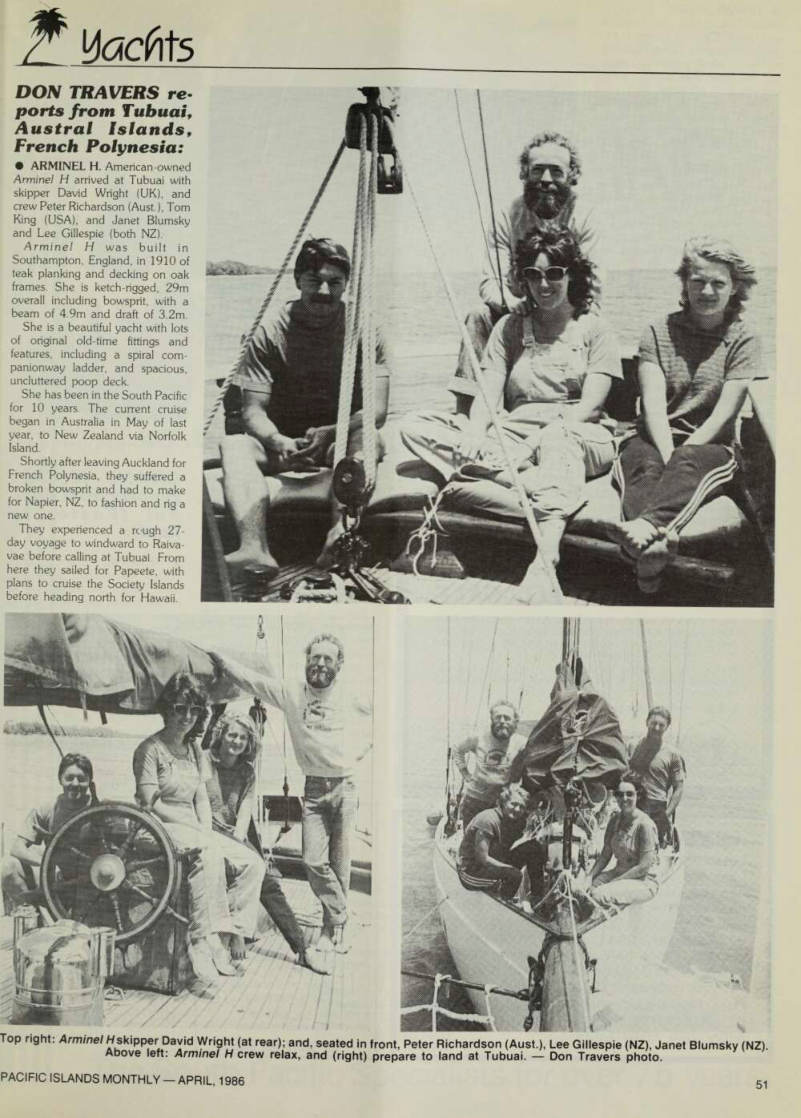
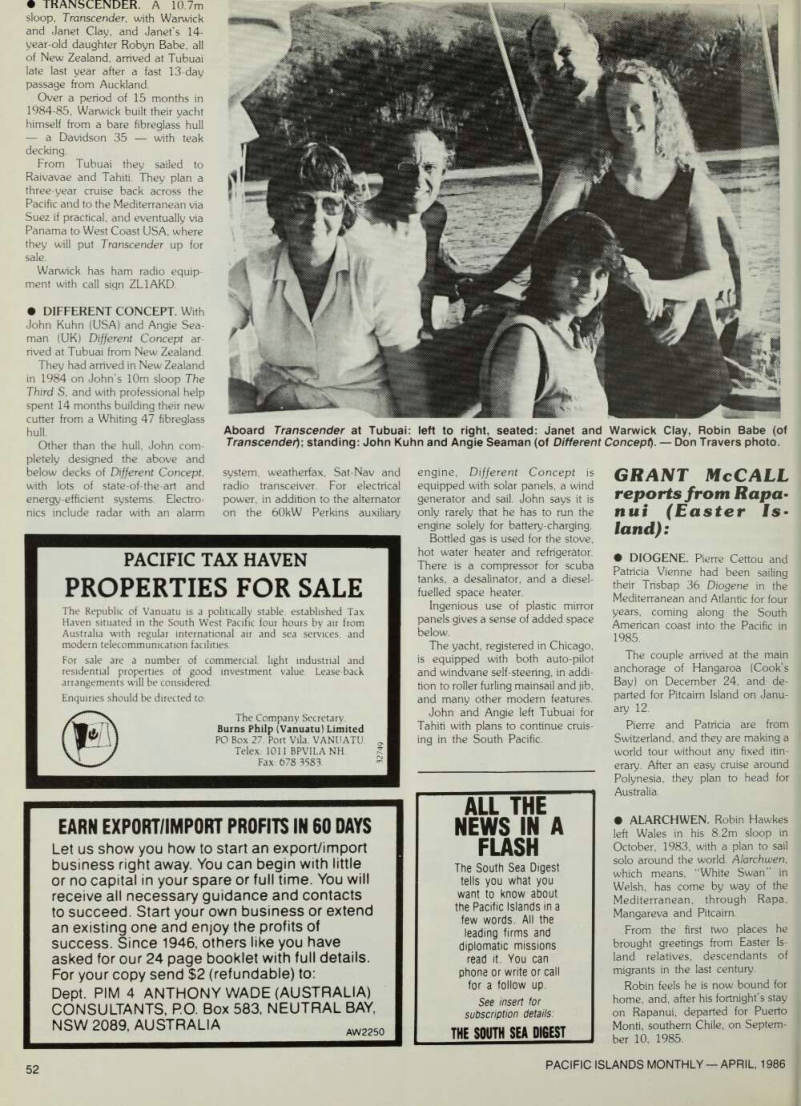
Don Travers Re
ports from Tubuai,
Austral isiands f
French Polynesia:
• ARMINEL H. American-owned Arminel H arrived at Tubuai with skipper David Wright (UK), and crew Peter Richardson (Aust.), Tom King (USA), and Janet Blumsky and Lee Gillespie (both NZ).
Arminel H was built in Southampton, England, in 1910 of teak planking and decking on oak frames. She is ketch-rigged, 29m overall including bowsprit, with a beam of 4.9 m and draft of 3.2 m.
She is a beautiful yacht with lots of original old-time fittings and features, including a spiral com panionway ladder, and spacious, uncluttered poop deck.
She has been in the South Pacific for 10 years. The current cruise began in Australia in May of last year, to New Zealand via Norfolk Island.
Shortly after leaving Auckland for French Polynesia, they suffered a broken bowsprit and had to make for Napier, NZ, to fashion and rig a new one.
They experienced a rough 27day voyage to windward to Raiva vae before calling at Tubuai From here they sailed for Papeete, with plans to cruise the Society Islands before heading north for Hawaii.
Top right: Arminel Hskipper David Wright (at rear); and, seated in front, Peter Richardson (Aust.), Lee Gillespie (NZ), Janet Blumsky (NZ).
Above left: Arminel H crew relax, and (right) prepare to land at Tubuai. Don Travers photo.
• Transcender. A 10.7 M
sloop. Transcender. with Warwick and Janet Clay, and Janet’s 14year-old daughter Robyn Babe, all of New Zealand, arrived at Tubuai late last year after a fast 13-day passage from Auckland.
Over a period of 15 months in 1984-85, Warwick built their yacht himself from a bare fibreglass hull a Davidson 35 with teak decking.
From Tubuai they sailed to Raivavae and Tahiti. They plan a three-year cruise back across the Pacific and to the Mediterranean via Suez if practical, and eventually via Panama to West Coast USA, where they will put Transcender up for sale.
Warwick has ham radio equip ment with call sign ZLIAKD.
• Different Concept. With
John Kuhn (USA) and Angie Sea man (UK) Different Concept ar rived at Tubuai from New Zealand.
They had arrived in New Zealand in 1984 on John’s 10m sloop The Third S, and with professional help spent 14 months building their new cutter from a Whiting 47 fibreglass hull.
Other than the hull. John com pletely designed the above and below decks of Different Concept. with lots of state-of-the-art and energy-efficient systems. Electro nics include radar with an alarm
system, weatherfax, Sat-Nav and radio transceiver. For electrical power, in addition to the alternator on the 60kW Perkins auxiliary
engine. Different Concept is equipped with solar panels, a wind generator and sail. John says it is only rarely that he has to run the engine solely for battery-charging.
Bottled gas is used for the stove, hot water heater and refrigerator.
There is a compressor for scuba tanks, a desalinator, and a diesel fuelled space heater.
Ingenious use of plastic mirror panels gives a sense of added space below.
The yacht, registered in Chicago, is equipped with both auto-pilot and windvane self-steering, in addi tion to roller furling mainsail and jib. and many other modern features.
John and Angie left Tubuai for Tahiti with plans to continue cruis ing in the South Pacific.
Grant Mccall
reports from Rapa
nut (Easter Is
land):
• DIOGENE. Pierre Cettou and Patricia Vienne had been sailing their Trisbap 36 Diogene in the Mediterranean and Atlantic for four years, coming along the South American coast into the Pacific in 1985.
The couple arrived at the main anchorage of Hangaroa (Cook’s Bay) on December 24, and de parted for Pitcairn Island on Janu ary 12.
Pierre and Patricia are from Switzerland, and they are making a world tour without any fixed itin erary. After an easy cruise around Polynesia, they plan to head for Australia. • ALARCHWEN. Robin Hawkes left Wales in his 8.2 m sloop in October, 1983, with a plan to sail solo around the world. Alarchwen , which means. “White Swan” in Welsh, has come by way of the Mediterranean, through Rapa, Mangareva and Pitcairn.
From the first two places he brought greetings from Easter Is land relatives, descendants of migrants in the last century.
Robin feels he is now bound for home, and, after his fortnight’s stay on Rapanui, departed for Puerto Monti, southern Chile, on Septem ber 10, 1985.
Aboard Transcender at Tubuai: left to right, seated: Janet and Warwick Clay, Robin Babe (of Transcender); standing: John Kuhn and Angie Seaman (of Different Concept ). Don Travers photo.
Advertisements & other items, pp. 52-53 (1 item)
Properties For Sale
PACIFIC TAX HAVEN
The Republic of Vanuatu is a politically stable, established Tax Haven situated in the South West Pacific four hours by air from Australia with regular international air and sea services, and modern telecommunication facilities.
For sale are a number of commercial, light industrial and residential properties of good investment value. Lease-back arrangements will be considered.
Enquiries should be directed to: The Company Secretary.
Burns Philp (Vanuatu) Limited PO Box 27. Port Vila. VANUATU. „ Tplpy- inn rpvii a mh s - Telex: 1011 BPVILA NH Fax: 678 3583.
ALL THE
NEWS IN A
FLASH
The South Sea Digest tells you what you want to know about the Pacific Islands in a few words. All the leading firms and diplomatic missions read it. You can phone or write or call for a follow up.
See insert for subscription details:
THE SOUTH SEA DIGEST
EARN EXPORT/IMPORT PROFITS IN 60 DAYS
Let us show you how to start an export/import business right away. You can begin with little or no capital in your spare or full time. You will receive all necessary guidance and contacts to succeed. Start your own business or extend an existing one and enjoy the profits of success. Since 1946, others like you have asked for our 24 page booklet with full details.
For your copy send $2 (refundable) to;
Dept. RIM 4 ANTHONY WADE (AUSTRALIA)
CONSULTANTS, RO. Box 583, NEUTRAL BAY,
NSW 2089, AUSTRALIA AW??C
BANK LINE and
COLUMBUS LINE
24 day service to
Europe.
Need we say more...
a d The Joint Service Partners offer facilities for shipment of: Containers (FCiyLCL) and Break-bulk Cargo plus reefer space and deeptanks for carriage of vegetable oils and other liquid bulk cargo.
Carriers also accept heavy lifts, overlength and cumbersome parcels.
Ports of Service; Loading: Papeete, Apia, Suva. Lautoka, Noumea, Port Vila, Santo, Honiara, Port Moresby, Lae, Madang, Kimbe, Rabaul, Kieta, Darwin. For: Rotterdam, Antwerp, Hamburg, Hull, Dunkirk, Le Havre.
Additional ports on enquiry.
Please contact our regional offices for further information: The Bank Line (Australasia) Pty Ltd Columbus Line Reederei GmbH Suite 801, 51 Pitt St. P.O. Box 1667, Lae/Papua New Guinea.
Sydney, NSW. Australia 2000 Phone: 423466/423287/A.H. 422481 Phone 27 2041 Telex 24063 Telex; Colline NE 44171 The South Pacific Specialists for over 75 years
shipping schedules
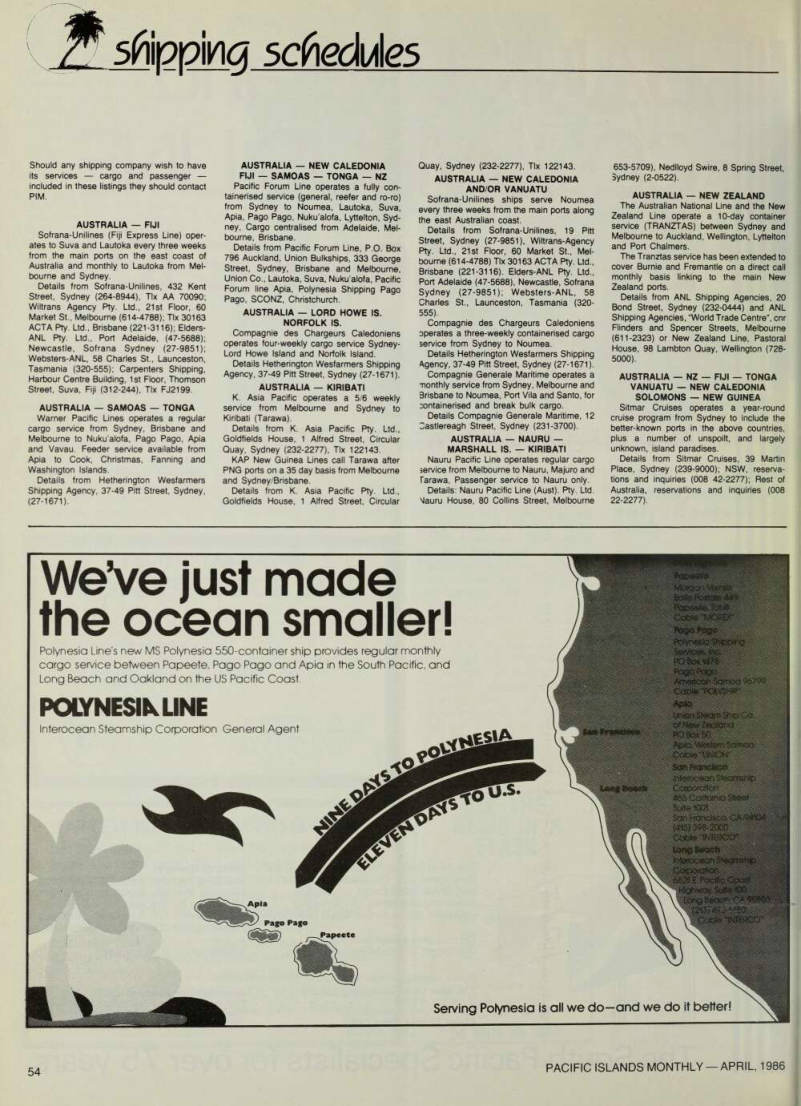
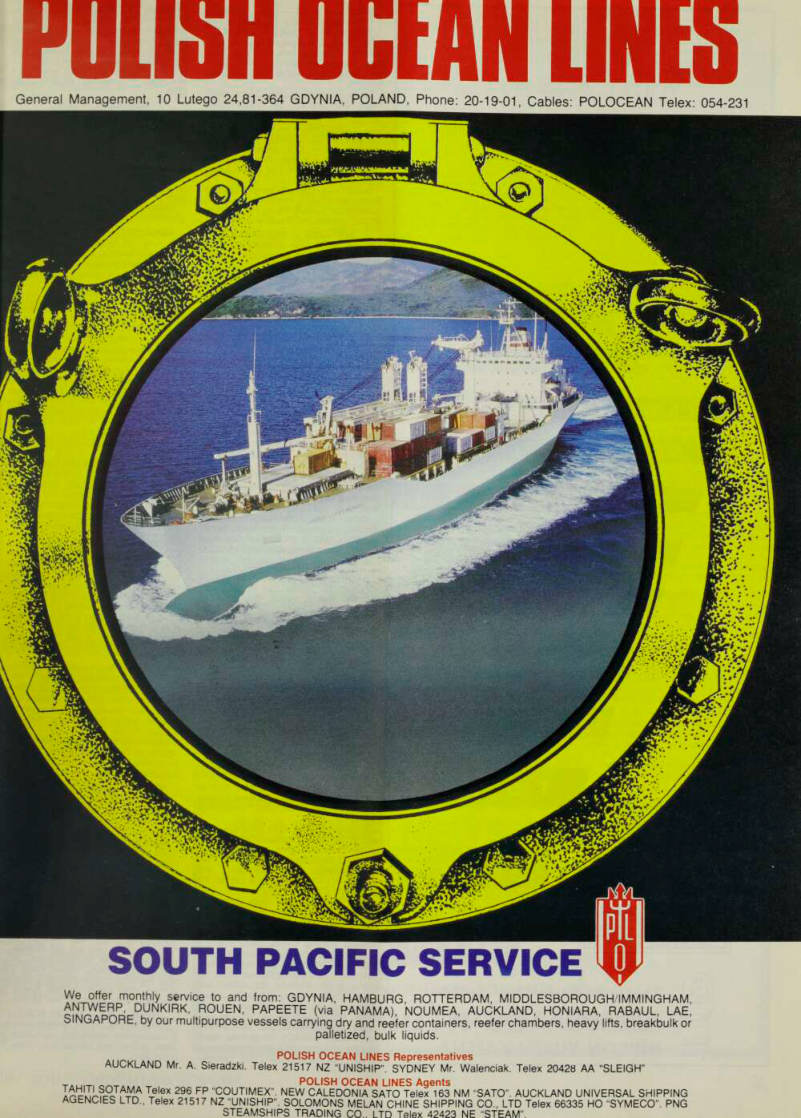
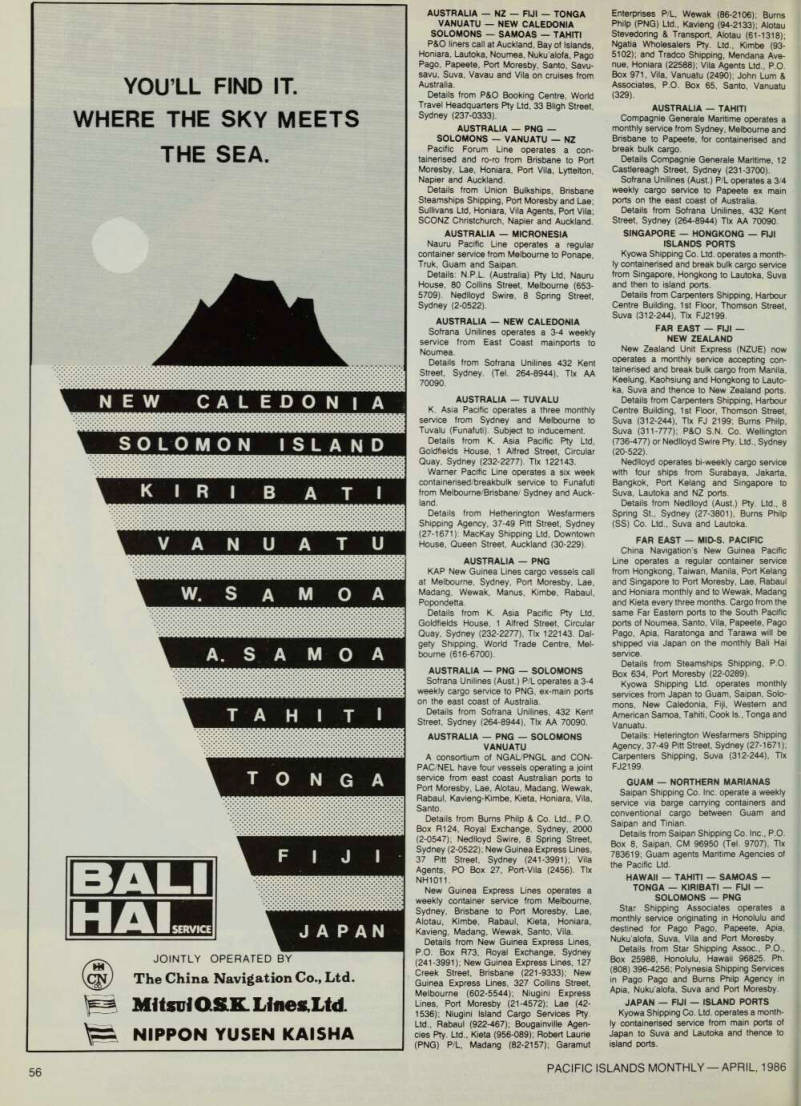
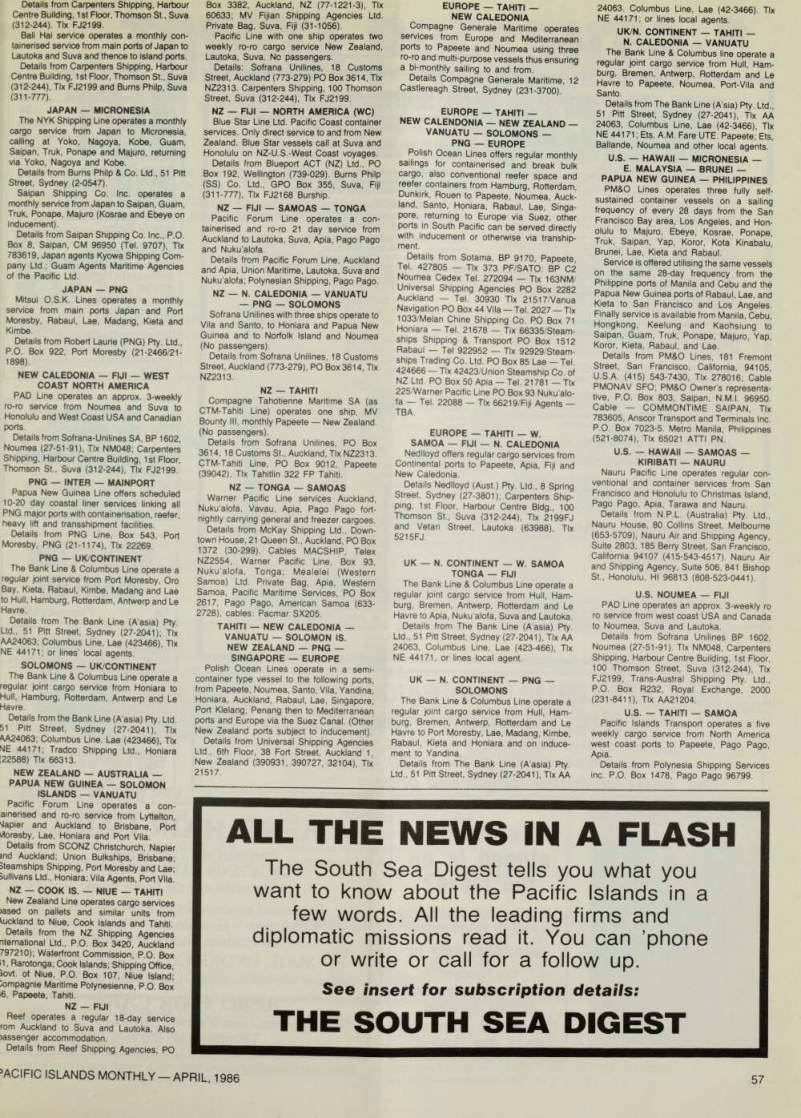
Should any shipping company wish to have its services cargo and passenger included in these listings they should contact
Pim.
Australia Fiji
Sofrana-Unilines (Fiji Express Line) oper ates to Suva and Lautoka every three weeks from the main ports on the east coast of Australia and monthly to Lautoka from Mel bourne and Sydney.
Details from Sofrana-Unilines, 432 Kent Street, Sydney (264-8944), Tlx AA 70090; Wiltrans Agency Pty. Ltd., 21st Floor, 60 Market St., Melbourne (614-4788); Tlx 30163 ACTA Pty. Ltd., Brisbane (221-3116); Elders- ANL Pty. Ltd., Port Adelaide. (47-5688); Newcastle, Sofrana Sydney (27-9851); Websters-ANL, 58 Charles St., Launceston, Tasmania (320-555); Carpenters Shipping, Harbour Centre Building, Ist Floor, Thomson Street, Suva, Fiji (312-244), Tlx FJ2199.
Australia Samoas Tonga
Warner Pacific Lines operates a regular cargo service from Sydney, Brisbane and Melbourne to Nukualofa, Pago Pago, Apia and Vavau. Feeder service available from Apia to Cook, Christmas, Fanning and Washington Islands.
Details from Hetherington Wesfarmers Shipping Agency, 37-49 Pitt Street, Sydney, (27-1671).
Australia New Caledonia
Fiji Samoas Tonga Nz
Pacific Forum Line operates a fully con tainerised service (general, reefer and ro-ro) from Sydney to Noumea, Lautoka, Suva, Apia, Pago Pago, Nukualofa, Lyttelton, Syd ney, Cargo centralised from Adelaide, Mel bourne, Brisbane.
Details from Pacific Forum Line, P.O. Box 796 Auckland, Union Bulkships, 333 George Street, Sydney, Brisbane and Melbourne, Union Co., Lautoka, Suva, Nukualofa, Pacific Forum line Apia, Polynesia Shipping Pago Pago, SCONZ, Christchurch.
Australia Lord Howe Is.
Norfolk Is.
Compagnie des Chargeurs Caledoniens operates four-weekly cargo service Sydney- Lord Howe Island and Norfolk Island.
Details Hetherington Wesfarmers Shipping Agency, 37-49 Pitt Street, Sydney (27-1671).
Australia Kiribati
K. Asia Pacific operates a 5/6 weekly service from Melbourne and Sydney to Kiribati (Tarawa).
Details from K. Asia Pacific Pty. Ltd., Goldfields House, 1 Alfred Street, Circular Quay, Sydney (232-2277), Tlx 122143.
KAP New Guinea Lines call Tarawa after PNG ports on a 35 day basis from Melbourne and Sydney/Brisbane.
Details from K. Asia Pacific Pty. Ltd., Goldfields House, 1 Alfred Street, Circular
Quay, Sydney (232-2277), Tlx 122143.
Australia New Caledonia
And/Or Vanuatu
Sofrana-Unilines ships serve Noumea every three weeks from the main ports along the east Australian coast.
Details from Sofrana-Unilines, 19 Pitt Street, Sydney (27-9851), Wiltrans-Agency Pty. Ltd., 21st Floor, 60 Market St., Mel bourne (614-4788) Tlx 30163 ACTA Pty. Ltd., Brisbane (221-3116). Elders-ANL Pty. Ltd., Port Adelaide (47-5688), Newcastle, Sofrana Sydney (27-9851); Websters-ANL, 58 Charles St., Launceston, Tasmania (320- 555).
Compagnie des Chargeurs Caledoniens operates a three-weekly containerised cargo service from Sydney to Noumea.
Details Hetherington Wesfarmers Shipping Agency, 37-49 Pitt Street, Sydney (27-1671).
Compagnie Generate Maritime operates a monthly service from Sydney, Melbourne and Brisbane to Noumea, Port Vila and Santo, for xintainerised and break bulk cargo.
Details Compagnie Generate Maritime, 12 Sastlereagh Street, Sydney (231-3700).
Australia Nauru
Marshall Is. Kiribati
Nauru Pacific Line operates regular cargo service from Melbourne to Nauru, Majuro and Tarawa, Passenger service to Nauru only.
Details: Nauru Pacific Line (Aust). Pty. Ltd. siauru House, 80 Collins Street, Melbourne
653-5709), Nedlloyd Swire, 8 Spring Street, Sydney (2-0522).
Australia New Zealand
The Australian National Line and the New Zealand Line operate a 10-day container service (TRANZTAS) between Sydney and Melbourne to Auckland, Wellington, Lyttelton and Port Chalmers.
The Tranztas service has been extended to cover Burnie and Fremantle on a direct call monthly basis linking to the main New Zealand ports.
Details from ANL Shipping Agencies, 20 Bond Street, Sydney (232-0444) and ANL Shipping Agencies, “World Trade Centre", cnr Flinders and Spencer Streets, Melbourne (611-2323) or New Zealand Line, Pastoral House, 98 Lambton Quay, Wellington (728- 5000).
Australia Nz Fiji Tonga
Vanuatu New Caledonia
Solomons New Guinea
Sitmar Cruises operates a year-round cruise program from Sydney to include the better-known ports in the above countries, plus a number of unspoilt, and largely unknown, island paradises.
Details from Sitmar Cruises, 39 Martin Place, Sydney (239-9000); NSW, reserva tions and inquiries (008 42-2277); Rest of Australia, reservations and inquiries (008 22-2277).
Australia Nz Fiji Tonga
Vanuatu New Caledonia
Solomons Samoas Tahiti
P&O liners call at Auckland, Bay of Islands, Honiara, Lautoka, Noumea, Nukualofa, Pago Pago, Papeete, Port Moresby, Santo, Savu savu, Suva, Vavau and Vila on cruises from Australia.
Details from P&O Booking Centre, World Travel Headquarters Pty Ltd, 33 Bligh Street
Sydney (237-0333).
Australia Png
Solomons Vanuatu Nz
Pacific Forum Line operates a con tainerised and ro-ro from Brisbane to Port Moresby, Lae, Honiara, Port Vila, Lyttelton, Napier and Auckland.
Details from Union Bulkships, Brisbane Steamships Shipping, Port Moresby and Lae; Sullivans Ltd, Honiara, Vila Agents, Port Vila; SCONZ Christchurch, Napier and Auckland.
Australia Micronesia
Nauru Pacific Line operates a regular container service from Melbourne to Ponape, Truk, Guam and Saipan.
Details: N.P.L. (Australia) Pty Ltd, Nauru House, 80 Collins Street, Melbourne (653- 5709). Nedlloyd Swire, 8 Spring Street, Sydney (2-0522).
Australia New Caledonia
Sofrana Unilines operates a 3-4 weekly service from East Coast mainports to Noumea.
Details from Sofrana Unilines 432 Kent Street. Sydney. (Tel. 264-8944), Tlx AA 70090.
Australia Tuvalu
K. Asia Pacific operates a three monthly service from Sydney and Melbourne to Tuvalu (Funafuti). Subject to inducement.
Details from K. Asia Pacific Pty Ltd.
Goldfields House, 1 Alfred Street, Circular Quay, Sydney (232-2277). Tlx 122143.
Warner Pacific Line operates a six week containerised/breakbulk service to Funafuti from Melbourne/Brisbane/ Sydney and Auck land.
Details from Hetherington Wesfarmers Shipping Agency. 37-49 Pitt Street, Sydney (27-1671); Mac Kay Shipping Ltd, Downtown House, Oueen Street, Auckland (30-229).
Australia Png
KAP New Guinea Lines cargo vessels call at Melbourne. Sydney, Port Moresby, Lae, Madang, Wewak, Manus, Kimbe, Rabaul, Popondetta.
Details from K. Asia Pacific Pty Ltd, Goldfields House, 1 Alfred Street, Circular Quay. Sydney (232-2277), Tlx 122143. Dal gety Shipping, World Trade Centre, Mel bourne (616-6700).
Australia Png Solomons
Sofrana Unilines (Aust.) P/L operates a 3-4 weekly cargo service to PNG, ex-main ports on the east coast of Australia.
Details from Sofrana Unilines, 432 Kent Street, Sydney (264-8944), Tlx AA 70090.
Australia Png Solomons
Vanuatu
A consortium of NGACPNGL and CON PAC/NEL have four vessels operating a joint service from east coast Australian ports to Port Moresby, Lae. Alotau, Madang, Wewak, Rabaul, Kavieng-Kimbe, Kieta, Honiara, Vila, Santo.
Details from Burns Philp & Co. Ltd., P.O.
Box R 124, Royal Exchange, Sydney, 2000 (2-0547); Nedlloyd Swire, 8 Spring Street, Sydney (2-0522); New Guinea Express Lines, 37 Pitt Street, Sydney (241-3991); Vila Agents, PC Box 27, Port-Vila (2456). Tlx
Nhioii.
New Guinea Express Lines operates a weekly container service from Melbourne, Sydney, Brisbane to Port Moresby, Lae, Alotau, Kimbe, Rabaul, Kieta, Honiara, Kavieng, Madang, Wewak, Santo, Vila.
Details from New Guinea Express Lines, P.O. Box R 73, Royal Exchange, Sydney (241-3991); New Guinea Express Lines. 127 Creek Street, Brisbane (221-9333); New Guinea Express Lines, 327 Collins Street, Melbourne (602-5544); Niugini Express Lines, Port Moresby (21-4572); Lae (42- 1536); Niugini Island Cargo Services Pty.
Ltd., Rabaul (922-467); Bougainville Agen cies Pty. Ltd., Kieta (956-089); Robert Laurie (PNG) P/L, Madang (82-2157); Garamut
Enterprises P/L, Wewak (86-2106); Bums Philp (PNG) Ltd., Kavieng (94-2133); Alotau Stevedoring & Transport, Alotau (61-1318); Ngatia Wholesalers Pty. Ltd., Kimbe (93- SI 02); and Tradco Shipping, Mendana Ave nue, Honiara (22588); Vila Agents Ltd., P.O.
Box 971, Vila, Vanuatu (2490); John Lum & Associates, P.O. Box 65, Santo, Vanuatu (329).
Australia Tahiti
Compagnie Generate Maritime operates a monthly service from Sydney, Melbourne and Brisbane to Papeete, for containerised and break bulk cargo.
Details Compagnie Generate Maritime, 12 Castlereagh Street, Sydney (231-3700).
Sofrana Unilines (Aust.) P/L operates a 3/4 weekly cargo service to Papeete ex main ports on the east coast of Australia.
Details from Sofrana Unilines, 432 Kent Street, Sydney (264-8944) Tlx AA 70090.
Singapore Hongkong Fiji
Islands Ports
Kyowa Shipping Co. Ltd. operates a month ly containerised and break bulk cargo service from Singapore, Hongkong to Lautoka, Suva and then to island ports.
Details from Carpenters Shipping, Harbour Centre Building, Ist Floor, Thomson Street, Suva (312-244), Tlx FJ2199.
Far East Fiji
New Zealand
New Zealand Unit Express (NZUE) now operates a monthly service accepting con tainerised and break bulk cargo from Manila, Keelung, Kaohsiung and Hongkong to Lauto ka, Suva and thence to New Zealand ports.
Details from Carpenters Shipping, Harbour Centre Building, Ist Floor, Thomson Street, Suva (312-244), Tlx FJ 2199; Bums Philp, Suva (311-777); P&O S.N. Co. Wellington (736-477) or Nedlloyd Swire Pty. Ltd., Sydney (20-522).
Nedlloyd operates bi-weekly cargo service with four ships from Surabaya, Jakarta, Bangkok, Port Kelang and Singapore to Suva, Lautoka and NZ ports.
Details from Nedlloyd (Aust.) Pty. Ltd., 8 Spring St.. Sydney (27-3801), Bums Philp (SS) Co. Ltd., Suva and Lautoka.
Far East Mid-S. Pacific
China Navigation's New Guinea Pacific Line operates a regular container service from Hongkong, Taiwan, Manila, Port Kelang and Singapore to Port Moresby, Lae, Rabaul and Honiara monthly and to Wewak, Madang and Kieta every three months. Cargo from the same Far Eastern ports to the South Pacific ports of Noumea, Santo, Vila, Papeete, Pago Pago. Apia, Raratonga and Tarawa will be shipped via Japan on the monthly Bali Hai service.
Details from Steamships Shipping, P.O.
Box 634, Port Moresby (22-0289).
Kyowa Shipping Ltd. operates monthly services from Japan to Guam, Saipan, Solo mons, New Caledonia, Fiji, Western and American Samoa, Tahiti, Cook Is., Tonga and Vanuatu.
Details; Heterington Wesfarmers Shipping Agency, 37-49 Pitt Street, Sydney (27-1671); Carpenters Shipping, Suva (312-244), Tlx FJ2199.
Guam Northern Marianas
Saipan Shipping Co. Inc. operate a weekly service via barge carrying containers and conventional cargo between Guam and Saipan and Tinian.
Details from Saipan Shipping Co. Inc., P.O.
Box 8, Saipan, CM 96950 (Tel. 9707), Tlx 783619; Guam agents Maritime Agencies of the Pacific Ltd.
Hawaii Tahiti Samoas
Tonga Kiribati Fiji
Solomons Png
Star Shipping Associates operates a monthly service originating in Honolulu and destined for Pago Pago, Papeete, Apia, Nukualofa, Suva, Vila and Port Moresby.
Details from Star Shipping Assoc., P. 0., Box 25988, Honolulu, Hawaii 96825. Ph. (808) 396-4256; Polynesia Shipping Services in Pago Pago and Bums Philp Agency in Apia, Nukualofa. Suva and Port Moresby.
Japan Fiji Island Ports
Kyowa Shipping Co. Ltd. operates a month ly containerised service from main ports of Japan to Suva and Lautoka and thence to island ports.
Details from Carpenters Shipping, Harbour Centre Building, Ist Floor, Thomson St., Suva (312-244). Tlx FJ2199.
Bali Hai service operates a monthly con tainerised service from main ports of Japan to Lautoka and Suva and thence to island ports.
Details from Carpenters Shipping, Harbour Centre Building, Ist Floor, Thomson St., Suva (312-244), Tlx FJ2199 and Burns Philp, Suva (311-777).
Japan Micronesia
The NYK Shipping Line operates a monthly cargo service from Japan to Micronesia, calling at Yoko, Nagoya, Kobe, Guam, Saipan, Truk, Ponape and Majuro, returning via Yoko, Nagoya and Kobe.
Details from Burns Philp & Co. Ltd., 51 Pitt Street, Sydney (2-0547).
Saipan Shipping Co. Inc. operates a monthly service from Japan to Saipan, Guam, Truk, Ponape, Majuro (Kosrae and Ebeye on inducement).
Details from Saipan Shipping Co. Inc., P.O.
Box 8, Saipan, CM 96950 (Tel. 9707), Tlx 783619, Japan agents Kyowa Shipping Com pany Ltd.; Guam Agents Maritime Agencies of the Pacific Ltd.
Japan Png
Mitsui O.S.K. Lines operates a monthly service from main ports Japan and Port Moresby, Rabaul, Lae, Madang, Kieta and Kimbe.
Details from Robert Laurie (PNG) Pty. Ltd., P.O. Box 922, Port Moresby (21-2466/21- 1898).
New Caledonia Fiji West
Coast North America
PAD Line operates an approx. 3-weekly ro-ro service from Noumea and Suva to Honolulu and West Coast USA and Canadian ports.
Details from Sofrana-Unilines SA, BP 1602, Noumea (27-51-91), Tlx NMO4B; Carpenters Shipping, Harbour Centre Building, Ist Floor, Thomson St., Suva (312-244), Tlx FJ2199.
Png Inter Mainport
Papua New Guinea Line offers scheduled 10-20 day coastal liner services linking all PNG major ports with containerisation, reefer, heavy lift and transshipment facilities.
Details from PNG Line, Box 543, Port Moresby, PNG (21-1174), Tlx 22269.
Png Uk/Continent
The Bank Line & Columbus Line operate a regular joint service from Port Moresby, Oro Bay, Kieta, Rabaul, Kimbe. Madang and Lae to Hull, Hamburg, Rotterdam, Antwerp and Le Havre.
Details from The Bank Line (A’asia) Pty.
Ltd.. 51 Pitt Street, Sydney (27-2041); Tlx AA24063; Columbus Line. Lae (423466), Tlx NE 44171; or lines’ local agents.
Solomons Uk/Continent
The Bank Line & Columbus Line operate a regular joint cargo service from Honiara to Hull, Hamburg, Rotterdam, Antwerp and Le Havre.
Details from the Bank Line (A’asia) Pty. Ltd. 51 Pitt Street, Sydney (27-2041), Tlx AA24063; Columbus Line. Lae (423466), Tlx NE 44171; Tradco Shipping Ltd., Honiara ;22588) Tlx 66313.
New Zealand Australia
Papua New Guinea Solomon
Islands Vanuatu
Pacific Forum Line operates a con ainerised and ro-ro service from Lyttelton, Napier and Auckland to Brisbane, Port wloresby, Lae, Honiara and Port Vila.
Details from SCONZ Christchurch. Napier md Auckland; Union Bulkships, Brisbane; Steamships Shipping, Port Moresby and Lae; Sullivans Ltd., Honiara; Vila Agents, Port Vila.
Nz Cook Is. Niue Tahiti
New Zealand Line operates cargo services >ased on pallets and similar units from Auckland to Niue, Cook Islands and Tahiti.
Details from the NZ Shipping Agencies nternational Ltd., P.O. Box 3420, Auckland 797210); Waterfront Commission, P.O. Box n, Rarotonga; Cook Islands; Shipping Office, Sovt. of Niue, P.O. Box 107, Niue Island; tempagnie Maritime Polynesienne, P.O. Box 6, Papeete, Tahiti.
Nz Fiji
Reef operates a regular 18-day service rom Auckland to Suva and Lautoka. Also )assenger accommodation.
Details from Reef Shipping Agencies, PO
Box 3382, Auckland, NZ (77-1221-3), Tlx 60633; MV Fijian Shipping Agencies Ltd.
Private Bag, Suva, Fiji (31-1056).
Pacific Line with one ship operates two weekly ro-ro cargo service New Zealand, Lautoka, Suva. No passengers.
Details: Sofrana Unilines, 18 Customs Street, Auckland (773-279) PO Box 3614, Tlx NZ2313. Carpenters Shipping, 100 Thomson Street, Suva (312-244), Tlx FJ2199.
Nz Fiji North America (Wc)
Blue Star Line Ltd. Pacific Coast container services. Only direct service to and from New Zealand. Blue Star vessels call at Suva and Honolulu on NZ-U.S.-West Coast voyages.
Details from Blueport ACT (NZ) Ltd., PO Box 192, Wellington (739-029). Burns Philp (SS) Co. Ltd., GPO Box 355, Suva, Fiji (311-777), Tlx FJ2168 Burship.
Nz Fiji Samoas Tonga
Pacific Forum Line operates a con tainerised and ro-ro 21 day service from Auckland to Lautoka, Suva, Apia, Pago Pago and Nukualofa.
Details from Pacific Forum Line, Auckland and Apia, Union Maritime, Lautoka, Suva and Nukualofa; Polynesian Shipping, Pago Pago.
Nz N. Caledonia Vanuatu
Png Solomons
Sofrana Unilines with three ships operate to Vila and Santo, to Honiara and Papua New Guinea and to Norfolk Island and Noumea (No passengers).
Details from Sofrana Unilines, 18 Customs Street, Auckland (773-279), PO Box 3614, Tlx NZ2313.
Nz Tahiti
Compagne Tahotienne Maritime SA (as CTM-Tahiti Line) operates one ship, MV Bounty 111, monthly Papeete New Zealand. (No passengers).
Details from Sofrana Unilines, PO Box 3614,18 Customs St., Auckland, Tlx NZ2313.
CTM-Tahiti Line, PO Box 9012, Papeete (39042), Tlx Tahitlin 322 FP Tahiti.
Nz Tonga Samoas
Warner Pacific Line services Auckland, Nukualofa, Vavau, Apia, Pago Pago fort nightly carrying general and freezer cargoes.
Details from McKay Shipping Ltd., Down town House, 21 Queen St., Auckland, PO Box 1372 (30-299). Cables MACSHIP, Telex NZ2554, Warner Pacific Line, Box 93, Nukualofa, Tonga; Mealelei (Western Samoa) Ltd. Private Bag, Apia, Western Samoa, Pacific Maritime Services, PO Box 2617, Pago Pago, American Samoa (633- 2728), cables: Pacmar SX2OS.
Tahiti New Caledonia
Vanuatu Solomon Is.
New Zealand Png
Singapore Europe
Polish Ocean Lines operate in a semi container type vessel to the following ports, from Papeete, Noumea, Santo, Vila, Yandina, Honiara, Auckland, Rabaul, Lae, Singapore, Port Klelang, Penang then to Mediterranean ports and Europe via the Suez Canal. (Other New Zealand ports subject to inducement).
Details from Universal Shipping Agencies Ltd., 6th Floor, 38 Fort Street. Auckland 1, New Zealand (390931, 390727, 32104), Tlx 21517.
Europe - Tahiti -
New Caledonia
Compagne Generate Maritime operates services from Europe and Mediterranean ports to Papeete and Noumea using three ro-ro and multi-purpose vessels thus ensuring a bi-monthly sailing to and from.
Details Compagne Generate Maritime, 12
Castlereagh Street, Sydney (231-3700).
Europe Tahiti
New Calendonia New Zealand
Vanuatu Solomons
Png Europe
Ftelish Ocean Lines offers regular monthly sailings for containerised and break bulk cargo, also conventional reefer space and reefer containers from Hamburg, Rotterdam, Dunkirk, Rouen to Papeete, Noumea, Auck land, Santo, Honiara, Rabaul, Lae, Singa pore, returning to Europe via Suez, other ports in South Pacific can be served directly with inducement or otherwise via tranship ment.
Details from Sotama, BP 9170, Papeete, Tel. 427805 Tlx 373 PF/SATO: BP C 2 Noumea Cedex Tel. 272094 Tlx 163 NM/ Universal Shipping Agencies PO Box 2282 Auckland Tel. 30930 Tlx 21517/Vanua Navigation PO Box 44 Vila Tel. 2027 Tlx 1033/Melan Chine Shipping Co. PO Box 71 Honiara Tel. 21678 Tix 66335/Steam ships Shipping & Transport PO Box 1512 Rabaul Tel 922952 Tlx 92929/Steam ships Trading Co. Ltd. PO Box 85 Lae Tel. 424666 Tlx 42423/Union Steamship Co. of NZ Ltd. PO Box 50 Apia Tel. 21781 Tlx 225/Warner Pacific Line PO Box 93 Nukualo fa Tel. 22088 Tlx 66219/Fiji Agents
Tba.
Europe Tahiti W.
Samoa Fiji N. Caledonia
Nedlloyd offers regular cargo services from Continental ports to Papeete, Apia, Fiji and New Caledonia.
Details Nedlloyd (Aust.) Pty. Ltd., 8 Spring Street, Sydney (27-3801); Carpenters Ship ping, Ist Floor, Harbour Centre Bldg., 100 Thomson St., Suva (312-244), Tlx 2199FJ and Vetari Street, Lautoka (63988), Tlx 5215FJ.
Uk N. Continent W. Samoa
Tonga Fiji
The Bank Line & Columbus Line operate a regular joint cargo service from Hull, Ham burg, Bremen, Antwerp, Rotterdam and Le Havre to Apia, Nukualofa, Suva and Lautoka.
Details from The Bank Line (A’asia) Pty.
Ltd., 51 Pitt Street, Sydney (27-2041), Tlx AA 24063, Columbus Line, Lae (423-466), Tlx NE 44171, or lines local agent.
Uk N. Continent Png
Solomons
The Bank Line & Columbus Line operate a regular joint cargo service from Hull, Ham burg, Bremen, Antwerp, Rotterdam and Le Havre to Port Moresby, Lae, Madang, Kimbe, Rabaul, Kieta and Honiara and on induce ment to Yandina.
Details from The Bank Line (A’asia) Pty.
Ltd., 51 Pitt Street. Sydney (27-2041), Tlx AA
24063. Columbus Line, Lae (42-3466). Tlx NE 44171; or lines local agents.
Uk/N. Continent Tahiti
N. Caledonia Vanuatu
The Bank Line & Columbus line operate a regular joint cargo service from Hull, Ham burg. Bremen, Antwerp. Rotterdam and Le Havre to Papeete, Noumea, Port-Vila and Santo.
Details from The Bank Line (A’sia) Pty. Ltd., 51 Pitt Street, Sydney (27-2041), Tlx AA 24063, Columbus Line, Lae (42-3466), Tlx NE 44171; Ets. A.M. Fare UTE. Papeete; Ets, Ballande, Noumea and other local agents.
U.S. Hawaii Micronesia
E. Malaysia Brunei
Papua New Guinea Philippines
PM&O Lines operates three fully self sustained container vessels on a sailing frequency of every 28 days from the San Francisco Bay area, Los Angeles, and Hon olulu to Majuro, Ebeye, Kosrae, Ponape, Truk, Saipan, Yap, Koror, Kota Kinabalu, Brunei, Lae, Kieta and Rabaul.
Service is offered utilising the same vessels on the same 28-day frequency from the Philippine ports of Manila and Cebu and the Papua New Guinea ports of Rabaul, Lae, and Kieta to San Francisco and Los Angeles.
Finally service is available from Manila, Cebu,
Hongkong, Keelung and Kaohsiung to
Saipan, Guam, Truk, Ponape, Majuro, Yap, Koror, Kieta, Rabaul, and Lae.
Details from PM&O Lines, 181 Fremont Street, San Francisco, California, 94105, U.S.A. (415) 543-7430, Tlx 278016; Cable PMONAV SFO; PM&O Owner’s representa tive, P.O. Box 803, Saipan, N.M.I. 96950.
Cable Commontime Saipan, Tlx
783605, Anscor Transport and Terminals Inc.
P.O. Box 7023-5. Metro Manila, Philippines
(521-8074), Tlx 65021 Atti Pn.
U.S. Hawaii Samoas
Kiribati Nauru
Nauru Pacific Line operates regular con ventional and container services from San Francisco and Honolulu to Christmas Island, Pago Pago, Apia, Tarawa and Nauru.
Details from N.P.L. (Australia) Pty. Ltd., Nauru House, 80 Collins Street, Melbourne (653-5709), Nauru Air and Shipping Agency, Suite 2803, 185 Berry Street, San Francisco, California 94107 (415-543-4517). Nauru Air and Shipping Agency, Suite 506, 841 Bishop St., Honolulu, HI 96813 (808-523-0441).
U.S. Noumea Fiji
PAD Line operates an approx. 3-weekly ro ro service from west coast USA and Canada to Noumea. Suva and Lautoka.
Details from Sofrana Unilines BP 1602, Noumea (27-51-91). Tlx NMO4B, Carpenters Shipping, Harbour Centre Building, Ist Floor, 100 Thomson Street, Suva (312-244), Tlx FJ2199, Trans-Austral Shipping Pty. Ltd., P.O. Box R 232, Royal Exchange, 2000 (231-8411), Tlx AA21204.
U.S. Tahiti Samoa
Pacific Islands Transport operates a five weekly cargo service from North America west coast ports to Papeete, Pago Pago, Apia.
Details from Polynesia Shipping Services inc. P.O. Box 1478, Pago Pago 96799.
Advertisements & other items, pp. 54-60 (2 items)
We’ve just made
the ocean smaller!
Polynesia Line's new MS Polynesia 550-container ship provides regular monthly cargo service between Papeete, Pago Pago and Apia in the South Pacific, and Long Beach and Oakland on the US Pacific Coast.
POLYNESIMINE
Interocean Steamship Corporation General Agent oO \ & K Q. fk 3* vs 5* * Pago Pago Papeete Serving Polynesia is all we do—and we do it better!
POLISH OCEAN LINES
General Management, 10 Lutego 24,81-364 GDYNIA, POLAND, Phone: 20-19-01, Cables: POLOCEAN Telex: 054-231 © © ft 7a $ J* •*/ w*. ■rr ■•V
SOUTH PACIFIC SERVICE 1!
We offer monthly service to and from: GDYNIA, HAMBURG, ROTTERDAM, MIDDLESBOROUGH/IMMINGHAM, ° UNKIRK * ROUEN - PAPEETE (via PANAMA), NOUMEA, AUCKLAND, HONIARA, RABAUL, LAE, bINGAPORE, by our multipurpose vessels carrying dry and reefer containers, reefer chambers, heavy lifts, breakbulk or palletized, bulk liquids. a POLISH OCEAN LINES Representatives AUCKLAND Mr. A. Sieradzki. Telex 21517 NZ “UNISHIP”. SYDNEY Mr. Walenciak. Telex 20426 AA “SLEIGH” taljit. T POLISH OCEAN LINES Agents e f X 2^ 96 FP “ COUTIMEX "- NEW CALEDONIA SATO Telex 163 NM “SATO”. AUCKLAND UNIVERSAL SHIPPING AGENCIES LTD., Telex 21517 NZ “UNISHIP”. SOLOMONS MELAN CHINE SHIPPING CO., LTD Telex 66335 HO “SYMECO”. PNG STEAMSHIPS TRADING CO.. LTD Telex 42423 NE “STEAM”.
YOU’LL FIND IT.
WHERE THE SKY MEETS
THE SEA.
NEW CALEDONIA
SOLOMON ISLAND
KIRI B ATI
VANUATU
W. S A M O A
A. S A M O A
TAHITI
TONGA
JOINTLY OPERATED BY
/ Ha The China Navigation Co., Ltd.
Mitsui Q&K Lines. Ltd
NIPPON YUSEN KAISHA
ALL THE NEWS IN A FLASH
The South Sea Digest tells you what you want to know about the Pacific Islands in a few words. All the leading firms and diplomatic missions read it. You can ’phone or write or call for a follow up.
See insert for subscription details:
THE SOUTH SEA DIGEST
SERVICE PAGE
ADVERTISING
Afro Hair Care 58 Aggie Grey 58 Aiwa Company 34 Amatil 28
AW A 32
Bali Hai Service 56 Bank Line 53 Burns Philp&Co 52 Citizen Watches 8 Clarion Shoji 46 Collins Olympic 15 Henry Cumines 49 Honda Motor 2
ICI 43
Mail Forwarding 58 Matsushita/National 6 Mitsubishi Motor 60 Naylor 49 Pioneer Electronic 18 Polish Ocean Lines 55 Polynesia Line 54 Situation Wanted 58 Toyota Motor 59 Toyota Motor 30,31 Wade 52
D mm aw
njOTimmy
AUSTRALIA: Distribution: The Herald and Weekly Times Ltd., 44-74 Flinders St.. Melbourne, Vic., 3000 Advertising R«p« Brisbane D, Wood, Anday Agency, CCA Centre, Dayboro Road, Ctosebum 4520; Box 1918, GPO Brisbane, 4001; telephone (07) 289-4128 Adelaide Hastwell Williamson Rouse Pty Ltd., PO Box 419, Norwood, SA, 5067; 59 Kensington Road, Norwood; telephone (06) 332-3322, telex 87113; Perth Allen & Associates, Suite 2. 284 Stirling St., Perth, WA. 6000, telephone (09) 328-9593 or (09) 328-9363 FUJI: Distribution and subscriptions Desai Bookshops, P O. Box 160. Suva. Fiji, telephone Suva 23036 Advertising Fiji Times & Herald Ltd., 20 Gordon St., Suva, telephone 31-4111, telex FJ2124 FRENCH POLYNESIA: Distribution Hachette Padfique, 10 Ave Bruat, Papeete, telephone 25610.
HAWAII, UNITED STATES; Distribution PIM, Hawaii, PO Box 22250, Honolulu. Hawaii, 96822 Advertising Brian C Asgill, Apt. 1308, 1676 Ala Moana Blvd., Honolulu, Hawaii, 96815, telephone (808) 955-9718 Japan and Korea: Advertising and subscriptions Universal Media Corporation. GPO Box 46, Tokyo, telephone 666-3036, cables UNIMEDIA Tokyo, telex 2524665.
MALAYSIA: Advertising and subscriptions Worldwide Media Services, 57-B Komplex Damai, Jin Date Haji Eusofl, Kuala Lumpur, telephone 63-9340, cables WORLDMEDIA Kuala Lumpur, telex 31533.
VANUATU: Distribution The Bookshop. HQ Box 210, Port Vila. Advertising Norman Bros. Bookshop, Port Vila, telephone 2232.
NEW ZEALAND: Distribution Gordon & Gotch, PO Bex 584. 2 Carr Road, Ml. Roskill, Auckland 4 Advertising International Media Representatives Ltd., PO Box 10259, Balmoral. Auckland 4, telephone 605-909, 792-370, telex NZ21404
PAPUA NEW GUINEA: Distribution Gordon & Gotch, PO Box 3396, Port Moresby, telephone 25-4651, 25-4855 Advertising Ken Head, PNG Post-Courier, PO Box 85, Port Moresby, telephone 21-2577, telex 22120.
SOLOMON ISLANDS: Distribution and Advertising The Bookshop, (Norman Bros.) PO Box 503, Honiara.
PHILIPPINES: Advertising The GF Group. 12 San Ignacio St., Uroaneta Village, Makati. Metro Manila, telephone 817-7299, telex 45950 and 4233.
UNITED KINGDOM: The Herald & Weekly Times Ltd., No 1 Mattravers Street,London WC2R 3DZ, England, telephone 01 836 5162, telex London 21989 UNITED STATES MAINLAND: Advertising Joshua B Powers Jr., Powers International Inc., 551 Frith Ave., New York, New York 10 017, telephone 867-9580, telex 236514.
Subscriptions PIM, Hawaii. PO Box 22250, Honolulu.
Hawaii, 96822
SUBSCRIPTIONS
American Samoa Australia Canada Cook Islands Fiji French Polynesia Guam Hawaii Japan Kiribati Micronesia Nauru New Caledonia New Zealand Niue Norfolk Island Northern Marianas Papua New Guinea Solomon Islands Tonga Tuvalu United Kingdom U. S Mainland Vanuatu Western Samoa Elsewhere Payments by personal cheque are only acceptable in Australian (from a branch in Australia), U S. and New Zealand currency. For all other remittances please send an international bank draft in Australian dollars.
Published monthly by Pacific Publications (Aust.) Pty.
Ltd. and printed in Australia by Quadricolor Industries Pty. Ltd., Mulgrave, Vic.
.. SUS2I
AustslB
.. SUS 27
. NZ$3O
Austsl9
.. SUS 22
. SUS 23
. SUS 23
SUS 22
Austsl9
. SUS 23
Austs2l
. SUS 22
. NZ$3O
. NZ$3O
AustslB
. SUS 23
Austs23 Austsl9 Austsl9 Austsl9
. Stgsls
. SUS 27
Austsl9 Austsl9 Austs2s
ALL THE NEWS
IN A FLASH
THE SOUTH SEA DIGEST
See insert for Subscription details
SITUATION
WANTED
Dr of Pharmacy/MBA, experienced in sales, marketing, management with
profit-loss responsibilities,
health industries, export/retail management.
Seeks opportunity outside U.S. utilising professional/ entrepreneurial skills.
Contact Box 161, 702 Washington St., Venice, California 90292, U.S.A.
Telex 664851. Ph. (213) 306- 2427.
NOW AVAILABLE! 15th Edition
PACIFIC ISLANDS YEAR BOOK
Contains over 550 pages crammed with all the facts you want to know on all the island groups of the Pacific.
See insert for further details and price.
Stay at Aggie Grey’s . . . the South Pacific’s
legendary hotel.
Situated right in the heart of Western Samoa. Enjoy Polynesian style friendliness and service, in cool surroundings, superb entertainment and food.
Magnificent white sand beaches only a short drive away. Airconditioned rooms, swimming |xx)l and full bar facilities.
B(X)kings through Union Steamship Company of NZ, Pan Am, Air New Zealand or direct to Aggie Grey’s. Apia. Western Samoa. Cables: ‘AGGIES’ Apia.
AFRO HAIR CARE
Importers and Distributors of
BLACK HAIR CARE PRODUCTS
in Australia and the South Pacific Specialised products for all Afro-type hair • Shampoos • Conditioners • Hairdressings • Curl Products (including Curl Kits)
MAIL ORDER CONVENIENCE
Retail or wholesale contact us for price list and brochures
AFRO HAIR CARE
3 Wedge Court, Glen Waverley, Victoria, Australia 3150 Telephone (03) 2332642
Travelling
abroad or on
the move?
Let us be your postbox and be sure to get your mail.
For details, write to: The Manager, Mail Forwarding and Agency Services, P.O. Box 22, Palmerston North, New Zealand.
TOYOTA PRESENTS
THE “MORE” MACHINE.
Toyota believe in giving you more for your money. And that’s just what our new three-wheeled electric forklift does. Look it over closely. Compare. You’ll see that no matter how you measure it, the new Toyota electric forklift challenges the very best of its class. And best of all, it offers you world-famous Toyota reliability. We build more quality in, so you get more value out. 66 k\A/ (all 48V models)
MORE LOAD HANDLING
POWER A powerful 6.6 kW load handling motor takes on the biggest jobs with ease something that can’t be said for most electrics.
mny £
320 (2FBEIO 48V model)
MORE EFFICIENCY -
QUICKER LIFT SPEED
Wasted time is wasted money. So Toyota help you get the job done.
Fast. Its 320 mm/sec. lift speed is among the quickest in this class. i
TOYOTAd
2x22 1350 mm (minimum turning radius, 2FBEIO model)
MORi MANOEUVRABILITY
With a remarkably small 1350 mm turning radius, and rugged, compact body, this new Toyota is at home in cramped quarters.
IB
THREE-WHEELER
kW (2FBEIO 48V model with cushion tyres)
MORE DRIVE SPEED
You can zip from one work area to another at a brisk 12.5 km/h top speed - among the best in this class.
lQ%(t3no)
■ i5-mmute ratings, 2FBEIO 48V model)
MORE GRADEABILITY
With front-wheel drive traction and powerful twin drive motors, it can haul a full load up the steepest of inclines even up to 18% tan 6! (all 48V models)
MORE DRIVE POWER Twin 2.7 kW
drive motors deliver torque and power that rival even engine-powered forklifts. And overpower most other electrics in this class.
MORE OPERATING EASE
All controls, including power steering, are designed to help the operator do his job quickly and easily.
MORE ECONOMY Toyota build in the kind of reliability and durability that result in long-term economy. • A Toyota forklift. See for yourself one day soon. • Options and standard features differ according to region. • Specifications are subject to change without notice.
TOYOTA
■ AMERICAN SAMOA: BURNS PHILP (S.S.) CO., LTD. TEL 633-4281 ■ AUSTRALIA: THIESS TOYOTA PTY, LTD. TEL: 526-0333
■ FIJI: AUTOMOTIVE SUPPLIES CO
A DIVISION OF BURNS PHILP (S.S.) do., LTD. TEL: 383444 ■ GUAM: ATKINS, KROLL, INC. TEL: 646-1876 " W CALEDONIA: SERVICE IMPORTATION AUTOMOBILE DU PACIFIQUE
TEL'
■ NEW ZEALAND: ANDREWS & BEAVEN INDUSTRIAL EQUIPMENT LTD. TEL: 2780940
■ PAPUA NEW GUINEA: ELA MOTORS,
BURNS PHILP (P.N.G.), LTD. AUTOMOTIVE DIVISION TEL: 217036 ■ VANUATU/VANUATU MOTORS, A DIVISION OF BURNS PHILP (VANUATU) LTD.
TEL: VILA 2341
■ WESTERN SAMOA: BURNS PHILP (S.S.) CO., LTD. TEL: 22611 And distributors around the world.
m - > h- : I w ..
Er ' 1 * ■■ m -1s m m We’ve seen his comet twice and look forward to the third time.
Mitsubishi Motors salutes
Sir Edmund Halley.
VP ff 15 m 1986 o E The 1917 Mitsubishi Model-A, In 1870, Mitsubishi embarked on a starstudded journey in the field of transportation.
We've had our eye on the future ever since.
When Halley's comet passed by in 1910, we had already turned our attention to landbased transport. Soon after, we built Japan's first series-production automobile, the 1917 Mitsubishi Model-A. We followed this with Japan's first trucks and four-wheel-drive cars.
And we went on to manufacture vehicles able to meet almost every need on earth.
But we didn't stop there: the Three-Diamonds mark is on the bows of ships, the wings of aircraft, and the grilles of cars and trucks. We'll keep developing newer and better means of transport as we continue the transfer of technology within the Mitsubishi group of companies.
AMERICAN SAMOA: MORRIS SCANLAN SERVICE INC. PO. Box 367. Pago Pago, Tel. 633-5520/AUSTRALIA: MITSUBISHI MOTORS AUSTRALIA LTD. Box 1851, G PO Adelaide. South Australia 5001, Tel. 08-275-7111/FUI: NIVIS MOTOR & MACHINERY CO., LTD. G.PO.
Box 150, Suva, Tel. 384425/FRENCH POLYNESIA (TAHITI): ETS-BREDIN FRERES ET FILS PO Box 21, Papeete, Tahiti, Tel. 4-202-58/ NEW CALEDONIA; SOCIETE D IMPORTATION D AUTO DU PACIFIQUE SUD S.A B P 438 Rond Point du Pacifique, Noumea, Tel. 274144/ NEW ZEALAND: TODD MOTORS CORPORATION Todd Park. Henot Drive, Pnvate Bag, Porirua, Tel 70-109/NORFOLK ISLAND; BORRYS LTD. PO Box 169, Norfolk Island, Tel. 2114 NI/PAPUA NEW GUINEA TOBA PTY. LTD. PO Box 503, Port Moresby. Tel 21-7874/SOLOMON ISLANDS: R.C. SYMES PTY. LTD. PO. Box 823, Honiara, Guadalcanal, Tel. 22131 /TONGA SITANI MAPI CO., LTD. PO Box 83. Maku Olofa, Tel 21 -044/VANUATU: SOCOMETRA B P 06 Route de Lagon, Port-Vila, Tel 2314/WESTERN SAMOA: A M MACDONALD HOLDINGS LTD.
PO Box 576, Apia. Tel 22022/SAIPAN/PONAPE/MAJURO/KOSRAE/TRUK/YAP/BELAU: MICRONESIAN MOTORS, INC. 997 South Marine Drive, Tamuning, Guam 96911, Tel. 646-6827 When Halley's comet returns in the 21st century, we will be there with transportation for this ever-changing world.
A
MITSUBISHI
MOTORS
57
ACIFIC ISLANDS MONTHLY —APRIL, 1986