Pacific

Islands
Monthly
March^Ja®
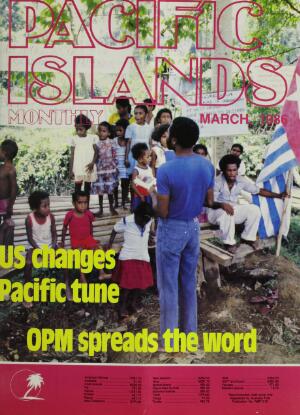
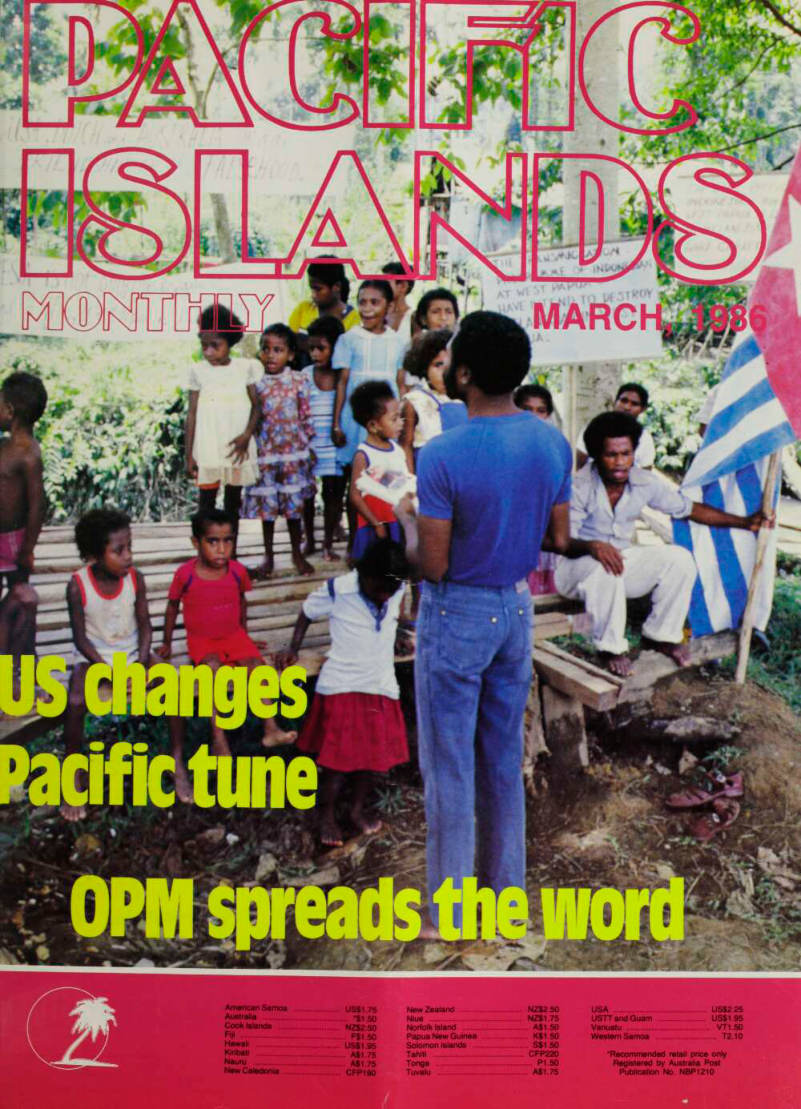
Ufchanges Pacific tune
OPM spreads the word
American Samoa US$l.75 Australia *51.50 Cook Islands NZ$2.5O Fi )' F 51.50 Hawaii US$l.95 Kiribati As! .75 Nauru A 51.75 New Caledonia CFPI9O
New Zealand NZ$2 50 Niue NZ$l.75 Norfolk Island A 51.50 Papua New Guinea K 51.50 Solomon Islands 551.50 Tahiti CFP22O Tonga P 1.50 Tuvalu A 51.75
Usa U 552.25
USTT and Guam US$l.95 Vanuatu VT1.50 Western Samoa T 2.10 "Recommended retail price only Registered by Australia Post Publication No. NBPI2IO
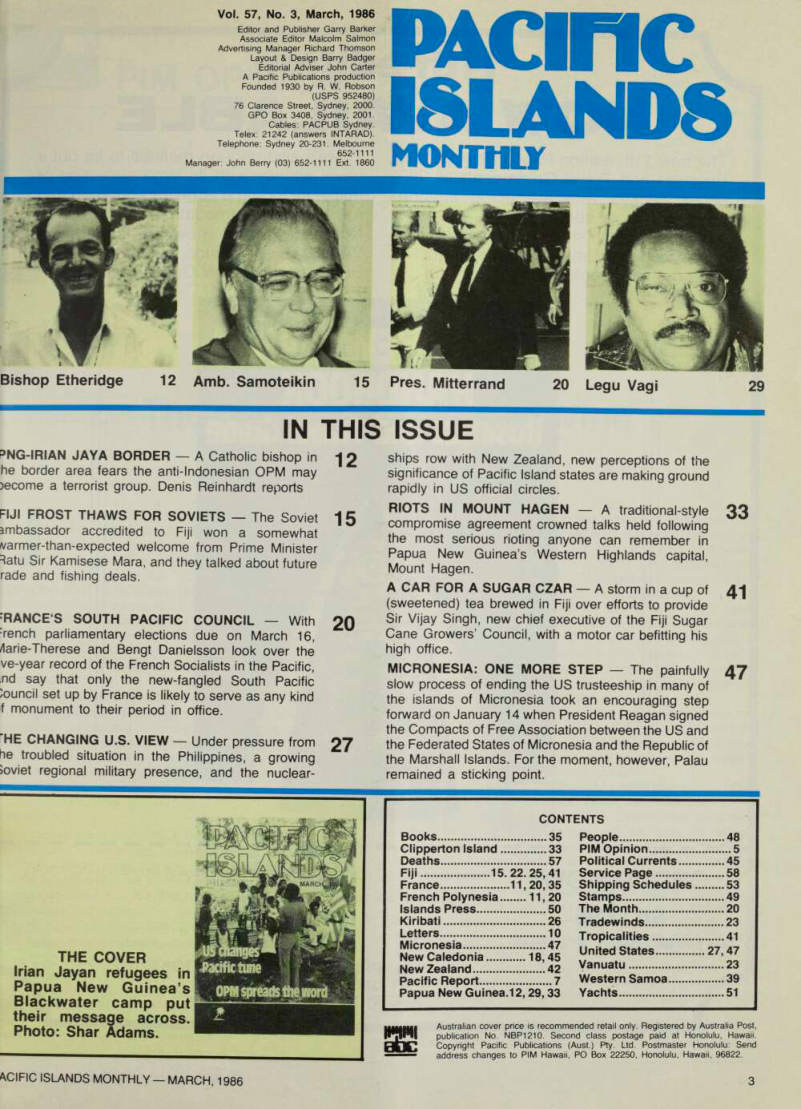
The Cover
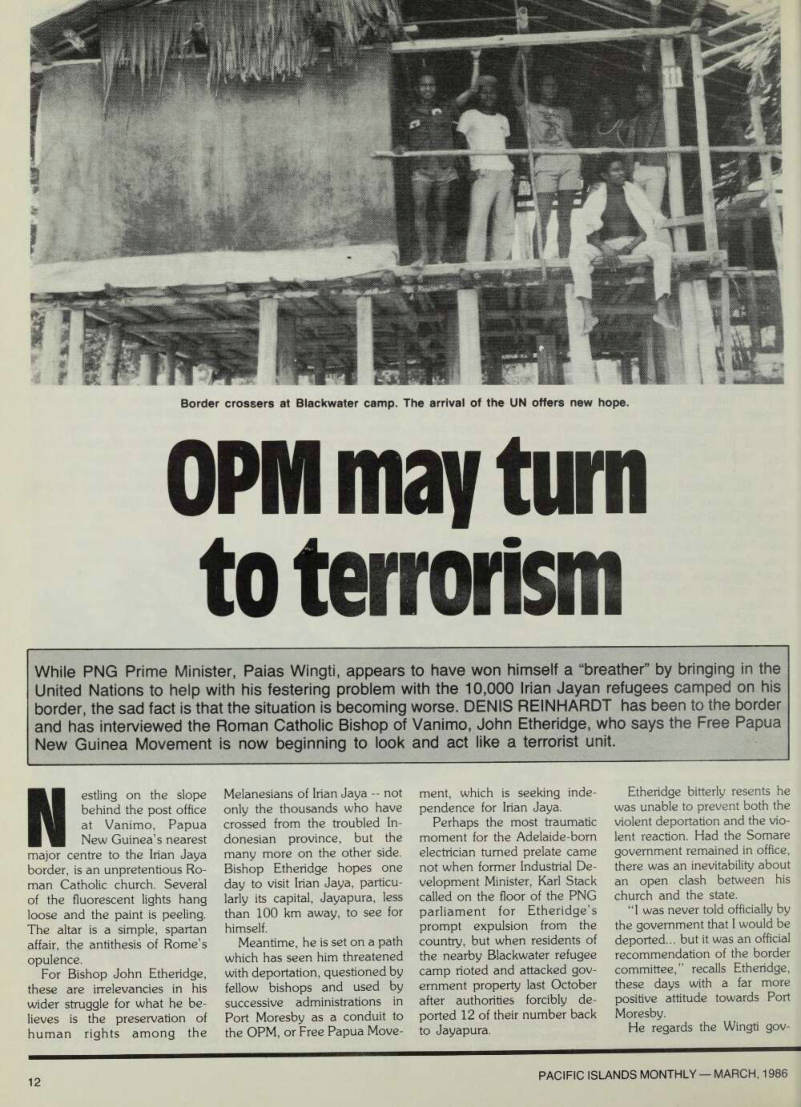
Irian Jayan refugees In Papua New Guinea’s Blackwater camp put their message across.
Photo: Shar Adams.
Advertisements & other items, pp. 2-3 (2 items)
0 Hitachi
However
your
ramilv
3 W*i m =4 "Mi & M -- '/Mm
mmmm
M ■' 4 ■-■ y . y -i.-i % <SV 1 • Infra-red auto focus • Totally automatic white balance • F 1.2 macro lens with 6X power zoom • Minimum illumination of 10 lux • Electronic viewfinder • Only 2.5 kg without battery • 3-way power supply • Saticon picture tube • 4-hour recording time • Connect direct to TV for playback and programme recording using accessories
VMS
this
Hitachi
will catch
them.
Wherever your family goes to get away from it all, the new, fully automatic Hitachi VHS MOVIE will follow.
All you do is pop in a standard VHS cassette and point. Then play it on any existing VHS home video deck.
The automatic focus, auto iris, fully automatic white balance, "no-light" shooting (10 lux) and one-touch power zoom F 1.2 lens give you a perfect image of your family, everytime. Automatically, and for up to four hours of shooting with an E 240 VHS cassette. - Then use VHS MOVIE'S electronic viewfinder to review what you've just recorded. There's no heavy equipment to carry with no wires to tangle up your family adventures. And it's so easy to use, the kids can even catch Dad trying out his favourite escapes.
Automatically.
K¥S MOW£
VM-200E
Makes
Home Movies
Automatic
0 HITACHI
NEW ZEALAND: AWA New Zealand Limited, Wi-neera Drive, • AUSTRALIA: Hitachi Sales Australia Pty„ Ltd., 153 Keys Road. Moorabbin, Victoria 3189; Phone: (555) 8722 Zealanc P.O. Box 50-248. Porirua; Phone: PRO 75-069 • PAPUA NEW GUINEA: S.O. Svensson (N.G.) Ltd., P.O. Box 705. Port Moresby, Phone:: 21-2111 • * ' S Q^ Limited. 37 Freeston Road. Walu Bay (P.O. Box 858), Suva Fiji; Phone: 312744 • NEW CALEDONIA: Caldis, B.P. Ml. Noumea; Phone: 26. 23. 50 • SOLOMON ISLANDS. Techmqu Radios Centre Ltd., P.O. Box 465, Honiara; Phone: 416
Islands
PACIFIC
MONTHLY
Vol. 57, No. 3, March, 1986
Bishop Etheridge 12
Amb. Samoteikin 15
Pres. Mitterrand 20
Legu Vagi 29
In This Issue
®NG-IRIAN JAVA BORDER A Catholic bishop in *| 2 he border area fears the anti-Indonesian OPM may jecome a terrorist group. Denis Reinhardt reports FIJI FROST THAWS FOR SOVIETS The Soviet 1 5 ambassador accredited to Fiji won a somewhat varmer-than-expected welcome from Prime Minister =latu Sir Kamisese Mara, and they talked about future rade and fishing deals. : RANCE‘S SOUTH PACIFIC COUNCIL With 20 : rench parliamentary elections due on March 16, /larie-Therese and Bengt Danielsson look over the ve-year record of the French Socialists in the Pacific, nd say that only the new-fangled South Pacific Council set up by France is likely to serve as any kind f monument to their period in office.
HE CHANGING U.S. VIEW Under pressure from 27 he troubled situation in the Philippines, a growing >oviet regional military presence, and the nuclear
ships row with New Zealand, new perceptions of the significance of Pacific Island states are making ground rapidly in US official circles.
RIOTS IN MOUNT HAGEN A traditional-style 33 compromise agreement crowned talks held following the most serious rioting anyone can remember in Papua New Guinea’s Western Highlands capital, Mount Hagen.
A CAR FOR A SUGAR CZAR A storm in a cup of 4*| (sweetened) tea brewed in Fiji over efforts to provide Sir Vijay Singh, new chief executive of the Fiji Sugar Cane Growers’ Council, with a motor car befitting his high office.
MICRONESIA: ONE MORE STEP The painfully 47 slow process of ending the US trusteeship in many of the islands of Micronesia took an encouraging step forward on January 14 when President Reagan signed the Compacts of Free Association between the US and the Federated States of Micronesia and the Republic of the Marshall Islands. For the moment, however, Palau remained a sticking point.
Contents
Books 35 Clipperton Island 33 Deaths 57 Fiji 15. 22. 25,41 France 11,20,35 French Polynesia 11,20 Islands Press 50 Kiribati 26 Letters 10 Micronesia 47 New Caledonia 18,45 New Zealand 42 Pacific Report 7 Papua New Guinea. 12,29,33
People 48 PIM Opinion 5 Political Currents 45 Service Page 58 Shipping Schedules 53
Stamps 49
The Month 20 Tradewinds 23 Tropicalities 41 United States 27,47 Vanuatu 23 Western Samoa 39 Yachts 51
Australian cover price is recommended retail only. Registered by Australia Post, publication No. NBPI2IO. Second class postage paid at Honolulu, Hawaii.
Copyright Pacific Publications (Aust.) Pty. Ltd. Postmaster Honolulu: Send address changes to PIM Hawaii, PO Box 22250, Honolulu, Hawaii, 96822.
Advertisements & other items, pp. 3-4 (2 items)
Cific Islands Monthly March, 1986
3
Editor and Publisher Garry Barker Associate Editor Malcolm Salmon Advertising Manager Richard Thomson Layout & Design Barry Badger Editorial Adviser John Carter A Pacific Publications production Founded 1930 by R. W. Robson
(USPS 952480)
76 Clarence Street, Sydney, 2000.
GPO Box 3408, Sydney. 2001.
Cables: PACPUB Sydney.
Telex: 21242 (answers INTARAD).
Telephone: Sydney 20-231. Melbourne 652-1111 Manager: John Berry (03) 652-1111 Ext. 1860
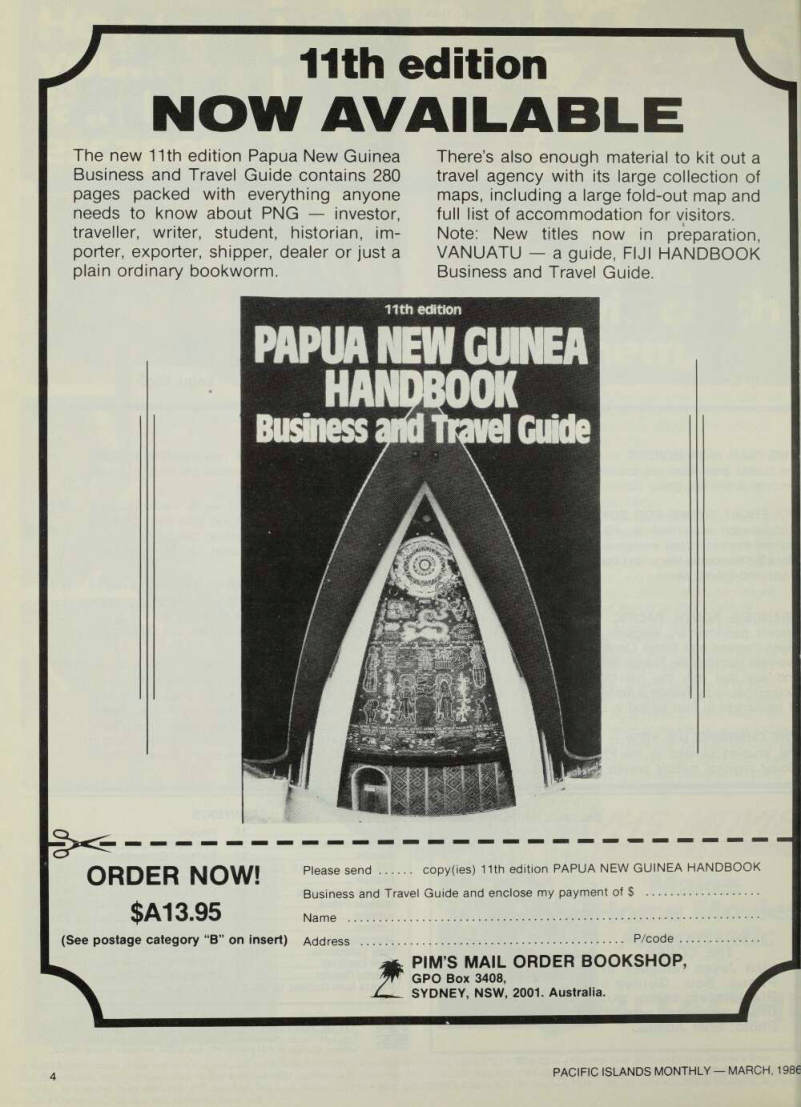
Now Available
11th edition V
The new 11th edition Papua New Guinea Business and Travel Guide contains 280 pages packed with everything anyone needs to know about PNG investor, traveller, writer, student, historian, importer, exporter, shipper, dealer or just a plain ordinary bookworm.
There’s also enough material to kit out a travel agency with its large collection of maps, including a large fold-out map and full list of accommodation for visitors.
Note: New titles now in preparation,
VANUATU a guide, FIJI HANDBOOK
Business and Travel Guide. 11th edition r 3 ■I O m ill
ORDER NOW!
$A13.95 Please send copy(ies) 11th edition PAPUA NEW GUINEA HANDBOOK Business and Travel Guide and enclose my payment of $ Name (See postage category “B” on insert) Address P/code
RIM’S MAIL ORDER BOOKSHOP,
I GPO Box 3408, SYDNEY, NSW, 2001. Australia. r
The Haystacks Hit the Wind
Pim Opinion
Just in case any doubt was left anywhere that the Pacific Islands have become, rapidly, of very much greater significance to the super powers, let us draw attention to the visit to Fiji of a party of Soviet diplomats, clearly usting themselves to be nice.
Their reception by Fiji’s Prime Minister, Ratu Sir Kamisese Mara, 'as also friendly. Of course, this does not mean that Ratu Mara is bout to pack his children off to Patrice Lumumba University in loscow, nor even take up steady correspondence with the remlin. But it does indicate that he has decided to ease his revious, very stem, opposition to commerce with Soviet immunists.
He also appears now to have put aside the unpleasant memories f the last general election when he accused the Soviet Union of üb-staking the National Federation Party. Nobody ever got to the attorn of that extraordinary business. The NFP’s leadership, hich at that time included Ratu Mara’s former associate, Sir Vijay ingh, was shrill (and predictably legalistic and confused) in its snial. There was embarrassment, too, in Indian diplomatic circles, id hasty efforts by the government of Mrs Indira Ghandi to show ean hands.
But the very fact that Ratu Mara, the elder statesman of the outh Pacific, is being seen to have buried at least some of the atchet, is a matter of considerable moment in the region’s politics, ike the fishing deal struck by President Tabai of Kiribati, it should 2 taken as notice that the West may no longer take the small land nations for granted.
The Russians did rather well on their Suva visit; perhaps even ther better than they had hoped.
The CTC cruise ships which were banned from Fiji ports after e Soviet invasion of Afghanistan are to resume calls which will : of benefit to Fiji’s important tourist industry at a time when it is 2ling the effects of the reduced Australian and New Zealand >llars. (The Soviets are still in Afghanistan, but it is looking a Drse quagmire, even, than Vietnam).
More significantly than the tourist ship arrangement, the men from Moscow talked, apparently in fairly substantial terms, about trade, aid and fishing deals with Fiji. More than enough, it seems, for the Soviets to propose, and Fiji to accept, a visit fairly soon from the USSR trade commissioner in Canberra to run through the finer details and perhaps even show off a contract or two.
Fiji is perhaps the most sophisticated of the Pacific Island countries, and Ratu Mara one of the region’s most careful politicians. He may be trusted, therefore, to do nothing likely to upset regional stability. At the same time he is giving notice of the Islands’ independence of thought and action; of their need for proper recognition and support by the Western alliance with which they have for so long aligned themselves.
In general, of course, the islands have been reasonably well attended by Western countries. While the West might need the friendship of the islands, many of the small nations, and Fiji more than most, have received a fair measure of western support, particularly from Australia and New Zealand.
But it does appear that the time has arrived when some of the relationships formed, in an almost casual way, over the decades, might receive a bit of polishing here and there. Most particularly one thinks of the regional fishing treaty with which the US has been toying for so long.
In the end, of course, the islands have to choose which road they need to follow and, President Tabai and others notwithstanding, most continue to see their natural linkages lying in the West.
Indeed, while Ratu Mara might have been smiling, and offering the Soviet Ambassador a second cup of tea, he also, during that visit, let it be known that some things were still well off-limits.
When the Russians, rather clumsily, one felt, made an appointment to call on the headquarters of the Labor Party of Fiji, Ratu Mara let them know it wouldn’t be taken as a friendly gesture.
The Soviet Embassy men promptly developed diplomatic belly ache and took to their beds.
It brought cries of outrage from Dr Timoci Bavadra, and others of the Labor Party - but it also showed who is still boss in Fiji.
Advertisements & other items, pp. 5-6 (2 items)
5
*CIFIC ISLANDS MONTHLY - MARCH, 1986
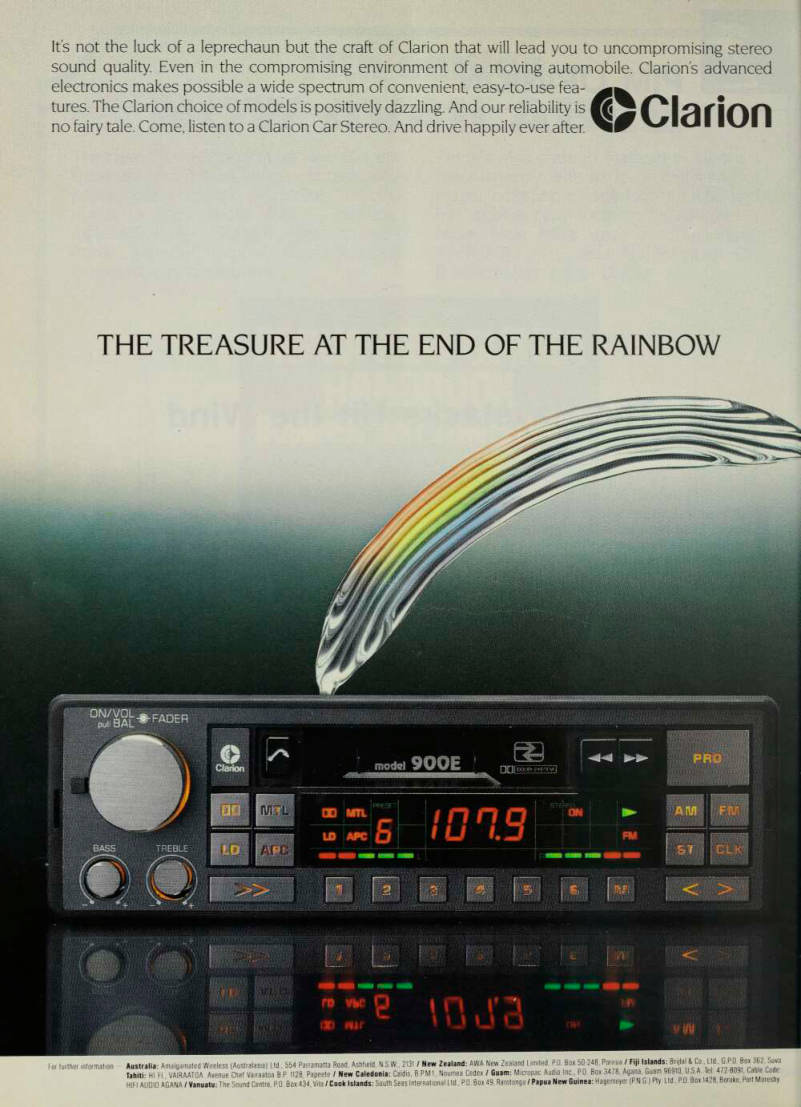
The Treasure At The End Of The Rainbow
It's not the luck of a leprechaun but the craft of Clarion that will lead you to uncompromising stereo sound quality. Even in the compromising environment of a moving automobile. Clarion's advanced electronics makes possible a wide spectrum of convenient, easy-to-use features. The Clarion choice of models is positively dazzling. And our reliability is no fairy tale. Come, listen to a Clarion Car Stereo. And drive happily ever after.
OD MTI
in n q iu i.j
LD ArC
For further information Australia: Amalgamated W.reless (Australasia) Ltd., 554 Parramatta Road. Ashfield, NS W , 2131 / New Zealand: AWA New Zealand Urn,ted. PO Box 50-248, Porirua / Fiji Tahiti: HI FI, VAIRAATOA Avenue Chef Vairaaloa B P 1128, Papeete / New Caledonia: Caldis, 8.P.M1, Noumea Cedex / Guam: Micropac Audio Inc, PO Box 3478, Agana Guam 9691 J. USA Te1._472 809 L Cable Code HIFI AUDIO AGANA / Vanuatu: The Sound Centre, P 0 Box 434, Vifa / Cook Islands: South Seas International Ltd, PO. Box 49, Rarotonga / Papua New Guinea: Hagemeyer (PN G.) Pty Ltd., Pi). Box 1428, Boroxo, Port Mo es y
pacific report
Wolfowitz On
N-Free Zone
The United States recognises the rights of the drafters of the Nuclear Free Zone Proposal, said US Assistant Secretary of State for Asia/Pacific Affairs, Dr Paul D.
Wolfowitz. Speaking via a satellite link to the Sydney conference of the Australian Institute for International Affairs, Dr Wol fowitz, recently nominated as the next US ambassador to Indonesia, said that while there was little nuclear threat in the region it was ”in the common interest to keep it that way.” He also said that small island nations, particularly Micronesia had grown accustomed to a high degree of outside aid. It would take time, he said, for them to achieve their goals.
Meanwhile it was important “that doors not only to the US but to Australia and New Zealand markets are not closed in their faces.” Russell Hunter.
Tunaboat Fees
Fixed By Islands
The Solomon Islands Government in February announced it will impose a fee of $1.5 million a year on any United States tunaboat wanting to fish in its 200-mile exclusive economic zone. A government spokesman said the fee had been confirmed at the recent Forum fisheries talks in Hawaii attended by 16 South Pacific countries. The Solomons figure is the highest in the region: Papua New Guinea is asking $1.3 million per U.S. tunaboat, while the Federated States of Micronesia has set its fee at $1 million. The high fees have been set in response to poaching in the western Pacific. Such activity led to the U.S. boat Jeanette Diana being confiscated by Solomon Islands authorities in late 1984.
It was later resold to its owners for $770,000.
Hayden Raps
Flnks Man
Australia’s Minister for Foreign Affairs Bill Hayden said ir> January that he had nstructed his department to speak to the lead of the FLNKS information office in Australia, John Peu, about comments he A/as reported to have made. Mr Peu had Deen quoted in a newspaper report as suggesting that elements of the New Caledonian independence movement night accept an invitation to visit Libya in xder to “push the Australian Govern nent to take action” in favor of the Kanak struggle. Mr Hayden said that, if re- Dorted accurately, Mr Peu’s remarks were offensive. Referring to Mr Peu’s eported reference to “blackmail of the
Australian Government,” he commented that the government was not in the habit of succumbing to pressures or threat from any quarter. Mr Hayden said he had instructed his department to speak to Mr Peu to seek clarification of his reported remarks, to express the gov ernment’s concern at the statements attributed to him and to remind him once again of the government’s views on the question of New Caledonia. He said that were the government to conclude that the FLNKS representative in Australia was advocating a course which seemed likely to lead to a new level of violence in New Caledonia, the government would have to reconsider its earlier agreement to the establishment in Australia of an FLNKS information office.
‘Lumiere’ Man
Fined Snziooo
Michel Auguste Four, arrested in New Zealand in December for trying to smug gle ammunition to New Caledonia on board the freighter He de Lumiere (PIM Feb p 7), is a former French paratrooper, Auckland police announced on February 4. Four, 29, was convicted and fined SNZIOOO for the offence. The 5500 rounds of ammunition and seven maga zines were found on the ship during a routine Customs search in Auckland.
Four said they had been destined for sale on the black market in New Cale donia.
Nan Madol On
‘Landmark’ List
Pohnpei’s Nan Madol ruins have been designated a U.S. National Historic Landmark by the Secretary of the In terior, according to a letter from Interior Chief Historian Edwin Bearss to Pohnpei Governor Resio Moses. The designation automatically places the property on the National Register of Historic Places, and extends the safeguards and benefits of U.S. historical protection laws to the site,
according to the governor’s office. Com prising 93 islets surrounded by canals, the ruins are constructed of roughly hewn logs of basalt rock. The largest walled complex is about the size of a football field. The walls are as high as six metres, and one basalt log is reported to weigh more than 2300 kg. Archeologists estimate that building of the Nan Madol complex began around 1000 AD and lasted until 1200. The ruins were in use until 1700 and were finally abandoned around 1825. Archeologists say that only a very well-organised society could have planned and executed the con struction.
Forum Group
Visits N-Powers
A delegation of the South Pacific Forum arrived in Washington in mid-February, completing its round of visits to the capitals of the five nuclear weapons powers. Earlier, it had visited Peking, London, Paris and Moscow. The delega tion’s purpose was to explain the pur pose of the Forum’s nuclear-free Pacific treaty, and if possible to persuade the nuclear powers to sign it.
Sydney Festival
Of Pacific Films
Headed simply "Dennis O’Rourke”, a display ad appearing in the Australian weekly The National Times in February was a tribute to this well-known film maker from 46 of his peers, themselves acclaimed producers of documentary films, many of which were shot in South Pacific countries. As the ad stated, it was run to mark the premiere of O’Rourke's latest film, Half Life, which looks at the effects of the US atomic testing program on the people of Rongelap in the Marshall Islands. (Unlike the practice during earlier tests at Bikini, when everyone within a 500 km radius was evacuated, the "Bravo” test of March 1, 1954 was performed regardless of the population on Rongelap, 200 km away); O’Rourke, having interviewed the Islan ders, as well as Americans involved with the hydrogen bomb test, has produced a highly critical and convincing film which suggests that the Marshallese were used as guinea pigs. The film makers’ ad continued: "We congratulate you and your collaborators for your work over the past 10 years. The crisis in the Pacific, which your films reveal with clarity and artistry, is of vital concern. As a film-maker, you have brought in ternational attention to the Pacific region.
We recognise and applaud your achievement”. For the fortnight preced ing Half Life’s premiere at the Sydney Opera House, the first Asia-Pacific Film Festival was staged at the Chauvel Cinema, owned by the government
Among the first American visitors to Nan Madol were this US Navy inspection party, pictured in 1946 - Pacific Daily News photo.
funded Australian Film Institute. The festival’s spirit reflected the sentiments expressed in the ad; close co-operation, between both indigenous and European film-makers, geared towards publicising what they saw as the main problems afflicting the Pacific (and, to an extent, Asian) region. In brief, these could be described as the determination of out side peoples mostly, but not exclu sively Western to dominate, even eradicate, the cultural and political rights of the traditional residents of Australia, New Zealand, Papua New Guinea, New Caledonia, East Timor and West Papua (Irian Jaya). Twenty-three films were screened during the festival, mostly documentaries, but with some features.
Well-known visitors included Maori director Merata Mita whose film Patu, about the strong opposition to the 1981 South African rugby team’s tour of New Zealand, received much acclaim (she came to Sydney with assistance from the Australian Film Commission’s Women’s Film Fund); Albert Toro, actor from PNG’s North Solomons province and star of Tukana: Robert Bropho, an
Aboriginal from Western Australia whose Munda Nyuringu (made with Ms. Jan Roberts) documents how the rightful owners of the land where Perth was built became fringe-dwellers; Geoff Murphy, often called New Zealand’s leading director, whose dramatised film Utu portrays the land wars between Maoris and white settlers in the 1870 s; and Dennis O’Rourke, who might be called a visitor because he has spent most of the past decade away from Australia. Two of his films were screened at the festival Couldn’t Be Fairer, about Aboriginal dispossession in north Queensland and Shark Callers ofKontu, looking at the last owners of “shark knowledge” in PNG’s New Ireland province. During his com ments about Shark Callers , Dennis O’Rouke perhaps spoke for all film makers represented in the festival when he said that with “committed” films, as distinct from those made purely with commercial motives, the director usually finds that “the film makes him, or her, rather than vice versa”. Illustrating his point, he explained that while he had initially gone to New Ireland to make a “sort of straight ethnographic film", he
soon realised that the real film lay in the clash between a newly-established fun damentalist Christian sect and the ancient spiritual tradition. “The film be gan to dictate its own direction, quite apart from my original idea. As a film-maker, one has to be sensitive to this and flexible enough to change accordingly." He said that the clash between custom and modernity occurs in every PNG village, and “I could have made a similar film in many places. The only difference is that the shark-calling ritual is a very dramatic symbol of this conflict and was resolved in an unfortun ate way, with the new belief system triumphing absolutely," The shark calling and catching ritual disappeared about two years ago, not long after the film was made. So in one sense, O’Rourke got there just in time, thanks to his friend, local resident Stephen Madana formerly a journalist with the Times of PNG, who alerted the Australian. Even sadder were the films about Pacific peoples colo nised in every sense by alien culture and prohibited, by law and sometimes milit ary power too, from having the right to self-determination. While Aborigines, Maoris and to an extent the Kanaks of New Caledonia can legally protest against their disenfranshisement, and even make films about it, the opportunity is denied to the East Timorese and the Melanesians of Irian Jaya. The Republic of Indonesia insists that the two pro vinces are irreversibly part of the mainly- Asian state, while the people themselves say their birthright, and aspirations, lie to the east, in the Pacific. The films about the 1975 Indonesian takeover of East Timor, which had already declared its independence from colonial Portugal, and the “Transmigration” scheme, which aims to settle millions of people from crowded Java in outlying provinces, including Irian, again raised serious concerns about the plight of the inhabi tants. On behalf of the festival’s organ isers. the Solidarity Network for Asia and the Pacific (SNAP), Bob Burns said the fortnight was highly successful, a con clusion drawn from “the number of bottoms on seats at the Chauvel, and the keen audience participation in the dis cussions which followed the screen ings”. It seems likely that the first Asia-Pacific Film Festival will not be the last, and at this early stage Mr Burns is urging all Pacific film-makers to plan towards participating next year. Robin Osborne in Sydney.
Help For Nz’S
Islander Jobless
A SNZ2.S million increase in funding for the Pacific Islands Employment Deve lopment Scheme has been announced by New Zealand’s Minister of Pacific Island Affairs, Richard Prebble. “The PI EDS is a pilot project which uses the potential of island communities to help solve the problems of high unemploy ment experienced by Pacific Island people resident in New Zealand,” said Mr Prebble. “The Pacific Island com munities have reacted very positively to
the $250,000 granted to the scheme in 1985. A wide range of worthwhile pro posals have come forward. Funds for REDS will be distributed through the Pacific Island Employment Development Board. The board will examine projects proposed, allocate the funds and moni tor and evaluate the scheme.” The government has called for nominations for the board, which will have up to six members drawn from the Pacific Island communities. It is particularly looking for people with experience in business, or in employment issues.
Malaria Shake-Up
In Png
A new policy to control malaria in Papua New Guinea is to be introduced by provincial governments at a cost of about SA3 million. Under the program, anti-malarial drugs will be distributed to all major hospitals, health centres and rural aid posts. In addition, the health department has decided to reintroduce DDT spraying, which was abandoned some years ago because of its high cost.
The spray will be used in the Highlands and coastal regions where the health department considers it most effective.
Air Pacific
To Upgrade?
The chief executive of Air Pacific, Mr John Schaap, has said that the airline’s economic performance this year would depend on increased tourist traffic in the region. Mr Schaap said if forecasts that more tourists would visit the southwest Pacific in 1000 were correct, then this would be reflected in a rise in passenger traffic. This would allow the airline to upgrade existing services and strengthen the management team. Air Pacific is being managed by Australia’s overseas airline, Qantas, under a three year contract.
Qantas Girds
Up For Fight
Australia’s overseas airline, Qantas, is preparing for a possible price war on Pacific routes as the giant American company, United Airlines, takes over the services of Pan American in the region.
Following the deal to take over Pan Am’s Pacific routes, United begins services in 1986. A Qantas spokesman said an airfare price war could not be not be ruled out after United settled into its new routes. He said the Pacific routes repre sented only three per cent of United’s total operation, and the company could afford to take on Qantas, which holds 30 per cent of the market. However, the spokesman said he believed Qantas would be prepared to match any price reductions that United may offer.
Sir Vijay Singh
Explains ...
The chief executive of the Fiji Cane Growers’ Council, Sir Vijay Singh, bought half: a page in The Fiji Times of January 17 to put his version of what he
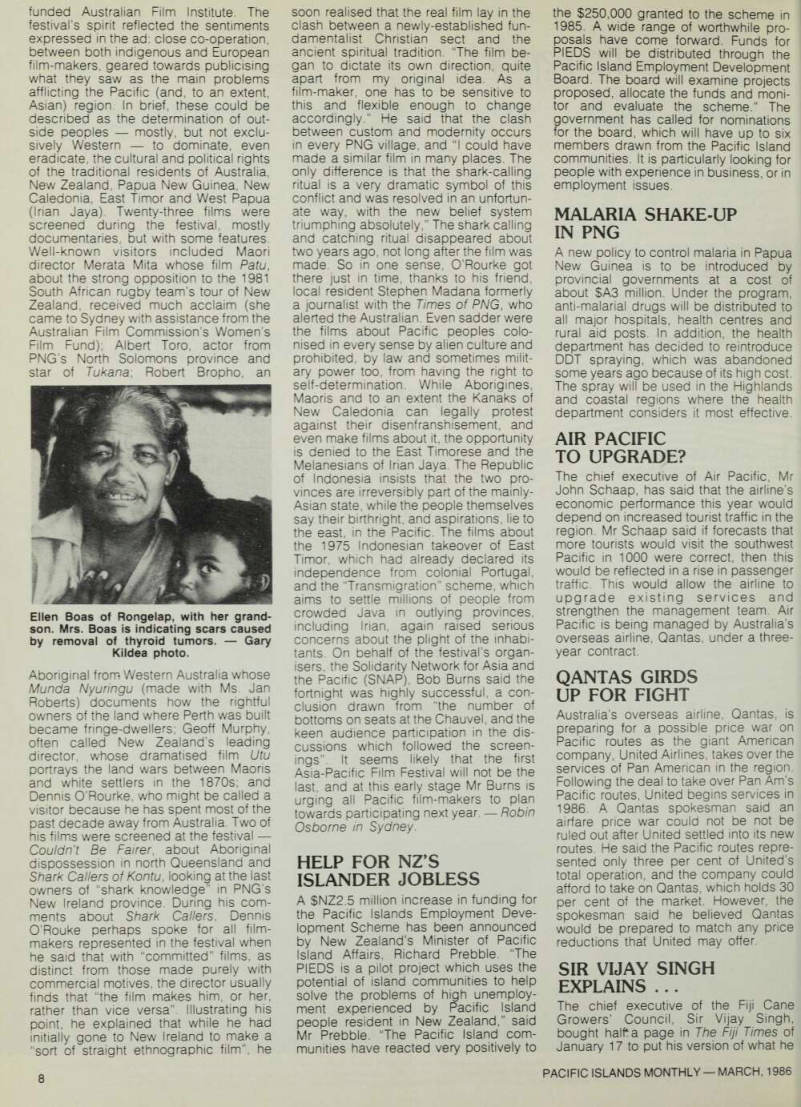
Ellen Boas of Rongelap, with her grand son. Mrs. Boas is indicating scars caused by removal of thyroid tumors. - Gary Kildea photo.
described as “sensational” articles in the newspaper concerning the purchase of his “company car.” (See page 41 this issue). He said the Council had ordered a Toyota Crown Super saloon for him but that on second thoughts he had decided it might “appear ostentatious.” He went on to explain that he did not wish to give the impression that the executive of the Council sat in air conditioned offices in Suva while the farmers themselves sweated it out in the fields. Consequent ly, he said, he had decided that Mr Bahn Singh, the other senior executive, should also be given a car so that he could join
in Sir Vijay’s effort to establish close communication with growers and pro vide them with the support they needed.
Indeed, said Sir Vijay, his board of directors had decided it was important that cane farmers be advised to find other crops to widen their financial base and lessen their vulnerability to the vagaries of the world sugar market. It was highly likely, therefore, he indicated, that the aid personnel, as he described them, would also need transport. Sir Vijay’s disappointment with The Fiji Times extended further, he said, and involved their articles saying that some cane growers were ploughing in their crops. This was not true, he said. A further story suggesting that some cane farmers were calling for the disband ment of the Council was also incorrect, Sir Vijay asserted. “The plight of the farmers is real and grave indeed,” wrote Sir Vijay. “We need to consider calmly and rationally the means at our disposal for helping them, and ... the SCGC would welcome constructive proposals. The Fiji Times is as welcome as anyone to offer suggestions that would alleviate the cane farmers’ hardship. So far it has not done so.” In a footnote to the report covering Sir Vijay’s complaints about the newspaper’s coverage the editor com mented: “ The Fiji Times stands by its reports.”
Big Air Terminal
Project In Pohnpei
[he state of Pohnpei in the Federated States of Micronesia is to build a nulti-mitlion dollar international airport. \ statement from the Pohnpei gov ernors office said the new air terminal vas being built in an effort to attract ivestors, tourists and visitors. It said the :ost of the project would be about >USI4 million, and construction was 'xpected to take a year to complete, he statement said funds for the terminal /ould be made available by the U.S.
Federal Aviation Authority and the De partment of Interior, as well as the Pohnpei state.
Indonesia-U.S.
Aircraft Deal
The United States has promised to buy Indonesian-made small planes for use by its Pacific Island territory, Guam. The official Indonesian newsagency, Antara, said a memorandum of understanding had been signed for the purchase of the 18-seater CN-212. Indonesia produces the plane under licence from the Span ish company Construcciones Aeronauti cas. Antara did not say how many aircraft were involved in the agreement, but it noted that the deal was subject to approval by the U.S. Federal Aviation Authority.
French Ship
For Ccof/Sopac
One of France’s most advanced ships, the Jean Charcot, has arrived in the South Pacific to conduct surveys around Fiji, Tonga, Vanuatu and Tahiti. The French Embassy in Suva, where the ship is berthed, said a series of five cruises would yield data about mineral re sources in the economic zones of Fiji, Tonga and Vanuatu, and an assessment of the level of hydrothermal activity around Fiji and Tonga. The Jean Char cot is working under the sponsorship of the Committee for the Co-ordination of Joint Prospecting for Mineral Resources in the South Pacific Offshore Area (CCOP/SOPAC), an agency operated by Pacific Island governments.
France, Fiji In
Ethnology Study
A three-year research program on Fijian ethnology undertaken in co-operation with the French Government has been completed. At a brief ceremony in Suva in January the French Ambassador to Fiji Daniel Dupont presented the govern ment with more than 1300 cassettes and transcripts of Fijian customs and tradi tions. They were compiled by Dr Solange Petit-Skinner who was in charge of the project. The presentation also included a book entitled Fijian Protocol, by Dr Petit-Skinner.
Suva Independents
To Join Labour?
The five independent councillors on Suva City Council are planning to join the Labour Party. Four of the five held a lengthy secret meeting with the Labour Party's senior officials on January 31, at the party’s headquarters in Suva. At the meeting were Independents Cr Navin Maharaj, Cr Navin Chandra, Cr Ashok Patel and Cr R, D. Patel. Cr Pramod Kapadia was missing. Representing the
Labour Party were its president, Dr Timoci Bavadra, the Labour Lord Mayor of Suva, Cr Bob Kumar, assistant secre tary Mahendra Chaudhry, vice-presi dent Dr Tupeni Baba, vice-president Joeli Kalou, and Mrs Emma Druavesi.
The meeting discussed the terms both sides will have to agree to if the Independents were to join Labour,
Isabel Province
Makes Request . ..
Premier Jason Leguhavi of Solomon Islands’ Isabel Province has asked the Australian Conservation Foundation for advice on how to enact legislation that will ensure protection of the environ ment, control land use and deve lopment, and prevent unwanted incur sions by trans-national companies. The province is one of the largest in the Solomons, and also one of the least
developed. Mr Leguhavi is a former schoolmate of Premier Job Dudley Tausinga of Western Province, which contains the islands of New Georgia and Kolombangara, scene of the major log ging activities of Pacific Lever Timbers.
Writing in the ACF journal Habitat, Fred Sargent says: “Locals in New Georgia in 1984 took direct action against PLT which led to the destruction of a million dollars worth of PLT equipment ... Mr Tausinga was elected to the provincial assembly on the issue of conservation and is the founder of the country’s first conservation group.”
Png, Israel, To
Swap Envoys
Papua New Guinea and Israel are to exchange resident ambassadors in the near future, an Israeli Foreign Ministry official said in Jerusalem. The official was briefing reporters on talks between the Israeli Foreign Minister, Yitzhak Sha mir, and the visiting former PNG Prime Minister, Michael Somare.
Fiji Nudges
700.000 According to an estimate prepared by the Fiji Bureau of Statistics, Fiji’s popula tion at the end of 1984 had increased by 13.000 in the course of the year to 691,000, with Indians comprising half the population, indigenous Fijians 45 per cent, and all others five per cent.
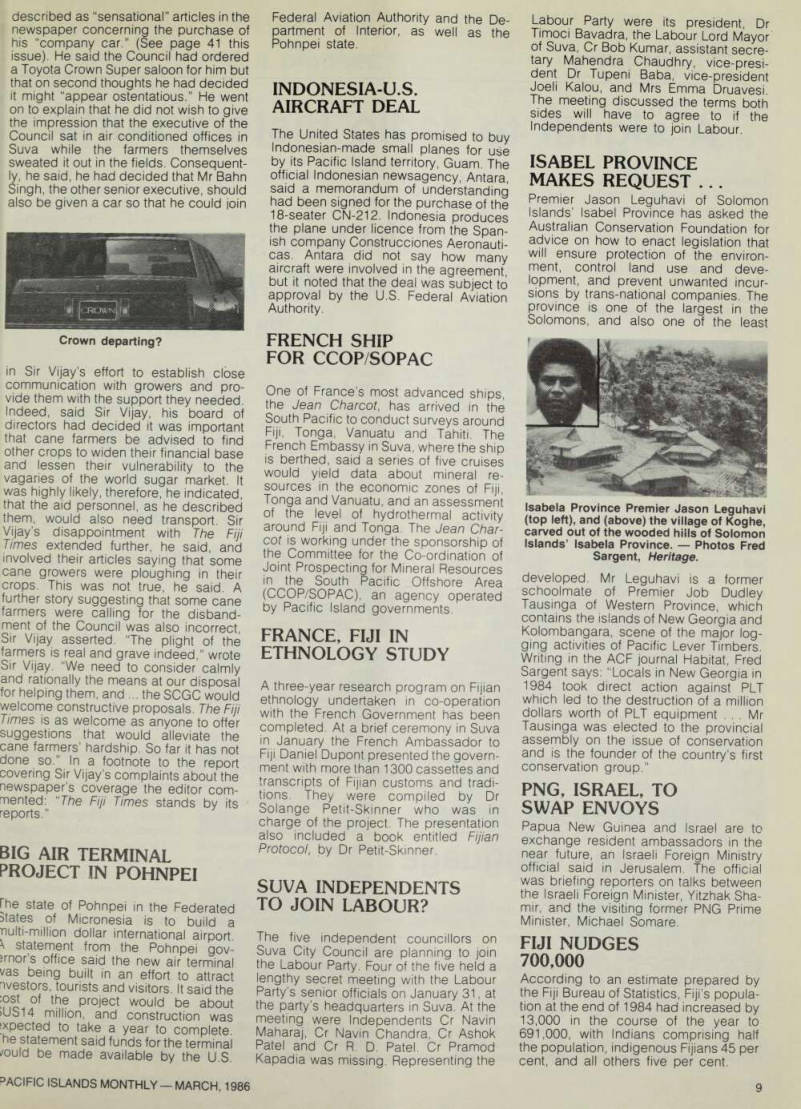
Crown departing?
Isabela Province Premier Jason Leguhavi (top left), and (above) the village of Koghe, carved out of the wooded hills of Solomon Islands’ Isabela Province. Photos Fred Sargent, Heritage.
letters
A signal to radio history buffs
I am writing to ask for assistance from PIM readers for a project I have been preparing over the last few years. The objective is to prepare a history of radio broadcasting in the Pacific is lands (including Hawaii and Micronesia) and outline some effects the development of radio has had on local com munities.
I would welcome hearing from readers who can assist with information, photographs, tapes, program guides, perso nal anecdotes .. . anything connected to the development of medium wave, shortwave and FM local broadcasting from the islands. I am interested in personalities, the programs, stu dio and technical facilities, the politics, the audience and its reactions, the advertisers, the special events ... all the ele ments that created the reality and the atmosphere of radio in the Pacific.
Incidentally, information about current and proposed radio events in the Pacific is also welcomed for my regular prog rams about Pacific broacasting broadcast over Radio New Zea land and Radio Australia.
Thank you in anticipation for your help.
David Ricquish
P.O. Box 9291, Courtenay Place.
Wellington, New Zealand
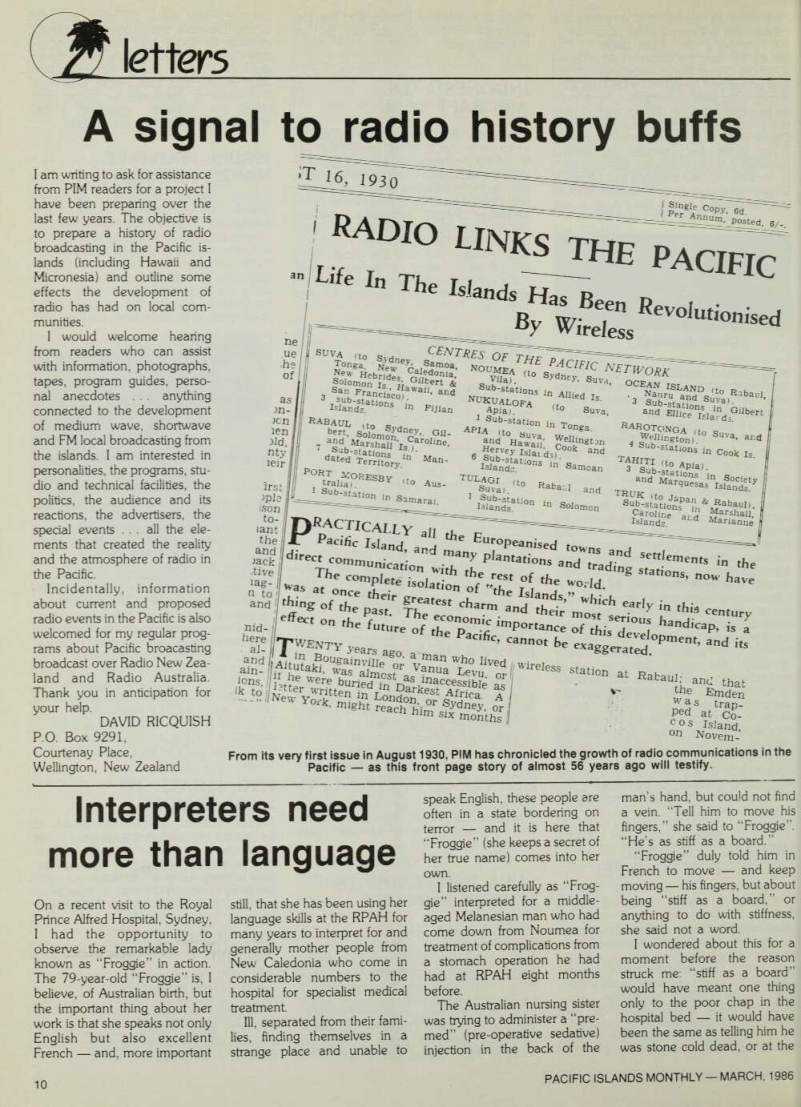
From its very first issue in August 1930, PIM has chronicled the growth of radio communications in the Pacific - as this front page story of almost 56 years ago will testify.
Interpreters need
more than language
On a recent visit to the Royal Prince Alfred Hospital, Sydney, I had the opportunity to observe the remarkable lady known as “Froggie” in action.
The 79-year-old “Froggie” is, I believe, of Australian birth, but the important thing about her work is that she speaks not only English but also excellent French and, more important
still, that she has been using her language skills at the RFAH for many years to interpret for and generally mother people from New Caledonia who come in considerable numbers to the hospital for specialist medical treatment.
Dl, separated from their fami lies, finding themselves in a strange place and unable to
speak English, these people are often in a state bordering on terror and it is here that “Froggie” (she keeps a secret of her true name) comes into her own.
I listened carefully as “Frog gie” interpreted for a middle aged Melanesian man who had come down from Noumea for treatment of complications from a stomach operation he had had at RPAH eight months before.
The Australian nursing sister was trying to administer a “pre med” (pre-operative sedative) injection in the back of the
man’s hand, but could not find a vein. “Tell him to move his fingers,” she said to “Froggie”.
“He’s as stiff as a board.”
“Froggie” duly told him in French to move and keep moving his fingers, but about being “stiff as a board,” or anything to do with stiffness, she said not a word.
I wondered about this for a moment before the reason struck me: “stiff as a board” would have meant one thing only to the poor chap in the hospital bed it would have been the same as telling him he was stone cold dead, or at the
very least about to be.
The association between the ideas of physical rigidity and death is a potent one in his society and “Froggie” showed, by calmly ignoring the sister’s comment, that she’s not only on top of the cross language side of her work, but also and perhaps even more importantly the cross-cultu ral side as well.
Long may she flourish.
P. Warbeck
Sydney, NSW Australia
Energy: Hail
to a pioneer
With the present widespread interest in possible sources of village electric power in the Pacific, I would like you to print as a memorial to the late Mr Yahyah Bin Ibramsah, of La buan, Borneo, this short account of work he did in World War 11.
To save some of the local
children from forced labor for the Japanese army, and to keep the local power and water sup ply going, he scraped coconuts and rendered the oil for use in a Bollinder oil engine, which probably dated from before World War I. His successful action was in defiance of past and present conventional wis dom. A by-product of his pro cess was cooking oil, which was extremely scarce at the time.
My respects to a former edi tor of PIM, Mr Stuart Inder, and I ask that he inquire into the
present state of bomb disposal in Solomon Islands.
G. N. Hammond
Darlinghurst, NSW Australia
Letting loose
on racism
In responding to the letter by Bill Coppell “Poison Pens at Work” (PIM Dec. ’B5), I would just like to say perhaps we should analyse the reasons why such a message would traverse the thousands of miles of blue Pacific to come to rest on the shores of Australia.
Could it possibly to be that the sick and demented minds which still dwell in our “Deep South” felt that Australia would lend an ear to such “poison”?
It is no secret that Australia rarely treats its native peoples, the Aborigines, any better than its native animals; and certainly no better than the South Afri cans treat their Blacks, or Amer ica treats its Indians.
I dare you to print this.
Ivan Vernon Mckinney Jr.
Santa Ana Calif.
Usa
festival revisited
That Papeete arts festival revisited
Your correspondents C. W.
Webster writing from Auckland, and J. Taumihau writing from Papeete (PIM Dec. ’B5), take issue with our account of the Festival of Pacific Arts (PIM Sep. ’B5) held in Papeete last July.
C. W. Webster complains that “it is not true that the French Government paid the fares for all foreign delega tions. ” We never said it did, but only those of countries who faced difficulties meeting the steep costs of the air travel involved.
As for J. Taumihau, nobody has ever contested that the festival was made possible from French funding. The fact that some of these funds were chan nelled through the South Paci fic Commission is neither here nor there: every official in the territory, from the leader of the Territorial Government Gaston Flosse down, made no bones about the fact that the prime aim of staging the festival in Papeete was political a bid to soften regional opposition to France’s nuclear testing at Moruroa.
J. Taumihau says that the “good hand” given to the New Caledonian delegation at the festival was based on the fact that its members did not “share the separatist views of the
Flnks.”
Writing in this way, J. Taumi hau seems to place no store at all on the fact that, according to official estimates, 80 per cent of New Caledonia’s Melanesian community voted in the
September, 1985, elections in favor of parties supporting inde pendence for the territory. One must ask oneself: which kind of festival delegation would have been more truly representative of the views and feelings of New Caledonia’s Melanesians one sponsored by the FLNKS, or the small anti- FLNKS group that came here?
It is hard to see what the FLNKS must do to win so much as simple, sober recognition of its political reality from some people. Here in French Polynesia, for example, no less a figure than Gaston Flosse still finds it possible to refer to the FLNKS as “a handful of terror ists” despite all it has done to display the strength of its grass roots political influence. It seems that your correspondent J. Taumihau is of like mind.
Marie-Therese And Bengt
Danielsson
Paea Tahiti
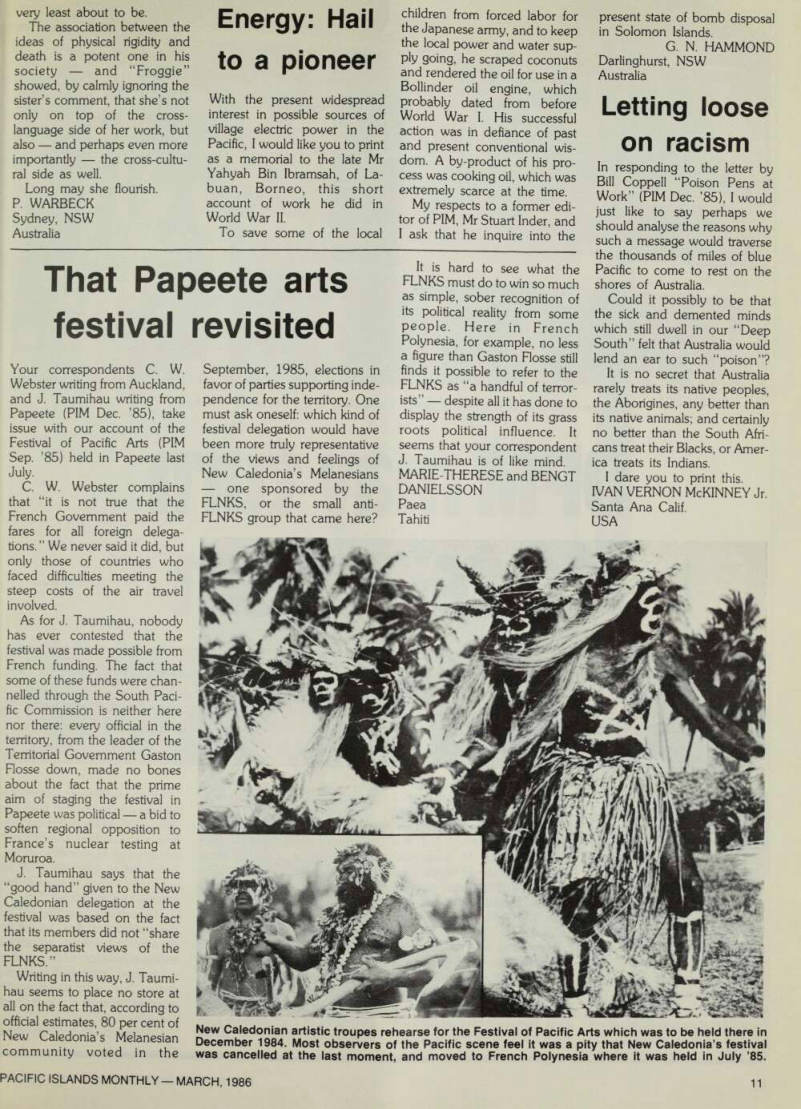
New Caledonian artistic troupes rehearse for the Festival of Pacific Arts which was to be held there in December 1984. Most observers of the Pacific scene feel it was a pity that New Caledonia’s festival was cancelled at the last moment, and moved to French Polynesia where it was held in July '85.
to terrorism
OPM may turn to terrorism
While PNG Prime Minister, Paias Wingti, appears to have won himself a “breather” by bringing in the United Nations to help with his festering problem with the 10,000 Irian Jayan refugees camped on his border, the sad fact is that the situation is becoming worse. DENIS REINHARDT has been to the border and has interviewed the Roman Catholic Bishop of Vanimo, John Etheridge, who says the Free Papua New Guinea Movement is now beginning to look and act like a terrorist unit.
Nestling on the slope behind the post office at Vanimo, Papua New Guinea’s nearest major centre to the Irian Jaya border, is an unpretentious Ro man Catholic church. Several of the fluorescent lights hang loose and the paint is peeling.
The altar is a simple, spartan affair, the antithesis of Rome’s opulence.
For Bishop John Etheridge, these are irrelevancies in his wider struggle for what he be lieves is the preservation of human rights among the
Melanesians of Irian Jaya — not only the thousands who have crossed from the troubled In donesian province, but the many more on the other side.
Bishop Etheridge hopes one day to visit Irian Jaya, particu larly its capital, Jayapura, less than 100 km away, to see for himself.
Meantime, he is set on a path which has seen him threatened with deportation, questioned by fellow bishops and used by successive administrations in Port Moresby as a conduit to the OPM, or Free Papua Move
ment, which is seeking inde pendence for Irian Jaya.
Perhaps the most traumatic moment for the Adelaide-born electrician turned prelate came not when former Industrial De velopment Minister, Karl Stack called on the floor of the PNG parliament for Etheridge’s prompt expulsion from the country, but when residents of the nearby Blackwater refugee camp rioted and attacked gov ernment property last October after authorities forcibly de ported 12 of their number back to Jayapura.
Etheridge bitterly resents he was unable to prevent both the violent deportation and the vio lent reaction. Had the Somare government remained in office, there was an inevitability about an open clash between his church and the state.
“I was never told officially by the government that I would be deported... but it was an official recommendation of the border committee,” recalls Etheridge, these days with a far more positive attitude towards Port Moresby.
He regards the Wingti gov
Border crossers at Blackwater camp. The arrival of the UN offers new hope.
ernment’s initiative of officially inviting the United Nations High Commissioner for Re fugees to determine the indi vidual status of the 10,000 Irianese camped inside Papua New Guinea’s frontiers as a major breakthrough. The Wing ti government’s avowed aim of resettling the refugees away from the border, pending de termination of their future status is what Etheridge “has been praying for.”
“To me it is a tremendous breakthrough. For the last two years I have been asking and
praying for the United Nations to be allowed to get completely involved with these people, so that in a sense they are handed over to a completely neutral body for them to work out who is a genuine refugee and who is not. I agree it is one of the biggest things to happen in Papua New Guinea for many many years.”
Etheridge is concerned how ever that Prime Minister Wing ti’s ideas on resettlement may
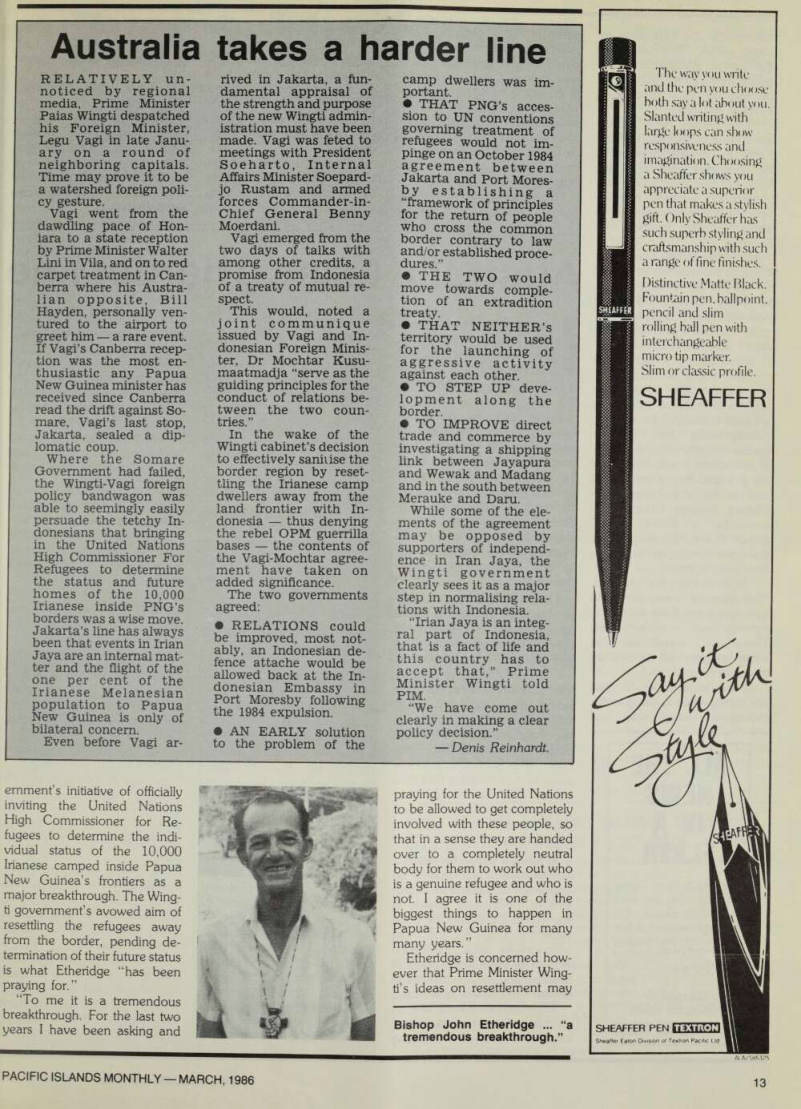
Bishop John Etheridge ... "a tremendous breakthrough."
not match the aspirations of camp people. The Irianese in the camps interpret the new policy as meaning they all will be resettled inside Papua New Guinea, he says.
“The Papua New Guinea government’s definition of ‘re fugee’ in this instance seems to be applicable only to people who believe they could face prosecution because of their political activities were they to agree to return to their own country. ”
Etheridge differs from even some of the external leaders of the OPM, one of whom con fidentially informed PIM that it was expected that around half of the Irianese would eventually return across the border.
“I would say that the majority of them would be refugees but whether the government accepts them all as refugees is another question,” he said.
Importantly, for the man whose contacts with the guerril la movement inside Irian Jaya are so prized that he was able to arrange for the Papua New Guinea Foreign Ministry the surrender of OPM leader, James Nyaro, Etheridge sees the new developments as no long term solution.
“As far as I can see,” he said, “the guerrilla movement will keep going and there will still be fighting over in West Irian.
Therefore, I would say that other refugees will be inclined to come over.”
At the same time, changes are taking place in the guerrilla movement. Though Nyaro, and
some of his lieutenants all practising Christians surren dered of their own volition, a new radical, unified leadership is emerging inside the OPM in Irian Jaya. The new leader styles himself, “Colonel” Phille mon Jariseton, and according to Etheridge is responsible for savage attacks on Indonesian outposts.
“I have seen a change in the style of the guerrilla movement
in the last 12 months,” he said.
“To me, the guerrilla move ment is moving towards a radi cal nationalistic outlook. I would say it is moving towards becoming a terrorist group, and this is not just happening be cause of the surrender of a few people. ”
But, for all his efforts with the refugees, Bishop Etheridge has one other worry. Ordinary in dustrious Papua New Guinean
parishioners in their villages see the planeloads of food and aid arriving at the refugee camps daily.
“I have been concerned about that ever since the re fugee camps came here in 1984,” he said. “What we have done as a church is to develop in the local people as well it is quite understandable some form of jealousy.”
Denis Reinhardt.
Australia takes a harder line
Relatively Un
noticed by regional media, Prime Minister Paias Wingti despatched his Foreign Minister, Legu Vagi in late Janu ary on a round of neighboring capitals.
Time may prove it to be a watershed foreign poli cy gesture.
Vagi went from the dawdling pace of Hon iara to a state reception by Prime Minister Walter Lini in Vila, and on to red carpet treatment in Can berra where his Austra lian opposite, Bill Hayden, personally ven tured to the airport to greet him a rare event.
If Vagi’s Canberra recep tion was the most en thusiastic any Papua New Guinea minister has received since Canberra read the drift against So mare, Vagi’s last stop, Jakarta, sealed a dip lomatic coup.
Where the Somare Government had failed, the Wingti-Vagi foreign policy bandwagon was able to seemingly easily persuade the tetchy In donesians that bringing in the United Nations High Commissioner For Refugees to determine the status and future homes of the 10,000 Irianese inside PNG’s borders was a wise move.
Jakarta’s line has always been that events in Irian Jaya are an internal mat ter and the flight of the one per cent of the Irianese Melanesian population to Papua New Guinea is only of bilateral concern.
Even before Vagi ar
rived in Jakarta, a fun damental appraisal of the strength and purpose of the new Wingti admin istration must have been made. Vagi was feted to meetings with President Soeharto, Internal Affairs Minister Soepard jo Rustam and armed forces Commander-in- Chief General Benny Moerdani.
Vagi emerged from the two days of talks with among other credits, a promise from Indonesia of a treaty of mutual re spect.
This would, noted a joint communique issued by Vagi and In donesian Foreign Minis ter, Dr Mochtar Kusu maatmadja “serve as the guiding principles for the conduct of relations be tween the two coun tries.”
In the wake of the Wingti cabinet’s decision to effectively sanivise the border region by reset tling the Irianese camp dwellers away from the land frontier with In donesia thus denying the rebel OPM guerrilla bases the contents of the Vagi-Mochtar agree ment have taken on added significance.
The two governments agreed: • RELATIONS could be improved, most not ably, an Indonesian de fence attache would be allowed back at the In donesian Embassy in Port Moresby following the 1984 expulsion. AN EARLY solution to the problem of the
camp dwellers was im portant. • THAT PNG’s acces sion to UN conventions governing treatment of refugees would not im pinge on an October 1984 agreement between Jakarta and Port Mores by establishing a “framework of principles for the return of people who cross the common border contrary to law and/or established proce dures.” • THE TWO would move towards comple tion of an extradition treaty.
• That Neither’S
territory would be used for the launching of aggressive activity against each other. • TO STEP UP deve lopment along the border. • TO IMPROVE direct trade and commerce by investigating a shipping link between Jayapura and Wewak and Madang and in the south between Merauke and Daru.
While some of the ele ments of the agreement may be opposed by supporters of independ ence in Iran Jaya, the Wingti government clearly sees it as a major step in normalising rela tions with Indonesia.
“Irian Jaya is an integ ral part of Indonesia, that is a fact of life and this country has to accept that,” Prime Minister Wingti told
Pim.
“We have come out clearly in making a clear policy decision.”
Denis Reinhardt.
Advertisements & other items, pp. 13-14 (1 item)
Sheaffer
The way you write and the pen you choose both say a lot about you.
Slanted writing with large loops can show responsiveness and imagination. Choosing a Sheaffer shows you appreciate a superior pen that makes a stylish gift. Only Sheaffer has such superb styling and craftsmanship with such a range of fine finishes.
Distinctive Matte Black.
Fountain pen. ballpoint, pencil and slim rolling ball pen with interchangeable micro tip marker.
Slim or classic profile.
SHEAFFER
W
SHEAFFER PEN
Sheaffer Eaton Division of Textron Pacific Ltd
ALL THE
NEWS
IN A
FLASH
The South Sea Digest tells you what you want to know about the Pacific Islands in a few words. All the leading firms and diplomatic missions read it.
See insert for subscription details:
THE SOUTH SEA DIGEST
Australia takes a harder line
In an apparent hardening of policy, officials in the Torres Strait have recently sent back Irian Jayans landing on Australian soil in search of refuge.
Four young men from Wom bi village, near Merauke, the key Indonesian provincial out post in southern Irian Jaya, turned up by outrigger canoe on Australia’s Sabai Island on February 6. Their sojourn on Australian soil lasted barely a day before they were rowed back across the narrow channel to the Papua New Guinea mainland.
They took to 13 the number of Irianese known to have sought refuge in the far flung Australian island group. The first group of five had been in the care of Father Tom Mullins, the Catholic priest on Thursday Island, since last August. An other three are in the charge of the Anglican priest at Boigu Island, Father Blanket. One other, who arrived around the same time as the latest four who landed at Sabai was transfer red, perhaps luckily, to Thurs day Island hospital suffering from malaria.
A reticent public personality, Father Mullins has become in creasingly concerned at the fu ture of the Irianese already in the Torres Strait and the pros pects for refuge for any more who might land. Mullins is known to have made plans to sidestep any forcible attempt to deport the Irianese in his care.
The Anglican Bishop of Car pentaria, Tony Hall-Matthews, who also lives on Thursday
Island, has said that he is prepared to physically resist any unjust deportation of Irianese.
Meanwhile, Papua New Guinea has indicated strongly that it will not bow to Australian overtures to take the Irianese in the Torres Strait all of whom crossed Papua New Guinea territory from Irian Jaya to reach Australian soil.
Rather than that, suggests Prime Minister Paias Wingti, Papua New Guinea will expect Australia to take some Irianese refugees following submissions from the United Nations High Commissioner for Refugees.
“I am pretty sure the UNHCR will be approaching countries like Australia and New Zealand to take these people.” he said.
In these circumstances, Can berra’s quick repatriation of the four who reached Sabai is being gauged carefully.
Although only a tiny number of Irianese have sought refuge in Australia, compared with the 10,000 and more in camps inside the Papua New Guinea border, their presence has be come a controversial issue in Australia.
Their arrival on Australian territory is seen by some as the culmination of diplomatic fail ure in the 1960’s when Austra lia backed Holland against the cession of what was then the Dutch half of New Guinea, to Indonesia. The Indonesian gov ernment under President Soekamo claimed Irian Jaya as Jakarta’s rightful inheritance, (The United Nations in general ignored the spirited protests of the non-Muslim Melanesians of
Irian Jaya that they were being sold into a new kind of colonial ism Ed.).
A spokesman for the Austra lian Immigration Minister, Chris Hurford, described the deporta tion as a “routine case.” How ever, Church authorities in the Torres Strait say that instruc tions were given from Canberra that the men be returned to Papua New Guinea.
Australian authorities are saying that the deportation, from the remote island outpost of Sabai, was because the men had not asked for political asy lum.
“We were not told of any request or we would not just send them back,” said the immigration spokesman.
The official claimed that the party of Irianese had landed on Australian soil in the aftermath of a heavy drinking bout, but this claim was denied by Father Tom Mullins.
The chairman of the Island Council which administers the Australian border territory, Mr Timothy Akiba, says that he was told by authorities in Can berra to take the men back to the Papua New Guinea main land.
Mr Akiba said that even though only one of the Irianese could speak English, they had still been able to communicate their desire to seek refugee status in Australia.
This man had told Mr Akiba that he and his fellow Irianese were desperately afraid of being returned to Irian Jaya because they believed they would be
shot.
Denis Reinhardt.
begins to thaw
Russia: The frost begins to thaw
Undoubtedly conscious of fast awakening American interest in the Pacific the Soviet Union has moved into the diplomatic fray, sending its ambassador from Canberra and two ranking embassy officials to call upon Prime Minister Ratu Sir Kamisese Mara, and other lead ing figures in Fiji.
Observers consider that the previously very frosty attitude in Fiji towards the men from Mos cow is now showing distinct signs of thaw, and even some warmth. Talks held in Suva by the Soviet delegation ranged over such important issues as trade links, tourism and fishing rights.
The ambassador, Dr Evgeni Samoteiken, who is accredited to Fiji but resident in Australia,
said he was “a satisfied custom er” at the end of his week-long visit. Dr Samoteiken was accompanied by the counseller of the Canberra embassy, Mr Mazurov, and the Third Secre tary, Mr Baikov.
Relations between Fiji and the Soviet Union have been very strained since Ratu Mara’s allegation, during the 1982 general election, that Moscow had given Fsl million dollars to
the National Federation Party to fund their election campaign.
The Fiji government had also banned visits by Russian cruise liners in protest against the Soviet invasion of Afghanistan.
The ban has now been lifted and the ships will begin calling at Fiji ports this month, bringing additional tourist industry re venue of about Fs3 million annually.
Dr Samoteiken explained his visit by saying it was necessary for dialogue to be maintained around the world. He said a “good start” was made with Geneva summit meeting be tween President Reagan and Mr Gorbachev; talks which he said were seen as a hope for a better world better security for both the US and the USSR.
He said there was a delega tion from the South Pacific Forum countries in Moscow holding talks about the South Pacific nuclear-free zone trea ty... “a step in the right direction,” he said.
The Island countries were
lucky, he said, “because they are not involved in the madness of the armament trade.”
He maintained the Soviet Union was not interested in a military presence in the South Pacific, and apparently declined to be drawn on its extensive naval, air and military presence maintained out of the major Soviet base at Cam Ranh Bay in Vietnam. However, the Soviet Union was interested in maintaining an economic pre sence, he said, and was keen to develop trade links with the islands. To this end, the ambas sador met the chairman of the Economic Development Board, Sir lan Thomson, officials of the chambers of commerce, and other businessmen.
Dr Samoteiken said Russia could sell a wide range of products to Fiji from agricultural equipment, fertilis ers, vehicles and even fuel oil.
In return the USSR would like to import timber and sugar. He said his discussions in Suva were “fruitful” and that he would soon be sending his trade commissioner from Can berra to carry out detailed negotiations.
He said Moscow was pre sently evaluating the fishing rights agreement signed with Kiribati last October under which the USSR pays Austs2.4 million annually to fish in that country’s e.e.z. The Soviet Un ion needed a lot of fish, he said, and would be happy to negoti ate similar deals with other island nations. (He was asked whether talks were under way with Tuvalu, but said that if they were they would be direct, and not through his office. Tuvalu has denied any talks are in train.) From Our Suva Cor respondent.
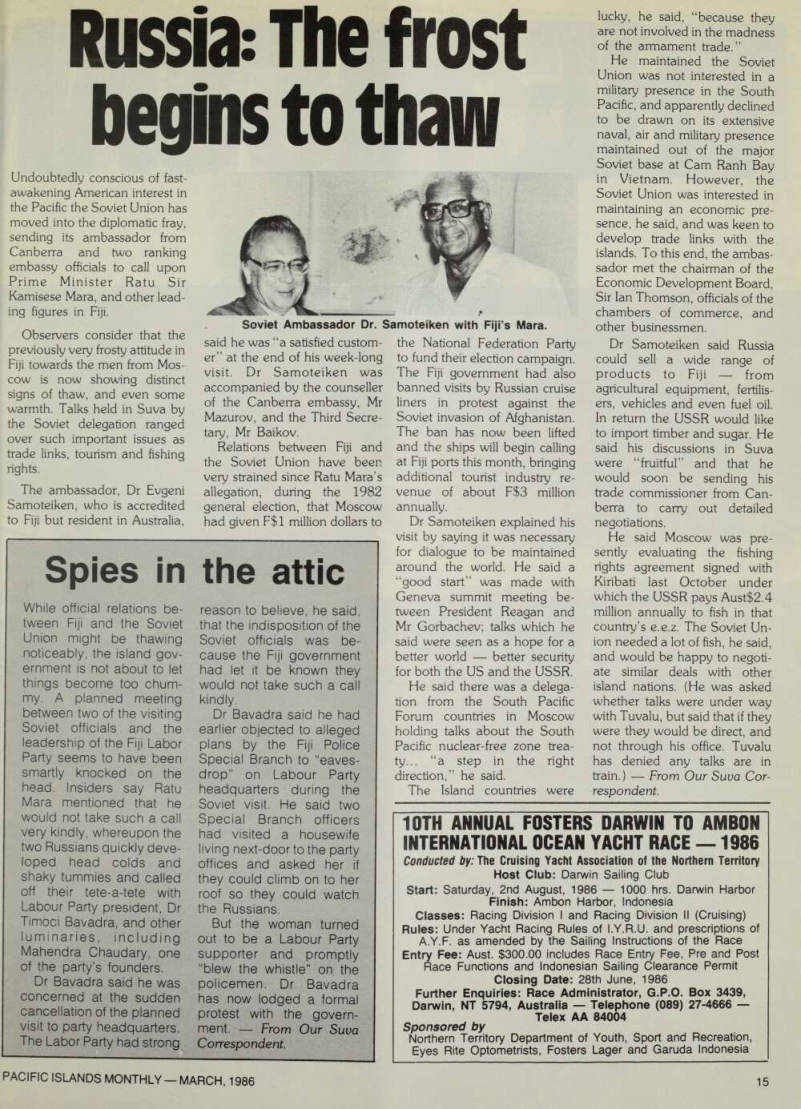
Soviet Ambassador Dr. Samoteiken with Fiji’s Mara.
Spies in the attic
While official relations be tween Fiji and the Soviet Union might be thawing noticeably, the island gov ernment is not about to let things become too chum my. A planned meeting between two of the visiting Soviet officials and the leadership of the Fiji Labor Party seems to have been smartly knocked on the head. Insiders say Ratu Mara mentioned that he would not take such a call very kindly, whereupon the two Russians quickly deve loped head colds and shaky tummies and called off their tete-a-tete with Labour Party president, Dr Timoci Bavadra. and other luminaries, including Mahendra Chaudary, one of the party’s founders.
Dr Bavadra said he was concerned at the sudden cancellation of the planned visit to party headquarters.
The Labor Party had strong
reason to believe, he said, that the indisposition of the Soviet officials was be cause the Fiji government had let it be known they would not take such a call kindly.
Dr Bavadra said he had earlier objected to alleged plans by the Fiji Police Special Branch to “eaves drop” on Labour Party headquarters during the Soviet visit. He said two Special Branch officers had visited a housewife living next-door to the party offices and asked her if they could climb on to her roof so they could watch the Russians, But the woman turned out to be a Labour Party supporter and promptly “blew the whistle" on the policemen. Dr Bavadra has now lodged a formal protest with the govern ment. From Our Suva Correspondent.
Advertisements & other items, pp. 15-17 (1 item)
International Ocean Yacht Race —1986
10TH ANNUAL FOSTERS DARWIN TO AMBON
Conducted by:lhe Cruising Yacht Association of the Northern Territory Host Club: Darwin Sailing Club Start: Saturday, 2nd August, 1986 1000 hrs. Darwin Harbor Finish: Ambon Harbor, Indonesia Classes: Racing Division I and Racing Division II (Cruising) Rules: Under Yacht Racing Rules of I.Y.R.U. and prescriptions of A.Y.F. as amended by the Sailing Instructions of the Race Entry Fee: Aust. $300.00 includes Race Entry Fee, Pre and Post Race Functions and Indonesian Sailing Clearance Permit Closing Date: 28th June, 1986 Further Enquiries: Race Administrator, G.P.O. Box 3439, Darwin, NT 5794, Australia Telephone (089) 27-4666 Telex AA 84004 Sponsored by Northern Territory Department of Youth, Sport and Recreation, Eyes Rite Optometrists, Fosters Lager and Garuda Indonesia
iVSSIN 3HI
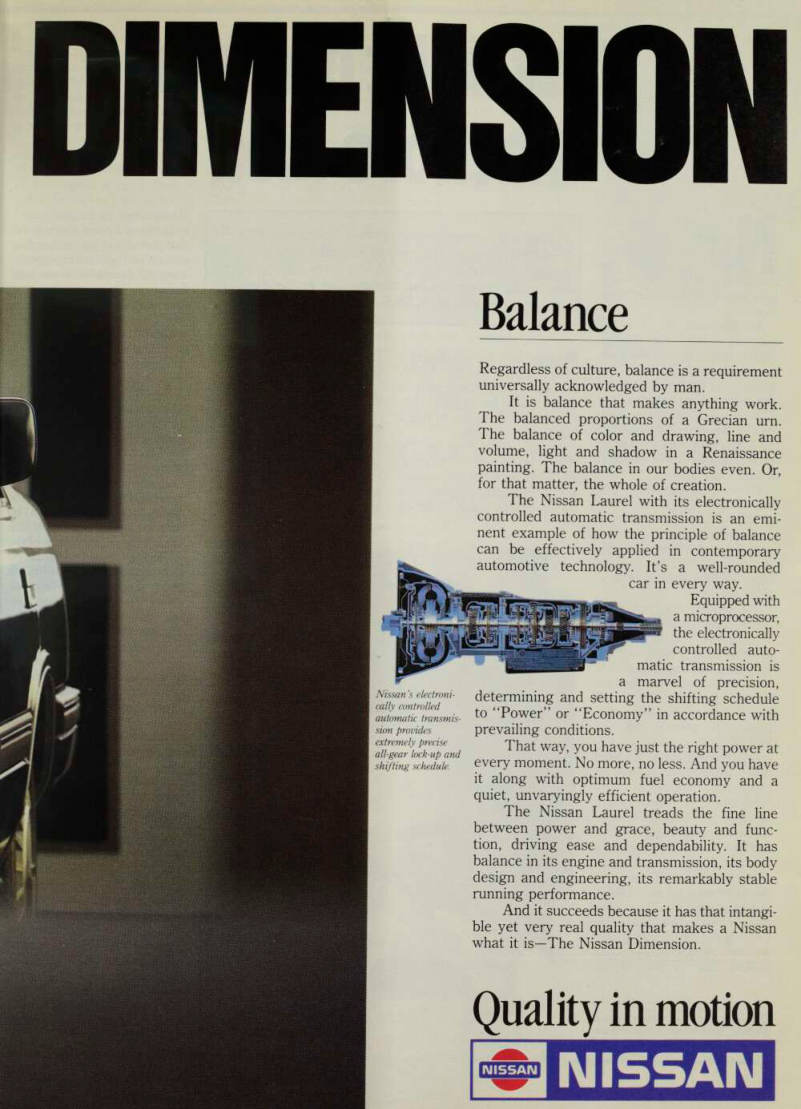
Balance
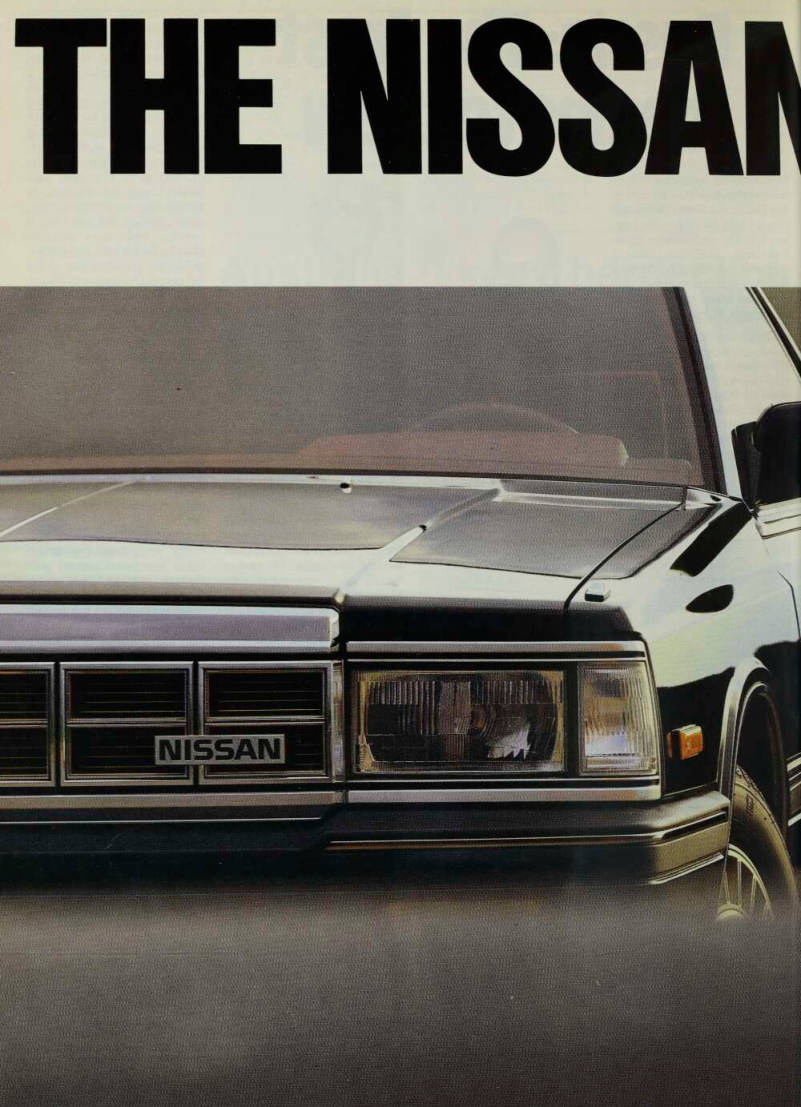
Regardless of culture, balance is a requirement universally acknowledged by man.
It is balance that makes anything work.
The balanced proportions of a Grecian urn.
The balance of color and drawing, line and volume, light and shadow in a Renaissance painting. The balance in our bodies even. Or, for that matter, the whole of creation.
The Nissan Laurel with its electronically controlled automatic transmission is an eminent example of how the principle of balance can be effectively applied in contemporary 3 a well-rounded Nissan’s eiectroni- determining and setting the shifting schedule cally controlled 4. <<7s m • , automatic transmit- i owcr or .hconomy in 3.ccord3.nco with shifting schedule. every moment. No more, no less. And you have it along with optimum fuel economy and a quiet, unvaryingly efficient operation.
The Nissan Laurel treads the fine line between power and grace, beauty and function, driving ease and dependability. It has balance in its engine and transmission, its body design and engineering, its remarkably stable running performance.
And it succeeds because it has that intangible yet very real quality that makes a Nissan what it is—The Nissan Dimension. matic transmission is a marvel of precision, car m every way.
Equipped with a microprocessor, the electronically controlled autosion provides extremely precise all-gear lock-up and prevailing conditions.
That way, you have just the right power at
Quality in motion
Machoro died
New light on how Machoro died
New evidence has emerged which sug gests that Kanak inde pendence leader. Eloi Machoro, was shot by French gendarmes on their own initia tive.
Mr Machoro, 40, a senior member of the Union Caledo nienne (the largest of the inde pendence parties in New Cale donia) was the mastermind of the more militant and violent of FLNKS actions during the early part of last year. He was killed by a French police marksman on January 12 during a seige at a farmhouse.
Union Caledonienne last month took legal action which enabled them to have access to the ballistic reports which are part of the investigation into the shootings of Machoro and an other FLNKS militant, Marcel Nonnaro.
The reports suggest that the police sharpshooters who claim to have attempted under orders to "neutralise” but not kill the men used weapons unsuited to the task. According to lawyers for the Machoro family and Union Caledonienne there is no trace of an order to "neutral ise,” either from special French envoy, Edgard Pisani, or from police superiors of the marks men.
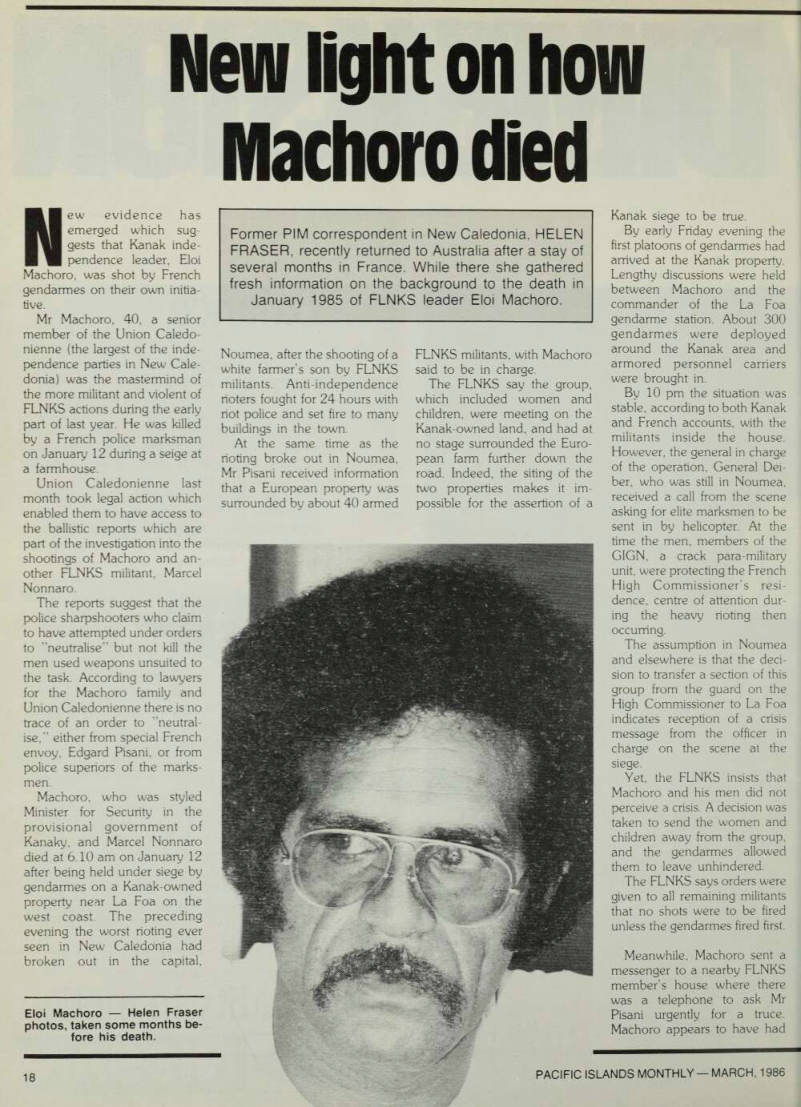
Machoro. who was styled Minister for Security in the provisional government of Kanaky. and Marcel Nonnaro died at 6.10 am on January 12 after being held under siege by gendarmes on a Kanak-owned property near La Foa on the west coast. The preceding evening the worst rioting ever seen in New Caledonia had broken out in the capital.
Former RIM correspondent in New Caledonia. HELEN FRASER, recently returned to Australia after a stay of several months in France. While there she gathered fresh information on the background to the death in January 1985 of FLNKS leader Eloi Machoro.
Noumea, after the shooting of a white farmer's son by FLNKS militants. Anti-independence rioters fought for 24 hours with riot police and set fire to many buildings in the town.
At the same time as the rioting broke out in Noumea, Mr Pisani received information that a European property was surrounded by about 40 armed
FLNKS militants, with Machoro said to be in charge.
The FLNKS say the group, which included women and children, were meeting on the Kanak-owned land, and had at no stage surrounded the Euro pean farm further down the road. Indeed, the siting of the two properties makes it im possible for the assertion of a
Kanak siege to be true.
By early Friday evening the first platoons of gendarmes had arrived at the Kanak property.
Lengthy discussions were held between Machoro and the commander of the La Foa gendarme station. About 300 gendarmes were deployed around the Kanak area and armored personnel carriers were brought in.
By 10 pm the situation was stable, according to both Kanak and French accounts, with the militants inside the house.
However, the general in charge of the operation. General Dei ber, who was still in Noumea, received a call from the scene asking for elite marksmen to be sent in by helicopter. At the time the men. members of the GIGN. a crack para-military unit, were protecting the French High Commissioner’s resi dence, centre of attention dur ing the heavy rioting then occurring.
The assumption in Noumea and elsewhere is that the deci sion to transfer a section of this group from the guard on the High Commissioner to La Foa indicates reception of a crisis message from the officer in charge on the scene at the siege.
Yet, the FLNKS insists that Machoro and his men did not perceive a crisis. A decision was taken to send the women and children away from the group, and the gendarmes allowed them to leave unhindered.
The FLNKS says orders were given to all remaining militants that no shots were to be fired unless the gendarmes fired first.
Meanwhile, Machoro sent a messenger to a nearby FLNKS member's house where there was a telephone to ask Mr Pisani urgently for a truce.
Machoro appears to have had
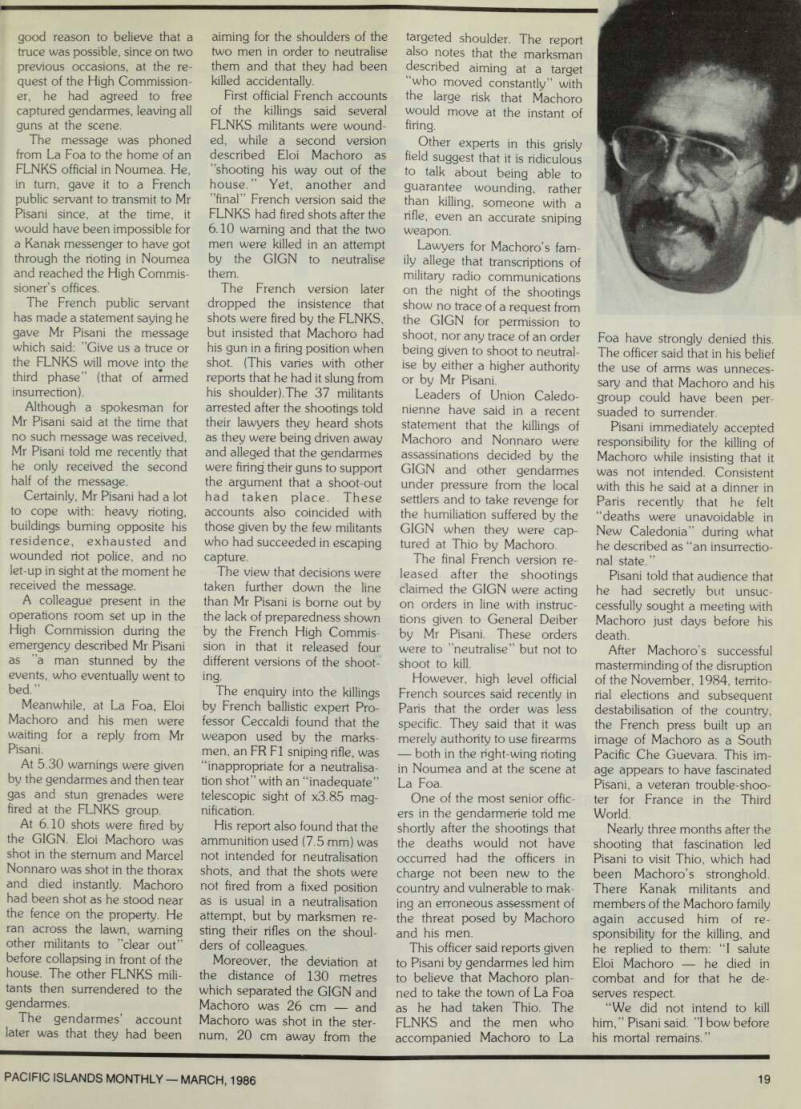
Eloi Machoro - Helen Fraser photos, taken some months be fore his death.
good reason to believe that a truce was possible, since on two previous occasions, at the re quest of the High Commission er, he had agreed to free captured gendarmes, leaving all guns at the scene.
The message was phoned from La Foa to the home of an FLNKS official in Noumea. He, in turn, gave it to a French public servant to transmit to Mr Pisani since, at the time, it would have been impossible for a Kanak messenger to have got through the rioting in Noumea and reached the High Commis sioner’s offices.
The French public servant has made a statement saying he gave Mr Pisani the message which said: ’’Give us a truce or the FLNKS will move into the third phase” (that of armed insurrection).
Although a spokesman for Mr Pisani said at the time that no such message was received, Mr Pisani told me recently that he only received the second half of the message.
Certainly, Mr Pisani had a lot to cope with: heavy rioting, buildings burning opposite his residence, exhausted and wounded riot police, and no let-up in sight at the moment he received the message.
A colleague present in the operations room set up in the High Commission during the emergency described Mr Pisani as ”a man stunned by the events, who eventually went to bed.”
Meanwhile, at La Foa, Eloi Machoro and his men were waiting for a reply from Mr Pisani.
At 5.30 warnings were given by the gendarmes and then tear gas and stun grenades were fired at the FLNKS group.
At 6.10 shots were fired by the GIGN. Eloi Machoro was shot in the sternum and Marcel Nonnaro was shot in the thorax and died instantly. Machoro had been shot as he stood near the fence on the property. He ran across the lawn, warning other militants to ’’clear out” before collapsing in front of the house. The other FLNKS mili tants then surrendered to the gendarmes.
The gendarmes’ account later was that they had been
aiming for the shoulders of the two men in order to neutralise them and that they had been killed accidentally.
First official French accounts of the killings said several FLNKS militants were wound ed, while a second version described Eloi Machoro as ’’shooting his way out of the house.” Yet, another and ’’final” French version said the FLNKS had fired shots after the 6.10 warning and that the two men were killed in an attempt by the GIGN to neutralise them.
The French version later dropped the insistence that shots were fired by the FLNKS, but insisted that Machoro had his gun in a firing position when shot. (This varies with other reports that he had it slung from his shoulder).The 37 militants arrested after the shootings told their lawyers they heard shots as they were being driven away and alleged that the gendarmes were firing their guns to support the argument that a shoot-out had taken place. These accounts also coincided with those given by the few militants who had succeeded in escaping capture.
The view that decisions were taken further down the line than Mr Pisani is borne out by the lack of preparedness shown by the French High Commis sion in that it released four different versions of the shoot ing.
The enquiry into the killings by French ballistic expert Pro fessor Ceccaldi found that the weapon used by the marks men, an FR FI sniping rifle, was “inappropriate for a neutralisa tion shot” with an “inadequate” telescopic sight of x 3.85 mag nification.
His report also found that the ammunition used (7.5 mm) was not intended for neutralisation shots, and that the shots were not fired from a fixed position as is usual in a neutralisation attempt, but by marksmen re sting their rifles on the shoul ders of colleagues.
Moreover, the deviation at the distance of 130 metres which separated the GIGN and Machoro was 26 cm and Machoro was shot in the ster num, 20 cm away from the
targeted shoulder. The report also notes that the marksman described aiming at a target “who moved constantly” with the large risk that Machoro would move at the instant of firing.
Other experts in this grisly field suggest that it is ridiculous to talk about being able to guarantee wounding, rather than killing, someone with a rifle, even an accurate sniping weapon.
Lawyers for Machoro’s fam ily allege that transcriptions of military radio communications on the night of the shootings show no trace of a request from the GIGN for permission to shoot, nor any trace of an order being given to shoot to neutral ise by either a higher authority or by Mr Pisani.
Leaders of Union Caledo nienne have said in a recent statement that the killings of Machoro and Nonnaro were assassinations decided by the GIGN and other gendarmes under pressure from the local settlers and to take revenge for the humiliation suffered by the GIGN when they were cap tured at Thio by Machoro.
The final French version re leased after the shootings claimed the GIGN were acting on orders in line with instruc tions given to General Deiber by Mr Pisani. These orders were to ’’neutralise” but not to shoot to kill.
However, high level official French sources said recently in Paris that the order was less specific. They said that it was merely authority to use firearms both in the right-wing rioting in Noumea and at the scene at La Foa.
One of the most senior offic ers in the gendarmerie told me shortly after the shootings that the deaths would not have occurred had the officers in charge not been new to the country and vulnerable to mak ing an erroneous assessment of the threat posed by Machoro and his men.
This officer said reports given to Pisani by gendarmes led him to believe that Machoro plan ned to take the town of La Foa as he had taken Thio. The FLNKS and the men who accompanied Machoro to La
Foa have strongly denied this.
The officer said that in his belief the use of arms was unneces sary and that Machoro and his group could have been per suaded to surrender.
Pisani immediately accepted responsibility for the killing of Machoro while insisting that it was not intended. Consistent with this he said at a dinner in Paris recently that he felt “deaths were unavoidable in New Caledonia” during what he described as “an insurrectio nal state.”
Pisani told that audience that he had secretly but unsuc cessfully sought a meeting with Machoro just days before his death.
After Machoro’s successful masterminding of the disruption of the November, 1984, territo rial elections and subsequent destabilisation of the country, the French press built up an image of Machoro as a South Pacific Che Guevara. This im age appears to have fascinated Pisani, a veteran trouble-shoo ter for France in the Third World.
Nearly three months after the shooting that fascination led Pisani to visit Thio, which had been Machoro’s stronghold.
There Kanak militants and members of the Machoro family again accused him of re sponsibility for the killing, and he replied to them: “1 salute Eloi Machoro he died in combat and for that he de serves respect.
“We did not intend to kill him,” Pisani said. ”1 bow before his mortal remains.”
seduction plan
the month
Sweetening N-Tests
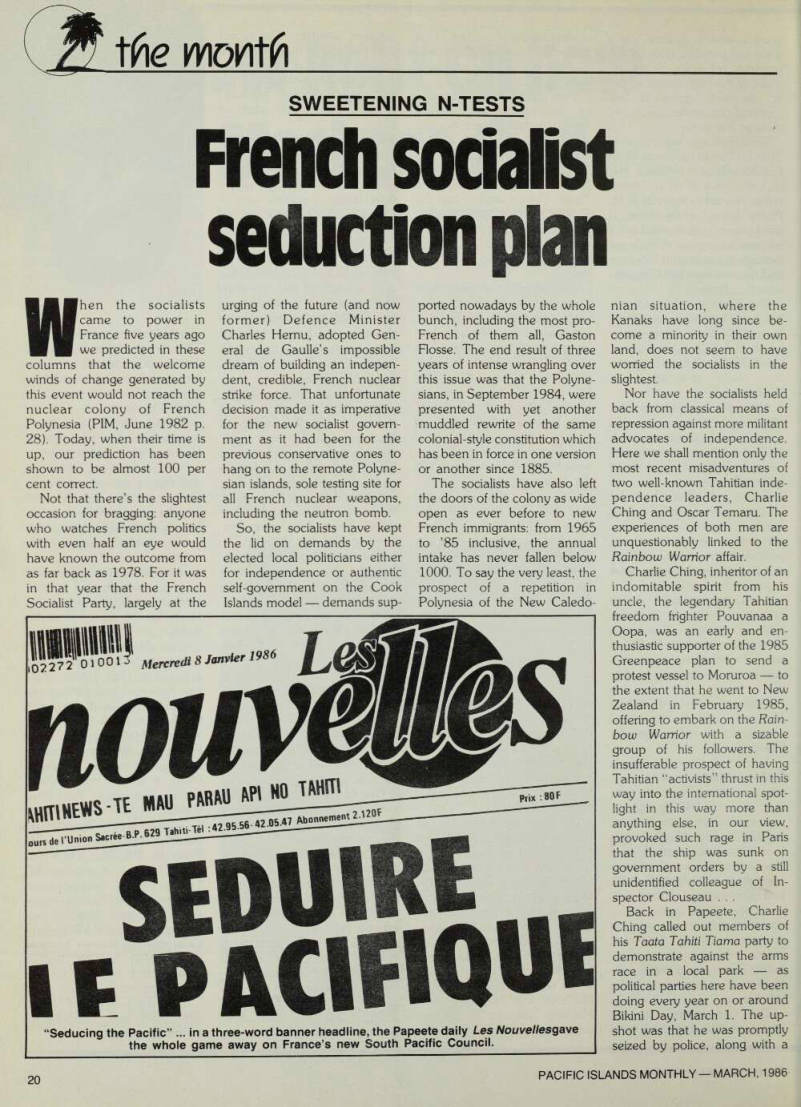
French socialist seduction plan
Hhen the socialists came to power in France five years ago we predicted in these columns that the welcome winds of change generated by this event would not reach the nuclear colony of French Polynesia (PIM, June 1982 p. 28). Today, when their time is up, our prediction has been shown to be almost 100 per cent correct.
Not that there’s the slightest occasion for bragging: anyone who watches French politics with even half an eye would have known the outcome from as far back as 1978. For it was in that year that the French Socialist Party, largely at the
urging of the future (and now former) Defence Minister Charles Hernu, adopted Gen eral de Gaulle’s impossible dream of building an indepen dent, credible, French nuclear strike force. That unfortunate decision made it as imperative for the new socialist govern ment as it had been for the previous conservative ones to hang on to the remote Polyne sian islands, sole testing site for all French nuclear weapons, including the neutron bomb.
So, the socialists have kept the lid on demands by the elected local politicians either for independence or authentic self-government on the Cook Islands model demands sup
ported nowadays by the whole bunch, including the most pro- French of them all, Gaston Flosse. The end result of three years of intense wrangling over this issue was that the Polyne sians, in September 1984, were presented with yet another muddled rewrite of the same colonial-style constitution which has been in force in one version or another since 1885.
The socialists have also left the doors of the colony as wide open as ever before to new French immigrants: from 1965 to ’B5 inclusive, the annual intake has never fallen below 1000. To say the very least, the prospect of a repetition in Polynesia of the New Caledo
nian situation, where the Kanaks have long since be come a minority in their own land, does not seem to have worried the socialists in the slightest.
Nor have the socialists held back from classical means of repression against more militant advocates of independence.
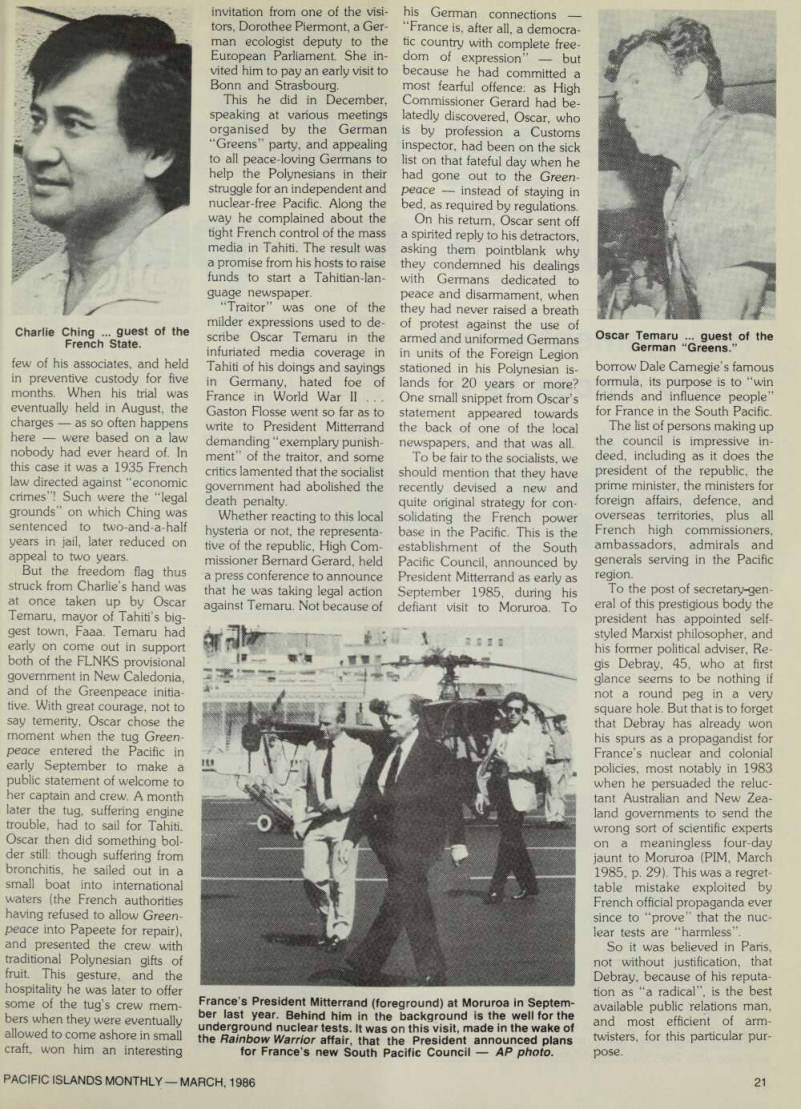
Here we shall mention only the most recent misadventures of two well-known Tahitian inde pendence leaders, Charlie Ching and Oscar Temaru. The experiences of both men are unquestionably linked to the Rainbow Warrior affair.
Charlie Ching, inheritor of an indomitable spirit from his uncle, the legendary Tahitian freedom frighter Pouvanaa a Oopa, was an early and en thusiastic supporter of the 1985 Greenpeace plan to send a protest vessel to Moruroa to the extent that he went to New Zealand in February 1985, offering to embark on the Rain bow Warrior with a sizable group of his followers. The insufferable prospect of having Tahitian “activists” thrust in this way into the international spot light in this way more than anything else, in our view, provoked such rage in Paris that the ship was sunk on government orders by a still unidentified colleague of In spector Clouseau . . .
Back in Papeete, Charlie Ching called out members of his Taata Tahiti Tiama party to demonstrate against the arms race in a local park as political parties here have been doing every year on or around Bikini Day, March 1. The up shot was that he was promptly seized by police, along with a
few of his associates, and held in preventive custody for five months. When his trial was eventually held in August, the charges as so often happens here were based on a law nobody had ever heard of. In this case it was a 1935 French law directed against “economic crimes”! Such were the “legal grounds” on which Ching was sentenced to two-and-a-half years in jail, later reduced on appeal to two years.
But the freedom flag thus struck from Charlie’s hand was at once taken up by Oscar Temaru, mayor of Tahiti’s big gest town, Faaa. Temaru had early on come out in support both of the FLNKS provisional government in New Caledonia, and of the Greenpeace initia tive. With great courage, not to say temerity, Oscar chose the moment when the tug Green peace entered the Pacific in early September to make a public statement of welcome to her captain and crew. A month later the tug, suffering engine trouble, had to sail for Tahiti.
Oscar then did something bol der still: though suffering from bronchitis, he sailed out in a small boat into international waters (the French authorities having refused to allow Green peace into Papeete for repair), and presented the crew with traditional Polynesian gifts of fruit. This gesture, and the hospitality he was later to offer some of the tug’s crew mem bers when they were eventually allowed to come ashore in small craft, won him an interesting
invitation from one of the visi tors, Dorothee Piermont, a Ger man ecologist deputy to the European Parliament. She in vited him to pay an early visit to Bonn and Strasbourg.
This he did in December, speaking at various meetings organised by the German “Greens” party, and appealing to all peace-loving Germans to help the Polynesians in their struggle for an independent and nuclear-free Pacific. Along the way he complained about the tight French control of the mass media in Tahiti. The result was a promise from his hosts to raise funds to start a Tahitian-lan guage newspaper.
“Traitor” was one of the milder expressions used to de scribe Oscar Temaru in the infuriated media coverage in Tahiti of his doings and sayings in Germany, hated foe of France in World War II . . .
Gaston Flosse went so far as to write to President Mitterrand demanding “exemplary punish ment” of the traitor, and some critics lamented that the socialist government had abolished the death penalty.
Whether reacting to this local hysteria or not, the representa tive of the republic, High Com missioner Bernard Gerard, held a press conference to announce that he was taking legal action against Temaru. Not because of
his German connections France is, after all, a democra tic country with complete free dom of expression” but because he had committed a most fearful offence; as High Commissioner Gerard had be latedly discovered, Oscar, who is by profession a Customs inspector, had been on the sick list on that fateful day when he had gone out to the Green peace instead of staying in bed, as required by regulations.
On his return, Oscar sent off a spirited reply to his detractors, asking them pointblank why they condemned his dealings with Germans dedicated to peace and disarmament, when they had never raised a breath of protest against the use of armed and uniformed Germans in units of the Foreign Legion stationed in his Polynesian is lands for 20 years or more?
One small snippet from Oscar’s statement appeared towards the back of one of the local newspapers, and that was all.
To be fair to the socialists, we should mention that they have recently devised a new and quite original strategy for con solidating the French power base in the Pacific. This is the establishment of the South Pacific Council, announced by President Mitterrand as early as September 1985, during his defiant visit to Moruroa. To
borrow Dale Carnegie’s famous formula, its purpose is to “win friends and influence people” for France in the South Pacific.
The list of persons making up the council is impressive in deed, including as it does the president of the republic, the prime minister, the ministers for foreign affairs, defence, and overseas territories, plus all French high commissioners, ambassadors, admirals and generals serving in the Pacific region.
To the post of secretary-gen eral of this prestigious body the president has appointed self styled Marxist philosopher, and his former political adviser, Re gis Debray, 45, who at first glance seems to be nothing if not a round peg in a very square hole. But that is to forget that Debray has already won his spurs as a propagandist for France’s nuclear and colonial policies, most notably in 1983 when he persuaded the reluc tant Australian and New Zea land governments to send the wrong sort of scientific experts on a meaningless four-day jaunt to Moruroa (PIM, March 1985, p. 29). This was a regret table mistake exploited by French official propaganda ever since to “prove” that the nuc lear tests are “harmless”.
So it was believed in Paris, not without justification, that Debray, because of his reputa tion as “a radical”, is the best available public relations man, and most efficient of arm twisters, for this particular pur pose.
Charlie Ching ... guest of the French State.
France’s President Mitterrand (foreground) at Moruroa in Septem ber last year. Behind him in the background is the well for the underground nuclear tests. It was on this visit, made in the wake of the Rainbow Warrior affair, that the President announced plans for France’s new South Pacific Council - AP photo.
Oscar Temaru ... guest of the German “Greens.”
The first brainchild of this new council is the establish ment of a francophone univer sity in Papeete. The staff will consist of top-grade, English speaking, French professors, whose task will be to teach courses in the fields of French language, culture, arts, sciences and technology. Lured by gen erous grants, it is hoped stu dents from throughout the Paci fic will flock to Papeete.
There are many, many, other ideas in the works as well.
The French conservative par ties have vowed that as soon as they are returned to power on March 16 they will wipe out
every trace of the period of socialist rule, 1981-86, and there is little doubt they mean what they say. One possible exception, however, is the new born South Pacific Council: the nuclear tests being bound to continue, and bound also to continue arousing the anger of Pacific countries, it seems likely that any new French Govern ment would be extremely loath to undo such an initiative. The South Pacific Council is, there fore, likely to stand as the one tangible legacy of the rule of the French socialists to be seen in the Pacific region. Marie- Therese and Bengt Danielsson.
Advertisements & other items, p. 20 (1 item)
P Acifiqui
,02*2 0 > 001 3 Me rcredi Janvier 1986 % i nm m m
PARMJ
BOF
IBM)
Prix TE
\HIUHEWS
120 F Abonnement 42 Tel Tahiti 629 Sacree Union ours IE »e-D-r.»»-“
SEDIIIR®
P ACIFIQUI
Seducing the Pacific” ... in a three-word banner headline, the Papeete daily Les Nouvellesgave the whole game away on France’s new South Pacific Council.
Realignment of Fiji
party forces is on
Two questions fascinate politi cal observers in Fiji these days.
First, what is left for the Na tional Federation Party and, in particular, its leader, Siddiq Koya? and, second, can the newly-risen Fiji Labour Party now truly challenge the long established Alliance Party for control of the government of Fiji?
On the face of it, in the wake of what was, for his party, and even more for him personally, a disastrous by-election earlier this year in Ba-Tavua, Koya appears to be a spent political force. His party is now even more divided than it was when he reluctantly relinquished leadership in 1977. Its par liamentary numbers have lately been reduced from 24 to 18, and the dog-fights within its ranks are painfully public.
Concurrently, the Labour Party, still predominantly In dian, but making strenuous efforts to attract wide support in every racial group, has shown itself to be a notable and rising force, capable by many counts not only of supplanting the NFP, but even of challenging Ratu Mara’s Alliance in a na tion-wide poll.
The result in Ba-Tavua may, but only may, be an indication of the Labour Party’s potential.
The Alliance fielded Uday Singh, member of a well known sugar-growing family, and won with 7885 votes. But
the Labour Party, with its lead er, unionist Mahendra Chaud hary, as candidate, polled a very close 7644 votes, leaving the NFP wallowing in its wake with 5003.
The ruling Alliance Party thus increased its parliamentary majority by one to 29. The National Federation Party, which had 24 seats after the 1982 elections has now seen its numbers dwindle to 18, with two seats lost in by-elections, and four sitting members, in cluding deputy leader, Irene Jai Narayan, resigning and styling themselves independent, The recent December by elections were for the Lau- Rotuma Fijian communal seat, and the national seat for the Ba-Tavua Indian constituency.
The first of these is a blue ribbon Alliance seat which had become vacant after the accidental death last year of the Minister for Foreign Affairs, Jonati Mavoa. Mr Filipe Bole, a former diplomat and civil ser vant won handsomely, defeat ing his only opponent, Sakeasi Butadroka, of the Fijian Na tionalist Party, by 5329 votes to 266. Butadroka lost his deposit.
But, the story was quite diffe rent in the other contest. The National Federation Party, which had won in the general election by a 5500-vote major ity, when it fielded former Alliance cabinet minister Sir
Vijay R.Singh, this time got what can only be called a bloody nose.
Ironically the NFP had once again put up an ex-Alliance cabinet minister, Mr James Shankar Singh, as its candidate.
The winning Alliance candidate is his younger brother. (Uday Singh had also con tested and lost the seat against Sir Vijay in 1982.) Most commentators in Fiji believe the result would have been much more disastrous for the NFP had they fielded any one but James Shankar Singh, and thus the conclusion is that the Labour Party vote may be seen as something of a mini mum - which is probably mak ing the Alliance’s back-room men think on overtime as well.
The popular view now is that the NFP, and Sid Koya, are spent forces in Fiji politics and that if Mr Koya continues in the leadership, then the NFP will continue to decline into political oblivion.
Taking into account all the mistakes and political and tacti cal blunders Mr Koya is seen to
have made last year, most pun dits had expected him to volun tarily resign. But that is not his style.
As well as losing his deputy leader, Mrs Narayan, he has seen three others of his leading parliamentarians go to the cross benches; Dr Satendra Nandan, Mr Himmat Lodhia and Mr Arthur Jennings. But, so far, despite the omens and the open talk, Mr Koya has stub bornly soldiered on.
The big test is due next year when general elections are due to be held. Speculation has it that unless some sort of miracle occurs the NFP will wind up the minority party in the parlia ment, with the Labour Party forming the official opposition at very least.
Privately, and even publicly, politicians in Fiji are saying the NFP is a write-off.
Compounding this situation, both the Alliance and the Labour Party are actively en gaged in luring disenchanted NFP supporters and members of parliament into their folds.
Ratu Mara has been talking with rich and influential Gujerati businessmen who are known NFP supporters. Not long ago he held a specially-arranged dinner party to continue this campaign.
Labour Party officials have also been meeting former NFP city councillors and par liamentarians who now call themselves independent in a bid to woo them. The Labour leadership has been reluctant, until recently, to make any overtures to NFP members be cause it has wished to keep its clear image and not become over-burdened with ex-NFP fi gures. However, it has had to modify its stand, or lose the opportunity to the Alliance.
But what is Sid Koya’s future as a political leader? In March last year, in a by-election, when his own choice of candidate, Dr Balwant Singh Rakha, was de feated by a rebel NFP candi date, Mr Davendra Singh, by a mere 13 votes Mr Koya refused to honor a promise to “resign instantly - instantly,” if his candidate lost. But he made no such promise over the Ba- Tavua by-election, and in the very heady environment of In dian politics in Fiji that is seen as significant. From Our Suva Correspondent.
Uday Singh ... won for the Alliance.
Mahendra Chaudhary ... left NFP wallowing.
Vanuatu's hopes - and
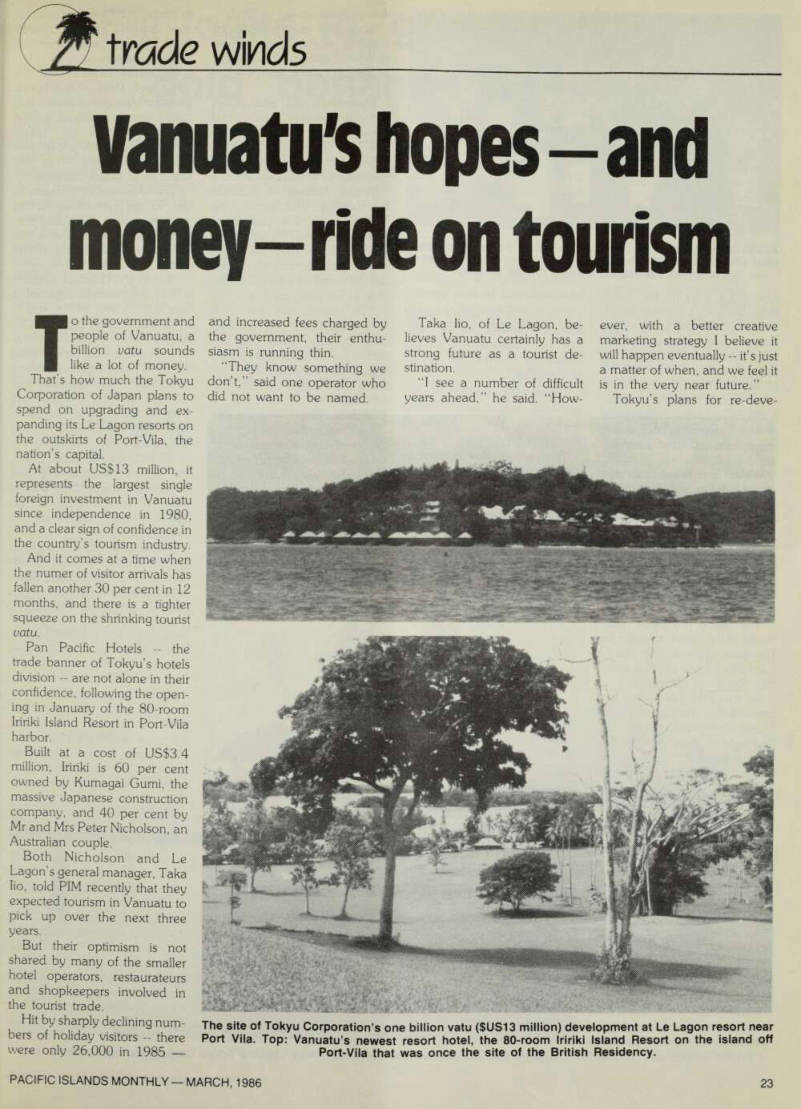
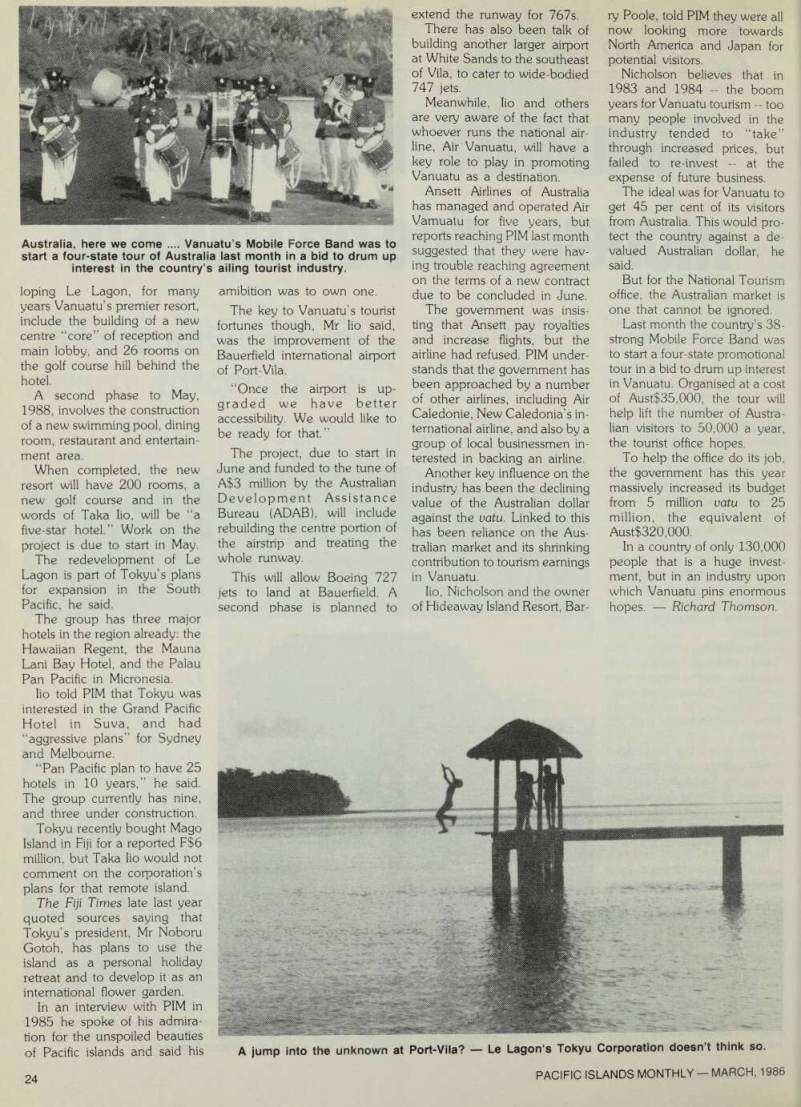
trade winds
Vanuatu's hopes - and money-ride on tourism
To the government and people of Vanuatu, a billion vatu sounds like a lot of money.
That’s how much the Tokyu Corporation of Japan plans to spend on upgrading and ex panding its Le Lagon resorts on the outskirts of Port-Vila, the nation’s capital.
At about US$l3 million, it represents the largest single foreign investment in Vanuatu since independence in 1980, and a clear sign of confidence in the country’s tourism industry.
And it comes at a time when the numer of visitor arrivals has fallen another 30 per cent in 12 months, and there is a tighter squeeze on the shrinking tourist vatu.
Pan Pacific Hotels - the trade banner of Tokyu’s hotels division are not alone in their confidence, following the open ing in January of the 80-room Iririki Island Resort in Port-Vila harbor.
Built at a cost of US$3.4 million, Iririki is 60 per cent owned by Kumagai Gumi, the massive Japanese construction company, and 40 per cent by Mr and Mrs Peter Nicholson, an Australian couple.
Both Nicholson and Le Lagon’s general manager, Taka lio, told PIM recently that they expected tourism in Vanuatu to pick up over the next three years.
But their optimism is not shared by many of the smaller hotel operators, restaurateurs and shopkeepers involved in the tourist trade.
Hit by sharply declining num bers of holiday visitors - there were only 26,000 in 1985
and increased fees charged by the government, their enthu siasm is running thin.
“They know something we don’t,” said one operator who did not want to be named.
Taka lio, of Le Lagon, believes Vanuatu certainly has a strong future as a tourist destination.
“I see a number of difficult years ahead, he said. “How-
ever, with a better creative marketing strategy I believe it will happen eventually - it’s just a matter of when, and we feel it is in the very near future.”
Tokyu’s plans for re-deve-
The site of Tokyu Corporation’s one billion vatu ($US13 million) development at Le Lagon resort near Port Vila. Top: Vanuatu’s newest resort hotel, the 80-room Iririki Island Resort on the island off Port-Vila that was once the site of the British Residency.
loping Le Lagon, for many years Vanuatu’s premier resort, include the building of a new centre “core” of reception and main lobby, and 26 rooms on the golf course hill behind the hotel.
A second phase to May, 1988, involves the construction of a new swimming pool, dining room, restaurant and entertain ment area.
When completed, the new resort will have 200 rooms, a new golf course and in the words of Taka lio, will be “a five-star hotel.” Work on the project is due to start in May.
The redevelopment of Le Lagon is part of Tokyu’s plans for expansion in the South Pacific, he said.
The group has three major hotels in the region already: the Hawaiian Regent, the Mauna Lani Bay Hotel, and the Palau Pan Pacific in Micronesia. lio told PIM that Tokyu was interested in the Grand Pacific Hotel in Suva, and had “aggressive plans” for Sydney and Melbourne.
“Pan Pacific plan to have 25 hotels in 10 years,” he said.
The group currently has nine, and three under construction.
Tokyu recently bought Mago Island in Fiji for a reported Fs6 million, but Taka lio would not comment on the corporation’s plans for that remote island.
The Fiji Times late last year quoted sources saying that Tokyu’s president, Mr Noboru Gotoh, has plans to use the island as a personal holiday retreat and to develop it as an international flower garden.
In an interview with PIM in 1985 he spoke of his admira tion for the unspoiled beauties of Pacific islands and said his
amibition was to own one.
The key to Vanuatu’s tourist fortunes though, Mr lio said, was the improvement of the Bauerfield international airport of Port-Vila.
“Once the airport is up graded we have better accessibility. We would like to be ready for that.”
The project, due to start in June and funded to the tune of As 3 million by the Australian Development Assistance Bureau (ADAB), will include rebuilding the centre portion of the airstrip and treating the whole runway.
This will allow Boeing 727 jets to land at Bauerfield. A second phase is planned to
extend the runway for 7675.
There has also been talk of building another larger airport at White Sands to the southeast of Vila, to cater to wide-bodied 747 jets.
Meanwhile, lio and others are very aware of the fact that whoever runs the national air line, Air Vanuatu, will have a key role to play in promoting Vanuatu as a destination.
Ansett Airlines of Australia has managed and operated Air Vamuatu for five years, but reports reaching PIM last month suggested that they were hav ing trouble reaching agreement on the terms of a new contract due to be concluded in June.
The government was insis ting that Ansett pay royalties and increase flights, but the airline had refused. PIM under stands that the government has been approached by a number of other airlines, including Air Caledonie, New Caledonia’s in ternational airline, and also by a group of local businessmen in terested in backing an airline.
Another key influence on the industry has been the declining value of the Australian dollar against the vatu. Linked to this has been reliance on the Aus tralian market and its shrinking contribution to tourism earnings in Vanuatu. lio, Nicholson and the owner of Hideaway Island Resort, Bar
ry Poole, told PIM they were all now looking more towards North America and Japan for potential visitors.
Nicholson believes that in 1983 and 1984 the boom years for Vanuatu tourism -- too many people involved in the industry tended to “take” through increased prices, but failed to re-invest - at the expense of future business.
The ideal was for Vanuatu to get 45 per cent of its visitors from Australia. This would pro tect the country against a de valued Australian dollar, he said.
But for the National Tourism office, the Australian market is one that cannot be ignored.
Last month the country’s 38strong Mobile Force Band was to start a four-state promotional tour in a bid to drum up interest in Vanuatu. Organised at a cost of Austs3s,ooo, the tour will help lift the number of Austra lian visitors to 50,000 a year, the tourist office hopes.
To help the office do its job, the government has this year massively increased its budget from 5 million vatu to 25 million, the equivalent of Austs32o,ooo.
In a country of only 130,000 people that is a huge invest ment, but in an industry upon which Vanuatu pins enormous
hopes.
Richard Thomson.
Australia, here we come ... Vanuatu’s Mobile Force Band was to start a four-state tour of Australia last month in a bid to drum up interest in the country’s ailing tourist industry.
A jump into the unknown at Port-Vila? - Le Lagon's Tokyu Corporation doesn’t think so.
gold’ bonanza
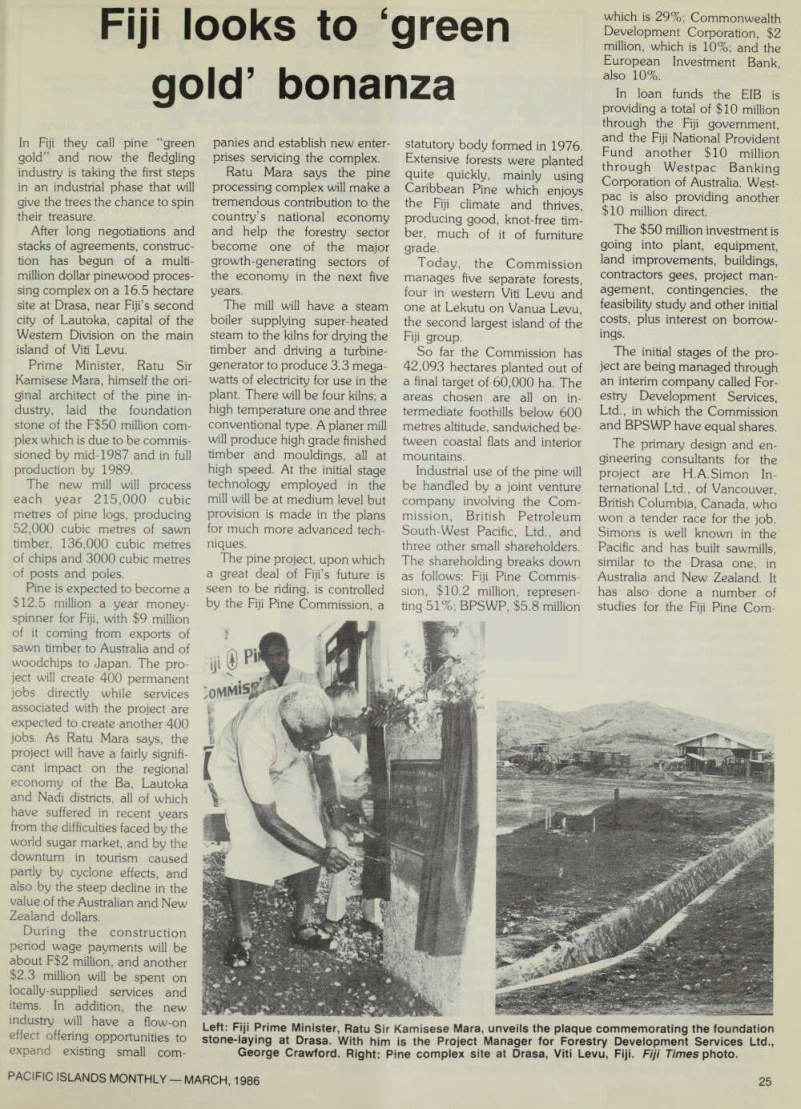
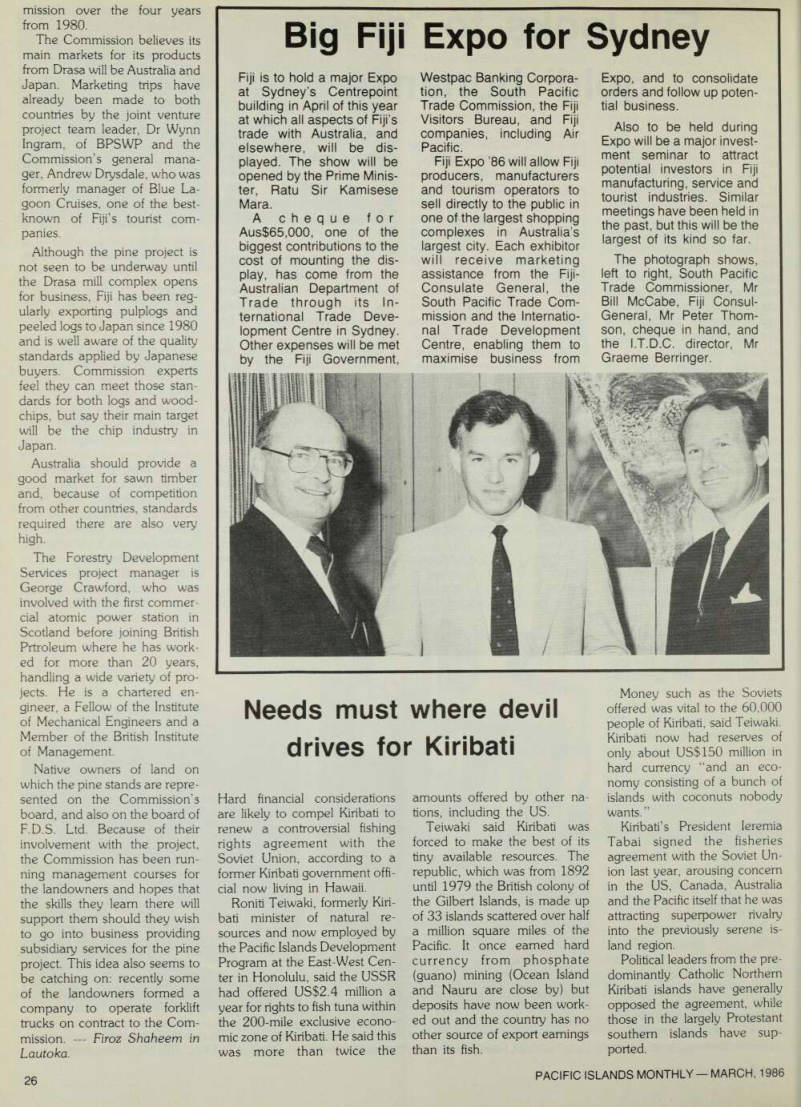
Fiji looks to 'green gold’ bonanza
In Fiji they call pine “green gold” and now the fledgling industry is taking the first steps in an industrial phase that will give the trees the chance to spin their treasure.
After long negotiations and stacks of agreements, construc tion has begun of a multi million dollar pinewood proces sing complex on a 16.5 hectare site at Drasa, near Fiji’s second city of Lautoka, capital of the Western Division on the main island of Viti Levu.
Prime Minister, Ratu Sir Kamisese Mara, himself the ori ginal architect of the pine in dustry, laid the foundation stone of the Fsso million com plex which is due to be commis sioned by mid-1987 and in full production by 1989.
The new mill will process each year 215,000 cubic metres of pine logs, producing 52,000 cubic metres of sawn timber, 136,000 cubic metres of chips and 3000 cubic metres of posts and poles.
Pine is expected to become a $12.5 million a year money spinner for Fiji, with $9 million of it coming from exports of sawn timber to Australia and of woodchips to Japan. The pro ject will create 400 permanent jobs directly while services associated with the project are expected to create another 400 jobs. As Ratu Mara says, the project will have a fairly signifi cant impact on the regional economy of the Ba, Lautoka and Nadi districts, all of which have suffered in recent years from the difficulties faced by the world sugar market, and by the downturn in tourism caused partly by cyclone effects, and also by the steep decline in the value of the Australian and New Zealand dollars.
During the construction period wage payments will be about Fs2 million, and another $2.3 million will be spent on locally-supplied services and items. In addition, the new industry will have a flow-on effect offering opportunities to expand existing small com
panics and establish new enter prises servicing the complex.
Ratu Mara says the pine processing complex will make a tremendous contribution to the country’s national economy and help the forestry sector become one of the major growth-generating sectors of the economy in the next five years.
The mill will have a steam boiler supplying super-heated steam to the kilns for drying the timber and driving a turbine generator to produce 3.3 mega watts of electricity for use in the plant. There will be four kilns; a high temperature one and three conventional type. A planer mill will produce high grade finished timber and mouldings, all at high speed. At the initial stage technology employed in the mill will be at medium level but provision is made in the plans for much more advanced tech niques.
The pine project, upon which a great deal of Fiji’s future is seen to be riding, is controlled by the Fiji Pine Commission, a
statutory body formed in 1976.
Extensive forests were planted quite quickly, mainly using Caribbean Pine which enjoys the Fiji climate and thrives, producing good, knot-free tim ber, much of it of furniture grade.
Today, the Commission manages five separate forests, four in western Viti Levu and one at Lekutu on Vanua Levu, the second largest island of the Fiji group.
So far the Commission has 42,093 hectares planted out of a final target of 60,000 ha. The areas chosen are all on in termediate foothills below 600 metres altitude, sandwiched be tween coastal flats and interior mountains.
Industrial use of the pine will be handled by a joint venture company involving the Com mission, British Petroleum South-West Pacific, Ltd., and three other small shareholders.
The shareholding breaks down as follows: Fiji Pine Commis sion, $10.2 million, represen ting 51%; BPSWP, $5.8 million
which is 29%; Commonwealth Development Corporation, $2 million, which is 10%; and the European Investment Bank, also 10%.
In loan funds the EIB is providing a total of $lO million through the Fiji government, and the Fiji National Provident Fund another $lO million through Westpac Banking Corporation of Australia. West pac is also providing another $lO million direct.
The $5O million investment is going into plant, equipment, land improvements, buildings, contractors gees, project man agement, contingencies, the feasibility study and other initial costs, plus interest on borrow ings.
The initial stages of the pro ject are being managed through an interim company called For estry Development Services, Ltd., in which the Commission and BPSWP have equal shares.
The primary design and en gineering consultants for the project are H.A.Simon In ternational Ltd., of Vancouver, British Columbia, Canada, who won a tender race for the job.
Simons is well known in the Pacific and has built sawmills, similar to the Drasa one, in Australia and New Zealand. It has also done a number of studies for the Fiji Pine Corn-
Left: Fiji Prime Minister, Ratu Sir Kamisese Mara, unveils the plaque commemorating the foundation stone-laying at Drasa. With him is the Project Manager for Forestry Development Services Ltd., George Crawford. Right: Pine complex site at Drasa, Viti Levu, Fiji. Fiji Times photo.
mission over the four years from 1980.
The Commission believes its main markets for its products from Drasa will be Australia and Japan. Marketing trips have already been made to both countries by the joint venture project team leader, Dr Wynn Ingram, of BPSWP and the Commission’s general mana ger, Andrew Drysdale, who was formerly manager of Blue La goon Cruises, one of the best known of Fiji’s tourist com panies.
Although the pine project is not seen to be underway until the Drasa mill complex opens for business, Fiji has been reg ularly exporting pulplogs and peeled logs to Japan since 1980 and is well aware of the quality standards applied by Japanese buyers. Commission experts feel they can meet those stan dards for both logs and wood chips, but say their main target will be the chip industry in Japan.
Australia should provide a good market for sawn timber and. because of competition from other countries, standards required there are also very high.
The Forestry Development Services project manager is George Crawford, who was involved with the first commer cial atomic power station in Scotland before joining British Prtroleum where he has work ed for more than 20 years, handling a wide variety of pro jects. He is a chartered en gineer, a Fellow of the Institute of Mechanical Engineers and a Member of the British Institute of Management.
Native owners of land on which the pine stands are repre sented on the Commission’s board, and also on the board of F.D.S. Ltd. Because of their involvement with the project, the Commission has been run ning management courses for the landowners and hopes that the skills they learn there will support them should they wish to go into business providing subsidiary services for the pine project. This idea also seems to be catching on: recently some of the landowners formed a company to operate forklift trucks on contract to the Com
mission.
Firoz Shaheem in
Lautoka.
Big Fiji Expo for Sydney
Fiji is to hold a major Expo at Sydney’s Centrepoint building in April of this year at which all aspects of Fiji’s trade with Australia, and elsewhere, will be dis played. The show will be opened by the Prime Minis ter, Ratu Sir Kamisese Mara.
A cheque for Auss6s,ooo, one of the biggest contributions to the cost of mounting the dis play, has come from the Australian Department of Trade through its In ternational Trade Deve lopment Centre in Sydney.
Other expenses will be met by the Fiji Government,
Westpac Banking Corporation, the South Pacific Trade Commission, the Fiji Visitors Bureau and Fiji Pacific™ 63 ' 9 pi cvnn 'oc on™., cm
nrrJiipprQ mam ifarti irori
S and tourism operators to 11 xi x il A r-M .L-viiz-s ; sell directly to the public in one of the largest shopping complexes in Austral largest city. Each exhibitor will receive marketing assistance from the Fiji- Consulate General, the South Pacific Trade Commission and the International Trade Development Centre, enabling them to maximise business from
Expo, and to consolidate orders and follow up poten tial business.
Expo will be a major invest rnent seminar to attract potential investors in Fiji manufacturing, service and +rtll • + oi m iin, tourist industnss. Similsr meetinas have been held in ~® e ' ~. ® S® P st of ts kind o ?ar largest of its kino so far.
The photograph shows, left to right, South Pacific Trade Commissioner, Mr Bill McCabe, Fiji Consul- General, Mr Peter Thom son, cheque in hand, and the I.T.D.C. director, Mr Graeme Berringer.
Needs must where devil
drives for Kiribati
Hard financial considerations are likely to compel Kiribati to renew a controversial fishing rights agreement with the Soviet Union, according to a former Kiribati government offi cial now living in Hawaii.
Roniti Teiwaki, formerly Kiri bati minister of natural re sources and now employed by the Pacific Islands Development Program at the East-West Cen ter in Honolulu, said the USSR had offered US$2.4 million a year for rights to fish tuna within the 200-mile exclusive econo mic zone of Kiribati. He said this was more than twice the
amounts offered by other na tions, including the US.
Teiwaki said Kiribati was forced to make the best of its tiny available resources. The republic, which was from 1892 until 1979 the British colony of the Gilbert Islands, is made up of 33 islands scattered over half a million square miles of the Pacific. It once earned hard currency from phosphate (guano) mining (Ocean Island and Nauru are close by) but deposits have now been work ed out and the country has no other source of export earnings than its fish.
Money such as the Soviets offered was vital to the 60,000 people of Kiribati, said Teiwaki.
Kiribati now had reserves of only about US$l5O million in hard currency “and an eco nomy consisting of a bunch of islands with coconuts nobody wants.”
Kiribati’s President leremia Tabai signed the fisheries agreement with the Soviet Un ion last year, arousing concern in the US, Canada, Australia and the Pacific itself that he was attracting superpower rivalry into the previously serene is land region.
Political leaders from the pre dominantly Catholic Northern Kiribati islands have generally opposed the agreement, while those in the largely Protestant southern islands have sup ported.
for new policy
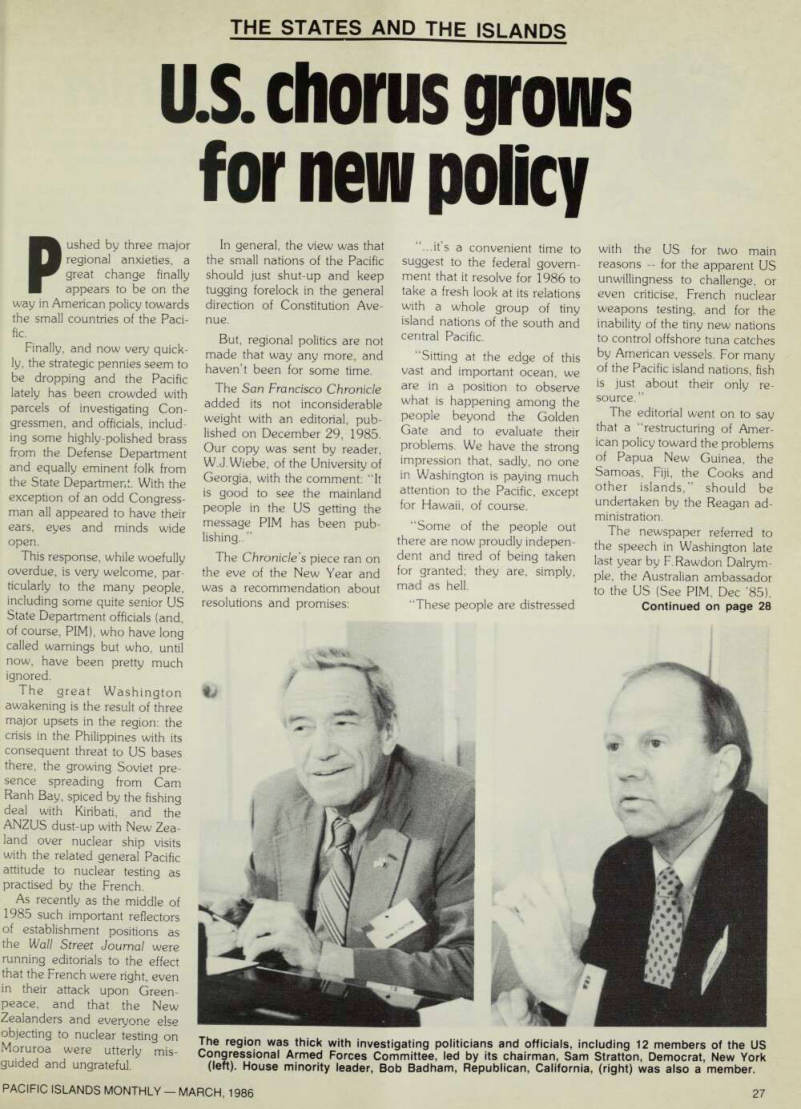
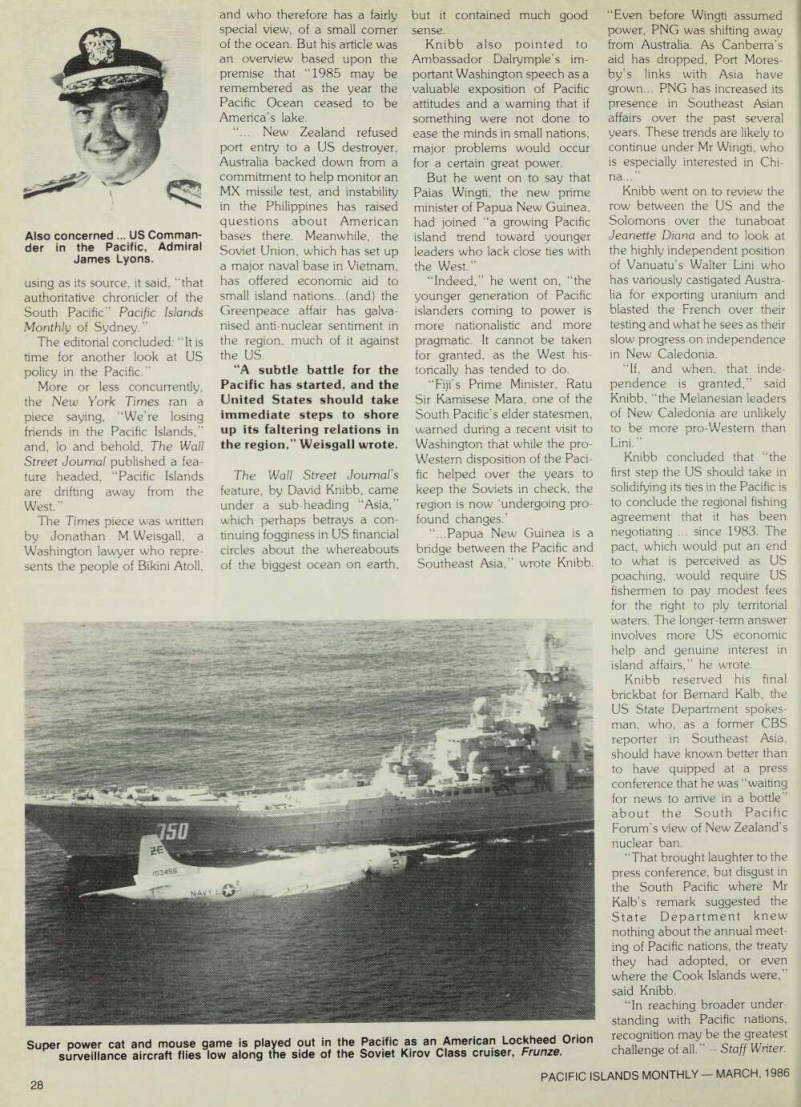
The States And The Islands
U.S. chorus grows for new policy
Pushed by three major regional anxieties, a great change finally appears to be on the way in American policy towards the small countries of the Paci fic.
Finally, and now very quick ly, the strategic pennies seem to be dropping and the Pacific lately has been crowded with parcels of investigating Con gressmen, and officials, includ ing some highly-polished brass from the Defense Department and equally eminent folk from the State Department. With the exception of an odd Congress man all appeared to have their ears, eyes and minds wide open.
This response, while woefully overdue, is very welcome, par ticularly to the many people, including some quite senior US State Department officials (and, of course, PIM), who have long called warnings but who, until now, have been pretty much ignored.
The great Washington awakening is the result of three major upsets in the region: the crisis in the Philippines with its consequent threat to US bases there, the growing Soviet pre sence spreading from Cam Ranh Bay, spiced by the fishing deal with Kiribati, and the ANZUS dust-up with New Zea land over nuclear ship visits with the related general Pacific attitude to nuclear testing as practised by the French.
As recently as the middle of 1985 such important reflectors of establishment positions as the Wall Street Journal were running editorials to the effect that the French were right, even in their attack upon Green peace, and that the New Zealanders and everyone else objecting to nuclear testing on Moruroa were utterly mis guided and ungrateful.
In general, the view was that the small nations of the Pacific should just shut-up and keep tugging forelock in the general direction of Constitution Ave nue.
But, regional politics are not made that way any more, and haven’t been for some time.
The San Francisco Chronicle added its not inconsiderable weight with an editorial, pub lished on December 29, 1985.
Our copy was sent by reader, W.J.Wiebe, of the University of Georgia, with the comment; “It is good to see the mainland people in the US getting the message PIM has been pub lishing..”
The Chronicle’s piece ran on the eve of the New Year and was a recommendation about resolutions and promises:
“...it’s a convenient time to suggest to the federal govern ment that it resolve for 1986 to take a fresh look at its relations with a whole group of tiny island nations of the south and central Pacific.
“Sitting at the edge of this vast and important ocean, we are in a position to observe what is happening among the people beyond the Golden Gate and to evaluate their problems. We have the strong impression that, sadly, no one in Washington is paying much attention to the Pacific, except for Hawaii, of course.
“Some of the people out there are now proudly indepen dent and tired of being taken for granted; they are, simply, mad as hell.
“These people are distressed
with the US for two main reasons - for the apparent US unwillingness to challenge, or even criticise, French nuclear weapons testing, and for the inability of the tiny new nations to control offshore tuna catches by American vessels. For many of the Pacific island nations, fish is just about their only re source. ”
The editorial went on to say that a “restructuring of Amer ican policy toward the problems of Papua New Guinea, the Samoas, Fiji, the Cooks and other islands,” should be undertaken by the Reagan ad ministration.
The newspaper referred to the speech in Washington late last year by F.Rawdon Dalrym ple, the Australian ambassador to the US (See PIM, Dec ’B5).
Continued on page 28
The region was thick with investigating politicians and officials, including 12 members of the US Congressional Armed Forces Committee, led by its chairman, Sam Stratton, Democrat, New York (left). House minority leader, Bob Badham, Republican, California, (right) was also a member.
using as its source, it said, “that authoritative chronicler of the South Pacific” Pacific Islands Monthly of Sydney."
The editorial concluded; “It is time for another look at US policy in the Pacific.”
More or less concurrently, the New York Times ran a piece saying, “We’re losing friends in the Pacific Islands,” and, lo and behold, The Wall Street Journal published a fea ture headed, “Pacific Islands are drifting away from the West.”
The Times piece was written by Jonathan M.Weisgall, a Washington lawyer who repre sents the people of Bikini Atoll,
and who therefore has a fairly special view, of a small comer of the ocean. But his article was an overview based upon the premise that “1985 may be remembered as the year the Pacific Ocean ceased to be America’s lake.
“... New Zealand refused port entry to a US destroyer, Australia backed down from a commitment to help monitor an MX missile test, and instability in the Philippines has raised questions about American bases there. Meanwhile, the Soviet Union, which has set up a major naval base in Vietnam, has offered economic aid to small island nations...(and) the Greenpeace affair has galva nised anti-nuclear sentiment in the region, much of it against the US.
“A subtle battle for the Pacific has started, and the United States should take immediate steps to shore up its faltering relations in the region,” Weisgall wrote.
The Wall Street Journal’s feature, by David Knibb, came under a sub-heading “Asia,” which perhaps betrays a con tinuing fogginess in US financial circles about the whereabouts of the biggest ocean on earth,
but it contained much good sense.
Knibb also pointed to Ambassador Dalrymple’s im portant Washington speech as a valuable exposition of Pacific attitudes and a warning that if something were not done to ease the minds in small nations, major problems would occur for a certain great power.
But he went on to say that Paias Wingti, the new prime minister of Papua New Guinea, had joined “a growing Pacific island trend toward younger leaders who lack close ties with the West.”
“Indeed,” he went on, “the younger generation of Pacific islanders coming to power is more nationalistic and more pragmatic. It cannot be taken for granted, as the West his torically has tended to do.
“Fiji’s Prime Minister, Ratu Sir Kamisese Mara, one of the South Pacific’s elder statesmen, warned during a recent visit to Washington that while the pro- Western disposition of the Paci fic helped over the years to keep the Soviets in check, the region is now ‘undergoing pro found changes.’
“...Papua New Guinea is a bridge between the Pacific and Southeast Asia,” wrote Knibb.
“Even before Wingti assumed power, PNG was shifting away from Australia. As Canberra’s aid has dropped, Port Mores by’s links with Asia have grown... PNG has increased its presence in Southeast Asian affairs over the past several years. These trends are likely to continue under Mr Wingti, who is especially interested in Chi na...”
Knibb went on to review the row between the US and the Solomons over the tunaboat Jeanette Diana and to look at the highly independent position of Vanuatu’s Walter Lini who has variously castigated Austra lia for exporting uranium and blasted the French over their testing and what he sees as their slow progress on independence in New Caledonia.
“If, and when, that inde pendence is granted,” said Knibb, “the Melanesian leaders of New Caledonia are unlikely to be more pro-Western than Lini.”
Knibb concluded that “the first step the US should take in solidifying its ties in the Pacific is to conclude the regional fishing agreement that it has been negotiating ... since 1983. The pact, which would put an end to what is perceived as US poaching, would require US fishermen to pay modest fees for the right to ply territorial waters. The longer-term answer involves more US economic help and genuine interest in island affairs,” he wrote.
Knibb reserved his final brickbat for Bernard Kalb, the US State Department spokes man, who, as a former CBS reporter in Southeast Asia, should have known better than to have quipped at a press conference that he was “waiting for news to arrive in a bottle” about the South Pacific Forum’s view of New Zealand’s nuclear ban.
“That brought laughter to the press conference, but disgust in the South Pacific where Mr Kalb’s remark suggested the State Department knew nothing about the annual meet ing of Pacific nations, the treaty they had adopted, or even where the Cook Islands were,” said Knibb.
“In reaching broader under standing with Pacific nations, recognition may be the greatest
challenge of all.”
Staff Writer.
Also concerned ... US Comman der in the Pacific, Admiral James Lyons.
Super power cat and mouse game is played out in the Pacific as an American Lockheed Orion surveillance aircraft flies low along the side of the Soviet Kirov Class cruiser, Frunze.
Wingti seeks a “breather”
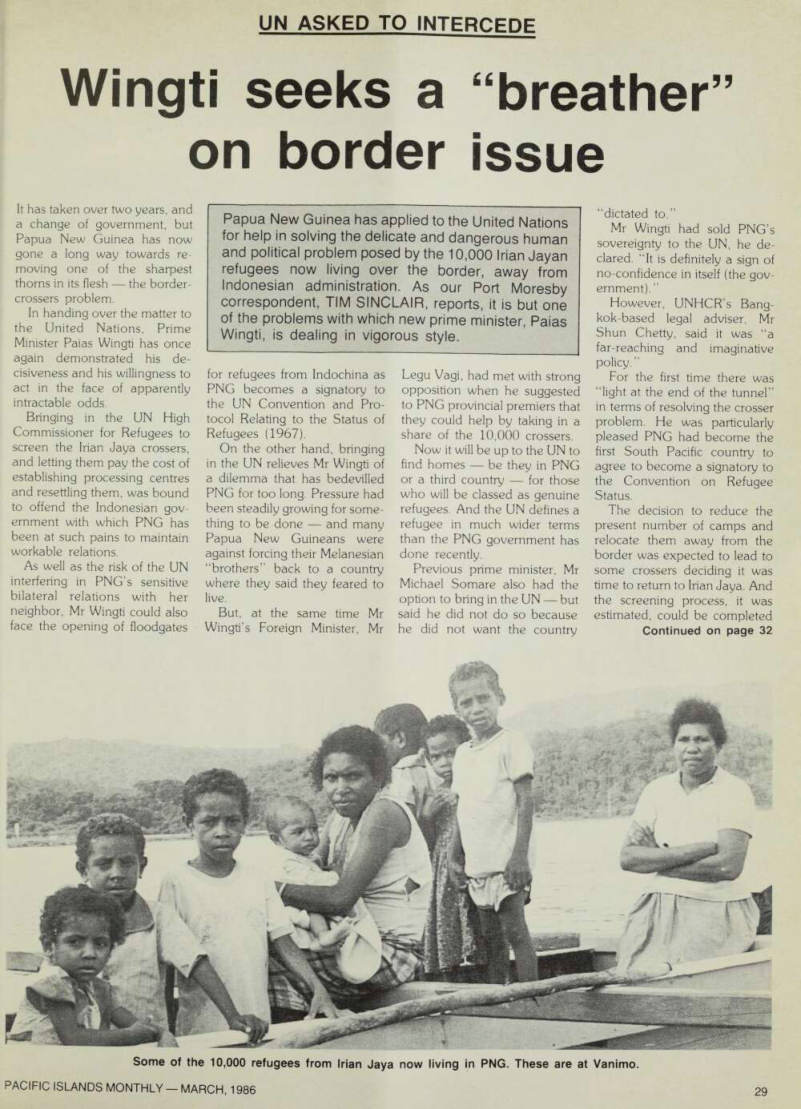


Un Asked To Intercede
Wingti seeks a “breather” on border issue
It has taken over two years, and a change of government, but Papua New Guinea has now gone a long way towards re moving one of the sharpest thorns in its flesh the border crossers problem.
In handing over the matter to the United Nations, Prime Minister Paias Wingti has once again demonstrated his de cisiveness and his willingness to act in the face of apparently intractable odds.
Bringing in the UN High Commissioner for Refugees to screen the Irian Jaya crossers, and letting them pay the cost of establishing processing centres and resettling them, was bound to offend the Indonesian gov ernment with which PNG has been at such pains to maintain workable relations.
As well as the risk of the UN interfering in PNG’s sensitive bilateral relations with her neighbor, Mr Wingti could also face the opening of floodgates
Papua New Guinea has applied to the United Nations for help in solving the delicate and dangerous human and political problem posed by the 10,000 Irian Jayan refugees now living over the border, away from Indonesian administration. As our Port Moresby correspondent, TIM SINCLAIR, reports, it is but one of the problems with which new prime minister, Paias Wingti, is dealing in vigorous style.
for refugees from Indochina as PNG becomes a signatory to the UN Convention and Pro tocol Relating to the Status of Refugees (1967).
On the other hand, bringing in the UN relieves Mr Wingti of a dilemma that has bedevilled PNG for too long. Pressure had been steadily growing for some thing to be done and many Papua New Guineans were against forcing their Melanesian “brothers” back to a country where they said they feared to live.
But, at the same time Mr Wingti’s Foreign Minister, Mr
Legu Vagi, had met with strong opposition when he suggested to PNG provincial premiers that they could help by taking in a share of the 10,000 crossers.
Now it will be up to the UN to find homes be they in PNG or a third country for those who will be classed as genuine refugees. And the UN defines a refugee in much wider terms than the PNG government has done recently.
Previous prime minister, Mr Michael Somare also had the option to bring in the UN but said he did not do so because he did not want the country
“dictated to.”
Mr Wingti had sold PNG’s sovereignty to the UN, he de clared. “It is definitely a sign of no-confidence in itself (the gov ernment).”
However, UNHCR’s Bang kok-based legal adviser, Mr Shun Chetty, said it was “a far-reaching and imaginative policy.”
For the first time there was “light at the end of the tunnel” in terms of resolving the Grosser problem. He was particularly pleased PNG had become the first South Pacific country to agree to become a signatory to the Convention on Refugee Status.
The decision to reduce the present number of camps and relocate them away from the border was expected to lead to some crossers deciding it was time to return to Irian Jaya. And the screening process, it was estimated, could be completed
Continued on page 32
Some of the 10,000 refugees from Irian Jaya now living in PNG. These are at Vanimo.
Continued from page 29
in a couple of months. PNG ministers and officials will help with the task.
The delicate task of presen ting PNG’s new stand to In donesia went to Foreign Minis ter Vagi, who met the Jakarta government in February.
He has had a political bapt ism of fire over the border issue.
His first Cabinet submission in December was rejected as “the same old stuff” as had been presented to the previous So mare government. He was forced back to the drawing board.
Then, in January, it came out that Mr Vagi had telexed pro vincial premiers asking them if they could resettle some of the crossers in their areas. Mr Wing ti did not know about it and was furious especially because the telexes contained confiden tial information.
The prime minister ordered all his ministers to keep silent on the issue and told Mr Vagi not to release a long-awaited policy statement.
A few days later Mr Vagi suffered a third rebuff when another of his submissions was rejected by Cabinet. A commit tee of six ministers and Foreign Affairs officials was appointed to make alterations and recom mendations.
The outcome was the calling in of the UN. Mr Vagi was despatched to explain it to neighboring nations.
Except for the border issue Mr Vagi has kept a low profile.
His only public pronouncement has been a stern lecture to the country’s newly-appointed envoys.
In despatching 11 new heads of overseas mission Mr Vagi announced steps had been taken to strengthen ties with Asia. A new mission is to be established in China and hon orary consuls will be appointed in Singapore, Hong Kong, Bangkok, Seoul, Tel Aviv, Munich and Hamburg.
China was a special case, he said. It had committed Kina7million as an interest-free loan to PNG for agricultural projects and Kina-800,000 on other projects.
Western Highlands MP, Kin di Lawi, Minister for Home Affairs in the Somare govern ment, said: “PNG is now depar ting from its traditional western
neighbors who have millions and millions of kina here and is now leaning towards the com munist/socialist bloc.”
Mr Wingti wants PNG to seek full membership of the Associa tion of South-east Asian Na tions (ASEAN), which has as one of its cornerstones total opposition to communism.
But, amidst what might look like some confusion, one thing is certain. Papua New Guinea is at least seen to be on the move, evidenced by, if nothing else, fireworks in all directions. As well as foreign affairs issues, the domestic scene has been one of turmoil. After the head-rolling exercise among public servants (see PIM, Jan, ’B6), has come the sackings of boards of statu tory bodies.
The Post and Telecommuni cations Board and the Har bours Board, decided to fight their sackings in court and the members of the coffee, copra and cocoa boards threatened to do the same, until Mr Wingti stepped in and asked the members to pledge loyalty to his government if they wanted to stay on.
On the law and order front, Police Commissioner David Ta sion has been deploying special police task forces to the coun try’s troublespots, where he has successfully contained escalat ing crime and tribal fights, arrested countless rape, rob bery and murder suspects, and recaptured prisoners on the run although they are still con tinuing to escape.
Revelations about the appall ing state of some of the coun try’s prisons have stirred the authorities to action and a Sri Lankan expert has been brought in to establish a strong rehabilitation program.
Indeed, much has been happening, and, if the atmos phere around Prime Minister Wingti is any guide, will con tinue to happen. Whether or not the country’s sudden frenzy of activity does, in fact, lead to “confusion and chaos” will de pend upon Wingti’s will and, at the moment, that looks strong indeed.
And whether the PNG public and its politicians remain satis fied, or even tolerant, of it will surely be known by the middle of 1987 when the voters will give their verdict in the next general election.
Advertisements & other items, pp. 30-32 (1 item)
Pftcirc Should Be Bout
■ w : 9 1 m ... . / 1' >■
4 WDI
' , ■: /;. - ■'- *l-
- THINKS
CARS ANDIRUCKS ORIVHI IN II
PftCIRC SHOULD BE BOUT
EBB IBE PACIFIC
TOYOTA
QUALITY SERVICE
AMERICAN SAMOA: BURNS PHILP (SOUTH SEA) CO..
LTD., P.O. Box 129, Pago Pago.
COOK ISLANDS: COOK ISLANDS TRADING
CORPORATION LTD., Private Bag, Rarotonga.
FUI: AUTOMOTIVE SUPPLIES COMPANY. A Division of Burns Philp (South Sea) Co., Ltd.. G.P.O. Box 355, Suva.
GUAM A MICRONESIA: ATKINS KROLL, INC., 443 South Marine Drive, Tamuning.
Kiribati! TARAWA MOTORS A Division of Bairiki Holdings Ltd., P.O. Box 36. Bairiki, Tarawa.
NAURU: NAURU COOPERATIVE SOCIETY. Central Pa
NEW CALEDONIA: SERVICE IMPORTATION
AUTOMOBILE DU PACIFIQUE, Rond-Point du Pacifiqi (Station Total) B.P 438, Noumea.
NORFOLK ISLAND: BORRY’S LIMITED. P.O. Box 16!
PAPUA NEW GUINEA: ELA MOTORS, A Division of Burns Philp (PNG) Ltd., P.O. Box 75, Port Moresby.
SAIPAN: MICROL CORPORATION, P.O. Box 267, Sail
■ * ■ ■ ~r ' - ■:a ■ Ml nr cars ail tracks lan special Pacific Islaal featares.
And, of course, like cars and trucks we build for the rest of the world, those for the Pacific benefit from comprehensive testing and thorough quality control.
It’s all part of our effort to create high-quality, highly reliable cars and trucks.
Specifically for you. And specifically for the places you drive.
For instance, Toyota Hilux trucks are outfitted with extra-heavy-duty shocks and reinforced suspension.
And cars like Toyota Corolla receive special engine underplating, and a suspension modified to give added road clearance.
Meanwhile, we make additional use of special galvanealed steel in both our cars and trucks to help prevent corrosion.
Areas where galvanealed steel is used Ik e
COROLLA
HILUX
• Crown • Cressida• Corona • Corolla • Starlet • Dyna • Hiace• Liteace • Coaster • Stout • Hilux 4*2/4x4» Land Cruiser • Heavy Duty Truck
.OMON ISLANDS: SOLOMON ISLANDS
iSTMENTS LTD., G.P.O. Box 174, Honiara, ms NIPPON AUTOMOTO. B.P. 342. Papeete IQA: BURNS PHILP (SOUTH SEA) CO.. LTD. PO 55, Nukualofa.
VANUATU MOTORS, A Division of Burns ) (Vanuatu) Ltd.. P.O. Box 18. Port Vila.
ITCRN SAMOA: BURNS PHILP (SOUTH SEA) CO.,
TOYOTA
OCEAN FRONT HOUSE
PORT STEPHENS, NSW
2Vz hours drive from Sydney. 20 miles uninterrupted beaches. Ocean panorama, magnificent 23 sq. home of character. 4 levels. Features exposed beams, timber lined, cathedral ceilings, copper fireplace. Attractive easily maintained garden.
Excellent value at $159,500 Will trade cruising yacht. Cash adjustment either way.
Write owner: 41 Ocean Avenue,
Birubi Point, NSW, 2301, Australia.
Phone (049) 82-1538
SECURITY
A leading manufacture/distributor of key blanks, key cutting machines, locks and associated locksmithing equipment is seeking agents/dist. throughout the Pacific Islands.
Contact: Mr Jim Larsen
J. LARSEN PTY. LTD. (Est. 1917)
383 ST PAULS ICE, FORTITUDE VALLEY 4006, AUST.
Telephone (07) 854-1866 Telex AA43666 Keylok
The Parliament of the Commonwealth of Australia *
Jill
mo
J., AUSTRALIA lL j-
Joint Committee on Foreign Affairs and Defence
AUSTRALIA’S RELATIONS
WITH THE
SOUTH PACIFIC
The Joint Committee on Foreign Affairs and Defence has referred the above matter to a Sub-Committee for investigation and to report with particular reference to: (a) current regional issues of political, economic and security concern to Australia and to other South Pacific countries; (b) Australia’s foreign, economic and development assistance policies in the region; (c) the impact on Australia of security, political and economic developments in the region.
The Sub-Committee on Australia and the South Pacific, chaired by Mr David Charles, MP, invites expressions of interest from persons and organisations regarding this inquiry.
Submissions are requested by Friday, May 16, 1986 at the following address: The Secretary, Sub-Committee on the South Pacific, Joint Committee on Foreign Affairs and Defence, Parliament House, Canberra, A.C.T.
AUSTRALIA. 2600.
tradition decrees
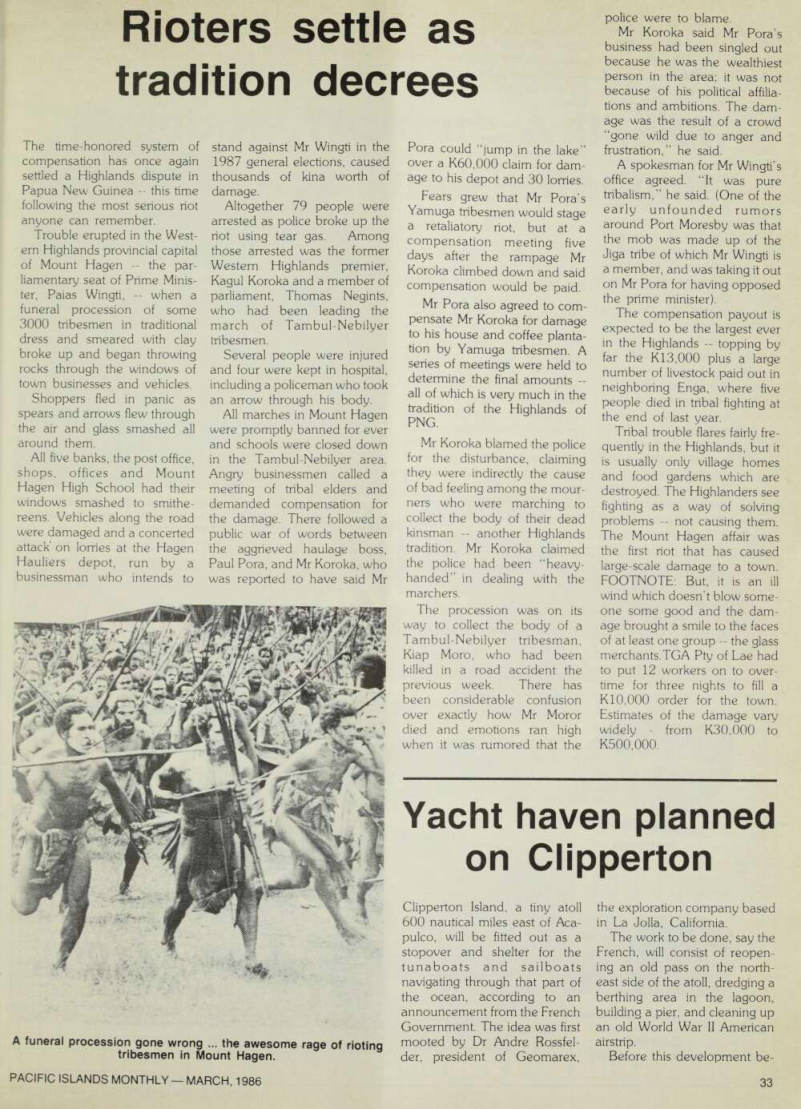
Rioters settle as tradition decrees
The time-honored system of compensation has once again settled a Highlands dispute in Papua New Guinea this time following the most serious riot anyone can remember.
Trouble erupted in the West ern Highlands provincial capital of Mount Hagen - the par liamentary seat of Prime Minis ter, Paias Wingti, - when a funeral procession of some 3000 tribesmen in traditional dress and smeared with clay broke up and began throwing rocks through the windows of town businesses and vehicles.
Shoppers fled in panic as spears and arrows flew through the air and glass smashed all around them.
All five banks, the post office, shops, offices and Mount Hagen High School had their windows smashed to smithe reens. Vehicles along the road were damaged and a concerted attack' on lorries at the Hagen Hauliers depot, run by a businessman who intends to
stand against Mr Wingti in the 1987 general elections, caused thousands of kina worth of damage.
Altogether 79 people were arrested as police broke up the riot using tear gas. Among those arrested was the former Western Highlands premier, Kagul Koroka and a member of parliament, Thomas Negints, who had been leading the march of Tambul-Nebilyer tribesmen.
Several people were injured and four were kept in hospital, including a policeman who took an arrow through his body.
All marches in Mount Hagen were promptly banned for ever and schools were closed down in the Tambul-Nebilyer area.
Angry businessmen called a meeting of tribal elders and demanded compensation for the damage. There followed a public war of words between the aggrieved haulage boss, Paul Fora, and Mr Koroka, who was reported to have said Mr
Fora could “jump in the lake” over a K 60,000 claim for dam age to his depot and 30 lorries.
Fears grew that Mr Fora’s Yamuga tribesmen would stage a retaliatory riot, but at a compensation meeting five days after the rampage Mr Koroka climbed down and said compensation would be paid.
Mr Fora also agreed to com pensate Mr Koroka for damage to his house and coffee planta tion by Yamuga tribesmen. A series of meetings were held to determine the final amounts all of which is very much in the tradition of the Highlands of
Png.
Mr Koroka blamed the police for the disturbance, claiming they were indirectly the cause of bad feeling among the mour ners who were marching to collect the body of their dead kinsman - another Highlands tradition. Mr Koroka claimed the police had been “heavy handed” in dealing with the marchers.
The procession was on its way to collect the body of a Tambul-Nebilyer tribesman, Kiap Moro, who had been killed in a road accident the previous week. There has been considerable confusion over exactly how Mr Moror died and emotions ran high when it was rumored that the
police were to blame.
Mr Koroka said Mr Fora’s business had been singled out because he was the wealthiest person in the area; it was not because of his political affilia tions and ambitions. The dam age was the result of a crowd “gone wild due to anger and frustration,” he said.
A spokesman for Mr Wingti’s office agreed. “It was pure tribalism,” he said. (One of the early unfounded rumors around Port Moresby was that the mob was made up of the Jiga tribe of which Mr Wingti is a member, and was taking it out on Mr Fora for having opposed the prime minister).
The compensation payout is expected to be the largest ever in the Highlands topping by far the K 13,000 plus a large number of livestock paid out in neighboring Enga, where five people died in tribal fighting at the end of last year.
Tribal trouble flares fairly fre quently in the Highlands, but it is usually only village homes and food gardens which are destroyed. The Highlanders see fighting as a way of solving problems - not causing them.
The Mount Hagen affair was the first riot that has caused large-scale damage to a town.
FOOTNOTE: But, it is an ill wind which doesn’t blow some one some good and the dam age brought a smile to the faces of at least one group -- the glass merchants.TGA Pty of Lae had to put 12 workers on to over time for three nights to fill a K 10,000 order for the town.
Estimates of the damage vary widely - from K 30,000 to K 500,000.
A funeral procession gone wrong ... the awesome rage of rioting tribesmen in Mount Hagen.
on Clipperton

Yacht haven planned on Clipperton
Clipperton Island, a tiny atoll 600 nautical miles east of Aca pulco, will be fitted out as a stopover and shelter for the tunaboats and sailboats navigating through that part of the ocean, according to an announcement from the French Government. The idea was first mooted by Dr Andre Rossfel der, president of Geomarex,
the exploration company based in La Jolla, California.
The work to be done, say the French, will consist of reopen ing an old pass on the north east side of the atoll, dredging a berthing area in the lagoon, building a pier, and cleaning up an old World War II American airstrip.
Before this development be
gins an exploration program will be conducted by the Mining Syndicate of Clipperton, in which Geomarex has a 25 per cent interest because of its discovery in 1975 of prospec tive phosphate resources and precious metals in Clipperton’s sulfurous lagoon.
Clipperton is small, uninha bited, inhospitable, and the only atoll in that part of the ocean. But, to Californian fishermen and yachtsmen heading for the south-eastern Pacific it is a welcome landfall, a rocky outcropping in the shape of a ruined castle which allows them to check their navigation but, at present, anyway, does not invite them to call.
The island was formally claimed by France in 1858, but was assumed at the time by many to have been already a US possession under the 1856 Guano Act.
Mexico counter-claimed it in 1897, but an arbitration by the King of Italy finally validated the French claim in 1931.
Despite its remoteness and barren aspect, Clipperton has a rich history intertwined with the history of California, from the
voyages of Drake and Dampier, to the adventures of the 19th century guano-seekers of San Francisco, on to the presence of the US military during World War 11.
One of the most intriguing tales of all concerns a visit by the American battleship USS Yorktown in 1917. The shore party found a group of Mexican women and children, survivors of a long-forgotten Mexican army garrison. And in one of the pitiful huts they had for shelter they found the still warm, murdered body of the last soldier. How it happened, and why, remains a mystery which Andre Rossfelder exam ined some years ago in his book Clipperton. He Tragique which won the French Goncourt Award for an historical novel.
The establishment of a boat shelter and an airstrip on Clip perton will also, of course, allow France to show its physical presence in the region and strengthen its claim on the surrounding 200-mile zone which is reported to be rich in manganese nodules and polymetallic sulfides.
Clipperton Island ... this exposed volcanic rock, 20m high, is in marked contrast to the flat coral surface of the rest of the island - British Naval Intelligence Photo.
Advertisements & other items, p. 34 (1 item)
The Total Test Equipment Solution
AWA
% % » m marcom^ instruments r Tfektronix r mo i* o
FLUKE
HITACHI
AWA TEST EQUIPMENT
With AWA, your problem of finding the right test equipment is solved. We have the widest possible 1 range of equipment to suit your every day needs.
Nc more compromises just choices.
AWA New Zealand Limited
books
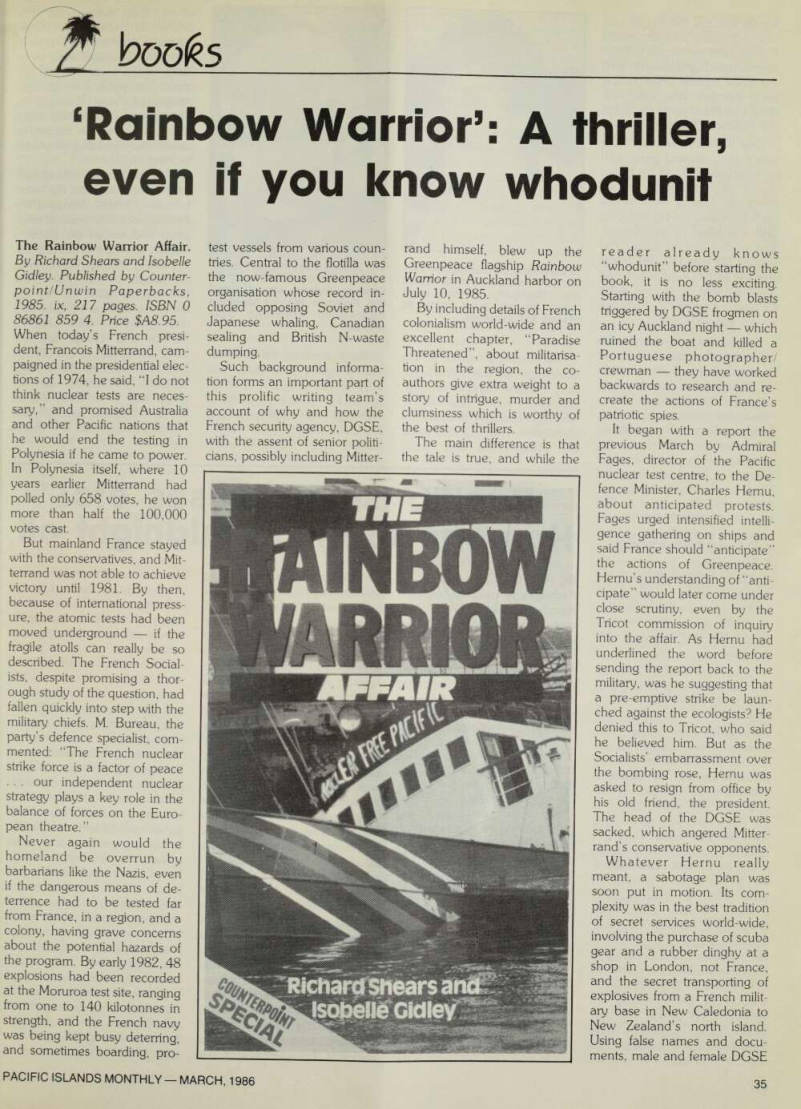
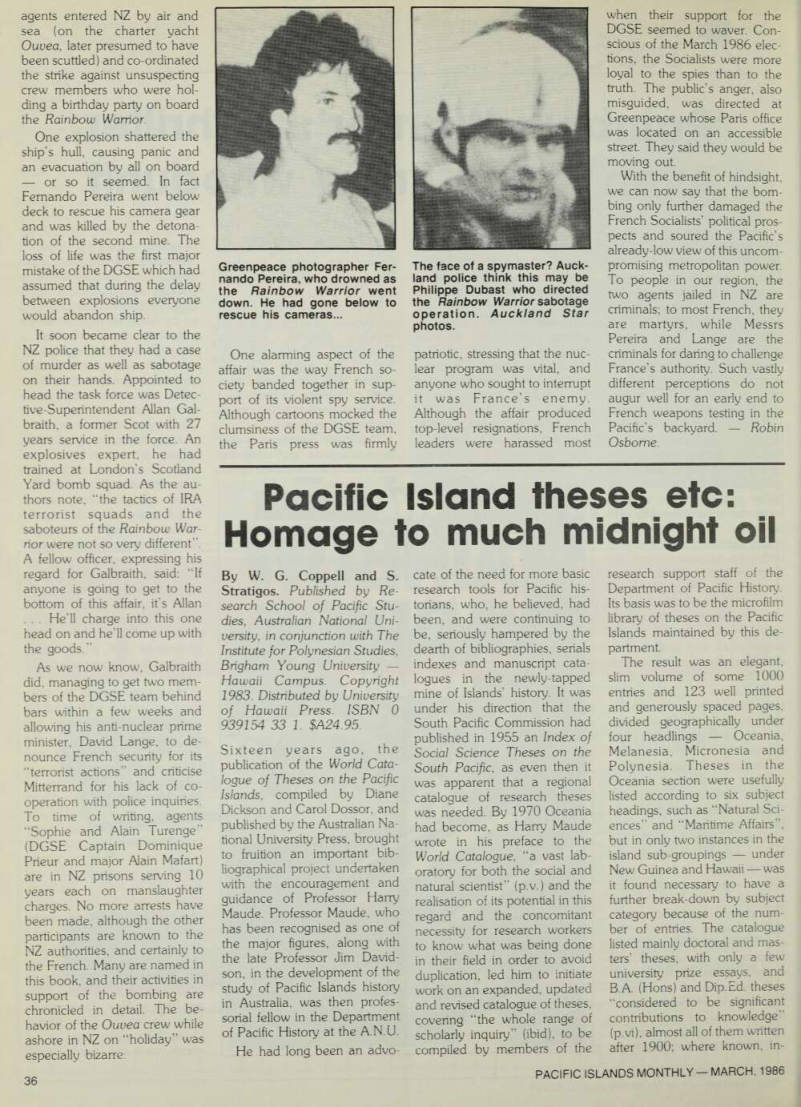
'Rainbow Warrior’: A thriller, even if you know whodunit
The Rainbow Warrior Affair.
By Richard Shears and Isobelle Gidley. Published by Counter point/Unwin Paperbacks, 1985. ix, 217 pages. ISBN 0 86861 859 4. Price $A8.95.
When today’s French presi dent, Francois Mitterrand, cam paigned in the presidential elec tions of 1974, he said, “I do not think nuclear tests are neces sary,” and promised Australia and other Pacific nations that he would end the testing in Polynesia if he came to power.
In Polynesia itself, where 10 years earlier Mitterrand had polled only 658 votes, he won more than half the 100,000 votes cast.
But mainland France stayed with the conservatives, and Mit terrand was not able to achieve victory until 1981. By then, because of international press ure, the atomic tests had been moved underground if the fragile atolls can really be so described. The French Social ists, despite promising a thor ough study of the question, had fallen quickly into step with the military chiefs. M. Bureau, the party’s defence specialist, com mented: “The French nuclear strike force is a factor of peace . . . our independent nuclear strategy plays a key role in the balance of forces on the Euro pean theatre.”
Never again would the homeland be overrun by barbarians like the Nazis, even if the dangerous means of de terrence had to be tested far from France, in a region, and a colony, having grave concerns about the potential hazards of the program. By early 1982, 48 explosions had been recorded at the Moruroa test site, ranging from one to 140 kilotonnes in strength, and the French navy was being kept busy deterring, and sometimes boarding, pro
test vessels from various coun tries. Central to the flotilla was the now-famous Greenpeace organisation whose record in cluded opposing Soviet and Japanese whaling, Canadian sealing and British N-waste dumping.
Such background informa tion forms an important part of this prolific writing team’s account of why and how the French security agency, DGSE, with the assent of senior politi cians, possibly including Mitter
rand himself, blew up the Greenpeace flagship Rainbow Warrior in Auckland harbor on July 10, 1985.
By including details of French colonialism world-wide and an excellent chapter, “Paradise Threatened”, about militarisa tion in the region, the co authors give extra weight to a story of intrigue, murder and clumsiness which is worthy of the best of thrillers.
The main difference is that the tale is true, and while the
reader already knows “whodunit” before starting the book, it is no less exciting.
Starting with the bomb blasts triggered by DGSE frogmen on an icy Auckland night which ruined the boat and killed a Portuguese photographer/ crewman they have worked backwards to research and re create the actions of France’s patriotic spies.
It began with a report the previous March by Admiral Pages, director of the Pacific nuclear test centre, to the De fence Minister, Charles Hernu, about anticipated protests.
Pages urged intensified intelli gence gathering on ships and said France should “anticipate” the actions of Greenpeace.
Hernu’s understanding of “anti cipate” would later come under close scrutiny, even by the Tricot commission of inquiry into the affair. As Hernu had underlined the word before sending the report back to the military, was he suggesting that a pre-emptive strike be laun ched against the ecologists? He denied this to Tricot, who said he believed him. But as the Socialists’ embarrassment over the bombing rose, Hernu was asked to resign from office by his old friend, the president.
The head of the DGSE was sacked, which angered Mitter rand’s conservative opponents.
Whatever Hernu really meant, a sabotage plan was soon put in motion. Its com plexity was in the best tradition of secret services world-wide, involving the purchase of scuba gear and a rubber dinghy at a shop in London, not France, and the secret transporting of explosives from a French milit ary base in New Caledonia to New Zealand’s north island.
Using false names and docu ments, male and female DGSE
agents entered NZ by air and sea (on the charter yacht Ouvea, later presumed to have been scuttled) and co-ordinated the strike against unsuspecting crew members who were hol ding a birthday party on board the Rainbow Warrior.
One explosion shattered the ship’s hull, causing panic and an evacuation by all on board or so it seemed. In fact Fernando Pereira went below deck to rescue his camera gear and was killed by the detona tion of the second mine. The loss of life was the first major mistake of the DGSE which had assumed that during the delay between explosions everyone would abandon ship.
It soon became clear to the NZ police that they had a case of murder as well as sabotage on their hands. Appointed to head the task force was Detec tive-Superintendent Allan Gal braith, a former Scot with 27 years service in the force. An explosives expert, he had trained at London’s Scotland Yard bomb squad. As the au thors note, “the tactics of IRA terrorist squads and the saboteurs of the Rainbow War rior were not so very different”.
A fellow officer, expressing his regard for Galbraith, said; “If anyone is going to get to the bottom of this affair, it’s Allan . . . He'll charge into this one head on and he’ll come up with the goods.”
As we now know, Galbraith did, managing to get two mem bers of the DGSE team behind bars within a few weeks and allowing his anti-nuclear prime minister, David Lange, to de nounce French security for its “terrorist actions” and criticise Mitterrand for his lack of co operation with police inquiries.
To time of writing, agents “Sophie and Alain Turenge” (DGSE Captain Dominique Prieur and major Alain Mafart) are in NZ prisons serving 10 years each on manslaughter charges. No more arrests have been made, although the other participants are known to the NZ authorities, and certainly to the French. Many are named in this book, and their activities in support of the bombing are chronicled in detail. The be havior of the Ouvea crew while ashore in NZ on “holiday” was especially bizarre.
One alarming aspect of the affair was the way French so ciety banded together in sup port of its violent spy service.
Although cartoons mocked the clumsiness of the DGSE team, the Paris press was firmly
patriotic, stressing that the nuc lear program was vital, and anyone who sought to interrupt it was France’s enemy.
Although the affair produced top-level resignations, French leaders were harassed most
when their support for the DGSE seemed to waver. Con scious of the March 1986 elec tions. the Socialists were more loyal to the spies than to the truth. The public’s anger, also misguided, was directed at Greenpeace whose Paris office was located on an accessible street. They said they would be moving out.
With the benefit of hindsight, we can now say that the bom bing only further damaged the French Socialists’ political pros pects and soured the Pacific’s already-low view of this uncom promising metropolitan power.
To people in our region, the two agents jailed in NZ are criminals; to most French, they are martyrs, while Messrs Pereira and Lange are the criminals for daring to challenge France’s authority. Such vastly different perceptions do not augur well for an early end to French weapons testing in the
Pacific’s backyard.
Robin
Osborne.
Greenpeace photographer Fer
nando Pereira, who drowned as the Rainbow Warrior went down. He had gone below to rescue his cameras...
The face of a spymaster? Auck land police think this may be Philippe Dubast who directed the Rainbow Warrior sabotage operation. Auckland Star photos.
Pacific Island theses etc:
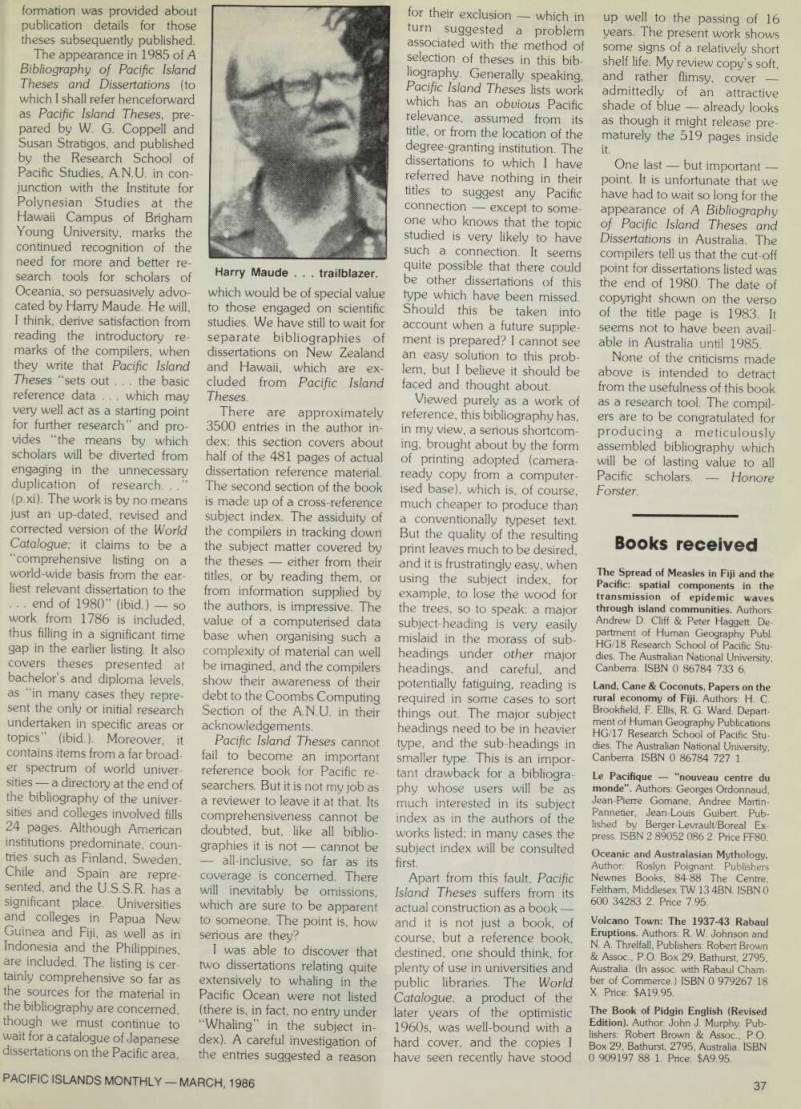
Homage to much midnight oil
By W. G. Coppell and S.
Stratigos. Published by Re search School of Pacific Stu dies, Australian National Uni versity, in conjunction with The Institute for Polynesian Studies.
Brigham Young University Hawaii Campus. Copyright 1983. Distributed by University of Hawaii Press. ISBN 0 939154 33 1. $A24.95.
Sixteen years ago, the publication of the World Cata logue of Theses on the Pacific Islands, compiled by Diane Dickson and Carol Dossor. and published by the Australian Na tional University Press, brought to fruition an important bib liographical project undertaken with the encouragement and guidance of Professor Harry Maude. Professor Maude, who has been recognised as one of the major figures, along with the late Professor Jim David son, in the development of the study of Pacific Islands history in Australia, was then profes sorial fellow in the Department of Pacific History at the A.N.U.
He had long been an advo
cate of the need for more basic research tools for Pacific his torians, who, he believed, had been, and were continuing to be, seriously hampered by the dearth of bibliographies, serials indexes and manuscript cata logues in the newly-tapped mine of Islands’ history. It was under his direction that the South Pacific Commission had published in 1955 an Index of Social Science Theses on the South Pacific, as even then it was apparent that a regional catalogue of research theses was needed. By 1970 Oceania had become, as Harry Maude wrote in his preface to the World Catalogue, “a vast lab oratory for both the social and natural scientist” (p.v.) and the realisation of its potential in this regard and the concomitant necessity for research workers to know what was being done in their field in order to avoid duplication, led him to initiate work on an expanded, updated and revised catalogue of theses, covering “the whole range of scholarly inquiry” (ibid), to be comoiled bv members of the
research support staff of the Department of Pacific History.
Its basis was to be the microfilm library of theses on the Pacific Islands maintained by this de partment.
The result was an elegant, slim volume of some 1000 entries and 123 well printed and generously spaced pages, divided geographically under four headlings Oceania, Melanesia, Micronesia and Polynesia. Theses in the Oceania section were usefully listed according to six subject headings, such as “Natural Sci ences” and “Maritime Affairs”, but in only two instances in the island sub-groupings under New Guinea and Hawaii was it found necessary to have a further break-down by subject category because of the num ber of entries. The catalogue listed mainly doctoral and mas ters’ theses, with only a few university prize essays, and B.A. (Hons) and Dip. Ed. theses “considered to be significant contributions to knowledge' (p.vi), almost all of them written after 1900; where known, in
formation was provided about publication details for those theses subsequently published.
The appearance in 1985 of A Bibliography of Pacific Island Theses and Dissertations (to which I shall refer henceforward as Pacific Island Theses, pre pared by W. G. Coppell and Susan Stratigos, and published by the Research School of Pacific Studies, A.N.U. in con junction with the Institute for Polynesian Studies at the Hawaii Campus of Brigham Young University, marks the continued recognition of the need for more and better re search tools for scholars of Oceania, so persuasively advo cated by Harry Maude. He will, I think, derive satisfaction from reading the introductory re marks of the compilers, when they write that Pacific Island Theses “sets out . . . the basic reference data . . . which may very well act as a starting point for further research” and pro vides “the means by which scholars will be diverted from engaging in the unnecessary duplication of research. . .” (p.xi). The work is by no means just an up-dated, revised and corrected version of the World Catalogue; it claims to be a “comprehensive listing on a world-wide basis from the ear liest relevant dissertation to the . . . end of 1980” (ibid.) so work from 1786 is included, thus filling in a significant time gap in the earlier listing. It also covers theses presented at bachelor’s and diploma levels, as “in many cases they repre sent the only or initial research undertaken in specific areas or topics” (ibid.). Moreover, it contains items from a far broad er spectrum of world univer sities a directory at the end of the bibliography of the univer sities and colleges involved fills 24 pages. Although American institutions predominate, coun tries such as Finland, Sweden.
Chile and Spain are repre sented, and the U.S.S.R. has a significant place. Universities and colleges in Papua New Guinea and Fiji, as well as in Indonesia and the Philippines, are included. The listing is cer tainly comprehensive so far as the sources for the material in the bibliography are concerned, though we must continue to wait for a catalogue of Japanese dissertations on the Pacific area,
which would be of special value to those engaged on scientific studies. We have still to wait for separate bibliographies of dissertations on New Zealand and Hawaii, which are ex cluded from Pacific Island Theses.
There are approximately 3500 entries in the author in dex; this section covers about half of the 481 pages of actual dissertation reference material.
The second section of the book is made up of a cross-reference subject index. The assiduity of the compilers in tracking down the subject matter covered by the theses either from their titles, or by reading them, or from information supplied by the authors, is impressive. The value of a computerised data base when organising such a complexity of material can well be imagined, and the compilers show their awareness of their debt to the Coombs Computing Section of the A.N.U. in their acknowledgements.
Pacific Island Theses cannot fail to become an important reference book for Pacific re searchers. But it is not my job as a reviewer to leave it at that. Its comprehensiveness cannot be doubted, but, like all biblio graphies it is not cannot be all-inclusive, so far as its coverage is concerned. There will inevitably be omissions, which are sure to be apparent to someone. The point is, how serious are they?
I was able to discover that two dissertations relating quite extensively to whaling in the Pacific Ocean were not listed (there is, in fact, no entry under “Whaling” in the subject in dex). A careful investigation of the entries suggested a reason
for their exclusion which in turn suggested a problem associated with the method of selection of theses in this bib
liography. Generally speaking,
Pacific Island Theses lists work which has an obvious Pacific relevance, assumed from its title, or from the location of the degree-granting institution. The dissertations to which I have referred have nothing in their titles to suggest any Pacific connection except to some one who knows that the topic studied is very likely to have such a connection. It seems quite possible that there could be other dissertations of this type which have been missed.
Should this be taken into account when a future supple ment is prepared? I cannot see an easy solution to this prob lem, but I believe it should be faced and thought about.
Viewed purely as a work of reference, this bibliography has, in my view, a serious shortcom ing, brought about by the form of printing adopted (camera ready copy from a computer ised base), which is, of course, much cheaper to produce than a conventionally typeset text.
But the quality of the resulting print leaves much to be desired, and it is frustratingly easy, when using the subject index, for example, to lose the wood for the trees, so to speak; a major subject-heading is very easily mislaid in the morass of sub headings under other major headings, and careful, and potentially fatiguing, reading is required in some cases to sort things out. The major subject headings need to be in heavier type, and the sub-headings in smaller type. This is an impor tant drawback for a bibliogra phy whose users will be as much interested in its subject index as in the authors of the works listed; in many cases the subject index will be consulted first.
Apart from this fault, Pacific Island Theses suffers from its actual construction as a book and it is not just a book, of course, but a reference book, destined, one should think, for plenty of use in universities and public libraries. The World Catalogue , a product of the later years of the optimistic 19605, was well-bound with a hard cover, and the copies I have seen recently have stood
up well to the passing of 16 years. The present work shows some signs of a relatively short shelf life. My review copy’s soft, and rather flimsy, cover admittedly of an attractive shade of blue already looks as though it might release pre maturely the 519 pages inside it.
One last but important point. It is unfortunate that we have had to wait so long for the appearance of A Bibliography of Pacific Island Theses and Dissertations in Australia. The compilers tell us that the cut-off point for dissertations listed was the end of 1980. The date of copyright shown on the verso of the title page is 1983. It seems not to have been avail able in Australia until 1985.
None of the criticisms made above is intended to detract from the usefulness of this book as a research tool. The compil ers are to be congratulated for producing a meticulously assembled bibliography which will be of lasting value to all
Pacific scholars.
Honore
Forster.
Harry Maude . . . trailblazer.
Books received
The Spread of Measles in Fiji and the Pacific: spatial components in the transmission of epidemic waves through island communities. Authors: Andrew D. Cliff & Peter Haggett. De partment of Human Geography Publ.
HG/18 Research School of Pacific Stu dies. The Australian National University, Canberra. ISBN 0 86784 733 6.
Land, Cane & Coconuts, Papers on the rural economy of Fiji. Authors: H. C.
Brookfield, F. Ellis, R. G. Ward. Depart ment of Human Geography Publications HG/17 Research School of Pacific Stu dies. The Australian National University, Canberra. ISBN 0 86784 727 1.
Le Pacifique “nouveau centre du monde”. Authors: Georges Ordonnaud, Jean-Pierre Gomane, Andree Martin- Pannetier, Jean-Louis Guibert. Pub lished by Berger-Levrault/Boreal Ex press. ISBN 2 89052 086 2. Price FFBO.
Oceanic and Australasian Mythology.
Author: Roslyn Poignant. Publishers Newnes Books, 84-88 The Centre, Feltham, Middlesex TW 13 4BN. ISBN 0 600 34283 2. Price 7.95.
Volcano Town: The 1937-43 Rabaul Eruptions. Authors: R. W. Johnson and N. A. Threlfall, Publishers: Robert Brown & Assoc., P.O, Box 29, Bathurst, 2795, Australia. (In assoc, with Rabaul Cham ber of Commerce.) ISBN 0 979267 18 X. Price: $A19.95.
The Book of Pidgin English (Revised Edition). Author: John J Murphy. Pub lishers: Robert Brown & Assoc., P.O.
Box 29, Bathurst, 2795, Australia. ISBN 0 909197 88 1. Price: 5A9.95.
Builders’ guide to
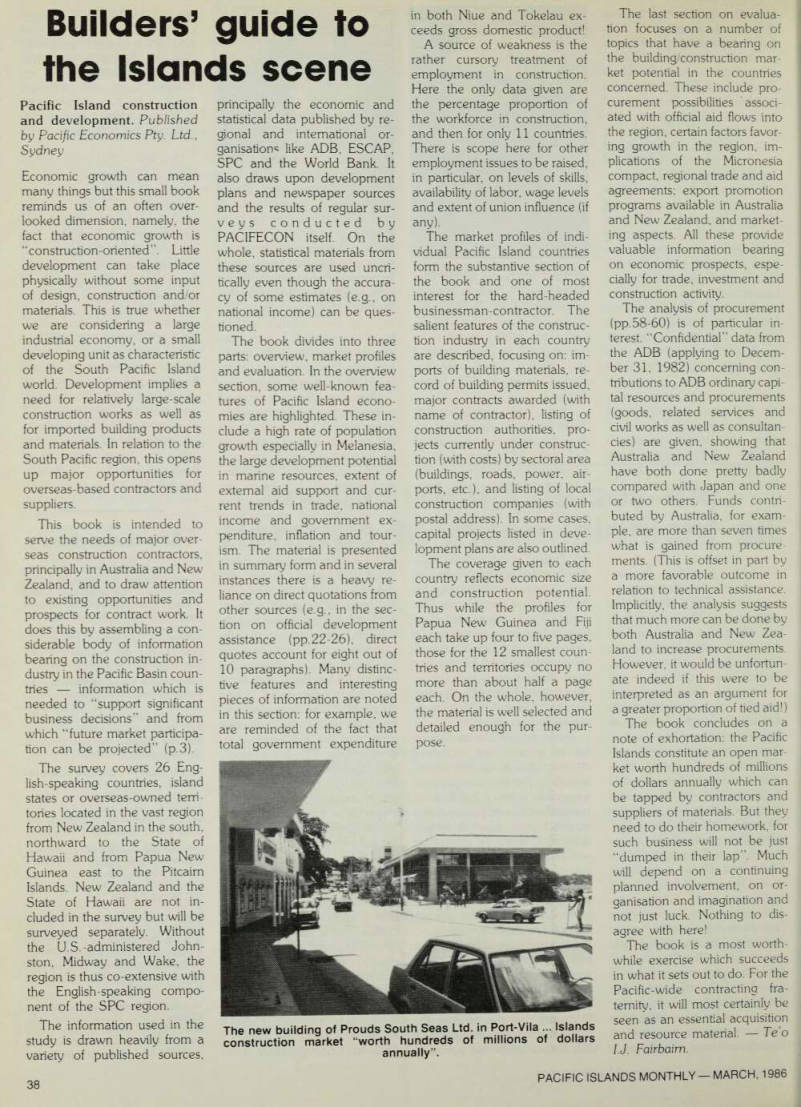
the Islands scene
Pacific Island construction and development. Published by Pacific Economics Pty. Ltd. , Sydney Economic growth can mean many things but this small book reminds us of an often over looked dimension, namely, the fact that economic growth is “construction-oriented”. Little development can take place physically without some input of design, construction and/or materials. This is true whether we are considering a large industrial economy, or a small developing unit as characteristic of the South Pacific Island world. Development implies a need for relatively large-scale construction works as well as for imported building products and materials. In relation to the South Pacific region, this opens up major opportunities for overseas-based contractors and suppliers.
This book is intended to serve the needs of major over seas construction contractors, principally in Australia and New Zealand, and to draw attention to existing opportunities and prospects for contract work. It does this by assembling a con siderable body of information bearing on the construction in dustry in the Pacific Basin coun tries information which is needed to “support significant business decisions” and from which “future market participa tion can be projected” (p. 3).
The survey covers 26 Eng lish-speaking countries, island states or overseas-owned terri tories located in the vast region from New Zealand in the south, northward to the State of Hawaii and from Papua New Guinea east to the Pitcairn Islands. New Zealand and the State of Hawaii are not in cluded in the survey but will be surveyed separately. Without the U.S.-administered John ston, Midway and Wake, the region is thus co-extensive with the English-speaking compo nent of the SPC region.
The information used in the study is drawn heavily from a variety of published sources.
principally the economic and statistical data published by re gional and international orlike ADB. ESCAP.
SPC and the World Bank. It also draws upon development plans and newspaper sources and the results of regular sur veys conducted by PACIFECON itself. On the whole, statistical materials from these sources are used uncri tically even though the accura cy of some estimates (e.g., on national income) can be ques tioned.
The book divides into three parts: overview, market profiles and evaluation. In the overview section, some well-known fea tures of Pacific Island econo mies are highlighted. These in clude a high rate of population growth especially in Melanesia, the large development potential in marine resources, extent of external aid support and cur rent trends in trade, national income and government ex penditure. inflation and tour ism. The material is presented in summary form and in several instances there is a heavy re liance on direct quotations from other sources (e.g., in the sec tion on official development assistance (pp. 22-26), direct quotes account for eight out of 10 paragraphs). Many distinc tive features and interesting pieces of information are noted in this section: for example, we are reminded of the fact that total government expenditure
in both Niue and Tokelau ex ceeds gross domestic product!
A source of weakness is the rather cursory treatment of employment in construction.
Here the only data given are the percentage proportion of the workforce in construction, and then for only 11 countries.
There is scope here for other employment issues to be raised, in particular, on levels of skills, availability of labor, wage levels and extent of union influence (if any).
The market profiles of indi vidual Pacific Island countries form the substantive section of the book and one of most interest for the hard-headed businessman-contractor. The salient features of the construc tion industry in each country are described, focusing on; im ports of building materials, re cord of building permits issued, major contracts awarded (with name of contractor), listing of construction authorities, pro jects currently under construc tion (with costs) by sectoral area (buildings, roads, power, air ports. etc.), and listing of local construction companies (with postal address). In some cases, capital projects listed in deve lopment plans are also outlined.
The coverage given to each country reflects economic size and construction potential.
Thus while the profiles for Papua New Guinea and Fiji each take up four to five pages, those for the 12 smallest coun tries and territories occupy no more than about half a page each. On the whole, however, the material is well selected and detailed enough for the pur pose.
The last section on evalua tion focuses on a number of topics that have a bearing on the building/construction mar ket potential in the countries concerned. These include pro curement possibilities associ ated with official aid flows into the region, certain factors favor ing growth in the region, im plications of the Micronesia compact, regional trade and aid agreements; export promotion programs available in Australia and New Zealand, and market ing aspects. All these provide valuable information bearing on economic prospects, espe cially for trade, investment and construction activity.
The analysis of procurement (pp.sB-60) is of particular in terest. “Confidential” data from the ADB (applying to Decem ber 31, 1982) concerning con tributions to ADB ordinary capi tal resources and procurements (goods, related services and civil works as well as consultan cies) are given, showing that Australia and New Zealand have both done pretty badly compared with Japan and one or two others. Funds contri buted by Australia, for exam ple, are more than seven times what is gained from procure ments. (This is offset in part by a more favorable outcome in relation to technical assistance.
Implicitly, the analysis suggests that much more can be done by both Australia and New Zea land to increase procurements.
However, it would be unfortun ate indeed if this were to be interpreted as an argument for a greater proportion of tied aid!) The book concludes on a note of exhortation; the Pacific Islands constitute an open mar ket worth hundreds of millions of dollars annually which can be tapped by contractors and suppliers of materials. But they need to do their homework, for such business will not be just “dumped in their lap". Much will depend on a continuing planned involvement, on or ganisation and imagination and not just luck. Nothing to dis agree with here!
The book is a most worth while exercise which succeeds in what it sets out to do. For the Pacific-wide contracting fra ternity, it will most certainly be seen as an essential acquisition
and resource material.
Te'o
I.J. Fairbairn.
The new building of Prouds South Seas Ltd. in Port-Vila ... Islands construction market “worth hundreds of millions of dollars
annually”.
dealings bear their fruit
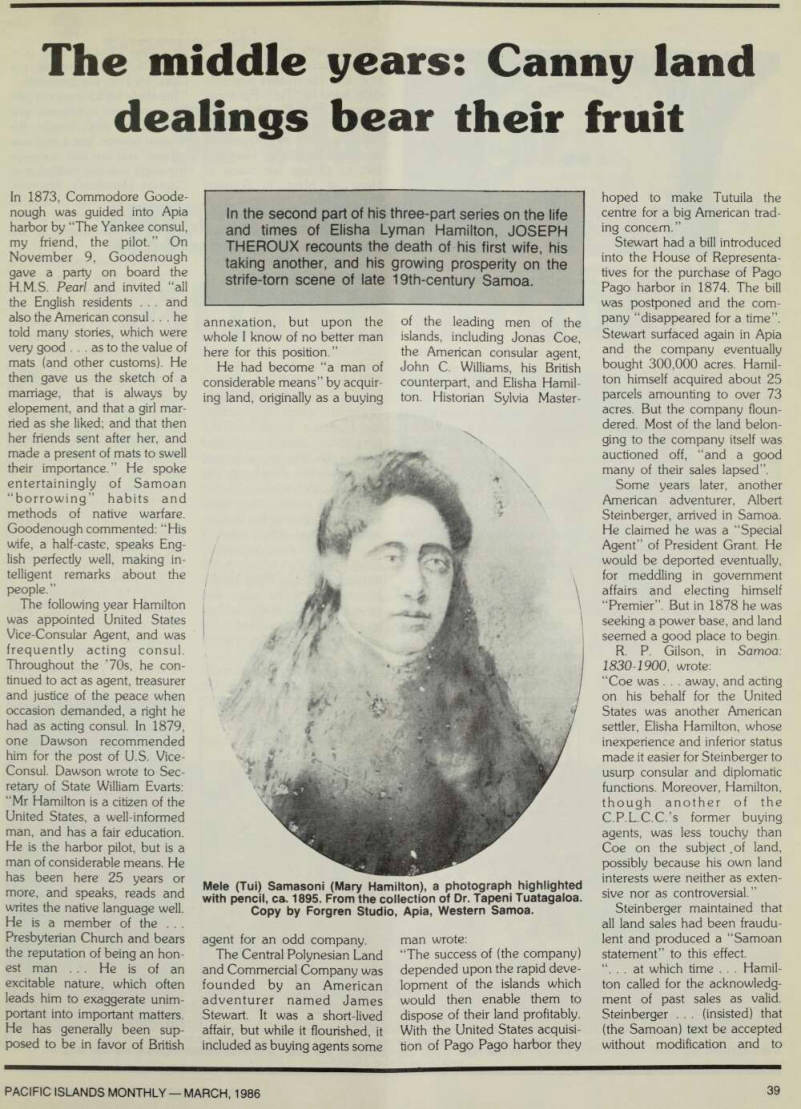
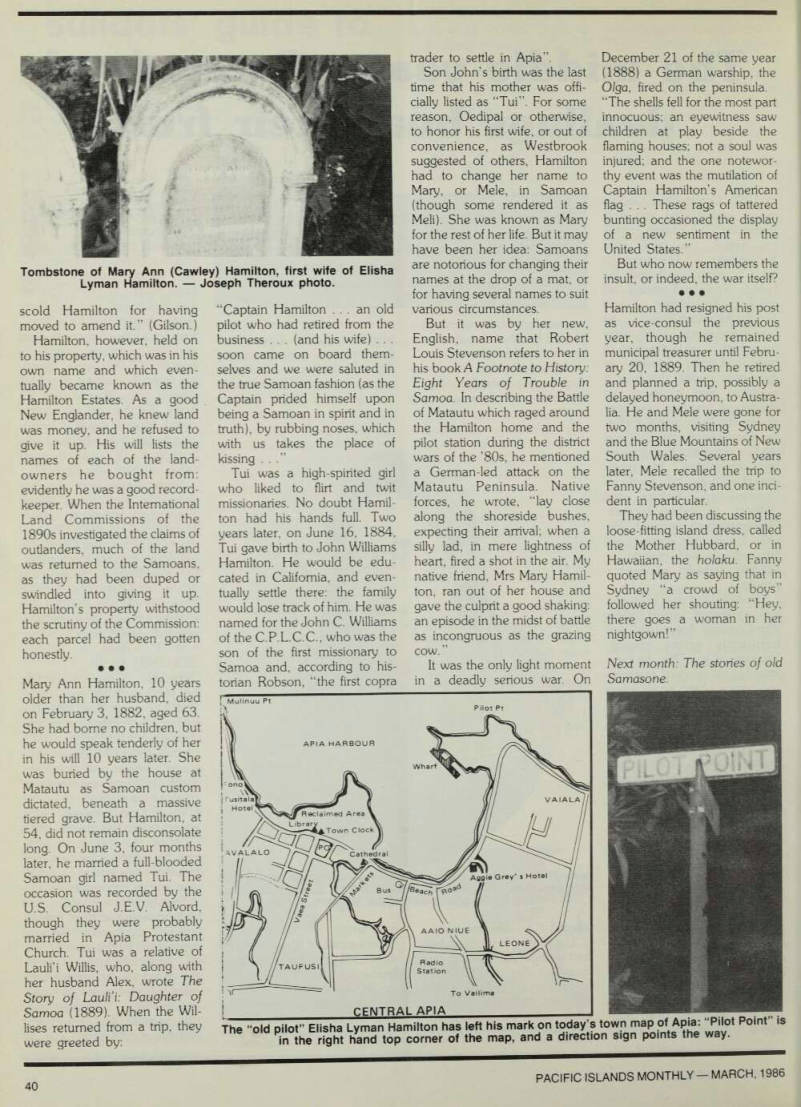
The middle years: Canny land dealings bear their fruit
In 1873, Commodore Goode nough was guided into Apia harbor by “The Yankee consul, my friend, the pilot.” On November 9, Goodenough gave a party on board the H.M.S. Pearl and invited “all the English residents . . . and also the American consul... he told many stories, which were very good ... as to the value of mats (and other customs). He then gave us the sketch of a marriage, that is always by elopement, and that a girl mar ried as she liked; and that then her friends sent after her, and made a present of mats to swell their importance.” He spoke entertainingly of Samoan “borrowing” habits and methods of native warfare.
Goodenough commented: “His wife, a half-caste, speaks Eng lish perfectly well, making in telligent remarks about the people.”
The following year Hamilton was appointed United States Vice-Consular Agent, and was frequently acting consul.
Throughout the ’7os, he con tinued to act as agent, treasurer and justice of the peace when occasion demanded, a right he had as acting consul. In 1879, one Dawson recommended him for the post of U.S. Vice- Consul. Dawson wrote to Sec retary of State William Evarts; “Mr Hamilton is a citizen of the United States, a well-informed man, and has a fair education.
He is the harbor pilot, but is a man of considerable means. He has been here 25 years or more, and speaks, reads and writes the native language well.
He is a member of the ...
Presbyterian Church and bears the reputation of being an hon est man ... He is of an excitable nature, which often leads him to exaggerate unim portant into important matters.
He has generally been sup posed to be in favor of British
In the second part of his three-part series on the life and times of Elisha Lyman Hamilton, JOSEPH THEROUX recounts the death of his first wife, his taking another, and his growing prosperity on the strife-torn scene of late 19th-century Samoa.
annexation, but upon the whole I know of no better man here for this position.”
He had become “a man of considerable means” by acquir ing land, originally as a buying
of the leading men of the islands, including Jonas Coe, the American consular agent, John C. Williams, his British counterpart, and Elisha Hamil ton. Historian Sylvia Master-
agent for an odd company.
The Central Polynesian Land and Commercial Company was founded by an American adventurer named James Stewart. It was a short-lived affair, but while it flourished, it included as buying agents some
man wrote: “The success of (the company) depended upon the rapid deve lopment of the islands which would then enable them to dispose of their land profitably.
With the United States acquisi tion of Pago Pago harbor they
hoped to make Tutuila the centre for a big American trad ing concern.”
Stewart had a bill introduced into the House of Representa tives for the purchase of Pago Pago harbor in 1874. The bill was postponed and the com pany “disappeared for a time”.
Stewart surfaced again in Apia and the company eventually bought 300,000 acres. Hamil ton himself acquired about 25 parcels amounting to over 73 acres. But the company floun dered. Most of the land belon ging to the company itself was auctioned off, “and a good many of their sales lapsed”.
Some years later, another American adventurer, Albert Steinberger, arrived in Samoa.
He claimed he was a “Special Agent” of President Grant. He would be deported eventually, for meddling in government affairs and electing himself “Premier”. But in 1878 he was seeking a power base, and land seemed a good place to begin R. P. Gilson, in Samoa: 1830-1900, wrote; “Coe was . . . away, and acting on his behalf for the United States was another American settler, Elisha Hamilton, whose inexperience and inferior status made it easier for Steinberger to usurp consular and diplomatic functions. Moreover, Hamilton, though another of the C.P.L.C.C.’s former buying agents, was less touchy than Coe on the subject .of land, possibly because his own land interests were neither as exten sive nor as controversial.”
Steinberger maintained that all land sales had been fraudu lent and produced a “Samoan statement” to this effect.
“. . . at which time . . . Hamil ton called for the acknowledg ment of past sales as valid.
Steinberger . . . (insisted) that (the Samoan) text be accepted without modification and to
Mele (Tui) Samasoni (Mary Hamilton), a photograph highlighted with pencil, ca. 1895. From the collection of Dr. Tapeni Tuatagaloa.
Copy by Forgren Studio, Apia, Western Samoa.
scold Hamilton for having moved to amend it.” (Gilson.) Hamilton, however, held on to his property, which was in his own name and which even tually became known as the Hamilton Estates. As a good New Englander, he knew land was money, and he refused to give it up. His will lists the names of each of the land owners he bought from; evidently he was a good record keeper. When the International Land Commissions of the 1890 s investigated the claims of outlanders, much of the land was returned to the Samoans, as they had been duped or swindled into giving it up.
Hamilton’s property withstood the scrutiny of the Commission: each parcel had been gotten honestly. • • • Mary Ann Hamilton, 10 years older than her husband, died on February 3, 1882, aged 63.
She had borne no children, but he would speak tenderly of her in his will 10 years later. She was buried by the house at Matautu as Samoan custom dictated, beneath a massive tiered grave. But Hamilton, at 54. did not remain disconsolate long. On June 3, four months later, he married a full-blooded Samoan girl named Tui. The occasion was recorded by the U.S. Consul J.E.V. Alvord, though they were probably married in Apia Protestant Church. Tui was a relative of Lauli’i Willis, who, along with her husband Alex, wrote The Story of Lauli’i: Daughter of Samoa (1889). When the Wil lises returned from a trip, they were greeted by;
“Captain Hamilton ... an old pilot who had retired from the business . . . (and his wife) . . . soon came on board them selves and we were saluted in the true Samoan fashion (as the Captain prided himself upon being a Samoan in spirit and in truth), by rubbing noses, which with us takes the place of kissing ...”
Tui was a high-spirited girl who liked to flirt and twit missionaries. No doubt Hamil ton had his hands full. Two years later, on June 16. 1884.
Tui gave birth to John Williams Hamilton. He would be edu cated in California, and even tually settle there; the family would lose track of him. He was named for the John C. Williams of the C.P.L.C.C., who was the son of the first missionary to Samoa and, according to his torian Robson, “the first copra
trader to settle in Apia”.
Son John’s birth was the last time that his mother was offi cially listed as “Tui”. For some reason, Oedipal or otherwise, to honor his first wife, or out of convenience, as Westbrook suggested of others, Hamilton had to change her name to Mary, or Mele, in Samoan (though some rendered it as Meli). She was known as Mary for the rest of her life. But it may have been her idea: Samoans are notorious for changing their names at the drop of a mat, or for having several names to suit various circumstances.
But it was by her new, English, name that Robert Louis Stevenson refers to her in his book A Footnote to History: Eight Years of Trouble in Samoa. In describing the Battle of Matautu which raged around the Hamilton home and the pilot station during the district wars of the ’Bos, he mentioned a German-led attack on the Matautu Peninsula. Native forces, he wrote, “lay close along the shoreside bushes, expecting their arrival; when a silly lad, in mere lightness of heart, fired a shot in the air. My native friend, Mrs Mary Hamil ton, ran out of her house and gave the culprit a good shaking: an episode in the midst of battle as incongruous as the grazing cow. ”
It was the only light moment in a deadly serious war. On
December 21 of the same year (1888) a German warship, the Olga, fired on the peninsula.
“The shells fell for the most part innocuous; an eyewitness saw children at play beside the flaming houses; not a soul was injured; and the one notewor thy event was the mutilation of Captain Hamilton’s American flag . . . These rags of tattered bunting occasioned the display of a new sentiment in the United States.”
But who now remembers the insult, or indeed, the war itself? • • • Hamilton had resigned his post as vice-consul the previous year, though he remained municipal treasurer until Febru ary 20, 1889. Then he retired and planned a trip, possibly a delayed honeymoon, to Austra lia. He and Mele were gone for two months, visiting Sydney and the Blue Mountains of New South Wales. Several years later, Mele recalled the trip to Fanny Stevenson, and one inci dent in particular.
They had been discussing the loose-fitting island dress, called the Mother Hubbard, or in Hawaiian, the holaku. Fanny quoted Mary as saying that in Sydney “a crowd of boys” followed her shouting: “Hey, there goes a woman in her nightgown!”
Next month: The stories of old Samasone.
Tombstone of Mary Ann (Cawley) Hamilton, first wife of Elisha Lyman Hamilton. - Joseph Theroux photo.
The “old pilot” Elisha Lyman Hamilton has left his mark on today's town map of Apia: “Pilot Point" is in the right hand top corner of the map, and a direction sign points the way.
Sir Vijay Singh...
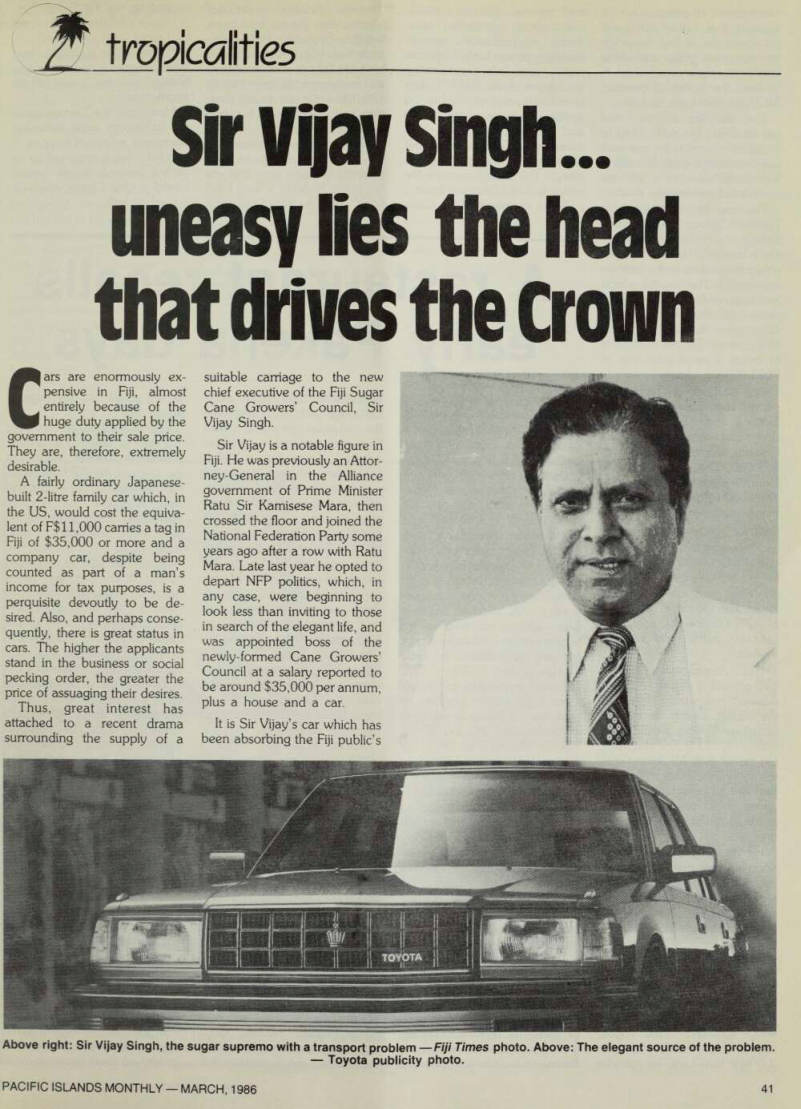
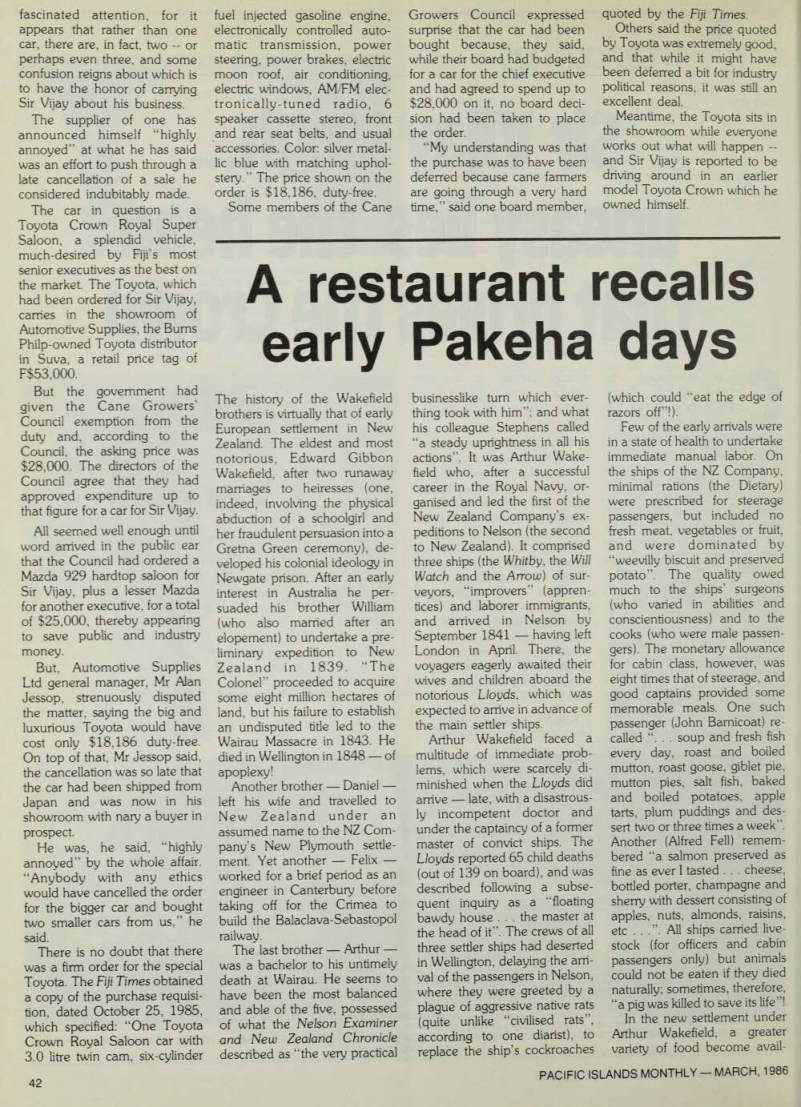
tropicalities
Sir Vijay Singh... uneasy lies the head that drives the Crown
Cars are enormously expensive in Fiji, almost entirely because of the huge duty applied by the government to their sale price.
They are, therefore, extremely desirable A fairly ordinary Japanesebuilt 2-litre family car which, in the US, would cost the equivalent of Fsll,ooo carries a tag in Fiji of $35,000 or more and a company car. despite being counted as part of a man’s income for tax purposes, is a perquisite devoutly to be desired. Also, and perhaps consequently, there is great status in cars. The higher the applicants stand in the business or social pecking order, the greater the price of assuaging their desires, Thus, great interest has attached to a recent drama surrounding the supply of a
suitable carriage to the new chief executive of the Fiji Sugar Cane Growers’ Council, Sir Vijay Singh, ... ...
S, ‘ Vl)a y 15 a notable h 9“ re ,n FIJI - He was P reviousl y an Attor in the Alliance g™ 6 ™ ° f Pn ™ Ml ™ ster Ratu Sir K am,sese Mara, then grossed the floor and joined the Natlonal Party some ago after a row with Ratu last year he opted to depart NFP politics, which, in f n \ F ase ’ ' werebe 9 innin 3 to look le “ tba " ‘° thos< ln search o( ‘he elegant Me, and was . a PP° ln ‘ ed bo “ ’° f Cane Growers Council a ? a f' a iK reported to arou I nd $35,000 per annum, P'us a house and a car.
It is Sir Vijay’s car which has been absorbing the Fiji public’s
Above right: Sir Vijay Singh, the sugar supremo with a transport problem —Fiji Times photo. Above: The elegant source of the problem. - Toyota publicity photo.
fascinated attention, for it appears that rather than one car, there are, in fact, two or perhaps even three, and some confusion reigns about which is to have the honor of carrying Sir Vijay about his business.
The supplier of one has announced himself “highly annoyed” at what he has said was an effort to push through a late cancellation of a sale he considered indubitably made.
The car in question is a Toyota Crown Royal Super Saloon, a splendid vehicle, much-desired by Fiji’s most senior executives as the best on the market The Toyota, which had been ordered for Sir Vijay, carries in the showroom of Automotive Supplies, the Bums Philp-owncd Toyota distributor in Suva, a retail price tag of F 553,000.
But the government had given the Cane Growers’
Council exemption from the duty and, according to the Council, the asking price was $28,000. The directors of the Council agree that they had approved expenditure up to that figure for a car for Sir Vijay.
All seemed well enough until word arrived in the public ear that the Council had ordered a Mazda 929 hardtop saloon for Sir Vijay, plus a lesser Mazda for another executive, for a total of $25,000, thereby appearing to save public and industry money.
But, Automotive Supplies Ltd general manager, Mr Alan Jessop, strenuously disputed the matter, saying the big and luxurious Toyota would have cost only $18,186 duty-free.
On top of that, Mr Jessop said, the cancellation was so late that the car had been shipped from Japan and was now in his showroom with nary a buyer in prospect He was, he said, “highly annoyed” by the whole affair.
“Anybody with any ethics would have cancelled the order for the bigger car and bought two smaller cars from us,” he said.
There is no doubt that there was a firm order for the special Toyota. The Fiji Times obtained a copy of the purchase requisi tion, dated October 25, 1985, which specified: “One Toyota Crown Royal Saloon car with 3.0 litre twin cam, six-cylinder
fuel injected gasoline engine, electronically controlled auto matic transmission, power steering, power brakes, electric moon roof, air conditioning, electric windows, AM/FM elec tronically-tuned radio, 6 speaker cassette stereo, front and rear seat belts, and usual accessories. Color; silver metal lic blue with matching uphol stery.” The price shown on the order is $18,186, duty-free.
Some members of the Cane
Growers Council expressed surprise that the car had been bought because, they said, while their board had budgeted for a car for the chief executive and had agreed to spend up to $28,000 on it, no board deci sion had been taken to place the order.
“My understanding was that the purchase was to have been deferred because cane farmers are going through a very hard time,” said one board member,
quoted by the Fiji Times.
Others said the price quoted by Toyota was extremely good, and that while it might have been deferred a bit for industry political reasons, it was still an excellent deal.
Meantime, the Toyota sits in the showroom while everyone works out what will happen and Sir Vijay is reported to be driving around in an earlier model Toyota Crown which he owned himself.
early Pakeha days
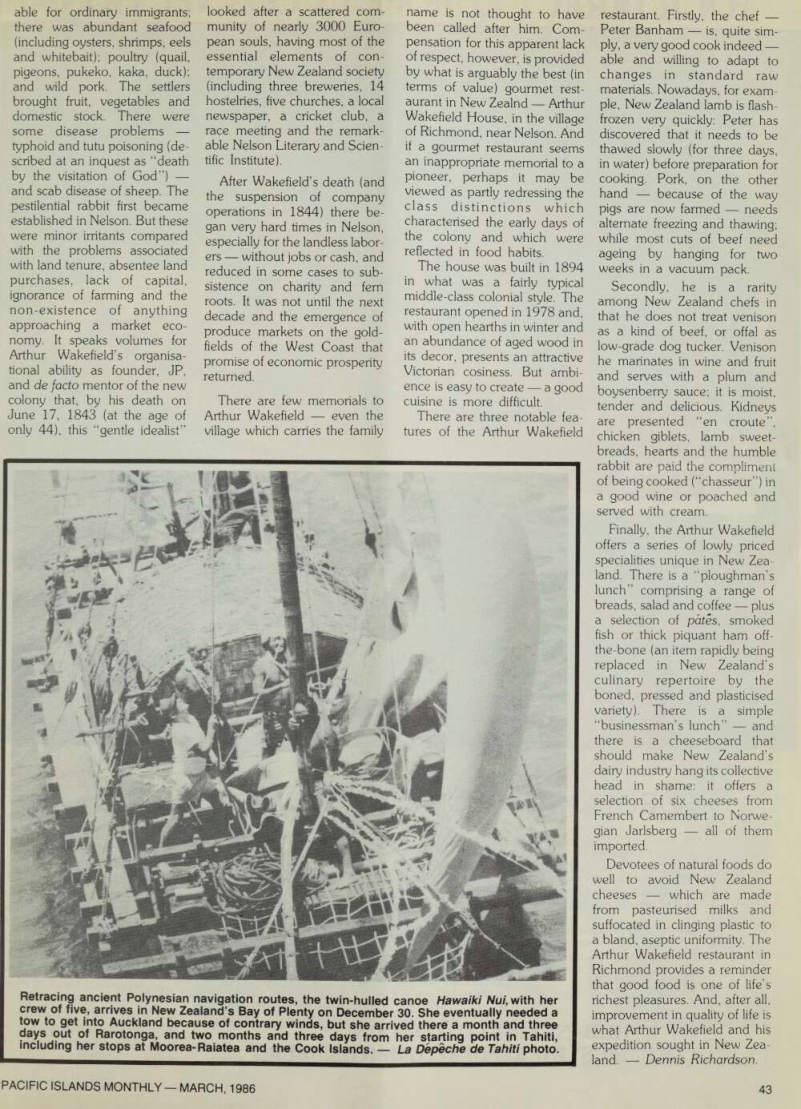
A restaurant recalls early Pakeha days
The history of the Wakefield brothers is virtually that of early European settlement in New Zealand. The eldest and most notorious, Edward Gibbon Wakefield, after two runaway marriages to heiresses (one, indeed, involving the physical abduction of a schoolgirl and her fraudulent persuasion into a Gretna Green ceremony), de veloped his colonial ideology in Newgate prison. After an early interest in Australia he per suaded his brother William (who also married after an elopement) to undertake a pre liminary expedition to New Zealand in 1839. “The Colonel” proceeded to acquire some eight million hectares of land, but his failure to establish an undisputed title led to the Wairau Massacre in 1843. He died in Wellington in 1848 of apoplexy!
Another brother Daniel left his wife and travelled to New Zealand under an assumed name to the NZ Com pany’s New Plymouth settle ment. Yet another Felix worked for a brief period as an engineer in Canterbury before taking off for the Crimea to build the Balaclava-Sebastopol railway.
The last brother Arthur was a bachelor to his untimely death at Wairau. He seems to have been the most balanced and able of the five, possessed of what the Nelson Examiner and New Zealand Chronicle described as “the very practical
businesslike turn which ever thing took with him”; and what his colleague Stephens called “a steady uprightness in all his actions”. It was Arthur Wake field who, after a successful career in the Royal Navy, or ganised and led the first of the New Zealand Company’s ex peditions to Nelson (the second to New Zealand). It comprised three ships (the Whitby , the Will Watch and the Arrow) of sur veyors, “improvers” (appren tices) and laborer immigrants, and arrived in Nelson by September 1841 having left London in April. There, the voyagers eagerly awaited their wives and children aboard the notorious Lloyds, which was expected to arrive in advance of the main settler ships.
Arthur Wakefield faced a multitude of immediate prob lems, which were scarcely di minished when the Lloyds did arr i ve late, with a disastrous ly incompetent doctor and under the captaincy of a former master of convict ships. The Lloyds reported 65 child deaths (out of 139 on board), and was described following a subse quent inquiry as a “floating bawdy house . . . the master at the head of it”. The crews of all three settler ships had deserted in Wellington, delaying the arri val of the passengers in Nelson, where they were greeted by a plague of aggressive native rats (quite unlike “civilised rats ’, according to one diarist), to replace the ship’s cockroaches
(which could “eat the edge of razors off”!).
Few of the early arrivals were in a state of health to undertake immediate manual labor. On the ships of the NZ Company, minimal rations (the Dietary) were prescribed for steerage passengers, but included no fresh meat, vegetables or fruit, and were dominated by “weevilly biscuit and preserved potato”. The quality owed much to the ships’ surgeons (who varied in abilities and conscientiousness) and to the cooks (who were male passen gers). The monetary allowance for cabin class, however, was eight times that of steerage, and good captains provided some memorable meals. One such passenger (John Bamicoat) re called . . soup and fresh fish every day, roast and boiled mutton, roast goose, giblet pie, mutton pies, salt fish, baked and boiled potatoes, apple tarts, plum puddings and des sert two or three times a week”.
Another (Alfred Fell) remem bered “a salmon preserved as fine as ever I tasted . . . cheese, bottled porter, champagne and sherry with dessert consisting of apples, nuts, almonds, raisins, etc . . .”. All ships carried live stock (for officers and cabin passengers only) but animals could not be eaten if they died naturally; sometimes, therefore, “a pig was killed to save its life”!
In the new settlement under Arthur Wakefield, a greater variety of food become avail
able for ordinary immigrants; there was abundant seafood (including oysters, shrimps, eels and whitebait); poultry (quail, pigeons, pukeko, kaka, duck); and wild pork. The settlers brought fruit, vegetables and domestic stock. There were some disease problems typhoid and tutu poisoning (described at an inquest as “death by the visitation of God”) and scab disease of sheep. The pestilential rabbit first became established in Nelson. But these were minor irritants compared with the problems associated with land tenure, absentee land purchases, lack of capital, ignorance of farming and the non existence o anyt mg approaching a market ecovolumes for * 6ield < S °f tonal ability as founder, JP, and de facto mentor of the new colony that, by his death on June 17, 1843 (at the age of only 44), this “gentle idealist”
looked after a scattered community of nearly 3000 European souls, having most of the essential elements of contemporary New Zealand society (including three breweries, 14 hostelries, five churches, a local newspaper, a cricket club, a race meeting and the remarkable Nelson Literary and Scientific Institute).
After Wakefield’s death (and the suspension of company operations in 1844) there began ver y arc j times in M e i son , eS neciallv for the landless laborre d ucec i in some cases to su u sistence on Than“ and fern roots was not untj| the next decade and the emergence of produce markets on the goldfie|ds of , he West Coast that promise of economic prosperity There are few memorials to Arthur Wakefield even the village which carries the family
name is not thought to have been called after him. Compensation for this apparent lack of respect, however, is provided by what is arguably the best (in terms of value) gourmet restaurant in New Zealnd Arthur Wakefield House, in the village of Richmond, near Nelson. And if a gourmet restaurant seems an inappropriate memorial to a P ioneer > perhaps it may be as partly redressing the c^ass distinctions which characterised the early days of c °l° n y ar >d which were reflected in food habits.
The house was built in 1894 what was a fairly typical middle-class colonial style. The restaurant openedin 1978 and, w ' t h °P en hearths in winter and an abundance of aged wood in its decor, presents an attractive returned. Victorian cosiness. But ambience is easy to create - a good cuisine is more difficult.
There are three notable features of the Arthur Wakefield
restaurant. Firstly, the chef Peter Banham is, quite sim ply, a very good cook indeed able and willing to adapt to changes in standard raw materials. Nowadays, for exam ple, New Zealand lamb is flash frozen very quickly; Peter has discovered that it needs to be thawed slowly (for three days, in water) before preparation for cooking. Pork, on the other hand because of the way pigs are now farmed needs alternate freezing and thawing; while most cuts of beef need ageing by hanging for two weeks in a vacuum pack.
Secondly, he is a rarity among New Zealand chefs in that he does not treat venison as a kind of beef, or offal as low-grade dog tucker. Venison he marinates in wine and fruit and serves with a plum and boysenberry sauce; it is moist, tender and delicious. Kidneys are presented “en croute”, chicken giblets, lamb sweet breads, hearts and the humble rabbit are paid the compliment of being cooked (“chasseur”) in a good wine or poached and served with cream.
Finally, the Arthur Wakefield offers a series of lowly priced specialities unique in New Zea land. There is a “ploughman’s lunch” comprising a range of breads, salad and coffee plus a selection of pates , smoked fish or thick piquant ham off the-bone (an item rapidly being replaced in New Zealand’s culinary repertoire by the boned, pressed and plasticised variety). There is a simple “businessman’s lunch” and there is a cheeseboard that should make New Zealand’s dairy industry hang its collective head in shame: it offers a selection of six cheeses from French Camembert to Norwe gian Jarlsberg all of them imported.
Devotees of natural foods do well to avoid New Zealand cheeses which are made from pasteurised milks and suffocated in clinging plastic to a bland, aseptic uniformity. The Arthur Wakefield restaurant in Richmond provides a reminder that good food is one of life’s richest pleasures. And, after all, improvement in quality of life is what Arthur Wakefield and his expedition sought in New Zea
land.
Dennis Richardson.
Retracing ancient Polynesian navigation routes, the twin-hulled canoe Hawaiki Nui, with her crew of five, arrives in New Zealand’s Bay of Plenty on December 30. She eventually needed a tow to get into Auckland because of contrary winds, but she arrived there a month and three days out of Rarotonga, and two months and three days from her starting point in Tahiti, including her stops at Moorea-Raiatea and the Cook Islands. - La Dépêche de Tahiti photo.
Advertisements & other items, p. 44 (1 item)
Europe-South Pacific Joint Service
ILHJK
iiiliiiii ■ *
'Jgfe
EUROPE-SOUTH PACIFIC JOINT SERVICE
The South Pacific Specialists offer facilities for shipment of: Containers (FCL/LCL) and Breakbulk Cargo plus reefer space and deeptanks for carriage of vegetable oils and other liquid bulk cargo.
Carriers also accept heavy lifts, overlength and ‘ cumber- Ports of Service: Loading: Papeete, Apia, Suva, Lautoka, Noumea, Port Vila, Santo, Honiara, Port Moresby, Lae,Madang, Kimbe, Rabaul, Kieta, Darwin.
For: Rotterdam, Antwerp, Hamburg, Hull, Dunkirk, Le Havre.
ROUND THE WORLD SERVICE -
Additional \V
ports on enquiry.
Please contact our regional offices for further information: The Bank Line (Australasia) Pty. Ltd.
Suite 801,51 Pitt Street Sydney N.S.W. 2000 Phone: 27 2041 Telex: 24063 Columbus Line Reederei GmbH P.O. Box 1667 Lae/Papua New Guinea Phone: 42 3466/42 3287.5 A.H. 42 2481 Telex: Colline NE 44 171 W*
THE BANK LINE LTD LONDON
COLUMBUS LINE REEDEREI GMBH HAMBURG
C0L0024
"Citadel Noumea" win
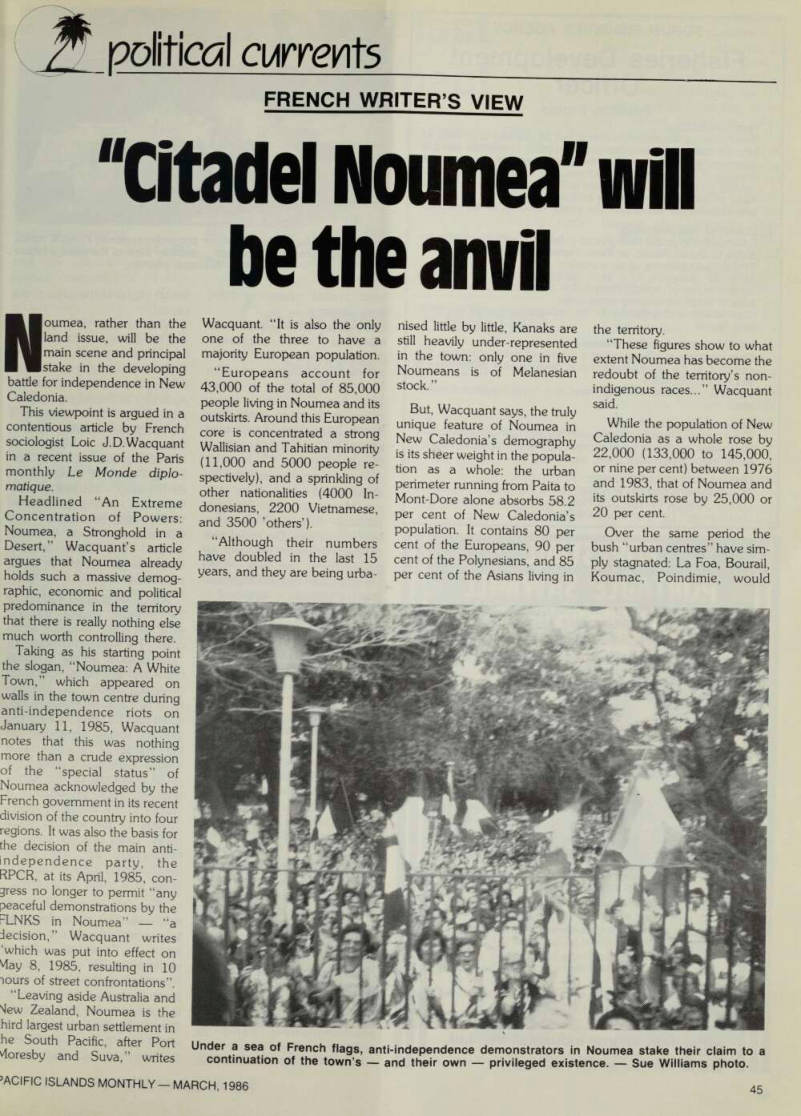
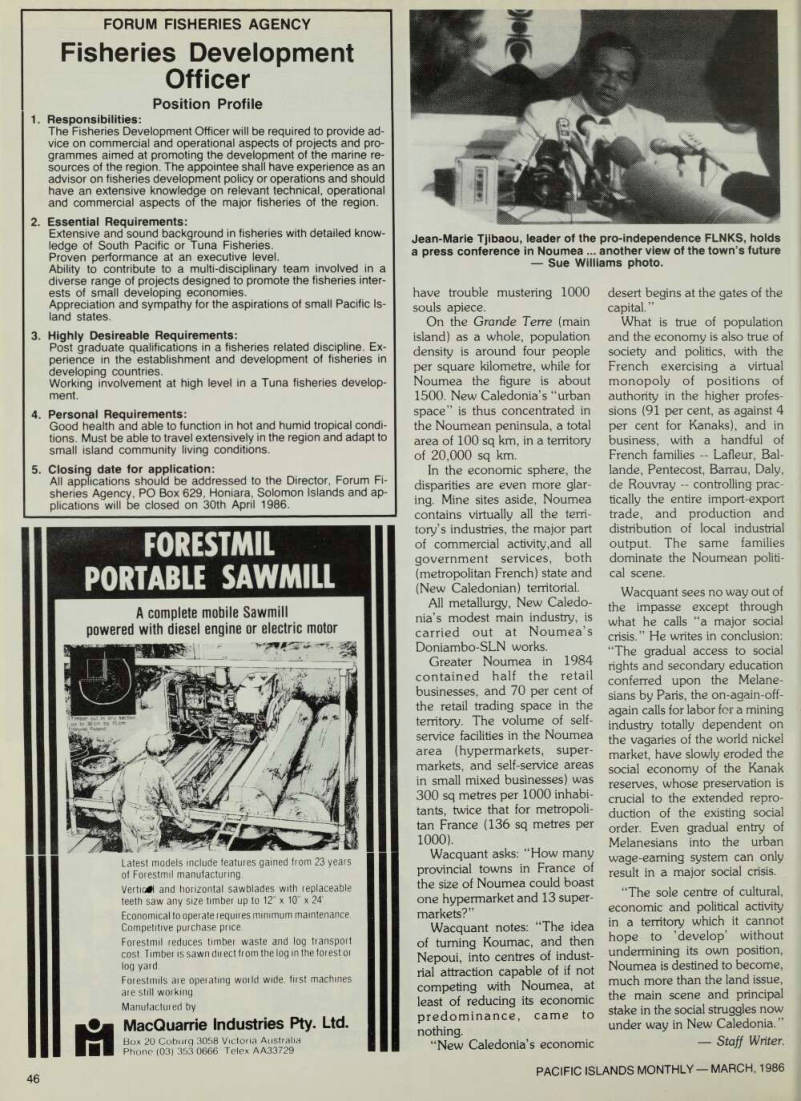
political currents
French Writer’S View
"Citadel Noumea" win be the anvil
Noumea, rather than the land issue, will be the main scene and principal stake in the developing battle for independence in New Caledonia.
This viewpoint is argued in a contentious article by French sociologist Loic J.D. Wacquant in a recent issue of the Paris monthly Le Monde diplo matique.
Headlined “An Extreme Concentration of Powers: Noumea, a Stronghold in a Desert,” Wacquant’s article argues that Noumea already holds such a massive demog raphic, economic and political predominance in the territory that there is really nothing else much worth controlling there.
Taking as his starting point the slogan, “Noumea: A White Town,” which appeared on walls in the town centre during anti-independence riots on January 11, 1985, Wacquant notes that this was nothing more than a crude expression of the “special status” of Noumea acknowledged by the French government in its recent division of the country into four regions. It was also the basis for the decision of the main anti independence party, the RPCR, at its April, 1985, con gress no longer to permit “any peaceful demonstrations by the FLNKS in Noumea” “a decision,” Wacquant writes ‘which was put into effect on B, 1985, resulting in 10 lours of street confrontations”.
“Leaving aside Australia and Mew Zealand, Noumea is the bird largest urban settlement in he South Pacific, after Port Moresby and Suva,” writes
Wacquant. “It is also the only one of the three to have a majority European population.
“Europeans account for 43,000 of the total of 85,000 people living in Noumea and its outskirts. Around this European core is concentrated a strong Wallisian and Tahitian minority (11,000 and 5000 people re spectively), and a sprinkling of other nationalities (4000 In donesians, 2200 Vietnamese, and 3500 ’others’).
“Although their numbers have doubled in the last 15 years, and they are being urba
nised little by little, Kanaks are still heavily under-represented in the town: only one in five Noumeans is of Melanesian stock.”
But, Wacquant says, the truly unique feature of Noumea in New Caledonia’s demography is its sheer weight in the popula tion as a whole: the urban perimeter running from Paita to Mont-Dore alone absorbs 58.2 per cent of New Caledonia’s population. It contains 80 per cent of the Europeans, 90 per cent of the Polynesians, and 85 per cent of the Asians living in
the territory.
“These figures show to what extent Noumea has become the redoubt of the territory’s non indigenous races...” Wacquant said.
While the population of New Caledonia as a whole rose by 22,000 (133,000 to 145,000, or nine per cent) between 1976 and 1983, that of Noumea and its outskirts rose by 25,000 or 20 per cent.
Over the same period the bush “urban centres” have sim ply stagnated: La Foa, Bourail, Koumac, Poindimie, would
Under a sea of French flags, anti-independence demonstrators in Noumea stake their claim to a continuation of the town’s - and their own - privileged existence. - Sue Williams photo.
have trouble mustering 1000 souls apiece.
On the Grande Terre (main island) as a whole, population density is around four people per square kilometre, while for Noumea the figure is about 1500. New Caledonia’s “urban space” is thus concentrated in the Noumean peninsula, a total area of 100 sq km, in a territory of 20,000 sq km.
In the economic sphere, the disparities are even more glar ing. Mine sites aside, Noumea contains virtually all the terri tory’s industries, the major part of commercial activity,and all government services, both (metropolitan French) state and (New Caledonian) territorial.
All metallurgy, New Caledo nia’s modest main industry, is carried out at Noumea’s Doniambo-SLN works.
Greater Noumea in 1984 contained half the retail businesses, and 70 per cent of the retail trading space in the territory. The volume of self service facilities in the Noumea area (hypermarkets, super markets, and self-service areas in small mixed businesses) was 300 sq metres per 1000 inhabi tants, twice that for metropoli tan France (136 sq metres per 1000).
Wacquant asks; “How many provincial towns in France of the size of Noumea could boast one hypermarket and 13 super markets?”
Wacquant notes: “The idea of turning Koumac, and then Nepoui, into centres of indust rial attraction capable of if not competing with Noumea, at least of reducing its economic predominance, came to nothing.
“New Caledonia’s economic
desert begins at the gates of the capital. ”
What is true of population and the economy is also true of society and politics, with the French exercising a virtual monopoly of positions of authority in the higher profes sions (91 per cent, as against 4 per cent for Kanaks), and in business, with a handful of French families Lafleur, Bal lande, Pentecost, Barrau, Daly, de Rouvray controlling prac tically the entire import-export trade, and production and distribution of local industrial output. The same families dominate the Noumean politi cal scene.
Wacquant sees no way out of the impasse except through what he calls “a major social crisis.” He writes in conclusion: “The gradual access to social rights and secondary education conferred upon the Melane sians by Paris, the on-again-off again calls for labor for a mining industry totally dependent on the vagaries of the world nickel market, have slowly eroded the social economy of the Kanak reserves, whose preservation is crucial to the extended repro duction of the existing social order. Even gradual entry of Melanesians into the urban wage-earning system can only result in a major social crisis.
“The sole centre of cultural, economic and political activity in a territory which it cannot hope to ’develop’ without undermining its own position, Noumea is destined to become, much more than the land issue, the main scene and principal stake in the social struggles now under way in New Caledonia. ”
Staff Writer.
Jean-Marie Tjibaou, leader of the pro-independence FLNKS, holds a press conference in Noumea ... another view of the town’s future - Sue Williams photo.
Advertisements & other items, pp. 45-46 (2 items)
45
'ACIFIC ISLANDS MONTHLY MARCH, 1986
Forestmil
FORUM FISHERIES AGENCY
Fisheries Development
Officer
Position Profile 1. Responsibilities: The Fisheries Development Officer will be required to provide advice on commercial and operational aspects of projects and programmes aimed at promoting the development of the marine resources of the region. The appointee shall have experience as an advisor on fisheries development policy or operations and should have an extensive knowledge on relevant technical, operational and commercial aspects of the major fisheries of the region. 2. Essential Requirements: Extensive and sound background in fisheries with detailed knowledge of South Pacific or Tuna Fisheries.
Proven performance at an executive level.
Ability to contribute to a multi-disciplinary team involved in a diverse range of projects designed to promote the fisheries interests of small developing economies.
Appreciation and sympathy for the aspirations of small Pacific Island states. 3. Highly Desireable Requirements: Post graduate qualifications in a fisheries related discipline. Experience in the establishment and development of fisheries in developing countries.
Working involvement at high level in a Tuna fisheries development. 4. Personal Requirements; Good health and able to function in hot and humid tropical conditions. Must be able to travel extensively in the region and adapt to small island community living conditions. 5. Closing date for application: All applications should be addressed to the Director, Forum Fisheries Agency, PO Box 629, Honiara, Solomon Islands and applications will be closed on 30th April 1986.
FORESTMIL
PORTABLE SAWMILL
A complete mobile Sawmill powered with diesel engine or electric motor m. r m Latest models include features gained from 23 years of Forestmil manufacturing.
Vertical and horizontal sawblades with replaceable teeth saw any size timber up to 12" x 10" x 24' Economical to operate requires minimum maintenance.
Competitive purchase price.
Forestmil reduces timber waste and log transport cost. Timber is sawn direct from the log in the forest or log yard Forestmils are operating world wide, first machines are still working IH Manufactuied by
MacQuarrie Industries Pty. Ltd.
Box 20 Coburg 3058 Victoria Australia Phone (03) 353 0666 Telex AA33729
step for Compact
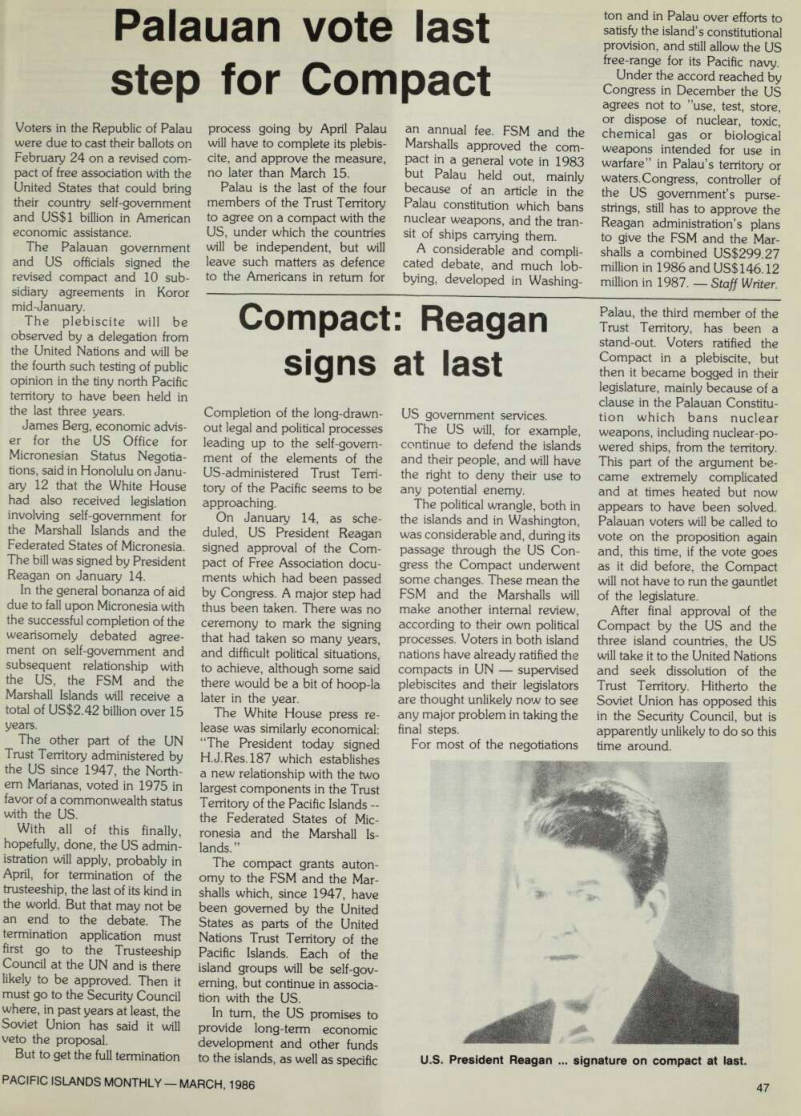
Palauan vote last step for Compact
Voters in the Republic of Palau were due to cast their ballots on February 24 on a revised com pact of free association with the United States that could bring their country self-government and US$l billion in American economic assistance.
The Palauan government and US officials signed the revised compact and 10 sub sidiary agreements in Koror mid-January.
The plebiscite will be observed by a delegation from the United Nations and will be the fourth such testing of public opinion in the tiny north Pacific territory to have been held in the last three years.
James Berg, economic advis er for the US Office for Micronesian Status Negotia tions, said in Honolulu on Janu ary 12 that the White House had also received legislation involving self-government for the Marshall Islands and the Federated States of Micronesia.
The bill was signed by President Reagan on January 14.
In the general bonanza of aid due to fall upon Micronesia with the successful completion of the wearisomely debated agree ment on self-government and subsequent relationship with the US, the FSM and the Marshall Islands will receive a total of U 552.42 billion over 15 years.
The other part of the UN Trust Territory administered by the US since 1947, the North ern Marianas, voted in 1975 in favor of a commonwealth status with the US.
With all of this finally, hopefully, done, the US admin istration will apply, probably in April, for termination of the trusteeship, the last of its kind in the world. But that may not be an end to the debate. The termination application must first go to the Trusteeship Council at the UN and is there likely to be approved. Then it must go to the Security Council where, in past years at least, the Soviet Union has said it will veto the proposal.
But to get the full termination
process going by April Palau will have to complete its plebis cite, and approve the measure, no later than March 15.
Palau is the last of the four members of the Trust Territory to agree on a compact with the US, under which the countries will be independent, but will leave such matters as defence to the Americans in return for
an annual fee. FSM and the Marshalls approved the com pact in a general vote in 1983 but Palau held out, mainly because of an article in the Palau constitution which bans nuclear weapons, and the tran sit of ships carrying them.
A considerable and compli cated debate, and much lob bying, developed in Washing
ton and in Palau over efforts to satisfy the island’s constitutional provision, and still allow the US free-range for its Pacific navy.
Under the accord reached by Congress in December the US agrees not to ’’use, test, store, or dispose of nuclear, toxic, chemical gas or biological weapons intended for use in warfare” in Palau’s territory or waters. Congress, controller of the US government’s purse strings, still has to approve the Reagan administration’s plans to give the FSM and the Mar shalls a combined U 55299.27 million in 1986 and U 55146.12
million in 1987.
Staff Writer.
Compact: Reagan
signs at last
Completion of the long-drawn out legal and political processes leading up to the self-govern ment of the elements of the US-administered Trust Terri tory of the Pacific seems to be approaching.
On January 14, as sche duled, US President Reagan signed approval of the Com pact of Free Association docu ments which had been passed by Congress. A major step had thus been taken. There was no ceremony to mark the signing that had taken so many years, and difficult political situations, to achieve, although some said there would be a bit of hoop-la later in the year.
The White House press re lease was similarly economical: “The President today signed H.J.Res.lB7 which establishes a new relationship with the two largest components in the Trust Territory of the Pacific Islands the Federated States of Mic ronesia and the Marshall Is lands.”
The compact grants auton omy to the FSM and the Mar shalls which, since 1947, have been governed by the United States as parts of the United Nations Trust Territory of the Pacific Islands. Each of the island groups will be self-gov erning, but continue in associa tion with the US.
In turn, the US promises to provide long-term economic development and other funds to the islands, as well as specific
US government services.
The US will, for example, continue to defend the islands and their people, and will have the right to deny their use to any potential enemy.
The political wrangle, both in the islands and in Washington, was considerable and, during its passage through the US Con gress the Compact underwent some changes. These mean the FSM and the Marshalls will make another internal review, according to their own political processes. Voters in both island nations have already ratified the compacts in UN supervised plebiscites and their legislators are thought unlikely now to see any major problem in taking the final steps.
For most of the negotiations
Palau, the third member of the Trust Territory, has been a stand-out. Voters ratified the Compact in a plebiscite, but then it became bogged in their legislature, mainly because of a clause in the Palauan Constitu tion which bans nuclear weapons, including nuclear-po wered ships, from the territory.
This part of the argument be came extremely complicated and at times heated but now appears to have been solved.
Palauan voters will be called to vote on the proposition again and, this time, if the vote goes as it did before, the Compact will not have to run the gauntlet of the legislature.
After final approval of the Compact by the US and the three island countries, the US will take it to the United Nations and seek dissolution of the Trust Territory. Hitherto the Soviet Union has opposed this in the Security Council, but is apparently unlikely to do so this time around.
U.S. President Reagan ... signature on compact at last.
people
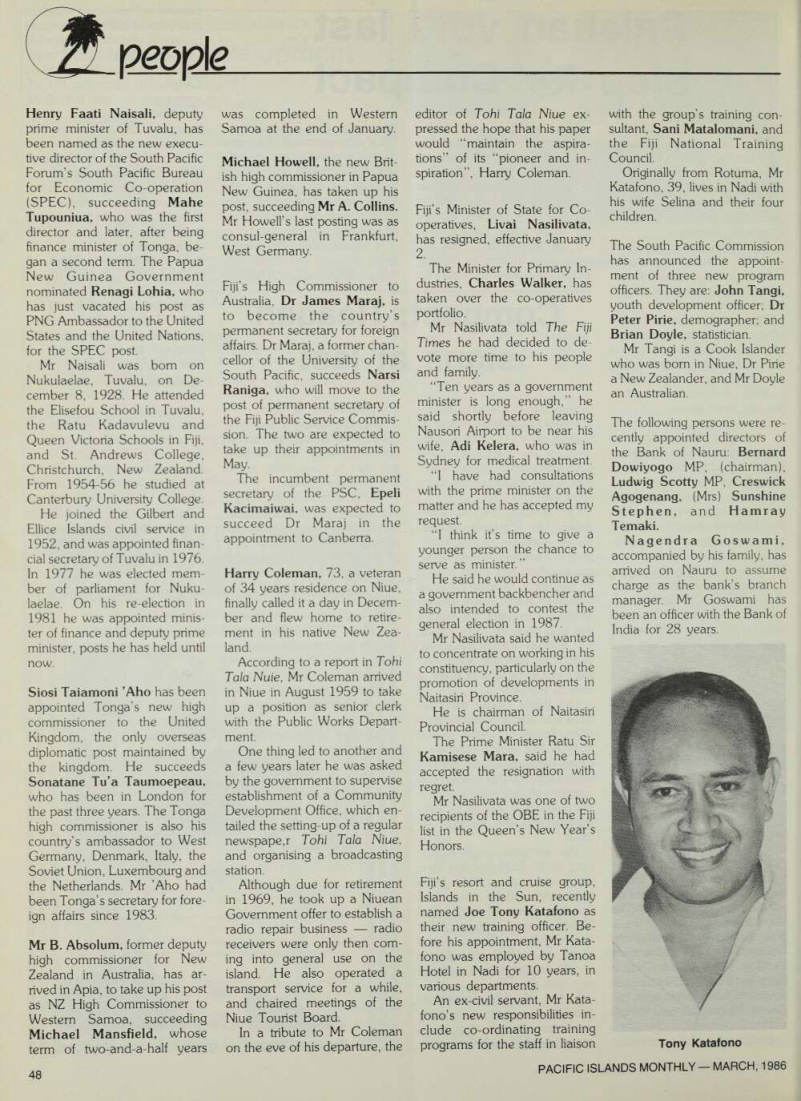
Henry Faati Naisali, deputy prime minister of Tuvalu, has been named as the new execu tive director of the South Pacific Forum’s South Pacific Bureau for Economic Co-operation (SPEC), succeeding Mahe Tupouniua, who was the first director and later, after being finance minister of Tonga, be gan a second term. The Papua New Guinea Government nominated Renagi Lohia, who has just vacated his post as PNG Ambassador to the United States and the United Nations, for the SPEC post.
Mr Naisali was bom on Nukulaelae, Tuvalu, on De cember 8, 1928. He attended the Elisefou School in Tuvalu, the Ratu Kadavulevu and Queen Victoria Schools in Fiji, and St. Andrews College, Christchurch, New Zealand.
From 1954-56 he studied at Canterbury University College.
He joined the Gilbert and Ellice Islands civil service in 1952, and was appointed finan cial secretary of Tuvalu in 1976.
In 1977 he was elected mem ber of parliament for Nuku laelae. On his re-election in 1981 he was appointed minis ter of finance and deputy prime minister, posts he has held until now.
Siosi Taiamoni ’Aho has been appointed Tonga’s new high commissioner to the United Kingdom, the only overseas diplomatic post maintained by the kingdom. He succeeds Sonatane Tu’a Taumoepeau, who has been in London for the past three years. The Tonga high commissioner is also his country’s ambassador to West Germany, Denmark, Italy, the Soviet Union, Luxembourg and the Netherlands. Mr ’Aho had been Tonga’s secretary for fore ign affairs since 1983.
Mr B. Absolum, former deputy high commissioner for New Zealand in Australia, has ar rived in Apia, to take up his post as NZ High Commissioner to Western Samoa, succeeding Michael Mansfield, whose term of two-and-a-half years
was completed in Western Samoa at the end of January.
Michael Howell, the new Brit ish high commissioner in Papua New Guinea, has taken up his post, succeeding Mr A. Collins.
Mr Howell’s last posting was as consul-general in Frankfurt, West Germany.
Fiji’s High Commissioner to Australia, Dr James Maraj, is to become the country’s permanent secretary for foreign affairs. Dr Maraj, a former chan cellor of the University of the South Pacific, succeeds Narsi Raniga, who will move to the post of permanent secretary of the Fiji Public Service Commis sion. The two are expected to take up their appointments in May.
The incumbent permanent secretary of the PSC, Epeli Kacimaiwai, was expected to succeed Dr Maraj in the appointment to Canberra.
Harry Coleman, 73, a veteran of 34 years residence on Niue, finally called it a day in Decem ber and flew home to retire ment in his native New Zea land.
According to a report in Tohi Tola Nuie , Mr Coleman arrived in Niue in August 1959 to take up a position as senior clerk with the Public Works Depart ment.
One thing led to another and a few years later he was asked by the government to supervise establishment of a Community Development Office, which en tailed the setting-up of a regular newspape,r Tohi Tala Niue, and organising a broadcasting station.
Although due for retirement in 1969, he took up a Niuean Government offer to establish a radio repair business radio receivers were only then com ing into general use on the island. He also operated a transport service for a while, and chaired meetings of the Niue Tourist Board.
In a tribute to Mr Coleman on the eve of his departure, the
editor of Tohi Tala Niue ex pressed the hope that his paper would “maintain the aspira tions” of its “pioneer and in spiration”, Harry Coleman.
Fiji’s Minister of State for Co operatives, Livai Nasilivata, has resigned, effective January 2.
The Minister for Primary In dustries, Charles Walker, has taken over the co-operatives portfolio.
Mr Nasilivata told The Fiji Times he had decided to de vote more time to his people and family.
“Ten years as a government minister is long enough,” he said shortly before leaving Nausori Airport to be near his wife. Adi Kelera, who was in Sydney for medical treatment.
“I have had consultations with the prime minister on the matter and he has accepted my request.
“I think it’s time to give a younger person the chance to serve as minister.”
He said he would continue as a government backbencher and also intended to contest the general election in 1987.
Mr Nasilivata said he wanted to concentrate on working in his constituency, particularly on the promotion of developments in Naitasiri Province.
He is chairman of Naitasiri Provincial Council.
The Prime Minister Ratu Sir Kamisese Mara, said he had accepted the resignation with regret.
Mr Nasilivata was one of two recipients of the OBE in the Fiji list in the Queen’s New Year’s Honors.
Fiji’s resort and cruise group, Islands in the Sun, recently named Joe Tony Katafono as their new training officer. Be fore his appointment, Mr Kata fono was employed by Tanoa Hotel in Nadi for 10 years, in various departments.
An ex-civil servant, Mr Kata fono’s new responsibilities in clude co-ordinating training programs for the staff in liaison
with the group’s training con sultant, Sani Matalomani, and the Fiji National Training Council.
Originally from Rotuma, Mr Katafono, 39, lives in Nadi with his wife Selina and their four children.
The South Pacific Commission has announced the appoint ment of three new program officers. They are: John Tangi, youth development officer; Dr Peter Pirie, demographer; and Brian Doyle, statistician.
Mr Tangi is a Cook Islander who was born in Niue, Dr Pirie a New Zealander, and Mr Doyle an Australian.
The following persons were re cently appointed directors of the Bank of Nauru; Bernard Dowiyogo MP, (chairman), Ludwig Scotty MP, Creswick Agogenang, (Mrs) Sunshine Stephen, and Hamray Temaki.
Nagendra Goswami, accompanied by his family, has arrived on Nauru to assume charge as the bank’s branch manager. Mr Goswami has been an officer with the Bank of India for 28 years.
Tony Katafono
Pacific stamp box
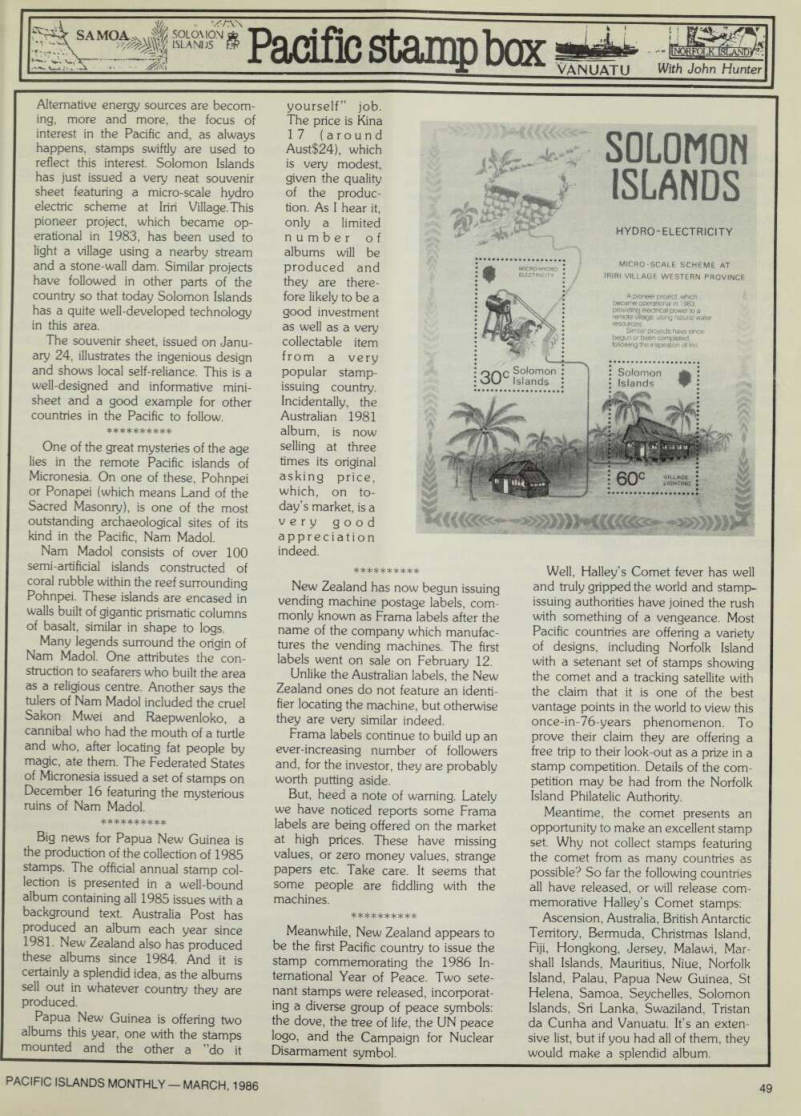
Alternative energy sources are becom ing, more and more, the focus of interest in the Pacific and, as always happens, stamps swiftly are used to reflect this interest. Solomon Islands has just issued a very neat souvenir sheet featuring a micro-scale hydro electric scheme at Iriri Village. This pioneer project, which became op erational in 1983, has been used to light a village using a nearby stream and a stone-wall dam. Similar projects have followed in other parts of the country so that today Solomon Islands has a quite well-developed technology in this area.
The souvenir sheet, issued on Janu ary 24, illustrates the ingenious design and shows local self-reliance. This is a well-designed and informative mini sheet and a good example for other countries in the Pacific to follow. *** One of the great mysteries of the age lies in the remote Pacific islands of Micronesia. On one of these, Pohnpei or Ponapei (which means Land of the Sacred Masonry), is one of the most outstanding archaeological sites of its kind in the Pacific, Nam Madol.
Nam Madol consists of over 100 semi-artificial islands constructed of coral rubble within the reef surrounding Pohnpei. These islands are encased in walls built of gigantic prismatic columns of basalt, similar in shape to logs.
Many legends surround the origin of Nam Madol. One attributes the con struction to seafarers who built the area as a religious centre. Another says the tulers of Nam Madol included the cruel Sakon Mwei and Raepwenloko, a cannibal who had the mouth of a turtle and who, after locating fat people by magic, ate them. The Federated States of Micronesia issued a set of stamps on December 16 featuring the mysterious ruins of Nam Madol. *** Big news for Papua New Guinea is the production of the collection of 1985 stamps. The official annual stamp col lection is presented in a well-bound album containing all 1985 issues with a background text. Australia Post has produced an album each year since 1981. New Zealand also has produced these albums since 1984. And it is certainly a splendid idea, as the albums sell out in whatever country they are produced.
Papua New Guinea is offering two albums this year, one with the stamps mounted and the other a ”do it
yourself” job.
The price is Kina 17 (around Austs24), which is very modest, given the quality of the produc tion. As I hear it, only a limited number of albums will be produced and they are there fore likely to be a good investment as well as a very collectable item from a very popular stamp issuing country.
Incidentally, the
Australian 1981 album, is now selling at three times its original asking price, which, on to day’s market, is a very good appreciation indeed.
New Zealand has now begun issuing vending machine postage labels, com monly known as Frama labels after the name of the company which manufac tures the vending machines. The first labels went on sale on February 12.
Unlike the Australian labels, the New Zealand ones do not feature an identi fier locating the machine, but otherwise they are very similar indeed.
Frama labels continue to build up an ever-increasing number of followers and, for the investor, they are probably worth putting aside.
But, heed a note of warning. Lately we have noticed reports some Frama labels are being offered on the market at high prices. These have missing values, or zero money values, strange papers etc. Take care. It seems that some people are fiddling with the machines. *** Meanwhile, New Zealand appears to be the first Pacific country to issue the stamp commemorating the 1986 In ternational Year of Peace. Two sete nant stamps were released, incorporat ing a diverse group of peace symbols: the dove, the tree of life, the UN peace logo, and the Campaign for Nuclear Disarmament symbol.
Well, Halley’s Comet fever has well and truly gripped the world and stamp issuing authorities have joined the rush with something of a vengeance. Most Pacific countries are offering a variety of designs, including Norfolk Island with a setenant set of stamps showing the comet and a tracking satellite with the claim that it is one of the best vantage points in the world to view this once-in-76-years phenomenon. To prove their claim they are offering a free trip to their look-out as a prize in a stamp competition. Details of the com petition may be had from the Norfolk Island Philatelic Authority.
Meantime, the comet presents an opportunity to make an excellent stamp set. Why not collect stamps featuring the comet from as many countries as possible? So far the following countries all have released, or will release com memorative Halley’s Comet stamps: Ascension, Australia, British Antarctic Territory, Bermuda, Christmas Island, Fiji, Hongkong, Jersey, Malawi, Mar shall Islands, Mauritius, Niue, Norfolk Island, Palau, Papua New Guinea, St Helena, Samoa, Seychelles, Solomon Islands, Sri Lanka, Swaziland, Tristan da Cunha and Vanuatu. It’s an exten sive list, but if you had all of them, they would make a splendid album.
from the islands press
A letter from Robert L. Batchelor, manager of the Bible Book Store, in The Samoa Times, Apia.
Is this government really legal? This year for the Swearing In Ceremony they sent up a requisition for English and Samoan bibles to the Bible Book Store. In spite of repeated bills sent to the Legislative Department, they have not paid for the Bibles.
Therefore if the Bibles used in the Swearing In Ceremony have not been paid for was the Ceremony really legal?
From the Vanuatu Weekly, Port-Vila A motion in Parliament on Thursday this week to defer voting on the Divorce Bill until next year was passed by 20 votes to 12.
The Government Bill was tabled by the Minister of Home Affairs, Mr Sethy Regenvanu.
While the Minister and several members of the House (both UMP and VP) stressed that such a Bill is necessary for Vanuatu, the Bill itself came under fire from others quoting the Bible and the Christian Principle that “What God has joined together, let no men separate. ”
Also, Transport Minister Mr Albert Sande, indicated that if the Bill is allowed to be passed then Vanuatu’s Motto: “Long God yumi stanap”, should be replaced with “Long God yumi sidaon or Long God yumi wan wan”. Mr Sande said, it contradicts the
country’s Motto.
From Tuvalu Echoes, Funafuti Among the 18 young men who graduated from the 11th training course at the Tuvalu Maritime School were two hard-working young gentlemen from Tokelau Islands. This was the first time the school has turned out Tokelauan graduates. Surprisingly, Mr Peata Pelenato, a Tokelauan graduate, was outstanding in his work in his department and was awarded the engine department prize by the Prime Minister. His colleague Mr Tui Foua received a certificate just like the others.
From an advertisement in Vanuatu Weekly, Port-Vila Be lucky and have tons of money. You be the judge. Win at horse racing. Win at Lotto. Pools Golden Casket. All my members win and nobody loses. Write for amazing brochures absolutely FREE.
Don’t even send a stamp. Stop losing and start winning. What I have done for others, it is only reasonable to assume I can do for you. Drive a big motor car and have plenty of ready cash.
Everything strictly legal. Be the smart one in your district or village . . . Most respected prophet in the Southern Hemisphere. (Name and address omitted to protect the innocent! PIM.) From Tuvalu Echoes, Funafuti The Funafuti Town Council feels that looking after a small herd of goats is not a promising project to undertake.
A spokesman from the council told Tuvalu Echoes that the Funafuti Town Council have decided to sell the goats because it has no financial benefit to the council.
Mr loane Dale, the Island Executive Officer, said that the council is wasting a lot of money in paying the goatkeeper while in return there is hardly any income to keep the project going.
From the Papua New Guinea Post-Courier, Port Moresby A father went to help sort out a row and it cost him his life, a court was told yesterday.
And his two sons told the National Court in Port Moresby it was
a peace officer who struck their father over the head with a bamboo pole.
Kinibou Nana went into a coma and died 11 days later at the Port Moresby General Hospital.
From the Papua New Guinea Post-Courier, Port Moresby A father in Aitape, West Sepik, shot his son dead when he mistook him for a cassowary while out hunting last Friday.
Police said Gabriel Oniam, 13, of Paup village, died instantly while hunting near the Charhut river.
From the Papua New Guinea Post-Courier, Port Moresby A baby girl died from arrow wounds at the Goroka Hospital last Saturday.
Police said Kumia Aruama, 12 months, of Akuna village in Kainantu, was in her mother’s arms when she was struck with an arrow following a fight between two clans during a soccer match at the village.
From the Vanuatu Weekly, Port-Vila Eighty nine year old Elder Peter Luarik of Unakab, Nguna Island, recently paid his first visit to Port Vila and told Central Hospital personnel that he was scared for disobeying his father. The elderly man from the coastal island of Efate said when he was a small boy, his father forbade him to visit Port Vila, fearing that there were bad influences!
He obeyed his father’s wishes until last month when he had an urgent medical condition which required operation. Elder Luarik saw for the first time both the Capital of Vanuatu and Vila Central Hospital!
After the operation he felt a little sad that he had “disobeyed” his father but was pleased that he was cured of his illness.
From the Cook Islands News, Rarotonga Over 200 guests attended the haircutting ceremony of Teaunua Papa Michael, son of Kura and George Michael of Tepuka.
The first hairlock was cut by Christian© Mose on behalf of Bishop Leamy, followed by friends and relations of young Teaunua who had about 100 hairlocks tied separately with white ribbons.
From a letter by Beattie Bigg in The Norfolk Island News I think our shopping centre is an absolute disgrace with the erection of the Big Sister to Rawson Hall being built where it is.
That area should have been turned into a car park if it was to be used at all.
Our cars are accumulating all the time and nothing is being done about it one day soon someone will be taken to the morgue from the shopping centre.
I think that the folk from the “Rumpus Room” should use their brains (if they have any) the right way.
From the Papua New Guinea Post-Courier, Port Moresby Topless Papua New Guinean dancers at this year s Royal Tournament in London would embarrass the Queen, it has been suggested.
And now organisers have asked our girls to cover up by wearing bras.
Tournament director Col lain Ferguson last night said he did not want to offend the Queen.
yachts
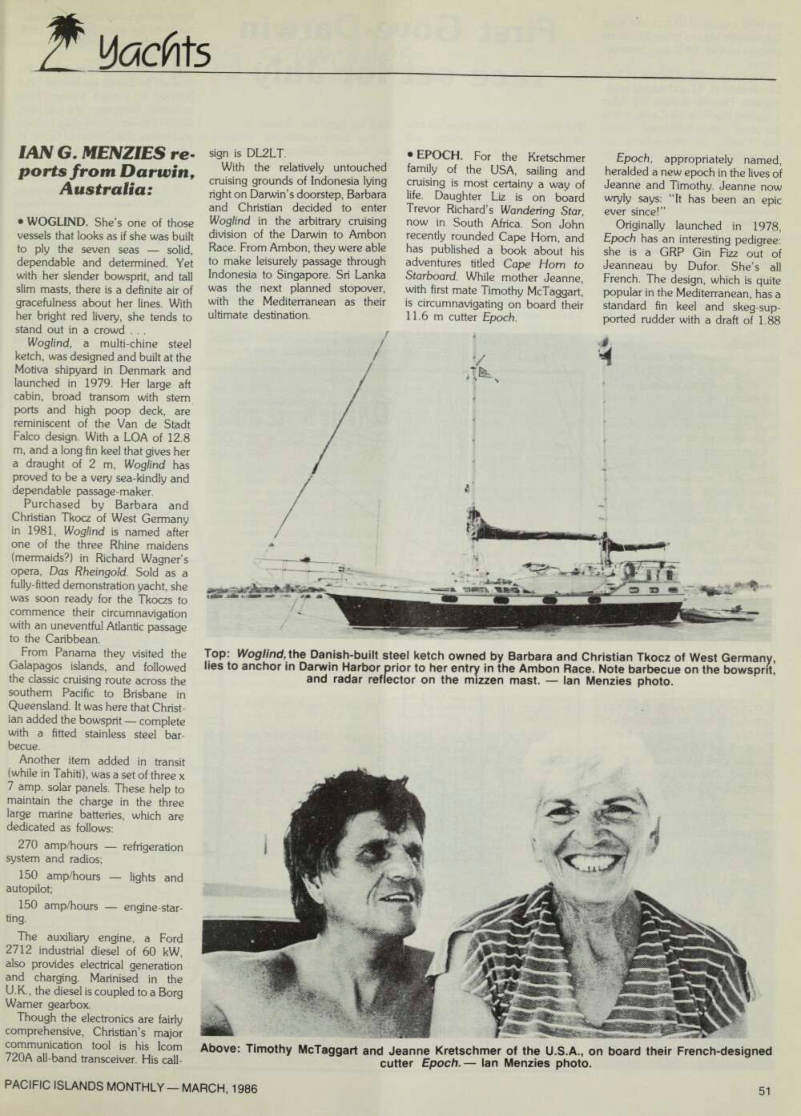
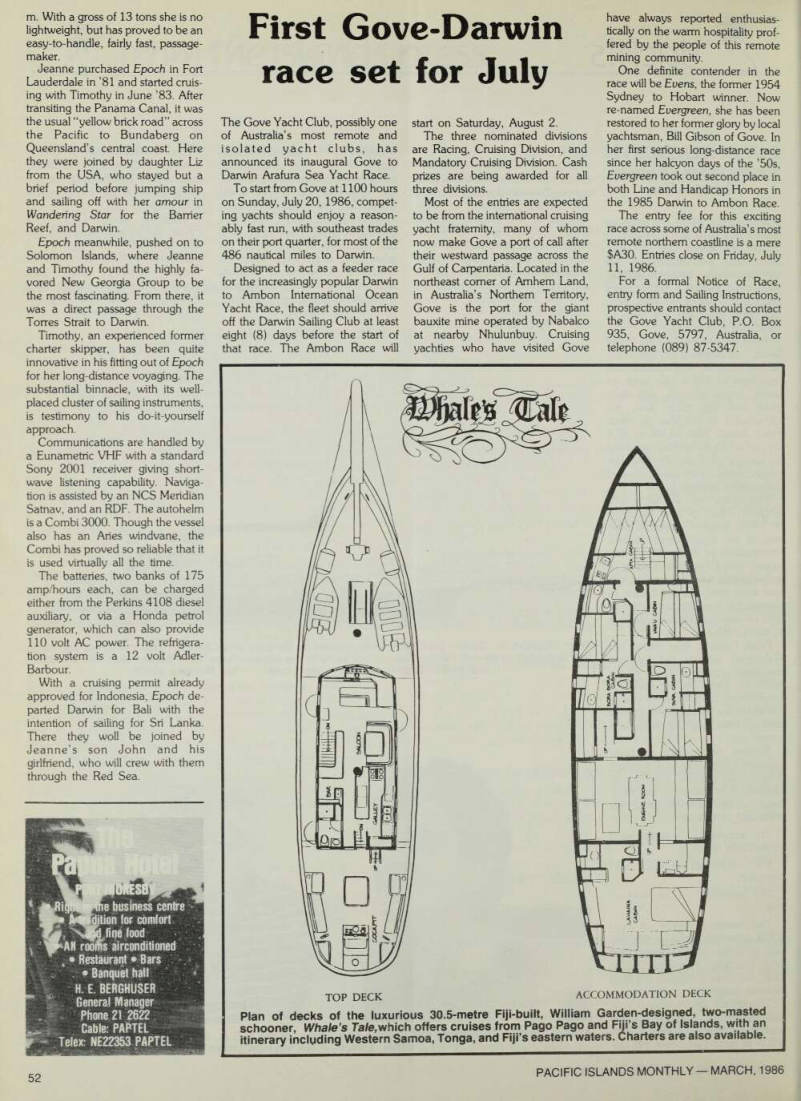
Ian G. Menzies Re
ports from Darwin , Australia:
• WOGLIND. She’s one of those vessels that looks as if she was built to ply the seven seas solid, dependable and determined. Yet with her slender bowsprit, and tall slim masts, there is a definite air of gracefulness about her lines. With her bright red livery, she tends to stand out in a crowd . . .
Woglind, a multi-chine steel ketch, was designed and built at the Motiva shipyard in Denmark and launched in 1979. Her large aft cabin, broad transom with stem ports and high poop deck, are reminiscent of the Van de Stadt Falco design. With a LOA of 12.8 m, and a long fin keel that gives her a draught of 2 m, Woglind has proved to be a very sea-kindly and dependable passage-maker.
Purchased by Barbara and Christian Tkocz of West Germany in 1981, Woglind is named after one of the three Rhine maidens (mermaids?) in Richard Wagner’s opera, Das Rheingold. Sold as a fully-fitted demonstration yacht, she was soon ready for the Tkoczs to commence their circumnavigation with an uneventful Atlantic passage to the Caribbean.
From Panama they visited the Galapagos islands, and followed the classic cruising route across the southern Pacific to Brisbane in Queensland. It was here that Christ ian added the bowsprit complete with a fitted stainless steel bar becue.
Another item added in transit (while in Tahiti), was a set of three x 7 amp. solar panels. These help to maintain the charge in the three large marine batteries, which are dedicated as follows: 270 amp/hours refrigeration system and radios; 150 amp/hours lights and autopilot; 150 amp/hours engine-star ting.
The auxiliary engine, a Ford 2712 industrial diesel of 60 kW, also provides electrical generation and charging. Marinised in the U.K., the diesel is coupled to a Borg Warner gearbox.
Though the electronics are fairly comprehensive, Christian’s major communication tool is his Icom 720 A all-band transceiver. His call
sign is DL2LT.
With the relatively untouched cruising grounds of Indonesia lying right on Darwin’s doorstep, Barbara and Christian decided to enter Woglind in the arbitrary cruising division of the Darwin to Ambon Race. From Ambon, they were able to make leisurely passage through Indonesia to Singapore. Sri Lanka was the next planned stopover, with the Mediterranean as their ultimate destination.
• EPOCH. For the Kretschmer family of the USA, sailing and cruising is most certainy a way of life. Daughter Liz is on board Trevor Richard’s Wandering Star, now in South Africa. Son John recently rounded Cape Horn, and has published a book about his adventures titled Cape Horn to Starboard. While mother Jeanne, with first mate Timothy McTaggart, is circumnavigating on board their 11.6 m cutter Epoch.
Epoch, appropriately named, heralded a new epoch in the lives of Jeanne and Timothy. Jeanne now wryly says; “It has been an epic ever since!”
Originally launched in 1978, Epoch has an interesting pedigree: she is a GRP Gin Fizz out of Jeanneau by Dufor. She’s all French. The design, which is quite popular in the Mediterranean, has a standard fin keel and skeg-sup ported rudder with a draft of 1.88
Top: Woglind, the Danish-built steel ketch owned by Barbara and Christian Tkocz of West Germany, lies to anchor in Darwin Harbor prior to her entry in the Ambon Race. Note barbecue on the bowsprit, and radar reflector on the mizzen mast. - Ian Menzies photo.
Above: Timothy McTaggart and Jeanne Kretschmer of the U.S.A., on board their French-designed cutter Epoch. - Ian Menzies photo.
m. With a gross of 13 tons she is no lightweight, but has proved to be an easy-to-handle, fairly fast, passage maker.
Jeanne purchased Epoch in Fort Lauderdale in ’Bl and started cruis ing with Timothy in June ’B3. After transiting the Panama Canal, it was the usual “yellow brick road” across the Pacific to Bundaberg on Queensland’s central coast. Here they were joined by daughter Liz from the USA, who stayed but a brief period before jumping ship and sailing off with her amour in Wandering Star for the Barrier Reef, and Darwin.
Epoch meanwhile, pushed on to Solomon Islands, where Jeanne and Timothy found the highly fa vored New Georgia Group to be the most fascinating. From there, it was a direct passage through the Torres Strait to Darwin.
Timothy, an experienced former charter skipper, has been quite innovative in his fitting out of Epoch for her long-distance voyaging. The substantial binnacle, with its well placed cluster of sailing instruments, is testimony to his do-it-yourself approach.
Communications are handled by a Eunametric VHF with a standard Sony 2001 receiver giving short wave listening capability. Naviga tion is assisted by an NCS Meridian Satnav, and an RDF. The autohelm is a Combi 3000. Though the vessel also has an Aries windvane, the Combi has proved so reliable that it is used virtually all the time.
The batteries, two banks of 175 amp/hours each, can be charged either from the Perkins 4108 diesel auxiliary, or via a Honda petrol generator, which can also provide 110 volt AC power. The refrigera tion system is a 12 volt Adler- Barbour.
With a cruising permit already approved for Indonesia, Epoch de parted Darwin for Bali with the intention of sailing for Sri Lanka.
There they woll be joined by Jeanne’s son John and his girlfriend, who will crew with them through the Red Sea.
First Gove-Darwin
race set for July
The Gove Yacht Club, possibly one of Australia’s most remote and isolated yacht clubs, has announced its inaugural Gove to Darwin Arafura Sea Yacht Race.
To start from Gove at 1100 hours on Sunday, July 20, 1986, compet ing yachts should enjoy a reason ably fast run, with southeast trades on their port quarter, for most of the 486 nautical miles to Darwin.
Designed to act as a feeder race for the increasingly popular Darwin to Ambon International Ocean Yacht Race, the fleet should arrive off the Darwin Sailing Club at least eight (8) days before the start of that race. The Ambon Race will
start on Saturday, August 2.
The three nominated divisions are Racing, Cruising Division, and Mandatory Cruising Division. Cash prizes are being awarded for all three divisions.
Most of the entries are expected to be from the international cruising yacht fraternity, many of whom now make Gove a port of call after their westward passage across the Gulf of Carpentaria. Located in the northeast comer of Arnhem Land, in Australia’s Northern Territory, Gove is the port for the giant bauxite mine operated by Nabalco at nearby Nhulunbuy. Cruising yachties who have visited Gove
have always reported enthusias tically on the warm hospitality prof fered by the people of this remote mining community.
One definite contender in the race will be Evens, the former 1954 Sydney to Hobart winner. Now re-named Evergreen, she has been restored to her former glory by local yachtsman, Bill Gibson of Gove. In her first serious long-distance race since her halcyon days of the ’sos, Evergreen took out second place in both Line and Handicap Honors in the 1985 Darwin to Ambon Race.
The entry fee for this exciting race across some of Australia’s most remote northern coastline is a mere SA3O. Entries close on Friday, July 11, 1986.
For a formal Notice of Race, entry form and Sailing Instructions, prospective entrants should contact the Gove Yacht Club, P.O. Box 935, Gove, 5797, Australia, or telephone (089) 87-5347.
Whale's Dale
Plan of decks of the luxurious 30.5-metre Fiji-built, William Garden-designed, two-masted schooner, Whale’s Tale, which offers cruises from Pago Pago and Fiji’s Bay of Islands, with an itinerary including Western Samoa, Tonga, and Fiji’s eastern waters. Charters are also available.
Advertisements & other items, p. 52 (1 item)
business centre
ion for comfort fine food H roofs alrconditioned Restaurant • Bars • Banquet hall
H. E. BERGHUSER
General Manager Phone 21 2622 Cable: PAPTEL r- Jelex: NE22353 PAPTEt ■ ' —> ■ ■ - ■ ■- ■ ' v "‘
shipping schedules
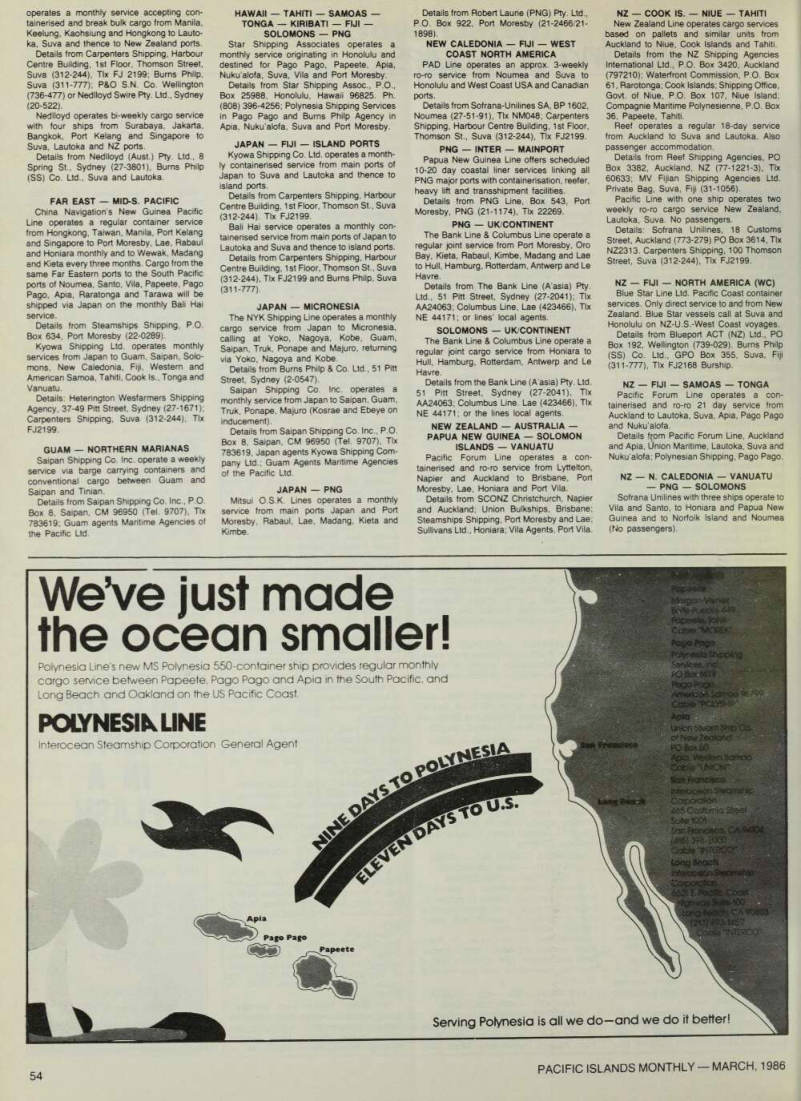
Should any shipping company wish to have its services cargo and passenger included in these listings they should contact
Pim.
Australia Fiji
Sofrana-Unilines (Fiji Express Line) oper ates to Suva and Lautoka every three weeks from the main ports on the east coast of Australia and monthly to Lautoka from Mel bourne and Sydney.
Details from Sofrana-Unilines, 432 Kent Street, Sydney (264-8944), Tlx AA 70090; Wiltrans Agency Pty. Ltd., 21st Floor, 60 Market St., Melbourne (614-4788); Tlx 30163 ACTA Pty. Ltd., Brisbane (221-3116); Elders- ANL Pty. Ltd., Port Adelaide, (47-5688): Newcastle, Sofrana Sydney (27-9851); Websters-ANL, 58 Charles St., Launceston, Tasmania (320-555); Carpenters Shipping, Harbour Centre Building, Ist Floor, Thomson Street, Suva, Fiji (312-244), Tlx FJ2199.
Australia Samoas Tonga
Warner Pacific Lines operates a regular cargo service from Sydney, Brisbane and Melbourne to Nukualofa, Pago Pago, Apia and Vavau. Feeder service available from Apia to Cook, Christmas, Fanning and Washington Islands.
Details from Hetherington Wesfarmers Shipping Agency, 37-49 Pitt Street, Sydnev, (27-1671).
Australia New Caledonia
Fiji Samoas Tonga Nz
Pacific Forum Line operates a fully con tainerised service (general, reefer and ro-ro) from Sydney to Noumea, Lautoka, Suva, Apia, Pago Pago, Nukualofa. Lyttelton, Syd ney. Cargo centralised from Adelaide, Mel bourne, Brisbane.
Details from Pacific Forum Line, P.O. Box 796 Auckland, Union Bulkships, 333 George Street, Sydney, Brisbane and Melbourne, Union Co., Lautoka, Suva, Nukualofa, Pacific Forum line Apia, Polynesia Shipping Pago Pago, SCONZ, Christchurch.
Australia Lord Howe Is.
Norfolk Is.
Compagnie des Chargeurs Caledoniens operates four-weekly cargo service Sydney- Lord Howe Island and Norfolk Island.
Details Hetherington Wesfarmers Shipping Agency, 37-49 Pitt Street, Sydney (27-1671).
Australia Kiribati
K. Asia Pacific operates a 5/6 weekly service from Melbourne and Sydney to Kiribati (Tarawa).
Details from K. Asia Pacific Pty. Ltd., Goldfields House, 1 Alfred Street, Circular Quay, Sydney (232-2277), Tlx 122143.
KAP New Guinea Lines call Tarawa after PNG ports on a 35 day basis from Melbourne and Sydney/Brisbane.
Details from K. Asia Pacific Pty. Ltd., Goldfields House. 1 Alfred Street, Circular Quay. Sydney (232-2277), Tlx 122143.
Warner Pacific Line operates a 6 weekly containerised/breakbulk service to Tarawa from Melbourne/Sydney/Brisbane and Auck land. Details from Hetherington Wesfarmers Shipping Agency, 37-49 Pitt Street, Sydney (27-1671); Mac Kay Shipping Ltd., Downtown House, Queen Street, Auckland (30-229).
Australia New Caledonia
And/Or Vanuatu
Sofrana-Unilines ships serve Noumea every three weeks from the main ports along the east Australian coast.
Details from Sofrana-Unilines, 19 Pitt Street, Sydney (27-9851), Wiltrans-Agency Pty. Ltd., 21st Floor, 60 Market St., Mel bourne (614-4788) Tlx 30163 ACTA Pty. Ltd.,
Brisbane (221-3116). Elders-ANL Pty. Ltd., Port Adelaide (47-5688), Newcastle, Sofrana Sydney (27-9851); Websters-ANL, 58 Charles St., Launceston, Tasmania (320- 555).
Compagnie des Chargeurs Caledoniens operates a three-weekly containerised cargo service from Sydney to Noumea.
Details Hetherington Wesfarmers Shipping Agency. 37-49 Pitt Street. Sydney (27-1671).
Compagnie Generate Maritime operates a monthly service from Sydney, Melbourne and Brisbane to Noumea, Port Vila and Santo, for containerised and break bulk cargo.
Details Compagnie Generate Maritime, 12
Castlereagh Street, Sydney (231-3700).
Australia Nauru
Marshall Is. Kiribati
Nauru Pacific Line operates regular cargo service from Melbourne to Nauru, Majuro and Tarawa, Passenger service to Nauru only.
Details: Nauru Pacific Line (Aust). Pty. Ltd.
Nauru House, 80 Collins Street, Melbourne (653-5709), Nedlloyd Swire, 8 Spring Street, Sydney (2-0522).
Australia New Zealand
The Australian National Line and the New Zealand Line operate a 10-day container service (TRANZTAS) between Sydney and Melbourne to Auckland, Wellington, Lyttelton and Port Chalmers.
The Tranztas service has been extended to cover Burnie and Fremantle on a direct call monthly basis linking to the main New Zealand ports.
Details from ANL Shipping Agencies, 20 Bond Street. Sydney (232-0444) and ANL Shipping Agencies, “World Trade Centre”, cnr Flinders and Spencer Streets, Melbourne (611-2323) or New Zealand Line, Pastoral House, 98 Lambton Quay, Wellington (728- 5000).
Australia Marshall Is.
Warner Pacific Line operates a six weekly containerised/breakbulk service to Majuro from Melbourne/ Sydney/Brisbane and Auck land.
Details from Hetherington Wesfarmers Shipping Agency, 37-49 Pitt Street, Sydney
(27-1671); Mac Kay Shipping Ltd, Downtown
House, Queen Street, Auckland. (30-229).
Australia Marianas Guam
Fsm Palau
Micronesia Transport Line operates a 55day containerised/breakbulk service from Melbourne/Sydney/Brisbane and Auckland to Palau, Yap, Guam, Saipan, Truk, Ponape and, on inducement, Kosrae.
Details from Hetherington Wesfarmers Shipping Agency, 37-49 Pitt Street, Sydney (27-1671): Sofrana Unilines, Customs Street,
Auckland (77-3279).
Australia Nz Fiji Tonga
Vanuatu New Caledonia
Solomons New Guinea
Sitmar Cruises operates a year-round cruise program from Sydney to include the better-known ports in the above countries, plus a number of unspoilt, and largely unknown, island paradises.
Details from Sitmar Cruises, 39 Martin Place, Sydney (239-9000); NSW, reserva tions and inquiries (008 42-2277); Rest of Australia, reservations and inquiries (008 22-2277).
Australia Nz Fiji Tonga
Vanuatu New Caledonia
Solomons Samoas Tahiti
P&O liners call at Auckland, Bay of Islands, Honiara, Lautoka, Noumea, Nukualofa, Pago Pago, Papeete, Port Moresby, Santo, Savu
savu, Suva, Vavau and Vila on cruises from Australia.
Details from P&O Booking Centre, World Travel Headquarters Pty Ltd, 33 Bligh Street Sydney (237-0333).
Australia Png
Solomons Vanuatu Nz
Pacific Forum Line operates a con tainerised and ro-ro from Brisbane to Port Moresby, Lae, Honiara, Port Vila, Lyttelton, Napier and Auckland.
Details from Union Bulkships, Brisbane Steamships Shipping, Port Moresby and Lae; Sullivans Ltd, Honiara, Vila Agents, Port Vila; SCONZ Christchurch, Napier and Auckland.
Australia Micronesia
Nauru Pacific Line operates a regular container service from Melbourne to Ponape, Truk, Guam and Saipan.
Details: N.P.L. (Australia) Pty Ltd. Nauru House, 80 Collins Street, Melbourne (653- 5709). Nedlloyd Swire, 8 Spring Street, Sydney (2-0522).
Australia New Caledonia
Sofrana Unilines operates a 3-4 weekly service from East Coast mainports to Noumea.
Details from Sofrana Unilines 432 Kent Street, Sydney. (Tel. 264-8944). Tlx AA 70090.
Australia Tuvalu
K. Asia Pacific operates a three monthly service from Sydney and Melbourne to Tuvalu (Funafuti). Subject to inducement.
Details from K. Asia Pacific Pty Ltd, Goldfields House, 1 Alfred Street, Circular Quay, Sydney (232-2277). Tlx 122143.
Warner Pacific Line operates a six week containerised/breakbulk service to Funafuti from Melbourne/Brisbane/ Sydney and Auck land.
Details from Hetherington Wesfarmers Shipping Agency, 37-49 Pitt Street, Sydney (27-1671): Mac Kay Shipping Ltd, Downtown House, Queen Street, Auckland (30-229).
Australia Png
KAP New Guinea Lines cargo vessels call at Melbourne, Sydney, Port Moresby, Lae, Madang, Wewak, Manus, Kimbe, Rabaul, Popondetta.
Details from K. Asia Pacific Pty Ltd.
Goldfields House, 1 Alfred Street, Circular Quay. Sydney (232-2277), Tlx 122143. Dal gety Shipping, World Trade Centre, Mel bourne (616-6700).
Australia Png Solomons
Sofrana Unilines (Aust.) P/L operates a 3-4 weekly cargo service to PNG, ex-main ports on the east coast of Australia.
Details from Sofrana Unilines, 432 Kent Street. Sydney (264-8944), Tlx AA 70090.
Australia Png Solomons
Vanuatu
A consortium of NGAUPNGL and CON PAC/NEL have four vessels operating a joint service from east coast Australian ports to Port Moresby, Lae, Alotau, Madang, Wewak, Rabaul, Kavieng-Kimbe, Kieta, Honiara, Vila, Santo.
Details from Burns Philp & Co. Ltd., P.O.
Box R 124, Royal Exchange, Sydney, 2000 (2-0547); Nedlloyd Swire, 8 Spring Street, Sydney (2-0522); New Guinea Express Lines, 37 Pitt Street, Sydney (241-3991); Vila Agents, PO Box 27, Port-Vila (2456). Tlx
Nhioii.
New Guinea Express Lines operates a weekly container service from Melbourne, Sydney, Brisbane to Port Moresby, Lae, Alotau, Kimbe, Rabaul, Kieta, Honiara, Kavieng, Madang, Wewak, Santo, Vila.
Details from New Guinea Express Lines, P.O. Box R 73, Royal Exchange, Sydney (241-3991); New Guinea Express Lines, 127 Creek Street, Brisbane (221-9333); New Guinea Express Lines, 327 Collins Street, Melbourne (61-3053); Niugini Express Lines, Port Moresby (21-4572); Lae (42-1536); Niugini Island Cargo Services Pty. Ltd., Rabaul (922-467); Bougainville Agencies Pty.
Ltd., Kieta (956-089); Robert Laurie (PNG) P/L, Madang (82-2157); Garamut Enterprises P/L, Wewak (86-2106); Burns Philp (PNG) Ltd., Kavieng (94-2133); Alotau Stevedoring & Transport, Alotau (61-1318); Ngatia Wholesalers Pty. Ltd., Kimbe (93-5102); and Tradco Shipping, Mendana Avenue, Honiara (22588); Vila Agents Ltd., P.O. Box 971, Vila, Vanuatu (2490); John Lum & Associates, P.O. Box 65, Santo, Vanuatu (329).
Australia Tahiti
Compagnie Generate Maritime operates a monthly service from Sydney, Melbourne and Brisbane to Papeete, for containerised and break bulk cargo.
Details Compagnie Generate Maritime, 12 Castlereagh Street, Sydney (231-3700).
Sofrana Unilines (Aust.) P/L operates a 3/4 weekly cargo service to Papeete ex main ports on the east coast of Australia.
Details from Sofrana Unilines, 432 Kent Street, Sydney (264-8944) Tlx AA 70090.
Singapore Hongkong Fiji
Islands Ports
Kyowa Shipping Co. Ltd. operates a month ly containerised and break bulk cargo service from Singapore, Hongkong to Lautoka, Suva and then to island ports.
Details from Carpenters Shipping, Harbour Centre Building, Ist Floor, Thomson Street, Suva (312-244), Tlx FJ2199.
Far East Fiji
New Zealand
New Zealand Unit Express (NZUE) now
operates a monthly service accepting con tainerised and break bulk cargo from Manila, Keelung, Kaohsiung and Hongkong to Lauto ka, Suva and thence to New Zealand ports.
Details from Carpenters Shipping, Harbour Centre Building, Ist Floor, Thomson Street, Suva (312-244), Tlx FJ 2199; Burns Philp, Suva (311-777); P&O S.N. Co. Wellington (736-477) or Nedlloyd Swire Pty. Ltd., Sydney (20-522).
Nedlloyd operates bi-weekly cargo service with four ships from Surabaya, Jakarta, Bangkok, Port Kelang and Singapore to Suva, Lautoka and NZ ports.
Details from Nedlloyd (Aust.) Pty. Ltd., 8 Spring St., Sydney (27-3801), Burns Philp (SS) Co. Ltd., Suva and Lautoka.
Far East Mid-S. Pacific
China Navigation's New Guinea Pacific Line operates a regular container service from Hongkong, Taiwan, Manila, Port Kelang and Singapore to Port Moresby, Lae, Rabaul and Honiara monthly and to Wewak, Madang and Kieta every three months. Cargo from the same Far Eastern ports to the South Pacific ports of Noumea, Santo, Vila, Papeete, Pago Pago, Apia, Raratonga and Tarawa will be shipped via Japan on the monthly Bali Hai service.
Details from Steamships Shipping, P.O.
Box 634, Port Moresby (22-0289).
Kyowa Shipping Ltd. operates monthly services from Japan to Guam, Saipan, Solo mons, New Caledonia, Fiji, Western and American Samoa. Tahiti, Cook Is.. Tonga and Vanuatu.
Details: Heterington Wesfarmers Shipping Agency, 37-49 Pitt Street, Sydney (27-1671); Carpenters Shipping, Suva (312-244), Tlx FJ2199.
Guam Northern Marianas
Saipan Shipping Co. Inc. operate a weekly service via barge carrying containers and conventional cargo between Guam and Saipan and Tinian.
Details from Saipan Shipping Co. Inc., P.O.
Box 8, Saipan, CM 96950 (Tel. 9707), Tlx 783619; Guam agents Maritime Agencies of the Pacific Ltd.
Hawaii Tahiti Samoas
Tonga Kiribati Fiji
Solomons Png
Star Shipping Associates operates a monthly service originating in Honolulu and destined for Pago Pago, Papeete, Apia, Nukualofa, Suva, Vila and Port Moresby.
Details from Star Shipping Assoc., P. 0., Box 25988, Honolulu, Hawaii 96825. Ph. (808) 396-4256; Polynesia Shipping Services in Pago Pago and Burns Philp Agency in Apia, Nukualofa, Suva and Port Moresby.
Japan Fiji Island Ports
Kyowa Shipping Co. Ltd. operates a month ly containerised service from main ports of Japan to Suva and Lautoka and thence to island ports.
Details from Carpenters Shipping, Harbour Centre Building, Ist Floor, Thomson St., Suva (312-244). Tlx FJ2199.
Bali Hai service operates a monthly con tainerised service from main ports of Japan to Lautoka and Suva and thence to island ports.
Details from Carpenters Shipping, Harbour Centre Building, Ist Floor, Thomson St., Suva (312-244), Tlx FJ2199 and Burns Philp, Suva (311-777).
Japan Micronesia
The NYK Shipping Line operates a monthly cargo service from Japan to Micronesia, calling at Yoko, Nagoya, Kobe, Guam, Saipan, Truk, Ponape and Majuro, returning via Yoko, Nagoya and Kobe.
Details from Bums Philp & Co. Ltd., 51 Pitt Street, Sydney (2-0547).
Saipan Shipping Co. Inc. operates a monthly service from Japan to Saipan, Guam, Truk, Ponape, Majuro (Kosrae and Ebeye on inducement).
Details from Saipan Shipping Co. Inc., P.O.
Box 8, Saipan, CM 96950 (Tel. 9707), Tlx 783619, Japan agents Kyowa Shipping Com pany Ltd.; Guam Agents Maritime Agencies of the Pacific Ltd.
Japan Png
Mitsui O.S.K. Lines operates a monthly service from main ports Japan and Port Moresby, Rabaul, Lae, Madang, Kieta and Kimbe.
Details from Robert Laurie (PNG) Pty. Ltd., P.O. Box 922, Port Moresby (21-2466/21- 1898).
New Caledonia Fiji West
Coast North America
PAD Line operates an approx. 3-weekly ro-ro service from Noumea and Suva to Honolulu and West Coast USA and Canadian ports.
Details from Sofrana-Unilines SA, BP 1602, Noumea (27-51-91), Tlx NMO4B; Carpenters Shipping, Harbour Centre Building, Ist Floor, Thomson St., Suva (312-244), Tlx FJ2199.
Png Inter Mainport
Papua New Guinea Line offers scheduled 10-20 day coastal liner services linking all PNG major ports with containerisation, reefer, heavy lift and transshipment facilities.
Details from PNG Line, Box 543, Port Moresby, PNG (21-1174), Tlx 22269.
Png Uk/Continent
The Bank Line & Columbus Line operate a regular joint service from Port Moresby, Oro Bay, Kieta, Rabaul, Kimbe, Madang and Lae to Hull, Hamburg, Rotterdam, Antwerp and Le Havre.
Details from The Bank Line (A’asia) Pty.
Ltd., 51 Pitt Street, Sydney (27-2041); Tlx AA24063; Columbus Line, Lae (423466), Tlx NE 44171; or lines' local agents.
Solomons Uk/Continent
The Bank Line & Columbus Line operate a regular joint cargo service from Honiara to Hull, Hamburg, Rotterdam, Antwerp and Le Havre.
Details from the Bank Line (A’asia) Pty. Ltd. 51 Pitt Street, Sydney (27-2041), Tlx AA24063; Columbus Line. Lae (423466), Tlx NE 44171; or the lines local agents.
New Zealand Australia
Papua New Guinea Solomon
Islands Vanuatu
Pacific Forum Line operates a con tainerised and ro-ro service from Lyttelton, Napier and Auckland to Brisbane, Port Moresby, Lae, Honiara and Port Vila.
Details from SCONZ Christchurch, Napier and Auckland; Union Bulkships, Brisbane, Steamships Shipping, Port Moresby and Lae; Sullivans Ltd., Honiara; Vila Agents, Port Vila.
Nz Cook Is. Niue Tahiti
New Zealand Line operates cargo services based on pallets and similar units from Auckland to Niue, Cook Islands and Tahiti.
Details from the NZ Shipping Agencies International Ltd., P.O. Box 3420, Auckland (797210); Waterfront Commission, P.O. Box 61, Rarotonga; Cook Islands; Shipping Office, Govt, of Niue, P.O. Box 107, Niue Island; Compagnie Maritime Polynesienne, P.O. Box 36, Papeete, Tahiti.
Reef operates a regular 18-day service from Auckland to Suva and Lautoka. Also passenger accommodation.
Details from Reef Shipping Agencies, PO Box 3382, Auckland, NZ (77-1221-3), Tlx 60633; MV Fijian Shipping Agencies Ltd.
Private Bag, Suva, Fiji (31-1056).
Pacific Line with one ship operates two weekly ro-ro cargo service New Zealand, Lautoka, Suva. No passengers.
Details: Sofrana Unilines, 18 Customs Street, Auckland (773-279) PO Box 3614, Tlx NZ2313. Carpenters Shipping, 100 Thomson Street, Suva (312-244), Tlx FJ2199.
Nz Fiji North America (Wc)
Blue Star Line Ltd. Pacific Coast container services. Only direct service to and from New Zealand. Blue Star vessels call at Suva and Honolulu on NZ-U.S.-West Coast voyages.
Details from Blueport ACT (NZ) Ltd., PO Box 192, Wellington (739-029). Burns Philp (SS) Co. Ltd., GPO Box 355, Suva, Fiji (311-777), Tlx FJ2168 Burship.
Nz Fiji Samoas Tonga
Pacific Forum Line operates a con tainerised and ro-ro 21 day service from Auckland to Lautoka, Suva, Apia, Pago Pago and Nuku’alofa.
Details from Pacific Forum Line, Auckland and Apia, Union Maritime, Lautoka, Suva and Nuku’alofa; Polynesian Shipping, Pago Pago.
Nz N. Caledonia Vanuatu
Png Solomons
Sofrana Unilines with three ships operate to Vila and Santo, to Honiara and Papua New Guinea and to Norfolk Island and Noumea (No passengers).
Details from Sofrana Unilines, 18 Customs Street, Auckland (773-279), PO Box 3614, Tlx NZ2313.
Nz Tahiti
Compagne Tahotienne Maritime SA (as CTM-Tahiti Line) operates one ship, MV Bounty 111, monthly Papeete New Zealand. (No passengers).
Details from Sofrana Unilines, PO Box 3614, 18 Customs St., Auckland, Tlx NZ2313.
CTM-Tahiti Line, PO Box 9012, Papeete (39042), Tlx Tahitlin 322 FP Tahiti.
Nz Tonga Samoas
Warner Pacific Line services Auckland, Nukualofa, Vavau, Apia, Pago Pago fort nightly carrying general and freezer cargoes.
Details from McKay Shipping Ltd., Down town House, 21 Queen St., Auckland, PO Box 1372 (30-299). Cables MACSHIP, Telex NZ2554, Warner Pacific Line, Box 93, Nuku’alofa, Tonga; Mealelei (Western Samoa) Ltd. Private Bag, Apia, Western Samoa, Pacific Maritime Services, PO Box 2617, Pago Pago, American Samoa (633- 2728), cables: Pacmar SX2OS.
Tahiti New Caledonia
Vanuatu Solomon Is.
New Zealand Png
Singapore Europe
Polish Ocean Lines operate in a semi container type vessel to the following ports, from Papeete, Noumea, Santo, Vila, Yandina, Honiara, Auckland. Rabaul, Lae, Singapore, Port Klelang, Penang then to Mediterranean ports and Europe via the Suez Canal. (Other New Zealand ports subject to inducement).
Details from Universal Shipping Agencies Ltd., 6th Floor, 38 Fort Street, Auckland 1, New Zealand (390931, 390727, 32105), Tlx 21517.
Europe Tahiti
New Caledonia
Compagne Generale Maritime operates services from Europe and Mediterranean
ports to Papeete and Noumea using three ro-ro and multi-purpose vessels thus ensuring a bi-monthly sailing to and from.
Details Compagne Generale Maritime, 12 Castlereagh Street. Sydney (231-3700).
Europe Tahiti
New Calendonia New Zealand
Vanuatu Solomons
Png Europe
Polish Ocean Lines offers regular monthly sailings for containerised and break bulk cargo, also conventional reefer space and reefer containers from Hamburg, Rotterdam, Dunkirk, Rouen to Papeete, Noumea, Auck land, Santo, Honiara, Rabaul, Lae, Singa pore, returning to Europe via Suez, other ports in South Pacific can be served directly with inducement or otherwise via tranship ment.
Details from Sotama, BP 9170, Papeete, Tel. 427805 Tlx 373 PF SATO: BP C 2 Noumea Cedex Tel. 272094 Tlx 163 NM/ Universal Shipping Agencies PO Box 2282 Auckland Tel. 30930 Tlx 21517/Vanua Navigation PO Box 44 Vila Tel. 2027 Tlx 1033/Melan Chine Shipping Co. PO Box 71 Honiara Tel. 21678 Tix 66335/Steam ships Shipping & Transport PO Box 1512 Rabaul Tel 922952 Tlx 92929/Steam ships Trading Co. Ltd. PO Box 85 Lae Tel. 424666 Tlx 42423/Union Steamship Co. of NZ Ltd. PO Box 50 Apia Tel. 21781 Tlx 225/Warner Pacific Line PO Box 93 Nuku’alo fa Tel. 22088 Tlx 66219/Fiji Agents
Tba.
Europe Tahiti W.
Samoa Fiji N. Caledonia
Nedlloyd offers regular cargo services from Continental ports to Papeete, Apia, Fiji and New Caledonia.
Details Nedlloyd (Aust.) Pty. Ltd., 8 Spring Street. Sydney (27-3801); Carpenters Ship ping, Ist Floor. Harbour Centre Bldg., 100 Thomson St.. Suva (312-244), Tlx 2199FJ and Vetari Street. Lautoka (63988), Tlx 5215FJ.
Uk N. Continent W. Samoa
Tonga Fiji
The Bank Line & Columbus Line operate a regular joint cargo service from Hull, Ham burg t Bremen, Antwerp, Rotterdam and Le Havre to Apia, Nuku’alofa, Suva and Lautoka.
Details from The Bank Line (A'asia) Pty.
Ltd., 51 Pitt Street, Sydney (27-2041), Tlx AA 24063, Columbus Line, Lae (423-466), Tlx NE 44171, or lines local agent.
Uk N. Continent Png
Solomons
The Bank Line & Columbus Line operate a regular joint cargo service from Hull, Ham burg, Bremen, Antwerp, Rotterdam and Le Havre to Port Moresby, Lae, Madang, Kimbe, Rabaul, Kieta and Honiara and on induce ment to Yandina.
Details from The Bank Line (A’asia) Pty.
Ltd., 51 Pitt Street, Sydney (27-2041), Tlx AA 24063. Columbus Line, Lae (42-3466). Tlx NE 44171; or lines local agents.
Uk/N. Continent Tahiti
N. Caledonia Vanuatu
The Bank Line & Columbus line operate a regular joint cargo service from Hull, Ham burg, Bremen, Antwerp, Rotterdam and Le Havre to Papeete, Noumea, Port-Vila and Santo.
Details from The Bank Line (A’sia) Pty. Ltd., 51 Pitt Street, Sydney (27-2041), Tlx AA 24063, Columbus Line, Lae (42-3466), Tlx NE 44171; Ets. A.M. Fare UTE. Papeete; Ets, Ballande, Noumea and other local agents.
U.S. Hawaii Micronesia
E. Malaysia Brunei
Papua New Guinea Philippines
PM&O Lines operates three fully self sustained container vessels on a sailing frequency of every 28 days from the San Francisco Bay area, Los Angeles, and Hon olulu to Majuro, Ebeye, Kosrae, Ponape, Truk, Saipan, Yap, Koror, Kota Kinabalu, Brunei, Lae, Kieta and Rabaul.
Service is offered utilising the same vessels on the same 28-day frequency from the Philippine ports of Manila and Cebu and the
Papua New Guinea ports of Rabaul, Lae, and Kieta to San Francisco and Los Angeles.
Finally service is available from Manila, Cebu, Hongkong, Keelung and Kaohsiung to Saipan, Guam, Truk, Ponape, Majuro, Yap, Koror, Kieta, Rabaul, and Lae.
Details from PM&O Lines, 181 Fremont Street, San Francisco, California, 94105, U.S.A. (415) 543-7430, Tlx 278016; Cable PMONAV SFO; PM&O Owner's representa tive, P.O. Box 803, Saipan, N.M.I. 96950.
Cable Commontime Saipan, Tlx
783605, Anscor Transport and Terminals Inc.
P.O. Box 7023-5. Metro Manila, Philippines
(521-8074), Tlx 65021 Atti Pn.
U.S. Hawaii Samoas
Kiribati Nauru
Nauru Pacific Line operates regular con ventional and container services from San Francisco and Honolulu to Christmas Island, Pago Pago, Apia, Tarawa and Nauru.
Details from N.P.L. (Australia) Pty. Ltd., Nauru House, 80 Collins Street, Melbourne (653-5709), Nauru Air and Shipping Agency, Suite 2803, 185 Berry Street, San Francisco, California 94107 (415-543-4517). Nauru Air and Shipping Agency, Suite 506, 841 Bishop St., Honolulu, HI 96813 (808-523-0441).
U.S. Noumea Fiji
PAD Line operates an approx. 3-weekly ro ro service from west coast USA and Canada to Noumea, Suva and Lautoka.
Details from Sofrana Unilines BP 1602, Noumea (27-51-91). Tlx NMO4B. Carpenters Shipping, Harbour Centre Building, Ist Floor, 100 Thomson Street, Suva (312-244), Tlx FJ2199, Trans-Austral Shipping Pty. Ltd., P.O. Box R 232, Royal Exchange, 2000 (231-8411), Tlx AA21204.
U.S. Tahiti Samoa
Pacific Islands Transport operates a five weekly cargo service from North America west coast ports to Papeete, Pago Pago, Apia.
Details from Polynesia Shipping Services inc. P.O. Box 1478, Pago Pago 96799.
Advertisements & other items, pp. 53-56 (1 item)
News
ALL THE
IN A
PUSH
The South Sea Digest tells you what you want to know about the Pacific Islands in a few words. All the leading firms and diplomatic missions read it.
See insert for subscription details:
THE SOUTH SEA DIGEST
We’ve just made
the ocean smaller!
Polynesia Line's new MS Polynesia 550-container ship provides regular monthly cargo service between Papeete, Pago Pago and Apia in the South Pacific, and Long Beach and Oakland on the US Pacific Coast.
POLYNESIA LINE
Interocean Steamship Corporation General Agent iisi Sox SO
olsS
9 San & Ir^efocear.
K U =tO CaSloirta & Suite «* sS 3 5* Apia Pago Pago Papeete Serving Polynesia is all we do—and we do it better!
POLISH OCEAN LINES
General Management, 10 Lutego 24,81-364 GDYNIA, POLAND, Phone: 20-19-01. Cables: POLOCEAN Telex: 054-231 Q & j pi i * Jl ir- «s >•** 35 • > • V*. rf.. i-'i v : •. • .. *1? ' . -T v* v • • v ... .
?:-v-V;.W
l Vi VvV*.
W ■v>i’
SOUTH PACIFIC SERVICE |j
4f!riAycDD mo nMl,L?ol)' iC oi?.^ nd ,rom: GDY NIA, HAMBURG, ROTTERDAM, MIDDLESBOROUGH/IMMINGHAM QiKirADr\DcßV NK K ’. r °DEM, PAPEETE (via PANAMA), NOUMEA, AUCKLAND, HONIARA, RABAUL, LAE oiiNUArUnh, by our multipurpose vessels carrying dry and reefer containers, reefer chambers, heavy lifts, breakbulk or
palletized, bulk liquids.
AM POLISH OCEAN LINES Representatives AUCKLAND Mr. A. Sieradzki. Telex 21517 NZ “UNISHIP”. SYDNEY Mr. Walenciak. Telex 20428 AA “SLEIGH” tauiti cataua -r „ POLISH OCEAN LINES Agents AGENPIFq ixn NEW CALE DONIA SATO Telex 163 NM “SATO”. AUCKLAND UNIVERSAL SHIPPING ACtNCIcS LTD., Telex 21517 NZ^UNISHIP’^SOLOMONS MELAN CHINE SHIPPING CO., LTD Telex 66335 HO “SYMECO”. PNG
YOUR BUSINESS PARTNER
Japan S. Korea Taiwan Singapore Hong Kong To: Solomon Is., New Caledonia, Fiji, W. Samoa, A. Samoa, Tahiti, Cook Is., Tonga, Vanuatu, Tuvalu. Nauru To: Guam, Saipan, Truk, Ponape, Majuro, Yap. Koror
Taiwan Hong Kong Singapore Philippines
To: Papua New Guinea, Pacific Islands.
A •* ft* S %
KYOWA
KYOWA SHIPPING CO., LTD.
-IEAD OFFICE:
sth Floor., Kikushima Bldg., 2-3, Hamamatsucho 2-chome, Minato-ku, Tokyo 105, Japan shone' 03(437)2885 (Rep.) Cables: "MARIQUEEN" Tokyo Telex: 242-4651 Kyowa J.
OSAKA OFFICE:
7th Floor., Okajima Bldg., 2-14, Nishihonmachi 1-chome, Nishi-ku, Osaka, Japan Phone: 06(533)5821 (Rep.) Cables: "MARIQUEEN” Osaka Telex: 525-6271 Ssiosa J.
deaths
Sardar Bakshi Singh Mai In Suva on January 6, aged 67.
A Suva landlord and former senator, Mr Mai went to Fiji in the mid-1980s after completing his college education in Punjab, India.
He was one of the first graduates from Wellington Uni versity in New Zealand.
In Fiji, Mr Mai took over his uncle’s business running an aerated water factory before branching out into a real estate business.
He was responsible for the development of many resi dential and commercial blocks in Raiwaqa and along Rewa, Bakshi, Mate and Mai streets.
Mr Wal also developed blocks at Wainadoi and Nasinu.
He held the post of secretary and president of the Samabula Sikh Gurudanora for a number of years, and played a major role in the construction of the Samabula Sikh Temple.
In early 1950, Mr Mai got together with colleagues from the Indian Association of Fiji and helped to establish Indian High School and Deenbandhu Primary School.
He was chairman of the Board of Governors of Indian College.
He was also chairman of the Transport Control Board, and was made a Member of the British Empire (MBE) for his services to the country.
Ram Sami Reddy In Lautoka on December 8, aged 62.
Mr Ram Sami Reddy was one of four brothers who founded Reddy Construction which is now one of Fiji’s biggest family-owned enter prises.
The Reddy group of com panies is involved in construc tion, hotels, real estate and other related ventures.
Mr Ram Reddy, as he was known, moved to settle in Au ckland in 1974 but still retained his business interests in Fiji.
In addition to his interest in the family business, Mr Reddy
owned a roofing iron factory and a liqor shop at Lautoka.
He was a childhood friend of the Prime Minister, Ratu Sir Kamisese Mara, who visited him in hospital two days before his death, and of the former Governor-General, Ratu Sir George Cakobau, and the late Ratu Sir Edward Cakobau.
Eileen Holly May Lawlor At Lami, Suva, on January 15, aged 89.
Mrs Lawlor, who was born in Suva, was a daughter of Mr and Mrs T. P. Nicholson. Mr Nichol son was a leading Fiji boatbuil der in the early part of the century: Mrs Lawlor’s husband, Led wedge Arthur (Les), was a partner in the firm of Pearce and Company, Suva.
His early years were spent in shipping and he served with one of the Fiji contingents in World War 1. He died in 1956.
Ganga Raju At Rarawai (Ba, Fiji), on Janu ary 10, aged 57.
A Sugarcane Growers coun cillor from Ba, Mr Ganga Raju was a previous national trea surer of the Fiji Sugar and General Workers Union, ser ving for 14 years, and also served for three years as the union’s Ba branch president. • • • Following the brief notice of the death of Mrs Lynette Townsend at Buderim, Queensland, con tributed by Margaret Parer (PIM Feb.), we have received the following tribute to the late Mrs Townsend from Judy Tudor: The death of Lynette Town send takes another from the dwindling number of ex-resi dents who knew New Guinea in the 19205.
She was the widow of G.W.L. (Kassa) Townsend, but also well-known in her own right at a period when Euro pean women on New Guinea outstations were few and far between.
She was born in Parramatta,
New South Wales, in Novem ber, 1903, the third daughter of the Rev. Arthur and Mrs Tonge, but spent most of her life until her marriage in Melbourne where her father was headmas ter of Trinity Grammar School.
After a conventional education at Melbourne Girls’ Grammar School, and a visit to Europe, her engagement to Townsend and the prospect of life in unknown and primitive New Guinea caused apprehension in her family, particularly as Townsend’s liking for fieldwork was well-known.
However, in 1927 when he was posted from Ambunti on the Sepik River to Kavieng, New Ireland, it was considered just possibly the sort of place where a young wife could be taken to live. Townsend had no leave owing to him at the time so his bride-to-be had to come to him via mutual friends in Rabaul. The way he tells it in his autobiography, District Officer, the usual New Guinea mix-ups then ensued in that the Burns Philp steamer Montoro bringing Lynette to Rabaul, was also bringing the then Minister for Territories to Kavieng on a state visit. While Townsend did the right thing by the minister in Kavieng, she languished in Rabaul and her mother worried in Melbourne. As soon as the minister and the Montoro were on their way, Townsend char tered a schooner and duly arrived in Rabaul for his de layed wedding.
“We were married the following afternoon,” he re cords, “and left the next day but not before I tried to quieten the fears of my wife’s mother in Australia . . . she knew when the Montoro had reached Rabaul. For days afterwards she waited for word from us that the marriage had taken place and finally she had sent a radio addressed simply to Townsend, Rabaul’. This was delivered to the home of the Treasurer, H.O. Townsend, a namesake but no relation of mine. There his wife of some years standing opened the mes
sage and read; ‘Are you mar ried yet?’ Treasurer Townsend and I had our arguments over the years but he regarded this as a great joke, even if his wife did not.”
They left almost at once for New Ireland, taking passage on another schooner and sleeping on the hatch cover. They dis embarked at Kalili on the west coast, walked the nine or 10 miles across the island, and were eventually picked up at Karu on the east-coast road by the government lorry.
Home for the young couple in Kavieng was the sprawling house built by the famous Ger man administrator of New Ire land, Bulominski, who was also responsible for the east-coast road from Kavieng to Namata nai, one of the few significant roads of any sort in pre-war New Guinea.
While Townsend was in the army during World War 11, Mrs Townsend and her two children lived in Melbourne. They accompanied Kassa to New York in late 1945 when he was appointed to the United Na tions, returning after 10 years to retirement in Montville, Queensland.
After Kassa Townsend’s death in 1962 she lived in Buderim, latterly in Buderim Garden Village. She took an active part in local community work but kept in touch with many old New Guinea friends.
During her years in New York she had met a number of Quakers, become interested in Quakers generally, and after her move to Buderim became one herself.
Her background and the period in which she spent the early years of her life, her experiences in New Guinea, and the influence of the man she married, reinforced her naturally firm and disciplined views, which possibly made her seem slightly formidable to an easier-going generation. She was an active person to the end, fiercely independent and determined to live alone the sort of character upon which Empires were once built.
Advertisements & other items, pp. 58-60 (1 item)
Dstlcw
SERVICE PAGE
ADVERTISING
Aggie Grey 58 Amatil 60
AW A 34
Begot Bell Foundaries 58 Baxter 32 Clarion Shoji 6 Columbus Line 44 Forum Fisheries 46 Hitachi 2 Kyowa Shipping 56 Larsen Pty. Ltd 32 Macquarie Corp 46 Mail Forwarding 58 Marianas Church 58 Mendocino Book Co 58 Nissan 16,17 Papua Hotel 52 Parliamentary Committee 32 Pioneer 59 Polish Ocean Lines 55 Polynesia Line 54 Sheaffer Pen-Textron 13 Toyota Motor 30,31
ara
DStLCW
AUSTRALIA: Distribution: The Herald and Weekly Times Ltd., 44-74 Flinders St.. Melbourne, Vic.. 3000 Advertising Reps Brisbane D. Wood, Anday Agency, CCA Centre, Dayboro Road, Closebum 4520; Box 1910, GPO Brisbane, 4001; telephone (07) 289-4128 Adelaide Hastwell Williamson Rouse Pty. Ltd., PO Box 419 Norwood, SA. 5067; 59 Kensington Road, Norwood; telephone (06) 332-3322, telex 87113; Perth Allen & Associates, Suite 2. 284 Stirling St., Perth. WA, 6000, telephone (09) 328-9593 or (09) 328-9363 FIJI; Distribution and subscriptions Desai Book shops. P O. Box 160, Suva, Fiji, telephone Suva 23036.
Advertising Fiji Times & Herald Ltd., 20 Gordon St., Suva, telephone 31-4111, telex FJ2124.
FRENCH POLYNESIA: Distribution Hachette Padfique, 10 Ave Bruat, Papeete, telephone 25610.
HAW AH. UNITED STATES: Distribution PIM, Hawaii, PO Box 22250, Honolulu. Hawaii. 96822 Advertising Bn an C Asgill, Apt 1308, 1676 Ala Moana Blvd , Honolulu, Hawaii 96815, telephone (808) 965-9718 JAPAN; Advertising and subscriptions Universal Media Corporation. GPO Box 46. Tokyo, telephone 666- 3036, cables UNIMEDIA Tokyo, telex 2524665.
KOREA: Advertising and subscriptions World Mar ketmg, Inc, Box 4010, Seoul; phone 776-5291-3, telex K 23232.
MALAYSIA: Advertising and subscriptions Worldwide Media Services, 57-B Komplex Damai, Jin Dato Haji Eusoft, Kuala Lumpur, telephone 63-9340, cables WORLDMEDIA Kuala Lumpur, telex 31533 VANUATU: Distribution Maropa Bookshop. HQ Box 210, Port Vila Advertising Bill Penthand. Norman Bros Bookshop. Port Vila, telephone 2232 NEW CALEDONIA; Distribution Depot Centre de Presse Michel Pentecost, CBP2, Noumea, telephone 27- 2434, 27-4729 NEW ZEALAND: Distribution Gordon & Gotch, PO Box 584, 2 Carr Road, Ml. Roskill, Auckland 4 Advertising International Media Representatives Ltd , PO Box 10259, Balmoral, Auckland 4, telephone 605-909, 792-370, telex NZ21404
PAPUA NEW GUINEA: Distribution Gordon & Qotoh.
PO Box 3396. Port Moresby, telephone 25-4551,25-4855.
Advertising Ken Head, PNG Post-Courier, PO Box 85, Pori Moresby, telephone 21-2577, telex 22120.
SOLOMON ISLANDS: Distribution and Advertising The Bookshop, (Norman Bros.) PO Box 503, Honiara.
PHILIPPINES: Advertising The GF Group. 12 San Ignado St.. Uroaneta Village, Makati. Metro Manila, telephone 817-7299, telex 45950 and 4233.
UNITED KINGDOM: The Herald & Weekly Times Ltd., No 1 Maltravere Street,London WC2R 3DZ, England, telephone 01 836 5162, telex London 21989 UNITED STATES MAINLAND; Advertising Joshua B Powers Jr , Powers International Inc., 551 Fifth Ave , New York, New York 10 017, telephone 067-9580, telex 236514.
Subscriptions PIM, Hawaii, PO Box 22250, Honolulu, Hawaii. 96822
SUBSCRIPTIONS
American Samoa SUS2I Australia AustslB Canada SUS 27 Cook Islands NZS3O Fiji Austsl9 French Polynesia SUS 22 Guam SUS 23 Hawaii SUS 23 Japan SUS 22 Kiribati Austsl9 Micronesia SUS 23 Nauru Austs2l New Caledonia SUS 22 New Zealand NZ$3O Niue NZ$3O Norfolk Island AustslB Northern Marianas SUS 23 Papua New Guinea Austs23 Solomon Islands Austsl9 Tonga Austsl9 Tuvalu Austsl9 United Kingdom Stgsls U S Mainland SUS 27 Vanuatu Austsl9 Western Samoa Austsl9 Elsewhere Austs2s Payments by personal cheque are only acceptable in Australian (from a branch in Australia), U S. and New Zealand currency. For all other remittances please send an international bank draft in Australian dollars.
Published monthly by Pacific Publications (Aust.) Pty Ltd and pnnted in Australia by Quadricolor Industries Pty. Ltd., Mulgrave, Vic.
STUDY GOD’S WORD
AT HOME
For free Bible course write: Marianas Baptist Church P.O. Box 904, Saipan, C. M. 96950.
BAGOT
BELLFOUNDRIES
Box 421, North Adelaide, S.A. 5006. Australia Tel: +6l 8 267 1306 Beautiful tuned bells for churches and missions
NOW AVAILABLE! 15th Edition
PACiriC ISLANDS YEAR BOOK
Contains over 550 pages crammed with all the facts you want to know on all the island groups of the Pacific.
See insert for further details and price. .
ALL THE
NEWS IN A
FLASH
The South Sea Digest tells you what you want to know about the Pacific Islands in a tew words. All the leading firms and diplomatic missions read it. You can phone or write or call for a follow up.
See insert for subscription details:
THE SOUTH SE* DIGEST
Travelling
abroad or on
the move?
Let us be your postbox and be sure to get your mail.
For details, write to: The Manager, Mail Forwarding and Agency Services, P.O. Box 22, Palmerston North, New Zealand.
Stay at Aggie Grey’s . . . the South Pacific’s
legendary hotel.
Situated right in the heart of Western Samoa. Enjoy Polynesian style, friendliness and service, in cool surroundings, superb entertainment and food.
Magnificent white sand beaches only a short drive away. Airconditioned rooms, swimming poo’l and full bar facilities.
Bookings through I’nion Steamship Company of NZ. Pan Am. Air New Zealand or direct to Aggie Grey’s. Apia. Western Samoa. Cables; ‘AGGIES’ Apia.
NON-RESIDENT
AMERICAN
UNIVERSITY
DEGREES
It is possible - it is honestly possible -to earn good, usable Bachelor's, Master's, Doctorates, even Law Degrees from recognized American universities, without ever going to America. The time involved can be quite short, and the cost surprisingly low. May I air mail you free information, without obligation? Dr. John Bear, 9301 North Highway One, Suite 909 Mendocino, CA 95460, U.S.A.
Be your own
CD jockey.
“6-Pack” and “1-Pack” magazine loaders are included. Extra “6-Packs” (optional) let you build your own CD library. It’s an idea that works!
PD-M6(BK)
A World’s First! 6-Disc Multi-Play CD No Compact Disc player gives you more—more music, more convenience, more rich and dynamic digital sound.
Because it’s the only player with a “6-pack” loader for up to six CDs at a time.
Memory-program up to 32 songs, from any of the six discs. In a flash you’re a smooth “CD jockey.”
Or, cue up Random Play and let the built-in computer choose the playlist. Music lovers never had it so good.
Search and Repeat, Pause and more—all yours to command on the full-function wireless Remote Controller, included. The disc in play is held rock-steady by our New Disc Stabilizer, and the “smart” fluorescent display knows all, tells all—clearly.
Tune in to the ingenious PD-M 6, now reaching stores near you. It’s another world’s first from Pioneer—leaders in laser-digital innovation and the proven masters of hi-fi sound.
CO PIONEER*
For further information, please contact: Australia: Pioneer Electronics Australia Pty. Ltd. (Incorporated in Victoria), P-O. Box 295, Mordialloc, Victoria, 3195 Tel: 580-9911 Fuji Islands: Brijlal & Company, G.P.O. Box No. 362, Suva, Fiji Islands Tel: 22258 New Zealand: Monaco Distributors Ltd., 2 Poland Road, Glenfield Auckland New Zealand Tel: (09) 444-9144 Norfolk Island: Burns Philp (Norfolk Island) Ltd., P.O. Box 21, Norfolk Island Vanuatu: Burns Philp (Vanuatu) Ltd., Vila, Vanuatu Nauru Island: Jacob Enterprises, P.O. Box N 0.4, Republic of Nauru Tahiti: Tahiti Hi-Fi, P.O. Box 848, Papeete, Tahiti New Caledonia: Menard Pacifique Sari, B.P. 3899, Noumea, New Caledonia Tel: 27.62.23 American Samoa: Transpac Corporation, P.O. Box 1477, Pago Pago, American Samoa 96799 Tel; 633-5224 Rarotonga; South Seas International Ltd., P.O. Box 49, Rarotonga, Cook Islands Tel: 2327 Papua New Guinea; Bali Merchants Pty. Ltd., P.O. Box 6103, Boroko Tel: 254887
I \ Ca
fill
i I m i m 20
Bens on aj Hedges
WARNINB-SKIOKING IS A HEALTH HAZARD
m
IWP
ONLY THE BEST WILL DO.
m The Benson and Hedges Company Pty. Ltd. 1983 CC1426 83 JWT016.P351