Pacific
Islands
Monthly February, 1986
February, 1986
Png
again
Rifts 111
Flnks
Airborne fish poke?
American Samoa US$1.75 Australia *$1.50 Cook Islands NZ$2.50 Fiji F$1.50 Hawaii US$1.95 Kiribati A$1.75 Nauru A$1.75 New Caledonia CFP190
New Zealand NZ$2.50 Niue NZ$1.75 Norfolk Island A$1.50 Papua New Guinea K$1.50 Solomon Islands S$1.50 Tahiti CFP220 Tonga PI .50 Tuvalu A$1.75
Usa U 552.25
USTT and Guam US$l.95 Vanuatu VT1.50 Western Samoa T 2.10 •Recommended retail price only Registered by Australia Post Pi ihliMtinn No NRPl9in
The Cover
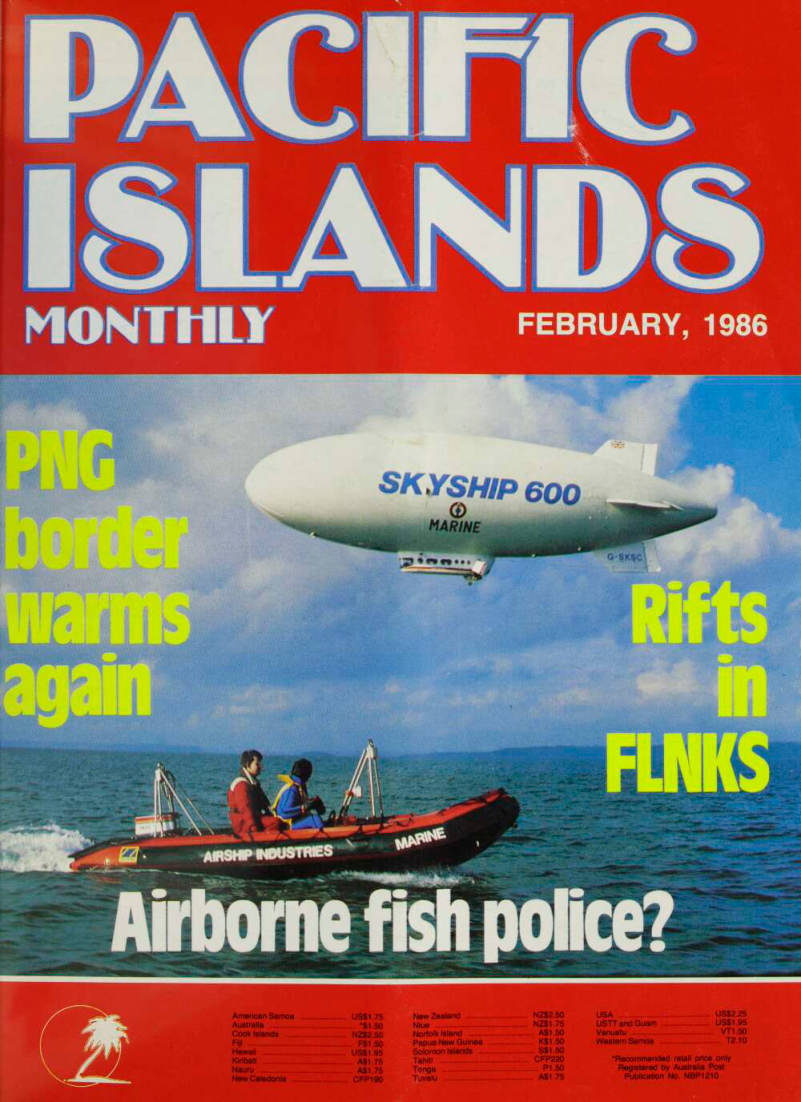
Our photograph, from Airship Industries, Lon don, was taken during French navy tests of the Skyship 600, the type suggested for Pacific fisheries surveillance.
Advertisements & other items, pp. 2-3 (2 items)
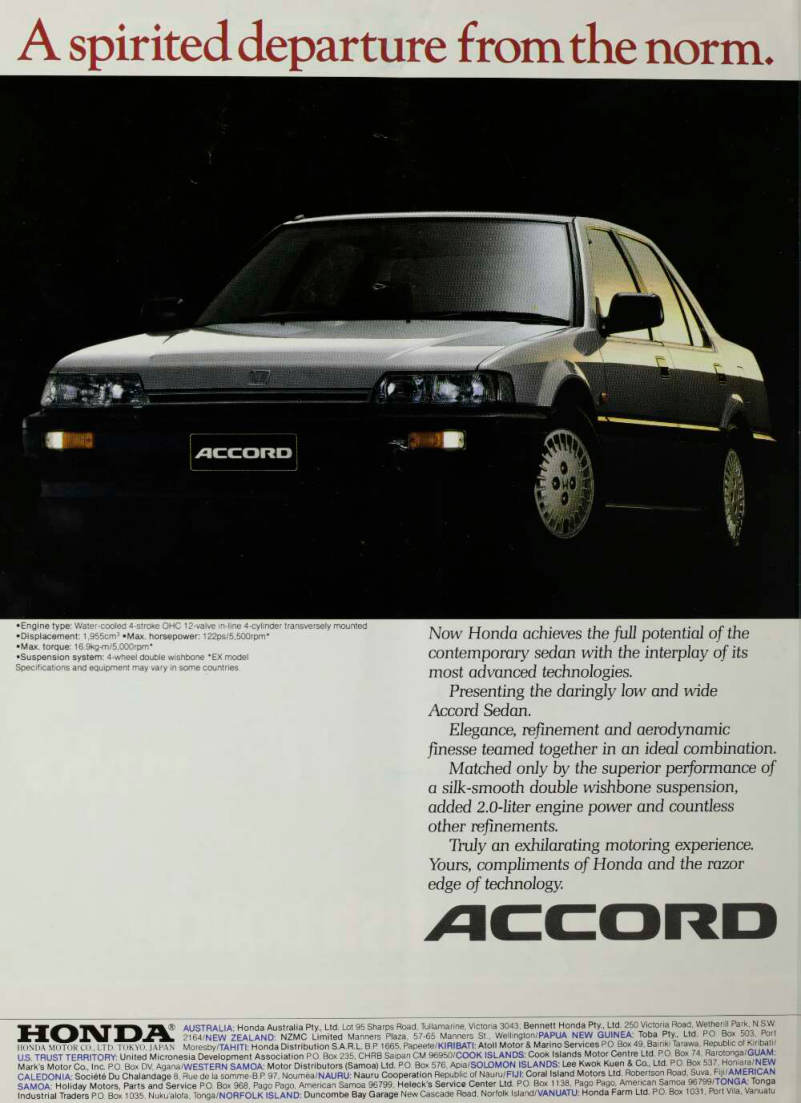
A spirited departure from the norm.
■ t £ •Engine type: Water-cooled 4-stroke OHC 12-valve in-line 4-cylinder transversely mounted •Displacement: 1,955 cm 3 «Max. horsepower; I22ps/s,soorpm* •Max. torque: 16.9kg-m/s,ooorpm* •Suspension system: 4-wheel double wishbone *EX model Specifications and equipment may vary in some countries.
Now Honda achieves the fall potential of the contemporary sedan with the interplay of its most advanced technologies.
Presenting the daringly low and wide Accord Sedan.
Elegance, refinement and aerodynamic
finesse teamed together in an ideal combination.
Matched only by the superior performance of a silk-smooth double wishbone suspension, added 2.0-liter engine power and countless
other refinements.
Truly an exhilarating motoring experience.
Yours, compliments of Honda and the razor
edge of technology.
AUSTRALIA; Honda Australia Pty., Ltd. Lot 95 Sharps Road, Tullamarine, Victoria 3043; Bennett Honda Pty, Ltd. 250 Victoria Road, Wetherill Park, N.S.W 2164/NEW ZEALAND: NZMC Limited Manners Plaza, 57-65 Manners St., Wellington/PAPUA NEW GUINEA; Toba Pty., Ltd. PO. Box 503, Port HONDA MOTOR CO LTD. TOKYO. JAPAN Moresby/TAHITI: Honda Distribution S.A.R.L. B.P 1665, Papeete/KIRIBATI; Atoll Motor & Marino Services PO. Box 49, Bairiki Tarawa, Republic of Kiribati/ US TRUST TERRITORY; United Micronesia Development Association PO. Box 235, CHRB Saipan CM 96950/COOK ISLANDS: Cook Islands Motor Centre Ltd. PQ Box: 74, Rarotonga/GUAM: Mark’s Motor Co., Inc. PO. Box DV, Agana/WESTERN SAMOA; Motor Distributors (Samoa) Ltd. PO. Box 576, Apia/SOLOMON ISLANDS; Lee Kwok Kuen & Co., Ltd. PO Box 537, Honiara/NEW CALEDONIA; Societd Du Chalandage 8, Rue de la somme-B.P 97, Noumea/NAURU; Nauru Cooperation Republic of Nauru/FIJI: Coral Island Motors Ltd. Robertson Road, Suva, hiji/AMtHIOAN SAMOA: Holiday Motors, Parts and Service PO. Box 968, Pago Pago, American Samoa 96799; Heleck’s Service Center Ltd. PO. Box 1138, Pago Pago, Am ® r 96799/TONGA: Tonga Industrial Traders PO. Box 1035, Nuku’alofa, Tonga/NORFOLK ISLAND: Duncombe Bay Garage New Cascade Road, Norfolk Island/VANUATU: Honda Farm Ltd. PO. Box 1031, Port Vila, Vanuatu
Pacific
ISLANDS
MONTHLY
Vol. 57 No. 2 February, 1986
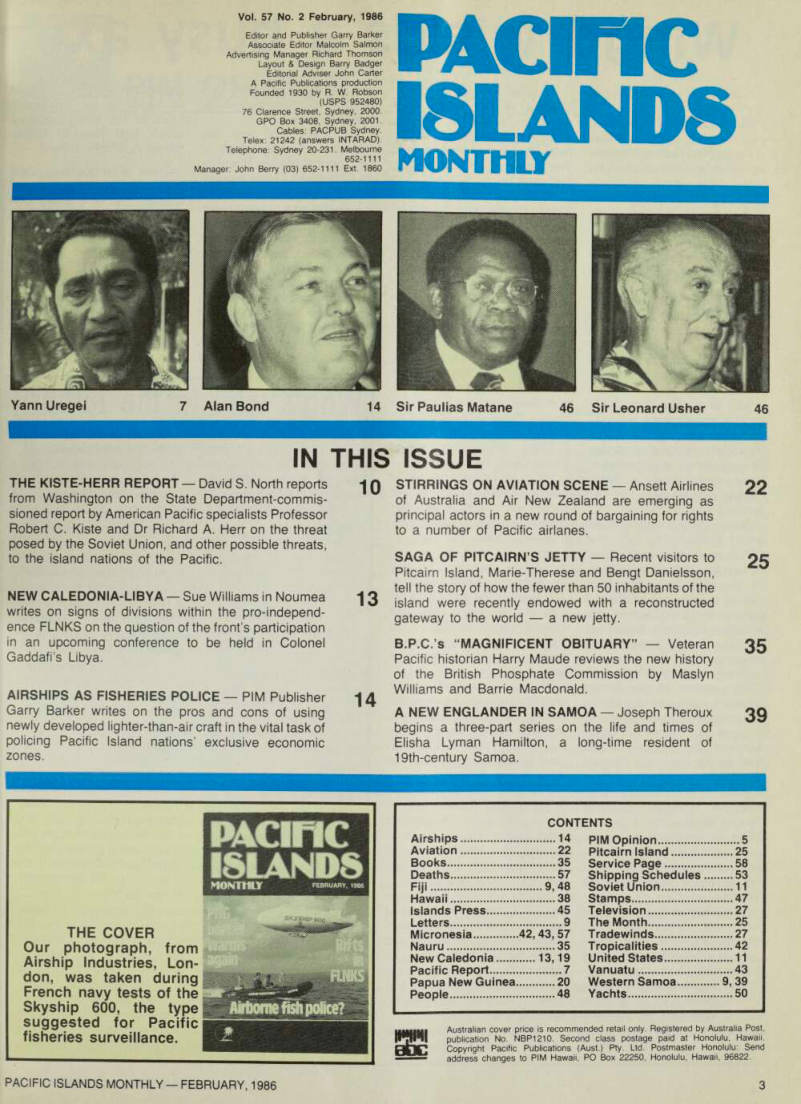
Yann Uregei 7
Alan Bond 14
Sir Paulias Matane 46
Sir Leonard Usher 46
In This Issue
THE KISTE-HERR REPORT David S. North reports -| Q from Washington on the State Department-commis sioned report by American Pacific specialists Professor Robert C. Kiste and Dr Richard A. Herr on the threat posed by the Soviet Union, and other possible threats, to the island nations of the Pacific.
NEW CALEDONIA-LIBYA Sue Williams in Noumea “| 3 writes on signs of divisions within the pro-independ ence FLNKS on the question of the front’s participation in an upcoming conference to be held in Colonel Gaddafi’s Libya.
AIRSHIPS AS FISHERIES POLICE PIM Publisher 4 Garry Barker writes on the pros and cons of using newly developed lighter-than-air craft in the vital task of policing Pacific Island nations’ exclusive economic zones.
STIRRINGS ON AVIATION SCENE Ansett Airlines 22 of Australia and Air New Zealand are emerging as principal actors in a new round of bargaining for rights to a number of Pacific airlanes.
SAGA OF PITCAIRN’S JETTY Recent visitors to 25 Pitcairn Island, Marie-Therese and Bengt Danielsson, tell the story of how the fewer than 50 inhabitants of the island were recently endowed with a reconstructed gateway to the world a new jetty.
B.P.C.’S “Magnificent Obituary” Veteran 35
Pacific historian Harry Maude reviews the new history of the British Phosphate Commission by Maslyn Williams and Barrie Macdonald.
A NEW ENGLANDER IN SAMOA Joseph Theroux 39 begins a three-part series on the life and times of Elisha Lyman Hamilton, a long-time resident of 19th-century Samoa.
Contents
Airships 14 Aviation 22 Books 35 Deaths 57 Fiji 9,48 Hawaii 38 Islands Press 45 Letters 9 Micronesia 42, 43, 57 Nauru 35 New Caledonia 13,19 Pacific Report 7 Papua New Guinea 20 People 48
PIM Opinion 5 Pitcairn Island 25 Service Page 58 Shipping Schedules 53 Soviet Union 11
Stamps 47
Television 27 The Month 25 Tradewinds 27
Tropicalities 42
United States 11 Vanuatu 43 Western Samoa 9,39 Yachts 50
Australian cover price is recommended retail only. Registered by Australia Post, publication No. NBP1210. Second class postage paid at Honolulu, Hawaii.
Copyright Pacific Publications (Aust.) Pty. Ltd. Postmaster Honolulu: Send address changes to PIM Hawaii, PO Box 22250, Honolulu, Hawaii, 96822.
Advertisements & other items, p. 3 (1 item)
Pacific Islands Monthly February, 1986
3
Editor and Publisher Garry Barker Associate Editor Malcolm Salmon Advertising Manager Richard Thomson Layout & Design Barry Badger Editorial Adviser John Carter A Pacific Publications production Founded 1930 by R. W. Robson
(USPS 952480)
76 Clarence Street, Sydney, 2000.
GPO Box 3408, Sydney, 2001.
Cables: PACPUB Sydney.
Telex: 21242 (answers INTARAD).
Telephone: Sydney 20-231. Melbourne 652-1111 Manager: John Berry (03) 652-1111 Ext. 1860
Wingti wields a busy axe
It hasn't been exactly a blood less “coup.”
Democratic, yes. The take over of power by Paias Wingti in Papua New Guinea has been praised as an example of votes, rather than guns, at work which, by the current standards of developing countries, is re markable.
But. once installed as prime minister. Wingti wielded his axe and heads began to roll at an amazing rate.
Anything that was not money-productive has been taking the brunt of the harsh treatment the new leader deems necessary to cure the country of its economic malaise.
First to go were three public service departments and 11 public service chiefs.including the defence force commander.
They departed in surprising si lence. even though a further “major retrenchment” of civil servants was on the way.
Next, government officials were leaking the fact that PNG's seven most senior heads of overseas mission were likely to be sacked the High Commissioners to Australia and New Zealand, and the ambas sadors to Indonesia, the United Nations. Tokyo. London and Brussels.
Prime Minister Wingti said; “The conduct of our foreign relations must accord with the priorities for mobilising re sources for national deve lopment. Diplomacy is a vital tool for securing our interests abroad.”
Also for the chop are state business ventures, with Air Niugini at the top of the list.
“The government is in the process of liquidating its unpro fitable companies and selling off the profitable ones,” said Mr Wingti.
The national flag carrier has been put up for sale in its entirety and the government expects to have the airline off its hands within two years.
The big state sell-off affects 27 companies. In 22 of them the government is the sole shareholder, with investments in excess of Kina2oo million (about Austs29o million).
However, with the continual wielding of the Wingti axe. revolution could not be far away. And.sure enough, by the New Year it had broken out.
The point of explosion; the Harbours Board.
New transport minister.
Neville Bourne and the Board were quickly off on a collision course when he announced an investigation into the purchase and renting of houses for staff.
The minister was extremely concerned, he said, that Kina4 million (about Austss.B million) had been spent in five years on buying property.
Next. Mr Bourne accused the Board of obstructing him in his duty by not supplying informa tion about what the Board was doing. Board chairman, Leo Debess. a was deliberately with holding information about house deals, he charged.
When Mr Debessa refused to meet a deadline to talk, he was sacked along with three other Board members. The four im mediately took the fight to court, but failed to get an immediate injunction to stop the dismissals going ahead.
However, the judge said the case in which the four claimed the dismissals had not followed constitutional proce dures would be heard at a later date.
The war of words hotted up with Mr Debessa accusing the minister of collaborating with shipping operators and a union leader describing Mr Bourne as “fast becoming the Minister for Alice in Wonderland.”
The man Mr Bourne installed in place of Mr Debessa. former Prime Minister’s Department chief, Andrew Yauieb, then sus pended the Harbours Board general manager. Philip Drang, and his deputy, Stanis Tao.
Mr Yauieb said that accor ding to information submitted to the board “there were suggestions of irregularities and a degree of malpractice by executives in particular the two most senior men.” He had asked the fraud squad to in vestigate.
Hardly were the words uttered when Primary Indus tries Minister. lambakey Okuk.
instructed the chairmen and members of three agricultural boards to resign.
Not that there was any suggestion of malpractices at the Copra Marketing Board or the Coffee and Cocoa Industry Boards Mr Okuk just wanted to make his own appointments.
However, not one complied with his instructions. The three boards had conferred together and were seeking legal advice to challenge the order in court.
According to one of the board’s officials, they were prepared to “stand their ground and fight”
The official claimed Mr Okuk wanted to make political
appointments so he could get his hands on the stabilisation funds of the three industries, which total Kina 170 million (about Austs246 million).
There is no doubting “Axe man” Wingti’s integrity and courage, but as a recent local editorial points out, he needs to mind his back.
He is in the process of frustrating a lot of greedy and ambitious people and the slight est indiscretion by one of his team will be seized upon as a chance to upset his whole brave new world. Tim Sinclair in Port Moresby.
Who’s who in the tumbril
Only incompetents and the lazy need fear change, says Paias Wingti, as he proceeds with the “rearrangement” of PNG's government and administration.
Brigadier-General Ken Noga, who lost the job of commander of the De fence Force, was going to stand at one time as an election candidate for Michael Somare’s Pangu Pati while his succes sor, Tony Huai, had talked of entering politics under Sir Julius Chan’s Peoples Progressive Party banner.
It was vehemently de nied that Mr Haul’s appointment was political.
He was, in fact, a popular Defence Force chief of operations until he quit at the end of 1984 because, as he said: “The govern ment only wants the De fence Force as cheap labor, and does not care about its standards.” Va rious officers followed him and resigned.
The return of Mr Huai who immediately plan ned a restructuring and demanded the “highest standards of discipline and morale” of his men was widely welcomed by the Defence Force.
Of the other changes of government secretaries, some were due to the reduction of public service departments.
Out went Noro Beang ke at Finance and John Noel at Planning. Their departments were amalgamated and taken over by John Vulupindi.
The outgoing pair were described as competent officers and were prom ised new jobs.
Joe Wal at Civil Avia tion and Arthur Jawodim bari at Culture and Tour ism, had their depart ments merged, too, to be taken over by Godfrey Benjamin.
Paulias Matane, who was knighted in the New Year’s Honors, was already going on ex tended leave from his job as head of Foreign Affairs and had talked about not returning. Bill Dihms now has his job.
Austin Sapias, at Com munications, lost his job to Isreal Edoni, Joe Bal at Housing to Barunke Ka man, Jack Baure at Works to Anthony Temu and Leo Morgan at Pro vincial Affairs to Paul Bengo. Tim Sinclair in Port Moresby.
Kelly is a harbinger
Pim Opinion
The Kiste-Herr Report begins by saying it is “a study in vulnerability,” and “a review of the potential for external influence” in the South Pacific.
While most of their attention is devoted to the risks of major-power intervention by the Soviet Union or its surrogates, the authors also look at the capacity for mischief in the region of organised crime and free-booting carpetbaggers.
They assume, as do most observers of Pacific affairs, that while Moscow might not have intrusion into the Pacific very high on its list of priorities, it is there, and will be acted upon whenever, and wherever, opportunity presents itself, either directly, or through some suitable surrogate. Such opportunity would depend, the authors suggest, on how Moscow saw the risk-benefit equation.
The answer to that depends very much upon the political climate in the Pacific, and that, in turn, will be governed, to a fair extent at least, by the manner in which the island countries are treated. Almost without exception the island countries are western-oriented and anti-communist. They are Christian with a devotion which puts many more advanced peoples to shame.
The report might have been the subject of some ill-mannered levity among untutored people in Washington (see accompany ing box), but it does appear to have performed as one of several blades wielded in Washington over the last six to 12 months to open some air-holes in the blankets of ignorance which existed there on the importance of US relations in the Pacific region.
Kiste and Herr were not exactly voices crying in the wilderness, for their commission came from the US State Department, and their support has also come from officers within that department who had been battling for years to get their views heard by the policymakers.
Clearly, the US Navy and its two recent commanders in chief, Pacific, have had their influence, too. As has also had, obviously, the Soviet’s deal with Kiribati, their continued wooing of Vanuatu and other small countries in need of income, and the huge expansion of their naval and air bases at Cam Ranh Bay in Vietnam.
Thus, better late than never, came Mr John H. Kelly, a courteous, senior, astute and very attentive diplomat of the US State Department. He spent most of December visiting just about every capital of the Pacific island countries, starting with Tahiti, and including along the way Australia and New Zealand.
In a world governed by brain-power (one is forced to avoid use of the word intelligence because of its connotation with spies and intrigue), and a genuine desire to improve the lot of the planet for all living things, rather than by politics, the measured conclusions Mr Kelly will reach would be used as guidelines for designing a coherent and constructive US policy for the Pacific.
At risk of appearing to favor benevolent dictatorship as a system of government we are forced to observe that it is an unfortunate aspect of the American domestic system that anything Mr Kelly or his department propose will have to run the gauntlet of the US Congress. In that body power lies not at the top, but among the ward-heelers in the grassroots. Lack of knowledge about the Pacific is not only monumental, but it exists alongside a carload of romantic misconceptions about the region, carried along on the tunes of Rogers and Hammerstein.
President Tabai, of Kiribati, earned some brickbats for signing his deal with the Soviet fishermen, and while he might have helped the American Tunaboat Association’s lobbyists in Washington by appearing to act like some “coconut republic commie boss” he probably in the end did more to wake up the US administration, and discomfort the “good ole boys” in Congress, than he did damage to regional security.
One readily concedes that the US has great call upon its resources, many critics both within and without (which is to say that it gets a lot of advice it doesn’t ask for from people who demand it be grateful for their gratuities), and a bureaucratic process at least as lugubrious as any now operating.
While the Americans have been unnecessarily obtuse on the Pacific, and deaf to their own experts, for too long, the Soviet Union is by no means top of the pops in the Pacific. They have been very careful in the Pacific, with their fishing boats and their cruise ships, but their record of dealing with the Third World has never ever been good, and their overall image in the islands is no exception. They are not trusted.
This is an asset of goodwill for the West which it would be a shame to see Congress fritter away in the lobbies and around the pork barrels, just as a region where they have enjoyed a fine reputation for many years is about to be hauled, unwillingly, but inevitably, into the age of super-power politics.
One prays, therefore, that Mr Kelly’s inquiries discover this fact, and that his report receives earnest, swift,and favorable response.
Advertisements & other items, p. 6 (1 item)
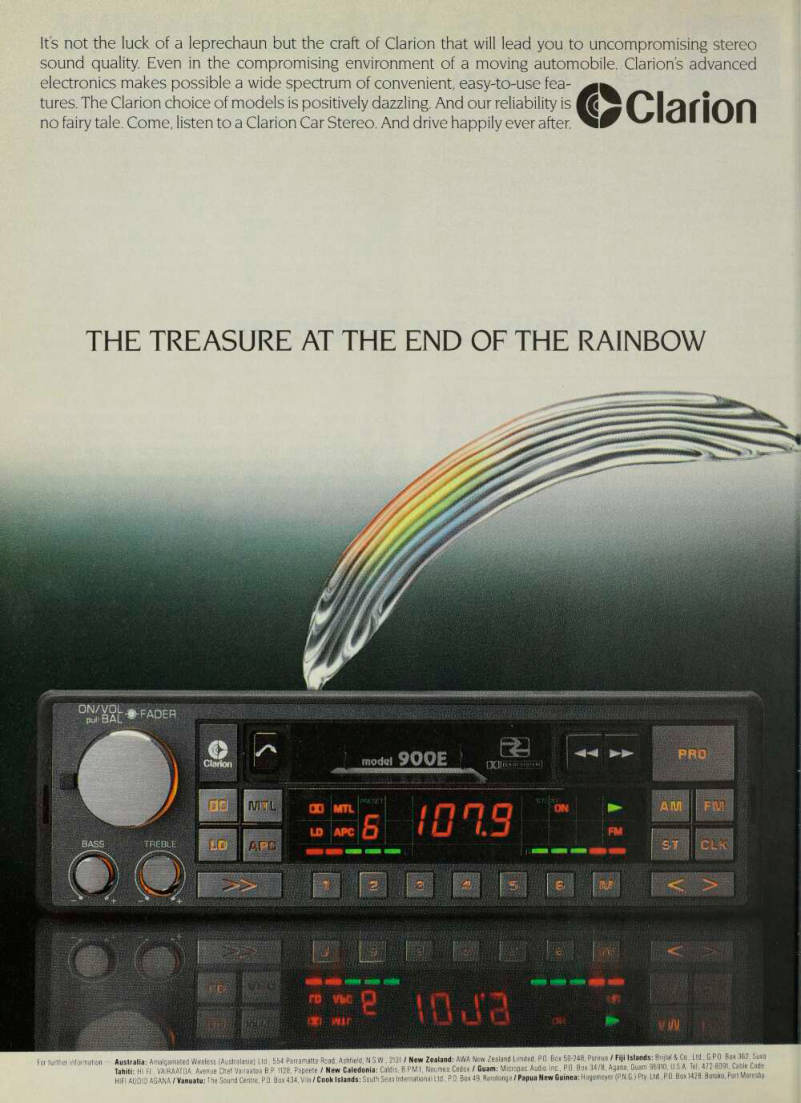
The Treasure At The End Of The Rainbow
It's not the luck of a leprechaun but the craft of Clarion that will lead you to uncompromising stereo sound quality. Even in the compromising environment of a moving automobile. Clarion's advanced electronics makes possible a wide spectrum of convenient, easy-to-use features. The Clarion choice of models is positively dazzling. And our reliability is I o rirvn no fairy tale. Come, listen to a Clarion Car Stereo. And drive happily ever after. ■ ■"■ THE TREASURE AT THE END OF THE RAINBOW *2 - For further information Australia: Amalgamated Wireless (Australasia) Ltd., 554 Parramatta Road, Ashfield, NSW, 2131 / New Zealand: AWA New Zealand Limited, P.0 Box 50-248, Porir a / Fiji Islands I3nja & Co. L Box 362 Suva Tahiti: HI FI VAIRAATOA. Avenue Chef Vairaatoa B P 1128, Papeete / New Caledonia: Caldis, B.P.M1, Noumea Cedex / Guam: Micropac Audio Inc., P.0 Box 3478, Agana Guam 96910 U.S.A Tel Q Code.
HIFI AUDIO AGANA / Vanuatu- The Sound Centre P 0 Box 434, Vila I Cook Islands: South Seas International Ltd., P.0. Box49, Rarotonga / Papua New Guinea: Hagemeyer (PN G.) Pty. Ltd., P0. Box 1428, Boroko, Port Moresby.
pacific report
Dark Secret Of
Tle De Lumiere'
In vivid confirmation of the boast made shortly before his death last year by long-time mayor of Noumea Roger baro que “Yes, we have arms, and we will fight” 25 crates of munitions were discovered in Auckland at the end of December aboard the Noumea-regis tered freighter, lie de Lumiere. A 29year-old cook aboard the ship was arrested in early January charged with illegal possession of explosives. New Zealand police said the munitions, loaded in Sydney, were designed to be used against the Kanaks by anti-inde pendence French settlers. They had at first feared the munitions were part of a plot to rescue the two French secret service agents jailed in Auckland in November for their role in the July, 1985, bombing of the Greenpeace protest ship, Rainbow Warrior. Plastic-wrapped crates found hidden in the ship’s bilges and fuel tanks contained 5500 rounds of ammunition and parts mainly maga zines for automatic pistols. Part of the wrappings were Sydney newspapers dated December 3, the day after the ship arrived in Sydney from New Caledo nia on what turned out to be a 16-day stay. The 1530-tonne freighter was on its normal run between Noumea, Sydney, Lord Howe Island, Norfolk Island, Auck land, Norfolk Island, and back to Noumea. The seizure was the third major French arms smuggling attempt unco vered in 1985. The previous two were in Australia, the first in March when Cus toms seized $A44,000 worth of weapons on a Noumea-bound ship berthed in Brisbane, and again in November, when 36 rifles and ammunition were found in Sydney on a ship destined for the French territory. Six French nationals have appeared in court charged with illegal possession of explosives. Hearings of the charges are pending.
Flnks To Step
Up Libya Link
New Caledonia's pro-independence party FLNKS is to step up its ties with Libya by attending a summit in Tripoli of “liberation movements”, including the Palestine Liberation Organisation. In early 1985 17 young FLNKS members took part in a para-military training course in Libya. Leading FLNKS figure, Yann Uregei, de facto foreign minister of the organisation, will lead the delegation to Tripoli, probably in March. He said Libya would pay the group’s expenses, but that the FLNKS had no plans to seek
aid from Libya. Mr Uregei said his movement was dissatisfied with regional support for its liberation struggle, and wanted closer ties with Libya and other groups fighting for independence around the world. “The West might regard Libya as the devil, but for the people of New Caledonia it is France that is the real devil. The political situation here is no different from what happened in Algeria and Vietnam. That is why we must maintain the struggle at the international level.” Mr Uregei said the FLNKS was prepared to talk to anyone to aid its objectives. “We want to speak with all countries, capitalist and socialist,” he said. “The only aim is to propagandise our struggle.” Mr Uregei said the Tripoli conference would be “anti-imperialist, anti-colonialist and against militarism . . . issues we are concerned about in this region.” He said: “The presence of the French in this region is creating all these problems now with their colonialism, their military bases, and their nuclear testing.” (See later report, p. 13.)
Lints Warning
To Trade Unions
Vanuatu’s Prime Minister Father Walter Lini has warned the country’s trade unions not to behave like unions in industrialised countries. Specifically mentioning Australia, Fr Lini said Vanuatu's unions must be careful to avoid what he called the bad influences of unions in developed countries. He
said economically powerful countries could afford the wastage involved in industrial action, but Vanuatu could not.
The prime minister was speaking in Port-Vila at the opening of a conference of the Vanuatu Trade Union Congress.
He said trade unionism was a new concept in Vanuatu, and like other new concepts such as democracy and de centralisation, it had to be carefully developed to suit the needs, interests and aspirations of the people of the country. Fr Lini said he considered unions to be agents of development, and called on them to work with the govern ment and employers to maintain a good industrial climate. The Congress in its resolution accused the government and private employers of trying to suppress trade union activities. The resolution called on the government to set up a system to resolve industrial disputes through arbitration. The resolution said that so far, no workers in Vanuatu had been able to improve their conditions by expressing grievances, either individual ly or collectively. It said that when strike action had been taken, strikers had been dismissed or threatened with dismissal, and union leaders had been transferred to other duties. The resolution said this contradicted the government’s declared policy of support for the rights of workers.
Wingti Plans
Tilt To Asia
Papua New Guinea Prime Minister, Paias Wingti, wants to reduce his country’s dependence on Australia and build closer relations with Asian countries. Mr Wingti, in an exclusive interview with Australian journalist Mark Baker, said PNG’s future was in the Asian region and his government would consider seeking membership of ASEAN, the Association of South-east Asian Nations. Mr Wingti, in his first major interview since ousting the former Prime Minister, Mr Somare, in a parliamentary vote in November, criti cised the continuing trade imbalance with Australia. Asked whether he wanted to maintain a special relationship with Australia, he said: “Our future really is with the Asian region, as is the future of Australia and New Zealand. That’s where the economic growth is. That's where the population is.”
Remeliik Killing,
Three Re-Arrested
Three men, who were arrested last July and charged with the murder by shoot
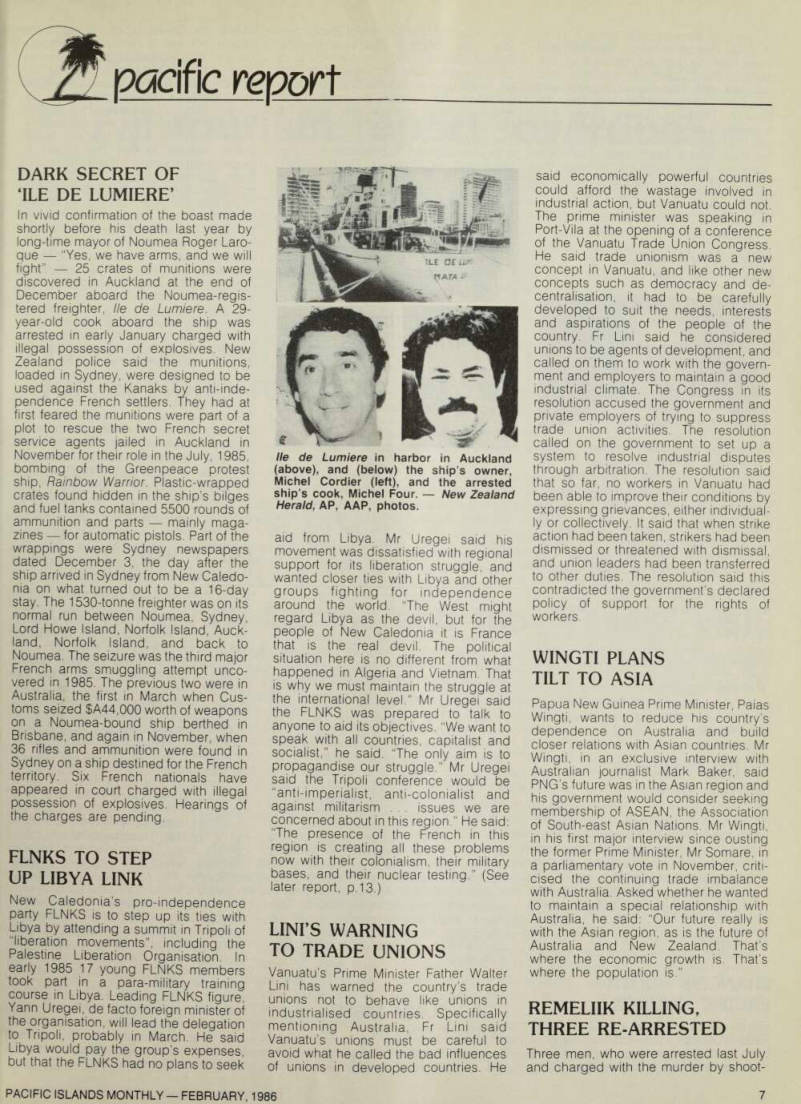
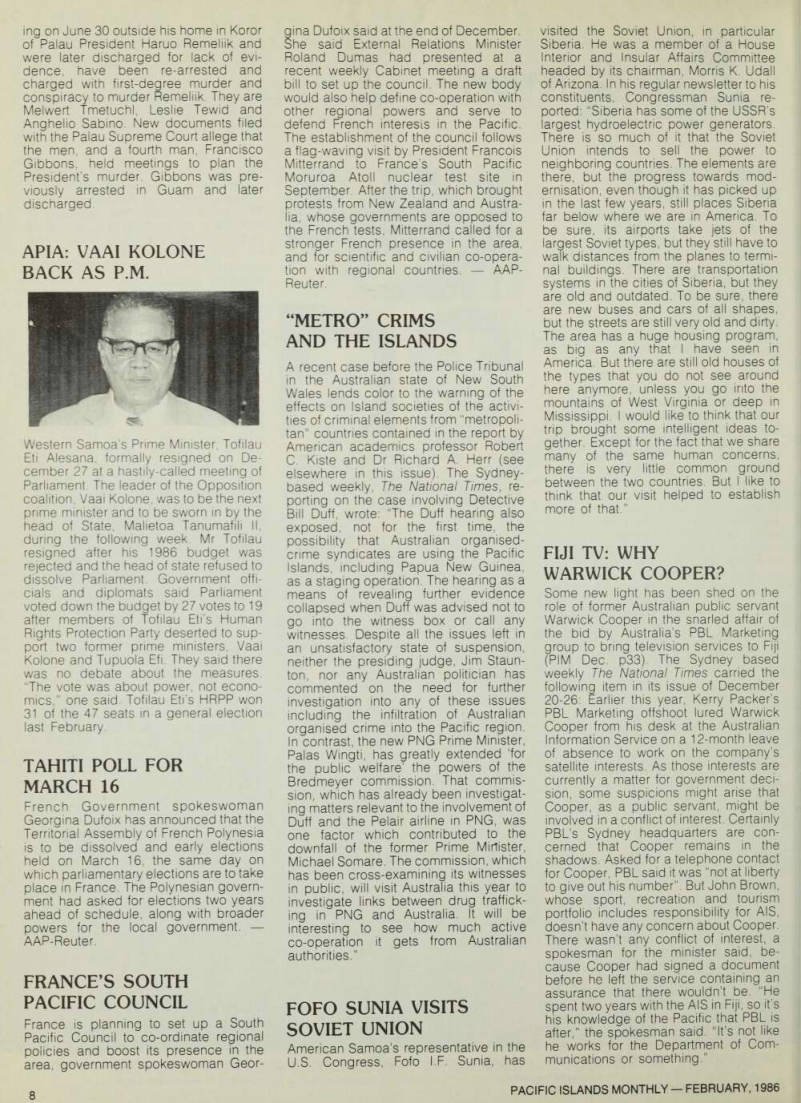
lie de Lumiere in harbor in Auckland (above), and (below) the ship’s owner, Michel Cordier (left), and the arrested ship’s cook, Michel Four. New Zealand Herald, AP, AAP, photos.
ing on June 30 outside his home in Koror of Palau President Haruo Remeliik and were later discharged for lack of evi dence, have been re-arrested and charged with first-degree murder and conspiracy to murder Remeliik. They are Melwert Tmetuchl, Leslie Tewid and Anghelio Sabino. New documents filed with the Palau Supreme Court allege that the men, and a fourth man, Francisco Gibbons, held meetings to plan the President’s murder. Gibbons was pre viously arrested in Guam and later discharged.
Apia: Vaai Kolone
Back As P.M.
Western Samoa's Prime Minister, Tofilau Eti Alesana, formally resigned on De cember 27 at a hastily-called meeting of Parliament. The leader of the Opposition coalition, Vaai Kolone, was to be the next prime minister and to be sworn in by the head of State, Malietoa Tanumafili 11, during the following week Mr Tofilau resigned after his 1986 budget was rejected and the head of state refused to dissolve Parliament. Government offi cials and diplomats said Parliament voted down the budget by 27 votes to 19 after members of Tofilau Eti’s Human Rights Protection Party deserted to sup port two former prime ministers, Vaai Kolone and Tupuola Efi They said there was no debate about the measures.
“The vote was about power, not econo mics,” one said. Tofilau Eti's HRPP won 31 of the 47 seats in a general election last February,
Tahiti Poll For
March 16
French Government spokeswoman Georgina Dufoix has announced that the Territorial Assembly of French Polynesia is to be dissolved and early elections held on March 16, the same day on which parliamentary elections are to take place in France. The Polynesian govern ment had asked for elections two years ahead of schedule, along with broader powers for the local government.
AAP-Reuter.
France’S South
Pacific Council
France is planning to set up a South Pacific Council to co-ordinate regional policies and boost its presence in the area, government spokeswoman Geor
gina Dufoix said at the end of December.
She said External Relations Minister Roland Dumas had presented at a recent weekly Cabinet meeting a draft bill to set up the council. The new body would also help define co-operation with other regional powers and serve to defend French interests in the Pacific.
The establishment of the council follows a flag-waving visit by President Francois Mitterrand to France’s South Pacific Moruroa Atoll nuclear test site in September. After the trip, which brought protests from New Zealand and Austra lia, whose governments are opposed to the French tests, Mitterrand called for a stronger French presence in the area, and for scientific and civilian co-opera
tion with regional countries.
Aar-
Reuter.
“Metro” Crims
And The Islands
A recent case before the Police Tribunal in the Australian state of New South Wales lends color to the warning of the effects on Island societies of the activi ties of criminal elements from “metropoli tan" countries contained in the report by American academics professor Robert C. Kiste and Dr Richard A. Herr (see elsewhere in this issue). The Sydney based weekly, The National Times, re porting on the case involving Detective Bill Duff, wrote: "The Duff hearing also exposed, not for the first time, the possibility that Australian organised crime syndicates are using the Pacific Islands, including Papua New Guinea, as a staging operation. The hearing as a means of revealing further evidence collapsed when Duff was advised not to go into the witness box or call any witnesses. Despite all the issues left in an unsatisfactory state of suspension, neither the presiding judge, Jim Staun ton, nor any Australian politician has commented on the need for further investigation into any of these issues including the infiltration of Australian organised crime into the Pacific region.
In contrast, the new PNG Prime Minister, Palas Wingti, has greatly extended ‘for the public welfare’ the powers of the Bredmeyer commission. That commis sion, which has already been investigat ing matters relevant to the involvement of Duff and the Pelair airline in PNG, was one factor which contributed to the downfall of the former Prime Minister, Michael Somare. The commission, which has been cross-examining its witnesses in public, will visit Australia this year to investigate links between drug traffick ing in PNG and Australia. It will be interesting to see how much active co-operation it gets from Australian authorities.”
Fofo Sunia Visits
Soviet Union
American Samoa’s representative in the U.S. Congress, Fofo I.F. Sunia, has
visited the Soviet Union, in particular Siberia. He was a member of a House Interior and Insular Affairs Committee headed by its chairman, Morris K. Udall of Arizona. In his regular newsletter to his constituents, Congressman Sunia re ported; “Siberia has some of the USSR’s largest hydroelectric power generators.
There is so much of it that the Soviet Union intends to sell the power to neighboring countries. The elements are there, but the progress towards mod ernisation, even though it has picked up in the last few years, still places Siberia far below where we are in America. To be sure, its airports take jets of the largest Soviet types, but they still have to walk distances from the planes to termi nal buildings. There are transportation systems in the cities of Siberia, but they are old and outdated. To be sure, there are new buses and cars of all shapes, but the streets are still very old and dirty.
The area has a huge housing program, as big as any that 1 have seen in America. But there are still old houses of the types that you do not see around here anymore, unless you go into the mountains of West Virginia or deep in Mississippi. I would like to think that our trip brought some intelligent ideas to gether. Except for the fact that we share many of the same human concerns, there is very little common ground between the two countries. But 1 like to think that our visit helped to establish more of that.”
Fiji Tv: Why
Warwick Cooper?
Some new light has been shed on the role of former Australian public servant Warwick Cooper in the snarled affair of the bid by Australia’s PBL Marketing group to bring television services to Fiji (RIM Dec. p 33). The Sydney based weekly The National Times carried the following item in its issue of December 20-26: Earlier this year, Kerry Packer’s PBL Marketing offshoot lured Warwick Cooper from his desk at the Australian Information Service on a 12-month leave of absence to work on the company’s satellite interests. As those interests are currently a matter for government deci sion, some suspicions might arise that Cooper, as a public servant, might be involved in a conflict of interest. Certainly PBL’s Sydney headquarters are con cerned that Cooper remains in the shadows. Asked for a telephone contact for Cooper, PBL said it was “not at liberty to give out his number". But John Brown, whose sport, recreation and tourism portfolio includes responsibility for AIS, doesn’t have any concern about Cooper.
There wasn't any conflict of interest, a spokesman for the minister said, be cause Cooper had signed a document before he left the service containing an assurance that there wouldn’t be. “He spent two years with the AIS in Fiji, so it’s his knowledge of the Pacific that PBL is after,” the spokesman said. “It’s not like he works for the Department of Com munications or something."
Fiji tourism report ‘overdue’
letters
Norman Douglas’ report on the tourism scene in Fiji (PIM Nov. ’BS) was something that was long overdue.
As someone who was involved for a long time in “selling” Fiji as a South Pacific destination, both in the USA and New Zealand, I can vouch
for a large number of corn plaints made by disappointed visitors who felt that the hype wasn’t matched by the reality, and that they were not getting their precious dollar’s worth, A little more honesty one wouldn’t dare hope for a lot and diversity in promoting Fiji
would help both agents and consumers a great deal and might also help to get rid of the tired “paradise” cliches. Maybe the Fiji Visitors Bureau should bring your correspondent in as a consultant.
But I also think that more should have been said about
who really benefits from the tourist dollar in Fiji. Can it really be Fiji’s top revenue-earner when about 80 per cent of facilities are foreign-owned?
More power to PIM.
Harold R. Rogerson
Mosman NSW Australia
for cyclone repair
Fiji resort did close for cyclone repair
In the November issue of your magazine you had an article headed “Does a Vital Industry Need a Shake-up?”. Mr Geoff Smith of Geoff Smith Public Relations Pty Ltd, a firm re tained by our company, for warded the said article to me, in particular that part of it on page 17, for my attention and follow up.
May I bring to your attention please, for clarification, one error, and one distorted view point in order to accentuate the said error. At the bottom of column two it was inferred that Castaway Island was one of the resorts that stayed open. This is totally incorrect as the island was closed for some weeks in order to try and clean up the debris. The picture in the top right-hand corner of the page is taken from off the resort boundary of the island and shot back towards the resort in order to accentuate what your copy had put correctly as “one of the piles of debris”.
When on an island, and in the process of a clean-up, you need to centralise the debris in a particular area, and I think that commonsense would say it would be at the extreme of your property and not in the middle of it! The debris in the fore ground of the picture was awaiting collection by barge services, as daily garbage pick up is also not another feature of
island living. In the caption, you also state “the resort did not close but it probably should have”.
I understand I can take this point considerably further, but I have no desire to. I would, however, greatly appreciate it if you would see fit to reflect your
error in the next publication.
M. T. Brook,
Managing Director.
Castaway Resorts (Fiji) Ltd Nadi, Fiji.
The author of the article in question, Dr Norman Douglas, replies: Further inquiry has revealed that the resort actually did close for a brief period. Its condition in late July, however, suggested that this may not have been long enough to effect compre hensive repairs and cleaning
up. The caption to the picture on page 17 might therefore be amended to read: “The resort should perhaps have remained closed longer.”
The picture of debris is hardly a “distorted” one, though it is a selected viewpoint as are so many shots of tourist resorts.
My aim was to show the prox imity of debris to resort facilities, I did not claim that the debris was in the middle of the resort, but that “two large piles of debris identified the limits of the beach ...” They did.
W. Samoa and the “Texas” visit
In your publication for October, 1985, you published a letter by Sam Burris, Hilo, Hawaii, USA, which contained a number of misleading concepts of the visit of the U.S.S. Texas to Western Samoa in May, 1985. This letter clearly indicates the ignor ance of Sam in a number of areas. To help the readers understand better I detail a few facts trusting you will print them.
Firstly, Western Samoa as a sovereign state does not qualify to any country her decisions from time to time in prior areas of her interests. This includes the services provided for the upkeep of the U.S.S. Texas crewmen and, more specifical ly, I will have to agree that U.S.S. Texas was in Western Samoan waters, but outside of the “port”. It was never allowed into the Apia harbor. Secondly, my prime minister is in every way correct if his statement meant “that” particular visit.
What has come out of it so far?
After helping we showed them the road. Did we not? Our prime minister was one of the signatories to the Rarotonga treaty against nuclear weapons and waste disposal! If Sam’s speculation that Western Samoa and American Samoa are “targeted” even when we are not a nuclear state does not mean that on the same specula tions “all” the countries of the world are targeted? If this be the case, isn’t it then all the wiser to be friends with others who could help? Western Samoa knows and recognises her allies for all facets of security; and, if USSR has a weapon with our name on it, I believe USA has one with USSR on it for our name! We do not take chances with hypocrites and we “hate” liars.
The most interesting fact of all is Sam’s insinuation that Western Samoa should join New Zealand in their quest to
ban any form of nuclear. New Zealand is doing what they think is best. Western Samoa is doing what we think is best.
The country that might be hurt the most because of friendship ties is USA. Yet USA is doing what the president and the congress consider is best for her people. If Sam is partly “that people”, does his president know his valuable ideas? Why does he worry about a country that earns its living from bana nas yet he fattens himself from the revenues of nuclear sales?
Peace and sanity start from “within” never from “without” unless by force.
If you are not sitting on a bomb yourself and looking up wards to 10 more, then perhaps you have better peace because you see these things but we don’t.
Laulu Dan Stanley
Apia Western Samoa
A US Orion surveillance aircraft “shadows” the Soviet Kirov class cruiser “Frunze”.
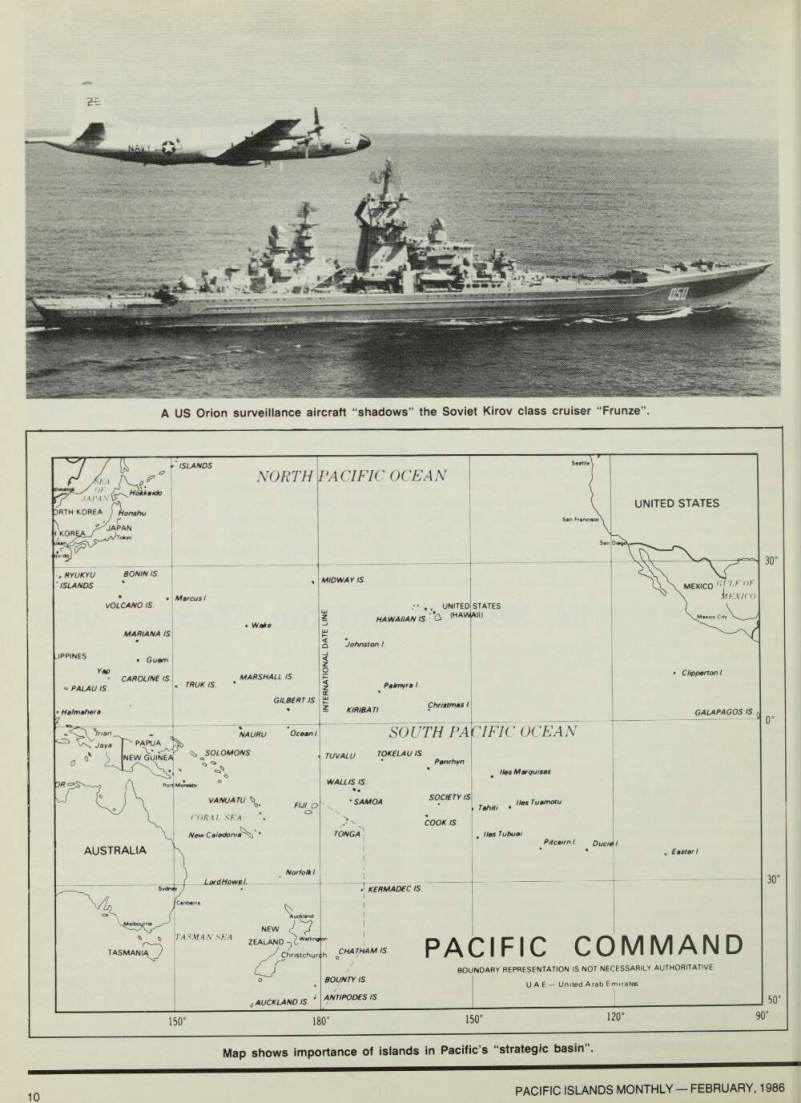
Map shows importance of islands in Pacific’s “strategic basin”.
Kiste-Herr Reports
"Pacific vulnerable to Soviets, but only if us errs”
Russia is not much of a threat in the Pacific, and it would be a much lesser one if the US and, particularly, France, handled their Pacific relations more skilfully. That is a summary of a report funded by the US State Department which attracted much more attention in Austra lia and New Zealand than it did in the U.S.
“The South Pacific ranks as one of the most vulnerable regions in the world and yet it has perhaps the least Soviet influence of any area of the globe. The most concrete inst ances of Soviet opportunity have occurred as a result of controversy which could be seen as generated by the West ern nations themselves. French attitudes on decolonisation have banked up frustrations which have found outlets in Cuba and Libya. American fisheries legislation has pro duced conflict. . .” according to the report written by two well regarded Pacific area academics, Professor Robert C.Kiste, of the University of Hawaii at Manoa, and Dr Rich ard A. Herr, an American now at the University of Tasmania.
The report was funded by the Bureau of Intelligence and Re search of the US Department of State. Like many such reports funded by the US Government, it does not necessarily reflect the views of the agency paying the bill.
As the Pacific region grows steadily in international political importance which is to say that as the major powers become more interested in dabbling in it the purveyors of misinformation grow more numerous. In this article our Washington correspon dent, DAVID S.NORTH, lifts the lid on the Nautilus Group which took what it wanted from a US State Department assessment and attempted to prove that the Soviet Union had no influence in the region. It really wasn’t quite like that.
The report, completed in De cember, 1984, was distributed in the department but was unknown to the general public until November when a tiny, anti-big-power public interest organisation announced its fin dings, stressing those that play ed down the significance of the Russian threat. The efforts of the Nautilus Group to call atten tion to the report were much more successful in Australia and New Zealand than they were in the U.S. (One reason for this is that Nautilus apparently made direct contact with the New York office of Australian Associ ated Press where a correspon dent wrote a fairly major piece based upon their press release.
This was carried on the main news agency wires in both Australia and New Zealand, and by Radio Australia, although it appears not to have
received distribution beyond that, at least by A.A.P. - Ed.
PIM). New Zealand’s Prime Minister David Lange com mented that the report con tained no surprises.
On the other hand, the only coverage in the US was a friendly piece by left-wing wri ter, James Ridgeway, in the Village Voice. This journal, ori ginally devoted to the arts, politics and sub-cultural happenings of New York’s Greenwich Village, has since become an extremely prosper ous national weekly covering avant-garde music and art, and left-wing politics. It is owned by Rupert Murdoch who follows a totally hands-off policy regar ding its editorial content.
The Nautilus Group is a tiny organisation headquartered in Leverett, a small town in west ern Massachusetts. It took us a
dozen calls to various quarters interested in foreign policy mat ters before we tracked down the Nautilus leader, Peter Hayes, an Australian with de grees from the Universities of Melbourne and California (Ber keley). Hayes runs the group out of his house (Nautilus does not even have a listed tele phone number), and focuses his attention on supplying re search and information to the anti-big-power forces in the South Pacific, paying little attention to American media, partially because they pay so little attention to the area. (Hayes has such little use for the Stateside press that he, quite pleasantly, told us that PIM would be billed a few dollars for photo-copying and postage we had asked him to send us a copy of his press release. Though we had never heard of such a practice, we agreed).
As background about the activities of his organisation, Hayes talked happily of Nauti lus breaking the story of the plan to send MX missiles from California into the sea off Tas mania.
“Once we went public with it, the Australian Government had to'rethink its position, and sub sequently withdrew its support, effectively killing the program,” he said.
While Hayes was playing up the report, the State Depart-
ment moved in the other direction. A cloddish State De partment press officer, in November, responded to a question about the study by pretending (or at least we hope he was pretending) that he did
not know the location of Kiriba ti; then he added insult to injury by mispronouncing the senior author’s name, making it all sound like the “Kissed Her” report. (Professor Kiste's name rhymes with diced, not fist.)
The report itself is a sober, detailed, 77-page study of the prospects of the Pacific Island nations and other jurisdictions in the area served by the South Pacific Commission. Entitled “The Potential for Soviet
Penetration of the South Pacific Islands; An Assessment,” it sug gests that Russian opportunities are extremely limited, under present circumstances, and would be even more so if it were not for ham-handed (our word, not theirs), U.S. and French policies.
Among the American policies cited were the U.S. over-reac tion to the seizing of the Jeanet te Diana, the rigid system for distributing allocations of sugar imports (at high, subsidised, prices) and the lack of a U.S. signature on the United Nations Convention on the Law of the Sea.
Regarding the Jeanette Diana the authors wrote; “In this case a traditional external friend, the US. finds itself in confrontation with a regional state, the Solomons, over a conflict of their domestic laws over fisheries. This dispute is particularly unfortunate from the American perspective since the Solomons had proved itself a sympathetic friend prior to the arrest of the Jeanette Diana in June, 1984.
“The Solomons banned Soviet vessels from its ports following the invasion of Afgha nistan, took the lead in ESCAP
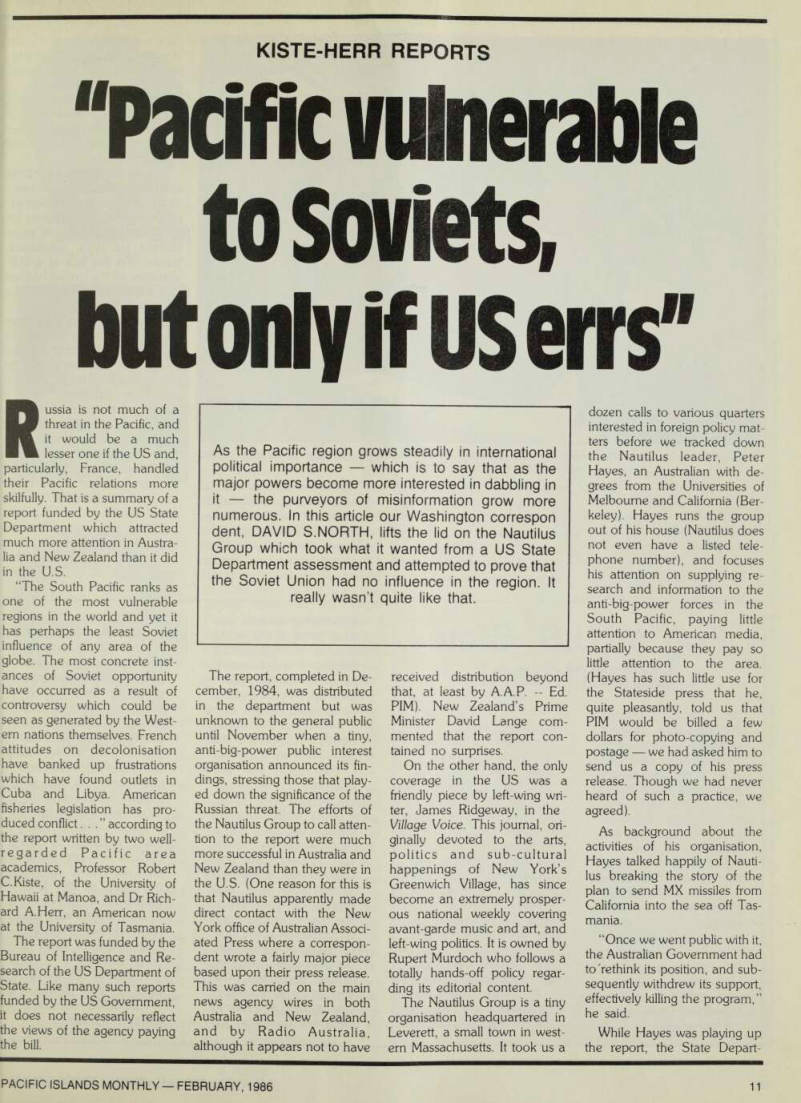
Soviet naval tanker “Pamyat Lenina” refuelling guided missile destroyer “Strogiy” in the mid-Pacific, watched by a US. Navy P-3C Orion.
in defeating attempts to revive the overturned Soviet offer of oceanographic aid through CCOP/SOPAC, and had agreed to the establishment of a small resident US mission in Honiara. ”
Kiste and Herr also suggest that the Russians have not been either terribly skilled or terribly interested in the area; further, they devote some attention to potential threats to the island states from Western-based freebooters and criminal ele ments.
One of the most interesting sections of the report speaks of
the lack of institutional memory and momentum in the making of foreign policy in the island nations. Staffing is minimal, or, as they point out: “Personalities play a crucial role in South Pacific foreign policy-making not only because the staffs are thin and thus there are fewer individuals involved in any particular decision, but also be cause the lines of responsibility are very short. An issue moves from the clerk who receives the telex to the foreign minister (often the prime minister), in two or three steps.”
As to the major threats to the area, Kiste and Herr concluded with the following assessment; “Vulnerability remains nonetheless a key issue ... a physical threat (whatever the sources) was less to be feared by the Pacific Islands under current circumstances than eco nomic domination (again, whatever the source). Econo mic vulnerability thus remains the perceived essence of the micro-state dilemma in the South Pacific regardless of the post-Grenada concerns of physical threat for insular mic ro-states elsewhere.” “Fac tors which have enhanced the Soviet potential for penetration of other areas of the world are largely absent in the South Pacific. Extensive social discon tent, weak democratic institu tions, deep ideological cleav ages particularly as expressed in political parties or trade union movements and the like cur rently offer negligible opportu nities for the Soviets or surro gates to establish and develop a physical presence in the is lands.”
Although the Kiste-Herr re port is a public document, obtaining it is awkward. One must journey (as we did), or write, to a warehouse-type buil ding some dozen miles south of Washington DC, where an obscure arm of the US Depart ment of Commerce will, for U 5519.45, make a photocopy of the document for you. (Write to Sales Desk, National Techni cal Information Service, US De partment of Commerce, Springfield, Va., 22161, USA, and ask for accession number ADA 153015.) David S.
North, in Washington.
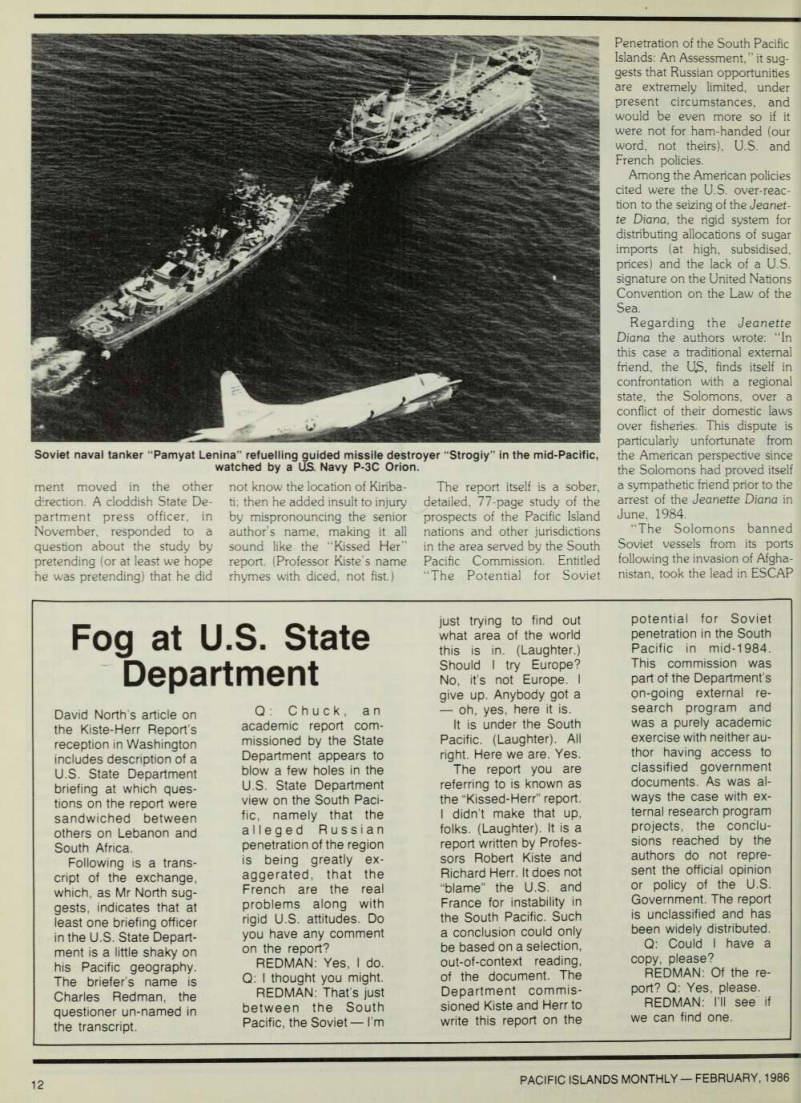
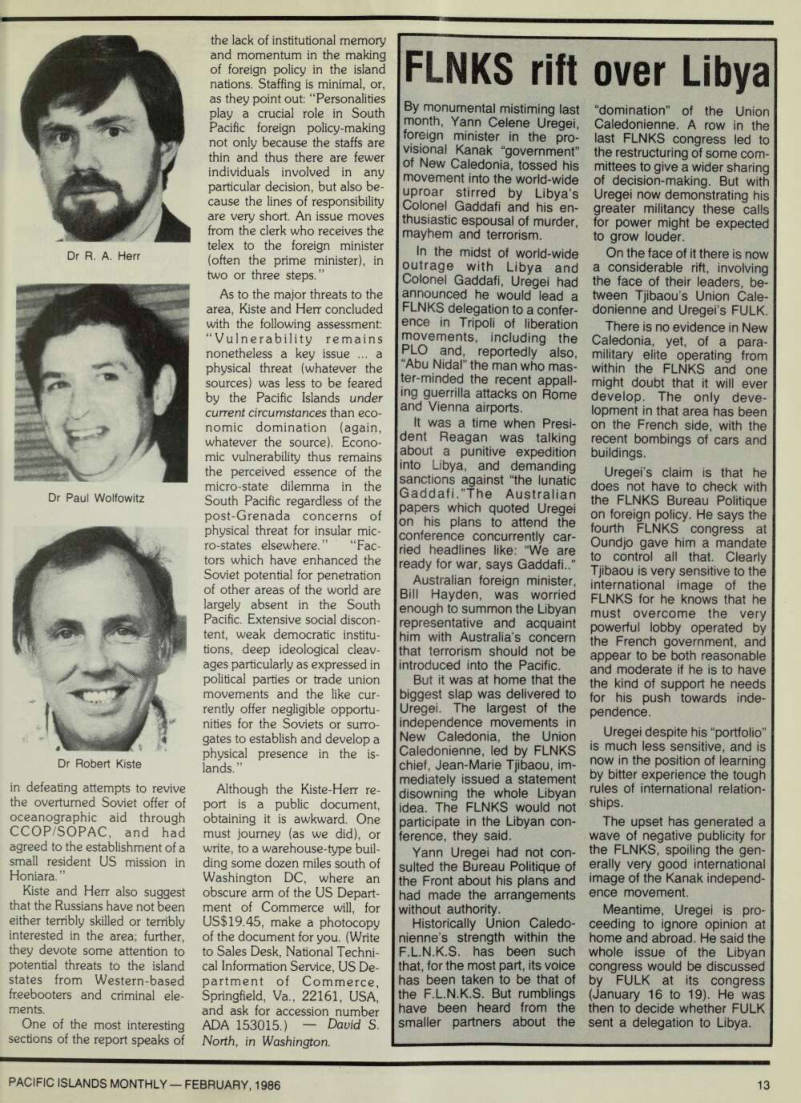
Dr R. A. Herr
Dr Paul Wolfowitz
Dr Robert Kiste
Department
Fog at U.S. State Department
David North’s article on the Kiste-Herr Report’s reception in Washington includes description of a U.S. State Department briefing at which ques tions on the report were sandwiched between others on Lebanon and South Africa.
Following is a trans cript of the exchange, which, as Mr North sug gests, indicates that at least one briefing officer in the U.S. State Depart ment is a little shaky on his Pacific geography.
The briefer’s name is Charles Redman, the questioner un-named in the transcript.
Q: Chuck, an academic report com missioned by the State Department appears to blow a few holes in the U.S. State Department view on the South Paci fic, namely that the alleged Russian penetration of the region is being greatly ex aggerated, that the French are the real problems along with rigid U.S. attitudes. Do you have any comment on the report?
REDMAN: Yes, I do.
Q: I thought you might.
REDMAN: That’s just between the South Pacific, the Soviet I’m
just trying to find out what area of the world this is in. (Laughter.) Should I try Europe?
No, it’s not Europe. I give up. Anybody got a oh, yes, here it is.
It is under the South Pacific. (Laughter). All right. Here we are. Yes.
The report you are referring to is known as the “Kissed-Herr” report.
I didn’t make that up, folks. (Laughter). It is a report written by Profes sors Robert Kiste and Richard Herr. It does not “blame” the U.S. and France for instability in the South Pacific. Such a conclusion could only be based on a selection, out-of-context reading, of the document. The Department commis sioned Kiste and Herr to write this report on the
potential for Soviet penetration in the South Pacific in mid-1984.
This commission was part of the Department’s on-going external re search program and was a purely academic exercise with neither au thor having access to classified government documents. As was al ways the case with ex ternal research program projects, the conclu sions reached by the authors do not repre sent the official opinion or policy of the U.S.
Government. The report is unclassified and has been widely distributed.
Q; Could I have a copy, please?
REDMAN: Of the re port? Q: Yes, please.
REDMAN: I’ll see if we can find one.
FLNKS rift over Libya
By monumental mistiming last month, Yann Celene Uregei, foreign minister in the pro visional Kanak “government” of New Caledonia, tossed his movement into the world-wide uproar stirred by Libya’s Colonel Gaddafi and his en thusiastic espousal of murder, mayhem and terrorism.
In the midst of world-wide outrage with Libya and Colonel Gaddafi, Uregei had announced he would lead a FLNKS delegation to a confer ence in Tripoli of liberation movements, including the PLO and, reportedly also, “Abu Nidal” the man who mas ter-minded the recent appall ing guerrilla attacks on Rome and Vienna airports.
It was a time when Presi dent Reagan was talking about a punitive expedition into Libya, and demanding sanctions against “the lunatic Gaddafi.’’The Australian papers which quoted Uregei on his plans to attend the conference concurrently car ried headlines like; “We are ready for war, says Gaddafi.."
Australian foreign minister, Bill Hayden, was worried enough to summon the Libyan representative and acquaint him with Australia’s concern that terrorism should not be introduced into the Pacific.
But it was at home that the biggest slap was delivered to Uregei. The largest of the independence movements in New Caledonia, the Union Caledonienne, led by FLNKS chief, Jean-Marie Tjibaou, im mediately issued a statement disowning the whole Libyan idea. The FLNKS would not participate in the Libyan con ference, they said.
Yann Uregei had not con sulted the Bureau Politique of the Front about his plans and had made the arrangements without authority.
Historically Union Caledo nienne’s strength within the F.L.N.K.S. has been such that, for the most part, its voice has been taken to be that of the F.L.N.K.S. But rumblings have been heard from the smaller partners about the
“domination” of the Union Caledonienne. A row in the last FLNKS congress led to the restructuring of some com mittees to give a wider sharing of decision-making. But with Uregei now demonstrating his greater militancy these calls for power might be expected to grow louder.
On the face of it there is now a considerable rift, involving the face of their leaders, be tween Tjibaou’s Union Cale donienne and Uregei’s FULK.
There is no evidence in New Caledonia, yet, of a para military elite operating from within the FLNKS and one might doubt that it will ever develop. The only deve lopment in that area has been on the French side, with the recent bombings of cars and buildings.
Uregei’s claim is that he does not have to check with the FLNKS Bureau Politique on foreign policy. He says the fourth FLNKS congress at Oundjo gave him a mandate to control all that. Clearly Tjibaou is very sensitive to the international image of the FLNKS for he knows that he must overcome the very powerful lobby operated by the French government, and appear to be both reasonable and moderate if he is to have the kind of support he needs for his push towards inde pendence.
Uregei despite his “portfolio” is much less sensitive, and is now in the position of learning by bitter experience the tough rules of international relation ships.
The upset has generated a wave of negative publicity for the FLNKS, spoiling the gen erally very good international image of the Kanak independ ence movement.
Meantime, Uregei is pro ceeding to ignore opinion at home and abroad. He said the whole issue of the Libyan congress would be discussed by FULK at its congress {January 16 to 19). He was then to decide whether FULK sent a delegation to Libya.
Big blimps could pe[?]nce on poachers

Sky Spies Over Pacific Fisheries
Since the days of the pre- World War II German Hindenberg and the Brit ish RlOl, lighter-than-air craft have had a bad name. No self-respecting review of our century would consider itself complete without a photograph of the giant bon-fire into which the hydrogen-filled Hindenberg was turned by a spark of static electricity.
Not only were they ill-starred by such accidents, but airships were left behind in technologi cal development by aeroplanes which, boosted by the war, and subsequent defence needs, shed their propellers for jets in a rush for speed which took them past the sound barrier and into the black vastness of space.
But, back on earth, not every defence planner was interested in bullet-speed or radar-dod ging surveillance exercises on the frail fringes of Earth’s atmosphere. Some sought eco nomy of operation, endurance, and the steady, needle-keen eye of an eagle able to stay aloft for hours, even days, on end.
It is on this level that the airship has regained internatio nal attention. New technology, giving greater safety and re liability, has already been built into the new models. Use of helium gas which is inert, in stead of explosive hydrogen, has removed the fire-flash risk.
Both the British and the American governments are now studying their application in a wide range of uses. None has yet been tried in the Pacific, but officials in some countries, and in some multi-national re gional bodies, have been con sidering the promise of the airship in the very important area of fisheries surveillance, disaster response in the aftermath of hurricanes, search and rescue and other remote area uses.
Piracy is still a Pacific activity, but today the pirates come looking for a different kind of treasure tunafish, yet the battle against the marauders remains as serious as it was in the days of Bully Hayes.
With the fairly imminent completion of a multi nation fisheries agreement by the United States, and similar arrangements with other Pacific fishing nations, like Japan and South Korea, some sort of order should soon be brought to the industry. Yet, by the history and nature of the work, as well as the people involved, poaching probably will still go on.
Surveillance will be essential to maintain whatev er serenity may be brought to a most vexed and complicated situation. Yet, not even the biggest of the Pacific countries can really afford a navy large enough to mount a proper guard over the millions of square kilometres of water inside their 200-mile radius exclusive economic zones. Boats are really too slow, and conventional aircraft, like the work horse Lockheed Orions used by Australia and New Zealand for coastal surveillance, too expensive.
But an answer may lie in the brand-new genera tion of airships being built and offered around the world.
Airship Industries, Ltd., of Britain, part of the Bond Corporation of Western Austra lia, which makes the Skyship series of lighter-than-air craft, is now engaged in preparing a proposal for interested Pacific countries and international or ganisations with Pacific respon sibilities.
In the U.S. they have teamed with Westinghouse Electric Corporation to produce a prop osal to meet the US Navy’s requirement for a Battle Surveillance Airship System
(Bsas).
In Britain they are working with Ferranti Computer Sys tems, Ltd., on a project to meet the Royal Navy’s Offshore Pat rol Vehicle (OPV-3) competi tion.
The Airship Industries Sky
ship 600 has also been offered to the US Coast Guard to meet that service’s call for a lighter than-air craft capable of re maining airborne on station for several weeks, be capable of in-flight replenishment and of detecting and identifying air, surface and sub-surface targets.
While the requirements of the vast areas of the Pacific are different in detail from those of European waters, the Royal Navy’s OPV-3 specificiation seems to embody much that might be needed for fisheries surveillance. There might there fore be a chance of the Islands obtaining machines built in fair ly large numbers, with conse quent savings in cost, and advantage in recruiting and training of aircrew and electro nic technicians.
About half a dozen Skyships are already operating, and one has been sold outright to Nikko Trading Company of Tokyo, which is the procurement divi sion of Japan Air Lines. Others are operating on lease-charter arrangements in Europe. The Skyship 500 has been certified by the British Civil Aviation Authority, to carry fare-paying passengers, under the same rules as the CAA approves aircraft like the Boeing 747 or Concorde.
Two models are currently in production, the Skyship 500 and 600. The 600 has been designed for what defence gurus call, in their jargon, the “Offshore Tapestry Control Vehicle,” by which they seem to mean, simply, an airborne platform, jammed with all sorts of electronics, capable of seeing almost anything moving about on the rich tapestry of the ocean’s surface or sub surface.
The 600 Sentinel, as it is called, has already been tested
by the French Navy and is under review by a number of other nations. It has an endur ance of 35 hours, can hold a stationary hover, or cruise at over 50 mph.
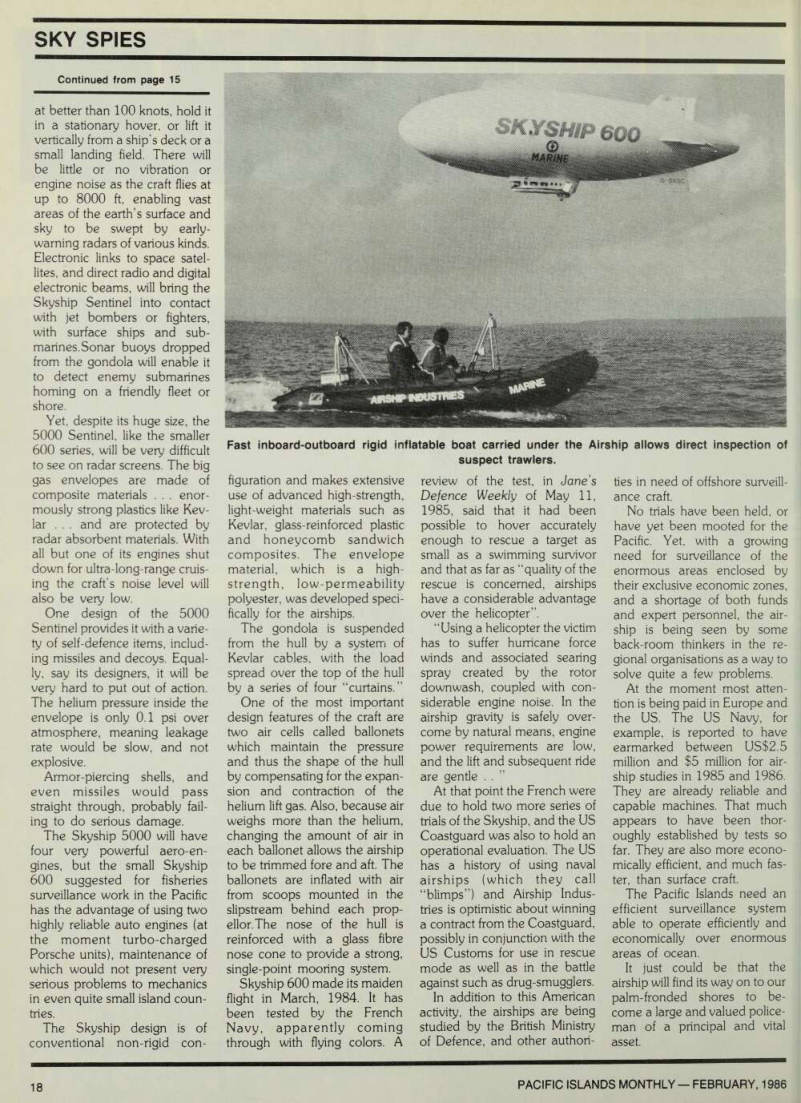
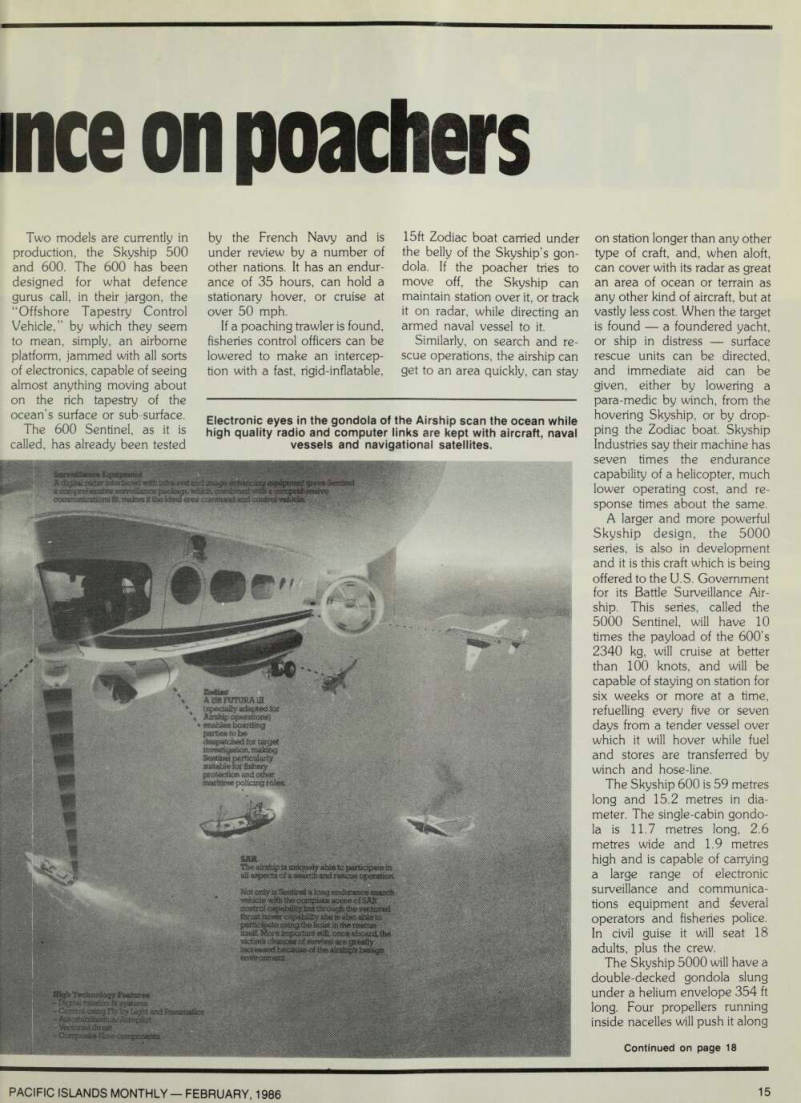
If a poaching trawler is found, fisheries control officers can be lowered to make an intercep tion with a fast, rigid-inflatable,
15ft Zodiac boat carried under the belly of the Skyship’s gon dola. If the poacher tries to move off, the Skyship can maintain station over it, or track it on radar, while directing an armed naval vessel to it.
Similarly, on search and re scue operations, the airship can get to an area quickly, can stay
on station longer than any other type of craft, and, when aloft, can cover with its radar as great an area of ocean or terrain as any other kind of aircraft, but at vastly less cost. When the target is found a foundered yacht, or ship in distress surface rescue units can be directed, and immediate aid can be given, either by lowering a para-medic by winch, from the hovering Skyship, or by drop ping the Zodiac boat. Skyship Industries say their machine has seven times the endurance capability of a helicopter, much lower operating cost, and re sponse times about the same.
A larger and more powerful Skyship design, the 5000 series, is also in development and it is this craft which is being offered to the U.S. Government for its Battle Surveillance Air ship. This series, called the 5000 Sentinel, will have 10 times the payload of the 600’s 2340 kg, will cruise at better than 100 knots, and will be capable of staying on station for six weeks or more at a time, refuelling every five or seven days from a tender vessel over which it will hover while fuel and stores are transferred by winch and hose-line.
The Skyship 600 is 59 metres long and 15.2 metres in dia meter. The single-cabin gondo la is 11.7 metres long, 2.6 metres wide and 1.9 metres high and is capable of carrying a large range of electronic surveillance and communica tions equipment and Several operators and fisheries police.
In civil guise it will seat 18 adults, plus the crew.
The Skyship 5000 will have a double-decked gondola slung under a helium envelope 354 ft long. Four propellers running inside nacelles will push it along
Continued on page 18
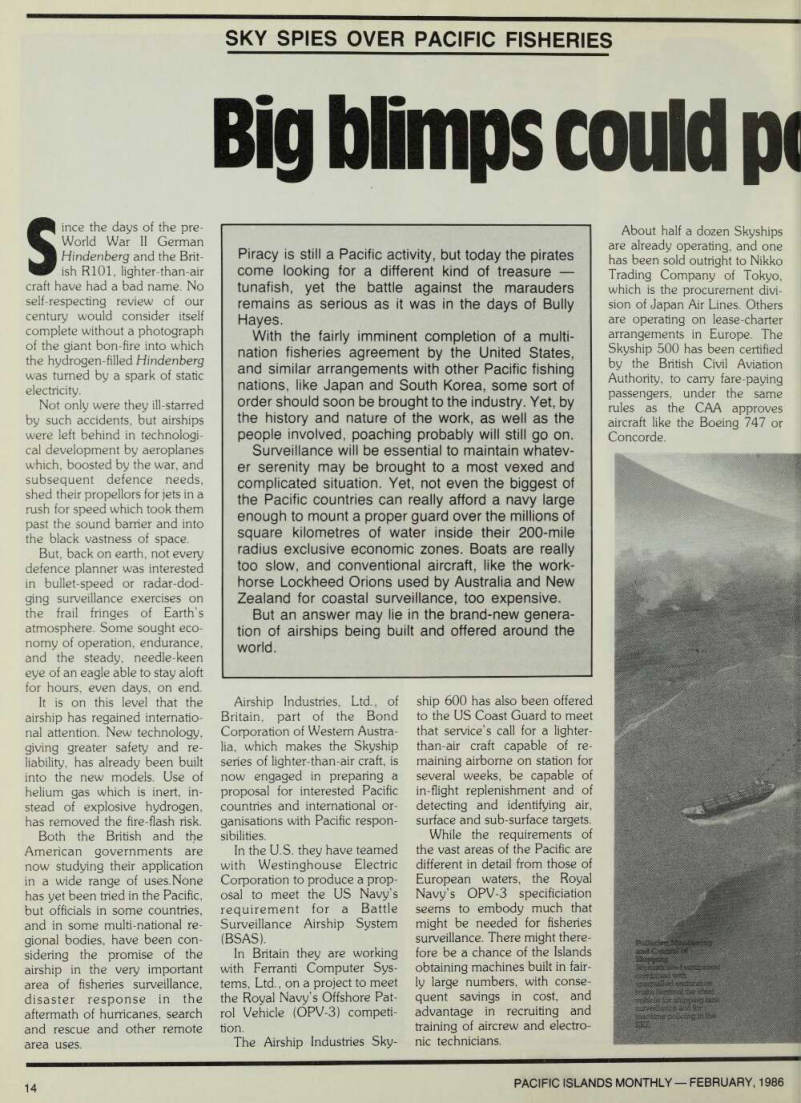
Electronic eyes in the gondola of the Airship scan the ocean while high quality radio and computer links are kept with aircraft, naval vessels and navigational satellites.
at better than 100 knots, hold it in a stationary hover, or lift it vertically from a ship’s deck or a small landing field. There will be little or no vibration or engine noise as the craft flies at up to 8000 ft, enabling vast areas of the earth’s surface and sky to be swept by early warning radars of various kinds.
Electronic links to space satel lites, and direct radio and digital electronic beams, will bring the Skyship Sentinel into contact with jet bombers or fighters, with surface ships and sub marines. Sonar buoys dropped from the gondola will enable it to detect enemy submarines homing on a friendly fleet or shore.
Yet, despite its huge size, the 5000 Sentinel, like the smaller 600 series, will be very difficult to see on radar screens. The big gas envelopes are made of composite materials . . . enor mously strong plastics like Kev lar ... and are protected by radar absorbent materials. With all but one of its engines shut down for ultra-long-range cruis ing the craft’s noise level will also be very low.
One design of the 5000 Sentinel provides it with a varie ty of self-defence items, includ ing missiles and decoys. Equal ly, say its designers, it will be very hard to put out of action.
The helium pressure inside the envelope is only 0.1 psi over atmosphere, meaning leakage rate would be slow, and not explosive.
Armor-piercing shells, and even missiles would pass straight through, probably fail ing to do serious damage.
The Skyship 5000 will have four very powerful aero-en gines, but the small Skyship 600 suggested for fisheries surveillance work in the Pacific has the advantage of using two highly reliable auto engines (at the moment turbo-charged Porsche units), maintenance of which would not present very serious problems to mechanics in even quite small island coun tries.
The Skyship design is of conventional non-rigid con-
figuration and makes extensive use of advanced high-strength, light-weight materials such as Kevlar, glass-reinforced plastic and honeycomb sandwich composites. The envelope material, which is a high strength, low-permeability polyester, was developed speci fically for the airships.
The gondola is suspended from the hull by a system of Kevlar cables, with the load spread over the top of the hull by a series of four “curtains.”
One of the most important design features of the craft are two air cells called ballonets which maintain the pressure and thus the shape of the hull by compensating for the expan sion and contraction of the helium lift gas. Also, because air weighs more than the helium, changing the amount of air in each ballonet allows the airship to be trimmed fore and aft. The ballonets are inflated with air from scoops mounted in the slipstream behind each prop eller. The nose of the hull is reinforced with a glass fibre nose cone to provide a strong, single-point mooring system.
Skyship 600 made its maiden flight in March, 1984. It has been tested by the French Navy, apparently coming through with flying colors. A
review of the test, in Jane’s Defence Weekly of May 11, 1985, said that it had been possible to hover accurately enough to rescue a target as small as a swimming survivor and that as far as “quality of the rescue is concerned, airships have a considerable advantage over the helicopter”.
“Using a helicopter the victim has to suffer hurricane force winds and associated searing spray created by the rotor downwash, coupled with con siderable engine noise. In the airship gravity is safely over come by natural means, engine power requirements are low, and the lift and subsequent ride are gentle At that point the French were due to hold two more series of trials of the Skyship, and the US Coastguard was also to hold an operational evaluation. The US has a history of using naval airships (which they call “blimps”) and Airship Indus tries is optimistic about winning a contract from the Coastguard, possibly in conjunction with the US Customs for use in rescue mode as well as in the battle against such as drug-smugglers.
In addition to this American activity, the airships are being studied by the British Ministry of Defence, and other authori
ties in need of offshore surveill ance craft.
No trials have been held, or have yet been mooted for the Pacific. Yet. with a growing need for surveillance of the enormous areas enclosed by their exclusive economic zones, and a shortage of both funds and expert personnel, the air ship is being seen by some back-room thinkers in the re gional organisations as a way to solve quite a few problems.
At the moment most atten tion is being paid in Europe and the US. The US Navy, for example, is reported to have earmarked between US$2.5 million and $5 million for air ship studies in 1985 and 1986.
They are already reliable and capable machines. That much appears to have been thor oughly established by tests so far. They are also more econo mically efficient, and much fas ter, than surface craft.
The Pacific Islands need an efficient surveillance system able to operate efficiently and economically over enormous areas of ocean.
It just could be that the airship will find its way on to our palm-fronded shores to be come a large and valued police man of a principal and vital asset.
Fast inboard-outboard rigid inflatable boat carried under the Airship allows direct inspection of suspect trawlers.
Advertisements & other items, pp. 16-18 (2 items)
The Nissai
Balance
Nissan’s electronically controlled automatic transmission provides extremely precise all-gear lock-up and shifting schedule.
Regardless of culture, balance is a requirement universally acknowledged by man.
It is balance that makes anything work.
The balanced proportions of a Grecian urn.
The balance of color and drawing, line and volume, light and shadow in a Renaissance painting. The balance in our bodies even. Or, for that matter, the whole of creation.
The Nissan Laurel with its electronically controlled automatic transmission is an eminent example of how the principle of balance can be effectively applied in contemporary automotive technology. It’s a well-rounded car in every way.
Equipped with a microprocessor, the electronically controlled automatic transmission is marvel of precision, determining and setting the shifting schedule to “Power” or “Economy” in accordance with prevailing conditions.
That way, you have just the right power at every moment. No more, no less. And you have it along with optimum fuel economy and a quiet, unvaryingly efficient operation.
The Nissan Laurel treads the fine line between power and grace, beauty and function, driving ease and dependability. It has balance in its engine and transmission, its body design and engineering, its remarkably stable running performance.
And it succeeds because it has that intangible yet very real quality that makes a Nissan what it is—The Nissan Dimension. t a> mi si
Quality in motion
NISSAN
Sky Spies
18
PACIFIC ISLANDS MONTHLY FEBRUARY, 1986
Continued from page 15
SKY SPIES
edge of a razor
Amnesty Proposal
Good cheer on the edge of a razor
Christmas, 1985, in New Caledonia was again a time of celebration and goodwill. Decorations were up. Shops were well stocked and Santa Claus made several public appearances. All a far cry from Christmas the year before when the prevailing atmosphere was one of fear and violence.
While the situation is now much calmer, the pro and anti independence forces are prob ably now more set against each other than ever. Last Christmas it was the Kanak Socialist Na tional Liberation Front (the FLNKS) which had the upper hand, having taken the loyalist population by surprise with its determination and strength.
However, during the follow ing 12 months the loyalists have had time to organise. For the most part they have directed their fight against the French government, accusing it of bet raying its far-flung citizens and supporting the wishes of a violent minority.
Other more extreme groups have also set themselves up.
The most recent show of strength from this side came on December 2 with a devastating bomb attack on Noumea’s court complex. The blast was detonated just before 3 a.m. shaking buildings, shattering windows and waking residents for several kilometres around the site.
The bomb completely de stroyed the main courtroom of the two-storey building, reduc ing the elegant chamber to a pile of rubble and twisted metal.
The two side wings of the court complex were also badly dam aged, but at least they were left standing.
Shortly after day-break a note was found in the wreck age. It read: “For the eyes of Gauzere. For the immediate release of Lapetite, Tricard, Sineimene, Mitride. Second warning; or else.”
It refers to Mr Dick Gauzere, a white Caledonian rendered blind by a tear-gas grenade during the day-long riot of May 8, and another group of men jailed for their part in the massacre of ten Kanaks in December, 1984, other bomb attacks in Noumea during 1985.
It also clearly indicates there will be more of the same unless the prisoners are released, which would seem unlikely.
The police have taken the warning seriously. Less than 24 hours before another bomb had been exploded destroying the car of independence leader Norbert Caffa. The car had been parked in the building
housing the Australian Consu late. However, neither the buil ding, nor any other car, was damaged, so expertly had the bomb been placed. The same expertise was evident in the attack on the court and police believe the extreme right is now using a professional to organise its “hits.” (Observers of the New Caledonian scene have fre quently noted the two distinct groups of white French in the territory those whose fami lies have worked the land or run businesses for many de cades, and others who have arrived more recently, many of them from Algeria. Given their earlier associations it would seem reasonable to assume that many of the latter would have contacts among men who, ori ginally, might have been trained in counter-terrorism and similar violent skills. Ed.) Accordingly, local police
Noumea Notebook
have handed the investigation of the court bombing over to a crack team of detectives from Paris. This team is led by Commissaire Farrugia, the same detective who led the investigation into the New Caledonian connection to the sinking of the Greenpeace ship Rainbow Warrior.
The bombing of the court coincided rather symbolically with the first reading of a controversial amnesty law for New Caledonia in the French parliament. The law, strongly opposed by the right, allows all those involved in the events of the past year, such as burning houses, killing stock, and the like, to go free. It does not include those involved in vio lent physical crimes against police or others. The bill was finally passed by the parliament in Paris on December 22.
There are about 100 FLNKS prisoners in Noumea’s jail who may be set free under the new law. Sue Williams in Noumea.
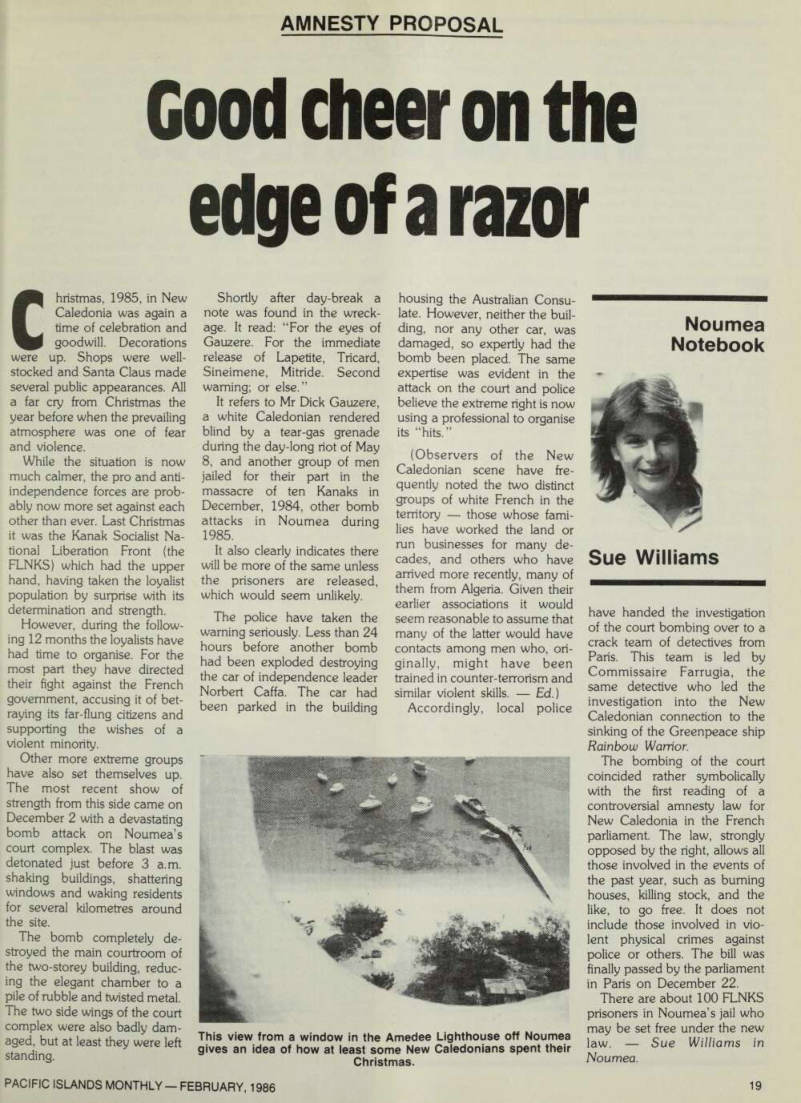
This view from a window in the Amedee Lighthouse off Noumea gives an idea of how at least some New Caledonians spent their Christmas.
Sue Williams
haunt Wingti
Opm Digs In
Han Jaya refugees haunt Wingti
Ten thousand border crossers can’t be wrong or can they?
Villagers from Irian Jaya who have fled to camps along the PNG border claim their homes and food gardens have been destroyed by In donesian soldiers carrying out reprisal raids in the hunt for Free Papua Movement (OPM) guerrillas. They tell of being sprayed by indiscriminate machinegun fire and claim they will be killed if they return.
But others claim the camps are merely a useful breeding ground and hiding place for the rebels and a “safe” area for their families. To prove it, they point to the attack on an In donesian fact-finding delega tion last year at Blackwater, one of the jungle camps.
This is the continuing dilem ma facing the PNG government as it tussles with a legacy of colonialism that has turned into a thorn in the flesh; the border which has divided a Melanesian land in two and put half under Indonesian rule.
The very human problem of 10,000 people living in the makeshift camps the number has gradually swelled since trouble flared two years ago and the activities of the OPM has now landed in the laps of Paias Wingti and Sir Julius Chan, successors to the former government of Michael So mare.
Mr Somare’s cabinet handled the border issue very gingerly, realising the delicacy of the domestic political problem it presented to a government far from sure of its numbers in parliament and very aware of the trouble it could make for itself by appearing either too
conciliatory towards the In donesians, or too welcoming to the OPM.
Mr Wingti has pledged to take action on the border crossers but has already indicated they would be en couraged to return.
“We hope to be able to formulate a phased and co operative program for the reintegration of Irian Jayan bor der-crossers into their families,” he said.
The government would de monstrate firmness of purpose but care and compassion, he said, adding that no genuine refugee would be forced to return against his or her will.
This is not so very different from statements made by the former Somare government, although it appeared to be split on the issue. The then Foreign Minister, Rabbie Namaliu, said Australia and other countries should take some responsibility, while Somare himself main tained it was a problem for PNG and Indonesia alone and would be solved without out side help.
However, a submission to Wingti’s National Executive Council by the present foreign minister, Legu Vagi, in Decem ber was rejected as “the same old stuff as presented to So mare. ” He was ordered to draw up a new one.
The rejected submission in cluded, among other things, a call to settle some crossers in
Png.
There is no doubt that such a move would be a popular electoral decision in PNG. De spite assurances from Jakarta that no harm would befall any crossers who returned, many Papua New Guineans remain
very sceptical.
They believe their Melane sian brothers are suffering under the continued influx of transmigrasi (transported im migrants) from Java who are robbing them of their land and the chances of jobs and ad vancement in Irian Jayan cities.
Politicians report that many villagers in border electorates have offered to give land to Irian Jayans if they are allowed to settle in the country.
But if the 10,000 now camped along the length of the east-west border are allowed to stay, how many more might follow in search of a “better life” on the PNG side?
The way out for the politi cians when there are no palat able solutions to a problem is simply to use the old diplomatic
ploy of doing nothing: sit tight until something happens to force your hand. That is what Somare did for over a year.
Meanwhile, one orders in quiries, consults experts and petitions other countries.
Wingti’s government appears to be following a similar path.
Unlike the economic problems at home, to which the new prime minister immediately took the surgeon’s knife, cutting out at least some of the cancer ous waste in public spending, the border problem is, accor ding to Mr Vagi, “complex and sensitive and requiring a care ful, cautious approach.”
The border was one issue on which Mr Wingti, who had not hesitated to sally forth to the attack while in Opposition, had remained uncharacteristically
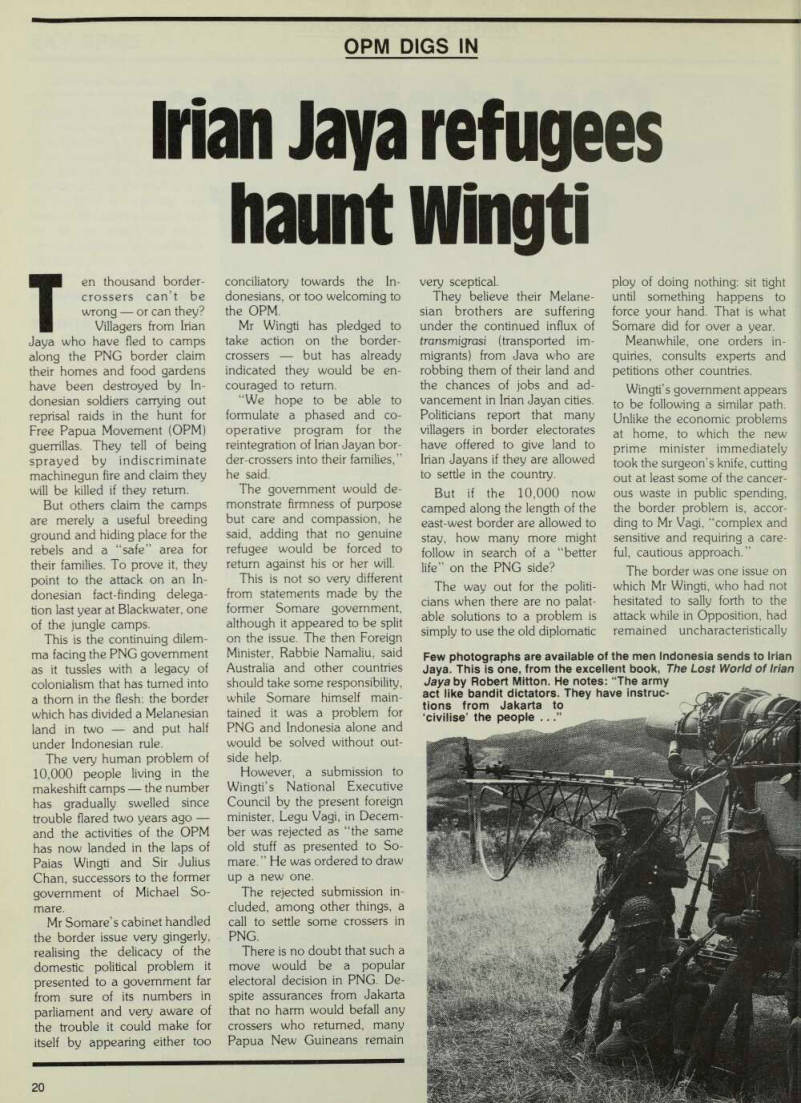
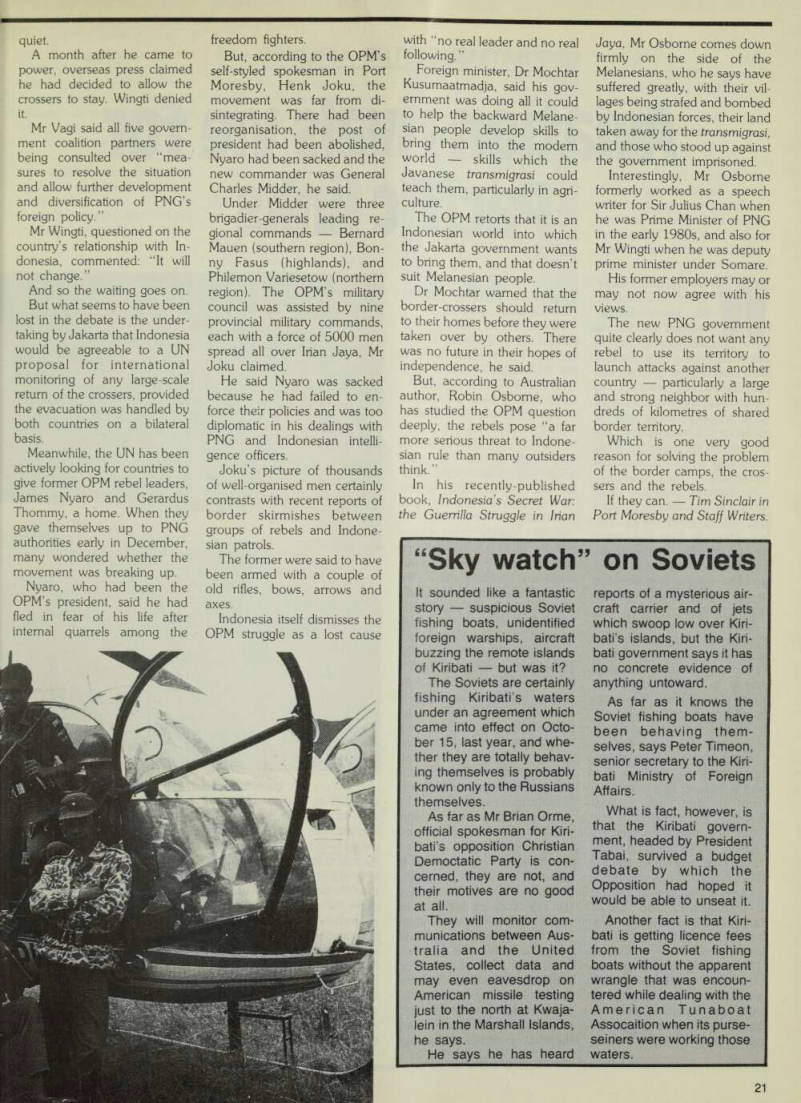
Few photographs are available of the men Indonesia sends to Irian Jaya. This is one, from the excellent book, The Lost World of Irian Jaya by Robert Mitton. He notes: “The army act like bandit dictators. They have instruc tions from Jakarta to ‘civilise’ the people ..."
quiet.
A month after he came to power, overseas press claimed he had decided to allow the crossers to stay. Wingti denied it.
Mr Vagi said all five govern ment coalition partners were being consulted over “mea sures to resolve the situation and allow further development and diversification of PNG’s foreign policy.”
Mr Wingti, questioned on the country’s relationship with In donesia, commented: “It will not change.”
And so the waiting goes on.
But what seems to have been lost in the debate is the under taking by Jakarta that Indonesia would be agreeable to a UN proposal for international monitoring of any large-scale return of the crossers, provided the evacuation was handled by both countries on a bilateral basis.
Meanwhile, the UN has been actively looking for countries to give former OPM rebel leaders, James Nyaro and Gerardus Thommy, a home. When they gave themselves up to PNG authorities early in December, many wondered whether the movement was breaking up.
Nyaro, who had been the OPM’s president, said he had fled in fear of his life after internal quarrels among the
freedom fighters.
But, according to the OPM’s self-styled spokesman in Port Moresby, Henk Joku, the movement was far from di sintegrating. There had been reorganisation, the post of president had been abolished, Nyaro had been sacked and the new commander was General Charles Midder, he said.
Under Midder were three brigadier-generals leading re gional commands Bernard Mauen (southern region), Bon ny Fasus (highlands), and Philemon Variesetow (northern region). The OPM’s military council was assisted by nine provincial military commands, each with a force of 5000 men spread all over Irian Jaya, Mr Joku claimed.
He said Nyaro was sacked because he had failed to en force their policies and was too diplomatic in his dealings with PNG and Indonesian intelli gence officers.
Joku’s picture of thousands of well-organised men certainly contrasts with recent reports of border skirmishes between groups of rebels and Indone sian patrols.
The former were said to have been armed with a couple of old rifles, bows, arrows and axes.
Indonesia itself dismisses the OPM struggle as a lost cause
with no real leader and no real
following.”
Foreign minister, Dr Mochtar Kusumaatmadja, said his government was doing all it could to help the backward Melanesian people develop skills to bring them into the modern world skills which the Javanese transmigrasi could teach them, particularly in agriculture.
The OPM retorts that it is an Indonesian world into which the Jakarta government wants to bring them, and that doesn’t suit Melanesian people.
Dr Mochtar warned that the border-crossers should return to their homes before they were taken over by others. There was no future in their hopes of independence, he said.
But, according to Australian author, Robin Osborne, who has studied the OPM question deeply, the rebels pose “a far more serious threat to Indonesian rule than many outsiders think.”
In his recently-published book, Indonesia’s Secret IVar: the Guerrilla Struggle in Irian
Jaya, Mr Osborne comes down firmly on the side of the Melanesians, who he says have suffered greatly, with their vil lages being strafed and bombed by Indonesian forces, their land taken away for the transmigrasi, and those who stood up against the government imprisoned.
Interestingly, Mr Osborne formerly worked as a speech writer for Sir Julius Chan when he was Prime Minister of PNG in the early 1980 s, and also for Mr Wingti when he was deputy prime minister under Somare.
His former employers may or may not now agree with his views.
The new PNG government quite clearly does not want any rebel to use its territory to launch attacks against another country particularly a large and strong neighbor with hun dreds of kilometres of shared border territory, Which is one very good reason for solving the problem of the border camps, the cros sers and the rebels, If they can.— Tim Sinclair in Port Moresby and Staff Writers.
“Sky watch” on Soviets
It sounded like a fantastic story suspicious Soviet fishing boats, unidentified foreign warships, aircraft buzzing the remote islands of Kiribati but was it?
The Soviets are certainly fishing Kiribati’s waters under an agreement which came into effect on Octo ber 15, last year, and whe ther they are totally behav ing themselves is probably known only to the Russians themselves.
As far as Mr Brian Orme, official spokesman for Kiri bati’s opposition Christian Democtatic Party is con cerned, they are not, and their motives are no good at all.
They will monitor com munications between Aus tralia and the United States, collect data and may even eavesdrop on American missile testing just to the north at Kwaja lein in the Marshall Islands, he says.
He says he has heard
reports of a mysterious air craft carrier and of jets which swoop low over Kiri bati’s islands, but the Kiri bati government says it has no concrete evidence of anything untoward.
As far as it knows the Soviet fishing boats have been behaving them selves, says Peter Timeon, senior secretary to the Kiri bati Ministry of Foreign Affairs.
What is fact, however, is that the Kiribati govern ment, headed by President Tabai, survived a budget debate by which the Opposition had hoped it would be able to unseat it.
Another fact is that Kiri bati is getting licence fees from the Soviet fishing boats without the apparent wrangle that was encoun tered while dealing with the American Tunaboat Assocaition when its purse seiners were working those waters.
Aviation rivals vie for
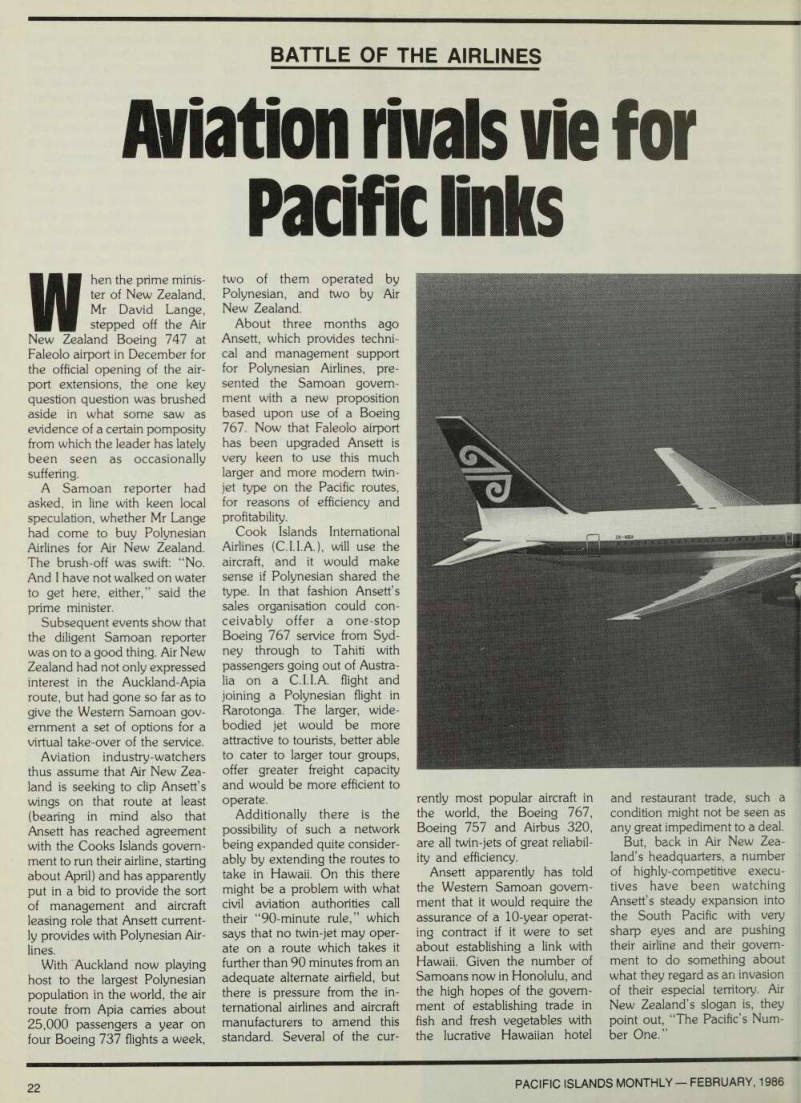
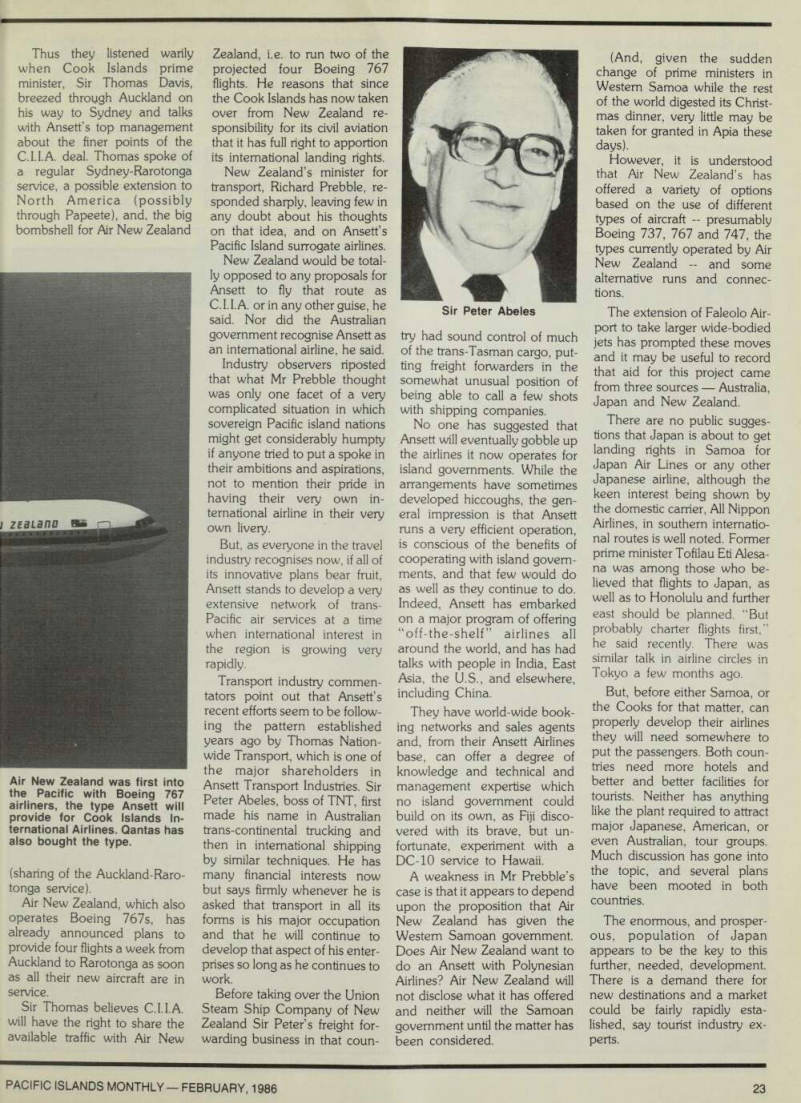
Battle Of The Airlines
Aviation rivals vie for Pacific Iinks
When the prime minis ter of New Zealand, Mr David Lange, stepped off the Air New Zealand Boeing 747 at Faleolo airport in December for the official opening of the air port extensions, the one key question question was brushed aside in what some saw as evidence of a certain pomposity from which the leader has lately been seen as occasionally suffering.
A Samoan reporter had asked, in line with keen local speculation, whether Mr Lange had come to buy Polynesian Airlines for Air New Zealand.
The brush-off was swift: “No.
And I have not walked on water to get here, either,” said the prime minister.
Subsequent events show that the diligent Samoan reporter was on to a good thing. Air New Zealand had not only expressed interest in the Auckland-Apia route, but had gone so far as to give the Western Samoan gov ernment a set of options for a virtual take-over of the service.
Aviation industry-watchers thus assume that Air New Zea land is seeking to clip Ansett’s wings on that route at least (bearing in mind also that Ansett has reached agreement with the Cooks Islands govern ment to run their airline, starting about April) and has apparently put in a bid to provide the sort of management and aircraft leasing role that Ansett current ly provides with Polynesian Air lines.
With Auckland now playing host to the largest Polynesian population in the world, the air route from Apia carries about 25,000 passengers a year on four Boeing 737 flights a week,
two of them operated by Polynesian, and two by Air New Zealand.
About three months ago Ansett, which provides techni cal and management support for Polynesian Airlines, pre sented the Samoan govern ment with a new proposition based upon use of a Boeing 767. Now that Faleolo airport has been upgraded Ansett is very keen to use this much larger and more modem twin jet type on the Pacific routes, for reasons of efficiency and profitability.
Cook Islands International Airlines (C.1.1.A.), will use the aircraft, and it would make sense if Polynesian shared the type. In that fashion Ansett’s sales organisation could con ceivably offer a one-stop Boeing 767 service from Syd ney through to Tahiti with passengers going out of Austra lia on a CL LA. flight and joining a Polynesian flight in Rarotonga. The larger, wide bodied jet would be more attractive to tourists, better able to cater to larger tour groups, offer greater freight capacity and would be more efficient to operate.
Additionally there is the possibility of such a network being expanded quite consider ably by extending the routes to take in Hawaii. On this there might be a problem with what civil aviation authorities call their “90-minute rule,” which says that no twin-jet may oper ate on a route which takes it further than 90 minutes from an adequate alternate airfield, but there is pressure from the in ternational airlines and aircraft manufacturers to amend this standard. Several of the cur-
rently most popular aircraft in the world, the Boeing 767, Boeing 757 and Airbus 320, are all twin-jets of great reliabil ity and efficiency.
Ansett apparently has told the Western Samoan govern ment that it would require the assurance of a 10-year operat ing contract if it were to set about establishing a link with Hawaii. Given the number of Samoans now in Honolulu, and the high hopes of the govern ment of establishing trade in fish and fresh vegetables with the lucrative Hawaiian hotel
and restaurant trade, such a condition might not be seen as any great impediment to a deal.
But, back in Air New Zea land’s headquarters, a number of highly-competitive execu tives have been watching Ansett’s steady expansion into the South Pacific with very sharp eyes and are pushing their airline and their govern ment to do something about what they regard as an invasion of their especial territory. Air New Zealand’s slogan is, they point out, “The Pacific’s Num ber One.”
Thus they listened warily when Cook Islands prime minister, Sir Thomas Davis, breezed through Auckland on his way to Sydney and talks with Ansett’s top management about the finer points of the C.1.1.A. deal. Thomas spoke of a regular Sydney-Rarotonga service, a possible extension to North America (possibly through Papeete), and, the big bombshell for Air New Zealand
(sharing of the Auckland-Raro tonga service).
Air New Zealand, which also operates Boeing 7675, has already announced plans to provide four flights a week from Auckland to Rarotonga as soon as all their new aircraft are in service.
Sir Thomas believes C.1.1.A. will have the right to share the available traffic with Air New
Zealand, i.e. to run two of the projected four Boeing 767 flights. He reasons that since the Cook Islands has now taken over from New Zealand re sponsibility for its civil aviation that it has full right to apportion its international landing rights.
New Zealand’s minister for transport, Richard Prebble, re sponded sharply, leaving few in any doubt about his thoughts on that idea, and on Ansett’s Pacific Island surrogate airlines.
New Zealand would be total ly opposed to any proposals for Ansett to fly that route as C.1.1.A. or in any other guise, he said. Nor did the Australian government recognise Ansett as an international airline, he said.
Industry observers riposted that what Mr Prebble thought was only one facet of a very complicated situation in which sovereign Pacific island nations might get considerably humpty if anyone tried to put a spoke in their ambitions and aspirations, not to mention their pride in having their very own in ternational airline in their very own livery.
But, as everyone in the travel industry recognises now, if all of its innovative plans bear fruit, Ansett stands to develop a very extensive network of trans pacific air services at a time when international interest in the region is growing very rapidly.
Transport industry commen tators point out that Ansett’s recent efforts seem to be follow ing the pattern established years ago by Thomas Nation wide Transport, which is one of the major shareholders in Ansett Transport Industries. Sir Peter Abeles, boss of TNT, first made his name in Australian trans-continental trucking and then in international shipping by similar techniques. He has many financial interests now but says firmly whenever he is asked that transport in all its forms is his major occupation and that he will continue to develop that aspect of his enter prises so long as he continues to work.
Before taking over the Union Steam Ship Company of New Zealand Sir Peter’s freight for warding business in that coun-
try had sound control of much of the trans-Tasman cargo, put ting freight forwarders in the somewhat unusual position of being able to call a few shots with shipping companies.
No one has suggested that Ansett will eventually gobble up the airlines it now operates for island governments. While the arrangements have sometimes developed hiccoughs, the gen eral impression is that Ansett runs a very efficient operation, is conscious of the benefits of cooperating with island govern ments, and that few would do as well as they continue to do.
Indeed, Ansett has embarked on a major program of offering “off-the-shelf” airlines all around the world, and has had talks with people in India, East Asia, the U.S., and elsewhere, including China.
They have world-wide book ing networks and sales agents and, from their Ansett Airlines base, can offer a degree of knowledge and technical and management expertise which no island government could build on its own, as Fiji disco vered with its brave, but un fortunate, experiment with a DC-10 service to Hawaii.
A weakness in Mr Prebble’s case is that it appears to depend upon the proposition that Air New Zealand has given the Western Samoan government.
Does Air New Zealand want to do an Ansett with Polynesian Airlines? Air New Zealand will not disclose what it has offered and neither will the Samoan government until the matter has been considered.
(And, given the sudden change of prime ministers in Western Samoa while the rest of the world digested its Christ mas dinner, very little may be taken for granted in Apia these days).
However, it is understood that Air New Zealand’s has offered a variety of options based on the use of different types of aircraft - presumably Boeing 737, 767 and 747, the types currently operated by Air New Zealand - and some alternative runs and connec tions.
The extension of Faleolo Air port to take larger wide-bodied jets has prompted these moves and it may be useful to record that aid for this project came from three sources Australia, Japan and New Zealand.
There are no public sugges tions that Japan is about to get landing rights in Samoa for Japan Air Lines or any other Japanese airline, although the keen interest being shown by the domestic carrier, All Nippon Airlines, in southern internatio nal routes is well noted. Former prime minister Tofilau Eti Alesa na was among those who be lieved that flights to Japan, as well as to Honolulu and further east should be planned. “But probably charter flights first,” he said recently. There was similar talk in airline circles in Tokyo a few months ago.
But, before either Samoa, or the Cooks for that matter, can properly develop their airlines they will need somewhere to put the passengers. Both coun tries need more hotels and better and better facilities for tourists. Neither has anything like the plant required to attract major Japanese, American, or even Australian, tour groups.
Much discussion has gone into the topic, and several plans have been mooted in both countries.
The enormous, and prosper ous, population of Japan appears to be the key to this further, needed, development.
There is a demand there for new destinations and a market could be fairly rapidly esta lished, say tourist industry ex perts.
Air New Zealand was first into the Pacific with Boeing 767 airliners, the type Ansett will provide for Cook Islands In ternational Airlines. Qantas has also bought the type.
Sir Peter Abeles
But, as anyone who has dealt with them will attest, Japanese tourists are demanding and very quality-conscious. They like tour coaches to be precisely on time, to the minute, not the half-hour, hotel staff to be po lite, quick, and efficient, drinks to be cold and food to their taste, rooms to be spotlessly clean and fully-equipped, down to slippers and clean-pressed
yu/cata (cotton robes always provided in even the cheapest Japanese inn).
None of these things are impossible for the Pacific, and if the Japanese decide they like a place, then they can visit by their thousands. Millions of Japanese, and especially honeymooners, have a lotus eating vision of the Pacific as a region of space, sunshine,
diamond-white beaches, sake clear waters, beautiful coral reefs, and smiling friendly people all the things they find so hard to get in their own crowded, organised, industrialised, high-technology homeland.
The Japanese have already discovered Queensland, New Zealand, New Caledonia (although the political trouble
has put that into the back ground to a large extent), and Fiji. They are beginning to find Tahiti, although the airline links are more difficult for them. If on-ground facilities can be pro vided there would appear to be no reason why Western Samoa and the Cook Islands should not be next on the list. Roy Vaughan in Auckland and Staff Writers in Sydney.
High stakes in airline bids
The aggressive knights of Pacific civil aviation are preparing to do bat tle once more, attracted by the decision of the Papua New Guinea Cabinet to turn Air Niugini over to private enterprise.
The new Minister of Civil Aviation, Mrs Nahau Rooney, said in Port Moresby that shares would be offered to employees and the public.
Foreign airlines would be allowed to buy shares and apply to manage the airline.
The government fa vored a long-term man agement commitment, she said at least 10 years, rather than the three years which KLM had been given under the current arrange ment.
“Management has been one of our big problems, and I don’t want to blame anyone in particular,” she said at a press conference which was attended by the Air Niugini general mana ger, Mr Masket langalio.
“I am not interested in the past. I want to look to the future and the profitability of the air line,” she said.
Mrs Rooney said pri vatisation of the airline was part of the Wingti
government’s policy of withdrawing from busi ness enterprises.
She said the number of shares to be sold initially would be deter mined after an indepen dent valuation of the air line’s total value of assets, but she hoped a substantial parcel would be bought by the air line’s employees.
Airline employees would not be affected by the decision, although current management personnel, supplied under contract by KLM Royal Dutch Airlines, and officials of the Na tional Airline Commis sion, would become “automatically redun dant.”
A couple of years ago it was Air Pacific, Fiji’s flag-carrier line, which was at the centre of a vigorous battle between Qantas and Air New Zealand on one side and Ansett Airlines of Australia on the other to keep the private com pany from extending its interests in the impor tant Pacific regional air line industry.
Air New Zealand put up a proposal, but was never seen as a hound in full cry after the fox.
Qantas eventually won the race with a three
year management con tract and very generous (for Fiji) financial terms.
Ansett made enor mous efforts to win the Air Pacific contract and was fairly clearly fa vored by Fiji’s prime minister, Ratu Sir Kamisese Mara.
Ansett chief, Sir Peter Abeles, has always had a globe-girdling vision for his huge transport conglomerate and still makes no bones about the depth of his di sappointment at losing this chance to demons trate the benefits of his private enterprise effi ciency.
Air Pacific was the plum because of its in ternational landing rights and its position at the hub of southern Pacific airline routes.
The obvious benefit for Ansett was the chance to, in effect, become a pretty full-scale in ternational airline, by taking over the running of Air Pacific’s quite ex tensive route rights.
Given the highly com petitive climate in which Australian domestic aviation works, and the limited potential for domestic growth seen by Ansett and the other main-route Australians, the benefits of the Air
Pacific link would have been considerable.
But, as the recent deal with the Cook Is lands shows, clearly, Sir Peter and his Ansett team have not let their disappointment over Air Pacific get in the way of continued efforts to achieve their goal.
There are new rumors in the industry that Ansett hopes to offer its con siderable expertise to still other Pacific air lines. The airline itself has said nothing, but that has simply im proved the range of the rumors flitting about among the islands.
As far as Air Niugini is concerned, by most accounts KLM has done a good job with the mess into which the air line had fallen, and was recently publicly com mended by Mrs Rooney for having reduced the airline’s losses.
Mrs Rooney has also been authorised by Cabinet to review all of PNG’s aviation industry, especially in relation to
operators’ licences.
General indication is that PNG will adopt an “open skies” policy.
“The government has given the leeway to be liberal in what were re stricted airways,” she said.
Pitcairn jetty
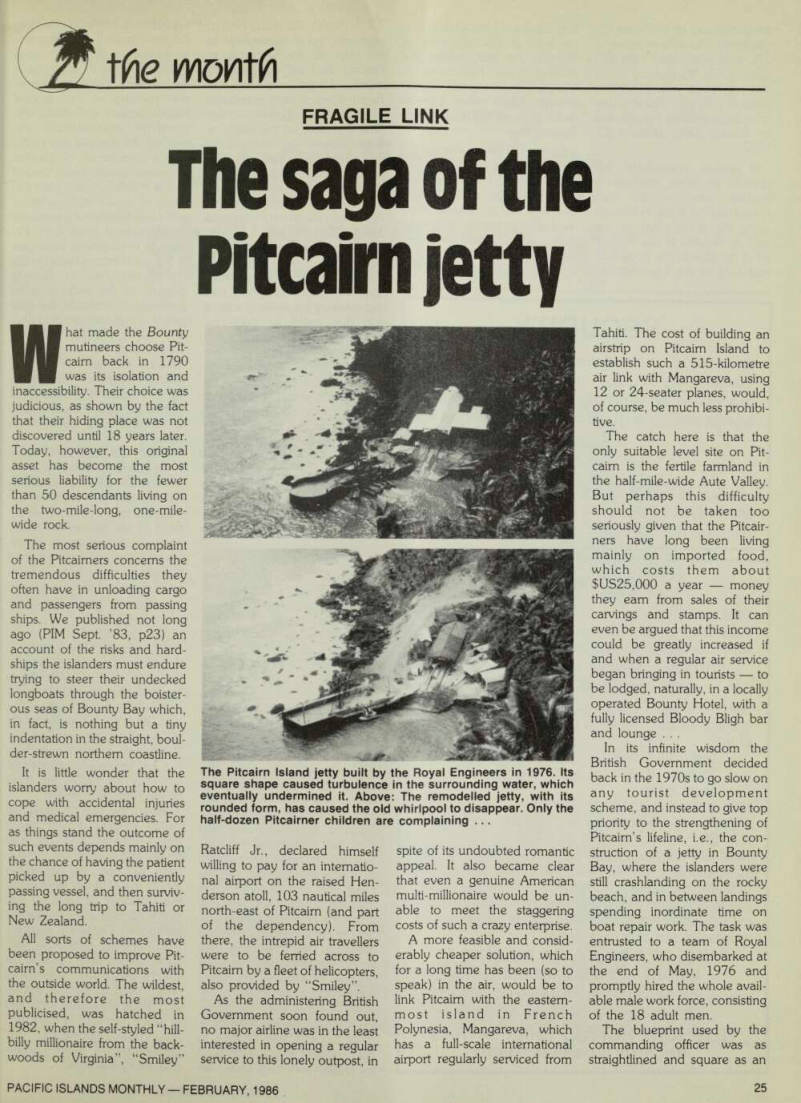
the month
Fragile Link
The saga of the Pitcairn jetty
What made the Bounty mutineers choose Pit cairn back in 1790 was its isolation and inaccessibility. Their choice was judicious, as shown by the fact that their hiding place was not discovered until 18 years later.
Today, however, this original asset has become the most serious liability for the fewer than 50 descendants living on the two-mile-long, one-mile wide rock.
The most serious complaint of the Pitcairners concerns the tremendous difficulties they often have in unloading cargo and passengers from passing ships. We published not long ago (PIM Sept. ’B3, p 23) an account of the risks and hard ships the islanders must endure trying to steer their undecked longboats through the boister ous seas of Bounty Bay which, in fact, is nothing but a tiny indentation in the straight, boul der-strewn northern coastline.
It is little wonder that the islanders worry about how to cope with accidental injuries and medical emergencies. For as things stand the outcome of such events depends mainly on the chance of having the patient picked up by a conveniently passing vessel, and then surviv ing the long trip to Tahiti or New Zealand.
All sorts of schemes have been proposed to improve Pit cairn’s communications with the outside world. The wildest, and therefore the most publicised, was hatched in 1982, when the self-styled “hill billy millionaire from the back woods of Virginia”, “Smiley”
Ratcliff Jr., declared himself willing to pay for an internatio nal airport on the raised Hen derson atoll, 103 nautical miles north-east of Pitcairn (and part of the dependency). From there, the intrepid air travellers were to be ferried across to Pitcairn by a fleet of helicopters, also provided by “Smiley”.
As the administering British Government soon found out, no major airline was in the least interested in opening a regular service to this lonely outpost, in
spite of its undoubted romantic appeal. It also became clear that even a genuine American multi-millionaire would be un able to meet the staggering costs of such a crazy enterprise.
A more feasible and consid erably cheaper solution, which for a long time has been (so to speak) in the air, would be to link Pitcairn with the eastern most island in French Polynesia, Mangareva, which has a full-scale international airport regularly serviced from
Tahiti. The cost of building an airstrip on Pitcairn Island to establish such a 515-kilometre air link with Mangareva, using 12 or 24-seater planes, would, of course, be much less prohibi tive.
The catch here is that the only suitable level site on Pit cairn is the fertile farmland in the half-mile-wide Aute Valley.
But perhaps this difficulty should not be taken too seriously given that the Pitcair ners have long been living mainly on imported food, which costs them about $U525,000 a year money they earn from sales of their carvings and stamps. It can even be argued that this income could be greatly increased if and when a regular air service began bringing in tourists to be lodged, naturally, in a locally operated Bounty Hotel, with a fully licensed Bloody Bligh bar and lounge . . .
In its infinite wisdom the British Government decided back in the 1970 s to go slow on any tourist development scheme, and instead to give top priority to the strengthening of Pitcairn’s lifeline, i.e., the con struction of a jetty in Bounty Bay, where the islanders were still crashlanding on the rocky beach, and in between landings spending inordinate time on boat repair work. The task was entrusted to a team of Royal Engineers, who disembarked at the end of May, 1976 and promptly hired the whole avail able male work force, consisting of the 18 adult men.
The blueprint used by the commanding officer was as straightlined and square as an
The Pitcairn Island jetty built by the Royal Engineers in 1976. Its square shape caused turbulence in the surrounding water, which eventually undermined it. Above: The remodelled jetty, with its rounded form, has caused the old whirlpool to disappear. Only the half-dozen Pitcairner children are complaining ...
army platoon at drill and the result was a boxlike structure of 172 steel piles, filled with 450 cubic yards of crushed rocks and reinforced with 145 cubic yards of concrete. The jetty was most appropriately inaugurated on Bounty Day, January 23, 1977.
A greatly appreciated byproduct of these engineering exploits was the dirt road carved out by army bulldozers along the north coast, all the way to Tedside at the western tip of the island. The hope then harbored by the islanders was
that a second jetty would soon be built at the sea base of Tedside for use during the months from November to March, when strong north easterly winds often prevent them from putting to sea from Bounty Bay.
However, as the years went by, it became apparent that something was badly amiss with the Royal Engineers’ jetty. The fact was that its angular form weakened its resistance to wave action and created an under mining turbulence, which pris ed the piles loose. So it was that
the Island Council began clamoring for a breakwater to be built at the entrance to Bounty Bay on the seaward side of the jetty. In 1983 the British Government eventually sent out an engineer this time a civilian by the name of Basil Williams to estimate the cost of such a project. It turned out to be more than £2 million.
As by then funds available to the British overseas deve lopment administration had been greatly depleted by the post-war reconstruction prog ram in the Falkland Islands, it decided on the stop-gap mea sure of simply repairing and remodelling the existing jetty, a job that could be done for £300,000. Basil Williams, who was assigned to the task, reached Pitcairn in early June in the chartered Danish vessel Vibeke Clipper, carrying 140 tonnes of equipment and material, including a six-tonne derrick, 300 kilograms of explo sives, a sand pump and more than 100 steel piles. Although the male adult population was now down to 12, the work was about half done by September 5, when Governor Terence O’Leary arrived on a tour of inspection not, as in the heyday of the British Empire, on a flag-decked man-of-war, but much more modestly on the small, chartered French yacht Kebir, which had picked him up in Mangareva.
As the editor of the Pitcairn Miscellany reported tongue in cheek; “By now the seas in Bounty Bay were getting as rough as when our supply ship Act VI was here in August, and the longboats ended up in the rocks several times. We thought, if we made it out of the bay to pick up His Excellency, and the other passengers, Caroline and Kevin Young, and back into the bay, we might be able to frighten His Excellency so much that he will see the need and give consent for a breakwater right away. We had a wet trip coming back, but no trouble coming through the surf in Bounty Bay, so our breakwa ter hopes were crushed, at least for the time being. In fact, I think His Excellency rather en joyed the trip.”
During his five-day stay Gov ernor O’Leary also seemed to enjoy himself greatly, setting off the biggest rock blast known on
the island so far in the quarry at Adams Ground: 25 kilograms of explosives brought down about 75 tonnes of stone. As to the islanders’ disappointment at the shelving of the second harbor project at Tedside, the governor diplomatically ex plained that this was due to the recent completion of another important development project the installation, completed in June, of a new radio antenna and radio telephone transmitter which make it possible for Pit cairners to telephone anywhere in the world from a booth in the community hall at Bounty Square. In the same vein he promised to maintain the new policy of regularly sending doc tors out to Pitcairn on long assignments. Nor did he fail to mention the fact which is difficult to dispute that British aid to Pitcairn is probably the highest per capita of any colony or Third World country on earth.
What the islanders most appreciated, however, was his promise to take up forcefully another stop-gap measure; the purchase by the British Govern ment of an aluminium motor boat of sufficient size to under take the voyage from Pitcairn to Mangareva. The advantage of an aluminium boat is that it can be dragged out of the water when not in use.
The sea continued to be rough long after the governor’s departure, the engines used on the jetty project sometimes broke down, the piles hit huge boulders at the bottom of the bay, and the longboats were still frequently caught in eddies.
But despite everything work on the new jetty was completed on schedule, just before the onset of the hurricane season.
When the softly-spoken but highly efficient project leader Basil Williams and his wife finally sailed away on the So ciety Explorer on November 27, all the islanders were genu inely grateful for what he had done. All, that is, except for the half-dozen Pitcairner children, who definitely dislike the new, round-ended jetty, because the
merry-go-round whirlpool
which used to form at the far end of the old square jetty, and in which they used to have such fun, has completely dis appeared. Marie-Therese and Bengt Danielsson.
Advertisements & other items, p. 26 (1 item)
For Sale
SECURITY
A leading manufacture/distributor of key blanks, key cutting machines, locks and associated locksmithing equipment is seeking agents/dist. throughout the Pacific Islands.
Contact: Mr Jim Larsen
J. LARSEN PTY. LTD. (Est 1917)
383 ST PAULS ICE, FORTITUDE VALLEY 4006, AUST.
Telephone (07) 854-1866 Telex AA43666 Keylok
FOR SALE
“SEA LION” sturdy timber hulled craft built by A.
McFarlane and Sons Adelaide. Fitted out in 1959 by the South Australian Marine Department.
SUITABLE ISLAND TRADING, FISHING
AND PASSENGER PURPOSES.
Steel deckhouse, four single berth cabins and crew quarters for four. Showers, two toilets, messroom ang galley.
Length 25.9 sq. m., Draft 2.67 sq. m., Gross Tonnage 99.53 tonnes, Freezer capacity seven tonne.
Main engine twin GM diesel 6:71 series. Three auxiliary engines 4-cylinder Fordson, 3-cylinder Isuzu and one 3:71 GM.
Fitted with satellite navigator, CODAN and sounder, ELAC echo sounder, CODAN radio, DECCA radar, liferaft, hydraulic line hauler, twin derricks 4-tonne capacity.
Ten electric squid jigging machines and lights 12 months old and sundry fishing equipment surplus to requirements included in sale at buyer’s option.
PRICED AT A 5209,000 ALL INCLUSIVE AT
HOBART. DELIVERY NEGOTIABLE.
Contact: Richard Lane, Sea Lion Industries, GPO Box 7, Hobart 7000.
TELEPHONE HOBART (002) 34-1559
TELEX, 57140 TRANSMIT ENTERPRISES
Australian firm
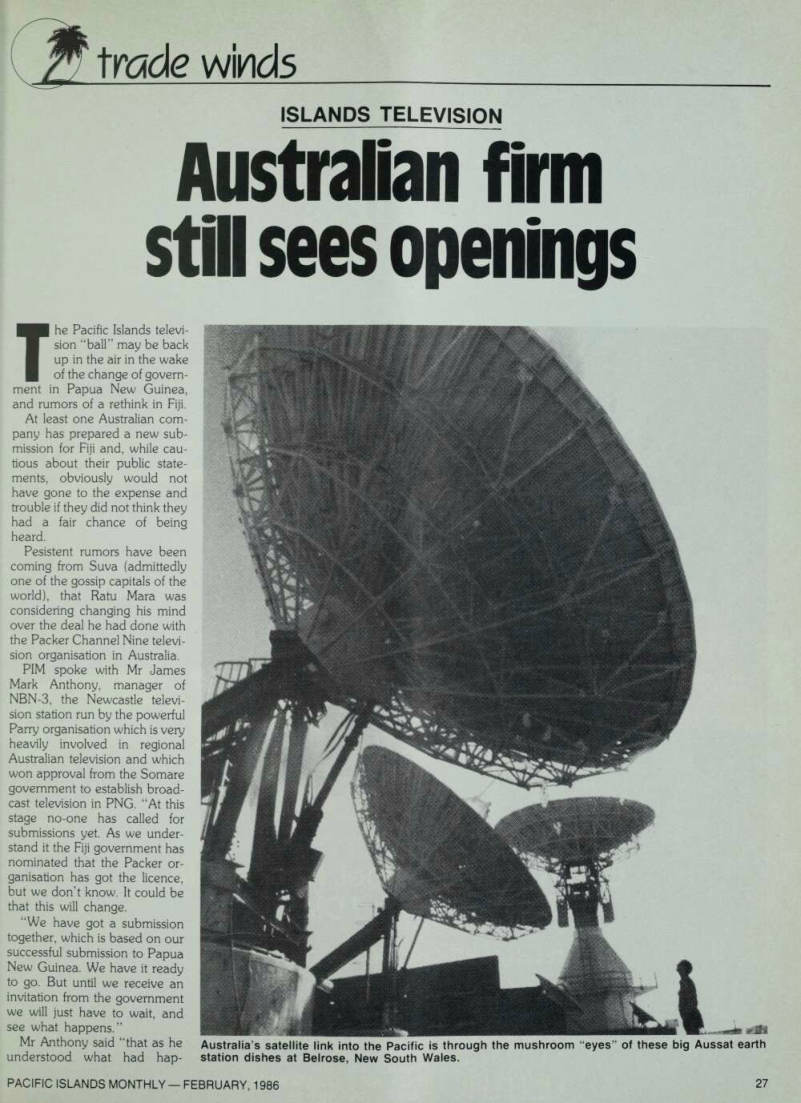



trade wields
Islands Television
Australian firm still sees openings
The Pacific Islands televi sion “ball” may be back up in the air in the wake of the change of govern ment in Papua New Guinea, and rumors of a rethink in Fiji.
At least one Australian com pany has prepared a new sub mission for Fiji and, while cau tious about their public state ments, obviously would not have gone to the expense and trouble if they did not think they had a fair chance of being heard.
Pesistent rumors have been coming from Suva (admittedly one of the gossip capitals of the world), that Ratu Mara was considering changing his mind over the deal he had done with the Packer Channel Nine televi sion organisation in Australia.
PIM spoke with Mr James Mark Anthony, manager of NBN-3, the Newcastle televi sion station run by the powerful Parry organisation which is very heavily involved in regional Australian television and which won approval from the Somare government to establish broad cast television in PNG. “At this stage no-one has called for submissions yet. As we under stand it the Fiji government has nominated that the Packer or ganisation has got the licence, but we don’t know. It could be that this will change.
“We have got a submission together, which is based on our successful submission to Papua New Guinea. We have it ready to go. But until we receive an invitation from the government we will just have to wait, and see what happens.”
Mr Anthony said “that as he understood what had hap-
Australia’s satellite link into the Pacific is through the mushroom “eyes” of these big Aussat earth station dishes at Belrose, New South Wales.
pened, the Channel Nine team had arrived in Fiji, put forward a proposition which Prime Minis ter Mara thought was good.
Perhaps now it is a case of the prime minister looking to see if there is a better submission. We would like to be in Fiji, but it is up to the government there to call for submissions. If they do, we will be there.”
Mr Anthony said he felt their submission would be “quite attractive.” He said his com pany had devoted three years to developing its proposals for PNG. “If anyone is qualified to put together a television service for the islands, we have to be.
“NBN Television is probably the most successful regional television station in Australia. It has high local content in its programming. It has high com munity profile. Those are the aspects we think need to be in the Pacific proposals.
“In multi-cultural countries like Fiji there ought to be, we think, a high input from the local population, rather than just a feed from a satellite.”
Mr Anthony said his com pany had not yet “even looked” at the idea of using
Aussat or some other satellite for their Pacific services. “I think we would be looking at getting a high percentage of local prog rams, in conjunction with the video program services which the Fiji government already has in place.”
Mr Anthony said the video unit, based in Suva, using equipment provided by West German grant money, was pro ducing “very good work in deed. ”
“There should be a broad cast outlet for them,” he said.
They should not be swamped by American material dropped in from a satellite.
Mr Anthony said he felt it was “still very early days” in the run-up to launching broadcast television in Fiji, as also might be the case in Papua New Guinea.
“Three of us went to Fiji and did a feasibility study. We think there is good potential for tele vision there. We are pleased with what we see as the pros pects open for us to bring it into being, without seriously jeopardising the local culture,
Continued on page 33
Where it all ends - in the wonder of a childs mind - and the adult who grows up with it.
Continued from page 29
which we see as very, very important. ”
Mr Anthony referred to the plethora of almost entirely U.S. derived programming in Amer ican Samoa which, he said, was
“a little bit of a disaster. ’’“That’s why we have put a lot of research into the area of the impact of television on third world countries. One must think about it very carefully. We think we have done our home work. ”
Advertisements & other items, pp. 28-32 (1 item)
coiims
6
OLYUPIC
The Stationery and Diary People.
SYSTEM
CARDS
i-Oomn* V mmt .
Commercial, School, Household
Stationery and Diaries.
Fast and efficient export service.
COLLINS OLYMPIC LIMITED
/V\T r jrq r PO. BOX 476, AUCKLAND, 1
11111 I 11 \ NEW ZEALAND.
PHONE: (9) 484-009
|]T Y M TELEX: N.Z. 21293 (EDUNLOP)
CABLES: GRAPHICOL
TOTAL TEST EQUIPMENT SOLUTION
B 9 if# & i marcom instruments Tektronix r
■BIIVQ
o I«:.le 1
HITACHI
II I 1 I
IFLUK
TOYOTA
QUALITY SERVICE
AMERICAN SAMOA: BURNS PHILP (SOUTH SEA) CO., LTD., P.O. Box 129, Pago Pago.
COOK ISLANDS: COOK ISLANDS TRADING
CORPORATION LTD., Private Bag, Rarotonga.
FIJI: AUTOMOTIVE SUPPLIES COMPANY, A Division of Burns Philp (South Sea) Co., Ltd., G.P.O. Box 355, Suva.
GUAM A MICRONESIA: ATKINS KROLL, INC., 443 South Marine Drive, Tamuning.
NAURU: NAURU COOPERATIVE SOCIETY, Centra
Pacific.
NEW CALEDONIA: SERVICE IMPORTATION
AUTOMOBILE DU PACIFIQUE, Rond-Point du Pad (Station Total) B.P. 438, Noumea.
NORFOLK ISLAND: BORRYS LIMITED, P.O. Box
PAPUA NEW GUINEA: ELA MOTORS, A Dh fiziz Burns Philp (PNG) Ltd., P.O. Box 75, Port Moresby.
fhe tradition of power and ruggedness goes on.
Toyota’s new Land Cruiser has been entirely designed from the road up. But it still tains the traditional toughness squired from over thirty years road experience. ■ But no matter how rough it gets a roomy new cabin with improved occupant comforts, easy instrumentation and an optional 4-speed automatic transmission add up to passenger car comfort with Land Cruiser ruggedness. yr ti Pickup More power in hand and fuel efficiency have been gained with a new brawny 4.0-litre gasoline engine.
And to control all that power a new rigid chassis assures stable driving performance and mobility over the roughest terrain.
M r you can choose from a wide variety of models and an array of heavy-duty features.
Take the wheel and feel Toyota quality in Land Cruiser’s styling, power and comfort. A quality that stays with you on or off the road.
Step into a new generation of toughness today.
>LOMON: SOLOMON ISLANDS INVESTMENTS LTD,
> 0. Box 174, Honiara.
HITIs NIPPON AUTOMOTO, B.P. 342, Papeete.
NGAs BURNS PHILP (SOUTH SEA) CO., LTD, P.O. x 55, Nukualofa.
HUATU: VANUATU MOTORS, A Division of Burns Ip (Vanuatu) Ltd, P.O. Box 18, Port Vila.
iSTERN SAMOA:
IMoit WB
Deals the
winning
hand In rat
control!
TALON WB Is a world breakthrough In killing rats and mice. Developed by ICI Tasman in New Zealand TALON WB is a sure way to increase profits by eliminating RAT DAMAGE TO CROPS! to $ <? coo 4 fini m RIjOCKS Can be wired or nailed out of reach of children & animals. Easily handled - won’t blow away.
WATERPROOF Safe Y ear round use - will not dissolve, resists mould for extended periods.
DEADLY
Kills even the toughest rats - Including those resistant to warfarin based poisons.
EFFECTIVE
POWERFUL
Highly attractive to rats & mice - no pre-baltlng Is required.
Kills more rats - a lethal dose can be consumed In a single feed.
Do not lay baits In places accessible to children, pets and domestic animals. Wash hands and i exposed skin before meals and after work. Do not store near food or feed. Bum or bury all rodent bodies and uneaten bait. Empty containers should not be re-used but disposed of safely.
mhMtWB
ICQ A Product of ICI NZ Limited P.O. Box 900, Auckland, New Zealand
WARNING
f Whatever your crops COCOA COCONCTTS SCIGARCANE.
RATS KILL PROFITS! NOW TALON WB KILLS RATS!
priorities
PNG reviews T.V. priorities
Mystery has begun to cloak what had seemed to be firm plans to introduce locally-broadcast television to both Fiji and Papua New Guinea.
In Port Moresby, new prime minister Paias Wingti, said, very early in his ministry that he intended to review the whole idea of introducing television to Papua New Guinea. Television was not a high priority with his government, he said.
The new communications minister, Gabriel Ramoi, set about reviewing the agreement between the previous Somare government and the Newcastle, Australia, television station, NBN-3, which is part of the big Parry communications group.
NBN-3 plans to introduce domestic broadcast television early in 1987.
Meanwhile, despite what appears to be a firm agreement between Australia’s Channel Nine (owned by Kerry Packer’s Publishing and Broadcasting Ltd, of Sydney), rumors have been growing that Fiji, too, is in process of rethinking its televi sion ideas. Here, however, the review seems to be more along the lines of who should do the job, rather than whether the job should be done at all.
NBN-3 says it will put up a proposal if it is asked to do so (see item this issue).
So far as is publicly under stood, the Channel Nine plan for Fiji was to derive a fairly large proportion of program ming from US and Australian sources, using the Intelsat satel lite. The Parry organisation has said that the mainstream of its programming would be local, and that use of satellites would be fairly limited.
But nothing, so far, has been said publicly in Fiji, or any where else, about an imminent
change of agreement, or plan ning for the introduction of television in that country.
So far as anyone knows at present nothing has happened to impede the Parry group’s plans, although the very pre sence of a review has unsettled the scene and Prime Minister Wingti appears to have given notice that he is far from con vinced about the need to intro duce it at this tender point in PNG’s fortunes.
Now Niue looks for T.V.
While most of the Paci fic’s television entrep reneurs and chance watchers were centring their attention on Fiji (with side-glances at Papua New Guinea), an other island was prepar ing to take the plunge.
On Niue, the prime minister, Sir Robert Rex, said during a stopover in Suva that he had been talking with an American cable television company about setting up a service in his country.
Sir Robert said he thought it might help slow the tide of migration away from Niue and to wards the brighter lights of New Zealand and other places if television were to be freely avail
able.
The Americans were offering to instal a cable service covering 13 vil lages on the island and could have the system up and running within six months.
Niue’s population is now down to about 3000, with 8000 of their fellow countrymen preferring to live in the North Island of New Zealand. The Niuean government fears that if the drainage con tinues future self-govern ment may become im possible.
Sir Robert did not name the cable company with which he had been talking, nor give any de tails of the type of prog ram they would offer.
Hawaii Bank
takes over Guam
The Bank of Hawaii has almost doubled its assets in Guam by acquiring the Bank of America’s operations in the island. The deal has to be approved by both the government of Guam and the U.S. Government, although neither is expected to offer any objection, and com pletion was expected late in January.
Bank of Hawaii’s president, Howard Stephenson, said his organisation was very pleased to have the opportunity to expand in Guam. “Guam has provided a fine framework to promote itself as an internatio nal finance centre,“ he said. ’’Bank of Hawaii looks forward to continued participation in this strategic direction.”
Bank of America operated two branches in Guam, one at Agana and the other at Tamun ing, with a total payroll of 149, all of whom will now go across and continue with Bank of Hawaii.
The respected Guam news paper Pacific Daily News editorialised on the change saying: ”0f course we hatge to
see the Bank of A,merica pull up stakes and leave Guam.
There is a great deal of sen timental attachment to the once high flying B of A, which was the first commercial bank on Guam after the war At the same time we’re cheered by the news that the Bank of Hawaii will tin Guam that ake up the slack. This is an island bank, one that has had long ties with Guam and Micronesia. It has been here since 1961, and has strong assets, some US$4.5 billion ... it will be a change, but one that shouldn’t slow down growth and progress on Guam...”
Bank of America was repre sented at the announcement by Verone C.Gibb, executive vice president and head of the bank’s Asia division. He said B of A, second-largest bank in the US and one of the ten largest banks in the world, is restructur ing its operations, concentrating its retail operations on the West Coast of the U.S. and turning its international attention exclu sively to wholesaling, i.e. ser
ing other banks and major corporations. ”We have found that Guam doesn’t exactly fit that strategy,” he said. (A similar change has also been made in Taiwan. Bank of America recently took over Seattle-First National Bank, which had a branch in Taipeh.
Under its policy of keeping retail operations within the US mainland, Bank of America sold the Taipeh branch of Sea- First to Australia’s Westpac Banking Corporation).
Bank of America first came to Guam in 1950 at the invitation of the US Navy to take over the war-time Navy operated bank which at the time was the only bank on Guam. Over the years the bank’s presence grew until, at the time of the sale to Bank of Hawaii, the two B of A branches on Guam had com bined deposits of U 5573.9 mil lion and loans out amounting to $51.2 million.
Bank of Hawaii’s single branch reported deposits of $65.9 .million and loans of $97.8 million. Bank of Hawaii is the 86th largest bank in the US, and the largest in Hawaii. It has been operating in the western Pacific since 1959 with related operations throughout Mic ronesia as well as offices in New York, Tokyo and Hong Kong.
Advertisements & other items, p. 34 (1 item)
Aiwa
Every system in AlWA’s S.P.A.N. lineup delivers the dynamic impact and delicate sound expression of digital audio.
That’s because every system is equipped with AlWA’s DX-770 digital audio Compact Disc player. From the top-of-the-line V-1200 series to simple systems that please budgetminded music lovers.
And, synchro-recording from the CD player or any other source, wireless remote control, auto function selection, double speed dubbing from tape to tape, and programmable record, tape, and CD playback are just a few of the many features available in AlWA’s S.P.A.N. lineup. So why wait for the future in audio? Enjoy it today with AIWA. ■
DIGITAL AUDIO
14 5 t I M I I
ALL SYSTEMS
m High-performance High-performance midi component s
HOI
High-performance S.P.A.N. component system
IM2IOAX
AIWA
,IWA Australia P,y., Ltd 14 Gertrude St., Arncliffe. AUSTRALIAJ| > Pq* Suva R^PH^NEf^SSO/MakanteeS
P H o° I;=^
‘Magnificent obituary’
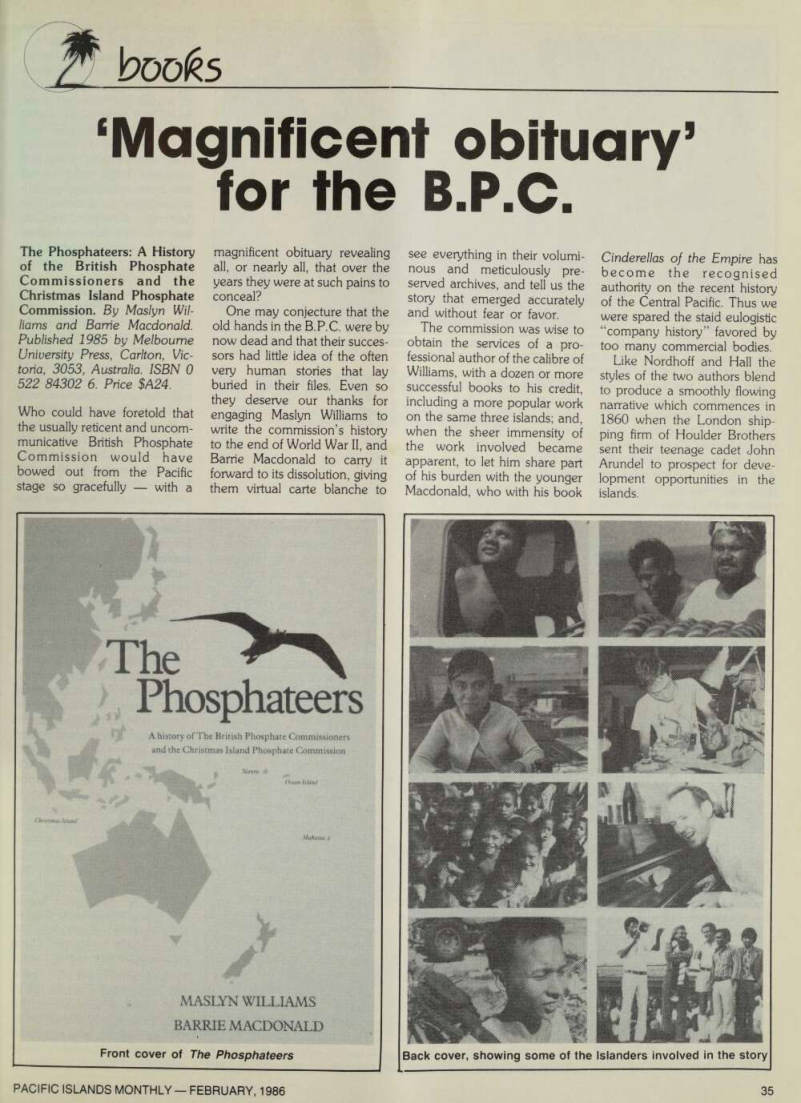
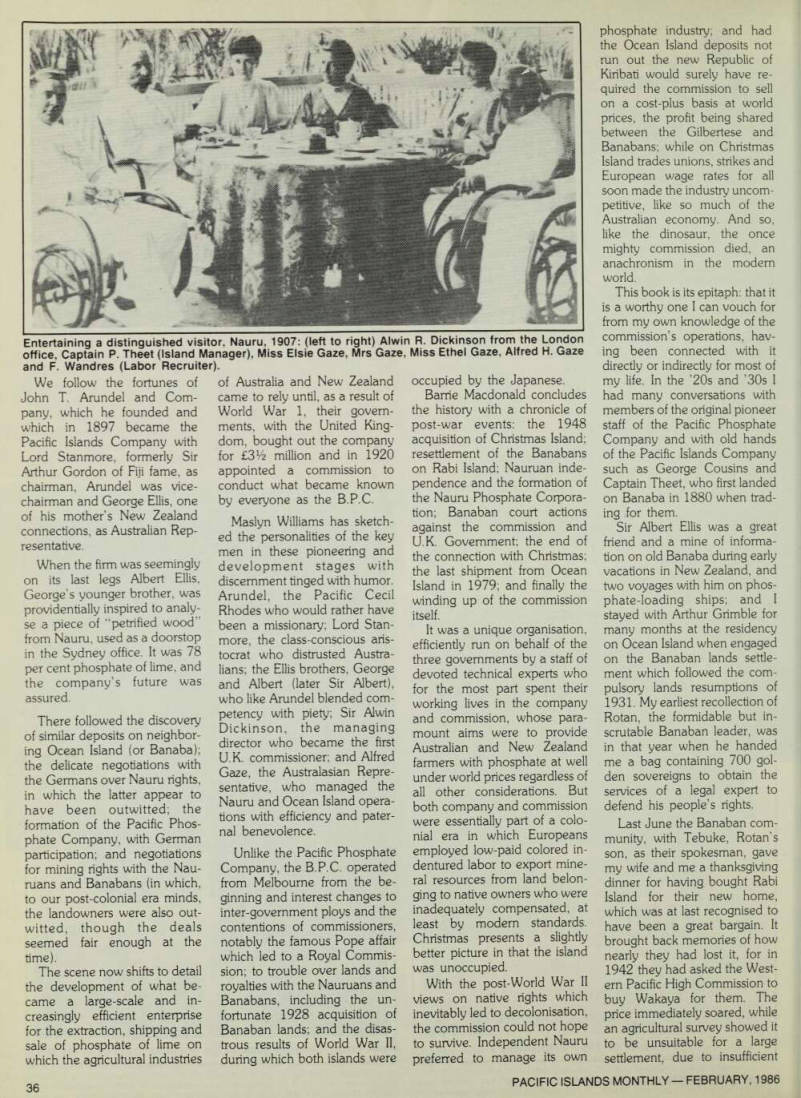
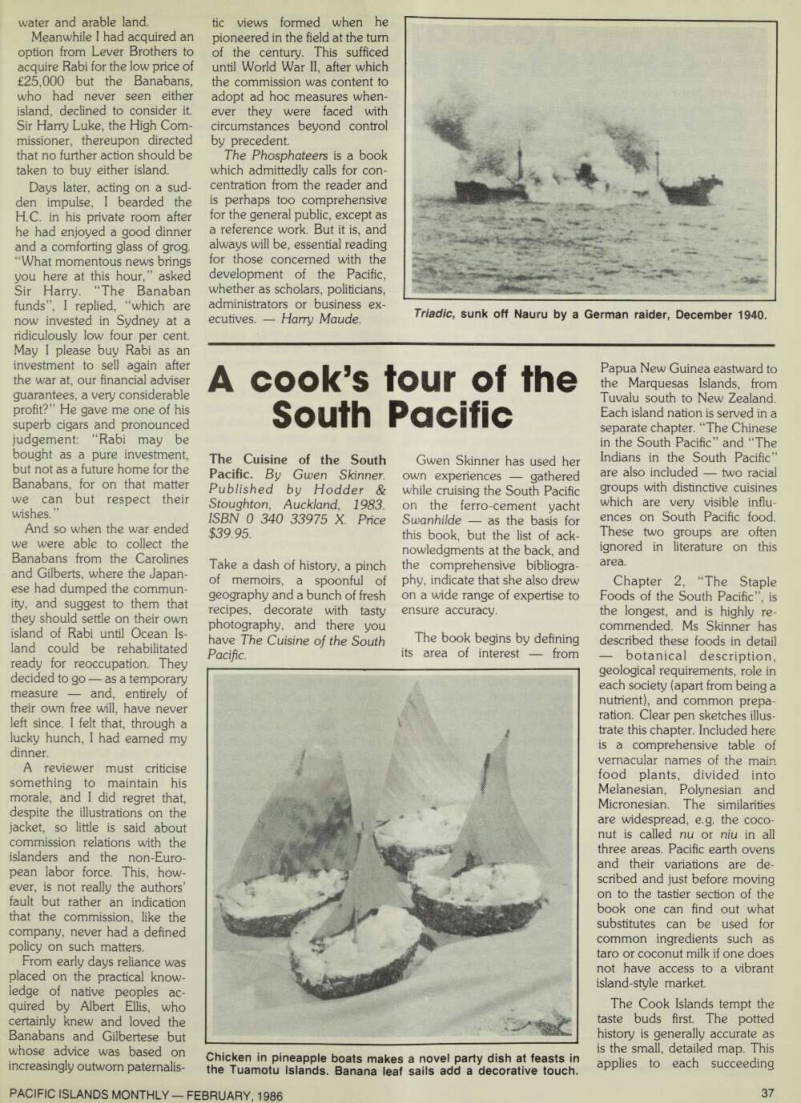
books.
‘Magnificent obituary’ for the B.P.C.
The Fhosphateers: A History of the British Phosphate Commissioners and the Christmas Island Phosphate Commission. By Maslyn Wil liams and Barrie Macdonald.
Published 1985 by Melbourne University Press, Carlton, Vic toria, 3053, Australia. ISBN 0 522 84302 6. Price SA24.
Who could have foretold that the usually reticent and uncom municative British Phosphate Commission would have bowed out from the Pacific stage so gracefully with a
magnificent obituary revealing all, or nearly all, that over the years they were at such pains to conceal?
One may conjecture that the old hands in the B.P.C. were by now dead and that their succes sors had little idea of the often very human stories that lay buried in their files. Even so they deserve our thanks for engaging Maslyn Williams to write the commission’s history to the end of World War 11, and Barrie Macdonald to carry it forward to its dissolution, giving them virtual carte blanche to
see everything in their voluminous and meticulously preserved archives, and tell us the story that emerged accurately and without fear or favor.
The commission was wise to obtain the services of a professional author of the calibre of Williams, with a dozen or more successful books to his credit, including a more popular work on the same three islands; and, when the sheer immensity of the work involved became apparent, to let him share part of his burden with the younger Macdonald, who with his book
Cinderellas of the Empire has become the recognised authority on the recent history of the Central Pacific. Thus we were spared the staid eulogistic “company history” favored by too many commercial bodies, Like Nordhoff and Hall the styles of the two authors blend to produce a smoothly flowing narrative which commences in 1860 when the London ship ping firm of Houlder Brothers sent their teenage cadet John Arundel to prospect for deve lopment opportunities in the islands.
Back cover, showing some of the Islanders involved in the story
Front cover of The Phosphateers
We follow the fortunes of John T. Arundel and Com pany, which he founded and which in 1897 became the Pacific Islands Company with Lord Stanmore, formerly Sir Arthur Gordon of Fiji fame, as chairman, Arundel was vice chairman and George Ellis, one of his mother’s New Zealand connections, as Australian Rep resentative.
When the firm was seemingly on its last legs Albert Ellis, George’s younger brother, was providentially inspired to analy se a piece of “petrified wood” from Nauru, used as a doorstop in the Sydney office. It was 78 per cent phosphate of lime, and the company’s future was assured.
There followed the discovery of similar deposits on neighbor ing Ocean Island (or Banaba); the delicate negotiations with the Germans over Nauru rights, in which the latter appear to have been outwitted; the formation of the Pacific Phos phate Company, with German participation; and negotiations for mining rights with the Nau ruans and Banabans (in which, to our post-colonial era minds, the landowners were also out witted, though the deals seemed fair enough at the time).
The scene now shifts to detail the development of what be came a large-scale and in creasingly efficient enterprise for the extraction, shipping and sale of phosphate of lime on which the agricultural industries
of Australia and New Zealand came to rely until, as a result of World War 1, their govern ments, with the United King dom, bought out the company for £3V, 2 million and in 1920 appointed a commission to conduct what became known by everyone as the B.P.C.
Maslyn Williams has sketch ed the personalities of the key men in these pioneering and development stages with discernment tinged with humor.
Arundel, the Pacific Cecil Rhodes who would rather have been a missionary; Lord Stan more, the class-conscious aris tocrat who distrusted Austra lians; the Ellis brothers, George and Albert (later Sir Albert), who like Arundel blended com petency with piety; Sir Alwin Dickinson, the managing director who became the first U.K. commissioner; and Alfred Gaze, the Australasian Repre sentative, who managed the Nauru and Ocean Island opera tions with efficiency and pater nal benevolence.
Unlike the Pacific Phosphate Company, the B.P.C. operated from Melbourne from the be ginning and interest changes to inter-government ploys and the contentions of commissioners, notably the famous Pope affair which led to a Royal Commis sion; to trouble over lands and royalties with the Nauruans and Banabans, including the un fortunate 1928 acquisition of Banaban lands; and the disas trous results of World War 11, during which both islands were
occupied by the Japanese.
Barrie Macdonald concludes the history with a chronicle of post-war events: the 1948 acquisition of Christmas Island; resettlement of the Banabans on Rabi Island; Nauruan inde pendence and the formation of the Nauru Phosphate Corpora tion; Banaban court actions against the commission and U.K. Government; the end of the connection with Christmas; the last shipment from Ocean Island in 1979; and finally the winding up of the commission itself.
It was a unique organisation, efficiently run on behalf of the three governments by a staff of devoted technical experts who for the most part spent their working lives in the company and commission, whose para mount aims were to provide Australian and New Zealand farmers with phosphate at well under world prices regardless of all other considerations. But both company and commission were essentially part of a colo nial era in which Europeans employed low-paid colored in dentured labor to export mine ral resources from land belon ging to native owners who were inadequately compensated, at least by modern standards.
Christmas presents a slightly better picture in that the island was unoccupied.
With the post-World War II views on native rights which inevitably led to decolonisation, the commission could not hope to survive. Independent Nauru preferred to manage its own
phosphate industry; and had the Ocean Island deposits not run out the new Republic of Kiribati would surely have re quired the commission to sell on a cost-plus basis at world prices, the profit being shared between the Gilbertese and Banabans; while on Christmas Island trades unions, strikes and European wage rates for all soon made the industry uncom petitive, like so much of the Australian economy. And so, like the dinosaur, the once mighty commission died, an anachronism in the modem world.
This book is its epitaph: that it is a worthy one I can vouch for from my own knowledge of the commission’s operations, hav ing been connected with it directly or indirectly for most of my life. In the ’2os and ’3os I had many conversations with members of the original pioneer staff of the Pacific Phosphate Company and with old hands of the Pacific Islands Company such as George Cousins and Captain Theet, who first landed on Banaba in 1880 when trad ing for them.
Sir Albert Ellis was a great friend and a mine of informa tion on old Banaba during early vacations in New Zealand, and two voyages with him on phos phate-loading ships; and I stayed with Arthur Grimble for many months at the residency on Ocean Island when engaged on the Banaban lands settle ment which followed the com pulsory lands resumptions of 1931. My earliest recollection of Rotan, the formidable but in scrutable Banaban leader, was in that year when he handed me a bag containing 700 gol den sovereigns to obtain the services of a legal expert to defend his people’s rights.
Last June the Banaban com munity, with Tebuke, Rotan’s son, as their spokesman, gave my wife and me a thanksgiving dinner for having bought Rabi Island for their new home, which was at last recognised to have been a great bargain. It brought back memories of how nearly they had lost it, for in 1942 they had asked the West ern Pacific High Commission to buy Wakaya for them. The price immediately soared, while an agricultural survey showed it to be unsuitable for a large settlement, due to insufficient
Entertaining a distinguished visitor, Nauru, 1907: (left to right) Alwin R. Dickinson from the London office. Captain P. Theet (Island Manager), Miss Elsie Gaze, Mrs Gaze, Miss Ethel Gaze, Alfred H. Gaze and F. Wandres (Labor Recruiter).
water and arable land.
Meanwhile I had acquired an option from Lever Brothers to acquire Rabi for the low price of £25,000 but the Banabans, who had never seen either island, declined to consider it.
Sir Harry Luke, the High Com missioner, thereupon directed that no further action should be taken to buy either island.
Days later, acting on a sud den impulse, I bearded the H.C. in his private room after he had enjoyed a good dinner and a comforting glass of grog.
“What momentous news brings you here at this hour,” asked Sir Harry. “The Banaban funds”, I replied, “which are now invested in Sydney at a ridiculously low four per cent.
May I please buy Rabi as an investment to sell again after the war at, our financial adviser guarantees, a very considerable profit?” He gave me one of his superb cigars and pronounced judgement: “Rabi may be bought as a pure investment, but not as a future home for the Banabans, for on that matter we can but respect their wishes. ”
And so when the war ended we were able to collect the Banabans from the Carolines and Gilberts, where the Japan ese had dumped the commun ity, and suggest to them that they should settle on their own island of Rabi until Ocean Is land could be rehabilitated ready for reoccupation. They decided to go as a temporary measure and, entirely of their own free will, have never left since. I felt that, through a lucky hunch, I had earned my dinner.
A reviewer must criticise something to maintain his morale, and I did regret that, despite the illustrations on the jacket, so little is said about commission relations with the islanders and the non-Euro pean labor force. This, how ever, is not really the authors’ fault but rather an indication that the commission, like the company, never had a defined policy on such matters.
From early days reliance was placed on the practical know ledge of native peoples ac quired by Albert Ellis, who certainly knew and loved the Banabans and Gilbertese but whose advice was based on increasingly outworn paternalis
tic views formed when he pioneered in the field at the turn of the century. This sufficed until World War 11, after which the commission was content to adopt ad hoc measures when ever they were faced with circumstances beyond control by precedent.
The Phosphateers is a book which admittedly calls for con centration from the reader and is perhaps too comprehensive for the general public, except as a reference work. But it is, and always will be, essential reading for those concerned with the development of the Pacific, whether as scholars, politicians, administrators or business ex
ecutives.
Harry Maude.
Triadic, sunk off Nauru by a German raider, December 1940.
A cook’s tour of the South Pacific
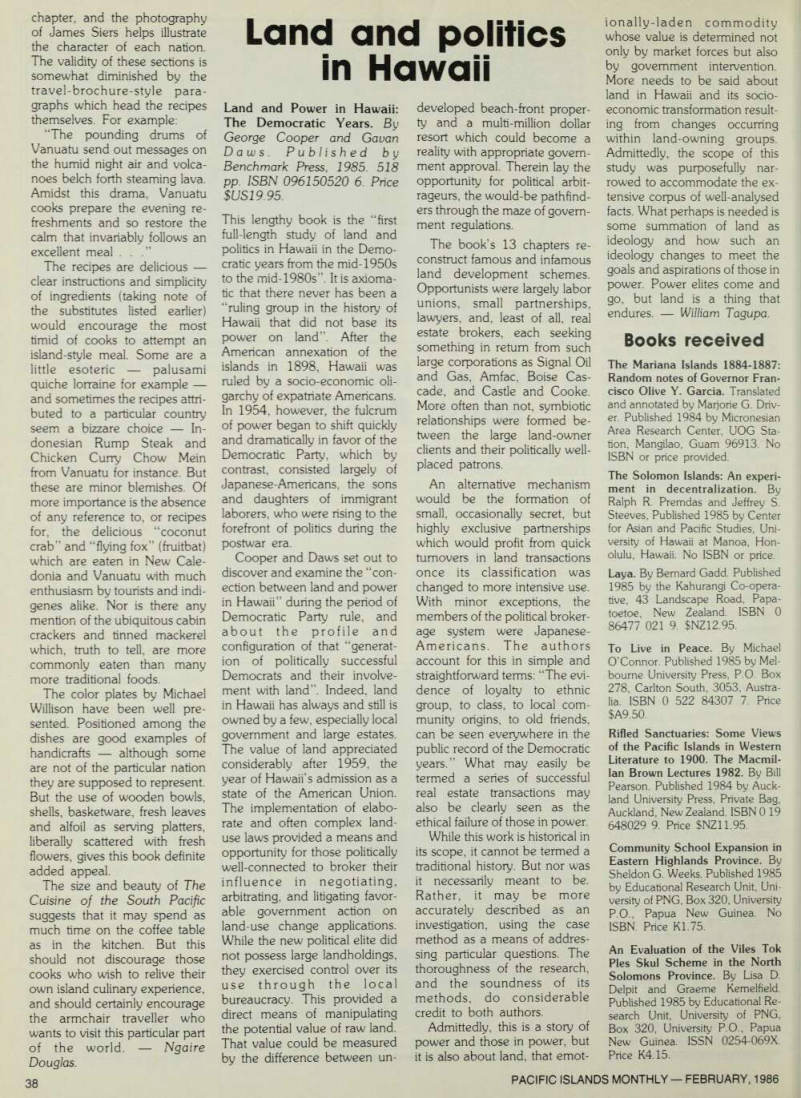
South Pacific
The Cuisine of the South Pacific. By Gwen Skinner Published by Hodder & Stoughton, Auckland, 1983.
ISBN 0 340 33975 X. Price $39.95.
Take a dash of history, a pinch of memoirs, a spoonful of geography and a bunch of fresh recipes, decorate with tasty photography, and there you have The Cuisine of the South Pacific.
Gwen Skinner has used her own experiences gathered while cruising the South Pacific on the ferro-cement yacht Swanhilde as the basis for this book, but the list of ack nowledgments at the back, and the comprehensive bibliogra phy, indicate that she also drew on a wide range of expertise to ensure accuracy.
The book begins by defining its area of interest from
Papua New Guinea eastward to the Marquesas Islands, from Tuvalu south to New Zealand.
Each island nation is served in a separate chapter. “The Chinese in the South Pacific” and “The Indians in the South Pacific” are also included two racial groups with distinctive cuisines which are very visible influ ences on South Pacific food.
These two groups are often ignored in literature on this area.
Chapter 2, “The Staple Foods of the South Pacific”, is the longest, and is highly re commended. Ms Skinner has described these foods in detail botanical description, geological requirements, role in each society (apart from being a nutrient), and common prepa ration. Clear pen sketches illus trate this chapter. Included here is a comprehensive table of vernacular names of the main food plants, divided into Melanesian, Polynesian and Micronesian. The similarities are widespread, e.g. the coco nut is called nu or niu in all three areas. Pacific earth ovens and their variations are de scribed and just before moving on to the tastier section of the book one can find out what substitutes can be used for common ingredients such as taro or coconut milk if one does not have access to a vibrant island-style market.
The Cook Islands tempt the taste buds first. The potted history is generally accurate as is the small, detailed map. This applies to each succeeding
Chicken in pineapple boats makes a novel party dish at feasts in the Tuamotu Islands. Banana leaf sails add a decorative touch.
chapter, and the photography of James Siers helps illustrate the character of each nation.
The validity of these sections is somewhat diminished by the travel-brochure-style para graphs which head the recipes themselves. For example: “The pounding drums of Vanuatu send out messages on the humid night air and volca noes belch forth steaming lava.
Amidst this drama, Vanuatu cooks prepare the evening re freshments and so restore the calm that invariably follows an excellent meal ...”
The recipes are delicious clear instructions and simplicity of ingredients (taking note of the substitutes listed earlier) would encourage the most timid of cooks to attempt an island-style meal. Some are a little esoteric palusami quiche lorraine for example and sometimes the recipes attri buted to a particular country seem a bizzare choice In donesian Rump Steak and Chicken Curry Chow Mein from Vanuatu for instance. But these are minor blemishes. Of more importance is the absence of any reference to, or recipes for, the delicious “coconut crab” and “flying fox” (fruitbat) which are eaten in New Cale donia and Vanuatu with much enthusiasm by tourists and indi genes alike. Nor is there any mention of the übiquitous cabin crackers and tinned mackerel which, truth to tell, are more commonly eaten than many more traditional foods.
The color plates by Michael Willison have been well pre sented. Positioned among the dishes are good examples of handicrafts although some are not of the particular nation they are supposed to represent.
But the use of wooden bowls, shells, basketware, fresh leaves and alfoil as serving platters, liberally scattered with fresh flowers, gives this book definite added appeal.
The size and beauty of The Cuisine of the South Pacific suggests that it may spend as much time on the coffee table as in the kitchen. But this should not discourage those cooks who wish to relive their own island culinary experience, and should certainly encourage the armchair traveller who wants to visit this particular part of the world. Ngaire Douglas.
in Hawaii
Land and politics in Hawaii
Land and Power in Hawaii: The Democratic Years. By George Cooper and Gavan Daws. Published by Benchmark Press, 1985. 518 pp. ISBN 096150520 6. Price $U519.95.
This lengthy book is the “first full-length study of land and politics in Hawaii in the Demo cratic years from the mid-1950s to the mid-1980s”. It is axioma tic that there never has been a “ruling group in the history of Hawaii that did not base its power on land”. After the American annexation of the islands in 1898, Hawaii was ruled by a socio-economic oli garchy of expatriate Americans.
In 1954, however, the fulcrum of power began to shift quickly and dramatically in favor of the Democratic Party, which by contrast, consisted largely of Japanese-Americans, the sons and daughters of immigrant laborers, who were rising to the forefront of politics during the postwar era.
Cooper and Daws set out to discover and examine the “con ection between land and power in Hawaii” during the period of Democratic Party rule, and about the profile and configuration of that “generat ion of politically successful Democrats and their involve ment with land”. Indeed, land in Hawaii has always and still is owned by a few. especially local government and large estates.
The value of land appreciated considerably after 1959, the year of Hawaii’s admission as a state of the American Union.
The implementation of elabo rate and often complex land use laws provided a means and opportunity for those politically well-connected to broker their influence in negotiating, arbitrating, and litigating favor able government action on land-use change applications.
While the new political elite did not possess large landholdings, they exercised control over its use through the local bureaucracy. This provided a direct means of manipulating the potential value of raw land.
That value could be measured by the difference between un
developed beach-front proper ty and a multi-million dollar resort which could become a reality with appropriate govern ment approval. Therein lay the opportunity for political arbit rageurs, the would-be pathfind ers through the maze of govern ment regulations.
The book’s 13 chapters re construct famous and infamous land development schemes.
Opportunists were largely labor unions, small partnerships, lawyers, and, least of all, real estate brokers, each seeking something in return from such large corporations as Signal Oil and Gas, Amfac, Boise Cas cade, and Castle and Cooke.
More often than not, symbiotic relationships were formed be tween the large land-owner clients and their politically well placed patrons.
An alternative mechanism would be the formation of small, occasionally secret, but highly exclusive partnerships which would profit from quick turnovers in land transactions once its classification was changed to more intensive use.
With minor exceptions, the members of the political broker age system were Japanese- Americans. The authors account for this in simple and straightforward terms: “The evi dence of loyalty to ethnic group, to class, to local com munity origins, to old friends, can be seen everywhere in the public record of the Democratic years.” What may easily be termed a series of successful real estate transactions may also be clearly seen as the ethical failure of those in power.
While this work is historical in its scope, it cannot be termed a traditional history. But nor was it necessarily meant to be.
Rather, it may be more accurately described as an investigation, using the case method as a means of addres sing particular questions. The thoroughness of the research, and the soundness of its methods, do considerable credit to both authors.
Admittedly, this is a story of power and those in power, but it is also about land, that emot
ionally-laden commodity
whose value is determined not only by market forces but also by government intervention.
More needs to be said about land in Hawaii and its socio economic transformation result ing from changes occurring within land-owning groups.
Admittedly, the scope of this
study was purposefully nar
rowed to accommodate the ex tensive corpus of well-analysed facts. What perhaps is needed is some summation of land as ideology and how such an ideology changes to meet the goals and aspirations of those in power. Power elites come and go, but land is a thing that endures. — William Tagupa.
Books received
The Mariana Islands 1884-1887: Random notes of Governor Fran cisco Olive Y. Garcia. Translated and annotated by Marjorie G. Driv er. Published 1984 by Micronesian Area Research Center, UOG Sta tion, Mangilao, Guam 96913. No ISBN or price provided.
The Solomon Islands: An experi ment in decentralization. By Ralph R. Premdas and Jeffrey S.
Steeves, Published 1985 by Center for Asian and Pacific Studies, Uni versity of Hawaii at Manoa, Hon olulu, Hawaii. No ISBN or price.
Laya. By Bernard Gadd. Published 1985 by the Kahurangi Co-opera tive, 43 Landscape Road, Papa toetoe, New Zealand. ISBN 0 86477 021 9. $NZ12.95.
To Live in Peace. By Michael O’Connor. Published 1985 by Mel bourne University Press. P.O. Box 278, Carlton South, 3053, Austra lia. ISBN 0 522 84307 7. Price $A9.50.
Rifled Sanctuaries: Some Views of the Pacific Islands in Western Literature to 1900. The Macmil lan Brown Lectures 1982. By Bill Pearson. Published 1984 by Auck land University Press, Private Bag, Auckland, New Zealand. ISBN 0 19 648029 9. Price $NZ11.95.
Community School Expansion in Eastern Highlands Province. By Sheldon G. Weeks. Published 1985 by Educational Research Unit, Uni versity of PNG, Box 320, University P.O., Papua New Guinea. No ISBN. Price K1.75.
An Evaluation of the Viles Tok Pies Skul Scheme in the North Solomons Province. By Lisa D.
Delpit and Graeme Kemelfield.
Published 1985 by Educational Re search Unit, University of PNG, Box 320, University P.O.. Papua New Guinea. ISSN 0254-069X.
Price K4.15.
New Englander in Samoa
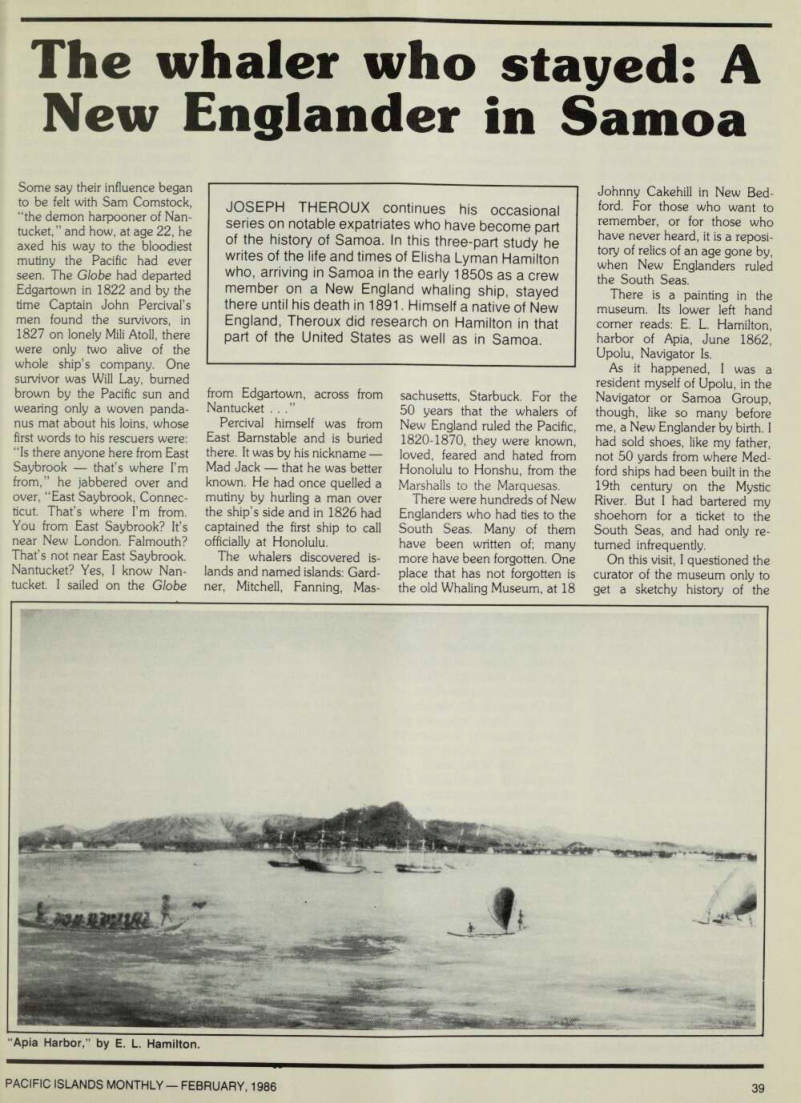
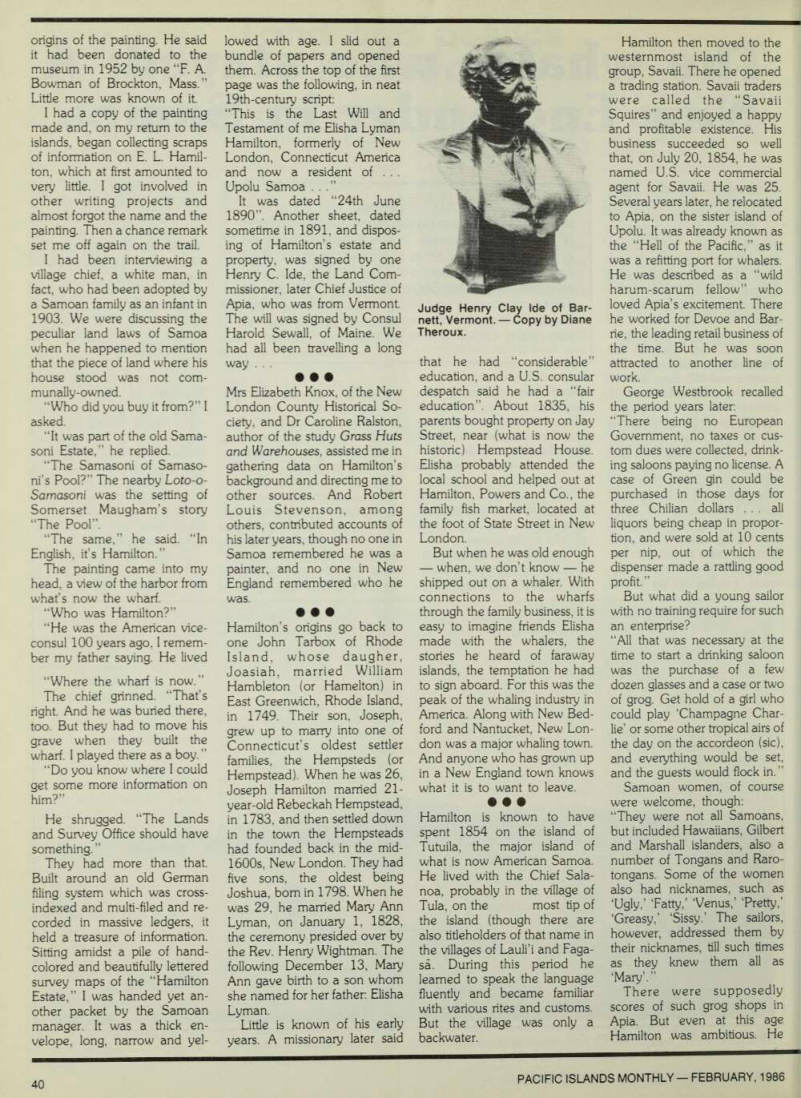
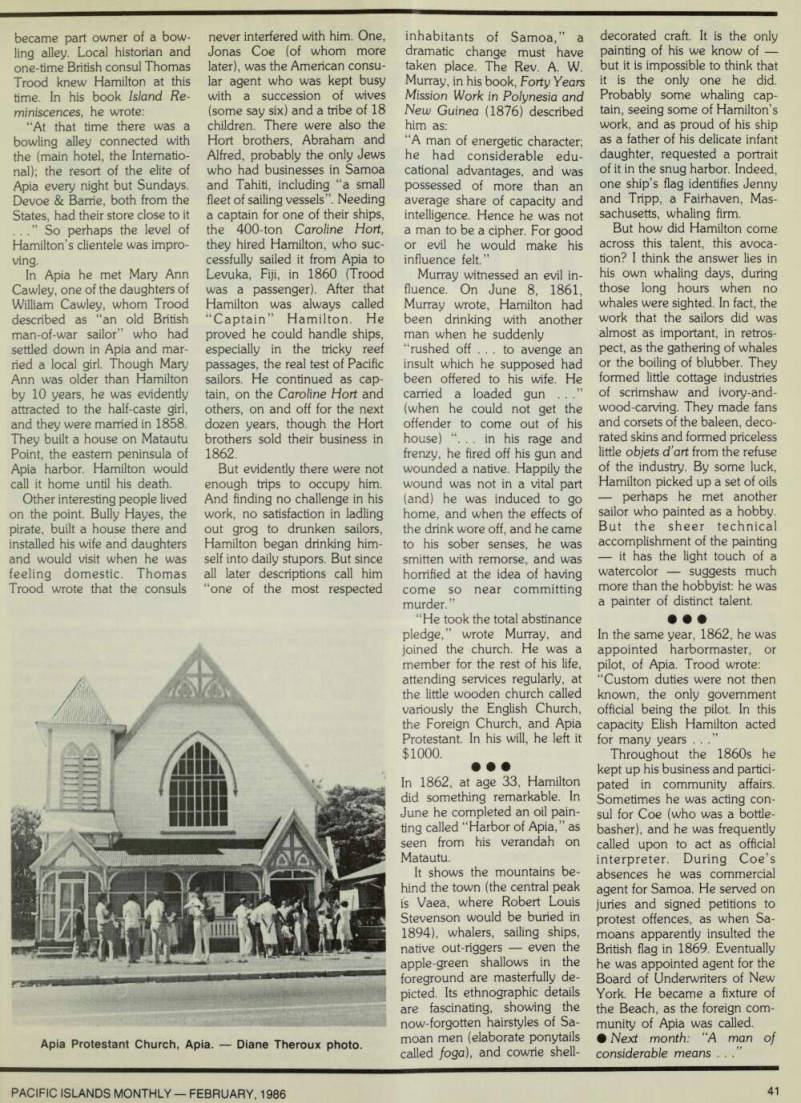
The whaler who stayed: A New Englander in Samoa
Some say their influence began to be felt with Sam Comstock, “the demon harpooner of Nan tucket,” and how, at age 22, he axed his way to the bloodiest mutiny the Pacific had ever seen. The Globe had departed Edgartown in 1822 and by the time Captain John Percival’s men found the survivors, in 1827 on lonely Mili Atoll, there were only two alive of the whole ship’s company. One survivor was Will Lay, burned brown by the Pacific sun and wearing only a woven panda nus mat about his loins, whose first words to his rescuers were: “Is there anyone here from East Saybrook that’s where I’m from,” he jabbered over and over, “East Saybrook, Connec ticut. That’s where I’m from.
You from East Saybrook? It’s near New London. Falmouth?
That’s not near East Saybrook.
Nantucket? Yes, I know Nan tucket. I sailed on the Globe
JOSEPH THEROUX continues his occasional series on notable expatriates who have become part of the history of Samoa. In this three-part study he writes of the life and times of Elisha Lyman Hamilton who, arriving in Samoa in the early 1850 s as a crew member on a New England whaling ship, stayed there until his death in 1891. Himself a native of New England, Theroux did research on Hamilton in that part of the United States as well as in Samoa.
from Edgartown, across from Nantucket ...”
Percival himself was from East Barnstable and is buried there. It was by his nickname Mad Jack that he was better known. He had once quelled a mutiny by hurling a man over the ship’s side and in 1826 had captained the first ship to call officially at Honolulu.
The whalers discovered is lands and named islands: Gard ner, Mitchell, Fanning, Mas
sachusetts, Starbuck. For the 50 years that the whalers of New England ruled the Pacific, 1820-1870, they were known, loved, feared and hated from Honolulu to Honshu, from the Marshalls to the Marquesas.
There were hundreds of New Englanders who had ties to the South Seas. Many of them have been written of; many more have been forgotten. One place that has not forgotten is the old Whaling Museum, at 18
Johnny Cakehill in New Bed ford. For those who want to remember, or for those who have never heard, it is a reposi tory of relics of an age gone by, when New Englanders ruled the South Seas.
There is a painting in the museum. Its lower left hand corner reads: E. L. Hamilton, harbor of Apia, June 1862, Upolu, Navigator Is.
As it happened, I was a resident myself of Upolu, in the Navigator or Samoa Group, though, like so many before me, a New Englander by birth. I had sold shoes, like my father, not 50 yards from where Med ford ships had been built in the 19th century on the Mystic River. But I had bartered my shoehorn for a ticket to the South Seas, and had only re turned infrequently.
On this visit, I questioned the curator of the museum only to get a sketchy history of the
“Apia Harbor,” by E. L. Hamilton.
origins of the painting. He said it had been donated to the museum in 1952 by one “F. A.
Bowman of Brockton, Mass.”
Little more was known of it I had a copy of the painting made and, on my return to the islands, began collecting scraps of information on E. L. Hamil ton, which at first amounted to very little. I got involved in other writing projects and almost forgot the name and the painting. Then a chance remark set me off again on the trail.
I had been interviewing a village chief, a white man, in fact, who had been adopted by a Samoan family as an infant in 1903. We were discussing the peculiar land laws of Samoa when he happened to mention that the piece of land where his house stood was not com munally-owned.
“Who did you buy it from?” I asked.
“It was part of the old Sama soni Estate,” he replied.
“The Samasoni of Samaso ni’s Pool?” The nearby Loto-o- Samasoni was the setting of Somerset Maugham’s story “The Pool”.
“The same,” he said. “In English, it’s Hamilton.”
The painting came into my head, a view of the harbor from what’s now the wharf.
“Who was Hamilton?”
“He was the American vice consul 100 years ago, I remem ber my father saying. He lived “Where the wharf is now.”
The chief grinned. “That’s right And he was buried there, too. But they had to move his grave when they built the wharf. I played there as a boy. ”
“Do you know where 1 could get some more information on him?”
He shrugged. “The Lands and Survey Office should have something. ”
They had more than that.
Built around an old German filing system which was cross indexed and multi-filed and re corded in massive ledgers, it held a treasure of information.
Sitting amidst a pile of hand colored and beautifully lettered survey maps of the “Hamilton Estate,” I was handed yet an other packet by the Samoan manager. It was a thick en velope, long, narrow and yel
lowed with age. I slid out a bundle of papers and opened them. Across the top of the first page was the following, in neat 19th-century script; “This is the Last Will and Testament of me Elisha Lyman Hamilton, formerly of New London, Connecticut America and now a resident of . . .
Upolu Samoa ...”
It was dated “24th June 1890”. Another sheet, dated sometime in 1891, and dispos ing of Hamilton’s estate and property, was signed by one Henry C. Ide, the Land Com missioner, later Chief Justice of Apia, who was from Vermont The will was signed by Consul Harold Sewall, of Maine. We had all been travelling a long way . . . • • • Mrs Elizabeth Knox, of the New London County Historical So ciety, and Dr Caroline Ralston, author of the study Grass Huts and Warehouses, assisted me in gathering data on Hamilton’s background and directing me to other sources. And Robert Louis Stevenson, among others, contributed accounts of his later years, though no one in Samoa remembered he was a painter, and no one in New England remembered who he was. • • • Hamilton’s origins go back to one John Tarbox of Rhode Island, whose daugher, Joasiah, married William Hambleton (or Hamelton) in East Greenwich, Rhode Island, in 1749. Their son, Joseph, grew up to marry into one of Connecticut’s oldest settler families, the Hempsteds (or Hempstead). When he was 26, Joseph Hamilton married 21year-old Rebeckah Hempstead, in 1783, and then settled down in the town the Hempsteads had founded back in the mid 1600s, New London. They had five sons, the oldest being Joshua, bom in 1798. When he was 29, he married Mary Ann Lyman, on January 1, 1828, the ceremony presided over by the Rev. Henry Wightman. The following December 13, Mary Ann gave birth to a son whom she named for her father: Elisha Lyman.
Little is known of his early years. A missionary later said
that he had “considerable” education, and a U.S. consular despatch said he had a “fair education”. About 1835, his parents bought property on Jay Street, near (what is now the historic) Hempstead House.
Elisha probably attended the local school and helped out at Hamilton, Powers and Co., the family fish market, located at the foot of State Street in New London.
But when he was old enough when, we don’t know he shipped out on a whaler. With connections to the wharfs through the family business, it is easy to imagine friends Elisha made with the whalers, the stories he heard of faraway islands, the temptation he had to sign aboard. For this was the peak of the whaling industry in America. Along with New Bed ford and Nantucket, New Lon don was a major whaling town.
And anyone who has grown up in a New England town knows what it is to want to leave. • • • Hamilton is known to have spent 1854 on the island of Tutuila, the major island of what is now American Samoa.
He lived with the Chief Sala noa, probably in the village of Tula, on the most tip of the island (though there are also titleholders of that name in the villages of Lauli’i and Faga sa. During this period he learned to speak the language fluently and became familiar with various rites and customs.
But the village was only a backwater.
Hamilton then moved to the westernmost island of the group, Savaii. There he opened a trading station. Savaii traders were called the “Savaii Squires” and enjoyed a happy and profitable existence. His business succeeded so well that, on July 20, 1854, he was named U.S. vice commercial agent for Savaii. He was 25.
Several years later, he relocated to Apia, on the sister island of Upolu. It was already known as the “Hell of the Pacific,” as it was a refitting port for whalers.
He was described as a “wild harum-scarum fellow” who loved Apia’s excitement. There he worked for Devoe and Bar rie, the leading retail business of the time. But he was soon attracted to another line of work.
George Westbrook recalled the period years later: “There being no European Government, no taxes or cus tom dues were collected, drink ing saloons paying no license. A case of Green gin could be purchased in those days for three Chilian dollars ... all liquors being cheap in propor tion, and were sold at 10 cents per nip, out of which the dispenser made a rattling good profit. ”
But what did a young sailor with no training require for such an enterprise?
“All that was necessary at the time to start a drinking saloon was the purchase of a few dozen glasses and a case or two of grog. Get hold of a girl who could play ‘Champagne Char lie’ or some other tropical airs of the day on the accordeon (sic), and everything would be set, and the guests would flock in. ”
Samoan women, of course were welcome, though: “They were not all Samoans, but included Hawaiians, Gilbert and Marshall islanders, also a number of Tongans and Raro tongans. Some of the women also had nicknames, such as ‘Ugly,’ ‘Fatty,’ ‘Venus,’ ‘Pretty,’ ‘Greasy,’ ‘Sissy.’ The sailors, however, addressed them by their nicknames, till such times as they knew them all as ‘Mary’.”
There were supposedly scores of such grog shops in Apia. But even at this age Hamilton was ambitious. He
Judge Henry Clay Ide of Bar nett, Vermont. - Copy by Diane Theroux.
became part owner of a bow ling alley. Local historian and one-time British consul Thomas Trood knew Hamilton at this time. In his book Island Re miniscences, he wrote: “At that time there was a bowling alley connected with the (main hotel, the Internatio nal); the resort of the elite of Apia every night but Sundays.
Devoe & Barrie, both from the States, had their store close to it ...” So perhaps the level of Hamilton’s clientele was impro ving.
In Apia he met Mary Ann Cawley, one of the daughters of William Cawley, whom Trood described as “an old British man-of-war sailor” who had settled down in Apia and mar ried a local girl. Though Mary Ann was older than Hamilton by 10 years, he was evidently attracted to the half-caste girl, and they were married in 1858.
They built a house on Matautu Point, the eastern peninsula of Apia harbor. Hamilton would call it home until his death.
Other interesting people lived on the point. Bully Hayes, the pirate, built a house there and installed his wife and daughters and would visit when he was feeling domestic. Thomas Trood wrote that the consuls
never interfered with him. One, Jonas Coe (of whom more later), was the American consu lar agent who was kept busy with a succession of wives (some say six) and a tribe of 18 children. There were also the Hort brothers, Abraham and Alfred, probably the only Jews who had businesses in Samoa and Tahiti, including “a small fleet of sailing vessels”. Needing a captain for one of their ships, the 400-ton Caroline Hort, they hired Hamilton, who suc cessfully sailed it from Apia to Levuka, Fiji, in 1860 (Trood was a passenger). After that Hamilton was always called “Captain” Hamilton. He proved he could handle ships, especially in the tricky reef passages, the real test of Pacific sailors. He continued as cap tain, on the Caroline Hort and others, on and off for the next dozen years, though the Hort brothers sold their business in 1862.
But evidently there were not enough trips to occupy him.
And finding no challenge in his work, no satisfaction in ladling out grog to drunken sailors, Hamilton began drinking him self into daily stupors. But since all later descriptions call him “one of the most respected
inhabitants of Samoa,” a dramatic change must have taken place. The Rev. A. W.
Murray, in his book, Forty Years Mission Work in Polynesia and New Guinea (1876) described him as: “A man of energetic character; he had considerable edu cational advantages, and was possessed of more than an average share of capacity and intelligence. Hence he was not a man to be a cipher. For good or evil he would make his influence felt.”
Murray witnessed an evil in fluence. On June 8, 1861, Murray wrote, Hamilton had been drinking with another man when he suddenly “rushed off . . . to avenge an insult which he supposed had been offered to his wife. He carried a loaded gun ...” (when he could not get the offender to come out of his house) “. . . in his rage and frenzy, he fired off his gun and wounded a native. Happily the wound was not in a vital part (and) he was induced to go home, and when the effects of the drink wore off, and he came to his sober senses, he was smitten with remorse, and was horrified at the idea of having come so near committing murder. ”
“He took the total abstinence pledge,” wrote Murray, and joined the church. He was a member for the rest of his life, attending services regularly, at the little wooden church called variously the English Church, the Foreign Church, and Apia Protestant. In his will, he left it
$Looo.
• • • In 1862, at age 33, Hamilton did something remarkable. In June he completed an oil pain ting called “Harbor of Apia,” as seen from his verandah on Matautu.
It shows the mountains be hind the town (the central peak is Vaea, where Robert Louis Stevenson would be buried in 1894), whalers, sailing ships, native out-riggers even the apple-green shallows in the foreground are masterfully de picted. Its ethnographic details are fascinating, showing the now-forgotten hairstyles of Sa moan men (elaborate ponytails called foga), and cowrie shell
decorated craft. It is the only painting of his we know of but it is impossible to think that it is the only one he did.
Probably some whaling cap tain, seeing some of Hamilton’s work, and as proud of his ship as a father of his delicate infant daughter, requested a portrait of it in the snug harbor. Indeed, one ship’s flag identifies Jenny and Tripp, a Fairhaven, Mas sachusetts, whaling firm.
But how did Hamilton come across this talent, this avoca tion? I think the answer lies in his own whaling days, during those long hours when no whales were sighted. In fact, the work that the sailors did was almost as important, in retros pect, as the gathering of whales or the boiling of blubber. They formed little cottage industries of scrimshaw and ivory-and wood-carving. They made fans and corsets of the baleen, deco rated skins and formed priceless little objets d’art from the refuse of the industry. By some luck, Hamilton picked up a set of oils perhaps he met another sailor who painted as a hobby.
But the sheer technical accomplishment of the painting it has the light touch of a watercolor suggests much more than the hobbyist: he was a painter of distinct talent. • • • In the same year, 1862, he was appointed harbormaster, or pilot, of Apia. Trood wrote: “Custom duties were not then known, the only government official being the pilot. In this capacity Elish Hamilton acted for many years ...”
Throughout the 1860 s he kept up his business and partici pated in community affairs.
Sometimes he was acting con sul for Coe (who was a bottle basher), and he was frequently called upon to act as official interpreter. During Coe’s absences he was commercial agent for Samoa. He served on juries and signed petitions to protest offences, as when Sa moans apparently insulted the British flag in 1869. Eventually he was appointed agent for the Board of Underwriters of New York. He became a fixture of the Beach, as the foreign com munity of Apia was called. • Next month: “A man of considerable means ...”
Apia Protestant Church, Apia. - Diane Theroux photo.
Japanese welcomed back
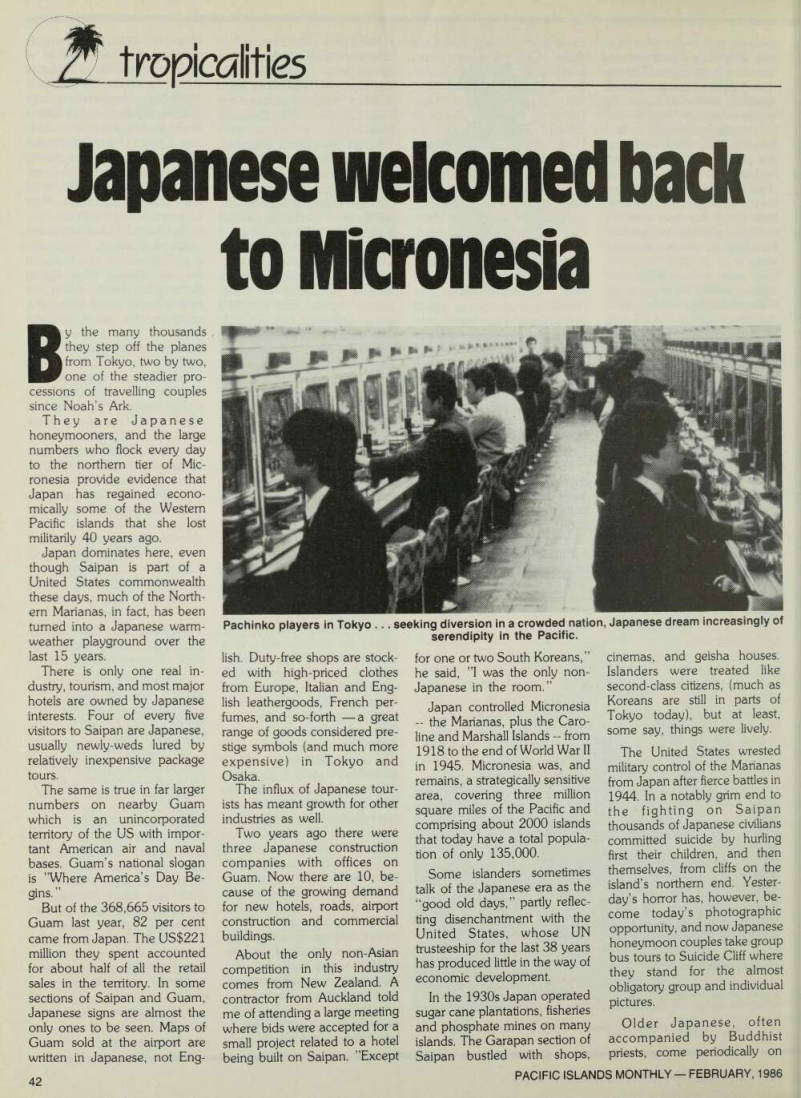
tropicalities
Japanese welcomed back to Micronesia
By the many thousands they step off the planes from Tokyo, two by two, one of the steadier pro cessions of travelling couples since Noah’s Ark.
They are Japanese honeymooners, and the large numbers who flock every day to the northern tier of Mic ronesia provide evidence that Japan has regained econo mically some of the Western Pacific islands that she lost militarily 40 years ago.
Japan dominates here, even though Saipan is part of a United States commonwealth these days, much of the North ern Marianas, in fact, has been turned into a Japanese warm weather playground over the last 15 years.
There is only one real in dustry, tourism, and most major hotels are owned by Japanese interests. Four of every five visitors to Saipan are Japanese, usually newly-weds lured by relatively inexpensive package tours.
The same is true in far larger numbers on nearby Guam which is an unincorporated territory of the US with impor tant American air and naval bases. Guam’s national slogan is ’’Where America’s Day Be gins.”
But of the 368,665 visitors to Guam last year, 82 per cent came from Japan. The US$22l million they spent accounted for about half of all the retail sales in the territory. In some sections of Saipan and Guam, Japanese signs are almost the only ones to be seen. Maps of Guam sold at the airport are written in Japanese, not Eng-
lish. Duty-free shops are stock ed with high-priced clothes from Europe, Italian and Eng lish leathergoods, French per fumes, and so-forth —a great range of goods considered pre stige symbols (and much more expensive) in Tokyo and Osaka.
The influx of Japanese tour ists has meant growth for other industries as well.
Two years ago there were three Japanese construction companies with offices on Guam. Now there are 10, be cause of the growing demand for new hotels, roads, airport construction and commercial buildings.
About the only non-Asian competition in this industry comes from New Zealand. A contractor from Auckland told me of attending a large meeting where bids were accepted for a small project related to a hotel being built on Saipan. ’’Except
for one or two South Koreans,” he said, ”1 was the only non- Japanese in the room.”
Japan controlled Micronesia - the Marianas, plus the Caro line and Marshall Islands - from 1918 to the end of World War II in 1945. Micronesia was, and remains, a strategically sensitive area, covering three million square miles of the Pacific and comprising about 2000 islands that today have a total popula tion of only 135,000.
Some islanders sometimes talk of the Japanese era as the “good old days,” partly reflec ting disenchantment with the United States, whose UN trusteeship for the last 38 years has produced little in the way of economic development.
In the 1930 s Japan operated
sugar cane plantations, fisheries and phosphate mines on many islands. The Garapan section of Saipan bustled with shops,
cinemas, and geisha houses.
Islanders were treated like second-class citizens, (much as Koreans are still in parts of Tokyo today), but at least, some say, things were lively.
The United States wrested military control of the Marianas from Japan after fierce battles in 1944. In a notably grim end to the fighting on Saipan thousands of Japanese civilians committed suicide by hurling first their children, and then themselves, from cliffs on the island’s northern end. Yester day’s horror has, however, be come today’s photographic opportunity, and now Japanese honeymoon couples take group bus tours to Suicide Cliff where they stand for the almost obligatory group and individual pictures.
Older Japanese, often accompanied by Buddhist priests, come periodically on
Pachinko players in Tokyo ... seeking diversion in a crowded nation, Japanese dream increasingly of serendipity in the Pacific.
the bones of dead relatives and friends.
The resurgence of Japanese economic influence is concen trated in the Marianas, but it is beginning to be felt eslewhere in Micronesia, too. From Palau in the western part of the island chain to the Marshalls in the east, local political leaders re gard Japanese tourism as their best chance to stimulate econo mies now largely dependent on United States aid.
The Japanese government has also begun to show re newed interest in its former territory. It has steadily in creased economic assistance, giving US$l7.6 million since 1980 to three semi-auton omous governments in the American trusteeship - Palau, the Marshall Islands, and the Federated States of Micronesia.
A good deal of this money has gone for road construction and for fisheries-related projects such as deep-storage refrigera tors being built on the islands of Ponape and Dublon in the FSM. In addition, Japanese tunaboat fleets contribute up to US$2 million a year for the right to fish in Micronesian waters.
Micronesians, especially those most critical of the Amer ican stewardship, say they are glad to receive Japan’s help. ’The Japanese went about it the right way,” says Asterio Takesy, a senior official on Ponape. ’They asked us what we needed, what we wanted.
The Americans are always tell ing us what to do. They say: This is what your problem is, and here’s how you must solve it.’ ”
A foreign ministry official in Tokyo, Akihiro Aoki, said Japanese aid was based on the government’s belief that ’’these countries have to be politically and economically stable.”
How deep Tokyo’s invest ment will go, however, is not clear. Japanese businessmen say they are hesitant to move in because of lingering economic and social problems that have kept Micronesian development at a low level throughout the post-war period.
But, today, it is no longer a matter of ’’the Japanese are coming.” In Micronesia they have again arrived, and are being warmly welcomed.
Clyde Haberman in The New York Times.
Pohnpei?
A Pacific Atlantis off Pohnpei?
American archaeologist, writer and traveller, David Childress, is convinced that two sunken cities lie in waters opposite the ancient city of Nan Modal on the island of Pohnpei in Mic ronesia.
He says they could be be tween 15,000 and 20,000 years old, and contain artefacts proving the existence of the legendary Pacific continent of Mu, or Lemuria.
Nan Modal is well known for its canals, temples and walls built up from the lagoon bed with blocks of basalt, weighing up to 50 tonnes.
According to Childress, one fact long kept a secret by the island’s locals is that Nan Modal was built 1000 years ago as a mirror image of a city that was sunk in the harbor, and at that time could be seen from the top of a mountain.
Childress and his 13-member expedition dived 60 metres be low the surface of Madolanym Harbor. They found coral-en crusted columns, standing 12 metres tall. These had been documented by previous ex plorers, but were considered part of Nan Modal.
In deeper water beyond the reef, they found what they believe is a second city known as Kahnmw.
“We saw 20-tonne basalt stones, octagonal basalt logs and perfectly straight cracks, or lines in the coral. Even though we did not see the city itself, we know it’s there under the coral.
“The angular lines of the reef, and the straight lines and indentations show the founda tions and walls of an ancient, gigantic city.
“Some of the submerged stones had inscriptions on them crosses, triangles, squares which haven’t been found in this area before,” he said.
An archaeologist and former director of the Micronesian Archaeological Survey, Dr Graeme Ward, said there had been “much romantic specula tion about Nan Modal over the past 150 years.”
“Pohnpei itself dates back to
4000 years ago but Nan Modal wasn’t built until the 10th and 11th century AD by the Sau Deleur dynasty on the island,” he said.
“They used hexagonal blocks of basalt, some weighing five tonnes each, to build plat forms in the lagoon.
“The city was traditionally inhabited until the mid-1800s
when the Pohnpei society was disrupted by disease and the influences of visiting Spanish armies, American whalers and American missionaries.”
The area was extensively ex cavated in 1982 by an archaeological team from the University of Oregon, but they had found no evidence to back up sunken city theories, he said.
Big black marlin
catch in Vanuatu
When three men from Akhamb in Malakula and an expatriate decided to tow a line behind the new fishing boat which they were delivering from Santo for the Akhamb Fisheries Project, Henry Santali did not dream of making the biggest recorded catch in Vanuatu’s history that day a 321-kilo black marlin!
He did.
Officials from Natai Fish Mar ket in the capital and the Department of Fisheries said the giant 6.5 metre long much searched-for ocean big game fish was the biggest on record, and could also be one of the biggest black marlin ever caught in the Pacific and beyond.
Once floated ashore it could not be lifted. A tractor was used to move it.
A fish expert from Natai Fish Market said it was sold to a plantation management in Malakula for a sum of 26,000 VT but that, if it were properly processed, it would be worth 720,000 VT.
Said a Department of Fisher ies spokesman; “We feel it is very good publicity for Vanuatu abroad for international big game fishing enthusiasts to be aware of what we can offer in terms of big game fishing in our waters”.
He said once they know Vanuatu waters have this kind of fish, international big game
fishing competitors with cash will be attracted to Vanuatu.
Also it will promote Vanuatu’s name overseas.
Locally it was a grand take off point for the Akhamb Fisheries Project. After landing the giant marlin in its new boat, the project was announced “open” to begin its fishing activities.
The fishing boat was built by Merelava boat builder, Ross Render, in his boat-yard in Luganville. Vanuatu Weekly Hebdomadaire.
Just for interest’s sake we con sulted our library’s 1984 Guin ness Book of Records (some one’s temporarily “borrowed” the later ones) about record black marlin catches.
While we readily concede that Vanuatu’s 321-kg speci men is one hell of a fish, we regret to report that the world record black marlin catch up to 1984 was well over twice that weight: 707.61 kg to be precise.
Other categories listed by Guinness include: Blue marlin (Atlantic) 581.51 kg, (Pacific) 624.14 kg. Striped marlin 206.50 kg.
Still, we heartily share the hope of the Vanuatu fisheries spokesman that news of the latest catch will spark the in terest of big-game fishing en thusiasts we think they’ve all got cash and encourage them to visit this fascinating country Editor.
Advertisements & other items, pp. 44-45 (1 item)
Benson aU Hedges
TRADITIONALLY THE NAME
4SSOOATED WITH PERFECTION
IN CIGARETTES
BENSON & HEDGES
20
Benson aU Hedges
WARNING-SMOKING IS A HEALTH HAZARD
)NLY THE BEST WILL DO.
Phe Benson and Hedges Company Pty. Ltd, 1983 CC1426 83 JWT016.P351
BANK LINE and
COLUMBUS LINE
24 day service to
Europe.
Need we say more...
t* D G The Joint Service Partners offer facilities for shipment of: Containers (FCL/LCL) and Break-bulk Cargo plus reefer space and deeptanks for carriage of vegetable oils and other liquid bulk cargo.
Carriers also accept heavy lifts, overlength and cumbersome parcels.
Ports of Service: Loading: Papeete, Apia, Suva, Lautoka, Noumea, Port Vila, Santo, Honiara, Port Moresby, Lae, Madang, Kimbe, Rabaul, Kieta, Darwin. For: Rotterdam, Antwerp, Hamburg, Hull, Dunkirk, Le Havre.
Additional ports on enquiry.
Please contact our regional offices for further information: The Bank Line (Australasia) Pty Ltd Columbus Line Reederei GmbH Suite 801, 51 Pitt St, P.O. Box 1667, Lae/Papua New Guinea.
Sydney, NSW, Australia 2000 Phone: 423466/423287/A.H. 422481 Phone 27 2041 Telex 24063 Telex: Colline NE 44171 The South Pacific Specialists for over 75 years
3 new Pacific knights
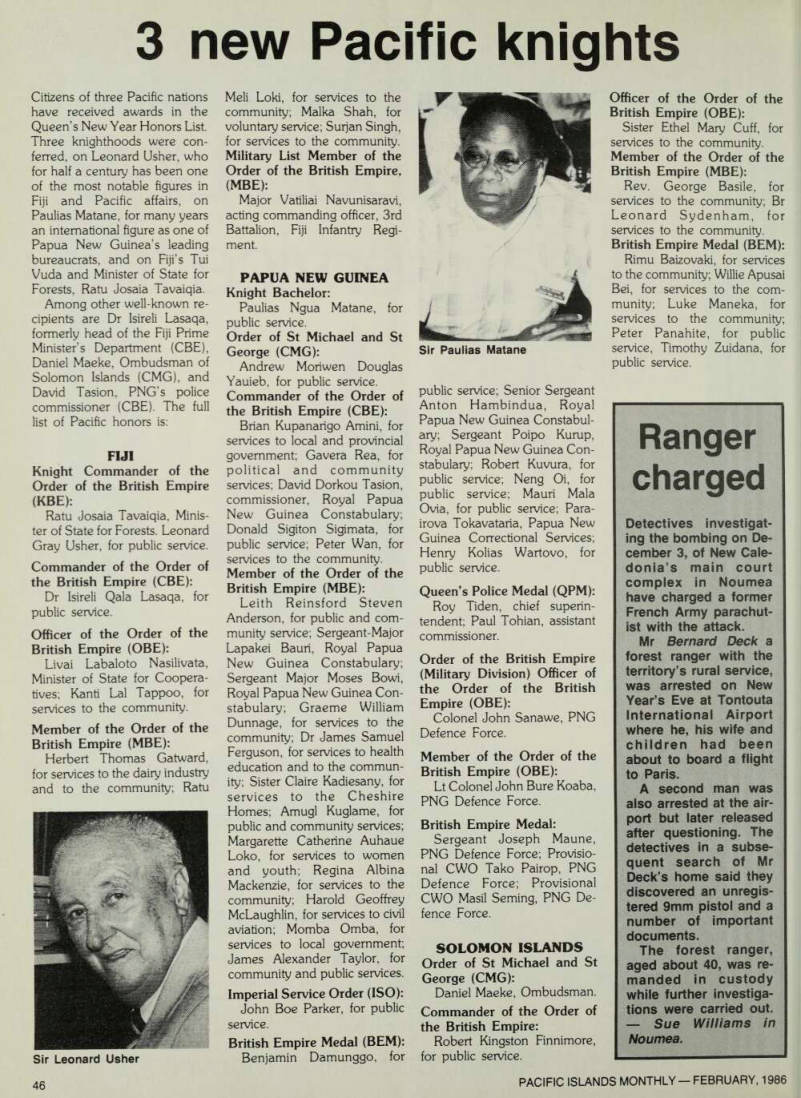
Citizens of three Pacific nations have received awards in the Queen’s New Year Honors List.
Three knighthoods were con ferred, on Leonard Usher, who for half a century has been one of the most notable figures in Fiji and Pacific affairs, on Paulias Matane, for many years an international figure as one of Papua New Guinea’s leading bureaucrats, and on Fiji’s Tui Vuda and Minister of State for Forests, Ratu Josaia Tavaiqia.
Among other well-known re cipients are Dr Isireli Lasaqa, formerly head of the Fiji Prime Minister’s Department (CBE), Daniel Maeke, Ombudsman of Solomon Islands (CMG), and David Tasion, PNG’s police commissioner (CBE). The full list of Pacific honors is:
Fiji
Knight Commander of the Order of the British Empire
(Kbe):
Ratu Josaia Tavaiqia, Minis ter of State for Forests. Leonard Gray Usher, for public service.
Commander of the Order of the British Empire (CBE): Dr Isireli Qala Lasaqa, for public service.
Officer of the Order of the British Empire (OBE): Livai Labaloto Nasilivata, Minister of State for Coopera tives; Kanti Lai Tappoo, for services to the community.
Member of the Order of the British Empire (MBE): Herbert Thomas Gatward, for services to the dairy industry and to the community; Ratu
Meli Loki, for services to the community; Malka Shah, for voluntary service; Surjan Singh, for services to the community.
Military List Member of the Order of the British Empire,
(Mbe):
Major Vatiliai Navunisaravi, acting commanding officer, 3rd Battalion, Fiji Infantry Regi ment.
Papua New Guinea
Knight Bachelor: Paulias Ngua Matane, for public service.
Order of St Michael and St George (CMG): Andrew Moriwen Douglas Yauieb, for public service.
Commander of the Order of the British Empire (CBE): Brian Kupanarigo Amini, for services to local and provincial government; Gavera Rea, for political and community services; David Dorkou Tasion, commissioner, Royal Papua New Guinea Constabulary; Donald Sigiton Sigimata, for public service; Peter Wan, for services to the community.
Member of the Order of the British Empire (MBE): Leith Reinsford Steven Anderson, for public and com munity service; Sergeant-Major Lapakei Bauri, Royal Papua New Guinea Constabulary; Sergeant Major Moses Bowi, Royal Papua New Guinea Con stabulary; Graeme William Dunnage, for services to the community; Dr James Samuel Ferguson, for services to health education and to the commun ity; Sister Claire Kadiesany, for services to the Cheshire Homes; Amugl Kuglame, for public and community services; Margarette Catherine Auhaue Loko, for services to women and youth; Regina Albina Mackenzie, for services to the community; Harold Geoffrey McLaughlin, for services to civil aviation; Momba Omba, for services to local government; James Alexander Taylor, for community and public services.
Imperial Service Order (ISO): John Boe Parker, for public service.
British Empire Medal (BEM): Benjamin Damunggo, for
public service; Senior Sergeant Anton Hambindua, Royal Papua New Guinea Constabul ary; Sergeant Poipo Kurup, Royal Papua New Guinea Con stabulary; Robert Kuvura, for public service; Neng Oi, for public service; Mauri Mala Ovia, for public service; Para irova Tokavataria, Papua New Guinea Correctional Services; Henry Kolias Wartovo, for public service.
Queen’s Police Medal (QFM): Roy Tiden, chief superin tendent; Paul Tohian, assistant commissioner.
Order of the British Empire (Military Division) Officer of the Order of the British Empire (OBE): Colonel John Sanawe, PNG Defence Force.
Member of the Order of the British Empire (OBE): Lt Colonel John Bure Koaba, PNG Defence Force.
British Empire Medal: Sergeant Joseph Maune, PNG Defence Force; Provisio nal CWO Tako Pairop, PNG Defence Force; Provisional CWO Masil Seming, PNG De fence Force.
Solomon Islands
Order of St Michael and St George (CMG): Daniel Maeke, Ombudsman.
Commander of the Order of the British Empire: Robert Kingston Finnimore, for public service.
Officer of the Order of the British Empire (OBE): Sister Ethel Mary Cuff, for services to the community.
Member of the Order of the British Empire (MBE): Rev. George Basile, for services to the community; Br Leonard Sydenham, for services to the community.
British Empire Medal (BEM): Rimu Baizovaki, for services to the community; Willie Apusai Bei, for services to the com munity; Luke Maneka, for services to the community; Peter Panahite, for public service, Timothy Zuidana, for public service.
Sir Leonard Usher
Sir Paulias Matane
Ranger
charged
Detectives investigat ing the bombing on De cember 3, of New Cale donia’s main court complex in Noumea have charged a former French Army parachut ist with the attack.
Mr Bernard Deck a forest ranger with the territory’s rural service, was arrested on New Year’s Eve at Tontouta International Airport where he, his wife and children had been about to board a flight to Paris.
A second man was also arrested at the air port but later released after questioning. The detectives in a subse quent search of Mr Deck’s home said they discovered an unregis tered 9mm pistol and a number of important documents.
The forest ranger, aged about 40, was re manded in custody while further investiga tions were carried out.
Sue Williams in Noumea.
Pacific stamp box
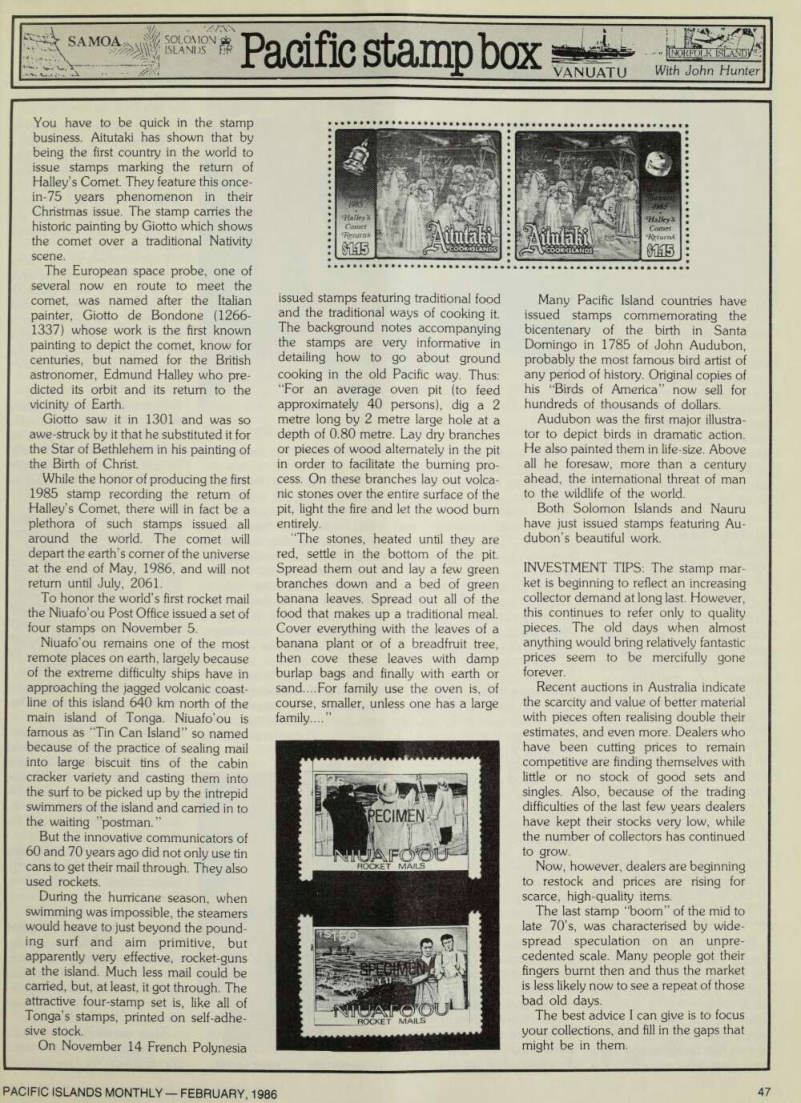
You have to be quick in the stamp business. Aitutaki has shown that by being the first country in the world to issue stamps marking the return of Halley’s Comet. They feature this once in-75 years phenomenon in their Christmas issue. The stamp carries the historic painting by Giotto which shows the comet over a traditional Nativity scene.
The European space probe, one of several now en route to meet the comet, was named after the Italian painter, Giotto de Bondone (1266- 1337) whose work is the first known painting to depict the comet, know for centuries, but named for the British astronomer, Edmund Halley who pre dicted its orbit and its return to the vicinity of Earth.
Giotto saw it in 1301 and was so awe-struck by it that he substituted it for the Star of Bethlehem in his painting of the Birth of Christ.
While the honor of producing the first 1985 stamp recording the return of Halley’s Comet, there will in fact be a plethora of such stamps issued all around the world. The comet will depart the earth’s corner of the universe at the end of May, 1986, and will not return until July, 2061.
To honor the world’s first rocket mail the Niuafo’ou Post Office issued a set of four stamps on November 5.
Niuafo’ou remains one of the most remote places on earth, largely because of the extreme difficulty ships have in approaching the jagged volcanic coast line of this island 640 km north of the main island of Tonga. Niuafo’ou is famous as “Tin Can Island” so named because of the practice of sealing mail into large biscuit tins of the cabin cracker variety and casting them into the surf to be picked up by the intrepid swimmers of the island and carried in to the waiting ’’postman.”
But the innovative communicators of 60 and 70 years ago did not only use tin cans to get their mail through. They also used rockets.
During the hurricane season, when swimming was impossible, the steamers would heave to just beyond the pound ing surf and aim primitive, but apparently very effective, rocket-guns at the island. Much less mail could be carried, but, at least, it got through. The attractive four-stamp set is, like all of Tonga’s stamps, printed on self-adhe sive stock.
On November 14 French Polynesia
issued stamps featuring traditional food and the traditional ways of cooking it.
The background notes accompanying the stamps are very informative in detailing how to go about ground cooking in the old Pacific way. Thus: “For an average oven pit (to feed approximately 40 persons), dig a 2 metre long by 2 metre large hole at a depth of 0.80 metre. Lay dry branches or pieces of wood alternately in the pit in order to facilitate the burning pro cess. On these branches lay out volca nic stones over the entire surface of the pit, light the fire and let the wood burn entirely.
“The stones, heated until they are red, settle in the bottom of the pit.
Spread them out and lay a few green branches down and a bed of green banana leaves. Spread out all of the food that makes up a traditional meal.
Cover everything with the leaves of a banana plant or of a breadfruit tree, then cove these leaves with damp burlap bags and finally with earth or sand... For family use the oven is, of course, smaller, unless one has a large family...”
Many Pacific Island countries have issued stamps commemorating the bicentenary of the birth in Santa Domingo in 1785 of John Audubon, probably the most famous bird artist of any period of history. Original copies of his “Birds of America” now sell for hundreds of thousands of dollars.
Audubon was the first major illustra tor to depict birds in dramatic action.
He also painted them in life-size. Above all he foresaw, more than a century ahead, the international threat of man to the wildlife of the world.
Both Solomon Islands and Nauru have just issued stamps featuring Au dubon’s beautiful work.
INVESTMENT TIPS; The stamp mar ket is beginning to reflect an increasing collector demand at long last. However, this continues to refer only to quality pieces. The old days when almost anything would bring relatively fantastic prices seem to be mercifully gone forever.
Recent auctions in Australia indicate the scarcity and value of better material with pieces often realising double their estimates, and even more. Dealers who have been cutting prices to remain competitive are finding themselves with little or no stock of good sets and singles. Also, because of the trading difficulties of the last few years dealers have kept their stocks very low, while the number of collectors has continued to grow.
Now, however, dealers are beginning to restock and prices are rising for scarce, high-quality items.
The last stamp “boom” of the mid to late 70’s, was characterised by wide spread speculation on an unpre cedented scale. Many people got their fingers burnt then and thus the market is less likely now to see a repeat of those bad old days.
The best advice I can give is to focus your collections, and fill in the gaps that might be in them.
people
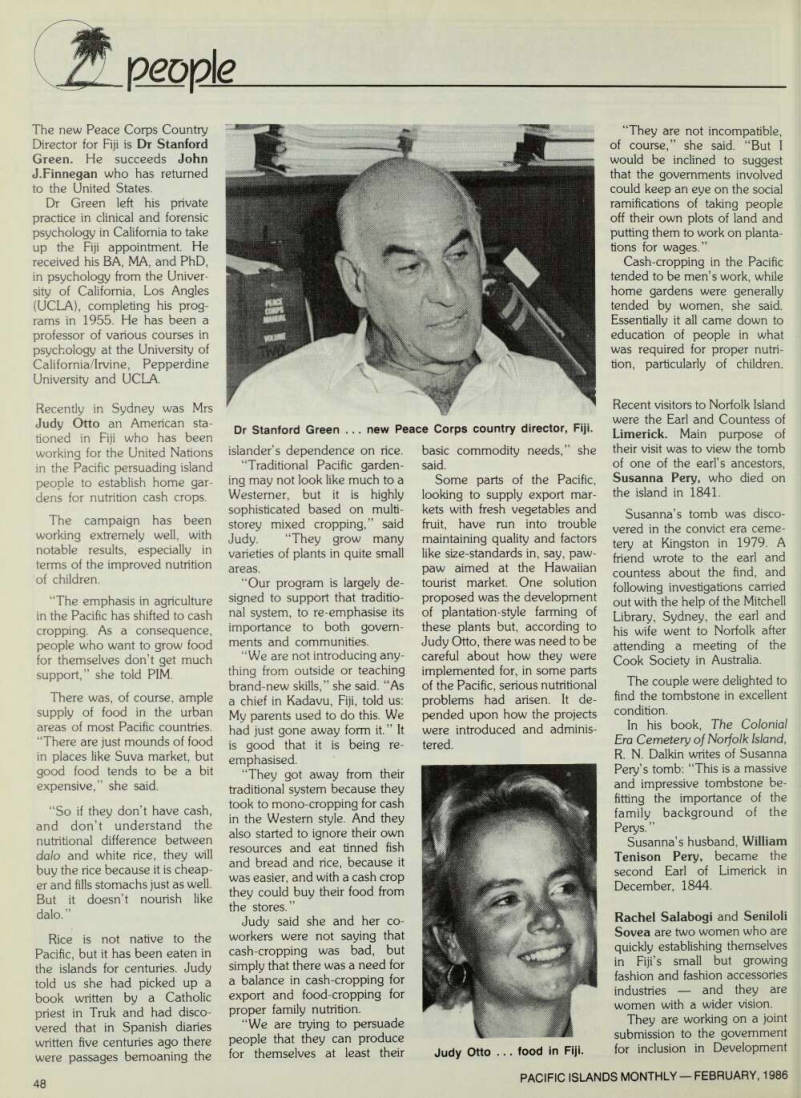
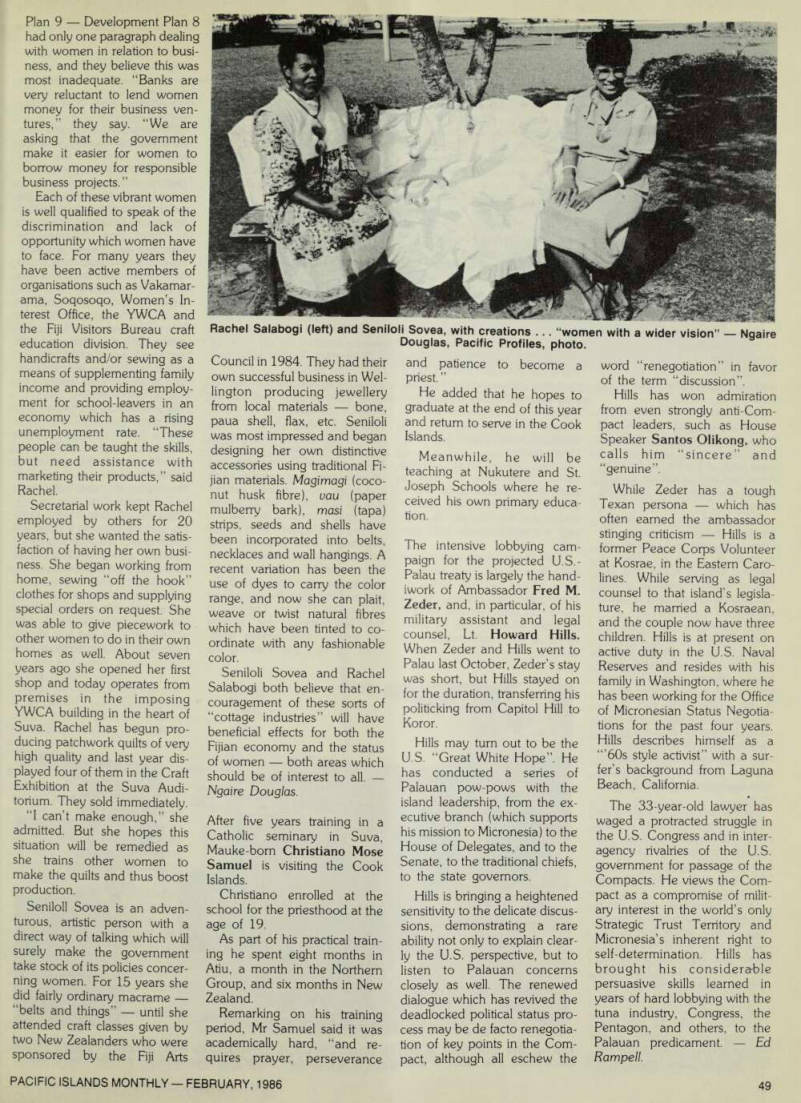
The new Peace Corps Country Director for Fiji is Dr Stanford Green. He succeeds John J.Finnegan who has returned to the United States.
Dr Green left his private practice in clinical and forensic psychology in California to take up the Fiji appointment. He received his BA, MA, and PhD, in psychology from the Univer sity of California, Los Angles (UCLA), completing his prog rams in 1955. He has been a professor of various courses in psychology at the University of California/Irvine, Pepperdine University and UCLA.
Recently in Sydney was Mrs Judy Otto an American sta tioned in Fiji who has been working for the United Nations in the Pacific persuading island people to establish home gar dens for nutrition cash crops.
The campaign has been working extremely well, with notable results, especially in terms of the improved nutrition of children.
“The emphasis in agriculture in the Pacific has shifted to cash cropping. As a consequence, people who want to grow food for themselves don’t get much support,” she told PIM.
There was, of course, ample supply of food in the urban areas of most Pacific countries.
“There are just mounds of food in places like Suva market, but good food tends to be a bit expensive,” she said.
“So if they don’t have cash, and don’t understand the nutritional difference between dalo and white rice, they will buy the rice because it is cheap er and fills stomachs just as well.
But it doesn’t nourish like dalo.”
Rice is not native to the Pacific, but it has been eaten in the islands for centuries. Judy told us she had picked up a book written by a Catholic priest in Truk and had disco vered that in Spanish diaries written five centuries ago there were passages bemoaning the
islander’s dependence on rice.
“Traditional Pacific garden ing may not look like much to a Westerner, but it is highly sophisticated based on multi storey mixed cropping,” said Judy. “They grow many varieties of plants in quite small areas.
“Our program is largely de signed to support that traditio nal system, to re-emphasise its importance to both govern ments and communities.
“We are not introducing any thing from outside or teaching brand-new skills,” she said. “As a chief in Kadavu, Fiji, told us: My parents used to do this. We had just gone away form it. ” It is good that it is being re emphasised.
“They got away from their traditional system because they took to mono-cropping for cash in the Western style. And they also started to ignore their own resources and eat tinned fish and bread and rice, because it was easier, and with a cash crop they could buy their food from the stores.”
Judy said she and her co workers were not saying that cash-cropping was bad, but simply that there was a need for a balance in cash-cropping for export and food-cropping for proper family nutrition.
“We are trying to persuade people that they can produce for themselves at least their
basic commodity needs,” she said.
Some parts of the Pacific, looking to supply export mar kets with fresh vegetables and fruit, have run into trouble maintaining quality and factors like size-standards in, say, paw paw aimed at the Hawaiian tourist market. One solution proposed was the development of plantation-style farming of these plants but, according to Judy Otto, there was need to be careful about how they were implemented for, in some parts of the Pacific, serious nutritional problems had arisen. It de pended upon how the projects were introduced and adminis tered.
“They are not incompatible, of course,” she said. “But I would be inclined to suggest that the governments involved could keep an eye on the social ramifications of taking people off their own plots of land and putting them to work on planta tions for wages.”
Cash-cropping in the Pacific tended to be men’s work, while home gardens were generally tended by women, she said.
Essentially it all came down to education of people in what was required for proper nutri tion, particularly of children.
Recent visitors to Norfolk Island were the Earl and Countess of Limerick. Main purpose of their visit was to view the tomb of one of the earl’s ancestors, Susanna Pcry, who died on the island in 1841.
Susanna’s tomb was disco vered in the convict era ceme tery at Kingston in 1979. A friend wrote to the earl and countess about the find, and following investigations carried out with the help of the Mitchell Library, Sydney, the earl and his wife went to Norfolk after attending a meeting of the Cook Society in Australia.
The couple were delighted to find the tombstone in excellent condition.
In his book, The Colonial Era Cemetery of Norfolk Island, R. N. Dalkin writes of Susanna Pery’s tomb: “This is a massive and impressive tombstone be fitting the importance of the family background of the Perys. ”
Susanna’s husband, William Tenison Fery, became the second Earl of Limerick in December, 1844.
Rachel Salabogi and Seniloli Sovea are two women who are quickly establishing themselves in Fiji’s small but growing fashion and fashion accessories industries and they are women with a wider vision.
They are working on a joint submission to the government for inclusion in Development
Dr Stanford Green ... new Peace Corps country director, Fiji.
Judy Otto ... food in Fiji.
Plan 9 Development Plan 8 had only one paragraph dealing with women in relation to busi ness, and they believe this was most inadequate. “Banks are very reluctant to lend women money for their business ven tures,” they say. “We are asking that the government make it easier for women to borrow money for responsible business projects.”
Each of these vibrant women is well qualified to speak of the discrimination and lack of opportunity which women have to face. For many years they have been active members of organisations such as Vakamar ama, Soqosoqo, Women’s In terest Office, the YWCA and the Fiji Visitors Bureau craft education division. They see handicrafts and/or sewing as a means of supplementing family income and providing employ ment for school-leavers in an economy which has a rising unemployment rate. “These people can be taught the skills, but need assistance with marketing their products,” said Rachel.
Secretarial work kept Rachel employed by others for 20 years, but she wanted the satis faction of having her own busi ness. She began working from home, sewing “off the hook” clothes for shops and supplying special orders on request. She was able to give piecework to other women to do in their own homes as well. About seven years ago she opened her first shop and today operates from premises in the imposing YWCA building in the heart of Suva. Rachel has begun pro ducing patchwork quilts of very high quality and last year dis played four of them in the Craft Exhibition at the Suva Audi torium. They sold immediately.
“I can’t make enough,” she admitted. But she hopes this situation will be remedied as she trains other women to make the quilts and thus boost production.
Seniloli Sovea is an adven turous, artistic person with a direct way of talking which will surely make the government take stock of its policies concer ning women. For 15 years she did fairly ordinary macrame “belts and things” until she attended craft classes given by two New Zealanders who were sponsored by the Fiji Arts
Council in 1984. They had their own successful business in Wel lington producing jewellery from local materials bone, paua shell, flax, etc. Seniloli was most impressed and began designing her own distinctive accessories using traditional Fi jian materials. Magimagi (coco nut husk fibre), uau (paper mulberry bark), masi (tapa) strips, seeds and shells have been incorporated into belts, necklaces and wall hangings. A recent variation has been the use of dyes to carry the color range, and now she can plait, weave or twist natural fibres which have been tinted to co ordinate with any fashionable color.
Seniloli Sovea and Rachel Salabogi both believe that en couragement of these sorts of “cottage industries” will have beneficial effects for both the Fijian economy and the status of women both areas which should be of interest to all.
Ngaire Douglas.
After five years training in a Catholic seminary in Suva, Mauke-born Christiano Mose Samuel is visiting the Cook Islands.
Christiano enrolled at the school for the priesthood at the age of 19.
As part of his practical train ing he spent eight months in Atiu, a month in the Northern Group, and six months in New Zealand.
Remarking on his training period, Mr Samuel said it was academically hard, “and re quires prayer, perseverance
and patience to become a priest. ”
He added that he hopes to graduate at the end of this year and return to serve in the Cook Islands.
Meanwhile, he will be teaching at Nukutere and St.
Joseph Schools where he re ceived his own primary educa tion.
The intensive lobbying cam paign for the projected U.S.- Palau treaty is largely the hand iwork of Ambassador Fred M.
Zeder, and, in particular, of his military assistant and legal counsel, Lt. Howard Hills.
When Zeder and Hills went to Palau last October, Zeder’s stay was short, but Hills stayed on for the duration, transferring his politicking from Capitol Hill to Koror.
Hills may turn out to be the U.S. “Great White Hope”. He has conducted a series of Palauan pow-pows with the island leadership, from the ex ecutive branch (which supports his mission to Micronesia) to the House of Delegates, and to the Senate, to the traditional chiefs, to the state governors.
Hills is bringing a heightened sensitivity to the delicate discus sions, demonstrating a rare ability not only to explain clear ly the U.S. perspective, but to listen to Palauan concerns closely as well. The renewed dialogue which has revived the deadlocked political status pro cess may be de facto renegotia tion of key points in the Com pact, although all eschew the
word “renegotiation” in favor of the term “discussion”.
Hills has won admiration from even strongly anti-Com pact leaders, such as House Speaker Santos Olikong, who calls him “sincere” and “genuine”.
While Zeder has a tough Texan persona which has often earned the ambassador stinging criticism Hills is a former Peace Corps Volunteer at Kosrae, in the Eastern Caro lines. While serving as legal counsel to that island’s legisla ture, he married a Kosraean, and the couple now have three children. Hills is at present on active duty in the U.S. Naval Reserves and resides with his family in Washington, where he has been working for the Office of Micronesian Status Negotia tions for the past four years.
Hills describes himself as a “’6os style activist” with a sur fer’s background from Laguna Beach, California.
The 33-year-old lawyer has waged a protracted struggle in the U.S. Congress and in inter agency rivalries of the U.S. government for passage of the Compacts. He views the Com pact as a compromise of milit ary interest in the world’s only Strategic Trust Territory and Micronesia’s inherent right to self-determination. Hills has brought his considera-ble persuasive skills learned in years of hard lobbying with the tuna industry, Congress, the Pentagon, and others, to the Palauan predicament. Ed Rampell.
Rachel Salabogi (left) and Seniloli Sovea, with creations ... “women with a wider vision” Ngaire Douglas, Pacific Profiles, photo.
yacht
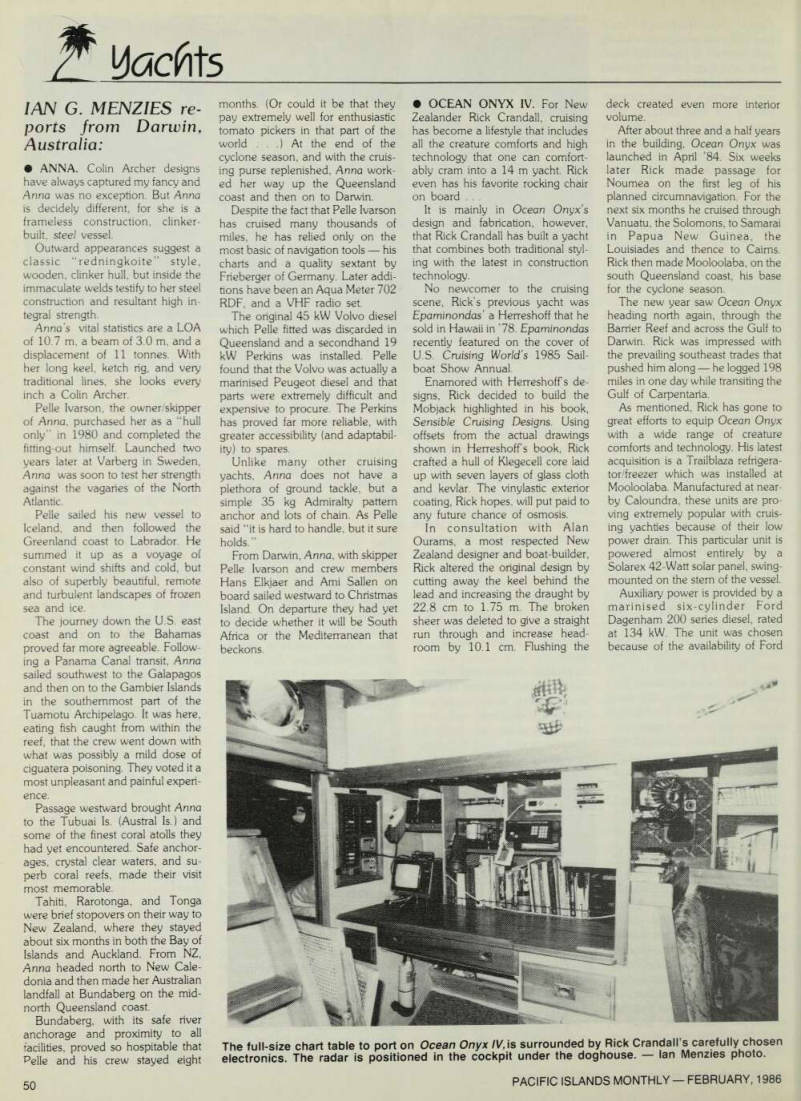
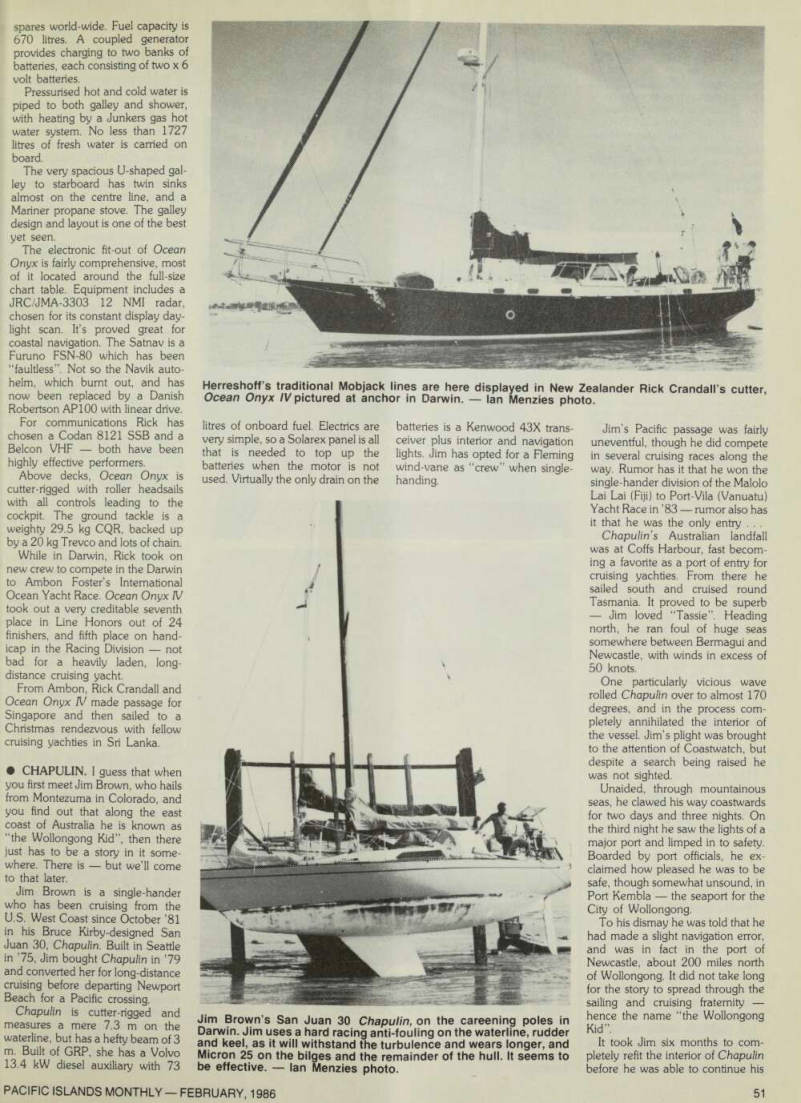
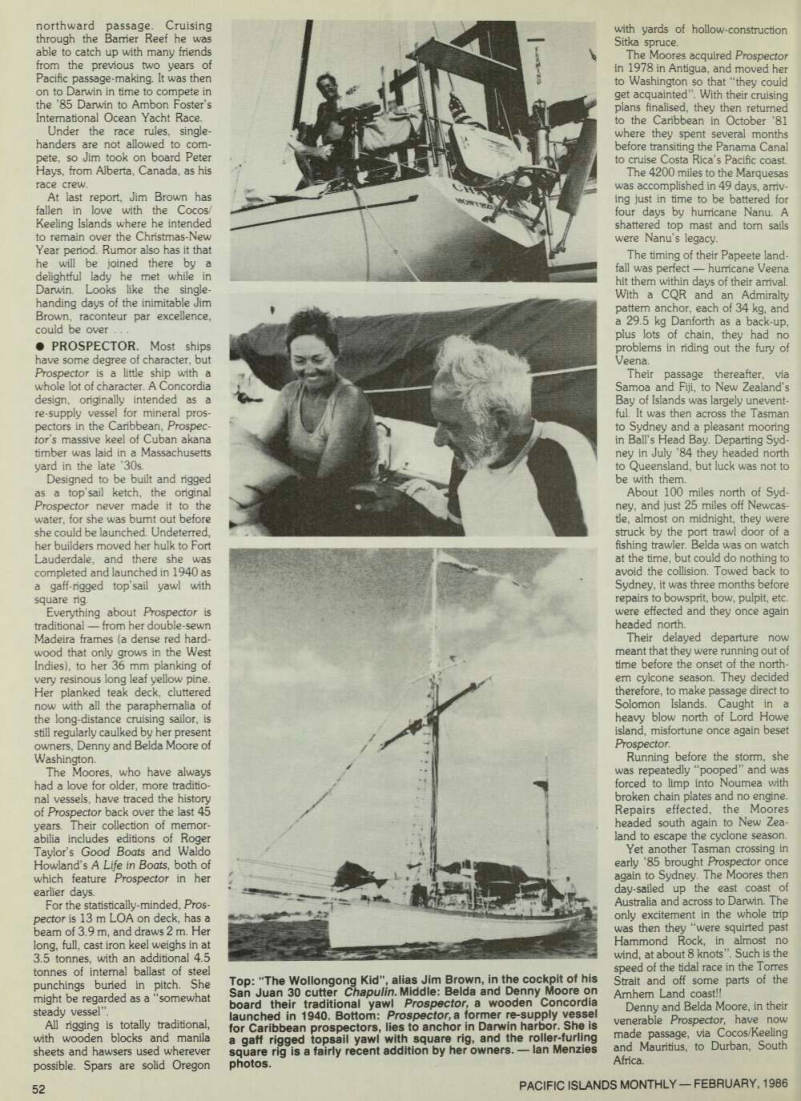
Lan G. Menzies Re
ports from Darwin ,
Australia:
• ANNA. Colin Archer designs have always captured my fancy and Anna was no exception. But Anna is decidely different, for she is a frameless construction, clinker built, steel vessel.
Outward appearances suggest a classic “redningkoite” style, wooden, clinker hull, but inside the immaculate welds testify to her steel construction and resultant high in tegral strength.
Anna's vital statistics are a LOA of 10.7 m, a beam of 3.0 m, and a displacement of 11 tonnes. With her long keel, ketch rig, and very traditional lines, she looks every inch a Colin Archer.
Pelle Ivarson, the owner/skipper of Anna, purchased her as a “hull only” in 1980 and completed the fitting-out himself. Launched two years later at Varberg in Sweden, Anna was soon to test her strength against the vagaries of the North Atlantic.
Pelle sailed his new vessel to Iceland, and then followed the Greenland coast to Labrador. He summed it up as a voyage of constant wind shifts and cold, but also of superbly beautiful, remote and turbulent landscapes of frozen sea and ice.
The journey down the U.S. east coast and on to the Bahamas proved far more agreeable. Follow ing a Panama Canal transit, Anna sailed southwest to the Galapagos and then on to the Gambier Islands in the southernmost part of the Tuamotu Archipelago. It was here, eating fish caught from within the reef, that the crew went down with what was possibly a mild dose of ciguatera poisoning. They voted it a most unpleasant and painful experi ence.
Passage westward brought Anna to the Tubuai Is. (Austral Is.) and some of the finest coral atolls they had yet encountered. Safe anchor ages, crystal clear waters, and su perb coral reefs, made their visit most memorable.
Tahiti, Rarotonga, and Tonga were brief stopovers on their way to New Zealand, where they stayed about six months in both the Bay of Islands and Auckland. From NZ, Anna headed north to New Cale donia and then made her Australian landfall at Bundaberg on the mid north Queensland coast.
Bundaberg, with its safe river anchorage and proximity to all facilities, proved so hospitable that Pelle and his crew stayed eight
months. (Or could it be that they pay extremely well for enthusiastic tomato pickers in that part of the world . . .) At the end of the cyclone season, and with the cmis ing purse replenished, Anna work ed her way up the Queensland coast and then on to Darwin.
Despite the fact that Pelle Ivarson has cruised many thousands of miles, he has relied only on the most basic of navigation tools his charts and a quality sextant by Frieberger of Germany. Later addi tions have been an Aqua Meter 702 RDF, and a VHF radio set.
The original 45 kW Volvo diesel which Pelle fitted was discarded in Queensland and a secondhand 19 kW Perkins was installed. Pelle found that the Volvo was actually a marinised Peugeot diesel and that parts were extremely difficult and expensive to procure. The Perkins has proved far more reliable, with greater accessibility (and adaptabil ity) to spares.
Unlike many other cruising yachts, Anna does not have a plethora of ground tackle, but a simple 35 kg Admiralty pattern anchor and lots of chain. As Pelle said “it is hard to handle, but it sure holds. ”
From Darwin, Anna , with skipper Pelle Ivarson and crew members Hans Elkjaer and Ami Sallen on board sailed westward to Christmas Island. On departure they had yet to decide whether it will be South Africa or the Mediterranean that beckons.
• Ocean Onyx Iv. For New
Zealander Rick Crandall, cruising has become a lifestyle that includes all the creature comforts and high technology that one can comfort ably cram into a 14 m yacht. Rick even has his favorite rocking chair on board . . .
It is mainly in Ocean Onyx’s design and fabrication, however, that Rick Crandall has built a yacht that combines both traditional styl ing with the latest in construction technology.
No newcomer to the cmising scene, Rick’s previous yacht was Epaminondas’ a Herreshoff that he sold in Hawaii in ’7B. Epaminondas recently featured on the cover of US. Cruising World’s 1985 Sail boat Show Annual.
Enamored with Herreshoff s de signs, Rick decided to build the Mobjack highlighted in his book, Sensible Cruising Designs. Using offsets from the actual drawings shown in Herreshoff s book, Rick crafted a hull of Klegecell core laid up with seven layers of glass cloth and kevlar. The vinylastic exterior coating, Rick hopes, will put paid to any future chance of osmosis.
In consultation with Alan Ourams, a most respected New Zealand designer and boat-builder, Rick altered the original design by cutting away the keel behind the lead and increasing the draught by 22.8 cm to 1.75 m. The broken sheer was deleted to give a straight run through and increase head room by 10.1 cm. Flushing the
deck created even more interior volume.
After about three and a half years in the building, Ocean Onyx was launched in April ’B4. Six weeks later Rick made passage for Noumea on the first leg of his planned circumnavigation. For the next six months he cruised through Vanuatu, the Solomons, to Samarai in Papua New Guinea, the Louisiades and thence to Caims.
Rick then made Mooloolaba, on the south Queensland coast, his base for the cyclone season.
The new year saw Ocean Onyx heading north again, through the Barrier Reef and across the Gulf to Darwin. Rick was impressed with the prevailing southeast trades that pushed him along he logged 198 miles in one day while transiting the Gulf of Carpentaria.
As mentioned, Rick has gone to great efforts to equip Ocean Onyx with a wide range of creature comforts and technology. His latest acquisition is a Trailblaza refrigera tor/freezer which was installed at Mooloolaba. Manufactured at near by Caloundra, these units are pro ving extremely popular with cruis ing yachties because of their low power drain. This particular unit is powered almost entirely by a Solarex 42-Watt solar panel, swing mounted on the stem of the vessel.
Auxiliary power is provided by a marinised six-cylinder Ford Dagenham 200 scries diesel, rated at 134 kW. The unit was chosen because of the availability of Ford
The full-size chart table to port on Ocean Onyx IV, is surrounded by Rick Crandall’s carefully chosen electronics. The radar is positioned in the cockpit under the doghouse. - lan Menzies photo.
spares world-wide. Fuel capacity is 670 litres. A coupled generator provides charging to two banks of batteries, each consisting of two x 6 volt batteries.
Pressurised hot and cold water is piped to both galley and shower, with heating by a Junkers gas hot water system. No less than 1727 litres of fresh water is carried on board.
The very spacious U-shaped gal ley to starboard has twin sinks almost on the centre line, and a Mariner propane stove. The galley design and layout is one of the best yet seen.
The electronic fit-out of Ocean Onyx is fairly comprehensive, most of it located around the full-size chart table. Equipment includes a JRC/JMA-3303 12 NMI radar, chosen for its constant display day light scan. It’s proved great for coastal navigation. The Satnav is a Furuno FSN-80 which has been “faultless”. Not so the Navik auto helm, which burnt out, and has now been replaced by a Danish Robertson APIOO with linear drive.
For communications Rick has chosen a Codan 8121 SSB and a Belcon VHF both have been highly effective performers.
Above decks, Ocean Onyx is cutter-rigged with roller headsails with all controls leading to the cockpit. The ground tackle is a weighty 29.5 kg CQR, backed up by a 20 kg Trevco and lots of chain.
While in Darwin, Rick took on new crew to compete in the Darwin to Ambon Foster’s International Ocean Yacht Race. Ocean Onyx IV took out a very creditable seventh place in Line Honors out of 24 finishers, and fifth place on hand icap in the Racing Division not bad for a heavily laden, long distance cruising yacht.
From Ambon, Rick Crandall and Ocean Onyx IV made passage for Singapore and then sailed to a Christmas rendezvous with fellow cruising yachties in Sri Lanka. • CHAPULIN. I guess that when you first meet Jim Brown, who hails from Montezuma in Colorado, and you find out that along the east coast of Australia he is known as “the Wollongong Kid”, then there just has to be a story in it some where. There is but we’ll come to that later.
Jim Brown is a single-hander who has been cruising from the U.S. West Coast since October ’Bl in his Bruce Kirby-designed San Juan 30, Chapulin. Built in Seattle in ’75, Jim bought Chapulin in ’79 and converted her for long-distance cruising before departing Newport Beach for a Pacific crossing.
Chapulin is cutter-rigged and measures a mere 7.3 m on the waterline, but has a hefty beam of 3 m. Built of GRP, she has a Volvo 13.4 kW diesel auxiliary with 73
litres of onboard fuel. Electrics are very simple, so a Solarex panel is all that is needed to top up the batteries when the motor is not used. Virtually the only drain on the
batteries is a Kenwood 43X trans ceiver plus interior and navigation lights. Jim has opted for a Fleming wind-vane as “crew” when single handing.
Jim’s Pacific passage was fairly uneventful, though he did compete in several cruising races along the way. Rumor has it that he won the single-hander division of the Malolo Lai Lai (Fiji) to Port-Vila (Vanuatu) Yacht Race in ’B3 rumor also has it that he was the only entry . . .
Chapulin’s Australian landfall was at Coffs Harbour, fast becom ing a favorite as a port of entry for cruising yachties. From there he sailed south and cruised round Tasmania. It proved to be superb Jim loved “lassie”. Heading north, he ran foul of huge seas somewhere between Bermagui and Newcastle, with winds in excess of 50 knots.
One particularly vicious wave rolled Chapulin over to almost 170 degrees, and in the process com pletely annihilated the interior of the vessel. Jim’s plight was brought to the attention of Coastwatch, but despite a search being raised he was not sighted.
Unaided, through mountainous seas, he clawed his way coastwards for two days and three nights. On the third night he saw the lights of a major port and limped in to safety.
Boarded by port officials, he ex claimed how pleased he was to be safe, though somewhat unsound, in Port Kembla the seaport for the City of Wollongong.
To his dismay he was told that he had made a slight navigation error, and was in fact in the port of Newcastle, about 200 miles north of Wollongong. It did not take long for the story to spread through the sailing and cruising fraternity hence the name “the Wollongong Kid”.
It took Jim six months to com pletely refit the interior of Chapulin before he was able to continue his
Jim Brown’s San Juan 30 Chapulin, on the careening poles in Darwin. Jim uses a hard racing anti-fouling on the waterline, rudder and keel, as it will withstand the turbulence and wears longer, and Micron 25 on the bilges and the remainder of the hull. It seems to
be effective. - lan Menzies photo.
Herreshoff’s traditional Mobjack lines are here displayed in New Zealander Rick Crandall’s cutter, Ocean Onyx IV pictured at anchor in Darwin. - lan Menzies photo.
northward passage. Cruising through the Barrier Reef he was able to catch up with many friends from the previous two years of Pacific passage-making. It was then on to Darwin in time to compete in the ’B5 Darwin to Ambon Foster’s International Ocean Yacht Race.
Under the race rules, single handers are not allowed to com pete, so Jim took on board Peter Hays, from Alberta, Canada, as his race crew.
At last report, Jim Brown has fallen in love with the Cocos/ Keeling Islands where he intended to remain over the Christmas-New Year period. Rumor also has it that he will be joined there by a delightful lady he met while in Darwin. Looks like the single handing days of the inimitable Jim Brown, raconteur par excellence, could be over . . . • PROSPECTOR. Most ships have some degree of character, but Prospector is a little ship with a whole lot of character. A Concordia design, originally intended as a re-supply vessel for mineral pros pectors in the Caribbean, Prospec tor’s massive keel of Cuban akana timber was laid in a Massachusetts yard in the late ’3os.
Designed to be built and rigged as a top’sail ketch, the original Prospector never made it to the water, for she was burnt out before she could be launched. Undeterred, her builders moved her hulk to Fort Lauderdale, and there she was completed and launched in 1940 as a gaff-rigged top’sail yawl with square rig.
Everything about Prospector is traditional from her double-sewn Madeira frames (a dense red hard wood that only grows in the West Indies), to her 36 mm planking of very resinous long leaf yellow pine.
Her planked teak deck, cluttered now with all the paraphernalia of the long-distance cruising sailor, is still regularly caulked by her present owners, Denny and Belda Moore of Washington.
The Moores, who have always had a love for older, more traditio nal vessels, have traced the history of Prospector back over the last 45 years. Their collection of memor abilia includes editions of Roger Taylor’s Good Boats and Waldo Howland’s A Life in Boats, both of which feature Prospector in her earlier days.
For the statistically-minded, Pros pector is 13 m LOA on deck, has a beam of 3.9 m, and draws 2 m. Her long, full, cast iron keel weighs in at 3.5 tonnes, with an additional 4.5 tonnes of internal ballast of steel punchings buried in pitch. She might be regarded as a “somewhat steady vessel”.
All rigging is totally traditional, with wooden blocks and manila sheets and hawsers used wherever possible. Spars are solid Oregon
with yards of hollow-construction Sitka spruce.
The Moores acquired Prospector in 1978 in Antigua, and moved her to Washington so that “they could get acquainted”. With their cruising plans finalised, they then returned to the Caribbean in October ’Bl where they spent several months before transiting the Panama Canal to cruise Costa Rica’s Pacific coast.
The 4200 miles to the Marquesas was accomplished in 49 days, arriv ing just in time to be battered for four days by hurricane Nanu. A shattered top mast and tom sails were Nanu’s legacy.
The timing of their Papeete land fall was perfect hurricane Veena hit them within days of their arrival.
With a CQR and an Admiralty pattern anchor, each of 34 kg, and a 29.5 kg Danforth as a back-up, plus lots of chain, they had no problems in riding out the fury of Veena.
Their passage thereafter, via Samoa and Fiji, to New Zealand’s Bay of Islands was largely unevent ful. It was then across the Tasman to Sydney and a pleasant mooring in Ball’s Head Bay. Departing Syd ney in July ’B4 they headed north to Queensland, but luck was not to be with them.
About 100 miles north of Syd ney, and just 25 miles off Newcas tle, almost on midnight, they were struck by the port trawl door of a fishing trawler. Belda was on watch at the time, but could do nothing to avoid the collision. Towed back to Sydney, it was three months before repairs to bowsprit, bow, pulpit, etc. were effected and they once again headed north.
Their delayed departure now meant that they were running out of time before the onset of the north ern cylcone season. They decided therefore, to make passage direct to Solomon Islands. Caught in a heavy blow north of Lord Howe island, misfortune once again beset Prospector.
Running before the storm, she was repeatedly “pooped” and was forced to limp into Noumea with broken chain plates and no engine.
Repairs effected, the Moores headed south again to New Zea land to escape the cyclone season.
Yet another Tasman crossing in early ’B5 brought Prospector once again to Sydney. The Moores then day-sailed up the east coast of Australia and across to Darwin. The only excitement in the whole trip was then they “were squirted past Hammond Rock, in almost no wind, at about 8 knots”. Such is the speed of the tidal race in the Torres Strait and off some parts of the Arnhem Land coast!!
Denny and Belda Moore, in their venerable Prospector, have now made passage, via Cocos/Keeling and Mauritius, to Durban, South Africa.
Top: “The Wollongong Kid”, alias Jim Brown, in the cockpit of his San Juan 30 cutter Chapulin. Middle: Belda and Denny Moore on board their traditional yawl Prospector, a wooden Concordia launched in 1940. Bottom: Prospector, a former re-supply vessel for Caribbean prospectors, lies to anchor in Darwin harbor. She is a gaff rigged topsail yawl with square rig, and the roller-furling square rig is a fairly recent addition by her owners. - lan Menzies photos.
shipping schedules
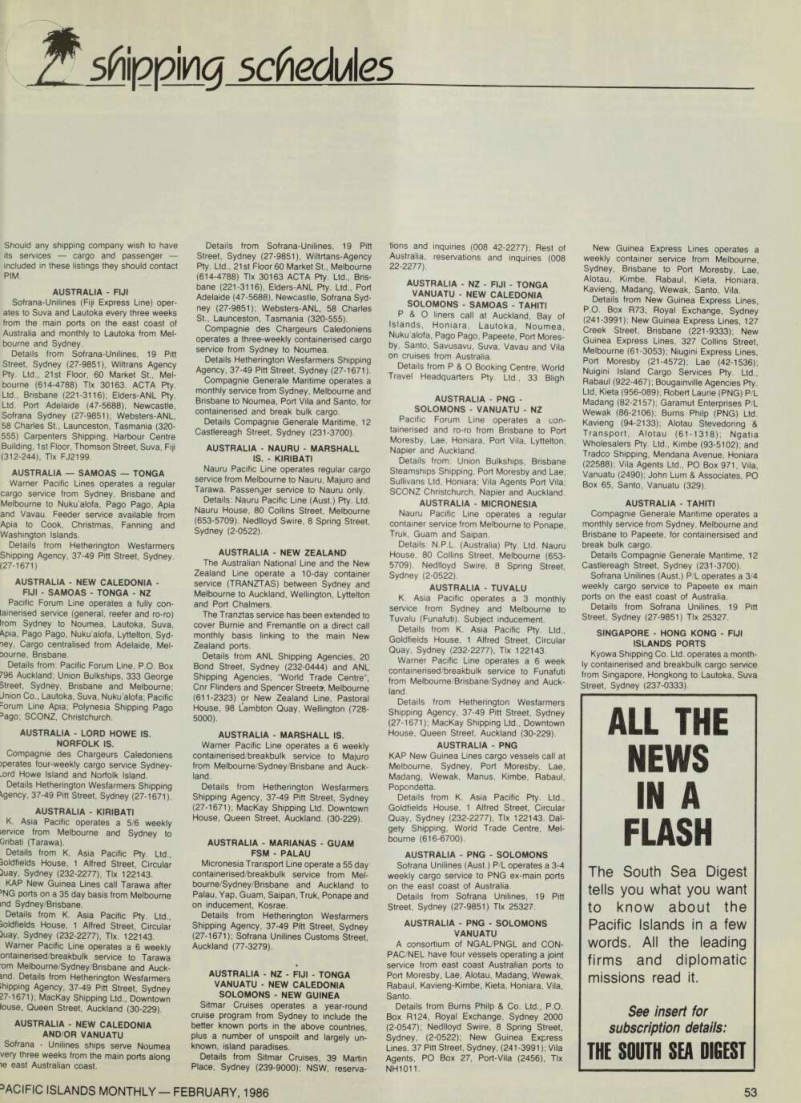
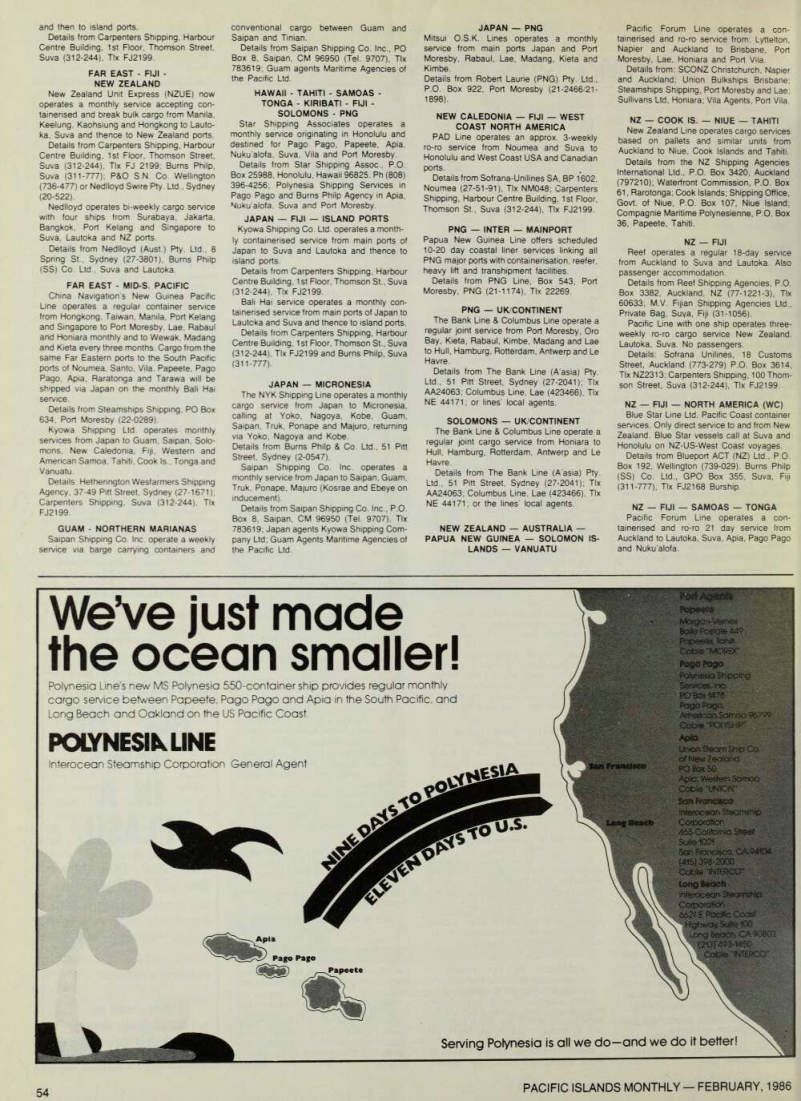
Should any shipping company wish to have its services cargo and passenger included in these listings they should contact
Pim.
Australia - Fiji
Sofrana-Unilines (Fiji Express Line) oper ates to Suva and Lautoka every three weeks from the main ports on the east coast of Australia and monthly to Lautoka from Mel bourne and Sydney.
Details from Sofrana-Unilines, 19 Pitt Street, Sydney (27-9851), Wiltrans Agency Pty. Ltd., 21st Floor, 60 Market St., Mel bourne (614-4788) Tlx 30163. ACTA Pty.
Ltd., Brisbane (221-3116); Elders-ANL Pty.
Ltd. Port Adelaide (47-5688); Newcastle, Sofrana Sydney (27-9851); Websters-ANL, 58 Charles St., Launceston, Tasmania (320- 555) Carpenters Shipping, Harbour Centre Building, Ist Floor, Thomson Street, Suva, Fiji (312-244), Tlx FJ2199.
Australia Samoas Tonga
Warner Pacific Lines operates a regular cargo service from Sydney, Brisbane and Melbourne to Nukualofa, Pago Pago, Apia and Vavau. Feeder service available from Apia to Cook, Christmas, Fanning and Washington Islands.
Details from Hetherington Wesfarmers Shipping Agency, 37-49 Pitt Street, Sydney. (27-1671)
Australia - New Caledonia -
FIJI - SAMOAS - TONGA - NZ Pacific Forum Line operates a fully con tainerised service (general, reefer and ro-ro) from Sydney to Noumea, Lautoka, Suva.
Apia, Pago Pago, Nukualofa. Lyttelton, Syd ley, Cargo centralised from Adelaide, Mel bourne, Brisbane.
Details from: Pacific Forum Line, P.O. Box 796 Auckland; Union Bulkships, 333 George Street, Sydney, Brisbane and Melbourne; Jnion Co., Lautoka, Suva, Nukualofa; Pacific : orum Line Apia; Polynesia Shipping Pago 3 ago; SCONZ, Christchurch.
Australia - Lord Howe Is.
Norfolk Is.
Compagnie des Chargeurs Caledoniens iperates four-weekly cargo service Sydney -ord Howe Island and Norfolk Island.
Details Hetherington Wesfarmers Shipping Agency, 37-49 Pitt Street, Sydney (27-1671).
Australia - Kiribati
K. Asia Pacific operates a 5/6 weekly ;ervice from Melbourne and Sydney to Ciribati (Tarawa).
Details from K. Asia Pacific Pty. Ltd., Goldfields House, 1 Alfred Street, Circular 3uay, Sydney (232-2277), Tlx 122143.
KAP New Guinea Lines call Tarawa after *NG ports on a 35 day basis from Melbourne md Sydney/Brisbane.
Details from K. Asia Pacific Pty. Ltd., Goldfields House, 1 Alfred Street, Circular )uay, Sydney (232-2277), Tlx. 122143.
Warner Pacific Line operates a 6 weekly ontainerised/breakbulk service to Tarawa om Melbourne/Sydney/Brisbane and Auck *nd. Details from Hetherington Wesfarmers Shipping Agency, 37-49 Pitt Street, Sydney 27-1671); Mac Kay Shipping Ltd., Downtown louse. Queen Street, Auckland (30-229).
Australia - New Caledonia
And/Or Vanuatu
Sofrana - Unilines ships serve Noumea very three weeks from the main ports along ie east Australian coast.
Details from Sofrana-Unilines, 19 Pitt Street, Sydney (27-9851), Wiltrtans-Agency Pty. Ltd., 21st Floor 60 Market St.. Melbourne (614-4788) Tlx 30163 ACTA Pty. Ltd., Bris bane (221-3116), Elders-ANL Pty. Ltd., Port Adelaide (47-5688), Newcastle. Sofrana Syd ney (27-9851); Websters-ANL. 58 Charles St., Launceston, Tasmania (320-555).
Compagnie des Chargeurs Caledonians operates a three-weekly containerised cargo service from Sydney to Noumea.
Details Hetherington Wesfarmers Shipping Agency, 37-49 Pitt Street, Sydney (27-1671).
Compagnie Generate Maritime operates a monthly service from Sydney, Melbourne and Brisbane to Noumea, Port Vila and Santo, for containerised and break bulk cargo.
Details Compagnie Generate Maritime, 12 Castlereagh Street. Sydney (231-3700).
Australia - Nauru - Marshall
Is. - Kiribati
Nauru Pacific Line operates regular cargo service from Melbourne to Nauru, Majuro and Tarawa. Passenger service to Nauru only.
Details: Nauru Pacific Line (Aust.) Pty. Ltd.
Nauru House, 80 Collins Street, Melbourne (653-5709). Nedlloyd Swire, 8 Spring Street, Sydney (2-0522).
Australia - New Zealand
The Australian National Line and the New Zealand Line operate a 10-day container service (TRANZTAS) between Sydney and Melbourne to Auckland, Wellington, Lyttelton and Port Chalmers.
The Tranztas service has been extended to cover Burnie and Fremantle on a direct call monthly basis linking to the main New Zealand ports.
Details from ANL Shipping Agencies, 20 Bond Street, Sydney (232-0444) and ANL Shipping Agencies, “World Trade Centre”, Cnr Flinders and Spencer Streets, Melbourne (611-2323) or New Zealand Line, Pastoral House, 98 llambton Quay, Wellington (728- 5000).
Australia - Marshall Is.
Warner Pacific Line operates a 6 weekly containerised/breakbulk service to Majuro from Melbourne/Sydney/Brisbane and Auck land.
Details from Hetherington Wesfarmers Shipping Agency, 37-49 Pitt Street, Sydney (27-1671); Mac Kay Shipping Ltd. Downtown House, Queen Street, Auckland. (30-229).
Australia - Marianas - Guam
Fsm - Palau
Micronesia Transport Line operate a 55 day containerised/breakbulk service from Mel bourne/Sydney/Brisbane and Auckland to Palau, Yap, Guam, Saipan, Truk, Ponape and on inducement, Kosrae.
Details from Hetherington Wesfarmers Shipping Agency, 37-49 Pitt Street, Sydney (27-1671); Sofrana Unilines Customs Street, Auckland (77-3279).
AUSTRALIA - NZ - FIJI - TONGA
Vanuatu - New Caledonia
Solomons - New Guinea
Sitmar Cruises operates a year-round cruise program from Sydney to include the better known ports in the above countries, plus a number of unspoilt and largely un known, island paradises.
Details from Sitmar Cruises, 39 Martin Place, Sydney (239-9000); NSW, reserva
lions and inquiries (008 42-2277); Rest of Australia, reservations and inquiries (008 22-2277).
AUSTRALIA - NZ - FIJI - TONGA
Vanuatu - New Caledonia
Solomons - Samoas - Tahiti
P & O liners call at Auckland, Bay of Islands, Honiara, Lautoka, Noumea, Nukualofa, Pago Pago, Papeete, Port Mores by, Santo, Savusavu, Suva, Vavau and Vila on cruises from Australia.
Details from P & O Booking Centre, World Travel Headquarters Pty, Ltd., 33 Bligh
Australia - Png -
Solomons - Vanuatu - Nz
Pacific Forum Line operates a con tainerised and ro-ro from Brisbane to Port Moresby, Lae, Honiara, Port Vila, Lyttelton, Napier and Auckland.
Details from: Union Bulkships, Brisbane Steamships Shipping, Port Moresby and Lae; Sullivans Ltd, Honiara; Vila Agents Port Vila; SCONZ Christchurch, Napier and Auckland.
Australia - Micronesia
Nauru Pacific Line operates a regular container service from Melbourne to Ponape, Truk, Guam and Saipan.
Details: N.P.L. (Australia) Pty. Ltd. Nauru House, 80 Collins Street. Melbourne (653- 5709) Nedlloyd Swire, 8 Spring Street Sydney (2-0522).
Australia - Tuvalu
K. Asia Pacific operates a 3 monthly service from Sydney and Melbourne to Tuvalu (Funafuti). Subject inducement.
Details from K. Asia Pacific Pty. Ltd., Goldfields House, 1 Alfred Street, Circular Quay, Sydney (232-2277), Tlx 122143.
Warner Pacific Line operates a 6 week containerised/breakbulk service to Funafuti from Melbourne/Brisbane/Sydney and Auck land.
Details from Hetherington Wesfarmers Shipping Agency, 37-49 Pitt Street, Sydney (27-1671); Mac Kay Shipping Ltd., Downtown House, Queen Street, Auckland (30-229).
Australia - Png
KAP New Guinea Lines cargo vessels call at Melbourne, Sydney, Port Moresby, Lae, Madang, Wewak, Manus, Kimbe, Rabaul, Popondetta.
Details from K. Asia Pacific Pty. Ltd., Goldfields House, 1 Alfred Street, Circular Quay, Sydney (232-2277), Tlx 122143. Dal gety Shipping, World Trade Centre, Mel bourne (616-6700).
Australia - Png - Solomons
Sofrana Unilines (Aust.) P/L operates a 3-4 weekly cargo service to PNG ex-main ports on the east coast of Australia.
Details from Sofrana Unilines, 19 Pitt Street, Sydney (27-9851) Tlx 25327.
Australia - Png - Solomons
Vanuatu
A consortium of NGAUPNGL and CON PAC/NEL have four vessels operating a joint service from east coast Australian ports to Port Moresby, Lae, Alotau, Madang, Wewak, Rabaul, Kavieng-Kimbe, Kieta, Honiara, Vila, Santo.
Details from Burns Philp & Co. Ltd., P.O.
Box R 124, Royal Exchange, Sydney 2000 (2-0547); Nedlloyd Swire, 8 Spring Street, Sydney, (2-0522); New Guinea Express Lines, 37 Pitt Street, Sydney, (241-3991); Vila Agents, PO Box 27, Port-Vila (2456), Tlx
Nhioii.
New Guinea Express Lines operates a weekly container service from Melbourne, Sydney, Brisbane to Port Moresby, Lae, Alotau, Kimbe, Rabaul, Kieta, Honiara, Kavieng, Madang, Wewak, Santo, Vila.
Details from New Guinea Express Lines, P-O. Box R 73, Royal Exchange, Sydney (241-3991); New Guinea Express Lines, 127 Creek Street, Brisbane (221-9333); New Guinea Express Lines, 327 Collins Street, Melbourne (61-3053); Niugini Express Lines, Port Moresby (21-4572); Lae (42-1536); Nuigini Island Cargo Services Ply. Ltd., Rabaul (922-467); Bougainville Agencies Pty.
Ltd. Kieta (956-089); Robert Laurie (PNG) P/L Madang (82-2157); Garamut Enterprises P/L Wewak (86-2106); Burns Philp (PNG) Ltd.
Kavieng (94-2133); Alotau Stevedoring & Transport, Alotau (61-1318); Ngatia Wholesalers Pty. Ltd., Kimbe (93-5102); and Tradco Shipping, Mendana Avenue, Honiara (22588); Vila Agents Ltd., PO Box 971, Vila.
Vanuatu (2490); John Lum & Associates, PO Box 65, Santo. Vanuatu (329).
Australia - Tahiti
Compagnie Generate Maritime operates a monthly service from Sydney, Melbourne and Brisbane to Papeete, for containersised and break bulk cargo.
Details Compagnie Generate Maritime, 12 Castlereagh Street, Sydney (231-3700).
Sofrana Unilines (Aust.) P/L operates a 3/4 weekly cargo service to Papeete ex main ports on the east coast of Australia.
Details from Sofrana Unilines, 19 Pitt Street, Sydney (27-9851) Tlx 25327.
Singapore - Hong Kong - Fiji
Islands Ports
Kyowa Shipping Co. Ltd. operates a month ly containerised and breakbulk cargo service from Singapore, Hongkong to Lautoka, Suva Street, Sydney (237-0333).
and then to island ports.
Details from Carpenters Shipping. Harbour Centre Building, Ist Floor, Thomson Street, Suva (312-244), Tlx FJ2199.
Far East - Fiji -
New Zealand
New Zealand Unit Express (NZUE) now operates a monthly service accepting con tainerised and break bulk cargo from Manila, Keelung, Kaohsiung and Hongkong to Lauto ka, Suva and thence to New Zealand ports.
Details from Carpenters Shipping, Harbour Centre Building, Ist Floor. Thomson Street, Suva (312-244), Tlx FJ 2199; Burns Philp, Suva (311-777); P&O S.N. Co. Wellington (736-477) or Nedlloyd Swire Pty. Ltd., Sydney (20-522).
Nedlloyd operates bi-weekly cargo service with four ships from Surabaya, Jakarta, Bangkok. Port Kelang and Singapore to Suva. Lautoka and NZ ports.
Details from Nedlloyd (Aust.) Pty. Ltd., 8 Spnng St., Sydney (27-3801), Burns Philp (SS) Co. Ltd., Suva and Lautoka.
Far East - Mid-S. Pacific
China Navigation s New Guinea Pacific Line operates a regular container service from Hongkong, Taiwan, Manila. Port Kelang and Singapore to Port Moresby, Lae, Rabaul and Honiara monthly and to Wewak, Madang and Kieta every three months. Cargo from the same Far Eastern ports to the South Pacific ports of Noumea. Santo. Vila, Papeete. Pago Pago. Apia, Raratonga and Tarawa will be shipped via Japan on the monthly Bali Hai service.
Details from Steamships Shipping. PO Box 634, Port Moresby (22-0289) Kyowa Shipping Ltd. operates monthly services from Japan to Guam, Saipan, Solo mons. New Caledonia. Fiji. Western and Amencan Samoa, Tahiti, Cook Is., Tonga and Vanuatu.
Details Hethenngton Wesfarmers Shipping Agency, 37-49 Pitt Street, Sydney (27-1671) Carpenters Shipping, Suva (312-244), Tlx FJ2199
Guam - Northern Marianas
Saipan Shipping Co. Inc. operate a weekly service via barge carrying containers and
conventional cargo between Guam and Saipan and Tinian.
Details from Saipan Shipping Co. Inc., PO Box 8, Saipan. CM 96950 (Tel. 9707), Tlx 783619; Guam agents Maritime Agencies of the Pacific Ltd.
Hawaii - Tahiti - Samoas -
Tonga - Kiribati - Fiji -
Solomons - Png
Star Shipping Associates operates a monthly service originating in Honolulu and destined for Pago Pago, Papeete, Apia, Nukualofa, Suva, Vila and Port Moresby.
Details from Star Shipping Assoc., P.O.
Box 25988, Honolulu, Hawaii 96825. Ph (808) 396-4256; Polynesia Shipping Services in Pago Pago and Bums Philp Agency in Apia, Nukualofa. Suva and Port Moresby.
Japan Fiji Island Ports
Kyowa Shipping Co. Ltd. operates a month ly containerised service from main ports of Japan to Suva and Lautoka and thence to island ports.
Details from Carpenters Shipping, Harbour Centre Building, Ist Floor, Thomson St., Suva (312-244), Tlx FJ2199.
Bali Hai service operates a monthly con tainensed service from main ports of Japan to Lautcka and Suva and thence to island ports.
Details from Carpenters Shipping. Harbour Centre Building, Ist Floor, Thomson St., Suva (312-244), Tlx FJ2199 and Burns Philp, Suva (311-777).
Japan Micronesia
The NYK Shipping Line operates a monthly cargo service from Japan to Micronesia, calling at Yoko, Nagoya, Kobe, Guam, Saipan, Truk, Ponape and Majuro, returning via Yoko, Nagoya and Kobe.
Details from Burns Philp & Co. Ltd., 51 Pitt Street, Sydney (2-0547).
Saipan Shipping Co. Inc. operates a monthly service from Japan to Saipan, Guam, Truk, Ponape. Majuro (Kosrae and Ebeye on inducement).
Details from Saipan Shipping Co. Inc., P.O.
Box 8, Saipan, CM 96950 (Tel. 9707), Tlx 783619; Japan agents Kyowa Shipping Com pany Ltd; Guam Agents Maritime Agencies of the Pacific Ltd.
Japan Png
Mitsui O.S.K. Lines operates a monthly service from main ports Japan and Port Moresby, Rabaul, Lae, Madang, Kieta and Kimbe.
Details from Robert Laurie (PNG) Pty. Ltd., P.O. Box 922, Port Moresby (21-2466/21- 1898).
New Caledonia Fiji West
Coast North America
PAD Line operates an approx. 3-weekly ro-ro service from Noumea and Suva to Honolulu and West Coast USA and Canadian ports.
Details from Sofrana-Unilines SA, BP 1602, Noumea (27-51-91), Tlx NMO4B; Carpenters Shipping, Harbour Centre Building, Ist Floor, Thomson St., Suva (312-244), Tlx FJ2199.
Png Inter Mainport
Papua New Guinea Line offers scheduled 10-20 day coastal liner services linking all PNG major ports with containerisation, reefer, heavy lift and transhipment facilities.
Details from PNG Line, Box 543, Port Moresby, PNG (21-1174), Tlx 22269.
Png Uic Continent
The Bank Line & Columbus Line operate a regular joint service from Port Moresby, Oro Bay. Kieta, Rabaul, Kimbe, Madang and Lae to Hull. Hamburg, Rotterdam, Antwerp and Le Havre.
Details from The Bank Line (A'asia) Pty.
Ltd., 51 Pitt Street, Sydney (27-2041); Tlx AA24063; Columbus Line, Lae (423466), Tlx NE 44171; or lines' local agents.
Solomons Uk/Continent
The Bank Line & Columbus Line operate a regular joint cargo service from Honiara to Hull, Hamburg. Rotterdam, Antwerp and Le Havre.
Details from The Bank Line (A'asia) Pty.
Ltd., 51 Pitt Street, Sydney (27-2041); Tlx AA24063; Columbus Line, Lae (423466), Tlx NE 44171; or the lines' local agents.
New Zealand Australia
Papua New Guinea Solomon Is
Lands Vanuatu
Pacific Forum Line operates a con tainerised and ro-ro service from: Lyttelton, Napier and Auckland to Brisbane, Port Moresby, Lae, Honiara and Port Vila.
Details from: SCONZ Christchurch, Napier and Auckland: Union Bulkships Brisbane: Steamships Shipping, Port Moresby and Lae; Sullivans Ltd, Honiara; Vila Agents, Port Vila.
Nz Cook Is. Niue Tahiti
New Zealand Line operates cargo services based on pallets and similar units from Auckland to Niue, Cook Islands and Tahiti.
Details from the NZ Shipping Agencies International Ltd., P.O. Box 3420, Auckland (797210); Waterfront Commission, P.O. Box 61, Rarotonga; Cook Islands; Shipping Office, Govt, of Niue, P.O. Box 107, Niue Island; Compagnie Maritime Polynesienne, P.O. Box 36, Papeete, Tahiti.
Nz Fiji
Reef operates a regular 18-day service from Auckland to Suva and Lautoka. Also passenger accommodation.
Details from Reef Shipping Agencies, P.O.
Box 3382, Auckland, NZ (77-1221-3), Tlx 60633; M.V. Fijian Shipping Agencies Ltd., Private Bag, Suva, Fiji (31-1056).
Pacific Line with one ship operates three weekly ro-ro cargo service New Zealand.
Lautoka. Suva. No passengers.
Details: Sofrana Unilines, 18 Customs Street, Auckland (773-279) P.O. Box 3614, Tlx NZ2313; Carpenters Shipping, 100 Thom son Street, Suva (312-244), Tlx FJ2199.
Nz Fiji North America (Wc)
Blue Star Line Ltd. Pacific Coast container services. Only direct service to and from New Zealand. Blue Star vessels call at Suva and Honolulu on NZ-US-West Coast voyages.
Details from Blueport ACT (NZ) Ltd., P.O.
Box 192, Wellington (739-029). Burns Philp (SS) Co. Ltd., GPO Box 355, Suva, Fiji (311-777), Tlx FJ2168 Burship.
Nz Fiji Samoas Tonga
Pacific Forum Line operates a con tainerised and ro-ro 21 day service from Auckland to Lautoka. Suva. Apia. Pago Pago and Nukualofa.
Details from: Pacific Forum Line, Auckland and Apia, Union Maritime, Lautoka, Suva and Nukualofa; Polynesian Shipping, Pago Pago.
Nz N. Caledonia Vanuatu
Png Solomons
Sofrana Unilines with three ships operate to Vila and Santo, to Honiara and Papua New Guinea and to Norfolk Island and Noumea (No passengers).
Details from Sofrana Unilines, 18 Customs Street, Auckland (773-279), P.O. Box 3614, Tlx NZ2313.
Nz Tahiti
Compagnie Tahitienne Maritime SA (as CTM-Tahiti Line) operates one ship, MV Bounty 111, monthly Papeete New Zea land. (No passengers).
Details from Sofrana Unilines, P.O. Box 3614, 18 Customs St., Auckland, Tlx NZ2313; CTM-Tahiti Line, P.O. Box 9012, Papeete (39042), Tlx Tahitlin 322 FP Tahiti.
Nz Tonga Samoas
Warner Pacific Line services Auckland, Nukualofa, Vavau, Apia, Pago Pago fort nightly carrying general and freezer cargoes.
Details from McKay Shipping Ltd., Down town House, 21 Queen St., Auckland, P.O Box 1372 (30-299). Cables MACSHIP, Telex NZ2554, Warner Pacific Line, Box 93, Nukualofa, Tonga; Mealelei (Western Samoa,) Ltd. Private Bag, Apia. Western Samoa, Pacific Maritime Services, P.O. Box 2617, Pago Pago, American Samoa (633- 2728) cables: Pacmar SX2OS.
Tahiti New Caledonia Vanuatu
Solomon Is. New Zealand
Png Singapore Europe
Polish Ocean Lines operate in a semi container type vessel to the following ports, from Papeete, Noumea, Santo, Vila, Yandina, Honiara, Auckland, Rabaul, Lae, Singapore, Port Kelang, Penang then to Mediterranean ports and Europe via the Suez Canal. (Other New Zealand ports subject to inducement).
Details from Universal Shipping Agencies Ltd., 6th Floor, 38 Fort Street, Auckland 1, New Zealand (30931), Tlx 21517.
Europe Tahiti
New Caledonia
Compagnie Generate Maritime operates services from Europe and Mediterranean ports to Papeete and Noumea using three ro-ro and multi-purpose vessels thus ensuring a bi-monthly sailing to and from.
Details Compagnie Generate Maritime, 12 Castlereagh Street, Sydney (231-3700).
Europe Tahiti
New Caledonia New Zealand
Vanuatu Solomons Png
Europe
Polish Ocean Lines offers regular monthly sailings for containerised and break bulk cargo, also conventional reefer space and reefer containers, from Hamburg, Rotterdam, Dunkirk, Rouen to Papeete, Noumea, Auck land, Santo, Honiara, Rabaul, Lae, Singa pore, returning to Europe via Suez, other ports in South Pacific can be served directly with inducement or otherwise via tranship ment.
Details from Sotama, BP 9170, Papeete, Tel 427805 Tlx 373 PF / SATO; BP C 2 Noumea Cedex Tel 272094 Tlx 163 NM Universal Shipping Agencies P.O. Box 2282 Auckland Tel 30930 Tlx 21517 / Vanua Navigation P.O. Box 44 Vila Tel 2027 Tlx 1033 Melan Chine Shipping Co. P.O, Box 71 Honiara Tel 21678 Tlx 66335 / Steamships Shipping & Transport P.O. Box 1512 Rabaul Tel 922952 Tlx 92929 / Steamships Trading Co. Ltd. P.O. Box 85 Lae Tel 424666 Tlx 42423 / Union Steam ship Co. of NZ Ltd P.O. Box 50 Apia Tel 21781 Tlx 225 / Warner Pacific Line P.O.
Box 93 Nukualofa Tel 22088 Tlx 66219 / Fiji Agents T.B.A.
Europe Tahiti W. Samoa
Fiji N. Caledonia
Nedlloyd offers regular cargo services from Continental ports to Papeete, Apia, Fiji and New Caledonia.
Details Nedlloyd (Aust.) Pty. Ltd., 8 Spring Street, Sydney (27-3801); Carpenters Ship ping, Ist Floor, Harbour Centre Bldg., 100 Thomson St., Suva (312-244), Tlx 2199 FJ
and Vetari Street, Lautoka (63988) Tlx 5215FJ.
Uk N. Continent W. Samoa
Tonga, Fiji
The Bank Line & Columbus Line operate a regular joint cargo service from Hull, Ham burg. Bremen, Antwerp, Rotterdam and Le Havre to Apia, Nukualofa, Suva and Lautoka.
Details from The Bank Line (A'asia) Pty.
Ltd., 51 Pitt Street, Sydney (27-2041), Tlx AA 24063: Columbus Line, Lae (423-466), Tlx NE 44171; or lines’ local agents.
Uk N. Continent Png
Solomons
The Bank Line & Columbus Line operate a regular joint cargo service from Hull, Ham burg, Bremen, Antwerp, Rotterdam and Le Havre to Port Moresby, Lae, Madang, Kimbe, Rabaul, Kieta and Honiara and on induce ment to Yandina.
Details from The Bank Line (A'asia) Pty.
Ltd., 51 Pitt Street, Sydney (27-2041), Tlx AA 24063; Columbus Line, Lae (42-3466), Tlx NE 44171; or lines' local agents.
Uk/N. Continent Tahiti
N. Caledonia Vanuatu
The Bank Line & Columbus Line operate a regular joint cargo service from Hull, Ham burg, Bremen, Antwerp, Rotterdam and Le Havre to Papeete, Noumea, Port-Vila and Santo.
Details from The Bank Line (A'asia) Pty.
Ltd., 51 Pitt Street. Sydney (27-2041), Tlx AA 24063: Columbus Line, Lae (42-3466), Tlx NE 44171; Ets. AM. Fare UTE, Papeete; Ets.
Ballande, Noumea and other local agents.
Us Hawaii Micronesia
E. Malaysia Brunei Papua New
Guinea Philippines
PM&O Lines operates three fully self-sus tained container vessels on a sailing frequen cy of every 28 days from the San Francisco Bay area, Los Angeles, and Honolulu to Majuro, Ebeye, Kosrae, Ponape, Truk, Saipan, Yap, Koror, Kota Kinabalu, Brunei, Lae, Kieta and Rabaul.
Service is offered utilizing the same vessels on the same 28-day frequency from the Philippine ports of Manila and Cebu and the Papua New Guinea ports of Rabaul, Lae, and Kieta to San Francisco and Los Angeles.
Finally, service is available from Manila, Cebu, Hongkong, Keelung and Kaohsiung to Saipan, Guam, Truk, Ponape, Majuro. Yap, Koror, Kieta, Rabaul, and Lae.
Details from PM&O Lines. 181 Fremont Street, San Francisco, California, 94105, U.S.A. (415) 543-7430, Tlx 278016; Cable PMONAV SFO; PM&O Owner's representa tive, P.O. Box 803, Saipan, N.M.I. 96950.
Cable Commontime Saipan, Tlx
783605; Anscor Transport and Terminals Inc., P.O. Box 7023-5. Metro Manila, Philip pines (521-8074) Tlx 65021 ATTI PN.
Us Hawaii Samoas
Kiribati Nauru
Nauru Pacific Line operates regular con ventional and container services from San Francisco and Honolulu to Christmas Island.
Pago Pago, Apia, Tarawa and Nauru.
Details from N.P.L. (Australia) Pty. Ltd., Nauru House, 80 Collins Street, Melbourne (653-5709); Nauru Air and Shipping Agency, Suite 2803, 185 Berry Street, San Francisco, California 94107 (415-543-4517); Nauru Air and Shipping Agency, Suite 506, 841 Bishop St., Honolulu, HI 96813 (808-523-0441).
Us. Noumea Fiji
PAD Line operates an approx. 3-weekly ro-ro service from west coast USA and Canada to Noumea, Suva and Lautoka.
Details from Sofrana Unilines BP 1602, Noumea (27-51-91), Tlx NMO4B; Carpenters Shipping, Harbour Centre Building, Ist Floor, 100 Thomson Street, Suva (312-244), Tlx FJ2199; Trans-Austral Shipping Pty. Ltd., P.O. Box R 232, Royal Exchange, 2000 (231-8411), Tlx AA21204.
Us Tahiti Samoa
Pacific Islands Transport operates a five weekly cargo service from North America west coast ports to Papeete, Pago Pago, Apia.
Details from Polynesia Shipping Services Inc. P.O. Box 1478, Pago Pago 96799.
Advertisements & other items, pp. 53-56 (1 item)
News
ALL THE
IN A
FLASH
The South Sea Digest tells you what you want to know about the Pacific Islands in a few words. All the leading firms and diplomatic missions read it.
See insert for subscription details:
THE SOUTH SEA DIGEST
We’ve just made
the ocean smaller!
Polynesia Line's new MS Polynesia 550-container ship provides regular monthly cargo service between Papeete, Pago Pago and Apia in the South Pacific, and Long Beach and Oakland on the US Pacific Coast.
POLYNESIA LINE
Interocean Steamship Corporation General Agent o£ & K •S o. a* & a 3 * 5* V V Apia Pago Pago * Morgon-V&me* BoBePo3tcHe449 f'csoeefe-t IoNS ca&e'yicmr Polynesia Shipping Services, inc.
PO Box 1478 Pago Pago.
American Samoa 96799 Cable 'EOLVSHir Apia Union Steam Ship Co. of Mew Zealand K) Box 50 Apia, Western Samoa Cable "UNOT San Hancaco interocean Stecmshp Corporation 405 Cam- mia Sheet Suite 1001 San Francisco, CA.94104 [415)598-2000 Cable "f^IERCO"
Long Beach interocean Steamship Corporation 662 EEadlic Coast Highway su§e 100 Long Beach, CA 90803 2131493-1450 Cable'S Serving Polynesia is all we do—and we do it better!
POLISH OCEAN LINES
General Management, 10 Lutego 24,81-364 GDYNIA, POLAND, Phone: 20-19-01, Cables: POLOCEAN Telex: 054-231 & O & mr ~-y ft V- . m ■ai a i 'ip LN v*: . i .* . * *; v; • • :*'* *. r • V** "»S .. felv'.v -’'v'^vV' “7 •V.'Xrjfl - s. vA v . > •• r-;.v l-.w
SOUTH PACIFIC SERVICE 1!
10 !!!^? 6 t 0 and from: GDYNIA, HAMBURG, ROTTERDAM, MIDDLESBOROUGH/IMMINGHAM, c^^o^o.r D u UNKIRK ’, ROL,EN ’ PAPEETE (via PANAMA), NOUMEA, AUCKLAND, HONIARA, RABAUL, LAE. oiiNbArUHE, by our multipurpose vessels carrying dry and reefer containers, reefer chambers, heavy lifts, breakbulk palletized, bulk liquids. or ai mm AK.n n a o POLISH OCEAN LINES Representatives AUCKLAND Mr. A. Sieradzki. Telex 21517 NZ “UNISHIP”. SYDNEY Mr. Walenciak. Telex 20428 AA “SLEIGH”
TAum c™-AHA -r , ™ POLISH OCEAN LINES Agents r e ? X 2 o 9 A EP :£ O H TIMEX ” NEW CALEDONIA SATO Telex 163 NM “SATO”. AUCKLAND UNIVERSAL SHIPPING MUtINUItb LTD., Telex 21517 NZ “UNISHIP” SOI DMDMQ mci am ruiwc cuiDDiMri rn irn t q i«n/ ccoqc un “CVMcnrv dm^
YOU’LL FIND IT.
WHERE THE SKY MEETS
THE SEA.
NEW CALEDONIA
SOLOMON ISLAND
KIR B
VANUATU
W. S A M O A
A. S A M O A
TAHITI
TONGA
- T *
SERVICE
JOINTLY OPERATED BY
The China Navigation Co., Ltd. fes Mitsui Ot&K. Lines. Ltd.
NIPPON YUSEN KAISHA
deaths
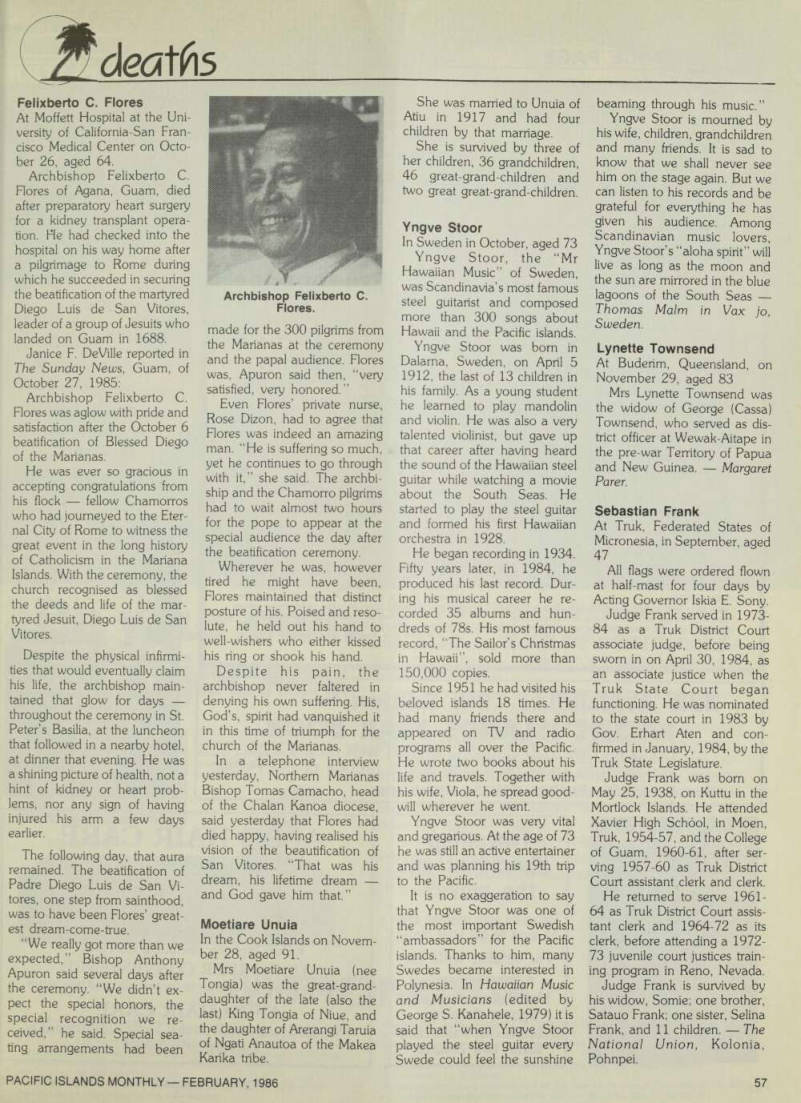
Felixberto C. Flores At Moffett Hospital at the Uni versity of California-San Fran cisco Medical Center on Octo ber 26, aged 64.
Archbishop Felixberto C.
Flores of Agana, Guam, died after preparatory heart surgery for a kidney transplant opera tion. He had checked into the hospital on his way home after a pilgrimage to Rome during which he succeeded in securing the beatification of the martyred Diego Luis de San Vitores, leader of a group of Jesuits who landed on Guam in 1688.
Janice F. DeVille reported in The Sunday News, Guam, of October 27, 1985: Archbishop Felixberto C.
Flores was aglow with pride and satisfaction after the October 6 beatification of Blessed Diego of the Marianas.
He was ever so gracious in accepting congratulations from his flock fellow Chamorros who had journeyed to the Eter nal City of Rome to witness the great event in the long history of Catholicism in the Mariana Islands. With the ceremony, the church recognised as blessed the deeds and life of the mar tyred Jesuit, Diego Luis de San Vitores.
Despite the physical infirmi ties that would eventually claim his life, the archbishop main tained that glow for days throughout the ceremony in St.
Peter’s Basilia, at the luncheon that followed in a nearby hotel, at dinner that evening. He was a shining picture of health, not a hint of kidney or heart prob lems, nor any sign of having injured his arm a few days earlier.
The following day, that aura remained. The beatification of Padre Diego Luis de San Vi tores, one step from sainthood, was to have been Flores’ great est dream-come-true.
“We really got more than we expected,” Bishop Anthony Apuron said several days after the ceremony. “We didn’t ex pect the special honors, the special recognition we re ceived,” he said. Special sea ting arrangements had been
made for the 300 pilgrims from the Marianas at the ceremony and the papal audience. Flores was, Apuron said then, “very satisfied, very honored.”
Even Flores’ private nurse, Rose Dizon, had to agree that Flores was indeed an amazing man. “He is suffering so much, yet he continues to go through with it,” she said. The archbi ship and the Chamorro pilgrims had to wait almost two hours for the pope to appear at the special audience the day after the beatification ceremony.
Wherever he was, however tired he might have been, Flores maintained that distinct posture of his. Poised and reso lute, he held out his hand to well-wishers who either kissed his ring or shook his hand.
Despite his pain, the archbishop never faltered in denying his own suffering. His, God’s, spirit had vanquished it in this time of triumph for the church of the Marianas.
In a telephone interview yesterday, Northern Marianas Bishop Tomas Camacho, head of the Chalan Kanoa diocese, said yesterday that Flores had died happy, having realised his vision of the beautification of San Vitores. “That was his dream, his lifetime dream and God gave him that.”
Moetiare Unuia In the Cook Islands on Novem ber 28, aged 91.
Mrs Moetiare Unuia (nee Tongia) was the great-grand daughter of the late (also the last) King Tongia of Niue, and the daughter of Arerangi Taruia of Ngati Anautoa of the Makea Karika tribe.
She was married to Unuia of Atiu in 1917 and had four children by that marriage.
She is survived by three of her children, 36 grandchildren, 46 great-grand-children and two great great-grand-children.
Yngve Stoor In Sweden in October, aged 73 Yngve Stoor, the “Mr Hawaiian Music” of Sweden, was Scandinavia’s most famous steel guitarist and composed more than 300 songs about Hawaii and the Pacific islands.
Yngve Stoor was born in Dalarna, Sweden, on April 5 1912, the last of 13 children in his family. As a young student he learned to play mandolin and violin. He was also a very talented violinist, but gave up that career after having heard the sound of the Hawaiian steel guitar while watching a movie about the South Seas. He started to play the steel guitar and formed his first Hawaiian orchestra in 1928.
He began recording in 1934.
Fifty years later, in 1984, he produced his last record. Dur ing his musical career he re corded 35 albums and hun dreds of 78s. His most famous record, “The Sailor’s Christmas in Hawaii”, sold more than 150,000 copies.
Since 1951 he had visited his beloved islands 18 times. He had many friends there and appeared on TV and radio programs all over the Pacific.
He wrote two books about his life and travels. Together with his wife, Viola, he spread good will wherever he went.
Yngve Stoor was very vital and gregarious. At the age of 73 he was still an active entertainer and was planning his 19th trip to the Pacific.
It is no exaggeration to say that Yngve Stoor was one of the most important Swedish “ambassadors” for the Pacific islands. Thanks to him, many Swedes became interested in Polynesia. In Hawaiian Music and Musicians (edited by George S. Kanahele, 1979) it is said that “when Yngve Stoor played the steel guitar every Swede could feel the sunshine
beaming through his music.”
Yngve Stoor is mourned by his wife, children, grandchildren and many friends. It is sad to know that we shall never see him on the stage again. But we can listen to his records and be grateful for everything he has given his audience. Among Scandinavian music lovers, Yngve Stoor’s “aloha spirit” will live as long as the moon and the sun are mirrored in the blue lagoons of the South Seas Thomas Malm in Vax jo, Sweden.
Lynette Townsend At Buderim, Queensland, on November 29, aged 83 Mrs Lynette Townsend was the widow of George (Cassa) Townsend, who served as dis trict officer at Wewak-Aitape in the pre-war Territory of Papua and New Guinea. Margaret Parer.
Sebastian Frank At Truk, Federated States of Micronesia, in September, aged 47 All flags were ordered flown at half-mast for four days by Acting Governor Iskia E. Sony.
Judge Frank served in 1973- 84 as a Truk District Court associate judge, before being sworn in on April 30, 1984, as an associate justice when the Truk State Court began functioning. He was nominated to the state court in 1983 by Gov. Erhart Aten and con firmed in January, 1984, by the Truk State Legislature.
Judge Frank was born on May 25, 1938, on Kuttu in the Mortlock Islands. He attended Xavier High School, in Moen, Truk, 1954-57, and the College of Guam, 1960-61, after ser ving 1957-60 as Truk District Court assistant clerk and clerk.
He returned to serve 1961- 64 as Truk District Court assis tant clerk and 1964-72 as its clerk, before attending a 1972- 73 juvenile court justices train ing program in Reno, Nevada.
Judge Frank is survived by his widow, Somie; one brother, Satauo Frank; one sister, Selina Frank, and 11 children. The National Union, Kolonia, Pohnpei.
Archbishop Felixberto C.
Flores.
Advertisements & other items, pp. 58-60 (1 item)
Travelling
SERVICE PAGE
ADVERTISING
Afro Hair 58
Aggie Grey 58
Aiwa 34 Amatil 44
AW A 29
Bali Hai Service 56 Bank Line 55 Clarion 6 Collins Olympic 28 Columbus Line 55 Coward 26 Honda 2
ICI(NZ) 32
Larsen 26 Mail Forwarding 58 Nissan 16,17 Papua Hotel 58 Polynesian Line 54 Toyota Motor 30,31
PAPUA NEW GUINEA: Dtetrtbuttoo Gordon & Goteh, PO Box 3396, Port Moresby, telephone 25-4551. 25-4855 Advertising Ken Head, PNG Post-Courier, PO Box 85, Port Moresby, telephone 21-2577, telex 22120.
SOLOMON ISLANDS: Distribution and Advertising The Bookshop. (Norman Bros.) PO Box 503, Honiara.
PHILIPPINES: Advertising The GF Group, 12 San Ignacio St., Uroaneta Village, Makati, Metro Manila, telephone 817-7299, telex 45950 and 4233.
UNITED KINGDOM: The Herald & Weekly Times Ltd., No 1 Martravers Street,London WC2R 3DZ, England, telephone 01 836 5162, telex London 21989 UNITED STATES MAINLAND: Advertising Joshua B.
Powers Jr., Powers International Inc., 551 Fifth Ave., New York, New York 10 017, telephone 867-9580, telex 236514.
Subscriptions PIM, Hawaii, PO Box 22250, Honolulu, Hawaii. 96822
SUBSCRIPTIONS
American Samoa SUS2I Australia AustSlS Canada SUS 27 Cook Islands NZS3O Fiji Austsl9 French Polynesia SUS 22 Guam SUS 23 Hawaii SUS 23 Japan SUS 22 Kiribati AustSl9 Micronesia SUS 23 Nauru AustS2l New Caledonia SUS 22 New Zealand NZ$3O Niue NZS3O Norfolk Island AustslB Northern Marianas SUS 23 Papua New Guinea Austs23 Solomon Islands Austsl9 Tonga Austsl9 Tuvalu Austsl9 United Kingdom StgSl 5 U. S. Mainland SUS 27 Vanuatu Austsl9 Western Samoa Austsl9 Elsewhere Austs2s Payments by personal cheque are only acceptable in Australian (from a branch in Australia), U.S. and New Zealand currency. For all other remittances please send an international bank draft in Australian dollars.
Published monthly by Pacific Publications (Aust.) Pty.
Ltd and pnnted in Australia by Quadricolor Industries Pty. Ltd., Mulgrave, Vic.
\mm AUSTRALIA: Distribution; The Heratd and Weekly Times Ltd . 44-74 Flinders St.. Melbourne, Vtc., 3000 Advertising Rape Brisbane D. Wood, Anday Agency, CCA Centre, Dayboro Road, Ctosebum 4520; Box 1918, GPO Brisbane, 4001; telephone (07) 289-4128 Adatakta Hastwell Williamson Rouse Pty Ltd., PO Box 419 Norwood, SA, 5067; 59 Kensington Road, Norwood; telephone (08) 332-3322, telex 87113; Perth Allen & Associates.
Suite 2, 284 Stirling St.. Perth, WA. 6000, telephone (09) 328-9593 or (09) 328-9363 FIJI: Distribution and subscriptions Desai Bookshops. PO Box 160, Suva, Fiji, telephone Suva 23036 Advertising Fiji Times & Herald Ltd , 20 Gordon St., Suva, telephone 31-4111, telex FJ2124.
FRENCH POLYNESIA: Distribution Hachette Pacifique, 10 Ave Bruat. Papeete, telephone 25610.
HAWAH. UNITED STATES: Distribution PIM, Hawaii, PO Box 22250, Honolulu. Hawaii. 96822 Advertising Bnan C Asgill, Apt 1308, 1676 Ala Moana Blvd , Honolulu, Hawaii 96815, telephone (808) 955-9718.
JAPAN; Advertising and subscriptions Universal Media Corporation. GPO Box 46, Tokyo, telephone 666- 3036, cables UNIMEDIA Tokyo, telex 2524665 KOREA: Advertising and subscriptions World Marketing, Inc. Box 4010, Seoul; phone 776-5291-3. telex K 23232.
MALAYSIA: Advertising and subscriptions Worldwide Media Services, 57-B Komplex Damai, Jin Dato Haji Eusoff, Kuala Lumpur, telephone 63-9340. cables WORLDMEDIA Kuala Lumpur, telex 31533.
VANUATU: Distribution Maropa Bookshop. HQ Box 210 Pod Vila Advertising Bill Penthand. Norman Bros Bookshop. Pod Vila, telephone 2232 NEW CALEDONIA; Distribution - Depot Centre de Presse Michel Pentecost, CBP2. Noumea, telephone 27- 2434, 27-4729 NEW ZEALAND: Distribution Gordon & Gotch. PO Bex 584, 2 Carr Road, Ml Roskill. Auckland 4 Advertising International Media Representatives Ltd . PO Box 10259, Balmoral. Auckland 4. telephone 605-909, 792-370, telex NZ21404
ALL THE NEWS
IN A FLASH
THE SOUTH SEA DIGEST
See insert for Subscription details
ft i rooms aircondltioned
NOW AVAILABLE! 15th Edition
PACIFIC ISLANDS YEAR BOOK
Contains over 550 pages crammed with all the facts you want to know on all the island groups of the Pacific.
See insert for further details and price.
Travelling
abroad or on
the move?
Let us be your postbox and be sure to get your mail.
For details, write to: The Manager, Mail Forwarding and Agency Services, P.O. Box 22, Palmerston North, New Zealand.
Stay at Aggie Grey’s . . . the South Pacific’s
legendary hotel.
Situated right in the heart of Western Samoa. Enjoy Polynesian style friendliness and service, in cool surroundings, superb entertainment and food.
Magnificent white sand beaches only a short drive away. Airconditioned rooms, swimming pool and full bar facilities.
Bookings through Union Steamship Company of NZ, Pan Am, Air New Zealand or direct to Aggie Grey’s, Apia. Western Samoa. Cables: AGGIES’ Apia.
AFRO HAIR CARE
Importers and Distributors of
BLACK HAIR CARE PRODUCTS
in Australia and the South Pacific Specialised products for all Afro-type hair • Shampoos • Conditioners • Hairdressings • Curl Products (including Curl Kits)
MAIL ORDER CONVENIENCE
Retail or wholesale contact us for price list and brochures
AFRO HAIR CARE
3 Wedge Court, Glen Waverley, Victoria, Australia 3150 Telephone (03) 2332642
Be your own
CD jockey.
Vi H “6-Pack” and “1-Pack” magazine B loaders are included. Extra I “6-Packs” (optional) let you build If your own CD library. It’s an idea S that works!
PD-M6(BK)
A World’s First! 6-Disc Multi-Play CD No Compact Disc player gives you more—more music, more convenience, more rich and dynamic digital sound.
Because it’s the only player with a “6-pack” loader for up to six CDs at a time.
Memory-program up to 32 songs, from any of the six discs. In a flash you’re a smooth “CD jockey.”
Or, cue up Random Play and let the built-in computer choose the playlist. Music lovers never had it so good.
Search and Repeat, Pause and more—all yours to command on the full-function wireless Remote Controller, included. The disc in play is held rock-steady by our New Disc Stabilizer, and the “smart” fluorescent display knows all, tells all—clearly.
Tune in to the ingenious PD-M 6, now reaching stores near you. It’s another world’s first from Pioneer—leaders in laser-digital innovation and the proven masters of hi-fi sound.
CiD PIONEER*
For further information, please contact: Australia: Pioneer Electronics Australia Pty. Ltd. (Incorporated in Victoria), P-O. Box 295, Mordialloc, Victoria, 3195 Tel: 580-9911 Fuji Islands: Brijlal & Company, G.P.O. Box No. 362, Suva, Fiji Islands Tel: 22258 New Zealand: Monaco Distributors Ltd., 2 Poland Road, Glenfield, Auckland, New Zealand Tel: (09) 444-9144 Norfolk Island; Burns Philp (Norfolk Island) Ltd., P.O. Box 21, Norfolk Island Vanuatu: Burns Philp (Vanuatu) Ltd., Vila, Vanuatu Nauru Island: Jacob Enterprises, P.O. Box N 0.4, Republic of Nauru Tahiti: Tahiti Hi-Fi, P.O. Box 848, Papeete, Tahiti New Caledonia: Menard Pacifique Sari, B.P. 3899, Noumea, New Caledonia Tel: 27.62-23 American Samoa: Transpac Corporation, P.O. Box 1477, Pago Pago, American Samoa 96799 Tel: 633-5224 Rarotonga: South Seas International Ltd., P.O. Box 49, Rarotonga, Cook Islands Tel: 2327 Papua New Guinea: Bali Merchants Pty. Ltd., P.O. Box 6103, Boroko Tel: 254887
Multifunctlonalism is the
watchword for timepieces
in this information age.
Citizen technology meets
the challenge with two
revolutionary
watches.
EWAYTO
w % & i % *0 S / / .Vi w /
ANA-DIGI
TEMP
ATIA-OIGI
DomboFl
Citizen Quartz Ana-Digi Temp. 59.9° to 9.9°C temperature readout, one-touch Fahrenheit conversion. Analog/Digital time indication with automatic calendar and dual (one other time zone) time. 24-hour alarm, hourly chime. 1/1000-sec. accurate stopwatch.
Citizen Watches Australia Pty Ltd, 122 Old Citizen Quartz Ana-Digi Combo FI.
Analog/Digital time indication with 1-sec. and 10-sec. increment LCD trackers. Permanently adjusted monthday-date calendar. 24-hour alarm, * 12-hour countdown timer; hourly chime. Dual time. And a 1/100-sec. counter lap-timing stopwatch.
Pittwater Rd, Brookvale. NSW 2100. Telephone: 939 7077.
CITIZEN
AHEAD OF THEIR TIME
Cable: Citizen Sydney. Telex: AA26633.