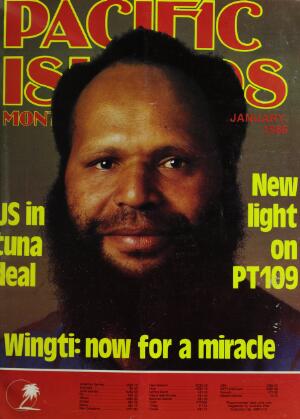
Pacific
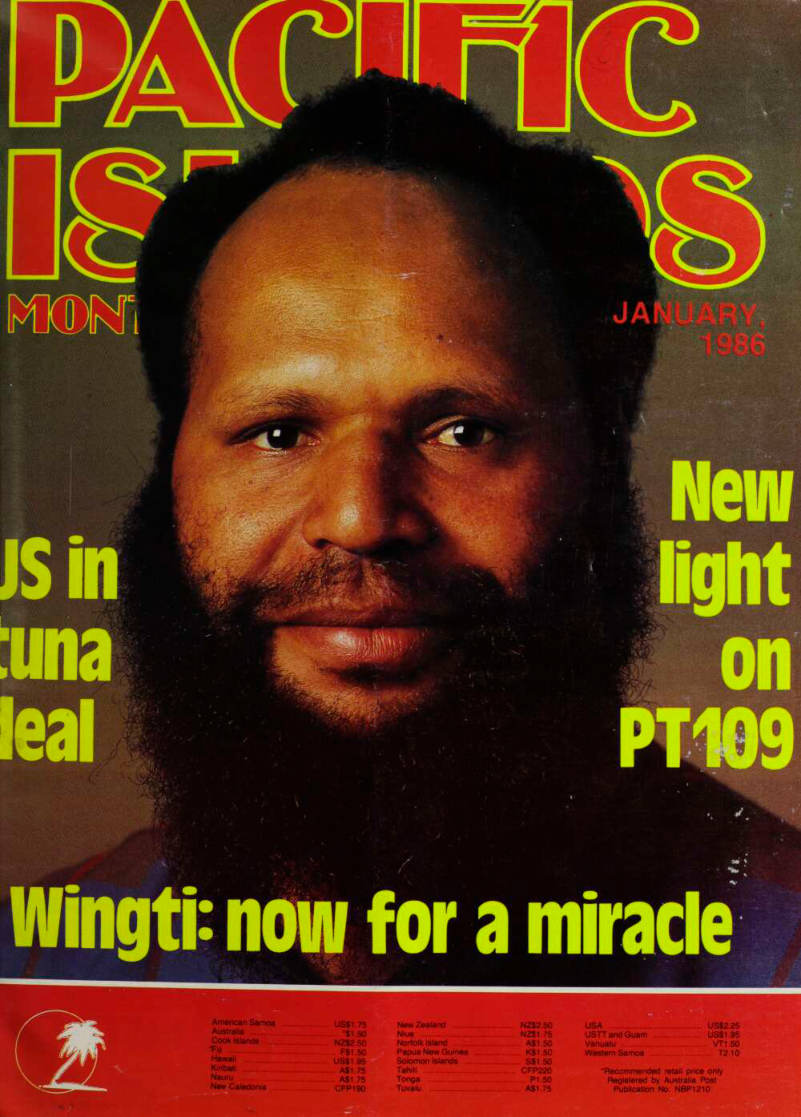

Islands
Monthly
mmm
Hf
IS in una leal
New Kght on
Ptio9
Wingtn now for a miracle
American Samoa US$l.75 Australia ‘51.50 Cook Islands NZ$2.5O
Fsi.So
Hawa " US$l.95 Kir, bati A 51.75 Nau ™ A 51.75 New Caledonia CFPI9O
New Zealand NZ$2.5O Niue NZ$l.75 Norfolk Island Asl 50 Papua New Guinea Ksl 50 Solomon Islands Ssl 50 Tahiti CFP22O Tonga P 1.50 Tuvalu A 51.75
Usa U 552.25
USTT and Guam US$l.95 Vanuatu VT1.50 Western Samoa T 2.10 'Recommended retail price only Registered by Australia Post Publication No. NBPI2IO
The Cover
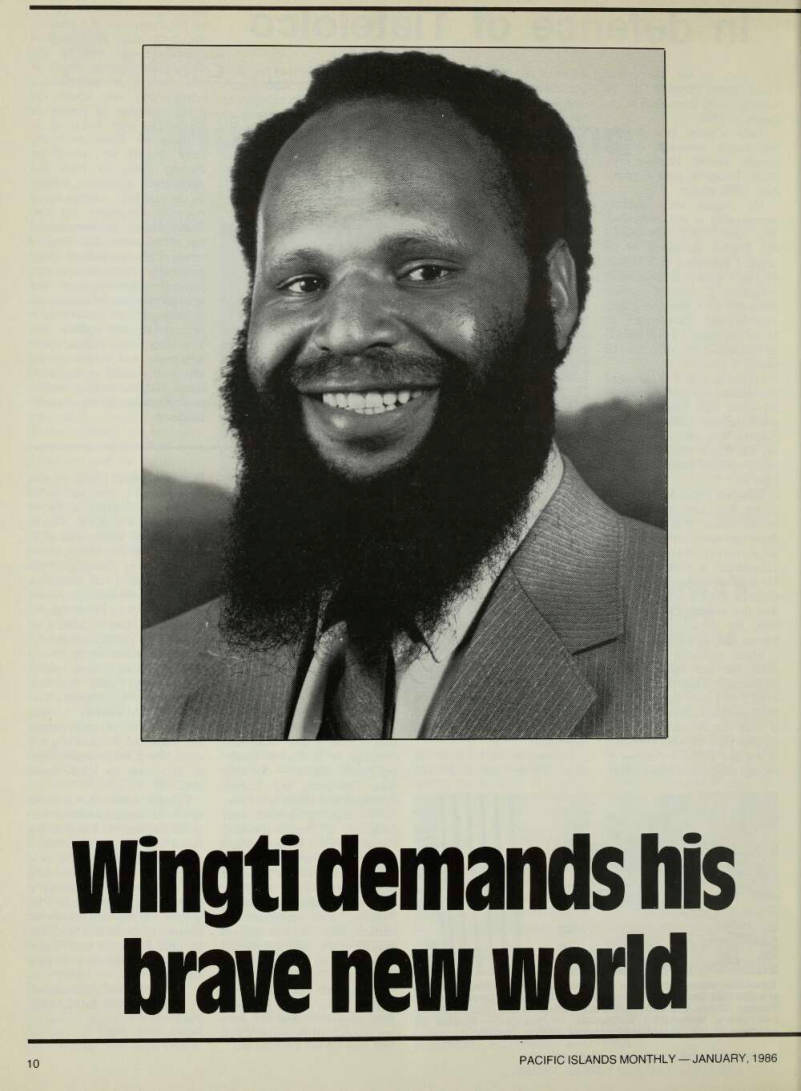
Papua New Guinea’s Prime Minister Paias Wingti. Rocky Roe Photographies picture.
Advertisements & other items, pp. 2-3 (2 items)
0 Hitachi
However
your
ramilv
- > 7^.
Jr ■ ■'% % <v o \ iii • Infra-red auto focus • Totally automatic white balance • F 1.2 macro lens with 6X power zoom • Minimum illumination of 10 lux • Electronic viewfinder • Only 2.5 kg without battery • 3-way power supply • Saticon picture tube • 4-hour recording time • Connect direct to TV for playback and programme recording using accessories
this
Hitachi
will catch
them.
Wherever your family goes to get away from it all, the new, fully automatic Hitachi VHS MOVIE will follow.
All you do is pop in a standard VHS cassette and point. Then play it on any existing VHS home video deck.
The automatic focus, auto iris, fully automatic white balance, "no-light" shooting (10 lux) and one-touch power zoom F 1.2 lens give you a perfect image of your family, everytime. Automatically, and for up to four hours of shooting with an E 240 VHS cassette.
Then use VHS MOVIE'S electronic viewfinder to review what you've just recorded. There's no heavy equipment to carry with no I wires to tangle up your family adventures. And it's so easy to use, the kids can even catch Dad trying out his favourite escapes.
Automatically.
WS MOWS
VM-200E
Makes
Home Movies
Automatic
VHS
0 HITACHI
. AUSTRALIA: Hitachi Sales Australia Pty.. Ltd., 153 Keys Road, Moorabbin, Victoria 3189; Phone: (555) 8722 . NEW ZEALAND: AWA New Zea'and L m PO. Box 50-248, Porirua; Phone: PRO 75-069 • PAPUA NEW GUINEA: S.O. Svensson (N.G.) Ltd., P.O. Box 705, Port Moresby; Phone: 21-2111 • FIJI^ANDS: LANDS Technique Limited. 37 Freeston Road, Walu Bay (P.O. Box 858), Suva Fiji; Phone: 312744 • NEW CALEDONIA: Caldis, B.P. Ml. Noumea; Phone: 26. 23. 50 • SOLOMON ISLANDS. Technique Radios Centre Ltd., P.O. Box 465, Honiara; Phone; 416
Pacific
ISLANDS
MONTHLY
Vol. 57 No. 1 January, 1986
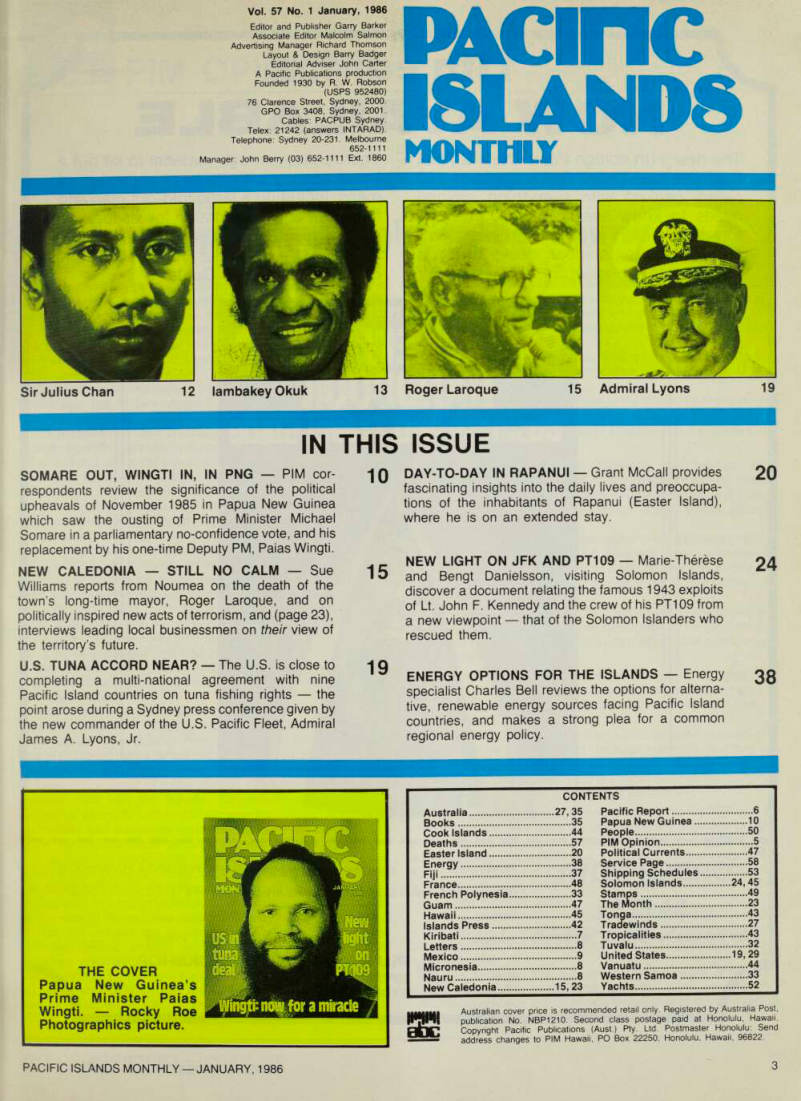
Sir Julius Chan 12
lambakeyOkuk 13
Roger Laroque 15
Admiral Lyons 19
In This Issue
SOMARE OUT, WINGTI IN, IN PNG PIM cor- -| Q respondents review the significance of the political upheavals of November 1985 in Papua New Guinea which saw the ousting of Prime Minister Michael Somare in a parliamentary no-confidence vote, and his replacement by his one-time Deputy PM, Paias Wingti.
NEW CALEDONIA STILL NO CALM Sue -| 5 Williams reports from Noumea on the death of the town’s long-time mayor, Roger Laroque, and on politically inspired new acts of terrorism, and (page 23), interviews leading local businessmen on their view of the territory’s future.
U.S. TUNA ACCORD NEAR? The U.S. is close to -| 0 completing a multi-national agreement with nine Pacific Island countries on tuna fishing rights the point arose during a Sydney press conference given by the new commander of the U.S. Pacific Fleet, Admiral James A. Lyons, Jr.
DAY-TO-DAY IN RAPANUI Grant McCall provides 20 fascinating insights into the daily lives and preoccupa tions of the inhabitants of Rapanui (Easter Island), where he is on an extended stay.
NEW LIGHT ON JFK AND PTIO9 Marie-Therese 24 and Bengt Danielsson, visiting Solomon Islands, discover a document relating the famous 1943 exploits of Lt. John F. Kennedy and the crew of his PTIO9 from a new viewpoint that of the Solomon Islanders who rescued them.
ENERGY OPTIONS FOR THE ISLANDS Energy 33 specialist Charles Bell reviews the options for alterna tive, renewable energy sources facing Pacific Island countries, and makes a strong plea for a common regional energy policy.
Contents
Australia 27, 35 Books 35 Cook Islands 44 Deaths 57 Easter Island 20 Energy 38 Fiji 37 France 48 French Polynesia 33 Guam 47 Hawaii 45 Islands Press 42 Kiribati 7 Letters 8 Mexico 9 Micronesia 8 Nauru 8 New Caledonia 15, 23
Pacific Report 6 Papua New Guinea 10 People 50 PIM Opinion 5 Political Currents 47 Service Page 58 Shipping Schedules 53 Solomon Islands 24,45
Stamps 49
The Month 23
Tonga 43
Tradewinds 27 Tropicalities 43 Tuvalu 32 United States 19,29 Vanuatu 44 Western Samoa 33 Yachts 52
Australian cover price is recommended retail only. Registered by Australia Post, publication No. NBPI2IO. Second class postage paid at Honolulu, Hawaii.
Copyright Pacific Publications (Aust.) Pty. Ltd. Postmaster Honolulu: Send address changes to PIM Hawaii, PO Box 22250, Honolulu, Hawaii, 96822.
Advertisements & other items, pp. 3-4 (2 items)
3
PACIFIC ISLANDS MONTHLY —JANUARY, 1986
Editor and Publisher Garry Barker Associate Editor Malcolm Salmon Advertising Manager Richard Thomson Layout & Design Barry Badger Editorial Adviser John Carter A Pacific Publications production Founded 1930 by R. W. Robson
(USPS 952480)
76 Clarence Street, Sydney, 2000.
GPO Box 3408, Sydney, 2001.
Cables: PACPUB Sydney.
Telex: 21242 (answers INTARAD).
Telephone: Sydney 20-231. Melbourne 652-1111 Manager: John Berry (03) 652-1111 Ext. 1860
J 11th edition V
NOW AVAILABLE
The new 11th edition Papua New Guinea Business and Travel Guide contains 280 pages packed with everything anyone needs to know about PNG investor, traveller, writer, student, historian, importer, exporter, shipper, dealer or just a plain ordinary bookworm.
There’s also enough material to kit out a travel agency with its large collection of maps, including a large fold-out map and full list of accommodation for visitors.
Note: New titles now in preparation,
VANUATU a guide, FIJI HANDBOOK
Business and Travel Guide. 11th edition
PAPUA NEW GUINEA
l r II r.
K o 6
IfxS-
ORDER NOW!
$A13.95 (See postage category “B” on insert) Please send copy(ies) 11th edition PAPUA NEW GUINEA HANDBOOK Business and Travel Guide and enclose my payment of $ Name Address P/code
RIM’S MAIL ORDER BOOKSHOP,
GPO Box 3408, SYDNEY, NSW, 2001. Australia. r
Elephants ought to be dainty
Rim Opinion
Newcomers to the Pacific have frequently made the error of assuming that just because island people are friendly, smiling and hospitable, that their affairs tend to be uncomplicated and serene. Nothing could be further from the truth. In fact any Pacific island leader, of the ilk of Ratu Sir Kamisese Mara, Tofilau Eti Alesana, or the pair currently in the PNG limelight, Paias Wingti and Sir Julius Chan, could undoubtedly show any western politician more than a thing or two about iron fists in lace-trimmed gloves, power plays and the numbers game.
No Australian or New Zealand politician has anything like the complexity of floor-crossing, no-confidence votes, clan-allegiances, tribal enmities and racial sensitivities, with which an Island leader must deal virtually every day.
Indeed, it is one of the difficulties of Island affairs that such considerations very frequently over-weigh wider issues such as economic survival, and what, for lack of better terms, we call progress.
In former times it did not really matter when one clan fell out with another, or domestic issues took total precedence over anything to do with the region. Indeed, while outsiders inevitably tend to lump Pacific Islanders together, each island is, in fact, quite separate and distinct. Each has a long history of doing its own thing, and looking with suspicion at the fellows on the islands over the horizon, because it was they who came over from time to time for a bit of traditional rape and pillage.
But, as the Pacific region has become rapidly much more important to the major powers of the world, so have the politics of individual nations.
A decade or so ago it might not have mattered very much that some Russians were dragging a fishing net through a piece of ocean off the Gilbert Islands. Now, however, the Soviet Union has one of its biggest navies settled and expanding at Cam Ranh Bay in Vietnam and is exhibiting quite obvious ambitions of influence.
Thus it is a focus of some concern that Kiribati has done a fisheries deal with the Soviets, for reasons which everyone recognises as amply sufficient when seen from on top of Kiribati’s immediate, and somewhat desperate, financial needs, but which upset the regional apple-cart in a strategic security sense.
It would have made much more sense had the United States, which is now, properly enough, alert to the Soviet presence, done something itself to pre-empt Moscow’s offer. All Kiribati sought was to capitalise, in a quite modest way, on its sole major asset, the fish in the seas of its exclusive economic zone.
That the Soviets got in under the Western guard may be attributed almost entirely to the lobbying of the American Tunaboat Association - and the very short-sighted acceptance of their pressures by the American administration. Washington had for years studiously ignored the well-founded protests of island nations about the A.T.A’s activities.
This now seems to be changing and, according to the U.S.
Assistant Secretary of State for Pacific Affairs, Dr Paul D. Wolfowitz, speaking on a satellite hook-up with journalists in Sydney early in December, a 10-nation agreement is in process of being worked out to solve the vexed tuna fishing rights problem. It cannot come too soon.
Meantime, if one may resume observation of the volatility and complexity of island politics, there does appear to be a wind of change in the region.
In Papua New Guinea the drama of the moment is the ousting of Michael Somare, very much the father of his country’s independ ence, by Paias Wingti, working in tandem with the shrewd and experienced Sir Julius Chan.
PNG has fierce economic problems, the product of a burdensome and lackadaisical bureaucracy, depressed returns from minerals upon which so much had been based, and a steep decline in the value of the Australian dollar, further reducing declining Australian aid.
On the face of it Wingti has started well, promising only a Churchillian cocktail of blood, toil, tears and sweat for his people, and some optimism has been engendered by that. The swiftness of Bob Hawke’s telegram of welcome after the Wingti victory was interesting.
But, Somare can in no way be counted out of the game, and there is at least one other notable player waiting for his chance at the central role, should Wingti and Chan slip in what is now a very difficult and delicate exercise.
In Fiji, too, the political climate shows signs of changing. The Labor Party, founded by trade unionists, has already shot gaps in the ranks of the predominantly Indian National Federation Party in the Suva City Council elections.
Given that Fiji’s municipal politics are venal in the extreme, and Suva’s about the worst of them, the huge swing to Labor may not be as significant as it looks. However, there does appear to be a mood developing to tinker with the racial basis of the country’s politics enshrined in the post-colonial constitution.
A sign of the upheaval was the resignation from the NFP of three senior members, Mrs Irene Jai Narayan, Mr Hargovind Lodhia, and Dr Satendra Nandan. Essentially this is a continuation of the old factionalism of the NFP, and a broadside against party leader Siddiq Koya. In former times this would have simply divided the NFP. Today the very solid showing by the Labor Party turns it all into a quite different game.
Thus, on the face of it, we have evolutionary changes in Pacific politics not only in the regional sense, where the major powers are developing new and awesome interests, but also within the two major countries.
On past form the little nations are quite capable of handling delicate complexities of this kind.
We only hope that the super-powers are able to develop similar sensitivity and finesse.
pacific report
Hayden For
Islands Visit
Australia’s Foreign Minister Bill Hayden is to make an extensive tour of the idependent nations of the South Pacific early this year. Announcing his plan in the Australian Parliament on November 26, Mr Hayden said Australia had signifi cant strategic, political and economic interests in the Pacific. He said the country had two paramount objectives in its foreign policy: to protect and promote the national interests in a highly volatile world: and to pursue a determined and independent role as a middle-ranking nation in the search for a better world order. Mr Hayden said his government was aware of mounting feeling among the Pacific Island states over the activi ties of American tuna boats. He said Canberra had actively encouraged Washington to negotiate more equitable fisheries access arrangements with the island states. As a result, the American administration had now entered into serious negotiations over the issue. On French nuclear testing in the Pacific, Mr Hayden accused France of continuing in its blatant disregard for the strongly held view of South Pacific nations that the region should be nuclear-free. Continued nuclear testing would only antagonise those nations and further strain their relations with France. Mr Hayden said such strains were not in the interests of France, Western countries generally, or the South Pacific itself. He urged France to think about its long-term interests in the region and to stop its nuclear testing.
A Franco-Nz
Tug Of War
The French Government has pledged itself to an all-out effort to secure the early release of its two secret service agents sentenced to 10 years imprison ment in New Zealand in November over the bombing in Auckland harbor on July 10 of the Greenpeace vessel Rainbow Warrior. The government’s statement followed assurances by New Zealand Prime Minister David Lange that the two agents, Major Alain Mafart and Captain Dominique Prieur, would not be deported before they were eligible for parole.
French Prime Minister Laurent Fabius said in a television interview that the case had moved on to a new plane from a legal phase to a government-to-govern ment phase. Mr Fabius said that this government’s aim was to get the agents back to France as soon as possible, adding that his ministers would be “very active” in pursuing this goal, In New Zealand, the lawyer representing the two agents, Gerard Curry, said he was concerned that his clients were becom ing “political footballs”. He noted that there were a number of precedents for
prisoners in New Zealand to be repatri ated, and confirmed that the French agents would not be formally appealing against the severity of their sentences.
Solomons Jails
Chief Jailed
Solomon Islands’ former controller of prisons, David Kwanarara, has been convicted on several charges, including permitting prisoners to escape from the country’s main Rove Prison, Honiara.
Kwanarara was sentenced on November 12 to an additional 18 months jail on top of a three-year sentence he had received nine days before for assaulting a man in police custody. Two other prison officers, also convicted and sentenced to two years jail on the earlier assault charge, had additional sentences imposed on them for allowing prisoners to escape.
They were Oxley Su’umi, holding the rank of inspector, who was sentenced to a further 12 months, and Teobasi Aluda nio, a former head warder, who was given an additional sentence of six months. The magistrate recommended that the three be sent to provincial prisons rather than to Rove Prison. All three indicated that they would appeal against their sentences.
Oz Charges N.C.
Gun-Runners’
Australian authorities have charged two French nationals with allegedly trying to ship guns and ammunition to New Cale donia. The Customs department in the Queensland capital, Brisbane, said in November it had seized a quantity of rifles and ammunition from a yacht, the Noumea-registered Le Cap, which had been due to return to Noumea within a few days. A Customs spokesman alleged the rifles and ammunition had been purchased by one of the two men in Brisbane and Gympie, a town just north of the capital, and that false identification been used to make the purchases.
Earlier last year Queensland police charged four men over a similar attempt to smuggle guns to New Caledonia, but the charges were later dropped.
Air Vanuatu
Flies Into Cloud
There is doubt over the future of Vanuatu’s international airline, Air Vanuatu, after June, 1986 when the agreement between the Vanuatu Gov ernment and Ansett Airlines of Australia runs out. The government wants to extend the agreement for a further five years, but the Minister for Transport and Communications, Mr Sande, said in November that negotiations with Ansett had reached an impasse. He said Vanuatu’s terms in wanting effective
control and substantial ownership of Air Vanuatu are apparently unacceptable to Ansett. Mr Sande said he hoped there would be early discussion on a draft agreement submitted by the government, adding that if this were not possible, Vanuatu might ask another international air transport company for assistance.
12,000 In Enga
Tribal Fight
A tribal fight in the Wabag area of Papua New Guinea’s Enga Province in mid- November involved 12,000 warriors and a simultaneous clash in the province’s Kompiam area involved 900. Three men were killed, 40 suffered arrow wounds as a result of the fighting. Many homes and food gardens were destroyed. PNG’s then Deputy Opposition Leader Paul Torato said in parliament that in the past five years about 250 people had been killed in tribal fighting in the Enga Province. He urged beefed-up police forces to control tribal fights.
Png Islands To
Break Away?
Papua New Guinea’s island provinces have once more raised the possibility of breaking away from the rest of the country, a threat regularly raised when they feel pressed too hard by Port Moresby. All five premiers of the island provinces sent telegrams in November to their members of the National Parlia ment, and to Foreign Affairs Secretary Paulias Matane, protesting at their budget allocations. The telegrams also said that the premiers would hold an early meeting to decide on their future relationship with the rest of PNG, indicat ing that a breakaway was possible within the next few years. The provinces in volved are East New Britain, West New Britain, North Solomons, New Ireland, and Manus. A correspondent of Radio Australia in Port Moresby, Ekonia Peni, said the budget allocations to the island provinces totalling less than SA2O million were low in relation to other regions. The Premier of East New Bri tain, Martin Tovue, and his North Solo mons counterpart, Dr Alexis Sarei, both described the allocations to the island provinces as “ill-considered, unrealistic, and a big joke”. Both men pointed out that the island provinces contributed almost 75 per cent of the country’s wealth from copra, cocoa, fisheries and Bougainville copper, and that it was grossly unfair for their budgets to be cut.
Confidence
Vote For Lini
Vanuatu Prime Minister Fr Walter Uni survived a “no confidence” motion moved by opposition members in parliament on
November 26, winning the vote by 23 votes to 13. Confident of beating the Opposition, Fr Lini’s Vanuaaku Rati de scribed the motion as a public relations exercise by the opposition which was trying to boost its own image. During the previous week, Vanuatu President Ati George Sokomanu accused Fr Lini’s government of violating human rights by misusing its powers to achieve its aims.
He made his charge in an opening address to the last session of parliament for 1985. A similar accusation had been made by the Opposition Union of Mod erate Parties earlier in November.
Nz Rethinks
Link With Niue
New Zealand’s Deputy Prime Minister Geoffrey Palmer has announced that the government is reviewing its constitutional relationship with Niue with the express aim of preventing the further depopula tion of the island, which is self-governing in free association with New Zealand.
Niueans have New Zealand citizenship with free access to New Zealand, and Niuean migration is so extensive that there are only about 2900 on Niue and 10,000 in New Zealand. A mini-census in Niue in late 1984 gave a total of 2893.
There could be another reason for restricting the inward flow: Auckland has the world’s largest population of Polyne sians outside Polynesia Samoans, Tongans, Niueans and Tokelauans and there are behavioral problems. Few er migrants from Polynesia would cer tainly ease this aspect of the situation.
Fiji Helps
Cane Farmers
The Fiji Government is helping the sugar cane farmers, who have been hit by falling world sugar prices, drought and hurricanes, by exempting them from taxes for the next five years. This relief comes in the 1986 Budget which will increase indirect taxation and cut direct taxes. Minister for Finance Mosese Qionibaravi said estimated expenditure totalled SF4IB million, an increase of 4.3 per cent over last year, and it was expected to raise 43 per cent of income from customs tariffs and duties, and 38 per cent from direct taxation. Duty on cigarettes, beer, some building materials, motor vehicles and video tapes will be increased, and, to save foreign ex change, import duies had been raised on several items including liquor, beer, fish and vegetable and animal oils. The airport departure tax would be doubled to SFIO ($A13.36 approx.).
Probing Tonga S
Dark Ages’
A new venture in the study of Tongan history is the Tonga Dark Ages Research Program (TDARP), now under way on the kingdom’s main island of Tongatapu.
It is a six-months archeological field season launched by the Australian Na tional University-based German archeologist D. H. R. Spennemann to discover aspects of the country’s history
in the 1000 years between the end of the Lapita culture (roughly around the time of Christ) and the onset of authentically Tonga traditions. While much information has been accumulated by archaeologists on the earliest occupation of the Tongan islands by the Lapita culture about 1500 BC, and even more is known about the period shortly before the Europeans came, the period in between remains pretty much an enigma. The TDARP aims to remedy this situation by gather ing data on settlement patterns and the means of subsistence of the population of Tongatapu in this period. Analysis of the existing bits and pieces of information indicates a major change from a pre dominantly marine-oriented subsistence, exploiting molluscs and lagoon fish, to an economy relying heavily on horticulture.
Settlement patterns appear to have changed accordingly: initially concen trated along the coasts, settlements were later scattered over the inland areas. The TDARP is designed to provide the basis for a detailed understanding of the phenomena which led to the change, which must have occurred during those still “Dark Ages”.
Steel Mills
In Kiribati?
Two Pacific Island jurisdictions secured major attention in America’s business press for an unlikely reason recently their alleged role as exporters of steel.
The American steel industry, as it strug gles to minimise steel imports, noticed U.S. Commerce Department reports that Kiribati and New Caledonia were listed among 18 nations who have exported steel to the U.S. despite the fact that they have no steel production facilities. The lobby for the giant, if ailing, American industry is the American Iron and Steel Institute (AISI). It keeps an eye on steel imports and noted in November that the number of nations apparently shipping steel to the U.S. without productive capacity had soared from three or four per reporting period to 18. AISI went public with its complaints, charging that steel importers were disrupting a Reagan Administration program designed to curb steel imports. Steel imports from major producing nations are controlled, but a loophole in the system permits the entry of steel from the non-producing nations.
The phantom steel shipments will not make much of an impact on the U.S. however, as Kiribati was recorded as sending only 30 tons up to November; at roughly SUSSOO a ton. That would be worth all of $15,000. New Caledonia’s shipments were said to be 604 tons, worth $302,000. In all likelihood, accor ding to both AISI and Department of Commerce officials, the steel never was anywhere near either Pacific Island juris diction, and no funds were paid to any Kiribati or New Caledonian interests.
“There are two possibilities, fraud or key punch error,” said one knowledgeable source. “Given the rapid increase in the number of non-producing countries that are exporting to the States, we suspect an increase in fraudulent reporting rather than an increase in reporting errors.”
Whatever the reason, it gave Kiribati and New Caledonia some brief and unusual publicity on the front page of the busi ness section of the Washington Post.
From David North in Washington.
Communication
Journal Moves
The journal Pacific Islands Communica tion has left the East-West Center, Honolulu, and moved to the University of the South Pacific, Suva, by arrangement between the institutions. The new edito rial board includes Dr Jim Richstad, who edited the journal throughout its years in Honolulu. It also has members from Fiji, Tonga, Papua New Guinea, Kiribati, Cook Islands and Marshall Islands. Any one who wants to join the sponsoring organisation, Pacific Islands News Association, ($lO per year), or to contri bute something for publication, should wirte to the editors, Pacific Islands Communication, Institute of Pacific Stu dies, University of the South Pacific, Box 1168, Suva, Fiji.
Sail-Motor
Trial By A.D.B.
Sail-motor propulsion can save at least 25 per cent of fuel costs without the ship losing any operating speed or needing extra crew or additional maintenance other than routine surveillance of moving parts, an experimental project sponsored by the Asian Development Bank (ADB) in Fiji has proved. The first experiment involved an ex-Fiji government medical ship, Na Matasiau, 300 gross tonnes, which sailed from Suva to Rotuma in 1984 using four sails and carrying a full load of passengers and cargo. Interest on the part of the ADB in the sail-motor concept was initially encouraged by the success of the Japanese in fuel-savings through the use of a sophisticated, computer-controlled rigid-sail system on a prototype vessel in 1980. The ADB arranged for consultants to design and supervise the fitting of masts, rigging and specially designed sails which would not interfere with cargo operations and passengers, and which would require only minimal handling by the crew.
Instruments to monitor navigation, wind and fuel use during the experiment were also installed, total cost for the sail equipment and instruments was $U540,000. No other modification was made, except for a slight enlargement of the ship’s rudder. As a bonus, it was found that the use of sail improved the vessel’s steadiness in rough seas, en hancing passenger safety and comfort, and providing additional safety in terms of a reliable means of auxiliary prop ulsion. (King Taufa’ahau Tupou IV of Tonga is also aware of the advantages of sail-motor propulsion. In November, 1983, while on a visit to West Germany, he placed an order for a new, inter-island passenger and trading vessel with a 746 kW engine and three sails. The sails, he said, would “help energy conservation and help the ship to maintain steady sailing in rough seas”).
the bomb
letters
Human rights and the bomb
In their attempt to negotiate their political destiny, and con scious particularly of the press ing need to attain economic self-sufficiency, the Microne sians have not completely sold out but are hesitantly trading their fundamental freedom of choice and liberty for economic gain, and for the potentially devastating promise of security and protection. What would they choose if they were given the option true sovereignty (independence), or a necessary security shield for their own protection and for the protec tion of their neighboring na tionalities? This is a critical question, and is directly related to the controversies surroun ding the permanent denial clause in the compacts of free association.
True to its name, the denial clause effectively denies full Micronesian sovereignty. In their last best hope of winning the battle against this oppres sive denial of their basic human rights the Belauans have initi ated the most humanistic, fair, and peace-oriented diplomatic action of the 20th century: the nuclear-free zoning principle.
Yet this move is seen as threatening to the world pow ers. Why?
The implications of this issue are far and wide, and rightly controversial in world politics.
At issue are two incompatible political stances taken by the U.S. States and the Belauans.
The U.S. position is explicitly clear in the written form of the denial clause. In a dip lomatically ingenious move, de finitely in opposition to the U.S. position on this issue, the Be lauans are shielding themselves by drafting into their constitu tion nuclear-free zone provi sions. These provisions are in tended to protect the sovereign territory of Belau from trans port, storage, and deployment,
or in general, utilisation of any war-related devices (nuclear weapons and poisonous chemi cals).
Given the likelihood that a third world war will be fought exclusively with nuclear weapons, the Belauans are essentially declaring themselves a war-free nation. Through the exercise of their fundamental freedom of choice, the Belauan people have chosen to be free of any direct or indirect war related activity in their territory by all countries in the world, including the United States.
They have suffered enough from wars that they never initi ated, and preparations for wars that they do not want.
Recognising the adverse and
potentially disadvantageous effects of the Belauans’ action, particularly its potential for up setting the balance of military dominance in the western Paci fic, the U.S. has vigorously opposed this humanistic, origi nal, and fair declaration of human rights.
Against the U.S. or the Soviet Union, or any other nation in the world, the Belauans will continue to protect themselves with the nuclear-free zone pro visions.
Wedged between these two opposing world powers and antagonistically threatened by them, the last best hope of survival for the Belauans cri tically depends on world-wide recognition, acceptance, and
support of their desperate cry for world peace. If they are destined to be completely eliminated from the face of this earth either by direct nuclear war action of simply by “acci dents” of nuclear testing Micronesia is a high-risk area as far as these two matters are concerned, history will testify to this Belauans should be remembered and credited in history as the first group of people in the world to initiate, take action, and fight to the end for the humanistic declaration of a nuclear war-free world.
This is the only way they can effectively combat a world super-power.
Rufino Mauricio
Eugene, Oregon
Usa
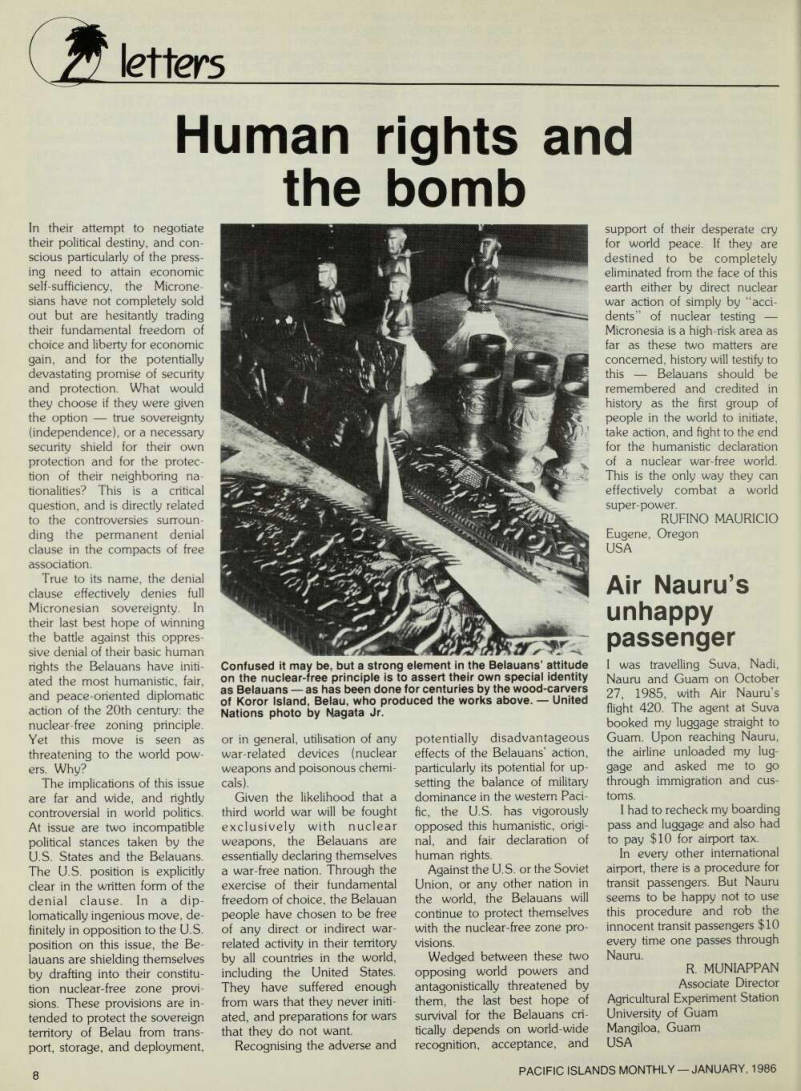
Confused it may be, but a strong element in the Belauans’ attitude on the nuclear-free principle is to assert their own special identity as Belauans as has been done for centuries by the wood-carvers of Koror Island, Belau, who produced the works above. United Nations photo by Nagata Jr.
unhappy
Air Nauru’s unhappy passenger
I was travelling Suva, Nadi, Nauru and Guam on October 27, 1985, with Air Nauru’s flight 420. The agent at Suva booked my luggage straight to Guam. Upon reaching Nauru, the airline unloaded my lug gage and asked me to go through immigration and cus toms.
I had to recheck my boarding pass and luggage and also had to pay $lO for airport tax.
In every other international airport, there is a procedure for transit passengers. But Nauru seems to be happy not to use this procedure and rob the innocent transit passengers $lO every time one passes through Nauru.
R. Muniappan
Associate Director Agricultural Experiment Station University of Guam Mangiloa, Guam
Usa
In defence of Tlatelolco
I’m sorry to see ill-informed depreciation palmed off as worldly, witty journalism in the pages of PIM.
Take a good look at Roy Vaughan’s coverage of the South Pacific Nuclear-Free Zone Treaty in your Septem ber, 1985 edition.
My disgust with ignorant stereotyping is not one-sided.
The April, 1984, PIM carried my English translation of an article I published in TIEMPO, Mexico’s leading weekly news magazine. It showed up the absurdity of a Mexican comic strip fantasy, “Rarotonga”, so far as anything in Cook Islands or Polynesian history, culture or reality is concerned.
I suppose that, if all I knew of Australian journalism was what someone had told me after speed-reading Wild Men of Sydney, this sort of reporting on the South Pacific Forum’s treaty-making efforts would fit right in.
Vaughan’s put-downs begin in his first paragraph; “Many would argue that the Latin American treaty with the almost unpronounceable name (Tlatelolco) is pretty useless.”
He goes on to say, “. . .at this distance there is an impression that the average South Amer ican, let alone anyone else, knows little about it.”
What possible relevance does the fact that he can’t pronounce “Tlatelolco” have to anything? I have heard Austra lians and New Zealanders make a hash out of their own indi genous place names. Tlatelolco is the site of the secretariat of foreign relations in Mexico City,
a part of that now earthquake wounded metropolis that is steeped in the history of the nation.
How “useless” has the Trea ty of Tlatelolco been? Not only have there been no recorded violations in its zone, but its influence on the South Pacific Nuclear-Free Zone Treaty is clear. I have no doubt that its influence will be found in all future such treaties.
It represents a remarkable achievement, considering that it was born in 1967. That that was a time, when some people thought nuclear explosions could be used peacefully for such things as massive earth moving projects (e.g. canal building), seems regrettable . . . on hindsight. But this is why it made provision for “peaceful” nuclear explosions ... of which there have been none in its zone.
Politics is the art of the possible. With that in mind, the Treaty of Tlatelolco is ex traordinary. Its protocols have been signed by the parties concerned. In the case of the one calling for respect of its zone by the world’s nuclear powers, it represents one of the only if not the only such accord accepted by h\\ five: China, France, U.K., U.S. and U.S.S.R. It is true that not all Latin American nations have signed the Treaty of Tlatelolco, but it also seems apparent that it has served as a restraint on some of those widely believed to have nuclear capability (e.g.
Argentina).
I frankly doubt that there are many literate, educated Latin
Americans ignorant of the gen eral nature of this treaty. I note its mention, again and again, in speeches by Latin American national leaders, especially the president of Mexico. Also, why reference to the “South Amer icans”? It is a long way from the U.S.-Mexico border (where the zone starts) to South America. It is a Latin American Treaty.
Galal J. Kernahan
Newport Beach, Calif.
Usa
Our most sincere gratitude to the respected U.S. and Oceania correspondent of TIEMPO.
While we willingly fling ourselves to the battlements to defend his right to express his disgust and outrage we are forced to wonder if he is being entirely fair to Roy Vaughan by
damning his excellent coverage of the Forum on the basis of one throw-away line. Vaughan points out, too, that he was being quite accurate. In fact he still cannot pronounce the name, and nor could the limited number of people at Rarotonga who knew of it.
Perhaps Mr Kemahan could have helped by telling us, thereby lifting us from our Antipodean ignorance, where in we regularly mispronounce not only Aboriginal, but also Maori, Malay, Indonesian and just about every other kind of name. It is a sad state of affairs which the introduction of com pulsory schooling has not seemed to adjust. More serious ly, however, we wonder if, in fact, rather than opinion, the Tlatelolco Treaty has achieved very much, and just how gener ally it is known and under stood. But, our thanks, indeed, to Mr Kemahan for his views.
Editor.
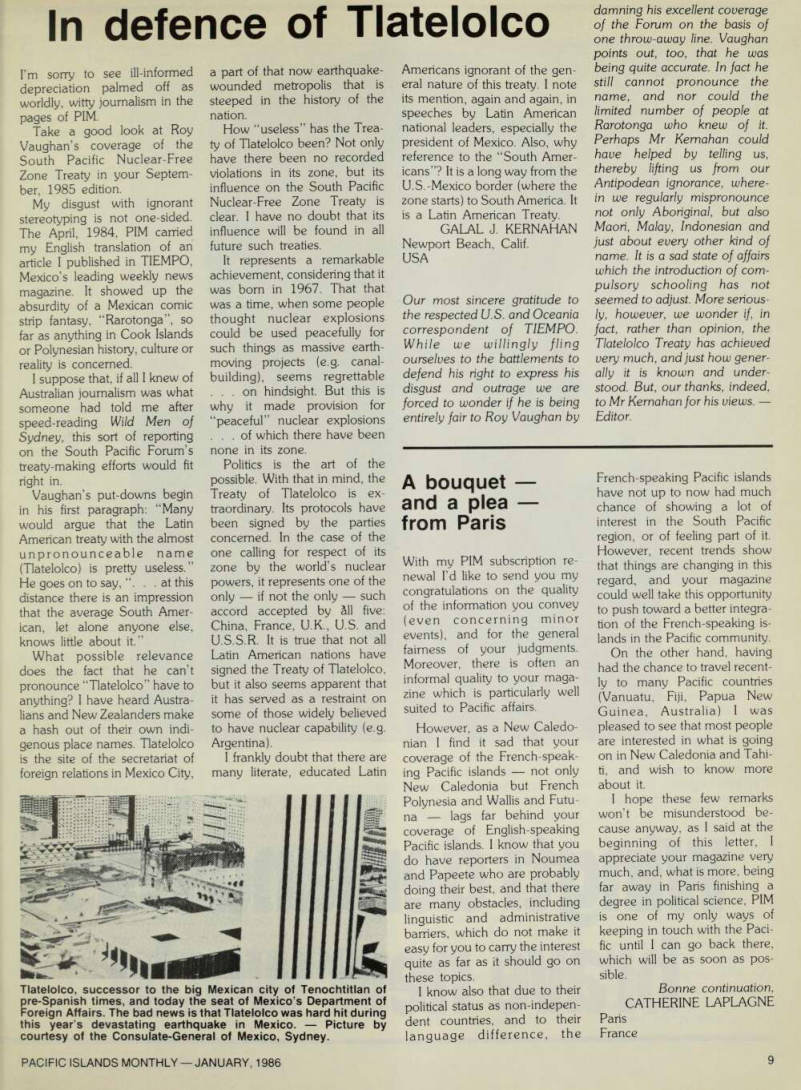
Tlatelolco, successor to the big Mexican city of Tenochtitlan of pre-Spanish times, and today the seat of Mexico’s Department of Foreign Affairs. The bad news is that Tlatelolco was hard hit during this year’s devastating earthquake in Mexico. Picture by courtesy of the Consulate-General of Mexico, Sydney.
and a plea -
A bouquet and a plea from Paris
With my PIM subscription re newal I’d like to send you my congratulations on the quality of the information you convey (even concerning minor events), and for the general fairness of your judgments.
Moreover, there is often an informal quality to your maga zine which is particularly well suited to Pacific affairs.
However, as a New Caledo nian I find it sad that your coverage of the French-speak ing Pacific islands not only New Caledonia but French Polynesia and Wallis and Futu na lags far behind your coverage of English-speaking Pacific islands. I know that you do have reporters in Noumea and Papeete who are probably doing their best, and that there are many obstacles, including linguistic and administrative barriers, which do not make it easy for you to carry the interest quite as far as it should go on these topics. 1 know also that due to their political status as non-indepen dent countries, and to their language difference, the
French-speaking Pacific islands have not up to now had much chance of showing a lot of interest in the South Pacific region, or of feeling part of it.
However, recent trends show that things are changing in this regard, and your magazine could well take this opportunity to push toward a better integra tion of the French-speaking is lands in the Pacific community.
On the other hand, having had the chance to travel recent ly to many Pacific countries (Vanuatu, Fiji, Papua New Guinea, Australia) I was pleased to see that most people are interested in what is going on in New Caledonia and Tahi ti, and wish to know more about it.
I hope these few remarks won’t be misunderstood be cause anyway, as I said at the beginning of this letter, I appreciate your magazine very much, and, what is more, being far away in Paris finishing a degree in political science, PIM is one of my only ways of keeping in touch with the Paci fic until I can go back there, which will be as soon as pos sible.
Bonne continuation,
Catherine Laplagne
Paris France
Wingti demands Ms
brave new world
Is history repeating itself in Papua New Guinea?
March, 1980: Prime Minister Michael Somare is ousted by a vote of no confidence in parliament and Sir Julius Chan leads a coalition of parties into government.
July, 1982: A general elec tion sweeps Somare back into power.
November, 1985: Somare is ousted by a vote of no-confi dence and Paias Wingti, with Chan as his deputy, leads a coalition of five parties into government.
Some time before July, 1987: Will the next general election see another return of “The Chief,” Somare?
Cynics say it is certainly on the cards that Somare will come back. Wingti says, referring to the 1982 election: “On that occasion our people were sad about Mr Somare being thrown out of office. But I cannot see him getting another sympathy vote this time.”
Somare has certainly left be hind him a daunting burden of economic difficulties and it is the economy which, in the final analysis, which determines the votes. Unless the country is making money there are going to be no riches to share around for people at the grass roots.
The country is certainly not making the money it hoped to.
Government revenue from minerals PNG’s main money-earning export for 1986 is projected to be only 30 million kina, compared to 132 million kina in 1985. Price prospects for most agricultural exports are also dismal.
Australian aid is projected to decline under the new agree ment with Canberra, and be cause of the slide of the Austra lian dollar. Aid in the first half of 1985 at 101 million kina was down 13 million kina on the same period last year.
It would seem that fewer people have been earning and fewer goods have been pro duced, or bought. Latest figures for January - June, 1985, com pared with the same period in 1984, show personal tax collec tion at 53 million kina, down 10 million kina, and company tax receipts at 30 million kina, down 5 million kina. Indirect
tax receipts, usually a good barometer of consumer spen ding, fell by 6 million kina to 73 million kina.
Total government revenue for that period was 254 million kina, down 82 million kina.
Revenue for the full year is expected to fall far short of budget estimates.
On top of that the govern ment deficit for 1985, estimated at 92 million kina, is expected to be far higher. Overseas borrowing stands at 1 billion kina.
One reason for the tax short fall may be the steady decline in employment of expatriates with fat salary cheques. Many com panies are cutting back.
It is not that Somare’s gov ernment was not doing any thing about this state of affairs.
His finance minister, Philip Bouraga, brought down a budget which slashed govern ment spending by 30 million kina and set out to raise an
extra 15 million kina in indirect taxes. This included a 1 per cent rise in the general import levy, widening the net to in clude such basics as rice, tinned fish and meat, flour and sugar; a change in tax valuation on company-provided houses to cost employees up to 17 kina a week more in tax; a 50 per cent rise in the international depar ture tax to 15 kina.
And in the month just before they were ousted Somare’s ministers had announced a whole range of measures aimed at removing what was de scribed as “bureaucratic im pediments to business initia tive,” in a bid to get the economy moving and to win foreign investment.
The law which established the National Investment and Development Authority, the body charged with regulating and monitoring foreign invest ment, was to be repealed. The new law was going to be much
shorter and simpler, setting out standard terms and conditions for those wishing to carry out business in PNG.
Registration would have been much more automatic and far less complex.
And the equity rules which demand a majority control of companies by Papua New Gui neans was to be relaxed and the list of reserved activities not open to foreign enterprise made subject to periodic re view.
The then Lands Minister, John Nilkare, had announced far-reaching changes. His de partment had committed itself to the mammoth task of re gistering the 96 per cent of the country’s land for which there is no written record of ownership.
This would have eventually cut out the long and complicated ownership disputes and even tribal warfare which usually re sults when proposals are put forward for projects on land
belonging to local clansmen, The administrative delays stemming from cumbersome procedures, excessively detailed regulations and a generally overworked Lands Department were also to be tackled. The department’s staffing was to be overhauled and a grossly overloaded manual registry system computerised and the 28 relevant Acts of Parliament consolidated.
The Industrial Relations Act, too, was to be amended.
Strikes in essential services, such as water, electricity and hospitals, were to be outlawed.
Other workers would have been required to give seven days’ notice of an intended strike and fined if they refused to go back if the strike was vetoed by Cabinet.
Somare’s government was not to be fair lurching from one crisis to another, as the Opposition maintained. So
why did Somare lose the confi dence of the country’s elected representatives? It was a com bination of factors, one being public relations. All these posi tive measures did not receive much publicity: many of them were announced at a business seminar but did not get full coverage by the local media, Meanwhile, the problems were getting a thorough public airing as Wingti took the helm of the Opposition in March, 1985.
Another factor was that the batten down the hatches Bouraga budget displeased man V ran k and file MPs. And man V of them had seen the three years of the current term of P ad i a ™ent whizz by without Setting a portfolio or a commit *ee chairmanship, They aJI knew the high casualty rate at past elections for first-termers and many must have reasoned they could not fail to improve their own posi
tions by casting their lots in with the Opposition. And then there was the disenchantment caused by government ministers’ deal ings with Pelair executives and persistent rumors of “get-rich quick” deals for some of those in powerful positions.
So when Sir Julius broke the unwritten convention of allow ing the budget through and threw down the challenge just 48 hours later, he won over 58 MPs to vote for the no-confi dence motion. Somare could only muster 51.
Wingti strode into power with pledges to cut public spending, streamline the public service, encourage business and foreign investment, and promote min ing and agriculture — in fact to do much the same as Somare had been j^B trying to do. JB The question B.; everyone is now o asking is what have B ■ Wingti and his part- B ners got that could make them succeed in 18 months on a prog ram So mare has B been to do JB
for years. One attribute Wingti has displayed is the ability to take decisive action: in his first three days in power he cut the number of government depart ments from 28 to 25 — which Somare failed to do in three years,despite election promises.
In fact Wingti is beginning to reveal an iron will of a style very reminiscent of the Iron Lady of the United Kingdom, Mrs Thatcher. He straight away found over-spending and in ordering an immediate review of government departments said: “Only incompetents need fear change.”
He warned MPs that their “cargo cult mentality of hand outs has to stop” and ordered all his Cabinet to reveal their business interests in a bid to put an
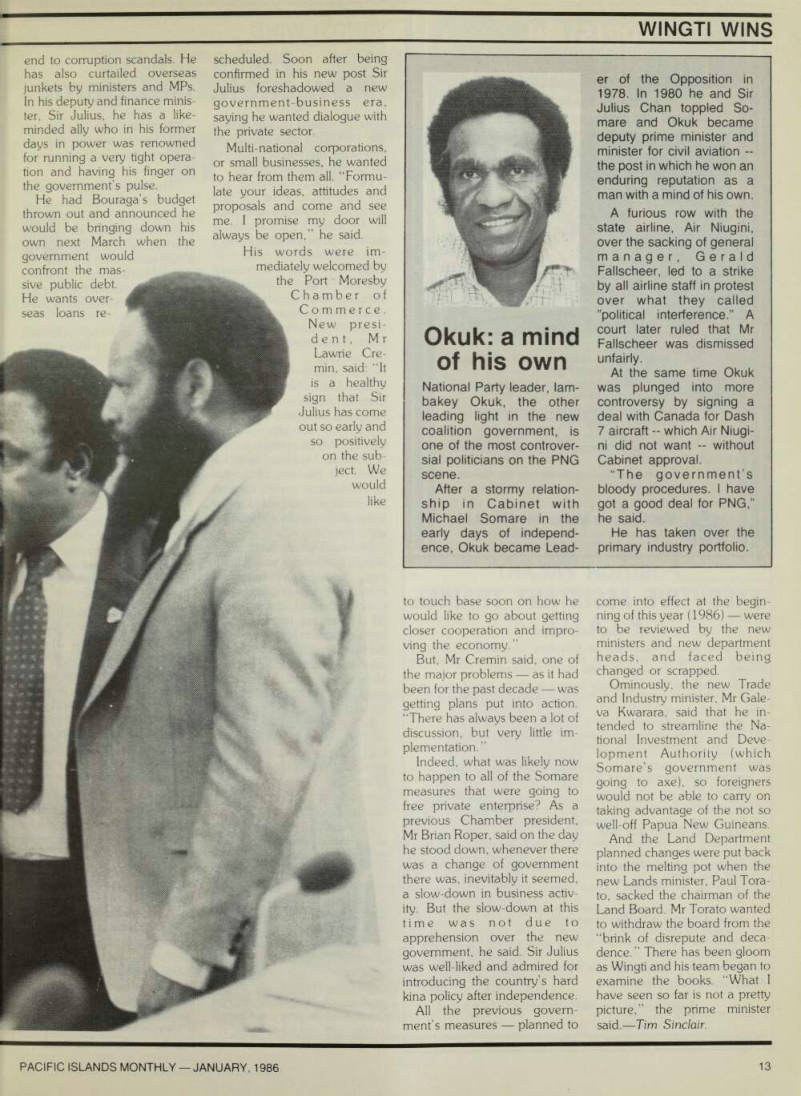
In earlier days Wingti, beside So mare, with Roy Evara, former minister for com kmunications.
Wingti: Young man
in a hurry
Papua New Guinea’s new prime minister, Paias Wingti is widely regarded as an idealist who genu inely cares for his country.
Young, he is 34 or 35 hard-working, ambitious and a disciplinarian, he does not smoke or drink.
Wingti is confident he can pull the country out of the economic doldrums in which it finds itself by cut ting back on waste and encouraging business.
Wingti entered politics in 1977 after dropping out of a course in politics and eco nomics at the University of Papua New Guinea and spending some time back in his home village of Moika, near Mount Hagen, in the populous Highlands area.
His first Cabinet post came in late 1978 under Michael Somare, the man he eventually helped to
turn out of office and into whose shoes he thereby hurled himself.
In 1980 a vote of no confidence put both men out of office but in 1982, when Somare returned triumphant, Wingti was a defiant deputy prime minis ter.
In August 1983 the first move in a series which eventually led Wingti to the prime minister’s chair came when the then Opposition leader, lambakey Okuk (National Party), offered him the top job if he would cross the floor to stand with the Opposition in a vote of no confidence. Wingti re fused, but by October, 1984, rumors of a split were rife, as he publicly warned Somare of “dangerous” men in his Cabinet who must be re moved.
The partnership limped
on for another five months, until, in March, 1985, Wing ti resigned from Cabinet and accepted Sir Julius Chan’s nomination of him self as prime minister in yet another no confidence mo tion.
The motion failed but Wingti was undismayed. In April he and his 14 Pangu Rati members whom he took with him when he defected most of them Highlanders like himself formed a new party, the People’s Democratic Movement.
Gone were the Marxist leanings of his university days. The new party was founded on a platform of a return to the ideals and the values on which Papua New Guinea was founded.
It pledged to build up the economy, encouraging pri vate investment with a minimum of government in terference; education for all; equal opportunity for women; support for the churches and freedom of religion; and a restoration of government authority and respect for the law.
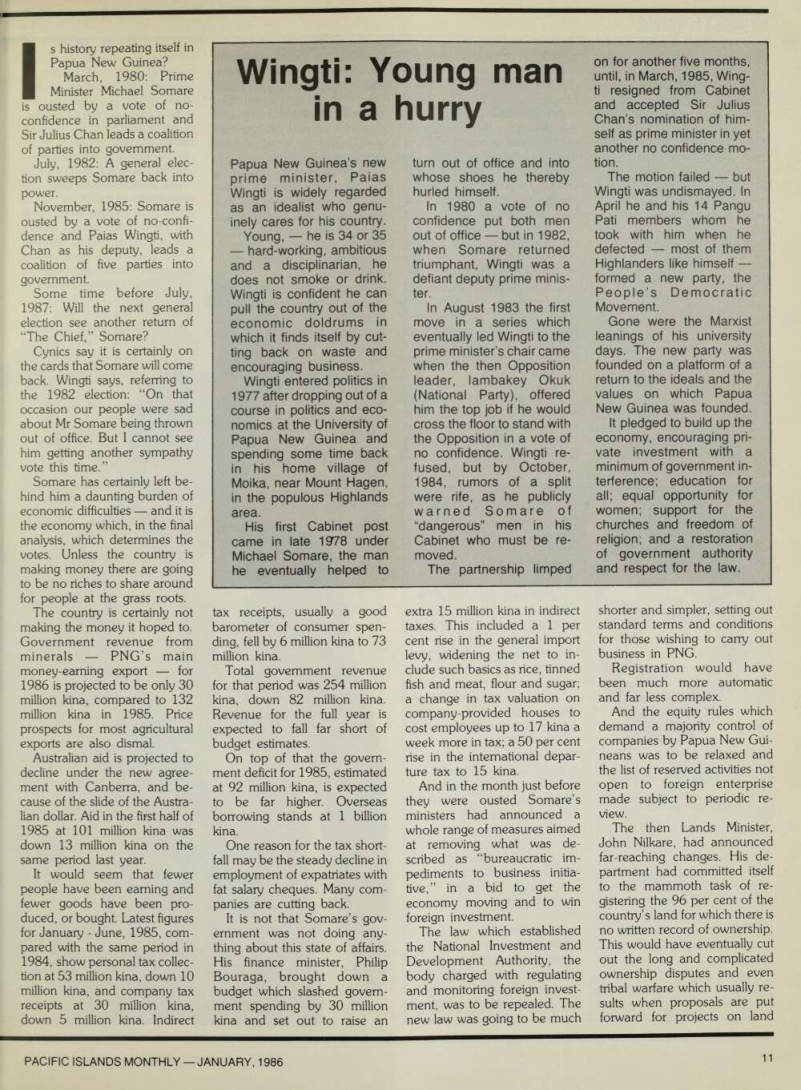
Chan: The architect
architect
Sir Julius Chan, the architect of the no confi dence motion which top pled Michael Somare, has been in the PNG parlia ment for 27 years.
He is the man who put PNG on a sound economic footing and had it declared credit-worthy by the World Bank.
He oversaw the setting up of the country’s own
currency, the kina and toea. And as a newly independent nation’s first finance minister he won wide respect from people of all political persuasions.
Chan and his People’s Progress Party parted company with Somare’s Pangu Pati in 1978 and left the government. In 1980 he became prime minister after winning a vote of no confidence against So mare, only to lose again when Somare won the 1982 general election.
Since then he has held himself and his party sepa rate from much of the wheeling and dealing which characterises much of PNG politics.
Sir Julius, 46, who was knighted in January, 1980, had to overcome a lot of suspicion in his New Ire land electorate and the country as a whole be cause of his mixed Chinese racial background. But his political reputation is of a hard-working, shrewd businessman who is willing to wait for what he wants.
end to corruption scandals. He
has also curtailed overseas junkets by ministers and MPs.
In his deputy and finance minis ter, Sir Julius, he has a like minded ally who in his former days in power was renowned for running a very tight opera tion and having his finger on the government’s pulse.
He had Bouraga’s budget thrown out and announced he would be bringing down his own next March when the
government would confront the mas sive public debt.
He wants over seas loans re- ™
scheduled. Soon after being confirmed in his new post Sir Julius foreshadowed a new government-business era, saying he wanted dialogue with the private sector.
Multi-national corporations, or small businesses, he wanted to hear from them all. "Formu late your ideas, attitudes and proposals and come and see me. I promise my door will always be open,” he said.
His words were im mediately welcomed by the Port Moresby Mk Chamber of Commerce.
New presi dent, Mr Lawrie Cre 'C min. said: "It is a healthy s 'S n Sir Julius has come out so early and so positively on the sub ject. We would like
to touch base soon on how he would like to go about getting closer cooperation and impro ving the economy.”
But, Mr Cremin said, one of the major problems as it had been for the past decade was getting plans put into action.
“There has always been a lot of discussion, but very little im plementation. ”
Indeed, what was likely now to happen to all of the Somare measures that were going to free private enterprise? As a previous Chamber president, Mr Brian Roper, said on the day he stood down, whenever there was a change of government there was, inevitably it seemed, a slow-down in business activ ity. But the slow-down at this time was not due to apprehension over the new government, he said. Sir Julius was well-liked and admired for introducing the country’s hard kina policy after independence.
All the previous govern ment’s measures planned to
come into effect at the begin ning of this year (1986) were to be reviewed by the new ministers and new department heads, and faced being changed or scrapped.
Ominously, the new Trade and Industry minister, Mr Gale va Kwarara, said that he in tended to streamline the Na tional Investment and Deve lopment Authority (which Somare’s government was going to axe), so foreigners would not be able to carry on taking advantage of the not so well-off Papua New Guineans.
And the Land Department planned changes were put back into the melting pot when the new Lands minister, Paul Tora to, sacked the chairman of the Land Board. Mr Torato wanted to withdraw the board from the "brink of disrepute and deca dence. ” There has been gloom as Wingti and his team began to examine the books. "What I have seen so far is not a pretty picture,” the prime minister
said.
Tim Sinclair.
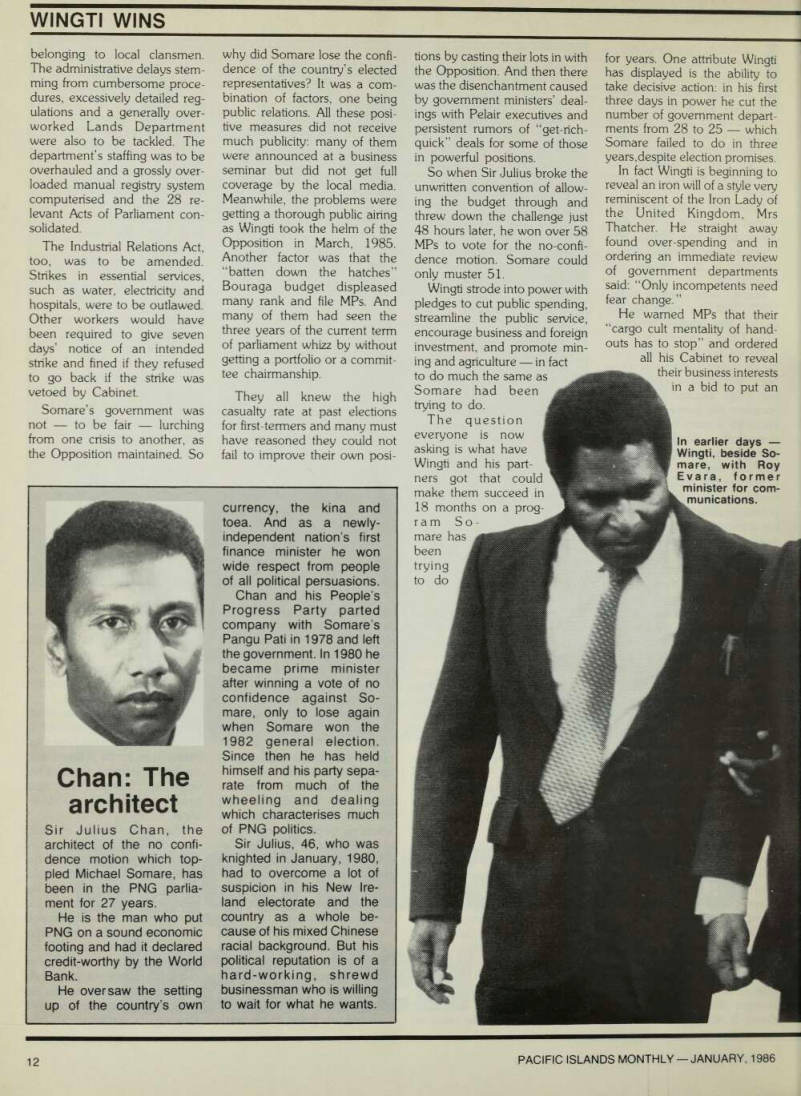
Okuk: a mind
of his own
National Party leader, lam bakey Okuk, the other leading light in the new coalition government, is one of the most controver sial politicians on the PNG scene.
After a stormy relation ship in Cabinet with Michael Somare in the early days of independ ence, Okuk became Lead
er of the Opposition in 1978. In 1980 he and Sir Julius Chan toppled So mare and Okuk became deputy prime minister and minister for civil aviation -the post in which he won an enduring reputation as a man with a mind of his own.
A furious row with the state airline, Air Niugini, over the sacking of general manager, Gerald Fallscheer, led to a strike by all airline staff in protest over what they called ’’political interference.” A court later ruled that Mr Fallscheer was dismissed unfairly.
At the same time Okuk was plunged into more controversy by signing a deal with Canada for Dash 7 aircraft -- which Air Niugi ni did not want - without Cabinet approval.
“The government’s
bloody procedures. I have got a good deal for PNG,” he said.
He has taken over the primary industry portfolio.
New man, old game
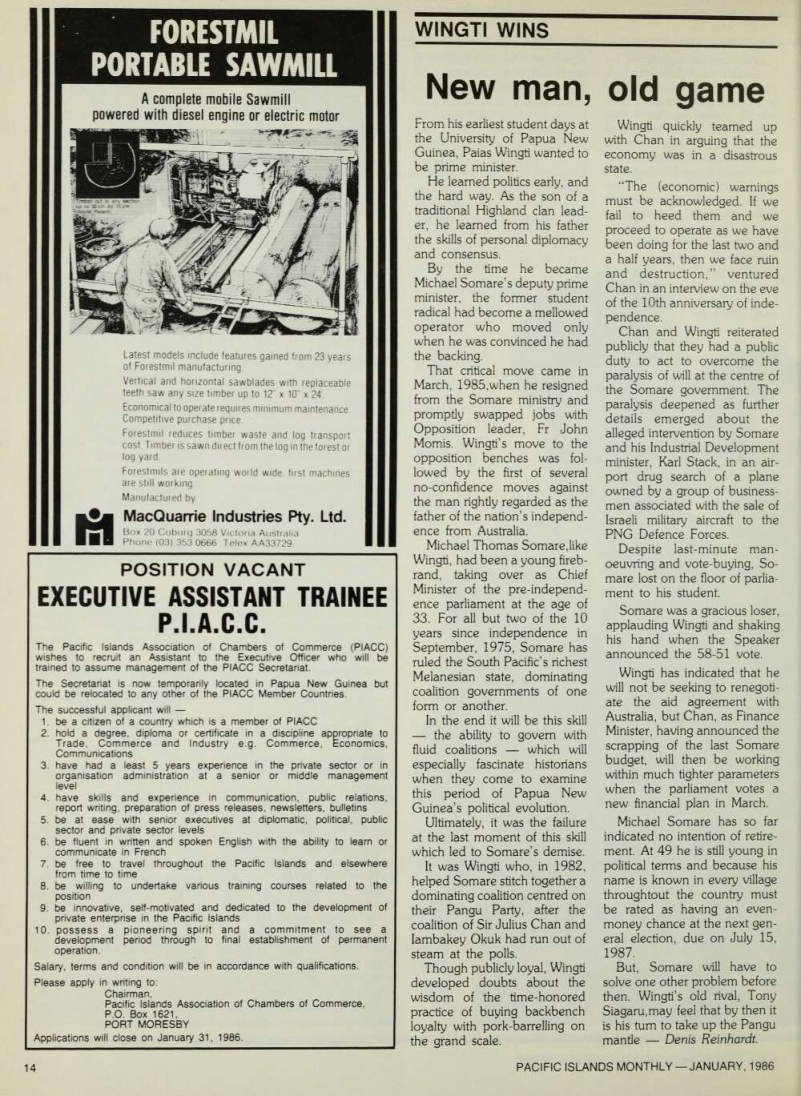
From his earliest student days at the University of Papua New Guinea, Paias Wingti wanted to be prime minister.
He learned politics early, and the hard way. As the son of a traditional Highland clan lead er, he learned from his father the skills of personal diplomacy and consensus.
By the time he became Michael Somare’s deputy prime minister, the former student radical had become a mellowed operator who moved only when he was convinced he had the backing.
That critical move came in March, 1985,when he resigned from the Somare ministry and promptly swapped jobs with Opposition leader, Fr John Momis. Wingti’s move to the opposition benches was fol lowed by the first of several no-confidence moves against the man rightly regarded as the father of the nation’s independ ence from Australia.
Michael Thomas Somare,like Wingti, had been a young fireb rand, taking over as Chief Minister of the pre-independ ence parliament at the age of 33. For all but two of the 10 years since independence in September, 1975, Somare has ruled the South Pacific’s richest Melanesian state, dominating coalition governments of one form or another.
In the end it will be this skill the ability to govern with fluid coalitions which will especially fascinate historians when they come to examine this period of Papua New Guinea’s political evolution.
Ultimately, it was the failure at the last moment of this skill which led to Somare’s demise.
It was Wingti who, in 1982, helped Somare stitch together a dominating coalition centred on their Pangu Party, after the coalition of Sir Julius Chan and lambakey Okuk had run out of steam at the polls.
Though publicly loyal, Wingti developed doubts about the wisdom of the time-honored practice of buying backbench loyalty with pork-barrelling on the grand scale.
Wingti quickly teamed up with Chan in arguing that the economy was in a disastrous state.
“The (economic) warnings must be acknowledged. If we fail to heed them and we proceed to operate as we have been doing for the last two and a half years, then we face ruin and destruction,” ventured Chan in an interview on the eve of the 10th anniversary of inde pendence.
Chan and Wingti reiterated publicly that they had a public duty to act to overcome the paralysis of will at the centre of the Somare government. The paralysis deepened as further details emerged about the alleged intervention by Somare and his Industrial Development minister, Karl Stack, in an air port drug search of a plane owned by a group of business men associated with the sale of Israeli military aircraft to the PNG Defence Forces.
Despite last-minute man oeuvring and vote-buying, So mare lost on the floor of parlia ment to his student.
Somare was a gracious loser, applauding Wingti and shaking his hand when the Speaker announced the 58-51 vote.
Wingti has indicated that he will not be seeking to renegoti ate the aid agreement with Australia, but Chan, as Finance Minister, having announced the scrapping of the last Somare budget, will then be working within much tighter parameters when the parliament votes a new financial plan in March.
Michael Somare has so far indicated no intention of retire ment. At 49 he is still young in political terms and because his name is known in every village throughtout the country must be rated as having an even money chance at the next gen eral election, due on July 15, 1987.
But, Somare will have to solve one other problem before then. Wingti’s old rival, Tony Siagaru,may feel that by then it is his turn to take up the Pangu
mantle
Denis Reinhardt.
Advertisements & other items, p. 14 (1 item)
Portable Sawmill
FORESTMIL
A complete mobile Sawmill powered with diesel engine or electric motor w* V A •c IH Latest models include features gained from 23 years of Forestmil manufacturing Vertical and horizontal sawblades with replaceable teeth saw any size timber up to 12" x 10" x 24 Economical to operate requires minimum maintenance Competitive purchase price Forestmil reduces timber waste and log transport cost Timber is sawn direct from the log in the forest or log yard Forestmils aie opeiatmg woild wide, first machines are still working Manufactuied by MacQuarrle Industries Pty. Ltd.
Box 20 Coburg 3058 Victoria Australia Phone (03) 353 0666 Telex AA33729
POSITION VACANT
EXECUTIVE ASSISTANT TRAINEE
P.I.A.C.C.
The Pacific Islands Association of Chambers of Commerce (PIACC) wishes to recruit an Assistant to the Executive Officer who will be trained to assume management of the PIACC Secretariat.
The Secretariat is now temporarily located in Papua New Guinea but could be relocated to any other of the PIACC Member Countries.
The successful applicant will 1. be a citizen of a country which is a member of PIACC 2. hold a degree, diploma or certificate in a discipline appropriate to Trade, Commerce and Industry e.g. Commerce, Economics, Communications 3. have had a least 5 years experience in the private sector or in organisation administration at a senior or middle management level 4. have skills and experience in communication, public relations, report writing, preparation of press releases, newsletters, bulletins 5. be at ease with senior executives at diplomatic, political, public sector and private sector levels 6. be fluent in written and spoken English with the ability to learn or communicate in French 7. be free to travel throughout the Pacific Islands and elsewhere from time to time 8. be willing to undertake various training courses related to the position 9. be innovative, self-motivated and dedicated to the development of private enterprise in the Pacific Islands 10. possess a pioneering spirit and a commitment to see a development period through to final establishment of permanent operation.
Salary, terms and condition will be in accordance with qualifications.
Please apply in writing to: Chairman, Pacific Islands Association of Chambers of Commerce, P.O. Box 1621,
PORT MORESBY
Applications will close on January 31, 1986.
Tension, violence grow
in New Caledonia
November 18 seems to be a fateful date for New Caledonia. On that date in 1984 the Kanak Socialist Liberation Front (F.L.N.K.S.), boycotted the territorial elections, starting 12 months of violence and tough negotiations in its quest for independence.
On the same date in 1985 the people of Noumea went into mourning following the sudden death of their mayor of the past 32 years, Mr Roger Laroque.
Also on that date a new set of laws covering the administra tion of the territory came into force laws drawn up by the French government to help de velop the four new regions into which New Caledonia has been divided as it moves towards self-rule.
However it was the death of Mr Laroque which held everyone’s attention. He was a fiercely proud loyalist who had vowed to keep New Caledonia French, even if it meant civil war. He was able to shut down his city at a moment’s notice and call thousands of demon strators into the streets in sup port of his cause. His 75 years did not slow him down, nor did it deter his supporters who, in 1983, elected him mayor of the capital, Noumea, for the sixth successive term.
Tributes acknowledging his courage and honor poured in from all parts of the French speaking world. The locals dub bed him ’’the last of the greats” and even the F.L.N.K.S. paid him tribute, describing him as ”a formidable adversary.”
Laroque was accorded a full state funeral, attended by many thousands of people.
Loudspeakers had been set up around the cathedral to allow the big crowd to take part in the service, and then public buses
carried them to the cemetery for his burial.
Roger Laroque will be hard to replace. His duties have now been taken over by his first adjoint Jean Leques, who is also the president of the Noumea region in the territorial congress. However, new mayoral elections will be held soon.
While the death of the elder statesman could well be seen as the end of an era, it has not taken the fight out of the anti-independence movement.
Two nights after the mayor suffered his fatal heart attack, arsonists attacked the Land Office which is responsible for buying back land for the Kanak people. The Land Office em ployees had completed the move into the new building only hours before a Molotov cocktail destroyed it.
The office had been forced to move after a previous bomb attack had devastated its headquarters in the heart of Noumea during the September election campaign.
The new ordinances drawn up for the territory are also likely to keep anti-independ ence sentiment high.
The French government has decided to dramatically in crease taxes, reinforce the efforts being made to give own ership of land back to the Kanaks, and provide the four regional councils with a sub stantial amount of autonomy to help them kick off their deve lopment.
When the draft copy of the ordinances was presented to the territorial congress in Octo ber the right-wing R.P.C.R. used its majority to squash any discussion about the proposal, but that did not stop them condemning the documents outside the congress. They were, they said, ’’completely inapplicable” for New Caledo nia.
This argument seemed to win some support when the High Commissioner, Mr Fernand Wibaux, travelled to Paris to discuss the ordinances with the then minister for New Caledo-
nia, Mr Edgard Pisani. (He has since wound up his role in this post and become an aide to President Mitterrand, handing the New Caledonian portfolio to Pierre Joxe, the Minister for the Interior).
Before his departure, Mr Wibaux made it clear he felt the ordinances did not take into account the ’’realities of New Caledonia” such as the incred ibly high cost of living.
When the final copy of the new laws was published in the official journal of New Caledo nia on November 18, it appeared Mr Wibaux had won some ground on the taxation issue, but little else had been changed.
Certainly, taxes will still in crease, but the rise will be much less than the initial proposal which would have pushed the amount of tax paid by the
Continued on page 18
Roger Laroque danced at a Lions Club ball in Noumea just 48 hours before he died. Les Nouvelles photo.
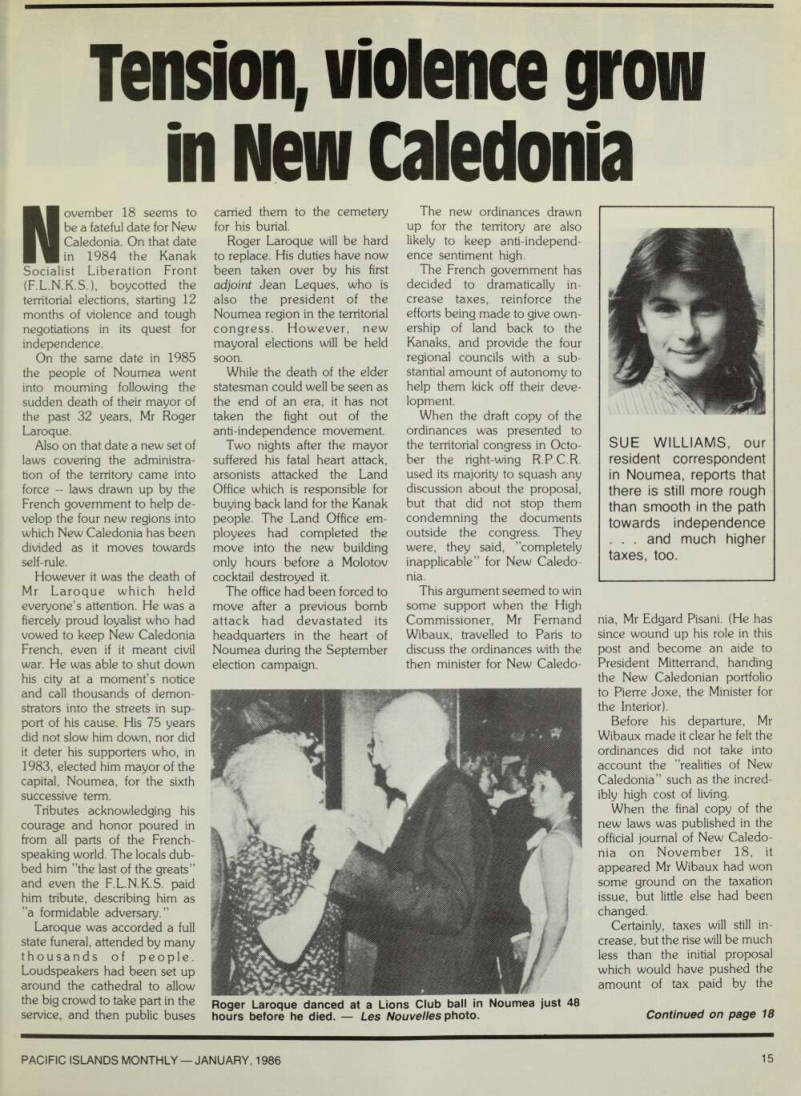
Sue Williams, Our
resident correspondent in Noumea, reports that there is still more rough than smooth in the path towards independence . . . and much higher taxes, too.
Advertisements & other items, pp. 16-17 (1 item)
mssMni
Innovation
The VG3OET uses the latest computer technology' to achieve its extraordinary perfo)~mance and precision.
People see in Nissan cars a lot of different things. Some see power and performance.
Others style. Still others advanced technology.
Each one of them is right. But, in fact, it’s all these elements put together that make a Nissan.
The VG3OET engine illustrates just what we mean. It’s not only powerful, it combines power with precision and economy.
The VG3OET has been hailed as a breakthrough in automotive technology. And with good reason. This Iyp computerized V-6 engine includes among its many notable features the highly sophisticated ECCS or Electronic Concentrated Engine Control System, which determines air-fuel mix, fuel injection, ignition timing and other vital functions with extraordinary accuracy.
No matter what your requirement is, the VG3OET answers it admirably. It provides you with tremendous power, yet it’s also compact, lightweight, quiet and remarkably sparing on fuel.
In short, the innovative design of the VG3OET doesn’t come from a mere desire to impress you with power. It’s an invention that literally brings you the best of everything.
And it succeeds because it has that intangible yet very real quality that makes a Nissan what it is—The Nissan Dimension. * &
Quality in motion
Pa NISSAN
Continued from page 15
average working couple up by five times.
As for the land rights bill, Kanaks will be able to claim any land which does not belong to the state, which is not zoned as an urban or military area, or which is has not been desig nated for public works in the next five years.
Land used for nickel mining can also be claimed, but the mining rights cannot. Com panies would instead pay the owner tribes a leasing fee and/ or royalties.
The other hot potato is the law covering compensation for those who have lost property or suffered some injury in the events of the past 12 months.
Any bill up to about Austs2o,ooo will be fully paid but after that the compensation rate drops dramatically, so that for the average house, worth between $60,000 and $lOO,OOO, compensation will be only 60 per cent.
The compensation arrange ment has been particularly criti cised by the anti-independence forces. In protest, the R.P.C.R. again used its majority in the congress to block any discus sion on the proposed amnesty law, saying that no such mea sure would be considered until ”a just compensation law had been put into place.”
Despite the right’s huffing and puffing on the subject, there is nothing it can do to stop laws passed by the French parliament from being intro duced in New Caledonia. They will just have to wear the higher taxes, the land reform, com pensation rates, and the amnes ty bill.
They are now taking the line that the new statutes for New Caledonia will be but a tempor ary measure and that all will be ’’put right” when the right-wing wins power in the legislative
elections in France next March.
The F.L.N.K.S. view the R.P.C.R. antics in the congress with wry amusement. They appear unruffled by the pros pect of a new French govern ment and are quite convinced the new Paris administration will not risk too many changes to the status quo in New Cale donia.
They also did not miss the significance of November 18, and timed their fourth congress, held at Oundjo, to wind up on the anniversary date.
As in earlier congresses, the independence movement reaf firmed its unity in the struggle for independence, although it has become clear there is much disunity between the various parties which make up the Front as to how independence should come about and how the development of the regions should be carried out.
To this end some of the Front’s committees have been restructured to help give the more radical groups a bigger say in the planning.
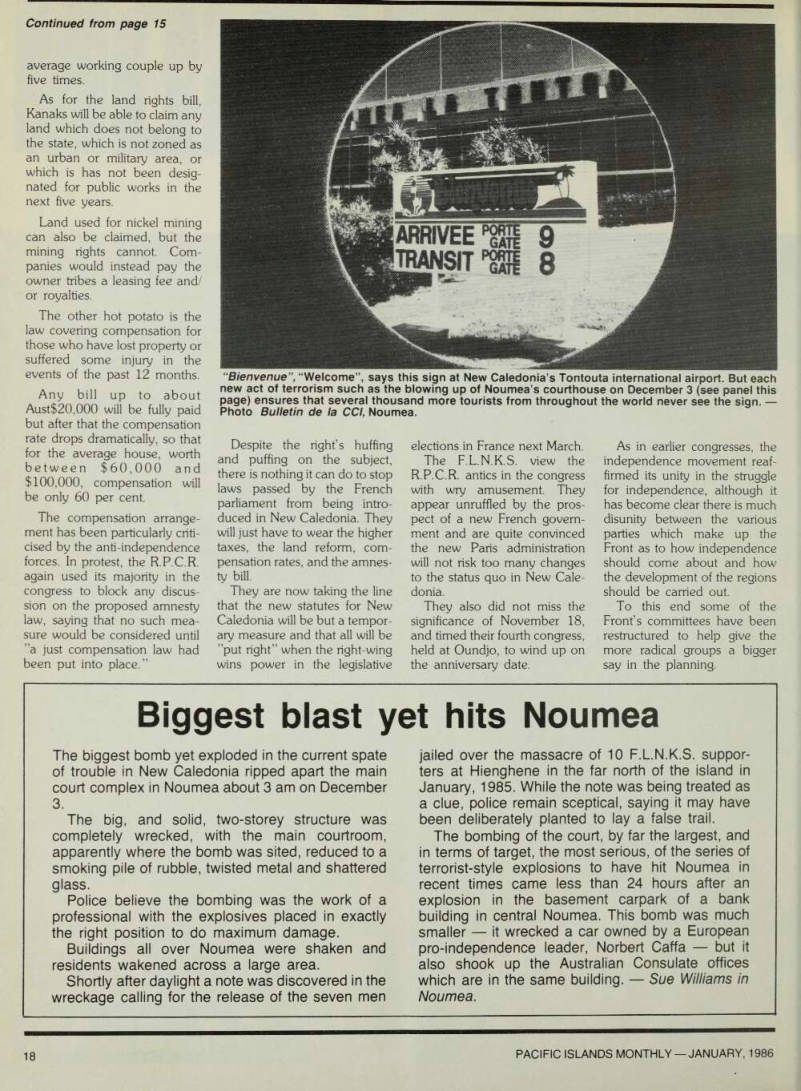
“Bienvenue", “Welcome”, says this sign at New Caledonia’s Tontouta international airport. But each new act of terrorism such as the blowing up of Noumea’s courthouse on December 3 (see panel this page) ensures that several thousand more tourists from throughout the world never see the sign.
Photo Bulletin de la CCI, Noumea.
Biggest blast yet hits Noumea
The biggest bomb yet exploded in the current spate of trouble in New Caledonia ripped apart the main court complex in Noumea about 3 am on December 3.
The big, and solid, two-storey structure was completely wrecked, with the main courtroom, apparently where the bomb was sited, reduced to a smoking pile of rubble, twisted metal and shattered glass.
Police believe the bombing was the work of a professional with the explosives placed in exactly the right position to do maximum damage.
Buildings all over Noumea were shaken and residents wakened across a large area.
Shortly after daylight a note was discovered in the wreckage calling for the release of the seven men
jailed over the massacre of 10 F.L.N.K.S. suppor ters at Hienghene in the far north of the island in January, 1985. While the note was being treated as a clue, police remain sceptical, saying it may have been deliberately planted to lay a false trail.
The bombing of the court, by far the largest, and in terms of target, the most serious, of the series of terrorist-style explosions to have hit Noumea in recent times came less than 24 hours after an explosion in the basement carpark of a bank building in central Noumea. This bomb was much smaller it wrecked a car owned by a European pro-independence leader, Norbert Caffa but it also shook up the Australian Consulate offices which are in the same building. Sue Williams in Noumea.
on islands' rights
US close to deal on islands' rights
Of all the topics concer ning the multitude of tiny nations dotting the vast Pacific Ocean, none is so universally important as the exploitation of their fisheries. It has been a vexed issue for several decades with, perhaps surprisingly, the US seen as the major culprit.
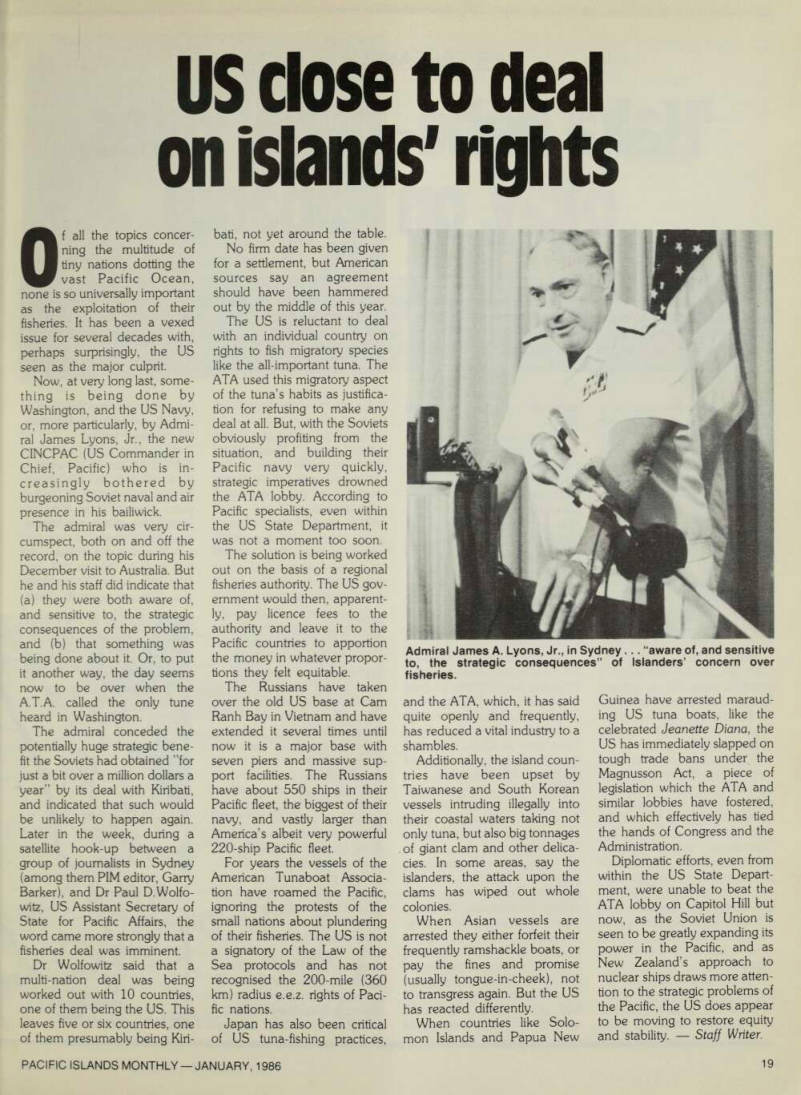
Now, at very long last, some thing is being done by Washington, and the US Navy, or, more particularly, by Admi ral James Lyons, Jr., the new CINCPAC (US Commander in Chief, Pacific) who is in creasingly bothered by burgeoning Soviet naval and air presence in his bailiwick.
The admiral was very cir cumspect, both on and off the record, on the topic during his December visit to Australia. But he and his staff did indicate that (a) they were both aware of, and sensitive to, the strategic consequences of the problem, and (b) that something was being done about it. Or, to put it another way, the day seems now to be over when the A.T.A. called the only tune heard in Washington.
The admiral conceded the potentially huge strategic bene fit the Soviets had obtained ’’for just a bit over a million dollars a year” by its deal with Kiribati, and indicated that such would be unlikely to happen again.
Later in the week, during a satellite hook-up between a group of journalists in Sydney (among them PIM editor, Garry Barker), and Dr Paul D.Wolfo witz, US Assistant Secretary of State for Pacific Affairs, the word came more strongly that a fisheries deal was imminent.
Dr Wolfowitz said that a multi-nation deal was being worked out with 10 countries, one of them being the US. This leaves five or six countries, one of them presumably being Kiri
bati, not yet around the table.
No firm date has been given for a settlement, but American sources say an agreement should have been hammered out by the middle of this year.
The US is reluctant to deal with an individual country on rights to fish migratory species like the all-important tuna. The ATA used this migratory aspect of the tuna’s habits as justifica tion for refusing to make any deal at all. But, with the Soviets obviously profiting from the situation, and building their Pacific navy very quickly, strategic imperatives drowned the ATA lobby. According to Pacific specialists, even within the US State Department, it was not a moment too soon.
The solution is being worked out on the basis of a regional fisheries authority. The US gov ernment would then, apparent ly, pay licence fees to the authority and leave it to the Pacific countries to apportion the money in whatever propor tions they felt equitable.
The Russians have taken over the old US base at Cam Ranh Bay in Vietnam and have extended it several times until now it is a major base with seven piers and massive sup port facilities. The Russians have about 550 ships in their Pacific fleet, the biggest of their navy, and vastly larger than America’s albeit very powerful 220-ship Pacific fleet.
For years the vessels of the American Tunaboat Associa tion have roamed the Pacific, ignoring the protests of the small nations about plundering of their fisheries. The US is not a signatory of the Law of the Sea protocols and has not recognised the 200-mile (360 km) radius e.e.z. rights of Paci fic nations.
Japan has also been critical of US tuna-fishing practices,
and the ATA, which, it has said quite openly and frequently, has reduced a vital industry to a shambles.
Additionally, the island coun tries have been upset by Taiwanese and South Korean vessels intruding illegally into their coastal waters taking not only tuna, but also big tonnages of giant clam and other delica cies. In some areas, say the islanders, the attack upon the clams has wiped out whole colonies.
When Asian vessels are arrested they either forfeit their frequently ramshackle boats, or pay the fines and promise (usually tongue-in-cheek), not to transgress again. But the US has reacted differently.
When countries like Solo mon Islands and Papua New
Guinea have arrested maraud ing US tuna boats, like the celebrated Jeanette Diana, the US has immediately slapped on tough trade bans under the Magnusson Act, a piece of legislation which the ATA and similar lobbies have fostered, and which effectively has tied the hands of Congress and the Administration.
Diplomatic efforts, even from within the US State Depart ment, were unable to beat the ATA lobby on Capitol Hill but now, as the Soviet Union is seen to be greatly expanding its power in the Pacific, and as New Zealand’s approach to nuclear ships draws more atten tion to the strategic problems of the Pacific, the US does appear to be moving to restore equity
and stability.
Staff Writer.
Admiral James A. Lyons, Jr., in Sydney . .. “aware of, and sensitive to, the strategic consequences” of Islanders’ concern over fisheries.
okay, on Rapanui
Life On Easter Island
'Haka nehe-nehe' rules, okay, on Rapanui
GRANT McCALL, who usually teaches anthropology at the University of New South Wales, in Sydney, Australia, went to Easter Island (Rapanui) for nine months, with his family, to carry out new fieldwork in a community with which he has been involved for many years. He has filed this report for us, offering vignettes of daily life on one of the most remote and fascinating islands in the world.
Haka nehe-nehe is a phrase that has been heard a lot around Rapanui over the last few months, as the festive month of September came to a close and a sort of calm de scended upon the islands.
Haka nehe-nehe means to make nice, to make present able, to fix up, even to do things properly, as in producing a good job of work. Haka nehe nehe is what happens when the rain falls, too, and brown Rapa nui becomes green again, for water is a scarce and valuable commodity here. Expensive, too: the usual household monthly water bill is around SA3O, which is about one-sixth of the average income of an Islander salary earner in the public service.
Haka nehe-nehe was run ning through the minds of both Islanders and resident Chilean public servants, in preparation for the highlight of the last 30 days which was the visit of the Intendente, retired admiral Pablo Wunderlich, who like his name, was a mixture of Ger man efficiency and Chilean casualness. His program was exhaustive and exhausting, for every one of the 21 public services had to be visited, and inspected.
Public service heads ex pended buckets of paint, boxes of paper and dozens of spools of typewriter ribbon to haka
nehe-nehe their offices and affairs.
Though donations specifical ly to the Easter Island Museum, the Xerox 1020 photo-copier given last year by Rank Xerox (Australia), and the micro computer from the Australian Museum Society (TAMS), were both called into service. The photo-copier (there are two others only on the island), produced over 4000 copies, whilst the computer was called in to organise data on project expenditure and public service employment.
Administratively, Rapanui occupies an odd place in Chile.
Including the uninhabited Sala y Gomez, some 200 sea miles distant, it constitutes the pro vince of Easter Island which, as a province of Chile, is part of the Fifth Region, whose capital is the port of Valparaiso.
Chilean provinces vary in size, most having tens of thousands of persons, while Rapanui has only a little over 2000 inhabitants.
The creation of Rapanui as a province is justified on two grounds. Firstly, it is regarded as a border zone and, therefore, of especial military importance.
Secondly, with the complex bureaucratic system in Chile, modelled on that of the French republic, in order for the Island to have its own hospital, school and other public services, it must have also contingents of
police, the Navy, Air Force and, even, the Army.
But, this is an Air Force without aircraft, a Navy without ships, or even boats, and a police force with little to do but apprehend the occasional adolescent thief.
The Army’s guns remain under strict surveillance after a tragic accident in May of 1982 when one recruit shot another through the head. They were both young Islanders.
At the same time as the Intendente arrived, the Bishop of Valparaiso turned up to offer a special Mass, not knowing that his uncle, at the turn of the century, had also come here.
“Ha/ca nehe-nehe” was the response, too, of the Inten dente, who, in a dramatic public ceremony, gave out sports uniforms to local teams, promised more public services, and, with a final flourish, signed cheques for various projects, including a commitment to re pair the dilapidated school buil dings, at a cost of $A500,000, which is big money in Chile.
As a province, Rapanui re ceives one of the highest per capita investments by the cen tral government, a fact that is rarely objected to in the Chilean press. Rapanui is a kind of showcase for Chile, therefore, it is perhaps not so costly after all.
One of the reasons for my current fieldwork on Rapanui is the question of land use and
how this resource, still almost entirely owned by the Islanders, is conceived locally.
When I did my first work here in 1972-74, there were offers of land titles from the (then) socialist government of Dr Sal vador Allende. These were uni versally rejected by the popula tion, for a variety of reasons, including the emotional point that if they did ask for land titles, they would be admitting that Chileans were the legiti-
mate owners of Rapanui.
There were also other reasons for not applying for land title, including also the fear of taxes. Elders worried that if they assigned their lands legally to their offspring, they would lose their authority.
Rapanui were concerned also that if they agreed to the land (only 10 per cent of the total) that was on offer for title (mainly residential), the rest would be lost.
When the current president of Chile came to Rapanui, in January, 1975, (the first Chi lean head of state to do so), nearly 200 ’’titles” were pre sented to the Islanders, though they proved to be more for show, they being rejected even by other government institu tions.
Since then, various govern ment institutions have been trying to Haka nehe-nehe the land situation, by offering loans,
for which land titles become collateral, or requiring that in order to receive housing assist ance, one must obtain a land title.
By now, nearly 300 persons have applied for land titles, for both residential and agricultural land, and the number is in creasing every day.
The local Lands Office, which closed down in 1978 for two years, due to lack of any Islander interest in its activities, is now one of the principal institutions used by Rapanui.
One of the reasons for this increase in activity was the announcement by the Inten dente that over 100 housing subsidies were to be offered to Rapanui. To obtain the sub sidies, of course, one had to have a proper land title.
The subsidies are particularly attractive to couples where one of the spouses is a non-islander, usually from the mainland.
Such people have difficulty commanding the family re sources needed to erect a dwelling. Most of the 200 appli cants for the subsidy, which can amount to SAIO,OOO, at current values, are in this condition.
When the Intendente left the Governor, and the Mayor, left with him to make certain that what had been promised on the Island would be delivered, and delivered in time to uphold the credibility of the local politi cians.
With their own kind of haka nehe-nehe was an American Air Force plane that turned up in mid-October, on an undisc losed mission, though many think it is not unrelated to the now fully-approved NASA proposal for an airport exten sion to accommodate an emergency landing place for the space shuttle, from March of next year. Coming from Lima, Peru, the little plane carried on to the rest of the Pacific the next day with its crew of 18. It was due back in December to continue whatev er mission it is on.
The rains had started with the Intendente’s visit, continued for the Americans, frustrating tour ists, but bringing broad smiles to agriculturalists.
The Chilean Air Line, LAN- Chile, sponsored a three-day ’’Festival of Easter Island Song” to which were brought several mainland ’’stars.” This occu pied some nights near the end of October, though it was an Island artist who received the first prize.
A very active sports director filled out the rest of the week with sports games, based on the School, until the grade books were stolen from the headmas ter’s office,and the games were cancelled, with a threat of clas ses being held over the summer if the crucial registers were not returned.
In the event the culprit dramatically telephoned the school and told the teachers in which cave the registers were to be found.
If September ended with a curious whale tracking of the coast, October came to a close with the news that a submarine was moving along that part of the island where the future port is being planned. The nation ality of the craft was never disclosed, though it is presumed by officials to be Soviet.
In contrast to my first field work, today’s Rapanui seems to be over-crowded with official cocktails, full of celebrations (mainly imported ones), and subject to outsider institutions on a scale far exceeding my previous experience.
In spite of, or perhaps be cause of, this, the Governor after many years is at last an Islander, Serio Rapu (See FIM May, 1984).
Since 1966, when Rapanui became a civil territory, and the Islanders began to enjoy real Chilean citizenship rights, the mayor of Hangaroa, the only town on the Island, has been an Islander.
Because the municipality and the Island are almost one, in
An Easter Island gathering ... Grant McCall and his wife, with Bengt and Marie-Therese Danielsson and Sergio Rapu, the governor of Rapanui and various children.
Historical map of Rapanui
terms of inhabited parts, the Mayor has served as a counter point to the Governor’s office, and a more intimate contact point with officialdom for Islan ders.
Until about six years ago, the municipality had been the poor cousin of the Governor’s office, existing in a rundown wooden house, rotted by termites, there being often not even enough money for wages.
The most recent mayor, Samuel Cardinal! (a Rapanui, with an Italian grandfather, seconded from the Air Force), changed all that and took advantage of government largesse to build a modern town hall and to purchase heavy equipment for local services.
Wages are no longer a prob lem, as the municipality draws its income from central sources instead of as before when it was to have been a percentage of the income from the gambling at the Casino at Vina del Mar, Chile.
Cardinali’s six years and six months came to an end on Australia’s Melbourne Cup Day (November 5), when he publicly resigned his office.
Search for a Successor Women on Rapanui occupy roles com posed both of the influence from Polynesia and from the macho-ridden Chilean culture.
Proper Chilean housewives speak in diminutive phrases in high voices, attend to their husbands and families and gen erally behave in a way that would outrage an Anglo-Saxon feminist.
In contrast, Rapanui women often complain that they must support their husbands, and worry where the family is going, since the men are so irresponsi ble. Women plant the fields, and clean the house, until their children take over the task; older daughters raise younger brothers and sisters.
In ancient times, most of the megalithic figures, for which Rapanui is internationally fam ous, were of male ancestors, but there are about a dozen that are identified as having been of female ones - female Ariki, or chiefs.
In the politics of Rapanui, women strongly speak their minds in public meetings and
are not at all shy about approaching outsiders, even authorities, with their com plaints and petitions.
Missionaries in the last cen tury established a Tahitian-style monarchy on the island in the 1870 s, naming the founding pair ’’Adam” and ”Eve.” Adam lived to see his island move from being a near colony of France to being an actual one of Chile, in 1888. When he died in 1892, the next king was an elected one, and a Chilean naval captain remarked that the winner of the contest, Riro, owed his success to the support
(claimed from the company) and other trappings of such movements, more usually associated with Melanesia.
Though Angata did not suc ceed in her immediate goals, her movement prompted a thorough (and sympathetic), Chilean investigation of the Rapanui complaints, which re sulted in a proper representa tive of the government being brought to the Island in 1915, singularly tempering the foreign domination of the place.
In what was perhaps the most serious confrontation be tween Rapanui and Chileans,
of the women.
Riro fell victim to Chilean business interests, who arranged for him to travel to Chile, where he was poisoned, thus ending the indigenous government.
The next serious challenge to outsider rule came from Anga ta, a Rapanui woman who had been trained in the last century in Mangareva to be a teacher in the church. In 1914, she led an unsuccessful ’’cargo cult” against the English Williamson, Balfour Company that ran the Island at the time, complete with mysterious voices, huge feasts of lamb and beef
the so-called ’’revolt” of 1965, women played a central part in protecting the young school teacher, Alfonso Rapu (brother of the current governor), from Chilean authorities and, later, armed marines.
That was over the summer of 1965 and 1966, when the Canadian Medical Expedition to Easter Island was encamped near the town, and served once as a refuge for Rapu, as well as chroniclers of the event.
Cardinali’s resignation as mayor required a new appoint ment, since the current Chilean regime has banned elections
(local as well as national), until 1988. There was not incon siderable lobbying for a main lander to be appointed, perhaps to counter-balance Governor Rapu. But that plan did not succeed and the tradi tion of a Rapanui mayor con tinued, but with the difference that this, the seventh mayor of Easter Island is an Ariki vi’e (female Ariki).
Lucia Tuki, whose family is the largest on the Island, her own section of it consisting of a dozen brothers and sisters, was bom in 1940. In 1961 she became the first Rapanui school teacher with professional train ing. In addition to her school duties, and raising her own three children, she has been the compere of the local school program on television for some months.
She is, to be sure, the first female mayor, but that is not so unusual in terms of Chile in general, though the majority of officials are still male. Her most important distinguishing feature is that she has no military connections, which does make her one of the first in Chile as a whole.
Coincidentally, her brothers and sisters gave a feast on All Souls Day the weekend after the public announcement, to which the entire Island was invited, and she spent much of that Friday serving food and keeping flies off the hundreds of kilos of meat, fish and veget ables that were given away.
At the school auditorium, the formal handing over of the municipality produced displays of flowers, garlands thrown by enthusiastic Tukis and a lot of kisses and best wishes.
Some sour-faced Chileans grimaced as the governor re minded them with a broad grin that in spite of all, a Rapanui had triumphed.
Haka nehe-nehe, as the is land veers towards the busy summer, when relatives from Tahiti, Europe and the main land are expected to visit; when the flagging tourist traffic will increase; and, January, when the Australian Museum Society arrives, along with Thor Heyer dahl (to make a movie), without even considering two passenger ships and ’’Rapanui Week”...
Tall Pacific palms wave over the low bungalow-style buildings of the provincial headquarters of Rapanui.
New Caledonians
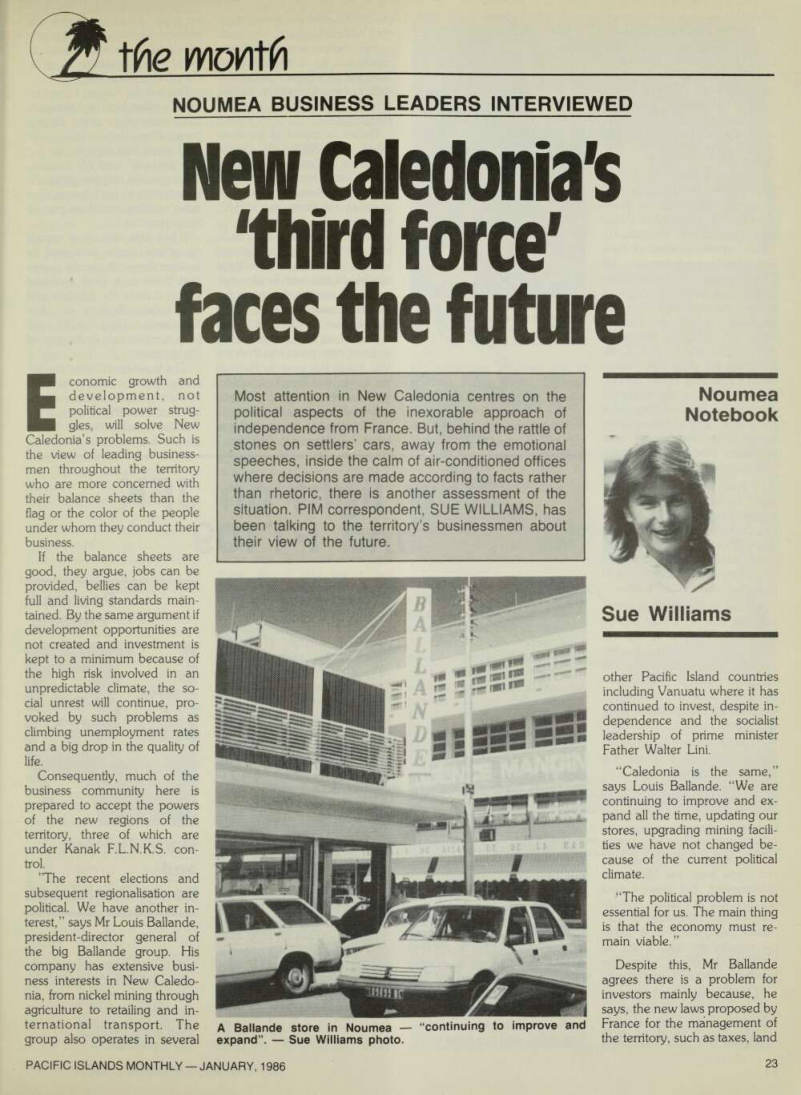
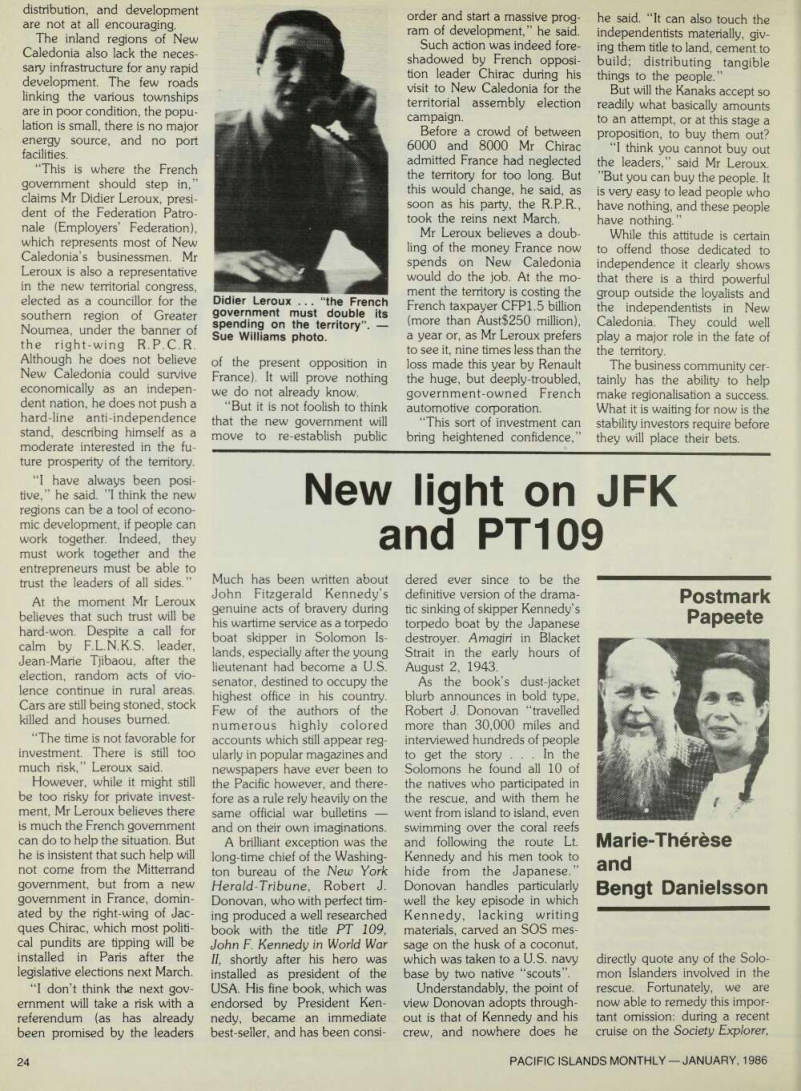
the month
Noumea Business Leaders Interviewed
New Caledonians 'third force' faces the future
Economic growth and development, not political power strug gles, will solve New Caledonia’s problems. Such is the view of leading business men throughout the territory who are more concerned with their balance sheets than the flag or the color of the people under whom they conduct their business.
If the balance sheets are good, they argue, jobs can be provided, bellies can be kept full and living standards main tained. By the same argument if development opportunities are not created and investment is kept to a minimum because of the high risk involved in an unpredictable climate, the so cial unrest will continue, pro voked by such problems as climbing unemployment rates and a big drop in the quality of life.
Consequently, much of the business community here is prepared to accept the powers of the new regions of the territory, three of which are under Kanak F.L.N.K.S. con trol. ’The recent elections and subsequent regionalisation are political. We have another in terest,” says Mr Louis Ballande, president-director general of the big Ballande group. His company has extensive busi ness interests in New Caledo nia, from nickel mining through agriculture to retailing and in ternational transport. The group also operates in several
Most attention in New Caledonia centres on the political aspects of the inexorable approach of independence from France. But, behind the rattle of stones on settlers’ cars, away from the emotional speeches, inside the calm of air-conditioned offices where decisions are made according to facts rather than rhetoric, there is another assessment of the situation. RIM correspondent, SUE WILLIAMS, has been talking to the territory’s businessmen about their view of the future.
Noumea Notebook
other Pacific Island countries including Vanuatu where it has continued to invest, despite in dependence and the socialist leadership of prime minister Father Walter Lini.
“Caledonia is the same,” says Louis Ballande. “We are continuing to improve and ex pand all the time, updating our stores, upgrading mining facili ties we have not changed be cause of the current political climate.
“The political problem is not essential for us. The main thing is that the economy must re main viable.”
Despite this, Mr Ballande agrees there is a problem for investors mainly because, he says, the new laws proposed by France for the management of the territory, such as taxes, land
A Ballande store in Noumea “continuing to improve and expand”. - Sue Williams photo.
Sue Williams
distribution, and development are not at all encouraging.
The inland regions of New Caledonia also lack the neces sary infrastructure for any rapid development. The few roads linking the various townships are in poor condition, the popu lation is small, there is no major energy source, and no port facilities.
“This is where the French government should step in,” claims Mr Didier Leroux, presi dent of the Federation Patro nale (Employers’ Federation), which represents most of New Caledonia’s businessmen. Mr Leroux is also a representative in the new territorial congress, elected as a councillor for the southern region of Greater Noumea, under the banner of the right-wing R.P.C.R.
Although he does not believe New Caledonia could survive economically as an indepen dent nation, he does not push a hard-line anti-independence stand, describing himself as a moderate interested in the fu ture prosperity of the territory.
“I have always been posi tive,” he said. ”1 think the new regions can be a tool of econo mic development, if people can work together. Indeed, they must work together and the entrepreneurs must be able to trust the leaders of all sides.”
At the moment Mr Leroux believes that such trust will be hard-won. Despite a call for calm by F.L.N.K.S. leader, Jean-Marie Tjibaou, after the election, random acts of vio lence continue in rural areas.
Cars are still being stoned, stock killed and houses burned.
“The time is not favorable for investment. There is still too much risk,” Leroux said.
However, while it might still be too risky for private invest ment, Mr Leroux believes there is much the French government can do to help the situation. But he is insistent that such help will not come from the Mitterrand government, but from a new government in France, domin ated by the right-wing of Jac ques Chirac, which most politi cal pundits are tipping will be installed in Paris after the legislative elections next March.
“I don’t think the next gov ernment will take a risk with a referendum (as has already been promised by the leaders
of the present opposition in France). It will prove nothing we do not already know.
“But it is not foolish to think that the new government will move to re-establish public
order and start a massive prog ram of development,” he said.
Such action was indeed fore shadowed by French opposi tion leader Chirac during his visit to New Caledonia for the territorial assembly election campaign.
Before a crowd of between 6000 and 8000 Mr Chirac admitted France had neglected the territory for too long. But this would change, he said, as soon as his party, the R.P.R., took the reins next March.
Mr Leroux believes a doub ling of the money France now spends on New Caledonia would do the job. At the mo ment the territory is costing the French taxpayer CFPI.S billion (more than Austs2so million), a year or, as Mr Leroux prefers to see it, nine times less than the loss made this year by Renault the huge, but deeply-troubled, government-owned French automotive corporation.
“This sort of investment can bring heightened confidence,”
he said. “It can also touch the independentists materially, giv ing them title to land, cement to build; distributing tangible things to the people.”
But will the Kanaks accept so readily what basically amounts to an attempt, or at this stage a proposition, to buy them out?
“I think you cannot buy out the leaders,” said Mr Leroux. ’’But you can buy the people. It is very easy to lead people who have nothing, and these people have nothing.”
While this attitude is certain to offend those dedicated to independence it clearly shows that there is a third powerful group outside the loyalists and the independentists in New Caledonia. They could well play a major role in the fate of the territory.
The business community cer tainly has the ability to help make regionalisation a success.
What it is waiting for now is the stability investors require before they will place their bets.
Didier Leroux ... “the French government must double its spending on the territory”.
Sue Williams photo.
and PT109
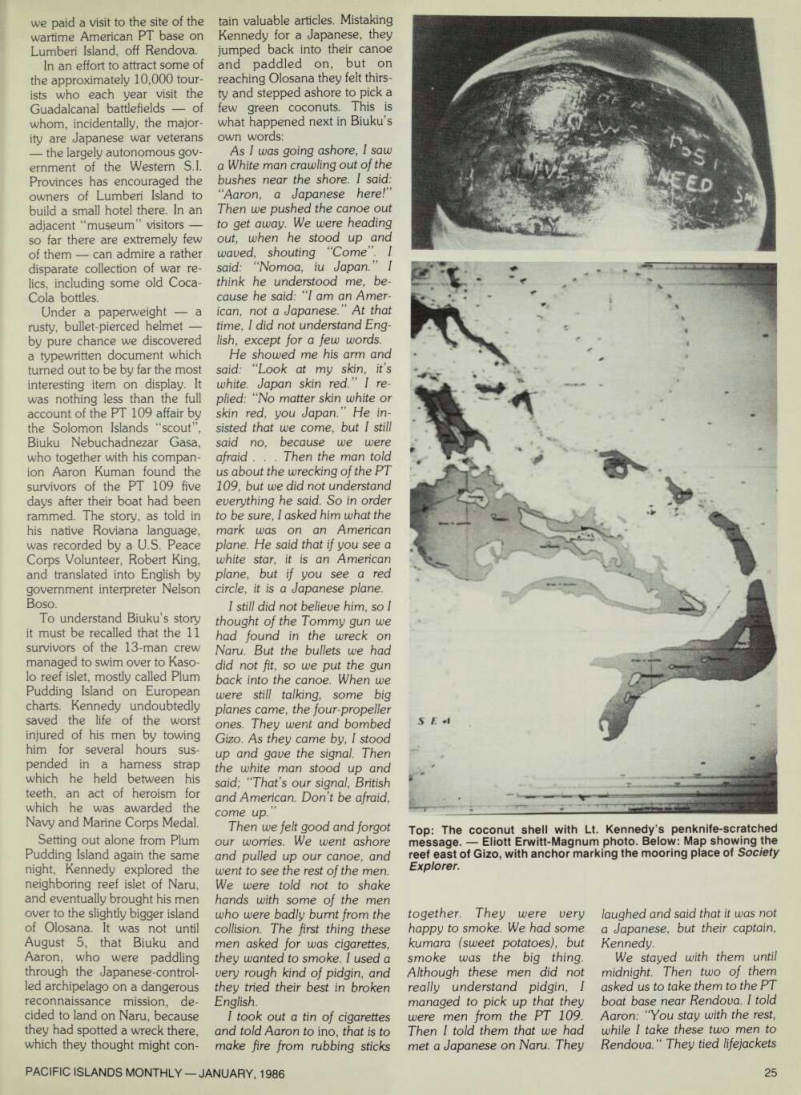
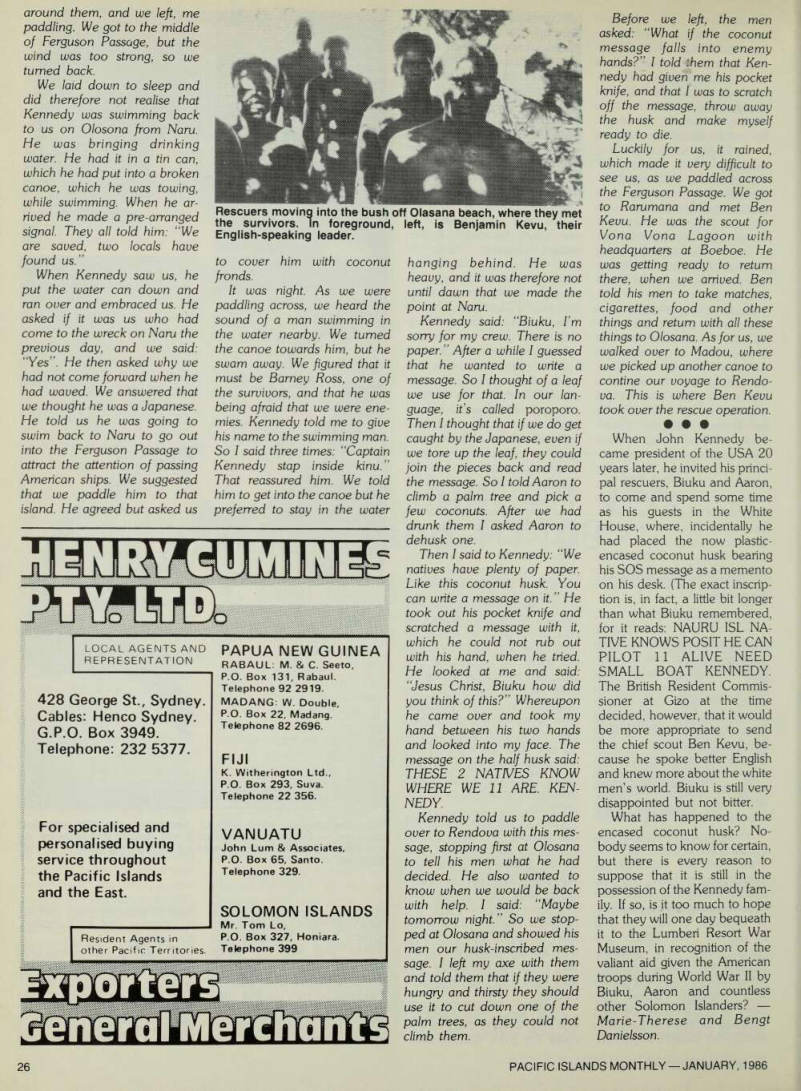
New light on JFK and PT109
Much has been written about John Fitzgerald Kennedy’s genuine acts of bravery during his wartime service as a torpedo boat skipper in Solomon Is lands, especially after the young lieutenant had become a U.S. senator, destined to occupy the highest office in his country.
Few of the authors of the numerous highly colored accounts which still appear reg ularly in popular magazines and newspapers have ever been to the Pacific however, and there fore as a rule rely heavily on the same official war bulletins and on their own imaginations.
A brilliant exception was the long-time chief of the Washing ton bureau of the New York Herald-Tribune, Robert J.
Donovan, who with perfect tim ing produced a well researched book with the title PT 109, John F. Kennedy in World War 11, shortly after his hero was installed as president of the USA. His fine book, which was endorsed by President Ken nedy, became an immediate best-seller, and has been consi
dered ever since to be the definitive version of the drama tic sinking of skipper Kennedy’s torpedo boat by the Japanese destroyer. Amagiri in Blacket Strait in the early hours of August 2, 1943.
As the book’s dust-jacket blurb announces in bold type, Robert J. Donovan “travelled more than 30,000 miles and interviewed hundreds of people to get the story ... In the Solomons he found all 10 of the natives who participated in the rescue, and with them he went from island to island, even swimming over the coral reefs and following the route Lt.
Kennedy and his men took to hide from the Japanese.”
Donovan handles particularly well the key episode in which Kennedy, lacking writing materials, carved an SOS mes sage on the husk of a coconut, which was taken to a U.S. navy base by two native “scouts”.
Understandably, the point of view Donovan adopts through out is that of Kennedy and his crew, and nowhere does he
Postmark Papeete
directly quote any of the Solo mon Islanders involved in the rescue. Fortunately, we are now able to remedy this impor tant omission: during a recent cruise on the Society Explorer,
Marie-Therese and Bengt Danielsson
we paid a visit to the site of the wartime American PT base on Lumberi Island, off Rendova.
In an effort to attract some of the approximately 10,000 tour ists who each year visit the Guadalcanal battlefields of whom, incidentally, the major ity are Japanese war veterans the largely autonomous gov ernment of the Western S.I.
Provinces has encouraged the owners of Lumberi Island to build a small hotel there. In an adjacent “museum” visitors so far there are extremely few of them can admire a rather disparate collection of war re lics, including some old Coca- Cola bottles.
Under a paperweight a rusty, bullet-pierced helmet by pure chance we discovered a typewritten document which turned out to be by far the most interesting item on display. It was nothing less than the full account of the PT 109 affair by the Solomon Islands “scout”, Biuku Nebuchadnezar Gasa, who together with his compan ion Aaron Kuman found the survivors of the PT 109 five days after their boat had been rammed. The story, as told in his native Roviana language, was recorded by a U.S. Peace Corps Volunteer, Robert King, and translated into English by government interpreter Nelson Boso.
To understand Biuku’s story it must be recalled that the 11 survivors of the 13-man crew managed to swim over to Kaso lo reef islet, mostly called Plum Pudding Island on European charts. Kennedy undoubtedly saved the life of the worst injured of his men by towing him for several hours sus pended in a harness strap which he held between his teeth, an act of heroism for which he was awarded the Navy and Marine Corps Medal.
Setting out alone from Plum Pudding Island again the same night, Kennedy explored the neighboring reef islet of Naru, and eventually brought his men over to the slightly bigger island of Olosana. It was not until August 5, that Biuku and Aaron, who were paddling through the Japanese-control led archipelago on a dangerous reconnaissance mission, de cided to land on Naru, because they had spotted a wreck there, which they thought might con
tain valuable articles. Mistaking Kennedy for a Japanese, they jumped back into their canoe and paddled on, but on reaching Olosana they felt thirs ty and stepped ashore to pick a few green coconuts. This is what happened next in Biuku’s own words: As I was going ashore, I saw a White man crawling out of the bushes near the shore. I said; “Aaron, a Japanese here!”
Then we pushed the canoe out to get away. We were heading out, when he stood up and waved, shouting “Come”. I said: “Nomoa, iu Japan.” I think he understood me, be cause he said: “I am an Amer ican, not a Japanese.” At that time, I did not understand Eng lish, except for a few words.
He showed me his arm and said: “Look at my skin, it’s white. Japan skin red.” I re plied: “No matter skin white or skin red, you Japan.” He in sisted that we come, but I still said no, because we were afraid . . . Then the man told us about the wrecking of the PT 109, but we did not understand everything he said. So in order to be sure, I asked him what the mark was on an American plane. He said that if you see a white star, it is an American plane, but if you see a red circle, it is a Japanese plane.
I still did not believe him, so I thought of the Tommy gun we had found in the wreck on Naru. But the bullets we had did not fit, so we put the gun back into the canoe. When we were still talking, some big planes came, the four-propeller ones. They went and bombed Gizo. As they came by, I stood up and gave the signal. Then the white man stood up and said; “That’s our signal, British and American. Don’t be afraid, come up.”
Then we felt good and forgot our worries. We went ashore and pulled up our canoe, and went to see the rest of the men.
We were told not to shake hands with some of the men who were badly burnt from the collision. The first thing these men asked for was cigarettes, they wanted to smoke. I used a very rough kind of pidgin, and they tried their best in broken English.
I took out a tin of cigarettes and told Aaron to ino, that is to make fire from rubbing sticks
together. They were very happy to smoke. We had some kumara (sweet potatoes), but smoke was the big thing.
Although these men did not really understand pidgin, I managed to pick up that they were men from the PT 109.
Then I told them that we had met a Japanese on Naru. They
laughed and said that it was not a Japanese, but their captain, Kennedy, We stayed with them until midnight. Then two of them asked us to take them to the PT boat base near Rendova. I told Aaron: “You stay with the rest, while I take these two men to Rendova. “ They tied lifejackets
Top: The coconut shell with Lt. Kennedy’s penknife-scratched message. Eliott Erwitt-Magnum photo. Below: Map showing the reef east of Gizo, with anchor marking the mooring place of Society Explorer.
around them, and we left, me paddling. We got to the middle of Ferguson Passage, but the wind was too strong, so we turned back.
We laid down to sleep and did therefore not realise that Kennedy was swimming back to us on Olosona from Naru.
He was bringing drinking water. He had it in a tin can, which he had put into a broken canoe, which he was towing, while swimming. When he ar rived he made a pre-arranged signal. They all told him: “We are saved, two locals have found us.”
When Kennedy saw us, he put the water can down and ran over and embraced us. He asked if it was us who had come to the wreck on Naru the previous day, and we said: “Yes”. He then asked why we had not come forward when he had waved. We answered that we thought he was a Japanese.
He told us he was going to swim back to Naru to go out into the Ferguson Passage to attract the attention of passing American ships. We suggested that we paddle him to that island. He agreed but asked us
to cover him with coconut fronds.
It was night. As we were paddling across, we heard the sound of a man swimming in the water nearby. We turned the canoe towards him, but he swam away. We figured that it must be Barney Ross, one of the survivors, and that he was being afraid that we were ene mies. Kennedy told me to give his name to the swimming man.
So I said three times: “Captain Kennedy stop inside kinu.”
That reassured him. We told him to get into the canoe but he preferred to stay in the water
hanging behind. He was heavy, and it was therefore not until dawn that we made the point at Naru.
Kennedy said: “Biuku, Tm sorry for my crew. There is no paper. ” After a while I guessed that he wanted to write a message. So I thought of a leaf we use for that. In our lan guage, it’s called poroporo.
Then I thought that if we do get caught by the Japanese, even if we tore up the leaf, they could join the pieces back and read the message. So I told Aaron to climb a palm tree and pick a few coconuts. After we had drunk them I asked Aaron to dehusk one.
Then I said to Kennedy: “We natives have plenty of paper.
Like this coconut husk. You can write a message on it. ” He took out his pocket knife and scratched a message with it, which he could not rub out with his hand, when he tried.
He looked at me and said: “Jesus Christ, Biuku how did you think of this?” Whereupon he came over and took my hand between his two hands and looked into my face. The message on the half husk said:
These 2 Natives Know
Where We 11 Are. Ken
Nedy.
Kennedy told us to paddle over to Rendova with this mes sage, stopping first at Olosana to tell his men what he had decided. He also wanted to know when we would be back with help. I said: “Maybe tomorrow night.” So we stop ped at Olosana and showed his men our husk-inscribed mes sage. I left my axe with them and told them that if they were hungry and thirsty they should use it to cut down one of the palm trees, as they could not climb them.
Before we left, the men asked: “What if the coconut message falls into enemy hands?” I told them that Ken nedy had given me his pocket knife, and that I was to scratch off the message, throw away the husk and make myself ready to die.
Luckily for us, it rained, which made it very difficult to see us, as we paddled across the Ferguson Passage. We got to Rarumana and met Ben Kevu. He was the scout for Vona Vona Lagoon with headquarters at Boeboe. He was getting ready to return there, when we arrived. Ben told his men to take matches, cigarettes, food and other things and return with all these things to Olosana. As for us, we walked over to Madou, where we picked up another canoe to contine our voyage to Rendo va. This is where Ben Kevu took over the rescue operation. • • • When John Kennedy be came president of the USA 20 years later, he invited his princi pal rescuers, Biuku and Aaron, to come and spend some time as his guests in the White House, where, incidentally he had placed the now plastic encased coconut husk bearing his SOS message as a memento on his desk. (The exact inscrip tion is, in fact, a little bit longer than what Biuku remembered, for it reads: NAURU ISL NA
Tive Knows Posit He Can
Pilot 11 Alive Need
Small Boat Kennedy.
The British Resident Commis sioner at Gizo at the time decided, however, that it would be more appropriate to send the chief scout Ben Kevu, be cause he spoke better English and knew more about the white men’s world. Biuku is still very disappointed but not bitter.
What has happened to the encased coconut husk? No body seems to know for certain, but there is every reason to suppose that it is still in the possession of the Kennedy fam ily. If so, is it too much to hope that they will one day bequeath it to the Lumberi Resort War Museum, in recognition of the valiant aid given the American troops during World War II by Biuku, Aaron and countless other Solomon Islanders?
Marie-Therese and Bengt Danielsson.
Rescuers moving into the bush off Olasana beach, where they met the survivors. In foreground, left, is Benjamin Kevu, their
English-speaking leader.
Advertisements & other items, p. 26 (1 item)
jLßnsu^sinLn]3s
LOCAL AGENTS AND
REPRESENTATION
428 George St., Sydney.
Cables: Henco Sydney.
G.P.O. Box 3949.
Telephone: 232 5377.
PAPUA NEW GUINEA
RABAUL: M. & C. Seeto, P.O. Box 131, Rabaul.
Telephone 92 2919.
MADANG; W. Double, P.O. Box 22, Madang.
Telephone 82 2696.
FIJI
K. Witherington Ltd., P.O. Box 293, Suva.
Telephone 22 356.
For specialised and
personalised buying
service throughout
the Pacific Islands and the East.
Resident Agents in other Pacific Territories.
VANUATU
John Lum & Associates, P.O. Box 65, Santo.
Telephone 329.
SOLOMON ISLANDS
Mr, Tom Lo, P.O. Box 327, Honiara.
Telephone 399
tie
opportunities
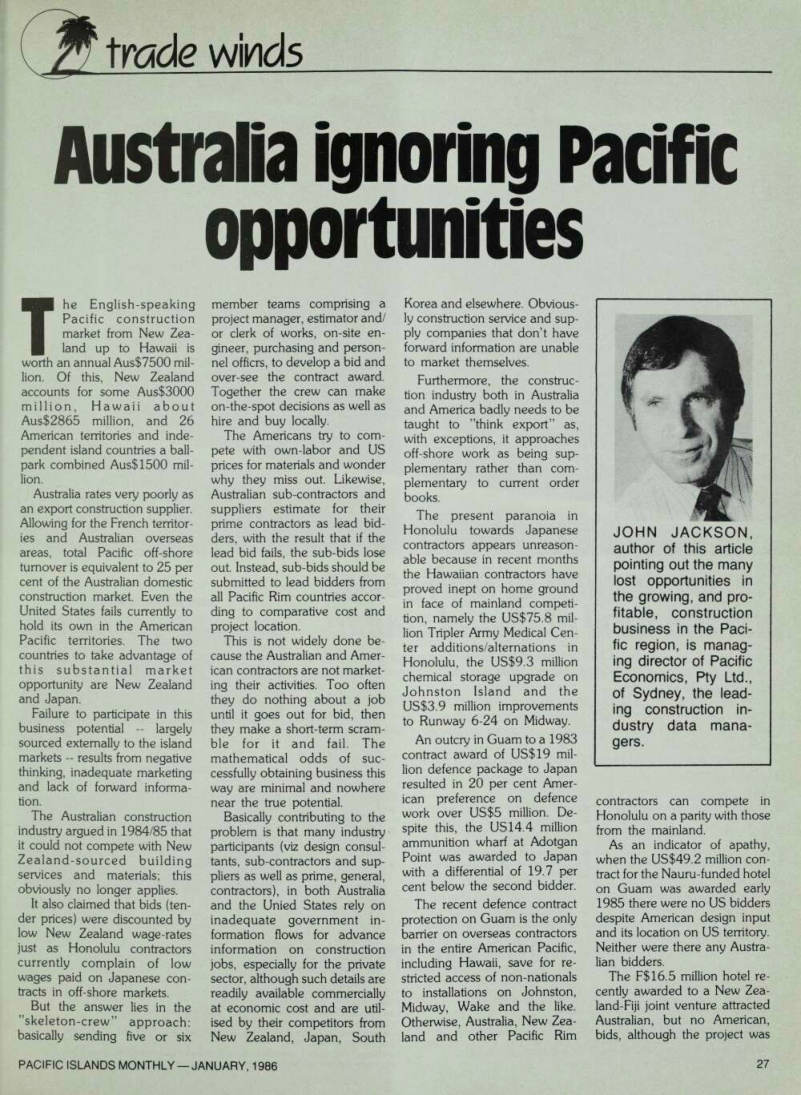

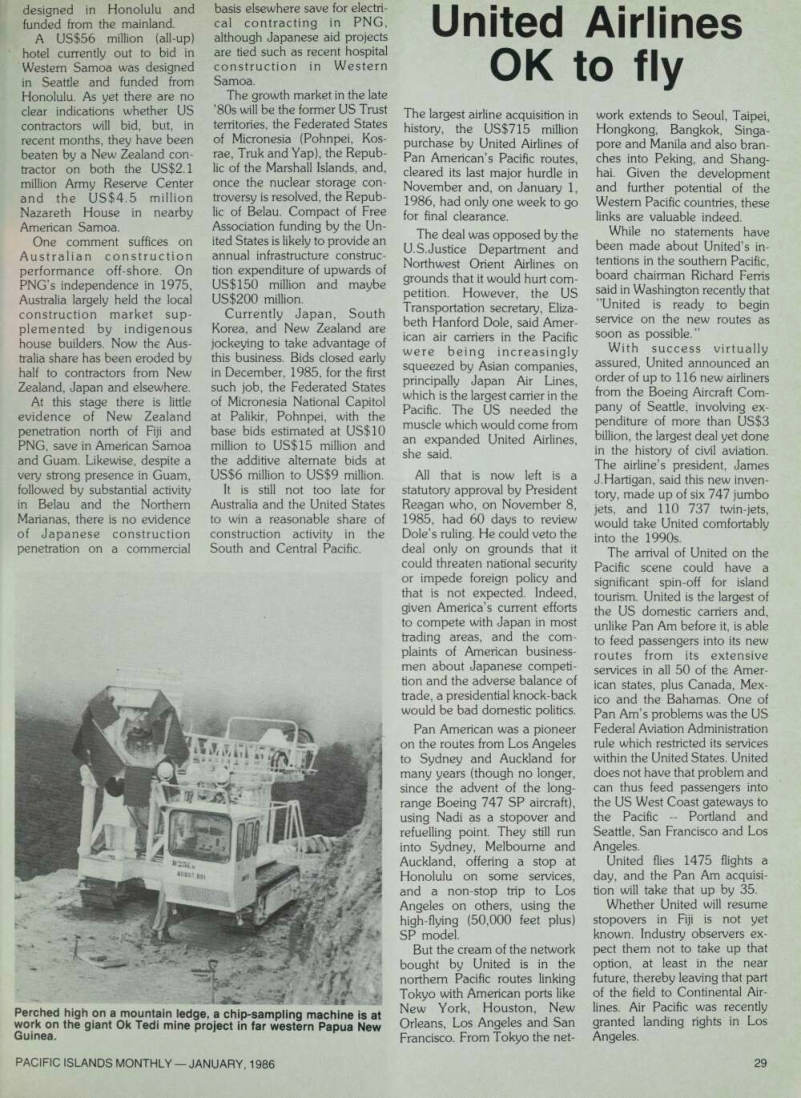
trade winds
Australia Ignoring Pacific opportunities
The English-speaking
Pacific construction market from New Zea land up to Hawaii is worth an annual Auss7soo mil lion. Of this, New Zealand accounts for some Auss3ooo million, Hawaii about Auss2B6s million, and 26 American territories and inde pendent island countries a ball park combined Ausslsoo mil lion.
Australia rates very poorly as an export construction supplier.
Allowing for the French territor ies and Australian overseas areas, total Pacific off-shore turnover is equivalent to 25 per cent of the Australian domestic construction market. Even the United States fails currently to hold its own in the American Pacific territories. The two countries to take advantage of this substantial market opportunity are New Zealand and Japan.
Failure to participate in this business potential largely sourced externally to the island markets results from negative thinking, inadequate marketing and lack of forward informa tion.
The Australian construction industry argued in 1984/85 that it could not compete with New Zealand-sourced building services and materials; this obviously no longer applies.
It also claimed that bids (ten der prices) were discounted by low New Zealand wage-rates just as Honolulu contractors currently complain of low wages paid on Japanese con tracts in off-shore markets.
But the answer lies in the ”skeleton-crew” approach: basically sending five or six
member teams comprising a project manager, estimator and/ or clerk of works, on-site en gineer, purchasing and person nel officrs, to develop a bid and over-see the contract award.
Together the crew can make on-the-spot decisions as well as hire and buy locally.
The Americans try to com pete with own-labor and US prices for materials and wonder why they miss out. Likewise, Australian sub-contractors and suppliers estimate for their prime contractors as lead bid ders, with the result that if the lead bid fails, the sub-bids lose out. Instead, sub-bids should be submitted to lead bidders from all Pacific Rim countries accor ding to comparative cost and project location.
This is not widely done be cause the Australian and Amer ican contractors are not market ing their activities. Too often they do nothing about a job until it goes out for bid, then they make a short-term scram ble for it and fail. The mathematical odds of suc cessfully obtaining business this way are minimal and nowhere near the true potential.
Basically contributing to the problem is that many industry participants (viz design consul tants, sub-contractors and sup pliers as well as prime, general, contractors), in both Australia and the Unied States rely on inadequate government in formation flows for advance information on construction jobs, especially for the private sector, although such details are readily available commercially at economic cost and are util ised by their competitors from New Zealand, Japan, South
Korea and elsewhere. Obvious ly construction service and sup ply companies that don’t have forward information are unable to market themselves.
Furthermore, the construc tion industry both in Australia and America badly needs to be taught to ’’think export” as, with exceptions, it approaches off-shore work as being sup plementary rather than com plementary to current order books.
The present paranoia in Honolulu towards Japanese contractors appears unreason able because in recent months the Hawaiian contractors have proved inept on home ground in face of mainland competi tion, namely the US$75.B mil lion Tripler Army Medical Cen ter additions/alternations in Honolulu, the US$9.3 million chemical storage upgrade on Johnston Island and the US$3.9 million improvements to Runway 6-24 on Midway.
An outcry in Guam to a 1983 contract award of US$l9 mil lion defence package to Japan resulted in 20 per cent Amer ican preference on defence work over US$5 million. De spite this, the U 514.4 million ammunition wharf at Adotgan Point was awarded to Japan with a differential of 19.7 per cent below the second bidder.
The recent defence contract protection on Guam is the only barrier on overseas contractors in the entire American Pacific, including Hawaii, save for re stricted access of non-nationals to installations on Johnston, Midway, Wake and the like.
Otherwise, Australia, New Zea land and other Pacific Rim
contractors can compete in Honolulu on a parity with those from the mainland.
As an indicator of apathy, when the U 5549.2 million con tract for the Nauru-funded hotel on Guam was awarded early 1985 there were no US bidders despite American design input and its location on US territory.
Neither were there any Austra lian bidders.
The F 516.5 million hotel re cently awarded to a New Zea land-Fiji joint venture attracted Australian, but no American, bids, although the project was
John Jackson,
author of this article pointing out the many lost opportunities in the growing, and pro fitable, construction business in the Paci fic region, is manag ing director of Pacific Economics, Pty Ltd., of Sydney, the lead ing construction in dustry data mana gers.
designed in Honolulu and funded from the mainland.
A US$56 million (all-up) hotel currently out to bid in Western Samoa was designed in Seattle and funded from Honolulu. As yet there are no clear indications whether US contractors will bid, but, in recent months, they have been beaten by a New Zealand con tractor on both the US$2.l million Army Reserve Center and the US$4.5 million Nazareth House in nearby American Samoa.
One comment suffices on Australian construction performance off-shore. On PNG’s independence in 1975, Australia largely held the local construction market sup plemented by indigenous house builders. Now the Aus tralia share has been eroded by half to contractors from New Zealand, Japan and elsewhere.
At this stage there is little evidence of New Zealand penetration north of Fiji and PNG, save in American Samoa and Guam. Likewise, despite a very strong presence in Guam, followed by substantial activity in Belau and the Northern Marianas, there is no evidence of Japanese construction penetration on a commercial
basis elsewhere save for electri cal contracting in PNG, although Japanese aid projects are tied such as recent hospital construction in Western Samoa.
The growth market in the late ’Bos will be the former US Trust territories, the Federated States of Micronesia (Pohnpei, Kos rae, Truk and Yap), the Repub lic of the Marshall Islands, and, once the nuclear storage con troversy is resolved, the Repub lic of Belau. Compact of Free Association funding by the Un ited States is likely to provide an annual infrastructure construc tion expenditure of upwards of US$l5O million and maybe US$2OO million.
Currently Japan, South Korea, and New Zealand are jockeying to take advantage of this business. Bids closed early in December, 1985, for the first such job, the Federated States of Micronesia National Capitol at Palikir, Pohnpei, with the base bids estimated at US$lO million to US$l5 million and the additive alternate bids at US$6 million to US$9 million.
It is still not too late for Australia and the United States to win a reasonable share of construction activity in the South and Central Pacific.
Perched high on a mountain ledge, a chip-sampling machine is at work on the giant Ok Tedi mine project in far western Papua New Guinea.
Advertisements & other items, p. 28 (1 item)
Crd Pioneer
' m p ■6,
The excitement of high-power
and the thrill of digital sound!
It’s here, thanks to Pioneer—a 200 W Peak Music Power Output portable sound system! A system so sophisticated you can team it up with Pioneer’s detachable
PD-C 7 Compact Disc player.
Yes, you can enter the Digital Age with the revolutionary “CD” Carry Com, while broadening your hi-fi horizons with Stereo Wide expanded acoustic ambience. Then feast your ears on the beauty of Dynamic Expander: outstanding definition, natural vocals, full-bodied sound.
So check out the portable that checks you into the Digital Age: “CD” Carry Com, only from Pioneer.
CK-W7OO, CK-R 500:
■ Detachable PD-C 7 Compact Disc
player (optional)
■ Dynamic Expander and Stereo Wide circuits ■ Mic-mixing for Karaoke “Sing-Along” ■ 4-Band Tuner (FM stereo/MW/SWi/ SW2) ■ 4-Band Graphic Equalizer ■ Dolby* B NR, Music Search, REC Mute and auto metal/normal tape selector * ‘Dolby’ and the double-D symbol are trademarks of Dolby Laboratories Licensing Corporation.
CK-W7OO CK-R5OO
■ 200 W Peak Music Power Output B7OW Peak Music ■ Full-logic Double Auto-Reverse Power Output cassette deck (for playback and ■ Full-logic Autorecord/playback) Reverse cassette ■ High-speed dubbing for sides A and B deck ■ Relay playback from deck Ito deck 2 ■ Detachable full- ■ Detachable 2-way speaker system range speaker with square cone woofer system with square cone *
CK-W7OO
CK-R5OO
CrD PIONEER
For further information, please contact: Australia: Pioneer Electronics Australia Pty. Ltd. (Incorporated in Victoria), P.O. Box 295, Mordialloc, Victoria, 3195 Tel: 580-9911 Fiji Islands: Brijlal & Company, G.P.O. Box No. 362, Suva, Fiji Islands Tel: 22258 New Zealand: Monaco Distributors Ltd., 2 Poland Road, Glenfield, Auckland, New Zealand Tel: (09) 444-9144 Norfolk Island: Burns Philp (Norfolk Island) Ltd., P.O. Box 21, Norfolk Island Vanuatu: Burns Philp (Vanuatu) Ltd., Vila, Vanuatu Nauru Island; Jacob Enterprises, P.O. Box N 0.4,.4, Republic of Nauru Tahiti: Tahiti Hi-Fi, P.O. Box 848, Papeete, Tahiti New Caledonia: Menard Pacifique Sari, B.P. 3899, Noumea, New Caledonia Tel: 27-62.23 American Samoa: Transpac Corporation, P.O. Box 1477, Pago Pago, American Samoa 96799 Tel: 633-5224 Rarotonga; South Seas International Ltd., P.O. Box 49, Rarotonga, Cook Islands Tel: 2327 Papua New Guinea: Bali Merchants Pty. Ltd., P.O. Box 6103, Boroko Tel: 254887
United Airlines
OK to fly
The largest airline acquisition in history, the US$7l5 million purchase by United Airlines of Pan American’s Pacific routes, cleared its last major hurdle in November and, on January 1, 1986, had only one week to go for final clearance.
The deal was opposed by the U.S.Justice Department and Northwest Orient Airlines on grounds that it would hurt com petition. However, the US Transportation secretary, Eliza beth Hanford Dole, said Amer ican air carriers in the Pacific were being increasingly squeezed by Asian companies, principally Japan Air Lines, which is the largest carrier in the Pacific. The US needed the muscle which would come from an expanded United Airlines, she said.
All that is now left is a statutory approval by President Reagan who, on November 8, 1985, had 60 days to review Dole’s ruling. He could veto the deal only on grounds that it could threaten national security or impede foreign policy and that is not expected. Indeed, given America’s current efforts to compete with Japan in most trading areas, and the com plaints of American business men about Japanese competi tion and the adverse balance of trade, a presidential knock-back would be bad domestic politics.
Pan American was a pioneer on the routes from Los Angeles to Sydney and Auckland for many years (though no longer, since the advent of the long range Boeing 747 SP aircraft), using Nadi as a stopover and refuelling point. They still run into Sydney, Melbourne and Auckland, offering a stop at Honolulu on some services, and a non-stop trip to Los Angeles on others, using the high-flying (50,000 feet plus) SP model.
But the cream of the network bought by United is in the northern Pacific routes linking Tokyo with American ports like New York, Houston, New Orleans, Los Angeles and San Francisco. From Tokyo the net
work extends to Seoul, Taipei, Hongkong, Bangkok, Singa pore and Manila and also bran ches into Peking, and Shang hai. Given the development and further potential of the Western Pacific countries, these links are valuable indeed.
While no statements have been made about United’s in tentions in the southern Pacific, board chairman Richard Ferris said in Washington recently that ’’United is ready to begin service on the new routes as soon as possible.”
With success virtually assured, United announced an order of up to 116 new airliners from the Boeing Aircraft Com pany of Seattle, involving ex penditure of more than US$3 billion, the largest deal yet done in the history of civil aviation.
The airline’s president, James J.Hartigan, said this new inven tory, made up of six 747 jumbo jets, and 110 737 twin-jets, would take United comfortably into the 19905.
The arrival of United on the Pacific scene could have a significant spin-off for island tourism. United is the largest of the US domestic carriers and, unlike Pan Am before it, is able to feed passengers into its new routes from its extensive services in all 50 of the Amer ican states, plus Canada, Mex ico and the Bahamas. One of Pan Am’s problems was the US Federal Aviation Administration rule which restricted its services within the United States. United does not have that problem and can thus feed passengers into the US West Coast gateways to the Pacific Portland and Seattle, San Francisco and Los Angeles.
United flies 1475 flights a day, and the Pan Am acquisi tion will take that up by 35.
Whether United will resume stopovers in Fiji is not yet known. Industry observers ex pect them not to take up that option, at least in the near future, thereby leaving that part of the field to Continental Air lines. Air Pacific was recently granted landing rights in Los Angeles.
Advertisements & other items, pp. 30-31 (1 item)
Ru/Ser
TOYOTA
QUALITY SERVICE
AMERICAN SAMOA: BURNS PHILP (SOUTH SEA) CO., LTD., P.O. Box 129, Pago Pago.
COOK ISLANDS: COOK ISLANDS TRADING
CORPORATION LTD., Private Bag, Rarotonga.
FIJI: AUTOMOTIVE SUPPLIES COMPANY, A Division of Burns Philp (South Sea) Co., Ltd., G.P.O. Box 355, Suva.
GUAM & MICRONESIA: ATKINS KROLL, INC., 443 South Marine Drive, Tamuning.
KIRIBATI: TARAWA MOTORS, P.O. Box 36, Bairiki, Tarawa.
NAURU: NAURU COOPERATIVE SOCIETY, Central
Pacific.
NEW CALEDONIA: SERVICE IMPORTATION
AUTOMOBILE DU PACIFIQUE, Rond-Point du Pacifiqu (Station Total) B.P. 438, Noumea.
NORFOLK ISLAND: BORRYS LIMITED, P.O. Box 16< PAPUA NEW GUINEA: ELA MOTORS, A Division o Burns Philp (PNG) Ltd., P.O. Box 75, Port Moresby.
SAIPAN; MICROL CORPORATION, P.O. 80x267, Saipan
The tradition of power and ruggedness
Toyota’s new Land Cruiser has been entirely redesigned from the road up. But it still retains the traditional toughness acquired from over thirty years jr, of road experience.
But no matter how rough it gets a roomy new cabin with improved occupant comforts, easy instrumentation and an optional 4-speed automatic transmission add up to passenger car comfort with Land Cruiser ruggedness.
More power in hand and fuel efficiency have been gained with a new brawny 4.0-litre gasoline engine.
And to control all that power a new rigid chassis assures stable driving performance and mobility over the roughest terrain. on.
Pickup
ip—---—"- — -f And you can choose from a wide variety of models and an array of heavy-duty features.
Take the wheel and feel Toyota quality in Land Cruiser’s styling, power and comfort. A quality that stays with you on or off the road.
Step into a new generation of toughness today.
SOLOMON: SOLOMON ISLANDS INVESTMENTS LTD.,
3.P.0. Box 174, Honiara.
FAHITI: NIPPON AUTOMOTO, B.P. 342, Papeete
FONGA: BURNS PHILP (SOUTH SEA) CO., LTD., P.O.
Sox 55, Nuku’alofa. /ANUATU: VANUATU MOTORS, A Division of Burns J hilp (Vanuatu) Ltd., P.O. Box 18, Port Vila.
WESTERN SAMOA: BURNS PHILP (SOUTH SEA) CO. -TD., P.O. Box 188, Apia.
TOYOTA
Hot competition for aircraft orders
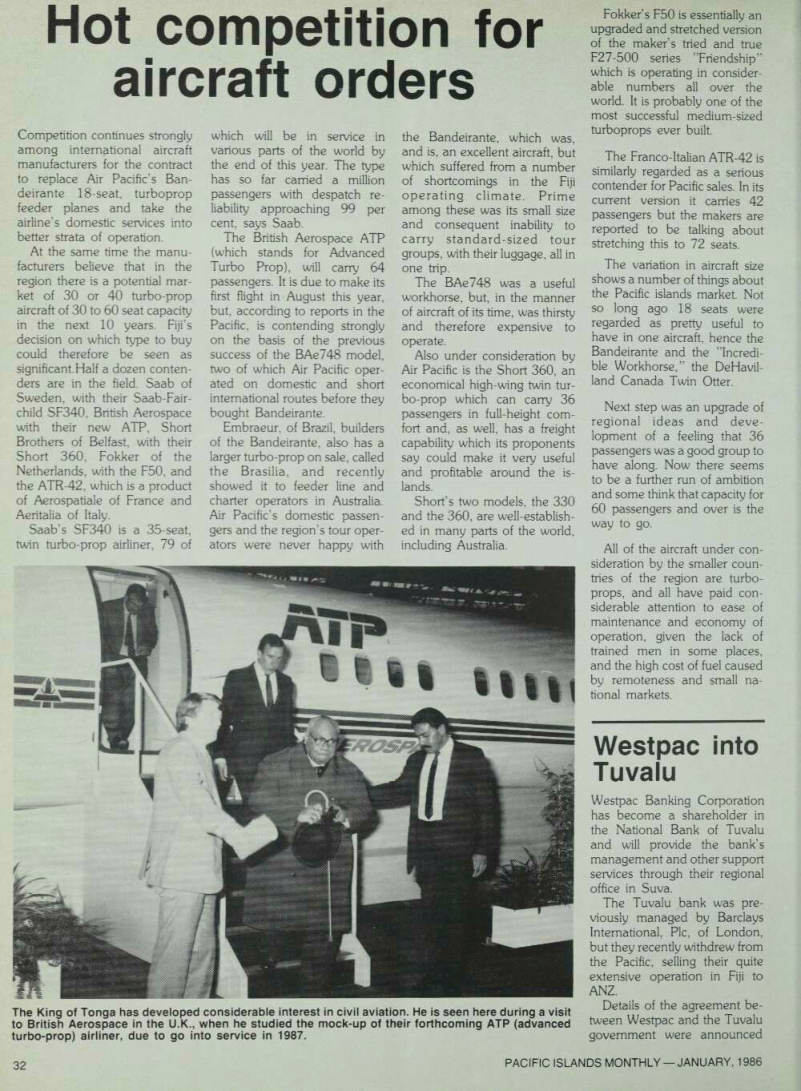
aircraft orders
Competition continues strongly among international aircraft manufacturers for the contract to replace Air Pacific’s Ban deirante 18-seat, turboprop feeder planes and take the airline’s domestic services into better strata of operation.
At the same time the manu facturers believe that in the region there is a potential mar ket of 30 or 40 turbo-prop aircraft of 30 to 60 seat capacity in the next 10 years. Fiji’s decision on which type to buy could therefore be seen as significant. Half a dozen conten ders are in the field. Saab of Sweden, with their Saab-Fair child SF34O, British Aerospace with their new ATP. Short Brothers of Belfast, with their Short 360, Fokker of the Netherlands, with the F5O, and the ATR-42, which is a product of Aerospatiale of France and Aeritalia of Italy.
Saab’s SF34O is a 35-seat, twin turbo-prop airliner, 79 of
which will be in service in various parts of the world by the end of this year. The type has so far carried a million passengers with despatch re liability approaching 99 per cent, says Saab.
The British Aerospace ATP (which stands for Advanced Turbo Prop), will carry 64 passengers. It is due to make its first flight in August this year, but, according to reports in the Pacific, is contending strongly on the basis of the previous success of the 8Ae748 model, two of which Air Pacific oper ated on domestic and short international routes before they bought Bandeirante.
Embraeur, of Brazil, builders of the Bandeirante, also has a larger turbo-prop on sale, called the Brasilia, and recently showed it to feeder line and charter operators in Australia.
Air Pacific’s domestic passen gers and the region’s tour oper ators were never happy with
the Bandeirante, which was, and is, an excellent aircraft, but which suffered from a number of shortcomings in the Fiji operating climate. Prime among these was its small size and consequent inability to carry standard-sized tour groups, with their luggage, all in one trip.
The 8Ae748 was a useful workhorse, but, in the manner of aircraft of its time, was thirsty and therefore expensive to operate.
Also under consideration by Air Pacific is the Short 360, an economical high-wing twin tur bo-prop which can carry 36 passengers in full-height com fort and, as well, has a freight capability which its proponents say could make it very useful and profitable around the is lands.
Short’s two models, the 330 and the 360, are well-establish ed in many parts of the world, including Australia.
Fokker’s F50 is essentially an upgraded and stretched version of the maker’s tried and true F27-500 series ’’Friendship” which is operating in consider able numbers all over the world. It is probably one of the most successful medium-sized turboprops ever built.
The Franco-Italian ATR-42 is similarly regarded as a serious contender for Pacific sales. In its current version it carries 42 passengers but the makers are reported to be talking about stretching this to 72 seats.
The variation in aircraft size shows a number of things about the Pacific islands market. Not so long ago 18 seats were regarded as pretty useful to have in one aircraft, hence the Bandeirante and the ’’Incredi ble Workhorse,” the DeHavil land Canada Twin Otter.
Next step was an upgrade of regional ideas and deve lopment of a feeling that 36 passengers was a good group to have along. Now there seems to be a further run of ambition and some think that capacity for 60 passengers and over is the way to go.
All of the aircraft under con sideration by the smaller coun tries of the region are turbo props, and all have paid con siderable attention to ease of maintenance and economy of operation, given the lack of trained men in some places, and the high cost of fuel caused by remoteness and small na tional markets.
The King of Tonga has developed considerable interest in civil aviation. He is seen here during a visit to British Aerospace in the U.K., when he studied the mock-up of their forthcoming ATP (advanced turbo-prop) airliner, due to go into service in 1987.
Westpac into Tuvalu
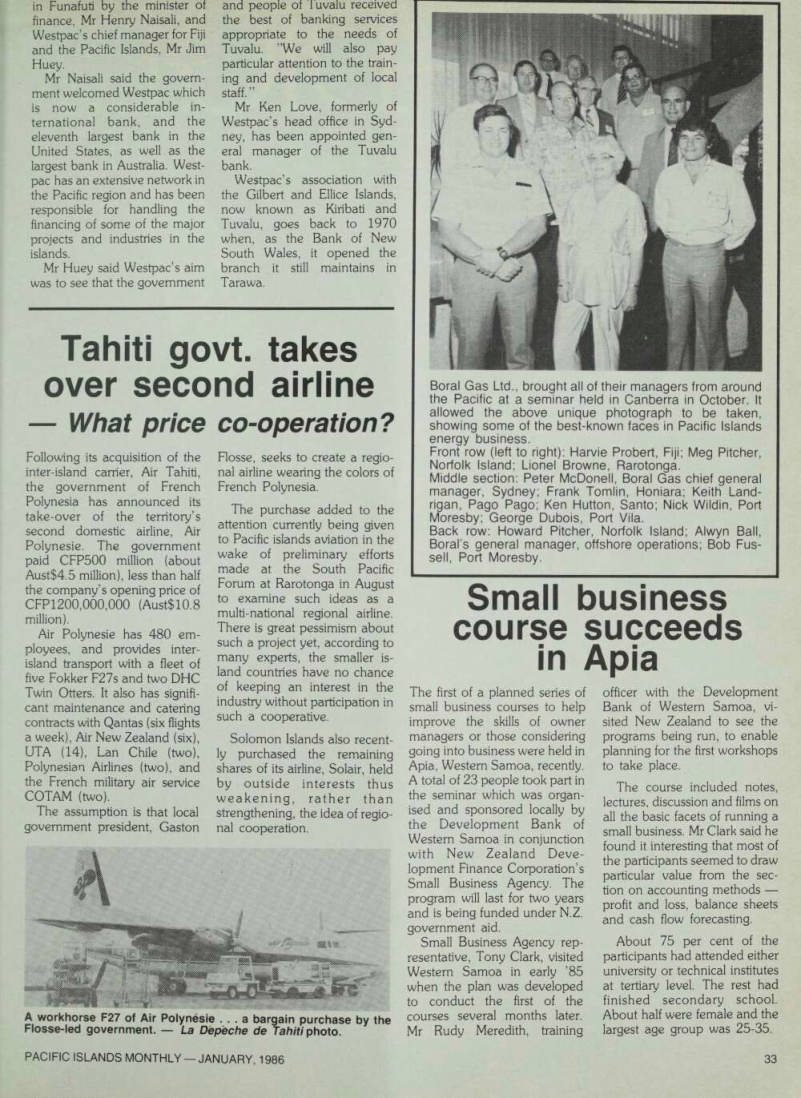
Tuvalu
Westpac Banking Corporation has become a shareholder in the National Bank of Tuvalu and will provide the bank’s management and other support services through their regional office in Suva.
The Tuvalu bank was pre viously managed by Barclays International, Pic, of London, but they recently withdrew from the Pacific, selling their quite extensive operation in Fiji to
Anz.
Details of the agreement be tween Westpac and the Tuvalu government were announced
in Funafuti by the minister of finance, Mr Henry Naisali, and Westpac’s chief manager for Fiji and the Pacific Islands, Mr Jim Huey.
Mr Naisali said the govern ment welcomed Westpac which is now a considerable in ternational bank, and the eleventh largest bank in the United States, as well as the largest bank in Australia. West pac has an extensive network in the Pacific region and has been responsible for handling the financing of some of the major projects and industries in the islands.
Mr Huey said Westpac’s aim was to see that the government
and people ot luvalu received the best of banking services appropriate to the needs of Tuvalu. ”We will also pay particular attention to the train ing and development of local staff.”
Mr Ken Love, formerly of Westpac’s head office in Syd ney, has been appointed gen eral manager of the Tuvalu bank.
Westpac’s association with the Gilbert and Ellice Islands, now known as Kiribati and Tuvalu, goes back to 1970 when, as the Bank of New South Wales, it opened the branch it still maintains in Tarawa.
Tahiti govt, takes
over second airline - What price co-operation?
Following its acquisition of the inter-island carrier, Air Tahiti, the government of French Polynesia has announced its take-over of the territory’s second domestic airline, Air Polynesie. The government paid CFPSOO million (about Austs4.s million), less than half the company’s opening price of CFP1200,000,000 (Austslo.B million).
Air Polynesie has 480 em ployees, and provides inter island transport with a fleet of five Fokker F27s and two DHC Twin Otters. It also has signifi cant maintenance and catering contracts with Qantas (six flights a week), Air New Zealand (six), UTA (14), Lan Chile (two), Polynesian Airlines (two), and the French military air service COTAM (two).
The assumption is that local government president, Gaston
Flosse, seeks to create a regio nal airline wearing the colors of French Polynesia.
The purchase added to the attention currently being given to Pacific islands aviation in the wake of preliminary efforts made at the South Pacific Forum at Rarotonga in August to examine such ideas as a multi-national regional airline.
There is great pessimism about such a project yet, according to many experts, the smaller is land countries have no chance of keeping an interest in the industry without participation in such a cooperative.
Solomon Islands also recent ly purchased the remaining shares of its airline, Solair, held by outside interests thus weakening, rather than strengthening, the idea of regio nal cooperation.
A workhorse F27 of Air Polynesie ... a bargain purchase by the Flosse-led government. La Depeche de Tahiti photo.
in Apia
Small business course succeeds in Apia
The first of a planned series of small business courses to help improve the skills of owner managers or those considering going into business were held in Apia, Western Samoa, recently.
A total of 23 people took part in the seminar which was organ ised and sponsored locally by the Development Bank of Western Samoa in conjunction with New Zealand Deve lopment Finance Corporation’s Small Business Agency. The program will last for two years and is being funded under N.Z. government aid.
Small Business Agency rep resentative, Tony Clark, visited Western Samoa in early ’B5 when the plan was developed to conduct the first of the courses several months later.
Mr Rudy Meredith, training
officer with the Development Bank of Western Samoa, vi sited New Zealand to see the programs being run, to enable planning for the first workshops to take place.
The course included notes, lectures, discussion and films on all the basic facets of running a small business. Mr Clark said he found it interesting that most of the participants seemed to draw particular value from the sec tion on accounting methods profit and loss, balance sheets and cash flow forecasting.
About 75 per cent of the participants had attended either university or technical institutes at tertiary level. The rest had finished secondary school.
About half were female and the largest age group was 25-35.
Boral Gas Ltd., brought all of their managers from around the Pacific at a seminar held in Canberra in October. It allowed the above unique photograph to be taken, showing some of the best-known faces in Pacific Islands energy business.
Front row (left to right): Harvie Probert, Fiji; Meg Pitcher, Norfolk Island; Lionel Browne, Rarotonga.
Middle section: Peter McDonell, Boral Gas chief general manager, Sydney; Frank Tomlin, Honiara; Keith Land rigan, Pago Pago; Ken Hutton, Santo; Nick Wildin, Port Moresby; George Dubois, Port Vila.
Back row; Howard Pitcher, Norfolk Island; Alwyn Ball, Boral’s general manager, offshore operations; Bob Fus sell, Port Moresby.
Advertisements & other items, p. 34 (1 item)
Citizen
TH S' r
Miiltifunctionalism Is the
watchword for timepieces
in this information age.
Citizen technology meets
the challenge* with two /
revolutionary ideas in
watches. K*. ... Jl
r / K P f f V / * & % - /' / M > •' > * is
AMA-0181
TEMP
ANA-DIGI
Combo FI
Citizen Quartz Ana-Digi Temp. 59.9° to 9.9°C temperature readout, one-touch Fahrenheit conversion. Analog/Digital time indication with automatic calendar and dual (one other time zone) time. 24-hour alarm, hourly chime. 1/1000-sec. accurate stopwatch.
Citizen Watches Australia Pty Ltd, 122 Old Citizen Quartz Ana-Digi Combo FI.
Analog/Digital time indication with 1-sec. and 10-sec. increment LCD trackers. Permanently adjusted monthday-date calendar. 24-hour alarm, 12-hour countdown timer; hourly chime. Dual time. And a 1/100-sec. counter lap-timing stopwatch.
Pittwater Bd. Brook vale. NSW 2100. Telephone.
CITIZEN
AHEAD OF THEIR TIME
939 7077. Cable. Citizen Sydney. Telex: AA26633.
enduring imperial thread
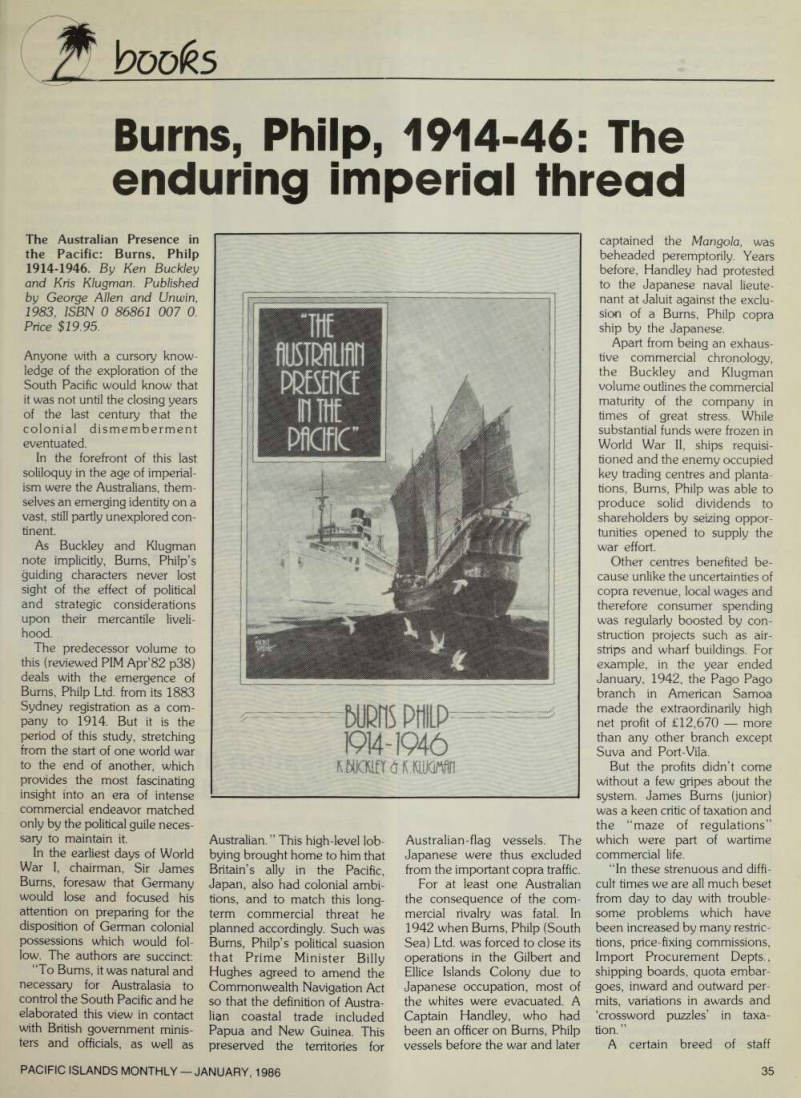
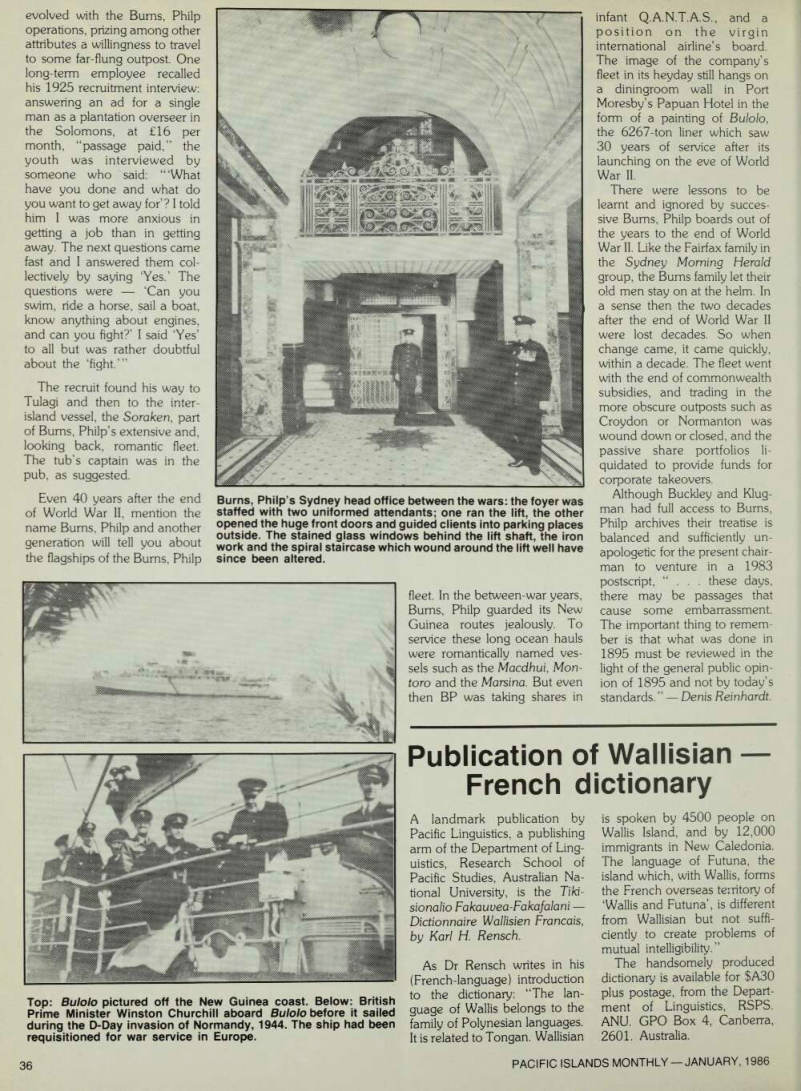
books
Burns, Philp, 1914-46: The enduring imperial thread
The Australian Presence in the Pacific: Burns, Philp 1914-1946. By Ken Buckley and Kris Klugman. Published by George Allen and Unwin,
1983, Isbn 0 86861 007 0.
Price $19.95.
Anyone with a cursory know ledge of the exploration of the South Pacific would know that it was not until the closing years of the last century that the colonial dismemberment eventuated.
In the forefront of this last soliloquy in the age of imperial ism were the Australians, them selves an emerging identity on a vast, still partly unexplored con tinent.
As Buckley and Klugman note implicitly, Bums, Philp’s guiding characters never lost sight of the effect of political and strategic considerations upon their mercantile liveli hood.
The predecessor volume to this (reviewed PIM Apr’B2 p3B) deals with the emergence of Burns, Philp Ltd. from its 1883 Sydney registration as a com pany to 1914. But it is the period of this study, stretching from the start of one world war to the end of another, which provides the most fascinating insight into an era of intense commercial endeavor matched only by the political guile neces sary to maintain it.
In the earliest days of World War I, chairman, Sir James Burns, foresaw that Germany would lose and focused his attention on preparing for the disposition of German colonial possessions which would fol low. The authors are succinct: “To Bums, it was natural and necessary for Australasia to control the South Pacific and he elaborated this view in contact with British government minis ters and officials, as well as
Australian.” This high-level lob bying brought home to him that Britain’s ally in the Pacific, Japan, also had colonial ambi tions, and to match this long term commercial threat he planned accordingly. Such was Burns, Philp’s political suasion that Prime Minister Billy Hughes agreed to amend the Commonwealth Navigation Act so that the definition of Austra lian coastal trade included Papua and New Guinea. This preserved the territories for
Australian-flag vessels. The Japanese were thus excluded from the important copra traffic.
For at least one Australian the consequence of the com mercial rivalry was fatal. In 1942 when Bums, Philp (South Sea) Ltd. was forced to close its operations in the Gilbert and Ellice Islands Colony due to Japanese occupation, most of the whites were evacuated. A Captain Handley, who had been an officer on Burns, Philp vessels before the war and later
captained the Mangold, was beheaded peremptorily. Years before, Handley had protested to the Japanese naval lieute nant at Jaluit against the exclu sion of a Burns, Philp copra ship by the Japanese.
Apart from being an exhaus tive commercial chronology, the Buckley and Klugman volume outlines the commercial maturity of the company in times of great stress. While substantial funds were frozen in World War 11, ships requisi tioned and the enemy occupied key trading centres and planta tions, Bums, Philp was able to produce solid dividends to shareholders by seizing oppor tunities opened to supply the war effort.
Other centres benefited be cause unlike the uncertainties of copra revenue, local wages and therefore consumer spending was regularly boosted by con struction projects such as air strips and wharf buildings. For example, in the year ended January, 1942, the Pago Pago branch in American Samoa made the extraordinarily high net profit of £12,670 more than any other branch except Suva and Port-Vila.
But the profits didn’t come without a few gripes about the system. James Bums (junior) was a keen critic of taxation and the “maze of regulations” which were part of wartime commercial life.
“In these strenuous and diffi cult times we are all much beset from day to day with trouble some problems which have been increased by many restric tions, price-fixing commissions, Import Procurement Depts., shipping boards, quota embar goes, inward and outward per mits, variations in awards and ‘crossword puzzles’ in taxa tion.”
A certain breed of staff
evolved with the Burns, Philp operations, prizing among other attributes a willingness to travel to some far-flung outpost. One long-term employee recalled his 1925 recruitment interview: answering an ad for a single man as a plantation overseer in the Solomons, at £l6 per month, “passage paid,” the youth was interviewed by someone who said: ‘“What have you done and what do you want to get away for’? I told him I was more anxious in getting a job than in getting away. The next questions came fast and I answered them col lectively by saying ‘Yes.’ The questions were ‘Can you swim, ride a horse, sail a boat, know anything about engines, and can you fight?’ I said ‘Yes’ to all but was rather doubtful about the ‘fight.’”
The recruit found his way to Tulagi and then to the inter island vessel, the Soraken, part of Bums, Philp’s extensive and, looking back, romantic fleet.
The tub’s captain was in the pub, as suggested.
Even 40 years after the end of World War 11, mention the name Bums, Philp and another generation will tell you about the flagships of the Bums, Philp
fleet. In the between-war years, Bums, Philp guarded its New Guinea routes jealously. To service these long ocean hauls were romantically named ves sels such as the Macdhui, Mon toro and the Marsina. But even then BP was taking shares in
infant Q.A.N.T.A.S., and a position on the virgin international airline’s board.
The image of the company’s fleet in its heyday still hangs on a diningroom wall in Port Moresby’s Papuan Hotel in the form of a painting of Bu/o/o, the 6267-ton liner which saw 30 years of service after its launching on the eve of World War 11.
There were lessons to be leamt and ignored by succes sive Bums, Philp boards out of the years to the end of World War 11. Like the Fairfax family in the Sydney Morning Herald group, the Burns family let their old men stay on at the helm. In a sense then the two decades after the end of World War 11 were lost decades. So when change came, it came quickly, within a decade. The fleet went with the end of commonwealth subsidies, and trading in the more obscure outposts such as Croydon or Normanton was wound down or closed, and the passive share portfolios li quidated to provide funds for corporate takeovers.
Although Buckley and Klug man had full access to Bums, Philp archives their treatise is balanced and sufficiently un apologetic for the present chair man to venture in a 1983 postscript, “. . . these days, there may be passages that cause some embarrassment.
The important thing to remem ber is that what was done in 1895 must be reviewed in the light of the general public opin ion of 1895 and not by today’s
standards. ”
Denis Reinhardt.
Top: Bulolo pictured off the New Guinea coast. Below: British Prime Minister Winston Churchill aboard Bulolo before it sailed during the D-Day invasion of Normandy, 1944. The ship had been requisitioned for war service in Europe.
Burns, Philp’s Sydney head office between the wars: the foyer was staffed with two uniformed attendants; one ran the lift, the other opened the huge front doors and guided clients into parking places outside. The stained glass windows behind the lift shaft, the iron work and the spiral staircase which wound around the lift well have since been altered.
French dictionary
Publication of Wallisian - French dictionary
A landmark publication by Pacific Linguistics, a publishing arm of the Department of Linguistics, Research School of Pacific Studies, Australian National University, is the Tikisionalio Fakauuea-Fakafalani Dictionnaire Wallisien Francois, by Karl H. Rensch.
As Dr Rensch writes in his (French-language) introduction to the dictionary: “The language of Wallis belongs to the family of Polynesian languages.
It is related to Tongan. Wallisian
is spoken by 4500 people on Wallis Island, and by 12,000 immigrants in New Caledonia, The language of Futuna, the island which, with Wallis, forms the French overseas territory of ‘Wallis and Futuna , is different from Wallisian but not suffi ciently to create problems of mutual intelligibility. ”
The handsomely produced dictionary is available for SA3O plus postage, from the Depart ment of Linguistics, RSPS.
ANU. GPO Box 4, Canberra, 2601. Australia.
Tutu experiment
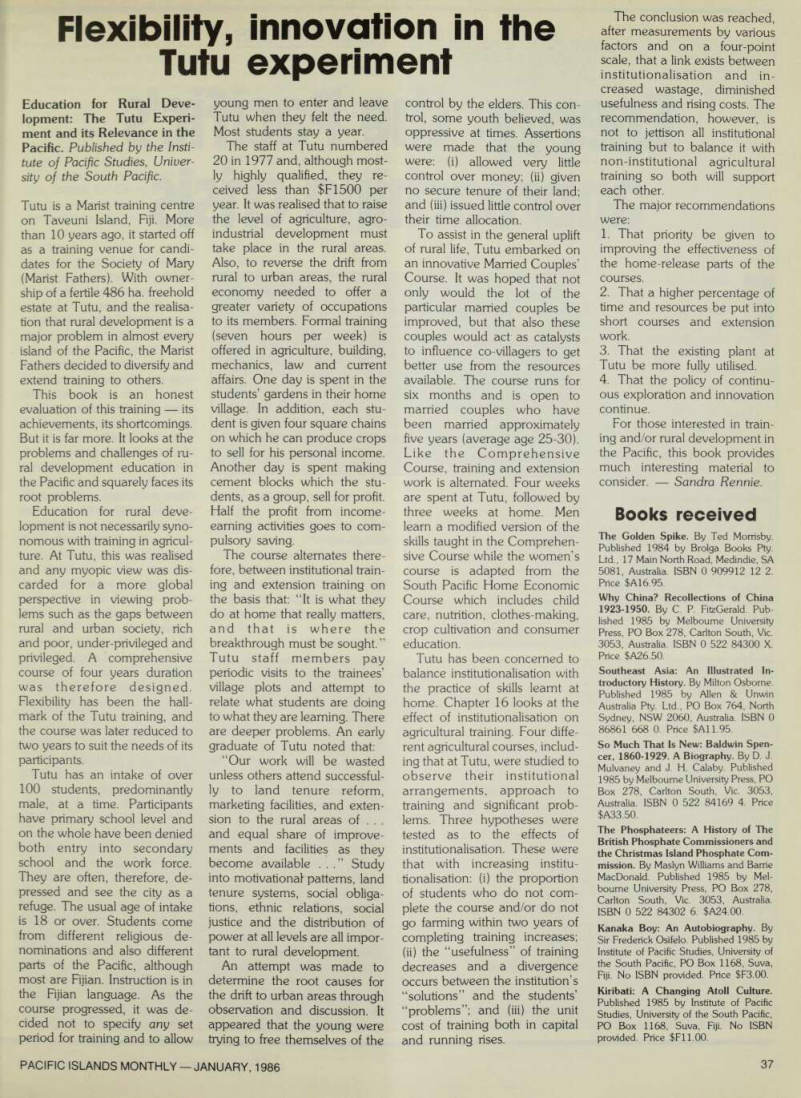
Flexibility, innovation in the Tutu experiment
Education for Rural Deve lopment: The Tutu Experi ment and its Relevance in the Pacific. Published by the Insti tute of Pacific Studies, Univer sity of the South Pacific.
Tutu is a Marist training centre on Taveuni Island, Fiji. More than 10 years ago, it started off as a training venue for candi dates for the Society of Mary (Marist Fathers). With owner ship of a fertile 486 ha. freehold estate at Tutu, and the realisa tion that rural development is a major problem in almost every island of the Pacific, the Marist Fathers decided to diversify and extend training to others.
This book is an honest evaluation of this training its achievements, its shortcomings.
But it is far more. It looks at the problems and challenges of ru ral development education in the Pacific and squarely faces its root problems.
Education for rural deve lopment is not necessarily syno nomous with training in agricul ture. At Tutu, this was realised and any myopic view was dis carded for a more global perspective in viewing prob lems such as the gaps between mral and urban society, rich and poor, under-privileged and privileged. A comprehensive course of four years duration was therefore designed.
Flexibility has been the hall mark of the Tutu training, and the course was later reduced to two years to suit the needs of its participants.
Tutu has an intake of over 100 students, predominantly male, at a time. Participants have primary school level and on the whole have been denied both entry into secondary school and the work force.
They are often, therefore, de pressed and see the city as a refuge. The usual age of intake is 18 or over. Students come from different religious de nominations and also different parts of the Pacific, although most are Fijian. Instruction is in the Fijian language. As the course progressed, it was de cided not to specify any set period for training and to allow
young men to enter and leave Tutu when they felt the need.
Most students stay a year.
The staff at Tutu numbered 20 in 1977 and, although most ly highly qualified, they re ceived less than SFISOO per year. It was realised that to raise the level of agriculture, agro industrial development must take place in the rural areas.
Also, to reverse the drift from rural to urban areas, the rural economy needed to offer a greater variety of occupations to its members. Formal training (seven hours per week) is offered in agriculture, building, mechanics, law and current affairs. One day is spent in the students’ gardens in their home village. In addition, each stu dent is given four square chains on which he can produce crops to sell for his personal income.
Another day is spent making cement blocks which the stu dents, as a group, sell for profit.
Half the profit from income earning activities goes to com pulsory saving.
The course alternates there fore, between institutional train ing and extension training on the basis that: “It is what they do at home that really matters, and that is where the breakthrough must be sought. ”
Tutu staff members pay periodic visits to the trainees’ village plots and attempt to relate what students are doing to what they are learning. There are deeper problems. An early graduate of Tutu noted that; “Our work will be wasted unless others attend successful ly to land tenure reform, marketing facilities, and exten sion to the rural areas of . . . and equal share of improve ments and facilities as they become available ...” Study into motivational patterns, land tenure systems, social obliga tions, ethnic relations, social justice and the distribution of power at all levels are all impor tant to rural development.
An attempt was made to determine the root causes for the drift to urban areas through observation and discussion. It appeared that the young were trying to free themselves of the
control by the elders. This con trol, some youth believed, was oppressive at times. Assertions were made that the young were: (i) allowed very little control over money; (ii) given no secure tenure of their land; and (iii) issued little control over their time allocation.
To assist in the general uplift of rural life, Tutu embarked on an innovative Married Couples’
Course. It was hoped that not only would the lot of the particular married couples be improved, but that also these couples would act as catalysts to influence co-villagers to get better use from the resources available. The course runs for six months and is open to married couples who have been married approximately five years (average age 25-30).
Like the Comprehensive Course, training and extension work is alternated. Four weeks are spent at Tutu, followed by three weeks at home. Men learn a modified version of the skills taught in the Comprehen sive Course while the women’s course is adapted from the South Pacific Home Economic Course which includes child care, nutrition, clothes-making, crop cultivation and consumer education.
Tutu has been concerned to balance institutionalisation with the practice of skills learnt at home. Chapter 16 looks at the effect of institutionalisation on agricultural training. Four diffe rent agricultural courses, includ ing that at Tutu, were studied to observe their institutional arrangements, approach to training and significant prob lems. Three hypotheses were tested as to the effects of institutionalisation. These were that with increasing institu tionalisation: (i) the proportion of students who do not com plete the course and/or do not go farming within two years of completing training increases; (ii) the “usefulness” of training decreases and a divergence occurs between the institution’s “solutions” and the students’
“problems”; and (iii) the unit cost of training both in capital and running rises.
The conclusion was reached, after measurements by various factors and on a four-point scale, that a link exists between institutionalisation and in creased wastage, diminished usefulness and rising costs. The
recommendation, however, is
not to jettison all institutional training but to balance it with
non-institutional agricultural
training so both will support each other.
The major recommendations were: 1. That priority be given to improving the effectiveness of the home-release parts of the courses. 2. That a higher percentage of time and resources be put into short courses and extension work. 3. That the existing plant at Tutu be more fully utilised. 4. That the policy of continu ous exploration and innovation continue.
For those interested in train ing and/or rural development in the Pacific, this book provides much interesting material to consider. — Sandra Rennie.
Books received
The Golden Spike. By Ted Morrisby.
Published 1984 by Brolga Books Pty.
Ltd., 17 Main North Road, Medindie, SA 5081, Australia. ISBN 0 909912 12 2.
Price SA16.95.
Why China? Recollections of China 1923-1950. By C. P. FitzGerald. Pub lished 1985 by Melbourne University Press, PO Box 278, Carlton South, Vic. 3053, Australia. ISBN 0 522 84300 X.
Price SA26.50.
Southeast Asia: An Illustrated In troductory History. By Milton Osborne.
Published 1985 by Allen & Unwin Australia Pty. Ltd., PO Box 764, North Sydney, NSW 2060, Australia. ISBN 0 86861 668 0. Price SA11.95.
So Much That Is New: Baldwin Spen cer, 1860-1929. A Biography. By D. J.
Mulvaney and J. H. Calaby. Published 1985 by Melbourne University Press, PO Box 278, Carlton South, Vic. 3053, Australia. ISBN 0 522 84169 4. Price SA33.50.
The Phosphateers: A History of The British Phosphate Commissioners and the Christmas Island Phosphate Com mission. By Maslyn Williams and Barrie MacDonald. Published 1985 by Mel bourne University Press, PO Box 278, Carlton South, Vic. 3053, Australia.
Isbn 0 522 84302 6. Sa24.00.
Kanaka Boy: An Autobiography. By Sir Frederick Osifelo. Published 1985 by Institute of Pacific Studies, University of the South Pacific, PO Box 1168, Suva, Fiji. No ISBN provided. Price $F3.00.
Kiribati: A Changing Atoll Culture.
Published 1985 by Institute of Pacific Studies, University of the South Pacific, PO Box 1168, Suva, Fiji. No ISBN provided. Price $F11.00.
approaching crisis
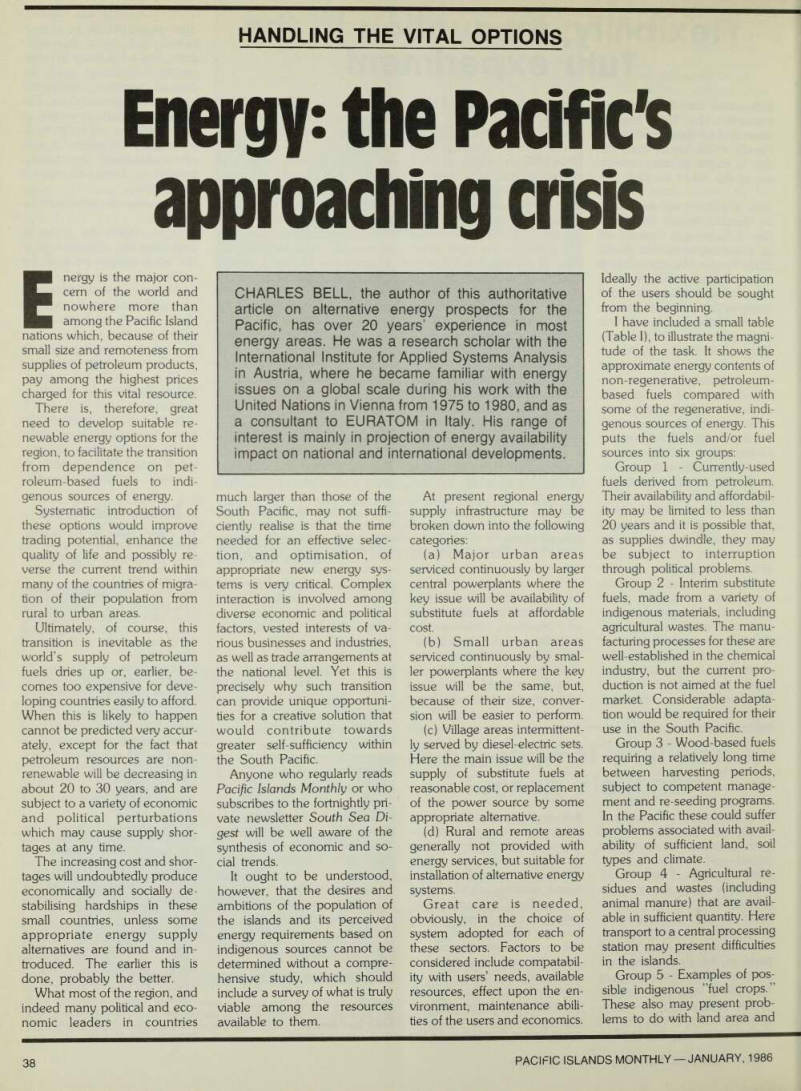
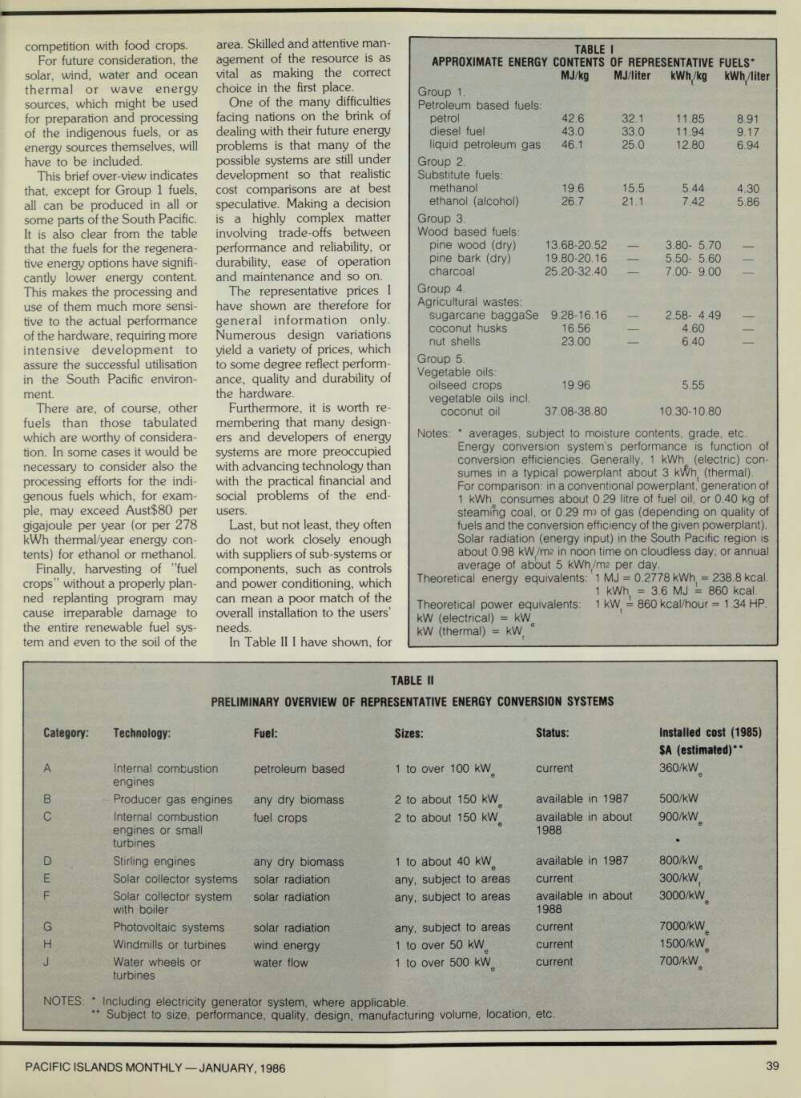
Handling The Vital Options
Energy: the Pacific's approaching crisis
Energy is the major con cern of the world and nowhere more than among the Pacific Island nations which, because of their small size and remoteness from supplies of petroleum products, pay among the highest prices charged for this vital resource.
There is, therefore, great need to develop suitable re newable energy options for the region, to facilitate the transition from dependence on pet roleum-based fuels to indi genous sources of energy.
Systematic introduction of these options would improve trading potential, enhance the quality of life and possibly re verse the current trend within many of the countries of migra tion of their population from rural to urban areas.
Ultimately, of course, this transition is inevitable as the world’s supply of petroleum fuels dries up or, earlier, be comes too expensive for deve loping countries easily to afford.
When this is likely to happen cannot be predicted very accur ately, except for the fact that petroleum resources are non renewable will be decreasing in about 20 to 30 years, and are subject to a variety of economic and political perturbations which may cause supply shor tages at any time.
The increasing cost and shor tages will undoubtedly produce economically and socially de stabilising hardships in these small countries, unless some appropriate energy supply alternatives are found and in troduced. The earlier this is done, probably the better.
What most of the region, and indeed many political and eco nomic leaders in countries
CHARLES BELL, the author of this authoritative article on alternative energy prospects for the Pacific, has over 20 years’ experience in most energy areas. He was a research scholar with the International Institute for Applied Systems Analysis in Austria, where he became familiar with energy issues on a global scale during his work with the United Nations in Vienna from 1975 to 1980, and as a consultant to EURATOM in Italy. His range of interest is mainly in projection of energy availability impact on national and international developments.
much larger than those of the South Pacific, may not suffi ciently realise is that the time needed for an effective selec tion, and optimisation, of appropriate new energy sys tems is very critical. Complex interaction is involved among diverse economic and political factors, vested interests of va rious businesses and industries, as well as trade arrangements at the national level. Yet this is precisely why such transition can provide unique opportuni ties for a creative solution that would contribute towards greater self-sufficiency within the South Pacific.
Anyone who regularly reads Pacific Islands Monthly or who subscribes to the fortnightly pri vate newsletter South Sea Di gest will be well aware of the synthesis of economic and so cial trends.
It ought to be understood, however, that the desires and ambitions of the population of the islands and its perceived energy requirements based on indigenous sources cannot be determined without a compre hensive study, which should include a survey of what is truly viable among the resources available to them.
At present regional energy supply infrastructure may be broken down into the following categories: (a) Major urban areas serviced continuously by larger central powerplants where the key issue will be availability of substitute fuels at affordable cost. (b) Small urban areas serviced continuously by smal ler powerplants where the key issue will be the same, but, because of their size, conver sion will be easier to perform. (c) Village areas intermittent ly served by diesel-electric sets.
Here the main issue will be the supply of substitute fuels at reasonable cost, or replacement of the power source by some appropriate alternative. (d) Rural and remote areas generally not provided with energy services, but suitable for installation of alternative energy systems.
Great care is needed, obviously, in the choice of system adopted for each of these sectors. Factors to be considered include compatabil ity with users’ needs, available resources, effect upon the en vironment, maintenance abili ties of the users and economics.
Ideally the active participation of the users should be sought from the beginning.
I have included a small table (Table I), to illustrate the magni tude of the task. It shows the approximate energy contents of non-regenerative, petroleum based fuels compared with some of the regenerative, indi genous sources of energy. This puts the fuels and/or fuel sources into six groups: Group 1 - Currently-used fuels derived from petroleum.
Their availability and affordabil ity may be limited to less than 20 years and it is possible that, as supplies dwindle, they may be subject to interruption through political problems.
Group 2 - Interim substitute fuels, made from a variety of indigenous materials, including agricultural wastes. The manu facturing processes for these are well-established in the chemical industry, but the current pro duction is not aimed at the fuel market. Considerable adapta tion would be required for their use in the South Pacific.
Group 3 - Wood-based fuels requiring a relatively long time between harvesting periods, subject to competent manage ment and re-seeding programs.
In the Pacific these could suffer problems associated with avail ability of sufficient land, soil types and climate.
Group 4 - Agricultural re sidues and wastes (including animal manure) that are avail able in sufficient quantity. Here transport to a central processing station may present difficulties in the islands.
Group 5 - Examples of pos sible indigenous ’’fuel crops.”
These also may present prob lems to do with land area and
competition with food crops.
For future consideration, the solar, wind, water and ocean thermal or wave energy sources, which might be used for preparation and processing of the indigenous fuels, or as energy sources themselves, will have to be included.
This brief over-view indicates that, except for Group 1 fuels, all can be produced in all or some parts of the South Pacific.
It is also clear from the table that the fuels for the regenera tive energy options have signifi cantly lower energy content.
This makes the processing and use of them much more sensi tive to the actual performance of the hardware, requiring more intensive development to assure the successful utilisation in the South Pacific environ ment.
There are, of course, other fuels than those tabulated which are worthy of considera tion. In some cases it would be necessary to consider also the processing efforts for the indi genous fuels which, for exam ple, may exceed AustsBo per gigajoule per year (or per 278 kWh thermal/year energy con tents) for ethanol or methanol.
Finally, harvesting of ’’fuel crops” without a properly plan ned replanting program may cause irreparable damage to the entire renewable fuel sys tem and even to the soil of the
area. Skilled and attentive man agement of the resource is as vital as making the correct choice in the first place.
One of the many difficulties facing nations on the brink of dealing with their future energy problems is that many of the possible systems are still under development so that realistic cost comparisons are at best speculative. Making a decision is a highly complex matter involving trade-offs between performance and reliability, or durability, ease of operation and maintenance and so on.
The representative prices I have shown are therefore for general information only.
Numerous design variations yield a variety of prices, which to some degree reflect perform ance, quality and durability of the hardware.
Furthermore, it is worth re membering that many design ers and developers of energy systems are more preoccupied with advancing technology than with the practical financial and social problems of the end users.
Last, but not least, they often do not work closely enough with suppliers of sub-systems or components, such as controls and power conditioning, which can mean a poor match of the overall installation to the users’ needs.
In Table II I have shown, for
Table 1
Approximate Energy Contents Of Representative Fuels*
MJ/kg MJ/llter
kWh/kg
kWlyilter
Group 1.
Petroleum based fuels; petrol 42.6 32.1 11.85 8,91 diesel fuel 43.0 33.0 11.94 9.17 liquid petroleum gas 46.1 25.0 12.80 6.94 Group 2.
Substitute fuels: methanol 19.6 15.5 5.44 4.30 ethanol (alcohol) 26.7 21.1 7.42 5,86 Group 3.
Wood based fuels: pine wood (dry) 13.68-20.52 — 3.80- 5.70 — pine bark (dry) 19.80-20.16 — 5.50- 5.60 — charcoal 25.20-32.40 — 7.00- 9.00 — Group 4.
Agricultural wastes: sugarcane baggaSe 9.28-16.16 — 2.58- 4.49 — coconut husks 16.56 4.60 — nut shells 23.00 — 6.40 — Group 5.
Vegetable oils; oilseed crops 19.96 5.55 vegetable oils incl. coconut oil 37.08-38.80 10.30-10.80 Notes: * averages, subject to moisture contents, grade, etc.
Energy conversion system's performance is function of conversion efficiencies. Generally, 1 kWh (electric) consumes in a typical powerplant about 3 kwh (thermal).
For comparison: in a conventional powerplant, generation of 1 kWh consumes about 0.29 litre of fuel oil, or 0.40 kg of steaming coal, or 0.29 ma of gas (depending on quality of fuels and the conversion efficiency of the given powerplant).
Solar radiation (energy input) in the South Pacific region is about 0.98 kW/ma in noon time on cloudless day; or annual average of about 5 kWh/ma per day.
Theoretical energy equivalents: 1 MJ = 0.2778 kWh = 238.8 kcal. 1 kWh = 3.6 MJ = 860 kcal.
Theoretical power equivalents. 1 kW, = 860 kcal/hour = 1,34 HP. kW (electrical) = kW kW (thermal) = kW e
Table Ii
PRELIMINARY OVERVIEW OF REPRESENTATIVE ENERGY CONVERSION SYSTEMS Category: Technology: Fuel: Sizes: Status: Installed cost (1985) $A (estimated)** A Internal combustion petroleum based 1 to over 100 kW g current 360/kW e engines B Producer gas engines any dry biomass 2 to about 150 kW e available in 1987 500/kW C Internal combustion fuel crops 2 to about 150 kW e available in about 900/kW e engines or small 1988 turbines • D Stirling engines any dry biomass 1 to about 40 kW e available in 1987 800/kW e E Solar collector systems solar radiation any, subject to areas current 300/kW ( F Solar collector system solar radiation any, subject to areas available in about 3000/kW e with boiler 1988 G Photovoltaic systems solar radiation any, subject to areas current 7000/kW e H Windmills or turbines wind energy 1 to over 50 kW e current 1500/kW e J Water wheels or water flow 1 to over 500 kW g current 700/kW e turbines
Notes:
* Including electricity generator system, where applicable. ** Subject to size, performance, quality, design, manufacturing volume, location, etc.
purposes of comparison, the figures
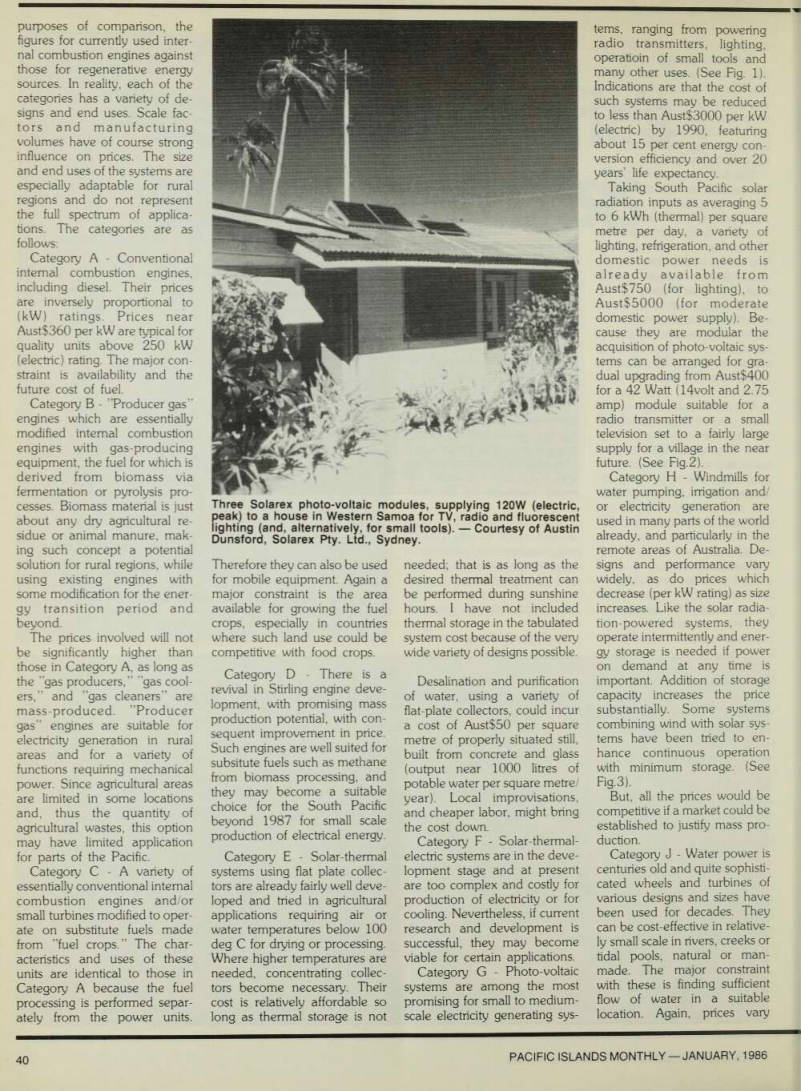
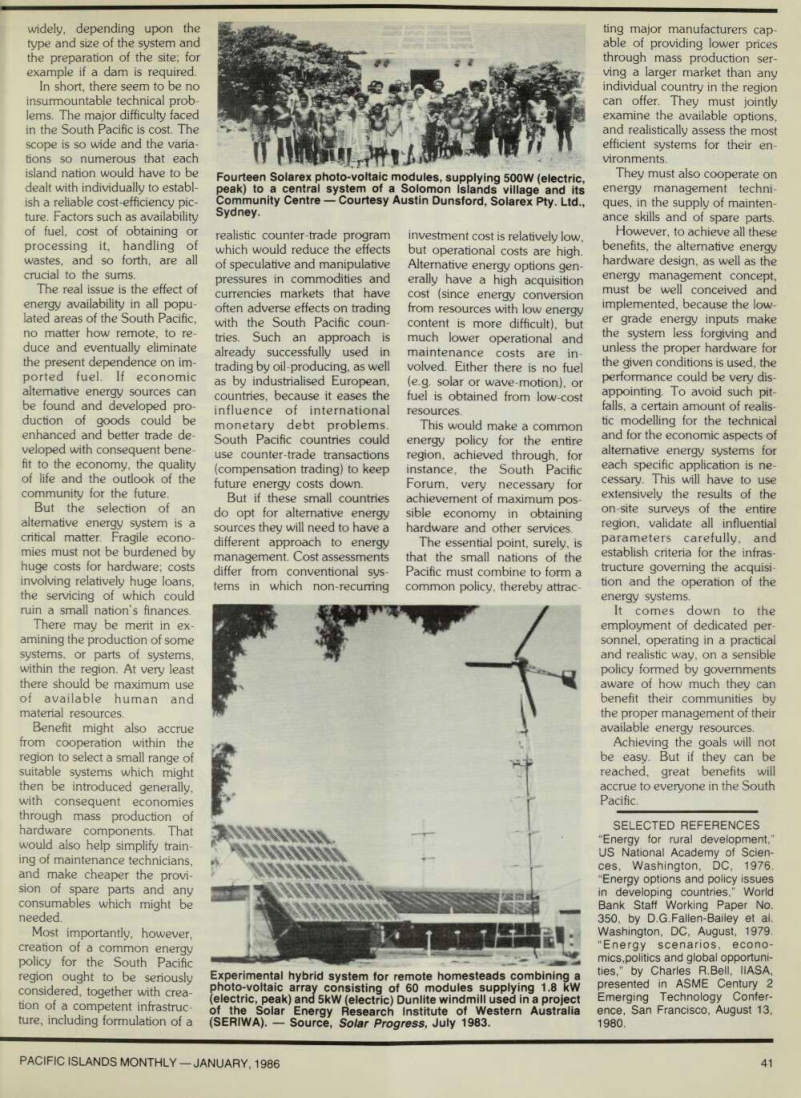
figures for currently used inter nal combustion engines against those for regenerative energy sources. In reality, each of the categories has a variety of de signs and end uses. Scale fac tors and manufacturing volumes have of course strong influence on prices. The size and end uses of the systems are especially adaptable for rural regions and do not represent the full spectrum of applica tions. The categories are as follows: Category A - Conventional internal combustion engines, including diesel. Their prices are inversely proportional to (kW) ratings. Prices near Austs36o per kW are typical for quality units above 250 kW (electric) rating. The major con straint is availability and the future cost of fuel.
Category B - ’’Producer gas” engines which are essentially modified internal combustion engines with gas-producing equipment, the fuel for which is derived from biomass via fermentation or pyrolysis pro cesses. Biomass material is just about any dry agricultural re sidue or animal manure, mak ing such concept a potential solution for rural regions, while using existing engines with some modification for the ener gy transition period and beyond.
The prices involved will not be significantly higher than those in Category A, as long as the ”gas producers,” ”gas cool ers,” and ”gas cleaners” are mass-produced. ’’Producer gas” engines are suitable for electricity generation in rural areas and for a variety of functions requiring mechanical power. Since agricultural areas are limited in some locations and, thus the quantity of agricultural wastes, this option may have limited application for parts of the Pacific.
Category C - A variety of essentially conventional internal combustion engines and/or small turbines modified to oper ate on substitute fuels made from ’’fuel crops.” The char acteristics and uses of these units are identical to those in Category A because the fuel processing is performed separ ately from the power units.
Therefore they can also be used for mobile equipment. Again a major constraint is the area available for growing the fuel crops, especially in countries where such land use could be competitive with food crops.
Category D - There is a revival in Stirling engine deve lopment, with promising mass production potential, with con sequent improvement in price.
Such engines are well suited for subsitute fuels such as methane from biomass processing, and they may become a suitable choice for the South Pacific beyond 1987 for small scale production of electrical energy.
Category E - Solar-thermal systems using flat plate collec tors are already fairly well deve loped and tried in agricultural applications requiring air or water temperatures below 100 deg C for drying or processing.
Where higher temperatures are needed, concentrating collec tors become necessary. Their cost is relatively affordable so long as thermal storage is not
needed; that is as long as the desired thermal treatment can be performed during sunshine hours. I have not included thermal storage in the tabulated system cost because of the very wide variety of designs possible.
Desalination and purification of water, using a variety of flat-plate collectors, could incur a cost of Austsso per square metre of properly situated still, built from concrete and glass (output near 1000 litres of potable water per square metre/ year). Local improvisations, and cheaper labor, might bring the cost down.
Category F - Solar-thermal electric systems are in the deve lopment stage and at present are too complex and costly for production of electricity or for cooling. Nevertheless, if current research and development is successful, they may become viable for certain applications.
Category G - Photo-voltaic systems are among the most promising for small to medium scale electricity generating sys
terns, ranging from powering radio transmitters, lighting, operatioin of small tools and many other uses. (See Fig. 1).
Indications are that the cost of such systems may be reduced to less than Austs3ooo per kW (electric) by 1990, featuring about 15 per cent energy con version efficiency and over 20 years’ life expectancy.
Taking South Pacific solar radiation inputs as averaging 5 to 6 kWh (thermal) per square metre per day, a variety of lighting, refrigeration, and other domestic power needs is already available from Austs7so (for lighting), to Austssooo (for moderate domestic power supply). Be cause they are modular the acquisition of photo-voltaic sys tems can be arranged for gra dual upgrading from Austs4oo for a 42 Watt (14volt and 2.75 amp) module suitable for a radio transmitter or a small television set to a fairly large supply for a village in the near future. (See Fig. 2).
Category H - Windmills for water pumping, irrigation and/ or electricity generation are used in many parts of the world already, and particularly in the remote areas of Australia. De signs and performance vary widely, as do prices which decrease (per kW rating) as size increases. Like the solar radia tion-powered systems, they operate intermittently and ener gy storage is needed if power on demand at any time is important. Addition of storage capacity increases the price substantially. Some systems combining wind with solar sys tems have been tried to en hance continuous operation with minimum storage. (See Fig. 3).
But, all the prices would be competitive if a market could be established to justify mass pro duction.
Category J - Water power is centuries old and quite sophisti cated wheels and turbines of various designs and sizes have been used for decades. They can be cost-effective in relative ly small scale in rivers, creeks or tidal pools, natural or man made. The major constraint with these is finding sufficient flow of water in a suitable location. Again, prices vary
Three Solarex photo-voltaic modules, supplying 120W (electric, peak) to a house in Western Samoa for TV, radio and fluorescent lighting (and, alternatively, for small tools). Courtesy of Austin Dunsford, Solarex Pty. Ltd., Sydney.
widely, depending upon the type and size of the system and the preparation of the site; for example if a dam is required.
In short, there seem to be no insurmountable technical prob lems. The major difficulty faced in the South Pacific is cost. The scope is so wide and the varia tions so numerous that each island nation would have to be dealt with individually to establ ish a reliable cost-efficiency pic ture. Factors such as availability of fuel, cost of obtaining or processing it, handling of wastes, and so forth, are all crucial to the sums.
The real issue is the effect of energy availability in all popu lated areas of the South Pacific, no matter how remote, to re duce and eventually eliminate the present dependence on im ported fuel. If economic alternative energy sources can be found and developed pro duction of goods could be enhanced and better trade de veloped with consequent bene fit to the economy, the quality of life and the outlook of the community for the future.
But the selection of an alternative energy system is a critical matter. Fragile econo mies must not be burdened by huge costs for hardware; costs involving relatively huge loans, the servicing of which could ruin a small nation’s finances.
There may be merit in ex amining the production of some systems, or parts of systems, within the region. At very least there should be maximum use of available human and material resources.
Benefit might also accrue from cooperation within the region to select a small range of suitable systems which might then be introduced generally, with consequent economies through mass production of hardware components. That would also help simplify train ing of maintenance technicians, and make cheaper the provi sion of spare parts and any consumables which might be needed.
Most importantly, however, creation of a common energy policy for the South Pacific region ought to be seriously considered, together with crea tion of a competent infrastruc ture, including formulation of a
realistic counter-trade program which would reduce the effects of speculative and manipulative pressures in commodities and currencies markets that have often adverse effects on trading with the South Pacific coun tries. Such an approach is already successfully used in trading by oil-producing, as well as by industrialised European, countries, because it eases the influence of international monetary debt problems.
South Pacific countries could use counter-trade transactions (compensation trading) to keep future energy costs down.
But if these small countries do opt for alternative energy sources they will need to have a different approach to energy management. Cost assessments differ from conventional sys tems in which non-recurring
investment cost is relatively low, but operational costs are high.
Alternative energy options gen erally have a high acquisition cost (since energy conversion from resources with low energy content is more difficult), but much lower operational and maintenance costs are in volved. Either there is no fuel (e.g. solar or wave-motion), or fuel is obtained from low-cost resources.
This would make a common energy policy for the entire region, achieved through, for instance, the South Pacific Forum, very necessary for achievement of maximum pos sible economy in obtaining hardware and other services.
The essential point, surely, is that the small nations of the Pacific must combine to form a common policy, thereby attrac-
ting major manufacturers cap able of providing lower prices through mass production ser ving a larger market than any individual country in the region can offer. They must jointly examine the available options, and realistically assess the most efficient systems for their en vironments.
They must also cooperate on energy management techni ques, in the supply of mainten ance skills and of spare parts.
However, to achieve all these benefits, the alternative energy hardware design, as well as the energy management concept, must be well conceived and implemented, because the low er grade energy inputs make the system less forgiving and unless the proper hardware for the given conditions is used, the performance could be very dis appointing. To avoid such pit falls, a certain amount of realis tic modelling for the technical and for the economic aspects of alternative energy systems for each specific application is ne cessary. This will have to use extensively the results of the on-site surveys of the entire region, validate all influential parameters carefully, and establish criteria for the infras tructure governing the acquisi tion and the operation of the energy systems.
It comes down to the employment of dedicated per sonnel, operating in a practical and realistic way, on a sensible policy formed by governments aware of how much they can benefit their communities by the proper management of their available energy resources.
Achieving the goals will not be easy. But if they can be reached, great benefits will accrue to everyone in the South Pacific.
Selected References
“Energy for rural development,”
US National Academy of Scien ces, Washington, DC, 1976.
“Energy options and policy issues in developing countries,” World Bank Staff Working Paper No. 350, by D.G.Fallen-Bailey et al.
Washington, DC, August, 1979.
“Energy scenarios, econo mics,politics and global opportuni ties,” by Charles R.Bell, NASA, presented in ASME Century 2 Emerging Technology Confer ence, San Francisco, August 13, 1980.
Fourteen Solarex photo-voltaic modules, supplying 500W (electric, peak) to a central system of a Solomon Islands village and its Community Centre Courtesy Austin Dunsford, Solarex Pty. Ltd., Sydney.
Experimental hybrid system for remote homesteads combining a photo-voltaic array consisting of 60 modules supplying 1.8 kW (electric, peak) and 5kW (electric) Dunlite windmill used in a project of the Solar Energy Research Institute of Western Australia (SERIWA). Source, Solar Progress , July 1983.
from the islands press
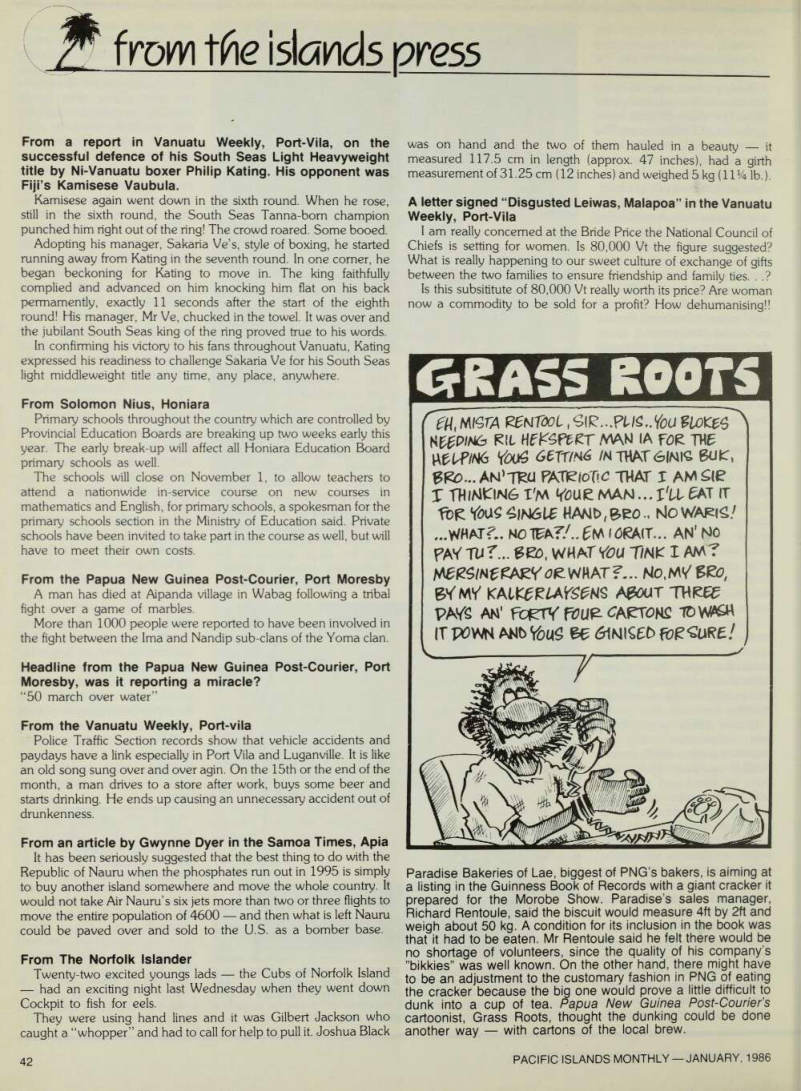
From a report in Vanuatu Weekly, Port-Vila, on the successful defence of his South Seas Light Heavyweight title by Ni-Vanuatu boxer Philip Kating. His opponent was Fiji’s Kamisese Vaubula.
Kamisese again went down in the sixth round. When he rose, still in the sixth round, the South Seas Tanna-bom champion punched him right out of the ring! The crowd roared. Some booed.
Adopting his manager, Sakaria Ve’s, style of boxing, he started running away from Kating in the seventh round. In one comer, he began beckoning for Kating to move in. The king faithfully complied and advanced on him knocking him flat on his back permamently, exactly 11 seconds after the start of the eighth round! His manager, Mr Ve, chucked in the towel. It was over and the jubilant South Seas king of the ring proved true to his words.
In confirming his victory to his fans throughout Vanuatu, Kating expressed his readiness to challenge Sakaria Ve for his South Seas light middleweight title any time, any place, anywhere.
From Solomon Nius, Honiara Primary schools throughout the country which are controlled by Provincial Education Boards are breaking up two weeks early this year. The early break-up will affect all Honiara Education Board primary schools as well.
The schools will close on November 1, to allow teachers to attend a nationwide in-service course on new courses in mathematics and English, for primary schools, a spokesman for the primary schools section in the Ministry of Education said. Private schools have been invited to take part in the course as well, but will have to meet their own costs.
From the Papua New Guinea Post-Courier, Port Moresby A man has died at Aipanda village in Wabag following a tribal fight over a game of marbles.
More than 1000 people were reported to have been involved in the fight between the Ima and Nandip sub-clans of the Yoma clan.
Headline from the Papua New Guinea Post-Courier, Port Moresby, was it reporting a miracle?
“50 march over water”
From the Vanuatu Weekly, Port-vila Police Traffic Section records show that vehicle accidents and paydays have a link especially in Port Vila and Luganville. It is like an old song sung over and over agin. On the 15th or the end of the month, a man drives to a store after work, buys some beer and starts drinking. He ends up causing an unnecessary accident out of drunkenness.
From an article by Gwynne Dyer in the Samoa Times, Apia It has been seriously suggested that the best thing to do with the Republic of Nauru when the phosphates run out in 1995 is simply to buy another island somewhere and move the whole country. It would not take Air Nauru’s six jets more than two or three flights to move the entire population of 4600 and then what is left Nauru could be paved over and sold to the U.S. as a bomber base.
From The Norfolk Islander Twenty-two excited youngs lads the Cubs of Norfolk Island had an exciting night last Wednesday when they went down Cockpit to fish for eels.
They were using hand lines and it was Gilbert Jackson who caught a “whopper” and had to call for help to pull it. Joshua Black
was on hand and the two of them hauled in a beauty it measured 117.5 cm in length (approx. 47 inches), had a girth measurement of 31.25 cm (12 inches) and weighed skg (11V 4 lb.).
A letter signed “Disgusted Leiwas, Malapoa” in the Vanuatu Weekly, Port-Vila I am really concerned at the Bride Price the National Council of Chiefs is setting for women. Is 80,000 Vt the figure suggested?
What is really happening to our sweet culture of exchange of gifts between the two families to ensure friendship and family ties. . .?
Is this subsititute of 80,000 Vt really worth its price? Are woman now a commodity to be sold for a profit? How dehumanising!!
Grass Roots
Paradise Bakeries of Lae, biggest of PNG’s bakers, is aiming at a listing in the Guinness Book of Records with a giant cracker it prepared for the Morobe Show. Paradise’s sales manager, Richard Rentoule, said the biscuit would measure 4ft by 2ft and weigh about 50 kg. A condition for its inclusion in the book was that it had to be eaten. Mr Rentoule said he felt there would be no shortage of volunteers, since the quality of his company’s "bikkies" was well known. On the other hand, there might have to be an adjustment to the customary fashion in PNG of eating the cracker because the big one would prove a little difficult to dunk into a cup of tea. Papua New Guinea Post-Courier’s cartoonist, Grass Roots, thought the dunking could be done another way with cartons of the local brew.
surgery to Tonga
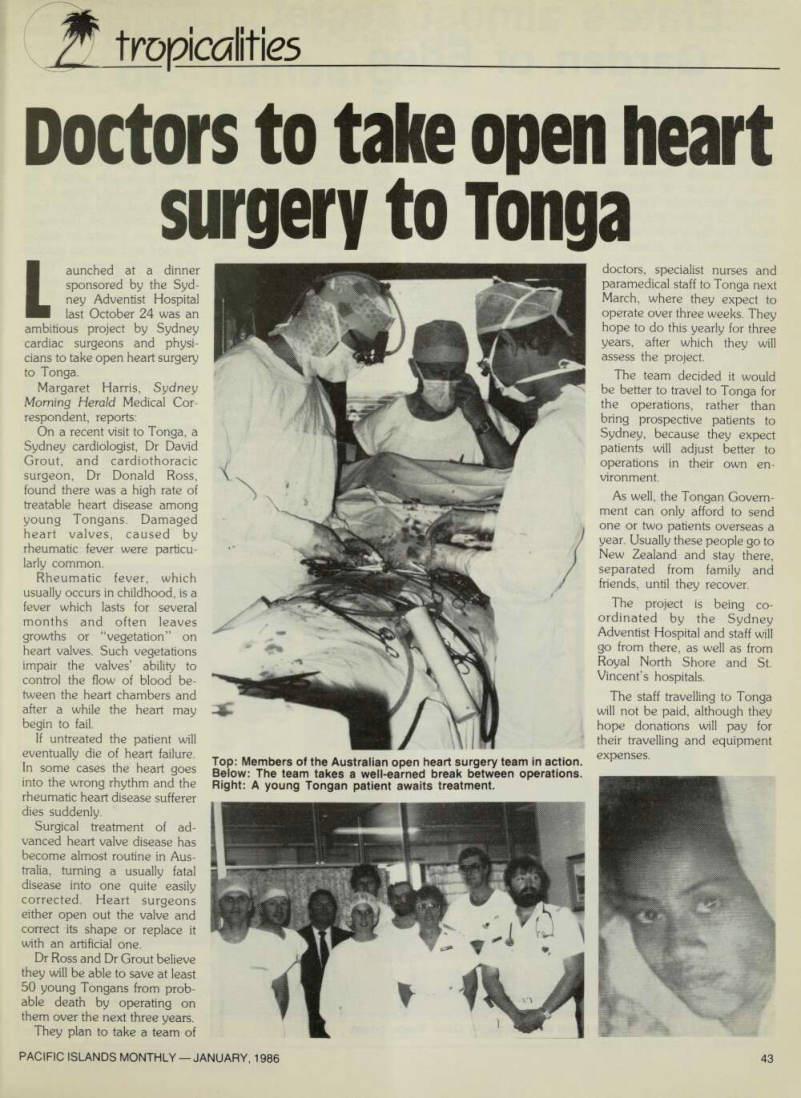
tropicalities
Doctors to take open heart surgery to Tonga
Launched at a dinner sponsored by the Syd ney Adventist Hospital last October 24 was an ambitious project by Sydney cardiac surgeons and physi cians to take open heart surgery to Tonga.
Margaret Harris, Sydney Morning Herald Medical Cor respondent, reports; On a recent visit to Tonga, a Sydney cardiologist, Dr David Grout, and cardiothoracic surgeon, Dr Donald Ross, found there was a high rate of treatable heart disease among young Tongans. Damaged heart valves, caused by rheumatic fever were particu larly common.
Rheumatic fever, which usually occurs in childhood, is a fever which lasts for several months and often leaves growths or “vegetation” on heart valves. Such vegetations impair the valves’ ability to control the flow of blood be tween the heart chambers and after a while the heart may begin to fail.
If untreated the patient will eventually die of heart failure.
In some cases the heart goes into the wrong rhythm and the rheumatic heart disease sufferer dies suddenly.
Surgical treatment of ad vanced heart valve disease has become almost routine in Aus tralia, turning a usually fatal disease into one quite easily corrected. Heart surgeons either open out the valve and correct its shape or replace it with an artificial one.
Dr Ross and Dr Grout believe they will be able to save at least 50 young Tongans from prob able death by operating on them over the next three years.
They plan to take a team of
doctors, specialist nurses and paramedical staff to Tonga next March, where they expect to operate over three weeks. They hope to do this yearly for three years, after which they will assess the project.
The team decided it would be better to travel to Tonga for the operations, rather than bring prospective patients to Sydney, because they expect patients will adjust better to operations in their own en vironment.
As well, the Tongan Govern ment can only afford to send one or two patients overseas a year. Usually these people go to New Zealand and stay there, separated from family and friends, until they recover.
The project is being co ordinated by the Sydney Adventist Hospital and staff will go from there, as well as from Royal North Shore and St.
Vincent’s hospitals.
The staff travelling to Tonga will not be paid, although they hope donations will pay for their travelling and equipment expenses.
Top: Members of the Australian open heart surgery team in action.
Below; The team takes a well-earned break between operations.
Right: A young Tongan patient awaits treatment.
Garden of Eden ...
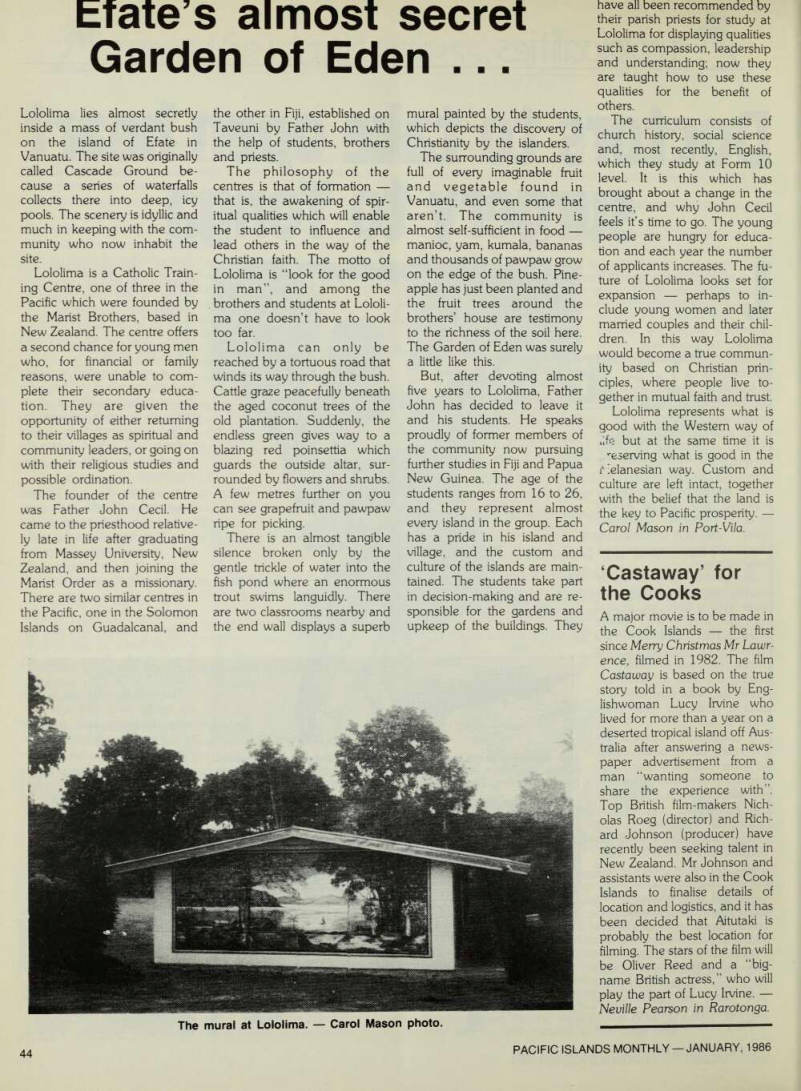
Efate s almost secret Garden of Eden ...
Lololima lies almost secretly inside a mass of verdant bush on the island of Efate in Vanuatu. The site was originally called Cascade Ground be cause a series of waterfalls collects there into deep, icy pools. The scenery is idyllic and much in keeping with the com munity who now inhabit the site.
Lololima is a Catholic Train ing Centre, one of three in the Pacific which were founded by the Marist Brothers, based in New Zealand. The centre offers a second chance for young men who, for financial or family reasons, were unable to com plete their secondary educa tion. They are given the opportunity of either returning to their villages as spiritual and community leaders, or going on with their religious studies and possible ordination.
The founder of the centre was Father John Cecil. He came to the priesthood relative ly late in life after graduating from Massey University, New Zealand, and then joining the Marist Order as a missionary.
There are two similar centres in the Pacific, one in the Solomon Islands on Guadalcanal, and
the other in Fiji, established on Taveuni by Father John with the help of students, brothers and priests.
The philosophy of the centres is that of formation that is, the awakening of spir itual qualities which will enable the student to influence and lead others in the way of the Christian faith. The motto of Lololima is “look for the good in man”, and among the brothers and students at Lololi ma one doesn’t have to look too far.
Lololima can only be reached by a tortuous road that winds its way through the bush.
Cattle graze peacefully beneath the aged coconut trees of the old plantation. Suddenly, the endless green gives way to a blazing red poinsettia which guards the outside altar, sur rounded by flowers and shrubs.
A few metres further on you can see grapefruit and pawpaw ripe for picking.
There is an almost tangible silence broken only by the gentle trickle of water into the fish pond where an enormous trout swims languidly. There are two classrooms nearby and the end wall displays a superb
mural painted by the students, which depicts the discovery of Christianity by the islanders.
The surrounding grounds are full of every imaginable fruit and vegetable found in Vanuatu, and even some that aren’t. The community is almost self-sufficient in food manioc, yam, kumala, bananas and thousands of pawpaw grow on the edge of the bush. Pine apple has just been planted and the fruit trees around the brothers’ house are testimony to the richness of the soil here.
The Garden of Eden was surely a little like this.
But, after devoting almost five years to Lololima, Father John has decided to leave it and his students. He speaks proudly of former members of the community now pursuing further studies in Fiji and Papua New Guinea. The age of the students ranges from 16 to 26, and they represent almost every island in the group. Each has a pride in his island and village, and the custom and culture of the islands are main tained. The students take part in decision-making and are re sponsible for the gardens and upkeep of the buildings. They
have all been recommended by their parish priests for study at Lololima for displaying qualities such as compassion, leadership and understanding; now they are taught how to use these qualities for the benefit of others.
The curriculum consists of church history, social science and, most recently, English, which they study at Form 10 level. It is this which has brought about a change in the centre, and why John Cecil feels it’s time to go. The young people are hungry for educa tion and each year the number of applicants increases. The fu ture of Lololima looks set for expansion — perhaps to in clude young women and later married couples and their chil dren. In this way Lololima would become a true commun ity based on Christian prin ciples, where people live to gether in mutual faith and trust.
Lololima represents what is good with the Western way of life but at the same time it is reserving what is good in the Melanesian way. Custom and culture are left intact, together with the belief that the land is the key to Pacific prosperity. —
Carol Mason in Port-Vila.
The mural at Lololima. Carol Mason photo.
'Castaway’ for
the Cooks
A major movie is to be made in the Cook Islands — the first since Merry Christmas Mr Lawr ence, filmed in 1982. The film Castaway is based on the true story told in a book by Eng lishwoman Lucy Irvine who lived for more than a year on a deserted tropical island off Aus tralia after answering a news paper advertisement from a man “wanting someone to share the experience with”.
Top British film-makers Nich olas Roeg (director) and Rich ard Johnson (producer) have recently been seeking talent in New Zealand. Mr Johnson and assistants were also in the Cook Islands to finalise details of location and logistics, and it has been decided that Aitutaki is probably the best location for filming. The stars of the film will be Oliver Reed and a “big name British actress,” who will play the part of Lucy Irvine. —
Neville Pearson in Rarotonga.
Hawaiian besieged
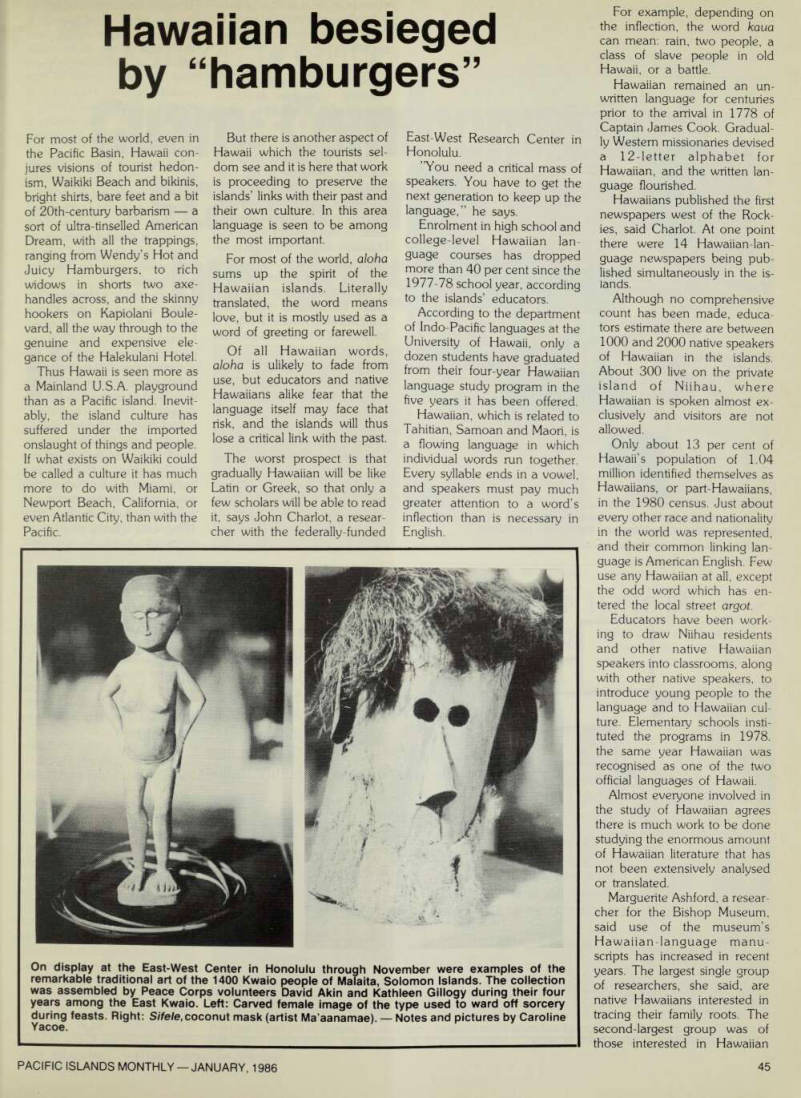
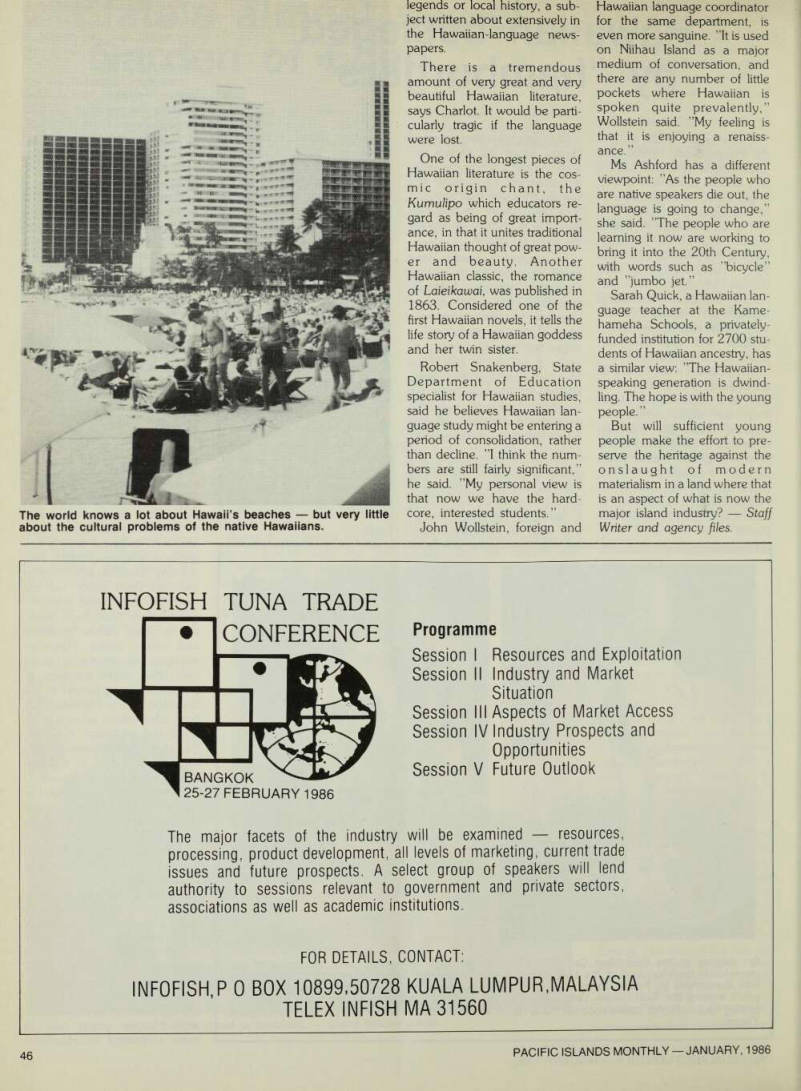
by “hamburgers”
For most of the world, even in the Pacific Basin, Hawaii con jures visions of tourist hedon ism, Waikiki Beach and bikinis, bright shirts, bare feet and a bit of 20th-century barbarism a sort of ultra-tinselled American Dream, with all the trappings, ranging from Wendy’s Hot and Juicy Hamburgers, to rich widows in shorts two axe handles across, and the skinny hookers on Kapiolani Boule vard, all the way through to the genuine and expensive ele gance of the Halekulani Hotel.
Thus Hawaii is seen more as a Mainland U.S.A. playground than as a Pacific island. Inevit ably, the island culture has suffered under the imported onslaught of things and people.
If what exists on Waikiki could be called a culture it has much more to do with Miami, or Newport Beach, California, or even Atlantic City, than with the Pacific.
But there is another aspect of Hawaii which the tourists sel dom see and it is here that work is proceeding to preserve the islands’ links with their past and their own culture. In this area language is seen to be among the most important.
For most of the world, aloha sums up the spirit of the Hawaiian islands. Literally translated, the word means love, but it is mostly used as a word of greeting or farewell.
Of all Hawaiian words, aloha is ulikely to fade from use, but educators and native Hawaiians alike fear that the language itself may face that risk, and the islands will thus lose a critical link with the past.
The worst prospect is that gradually Hawaiian will be like Latin or Greek, so that only a few scholars will be able to read it, says John Chariot, a resear cher with the federally-funded
East-West Research Center in Honolulu. ’’You need a critical mass of speakers. You have to get the next generation to keep up the language,” he says.
Enrolment in high school and college-level Hawaiian lan guage courses has dropped more than 40 per cent since the 1977-78 school year, according to the islands’ educators.
According to the department of Indo-Pacific languages at the University of Hawaii, only a dozen students have graduated from their four-year Hawaiian language study program in the five years it has been offered.
Hawaiian, which is related to Tahitian, Samoan and Maori, is a flowing language in which individual words run together.
Every syllable ends in a vowel, and speakers must pay much greater attention to a word’s inflection than is necessary in English.
For example, depending on the inflection, the word kaua can mean; rain, two people, a class of slave people in old Hawaii, or a battle.
Hawaiian remained an un written language for centuries prior to the arrival in 1778 of Captain James Cook. Gradual ly Western missionaries devised a 12-letter alphabet for Hawaiian, and the written lan guage flourished.
Hawaiians published the first newspapers west of the Rock ies, said Chariot. At one point there were 14 Hawaiian-lan guage newspapers being pub lished simultaneously in the is lands.
Although no comprehensive count has been made, educa tors estimate there are between 1000 and 2000 native speakers of Hawaiian in the islands.
About 300 live on the private island of Niihau, where Hawaiian is spoken almost ex clusively and visitors are not allowed.
Only about 13 per cent of Hawaii’s population of 1.04 million identified themselves as Hawaiians, or part-Hawaiians, in the 1980 census. Just about every other race and nationality in the world was represented, and their common linking lan guage is American English. Few use any Hawaiian at all, except the odd word which has en tered the local street argot.
Educators have been work ing to draw Niihau residents and other native Hawaiian speakers into classrooms, along with other native speakers, to introduce young people to the language and to Hawaiian cul ture. Elementary schools insti tuted the programs in 1978. the same year Hawaiian was recognised as one of the two official languages of Hawaii.
Almost everyone involved in the study of Hawaiian agrees there is much work to be done studying the enormous amount of Hawaiian literature that has not been extensively analysed or translated.
Marguerite Ashford, a resear cher for the Bishop Museum, said use of the museum’s Hawaiian-language manu scripts has increased in recent years. The largest single group of researchers, she said, are native Hawaiians interested in tracing their family roots. The second-largest group was of those interested in Hawaiian
On display at the East-West Center in Honolulu through November were examples of the remarkable traditional art of the 1400 Kwaio people of Malaita, Solomon Islands. The collection was assembled by Peace Corps volunteers David Akin and Kathleen Gillogy during their four years among the East Kwaio. Left: Carved female image of the type used to ward off sorcery during feasts. Right: Sifele, coconut mask (artist Ma’aanamae). Notes and pictures by Caroline Yacoe.
legends or local history, a sub ject written about extensively in the Hawaiian-language news papers.
There is a tremendous amount of very great and very beautiful Hawaiian literature, says Chariot. It would be parti cularly tragic if the language were lost.
One of the longest pieces of Hawaiian literature is the cos mic origin chant, the Kumulipo which educators re gard as being of great import ance, in that it unites traditional Hawaiian thought of great pow er and beauty. Another Hawaiian classic, the romance of Laieikawai, was published in 1863. Considered one of the first Hawaiian novels, it tells the life story of a Hawaiian goddess and her twin sister.
Robert Snakenberg, State Department of Education specialist for Hawaiian studies, said he believes Hawaiian lan guage study might be entering a period of consolidation, rather than decline. ”1 think the num bers are still fairly significant,” he said. ”My personal view is that now we have the hard core, interested students.”
John Wollstein, foreign and
Hawaiian language coordinator for the same department, is even more sanguine. ”It is used on Niihau Island as a major medium of conversation, and there are any number of little pockets where Hawaiian is spoken quite prevalently,”
Wollstein said. ”My feeling is that it is enjoying a renaiss ance.”
Ms Ashford has a different viewpoint: ”As the people who are native speakers die out, the language is going to change,” she said. ’The people who are learning it now are working to bring it into the 20th Century, with words such as ’’bicycle” and ’’jumbo jet.”
Sarah Quick, a Hawaiian lan guage teacher at the Kame hameha Schools, a privately funded institution for 2700 stu dents of Hawaiian ancestry, has a similar view: ’’The Hawaiian speaking generation is dwind ling. The hope is with the young people.”
But will sufficient young people make the effort to pre serve the heritage against the onslaught of modern materialism in a land where that is an aspect of what is now the
major island industry?
Staff
Writer and agency files.
The world knows a lot about Hawaii’s beaches but very little about the cultural problems of the native Hawaiians.
Advertisements & other items, p. 46 (1 item)
Programme
Session I Resources and Exploitation Session II Industry and Market Situation Session 111 Aspects of Market Access Session IV Industry Prospects and Opportunities Session V Future Outlook The major facets of the industry will be examined resources, processing, product development, all levels of marketing, current trade issues and future prospects. A select group of speakers will lend authority to sessions relevant to government and private sectors, associations as well as academic institutions.
FOR DETAILS, CONTACT:
INFOFISH P 0 BOX 10899,50728 KUALA LUMPUR,MALAYSIA
TELEX INFISH MA 31560
INFOFISH TUNA TRADE
CONFERENCE
BANGKOK
25-27 FEBRUARY 1986
Guam: commonwealth
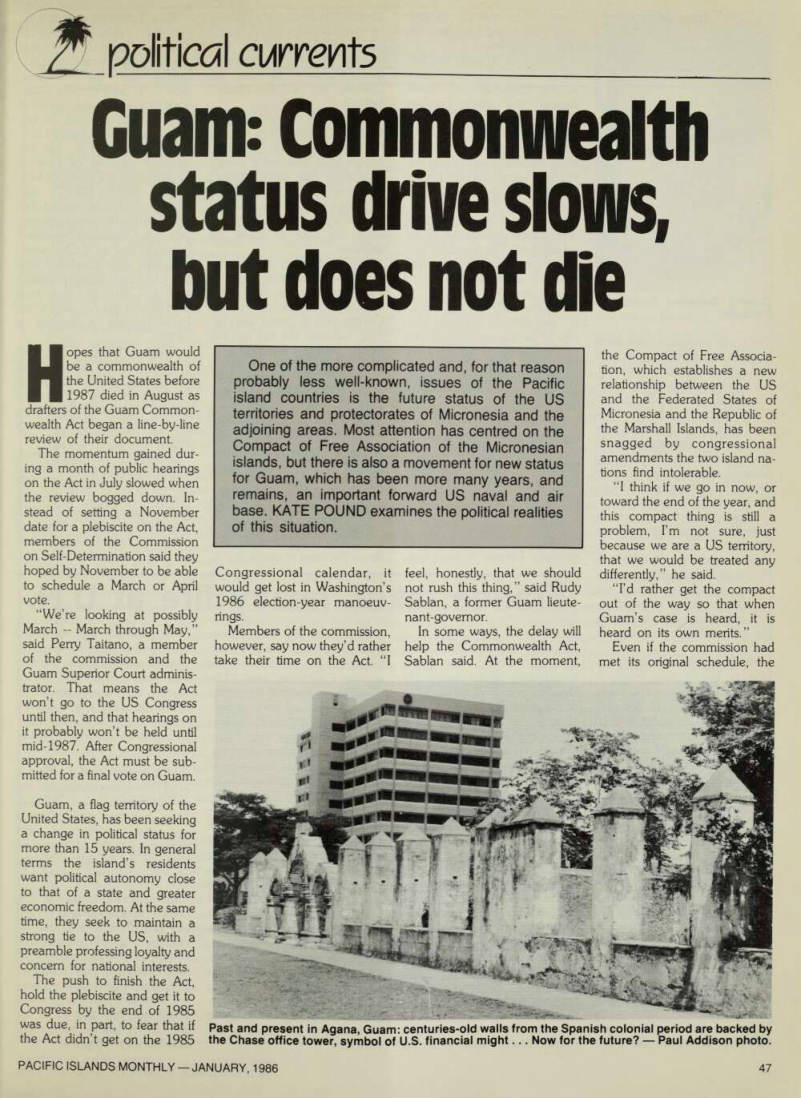
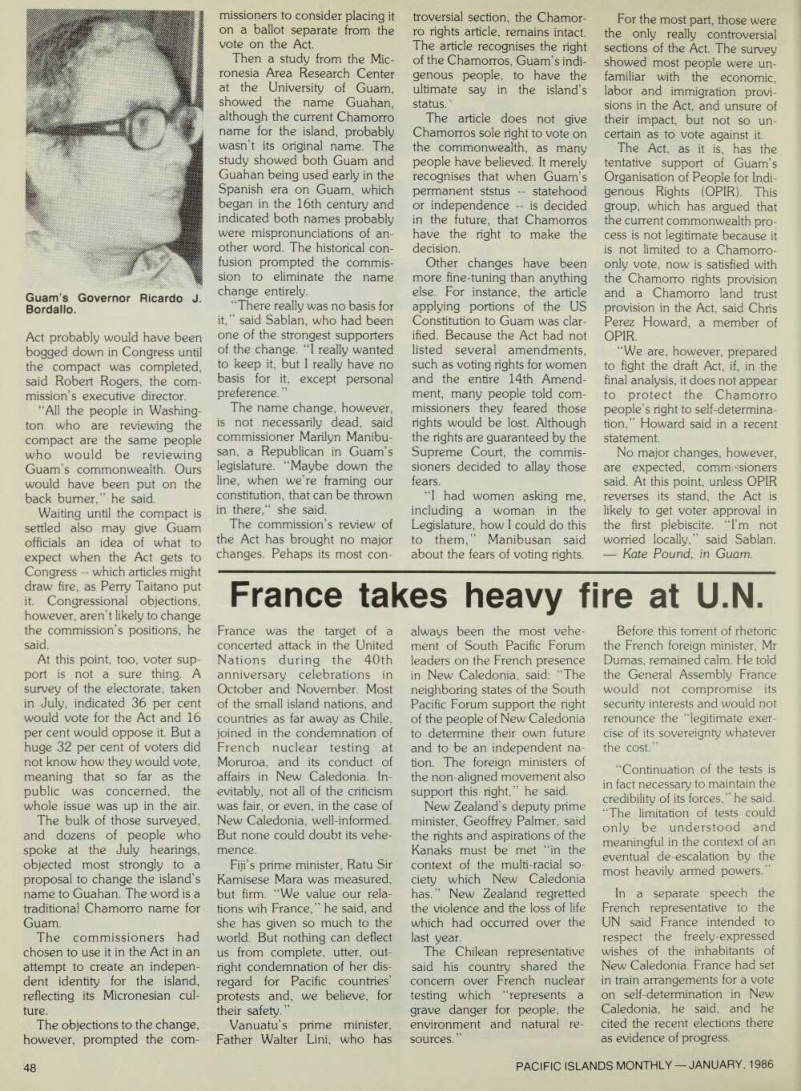
political currents
Guam: commonwealth status drive slows, but does not die
Hopes that Guam would be a commonwealth of the United States before 1987 died in August as drafters of the Guam Common wealth Act began a line-by-line review of their document.
The momentum gained dur ing a month of public hearings on the Act in July slowed when the review bogged down. In stead of setting a November date for a plebiscite on the Act, members of the Commission on Self-Determination said they hoped by November to be able to schedule a March or April vote.
“We’re looking at possibly March - March through May,” said Perry Taitano, a member of the commission and the Guam Superior Court adminis trator. That means the Act won’t go to the US Congress until then, and that hearings on it probably won’t be held until mid-1987. After Congressional approval, the Act must be sub mitted for a final vote on Guam.
Guam, a flag territory of the United States, has been seeking a change in political status for more than 15 years. In general terms the island’s residents want political autonomy close to that of a state and greater economic freedom. At the same time, they seek to maintain a strong tie to the US, with a preamble professing loyalty and concern for national interests.
The push to finish the Act, hold the plebiscite and get it to Congress by the end of 1985 was due, in part, to fear that if the Act didn’t get on the 1985
One of the more complicated and, for that reason probably less well-known, issues of the Pacific island countries is the future status of the US territories and protectorates of Micronesia and the adjoining areas. Most attention has centred on the Compact of Free Association of the Micronesian islands, but there is also a movement for new status for Guam, which has been more many years, and remains, an important forward US naval and air base. KATE POUND examines the political realities of this situation.
Congressional calendar, it would get lost in Washington’s 1986 election-year manoeuv rings.
Members of the commission, however, say now they’d rather take their time on the Act. “I
feel, honestly, that we should not rush this thing,” said Rudy Sablan, a former Guam lieutenant-governor.
In some ways, the delay will help the Commonwealth Act, Sablan said. At the moment,
the Compact of Free Associa tion, which establishes a new relationship between the US and the Federated States of Micronesia and the Republic of the Marshall Islands, has been snagged by congressional amendments the two island na tions find intolerable.
“I think if we go in now, or toward the end of the year, and this compact thing is still a problem, I’m not sure, just because we are a US territory, that we would be treated any differently,” he said.
“I’d rather get the compact out of the way so that when Guam’s case is heard, it is heard on its own merits.”
Even if the commission had met its original schedule, the
Past and present in Agana, Guam: centuries-old walls from the Spanish colonial period are backed by the Chase office tower, symbol of U.S. financial might... Now for the future? Paul Addison photo.
Act probably would have been bogged down in Congress until the compact was completed, said Robert Rogers, the com mission’s executive director.
“All the people in Washing ton who are reviewing the compact are the same people who would be reviewing Guam’s commonwealth. Ours would have been put on the back burner,” he said.
Waiting until the compact is settled also may give Guam officials an idea of what to expect when the Act gets to Congress which articles might draw fire, as Perry Taitano put it. Congressional objections, however, aren’t likely to change the commission’s positions, he said.
At this point, too, voter sup port is not a sure thing. A survey of the electorate, taken in July, indicated 36 per cent would vote for the Act and 16 per cent would oppose it. But a huge 32 per cent of voters did not know how they would vote, meaning that so far as the public was concerned, the whole issue was up in the air.
The bulk of those surveyed, and dozens of people who spoke at the July hearings, objected most strongly to a proposal to change the island’s name to Guahan. The word is a traditional Chamorro name for Guam.
The commissioners had chosen to use it in the Act in an attempt to create an indepen dent identity for the island, reflecting its Micronesian cul ture.
The objections to the change, however, prompted the com
missioners to consider placing it on a ballot separate from the vote on the Act.
Then a study from the Mic ronesia Area Research Center at the University of Guam, showed the name Guahan, although the current Chamorro name for the island, probably wasn’t its original name. The study showed both Guam and Guahan being used early in the Spanish era on Guam, which began in the 16th century and indicated both names probably were mispronunciations of an other word. The historical con fusion prompted the commis sion to eliminate the name change entirely.
“There really was no basis for it,” said Sablan, who had been one of the strongest supporters of the change. “I really wanted to keep it, but I really have no basis for it, except personal preference.”
The name change, however, is not necessarily dead, said commissioner Marilyn Manibu san, a Republican in Guam’s legislature. “Maybe down the line, when we’re framing our constitution, that can be thrown in there,“ she said.
The commission’s review of the Act has brought no major changes. Pehaps its most con
troversial section, the Chamor ro rights article, remains intact.
The article recognises the right of the Chamorros, Guam’s indi genous people, to have the ultimate say in the island’s status. N The article does not give Chamorros sole right to vote on the commonwealth, as many people have believed. It merely recognises that when Guam’s permanent ststus - statehood or independence - is decided in the future, that Chamorros have the right to make the decision.
Other changes have been more fine-tuning than anything else. For instance, the article applying portions of the US Constitution to Guam was clar ified. Because the Act had not listed several amendments, such as voting rights for women and the entire 14th Amend ment, many people told com missioners they feared those rights would be lost. Although the rights are guaranteed by the Supreme Court, the commis sioners decided to allay those fears.
“I had women asking me, including a woman in the Legislature, how I could do this to them,” Manibusan said about the fears of voting rights.
For the most part, those were the only really controversial sections of the Act. The survey showed most people were un familiar with the economic, labor and immigration provi sions in the Act, and unsure of their impact, but not so un certain as to vote against it.
The Act, as it is, has the tentative support of Guam’s Organisation of People for Indi genous Rights (OPIR). This group, which has argued that the current commonwealth pro cess is not legitimate because it is not limited to a Chamorro only vote, now is satisfied with the Chamorro rights provision and a Chamorro land trust provision in the Act, said Chris Perez Howard, a member of
Opir.
“We are, however, prepared to fight the draft Act, if, in the final analysis, it does not appear to protect the Chamorro people’s right to self-determina tion,’’ Howard said in a recent statement.
No major changes, however, are expected, commssioners said. At this point, unless OPIR reverses its stand, the Act is likely to get voter approval in the first plebiscite. “I’m not worried locally,” said Sablan.
Kate Pound, in Guam.
Guam’s Governor Ricardo J.
Bordallo.
France takes heavy fire at U.N.
France was the target of a concerted attack in the United Nations during the 40th anniversary celebrations in October and November. Most of the small island nations, and countries as far away as Chile, joined in the condemnation of French nuclear testing at Moruroa, and its conduct of affairs in New Caledonia. In evitably, not all of the criticism was fair, or even, in the case of New Caledonia, well-informed.
But none could doubt its vehe mence.
Fiji’s prime minister, Ratu Sir Kamisese Mara was measured, but firm. “We value our rela tions wih France,” he said, and she has given so much to the world. But nothing can deflect us from complete, utter, out right condemnation of her dis regard for Pacific countries’ protests and, we believe, for their safety.”
Vanuatu’s prime minister, Father Walter Lini, who has
always been the most vehe ment of South Pacific Forum leaders on the French presence in New Caledonia, said: “The neighboring states of the South Pacific Forum support the right of the people of New Caledonia to determine their own future and to be an independent na tion. The foreign ministers of the non-aligned movement also support this right,” he said.
New Zealand’s deputy prime minister, Geoffrey Palmer, said the rights and aspirations of the Kanaks must be met “in the context of the multi-racial so ciety which New Caledonia has.” New Zealand regretted the violence and the loss of life which had occurred over the last year.
The Chilean representative said his country shared the concern over French nuclear testing which “represents a grave danger for people, the environment and natural re sources.”
Before this torrent of rhetoric the French foreign minister, Mr Dumas, remained calm. He told the General Assembly France would not compromise its security interests and would not renounce the “legitimate exer cise of its sovereignty whatever the cost.”
“Continuation of the tests is in fact necessary to maintain the credibility of its forces,” he said.
“The limitation of tests could only be understood and meaningful in the context of an eventual de-escalation by the most heavily armed powers.”
In a separate speech the French representative to the UN said France intended to respect the freely-expressed wishes of the inhabitants of New Caledonia. France had set in train arrangements for a vote on self-determination in New Caledonia, he said, and he cited the recent elections there as evidence of progress.
Pacific stamp box
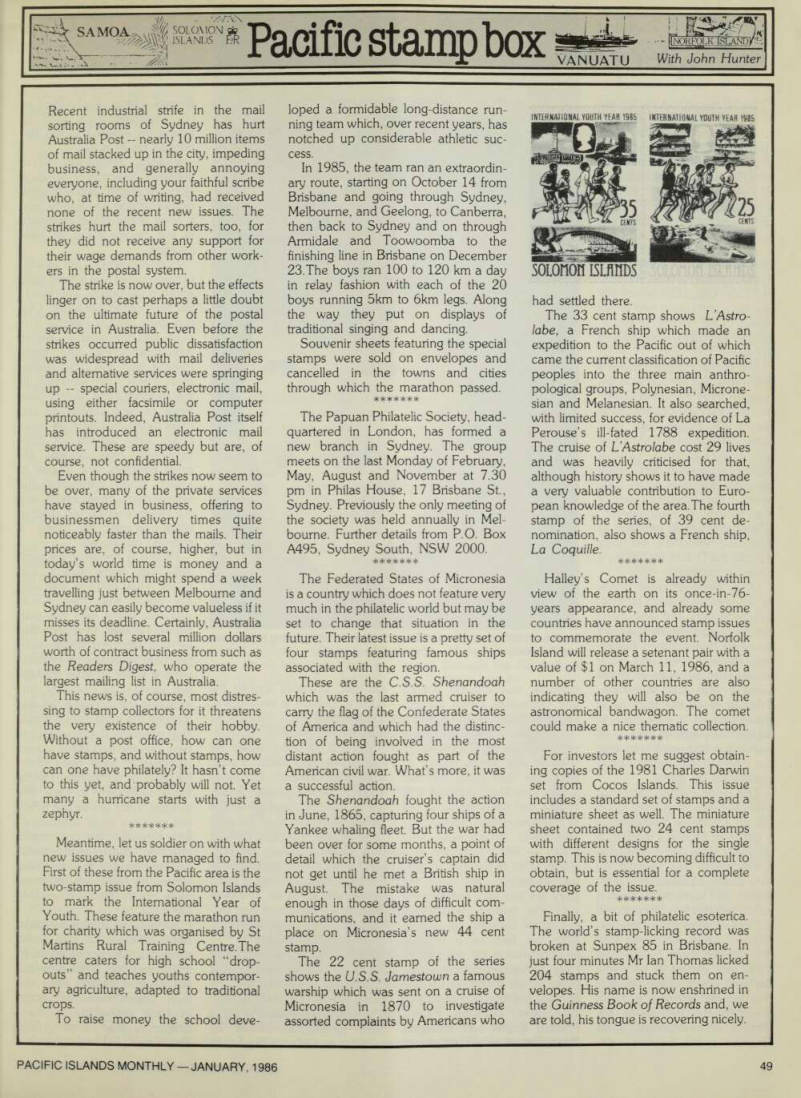
Recent industrial strife in the mail sorting rooms of Sydney has hurt Australia Post - nearly 10 million items of mail stacked up in the city, impeding business, and generally annoying everyone, including your faithful scribe who, at time of writing, had received none of the recent new issues. The strikes hurt the mail sorters, too, for they did not receive any support for their wage demands from other work ers in the postal system.
The strike is now over, but the effects linger on to cast perhaps a little doubt on the ultimate future of the postal service in Australia. Even before the strikes occurred public dissatisfaction was widespread with mail deliveries and alternative services were springing up - special couriers, electronic mail, using either facsimile or computer printouts. Indeed, Australia Post itself has introduced an electronic mail service. These are speedy but are, of course, not confidential.
Even though the strikes now seem to be over, many of the private services have stayed in business, offering to businessmen delivery times quite noticeably faster than the mails. Their prices are, of course, higher, but in today’s world time is money and a document which might spend a week travelling just between Melbourne and Sydney can easily become valueless if it misses its deadline. Certainly, Australia Post has lost several million dollars worth of contract business from such as the Readers Digest, who operate the largest mailing list in Australia.
This news is, of course, most distres sing to stamp collectors for it threatens the very existence of their hobby.
Without a post office, how can one have stamps, and without stamps, how can one have philately? It hasn’t come to this yet, and probably will not. Yet many a hurricane starts with just a zephyr. *** Meantime, let us soldier on with what new issues we have managed to find.
First of these from the Pacific area is the two-stamp issue from Solomon Islands to mark the International Year of Youth. These feature the marathon run for charity which was organised by St Martins Rural Training Centre.The centre caters for high school “drop outs” and teaches youths contempor ary agriculture, adapted to traditional crops.
To raise money the school deve
loped a formidable long-distance run ning team which, over recent years, has notched up considerable athletic suc cess.
In 1985, the team ran an extraordin ary route, starting on October 14 from Brisbane and going through Sydney, Melbourne, and Geelong, to Canberra, then back to Sydney and on through Armidale and Toowoomba to the finishing line in Brisbane on December 23. The boys ran 100 to 120 km a day in relay fashion with each of the 20 boys running skm to 6km legs. Along the way they put on displays of traditional singing and dancing.
Souvenir sheets featuring the special stamps were sold on envelopes and cancelled in the towns and cities through which the marathon passed. ♦ * * * * * * The Papuan Philatelic Society, head quartered in London, has formed a new branch in Sydney. The group meets on the last Monday of February, May, August and November at 7.30 pm in Philas House, 17 Brisbane St., Sydney. Previously the only meeting of the society was held annually in Mel bourne. Further details from P.O. Box A 495, Sydney South, NSW 2000. *** The Federated States of Micronesia is a country which does not feature very much in the philatelic world but may be set to change that situation in the future. Their latest issue is a pretty set of four stamps featuring famous ships associated with the region.
These are the C.S.S. Shenandoah which was the last armed cruiser to carry the flag of the Confederate States of America and which had the distinc tion of being involved in the most distant action fought as part of the American civil war. What’s more, it was a successful action.
The Shenandoah fought the action in June, 1865, capturing four ships of a Yankee whaling fleet. But the war had been over for some months, a point of detail which the cruiser’s captain did not get until he met a British ship in August. The mistake was natural enough in those days of difficult com munications, and it earned the ship a place on Micronesia’s new 44 cent stamp.
The 22 cent stamp of the series shows the U.S.S. Jamestown a famous warship which was sent on a cruise of Micronesia in 1870 to investigate assorted complaints by Americans who
had settled there.
The 33 cent stamp shows L’Astro labe, a French ship which made an expedition to the Pacific out of which came the current classification of Pacific peoples into the three main anthro pological groups, Polynesian, Microne sian and Melanesian. It also searched, with limited success, for evidence of La Perouse’s ill-fated 1788 expedition.
The cruise of L’Astrolabe cost 29 lives and was heavily criticised for that, although history shows it to have made a very valuable contribution to Euro pean knowledge of the area. The fourth stamp of the series, of 39 cent de nomination, also shows a French ship, La Coquille. $ $ a|e $ $ jjc sjc Halley’s Comet is already within view of the earth on its once-in-76years appearance, and already some countries have announced stamp issues to commemorate the event. Norfolk Island will release a setenant pair with a value of $1 on March 11, 1986, and a number of other countries are also indicating they will also be on the astronomical bandwagon. The comet could make a nice thematic collection. *** For investors let me suggest obtain ing copies of the 1981 Charles Darwin set from Cocos Islands. This issue includes a standard set of stamps and a miniature sheet as well. The miniature sheet contained two 24 cent stamps with different designs for the single stamp. This is now becoming difficult to obtain, but is essential for a complete coverage of the issue. * * * * * * * Finally, a bit of philatelic esoterica.
The world’s stamp-licking record was broken at Sunpex 85 in Brisbane. In just four minutes Mr lan Thomas licked 204 stamps and stuck them on en velopes. His name is now enshrined in the Guinness Book of Records and, we are told, his tongue is recovering nicely.
people
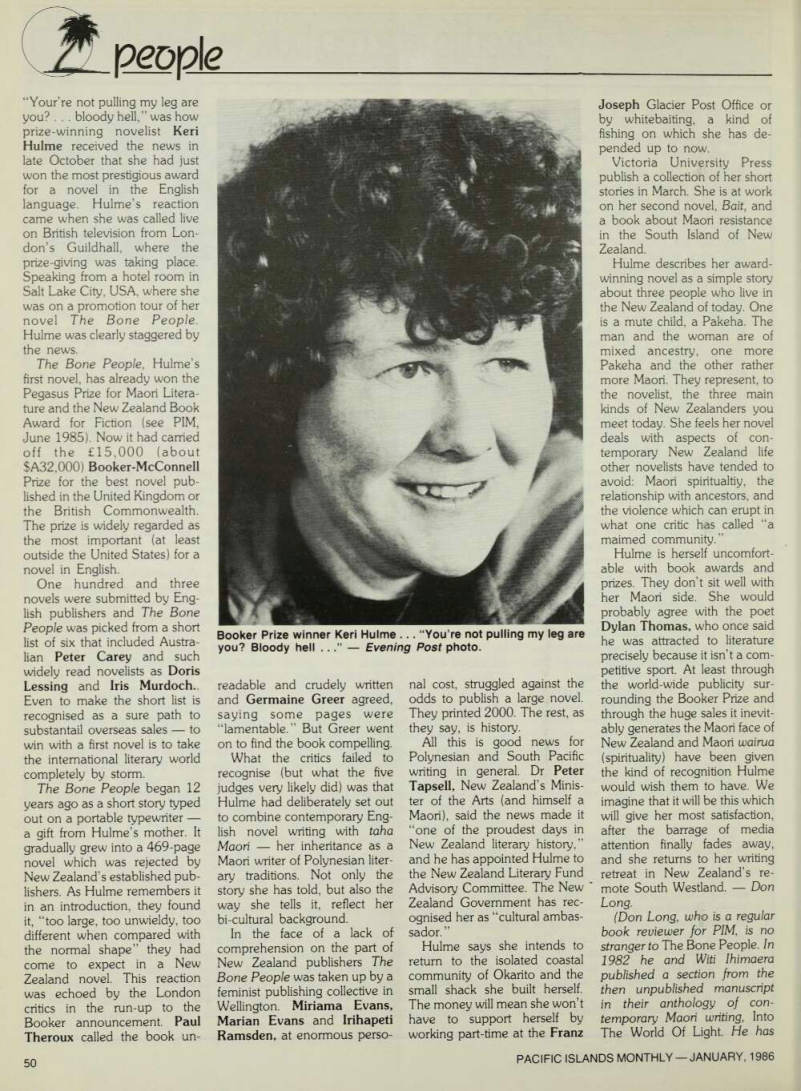
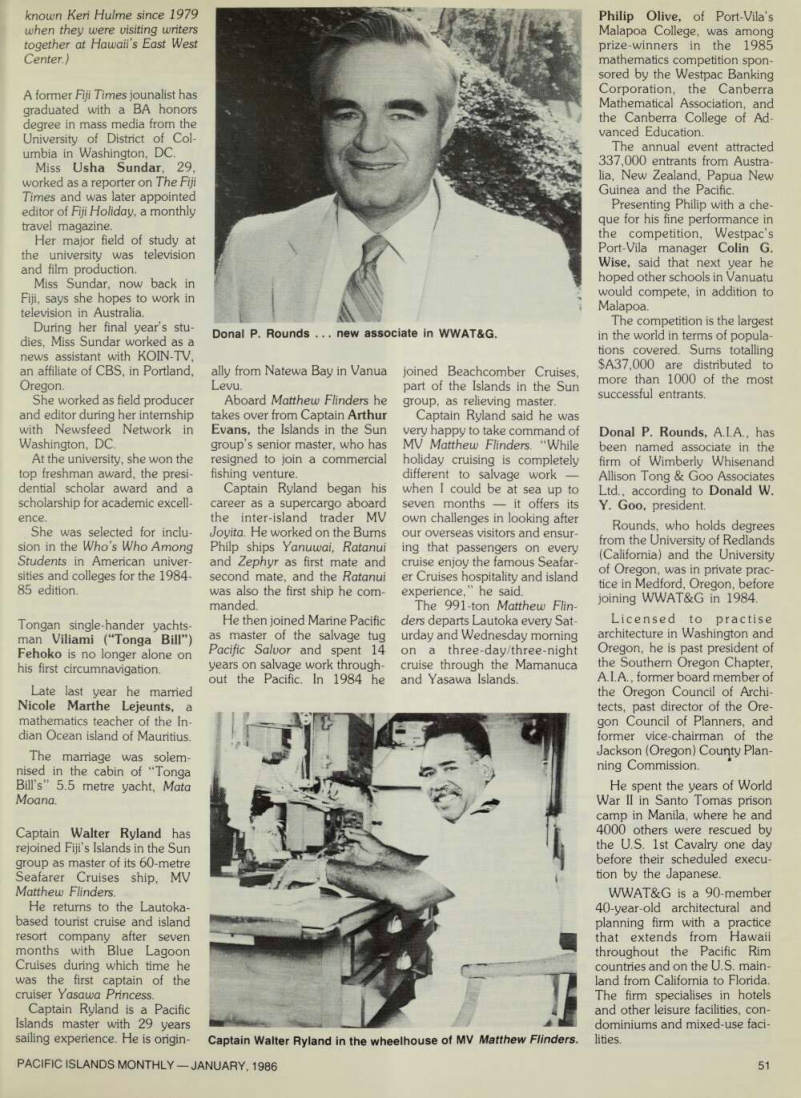
“Your’re not pulling my leg are you? . . . bloody hell,” was how prize-winning novelist Keri Hulme received the news in late October that she had just won the most prestigious award for a novel in the English language. Hulme’s reaction came when she was called live on British television from Lon don’s Guildhall, where the prize-giving was taking place.
Speaking from a hotel room in Salt Lake City, USA, where she was on a promotion tour of her novel The Bone People.
Hulme was clearly staggered by the news.
The Bone People, Hulme’s first novel, has already won the Pegasus Prize for Maori Litera ture and the New Zealand Book Award for Fiction (see PIM, June 1985). Now it had carried off the £15,000 (about $A32,000) Booker-McConnell Prize for the best novel pub lished in the United Kingdom or the British Commonwealth.
The prize is widely regarded as the most important (at least outside the United States) for a novel in English.
One hundred and three novels were submitted by Eng lish publishers and The Bone People was picked from a short list of six that included Austra lian Peter Carey and such widely read novelists as Doris Lessing and Iris Murdoch., Even to make the short list is recognised as a sure path to substantail overseas sales to win with a first novel is to take the international literary world completely by storm.
The Bone People began 12 years ago as a short story typed out on a portable typewriter a gift from Hulme’s mother. It gradually grew into a 469-page novel which was rejected by New Zealand’s established pub lishers. As Hulme remembers it in an introduction, they found it, “too large, too unwieldy, too different when compared with the normal shape” they had come to expect in a New Zealand novel. This reaction was echoed by the London critics in the run-up to the Booker announcement. Paul Theroux called the book un-
readable and crudely written and Germaine Greer agreed, saying some pages were “lamentable.” But Greer went on to find the book compelling.
What the critics failed to recognise (but what the five judges very likely did) was that Hulme had deliberately set out to combine contemporary Eng lish novel writing with taha Maori her inheritance as a Maori writer of Polynesian liter ary traditions. Not only the story she has told, but also the way she tells it, reflect her bi-cultural background.
In the face of a lack of comprehension on the part of New Zealand publishers The Bone People was taken up by a feminist publishing collective in Wellington. Miriama Evans, Marian Evans and Irihapeti Ramsden, at enormous perso
nal cost, struggled against the odds to publish a large novel.
They printed 2000. The rest, as they say, is history.
All this is good news for Polynesian and South Pacific writing in general. Dr Peter Tapsell, New Zealand’s Minis ter of the Arts (and himself a Maori), said the news made it “one of the proudest days in New Zealand literary history,” and he has appointed Hulme to the New Zealand Literary Fund Advisory Committee. The New Zealand Government has rec ognised her as “cultural ambas sador.”
Hulme says she intends to return to the isolated coastal community of Okarito and the small shack she built herself.
The money will mean she won’t have to support herself by working part-time at the Franz
Joseph Glacier Post Office or by whitebaiting, a kind of fishing on which she has de pended up to now.
Victoria University Press publish a collection of her short stories in March. She is at work on her second novel, Bait, and a book about Maori resistance in the South Island of New Zealand.
Hulme describes her award winning novel as a simple story about three people who live in the New Zealand of today. One is a mute child, a Pakeha. The man and the woman are of mixed ancestry, one more Pakeha and the other rather more Maori. They represent, to the novelist, the three main kinds of New Zealanders you meet today. She feels her novel deals with aspects of con temporary New Zealand life other novelists have tended to avoid: Maori spiritualtiy, the relationship with ancestors, and the violence which can erupt in what one critic has called “a maimed community.”
Hulme is herself uncomfort able with book awards and prizes. They don’t sit well with her Maori side. She would probably agree with the poet Dylan Thomas, who once said he was attracted to literature precisely because it isn’t a com petitive sport. At least through the world-wide publicity sur rounding the Booker Prize and through the huge sales it inevit ably generates the Maori face of New Zealand and Maori wairua (spirituality) have been given the kind of recognition Hulme would wish them to have. We imagine that it will be this which will give her most satisfaction, after the barrage of media attention finally fades away, and she returns to her writing retreat in New Zealand’s re
mote South Westland.
Long.
Don
(Don Long, who is a regular book reviewer for PIM, is no stranger to The Bone People. In 1982 he and Witi Ihimaera published a section from the then unpublished manuscript in their anthology of con temporary Maori writing, Into The World Of Light. He has
Booker Prize winner Keri Hulme ... “You’re not pulling my leg are you? Bloody hell ...” Evening Post photo.
known Keri Flulme since 1979 when they were visiting writers together at Flawaii’s East West Center.) A former Fiji Times jounalist has graduated with a BA honors degree in mass media from the University of District of Col umbia in Washington, DC.
Miss Usha Sundar, 29, worked as a reporter on The Fiji Times and was later appointed editor of Fiji Floliday, a monthly travel magazine.
Her major field of study at the university was television and film production.
Miss Sundar, now back in Fiji, says she hopes to work in television in Australia.
During her final year’s stu dies, Miss Sundar worked as a news assistant with KOIN-TV, an affiliate of CBS, in Portland, Oregon.
She worked as field producer and editor during her internship with Newsfeed Network in Washington, DC.
At the university, she won the top freshman award, the presi dential scholar award and a scholarship for academic excell ence.
She was selected for inclu sion in the Who’s Who Among Students in American univer sities and colleges for the 1984- 85 edition.
Tongan single-hander yachts man Viliami (“Tonga Bill”) Fehoko is no longer alone on his first circumnavigation.
Late last year he married Nicole Marthe Lejeunts, a mathematics teacher of the In dian Ocean island of Mauritius.
The marriage was solem nised in the cabin of “Tonga Bill’s” 5.5 metre yacht, Mata Moana.
Captain Walter Ryland has rejoined Fiji’s Islands in the Sun group as master of its 60-metre Seafarer Cruises ship, MV Matthew Flinders.
He returns to the Lautoka based tourist cruise and island resort company after seven months with Blue Lagoon Cruises during which time he was the first captain of the cruiser Yasawa Princess.
Captain Ryland is a Pacific Islands master with 29 years sailing experience. He is origin-
ally from Natewa Bay in Vanua Levu.
Aboard Matthew Flinders he takes over from Captain Arthur Evans, the Islands in the Sun group’s senior master, who has resigned to join a commercial fishing venture.
Captain Ryland began his career as a supercargo aboard the inter-island trader MV Joyita. He worked on the Burns Philp ships Yanuwai, Ratanui and Zephyr as first mate and second mate, and the Ratanui was also the first ship he com manded.
He then joined Marine Pacific as master of the salvage tug Pacific Salvor and spent 14 years on salvage work through out the Pacific. In 1984 he
joined Beachcomber Cruises, part of the Islands in the Sun group, as relieving master.
Captain Ryland said he was very happy to take command of MV Matthew Flinders. “While holiday cruising is completely different to salvage work when I could be at sea up to seven months it offers its own challenges in looking after our overseas visitors and ensur ing that passengers on every cruise enjoy the famous Seafar er Cruises hospitality and island experience,” he said.
The 991-ton Matthew Flin ders departs Lautoka every Sat urday and Wednesday morning on a three-day/three-night cruise through the Mamanuca and Yasawa Islands.
Philip Olive, of Port-Vila’s Malapoa College, was among prize-winners in the 1985 mathematics competition spon sored by the Westpac Banking Corporation, the Canberra Mathematical Association, and the Canberra College of Ad vanced Education.
The annual event attracted 337,000 entrants from Austra lia, New Zealand, Papua New Guinea and the Pacific.
Presenting Philip with a che que for his fine performance in the competition, Westpac’s Port-Vila manager Colin G.
Wise, said that next year he hoped other schools in Vanuatu would compete, in addition to Malapoa.
The competition is the largest in the world in terms of popula tions covered. Sums totalling $A37,000 are distributed to more than 1000 of the most successful entrants.
Donal P. Rounds, A.1.A., has been named associate in the firm of Wimberly Whisenand Allison Tong & Goo Associates Ltd., according to Donald W.
Y. Goo, president.
Rounds, who holds degrees from the University of Redlands (California) and the University of Oregon, was in private prac tice in Medford, Oregon, before joining WWAT&G in 1984.
Licensed to practise architecture in Washington and Oregon, he is past president of the Southern Oregon Chapter, A.1.A., former board member of the Oregon Council of Archi tects, past director of the Ore gon Council of Planners, and former vice-chairman of the Jackson (Oregon) Coupty Plan ning Commission.
He spent the years of World War II in Santo Tomas prison camp in Manila, where he and 4000 others were rescued by the U.S. Ist Cavalry one day before their scheduled execu tion by the Japanese.
WWAT&G is a 90-member 40-year-old architectural and planning firm with a practice that extends from Hawaii throughout the Pacific Rim countries and on the U.S. main land from California to Florida.
The firm specialises in hotels and other leisure facilities, con dominiums and mixed-use faci lities.
Donal P. Rounds ... new associate in WWAT&G.
Captain Walter Ryland in the wheelhouse of MV Matthew Flinders.
yachts
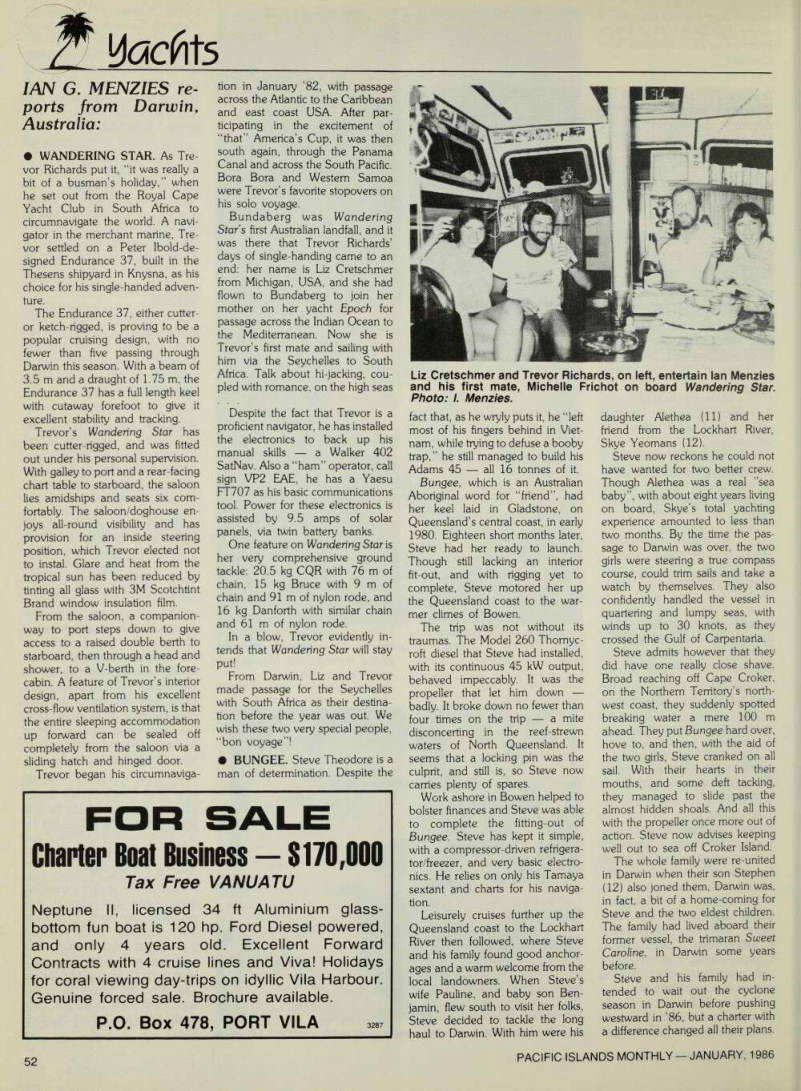
Ian G. Menzies Re
ports from Darwin , Australia:
• Wandering Star. As Tre
vor Richards put it, “it was really a bit of a busman’s holiday,” when he set out from the Royal Cape Yacht Club in South Africa to circumnavigate the world. A navi gator in the merchant marine, Tre vor settled on a Peter Ibold-de signed Endurance 37, built in the Thesens shipyard in Knysna, as his choice for his single-handed adven ture.
The Endurance 37, either cutter or ketch-rigged, is proving to be a popular cruising design, with no fewer than five passing through Darwin this season. With a beam of 3.5 m and a draught of 1.75 m, the Endurance 37 has a full length keel with cutaway forefoot to give it excellent stability and tracking.
Trevor’s Wandering Star has been cutter-rigged, and was fitted out under his personal supervision.
With galley to port and a rear-facing chart table to starboard, the saloon lies amidships and seats six com fortably. The saloon/doghouse en joys all-round visibility and has provision for an inside steering position, which Trevor elected not to instal. Glare and heat from the tropical sun has been reduced by tinting all glass with 3M Scotchtint Brand window insulation film.
From the saloon, a companion way to port steps down to give access to a raised double berth to starboard, then through a head and shower, to a V-berth in the fore cabin. A feature of Trevor’s interior design, apart from his excellent cross-flow ventilation system, is that the entire sleeping accommodation up forward can be sealed off completely from the saloon via a sliding hatch and hinged door.
Trevor began his circumnaviga
tion in January ’82, with passage across the Atlantic to the Caribbean and east coast USA. After par ticipating in the excitement of “that” America’s Cup, it was then south again, through the Panama Canal and across the South Pacific.
Bora Bora and Western Samoa were Trevor’s favorite stopovers on his solo voyage.
Bundaberg was Wandering Star’s first Australian landfall, and it was there that Trevor Richards’ days of single-handing came to an end: her name is Liz Cretschmer from Michigan, USA, and she had flown to Bundaberg to join her mother on her yacht Epoch for passage across the Indian Ocean to the Mediterranean. Now she is Trevor’s first mate and sailing with him via the Seychelles to South Africa. Talk about hi-jacking, cou pled with romance, on the high seas Despite the fact that Trevor is a proficient navigator, he has installed the electronics to back up his manual skills — a Walker 402 SatNav. Also a “ham” operator, call sign VP2 EAE, he has a Yaesu FT707 as his basic communications tool. Power for these electronics is assisted by 9.5 amps of solar panels, via twin battery banks.
One feature on Wandering Star is her very comprehensive ground tackle: 20.5 kg CQR with 76 m of chain, 15 kg Bruce with 9 m of chain and 91 m of nylon rode, and 16 kg Danforth with similar chain and 61 m of nylon rode.
In a blow, Trevor evidently in tends that Wandering Star will stay put!
From Darwin, Liz and Trevor made passage for the Seychelles with South Africa as their destina tion before the year was out. We wish these two very special people, “bon voyage”! • BUNGEE. Steve Theodore is a man of determination. Despite the
fact that, as he wryly puts it, he “left most of his fingers behind in Viet nam, while trying to defuse a booby trap,” he still managed to build his Adams 45 all 16 tonnes of it.
Bungee, which is an Australian Aboriginal word for “friend”, had her keel laid in Gladstone, on Queensland’s central coast, in early 1980. Eighteen short months later, Steve had her ready to launch.
Though still lacking an interior fit-out, and with rigging yet to complete, Steve motored her up the Queensland coast to the war mer climes of Bowen.
The trip was not without its traumas. The Model 260 Thomyc roft diesel that Steve had installed, with its continuous 45 kW output, behaved impeccably. It was the propeller that let him down badly. It broke down no fewer than four times on the trip a mite disconcerting in the reef-strewn waters of North Queensland. It seems that a locking pin was the culprit, and still is, so Steve now carries plenty of spares.
Work ashore in Bowen helped to bolster finances and Steve was able to complete the fitting-out of Bungee. Steve has kept it simple, with a compressor-driven refrigera tor/freezer, and very basic electro nics. He relies on only his Tamaya sextant and charts for his naviga tion.
Leisurely cruises further up the Queensland coast to the Lockhart River then followed, where Steve and his family found good anchor ages and a warm welcome from the local landowners. When Steve’s wife Pauline, and baby son Ben jamin, flew south to visit her folks, Steve decided to tackle the long haul to Darwin. With him were his
daughter Alethea (11) and her friend from the Lockhart River, Skye Yeomans (12).
Steve now reckons he could not have wanted for two better crew.
Though Alethea was a real ”sea baby”, with about eight years living on board, Skye’s total yachting experience amounted to less than two months. By the time the pas sage to Darwin was over, the two girls were steering a true compass course, could trim sails and take a watch by themselves. They also confidently handled the vessel in quartering and lumpy seas, with winds up to 30 knots, as they crossed the Gulf of Carpentaria.
Steve admits however that they did have one really close shave.
Broad reaching off Cape Croker, on the Northern Territory’s north west coast, they suddenly spotted breaking water a mere 100 m ahead. They put Bungee hard over, hove to, and then, with the aid of the two girls, Steve cranked on all sail. With their hearts in their mouths, and some deft tacking, they managed to slide past the almost hidden shoals. And all this with the propeller once more out of action. Steve now advises keeping well out to sea off Croker Island.
The whole family were re-united in Darwin when their son Stephen (12) also joned them, Darwin was, in fact, a bit of a home-coming for Steve and the two eldest children.
The family had lived aboard their former vessel, the trimaran Sweet Caroline, in Darwin some years before.
Steve and his family had in tended to wait out the cyclone season in Darwin before pushing westward in ’86, but a charter with a difference changed all their plans.
Liz Cretschmer and Trevor Richards, on left, entertain lan Menzies and his first mate, Michelle Frichot on board Wandering Star.
Photo: I. Menzies.
Advertisements & other items, p. 52 (1 item)
Charter Boat Business $170,060
FOR SALE
Tax Free VANUATU Neptune 11, licensed 34 ft Aluminium glassbottom fun boat is 120 hp. Ford Diesel powered, and only 4 years old. Excellent Forward Contracts with 4 cruise lines and Viva! Holidays for coral viewing day-trips on idyllic Vila Harbour.
Genuine forced sale. Brochure available.
P.O. Box 478, PORT VILA
ahipping schedules
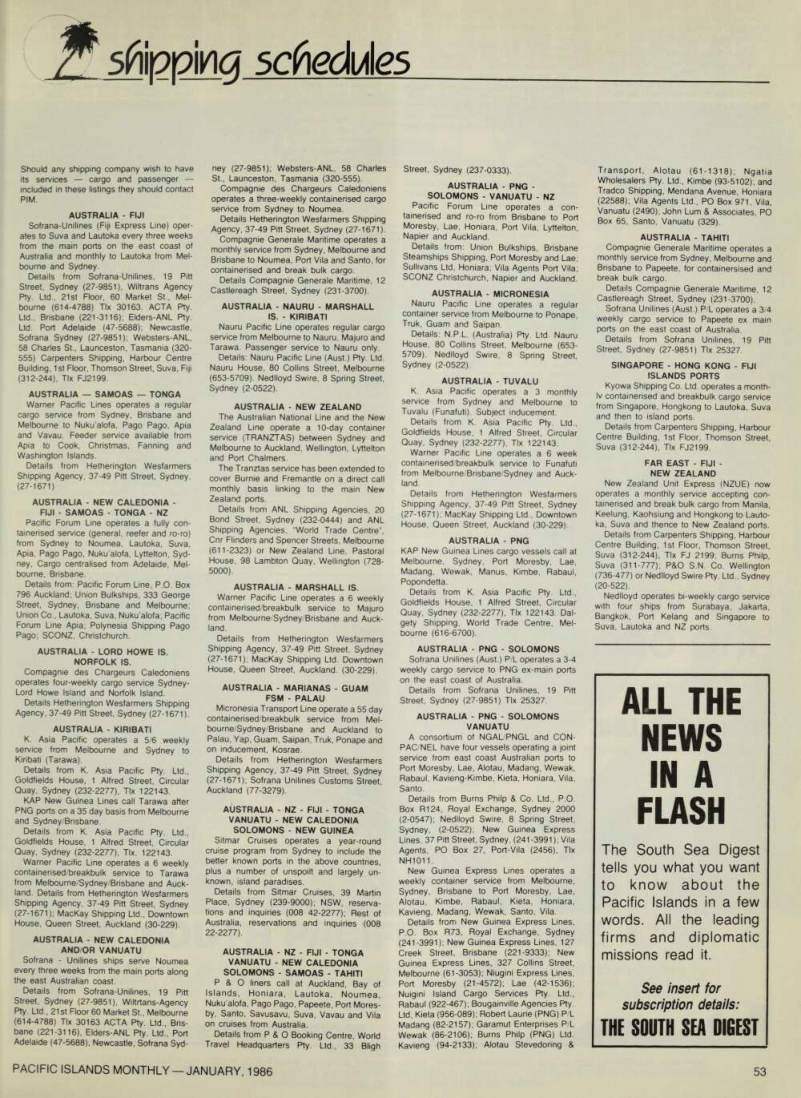
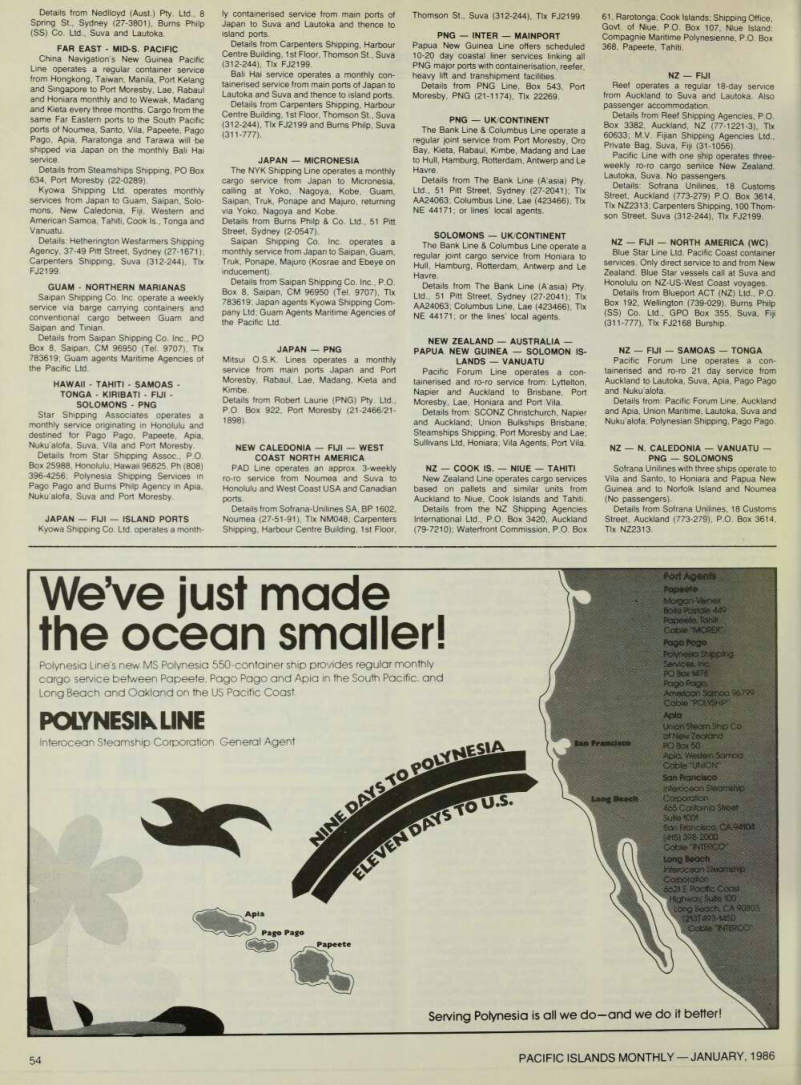
Should any shipping company wish to have its services cargo and passenger included in these listings they should contact
Pim.
ai ictrai i a phi A . USTR * L * ' F J Sofrana-Umlmes (Fiji Express Line) operates to Suva and Lautoka every three weeks from the main ports on the east coast of Australia and monthly to Lautoka from Melbourne and Sydney.
Details from Sofrana-Unilines, 19 Pitt Street Sydney (27-9851), Wiltrans Agency Pty, Ltd., 21st Floor, 60 Market St., Melbourne (614-4788) Tlx 30163. ACTA Pty.
Ltd., Brisbane (221-3116); Elders-ANL Pty.
Ltd. Port Adelaide (47-5688); Newcastle, Sofrana Sydney (27-9851); Websters-ANL, 58 Charles St., Launceston, Tasmania (320- 555) Carpenters Shipping, Harbour Centre Building, Ist Floor, Thomson Street, Suva, Fiji (312-244), Tlx FJ2199.
Australia Samoas Tonga
Warner Pacific Lines operates a regular cargo service from Sydney, Brisbane and Melbourne to Nukualofa, Pago Pago, Apia and Vavau. Feeder service available from Apia to Cook, Christmas, Fanning and Washington Islands.
Details from Hetherington Wesfarmers Shipping Agency. 37-49 Pitt Street. Sydney. ,27 -’ 67 ”
Australia - New Caledonia -
FIJI - SAMOAS - TONGA - NZ Pacific Forum Line operates a fully containerised service (general, reefer and ro-ro) from Sydney to Noumea, Lautoka, Suva, Apia, Pago Pago. Nukualofa, Lyttelton. Sydney. Cargo centralised from Adelaide, Melbourne, Brisbane.
Details from: Pacific Forum Line, P.O. Box 796 Auckland; Union Bulkships, 333 George Street. Sydney, Brisbane and Melbourne; Union Co., Lautoka, Suva, Nukualofa; Pacific Forum Line Apia; Polynesia Shipping Pago Pago; SCONZ, Christchurch.
Australia - Lord Howe Is
Norfolk Is.
Compagnie des Chargeurs Caledoniens operates four-weekly cargo service Sydney- Lord Howe Island and Norfolk Island.
Details Hetherington Wesfarmers Shipping inonru 17 io pw str M i /o 7 i / Agency, 37-49 Pitt Street. Sydney (27-1671).
Australia - Kiribati
K. Asia Pacific operates a 5/6 weekly service from Melbourne and Sydney to Kiribati (Tarawa).
Details from K. Asia Pacific Pty. Ltd., Goldfields House, 1 Alfred Street, Circular Quay, Sydney (232-2277). Tlx 122143.
KAP New Guinea Lines call Tarawa after PNG ports on a 35 day basis from Melbourne and Sydney/Brisbane.
Details from K. Asia Pacific Pty. Ltd., Goldfields House, 1 Alfred Street, Circular Quay, Sydney (232-2277), Tlx. 122143.
Warner Pacific Line operates a 6 weekly containerised/breakbulk service to Tarawa from Melbourne/Sydney/Brisbane and Auckland. Details from Hetherington Wesfarmers Shipping Agency, 37-49 Pitt Street. Sydney (27-1671); Mac Kay Shipping Ltd., Downtown House, Queen Street, Auckland (30-229)
Australia - New Caledonia
And/Or Vanuatu
Sofrana - Unilines ships serve Noumea every three weeks from the main ports along the east Australian coast.
Details from Sofrana-Unilines, 19 Pitt Street, Sydney (27-9851), Wiltrtans-Agency Pty. Ltd., 21st Floor 60 Market St., Melbourne (614-4788) Tlx 30163 ACTA Pty. Ltd., Brisbane (221-3116), Elders-ANL Pty. Ltd., Port Adelaide (47-5688), Newcastle, Sofrana Syd-
ney (27-9851); Websters-ANL, 58 Charles St., Launceston, Tasmania (320-555).
Compagnie des Chargeurs Caledoniens operates a three-weekly containerised cargo service from Sydney to Noumea.
Details Hetherington Wesfarmers Shipping Agency. 37-49 Pitt Street, Sydney (27-1671).
Compagnie Generate Maritime operates a monthly service from Sydney, Melbourne and Brisbane to Noumea, Port Vila and Santo, for containerised and break bulk cargo.
Details Compagnie Generate Maritime, 12 Castlereagh Street, Sydney (231-3700).
Australia - Nauru - Marshall
Is. - Kiribati
Nauru Pacific Line operates regular cargo service from Melbourne to Nauru, Majuro and Tarawa. Passenger service to Nauru only.
Details: Nauru Pacific Line (Aust.) Pty. Ltd.
Nauru House, 80 Collins Street, Melbourne (653-5709). Nedlloyd Swire, 8 Spring Street, Sydney (2-0522).
Australia - New Zealand
The Australian National Line and the New Zealand Line operate a 10-day container service (TRANZTAS) between Sydney and Melbourne to Auckland, Wellington, Lyttelton and Port Chalmers.
The Tranztas service has been extended to cover Burnie and Fremantle on a direct call monthly basis linking to the main New Zealand ports.
Details from ANL Shipping Agencies. 20 Bond Street. Sydney (232-0444) and ANL Shipping Agencies. “World Trade Centre", Cnr Flinders and Spencer Streets. Melbourne (611-2323) or New Zealand Line, Pastoral House, 98 Lambton Quay, Wellington (728- 5000).
Australia - Marshall Is.
Warner Pacific Line operates a 6 weekly containerised/breakbulk service to Majuro from Melbourne/Sydney/Brisbane and Auck land.
Details from Hetherington Wesfarmers Shipping Agency, 37-49 Pitt Street, Sydney (27-1671); Mac Kay Shipping Ltd. Downtown House, Queen Street, Auckland. (30-229).
Australia - Marianas - Guam
Fsm - Palau
Micronesia Transport Line operate a 55 day containerised/breakbulk service from Mel bourne/Sydney/Brisbane and Auckland to Palau, Yap, Guam, Saipan, Truk, Ponape and on inducement, Kosrae.
Details from Hetherington Wesfarmers Shipping Agency, 37-49 Pitt Street, Sydney (27-1671); Sofrana Unilines Customs Street, Auckland (77-3279).
AUSTRALIA - NZ - FIJI - TONGA
Vanuatu - New Caledonia
Solomons - New Guinea
Sitmar Cruises operates a year-round cruise program from Sydney to include the better known ports in the above countries, plus a number of unspoilt and largely un known, island paradises.
Details from Sitmar Cruises, 39 Martin Place. Sydney (239-9000); NSW, reserva tions and inquiries (008 42-2277); Rest of Australia, reservations and inquiries (008 22-2277).
AUSTRALIA - NZ - FIJI - TONGA
Vanuatu - New Caledonia
Solomons - Samoas - Tahiti
P&O liners call at Auckland. Bay of Islands, Honiara, Lautoka, Noumea.
Nukualofa, Pago Pago, Papeete, Port Mores by, Santo, Savusavu, Suva, Vavau and Vila on cruises from Australia.
Details from P&O Booking Centre, World Travel Headquarters Pty. Ltd., 33 Bligh
Street, Sydney (237-0333).
cni nunLe waui.ax..'
wlomons - VANUATU - NZ .-nfS-L F °H Um L '?® °P era ‘ es a c ° n ' tainerised and ro-ro from Brisbane to Port Moresby, Lae, Honiara. Port Vila, Lyttelton, Na P ier and Auckland.
Details from: Union Bulkships, Brisbane Steamships Shipping, Port Moresby and Lae; Sullivans Ltd, Honiara; Vila Agents Port Vila; SCONZ Christchurch, Napier and Auckland.
AUSTRALIA Micronesia
R ' Micronesia
Pacific Line operates a regular container service from Melbourne to Ponape, ’ d , , A a,pan ;. , Details. N P.L. (Australia) Pty. Ltd. Nauru ™ e ' 80 Co,lins Street, Melbourne (653- 8709 > Nedlloyd Swire, 8 Spring Street, Sydney (2-0522).
Australia - Tuvalu
k Ada Paritir nnor:i ioc a t P 6 t®™?® *l°" and Melbourne to S A ' ndu < cce n t Pn ,® a ' s [? *' V^' ric Ltd.,
o?™r. ' 'Too***
d y i 1 , .
Wa ® Pacif,c Line operates a 6 week ,0 hT?
Melbourne/Bnsbane/Sydney and Auckwestarmers Shipping Agency, 37-49 Pitt Street, Sydney (27-1671); Mac Kay Shipping Ltd., Downtown House, Queen Street, Auckland (30-229).
Australia - Png
KAP New Guinea Lines cargo vessels call at Melbourne, Sydney, Port Moresby, Lae.
Madang, Wewak, Manus, Kimbe, Rabaul, Popondetta. PSS f [? m K Aaia Pa £' f,c Lt ?"
fSiS'nLT
J S t l rln ™ Sfi 9ety Shl PP m 9’ World Trade Centre, Melbourne (616 6700).
Australia - Png - Solomons
Sofrana Unilines (Aust.) P/L operates a 3-4 weekly cargo service to PNG ex-main ports on the east coast of Australia.
Details from Sofrana Unilines, 19 Pitt Street, Sydney (27-9851) Tlx 25327.
Australia - Png - Solomons
Vanuatu
A consortium of NGAUPNGL and CON- PAC/NEL have four vessels operating a joint service from east coast Australian ports to Port Moresb y. Lae, Alotau, Madang, Wewak, Rabaul, Kavieng-Kimbe, Kieta, Honiara, Vila, Santo.
Details from Burns Philp & Co. Ltd., P.O.
Box R 124, Royal Exchange, Sydney 2000 (2-0547); Nedlloyd Swire. 8 Spring Street, Sydney, (2-0522); New Guinea Express Lines, 37 Pitt Street, Sydney. (241-3991); Vila Agents, PO Box 27. Port-Vila (2456), Tlx
Nhioii.
New Guinea Express Lines operates a weekly container service from Melbourne, Sydney, Brisbane to Port Moresby. Lae, Alotau, Kimbe, Rabaul, Kieta, Honiara, Kavieng, Madang, Wewak, Santo. Vila.
Details from New Guinea Express Lines, P.O. Box R 73, Royal Exchange, Sydney (241-3991); New Guinea Express Lines, 127 Creek Street. Brisbane (221-9333); New Guinea Express Lines, 327 Collins Street, Melbourne (61-3053); Niugini Express Lines.
Port Moresby (21-4572); Lae (42-1536); Nuigini Island Cargo Services Pty. Ltd., Rabaul (922-467); Bougainville Agencies Pty.
Ltd, Kieta (956-089); Robert Laurie (PNG) P/L Madang (82-2157); Garamut Enterprises P/L Wewak (86-2106); Burns Philp (PNG) Ltd.
Kavieng (94-2133); Alotau Stevedoring &
Transport, Alotau (61-1318); Ngatia Wholesalers Pty. Ltd., Kimbe (93-5102); and Tradco Shipping, Mendana Avenue, Honiara (22588); Vila Agents Ltd., PO Box 971, Vila, Vanuatu (2490); John Lum & Associates, PO Box 65, Santo, Vanuatu (329).
Australia - Tahiti
Compagnie Generate Maritime operates a monthly service from Sydney, Melbourne and Brisbane to Papeete, for containersised and break bulk cargo.
Details Compagnie Generate Maritime, 12 Castlereagh Street. Sydney (231-3700).
Sofrana Unilines (Aust.) P/L operates a 3/4 weekly cargo service to Papeete ex main ports on the east coast of Australia.
Details from Sofrana Unilines, 19 Pitt Street. Sydney (27-9851) Tlx 25327.
Singapore - Hong Kong - Fiji
Islands Ports
Kyowa Shipping Co. Ltd. operates a month ly containerised and breakbulk cargo service from Singapore, Hongkong to Lautoka, Suva and then to island ports.
Details from Carpenters Shipping, Harbour Centre Building, Ist Floor, Thomson Street, Suva (312-244), Tlx FJ2199.
Far East - Fiji -
New Zealand
New Zealand Unit Express (NZUE) now operates a monthly service accepting con tainerised and break bulk cargo from Manila, Keelung, Kaohsiung and Hongkong to Lauto ka, Suva and thence to New Zealand ports.
Details from Carpenters Shipping, Harbour Centre Building, Ist Floor, Thomson Street, Suva (312-244), Tlx FJ 2199; Burns Philp, Suva (311-777); P&O S.N. Co. Wellington (736-477) or Nedlloyd Swire Pty. Ltd., Sydney (20-522).
Nedlloyd operates bi-weekly cargo service with four ships from Surabaya, Jakarta, Bangkok, Port Kelang and Singapore to Suva, Lautoka and NZ ports.
Details from Nedlloyd (Aust.) Pty. Ltd., 8 Spring St., Sydney (27-3801), Burns Philp (SS) Co. Ltd., Suva and Lautoka.
Far East - Mid-S. Pacific
China Navigation s New Guinea Pacific Line operates a regular container service from Hongkong, Taiwan, Manila, Port Kelang and Singapore to Port Moresby, Lae, Rabaul and Honiara monthly and to Wewak, Madang and Kieta every three months. Cargo from the same Far Eastern ports to the South Pacific ports of Noumea, Santo, Vila, Papeete, Pago Pago, Apia, Raratonga and Tarawa will be shipped via Japan on the monthly Bali Hai service.
Details from Steamships Shipping, PO Box 634, Port Moresby (22-0289).
Kyowa Shipping Ltd. operates monthly services from Japan to Guam, Saipan, Solo mons, New Caledonia, Fiji, Western and American Samoa, Tahiti, Cook Is.. Tonga and Vanuatu.
Details: Hetherington Wesfarmers Shipping Agency, 37-49 Pitt Street, Sydney (27-1671); Carpenters Shipping, Suva (312-244), Tlx FJ2199.
Guam - Northern Marianas
Saipan Shipping Co. Inc. operate a weekly service via barge carrying containers and conventional cargo between Guam and Saipan and Tinian.
Details from Saipan Shipping Co. Inc., PO Box 8, Saipan, CM 96950 (Tel. 9707), Tlx 783619; Guam agents Maritime Agencies of the Pacific Ltd.
Hawaii - Tahiti - Samoas -
Tonga - Kiribati - Fiji -
Solomons - Png
Star Shipping Associates operates a monthly service originating in Honolulu and destined for Pago Pago, Papeete, Apia, Nukualofa, Suva, Vila and Port Moresby.
Details from Star Shipping Assoc., P.O.
Box 25988, Honolulu, Hawaii 96825. Ph (808) 396-4256: Polynesia Shipping Services in Pago Pago and Burns Philp Agency in Apia, Nukualofa, Suva and Port Moresby.
Japan Fiji Island Ports
Kyowa Shipping Co. Ltd. operates a month
ly containerised service from main ports of Japan to Suva and Lautoka and thence to island ports.
Details from Carpenters Shipping, Harbour Centre Building, Ist Floor, Thomson St., Suva (312-244), Tlx FJ2199.
Bali Hai service operates a monthly con tainerised service from main ports of Japan to Lautoka and Suva and thence to island ports.
Details from Carpenters Shipping, Harbour Centre Building, Ist Floor, Thomson St., Suva (312-244), Tlx FJ2199 and Burns Philp, Suva (311-777).
Japan Micronesia
The NVK Shipping Line operates a monthly cargo service from Japan to Micronesia, calling at Yoko, Nagoya, Kobe, Guam, Saipan, Truk, Ponape and Majuro, returning via Yoko, Nagoya and Kobe.
Details from Burns Philp & Co. Ltd., 51 Pitt Street. Sydney (2-0547).
Saipan Shipping Co. Inc. operates a monthly service from Japan to Saipan, Guam, Truk, Ponape, Majuro (Kosrae and Ebeye on inducement).
Details from Saipan Shipping Co. Inc., P.O.
Box 8, Saipan, CM 96950 (Tel. 9707), Tlx 783619; Japan agents Kyowa Shipping Com pany Ltd; Guam Agents Maritime Agencies of the Pacific Ltd.
Japan Png
Mitsui O.S.K. Lines operates a monthly service from main ports Japan and Port Moresby, Rabaul, Lae, Madang, Kieta and Kimbe.
Details from Robert Laurie (PNG) Pty. Ltd., P.O. Box 922, Port Moresby (21-2466/21- 1898).
New Caledonia Fiji West
Coast North America
PAD Line operates an approx. 3-weekly ro-ro service from Noumea and Suva to Honolulu and West Coast USA and Canadian ports.
Details from Sofrana-Unilines SA, BP 1602, Noumea (27-51-91), Tlx NMO4B; Carpenters Shipping, Harbour Centre Building, Ist Floor,
Thomson St., Suva (312-244), Tlx FJ2199.
Png Inter Mainport
Papua New Guinea Line offers scheduled 10-20 day coastal liner services linking all PNG major ports with containerisation, reefer, heavy lift and transhipment facilities.
Details from PNG Line, Box 543, Port Moresby, PNG (21-1174), Tlx 22269.
Png Uk/Continent
The Bank Line & Columbus Line operate a regular joint service from Port Moresby, Oro Bay, Kieta, Rabaul, Kimbe, Madang and Lae to Hull, Hamburg, Rotterdam, Antwerp and Le Havre.
Details from The Bank Line (A’asia) Pty.
Ltd., 51 Pitt Street, Sydney (27-2041); Tlx AA24063; Columbus Line, Lae (423466), Tlx NE 44171; or lines' local agents.
Solomons Uk/Continent
The Bank Line & Columbus Line operate a regular joint cargo service from Honiara to Hull, Hamburg, Rotterdam, Antwerp and Le Havre.
Details from The Bank Line (A'asia) Pty.
Ltd., 51 Pitt Street, Sydney (27-2041); Tlx AA24063; Columbus Line, Lae (423466), Tlx NE 44171; or the lines’ local agents.
New Zealand Australia
Papua New Guinea Solomon Is
Lands Vanuatu
Pacific Forum Line operates a con tainerised and ro-ro service from: Lyttelton, Napier and Auckland to Brisbane, Port Moresby, Lae, Honiara and Port Vila.
Details from: SCONZ Christchurch, Napier and Auckland; Union Bulkships Brisbane; Steamships Shipping, Port Moresby and Lae; Sullivans Ltd, Honiara; Vila Agents, Port Vila.
Nz Cook Is. Niue Tahiti
New Zealand Line operates cargo services based on pallets and similar units from Auckland to Niue. Cook Islands and Tahiti.
Details from the NZ Shipping Agencies International Ltd., P.O. Box 3420, Auckland (79-7210); Waterfront Commission, P.O. Box
61, Rarotonga; Cook Islands; Shipping Office, Govt, of Niue, P.O. Box 107, Niue Island; Compagnie Maritime Polynesienne, P.O. Box 368, Papeete, Tahiti.
Nz Fiji
Reef operates a regular 18-day service from Auckland to Suva and Lautoka. Also passenger accommodation.
Details from Reef Shipping Agencies, P.O.
Box 3382, Auckland, NZ (77-1221-3), Tlx 60633; M.V. Fijian Shipping Agencies Ltd., Private Bag, Suva, Fiji (31-1056).
Pacific Line with one ship operates three weekly ro-ro cargo service New Zealand.
Lautoka, Suva. No passengers.
Details: Sofrana Unilines, 18 Customs Street, Auckland (773-279) P.O. Box 3614, Tlx NZ2313; Carpenters Shipping, 100 Thom son Street, Suva (312-244), Tlx FJ2199.
Nz Fiji North America (Wc)
Blue Star Line Ltd. Pacific Coast container services. Only direct service to and from New Zealand. Blue Star vessels call at Suva and Honolulu on NZ-US-West Coast voyages.
Details from Blueport ACT (NZ) Ltd., P.O.
Box 192, Wellington (739-029). Burns Philp (SS) Co. Ltd., GPO Box 355, Suva, Fiji (311-777), Tlx FJ2168 Burship.
Nz Fiji Samoas Tonga
Pacific Forum Line operates a con tainerised and ro-ro 21 day service from Auckland to Lautoka, Suva, Apia, Pago Pago and Nukualofa.
Details from: Pacific Forum Line, Auckland and Apia, Union Maritime, Lautoka, Suva and Nukualofa; Polynesian Shipping, Pago Pago.
Nz N. Caledonia Vanuatu
Png Solomons
Sofrana Unilines with three ships operate to Vila and Santo, to Honiara and Papua New Guinea and to Norfolk Island and Noumea (No passengers).
Details from Sofrana Unilines, 18 Customs Street, Auckland (773-279), P.O. Box 3614, Tlx NZ2313.
Nz Tahiti
Compagnie Tahitienne Maritime SA (as CTM-Tahiti Line) operates one ship. MV Bounty 111, monthly Papeete New Zea land. (No passengers).
Details from Sofrana Unilines, P.O. Box 3614, 18 Customs St., Auckland, Tlx NZ2313; CTM-Tahiti Line, P.O. Box 9012, Papeete (39042), Tlx Tahitlin 322 FP Tahiti.
Nz Tonga Samoas
Warner Pacific Line services Auckland, Nukualofa, Vavau, Apia, Pago Pago fort nightly carrying general and freezer cargoes.
Details from McKay Shipping Ltd., Down town House, 21 Queen St., Auckland, P.O Box 1372 (30-299). Cables MACSHIP, Telex NZ2554, Warner Pacific Line, Box 93, Nukualofa, Tonga; Mealelei (Western Samoa.) Ltd. Private Bag, Apia, Western Samoa, Pacific Maritime Services, P.O. Box 2617, Pago Pago, American Samoa (633- 2728) cables: Pacmar SX2OS.
Tahiti New Caledonia Vanuatu
Solomon Is. New Zealand
Png Singapore Europe
Polish Ocean Lines operate in a semi container type vessel to the following ports, from Papeete, Noumea, Santo, Vila. Yandina, Honiara, Auckland, Rabaul, Lae, Singapore, Port Kelang, Penang then to Mediterranean ports and Europe via the Suez Canal. (Other New Zealand ports subject to inducement).
Details from Universal Shipping Agencies Ltd., 6th Floor, 38 Fort Street, Auckland 1, New Zealand (30931), Tlx 21517
Europe Tahiti
New Caledonia
Compagnie Generate Maritime operates services from Europe and Mediterranean ports to Papeete and Noumea using three ro-ro and multi-purpose vessels thus ensuring a bi-monthly sailing to and from.
Details Compagnie Generate Maritime, 12 Castlereagh Street, Sydney (231-3700).
Europe Tahiti
New Caledonia New Zealand
Vanuatu Solomons Png
Europe
Polish Ocean Lines offers regular monthly sailings for containerised and break bulk cargo, also conventional reefer space and reefer containers, from Hamburg, Rotterdam, Dunkirk, Rouen to Papeete, Noumea, Auck land, Santo, Honiara, Rabaul, Lae, Singa pore, returning to Europe via Suez, other ports in South Pacific can be served directly with inducement or otherwise via tranship ment.
Details from Sotama, BP 9170, Papeete, Tel 427805 Tlx 373 PF / SATO; BP C 2, Noumea Cedex Tel 272094 Tlx 163 NM / Universal Shipping Agencies P.O. Box 2282 Auckland Tel 30930 Tlx 21517 / Vanua Navigation P.O. Box 44 Vila Tel 2027 Tlx 1033 / Melan Chine Shipping Co. P.O.
Box 71 Honiara Tel 21678 Tlx 66335 / Steamships Trading Co. Ltd P.O. Box 89 Rabaul Tel 922952 Tlx 92929 / Steamships Trading Co. Ltd P.O. Box 85 Lae Tel 424666 Tlx 42423 / Union Steam ship Co. of NZ Ltd P.O. Box 50 Apia Tel 21781 Tlx 225 / Warner Pacific Line P.O.
Box 93 Nukualofa Tel 22088 Tlx 66219 / Fiji Agents T.B.A.
Europe Tahiti W. Samoa
Fiji N. Caledonia
Nedlloyd offers regular cargo services from Continental ports to Papeete, Apia, Fiji and New Caledonia.
Details Nedlloyd (Aust.) Pty. Ltd., 8 Spring Street, Sydney (27-3801); Carpenters Ship ping, Ist Floor, Harbour Centre Bldg., 100 Thomson St., Suva (312-244), Tlx 2199 FJ and Vetari Street. Lautoka (63988), Tlx 5215FJ.
Uk N. Continent W. Samoa
Tonga, Fiji
The Bank Line & Columbus Line operate a regular joint cargo service from Hull, Ham
burg, Bremen, Antwerp, Rotterdam and Le Havre to Apia, Nukualofa, Suva and Lautoka.
Details from The Bank Line (A’asia) Pty.
Ltd., 51 Pitt Street, Sydney (27-2041), Tlx AA 24063; Columbus Line, Lae (423-466), Tlx NE 44171; or lines’ local agents.
Uk N. Continent Png
Solomons
The Bank Line & Columbus Line operate a regular joint cargo service from Hull, Ham burg, Bremen, Antwerp, Rotterdam and Le Havre to Port Moresby, Lae, Madang, Kimbe, Rabaul, Kieta and Honiara and on induce ment to Yandina.
Details from The Bank Line (A’asia) Pty.
Ltd., 51 Pitt Street, Sydney (27-2041), Tlx AA 24063; Columbus Line. Lae (42-3466), Tlx NE 44171; or lines’ local agents.
Uk/N. Continent Tahiti
N. Caledonia Vanuatu
The Bank Line & Columbus Line operate a regular joint cargo service from Hull, Ham burg, Bremen, Antwerp, Rotterdam and Le Havre to Papeete, Noumea, Port-Vila and Santo.
Details from The Bank Line (A’asia) Pty.
Ltd., 51 Pitt Street, Sydney (27-2041), Tlx AA 24063; Columbus Line, Lae (42-3466), Tlx NE 44171; Ets. A M. Fare UTE, Papeete; Ets.
Ballande, Noumea and other local agents.
Us Hawaii Micronesia
E. Malaysia Brunei Papua New
Guinea Philippines
PM&O Lines operates three fully self-sus tained container vessels on a sailing frequen cy of every 28 days from the San Francisco Bay area, Los Angeles, and Honolulu to Majuro, Ebeye, Kosrae, Ponape, Truk, Saipan, Yap. Koror, Kota Kinabalu, Brunei, Lae, Kieta and Rabaul.
Service is also offered utilising the same vessels on the same 28-day frequency from the Philippine ports of Manila, Cebu, and Davao and General Santos and the Papua New Guinea ports of Rabaul, Lae and Kieta to
Hawaii, San Francisco and Los Angeles.
Finally service is available from Davao, Cebu, Manila, Hong Kong, Keelung and Kaohsiung to Saipan, Guam, Honolulu, Lae, Rabaul and Kieta.
Details from PM&O Lines, 181 Fremont Street, San Francisco, California, 94105, U.S.A. (415) 543-7430. Tlx 278016; Cable PMONAV SFO; PM&O Owner s representa tive, P.O. Box 803, Saipan, N.M.I. 96950.
Cable Commontime Saipan, Tlx
783605; Anscor Transport and Terminals Inc., P.O. Box 7023-5, Metro Manila, Philip pines (521-8074) Tlx 65021 ATTI PN.
Us Hawaii Samoas
Kiribati Nauru
Nauru Pacific Line operates regular con ventional and container services from San Francisco and Honolulu to Christmas Island, Pago Pago, Apia, Tarawa and Nauru.
Details from N.P.L. (Australia) Pty. Ltd., Nauru House, 80 Collins Street, Melbourne (653-5709); Nauru Air and Shipping Agency, Suite 2803, 185 Berry Street, San Francisco, California 94107 (415-543-4517); Nauru Air and Shipping Agency, Suite 506, 841 Bishop St., Honolulu. HI 96813 (808-523-0441).
Us. Noumea Fiji
PAD Line operates an approx. 3-weekly ro-ro service from west coast USA and Canada to Noumea, Suva and Lautoka.
Details from Sofrana Unilines BP 1602, Noumea (27-51-91), Tlx NMO4B; Carpenters Shipping, Harbour Centre Building, Ist Floor, 100 Thomson Street, Suva (312-244), Tlx FJ2199; Trans-Austral Shipping Pty. Ltd., P.O. Box R 232, Royal Exchange, 2000 (231-8411), Tlx AA21204.
Us Tahiti Samoa
Pacific Islands Transport operates a five weekly cargo service from North America west coast ports to Papeete. Pago Pago, Apia.
Details from Polynesia Shipping Services Inc. P.O. Box 1478, Pago Pago 96799.
Advertisements & other items, pp. 53-56 (1 item)
Flash
ALL THE
NEWS
IN A
FLASH
The South Sea Digest tells you what you want to know about the Pacific Islands in a few words. All the leading firms and diplomatic missions read it.
See insert for subscription details:
THE SOUTH SEA DIGEST
WeVe just made
the ocean smaller!
Polynesia Line's new MS Polynesia 550-container ship provides regular monthly cargo service between Papeete, Pago Pago and Apia in the South Pacific, and Long Beach and Oakland on the US Pacific Coast,
POLYNESIA LINE
Interocean Steamship Corporation General Agent o£ 9 \2 K u Q T® * * 5* V v V Apia Pago Pago Papeete
PUIISII ÜbtAN nuts
General Management, 10 Lutego 24,81-364 GDYNIA, POLAND, Phone: 20-19-01, Cables: POLOCEAN Telex: 054-231 <P © » Ta % m.
TT .
Li Vv % war
SOUTH PACIFIC SERVICE
We offer monthly service to and from: GDYNIA, HAMBURG, ROTTERDAM, MIDDLESBOROUGH/IMMINGHAM, ANTWERP, DUNKIRK, ROUEN, PAPEETE (via PANAMA), NOUMEA, AUCKLAND, HONIARA, RABAUL, LAE, SINGAPORE, by our multipurpose vessels carrying dry and reefer containers, reefer chambers, heavy lifts, breakbulk or palletized, bulk liquids.
POLISH OCEAN LINES Representatives AUCKLAND Mr. A. Sieradzki. Telex 21517 NZ “UNISHIP”. SYDNEY Mr. Walenciak. Telex 20428 AA “SLEIGH”
POLISH OCEAN LINES Agents
[AH m SOT AM A Telex 296 FP “COUTIMEX”. NEW CALEDONIA SATO Telex 163 NM “SATO”. AUCKLAND UNIVERSAL SHIPPING AGENCIES LTD., Telex 21517 NZ “UNISHIP”. SOLOMONS MELAN CHINE SHIPPING CO., LTD Telex 66335 HO “SYMECO”. PNG STEAMSHIPS TRADING CO., LTD Telex 42423 NE “STEAM”.
YOUR BUSINESS PARTNER
Japan S. Korea Taiwan Singapore Hong Kong To: Solomon Is., New Caledonia, Fiji, W. Samoa, A. Samoa, Tahiti, Cook Is., Tonga, Vanuatu, Tuvalu. Nauru To: Guam, Saipan, Truk, Ponape, Majuro, Yap, Koror
Taiwan Hong Kong Singapore Philippines
To: Papua New Guinea, Pacific Islands. *1 r
KYOWA
KYOWA SHIPPING CO., LTD.
HEAD OFFICE: OSAKA OFFICE:
6th Floor., Kikushima Bldg., 2-3, Hamamatsucho 2-chome, Minato-ku, Tokyo 105, Japan 7th Floor., Okajima Bldg., 2-14, Nishihonmachi 1-chome, Nishi-ku, Osaka, Japan 03(437)2885 (Rep.) Cables: "MARIQUEEN" Tokyo Telex: 242-4651 Kyowa J. Phone: 06(533)5821 (Rep.) Cables: “MARIQUEEN" Osaka Telex: 525-6271 Ssiosa J. .
deaths
Roger Laroque In Noumea on November 17, aged 75.
One of New Caledonia’s leading political figures, Mr Laroque had been mayor of Noumea for more than 30 years.
A fierce opponent of the Mitterrand government’s plan to give New Caledonia a form of independence in association with France, Mr Laroque had been president of the territory’s main anti-independence party, the RPCR, since 1972.
He was descended from a family which first arrived in New Caledonia in the 1840 s.
Writing of what he termed the “extreme concentration of powers” in Noumea in relation to the rest of New Caledonia, a recent French visitor noted: “. . . the osmosis between eco nomic and political power is complete: the same group, even the same individuals, head the big New Caledonian firms and monopolise the levers of elective and administrative power. . . Mr Roger Laroque, for example, combines the functions of RPCR mayor of Noumea with those of chair man and managing director of Ballande, the biggest import export and trading house on the island; he has interests in mining, land, real estate, tim ber, and so on. A detailed study of the professional activities of the (white) ministers and senior officials of the territorial govern ment set up by the RPCR would show that in New Cale donia the economic powers that-be completely absorb local political power.”
No date was set immediately for the election of a successor to Mr Laroque as mayor, but in the meantime Jean Leques, president of the regional council representing Noumea in the territory’s new congress, was appointed acting mayor.
Winston Tshe In Sydney on October 17.
Winston Tshe was managing director of the KHYCO group of companies in Solomon Is lands.
In a message from the Baha
mas, where he was attending the Commonwealth heads of government meeting, Prime Minister Sir Peter Kenilorea told Mr Tshe’s widow, Joyce Tshe: “It was with great sadness that I leamt, early this morning, of the sudden and most untime ly death of the late Winston Tshe.”
Mr Tshe, Sir Peter said, had played a significant role in the development of trade and com merce in Solomon Islands, and the government had been a beneficiary in that regard through his contributions as a member of various committees and boards concerned with these matters.
“On behalf of myself and family and the government and people of Solomon Islands, I convey my sincere condo lences. It is my sincere hope and prayer that the good Lord will comfort you. May his soul rest in peace.”
Sarah Ijojo At Sirorata Village, in the Koko da district of the Northern Pro vince, Papua New Guinea, in October, believed to be aged 99.
Sarah Ijojo was a member of the Songe tribe, which was reported to have been first contacted by the resident magistrate for the Northern Dis trict, Charles Monckton, in March, 1906.
She married Wincelas Oera of the Pure sub-clan of the Songe tribe, and had six chil dren, four of whom survive her.
She became a Christian of the Anglican faith, and was baptised Sarah in 1960.
Sarah Ijojo was a remarkable repository of the oral history of her tribe, recalling many events, including an outbreak of mass fighting over land claims be tween the Songe and Wawon ga tribes in 1913. Many people on both sides were killed, but the conflict was resolved when a woman from the Wawonga tribe married a Songe man and peace returned to the area for decades. It was not until 1968 that a fight on a much smaller scale occurred. This time there were no casualties.
She also recalled incidents of March 1904, when police under the command of Alexan der Elliott, assistant resident magistrate at Tamata, are said to have shot five men at Papaki, and then, three days later, four more men.
Sarah Ijojo was the great grandmother of Maclaren C. J.
Hiari, director of the govern ment information unit in the department of the Prime Minis ter of PNG.
In a tribute to Sarah Ijojo, elders of the Songe tribe said: “We must not allow our history to be lost through the passing of our older people. Our young people must record the oral history of our people, and pass it on for the benefit of future generations.”
Rafaele Kavuru On October 13 in Suva, aged 50.
Father Rafaele Kavuru was the director of the St Thomas Aquinas Catechist Training Centre at Navesi, and executive priest of the worldwide Mar riage Encounter Movement.
He was ordained in 1962 after seven years of study in New Zealand.
Kavuru began his first minis try serving at Navunibitu, Ra.
Other parishes and stations he served at included Lau and Kadavu, Vanuakula and Nave si, where he joined the staff of the St Thomas Aquinas Catech ist Training Centre.
In 1981 Kavuru became director of the centre.
“Kavuru will be sorely missed by the Christian community in Fiji and Rotuma,” said the Rev Charles Duster, Vicar-General of the Roman Catholic Archdio cese of Suva.
“He made an important con tribution to the formation of the catechists during his years at Navesi which has aided the growth in faith, life and commit ment to gospel values in many communities throughout our nation,” he said.
“His leadership in the world wide Marriage Encounter Prog ram helped many couples en rich their family life,” he said.
Geoffrey Thomas Roscoe In Brisbane on June 7, aged 85.
Geoffrey Thomas Roscoe had a long and varied career in teaching two careers in fact.
One was in the Department of Public Instruction, Queensland, from 1919 to 1947, and the other in the Department of Education, Papua New Guinea, from 1947 to 1962.
PNG’s first Director of Education, W.C. Groves, plan ned and attempted to imple ment an education system for the country “to build a new structure upon real and solid foundations of existing institu tions and ideals”, to achieve “the blending of cultures”.
However, with the change of government in Australia in 1949, the new Liberal Minister for Territories, Paul Hasluck, saw the role of education in PNG rather differently.
The minister set out as over all government policy the politi cal, economic, social and educational advancement of the indigenous people: he aimed “to retain what was best in native life and to blend it with the influences of Western Civilisation”.
When Roscoe became the second director of education on the retirement of Groves in 1958 he saw his task clearly as lying wholly within the framework of his minister’s directives. A month after be coming director he presented to the minister in Canberra a concise and definite plan for universal primary education achievable over 10-15 years.
Success of Roscoe’s plan de pended on the co-operation of the missions in the administra tion of their schools and equally importantly in their co-opera tion and contribution to the teacher training programs. To this end rates of subsidies to the missions were significantly raised as well as grants for school buildings and a capital grant for the establishment of teacher training colleges.
Geoffrey Roscoe was a dis tinguished educationist. He was a remarkable man his whole life was remarkable. Theresa Jean Quinlan.
Advertisements & other items, pp. 58-60 (2 items)
KtfflOTOE
SERVICE PAGE
ADVERTISING
Aggie Grey 58 Bank Line 59 British Aerospace 60 Citizen 34 Columbus Line 59 For Sale 52 Henry Cumines 26 Hitachi 2 Infofish 46 Kyowa Shipping 56 Macquarrie Ind 14 Mail Forwarding 58 Nissan 16-17 Papua Hotel 58 Piacc 14 Pioneer 28 Polish Shipping 55 Polynesian Lines 54 Toyota 30-31
KtfflOTOE
ngfiAW
AUSTRALIA: Distribution: The Herald and Weekly Times Ltd., 44-74 Flinders St., Melbourne, Vic.. 3000. Advertising Rsps Brisbane D Wood, Anday Agency, CCA Centre, Dayboro Road, Closebum 4520; Box 1918, GPO Brisbane. 4001; telephone (07) 289-4128 Adelaide Hastwell Williamson Rouse Ply Ltd., PO Box 419, Norwood. SA, 5067; 59 Kensington Road, Norwood; telephone (08) 332-3322, telex 87113; Perth Allen & Associates, Suite 2, 284 Stirling St.. Perth. WA, 6000, telephone (09) 328-9693 or (09) 328-9363 FUI; Distribution and subscriptions Desai Book shops, P O Box 160, Suva. Fiji, telephone Suva 23036.
Advertising Fiji Times & Herald Ltd , 20 Gordon St., Suva, telephone 31-4111, telex FJ2124.
FRENCH POLYNESIA: Distribution Hachette Padfique, 10 Ave Bruat, Papeete, telephone 25610 HAW AH. UNITED STATES: Distribution PIM, Hawaii, PO Box 22250, Honolulu. Hawaii, 96822 Advertising Bn an C Asgill, Apt 1308, 1676 Ala Moana Blvd., Honolulu, Hawaii, 96815, telephone (808) 955-9718.
JAPAN; Advertising and subscriptions Universal Media Corporation, GPO Box 46. Tokyo, telephone 666- 3036, cables UNIMEDIA Tokyo, telex 2524665.
KOREA: Advertising and subscriptions World Marketing, Inc, Box 4010, Seoul; phone 776-5291-3, telex K 23232.
MALAYSIA: Advertising and subscriptions Worldwide Media Services, 57-B Komplex Damai, Jin Date Haji EusoH, Kuala Lumpur, telephone 63-9340, cables WORLDMEDIA Kuala Lumpur, telex 31533 VANUATU: Distribution Maropa Bookshop, HQ Box 210. Pori Vila Advertising Bill Penthand, Norman Bros Bookshop. Port Vila, telephone 2232 NEW CALEDONIA; Distribution Depot Centre de Presse Michel Pentecost, CBP2, Noumea, telephone 27- 2434, 27-4729 NEW ZEALAND: Distribution Gordon & Gotch, PO Bex 584, 2 Carr Road. Mt Roskill, Auckland 4 Advertising International Media Representatives Ltd., PO Box 10259, Balmoral, Auckland 4, telephone 605-909, 792-370, telex NZ21404
PAPUA NEW GUINEA: Distribution Gordon & Gotch, PO Box 3395, Port Moresby, teiophooe 25-4551. 25-4855 Advertising Ken Head, PNG Post-Courier, PO Box 85, Port Moresby, telephone 21-2577, telex 22120.
SOLOMON ISLANDS: Distribution and Advertising The Bookshop, (Norman Bros.) PO Box 503, Honiara PHiUPPtNES: Advertising The GF Group, 12 San Ignacio St., Uroaneta Village, Makati, Metro Manila, telephone 817-7299, telex 45950 and 4233.
UNITED KINGDOM; The Herald & Weekly Times Ltd., No 1 Martravers Street,London WC2R 3DZ, England, telephone 01 836 5162, telex London 21989 UNITED STATES MAINLAND: Advertising Joshua B Powers Jr , Powers International Inc., 551 Fifth Ave., New York, New York 10 017, telephone 867-9580, telex 236514.
Subscriptions PIM, Hawaii, PO Box 22250, Honolulu, Hawaii. 96822.
SUBSCRIPTIONS
American Samoa Australia Canada Cook Islands Fiji French Polynesia Guam Hawaii Japan Kiribati Micronesia Nauru New Caledonia New Zealand Niue Norfolk Island Northern Marianas Papua New Guinea Solomon Islands Tonga Tuvalu United Kingdom U. S. Mainland Vanuatu Western Samoa Elsewhere
... SUS2I
AustslB
... SUS 27
... NZ$3O
, Austsl9
... SUS 22
... SUS 23
... SUS 23
... SUS 22
. Austsl9
... SUS 23
, Austs2l
SUS 22
... NZ$3O
... NZ$3O
. AustslB
... SUS 23
. Austs23 . Austsl9 . Austsl9 . Austsl9 ... Stgsls
... SUS 27
. Austsl9 . Austsl9 , Austs2s Payments by personal cheque are only acceptable in Australian (from a branch in Australia), U.S. and New Zealand currency. For all other remittances please send an international bank draft in Australian dollars Published monthly by Pacific Publications (Aust.) Pty.
Ltd. and printed in Australia by Quadricolor Industries Pty. Ltd., Mulgrave, Vic.
Travelling
abroad or on
the move?
Let us be your postbox and be sure to get your mail.
For details, write to; The Manager, Mail Forwarding and Agency Services, P.O. Box 22, Palmerston North, New Zealand.
business centre lion for comfort fine food lit rooffis airconditioned Restaurant • Bars • Banquet hall
H. E. BERGHUSER
General Manager Phone 21 2622 Cable: PAPTEL - Telex: NE22353 PAPTEL ;
NOW AVAILABLE! 15th Edition
PACIFIC ISLANDS YEAR BOOK
Contains over 550 pages crammed with all the facts you want to know on all the island groups of the Pacific.
See insert for further details
Stay at Aggie Grey’s . . . the South Pacific’s
legendary hotel.
Situated right in the heart of Western Samoa. Enjoy Polynesian style friendliness and service, in cool surroundings, superb entertainment and food.
Magnificent white sand beaches only a short drive away. Airconditioned rooms, swimming jxx)l and full bar facilities.
Bookings through I’nion Steamship Company of NZ. Pan Am, Air New Zealand or direct to Aggie Grey’s. Apia. Western Samoa. Cables: ‘AGGIES' Apia.
ALL THE NEWS IN A FLASH
The South Sea Digest tells you what you want to know about the Pacific Islands in a few words. All the leading firms and diplomatic missions read it. You can phone or write or call for a follow up.
See insert for subscription details:
THE SOUTH SEA DIGEST
YOUR DIRECT EUROPEAN CONNECTION
«K GW"*’
EUROPE-SOUTH PACIFIC JOINT SERVICE
The South Pacific Specialists offer facilities for shipment of: Containers (FCL/LCL) and Breakbulk Cargo plus reefer space and deeptanks for carriage of vegetable oils and other liquid bulk cargo.
Carriers also accept heavy lifts, ■jfc——.. overlength and cumbersome parcels.
Ports of Service: Loading: Papeete, Apia, Suva, Lautoka, Noumea, Port Vila, Santo, Honiara, Port Moresby, Lae,Madang, Kimbe, Rabaul, Kieta, Darwin.
For: Rotterdam, Antwerp, Hamburg, Hull, Dunkirk, Le Havre.
Additional ports on enquiry.
ROUND THE WORLD SERVICE -
w.
Please contact our regional offices for further information: The Bank Line (Australasia) Pty. Ltd.
Suite 801,51 Pitt Street Sydney N.S.W. 2000 Phone: 27 2041 Telex: 24063 Columbus Line Reederei GmbH P.O. Box 1667 Lae/Papua New Guinea Phone; 42 3466/42 3287 A.H. 42 2481 Telex: Colline NE 44 171
THE BANK LINE LTD LONDON
COLUMBUS LINE REEDEREI GMBH HAMBURG
C 010024
webe/ong
We’ve gone to
considerable lengths...
MG-iaa X 9 • • ■ Available now •II seats seats Available now seats Available soon WlWiimm
to meet the growing needs
of the South Pacific
For further information contact British Aerospace, Hatfield, Herts, England on (07072) 62345 Telex: 22411 or British Aerospace Australia Ltd., ICI House, 61-69 Macquarie Street, Sydney, NSW2OOO on 27-4622 Telex: 20448
up where
webe/ong
i \ British Aerospace pic, 100 Pall Mall, London.