Pacific
Islands
Monthly
American Samoa US$l.25 Australia . AJl.OO* Fiji. FSI.OO Hawaii AUS mainland... US$l.5O Nauru - $A1.50 New Caledonia CFPI4O NZ, Cook Is. A Niue NZ$l.OO Norfolk Island Asl.oo Papua New Guinea- K 1.45 Solomons Ssl.oo Tahiti CFPISO Tonga Pl.OO USTT A Guam US$l.5O Vanuatu .J>. Asl.oo Western Samoa— Tl.lO •Recommended retail price only.
Registered for posting as a publication Category B.
1 ■’■pwPDrftuivni *"^v':i *. -f - ■ •- *
Advertisements & other items, p. 2 (1 item)
Toyota
How to find a REAL economy car.
When you look at a car billed as an economy
model, ask yourself a few questions.
What sort of fuel consumption can be expected?
Low? Good.
What about other operating costs? Oil, lubrication, that kind of thing. Low again? Great.
How about maintenance? The car has a low-breakdown record? You are definitely on the right track.
What is the average life of the car? Is it better than the average in your area? Super. That’s important in an economy car.
Now. How is the after service? Buying a car is not all in the price you know. Plenty of service outlets?
One economy car coming up. All you have to do is check the price. Then you can tell if you are really getting an economy car.
You will probably find, after asking these questions about town, that REAL economy cars come down to Toyota, the world s economy car builder.
See Toyota first. Then you won’t have to shop around.
IHE HAPPY ECONOMIZER
TOYOTA STARLET
The car that says economy in every way And you will be happy for it. Big inside.
Small outside. Miserly with petrol.
Without sacrificing comfort. A good buy in an economy car even for Toyota. p k ik W
PAPUA NEW GUINEA:
ELA MOTORS.
Scratchley Rd., Badili, P.O. Box 675, Port Moresby.
U.S. TRUST
TERRITORY: MICROL
CORPORATION,
P.O. Box 267, Saipan.
FIJI ISLANDS;
AUTOMOTIVE
SUPPLIES COMPANY,
P.O. Box 5177, Raiwaqa, Suva
AMERICAN SAMOA:
BURNS PHILP
(SOUTHSEA) CO., LTD.,
P.O. Box 129, Pago Pago.
WESTERN SAMOA:
BURNS PHILP
(SOUTHSEA) CO., LTD.,
P.O. Box 188, Apia.
TONGA: BURNS PHILP
(SOUTHSEA) CO., LTD.,
P.O. Box 55, Nukualofa.
GUAM: ATKINS, KROLL
(GUAM) LTD., P.O. Box
6428, Tamuning.
VANUATU:
NEW HEBRIDES MOTORS,
TOYOTA
SERVICE
TOYOTA
P.O. Box 18, Vila.
SOLOMON ISLANDS:
MENDANA
ENTERPRISES (5.1.)
LTD., P.O. Box 174,
Honiara.
TAHITI: NIPPON
AUTOMOTO, B.P. 342,
Papeete.
COOK ISLANDS:
COOK ISLANDS
TRADING
CORPORATION LTD.,
P.O. Box 92, Rarotonga.
NAURU ISLAND:
NAURU COOPERATIVE
SOCIETY.
REPUBLIC OF KIRIBATI:
TARAWA MOTORS,
Box 36, Bairiki, Kiribati.
NORFOLK ISLAND:
MOUNT PITT
(ENTERPRISES) LTD.,
P.O. Box 169.
NEW CALEDONIA:
SOCIETE IMPORTATION
AUTOMOBILE DU
PACIFIQUE, Rond-Point du Pacific (Station total) B.P. 438, Noumea.
The Toyota range includes: Toyota STARLET, Toyota COROLLA, Toyota CRESSIDA, Toyota HI-LUX, Toyota HI ACE, Toyota DYNA, Toyota LAND CRUISER
Pacific Islands Monthly
V 01.51 No. 10
October 1980
(Usps 952480)
Representatives
AUSTRALIA: Distribution: NSW & ACT: Allan Rodney Wright (Circulation) Pty Ltd, PO Box 907, Darlinghurst, NSW 2010; Elsewhere: Gordon & Gotch (A/asia) Ltd, Box 40, PO, Rosebery, NSW 2018. Advertising - Melbourne - Ray Brown Pty Ltd, 614 Queensberry St, North Melbourne 3051, telephone 329 8522, telex 31717; Brisbane - D.
Wood, Anday Agency, Box 1918, GPO, Brisbane 4001, tele phone 44 3485, 44 1546: Adelaide Hastwell Media, PO Box 30, Glen Osmond, SA 5064, 233 Glen Osmond Rd, Frewville, SA 5063, telephone 79 1869. Perth - Adrep, 62 Wickham St., East Perth, WA 6000, telephone 325 6395 FIJI: Distribution and subscriptions Desai Bookshops, PO Box 160, Suva, Fiji, telephone Suva 23036. Advertising Fiji Times & Herald Ltd, 20 Gordon St, Suva, telephone 312 111, telex FJ2124.
FRENCH POLYNESIA: Distribution - Hachette Pacifique, 10 Ave Bruat, Papeete, telephone 25610.
HAWAII, UNITED STATES: Distribution PIM, Hawaii, PO Box 22250, Honolulu, Hawaii 96822 Advertising Roger Brookes, PO Box 10217, Honolulu, Hawaii 96816, telephone 808 536 1784.
MICRONESIA: Advertising - Roger Brookes, PO Box 10217, Honolulu, Hawaii 96816 JAPAN: Advertising and subscriptions - Universal Media Corporation. CPO Box 46, Tokyo, telephone 666 3036.
NEW CALEDONIA: Distribution - Depot Centre de Presse Michel Pentecost, CBP2, Noumea, telephone 27 2434, 27 4729.
NEW ZEALAND: Distribution - Gordon & Gotch, PO Box 584, 2 Carr Road, Mt. Roskill, Auckland 4 Advertising International Media Representatives Ltd, PO Box 2313, Auckland, telephone 795 487; 493 389, cables Intereps, Auckland Subscriptions Ross Haines & Son Ltd, PO Box 1289, Auckland, telephone 769 042.
PAPUA NEW GUINEA: Distribution - Gordon & Gotch, PO Box 3395, Port Moresby, telephone 254551, 254855, Advertising PNG Post-Courier, PO Box 85, Port Moresby, telephone 21 2577.
UNITED KINGDOM: The Herald & Weekly Times Ltd, 8-10 Clifford’s Inn, Fetter Lane, London EC4A IBU, telephone 01 831 6041, telex London 21989.
UNITED STATES MAINLAND: Advertising - Joshua B Powers Jr, Powers International Inc., 551 Fifth Ave, New York, New York 100 017, telephone 867 9580, telex 236514 Subscriptions PIM, Hawaii, 2812 Kahawai St, Honolulu, Hawaii 96822.
Subscriptions
PIM is airfreighted to most subscribers and agents in the Pacific Islands and the United States, but not the UK or the Continent.
Payment by personal cheque is accepted in Australian, US.
New Zealand, UK and Fiji currency. For other remittances please obtain a bank draft in Australian dollars made payable to the ANZ Banking Group, 88 Wentworth Avenue, Sydney, Australia.
Published monthly by Pacific Publications (Aust.) Pty Ltd and printed in Australia by Paramac, Alexandria, NSW. Aus tralian cover price is recommended retail only. Registered at the GPO Sydney for transmission by post as a publication category B. Second class postage paid at Honolulu, Hawaii. Copyright © 1978 Pacific Publications (Aust.) Pty
Ltd.
Postmaster Honolulu: Send address changes to PIM Hawaii, PO Box 22250, Honolulu, Hawaii 96822.
Local Aust.
American Samoa $US16 $13 Australia SA12 $12 Canada
Sus18
$14 Cook Islands $13 Fiji $F12 $12 French Polynesia
Cfp 1700
$14 Guam $US16 $13 Hawaii $US16 $13 Japan ¥4500 $16 Kiribati $13 Micronesia $US16 $13 Nauru $18 New Caledonia
Cfp 1700
$14 New Zealand
Snz13.50
$12 Niue $13 Norfolk Island $12 Northern Marianas
Sus16
$13 Papua New Guinea K12 $13 Solomon Islands $13 Tonga $13 Tuvalu $13 United Kingdom Stg 10 $15 US Mainland $US18 $14 Vanuatu $13 Western Samoa $13 Elsewhere $A16
This Month’s Features
• A SHEDDING OF ISLANDS For the first time, an accurate and detailed account of how the United States abandoned long-standing claims to 25 Pacific islands 13 • ARTS Jimmy and Gwenda Cornell conclude their two-part review of the Third South Pacific Festival of Arts with a close look at the contribution of actors, musicians, carvers and canoe-builders 15 • VANUATU— How Papua New Guinea troops restored government control on the former secessionist island of Espiritu Santo 19 • POLITICAL CURRENTS Bengt Danielsson takes time out from a European tour for a visit to Copenhagen where the United Nations Mid-Decade Conference and Forum for Women were under way. He found that representatives of Pacific women were in good voice 21 • AUSTRALIA IN THE PACIFIC What’s going on in the field of Australian aid to the South Pacific, and Prime Minister Malcolm Fraser, spelling out government attitudes to the region at a revealing news conference in Suva 29 • BOOKS Sir John Gunther reviews a new book on the impact of World War II on the villagers of Papua New Guinea, and Dr Grant McCall writes on two unequal works on Easter Island 53 • TRAVEL Writer lan Downs writes on New Caledonia as a tourist destination and finds it good 59 • YESTERDAY Noting the recent British military presence on Vanuatu’s troubled southern island of Tanna, Ron Adams recalls much bloodier feats of British arms there 100 years ago and more 63 • TRADEWINDS The enemy is often invisible in this New Zealand war ..67
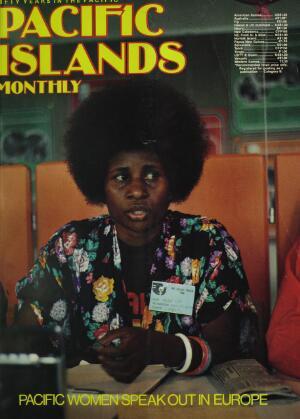
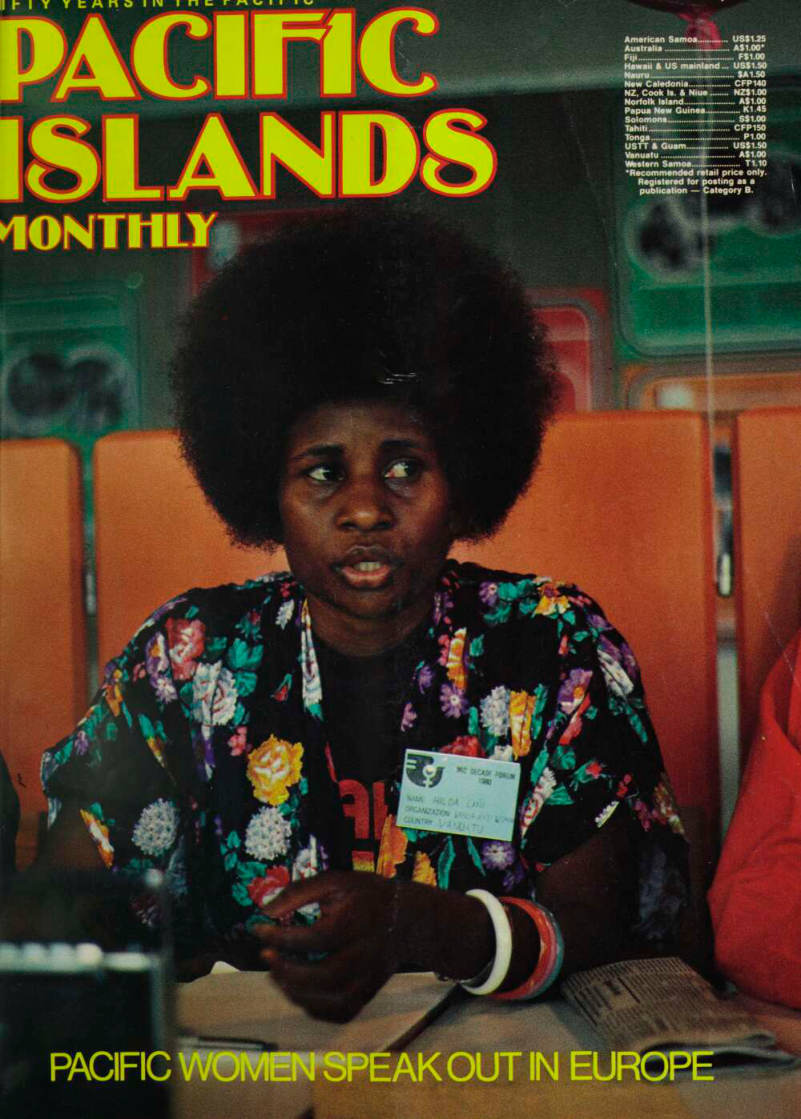
Cover: Vanuatu representative Hilda Uni pictured at the Copenhagen women’s conference. Story p2l.
Photo: Bengt Danielsson.
American Samoa 48 Australian in the Pacific 29 Books 53 Cook Islands 69 Deaths 81 Easter Island 55 Festival of Arts 14 Fiji 25, 45,48, 71 French Polynesia 23 Hawaii 57 Islands Press 26 Letters 7 New Caledonia 59 New Zealand 67 Palau 71
Papua New Guinea 22,23, 25,53,69,72 People 49 Political Currents 21 Ships 71 Shipping Services 79 Tonga 57 Tradewinds 67 Tradewinds Intelligence 70 Travel 59 Tropicalities 45 US drops Islands claims 13 Vanuatu 19, 45, 63, 67 Western Samoa 47 Yachts 7 4 Yesterday 63
Advertisements & other items, pp. 3-4 (2 items)
3
PACIFIC ISLANDS MONTHLY - OCTOBER, 1980
Founded 1930 by R. W. Robson Editor Angus Smales Associate Editor Malcolm Salmon Editorial Adviser John Carter Manager John Berry Advertising Sales Manager Steve Gray A Pacific Publications production 76 Clarence Street, Sydney 2000 GPO Box 3408 Sydney 2001 Cables: PACPUB Sydney Telex: 21242 (answers INTARAD) Telephone: Sydney 29 6693 Melbourne 63 0211 ext. 1565 and 1858
ffiwnM)
l* % sr r. (S
n-r- -j* • [in TS UlS> .*±-
NEW-.
ZEALAND JS/
//■ / &> f I \'i : Ml * mf E»iUmMiT« WE EXPORT PRODUCTS IN ALL OF THE FOLLOWING GROUPS Frozen meat, fish and seafood (bulk and portion control) Dairy products Canned fruit Dry groceries Beer, wines and spirits Cigarettes Electrical appliances Household products Electrical supplies Builders hardware Engineering supplies Motor vehicles and spares and much more!! o ■ 'a .
Pacific Report
End Of Vanuatu Rebellion
The rebellion on the Island of Espiritu Santo, which had threatened the stability and unity of the new Pacific nation of Vanuatu, ended with the intervention of 400 Papua New Guinea troops at the request of the Vanuatu Government (see pl 9). The nominal leader of the rebels, Jimmy Stevens, was arrested and is one of more than 100 rebels who have been charged with a wide range of offences. Prime Minister Walter Lini believes it will be many months however before the island is fully back to normal, and the resettlement of refugees will be a major task. PNG’s involvement, together with a degree of technical support from Australia, brought bitter criticism from French territorial sources in the Pacific. In one incident 17 PNG crewmen of a visiting fishing ship had to receive police protection in New Caledonia because of threats and demonstrations against them. Some Papua New Guineans at home also opposed their country’s involvement. Nonetheless •the operation emerged as highly successful, restrained and properly managed. It clearly forged a special link between PNG and Vanuatu and enhanced PNG’s regional position among the Pacific new nations. Commenting on the outcome a Vanuatu government spokesman said ‘lt is significant that PNG and Australia have stood by us’.
Kenilorea Back With New Ministry
Peter Kenilorea, the foundation prime minister of Solomon Islands, has been returned to office following the first general elections since independence. Two-thirds of the members of parliament lost their seats at the election (PIM Sept p 9). The elections themselves did not leave a clear-cut political situation and there were two nominations for the parliamentary vote to elect a prime minister. Mr Kenilorea, leader of the United Party, carried the vote by a decisive 25 to 5 over the leader of the People’s Alliance Party Solomon Mamaloni. The additional support which Mr Kenilorea received to enable his election came from a group of independents led by Francis Hilly. The United Party and the independents then formed a coalition government in which Mr Hilly is deputy prime minister and health minister. The other portfolios, equally divided between the two groups, are: Finance, Benedict Kinika (U); education, G Beti (I); natural resources, Paul Tovua (U); agriculture and lands, Waeta Ben (I); trade, industry and labour, Pu[epada Ghemu (U); transport and communications, Moffat Bonunga (U); home affairs, Philip Kapini (I); law and information, Lawry Wickham (I); youth and cultural affairs, Denis Lulei (I); works and public utilities, Tom Harehiru (U). Policies towards foreign and regional affairs are unlikely to change under the new government, but there are indications that decentralisation may receive higher priority.
Four Newcomers At Delhi Chogrm
Four new South Pacific countries in September attended their first Commonwealth Heads of Government Regional Meeting (CHOGRM). They were Solomon Islands, Tuvalu, Kiribati and Vanuatu. Welcoming the new members in New Dehli, Common wealth Secretary-General Sir Shridath Ramphal said he wanted ot offer a special welcome to Vanuatu ‘as a member country that has emerged out of travail to join us’, Sir Shridath said that the Vanuatu experience provided a valuable lesson to the regional grouping in the way regional solidarity could cope with such changes. Vanuatu’s Prime Minister Fr Walter Lini said it had been touch and go for a while whether Vanuatu would be born in time to attend the meeting. But he said the rebellion that had threatened its security at independence was now over.
N-Waste Dumped U.S. Report
According to a Los Angeles report records were found in July indicating that more than 12 000 barrels of radio-active waste have been dumped in the Pacific at several previously undisclosed sites. The claim was made in a statement by an official of the US Environmental Protection Agency.
Japanese Tour, Talk On N-Waste Plan
A Japanese Government team toured South Pacific countries in September in an attempt to convince their governments of the
safety of Japan’s plan to dump low-level radio-active wastes in the Pacific. The likely site is in 6 km of water 900 km south-east of Tokyo and 500 km from the nearest land the Japanese owned Ogasawara Islands. The Japanese propose a trial operation next year involving the disposal of 5000 to 10 000 steel drums of low-level wastes solidified in concrete. Among points made by the Japanese spokesmen was that Britain has been dumping low-level wastes in the Atlantic since 1949, and some other Organisation for Economic Co-operation and Development (OECD) members have been doing so since 1967. At its last meeting in July, the South Pacific Forum condemned any action that represented further exploitation of the Pacific for nuclear purposes in ways that disadvantaged the people of the Pacific.
The Japaneseteam’sfinal call was at Port Moresby, where Papua New Guinea’s Foreign Minister Noel Levi said all countries in the region had openly expressed opposition to the trial operation, and that Japan should abandon its plan. In Canberra, the Japanese team assured Australian officials that disposal would not begin until Japan had ratified the Convention for the Prevention of Marine Pollution by Dumping of Waste and Other Matter, commonly called the London Dumping Convention, and guidelines set by the OECD’s Nuclear Energy Agency.
Noumea Demo Supports Santo Secession
Several hundred demonstrators marched through Noumea late in August calling for French paratroopers to be sent to Vanuatu to protect the French community there. The demonstrators included some Frenchmen evacuated earlier from the former secessionist island of Santo.
Png In Formal Protest To France
Papua New Guinea late in August formally protested to the French Government over the ‘continued inflammatory involve ment of French citizens in the affairs of Vanuatu’. PNG’s Secretary for Foreign Affairs and Trade Paulias Matane handed a protest note to the French resident charge d’affaires in Port Moresby, Jean-Paul Schricke. In a prepared statement after the meeting, Mr Matane said the PNG Government was displeased with France over a number of matters, all of which had arisen as a result of the Vanuatu situation. These were: anti-PNG and Vanuatu broadcasts over radio Noumea; continued collabor ation of expatriate French citizens with rebel elements on Espiritu Santo; and harassment of PNG fishermen by French citizens in Noumea on the previous weekend. In recent weeks radio Noumea had broadcast totally inaccurate statements alleging PNG troops had committed atrocities, including the raping and brutal treatment of women, in Vanuatu. Mr Matane expressed his government’s disappointment that France had not taken any positive action to clearly state the facts of what was happening in Vanuatu. ‘By its silence,’ he said, ‘the French Government has given credence to propaganda, distortion of facts and blatant lies broadcast over radio Noumea.’
Vanuatu: Maxime Carlot Is Speaker
In a highly significant post-independence move, Vanuatu’s Rep resentative Assembly has voted overwhelmingly to elect Maxime Carlot as first speaker of the country’s parliament. All MPs’ votes went to Mr Carlot, except one which was invalid. In addition to serving as speaker, Mr Carlot will act as president in the absence of President Ati George Sokomanu. Mr Carlot is one of three members of the Representative Assembly who form the so-called Independent Opposition. The others are Fr Gerard Leymang and Vincent Boulekone. All three are French speaking. Unlike the secessionist forces, members of the Independent Opposition recognise the legitimacy of the Vanuaaku Party government headed by Prime Minister Fr Walter Uni, and have fulfilled their parliamentary duties since the November 1979 poll. The election of Mr Carlot can only favour a broader political unity in the new nation. In a statement after his election Mr Carlot expressed a deep wish to serve the country. It was an honour to hold such high office, he said. The post of speaker became vacant with the resignation of Pastor Fred Timakata, who took office as minister for home affairs.
Mara Wants Advisory Service
Fiji Prime Minister Ratu Sir Kamisese Mara has proposed the setting up of a South Pacific Regional Advisory Service. The pro posal envisages a scheme under which specialists in trade, law, audit, economic planning and industrial development would be available to South Pacific countries at their request. He made the proposal while introducing discussion on the special needs of South Pacific Island countries at the opening session of the
Commonwealth Heads of Government Regional Meeting in New Delhi in September.
’Bl Cpa Meeting For Fiji
The 1981 meeting of the Commonwealth Parliamentary Associ ation is to be held in Fiji.
Fire Guts Santo’S Copra Mill
Fire gutted Santo’s copra mill in August. Occurring just a few days before the secessionist revolt on the island was put down, the fire at the S6OO 000 mill is thought to have been started by supporters of the secessionist ‘Vemarana’ movement.
Australia-Vanuatu Air Link
Australia and Vanuatu have agreed to establish a regular air ser vice between the two countries. An early announcement of ser vices and fares was expected.
Facts On Spec-Spc Merger Idea
Dr Gabriel Gris, director of the South Pacific Bureau for Econ omic Co-operation (SPEC), has set the record straight on the proposal for a merger of his organisation and the South Pacific Commission (SPC) (PIM Aug p 17). In a letter to The Fiji Times correcting a statement on the matter by one of the paper’s re porters, he wrote: ‘The report which recommended the amalga mation of SPEC and the SPC into a single regional institution . . . was not a SPEC presentation but a report of an independent joint committee. This committee, which was created as a result of a decision by the 10th South Pacific Forum held in Honiara, Solomon Islands, July 1979, consisted of three Forum member governments (Australia, Cook Islands and Solomon Islands), three SPC member countries/territories (American Samoa, New Hebrides Vanuatu and French Polynesia for France), and an independent chairman, nominated by the director of SPEC and the secretary-general of SPC. Its primary function was to investigate the possible rationalisation of institutional arrange ments between SPEC and SPC with a view to ensuring that overlapping of responsibilities was minimised and that the re sources available to the region were utilised most effectively.
In accordanmce with the Forum directive, the committee tabled its report at the recent 11 th South Pacific Forum, held in Tarawa, Kiribati, in July, through its chairman Tuala Karanita Enari of Western Samoa. The report will also be tabled at the 20th South Pacific Conference to be held in Papua New Guinea in October.’
Ordeal Of A French Baron
A French nobleman, Baron Arnaud de Rosnay, suffered a gruel ling ordeal in September on an 11-day solo voyage on a sail powered surfboard in French Polynesian waters. After being washed ashore on a tiny atoll, the baron was flown to Papeete in an exhausted and badly sunburned condition.
Png Gets A Weekly Times
A new Pacific weekly newspaper was born in September when Wantok Publications of Port Moresby launched The Times of Papua New Guinea. The weekly promises ‘an authoritative and varied view of the passing scene in PNG’. The first 32-page issue indicated the promise could be kept. Editor of the new paper is Franzalbert Joku, a former political and general writer with the daily Papua New Guinea Post-Courier.
Siting Of French Oil Refinery
An early decision is expected from Paris on whether a planned oil refinery will be established in French Polynesia or in New Caledonia.
William Bodde On Fiji’S Role
The new United States ambassador to Fiji sees the country as having a key role in the Pacific region, and as a force in world affairs, with its participation in the Law of the Sea Conference and its role with the United Nations peace-keeping force in Lebanon. William P. Bodde Jr told The Fiji Times in an August statement that his aim was ‘to broaden and deepen relations between America and Fiji’. One way he hoped this could be done was through more Fiji students, particularly graduates, studying in the USA.
Two More Nomads For Png
Australia is to give two more Nomad aircraft to the Papua New Guinea Defence Force. The cost of the Australian-built planes, along with spare parts and technical support for three years, is estimated at almost SA4 million. Australia’s Defence Minister Mr Killen said the Nomads, provided under Australia’s Defence Co-operation Programme with PNG, had been asked for by PNG to supplement three Nomads provided two years ago.
New Dish Antenna For W. Samoa
A Hercules aircraft flew to Western Samoa in September with a replacement dish antenna for the one damaged during an erection accident at Afimalu in August (RIM Sep p 10). The first reflector, part of the country’s European Economic Community funded Earth Satellite Station project, was damaged beyond re pair. It is reported to be covered by insurance. The Hercules also carried special lifting gear to avoid another similar accident.
Six skilled riggers were to be brought out from Scotland to do the job.
Burnt Feet For Firewalkers
Several devotees suffered burns during a religious firewalking ceremony at Suva’s Maha Devi Kalliaman Temple in August.
Some firewalkers blamed the accidents on two priests vying for supremacy. A new priest was appointed this year by the temple committee to lead the firewalkers. A devotee who has been walk ing on the hot coals each year for the past five years said: ‘His ways of doing this are different from what we have been practis ing and I could feel something was wrong.’
Papeete Hotel Fire
At least three people died in September when fire broke out at the Kon Tiki Hotel, Papeete. Guests were evacuated from the seven-storey building by ladder.
Pina Manual Plan Off The Ground
A long-planned project of the Pacific Islands News Association (PINA) for a training manual for beginner reporters finally moved a step forward with the recent arrival in Honolulu of Dr Frederick T. C. Yu, vice-dean of the Columbia University School of Jour nalism in New York. Dr Yu has been seconded to Honolulu’s East-West Center. After a familiarisation tour of Island countries, Dr Yu is to prepare a first draft of the manual before distributing copies to members of PINA for suggestions. The manual will appear in two parts: Part I will contain straightforward instruction on the writing of stories, and Part II exercises drawn from Islands newspapers themselves. The work is expected to be completed by mid-1981.
Nz: Polynesians ‘Losing Popularity’
Polynesians in New Zealand continue to lose popularity there, according to a September report from Mike Field in Wellington appearing in the Apia newspaper The Observer. Field writes: They face the prospect of a strong European backlash against them following a brutal sexual assault and murder of a six-year old Auckland girl two weeks ago.’ The New Zealand police have issued descriptions for two Polynesian men wanted in connec tion with the murder.
Honolulu, Sydney Papers On Pim’S ‘Soth’
PlM’s August 50th anniversary issue was commented upon not only by Islands political leaders, whose messages were in most cases solicited by us, but also by another breed some case hardened folk of the media, who had no obligation whatsoever to do so. The comments, therefore, of the editorial writer in The Honolulu Advertiser (August 16) are all the more appreciated.
The Advertiser's editorial of that date said in part: ‘Without a doubt, the most important regional publication in the Pacific Islands in the past half-century has been a monthly magazine published in Sydney, Australia. Pacific Islands Monthly has made major contributions to the sense of awareness and regional unity now found among South Pacific islanders. So it is fitting that PIM celebrates its 50th anniversary this month with a smashing souvenir edition of 182 pages . . . The Islands will ... be for tunate if they continue to get the kind of understanding PIM has shown in a time when this vast ocean area has been coming of political age.’ For an editorialist in the weekend edition of the Australian national daily The Australian (August 23-24); ‘This month has seen not only the independence of Vanuatu, but another Pacific landmark, the 50th anniversary of Pacific Islands Monthly, a magazine which has had as profound effect as any government or official policy-maker in helping achieve a sense of unity and community in the Pacific region. Its founder, the redoubtable R. W. Robson, is now 95 and living in somewhat fretful retirement on the NSW central coast. He deserves, as does his small but devoted and long-serving staff, high praise and congratulations for their long and most significant contri bution to Pacific affairs.’
Sleepy Croc Stops Flights
A main runway at Port Moresby International Airport was closed to traffic for 20 minutes on September 11 after a crocodile was found sunning itself in the middle of the tarmac.
A regional
Letters
A regional shortwave service?
The recent South Pacific Fo rum meeting in Kiribati has helped to write a new page in the modern history of the South Pacific nations. One of the achievements of this meeting was undoubtedly the setting up of fresh initiatives to establish a regional news bureau, and consequently guarantee a com mon and independent source of information for use by the regional media.
The peoples of the South Pacific region deserve the right of access to a more overall appreciation of their cultures and ideals. This was magnificently demonstrated in Port Moresby in June-July, during the Third South Pacific Festival of Arts. It very soon became obvious that the festi val would allow every participating nation and every observer present to witness the strength of the cultural bonds that unite this immense region of the world.
The eagerness and skill of the youngest nations to display their newly rediscovered wealth of traditions and ideals was heart-warming. Papua New Guinea, as the third host country in the history of this festival, handled this far reaching event with the most commendable enthusiasm; and for those who could be present in Port Moresby celebrating that spirit, the time now is for reflection.
It must be of some interest to keep the message circulating: The South Pacific nations are alive and striving. Melanesia, Micronesia and Polynesia are able to bridge historical bar riers and plunge toward the common cradle of their origins, to revive the ancestral bonds. . . .
For none of these nations is it easy today. All of them have
experienced the same evils, from slave merchants to col onial rule. Some are still today fighting desperately to salvage their identity against imported and destructive ways. Others have succeeded in rejecting open foreign domination, and now long for closer links with brother nations in their search for the original communality.
In this perspective, and in a humble and personal way, I would like to submit to all interested parties in the South Pacific a concept which would provide a major live link be tween all countries of this region, irrespective of their political, economic or cultural differences.
This concept is of an inter national shortwave radio , broadcasting in the two most widely spoken languages in the region, English and French, and placed under the authority of the South Pacific Forum. Based in a central position, it would maintain a close association with the proposed South Pacific News Bureau and would fur thermore constitute the Voice of the South Pacific for the rest of the world.
It would also act as an important formative body in many media areas, catering for trainees sent by the countries involved.
As a first step towards overcoming the split between French- and English-speaking countries, Pacific Radio-Radio Pacifique would serve a dual purpose; stress the unifying cultural bonds between brother nations, and offer an alternative to foreign-owned media.
Funding of such an inter national service could be depen dent both on the South Pacific Forum, specialised organis ations of the United Nations, such as the ITU (International Telecommunications Union), and/or special contributions from regional countries and organisations.
This concept, developed through my experience both in shortwave broadcasting and in the South Pacific region, is open for discussion. My main pur pose in submitting it is to get as much feedback as possible, in the hope that it might eventu ally attract enough interest to justify a more detailed and shared study.
Such a study would involve
expert advice from the national broadcasting services already existing in various countries of the region, as well as a compre hensive estimate of costs re garding the creation and run ning of the proposed service.
My concept cannot pretend to be exhaustive, or even orig inal, as many of the Pacific nations already have their own radio facilities, some operating on a 24-hours-a-day basis.
Listeners in the South Pacific region are also able today to tune in to overseas shortwave services, such as Radio Aust ralia, Radio France Inter national, the Voice of America, etc, which provide 24-hour prQgrammes in English or French.
What makes the concept of Pacific Radio-Radio Pacifique genuinely different, however, is that it would belong to the region, crossing the language barrier, and promoting a united approach to the problems specific to the South Pacific region.
It would act as an ambassa dor to the world, and focus its attention on the issues of today as seen by one of the world’s youngest regions and would promote unity, exchange and understanding between the brother nations themselves, at a time when these are increasing their efforts to develop econ omical, political and cultural ties between themselves.
Christian Seruzier
Melbourne, Vic Australia.
‘Hierarchy of
needs’ in Cooks
Right now the Cook Islands Government is introducing a new taxation package which is designed to balance its budget ary deficit. This it may well do, for a short time. It may also well succeed in muzzling the ox that treads out the seed corn.
The Cook Islands Govern ment, like many Pacific govern ments, faces major economic problems. The economic aspir ations of its population (and the promises that it has made to them) cannot be supported on the national resources it pos sesses. The difference has to be made up by aid. Unfortunately the aiding countries do not take a ‘soup kitchen’ attitude to aid and are asking questions about
the period needed to attain economic self-sufficiency. This is the crux of the problem.
What is economic self sufficiency? Is it a microcosm of Australia or New Zealand? Is it a return to the Pacific of 200 years ago? Or is it a rethinking of the whole problem?
I suggest the answer lies in the last approach.
There are three basic categories of people who are responsible for current plan ning: Local politicians who have little education but a certain amount of instinct and whose instinct can probably be trusted; local politicians and administrators who have some education, usually first degrees, and have come to despise their instincts in general, they have abandoned the best of their old world in favour of a superficial coating of the new; overseas experts who have cither come for a two-year holiday or who and these are far worse earnestly endeav our to fashion their host country into a poor copy of their home country.
With a few exceptions most Pacific nations are poor in natural exploitable resources and to some extent that may be their salvation. The problem with a wealth of resources is that while they may bring temporary prosperity, they are resources that, once consumed, cannot be replaced. The energy crises that Western countries face are no passing phase, and one trembles at times to think of their vast cities that depend absolutely on abundant cheap energy and excellent transport and distribution systems. When such systems fail then the whole complicated apparatus of city administration collapses with them. The Puka Pukan then, with his fish and his coconuts, may be far better off than the inhabitant of a highrise Sydney apartment building. To a great extent today the Pacific, and the Cooks in particular, stand at an economic crossroads and we do not have too long to decide which direction to take.
One influential group will pressure us to increase exports so that we can pay for more imports and have a ‘higher’ standard of living. But, then, what is a higher standard of living?
Is it living like battery hens in an Auckland suburb, watching TV at night, commuting to a boring job during the day, having a night out every week end at the club and worrying about the mortgage and the hire purchase on the new wall to-wall carpel?
Or is it simply having enough to eat and enough leisure to enjoy living? Again a funda mental question, but one that we do not face.
Right now we import almost all our energy requirements and a considerable proportion of our food in a country that could well feed itself and even look after its own energy needs as well if it was prepared to accept less conspicuous consumption.
We in the Cook Islands now face a new round of taxation and a new round of inflation so that government can support a higher rate of expenditure and model itself on a New Zealand Government that has already planned itself into a virtual state of international bank ruptcy. Arnold Nordmeyer was one of the most far-sighted and most unpopular of New Zea land ministers when in 1958 he sought to put the brakes on and prevent New Zealand from spending itself into insolvency.
The last Premier of the Cook Islands, Albert Henry, took similar measures, for his in stinct made him aware of the same problems that Mr Nord meyer foresaw. Now we have a case of the bland leading the blind.
A great writer on manage ment, Fayol, created a concept that he referred to as a ‘hierarchy of needs'. Applying this to the situation that we face today, we must acknowledge that the first need is to see that the people, and that means all the people, are adequately fed.
With the outflow of productive population that the Cook Islands has faced over the last two years, this will be in creasingly difficult.
The next need is clothing.
The next is housing, followed by education and health. After them, we can worry about the rest.
The famous economist E. F.
Schumacher once wrote: ‘The amount of real leisure that a society enjoys tends to be in inverse proportion to the
amount of labour-saving ma chinery it employs.’
For us in the Pacific that is a very relevant statement. We buy tractors, we buy rotary hoes, we buy washing ma chines, we buy electric ranges, and the most foolish buy car pets and then buy vacuum cleaners to clean them with.
Now, what does this gain us? A horse with a plough on a one-to four acre block will do the work faster than a rotary hoe and, though slower than a tractor, it will do it better. It consumes local grass and not imported diesel. It will also take you shopping or over to the neigh bours’. Yet to buy that tractor or rotary hoe we work longer hours to produce export pro duce so that we can have ‘labour-saving machinery’.
We may do better to go back and construct a Pacific edition of Fayol’s ‘hierarchy of needs’, and gear our economies to long term goals that we can live with and enjoy rather than attempt to set up bad and heavily subsidised copies of a Western consumer society.
My hope in writing is to provoke discussion for this sub ject needs long and earnest debate. The quick and 100-easy measures now being taken in the Cook Islands are no sort of answer at all. It is the people who live in the countries of the Pacific who must decide the sort of society they want and can afford, and not expatriate advisers who were sent by foreign governments.
Richard Mcdonald
Rarotonga Cook Islands (This letter cut for length)
Biased reporting
misrepresents PNG
Would you kindly allow me space in your columns to air my views on what I have read about the savageness and the primiliveness of my country, Papua New Guinea. A lot of foreign reporters and writers arc biased, favouring sen sational and distorted facts which are far from the truth.
Although our cultural and national unity can be ques tioned by the presence of 700 cultures, at least I am proud to say that all of us are aware of the independent status of our country.
Foreign reporters report on cannibalism, tribal fighting and ‘stone-age primitives’ without any understanding. Last year an Operation Drake photo grapher photographed Southern Highlands people, some wearing shorts and meri blouses and some holding steel bush knives, just outside the town of Mendi, and reported ‘stone-age tribe discovered’.
Cannibalism, which hardly exists today, was once a ritual practice but never let it be said we killed our fellow man for meat. As for tribal fighting in the highlands, even coastal Papua New Guineans do not know the real causes. The cause is often described as a worhan or a pig, but this is not the usual cause. Some tribes are tra ditional enemies and often rude words may spark off a fight.
Some tribal fights have very old causes over land boundaries.
The fact is that foreigners have no idea of our traditional social organisations, our
wantok system and our tra ditional means of dispute settle ment like paying back and compensation. But this does not mean we live in a state of anarchy. There are simply a lot of distortions. From reliable sources 1 believe that crimes such as rape, murder, armed robbery and kidnapping are more and worse in a Western civilised society than they are in my primitive PNG society.
Who, then, is a savage?
Regarding national indepen dence it must be understood that every nation depends on other nations, but in spite of interdependence, independent countries such as PNG are trying to make their own de cisions. They want to run their own affairs in their own inter ests rather than be completely colonised and exploited by foreigners. Of course the run ning of our affairs may be influenced by international issues. All the same Papua New Guineans want to retain their culture and identity. They want to be their own masters rather than second or third class citizens in their home country like the original inhabitants of South Africa or the Aborigines of Australia.
PNG is combatting econ omic exploitation and colonis ation. Although we are only five years old as an independent nation we are aware of multi national corporations and Aust ralian capitalistic enterprises.
That is why we have our organisations like NIDA (National Investment and De velopment Authority) and our Investment Corporation. This means foreign companies must satisfy our conditions before they operate here. What’s more the people of PNG have a major share in them which means they are partly nationally owned.
On the question of royalties from the Bougainville copper mine one must remember that the money is less in value than the people’s traditional values relating to gardening land, burial areas and hunting grounds. Land is our life and money cannot buy life.
Biased foreign reports on events and situations give the world the wrong impression, and I trust that you will print
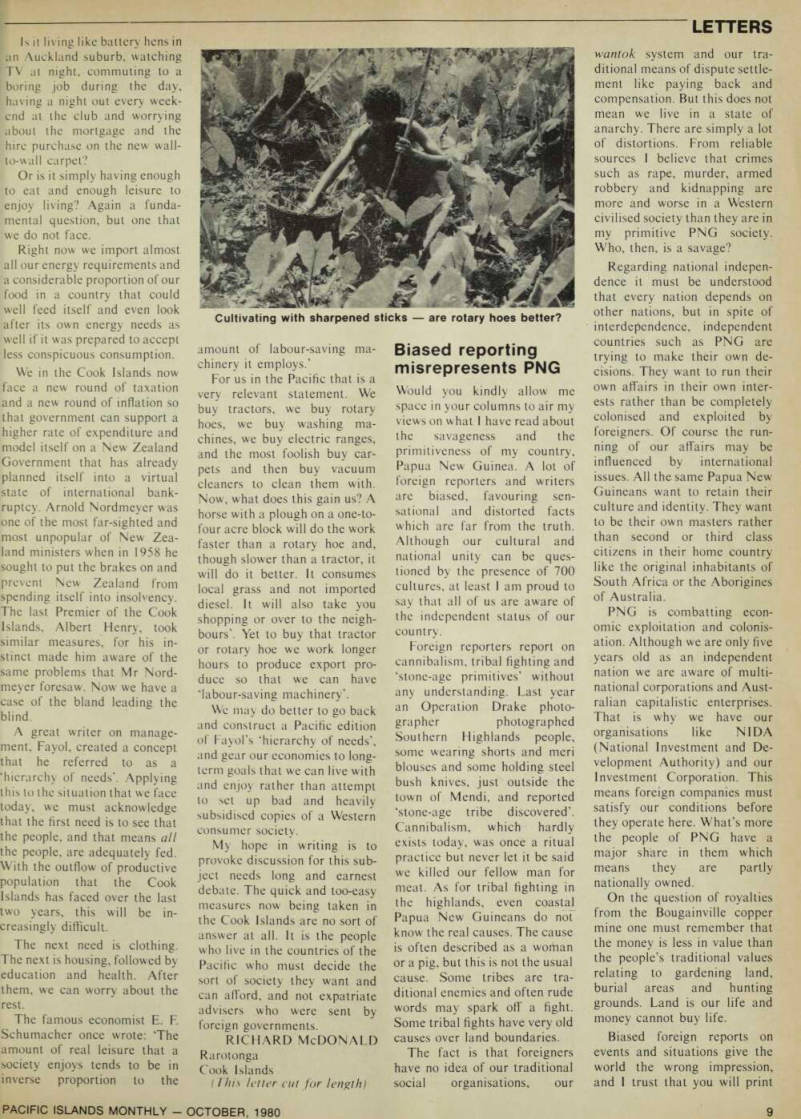
Cultivating with sharpened sticks - are rotary hoes better?
my letter with sincerity thus getting some facts and general isations about my country straight. I remain, another ‘primitive’ Papua New Guinean.
N. Pioli
Boroko Papua New Guinea (This letter was cut for ngth.) A call to ‘Pacific awareness’
I am concerned to read about the treatment of some of our Pacific Islands people, notably the Melanesian people in West Papua New Guinea and New Caledonia, and the Polynesian people in Tahiti. I am especially concerned at the attitude of the French colonisers, these so called ‘civilised’ European people, and read with concern about the activities of French settlers (belter to be called criminal vagrants) and bureau crats in Tahiti (PIM June pl 9).
It is about time the indigen ous Tahitians realised that either they fight for indepen dence or let their culture, dig nity and identity be under mined by the French people through exploitation and colon isation. Why show off your culture in the South Pacific Festival of Arts when your culture is merely decorative to suit French tourists? Don’t you realise that sooner or later your beautiful island will be infested with nuclear waste to such an extent that your survival there will have to be questioned? This will be due, obviously, to the French Government’s criminal nuclear activities.
We Pacific Islanders have to fight to retain our identities so as not to become second-class citizens in a European society.
Tahiti is your country. Do not trust any Western or European government or any world body such as the United Nations because they make decisions in the best interests of the ‘civi lised’ and Western nations. Hu man rights to them is nuclear testing and retention of status in the world at the expense of the so-called Third World, while continually suppressing the people of the Third World.
By saying that Tahiti and New Caledonia are integral parts of France and by calling
them French Polynesia or the French Pacific, France is cre ating a false image and a false sense of identity in the Pacific.
No indigenous Frenchman is a Pacific Islander. Every Pacific Island heart must go with Oscar Temaru and his party in Tahiti, the pro-independence parties in New Caledonia and the free dom fighters in West PNG for fighting to retain their Polynesian and Melanesian identities. Also every Pacific Islander should take a bow to the tiny Pacific nations like Tuvalu which are concerned neither with a modern way of life nor with owning a TV set, yet they gained their indepen dence because they wanted to retain their identities and make their own decisions.
Finally I would draw the attention of every Pacific Islander (especially the Tahitians) to the theme of the Third South Pacific Festival of Arts held in Port Moresby recently, and that was ‘Pacific awareness’. I would say we want our Pacific cultures to be alive and living, and not to be decorative or artificial to suit foreign interests such as tour ism.
E. Tobua
Port Moresby Papua New Guinea
Another 50-year
stayer
Your Jubilee August number to hand and most interesting. Con gratulations!
Like Professor Harry and Mrs Honor Maude (PIM Aug pi 13) I too have been a sub scriber to PIM for the whole 50 years, having gone to Fiji in early 1931. I did have all the early newspaper-type ones, but they have disappeared in my many travellings now fin ished in this retirement village. (The Yen) C.W.
Whonsbon
Aston, Qbe
(Archdeacon Emeritus of Polynesia) Castle Hill NSW Australia Case of a missing friend I am writing on behalf of a Japanese lady. Miss Yasuko Ito,
who is looking for her missing female friend, Mrs May MoiMoi.
When Yasuko Ito was in Tonga, from August 1976 to the beginning of February 1977, May MoiMoi lived either in the town of Nukualofa with Mr Peseti Latu and his wife, Pepe, or on the island of Oneata owned by Mr Pesiti Latu. May was married to a brother of Pepe, Salesi, and had a child.
She is thought to be in her mid 30s now, to have divorced, and to be back in her native place, American Samoa.
Could you kindly help us in the search? Any information could be sent to Miss Ito at the following address: Miss Yasuko Ito, 7-6-8, Yanaka, Taito-ku, Tokyo, Japan 110.
Thank you in advance for your kind co-opertion.
Mas Otsuji
Tokyo Japan PIM sways choice
of posting
Re Too little cover on the cover’ (PIM Aug p3B) I have compen sated PIM for reader Hitch cock’s prudery by having sent 12 friends overseas gift copies of the November issue of PIM.
Such delightful photos influ ence diplomatic postings. A friend in the Australian diplo matic service last year had difficulty deciding whether to accept an Asian or a Pacific Islands posting. He proudly informed me that the issue was resolved when he chanced upon a copy of last November’s PIM in a Canberra bookshop. I am happy to report that the South Pacific has lived up to his expectations and he believes PIM helped him make a wise decision.
Fellow Diplomat
(Name and address supplied) • A correspondent who is obviously happy in his con victions he signs himself Felix Wanker has also written to PIM criticising Lou Hitchcock for being ‘too sensitive’. Writing on an Australian postcard which shows bare-breasted girls at a Sydney beach he criticises ‘bottle-fed Yanks with a
boobs fixation who want to childishly redesign God’s handiwork’. Praising the people of the Pacific Islands he adds ‘they’re great, but quit patronising them and let them join the 20th cen tury’. Editor.
Lou’s gotta
be joking
Lou Hitchcock (PIM Aug p3B), objecting to a beautiful Island girl, topless, adorning the cover of last November’s PIM, must be joking. If the letter isn’t a joke, God help the writer.
Margaret Caspers
Ramsgate NSW Australia
A rose by any
other name...
I would like to reply to the letter of Mr S. Polume (PIM Jun p 6).
Firstly, it seems that Mr Polume has completely misun derstood the main point of my earlier letter, viz, that the future of French Polynesia is to be decided by French Polynesians, who have the right to self-determination. This earlier letter was written in response to the interference by the former Foreign Minister for Papua New Guinea, Mr Olewale, in French Polynesian affairs, when he stated that immediate independence was what French Polynesians wanted.
It seemed incongruous at the time that whilst he was espous ing complete economic and political independence for French Polynesia, his own country was not considering such a step, as witnessed by the ‘cool’ $A23Om they received annually from Australia in di rect cash grants. Mr Olewale was arrogant enough to suggest complete independence, despite the policy of the democratically elected government of French Polynesia, which has chosen internal autonomy over im mediate independence until such time as French Polynesia is economically self-sufficient, as often explained by the Vice- President of the Government Council Francis Sanford.
Not all French Polynesians agree with him, and it is typical
of most democracies to have freedom and diversity of opinion. But the majority do, as evidenced by the lack of sup port for the pro-independence parties in the Territorial As sembly elections.
At the same time, most of our people do not condone nuclear testing, and I am also com pletely against it; but that is a completely different issue from the independence one.
It is interesting to see that the new Chan government in Papua New Guinea has resolved to review its opinion in this regard, and takes a more cautious attitude as regards the per ceived aspirations of citizens of other states.
Touching on Mr Polume’s reference to my surname, I would like to point out that I have both matrilineal and patri lineal ancestors ( tupuna ) who were Tahitian, as well as a French grandfather. Logically, therefore, I can claim to be ethnically Tahitian, and, as anthropologists classify Tahitians as Polynesians, I am Polynesian as well.
Although Mr Polume is deliberately vague in defining what a ‘true’ Polynesian is, I surmise he means a ‘full blooded’ or ‘pure’ Polynesian.
This odious method of applying a ‘blood fraction’ test, as the nazi race ideologists did, is patently racist and dangerous.
By Mr Polume’s own reasoning Polynesian leaders such as Dr Tom Davis of the Cook Islands, Governor Peter Coleman of American Samoa, Mr Robert Rex of Niue, or Mr Francis Sanford of French Polynesia, are totally unrepresentative of their respective countries merely because of their European names. This absurd ity can even be extended to Papua New Guinea, where the prime minister is Sir Julius Chan. In fact, I notice that Mr Polume’s given name is Samson, which is not exactly Melanesian!
Finally, 1 think Mr Polume has a right to express his views; but he should remember that I am also entitled to express mine as an individual. As a generalis ation, it would be true to say that every person acts for ‘per sonal interest’ in his case Mr Polume’s probable interest is
that of not being poisoned by nuclear fallout. My personal interest is not to have my government’s policies dictated by outsiders; I can only imagine what other personal interests he ascribes to my surname and I can only assume that Mr Polume must suffer from blind prejudice that blind preju dice which typecasts individ uals because of their language or colour. I only hope that other readers of the PIM do not fall into this same trap.
T. De Montluc
Auckland New Zealand On the future
of TUvalu
May I congratulate Dr Stephen R. Weinstein on his splendid, factual and informative article about Tuvalu (PIM Jul p 29).
It was not Nukulaelae but Nukufetau which was one of the islands (apart from Funafuti and Nanumea) that were occupied by the American forces during World War 11.
The idea of encouraging and introducing tourism to Tuvalu is not a wise one. Tourism may bring in money or economic wealth to a country, but it will also spoil and commercialise her people and culture. One can look at Hawaii, Tahiti or even to Tuvalu’s nearest Pacific neigh bour, Fiji, as examples. In Solomon Islands tourism is not encouraged. Which one do the Tuvaluans prefer sophisti cation and commercialisation of their culture or living in harmony with nature and their environment? Tourism is not the only answer to economic sur vival, but cultural preservation, ethical and customary values should be taken into account as well.
Tuvalu’s resources lie in the sea, the land and her people.
Therefore she must exploit and encourage the fishing industry, agriculture and horticulture.
Fishing and gardening should be taught in schools. Scholar ships in marine biology, fisheries, agriculture and the soil sciences should be offered to potential students. People who can find work overseas, such as seamen, and pro fessional or technical workers, may do so. Because the popu lation is slowly increasing, and
the land area limited, family planning should be practised.
Tuvalu can certainly seek advice and get assistance from Britain, Australia and New Zealand who have the money, the expertise, and the technical know-how. Australia, with all her surplus wealth and abun dant natural resources, can surely help Tuvalu which num bers only 8000 people. It won’t be surprising if Tuvalu asks China or Russia for monetary or technical aid if the West, and especially Australia and New Zealand, refuse to help.
Although Tuvalu is a new and young nation, she must be careful indeed. So far, Tuvalu is not all that primitive and backward; it is still keeping up with the rest of the world despite her remoteness.
Neemia K. O’Brien
Gela Solomon Islands
A Tuvalu
secession?
It is intended that the Tefolaha (Nanumea) community will form a federal arrangement, or, if necessary, break away politi cally from Tuvalu in early 1981. I am unable to disclose the details in full, but I can in dicate that it is for our own benefit and welfare, especially those of our young gener ations.
Today there are in our com munity numbers of school leavers from Fiji and government secondary schools, etc, stranded without jobs, and this number can only grow with time. Furthermore, there are tradesmen and experienced labourers from Ocean Island, Nauru and Tarawa, and a number of qualified seamen,
without jobs. Accordingly,
aware that Tuvalu will not be able to engage them for a long time to come, instead of wait ing and grumbling, we have de cided to take our problems into our own hands.
Living in the capital means
facing grave problems. The
place is too narrow and crowded, with a high cost of living and lack of local foods.
Unfortunately, the flow of local supplies to help our
people is hampered by long
distances and high freight
charges. Strong winds often de stroy our limited crops, destroy many houses, and threaten people’s lives because the place is narrow and lies close to the hurricane belt.
Federation, or separation from Tuvalu would result in our community growing to up to 2000 souls or even more in two to five years’ time. This would eventually give Tuvalu an opportunity to ease its prob lems. It could fill vacancies left by our departure, and at the same time reduce the popu lation in the capital.
Tuvalu will surely not be able to develop the eight islands in the group, and the three nearest islands to the
capital have already received
favourable treatment from Tuvalu whereas we, the most populated island, the furthest and the second biggest in the group, have received unfavour able treatment. It is hard to blame anybody for this. The only answer is for us to do our utmost for the good of our island home, expecting some one to assist us financially for a start.
We wish to keep close con tact with Tuvalu, and the ques tion of our relationship will be discussed at an appropriate time by representatives of both
parties.
On behalf of the Tefolaha community, I appeal to Com monwealth countries, es pecially Australia and New Zealand, and to the United States of America, for a loan of $6-$lO million in the first five years to run and develop the government and country. Fail ing this, we will have to apply to Asian countries, etc. We will not bring the United Kingdom into this as we realise she has enough problems of her own.
But her sovereignty will be re spected, unless we are no longer bound by any family ties.
If any party or government wishes to accept our appeal please write to me or call me to your nearest agency at an ap
propriate time.
Telavifati
c/o Tefolaha Community Centre Private Sector Funafuti Tuvalu
Advertisements & other items, pp. 8-12 (1 item)
Body language.
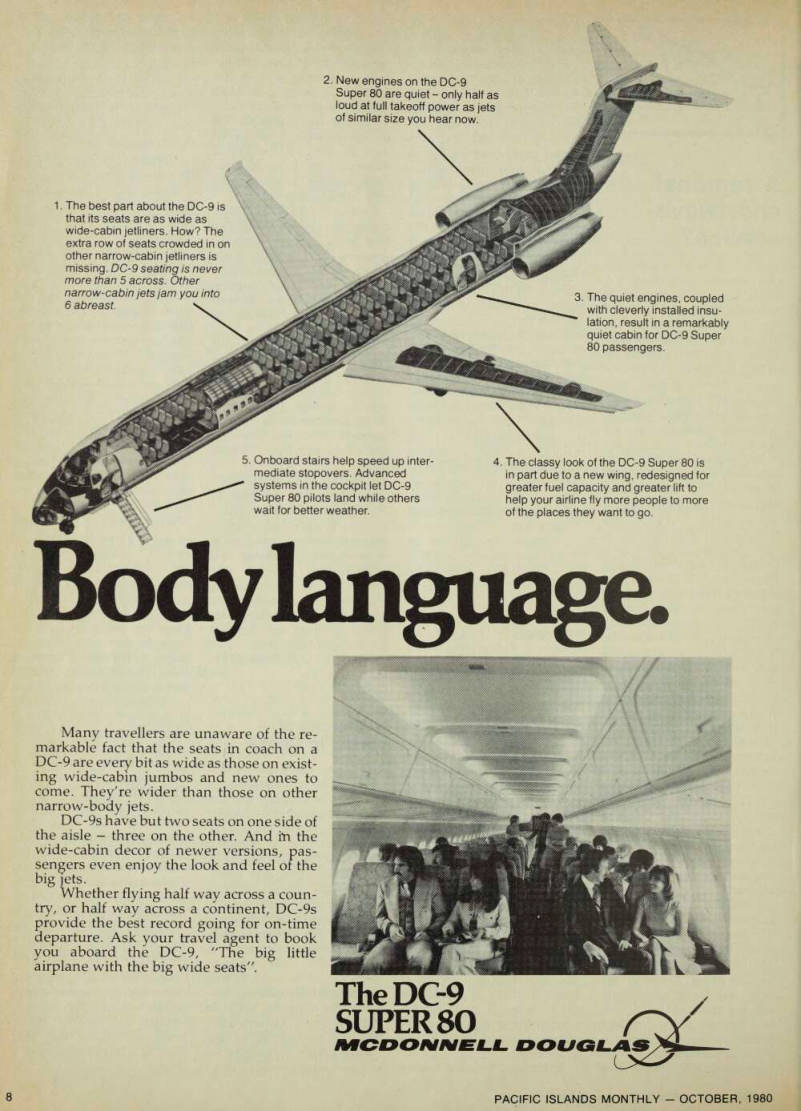
\ 2. New engines on the DC-9 Super 80 are quiet - only half as loud at full takeoff power as jets of similar size you hear now. \ 1. The best part about the DC-9 is that its seats are as wide as wide-cabin jetliners. How? The extra row of seats crowded in on other narrow-cabin jetliners is missing. DC-9 seating is never more than 5 across. Other narrow-cabin jets jam you into 6 abreast. 3. The quiet engines, coupled with cleverly installed insulation, result in a remarkably quiet cabin for DC-9 Super 80 passengers. 5. Onboard stairs help speed up intermediate stopovers. Advanced systems in the cockpit let DC-9 Super 80 pilots land while others wait for better weather. 4. The classy look of the DC-9 Super 80 is in part due to a new wing, redesigned for greater fuel capacity and greater lift to help your airline fly more people to more of the places they want to go.
Many travellers are unaware of the remarkable fact that the seats in coach on a DC-9 are every bit as wide as those on existing wide-cabin jumbos and new ones to come. They're wider than those on other
narrow-body jets.
DC-9s have but two seats on one side of the aisle - three on the other. And in the wide-cabin decor of newer versions, passengers even enjoy the look and feel of the
big jets.
Whether flying half way across a country, or half way across a continent, DC-9s provide the best record going for on-time departure. Ask your travel agent to book you aboard the DC-9, "The big little airplane with the big wide seats".
I r A i > w
The DC-9
SUPER 80
MCDONNELL.
Create your own world of
listening enjoyment
There are times when you really want to get away from it all. The day-to-day pressures at work, final exams, you name it. Well, when you feel the need for a refreshing change from the world around you, why not create your own with an AVANTE system from Pioneer.
These handsomely packaged system components like our AVANTE 700, offer all the performance of separate hi-fi components and all the beauty and styling of fine furniture.
Each component is carefully matched and designed to deliver the finest in stereo listening enjoyment from the world leader in high fidelity.
If you feel it’s time to get away from it all, why not get one of our exciting AVANTE hi-fi component systems. There are five great AVANTE systems to choose from so you can create a world of enjoyment that’s right for you. AVANTE . . . the getaway machines from Pioneer —get one today.
Ci!) PIONEER
-or further information, please contact: Australia: Pioneer Marketing Service Pty. Ltd., P.O. Box 317, Mordialloc, Victoria, 3195 r el: 90-9011 r iji Islands: Brijlal & Company, G.P.O. Box No. 362, Suva, Fiji Islands Tel: 22258 slew Zealand: Monaco Electronics Ltd., 30 Pollen Street, Grey Lynn, Auckland, slew Zealand Tel: (09) 762 098 Norfolk Island: Burns Philp (Norfolk Island) Ltd., Norfolk Island, South Pacific slew Hebrides: Burns Philp (New Hebrides) Ltd., Vila, New Hebrides Nauru Island: Jacob Enterprises, P.O. Box No. 4, Republic of Nauru Tahiti: Ets. PERFECT, B.P. 594, Papeete. Tahiti Tel; 20 407 New Caledonia: Menard Freres Ville, B.P. H 2 Cedex, Noumea, New Caledonia Tel: 27.52.22 American Samoa; Transpac Corporation, P.O. Box 1477, Pago Pago, American Samoa 96799 Tel: 633-5224 Rarotonga: South Seas International Ltd., P.O. 80x49, Rarotonga, Cook Islands Tel: 2327 Papua New Guinea; Bali Merchants Pty. Ltd., P.O. Box 6103, Boroko Tel: 254887,
US dropped claims to 25
A shedding of islands: How the US dropped claims to 25
In the article below HARLAN LEE* for the first time definitively unravels the oft-told (but generally little understood) tale of the now relinquished claims of the United States to 25 islands in the South Pacific. The article was released by the US International Communication Agency on August 19.
Since 1962 the South Pacific region has undergone tremen dous political change. Nine island states have gained their independence in that time, and several others have become self-governing. The United Slates responded to the changes taking place in the region by seeking to establish friendly, co operative relations with the new island slates.
One way in which the US acted to improve its relations in the region was in resolving disputed claims to 25 islands in the South Pacific.
The disputed islands consist of 14 claimed by both the US and the United Kingdom in the Line and Phoenix island groups, now part of the Republic of Kiribati; four islands claimed by the two Western nations in the former Ellice Islands, now part of Tuvalu; four islands claimed by the US in the north ern Cook Islands; and the three islands of Tokelau claimed by the US and New Zealand.
For the most part the US and UK claims derived from claims made by explorers, whalers and guano miners in the period 1775-1860. Cook, Wilkes and other explorers made claims on behalf of their respective governments for the islands they discovered. The majority of the 25 islands were simply sighted and visited by whalers who made no attempt to make territorial claims. It is imposs ible to determine with any certainty who were the original
discoverers of several of the islands.
A further factor regarding claims to the islands was pass age by the US Congress in 1856 of the Guano Mining Act. The Act provided that US nationals could obtain exclusive guano mining rights if they could demonstrate that they had dis covered, occupied and taken possession of the islands in question, and that those islands were not already in the pos session or occupation of any other government. The Depart ment of Stale was charged with responsibility for issuing the certificates. Few were issued, and, of those, many were never actually used for mining. The extension of US sovereignty to the guano islands as certified under the act was only tempor ary.
Until the guano mining ceased, there was no intent on the part of the US to claim permanent sovereignty over the guano islands.
In the 1870 s and 1880 s the British Government also issued guano mining certificates to its nationals for mining operations in many of the islands in question. Like the US guano certificates, the British certifi cates were intended to extend only temporary jurisdiction to the islands for mining purposes.
Guano mining slowed, then virtually ceased in the islands by the late 1880 s. It was principally at that time that Britain began asserting sover eignty over the islands by declaring protectorate status over them, providing adminis trative functions, and repeating assertions of dominion. The northern Cook Islands and the Tokelau Islands were placed under New Zealand adminis tration in 1901. The British continued to administer the Ellice Islands and asserted pro tectorate status over the Line and Phoenix Islands. During
this period the US did not pro test any of the British or NZ acts of sovereignty over these islands.
In 1939, when it became apparent that the islands would be useful to support civil avi ation activities in the South Pacific, the US decided to an nounce its claims to the 25 islands. Following that act, the US and the UK signed an agreement in 1939 to establish joint administration of two of the islands, Canton and Enderbury. The agreement was without prejudice to the separ ate claims of the respective governments. From 1971 the US exercised sole adminis tration over Canton and Enderbury under a special ar rangement with the UK.
The US position on the island claims did not change from its formal assertion of the claims in 1939 until the mid-19705.
Realising that the continued assertion of its rather weak claims to the islands would adversely affect the friendly relations the US wished to establish with the newly inde pendent and self-governing states, the US government re viewed its policy toward the disputed claims. Since the as sertion of protectorate status, the British had administered the Phoenix and Line Islands, except for Canton and Ender bury, as part of the Gilbert and Ellice Islands Colony. It was the British intention to include
the disputed islands in its plans to grant independence to the Gilbert Islands to form the far flung Republic of Kiribati.
Similarly, the four disputed islands in the Ellice group were to become an integral part of the new independent state of Tuvalu. The Cooks, already self-governing since 1965, fully administered the four disputed northern islands. The three disputed Tokelau Islands posed an unnecessary irritant to US NZ relations. Consequently, with these factors in mind, a high-level decision was made in 1978 for the US to enter into negotiations to relinquish its claims to the disputed islands in return for assurances that would protect US economic and security interests in the region.
The first set of negotiations was held with British and Tuvaluan representatives in September 1978, prior to Tuvalu’s independence in October of that year. William Bodde, then Director of Pacific Island Affairs in the Depart ment of State (and presently US Ambassador to Fiji, Tonga and Tuvalu) led the US del egation. Following extensive negotiations a treaty of friend ship was signed at Funafuti, the capital of Tuvalu, on February 7, 1979. The treaty provided for relinquishment of US claims to the four disputed Tuvalu islands, and contained pro visions for consultation between
* Harlan Lee was Pacific Islands desk officer at the US Department of State from 1978 to 1980. From 1975 to 1977 he had served in the US Embassy in Suva. He has also studied Pacific Islands affairs at the University of Hawaii, and is now an international relations officer in the State Depart ment’s Office of UN Political Affairs.
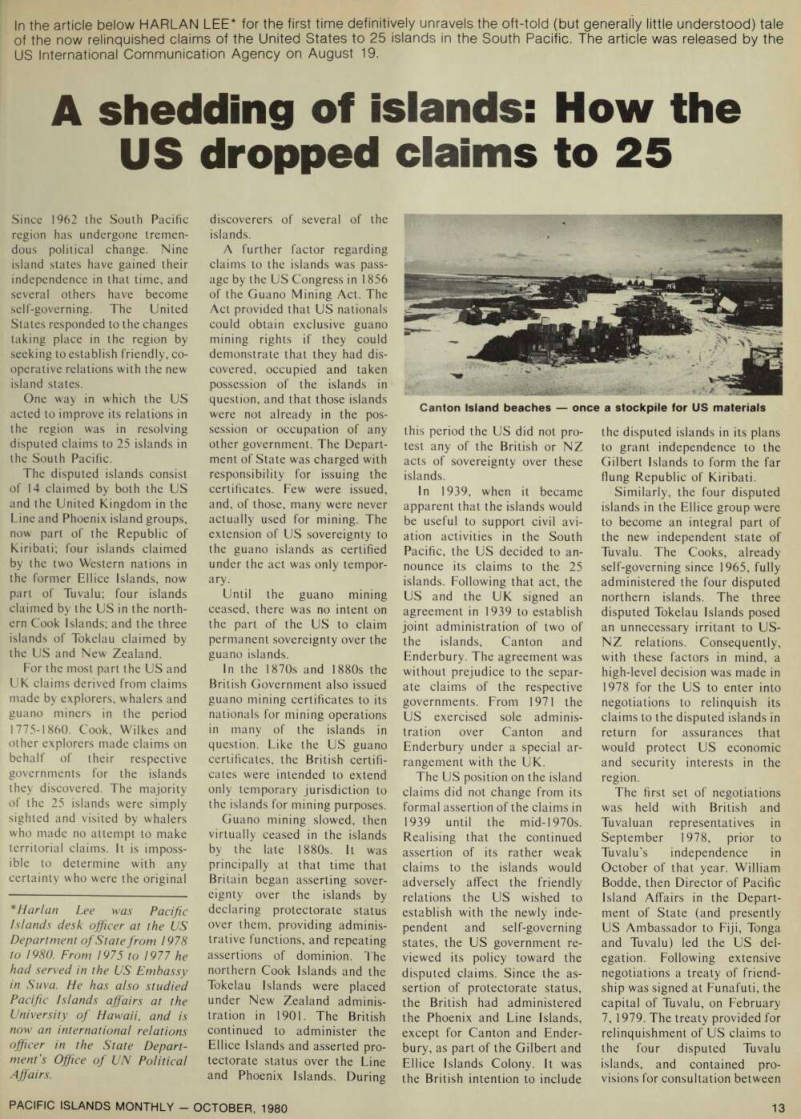
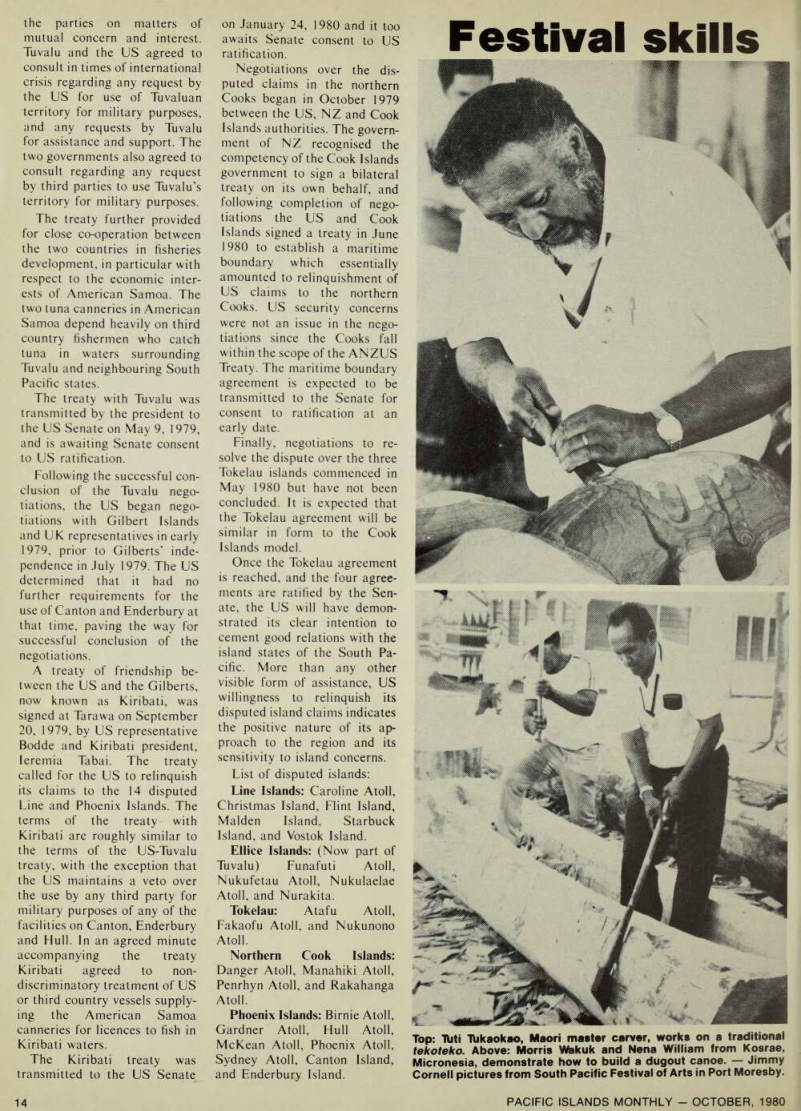
Canton Island beaches - once a stockpile for US materials
the parties on matters of mutual concern and interest.
Tuvalu and the US agreed to consult in times of international crisis regarding any request by the US for use of Tuvaluan territory for military purposes, and any requests by Tuvalu for assistance and support. The two governments also agreed to consult regarding any request by third parties to use Tuvalu’s territory for military purposes.
The treaty further provided for close co-operation between the two countries in fisheries development, in particular with respect to the economic inter ests of American Samoa. The two tuna canneries in American Samoa depend heavily on third country fishermen who catch tuna in waters surrounding Tuvalu and neighbouring South Pacific states.
The treaty with Tuvalu was transmitted by the president to the US Senate on May 9, 1979, and is awaiting Senate consent to US ratification.
Following the successful con clusion of the Tuvalu nego tiations, the US began nego tiations with Gilbert Islands and UK representatives in early 1979, prior to Gilberts’ inde pendence in July 1979. The US determined that it had no further requirements for the use of Canton and Enderbury at that lime, paving the way for successful conclusion of the negotiations.
A treaty of friendship be tween the US and the Gilberts, now known as Kiribati, was signed at Tarawa on September 20, 1979, by US representative Bodde and Kiribati president, leremia Tabai. The treaty called for the US to relinquish its claims to the 14 disputed Line and Phoenix Islands. The terms of the treaty with Kiribati are roughly similar to the terms of the US-Tuvalu treaty, with the exception that the US maintains a veto over the use by any third party for military purposes of any of the facilities on Canton, Enderbury and Hull. In an agreed minute accompanying the treaty Kiribati agreed to non discriminatory treatment of US or third country vessels supply ing the American Samoa canneries for licences to fish in Kiribati waters.
The Kiribati treaty was transmitted to the US Senate
on January 24, 1980 and it too awaits Senate consent to US ratification.
Negotiations over the dis puted claims in the northern Cooks began in October 1979 between the US, NZ and Cook Islands authorities. The govern ment of NZ recognised the competency of the Cook Islands government to sign a bilateral treaty on its own behalf, and following completion of nego tiations the US and Cook Islands signed a treaty in June 1980 to establish a maritime boundary which essentially amounted to relinquishment of US claims to the northern Cooks. US security concerns were not an issue in the nego tiations since the Cooks fall within the scope of the ANZUS Treaty. The maritime boundary agreement is expected to be transmitted to the Senate for consent to ratification at an early date.
Finally, negotiations to re solve the dispute over the three Tokelau islands commenced in May 1980 but have not been concluded. It is expected that the Tokelau agreement will be similar in form to the Cook Islands model.
Once the Tokelau agreement is reached, and the four agree ments are ratified by the Sen ate, the US will have demon strated its clear intention to cement good relations with the island states of the South Pa cific. More than any other visible form of assistance, US willingness to relinquish its disputed island claims indicates the positive nature of its ap proach to the region and its sensitivity to island concerns.
List of disputed islands: Line Islands: Caroline Atoll, Christmas Island, Flint Island, Malden Island, Starbuck Island, and Vostok Island.
Ellice Islands: (Now part of Tuvalu) Funafuti Atoll, Nukufetau Atoll, Nukulaelae Atoll, and Nurakita.
Tokelau: Atafu Atoll, Fakaofu Atoll, and Nukunono Atoll.
Northern Cook Islands: Danger Atoll, Manahiki Atoll, Penrhyn Atoll, and Rakahanga Atoll.
Phoenix Islands: Birnie Atoll, Gardner Atoll, Hull Atoll, McKean Atoll, Phoenix Atoll, Sydney Atoll, Canton Island, and Enderbury Island.
Festival skills
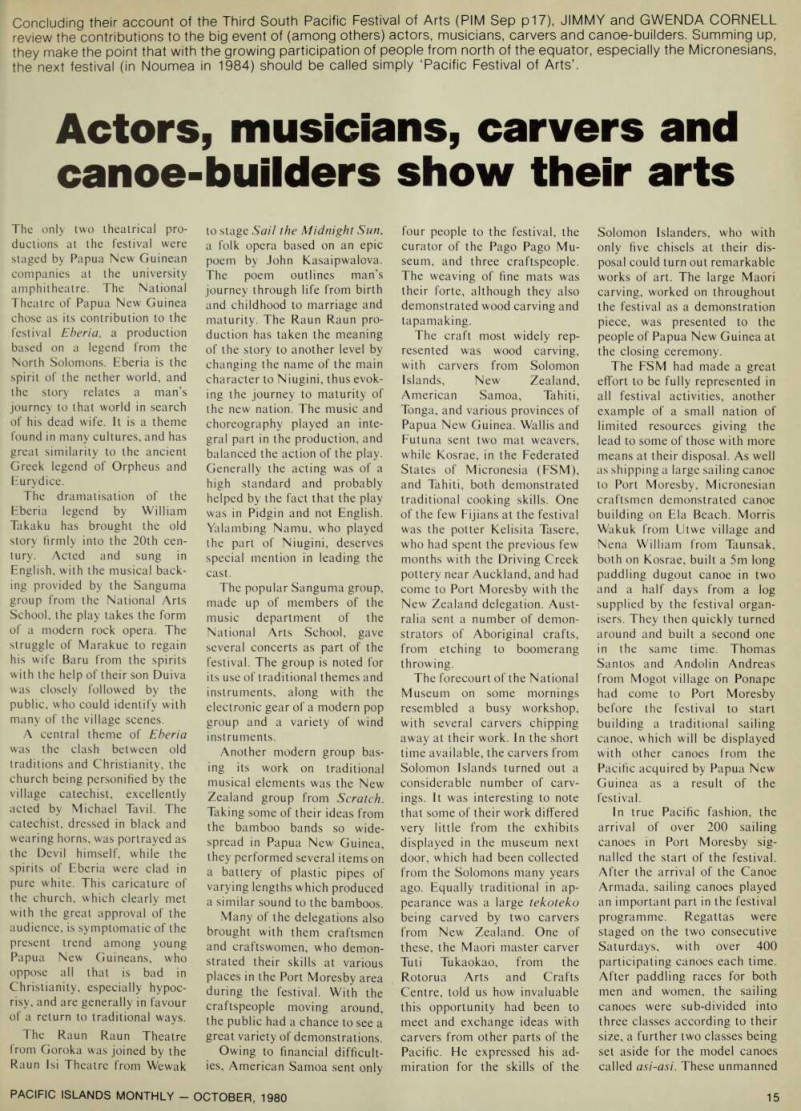
Top: Tuti Tukaokao, Maori master carver, works on a traditional tekoteko. Above: Morris Wakuk and Nena William from Kosrae, Micronesia, demonstrate how to build a dugout canoe. - Jimmy Cornell pictures from South Pacific Festival of Arts in Port Moresby.
Actors, musicians, carvers and canoe-builders show their arts
canoe-builders show their arts
Concluding their account of the Third South Pacific Festival of Arts (PIM Sep p 17), JIMMY and GWENDA CORNELL review the contributions to the big event of (among others) actors, musicians, carvers and canoe-builders. Summing up, they make the point that with the growing participation of people from north of the equator, especially the Micronesians, the next festival (in Noumea in 1984) should be called simply ‘Pacific Festival of Arts’.
The only two theatrical pro ductions at the festival were staged by Papua New Guinean companies at the university amphitheatre. The National Theatre of Papua New Guinea chose as its contribution to the festival Eberia, a production based on a legend from the North Solomons. Eberia is the spirit of the nether world, and the story relates a man’s journey to that world in search of his dead wife. It is a theme found in many cultures, and has great similarity to the ancient Greek legend of Orpheus and Eurydice.
The dramatisation of the Eberia legend by William Takaku has brought the old story firmly into the 20th cen tury. Acted and sung in English, with the musical back ing provided by the Sanguma group from the National Arts School, the play takes the form of a modern rock opera. The struggle of Marakue to regain his wife Baru from the spirits with the help of their son Duiva was closely followed by the public, who could identify with many of the village scenes.
A central theme of Eberia was the clash between old traditions and Christianity, the church being personified by the village catechist, excellently acted by Michael Tavil. The catechist, dressed in black and wearing horns, was portrayed as the Devil himself, while the spirits of Eberia were clad in pure white. This caricature of the church, which clearly met with the great approval of the audience, is symptomatic of the present trend among young Papua New Guineans, who oppose all that is bad in Christianity, especially hypoc risy, and are generally in favour of a return to traditional ways.
The Raun Raun Theatre from Goroka was joined by the Raun Isi Theatre from Wewak
to stage Sail the Midnight Sun , a folk opera based on an epic poem by John Kasaipwalova.
The poem outlines man’s journey through life from birth and childhood to marriage and maturity. The Raun Raun pro duction has taken the meaning of the story to another level by changing the name of the main character to Niugini, thus evok ing the journey to maturity of the new nation. The music and choreography played an inte gral part in the production, and balanced the action of the play.
Generally the acting was of a high standard and probably helped by the fact that the play was in Pidgin and not English.
Yalambing Namu, who played the part of Niugini, deserves special mention in leading the cast.
The popular Sanguma group, made up of members of the music department of the National Arts School, gave several concerts as part of the festival. The group is noted for its use of traditional themes and instruments, along with the electronic gear of a modern pop group and a variety of wind instruments.
Another modern group bas ing its work on traditional musical elements was the New Zealand group from Scratch.
Taking some of their ideas from the bamboo bands so wide spread in Papua New Guinea, they performed several items on a battery of plastic pipes of varying lengths which produced a similar sound to the bamboos.
Many of the delegations also brought with them craftsmen and craftswomen, who demon strated their skills at various places in the Port Moresby area during the festival. With the craftspeople moving around, the public had a chance to see a great variety of demonstrations.
Owing to financial difficult ies, American Samoa sent only
four people to the festival, the curator of the Pago Pago Mu seum, and three craftspeople.
The weaving of fine mats was their forte, although they also demonstrated wood carving and tapamaking.
The craft most widely rep resented was wood carving, with carvers from Solomon Islands, New Zealand, American Samoa, Tahiti, Tonga, and various provinces of Papua New Guinea. Wallis and Futuna sent two mat weavers, while Kosrae, in the Federated States of Micronesia (FSM), and Tahiti, both demonstrated traditional cooking skills. One of the few Fijians at the festival was the potter Kelisita Tasere, who had spent the previous few months with the Driving Creek pottery near Auckland, and had come to Port Moresby with the New Zealand delegation. Aust ralia sent a number of demon strators of Aboriginal crafts, from etching to boomerang throwing.
The forecourt of the National Museum on some mornings resembled a busy workshop, with several carvers chipping away at their work. In the short time available, the carvers from Solomon Islands turned out a considerable number of carv ings. It was interesting to note that some of their work differed very little from the exhibits displayed in the museum next door, which had been collected from the Solomons many years ago. Equally traditional in ap pearance was a large tekoteko being carved by two carvers from New Zealand. One of these, the Maori master carver Tuti Tukaokao, from the Rotorua Arts and Crafts Centre, told us how invaluable this opportunity had been to meet and exchange ideas with carvers from other parts of the Pacific. He expressed his ad miration for the skills of the
Solomon Islanders, who with only five chisels at their dis posal could turn out remarkable works of art. The large Maori carving, worked on throughout the festival as a demonstration piece, was presented to the people of Papua New Guinea at the closing ceremony.
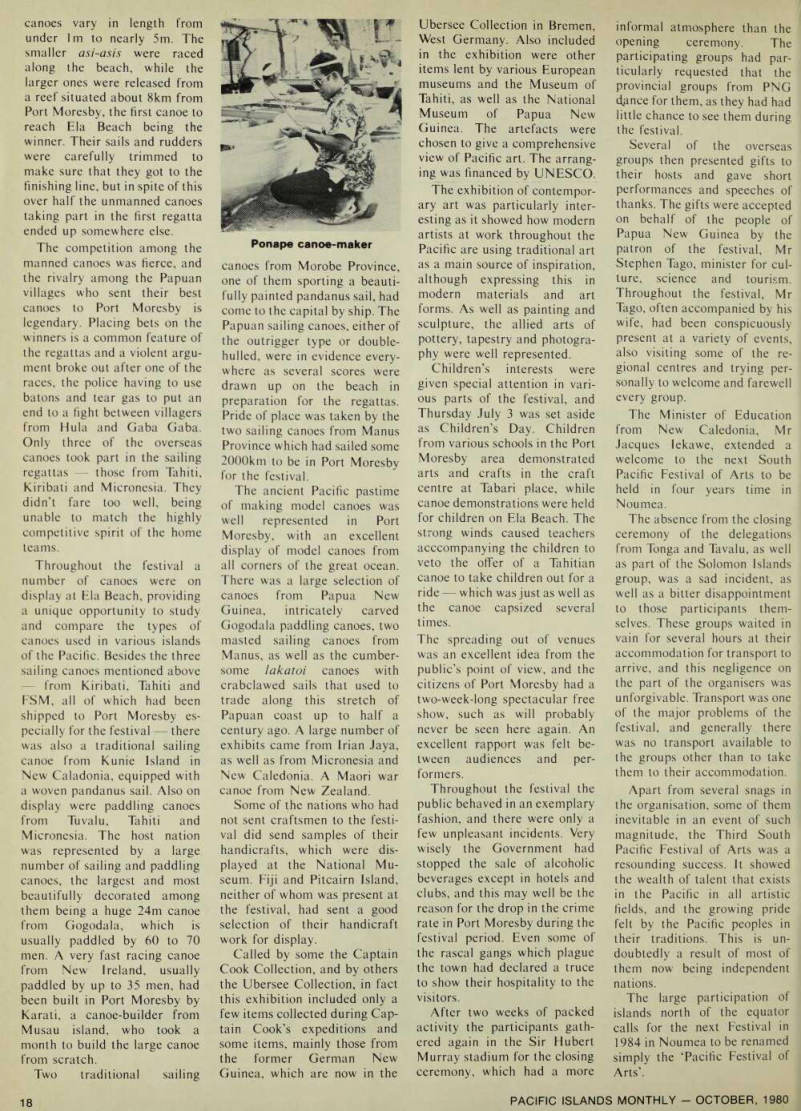
The FSM had made a great effort to be fully represented in all festival activities, another example of a small nation of limited resources giving the lead to some of those with more means at their disposal. As well as shipping a large sailing canoe to Port Moresby, Micronesian craftsmen demonstrated canoe building on Ela Beach. Morris Wakuk from Ulwe village and Nena William from Taunsak, both on Kosrae, built a 5m long paddling dugout canoe in two and a half days from a log supplied by the festival organ isers. They then quickly turned around and built a second one in the same time. Thomas Santos and Andolin Andreas from Mogot village on Ponape had come to Port Moresby before the festival to start building a traditional sailing canoe, which will be displayed with other canoes from the Pacific acquired by Papua New Guinea as a result of the festival.
In true Pacific fashion, the arrival of over 200 sailing canoes in Port Moresby sig nalled the start of the festival.
After the arrival of the Canoe Armada, sailing canoes played an important part in the festival programme. Regattas were staged on the two consecutive Saturdays, with over 400 participating canoes each time.
After paddling races for both men and women, the sailing canoes were sub-divided into three classes according to their size, a further two classes being set aside for the model canoes called asi-asi. These unmanned
canoes vary in length from under 1m to nearly sm. The smaller asi-asis were raced along the beach, while the larger ones were released from a reef situated about Bkm from Port Moresby, the first canoe to reach Ela Beach being the winner. Their sails and rudders were carefully trimmed to make sure that they got to the finishing line, but in spite of this over half the unmanned canoes taking part in the first regatta ended up somewhere else.
The competition among the manned canoes was fierce, and the rivalry among the Papuan villages who sent their best canoes to Port Moresby is legendary. Placing bets on the winners is a common feature of the regattas and a violent argu ment broke out after one of the races, the police having to use batons and tear gas to put an end to a fight between villagers from Hula and Gaba Gaba.
Only three of the overseas canoes look part in the sailing regattas those from Tahiti, Kiribati and Micronesia. They didn’t fare too well, being unable to match the highly competitive spirit of the home teams.
Throughout the festival a number of canoes were on display at Ela Beach, providing a unique opportunity to study and compare the types of canoes used in various islands of the Pacific. Besides the three sailing canoes mentioned above - from Kiribati, Tahiti and FSM, all of which had been shipped to Port Moresby es pecially for the festival there was also a traditional sailing canoe from Kunie Island in New Caladonia, equipped with a woven pandanus sail. Also on display were paddling canoes from Tuvalu, Tahiti and Micronesia. The host nation was represented by a large number of sailing and paddling canoes, the largest and most beautifully decorated among them being a huge 24m canoe from Gogodala, which is usually paddled by 60 to 70 men. A very fast racing canoe from New Ireland, usually paddled by up to 35 men, had been built in Port Moresby by Karati, a canoe-builder from Musau island, who took a month to build the large canoe from scratch.
Two traditional sailing
canoes from Morobe Province, one of them sporting a beauti fully painted pandanus sail, had come to the capital by ship. The Papuan sailing canoes, either of the outrigger type or double hulled, were in evidence every where as several scores were drawn up on the beach in preparation for the regattas.
Pride of place was taken by the two sailing canoes from Manus Province which had sailed some 2000 km to be in Port Moresby for the festival.
The ancient Pacific pastime of making model canoes was well represented in Port Moresby, with an excellent display of model canoes from all corners of the great ocean.
There was a large selection of canoes from Papua New Guinea, intricately carved Gogodala paddling canoes, two masted sailing canoes from Manus, as well as the cumber some lakatoi canoes with crabclawed sails that used to trade along this stretch of Papuan coast up to half a century ago. A large number of exhibits came from Irian Jaya, as well as from Micronesia and New Caledonia. A Maori war canoe from New Zealand.
Some of the nations who had not sent craftsmen to the festi val did send samples of their handicrafts, which were dis played at the National Mu seum. Fiji and Pitcairn Island, neither of whom was present at the festival, had sent a good selection of their handicraft work for display.
Called by some the Captain Cook Collection, and by others the Übersee Collection, in fact this exhibition included only a few items collected during Cap tain Cook’s expeditions and some items, mainly those from the former German New Guinea, which are now in the
Übersee Collection in Bremen, West Germany. Also included in the exhibition were other items lent by various European museums and the Museum of Tahiti, as well as the National Museum of Papua New Guinea. The artefacts were chosen to give a comprehensive view of Pacific art. The arrang ing was financed by UNESCO.
The exhibition of contempor ary art was particularly inter esting as it showed how modern artists at work throughout the Pacific are using traditional art as a main source of inspiration, although expressing this in modern materials and art forms. As well as painting and sculpture, the allied arts of pottery, tapestry and photogra phy were well represented.
Children’s interests were given special attention in vari ous parts of the festival, and Thursday July 3 was set aside as Children’s Day. Children from various schools in the Port Moresby area demonstrated arts and crafts in the craft centre at Tabari place, while canoe demonstrations were held for children on Ela Beach. The strong winds caused teachers acccompanying the children to veto the offer of a Tahitian canoe to take children out for a ride which was just as well as the canoe capsized several times.
The spreading out of venues was an excellent idea from the public’s point of view, and the citizens of Port Moresby had a two-week-long spectacular free show, such as will probably never be seen here again. An excellent rapport was felt be tween audiences and per formers.
Throughout the festival the public behaved in an exemplary fashion, and there were only a few unpleasant incidents. Very wisely the Government had stopped the sale of alcoholic beverages except in hotels and clubs, and this may well be the reason for the drop in the crime rate in Port Moresby during the festival period. Even some of the rascal gangs which plague the town had declared a truce to show their hospitality to the visitors.
After two weeks of packed activity the participants gath ered again in the Sir Hubert Murray stadium for the closing ceremony, which had a more
informal atmosphere than the opening ceremony. The participating groups had par ticularly requested that the provincial groups from PNG cfance for them, as they had had little chance to see them during the festival.
Several of the overseas groups then presented gifts to their hosts and gave short performances and speeches of thanks. The gifts were accepted on behalf of the people of Papua New Guinea by the patron of the festival, Mr Stephen Tago, minister for cul ture, science and tourism.
Throughout the festival, Mr Tago, often accompanied by his wife, had been conspicuously present at a variety of events, also visiting some of the re gional centres and trying per sonally to welcome and farewell every group.
The Minister of Education from New Caledonia, Mr Jacques lekawe, extended a welcome to the next South Pacific Festival of Arts to be held in four years time in Noumea.
The absence from the closing ceremony of the delegations from Tonga and Tavalu, as well as part of the Solomon Islands group, was a sad incident, as well as a bitter disappointment to those participants them selves. These groups waited in vain for several hours at their accommodation for transport to arrive, and this negligence on the part of the organisers was unforgivable. Transport was one of the major problems of the festival, and generally there was no transport available to the groups other than to take them to their accommodation.
Apart from several snags in the organisation, some of them inevitable in an event of such magnitude, the Third South Pacific Festival of Arts was a resounding success. It showed the wealth of talent that exists in the Pacific in all artistic fields, and the growing pride fell by the Pacific peoples in their traditions. This is un doubtedly a result of most of them now being independent nations.
The large participation of islands north of the equator calls for the next Festival in 1984 in Noumea to be renamed simply the ‘Pacific Festival of Arts’.
Ponape canoe-maker
Advertisements & other items, pp. 16-17 (1 item)
In 1980, Air Nauru celebrates 1
NAURU
HONIARA
In 1970, the world’s smallest
international airline.
BRISBANE
In 1980, Air Nauru celebrates 1
We ask you, is then
There was a time, if you wanted to fly on Air Nauru, you had to get yourself and your baggage to Brisbane, Australia. Or to our home island, located, you will recall. 26 miles south of that point on the Equator marked as 166° 55'. (We had a fuel stop at Honiara on the island of Guadalcanal in the Solomons j Ten years ago, by any known standards of international aviation, we were a very esoteric airline.
Ten years ago, when we started to fly our Falcon fan jet, the Pacific never looked so big.
Fortunately, for us and for travelers who like their islands in all shapes and sizes, times have changed.
This year, Air Nauru will fly over 50,000 unduplicated route miles to 19 distinctive ports of call in Asia, the Pacific, Australia and New Zealand. We will link with our all-Boeing fleet vital places that 10 years ago had never been linkec by jet aircraft.
This year, we will fly to more Pacific islands than any other airline Not to mention some of the more hospitable and interesting destinations in Asia.
This year, because of our pioneering air routes, you can move from one island to another easier
KAGOSHIMA
HONG KONG
TAIPEI OKINAWA
PONAPE
MAJURO
MANILA GUAM
TARAWA
NAURU
HONIARA
VILA
NADI SUVA
Today, a truly significant route
linking Asia with the distinctive
cultures of the Pacific.
APIA
NUKUALOFA
MELBOURNE
AUCKLAND
fears of flying from island to island,
mother way to fly?
nd faster than ever, and in consid-
erable comfort, too. The pleasures
»f the Pacific are simply more
ccessible on Air Nauru.
To sum it all up, we hope
ou come island-hop with us this
ear. And help us celebrate.
In the style of Pacific island
ultures everywhere, we
ertainly can promise you a big
velcome.
For ticketing, reservations and flight information, telephone: 740 in Apia, Western Samoa; 477-7106 in Guam; 595 or 727 in Honiara, Solomon Islands; 229 in Majuro, Marshall Islands; 312-377 in Suva, 72795 in Nandi, Fiji; 448 in Tarawa, Kiribati; and 653-5709 in Melbourne, Australia.
W/I//T NAURU
AIRLINE OF THE CENTRAL PACIFIC
PNG soldiers restore government
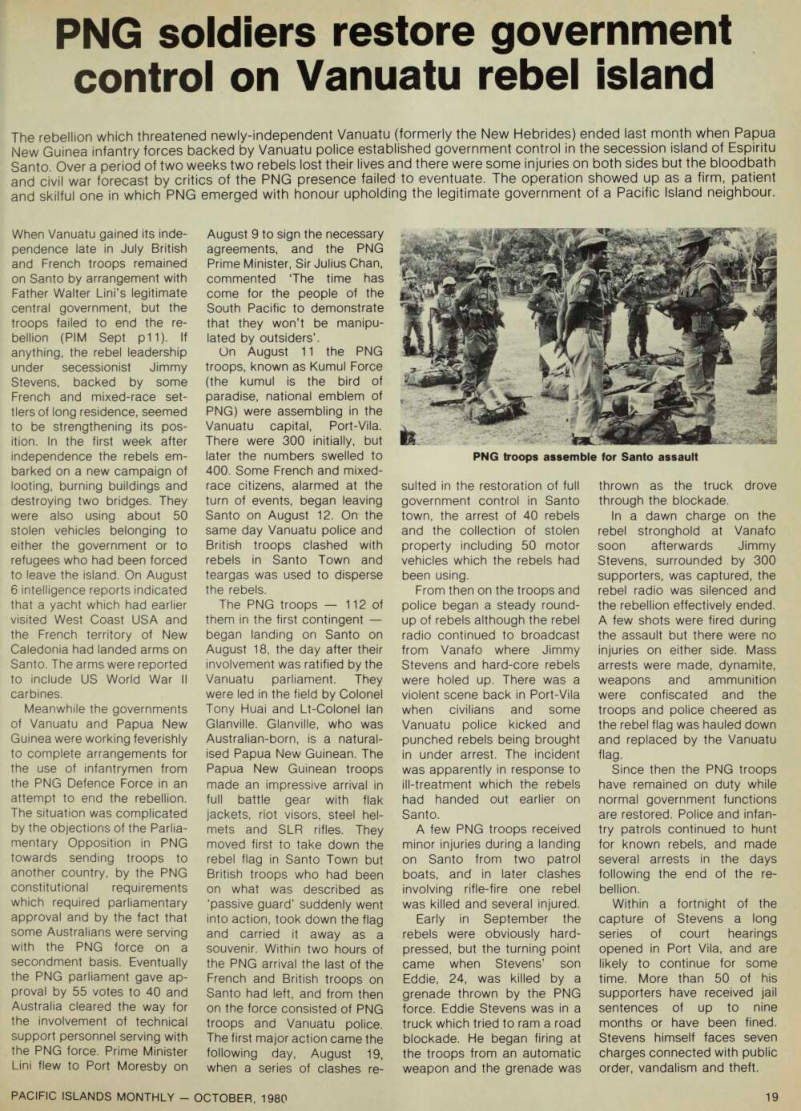
control on Vanuatu rebel island
The rebellion which threatened newly-independent Vanuatu (formerly the New Hebrides) ended last month when Papua New Guinea infantry forces backed by Vanuatu police established government control in the secession island of Espiritu Santo. Over a period of two weeks two rebels lost their lives and there were some injuries on both sides but the bloodbath and civil war forecast by critics of the PNG presence failed to eventuate. The operation showed up as a firm, patient and skilful one in which PNG emerged with honour upholding the legitimate government of a Pacific Island neighbour.
When Vanuatu gained its inde pendence late in July British and French troops remained on Santo by arrangement with Father Walter Lini’s legitimate central government, but the troops failed to end the re bellion (PIM Sept p 11). If anything, the rebel leadership under secessionist Jimmy Stevens, backed by some French and mixed-race set tlers of long residence, seemed to be strengthening its pos ition. In the first week after independence the rebels em barked on a new campaign of looting, burning buildings and destroying two bridges. They were also using about 50 stolen vehicles belonging to either the government or to refugees who had been forced to leave the island. On August 6 intelligence reports indicated that a yacht which had earlier visited West Coast USA and the French territory of New Caledonia had landed arms on Santo. The arms were reported to include US World War II carbines.
Meanwhile the governments of Vanuatu and Papua New Guinea were working feverishly to complete arrangements for the use of infantrymen from the PNG Defence Force in an attempt to end the rebellion.
The situation was complicated by the objections of the Parlia mentary Opposition in PNG towards sending troops to another country, by the PNG constitutional requirements which required parliamentary approval and by the fact that some Australians were serving with the PNG force on a secondment basis. Eventually the PNG parliament gave ap proval by 55 votes to 40 and Australia cleared the way for the involvement of technical support personnel serving with the PNG force. Prime Minister Lini flew to Port Moresby on
August 9 to sign the necessary agreements, and the PNG Prime Minister, Sir Julius Chan, commented ‘The time has come for the people of the South Pacific to demonstrate that they won’t be manipu lated by outsiders’.
On August 11 the PNG troops, known as Kumul Force (the kumul is the bird of paradise, national emblem of PNG) were assembling in the Vanuatu capital, Port-Vila.
There were 300 initially, but later the numbers swelled to 400. Some French and mixed race citizens, alarmed at the turn of events, began leaving Santo on August 12. On the same day Vanuatu police and British troops clashed with rebels in Santo Town and teargas was used to disperse the rebels.
The PNG troops 112 of them in the first contingent began landing on Santo on August 18, the day after their involvement was ratified by the Vanuatu parliament. They were led in the field by Colonel Tony Huai and Lt-Colonel lan Glanville. Glanville, who was Australian-born, is a natural ised Papua New Guinean. The Papua New Guinean troops made an impressive arrival in full battle gear with flak jackets, riot visors, steel hel mets and SLR rifles. They moved first to take down the rebel flag in Santo Town but British troops who had been on what was described as ‘passive guard’ suddenly went into action, took down the flag and carried it away as a souvenir. Within two hours of the PNG arrival the last of the French and British troops on Santo had left, and from then on the force consisted of PNG troops and Vanuatu police.
The first major action came the following day, August 19, when a series of clashes re-
suited in the restoration of full government control in Santo town, the arrest of 40 rebels and the collection of stolen property including 50 motor vehicles which the rebels had been using.
From then on the troops and police began a steady round up of rebels although the rebel radio continued to broadcast from Vanafo where Jimmy Stevens and hard-core rebels were holed up. There was a violent scene back in Port-Vila when civilians and some Vanuatu police kicked and punched rebels being brought in under arrest. The incident was apparently in response to ill-treatment which the rebels had handed out earlier on Santo.
A few PNG troops received minor injuries during a landing on Santo from two patrol boats, and in later clashes involving rifle-fire one rebel was killed and several injured.
Early in September the rebels were obviously hard pressed, but the turning point came when Stevens’ son Eddie, 24, was killed by a grenade thrown by the PNG force. Eddie Stevens was in a truck which tried to ram a road blockade. He began firing at the troops from an automatic weapon and the grenade was
thrown as the truck drove through the blockade.
In a dawn charge on the rebel stronghold at Vanafo soon afterwards Jimmy Stevens, surrounded by 300 supporters, was captured, the rebel radio was silenced and the rebellion effectively ended.
A few shots were fired during the assault but there were no injuries on either side. Mass arrests were made, dynamite, weapons and ammunition were confiscated and the troops and police cheered as the rebel flag was hauled down and replaced by the Vanuatu flag.
Since then the PNG troops have remained on duty while normal government functions are restored. Police and infan try patrols continued to hunt for known rebels, and made several arrests in the days following the end of the re bellion.
Within a fortnight of the capture of Stevens a long series of court hearings opened in Port Vila, and are likely to continue for some time. More than 50 of his supporters have received jail sentences of up to nine months or have been fined.
Stevens himself faces seven charges connected with public order, vandalism and theft.
PNG troops assemble for Santo assault
Advertisements & other items, p. 20 (1 item)
Performance Par Excellence
Akai Pro Series.
People with astute musical tastes respond to the Akai Pro Series for any number of distinct reasons. Likely it's the impressive selection, from the awe-inspiring 72W per channel Pro-602*t0 the amply-powerful Pro-20.
And the slim, refined design of these perfectly-matched hi-fi audio components.
Along with Akai's advanced digital technology and front-panel operation ease.
Plus optional remote control and other touches of professionalism.
Yet ultimately the decision comes down to just one thing: performance.
And you'll find it—par excellence—in every system
in the Akai Pro Series.
PRO-601
PRO-501
PRO-20
PRO-503
rv I (
PRO-30
PRO-602
PRO-502
AKAI
AKAI ELECTRIC CO., LTD.
Tokyo, Japan ‘optional remote control unit available.
Samoa Islands Burns Philp (South Sea) Co.. Ltd.
P.O. Box 129, Pago Pago, American Samoa Mariana Islands J.C.Tenorio Enterprises P.O Box 137, Saipan Tel: 6444/8 Solomon Islands Security Electrical Co., Ltd.
P.O. Box 174, Honiara Tel: 881 Cook Islands JPS Enterprises Ltd.
P.O. Box 15. Rarotonga Tel: 2150, 2176 For more information, please send this coupon to our distributor in your country or to AKAI ELECTRIC CO , LTD 12-14, 2-Chome, Higashi-Kojiya, Ohta-ku, Tokyo, Japan
Pacific women speak
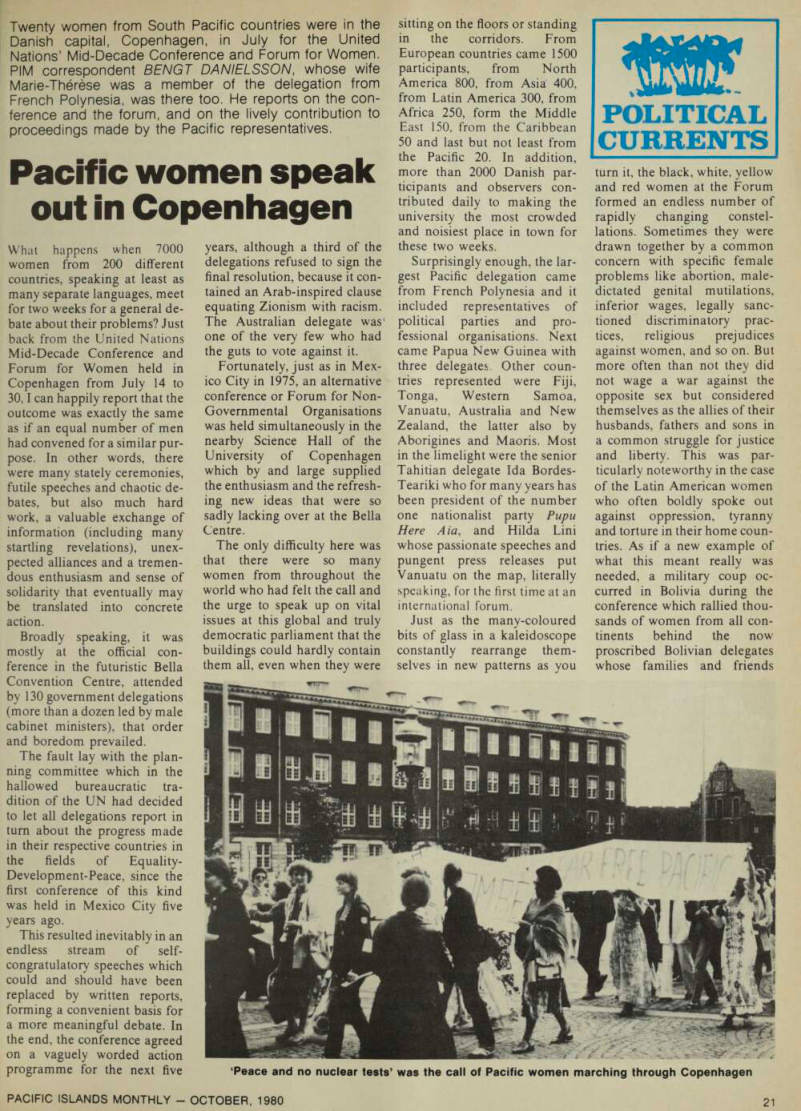
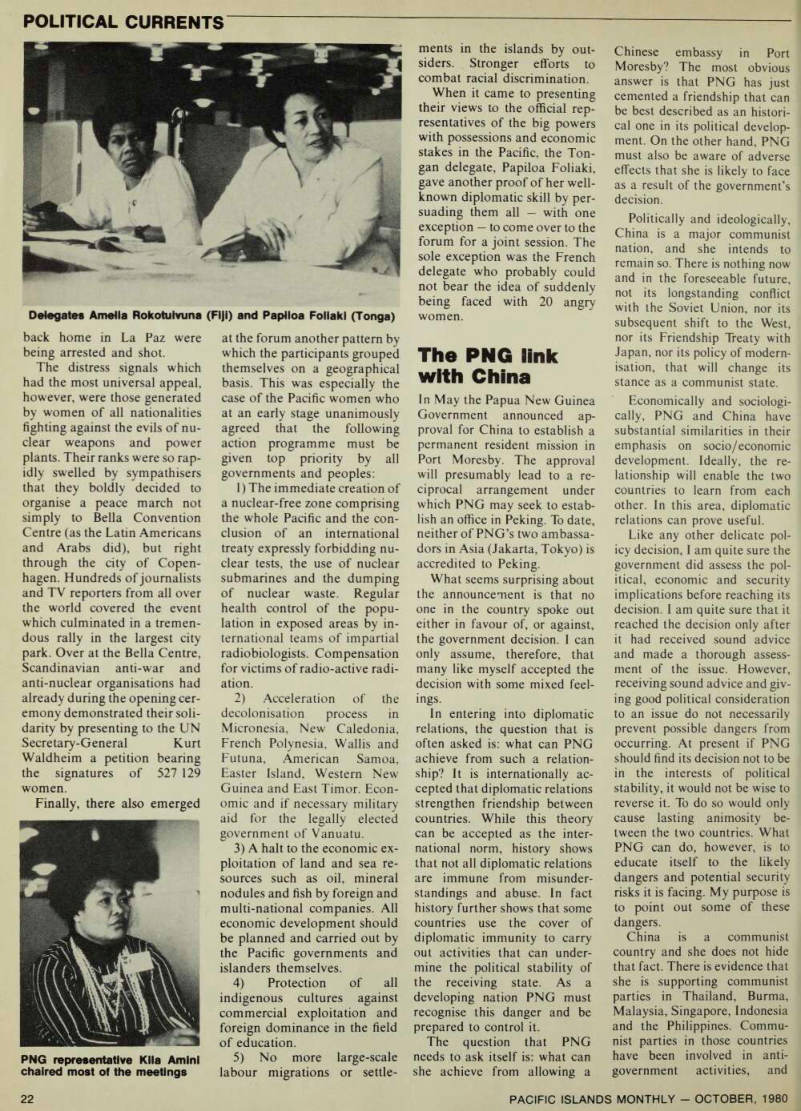
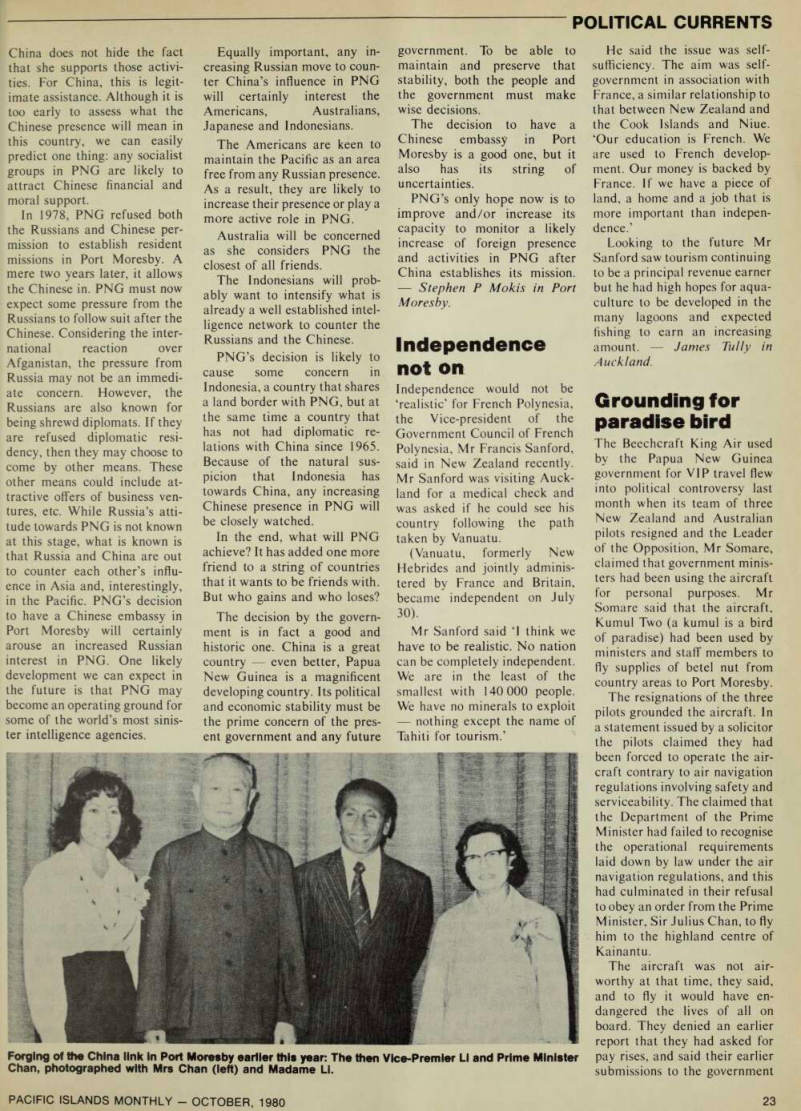

Political
Currents
Pacific women speak out in Copenhagen
Twenty women from South Pacific countries were in the Danish capital, Copenhagen, in July for the United Nations’ Mid-Decade Conference and Forum for Women.
PIM correspondent BENGT DANIELSSON, whose wife Marie-Therese was a member of the delegation from French Polynesia, was there too. He reports on the con ference and the forum, and on the lively contribution to proceedings made by the Pacific representatives.
What happens when 7000 women from 200 different countries, speaking at least as many separate languages, meet for two weeks for a general de bate about their problems? Just back from the United Nations Mid-Decade Conference and Forum for Women held in Copenhagen from July 14 to 30,1 can happily report that the outcome was exactly the same as if an equal number of men had convened for a similar pur pose. In other words, there were many stately ceremonies, futile speeches and chaotic de bates, but also much hard work, a valuable exchange of information (including many startling revelations), unex pected alliances and a tremen dous enthusiasm and sense of solidarity that eventually may be translated into concrete action.
Broadly speaking, it was
mostly at the official con ference in the futuristic Bella Convention Centre, attended by 130 government delegations (more than a dozen led by male cabinet ministers), that order and boredom prevailed.
The fault lay with the plan ning committee which in the hallowed bureaucratic tra dition of the UN had decided to let all delegations report in turn about the progress made in their respective countries in the fields of Equality- Development-Peace, since the first conference of this kind was held in Mexico City five years ago.
This resulted inevitably in an endless stream of self congratulatory speeches which could and should have been replaced by written reports, forming a convenient basis for a more meaningful debate. In the end, the conference agreed on a vaguely worded action programme for the next five
years, although a third of the delegations refused to sign the final resolution, because it con tained an Arab-inspired clause equating Zionism with racism.
The Australian delegate was one of the very few who had the guts to vote against it.
Fortunately, just as in Mex ico City in 1975, an alternative conference or Forum for Non-
Governmental Organisations
was held simultaneously in the nearby Science Hall of the
University of Copenhagen
which by and large supplied the enthusiasm and the refresh ing new ideas that were so sadly lacking over at the Bella Centre.
The only difficulty here was that there were so many women from throughout the world who had felt the call and the urge to speak up on vital issues at this global and truly democratic parliament that the buildings could hardly contain them all, even when they were
sitting on the floors or standing in the corridors. From European countries came 1500 participants, from North America 800, from Asia 400, from Latin America 300, from Africa 250, form the Middle East 150, from the Caribbean 50 and last but not least from the Pacific 20. In addition, more than 2000 Danish par ticipants and observers con tributed daily to making the university the most crowded and noisiest place in town for these two weeks.
Surprisingly enough, the lar
gest Pacific delegation came from French Polynesia and it included representatives of
political parties and pro
fessional organisations. Next came Papua New Guinea with three delegates. Other coun
tries represented were Fiji,
Tonga, Western Samoa, Vanuatu, Australia and New Zealand, the latter also by Aborigines and Maoris. Most in the limelight were the senior Tahitian delegate Ida Bordes- Teariki who for many years has been president of the number one nationalist party Pupu Here Aia, and Hilda Lini
whose passionate speeches and
pungent press releases put Vanuatu on the map, literally speaking, for the first lime at an international forum.
Just as the many-coloured bits of glass in a kaleidoscope constantly rearrange them selves in new patterns as you
turn it, the black, white, yellow and red women at the Forum formed an endless number of rapidly changing constel lations. Sometimes they were drawn together by a common concern with specific female problems like abortion, male dictated genital mutilations, inferior wages, legally sanc tioned discriminatory prac tices, religious prejudices against women, and so on. But more often than not they did not wage a war against the opposite sex but considered themselves as the allies of their husbands, fathers and sons in a common struggle for justice and liberty. This was par ticularly noteworthy in the case of the Latin American women who often boldly spoke out against oppression, tyranny and torture in their home coun tries. As if a new example of what this meant really was needed, a military coup oc curred in Bolivia during the conference which rallied thou sands of women from all con tinents behind the now
proscribed Bolivian delegates
whose families and friends
‘Peace and no nuclear tests’ was the call of Pacific women marching through Copenhagen
back home in La Paz were being arrested and shot.
The distress signals which had the most universal appeal, however, were those generated by women of all nationalities fighting against the evils of nu clear weapons and power plants. Their ranks were so rap idly swelled by sympathisers that they boldly decided to organise a peace march not simply to Bella Convention Centre (as the Latin Americans and Arabs did), but right through the city of Copen
hagen. Hundreds of journalists
and TV reporters from all over the world covered the event which culminated in a tremen
dous rally in the largest city
park. Over at the Bella Centre, Scandinavian anti-war and anti-nuclear organisations had
already during the opening cer
emony demonstrated their soli darity by presenting to the UN
Secretary-General Kurt
Waldheim a petition bearing
the signatures of 527 129 women.
Finally, there also emerged
at the forum another pattern by
which the participants grouped
themselves on a geographical basis. This was especially the case of the Pacific women who at an early stage unanimously
agreed that the following
action programme must be
given top priority by all
governments and peoples: 1) The immediate creation of a nuclear-free zone comprising the whole Pacific and the con clusion of an international
treaty expressly forbidding nu
clear tests, the use of nuclear submarines and the dumping of nuclear waste. Regular health control of the popu lation in exposed areas by in ternational teams of impartial
radiobiologists. Compensation
for victims of radio-active radi ation. 2) Acceleration of the decolonisation process in Micronesia, New Caledonia, French Polynesia, Wallis and Futuna, American Samoa, Easter Island, Western New Guinea and East Timor. Econ omic and if necessary military aid for the legally elected government of Vanuatu. 3) A halt to the economic ex ploitation of land and sea re sources such as oil, mineral nodules and fish by foreign and multi-national companies. All economic development should be planned and carried out by the Pacific governments and islanders themselves. 4) Protection of all
indigenous cultures against
commercial exploitation and foreign dominance in the field of education. 5) No more large-scale labour migrations or settle
ments in the islands by out siders. Stronger efforts to combat racial discrimination.
When it came to presenting their views to the official rep resentatives of the big powers with possessions and economic stakes in the Pacific, the Ton
gan delegate, Papiloa Foliaki,
gave another proof of her well known diplomatic skill by per suading them all with one exception to come over to the forum for a joint session. The sole exception was the French
delegate who probably could
not bear the idea of suddenly being faced with 20 angry women.
The PNG link
with China
In May the Papua New Guinea Government announced ap proval for China to establish a permanent resident mission in Port Moresby. The approval will presumably lead to a re ciprocal arrangement under which PNG may seek to estab lish an office in Peking. To date, neither of PNG’s two ambassa dors in Asia (Jakarta, Tokyo) is accredited to Peking.
What seems surprising about the announcement is that no one in the country spoke out either in favour of, or against, the government decision. I can only assume, therefore, that many like myself accepted the decision with some mixed feel ings.
In entering into diplomatic relations, the question that is often asked is: what can PNG achieve from such a relation ship? It is internationally ac cepted that diplomatic relations strengthen friendship between countries. While this theory can be accepted as the inter national norm, history shows that not all diplomatic relations are immune from misunder standings and abuse. In fact history further shows that some countries use the cover of diplomatic immunity to carry out activities that can under mine the political stability of the receiving state. As a developing nation PNG must recognise this danger and be prepared to control it.
The question that PNG needs to ask itself is: what can she achieve from allowing a
Chinese embassy in Port Moresby? The most obvious answer is that PNG has just cemented a friendship that can be best described as an histori cal one in its political develop ment. On the other hand, PNG must also be aware of adverse effects that she is likely to face as a result of the government’s decision.
Politically and ideologically, China is a major communist nation, and she intends to remain so. There is nothing now and in the foreseeable future, not its longstanding conflict with the Soviet Union, nor its subsequent shift to the West, nor its Friendship Treaty with Japan, nor its policy of modern isation, that will change its stance as a communist state.
Economically and sociologi cally, PNG and China have substantial similarities in their emphasis on socio/economic development. Ideally, the re lationship will enable the two countries to learn from each other. In this area, diplomatic relations can prove useful.
Like any other delicate pol icy decision, I am quite sure the government did assess the pol itical, economic and security implications before reaching its decision. I am quite sure that it reached the decision only after it had received sound advice and made a thorough assess ment of the issue. However, receiving sound advice and giv ing good political consideration to an issue do not necessarily prevent possible dangers from occurring. At present if PNG should find its decision not to be in the interests of political stability, it would not be wise to reverse it. To do so would only cause lasting animosity be tween the two countries. What PNG can do, however, is to educate itself to the likely
dangers and potential security
risks it is facing. My purpose is to point out some of these
dangers.
China is a communist country and she does not hide that fact. There is evidence that she is supporting communist parties in Thailand, Burma, Malaysia, Singapore, Indonesia and the Philippines. Commu nist parties in those countries have been involved in anti government activities, and
Delegates Amella Rokotulvuna (Fiji) and Papiloa Foliaki (Tonga)
PNG representative Klla Amini chaired most of the meetings
China does not hide the fact that she supports those activities. For China, this is legitimate assistance. Although it is too early to assess what the Chinese presence will mean in this country, we can easily predict one thing: any socialist groups in PNG are likely to attract Chinese financial and moral support.
In 1978, PNG refused both the Russians and Chinese permiss,on to establish resident missions in Port Moresby. A mere two years later, tt allows the Chinese in. PNG must now expect some pressure from the Russians to follow suit after the Chinese. Considering the international reaction over Afganistan, the pressure from Russia may not be an immediate concern. However, the Russians are also known for being shrewd diplomats. If they are refused diplomatic residency, then they may choose to come by other means. These other means could include attractive offers of business ventures, etc. While Russia’s attitude towards PNG is not known at this stage, what is known is that Russia and China are out to counter each other’s influence in Asia and, interestingly, in the Pacific. PNG’s decision to have a Chinese embassy in Port Moresby will certainly arouse an increased Russian interest in PNG. One likely development we can expect in the future is that PNG may become an operating ground for some of the world’s most sinister intelligence agencies.
Equally important, any in creasing Russian move to coun ter China’s influence in PNG will certainly interest the Americans, Australians, Japanese and Indonesians, The Americans are keen to maintain the Pacific as an area free from any Russian presence, As a resu they are likely to increase their presence or play a more active role in PNG.
Australia will be concern ed as she consjders p NG the c|oses , of all frie nds.
The Indonesians wil| b . ab , want tQ iMengif what js a|read a we| , established intel . u network t 0 counter the Russ|ans and the chinese , . . . . ... .
PNG s decision 18 llkel y t 0 f ase . some concern in Indonesia a country that shares a land border Wlth PNG ’ but at tbe same a c , ountr y that bas not had diplomatic re latlons Wltb Ghina smce , l96s ‘ Because L of the J natural sm- P IC,OI \ tbat Indonesia has
wards China ’ an .y greasing
Chmese Presence in PNG will be close, y watched .
I n tbe end ’ wbat w dl PNG achieve? It has added one more friend to a string of countries tbat d wants to be friends with, But wbo g a i ns an d who loses?
The decision by the govern ment is in fact a good and historic one. China is a great country even better, Papua New Guinea is a magnificent developing country. Its political and economic stability must be the prime concern of the pres ent government and any future
government. To be able to maintain and preserve that stability, both the people and the government must make wise decisions.
The decision to have a Chinese embassy in Port Moresby is a good one, but it also has its string of uncertainties.
PNG’s only hope now is to improve and/or increase its capacity to monitor a likely increase of foreign presence and activities in PNG after China establishes its mission.
Stephen P Mokis in Port Moresby.
Independence
not on
Independence would not be ‘realistic’ for French Polynesia, the Vice-president of the Government Council of French Polynesia, Mr Francis Sanford, said in New Zealand recently.
Mr Sanford was visiting Auck land for a medical check and was asked if he could see his country following the path taken by Vanuatu. (Vanuatu, formerly New Hebrides and jointly adminis tered by France and Britain, became independent on July 30).
Mr Sanford said ‘1 think we have to be realistic. No nation can be completely independent.
We are in the least of the smallest with 140 000 people.
We have no minerals to exploit nothing except the name of Tahiti for tourism.’
He said the issue was self sufficiency. The aim was self government in association with France, a similar relationship to that between New Zealand and the Cook Islands and Niue. ‘Our education is French. We are used to French develop ment. Our money is backed by France. If we have a piece of land, a home and a job that is more important than indepen dence.’
Looking to the future Mr Sanford saw tourism continuing to be a principal revenue earner but he had high hopes for aqua culture to be developed in the many lagoons and expected fishing to earn an increasing amount. Janies Tally in Auckland.
Grounding for
paradise bird
The Beechcraft King Air used by the Papua New Guinea government for VIP travel flew into political controversy last month when its team of three New Zealand and Australian pilots resigned and the Leader of the Opposition, Mr Somare, claimed that government minis ters had been using the aircraft for personal purposes. Mr Somare said that the aircraft, Kumul Two (a kumul is a bird of paradise) had been used by ministers and staff members to fly supplies of betel nut from country areas to Port Moresby.
The resignations of the three pilots grounded the aircraft. In a statement issued by a solicitor the pilots claimed they had been forced to operate the air craft contrary to air navigation regulations involving safety and serviceability. The claimed that the Department of the Prime Minister had failed to recognise the operational requirements laid down by law under the air navigation regulations, and this had culminated in their refusal to obey an order from the Prime Minister, Sir Julius Chan, to fly him to the highland centre of Kainantu.
The aircraft was not air worthy at that time, they said, and to fly it would have en dangered the lives of all on board. They denied an earlier report that they had asked for pay rises, and said their earlier submissions to the government
Forging of the China link In Port Moresby earlier this year: The then Vice-Premier Li and Prime Minister Chan, photographed with Mrs Chan (left) and Madame Li.
had been in the form of rec ommendations for the efficient and safe operation of the Government Aircraft Unit.
The Acting Secretary of the Prime Minister’s Department said that by refusing to fly Sir Julius to Kainantu the pilots had ‘demeaned the office of the Prime Minister’. The resig nations had been accepted with immediate effect, he said.
Mr Amini denied there had been any compromise on safety, and said the pilots had used safety arguments as an excuse ‘for pushing other demands’.
In the political controversy which followed the resignations the Opposition Leader, Mr Somare, claimed that Sir Julius and some of his ministers had made ‘excessive and outrageous demands’ in using the aircraft.
They had flown in the aircraft for blatant political purposes and had made flights available to unauthorised passengers, he said. The aircraft had been used as a public motor vehicle and had carried supplies of betel nut which ministers and staff members had sold in Port Moresby, Mr Somare said.
Youth problems
worry to Fiji
Members of the Fiji Senate, concerned at mounting youth problems, have called on busi ness interests and the churches to get together to help youth organisations and to promote the useful assimilation of young people into the community.
Senator Inoke Tabua told a recent sitting of the upper house that ‘Big business is making so much money out of young people and their parents’ that business interests had a responsibility to bolster church aid for community youth prob lems. He claimed, too, that national leaders in Fiji were doing little to overcome the problems which were facing younger members of the com munity. Other senators spoke of growing community lawlessness if the requirements of making young people useful citizens were not met. The problem was political as much as social, they said.
A similar warning was given by the Chief Justice of Fiji, Mr Justice Tuivaga, at the cer
emonial opening last month of criminal sittings in the Su preme Court at Lautoka.
The Chief Justice said that harsh and unreasonable punish ment for young people who broke the law was not the answer. Society had to look at the causes of what was happen ing and take preventive rather than penal measures. The one thing that was obvious, he said, was that young people were showing increasing contempt for the law. Community and political leaders needed to think hard, he said, on measures to combat crimes of violence and disrespect for the law. He told civic leaders, lawyers and magistrates at the opening cer emony ‘lt is a matter of very grave concern to all of us that law and order is undergoing a severe test of strength.’
Company fights
land takeover
There were signs last month of a breakdown in Papua New Guinea’s carefully-established reputation for faultless foot work when attempting to ac quire properties owned by non nationals. What once would have been a negotiation of some care came very close last month to being an impetuous seizure, and ended in the courts with a temporary setback for the government.
The incident involved Gumanch estate, the biggest coffee plantation in PNG and a major plantation by world standards and has raised a question mark against the atti tudes of the five-month-old Chan government towards land acquisition matters. There are suggestions that Sir Julius Chan, who is generally sym pathetic towards stable pro ductive investment, may be under some pressure from members of his cabinet who take a more emotive view of foreign investment in rural pro duction.
Under the previous Somare government PNG introduced an acquisition policy which accepted in principle that all primary production should ultimately be in the hands of Papua New Guineans. But the policy also accepted that some established foreign-owned
properties were of real value to the economy at large as em ployers, taxpayers, developers and rural training grounds. Ac quisitions were confined to areas where land was short for local villagers and the actual process of acquisition was car ried out with full and early negotiations and with some latitude in agreeing to compen sation.
From a purely acquisition point of view the scheme worked smoothly with only a few disputes of any signifi cance. As a means of phasing Papua New Guineans into rural industry however the scheme fell far short of expectations.
Some communities found they lacked the expertise to run their newly-acquired properties, some were short of buffer funds, and some alleged that the pre vious foreign owners had deliberately allowed the proper ties to run down during the acquisition period. The Somare government was already re assessing the situation when the Chan government took office, and the Chan government an nounced soon afterwards that it would phase out further acqui sitions for the time being.
It was against this back ground that the government suddenly served acquisition papers last month on Gollin and Company (PNG) Pty Ltd and prepared to take over the com pany’s Gumanch coffee plan tation near Mount Hagen.
Gollin traces back to Aust
ralian financial interests and claims a turnover of well over $2 million a year through the Gumanch operation. The prop erty employs about 2000 Papua New Guineans and is the country’s biggest coffee pro ducer. The company said there had been no discussion on compensation before the ser vice of what it called ‘seizure documents’ and it took legal action on grounds that the processes used had been invalid.
The company obtained the injunction which it sought, re straining the processes which the government had initiated.
The matter is far from ended, however, and the government’s ultimate reaction will be signifi cant in terms of overall foreign investment in the rural econ omy.
Inquiries suggest that the sudden takeover bid was very much a political matter involv ing the National Party and its supporters. Mr Thomas Kavali of the National Party is Minis ter for Lands in the Chan coali tion, and the chairman of the party Mr Michael Mel has apparently been exerting strong pressures on the parliamentary wing of the party for a takeover of the Gumanch property. Mr Mel in turn is under pressure from community leaders and electors who say that 6000 people are descended from the former traditional owners of the Gumanch land and they want their use of the land restored.
Mr Kavali apparently re sisted the pressures for some time because of likely political repercussions within the government, but the sudden steps taken to resume the land appeared impetuous rather than considered. In a statement issued after the immediate re sumption moves were re strained, Mr Kavali conceded that the move ‘might appear out of line with current govern ment policy’ but he claimed that valid reasons existed. He claimed that the earlier Somare government had led some com munity leaders to believe that they could buy the Gumanch land. In attempting to acquire Gumanch for this purpose the present government was simply honouring the commitments of its predecessor, Mr Kavali said.
Lands Minister Kavali
Advertisements & other items, p. 24 (1 item)
Clarion welcomes you to the wonderful
world of Hi-Fi car audio. A never-ending quest for better sound quality assures the ultimate performance.
Our wealth of experience is backed by a global reputation for superior quality.
We've car stereo systems, car radios and speakers to please everyone.
In Car Entertainment Company What is your pleasure? ©Clarion Clarion Co.. Ltd. Tokyo, Japan A Australia; Amalgamated Wireless (Australasia) Ltd. 554 Parramatta Road, Ashfield N.S.W., 2131/New Zealand; AWA New Zealand Limited PO. Box 50-248 Porirua/ Fiji Islands: Brijlal &Co., Ltd. G.P.O, Box 362 Suva/Tahiti: Hi-Fi Vairaatoa PO. Box 1128 Papeete/New Caledonia: Caldis B.P Ml Noumea Cedex/Guam: Guam Radio & TV Shop PO. Box 1939 Agana, Guam 96910/New Hebrides; The Sound Centre PO. Box 434, Vila/Cook Islands: South Seas International Ltd. P.O. Box 49 Rarotonga/Papua New Guinea: Hagemeyer (P.N.G.) Pty. Ltd. PO. Box 1428, Boroko, Port Moresby. ‘Dolby and the double-D symbol are trademarks of Dolby Laboratories.
Islands
From the
Press
The Tahiti Sun Press The all-time best story about restaurant service in Tahiti involves a very proper French woman who ordered some kiir, a special and expensive drink served in very small quantities. To the woman’s horror the waitress returned with a water glass filled with kiir.
When the woman explained that the quantity was far too much the waitress simply tossed most of it into the bushes and asked ‘ls that enough?’
From a student teacher’s letter in the Papua New
Guinea Post-Courier, Port Moresby
The Goroka Teachers College is becoming a cheap hotel. We are told to move in and out of our dorms. We are told to share our beddings. The next thing is they are going to tell us to share our girl friends.
The Fiji Times, Suva Fuatai Solo, 17, of Western Samoa, can put a monkey to shame when it comes to coconut tree climbing. He flashed nine metres up a tree at Sukuna Park (Suva) in just 4.88 seconds leaving his opponents scrambling. Fuatai’s time was a record. He has won the coconut tree climbing contest for three years running.
From the letters columns Cook Islands News,
Rarotonga
Those who wish to praise or criticize me, please make it cool as I have no intention of replying ’cause time is becoming devastatingly precious these days. It wasn’t that precious a mere 10 years ago.
The Samoa Observer, Apia, Western Samoa Western Samoa this week launched its first inter-continental missile . . . Seriously though, the model rockets are part of a science project by Peace Corps volunteer Paul Kerrer, a science teacher at the Marist Brothers school. Finding the class very interested in rockets, Paul felt a model display would make the lessons more vivid.
The News Drum, Honiara, Solomon Islands An old man from Maniwiriwiri village in the Bauro district of Makira was rushed to Kira Kira hospital after he was bitten four times on his left leg and thigh by a wild pig. Jemuel Warimahai, aged 58, was hunting for wild pigs with four of his dogs when the incident happened. Mr Warimahai said that it was about 9am when his dogs found the pig and speared it, but missed. The pig ran away and was chased by the dogs for about two hours before it decided to take revenge on him. He said that he was only a few feet away when the pig saw him and charged towards him. He tried to escape by climbing a betelnut tree, but it broke and he fell. Mr Warimahai said he was lying on the ground when the wild pig came and bit him twice on his left leg and also twice on his left thigh. He managed
to get hold of the pig’s head and pulled it down towards a small stream where he killed the pig by drowning it in a pool. He said that the pig also killed one of his dogs. Mr Warimahai said that in spite of his.wounds, he managed to walk back and told the villagers what happened. He was later taken to hospital by a landrover. He said that some men in the village went to look for the pig, but were not able to find where he left it.
The Ponape Sun The owner of Downtown Bar reported that an incident occured in her bar. A male broke the head of a female by striking her with a chair.
A letter to the editor published in the Papua New
Guinea Post-Courier, Port Moresby
When I opened your newspaper on August 5 I read a headline ‘Violence and lawlessness in highlands are rampant’. On other pages there are reports of attacks on drivers along the Highlands Highway. Yet parliament is sending troops to Vanuatu. Surely it would be more sensible to use these troops to combat the breakdown of law and order in Papua New Guinea.
From a motor-wrecking firm’s advertisement in the
Fiji Times, Suva
Largest wreckers of Fiji From Pete’s Diary in The Samoa Times, Apia, Western Samoa Vaipouli College staff and students, led by Principal Manumal uga Logologo, visited parliament yesterday. One of the things they no doubt noted was the shortage of water at Mulinuu. The start of the opening prayer was nearly drowned out by the gurgling of water being poured into the tank, hidden just above Mr Speaker’s chair, to flush the toilets.
Marianas Variety News and Views, Saipan
Tinian has good roads and few cars, but. .It was reported that the first casualty of a Marine Corps exercise is feeling stiff and sore.
The marine and four buddies were on night patrol and feeling a bit weary, flopped down on what they assumed to be a deserted road.
Four of them were awakened by an approaching motor vehicle, and scrambled out of the way, but the unfortunate fifth was run over.
The driver of the car, said to be a nurse, put the injured leatherneck into her car and took him to the dispensary. But since it has no X-ray equipment, the marine was flown to the Naval Regional Medical Center in Guam where he was examined and found not to have serious injuries. He was returned to Tinian where he is probably looking for better places to sleep than a road.
The Papua New Guinea Post-Courier, Port Moresby Here’s one for the record books. Puzzled caller phoned to say he’d been concerned that the Department of Works and Supply had been uncommunicative of late. Seems they had run out of 7-toea stamps which was why, he had been told, they had not sent out any mail for 10 days.
The Ponape Sun A black three-pound chicken belonging to Fred Primo of Awak was lost in the recent tropical storm on Ponape . . . Primo said no feathers were found in the vicinity. He does not know whether the chicken was blown away in the storm or was taken while his family hid from the high winds.
Advertisements & other items, pp. 27-28 (1 item)
You name it,Mono pumps it.
Tell us your needs, we’ll show you the pump.
For over 30 years we’ve been pumping liquids of every viscosity, under all kinds of conditions. Water to stock and to irrigation systems, all kinds of dairy products, food ingredients, chemicals, corrosives and abrasives, sludges and waste, even solids in suspension.
If it can be conveyed by pipeline, we can move, meter or mix as quickly or slowly as you wish.
We provide pumps that run on all kinds of power-petrol, kerosene, diesel, electricity, even P.T.O. tractor drive.
Transportable pumps, pumps that can be readily cleaned in place and pumps that meet the MONO strictest hygiene requirements. No matter what business you’re in, if there’s anything you want to know about Australia RTY. ltd. pumping, call us at Mono. We’ve move it with mono got the pumps and the experience.
Massecuite to molasses.
Mono pumps it easily.
Grime, rust, corrosion.
Spray it away with Mono.
You cork it.
Mono pumps it. m Mono pumps them without bruising them.
Whatever the measurement Mono can meter it.
The things people flush away Mono can pump away. / * sk r- «s f ■ You mine it.
Mono pumps it.
You raise the crop, Mono will raise the water.
You name it, Mono pumps it.
Directly represented in the Philippines by Mono’s own regional office. Agents in: Indonesia, Fiji, Singapore, Thailand, Malaysia, Hong Kong, Korea, Papua New Guinea and The Pacific.
x&v. m n m
imm
n *m. & A •1 sr * i s e^ % 0 00 ' 5 Ita' ea °PS' es PS^
fcSSMSWBSi
«^r r oa O P> Co'P'gsa® 4 ' C&° SU ' ja fg^-
•J<sJs^sSss<r
•S>"* ve I** 1 ** J\^ s*^ 1 k
‘ADAB’ - initials that count in
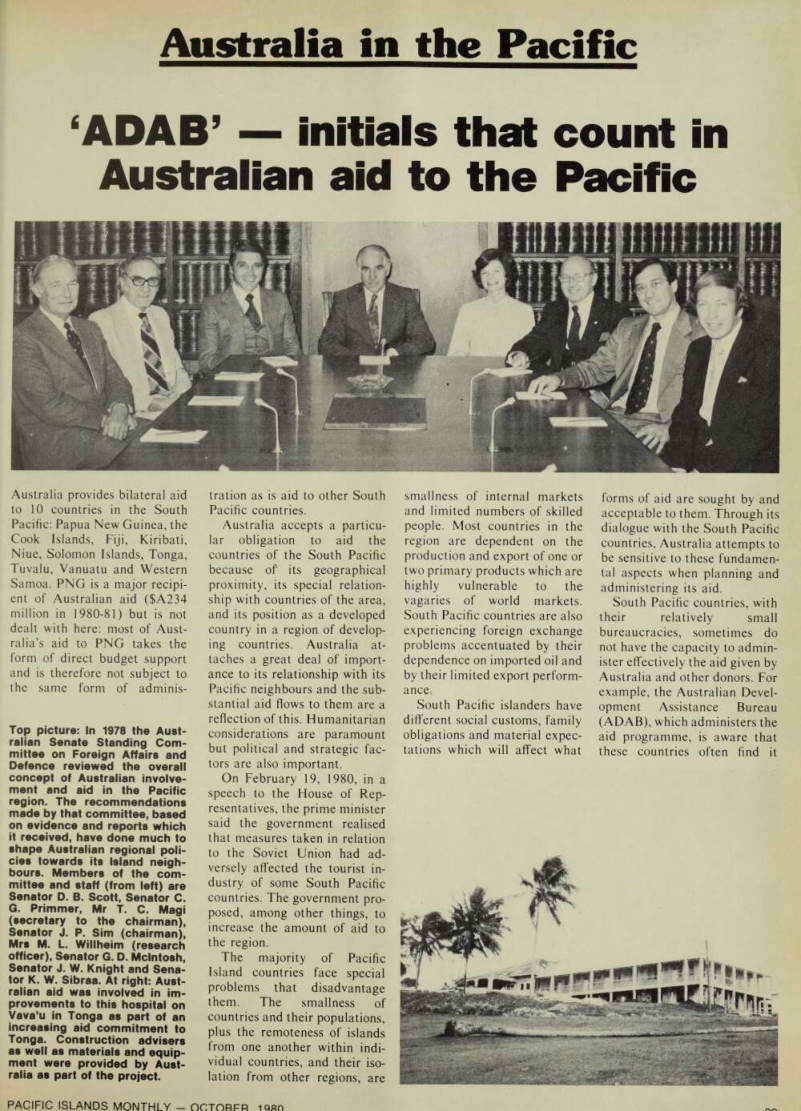

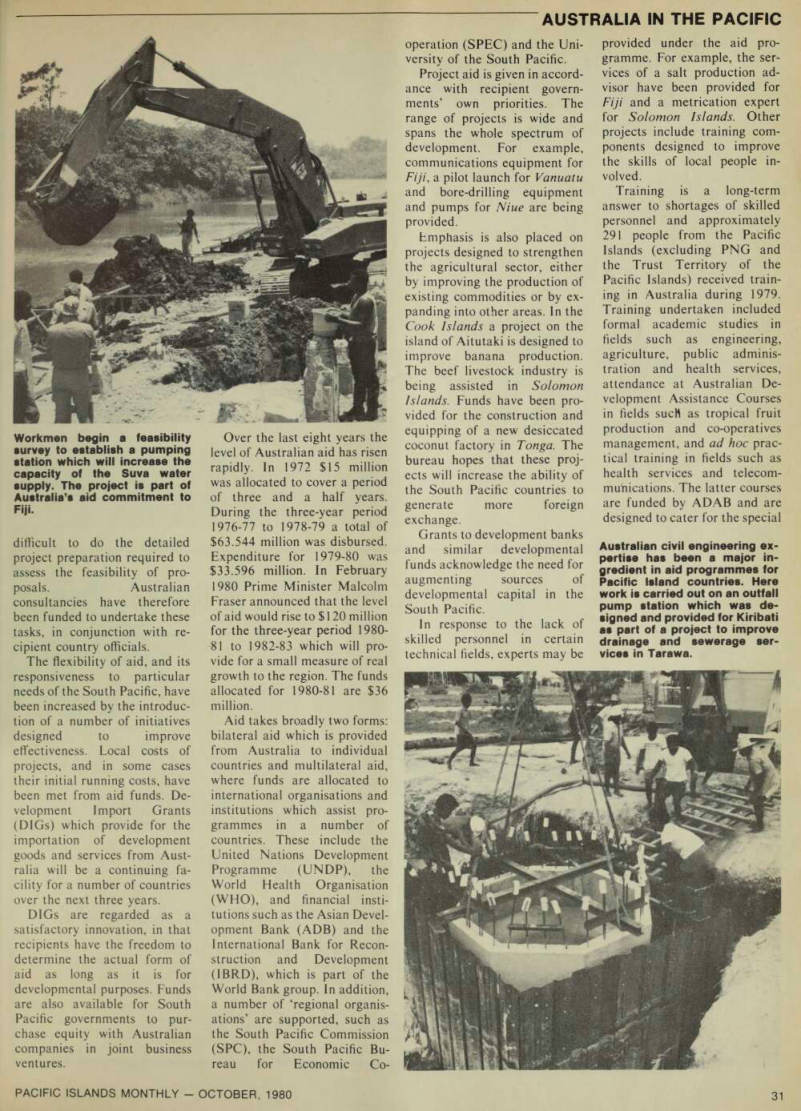
Australia in the Pacific ‘ADAB’ - initials that count in Australian aid to the Pacific
Australia provides bilateral aid to 10 countries in the South Pacific: Papua New Guinea, the Cook Islands, Fiji, Kiribati, Niue, Solomon Islands, Tonga, Tuvalu, Vanuatu and Western Samoa. PNG is a major recipi ent of Australian aid ($A234 million in 1980-81) but is not dealt with here; most of Aust ralia’s aid to PNG takes the form of direct budget support and is therefore not subject to the same form of adminis
tration as is aid to other South Pacific countries.
Australia accepts a particu lar obligation to aid the countries of the South Pacific because of its geographical proximity, its special relation ship with countries of the area, and its position as a developed country in a region of develop ing countries. Australia at taches a great deal of import ance to its relationship with its Pacific neighbours and the sub stantial aid flows to them are a reflection of this. Humanitarian considerations are paramount but political and strategic fac tors are also important.
On February 19, 1980, in a speech to the House of Rep resentatives, the prime minister said the government realised that measures taken in relation to the Soviet Union had ad versely affected the tourist in dustry of some South Pacific countries. The government pro posed, among other things, to increase the amount of aid to the region.
The majority of Pacific Island countries face special problems that disadvantage them. The smallness of countries and their populations, plus the remoteness of islands from one another within indi vidual countries, and their iso lation from other regions, are
smallness of internal markets and limited numbers of skilled people. Most countries in the region are dependent on the production and export of one or two primary products which are highly vulnerable to the vagaries of world markets.
South Pacific countries are also experiencing foreign exchange problems accentuated by their dependence on imported oil and by their limited export perform ance.
South Pacific islanders have different social customs, family obligations and material expec tations which will affect what
forms of aid are sought by and acceptable to them. Through its dialogue with the South Pacific countries, Australia attempts to be sensitive to these fundamen tal aspects when planning and administering its aid.
South Pacific countries, with their relatively small bureaucracies, sometimes do not have the capacity to admin ister effectively the aid given by Australia and other donors. For example, the Australian Devel opment Assistance Bureau (ADAB), which administers the aid programme, is aware that these countries often find it
Top picture: In 1978 the Aust ralian Senate Standing Com mittee on Foreign Affairs and Defence reviewed the overall concept of Australian involve ment and aid in the Pacific region. The recommendations made by that committee, based on evidence and reports which it received, have done much to shape Australian regional poli cies towards its Island neigh bours. Members of the com mittee and staff (from left) are Senator D. B. Scott, Senator C.
G. Primmer, Mr T. C. Magi (secretary to the chairman), Senator J. P. Sim (chairman), Mrs M. L. Willheim (research officer), Senator G. D. Mclntosh, Senator J. W. Knight and Sena tor K. W. Sibraa. At right: Aust ralian aid was involved in im provements to this hospital on Vava’u in Tonga as part of an increasing aid commitment to Tonga. Construction advisers as well as materials and equip ment were provided by Aust ralia as part of the project.
difficult to do the detailed project preparation required to assess the feasibility of pro posals. Australian consultancies have therefore been funded to undertake these tasks, in conjunction with re cipient country officials.
The flexibility of aid, and its responsiveness to particular needs of the South Pacific, have been increased by the introduc tion of a number of initiatives designed to improve effectiveness. Local costs of projects, and in some cases their initial running costs, have been met from aid funds. De velopment Import Grants (DIGs) which provide for the importation of development goods and services from Aust ralia will be a continuing fa cility for a number of countries over the next three years.
DIGs are regarded as a satisfactory innovation, in that recipients have the freedom to determine the actual form of aid as long as it is for developmental purposes. Funds are also available for South Pacific governments to pur chase equity with Australian companies in joint business ventures.
Over the last eight years the level of Australian aid has risen rapidly. In 1972 $l5 million was allocated to cover a period of three and a half years.
During the three-year period 1976-77 to 1978-79 a total of $63,544 million was disbursed.
Expenditure for 1979-80 was $33,596 million. In February 1980 Prime Minister Malcolm Fraser announced that the level of aid would rise to $ 120 million for the three-year period 1980- 81 to 1982-83 which will pro vide for a small measure of real growth to the region. The funds allocated for 1980-81 are $36 million.
Aid takes broadly two forms: bilateral aid which is provided from Australia to individual countries and multilateral aid, where funds are allocated to international organisations and institutions which assist pro grammes in a number of countries. These include the United Nations Development Programme (UNDP), the World Health Organisation (WHO), and financial insti tutions such as the Asian Devel opment Bank (ADB) and the International Bank for Recon struction and Development (IBRD), which is part of the World Bank group. In addition, a number of ‘regional organis ations’ are supported, such as the South Pacific Commission (SPC), the South Pacific Bu reau for Economic Co
operation (SPEC) and the Uni versity of the South Pacific.
Project aid is given in accord ance with recipient govern ments’ own priorities. The range of projects is wide and spans the whole spectrum of development. For example, communications equipment for Fiji , a pilot launch for Vanuatu and bore-drilling equipment and pumps for Niue are being provided.
Emphasis is also placed on projects designed to strengthen the agricultural sector, either by improving the production of existing commodities or by ex panding into other areas. In the Cook Islands a project on the island of Aitutaki is designed to improve banana production.
The beef livestock industry is being assisted in Solomon Islands. Funds have been pro vided for the construction and equipping of a new desiccated coconut factory in Tonga. The bureau hopes that these proj ects will increase the ability of the South Pacific countries to generate more foreign exchange.
Grants to development banks and similar developmental funds acknowledge the need for augmenting sources of developmental capital in the South Pacific.
In response to the lack of skilled personnel in certain technical fields, experts may be
provided under the aid pro gramme. For example, the ser vices of a salt production ad visor have been provided for Fiji and a metrication expert for Solomon Islands. Other projects include training com ponents designed to improve the skills of local people in volved.
Training is a long-term answer to shortages of skilled personnel and approximately 291 people from the Pacific Islands (excluding PNG and the Trust Territory of the Pacific Islands) received train ing in Australia during 1979.
Training undertaken included formal academic studies in fields such as engineering, agriculture, public adminis tration and health services, attendance at Australian De velopment Assistance Courses in fields such as tropical fruit production and co-operatives management, and ad hoc prac tical training in fields such as health services and telecom munications. The latter courses are funded by ADAB and are designed to cater for the special
Workmen begin a feasibility survey to establish a pumping station which will increase the capacity of the Suva water supply. The project is part of Australia’s aid commitment to Fiji.
Australian civil engineering ex pertise has been a major in gredient in aid programmes for Pacific Island countries. Here work is carried out on an outfall pump station which was de signed and provided for Kiribati as part of a project to improve drainage and sewerage ser vices in Tarawa.
needs of developing countries in the region.
Other important features of training aid to the South Pacific are the availability of grants for training at a range of institutions in the region, including the University of the South
Pacific and the University of Papua New Guinea, and special training programmes conduc ted in the region either for one particular country or a number of countries, Staffing Assistance Schemes are operating in several South
Two aspects of Australian aid to Kiribati are shown in these pictures. Australia provided the fisheries training and extension vessel (top) which is part of an overall scheme in which Kiribati hopes to develop subsistence and commercial fishing ventures.
Two trainee teachers (above) are receiving in-service training at the Tarawa teachers college. Under earlier Australian policies training facilities were provided in Australia itself for Islanders, but the accent today is on making training available in the countries where the trainees live and work.
Pacific countries and are under consideration in others. Aust ralian nationals are recruited to fill a variety of professional, technical and administrative positions in South Pacific government public services and instrumentalities. Under the schemes Australia provides the funds to supplement local salaries paid by South Pacific governments.
Accountable cash grants are widely used in the South Pacific. These grants cover lo cal costs and the costs of importing goods and materials from Australia. They enable Australia to provide assistance for works that can be executed by the governments themselves and which would not be appro priate for the sophisticated management standards of large-scale project aid.
Australia is considering sup port for a pre-feasibility study into the need for further agri cultural research on basic food crops, such as taro and yams, as well as plantation crops with
export potential such as cocoa and coconuts.
ADAB, which is part of Australia’s Department of Foreign Affairs, has five officers at three posts in the South Pacific Suva, Apia and Honiara.
There are well over 200 projects in the region and officers at posts are required to undertake the preliminary ap praisal of proposed projects and the monitoring of existing ones.
Staffing constraints have meant many stages of aid delivery project appraisal, design im plementation and evaluation have been contracted out.
However, many of the staff in the South Pacific section in ADAB’s Canberra office have had first-hand experience of conditions in the region and the bureau as a whole is concerned that the aid it gives should be appropriately planned and im plemented. The evidence shows that it is constantly striving to improve its programmes and increase its responsiveness.
The newly-independent Republic of Vanuatu is receiving Australian aid for civil engineering construction works. Top picture shows an inspection of Moto Lava airstrip, one of the construction sites.
Picture above shows an Australian-financed survey on Niue Island, drilling for possible irrigation water supplies.
Advertisements & other items, pp. 30-36 (4 items)
When it comes time to kick off a new age in audio or video, JVC has a habit
habit of being the first to get the ball rolling.
We were, for example, the originators of the now-famous VHS video cassette system, the world’s first metal-tape-compatible cassette deck and the Super-A high fidelity amplifier, just to name a few of the innovations that keep us in the front lines of audio and video.
Now. were proud to announce, we re ready to kick off a new era in video with a development that promises to change the very face of video entertainment: the VHD video disc system.
You can imagine the potential this system is going to have. It’s such an exciting breakthrough in fact, that we felt we had to do something special to celebrate it.
We re doing just that by kicking off a campaign as the Official Supplier of Audio and Video Systems at major world association football (soccer) finals around the world, from now until the 1982 World Cup.
Why association football? Actually, JVC takes an active interest in a variety of sports, from judo to weightlifting. Because, at JVC, we identify strongly with the youthful spirit, the energy and the courage it takes to become a great athlete. We feel it’s taken us much the same kind of obstacle-leaping dedication to succeed in our over 53 years of trend-setting advances in audio and video.
Give us a thought the next time you’re cheering your favorite team on.
At JVC, we re kicking off some exciting activities of our own.
Official Official Audio a Video Systems WVm Audio a Video Systems of the European Football m »V of the UEFA Cup Championship 1980, Finals.
V Official Audio 8 Video Systems of the FIFA World Cup 1982.
Official Audio 8 Video Systems of the United Slates Soccer Federation.
Official Audio 8 Video Systems of the Australian Soccer Federation.
Official Audio & Video Systems of the Gold Cup.
JVC
VICTOR COMPANY OF JAPAN. LIMITED
Australia: Hagemeyer (Australasia) 8.y., 25-27 Paul Street, North Ryde, N S W. 2113, Australia Tel. 887-1444 Fiji Islands: D Gokal & Co., Ltd.. G.P.O. Box 501, Comer of Pier Street & Ren wick Road, Suva, Fiji Tel. 25259 Cook Islands; J & P Ingram & Co.. Ltd, P.O. Box 55, Rarotonga, Cook Islands Tel. 378457 New Hebrides: Wu ke Luong. PO. Box 113, Rue Higginson, Port-Vila, New Hebrides New Caledonia: Caldis, 2, Route du Velodrome, B.P. Ml, Noumea, Cedex, New Caledonia Tel. 262350 Tahiti; Magasin Sincere, B.P. 215, Papeete, Tahiti Tel. 20060 Papua New Guinea: Hagemeyer (P.N.G.) Pty, Ltd., P.O. Box9oLae, Papua New Guinea Tel. 42-3200 , , . New Zealand: Atlas Majestic Industries Ltd., 11, Albion Road, Otahuhu, Auckland b.
New Zealand Tel. 27-67-099
GOTCHA
T- Shirts \ am h . ■B '
BULL’S MARINE
INDUSTRIES
PTY. LTD.
P.O. BOX 1, METUNG,
VICTORIA. 3904.
DESIGN AND CONSTRUCTION
To Complete Commonwealth and State Marine Authorities.
Facilities for Fabrication of Marine Alloy Commercial and Fishing Craft up to 80'.
Phone: (051) 56 2291,56 2208.
ROWNTREE HOADLEY LTD.
bring you quality
confectionery for all
seasons 120 g 'C' Pack *4 is hi alii y At* Sir eel n Cartons & Tins 20g + 40g Bars Multipack 6 x 20g 3 x 40g 120 g + 200 g Bags M*
Milk
* biscuit
Shakes
Vm 20g+ 40g
smarties
120 g 'C' Pack 25g+ 50g
ENQUIRIES
ROWNTREE HOADLEY LTD.
1585 Hume Highway, Campbellfield, Victoria, Australia, 3061.
OR CONTACT YOUR LOCAL WHOLESALER
Di scover why
Winchester
bold new moves
into world
markets
canbeyour
Waning
Move...
r Winchester Australia’s rimfire and shotgun ammunition is now available around the world.
High accuracy and dependability has made Winchester Australia the one to beat in Europe.
Now, you too can start winning with Winchester.
Discover why.
Write for our new export booklet...
“Winchester Australia A Winning Move”
WINCHESTER
AUSTRALIA PTY. LTD.
1 ' Ur P.O. Box 776, Geelong, Victoria, 3220.
Australia.
Telephone 221822.
Area Codes: (Aust.) 052, (International) 6352 Telex, Cables: Winlong A A 31123 A Winning Move
NAME
COMPANY.
ADDRESS..
STATE
COUNTRY.
POSITION.
WATER WHEEL EXPORTS
Pty. Ltd.
493 Bourke Street, Melbourne, 3000, Australia Cables: Watermill-Melbourne.
Telex: AA 32165 Telephone: 602 1433
THE WATER WHEEL GROUP OF COMPANIES
Winners of Australia’s Top Export Award and Flour Millers for over 100 years. (High Protein, Bakers, Stone ground Wholemeal, Donut).
COOLROOMS REFRIGERATED
CABINETS ETC.
INCLUDING SALT WATER
ICE MAKERS
STOCK & POULTRY FEEDS
YELLOW SPLIT PEAS &
WHOLE PEAS
COMPLETE RANGE OF FROZEN
AND GENERAL FOOD ITEMS
QUALITY AUSTRALIAN
WINES
WOOD FUEL STOVES
AND WATER HEATERS
BEST AUSTRALIAN
WHEATEN FLOUR
(Pellets or Mash form) (Machine-Dressed) V
LINCOLN
I ELECTRIC
There have to be reasons for
our dominant position
in the arc welding industry
Arc welding is the one and only interest to which we have always devoted our total resources.
For every arc welding procedure, we are continually evolving products that are recognised world wide for their rugged construction and reliability.
These are just a few of them Portable welders with 240 V
auxiliary power
A range of models. Petrol and diesel engines.
Maximum outputs 150-225 amps. DC and AC.
Undercarriages and trailers available.
Heavy-duty diesel site welders The famous Shield-Arc AS series of machines.
Optional range of auxiliary power. Current ranges 40-400 amps DC, 60-500 amps DC.
Diesels 35 hp to 64 hp. Optional trailers.
Low cost automatic power sources R3S series of machines for Innershield, MIG, submerged arc welding and arc gouging. Auxiliary power for wire feeders. Models from 300 amps to 750 amps max.
Heavy-duty AC/DC transformer/rectifier welders Wealarc TM series. Current ranges 40-600 amps AC, 60-500 amps DC and 50-750 amps AC, 75-625 amps DC. Options include power factor condenser, arc booster, remote current control.
Wire feed systems Wire feeders for automatic and semi-automatic applications with Innershield, MIG and submerged arc.
The machines illustrated are only a part of the range available from Lincoln. All have resulted from our continuing policy of finding better, more economical arc welding methods through research and design.
For information on Lincoln arc welding equipment and electrodes, please contact your nearest agent or Lincoln Electric, Sydney.
ttl.'WUL'l-
ELECTRIC I
LE93.18/11S&P
THE LINCOLN ELECTRIC COMPANY (AUSTRALIA) PTY. LIMITED 35 Bryant Street, Padstow, Sydney 2211, Australia. Telex AA22792.
FIJI CARPENTERS’ MOTORS, Sales Division, 61-63 Foster St., WALU BAY, SUVA.
P.N.G. MOTOR COMPONENTS, P.O. Box 61, LAE.
Australia In The Pacific
31
PACIFIC ISLANDS MONTHLY - OCTOBER, 1980
Australia In The Pacific
35
AUSTRALIA IN THE PACIFIC
PACIFIC ISLANDS MONTHLY - OCTOBER, 1980
Trade, as well as aid, is part of Australian
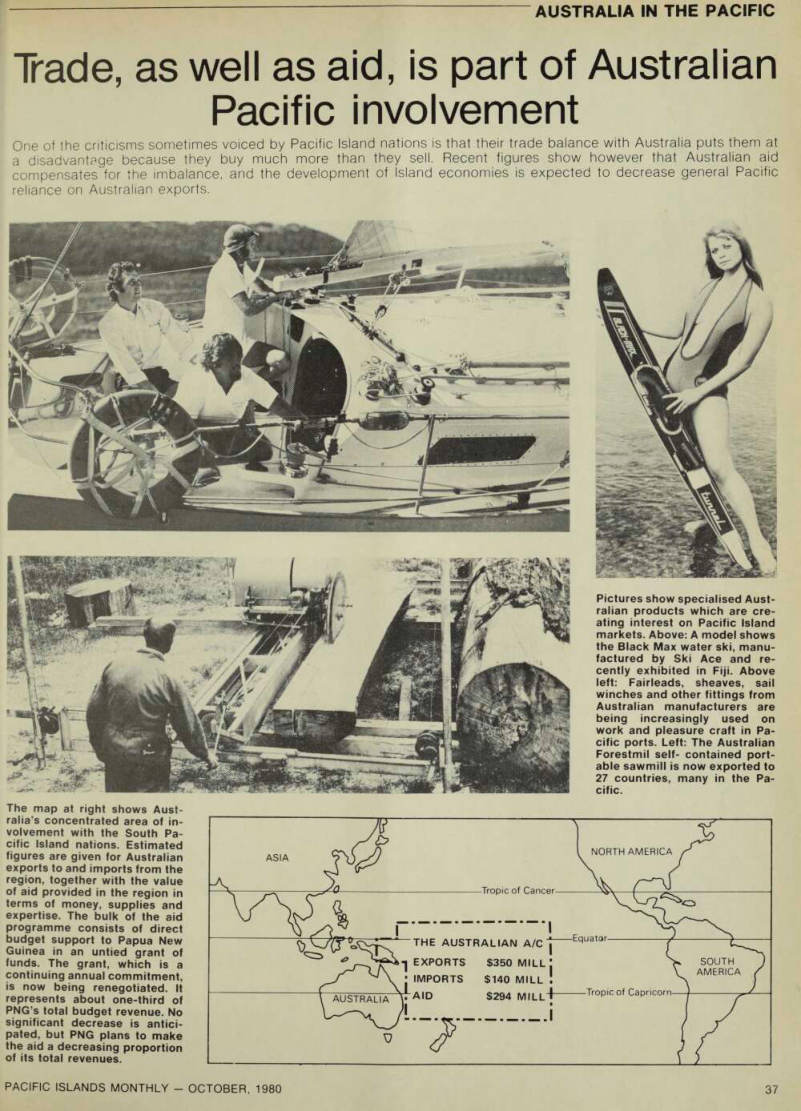
Pacific involvement
One of the criticisms sometimes voiced by Pacific Island nations is that their trade balance with Australia puts them at a disadvantage because they buy much more than they sell. Recent figures show however that Australian aid compensates for the imbalance, and the development of Island economies is expected to decrease general Pacific reliance on Australian exports.
The map at right shows Aust ralia’s concentrated area of in volvement with the South Pa cific Island nations. Estimated figures are given for Australian exports to and imports from the region, together with the value of aid provided in the region in terms of money, supplies and expertise. The bulk of the aid programme consists of direct budget support to Papua New Guinea in an untied grant of funds. The grant, which is a continuing annual commitment, is now being renegotiated. It represents about one-third of PNG’s total budget revenue. No significant decrease is antici pated, but PNG plans to make the aid a decreasing proportion of its total revenues.
Pictures show specialised Aust ralian products which are cre ating interest on Pacific Island markets. Above: A model shows the Black Max water ski, manu factured by Ski Ace and re cently exhibited in Fiji. Above left: Fairleads, sheaves, sail winches and other fittings from Australian manufacturers are being increasingly used on work and pleasure craft in Pa cific ports. Left: The Australian Forestmil self- contained port able sawmill is now exported to 27 countries, many in the Pa cific.
Advertisements & other items, pp. 37-38 (2 items)
37
AUSTRALIA IN THE PACIFIC
PACIFIC ISLANDS MONTHLY - OCTOBER, 1980
ES NationalPanasonic
The new LEDSONIC SG-2900C. Everything you've ever wanted in a music center and then some.
Let's start with the cassette section. The front-loading deck has softtouch controls. A two-color LED VU meter and tape running indicator.
And a tape program sensor (TPS) that lets you call up your favorite songs one after another.
The auto-changer's got an MM cartridge with diamond stylus, of course.
Naturally, the receiver section's equally advanced. With a massive 112 watts of peak music power that really brings your music to life.
Add a stereo eye, illuminated tuning dial and 2-color LED meters and a public address (PA) system and, as you can see, the 2900 C looks as good as it sounds.
As we say, who else but National gives you so much for your money?
LEDSONIC Series by
ES NationalPanasonic
National and Panasonic are the brandnames of Matsushita Electric. m A
SG-2900C
National Panasonic inn
LL* VtXUMC iW AMCf
Pull Auto Stop/Soft Touch Control*
L-TPSJ
I a D □ P P f \
favour of the Islands world
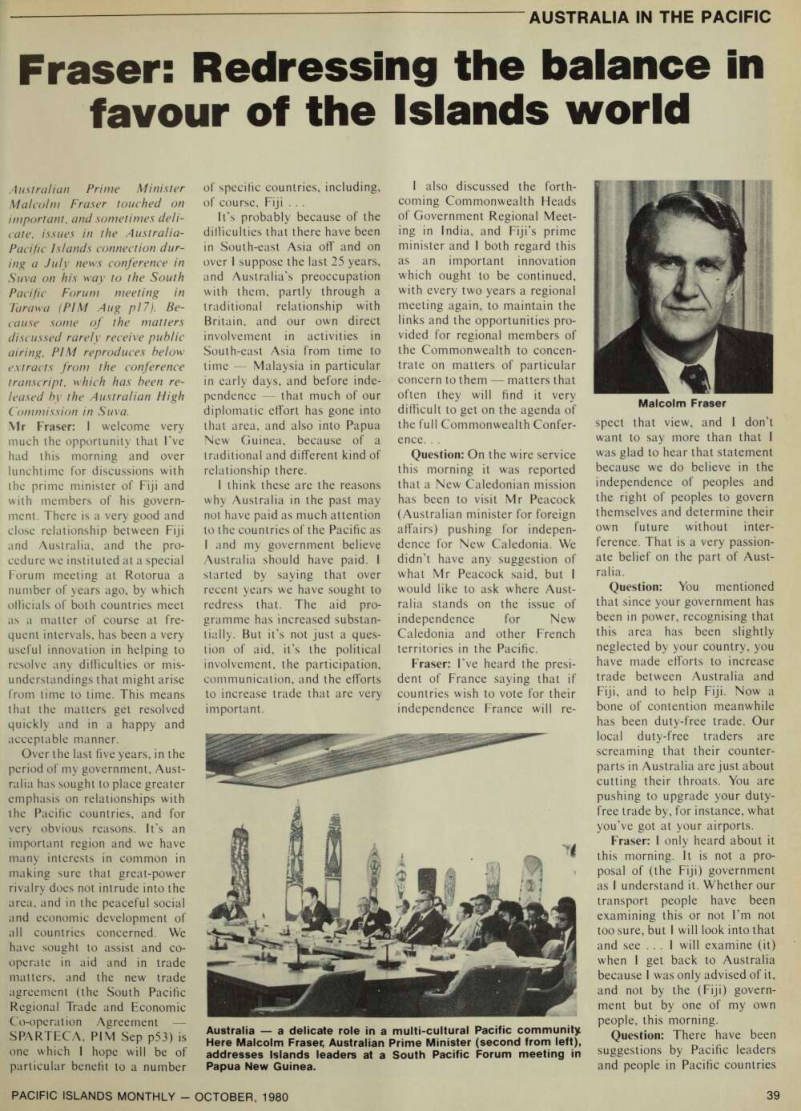

Fraser: Redressing the balance in favour of the Islands world
Australian Prime Minister Malcolm Fraser touched on important, and sometimes deli cate, issues in the Australia- Pacific Islands connection dur ing a July news conference in Suva on his way to the South Pacific Forum meeting in Tarawa (PIM Aug pi 7). Be cause some of the matters discussed rarely receive public airing, PIM reproduces below extracts from the conference transcript, which has been re leased by the Australian High Commission in Suva.
Mr Fraser: I welcome very much the opportunity that I’ve had this morning and over lunchtime for discussions with the prime minister of Fiji and with members of his govern ment. There is a very good and close relationship between Fiji and Australia, and the pro cedure we instituted at a special Forum meeting at Rotorua a number of years ago, by which officials of both countries meet as a matter of course at fre quent intervals, has been a very useful innovation in helping to resolve any difficulties or mis understandings that might arise from lime to lime. This means that the matters get resolved quickly and in a happy and acceptable manner.
Over the last five years, in the period of my government, Aust ralia has sought to place greater emphasis on relationships with the Pacific countries, and for very obvious reasons. It’s an important region and we have many interests in common in making sure that great-power rivalry docs not intrude into the area, and in the peaceful social and economic development of all countries concerned. We have sought to assist and co operate in aid and in trade matters, and the new trade agreement (the South Pacific Regional Trade and Economic Co-operation Agreement
Sparteca, Pim Sep P 53) Is
one which I hope will be of particular benefit to a number
of specific countries, including, of course, Fiji . . .
It’s probably because of the difficulties that there have been in South-east Asia off and on over I suppose the last 25 years, and Australia’s preoccupation with them, partly through a traditional relationship with Britain, and our own direct involvement in activities in South-east Asia from time to time Malaysia in particular in early days, and before inde pendence that much of our diplomatic effort has gone into that area, and also into Papua New Guinea, because of a traditional and different kind of relationship there.
I think these are the reasons why Australia in the past may not have paid as much attention to the countries of the Pacific as I and my government believe Australia should have paid. I started by saying that over recent years we have sought to redress that. The aid pro gramme has increased substan tially. But it’s not just a ques tion of aid, it’s the political involvement, the participation, communication, and the efforts to increase trade that are very important.
I also discussed the forth coming Commonwealth Heads of Government Regional Meet ing in India, and Fiji’s prime minister and I both regard this as an important innovation which ought to be continued, with every two years a regional meeting again, to maintain the links and the opportunities pro vided for regional members of the Commonwealth to concen trate on matters of particular concern to them matters that often they will find it very difficult to get on the agenda of the full Commonwealth Confer ence. . .
Question: On the wire service this morning it was reported that a New Caledonian mission has been to visit Mr Peacock (Australian minister for foreign affairs) pushing for indepen dence for New Caledonia. We didn’t have any suggestion of what Mr Peacock said, but I would like to ask where Aust ralia stands on the issue of independence for New Caledonia and other French territories in the Pacific.
Fraser: I've heard the presi dent of France saying that if countries wish to vote for their independence France will re-
sped that view, and I don’t want to say more than that I was glad to hear that statement because we do believe in the independence of peoples and the right of peoples to govern themselves and determine their own future without inter ference. That is a very passion ate belief on the part of Aust ralia.
Question: You mentioned that since your government has been in power, recognising that this area has been slightly neglected by your country, you have made efforts to increase trade between Australia and Fiji, and to help Fiji. Now a bone of contention meanwhile has been duty-free trade. Our local duty-free traders are screaming that their counter parts in Australia are just about cutting their throats. You are pushing to upgrade your duty free trade by, for instance, what you’ve got at your airports.
Fraser: 1 only heard about it this morning. It is not a pro posal of (the Fiji) government as I understand it. Whether our transport people have been examining this or not I’m not too sure, but I will look into that and see . . . I will examine (it) when I get back to Australia because I was only advised of it, and not by the (Fiji) govern ment but by one of my own people, this morning.
Question: There have been suggestions by Pacific leaders and people in Pacific countries
Australia - a delicate role in a multi-cultural Pacific community.
Here Malcolm Fraser, Australian Prime Minister (second from left), addresses Islands leaders at a South Pacific Forum meeting in Papua New Guinea.
Malcolm Fraser
in the past that if Australia really wants to help people of the region they should allow more people from the Pacific into Australia and help them to settle there and get jobs there rather than (inaudible) white immigration policy.
Fraser: Well, we haven’t got a white immigration policy. It is totally non-discriminatory and if you look at the figures for immigration over recent years that will be proved completely.
We've taken more refugees from South-east Asia than any other country in the world in relation to the size of our population, and we will be continuing to take large num bers of refugees. I think you’ll all regard that as a very signifi cant responsibility that we ought to fulfil. The refugee movement is larger than the refugee movement promoted by Vietnam, it’s larger than the refugee movement promoted by Nazi Germany in the 19305.
That gives the extent of the human problem that’s involved, and so we’ve been seeking very substantially to respond to that.
But we also need to note that what Australia can do is limited by the level of unemployment in Australia. It’s a question of all countries being able to lift their own standards of living and work for all the people of the country.
A number of people from many countries come to be educated in Australia because they want to, or because they come under an aid programme, and the numbers in that area will increase. Some restrictions that had operated on private students who wanted to come to Australia, especially in relation to secondary schools, are being lifted, and that might assist a significant number of people who would want to participate in the education process in Australia.
But I would also hope that the overwhelming majority of such people would then want to use their skills for the advan tage of their own countries, and help to lift the standard of life of all their own people. . .
Question: What are your feel ings on a migrant worker scheme similar to that which operates between New Zealand and us?
Fraser: I think there are some difficulties in that. I don’t think it could be restricted to one country. It's a policy that we have not adopted, and mi gration to Australia has either been on a ‘visitors’ basis or on a more permanent basis under which people settle and live in the country.
Wc haven’t so far adopted what has been a common Euro pean practice as they call it ‘guest workers’. There have been problems when the countries that have had guest workers have had economic downturns. It’s the guest worker who has been the first to suffer. He gets sent home, so it’s not all benefit.
Question: Would it be true to say that Australia is not con templating any kind of guest worker, or immigrant worker, scheme at the moment?
Fraser: Not at the moment, no. It has been examined from time to time, but we felt that there were a number of diffi culties with that sort of ap proach. It could not be restric ted to one or two countries.
Question: You mentioned earlier that one of your con cerns was super-power rivalry in the Pacific . . .
Fraser: Well, 1 said our objec tive was to prevent great-power rivalry in the Pacific. Fm not saying that it exists. I’m saying a broad national objective, which I’m sure is shared by all the countries in the region, is to make sure that super-power rivalry does not intrude into the affairs of the Pacific. . .
Question: My newspaper quotes you this morning as having said in Guam that Americans are now stationing aircraft carriers in Australia and there was a survey team (from the US) to look into a naval base somewhere in south west Australia. Can you elabor ate on this?
Fraser: Well, they’re not stationing anyone. What we have said is that to help to maintain their Indian Ocean commitment we are prepared to provide facilities at our own military bases. This could be staging facilities through some of our air bases.
We’ve also indicated that we would be prepared to allow the US to use Cockburn Sound,
which is a major naval base in Western Australia, and we would be prepared to allow them to homeport ships there if they wanted to do so. They sent a team out to examine it and I think they were impressed with the base and what it offered.
But no decision has been made.
Question: This is basically to utilise your facilities, not to bring their own.
Fraser: They wouldn’t be establishing separate American bases. No, there’s no question of that. If they were homeport ing some of their own ships there, there might be additional facilities that they would want to provide. But there is no suggestion that they are going to establish additional bases in Australia.
We’ve made the offer under our defence commitment under ANZUS, Australia, New Zealand, the United States. We would believe that this kind of co-operation is an important part of that treaty. . .
Question: What measure of success have you had in dealing with your trade unions, and
what lessons can we learn from your measure of success?
Fraser: It’s a continuing problem. It’s a battle or an argument that is never com pletely won. There must be no relaxation.
There need to be attempts in many countries to try to per suade trade union leaders to be responsible, and to recognise their obligations not only to their own members but to the wider national community of which they are a part. So often union leadership does not do this. They look at the narrow concerns as they see them of their own union members.
Desirably, industrial disputes should be settled by nego tiation. But in our own experi ence they cannot all be, and there does need to be a frame work of firm, just, but resolute law within which industrial negotiations and consultations can take place. That’s es pecially so because in a modern society trade unions exert sig nificant power, and cannot be allowed to operate, in the Aust ralian view, outside the law.
Advertisements & other items, pp. 39-44 (3 items)
Australia In The Pacific
39
PACIFIC ISLANDS MONTHLY - OCTOBER, 1980
Only The Sun
mm
READY' FLASHLIGHTS
SHINES BETTER
THE WORLD'S LEADING BRAND
085.P.718 Eveready’ and ‘Union Carbide’ are registered trade marks.
1 Aquila water tanks completely enclosed to ensure clean water and built to last from strong, durable galvanised steel.
You assemble them yourself from our comprehensive kits. Capacities range from 2300 litres to 49250 litres.
Send for a brochure today.
Name ..
Address P/code
AQ2O/2
AQUILA
WHEN THE PUBLIC
Finding out what people want, and then working out ways to make it happen, takes time md effort. Only a few companies have the esources and resolve to attempt doing so on a worldwide scale. The challenge is immense. But or Yamaha, at least, it’s the only way to make neaningful changes in a world where “new” has become a commonplace adjective.
For a product to be termed “new” at
Yamaha, it must embody substantive improve-
ments, not just cosmetic additions. This doesn’t mean Yamaha isn’t keen on styling. We are.
But even the smallest change in handlebar angle or paint hue, must accurately reflect luropean cyclists wanted a middleweight tourer with superbike performance and
ightweight agility.
Touring in Europe presents a number of difficult esign considerations. High fuel costs, twisting roads et plenty of opportunities for full throttle running, and desire for technical precision are only a few of the actors. Until now, no ingle bike could be onsidered
tiders everywhere wanted a lighter
four” for town and country. g
Touring enthusiasts, who also use their ikes to get around town, wanted a four- /linder machine with fewer cc’s. So Yamaha ame up with the XJ6SO, a 206 kg middleweight lat’s equally at home on highways and in savy traffic.
And while the XJ6SO bears a family resemlence to Yamaha’s awesome XSIIOO, it’s avertheless an all new design. The 653 cc DOHC igine puts out an amazing 73hp, which certainly jts the XJ6SO in the superbike class. Yet, It is cometely mannerly in the city, and equally gentle on le gas budget.
This modern classic is also a good example of how amaha makes different bikes for different riders. With lore than 30 models to choose from, cyclists don’t ideal. It took Yamaha to build a bike that met all requirements. And by doing so, Yamaha has redefined the middleweight class.
This revolutionary new machine is the RD3SOLC, and it’s about as close to being an all-out racer as a street legal bike can be. Based directly on Yamaha’s legendary TZ road racers, this liquid cooled 347 cc twostroke puts out a phenomenol 47hp; Monoshock suspension, one of the big reasons behind Yamaha’s racing success, is standard equipment. As are dual front disc brakes, six speed transmission, wet multiplate clutch and twin Mikuni carbs. The whole package weighs less than 145 kg and it can take two just about anywhere at speeds only experts would test. have to compromise. They can choose the exact bike they need. Or, as we’ve said before, “If you can’t find a Yamaha you want, then you don’t want a motorcycle”.
TALKS. WE LISTEN.
“new” user desires. Today, in more than 120
countries, Yamaha engineers, designers and
technicians are listening to what the world is saying. And in the process, turning some fantastic dreams into even more fantastic realities.
And, with Yamaha’s total dedication to quality at all stages of design and production, you can be sure that even the newest product is built with the same kind of old fashioned craftsman ship which has made “Yamaha” synonymous with reliability the world over.
People around the world wanted lightweight lighting.
For years, “portable” generators weren’t really portable at all. Most were just too heavy, or too complex, to be taken easily from place to place. On w«»u I •# V
Farmers in developing nations needed
economical irrigation pumps.
In many places, it’s not so much that there is a shortage of water as it is there’s a shortage of efficient pumps. To help solve this problem, Yamaha adapted its famous engine technology to pump production, coming up with a line of extremely powerful and cost efficient units which are now sold worldwide. In addition to helping ease water shortages, these pumps are used widely for construction work, livestock raising, and dozens of other liquid movement needs.
Yamaha even builds special versions to handle hot
Now, listen to us about service.
At Yamaha, service begins before the sale.
Feedback about problems lets engineers improve designs and eliminate bugs before products reach the market. This is another example of how we listen better. Service after the sale, of course, gets even more attention. Because the one thing we don’t want to listen to is complaints. top of that, many were just too expensive.
After realizing the demand, it didn’t take Yamaha long to develop a complete line of truly portable generators that were priced right for the mass market. As one of the world’s big three small engine makers, Yamaha had more than enough technology to come u| with the right product at the right time. Available in tw cycle and four cycle versions and a number of differen outputs, today’s Yamaha portable generators are helping thousands live more convenient, comfortable lives by bringing reliable electrical power to places far from existing power lines.
YAMAHA
water or provide “sea level” pumping efficiency at hig altitudes. And while pumps lack the glamor of Yamah bikes, boats and outboards, they remain an impressive manifestation of how Yamaha listens to people’s needs, however large or small the market.
YAMAHA
YAMAHA MOTOR CO., LTD
2500 SHINGAI IWATA SHI SHIZUOKA KEN JAPAI'
Total service 0n ...
plumbing supplies Wast
You can get all your needs from one supply source: water taps, valves, copper tube, tools and a host of other fittings and related plumbing equipment for domestic, industrial and multi-storey buildings.
Watson & Crane Pty Ltd have over 20,000 plumbing items in stock at their central warehouse located at Waterloo, NSW, Australia.
Years of experience in handling and shipping right throughout the South Pacific add up to another big reason for you to deal with Watson & Crane Pty Ltd.
Representatives call regularly at Papua New Guinea, the Solomons, New Hebrides and Fiji Islands to personally discuss your requirements and appropriate credit arrangements.
Write, cable or telephone today for complete plumbers' supplies service.
I f V Watson & Crane Pty. Ltd. 1037 Bourke Street, Waterloo,
NSW 2017.
Phone: Sydney 699-1333.
Telex: AA 25548.
Cables: "Watcrane" Sydney
CRANE
1
GROUP
Pacific Island distributors off Crano Enfield copper tube ffor water, sanitation, engineering, refrigeration and air conditioning.
WATSON & CRANE
are organised to fulfil your needs
wherever you are in the South Pacific
Australia In The Pacific
41
PACIFIC ISLANDS MONTHLY - OCTOBER, 1980
A tusk, a film
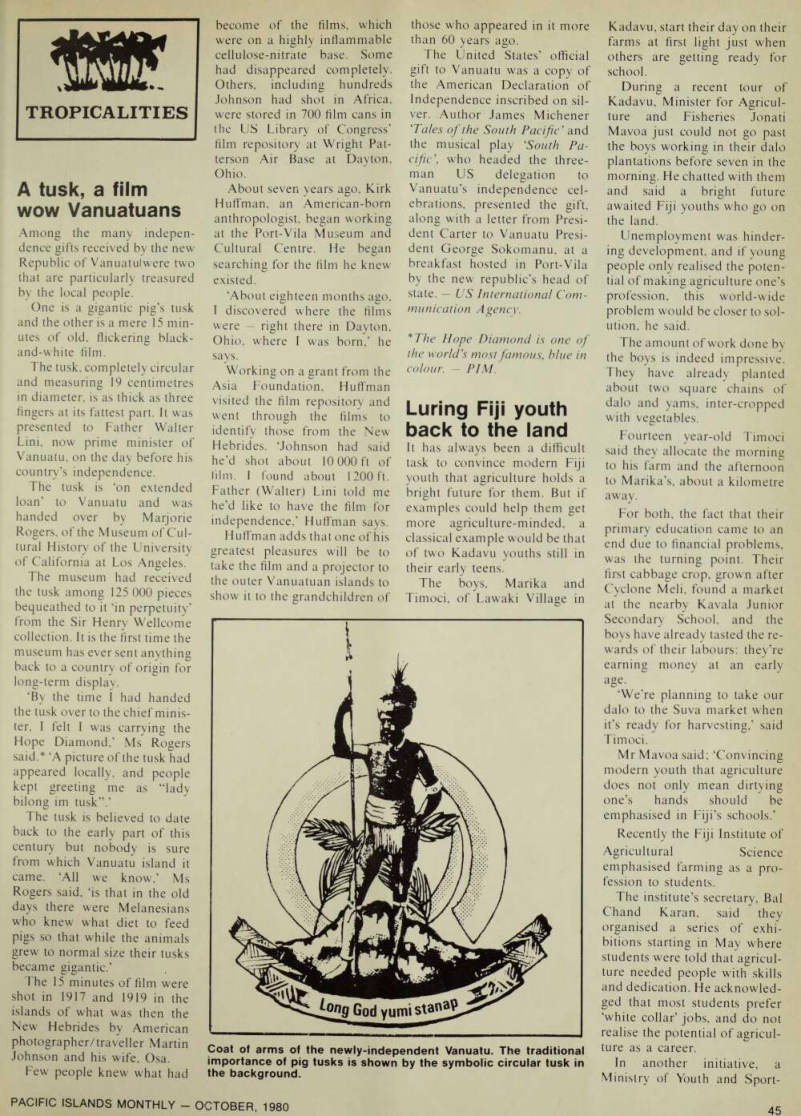
Tropicalities
A tusk, a film wow Vanuatuans
Among the many indepen dence gifts received by the new Republic of Vanuatulwere two that are particularly treasured
by the local people.
One is a gigantic pig’s tusk and the other is a mere 15 min utes of old. flickering black and-white film.
The tusk, completely circular and measuring 19 centimetres in diameter, is as thick as three fingers at its fattest part. It was presented to Father Walter Lini, now prime minister of Vanuatu, on the day before his
country’s independence.
The tusk is ‘on extended loan’ to Vanuatu and was
handed over by Marjorie
Rogers, of the Museum of Cul tural History of the University of California at Los Angeles.
The museum had received the tusk among 125 000 pieces bequeathed to it ‘in perpetuity’ from the Sir Henry Wellcome collection. It is the first time the museum has ever sent anything back to a country of origin for
long-term display.
‘By the time I had handed the tusk over to the chief minis ter. I felt I was carrying the Hope Diamond,’ Ms Rogers said.* ‘A picture of the tusk had
appeared locally, and people
kept greeting me as “lady
bilong im tusk’’.’
The tusk is believed to date back to the early part of this century but nobody is sure from which Vanuatu island it came. ‘All we know,’ Ms Rogers said, ‘is that in the old days there were Melanesians who knew what diet to feed pigs so that while the animals grew to normal size their tusks
became gigantic.’
The 15 minutes of film were shot in 1917 and 1919 in the islands of what was then the New Hebrides by American
photographer/traveller Martin
Johnson and his wife, Osa.
Few people knew what had
become of the films, which were on a highly inflammable cellulose-nitrate base. Some
had disappeared completely.
Others, including hundreds Johnson had shot in Africa, were stored in 700 film cans in the US Library of Congress’ film repository at Wright Pat terson Air Base at Dayton, Ohio.
About seven years ago, Kirk Huffman, an American-born
anthropologist, began working
at the Port-Vila Museum and Cultural Centre. He began searching for the film he knew existed. ‘About eighteen months ago, I discovered where the films were - right there in Dayton, Ohio, where I was born,’ he says.
Working on a grant from the Asia Foundation. Huffman visited the film repository and went through the films to identify those from the New Hebrides. ‘Johnson had said he’d shot about 10 000 ft of film. I found about 1200 ft.
Father (Walter) Lini told me he’d like to have the film for independence.’ Huffman says.
Huffman adds that one of his greatest pleasures will be to take the film and a projector to the outer Vanuatuan islands to show it to the grandchildren of
those who appeared in it more than 60 years ago.
The United States’ official gift to Vanuatu was a copy of the American Declaration of Independence inscribed on sil ver. Author James Michener ‘ Tales of the South Pacific’ and the musical play ‘ South Pa cific’, who headed the three man US delegation to Vanuatu’s independence cel ebrations, presented the gift, along with a letter from Presi dent Carter to Vanuatu Presi dent George Sokomanu, at a breakfast hosted in Port-Vila by the new republic’s head of state. US International Com munication Agency.
*The Hope Diamond is one of the world's most famous , blue in colour. PIM.
Luring Fiji youth

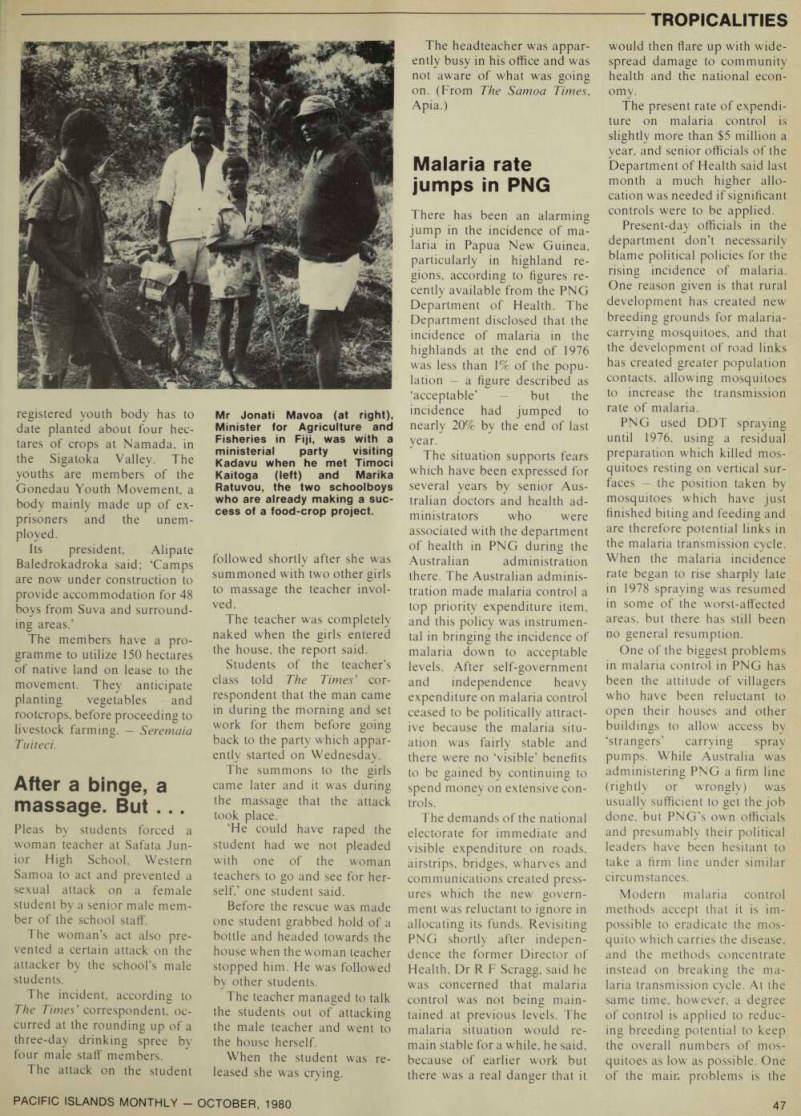
back to the land
It has always been a difficult task to convince modern Fiji youth that agriculture holds a bright future for them. But if examples could help them get more agriculture-minded, a classical example would be that of two Kadavu youths still in their early teens.
The boys, Marika and Timoci, of Lawaki Village in
Kadavu, start their day on their farms at first light just when others are getting ready for school.
During a recent tour of Kadavu, Minister for Agricul ture and Fisheries Jonati Mavoa just could not go past the boys working in their dalo plantations before seven in the morning. He chatted with them and said a bright future awaited Fiji youths who go on the land.
Unemployment was hinder ing development, and if young people only realised the poten tial of making agriculture one’s profession, this world-wide problem would be closer to sol ution. he said.
The amount of work done by the boys is indeed impressive.
They have already planted
about two square chains of dalo and yams, inter-cropped
with vegetables.
Fourteen year-old Timoci said they allocate the morning to his farm and the afternoon to Marika’s, about a kilometre away.
For both, the fact that their primary education came to an end due to financial problems, was the turning point. Their first cabbage crop, grown after Cyclone Meli, found a market at the nearby Kavala Junior Secondary School, and the boys have already tasted the re wards of their labours: they’re earning money at an early age. ‘We’re planning to take our dalo to the Suva market when it’s ready for harvesting,’ said Timoci.
Mr Mavoa said; ‘Convincing
modern youth that agriculture
does not only mean dirtying one’s hands should be
emphasised in Fiji’s schools.’
Recently the Fiji Institute of
Agricultural Science
emphasised farming as a pro fession to students.
The institute’s secretary, Bal Chand Karan, said they organised a series of exhi bitions starting in May where students were told that agricul ture needed people with skills and dedication. He acknowled ged that most students prefer ‘white collar’ jobs, and do not realise the potential of agricul ture as a career.
In another initiative, a Ministry of Youth and Sporl-
Coat of arms of the newly-independent Vanuatu. The traditional importance of pig tusks is shown by the symbolic circular tusk in the background.
registered youth body has to date planted about four hec tares of crops at Namada, in
the Sigatoka Valley. The
youths are members of the Gonedau Youth Movement, a body mainly made up of ex prisoners and the unem
ployed.
Its president, Alipate
Baledrokadroka said; ‘Camps are now under construction to provide accommodation for 48 boys from Suva and surround
ing areas.’
The members have a pro gramme to utilize 150 hectares of native land on lease to the
movement. They anticipate
planting vegetables and
rootcrops, before proceeding to livestock farming. Seremaia Tuiteci.
After a binge, a
massage. But ...
Pleas by students forced a woman teacher at Safata Jun ior High School. Western Samoa to act and prevented a sexual attack on a female student by a senior male mem ber of the school staff.
The woman’s act also pre vented a certain attack on the attacker by the school’s male students.
The incident, according to The Times' correspondent, oc curred at the rounding up of a
three-day drinking spree by
four male staff members.
The attack on the student
followed shortly after she was summoned with two other girls to massage the teacher invol ved.
The teacher was completely naked when the girls entered the house, the report said.
Students of the teacher’s class told The Times' cor respondent that the man came in during the morning and set work for them before going back to the party which appar
ently started on Wednesday.
The summons to the girls came later and it was during the massage that the attack
took place.
‘He could have raped the student had we not pleaded with one of the woman teachers to go and see for her self,’ one student said.
Before the rescue was made one student grabbed hold of a bottle and headed towards the house when the woman teacher stopped him. He was followed by other students.
The teacher managed to talk the students out of attacking the male teacher and went to the house herself.
When the student was re leased she was crying.
The headteacher was appar ently busy in his office and was not aware of what was going on. (From The Samoa Times ,
Apia.)
Malaria rate
jumps in PNG
There has been an alarming jump in the incidence of ma laria in Papua New Guinea,
particularly in highland re
gions, according to figures re
cently available from the PNG Department of Health. The Department disclosed that the incidence of malaria in the highlands at the end of 1976 was less than 1% of the popu lation a figure described as ‘acceptable’ - but the incidence had jumped to nearly 20% by the end of last year.
The situation supports fears which have been expressed for several years by senior Aus tralian doctors and health ad ministrators who were associated with the department of health in PNG during the Australian administration there. The Australian adminis tration made malaria control a
top priority expenditure item,
and this policy was instrumen tal in bringing the incidence of malaria down to acceptable levels. After self-government
and independence heavy
expenditure on malaria control ceased to be politically attract ive because the malaria situ ation was fairly stable and there were no ‘visible’ benefits
to be gained by continuing to
spend money on extensive con trols.
The demands of the national electorate for immediate and visible expenditure on roads,
airstrips, bridges, wharves and
communications created press ures which the new govern ment was reluctant to ignore in
allocating its funds. Revisiting
PNG shortly after indepen
dence the former Director of Health, Dr R F Scragg, said he was concerned that malaria control was not being main tained at previous levels. The malaria situation would re main stable for a while, he said, because of earlier work but there was a real danger that it
would then flare up with wide
spread damage to community
health and the national econ omy.
The present rate of expendi ture on malaria control is slightly more than $5 million a year, and senior officials of the Department of Health said last month a much higher allo cation was needed if significant controls were to be applied.
Present-day officials in the
department don’t necessarily
blame political policies for the rising incidence of malaria.
One reason given is that rural development has created new
breeding grounds for malaria
carrying mosquitoes, and that
the development of road links has created greater population
contacts, allowing mosquitoes
to increase the transmission rate of malaria.
PNG used DDT spraying until 1976, using a residual preparation which killed mos quitoes resting on vertical sur faces the position taken by
mosquitoes which have just
finished biting and feeding and are therefore potential links in the malaria transmission cycle.
When the malaria incidence rate began to rise sharply late in 1978 spraying was resumed in some of the worst-affected areas, but there has still been
no general resumption.
One of the biggest problems in malaria control in PNG has been the attitude of villagers who have been reluctant to open their houses and other buildings to allow access by
‘strangers’ carrying spray
pumps. While Australia was administering PNG a firm line
(rightly or wrongly) was
usually sufficient to get the job done, but PNG’s own officials
and presumably their political
leaders have been hesitant to take a firm line under similar circumstances.
Modern malaria control methods accept that it is im possible to eradicate the mos quito which carries the disease, and the methods concentrate instead on breaking the ma laria transmission cycle. At the same time, however, a degree of control is applied to reduc
ing breeding potential to keep
the overall numbers of mos quitoes as low as possible. One of the main problems is the
Mr Jonati Mavoa (at right), Minister for Agriculture and Fisheries in Fiji, was with a ministerial party visiting Kadavu when he met Timoci Kaitoga (left) and Marika Ratuvou, the two schoolboys who are already making a suc cess of a food-crop project.
time lag which exists between cause and effect the appli cation of controls takes time to produce results and the relax ation of controls takes time to
develop deterioration.
Critics of what has happened in PNG today believe that the time lag has caught the govern ment napping, and a concen trated and costly campaign will be needed to avoid the damag
ing effects which rising
endemic malaria can bring to community and economy.
Seduction of a
soccer star
Three beautiful girls and a $ll3 ‘bribe’ from an opposing team kept a soccer star out of a big tournament in Fiji, result ing in his team losing the tro phy, the team claims.
The soccer player, Jone Nakosia, admitted he took the money and went on a drinking spree with the girls.
He has been suspended indefinitely from his team, by the Ba Football Association.
Nakosia is one of the top
players for Ba, a team which has consistently won national championships. But it missed out on the Battle of the Giants trophy when Jone Nakosia disappeared and another top player went out with injuries.
Nakosia said three beautiful girls visited him in the Ba soc cer team camp about 9.30 on a Saturday night while he was
getting ready for bed.
They invited him to a night club. He went and when he got up to go after a few drinks, one of the girls offered him money claiming it was a personal gift from a Rewa Soccer Associ ation official.
Nakosia said he accepted the money and went on a drinking spree which left him in no con dition to play the rest of the tournament.
He said he completely forgot about the game.
AmSam choir in
Tonga, Fiji
A travelling feast of Samoan culture moved into Suva in
August after a highly successful visit to Tonga.
Eighty members of the 90strong American Samoa Arts Choir gave a series of perform ances in the Fiji capital in the week beginning August 9.
The Tonga-Fiji tour is being funded by a SUSSO 000 grant from the US National Arts Foundation.
The group is more than a choir. Its members sing, dance, mime, act, and make handi crafts. Many of their props are authentic works of art from the
Pago Pago museum.
During their week in Suva, the Samoans performed at the Civic Centre, the University of the South Pacific, at the Lon
don Missionary Society’s
Samoan Church, and at Cen tenary Cathedral from which they were broadcast over
Radio Fiji.
At the personal request of American Samoa Governor Peter Tali Coleman, the choir performed at a reception to welcome new American Am bassador to Fiji William P.
Bodde.
108 schools in
maths contest
The results of the Australian
Mathematics Competition
held on June 18 have now reached most of the 108 part icipating schools in the South west Pacific.
Prize money to the value of A 51330 and 3300 merit certificates were distributed among students from Papua New Guinea, Fiji, Western Samoa, Tonga, Kiribati, Vanuatu, Tuvalu, Solomon Islands and New Caledonia.
To mark the inaugural year of the AMC in the South-west Pacific, the Bank of New South Wales (one of the sponsors of the AMC) has additionally made a special book award to the best non-prizewinning student in each of the 108 par ticipating schools in the re
gion.
Papua New Guinea headed the list of prize winners, carry ing off 17. Next came Fiji with 15, Tonga 7, Western Samoa four, and Vanuatu, Kiribati and Tuvalu one each.
Fiji-born Don Dunstan. former premier of the state of South Australia, was back in the land of his birth in August shooting parts of a documentary to be shown on Australian television next year.
His six-man TV team filmed the beach and tropical rainforest around Pacific Har bour and up the Navua River, Navua village, Nausori and Taveuni.
Before going to Fiji, the film crew had travelled to Italy, Greece, Singapore and England filming scenes for the documen tary which is based on a book written by Mr Dunstan, Don Du ns tan’s Australia.
Mr Dunstan told The Fiji Times that the Australian
Broadcasting Commission bought the rights to the book, including the right to republish it. It was his job to turn it into a 10-parl documentary script and do the commentary.
Theme of the book is Mr Dunslan’s belief that over the past 10 or 15 years Australians had for the first time come to feel at home in their own country. Before that, they had not really considered the country as their home, but rather England, which they had constantly referred to as ‘home’. Part of the book empha sised contrasts in people’s atti tudes as between various countries, and such scenes re quired filming outside Aust ralia.
John Maynard Hedstrom. a member of the board of W. R.
Carpenter Holdings Ltd, was made a KBE in the 1980 Queen’s Birthday Honours List.
Sir Maynard comes from a well-known Fiji family. His father. Sir John Maynard Hedstrom, was knighted in
1922, and was the first Fiji-born knight.
Born at Levuka, Sir Maynard was educated in Australia at Geelong Grammar, Trinity Col lege, Melbourne, and Mel bourne University, where he graduated with a law degree in 1933.
The following year he joined the firm of Morris Hedstrom Ltd and worked his way up to become general manager, a position he held until his retire ment in 1958.
Since his retirement from active direction of the family business, now part of the Carpenter group. Sir Maynard has been extremely active in public service. He laid the foundation of the work of the National Trust for Fiji, and under his chairmanship the Fiji Broadcasting Commission con solidated its position as an organ of public information, education and entertainment.
He has been chairman of the Fiji Electrical Commission since 1970, and has served on a number of committees, includ ing the Coconut Pests and Diseases Board, the Advisory Council on Agriculture, and the board of the Fiji Museum. He has also been a generous anony mous donor to charity.
Sir Maynard was made a CBE in 1965.
Joseph Theroux, of American Samoa, originally from the USA, was awarded first prize in the 1980 South Pacific Festival of Arts Literary Competition for his short story A Samoan Headdress. The SPFA will pub lish it, along with other selected stories, in an anthology entitled South Pacific Writing.
International Labour Organis ation specialist James Burling McCartney has been in Tonga helping the government to pre pare a legislative framework for dealing with labour matters.
The legislative coverage will deal with conditions of employ ment, working conditions, workers’ compensation, indus trial safety, social security measures, and industrial re lations.
Satendra Singh, secretary of the Fiji Association in Auckland, has been made a Justice of the
People
Peace. Mr Singh served with Fiji’s Foreign Ministry before going to New Zealand, and is a former pupil of Marist Brothers’ High School in Suva.
He is a graduate of Auckland University with an MA (Hons) degree and a Diploma of Edu cation. Mr Singh is also chair man of the Multi-Cultural So ciety Commission of Auckland.
The new US State Department liaison officer for the US Trust Territory is Donald J. Vellman.
He replaces Keith Guthrie who has returned to Washington to take charge of the Pacific Desk in the State Department (PIM Sep p 33). Mr Yellman will join Rheno Harnish who has been Guthrie’s assistant for almost two years.
A former member of the US Navy, Yellman has also seen extensive diplomatic service in Mexico, Portugal and Brazil. In 1972, he received the Slate Department’s Merit Honour Award. He is fluent in Spanish and Portuguese.
Dr Hiroshi Nakajima, regional director for the Western Pacific of the World Health Organis ation, was in Western Samoa in August. He was accompanied by Dr Charles Ross-Smith, WHO programme co-ordinator for the South Pacific.
WHO’s programme in West ern Samoa will cost almost SUSSOO 000 in 1980. There are at present four fulltime WHO professional personnel in the country, working on health ser vices development, maternal and child health, family plan ning. tuberculosis, leprosy, fil ariasis research, dental health and the training of health personnel.
Barry Horsnell, director and chief manager of the Bank of New South Wales (PNG) Ltd, has finished his term after nearly four years in PNG. His replacement is Dick Frost, who
A casual day out to meet the people for Sir Tore Lokoloko.
Governor-General of Papua New Guinea, and Lady Lokoloko.
They were photographed in Port Moresby during one of the many public appearances they made for the South Pacific Festival of Arts during which PNG was host country recently Picture by
Jimmy Cornell.
has previously held appoint ments with the bank in the United Kingdom, New Zealand and Japan.
Ross Milner has arrived in Suva to take up work as assistant trade commissioner at the New Zealand High Commission. He replaced Warwick Hawker, who was returned to New Zealand.
Though based in Suva, Mr Milner’s responsibilities extend
to neighbouring countries, in cluding Tonga, Western Samoa, American Samoa, French Poly nesia, Cook Islands, Nauru, Kiribati, Tuvalu and Vanuatu.
In addition to promoting New Zealand exports, he has responsibility to give assistance to Fiji and other exporters wishing to sell to New Zealand.
Dr Mario Felszer has been appointed World Health Organ isation programme co-ordinator for Papua New Guinea. Dr Felszer, from Argentina, was previously a WHO representa tive in Tonga. His predecessor in PNG, Dr Y. H. Paik, has been reassigned to the WHO Regional Office in Manila.
Dr Jean Porter has been ap pointed director of the US Peace Corps in Tonga, replacing Preston McCrossen, who has held the position for the past two and a half years.
Dr Porter was an assistant professor of international health at Howard University, Washington, before assuming her duties in Tonga.
Eeulu Felise Va’a, editor of The Samoa Times. Apia (and a frequent contributor to PIM)
has been awarded an East-West Center fellowship running from September to December.
Lculu is the first Western Samoan to win a journalistic fellowship to the Center. Ten such fellowships have been awarded this year.
Major theme of their studies is development in the context of the Pacific region. They are due to visit Fiji, Western and American Samoa and to write about social problems in these places.
Western Samoan novelist Albert Wendt completed a world tour of two and a half months in August.
Travelling with his wife Jenny. Mr Wendt lectured on various subjects at Notre Dame, Penn State, lowa State, and other universities in the USA; at the Musee de I'Homme in Paris, the Univer sity of Kassel in Western Germany; and in Singapore.
In addition to these countries, the Wendts visited
England, Greece, Israel, India and Hong Kong. They were in England in time for the release of the English edition of Albert Wendt’s latest novel Leaves of the Banyan Tree.
But, the novelist told The Samoa Time, the best time the Wendts had was in Israel, where they were private guests of the Israeli Government. ‘We saw half of the country, the West Bank and all the Christian holy places,’ Mr Wendt said. It was the highlight of their whole trip.
The former town clerk of Lautoka, Fiji, Vishnu Chand, has been appointed town clerk of the capital city, Suva. He
succeeds Reg Ollard, who has completed his term. As Mr Chand must give Lautoka City Council three months notice, Mr Ollard has agreed to stay on with the Suva City Council on special duties until Decem ber 1.
Miss Mary Chamberlin has been appointed New Zealand’s
high commissioner to Solomon Islands. Since 1978 she has worked as assistant head of the South Pacific Division in New Zealand’s foreign ministry.
Her predecessor, Graeme Ammundsen, has been trans ferred to Tehran, Iran, as charge d’affaires.
James Irwin Cromie, 74, retired in August after 29 years as chairman of directors of the Papua New Guinea brewing company. South Pacific Hold ings Ltd.
The resignation ended an association with PNG which began in 1935 in Wau where as a young man he set up as a lawyer. The association also included World War II service with the New Guinea Volunteer Rifles and the Australian New Guinea Administrative Unit
(Angau).
Mr Cromie, who returned to live in Australia in 1966, was also the first chairman of South Pacific Post Pty Ltd, publishers of the daily Papua New Guinea Post-Courier, and held a num ber of other directorships in PNG companies.
Papua New Guinea has a new minister, Lennie Aparima, ap pointed in August as minister of state assisting the prime minis ter on public service matters.
His appointment brought to 27 the number of ministers in the PNG Cabinet.
Ross Milner - NZ trade man
Handshakes all round were the order of the day for Peter Kenilorea, re-elected last month for his second term as Prime Minister of Solomon Islands.
Here he accepts congratulations from Sir Baddeley Devesi, Governor-General, soon after the parliamentary poll was held in Honiara. Mr Kenilorea made a brief visit to Australia soon after his re-appointment and dis cussed aid projects and diplo matic links in Canberra. Picture by Chris Taboua, News Drum, Honiara.
Albert Wendt - novelist
Mary Chamberlin - com missioner
Believed to be the first woman ever to hold such a post, New Zealand-born Elaine Wall was appointed a Special Constable of the Norfolk Island Police Force in August. Administrator Peter Coleman wished her well in her new duties, and said he was sure she would be a great help to the force. Elaine is employed at the Norfolk Island hire car rental firm of Borry’s.
Also doing what is generally regarded as ‘men’s work’ is Monica Jeda, 21, from Papua New Guinea’s East Sepik Prov ince. Monica is a livestock officer in charge of all poultry and piggery projects in the Central Province. She gradu ated from Vudal Agricultural College in 1978.
When Monica started work, she found that the farmers only wanted the more senior live stock officer to help them. They weren’t sure if she knew enough about pigs and chickens. Be sides, she was a woman, so they thought that perhaps she couldn’t work with animals.
Monica could have stayed in the background. But she knew she was well trained and could do all the work required of her.
So she battled on to prove it.
Her persistence has certainly paid off she now has the full confidence of the farmers and her fellow staff members.
Bernard Coleman has been named British high com missioner to Tonga, succeeding
H. A. Arthington-Davy, who is retiring from the diplomatic service.
A Tongan youth, Siono Pita Pasikala, 20, was the hero of a dangerous voyage in the Vanuatu Government’s canoe to the South Pacific Festival of Arts in Port Moresby in July.
He was recruited to be navi gator in a seven-strong crew.
Extremely bad weather dam aged the canoe, and most crew members were either sick or discouraged from continuing.
After the captain had been taken ashore very ill by an accompanying Papua New Guinea patrol boat, Pita was appointed captain. With cour age and determination he steered the Vanuatu , with the help of the remaining crew and a vdlunteer from the patrol boat, and finally made it to PNG but only to arrive late at the festival.
The Vanuatu Government newspaper, Tam Tam, has run a special report on Pita’s achievement.
Friends across the Coral Sea: Sir Julius Chan (left), Prime Minister of Papua New Guinea, and Father Walter Uni, Prime Minister of Vanuatu, have cemented a special relationship following the intervention of PNG troops to end the Vanuatu rebellion on Espiritu Santo.
Denis Fisk, travelling with Sir Julius, took this picture when the two leaders met recently for the South Pacific Forum meet ing in Kiribati.
Advertisements & other items, pp. 46-52 (1 item)
Pioneer launches a first
in supersonic travel
* In this fast-paced world of bullet trains and Concorde jetliners, to stay in touch .with your favorite stereo music you need SOUNDTREK. Pioneer’s new supersonic fleet of Multi-Mode Mobile Hi-Fi. * • . For added tape-handling ease and pushbutton program selection, Pioneer offers Multi-Mode Deck design in every SOUNDTREK stereo portable. For exampje, there’s Song Finder.™ With it you can skip over unwanted program material, locate and play'your favorite song at the push of a button. A feature you would expect to find on a home hi-fi cassette deck. But wait till you hear the sound of our SOUNDTREK portables. When you do, you’ll know why We call them “Mobile Hi-Fi.” *. Explore the outer reaches of Stereo listening enjoyment with SOUNDTREK * , Multi-Mode Mobile Hi-Fi from Pioneer. They’re available in six models, air featuring Pioneer performance and supersonic sound to get you off the ground. .
C 3 - ' ■ *. o : or further information, please contact: kustralia: Pioneer Marketing Service Pty. Ltd., P.O. Box 317, Mordialloc, Victoria, 3195 el:90-9011 ijl Islands: Brijlal & Company, G.P.O. Box No. 362, Suva, Fiji Islands Tel; 22258 lew Zealand: Monaco Electronics Ltd., 30 Pollen Street, Grey Lynn, Auckland, lew Zealand Tel; (09) 762 098 iorfoik Island: Burns Philp (Norfolk Island) Ltd., Norfolk Island, South Pacific louu MoKrirloc- Ri irnc Dhilr, (Maui MoKriHoe'i I trl \/iia M(mi WohriHcxi Nauru Island: Jacob Enterprises, P.O. Box No. 4, Republic of Nauru Tahiti: Ets. PERFECT. B.P. 594, Papeete. Tahiti Tel; 20 407 New Caledonia: Menard Freres Ville, B.P. H 2 Cedex, Noumea. New Caledonia Tel: 27,52.22 American Samoa: Transpac Corporation, P.O. Box 1477, Pago Pago, American Samoa 96799 Tel: 633-5224 Rarotonga: South Seas International Ltd., P.O. Box 49. Rarotonga, Cook Islands Tel: 2327 Paniifl New Guinea: Bali Merchants Ptv. Ltd.. P.O. Box 6103, Boroko Tel: 254887.
Oxford University Press has recently published a number of important books on the Pacific.
You may obtain these books from:
OXFORD BOOKSHOP
66 King Street,
Sydney, 2000
HENRY LAWSON’S BOOKSHOP
127 York Street,
Sydney, 2000
(All O.U.P. titles only
(This shop also stocks ALL Aust. Nat. Uni.
Press Pacific titles) ROGER KEESING Sc PETER CORRIS: “LIGHTNING MEETSTHE WEST WIND” The Malaita Massacre $17.50 The authors present Another side of colonial confrontation.
BRIAN BRAKE, JAMES McNEISH & DAVID SIMMONS: “ART OF THE PACIFIC” 549.95 Superb photographs of important Maori, Polynesian and Melanesian art houses in museums and collections in New Zealand.
AMARSHI, GOOD & MORTIMER: “DEVELOPMENT & DEPENDENCY” 517.95 cloth $8.95 paper The authors argue that because of the dependent role Papua New Guinea has been placed in by its masters it has never built up a sound economic base necessary for real independence.
ROMOLA McSWAIN: “THE PAST & FUTURE PEOPLE” 59.95 paper Tradition and change on a New Guinea Island. A study of the social and intellectual system of the karkar Islanders.
Reissued in paper and illustrated with photographs not in the original 1976 edition.
JACK O’NEILL: “UP FROM SOUTH” Ed. & introduction by James Sinclair 514.95 cloth A unique record of the prospectors who played a significant part in the opening of the New CrUinea hinterland.
ROBIN ANDERSON. Ulus, by JENNIFER ALLEN: “SINABOUDA LILY” 56.95 An unusual picture book for children original illustrations echoing Papua New Guinea traditional designs.
USE THESE TWO SPECIALIST BOOKSHOPS TO MAILORDER YOUR BOOKS ON THE PACIFIC
i m Wf m & m M
CC T.
J'
UZUISi
Honda Accord... a natural choice
when quality is the criterion.
"he Honda Accord is an amazing >lend of ingenious automotive and luman engineering. It’s compact, of :ourse, to suit today’s motoring condiions. Yet it’s so roomy inside and whisper-quiet. In fact, the whole interior itmosphere tells you you’re in a uperior type of car a car whose ilent, smooth and pleasant ride may wen make BMW and Mercedes sit up ind take notice.
And not forgetting the most funlamental part of the automobile: the engine. The Accord’s is a flat-torque 1.6-liter type featuring transistorized ignition, meaning it’s great for city and highway duty as well as durable. And it’s not a thirsty brute, either, tending to be rather miserly in its consumption of fuel.
The Honda Accord comes superbly equipped—so many features are supplied as standard equipment that just about the only extras you would really like to have are the unique Honda power steering and Hondamatic transmission with overdrive.
So you see, if quality is your criterion in selecting a car, you’re in luck. Because there’s the Honda Accord. And it’s the natural choice.
A HONDA
Accord
/ v/fw
/Uu/ Btet&sM n u ;! :
quipment may vary in some countries.
DNDA MOTOR CO., LTD. TOKYO, JAPAN
PAPUA NEW GUINEA: Steamshlps-Machlnery P.O. Box 1, Port Moresby/TAHITI: Honda Distribution S.A.R.L. B.P. 1665 Papeete/FIJI ISLANDS: Carpenters Motors 611-63 Foster Walu Bay, Suva/ KIRIBATI: Atoll Auto Stores P.O. Box 71, Bairiki Tarawa/U.S. TRUST TERRITORY: United Micronesia Development Assn 238, Saipan,, 96950 COOK ISLANDS: Cook Islands Motor Center Ltd. P.O. Box 74, Rarotonga/AMERICAN SAMOA: Holldy Motors Parts and Service P a Box 968, Page .PagoJikck s Sendee Center P.O. Box 1138, Pago Pago/GUAM: Mark's Motor Co.. Inc. P.O. Box DV, Agana/WESTERN SAMOA: Motor Distributors (Samoa) Ltd. 9.0. \ Box 576. Ap^/SOLOMON■ WLANDJ Trading Company (Solomon) Ltd. P.O. Box 114, Honiara/NEW CALEDONIA: Establlssements Ballande Bolte Postale No. C 4, Noumea Cedex/NIGE SLAND.Niue Enterprises P.O. Box 4, Alofi/NAURU: Nauru Cooperative Society Republic of Nauru, Nauru Island, Central Pacific/VANUATU: Yamathal (Melanesia) Kalhatsu Kalsha P.O. Box 194, Po Vila Santo Gas Centre Ltd. P.O. Box 45, Santo/TUVALU: Tuvalu Co-operative Wholesale Society P.O. Box Funafuti, Tuvalu/TONQA: Jones Holding P.O. Box 34, Nukualofa Tonga.
Wonderest
for the rest life your EXPORTERS OF FINE BEDDING TO THE PACIFIC ISLANDS
• NEW GUINEA
■ BRITISH SOLOMAN ISLANDS
■ NEW HEBRIDIES
Contact; WEST TASMAN TRADERS
P.O. BOX 709 PORT MORESBY Ph. 21 4332
ALL OTHER AREAS
Contact
HEAD OFFICE
MATTRESS MAKERS
CABLE WONDEREST
BRISBANE
HOTEL FOR SALE
Location: Solomon Islands. Situated in picturesque surroundings in growing tourist area. Ten rooms, private and public bars, dining-room and kitchen, covered outdoor entertainment area on 1.4 acres.
Further details available to genuine enquiries , write to:
MR. C. HENRY,
C/- Post Office, Honiara S.I.
TRADE MARK CAUTIONARY NOTICE
SEIKO ALBA
KABUSHIKI KAISHA HATTORI TOKEITEN
(also trading as K. HATTORI & CO., LTD.) a joint stock company of Japan, of 5-11, Ginza 4-chome, Chuo-ku, Tokyo, Japan, wish it to be known that it is the owner of the trade marks SEIKO and ALBA shown above, and that these trade marks are used on watches, clocks, and other horological instruments and parts thereof.
Proceedings will be taken against any third party found to be using the trade marks SEIKO or ALBA or any closely similar mark on or in connection with watches, clocks, and other horological instruments and parts thereof.
Patent Attorneys:
DAVIES & COLLISON
MELBOURNE, AUSTRALIA
World War II and the
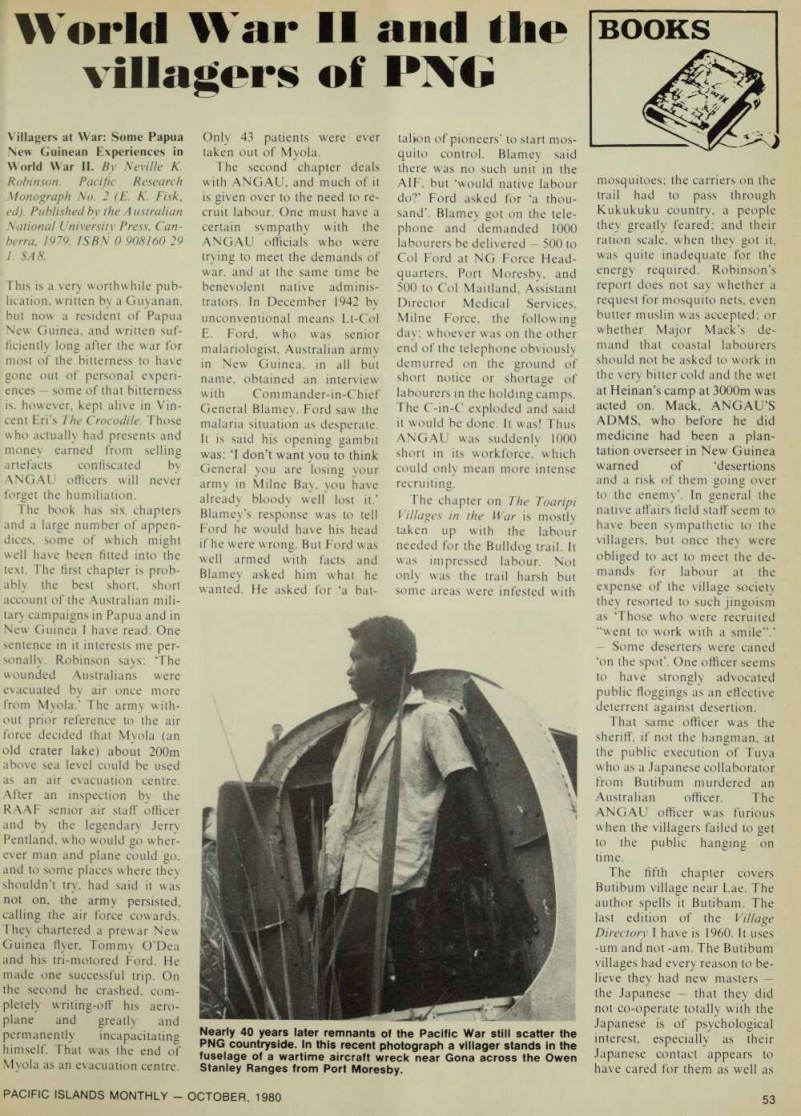
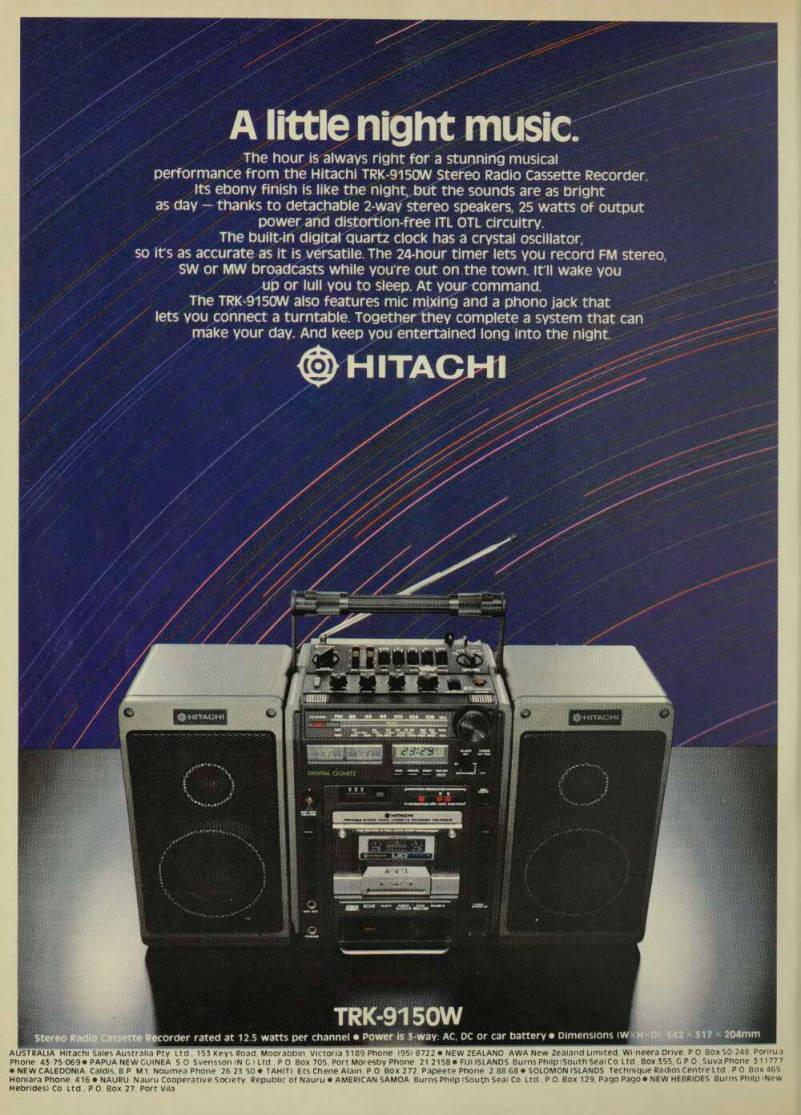
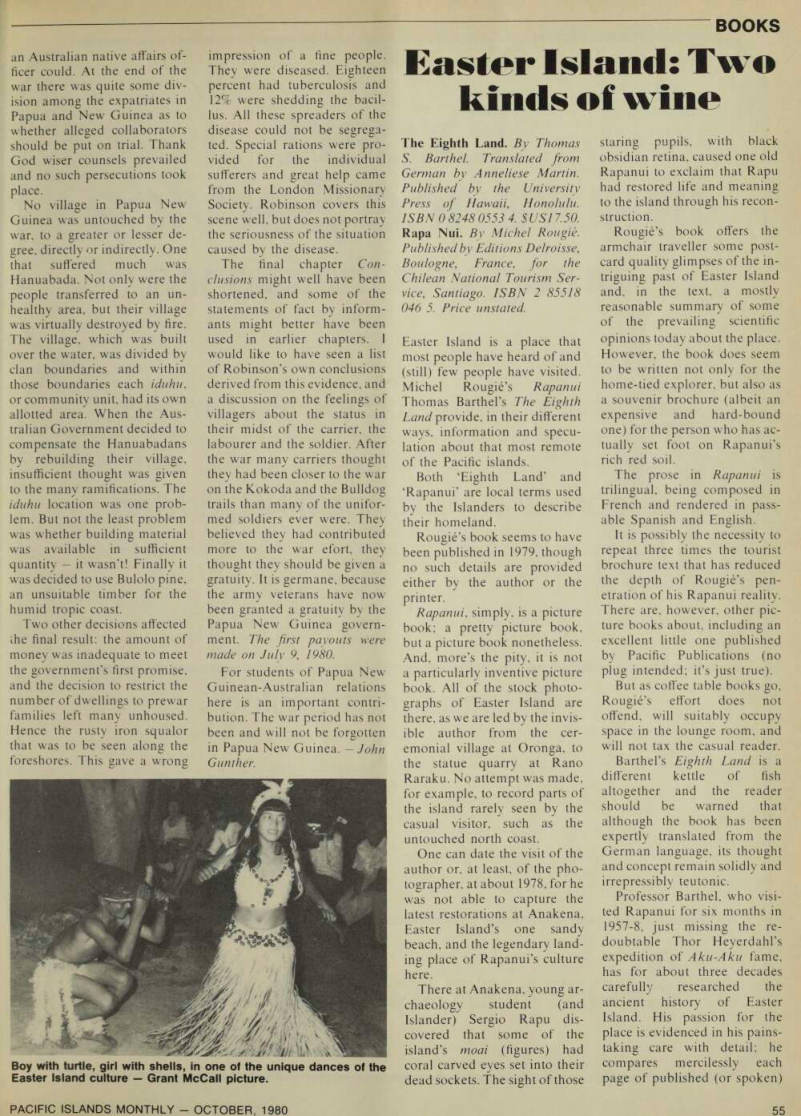
Books
World War II and the villagers of PNG
Villagers at War: Some Papua New Guinean Experiences in World War 11. By Neville K.
Robinson. Pacific Research Monograph No. 2 (E. K. Fisk, ed). Published by the A ustralian National University Press, Can berra, 1979. ISBN 0 908160 29
1. Sab.
This is a very worthwhile pub lication, written by a Guyanan, but now a resident of Papua New Guinea, and written suf ficiently long after the war for most of the bitterness to have gone out of personal experi ences some of that bitterness is, however, kept alive in Vin cent Eri’s The Crocodile. Those who actually had presents and money earned from selling artefacts confiscated by ANGAU officers will never forget the humiliation.
The book has six chapters and a large number of appen dices, some of which might well have been fitted into the text. The first chapter is prob ably the best short, short account of the Australian mili tary campaigns in Papua and in New Guinea I have read. One sentence in it interests me per sonally. Robinson says: The wounded Australians were evacuated by air once more from Myola.’ The army with out prior reference to the air force decided that Myola (an old crater lake) about 200 m above sea level could be used as an air evacuation centre.
After an inspection by the RAAF senior air staff officer and by the legendary Jerry Pentland. who would go wher ever man and plane could go. and to some places where they shouldn’t try, had said it was not on, the army persisted, calling the air force cowards.
They chartered a prewar New
Guinea flyer. Tommy O’Dea
and his tri-motored Ford. He made one successful trip. On the second he crashed, com
pletely writing-off his aero
plane and greatly and
permanently incapacitating
himself. That was the end of Myola as an evacuation centre.
Only 43 patients were ever taken out of Myola.
The second chapter deals with ANGAU, and much of it is given over to the need to re cruit labour. One must have a certain sympathy with the ANGAU officials who were trying to meet the demands of war, and at the same time be benevolent native adminis trators. In December 1942 by unconventional means Lt-Col E. Ford, who was senior malariologist, Australian army in New Guinea, in all but name, obtained an interview with Commander-in-Chief General Blarney. Ford saw the malaria situation as desperate.
It is said his opening gambit was: T don’t want you to think General you are losing your army in Milne Bay, you have already bloody well lost it.’
Blarney’s response was to tell Ford he would have his head if he were wrong. But Ford was well armed with facts and Blarney asked him what he wanted. He asked for ‘a bat
talion of pioneers’ to start mos quito control. Blarney said there was no such unit in the AIF. but ‘would native labour do?’ Ford asked for ‘a thou sand’. Blarney got on the tele phone and demanded 1000 labourers be delivered 500 to Col Ford at NG Force Head quarters, Port Moresby, and 500 to Col Maitland. Assistant Director Medical Services, Milne Force, the following day: whoever was on the other end of the telephone obviously demurred on the ground of short notice or shortage of labourers in the holding camps.
The C-in-C exploded and said it would be done. It was! Thus ANGAU was suddenly 1000 short in its workforce, which could only mean more intense
recruiting.
The chapter on The Toaripi Villages in the War is mostly taken up with the labour needed for the Bulldog trail. It was impressed labour. Not only was the trail harsh but some areas were infested with
mosquitoes; the carriers on the trail had to pass through Kukukuku country, a people they greatly feared: and their ration scale, when they got it, was quite inadequate for the energy required. Robinson’s report does not say whether a request for mosquito nets, even butter muslin was accepted; or whether Major Mack’s de mand that coastal labourers should not be asked to work in the very bitter cold and the wet at Heinan’s camp at 3000 m was acted on. Mack, ANGAU’S ADMS, who before he did medicine had been a plan tation overseer in New Guinea warned of ‘desertions and a risk of them going over to the enemy’. In general the native affairs field staff seem to have been sympathetic to the villagers, but once they were obliged to act to meet the de mands for labour at the expense of the village society they resorted to such jingoism as ‘Those who were recruited “went to work with a smile’’.’ - Some deserters were caned ‘on the spot’. One officer seems to have strongly advocated public floggings as an effective deterrent against desertion.
That same officer was the sheriff, if not the hangman, at the public execution of Tuya who as a Japanese collaborator from Butibum murdered an Australian officer. The ANGAU officer was furious when the villagers failed to get to the public hanging on time.
The fifth chapter covers Butibum village near Lae. The author spells it Butibam. The last edition of the Village Directory I have is 1960. It uses -um and not -am. The Butibum villages had every reason to be lieve they had new masters the Japanese that they did not co-operate totally with the
Japanese is of psychological
interest, especially as their Japanese contact appears to have cared for them as well as
Nearly 40 years later remnants of the Pacific War still scatter the PNG countryside. In this recent photograph a villager stands in the fuselage of a wartime aircraft wreck near Gona across the Owen Stanley Ranges from Port Moresby.
an Australian native affairs of ficer could. At the end of the war there was quite some div ision among the expatriates in Papua and New Guinea as to whether alleged collaborators should be put on trial. Thank God wiser counsels prevailed and no such persecutions took
place.
No village in Papua New Guinea was untouched by the war, to a greater or lesser de gree, directly or indirectly. One that suffered much was Hanuabada. Not only were the people transferred to an un healthy area, but their village
was virtually destroyed by fire.
The village, which was built over the water, was divided by clan boundaries and within those boundaries each iduhu , or community unit, had its own allotted area. When the Aus tralian Government decided to compensate the Hanuabadans
by rebuilding their village,
insufficient thought was given
to the many ramifications. The iduhu location was one prob lem. But not the least problem was whether building material was available in sufficient quantity it wasn’t! Finally it was decided to use Bulolo pine, an unsuitable timber for the humid tropic coast.
Two other decisions affected the final result: the amount of money was inadequate to meet
the government’s first promise,
and the decision to restrict the number of dwellings to prewar families left many unhoused.
Hence the rusty iron squalor that was to be seen along the foreshores. This gave a wrong
impression of a fine people.
They were diseased. Eighteen percent had tuberculosis and 12% were shedding the bacil lus. All these spreaders of the disease could not be segrega ted. Special rations were pro vided for the individual sufferers and great help came from the London Missionary Society. Robinson covers this scene well, but does not portray the seriousness of the situation caused by the disease.
The final chapter Con clusions might well have been shortened, and some of the statements of fact by inform ants might better have been used in earlier chapters. I would like to have seen a list of Robinson’s own conclusions derived from this evidence, and a discussion on the feelings of villagers about the status in their midst of the carrier, the labourer and the soldier. After the war many carriers thought they had been closer to the war on the Kokoda and the Bulldog trails than many of the unifor med soldiers ever were. They believed they had contributed more to the war efort, they
thought they should be given a
gratuity. It is germane, because the army veterans have now
been granted a gratuity by the
Papua New Guinea govern ment. The first payouts were made on July 9, 1980.
For students of Papua New Guinean-Australian relations here is an important contri bution. The war period has not been and will not be forgotten in Papua New Guinea. - John Gunther.
Boy with turtle, girl with shells, in one of the unique dances of the Easter Island culture - Grant McCall picture.
Advertisements & other items, p. 54 (1 item)
0 Hitac
The hour is always right for a stunning musical performance from the Hitachi TRK-9150W Stereo Radio Cassette Recorder.
Its ebony finish is like the night, but the sounds are as bright as day - thanks to detachable 2-way stereo speakers, 25 watts of output power and distortion-free ITL OIL circuitry.
The built-in digital quartz clock has a crystal oscillator, so its as accurate as it is versatile. The 24-hour timer lets you record FM stereo, SW or MW broadcasts while you’re out on the town. It'll wake you up or lull you to sleep. At your command.
The TRK-9150W also features mic mixing and a phono jack that / lets you connect a turntable. Together they complete a system that can make your day. And keep you entertained long into the night.
0 HITAC
1
jfxjrjcm
ravwl
a-jgwf-SS-SSJKUMM
HITACHI
mm m i
TRK-91 SOW
corder rated at 12.5 watts per channel • Power is 5-way: AC, DC or car battery • Dimensions (W 517 * 204 mm
Easter Island: Two

kinds of wine
The Eighth Land. By Thomas S. Barthel. Translated from German by Anneliese Martin.
Published by the University Press of Hawaii, Honolulu.
Isbn 0 8248 0553 4. $U517.50.
Rapa Nui. By Michel Rougie.
Published by Editions Delroisse,
Boulogne, France, for the
Chilean National Tourism Ser vice, Santiago. ISBN 2 85518 046 5. Price unstated.
Easter Island is a place that most people have heard of and (still) few people have visited.
Michel Rougie’s Rapanui Thomas Barthel’s The Eighth Land provide, in their different ways, information and specu lation about that most remote of the Pacific islands.
Both ‘Eighth Land’ and ‘Rapanui’ are local terms used by the Islanders to describe their homeland.
Rougie’s book seems to have been published in 1979, though no such details are provided either by the author or the
printer.
Rapanui, simply, is a picture
book; a pretty picture book, but a picture book nonetheless.
And, more’s the pity, it is not
a particularly inventive picture
book. All of the stock photo graphs of Easter Island are there, as we are led by the invis ible author from the cer emonial village at Oronga, to the statue quarry at Rano Raraku. No attempt was made, for example, to record parts of the island rarely seen by the casual visitor, such as the untouched north coast.
One can date the visit of the author or, at least, of the pho tographer, at about 1978, for he was not able to capture the latest restorations at Anakena, Easter Island’s one sandy beach, and the legendary land
ing place of Rapanui’s culture
here.
There at Anakena, young ar chaeology student (and
Islander) Sergio Rapu dis
covered that some of the island’s moai (figures) had coral carved eyes set into their dead sockets. The sight of those
staring pupils, with black
obsidian retina, caused one old Rapanui to exclaim that Rapu had restored life and meaning to the island through his recon struction.
Rougie’s book offers the armchair traveller some post card quality glimpses of the in triguing past of Easter Island and, in the text, a mostly reasonable summary of some of the prevailing scientific
opinions today about the place.
However, the book does seem to be written not only for the home-tied explorer, but also as a souvenir brochure (albeit an expensive and hard-bound one) for the person who has ac tually set foot on Rapanui’s rich red soil.
The prose in Rapanui is
trilingual, being composed in
French and rendered in pass
able Spanish and English.
It is possibly the necessity to repeat three times the tourist brochure text that has reduced the depth of Rougie’s pen etration of his Rapanui reality.
There are, however, other pic ture books about, including an excellent little one published by Pacific Publications (no plug intended; it’s just true).
But as coffee table books go, Rougie’s effort does not offend, will suitably occupy space in the lounge room, and will not tax the casual reader.
Barthel’s Eighth Land is a different kettle of fish altogether and the reader should be warned that although the book has been expertly translated from the German language, its thought and concept remain solidly and
irrepressibly teutonic.
Professor Barthel, who visi ted Rapanui for six months in 1957-8, just missing the re doubtable Thor Heyerdahl’s expedition of Aku-Aku fame, has for about three decades carefully researched the ancient history of Easter Island. His passion for the place is evidenced in his pains taking care with detail; he compares mercilessly each page of published (or spoken)
information. He examines with minute care the different ver sions of the story he seeks to tell, rolling each fact on his mind’s tongue, like some zealous wine/data taster.
The vintage Barthel pro duces is not Rougie’s cheap plonk, pretty white, but a robust, complex, dark red wine. Like those full bodied reds, however. Barthel’s book can give one a headache if it is consumed too rapidly or in too great a quantity at one time.
Whereas Rougie’s photo
book is mainly pictures and little significant text, Barthel has produced his study without a single photograph or draw ing, unless one counts the plate opposite the title page, which is a copy of a page of the mys terious Manuscript E.
Now, all travellers to Rapanui since the last century have hoped to come away from the place with some souvenir, some treasure. For whalers, they sought food and water; for others, the missionaries, they sought souls. And, later on, scientists came to solve the mystery of the small isolated land with the huge stone monuments.
Barthel, too, went to Rapanui on a quest and it was nothing less than to find evi dence to enable him to de
cipher the precious rongo
rongo tablets. Rongo-rongo seem to be mnemonic records of ancient stories, beliefs, and customs, but their translation has eluded experts (including Barthel, it should be said) since the missionaries first stumbled across them as (to them) scrap timber.
In order to achieve his goal, Barthel enlisted the aid of a number of Islander informants and, he believes, gained access to a secret manuscript written,
conveniently, in plainly legible
Rapanui in a school copy book.
One particular family pro
vided Barthel with his notes; in fact, his main informants were a group of brothers, sons of Easter Island’s first catechist. It is clear that the opinions and ideas of this family have largely formed his understand ing of what ancient Rapanui was about.
The 372 pages of closely
packed text begins with an ex ploration of the origin of the Rapanui, carrying on with the ancient discovery of the island by its early inhabitants. There are certain details of the found ing days of the island’s popu lation, including violent clan conflicts, the section conclud ing with the death of the cul ture hero, the ‘Great Parent’.
A tenth chapter begins
Barthel’s speculations about the origin and function of the
huge stone figures, with just a
hint that a further book treat ing that subject may be on its way to us.
Many readers will not share Professor Barthel’s taste for the details of ancient Rapanui life,
especially when these points
are compared with and cross referenced to the work of pre vious authors. Throughout his
exposition, the final authority
for his reconstructions remains his precious Manuscript E and the last 50 pages of his book contain it in full, in the original
Rapanui.
The Eighth Land is a schol arly book intended, for the most part, for the specialist.
But there is a quiet, conver sational tone about the prose that, while not economical of pages, makes the book seem rather like an assured, if some times dull, chat with a learned
gentleman.
The chat with the learned gentleman Barthel is much to be preferred to the slide show served up by the amateur Rougie. Grant McCall.
Tonga's King:
A big man who
thinks big
His Majesty King Taufa’ahau Tupou IV of the Kingdom of Tonga. By ’Amanaki Taulahi.
Published by the Institute of Pa
cific Studies, University of the
South Pacific. No price given.
King Taufa’ahau Tupou IV, of Tonga, is a big man who thinks big. He is an international fig
ure, making frequent visits
overseas, meeting people in
high places in government and
industry, always looking for
something to better the life of his people.
His attempts to attract huge
foreign investment in Tonga
have met with little success, but that does not at all alter the fact that he has the welfare of his country at heart.
His efforts to secure overseas investment are well documented, mostly in the columns of overseas news papers, and in the local news paper, The Tonga Chronicle , which faithfully reports his speeches from the throne at the opening and closing of the
legislative assembly. But there
is no reference to any of his flir tations with overseas capital in
this biography.
It is a slim volume, with a mere 23 pages of text, more like an extended item in Who's Who than anything else. It in cludes his own and his wife’s (Queen Mata’aho) genealogi cal lines and a bibliography.
However, there are good
general descriptions of import
ant events in Tonga during the
king’s lifetime, especially his
coronation. The biography tells that he was educated at
Newington College, Sydney,
and Sydney University, but
says little of his life at those in stitutions. He must surely have been associated with the odd college prank or two, but we learn nothing of such things.
King Taufa’ahau Tupou IV,
as Prince Tungi, was premier of Tonga from 1949 to 1966, when he succeeded hs mother.
Queen Salote, as monarch. As premier he used his influence to further the kingdom’s edu cation system, and to develop the marketing of produce at home and overseas. He also initiated several development
projects, including the setting
up of a shipping line, the build ing of wharves, and the Dateline Hotel.
The expression ‘profusely
illustrated’ is a well-worn cliche, but it does apply to this book. There are 20 pages of
pictures depicting life in Tonga
and events in the life of the king. The many pictures of the king include one taken with another monarch, Queen Elizabeth 11, when she visited Tonga in 1970.
Overall, it is a useful refer ence booklet, but it leaves one with the feeling that a lot more could have been said in it. - Norman Baxter.
Getting to
know
Hawaii’s
Molokai
Molokai The Friendly Isle.
By Marlene Freedman. Pub lished by ‘ Molokai ’ Book, PO Box 263, Hoolehua, Molokai, Hawaii 96729. 5U52.95 The first travel guide devoted solely to the island of Molokai has been reprinted and is avail able in Hawaii bookstores and by mail order. The first print ing sold out in under a year.
It is an attractive, 32-page paperback with 16 full-colour
photographs and a stylised, up to-date map of the island.
Marlene Freedman is a travel writer from Mainland USA who came to Molokai for a weekend, and never went
home again.
The book covers sightseeing attractions, accommodation,
history, legends, and the
island’s remarkable natural features. It contains many use ful travel tips.
Highlights include a poign
ant look at what Kalaupapa,
the only leper colony in the
USA, was once like, in contrast to what it is today.
There is a powerfully descriptive section on the Windward of Pali Coast with its soaring cliffs and isolated valleys ‘the closest thing to Shangri-La this side of the
Himalayas’.
Of the Molokai Islanders, it says; ‘They shine with some
thing special ... it’s in their
smile, in their spirit, in their frame of mind. Almost a su
periority complex .. . knowing
they’re in a special place.’
Advertisements & other items, pp. 56-58 (1 item)
Expert
Insurance Service
throughout the islands
I
Queensland Insurance (Fiji) Limited
Head Office, 34 Usher St., SUVA . General Manager: L. G. Liddell A.A.1.1. Assistant Manager: Vijay Lai. Phone: 23851.
LAUTOKA OFFICE: Burns Philp Bldg., Naviti St. District Manager: J. Dalton. Phone; 60642.
Queensland Insurance (PNG) Limited
PAPUA NEW GUINEA
Head Office, B.N.G. Building, Musgrave St.,PORT MORESBY. General Manager; J. M. Dawe.
Assistant Manager: R. V. Maskell. Phone: 212144.
LAE: 4th St, & Coronation Drive. District Manager: I. R. Martin. Phone: 423873.
MOUNT HAGEN: Hagen Drive. District Manager: D. F. Carroll. Phone: 521002.
ARAWA; Chebu St. District Manager: J. Longbut. Phone: 951555.
MADANG; Kasagten St. District Manager: N. D. Ramage. Phone: 822020.
RABAUL: Wirraway St. District Manager; W. F, Tinker. Phone: 921014.
QBE Insurance Limited
VANUATU, PORT VILA: Rue de Paris, Suite 19, Oceania Bldg. Manager: G. F. Donnelly.
Phone: 2299.
SANTO: Burns Philp (Vanuatu) Ltd. Phone; 230.
PACIFIC AGENCIES
NEW CALEDONIA; T. A.Hagen, Ste. W. A. Johnston, S.A.R.L. 5 Rue Anatole France, NOUMEA.
Phone: 272083.
TAHITI: Arthur Chung. Immeuble 8.1.5., Front de Mer, PAPEETE. Phone; 2.86.19.
NIUE: Burns Philp (South Sea) Company Ltd.
NORFOLK ISLAND: Burns Philp (N I) Company Ltd. Phone; 2191.
SAMOA: APIA, Burns Philp (South Sea) Company Ltd. Phone: 22611.
TONGA: Burns Philp (South Sea) Company Ltd. NUKU’ALOFA. Phone 21500 HAAPAI, VAVAU.
MEMBERS OF THE:
INSURANCE GROUP LIMITED
. : • '*• * 'r-
Iffii
CfTJZH.V
- . 2 IT 7 itB M ' \ » Jt r n TS3 *fc ! v. 3r st.* . *"<o s/sr to# Sfc *Rm ‘4* ' 11 f «KI « r f m TO /• ! > •*** 'VV />• • z' '7 ; /" ' , ># :/'/
Deep- down accuracy.
Water-resistant quarts watches from Citizen.
Underaclear blue sky or the deep blue sea, these slim quartz watches from Citizen are always at hpme; Accurate to within seconds a month, the Water Resist 100 series keeps time at 100 meters below the surface as well as it does on dry land. All models, analog and digital, feature day and date and all are made to Citizen’s high
standards of ruggedness and precision.
vvaterresktlOO ‘ CITIZEN
jr." <« Citizen Watches Australia Pty. Ltd., 122 Old Pittwater Road, Brookvale, N.S.W. 2100. Telephone 939 7077 P.O. Box 218, Brookvale, N.S.W. 2100. Cable; Citizen, Sydney. Telex; AA26633
Relaxed atmosphere, friendly
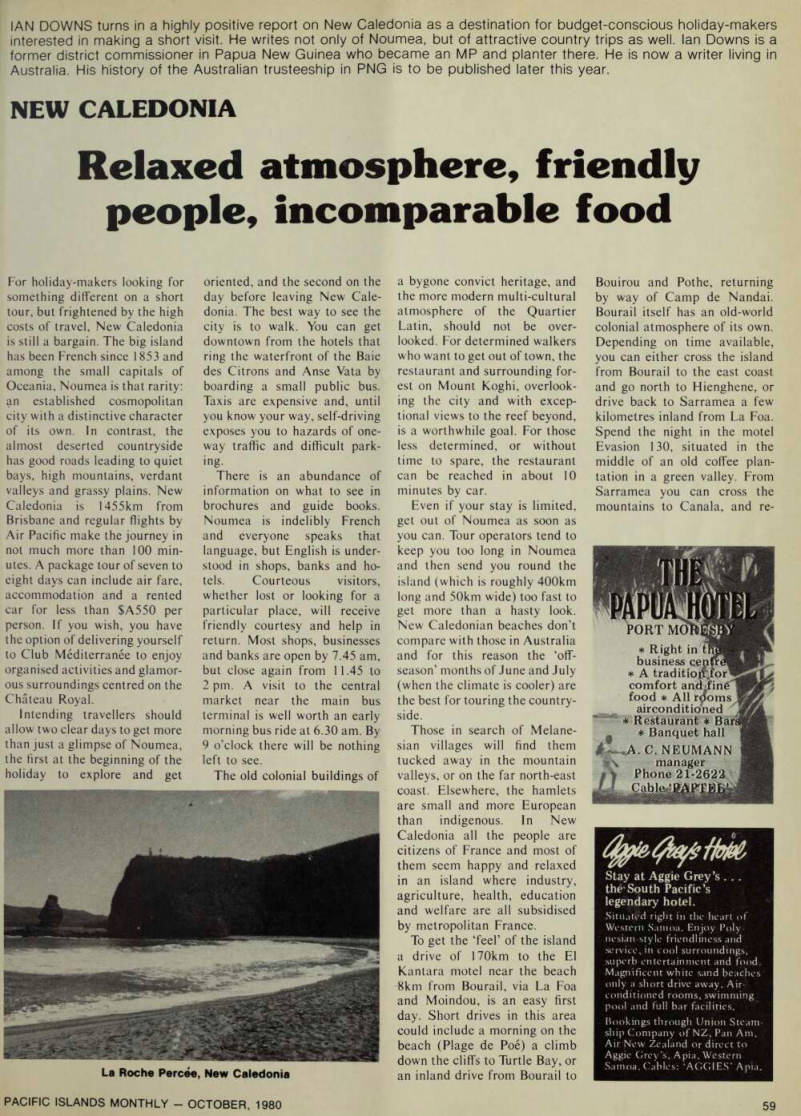

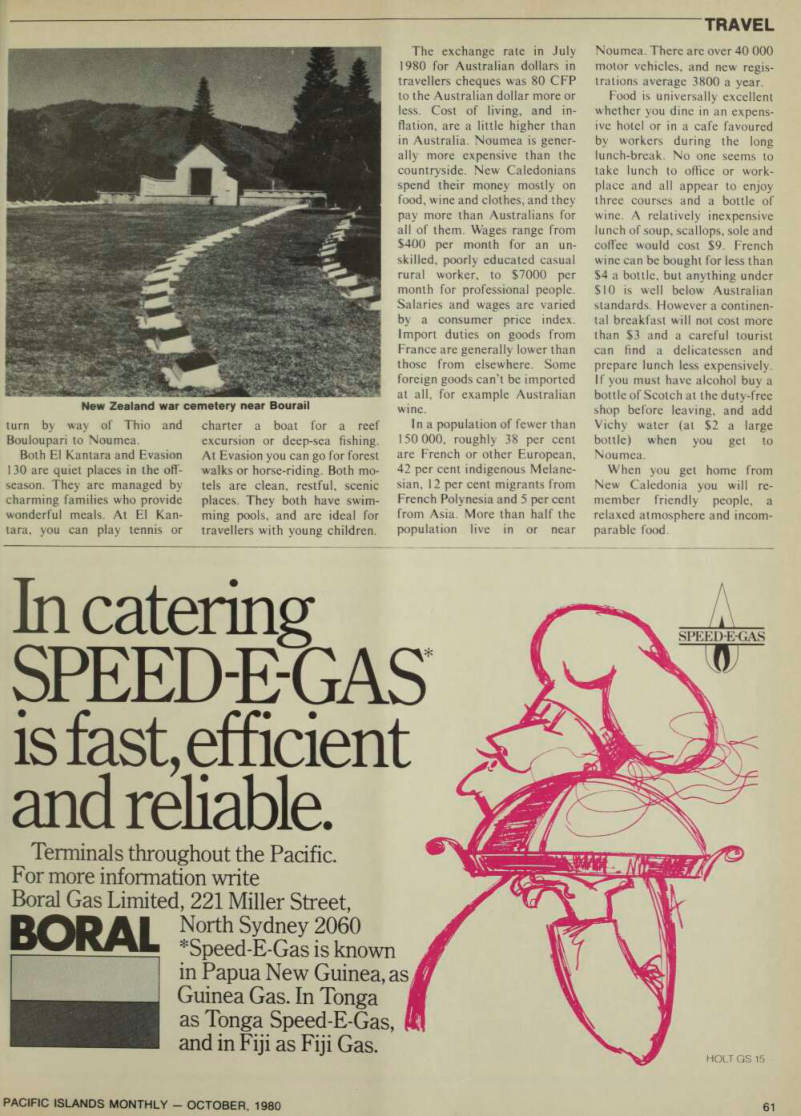
New Caledonia
Relaxed atmosphere, friendly people, incomparable food
lAN DOWNS turns in a highly positive report on New Caledonia as a destination for budget-conscious holiday-makers interested in making a short visit. He writes not only of Noumea, but of attractive country trips as well. lan Downs is a former district commissioner in Papua New Guinea who became an MR and planter there. He is now a writer living in Australia. His history of the Australian trusteeship in PNG is to be published later this year.
For holiday-makers looking for something different on a short tour, but frightened by the high costs of travel, New Caledonia is still a bargain. The big island has been French since 1853 and among the small capitals of Oceania, Noumea is that rarity: an established cosmopolitan city with a distinctive character of its own. In contrast, the almost deserted countryside has good roads leading to quiet bays, high mountains, verdant valleys and grassy plains. New Caledonia is 1455 km from Brisbane and regular flights by Air Pacific make the journey in not much more than 100 min utes. A package tour of seven to eight days can include air fare, accommodation and a rented car for less than SASSO per person. If you wish, you have the option of delivering yourself to Club Mediterranee to enjoy organised activities and glamor ous surroundings centred on the Chateau Royal.
Intending travellers should allow two clear days to get more than just a glimpse of Noumea, the first at the beginning of the holiday to explore and get
oriented, and the second on the day before leaving New Cale donia. The best way to see the city is to walk. You can get downtown from the hotels that ring the waterfront of the Baie des Citrons and Anse Vata by boarding a small public bus.
Taxis are expensive and, until you know your way, self-driving exposes you to hazards of one way traffic and difficult park ing.
There is an abundance of information on what to see in brochures and guide books.
Noumea is indelibly French and everyone speaks that language, but English is under stood in shops, banks and ho tels. Courteous visitors, whether lost or looking for a particular place, will receive friendly courtesy and help in return. Most shops, businesses and banks are open by 7.45 am, but close again from 11.45 to 2 pm. A visit to the central market near the main bus terminal is well worth an early morning bus ride at 6.30 am. By 9 o’clock there will be nothing left to see.
The old colonial buildings of
a bygone convict heritage, and the more modern multi-cultural atmosphere of the Quartier Latin, should not be over looked. For determined walkers who want to get out of town, the restaurant and surrounding for est on Mount Koghi, overlook ing the city and with excep tional views to the reef beyond, is a worthwhile goal. For those less determined, or without time to spare, the restaurant can be reached in about 10 minutes by car.
Even if your stay is limited, get out of Noumea as soon as you can. Tour operators tend to keep you too long in Noumea and then send you round the island (which is roughly 400 km long and 50km wide) too fast to get more than a hasty look.
New Caledonian beaches don’t compare with those in Australia and for this reason the ‘off season’ months of June and July (when the climate is cooler) are the best for touring the country side.
Those in search of Melane sian villages will find them tucked away in the mountain valleys, or on the far north-east coast. Elsewhere, the hamlets are small and more European than indigenous. In New Caledonia all the people are citizens of France and most of them seem happy and relaxed in an island where industry, agriculture, health, education and welfare are all subsidised by metropolitan France.
To get the ‘feel’ of the island a drive of 170 km to the El Kantara motel near the beach Jskm from Bourail, via La Foa and Moindou, is an easy first day. Short drives in this area could include a morning on the beach (Plage de Poe) a climb down the cliffs to Turtle Bay, or an inland drive from Bourail to
Bouirou and Pothe, returning by way of Camp de Nandai.
Bourail itself has an old-world colonial atmosphere of its own.
Depending on time available, you can either cross the island from Bourail to the east coast and go north to Hienghene, or drive back to Sarramea a few kilometres inland from La Foa.
Spend the night in the motel Evasion 130, situated in the middle of an old coffee plan tation in a green valley. From Sarramea you can cross the mountains to Canala, and re-
La Roche Percée, New Caledonia
turn by way of Thio and Bouloupari to Noumea.
Both El Kantara and Evasion 130 are quiet places in the off season. They are managed by charming families who provide wonderful meals. At El Kan tara, you can play tennis or
charter a boat for a reef excursion or deep-sea fishing.
At Evasion you can go for forest walks or horse-riding. Both mo tels are clean, restful, scenic places. They both have swim ming pools, and are ideal for travellers with young children.
The exchange rate in July 1980 for Australian dollars in travellers cheques was 80 CFP to the Australian dollar more or less. Cost of living, and in flation, are a little higher than in Australia. Noumea is gener ally more expensive than the countryside. New Caledonians spend their money mostly on food, wine and clothes, and they pay more than Australians for all of them. Wages range from $4OO per month for an un skilled, poorly educated casual rural worker, to $7OOO per month for professional people.
Salaries and wages are varied by a consumer price index.
Import duties on goods from France are generally lower than those from elsewhere. Some foreign goods can’t be imported at all, for example Australian wine.
In a population of fewer than 150 000, roughly 38 per cent are French or other European, 42 per cent indigenous Melane sian, 12 per cent migrants from French Polynesia and 5 per cent from Asia. More than half the population live in or near
Noumea. There are over 40 000 motor vehicles, and new regis trations average 3800 a year.
Food is universally excellent whether you dine in an expens ive hotel or in a cafe favoured by workers during the long lunch-break. No one seems to take lunch to office or work place and all appear to enjoy three courses and a bottle of wine. A relatively inexpensive lunch of soup, scallops, sole and coffee would cost $9. French wine can be bought for less than $4 a bottle, but anything under $lO is well below Australian standards. However a continen tal breakfast will not cost more than $3 and a careful tourist can find a delicatessen and prepare lunch less expensively.
If you must have alcohol buy a bottle of Scotch at the duty-free shop before leaving, and add Vichy water (at $2 a large bottle) when you get to Noumea.
When you get home from New Caledonia you will re member friendly people, a relaxed atmosphere and incom parable food.
New Zealand war cemetery near Bourail
Advertisements & other items, pp. 59-62 (1 item)
mm
y\ y
PORT MO
* Right in t business ce * A traditioj comfort food * All rpoms airconditioned * Restaurant * Bai * Banquet hall if .<
.A. C. NEUMANN
manager Phone 21-2622 Stay at Aggie Grey’s . . . the v South Pacific’s legendary hotel.
Situated right in the heart of Western Samoa. Enjoy Poly nesian style friendliness and service, in cool surroundings, superb entertainment and food.
Magnificent white sand beaches only a short drive away. Airconditioned rooms, swimming pool and full bar facilities.
Bookings through Union Steamship Company ofNZ, Pan Am, Air New Zealand or direct to Aggie Grey’s. Apia, Western Samoa. Cables: ‘AGGIES’ Apia.
All this and great sound too!
Spectrum 102 V is a complete hi-fi component system. It has an amplifier, a tuner, a cassette deck, a turntable, an audio timer, speakers with stands. And a beautifully crafted, space-saver rack.
But it’s more than just a collection of components. Because, each one is carefully designed to work in harmony with the others. So there’s no waste of performance or your money.
That’s one advantage of choosing a system specially put together by experts.
After all, Kenwood engineers are responsible for some of the world’s most advanced hi-fi technology.
Like the High Speed DC Zero-Switching circuitry in the KA-400 power amplifier shown here.
Here’s another advantage of the Spectrum 102 V. Aftersale help.
Kenwood’s expert service people are never far away, should the unexpected happen. $
vSpectrum-102V
•KA-400 DC stereo integrated amplifier • KT-400 FM-AM stereo tuner •KX-500 metal tape cassette deck with Dolby* NR and touch-key controls •KD-2100 fully automatic turntable •LS-90 3-way 3-speaker system •AT-80 audio timer •SRC-120 audio rack •Trademark of Dolby Laboratories. € nit
TRIO-KENWOOD CORPORATION
6-17, 3-chome, Aobadai, Meguro-ku, Tokyo, Japan.
AUSTRALIA TRIO-KENWOOD (AUSTRALIA) PTY. LTD. Australia Tel 439-4322 NEW ZEALAND JOHN GILBERT & CO , LTD. Auckland Tel 30-839 FIJI THE DOMINION IMPORT & EXPORT PROMOTIONS Nadi Tel. 72-165 PAPUA NEW GUINEA S O SVENSSON (N.G.) LTD. Port Moresby Tel. 24-2275/2285
NORFOLK ISLAND BURNS PHILP(NORFOLK ISLAND) LTD.
SOLOMON ISLANDS TECHNIQUE RADIOS CENTRE LTD. Honiara Tel. 416 NEW CALEDONIA HI-FI VOX Noumea Tel 27-2466 NEW HEBRIDES RUE HIGGINSON Vila Tel 2556 TAHITI MAI SON AURORE Papeete Tel. 29703 AMERICAN SAMOA ISLAND PACIFIC AGENCIES, INC. Pago Pago Tel. 633-4687
REPUBLIC OF NAURU NAURU CO-OPERATIVE SOCIETY
MARIANA ISLANDS J C. TENORIO ENTERPRISES Saipan Tel. 6445
i r . : nii.it .
In catering
SPEED-E-GAS
is fast, efficient
and reliable.
Terminals throughout the Pacific.
For more information write Boral Gas Limited, 221 Miller Street, A I North Sydney 2060 *Speed-E-Gas is known in Papua New Guinea, as Guinea Gas. In Tonga as Tonga Speed-E-Gas, and in Fiji as Fiji Gas.
/a unn
AHI Aluminium Limited
MARKET LEADERS IN ALUMINIUM WINDOWS & DOORS
IAFBHer
iTifo
Designers and manufacturers marketing a complete range of extrusions and components for fabrication of aluminium joinery products.
Av r .]j ¥ m / * . j v; 'i
FOR FURTHER INFORMATION CONTACT
AHI ALUMINIUM FRANCHISING COMPANY
P O BOX 18299, AUCKLAND. NEW ZEALAND TELEPHONE; 580 704 CABLES; AHIAL TELEX: 2222
INTEGRATED TECHNICAL SERVICES
• SALES
• ON SITE INSTALLATION
• FIELD SERVICE
• HE, VHF.UHF LINK AND MOBILE SYSTEMS
• GROUND AIR COMMUNICATIONS
• MARINE NAVIGATION AND COMMUNICATIONS
• AIRCRAFT ELECTRONIC SYSTEMS
DISTRIBUTORS OF:
• CODANHFSSB SYSTEMS
• PHILIPS VHF/UHFFM MOBILE SYSTEMS
• JRC MARINE RADAR, SOUNDERS, SATTELITE
NAVIGATORS
• MAGNAVOX SATTELITE NAVIGATORS
• DECCA MARINE RADAR
• KING, NARCO, SUNAIR, COLLINS AIRCRAFT
RADIO SYSTEMS
MANUFACTURERS OF:
• PORTABLE DEPTH FINDERS
• HF RADIO SCANNERS
• VOICE SCRAMBLERS
• MICROPROCESSOR BASED CONTROL SYSTEMS
• RADIO LOCATED TRANQUILIZING DARTS
FOR WILDLIFE MANAGEMENT
FIELD ENGINEERING INTEGRATED TECHNICAL SERVICES
P. 0. Box 350, Cairns 4870, Queensland, Australia.
Phone: (070) 51 1616.51 4826.531356,51 3052. Telex: AA 48085
as good as he got (almost)
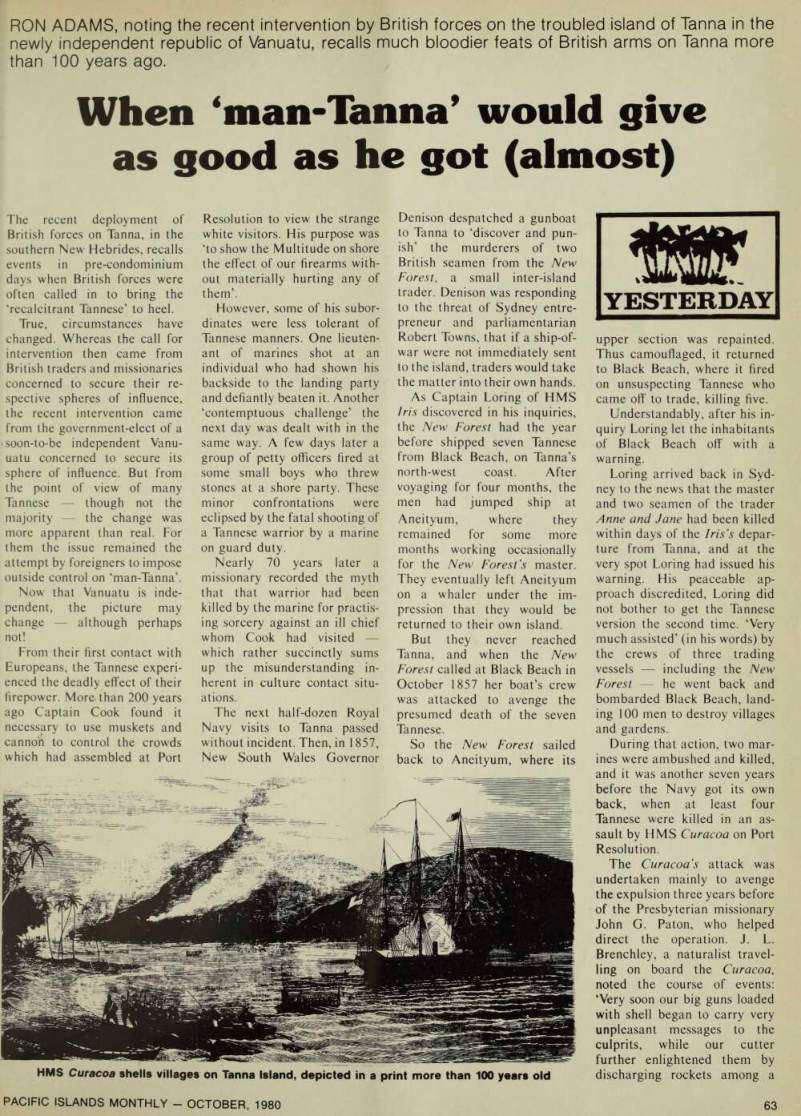
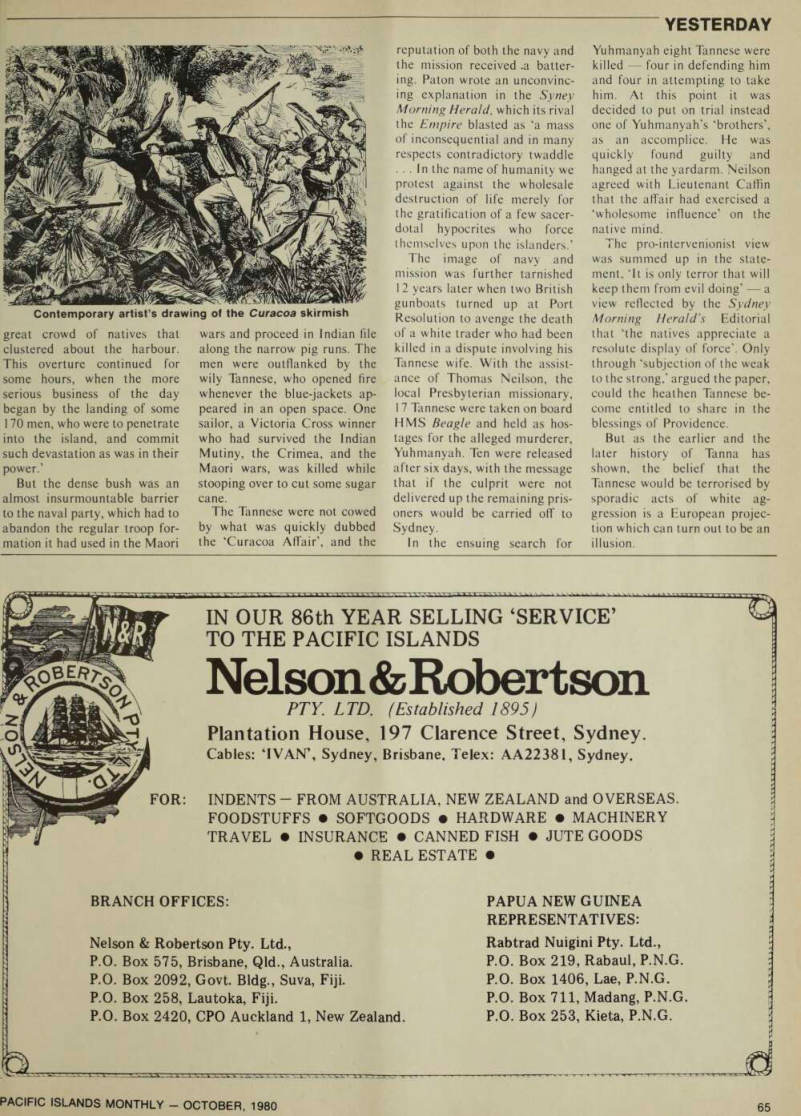
When ‘man-Tanna’ would give as good as he got (almost)
Yesterday
RON ADAMS, noting the recent intervention by British forces on the troubled island of Tanna in the newly independent republic of Vanuatu, recalls much bloodier feats of British arms on Tanna more than 100 years ago.
The recent deployment of British forces on Tanna, in the southern New Hebrides, recalls events in pre-condominium days when British forces were often called in to bring the ‘recalcitrant Tannese’ to heel.
True, circumstances have changed. Whereas the call for intervention then came from British traders and missionaries concerned to secure their re spective spheres of influence, the recent intervention came from the government-elect of a soon-to-be independent Vanu uatu concerned to secure its sphere of influence. But from the point of view of many Tannese though not the majority the change was more apparent than real. For them the issue remained the attempt by foreigners to impose outside control on ‘man-Tanna’.
Now that Vanuatu is inde pendent, the picture may change although perhaps not!
From their first contact with Europeans, the Tannese experi enced the deadly effect of their firepower. More- than 200 years ago Captain Cook found it necessary to use muskets and cannon to control the crowds which had assembled at Port
Resolution to view the strange white visitors. His purpose was ‘to show the Multitude on shore the effect of our firearms with out materially hurting any of them’.
However, some of his subor dinates were less tolerant of Tannese manners. One lieuten ant of marines shot at an individual who had shown his backside to the landing party and defiantly beaten it. Another ‘contemptuous challenge’ the next day was dealt with in the same way. A few days later a group of petty officers fired at some small boys who threw stones at a shore party. These minor confrontations were eclipsed by the fatal shooting of a Tannese warrior by a marine on guard duty.
Nearly 70 years later a missionary recorded the myth that that warrior had been killed by the marine for practis ing sorcery against an ill chief whom Cook had visited which rather succinctly sums up the misunderstanding in herent in culture contact situ ations.
The next half-dozen Royal Navy visits to Tanna passed without incident. Then, in 1857, New South Wales Governor
Denison despatched a gunboat to Tanna to ‘discover and pun ish’ the murderers of two British seamen from the New Forest, a small inter-island trader. Denison was responding to the threat of Sydney entre preneur and parliamentarian Robert Towns, that if a ship-of war were not immediately sent to the island, traders would take the matter into their own hands.
As Captain Loring of HMS Iris discovered in his inquiries, the New Forest had the year before shipped seven Tannese from Black Beach, on Tanna’s north-west coast. After voyaging for four months, the men had jumped ship at Aneityum, where they remained for some more months working occasionally for the New Forest’s master.
They eventually left Aneityum on a whaler under the im pression that they would be returned to their own island.
But they never reached Tanna, and when the New Forest called at Black Beach in October 1857 her boat’s crew was attacked to avenge the presumed death of the seven Tannese.
So the New Forest sailed back to Aneityum, where its
upper section was repainted.
Thus camouflaged, it returned to Black Beach, where it fired on unsuspecting Tannese who came off to trade, killing five.
Understandably, after his in quiry Loring let the inhabitants of Black Beach off with a warning.
Loring arrived back in Syd ney to the news that the master and two seamen of the trader Anne and Jane had been killed within days of the Iris’s depar ture from Tanna, and at the very spot Loring had issued his warning. His peaceable ap proach discredited, Loring did not bother to get the Tannese version the second time. ‘Very much assisted’ (in his words) by the crews of three trading vessels including the New Forest he went back and bombarded Black Beach, land ing 100 men to destroy villages and gardens.
During that action, two mar ines were ambushed and killed, and it was another seven years before the Navy got its own back, when at least four Tannese were killed in an as sault by HMS Curacoa on Port Resolution.
The Curacoa’s attack was undertaken mainly to avenge the expulsion three years before of the Presbyterian missionary John G. Paton, who helped direct the operation. J. L.
Brenchley, a naturalist travel ling on board the Curacoa, noted the course of events: ‘Very soon our big guns loaded with shell began to carry very unpleasant messages to the culprits, while our cutter further enlightened them by discharging rockets among a
HMS Curacoa shells villages on Tanna Island, depicted in a print more than 100 years old
great crowd of natives that clustered about the harbour.
This overture continued for some hours, when the more serious business of the day began by the landing of some 170 men, who were to penetrate into the island, and commit such devastation as was in their power.’
But the dense bush was an almost insurmountable barrier to the naval party, which had to abandon the regular troop for mation it had used in the Maori
wars and proceed in Indian file along the narrow pig runs. The men were outflanked by the wily Tannese, who opened fire whenever the blue-jackets ap peared in an open space. One sailor, a Victoria Cross winner who had survived the Indian Mutiny, the Crimea, and the Maori wars, was killed while stooping over to cut some sugar cane.
The Tannese were not cowed by what was quickly dubbed the ‘Curacoa Affair’, and the
reputation of both the navy and the mission received .a batter ing. Paton wrote an unconvinc ing explanation in the Syney Morning Herald, which its rival the Empire blasted as ‘a mass of inconsequential and in many respects contradictory twaddle ... In the name of humanity we protest against the wholesale destruction of life merely for the gratification of a few sacer dotal hypocrites who force themselves upon the islanders.’
The image of navy and mission was further tarnished 12 years later when two British gunboats turned up at Port Resolution to avenge the death of a white trader who had been killed in a dispute involving his Tannese wife. With the assist ance of Thomas Neilson, the local Presbyterian missionary, 17 Tannese were taken on board HMS Beagle and held as hos tages for the alleged murderer, Yuhmanyah. Ten were released after six days, with the message that if the culprit were not delivered up the remaining pris oners would be carried off to
Sydney.
In the ensuing search for
Yuhmanyah eight Tannese were killed four in defending him and four in attempting to take him. At this point it was decided to put on trial instead one of Yuhmanyah’s ‘brothers’, as an accomplice. He was quickly found guilty and hanged at the yardarm. Neilson agreed with Lieutenant Caffin that the affair had exercised a ‘wholesome influence’ on the native mind.
The pro-intervenionist view was summed up in the state ment, ‘lt is only terror that will keep them from evil doing’ a view reflected by the Sydney Morning Herald’s Editorial that ‘the natives appreciate a resolute display of force’. Only through ‘subjection of the weak to the strong,’ argued the paper, could the heathen Tannese be come entitled to share in the blessings of Providence.
But as the earlier and the later history of Tanna has shown, the belief that the Tannese would be terrorised by sporadic acts of white ag gression is a European projec tion which can turn out to be an illusion.
Contemporary artist’s drawing of the Curacoa skirmish
Advertisements & other items, pp. 64-66 (1 item)
c- vr o
v. o >. ■ ' •%y* ■--> * [ * > - * ■ * SB- • r% % .
Si!
Sf ,\*B*~ * * ... •■ / . & »««
oßEft/*
* O * 2: o ip V 6/ G
FOR:
IN OUR 86th YEAR SELLING ‘SERVICE’
TO THE PACIFIC ISLANDS
Nelson & Robertson
PTY. LTD. (Established 1895)
Plantation House, 197 Clarence Street, Sydney.
Cables: ‘IVAN% Sydney, Brisbane. Telex: AA22381, Sydney.
INDENTS - FROM AUSTRALIA, NEW ZEALAND and OVERSEAS.
FOODSTUFFS • SOFTGOODS • HARDWARE • MACHINERY TRAVEL • INSURANCE CANNED FISH • JUTE GOODS
• REAL ESTATE •
BRANCH OFFICES:
Nelson & Robertson Pty. Ltd., P.O. Box 575, Brisbane, Qld., Australia.
P.O. Box 2092, Govt. Bldg., Suva, Fiji.
P.O. Box 258, Lautoka, Fiji.
P.O. Box 2420, CPO Auckland 1, New Zealand.
PAPUA NEW GUINEA
REPRESENTATIVES:
Rabtrad Nuigini Pty. Ltd., P.O. Box 219, Rabaul, P.N.G.
P.O. Box 1406, Lae, P.N.G.
P.O. Box 711, Madang, P.N.G P.O. Box 253, Kieta, P.N.G.
Talking to Ibnga
and the Cook Islands
is now so easy.
With the opening of Cable and Wireless earth stations in Tonga and the Cook Islands, a world of communication possibilities has begun.
Now, the people of Tonga and the Cook Islands can enjoy the benefits of the fastest, most efficient and reliable telephone, telex and telegraph links with the rest of the world.
Lying to the east of Tonga, the Cook Islands is the latest geographical location to receive a Cable and Wireless Satellite Earth Station.
A century of experience is at work behind the design, installation and maintenance of this and all Cable and Wireless communication systems the world over including over 30 earth stations designed to suit individual climatic and geographic conditions.
Want to know more about our powers of communication? Contact us.
BMP
■■■ • i hiiiiiiiiiH 'V
helps the world communicate
Office, Cable & Wireless Ltd, Dept. FEA, Mercury House, Theobalds Road, London WCIX BRX Tel: 01-242 4433 Telex: 23181 Tonga Branch, Corner of Queen Salote Road & Takauvove Road, Fongola, Tonga.
Cook Islands Branch, P.O. Box 529, Rarotonga, Cook Islands.
invisible in this
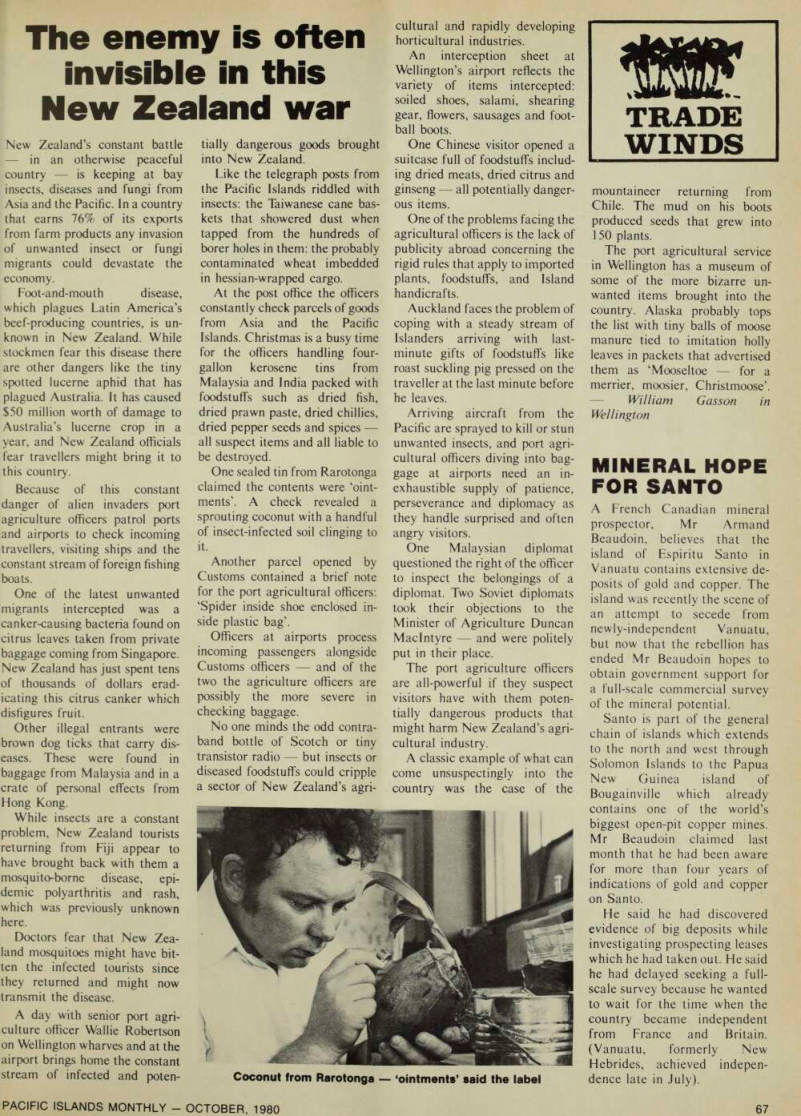
The enemy is often invisible in this New Zealand war
Trade
Winds
New Zealand’s constant battle in an otherwise peaceful country is keeping at bay insects, diseases and fungi from Asia and the Pacific. In a country that earns 76% of its exports from farm products any invasion of unwanted insect or fungi migrants could devastate the economy.
Foot-and-mouth disease, which plagues Latin America’s beef-producing countries, is un known in New Zealand. While stockmen fear this disease there are other dangers like the tiny spotted lucerne aphid that has plagued Australia. It has caused $5O million worth of damage to Australia’s lucerne crop in a year, and New Zealand officials fear travellers might bring it to this country.
Because of this constant danger of alien invaders port agriculture officers patrol ports and airports to check incoming travellers, visiting ships and the constant stream of foreign fishing boats.
One of the latest unwanted migrants intercepted was a canker-causing bacteria found on citrus leaves taken from private baggage coming from Singapore.
New Zealand has just spent tens of thousands of dollars erad icating this citrus canker which disfigures fruit.
Other illegal entrants were brown dog ticks that carry dis eases. These were found in baggage from Malaysia and in a crate of personal effects from Hong Kong.
While insects are a constant problem, New Zealand tourists returning from Fiji appear to have brought back with them a mosquito-borne disease, epi demic polyarthritis and rash, which was previously unknown here.
Doctors fear that New Zea land mosquitoes might have bit ten the infected tourists since they returned and might now transmit the disease.
A day with senior port agri culture officer Wallie Robertson on Wellington wharves and at the airport brings home the constant stream of infected and poten
tially dangerous goods brought into New Zealand.
Like the telegraph posts from the Pacific Islands riddled with insects: the Taiwanese cane bas kets that showered dust when tapped from the hundreds of borer holes in them: the probably contaminated wheat imbedded in hessian-wrapped cargo.
At the post office the officers constantly check parcels of goods from Asia and the Pacific Islands. Christmas is a busy time for the officers handling four gallon kerosene tins from Malaysia and India packed with foodstuff's such as dried fish, dried prawn paste, dried chillies, dried pepper seeds and spices all suspect items and all liable to be destroyed.
One sealed tin from Rarotonga claimed the contents were ‘oint ments’. A check revealed a sprouting coconut with a handful of insect-infected soil clinging to it.
Another parcel opened by Customs contained a brief note for the port agricultural officers: ‘Spider inside shoe enclosed in side plastic bag’.
Officers at airports process incoming passengers alongside Customs officers and of the two the agriculture officers are possibly the more severe in checking baggage.
No one minds the odd contra band bottle of Scotch or tiny transistor radio but insects or diseased foodstuff's could cripple a sector of New Zealand’s agri
cultural and rapidly developing horticultural industries.
An interception sheet at Wellington’s airport reflects the variety of items intercepted; soiled shoes, salami, shearing gear, flowers, sausages and foot ball boots.
One Chinese visitor opened a suitcase full of foodstuff's includ ing dried meats, dried citrus and ginseng all potentially danger ous items.
One of the problems facing the agricultural officers is the lack of publicity abroad concerning the rigid rules that apply to imported plants, foodstuff's, and Island handicrafts.
Auckland faces the problem of coping with a steady stream of Islanders arriving with last minute gifts of foodstuff's like roast suckling pig pressed on the traveller at the last minute before he leaves.
Arriving aircraft from the Pacific are sprayed to kill or stun unwanted insects, and port agri cultural officers diving into bag gage at airports need an in exhaustible supply of patience, perseverance and diplomacy as they handle surprised and often angry visitors.
One Malaysian diplomat questioned the right of the officer to inspect the belongings of a diplomat. Two Soviet diplomats took their objections to the Minister of Agriculture Duncan Maclntyre and were politely put in their place.
The port agriculture officers are all-powerful if they suspect visitors have with them poten tially dangerous products that might harm New Zealand’s agri cultural industry.
A classic example of what can come unsuspectingly into the country was the case of the
mountaineer returning from Chile. The mud on his boots produced seeds that grew into 150 plants.
The port agricultural service in Wellington has a museum of some of the more bizarre un wanted items brought into the country. Alaska probably tops the list with tiny balls of moose manure tied to imitation holly leaves in packets that advertised them as ‘Mooseltoe for a merrier, moosier, Christmoose’.
William G assort in
Wellington
Coconut from Rarotonga - ‘ointments’ said the label
Mineral Hope
For Santo
A French Canadian mineral prospector, Mr Armand Beaudoin, believes that the island of Espiritu Santo in Vanuatu contains extensive de posits of gold and copper. The island was recently the scene of an attempt to secede from newly-independent Vanuatu, but now that the rebellion has ended Mr Beaudoin hopes to obtain government support for a full-scale commercial survey of the mineral potential.
Santo is part of the general chain of islands which extends to the north and west through Solomon Islands to the Papua New Guinea island of Bougainville which already contains one of the world’s biggest open-pit copper mines.
Mr Beaudoin claimed last month that he had been aware for more than four years of indications of gold and copper on Santo.
He said he had discovered evidence of big deposits while investigating prospecting leases which he had taken out. He said he had delayed seeking a full scale survey because he wanted to wait for the time when the country became independent from France and Britain. (Vanuatu, formerly New Hebrides, achieved indepen dence late in July).
Advertisements & other items, p. 68 (1 item)
Constructive
ADVICE.
A y w *A »«. M S Swamp Bulldozers as welt as Swamp Dozer Shovels.
Dozer Shovels.
Radio-Controlled Bulldozers and Dozer Shovels.
Electric Powered Dozer Shovels.
A wide range of Pipelayers.
Amphibious Bulldozers.
A xA & a Sc 6T\
■ATI
Wheel Loaders.
A wide selection of Off-Highway Slag Dump Trucks.
Dump Trucks.
And offer Motor Graders.
As well as Motor Scrapers.
Soil Compactors.
Trash Compactors Towing Tractors. w. - i - M y 1 LI A wide selection of Diesel Engines.
Machine Tools - Mechanical and Hydraulic Presses. A variety of Maypres Presses. OBS Power Presses. Tunnel-Boring Machines.
We're constructive in other ways. We offer castings, foundries, and important advice on construction and manufacturing projects.
•H KOMATSU LTD
Tokyo,Japan Komatsu overseas offices: Sydney, Singapore, Jakarta, Manila, Seoul, Bangkok, Bangalore, Teheran, Dubai, Jeddah, Riyadh, Ad Dammam, Baghdad, Ankara, Moscow, London, Brussels, Dusseldorf, Stuttgart, Warszawa, Paris, Madrid, Cairo, Alger, Abidjan, Lagos, Nairobi, Johannesburg, Toronto, San Francisco, Fort Lee Arlington, Atlanta, Detroit, Mexico City, Habana, Panama, Sao Paulo, Caracas, Lima, Buenos Aires, and distributors in over 100 countries around the world.
export plantings
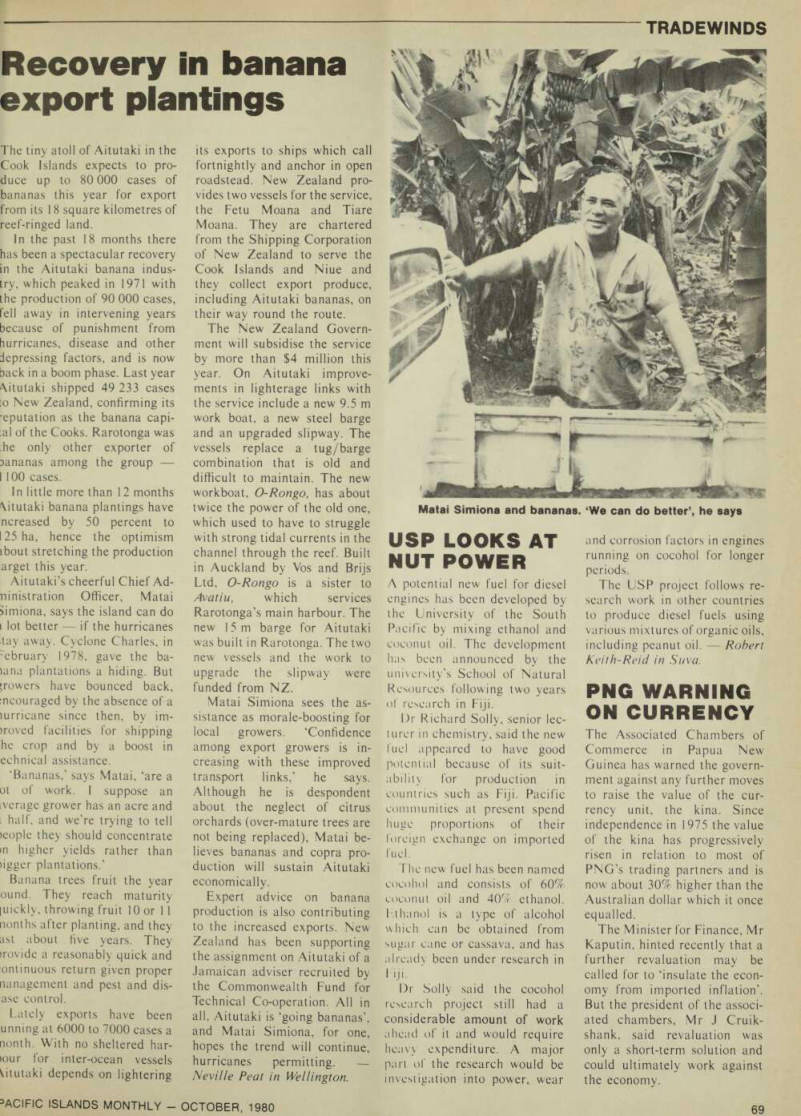
Recovery in banana export plantings
The tiny atoll of Aitutaki in the Cook Islands expects to pro duce up to 80 000 cases of bananas this year for export from its 18 square kilometres of reef-ringed land.
In the past 18 months there has been a spectacular recovery in the Aitutaki banana indus try, which peaked in 1971 with the production of 90 000 cases, fell away in intervening years because of punishment from hurricanes, disease and other depressing factors, and is now back in a boom phase. Last year Aitutaki shipped 49 233 cases io New Zealand, confirming its ■epulation as the banana capi ;al of the Cooks. Rarotonga was he only other exporter of Dananas among the group 1100 cases.
In little more than 12 months \itutaki banana plantings have ncreased by 50 percent to 125 ha, hence the optimism ibout stretching the production arget this year.
Aitutaki’s cheerful Chief Ad ninistration Officer, Matai Simiona, says the island can do i lot better if the hurricanes lay away. Cyclone Charles, in -ebruary 1978, gave the ba lana plantations a hiding. But ►rowers have bounced back, mcouraged by the absence of a mrricane since then, by im >rovcd facilities for shipping he crop and by a boost in echnical assistance. ‘Bananas,’ says Matai, ‘are a ot of work. I suppose an iverage grower has an acre and . half, and we’re trying to tell >eople they should concentrate m higher yields rather than »igger plantations.’
Banana trees fruit the year ound. They reach maturity [uickly, throwing fruit 10 or 11 nonths after planting, and they ast about five years. They ►rovidc a reasonably quick and onlinuous return given proper nanagement and pest and dis asc control.
Lately exports have been unning at 6000 to 7000 cases a nonlh. With no sheltered har (our for inter-ocean vessels
Aitutaki depends on lightering
its exports to ships which call fortnightly and anchor in open roadstead. New Zealand pro vides two vessels for the service, the Fetu Moana and Tiare Moana. They are chartered from the Shipping Corporation of New Zealand to serve the Cook Islands and Niue and they collect export produce, including Aitutaki bananas, on their way round the route.
The New Zealand Govern ment will subsidise the service by more than $4 million this year. On Aitutaki improve ments in lighterage links with the service include a new 9.5 m work boat, a new steel barge and an upgraded slipway. The vessels replace a tug/barge combination that is old and difficult to maintain. The new workboal, O-Rongo, has about twice the power of the old one, which used to have to struggle with strong tidal currents in the channel through the reef. Built in Auckland by Vos and Brijs Ltd, O-Rongo is a sister to Avatiu, which services Rarotonga’s main harbour. The new 15 m barge for Aitutaki was built in Rarotonga. The two new vessels and the work to upgrade the slipway were funded from NZ.
Matai Simiona sees the as sistance as morale-boosting for local growers. ‘Confidence among export growers is in creasing with these improved transport links,’ he says.
Although he is despondent about the neglect of citrus orchards (over-mature trees are not being replaced), Matai be lieves bananas and copra pro duction will sustain Aitutaki economically.
Expert advice on banana production is also contributing to the increased exports. New Zealand has been supporting the assignment on Aitutaki of a Jamaican adviser recruited by the Commonwealth Fund for Technical Co-operation. All in all, Aitutaki is ‘going bananas’, and Matai Simiona, for one, hopes the trend will continue,
hurricanes permitting.
Neville Peat in Wellington.
Usp Looks At
Nut Power
A potential new fuel for diesel engines has been developed by the University of the South Pacific by mixing ethanol and coconut oil. The development has been announced by the university’s School of Natural Resources following two years of research in Fiji.
Dr Richard Solly, senior lec turer in chemistry, said the new fuel appeared to have good potential because of its suit ability for production in Countries such as Fiji. Pacific communities at present spend huge proportions of their foreign exchange on imported fuel.
The new fuel has been named cocohol and consists of 60% coconut oil and 40% ethanol.
Flhanol is a type of alcohol which can be obtained from sugar cane or cassava, and has already been under research in Fiji.
Dr Solly said the cocohol research project still had a considerable amount of work ahead of it and would require heavy expenditure. A major part of the research would be investigation into power, wear
and corrosion factors in engines running on cocohol for longer periods.
The USP project follows re search work in other countries to produce diesel fuels using various mixtures of organic oils, including peanut oil. Robert Keith-Re id in Suva.
Png Warning
On Currency
The Associated Chambers of Commerce in Papua New Guinea has warned the govern ment against any further moves to raise the value of the cur rency unit, the kina. Since independence in 1975 the value of the kina has progressively risen in relation to most of PNG’s trading partners and is now about 30% higher than the Australian dollar which it once equalled.
The Minister for Finance, Mr Kaputin, hinted recently that a further revaluation may be called for to ‘insulate the econ omy from imported inflation'.
But the president of the associ ated chambers, Mr J Cruik shank, said revaluation was only a short-term solution and could ultimately work against the economy.
Matai Simiona and bananas. ‘We can do better’, he says
Advertisements & other items, pp. 69-70 (2 items)
Tradewinds
69
'ACIFIC ISLANDS MONTHLY OCTOBER, 1980
Portable
FORESTMIL
SAWMILL
Recent release new models are heavier duty with additional features. Powered by diesel engine or electric motor. mt r Forestmil Portae SawmS Forestmil produces any size accurate timber ready to use up to 12" x 9" x 24'.
Purchase price and operating cost of Forestmil is less than other sawing equipment with similar production capacity.
Forestmil reduces timber waste and also reduces log transport cost. Timber is sawn direct from the log in the forest.
Forestmil can be moved to a new location in one hour.
Forestmil will saw hardwood or softwood from logs of any diameter.
Over 1000 Forestmils are sawing timber in 23 countries.
Forestmil has been manufactured for 18 years.
For literature and prices please contact the manufacturers.
IH
MacQuarrie Industries Pty.Ltd.
P.O. Box 20, Coburg 3058, Victoria, Australia.
Phone. 350-3411. Telex. 33729. Cables: Macbound, Melbourne.
TRADEWINDS INTELLIGENCE...TRADEWIND
TUVALU is upgrading its international telecommunications using a grant of SUS6OO 000 from the United Nations Development Project (UNDP). The upgrading involves the installation of new antennas and transmitting and receiving equipment on Funafuti to provide a high-frequency radio link between Tuvalu and Fiji. The project has been engineered by the International Telecommunications Union (ITU), and a contract to carry out the work has been won by the Nippon Electric Company of Japan.
FLETCFIER, the New Zealand-based construction company, has paid SNZ 1.9 million for the Papua New Guinea construction firm of Morobe Construction. The move considerably strengthens Fletcher’s presence in what several New Zealand companies have lately come to regard as a promising territory for their operations.
WITH the introduction of weekly Polynesian Airlines services (Thursdays from Apia, Fridays from Nadi), the island of Wallis is at last easily accessible to tourists. Developers in France have unveiled plans for a $4 million project to establish a Club Med-type centre, with discos, tennis courts and swimming pools on Wallis by the end of 1981.
NAURU has announced a 3.1% increase in its basic wage. In monetary terms this means an increase of $123 a year for adults, whose wage is now $4205 a year. The rise, announced at the end of July, was made retrospective to May 23.
TONGA has announced a$T 1.5 million scheme to upgrade the banana industry to produce quality export fruit for the New Zealand market. Known as the ‘Banana Revitalisation Scheme’, it is to be co-funded by the governments of Tonga and New Zealand.
A CHAPTER of Fiji’s aviation history ended on September 1 when the last Pan Am flight left Nadi airport. Pan Am began flying to Nadi in the war-clouded days of 1941. It is abandoning the Nadi service because of the rising costs involved in it, and the relative economy of flying non-stop between Australia and Hawaii and the US mainland.
FIJI’S sugar export quota under the International Sugar Agreement should increase next year by about 90 000 tonnes, according to Fiji Sugar Corporation chairman Arthur Leys. Mr Leys told the FSC’s annual meeting in August that the quota for 1981 would be reviewed as provided for in the formula laid down in the ISA.
AIR PACIFIC has ordered one Boeing 737-200 aircraft, and is considering buying a second. The 7375, costing SF4 million each, will replace the airline’s BAC 1-1 Is, flying basically the same networks. The BAC 1-1 Is will be sold.
MOST interest rates in Papua New Guinea rose by 2% in September although the government, which fixed the increase, exempted loans made from its own Development Bank. The Development Bank is sponsoring a policy of phasing Papua New Guineans into the largely Australian-influenced economy, and much of its lending is for small rural development in cash crops and rural service industries. Finance Minister, John Kapulin said the increase had been prompted to discourage consumption borrowing and to reduce ‘subsidised inflation’.
RISES in the consumer price index brought a 4.8% pay rise to Papua New Guinea wage earners last month. The increase goes to about 50 000 public servants and 150 000 private-sector wage earners. The CPI rises which created the new pay rates were 3% for the April quarter and 1.8% for the June quarter.
PACIFIC Energy and Minerals Ltd plans to go ahead with drilling for oil in the Lomaiviti-Bau area of Fiji, despite Chevron’s recent failure to find oil in Bligh Water. PE&M’s vice-president Ward H.
Austin Jr said that in the USA only one in 10 wells drilled produced oil, and of those only one in 47 was commercially successful.
INDS INTELLIGENCE...TRADEWINDS INTE
Symbolism defeats economics
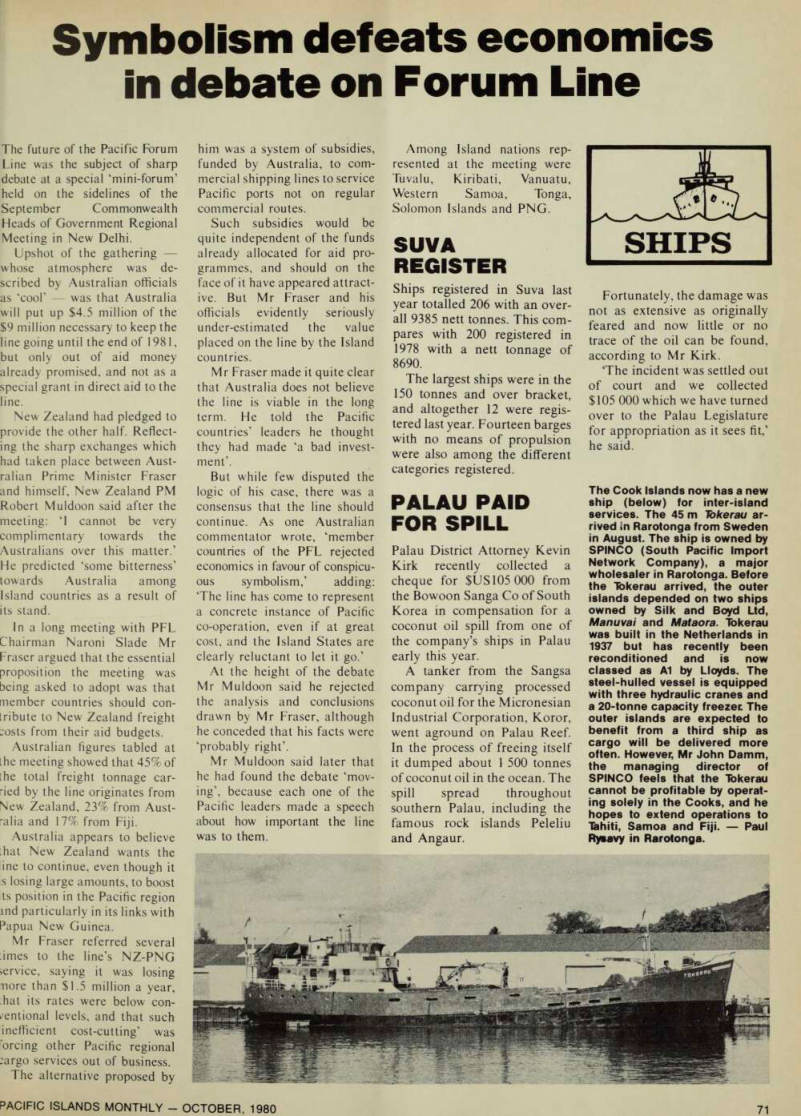
Ships
Symbolism defeats economics in debate on Forum Line
The future of the Pacific Forum Line was the subject of sharp debate at a special ‘mini-forum’ held on the sidelines of the September Commonwealth Heads of Government Regional Meeting in New Delhi.
Upshot of the gathering whose atmosphere was de scribed by Australian officials as ‘cool’ was that Australia will put up $4.5 million of the $9 million necessary to keep the line going until the end of 1981, but only out of aid money already promised, and not as a special grant in direct aid to the line.
New Zealand had pledged to provide the other half. Reflect ing the sharp exchanges which had taken place between Aust ralian Prime Minister Fraser and himself. New Zealand PM Robert Muldoon said after the meeting: ‘I cannot be very complimentary towards the Australians over this matter.’
He predicted ‘some bitterness’ towards Australia among Island countries as a result of its stand.
In a long meeting with PFL Chairman Naroni Slade Mr Fraser argued that the essential proposition the meeting was being asked to adopt was that member countries should con tribute to New Zealand freight :osts from their aid budgets.
Australian figures tabled at the meeting showed that 45% of the total freight tonnage car ried by the line originates from New Zealand, 23% from Aust ralia and 17% from Fiji.
Australia appears to believe :hat New Zealand wants the ine to continue, even though it s losing large amounts, to boost ts position in the Pacific region ind particularly in its links with Papua New Guinea.
Mr Fraser referred several imes to the line’s NZ-PNG service, saying it was losing more than $1.5 million a year, hat its rates were below con /enlional levels, and that such inefficient cost-cutting’ was 'orcing other Pacific regional :argo services out of business.
The alternative proposed by
him was a system of subsidies, funded by Australia, to com mercial shipping lines to service Pacific ports not on regular commercial routes.
Such subsidies would be quite independent of the funds already allocated for aid pro grammes, and should on the face of it have appeared attract ive. But Mr Fraser and his officials evidently seriously under-estimated the value placed on the line by the Island countries.
Mr Fraser made it quite clear that Australia does not believe the line is viable in the long term. He told the Pacific countries’ leaders he thought they had made ‘a bad invest ment’.
But while few disputed the logic of his case, there was a consensus that the line should continue. As one Australian commentator wrote, ‘member countries of the PFL rejected economics in favour of conspicu ous symbolism,’ adding: ‘The line has come to represent a concrete instance of Pacific co-operation, even if at great cost, and the Island States are clearly reluctant to let it go.’
At the height of the debate Mr Muldoon said he rejected the analysis and conclusions drawn by Mr Fraser, although he conceded that his facts were ‘probably right’.
Mr Muldoon said later that he had found the debate ‘mov ing’, because each one of the Pacific leaders made a speech about how important the line was to them.
Among Island nations rep resented at the meeting were Tuvalu, Kiribati, Vanuatu, Western Samoa, Tonga, Solomon Islands and PNG.
Suva
Register
Ships registered in Suva last year totalled 206 with an over all 9385 nett tonnes. This com pares with 200 registered in 1978 with a nett tonnage of 8690.
The largest ships were in the 150 tonnes and over bracket, and altogether 12 were regis tered last year. Fourteen barges with no means of propulsion were also among the different categories registered.
Palau Paid
For Spill
Palau District Attorney Kevin Kirk recently collected a cheque for SUSIOS 000 from the Bowoon Sanga Co of South Korea in compensation for a coconut oil spill from one of the company’s ships in Palau early this year.
A tanker from the Sangsa
company carrying processed
coconut oil for the Micronesian Industrial Corporation, Koror, went aground on Palau Reef.
In the process of freeing itself it dumped about 1 500 tonnes of coconut oil in the ocean. The spill spread throughout southern Palau, including the famous rock islands Peleliu and Angaur.
Fortunately, the damage was
not as extensive as originally feared and now little or no trace of the oil can be found, according to Mr Kirk. ‘The incident was settled out of court and we collected $lO5 000 which we have turned over to the Palau Legislature for appropriation as it sees fit,’ he said.
The Cook Islands now has a new ship (below) for inter-island services. The 45 m Tokerau ar rived in Rarotonga from Sweden in August. The ship is owned by SPINCO (South Pacific Import Network Company), a major wholesaler in Rarotonga. Before the Tokerau arrived, the outer islands depended on two ships owned by Silk and Boyd Ltd, Manuvai and Mataora. Tokerau was built in the Netherlands in 1937 but has recently been reconditioned and is now classed as A1 by Lloyds. The steel-hulled vessel is equipped with three hydraulic cranes and a 20-tonne capacity freezes. The outer islands are expected to benefit from a third ship as cargo will be delivered more often. However, Mr John Damm, the managing director of SPINCO feels that the Tokerau cannot be profitable by operat ing solely in the Cooks, and he hopes to extend operations to
Tahiti, Samoa and Fiji. - Paul
Rysavy in Rarotonga.
PNG line slips far
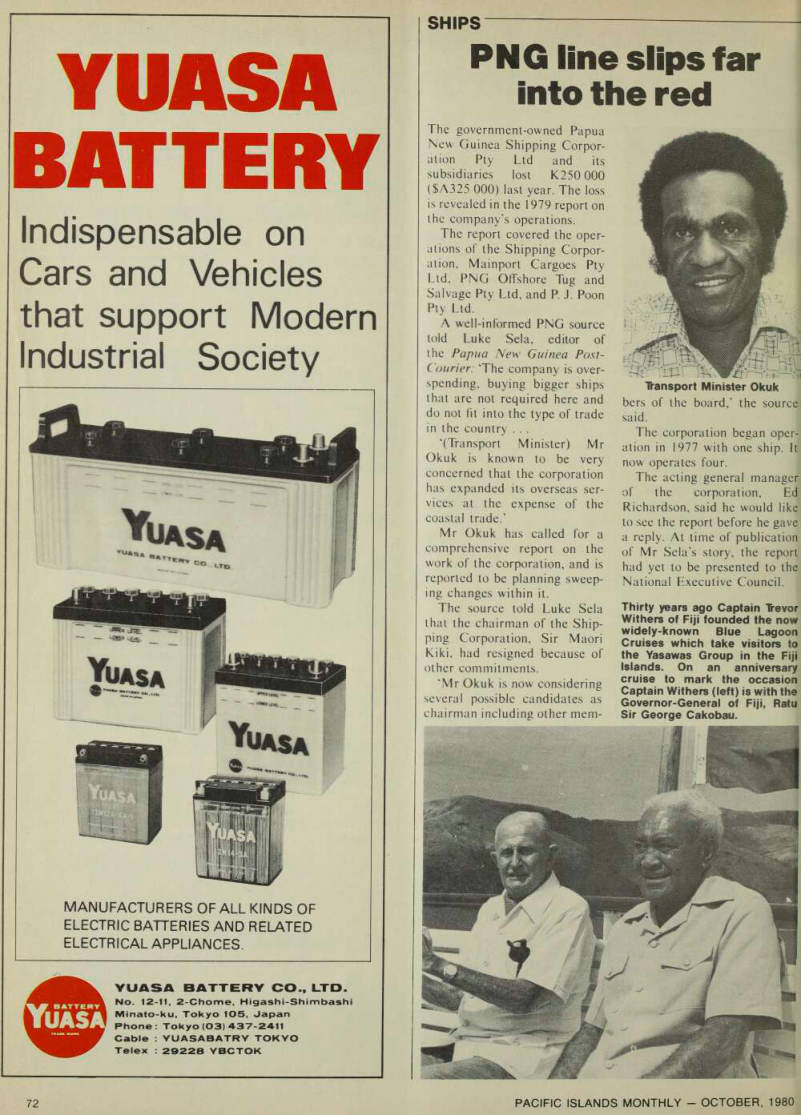
into the red
The government-owned Papua New' Guinea Shipping Corpor ation Pty Ltd and its subsidiaries lost K 250 000 (5A325 000) last year. The loss is revealed in the 1979 report on the company’s operations.
The report covered the oper ations of the Shipping Corpor ation, Mainporl Cargoes Pty Ltd, PNG Offshore Tug and Salvage Ply Ltd, and P. J. Poon Pty Ltd.
A well-informed PNG source told Luke Sela, editor of the Papua New Guinea Post- Courier: The company is over spending, buying bigger ships that are not required here and do not fit into the type of trade
in the country . . .
’(Transport Minister) Mr Okuk is known to be very concerned that the corporation has expanded its overseas ser vices at the expense of the coastal trade.’
Mr Okuk has called for a comprehensive report on the work of the corporation, and is reported to be planning sweep ing changes within it.
The source told Luke Sela that the chairman of the Ship ping Corporation, Sir Maori Kiki, had resigned because of other commitments. ’Mr Okuk is now considering several possible candidates as chairman including other mem-
bers of the board,’ the source said.
The corporation began oper ation in 1977 with one ship. It now operates four.
The acting general manager of the corporation, Ed Richardson, said he would like to see the report before he gave a reply. At time of publication of Mr Sela’s story, the report had yet to be presented to the National Executive Council.
Transport Minister Okuk
Thirty years ago Captain Trevor Withers of Fiji founded the now widely-known Blue Lagoon Cruises which take visitors to the Yasawas Group in the Fiji Islands. On an anniversary cruise to mark the occasion Captain Withers (left) is with the Governor-General of Fiji, Ratu Sir George Cakobau.
Advertisements & other items, pp. 72-73 (2 items)
Yuasa
BATTERY
Indispensable on
Cars and Vehicles
that support Modern
Industrial Society
Yuas
USB.
‘-as* MS
MANUFACTURERS OF ALL KINDS OF
ELECTRIC BATTERIES AND RELATED
ELECTRICAL APPLIANCES.
YUASA BATTERY CO., LTD.
No. 12-11, 2-Chome, Higashi-Shimbashi Minato-ku, Tokyo 105, Japan Phone: Tokyo (03) A37-2AII
Cable : YUASABATRY TOKYO
Telex : 29228 YBCTOK
Nz Police
-V * V*J 1 \ 4! ) - - V T as *« V WP'*^’" 1 f you’re between the ages of 19-34 and meet the minimum requirements of 173 cm tall, 67kg in weight and have a : measurement of 91cm at least, you may apply to become a Police Officer. nose that possess the right physical and mental requirements, a good work record and a satisfactory educational ground the Police offer you a worthwhile and rewarding career with thorough training, the opportunity for promotion, jxcellent starting salary with x s leave
SERVING THE COMMUNITY
r annuation benefits, generous leave iding sick leave with pay), free uniform, bove all we offer job security, faction and comradeship in a ssary job helping society, j’re interested, we would like to talk it with you. Call at your nearest Police Dn for further details
WE WANT THE BEST
L82593AC
Yachts
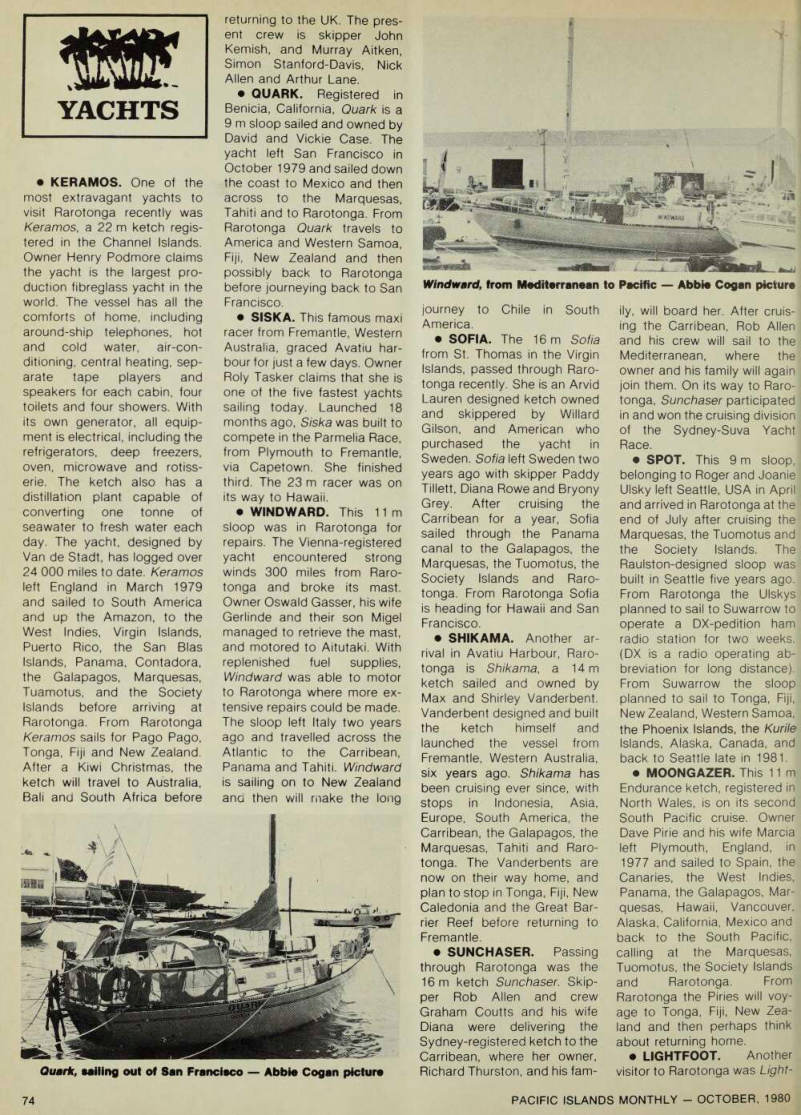
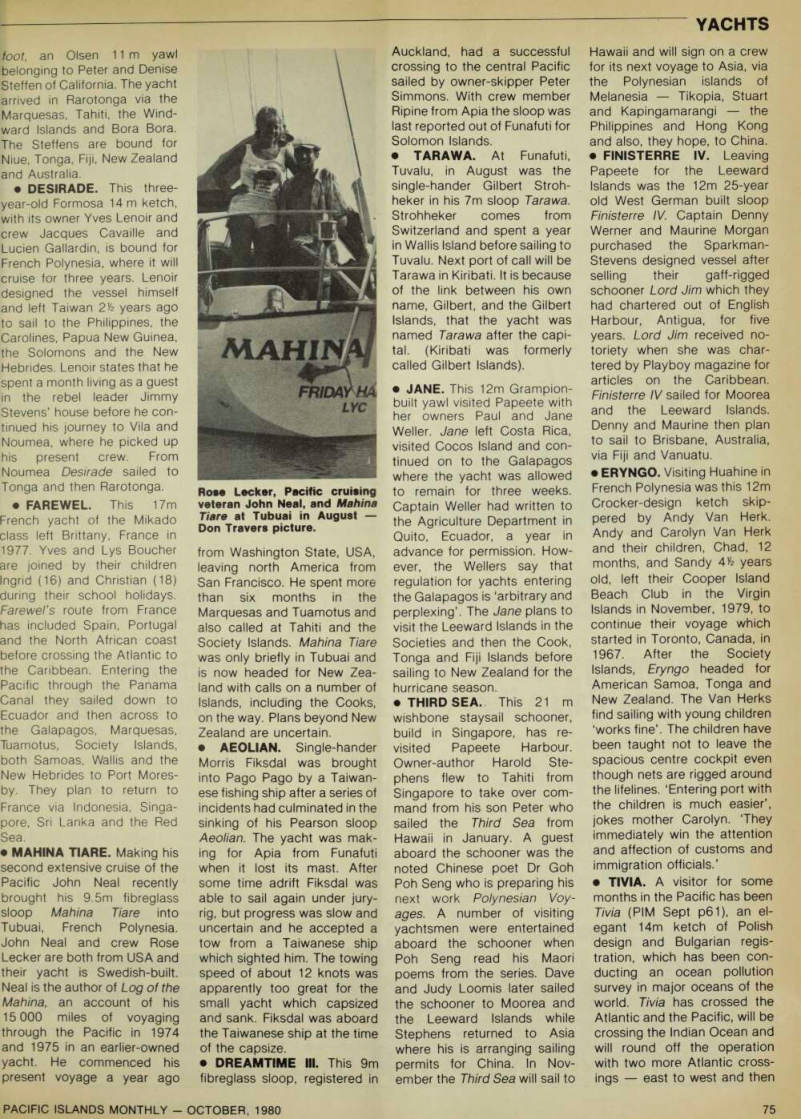
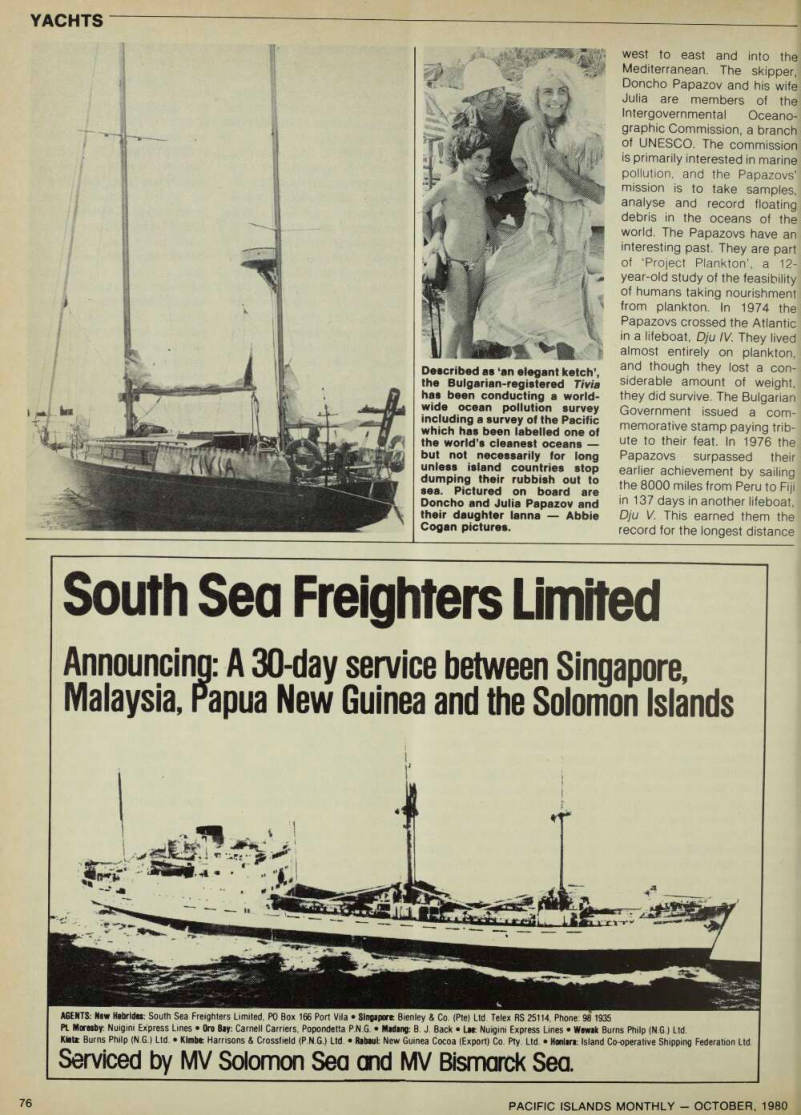
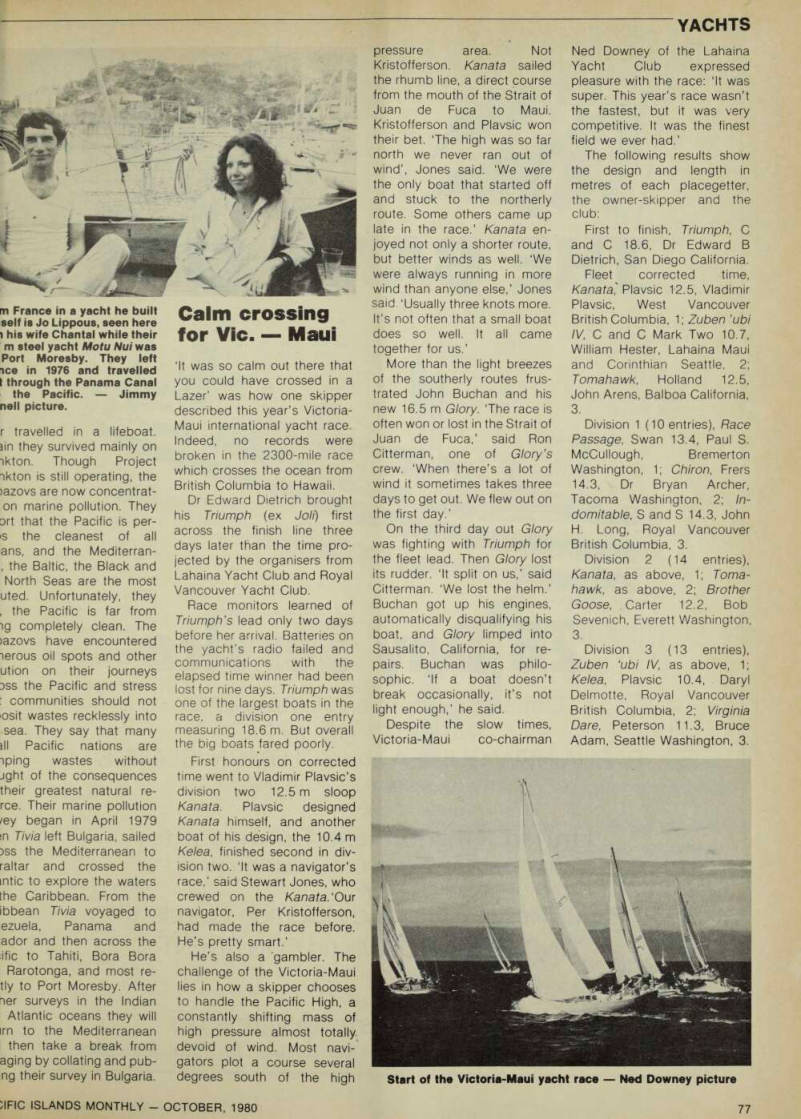
returning to the UK. The pres ent crew is skipper John Kemish, and Murray Aitken, Simon Stanford-Davis, Nick Allen and Arthur Lane. e QUARK. Registered in Benicia, California, Quark is a 9 m sloop sailed and owned by David and Vickie Case. The yacht left San Francisco in October 1979 and sailed down the coast to Mexico and then across to the Marquesas, Tahiti and to Rarotonga. From Rarotonga Quark travels to America and Western Samoa, Fiji, New Zealand and then possibly back to Rarotonga before journeying back to San Francisco. • SISKA. This famous maxi racer from Fremantle, Western Australia, graced Avatiu har bour for just a few days. Owner Roly Tasker claims that she is one of the five fastest yachts sailing today. Launched 18 months ago, Siska was built to compete in the Parmelia Race, from Plymouth to Fremantle, via Capetown. She finished third. The 23 m racer was on its way to Hawaii. • WINDWARD. This 11 m sloop was in Rarotonga for repairs. The Vienna-registered yacht encountered strong winds 300 miles from Raro tonga and broke its mast.
Owner Oswald Gasser, his wife Gerlinde and their son Migel managed to retrieve the mast, and motored to Aitutaki. With replenished fuel supplies, Windward was able to motor to Rarotonga where more ex tensive repairs could be made.
The sloop left Italy two years ago and travelled across the Atlantic to the Carribean, Panama and Tahiti. Windward is sailing on to New Zealand and then will make the long
• KERAMOS. One of the most extravagant yachts to visit Rarotonga recently was Keramos, a 22 m ketch regis tered in the Channel Islands.
Owner Henry Podmore claims the yacht is the largest pro duction fibreglass yacht in the world. The vessel has all the comforts of home, including around-ship telephones, hot and cold water, air-con ditioning. central heating, sep arate tape players and speakers for each cabin, four toilets and four showers. With its own generator, all equip ment is electrical, including the refrigerators, deep freezers, oven, microwave and rotiss erie. The ketch also has a distillation plant capable of converting one tonne of seawater to fresh water each day. The yacht, designed by Van de Stadt, has logged over 24 000 miles to date. Keramos left England in March 1979 and sailed to South America and up the Amazon, to the West Indies, Virgin Islands, Puerto Rico, the San Bias Islands, Panama, Contadora, the Galapagos, Marquesas, Tuamotus, and the Society Islands before arriving at Rarotonga. From Rarotonga Keramos sails for Pago Pago, Tonga, Fiji and New Zealand.
After a Kiwi Christmas, the ketch will travel to Australia, Bali and South Africa before
journey to Chile in South America. • SOFIA. The 16 m Sofia from St. Thomas in the Virgin Islands, passed through Raro tonga recently. She is an Arvid Lauren designed ketch owned and skippered by Willard Gilson, and American who purchased the yacht in Sweden. Sofia left Sweden two years ago with skipper Paddy Tillett, Diana Rowe and Bryony Grey. After cruising the Carribean for a year, Sofia sailed through the Panama canal to the Galapagos, the Marquesas, the Tuomotus, the Society Islands and Raro tonga. From Rarotonga Sofia is heading for Hawaii and San Francisco. • SHIKAMA. Another ar rival in Avatiu Harbour, Raro tonga is Shikama, a 14m ketch sailed and owned by Max and Shirley Vanderbent.
Vanderbent designed and built the ketch himself and launched the vessel from Fremantle, Western Australia, six years ago. Shikama has been cruising ever since, with stops in Indonesia, Asia, Europe, South America, the Carribean, the Galapagos, the Marquesas, Tahiti and Raro tonga. The Vanderbents are now on their way home, and plan to stop in Tonga, Fiji, New Caledonia and the Great Bar rier Reef before returning to Fremantle. • SUNCHASER. Passing through Rarotonga was the 16 m ketch Sunchaser. Skip per Rob Allen and crew Graham Coutts and his wife Diana were delivering the Sydney-registered ketch to the Carribean, where her owner, Richard Thurston, and his fam
ily, will board her. After cruis ing the Carribean, Rob Allen and his crew will sail to the Mediterranean, where the owner and his family will again join them. On its way to Raro tonga, Sunchaser participated in and won the cruising division of the Sydney-Suva Yacht Race. • SPOT. This 9 m sloop, belonging to Roger and Joanie Ulsky left Seattle, USA in April and arrived in Rarotonga at the end of July after cruising the Marquesas, the Tuomotus and the Society Islands. The Raulston-designed sloop was built in Seattle five years ago.
From Rarotonga the Ulskys planned to sail to Suwarrow to operate a DX-pedition ham radio station for two weeks. (DX is a radio operating ab breviation for long distance).
From Suwarrow the sloop planned to sail to Tonga, Fiji, New Zealand, Western Samoa, the Phoenix Islands, the Kurile Islands, Alaska, Canada, and back to Seattle late in 1981.
• Moongazer. This 11 M
Endurance ketch, registered in North Wales, is on its second South Pacific cruise. Owner Dave Pirie and his wife Marcia left Plymouth, England, in 1977 and sailed to Spain, the Canaries, the West Indies, Panama, the Galapagos, Mar quesas, Hawaii, Vancouver, Alaska, California, Mexico and back to the South Pacific, calling at the Marquesas, Tuomotus, the Society Islands and Rarotonga. From Rarotonga the Piries will voy age to Tonga, Fiji, New Zea land and then perhaps think about returning home. • LIGHTFOOT. Another visitor to Rarotonga was Light
Quark, sailing out of San Francisco - Abbie Cogan picture
Windward, from Mediterranean to Pacific - Abbie Cogan picture
foot, an Olsen 11 m yawl belonging to Peter and Denise Steffen of California. The yacht arrived in Rarotonga via the Marquesas, Tahiti, the Wind ward Islands and Bora Bora.
The Steffens are bound for Niue, Tonga, Fiji, New Zealand and Australia. • DESIRADE. This three year-old Formosa 14 m ketch, with its owner Yves Lenoir and crew Jacques Cavaille and Lucien Gallardin, is bound for French Polynesia, where it will cruise for three years. Lenoir designed the vessel himself and left Taiwan 2Vz years ago to sail to the Philippines, the Carolines, Papua New Guinea, the Solomons and the New Hebrides. Lenoir states that he spent a month living as a guest in the rebel leader Jimmy Stevens’ house before he con tinued his journey to Vila and Noumea, where he picked up his present crew. From Noumea Desirade sailed to Tonga and then Rarotonga. • FAREWEL. This 17m French yacht of the Mikado class left Brittany, France in 1977. Yves and Lys Boucher are joined by their children Ingrid (16) and Christian (18) during their school holidays.
FareweTs route from France has included Spain, Portugal and the North African coast before crossing the Atlantic to the Caribbean. Entering the Pacific through the Panama Canal they sailed down to Ecuador and then across to the Galapagos, Marquesas, Tuamotus, Society Islands, both Samoas, Wallis and the New Hebrides to Port Mores by. They plan to return to France via Indonesia, Singa pore, Sri Lanka and the Red Sea. • MAHINA TIARE. Making his second extensive cruise of the Pacific John Neal recently brought his 9.5 m fibreglass sloop Mahina Tiare into Tubuai, French Polynesia.
John Neal and crew Rose Lecker are both from USA and their yacht is Swedish-built.
Neal is the author of Log of the Mahina, an account of his 15 000 miles of voyaging through the Pacific in 1974 and 1975 in an earlier-owned yacht. He commenced his present voyage a year ago
from Washington State, USA, leaving north America from San Francisco. He spent more than six months in the Marquesas and Tuamotus and also called at Tahiti and the Society Islands. Mahina Tiare was only briefly in Tubuai and is now headed for New Zea land with calls on a number of Islands, including the Cooks, on the way. Plans beyond New Zealand are uncertain. • AEOLIAN. Single-hander Morris Fiksdal was brought into Pago Pago by a Taiwan ese fishing ship after a series of incidents had culminated in the sinking of his Pearson sloop Aeolian. The yacht was mak ing for Apia from Funafuti when it lost its mast. After some time adrift Fiksdal was able to sail again under jury rig, but progress was slow and uncertain and he accepted a tow from a Taiwanese ship which sighted him. The towing speed of about 12 knots was apparently too great for the small yacht which capsized and sank. Fiksdal was aboard the Taiwanese ship at the time of the capsize.
• Dreamtime 111. This 9M
fibreglass sloop, registered in
Auckland, had a successful crossing to the central Pacific sailed by owner-skipper Peter Simmons. With crew member Ripine from Apia the sloop was last reported out of Funafuti for Solomon Islands. • TARAWA. At Funafuti.
Tuvalu, in August was the single-hander Gilbert Stroh heker in his 7m sloop Tarawa.
Strohheker comes from Switzerland and spent a year in Wallis Island before sailing to Tuvalu. Next port of call will be Tarawa in Kiribati. It is because of the link between his own name, Gilbert, and the Gilbert Islands, that the yacht was named Tarawa after the capi tal. (Kiribati was formerly called Gilbert Islands). • JANE. This 12m Grampion built yawl visited Papeete with her owners Paul and Jane Weller. Jane left Costa Rica, visited Cocos Island and con tinued on to the Galapagos where the yacht was allowed to remain for three weeks.
Captain Weller had written to the Agriculture Department in Quito, Ecuador, a year in advance for permission. How ever, the Wellers say that regulation for yachts entering the Galapagos is ‘arbitrary and perplexing’. The Jane plans to visit the Leeward Islands in the Societies and then the Cook, Tonga and Fiji Islands before sailing to New Zealand for the hurricane season. • THIRD SEA. This 21 m wishbone staysail schooner, build in Singapore, has re visited Papeete Harbour.
Owner-author Harold Ste phens flew to Tahiti from Singapore to take over com mand from his son Peter who sailed the Third Sea from Hawaii in January. A guest aboard the schooner was the noted Chinese poet Dr Goh Poh Seng who is preparing his next work Polynesian Voy ages. A number of visiting yachtsmen were entertained aboard the schooner when Poh Seng read his Maori poems from the series. Dave and Judy Loomis later sailed the schooner to Moorea and the Leeward Islands while Stephens returned to Asia where his is arranging sailing permits for China. In Nov ember the Third Sea will sail to
Hawaii and will sign on a crew for its next voyage to Asia, via the Polynesian islands of Melanesia Tikopia, Stuart and Kapingamarangi the Philippines and Hong Kong and also, they hope, to China. • FINISTERRE IV. Leaving Papeete for the Leeward Islands was the 12m 25-year old West German built sloop Finisterre IV. Captain Denny Werner and Maurine Morgan purchased the Sparkman- Stevens designed vessel after selling their gaff-rigged schooner Lord Jim which they had chartered out of English Harbour, Antigua, for five years. Lord Jim received no toriety when she was char tered by Playboy magazine for articles on the Caribbean.
Finisterre IV sailed for Moorea and the Leeward Islands.
Denny and Maurine then plan to sail to Brisbane, Australia, via Fiji and Vanuatu. • ERYNGO. Visiting Huahine in French Polynesia was this 12m Crocker-design ketch skip pered by Andy Van Herk.
Andy and Carolyn Van Herk and their children, Chad, 12 months, and Sandy 4V2 years old, left their Cooper Island Beach Club in the Virgin Islands in November, 1979, to continue their voyage which started in Toronto, Canada, in 1967. After the Society Islands, Eryngo headed for American Samoa, Tonga and New Zealand. The Van Herks find sailing with young children ‘works fine’. The children have been taught not to leave the spacious centre cockpit even though nets are rigged around the lifelines. ‘Entering port with the children is much easier’, jokes mother Carolyn. ‘They immediately win the attention and affection of customs and immigration officials.’ • TIVIA. A visitor for some months in the Pacific has been Tivia (PIM Sept p6l), an el egant 14m ketch of Polish design and Bulgarian regis tration, which has been con ducting an ocean pollution survey in major oceans of the world. Tivia has crossed the Atlantic and the Pacific, will be crossing the Indian Ocean and will round off the operation with two more Atlantic cross ings east to west and then
Rose Lecker, Pacific cruising veteran John Neal, and Mahina Tiare at Tubuai in August - Don Travers picture.
west to east and into the Mediterranean. The skipper, Doncho Papazov and his wife Julia are members of the Intergovernmental Oceano graphic Commission, a branch of UNESCO. The commission is primarily interested in marine pollution, and the Papazovs’ mission is to take samples, analyse and record floating debris in the oceans of the world. The Papazovs have an interesting past. They are part of ‘Project Plankton’, a 12year-old study of the feasibility of humans taking nourishment from plankton. In 1974 the Papazovs crossed the Atlantic in a lifeboat, Dju IV. They lived almost entirely on plankton, and though they lost a con siderable amount of weight, they did survive. The Bulgarian Government issued a com memorative stamp paying trib ute to their feat. In 1976 the Papazovs surpassed their earlier achievement by sailing the 8000 miles from Peru to Fiji in 137 days in another lifeboat, Dju V. This earned them the record for the longest distance
Described as ‘an elegant ketch’, the Bulgarian-registered Tivia has been conducting a world wide ocean pollution survey including a survey of the Pacific which has been labelled one of the world’s cleanest oceans but not necessarily for long unless island countries stop dumping their rubbish out to sea. Pictured on board are Doncho and Julia Papazov and
their daughter lanna - Abbie
Cogan pictures.
r travelled in a lifeboat, lin they survived mainly on ikton. Though Project nkton is still operating, the >azovs are now concentrat on marine pollution. They art that the Pacific is per s the cleanest of all ans, and the Mediterran , the Baltic, the Black and North Seas are the most uted. Unfortunately, they , the Pacific is far from ig completely clean. The >azovs have encountered lerous oil spots and other ution on their journeys ass the Pacific and stress : communities should not osit wastes recklessly into sea. They say that many ill Pacific nations are aping wastes without jght of the consequences their greatest natural re rce. Their marine pollution began in April 1979 m Tivia left Bulgaria, sailed ass the Mediterranean to raltar and crossed the intic to explore the waters the Caribbean. From the ibbean Tivia voyaged to ezuela, Panama and ador and then across the ific to Tahiti, Bora Bora Rarotonga, and most re tly to Port Moresby. After her surveys in the Indian Atlantic oceans they will irn to the Mediterranean then take a break from aging by collating and pub ng their survey in Bulgaria.
Calm crossing
for Vic. Maui
‘lt was so calm out there that you could have crossed in a Lazer’ was how one skipper described this year’s Victoria- Maui international yacht race.
Indeed, no records were broken in the 2300-mile race which crosses the ocean from British Columbia to Hawaii.
Dr Edward Dietrich brought his Triumph (ex Joli) first across the finish line three days later than the time pro jected by the organisers from Lahaina Yacht Club and Royal Vancouver Yacht Club.
Race monitors learned of Triumph’s lead only two days before her arrival. Batteries on the yacht’s radio failed and communications with the elapsed time winner had been lost for nine days. Triumph was one of the largest boats in the race, a division one entry measuring 18.6 m. But overall the big boats fared poorly.
First honours on corrected time went to Vladimir Plavsic’s division two 12.5 m sloop Kanata. Plavsic designed Kanata himself, and another boat of his design, the 10.4 m Kelea, finished second in div ision two. ‘lt was a navigator’s race,’ said Stewart Jones, who crewed on the Kanata. 1 Our navigator, Per Kristofferson, had made the race before.
He’s pretty smart.’
He’s also a gambler. The challenge of the Victoria-Maui lies in how a skipper chooses to handle the Pacific High, a constantly shifting mass of high pressure almost totally devoid of wind. Most navi gators plot a course several degrees south of the high
pressure area. Not Kristofferson. Kanata sailed the rhumb line, a direct course from the mouth of the Strait of Juan de Fuca to Maui.
Kristofferson and Plavsic won their bet. The high was so far north we never ran out of wind’, Jones said. ‘We were the only boat that started off and stuck to the northerly route. Some others came up late in the race.’ Kanata en joyed not only a shorter route, but better winds as well. ‘We were always running in more wind than anyone else,’ Jones said. ‘Usually three knots more.
It’s not often that a small boat does so well. It all came together for us.’
More than the light breezes of the southerly routes frus trated John Buchan and his new 16.5 m Glory. ‘The race is often won or lost in the Strait of Juan de Fuca,’ said Ron Citterman, one of Glory’s crew. ‘When there’s a lot of wind it sometimes takes three days to get out. We flew out on the first day.’
On the third day out Glory was fighting with Triumph for the fleet lead. Then Glory lost its rudder. ‘lt split on us,’ said Citterman. ‘We lost the helm.’
Buchan got up his engines, automatically disqualifying his boat, and Glory limped into Sausalito, California, for re pairs. Buchan was philo sophic. ‘lf a boat doesn’t break occasionally, it’s not light enough,’ he said.
Despite the slow times, Victoria-Maui co-chairman
Ned Downey of the Lahaina Yacht Club expressed pleasure with the race: ‘lt was super. This year’s race wasn’t the fastest, but it was very competitive. It was the finest field we ever had.’
The following results show the design and length in metres of each placegetter, the owner-skipper and the club: First to finish, Triumph, C and C 18.6, Dr Edward B Dietrich, San Diego California.
Fleet corrected time, Kanata' Plavsic 12.5, Vladimir Plavsic, West Vancouver British Columbia, 1; Zuben ’ubi IV, C and C Mark Two 10.7, William Hester, Lahaina Maui and Corinthian Seattle, 2; Tomahawk, Holland 12.5, John Arens, Balboa California, 3.
Division 1 (10 entries), Race Passage, Swan 13.4, Paul S.
McCullough, Bremerton Washington, 1; Chiron, Frers 14.3, Dr Bryan Archer, Tacoma Washington, 2; In domitable, S and S 14.3, John H. Long, Royal Vancouver British Columbia, 3.
Division 2 (14 entries), Kanata, as above, 1; Toma hawk, as above, 2; Brother Goose, Carter 12.2, Bob Sevenich, Everett Washington, 3.
Division 3 (13 entries), Zuben ‘ubi IV, as above, 1; Kelea, Plavsic 10.4, Daryl Delmotte, Royal Vancouver British Columbia, 2; Virginia Dare, Peterson 11.3, Bruce Adam, Seattle Washington, 3.
[?]m France in a yacht he built [?] self is Jo Lippous, seen here [?] his wife Chantal while their [?] m steel yacht Motu Nui was
[?] Port Moresby. They left
[?] ce in 1976 and travelled
[?] t through the Panama Canal
[?] the Pacific. - Jimmy
[?] nell picture.
Start of the Victoria-Maui yacht race - Ned Downey picture
Advertisements & other items, pp. 76-78 (3 items)
Yachts
South Sea Freighters Limited
Announcing: A 30-day service between Singapore,
Malaysia, Papua New Guinea and the Solomon Islands rr 1 i n m mt’ % « » H Li tr** AGENTS: New Hebrides; South Sea Freighters Limited, PO Box 166 Port Vila • Singapore: Bienley & Co. (Pte) Ltd. Telex RS 25114, Phone. 98 1935 PI Moresby: Nuigini Express Lines • Oro Bay: Carnell Carriers, Popondetta P.N.G. • Madang; B. J. Back • Lae; Nuigini Express Lines • Wewak Burns Philp (N.G.) Ltd.
Kiett Burns Philp (N.G.) Ltd • Klmbe: Harrisons & Crossfield (P.N.G.) Ltd. • Rabaul: New Guinea Cocoa (Export) Co. Pty. Ltd. • Honiara: Island Co-operative Shipping Federation Ltd, Serviced by MV Solomon Sea and MV Bismarck Sea
THE
LINE
28 Day Service 4
United Kingdom and Continent to:
PAPEETE • NOUMEA
PAPUA NEW GUINEA and SOLOMON ISLANDS
PORT VILA & SANTO BY TRANSHIPMENT
Hr United Kingdom and Continent to: SUVA AND LAUTOKA (FCL LCL & UNITISED ONLY) * Papua New Guinea and Solomon Islands to:
UNITED KINGDOM and CONTINENT
For particulars apply:
THE BANK LINE (AUSTRALASIA) PTY. LTD.
18th floor 1 York Street SYDNEY N.S.W 2000 Australia Tel: 272041 Telex: 24063
Yachts
77
:iFIC ISLANDS MONTHLY - OCTOBER, 1980
Shipping
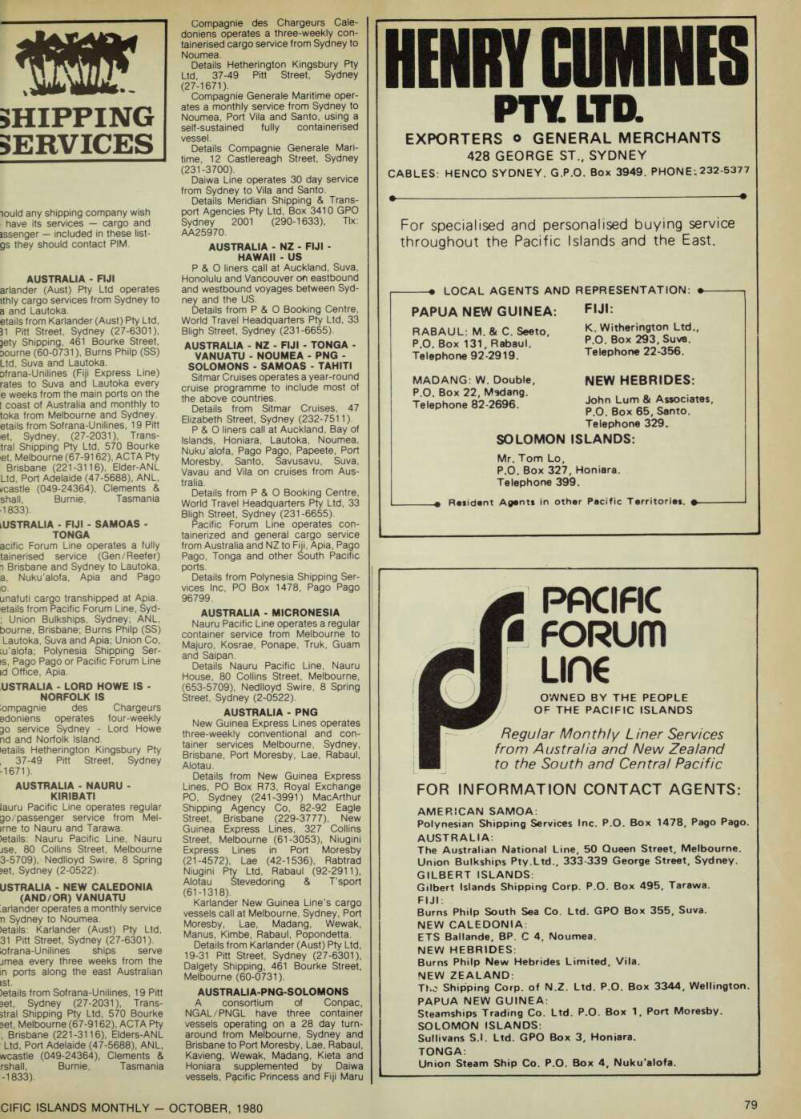
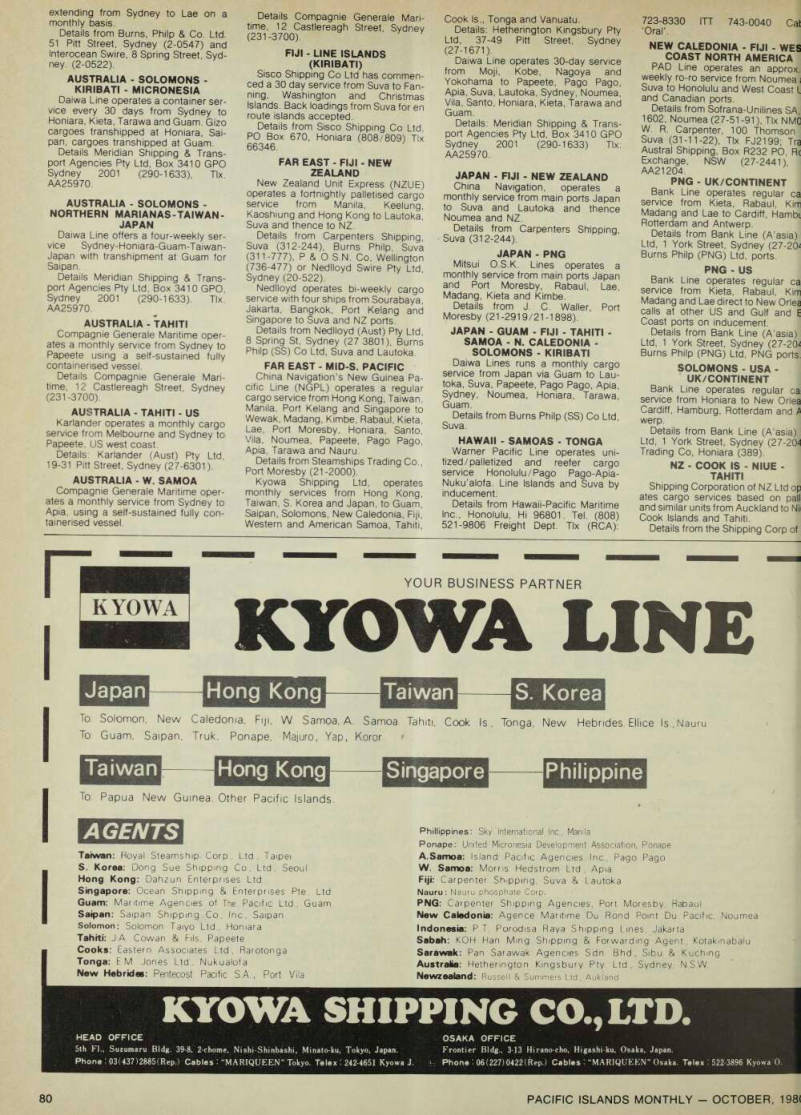
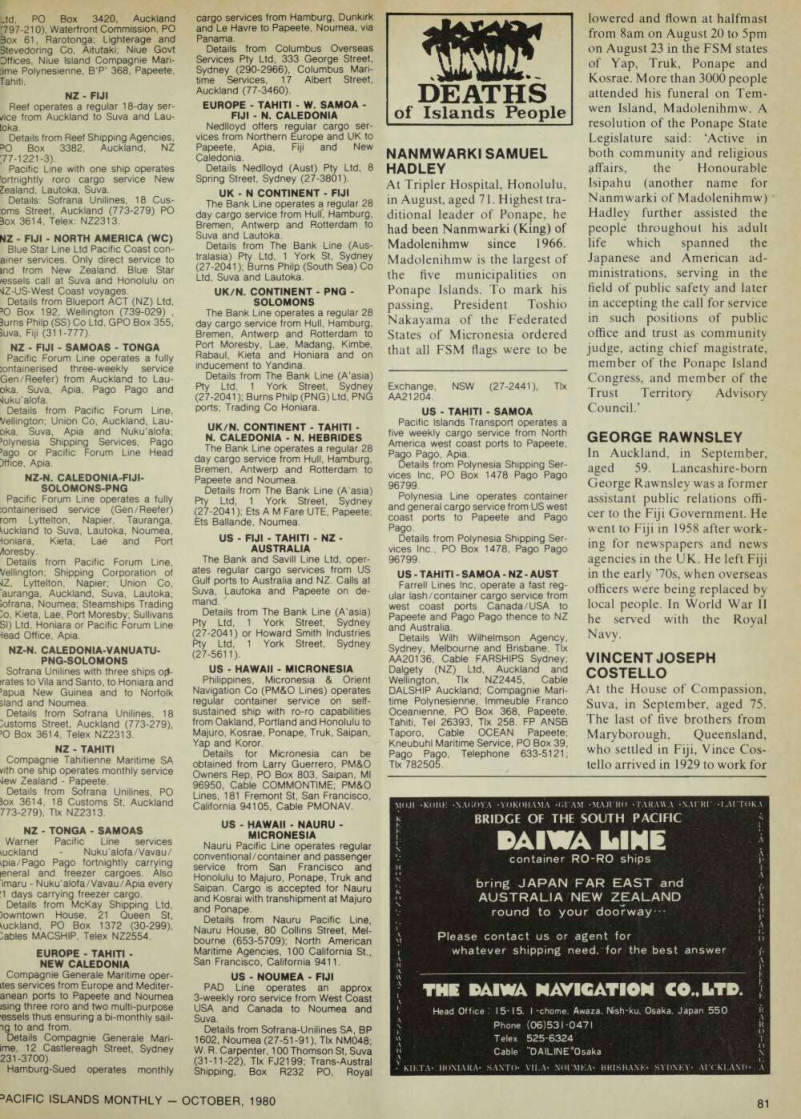
Services
lould any shipping company wish have its services cargo and issenger included in these list gs they should contact PIM.
Australia - Fiji
arlander (Aust) Pty Ltd operates rthly cargo services from Sydney to a and Lautoka. etails from Karlander (Aust) Pty Ltd, )1 Pitt Street, Sydney (27-6301), jety Shipping, 461 Bourke Street, Bourne (60-0731), Burns Philp (SS) Ltd, Suva and Lautoka. ofrana-Unilines (Fiji Express Line) rates to Suva and Lautoka every e weeks from the main ports on the t coast of Australia and monthly to toka from Melbourne and Sydney, etails from Sofrana-Unilines, 19 Pitt et, Sydney, (27-2031), Trans tral Shipping Pty Ltd, 570 Bourke et, Melbourne (67-9162), ACTA Pty Brisbane (221-3116), Elder-ANL Ltd, Port Adelaide (47-5688), ANL, i/castle (049-24364), Clements & shall, Burnie, Tasmania ■1833).
Australia - Fiji - Samoas -
Tonga
acific Forum Line operates a fully tainerised service (Gen/Reefer) n Brisbane and Sydney to Lautoka, a, Nukualofa, Apia and Pago o. unafuti cargo transhipped at Apia, etails from Pacific Forum Line, Syd ; Union Bulkships, Sydney; ANL, bourne, Brisbane; Burns Philp (SS) Lautoka, Suva and Apia; Union Co, w’alofa; Polynesia Shipping Ser (S, Pago Pago or Pacific Forum Line id Office, Apia.
Ustralia - Lord Howe Is -
Norfolk Is
tempagnie des Chargeurs sdoniens operates four-weekly 30 service Sydney - Lord Howe nd and Norfolk Island, •etails Hetherington Kingsbury Pty 37-49 Pitt Street, Sydney -1671).
Australia - Nauru -
Kiribati
lauru Pacific Line operates regular go/passenger service from Mel irne to Nauru and Tarawa, tetails: Nauru Pacific Line, Nauru jse, 80 Collins Street, Melbourne 3-5709), Nedlloyd Swire, 8 Spring jet, Sydney (2-0522).
Ustralia - New Caledonia
(And/Or) Vanuatu
terlander operates a monthly service n Sydney to Noumea. tetails; Karlander (Aust) Pty Ltd, 31 Pitt Street, Sydney (27-6301). lofrana-Unilines ships serve jmea every three weeks from the in ports along the east Australian Ist. tetails from Sofrana-Unilines, 19 Pitt Bet, Sydney (27-2031), Trans jtral Shipping Pty Ltd, 570 Bourke Bet, Melbourne (67-9162), ACTA Pty , Brisbane (221-3116), Elders-ANL Ltd. Port Adelaide (47-5688), ANL, wcastle (049-24364), Clements & rshall, Burnie, Tasmania -1833).
Compagnie des Chargeurs Cale donians operates a three-weekly con tainerised cargo service from Sydney to Noumea.
Details Hetherington Kingsbury Pty Ltd, 37-49 Pitt Street, Sydney (27-1671).
Compagnie Generate Maritime oper ates a monthly service from Sydney to Noumea, Port Vila and Santo, using a self-sustained fully containerised vessel.
Details Compagnie Generate Mari time, 12 Castlereagh Street, Sydney (231-3700).
Daiwa Line operates 30 day service from Sydney to Vila and Santo.
Details Meridian Shipping & Trans port Agencies Pty Ltd, Box 3410 GPO Sydney 2001 (290-1633), Tlx: AA25970.
Australia - Nz - Fiji -
Hawaii - Us
P & O liners call at Auckland, Suva, Honolulu and Vancouver on eastbound and westbound voyages between Syd ney and the US.
Details from P & O Booking Centre, World Travel Headquarters Pty Ltd, 33 Bligh Street, Sydney (231-6655).
AUSTRALIA - NZ - FIJI - TONGA -
Vanuatu - Noumea - Png -
Solomons - Samoas - Tahiti
Sitmar Cruises operates a year-round cruise programme to include most of the above countries.
Details from Sitmar Cruises. 47 Elizabeth Street, Sydney (232-7511).
P & O liners call at Auckland, Bay of Islands, Honiara, Lautoka, Noumea, Nukualofa, Pago Pago, Papeete, Port Moresby, Santo, Savusavu, Suva, Vavau and Vila on cruises from Aus tralia.
Details from P & O Booking Centre, World Travel Headquarters Pty Ltd, 33 Bligh Street, Sydney (231-6655).
Pacific Forum Line operates con tainerized and general cargo service from Australia and NZ to Fiji, Apia, Pago Pago, Tonga and other South Pacific ports.
Details from Polynesia Shipping Ser vices Inc, PO Box 1478, Pago Pago 96799.
Australia - Micronesia
Nauru Pacific Line operates a regular container service from Melbourne to Majuro, Kosrae, Ponape, Truk, Guam and Saipan.
Details Nauru Pacific Line, Nauru House, 80 Collins Street, Melbourne, (653-5709), Nedlloyd Swire, 8 Spring Street, Sydney (2-0522).
Australia - Png
New Guinea Express Lines operates three-weekly conventional and con tainer services Melbourne, Sydney, Brisbane, Port Moresby, Lae, Rabaul, Alotau.
Details from New Guinea Express Lines, PO Box R 73, Royal Exchange PO, Sydney (241-3991) MacArthur Shipping Agency Co, 82-92 Eagle Street, Brisbane (229-3777), New Guinea Express Lines, 327 Collins Street, Melbourne (61-3053), Niugini Express Lines in Port Moresby (21-4572), Lae (42-1536), Rabtrad Niugini Pty Ltd, Rabaul (92-2911), Alotau Stevedoring & T’sport (61-1318).
Karlander New Guinea Line’s cargo vessels call at Melbourne, Sydney, Port Moresby, Lae, Madang, Wewak, Manus, Kimbe, Rabaul, Popondetta.
Details from Karlander (Aust) Pty Ltd, 19-31 Pitt Street, Sydney (27-6301), Dalgety Shipping, 461 Bourke Street, Melbourne (60-0731).
Australia-Png-Solomons
A consortium of Conpac, NGAL/PNGL have three container vessels operating on a 28 day turn around from Melbourne, Sydney and Brisbane to Port Moresby, Lae, Rabaul, Kavieng, Wewak, Madang, Kieta and Honiara supplemented by Daiwa vessels, Pacific Princess and Fiji Maru
extending from Sydney to Lae on a monthly basis.
Details from Burns, Philp & Co. Ltd 51 Pitt Street, Sydney (2-0547) and Interocean Swire, 8 Spring Street, Syd ney. (2-0522).
Australia - Solomons -
Kiribati - Micronesia
Daiwa Line operates a container ser vice every 30 days from Sydney to Honiara, Kieta, Tarawa and Guam. Gizo cargoes transhipped at Honiara, Sai pan, cargoes transhipped at Guam.
Details Meridian Shipping & Trans port Agencies Pty Ltd, Box 3410 GPO Sydney 2001 (290-1633), Tlx.
AA25970.
Australia - Solomons -
Northern Marianas-Taiwan -
Japan
Daiwa Line offers a four-weekly ser vice Sydney-Honiara-Guam-Taiwan- Japan with transhipment at Guam for Saipan, Details Meridian Shipping & Trans port Agencies Pty Ltd, Box 3410 GPO, Sydney 2001 (290-1633). Tlx.
AA25970.
Australia - Tahiti
Compagnie Generate Maritime oper ates a monthly service from Sydney to Papeete using a self-sustained fully containerised vessel.
Details Compagnie Generate Mari time, 12 Castlereagh Street, Sydney (231-3700).
Australia - Tahiti - Us
Karlander operates a monthly cargo service from Melbourne and Sydney to Papeete, US west coast.
Details: Karlander (Aust) Pty Ltd, 19-31 Pitt Street. Sydney (27-6301).
Australia - W. Samoa
Compagnie Generate Maritime oper ates a monthly service from Sydney to Apia, using a self-sustained fully con tainerised vessel.
Details Compagnie Generate Mari time, 12 Castlereagh Street, Sydney (231-3700).
Fiji - Line Islands
(Kiribati)
Sisco Shipping Co Ltd has commen ced a 30 day service from Suva to Fan ning, Washington and Christmas Islands. Back loadings from Suva for en route islands accepted.
Details from Sisco Shipping Co Ltd, PO Box 670. Honiara (808/809) Tlx 66346.
Far East - Fiji - New
Zealand
New Zealand Unit Express (NZUE) operates a fortnightly palletised cargo service from Manila. Keelung, Kaoshiung and Hong Kong to Lautoka.
Suva and thence to NZ.
Details from Carpenters Shipping, Suva (312-244), Burns Philp, Suva (311-777), P & O S.N. Co, Wellington (736-477) or Nedlloyd Swire Pty Ltd, Sydney (20-522).
Nedlloyd operates bi-weekly cargo service with four ships from Sourabaya.
Jakarta, Bangkok, Port Kelang and Singapore to Suva and NZ ports.
Details from Nedlloyd (Aust) Pty Ltd, 8 Spring St, Sydney (27 3801), Burns Philp (SS) Co Ltd, Suva and Lautoka.
Far East - Mid-S. Pacific
China Navigation's New Guinea Pa cific Line (NGPL) operates a regular cargo service from Hong Kong, Taiwan, Manila, Port Kelang and Singapore to Wewak, Madang, Kimbe, Rabaul, Kieta, Lae, Port Moresby, Honiara, Santo, Vila, Noumea, Papeete, Pago Pago, Apia, Tarawa and Nauru.
Details from Steamships Trading Co., Port Moresby (21-2000).
Kyowa Shipping Ltd, operates monthly services from Hong Kong, Taiwan, S. Korea and Japan, to Guam, Saipan, Solomons, New Caledonia, Fiji, Western and American Samoa, Tahiti,
Cook Is., Tonga and Vanuatu.
Details: Hetherington Kingsbury Pty Ltd, 37-49 Pitt Street, Sydney (27-1671).
Daiwa Line operates 30-day service from Moji, Kobe, Nagoya and Yokohama to Papeete, Pago Pago, Apia, Suva, Lautoka, Sydney, Noumea, Vila, Santo, Honiara, Kieta, Tarawa and Guam.
Details: Meridian Shipping & Trans port Agencies Pty Ltd, Box 3410 GPO Sydney 2001 (290-1633) Tlx; AA25970.
Japan - Fiji - New Zealand
China Navigation, operates a monthly service from main ports Japan to Suva and Lautoka and thence Noumea and NZ.
Details from Carpenters Shipping, Suva (312-244).
Japan - Png
Mitsui O.S.K. Lines operates a monthly service from main ports Japan and Port Moresby, Rabaul, Lae, Madang, Kieta and Kimbe.
Details from J. C. Waller, Port Moresby (21-2919/21-1898).
JAPAN - GUAM - FIJI - TAHITI -
Samoa - N. Caledonia -
Solomons - Kiribati
Daiwa Lines runs a monthly cargo service from Japan via Guam to Lau toka, Suva, Papeete, Pago Pago, Apia, Sydney, Noumea, Honiara, Tarawa, Guam.
Details from Burns Philp (SS) Co Ltd, Suva.
Hawaii - Samoas - Tonga
Warner Pacific Line operates uni tized/palletized and reefer cargo service Honolulu/Pago Pago-Apia- Nuku'alofa. Line Islands and Suva by inducement.
Details from Hawaii-Pacific Maritime Inc., Honolulu, Hi 96801. Tel. (808) 521-9806 Freight Dept. Tlx (RCA):
723-8330 ITT 743-0040 Cat ‘Oral’.
New Caledonia - Fiji - Wes
Coast North America
PAD Line operates an approx, weekly ro-ro service from Noumea i Suva to Honolulu and West Coast I and Canadian ports.
Details from Sofrana-Unilines SA, 1602, Noumea (27-51 -91), Tlx NMO W. R. Carpenter. 100 Thomson Suva (31-11-22). Tlx FJ2199; Tra Austral Shipping. Box R 232 PO, Rc Exchange, NSW (27-2441) AA21204.
Png - Uk/Continent
Bank Line operates regular ca service from Kieta, Rabaul, Kim Madang and Lae to Cardiff, Hambi Rotterdam and Antwerp.
Details from Bank Line (A’asia) Ltd, 1 York Street, Sydney (27-20/ Burns Philp (PNG) Ltd, ports.
Png - Us
Bank Line operates regular ca service from Kieta, Rabaul, Kim Madang and Lae direct to New Orlea calls at other US and Gulf and E Coast ports on inducement.
Details from Bank Line (A’asia) Ltd, 1 York Street, Sydney (27-204 Burns Philp (PNG) Ltd, PNG ports.
Solomons - Usa -
Uk/Continent
Bank Line operates regular cai service from Honiara to New Orlea Cardiff, Hamburg, Rotterdam and A werp.
Details from Bank Line (A'asia) 1 Ltd, 1 York Street, Sydney (27-204 Trading Co. Honiara (389).
NZ - COOK IS - NIUE -
Tahiti
Shipping Corporation of NZ Ltd op ates cargo services based on pall and similar units from Auckland to Nil Cook Islands and Tahiti.
Details from the Shipping Corp of
_td, PO Box 3420, Auckland (797-210), Waterfront Commission, PO Sox 61, Rarotonga; Lighterage and Stevedoring Co, Aitutaki; Niue Govt Offices, Niue Island Compagnie Mari time Polynesienne, B‘P’ 368, Papeete, Tahiti.
Nz - Fiji
Reef operates a regular 18-day ser vice from Auckland to Suva and Lau toka.
Details from Reef Shipping Agencies, p O Box 3382, Auckland, NZ 77-1221-3).
Pacific Line with one ship operates ‘ortnightly roro cargo service New Zealand, Lautoka, Suva.
Details: Sofrana Unilines, 18 Cus ;oms Street, Auckland (773-279) PO Box 3614, Telex: NZ2313.
NZ • FIJI - NORTH AMERICA (WC) Blue Star Line Ltd Pacific Coast con ainer services. Only direct service to md from New Zealand, Blue Star vessels call at Suva and Honolulu on sIZ-US-West Coast voyages.
Details from Blueport ACT (NZ) Ltd, 3 0 Box 192, Wellington (739-029) , Burns Philp (SS) Co Ltd, GPO Box 355, suva. Fiji (311-777).
NZ - FIJI - SAMOAS - TONGA Pacific Forum Line operates a fully :ontainerised three-weekly service Gen /Reefer) from Auckland to Lau oka, Suva, Apia, Pago Pago and Juku’alofa.
Details from Pacific Forum Line, Vellington; Union Co, Auckland, Lau oka, Suva, Apia and Nukualofa; ’olynesia Shipping Services, Pago 3 ago or Pacific Forum Line Head Dffice, Apia.
Nz-N. Caledonia-Fiji
Solomons-Png
Pacific Forum Line operates a fully :ontainerised service (Gen/Reefer) rom Lyttelton, Napier, Tauranga, Auckland to Suva, Lautoka, Noumea, loniara, Kieta, Lae and Port Moresby.
Details from Pacific Forum Line, Vellington; Shipping Corporation of JZ, Lyttelton, Napier; Union Co, auranga, Auckland, Suva, Lautoka; >ofrana, Noumea; Steamships Trading )o, Kieta, Lae, Port Moresby; Sullivans SI) Ltd, Honiara or Pacific Forum Line lead Office, Apia.
Nz-N. Caledonia-Vanuatu
Png-Solomons
Sofrana Unilines with three ships em irates to Vila and Santo, to Honiara and tepua New Guinea and to Norfolk sland and Noumea.
Details from Sofrana Uhilines, 18 Customs Street, Auckland (773-279), >0 Box 3614, Telex NZ2313.
Nz - Tahiti
Compagnie Tahitienne Maritime SA vith one ship operates monthly service Jew Zealand - Papeete.
Details from Sofrana Unilines, PO Box 3614, 18 Customs St, Auckland 773-279), Tlx NZ2313.
Nz - Tonga - Samoas
Warner Pacific Line services Auckland - Nuku'alofa/Vavau/ Pago fortnightly carrying leneral and freezer cargoes. Also imaru - Nuku’alofa/Vavau/Apia every II days carrying freezer cargo.
Details from McKay Shipping Ltd, Jowntown House, 21 Queen St, Auckland, PO Box 1372 (30-299), tables MACSHIP, Telex NZ2554.
Europe - Tahiti -
New Caledonia
Compagnie Generate Maritime oper ites services from Europe and Mediter anean ports to Papeete and Noumea ising three roro and two multi-purpose r essels thus ensuring a bi-monthly sail ng to and from.
Details Compagnie Generate Mari ime, 12 Castlereagh Street, Sydney 231-3700).
Hamburg-Sued operates monthly
cargo services from Hamburg, Dunkirk and Le Havre to Papeete, Noumea, via Panama.
Details from Columbus Overseas Services Pty Ltd, 333 George Street, Sydney (290-2966), Columbus Mari time Services, 17 Albert Street, Auckland (77-3460).
EUROPE - TAHITI - W. SAMOA -
Fiji - N. Caledonia
Nedlloyd offers regular cargo ser vices from Northern Europe and UK to Papeete, Apia, Fiji and New Caledonia.
Details Nedlloyd (Aust) Pty Ltd, 8 Spring Street, Sydney (27-3801).
Uk - N Continent - Fiji
The Bank Line operates a regular 28 day cargo service from Hull, Hamburg, Bremen, Antwerp and Rotterdam to Suva and Lautoka.
Details from The Bank Line (Aus tralasia) Pty Ltd, 1 York St, Sydney (27-2041); Burns Philp (South Sea) Co Ltd, Suva and Lautoka.
Uk/N. Continent - Png -
Solomons
The Bank Line operates a regular 28 day cargo service from Hull, Hamburg, Bremen, Antwerp and Rotterdam to Port Moresby, Lae, Madang, Kimbe, Rabaul, Kieta and Honiara and on inducement to Yandina.
Details from The Bank Line (A'asia) Pty Ltd, 1 York Street, Sydney (27-2041); Burns Philp (PNG) Ltd, PNG ports; Trading Co Honiara.
Uk/N. Continent - Tahiti -
N. Caledonia - N. Hebrides
The Bank Line operates a regular 28 day cargo service from Hull, Hamburg, Bremen, Antwerp and Rotterdam to Papeete and Noumea.
Details from The Bank Line (A’asia) Pty Ltd, 1 York Street, Sydney (27-2041); Ets A M Fare UTE, Papeete; Ets Ballande, Noumea.
US - FIJI - TAHITI - NZ -
Australia
The Bank and Savill Line Ltd, oper ates regular cargo services from US Gulf ports to Australia and NZ. Calls at Suva, Lautoka and Papeete on de mand. 7 Details from The Bank Line (A'asia) Pty Ltd, 1 York Street, Sydney (27-2041) or Howard Smith Industries Pty Ltd, 1 York Street, Sydney (27-5611).
Us - Hawaii - Micronesia
Philippines, Micronesia & Orient Navigation Co (PM&O Lines) operates regular container service on self sustained ship with ro-ro capabilities from Oakland, Portland and Honolulu to Majuro, Kosrae, Ponape, Truk, Saipan, Yap and Koror.
Details for Micronesia can be obtained from Larry Guerrero, PM&O Owners Rep, PO Box 803, Saipan, Ml
96950, Cable Commontime; Pm&O
Lines, 181 Fremont St, San Francisco, California 94105. Cable PMONAV.
Us - Hawaii - Nauru -
Micronesia
Nauru Pacific Line operates regular conventional/container and passenger service from San Francisco and Honolulu to Majuro, Ponape, Truk and Saipan. Cargo is accepted for Nauru and Kosrai with transhipment at Majuro and Ponape.
Details from Nauru Pacific Line, Nauru House, 80 Collins Street, Mel bourne (653-5709); North American Maritime Agencies, 100 California St., San Francisco, California 9411.
Us - Noumea - Fiji
PAD Line operates an approx 3-weekly roro service from West Coast USA and Canada to Noumea and Suva.
Details from Sofrana-Unilines SA, BP 1602, Noumea (27-51 -91), Tlx NMO4B; W. R. Carpenter, 100 Thomson St, Suva (31-11-22), Tlx FJ2199; Trans-Austral Shipping, Box R 232 PO, Royal
Exchange, NSW (27-2441), Tlx AA21204.
Us - Tahiti - Samoa
Pacific Islands Transport operates a five weekly cargo service from North America west coast ports to Papeete, Pago Pago, Apia.
Details from Polynesia Shipping Ser vices Inc, PO Box 1478 Pago Pago 96799.
Polynesia Line operates container and general cargo service from US west coast ports to Papeete and Pago Pago.
Details from Polynesia Shipping Ser vices Inc., PO Box 1478, Pago Pago 96799.
US - TAHITI - SAMOA - NZ - AUST Farrell Lines Inc, operate a fast reg ular lash/container cargo service from west coast ports Canada/USA to Papeete and Pago Pago thence to NZ and Australia.
Details Wilh Wilhelmson Agency, Sydney, Melbourne and Brisbane, Tlx AA20136, Cable FARSHIPS Sydney; Dalgety (NZ) Ltd, Auckland and Wellington, Tlx NZ2445, Cable DALSHIP Auckland; Compagnie Mari time Polynesienne, Immeuble Franco Oceanienne, PO Box 368, Papeete, Tahiti, Tel 26393, Tlx 258. FP ANSB Taporo, Cable OCEAN Papeete; Kneubuhl Maritime Service, PO Box 39, Pago Pago, Telephone 633-5121; Tlx 782505.
Advertisements & other items, pp. 79-80 (2 items)
79
CIFIC ISLANDS MONTHLY - OCTOBER, 1980
Henry Cuminis
PTY.LTD.
EXPORTERS O GENERAL MERCHANTS
428 GEORGE ST., SYDNEY
CABLES: HENCO SYDNEY. G.P.O. Box 3949. PHONE; 232-5377
For specialised and personalised buying service
throughout the Pacific Islands and the East.
LOCAL AGENTS AND REPRESENTATION: •-
PAPUA NEW GUINEA:
RABAUL: M. & C. Seeto, P.O. Box 131, Rabaul.
Telephone 92-2919.
FIJI:
K. Witherington Ltd., P.O. Box 293, Suva.
Telephone 22-356.
MADANG: W. Double, P.O. Box 22, Madang.
Telephone 82-2696.
NEW HEBRIDES:
John Lum & Associates, P.O. Box 65, Santo.
Telephone 329.
SOLOMON ISLANDS:
Mr. Tom Lo, P.O. Box 327, Honiara.
Telephone 399.
Resident Agents in other Pecific Territories. •-
■ PACIFIC
« FORUm
Line
OWNED BY THE PEOPLE
OF THE PACIFIC ISLANDS
0
Regular Monthly Liner Services
from Australia and New Zealand
to the South and Central Pacific
FOR INFORMATION CONTACT AGENTS:
AMERICAN SAMOA:
Polynesian Shipping Services Inc. P.O. Box 1478, Pago Pago.
AUSTRALIA:
The Australian National Line, 50 Queen Street, Melbourne.
Union Bulkships Pty.Ltd., 333-339 George Street, Sydney.
GILBERT ISLANDS:
Gilbert Islands Shipping Corp. P.O. Box 495, Tarawa.
FIJI;
Burns Philp South Sea Co. Ltd. GPO Box 355, Suva.
NEW CALEDONIA:
ETS Ballande, BP. C 4, Noumea.
NEW HEBRIDES;
Burns Philp New Hebrides Limited. Vila.
NEW ZEALAND;
TKo Shipping Corp. of N.Z. Ltd. P.O. Box 3344, Wellington.
PAPUA NEW GUINEA;
Steamships Trading Co. Ltd. P.O. Box 1. Port Moresby.
SOLOMON ISLANDS;
Sullivans S.l. Ltd. GPO Box 3, Honiara.
TONGA:
Union Steam Ship Co. P.O. Box 4, Nukualofa.
KYOWA
YOUR BUSINESS PARTNER
KYOWA LINE
KongHHlaiwan^^HsTKorea
To. Solomon, New Caledonia, Fiji, W Samoa, A. Samoa. Tahiti, Cook Is., Tonga, New Hebrides. Ellice Is., Nauru To: Guam, Saipan, Truk, Ponape, Majuro, Yap, Koror * To; Papua New Guinea, Other Pacific Islands
AGENTS
Taiwan; Royal Steamship. Corp , Ltd . Taipei S. Korea: Dong Sue Shipping Co, Ltd , Seoul Hong Kong: Dahzun Enterprises Ltd Singapore: Ocean Shipping & Enterprises Pte, Ltd Guam: Maritime Agencies of The, Pacific Ltd.. Guam Saipan; Saipan Shipping Co. Inc, Saipan Solomon; Solomon Taiyo Ltd , Honiara Tahiti: J A Cowan & Fils. Papeete Cooks: Eastern Associates Ltd , Rarotonga Tonga: E M Jones Ltd , Nukualofa New Hebrides: Pentecost Pacific S.A., Port Vila Phillippines: Sky' International Inc., Manila Ponape: United Micronesia Development Association, Ponape A.Samoa; Island Pacific Agencies Inc, Pago Pago W. Samoa: Morris Hedstrom Ltd., Apia Fiji; Carpenter Shipping, Suva & Lautoka Nauru: Nauru phosphate Corp, PNG: C arpenter Shipping Agencies, Port Moresby, Rabaul New Caledonia: Agence Maritime Du Rond Point Du Pacific. Noumea Indonesia: PT Porodisa Raya Shipping Lines, Jakarta Sabah: KOH Han Ming Shipping & Forwarding Agent., Kotakmabalu Sarawak: Pan Sarawak Agencies Sdn Bhd , Sibu & Kuching Australia: Hethenngton Kingsbury Pty Ltd , Sydney. NSW.
Newzealand: Ftussell & Summers Ltd , Aukland
KYOWA SHIPPING CO., LTD.
HEAD OFFICE OSAKA OFFICE
sth FI., Suzumaru Bldg. 39-8, 2-chome, Nishi-Shinbashi, Minato-ku, Tokyo, Japan. Frontier Bldg., 3-13 Hirano-cho, Higashi-ku, Osaka, Japan.
Phone : 03(437)2885(Rep.) Cables : “MARIQUEEN" Tokyo. Telex : 242-4651 Kyowa J. > Phone : 06(227)0422(Rep.) Cables : “MARIQUEEN” Osaka. Telex : 522-3896 Kyowa 0.
Deaths
of Islands People
Nanmwarki Samuel
Hadley
At Tripler Hospital, Honolulu,
in August, aged 71. Highest tra ditional leader of Ponape, he had been Nanmwarki (King) of Madolenihmw since 1966.
Madolenihmw is the largest of the five municipalities on Ponape Islands. To mark his passing, President Toshio Nakayama of the Federated States of Micronesia ordered that all FSM flags were to be
lowered and flown at halfmast from Sam on August 20 to spm on August 23 in the FSM states of Yap, Truk, Ponape and Kosrae. More than 3000 people attended his funeral on Tern wen Island, Madolenihmw. A resolution of the Ponape State Legislature said: ‘Active in
both community and religious
affairs, the Honourable Isipahu (another name for Nanmwarki of Madolenihmw) Hadley further assisted the
people throughout his adult
life which spanned the Japanese and American ad ministrations, serving in the field of public safety and later in accepting the call for service in such positions of public office and trust as community
judge, acting chief magistrate,
member of the Ponape Island Congress, and member of the
Trust Territory Advisory
Council.’
George Rawnsley
In Auckland, in September, aged 59. Lancashire-born George Rawnsley was a former assistant public relations offi cer to the Fiji Government. He went to Fiji in 1958 after work ing for newspapers and news agencies in the UK. He left Fiji in the early ’7os, when overseas
officers were being replaced by
local people. In World War II he served with the Royal
Navy.
Vincent Joseph
Costello
At the House of Compassion, Suva, in September, aged 75.
The last of five brothers from
Maryborough, Queensland,
who settled in Fiji, Vince Cos tello arrived in 1929 to work for
Marlows Ltd, and later worked as a barman and gold prospec tor. In 1937 he took over the Pier Hotel (later the Garrick) in Suva from his brother Dan.
He ran the hotel until he be came a licensee of the Hotel Suva. Vince Costello was a keen sportsman. Apart from an interest in horseracing, he sponsored the Garrick Hotel cricket team, and represented
Fiji in international bowling
contests, including the 1962 Commonwealth Games in Perth. He did many good deeds, but few knew of them, as he preferred to do them
quietly and in his own way.
Tapuai Tuisalega
Kuka
While attending his brother’s funeral at Papa, Savaii, West ern Samoa, in June, aged 54.
He was vice-president of the Land and Titles Court, Mulinuu, and a Faamasino Fesoasoani with extended juris diction of the Magistrate’s Court. Prime Minister Tupuola Efi and Acting Chief Justice John Dillon led a large group of mourners at the funeral at the late judge’s home at Vaivase.
Advertisements & other items, pp. 81-82 (1 item)
Baiwa Line
MO.II
K K i-; l. r \ M I I V K \ M I \ l< \ \\ A I • KOHK -NACOVA -YOKOHAMA -CI'AM -MA.HRO -TARAWA -NAI'KI' -UM TOKA
BRIDGE OF THE SOUTH PACIFIC
BAIWA LINE
container RO-RO ships
bring JAPAN FAR EAST and
AUSTRALIA NEW ZEALAND
round to your doorway-
Please contact us or agent for
whatever shipping need, for the best answer
THE DAIWA NAVIGATION CO.. LTD.
i; A A I- A A (I (i A (I O f> A I’ f K '• Head Office : 15*15. I -chome. Awaza. Nish-ku. Osaka. Japan 550 R \ Phone (06)531*0471 R
\\ Telex 525*6324 V
•) Cable “DAILINE"Osaka \
v '■ • KIKTA- HONIARA- SANTO* VILA* XOI'MKA* HRISHANK- SVD.NKV- AICKI.AND- A
/ Vetd' yy
y/A& &aciflo
ouslcu/oA/& orv /<e*jf/yceAl , tf/ic-., S^ual.
P/e/e* Wrraff yP/ione, 54319/6
STUDY GOD'S WORD
AT HOME
Send for free catalogue.
Emmaus Bible Corresp. Sch., P.O. Box 904, Saipan, C.M. 96950
FOR SALE
Beaver DHC-2, just completed major. One spare engine.
Rugged. Stol. Payload one ton on shorthaul.
Contact Katheryne, radio-telephone 1448.
FLEETS
49 ft. Motor Sailer profess, bit. 1966, major refit 1977, 6 LX Gardner, Master's Cabin, aux. diesel, refrig..
Radar, S.S.B. radio etc. $120,000.
FLEETS
221 Esplanade, Wynnum Central, Brisbane, Old.
Cable FLEETS BRISBANE
F2
FOR SALE
at
TAHIRA BOATING CENTRE
Bootless Inlet, Port Moresby, Papua “The Home of Little Boats”. 57' Ferro-Cement Ketch. Professionally built this boat has the best of everything that money can buy. Fitted throughout with selected New Guinea timbers it is luxury home suitable for extended cruising or just living aboard in a secure harbour. Being of Australian and NG content the boat is duty free into Australia. Entirely suitable for charter work it is being offered for sale at one third of its value at K 76,000. Aternatively owner will consider property exchange in Australia. Enquiries should be referred to:
TAHIRA BOATING CENTRE
P.O. BOX 1232 BOROKO
PAPUA TEL 258020
HOTEL
MANAGER
Gizo Western Solomons We are seeking a man with proven experience in the trade, to run our hotel. The successful applicant will be responsible for the supervision of the Public Bar, 10bedrooms, Dining-Room and Kitchen, and a staff of 8. He will also be responsible for overall stock control and books.
He must also be able to deal with local and expatriate clientele.
Salary negotiable subject to qualifications and experience.
Reply to: The Manager, Gizo Hotel, P.O. Box 30, Gizo, Western Provinces, Solomon Islands.
HABERDASHERY AND
HOME SEWING AIDS.
We offer quality merchandise at the right price. Write for free comprehensive catalogue and gift to: The Mail Order Stockroom, P.O. Box 213, Manly, N.S.W. 2095, Australia.
SONY
*Video Recorders-Projectors
* Colour Cameras & Portapaks * Latest Video Computer Games *Close Circuit Television Kits * Movie Tapes-Beta or VMS * Security Door Video Phone
All at export prices
AU Enquiries Welcomed
INTERCAPE AUSTRALIA
19-21, Lonsdale St.
Melbourne 3000.
s#um
POWER
* GENERATORS
6 or 12V - 5 Sizes in stock
* SOLAR CEILING FAN
3 Blades, 42" diameter *★***★★★*★★***★★***★**★
DISTRIBUTORS WANTED
AfVITEM T «'*Phon«
ELECTRONICS 1021 411 1323
STH FL, 73 ARCHER ST
CHATSWOOD 2067 • AUSTRALIA
WATTS TRADING
(AUSTRALIA) PTY. LTD.
—Pacific Export Agents— Release the new range
of AUSTRAL LOCK
Door Locks, Barrel Locks & Door Closers.
Quality Australian Manf. 8 Palmer Street, South Melbourne, Aust 3205 Cable Wattslo Melbourne
Advertising Index
Aquilla Engineering 41
Air Nauru 16-17
Ahi Aluminium 62
Amtex Electronics 82
Akai 20
Amatil 64
Aggie Grey Hotel 59
Abbey, R.F. 48
Bullo River P/L 82
Berkey, R. 82
Bonds Coats Patons 32
Bankline 78
Boral 61
Bulls Marine 32
Cable 8. Wireless 66
Citizen Watches 58
Clarion Shoji 24
Davies 8I Collison 52
Dept. Overseas Trade 28
Fleets 82
Gizo Hotel 82
Gooch, Ruth 82
Henry, C. 52
Hitachi Ltd 54
Honda Motor Co. 50
Henry Cumines 79
Integrated Technical Service 62
Komatsu 68
Kyowa Shipping 80
Lincoln Electric 36
Meridian Shipping 81
McDonald douglas 8
Matsushita 38
Macquarrie Industries 70
Mono Pumps 27
Mail Order Stockroom 82
Nelson 8I Robertson 65
Nz Dairy Board 83
Nz Police 73
Pioneer 12.46
Pacific Forum 79 .
Papua Hotel 59
Q.B.E. Insurance 56
Rowntree Hoadley Ltd 33
Sony 84
South Sea Freighters 76
Tahira Boating Centre 82
Trio-Kenwood 60
Toyota Motor 2
Tatham 4
Union Carbide 40
Videa Recorder Centre 82
Victor 30
Watts Trading 82
Winchester Aust. 34
Wonderest 52
Waterwheel Exports 35
Watson 8I Crane 44
Yuasa Battery Co. 72
Yamaha 42-3
Advertisements & other items, pp. 83-84 (1 item)
Enquiries to:
. V- . 4 V' k-y %rimk 4ltt Z 9 ip \m v nonfat nried milk j\mm i
Hilt-liO*
JO
AjM [
non ' ,r i©d milk - Aaciwr j : instant whole f f /* jr 3 Vi New E . instant l r ied whole ere*
New Z^l
creamed
butter
✓ bt /v^enor gUk Anchor nistai^
LONT
Wh & Anchor <** vi*. ..
Sated milk Nev.
II
UTT
fv ' ■* 1 1 I S 3 AU ss M «iu»* xxx iww Oasualt a* A?>) P-JRE creamew
BUTTER
CHEESE
*m Vy/ ■ V' «n 'r or ■/.
Q 2 £ *• w >,„
'emfetrits
.i- ■ ■ . • j>•■
Enquiries to:
' vr.^mi
MY ?/? **> i «n b - A ifiimi
IHIIIII
CFS-45S
I CFS-45S
My music. My Sony
Sony's CFS-45S stereo radio cassette recorder makes sweet music wherever you take it— and you can take it anywhere.
It has 7 watts of highly portable power, and great features such as Cue and Review so you can skip ahead to the love songs or review a disco hit once more.
You've also a choice of FM am —m
CFM-23S
stereo, MW or two SW bands.
And there are two built-in microphones for making your own stereo recordings. Sony also makes a 4 watt CFM-23S monaural radio cassette recorder. Whichever you choose, you've got it made in the shade with the great sound of Sony.
itm