Pacific

Islands
Monthly
American 5am0a... US$l.25 Australia. 3 ASl.OO*
Fiji Fsi.Oo
Hawaii ft US mainland US$l.5O Nauru $A1.50 New Caledonia ...CFPI4O Vanuatu ASI.OO NZ. Cook is. & Niue NZ$l.OO Norfolk Island Asl.oo Papua New Guinea K 1.45 5010m0n5... «... Ssl.oo Tahiti CFPISO Tonga Pl.OO USTT & Guam US$l.5O Western Samoa. Tl.lO •Recommended retail price only.
Registered for posting as a publication Category B.
4 k*J NfeU i
JB- £ \ 4: - v Mr .m M ... v
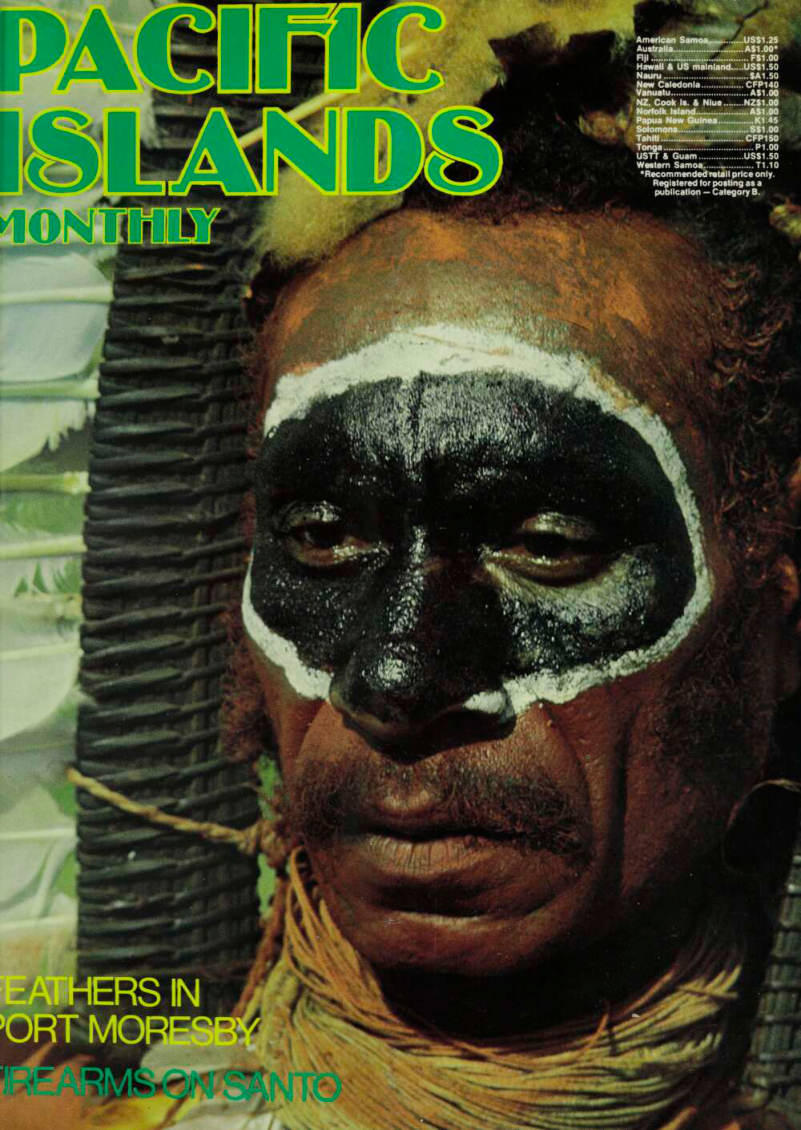
Cover: Heavily decorated Papua New Guinean at the Third South Pacific Festival of Arts, Port Moresby.
Photo: Jimmy Cornell.
Advertisements & other items, p. 2 (1 item)
Performance Par Excellence.
Akcn Pro Series.
People with astute musical tastes respond to the Akai Pro Series for any number of distinct reasons. Likely it's the impressive selection, from the awe-inspiring 72W per channel Pro-602*t0 the amply-powerful Pro-20.
And the slim, refined design of these perfectly-matched hi-fi audio components.
Along with Akai's advanced digital technology and front-panel operation ease.
Plus optional remote control and other touches of professionalism.
Yet ultimately the decision comes down to just one thing: performance.
And you'll find it —par excellence—in every system
in the Akai Pro Series.
PRO-601
PRO-30
PRO-501
PRO-20
PRO-503
li g
PRO-602
PRO-504
AKAI
AKAI ELECTRIC CO., LTD.
Tokyo, Japan
'optional remote control unit available.
New Zealand Rye Ltd., Consumer Products Sector 110 ML Eden Rd.. ML Eden, Auckland Tel: 686-437 New Caledonia Menard Pacifique s.a.r.l.
B P. H 2. Noumea Tel; 275222 Tahiti Etablissements Comimpex P.O. Box 200, Papeete Tel: 20477 New Hebrides (Islands) Burns Philp (New Hebrides) Co.. Ltd.
P.O Box 27, Port Vila, New Hebrides Islands Norfolk Island Burns Philp (Norfolk Island) Co.. Ltd P.O. Box 21. Norfolk Island Samoa Islands Burns Philp (South Sea) Co.. Ltd.
P.O. Box 129, Pago Pago, American Samoa Mariana Islands J.C. Tenorio Enterprises P.O. Box 137, Saipan Tel: 6444/8 Solomon Islands Security Electrical Co., Ltd.
P.O. Box 174, Honiara Tel: 881 Cook Islands JPS Enterprises Ltd.
P.O. Box 15, Rarotonga Tel 2150, 2176 For more information, please send this coupon to our distributor in your country or to AKAI ELECTRIC CO . LTOT 12-14. 2-Chome, Higashi-Kojiya, Ohta-ku. Tokyo, Japan i
Pacific Islands Monthly
Vol. 51 No. 9
September 1980
[Usps 952480]
Representatives
AUSTRALIA; Dl»trlbutlon: NSW & ACT: Allan Rodney Wright (Circulation) Pty Ltd, PO Box 907, Darlinghurst, NSW 2010; Elsewhere: Gordon & Gotch (A/asia) Ltd, Box 40, PO, Rosebeiy, NSW 2018. Advertising Melbourne - Ray Brown Pty Ltd, 614 Queensberry St, North Melbourne 3051, telephone 329 8522, telex 3171 7; Brisbane - D.
Wood, Anday Agency, Box 1918, GPO, Brisbane 4001, tele phone 44 3485, 44 1546, Adelaide Hastwell Media, PO Box 30, Glen Osmond, SA 5064, 233 Glen Osmond Rd, Frewville, SA 5063, telephone 79 1869 Perth - Adrep, 62 Wickham St., East Perth, WA 6000, telephone 325 6395 FIJI; Distribution and subscriptions Desai Bookshops, PO Box 160, Suva, Fiji, telephone Suva 23036 Advertising Fiji Times & Herald Ltd, 20 Gordon St, Suva, telephone 312 111, telex FJ2124.
FRENCH POLYNESIA: Distribution Hachette Pacifique, 10 Ave Bruat Papeete, telephone 25610.
HAWAII, UNITED STATES: Distribution PIM, Hawaii, PO Box 22250 Honolulu, Hawaii 96822 Advertising Roger Brookes, PO Box 10217, Honolulu, Hawaii 96816, telephone 808 536 1784 MICRONESIA; Advertising Roger Brookes, PO Box 10217, Honolulu, Hawaii 96816.
JAPAN: Advertising and subscriptions - Universal Media Corporation, CPO Box 46, Tokyo, telephone 666 3036.
NEW CALEDONIA: Distribution Depot Centre de Presse Michel Pentecost, CBP2, Noumea, telephone 27 2434, 27 4729.
NEW ZEALAND: Distribution Gordon & Gotch, PO Box 584, 2 Carr Road Mt Roskill, Auckland 4. Advertising - International Media Representatives Ltd, PO Box 2313, Auckland, telephone 795 487; 493 389, cables Intereps, Auckland Subscriptions Ross Haines & Son Ltd, PO Box 1289, Auckland, telephone 769 042.
PAPUA NEW GUINEA: Distribution - Gordon & Gotch, PO Box 3395, Port Moresby, telephone 254551, 254855.
Advertising - PNG Post-Courier, PO Box 85, Port Moresby, telephone 21 2577.
UNITED KINGDOM: The Herald & Weekly Times Ltd, 8-10 Clifford’s Inn, Fetter Lane, London EC4A IBU, telephone 01 831 6041, telex London 21989.
UNITED STATES MAINLAND: Advertising - Joshua B Powers Jr, Powers International Inc., 551 Fifth Ave New York, New York 100 017, telephone 867 9580, telex 236514 Subscriptions - PIM, Hawaii, 2812 Kahawai St, Honolulu, Hawaii 96822.
Subscriptions
PIM is airfreighted to most subscribers and agents in the Pacific Islands and the United States, but not the UK or the Continent.
Elsewhere; SAI6 Payment by personal cheque is accepted in Australian, US, New Zealand. UK and Fiji currency. For other remittances please obtain a bank draft in Australian dollars made payable to the ANZ Banking Group, 88 Wentworth Avenue, Sydney Australia "’ublished monthly by Pacific Publications (Aust.) Pty Ltd and printed in Australia by Paramac, Alexandria, NSW Aus rahan cover price is recommended retail only. Registered it the GPO Sydney for transmission by post as a publication - category B Second class postage paid at Honolulu, Hawaii Copyright © 1978 Pacific Publications (Aust/) Ptv
Ltd.
Postmaster Honolulu: Send address changes to PIM Hawaii, PO Box 22250, Honolulu Hawaii 96822
Aust.
Other American Samoa $13 $US16 Australia $12 Canada $14 $US18 Cook Islands $13 Fiji $12 $F 12 French Polynesia $14
Cfp 1700
Guam $13 $US16 Hawaii $13 $US16 Japan $16 Y4500 Kiribati $13 Micronesia $13 $US16 Nauru $18 New Caledonia $14
Cfp 1700
Vanuatu $13 New Zealand $12 $NZ13.50 Niue $13 Norfolk Island $12 Northern Marianas $13 $US16 Papua New Guinea $13 K12 Solomon Islands $13 Tonga $13 Tuvalu $13 United Kingdom $15 10 US Mainland $14 $US18 Western Samoa $13
This Month’s Features
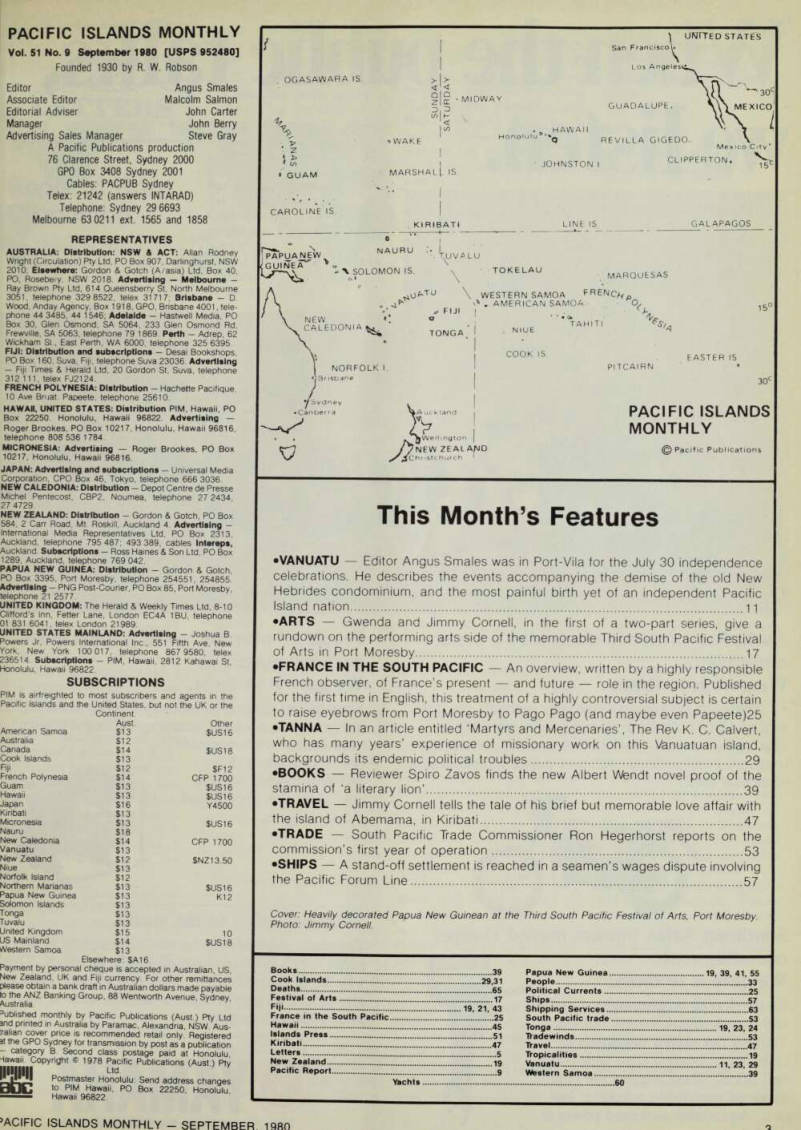
•VANUATU Editor Angus Smales was in Port-Vila for the July 30 independence celebrations. He describes the events accompanying the demise of the old New Hebrides condominium, and the most painful birth yet of an independent Pacific Island nation 11 •ARTS Gwenda and Jimmy Cornell, in the first of a two-part series, give a rundown on the performing arts side of the memorable Third South Pacific Festival of Arts in Port Moresby 17 •FRANCE IN THE SOUTH PACIFIC An overview, written by a highly responsible French observer, of France’s present and future role in the region. Published for the first time in English, this treatment of a highly controversial subject is certain to raise eyebrows from Port Moresby to Pago Pago (and maybe even Papeete)2s •TANNA In an article entitled ‘Martyrs and Mercenaries’, The Rev K. C. Calvert, who has many years’ experience of missionary work on this Vanuatuan island, backgrounds its endemic political troubles 29 •BOOKS Reviewer Spiro Zavos finds the new Albert Wendt novel proof of the stamina of ‘a literary lion’ 39 •TRAVEL Jimmy Cornell tells the tale of his brief but memorable love affair with the island of Abemama, in Kiribati 47 •TRADE South Pacific Trade Commissioner Ron Hegerhorst reports on the commission’s first year of operation 53 •SHIPS A stand-off settlement is reached in a seamen’s wages dispute involving the Pacific Forum Line 57
Books 39 Cook Islands 29,31 Deaths 65 Festival of Arts 17 P'ii 19, 21, 43 France in the South Pacific 25 Hawaii Islands Press 51
Kiribati ..JJL..47
Letters New Zealand 19 Pacific Report ...9
Papua New Guinea 19, 39, 41, 55 People 33 Political Currents 25 Ships 57 Shipping Services 63 South Pacific trade S 3 Tonga 19, 23, 24 Ttadewinds 53 ITavel 47 Tropicalities 19 Vanuatu 11, 23, 29 Western Samoa 39
Yachts . 60
Advertisements & other items, pp. 3-4 (2 items)
3
’ACIFIC ISLANDS MONTHLY - SEPTEMBER IQRf)
Founded 1930 by R. W. Robson Editor Angus Smales Associate Editor Malcolm Salmon Editorial Adviser John Carter Manager John Berry Advertising Sales Manager Steve Gray A Pacific Publications production 76 Clarence Street, Sydney 2000 GPO Box 3408 Sydney 2001 Cables: PACPUB Sydney Telex: 21242 (answers INTARAD) Telephone; Sydney 29 6693 Melbourne 63 0211 ext. 1565 and 1858
When tiie public talks,
we listen.
r Jm!
'•c 4 \L i r- . mm Australian stockmen demanded a better range bike.
We gave it to them.
To cope with the rugged conditions outback, the heat, dust and other demands that can take years off a bike’s life, Yamaha developed the AGI7S, one of the toughest, best handling and most powerful agricultural bikes ever built.
People all over the world wanted quiet,
portable power.
We gave it to them.
Yamaha has applied its industry-leading small engine technology to portable generators, filling a growing need for low-cost, portable power generators. Five different models are now available, with 2-cycle and 4-cycle engines.
Southeast Asian boaters needed cheaper
operating costs.
We gave it to them.
By developing a lightweight, simple and long-lasting kerosene outboard, Yamaha has helped thousands of commercial boaters cope with rising fuel prices. These engines are now exported worldwide, wherever low cost, dependable outboard power is w»m Yamaha listens to the world.
Yamaha’s worlwide service and information network keeps it ears open to changing public demands. That’s why we’re often the first to respond to user needs and always able to give you just what you want at the price you want to pay.
YAMAHA
YAMAHA MOTOR CO.. LTD.
Letters
Reply to Ron Crocombe
Ron Crocombe’s review of my Race, Class, and Rebellion in the South Pacific (PIM June pp!3-15) deliberately misrep resents both the contents and the argument of the book. Let me just mention a few instances.
Dr Crocombe correctly points out that the Panguna Mungkas Association, as de scribed in my book, was founded on the basis of ethnic exclusiveness. However, he mistakenly asserts that ‘most readers will interpret from his (my) wording that it was vis-a
vis Europeans . ..’ This entirely
overlooks the distinction made throughout the book between race, class, and ethnicity, i.e., relations between whites and non-whites, between members of distinct economic entities, and between members of non
white populations respectively.
It should be clear to any reader of the book that the Panguna Mungkas Association, which I helped create, was an ethnic as sociation.
Furthermore, Dr Cro combe’s description of the Bougainville situation is inac curate, and he ignores my cen tral argument, namely that
explanations of complex phen
omena such as the Bougainville strike require attention to a great variety of causes, some of which are described in the book.
He justifies his criticisms by quoting me out of context, and complains of errors without specifying details. This is not
surprising because this utterly
inept review is solely an attempt, for reasons best known to the reviewer, to charge me with some ulterior motive for writing this book.
Thus, the review is filled with
such phrases as ‘convey an im
pression’, ‘a reader is left with
the impression’, ‘Dr Mamak
implies,’ ‘conveying the same
image’, ‘understates’, ‘played
down’, ‘a diversionary tactic to imply’, and so on.
Almost the entire review is an attack on my view of re bellion. However, Dr Ahmed Ali, the book’s co-author, is praised for providing a much more accurate description of the term on the last page. With out checking his facts Dr Crocombe has made a tactical error here. I wrote that page, not Dr Ali.
Alexander Mamak
San Francisco California USA
Tuvalu: Nine isles,
not eight
Whilst the government of Tuvalu is delighted that you should have seen fit to publish a feature on the attractions of its islands (PIM Jul p 29), it is a little concerned that, due mainly to the passage of time, any would-be tourist might be misled by certain inac curacies.
Dr Weinstein made his visit in December 1978. One thing which has certainly not changed since then is the fact
that, despite the country’s
name, there are nine islands, not eight. Most people tend to overlook the smallest, Niulakita, which has now been permanenty inhabited for many years and on which only this month (July) a primary school was opened.
The rates at the Vaiaku Lagi Hotel are due to be increased from September this year and will then range from $A 12.20 for a room, plus a further SAIS per day for meals. There are three other licensed premises on Funafuti, but apart from Niutao, Vaitupu and Nukufe tau all the ‘outer’ islands are
‘dry’.
The last of the phosphate workers from Banaba were repatriated at the beginning of this year. There are no plans for a local fish cannery. The government has, however, re
cently concluded a licensing
agreement with South Korea and hopes to conclude similar agreements with the Taiwanese
and Japanese.
Communicatons both in
ternally and externally have
improved considerably during
the past few months. There is
currently a thrice-weekly air
service to Suva and a weekly service to Tarawa. On May 21 the internal air service started and now connects Nanumea, Nui, Vaitupu, Nukufetau and Nukulaelae with Funafuti. Its capacity, however, is very lim ited and any intending tourist would need to make a booking well in advance.
Apart from one or two other minor inaccuracies Dr Wein stein has certainly managed to capture something of the at mosphere of the islands. Those who do manage to venture this far can be certain of a visit they will never forget. No visas are currently required, but a visitor must be in possession of a valid passport and an onward or return ticket. He or she will be permitted to stay for a maxi mum of four months.
I. Ionatana
(Secretary to Government) Funafuti Tuvalu
PNG forces for
Hebrides?
So Papua New Guinea, hardly able to stand on its own wobbly legs, and with its own daily media filled with Lawlessness, Rape and Murder in capital letters, is thinking of sending its
Australian-equipped military
forces to the New Hebrides to support Father Lini and enforce ‘independence’, ‘free dom’ and ‘democracy’ with gun barrels.
Presumably, the Australian Ml6s and Bofors will have a fair chance against Stevens’ bow-and-arrow forces, and with Australian Prime Minister Fraser himself in command of the situation, ‘independence’ and ‘democracy’ a la Pol Pot, Timor and Irian Jaya will be established in the New Hebrides.
What is certain is that any blood spilt in the process of
implementing ‘independence’
and ‘democracy’ in the New Hebrides will be added to the historical account of Australia, not PNG.
So far, any Australian par
ticipation in bringing freedom,
democracy and independence
to others, from Vietnam, Cam bodia, to Timor, Irian Jaya and Zimbabwe, has only resulted in mass atrocities and racial disas ters. Let us hope that the New
Hebrides will be the exception but all indications point in the direction that it won’t.
Manfred Eiserman
Cairns Qld Australia
PIM infiltrated
by anti-Semite?
I thoroughly enjoy my monthly
encounters with PIM, and read each copy from cover to cover.
Isolated as I am here on the North Atlantic coast of Canada, I find it refreshing and informative to receive monthly news from my adopted area of the world. However, I must
take exception with something
that appeared in a recent issue of PIM. I refer to the article ‘New Hebrides: Whether Pea cock or Phoenix, a bird of ill omen . . .’ (PIM Jun pl 8).
The article itself is informa
tive, and provides important
background information for the occasional news reports in Canada about the recent prob lems on Santo and Tanna.
However, buried in the heart of an article on the South Pa cific I found myself face-to face with a particular form of nastiness and hatred out of place in the Pacific Islands: insidious and invidious anti- Semitism. I may be reading too much into the author’s style but of the five named principals of the Phoenix Foundation, we are told the religious/ethnic origins of just one; Michael Oliver, of Lithuanian Jewish origin. What about the Toots’ of Hospers, Doom, and the others?
If that doesn’t have any bear ing on the foundation, then why should the origins of Oliver? What is to be gained from this priceless bit of infor mation, other than the insin uation that somehow his Jewishness has something to do with the Phoenix Foun dation’s reprehensible activites?
By extrapolation, we can con clude that all Jews in the South Pacific are involved in evil machinations.
I am not saying that this was intended by the author. I am simply telling you how anti- Semitism works, and how the article appears to the mind of the anti-Semite. Recent his tory, and even the events of today, have taught me that
much. Now we are confronted with the ludicrous implication ‘Jews are responsible for the trouble in the New Hebrides’.
Nonsense! Nazism was nourished by, and flourished in an atmosphere of such inane slander and innuendo, and look at the results.
With all the real problems in the Pacific, must we raise the spectre of something so warped and ugly? It will only divert our attention away from the sol utions that will make the Pa cific region a better place for all to live.
(Dr) M. C. Zelenietz
Halifax Nova Scotia Canada • The comment on Michael Oliver's religious/ethnic back ground was made solely to ex plain in part why he spent time in a nazi concentration camp in World War 11. Editor.
A representative
NZ sample?
Dr Stephen Hoadley, Associate
Professor of Political Studies at the University of Auckland (PIM Jun p 39) found that 175 of 251 people in the Eden elec toral district of New Zealand believed that their country should give more aid to the
developing world.
As the sample is taken from one particular area, and rep resents about 0.006% of the total production of New Zea land, the question is: how valid is this result country-wide?
Mua Wilson
London UK
Authorship of
Samoa book
Of course Sir Guy Powles Aug p 37) is correct in pointing out that the authorship of the book History of Samoa was wrongly attributed to K. R.
Lambie. Notwithstanding that
the publisher’s correction slip
referred to by Sir Guy was not in the copy I received, this was realised, and, by quoting Lam bie’s own words as did Sir Guy I thought that my re view (PIM May p 45) had made it quite clear that it was, in fact, the work of the late
Father Fred Henry of Tutuila, In respect of the later, aborted. Outline of Samoan History , Sir Guy takes me to task for my use of the word ‘collaboration’. Since it was Lambie’s idea to produce such a book for use in schools, that it was commissioned by him, produced under the aegis of his (Education) Department, and
presented carrying his preface,
it seemed to me that by writing the text at his request, Sylvia Masterman ‘collaborated’ in Lambie’s project to the highest
degree. However ...
(Dr) Leonard
Goodman
Waverton NSW Australia
‘Stop blaming
others!’
I’m probably wasting my time, but please let me reply to the letter by Otto M. Nikatel (PIM Jul p 6) which itself dealt with my earlier letter (PIM May p 6).
When will ‘independent Papua New Guineans’ stop searching for excuses and blaming others for their own laziness and incompetence?
I suppose, Otto Nikatel, that your father spent big money on your education. But instead of using your education to the nation’s advantage, you re turned to your village, Womsis, where nothing has changed in the last 100 years, in spite of independence, and women have to do all the house and garden work, while you and your Wantoks sit on your fat behinds and grumble and rattle about white colonialists and
Indonesian expansionists.
You do not have to remind me, Otto Nikatel, that I am one of those ‘political refugees’. But I am not a ‘political refugee’ from Australian or Western ‘colonialism’, or Indonesian ‘expansionism’. I am a refugee from Papua New Guinean male chauvinism, cowardice and incompetence. I am happy to have escaped a society which was shameless enough to betray its own West Papuan brothers to the benefit of
foreign exploiters.
I am only a Melanesian fe male, but I am sick and tired of reading paternalistic contri
butions from our former col onial administrators who say they feel so sorry for us poor Melanesians, just as I am sick and tired of Melanesian males
constantly accusing others for
their own incompetence.
Let us accept the facts for what they are and not hide from them, or blame others.
Dorothy Wakau
Cairns Qld Australia
More on John
Lester Chipper
I read with interest and not a
little nostalgia the obituary
(PIM Jun p 97) of John Lester Chipper, late of Rabaul, and would comment that the item was fair and accurate, as far as I could discern.
However, on behalf of those of us in Rabaul concerned with education, I would like to expand the author’s remarks apropos Mr Chipper’s civic in volvement. Mr Chipper was chairman of the governing council of this college, as he was of the town’s technical college. In addition, he was chairman of the Rabaul Provincial High School’s board of governors.
Working quietly and unos
tentatiously, yet with vigour
and no concern for those whose corns were trodden upon, he constantly endeavoured to im prove the lot, in an educational sense, of hundreds of young Papua New Guineans, many of whom would never have heard of him.
Controversial? Yes, and out wardly arrogant too, but there is no doubt that he had a great affection for PNG, and that this manifested itself in large measure in his involvement in education in East New Bri tain.
B. T. Ford
Principal
Rabaul Secretarial College Rabaul Papua New Guinea
Missing ANGAU
records During World War II Australia instituted the Papua New Guinea Loyal Service Medal as an award to indigenous people who served the Allies beyond the norm. The medal was in sil
ver and hung by a 30-inch chain around the neck. One side shows the Australian coat of arms whilst the other has the legend ‘For Loyal Service’ and a punched number. The first medals were presented at Kokoda in late 1942 and the last in 1946. The presentation was usually made by field offi cers of ANGAU, two of whom state that they recorded the name of recipient and the num ber on the medal he was awarded. This documentation was then sent to ANGAU
Headquarters.
The Australian archives and Central Army Records have lists of the recipients of this medal. But neither authority has the number of the medal
received against the recipient’s
name.
Does any former ANGAU member know where these details are today, or do any have personal diaries, letters, etc, which give this information for the presentations he him self made?
The information is required to complete this section of a study on currencies, medals, badges and awards of Papua New Guinea.
(Dr) W. J. Mira
15 Harrow Rd Bexley 2207 Australia
The railway line
that ‘schnapped’
For some years now, perhaps because of my former affili ations with Western Samoa, I have been intrigued with an odd snippet of information that I read in a New Zealand news paper relating to the pre-World War I days of Western Samoa.
The subject matter concerned a
railway built by the colonising
Germans.
The story, as I recall it, stated that on the grand opening day all of Apia’s government and business community leaders were invited to travel the length of the railway line, celebrating the event as they went.
The celebrations took the form of ‘schnapps’ being con sumed with great gusto at each village that the engine and car riages stopped at, and it would appear that certain august
gentlemen, or possibly the
engine driver, not wanting an early conclusion to the festivi ties, saw to it that the frequency of the stops increased to a measurable degree. In a short time all and sundry were
thoroughly inebriated.
It appears at this stage that the train, with a little turn of speed up, ran out of line with the unsatisfactory result that the engine came off the rails and had sufficient momentum to carry it into the lagoon where it puffed its last con temptuous belch! Could it be that one of PlM’s readers could
supply an insight into that glo
riously incredible day when
perhaps the world’s shortest lived railway opened and closed for business?
Perhaps my information on the events of this pre-World War I era has been distorted with the passing of time. But I would be most interested if anyone could substantiate these facts (or otherwise), or provide a colourful detailed description of what must have been a most significant day in the colonial Pacific in the early years of this century.
Randal J. Lockie
PO Box 7186 Boroko Port Moresby Papua New Guinea From PIM to
Pif?
I’ve been a PIM reader since 1972 and I believe PIM is the only magazine in existence covering the South Pacific re
gion. Congratulations on a job
that is being well done.
Because of the obviously increasing activities in this re gion in such fields as politics, economic development, etc, may I suggest that you publish two issues per month instead of the current one? This would make your news items more up to date as well as enabling you to cover more stories.
How about it Editor?
T. J. Ravian
Madang Papua New Guinea • Thanks for the suggestion, which would certainly have the advantages you describe. But whenever we have considered such proposals in the past, we have come up against the fact
that freight charges would make it quite uneconomic. This re mains the fact. As things stand, it takes a fortnight for each issue of PIM to reach all its many destinations in the Pacific and beyond. But thanks again for the thought. Editor.
Sidney Gross
again
I would like to comment on the letter by Tuvalu Prime Minister Toaripi Lauti concerning the government’s dealings with Mr Sidney Gross and the Green Valley Acres Corporation (PIM Jun p 5).
Dealing with the latter first, the prime minister writes that it ‘is not a Government project’.
But the prime minister and his government plainly commit ted themselves on the sale of lands through such actions as the following: • They advertised over Radio Tuvalu, a government organisation, on behalf of the Green Valley Acres Corpor ation to all Island Councils that Sidney Gross’s harbingers, Pula Tokalasi O’Brien and losefa Lameko, were travelling on one voyage of the Tuvalu Govern ment vessel, Nivanga, to talk with Island Councils about the sale of lands in Green Valley, Texas. The government is widely believed to have paid the fares of the businessmen.
Concerning Sidney Gross, the following facts seem to be relevant; • The prime minister slated at the feast held in Funafuti in honour of Mr Gross’s visit that this gentleman had come to Tuvalu to prove to the people that the many rumours circulating as to the spuriousness of his dealings with Tuvalu were unfounded. • Mr Gross was accorded a reception in Funafuti at the same level of traditional enter tainment as is provided for diplomatic representatives of the rank of high commissioner and above. • The prime minister called a Cabinet meeting to allow Mr Gross to attend and discuss matters with the Cabinet con cerning Tuvalu. • The prime minister stated over Radio Tuvalu that Mr Gross was a Christian and, as a result, wanted to help Tuvalu
because he knew that Tuvalu was a Christian country.
I believe that the prime minister and his government should now work very hard to rectify the very unfortunate image of Tuvalu which they have created.
Islands Observer
(Name and address supplied) A traditional moneys club During the past two years I have been editor secretary of a club, founded in America, de voted to traditional moneys of the world. Due to locality, and availability of items and infor mation. my own interests in this field are biased mainly towards those moneys used in the Pacific region and I am in the process of forming a club, based in Australia, designed to promote the study and collecting of traditional moneys. Two 20-page journals will be issued each year with articles, news items, members’ requests, etc. Annual subscrip tion, for the Pacific region, is set at 5A2.50 (which should just cover actual costs, plus airmail postage of the journals). The adding of items to collections is up to each individual collector, but as Edi tor of the Traditional Money Association, I would appreciate receiving correspondence from persons who have first-hand knowledge in this field.
The association library con tains articles and other ma terial from many writers in cluding Quiggins, Malinowski, Firth, Mead and McCarthy but most references date to the early part of this century or before. The only major ‘cur rent’ publication on the subject we’ve been able to find is Trade and Exchange in Oceania and Australia , 1978, by Jim Specht and J. Peter White.
Over the past few years I have been fortunate in obtaining information from a very small number of corre spondents in Papua New Guinea and the New Hebrides.
What I am now hoping for is further current or moderately recent (within the last 40 years) information on the sub ject which can be recorded in the association’s journals for
the benefit and enjoyment of all interested persons.
Col Davidson
3 Mathoura Place Orange Australia 2800
Remembering the
Induna Star Concerning Mr Aplin’s letter about the Induna Star (PIM May p 7) I can provide some in formation.
As a boy living in Rabaul be fore World War II I can quite
clearly remember seeing this
vessel leaving and returning to the harbour as it went about its coastal trade.
I do not know where it went except that one of its stops was at its owner’s plantation to load copra for overseas shipment from Rabaul.
I feel sure its owner, or part owner, at that time was Cap tain Rondahl. There were two brothers of this name, Eric and Oscar, and I think it was the former who had an interest in the Star. He had a plantation on the south coast of New Bri tain.
During the volcanic eruption
in 1937 of Vulcan Island and Matupi crater on the fringes of Bismarck Bay, the Induna Star had a lucky escape from Simp son Harbour (Rabaul Har bour) when a tidal wave
following the eruption nearly
took the vessel on to dry land.
Having made its escape from Rabaul (along with the American cargo ship. Golden Bear the Star valiantly assisted the Montoro (Burns Philp line) in evacuating women and chil dren, who gathered on the north side of the Gazelle Peninsula, to Kokopo which was a considerable distance from the volcanoes. My mother, sister and I were on the Induna Star that day.
I’m sorry I cannot give very much information, but only hope that what I’ve written may fill a few gaps. In its day the Induna Star was a cut above the average ‘schooner’ engaged in the New Guinea coastal trade, and could indeed be called a ‘star’ among that
motley fleet.
‘Bob’ Clark
Strathfield NSW Australia
Advertisements & other items, p. 8 (1 item)
Pioneer launches a first
in supersonic travel
In this fast-paced world of bullet trains and Concorde jetliners, to stay in touch with your favorite stereo music you need SOUNDTREK. Pioneer’s new supersonic fleet of Multi-Mode Mobile Hi-Fi. * • For added tape-handling ease and pushbutton program selection, Pioneer offers Multi-Mode Deck design in every SOUNDTREK stereo portable. For example, * there’s Song Finder.™ With it you can skip over unwanted program material, locate and play your favorite song at the push of a button. A feature you would expect to find on a home hi-fi cassette deck. But wait till you hear the sound of our SOUNDTREK portables. When you do, you’ll know why we call them “Mobile Hi-Fi.”
Explore the outer reaches of stereo listening enjoyment with SOUNDTREK * Multi-Mode Mobile Hi-Fi from Pioneer. They’re available in six models, all featuring Pioneer performance and supersonic sound to get you off the ground. . a » u
SK-51F
CIM
* i 4 •caa;;a- -4R •••./?
SK-95F
Wa><.
PiPi
Available in November
CDpioneer
m For further information, please contact: Nauru island: Jacob Enterprises, RO. Box No, 4, Republic of Nauru Australia: Pioneer Marketing Service Pty. Ltd., RO. Box 317, Mordialloc, Victoria, 3195 Tahiti: Ets. PERFECT, B.P. 594, Papeete, Tahiti Tel; 20 407 Tel; 90-9011 Fiji Islands: Brijlal & Company, G.P.O. Box No. 362, Suva, Fiji Islands Tel: 22258 New Zealand: Monaco Electronics Ltd., 30 Pollen Street, Grey Lynn, Auckland, New Zealand Tel; (09) 762 098 Norfolk Island: Burns Philo (Norfolk Island) Ltd., Norfolk Island, South Pacific New Caledonia: Menard Freres Ville, B.P H 2 Cedex, Noumea, New Caledonia Tel: 27.52.22 . I American Samoa: Transpac Corporation. P.O, Box 1477, Pago Pago, American Samoa 96799 Tel: 633-5224 T t i Rarotonga: South Seas International Ltd., PC. Box 49, Rarotonga, Cook Islands Tel: 2327,
Pacific Report
Png Troops Back Police On Santo
Vanuatu police, backed by Papua New Guinean troops, arrested 40 people on the island of Espiritu Santo on August 19.
According to a Vanuatu Government spokesman, more than half those arrested were foreign nationals, and would be deported for their role in the Santo secession which began on May 28. Caches of arms were also seized. The government spokesman said; ‘There have been very sarcastic remarks about the Papua New Guineans, but they have done in 48 hours on Santo what the metropolitan powers have failed to do. That won’t be forgotten.’
Adding that there would be more arrests, he indicated that the rebel ‘Vemarana’ radio was still operating.
Solomon Islands Voters Tip ’Em Out
Two-thirds of the members of Solomon Islands’ former parliament lost their seats in the country’s first post independence general election on August 6. Among the losers were David Kausimae, joint leader of the People’s Alliance Party and a politician of about 15 years experience; Willy Betu, leader of the independent group, the largest in the previous parliament: and John Saunana, formerly minister for education and training.
Independents appear likely to continue to control the new parliament, since none of the three political parties former Prime Minister Peter Kenilorea’s Solomon Islands United Party, former (pre-independence) Chief Minister Solomon Mamaloni’s People’s Alliance Party, and Bartholomew Ulufa’alu’s National Democratic Party won the 20 seats necessary for a clear majority in the 38-seat parliament. Election of the prime minister was scheduled for the last week in August. The outcome appeared to depend on whether it was Mr Kenilorea or Mr Mamaloni who managed to rally support from the larger number of independents. Seats were contested by 244 candidates, the biggest field ever in Solomon Islands. There were nearly 100 000 registered voters, but only about 60 000 ballots were cast.
Japan’S N-Waste Team On Tour
A team of Japanese officials left Tokyo in August to visit Guam, Australia, New Zealand, Western Samoa, Fiji and Papua New Guinea to explain Japan’s plan to dump nuclear waste in the north-west Pacific next year. Guam and other Pacific Island authorities have called on Japan to suspend the plan to discharge up to 10 000 drums of nuclear waste into waters 6000 m deep about 960 km north of the uninhabited island of Maug.
Strontium-90 Deposits Down
Deposits of radio-active strontium-90 monitored in New Zealand and the South Pacific in 1979 were the lowest since recordings began in 1960. New Zealand’s National Radiation Laboratory measures the deposits at nine testing stations in New Zealand and the Pacific.
Cooks’ ‘Philatelic Time Bomb?’
The Cook Islands Government is sitting on ‘a philatelic time bomb’ which could blow up at any time and ‘seriously undermine the islands’ economy,’ according to an Australian publication, Stamp News. Writing in the August issue of the magazine, editor Bill Hornadge claims that the contract between the Cooks government and US businessman Finbar Kenny’s Kenny International Corporation permits the American agency to obtain any quantity of Cook Islands ‘cancelled to order’ stamps at the actual cost of printing. Estimating printing costs of stamps at about one cent a stamp, Mr Hornadge says: ‘ln the past decade the Cook Islands have issued numerous stamps with high face value of $5 and $lO all of which Mr Kenny could secure in a perfectly legal manner under his contract in a cancelled to order condition in any quantity at around a cent a piece . . . The release of large stocks of CTO material at big discounts off face will wipe out values of used (or cancelled) Cook Islands material overnight just as it has done for stamps of Ghana and other states where cheap CTO material has been released in quantity. It will also seriously affect values of mint Cook Islands material and would
almost certainly have a disastrous effect on sales of all future Cook issues . . . When the CTO material hits the market, the downturn in sales of mint Cooks stamps is likely to be dramatic, with disastrous consequences to the islands’ economy which is so dependent on it.’
‘Independence Is Anarchy’ Sanford
In an interview with the Papeete daily Ddpeche de Tahiti, Francis Sanford, vice-president of French Polynesia’s Government Council, said that the law adopted three years ago providing for his country’s internal self-government ‘had not been fully exploited’. ‘But,’ he went on, ‘this law should have been put into effect 10 years ago not only for French Polynesia but for New Caledonia and the New Hebrides as well. I’m convinced that if this had happened the New Hebrides wouldn’t be in the state it’s in today. For us, and for them, independence is anarchy.
Everyone here would be wanting power, the 3000 employees of the Atomic Testing Centre would be out of a job. Public servants would not have their splendid salaries. We’d have a flag, a national anthem, we’d speak Tahitian, but (gesturing towards the window) thousands would be marching in the Avenue Bruat demanding that we give them something to eat.’
Best Actor’ Award To Samoan
Samoan actor Uelese Pataia tied for the ‘best actor’ award at the 1980 Karlovy Vary (Czechoslovakia) film festival with American star Al Pacino. The young Samoan won the award for his role in the New Zealand film version of Albert Wendt’s novel Sons for the Return Home. Pacino appeared in a major US commercial release, And Justice for All.
Big Hashish Haul In Port Moresby
What is believed to be Papua New Guinea’s biggest seizure of illegal drugs took place in Port Moresby in August when police and Customs officials seized hashish worth an estimated SAI.3 million in a hotel raid. Two men, an Australian and a Jordanian, were arrested. A Customs official said he believed the hashish had come from Asia and was on its way to Australian and New Zealand markets. ‘There just could not be a market for it here,’ he ; said.
Fsp To Raise Funds In Australia
At an August meeting in Sydney, the Foundation for the Peoples of the South Pacific (FSP) decided to launch a public appeal in Australia for funds for programmes and projects in the South Pacific. A working group was set up by the foundation to plan the campaign, scheduled to run through the ’Bos. FSP is an international non-government organisation headquartered in New York.
Fiji Offers To Host Chogrm
Fiji has offered to host the Commonwealth Heads of Government Regional Meeting (CHOGRM) to be held in 1982.
Closer Ties For Fiji, France
Fiji’s first accredited representative to France, Satya Nandan, has presented his credentials to President Valery Giscard d’Estaing. Mr Nanan is also Fiji’s ambassador to the European Economic Community. He will continue to live in Brussels.
BIG FINE FOR ILLEGAL FISHING IN TRUK The captain and owner of a Japanese fishing vessel were fined SUS 10 000 for illegal fishing in Federated States of Micronesia waters, after a July 17 trial held in Truk. Hosei Maru 35 had entered the Truk lagoon on February 20, and stopped at Tol Island before the vessel was detained and the crew arrested by Truk police. The trial was held in the absence of the vessel’s crew.
It had left Truk after posting a S2OOO bail.
Bougainville Compensation Money Upped
A five-year agreement has been negotiated under which Bougainville Copper has substantially increased the amount of compensation paid to land owners affected by its operation. The annual compensation payment for 1980 of K 920 000 covers social and physical disturbance experienced by Papua New Guinean national land owners, compensation for loss of bush, rivers and fish, and rent for use of the 13 000 ha in the company’s special mining, tailings, and port-mine access road leases. Over 2300 cheques are being paid out this year, ranging from small
amounts to K2B 000. Most will be divided by the recipients into smaller amounts, and distributed to members of their clans or villages. More than 5000 family units should benefit.
Book Honours Vanuatu’S Freedom
Anew book of almost 300 pages, entitled simply Vanuatu, and printed in Bislama, French and English, has been released in honour of the independence of the former New Hebrides. The book has been published by the Institute of Pacific Studies, the University of the South Pacific and the South Pacific Social Sciences Association. Contributions to make the publication possible came from these bodies, the South Pacific Creative Arts Society, and Pacific Energy and Minerals Ltd, Golden, Colorado, USA. Written mainly by Vanuatuans, its 21 chapters are an invaluable source of information on the new nation.
Us-Kiribati Diplomatic Relations
The United States and Kiribati agreed in August to establish diplomatic relations at ambassadorial level. Tarawa, the island home of the Kiribati capital, was the scene of a major battle involving US forces in World War 11. Earlier in the year Kiribati had established diplomatic ties with four other non-Commonwealth countries: they were Japan, South Korea, the Netherlands, and the People’s Republic of China.
Aussie Yachts Win In Hawaii
Australian yachts made an almost clean sweep of the August Pan Am Clipper Cup ocean racing series in Hawaii. The Australian Dunhill No. 1 team of Challenge, Ragamuffin and Sweet Caroline won the international teams racing series for the King Kamahamea Trophy by a big margin. Ragamuffin, skippered by Syd Fischer, won the final race overall, the 775 nautical mile Around the State of Hawaii’ by more than three hours on corrected time. Ragamuffin also won the Pan Am Clipper gold cup for the top individual performance of the five-race series. The Australian No. 2 team of Impetuous, Moonshadow and Satin Sheets outsailed the New Zealanders and the United States Red team to improve from fifth in the team standing to second overall.
Funding Plan Agreed For Arts Festival
A meeting of the South Pacific Arts Festival Council in July discussed the funding of future festivals. It endorsed the establishment of a festival fund to be drawn from annual budgetary allocations by the South Pacific Commission and the United Nations Educational Scientific and Cultural Organisation (UNESCO), and from voluntary contributions by countries and organisations. It was agreed that the fund should be administered by the SPC, and that all funds for each festival would be given to the host country to use as it decides. The council will next meet
in 1981 in New Caledonia, host country for the fourth festival in 1984,
Marshalls’ Gift To Src
Marshall Islands’ Minister of Internal Affairs Wilfrid Kendall in August handed over his government’s first voluntary contribution to the South Pacific Commission. It was accepted in person by SPC Secretary-General Young Vivian. The minister said that the government of the Marshall Islands was most appreciative of SPC assistance and support. The two men were in Port Moresby for the Third South Pacific Festival of Arts.
Sim Damage As Reflector Crashes
Damage approaching $1 million was caused in August when the eight-tonne antenna reflector for Western Samoa’s Earth Satellite Station crashed to the ground while being lifted into position by two cranes. The boom of one of the cranes snapped at the base during the lifting operation. Funded by the European Economic Community under the Lome Convention, the earth satellite station is part of a $2 million-plus project which includes the introduction of an overseas exchange some time next year. No one was injured in the accident, although one of the crane drivers was trapped in his cabin for a time.
Power From Copra Oil?
Western Samoa’s Electric Power Corporation is experimenting with copra oil as a substitute for imported fuel. EPC’s Acting General Manager John Worrall said it is expected that the oil will yield about 10% less energy than diesel fuel.
Samoan Policeman Murdered
Western Samoan police officer Malo Samu was shot dead in August during a search for four escaped convicts inland from Faleatiu-uta. Commissioner of Police Sonny Schuster said Malo Samu was the first police officer to be killed in the line of duty in the whole history of the police administration in Samoa. A well known boxer, Malo Samu represented his country at the last South Pacific Games in Suva.
Marshalls Claiming Wake Is.
A recently published pamphlet, approved by key members of the Marshall Islands Government, clearly indicates that the Marshalls is laying claim to Enen Kio, local name for Wake Island. The two colour government-sponsored information sheet has Wake Island clearly indicated as being within the boundaries of the Marshalls, and serves as further amplification of a statement made recently in the United Nations Trusteeship Council by Marshalls Secretary for Foreign Affairs, Anton Debrum that Wake is part of the Marshalls. Deßrum’s position is contested by the United States.
The following messages from leaders of Pacific countries arrived too late for inclusion in PIM’s August 50th
anniversary issue:
Dr Tom Davis, Premier, Cook Islands: Hearty congratulations on attaining your 50th anniversary. The nations of the Pacific have been brought closer together through PIM as a vehicle of information. For us in the Cook Islands, isolated as we are vour publication has been for many years one of the main media of information. PIM has introduced not only the Cook Islands to the world but also to the otner Pacific countries. I trust that this magazine will continue to disseminate news, including news of the Cook Islands, for many years to come Kia manuia.
Prmce Tu’ipelehake, Prime Minister, Tonga: Please accept my belated but sincere congratulations on this most happy occasion of reaching your well-attained 50th anniversary.
Wishing you the very best for the future.
lan Macphee, Minister for Immigration and Ethnic Affairs, Australia: I am delighted and honoured to add a message of congratulations to the hundreds which PIM will have received on the occasion of its 50th anniversary.
I have been an avid reader and admirer of PIM for 20 years and believe that it has been a force for almost incalculable good in the Pacific. Australians pride themselves on the contribution which Radio Australia has made in the Pacific and Asia but the contribution of PIM is in many ways more significant. venture to suggest that without PIM the various islands of the Pacific would still feel that they were totally isolated from each other. I believe that PIM has laid the foundations for a feeling of fraternity and a common sense of purpose for the nations of the South Pacific and it provides a most thoughtful avenue for exchanging information and ideas.
I am confident that PIM will continue to fulfil that role and that many of its articles will acquire an even greater depth, while retaining their breadth of perspective, and capacity to entertain.
I wish PIM, and in particular, my old friend Stuart Inder, very great success in future. I have no doubt that PIM’s next 50 years will be as distinguished in its achievements as have been the last 50 years.
Nationhood comes to troubled Vanuatu

No, No, Sir - It
Goes That Way
This Way, M’Sieu,
It Goes This Way
Vanuatu, 74 years a British-French condominium, became independent in July. But it entered nationhood with a secession rebellion on one of its biggest islands, Esplritu Santo, and had to call in troops from Papua New Guinea to deal with the continuing situation. Britain and France, with policies which sometimes conflicted, came under criticism for failing to end the rebellion before they left.
ANGUS SMALES, who was in Vanuatu for independence, writes this report:
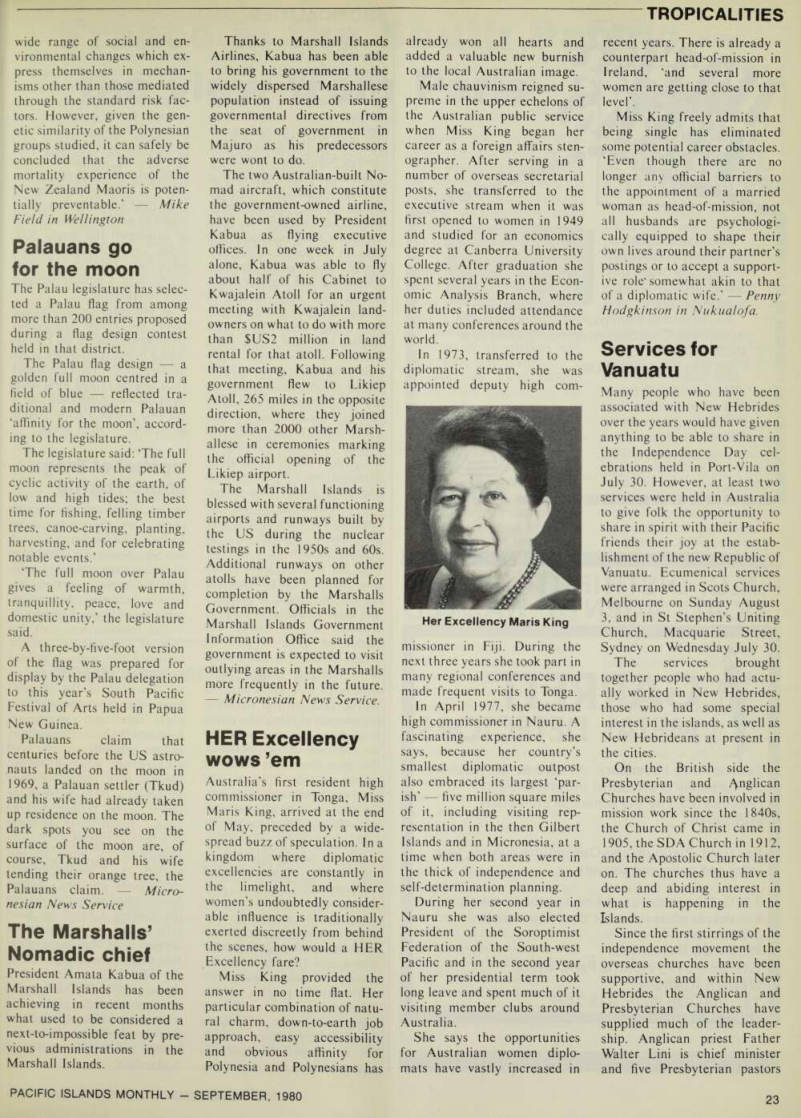
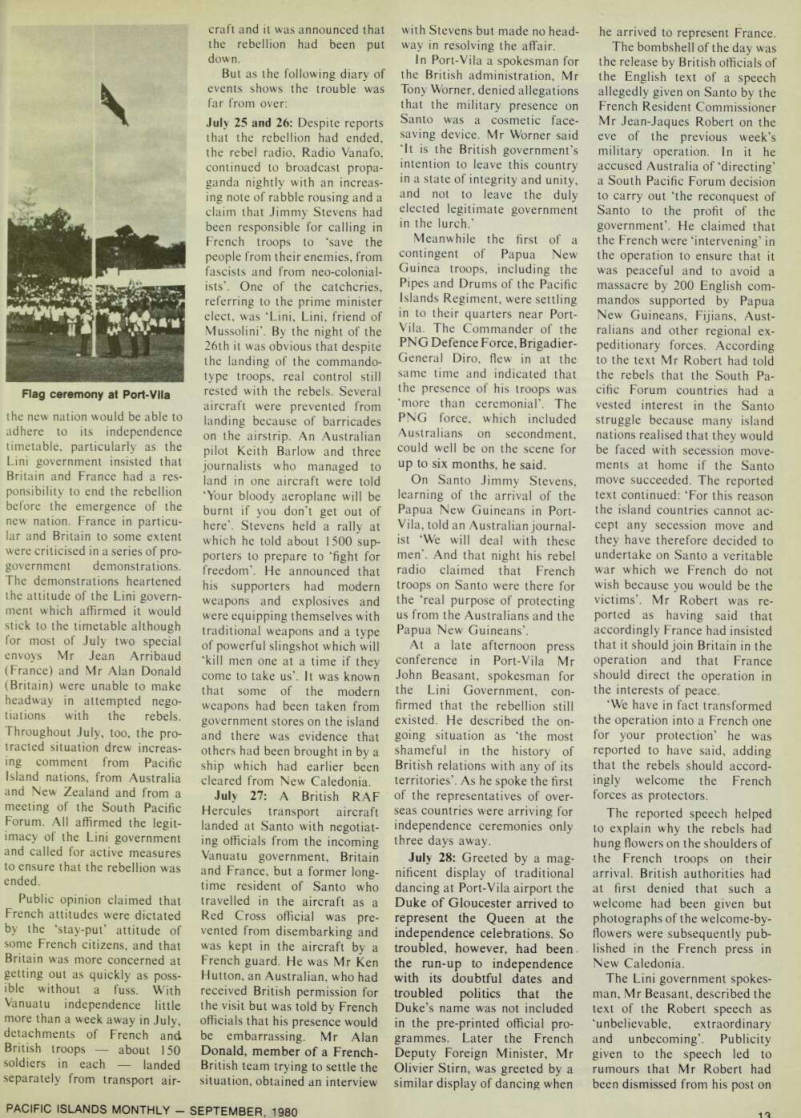
Conch shells wailed eerie tra ditional music as the red, green, gold and black flag of the new Pacific nation of Vanuatu, for merly New Hebrides, was raised at Independence cer emonies on July 30.
It was an impressive cer emony at newly-named Inde pendence Park in Port-Vila. In brilliant sunshine it was watched by a crowd of 8000, there were military bands and ceremonial troops from seven nations, ships dressed in the harbour gave a gun salute and aircraft from Britain, France, Australia and Papua New Guinea provided a low-level fly past. At night there were danc ing, singing and string band concerts on the harbourfront, and a fireworks display spread the colours of the new flag across the town and harbour.
The Duke of Gloucester rep resented Britain and the Deputy Foreign Minister, Mr Olivier Stirn, represented I nance at the ceremonies wliich marked the end of 74 vears of u ni British and French ruie. i'u .. countries offered continu ing air! to the new nation, and Prime Minister Walter Lini confirmed that Vanuatu would retain government to govern ment finks with the former administering powers.
The joint background led to a unique arrangement in which Vanuatu will hold simultaneous membership of the Common
wealth of Nations and of the Association de Co-operation Culturelle et Technique.
But while the bands played in Port-Villa, while two Dakota transport aircraft of the Papua New Guinea Defence Force peeled off at near treelop height over Independence Park, and while delegations from 35 countries were paying their respects to the newly-born nation, a different story was unfolding on the island of Santo. The rebels there had warned they would oppose any attempt to raise the new flag on Santo.
Led by the secessionist Jimmy Stephens, a mixed-race man who has styled himself President Moly, they knocked down a number of flagpoles to prevent the new flag from being raised. But at Santo Town or what the French called Luganville in one of the many nuances of difference which had marked the joint adminis tration he rebels were stopped. A detachment of French paratroopers with auto matic lies guarded the liag poie and the flag was raised in a local ceremony. The guard re mained on duly to stop the hauling down of the flag The active rebellion on Santo goes back to last year when Stephens, unashamedly backed by the US-based Phoenix Foun dation of right-wing investors and new nation idealists, named
the island the Republic of Vemarana and began a cam paign for secession. He received some support from French descended settlers on the island who were concerned for their future when New Hebrides as a a hoie reached independence.
Splits between British inliuenced and French mliuenced sections 01 the popu lation became a significant issue in events, and the in coming democratically elected nation*?* government of Father Walter Lin* was distinctly pro- British.
Late last year unrest forced the evacuation of large num bers of islanders who opposed the secession campaign, but the
crisis came in May this year when the rebels look over Santo. Government officers were forced to leave the island and boats look off more islanders who feared for their safety. Some of the refugees were physically assaulted by the rebels. Using equipment u.ppiied trom private sources in USA the rebels set up a propa ganda radio. Radio Vanafo, and closed the airstrip. Britain and France each flew 300 troops to the New Hebrides, but the Lini government became in cieasingly critical of what it saw as lack of any conceded effort to pul down the rebellion.
The turn of events threw increasing doubt on whether
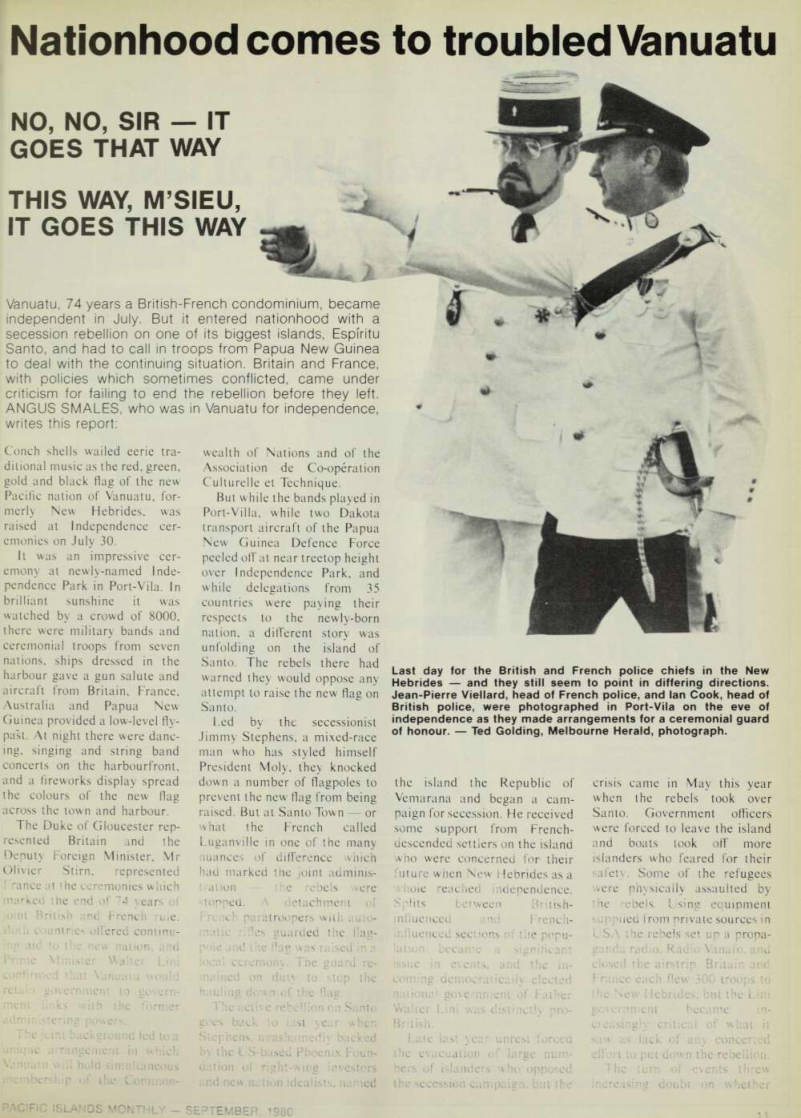
Last day for the British and French police chiefs in the New Hebrides - and they still seem to point in differing directions.
Jean-Pierre Viellard, head of French police, and lan Cook, head of British police, were photographed in Port-Vila on the eve of independence as they made arrangements for a ceremonial guard of honour. Ted Golding, Melbourne Herald, photograph.
the new nation would be able to adhere to its independence timetable, particularly as the Lini government insisted that Britain and France had a res ponsibility to end the rebellion before the emergence of the new nation. France in particu lar and Britain to some extent were criticised in a series of pro government demonstrations.
The demonstrations heartened the attitude of the Lini govern ment which affirmed it would stick to the timetable although for most of July two special envoys Mr Jean Arribaud (France) and Mr Alan Donald (Britain) were unable to make headway in attempted nego tiations with the rebels.
Throughout July, too, the pro tracted situation drew increas ing comment from Pacific Island nations, from Australia and New Zealand and from a meeting of the South Pacific Forum. All affirmed the legit imacy of the Lini government and called for active measures to ensure that the rebellion was ended.
Public opinion claimed that French attitudes were dictated by the ‘stay-put’ attitude of some French citizens, and that Britain was more concerned at getting out as quickly as poss ible without a fuss. With Vanuatu independence little more than a week away in July, detachments of French and British troops about 150 soldiers in each landed separately from transport air
craft and it was announced that the rebellion had been put down.
But as the following diary of events shows the trouble was far from over: July 25 and 26: Despite reports that the rebellion had ended, the rebel radio, Radio Vanafo, continued to broadcast propa ganda nightly with an increas ing note of rabble rousing and a claim that Jimmy Stevens had been responsible for calling in French troops to ‘save the people from their enemies, from fascists and from neo-colonial ists’. One of the catchcries, referring to the prime minister elect, was ‘Lini, Lini, friend of Mussolini'. By the night of the 26th it was obvious that despite the landing of the commando type troops, real control still rested with the rebels. Several aircraft were prevented from landing because of barricades on the airstrip. An Australian pilot Keith Barlow and three journalists who managed to land in one aircraft were told ‘Your bloody aeroplane will be burnt if you don’t get out of here’. Stevens held a rally at which he told about 1500 sup porters to prepare to ‘fight for freedom’. He announced that his supporters had modern weapons and explosives and were equipping themselves with traditional weapons and a type of powerful slingshot which will ‘kill men one at a time if they come to take us’. It was known that some of the modern weapons had been taken from government stores on the island and there was evidence that others had been brought in by a ship which had earlier been cleared from New Caledonia.
July 27: A British RAF Hercules transport aircraft landed at Santo with negotiat ing officials from the incoming Vanuatu government, Britain and France, but a former long time resident of Santo who travelled in the aircraft as a Red Cross official was pre vented from disembarking and was kept in the aircraft by a French guard. He was Mr Ken Hutton, an Australian, who had received British permission for the visit but was told by French officials that his presence would be embarrassing. Mr Alan Donald, member of a French- British team trying to settle the situation, obtained an interview
with Stevens but made no head way in resolving the affair.
In Port-Vila a spokesman for the British administration, Mr Tony Worner, denied allegations that the military presence on Santo was a cosmetic face saving device. Mr Worner said ‘lt is the British government’s intention to leave this country in a state of integrity and unity, and not to leave the duly elected legitimate government in the lurch.’
Meanwhile the first of a contingent of Papua New Guinea troops, including the Pipes and Drums of the Pacific Islands Regiment, were settling in to their quarters near Port- Vila. The Commander of the PNG Defence Force, Brigadier- General Dim, flew in at the same time and indicated that the presence of his troops was ‘more than ceremonial’. The PNG force, which included Australians on secondment, could well be on the scene for up to six months, he said.
On Santo Jimmy Stevens, learning of the arrival of the Papua New Guineans in Port- Vila, told an Australian journal ist ‘We will deal with these men’. And that night his rebel radio claimed that French troops on Santo were there for the Teal purpose of protecting us from the Australians and the Papua New Guineans’.
At a late afternoon press conference in Port-Vila Mr John Beasant, spokesman for the Lini Government, con firmed that the rebellion still existed. He described the on going situation as ‘the most shameful in the history of British relations with any of its territories’. As he spoke the first of the representatives of over seas countries were arriving for independence ceremonies only three days away.
July 28: Greeted by a mag nificent display of traditional dancing at Port-Vila airport the Duke of Gloucester arrived to represent the Queen at the independence celebrations. So troubled, however, had been the run-up to independence with its doubtful dates and troubled politics that the Duke’s name was not included in the pre-printed official pro grammes. Later the French Deputy Foreign Minister, Mr Olivier Stirn, was greeted by a similar display of dancing when
he arrived to represent France.
The bombshell of the day was the release by British officials of the English text of a speech allegedly given on Santo by the French Resident Commissioner Mr Jean-Jaques Robert on the eve of the previous week’s military operation. In it he accused Australia of ‘directing’ a South Pacific Forum decision to carry out ‘the reconquest of Santo to the profit of the government’. He claimed that the French were ‘intervening’ in the operation to ensure that it was peaceful and to avoid a massacre by 200 English com mandos supported by Papua New Guineans, Fijians, Aust ralians and other regional ex peditionary forces. According to the text Mr Robert had told the rebels that the South Pa cific Forum countries had a vested interest in the Santo struggle because many island nations realised that they would be faced with secession move ments at home if the Santo move succeeded. The reported text continued: ‘For this reason the island countries cannot ac cept any secession move and they have therefore decided to undertake on Santo a veritable war which we French do not wish because you would be the victims’. Mr Robert was re ported as having said that accordingly France had insisted that it should join Britain in the operation and that France should direct the operation in the interests of peace. ‘We have in fact transformed the operation into a French one for your protection’ he was reported to have said, adding that the rebels should accord ingly welcome the French forces as protectors.
The reported speech helped to explain why the rebels had hung flowers on the shoulders of the French troops on their arrival. British authorities had at first denied that such a welcome had been given but photographs of the welcome-by flowers were subsequently pub lished in the French press in New Caledonia.
The Lini government spokes man, Mr Beasant, described the text of the Robert speech as ‘unbelievable, extraordinary and unbecoming’. Publicity given to the speech led to rumours that Mr Robert had been dismissed from his post on
Flag ceremony at Port-Vila
the eve of independence, but the reports were unfounded. Mr Robert himself, questioned by journalists, neither denied nor confirmed the accuracy of his reported remarks.
Meanwhile the Lini govern ment was adamant that the rebellion had to be cleared up by independence although inde pendence was a mere two days away. The situation was more than disappointing, the rebels were criminals, and Britain and France had a responsibility to end the uprising, Mr Beasant said. He continued ‘These rebels are criminals. You can’t talk softly to criminals for long.
They have broken into build ings, they have stolen explosives and weapons, they have held hostages and they have made 1 500 people homeless. Despite the enormous pressures pul upon it our government will not abandon its people who have decided their future by demo cratic processes. This means we cannot allow a rebel group to seize power unlawfully. It is not in our interests or in the inter ests of the region. The govern ment believes it is necessary to act, and it is necessary for France and Britain to act, to re establish legitimate authority by July 30 despite the threats and intimidation of past weeks.’
Late in the day the govern ment announced it was recall ing all government officials who had been forced out of Santo and that it would send the officials back to Santo by char tered aircraft the following morning to re-establish normal services and authority.
July 29: Despite the strong line expressed by the govern ment the chartered aircraft flight of officials did not eventu ate, the rebels continued to control Santo, and the propa ganda broadcasts from Radio Vanafo continued. Rebel groups also moved round the island knocking down flagpoles which had been prepared to raise the new flag of Vanuatu. French and British troops on the island maintained routine patrols and concentrated on protecting the main flagpole at Santo Town.
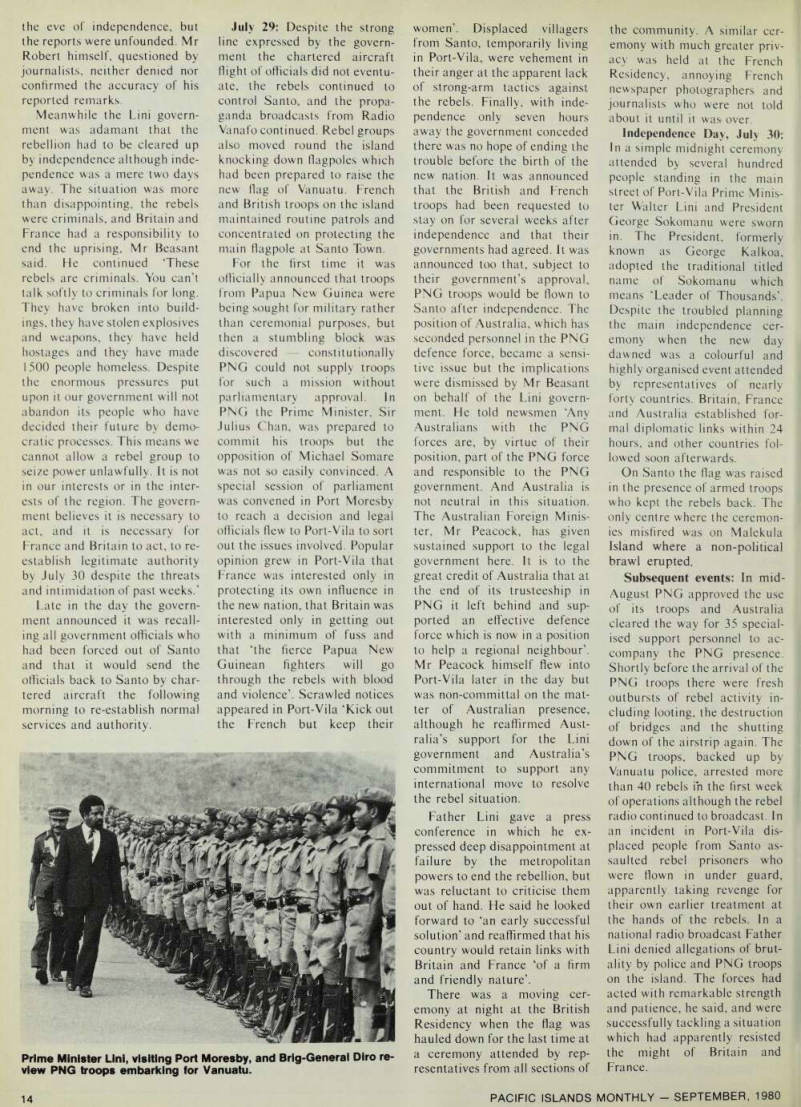
For the first time it was officially announced that troops from Papua New Guinea were being sought for military rather than ceremonial purposes, but then a stumbling block was discovered constitutionally PNG could not supply troops for such a mission without parliamentary approval. In PNG the Prime Minister, Sir Julius Chan, was prepared to commit his troops but the opposition of Michael Somare was not so easily convinced. A special session of parliament was convened in Port Moresby to reach a decision and legal officials flew to Port-Vila to sort out the issues involved. Popular opinion grew in Port-Vila that France was interested only in protecting its own influence in the new nation, that Britain was interested only in getting out with a minimum of fuss and that ‘the fierce Papua New Guinean fighters will go through the rebels with blood and violence’. Scrawled notices appeared in Port-Vila ‘Kick out the French but keep their
women’. Displaced villagers from Santo, temporarily living in Port-Vila, were vehement in their anger at the apparent lack of strong-arm tactics against the rebels. Finally, with inde pendence only seven hours away the government conceded there was no hope of ending the trouble before the birth of the new nation. It was announced that the British and French troops had been requested to stay on for several weeks after independence and that their governments had agreed. It was announced too that, subject to their government’s approval, PNG troops would be flown to Santo after independence. The position of Australia, which has seconded personnel in the PNG defence force, became a sensi tive issue but the implications were dismissed by Mr Beasant on behalf of the Lini govern ment. He told newsmen ‘Any Australians with the PNG forces are, by virtue of their position, part of the PNG force and responsible to the PNG government. And Australia is not neutral in this situation.
The Australian Foreign Minis ter, Mr Peacock, has given sustained support to the legal government here. It is to the great credit of Australia that at the end of its trusteeship in PNG it left behind and sup ported an effective defence force which is now in a position to help a regional neighbour’.
Mr Peacock himself flew into Port-Vila later in the day but was non-committal on the mat ter of Australian presence, although he reaffirmed Aust ralia’s support for the Lini government and Australia’s commitment to support any international move to resolve the rebel situation.
Father Lini gave a press conference in which he ex pressed deep disappointment at failure by the metropolitan powers to end the rebellion, but was reluctant to criticise them out of hand. He said he looked forward to ‘an early successful solution’ and reaffirmed that his country would retain links with Britain and France ‘of a firm and friendly nature’.
There was a moving cer emony at night at the British Residency when the flag was hauled down for the last time at a ceremony attended by rep resentatives from all sections of
the community. A similar cer emony with much greater priv acy was held at the French Residency, annoying French newspaper photographers and Journalists who were not told about it until it was over.
Independence Day, July 30: In a simple midnight ceremony attended by several hundred people standing in the main street of Port-Vila Prime Minis ter Waller Lini and President George Sokomanu were sworn in. The President, formerly known as George Kalkoa, adopted the traditional titled name of Sokomanu which means ‘Leader of Thousands'.
Despite the troubled planning the main independence cer emony when the new day dawned was a colourful and highly organised event attended by representatives of nearly forty countries. Britain, France and Australia established for mal diplomatic links within 24 hours, and other countries fol lowed soon afterwards.
On Santo the flag was raised in the presence of armed troops who kept the rebels back. The only centre where the ceremon ies misfired was on Malekula Island where a non-political brawl erupted.
Subsequent events: In mid- August PNG approved the use of its troops and Australia cleared the way for 35 special ised support personnel to ac company the PNG presence.
Shortly before the arrival of the PNG troops there were fresh outbursts of rebel activity in cluding looting, the destruction of bridges and the shutting down of the airstrip again. The PNG troops, backed up by Vanuatu police, arrested more than 40 rebels in the first week of operations although the rebel radio continued to broadcast. In an incident in Port-Vila dis placed people from Santo as saulted rebel prisoners who were flown in under guard, apparently taking revenge for their own earlier treatment at the hands of the rebels. In a national radio broadcast Father Lini denied allegations of brut ality by police and PNG troops on the island. The forces had acted with remarkable strength and patience, he said, and were successfully tackling a situation which had apparently resisted the might of Britain and France.
Prime Minister Lini, visiting Port Moresby, and Brig-General Diro re view PNG troops embarking for Vanuatu.
Advertisements & other items, p. 12 (1 item)
The luxury of jergens
v v *
Available at last!
Three delicately scented soaps with the total freshness of nature.
J/Vatuft: §ce«rts
c NatiifeBce^>
a t ..TT".- cNatui'eScents,
v. 3m '*&■ y» Gentle Touch Soaps, in three colours, with the soothing good ness of Baby Oil.
ffeitle ;
DRYAD DEODORANTS.
With the lasting springtime fresh fragrance. Available in aerosol, stick and roll-on.
Deep cleansing clear soap for problem skin. Contains Glycerine. ei o«
SMELL
TERRIFJ
1 The wonderful young shampoo and conditioner that leave your hair with a soft delicate fragrance for hours. "Gee, your hair smells terrific!"
Hand and body lotions to enrich dry mf skin. Jergens White and Jergens Yellow, the extra nourishment for extra-dry skin.
Also available: Jergens Lotion-mila soap.
The Andrew jergens Company is proud to be able to bring this superb range of products direct from America to you. Look for these products at your favorite store when next you go shopping.
TRADE ENQUIRIES WELCOME
MANUFACTURED BY: THE ANDREW JERGENS Co. Cincinnati, U.S.A.
Distributed by: S. E. Tatham, Melbourne, Australia.
A)001
PIM’s happy 50th birthday party
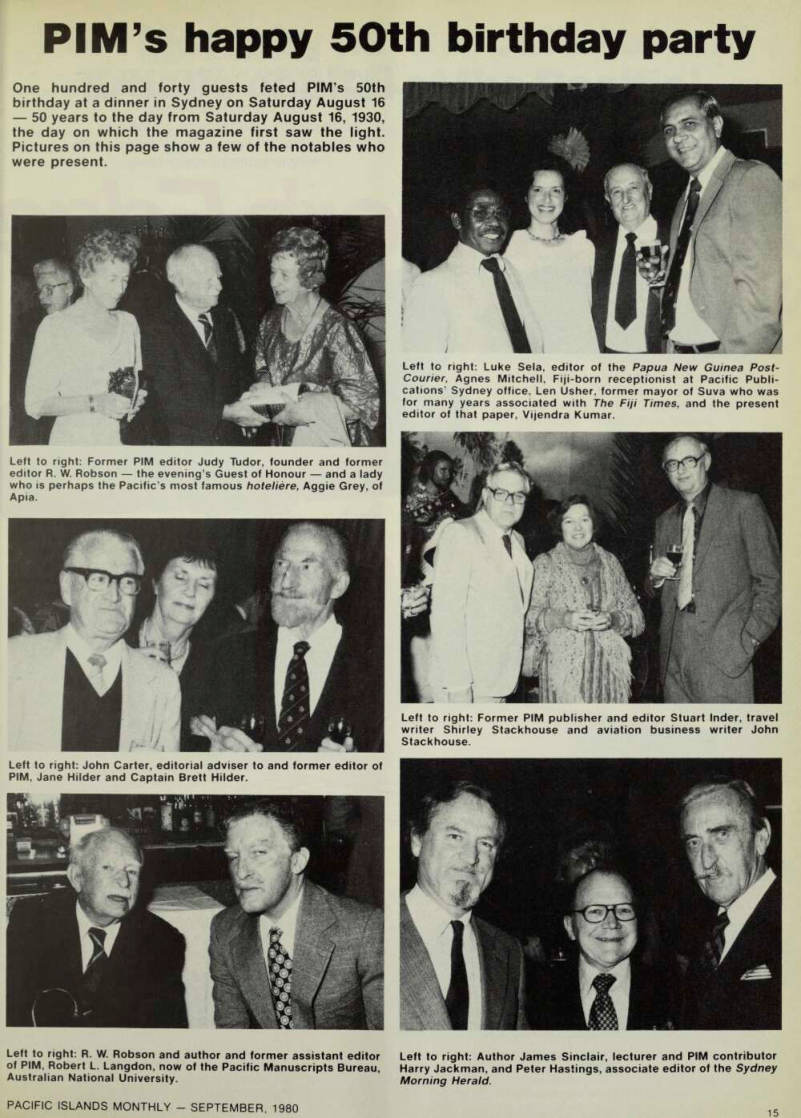
One hundred and forty guests feted PlM’s 50th birthday at a dinner in Sydney on Saturday August 16 50 years to the day from Saturday August 16, 1930, the day on which the magazine first saw the light.
Pictures on this page show a few of the notables who were present.
Left to right: Former PIM editor Judy Tudor, founder and former editor R. W. Robson - the evening's Guest of Honour - and a lady who is perhaps the Pacific's most famous hoteliere, Aggie Grey, of Apia.
Left to right: John Carter, editorial adviser to and former editor of PIM, Jane Milder and Captain Brett Milder.
Left to right: R. W. Robson and author and former assistant editor of RIM, Robert L. Langdon, now of the Pacific Manuscripts Bureau, Australian National University.
Left to right: Luke Sela, editor of the Papua New Guinea Post- Courier, Agnes Mitchell, Fiji-born receptionist at Pacific Publi cations’ Sydney office, Len Usher, former mayor of Suva who was for many years associated with The Fiji Times, and the present editor of that paper, Vijendra Kumar.
Left to right: Former RIM publisher and editor Stuart Inder, travel writer Shirley Stackhouse and aviation business writer John Stackhouse.
Left to right: Author James Sinclair, lecturer and RIM contributor Harry Jackman, and Peter Hastings, associate editor of the Sydney Morning Herald.
Advertisements & other items, p. 16 (1 item)
inner ’s Edge
The rally's underway.
The competition is tough.
The skills that make up a champion are many.
The winner's edge-reliability. The kind of reliability you expect from Clarion car stereo.
High guality performance all the way.
Check out the full lineup. You'll find it in the winner's circle , every time.
inner ’s Edge
In Car Entertainment Company
Clarion
C’orion Co., Ltd. Tokyo. Japan m ■ 1 mm s& mm a i M ■ * ■ j f c ■c a Australia: Amalgamated Wireless ss4f%rfyiatta Road, AshfieipUN.S.W 2131 New Zealand: AWA New . Zealand Limited Box 50-248 Porirua/& Co.. Ltd. box 362 Suva Tahiti: Hi-Fi Vairaatoa %PO. Box It2B Papeete/New Caledonia: Caldis Cedex Guam: Guam Radio & TV Shop P.O. Box 1939 ;, s"’ 5 "’ 96910/New Hebrides: JThe* Sound Centre P.O. Box 434 Vila Cook Islands: South Seas, International Ltd.
PtO Box 49 Rarotonga/Papua New Guinea: iP.N.G.) Pty. Ltd, P.O Box 1428 Boroko, Port Moresby. * Dolby and the double-!), symbol are trademarks of Dolby Laboratories.
Port Moresby as ‘the cultural and artistic capital
artistic capital of the Pacific’
The Third South Pacific Festival of Arts held in Port Moresby in July was 'a great success’, according to JIMMY and GWENDA CORNELL. The article below is the first of two in which the writers provide a comprehensive and sometimes critical review of the big event.
During the first two weeks of July the Third South Pacific Festival of Arts turned Port Moresby into the cultural and artistic capital of the Pacific as 2000 participants from most Pacific nations displayed their talents in song and dance per formances, demonstrations of
carving, pottery and weaving,
art exhibitions, literary dis cussions, theatre productions and film performances.
Compared with the previous
two festivals in Suva and Rotorua, the organisers had
planned a highly ambitious
programme, and in light of the enthusiastic response of most participating nations the fes tival must be regarded as a great success.
The programme covered many facets of Pacific Islands culture, but its dominant fea tures were the traditional song and dance performances presented both by the 20 par ticipating nations and by the various provinces of the host country.
In a deliberate attempt to bring the festival to the people,
the performances were staged
at a variety of venues, most of them open air arenas close to the local market places in and around Port Moresby. Exceed ing all the organisers’ expec tations, the response of the crowds was tremendous as
thousands of people thronged
to each performance.
The theme of the festival was Pacific Awareness although only a few countries attempted to interpret this theme in their programmes. But most groups made an effort to present truly traditional songs and dances, often very different from the shows put on for tourists in the various hotels throughout the Pacific.
Outstanding in their attempt to portray Pacific Awareness were the Cook Islanders, who based a whole evening’s pro gramme on the theme of ‘The
Sea and Its Resources’. The leader of the group, Turepu Turepu, explained that they had chosen this particular sub ject as the sea is of such sig nificance for the whole Pacific region. As well as portraying the sea and activities related to it in song and dance, the Cook Islanders also demonstrated the weaving of fish traps and work done by children with shells. The poet Makuiti Ton gia read some of his poems,
striking in their outspoken
ness.
The theme of the festival was approached in a different way by the Western Samoans, who
presented a performance based
on the traditional Samoan eti quette of receiving guests.
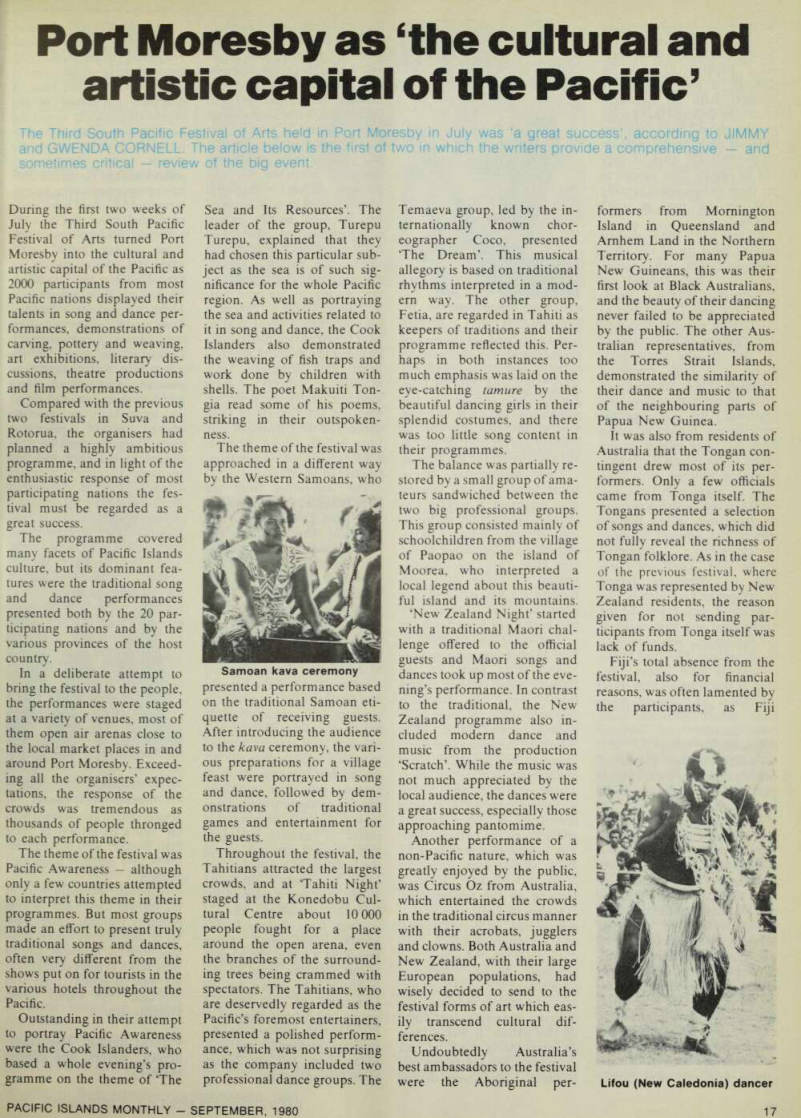
After introducing the audience to the kaxa ceremony, the vari ous preparations for a village feast were portrayed in song and dance, followed by dem onstrations of traditional games and entertainment for the guests.
Throughout the festival, the Tahitians attracted the largest crowds, and at ‘Tahiti Night’ staged at the Konedobu Cul tural Centre about 10 000
people fought for a place
around the open arena, even the branches of the surround ing trees being crammed with spectators. The Tahitians, who are deservedly regarded as the Pacific’s foremost entertainers,
presented a polished perform
ance, which was not surprising as the company included two professional dance groups. The
Temaeva group, led by the in ternationally known chor
eographer Coco, presented
‘The Dream’. This musical allegory is based on traditional rhythms interpreted in a mod ern way. The other group, Fetia, are regarded in Tahiti as keepers of traditions and their programme reflected this. Per haps in both instances too much emphasis was laid on the
eye-catching tamure by the
beautiful dancing girls in their splendid costumes, and there was too little song content in their programmes.
The balance was partially re stored by a small group of ama teurs sandwiched between the
two big professional groups.
This group consisted mainly of schoolchildren from the village of Paopao on the island of Moorea, who interpreted a local legend about this beauti ful island and its mountains. ‘New Zealand Night’ started with a traditional Maori chal lenge offered to the official guests and Maori songs and dances took up most of the eve
ning’s performance. In contrast
to the traditional, the New Zealand programme also in cluded modern dance and music from the production ‘Scratch’. While the music was not much appreciated by the local audience, the dances were a great success, especially those
approaching pantomime.
Another performance of a non-Pacific nature, which was
greatly enjoyed by the public,
was Circus Oz from Australia, which entertained the crowds in the traditional circus manner with their acrobats, jugglers and clowns. Both Australia and New Zealand, with their large
European populations, had
wisely decided to send to the festival forms of art which eas ily transcend cultural dif ferences.
Undoubtedly Australia’s
best ambassadors to the festival were the Aboriginal per
formers from Momington Island in Queensland and Arnhem Land in the Northern
Territory. For many Papua
New Guineans, this was their first look at Black Australians, and the beauty of their dancing never failed to be appreciated by the public. The other Aus tralian representatives, from the Torres Strait Islands, demonstrated the similarity of their dance and music to that of the neighbouring parts of Papua New Guinea.
It was also from residents of Australia that the Tongan con tingent drew most of its per formers. Only a few officials came from Tonga itself. The Tongans presented a selection of songs and dances, which did not fully reveal the richness of Tongan folklore. As in the case of the previous festival, where
Tonga was represented by New
Zealand residents, the reason given for not sending par ticipants from Tonga itself was lack of funds.
Fiji’s total absence from the festival, also for financial reasons, was often lamented by
the participants, as Fiji
Samoan kava ceremony
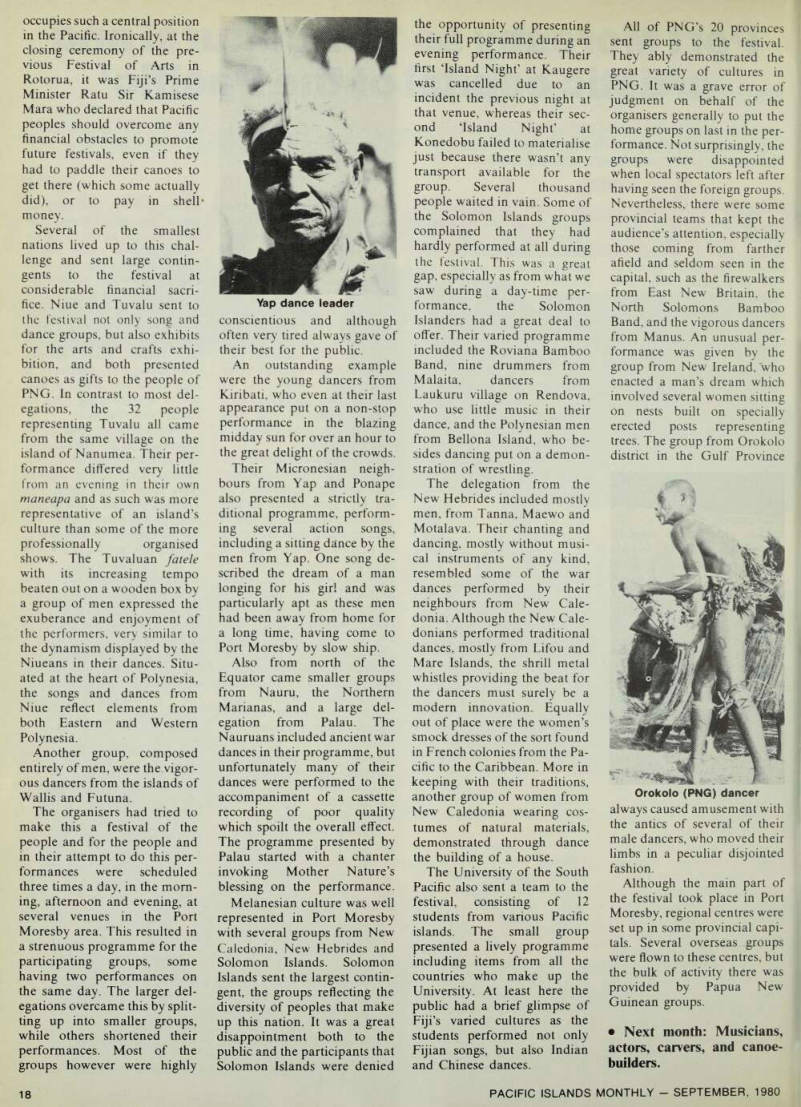
Lifou (New Caledonia) dancer
occupies such a central position in the Pacific. Ironically, at the closing ceremony of the pre vious Festival of Arts in Rotorua, it was Fiji’s Prime Minister Ratu Sir Kamisese Mara who declared that Pacific peoples should overcome any financial obstacles to promote future festivals, even if they had to paddle their canoes to get there (which some actually did), or to pay in shell money.
Several of the smallest nations lived up to this chal lenge and sent large contin gents to the festival at considerable financial sacri fice. Niue and Tuvalu sent to the festival not only song and dance groups, but also exhibits for the arts and crafts exhi bition, and both presented canoes as gifts to the people of PNG. In contrast to most del
egations, the 32 people
representing Tuvalu all came from the same village on the island of Nanumea. Their per formance differed very little from an evening in their own maneapa and as such was more representative of an island’s culture than some of the more
professionally organised
shows. The Tuvaluan fatele with its increasing tempo beaten out on a wooden box by a group of men expressed the exuberance and enjoyment of the performers, very similar to
the dynamism displayed by the
Niueans in their dances. Situ ated at the heart of Polynesia, the songs and dances from Niue reflect elements from both Eastern and Western
Polynesia.
Another group, composed entirely of men, were the vigor ous dancers from the islands of Wallis and Futuna.
The organisers had tried to make this a festival of the people and for the people and in their attempt to do this per formances were scheduled three times a day, in the morn ing, afternoon and evening, at several venues in the Port Moresby area. This resulted in a strenuous programme for the participating groups, some having two performances on the same day. The larger del
egations overcame this by split
ting up into smaller groups, while others shortened their performances. Most of the groups however were highly
conscientious and although often very tired always gave of their best for the public.
An outstanding example
were the young dancers from Kiribati, who even at their last appearance put on a non-stop
performance in the blazing
midday sun for over an hour to the great delight of the crowds.
Their Micronesian neigh bours from Yap and Ponape also presented a strictly tra ditional programme, perform ing several action songs,
including a sitting dance by the
men from Yap. One song de scribed the dream of a man longing for his girl and was particularly apt as these men had been away from home for a long time, having come to
Port Moresby by slow ship.
Also from north of the Equator came smaller groups from Nauru, the Northern Marianas, and a large del egation from Palau. The Nauruans included ancient war dances in their programme, but unfortunately many of their dances were performed to the accompaniment of a cassette
recording of poor quality
which spoilt the overall effect.
The programme presented by Palau started with a chanter invoking Mother Nature’s
blessing on the performance.
Melanesian culture was well
represented in Port Moresby
with several groups from New Caledonia, New Hebrides and Solomon Islands. Solomon Islands sent the largest contin gent, the groups reflecting the diversity of peoples that make up this nation. It was a great disappointment both to the public and the participants that Solomon Islands were denied
the opportunity of presenting
their full programme during an
evening performance. Their
first ‘lsland Night’ at Kaugere was cancelled due to an incident the previous night at that venue, whereas their sec ond ‘lsland Night’ at Konedobu failed to materialise just because there wasn’t any transport available for the group. Several thousand people waited in vain. Some of the Solomon Islands groups complained that they had hardly performed at all during the festival. This was a great gap, especially as from what we saw during a day-time per formance, the Solomon Islanders had a great deal to offer. Their varied programme included the Roviana Bamboo Band, nine drummers from Malaita. dancers from Laukuru village on Rendova, who use little music in their dance, and the Polynesian men from Bellona Island, who be sides dancing put on a demon stration of wrestling.
The delegation from the New Hebrides included mostly men, from Tanna, Maewo and Motalava. Their chanting and
dancing, mostly without musi
cal instruments of any kind, resembled some of the war
dances performed by their
neighbours from New Cale donia. Although the New Cale donians performed traditional dances, mostly from Lifou and Mare Islands, the shrill metal whistles providing the beat for the dancers must surely be a modern innovation. Equally out of place were the women’s smock dresses of the sort found in French colonies from the Pa cific to the Caribbean. More in keeping with their traditions, another group of women from New Caledonia wearing cos tumes of natural materials, demonstrated through dance the building of a house.
The University of the South Pacific also sent a team to the festival, consisting of 12 students from various Pacific islands. The small group
presented a lively programme
including items from all the countries who make up the University. At least here the public had a brief glimpse of Fiji’s varied cultures as the students performed not only Fijian songs, but also Indian and Chinese dances.
All of PNG’s 20 provinces sent groups to the festival.
They ably demonstrated the
great variety of cultures in PNG. It was a grave error of judgment on behalf of the organisers generally to put the home groups on last in the per formance. Not surprisingly, the groups were disappointed when local spectators left after having seen the foreign groups.
Nevertheless, there were some provincial teams that kept the audience’s attention, especially those coming from farther afield and seldom seen in the capital, such as the firewalkers from East New Britain, the North Solomons Bamboo Band, and the vigorous dancers from Manus. An unusual per formance was given by the group from New Ireland, who enacted a man’s dream which involved several women sitting on nests built on specially erected posts representing trees. The group from Orokoio district in the Gulf Province
always caused amusement with the antics of several of their male dancers, who moved their limbs in a peculiar disjointed fashion.
Although the main part of the festival took place in Port
Moresby, regional centres were
set up in some provincial capi tals. Several overseas groups were flown to these centres, but the bulk of activity there was
provided by Papua New
Guinean groups. • Next month: Musicians, actors, carvers, and canoe builders.
Yap dance leader
Orokolo (PNG) dancer
Are migrants
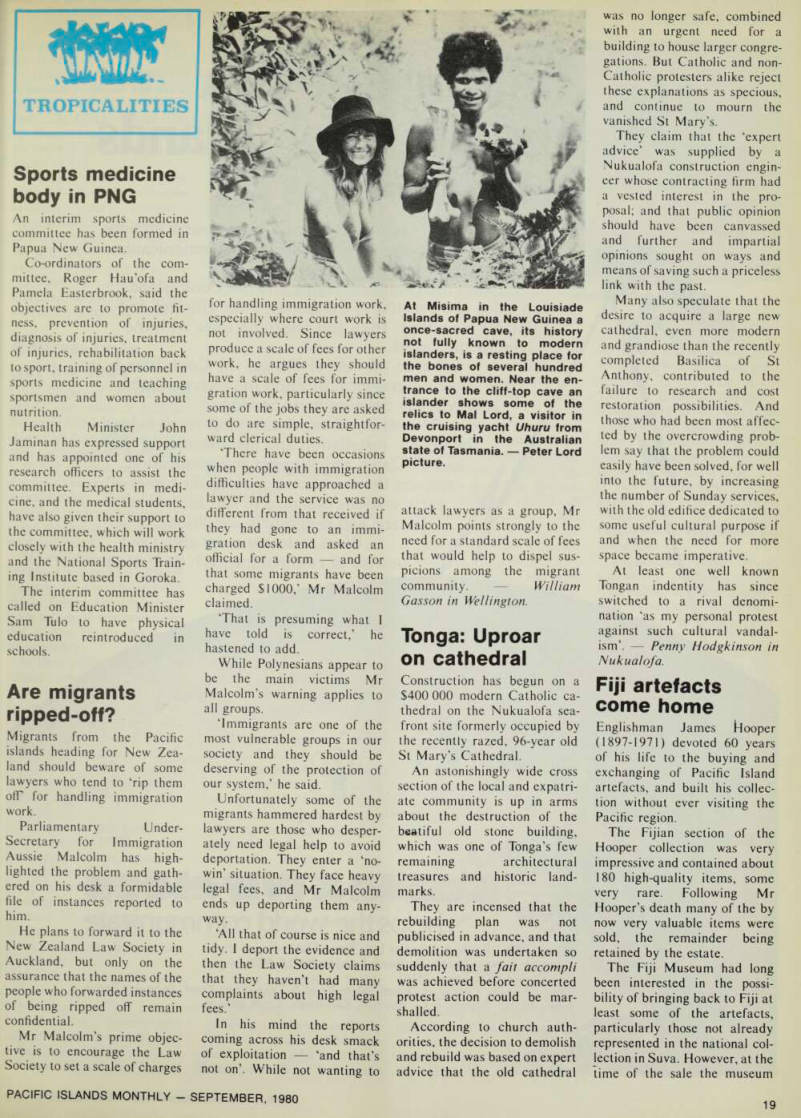
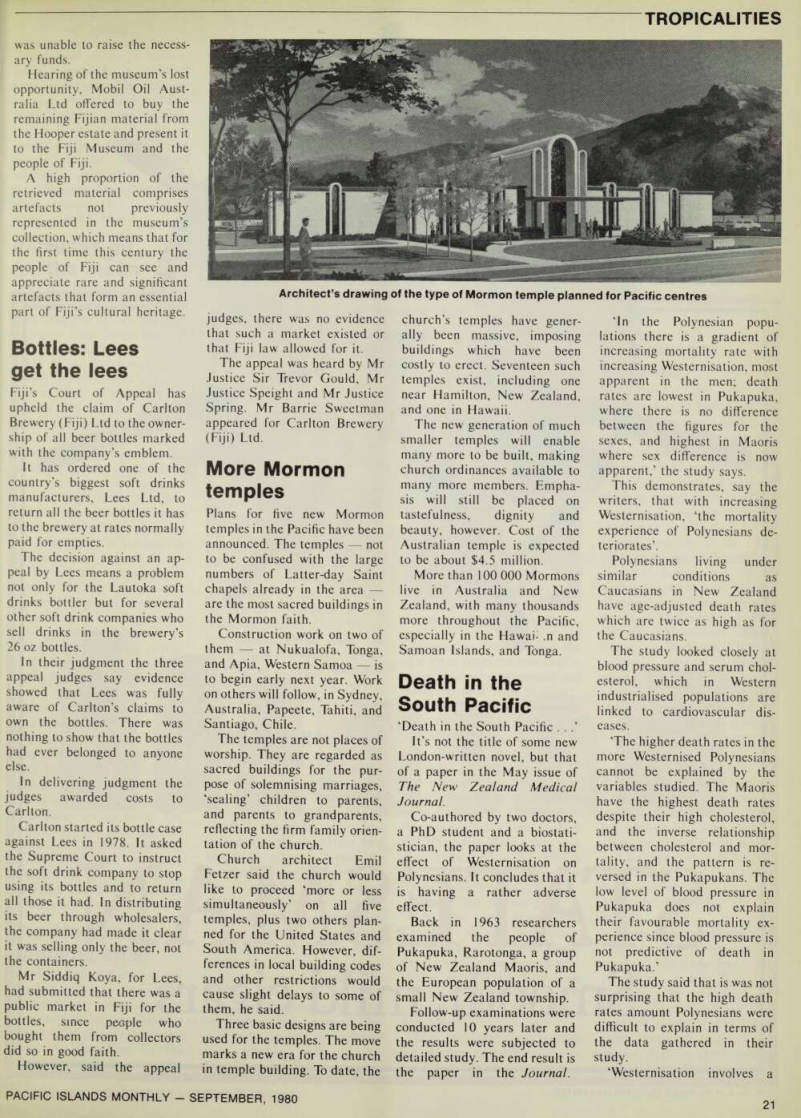

Tropicalities
Sports medicine
body in PNG
An interim sports medicine committee has been formed in Papua New Guinea.
Co-ordinators of the com mittee, Roger Hau’ofa and Pamela Easterbrook, said the objectives are to promote fit ness, prevention of injuries, diagnosis of injuries, treatment of injuries, rehabilitation back to sport, training of personnel in sports medicine and teaching sportsmen and women about nutrition.
Health Minister John Jaminan has expressed support and has appointed one of his research officers to assist the committee. Experts in medi cine, and the medical students, have also given their support to the committee, which will work closely with the health ministry and the National Sports Train ing Institute based in Goroka.
The interim committee has called on Education Minister Sam Tulo to have physical education reintroduced in schools.
Are migrants
ripped-off?
Migrants from the Pacific islands heading for New Zea land should beware of some lawyers who tend to Tip them off for handling immigration work.
Parliamentary Under
secretary for Immigration Aussie Malcolm has high lighted the problem and gath ered on his desk a formidable file of instances reported to him.
He plans to forward it to the New Zealand Law Society in Auckland, but only on the assurance that the names of the people who forwarded instances of being ripped off remain confidential.
Mr Malcolm’s prime objec tive is to encourage the Law Society to set a scale of charges
for handling immigration work, especially where court work is not involved. Since lawyers produce a scale of fees for other work, he argues they should have a scale of fees for immi gration work, particularly since some of the jobs they are asked to do are simple, straightfor ward clerical duties. ‘There have been occasions when people with immigration difficulties have approached a lawyer and the service was no different from that received if they had gone to an immi gration desk and asked an official for a form and for that some migrants have been charged slooo,' Mr Malcolm claimed. ‘That is presuming what I have told is correct,’ he hastened to add.
While Polynesians appear to be the main victims Mr Malcolm’s warning applies to all groups. ‘lmmigrants are one of the most vulnerable groups in our society and they should be deserving of the protection of our system,’ he said.
Unfortunately some of the migrants hammered hardest by lawyers are those who desper ately need legal help to avoid deportation. They enter a ‘no win’ situation. They face heavy legal fees, and Mr Malcolm ends up deporting them any way. ‘All that of course is nice and tidy. I deport the evidence and then the Law Society claims that they haven’t had many complaints about high legal fees.’
In his mind the reports coming across his desk smack of exploitation ‘and that’s not on’. While not wanting to
attack lawyers as a group, Mr Malcolm points strongly to the need for a standard scale of fees that would help to dispel sus picions among the migrant
community.
William
Gas son in Wellington.
Tonga: Uproar
on cathedral
Construction has begun on a $4OO 000 modern Catholic ca thedral on the Nukualofa sea front site formerly occupied by the recently razed, 96-year old St Mary’s Cathedral.
An astonishingly wide cross section of the local and expatri ate community is up in arms about the destruction of the beatiful old stone building, which was one of Tonga’s few remaining architectural treasures and historic land marks.
They are incensed that the rebuilding plan was not publicised in advance, and that demolition was undertaken so suddenly that a fait accompli was achieved before concerted protest action could be mar shalled.
According to church auth orities, the decision to demolish and rebuild was based on expert advice that the old cathedral
was no longer safe, combined with an urgent need for a building to house larger congre gations. But Catholic and non- Catholic protesters alike reject these explanations as specious, and continue to mourn the vanished St Mary’s.
They claim that the ‘expert advice’ was supplied by a Nukualofa construction engin eer whose contracting firm had a vested interest in the pro posal; and that public opinion should have been canvassed and further and impartial opinions sought on ways and means of saving such a priceless link with the past.
Many also speculate that the desire to acquire a large new cathedral, even more modern and grandiose than the recently completed Basilica of St Anthony, contributed to the failure to research and cost restoration possibilities. And those who had been most affec ted by the overcrowding prob lem say that the problem could easily have been solved, for well into the future, by increasing the number of Sunday services, with the old edifice dedicated to some useful cultural purpose if and when the need for more space became imperative.
At least one well known Tongan indentity has since switched to a rival denomi nation ‘as my personal protest against such cultural vandal ism’. Penny Hodgkinson in Nukualofa.
Fiji artefacts
come home
Englishman James kooper (1897-1971) devoted 60 years of his life to the buying and exchanging of Pacific Island artefacts, and built his collec tion without ever visiting the Pacific region.
The Fijian section of the Hooper collection was very impressive and contained about 180 high-quality items, some very rare. Following Mr Hooper’s death many of the by now very valuable items were sold, the remainder being retained by the estate.
The Fiji Museum had long been interested in the possi bility of bringing back to Fiji at least some of the artefacts, particularly those not already represented in the national col lection in Suva. However, at the time of the sale the museum
At Misima in the Louisiade Islands of Papua New Guinea a once-sacred cave, its history not fully known to modern islanders, is a resting place for the bones of several hundred men and women. Near the en trance to the cliff-top cave an islander shows some of the relics to Mai Lord, a visitor in the cruising yacht Uhuru from Devonport in the Australian state of Tasmania. - Peter Lord picture.
was unable to raise the necess ary funds.
Hearing of the museum’s lost opportunity, Mobil Oil Aust ralia Ltd offered to buy the remaining Fijian material from the Hooper estate and present it to the Fiji Museum and the people of Fiji.
A high proportion of the retrieved material comprises artefacts not previously represented in the museum’s collection, which means that for the first time this century the people of Fiji can see and appreciate rare and significant artefacts that form an essential part of Fiji’s cultural heritage.
Bottles: Lees
get the lees
Fiji’s Court of Appeal has upheld the claim of Carlton Brewery (Fiji) Ltd to the owner ship of all beer bottles marked with the company’s emblem.
It has ordered one of the country’s biggest soft drinks manufacturers, Lees Ltd, to return all the beer bottles it has to the brewery at rates normally paid for empties.
The decision against an ap peal by Lees means a problem not only for the Lautoka soft drinks bottler but for several other soft drink companies who sell drinks in the brewery’s 26 oz bottles.
In their judgment the three appeal judges say evidence showed that Lees was fully aware of Carlton’s claims to own the bottles. There was nothing to show that the bottles had ever belonged to anyone else.
In delivering judgment the judges awarded costs to Carlton.
Carlton started its bottle case against Lees in 1978. It asked the Supreme Court to instruct the soft drink company to stop using its bottles and to return all those it had. In distributing its beer through wholesalers, the company had made it clear it was selling only the beer, not the containers.
Mr Siddiq Koya, for Lees, had submitted that there was a public market in Fiji for the bottles, since people who bought them from collectors did so in good faith.
However, said the appeal
judges, there was no evidence that such a market existed or that Fiji law allowed for it.
The appeal was heard by Mr Justice Sir Trevor Gould, Mr Justice Speight and Mr Justice Spring. Mr Barrie Sweetman appeared for Carlton Brewery (Fiji) Ltd.
More Mormon
temples
Plans for five new Mormon temples in the Pacific have been announced. The temples not to be confused with the large numbers of Latter-day Saint chapels already in the area are the most sacred buildings in the Mormon faith.
Construction work on two of them at Nukualofa, Tonga, and Apia, Western Samoa is to begin early next year. Work on others will follow, in Sydney, Australia, Papeete, Tahiti, and Santiago, Chile.
The temples are not places of worship. They are regarded as sacred buildings for the pur pose of solemnising marriages, ‘sealing’ children to parents, and parents to grandparents, reflecting the firm family orien tation of the church.
Church architect Emil Fetzer said the church would like to proceed ‘more or less simultaneously’ on all five temples, plus two others plan ned for the United States and South America. However, dif ferences in local building codes and other restrictions would cause slight delays to some of them, he said.
Three basic designs are being used for the temples. The move marks a new era for the church in temple building. To date, the
church’s temples have gener ally been massive, imposing buildings which have been costly to erect. Seventeen such temples exist, including one near Hamilton, New Zealand, and one in Hawaii.
The new generation of much smaller temples will enable many more to be built, making church ordinances available to many more members. Empha sis will still be placed on tastefulness, dignity and beauty, however. Cost of the Australian temple is expected to be about $4.5 million.
More than 100 000 Mormons live in Australia and New Zealand, with many thousands more throughout the Pacific, especially in the Hawaii .n and Samoan Islands, and Tonga.
Death in the
South Pacific
‘Death in the South Pacific .. .’
It’s not the title of some new London-written novel, but that of a paper in the May issue of The New Zealand Medical Journal.
Co-authored by two doctors, a PhD student and a biostati stician, the paper looks at the effect of Westernisation on Polynesians. It concludes that it is having a rather adverse effect.
Back in 1963 researchers examined the people of Pukapuka, Rarotonga, a group of New Zealand Maoris, and the European population of a small New Zealand township.
Follow-up examinations were conducted 10 years later and the results were subjected to detailed study. The end result is the paper in the Journal.
‘ln the Polynesian popu lations there is a gradient of increasing mortality rate with increasing Westernisation, most apparent in the men; death rates are lowest in Pukapuka, where there is no difference between the figures for the sexes, and highest in Maoris where sex difference is now apparent,’ the study says.
This demonstrates, say the writers, that with increasing Westernisation, ‘the mortality experience of Polynesians de teriorates’.
Polynesians living under similar conditions as Caucasians in New Zealand have age-adjusted death rates which are twice as high as for the Caucasians.
The study looked closely at blood pressure and serum chol esterol, which in Western industrialised populations are linked to cardiovascular dis eases. ‘The higher death rates in the more Westernised Polynesians cannot be explained by the variables studied. The Maoris have the highest death rates despite their high cholesterol, and the inverse relationship between cholesterol and mor tality, and the pattern is re versed in the Pukapukans. The low level of blood pressure in Pukapuka does not explain their favourable mortality ex perience since blood pressure is not predictive of death in Pukapuka.’
The study said that is was not surprising that the high death rates amount Polynesians were difficult to explain in terms of the data gathered in their study. ‘Westernisation involves a
Architect’s drawing of the type of Mormon temple planned for Pacific centres
wide range of social and en vironmental changes which ex press themselves in mechan isms other than those mediated through the standard risk fac tors. However, given the gen etic similarity of the Polynesian groups studied, it can safely be concluded that the adverse mortality experience of the New Zealand Maoris is poten
tially preventable.’
Mike
Field in Wellington
Palauans go
for the moon
The Palau legislature has selec ted a Palau flag from among more than 200 entries proposed during a flag design contest held in that district.
The Palau flag design a golden full moon centred in a field of blue reflected tra ditional and modern Palauan ‘affinity for the moon’, accord ing to the legislature.
The legislature said: ‘The full moon represents the peak of cyclic activity of the earth, of low and high tides; the best time for fishing, felling timber trees, canoe-carving, planting, harvesting, and for celebrating notable events.’ ‘The full moon over Palau gives a feeling of warmth, tranquillity, peace, love and domestic unity,’ the legislature said.
A three-by-five-foot version of the flag was prepared for display by the Palau delegation to this year’s South Pacific Festival of Arts held in Papua New Guinea.
Palauans claim that centuries before the US astro nauts landed on the moon in 1969, a Palauan settler (Tkud) and his wife had already taken up residence on the moon. The dark spots you see on the surface of the moon are, of course, Tkud and his wife tending their orange tree, the Palauans claim. Micro nesian News Service
The Marshalls’
Nomadic chief
President Amata Kabua of the Marshall Islands has been achieving in recent months what used to be considered a next-to-impossible feat by pre vious administrations in the Marshall Islands.
Thanks to Marshall Islands Airlines, Kabua has been able to bring his government to the widely dispersed Marshallese population instead of issuing governmental directives from the seat of government in Majuro as his predecessors were wont to do.
The two Australian-built No mad aircraft, which constitute the government-owned airline, have been used by President Kabua as flying executive offices. In one week in July alone, Kabua was able to fly about half of his Cabinet to Kwajalein Atoll for an urgent meeting with Kwajalein land owners on what to do with more than SUS 2 million in land rental for that atoll. Following that meeting, Kabua and his government flew to Likiep Atoll, 265 miles in the opposite direction, where they joined more than 2000 other Marsh allese in ceremonies marking the official opening of the Likiep airport.
The Marshall Islands is blessed with several functioning airports and runways built by the US during the nuclear testings in the 1950 s and 60s.
Additional runways on other atolls have been planned for completion by the Marshalls Government. Officials in the Marshall Islands Government Information Office said the government is expected to visit outlying areas in the Marshalls more frequently in the future.
Micronesian News Service.
HER Excellency
wows ’em
Australia’s first resident high commissioner in Tonga, Miss Maris King, arrived at the end of May, preceded by a wide spread buzz of speculation. In a kingdom where diplomatic excellencies are constantly in the limelight, and where women’s undoubtedly consider able influence is traditionally exerted discreetly from behind the scenes, how would a HER Excellency fare?
Miss King provided the answer in no time flat. Her particular combination of natu ral charm, down-to-earth job approach, easy accessibility and obvious affinity for Polynesia and Polynesians has
already won all hearts and added a valuable new burnish to the local Australian image.
Male chauvinism reigned su preme in the upper echelons of the Australian public service when Miss King began her career as a foreign affairs sten ographer. After serving in a number of overseas secretarial posts, she transferred to the executive stream when it was first opened to women in 1949 and studied for an economics degree at Canberra University College. After graduation she spent several years in the Econ omic Analysis Branch, where her duties included attendance at many conferences around the world.
In 1973, transferred to the diplomatic stream, she was appointed deputy high com-
missioner in Fiji. During the next three years she took part in many regional conferences and made frequent visits to Tonga.
In April 1977, she became high commissioner in Nauru. A fascinating experience, she says, because her country’s smallest diplomatic outpost also embraced its largest ‘par ish’ five million square miles of it, including visiting rep resentation in the then Gilbert Islands and in Micronesia, at a time when both areas were in the thick of independence and self-determination planning.
During her second year in Nauru she was also elected President of the Soroptimist Federation of the South-west Pacific and in the second year of her presidential term took long leave and spent much of it visiting member clubs around Australia.
She says the opportunities for Australian women diplo mats have vastly increased in
recent years. There is already a counterpart head-of-mission in Ireland, ‘and several more women are getting close to that level’.
Miss King freely admits that being single has eliminated some potential career obstacles. ‘Even though there are no longer any official barriers to the appointment of a married woman as head-of-mission, not all husbands are psychologi cally equipped to shape their own lives around their partner’s postings or to accept a support ive role'somewhat akin to that
of a diplomatic wife.'
Penny
Hodgkinson in Nukualofa.
Services for
Vanuatu
Many people who have been associated with New Hebrides over the years would have given anything to be able to share in the Independence Day cel ebrations held in Port-Vila on July 30. However, at least two services were held in Australia to give folk the opportunity to share in spirit with their Pacific friends their joy at the estab lishment of the new Republic of Vanuatu. Ecumenical services were arranged in Scots Church, Melbourne on Sunday August 3, and in St Stephen’s Uniting Church, Macquarie Street, Sydney on Wednesday July 30.
The services brought together people who had actu ally worked in New Hebrides, those who had some special interest in the islands, as well as New Hebrideans at present in the cities.
On the British side the Presbyterian and Anglican Churches have been involved in mission work since the 1840 s, the Church of Christ came in 1905, the SDA Church in 1912, and the Apostolic Church later on. The churches thus have a deep and abiding interest in what is happening in the Islands.
Since the first stirrings of the independence movement the overseas churches have been supportive, and within New Hebrides the Anglican and Presbyterian Churches have supplied much of the leader ship. Anglican priest Father Walter Lini is chief minister and five Presbyterian pastors
Her Excellency Maris King
have been released by the church to serve in the Rep resentative Assembly. The Rev Fred Timakata will be minister for home affairs, while George Kalkoa, a well-known Presbyterian layman, is presi dent under the name of Ati George Sokomanu.
So it was appropriate that friends of the new republic should gather together in a service of worship to give thanks for independence and to pray for the people of Vanuatu.
Former missionaries, the Rev Alan Blake and the Rev Keith Allen, who both served at Tangoa Training Institute took part, along with the Rev David Eagling who was at the Bible School on Pentecost. John- Henry Wotlemaro, who is train ing for the Anglican priesthood and is at present at Vision Bible College, spoke of what indepen dence meant to him, and Obed Moses, who is studying at Croydon Bible College, explained what Vanuatu meant and led in prayer. The sermon was preached by the Rev Dr John Brown of the Commission for World Mission of the Uniting Church.
In his sermon John Brown said: ‘Today is a day of rejoicing for all the people of Vanuatu and their friends. It is a day of rejoicing in the mercy and justice of God; a day for congratulations to the leaders of Vanuatu who have persevered with great patience in the face of the unending provocation of those who refuse to relinquish power, and today see the fruits of their patience.
We give thanks to God; we rejoice with our brothers and sisters in Vanuatu; and we pray for them as they assume oner ous responsibilities for the fu ture.
We can hardly rejoice with them in their achievement of independence and self government without at the same time committing our selves in fellowship with others who continue their struggles for justice, freedom, self government and dignity. We remember the peoples of New Caledonia and French Polynesia who remain dominated by colonial powers.
Let us commit ourselves to support them till they have
achieved the same self government and independence. ‘But we remember particu larly the struggle which black people are carrying on in this country for a more just and human Australia the struggle against the combined interests of company, other sectional interests and govern ment to gain recognition of their right to their own land. It would be grossly inconsistent of us to support the people 2000 miles away in their struggle while we hold down those involved in a similar struggle here in Australia.’
To add to the evening a choir from the Fijian community (near neighbours in the Pacific) sang a hymn appropriate to the occasion. Later the Fijians with their singing turned what could have been an Australian cup of tea into a true Pacific Islands
gathering.
Alan Blake.
Upshot of Tonga
church battle
Siupeli Taliai, whose dramatic clash with the president of Tonga’s Free Wesleyan Church was reported earlier (P1M May pi5), has been reinstated as an ordained minister and as con ference secretary, but not as principal of Tupou College.
The reinstatement took the form of a presidential motion, seconded and carried without discussion during the minis terial session of the church’s pre-conference quarterly meet ing. This neat manoeuvre bypassed the constitutional pro cedure whereby accuser and accused are required to put forward their respective cases for a vote to be taken, with the result to be ratified by the annual conference in the event of a ‘guilty’ verdict.
Frustrated by what he de scribes as ‘a disappointingly inconclusive outcome’, Siupeli has accepted an invitation from the Uniting Church in Aust ralia to take up an administrat ive post in its Melbourne office.
His decision was approved at the FWC’s May -Conference, during which Dr Mo’ungaloa was again elected president, but with a considerably reduced percentage of the total vote. —
Penny Hodgkins on in Nukualofa.
Advertisements & other items, pp. 20-24 (1 item)
(St Talking to Ibnga
and the Cook Islands
is now so easy.
With the opening of Cable and Wireless earth stations in Tonga and the Cook Islands, a world of communication possibilities has begun.
Now, the people of Tonga and the Cook Islands can enjoy the benefits of the fastest, most efficient and reliable telephone, telex and telegraph links with the rest of the world.
Lying to the east of Tonga, the Cook Islands is the latest geographical location to receive a Cable and Wireless Satellite Earth Station.
A century of experience is at work behind the design, installation and maintenance of this and all Cable and Wireless communication systems the world over including over 30 earth stations designed to suit individual climatic and geographic conditions.
Want to know more about our powers of communication? Contact us. %r
helps the world communicate
Office, Cable & Wireless Ltd, Dept. FEA, srcury House, Theobalds Road, London WCIX BRX Tel: 01-242 4433 Telex: 23181 Tonga Branch, Corner of Queen Salote Road & Takauvove Road, Fongola, Tonga.
Cook Islands Branch, P.O. Box 529, Rarotonga, Cook Islands.
V
STATESMAN
STATESMAN
STATESMAN
STATESMAN
CORONA
5
STATESMAN
HALF CORONA
f
STATESMAN
STATESMAN
CXWETTE
5
STATESMAN
LANCERS
10
COMMODORE
tHNfvnaiA 1
PANATHLLA
5
LONG
PANATELLA
STATESMAN
Smooth, mild cigars.
© W. D. & H. O. WILLS (AUSTRALIA) LIMITED
E6BO
w.
Aquila water tanks completely enclosed to ensure clean water and built to last from strong, durable galvanised steel.
You assemble them yourself from our comprehensive kits. Capacities range from 2300 litres to 49250 litres.
Send for a brochure today.
Name ..
Address P/code
AQ2O/2
AQUILA
P.N.G. DISTRIBUTORS AND
LOCAL AGENTS WANTED
GARRETT
METAL DETECTORS
Superior metal detectors. As used by the majority of Australian professional prospectors and recommended by the American consumers association.
For Gold, Platinum and Osmiridium nuggets, war relics and coins and treasure.
P.N.G. Distributors and Local agents wanted.
For details please contact the Australasian distributors: Hesperian Detectors, P.O. Box 317, Victoria Park. 6100, Western Australia Tel: (09) 325 8575, 325 7422
France in the South Pacific -

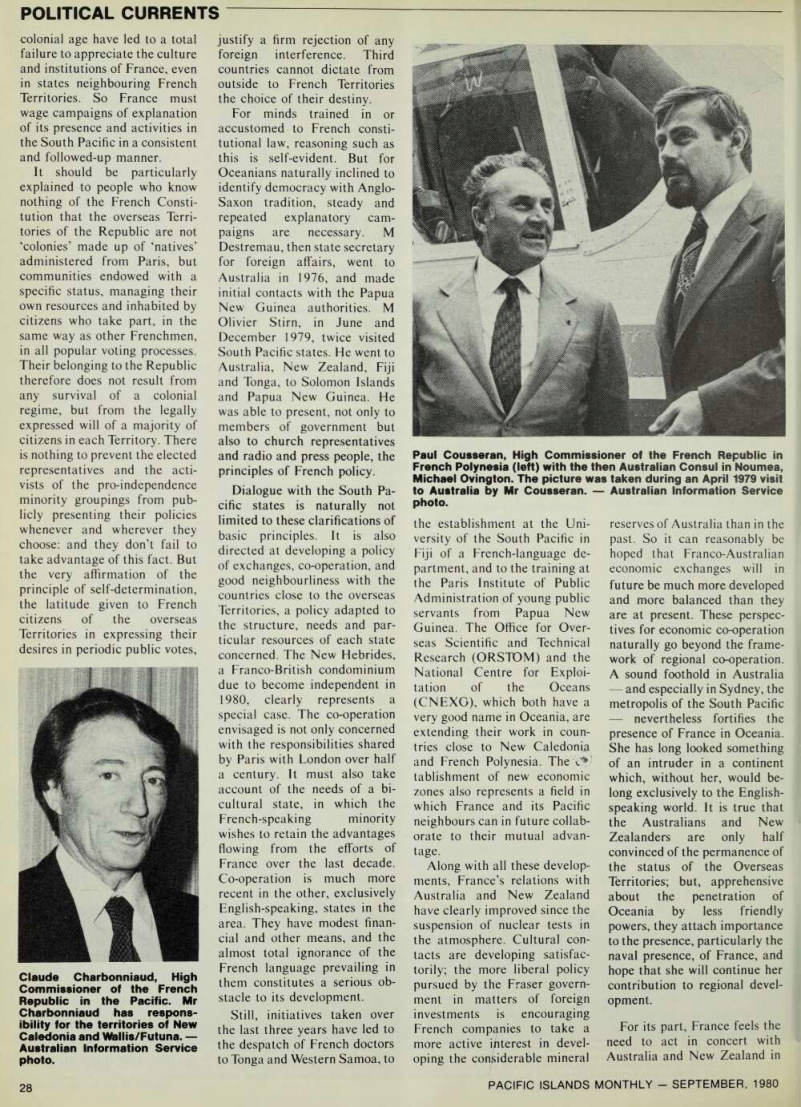
Political
Currents
the view from Paris
The South Pacific consists of two groupings of peoples of widely differing origins, lifestyles and levels of develop ment. To the West lie two nations of the ‘white Common wealth,’ Australia and New Zealand; facing this bloc of nations of European origin is a whole nebula of archipelagoes and islands occupied in the main by people of Melanesian and Polynesian stock.
Australia is inhabited by immigrants hailing chiefly from the United Kingdom and Ire land, and, later on, from non- English-speaking European nations, Greeks, Italians, Yugoslavs, and refugees from central Europe who found themselves stateless at the end of World War 11. The Aborigi nal population, either elimi nated or debased in the past by diseases and customs associated with the irruption of white colonists (tuberculosis and al coholism, for example), has now achieved some stability in the Northern Territory and Queensland, and a proportion of Aboriginal youth today con
tributes to the birth of a sub proletariat in Sydney. The Ab original community veers be tween two lines of action: securing entry into the new Australian society, or, on the contrary, seeking to prevent the development of the mineral resources in northern Australia from interfering with the cus tomary laws which regulate its existence. Under the tutelage of Canberra, the Aboriginal com munity still plays only a negli gible role in national political life.
New Zealand, due to the exclusively Anglo-Saxon character of its population, and the vagaries of an economy which remains heavily depen dent on its traditional agricul tural trade outlets, appears to be much less well adapted than Australia to breaking free of the Victorian heritage. But two factors contribute to forming its policy in the South Pacific: on the one hand, the preservation of its influence and economic interests in the new states in Oceania, despite the increasing weight exercised in them by
Australia; and, on the other hand, the awakening of the Maori population which, unlike the Australian Aborigines, has emerged as an active minority (10% of the population) which is pressing its political demands and claims to land. Up to now, the Maoris have not established contacts with the other Poly nesian peoples of Oceania. But if their demands were to receive support from outside, New Zea land would have grounds to fear a change in its relations with the new Oceanic states.
These new states include: Papua New Guinea, to the north of Australia, and separated from it by the Torres Strait. Long ignored by ex plorers because its terrain and vegetation were unfavourable to white penetration in 1936, more than 50% of its population were still beyond the reach of any colonial census operation its substantial natural and mineral resources remain unexploited. So the new state is hesitating between two orien tations: having a common bor der with Indonesia, it is think ing of some formula for an association with the Associ ation of South-east Asian Nations (ASEAN) which would give it entry into a regional framework deemed favourable to its economic de velopment. But because of its size its territory is half as big as France and its population (3 million inhabitants ), Papua New Guinea looms as some thing of a giant alongside the small South Pacific states, and for these reasons it aspires to play a major role in the regional bodies of Oceania. This dual calling helps explain the rather paradoxical policy of the Papua New Guinea Govenment: con cerned to maintain good re lations with Jakarta, it avoids making any territorial claims on it and discourages the separatism of the Papuan tribes living in the Indonesian prov ince of Irian Jaya. On the other hand, it displays pan- Melanesian solidarity with the Kanak population of New
Caledonia, and extends its patronage to the pro independence minority in this Territory.
Further East, Fiji was the first oceanic state to play an appreciable role in inter national organisations after it became independent. Much smaller and less populous (600 000 inhabitants) than Papua New Guinea, Fiji never theless has a population (50% Melanesians and 50% Indians introduced by the British colon ists to grow sugar cane) which is at a .higher level of develop ment. It also has a better administrative structure.
Attaching great importance to the Lome agreements, in whose development its representatives waged a competent defence of the interests of sugar-producing countries, Fiji has recently modified the rather uncompro mising positions it had pre viously upheld in the regional bodies and the specialist insti tutions of the United Nations.
Despite the increasing weight of Papua New Guinea, the quality of its elites and its international experience will no doubt mean that Fiji will retain its influence in the zone.
Solomon Islands, indepen dent since 1978, is an archipel ago of 190 000 inhabitants, which is bound to become influ ential in the South Pacific Commission and the Forum.
But a characteristically Mela nesian circumspection makes it disinclined to adopt vanguard positions notably on matters of decolonisation and more interested in concentrating on its development policies, which face difficulties due to a lack of natural resources and trained personnel. Western Samoa, on the other hand, is more prone to back campaigns against our tests or our presence in Oceania. Tonga, the only state in the zone to have preserved its
traditional institutions and its dynasty in the course of the colonial period, is taking advan tage of its long-standing links wjth European nations France and Germany in par ticular and of the transport staging facilities it can provide, to offset the slight appeal of its natural resources. Kiribati (for merly the Gilbert Islands), the last comer among the Oceanic states, possesses a very large maritime area, which could in future arouse certain appetites.
Finally, among the micro-states of the zone, a special place must be accorded the tiny republic of Nauru which, by virtue of its phosphate resources, has the highest per capita income of any country in the world. Re markably well run, and playing an important role in the inter island air links of Oceania, Nauru maintains very friendly relations with our country.
The following entities have a special status: The three French Pacific Territories; New Caledonia, French Polynesia, Wallis and Futuna; The Cook Islands, Niue and Tokelau, associated with New Zealand under an arrange ment which gives them New Zealand citizenship without representation in the parlia ment in Wellington and a specific participation in the regional institutions; American Samoa; The Territories of Micronesia (Carolines, Marshalls, Palau), on whose behalf Washington is seeking, in exchange for a status as associated Territories which would leave in the hands of the American Government wide responsibilities in matters of defence and external relations, an end to the United Nations
Trusteeship arrangements.
Factors In The Evol
Ution Of The South
Pacific
Three factors are in operation today which explain the present evolution of the South Pacific: the demographic recovery of the Melanesian and Polynesian populations; the development of inter-island relationships and the awakening of an Oceanic particularism; and the influence of the churches and religious
organisations on the institutions and policies of the Oceanic states.
In the course of the colonial period, the decline in the birth rate of the Oceanic populations foreshadowed a development akin to that of the Aboriginal communities in Australia. If this trend had continued in the course of the 20th century, it seems likely that the population of the Oceanic archipelagoes and islands today would be made up for the most part of immigrant Europeans, Indians, Chinese, Vietnamese and Indonesians. But the Mela nesian and Polynesian peoples, from the beginning of the 19205, began once again to record high birthrates, and have thus been able to remain the majority populations of Oceania. This phenomenon has played an important role in moulding the collective men tality of the Oceanians.
Notably, it is an aid to understanding the emergence of a ‘pan-Melanesian’ national ist sentiment, which sometimes leads to hostile reflexes in relation to the South Pacific’s other ethnic communities. The marked hostility of the Oceanic states to any plans to receive refugees especially Vietnam ese in their islands, even sparsely populated islands, also springs from fears that the Melanesian or Polynesian pre ponderance could once more be threatened.
The often considerable dis tances separating the islands and archipelagoes of the South Pacific had not in the past prevented the Oceanic popu lations from multiplying their contacts and maritime ex changes. The Polynesians, in particular, were remarkable navigators who were able to master the expanses of ocean for purposes of fishing, trade or conquest. But the decline of these societies and the advent of the colonisers favoured re lations between the metropoli tan countries and the territories under their influence, to the detriment of inter-island exchanges.
The accession to indepen dence of the former British and Australian colonies; the slow but steady development of a network of air links; the disrup
tion caused by World War II in the traditional exchanges be tween the South Pacific and Europe changed the assump tions inherited from the col onial age and favoured the development of a regional con sciousness. In 1947, the Canberra conference created a South Pacific Commission which at the time embraced Great Britain, France, the Netherlands, the United States, Australia and New Zealand.
This regional organisation, which had a purely economic brief, was later broadened to include Oceanic states as they became independent, whilst alongside it there was created a Forum of the South Pacific states, open to Australia and New Zealand, but excluding the United States, France and Great Britain. Thus a regional solidarity was asserted, some times to our detriment, since it tended to exclude ‘metropoli tan’ representatives, or at least to reduce them to the position of ‘observer-contributors’, since they were judged to be outside the zone. The ‘white’ nations of Australia and New Zealand on the other hand were included in the grouping without, up to the present, any restrictions.
The distinction so estab lished is thus not based on criteria of standard of living or race, despite the occasional re flexes of Melanesian or Poly nesian ethnocentrism men tioned above. On the face of it, the ‘anti-colonialist’ reflex of the New Melanesian or Poly nesian stales should have been directed equally at Australia and New Zealand which, in the past, had shown no great ten derness in the treatment of their indigenous populations, and whose citizens who have emigrated to the Islands enjoy clearly privileged incomes. The marked interest of Canberra and Wellington in maintaining good relations with the Island countries, and the growing vol ume of aid given them by these two capitals, do not suffice to explain the political homogen eity of the South Pacific.
To understand it, one must take into special consideration the major role of the churches the Presbyterian Church in particular in the Oceanic mentality. The Biblical culture
propagated from Sydney, which has taken root from New South Wales to French Poly nesia, preserves a remarkable spiritual, intellectual and moral cohesion between peoples who are separated from each other by vast distances. This explains to a great extent why democ racy and respect for human rights are a much more lively reality in Oceania than in other parts of the globe. It also aids an understanding of the small inroads made by marxisl ideol ogy into Melanesian and Polynesian societies, and the natural aversion felt by their leaders for countries with com munist regimes, the USSR es pecially. The Oceanic states thus occupy a special place among the various groupings of states in the contemporary world: they are not to be found in the ranks of the movement of non-aligned countries, despite some similarities of interests and certain rhetorical borrowings. No South Pacific state took part in the recent Havana conference.
The influential religious or ganisations of the South Pacific have therefore contributed to the preservation of the demo cratic institutions of the states of this region. But there is another side to the coin; if the ‘Presbyterian lobby’ helps to preserve the stability of the South Pacific, and the pro- Western orientation of its peoples, it also fosters strong and tenacious anti-French prejudices. The pastors who provide moral inspiration to, and sometimes rule, the Oceanic peoples are seldom receptive to our reasoning.
Honourable men, somewhat simplistic, they have trouble conceiving of models of decolonisation other than the British one, and see in our nuclear tests an offence against Creation.
The Presence Of
France In The South
Pacific
France, which means to retain its presence in the South Pa cific, is called upon to adapt both its way of speaking and its actions to the specific mentality of the Oceanians. It should be particularly borne in mind that the fenced-off situations of the
colonial age have led to a total failure to appreciate the culture and institutions of France, even in states neighbouring French Territories. So France must wage campaigns of explanation of its presence and activities in the South Pacific in a consistent and followed-up manner.
It should be particularly explained to people who know nothing of the French Consti tution that the overseas Terri tories of the Republic are not ‘colonies’ made up of ‘natives’ administered from Paris, but communities endowed with a specific status, managing their own resources and inhabited by citizens who take part, in the same way as other Frenchmen, in all popular voting processes.
Their belonging to the Republic therefore does not result from any survival of a colonial regime, but from the legally expressed will of a majority of citizens in each Territory. There is nothing to prevent the elected representatives and the acti vists of the pro-independence minority groupings from pub licly presenting their policies whenever and wherever they choose: and they don’t fail to take advantage of this fact. But the very affirmation of the principle of self-determination, the latitude given to French citizens of the overseas Territories in expressing their desires in periodic public votes,
justify a firm rejection of any foreign interference. Third countries cannot dictate from outside to French Territories the choice of their destiny.
For minds trained in or accustomed to French consti tutional law, reasoning such as this is self-evident. But for Oceanians naturally inclined to identify democracy with Anglo- Saxon tradition, steady and repeated explanatory cam paigns are necessary. M Destremau, then state secretary for foreign affairs, went to Australia in 1976, and made initial contacts with the Papua New Guinea authorities. M Olivier Stirn, in June and December 1979, twice visited South Pacific states. He went to Australia, New Zealand, Fiji and Tonga, to Solomon Islands and Papua New Guinea. He was able to present, not only to members of government but also to church representatives and radio and press people, the principles of French policy.
Dialogue with the South Pa cific states is naturally not limited to these clarifications of basic principles. It is also directed at developing a policy of exchanges, co-operation, and good neighbourliness with the countries close to the overseas Territories, a policy adapted to the structure, needs and par ticular resources of each state concerned. The New Hebrides, a Franco-British condominium due to become independent in 1980, clearly represents a special case. The co-operation envisaged is not only concerned with the responsibilities shared by Paris with London over half a century. It must also take account of the needs of a bi cultural state, in which the French-speaking minority wishes to retain the advantages flowing from the efforts of France over the last decade.
Co-operation is much more recent in the other, exclusively English-speaking, states in the area. They have modest finan cial and other means, and the almost total ignorance of the French language prevailing in them constitutes a serious ob stacle to its development.
Still, initiatives taken over the last three years have led to the despatch of French doctors to Tonga and Western Samoa, to
the establishment at the Uni versity of the South Pacific in Fiji of a French-language de partment, and to the training at the Paris Institute of Public Administration of young public servants from Papua New Guinea. The Office for Over seas Scientific and Technical Research (ORSTOM) and the National Centre for Exploi tation of the Oceans (CNEXO), which both have a very good name in Oceania, are extending their work in coun tries close to New Caledonia and French Polynesia. The C* tablishment of new economic zones also represents a field in which France and its Pacific neighbours can in future collab orate to their mutual advan tage.
Along with all these develop ments, France’s relations with Australia and New Zealand have clearly improved since the suspension of nuclear tests in the atmosphere. Cultural con tacts are developing satisfac torily; the more liberal policy pursued by the Fraser govern ment in matters of foreign investments is encouraging French companies to take a more active interest in devel oping the considerable mineral
reserves of Australia than in the past. So it can reasonably be hoped that Franco-Australian economic exchanges will in future be much more developed and more balanced than they are at present. These perspec tives for economic co-operation naturally go beyond the frame work of regional co-operation.
A sound foothold in Australia and especially in Sydney, the metropolis of the South Pacific nevertheless fortifies the presence of France in Oceania.
She has long looked something of an intruder in a continent which, without her, would be long exclusively to the English speaking world. It is true that the Australians and New Zealanders are only half convinced of the permanence of the status of the Overseas Territories; but, apprehensive about the penetration of Oceania by less friendly powers, they attach importance to the presence, particularly the naval presence, of France, and hope that she will continue her contribution to regional devel opment.
For its part, France feels the need to act in concert with Australia and New Zealand in
Claude Charbonniaud, High Commissioner of the French Republic in the Pacific. Mr Charbonniaud has respons ibility for the territories of New Caledonia and Wallis/Futuna.
Australian Information Service photo.
Paul Cousseran, High Commissioner of the French Republic in French Polynesia (left) with the then Australian Consul in Noumea, Michael Ovington. The picture was taken during an April 1979 visit to Australia by Mr Cousseran. - Australian Information Service photo.
the implementation of its policy in the South Pacific. But it also means to ensure that its inter ests will be represented directly with the new Oceanic states themselves. Two charges d’affaires have been appointed to Fiji and Papua New Guinea, and ambassadors will be appointed later. An embassy will be set up in Port-Vila when the New Hebrides becomes independent. France will then be in a position, despite the distances and the delays imposed by the existing net work of air services, to have regular contacts with all states in the zone.
So France intends to adapt its policies to the new realities in Oceania, to make itself better understood by the South Pacific states which recently became independent, and to develop its exchanges with each one of them. But its policy in the region must be seen in the wider context of the co operation or confrontation which is at present taking shape between countries bordering the Pacific China, USSR, Korea, Japan, the ASEAN nations, and the Andean countries. France’s presence in Oceania represents an appreciable asset in the sense that it allows her to play a no doubt modest but still effec tive role in the consideration now being given to periodic consultations even in institutionalised form, as the Japanese propose of the Pacific states.
Knocking on
Lome doors
The idea that every time the Cook Islands did something for itself it was off and running from its partnership with New Zealand is stupid, according to the country’s Premier Dr Tom Davis.
Dr Davis was commenting on moves by the Cooks to accede to the Lome conven tion, opening the way for it to receive aid and development funds from the European Eco
nomic Community.
In May Dr Davis addressed a meeting in Nairobi, Kenya, of the ACP the organisation of Asian, Caribbean and Pacific
nations signatory to the conven tion. This has been interpreted as a move by his Democratic Party Government away from its close links with New Zea land. ‘Why lose one part of the world to gain another. Why not have both,’ he said.
But the Cooks’ ties with New Zealand have proved a stum bling block to its membership of the ACP and the convention. ‘One of the precepts of joining the convention, not clearly stated but understood, is that a nation shall be completely independent,’ Dr Davis said.
In his Nairobi speech he emphasised that the Cooks could act on its own behalf and enter into international agree ments.
In an interview in Rarotonga he said New Zealand had tried to help the Cooks in its moves.
It had written to the Lome Council Secretariat emphasis ing the Cook Islands’ sover eignty. But there was unnecessary suspicion of both the Cook Islands and of New Zealand’s role. The ACP was apprehensive that if the Cooks got EEC aid, New Zealand may back out of its responsi bilities to the Cooks. Also, the Cooks could be used by New Zealand as an offshore facility for obtaining EEC funds.
The ACP nations agreed to support the Cooks’ mem bership in principle. But two countries (Francophone coun tries, said Dr Davis, who would not name them) thought it should get a closer look. It has been referred to the ACP’s committee of ambassadors for final decision.
After the conference Dr Davis visited several EEC countries, all of which must ap prove the Cooks being admit ted to the convention. The
United Kingdom, Belgium,
Holland and West Germany gave full support. But France had some reservations because of the Cooks’ constitutional re lationship with New Zealand.
It was concerned at creating a precedent. Thus, the Cook Islands’ next move must be to show the EEC nations that admitting it would open no
floodgates.
‘We will say that we are really no different from any
other Pacific nation, and that it would rather be a precedent if we were not admitted as a member,’ Dr Davis said. Sue Green in Wellington.
Martyrs and
mercenaries
Ever since the independence issue in the New Hebrides be came an issue there has been a race to find a martyr a genu inely dedicated person who had lost his life in such a self effacing way that many would be inspired to continue the con flict where he left off. No mat ter whether he was struggling for a genuinely New Hebridean autonomy, or for a neo-colonialist reshuffle of the old order both sides were anxious for a hero. Alas, so far no one has measured up.
The first attempt was by the
Francophone political leader
ship, who tried to turn the elec tion day incident of November 29, 1977, into a ‘Holy War’.
When the British police chief failed to get any help from his French colleague in seeking to avoid a possible bloody con frontation between the ‘Mod erates’, who had taken over Port-Vila early that morning, and the Vanuaaku relief force
who were advancing through
the outskirts, he sent his force of 12 men alone to dispel the group of toughs lolling around outside the Vanuaaku Party
headquarters and obviously
spoiling for a fight. The police
did their job with only a few teargas cartridges. But in the
succeeding ranting and rioting
one belligerent hothead got a bit too close to the obviously apprehensive thin blue line and stopped a gas cartridge point blank in the ribs.
A martyr? Maybe, but unfor tunately for the image, he did not die. There was also the story from British doctors who were refused permission to examine the patient, and ex pressed their belief that the man had fallen on his own axe.
Nevertheless such was the hue and cry that the two British of ficers involved, Messrs Dumper and Osborne, were shipped back to the UK the following day and never heard of again. This was despite the near mutiny of their fellows
who saw such a capitulation as really letting the side down, no matter how sensitive the Com mon Market negotiations were at the time. So much was made
of ‘police brutality’ that people
began to wonder who was this Melanesian who was prepared to take his life in his hands to protect the interests of French citizens against his own kind.
Obviously he must have had a
split personality because when
the so-called ‘Moderate’ lead ership tried to capitalise once
again on the issue by putting
out a poster, he turned out to be two people.
Then there were what seemed to be attempts from the Vanuaaku side. One night on Tanna a line of trees planted 16 years before to delineate a land
dispute was chopped down
and troubles started again. Not
for long, however, as the word soon went around as to who swung the first axe. ‘lt was Kasso the local French police man!’ So that one backfired.
A barbed wire fence at Enima was cut into two-foot lengths and cattle were disper
sed to spoil people’s gardens.
Guess who is suddenly on hand to try to adjudicate a new de cision that effectively reverses the old one? Why, the French District Agent of course.
And guess who fronts up to remind him that it was one of his predecessors who had settled the row 10 years before by making a native court de cision that is like the law of the Medes and Persians and desig ned to smother all native feel ings of injustice under wads of whiteman paper? Who else but
the Presbyterian Missionary.
So the old animosities are
The Rev K. C. Calvert of Tanna. ‘No one has measured up as a hero’ he writes.
rehoned and manoeuvre is countered by manoeuvre. ‘Why Monsieur Pouillet, you would not want to create any
precedent that might under
mine the authority of Joint Court documentation on land, would you? Just to win the al legiance of such a small group of dissidents is not worth it!
Why, every European plan
tation owner in the group would want to slice you up with blunt razor blades!’
But in the meantime the innocents who have been
manipulated into creating the
incident, for reasons far be
yond their comprehension, re
main incensed. A fight! Two broken arms, a multitude of bruises and old Kalwasi with a crack on the head. Six weeks of suffering and a lingering death.
An official inquiry? No, it
would be too difficult to prove any connection.
Then there was the story of Tamalea on Aneityum who, along with a friend in affaire No 2978, was gaoled for six months by a French judge after being severely beaten up by a group of ‘Moderates’ who said that the two of them were mak ing public political statements that disturbed the peace. Most other people just thought they were drunk. When he came back home to find his family life in disarray, he committed suicide to avoid the shame.
That was a bit messy, so no martyr’s crown for him either.
Stories of this sort are legion throughout the group.
But then, there was Alexis lolu! At last! ‘A responsible public figure.’ ‘A Member of
the Representative Assembly.’ ‘Slain in the course of public duty.’ ‘Killed by the guns of political anarchists.’ ‘Died for Custom.’ Would he make it to the Cloistered Halls? All right, maybe he did have a record of violence and bashing and tying up people. Maybe he was attacking the government police station that night of June 11 to liberate some of his men who had been arrested for helping him to try to blow up a police convoy. Maybe he did have a knapsack beside him with five sticks of dynamite, some teargas canisters, home made bombs, knives and a pis tol, but Che Guevara would have had the same! Ah yes, but Che wouldn’t have had his dynamite given to him by the French District Agent. And be sides, there was a letter in the bag. A letter from Vila. Was that what the private plane, chartered by a well-known French political leader, had dropped off as it flew over Sul phur Bay a couple of days be fore? Instructions to attack the airfield and the Government • Station on June 11.
Anyway, why did Alexis kid nap the local government agent and his assistant in the first place? The Vanuaaku Party government had been very careful to choose a French educated national for the senior position to avoid any such unpleasantness or charges of favouritism. Reuben Tamata, and Josephu his sec retary, could speak much better French than Alexis. In fact Charlie Nako and Isaac Wan, the other two ‘Francophone’ leaders on Tanna, could not speak French at all.
Maybe the real split on Tanna is the age-old one be
tween the majority favouring
education and development and the ‘Custom’ Mifala no wantem faction which has been sharpened up into a political pressure group by judicious Santa Claus tactics by no less a figure than French Resident
Commissioner Jean-Jacques
Robert himself. Alexis had been employed as an assistant by Charlie Biddle, a boxing promoter, and had only a very basic primary school education before he rocketed to stardom as a political front man.
Indeed, it would seem that the basic common factor of all the present ‘Moderate’ Party leadership is a lack of edu cation, plus a willingness to be manipulated, as long as it builds up their own personal prestige. All the educated poli ticians (with any brains at all) left the French-dominated par ties and stood as Indepen dents.
So what was the driving urge that led Alexis lolu to his
death? Martyrdom or money?
Maybe there was a bit of the mystic there too. Certainly the talk had gone round Tanna about the source of his power.
It was Karaperimun, the old ancestral spirit of Tukusmera, the highest peak on the island.
Charlie Nako and Isaac Wan also had their spiritual sources of power or negau. And as Alexis had so fearlessly stood out in front of his men in the glare of vehicle headlights, urg ing them to move up against the line of police and Vanu aaku vigilantes it would seem that he was utterly convinced of his own immunity. There was also the subsequent news paper story about the death flute that had been broken, the custom charm or spell that had backfired and so allowed his death. But then again as some one else said, ‘maybe he had just been reading too many Phantom comics’.
Whatever the verdict of his tory on Alexis lolu, whether he died for belief in his ances tors, the glories of France or his
own grandiose imagination, it
would seem that with indepen dence now having been achieved, the story of Vanua
tu’s struggle for independence
will contain no heroics, only a sour memory of expatriate interference, and the cold blooded manipulation of essentially innocent and naive people for motives far beyond their own understanding.
K. C. Calvert, Tanna, Vanuatu.
Comeback by
proxy?
The former Cook Islands premier, Albert Henry, plans to use a nominee to make a politi
cal comeback. He says the nominee is ‘sure to succeed’ in the country’s next general elec tion.
Mr Henry is prevented from standing for election himself because of his conviction for conspiracy to defraud, under a clause added to the Cook Islands’ Electoral Act after the 1978 fly-in-voter scandal. So he plans to nominate someone to stand for parliament for him. If his party wins, parliament would then be called and the act appended to clear the way for him to stand in the by election which would then be come necessary when his nominee resigned. After vic tory in the by-election, he would again take over as Prem ier. ‘I am the leader now. It is
already decided. The people
are not wanting me to go in there and become a minor member, they are wanting me to go back in there and lead them,’ he said when explaining his plans in a recent interview
in Rarotonga.
Although the next election is not due until 1982, Mr Henry said the country was in such an economic mess there may have to be an early election. His Cook Islands Party would win it. He predicted the party would win all four Rarotonga seats, at present held by the
governing Democratic Party,
and that Dr Davis would lose his seat.
Still bitter about his convic tion and ousting, Mr Henry said the recent withdrawal of his knighthood was a last-ditch effort to undermine him. But it
had not. ‘My being dislodged
from the government did not change the minds of the people in fact it made them stronger.
My conviction did not change the atmosphere at all so per haps the removal of the knight hood could be the last knock-out possible. But it has not made a mite of dif ference.’
Recently Albert Henry has
said he would appeal against his conviction, but he is now dropping that course because he can’t afford it. The earlier court cases had cost him $6O 000 and he was still paying off his lawyer, he said. Sue Green in Wellington.
Alexis lolu (Nabanga picture)
came expendable.
About this article ...
The article beginning on this page is a translation of La France et le Pacifique Sud, a study appearing in the March 1980 issue of the semi-official Paris monthly, Regards sur I’actualite. published by La Documen tation Fran9aise.
Passing a copy of the pub lication to PIM, a Canberra based French diplomat explained that signed articles in Regards represented the views of the writer, but unsigned articles could generally be taken as representing the official French position. The article translated here was un signed.
PIM publishes it in its capacity as a journal of record on Pacific Islands matters, and in the hope of
stimulating discussion on a subject which has been, and remains, a controversial one in all Pacific communities.
Although its presence in the South Pacific is obvi ously an important issue for France, in order to keep matters in perspective it should be noted that the article translated here was ranked fifth out of five major articles appearing in the issue of Regards in which it appeared. The first three concentrated on the way the French parliament operates, and the fourth on aspects of the employment problem in France.
The article has been translated into English by PIM Associate Editor Malcolm Salmon.
Advertisements & other items, pp. 26-38 (1 item)
0 Hitachi
A tiny sensation
its incredible that a component system so small can deliver such sensational sound. But there's no denying it. Hitachi M 2 Minicomponents give you stereo sound that really fills the room - in a size that barely fills a bookshelf.
The powerful M 2 integrated amplifier, tape deck with Dolby,* phase-lock tuner and 2-way speakers. Put them together any way you like for performance you're sure to love.
Their rounded-edge design makes them as versatile as they are contemporary. And the dimensions are matched for a unified look, no matter how you arrange them.
Hitachi M 2 Minicomponents. Great big sound from a great little system.
©HITACHI
i 1 jj- 1 wm w uxmww 1 TAPC MOOft AUX PHONO FM-U NAV-M IWI • *«* ® * I f STkncQ AwpuHtn HA-M 2 pHHHHHHHHHHHBBMMP ©hitachi M :z
m mm
% % m
©HITACHI
AUSTRALIA Hitachi Sales Australia Pty Ltd , 153 Keys Road, Moorabbin, Victoria 3189 Phone (95) 8722 • NEW ZEALAND AWA New Zealand Limited, Wi-neera Drive, P.O Box 50-248, Ponrua Phone 43-75-069* PAPUA NEW GUINEA S O Svensson (N.C.) Ltd , P.O Box 705, Port Moresby Phone 21 2158* FIJI ISLANDS Burns Philp (South Sea) Co. Ltd., Box 355, C P 0 , Suva Phone: 311777 • NEW CALEDONIA: Caldis, B P Ml, Noumea Phone: 26 23 50* TAHITI: Ets Chene Alain, P.O. Box 272, Papeete Phone: 2 88 68 • SOLOMON ISLANDS Technique Radios Centre Ltd , P.O. Box 465, Honiara Phone 416 • NAURU: Nauru Cooperative Society, Republic of Nauru • AMERICAN SAMOA; Burns Philp (South Sea) Co Ltd., P.O. Box 129, Pago Pago* new HEBRIDES: Burns Philp (New Hebrides) Co Ltd , P.O. Box 27, Port Vila
Your Connection
to the World
t
lit
\i\ 0 I * l///g 'X3 h * [ \r (3 -X r v N (S?^2] BS
FUKUOKA
KAGOSHIMA
Air Niugini’s Boeing Bird of Paradise jets connect the Pacific with the world. Now you can fly to anywhere in the world direct from
Air Niugini’s major international gateway
destinations.
Air Niugini offers you a choice of 11 international ports so you can plan your journey to suit yourself and your pocket.
FLY THE BIRD OF PARADISE
TO THE WORLD.
HONOLULU
HONG
KONG
MANILA
k JAYAPURA
SINGAPORE
JAI
1
HONIARA
JAKARTA
PORT MORESBY
CAIRNS
BRISBANE
SYDNEY
SPS.I23.
AIRNIUGINi
THE NA T/ONAL AIRLINE OF PAPUA NEW GUINEA
2. New engines on the DC-9 Super 80 are quiet - only half as loud at full takeoff power as jets of similar size you hear now. 1. The best part about the DC-9 is that its seats are as wide as wide-cabin jetliners. How? The extra row of seats crowded in on other narrow-cabin jetliners is missing. DC-9 seating is never more than 5 across. Other narrow-cabin jets jam you into 6 abreast. 3. The quiet engines, coupled with cleverly installed insulation, result in a remarkably quiet cabin for DC-9 Super 80 passengers. 5. Onboard stairs help speed up intermediate stopovers. Advanced systems in the cockpit let DC-9 Super 80 pilots land while others wait for better weather. 4. The classy look of the DC-9 Super 80 is in part due to a new wing, redesigned for greater fuel capacity and greater lift to help your airline fly more people to more of the places they want to go.
Body language.
Many travellers are unaware of the remarkable fact that the seats in coach on a DC-9 are every bit as wide as those on existing wide-cabin jumbos and new ones to come. They're wider than those on other
narrow-body jets.
DC-9s have but two seats on one side of the aisle - three on the other. And in the
wide-cabin decor of newer versions, pas-
sengers even enjoy the look and feel of the
big jets.
Whether flying half way across a country, or half way across a continent, DC-9s provide the best record going for on-time departure. Ask your travel agent to book you aboard the DC-9, "The big little airplane with the big wide seats".
The DC-9
SUPER 80
ipijs w « ii it V ■* 4 s ' . i -* ’W 1 % I a c c * i »af* ♦ * i “00m r m 'mm
The Toyota truck range. Built to be unbeatable.
Bad weather conditions, no problem.
Bad roads and driving surfaces, eaten up.
Difficult loads, no contest. Built tough. Built to take it.
There's a Toyota truck built for you. l_i * L • & TOYOTA Land Cruiser Pickup
TOYOTA Dyna
TOYOTA Stout TOYOTA Toyo-Ace
TOYOTA Hi-Lux
TOYOTA Truck
TOYOTA
For unbeatable after service: BoX U ?fi7^.na^ l N pmi K| A AMnI° R A^.T« atChleV Rd ' Badili ' P - Box 675 ' Port Moresb V- U.S. TRUST TERRITORY: MICROL CORPORATION P.O Box 267, Saipan. FIJI ISLANDS: AUTOMOTIVE SUPPLIES COMPANY (SOUTHSEA) CO., LTD., P.O. Box 129, Pago Pago. WESTERN SAMOA P 0 B ° X 55, Nukua,ofa GUAM: ATKINS, KROLL (GUAM) LTD ai iTnMnrn M D I° RS ' P ° B ° X 18, V ' la SOLOMON ISLANDS: MENDANA ENTERPRISES (S .
L Z^A C T ?°x ' SLANDS TRAD,NG CORPORATION LTD., P.O. Box 92, Rarotonga. NAURU ISLAND: NAURU LTD PO Bnxlfiq NFUU r Aicmla R ' BAT^l: TAR AWA MOTORS, Box 36, Bainki, Kiribati NORFOLK ISLAND: MOUNT PITT (ENTERPRISES) LTD.. P.O. Box 169. NEW CALEDON! A: SOCIETE IMPORTATION AUTOMOBILE DU PACIFIQUE. Rond-Poind du Pacific (Station Total) B.P. 438. Noumea.
P.O. Box 5177, Raiwaqa, Suva. AMERICAN SAMOA: BURNS PHILP BURNS PHILP (SOUTHSEA) CO.. LTD., P.O. Box 188, Apia TONGA: BURNS P.O. Box 6248, Tamuning. NEW HEBRIDES: NEW MENDANA ENTERPRISES (5.1.) LTD., P.O. Box 174, Honiara. TAHITI: NIPPON
V •a. ff When the time next comes for you to fly out to do business fly Polynesian Airlines. Polynesian really understands the businessman’s requirements for a quick and efficient service between all Polynesian countries.
In fact, part of the reason we established our first service (Apia Pago Pago) back in 1959 was to meet the business sector’s demand for a fast and frequent service between the Samoas.
Since then Polynesian Airlines has spread its wings. Today our extensive route network covers the whole of Polynesia east of Fiji and now extends down to Auckland, New Zealand. And, as in ‘59 a lot of the people we’re carrying today are professional people. People who know that when it comes to flying anywhere in Polynesia on business there is only one airline. Polynesian Airlines, Fly Polynesian. It’s a pleasure doing business with us.
Offices in: Auckland, Tonga, Niue, Rarotonga.
WESTERN
WALLIS IS AMERICAN
Qj Box 599 Apia, Western Samoa, Ph 21261.
NIUE RAROTONGA
POLYNESIAN/AIRLINES
We are Polynesia.
Nandi Airport, Nandi Ph 72733. 2067
Create your own world of
listening enjoyment
There are times when you really want to get away from it all. The day-to-day pressures at work, final exams, you name it. Well, when you feel the need for a refreshing change from the world around you, why not create your own with an AVANTE system from Pioneer.
These handsomely packaged system components like our AVANTE 700, offer all the performance of separate hi-fi components and all the beauty and styling of fine furniture.
Each component is carefully matched and designed to deliver the finest in stereo listening enjoyment from the world leader in high fidelity.
If you feel it’s time to get away from it all, why not get one of our exciting AVANTE hi-fi component systems. There are five great AVANTE systems to choose from so you can create a world of enjoyment that’s right for you. AVANTE . . . the getaway machines from Pioneer —get one today.
CiDpioneer*
For further information, please contact: Australia: Pioneer Marketing Service Pty. Ltd., P.O. Box 317, Mordialloc, Victoria, 3195 Tel: 90-9011 Fiji Islands: Brijlal & Company, G.P.O. Box No 362, Suva, Fiji Islands Tel: 22258 New Zealand: Monaco Electronics Ltd., 30 Pollen Street, Grey Lynn, Auckland, New Zealand Tel: (09) 762 098 Norfolk Island: Burns Philp (Norfolk Island) Ltd., Norfolk Island, South Pacific New Hebrides: Burns Philp (New Hebrides) Ltd., Vila, New Hebrides Nauru Island: Jacob Enterprises, PC. Box No 4, Republic of Nauru Tahiti: Ets. PERFECT, B.P 594, Papeete, Tahiti Tel: 20 407 New Caledonia: Menard Freres Ville, B.P. H2Cedex, Noumea, New Caledonia Tel: 27.52.22 American Samoa: Transpac Corporation, P.O. Box 1477, Pago Pago, American Samoa 96799 Tel: 633-5224 Rarotonga: South Seas International Ltd., P.O. Box 49, Rarotonga, Cook Islands Tel: 2327 Papua New Guinea: Bali Merchants Pty. Ltd., P.O. Box 6103, Boroko Tel: 254887,
People
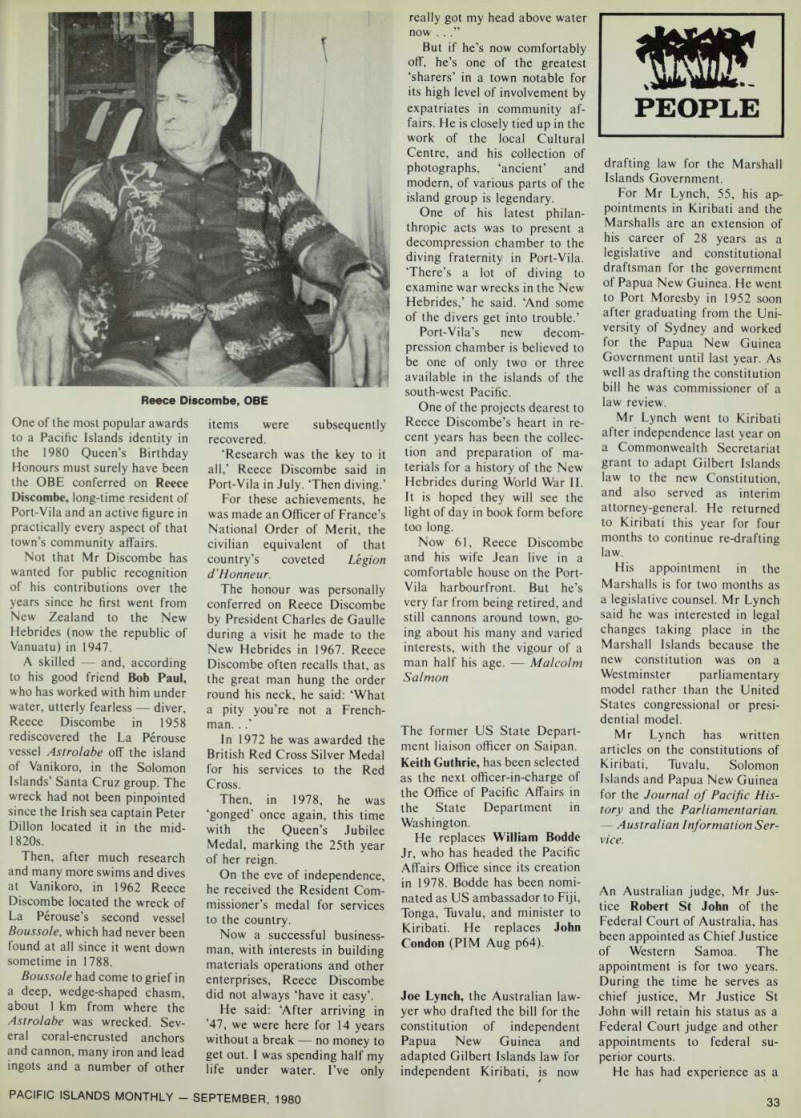

One of the most popular awards to a Pacific Islands identity in the 1980 Queen’s Birthday Honours must surely have been the OBE conferred on Reece Discombe, long-time resident of Port-Vila and an active figure in practically every aspect of that town’s community affairs.
Not that Mr Discombe has wanted for public recognition of his contributions over the years since he first went from New Zealand to the New Hebrides (now the republic of Vanuatu) in 1947.
A skilled and, according to his good friend Bob Paul, who has worked with him under water, utterly fearless diver, Reece Discombe in 1958 rediscovered the La Perouse vessel Astrolabe off the island of Vanikoro, in the Solomon Islands’ Santa Cruz group. The wreck had not been pinpointed since the Irish sea captain Peter Dillon located it in the mid 1820s.
Then, after much research and many more swims and dives at Vanikoro, in 1962 Reece Discombe located the wreck of La Perouse’s second vessel Boussole, which had never been found at all since it went down sometime in 1788.
Boussole had come to grief in a deep, wedge-shaped chasm, about 1 km from where the Astrolabe was wrecked. Sev eral coral-encrusted anchors and cannon, many iron and lead ingots and a number of other
items were subsequently recovered. ‘Research was the key to it all,’ Reece Discombe said in Port-Vila in July. ‘Then diving.’
For these achievements, he was made an Officer of France’s National Order of Merit, the civilian equivalent of that country’s coveted Legion d’Honneur.
The honour was personally conferred on Reece Discombe by President Charles de Gaulle during a visit he made to the New Hebrides in 1967. Reece Discombe often recalls that, as the great man hung the order round his neck, he said; ‘What a pity you’re not a French man. ..’
In 1972 he was awarded the British Red Cross Silver Medal for his services to the Red Cross.
Then, in 1978, he was ‘gonged’ once again, this time with the Queen’s Jubilee Medal, marking the 25th year of her reign.
On the eve of independence, he received the Resident Com missioner’s medal for services to the country.
Now a successful business man, with interests in building materials operations and other enterprises, Reece Discombe did not always ‘have it easy’.
He said: ‘After arriving in ’47, we were here for 14 years without a break no money to get out. I was spending half my life under water. I’ve only
really got my head above water now . . .”
But if he’s now comfortably off, he’s one of the greatest ‘sharers’ in a town notable for its high level of involvement by expatriates in community af fairs. He is closely tied up in the work of the local Cultural Centre, and his collection of photographs, ‘ancient’ and modern, of various parts of the island group is legendary.
One of his latest philan thropic acts was to present a decompression chamber to the diving fraternity in Port-Vila. ‘There’s a lot of diving to examine war wrecks in the New Hebrides,’ he said. ‘And some of the divers get into trouble.’
Port-Vila’s new decom pression chamber is believed to be one of only two or three available in the islands of the south-west Pacific.
One of the projects dearest to Reece Discombe’s heart in re cent years has been the collec tion and preparation of ma terials for a history of the New Hebrides during World War 11.
It is hoped they will see the light of day in book form before too long.
Now 61, Reece Discombe and his wife Jean live in a comfortable house on the Port- Vila harbourfront. But he’s very far from being retired, and still cannons around town, go ing about his many and varied interests, with the vigour of a man half his age. Malcolm Salmon The former US State Depart ment liaison officer on Saipan.
Keith Guthrie, has been selected as the next officer-in-charge of the Office of Pacific Affairs in the State Department in Washington.
He replaces William Bodde Jr, who has headed the Pacific Affairs Office since its creation in 1978. Bodde has been nomi nated as US ambassador to Fiji, Tonga, Tuvalu, and minister to Kiribati. He replaces John Condon (PIM Aug p 64).
Joe Lynch, the Australian law yer who drafted the bill for the constitution of independent Papua New Guinea and adapted Gilbert Islands law for independent Kiribati, is now /
drafting law for the Marshall Islands Government.
For Mr Lynch, 55, his ap pointments in Kiribati and the Marshalls are an extension of his career of 28 years as a legislative and constitutional draftsman for the government of Papua New Guinea. He went to Port Moresby in 1952 soon after graduating from the Uni versity of Sydney and worked for the Papua New Guinea Government until last year. As well as drafting the constitution bill he was commissioner of a law review.
Mr Lynch went to Kiribati after independence last year on a Commonwealth Secretariat grant to adapt Gilbert Islands law to the new Constitution, and also served as interim attorney-general. He returned to Kiribati this year for four months to continue re-drafting law.
His appointment in the Marshalls is for two months as a legislative counsel. Mr Lynch said he was interested in legal changes taking place in the Marshall Islands because the new constitution was on a
Westminster parliamentary
model rather than the United States congressional or presi dential model.
Mr Lynch has written articles on the constitutions of Kiribati, Tuvalu, Solomon Islands and Papua New Guinea for the Journal of Pacific His tory and the Parliamentarian.
Australian Information Ser vice.
An Australian judge, Mr Jus tice Robert St John of the Federal Court of Australia, has been appointed as Chief Justice of Western Samoa. The appointment is for two years.
During the time he serves as chief justice, Mr Justice St John will retain his status as a Federal Court judge and other appointments to federal su perior courts.
He has had experience as a
Reece Discombe, OBE
judge of the Supreme Court of the Australian Capital Territory and as a judge of the Supreme Court of Norfolk Island.
Lord Grey of Naunton has retired as chairman of the Commonwealth Development Corporation and Lord Kind ersley has been appointed as CDC’s new Chairman.
Lord Kindersley, born in 1929, is an executive director of Lazard Brothers & Co Ltd and has been deputy chairman of the Export Guarantees Advis ory Council since 1978. He is also on the boards of several companies including Witan In vestment Co Ltd, Sun Alliance & London Insurance Group and Swedish Match Company. He has been financial adviser to the Export Group for the Construc tional Industries since 1961.
In the Queen’s Birthday Honours, CDC chief executive Sir Peter Meinertzhagen was made a Knight Bachelor to mark his work for developing countries through the CDC.
Mr T. W. Star has been ac cepted by the US Government as ambassador of the Republic of Nauru to the USA.
Mr Star is also the Nauru Consul-General in Melbourne.
In the early 19305, a young German priest from the Ruhr Valley made a lifetime commit ment to serve in faraway and isolated Western Samoa.
After 47 years in the islands, 75-year-old Father Albert Merten is still going strong. He
was in New Zealand recently for a brief visit to replace his dentures and eye glasses unperturbed by the knowledge that he may soon become obsol ete.
When he first arrived at Western Samoa in a luxurious passenger liner, Father Merten was greeted by a people who bartered for goods and services, lived almost exclusively in small villages and worshipped their own gods.
The Catholic Church there was dominated by the French, but soon expanded to include English, American, German and Irish priests.
Now the tables have turned and the days of such European influence are numbered, with a Fijian seminary and a Samoan bishop who is also a cardinal.
Father Merten said this was the case in Samoa in all fields such as science, agriculture, government and the Church, but this did not bother the foreign priests because they went there knowing the success of their mission would be gauged by how soon they be-
John
Clarke in the New Zealand Herald.
Tonga’s only woman MP, Pap iloa Foliaki, visited Copenhagen in July to take part
in an international Women’s Conference.
She was invited to present papers and take part in panel discussions on the Child Care Needs of Low-Income Women in Developing Countries and on ways of involving such women in economic development and community betterment proj ects. She hopes to establish communication channels which will enable Tonga to learn about, and utilise, experience already gained in other parts of the world.
Her participation in the con ference was arranged by the Overseas Education Fund of the American League of Women Voters and funded by the Women in Development section of the US Agency for International Development. — Penny Hodgkinson in Nukualofa.
Michael Ovington presented his credentials as Australia’s first high commissioner to the newly independent republic of Vanuatu on July 31, one day after the country acceded to independence. Mr Ovington, 35, was Australian consul in Noumea from 1978-80.
A flurry of changes in Papua New Guinea’s diplomatic rep resentation was announced in August. Dr Alexis Sarei be comes high commissioner to the United Kingdom; Austin Sapias is confirmed in the post of high commissioner to Australia; and
Brian Amini becomes high com missioner to New Zealand.
Other appointments are; am bassador to the United Nations, Ilinome Tarua; ambassador to the USA, Kubulan Los; am bassador to Japan, Joseph Nombri; ambassador to Belgium, EEC/ACP, Joseph Auna; high commissioner to Solomon Islands, Jack Kairi; high commissioner to Fiji, Dr Ako Toua; ambassador to the Philippines, Thomas Ritako; and ambassador to Indonesia, Benson Gegeyo.
Meanwhile, the government has announced the appointment of eight new heads of public service departments. Among them are Paulias Matane, for merly ambassador to the UN,
who becomes head of the foreign affairs and trade depart ment; Frederick Reiher, former high commissioner to the UK, head of the prime minister’s department, and Rose Kekedo, former teaching service com missionV, head of the newly formed department of com munity and family services.
Rose Kekedo is the first woman to head a department in the PNG public service.
Prime Minister Sir Julius Chan had earlier foreshadowed ‘an overhaul of government and administration, and a massive clean-up of bureaucratic inefficiencies’.
Apology: PIM apologises to Pedro Fernandez de Quiros for disturbing his well-earned rest by reporting him as active on April 25, 1906 (PIM Aug p 69), becoming on that date ‘the first European to see the New Hebrides’. Actually the gallant Spanish navigator achieved the feat 300 years earlier to the day, in 1606.
Recently touring defence estab lishments in Australia was Garega Pepena, Papua New Guinea Defence Minister. Here he talks in Canberra with Mike Julien, acting controller of the Australian Coastal Surveillance Centre. - AIS photograph.
Major Hipo, Commander of the Defence Force of Tonga, who flew to Australia recently and met senior defence officials as part of diplomatic links be tween the two countries.
Paulius Matane
The staying power of
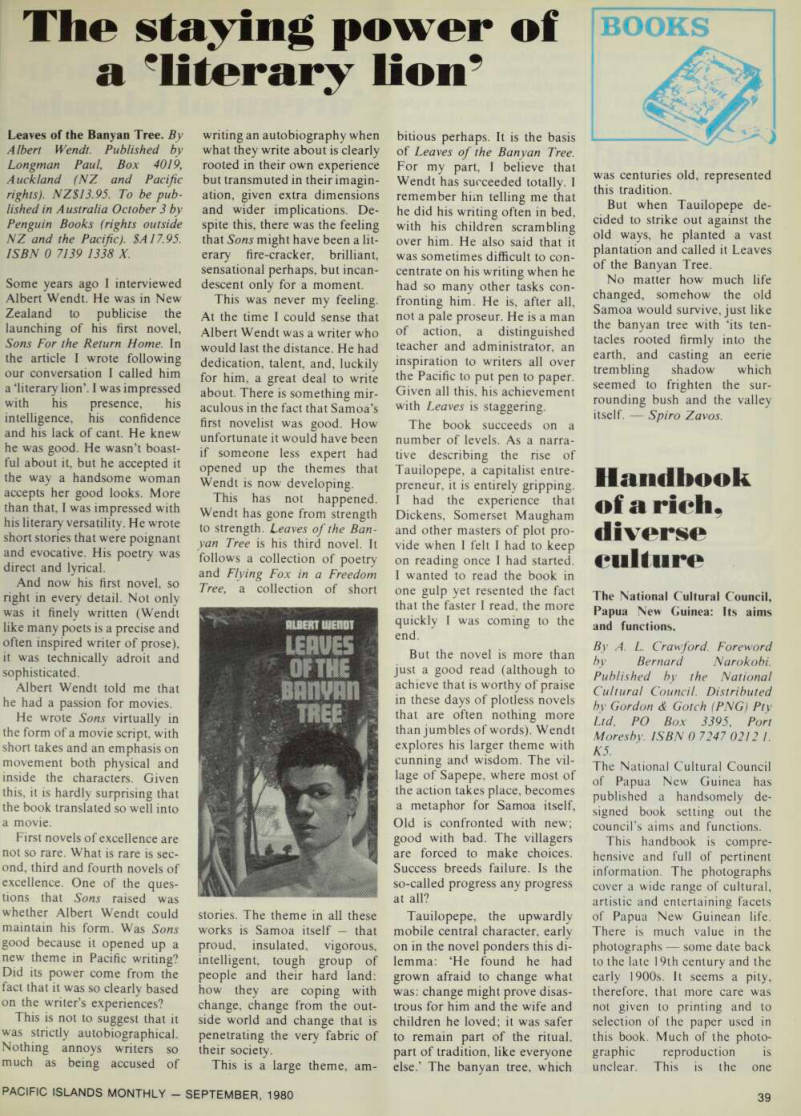
Books
The staying power of a 'literary lion'
Leaves of the Banyan Tree. By Albert Wendt. Published by Longman Paul, Box 4019, Auckland (NZ and Pacific rights). NZ513.95. To be pub lished in A ustralia October 3 by
Penguin Books (rights outside
NZ and the Pacific). $A 17.95.
Isbn 0 7139 1338 X.
Some years ago I interviewed Albert Wendt. He was in New Zealand to publicise the launching of his first novel, Sons For the Return Home. In the article I wrote following our conversation I called him a ‘literary lion’. I was impressed with his presence, his intelligence, his confidence and his lack of cant. He knew he was good. He wasn’t boast ful about it, but he accepted it the way a handsome woman accepts her good looks. More than that, I was impressed with his literary versatility. He wrote short stories that were poignant and evocative. His poetry was direct and lyrical.
And now his first novel, so right in every detail. Not only was it finely written (Wendt like many poets is a precise and often inspired writer of prose), it was technically adroit and
sophisticated.
Albert Wendt told me that he had a passion for movies.
He wrote Sons virtually in the form of a movie script, with short takes and an emphasis on movement both physical and inside the characters. Given this, it is hardly surprising that the book translated so well into a movie.
First novels of excellence are not so rare. What is rare is sec ond, third and fourth novels of excellence. One of the ques tions that Sons raised was whether Albert Wendt could maintain his form. Was Sons good because it opened up a new theme in Pacific writing?
Did its power come from the fact that it was so clearly based on the writer’s experiences?
This is not to suggest that it
was strictly autobiographical.
Nothing annoys writers so much as being accused of
writing an autobiography when
what they write about is clearly rooted in their own experience but transmuted in their imagin ation, given extra dimensions and wider implications. De spite this, there was the feeling that Sons might have been a lit erary fire-cracker, brilliant, sensational perhaps, but incan descent only for a moment.
This was never my feeling.
At the time I could sense that Albert Wendt was a writer who would last the distance. He had dedication, talent, and, luckily for him, a great deal to write about. There is something mir aculous in the fact that Samoa’s first novelist was good. How unfortunate it would have been if someone less expert had opened up the themes that Wendt is now developing.
This has not happened.
Wendt has gone from strength to strength. Leaves of the Ban yan Tree is his third novel. It follows a collection of poetry and Flying Fox in a Freedom Tree, a collection of short
stories. The theme in all these works is Samoa itself that proud, insulated, vigorous,
intelligent, tough group of
people and their hard land: how they are coping with change, change from the out side world and change that is penetrating the very fabric of
their society.
This is a large theme, am
bitious perhaps. It is the basis of Leaves of the Banyan Tree.
For my part, I believe that Wendt has succeeded totally. I remember him telling me that he did his writing often in bed, with his children scrambling over him. He also said that it was sometimes difficult to con centrate on his writing when he had so many other tasks con fronting him. He is, after all, not a pale proseur. He is a man of action, a distinguished teacher and administrator, an inspiration to writers all over the Pacific to put pen to paper.
Given all this, his achievement with Leaves is staggering.
The book succeeds on a number of levels. Asa narra tive describing the rise of
Tauilopepe, a capitalist entre
preneur, it is entirely gripping.
I had the experience that Dickens, Somerset Maugham and other masters of plot pro vide when I felt I had to keep on reading once I had started.
I wanted to read the book in one gulp yet resented the fact that the faster I read, the more quickly I was coming to the end.
But the novel is more than
just a good read (although to
achieve that is worthy of praise in these days of plotless novels that are often nothing more than jumbles of words). Wendt explores his larger theme with cunning and wisdom. The vil lage of Sapepe, where most of the action takes place, becomes a metaphor for Samoa itself, Old is confronted with new; good with bad. The villagers are forced to make choices.
Success breeds failure. Is the so-called progress any progress at all?
Tauilopepe, the upwardly
mobile central character, early on in the novel ponders this di lemma: ‘He found he had grown afraid to change what was: change might prove disas trous for him and the wife and children he loved; it was safer to remain part of the ritual, part of tradition, like everyone else.’ The banyan tree, which
was centuries old, represented this tradition.
But when Tauilopepe de cided to strike out against the old ways, he planted a vast plantation and called it Leaves of the Banyan Tree.
No matter how much life changed, somehow the old Samoa would survive, just like the banyan tree with ‘its ten tacles rooted firmly into the earth, and casting an eerie trembling shadow which seemed to frighten the sur rounding bush and the valley
itself.
Spiro Zavos.
diverse
Handbook of a rich, diverse culture
The National Cultural Council, Papua New Guinea; Its aims and functions.
By A. L Crawford. Foreword by Bernard Narokobi.
Published by the National Cultural Council. Distributed by Gordon & Gotch (PNG) Pty Ltd. PO Box 3395. Port Moresby. ISBN 0 7247 0212 I.
K5.
The National Cultural Council of Papua New Guinea has published a handsomely de signed book setting out the council’s aims and functions.
This handbook is compre hensive and full of pertinent information. The photographs cover a wide range of cultural, artistic and entertaining facets of Papua New Guinean life.
There is much value in the photographs — some date back to the late 19th century and the early 1900s. It seems a pity, therefore, that more care was not given to printing and to selection of the paper used in this book. Much of the photo graphic reproduction is unclear. This is the one
disappointing feature of the book, which otherwise is of true benefit to the people towards whom it is directed.
In general, the book is a plea for the retention of cultural values and cultural identity. It is also a fount of information on the how, the where and the why of applying for a cultural grant and the setting out of procedures about what to do to fulil the aims and needs of building and maintaining cul tural centres.
The several sections in the book cover the scope of and needs for cultural development and for the retention in PNG of indigenous arts. The first section on the National Cul tural Council explains the giv ing of aid, the powers, aims and functions of the council and activities such as village arts, the National Arts School, PNG studies and the National Theatre Company.
Part Two covers the various provinces which, with over 700 languages, and their peoples separated by wide distances and inhibited by natural bor ders in the form of rivers, mountain ranges and forests, have produced the great diver sity of cultures in this richly artistic area.
The introduction explains: ‘Although the terrain and com munication difficulties have prevented the development of a pan-Papua New Guinea cul ture, Melanesian cultures in general share common features which are distinctively differ ent from other cultures. Now that communication is easier, it may not be possible to retain indefinitely the integrity of the cultures of small groups but hopefully cultural forms which are neither artificial nor trivial will emerge.’
The book is a good source of ideas for all who value the furthering of the arts and cul ture of Papua New Guinea. It is particularly valuable to those indigenous peoples within the country whose responsibility this now is.
The book has appendices and an excellent foreword by Bernard Narokobi. In fact, sev eral experts have contributed to the book, and all seem imbued with enthusiasm for
their subject.
Victor Carell.
'dream of islands'
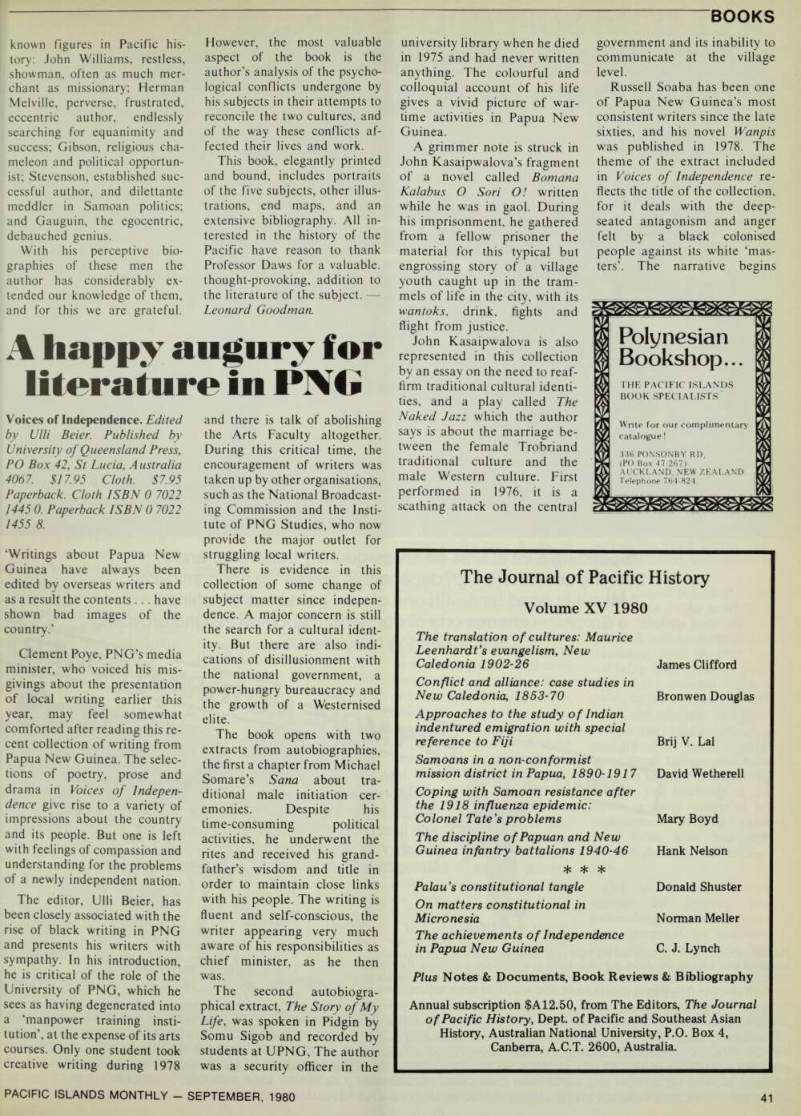
They all had their 'dream of islands'
A Dream of Islands: Voyages of Self-Discovery in the South Seas. By Gavin Daws, Re search Professor of Pacific History at the Australian National University. Published by The Jacaranda Press, Queensland, and simul taneously by W. W. Norton, New York. ISBN 0 7016 1360 2. 5A12.95.
The 18th-century discoveries by Wallis, Bougainville, Cook, and others in the South Seas and in Tahiti in particular excited the imagination of Europe. Stories of the New Eden, of Bougainville’s Nouvelle Cythere told of a world where the constraints of European life and work were replaced by an existence of ease, freedom and voluptuous delights. The initial impact of this promise of sexual freedom combined with a life of ease in a fecund tropical environment proved irresistable to many of the European newcomers, and led to extensive desertions and to the most famous mutiny in naval history.
In the light of the new knowledge, European philos ophers revived Rousseau’s The ory of The Noble Savage’, and thinking men began to question the nature of man and his civilisation in the wider con cept of this newly discovered Elysium. Which was the better or more natural way of life?
Was it possible that the Golden Age of Greece, the Utopia of More, or the Paradise of Columbus could really exist in the South Seas? How was it possible to reconcile the fact that whilst Mass was being celebrated by the Spaniards in the Marquesas they were shooting the natives, or that Wallis, Bougainville and Cook had all destroyed life and prop erty during their island so journs? What were the relative merits of island life compared with European civilisation?
As the author succinctly puts it: ‘For a brief moment in the eighteenth century, the savage, and especially the
Polynesian, had seemed to of fer the white man a vision of what it might be like to go naked in the world once more.
The idea of some sort of earthly paradise in the South Seas lived on into the nine teenth century . . . but as those Europeans who thought about such things concluded, there was very little to be said for savagery of any kind, and a great deal for civilisation.’
Nevertheless, men went there for all reasons that men go anywhere: to seek the ex perience of new discovery, to escape the conventions of Europeans mores, to trade, to seek self-expression, to exercise authority, to escape creditors, or to save the South Sea Islander from himself by redeeming his immortal soul
through Christian missionary effort. All had their own dreams of islands.
The author takes five very diverse European characters whom he calls ‘Eminent Victorians of the South Seas’ to illustrate his thesis that however hard these men strove to mobilise their powers of self expression, self-justification and self-realisation in Polynesia, they could not es cape the ‘running battle of civilisation and its discontents’, and that whatever their orig inal motivation, they wanted, desperately, the world to know about them.
The five men chosen are well
Melville - ‘perverse, frus trated, eccentric’.
known figures in Pacific his tory: John Williams, restless, showman, often as much mer chant as missionary; Herman Melville, perverse, frustrated, eccentric author, endlessly searching for equanimity and success; Gibson, religious cha meleon and political opportun ist; Stevenson, established suc cessful author, and dilettante meddler in Samoan politics; and Gauguin, the egocentric, debauched genius.
With his perceptive bio graphies of these men the author has considerably ex tended our knowledge of them, and for this we are grateful.
However, the most valuable aspect of the book is the author’s analysis of the psycho logical conflicts undergone by his subjects in their attempts to reconcile the two cultures, and of the way these conflicts af fected their lives and work.
This book, elegantly printed and bound, includes portraits of the five subjects, other illus trations, end maps, and an extensive bibliography. All in terested in the history of the Pacific have reason to thank Professor Daws for a valuable, thought-provoking, addition to the literature of the subject.
Leonard Goodman.
Advertisements & other items, p. 40 (1 item)
fascinating
Your doorway into the
world of the South Seas 104 pages $4.00 or SUSS.OO posted.
Send to box 3408, GPO, Sydney, NSW, 2001, or use coupon insert in this issue.
Stay at Aggie Grey’s . . . the South Pacific’s
legendary hotel.
Situated right in the heart of Western Samoa. Enjoy Poly nesian-style friendliness and service, in cool surroundings, superb entertainment and food.
Magnificent white sand beaches only a short drive away. Airconditioned rooms, swimming pool and full bar facilities.
Bookings through Union Steamship Company of NZ, Pan Am, Air New Zealand or direct to Aggie Grey’s, Apia, Western Samoa. Cables: ‘AGGIES’ Apia.
PORT
MO * Right in business cepfrei * A traditiojf'ior l comfort food * All rpoms airconditioned * Restaurant * Bat * Banquet hall
..A. C. NEUMANN
manager Phone 21-26 'ab\eJ
A happy augury for literature

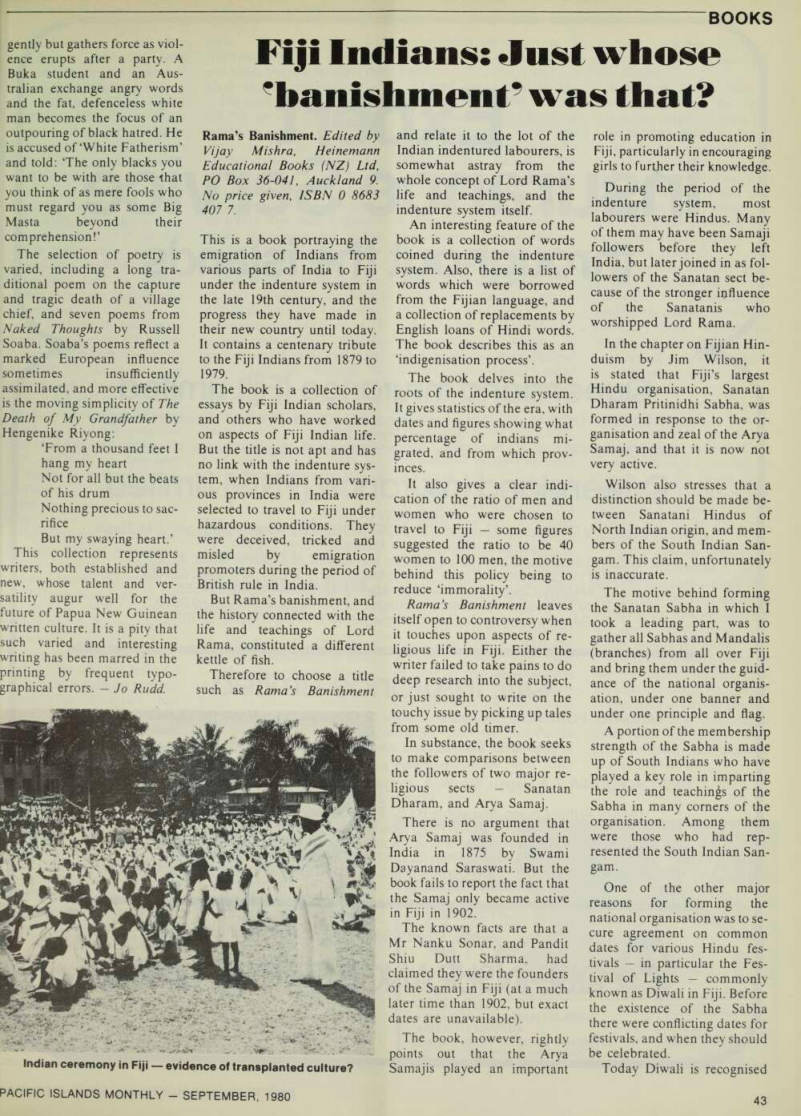
literature In PNC
Voices of Independence. Edited by Ulli Beier. Published by
University of Queensland Press,
PO Box 42, St Lucia, A ustralia 4067. $17.95 Cloth. $7.95 Paperback. Cloth ISBN 0 7022 1445 0. Paperback ISBN 0 7022 1455 8.
‘Writings about Papua New
Guinea have always been edited by overseas writers and as a result the contents ... have shown bad images of the
country.’
Clement Poye, PNG’s media minister, who voiced his mis
givings about the presentation
of local writing earlier this year, may feel somewhat comforted after reading this re cent collection of writing from Papua New Guinea. The selec tions of poetry, prose and drama in Voices of Indepen dence give rise to a variety of impressions about the country and its people. But one is left with feelings of compassion and understanding for the problems of a newly independent nation.
The editor, Ulli Beier, has been closely associated with the rise of black writing in PNG and presents his writers with sympathy. In his introduction, he is critical of the role of the University of PNG, which he sees as having degenerated into a ‘manpower training insti tution’, at the expense of its arts courses. Only one student took creative writing during 1978
and there is talk of abolishing the Arts Faculty altogether.
During this critical time, the encouragement of writers was taken up by other organisations, such as the National Broadcast ing Commission and the Insti tute of PNG Studies, who now provide the major outlet for struggling local writers.
There is evidence in this collection of some change of subject matter since indepen dence. A major concern is still the search for a cultural ident ity. But there are also indi cations of disillusionment with the national government, a power-hungry bureaucracy and the growth of a Westernised elite.
The book opens with two extracts from autobiographies, the first a chapter from Michael Somare’s Sana about tra ditional male initiation cer emonies. Despite his
time-consuming political
activities, he underwent the rites and received his grand father’s wisdom and title in order to maintain close links with his people. The writing is fluent and self-conscious, the writer appearing very much aware of his responsibilities as chief minister, as he then was.
The second autobiogra
phical extract, The Story of My
Life , was spoken in Pidgin by Somu Sigob and recorded by students at UPNG, The author was a security officer in the
university library when he died in 1975 and had never written anything. The colourful and colloquial account of his life gives a vivid picture of war time activities in Papua New Guinea.
A grimmer note is struck in
John Kasaipwalova’s fragment
of a novel called Bomana Kalabus O Sori O! written while he was in gaol. During
his imprisonment, he gathered
from a fellow prisoner the material for this typical but engrossing story of a village youth caught up in the tram mels of life in the city, with its wantoks, drink, fights and
flight from justice.
John Kasaipwalova is also represented in this collection by an essay on the need to reaf firm traditional cultural identi ties, and a play called The Naked Jazz which the author says is about the marriage be tween the female Trobriand traditional culture and the male Western culture. First performed in 1976, it is a scathing attack on the central
government and its inability to communicate at the village level.
Russell Soaba has been one of Papua New Guinea’s most consistent writers since the late sixties, and his novel Wanpis was published in 1978. The theme of the extract included in Voices of Independence re flects the title of the collection, for it deals with the deep seated antagonism and anger felt by a black colonised people against its white ‘mas ters’. The narrative begins
gently but gathers force as viol ence erupts after a party. A Buka student and an Aus tralian exchange angry words and the fat, defenceless white man becomes the focus of an outpouring of black hatred. He is accused of‘White Fatherism’ and told; ‘The only blacks you want to be with are those that you think of as mere fools who must regard you as some Big Masta beyond their
comprehension!’
The selection of poetry is varied, including a long tra ditional poem on the capture and tragic death of a village chief, and seven poems from
Naked Thoughts by Russell
Soaba. Soaba’s poems reflect a marked European influence
sometimes insufficiently
assimilated, and more effective is the moving simplicity of The
Death of My Grandfather by
Hengenike Riyong:
‘From a thousand feet I hang my heart Not for all but the beats of his drum
Nothing precious to sac
rifice But my swaying heart.’
This collection represents writers, both established and new, whose talent and ver satility augur well for the future of Papua New Guinean written culture. It is a pity that such varied and interesting writing has been marred in the
printing by frequent typo
graphical errors. -
Jo Rudd.
Indian ceremony in Fiji - evidence of transplanted culture?
Advertisements & other items, pp. 41-42 (1 item)
Advt
Polynesian
Bookshop...
THE PACIFIC ISLANDS
BOOK SPECIALISTS'
Write for our complimentary catalogue!
336 PONSONBY RD.
(PO Box -47 267)
AUCKLAND, NEW ZEALAND
Telephone 764-824.
ADVT
“GET-ABOUT”
NAND
m
FOR POWER
m W *
ife
See? Esa S 5 9p P| |p : . is Spending a lot of time on cross-country travel or errands?
Seeking something with dependable power, yet economical?
Make it in good time with one of our “get-about” machines.
Go with a Suzuki!— choose one of our performance-proven motorcycles,
just answering travel needs.
ind
FOB
mqbe
ryiQ
irOBjNG
pOWEfi
Look further into Suzuki’s traditional excellence and discover the results in our 4-wheel drive vehicles and fleet of outboard motors something to satisfy your every motoring need.
Going by land or by sea ... go with a Suzuki.
SUZUKI 4 WHEEL
DRIVE VEHICLE
DTBS
SUZUKI MOTOR CO., LTD. reserves the right to change, without notice, equipment, specifications, colours, materials and other items to apply local conditions. Each model might be discontinued without notice. Please inquire at your local dealer for details of any such changes. Actual body colours might differ slightly from the colours in this ad.
SUZUKI MOTOR CO, LTD
Hamamatsu, Japan
SUZUKI
SOLOMON ISLANDS SOLOMON ISLAND SERVICE STATION LTD. #NEW CALEDONIA STE. SUPERCAL • PAPUA NEW GUINEA BURNS PHILP (NEW GUINEA) LTD. «NEW HEBRIDES HENRI LEROUX #NIUE ISLAND BURNS PHILP (SOUTH SEA) CO., LTD #PONAPE LEO ETSCHEIT •TAHITI NIPPON AUTOMOTO •ELLICE ISLAND TUVALU COOPERATIVE WHOLESALE SOCIETY LTD. «GUAM & SAIPAN ISLAND CYCLERY, INC. • NORFOLK MARTIN’S AGENCIES LTD. «SAMOA PACIFIC PRODUCTS, INC. • TARAWA GILBERT ISLANDS COOPERATIVE FEDERATION LIMITED •TONGA MORRIS HEDSTROM LTD. • WESTERN CAROLINES BECHESRRAK T. COMPANY *YAP AMBROSE D. MINGINFEL’S WHOLESALER • EASTERN CAROLINES KIOMASA STORE • NAURU EQUAPAC MOTORS ©FIJI NIRANJANS AUTOPORT LTD.
Fiji Indians: Just whose

'banishment ' was that?
Rama's Banishment. Edited by Vi jay Mishra, Heinemann Educational Books (NZ) Ltd, PO Box 36-041, Auckland 9.
No price given, ISBN 0 8683 407 7.
This is a book portraying the emigration of Indians from various parts of India to Fiji under the indenture system in the late 19th century, and the progress they have made in their new country until today.
It contains a centenary tribute to the Fiji Indians from 1879 to 1979.
The book is a collection of essays by Fiji Indian scholars, and others who have worked on aspects of Fiji Indian life.
But the title is not apt and has no link with the indenture sys tem, when Indians from vari ous provinces in India were selected to travel to Fiji under hazardous conditions. They were deceived, tricked and
misled by emigration
promoters during the period of British rule in India.
But Rama’s banishment, and the history connected with the life and teachings of Lord Rama, constituted a different kettle of fish.
Therefore to choose a title such as Rama’s Banishment
and relate it to the lot of the Indian indentured labourers, is somewhat astray from the whole concept of Lord Rama’s life and teachings, and the indenture system itself.
An interesting feature of the book is a collection of words coined during the indenture system. Also, there is a list of words which were borrowed from the Fijian language, and a collection of replacements by English loans of Hindi words.
The book describes this as an
‘indigenisation process’.
The book delves into the roots of the indenture system.
It gives statistics of the era, with dates and figures showing what percentage of indians mi grated, and from which prov inces.
It also gives a clear indi cation of the ratio of men and women who were chosen to travel to Fiji some figures suggested the ratio to be 40 women to 100 men, the motive behind this policy being to
reduce ‘immorality’.
Rama’s Banishment leaves itself open to controversy when it touches upon aspects of re ligious life in Fiji. Either the writer failed to take pains to do deep research into the subject, or just sought to write on the
touchy issue by picking up tales
from some old timer.
In substance, the book seeks to make comparisons between the followers of two major re ligious sects Sanatan Dharam, and Arya Samaj.
There is no argument that Arya Samaj was founded in India in 1875 by Swami Dayanand Saraswati. But the book fails to report the fact that the Samaj only became active in Fiji in 1902.
The known facts are that a Mr Nanku Sonar, and Pandit Shiu Dutt Sharma, had claimed they were the founders of the Samaj in Fiji (at a much later time than 1902, but exact dates are unavailable).
The book, however, rightly points out that the Arya Samajis played an important
role in promoting education in Fiji, particularly in encouraging girls to further their knowledge.
During the period of the indenture system, most labourers were Hindus. Many of them may have been Samaji followers before they left India, but later joined in as fol lowers of the Sanatan sect be cause of the stronger influence of the Sanatanis who worshipped Lord Rama.
In the chapter on Fijian Hin duism by Jim Wilson, it is stated that Fiji’s largest Hindu organisation, Sanatan Dharam Pritinidhi Sabha, was formed in response to the or ganisation and zeal of the Arya Samaj, and that it is now not very active.
Wilson also stresses that a distinction should be made be tween Sanatani Hindus of North Indian origin, and mem bers of the South Indian San gam. This claim, unfortunately is inaccurate.
The motive behind forming the Sanatan Sabha in which I took a leading part, was to gather all Sabhas and Mandalis (branches) from all over Fiji and bring them under the guid ance of the national organis ation, under one banner and under one principle and flag.
A portion of the membership strength of the Sabha is made up of South Indians who have
played a key role in imparting
the role and teachings of the Sabha in many corners of the
organisation. Among them
were those who had rep resented the South Indian San gam.
One of the other major reasons for forming the national organisation was to se cure agreement on common dates for various Hindu fes tivals in particular the Fes
tival of Lights commonly
known as Diwali in Fiji. Before the existence of the Sabha there were conflicting dates for festivals, and when they should be celebrated.
Today Diwali is recognised
in Fiji as a public holiday, after the issue of conflicting dates was resolved by the Sabha. It was on their insistence, and on the insistence of a Hindu
journalist, that Fiji’s Prime
Minister, Ratu Sir Kamisese Mara, after consultation with his cabinet, agreed to grant this public holiday. The other hol iday is for Mohammed the
Prophet’s birthday.
Basically, the religious issue
is very sensitive for the Fiji Indian community as a whole.
Therefore, to highlight the sub ject could lead to conflict among those who read Rama's Banishment.
The book briefly touches on the formation of the Fiji Indian Congress. Although it is not my intention to damn outright what it says about the Con gress, it has still to be pointed out that the congress, as illus trated in the book, was not formed at Lautoka on May 12, 1929, and that two days later Dr Beattie formed another or
ganisation, coincidentally,
under a similar name in Suva.
The facts are that the con gress was formed following a
golden jubilee celebration
commemorating the arrival of Fiji Indians from India to Fiji on May 14, 1929. It was a brainchild of the committee
celebrating the jubilee. They
thought the time was oppor tune to form a united front for the Indians to fight for political
rights. The Congress was
backed by the monthly news paper Virddhie which assisted
in publicising its objectives.
The newspaper was edited and
published by Dr Beattie.
There is a mention that dur
ing the jubilee celebration
there was friction among the Indians some opposed the idea behind the celebration.
They were of the opinion that the jubilee was not an occasion to celebrate, rather it was a black day for the Indians as they were hoodwinked into the indenture contract and treated as slaves.
But the book correctly re minds us that the 1979 cen tenary celebration went off harmoniously, without any ill feelings among the Indians, and was treated as a national event. Tears of joy in fact rolled
from former indentured labourers who are now frail and weak, but also recollect the black days of indenture.
The book has correctly stres sed that on completion of the indenture system, the Indians were ready to encounter another battle this time for
equal rights.
It traces the matter of politi cal rights of Indians from the time they won their franchise under the communal voting system, to today’s electoral sys tem.
Mishra obviously spent a lot of time compiling the book.
Although there are a few mis interpretations of facts, it is recommended that today’s
generation should grab the
book and go through it
thoroughly.
Perhaps when its second edition goes to press, it would be advisable to tone down its vocabulary. As it stands the book appears to be more for the intellectual than the man in
the street.
G. D. Sharma.
Advertisements & other items, p. 44 (1 item)
Expert
Insurance Service
throughout the islands
Queensland Insurance (Fiji) Limited
Head Office, 34 Usher St., SUVA . General Manager: L. G. Liddell A.A.1.1. Assistant Managers: Vijay Lai. Phone: 23851.
LAUTOKA OFFICE: Burns Philp Bldg., Naviti St. District Manager: J. Dalton. Phone: 60642.
Queensland Insurance (PNG) Limited
PAPUA NEW GUINEA
Head Office, B.N.G. Building, Musgrave St.,PORT MORESBY. General Manager: J. M. Dawe.
Assistant Manager: R. V. Maskell. Phone: 212144.
LAE: 4th St. & Coronation Drive. District Manager; I. R. Martin. Phone; 423873, MOUNT HAGEN: Hagen Drive. District Manager: D. F. Carroll. Phone: 521002.
ARAWA: Chebu St. District Manager: J. Longbut. Phone: 951555.
MADANG: Kasagten St. District Manager: N. D. Ramage. Phone: 822020.
RABAUL: Wirraway St. District Manager; W. F. Tinker. Phone; 921014.
QBE Insurance Limited
VANUATU, PORT VILA: Rue de Paris, Suite 19, Oceania Bldg. Manager: G. F. Donnelly.
Phone: 2299.
SANTO: Burns Philp (Vanuatu) Ltd. Phone: 230.
PACIFIC AGENCIES
NEW CALEDONIA: T. A.Hagen, Ste. W. A. Johnston, S.A.R.L. 5 Rue Anatole France. NOUMEA.
Phone: 272083.
TAHITI; Arthur Chung. Immeuble 8.1.5., Front de Mer, PAPEETE. Phone: 2.86.19.
NIUE: Burns Philp (South Sea) Company Ltd.
NORFOLK ISLAND: Burns Philp (South Sea) Company Ltd. Phone: 2191.
SAMOA: APIA, Burns Philp (South Sea) Company Ltd. Phone; 22611.
TONGA; Burns Philp (South Sea) Company Ltd. NUKUALOFA. Phone 21500 HAAPAI, VAVAU.
yuk MEMBERS OF THE:
INSURANCE GROUP UMITED
Polynesian
Hawaii’s dream of Polynesian empire
clusive Destiny: The Inter nationalist Movement in Mod em Hawaii. By Paul F. Hooper.
Published by the University Press of Hawaii Honolulu.
Susis. Isbn 0 8248 0631 X.
In 1851 Charles St Julian, an Australian newspaper reporter, wrote to the Hawaiian govern ment requesting a commission as Hawaii’s representative to Polynesia. He wanted no less than to help create a Polynesian confederation, with Hawaii as its leader.
Kamehameha 111 and his foreign minister, Robert C.
Wyllie, seriously considered St Julian’s proposal. For a few years they flirted with St Julian, encouraging his efforts to forge links with Tonga, Samoa, and the Stewart Islands.
Nothing ever came of them.
But Kamehameha 111 and Wyllie were neither the first nor the last in Hawaii’s royal
governments to dream of a larger role for Hawaii in the Pacific.
Legend has it that at the beginning of the 19th century Kamehameha I considered an invasion of Tahiti. At the cen
tury’s end, Kalakaua actually
launched the Kaimiloa, the
kingdom’s only warship, on a
voyage to Samoa. His purpose was to demonstrate support for a recently concluded treaty of confederation between the two
Polynesian peoples. Unfor
tunately, the German navy was already in Samoa. So much for Kalakaua’s version of a
Polynesian confederation.
In Elusive Destiny: The In ternationalist Movement in Modern Hawaii Paul Hooper follows the internationalist vision of Hawaii’s leaders from its origins with the Hawaiian royalty to its insti tutionalisation in the East- West Center, and the various programmes of the University of Hawaii.
It has been a delicate and often tenuous vision, but it has persisted. For over a century and a half, one Hawaiian leader or another has pushed to establish a role of consequence for the islands in the inter national affairs of the Pacific Basin.
During Hawaii’s territorial period, the Islands’ social and economic leaders gave their support to two organisations designed to further under standing between the United States, Asia, and the Pacific Islands. First the Pan-Pacific Union and then the Institute of Pacific Relations held con-
Terences and published journals on matters related to the Pacific.
Following World War 11, government seized the inter nationalist initiative from pri vate patrons. John A. Burns,
delegate to Congress and
Governor of Hawaii from 1962 to 1974, brought the East-West Center to Honolulu and allo cated state tax dollars to
developing the university into
one of the world’s great centres for Pacific research.
Hooper does more in Elusive Destiny than tell the story of Hawaii’s internationalist leaders. He questions their mo tivation. Why would the leaders of a small group of islands seek such a pivotal role for themselves within the Pa cific?
He finds the answer in the literature, art, and advertising of Hawaii. He posits the paradisal myth, the belief that Hawaii, through conditions of climate and the varied racial composition of its inhabitants,
is unique, a meeting place for
Pacific peoples in the most
delightful of settings.
Elusive Destiny began as a doctoral dissertation. Unfor
tunately Hooper’s writing style
still displays the characteristics of that genre. Hooper qualifies too much. Multi-clausal sen tences muddy his prose.
The result is tough going for the general reader. But students of modern Hawaii will find in Elusive Destiny the first attempt to deal comprehen sively with the island’s most persistent intellectual tradition.
Dan Boylan.
Advertisements & other items, pp. 45-46 (1 item)
Exporters Of Fine Bedding To The Pacific Islands
- NEW GUINEA
- BRITISH SOLOMAN ISLANDS
■ NEW HEBRIDIES
Contact: WEST TASMAN TRADERS
P.O. BOX 709 PORT MORESBY Ph. 21 4332
ALL OTHER AREAS
Contact
HEAD OFFICE
MATTRESS MAKERS
CABLE: WONDEREST
BRISBANE
W/4801
When it comes time to kick off a new age in audio or video, JVC has a habit of being the first to get the ball rolling.
We were, for example, the originators of the now-famous VHS video cassette system, the world’s first metal-tape-compatible cassette deck and the Super-A high fidelity amplifier, just to name a few of the innovations that keep us in the front lines of audio and video Now, were proud to announce, we re ready to kick off a new era in video with a development that promises to change the very face of video entertainment the VHD video disc system You can imagine the potential this system is going to have. It’s such an exciting breakthrough in fact, that we felt we had to do something special to celebrate it.
We re doing just that by kicking off a campaign as the Official Supplier of Audio and Video Systems at major world association football (soccer) finals around the world, from now until the 1982 World Cup.
Why association football 7 Actually, JVC takes an active interest in a variety of sports, from judo to weightlifting. Because, at JVC, we identify strongly with the youthful spirit, the energy and the courage it takes to become a great athlete. We feel it’s taken us much the same kind of obstacle-leaping dedication to succeed in our over 53 years of trend-setting advances in audio and video Give us a thought the next time you’re cheering your favorite team on.
At JVC, we re kicking off some exciting activities of our own.
Official Official Audio & Video Systems MWB Audio & Video Systems of the European Football m >T of the UEFA Cup Championship 1980. Finals.
Official Audio & Video Systems of the FIFA World Cup 1982.
Official Audio & Video Systems of the United States Soccer Federation.
ray*
Official Audio & Video Systems of the Australian Soccer Federation.
Official Audio & Video Systems of the Gold Cup.
JVC
VICTOR COMPANY OF JAPAN LIMITED
Australia: Hagemeyer (Australasia) B Y, 25-27 Paul Street. North Ryde, N S W 2113, Australia Tel 887-1444 Fiji Islands: D Gokal & Co, Ltd , G.PO Box 501, Corner of Pier Street & Renwick Road, Suva, Fiji Tel 25259 Cook Islands: J & P Ingram & Co . Ltd, P.0 Box 55, Rarotonga, Cook Islands Tel 378457 New Hebrides: Wu ke Luong, PO Box 1 13, Rue Higgmson, Port-Vila, New Hebrides Tel 2115 New Caledonia: Caldis. 2, Route du Velodrome, BP Ml, Noumea, Cedex, New Caledonia Tel. 262350 Tahiti: Magasin Sincere, B.P. 215, Papeete, Tahiti Tel. 20060 Papua New Guinea: Hagemeyer (PNG.) Pty, Ltd, P.O. Box90Lae. Papua New Guinea Tel 42-3200 New Zealand: Atlas Majestic Industries Ltd., 11, Albion Road, Otahuhu, Auckland 6, New Zealand Tel 27-67-099
Travel
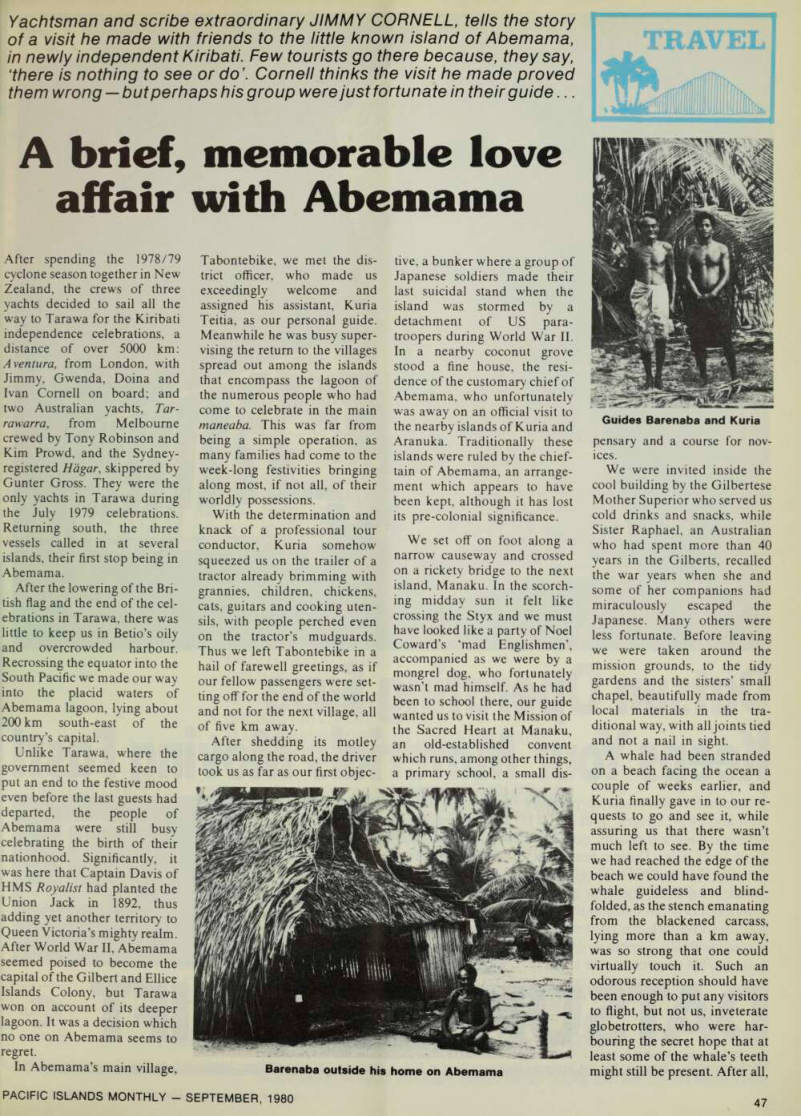
Yachtsman and scribe extraordinary JIMMY CORNELL, tells the story of a visit he made with friends to the little known island of Abemama, in newly independent Kiribati. Few tourists go there because, they say, ‘there is nothing to see or do’. Cornell thinks the visit he made proved them wrong —but perhaps his group were just fortunate in their guide...
A brief, memorable love


affair with Abemama
After spending the 1978/79 cyclone season together in New Zealand, the crews of three yachts decided to sail all the way to Tarawa for the Kiribati independence celebrations, a distance of over 5000 km; Aventura , from London, with Jimmy, Gwenda, Doina and Ivan Cornell on board; and two Australian yachts, Tar rawarra, from Melbourne crewed by Tony Robinson and Kim Prowd, and the Sydney
registered Hdgar, skippered by
Gunter Gross. They were the
only yachts in Tarawa during
the July 1979 celebrations.
Returning south, the three vessels called in at several islands, their first stop being in Abemama.
After the lowering of the Bri tish flag and the end of the cel ebrations in Tarawa, there was little to keep us in Betio’s oily and overcrowded harbour.
Recrossing the equator into the South Pacific we made our way into the placid waters of
Abemama lagoon, lying about
200 km south-east of the
country’s capital.
Unlike Tarawa, where the government seemed keen to put an end to the festive mood even before the last guests had
departed, the people of
Abemama were still busy celebrating the birth of their nationhood. Significantly, it was here that Captain Davis of HMS Royalist had planted the Union Jack in 1892, thus adding yet another territory to Queen Victoria’s mighty realm.
After World War 11, Abemama seemed poised to become the capital of the Gilbert and Ellice Islands Colony, but Tarawa won on account of its deeper lagoon. It was a decision which no one on Abemama seems to regret.
In Abemama’s main village,
Tabontebike, we met the dis trict officer, who made us exceedingly welcome and assigned his assistant, Kuria Teitia, as our personal guide.
Meanwhile he was busy super vising the return to the villages spread out among the islands that encompass the lagoon of the numerous people who had come to celebrate in the main maneaba. This was far from
being a simple operation, as
many families had come to the
week-long festivities bringing
along most, if not all, of their
worldly possessions.
With the determination and knack of a professional tour conductor, Kuria somehow squeezed us on the trailer of a
tractor already brimming with
grannies, children, chickens, cats, guitars and cooking uten sils, with people perched even on the tractor’s mudguards.
Thus we left Tabontebike in a hail of farewell greetings, as if our fellow passengers were set ting off for the end of the world and not for the next village, all of five km away.
After shedding its motley
cargo along the road, the driver took us as far as our first objec
tive, a bunker where a group of Japanese soldiers made their last suicidal stand when the island was stormed by a detachment of US para troopers during World War 11.
In a nearby coconut grove stood a fine house, the resi dence of the customary chief of Abemama, who unfortunately was away on an official visit to the nearby islands of Kuria and Aranuka. Traditionally these islands were ruled by the chief tain of Abemama, an arrange ment which appears to have been kept, although it has lost its pre-colonial significance.
We set off on foot along a narrow causeway and crossed on a rickety bridge to the next island, Manaku. In the scorch ing midday sun it felt like crossing the Styx and we must have looked like a party of Noel Coward’s ‘mad Englishmen’, accompanied as we were by a mongrel dog, who fortunately wasn’t mad himself. As he had been to school there, our guide wanted us to visit the Mission of the Sacred Heart at Manaku, an old-established convent which runs, among other things, a primary school, a small dis-
pensary and a course for nov ices.
We were invited inside the cool building by the Gilbertese Mother Superior who served us cold drinks and snacks, while Sister Raphael, an Australian who had spent more than 40 years in the Gilberts, recalled the war years when she and some of her companions had
miraculously escaped the
Japanese. Many others were
less fortunate. Before leaving we were taken around the mission grounds, to the tidy gardens and the sisters’ small
chapel, beautifully made from
local materials in the tra ditional way, with all joints tied and not a nail in sight.
A whale had been stranded on a beach facing the ocean a couple of weeks earlier, and Kuria finally gave in to our re quests to go and see it, while assuring us that there wasn’t much left to see. By the time we had reached the edge of the beach we could have found the whale guideless and blind folded, as the stench emanating from the blackened carcass, lying more than a km away, was so strong that one could virtually touch it. Such an odorous reception should have been enough to put any visitors to flight, but not us, inveterate globetrotters, who were har bouring the secret hope that at least some of the whale’s teeth might still be present. After all.
Barenaba outside his home on Abemama
Guides Barenaba and Kuria
we were on our way back to Fiji, where such a rare gift would have been greatly ap-
predated by any village
chief.
Sniffing the wind, of which there was more than enough to sniff, we made our way upwind of the smelly monster and approached it with nostrils firmly pinched. A few ribs were sticking out from the gooey, slimy mass, crawling with fat maggots. Some of the blubber had found its way into the cooking pots and lamps of the nearest village, while as we were to find out later, the main trophy, the whale’s teeth, had been appropriated by none other than the great-grandson of Abemama’s infamous tyrant, Tem Binoka. But even if the teeth had still been there, I doubt that any of us would have had a hand available to extract them, as by now we were flailing madly at the swarms of fat green flies that fer some odd reason seemed to prefer us to the tasty corpse.
We hitched a ride back into
Tabontebike with the mission truck, briefly stopping en route to dissect the heart of a coconut tree fallen across the road after the owner had generously given us permission to do so. I just hope we didn’t give any destructive ideas to the islanders, who were watching us curiously, thus introducing them to this gourmet delight, also known as millionaire’s cabbage, which makes a tasty salad tossed in French dress
ing.
A welcome stop was finally made at Abemama’s sole hotel, sadly closed for lack of visitors.
Having been advised that the standard way to get a cold beer was to leave a few cans in the island’s only freezer, we had placed our orders with the
storekeeper before setting off
on our trip. Returning much later than anticipated we were presented with a few Foster’s whose contents were frozen solid. A detour was quickly de vised by Kuria to allow the beer to regain a more palatable state.
Not far from Tabontebike stands Tern Binoka’s grave, surmounted by a tomb of mass ive solidity. It was as if the ty rant’s subjects had tried to prevent even his ghost from escaping his last abode. In a nearby house lives Barenaba Tabaeko, whose grandfather was one of Binoka’s servants.
In pursuance of the family tra dition, old Barenaba is now the
self-appointed caretaker of the
former royal compound, of
which little is left except a
small muddy pool, pointed out
with wide grins by our two
guides.
According to these, Binoka’s harem used to bathe here, the only outsider ever allowed to watch the young maidens frolicking in the water being Robert Louis Stevenson, who
Tem Binoka’s tomb near Tabontebike
later made his despotic host famous in his story In the South Seas. During his Pacific travels, the Scottish author had spent some time on Abemama, Barenaba pointing out a few stones left from the foundation of his house and a well, sup
posedly used by Stevenson.
Back at the hotel we were joined by a tall man, Sorem Paulo, a true giant by local standards, who greeted us like long-lost friends and proceeded to ply us with stories as tall as himself. However, we enjoyed his tales even if he refused to tell us what he had done with the dead whale’s teeth. After all, he was Binoka’s great-grandson and as the ty rant’s heir and successor, no body could deny him certain
privileges. Only the store
keeper seemed unimpressed by
his ancestry and firmly refused to sell him beer before the official six o’clock deadline, a rule which didn’t seem to apply to us outsiders.
The following day we went outside the reef for a diving
expedition. The underwater scenery was among the best we had encountered anywhere in the Pacific, even if the pleasure of swimming among the multi coloured coral formations was somewhat spoilt by the pres ence of several white-tipped sharks. For a while, these appeared unconcerned with our activities until a large groper, which I had speared, took refuge under a coral head whence it refused to budge.
Trying frantically to retrieve, if not my quarry, at least the
spear, I was suddenly joined by
the white-tips, who had shed their nonchalant role and were now actively interested in what was going on. So actively, in fact, that I decided to quickly leave the stage before they be came too dangerous. The blood streaming from the wounded fish was already sending the sharks into a frenzy, the situ ation made worse by their in ability to reach the fish which was, firmly jammed under the coral head. From the surface,
feeling myself in relative
safety, I watched the frenzied struggle going on 15 m below me, as the six sharks, none of which was under two m long, were trying to get their flat heads under the coral to take a bite out of the helpless victim.
At long last it was all over and I could dive down and retrieve the spear and the gun attached to it. But of my fish there were no remains.
To crown our visit to his island, Kuria arranged that
evening a concert given by a
local string band in one of the maneabas. The mixed choir sang with great feeling both older and newer songs, one of the best among the latter being a ballad composed by the local musician lentoia, about a girl returning home from her schooling overseas. Kuria then translated for us the sad lyrics of a song dedicated to the memory of the missionaries killed by the Japanese. Later, sitting crosslegged on the fine mats laid on the coral floor for us, we swapped yams with the musicians who were greatly
interested in our voyage and the ouside world, particularly in the music of other Pacific Islands. It was my turn to enter tain our hosts and I played sev eral tapes that I had recorded in Wallis, Tonga, Fiji and Eas ter Island. It was nearly mid night when the hissing sound of the bright Coleman lamps was extinguished in the maneaba and we slowly rowed back to the yachts moored in the la goon.
While sailing out of the la goon next morning bound for our next destination, Onotoa, I kept thinking of what Kuria had told me when I had asked him why the hotel was void of visitors, in spite of the regular airlink with Tarawa. ‘Oh,’ he replied with a sad smile, ‘the tourists complain that there is nothing to see or do in Abemama, so they simply don’t come.’
Well, we seem to have proved them wrong but then perhaps they never had the luck to come across Kuria Tei tia.
Advertisements & other items, pp. 48-50 (1 item)
Datsun Forklift
Datsun Operating Ease
Keeps Your Materials Moving Fast!
Datsun forklifts are unsurpassed time and effort savers. Just in case you have any doubts, consider these facts. Each Datsun features virtually the smallest turning radius in its class. Together with compact body dimensions that add up to remarkable tight-space maneuverability. Simple singlelever tilt/lift control, stable lowprofile styling and higher engine power enable easy handling of a full load anywhere. Remember Datsun forklifts enjoy a proven reputation for durability, lower maintenance and greater safety.
Ask your local dealer about the many other easy-to-operate Datsun advantages. And start moving materials fast! m m
DATSUN FORKLIFT
THE NAME OF QUALITY
NISSAN
NISSAN MOTOR CO. LTD
Loadlift Equipment Limited 2 Maurice Road, Penrose Auckland 6, New Zealand Tel: 663-714 Auckland Nissan Motor Co., (Australia) Pty. Ltd. Industrial Machinery Division Suite 1, 6th Floor, 100 William Street, Sydney, N S W. 2000, Australia Tel: 358-5444 Boroko Motors Ltd. P.O, Box 1259, Boroko, Via Port Moresby, Papua New Guinea Tel: 255255, 255-347
INTEGRATED TECHNICAL SERVICES
• SALES
• ON SITE INSTALLATION
• FIELD SERVICE
• HF,VHF, UHF LINK AND MOBILE SYSTEMS
• GROUND AIR COMMUNICATIONS
• MARINE NAVIGATION AND COMMUNICATIONS
• AIRCRAFT ELECTRONIC SYSTEMS
DISTRIBUTORS OF:
• CODANHFSSB SYSTEMS
• PHILIPS VHF/UHFFM MOBILE SYSTEMS
• JRC MARINE RADAR, SOUNDERS, SATTELITE
NAVIGATORS
• MAGNAVOX SATTELITE NAVIGATORS
• DECCA MARINE RADAR
• KING, NARCO, SUNAIR, COLLINS AIRCRAFT
RADIO SYSTEMS
MANUFACTURERS OF:
• PORTABLE DEPTH FINDERS
• HF RADIO SCANNERS
• VOICE SCRAMBLERS
• MICROPROCESSOR BASED CONTROL SYSTEMS
• RADIO LOCATED TRANQUILIZING DARTS
FOR WILDLIFE MANAGEMENT
FIELD ENGINEERING INTEGRATED TECHNICAL SERVICES
P. 0. Box 350, Cairns 4870, Queensland, Australia.
Phone: (070) 51 1616,51 4826,53 1356,51 3052. Telex: AA 48085
In cooking
SPEED-E-GAS
is fast, efficient
and reliable.
Terminals throughout the Pacific.
For more information write Boral Gas Limited, 221 Miller Street, P/NP Mk I North Sydney 2060 *Speed-E-Gas is known in Papua New Guinea, as Guinea Gas. In Tonga as Tonga Speed-E-Gas, and in Fiji as Fiji Gas.
SPEEDE-GAS
mr
HOLT GS 13
Islands
From the
Press
From a letter In Elcom News, staff magazine of the Papua New Guinea Electricity Commission FM IN HELL: Hoosh! please God my heavenly father. Put my bosses heads down to look down on me. For I’ll be ended up with ashes only. Bosses please do something we are burning. May be its a true stores bilong sunkamap. Everyday when the sun comes up I started to be burnt, and have to be burnt whole day long.
Sometimes I step out the door to get some wind, and as the Solomon sea breez touches my body I dream of paradise in heaven.
Sometimes when I am outside, I say to myself. Just stand close to the open door and feel it. But as I do 1 feel the hot air going out.
And as I look at my table I see the inviting documents of Satan on my trays. Should I refuse to go in? Should I take the documents out and do it outside? No! my bosses expect me to do it on my table in the hot burning store. Please God give rains in the day times and moon at nights. No sun is needed at Arawa. Otherwise put the everlasting Ice Block on roof of the stores. Please God I ask they Ice Block in they Stores Bosses name. Amen A.T.S. The Sinner, Arawa. Dear A.T.S., Not too sure whether your airconditioner has broken down or if Arawa is in the grip of the doldrums, but it does seem obvious that you have been standing close to the open door too often.
From Pete’s Diary in The Samoa Times, Apia Pigowners at Mulinuu have been been warned that the Legislative Department is on the warpath. The police have supplied the department with a rifle and plenty of ammunition to kill trespassing pigs from the lawns of Parliament House. One cynical report says that the pigs were not really looking for food but were digging in early to await the meeting of Parliament next month to protest the skyrocketing inflation. According to this report the pigs have suffered because their owners are spending all their money on themselves just to keep alive, leaving nothing to the pigs. \gain from Pete s Diary; The Tongan rugby men have been and ?°ne with cries of ill-treatment, bad refereeing and lousy food. One housand years ago Samoa had to go to war to get the Tongans out. lisa pity our forbears did not know about this much cheaper nelhod. It’s just as effective.
Replies to ‘This week’s question’ in The Fiji Times, Suva Do you like the new banknotes?
No, I don’t like the idea of the new bank design because I think l is just a waste of time and money.’ ‘Yes, I do like the new lesign on the new banknotes, because they will look better in vallets.’ ■rom a letter in the News Drum, Honiara, protesting at he cut in hospital services . Never before our local Doctors were your stepping stones and t is a great failure and shame for the Prime Minister and his government to see the importance of Doctors’ work. One European doctor in 1 979 told me when I asked him how much is 10% Doctors •vertime allowance and he said ‘one packet of chewing gum’
From a letter to the Cook Islands News, Rarotonga And as for the much told about cannibalism as far as I can glean this only happened when people were particularly angry with another and would not involve noisy rituals, the naked corpse roasting on a spit with the rest of the population dancing around whooping it up (probably a disappointment to the missionaries when they stormed the beaches of Aitutaki, Rarotonga, Penrhyn and the rest of the Cook Islands, bibles at the breast).
From a letter in The Fiji Times, Suva Many people are concerned about and deplore the rising crime rate and immortality in Fiji today . . .
From the Nauru Post Nauruans devote most of their energy to eating, and in the process have become a race of unhealthy blimps. It is a rare adult Nauruan who weights less than 200 lbs. Temptation lurks at the island’s only supermarket where shoppers waddle blithely past nutrition posters to fill their carls with cookies, cornflakes, canned meat and mountains of beer and soda pop and these are just snacks. . .
From Our News, PNG Office of Information, Port
Moresby
The Government will be giving more attention to women’s participation in the development of Papua New Guinea, the Prime Minister, Sir Julius Chan, has said. Sir Julius was addressing a meeting of New Ireland Provincial Women’s Council at Konos where they were celebrating International Women’s Day. He said women had a very special place in the Government and in PNG society. ‘By virtue of the existence of women I became what I am today. Without a good mother I would not have reached my position and I would not have been honoured to represent my people or my country,’ Sir Julius said . . .
From an ‘Off the cuff’ question in The Fiji Times, Suva, on whether a man should have more than one wife Bill Raileqe, Suva: ‘No, I don’t agree with the suggestion because the cost of living nowadays is too high and it would be too much for one man.’
From a letter in the News Drum, Honiara The Central Monetary Authority has corrected an ‘error’ in the new notes now being issued. The old notes specified: ‘These notes are legal tender for the payment of any amount.’ The new notes specify: ‘These notes are legal tender for $ ' One cannot now tender a $2O note to settle a $2OO debt, which one could have done with old notes. Someone has used his brains at CMA this time.
From a letter signed ‘Eunuch’ in the Cook Islands
News, Rarotonga
I remember that while ‘Playboy’ was selling in town nothing was made to reject it. I mean, you have seen them ‘Playboys’ and well you know how it is, so it boils down to ‘lf its still pictures, sell it, sell it, if its a moving one (Movie) reject it, reject it, its too hot, too hot!’ I suggest its time the Government elect a new Censorboard of free-thinking citizens with no hangups. Did you see the movie Voices’? Well they showed that to the Kiddies last Saturday night with a sex scene at the end of the film and, man, the whoops we got from the kiddies that night is enough to put a bunch of skinheads to shame at a soccer game at Liverpool... you can thank the ‘Ladies and Gentlemen’ of the censorboard for your poor choice of films.
Advertisements & other items, pp. 51-52 (2 items)
51
’ACIFIC ISLANDS MONTHLY - SEPTEMBER, 1980
Is it true that true hi-fi is complicated?
6*o . m m m m ss c Is it true that true hi-fi is complicated?
It’s true that the advanced electronics in Sansui’s new SUPER COMPO systems are very complex. But happily it’s also true that Sansui has made true hi-fi simple with “in-depth matching” systems; SUPER COMPO. Without depleting your budget or hogging your living room, SUPER COMPO easily fills your room with your favorite music in stirring stereo.
Today’s music sources sound so vivid because they have a dynamic and sonic range far wider than ever before. That’s why you need the latest audio advances found in all SUPER COMPO systems, created by Sansui, the hi-fi specialist.
Isn’t it great to discover that your family, too, can now enjoy the very best music on hi-fi? SUPER COMPO!
Only hi-fi,every thing hi-fi.
SotlsulL
SANSUI ELECTRIC CO., LTD. 14-1 Izumi 2-chome, Suginami-ku, Tokyo 168, Japan • Australia VANFI (Aust.) Ply. Ltd. 162, Albert Road, South Melbourne, Victoria 3205, Australia Phone: 699-5473 / 283 Alfred Street, North Sydney, N.S.W. 2060, Australia Phone: 929-0293 • Fiji Prabhu Brothers Ltd. P.O. Box 183, Nadi Phone: 70183/4 • Papua New Guinea Oceania Indent Agency (P.N.G.) Pty. Ltd. Box 5518, Boroko, Port Moresby Phone; PM 256406 • New Zealand David Reid Electronics Ltd. C.P.O. Box 2630, Auckland, 1 Phone: 492-189 • New Caledonia Ets Michel MERCIER B.P. 1 123, Noumea Phone: 27. 59. 11 • South Pacific Miltons Department Stores Limited P.O. Box 146, Norfolk Island 2899 • Central Pacific Nauru Co-operative Society Republic of Nauru • New Hebrides The Sound Centre P.O. Box 434, Port Villa • Cook Island United Island Traders Ltd. P.O. Box 1 &2, Rarotonga • Tahiti SIMEL P.O. Box 3338
Promise, and problems, of the

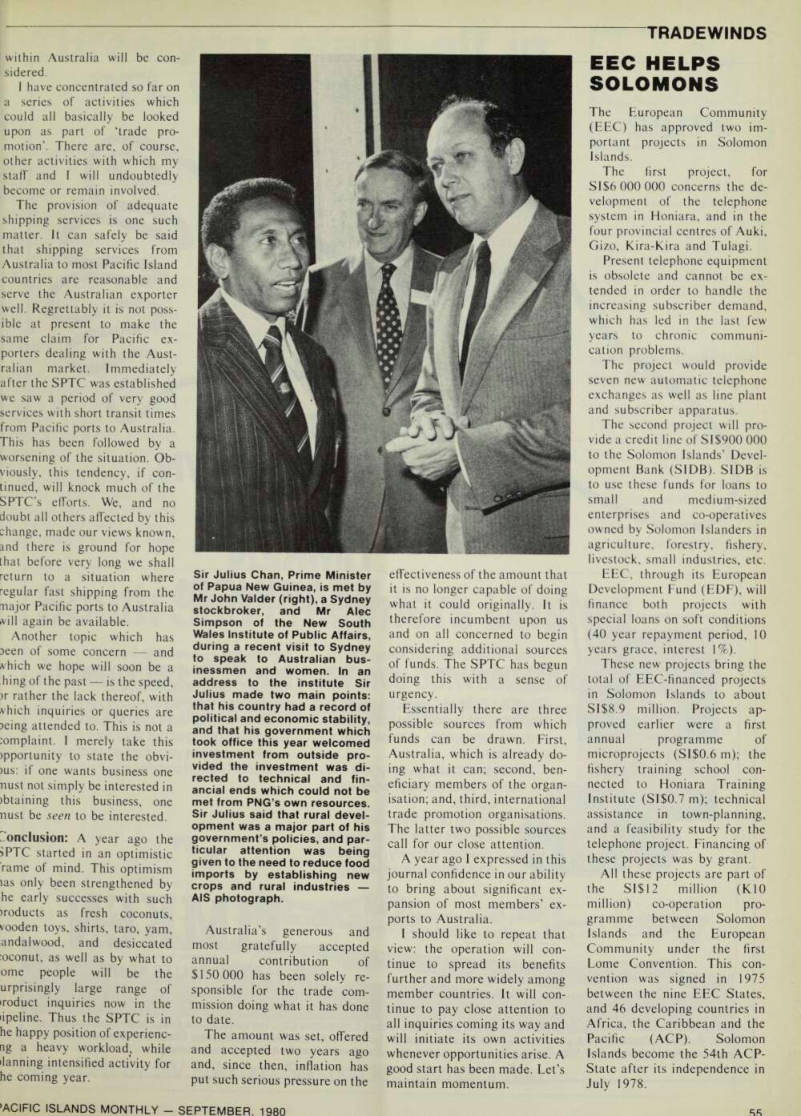
Trade
Winds
Promise, and problems, of the South Pacific Trade Commission
RON HEGERHORST, Trade Commissioner for the South Pacific, sums up the work of the Sydney-based South Pacific Trade Commission after its first year of operation. At the time of the birth of the SPTC, which is under the auspices of the South Pacific Bureau of Economic Co-operation, Mr Hegerhorst summed up its prospects for PIM (Oct 1979 p 31).
In the article below he recalls that he was optimistic then, and is even more so today.
The South Pacific Trade Commission after one year: Even though a year is an arbitrary period in the life of any organisation, it is an appro priate moment to reflect on what has been done by the SPTC in its first year, and on whether our experience in that time has established a sense of direction for the future.
What we have done so far: Since its birth the SPTC has built up quite an impressive dossier of trade and investment inquiries, and has begun work on specific publicity or promotional ventures. The SPTC is at present working on nearly 80 inquiries concerning products and industries, it has completed plans to participate in the Melbourne International Centenary Exhibition in Seplember/October this year, and has agreed to give help to and take part in a small trade fair organised in Tarawa by the Kiribati Department of Trade, Industry and Labour for November 1980.
The SPTC’s promotional ef forts in its first year of existence have centred on what is best described as a ‘getting to know you’ exercise.
Within Australia, contact has been made with business 3rganisations and companies with a history of trade with the Pacific, or known to be inter ested in developing such trade, n most capital cities. Similarly, visits have been made to mem ber countries of the South Pacific Bureau of Economic Zo-operation (SPEC) in order o become acquainted with business people and govern nent officials there.
This exercise has been ex remely useful in that it has not >nly established a large number )f useful contacts, but established in the minds of elevant Australian business nen the idea that some of the iroducts in which they are
interested can be supplied from the Pacific, and let Pacific businessmen know that selling to a market like Australia is not beyond their capabilities.
An example of the value of getting out and establishing contacts was my tour of eight Pacific countries in May of this year. During 26 days of almost incessant travelling and dis cussions in Tonga, Western Samoa, Niue, Kiribati, the Fed erated States of Micronesia, Nauru, Solomon Islands and Papua New Guinea, several pre-set purposes appear to have been well-served. • Very often new lines of thought and new inquiries only come to light through personal contact with the manufacturer or exporter during this trip several new inquiries surfaced e.g., dried bananas, tropical clothes, fruit preserves, cut tropical flowers, sawn timber and timber-derived products, passionfruit in its various forms, dried sharks’ fins, coco nut cream, leather products, fruit products such as puree and glacee, appliance assembly, confectionery, charcoal, honey, furniture items, printing work, spices. • Further progress was made with earlier inquiries which for some reason had not seen much progress through correspon dence. • The visit included three countries not previously included in trips by me or by my staff (Niue, Micronesia and Nauru), at last enabling me to make new contacts and become better acquainted with the nature of the business world in those countries. • In many places the ground work was laid for establishing a more or less regular flow of information needed by SPTC in servicing its customers. • I was able to establish the availability or otherwise of products or services which had
come to the attention of the SPTC from Australian sources.
We should understand clearly that it is unfortunately not possible for all activities and all inquiries to achieve the desired results. Existing trading pat terns for Australian importers, limitations in the supply and range of products made in the Pacific, pricing, packaging and presentation problems, are all factors which tend to influence the outcome of our work. In this context one is heartened that after several rounds of negotiations over the last 12 months, the South Pacific Regional Trade and Economic
Co-operation Agreement
(SPARTECA) has been con cluded. Its coming into force in the near future will, I trust, materially assist efforts by Pa cific businessmen and by my office to find markets for their products in Australia.
This is not to say that SPARTECA won’t have its share of problems, particularly in its early stages. But the importance of SPARTECA is that it establishes in practice an extremely important concept, i.e., greater and freer access for Pacific countries to the Aust ralian market, and, at the same time, it has built into it suf ficient flexibility for enlarging its scope should this become desirable.
Where do we go from here?: It is obvious that our bread and butter line of work, i.e., to receive, handle, dig out, re search and facilitate trade and investment inquiries, must con tinue to claim most of our attention and this even if only a small proportion of all those handled come off.
The expansion of exports in existing products, the creation of trade in products already produced but not previously traded, and the investment and industry-creation type of in quiry, all fall within this
category and are, in principle, all capable of positive results, given our ability to pay them the required attention.
Our basic range of contacts both in Australia and the Pa cific must be maintained and expanded. This will be done through a solid programme of travel within Australia and, as a direct consequence of that, a limited amount of travel to member countries. The empha sis here will change from con stant direct contact with government officials to much closer relationships with the business world itself. Our aim is to bring together buyer and seller, investor and project proposer, through personal con tact.
After the initial publicity and image-creation phase of ‘get ting to know you’, we are planning to change emphasis to one of product promotion. One way in which we will do this is by bringing out selected Pacific businessmen and subjecting them to an intensive Australian business visit to two or more capital cities. We plan to ar range specific product pro motions in Sydney to which Pacific businessmen will be invited to make their own presentations to prospective Australian buyers. This activity is likely to include a seminar type of day, a working lunch eon, product displays and visits to buyers’ establishments. In addition, to the extent that adequate funding is available, participation in a trade fair
within Australia will be con sidered.
I have concentrated so far on a series of activities which could all basically be looked upon as part of ‘trade pro motion’. There are, of course, other activities with which my staff and 1 will undoubtedly become or remain involved.
The provision of adequate shipping services is one such matter. It can safely be said that shipping services from Australia to most Pacific Island countries are reasonable and serve the Australian exporter well. Regrettably it is not poss ible at present to make the same claim for Pacific ex porters dealing with the Aust ralian market. Immediately after the SPTC was established we saw a period of very good services with short transit times from Pacific ports to Australia.
This has been followed by a worsening of the situation. Ob viously, this tendency, if con tinued, will knock much of the SPTC’s efforts. We, and no doubt all others affected by this change, made our views known, and there is ground for hope that before very long we shall return to a situation where regular fast shipping from the najor Pacific ports to Australia kvill again be available.
Another topic which has seen of some concern and vhich we hope will soon be a hing of the past is the speed, )r rather the lack thereof, with vhich inquiries or queries are seing attended to. This is not a complaint. I merely take this )pportunity to state the obvi )us: if one wants business one nust not simply be interested in )btaining this business, one nust be seen to be interested.
Conclusion: A year ago the iPTC started in an optimistic rame of mind. This optimism las only been strengthened by he early successes with such )roducts as fresh coconuts, vooden toys, shirts, taro, yam, andalwood, and desiccated :oconut, as well as by what to ome people will be the urprisingly large range of •roduct inquiries now in the •ipeline. Thus the SPTC is in he happy position of experienc ng a heavy while •lanning intensified activity for he coming year.
Australia’s generous and most gratefully accepted annual contribution of $l5O 000 has been solely re sponsible for the trade com mission doing what it has done to date.
The amount was set, offered and accepted two years ago and, since then, inflation has put such serious pressure on the
effectiveness of the amount that it is no longer capable of doing what it could originally. It is therefore incumbent upon us and on all concerned to begin considering additional sources of funds. The SPTC has begun doing this with a sense of urgency.
Essentially there are three possible sources from which funds can be drawn. First, Australia, which is already do ing what it can; second, ben eficiary members of the organ isation; and, third, international trade promotion organisations.
The latter two possible sources call for our close attention.
A year ago 1 expressed in this journal confidence in our ability to bring about significant ex pansion of most members’ ex ports to Australia.
I should like to repeat that view: the operation will con tinue to spread its benefits further and more widely among member countries. It will con tinue to pay close attention to all inquiries coming its way and will initiate its own activities whenever opportunities arise. A good start has been made. Let’s maintain momentum.
Sir Julius Chan, Prime Minister of Papua New Guinea, is met by Mr John Valder (right), a Sydney stockbroker, and Mr Alec Simpson of the New South Wales Institute of Public Affairs, during a recent visit to Sydney to speak to Australian bus inessmen and women. In an address to the institute Sir Julius made two main points: that his country had a record of political and economic stability, and that his government which took office this year welcomed investment from outside pro vided the investment was di rected to technical and fin ancial ends which could not be met from PNG’s own resources.
Sir Julius said that rural devel opment was a major part of his government’s policies, and par ticular attention was being given to the need to reduce food imports by establishing new crops and rural industries
AIS photograph.
Advertisements & other items, p. 54 (1 item)
Zealand J>J-
'4 I* % 'S. 17 V L :
ram
CJ 4 I i f / ft - 4 • dll !■ z^c * ■ e 1 ;-v
ZEALAND J>J-
mg//- ■ up WE EXPORT PRODUCTS IN ALL OF THE FOLLOWING GROUPS.
Frozen meat, fish and seafood (bulk and portion control) Dairy products Canned fruit Dry groceries Beer, wines and spirits Cigarettes Electrical appliances Household products Electrical supplies Builders hardware Engineering supplies Motor vehicles and spares and much more!!
Solomons
Eec Helps
The European Community (EEC) has approved two im portant projects in Solomon Islands.
The first project, for SIS 6 000 000 concerns the de velopment of the telephone system in Honiara, and in the four provincial centres of Auki, Gizo, Kira-Kira and Tulagi.
Present telephone equipment is obsolete and cannot be ex tended in order to handle the increasing subscriber demand, which has led in the last few years to chronic communi cation problems.
The project would provide seven new automatic telephone exchanges as well as line plant and subscriber apparatus.
The second project will pro vide a credit line of SIS9OO 000 to the Solomon Islands' Devel opment Bank (S1DB). SIDB is to use these funds for loans to small and medium-sized enterprises and co-operatives owned by Solomon Islanders in agriculture, forestry, fishery, livestock, small industries, etc.
EEC, through its European Development Fund (EDF), will finance both projects with special loans on soft conditions (40 year repayment period, 10 years grace, interest 1%).
These new projects bring the total of EEC-financed projects in Solomon Islands to about 5158.9 million. Projects ap proved earlier were a first annual programme of microprojects (5150.6 m); the fishery training school con nected to Honiara Training Institute (5150.7 m); technical assistance in town-planning, and a feasibility study for the telephone project. Financing of these projects was by grant.
All these projects are part of the SI $l2 million (KlO million) co-operation pro gramme between Solomon Islands and the European Community under the first Lome Convention. This con vention was signed in 1975 between the nine EEC States, and 46 developing countries in Africa, the Caribbean and the Pacific (ACP). Solomon Islands become the 54th ACP- State after its independence in July 1978.
Advertisements & other items, pp. 55-56 (2 items)
Tradewinds
55
'ACIFIC ISLANDS MONTHLY - SEPTEMBER 1980
Timken
o
PUTYOUR
FOOT DOWN.
DEMAND
TIMKEN
BEARINGS!
TIMKEN
If you’re hard headed about the bearings you use . . . put your foot down!
Demand Timken s 'tapered roller bearings, and you’ll get the brand with proven quality, durability and performance.
The brand that’s given you a long run for your money, wherever it’s used.
On top of all this, you’ll benefit from our consistent supply, delivery, and sales and service engineering assistance available from Australian Timken and Authorized Timken 55 Bearing Distributors throughout the Pacific.
Another way of looking at it is that you’re not going to put your foot in it when you put your foot down and demand Timken bearings.
TIMKEN
REGISTERED TRADEMARK
TAPERED ROLLER BEARINGS
Authorised Distributors in the Pacific are: United Enterprises Ltd., Honiaria; Burns Philp South Sea Company, Suva: Sunbeam Transport Ltd., Lautoka: S.A.T.M.A., Noumea: D. L. Dent Industries Pty. Ltd., Boroko, PNG; Comptoirs Francais des Nouvelles-Hebrides, Port Vila; Bearing Service Company Ltd., Auckland: Niven Bearings Limited, Auckland.
4191ATX
Three-year stand-off in
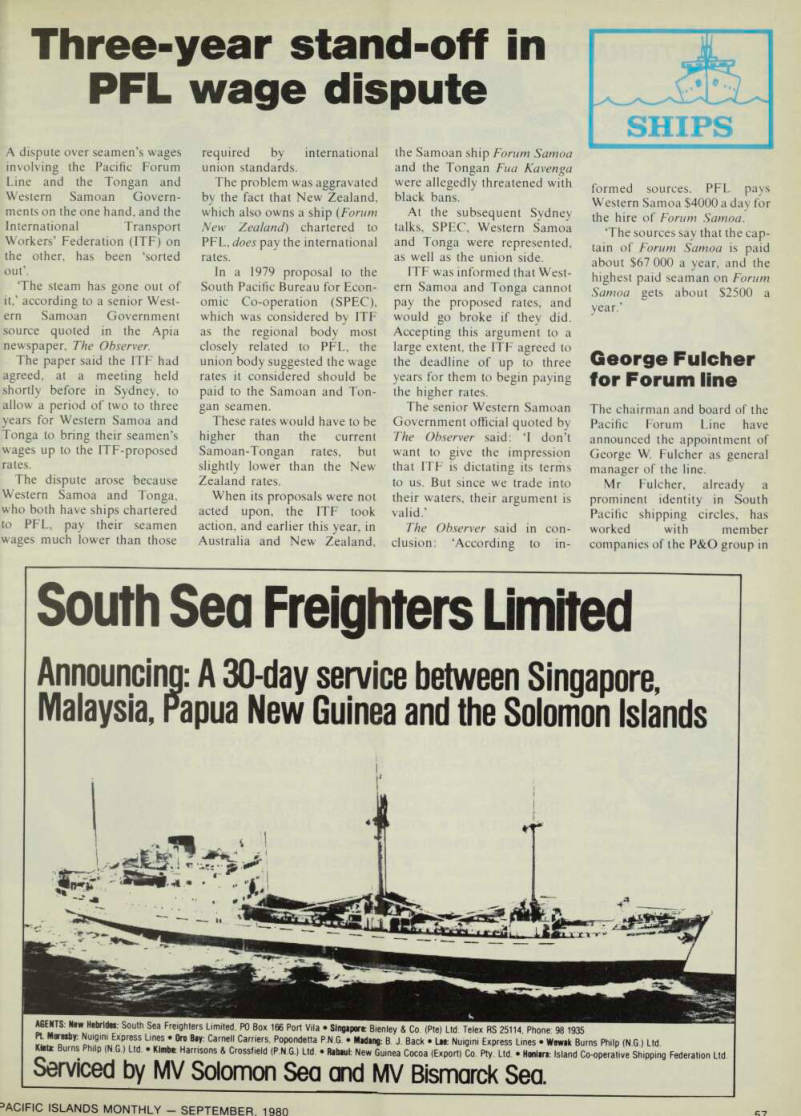
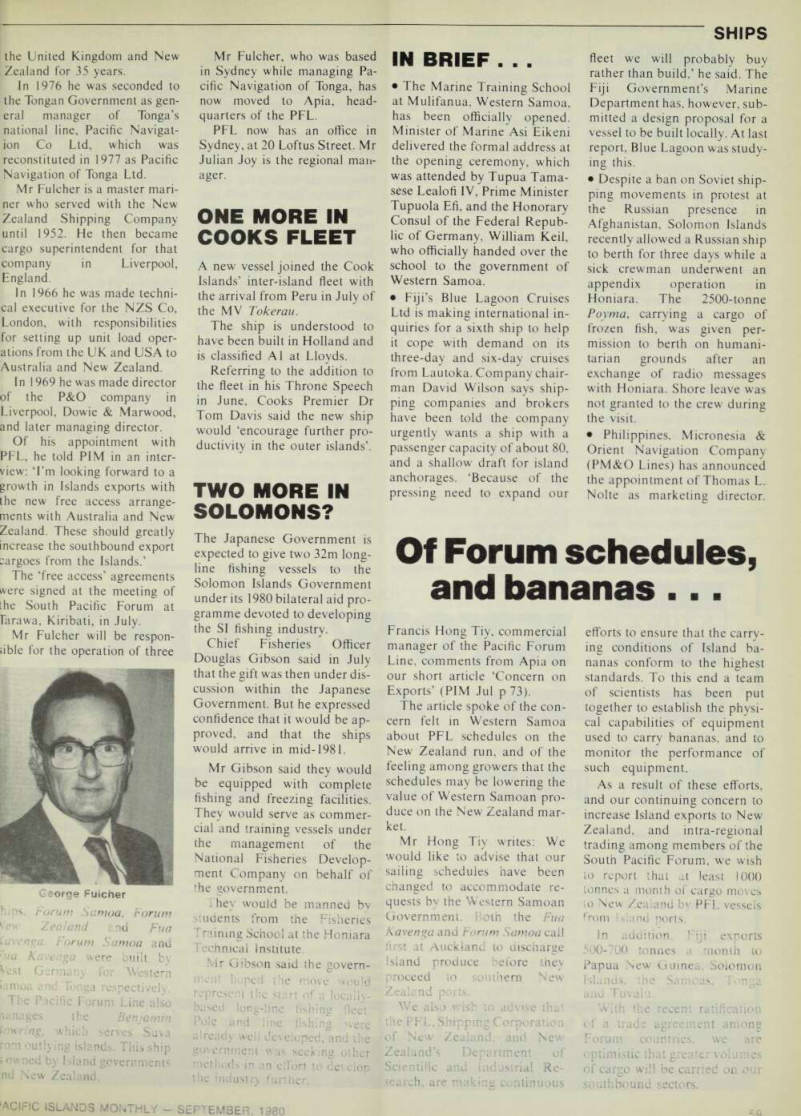
Ships
Three-year stand-off in PFL wage dispute
A dispute over seamen’s wages involving the Pacific Forum Line and the Tongan and Western Samoan Govern ments on the one hand, and the
International Transport
Workers’ Federation (ITF) on the other, has been ‘sorted out’. ‘The steam has gone out of it,’ according to a senior West ern Samoan Government source quoted in the Apia newspaper. The Observer.
The paper said the ITF had agreed, at a meeting held shortly before in Sydney, to allow a period of two to three years for Western Samoa and Tonga to bring their seamen’s wages up to the ITF-proposed rates.
The dispute arose because Western Samoa and Tonga, who both have ships chartered to PFL, pay their seamen wages much lower than those
required by international union standards.
The problem was aggravated
by the fact that New Zealand, which also owns a ship ( Forum New Zealand) chartered to PFL, does pay the international rates.
In a 1979 proposal to the South Pacific Bureau for Econ omic Co-operation (SPEC), which was considered by ITF as the regional body most closely related to PFL, the union body suggested the wage rates it considered should be paid to the Samoan and Ton gan seamen.
These rates would have to be higher than the current Samoan-Tongan rates, but slightly lower than the New Zealand rates.
When its proposals were not acted upon, the ITF took action, and earlier this year, in Australia and New Zealand,
the Samoan ship Forum Samoa and the Tongan Fua Kavenga were allegedly threatened with black bans.
At the subsequent Sydney
talks, SPEC, Western Samoa
and Tonga were represented,
as well as the union side.
ITF was informed that West ern Samoa and Tonga cannot pay the proposed rates, and would go broke if they did.
Accepting this argument to a large extent, the ITF agreed to the deadline of up to three years for them to begin paying the higher rates.
The senior Western Samoan
Government official quoted by
The Observer said: i don’t want to give the impression that ITF is dictating its terms to us. But since we trade into their waters, their argument is valid.’
The Observer said in con clusion; ‘According to in-
formed sources, PFL pays Western Samoa $4OOO a day for the hire of Forum Samoa. ‘The sources say that the cap tain of Forum Samoa is paid about $67 000 a year, and the highest paid seaman on Forum Samoa gets about $2500 a year.’
George Fulcher
for Forum line
The chairman and board of the Pacific Forum Line have announced the appointment of George W. Fulcher as general manager of the line.
Mr Fulcher, already a prominent identity in South Pacific shipping circles, has worked with member companies of the P&O group in
the United Kingdom and New Zealand for 35 years.
In 1976 he was seconded to the Tongan Government as gen eral manager of Tonga’s national line. Pacific Navigat ion Co Ltd, which was reconstituted in 1977 as Pacific Navigation of Tonga Ltd.
Mr Fulcher is a master mari ner who served with the New Zealand Shipping Company until 1952. He then became cargo superintendent for that company in Liverpool, England.
In 1966 he was made techni cal executive for the NZS Co, London, with responsibilities for setting up unit load oper ations from the UK and USA to Australia and New Zealand.
In 1969 he was made director of the P&O company in Liverpool, Dowie & Marwood, and later managing director.
Of his appointment with PFL, he told PIM in an inter view: ‘l’m looking forward to a growth in Islands exports with the new free access arrange ments with Australia and New Zealand. These should greatly increase the southbound export cargoes from the Islands.’
The ‘free access’ agreements were signed at the meeting of the South Pacific Forum at Tarawa, Kiribati, in July.
Mr Fulcher will be respon sible for the operation of three
hms. Forum Samoa, Forum Lew Zealand and Fua (avenga. Forum Samoa and 7 ua Kavenga were built by Vest Germany for Western iamoa and Tonga respectively.
The Pacific Forum Line also aanages the Benjamin \ownng, which serves Suva rom outlying islands. This ship > owned by Island governments nd New Zealand.
Mr Fulcher, who was based in Sydney while managing Pa cific Navigation of Tonga, has now moved to Apia, head quarters of the PFL.
PFL now has an office in Sydney, at 20 Loftus Street. Mr Julian Joy is the regional man ager.
One More In
Cooks Fleet
A new vessel joined the Cook Islands’ inter-island fleet with the arrival from Peru in July of the MV Tokerau.
The ship is understood to have been built in Holland and
is classified A 1 at Lloyds.
Referring to the addition to the fleet in his Throne Speech in June, Cooks Premier Dr Tom Davis said the new ship would ‘encourage further pro ductivity in the outer islands’.
Two More In
Solomons?
The Japanese Government is
expected to give two 32m long
line fishing vessels to the Solomon Islands Government under its 1980 bilateral aid pro gramme devoted to developing
the SI fishing industry.
Chief Fisheries Officer Douglas Gibson said in July that the gift was then under dis cussion within the Japanese Government. But he expressed confidence that it would be ap proved, and that the ships would arrive in mid-1981.
Mr Gibson said they would be equipped with complete
fishing and freezing facilities.
They would serve as commer cial and training vessels under the management of the National Fisheries Develop ment Company on behalf of the government.
They would be manned by udents from the Fisheries Training School at the Honiara Technical Institute.
Mr Gibson said the govern ment hoped the move would represent the start of a locally based long-line fishing fleet.
Pole and line fishing were already well developed, and the government was seeking other methods in an effort to develop the industry further.
In Brief . . .
• The Marine Training School at Mulifanua, Western Samoa, has been officially opened.
Minister of Marine Asi Eikeni delivered the formal address at the opening ceremony, which was attended by Tupua Tama sese Lealofi IV, Prime Minister Tupuola Efi, and the Honorary Consul of the Federal Repub lic of Germany, William Keil, who officially handed over the school to the government of Western Samoa. • Fiji’s Blue Lagoon Cruises Ltd is making international in quiries for a sixth ship to help it cope with demand on its
three-day and six-day cruises
from Lautoka. Company chair man David Wilson says ship
ping companies and brokers
have been told the company urgently wants a ship with a passenger capacity of about 80, and a shallow draft for island anchorages. ‘Because of the pressing need to expand our
fleet we will probably buy rather than build,’ he said. The Fiji Government’s Marine Department has, however, sub mitted a design proposal for a vessel to be built locally. At last report. Blue Lagoon was study ing this. • Despite a ban on Soviet ship ping movements in protest at the Russian presence in Afghanistan, Solomon Islands recently allowed a Russian ship to berth for three days while a sick crewman underwent an appendix operation in Honiara. The 2500-tonne Poyma, carrying a cargo of frozen fish, was given per mission to berth on humani tarian grounds after an exchange of radio messages with Honiara. Shore leave was not granted to the crew during the visit. • Philippines, Micronesia &
Orient Navigation Company
(PM&O Lines) has announced the appointment of Thomas L.
Nolle as marketing director.
George Fulcher
Advertisements & other items, pp. 57-58 (3 items)
57
3 ACIFIC ISLANDS MONTHLY - SEPTEMBER 1980
South Sea Freighters Limited
Announcing: A 30-day service between Singapore,
Malaysia, Papua New Guinea and the Solomon Islands rr X » AGEM 7 *: New Hebrides: South Sea Freighters Limited, PO Box 166 Port Vila • Singapore: Bienley & Co. (Pte) Ltd, Telex RS 25114, Phone: 98 1935 PI Moresby: Nuigira l Express Lines • Oro Bay: Carnell Carriers, Popondetta P N G. • Madang: B J. Back • Lae: Nuigini Express Lines • Wewak Burns Philp (N G ) Ltd.
Kiatt Burns Philp (N.G.) Ltd. • Kimbe: Harrisons & Crosstield (P N G.) Ltd. • Rabaul: New Guinea Cocoa (Export) Co Pty Ltd Serviced by MV Solomon Sea and MV Bismarck Sea.
Honiara: Island Co-operative Shipping Federation Ltd.
all ALTERNATORS
TO 250
AMP M
L I?
'Si > O:
NEW & EXCHANGE
STARTERS
iALTERNATORS AND GENERATORS
TRUCK^H
WE’VE GOT
THE LOT
Wb
MARINE
DELCO REMY
MOTOROLA
LEECE - NEVILLE
PARIS - RHONE
MAGNET MARELLI
PRESTOLITE
MITSUBISHI
■ SAWAFUJI
■ NIEHOFF
■ DUCELLIER
.BOSCH
• AUTOLITE
email Q
DENSO
BUTEC
CAV
> LUCAS #%/
SIMMS
NIKKO
• HITACHI y
'O.-V volt
EXCHANGE ALTERNATORS,
GENERATORS. STARTERS,
REGULATORS AND 500
ARMATURES AND STATORS
AIR*RAIL*ROAD & SEA
FREIGHT ANYWHERE
Industrial, Marine, Truck and Off Highway
‘ v CARS
TRUCReIecn cs /
BOX 279 ROCKLEA
TELEX; AA40396
1756 Ipswich Road, Rocklea, Q. 4106.
275 2855 (7 LINES)
BRISBANE
* O ■"0 2: o 6
FOR
v v 3. x -v-.
LA.I VlN>Mi
IN OUR 86th YEAR SELLING ‘SERVICE’
TO THE PACIFIC ISLANDS
Nelson & Robertson
PTY. LTD. (Established 1895)
Plantation House, 197 Clarence Street, Sydney.
Cables: ‘IVAN\ Sydney, Brisbane. Telex: AA22381, Sydney.
INDENTS - FROM AUSTRALIA, NEW ZEALAND and OVERSEAS.
FOODSTUFFS • SOFTGOODS • HARDWARE • MACHINERY TRAVEL • INSURANCE • CANNED FISH • JUTE GOODS
• REAL ESTATE •
BRANCH OFFICES:
Nelson & Robertson Pty. Ltd., F.O. Box 575, Brisbane, Q!d., Australia.
RO. Bex 2092, Govt. Bldg., Suva, Fiji.
P.O. Box 258, Laatcka Fiji.
P.O. Box 2420, CFO Auckland 1, New Zealand.
PAPUA NEW GUINEA
REPRESENTATIVES:
Rabtrad Nuigini Ply, Ltd..
F.O. Box 219, Rabaul, P.N.G.
P.O. Box 1406, Lae, P.N.G.
RO. Box 711, Madang, P.N.G RO. Box 253, Kieta, P.N.G.
58
PACIFrC islands MONTHLY - SEPTEMBER, 1980
Of Forum schedules,
and bananas ...
Francis Hong Tiy, commercial
manager of the Pacific Forum Line, comments from Apia on our short article ‘Concern on Exports’ (PIM Jul p 73).
The article spoke of the con cern felt in Western Samoa about PFL schedules on the New Zealand run, and of the feeling among growers that the schedules may be lowering the value of Western Samoan pro duce on the New Zealand mar ket.
Mr Hong Tiy writes: We would like to advise that our sailing schedules have been changed to accommodate re quests by the Western Samoan Government. Both the Fua Kavenga and Forum Samoa call first at Auckland to discharge Island produce before thev proceed to southern New Zealcnd ports.
We also wish to advise that
the PFL, Shipping Corporation
of New Zealand, and New Zealand’s Department of Scientific and Industrial Re search, are making continuous
efforts to ensure that the carry ing conditions of Island ba nanas conform to the highest standards. To this end a team of scientists has been put together to establish the physi
cal capabilities of equipment
used to carry bananas, and to monitor the performance of
such equipment.
As a result of these efforts, and our continuing concern to increase Island exports to New Zealand, and intra-regional trading among members of the South Pacific Forum, we wish to report that at least 1000 tonnes a month of cargo moves to New Zealand bv PFL vessels r rom Island ports.
In addition Fiji exports 500-700 tonnes a month to Papua New Guinea. Solomon Islands, the Samoas, Tonga and Tuvalu.
With the recent ratification of a trade agreement among Forum countries, we are optimistic that greater volumes of cargo will be carried on our southbound sectors.
Advertisements & other items, p. 59 (1 item)
Ships
59
'ACIFIC ISLANDS MONTHLY SEP T EMBER 1980
Yachts
Cruising yachts are on the
move again following the
start of the new season in the South Pacific. • IRISH MAID. This sloop, is owned and sailed solo by Dave Benson, an Irish-born Australian resident. Benson, a professional shipbuilder, fol lowed an Alan Payne design and built the craft 12 years ago and has been sailing her ever since.
Irish Maid left her home port of Sydney in January 1978 and journeyed to New Caledonia, New Hebrides, Tonga, Fiji, Tahiti and Hawaii before stopping on the West Coast of the US. There Benson was able to replenish his depleted finaces by taking on some ship-building jobs.
From San Diego Irish Maid sailed down the coast and
through the Panama Canal to the West Indies, where Benson decided he would like to see his family in Ireland.
After a long voyage, Benson was reunited with a family that he had not seen for many years. Following that enjoy able stop, Benson sailed back to the South Pacific, then across to Madeira, the Canary Islands and once again to the West Indies. After a shipbuild ing spell there, Benson sailed his sloop back to the South Pacific to Tahiti and the Marquesas before docking in Rarotonga.
Benson, who has sailed for many years, believes that people are more interesting than places. He finds the folk in Rarotonga genuinely friendly, apparently a rare characteristic these days.
Upon his reluctant departure from Rarotonga, Benson will voyage to Tonga, Fiji and New Zealand before returning to Sydney where he will think about settling down. A block of land appeals to him, pro vided a boat and water are easily accessible. • PALERMO. This is the
other visitor in Rarotonga, also a Sydney-registered sloop.
She is sailed by Michael and Annette Nossiter of Sydney, who have owned the boat for almost six years. Michael Nossiter, a keen sailor, ap pears to have inherited his love of sailing from his grand father, who was the first Aust ralian to sail around the world.
Palermo, built in 1953, de signed by Ted Beattie and rigged by Alan Payne, was not launched until 1964. The Nossiters have been sailing the 10 m sloop since they bought her, and are now on the last leg of a circumnavi gation.
After leaving Sydney in March 1975, Palermo sailed to the Great Barrier Reef and Darwin, where the Nossiters lived for a year. From Darwin the sloop travelled to Indonesia, Singapore, Malaysia, and Sri Lanka be fore arriving in Djibouti, in North-west Africa, in 1977.
The Nossiters remained in Djibouti, a walled city, for two months. There they experi enced a few tense moments as the civil war in Ethiopia was
affecting Djibouti in the form of terrorist raids.
From Djibouti Palermo voy aged in the Red Sea, Sudan, Egypt, Israel, across the Mediterranean to Morocco, then to the Canary Islands and the West Indies where the couple worked for a year operating a charter boat.
Palermo then sailed to Panama, the Marquesas, the Tuamotus, Tahiti and Rarotonga.
Following a two-week stay in Rarotonga, Palermo will sail to Tonga and Fiji before returning to Sydney. • DORADO. This 12 m Temptress sloop from Sydney was in Rarotonga in May. She is owned and sailed solo by George Brown. Brown has been sailing the 13-year-old sloop long distances for the past seven years, and began his present voyage in March 1978 when he left Sydney.
His lengthy itinerary in cluded stops at the Great Barrier Reef, Thursday Island, Keeling Cocos (an atoll in the Indian Ocean), Mauritius, and South Africa, where he spent six months.
Brown sailed from Cape town in February 1979 across the Atlantic to England, with stops at St Helena and the Ascension Islands. After spending the summer in England, Dorado travelled to Spain and Portugal, then across to the Canary Islands, the Caribbean, through the Panama Canal, and across the Pacific to the Marquesas, Tahiti and Moorea before docking at Avatiu harbour in Rarotonga.
After a two-week respite here Brown sailed Dorado to Tonga, Fiji, New Caledonia, and finally back to Sydney, which will complete his solo circumnavigation. • AVENTURA. After nearly three years cruising the length and breadth of the South Pacific, *PIM’s yachting cor respondent Jimmy Cornell is leaving the Pacific for the Indian Ocean. As a farewell to Ihe Pacific, Jimmy and Gwenda Cornell, with their children Doina and Ivan made a point of sailing their yacht Aventura to be in Port Moresby f or the Third South Pacific r estival of Arts. After the 'estival they are leaving for heir journey back home to England via Indonesia, Singa pore, Sri Lanka, the Red Sea jnd the Mediterranean. Sev eral other cruising yachts simi arly planned their itinerary to nclude the Festival of Arts. \mong these were Ranger, /Vhistler, and Jolly II Roger, vho were reported for PIM rom Rabaul earlier in the year md all of whom had spend the ast six months cruising in PNG vaters. Dana Crumb of Whis ler had made a particular >oint of revisiting many of the )laces in PNG, where he had erved as a young man during Vorld War II with the USAAF. • CALAO. This 12.2 m vooden yawl from Toulon, : rance was last reported in >IM from Vava’u, Tonga in 979. Since then Erick and /luriel Bouteleux with their hildren Sidonie (9) and abien (6) have cruised to Vallis, Futuna, Fiji, New Caledonia and Australia. Dur ig the six months spent in Australia the 20-year-old :alao was refitted, but in spite •f this, their engine broke
down in Cairns. Not daunted however, Erick decided to keep his appointment with Aventura for the Festival of Arts and sailed the 500 miles to Port Moresby with a dis mantled engine. After repairing their engine, Calao plans to head for Indonesia, the Red Sea and the Mediterranean. • KYERI. This 12.2 m Hinckley-Owens Cutter is tak ing Herb and Marie-Louise Stewart on a fast circumnavi gation. Kyeri left Boston USA in September 78 and sailed to Panama via Honduras and Nicaragua. Transiting the Panama Canal for the third time, they first sailed to the West Coast of the USA, cross ing later to Hawaii. On their way to the South Pacific, the Stewarts sailed to Palmyra, Pago Pago, Western Samoa, Tonga, Fiji and New Zealand.
After a six month refitting stopover in New Zealand, Kyeri sailed to Papua New Guinea via New Caledonia and New Hebrides. In their attempt to catch the best season for their next leg to South Africa, Kyeri left Port Moresby before the Festival ended. They hope to be back home in Boston by June next year. This is Kyeri’s second trip to the South Pa cific, having visited the Galapagos, Marquesas, Tua motus, Society Islands and Fiji earlier during a three-year voy age. • AQUARIUS. Molly and Maxine Mallouf left San Francisco in February 1973 on their extended cruise in
Aquarius, a 11.6 m Alberg
fibreglass sloop built in 1962.
The past seven years have been spent in the Pacific, Aquarius sailing to Mexico, Marquesas, Tuamotus, Society Islands, Cooks, Nuie, Ameri can Samoa, Tonga and Fiji.
Returning to Fiji from New Zealand they sailed via the New Hebrides and New Cale donia to Australia where they made a longer stopover.
Aquarius arrived in Port Moresby from the Solomons and plans to leave the Pacific for Indonesia.
• Emma Goldman. This
Herreshoff 28 ketch was built ip 1960 in Japan of mahogany on oak. Dennis White and Julie Robinson left Oakland, Cali
fornia in December 1976 for Mexico and then Hawaii, where they spent one year.
Then they sailed via Tahiti, Rarotonga, Samoa and Tonga to New Zealand, where they spent six months. After half a year in Fiji, they returned to New Zealand for the following cyclone season, from where they sailed via the New Heb rides to Port Moresby. Expect ing a baby in December, Julie and Dennis are thinking of sailing to Darwin to await the increase in crew, and then plan to sail back to the USA via Capetown and the West Indies.
• Northern Light.
Owner Rolf Bjelke finished and fitted out this boat himself after
buying the 12.2 m Joshua-type
hull from the Meta boatyard in Sweden in 1975. Sailing from Sweden, Rolf took Northern Light via England, the Ca naries, Brazil, Uruguay and Argentina to round Cape Horn in December 1978. After spending some time in the Patagonian waterways and Chile, he crossed the Pacific via Easter Island, Pitcairn, Tuamotus and Marquesas to Tahiti. From there he sailed via Tonga, Fiji, New Zealand, Fiji again, and Port Vila to Papua New Guinea. Rolf’s present crew is Rocky Sargent from California and Northern Light plans to visit Indonesia on the way to Capetown. Although planning to return to Sweden, Rolf Bjelke’s future plans are to return to Chile in South America by boat. • TIVIA. Light winds and lack of fuel brought this Bul garian yacht to Port Moresby one day after the Festival had ended, to its crew’s great disappointment. Doncho and Julia Papazov accompanied by their six-year-old daughter lanna are making a film of their voyage for Bulgarian TV and were hoping to include some of the festival in the film. The Polish-built 14 m wooden ketch left from their homeport of Sozopol on the Black Sea in April 1979. After crossing the Atlantic and stopping briefly in the West Indies and Venezuela, Tivia transited the Panama Canal and headed for the Mar quesas. A badly-infected burn suffered by Doncho caused Tivia to alter course for
Ecuador in search of medical attention. From there they sailed non-stop to Papeete, nearly losing the boat on a reef in the Tuamotus, when their engine failed to start. After five months spent in the Society Islands, Tivia sailed to Tonga, Fiji and Papua New Guinea.
They hope to be back in Bul garia via South Africa by May 1981, as the Bulgarian authorities have only granted them permission for a two year cruise. Doncho and Julia are well known in Eastern Europe, where their books based on two earlier voyages are best sellers. In 1974 they sailed a 7.5 m standard ship’s lifeboat from Gibraltar to Cuba. After 64 days they landed near the American base of Guantana mo and were promptly ar rested by the Cuban security service as spies. They had a hard job persuading the Cuban authorities and the Bulgarian Embassy that they had in fact crossed the Atlantic in their small craft. Two years later in a different lifeboat purchased in Norway, Julia and Doncho attempted a crossing of the Pacific. Their boat Dju V was shipped to Callao in Peru and from there they sailed the 4000 miles to the Marquesas in 65 days arriving with a broken mast.
With a jury rig they continued to Tahiti via the Tuamotus, then sailed to Samoa and Fiji, from where the lifeboat was shipped back to Bulgaria, where it is now on display in a museum in the Bulgarian capital of Sofia. • MOTU NUI. This 10.7 m steel yacht was built by its owner Jo Lipous. Accom panied by his wife Chantal, Jo Lipous left France in 1976, sailing via the Canaries to the Caribbean, where they spent over one year in Martinique.
Transiting the Panama Canal in April 1978 they sailed via the Galapagos to the Marquesas, Tuamotus and Tahiti. In the Marquesas and Tahiti they made lengthy stopovers, dur ing which their daughter re turned to France to go to school. They sailed to Port Moresby via Pago pago, and the New Hebrides. They plan a quick return to France via South Africa to rejoin their family.
Advertisements & other items, pp. 60-62 (2 items)
Kyowa Line
KYOWA
YOUR BUSINESS PARTNER
KongTaiwanKorea
To: Solomon, New Caledonia, Fiji, W Samoa, A. Samoa. Tahiti, Cook Is., Tonga, New Hebrides. Ellice Is., Nauru To; Guam, Saipan, Truk, Ponape, Majuro, Yap, Koror To: Papua New Guinea, Other Pacific Islands
AGENTS
Taiwan: Royal Steamship Corp , Ltd , Taipei S. Korea; Dong Sue Shipping Co, Ltd , Seoul Hong Kong; Dahzun Enterprises Ltd Singapore: Ocean Shipping & Enterprises Pte. Ltd Guam: Maritime Agencies of The, Pacific Ltd . Guam Saipan: Saipan Shipping Co, Inc.. Saipan Solomon; Solomon Taiyo Ltd , Honiara Tahiti: J.A, Cowan & Fils, Papeete Cooks: Eastern Associates Ltd , Rarotonga Tonga: E M Jones Ltd , Nukualofa New Hebrides: Pentecost Pacific S.A., Port Vila
Singapore
Phillippines: Sky International Inc., Manila Ponape; United Micronesia Development Association, Ponape A.Samoa; Island Pacific Agencies Inc.. Pago Pago W. Samoa: Morris Hedstrom Ltd , Apia Fiji: C arpenter Shipping, Suva & Lautoka Nauru: Nauru phosphate Corp.
PNG: Carpenter Shipping Agencies. Port Moresby. Rabaul New Caledonia; Agence Maritime Du Rond Point Du Pacific, Noumea Indonesia; P.T Porodisa Raya Shipping Lines. Jakarta Sabah: KOH Han Ming Shipping & Forwarding Agent , Kotakmabalu Sarawak: Pan Sarawak Agencies Sdn. Bhd , Sibu & Kuching Australia: Hethenngton Kingsbury Pty. Ltd , Sydney, N SW.
Newzealand: Tussell & Summers Ltd., Aukland
KYOWA SHIPPING CO., LTD.
HEAD OFFICE OSAKA OFFICE
sth FI., Suzumaru Bldg. 39-8, 2-chome, Nishi-Shinbashi, Minatoku, Tokyo, Japan. Frontier Bldg., 3-13 Hirano-cho, Higashi-ku, Osaka, Japan.
Phone : 03(437)2885(Rep.) Cables : “MARIQUEEN” Tokyo. Telex : 242-4651 Kyowa J. Phone : 06(227)0422(Rep.) Cables : “MARIQUEEN” Osaka. Telex : 522-3896 Kyowa 0.
THE BANK LINE
Papua New Guinea & Solomon Islands
UK/Continent Service
Regular direct 28 day service
PAPUA NEW GUINEA and SOLOMON ISLANDS
to;
UNITED KINGDOM and CONTINENT
For particulars apply:
THE BANK LINE (AUSTRALASIA) PTY LTD.
18th Floor 1 York Street Sydney N.S.W. 2000 Australia Telephone: 272041 Telex; 24063
61
YACHTS
*ACIFIC ISLANDS MONTHLY - SEPTEMBFR iQftn
Services
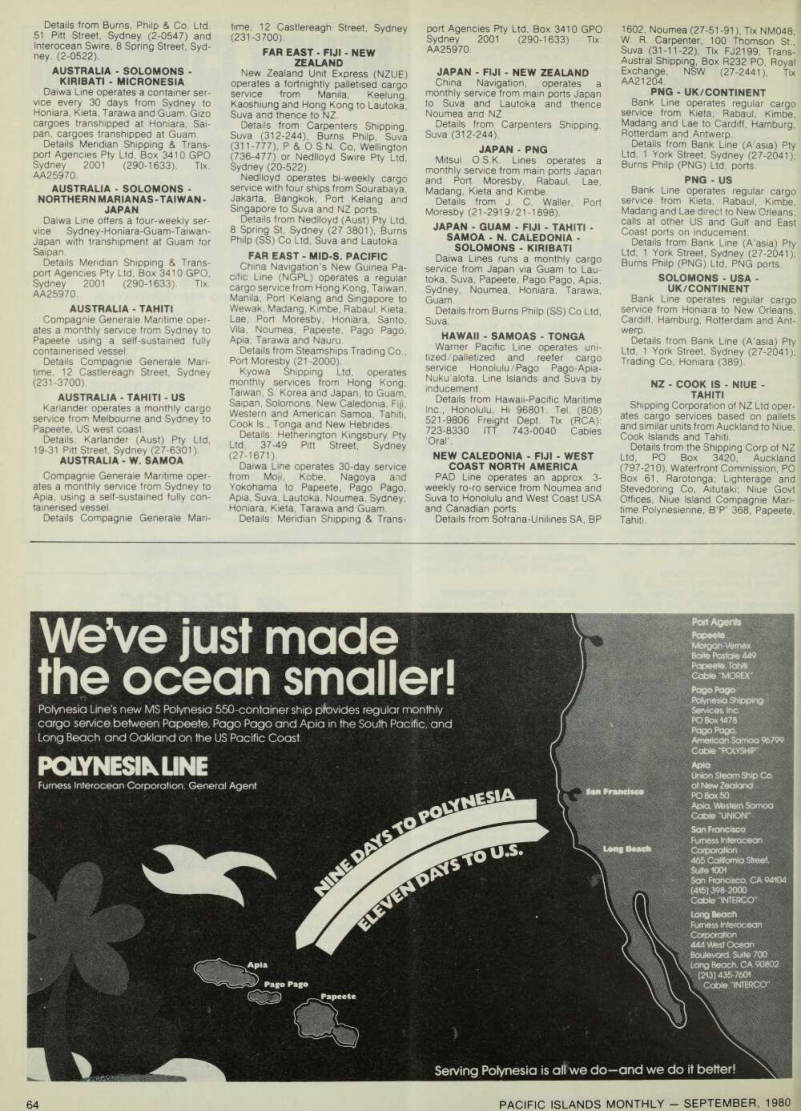
Shipping
Should any shipping company wish to have its services cargo and passenger included in these list ings they should contact PIM.
Australia - Fiji
Karlander (Aust) Pty Ltd operates monthly cargo services from Sydney to Suva and Lautoka.
Details from Karlander (Aust) Pty Ltd, 19-31 Pitt Street, Sydney (27-6301), Dalgety Shipping, 461 Bourke Street, Melbourne (60-0731), Burns Philp (SS) Co Ltd, Suva and Lautoka.
Sofrana-Unilines (Fiji Express Line) operates to Suva and Lautoka every three weeks from the main ports on the east coast of Australia and monthly to Lautoka from Melbourne and Sydney.
Details from Sofrana-Unilines, 19 Pitt Street, Sydney, (27-2031), Trans- Austral Shipping Pty Ltd, 570 Bourke Street, Melbourne (67-9162), ACTA Pty Ltd, Brisbane (221-3116), Elder-ANL Pty Ltd, Port Adelaide (47-5688), ANL, Newcastle (049-24364), Clements & Marshall, Burnie, Tasmania (31-1833).
Australia - Fiji - Samoas -
Tonga
Pacific Forum Line operates a fully containerised service (Gen/Reefer) from Brisbane and Sydney to Lautoka, Suva, Nuku’alofa, Apia and Pago Pago Funafuti cargo transhipped at Apia.
Details from Pacific Forum Line, Syd ney; Union Bulkships, Sydney; ANL, Melbourne, Brisbane; Burns Philp (SS) Co, Lautoka, Suva and Apia; Union Co, Nukualofa; Polynesia Shipping Ser vices, Pago Pago or Pacific Forum Line Head Office, Apia.
Australia - Lord Howe Is -
Norfolk Is
Compagnie des Chargeurs Caledoniens operates four-weekly cargo service Sydney - Lord Howe Island and Norfolk Island.
Details Hetherington Kingsbury Pty Ltd, 37-49 Pitt Street, Sydney (27-1671).
Australia - Nauru -
Kiribati
Nauru Pacific Line operates regular cargo/passenger service from Mel bourne to Nauru and Tarawa, Details: Nauru Pacific Line. Nauru House, 80 Collins Street, Melbourne (653-5709), Nedlloyd Swire, 8 Spring Street, Sydney (2-0522).
Australia - New Caledonia
(And/Or) New Hebrides
Karlander operates a monthly service rom Sydney to Noumea.
Details: Karlander (Aust) Pty Ltd, 19-31 Pitt Street. Sydney (27-6301).
Sofrana-Unilines ships serve Moumea every three weeks from the rtain ports along the east Australian :oast.
Details from Sofrana-Unilines, 19 Pitt Street, Sydney (27-2031), Trans- Shipping Pty Ltd. 570 Bourke Street, Melbourne (67-9162), ACTA Pty _td, Brisbane (221-3116), Elders-ANL Ltd, Port Adelaide (47-5688). ANL, Mewcastle (049-24364), Clements & Marshall, Burnie, Tasmania ;31-1833).
Compagnie des Chargeurs Cale joniens operates a three-weekly con
tainerised cargo service from Sydney to Noumea.
Details Hetherington Kingsbury Pty Ltd, 37-49 Pitt Street, Sydney (27-1671).
Compagnie Generate Maritime oper ates a monthly service from Sydney to Noumea, Port Vila and Santo, using a self-sustained fully containerised vessel.
Details Compagnie Generale Mari time, 12 Castlereagh Street, Sydney (231-3700).
Daiwa Line operates 30 day service from Sydney to Vila and Santo.
Details Meridian Shipping & Trans port Agencies Pty Ltd, Box 3410 GPO Sydney 2001 /290-1633), Tlx: AA25970.
Australia - Nz - Fiji -
Hawaii - Us
P & O liners call at Auckland, Suva, Honolulu and Vancouver on eastbound and westbound voyages between Syd ney and the US.
Details from P & O Booking Centre, World Travel Headquarters Pty Ltd, 33 Bligh Street, Sydney (231-6655).
AUSTRALIA - NZ - FIJI - TONGA - N. HEBRIDES - NOUMEA - PNG -
Solomons - Samoas - Tahiti
Sitmar Cruises operates a year-round cruise programme to include most of the above countries.
Details from Sitmar Cruises, 47 Elizabeth Street, Sydney (232-7511).
P & O liners call at Auckland, Bay of Islands, Honiara, Lautoka, Noumea, Nuku’alofa, Pago Pago, Papeete, Port Moresby. Santo, Savusavu, Suva, Vavau and Vila on cruises from Aus tralia.
Details from P & O Booking Centre, World Travel Headquarters Pty Ltd, 33 Bligh Street, Sydney (231-6655).
Pacific Forum Line operates con tainerized and general cargo service from Australia and NZ to Fiji, Apia, Pago Pago, Tonga and other South Pacific ports Details from Polynesia Shipping Ser vices Inc, PO Box 1478, Pago Pago 96799.
Australia - Micronesia
Nauru Pacific Line operates a regular container service from Melbourne to Majuro, Kosrae, Ponape, Truk, Guam and Saipan.
Details Nauru Pacific Line, Nauru House, 80 Collins Street, Melbourne, (653-5709), Nedlloyd Swire, 8 Spring Street, Sydney (2-0522).
Australia - Png
New Guinea Express Lines operates three-weekly conventional and con tainer services Melbourne, Sydney, Brisbane, Port Moresby, Lae, Rabaul, Alotau.
Details from New Guinea Express Lines, PO Box R 73, Royal Exchange PO, Sydney (241-3991) MacArthur Shipping Agency Co, 82-92 Eagle Street, Brisbane (229-3777), New Guinea Express Lines, 327 Collins Street, Melbourne (61-3053), Niugini Express Lines in Port Moresby (21-4572), Lae (42-1536), Rabtrad Niugini Pty Ltd. Rabaul (92-2911), Alotau Stevedoring & T’sport (61-1318).
Karlander New Guinea Line's cargo vessels call at Melbourne, Sydney, Port Moresby, Lae, Madang, Wewak, Manus, Kimbe, Rabaul, Popondetta.
Details from Karlander (Aust) Pty Ltd 19-31 Pitt Street, Sydney (27-6301), Dalgety Shipping, 461 Bourke Street, Melbourne (60-0731).
Austral! A-Png-Solomons
A consortium of Conpac, NGAL/PNGL have three container vessels operating on a 28 day turn around from Melbourne, Sydney and Brisbane to Port Moresby, Lae, Rabaul, Kavieng, Wewak, Madang, Kieta and Honiara supplemented by Daiwa vessels, Pacific Princess and Fiji Maru extending from Sydney to Lae on a monthly basis.
Details from Burns, Philp & Co. Ltd. 51 Pitt Street, Sydney (2-0547) and Interocean Swire, 8 Spring Street, Syd ney. (2-0522).
Australia - Solomons -
Kiribati - Micronesia
Daiwa Line operates a container ser vice every 30 days from Sydney to Honiara, Kieta, Tarawa and Guam, Gizo cargoes transhipped at Honiara, Sai pan, cargoes transhipped at Guam.
Details Meridian Shipping & Trans port Agencies Pty Ltd, Box 3410 GPO Sydney 2001 (290-1633), Tlx.
AA25970.
Australia - Solomons -
Northern Marianas-Taiwan
Japan
Daiwa Line offers a four-weekly ser vice Sydney-Honiara-Guam-Taiwan- Japan with transhipment at Guam for Saipan.
Details Meridian Shipping & Trans port Agencies Pty Ltd, Box 3410 GPO, Sydney 2001 (290-1633). Tlx.
AA25970.
Australia - Tahiti
Compagnie Generate Maritime oper ates a monthly service from Sydney to Papeete using a self-sustained fully containerised vessel.
Details Compagnie Generate Mari time, 12 Castlereagh Street, Sydney (231-3700).
Australia - Tahiti - Us
Karlander operates a monthly cargo service from Melbourne and Sydney to Papeete, US west coast.
Details: Karlander (Aust) Pty Ltd, 19-31 Pitt Street, Sydney (27-6301).
Australia - W. Samoa
Compagnie Generate Maritime oper ates a monthly service from Sydney to Apia, using a self-sustained fully con tainerised vessel.
Details Compagnie Generate Mari
time, 12 Castlereagh Street, Sydney (231-3700).
Far East - Fiji - New
Zealand
New Zealand Unit Express (NZUE) operates a fortnightly palletised cargo service from Manila, Keelung, Kaoshiung and Hong Kong to Lautoka, Suva and thence to NZ.
Details from Carpenters Shipping, Suva (312-244), Burns Philp, Suva (31 1-777), P & O S.N. Co, Wellington (736-477) or Nedlloyd Swire Pty Ltd, Sydney (20-522).
Nedlloyd operates bi-weekly cargo service with four ships from Sourabaya, Jakarta, Bangkok, Port Kelang and Singapore to Suva and NZ ports.
Details from Nedlloyd (Aust) Pty Ltd, 8 Spring St, Sydney (27 3801), Burns Philp (SS) Co Ltd, Suva and Lautoka.
Far East - Mid-S. Pacific
China Navigation's New Guinea Pa cific Line (NGPL) operates a regular cargo service from Hong Kong, Taiwan, Manila, Port Kelang and Singapore to Wewak, Madang, Kimbe, Rabaul, Kieta, Lae, Port Moresby, Honiara, Santo, Vila, Noumea, Papeete, Pago Pago, Apia, Tarawa and Nauru.
Details from Steamships Trading Co., Port Moresby (21-2000).
Kyowa Shipping Ltd, operates monthly services from Hong Kong, Taiwan, S. Korea and Japan, to Guam, Saipan, Solomons, New Caledonia, Fiji, Western and American Samoa, Tahiti, Cook Is., Tonga and New Hebrides.
Details: Hetherington Kingsbury Pty Ltd, 37-49 Pitt Street, Sydney (27-1671), Daiwa Line operates 30-day service from Moji. Kobe, Nagoya and Yokohama to Papeete, Pago Pago, Apia, Suva, Lautoka, Noumea, Sydney, Honiara, Kieta, Tarawa and Guam.
Details: Meridian Shipping & Trans
port Agencies Pty Ltd, Box 3410 GPO Sydney 2001 (290-1633) Tlx: AA25970.
Japan • Fiji - New Zealand
China Navigation, , operates a monthly service from main ports Japan to Suva and Lautoka and thence Noumea and NZ.
Details from Carpenters Shipping, Suva (312-244).
Japan - Png
Mitsui O.S.K, Lines operates a monthly service from main ports Japan and Port Moresby, Rabaul, Lae, Madang, Kieta and Kimbe.
Details from J. C. Waller, Port Moresby (21-2919/21-1898).
JAPAN - GUAM - FIJI - TAHITI -
Samoa - N. Caledonia -
Solomons - Kiribati
Daiwa Lines runs a monthly cargo service from Japan via Guam to Lau toka, Suva, Papeete, Pago Pago, Apia, Sydney, Noumea, Honiara, Tarawa, Guam.
Details from Burns Philp (SS) Co Ltd, Suva.
Hawaii - Samoas - Tonga
Warner Pacific Line operates uni tized/palletized and reefer cargo service Honolulu/Pago Pago-Apia- Nuku’alofa. Line Islands and Suva by inducement.
Details from Hawaii-Pacific Maritime Inc., Honolulu, Hi 96801. Tel. (808) 521-9806 Freight Dept. Tlx (RCA): 723-8330 ITT 743-0040 Cables ’Oral’.
New Caledonia - Fiji - West
Coast North America
PAD Line operates an approx, 3weekly ro-ro service from Noumea and Suva to Honolulu and West Coast USA and Canadian ports.
Details from Sofrana-Unilines SA, BP
1602, Noumea (27-51 -91), Tlx NMO4B; W. R. Carpenter, 100 Thomson St., Suva (31-11-22), Tlx FJ2199; Trans- Austral Shipping, Box R 232 PO, Royal Exchange, NSW (27-2441), Tlx AA21204.
Png - Uk/Continent
Bank Line operates regular cargo service from Kieta, Rabaul. Kimbe, Madang and Lae to Cardiff, Hamburg, Rotterdam and Antwerp.
Details from Bank Line (A’asia) Pty Ltd, 1 York Street, Sydney (27-2041); Burns Philp (PNG) Ltd, ports.
Png - Us
Bank Line operates regular cargo service from Kieta, Rabaul, Kimbe, Madang and Lae direct to New Orleans; calls at other US and Gulf and East Coast ports on inducement.
Details from Bank Line (A’asia) Pty Ltd, 1 York Street, Sydney (27-2041); Burns Philp (PNG) Ltd, PNG ports.
Solomons - Usa •
Uk/Continent
Bank Line operates regular cargo service from Honiara to New Orleans, Cardiff, Hamburg, Rotterdam and Ant werp.
Details from Bank Line (A'asia) Pty Ltd, 1 York Street, Sydney (27-2041); Trading Co, Honiara (389).
NZ - COOK IS - NIUE -
Tahiti
Shipping Corporation of NZ Ltd oper ates cargo services based on pallets and similar units from Auckland to Niue, Cook Islands and Tahiti.
Details from the Shipping Corp of NZ Ltd, PO Box 3420, Auckland (797-210), Waterfront Commission, PO Box 61, Rarotonga; Lighterage and Stevedoring Co, Aitutaki; Niue Govt Offices, Niue Island Compagnie Mari time Polynesienne, B’P’ 368, Papeete, Tahiti.
Nz - Fiji
Reef operates a regular 18-day ser vice from Auckland to Suva and Lau toka.
Details from Reef Shipping Agencies, PO Box 3382, Auckland, NZ (77-1221-3).
Pacific Line with one ship operates fortnightly roro cargo service New Zealand, Lautoka, Suva.
Details: Sofrana Unilines, 18 Cus toms Street, Auckland (773-279) PO Box 3614, Telex: NZ2313.
NZ - FIJI - NORTH AMERICA (WC) Blue Star Line Ltd Pacific Coast con tainer services. Only direct service to and from New Zealand. Blue Star vessels call at Suva and Honolulu on NZ-US-West Coast voyages.
Details from Blueport ACT (NZ) Ltd, PO Box 192, Wellington (739-029) , Burns Philp (SS) Co Ltd, GPO Box 355, Suva, Fiji (311-777).
NZ - FIJI - SAMOAS - TONGA Pacific Forum Line operates a fully containerised three-weekly service (Gen/Reefer) from Auckland to Lau toka, Suva, Apia, Pago Pago and Nukualofa, Details from Pacific Forum Line, Wellington; Union Co, Auckland, Lau toka, Suva, Apia and Nuku’alofa; Polynesia Shipping Services, Pago Pago or Pacific Forum Line Head Office, Apia.
Nz-N. Caledon La-Fiji
Solomons-Png
Pacific Forum Line operates a fully containerised service (Gen/Reefer) from Lyttelton, Napier, Tauranga, Auckland to Suva, Lautoka, Noumea, Honiara, Kieta, Lae and Port Moresby.
Details from Pacific Forum Line, Wellington; Shipping Corporation of NZ, Lyttelton, Napier; Union Co, Tauranga, Auckland, Suva, Lautoka; Sofrana, Noumea; Steamships Trading Do, Kieta, Lae, Port Moresby; Sullivans ;SI) Ltd, Honiara or Pacific Forum Line Head Office. Apia.
Nz-N. Caledonia-N. Hebrides
Png-Solomons
Sofrana Unilines with three ships op srates to Vila and Santo, to Honiara and 3 apua New Guinea and to Norfolk sland and Noumea.
Details from Sofrana Unilines. 18 Dustoms Street, Auckland (773-279), 3 0 Box 3614, Telex NZ2313.
Nz - Tahiti
Compagnie Tahitienne Maritime SA /vith one ship operates monthly service New Zealand - Papeete.
Details from Sofrana Unilines, PO Sox 3614, 18 Customs St, Auckland 773-279), Tlx NZ2313.
Nz - Tonga - Samoas
Warner Pacific Line services Auckland - Nuku’alofa/Vavau/ Pago fortnightly carrying general and freezer cargoes. Also
Timaru - Nuku’alofa/Vavau/Apia every
?1 days carrying freezer cargo.
Details from McKay Shipping Ltd, Downtown House, 21 Queen St, Auckland, PO Box 1372 (30-229), Sables MACSHIP, Telex NZ2554.
Europe - Tahiti -
New Caledonia
Compagnie Generate Maritime oper ites services from Europe and Mediter anean ports to Papeete and Noumea jsing three roro and two multi-purpose vessels thus ensuring a bi-monthly sail ng to and from.
Details Compagnie Generate Mari ime. 12 Castlereagh Street, Sydney 231-3700).
Hamburg-Sued operates monthly :argo services from Hamburg, Dunkirk ind Le Havre to Papeete, Noumea, via 3 anama.
Details from Columbus Overseas Services Pty Ltd, 333 George Street Sydney (290-2966), Columbus Man ime Services, 17 Albert Street Auckland (77-3460).
EUROPE - TAHITI - W. SAMOA -
Fiji - N. Caledonia
Nedlloyd offers regular cargo ser vices from Northern Europe and UK to Papeete, Apia, Fiji and New Caledonia.
Details Nedlloyd (Aust) Pty Ltd, 8 Spring Street. Sydney (27-3801).
Uk - N Continent - Fiji
The Bank Line operates a regular 28 day cargo service from Hull, Hamburg, Bremen, Antwerp and Rotterdam to Suva and Lautoka.
Details from The Bank Line (Aus tralasia) Pty Ltd, 1 York St, Sydney (27-2041); Burns Philp (South Sea) Co Ltd, Suva and Lautoka.
Uk/N. Continent - Png -
Solomons
The Bank Line operates a regular 28 day cargo service from Hull, Hamburg, Bremen, Antwerp and Rotterdam to Port Moresby, Lae, Madang, Kimbe, Rabaul, Kieta and Honiara and on inducement to Yandina.
Details from The Bank Line (A’asia) Pty Ltd, 1 York Street, Sydney (27-2041); Burns Philp (PNG) Ltd, PNG ports; Trading Co Honiara.
Uk/N. Continent - Tahiti -
N. Caledonia - N. Hebrides
The Bank Line operates a regular 28 day cargo service from Hull, Hamburg, Bremen, Antwerp and Rotterdam to Papeete and Noumea.
Details from The Bank Line (A’asia) Pty Ltd, 1 York Street, Sydney (27-2041); Ets A M Fare UTE, Papeete; Ets Ballande, Noumea.
US - FIJI - TAHITI - NZ -
Australia
The Bank and Savill Line Ltd, oper ates regular cargo services from US Gulf ports to Australia and NZ, Calls at Suva, Lautoka and Papeete on de mand.
Details from The Bank Line (A’asia) Pty Ltd, 1 York Street, Sydney (27-2041) or Howard Smith Industries Pty Ltd, 1 York Street, Sydney (27-5611).
Us - Hawaii - Micronesia
Philippines, Micronesia & Orient Navigation Co (PM&O Lines) operates regular container service on self sustained ship with ro-ro capabilities from Oakland, Portland and Honolulu to Majuro, Kosrae, Ponape, Truk, Saipan, Yap and Koror.
Details for Micronesia can be obtained from Larry Guerrero, PM&O Owners Rep, PO Box 803, Saipan, Ml
96950, Cable Commontime; Pm&O
Lines, 181 Fremont St, San Francisco, California 94105, Cable PMONAV.
Us - Hawaii - Nauru -
Micronesia
Nauru Pacific Line operates regular conventional/container and passenger service from San Francisco and Honolulu to Majuro, Ponape, Truk and Saipan. Cargo is accepted for Nauru and Kosrai with transhipment at Majuro and Ponape.
Details from Nauru Pacific Line, Nauru House, 80 Collins Street, Mel bourne (653-5709); North American Maritime Agencies, 100 California St., San Francisco, California 9411.
Us - Noumea - Fiji
PAD Line operates an approx 3-weekly roro service from West Coast USA and Canada to Noumea and Suva.
Details from Sofrana-Unilines SA, BP 1602, Noumea (27-51 -91), Tlx NMO4B; W. R. Carpenter, 100 Thomson St, Suva (31-11-22), Tlx FJ2199; Trans-Austral Shipping, Box R 232 PO, Royal Exchange, NSW (27-2441), Tlx AA21204.
Us - Tahiti - Samoa
Pacific Islands Transport operates a five weekly cargo service from North America west coast ports to Papeete, Pago Pago, Apia.
Details from Polynesia Shipping Ser
vices Inc, PO Box 1478 Pago Pago 96799.
Polynesia Line operates container and general cargo service from US west coast ports to Papeete and Pago Pago.
Details from Polynesia Shipping Ser vices Inc., PO Box 1478, Pago Pago 96799.
US - TAHITI - SAMOA - NZ - AUST Farrell Lines Inc, operate a fast reg ular lash/container cargo service from west coast ports Canada/USA to Papeete and Pago Pago thence to NZ and Australia.
Details Wilh Wilhelmson Agency, Sydney, Melbourne and Brisbane, Tlx AA20136, Cable FARSHIPS Sydney; Dalgety (NZ) Ltd, Auckland and Wellington, Tlx NZ2445, Cable DALSHIP Auckland; Compagnie Mari time Polynesienne, Immeuble Franco Oceanienne, PO Box 368, Papeete, Tahiti, Tel 26393, Tlx 258, FP ANSB Taporo, Cable OCEAN Papeete; Kneubuhl Maritime Service, PO Box 39, Pago Pago, Telephone 633-5121; Tlx 782505.
Advertisements & other items, pp. 63-64 (1 item)
Henry Cuminfs
PTY. LTD.
EXPORTERS o GENERAL MERCHANTS
428 GEORGE ST., SYDNEY
CABLES: HENCO SYDNEY. G.P.O. Box 3949. PHONE; 232-5377
For specialised and personalised buying service
throughout the Pacific Islands and the East.
• LOCAL AGENTS AND REPRESENTATION: •
PAPUA NEW GUINEA; FIJI:
SOLOMON ISLANDS:
Mr. Tom Lo, P.O. Box 327, Honiara.
Telephone 399.
Resident Agents in other Pacific Territories. •- RABAUL: M. & C. Seeto, P.O. Box 131, Rabaul.
Telephone 92-2919.
K. Witherington Ltd,, P.O. Box 293, Suva.
Telephone 22-356.
MADANG: W. Double, P.O. Box 22, Madang.
Telephone 82-2696.
NEW HEBRIDES:
John Lum & Associates, P.O. Box 65, Santo.
Telephone 329.
■ PACIFIC
* FORUfTI
uric
OWNED BY THE PEOPLE
OF THE PACIFIC ISLANDS
Regular Monthly Liner Services
from Australia and New Zealand
to the South and Central Pacific
FOR INFORMATION CONTACT AGENTS:
AMERICAN SAMOA
Polynesian Shipping Services Inc. P.O. Box 1478, Pago Pago.
AUSTRALIA:
The Australian National Line, 50 Queen Street, Melbourne.
Union Bulkships Pty.Ltd., 333-339 George Street, Sydney.
GILBERT ISLANDS;
Gilbert Islands Shipping Corp. P.O. Box 495, Tarawa.
FIJI;
Burns Philp South Sea Co. Ltd. GPO Box 355, Suva.
NEW CALEDONIA
ETS Ballande, BP. C 4, Noumea.
NEW HEBRIDES:
Burns Philp New Hebrides Limited, Vila.
NEW ZEALAND;
The Shipping Corp. of N.Z. Ltd. P.O. Box 3344, Wellington.
PAPUA NEW GUINEA:
Steamships Trading Co. Ltd. P.O. Box 1, Port Moresby.
SOLOMON ISLANDS:
Sullivans S.l. Ltd. GPO Box 3, Honiara.
TONGA:
Union Steam Ship Co. P.O. Box 4, Nukualofa.
WeVe just made
the ocean smaller!
Polynesia Line's new MS Polynesia 550-container ship provides regular monthly cargo service between Papeete, Pago Pago and Apia in the South Pacific, and Long Beach and Oakland on the US Pacific Coast.
POLYNESIMINE
Furness Interocean Corporation, General Agent Pago Pago LA
tAESjA
oQk
<2 u TO Sk 3* Vj w * * V Papeete Port Agents Papeete Morgan-Vemex Boite Postale 449 Papeete, Tahiti Cable "MOREX"
Pago Pago Polynesia Shipping Services. Inc.
POBox 1478 Pago Pago.
American Samoa 96799 Cable "POLYSHIP"
Apia Union Steam Slip Co. of New Zealand PO Box 50 Apia, Vfestem Samoa Cable "UNION"
San Francisco Furness Interocean Corporation 465 California Street, Suite 1001 San Francisco, CA 94104 (416)398-2000 Cable "INTERCO"
Long Beach Furness tnterocean Corporation 444 West Ocean Boulevard, Suite 700 Long Beach, CA 90802 (213)435-7601 Cable "INTERCO"
Serving Polynesia is all we do—and we do it better!
Deaths

of Islands People
Tuatagaloa Samaile
At Poutasi, Falealili, Western Samoa, on July 28, aged 72. He was a member of the first two post-independence Cabinets in Western Samoa, and a Faipule and Member of Parliament from 1948 to 1966. He was a former minister of Education and Justice. Prime Minister Tupuola Efi said in a eulogy: ‘One only has to look around this place to know that Tuatagaloa is no longer around.
His death marks the end of an era, because the achievmenls of his generation cannot be matched.' Even though he could say that Tuatagaloa favoured someone else to his detriment (a reference to the
fight over the title Tupua Tamasese in which Tuatagaloa led the supporters of Lealofi, the eventual winner) Tupuola said he had never changed his assessment of Tuatagaloa as a good man and a good leader.
Tuatagaloa never fought an election. He was always re turned unopposed.
Rev Robert Lye
Challis
In Auckland, New Zealand, during the weekend of July 5-6, aged 77. A Londoner from a family of 14, he left school to become a blacksmith’s mate, then studied theology at Nottingham University, and was sent to Rarotonga by the London Missionary Society in 1933. After 15 years, he re turned to Britain, but re sponded to a call to work among Islanders in Auckland, where he merged Samoans, Niueans and Cook Islanders into one congregation in the Edinburgh Street church. k We called him “Father" because he revealed the image of a father to us,’ said the Rev Teura Mave, a Cook Islander, now moderator of the Presbyterian Church in Auck land. Mr Challis was awarded the MBE for his work.
Bishop Henry Kendall
In Townsville, Queensland, dur ing the weekend July 26-27.
English-born Bishop Kendall and his wife left England in 1952 to work in Papua New Guinea following the disruption of Anglican missionary work in the wake of the eruption of Mount Laminglon in 1951. He was stationed for some years at Samarai and later at Popondelta. Wherever they worked he and his wife were respected and loved by the local
people. He remained in PNG until his retirement in 1975. His death will be mourned by many Papuans. In his later years in PNG he was stationed at Dogura and it is there that his ashes are to be taken for final burial. Dogura was the place he loved best of all in Papua.
John D. Wilkinson.
Lt-Col Paul Mench
At Ml Tambourine, Queens land, in June in a mountain climbing accident, aged 37. At the lime of his death Lt-Col Mench was commanding officer of the Third Battalion, Royal Australian Regiment. Earlier, he had served in Papua New Guinea, attached to the Pacific Islands Regiment. His MA thesis on the role of the PNG Defence Force, and the general defence and security problems facing PNG, created wide in terest. He was an experienced climber and bush-walker, and died when part of a cliff face crumbled, dropping him more than 300 m into a gully.
Captain Bill Hallam
On his vessel Sir Allan en route from Rabaul to Kimbe, West New Britain, Papua New Guinea, on July 9, aged 54.
After training as a cadet for the Royal Dutch Mail Line (KLM) in Batavia, he served exten sively in Asian waters. From 1952-59 Bill Hallam was em ployed by the then newly formed, privately owned ‘glam our’ shipping firm, the Bougainville Company, made up of Bougainville planters pioneers such as Fred Archer, the Kroening family, Robin McKay, Bob (Tenekau) Stuart, Paul Mason, N. ‘Sandy’
Sandford, ‘Kip’ McKillop, Mrs Carson, Max Babbage, Wong You, and others. The company grew and battled as did the planters and under Captain Hallam’s guidance other vessels were later added to the one-ship (Pollurian) fleet, such as the Nuguria, Kilinailau, Nukutoa, and Nukumanu. The vessels were named after the islands of the crews they employed. In 1959 Bill began a five-year stint of copra planting, and later worked as marine superintend ent for the newly-formed Bougainville Trading Co Ltd.
Other ventures including man aging the Hotel Kieta, and launching his brainchild, Arova Island Resort, backed by the
Slade family. Then it was yet again back to the sea. A fine seaman and excellent navi gator, and above all a teacher, the sea and the Island peoples were his life. In the words of one Tasman Islander: ‘He helped and advised us and never asked for anything in return. We and many others will sadly miss him.’ Brian A.
Connelly.
Judge Edward Furber
At Cape Cod, Massachusetts, USA, in July. Judge Furber served as chief justice of the US Trust Territory of the Pacific longer than any other person who has held the post. He was appointed during the period of naval administration, and stayed on until his retirement in 1968. Many present-day Micronesian judges were once his students or court assistants.
Pastor Kamoriki Taba
At Bairiki, Kiribati, in May, aged 60. Ordained a pastor of the Protestant Church during service on Banaba in 1959, Pastor Taba from 1963 at tended a two-year course at Mt Eden Theological College in Auckland, and in March 1965 was appointed secretary to the then London Missionary So ciety based at Antebuka, Tarawa. Retiring from the ser vice of the Protestant Church in 1972, he was recalled in 1977 to continue teaching at Bairiki and Nanakai.
David Cecil Bailey
On Norfolk Island on June 6, aged 69. Born on Norfolk Island, with the exception of his World War II service David Bailey lived on the island all his life. Joining the Royal Aust ralian Signal Corps, David Bailey, along with three other Morse operators, was isolated in the hills of Portuguese Timor for 12 months at the time of the Japanese invasion of the Dutch East Indies. A war injury left David with a permanent limp, but it didn’t affect his enjoy ment of life. There are are many who will miss his good fellowship and friendship.
Eric I.Brewin
In Sydney NSW, Eric Irwin Brewin, general manager of Kerr Brothers Pty Ltd, a long established Islands agency firm. Mr Brewin had close links with Kiribati and Tuvalu.
Advertisements & other items, p. 65 (2 items)
65
3 ACIFIC ISLANDS MONTHLY - SEPTEMBER 1980
t><>o>?wz>—n>r-»>s>»>>+-*2>cc>-*ozopi:ozoa-«o2crmn*-
MOJI— KOBE— nagoya-*yokohama t >guam-»majuro-*tarawa-nauru—
BRIDGE OF THE SOUTH PACIFIC s
BAIWA LINE
container/RO-RO ships p * / i bring JAPAN/FAR EAST and t
AUSTRALIA/NEW ZEALAND a
round to your doorway - p
A Please contact us or agent for § whatever shipping need, for the best answer £ A p
THE BAIWA NAVIGATION CO., LTD. f
Head Office : 15-15, I -chome, Awaza, Nish-ku, Osaka. Japan 550 R Phone (06)531-0471 R Telex 525-6324 ?
Cable “DAILINE"Osaka g
KIETA- HONIARA--SANTO«~VILA«—NOUMEA«~BRISBANE*"SYDNEY- AUCKLAND- A
Advertising Index
Andrewjergens 12
Amtex Electronics 66
Australian Timken 56
Air Niugini 30
Akai 2
Amatil 22
Aggie Grey Hotel 40
Aquilla Engineering 24
Bankline 62
Boral 50
Cable & Wireless 20
Clarion Shoji 16
Dumat Agencies 66
Fleets 66
Furness 64
Geoprobe 66
Henry Cumines 63
Hesperian Detectors 24
Hitachi 26
Integrated Tech Service 49
Journal Pacific History 49
Kyowa 60
Meridian Shipping 65
McDonald douglas 32
Nelson & Robertson 58
N.Z. Dairy Board 67
Nissan 48
Polynesian Bookshop 41
Pacific Forum 63
Pioneer 8,38
Polynesian Airlines 36
Papua Hotel 40
Q.B.E. Insurance 44
Sansui 52
Suzuki 42
Sony 68
South Sea Freighters 57
Truck Electrics 58
Toyota 34-35
Tatham, S.E. 54
Victor 46
Wonderest 45
Yamaha 4
Advertisements & other items, pp. 66-68 (1 item)
Wanted
FLEETS
42 ft. strongly built. Carvel 42 ft. general purpose boat, launched 1979, new 96 h.p.
Kelvin diesel, 7 berths, toilet, wheelhouse furnishing incomplete $73,500.
FLEETS
221 Esplanade, Wynnum Central, Brisbane, Old.
Cable FLEETS BRISBANE
FI
J#U)R
POWER
* GENERATORS
6 or 12V - 5 Sizes in stock
* SOLAR CEILING FAN
3 Blades, 42" diameter ***
DISTRIBUTORS WANTED
AmrcK Telephone
ELECTRONICS (02)411 1323
STH FL, 73 ARCHER ST
CHATSWOOD 2067 ■ AUSTRALIA
GEOPROBE DRILLING
SCHOOL
November, 1980
Geoprobe Pty. Ltd. and New Guinea Water Drillers Pty. Ltd assisted by the Civil Engineering Department andtheUniversity. will conduct a practical course on standard Drilling, sampling and testing techniques, at the Papua New Guinea University of Technology. Lae from 17th to 21 st November, 1980 The school includes lectures, audio-visual presentations and static displays, as well as “hands on’’ practice under experienced supervision.
Both rotary and cable-tool equipment will be demonstrated Details and registration forms from:—
gemrolie
136 Indooroopilly Road.
T aringa East. 4068 Brisbane. Aust.
Phone |07)3701807 Telex AA 43617
WANTED
We require the services of an Agent/Distributor to promote and sell our extensive range of
FOOTWEAR
Please apply initially to:
THE PRINCIPAL
P.O. Box 197, Carlton South, Victoria.
Australia 3053
■ » ?lll« •It I**2 *2l%Z* taniM JSSiaf* > iJI«
Al'lfVrlOL
p ULL CRE^
non fat
drl *Klmiik
\)'JC [ hh« «•** p w
StTi?
non fat If ted milk >
ri .instant
whole /'L f'L
yflP
VI
Lask *“
,ir J
?^UCT
New I Hi d instant : ri «d whole Anchor ; r6< New
cref ery
butter
v bti
jjS
L m <> Anchors
milk
9 c_f or <**- LbaFaseised v
* •liiS ’’
\S° f-
CHEESE
;v ciAUftf %/te- *•.*** ,rs or ♦ r rt a ■V> f* *p< -.” ' t II /
Sony’s new System Be
presents the world’s best video entertainment!
This is the Sony Betamax you've been waiting for. The incredible Betamax SL-T7 with Color 3 System.
It lets you play back great NTSC videotape programmes, as well as PAL and SEC AM tapes. You'll see all the world's best video programmes. Exciting movies from New York (on NTSC), a soccer match from London (on PAL), and circus spectacular from Paris (on SECAM). Plus you can record from both
PAL and SECAM
broadcasts.
The new Betamax i SL-T7 also has Picture Search. You can see your programme as it zips across the TV screen at 10 times normal speed—in forward or reverse—just by pressing a button. So now it's easy to find a special scene in any programme.
And you operate Picture Search by remote control!
Only Sony could make all of these great features available in one great videorecorder. The one and only Sony Betamax
SL-T7.
THE ONE AND ONLY
a 2
SL-T7ME
etamax