Islands
Pacific
Monthly
American Samoa. ...jf... US$l.25 Australia W- Asl.oo‘ Fiji Fsl.oo Hawaii & US mainland... US$l.5O Nauru JA1.50 New Caledonia CFPI4O NZ, Cook Is. & Niue NZ$l.OO Norfolk Island Asl 00 Papua New Guinea K 1.45 Solomons Ssl.oo Tahiti CFPISO Tonga Pl.OO USTT & Guam US$l.5O Vanuatu Asl.oo Western Samoa Tl.lO ‘Recommended retail price only.
Registered lor posting as a publication Category B.
THM,gp@ ■aaialhwfr
g
Advertisements & other items, p. 2 (1 item)
Performance Par Excellence
Akai Pro Series.
People with astute musical tastes respond to the Akai Pro Series for any number of distinct reasons. Likely it's the impressive selection, from the awe-inspiring 72W per channel Pro-602* to the amply-powerful Pro-20.
And the slim, refined design of these perfectly-matched hi-fi audio components.
Along with Akai's advanced digital technology and front-panel operation ease.
Plus optional remote control and other touches of professionalism.
Yet ultimately the decision comes down to just one thing: performance.
And you'll find it —par excellence—in every system
in the Akai Pro Series.
PRO-601
PRO-501
PRO-20
PRO-503
PRO-30
* £ n i
PRO-602
PRO-502
AKAI
AKAI ELECTRIC CO., LTD.
Tokyo, Japan 'optional remote control unit available.
New Zealand Pye Ltd., Consumer Products Sector 110 Mt. Eden Rd., Mt Eden, Auckland Tel: 686-437 New Hebrides (Islands) Burns Philp (New Hebrides) Co., Ltd.
P.O. Box 27, Port Vila, New Hebrides Islands Norfolk Island Burns Philp (Norfolk Island) Co., Ltd.
P.O. Box 21. Norfolk Island Samoa Islands Burns Philp (South Sea) Co.. Ltd.
P.O. Box 129, Pago Pago, American Samoa Mariana Islands J.C.Tenorio Enterprises P.O. Box 137, Saipan Tel: 6444/8 Solomon Islands Security Electrical Co., Ltd.
P.O. Box 174, Honiara Tel: 881 Cook Islands JPS Enterprises Ltd.
P.O. Box 15, Rarotonga Tel: 2150, 2176 For more information please send this coupon to our distributor in your country or to AKAI ELECTRIC CO . LTD 12-14. 2-Chome, Higashi-Kojiya. Ohta-ku. Tokyo, Japan
Pacific Islands Monthly
Vol 51 No. 11
November 1980
(Usps 952480)
Representatives
AUSTRALIA: Distribution: NSW & ACT: Allan Rodney Wright (Circulation) Pty Ltd, PO Box 907, Darlinghurst, NSW 2010; Elsewhere: Gordon & Gotch (A/asia) Ltd, Box 40, PO, Rosebery, NSW 2018 Advertising Melbourne - Ray Brown Pty Ltd, 614 Queensberry St, North Melbourne 3051, telephone 329 8522, telex 31717; Brisbane - D.
Wood, Anday Agency, Box 1918, GPO, Brisbane 4001, tele phone 44 3485, 44 1546, Adelaide - Hastwell Media, PO Box 30, Glen Osmond, SA 5064, 233 Glen Osmond Rd, Frewville, SA 5063, telephone 79 1869. Perth Adrep, 62 Wickham St., East Perth, WA 6000, telephone 325 6395.
FIJI: Distribution and subscriptions Desai Bookshops.
PO Box 160, Suva, Fiji, telephone Suva 23036. Advertising Fiji Times & Herald Ltd, 20 Gordon St, Suva, telephone 312 111, telex FJ2124.
FRENCH POLYNESIA: Distribution Hachette Pacifique, 10 Ave Bruat, Papeete, telephone 25610.
HAWAII, UNITED STATES: Distribution PIM, Hawaii, PO Box 22250, Honolulu, Hawaii 96822 Advertising Roger Brookes, PO Box 10217, Honolulu, Hawaii 96816, telephone 808 536 1784.
MICRONESIA: Advertising Roger Brookes, PO Box 10217, Honolulu, Hawaii 96816.
JAPAN: Advertising and subscriptions Universal Media Corporation, CPO Box 46, Tokyo, telephone 666 3036, NEW CALEDONIA: Distribution Depot Centre de Presse Michel Pentecost, CBP2, Noumea, telephone 27 2434 27 4729.
NEW ZEALAND: Distribution Gordon & Gotch, PO Box 584, 2 Carr Road, Mt. Roskill, Auckland 4. Advertising International Media Representatives Ltd, PO Box 2313, Auckland, telephone 795 487; 493 389, cables Intereps, Auckland Subscriptions Ross Haines & Son Ltd, PO Box 1289, Auckland, telephone 769 042, PAPUA NEW GUINEA: Distribution Gordon & Gotch, PO Box 3395, Port Moresby, telephone 254551, 254855.
Advertising PNG Post-Courier, PO Box 85, Port Moresby telephone 21 2577.
JNITED KINGDOM; The Herald & Weekly Times Ltd, 8-10 Clifford’s Inn, Fetter Lane, London EC4A IBU, telephone 31 831 6041, telex London 21989.
JNITED STATES MAINLAND: Advertising - Joshua B 3 owers Jr, Powers International Inc., 551 Fifth Ave, New York, New York 100 017, telephone 867 9580, telex 236514 Subscriptions - PIM, Hawaii, 2812 Kahawai St, Honolulu, Hawaii 96822.
Subscriptions
3 IM is airfreighted to most subscribers and agents in the Pacific Islands and the United States, but not the UK or the Continent.
3 ayment by personal cheque is accepted in Australian, US, 'Jew Zealand, UK and Fiji currency. For other remittances Jlease obtain a bank draft in Australian dollars made payable 0 the ANZ Banking Group, 88 Wentworth Avenue, Sydney \ustralia.
Published monthly by Pacific Publications (Aust.) Pty Ltd md printed in Australia by Paramac, Alexandria, NSW. Aus ralian cover price is recommended retail only. Registered it the GPO Sydney for transmission by post as a publication - category B. Second class postage paid at Honolulu Hawaii. Copyright © 1978 Pacific Publications (Aust) Pty
Ltd.
Postmaster Honolulu: Send address changes to PIM Hawaii, PO Box 22250, Honolulu, Hawaii 96822.
Local Aust.
American Samoa
Sus16
$13 Australia $A12 $12 Canada $US18 $14 Sook Islands $13 r i|i $F12 $12 r rench Polynesia
Cfp 1700
$14 3uam
Sus16
$13 Hawaii
Sus16
$13 Japan ¥4500 $16 Kiribati $13 ylicronesia
Sus16
$13 Mauru $18 'Jew Caledonia
Cfp 1700
$14 Mew Zealand
Snz13.50
$12 Miue $13 Morfolk Island $12 Morthern Marianas
Sus16
$13 3 apua New Guinea K12 $13 Solomon Islands $13 Fonga $13 fuvalu $13 Jnited Kingdom Stg 10 $15 JS Mainland
Sus18
$14 /anuatu $13 Western Samoa $13 Elsewhere $A16
This Month’s Features
• A QUIET PACIFIC WAR Seona Martin reports on the work of Suva’s P. J.
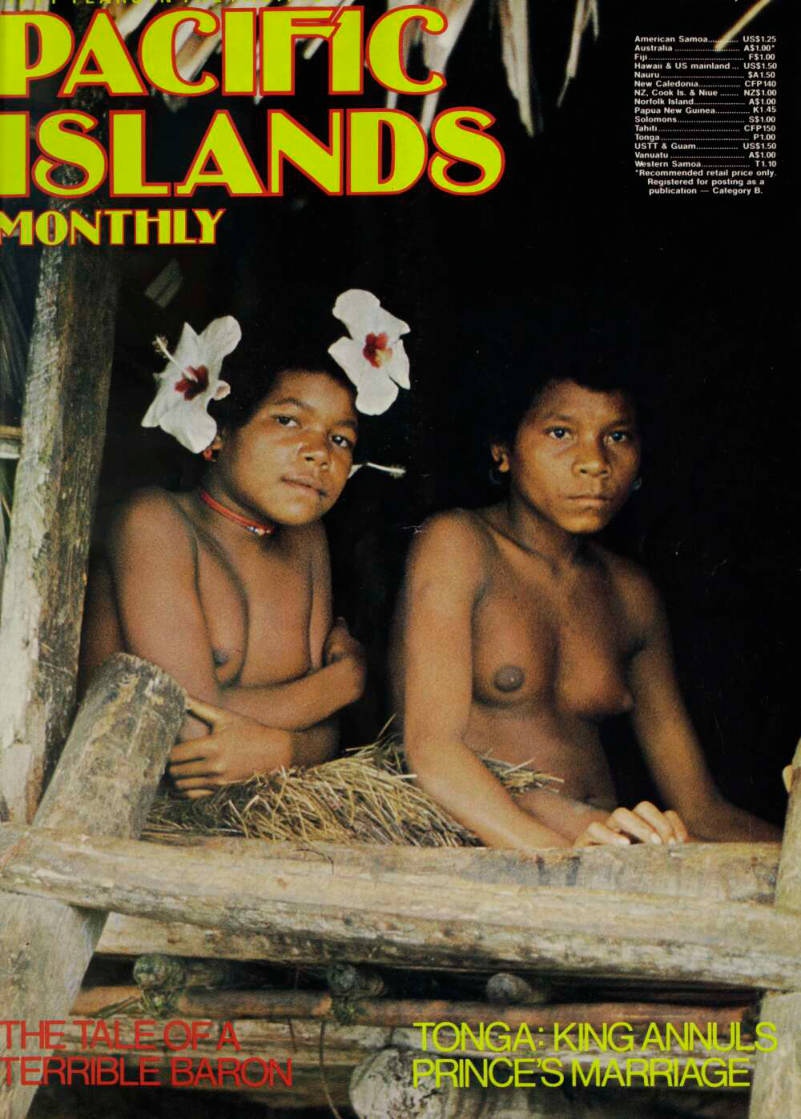
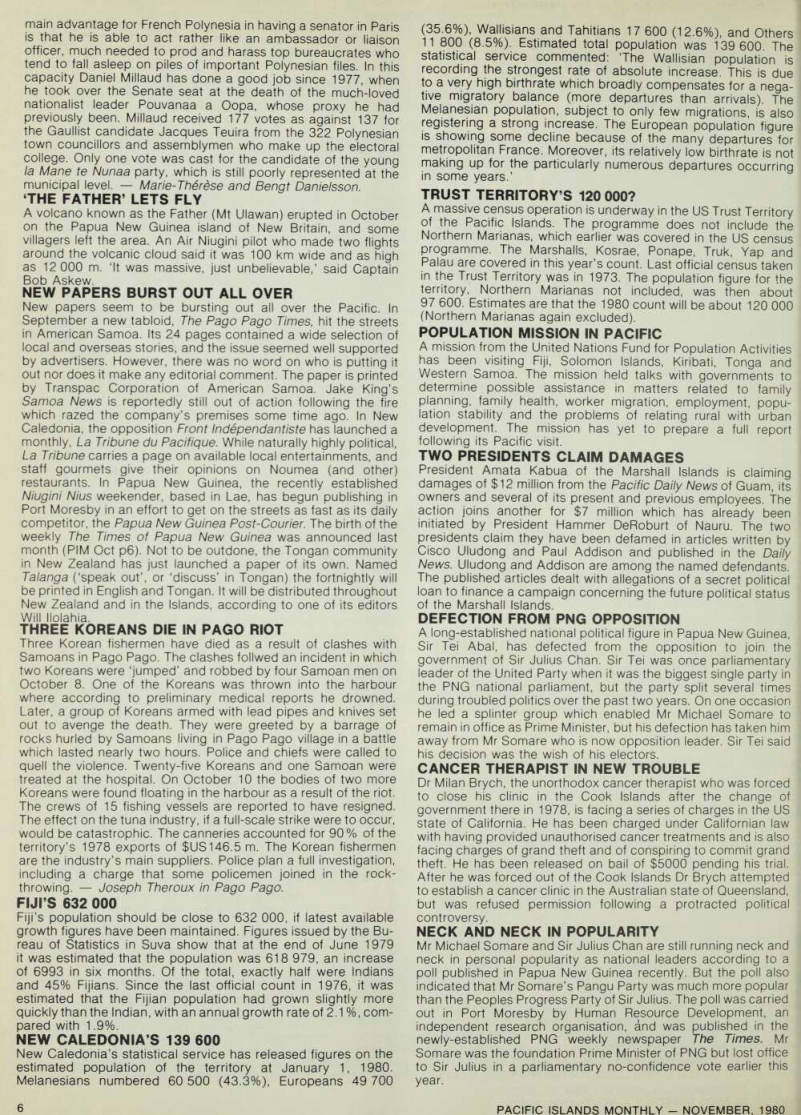
Twomey Hospital, headquarters in the war against leprosy in the Pacific 13 • HIGH DRAMA IN TONGA A King’s Proclamation officially annuls the marriage to a commoner of his son, second in line to the throne 15 • THE TERRIBLE BARON Marie-Therese and Bengt Danielsson report on the strange doings of the windsurfing wunderkind Baron Arnaud de Rosnay 18 • TROPICALITIES A geo-stationary satellite now links lecturers at the University of the South Pacific in Fiji with extension students throughout the Pacific 21 • VANUATU Two specialists write on aspects of the politics of the new nation as it lives through its first months of independence 27 • THE NUCLEAR DEBATE Opposition to Japanese plans to dump nuclear waste in the Pacific grows, and a forum in Sydney calls on the Australian Government to end its alignment with nuclear powers 35 • YESTERDAY Ken James recalls the cycling fever which gripped Fiji for a few hectic years at the turn of the century 47 • FIJI One of the Pacific’s most important nations entered its second decade of independence on October 10 51 • TRAVEL A traveller reports on a cruise in the Chinese vessel Minghua and finds it, in PlM’s Mandarin, hen hao, or ‘very good’ 55 • TRADEWINDS Ruth Lechte of Fiji went to Sydney for a recent Pacific petroleum congress and found that most people who think about petrol don’t think much about the Pacific Islands 61 Cover: The Woodlark Islands in Papua New Guinea were the scene for this appealing study by Bengt Danielsson.
Books 43 Communications 21 Deaths 73 Fiji 47, 51 Health 13 Islands Press 59 Letters 7 Micronesia 22 Nuclear debate 35 Pacific Report 5 Papua New Guinea 25, 45 People 40 Petroleum Conference 61
Political Currents 27 Postmark Papeete 18 Shipping Services 71 Ships. Held over this month for space reasons Solomon Islands 25 Stuart Inder’s Pacific 17 Tonga 15, 44 Tradewinds 61 Tradewinds Intelligence 65 Travel 55 Tropicalities 21 Vanuatu 27, 29 Yachts 63
Yesterday 47
Advertisements & other items, pp. 3-4 (2 items)
3
•ACIFIC ISLANDS MONTHLY NOVEMBER, 1980
Founded 1930 by R. W. Robson Editor Angus Smales Associate Editor Malcolm Salmon Editorial Adviser John Carter Manager John Berry Advertising Sales Manager Steve Gray A Pacific Publications production 76 Clarence Street, Sydney 2000 GPO Box 3408 Sydney 2001 Cables; PACPUB Sydney Telex: 21242 (answers INTARAD) Telephone; Sydney 29 6693 Melbourne 63 0211 ext. 1565 and 1858
your
l* \ [7 SI G D Dl
DJTOD
'i - - r - J f */
your
I [III
0 Z^C. e
fst*KO /»
mmM
V / sssssssss WE EXPORT PRODUCTS IN ALL OF THE FOLLOWING GROUPS Frozen meat, fish and seafood (bulk and portion control) Dairy products Canned fruit Dry groceries Beer, wines and spirits Cigarettes Electrical appliances Household products Electrical supplies Builders hardware Engineering supplies Motor vehicles and spares and much more!!
BBBIMMBIIMKaIaaa i twi , , , ; ' it - *«*%<■
Pacific Report
Vanuatu To Have Own Army
Four hundred applications were received by Vanuatu’s Ministry of Home Affairs when it was made known that Vanuatu proposed to have a military force. Announcing this in October, the Deputy Prime Minister and Minister for Home Affairs Fred Timakata said between 140 and 160 young men would be chosen to form the first company. Training was to begin by mid-October. Dis cussions were held on the final planning of training with Australian advisers who visited Vanuatu for the purpose. It has been agreed in principle that Papua New Guinean soldiers would assist in training, and that part of it may take place outside Vanuatu.
Okuk In Aircraft Purchase Row
The Papua New Guinea Transport Minister, lambakey Okuk, raised a political storm in October when he led a delegation to Canada and signed a contract to buy three de Havilland Dash 7 feeder airliners for the domestic fleet of the national airline Air Niugini. There were allegations from the parliamentary oppo sition, from some senior officials, and even from within the government that he had acted without authority in committing his country to the sl9m deal. The Prime Minister, Sir Julius Chan, later got Mr Okuk off the hook with a cautious statement that Mr Okuk had followed proper procedures and advice on behalf of the National Airlines Commission which held the initial responsibilities for such a deal. The final responsibility rested with cabinet as a normal procedure, Sir Julius said. Hawker Pacific, de Havilland’s representatives in Australia, confirmed that a formal sales contract had been signed. It was ‘a standard contract under good conditions’ the company said.
10Th Birthday Of Free Fiji
Fiji celebrated its 10th anniversary of independence on October 10 in the presence of Princess Anne and dignitaries from many countries. Background report, psl.
Australia’S New Aid Accord With Png
Australian Prime Minister Malcolm Fraser has announced that in iiture each year’s aid grant to Papua New Guinea will be calculated by applying to the previous year’s grant ($A232m in 1980-81) a formula which takes account of the inflation rate in Australia while providing for a 5% annual reduction in real terms n the level of the annual grant. The commitment is for five years rom July 1, 1981. Mr Fraser said that, as with the 1976 aid arrangements, the new five-year commitment would enable the D NG Government to pursue its economic and social develop nent policies with advance knowledge of the resources available 0 it from Australia, while also meeting PNG’s objective of ncreasing self-reliance through a gradual decline in Australian aid in real terms.
Abrupt Departure Of Gen. Barthelemy
Che Papeete newspaper La Depeche de Tahiti claimed in September that an official approach to French authorities by the Australian Government was behind the abrupt departure from slew Caledonia of General Jean Barthelemy, commander of Tench armed forces in the territory. La Ddpeche wrote: ‘lt will be ecalled that General Barthelemy cancelled an invitation to the Australian Consul in Noumea to attend an official reception, and n a letter to the consul accused Australia of having “directly )articipated in repressive operations’’ against French citizens of he island of Santo, in Vanuatu. The general’s fire was aimed at 1 former Australian officer, Lieutenant-Colonel lan Glanville, who vas part of the command structure of the Papua New Guinean orce charged with restoring order in Vanuatu.’ The paper also eported that French authorities had assured the Australian Bovernment that the general had acted entirely on his own nitiative, and that his letter to the consul who in fact eventually ittended the function without incident in no way represented he official French position. Two days earlier the paper had carried a report which sought to suggest that General Barthelemy’s departure was linked with the January 9 incident in vhich three young French soldiers died of heat exhaustion while >n exercises in New Caledonia (PIM Feb p 9). It said: ‘. . the :ommanding general in New Caledonia has been relieved of his
post, no doubt because he was considered responsible in his capacity of exercising overall command.’
Pints 50Th; Warm Words And Brickbats
PlM’s 50th anniversary in August is still drawing comment from here and there. Jack Smith, well-known Los Angeles Times columnist, wrote a long piece in September under the title ‘South Seas Beauty is Only PIM Deep’, in which he dwells in detail on aspects of the letters columns in our August anniversary issue, and on the Islands Press section, where he finds the ‘flavour of contemporary Islands life’. His tone was one of warm approval of PlM’s efforts. But in case we may succumb to the illusion that everybody loves us, the Noumea weekly Corail also chose to mark our anniversary with some editorial comment. The Corail editorialist confesses to having been a PIM reader for more than 36 years, and remarks: ‘I have found many very rewarding articles in this magazine. Unfortunately, I have also, and very much too often, come across a certain state of mind which is, to say the least of it, shocking for the French-speaking reader.’
From that the writer proceeds to reel off a long list of PlM’s alleged francophobic sins, ending with what he claims is the essential goal of its editorial policy: *. . . the French ought to be chased out of the Pacific. When only the English (Australians and New Zealanders) are left, all will be well.’ After reminding PIM staff that Australia and New Zealand were populated by expatriates (emphasis in Corail), the writer offers PIM staff some advice (also in bold type), while admitting that his points are a little‘simplistic’: ‘Sweep outside your own front door’, ‘Mindyour own business’, and ‘Don’t try to teach us lessons’. The editorial ends with an amicable salut and an appeal to PIM to come clean and admit that the way it treats the affairs of French speaking Pacific countries is ‘highly prejudicial to good relations between countries and especially between people who speak another language’. We’ll be perfectly happy to do so when the editorialist of Corail admits, for example, that his paper’s treatment of the Santo secession in Vanuatu was ‘highly prejudicial’ both to the unity of that struggling new nation, and to relations between New Caledonia and Papua New Guinea whose people do after all, ‘speak another language’.
Sir Julius Chan In Vanuatu
Symbolising the special link forged between the new nation of Vanuatu and Papua New Guinea, PNG Prime Minister Sir Julius Chan made his first visit to Vanuatu in September. While there he witnessed the departure of the 400 PNG Defence Force personnel who had shortly before restored Vanuatu Government control on the island of Santo. The troops arrived home to a heroes’ welcome in Port Moresby in late September.
Australia, Nz Up Vanuatu Aid
The Vanuatu government paper Tam Tam reported on September 20 that Australia had undertaken to give SAI2 1 / 2 m in aid over the next three years to meet a quarter of the country’s development budget. This sum is in addition to aid commitments already made. New Zealand has also indicated that it will increase its aid allocations to the country.
Dockers Boycott Moruroa
‘Dockers Boycott Moruroa’ announced the Tahitian daily Les Nouvelles on September 23. The newspaper reported that a dispute had developed in August over the health risks involved in loading a ship at Moruroa with contaminated waste material. The waterside workers, who are flown from time to time to the nuclear testing base in the Tuamotus to load or unload ships, finally agreed to do the dirty job but only after being granted a 60% bonus. But when a month later they were asked to make the trip again to load between 3 500 and 4 000 tonnes of contaminated scrap iron on the freighter Princess Judy they were offered only a 30% bonus which they flatly refused. Three days later the rival daily of Les Nouvelles, La Depeche de Tahiti, reported that this foolish attempt by the Tahitian dockers to extract more blood money had completely failed: the freighter had been loaded by army personnel of the CEP, the French nuclear testing agency.
Daniel Millaud Re-Elected To Senate
French Polynesia on September 28 quietly re-elected Daniel Millaud of the Teariki-Sanford Front Uni coalition to a further nine-year term in the French Senate in Paris. The lack of popular excitement is explained by the indirect method of election, and the purely decorative function of the Senate. The decisions of the 300-odd senators can be and usually are overruled by the nearly 500 deputies who sit in the French parliament proper. The
main advantage for French Polynesia in having a senator in Paris is that he is able to act rather like an ambassador or liaison officer, much needed to prod and harass top bureaucrates who tend to fall asleep on piles of important Polynesian files. In this capacity Daniel Millaud has done a good job since 1977, when he took over the Senate seat at the death of the much-loved nationalist leader Pouvanaa a Oopa, whose proxy he had previously been. Millaud received 177 votes as against 137 for the Gaullist candidate Jacques Teuira from the 322 Polynesian town councillors and assemblymen who make up the electoral college. Only one vote was cast for the candidate of the young la Mane te Nunaa party, which is still poorly represented at the municipal level. Marie-Therese and Bengt Danielsson.
‘The Father’ Lets Fly
A volcano known as the Father (Mt Ulawan) erupted in October on the Papua New Guinea island of New Britain, and some villagers left the area. An Air Niugini pilot who made two flights around the volcanic cloud said it was 100 km wide and as high as 12 000 m. ‘lt was massive, just unbelievable,’ said Captain Bob Askew.
New Papers Burst Out All Over
New papers seem to be bursting out all over the Pacific. In September a new tabloid, The Pago Pago Times, hit the streets in American Samoa. Its 24 pages contained a wide selection of local and overseas stories, and the issue seemed well supported by advertisers. However, there was no word on who is putting it out nor does it make any editorial comment. The paper is printed by Transpac Corporation of American Samoa. Jake King’s Samoa News is reportedly still out of action following the fire which razed the company’s premises some time ago. In New Caledonia, the opposition Front Independantiste has launched a monthly, La Tribune du Pacifique. While naturally highly political, La Tribune carries a page on available local entertainments, and staff gourmets give their opinions on Noumea (and other) restaurants. In Papua New Guinea, the recently established Niugini Nius weekender, based in Lae, has begun publishing in Port Moresby in an effort to get on the streets as fast as its daily competitor, the Papua New Guinea Post-Courier. The birth of the weekly The Times of Papua New Guinea was announced last month (PIM Oct p 6). Not to be outdone, the Tongan community in New Zealand has just launched a paper of its own. Named Talanga (‘speak out’, or ‘discuss’ in Tongan) the fortnightly will be printed in English and Tongan. It will be distributed throughout New Zealand and in the Islands, according to one of its editors Will llolahia.
Three Koreans Die In Pago Riot
Three Korean fishermen have died as a result of clashes with Samoans in Pago Pago. The clashes follwed an incident in which two Koreans were ‘jumped’ and robbed by four Samoan men on October 8. One of the Koreans was thrown into the harbour where according to preliminary medical reports he drowned.
Later, a group of Koreans armed with lead pipes and knives set out to avenge the death. They were greeted by a barrage of rocks hurled by Samoans living in Pago Pago village in a battle which lasted nearly two hours. Police and chiefs were called to quell the violence. Twenty-five Koreans and one Samoan were treated at the hospital. On October 10 the bodies of two more Koreans were found floating in the harbour as a result of the riot.
The crews of 15 fishing vessels are reported to have resigned.
The effect on the tuna industry, if a full-scale strike were to occur, would be catastrophic. The canneries accounted for 90% of the territory’s 1978 exports of $U5146.5 m. The Korean fishermen are the industry’s main suppliers. Police plan a full investigation, including a charge that some policemen joined in the rock throwing. Joseph Theroux in Pago Pago.
Fiji’S 632 000
Fiji’s population should be close to 632 000, if latest available growth figures have been maintained. Figures issued by the Bu reau of Statistics in Suva show that at the end of June 1979 it was estimated that the population was 618 979, an increase of 6993 in six months. Of the total, exactly half were Indians and 45% Fijians. Since the last official count in 1976, it was estimated that the Fijian population had grown slightly more quickly than the Indian, with an annual growth rate of 2.1 %, com pared with 1.9%.
New Caledonia’S 139 600
New Caledonia’s statistical service has released figures on the estimated population of the territory at January 1, 1980.
Melanesians numbered 60 500 (43.3%), Europeans 49 700
(35.6%), Wallisians and Tahitians 17 600 (12.6%), and Others 11 800 (8.5%). Estimated total population was 139 600 The statistical service commented: The Wallisian population is recording the strongest rate of absolute increase. This is due to a very high birthrate which broadly compensates for a nega tive migratory balance (more departures than arrivals). The Melanesian population, subject to only few migrations, is also registering a strong increase. The European population figure is showing some decline because of the many departures for metropolitan France. Moreover, its relatively low birthrate is not making up for the particularly numerous departures occurring in some years.’
Trust Territory’S 120 000?
A massive census operation is underway in the US Trust Territory of the Pacific Islands. The programme does not include the Northern Marianas, which earlier was covered in the US census programme. The Marshalls, Kosrae, Ponape, Truk, Yap and Palau are covered in this year’s count. Last official census taken in the Trust Territory was in 1973. The population figure for the territory, Northern Marianas not included, was then about 97 600. Estimates are that the 1980 count will be about 120 000 (Northern Marianas again excluded).
Population Mission In Pacific
A mission from the United Nations Fund for Population Activities has been visiting Fiji, Solomon Islands, Kiribati, Tonga and Western Samoa. The mission held talks with governments to determine possible assistance in matters related to family planning, family health, worker migration, employment, popu lation stability and the problems of relating rural with urban development. The mission has yet to prepare a full report following its Pacific visit.
Two Presidents Claim Damages
President Amata Kabua of the Marshall Islands is claiming damages of sl2 million from the Pacific Daily News of Guam, its owners and several of its present and previous employees. The action joins another for $7 million which has already been initiated by President Hammer Deßoburt of Nauru. The two presidents claim they have been defamed in articles written by Cisco Uludong and Paul Addison and published in the Daily News. Uludong and Addison are among the named defendants.
The published articles dealt with allegations of a secret political loan to finance a campaign concerning the future political status of the Marshall Islands.
Defection From Png Opposition
A long-established national political figure in Papua New Guinea, Sir Tei Abal, has defected from the opposition to join the government of Sir Julius Chan. Sir Tei was once parliamentary leader of the United Party when it was the biggest single party in the PNG national parliament, but the party split several times during troubled politics over the past two years. On one occasion he led a splinter group which enabled Mr Michael Somare to remain in office as Prime Minister, but his defection has taken him away from Mr Somare who is now opposition leader. Sir Tei said his decision was the wish of his electors.
Cancer Therapist In New Trouble
Dr Milan Brych, the unorthodox cancer therapist who was forced to close his clinic in the Cook Islands after the change of government there in 1978, is facing a series of charges in the US state of California. He has been charged under Californian law with having provided unauthorised cancer treatments and is also facing charges of grand theft and of conspiring to commit grand theft. He has been released on bail of SSOOO pending his trial.
After he was forced out of the Cook Islands Dr Brych attempted to establish a cancer clinic in the Australian state of Queensland, but was refused permission following a protracted political controversy.
Neck And Neck In Popularity
Mr Michael Somare and Sir Julius Chan are still running neck and neck in personal popularity as national leaders according to a poll published in Papua New Guinea recently. But the poll also indicated that Mr Somare’s Pangu Party was much more popular than the Peoples Progress Party of Sir Julius. The poll was carried out in Port Moresby by Human Resource Development, an independent research organisation, and was published in the newly-established PNG weekly newspaper The Times. Mr Somare was the foundation Prime Minister of PNG but lost office to Sir Julius in a parliamentary no-confidence vote earlier this year.
Advertisements & other items, p. 5 (1 item)
5
'ACIFIC ISLANDS MONTHLY - NOVEMBER, 1960
on killer

Letters
Controls need on killer herbicide
In your August 1980 issue you reported (p 34) that five people in the Western Highlands Prov ince of Papua New Guinea had died after drinking ‘Gramo xone’ (paraquat). Since then mother patient has died at Soroka Hospital, another as yet unconfirmed death occurred lear Minj, and another two non 'atal poisonings were treated at Mt Hagen Hospital.
It is also reported that earlier his year a man died at Kimbe Tospital in West New Britain, ind another five died in the North Solomons Province. In ill 23 fatal and eight non-fatal ;ases of Gramoxone poisoning lave so far been recorded in s apua New Guinea since 1969.
Most of the deaths occurred iccidentally after the weedi :ide had been stored in drink joules, but there has been at east one murder and one at empted murder.
Paraquat poisoning is a vorld-wide health hazard.
Deaths have been reported rom Ireland, Australia, New Zealand, Samoa, Fiji and the JS. From 1974-79 inclusive, here were 670 reported poison ngs with 150 deaths, in the Jnited Kingdom alone.
Paraquat is a potent herbi :ide, and is widely used on flantations for controlling veeds and as a defoliant before he harvesting of certain crops uch as sugar cane. It is :xtremely toxic to humans istimates of a fatal dose vary rom 3 /4 teaspoon to 10 ml. It :auses acute kidney and liver lamage, and later causes pro ;ressive lung damage so that leath may occur several weeks Tter ingestion.
There is no specific antidote.
Several treatments are rec immended, the most useful >eing a special clay which
absorbs paraquat in the stomach and prevents it being ingested into the bloodstream.
However, treatment in general remains unsatisfactory, and in practice is non-existent in de veloping countries.
In most Pacific Island countries, legislation control ling the use of industrial and agricultural chemicals is non existent or totally inadequate.
Even when effective legislation exists, they have neither the staff nor the finance to police it.
The manufacturers have been very slow to act. A Lancet editorial of November 6, 1971 stated: ‘The onus rests with the manufacturers to develop for mulations which by altered smell, viscosity, or colour will make accidental ingestion of paraquat concentrate less likely.’ Nine years later, no action has yet been taken in PNG to make paraquat safer.
Today, there are other far less toxic herbicides on the market.
Pacific countries should seriously consider banning the use of paraquat altogether. Re gional co-operation is also needed to help countries to introduce effective comprehen sive legislation controlling the use of pesticides and to monitor the effects of their use.
(Dr) Damien
Wohlfahrt
Mt Hagen Papua New Guinea Thanks for 50th
anniversary PIM
Thank you so very much for the wonderful gift you offer to ‘lovers’ of Oceania with your 50th Anniversary Souvenir Edition. Congratulations to all for such a beautiful issue, which all Pacific friends will treasure as a ‘must’ in their collection of Pacificana.
Special thanks to PIM for bringing news from our brothers scattered all over the hugeness of the Pacific, and above all for promoting the unity of our unique world! I wait impatiently and eagerly for PIM every month.
My only wish is that PIM would give more articles in the times ahead concerning the French and US territories which, until now have been somewhat the parent pauvre (poor relation). Please also, tell
us more about West Papua (I don’t want to call it Irian Jaya), that inadmissible wound on Oceania’s left side, as it is now!
Once again thank you for your unique and irreplaceable maga zine.
In my view there are four Pacific ‘events’: the South Pacific Conferences, which are for the politicians; the South Pacific Games, for the sports men; the South Pacific Festi vals of Arts, for the performers and the lovers of their work. All these three ‘events’ are avail able only to people who can afford the air fare and expenses of the visits. Last but not least, there is the Pacific ‘event’ of PIM, which is for all Pacific Islanders and ‘lovers’, and available to all, all the time, and at such an absurdly low cost. It is the sole permanent ‘event’ of the Pacific.
David Scott
Papeete French Polynesia Tale of a monster with two heads In his article in the 50th Anniversary issue of PIM Stuart Inder (p 6) aptly de scribes the New Hebrides Con dominium as a ‘twin-headed administrative monstrosity’.
These English words our local people perhaps would not easily understand, but recently the same message was clearly acted out for all to appreciate.
At East Aoba, Vanuatu Inde pendence Week was enthusi astically celebrated by some 1500 ni-Vanuatu and six ex patriate New Zealanders with well organised custom ceremon ies, church services, flag raising, food, sports, picnics, music, dancing and more food.
The exciting and much appreciated visit of the Fiji Army Band to this out-of-the way centre made us feel part of the official ceremonies at Port- Vila.
Towards the end of the last day of festivities one group danced a mime. They were rythmically weaving their drummed dance patterns when yelling out of the scrub burst a personification of the mythical double-headed devil who was once thought to live on a hill at Waimemea (a nearby lake). He ran this way and that, his
tattered garments dragging, his two grotesque heads, one facing forward and the other back ward, flapped ears and jaws as his hands and feet searched for a way to join the scattered dancers. He was defeated in combat by one who cut off the rear-facing head. The revived body joined the dancers and all completed the pattern together.
A strong affirmation of a new Vanuatu.
Joyce K. Dey
Lolowai Aoba Vanuatu Protest at Japan’s
N-waste plans
Congratulations PIM on the occasion of your 50th Anniver sary. Your contribution to the Pacific region has been half a century of outstanding service and balanced reporting. More important is the manner in which PIM has always endeav oured to keep Pacific peoples aware of the implications of foreign impositions on our cul tures and environment.
In a world dominated by the dictates of imperialistic mo tives, PIM has usually provided platforms balanced in their coverage and development not only in the economic but also in the social and moral field. And while the world has very mark edly lost its humanity, your magazine has consistently con tinued to generate within Pacific peoples a genuine caring consciousness not only for our selves but also for our fellow men. Your concern at the mis use of our environment through continued nuclear testing by France is an example.
Unfortunately, and in spite of your many excellent articles on the subject, it is clear that Japan (and later the United States!) has every intention of dumping its nuclear waste in our home! In light of this renewed onslaught by the Japanese, I urge you to keep Pacific peoples informed with up-to-date reports on the issue.
Reports by humanitarians Bengt and Marie-Therese Dan ielsson in Tahiti should be stepped up. More recently I commend PIM for John T.
Robinson’s letter in the sou venir issue, under the heading ‘American Speaks Out’. It is
heartening to find that in spite of the moral poverty in the American Government, there are still many American citi zens who have not lost their humanity. We can only hope that the conscience of the Japanese people will not be subdued by the dictates of a leadership that has lost its morality.
More specifically then 1 write to register my absolute oppo sition to the proposal by Japan to dump its nuclear waste in the Pacific. As you well know (the Japanese and Americans too!), technology has not advanced to a stage whereby complete safety and conservation of our environment can be assured.
Professor Sadao Ichikawa, a world authority on the biologi :al effects of radiation, eonfirmed this fact in an inter view on June 30, 1980. Assur ances by Japan to the contrary, are nothing more than another official lie! The Japanese fur hermore claim that such waste will anyway be of low radiation evel and therefore quite safe.
Vfy question is: If such an assertion is true then why is it hat Japanese scientists will nonitor the dumped waste?
Does this not clearly show their ancertainty and that they are Till experimenting. And indeed f such waste is of low radiation evel, why doesn’t Japan dump t off its coast. Depositing such harmless’ waste, preferably vithin its 200-mile economic :one, would serve a number of
idvantages for Japan . . .
At the outset, it would mean in enormous saving. Many nore scientists would be able to aarticipate in the monitoring vork, as the distance to the lumping area would be cut iramatically. In turn it also neans that many scientists vould ‘advance’ from this ‘de irable’ undertaking. Conduci ng this experiment within its 100-mile zone also avoids the aossibility of any future inter tational complications. Above ill, the Japanese population vould be the first to directly aenefit from the ‘advancement’ hat will arise from this icientific venture.
In seems to me that history is epeating itself. The ‘players’ nay have changed but the notives for deception are the
same. Time and again Pacific peoples have been cheated by the Americans, the British, the French and the Chinese. And now Japan has undertaken to once again make ‘guinea pigs’ of us. How much longer are we to suffer the consequences of deception?
In my capacity as official delegate for the Cook Islands to the recent Nuclear-Free Pacific Conference 1980 in Hawaii, I declare my firm opposition to the proposal by Japan to dump nuclear waste in the Pacific. I cannot and I will not yield to ill motivated ventures. Further as surances by the visiting Japanese delegation of Messrs Honami and Ishihara will not convince me otherwise. For one thing the concern of these ‘sponsored’ scientists and that of the Japanese government stems from the head! I speak from the heart!
John J. Herrmann
USP Students’ Association Suva Fiji Yet another mystery ruin on Santo Having followed the saga of ‘Langdon’s Wall’ (PIM Aug p7l) with interest, and, not doubting its origin, I would like to bring to the attention of PIM readers another ‘mystery’ from the north of Santo.
In the current edition (1969) of The Pacific Islands Pilot , Vol IT published by the British Admiralty for the use of mari ners, is a very interesting state ment. On p 214 is a description which must surely stir the imagination of readers. I quote: ‘Cape Cumberland, the north ern extremity of Espiritu Santo island, extends from the high land in a low tongue for about 2 miles. Not far from this point are to be seen the ruins of buildings of considerable size, pillars of regular shape and fragments of masonry being scattered over a plain about 3 miles in extent, and at a village 5 miles from the cape are similar ruins, of the origin of which the local inhabitants appear profoundly ignorant.’
Could these ruins be anythng to do with Quiros? Perhaps he started building his cathedral after all, or are they the same
type of ruins as on Easter Island?
When I was in Santo during 1970-72 I asked a few of the older European inhabitants about the ruins, and everyone was likewise ‘profoundly ignor ant'.
The above-mentioned Pilot was first published in 1885.
Subsequent editions appeared in 1891, 1900, 1908, 1918, 1932, 1943 and 1956. I would hazard a guess and say that the ruins were first sighted by Europeans between 1884 and 1900, and could now be over grown.
Can any PIM reader shed any light on the mysterious ruins of Cape Cumberland?
Peter Cole
Brooklyn
Nsw
Australia
Independence for
French territories Congratulations on your ever improving magazine, and also congratulations for your fiftieth birthday.
I am very angry over the French handling of the prob lems in my country, Vanuatu, over recent months.
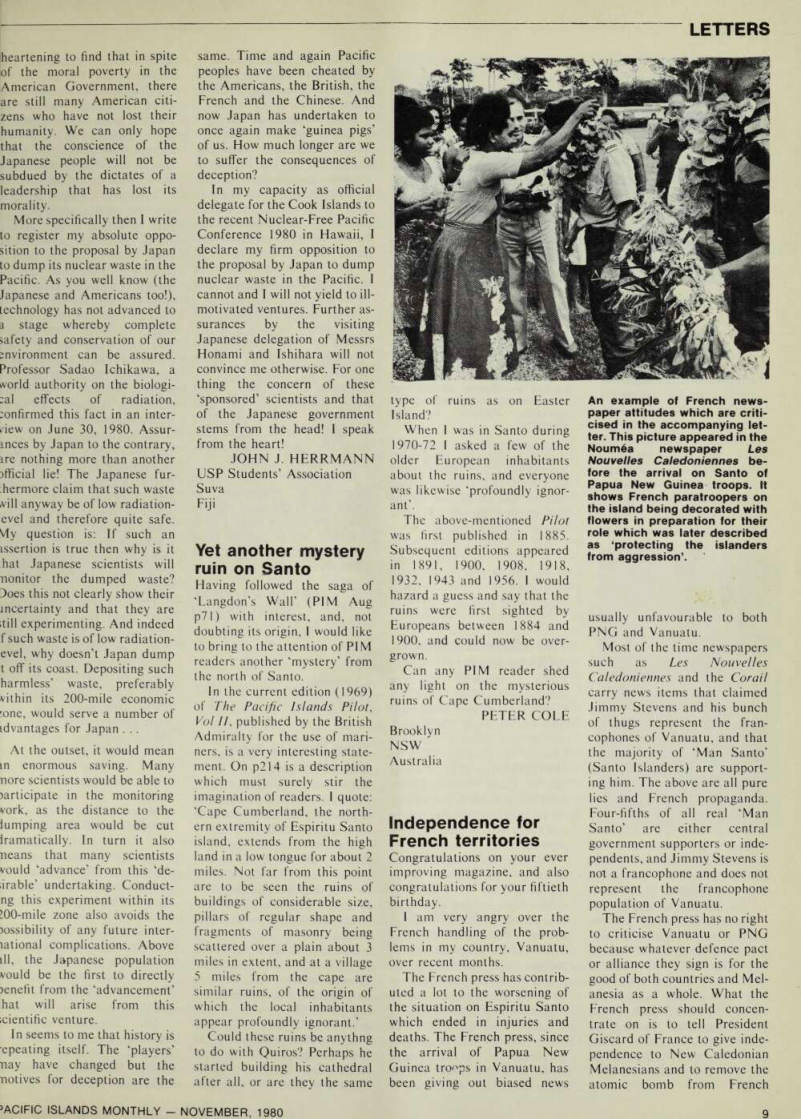
The French press has contrib uted a lot to the worsening of the situation on Espiritu Santo which ended in injuries and deaths. The French press, since the arrival of Papua New Guinea troops in Vanuatu, has been giving out biased news
usually unfavourable to both PNG and Vanuatu.
Most of the time newspapers such as Les Nouvelles Caledoniennes and the Corail carry news items that claimed Jimmy Stevens and his bunch of thugs represent the fran cophones of Vanuatu, and that the majority of ‘Man Santo’ (Santo Islanders) are support ing him. The above are all pure lies and French propaganda.
Four-fifths of all real ‘Man Santo’ are either central government supporters or inde pendents, and Jimmy Stevens is not a francophone and does not represent the francophone population of Vanuatu.
The French press has no right to criticise Vanuatu or PNG because whatever defence pact or alliance they sign is for the good of both countries and Mel anesia as a whole. What the French press should concen trate on is to tell President Giscard of France to give inde pendence to New Caledonian Melanesians and to remove the atomic bomb from French
An example of French news paper attitudes which are criti cised in the accompanying let ter. This picture appeared in the Nouméa newspaper Les Nouvelles Caledoniennes be fore the arrival on Santo of Papua New Guinea troops. It shows French paratroopers on the island being decorated with flowers in preparation for their role which was later described as ‘protecting the islanders
from aggression'.
Polynesia and test it either in Paris, the Mediterranean or the English Channel.
The French never have any thing good to say of PNG.
During the South Pacific Festi val of Arts, for example, a leader of the New Caledonian contingent who is a ‘white’ gave very misleading information to many of our Melanesian brothers and sisters who came to participate. He was alleged to have said if they come to the festival they should watch out for cannibals, snakes and the like, and also that there is no meat in PNG, people live on crocodiles. The above infor mation was gathered from con versations I had with members of the New Caledonian contin gent to the South Pacific Festi val of Arts.
France has nothing to worry about in Vanuatu. All the francophones of Vanuatu who are both ni-Vanuatus, entitled citizens and naturalised citizens shall always have the same rights as everyone else.
Vanuatu is not USA, South Africa or Iran where we have second-class citizens. Fran cophony should not be an ex cuse to meddle in the affairs of independent Vanuatu. The French Government and people in the Pacific have been using the francophones of Vanuatu for far too long as scapegoats.
I am sorry, friends, but the ball has started rolling. It will never stop when it’s still on the slope. The end of the slope is Wallis and Futuna. Whether you like ir or not, Vanuatu has opened the door. French people, you better start packing up because New Caledonia, Tahiti and Wallis and Futuna will be due for independence before 1985.
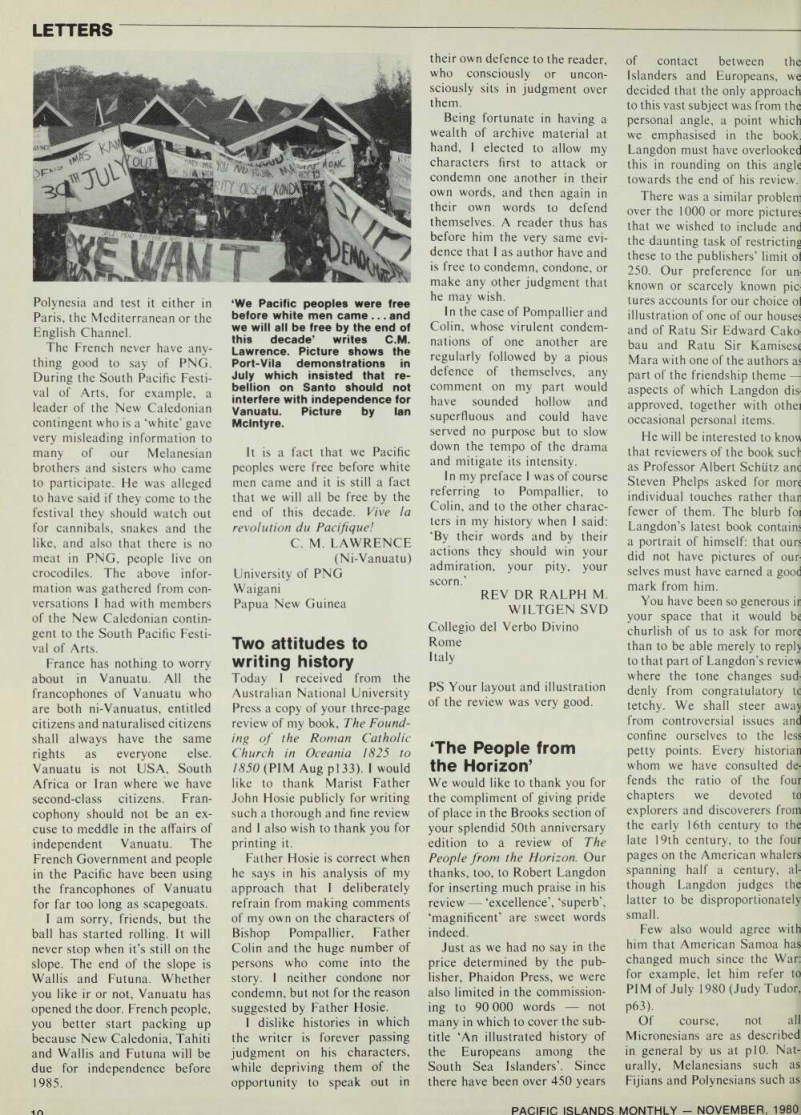
It is a fact that we Pacific peoples were free before white men came and it is still a fact that we will all be free by the end of this decade. Vive la revolution du Pacifique!
C. M. Lawrence
(Ni-Vanuatu) University of PNG Waigani Papua New Guinea Two attitudes to
writing history
Today I received from the Australian National University Press a copy of your three-page review of my book, The Found ing of the Roman Catholic Church in Oceania 1825 to 1850 (PIM Aug p 133). I would like to thank Marist Father John Hosie publicly for writing such a thorough and fine review and I also wish to thank you for printing it.
Father Hosie is correct when he says in his analysis of my approach that I deliberately refrain from making comments of my own on the characters of Bishop Pompallier, Father Colin and the huge number of persons who come into the story. I neither condone nor condemn, but not for the reason suggested by Father Hosie.
I dislike histories in which the writer is forever passing judgment on his characters, while depriving them of the opportunity to speak out in
their own defence to the reader, who consciously or uncon sciously sits in judgment over them.
Being fortunate in having a wealth of archive material at hand, I elected to allow my characters first to attack or condemn one another in their own words, and then again in their own words to defend themselves. A reader thus has before him the very same evi dence that I as author have and is free to condemn, condone, or make any other judgment that he may wish.
In the case of Pompallier and Colin, whose virulent condem nations of one another are regularly followed by a pious defence of themselves, any comment on my part would have sounded hollow and superfluous and could have served no purpose but to slow down the tempo of the drama and mitigate its intensity.
In my preface 1 was of course referring to Pompallier, to Colin, and to the other charac ters in my history when I said: ‘By their words and by their actions they should win your admiration, your pity, your scorn.’
Rev Dr Ralph M.
Wiltgen Svd
Collegio del Verbo Divino Rome Italy PS Your layout and illustration of the review was very good.
The People from the Horizon’
We would like to thank you for the compliment of giving pride of place in the Brooks section of your splendid 50th anniversary edition to a review of The People from the Horizon. Our thanks, too, to Robert Langdon for inserting much praise in his review ‘excellence’, ‘superb’, ‘magnificent’ are sweet words indeed.
Just as we had no say in the price determined by the pub lisher, Phaidon Press, we were also limited in the commission ing to 90 000 words not many in which to cover the sub title ‘An illustrated history of the Europeans among the South Sea Islanders’. Since there have been over 450 years
of contact between the Islanders and Europeans, we decided that the only approach to this vast subject was from the personal angle, a point which we emphasised in the book.
Langdon must have overlooked this in rounding on this angle towards the end of his review.
There was a similar problem over the 1000 or more pictures that we wished to include and the daunting task of restricting these to the publishers’ limit of 250. Our preference for un known or scarcely known pic tures accounts for our choice ol illustration of one of our houses and of Ratu Sir Edward Cako bau and Ratu Sir Kamisese Mara with one of the authors as part of the friendship theme aspects of which Langdon dis approved, together with othei occasional personal items.
He will be interested to know that reviewers of the book such as Professor Albert Schiitz and Steven Phelps asked for more individual touches rather than fewer of them. The blurb foi Langdon’s latest book contains a portrait of himself: that ours did not have pictures of our selves must have earned a good mark from him.
You have been so generous in your space that it would be churlish of us to ask for more than to be able merely to reply to that part of Langdon’s review where the tone changes sud denly from congratulatory to tetchy. We shall steer away from controversial issues and confine ourselves to the less petty points. Every historian whom we have consulted de fends the ratio of the four chapters we devoted to explorers and discoverers from the early 16th century to the late 19th century, to the four pages on the American whalers spanning half a century, al though Langdon judges the latter to be disproportionately small.
Few also would agree with him that American Samoa has changed much since the War: for example, let him refer to PIM of July 1980 (Judy Tudor, p 63).
Of course, not all Micronesians are as described in general by us at plO. Nat urally, Melanesians such as Fijians and Polynesians such as
‘We Pacific peoples were free before white men came ... and we will all be free by the end of this decade’ writes C.M.
Lawrence. Picture shows the Port-Vila demonstrations in July which insisted that re bellion on Santo should not interfere with independence for Vanuatu. Picture by lan Mclntyre.
Tongans can be very different one from the other; no less so, Micronesians such as Caroline Islanders. The photograph of an elderly Yapese was selected to show his tattooing and nothing else there are other pictures of more typical Micronesians.
We do not agree with Lang don that there are no more pure Tuvaluans, pure Tahitians, pure Cook Islanders, etc.
European inter-mixture has been relatively muted: we still maintain however that pure Chamorros have been victims of ‘Europeanisation’ and do not exist. We never stated that there were no part-Chamorros.
Langdon comments that ‘the book’s text scarcely matches the magnificent illustrations’.
We never expected our own work to rank with the pictorial field. Can text ever do so?
We were only too gratified by the eminent historian Dame Veronica Wedgwood, OM, when The People from the Horizon was judged for the National Book Awards as the third best history or biography appearing in 1979, putting the following on record: ‘Philip Snow’s and Stefanie Waine’s book on Europeans in the South Seas is a richly illustrated book, but one of the very few in this category where the text is outstandingly good in its own right.’
We are grateful for Langdon’s overall conclusion that ours is a beautiful book for a coffee table.
Philip Snow
Stefanie Waine
Oxford England
Those mammaries
again
Re your query (PIM Aug p3B) as to what other readers think of ‘the cover that upset reader Hitchcock’: I myself have never seen any great beauty in the naked human form, and I can only suppose those who object to such covers or other presen tations believe their privacy is being invaded and perhaps ex ploited, even though it is not their personal photo.
Whilst it is true a native once remarked to me he could not understand all the fuss the white men made about the
female breast, for, he said, to him they were merely an organ for feeding babies, nevertheless the natives all wore loincloths! I myself think the photo on pBl of the gal in the swimsuit and flower in her hair much more eye-catching or eye-appealing than the naked gal.
T. N. Thompson
Mount Tully Stanthorpe Qld Australia A word on Pacific
aviation history
Congratulations on your 50th birthday. I enjoyed the anniver sary issue and read with great interest the article on the devel opment of Pacific air routes, (pisl). Mr Percival is truly a Pacific pioneer and well in formed on his subject.
Perhaps I could add a few details that readers might find interesting. All of the key islands were not British when Pan Am began its Pacific Clip per service. American Samoa, directly on the proposed Pan Am route, had been a US Territory since 1900. Captain Lorenzo Musick, Pan Am’s chief route pilot, had made several landings and take-offs from the harbour at Pago Pago and after the sixth take-off the clipper crashed. The wreckage was found later about 12 miles off the harbour entrance. Capt Musick had commented that he disliked the steep cliffs sur rounding Pago Pago Bay and the short take-off required to clear the breaker line at the entrance, though neither appar ently contributed to the disas ter. This and other information is available in a new book titled An American Saga: Juan Trippe and his Pan Am Em pire; (Robert Daley, Random House, New York, 1980.) In my opinion, the view of the US Government does not favour protectionism or lack of competition for its airlines.
Witness the recent Airlines’
Deregulation Acts which have led to such fierce price-cutting competition for passengers that all but two US airlines reported massive first-half losses for 1980. Among those reporting losses is Continental Airlines which is again talking about a merger with Western Airlines.
These airlines are forced to fly their planes at losses just to stay in the ‘checkers’ game. Unfor tunately, these cheaper tickets and savings do not often extend to trans-Pacific passengers.
One more minor point.
BOAC, besides dropping ‘Air ways’ from their name, also omitted the ‘Overseas’ and ‘Corporation’ to become simply British Airways.
My regards to Mr Percival and to PIM. Keep up the good work.
David Sievers
Pago Pago American Samoa British Airways is an amalga mation of BO AC and BE A (British European Airways). It now flies under the name British ’. Editor.
More on the case of Olivier Breaud Thank you for having published in your August 1980 issue my letter concerning the assassin ation of Olivier Breaud. (p 37).
I did not intend to undermine the journalistic talent and repu tation of Marie-Therese and Bengt Danielsson, whom I have never met but with whom I share many concerns about this Pauvre Cythere that Tahiti has become (particularly when you have, as I do, the opportunity to know the rest of the Pacific and to make comparisons! I recognise that their first article in May was written before the outcome of this kidnapping torture and murder was known. Their following article was very much to the point and, as usual, very courageous.
Andre Rossfelder
La Jolla California
Usa
Determined in error I read with interest an adver tisement which first appeared in PIM August (pi 12) and was reprinted in identical form in September (p 45).
The firm Wonderest have an agent in Port Moresby and are ‘exporters of fine bedding’ to New Guinea (but not Papua).
British Solom an Islands
(which ceased to be British more than two years ago and to my knowledge has never been Solom an Islands) and New Hebrid/es (surely New Hebrides, if not Vanuatu).
It must be rare to find these three prominent Pacific nations misnamed and misspelt with such determination.
Andrew Keeble
Honiara Solomon Islands Many thanks. These errors are being cleaned up and, by the way, you missed a couple more in other ads. Editor.
50th birthday
congratulations
Forwarding my subscription re newal affords me the oppor tunity of conveying my con gratulations on the 50th anni versary of Pacific Islands Monthly.
For many years now PI M has been eagerly awaited each month and read from pi to the end with something akin to the
zest of devouring a tempting meal, which in my case is an obsession with the Pacific Islands. Thank you for giving me so much pleasure.
The anniversary issue was exceptionally well produced, and one can look forward eagerly to your next half century.
Best of good wishes to all staff.
Alan Escrow
Byron Bay
Nsw
Australia
Advertisements & other items, pp. 8-12 (2 items)
listening enjoyment
■ ; ** ij . >5l *S£5 £-2 jk; m ft - •- A 6
Create /our own world of
There are times when you really want to get away from it all. The day-to-day pressures at work, final exams, you name it. Well, when you feel the need for a refreshing change from the world around you, why not create your own with an AVANTE system from Pioneer.
These handsomely packaged system components like our AVANTE 700, offer all the performance of separate hi-fi components and all the beauty and styling of fine furniture.
Each component is carefully matched and designed to deliver the finest in stereo listening enjoyment from the world leader in high fidelity.
If you feel it’s time to get away from it all, why not get one of our exciting AVANTE hi-fi component systems. There are five great AVANTE systems to choose from so you can create a world of enjoyment that’s right for you. AVANTE . . . the getaway machines from Pioneer —get one today.
OrD PIONEER
For further information, please contact: Australia: Pioneer Marketing Service Pty. Ltd., P.O. Box 317, Mordialloc, Victoria, 3195 Tel: 90-9011 Fiji Islands; Brijlal & Company, G.P.O. Box No. 362, Suva, Fiji Islands Tel: 22258 New Zealand: Monaco Electronics Ltd., 30 Pollen Street, Grey Lynn, Auckland, New Zealand Tel: (09) 762 098 Norfolk Island: Burns Philp (Norfolk Island) Ltd., Norfolk Island, South Pacific New Hebrides; Rums Philn (New Hebrides} Ltd.. Vila. New Hebrides Nauru Island: Jacob Enterprises, P.O. Box No. 4, Republic of Nauru Tahiti: Ets. PERFECT, B.P 594, Papeete, Tahiti Tel: 20 407 New Caledonia: Menard FreresVille, B.P. H2Cedex, Noumea, New Caledonia Tel: 27.52.22 American Samoa: Transpac Corporation, P.O. Box 1477, Pago Pago, American Samoa 96799 Tel: 633-5224 Rarotonga: South Seas International Ltd., P.O. Box 49, Rarotonga, Cook Islands Tel: 2321 Paoua New Guinea: Bali Merchants Ptv. Ltd.. P.O. Box 6103, Boroko Tel: 254887,
m-:i ■ \ «■ X ■SWMfe as \ ;> if ar I /- ■<V* - &fw ; X ->■' f. ■ /•■ fr U m /*
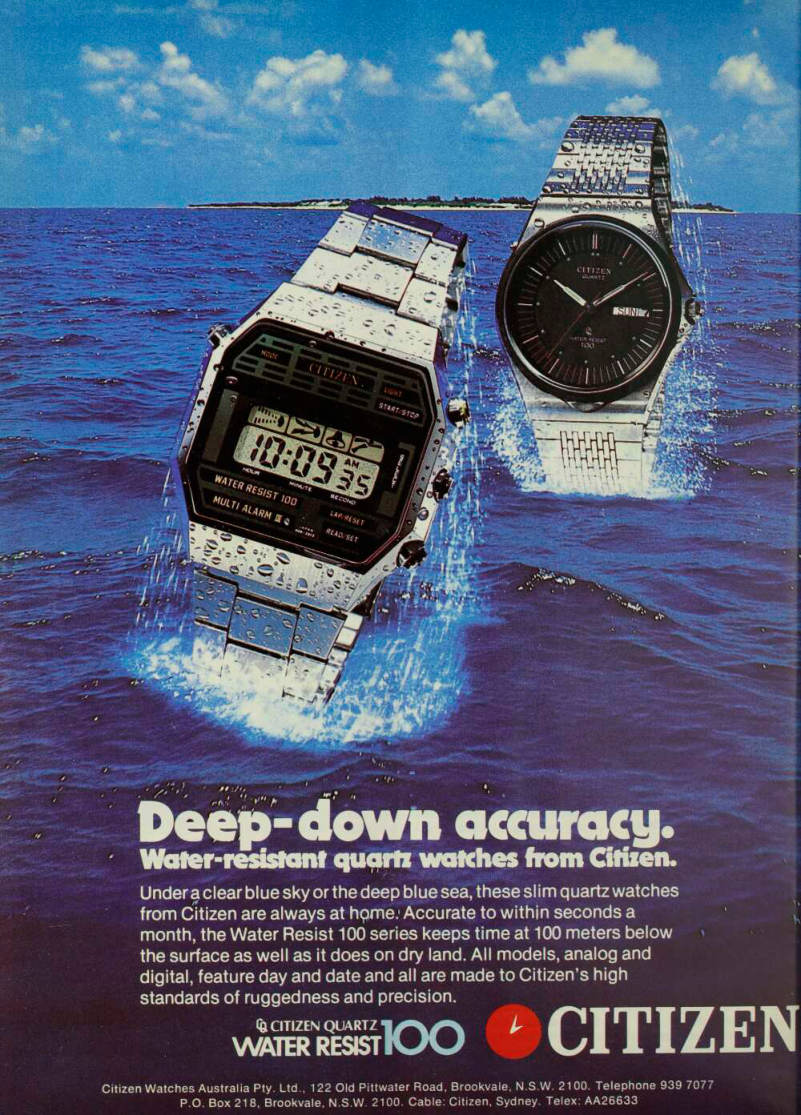
Deep- down accuracy.
Water-resislant quartz watches from Citizen.
Undera clear blue sky or the deep blue sea, these slim quartz watches from Citizen are always at hpme; Accurate to within seconds a month, the Water Resist 100 series keeps time at 100 meters below the surface as well as it does on dry land. All models, analog and digital, feature day and date and all are made to Citizen’s high standards of ruggedness and precision.
WATER RESBIIOO ‘ CITIZEN
Citizen Watches Australia Pty. Ltd., 122 Old Pittwater Road, Brookvale, N.S.W. 2100. Telephone 939 7077 P.O. Box 218, Brookvale, N.S.W. 2100. Cable; Citizen. Sydney. Telex; AA26633
Letters
9
ACIFIC ISLANDS MONTHLY - NOVEMBER, 1980
P. J. Twomey Memorial Hospital,
HQ for a war on leprosy
Seona Martin* writes below on the outstanding work of Fiji’s P. J. Twomey Memorial Hospital in the treatment of leprosy.
The Twomey centre is backed by the World Health Organisation, the New Zealand Leprosy Trust Board and the Fiji Government. Part of its work is the running of training programmes for personnel from a large number of South Pacific countries. She concludes: ‘The . . . training programme aims to increase knowledge of the disease, make control more effective, and ultimately increase people’s understanding and tolerance of leprosy sufferers.’
Leprosy. The word which in these days of nuclear leaks, napalm and hostages still has power to strike fear and loath ing into the hearts of men.
Most men, that is. Fortu nately there are some who not only fight the dread disease but also fight to bring more under standing of its course and more acceptance of its victims.
Men like Albert Rose, long serving chairman of the New Zealand Leprosy Trust Board.
Why should Mr Rose or any body else in New Zealand, or in England or the United States, for that matter care about leprosy which is endemic only in less developed. Third World :ountries like the South Pacific region?
Amongst reasons of the heart :here is also the practical fact, as Fiji’s P.J. Twomey Memorial Hospital Medical Superintend ent, Dr Esaroma Daulako, can ;ell you, that the United States of America has to operate a 300-bed leprosy hospital in Earville, Lousiana, and there ire leprosy cases now being •eported in London, where the ast Englishman to have the Jisease died 100 years ago.
In Europe and other devel oped areas, it is true the disease vas eradicated as standards of iving rose.
But migrants from the Third World are bringing it back to hese places. Leprosy is again oecoming an international oroblem, although not the 'rightful ogre it once was.
In the South Pacific, the ;ame increased mobilisation of he population and easier com
* Ms Seona Martin lives in Fiji md was commissioned to write his article by the New Zealand leprosy Trust Board and the World Health Organisation.
munications are having the same sort of effect.
Dr Daulako said that in Fiji the disease used to be tradition ally prevalent in the island groups of Yasawa, Lau, Lomaiviti and on Rotuma and Kadavu, where the relative isolation of the communities kept the disease confined to those areas.
But now, for the first time, cases are being discovered in areas where they were never reported before. ‘Although more cases are being recorded, 1 believe the disease is stabilising in Fiji,' Dr Daulako said. ‘The figures give a rather wrong impression, because al though they are up, 1 believe it is because we are detecting and diagnosing cases earlier. Our field workers are more aware of the disease.’
This awareness is one of the key factors in controlling the disease.
The spread of leprosy ‘aware ness’ received a major boost in 1978 when the World Health Organisation, the New Zealand Leprosy Trust Board and the Fiji Government made an agreement to run training courses in the identification, care and treatment of leprosy patients for the region. Another source of funds for leprosy activities in the South Pacific that is proving most valuable is the Japan Shipbuilding Indus tries Foundation (JSIF). They are providing funding for con sultants, laboratory equipment, drugs and transport equipment in many countries of the South Pacific where there are ongoing leprosy programmes.
Twomby Hospital in Fiji was selected as the centre because it had the most suitable facilities for training including a pool of patients, two specialist lep rosy doctors, a new modern hospital and proximity to the Fiji School of Medicine. Also,
the hospital has the only specialised shoemaker for lep rosy cases in the South Pacific, and this happens to be Dr Daulako himself.
Special protective footwear, to stop the injuries which lead to severe ulceration of anaes thetised leprosy-affected limbs, is a vital part of patient care.
Dr Daulako studied shoe making in India and the United States as part of his specialist leprosy care training. In spite of his heavy medical load he has kept up his shoemaking as a hobby and he personally teaches the shoemakers on the training courses.
The first course kicked off within three months of the training agreement, in
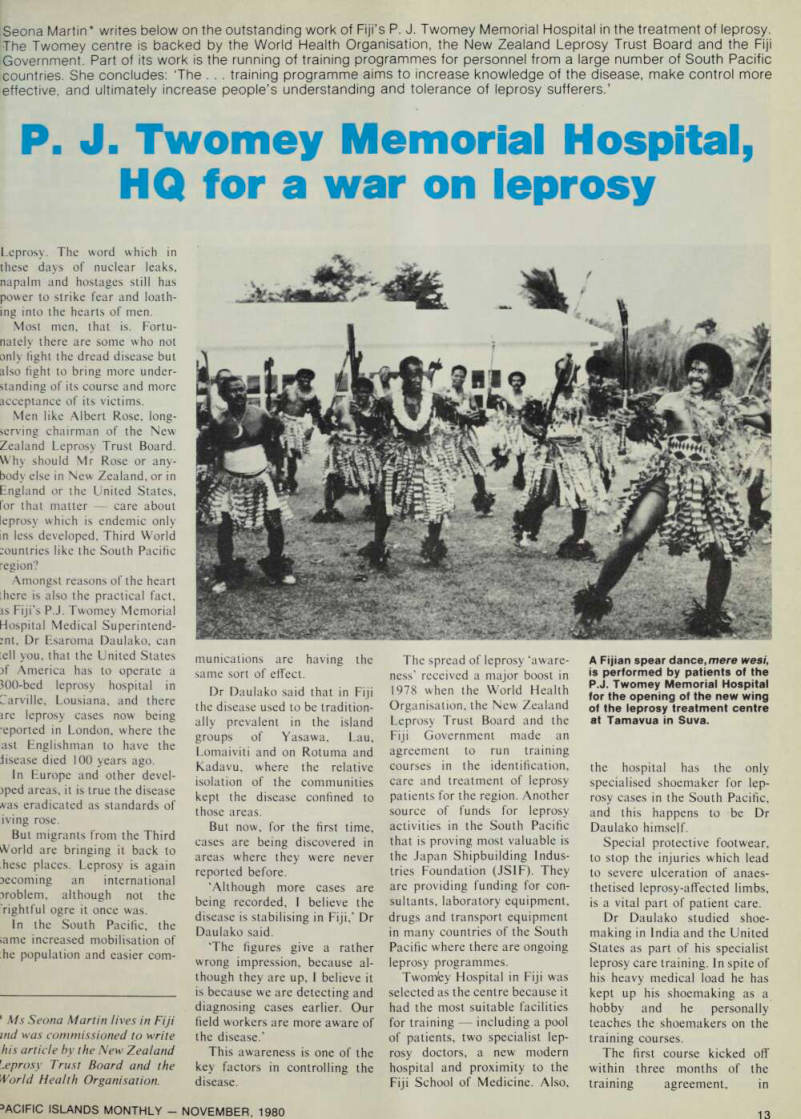
A Fijian spear dance, mere wesi, is performed by patients of the P.J. Twomey Memorial Hospital for the opening of the new wing of the leprosy treatment centre at Tamavua in Suva.
September 1978, and the fifth course began in September 1980.
Included in the five has been a course for Fiji medical workers, and another for French-speaking representa tives from the French territories.
Each participating country American Samoa, Western Samoa, Kiribati, Trust Terri tory of the Pacific Islands, Solomon Islands, Vanuatu, New Caledonia, French Polynesia, Papua New Guinea, Tonga, Cook Islands and Fiji are entitled to send two rep resentatives from the fields of medical officers, nurses, medi cal assistants, laboratory tech nicians, shoemakers, and health extension officers to each course.
To improve facilities even more at P.J. Twomey, the New Zealand Leprosy Trust Board has recently funded the build ing of a $65 000 hall and new outpatients section, set separ ately in the garden-filled grounds of the hospital over looking a wide sweep of Suva’s Laucala Bay from far up on Tamavua Ridge.
P.J. Twomey Memorial Hos pital opened in November 1969, when patients were moved from the small,
paradise-like island of Makogai, off the Viti Levu coast. The Missionary Sisters of the Society of Mary, who have dedicated their lives, love and care to leprosy patients since 1911, used to run the island for sufferers from throughout the Pacific.
It was an island of fear and hopelessness to outsiders, but a haven of peace and compassion to those who had to go there.
Those who could, fished, gardened and lived a village community life but in tragic isolation. Then came the new drugs and new hope, and at last the reality of cure and a return to family and home. Now a return was possible, the other island territories took back their sick to care for them amongst their own people.
That was in the 19505, and then in the ’6os the New Zealand Leprosy Trust Board prepared the way to bring Fiji patients back to the main island of Viti Levu, to a new, fully equipped hospital within easy reach of the communities and families they hoped to rejoin.
There are now five nursing sisters at the hospital, three Fiji Government nurses, four ward orderlies, office and ancillary staff, and two medical officers including Dr Daulako, who was confirmed as superintendent in April 1979.
A Fiji School of Medicine graduate, he chose to specialise in the treatment of leprosy because he said he felt he could give his best service in this field.
There was also a compelling personal reason his home islands of Lau represented one
of the areas whence many of the leprosy patients came.
He said there were three stages to combatting leprosy identification, control and eradication. He believes the South Pacific is at the second stage.
The third stage is the ulti mate goal, but so many factors affect it that it is not within the capability of a hospital, or even a health service, to make it happen. It comes, he explained, with raised standards of living and the development which goes with it.
Yet there is progress as the Fiji figures show. The preva lence rate for leprosy in Fiji is .6 per 1000 people. The incidence rate, which is the number of new cases being diagnosed, is .07 in 1000.
WHO Inter-country Project, Leprosy Control Advisory Ser vices figures show the incidence rate for the whole South Pacific region is 1.7 cases per 1000 population, and available re cords indicate there is a total of 3213 active leprosy cases.
This compares with areas of the world where leprosy is endemic which have a rate of more than 20 per 1000, with entire communities regarded as disease contacts. Dr Daulako strongly emphasises the need to rehabilitate people back into their families and communities, with an ability to cope with a deformity and some assurance of acceptance. Medical care and cure is not all that is needed.
He and the other men and women working to fight the disease still have to fight the suspicion, stigma and prejudice which still prevail in different segments of the community. In some societies, Dr Daulako said, a person could develop a small patch on the arm which could be cleared up in a year and totally cured within three years. But the stigma would remain with that family for another three generations, isolating them and preventing successful marriages.
Not only to cure and care, but to change society’s atti tudes, is the mammoth task which the people who attend the three-week training courses at P.J. Twomey face.
With more cases now reach ing developed countries, the work takes on international
importance no longer confined within the boundaries of the South Pacific region.
Some progress is being made, as even Fiji figures show. There are 483 active leprosy cases throughout the country, but only 50-70 cases in hospital at any one time. They go only when the disease is in the infective stage or when they suffer ulcers or other problems requiring treatment. The rest of the time they are at home in their own communities.
The only people who remain in hospital are those who suffered major deformities be fore today’s drugs were avail able.
As WHO is trying to tell people, leprosy can be cured, conrolled and deformities pre vented.
More than half of all patients cannot pass the disease on to others, and modern drugs can make the few infectious cases non-infectious. It is essenn tial, doctors insist, to be treated early and regularly for as long as necessary for the modem drugs to have their effect.
WHO is concerned that many people still fear the dis-j ease, believe it still cripples and that all patients are able to pass, on the disease.
In some places, employers will not hire leprosy patients although they are no danger to anyone; schools will not admit children of leprosy patients or take young leprosy sufferers; neighbours will drive leprosy patients away from village wells and even from the village —j and because of this unjust and unfair treatment, people try to hide the early signs of the disease and so it takes longer for them to seek and get the treatment they need. This is what makes them a public health risk to the community.
Sometimes outdated legis lation reinforces outdated social attitudes for instance, permitting leprosy as a grounds of divorce and enforcing iso lation of a family with a leprosy sufferer.
The World Health Organis-, ation and Leprosy Trust Board training programme aims to increase knowledge of the dis ease, make control more effective and ultimately in crease people’s understanding and tolerance of leprosy sufferers.
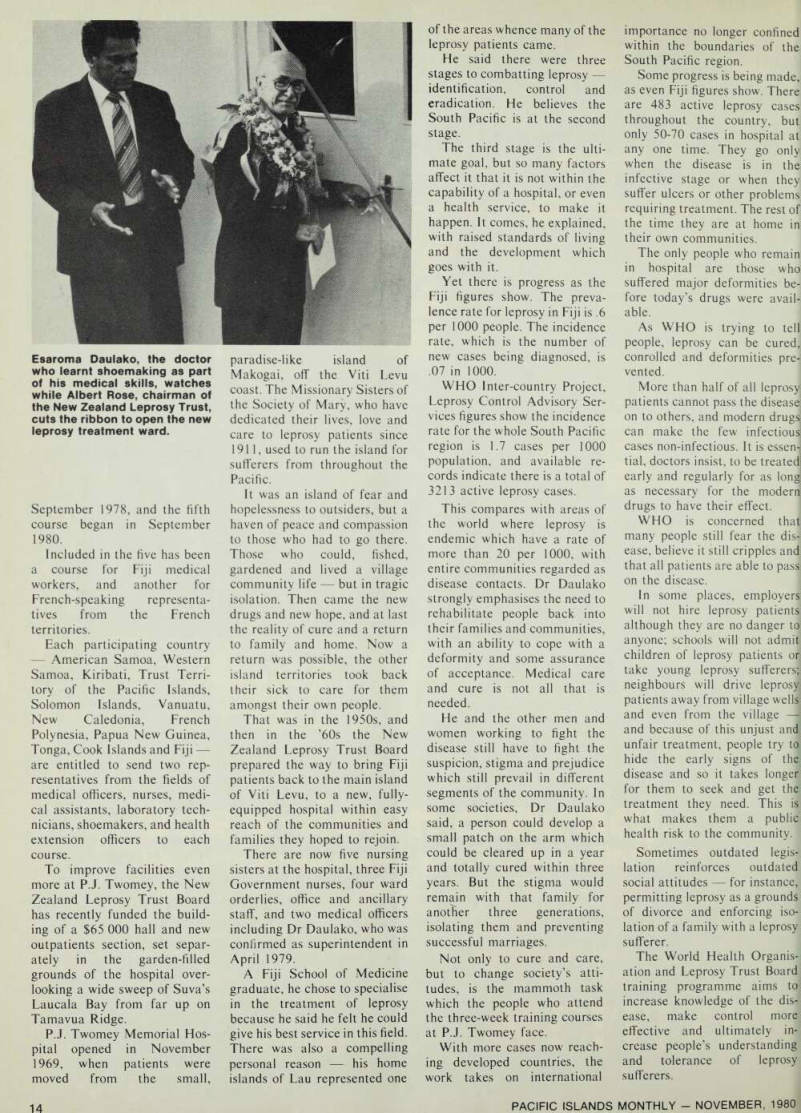
Esaroma Daulako, the doctor who learnt shoemaking as part of his medical skills, watches while Albert Rose, chairman of the New Zealand Leprosy Trust, cuts the ribbon to open the new leprosy treatment ward.
Advertisements & other items, p. 13 (1 item)
13
3 ACIFIC ISLANDS MONTHLY - NOVEMBER, 1980
the prince and
Tongan tale of the prince and the commoner
Drama in Tonga: King Taufa’ahau Tupou IV has annulled the marriage, celebrated in Honolulu, of one of his sons who is second in line to the throne. Sheree Lipton in Honolulu tells the story.
Like the characters in a Barbara Cartland two -pa’anga novel, each captures your inter est and sympathy, not to men tion your curiosity as to how it will all end. First the King: the great Tongan Taufa’ahau Tupou IV; he might be the ‘bad guy’ yet you are sympathetic to him in an historical sense. An enormous but usually gentle bear of a man, he was educated at Australia’s Sydney Univer sity, and is, in many ways, a modern thinker.
But, not unlike royalty in other lands, he is bound to the same unchanging traditions as previous sovereigns includ ing his famous mother, the beloved Queen Salote. His Maj esty’s remote ancestors were ruling Tonga long before the Normans conquered England.
When his second son runs off and marries a beautiful young maiden of not so royal birth without permission, it is understandable that the royal ta’ovala might be a bit ruffled.
The Queen must also be heavy of heart, for though generally more loquacious than the King, Her Majesty has made no public statement.
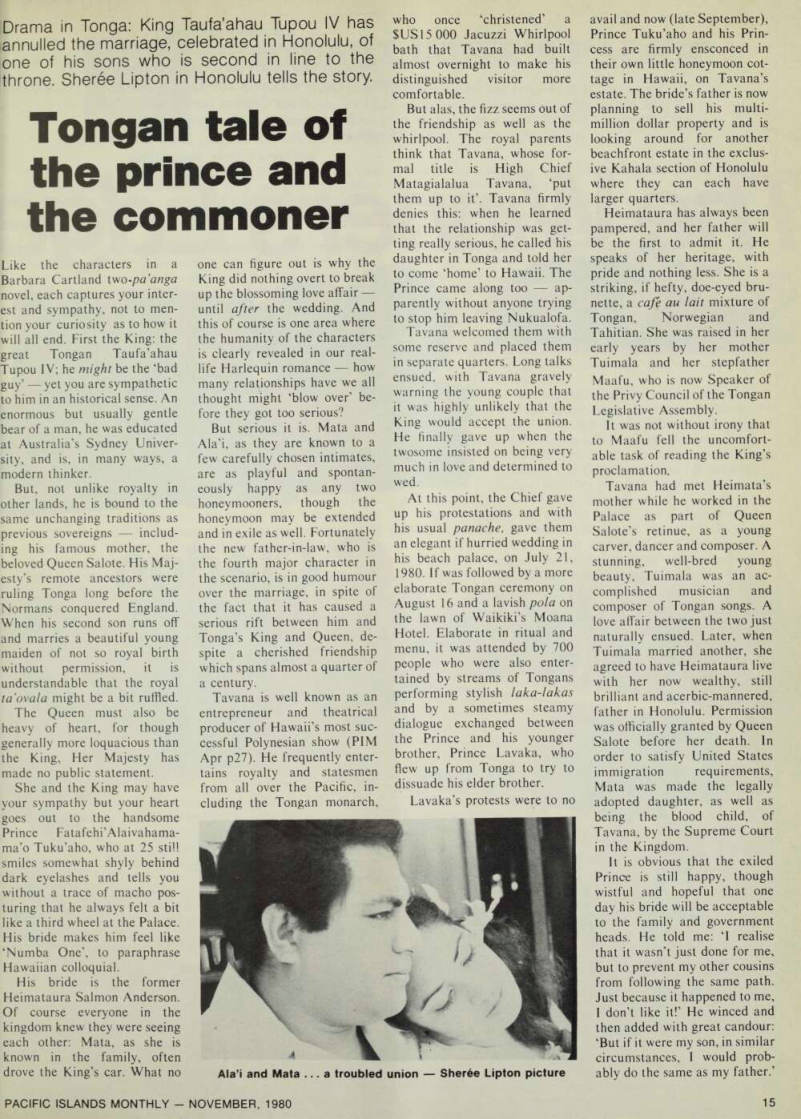
She and the King may have your sympathy but your heart goes out to the handsome Prince Fatafehi’Alaivahama ma’o Tuku’aho, who at 25 still smiles somewhat shyly behind dark eyelashes and tells you without a trace of macho pos turing that he always felt a bit like a third wheel at the Palace.
His bride makes him feel like ‘Numba One’, to paraphrase Hawaiian colloquial.
His bride is the former Heimataura Salmon Anderson.
Of course everyone in the kingdom knew they were seeing each other: Mata, as she is known in the family, often drove the King’s car. What no
one can figure out is why the King did nothing overt to break up the blossoming love affair until after the wedding. And this of course is one area where the humanity of the characters is clearly revealed in our real life Harlequin romance how many relationships have we all thought might ‘blow over’ be fore they got too serious?
But serious it is. Mata and Ala’i, as they are known to a few carefully chosen intimates, are as playful and spontan eously happy as any two honeymooners, though the honeymoon may be extended and in exile as well. Fortunately the new father-in-law, who is the fourth major character in the scenario, is in good humour over the marriage, in spite of the fact that it has caused a serious rift between him and Tonga’s King and Queen, de spite a cherished friendship which spans almost a quarter of a century.
Tavana is well known as an entrepreneur and theatrical producer of Hawaii’s most suc cessful Polynesian show (PIM Apr p 27). He frequently enter tains royalty and statesmen from all over the Pacific, in cluding the Tongan monarch,
who once ‘christened’ a SUSIS 000 Jacuzzi Whirlpool bath that Tavana had built almost overnight to make his distinguished visitor more comfortable.
But alas, the fizz seems out of the friendship as well as the whirlpool. The royal parents think that Tavana, whose for mal title is High Chief Matagialalua Tavana, ‘put them up to it’. Tavana firmly denies this: when he learned that the relationship was get ting really serious, he called his daughter in Tonga and told her to come ‘home’ to Hawaii. The Prince came along too ap parently without anyone trying to stop him leaving Nukualofa.
Tavana welcomed them with some reserve and placed them in separate quarters. Long talks ensued, with Tavana gravely warning the young couple that it was highly unlikely that the King would accept the union.
He finally gave up when the twosome insisted on being very much in love and determined to wed.
At this point, the Chief gave up his protestations and with his usual panache, gave them an elegant if hurried wedding in his beach palace, on July 21, 1980. If was followed by a more elaborate Tongan ceremony on August 16 and a lavish pola on the lawn of Waikiki’s Moana Hotel. Elaborate in ritual and menu, it was attended by 700 people who were also enter tained by streams of Tongans performing stylish laka-lakas and by a sometimes steamy dialogue exchanged between the Prince and his younger brother, Prince Lavaka, who flew up from Tonga to try to dissuade his elder brother.
Lavaka’s protests were to no
avail and now (late September), Prince Tuku’aho and his Prin cess are firmly ensconced in their own little honeymoon cot tage in Hawaii, on Tavana’s estate. The bride’s father is now planning to sell his multi million dollar property and is looking around for another beachfront estate in the exclus ive Kahala section of Honolulu where they can each have larger quarters.
Heimataura has always been pampered, and her father will be the first to admit it. He speaks of her heritage, with pride and nothing less. She is a striking, if hefty, doe-eyed bru nette, a cafe au lait mixture of Tongan, Norwegian and Tahitian. She was raised in her early years by her mother Tuimala and her stepfather Maafu, who is now Speaker of the Privy Council of the Tongan Legislative Assembly.
It was not without irony that to Maafu fell the uncomfort able task of reading the King’s proclamation.
Tavana had met Heimata’s mother while he worked in the Palace as part of Queen Salote’s retinue, as a young carver, dancer and composer. A stunning, well-bred young beauty, Tuimala was an ac complished musician and composer of Tongan songs. A love affair between the two just naturally ensued. Later, when Tuimala married another, she agreed to have Heimataura live with her now wealthy, still brilliant and acerbic-mannered, father in Honolulu. Permission was officially granted by Queen Salote before her death. In order to satisfy United States immigration requirements, Mata was made the legally adopted daughter, as well as being the blood child, of Tavana, by the Supreme Court in the Kingdom.
It is obvious that the exiled Prince is still happy, though wistful and hopeful that one day his bride will be acceptable to the family and government heads. He told me: ‘I realise that it wasn’t just done for me, but to prevent my other cousins from following the same path.
Just because it happened to me, I don’t like it!’ He winced and then added with great candour: ‘But if it were my son, in similar circumstances, I would prob ably do the same as my father.’
Ala’i and Mata ... a troubled union - Sherée Lipton picture
Advertisements & other items, p. 16 (1 item)
hner’sEdge
157 Jhe rally s underway.
The competition is tough.
The skills that make up a champion are many.
The winner's edge-reliability. The kind of reliability you expect from Clarion car stereo.
High guality performance all the way.
Check out the full lineup. You'll find it in the winner's circle , every time.
hner’sEdge
In Car Entertainment Company
©Clarion
Clarion Co.. Ltd. ToWvo. Tnnnn Clarion Co Tokyo Ja an
i mm
r % m mm r c mm
gRs
td. 554
Stuart Inder’S Pacific
Stuart Inder, former publisher and editor of PIM, this month begins an occasional column on matters of Pacific interest. His first column gives his views on a report in PlM’s September issue on France's view of its role in the Pacific,
France’s view of its role in the South Pacific, recorded in a long and interesting report in PIM (Sep p 25) repays serious examination. It makes a number of astute observations, and it gives a fairly clear-headed general picture of the development of the Islands.
It recognises the unusual relationship today enjoyed by Australia and New Zealand with the Forum countries, and it identifies the possibility of a change in NZ’s relations with the South Pacific states through the awakening of NZ’s Maori population. It sums up, pretty accurately I think, the present attitudes of some of the emerging States. It also recognises the major role of the Church in forming the ‘Oceanic mentality’ (although I think it gives unwarranted stress to the part of Presbyterianism, for it is Christianity, not any special denomination, that has brought about cohesion). It states, correctly, that if France is to retain its presence in the Pacific it is called upon to adapt both its way of speaking and its actions to the specific mentality of the ‘Oceanians’.
The more surprising, then, that what is in many ways an admirable document, can come to the conclusions it does about France’s own position here.
France sees itself as misunderstood in the Pacific mainly because ‘the fenced-off situations of the colonial age have led to a total failure to appreciate the culture and institutions of France’. It feels that because of the historic background of Anglo-Saxon influence on the Pacific Islanders, and their failure to appreciate any but the British view of decolonisation, the Islanders need to be educated, ‘through steady and repeated explanatory campaigns’ on the fact that France’s overseas territories ‘are not colonies made up of natives administered from Paris, but communities endowed with a specific status, managing their own resources and inhabited by citizens who take part, in the same way as other Frenchmen, in all popular voting processes’.
Because of what it sees as Australia’s special position in the South Pacific, France considers that a sound foothold in Australia, particularly in Sydney, will fortify her presence in Oceania. ‘France feels the need to act in concert with Australia and New Zealand in the implementation of its policy in the South Pacific,’ is how the document puts it.
One of the differences between the positions of France, Australia and New Zealand in the South Seas is that, their white populations notwithstanding, Australia and New Zealand happen to be situated in the South Seas, France does not.
Despite their geographical position, should Australia and New Zealand ever adopt permanent policies which are unsympa thetic to the Pacific mini-states, they would lose their special standing. Their ‘whiteness’ would become their special liability.
But on no terms would the South Seas accept continental France as a South Seas power. The Islanders are rightly suspicious of absentee landlords, and they will consider France as an absentee landlord just so long as its South Seas territories do not have political autonomy. Until they have genuine autonomy no matter how they might choose to exercise it when they get it the South Seas will continue to see France’s territories as colonies made up of natives administered from Paris.
That is not being anti-French. I wonder what deep-seated sensitivity it is that makes France somehow blind to this, what contrariness it is that makes France see what is essentially an
anti-colonial reaction as ‘total failure to appreciate the culture and institutions of France’.
We don’t need any campaigns to educate us about French culture. French culture, French institutions, French resources, and French goodwill are welcome in the South Pacific. Political direction from Paris is not. Why can’t Paris see that Paris control of New Caledonia affronts many Pacific Island states no less than if Paris were attempting to direct theml Why can’t Paris understand that the fact that New Caledonia is legally an integral part of France makes no difference to Island attitudes?
What might have been a satisfactory political solution for France and New Caledonia in de Gaulle’s constitution of 1958 is not necessarily satisfactory today.
It’s not as if the problems cannot be resolved within the framework of a constitution.
That is what has been happening in French Polynesia, which now has a large measure of autonomy. Both Francis Sanford and Frantz Vanizette foresee it evolving further to the point where Pari§ hands over foreign affairs, citizenship, etc. In my view, French Polynesia is well on the peaceful road to full control of its own affairs. The Polynesians have not achieved this without a struggle, and they also have the advantage of being the majority race in their own islands.
This advantage is not enjoyed by the New Caledonians which is another fact which affronts the rest of the Pacific.
Little point in France saying that in New Caledonia the situation is the result of ‘the legally expressed will of a majority of citizens’ when the majority of citizens weren’t born there, but have come from France or North Africa, the French Caribbean, Indonesia and from other Pacific Islands. And as citizens they have the vote immediately on arrival.
It is too late for France to establish a white enclave in the South Pacific. Australia and New Zealand got a head start because attitudes were different then. It will be of no help to France to hang on to Australia’s coat-tails today.
The Kingdom of Tonga has made it plain that one of its top priorities is to organise the sale overseas of Tonga’s fine handicrafts. A beautifully written and illustrated catalogue of what is available from the skilled craftsmen and craftswomen of the kingdom has recently been published by the Australian Development Assistance Bureau. The book will certainly help Tonga to sell its handicrafts.
The book is aimed at potential commercial buyers round the world. More than two years ago the Australian Development Assistance Bureau commissioned PlM’s publishers to produce the booklet for them, and we sent writers Victor and Beth Carell and photographer Anne Livingston to Tonga to collect the information, to write about the handicrafts and to photograph the people and their products.
The booklet was ready for printing when one of those bureaucratic inter-departmental struggles broke out. The Australian Government Publishing Service demanded to know why ADAB was handing out work which the publishing service believed was a government publishing responsibility.
ADAB replied that it wanted to help Tonga and wanted to see the book published as soon as possible. Well, the publishing service which took over the project has at last got the book out a good 18 months after it might otherwise have emerged, and with no credits for the writers and photographer involved.
Baron
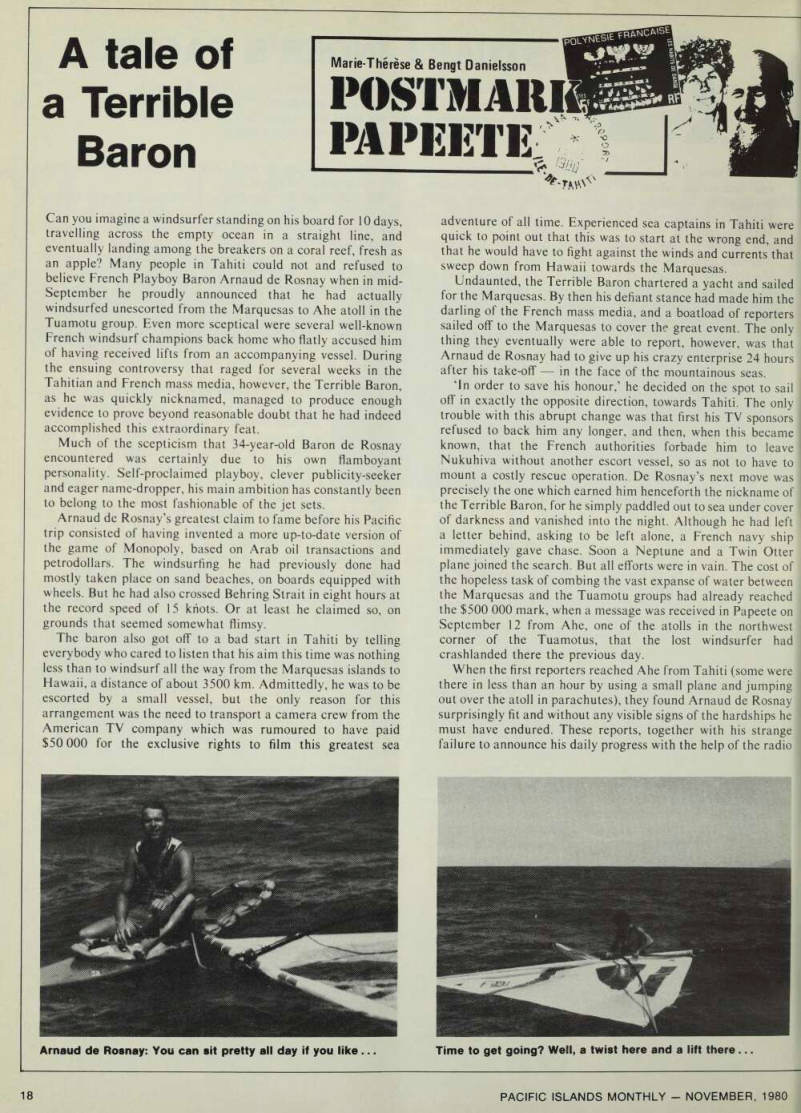
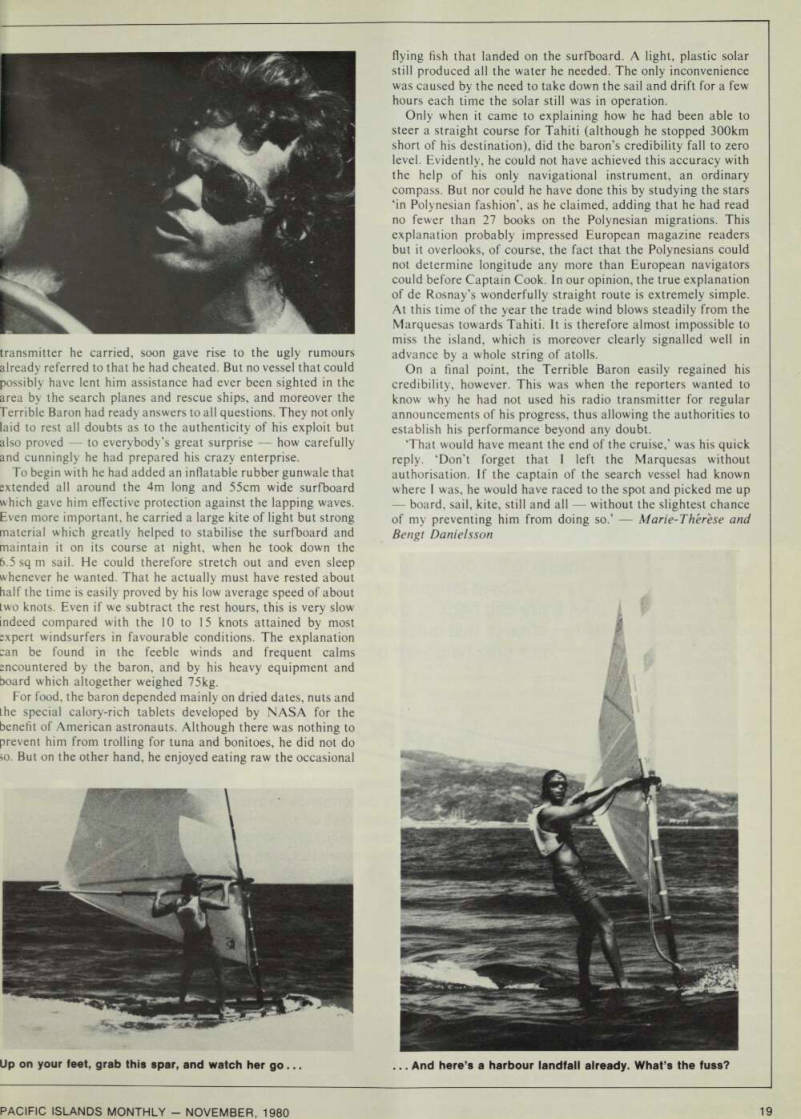
A tale of a Terrible Baron
Can you imagine a windsurfer standing on his board for 10 days, travelling across the empty ocean in a straight line, and eventually landing among the breakers on a coral reef, fresh as an apple? Many people in Tahiti could not and refused to believe French Playboy Baron Arnaud de Rosnay when in mid- September he proudly announced that he had actually windsurfed unescorted from the Marquesas to Ahe atoll in the Tuamotu group. Even more sceptical were several well-known French windsurf champions back home who flatly accused him of having received lifts from an accompanying vessel. During the ensuing controversy that raged for several weeks in the Tahitian and French mass media, however, the Terrible Baron, as he was quickly nicknamed, managed to produce enough evidence to prove beyond reasonable doubt that he had indeed accomplished this extraordinary feat.
Much of the scepticism that 34-year-old Baron de Rosnay encountered was certainly due to his own flamboyant personality. Self-proclaimed playboy, clever publicity-seeker and eager name-dropper, his main ambition has constantly been to belong to the most fashionable of the jet sets.
Arnaud de Rosnay’s greatest claim to fame before his Pacific trip consisted of having invented a more up-to-date version of the game of Monopoly, based on Arab oil transactions and petrodollars. The windsurfing he had previously done had mostly taken place on sand beaches, on boards equipped with wheels. But he had also crossed Behring Strait in eight hours at the record speed of 15 knots. Or at least he claimed so, on grounds that seemed somewhat flimsy.
The baron also got off to a bad start in Tahiti by telling everybody who cared to listen that his aim this time was nothing less than to windsurf all the way from the Marquesas islands to Hawaii, a distance of about 3500 km. Admittedly, he was to be escorted by a small vessel, but the only reason for this arrangement was the need to transport a camera crew from the American TV company which was rumoured to have paid $5O 000 for the exclusive rights to film this greatest sea
adventure of all time. Experienced sea captains in Tahiti were quick to point out that this was to start at the wrong end, and that he would have to fight against the winds and currents that sweep down from Hawaii towards the Marquesas.
Undaunted, the Terrible Baron chartered a yacht and sailed for the Marquesas. By then his defiant stance had made him the darling of the French mass media, and a boatload of reporters sailed off to the Marquesas to cover the great event. The only thing they eventually were able to report, however, was that Arnaud de Rosnay had to give up his crazy enterprise 24 hours after his take-off in the face of the mountainous seas. k ln order to save his honour,’ he decided on the spot to sail off in exactly the opposite direction, towards Tahiti. The only trouble with this abrupt change was that first his TV sponsors refused to back him any longer, and then, when this became known, that the French authorities forbade him to leave Nukuhiva without another escort vessel, so as not to have to mount a costly rescue operation. De Rosnay’s next move was precisely the one which earned him henceforth the nickname of the Terrible Baron, for he simply paddled out to sea under cover of darkness and vanished into the night. Although he had left a letter behind, asking to be left alone, a French navy ship immediately gave chase. Soon a Neptune and a Twin Otter plane joined the search. But all efforts were in vain. The cost of the hopeless task of combing the vast expanse of water between the Marquesas and the Tuamotu groups had already reached the $5OO 000 mark, when a message was received in Papeete on September 12 from Ahe, one of the atolls in the northwest corner of the Tuamotus, that the lost windsurfer had crashlanded there the previous day.
When the first reporters reached Ahe from Tahiti (some were there in less than an hour by using a small plane and jumping out over the atoll in parachutes), they found Arnaud de Rosnay surprisingly fit and without any visible signs of the hardships he must have endured. These reports, together with his strange failure to announce his daily progress with the help of the radio
Arnaud de Rosnay: You can sit pretty all day if you like...
Time to get going? Well, a twist here and a lift there...
transmitter he carried, soon gave rise to the ugly rumours already referred to that he had cheated. But no vessel that could possibly have lent him assistance had ever been sighted in the area by the search planes and rescue ships, and moreover the Terrible Baron had ready answers to all questions. They not only laid to rest all doubts as to the authenticity of his exploit but also proved to everybody’s great surprise how carefully and cunningly he had prepared his crazy enterprise.
To begin with he had added an inflatable rubber gunwale that extended all around the 4m long and 55cm wide surfboard which gave him effective protection against the lapping waves.
Even more important, he carried a large kite of light but strong material which greatly helped to stabilise the surfboard and maintain it on its course at night, when he took down the 5.5 sq m sail. He could therefore stretch out and even sleep whenever he wanted. That he actually must have rested about half the time is easily proved by his low average speed of about two knots. Even if we subtract the rest hours, this is very slow indeed compared with the 10 to 15 knots attained by most expert windsurfers in favourable conditions. The explanation :an be found in the feeble winds and frequent calms encountered by the baron, and by his heavy equipment and hoard which altogether weighed 75kg.
For food, the baron depended mainly on dried dates, nuts and the special calory-rich tablets developed by NASA for the benefit of American astronauts. Although there was nothing to prevent him from trolling for tuna and bonitoes, he did not do jo. But on the other hand, he enjoyed eating raw the occasional
flying fish that landed on the surfboard. A light, plastic solar still produced all the water he needed. The only inconvenience was caused by the need to take down the sail and drift for a few hours each time the solar still was in operation.
Only when it came to explaining how he had been able to steer a straight course for Tahiti (although he stopped 300 km short of his destination), did the baron’s credibility fall to zero level. Evidently, he could not have achieved this accuracy with the help of his only navigational instrument, an ordinary compass. But nor could he have done this by studying the stars ‘in Polynesian fashion’, as he claimed, adding that he had read no fewer than 27 books on the Polynesian migrations. This explanation probably impressed European magazine readers but it overlooks, of course, the fact that the Polynesians could not determine longitude any more than European navigators could before Captain Cook. In our opinion, the true explanation of de Rosnay’s wonderfully straight route is extremely simple.
At this time of the year the trade wind blows steadily from the Marquesas towards Tahiti. It is therefore almost impossible to miss the island, which is moreover clearly signalled well in advance by a whole string of atolls.
On a final point, the Terrible Baron easily regained his credibility, however. This was when the reporters wanted to know why he had not used his radio transmitter for regular announcements of his progress, thus allowing the authorities to establish his performance beyond any doubt. ‘That would have meant the end of the cruise,’ was his quick reply. ‘Don’t forget that I left the Marquesas without authorisation. If the captain of the search vessel had known where I was, he would have raced to the spot and picked me up board, sail, kite, still and all without the slightest chance of my preventing him from doing so.’ Marie-Therese and Bengt Danielsson
Up on your feet, grab this spar, and watch her go...
... And here’s a harbour landfall already. What’s the fuss?
Advertisements & other items, p. 20 (1 item)
poW^S
A FLEET OF DEPENDABLE PERFORMERS
-FOR POWER IN THE WATER
SL r/
st m Taking to the open sea or to calmer waters?
Going for sport or for labor?
Get there and back in style with dependability.
Go with a Suzuki!— choose that outboard motor among our powerful fleet,
just matching your boating needs.
ON
poW^S
f=On
Look into the traditional excellence of Suzuki’s performance-proven motorcycles and 4-wheel drive vehicles something to satisfy your every motoring need. Going by sea or by land ... go with a Suzuki.
SUZUKI 4 WHEEL
DRIVE VEHICLE
UZUKI MOTOR CO., LTD. reserves the right to change, without notice, equipment, Dedications, colours, materials and other items to apply local conditions. Each model light be discontinued without notice. Please inquire at your local dealer for details of ly such changes. Actual body colours might differ slightly from the colours in this ad.
SUZUKI MOTOR CO LTD
Hamamatsu, Japan
SUZUKI
OLOMON ISLANDS SOLOMON ISLAND SERVICE STATION LTD. #NEW CALEDONIA STE. SUPERCAL •PAPUA NEW GUINEA BURNS PHILP vIEW GUINEA) LTD. «NEW HEBRIDES HENRI LEROUX • NIUE ISLAND BURNS PHILP (SOUTH SEA) CO., LTD. «PONAPE LEO ETSCHEIT •TAHITI IPPON AUTOMOTO •ELLICE ISLAND TUVALU COOPERATIVE WHOLESALE SOCIETY LTD. «GUAM & SAIPAN ISLAND CYCLERY, INC.
NORFOLK MARTIN’S AGENCIES LTD. «SAMOA PACIFIC PRODUCTS. INC. • TARAWA GILBERT ISLANDS COOPERATIVE FEDERATION LIMITED TONGA MORRIS HEDSTROM LTD. • WESTERN CAROLINES BECHESRRAK T. COMPANY ®YAP AMBROSE D. MINGINFEL’S WHOLESALER EASTERN CAROLINES KIOMASA STORE • NAURU EQUAPAC MOTORS •FUI NIRANJANS AUTOPORT LTD.
Pacific teaching satellite
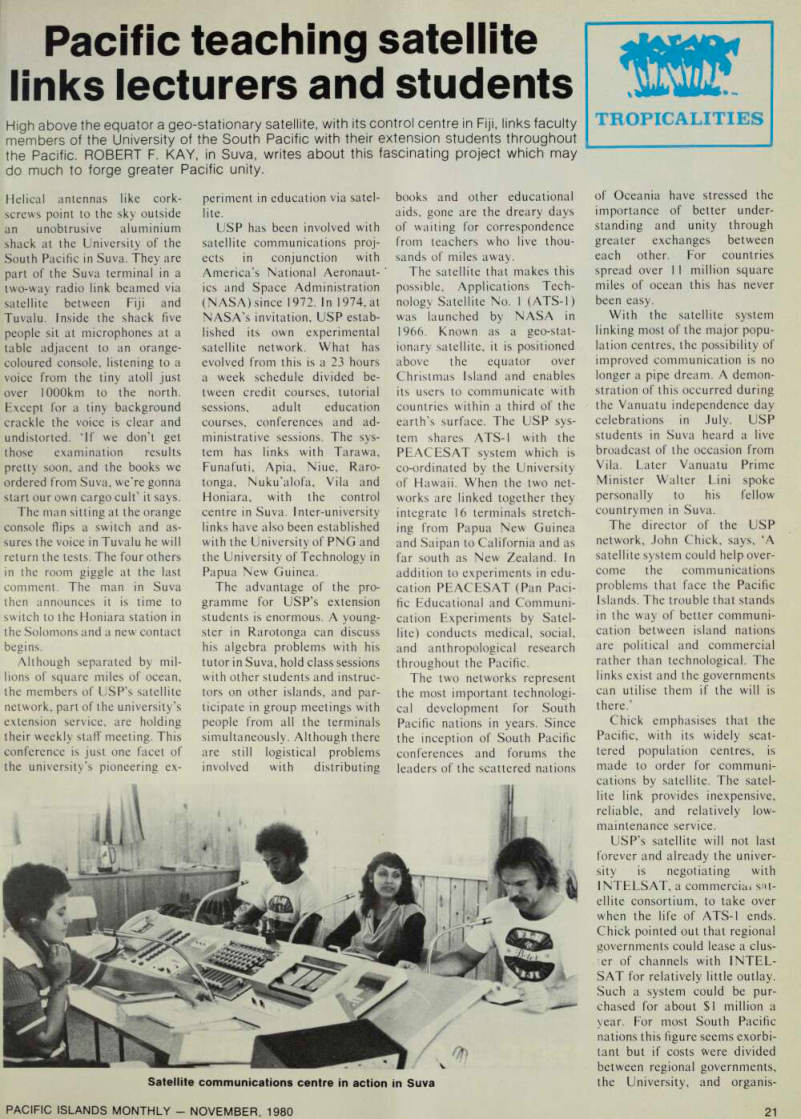
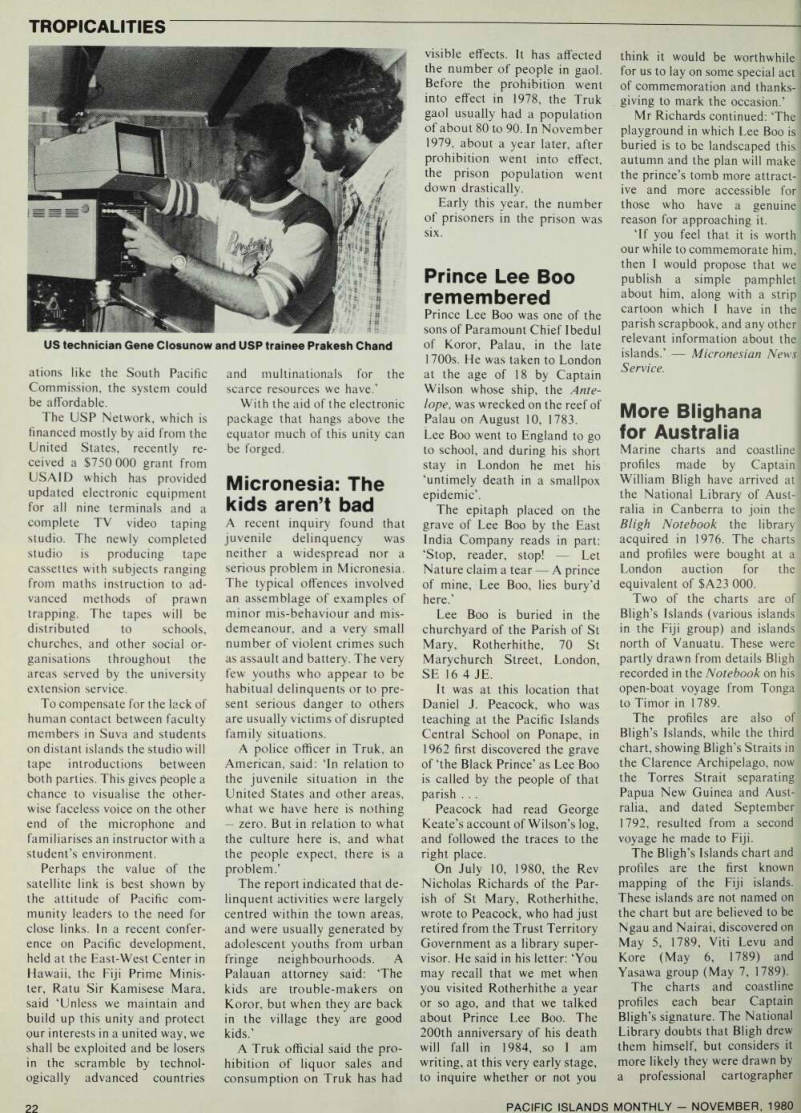
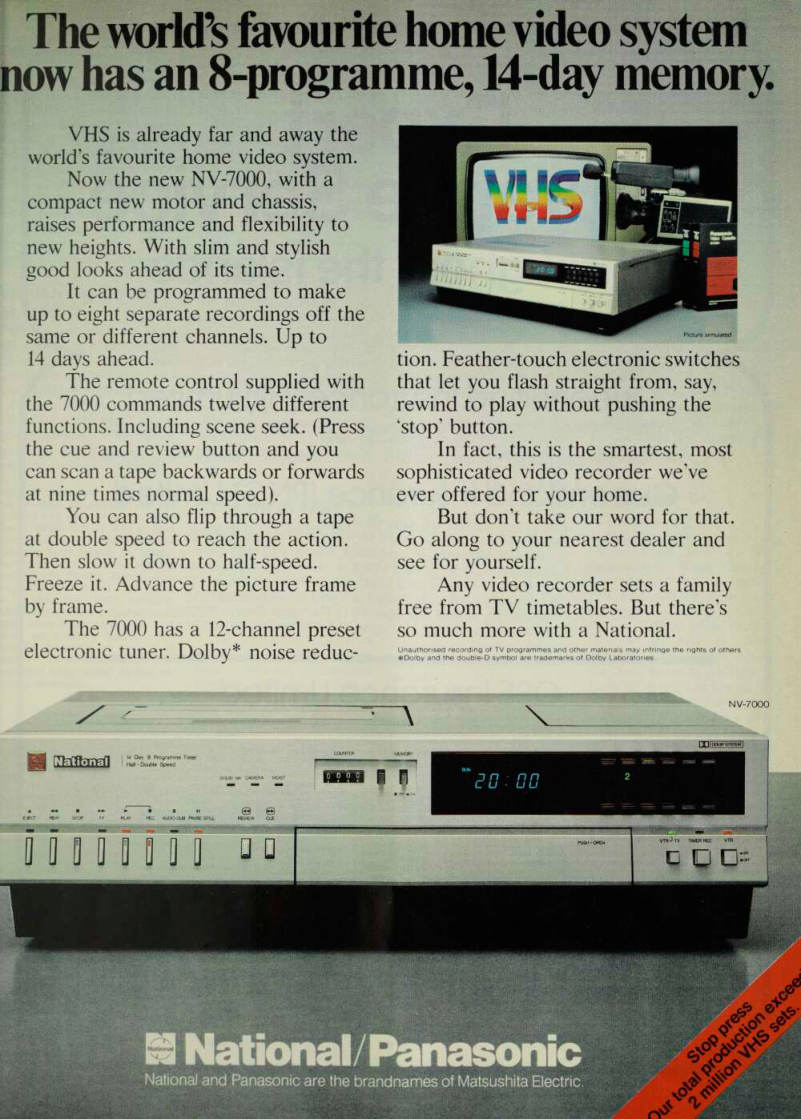

Tropicalities
Pacific teaching satellite links lecturers and students
High above the equator a geo-stationary satellite, with its control centre in Fiji, links faculty members of the University of the South Pacific with their extension students throughout the Pacific. ROBERT F. KAY, in Suva, writes about this fascinating project which may do much to forge greater Pacific unity.
Helical antennas like cork screws point to the sky outside an unobtrusive aluminium shack at the University of the South Pacific in Suva. They are part of the Suva terminal in a two-way radio link beamed via satellite between Fiji and Tuvalu. Inside the shack five people sit at microphones at a table adjacent to an orange coloured console, listening to a voice from the tiny atoll just over 1000 km to the north.
Except for a liny background crackle the voice is clear and undistorled. ‘lf we don’t get those examination results pretty soon, and the books we ordered from Suva, we’re gonna start our own cargo cult’ it says.
The man sitting at the orange console flips a switch and as sures the voice in Tuvalu he will return the tests. The four others in the room giggle at the last comment. The man in Suva then announces it is time to switch to the Honiara station in the Solomons and a new contact begins.
Although separated by mil lions of square miles of ocean, the members of USP’s satellite network, part of the university’s extension service, are holding their weekly staff meeting. This conference is just one facet of the university’s pioneering ex
periment in education via satel lite.
USP has been involved with satellite communications proj ects in conjunction with America’s National Aeronaut ics and Space Administration (NASA) since 1972. In 1974, at NASA’s invitation, USP estab lished its own experimental satellite network. What has evolved from this is a 23 hours a week schedule divided be tween credit courses, tutorial sessions, adult education courses, conferences and ad ministrative sessions. The sys tem has links with Tarawa, Funafuti, Apia, Niue, Raro tonga, Nuku’alofa, Vila and Honiara, with the control centre in Suva. Inter-university links have also been established with the University of PNG and the University of Technology in Papua New Guinea.
The advantage of the pro gramme for USP’s extension students is enormous. A young ster in Rarotonga can discuss his algebra problems with his tutor in Suva, hold class sessions with other students and instruc tors on other islands, and par ticipate in group meetings with people from all the terminals simultaneously. Although there are still logistical problems involved with distributing
books and other educational aids, gone are the dreary days of wailing for correspondence from teachers who live thou sands of miles away.
The satellite that makes this possible. Applications Tech nology Satellite No. 1 (ATS-1) was launched by NASA in 1966. Known as a geo-stat ionary satellite, it is positioned above the equator over Christmas Island and enables its users to communicate with countries within a third of the earth's surface. The USP sys tem shares ATS-1 with the PEACESAT system which is co-ordinated by the University of Hawaii. When the two net works are linked together they integrate 16 terminals stretch ing from Papua New Guinea and Saipan to California and as far south as New Zealand. In addition to experiments in edu cation PEACESAT (Pan Paci fic Educational and Communi cation Experiments by Satel lite) conducts medical, social, and anthropological research throughout the Pacific.
The two networks represent the most important technologi cal development for South Pacific nations in years. Since the inception of South Pacific conferences and forums the leaders of the scattered nations
of Oceania have stressed the importance of better under standing and unity through greater exchanges between each other. For countries spread over 11 million square miles of ocean this has never been easy.
With the satellite system linking most of the major popu lation centres, the possibility of improved communication is no longer a pipe dream. A demon stration of this occurred during the Vanuatu independence day celebrations in July. USP students in Suva heard a live broadcast of the occasion from Vila. Later Vanuatu Prime Minister Walter Lini spoke personally to his fellow countrymen in Suva.
The director of the USP network, John Chick, says, ‘A satellite system could help over come the communications problems that face the Pacific Islands. The trouble that stands in the way of better communi cation between island nations are political and commercial rather than technological. The links exist and the governments can utilise them if the will is there.’
Chick emphasises that the Pacific, with its widely scat tered population centres, is made to order for communi cations by satellite. The satel lite link provides inexpensive, reliable, and relatively low maintenance service.
USP’s satellite will not last forever and already the univer sity is negotiating with INTELSAT, a commercial sat ellite consortium, to take over when the life of ATS-1 ends.
Chick pointed out that regional governments could lease a clus ter of channels with INTEL SAT for relatively little outlay.
Such a system could be pur chased for about $1 million a year. For most South Pacific nations this figure seems exorbi tant but if costs were divided between regional governments, the University, and organis-
Satellite communications centre in action in Suva
ations like the South Pacific Commission, the system could be affordable.
The USP Network, which is financed mostly by aid from the United States, recently re ceived a $750 000 grant from USAID which has provided updated electronic equipment for all nine terminals and a complete TV video taping studio. The newly completed studio is producing tape cassettes with subjects ranging from maths instruction to ad vanced methods of prawn trapping. The tapes will be distributed to schools, churches, and other social or ganisations throughout the areas served by the university extension service.
To compensate for the lack of human contact between faculty members in Suva and students on distant islands the studio will tape introductions between both parties. This gives people a chance to visualise the other wise faceless voice on the other end of the microphone and familiarises an instructor with a student’s environment.
Perhaps the value of the satellite link is best shown by the attitude of Pacific com munity leaders to the need for close links. In a recent confer ence on Pacific development, held at the East-West Center in Hawaii, the Fiji Prime Minis ter, Ratu Sir Kamisese Mara, said ‘Unless we maintain and build up this unity and protect our interests in a united way, we shall be exploited and be losers in the scramble by technol ogically advanced countries
and multinationals for the scarce resources we have.’
With the aid of the electronic package that hangs above the equator much of this unity can be forged.
Micronesia: The
kids aren’t bad
A recent inquiry found that
juvenile delinquency was
neither a widespread nor a serious problem in Micronesia.
The typical offences involved an assemblage of examples of minor mis-behaviour and mis demeanour, and a very small number of violent crimes such as assault and battery. The very few youths who appear to be habitual delinquents or to pre sent serious danger to others are usually victims of disrupted
family situations.
A police officer in Truk, an American, said; Tn relation to the juvenile situation in the United States and other areas, what we have here is nothing zero. But in relation to what the culture here is, and what the people expect, there is a
problem.’
The report indicated that de
linquent activities were largely
centred within the town areas,
and were usually generated by
adolescent youths from urban
fringe neighbourhoods. A
Palauan attorney said: The kids are trouble-makers on Koror, but when they are back in the village they are good kids.’
A Truk official said the pro hibition of liquor sales and consumption on Truk has had
visible effects. It has affected the number of people in gaol.
Before the prohibition went into effect in 1978, the Truk
gaol usually had a population
of about 80 to 90. In November 1979, about a year later, after prohibition went into effect, the prison population went
down drastically.
Early this year, the number of prisoners in the prison was six.
Prince Lee 800
remembered
Prince Lee 800 was one of the sons of Paramount Chief Ibedul of Koror, Palau, in the late 1700 s. He was taken to London at the age of 18 by Captain Wilson whose ship, the Ante lope, was wrecked on the reef of Palau on August 10, 1783.
Lee 800 went to England to go to school, and during his short stay in London he met his ‘untimely death in a smallpox epidemic’.
The epitaph placed on the grave of Lee 800 by the East India Company reads in part: ‘Stop, reader, stop! Let Nature claim a tear A prince of mine, Lee 800, lies bury’d here.’
Lee 800 is buried in the churchyard of the Parish of St Mary, Rotherhithe, 70 St Marychurch Street, London,
Se 16 4 Je.
It was at this location that Daniel J. Peacock, who was teaching at the Pacific Islands Central School on Ponape, in 1962 first discovered the grave of ‘the Black Prince’ as Lee 800 is called by the people of that parish . ..
Peacock had read George Keate’s account of Wilson’s log, and followed the traces to the right place.
On July 10, 1980, the Rev Nicholas Richards of the Par ish of St Mary, Rotherhithe, wrote to Peacock, who had just retired from the Trust Territory Government as a library super visor. He said in his letter: ‘You may recall that we met when you visited Rotherhithe a year or so ago, and that we talked about Prince Lee 800. The 200th anniversary of his death will fall in 1984, so I am writing, at this very early stage, to inquire whether or not you
think it would be worthwhile for us to lay on some special act of commemoration and thanks giving to mark the occasion.’
Mr Richards continued: ‘The playground in which Lee 800 is buried is to be landscaped this autumn and the plan will make the prince’s tomb more attract ive and more accessible for those who have a genuine reason for approaching it. ‘lf you feel that it is worth our while to commemorate him, then I would propose that we publish a simple pamphlet about him, along with a strip cartoon which I have in the parish scrapbook, and any other relevant information about the islands.’ Micronesian News Service.
More Blighana
for Australia
Marine charts and coastline profiles made by Captain William Bligh have arrived at the National Library of Aust ralia in Canberra to join the Bligh Notebook the library acquired in 1976. The charts and profiles were bought at a London auction for the equivalent of SA23 000.
Two of the charts are of Bligh’s Islands (various islands in the Fiji group) and islands north of Vanuatu. These were partly drawn from details Bligh recorded in the Notebook on his open-boat voyage from Tonga to Timor in 1789.
The profiles are also of Bligh’s Islands, while the third chart, showing Bligh’s Straits in the Clarence Archipelago, now the Torres Strait separating Papua New Guinea and Aust ralia, and dated September 1792, resulted from a second voyage he made to Fiji.
The Bligh’s Islands chart and profiles are the first known mapping of the Fiji islands.
These islands are not named on the chart but are believed to be Ngau and Nairai, discovered on May 5, 1789, Viti Levu and Kore (May 6, 1789) and Yasawa group (May 7, 1789).
The charts and coastline profiles each bear Captain Bligh’s signature. The National Library doubts that Bligh drew them himself, but considers it more likely they were drawn by a professional cartographer
US technician Gene Closunow and USP trainee Prakesh Chand
under the captain’s supervision.
The Australian Studies li brarian, Miss Catherine Santa maria, said it was noteworthy that Bligh’s open-boat voyage was so well documented in the Notebook that maps could be drawn from it and the boat’s route followed accurately. Re cords of the Bounty were so sparse that no one had known until comparatively recently the route taken by the mutin eers who set Bligh adrift. (Aust ralian Information Service.)
Vanishing books
at UPNG
Fhe estimated number of books ost from the library of the Jniversity of Papua New Suinea since 1978 is 6000, and ibrarian Alan Butler is angry.
He told the student paper Jni Tavur. T have a low )pinion of thieves. A library is a garden of knowledge. Stealing >ooks is starving the knowledge Pacific Islanders who have lever seen an aircraft on the jround are very much a rarity hese days, but it was a first ime recently for the people of Jiuatoputapu Island in Tonga.
Australian aid built the airstrip md South Pacific Island Air vays brought in this Twin Otter o make the first landing.
Almost the entire population of 1000 were there, and few had seen an aircraft before. The ;rowds wouldn’t go near it at irst ‘and then they just wouldn’t keep away’ airline of icials reported.
of other users, which is just like stealing food.’
Mr Butler added that thieves don’t know what a university is all about.
The loss of books is partly due to the fact that the library staff do not do their job prop erly, according to Mr Butler.
He said the staff are some times weak and sometimes tend to practise the ‘Wantok Sys tem’.
Mr Butler said the govern ment will not give UPNG library money to purchase new books to replace those lost. It will only allocate money to the running of the university as a whole.
Among measures taken to solve the problem were a ‘Miss ing Book Slogan’ competition to raise student awareness of what was going on, and the declar ation of an ‘Amnesty Month’ in which stolen books could be returned without questioning or fines.
20 years of Holy
Mama’s church
More than 3000 people gath ered at Paradise Village, North New Georgia, Solomon Islands, on August 13 to celebrate the 20th anniversary of the Christian Fellowship Church.
The celebrations lasted from August 10-17. People came from Marovo, Rendova, Choiseul and Vella La Vella.
Two traditional war canoes travelled from Roviana, one carrying 30 men and the other 20. It commemorated the old days when canoes offered the only means of travelling.
To accommodate the people, school buildings were used, and small houses and tents were put up. These were in a separate extension to the main well laid out village of the Holy Mama.
The Holy Mama, 75-year-old Silas Eto, founded the church in 1960 after a disagreement between himself and leaders of the United Church.
He believed the Holy Spirit had come upon him and talked in many tongues. He wanted to preserve this, so he and his followers broke away and in 1964 registered themselves as one of the recognised churches in the country.
Since then they have in creased in number and worked together as one community.
The church has made many successful projects, including having its own schools.
A special guest at the cel ebration was the Rev. David Bush, president of Polynesian Seminary which is called the ‘Beyond the Reef Theological Centre, USA. Mr Bush gave five trophies for a singing com petition held on August 16.
The president of the Western Provincial Assembly, Francis Hilly and his family also at tended.
At 12 noon on August 13, there was a big congregation at the Hall, and many people standing outside for the hour long service.
The Holy Mama, who occas ionally suffers illness, was able to attend and posed for photo graphs inside the hall.
During the service, presents were given to invited guests and there were speeches . . .
After the service there was more singing and feasting. The paddling of traditional war canoes was demonstrated to end the afternoon. From a report by Vickie Glass in Solomons News Drum.
You for an H. H. H.
fellowship?
Young men and women of outstanding ability but of modest means are being sought
in the South Pacific to study for a year in the USA under the Hubert H. Humphrey North- South Fellowship Program.
Humphrey fellowships are awarded annually to one person from each country with which the US has diplomatic re lations.
The programme brings mid career professionals from de veloping countries who have exemplified leadership in pub lic service for a year of study and practical, work-related ex perience.
Fellowships are granted com petitively to candidates pro fessionally engaged in agriculture, health and nu trition, planning and resource management, and public ad ministration.
The US Embassy in Fiji will be responsible for handling applications from Fiji, Kiribati, Tuvalu, Tonga and Vanuatu for the 1981-82 programme.
Sir Julius on
an emu egg A likeness of the Papua New Guinea Prime Minister, Sir Julius Chan, carved into the shell of n emu egg was among gifts presented by Australian performers to the organisers of this year’s Third South Pacific Festival of Arts in Port Moresby. The unusual objet d’art was created by Aboriginal artist. Bill Reid, from Bourke in New South Wales. He used a photograph of Sir Julius as his model for the work.
The carved egg was one of five gifts presented by the 100strong Australian contingent to the PNG organisers of the festival at the official closing ceremony. The other pieces were a pot by Thancoupie, of Cairns, a platter by Ned Lenthall of Norfolk Island, a print by John Bulun Bulun of Maningrida in the Northern Territory, and a copy of Jennifer Isaac’s book, Aust ralian Dreaming.
The organisers of the South Pacific Festival of Arts also received gifts from all countries which participated in the two week-lortg event. PNG’s Minis ter for Science, Culture and Tourism, Stephen Tago, ac cepted the presents on behalf of the PNG Government.
Advertisements & other items, pp. 23-26 (2 items)
The world’s favourite home video system
now has an 8-programme, 14-day memory.
VHS is already far and away the world’s favourite home video system.
Now the new NV-7000, with a compact new motor and chassis, raises performance and flexibility to new heights. With slim and stylish good looks ahead of its time.
It can be programmed to make up to eight separate recordings off the same or different channels. Up to 14 days ahead.
The remote control supplied with the 7000 commands twelve different functions. Including scene seek. (Press the cue and review button and you can scan a tape backwards or forwards at nine times normal speed).
You can also flip through a tape at double speed to reach the action.
Then slow it down to half-speed.
Freeze it. Advance the picture frame
by frame.
The 7000 has a 12-channel preset electronic tuner. Dolby* noise reduc- -111 Picture simulated tion. Feather-touch electronic switches that let you flash straight from, say, rewind to play without pushing the
‘stop’ button.
In fact, this is the smartest, most sophisticated video recorder we’ve ever offered for your home.
But don’t take our word for that.
Go along to your nearest dealer and see for yourself.
Any video recorder sets a family free from TV timetables. But there’s so much more with a National.
Unauthorised recording of TV programmes and other materials may Infringe the rights of others ♦ Dolby and the double-D symbol are trademarks of Dolby Laboratories [ranrafl i^ 8p — 1
COUNTER MEMORY
V NV-7000 ODlsaEsaaQ HaH-Doubte Speed r sraai R n © ©
REVIEW CUE
fl ODOQ D Q a a D
coo=
§ National / Panasonic
National and Panasonic are the brandnames of Matsushita Electric. * A <o v cr V
Expert
Insurance Service
throughout the islands
m
Queensland Insurance (Fiji) Limited
Head Office, 34 Usher St., SUVA . General Manager; L. G. Liddell A.A.1.1. Assistant Manager: Vijay Lai. Phone: 23851.
LAUTOKA OFFICE: Burns Philp Bldg., Naviti St. District Manager: J. Dalton. Phone: 60642,
Queensland Insurance (PNG) Limited
PAPUA NEW GUINEA
Head Office, B.N.G. Building, Musgrave St..PORT MORESBY. General Manager: J. M. Dawe.
Assistant Manager: R. V. Maskell. Phone: 212144.
LAE: 4th St. & Coronation Drive. District Manager: I, R. Martin. Phone: 423873.
MOUNT HAGEN: Hagen Drive. District Manager: D. F. Carroll. Phone: 521002.
ARAWA: Chebu St. District Manager: J. Longbut. Phone: 951555.
MADANG: Kasagten St. District Manager: N. D. Ramage. Phone: 822020.
RABAUL: Wirraway St. District Manager: W. F, Tinker. Phone: 921014.
QBE Insurance Limited
VANUATU, PORT VILA: Rue de Paris, Suite 19, Oceania Bldg. Manager: G. F. Donnelly.
Phone: 2299.
SANTO: Burns Philp (Vanuatu) Ltd. Phone: 230.
PACIFIC AGENCIES
NEW CALEDONIA- T. A.Hagen, Ste. W. A. Johnston, S.A.R.L. 5 Rue Anatole France, NOUMEA.
Phone: 272083.
TAHITI: Arthur Chung. Immeuble 8.1.5., Front de Mer, PAPEETE. Phone: 2.86.19.
NIUE; Burns Philp (South Sea) Company Ltd.
NORFOLK ISLAND; Burns Philp (N I) Company Ltd. Phone; 2191.
SAMOA: APIA, Burns Philp (South Sea) Company Ltd. Phone: 22611.
TONGA: Burns Philp (South Sea) Company Ltd. NUKUALOFA. Phone 21500 HAAPAI, VAVAU.
MEMBERS OF THE:
INSURANCE GROUP UMITED
A tiny sensation
it s incredible that a component system so small can deliver such sensational sound. But there s no denying it. Hitachi M 2 MKll Minicomponents give you stereo sound that really fills the room - in a size
that barely fills a bookshelf
The powerful M 2 MKll integrated amplifier, metal capable tape deck with Dolby,* phase-lock tuner and 2-way speakers. Put them together any way you like for performance you re sure to love. Their rounded-edge design makes them as versatile as they are contemporary. And the dimensions are matched for a unified look, no matter how you arrange them.
Hitachi M 2 MKll Minicomponents. Great big sound
from a great little system.
HITAC
Q
TAPE MODE
u«^cc ,rw, 7. * * > ° wER iwiiwww ■ w or* 7ert--POWEn tNCXCATOP Wf a 03 a « *** 03 3 w* S| jjgg? - -U -io -!» i 4—— -w -» 4 o |]
£ BAIAN
PUU.-LOUD**
». t
0 HITACHI '■
i r
METAL Ka POWER ASSISTED OONTRCH.
0 HITACHI
X.
The HA-M 2 MKll Integrated Amplifier is rated at 25 watts per channel continuous RMS power.
Dimensions (WxhxD): HA-M 2 MKll integrated Amplifier (230x74*184 mm), D-M2 MKll cassette Deck (230*146*162 mm). FT-M 2 MKll Tuner (230*74*160 mm), and HS-M2 MKll speaker System (146*290*160 mm). * Dolby is a trademark of Dolby laboratories. • AUSTRALIA: Hitachi sales Australia Pty., ltd.. 155 keys Road, Moorabbin, victoria 3189 Phone: (95) 8722 • NEW ZEALAND; AWA New Zealand Limited, Wl-neera Drive, P 0 Box 50-248, Porirua Phone 43-75-069 • PAPUA NEW GUINEA: S O Svensson (N.C.) Ltd., P.O. Box 705, Port Moresby Phone: 21-2111 • FIJI ISLANDS: Burns Phllp (South Sea) Co., Ltd, Box 355, C.P.0., Suva Phone 311777 • new CALEDONIA: Caidls, b p mi, Noumea Phone: 26.23.50 • TAHITI: Ets Chene Alain, P.O. Box 272, Papeete Phone 2.88 68 • SOLOMON ISLANDS: Technique Radios Centre Ltd , P.O. Box 465, Honiara Phone: 416 • NAURU: Nauru cooperative Society. Republic of Nauru • American SAMOA: Burns Phllp (South sea) Co., Ltd , P O Box 129 Pago Pago • NEW HEBRIDES: Burns Phllp (New Hebrides) Co., Ltd , P 0 Box 27, Port Vila
0 HITACHI
Tropic Alities
25
ACIFIC ISLANDS MONTHLY - NOVEMBER, 1980
active opposition
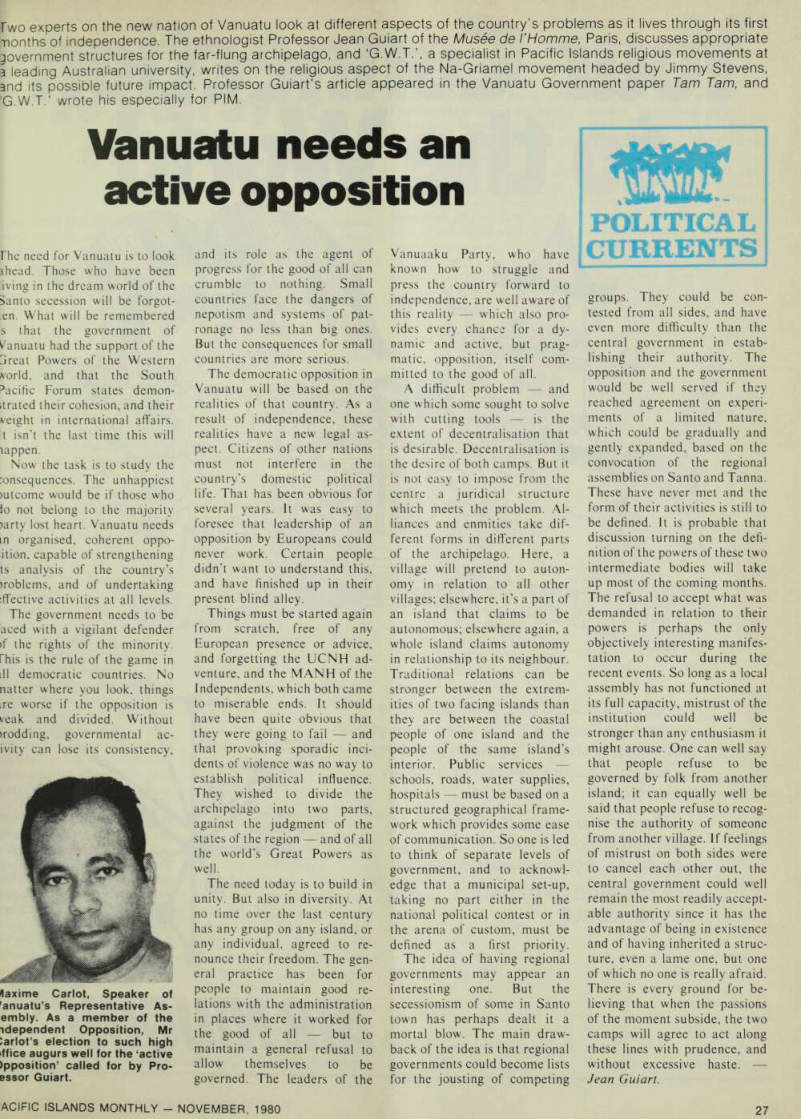
Vanuatu needs an active opposition
Political
Currents
fwo experts on the new nation of Vanuatu look at different aspects of the country’s problems as it lives through its first months of independence. The ethnologist Professor Jean Guiart of the Musee de I’Homme, Paris, discusses appropriate government structures for the far-flung archipelago, and ‘G.W.T.’, a specialist in Pacific Islands religious movements at a leading Australian university, writes on the religious aspect of the Na-Griamel movement headed by Jimmy Stevens, and its possible future impact. Professor Guiart’s article appeared in the Vanuatu Government paper Tam Tam, and ‘G.W.T.’ wrote his especially for PIM.
Fhe need for Vanuatu is to look ihead. Those who have been iving in the dream world of the Santo secession will be forgot :en. What will be remembered s that the government of Vanuatu had the support of the jireat Powers of the Western vorld, and that the South Pacific Forum states demon itrated their cohesion, and their veighl in international affairs, t isn’t the last time this will lappen.
Now the task is to study the :onsequences. The unhappiest mtcome would be if those who lo not belong to the majority )arty lost heart. Vanuatu needs in organised, coherent oppo ition, capable of strengthening ts analysis of the country’s >roblems, and of undertaking iffective activities at all levels.
The government needs to be aced with a vigilant defender if the rights of the minority.
Phis is the rule of the game in ill democratic countries. No natter where you look, things ire worse if the opposition is veak and divided. Without irodding, governmental ac ivity can lose its consistency.
and its role as the agent of progress for the good of all can crumble to nothing. Small countries face the dangers of nepotism and systems of pat ronage no less than big ones.
But the consequences for small countries are more serious.
The democratic opposition in Vanuatu will be based on the realities of that country. As a result of independence, these realities have a new legal as pect. Citizens of other nations must not interfere in the country’s domestic political life. That has been obvious for several years. It was easy to foresee that leadership of an opposition by Europeans could never work. Certain people didn't want to understand this, and have finished up in their present blind alley.
Things must be started again from scratch, free of any European presence or advice, and forgetting the UCNH ad venture, and the MANH of the Independents, which both came to miserable ends. It should have been quite obvious that they were going to fail and that provoking sporadic inci dents of violence was no way to establish political influence.
They wished to divide the archipelago into two parts, against the judgment of the states of the region and of all the world’s Great Powers as well.
The need today is to build in unity. But also in diversity. At no time over the last century has any group on any island, or any individual, agreed to re nounce their freedom. The gen eral practice has been for people to maintain good re lations with the administration in places where it worked for the good of all but to maintain a general refusal to allow themselves to be governed. The leaders of the
Vanuaaku Party, who have known how to struggle and press the country forward to independence, are well aware of this reality which also pro vides every chance for a dy namic and active, but prag matic, opposition, itself com mitted to the good of all.
A difficult problem and one which some sought to solve with cutting tools is the extent of decentralisation that is desirable. Decentralisation is the desire of both camps. But it is not easy to impose from the centre a juridical structure which meets the problem. Al liances and enmities take dif ferent forms in different parts of the archipelago. Here, a village will pretend to auton omy in relation to all other villages; elsewhere, it’s a part of an island that claims to be autonomous; elsewhere again, a whole island claims autonomy in relationship to its neighbour.
Traditional relations can be stronger between the extrem ities of two facing islands than they are between the coastal people of one island and the people of the same island’s interior. Public services schools, roads, water supplies, hospitals must be based on a structured geographical frame work which provides some ease of communication. So one is led to think of separate levels of government, and to acknowl edge that a municipal set-up, taking no part either in the national political contest or in the arena of custom, must be defined as a first priority.
The idea of having regional governments may appear an interesting one. But the secessionism of some in Santo town has perhaps dealt it a mortal blow. The main draw back of the idea is that regional governments could become lists for the jousting of competing
groups. They could be con tested from all sides, and have even more difficulty than the central government in estab lishing their authority. The opposition and the government would be well served if they reached agreement on experi ments of a limited nature, which could be gradually and gently expanded, based on the convocation of the regional assemblies on Santo and Tanna.
These have never met and the form of their activities is still to be defined. It is probable that discussion turning on the defi nition of the powers of these two intermediate bodies will take up most of the coming months.
The refusal to accept what was demanded in relation to their powers is perhaps the only objectively interesting manifes tation to occur during the recent events. So long as a local assembly has not functioned at its full capacity, mistrust of the institution could well be stronger than any enthusiasm it might arouse. One can well say that people refuse to be governed by folk from another island; it can equally well be said that people refuse to recog nise the authority of someone from another village. If feelings of mistrust on both sides were to cancel each other out, the central government could well remain the most readily accept able authority since it has the advantage of being in existence and of having inherited a struc ture, even a lame one, but one of which no one is really afraid.
There is every ground for be lieving that when the passions of the moment subside, the two camps will agree to act along these lines with prudence, and without excessive haste.
Jean Guiart.
Maxime Carlot, Speaker of [?]anuatu’s Representative As sembly As a member of the
independent Opposition, Mr
Carlot’s election to such high office augurs well for the ‘active Opposition’ called for by Pro ccessor Guiart.
Advertisements & other items, pp. 27-28 (2 items)
27
ACIFIC ISLANDS MONTHLY - NOVEMBER, 1980
Your Connection
to the World
i
lit
»U WtAr. % LA_>- * N N sm\ m
FUKUOKA
KAGOSHIMA
Air Niugini’s Boeing Bird of Paradise jets connect the Pacific with the world. Now you can fly to anywhere in the world direct from Air Niugini’s major international gateway destinations.
Air Niugini offers you a choice of 11 international ports so you can plan your journey to suit yourself and your pocket.
FLY THE BIRD OF PARADISE
TO THE WORLD.
HONOLULU
HONG
KONG
MANILA
JAYAPURA
SINGAPORE
HONIARA
JAKARTA
PORT MORESBY
CAIRNS
BRISBANE
SYDNEY
SPS.I23.
AIRNIUGIN,
THE NA T/ONAL AIRLINE OF PAPUA NEW GUINEA
as betrayer
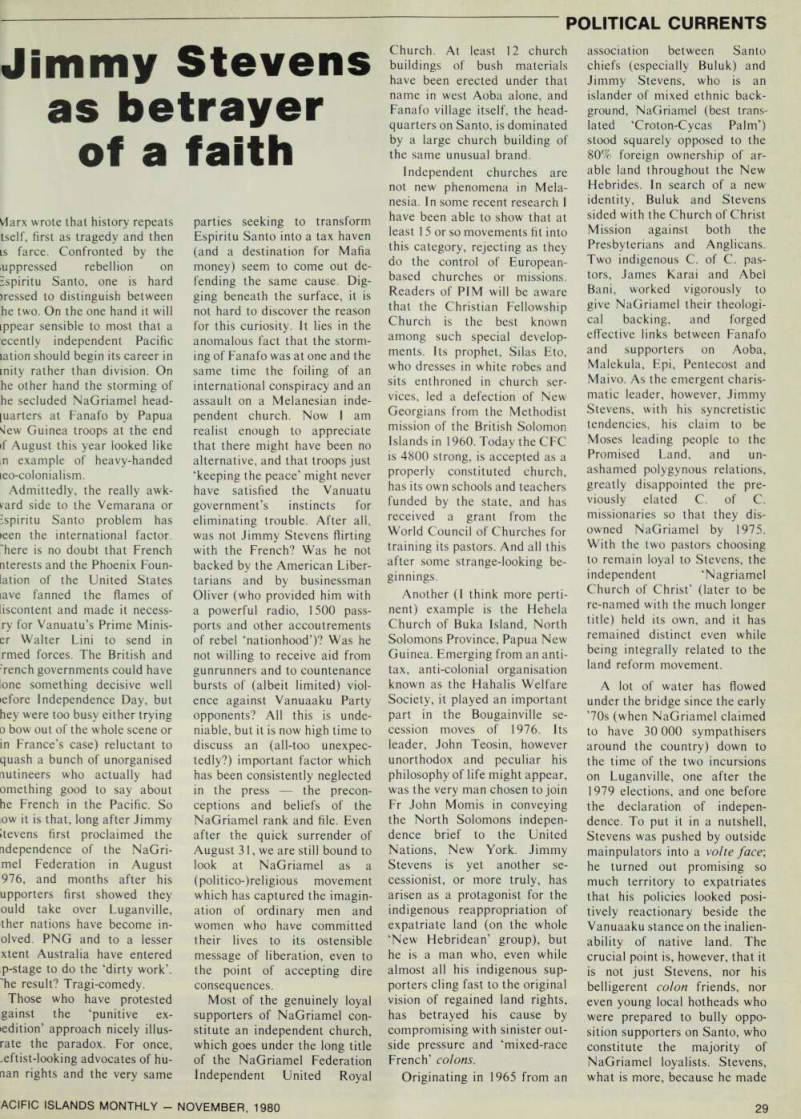
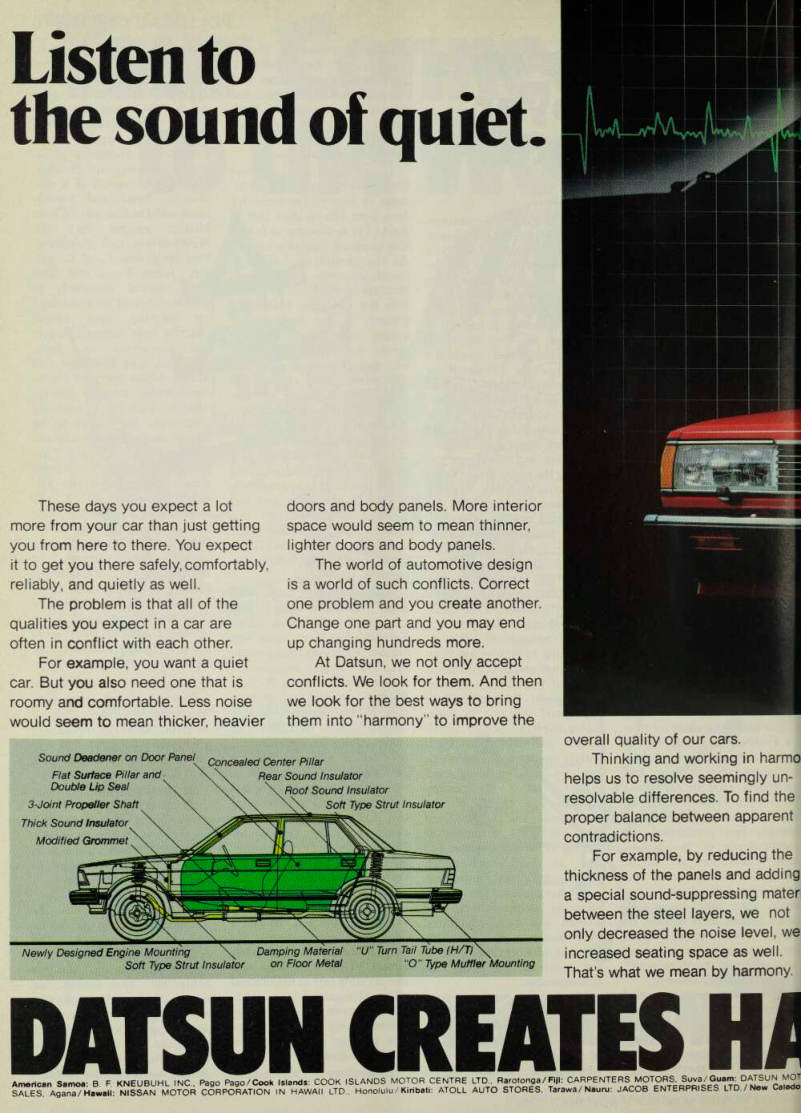

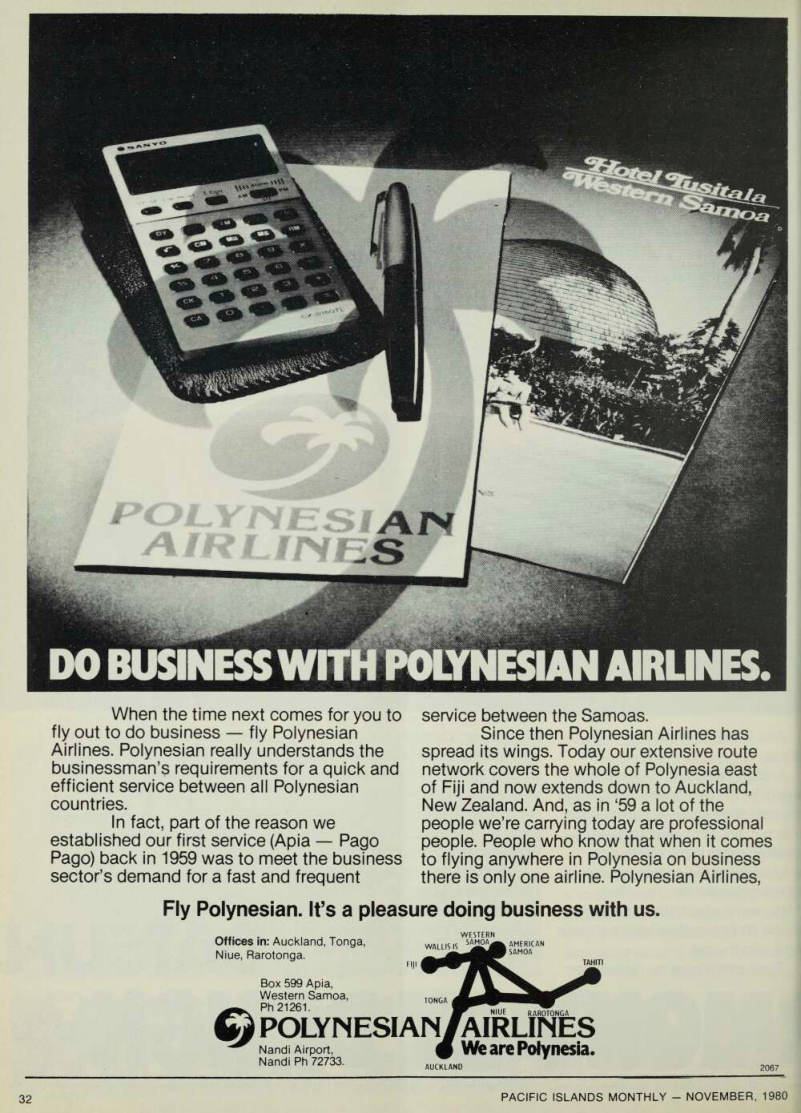
Political Currents
Jimmy Stevens as betrayer of a faith
Vlarx wrote that history repeats tself, first as tragedy and then is farce. Confronted by the uppressed rebellion on ispiritu Santo, one is hard >ressed to distinguish between he two. On the one hand it will ippear sensible to most that a ecently independent Pacific lation should begin its career in mity rather than division. On he other hand the storming of he secluded NaGriamel head [uarters at Fanafo by Papua slew Guinea troops at the end if August this year looked like n example of heavy-handed leo-colonialism.
Admittedly, the really awk ward side to the Vemarana or ispiritu Santo problem has ►een the international factor, 'here is no doubt that French nterests and the Phoenix Foun lation of the United States lave fanned the flames of liscontent and made it necess ry for Vanuatu’s Prime Minis er Walter Lini to send in rmed forces. The British and Tench governments could have lone something decisive well icfore Independence Day, but hey were too busy either trying o bow out of the whole scene or in France’s case) reluctant to quash a bunch of unorganised nutineers who actually had omething good to say about he French in the Pacific. So ow it is that, long after Jimmy itevens first proclaimed the ndependence of the NaGri mel Federation in August 976, and months after his upporters first showed they ould take over Luganville, ther nations have become in olved. PNG and to a lesser xtent Australia have entered p-stage to do the ‘dirty work’, 'he result? Tragi-comedy.
Those who have protested gainst the ‘punitive ex •edition’ approach nicely illus rate the paradox. For once, .eftist-looking advocates of hu nan rights and the very same
parties seeking to transform Espiritu Santo into a tax haven (and a destination for Mafia money) seem to come out de fending the same cause. Dig ging beneath the surface, it is not hard to discover the reason for this curiosity. It lies in the anomalous fact that the storm ing of Fanafo was at one and the same time the foiling of an international conspiracy and an assault on a Melanesian inde pendent church. Now I am realist enough to appreciate that there might have been no alternative, and that troops just ‘keeping the peace’ might never have satisfied the Vanuatu government’s instincts for eliminating trouble. After all, was not Jimmy Stevens flirting with the French? Was he not backed by the American Liber tarians and by businessman Oliver (who provided him with a powerful radio, 1500 pass ports and other accoutrements of rebel ‘nationhood’)? Was he not willing to receive aid from gunrunners and to countenance bursts of (albeit limited) viol ence against Vanuaaku Party opponents? All this is unde niable, but it is now high time to discuss an (all-too unexpec tedly?) important factor which has been consistently neglected in the press the precon ceptions and beliefs of the NaGriamel rank and file. Even after the quick surrender of August 31, we are still bound to look at NaGriamel as a (politico-)religious movement which has captured the imagin ation of ordinary men and women who have committed their lives to its ostensible message of liberation, even to the point of accepting dire consequences.
Most of the genuinely loyal supporters of NaGriamel con stitute an independent church, which goes under the long title of the NaGriamel Federation Independent United Royal
Church. At least 12 church buildings of bush materials have been erected under that name in west Aoba alone, and Fanafo village itself, the head quarters on Santo, is dominated by a large church building of the same unusual brand.
Independent churches are not new phenomena in Mela nesia. In some recent research I have been able to show that at least 15 or so movements fit into this category, rejecting as they do the control of European based churches or missions.
Readers of PIM will be aware that the Christian Fellowship Church is the best known among such special develop ments. Its prophet, Silas Eto, who dresses in white robes and sits enthroned in church ser vices, led a defection of New Georgians from the Methodist mission of the British Solomon Islands in 1960. Today the CFC is 4800 strong, is accepted as a properly constituted church, has its own schools and teachers funded by the state, and has received a grant from the World Council of Churches for training its pastors. And all this after some strange-looking be ginnings.
Another (I think more perti nent) example is the Hehela Church of Buka Island, North Solomons Province, Papua New Guinea. Emerging from an anti tax, anti-colonial organisation known as the Hahalis Welfare Society, it played an important part in the Bougainville se cession moves of 1976. Its leader, John Teosin, however unorthodox and peculiar his philosophy of life might appear, was the very man chosen to join Fr John Momis in conveying the North Solomons indepen dence brief to the United Nations, New York. Jimmy Stevens is yet another se cessionist, or more truly, has arisen as a protagonist for the indigenous reappropriation of expatriate land (on the whole ‘New Hebridean’ group), but he is a man who, even while almost all his indigenous sup porters cling fast to the original vision of regained land rights, has betrayed his cause by compromising with sinister out side pressure and ‘mixed-race French’ colons.
Originating in 1965 from an
association between Santo chiefs (especially Buluk) and Jimmy Stevens, who is an islander of mixed ethnic back ground, NaGriamel (best trans lated ‘Croton-Cycas Palm’) stood squarely opposed to the 80% foreign ownership of ar able land throughout the New Hebrides. In search of a new identity, Buluk and Stevens sided with the Church of Christ Mission against both the Presbyterians and Anglicans.
Two indigenous C. of C. pas tors, James Karai and Abel Bani, worked vigorously to give NaGriamel their theologi cal backing, and forged effective links between Fanafo and supporters on Aoba, Malekula, Epi, Pentecost and Maivo. As the emergent charis matic leader, however, Jimmy Stevens, with his syncretistic tendencies, his claim to be Moses leading people to the Promised Land, and un ashamed polygynous relations, greatly disappointed the pre viously elated C. of C. missionaries so that they dis owned NaGriamel by 1975.
With the two pastors choosing to remain loyal to Stevens, the independent ‘Nagriamel Church of Christ’ (later to be re-named with the much longer title) held its own, and it has remained distinct even while being integrally related to the land reform movement.
A lot of water has flowed under the bridge since the early ’7os (when NaGriamel claimed to have 30 000 sympathisers around the country) down to the time of the two incursions on Luganville, one after the 1979 elections, and one before the declaration of indepen dence. To put it in a nutshell, Stevens was pushed by outside mainpulators into a volte face ; he turned out promising so much territory to expatriates that his policies looked posi tively reactionary beside the Vanuaaku stance on the inalien ability of native land. The crucial point is, however, that it is not just Stevens, nor his belligerent colon friends, nor even young local hotheads who were prepared to bully oppo sition supporters on Santo, who constitute the majority of NaGriamel loyalists. Stevens, what is more, because he made
the peculiar decisions, however aware or unaware he was of their implications, was leading that majority by the nose, because it was never informed about the ramifications of his policy shifts. Even the pastors Karai and Bani, essentially es pousers of justice rather than violence, went on preaching the original message without realis ing they had been sold down the
drain. Their sermons,/ recur rently about land, justified tra ditional rights to it by the appeal to such texts as Proverbs 22:28 (‘Remove not the ancient landmark which your fathers have set’) and Job 24:2 (‘Some remove the landmarks, violent ly taking away flocks and feed ing them’). The irony the tragi-comedy of it all is that Stevens and his newer confreres turned out to be by far the most dangerous-looking boundary shifters and they were fairly asking for gaol. (At the time of writing I remain uncertain as to whether James Karai, pastor at Fanafo, was also arrested.) Following the 71 arrests at Fanafo, however, almost half of which hit at the colons, we are now required to assess the effect of the whole affair on local people supporting NaGriamel on six islands. After all, NaGriamel is hardly dead as a church. A visit to the west Aoba churches, let us say, would soon reveal how pastor Bani has secured the continuous life of NaGriamel symbolism. Ban ners of nagrie and mel leaves are flaunted in services, and during marriages they flank those who take their vows. For the people belonging to these churches, who were wise enough to stay away during the Fanafo crisis, the arrests on
Santo are not going to come as a relief, but as persecution. It is probably obfuscating matters to liken NaGriamel to some of the great dissentient move ments of Africa and Melanesia, but we always need reminding that the best way to keep an idea alive is to oppress those who hold it, and that one way to heroicise a rebellion’s leader is to incarcerate him. Stevens has been in prison at least two times before and each time his follow ing has strengthened. It is significant that most of his supporters, not being in the know, still have an uncritical faith in both his bigman char isma and integrity, and they could easily turn him into yet another ‘victimised Jesus’, like the Congo’s Simon Kimbangu or Madang’s Yali. All those left to hold the can for NaGriamel, certainly, will probably lose face and suffer ignominy, but a hard core is likely to be resilient under pressure, and their sense of fellowship with other dis affected elements the Sul phur Bay movement and Len akel, for example, two emerg ent independent churches on Tanna Island is likely to intensify. Feelings of recrimi nation will naturally solidify; the typical Melanesian (why not say universal?) response of ‘payback’, more likely to come in the form of non-cooperation than violence, will have to be accounted for.
The siege of Fanafo was probably the only way out of the Vanuatu Government’s di lemma, but the act of military repression will now need to be tempered by sensitivity.
NaGriamel has a good 600 or more committed adherents over and above those arrested, and they make up vocal minorities on two-thirds of Vanuatu’s islands. That is precisely what has made the movement so un nerving in any case. Deliberate efforts to relieve present ten sion, however, with care to ensure that prisoners will not fall into the hands of angry mobs (as they did earlier), and attention to the ‘uncontami nated’ claims of NaGriamel, will help it develop into a more accepted, creative grass-roots institution like the CFC. The price of the recent military initiatives may not look so great
at this point in time, but to overplay one’s hand from now on will leave Vanuatu with an unrepentant ‘religion of the oppressed’ rather too early in the history of a young nation.
G.W.T.
Fiji criticism
of involvement
The involvement of Papua New Guinea troops in putting down the Espiritu Santo rebellion in Vanuatu (PIM Oct p 19) has brought a highly critical re action from sections of the Fiji parliament. Although most Island nations saw the PNG intervention as legitimate and as a sign of regional solidarity between democratically-elected governments, the intervention was bitterly attacked in the Fiji House of Representatives by Ratu Osea Gavidi. Australia was also subject to some criti cism for its role in supporting
Png.
Ratu Osea, the sole indepen dent member of the House of Representatives, spoke during an adjournment debate. Al though no party leaders com mitted themselves to a firm opinion during the debate his speech received a generally sympathetic hearing with no opposition and including an extension of time. (At the request of the Vanuatu Prime Minister, Father Walter Lini, PNG sent 400 troops to Vanuatu. Backed by Australian technical support and with the aid of Vanuatu police the troops ended a secessionist rebellion on Santo and arrested more than 100 rebels, including the nominal leader Jimmy Stevens).
Ratu Osea told the Fiji par liament that the use of PNG troops and Australian support had created an unpleasant and aggressive military precedent in the Island communities of the Pacific. He said that PNG and Australia might well have motives which bore careful watching. He said that Stevens had been ‘highly outnumbered and militarily outgunned’ which had made the end of the rebellion a foregone conclusion and had tended to detract from the serious implications.
What remained, he said, was that the peace of the Pacific
had been disturbed, and ‘if they exile or kill Stevens today, another Stevens will grow on the island tomorrow to keep haunting the government of Vanuatu and Father Lini’.
Ratu Osea said he had per sonally contacted PNG and Australian representatives to ‘alert them to the futility of the exercise’. He said he had visited PNG during the preparation stages and he had found that many people shared his views that their country should not be involved.
He said that the former PNG Prime Minister, Mr Somare, had once ended a secession movement on Bougainville Island by peace talks, dialogue and an offer to decentralise power. Ratu Osea said he failed to understand why similar tac tics could not have been used on Santo. Australian support of the military operation was quite obvious because of the ‘military hardware’ which had been made available.
Ratu Osea commended the Fiji government for its stand in not sending troops and for declaring that its only partici pation would be in a properly mounted international peace keeping operation approved by
United Nations. ‘I think this was a wisely-considered stand by our government, and it deserves all our praise’ he said.
The acting Prime Minister, Ratu Sir Penaia Ganilau, said that Ratu Osea’s remarks con tained ‘useful information for us to bear in mind’. He added that the U.N. Charter did not forbid one country from intervening in another’s affairs provided that a request was made by the country seeking aid.
Jimmy Stevens
Ratu Osea
Advertisements & other items, pp. 29-33 (3 items)
29
ACIFIC ISLANDS MONTHLY - NOVEMBER, 1980
Datsun Creates Hi
Listen to
the sound of quiet.
These days you expect a lot more from your car than just getting you from here to there. You expect it to get you there safely, comfortably, reliably, and quietly as well.
The problem is that all of the qualities you expect in a car are often in conflict with each other.
For example, you want a quiet car. But you also need one that is roomy and comfortable. Less noise would seem to mean thicker, heavier doors and body panels. More interior space would seem to mean thinner, lighter doors and body panels.
The world of automotive design is a world of such conflicts. Correct one problem and you create another.
Change one part and you may end up changing hundreds more.
At Datsun, we not only accept conflicts. We look for them. And then we look for the best ways to bring them into “harmony” to improve the Sound Deadener on Door Panel Flat Surface Pillar and Double Up Seal 3-Joint Propeller Shaft Thick Sound Insulator Modified Grommet Concealed Center Pillar Rear Sound Insulator Roof Sound Insulator Soft Type Strut Insulator Newly Designed Engine Mounting Damping Material “U” Turn Tail Tube (H/T) Soft Type Strut Insulator on Floor Metal “O” Type Muffler Mounting W 1 « overall quality of our cars.
Thinking and working in harmo helps us to resolve seemingly unresolvable differences. To find the proper balance between apparent contradictions.
For example, by reducing the thickness of the panels and adding a special sound-suppressing mater between the steel layers, we not only decreased the noise level, we increased seating space as well.
That’s what we mean by harmony.
DATSUN CREATES HI
DATSUN MOT
American Samoa- B F KNEUBUHL INC. Pago Pago/Cook Islands: COOK ISLANDS MOTOR CENTRE LTD., Rarotonga/FIJI: CARPENTERS‘ MOTORSj. Suva/Guam.
SALES, Agana/Hawaii: NISSAN MOTOR CORPORATION IN HAWAII LTD. Honolulu/Kiribati: ATOLL AUTO STORES. Tarawa/Nauru: JACOB ENTERPRISES LTD./New Caledo
And there’s a lot of it in every tsun.
From “fine tuning” vibrations jsed by the engine, drive train and 5S until they mutually cancel each ier out, so that passengers enjoy quieter, more comfortable ride, suspending the engine on special jh-damping rubber insulators lich permit vibrations to escape o the air before they have a chance get into the car.
From minimizing air resistance through aerodynamic styling to maximizing sound absorption by placing insulating material everywhere vibrations are likely to occur.
No noisy detail is overlooked.
Even the antenna is located where it makes the least amount of noise.
Problem-solving by designfinding the proper balance between conflicting elements—has helped Datsun build cars that are quiet and roomy, yet light and fuel efficient.
At Datsun, we’re working hard to design the kind of cars the world needs. Without sacrificing what you want in your car.
That’s harmony.
The model shown above is the Datsun 1808 for Europe.
Specifications and equipment may vary according to market.
DATSUN
tMONY BY DESIGN
THE NAME OF QUALITY
NISSAN
NISSAN MOTOR CO, LTD
:NCE ALMA S a Noumea/Now Hebrides; PENTECOST S A Port Vila and Santo/Norfolk Islands: SIRIUS MOTORS/Papua New Guinea: BOROKO MOTORS LTD . Port Moresby/ >an: JOETEN MOTOR COMPANY INC./Solomon Islands: UNITED ENTERPRISES LTD Honiara/ Tahiti: TAHITIBULL S A RL. Papeete/ Western Samoa: MORRIS HEDSTROM LTD . Apia
. a B % 1
AiV
S « When the time next comes for you to fly out to do business fly Polynesian Airlines. Polynesian really understands the businessman’s requirements for a quick and efficient service between all Polynesian countries.
In fact, part of the reason we established our first service (Apia Pago Pago) back in 1959 was to meet the business sector’s demand for a fast and frequent service between the Samoas.
Since then Polynesian Airlines has spread its wings. Today our extensive route network covers the whole of Polynesia east of Fiji and now extends down to Auckland, New Zealand. And, as in ‘59 a lot of the people we’re carrying today are professional people. People who know that when it comes to flying anywhere in Polynesia on business there is only one airline. Polynesian Airlines, Fly Polynesian. It’s a pleasure doing business with us.
Offices in: Auckland, Tonga, Niue, Rarotonga.
WESTERN
WALLIS IS AMERICAN
Box 599 Apia, Western Samoa, Ph 21261.
NIUE RAROTONGA
POLYNESIAN/AIRLINES
We are Polynesia.
Nandi Airport, Nandi Ph 72733.
AUCKLAND
Political Currents
33
•ACIFIC ISLANDS MONTHLY - NOVEMBER, 1980
Opposition to nuclear dump
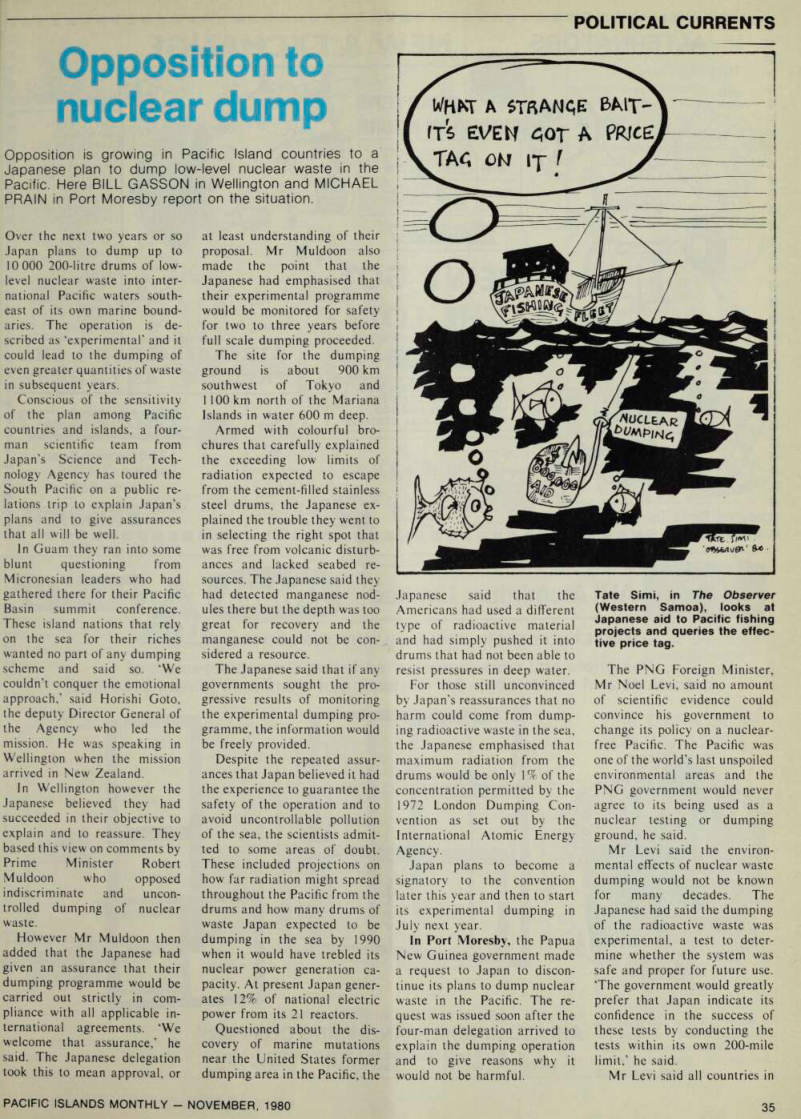


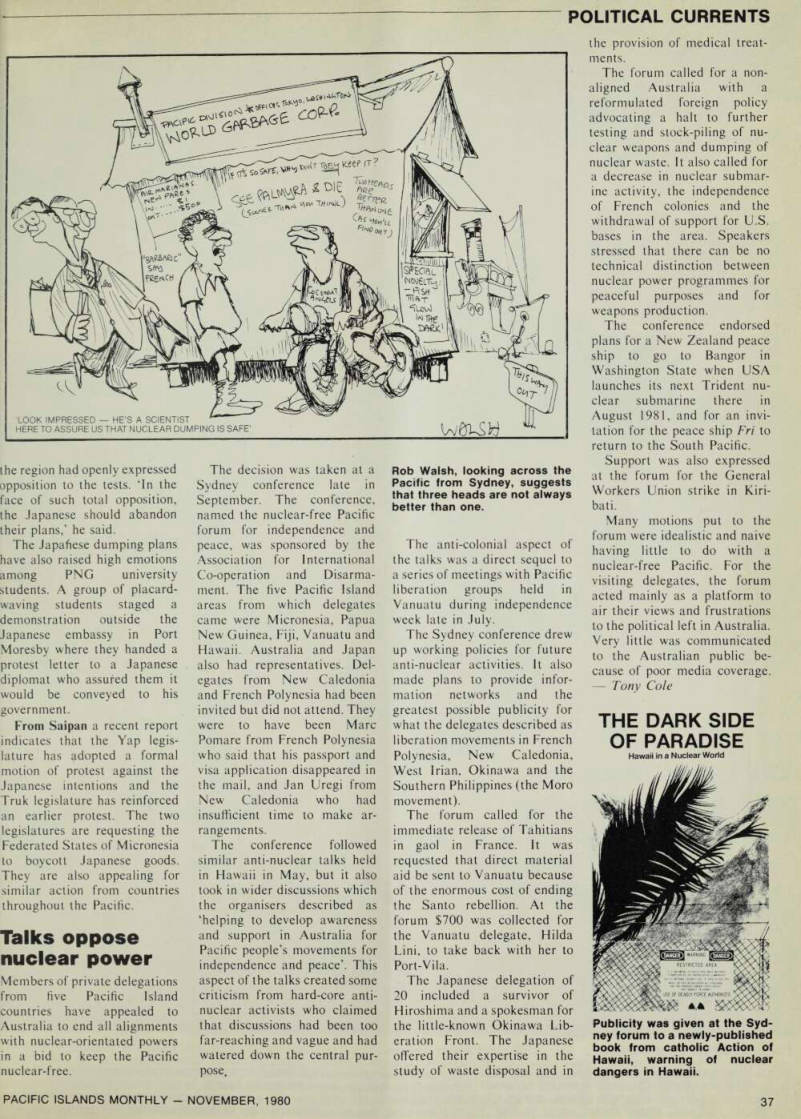
nuclear dump
Opposition is growing in Pacific Island countries to a Japanese plan to dump low-level nuclear waste in the Pacific. Here BILL GASSON in Wellington and MICHAEL PRAIN in Port Moresby report on the situation.
Over the next two years or so Japan plans to dump up to 10 000 200-litre drums of low level nuclear waste into inter national Pacific waters south east of its own marine bound aries. The operation is de scribed as ‘experimental’ and it could lead to the dumping of even greater quantities of waste in subsequent years.
Conscious of the sensitivity of the plan among Pacific countries and islands, a four man scientific team from Japan’s Science and Tech nology Agency has toured the South Pacific on a public re lations trip to explain Japan’s plans and to give assurances that all will be well.
In Guam they ran into some blunt questioning from Micronesian leaders who had gathered there for their Pacific Basin summit conference.
These island nations that rely on the sea for their riches wanted no part of any dumping scheme and said so. ‘We couldn’t conquer the emotional approach,’ said Horishi Goto, the deputy Director General of the Agency who led the mission. He was speaking in Wellington when the mission arrived in New Zealand.
In Wellington however the Japanese believed they had succeeded in their objective to explain and to reassure. They based this view on comments by Prime Minister Robert Muldoon who opposed indiscriminate and uncon trolled dumping of nuclear waste.
However Mr Muldoon then added that the Japanese had given an assurance that their dumping programme would be carried out strictly in com pliance with all applicable in ternational agreements. ‘We welcome that assurance,’ he said. The Japanese delegation took this to mean approval, or
at least understanding of their proposal. Mr Muldoon also made the point that the Japanese had emphasised that their experimental programme would be monitored for safety for two to three years before full scale dumping proceeded.
The site for the dumping ground is about 900 km southwest of Tokyo and 1100 km north of the Mariana Islands in water 600 m deep.
Armed with colourful bro chures that carefully explained the exceeding low limits of radiation expected to escape from the cement-filled stainless steel drums, the Japanese ex plained the trouble they went to in selecting the right spot that was free from volcanic disturb ances and lacked seabed re sources. The Japanese said they had detected manganese nod ules there but the depth was too great for recovery and the manganese could not be con sidered a resource.
The Japanese said that if any governments sought the pro gressive results of monitoring the experimental dumping pro gramme, the information would be freely provided.
Despite the repeated assur ances that Japan believed it had the experience to guarantee the safely of the operation and to avoid uncontrollable pollution of the sea, the scientists admit ted to some areas of doubt.
These included projections on how far radiation might spread throughout the Pacific from the drums and how many drums of waste Japan expected to be dumping in the sea by 1990 when it would have trebled its nuclear power generation ca pacity. At present Japan gener ates 12% of national electric power from its 21 reactors.
Questioned about the dis covery of marine mutations near the United States former dumping area in the Pacific, the
Japanese said that the Americans had used a different type of radioactive material and had simply pushed it into drums that had not been able to resist pressures in deep water.
For those still unconvinced by Japan's reassurances that no harm could come from dump ing radioactive waste in the sea, the Japanese emphasised that maximum radiation from the drums would be only 1% of the concentration permitted by the 1972 London Dumping Con vention as set out by the International Atomic Energy Agency.
Japan plans to become a signatory to the convention later this year and then to start its experimental dumping in July next year.
In Port Moresby, the Papua New Guinea government made a request to Japan to discon tinue its plans to dump nuclear waste in the Pacific. The re quest was issued soon after the four-man delegation arrived to explain the dumping operation and to give reasons why it would not be harmful.
The PNG Foreign Minister, Mr Noel Levi, said no amount of scientific evidence could convince his government to change its policy on a nuclear free Pacific. The Pacific was one of the world’s last unspoiled environmental areas and the PNG government would never agree to its being used as a nuclear testing or dumping ground, he said.
Mr Levi said the environ mental effects of nuclear waste dumping would not be known for many decades. The Japanese had said the dumping of the radioactive waste was experimental, a test to deter mine whether the system was safe and proper for future use.
The government would greatly prefer that Japan indicate its confidence in the success of these tests by conducting the tests within its own 200-mile limit,’ he said.
Mr Levi said all countries in
Tate Simi, in The Observer (Western Samoa), looks at Japanese aid to Pacific fishing projects and queries the effec tive price tag.
the region had openly expressed opposition to the tests. ‘ln the face of such total opposition, the Japanese should abandon their plans,’ he said.
The Japafiese dumping plans have also raised high emotions among PNG university students. A group of placard waving students staged a demonstration outside the Japanese embassy in Port Moresby where they handed a protest letter to a Japanese diplomat who assured them it would be conveyed to his government.
From Saipan a recent report indicates that the Yap legis lature has adopted a formal motion of protest against the Japanese intentions and the Truk legislature has reinforced an earlier protest. The two legislatures are requesting the Federated States of Micronesia to boycott Japanese goods.
They are also appealing for similar action from countries throughout the Pacific.
Talks oppose
nuclear power
Members of private delegations from five Pacific Island countries have appealed to Australia to end all alignments with nuclear-orientated powers in a bid to keep the Pacific nuclear-free.
The decision was taken at a Sydney conference late in September. The conference, named the nuclear-free Pacific forum for independence and peace, was sponsored by the Association for International Co-operation and Disarma ment. The five Pacific Island areas from which delegates came were Micronesia, Papua New Guinea, Fiji, Vanuatu and Hawaii. Australia and Japan also had representatives. Del egates from New Caledonia and French Polynesia had been invited but did not attend. They were to have been Marc Pomare from French Polynesia who said that his passport and visa application disappeared in the mail, and Jan Uregi from New Caledonia who had insufficient time to make ar rangements.
The conference followed similar anti-nuclear talks held in Hawaii in May, but it also took in wider discussions which the organisers described as ‘helping to develop awareness and support in Australia for Pacific people’s movements for independence and peace’. This aspect of the talks created some criticism from hard-core anti nuclear activists who claimed that discussions had been too far-reaching and vague and had watered down the central pur pose.
The anti-colonial aspect of the talks was a direct sequel to a series of meetings with Pacific liberation groups held in Vanuatu during independence week late in July.
The Sydney conference drew up working policies for future anti-nuclear activities. It also made plans to provide infor mation networks and the greatest possible publicity for what the delegates described as liberation movements in French Polynesia, New Caledonia, West Irian, Okinawa and the Southern Philippines (the Moro movement).
The forum called for the immediate release of Tahitians in gaol in France. It was requested that direct material aid be sent to Vanuatu because of the enormous cost of ending the Santo rebellion. At the forum $7OO was collected for the Vanuatu delegate, Hilda Lini, to take back with her to Port-Vila.
The Japanese delegation of 20 included a survivor of Hiroshima and a spokesman for the little-known Okinawa Lib eration Front. The Japanese offered their expertise in the study of waste disposal and in
the provision of medical treat ments.
The forum called for a non aligned Australia with a reformulated foreign policy advocating a halt to further testing and stock-piling of nu clear weapons and dumping of nuclear waste. It also called for a decrease in nuclear submar ine activity, the independence of French colonies and the withdrawal of support for U.S. bases in the area. Speakers stressed that there can be no technical distinction between nuclear power programmes for peaceful purposes and for weapons production.
The conference endorsed plans for a New Zealand peace ship to go to Bangor in Washington State when USA launches its next Trident nu clear submarine there in August 1981, and for an invi tation for the peace ship Fri to return to the South Pacific.
Support was also expressed at the forum for the General Workers Union strike in Kiri bati.
Many motions put to the forum were idealistic and naive having little to do with a nuclear-free Pacific. For the visiting delegates, the forum acted mainly as a platform to air their views and frustrations to the political left in Australia.
Very little was communicated to the Australian public be cause of poor media coverage.
Tony Cole
Rob Walsh, looking across the Pacific from Sydney, suggests that three heads are not always better than one.
Advertisements & other items, pp. 35-36 (1 item)
11-501 mini component system
: : ’ iG3 5
4AL4MC* Wl
Q O O I a
i • lb-
w a rot ten).jmtiwnrenchantment
11-501 mini component system
AIWA for craftsmanship
fromM\NA
AIWA CO.. LTD. 11-9. Ueno 1-chome, Taito-ku. Tokyo, Japan.
Australia AIWA Australia Pty . Ltd., P.O Box 339. Rockdale.
N.S.W.. Australia 2216 Tel: 597-2388/2808 Cook Islands Island Merchants Ltd,, PO. Box 69, Rarotonga. Cook Islands Fiji D. Ranchhod & Company, Corner or Vidilo St. & Vitogo PDE. P.O. Box 18, Lautoka. Fiji Tel; 60227 Fiji P. Hargovind Bros., Duty Free Centre 190 Renwick Road. Suva.
Fiji Tel: 24350 Guam Micropac Audio. Inc., PC. Box 3478, Agana. Guam 96910Te1: 472-8091 New Caledonia hifivox: 79 rue de sebastopol 19 avenue Foch B P 1458 Noumea, New Caledonia Tel: 27 24 66 et 28 29 31 P.N.G. Oceania Indent Agency (PN G.) Pty.. Ltd. Box 5518. Boroko.
Port Moresby. P.N.G. Tel: PM 256406 Solomon Islands Harvest Pacific Ltd.. G.P.O. 517, Honiara, Solomon Islands Tel: 718 Tahiti Fare Hi-Fi Stereo. Rue du Marechal Foch, P.O. Box 269. Papeete, Tahiti R C 6604 A Vanuatu (New Hebrides) The Sound Centre Ltd.; P.O. Box 434. Vila.
Vanuatu (New Hebrides) Tel: 2035
all ALTERNATORS
TO
STARTERS
ITERNATOHS AND GENERATORS
TRUCK^H
250
AMP
I « a
NEW & EXCHANGE
WE’VE GOT
THE LOT
s !v \
MAH
DELCO REMY
MOTOROLA
LEECE - NEVILLE
PARIS - RHONE
MAGNET MARELLI
PRESTOLITE
.MITSUBISHI
.SAWAFUJI
.NIEHOFF
. DUCELLIER
.BOSCH
. AUTOLITE
DENSO
BUTEC
• CAV
LUCAS
• SIMMS
• NIKKO
• HITACHI U
I=l EE3 ht:l RTS volt
EXCHANGE ALTERNATORS,
GENERATORS, STARTERS,
REGULATORS AND 500
ARMATURES AND STATORS
AIR*RAIL*ROAD & SEA
FREIGHT ANYWHERE
Industrial, Marine, Truck and Off Highway
W /Q v" f CARS don't change ring geai
J^ZUCR^ecfnc^
BOX 279 ROCKLEA
TELEX: AA40396
1756 Ipswich Road, Rocklea, Q. 4106. 275 2855 - /'wo
AHI Aluminium Limited
Rylock
MARKET LEADERS IN ALUMINIUM WINDOWS & DOORS
lAFiuier
im Designers and manufacturers marketing a complete range of extrusions and components for fabrication of aluminium joinery products.
IV r mm IS I*-
FOR FURTHER INFORMATION CONTACT
AHI ALUMINIUM FRANCHISING COMPANY
P O BOX 18299, AUCKLAND. NEW ZEALAND TELEPHONE: 580 704 CABLES: AHIAL TELEX: 2222
Of Paradise
The Dark Side
Hawaii in a Nuclear World
Publicity was given at the Syd ney forum to a newly-published book from catholic Action of Hawaii, warning of nuclear dangers in Hawaii.
Advertisements & other items, pp. 38-39 (1 item)
v #
v ■- X %« * The Toyota truck range.
Built to be unbeatable.
Bad weather conditions, no problem.
Bad roads and driving surfaces, eaten up.
Difficult loads, no contest. Built tough.
Built to take it.
There’s a Toyota truck built for yo mm mu For unbeatable after service: PAPUA NEW GUINEA: ELA MOTORS. Scratchley Rd., Badili, P.O. Box 675, Port Moresby. U.S. TRUST TERRITORY: MICROL CORPORATION. P.O. Box 26 Saipan. FIJI ISLANDS: AUTOMOTIVE SUPPLIES COMPANY, P.O. Box 5177, Raiwaqa, Suva. AMERICAN SAMOA: BURNS PHILP (SOUTHSEA) CO., LTD., P.O. Box 129, Pago Pago. WESTERN SAMOA: BURNS PHILP (SOUTHSEA) CO.. LTD., P.O. Box 188, Apia. TONGA: BURNS PHILP (SOUTHSEA) CO., LTD.
P.O. Box 55, Nukualofa. GUAM: ATKINS, KROLL (GUAM) LTD., P.O. Box 6248, Tamuning. VANUATU: NEW HEBRIDES MOTORS. P.O. Box 18. Vila.
m
SnuTEwSm
m *
TOYOTA HI-LUX
M m
TOYOTA LAND CRUISER
W wr
TOYOTA HI ACE
M
TOYOTA DYNA
TOYOTA TRUCK
SOLOMON ISLANDS: MENDANA ENTERPRISES (5.1.) LTD., P.O. Box 174, Honiara. TAHITI: NIPPON AUTOMOTO, B.P. 342, Papeete. COOK LSLANDS: COOK ISLANDS TRADING CORPORATION LTD P.O. Box 92, Rarotonga. NAURU ISLANDS: NAURU COOPERATIVE SOCIETY.
KIRIBATI: TARAWA MOTORS, Box 36, Bairiki, Kiribati. NORFOLK ISLAND: MOUNT PITT (ENTERPRISES) LTD., P.O. Box 169. NEW CALEDONIA: SOCIETE IMPORTATION AUTOMOBILE DU PACIFIQUE, Rond-Point du Pacific (Station Total) B.P. 438. Noumea
TOYOTA
People
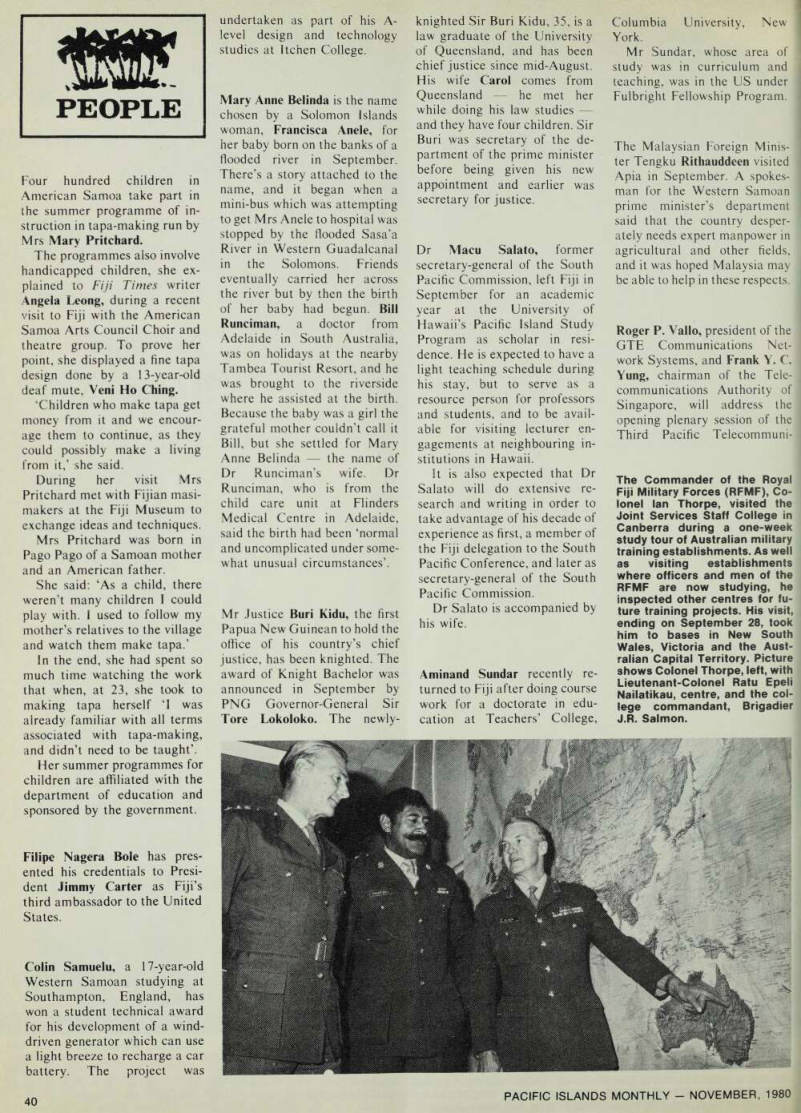
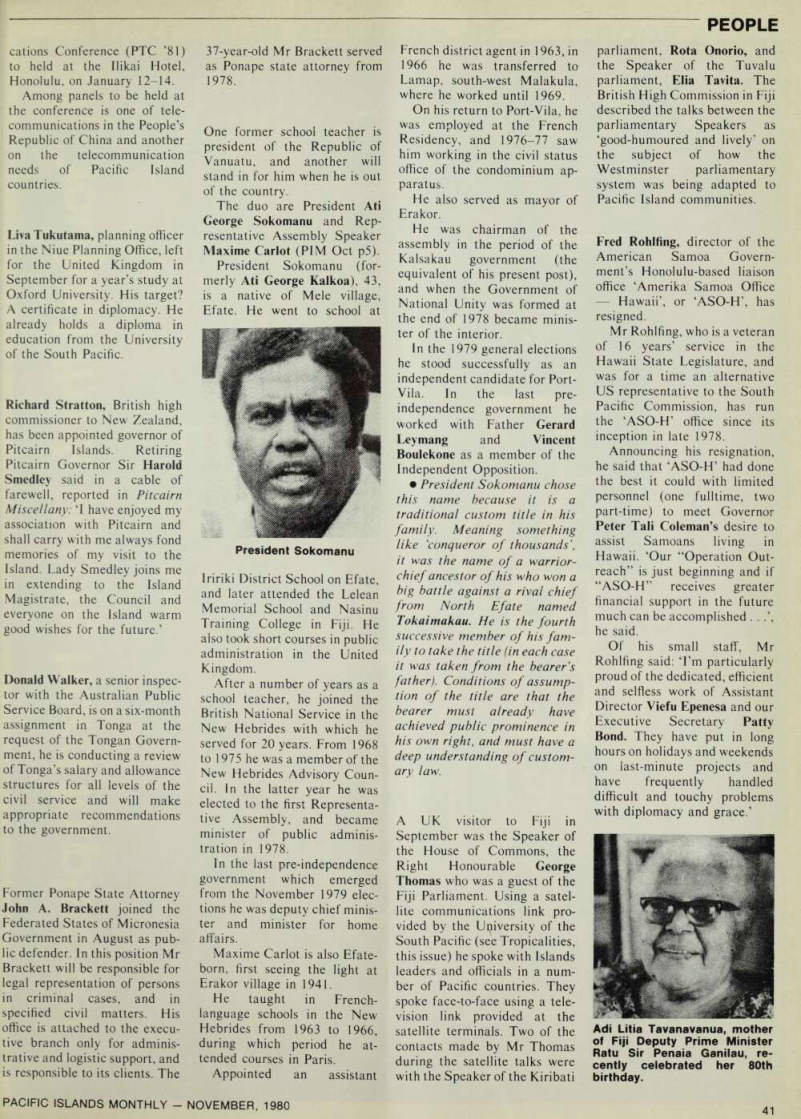
Four hundred children in American Samoa take part in the summer programme of in struction in tapa-making run by Mrs Mary Pritchard.
The programmes also involve handicapped children, she ex plained to Fiji Times writer Angela Leong, during a recent visit to Fiji with the American Samoa Arts Council Choir and theatre group. To prove her point, she displayed a fine tapa design done by a 13-year-old deaf mute, Veni Ho Ching. ‘Children who make tapa get money from it and we encour age them to continue, as they could possibly make a living from it,’ she said.
During her visit Mrs Pritchard met with Fijian masi makers at the Fiji Museum to exchange ideas and techniques.
Mrs Pritchard was born in Pago Pago of a Samoan mother and an American father.
She said; ‘As a child, there weren’t many children I could play with. I used to follow my mother’s relatives to the village and watch them make tapa.’
In the end, she had spent so much time watching the work that when, at 23, she took to making tapa herself ‘1 was already familiar with all terms associated with tapa-making, and didn’t need to be taught’.
Her summer programmes for children are affiliated with the department of education and sponsored by the government.
Filipe Nagera Bole has pres ented his credentials to Presi dent Jimmy Carter as Fiji’s third ambassador to the United States.
Colin Samuelu, a 17-year-old Western Samoan studying at Southampton, England, has won a student technical award for his development of a wind driven generator which can use a light breeze to recharge a car battery. The project was
undertaken as part of his A level design and technology studies at Itchen College.
Mary Anne Belinda is the name chosen by a Solomon Islands woman, Francisca Anele, for her baby born on the banks of a flooded river in September.
There’s a story attached to the name, and it began when a mini-bus which was attempting to get Mrs Anele to hospital was stopped by the flooded Sasa’a River in Western Guadalcanal in the Solomons. Friends eventually carried her across the river but by then the birth of her baby had begun. Bill Runciman, a doctor from Adelaide in South Australia, was on holidays at the nearby Tambea Tourist Resort, and he was brought to the riverside where he assisted at the birth.
Because the baby was a girl the grateful mother couldn’t call it Bill, but she settled for Mary Anne Belinda the name of Dr Runciman’s wife. Dr Runciman, who is from the child care unit at Flinders Medical Centre in Adelaide, said the birth had been ‘normal and uncomplicated under some what unusual circumstances’.
Mr Justice Buri Kidu, the first Papua New Guinean to hold the office of his country’s chief justice, has been knighted. The award of Knight Bachelor was announced in September by PNG Governor-General Sir Tore Lokoloko. The newly
knighted Sir Buri Kidu, 35, is a law graduate of the University of Queensland, and has been chief justice since mid-August.
His wife Carol comes from Queensland he met her while doing his law studies and they have four children. Sir Buri was secretary of the de partment of the prime minister before being given his new appointment and earlier was secretary for justice.
Dr Macu Salato, former secretary-general of the South Pacific Commission, left Fiji in September for an academic year at the University of Hawaii’s Pacific Island Study Program as scholar in resi dence. He is expected to have a light teaching schedule during his stay, but to serve as a resource person for professors and students, and to be avail able for visiting lecturer en gagements at neighbouring in stitutions in Hawaii.
It is also expected that Dr Salato will do extensive re search and writing in order to take advantage of his decade of experience as first, a member of the Fiji delegation to the South Pacific Conference, and later as secretary-general of the South Pacific Commission.
Dr Salato is accompanied by his wife.
Aminand Sundar recently re turned to Fiji after doing course work for a doctorate in edu cation at Teachers’ College,
Columbia University, New York.
Mr Sundar, whose area of study was in curriculum and teaching, was in the US under Fulbright Fellowship Program.
The Malaysian Foreign Minis ter Tengku Rithauddeen visited Apia in September. A spokes man for the Western Samoan prime minister’s department said that the country desper ately needs expert manpower in agricultural and other fields, and it was hoped Malaysia may be able to help in these respects.
Roger P. Vallo, president of the GTE Communications Net work Systems, and Frank Y. C.
Yung, chairman of the Tele communications Authority of Singapore, will address the opening plenary session of the Third Pacific Telecommuni-
The Commander of the Royal Fiji Military Forces (RFMF), Co lonel lan Thorpe, visited the Joint Services Staff College in Canberra during a one-week study tour of Australian military training establishments. As well as visiting establishments where officers and men of the RFMF are now studying, he inspected other centres for fu ture training projects. His visit, ending on September 28, took him to bases in New South Wales, Victoria and the Aust ralian Capital Territory. Picture shows Colonel Thorpe, left, with Lieutenant-Colonel Ratu Epeli Nailatikau, centre, and the col lege commandant, Brigadier J.R. Salmon.
cations Conference (PTC ’81) to held at the Ilikai Hotel, Honolulu, on January 12-14.
Among panels to be held at the conference is one of tele communications in the People’s Republic of China and another on the telecommunication needs of Pacific Island countries.
Liva Tukutama, planning officer in the Niue Planning Office, left for the United Kingdom in September for a year’s study at Oxford University. His target?
A certificate in diplomacy. He already holds a diploma in education from the University of the South Pacific.
Richard Stratton, British high commissioner to New Zealand, has been appointed governor of Pitcairn Islands. Retiring Pitcairn Governor Sir Harold Smedley said in a cable of farewell, reported in Pitcairn Miscellany: ‘I have enjoyed my association with Pitcairn and shall carry with me always fond memories of my visit to the Island. Lady Smedley joins me in extending to the Island Magistrate, the Council and everyone on the Island warm good wishes for the future.’
Donald Walker, a senior inspec tor with the Australian Public Service Board, is on a six-month assignment in Tonga at the request of the Tongan Govern ment, he is conducting a review of Tonga’s salary and allowance structures for all levels of the civil service and will make appropriate recommendations to the government.
Former Ponape State Attorney John A. Brackett joined the Federated States of Micronesia Government in August as pub lic defender. In this position Mr Brackett will be responsible for legal representation of persons in criminal cases, and in specified civil matters. His office is attached to the execu tive branch only for adminis trative and logistic support, and is responsible to its clients. The
37-year-old Mr Brackett served as Ponape state attorney from 1978.
One former school teacher is president of the Republic of Vanuatu, and another will stand in for him when he is out of the country.
The duo are President Ati George Sokomanu and Rep resentative Assembly Speaker Maxime Carlot (PIM Oct p 5).
President Sokomanu (for merly Ati George Kalkoa), 43, is a native of Mele village, Efate. He went to school at
Iririki District School on Efate, and later attended the Lelean Memorial School and Nasinu Training College in Fiji. He also took short courses in public administration in the United Kingdom.
After a number of years as a school teacher, he joined the British National Service in the New Hebrides with which he served for 20 years. From 1968 to 1975 he was a member of the New Hebrides Advisory Coun cil. In the latter year he was elected to the first Representa tive Assembly, and became minister of public adminis tration in 1978.
In the last pre-independence government which emerged from the November 1979 elec tions he was deputy chief minis ter and minister for home affairs.
Maxime Carlot is also Efate born, first seeing the light at Erakor village in 1941.
He taught in French language schools in the New Hebrides from 1963 to 1966, during which period he at tended courses in Paris.
Appointed an assistant
French district agent in 1963, in 1966 he was transferred to Lamap, south-west Malakula, where he worked until 1969.
On his return to Port-Vila, he was employed at the French Residency, and 1976-77 saw him working in the civil status office of the condominium ap paratus.
He also served as mayor of Erakor.
He was chairman of the assembly in the period of the Kalsakau government (the equivalent of his present post), and when the Government of National Unity was formed at the end of 1978 became minis ter of the interior.
In the 1979 general elections he stood successfully as an independent candidate for Port- Vila. In the last pre independence government he worked with Father Gerard Leymang and Vincent Boulekone as a member of the
Independent Opposition.
• President Sokomanu chose this name because it is a traditional custom title in his family. Meaning something like ‘conqueror of thousands’, it was the name of a warrior chief ancestor of his who won a big battle against a rival chief from North Efate named Tokaimakau. He is the fourth successive member of his fam ily to take the title (in each case it was taken from the bearer’s father}. Conditions of assump tion of the title are that the bearer must already have achieved public prominence in his own right, and must have a
deep understanding of custom
ary law.
A UK visitor to Fiji in September was the Speaker of the House of Commons, the Right Honourable George Thomas who was a guest of the Fiji Parliament. Using a satel lite communications link pro vided by the University of the South Pacific (see Tropicalities, this issue) he spoke with Islands leaders and officials in a num ber of Pacific countries. They spoke face-to-face using a tele vision link provided at the satellite terminals. Two of the contacts made by Mr Thomas during the satellite talks were with the Speaker of the Kiribati
parliament, Rota Onorio, and the Speaker of the Tuvalu parliament, Elia Tavita. The British High Commission in Fiji described the talks between the parliamentary Speakers as ‘good-humoured and lively’ on the subject of how the Westminster parliamentary system was being adapted to Pacific Island communities.
Fred Rohlfing, director of the American Samoa Govern ment’s Honolulu-based liaison office ‘Amerika Samoa Office - Hawaii’, or ‘ASO-H’, has resigned.
Mr Rohlfing, who is a veteran of 16 years’ service in the Hawaii State Legislature, and was for a time an alternative US representative to the South Pacific Commission, has run the ‘ASO-H’ office since its inception in late 1978.
Announcing his resignation, he said that ‘ASO-H’ had done the best it could with limited personnel (one fulltime, two part-time) to meet Governor Peter Tali Coleman’s desire to assist Samoans living in Hawaii. ‘Our “Operation Out reach” is just beginning and if “ASO-H” receives greater financial support in the future much can be accomplished . . .’, he said.
Of his small staff, Mr Rohlfing said; ‘l’m particularly proud of the dedicated, efficient and selfless work of Assistant Director Viefu Epenesa and our Executive Secretary Patty Bond. They have put in long hours on holidays and weekends on last-minute projects and have frequently handled difficult and touchy problems with diplomacy and grace.’
President Sokomanu
Adi Litia Tavanavanua, mother of Fiji Deputy Prime Minister Ratu Sir Penaia Ganilau, re cently celebrated her 80th birthday.
Advertisements & other items, p. 42 (1 item)
Fujitsu Ten Limited
TEN
You just think you’re hard to please!
Take a look at this dazzling assortment of “TEN”
products. Car stereos, cassette decks, tuners,
amps, speakers, graphic equalizers, marine
compo units— from the simplest to the most complex, the modestly priced to the super deluxe. When it comes to audio equipment, you may think you're a very tough customer to please. But we know better. With such
a fantastic variety of top-quality, feature-
packed products, you couldn’t help but find what you’re looking for. We re willing to bet 1 on it! • r \
TWWOX
. i\ m vw V y v v. v ;- : ■ m W i ■ IW m *** •• m * fSr - at X mu m t* t m 2 .
FUJITSU TEN LIMITED
Head Office:
2-28, Gosho-don 1-chome, Hyogo-ku, Kobe. Japan
Tokyo Office (Export Section): Shuwa Onarimon Bldg,, 2nd FI., 1-1, Shimbashi 6-chome, Mmato-ku, Tokyo. Japan Phone: (03) 438-1611 Cable: TENFUJITSU TOKYO Telex: 2425101 TENTOK J,
Distributors:
Papua New Guinea: CHIN H MEEN N SONS PTY., LTD. PO Box 1106, Boroko, Port Moresby, Papua New Guinea Phone 256546.
Guam; MICROPAC AUDIO INC. PO. Box 3478, Agana, Guam 96910 Phone: 472-8091.
Tahiti: FARE HI-FI STEREO. PO Box 269, Rue du Marechat Foch, Papeete.
New Hebrides: BURNS PHILP NEW HEBRIDES LIMITED. Vila, New Hebrides Cook Islands: AVATIU GENERAL TRADERS. PO Box 27, Rarotonga Fiji; D. GOKAL& CO., LTD. G, PO Box 501, Suva, Fiji. Phone: 25259/22995,
Island empire
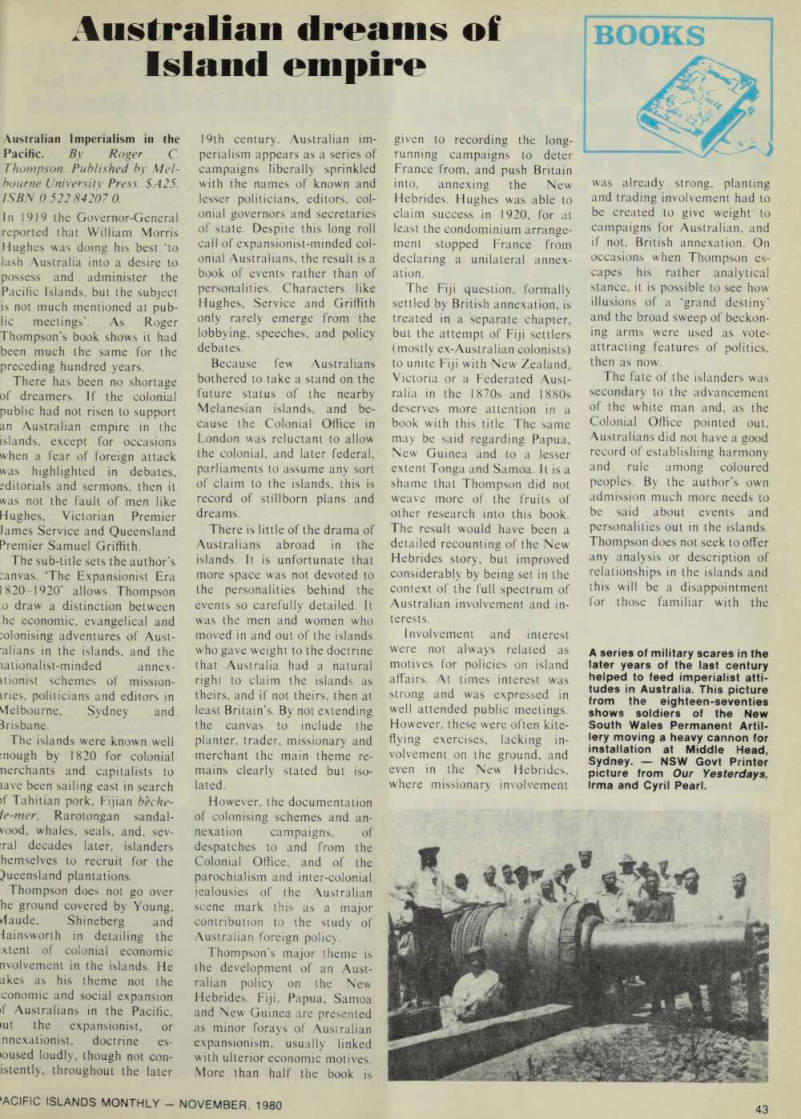
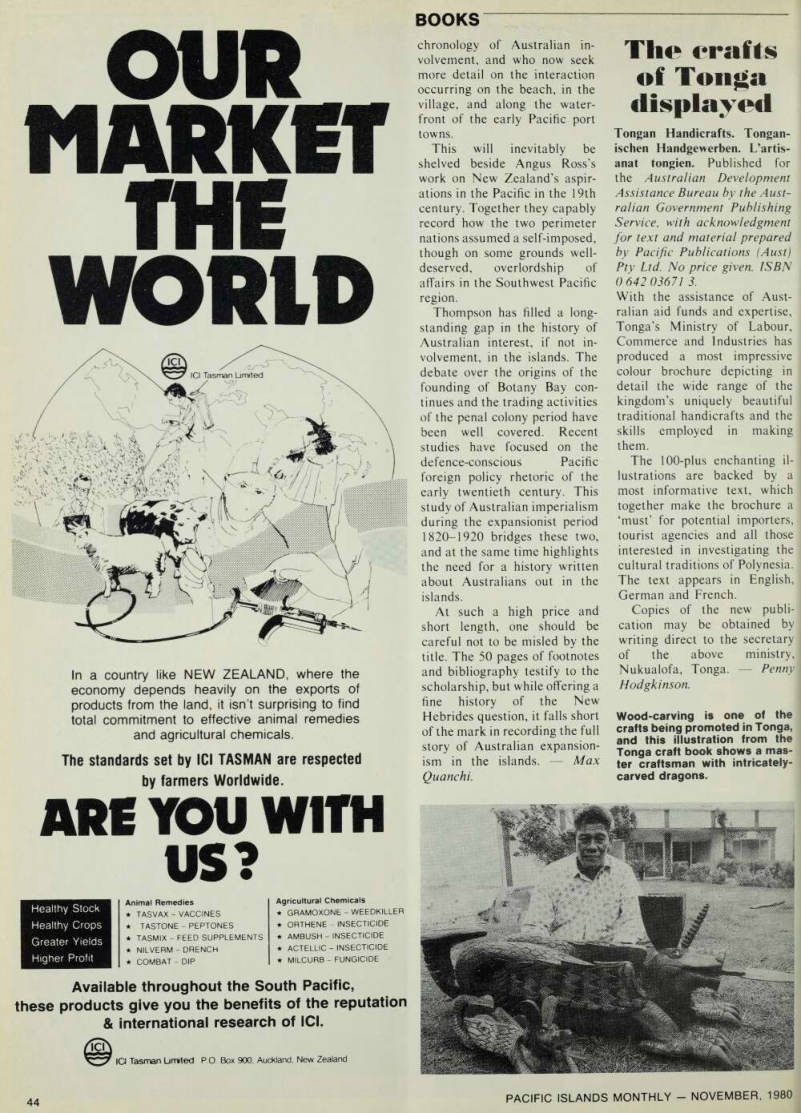
Books
Australian dreams of Island empire
Australian Imperialism in the Pacific. By Roger C.
Thompson. Published by Mel bourne University Press. SA2S.
Isbn 0 522 84207 0.
In 1919 the Governor-General reported that William Morris Hughes was doing his best ‘to lash Australia into a desire to possess and administer the Pacific Islands, but the subject is not much mentioned at pub lic meetings'. As Roger Thompson's book shows it had been much the same for the preceding hundred years.
There has been no shortage of dreamers. If the colonial public had not risen to support an Australian empire in the islands, except for occasions when a fear of foreign attack was highlighted in debates, editorials and sermons, then it was not the fault of men like Hughes, Victorian Premier James Service and Queensland Premier Samuel Griffith.
The sub-title sets the author’s :anvas. ‘The Expansionist Era 1820-1920' allows Thompson o draw a distinction between he economic, evangelical and :olonising adventures of Aust rians in the islands, and the lalionalist-minded annex itionist schemes of mission tries. politicians and editors in Ylelbourne, Sydney and Brisbane.
The islands were known well mough by 1820 for colonial nerchanls and capitalists to tave been sailing east in search >f Tahitian pork, Fijian beche ie-mer. Rarotongan sandal vood, whales, seals, and, sev eral decades later, islanders hemselves to recruit for the
Queensland plantations.
Thompson does not go over he ground covered by Young,
Taude, Shineberg and
Bainsworth in detailing the
xtent of colonial economic nvolvement in the islands. He akes as his theme not the conomic and social expansion if Australians in the Pacific, »ut the expansionist, or nnexationist, doctrine es loused loudly, though not con istently, throughout the later
19th century. Australian im perialism appears as a series of campaigns liberally sprinkled with the names of known and lesser politicians, editors, col onial governors and secretaries of state. Despite this long roll call of expansionist-minded col onial Australians, the result is a book of events rather than of personalities. Characters like Hughes, Service and Griffith only rarely emerge from the lobbying, speeches, and policy debates.
Because few Australians bothered to take a stand on the future status of the nearby Melanesian islands, and be cause the Colonial Office in London was reluctant to allow the colonial, and later federal, parliaments to assume any sort of claim to the islands, this is record of stillborn plans and dreams.
There is little of the drama of Australians abroad in the islands. It is unfortunate that more space was not devoted to the personalities behind the events so carefully detailed. It was the men and women who moved in and out of the islands who gave weight to the doctrine that Australia had a natural right to claim the islands as theirs, and if not theirs, then at least Britain’s. By not extending the canvas to include the planter, trader, missionary and merchant the main theme re mains clearly stated but iso lated.
However, the documentation of colonising schemes and an nexation campaigns, of despatches to and from the Colonial Office, and of the parochialism and inter-colonial jealousies of the Australian scene mark this as a major contribution to the study of Australian foreign policy.
Thompson’s major theme is the development of an Aust ralian policy on the New Hebrides. Fiji, Papua, Samoa and New Guinea are presented as minor forays of Australian expansionism, usually linked with ulterior economic motives.
More than half the book is
given to recording the long running campaigns to deter France from, and push Britain into, annexing the New Hebrides. Hughes was able to claim success in 1920, for at least the condominium arrange ment stopped France from declaring a unilateral annex ation.
The Fiji question, formally settled by British annexation, is treated in a separate chapter, but the attempt of Fiji settlers (mostly ex-Australian colonists) to unite Fiji with New Zealand, Victoria or a Federated Aust ralia in the 1870 s and 1880 s deserves more attention in a book with this title. The same may be said regarding Papua, New Guinea and to a lesser extent Tonga and Samoa. It is a shame that Thompson did not weave more of the fruits of other research into this book.
The result would have been a detailed recounting of the New Hebrides story, but improved considerably by being set in the context of the full spectrum of Australian involvement and in terests.
Involvement and interest were not always related as motives for policies on island affairs. At times interest was strong and was expressed in well attended public meetings.
However, these were often kite flying exercises, lacking in volvement on the ground, and even in the New Hebrides, where missionary involvement
was already strong, planting and trading involvement had to be created to give weight to campaigns for Australian, and if not, British annexation. On occasions when Thompson es capes his rather analytical stance, it is possible to see how illusions of a ‘grand destiny’ and the broad sweep of beckon ing arms were used as vote attracting features of politics, then as now.
The fate of the islanders was secondary to the advancement of the white man and, as the Colonial Office pointed out, Australians did not have a good record of establishing harmony and rule among coloured peoples. By the author’s own admission much more needs to be said about events and personalities out in the islands.
Thompson does not seek to offer any analysis or description of relationships in the islands and this will be a disappointment for those familiar with the
A series of military scares in the later years of the last century helped to feed imperialist atti tudes in Australia. This picture from the eighteen-seventies shows soldiers of the New South Wales Permanent Artil lery moving a heavy cannon for installation at Middle Head,
Sydney. - NSW Govt Printer
picture from Our Yesterdays, Irma and Cyril Pearl.
chronology of Australian in volvement, and who now seek more detail on the interaction occurring on the beach, in the village, and along the water front of the early Pacific port towns.
This will inevitably be shelved beside Angus Ross’s work on New Zealand’s aspir ations in the Pacific in the 19th century. Together they capably record how the two perimeter nations assumed a self-imposed, though on some grounds well deserved, overlordship of affairs in the Southwest Pacific region.
Thompson has filled a long standing gap in the history of Australian interest, if not in volvement, in the islands. The debate over the origins of the founding of Botany Bay con tinues and the trading activities of the penal colony period have been well covered. Recent studies have focused on the defence-conscious Pacific foreign policy rhetoric of the early twentieth century. This study of Australian imperialism during the expansionist period 1820-1920 bridges these two, and at the same time highlights the need for a history written about Australians out in the islands.
At such a high price and short length, one should be careful not to be misled by the title. The 50 pages of footnotes and bibliography testify to the scholarship, but while offering a fine history of the New Hebrides question, it falls short of the mark in recording the full story of Australian expansion ism in the islands. Max Quanchi.
Advertisements & other items, p. 43 (1 item)
43
ACIFIC ISLANDS MONTHLY NOVEMBER, 1980
displayed
The crafts of Tonga displayed
Tongan Handicrafts. Tongan ischen Handgewerben. L’artis anat tongien. Published for the Australian Development Assistance Bureau by the Aust ralian Government Publishing Service, with acknowledgment for text and material prepared by Pacific Publications (Aust) Pty Ltd. No price given. ISBN 0 642 03671 3.
With the assistance of Aust ralian aid funds and expertise, Tonga’s Ministry of Labour, Commerce and Industries has produced a most impressive colour brochure depicting in detail the wide range of the kingdom’s uniquely beautiful traditional handicrafts and the skills employed in making them.
The 100-plus enchanting il lustrations are backed by a most informative text, which together make the brochure a ‘must’ for potential importers, tourist agencies and all those interested in investigating the cultural traditions of Polynesia.
The text appears in English, German and French.
Copies of the new publi cation may be obtained by writing direct to the secretary of the above ministry,
Nukualofa, Tonga.
Penny
Hodgkinson.
Wood-carving is one of the crafts being promoted in Tonga, and this illustration from the Tonga craft book shows a mas ter craftsman with intricately carved dragons.
Advertisements & other items, p. 44 (1 item)
Market
OUR
THE
WORLD
ICI Tasman Limited / m u j •*'-
Wm m ■' :,i *v^
"\ M fl£fc-> ' •<,
i In a country like NEW ZEALAND, where the economy depends heavily on the exports of products from the land, it isn’t surprising to find total commitment to effective animal remedies and agricultural chemicals.
The standards set by ICI TASMAN are respected by farmers Worldwide.
ARE YOU WITH
US?
Healthy Stock Healthy Crops Greater Yields Higher Profit Animal Remedies
★ TASVAX - VACCINES
★ TASTONE - PEPTONES
★ TASMIX - FEED SUPPLEMENTS
★ NILVERM - DRENCH
★ COMBAT - DIP
Agricultural Chemicals
★ GRAMOXONE - WEEDKILLER
★ ORTHENE - INSECTICIDE
★ AMBUSH - INSECTICIDE
★ ACTELLIC - INSECTICIDE
★ MILCURB - FUNGICIDE
Available throughout the South Pacific, hese products give you the benefits of the reputation & international research of ICI.
ICI Tasman Limited P.O. Box 900, Auckland, New Zealand
How multi-disciplinary drive
beat 'the laughing death'
Kuru Sorcery Disease and Danger in the New Guinea Highlands. By Shirley Lindenbaum. Published by Mayfield Publishing Co, 285 Hamilton Ave, Palo Alto, Calif, USA, 94301, ISBN 0 87484 362 6. Australian price 5A4.95.
When, in 1953, Patrol Officer McArthur, travelling in the Eastern Highlands of Papua New Guinea, reported that he had observed ‘a small girl,
shivering violently and jerking
her head’, he was making the first official description of kuru, an invariably fatal dis ease at that time becoming common amongst the Fore tribe and their near neigh bours, but unknown elsewhere in the world.
The provisional diagnosis of
a patient with these symptoms sent to Kainantu for treatment was that of ‘hysteria’, but by 1957. Dr Vincent Zigas of the PNG department of health, with Dr D. Carleton Gajdusek of the US institute of health, and Dr Sinclair of the Royal Melbourne Hospital. had decided that kuru was an
advanced degenerative neuro
logical disease characterised by
progressive muscular inco
ordination. personality
changes, and accompanied by
a peculiar grimacing which had caused the disorder to be
termed ‘the laughing death’.
The first published clinical description of the disease attracted the attention of W. J.
Hadlow, an English veterinary
virologist, who pointed out the resemblance of the symptoms of kuru to those of the disease of scrapie in sheep, and this ob servation proved to be the first clue as to the cause of kuru.
Stimulated by the parallel of
Hadlow’s veterinary findings,
research by Zigas and Gaj
dusek which later brought a Nobel Prize for the latter eventually confirmed that kuru was a viral disease with an
extraordinarily long incu
bation period.
The Fore believed - and many still do that the disease was the result of sorcery, and in this monograph, Linden baum describes in great detail the means whereby members of the tribe attempted to avoid, or combat, such malevolent activities. She investigated the social, economic, religious, and political effects of the disease on the community when,
reaching almost epidemic pro
portions in the ’6os, it threa tened the tribe with extinction by denuding it of women. She further discovered that the Fore, noting that the disease had declined among people to their north, had attributed this to the greater social harmony prevailing in that area. In the face of the common emerg ency, kibungs were called at which hostile septs sank dif ferences to demand the outlaw ing of kuru sorcery and the repair of the sexual imbalance, in the belief that kuru would end if surreptitious and con cealed internecine strife were to cease. At these kibungs al leged sorcerers ‘confessed’ and were ceremonially ‘cleansed’.
But kuru persisted.
Although the basic pathol
ogy had been determined, there still remained many questions to be answered. How was the disease transmitted?
Why the Fore and not other
tribes? Why mainly in women and especially in the wives of victims’ brothers? By demo
graphic analysis Lindenbaum
and her fellow-worker Glasse were able to demonstrate the specific kinship affinities of the affected individuals and to show that the disease had an in cubation period of between two and twenty-three years.
Extending their research into the special problems of the mode of transmission and the reason for its selective incidence in females and young children, they found the answers in a socio-economic aspect of Fore life which the author has called ‘the politics of protein'. After long and detailed study she was able to
explain the complicated pro
tocol of status and affinity which regulated the tribal habits, customs and prohib itions, and of those specifically related to food, whereby men had the first choice of the most favoured protein pig and that whilst Fore men very rarely ate human flesh, when
they did so, they avoided eating
from the bodies of women.
With increasing depletion of
feral animals to be hunted, for the flesh of which the hunters had priority, women and chil dren supplemented their diet with insects, small rodents, birds, frogs and until the mid-’6os human flesh. The brains of recently interred vic tims of kuru were especially favoured, and the virus was thereby transmitted to new hosts. Thus, with the prohib ition of cannibalism, and the possible exceptions of a few individuals still incubating the disease, kuru will disappear.
This monograph, with its extensive bibliography and photographs is a tribute to the long and patient work of the author and her colleagues in a difficult primitive environ ment, but even more, it is a fas
cinating and outstanding
example of the solution of a
problem by multi-disciplinary
effort, and the pooling of infor mation from workers in the fields of anthropology, de
mography, genetics, virology,
and clinical medicine.
By coincidence, an American television programme of Dr Gajdusek’s work on kuru is about to be released. It is to be hoped that the contribution of the many other patient investigators in the kuru saga
will not be overlooked.
(Dr)
Leonard Goodman.
Advertisements & other items, pp. 45-47 (3 items)
Books
45
ACIFIC ISLANDS MONTHLY - NOVEMBER, 1980
|\ manager
g
PORT MOR
* Right in business „ * A traditiorf f comfort and fine food * All rpoms airconditioned * Restaurant * Bard . * Banquet hall
|1 A. C. NEUMANN
|\ manager Phone 21-2622 'abl
Books Received: Our Independent Solomon Islands, Francil J. Saemala, Institute of Pacific Studies and USP Solomon Islands Centre, USP, Box 1168, Suva, Fiji.
Marketing agents Norman Bros Pty Ltd, Box 503, Honiara. No price given. Customs of Respect, the Traditional Basis of Fijian Communal Politics, John Nation, Development Studies Centre Monograph No 14, ANU Press, Box 4, Canberra, ACT 2600. AsB ISBN 0 7081 0494 0 Hawaiian Grammar, Samuel H. Elbert and Mary Kawena Pukui, University Press of Hawaii, 2840 Kolowalu St, Honolulu, Hawaii 96822. US$l2, ISBN 0 8248 0495 5.
Fijian Weapons and Warfare, Fergus Clunie (drawings Kolinio Moce), Bulletin No 2 of the Fiji Museum, Fiji Museum, Suva. Fs7 overseas orders, F 55.95 local. Hawaii’s People (Fourth Edition), Andrew W. Lind, University Press of Hawaii, Honolulu. US$5 paper, ISBN 0 8248 0704 9 The Demography of PNG, Ronald Skeldon, ed, Monograph 2, Institute of Applied Social and Economic Research, Box 5854, Boroko, PNG. No price given, ISBN 0 7247 0256 3 Provincial Government in Papua New Guinea: Early lessons from Chimbu, Bill Standish, Monograph 7, Institute of Applied Social and Economic Research. No price given, ISBN 0 7247 0251 2.
Stay at Aggie Grey’s . . . the South Pacific’s
legendary hotel.
Situated right in the heart of Western Samoa. Enjoy Polynesian-stylc friendliness and service, in cool surroundings, superb entertainment and food.
Magnificent white sand beaches only a short drive away. Airconditioned rooms, swimming pool and full bar facilities.
Bookings through Union Steamship Company of NZ, Pan Am, Air New Zealand or direct to Aggie Grey’s, Apia, Western Samoa. Cables: ‘AGGIES’Apia.
& 1 i?
P * I7* i ~."1 m
fe ; il
* *K - « & W w* m t&Sps. w ■W s ion Act 197*7) And if you’re between the ages of 19-34 and meet the minimum requirements of 173 cm tall, 67kg in weight and have a chest measurement of 91cm at least, you may apply to become a Police Officer.
For those that possess the right physical and mental requirements, a good work record and a satisfactory educational background the Police offer you a worthwhile and rewarding career with thorough training, the opportunity for promotion, and excellent starting salary with superannuation benefits, generous leave (including sick leave with pay), free uniform, but above all we offer job security, satisfaction and comradeship in a necessary job helping society.
If you’re interested, we would like to talk it over with you. Call at your nearest Police Station for further details E
SERVING THE COMMUNITY
NZ POLICE
WE WANT THE BEST
L 82593 AC
Yesterday
Ken James recalls a brief period when bicycle touring and racing bade fair to become the national sport of Fiji. The craze ended as abruptly as it had begun.
great Fiji cycling craze
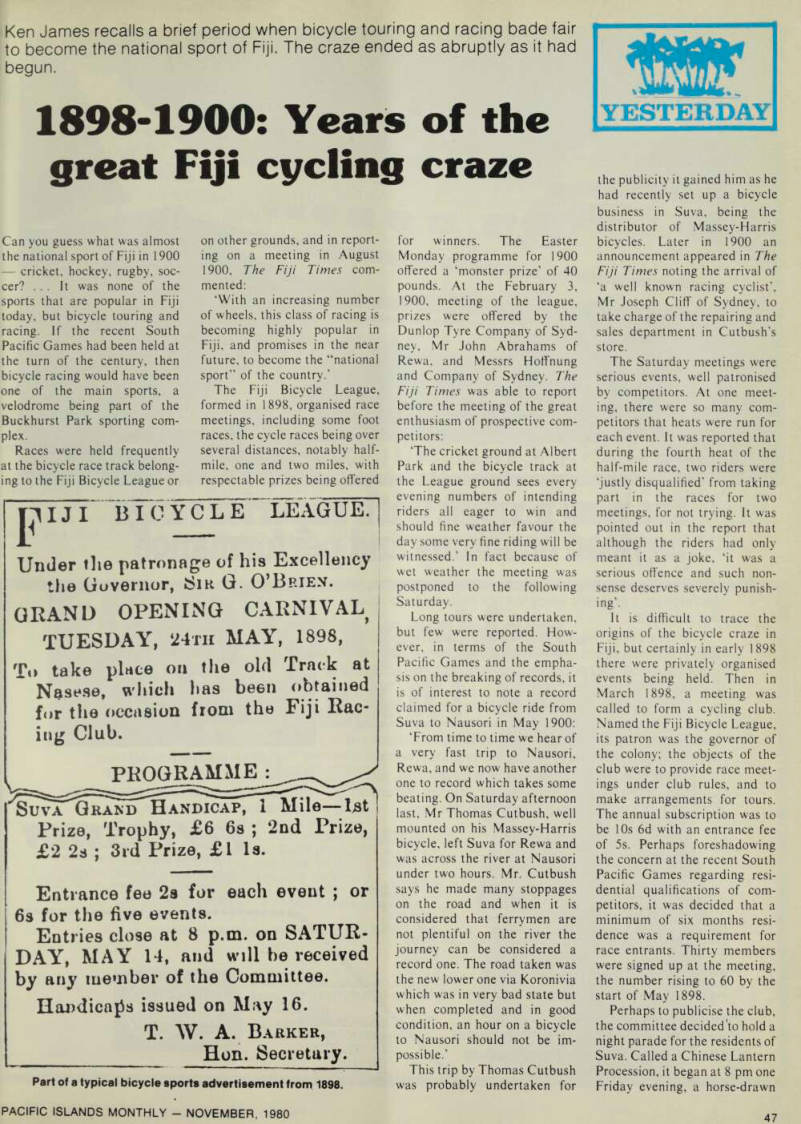


1898-1900: Years of the great Fiji cycling craze
Can you guess what was almost the national sport of Fiji in 1900 cricket, hockey, rugby, soccer? ... It was none of the sports that are popular in Fiji today, but bicycle touring and racing. If the recent South Pacific Games had been held at the turn of the century, then bicycle racing would have been one of the main sports, a velodrome being part of the Buckhurst Park sporting complex.
Races were held frequently at the bicycle race track belonging to the Fiji Bicycle League or
on other grounds, and in report ing on a meeting in August 1900, The Fiji Times com mented: ‘With an increasing number of wheels, this class of racing is becoming highly popular in Fiji, and promises in the near future, to become the “national sport” of the country.’
The Fiji Bicycle League, formed in 1898, organised race meetings, including some foot races, the cycle races being over several distances, notably half mile, one and two miles, with respectable prizes being offered
for winners. The Easter Monday programme for 1900 offered a ‘monster prize’ of 40 pounds. At the February 3, 1900, meeting of the league, prizes were offered by the Dunlop Tyre Company of Syd ney, Mr John Abrahams of Rewa, and Messrs Hoffnung and Company of Sydney. The Fiji Times was able to report before the meeting of the great enthusiasm of prospective com petitors: ‘The cricket ground at Albert Park and the bicycle track at the League ground sees every evening numbers of intending riders all eager to win and should fine weather favour the day some very fine riding will be witnessed.’ In fact because of wet weather the meeting was postponed to the following Saturday.
Long lours were undertaken, but few were reported. How ever, in terms of the South Pacific Games and the empha sis on the breaking of records, it is of interest to note a record claimed for a bicycle ride from Suva to Nausori in May 1900: ‘From time to time we hear of a very fast trip to Nausori, Rewa, and we now have another one to record which takes some beating. On Saturday afternoon last, Mr Thomas Cutbush, well mounted on his Massey-Harris bicycle, left Suva for Rewa and was across the river at Nausori under two hours. Mr. Cutbush says he made many stoppages on the road and when it is considered that ferrymen are not plentiful on the river the journey can be considered a record one. The road taken was the new lower one via Koronivia which was in very bad state but when completed and in good condition, an hour on a bicycle to Nausori should not be im possible.’
This trip by Thomas Cutbush was probably undertaken for
the publicity it gained him as he had recently set up a bicycle business in Suva, being the distributor of Massey-Harris bicycles. Later in 1900 an announcement appeared in The Fiji Times noting the arrival of ‘a well known racing cyclist’, Mr Joseph Cliff of Sydney, to take charge of the repairing and sales department in Cutbush’s store.
The Saturday meetings were serious events, well patronised by competitors. At one meet ing, there were so many com petitors that heats were run for each event. It was reported that during the fourth heat of the half-mile race, two riders were ‘justly disqualified' from taking part in the races for two meetings, for not trying. It was pointed out in the report that although the riders had only meant it as a joke, ‘it was a serious offence and such non sense deserves severely punish ing’.
It is difficult to trace the origins of the bicycle craze in Fiji, but certainly in early 1898 there were privately organised events being held. Then in March 1898, a meeting was called to form a cycling club.
Named the Fiji Bicycle League, its patron was the governor of the colony; the objects of the club were to provide race meet ings under club rules, and to make arrangements for tours.
The annual subscription was to be 10s 6d with an entrance fee of ss. Perhaps foreshadowing the concern at the recent South Pacific Games regarding resi dential qualifications of com petitors, it was decided that a minimum of six months resi dence was a requirement for race entrants. Thirty members were signed up at the meeting, the number rising to 60 by the start of May 1898.
Perhaps to publicise the club, the committee decided to hold a night parade for the residents of Suva. Called a Chinese Lantern Procession, it began at 8 pm one Friday evening, a horse-drawn
Part of a typical bicycle sports advertisement from 1898.
wagon leading the way carrying the Suva Brass Band, while behind came 20 riders on bikes illuminated with Chinese lan
terns. The newspaper report of the occasion claimed the streets were thronged with sightseers and that no one could remem ber seeing such a large crowd in the streets of Suva before. The first meeting of the league was planned for a Saturday in May 1898 at a cycling track at
Nasese, part of a horse racing track. The riders were in structed to wear colours to allow the spectators to dis tinguish between them as there were 30 or more in each of the five events. Other racing after noons were held during the year, one in November being run at the Albert Park cricket ground, ‘the cricket pavilion packed with women and chil dren while many hundreds of the male gender ensconced themselves at all points of vantage’.
Cycling even allowed for the telling of ‘tall stories’. The follow ing account, apparently told by a champion Melbourne rider, William Martin, to a Melbourne paper after a trip to Fiji, led The Fiji Times to comment at the end; ‘William, you “tell it well” ’. ‘lt seems that the great champion was engaged one afternoon giving lessons to one of the dusky beauties without her parents’ consent. While they were thus pleasantly en gaged, the family appeared on the scene, and with the aid of a
few clubs proceeded to make matters very sultry. William was surprised, but seeing how things were decided to “get off the mark” quick and lively, and set out at a 2:10 gait which he soon improved to 2:5 as a few spears and arrows whizzed by.
Bill reckons that he was within an ace of being roasted and his advice to anyone who wishes to give lessons to Fijian ladies is don’t.’
The year 1899 saw more race meetings held, and the league acquired grounds for a cycle track in Renwick Street, monies for its construction be ing raised by the holding of fancy dress balls and other social occasions, by foot and cycle race meetings, at which on one occasion a totalisator was run, raising 200 pounds and by donations from businesses and individuals. The com pletion of the league cycling track saw a large number of meetings held in 1900. After that year it is difficult to find mention of any organised cyc ling activities. Indeed, it was as if the sport had never existed.
The Thomas Cutbush adver tisement which was running in The Fiji Times at the turn of the century.
Advertisements & other items, pp. 48-50 (2 items)
payload economy and performance
■ Hi H 9 M H
the new prqpjetwM superior range
The Conquest is an aeroplane so superior in performance and efficiency it’s not called a turboprop.
But a propjet.
It takes off from a short field and climbs to 33,000 feet in 26 minutes; it cruises at 293 knots; it carries a huge load of 4,293 pounds of passengers and fuel; and it flies farther than many jets.
Even more remarkable, the Conquest propjet
outperforms every turboprop ever built—while using less fuel. Incredibly the Conquest gets six statute miles per gallon. That’s efficiency to rival many piston twins.
Compared to the most popular turboprop, the Conquest climbs faster, flies higher, cruises faster and flies farther.. .while using 30 percent less fuel.
J i B S This aeroplane has set new standards of performance and efficiency If it were anything less, we wouldn’t call it Conquest.
Max. Speed Max. Rec. Cruise Speed Max. Range Max. Usable Fuel Rate of Climb Twin Engine Single Engine Twin Engine Max. Cert. Alt Single Engine Service Ceiling Takeoff Dist. Over 50 ft Obstacle Landing Dist. Over 50 ft Obstacle Max. Ramp Weight Max. Zero Fuel Weight Max. Useful Load Max. Seating Engines .295 knots .293 knots 2,196n.m 475 gals 2.435 fpm 715 fpm 33.000 ft 21,380 ft ..2,465 ft ..1.875 ft 9,9251 b ,B,loolb .4,293 lb ll The Workte Number 1 Business Airline Cessna Central Information Center (P.O. Box 51 , Bankstown, N.S.W. 2200) Telephone 70 0661 V Name.
Position.
Garrett Aißesearch TPE-331 -8-401 S ; 625 hp V Company Pacific Area Representatives:
Noumea-Montagnat Mining, Mr. R. Gutschlag.
Fiji (Suva)-Bums Philp South Sea Company,
V Address.
Mr. A. Jessop.
PLEASE SEND
ME MORE
f INFORMATION P/rnHp
ON THE
CESSNA CONQUEST Wephone
20/PIM
If you’ve got a problem
you can sticKjt!
Quik Stik have a range of hardworking self adhesive products designed to assist you with stock control, filing, product pricing and car decorating.
Stock labels. Retailers’ pricing guns.
Printers packs. Safety tread - adhesive vinyl for slippery areas. Auto accessories - Decrastrip and Pinstripe. Each product designed to do a job and stick to it.
See your nearest Quik Stik stockist.
They’re right throughout the Pacific Islands and South East Asia. Or contact Quik Stik in New Zealand.
If you’ve got a problem, we’ve got a label for it.
Quik Stik International Limited Telex: NZ 21717. P.O. Box 76221, Manukau City, Auckland, New Zealand.
Cable: Quik Stik Auckland. o P 25000
■I It’s no accident that JVC is the Official Supplier of Audio and Video Systems at all major international association football (soccer) finals.
At JVC. we believe in teamwork, too.
The kind of team spirit that gets imaginative engineers and hardheaded designers working together to make the complex easy to use.
That pits production efficiency against finicky quality control, for products that are as reliable as they are cost-reasonable.
And keeps our fans happily on our side of the stadium with a cohesive network of distributors, retailers and service representatives in almost every country of the world.
At JVC, we believe in pooling individual effort towards achieving a worthy common goal: the creation of the most innovative, most satisfying entertainment you've ever had easy access to.
Teamwork has kept us on a winning streak for over 53 years now.
With the famous VHS video cassette system, the world’s first metalcompatible cassette decks, the VHD video disc system and a host of other accomplishments in all aspects of audio and video software and hardware.
That’s how we stay number one in our league.
Because we know that it’s not whether we win or 105 e...
But then, we’d rather win. $1 Audio & Video Systems of the UEFA Cup Finals. *v, Audio & Video Systems of the FIFA World Cup 1982.
Soccer Federation.
Official - j&a << Official I Official \ Audio & Video Systems c Audio 4 Video Systems ▼ ft. Audio & Video I the United States * * of the Australian A of the Gold Cup. ° » Soccer Federation.
JVC
VICTOR COMPANY OF JAPAN, LIMITED
Australia: Hagemeyer (Australasia) BV. 25-27 Paul Street, North Ryde, NSW 2113, Australia Tel 887-1444 Fiji Islands: D Gokal & Co.. Ltd . G PO Box 501. Corner of Pier Street & Renwick Road, Suva, Fiji Tel 25259 Cook Islands: J & P Ingram & Co, Ltd , PO Box 55, Rarotonga. Cook Islands Tel 378457 New Hebrides; Wu ke Luong, P.O Box 113, Rue Higginson, Port-Vila, New Hebrides New Caledonia; Caldis, 2. Route du Velodrome. BP Ml, Noumea, Cedex, New Caledonia Tel. 262350 Tahiti: Magasm Sincere. B.P. 215, Papeete. Tahiti Tel 20060 Papua New Guinea: Hagemeyer (P N G.) Pty, Ltd , P.O. Box9oLae. Papua New Guinea Tel 42-3200 New Zealand: Atlas Majestic Industries Ltd., 11. Albion Road, Otahuhu. Auckland 6.
New Zealand Tel 27-67-099
Yesterday
49
ACIFIC ISLANDS MONTHLY - NOVEMBER, 1980
independent nationhood
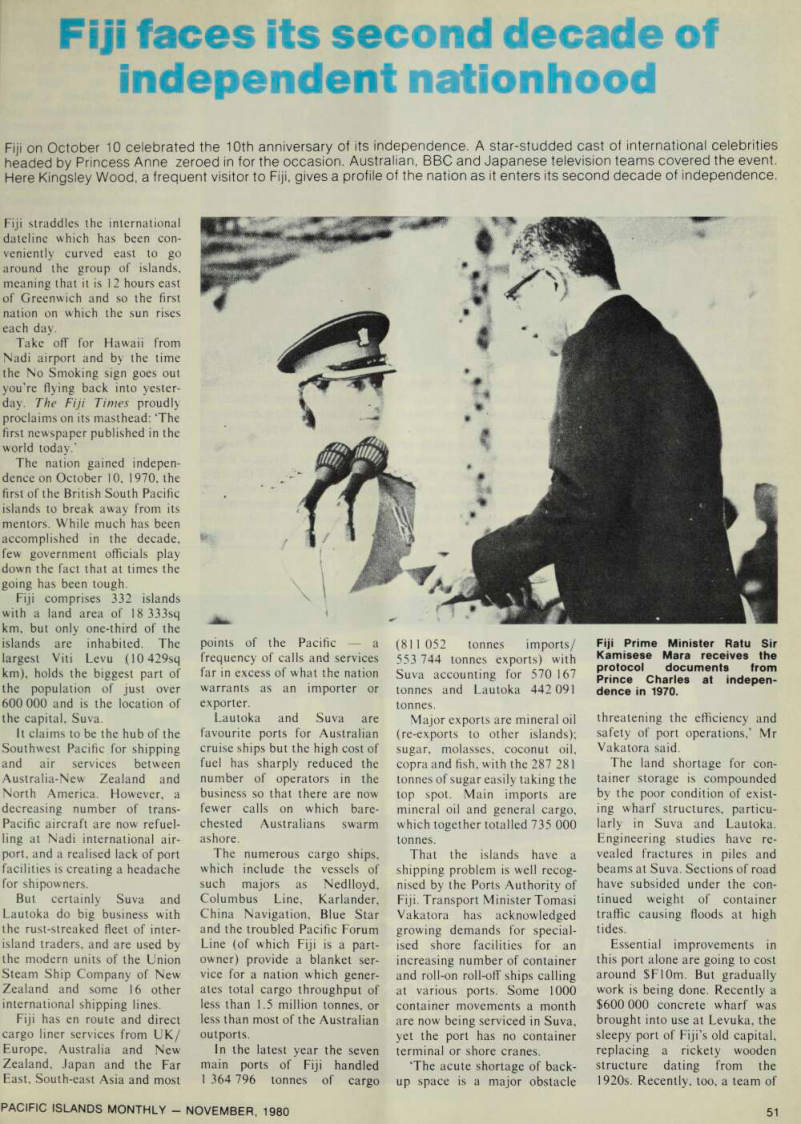

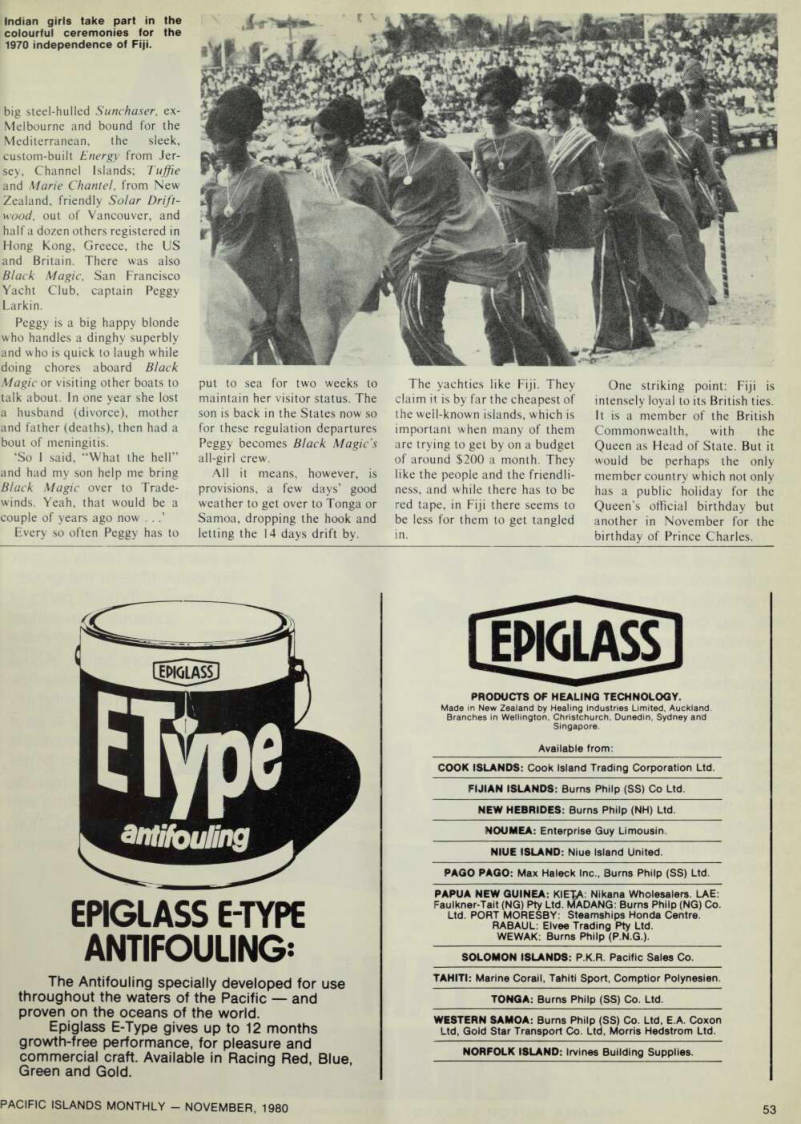
Fiji faces its second decade of independent nationhood
Fiji on October 10 celebrated the 10th anniversary of its independence. A star-studded cast of international celebrities headed by Princess Anne zeroed in for the occasion. Australian, BBC and Japanese television teams covered the event.
Here Kingsley Wood, a frequent visitor to Fiji, gives a profile of the nation as it enters its second decade of independence.
Fiji straddles the international dateline which has been con veniently curved east to go around the group of islands, meaning that it is 12 hours east of Greenwich and so the first nation on which the sun rises each day.
Take off for Hawaii from Nadi airport and by the time the No Smoking sign goes out you’re flying back into yester day. The Fiji Times proudly proclaims on its masthead: ‘The first newspaper published in the world today.’
The nation gained indepen dence on October 10, 1970, the first of the British South Pacific islands to break away from its mentors. While much has been accomplished in the decade, few government officials play down the fact that at times the going has been tough.
Fiji comprises 332 islands with a land area of 18 3335 q km, but only one-third of the islands are inhabited. The largest Viti Levu ,(10 4295 q km), holds the biggest part of the population of just over 600 000 and is the location of the capital, Suva.
It claims to be the hub of the Southwest Pacific for shipping and air services between Australia-New Zealand and North America. However, a decreasing number of trans pacific aircraft are now refuel ling at Nadi international air port, and a realised lack of port facilities is creating a headache for shipowners.
But certainly Suva and Lautoka do big business with the rust-streaked fleet of inter island traders, and are used by the modern units of the Union Steam Ship Company of New Zealand and some 16 other international shipping lines.
Fiji has en route and direct cargo liner services from UK/ Europe, Australia and New Zealand, Japan and the Far East, South-east Asia and most
points of the Pacific a frequency of calls and services far in excess of what the nation warrants as an importer or exporter.
Lautoka and Suva are favourite ports for Australian cruise ships but the high cost of fuel has sharply reduced the number of operators in the business so that there are now fewer calls on which bare chested Australians swarm ashore.
The numerous cargo ships, which include the vessels of such majors as Nedlloyd, Columbus Line, Karlander, China Navigation, Blue Star and the troubled Pacific Forum Line (of which Fiji is a part owner) provide a blanket ser vice for a nation which gener ates total cargo throughput of less than 1.5 million tonnes, or less than most of the Australian outports.
In the latest year the seven main ports of Fiji handled 1 364 796 tonnes of cargo
(811052 tonnes imports/ 553 744 tonnes exports) with Suva accounting for 570 167 tonnes and Lautoka 442 091 tonnes.
Major exports are mineral oil (re-exports to other islands); sugar, molasses, coconut oil, copra and fish, with the 287 281 tonnes of sugar easily taking the top spot. Main imports are mineral oil and general cargo, which together totalled 735 000 tonnes.
That the islands have a shipping problem is well recog nised by the Ports Authority of Fiji. Transport Minister Tomasi Vakatora has acknowledged growing demands for special ised shore facilities for an increasing number of container and roll-on roll-off ships calling at various ports. Some 1000 container movements a month are now being serviced in Suva, yet the port has no container terminal or shore cranes. ‘The acute shortage of back up space is a major obstacle
threatening the efficiency and safety of port operations,’ Mr Vakatora said.
The land shortage for con tainer storage is compounded by the poor condition of exist ing wharf structures, particu larly in Suva and Lautoka.
Engineering studies have re vealed fractures in piles and beams at Suva. Sections of road have subsided under the con tinued weight of container traffic causing floods at high tides.
Essential improvements in this port alone are going to cost around $FlOm. But gradually work is being done. Recently a $6OO 000 concrete wharf was brought into use at Levuka, the sleepy port of Fiji’s old capital, replacing a rickety wooden structure dating from the 19205. Recently, too, a team of
Fiji Prime Minister Ratu Sir Kamisese Mara receives the protocol documents from Prince Charles at indepen dence in 1970.
runs very much on oil fuel, it is going to be hard to hold in check.
Electricity is generated in diesel power stations assisted by some Hydro, but the World Bank in June provided a loan to help the country develop its hydro-electric capacity. By 1983 Fiji hopes to have virtually eliminated its diesel plants with an annual saving of some SUS4.S million at 1979 oil prices.
Racial problems simmer not far below the surface. Indians (50.1%) outnumber Fijians (44.5%). The Indians are the traders and the businessmen and in most places one is to be found close to the cash register.
Japanese consultants reached Suva to look at the port situ ation. From these studies an application could be made to the Asian Development or World Bank for funds to begin an updating programme.
There are other worries in paradise, however. Unemploy ment has reached around 9000 with no government handouts, and with rising wages jobs are becoming increasingly hard to find. The inflation rate is now some 11.1% compared with the previous 7.7% and, because Fiji
The Fijian tends to be the labourer road worker, farmer, canecutter, fisherman and so on and while officials insist that the two races are learning to live together it is obvious that barriers have still to be broken down.
In round figures, Fiji has total exports worth sl7sm, imports of s3lom and a trade deficit of slsom. The Govern ment of Ratu Sir Kamisese Mara is heavily dependent on overseas investment and is mak ing conditions as attractive as possible for new industries.
Tourism remains the big money-spinner but the number of visitors has been gradually tapering off. Worried officials put this down to the fact that cheap air fares have made the longer hauls more attractive to holiday-makers, but they are making determined efforts to bring back the customers.
It is to be hoped they are successful for these are smiling, friendly people living in a land where it is doubtful if they have yet found names for all the flowers that bloom everywhere in profusion.
Suva is busy, full of colour
and noise, and a town that is rapidly changing its face as new buildings replace old. There are modern shops of much the same style as are found in Wellington, Sydney or Mel bourne. Supermarkets are largely controlled by island traders Burns Philp, Morris Hedstrom and its parent, W R Carpenter (it’s hard to escape Carpenters in Fiji) where prices are on par with Australia and the checkout girls no less efficient or impersonal.
The big tourist hotels are mainly along the Coral Coast or out of town the luxurious Beachcomber at Pacific Har bour or, not quite so far, Tradewinds, known to every cruising yachtsman in the South Pacific.
Tradewinds is said to be the only hotel in the world where a crew can moor the biggest yacht to the verandah, jump over the rail and order a beer at the bar. It is built on the brink of deep water at the postcard Bay of Islands, about Bkm out of town, and is a rendezvous for cruising yachts from most parts. Tied up when this writer booked in yet again were the
Prince Charles meets school children when he represented the Queen in Fiji for indepen dence in 1970.
big steel-hulled Sunchaser, ex- Melbourne and bound for the Mediterranean, the sleek, custom-built Energy from Jer sey, Channel Islands; Tuffie and Marie Chantel, from New Zealand, friendly Solar Drift wood, out of Vancouver, and half a dozen others registered in Hong Kong, Greece, the US and Britain. There was also Black Magic, San Francisco Yacht Club, captain Peggy Larkin.
Peggy is a big happy blonde who handles a dinghy superbly and who is quick to laugh while doing chores aboard Black Magic or visiting other boats to talk about. In one year she lost a husband (divorce), mother and father (deaths), then had a bout of meningitis. ‘So 1 said, “What the hell’’ and had my son help me bring Black Magic over to Trade winds. Yeah, that would be a couple of years ago now . ..’
Every so often Peggy has to
put to sea for two weeks to maintain her visitor status. The son is back in the States now so for these regulation departures Peggy becomes Black Magic’s all-girl crew.
All it means, however, is provisions, a few days’ good weather to get over to Tonga or Samoa, dropping the hook and letting the 14 days drift by.
The yachties like Fiji. They claim it is by far the cheapest of the well-known islands, which is important when many of them are trying to get by on a budget of around $2OO a month. They like the people and the friendli ness, and while there has to be red tape, in Fiji there seems to be less for them to get tangled in.
One striking point: Fiji is intensely loyal to its British ties.
It is a member of the British Commonwealth, with the Queen as Head of State. But it would be perhaps the only member country which not only has a public holiday for the Queen’s official birthday but another in November for the birthday of Prince Charles.
Indian girls take part in the colourful ceremonies for the 1970 independence of Fiji.
Advertisements & other items, pp. 52-54 (1 item)
Epmlass
MARINE TECHNOLOGY.
Products developed in the laboratory, proven on the water ...
Cepwlass]
PRODUCTS OF HEALING TECHNOLOGY.
Made in New Zealand by Healing Industries Limited, Auckland.
Branches in Wellington, Christchurch, Dunedin, Sydney and Singapore.
Available from: COOK ISLANDS: Cook Island Trading Corporation Ltd.
FIJIAN ISLANDS: Burns Philp (SS) Co Ltd.
NEW HEBRIDES: Burns Philp (NH) Ltd.
NOUMEA: Enterprise Guy Limousin.
NIUE ISLAND: Niue Island United.
PAGO PAGO: Max Haleck Inc., Burns Philp (SS) Ltd.
PAPUA NEW GUINEA: KIETA; Nikana Wholesalers. LAE; Faulkner-Tait (NG) Pty Ltd. MADANG: Burns Philp (NG) Co.
Ltd. PORT MORESBY; Steamships Honda Centre.
RABAUL; Elvee Trading Pty Ltd.
WEWAK: Burns Philp (P.N.G.).
SOLOMON ISLANDS: P.K.R. Pacific Sales Co.
TAHITI: Marine Corail, Tahiti Sport, Comptior Polynesien.
TONGA: Burns Philp (SS) Co. Ltd.
WESTERN SAMOA: Burns Philp (SS) Co. Ltd. E.A. Coxon Ltd, Gold Star Transport Co. Ltd, Morris Hedstrom Ltd.
NORFOLK ISLAND: Irvines Building Supplies.
[EPIOLASSJ
i I
ontifouling
EPIGLASS E-TYPE
ANTIFOULING:
The Antifouling specially developed for use throughout the waters of the Pacific and proven on the oceans of the world.
Epiglass E-Type gives up to 12 months growth-free performance, for pleasure and commercial craft. Available in Racing Red, Blue, Green and Gold.
YAMAHA
LISTENS
the whole concept of two-wheeled transportation.
Called “mopeds” by some, “soft bikes” or “town bikes” by others, these peppy little two-strokes squeeze 40 kilometers out of a liter of gas. m * ... 1 ? m <r 5 Even before the oil crisis, Yamaha was listening to demands for personal-size bikes.
Ones that would be easy to ride, start and steer. The kind that would attract a new class of riders. In short, sort of an economical alternative to the car for tripping around town.
The eventual result, based on thousands of interviews with urbanites from Paris to Perth, has changed At the same time, they’re quick and comfortable enough to zip in and out of heavy traffic all day long.
With a “step through” frame, automatic transmission and simplified control, they’re as easy to handle as a bicycle.
And every bit as handy to park.
For quick trips to the grocer, excursions through parks or commuting to school or office, they make more sense. And a lot more fun.
Yamaha mopeds, another answer from the people who listen better to make lifestyles more exciting and living more convenient. as
YAMAHA
YAMAHA MOTOR CO., LTD. 2500 shingai iwata-shi shizuoka ken japan
Travel
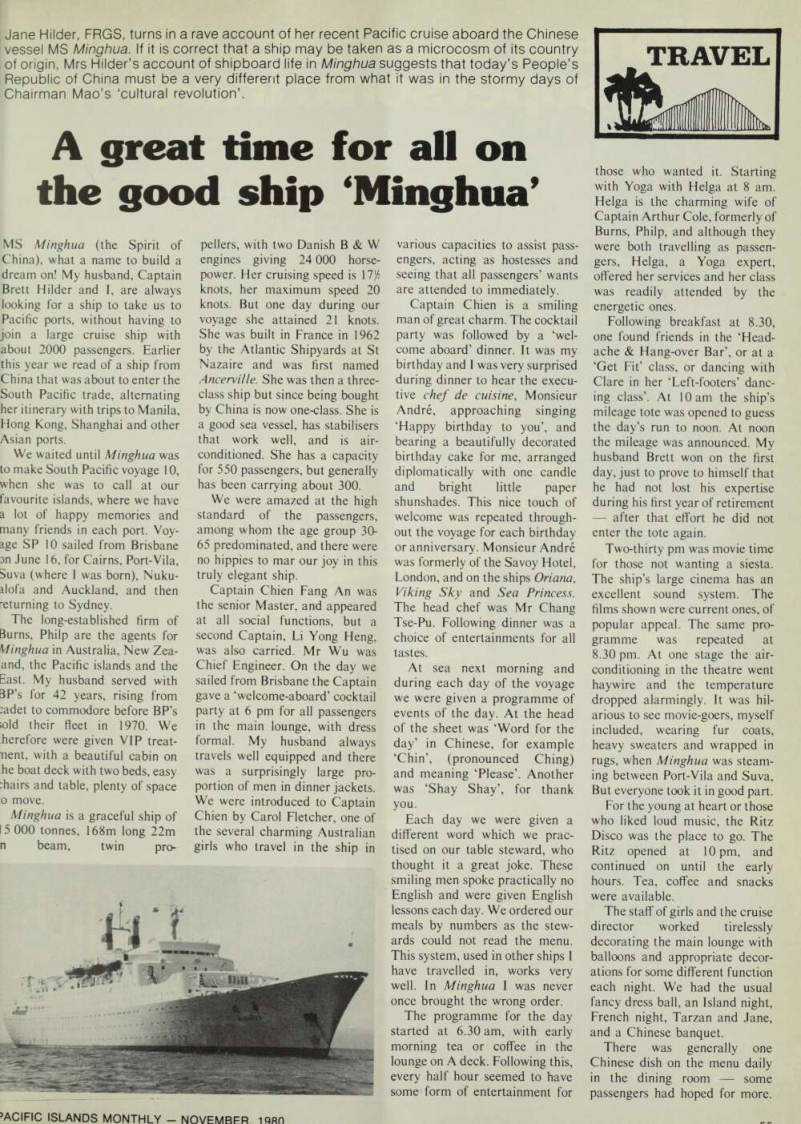
Jane Milder, FRGS, turns in a rave account of her recent Pacific cruise aboard the Chinese vessel MS Minghua. If it is correct that a ship may be taken as a microcosm of its country of origin, Mrs Hilder’s account of shipboard life in Minghua suggests that today’s People’s Republic of China must be a very different place from what it was in the stormy days of Chairman Mao’s ‘cultural revolution’.
the good ship ‘Minghua’


A great time for all on the good ship ‘Minghua’
MS Minghua (the Spirit of China), what a name to build a dream on! My husband, Captain Brett Hilder and I, are always looking for a ship to take us to Pacific ports, without having to join a large cruise ship with about 2000 passengers. Earlier this year we read of a ship from China that was about to enter the South Pacific trade, alternating her itinerary with trips to Manila, Hong Kong, Shanghai and other Asian ports.
We waited until Minghua was to make South Pacific voyage 10, when she was to call at our favourite islands, where we have a lot of happy memories and many friends in each port. Voy age SP 10 sailed from Brisbane an June 16, for Cairns, Port-Vila, Suva (where I was born), Nuku alofa and Auckland, and then
returning to Sydney.
The long-established firm of Burns, Philp are the agents for Minghua in Australia, New Zea and, the Pacific islands and the East. My husband served with BP’s for 42 years, rising from ;adet to commodore before BP’s ;old their fleet in 1970. We herefore were given VIP treat nent, with a beautiful cabin on he boat deck with two beds, easy :hairs and table, plenty of space o move.
Minghua is a graceful ship of 15 000 tonnes, 168 m long 22m n beam, twin pro
pellers, with two Danish B & W engines giving 24 000 horse power. Her cruising speed is 17 'fi knots, her maximum speed 20 knots. But one day during our voyage she attained 21 knots.
She was built in France in 1962 by the Atlantic Shipyards at St Nazaire and was first named Ancerville. She was then a three class ship but since being bought by China is now one-class. She is a good sea vessel, has stabilisers that work well, and is air conditioned. She has a capacity for 550 passengers, but generally has been carrying about 300.
We were amazed at the high standard of the passengers, among whom the age group 30- 65 predominated, and there were no hippies to mar our joy in this truly elegant ship.
Captain Chien Fang An was the senior Master, and appeared at all social functions, but a second Captain, Li Yong Heng, was also carried. Mr Wu was Chief Engineer. On the day we sailed from Brisbane the Captain gave a ‘welcome-aboard’ cocktail party at 6 pm for all passengers in the main lounge, with dress formal. My husband always travels well equipped and there was a surprisingly large pro portion of men in dinner jackets.
We were introduced to Captain Chien by Carol Fletcher, one of the several charming Australian girls who travel in the ship in
various capacities to assist pass engers, acting as hostesses and seeing that all passengers’ wants are attended to immediately.
Captain Chien is a smiling man of great charm. The cocktail party was followed by a ‘wel come aboard’ dinner. It was my birthday and I was very surprised during dinner to hear the execu tive chef de cuisine , Monsieur Andre, approaching singing ‘Happy birthday to you’, and bearing a beautifully decorated birthday cake for me, arranged diplomatically with one candle and bright little paper shunshades. This nice touch of welcome was repeated through out the voyage for each birthday or anniversary. Monsieur Andre was formerly of the Savoy Hotel, London, and on the ships Oriana, Viking Sky and Sea Princess.
The head chef was Mr Chang Tse-Pu. Following dinner was a choice of entertainments for all tastes.
At sea next morning and during each day of the voyage we were given a programme of events of the day. At the head of the sheet was ‘Word for the day’ in Chinese, for example ‘Chin’, (pronounced Ching) and meaning ‘Please’. Another was ‘Shay Shay’, for thank you.
Each day we were given a different word which we prac tised on our table steward, who thought it a great joke. These smiling men spoke practically no English and were given English lessons each day. We ordered our meals by numbers as the stew ards could not read the menu.
This system, used in other ships I have travelled in, works very well. In Minghua I was never once brought the wrong order.
The programme for the day started at 6.30 am, with early morning tea or coffee in the lounge on A deck. Following this, every half hour seemed to have some form of entertainment for
those who wanted it. Starting with Yoga with Helga at 8 am.
Helga is the charming wife of Captain Arthur Cole, formerly of Burns, Philp, and although they were both travelling as passen gers, Helga, a Yoga expert, offered her services and her class was readily attended by the energetic ones.
Following breakfast at 8.30, one found friends in the ‘Head ache & Hang-over Bar’, or at a ‘Get Fit’ class, or dancing with Clare in her ‘Left-footers’ danc ing class’. At 10 am the ship’s mileage tote was opened to guess the day’s run to noon. At noon the mileage was announced. My husband Brett won on the first day, just to prove to himself that he had not lost his expertise during his first year of retirement - after that effort he did not enter the tote again.
Two-thirty pm was movie time for those not wanting a siesta.
The ship’s large cinema has an excellent sound system. The films shown were current ones, of popular appeal. The same pro gramme was repeated at 8.30 pm. At one stage the air conditioning in the theatre went haywire and the temperature dropped alarmingly. It was hil arious to see movie-goers, myself included, wearing fur coats, heavy sweaters and wrapped in rugs, when Minghua was steam ing between Port-Vila and Suva, But everyone took it in good part.
For the young at heart or those who liked loud music, the Ritz Disco was the place to go. The Ritz opened at 10 pm, and continued on until the early hours. Tea, coffee and snacks were available.
The staff of girls and the cruise director worked tirelessly decorating the main lounge with balloons and appropriate decor ations for some different function each night. We had the usual fancy dress ball, an Island night, French night, Tarzan and Jane, and a Chinese banquet.
There was generally one Chinese dish on the menu daily in the dining room some passengers had hoped for more.
The food was of good quality and nicely served.
Captain Chien was proud to show the passengers over the bridge of his ship. Two days after leaving Cairns it was announced that passengers could go to the bridge in order those from decks D & C first, then decks B & A, and finally promenade; and boat decks. We were therefore the last party to arrive, and although Captain Chien had been talking all morning, he had lost none of his enthusiasm when our party arrived. Minghua is equipped with the most modern satellite navigator, but the officers were also using the traditional sextants for naviga tion. The captain will not use the automatic pilot, but keeps a man at the helm at all times, insisting that automatic equipment can go wrong, however modern it may be. My husband heartily agreed.
TTie satellite navigator is a big black box which prints out the ihip’s position, course and speed it every second of GMT.
Captain Chien graduated Yom Dairen Nautical College in 1953, and spent four years on
the China coast. He then served on the England-Europe run, and now speaks about half a dozen languages fluently, including German and Polish.
Captain Chien has been Mas ter of Minghua since August 1979, when the ship was in Hong Kong for a refit and big engine overhaul.
The sea during the whole cruise was remarkably calm, except when leaving Auckland, the last port before Sydney.
Minghua changed course to avoid a low coming across from Tasmania, but the wind force reached 8, and the sea was rough.
Next morning at breakfast many passengers were conspicuous by their absence. Halfway through breakfast they began appearing, and I was intrigued to notice that they all had about half an inch of adhesive tape stuck behind each ear. I could not contain my interest, and on asking was told that one of the ship’s Chinese doctors had stuck it on for them, assuring them that it was an age old Chinese cure for sea-sickness.
After watching the former ailing ones settling down to a hearty
breakfast, 1 feel that this simple remedy probably works.
The solo entertainers aboard Minghua were people known
internationally. Commencing
with Edith Dahl, comedienne, billed as ‘the Wackiest Dame in Show Business’. This statuesque blonde with peaches-and-cream complexion made no secret that she had been born at Seattle in 1904. Passengers found this hard to believe when she was dressed in a beautifully beaded gown slit to the thigh.
Edwin Duff, with his spendid voice, entertained the passengers with popular songs with hardly a break. Born in Dundee, Scotland, as a baby he accompanied his mother to the theatre where she worked daily. Edwin told me that the theatre was his ‘baby-sitter’.
Jose Daroya, arranger and composer is a gentle Filipino who charmed the passengers with his playing on the electric organ in the cocktail lounge before and after dinner.
The Total Entertainer was Clare Thomas, ‘the girl with the roving mike’. All passengers en joyed her singing as she has that
certain style which goes over well with all age groups. Dancing around the floor with her mike she encouraged the audience to sing along with her. At times she appeared to be in her twenties, but she proudly assured us that she was a grandmother. Clare was a good performer and was always beautifully gowned. She taught the ‘Left-footers’ danc ing class daily at 11 am, and many men and women finished the trip much better dancers, thanks to Clare’s classes.
Last but by no means least was Mario Malaga, a teenager who played the grand piano in the main lounge. I am sure this young man will soon be heard on the leading concert platforms of the world. One passenger, a music teacher, said of Mario: ‘This boy is one pianist in ten million; he has an extraordinary gift’, and we heartily agreed.
Now that the new Minghua brochure is printed, my husband and I are trying to decide which trip we will do next, as from now on Minghua , with her smiling captain, officers and crew, will definitely be our ship.
Advertisements & other items, pp. 55-58 (4 items)
Acific Islands Monthly - Novemrfr Iqro
55
Ihrin9J
Pioneer launches a first
in supersonic travel
In this fast-paced world of bullet trains and Concorde jetliners, to stay in touch . with your favorite stereo music you need SOUNDTREK. Pioneer’s new supersonic fleet of Multi-Mode Mobile Hi-Fi. * • •'. For added tape-handling ease ahd pushbutton program selection, Pioneer *. offers Multi-Mode Deck design in every SOUNDTREK stereo portable. For exampje, ’ there’s Song Finder.™ With it you cah skip over unwanted program material, locate and.play your favorite song at the push of a button. A feature you would expect to find on a home hi-fi cassette deck. But wait till you hear the sound of our SOUNDTREK portables. When you do, you’ll know why We call them “Mobile Hi-Fi.”
Explore the outer reaches of Stereo listening enjoyment with SOUNDTREK ‘ Multi-Mode Mobile Hi-Fi from Pioneer. They’re available in six models,-all featuring Pioneer performance and supersonic sound to get you off the ground. .
SK-21F
«-5 I
OS* v".T.7
SK-95F
A. i.
IHRIN9J
JimQL 1
For further information, please contact: Nauru Island: Jacob Enterprises, P.O. Box No. 4, Republic of Nauru Marketi " 9 ’ SerVlCe ny LW ■ Pb B ° X 317 ' Mo,dia,,oC ’ ViC,oria - 3195 New Caledon KSSSSKS 8 |l,e 2 rtc||amo, : TOC Corporation, P.O. Box 1477, Pago Pago, American Norfol^lsCmrifßurns PhHn (Norfolk Island) Ltd.. Norfolk Island, South Pacific Raro»onga:SouthSeaslnternationalLtd.,PO.Box49.Rarotonga .CocMtmi
In the home
SPEED-E-GAS
is fast, efficient
and reliable.
Terminals throughout the Pacific.
For more information write Boral Gas Limited, 221 Miller Street, North Sydney 2060 *Speed-E-Gas is known in Papua New Guinea, as Guinea Gas. In Tonga as Tonga Speed-E-Gas, and in Fiji as Fiji Gas.
BORAL
SPEED-E-GAS
n w ; Speed-E-Gas stove is available from Speed-E-Gas dealers throughout the Pacific.
HOLT T8L363
GET THE INSIDE STORY
In a series of inside views by Pacific people, the most recent book produced by the University of the South Pacific’s Institute of Pacific Studies is:
VANUATU
which Father Walter Uni requested the University to produce as one contribution towards the recent independence celebration of the former New Hebrides with chapters by 20 local authors (including Prime Minister Walter Lini, President George Kalkoa and leaders in politics, commerce, women’s affairs etc.), it describes in three languages the past development of this new nation and the future hopes of its people. Price AS7.50 plus surface postage and packing $2.00 (hard cover, 281 pages).
Other recent publications by Pacific writers include: Art in the New Pacific by Vilsoni Tausie F$2.00 or AS3.00.
The Celebration; Collection of Short Stories by Raymond Pillai Pillai F$1.00.
Politics in Kiribati by leremia Tabai et. al F$3.00.
His Majesty King Taufa’ahau Tupou IV of the Kingdom of Tonga by Amanaki Taulahi F$2.00 and the latest edition of Mana a South Pacific Journal of Language and Literature: Solomon Islands Issue F$3.00 All plus $2.00 per order postage and handling.
A complete publications catalogue (nearly 100 titles — almost all by Pacific islanders) and order forms are available free of charge from the Institute of Pacific Studies, University of the South Pacific, P.0. Box 1168, Suva, Fiji.
All prices are in Fijian or Australian dollars For U.S. or New Zealand dollars, add twenty per cent.
VM Aquila water tanks completely enclosed to ensure clean water and built to last from strong, durable galvanised steel You assemble them yourself from our comprehensive kits. Capacities range from 2300 litres to 49250 litres.
Send for a brochure today.
Aquila Engineering Division, 25 Pacific Highway, Bennetts Green, New South Wales, Australia.
Name Address P/code
AQUILA
IN OUR 86th YEARSELLING ‘SERVICE
TO THE PACIFIC ISLANDS
FOR;
Nelson & Robertson
PTY.LTD. (Established 1895)
Plantation House, 197 Clarence Street, Sydney
Cables: ‘IVAN 1 , Sydney, Brisbane. Telex: AA22381, Sydney.
INDENTS - FROM AUSTRALIA, NEW ZEALAND and OVERSEAS FOODSTUFFS • SOFTGOODS • HARDWARE • MACHINERY TRAVEL • INSURANCE • CANNED FISH • JUTE GOODS
• REAL ESTATE •
BRANCH OFFICES:
PAPUA NEW GUINEA
REPRESENTATIVES:
Nelson & Robertson Pty. Ltd., P.O. Box 575, Brisbane, Qld., Australia.
P.O. Box 2092, Govt. Bldg., Suva, Fiji.
P.O. Box 258, Lautoka, Fiji.
P.O. Box 2420, CPO Auckland 1, New Zealand.
Rabtrad Nuigini Pty. Ltd., P.O. Box 219, Rabaul, P.N.G.
P.O. Box 1406, Lae, P.N.G.
P.O. Box 711, Madang, P.N.G P.O. Box 253, Kieta, P.N.G.
Travel
57
ACIFIC ISLANDS MONTHLY NOVEMBER 1980
58
PAOIFIO ISI AMDS MONTHLY NOVEMBER, 1980
Islands
From the
Press
: rom a commentary in The Times of Papua New
Guinea, written by university lecturer Polonhou
’okawin who is a regular contributor ‘olitical parties in Papua New Guinea are important not because hey are well organised and encompass the masses, but because hey are poorly organised. They have no mass support and yet they etermine the fate of the government and the people.. . . They ave become the resting place for national politicians in their earch for greener political pastures. he Fiji Times, Suva, Fiji l classical music fan, listening recently to Radio Fiji’s Classic Half lour, heard the Rhenish Symphony announced. The broadcaster lid three of the four movements would be played the first amposed by Mr Allegro, the second by Mr Scherzo and the third y Mr Schnell. larianas Variety News and Views, Saipan, Mariana (lands he governor’s information officer said she had to cancel her ibscription to the Pacific Daily News last week because her office Des not have the money. Now she borrows the paper delivered to le legislative affairs section, with which she shares office space, to id out which of her press releases have been published. he Observer, Apia, Western Samoa uestions are being asked round town this week following reports at the Prime Minister (of Western Samoa), Tupuola Efi, on his ay from New Zealand to the Commonwealth conference in New elhi, travelled in the cheap economy class section, whereas ‘his iend’ Mr Robert Muldoon, Prime Minister of New Zealand, was ting up there in the first class section of the same flight. after from a reader, published in the Papua New uinea Times-Courier, Port Moresby, PNG hink far too many women and girls spend far too much time and oney in the pursuit of looking pretty. All most of them need is a itable haircut or style and just a touch of makeup to make the ost of what they have. All the rest makes them look like painted ills. They may as well wear a mask and a wig. ’om the Pago Pago Times, Pago Pago, American amoa ie damages action stems from an incident in which a reserve lice officer allegedly beat a man into a state of unconsciousness th a typewriter and a glass dish.
From the Seen and Heard column, The Nauru Post, Nauru Rarely heard, one Solomon Islander conversing in his own language to a Tuvaluan who was replying in his own language and the conversation holding good.
From a news sheet calling itself Rabaul’s Only Sunday Paper, published by Witika the Wampire in Rabaul, Papua New Guinea Vulcan Concrete are amalgamating with the town’s dental clinic.
Feeling sorry for our dentists who have no amalgam and no high speed drills they have supplied cement for fillings. At last reports, Bougainville Copper are sending up a mining drill to assist with dental repair work.
From a letter to the editor in the News Drum, Honiara, Solomon Islands, from two drinkers who found a beer bottle with two labels on it Both of us have been average drinkers for nearly 16 years but have never found a bottle like this before. If nobody has ever found a bottle like this before, then maybe we are the lucky ones to find this first in the ministry of liquor drinking.
From a court report in Tohi Tala Niue, Alofi, Niue Island, describing the jailing of a 23-year-old clerk for theft In his own defence he pointed out that he had only committed the crimes to complete the practical side of a course to become a private detective. He said he committed the crimes so he would know how criminals work and how they avoid detection. He assured the court they would never see him again as he was now a qualified private detective.
From an editorial headed Crawl Before You Walk in the Samoa Times, Apia, Western Samoa Prior to and shortly after independence, localisation was the rallying cry of the just-freed nation... . The leaders hurriedly placed the available local talent in positions previously held to be too responsible for them. That policy was misguided and the country has paid and is still paying for that mistake now... .
Pushing people too quickly into positions of responsibility is far more harmful in the long run than delaying doing so for the sake of preparation.
And an editorial comment, related to the same subject, appearing in the Papua New Guinea Post- Courier, Port Moresby, PNG The special minister for state, Mr Aparima, says no real localisation has occurred in the public service since self government. . . . Localisation is important, but more so performance. It is to be hoped the minister’s determination to shake up the public service results also in an injection of hard work into the bloated beast and a trimming of its fat.
Onlooker’s weekly column Here and There in the Fiji Times, Suva, Fiji We hear that disaster struck the first Worm Derby held in aid of the town’s library at Remuera, New Zealand. Almost a third of the 50 competitors died and several others pulled up seriously ill, overcome by the strain of the race. Wiggly Worm won, but hot favourite Tom Worm played up at the start and broke in half.
However, most of him went on to finish second.
Advertisements & other items, pp. 59-60 (2 items)
59
CIFIC ISLANDS MONTHLY NOVEMBER, 1980
People Often Say That
WE’RE ALL NUTS AT ETA...
ETA
But you know that’s crazy! Just consider how many of our products are household names and market leaders.
Judge for yourself
and find out all about us and our products. You’ll be pleased at how
competitive
we 3TG- Garlic Onion
POTATO SAWD
ETA
ETA
T artaff ICf 1004 Smokehouse
I MONK
m:
SALAD K
dressin!
PRAISE
POIYUNSATURATED
COLESLA
DRESSING
g*
Conference looks at petroleum
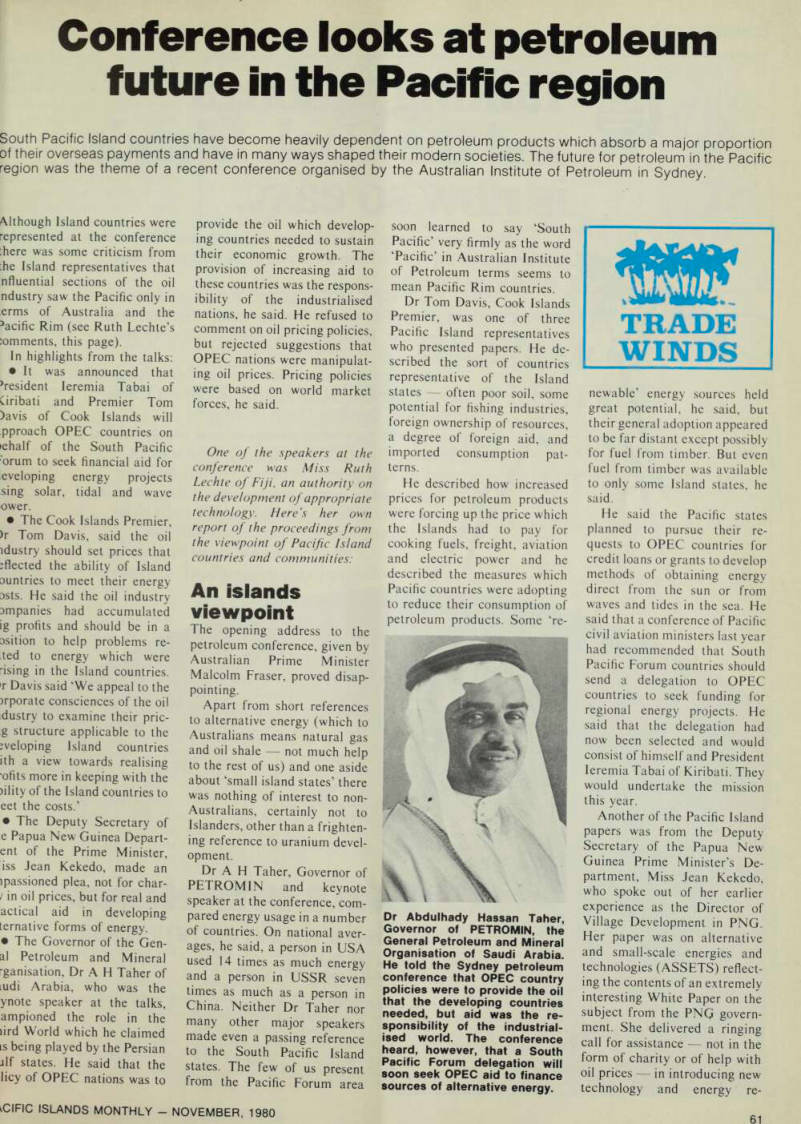
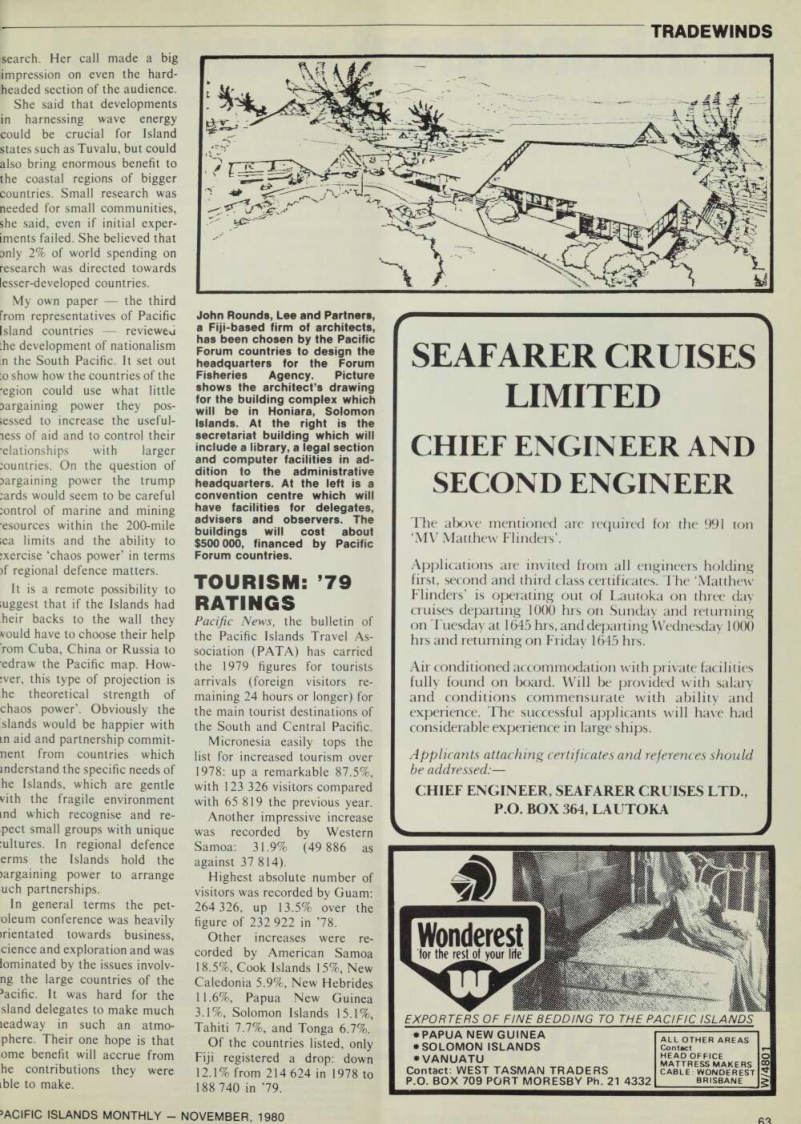
Trade
Winds
Conference looks at petroleum future in the Pacific region
South Pacific Island countries have become heavily dependent on petroleum products which absorb a major proportion }f their overseas payments and have in many ways shaped their modern societies. The future for petroleum in the Pacific egion was the theme of a recent conference organised by the Australian Institute of Petroleum in Sydney.
Although Island countries were represented at the conference ;here was some criticism from ;he Island representatives that nfluential sections of the oil ndustry saw the Pacific only in erms of Australia and the s acific Rim (see Ruth Lechte’s :omments, this page).
In highlights from the talks; • It was announced that Resident leremia Tabai of Kiribati and Premier Tom )avis of Cook Islands will pproach OPEC countries on •ehalf of the South Pacific : orum to seek financial aid for eveloping energy projects sing solar, tidal and wave ower. • The Cook Islands Premier, )r Tom Davis, said the oil idustry should set prices that the ability of Island auntries to meet their energy asts. He said the oil industry ampanies had accumulated ig profits and should be in a asition to help problems re- Jed to energy which were dsing in the Island countries, r Davis said ‘We appeal to the )rporate consciences of the oil dustry to examine their pric g structure applicable to the eveloping Island countries ith a view towards realising •ofits more in keeping with the )ility of the Island countries to eet the costs.’ • The Deputy Secretary of e Papua New Guinea Depart ent of the Prime Minister, iss Jean Kekedo, made an ipassioned plea, not for char f in oil prices, but for real and actical aid in developing ternative forms of energy. • The Governor of the Gen al Petroleum and Mineral ■ganisation, Dr A H Taher of iudi Arabia, who was the ynote speaker at the talks, ampioned the role in the urd World which he claimed is being played by the Persian ilf states. He said that the licy of OPEC nations was to
provide the oil which develop ing countries needed to sustain their economic growth. The provision of increasing aid to these countries was the respons ibility of the industrialised nations, he said. He refused to comment on oil pricing policies, but rejected suggestions that OPEC nations were manipulat ing oil prices. Pricing policies were based on world market forces, he said.
One of the speakers at the conference was Miss Ruth Lechte of Fiji, an authority on the development of appropriate technology. Here’s her own report of the proceedings from the viewpoint of Pacific Island countries and communities:
An islands
viewpoint
The opening address to the petroleum conference, given by Australian Prime Minister Malcolm Fraser, proved disap pointing.
Apart from short references to alternative energy (which to Australians means natural gas and oil shale not much help to the rest of us) and one aside about ‘small island states’ there was nothing of interest to non- Australians, certainly not to Islanders, other than a frighten ing reference to uranium devel opment.
Dr A H Taher, Governor of PETROMIN and keynote speaker at the conference, com pared energy usage in a number of countries. On national aver ages, he said, a person in USA used 14 times as much energy and a person in USSR seven times as much as a person in China. Neither Dr Taher nor many other major speakers made even a passing reference to the South Pacific Island states. The few of us present from the Pacific Forum area
soon learned to say ‘South Pacific’ very firmly as the word ‘Pacific’ in Australian Institute of Petroleum terms seems to mean Pacific Rim countries.
Dr Tom Davis, Cook Islands Premier, was one of three Pacific Island representatives who presented papers. He de scribed the sort of countries representative of the Island states often poor soil, some potential for fishing industries, foreign ownership of resources, a degree of foreign aid, and imported consumption pat terns.
He described how increased prices for petroleum products were forcing up the price which the Islands had to pay for cooking fuels, freight, aviation and electric power and he described the measures which Pacific countries were adopting to reduce their consumption of petroleum products. Some Te-
newable’ energy sources held great potential, he said, but their general adoption appeared to be far distant except possibly for fuel from timber. But even fuel from timber was available to only some Island states, he said.
He said the Pacific states planned to pursue their re quests to OPEC countries for credit loans or grants to develop methods of obtaining energy direct from the sun or from waves and tides in the sea. He said that a conference of Pacific civil aviation ministers last year had recommended that South Pacific Forum countries should send a delegation to OPEC countries to seek funding for regional energy projects. He said that the delegation had now been selected and would consist of himself and President leremia Tabai of Kiribati. They would undertake the mission this year.
Another of the Pacific Island papers was from the Deputy Secretary of the Papua New Guinea Prime Minister’s De partment, Miss Jean Kekedo, who spoke out of her earlier experience as the Director of Village Development in PNG.
Her paper was on alternative and small-scale energies and technologies (ASSETS) reflect ing the contents of an extremely interesting White Paper on the subject from the PNG govern ment. She delivered a ringing call for assistance not in the form of charity or of help with oil prices in introducing new technology and energy re
Dr Abdulhady Hassan Taher, Governor of PETROMIN, the General Petroleum and Mineral Organisation of Saudi Arabia.
He told the Sydney petroleum conference that OPEC country policies were to provide the oil that the developing countries needed, but aid was the re sponsibility of the industrial ised world. The conference heard, however, that a South Pacific Forum delegation will soon seek OPEC aid to finance sources of alternative energy.
search. Her call made a big impression on even the hard headed section of the audience.
She said that developments in harnessing wave energy could be crucial for Island states such as Tuvalu, but could also bring enormous benefit to the coastal regions of bigger countries. Small research was needed for small communities, she said, even if initial exper iments failed. She believed that Dnly 2% of world spending on research was directed towards lesser-developed countries.
My own paper the third from representatives of Pacific Island countries reviewed the development of nationalism n the South Pacific. It set out :o show how the countries of the ■egion could use what little bargaining power they pos jessed to increase the useful tess of aid and to control their ■elationships with larger countries. On the question of bargaining power the trump :ards would seem to be careful control of marine and mining ■esources within the 200-mile lea limits and the ability to jxercise ‘chaos power’ in terms )f regional defence matters.
It is a remote possibility to ;uggest that if the Islands had heir backs to the wall they vould have to choose their help Vom Cuba, China or Russia to edraw the Pacific map. How ever, this type of projection is he theoretical strength of
chaos power’. Obviously the
slands would be happier with in aid and partnership commit nent from countries which mderstand the specific needs of he Islands, which are gentle vith the fragile environment md which recognise and re pect small groups with unique :ultures. In regional defence erms the Islands hold the >argaining power to arrange uch partnerships.
In general terms the pet oleum conference was heavily irientated towards business, cience and exploration and was lominated by the issues involv ng the large countries of the lt was hard for the sland delegates to make much leadway in such an atmo phere. Their one hope is that ome benefit will accrue from he contributions they were ible to make.
Advertisements & other items, pp. 61-62 (2 items)
61
CIFIC ISLANDS MONTHLY - NOVEMBER, 1980
Talking to Tonga
and the Cook Islands
is now so easy.
With the opening of Cable and Wireless earth stations in Tonga and the Cook Islands, a world of communication possibilities has begun.
Now, the people of Tonga and the Cook Islands can enjoy the benefits of the fastest, most efficient and reliable telephone, telex and telegraph links with the rest of the world.
Lying to the east of Tonga, the Cook Islands is the latest geographical location to receive a Cable and Wireless Satellite Earth Station.
A century of experience is at work behind the design, installation and maintenance of this and all Cable and Wireless communication systems the world over including over 30 earth stations designed to suit individual climatic and geographic conditions.
Want to know more about our powers of communication? Contact us. ■ * % -
helps the world communicate
mw<m Office, Cable & Wireless Ltd, Dept. FEA, Mercury House, Theobalds Road, London WCIX BRX Tel; 01-242 4433 Telex: 23181 0 T Tonga Branch, Corner of Queen Salote Road & Takauvove Road, Fongola, Tonga.
Cook Islands Branch, P.O. Box 529, Rarotonga, Cook Islands.
Tourism: ’79
Ratings
Pacific News, the bulletin of the Pacific Islands Travel As sociation (PATA) has carried the 1979 figures for tourists arrivals (foreign visitors re maining 24 hours or longer) for the main tourist destinations of the South and Central Pacific.
Micronesia easily tops the list for increased tourism over 1978: up a remarkable 87.5%, with 123 326 visitors compared with 65 819 the previous year.
Another impressive increase was recorded by Western Samoa: 31.9% (49 886 as against 37 814).
Highest absolute number of visitors was recorded by Guam: 264 326, up 13.5% over the figure of 232 922 in ’7B.
Other increases were re corded by American Samoa 18.5%, Cook Islands 15%, New Caledonia 5.9%, New Hebrides 11.6%, Papua New Guinea 3.1%, Solomon Islands 15.1%, Tahiti 7.7%, and Tonga 6.7%.
Of the countries listed, only Fiji registered a drop: down 12.1% from 214 624 in 1978 to 188 740 in ’79.
John Rounds, Lee and Partners, a Fiji-based firm of architects, has been chosen by the Pacific Forum countries to design the headquarters for the Forum Fisheries Agency. Picture shows the architect’s drawing for the building complex which will be in Honiara, Solomon Islands. At the right is the secretariat building which will include a library, a legal section and computer facilities in ad dition to the administrative headquarters. At the left is a convention centre which will have facilities for delegates, advisers and observers. The buildings will cost about $500 000, financed by Pacific Forum countries.
Advertisements & other items, pp. 63-65 (3 items)
Tradewinds
63
'ACIFIC ISLANDS MONTHLY - NOVEMBER, 1980
Seafarer Cruises
LIMITED
CHIEF ENGINEER AND
SECOND ENGINEER
The above mentioned are required for the 991 ton ‘MV Matthew Flinders’.
Applications are invited from all engineers holding first, second and third class certificates. The ‘Matthew Hinders’ is operating out of Lautoka on three day cruises departing 1000 hrs on Sunday and returning on Tuesday at 1645 hrs, and departing Wednesday 1000 hrs and returning on Friday 1645 hrs.
Air conditioned accommodation with private facilities fully found on board. Will be provided with salary and conditions commensurate with ability and experience. The successful applicants will have had considerable experience in large ships.
Applicants attaching certificates and references should he addressed: —
CHIEF ENGINEER, SEAFARER CRUISES LTD.,
P.O. BOX 364, LAUTOKA
EXPORTERS OF FINE BEDDING TO THE PACIFIC ISLANDS
* PAPUA NEW GUINEA
* SOLOMON ISLANDS
* VANUATU
Contact: WEST TASMAN TRADERS
P.O. BOX 709 PORT MORESBY Ph. 21 4332
ALL OTHER AREAS
Contact
HEAD OFFICE
MATTRESS MAKERS
CABLE WONDEREST
BRISBANE
All this and great sound too!
Spectrum 102 V is a complete hi-fi component system. It has an amplifier, a tuner, a cassette deck, a turntable, an audio timer, speakers with stands. And a beautifully crafted, space-saver rack.
But it’s more than just a collection of components. Because, each one is carefully designed to work in harmony with the others. So there’s no waste of performance or your money.
That’s one advantage of choosing a system specially put together by experts.
After all, Kenwood engineers are responsible for some of the world’s most advanced hi-fi technology.
Like the High Speed DC Zero-Switching circuitry in the KA-400 power amplifier shown here.
Here’s another advantage of the Spectrum 102 V. Aftersale help.
Kenwood’s expert service people are never far away, should the unexpected happen.
O € mi ii
Spcctmm-102V
• KA-400 DC stereo integrated amplifier •KT-400 FM-AM stereo tuner •KX-500 metal tape cassette deck with Dolby* NR and touch-key controls •KD-2100 fully automatic turntable •LS-90 3-way 3-speaker system •AT-80 audio timer •SRC-120 audio rack 'Trademark of Dolby Laboratories.
TRIO-KEN WOOD CORPORATION
6-17, 3-chome, Aobadai, Meguro-ku, Tokyo, Japan.
AUSTRALIA TRIO-KENWOOD (AUSTRALIA) PTY. LTD. Australia Tel. 439-4322 NEW ZEALAND JOHN GILBERT & CO., LTD. Auckland Tel 30-839 FIJI THE DOMINION IMPORT & EXPORT PROMOTIONS Nadi Tel. 72-165 PAPUA NEW GUINEA S O. SVENSSON (N.G.) LTD. Port Moresby Tel. 24-2275/2285 NORFOLK ISLAND BURNS PHILP (NORFOLK ISLAND) LTD.
SOLOMON ISLANDS TECHNIQUE RADIOS CENTRE LTD. Honiara Tel. 416 NEW CALEDONIA HI-FI VOX Noumea Tel 27-2466 NEW HEBRIDES RUE HIGGINSON Vila Tel 2556
TAHITI MAISON AURORE Papeete Tel. 29703
AMERICAN SAMOA ISLAND PACIFIC AGENCIES, INC. Pago Pago Tel 633-4687
REPUBLIC OF NAURU NAURU CO-OPERATIVE SOCIETY
MARIANA ISLANDS J.C. TENORIO ENTERPRISES Saipan Tel. 6445
LIGENCE.. a TRADEWINDS INTELLIGENCE...TRADEWINDS INTELLIGE
AN OFFICIAL New Zealand statement concedes that despite the use of modern detection procedures and computer information checks nearly 3000 Pacific Islanders are living there as illegal migrants. The total number of illegal migrants from all sources is put at more than 5800. The Immigration Under-Secretary, Mr Malcolm, described the situation as ‘a problem, but stable and under control’. Known over-stayers who had entered on visitor permits and could not be traced included 1369 Samoans, 1382 Tongans, 793 Britons, 642 Americans, 258 Fijians and 1387 other nationalities.
BOUGAINVILLE Copper Limited, the big copper and gold miner in Papua New Guinea, will pay out about $6.5 million to Bougainville Island land owners over the next five years. The payment, in newly-negotiated land occupation fees, will be additional to royalties on production already being received by the land owners. The new fees will be paid in annual instalments of about $1.3 million up to 1984 when there will be new negotiations.
This year’s allocation has already been paid. \USTRALIA has agreed to allow the import of a limited quantity af timber duty free from Fiji. The arrangement, announced •ecently by the governments of both countries, is believed to have itemmed from talks between the two prime ministers, Mr Malcolm Fraser of Australia and Ratu Sir Kamisese Mara of Fiji. The two net in India while attending the September regional conference of Commonwealth heads of government. The annual duty-free quota vill be 2000 cubic metres of plywood and 2000 cubic metres of nilled timber. fHE HIGHLY-DIVERSIFIED Pacific Islands group W.R.
Carpenter Ltd, based in Australia, raised its net earnings by 38.3 )ercent for the 1979-80 year. The net annual result was $13,176 nillion, a record for the Carpenter group. The main contribution o the record year came from substantially higher returns from the :ompany’s operations in Australia. Last year’s profit was $9.5 nillion, but the most striking comparison is with the depressed 977-78 year when the company’s earnings were only $355 000. fhe total dividend for the recent year will be 14c per share,
:ompared with 12.5 c last year.
r IJI has spent more than $350 000 establishing a processing mill o handle pulse (pigeon pea) crops as a source of protein food. The nill was opened recently by the Minister for Agriculture, Mr onati Mavoa. He said that initial production would be for the lome market, but export possibilities would be investigated. Pulse reduction in Fiji formerly has been limited to subsistence Topping, but the new mill will process commercial plantings from m agricultural development project at Legalega.
BRITAIN’S Overseas Development Administation has made a ►rant of 50 000 pounds sterling, equivalent locally to about >95 000, to the University of the South Pacific in Fiji. The money vill be used for the extension of studies in applied research hroughout the region served by the university. (The university iperates extension branches in a number of Pacific Island ountries.) The Inter-university Council for Higher Education )verseas, which acts as a link between universities in Britain and n developing countries, recommended the grant. Dr A. E. Sloman rom the inter-university council visited Fiji recently to discuss the pplication of the grant.
HE EXPLOSIVES division of ICI New Zealand Ltd has made significant increase in sales of explosives for civil engineering vorks in Pacific Island countries. Recent figures indicate an annual xport of 150 tonnes of the explosive Molonite to the region. The ompany describes this as ‘a significant proportion of total (reduction’. It believes that better shipping links between New
Zealand and Island countries are helping to overcome export competition from Australia, Japan, France and USA.
NEW ZEALAND is considering an application from Western Samoa that all air services between the two countries should be flown by the Boeing 737 which is being delivered to Polynesian Airlines next year. Polynesian Airlines is backed by the Western Samoa government. The rights to the route are shared by the two governments but at present Air New Zealand operates all the flights half of them in its own right and half on charter to Air Polynesia. The Western Samoa proposal would reverse the operating arrangement but would not interfere with the shared rights.
THE WORLD Bank has approved a loan of $15.5 million to Fiji to expand Fiji’s hydro-electric generating capacity. The loan will be applied to the Fiji government’s second power project which will cost a total of $5O million. The work will be carried out through the Fiji Electricity Authority, a statutory organisation which provides about three-quarters of the country’s power requirements.
The new project will divert two additional streams into the Monasavu reservoir and will double the capacity of the reservoir by increasing the height of the retaining wall 15 metres.
FIGURES from the Fiji government show a record level of total trade last year, but the growth of imports continued to outstrip the growth of exports. Imports rose by 31% to $418.3 million and exports rose by 29.2% to $229 million. The deficit of close to $l9O million was offset to some extent by earnings from tourism which amounted to nearly $lll million. Australia provided 35 percent of Fiji’s imports and New Zealand 15 percent.
IN A MOVE which surprised international timber interests the Papua New Guinea government in September cut short the time available for receiving tenders to develop and log timber resources near Vanimo in the West Sepik province. It was announced tentatively that two international operators, Hetura-Meja of the Philippines and Hyundai International of Korea, would share the multi-million-dollar project. Later however the government announced a delay while it re-assessed proposals from the two firms and held tentative negotiations with them. A firm announcement was expected during October.
COPRA production in Papua New Guinea slumped by 6600 tonnes or 8.6 percent in the first half of this year, the PNG Copra Marketing Board reported in September. No reason for the decline was given although it could be related to the removal of incentives created by falling prices. The board suggested there could be some difficulty in meeting export commitments later this year.
AIR FARES from New Zealand to Fiji and Tonga rose by 8% in September, At the same time, fares to Western Samoa went up by |O%. From December 1, fares to Fiji and Tonga will go up by a further 8%, and fares to Samoa by a further 6%.
THE BANK of Western Samoa made a record profit after tax of SWSIBS 213 for the financial year ended December 31, 1979, according to the Bank’s annual report.
BALANCE of payments deficit in Western Samoa for 1979 was SWSI.3 million, $3.8 million less than in 1978. High copra prices, steady prices for cocoa, and favourable climatic conditions gave the country an 81% increase in exports over 1978.
THE FEDERATED Stales of Micronesia has established its own Copra Stabilisation Board, superseding on FSM territory the old Trust Territory Copra Stabilisation Board.
THE HAWAII Electricity Company says that between 25 to 32 huge windmills able to generate up to 80 megawatts enough to meet the needs of 16 000 homes will be built on the north shore of the island of Oahu over the next four years.
TRADEWINDS INTELLIGENCE...TRADEWINDS INTELLIGENCE...TRA
65
ACIFIC ISLANDS MONTHLY - NOVEMBER, 1960
Yachts
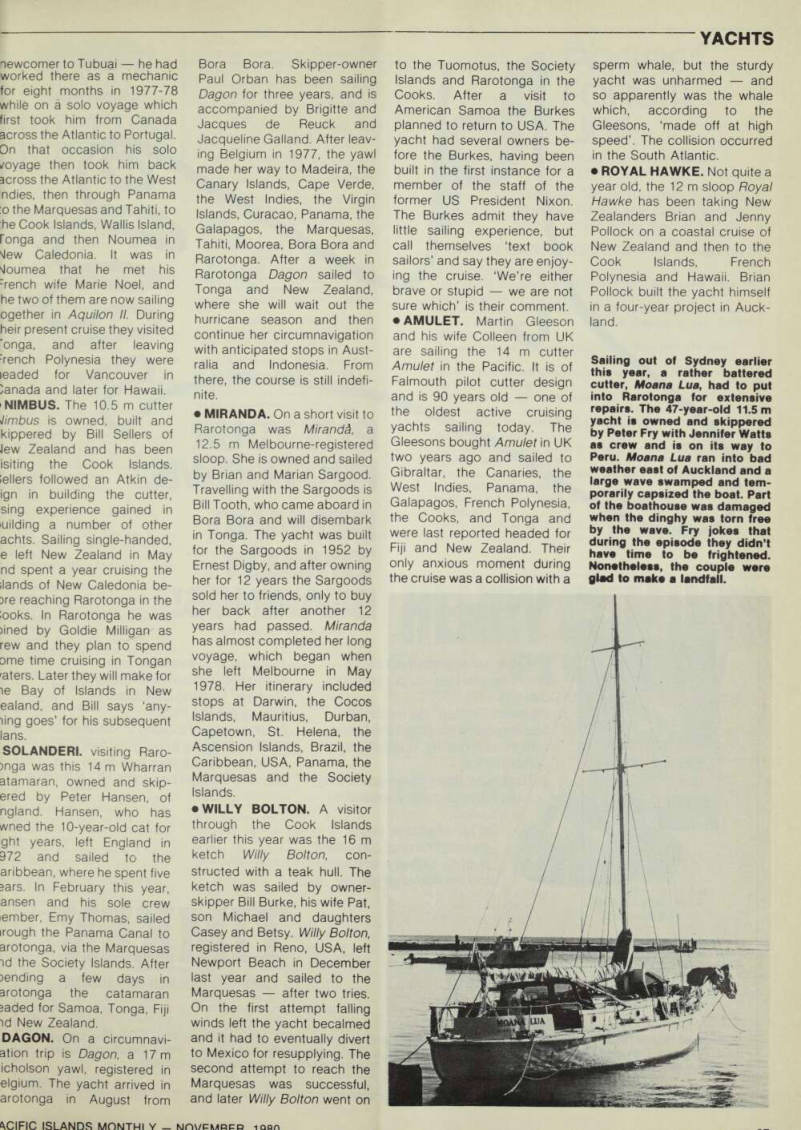
Vanuatu racers storm-lashed
A sudden and violent storm marred the second race in the Epiglass offshore series staged in September by the newly formed Vanuatu Cruising Yacht Club.
The 100-nautical mile race was held off the island of Efate overnight on September 13- 14.
As the race began, crews were mainly concerned to keep their craft moving in near no-wind conditions. The yacht Capella actually withdrew from the race due to the calm.
Then the storm hit almost without warning in the early hours of Sunday morning.
Storm sails replaced the full
rigs as the yachts ran before its fury.
A gust of 55 knots close to Hat Island was reported by Ned Kelly as she ran for shelter in Havannah Harbour.
Only Moonraker completed the course, crossing the finish line at 7 am on Sunday. The yacht faced big seas and 40knot winds in a beat from Nguna to Monument Rock. ‘As dawn broke, all yachts bar Moonraker had retired and were running for shelter behind Tuku Tuku Point, Havannah Harbour and Nguna,’ Moon raker’s captain Bill Webb said.
Among contestants were Yoco, Na Sau, Ersatz and Windfall.
All retired yachts returned safely. Minor gear failures were common.
• Doreen Beatrice.
Owned and sailed solo by Syd Durrant of New Haven, England, this two-year-old 8.2 m cutter visited Rarotonga briefly. Doreen Beatrice left England in June 1978 and sailed to Gibraltar, the Ca naries, the West Indies, the Leeward and Windward
Islands, Puerto Rico, Panama and the Scoieties. After a four day gale in the Societies, the yacht lost its sail, and as Durrant was motoring in through the passage to Papeete the engine failed.
Doreen Beatrice was washed onto the reef, where it sus tained considerable damage.
Luckily for Durrant the mem bers of the yacht club in Tahiti took it upon themselves to repair the battered vessel. At a cost of over 50 000 francs, the boat was rendered seaworthy once again. The reason for this charity, Durrant explained, is simply, ‘because they’re nice people’. Doreen Beatrice is westbound, with probable ports of call at Tonga, Fiji, New Zealand and Singapore. • TAIYO. The 28 m steel brig antine Taiyo from San Francisco USA has been visit ing the South Pacific under charter to UK-based interests undertaking an unusual histori cal expedition. The leader of the expedition is Glynn Christian from the UK, de scended from the same family as that of Fletcher Christian,
leader of the Bounty mutineers who settled on Pitcairn Island.
Glynn Christian is writing a biography of Fletcher Christian and the Taiyo expedition is researching the story. The ex pedition has the approval of the Royal Geographical So ciety of which Glynn Christian is a fellow. Fletcher Christian twice visited French Polynesia in an attempt to found a settlement there, and Tubuai in French Polynesia as well as Pitcairn Island have been visited during the Taiyo cruise.
Films and interviews were taken during the calls to French Polynesia and Pitcairn.
Skipper of the Taiyo is Terry Purkiss from UK and the mate is Tony Fletcher from Aust ralia. The two other crew members are Hop Cowen from USA and Sabine Schumacher from Germany. The 10 others on board are all members of the expedition and are from UK, New Zealand and USA. • AQUILON 11. Calling at Tubuai in French Polynesia was the 11m sloop Aquilon from Montreal, Canada. Skip per Daniel Trickey was no
newcomer to Tubuai he had worked there as a mechanic for eight months in 1977-78 while on a solo voyage which first took him from Canada across the Atlantic to Portugal.
On that occasion his solo ✓oyage then took him back across the Atlantic to the West ndies, then through Panama :o the Marquesas and Tahiti, to he Cook Islands, Wallis Island, fonga and then Noumea in 'Jew Caledonia. It was in sloumea that he met his : rench wife Marie Noel, and he two of them are now sailing ogether in Aquilon 11. During heir present cruise they visited ’onga, and after leaving Tench Polynesia they were leaded for Vancouver in Canada and later for Hawaii.
NIMBUS. The 10.5 m cutter Jimbus is owned, built and kippered by Bill Sellers of Jew Zealand and has been isiting the Cook Islands, tellers followed an Atkin de ign in building the cutter, sing experience gained in wilding a number of other achts. Sailing single-handed, e left New Zealand in May nd spent a year cruising the ;lands of New Caledonia be )re reaching Rarotonga in the :ooks. In Rarotonga he was )ined by Goldie Milligan as rew and they plan to spend ome time cruising in Tongan r aters. Later they will make for le Bay of Islands in New ealand, and Bill says ‘any ling goes’ for his subsequent lans.
SOLANDERI. visiting Raro )nga was this 14 m Wharran atamaran, owned and skip ered by Peter Hansen, of ngland. Hansen, who has wned the 10-year-old cat for ght years, left England in 972 and sailed to the aribbean, where he spent five sars. In February this year, ansen and his sole crew ember, Emy Thomas, sailed irough the Panama Canal to arotonga, via the Marquesas id the Society Islands. After )ending a few days in arotonga the catamaran saded for Samoa, Tonga, Fiji id New Zealand.
DAGON. On a circumnavi ation trip is Dagon. a 17 m icholson yawl, registered in elgium. The yacht arrived in arotonga in August from
Bora Bora. Skipper-owner Paul Orban has been sailing Dagon for three years, and is accompanied by Brigitte and Jacques de Reuck and Jacqueline Galland. After leav ing Belgium in 1977, the yawl made her way to Madeira, the Canary Islands, Cape Verde, the West Indies, the Virgin Islands, Curacao, Panama, the Galapagos, the Marquesas, Tahiti, Moorea, Bora Bora and Rarotonga. After a week in Rarotonga Dagon sailed to Tonga and New Zealand, where she will wait out the hurricane season and then continue her circumnavigation with anticipated stops in Aust ralia and Indonesia. From there, the course is still indefi nite. • MIRANDA. On a short visit to Rarotonga was MirandA, a 12.5 m Melbourne-registered sloop. She is owned and sailed by Brian and Marian Sargood.
Travelling with the Sargoods is Bill Tooth, who came aboard in Bora Bora and will disembark in Tonga. The yacht was built for the Sargoods in 1952 by Ernest Digby, and after owning her for 12 years the Sargoods sold her to friends, only to buy her back after another 12 years had passed. Miranda has almost completed her long voyage, which began when she left Melbourne in May 1978. Her itinerary included stops at Darwin, the Cocos Islands, Mauritius, Durban, Capetown, St. Helena, the Ascension Islands, Brazil, the Caribbean, USA, Panama, the Marquesas and the Society Islands. • WILLY BOLTON. A visitor through the Cook Islands earlier this year was the 16 m ketch Willy Bolton, con structed with a teak hull. The ketch was sailed by owner skipper Bill Burke, his wife Pat, son Michael and daughters Casey and Betsy. Willy Bolton, registered in Reno, USA, left Newport Beach in December last year and sailed to the Marquesas after two tries.
On the first attempt falling winds left the yacht becalmed and it had to eventually divert to Mexico for resupplying. The second attempt to reach the Marquesas was successful, and later Willy Bolton went on
to the Tuomotus, the Society Islands and Rarotonga in the Cooks. After a visit to American Samoa the Burkes planned to return to USA. The yacht had several owners be fore the Burkes, having been built in the first instance for a member of the staff of the former US President Nixon.
The Burkes admit they have little sailing experience, but call themselves ‘text book sailors’ and say they are enjoy ing the cruise. ‘We’re either brave or stupid we are not sure which’ is their comment. • AMULET. Martin Gleeson and his wife Colleen from UK are sailing the 14 m cutter Amulet in the Pacific. It is of Falmouth pilot cutter design and is 90 years old one of the oldest active cruising yachts sailing today. The Gleesons bought Amulet in UK two years ago and sailed to Gibraltar, the Canaries, the West Indies, Panama, the Galapagos, French Polynesia, the Cooks, and Tonga and were last reported headed for Fiji and New Zealand. Their only anxious moment during the cruise was a collision with a
sperm whale, but the sturdy yacht was unharmed and so apparently was the whale which, according to the Gleesons, ‘made off at high speed’. The collision occurred in the South Atlantic, e ROYAL HAWKE. Not quite a year old, the 12 m sloop Royal Hawke has been taking New Zealanders Brian and Jenny Pollock on a coastal cruise of New Zealand and then to the Cook Islands, French Polynesia and Hawaii. Brian Pollock built the yacht himself in a four-year project in Auck land.
Sailing out of Sydney earlier this year, a rather battered cutter, Moans Lua, had to put into Rarotonga for extensive repairs. The 47-year-old 11.5 m yacht is owned and skippered by Peter Fry with Jennifer Watts as crew and is on its way to Peru. Moana Lua ran into bad weather east of Auckland and a large wave swamped and tem porarily capsized the boat. Part of the boathouse was damaged when the dinghy was torn free by the wave. Fry jokes that during the episode they didn’t have time to be frightened.
Nonetheless, the couple were glad to make a landfall.
Advertisements & other items, pp. 66-68 (3 items)
66
DAnnr iqi amcvq MONTHI Y NOVEMBER. 1980
Kyowa Line
I p
YOUR BUSINESS PARTNER
KYOWA
Japan
To: Solomon, New Caledonia, Fiji, W Samoa, A Samoa. Tahiti. Cook Is.. Tonga. New Hebrides. Ellice Is., Nauru To: Guam, Saipan, Truk, Ponape, Majuro, Yap, Koror To: Papua New Guinea, Other Pacific Islands.
AGENTS
Taiwan: Royal Steamship Corp., Ltd., Taipei S. Korea: Dong Sue Shipping Co., Ltd., Seoul Hong Kong: Dahzun Enterprises Ltd.
Singapore: Ocean Shipping & Enterprises Pte., Ltd.
Guam: Maritime Agencies of The Pacific Ltd., Guam Saipan: Saipan Shipping Co. Inc., Saipan Solomon: Solomon Taiyo Ltd., Honiara Tahiti: J. A. Cowan & Fils, Papeete Cooks: Eastern Associates Ltd., Rarotonga Tonga: E. M. Jones Ltd., Nukualofa Vanuatu: Pentecost Pacific S.A., Port Vila Philippines: Sky International Inc., Manila Ponape: United Micronesia Development Association, Ponape A. Samoa: Island Pacific Agencies Inc., Pago Pago W. Samoa: Morris Hedstrom Ltd., Apia Fiji: Carpenter Shipping, Suva & Lautoka Nauru: Nauru Phosphate Corp.
PNG: Carpenter Shipping Agencies, Port Moresby, Rabaul New Caledonia: Agence Maritime Du Rond Point Du Pacific, Noumea Indonesia: P. T. Porodisa Raya Shipping Lines, Jakarta Sabah: KOH Han Ming Shipping & Forwarding Agent, Kotakinabalu Sarawak: Pan Sarawak Agencies Sdn. Bhd., Sibu & Kuching Australia: Hetherington Kingsbury Pty. Ltd., Sydney, N.S.W.
New Zealand: Russell & Summers Ltd., Auckland 1
KYOWA SHIPPING CO., LTD.
HEAD OFFICE
sth FI., Suzumaru Bldg. 39-8, 2-chome, Nishi-Shinbashi, Minato-ku, Tokyo. Japan.
Phone : 03(437)2885(Rep.) Cables : “MARIQUEEN" Tokyo. Telex : 242-4651 Kyowa J.
OSAKA OFFICE
Frontier Bldg., 3-13 Hirano-cho, Higashi ku, Osaka, Japan.
Phone : 06(227)0422(Rep.) Cables : “MARIQUEEN" Osaka. Telex : 522-3896 Kyowa 0.
o
PUTYOUR
FOOT DOWN.
DEMAND
TIMKEN
BEARINGS!
■■ ' m
TIMKEN
If you’re hard headed about the bearings you use . . . put your foot down!
Demand Timken® tapered roller bearings, and you’ll get the brand with proven quality, durability and performance.
The brand that’s given you a long . run for your money, wherever m it’s used.
On top of all this, you’ll benefit from our consistent supply, delivery, and sales and service engineering assistance available from Australian Timken and Authorized Timken® Bearing Distributors throughout the Pacific.
Another way of looking at it is that you’re not going to put your foot in it when you put your foot down and demand Timken bearings.
TIMKEN
REGISTERED TRADEMARK
TAPERED ROLLER BEARINGS
AuthorisedTimkerr Bearing Distributors in the Pacific are: United Enterprises Ltd., Honiaria; Burns Philp South Sea Company, Suva; Sunbeam Transport Ltd., Lautoka: S.A.T.M.A., Noumea; D. L. Dent Industries Pty. Ltd., Boroko, PNG; Comptoirs Francais des Nouvelles-Hebrides, Port Vila; Bearing Service Company Ltd., Auckland: Niven Bearings Limited, Auckland.
4191ATX
Yachts
67
ISLANDS MONTHI Y MOV/cmdcd icon
Shipping
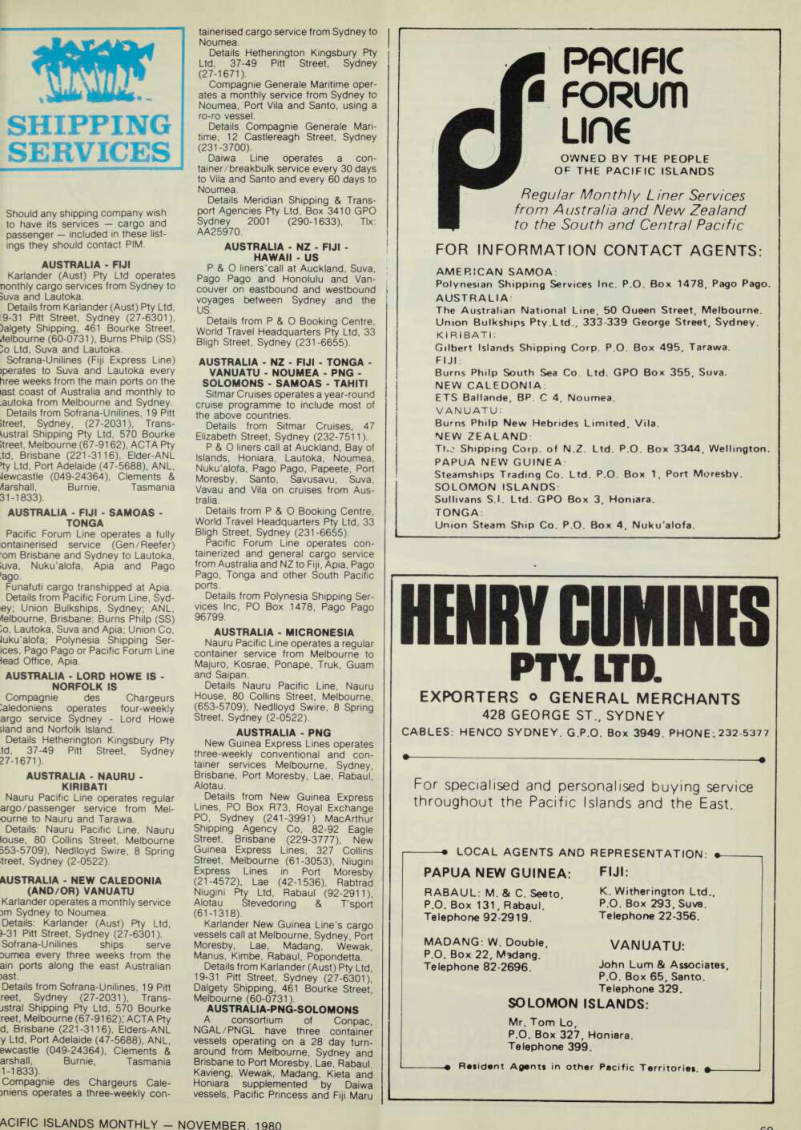
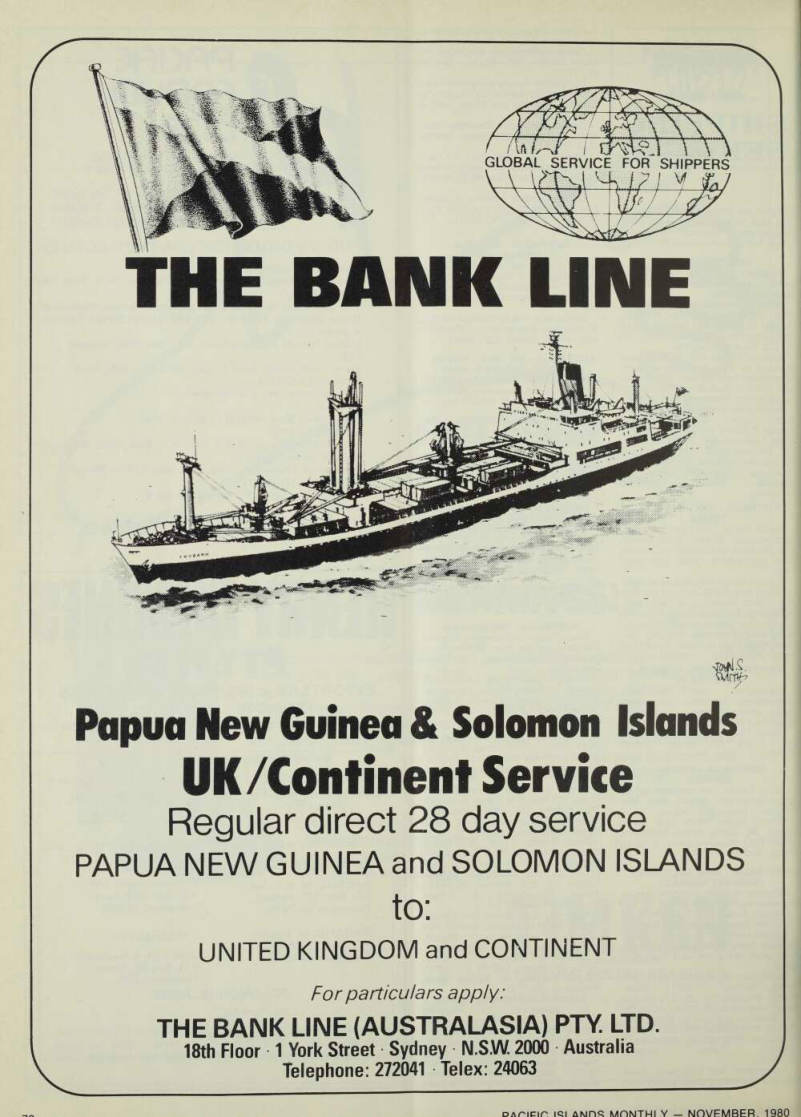
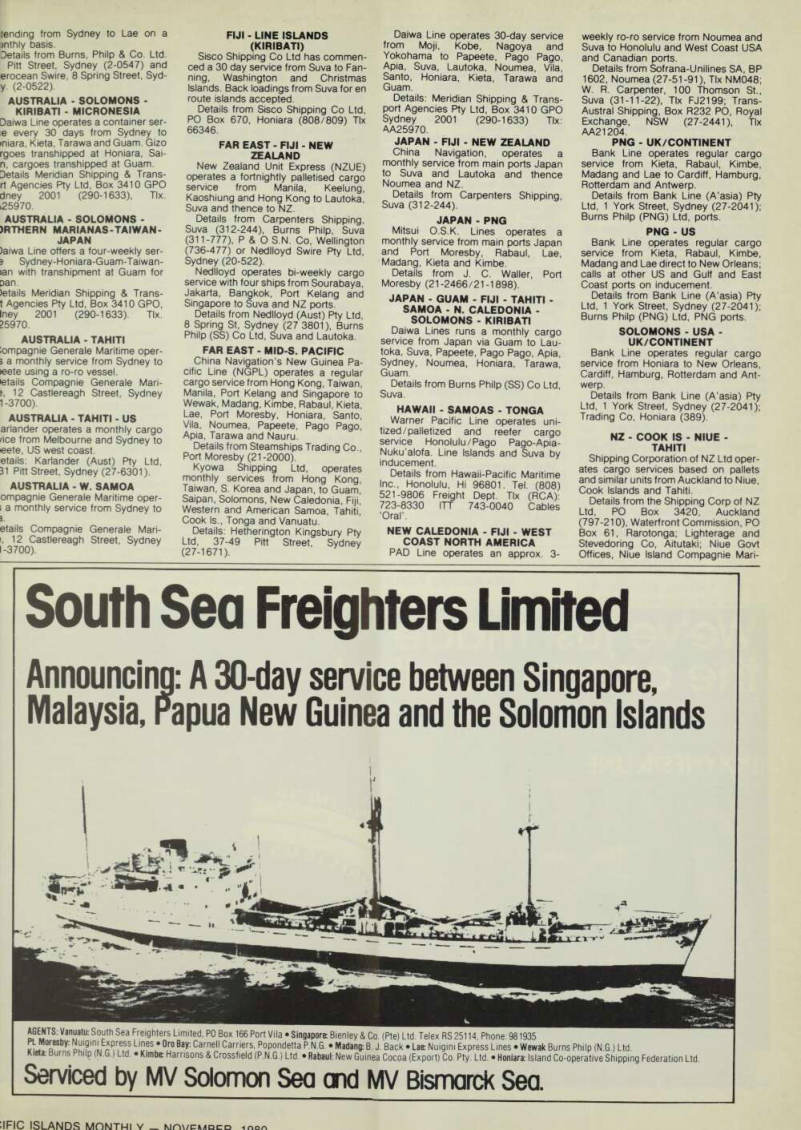
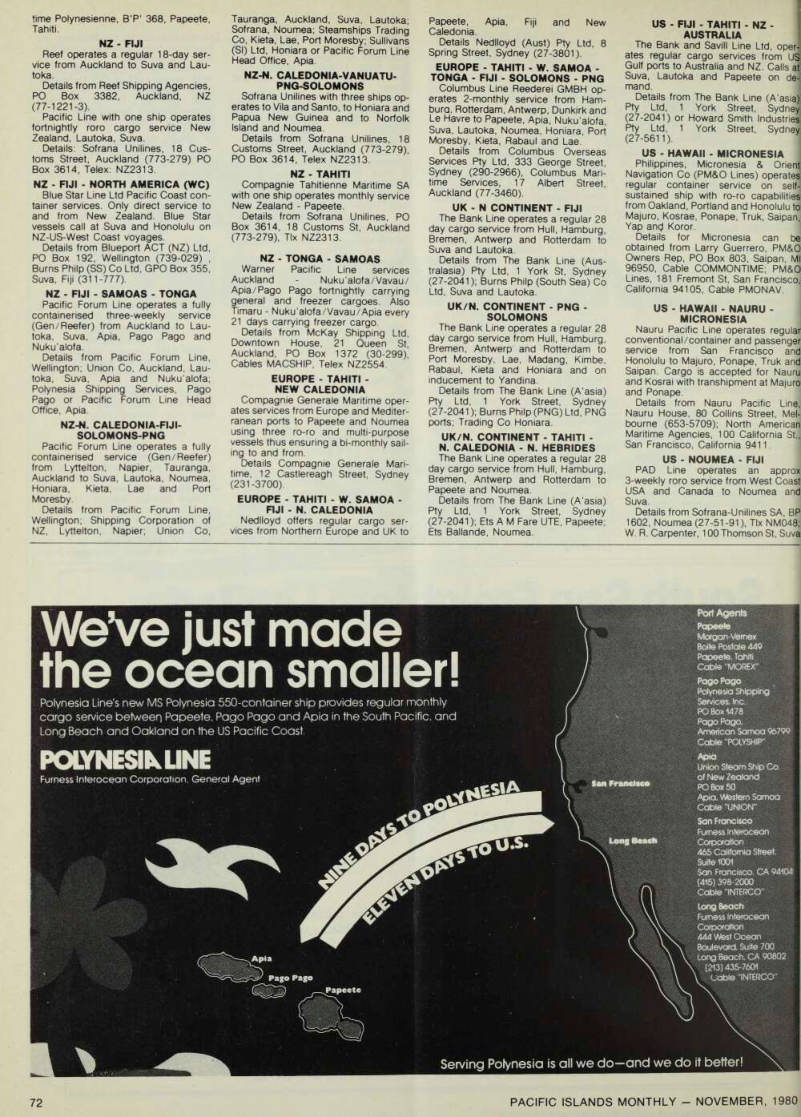
Services
Should any shipping company wish to have its services cargo and passenger included in these list ings they should contact PIM.
Australia - Fiji
Karlander (Aust) Pty Ltd operates nonthly cargo services from Sydney to >uva and Lautoka.
Details from Karlander (Aust) Pty Ltd, 9-31 Pitt Street, Sydney (27-6301), )algety Shipping, 461 Bourke Street, Melbourne (60-0731), Burns Philp (SS) )o Ltd, Suva and Lautoka.
Sofrana-Unilines (Fiji Express Line) >perates to Suva and Lautoka every hree weeks from the main ports on the iast coast of Australia and monthly to .autoka from Melbourne and Sydney.
Details from Sofrana-Unilines, 19 Pitt itreet, Sydney, (27-2031), Trans kustral Shipping Pty Ltd, 570 Bourke Street, Melbourne (67-9162), ACTA Pty .td. Brisbane (221-3116), Elder-ANL >ty Ltd. Port Adelaide (47-5688), ANL, Jewcastle (049-24364), Clements & Marshall, Burnie, Tasmania 31-1833).
Australia - Fiji - Samoas -
Tonga
Pacific Forum Line operates a fully ontainerised service (Gen/Reefer) ■om Brisbane and Sydney to Lautoka, luva, Nuku'alofa, Apia and Pago 'ago.
Funafuti cargo transhipped at Apia.
Details from Pacific Forum Line, Syd ey; Union Bulkships, Sydney; ANL, lelbourne, Brisbane; Burns Philp (SS) So, Lautoka, Suva and Apia; Union Co, luku’alofa; Polynesia Shipping Ser ices, Pago Pago or Pacific Forum Line lead Office, Apia.
Australia - Lord Howe Is -
Norfolk Is
Compagnie des Chargeurs Saledoniens operates four-weekly argo service Sydney - Lord Howe jland and Norfolk Island.
Details Hetherington Kingsbury Pty td, 37-49 Pitt Street, Sydney 27-1671).
Australia - Nauru -
Kiribati
Nauru Pacific Line operates regular argo/passenger service from Mel ourne to Nauru and Tarawa.
Details: Nauru Pacific Line, Nauru louse, 80 Collins Street, Melbourne 353-5709), Nedlloyd Swire, 8 Spring treet, Sydney (2-0522).
Australia - New Caledonia
(And/Or) Vanuatu
Karlander operates a monthly service )m Sydney to Noumea.
Details: Karlander (Aust) Pty Ltd, )-31 Pitt Street, Sydney (27-6301).
Sofrana-Unilines ships serve Dumea every three weeks from the ain ports along the east Australian )ast.
Details from Sofrana-Unilines, 19 Pitt reet, Sydney (27-2031), Trans jstral Shipping Pty Ltd, 570 Bourke reet. Melbourne (67-9162); ACTA Pty d. Brisbane (221-3116), Elders-ANL y Ltd, Port Adelaide (47-5688), ANL, ewcastle (049-24364), Clements & arshall, Burnie, Tasmania 1-1833).
Compagnie des Chargeurs Cale >niens operates a three-weekly con
tainerised cargo service from Sydney to Noumea Details Hetherington Kingsbury Pty Ltd, 37-49 Pitt Street, Sydney (27-1671).
Compagnie Generate Maritime oper ates a monthly service from Sydney to Noumea, Port Vila and Santo, using a ro-ro vessel.
Details Compagnie Generate Mari time, 12 Castlereagh Street, Sydney (231 -3700).
Daiwa Line operates a con tainer/breakbulk service every 30 days to Vila and Santo and every 60 days to Noumea.
Details Meridian Shipping & Trans port Agencies Pty Ltd, Box 3410 GPO Sydney 2001 (290-1633), Tlx: AA25970.
Australia • Nz - Fiji -
Hawaii - Us
P & O liners’call at Auckland. Suva, Pago Pago and Honolulu and Van couver on eastbound and westbound voyages between Sydney and the US.
Details from P & O Booking Centre, World Travel Headquarters Pty Ltd, 33 Bligh Street, Sydney (231-6655), AUSTRALIA - NZ - FIJI - TONGA -
Vanuatu - Noumea - Png -
Solomons - Samoas - Tahiti
Sitmar Cruises operates a year-round cruise programme to include most of the above countries.
Details from Sitmar Cruises, 47 Elizabeth Street, Sydney (232-7511).
P & O liners call at Auckland, Bay of Islands, Honiara, Lautoka, Noumea, Nuku'alofa, Pago Pago, Papeete, Port Moresby, Santo. Savusavu, Suva, Vavau and Vila on cruises from Aus tralia.
Details from P & O Booking Centre, World Travel Headquarters Pty Ltd, 33 Bligh Street, Sydney (231-6655).
Pacific Forum Line operates con tainerized and general cargo service from Australia and NZ to Fiji, Apia, Pago Pago, Tonga and other South Pacific ports.
Details from Polynesia Shipping Ser vices Inc, PO Box 1478, Pago Pago 96799.
Australia - Micronesia
Nauru Pacific Line operates a regular container service from Melbourne to Majuro, Kosrae, Ponape, Truk, Guam and Saipan.
Details Nauru Pacific Line, Nauru House, 80 Collins Street, Melbourne, (653-5709), Nedlloyd Swire, 8 Spring Street, Sydney (2-0522).
Australia - Png
New Guinea Express Lines operates three-weekly conventional and con tainer services Melbourne, Sydney, Brisbane, Port Moresby, Lae. Rabaul, Alotau.
Details from New Guinea Express Lines, PO Box R 73, Royal Exchange PO, Sydney (241-3991) MacArthur Shipping Agency Co, 82-92 Eagle Street, Brisbane (229-3777), New Guinea Express Lines, 327 Collins Street, Melbourne (61-3053), Niugini Express Lines in Port Moresby (21-4572). Lae (42-1536), Rabtrad Niugini Pty Ltd, Rabaul (92-2911), Alotau Stevedoring & T'sport (61-1318).
Karlander New Guinea Line's cargo vessels call at Melbourne, Sydney. Port Moresby, Lae, Madang, Wewak, Manus, Kimbe, Rabaul, Popondetta.
Details from Karlander (Aust) Pty Ltd, 19-31 Pitt Street, Sydney (27-6301), Dalgety Shipping, 461 Bourke Street, Melbourne (60-0731).
Austral! A-Png-Solomons
A consortium of Conpac, NGAL/PNGL have three container vessels operating on a 28 day turn around from Melbourne, Sydney and Brisbane to Port Moresby, Lae. Rabaul, Kavieng, Wewak, Madang, Kieta and Honiara supplemented by Daiwa vessels, Pacific Princess and Fiji Maru
tending from Sydney to Lae on a unthly basis.
Details from Burns, Philp & Co. Ltd.
Pitt Street, Sydney (2-0547) and erocean Swire, 8 Spring Street, Syd y. (2-0522).
Australia - Solomons -
Kiribati - Micronesia
Daiwa Line operates a container ser ;e every 30 days from Sydney to miara, Kieta, Tarawa and Guam. Gizo rgoes transhipped at Honiara, Sai n, cargoes transhipped at Guam.
Details Meridian Shipping & Trans it Agencies Pty Ltd, Box 3410 GPO dney 2001 (290-1633), Tlx. £5970.
Australia - Solomons •
)Rthern Marianas-Taiwan
Japan
)aiwa Line offers a four-weekly ser -3 Sydney-Honiara-Guam-Taiwan »an with transhipment at Guam for pan. tetails Meridian Shipping & Trans t Agencies Pty Ltd, Box 3410 GPO, Iney 2001 (290-1633). Tlx. 25970.
Australia - Tahiti
lompagnie Generate Maritime oper > a monthly service from Sydney to »eete using a ro-ro vessel, tetails Compagnie Generate Mari }, 12 Castlereagh Street, Sydney 1-3700).
Australia - Tahiti - Us
arlander operates a monthly cargo rice from Melbourne and Sydney to eete, US west coast, etails: Karlander (Aust) Pty Ltd, 31 Pitt Street, Sydney (27-6301).
Australia - W. Samoa
ompagnie Generate Maritime oper ; a monthly service from Sydney to j. etails Compagnie Generate Mari !, 12 Castlereagh Street, Sydney 1-3700).
Fiji - Line Islands
(Kiribati)
Sisco Shipping Co Ltd has commen ced a 30 day service from Suva to Fan ning, Washington and Christmas Islands. Back loadings from Suva for en route islands accepted.
Details from Sisco Shipping Co Ltd, PO Box 670, Honiara (808/809) Tlx 66346.
Far East - Fiji - New
Zealand
New Zealand Unit Express (NZUE) operates a fortnightly palletised cargo service from Manila, Keelung, Kaoshiung and Hong Kong to Lautoka, Suva and thence to NZ.
Details from Carpenters Shipping.
Suva (312-244), Burns Philp, Suva (311-777), P & O S.N. Co, Wellington (736-477) or Nedlloyd Swire Pty Ltd, Sydney (20-522).
Nedlloyd operates bi-weekly cargo service with four ships from Sourabaya, Jakarta, Bangkok, Port Kelang and Singapore to Suva and NZ ports.
Details from Nedlloyd (Aust) Pty Ltd, 8 Spring St. Sydney (27 3801), Burns Philp (SS) Co Ltd, Suva and Lautoka.
Far East - Mid-S. Pacific
China Navigation’s New Guinea Pa cific Line (NGPL) operates a regular cargo service from Hong Kong, Taiwan, Manila, Port Kelang and Singapore to Wewak, Madang, Kimbe, Rabaul, Kieta, Lae, Port Moresby, Honiara, Santo, Vila, Noumea, Papeete, Pago Pago, Apia, Tarawa and Nauru.
Details from Steamships Trading Co., Port Moresby (21-2000).
Kyowa Shipping Ltd, operates monthly services from Hong Kong, Taiwan, S. Korea and Japan, to Guam, Saipan, Solomons, New Caledonia, Fiji, Western and American Samoa, Tahiti, Cook Is., Tonga and Vanuatu.
Details: Hetherington Kingsbury Pty Ltd, 37-49 Pitt Street, Sydney (27-1671).
Daiwa Line operates 30-day service from Moji, Kobe, Nagoya and Yokohama to Papeete, Pago Pago, Apia, Suva, Lautoka, Noumea, Vila, Santo, Honiara, Kieta, Tarawa and Guam.
Details; Meridian Shipping & Trans port Agencies Pty Ltd, Box 3410 GPO Sydney 2001 (290-1633) Tlx: AA25970.
Japan - Fiji - New Zealand
China Navigation, operates a monthly service from main ports Japan to Suva and Lautoka and thence Noumea and NZ.
Details from Carpenters Shipping, Suva (312-244).
Japan - Png
Mitsui O.S.K. Lines operates a monthly service from main ports Japan and Port Moresby, Rabaul, Lae, Madang, Kieta and Kimbe.
Details from J. C. Waller, Port Moresby (21-2466/21-1898).
JAPAN - GUAM - FIJI - TAHITI -
Samoa - N. Caledonia -
Solomons - Kiribati
Daiwa Lines runs a monthly cargo service from Japan via Guam to Lau toka, Suva, Papeete, Pago Pago, Apia.
Sydney, Noumea, Honiara, Tarawa, Guam.
Details from Burns Philp (SS) Co Ltd, Suva.
Hawaii - Samoas - Tonga
Warner Pacific Line operates uni tized/palletized and reefer cargo service Honolulu/Pago Pago-Apia- Nuku'alofa. Line Islands and Suva by inducement.
Details from Hawaii-Pacific Maritime Inc., Honolulu, Hi 96801. Tel. (808) 521-9806 Freight Dept. Tlx (RCA): 723-8330 ITT 743-0040 Cables ‘Oral’.
New Caledonia - Fiji - West
Coast North America
PAD Line operates an approx. 3-
weekly ro-ro service from Noumea and Suva to Honolulu and West Coast USA and Canadian ports.
Details from Sofrana-Unilines SA, BP 1602, Noumea (27-51-91), Tlx NMO4B; W. R. Carpenter, 100 Thomson St., Suva (31-11-22), Tlx FJ2199; Trans- Austral Shipping, Box R 232 PC, Royal Exchange, NSW (27-2441), Tlx AA21204.
Png - Uk/Continent
Bank Line operates regular cargo service from Kieta, Rabaul, Kimbe, Madang and Lae to Cardiff. Hamburg, Rotterdam and Antwerp.
Details from Bank Line (A'asia) Pty Ltd, 1 York Street, Sydney (27-2041); Burns Philp (PNG) Ltd, ports.
Png - Us
Bank Line operates regular cargo service from Kieta, Rabaul, Kimbe, Madang and Lae direct to New Orleans; calls at other US and Gulf and East Coast ports on inducement.
Details from Bank Line (A’asia) Pty Ltd. 1 York Street, Sydney (27-2041); Burns Philp (PNG) Ltd, PNG ports.
Solomons - Usa -
Uk/Continent
Bank Line operates regular cargo service from Honiara to New Orleans, Cardiff, Hamburg, Rotterdam and Ant werp.
Details from Bank Line (A’asia) Pty Ltd, 1 York Street. Sydney (27-2041); Trading Co, Honiara (389).
NZ - COOK IS - NIUE -
Tahiti
Shipping Corporation of NZ Ltd oper ates cargo services based on pallets and similar units from Auckland to Niue, Cook Islands and Tahiti.
Details from the Shipping Corp of NZ Ltd, PO Box 3420, Auckland (797-210), Waterfront Commission, PO Box 61, Rarotonga; Lighterage and Stevedoring Co, Aitutaki; Niue Govt Offices, Niue Island Compagnie Mari
time Polynesienne, B'P’ 368, Papeete, Tahiti.
Nz - Fiji
Reef operates a regular 18-day ser vice from Auckland to Suva and Lau toka.
Details from Reef Shipping Agencies, PO Box 3382, Auckland. NZ (77-1221-3).
Pacific Line with one ship operates fortnightly roro cargo service New Zealand, Lautoka, Suva.
Details: Sofrana Unilines, 18 Cus toms Street, Auckland (773-279) PO Box 3614, Telex; NZ2313.
NZ - FIJI - NORTH AMERICA (WC) Blue Star Line Ltd Pacific Coast con tainer services. Only direct service to and from New Zealand. Blue Star vessels call at Suva and Honolulu on NZ-US-West Coast voyages.
Details from Blueport ACT (NZ) Ltd, PO Box 192, Wellington (739-029) , Burns Philp (SS) Co Ltd, GPO Box 355, Suva, Fiji (311-777).
NZ - FIJI - SAMOAS - TONGA Pacific Forum Line operates a fully containerised three-weekly service (Gen/Reefer) from Auckland to Lau toka, Suva, Apia, Pago Pago and Nukualofa.
Details from Pacific Forum Line, Wellington; Union Co, Auckland, Lau toka, Suva, Apia and Nukualofa; Polynesia Shipping Services, Pago Pago or Pacific Forum Line Head Office, Apia.
Nz-N. Caledonia-Fiji
Solomons-Png
Pacific Forum Line operates a fully containerised service (Gen/Reefer) from Lyttelton, Napier, Tauranga, Auckland to Suva, Lautoka, Noumea, Honiara, Kieta, Lae and Port Moresby.
Details from Pacific Forum Line, Wellington; Shipping Corporation of NZ, Lyttelton, Napier; Union Co,
Tauranga, Auckland, Suva, Lautoka; Sofrana, Noumea; Steamships Trading Co, Kieta, Lae, Port Moresby; Sullivans (SI) Ltd, Honiara or Pacific Forum Line Head Office, Apia.
Nz-N. Caledonia-Vanuatu
Png-Solomons
Sofrana Unilines with three ships op erates to Vila and Santo, to Honiara and Papua New Guinea and to Norfolk Island and Noumea.
Details from Sofrana Unilines, 18 Customs Street, Auckland (773-279), PO Box 3614, Telex NZ2313.
Nz - Tahiti
Compagnie Tahitienne Maritime SA with one ship operates monthly service New Zealand - Papeete.
Details from Sofrana Unilines, PO Box 3614, 18 Customs St, Auckland (773-279). Tlx NZ2313.
Nz - Tonga - Samoas
Warner Pacific Line services Auckland - Nuku'alofa/Vavau/ Apia/Pago Pago fortnightly carrying general and freezer cargoes. Also Timaru - Nuku'alofa/Vavau/Apia every 21 days carrying freezer cargo.
Details from McKay Shipping Ltd, Downtown House, 21 Queen St, Auckland, PO Box 1372 (30-299).
Cables MACSHIP, Telex NZ2554.
Europe - Tahiti -
New Caledonia
Compagnie Generale Maritime oper ates services from Europe and Mediter ranean ports to Papeete and Noumea using three ro-ro and multi-purpose vessels thus ensuring a bi-monthly sail ing to and from.
Details Compagnie Generale Mari time, 12 Castlereagh Street, Sydney (231-3700).
EUROPE - TAHITI - W. SAMOA -
Fiji - N. Caledonia
Nedlloyd offers regular cargo ser vices from Northern Europe and UK to
Papeete, Apia, Fiji and New Caledonia.
Details Nedlloyd (Aust) Pty Ltd, 8 Spring Street, Sydney (27-3801).
EUROPE - TAHITI - W. SAMOA - TONGA - FIJI - SOLOMONS - PNG Columbus Line Reederei GMBH op erates 2-monthly service from Ham burg. Rotterdam, Antwerp, Dunkirk and Le Havre to Papeete, Apia, Nukualofa, Suva, Lautoka, Noumea, Honiara, Port Moresby. Kieta, Rabaul and Lae.
Details from Columbus Overseas Services Pty Ltd, 333 George Street, Sydney (290-2966), Columbus Mari time Services, 17 Albert Street, Auckland (77-3460).
Uk - N Continent - Fiji
The Bank Line operates a regular 28 day cargo service from Hull, Hamburg, Bremen, Antwerp and Rotterdam to Suva and Lautoka.
Details from The Bank Line (Aus tralasia) Pty Ltd, 1 York St, Sydney (27-2041); Burns Philp (South Sea) Co Ltd, Suva and Lautoka.
Uk/N. Continent - Png -
Solomons
The Bank Line operates a regular 28 day cargo service from Hull, Hamburg, Bremen, Antwerp and Rotterdam to Port Moresby, Lae, Madang, Kimbe, Rabaul, Kieta and Honiara and on inducement to Yandina.
Details from The Bank Line (A’asia) Pty Ltd, 1 York Street, Sydney (27-2041); Burns Philp (PNG) Ltd, PNG ports; Trading Co Honiara.
Uk/N. Continent - Tahiti -
N. Caledonia - N. Hebrides
The Bank Line operates a regular 28 day cargo service from Hull, Hamburg, Bremen, Antwerp and Rotterdam to Papeete and Noumea.
Details from The Bank Line (A'asia) Pty Ltd, 1 York Street, Sydney (27-2041); Ets A M Fare UTE, Papeete; Ets Ballande, Noumea.
US - FIJI - TAHITI - NZ -
Australia
The Bank and Savill Line Ltd, oper-J ates regular cargo services from US Gulf ports to Australia and NZ. Calls at Suva, Lautoka and Papeete on del mand.
Details from The Bank Line (A’asia)!
Pty Ltd, 1 York Street, Sydney (27-2041) or Howard Smith Industries Pty Ltd, 1 York Street, Sydney (27-5611).
Us - Hawaii - Micronesia
Philippines, Micronesia & Orient Navigation Co (PM&O Lines) operates regular container service on self sustained ship with ro-ro capabilities! from Oakland, Portland and Honolulu to Majuro, Kosrae, Ponape, Truk, Saipan, Yap ang Koror.
Details for Micronesia can be obtained from Larry Guerrero, PM&O Owners Rep, PO Box 803, Saipan, Ml
96950, Cable Commontime; Pm&O
Lines, 181 Fremont St, San Franciscoj California 94105, Cable PMONAV.
Us - Hawaii - Nauru -
Micronesia
Nauru Pacific Line operates regular conventional/container and passenger service from San Francisco and Honolulu to Majuro, Ponape, Truk and Saipan. Cargo is accepted for Nauru and Kosrai with transhipment at Majuro and Ponape.
Details from Nauru Pacific Line,!
Nauru House, 80 Collins Street, Mel bourne (653-5709); North American Maritime Agencies, 100 California St.J San Francisco, California 9411.
Us - Noumea - Fiji
PAD Line operates an approx 3-weekly roro service from West Coast USA and Canada to Noumea and Suva.
Details from Sofrana-Unilines SA. BP 1602, Noumea (27-51-91), Tlx NMO4B; W. R. Carpenter, 100 Thomson St, Suva
1-22), Tlx FJ2199; Trans-Austral )ing, Box R232 PO. Royal ange, NSW (27-2441), Tlx 204.
Us - Tahiti - Samoa
-ific Islands Transport operates a veekly cargo service from North ica west coast ports to Papeete, Pago, Apia. tails from Polynesia Shipping Ser ine, PO Box 1478 Pago Pago ynesia Line operates container eneral cargo service from US west ports to Papeete and Pago ails from Polynesia Shipping Ser ene., PO Box 1478, Pago Pago - TAHITI - SAMOA - NZ - AUST rell Lines Inc, operate a fast reg ish/container cargo service from coast ports Canada/USA to jte and Pago Pago thence to NZ Australia. ails With Wilhelmson Agency, ?y, Melbourne and Brisbane, Tlx 136, Cable PARSNIPS Sydney; ty (NZ) Ltd. Auckland and gton, Tlx NZ2445, Cable HIP Auckland; Compagnie Mari- Polynesienne, Immeuble Franco lienne, PO Box 368, Papeete Tel 26393, Tlx 258. FP ANSB o, Cable OCEAN Papeete; )uhl Maritime Service, PO Box 39, Pago, Telephone 633-5121’ 2505.
Advertisements & other items, pp. 69-72 (4 items)
69
ACIFIC ISLANDS MONTHLY NOVEMBER 1980
Henry Cumines
■ PACIFIC
a FORUm
uric
OWNED BY THE PEOPLE
OF THE PACIFIC ISLANDS
Regular Monthly Liner Services
from Australia and New Zealand
to the South and Central Pacific
FOR INFORMATION CONTACT AGENTS:
AMERICAN SAMOA
Polynesian Shipping Services Inc. P.O. Box 1478, Pago Pago
AUSTRALIA
The Australian National Line, 50 Queen Street, Melbourne.
Union Butkships Pty.Ltd., 333-339 George Street, Sydney.
KIRIBATI:
Gilbert Islands Shipping Corp. P.O. Box 495. Tarawa.
FIJI:
Burns Philp South Sea Co Ltd. GPO Box 355. Suva.
NEW CALEDONIA
ETS Ballande, BP. C 4, Noumea.
VANUATU:
Burns Philp New Hebrides Limited, Vila.
NEW ZEALAND:
Tho Shipping Corp. of N.Z. Ltd. P.O. Box 3344, Wellington
PAPUA NEW GUINEA
Steamships Trading Co. Ltd. P.O. Box 1, Port Moresby.
SOLOMON ISLANDS
Sullivans S.l. Ltd. GPO Box 3, Honiara.
TONGA
Union Steam Ship Co. P.O. Box 4, Nuku'alofa.
HENRY CUMINES
PTY. LTD.
EXPORTERS o GENERAL MERCHANTS
428 GEORGE ST., SYDNEY
CABLES: HENCO SYDNEY. G.P.O. Box 3949. PHONE; 232-5377 • m
For specialised and personalised buying service
throughout the Pacific Islands and the East.
LOCAL AGENTS AND REPRESENTATION;
PAPUA NEW GUINEA: FIJI:
RABAUL: M. & C. Seeto, P.O. Box 131, Rabaul.
Telephone 92-2919.
K. Witherington Ltd., P.O. Box 293, Suva.
Telephone 22-356.
VANUATU:
John Lum & Associates, P.O. Box 65, Santo.
Telephone 329.
SOLOMON ISLANDS:
Mr. Tom Lo, P.O. Box 327, Honiara.
Telephone 399.
MADANG: W. Double.
P.O. Box 22, Madang.
Telephone 82-2696.
Resident A pen ts in other Pacific Territories. •-
GLOBAL SERVICE FOR SHIPPERS
» Vf
THE
LINE
«g
Papua New Guinea & Solomon Islands
UK/Continent Service
Regular direct 28 day service
PAPUA NEW GUINEA and SOLOMON ISLANDS
to:
UNITED KINGDOM and CONTINENT
For particulars apply:
THE BANK LINE (AUSTRALASIA) PTY LTD.
18th Floor 1 York Street Sydney N.S.W. 2000 Australia Telephone: 272041 Telex: 24063
South Sea Freighters Limited
Announcing: A 30-day service between Singapore,
Malaysia, Papua New Guinea and the Solomon Islands - % it * txu AGENTS. Vanuatu: South Sea Freighters Limited, PO Box 166 Port Vila • Singapore: Bienley & Co. (Re) Ltd. Telex RS 25114, Phone: 981935 r , e^ S Li U? s * Oro Bay: Carnell Carriers, Popondetta P.N.G. • Madang; B. J. Back • Lae: Nuigini Express Lines • Wewak Burns Philp (N.G.) Ltd.
Kieta; Burns Philp (N.G.) Ltd. • Kimbe: Harrisons & Crossfield (P.N.G.) Ltd. • Rabaul: New Guinea Cocoa (Export) Co. Pty. Ltd. • Honiara: Island Co-operative Shipping Federation Ltd.
Serviced by MV Solomon Sea and MV Bismarck Sea
WeVe just made
the ocean smaller!
Polynesia Line's new MS Polynesia 550-container ship provides regular monthly cargo service between Papeete, Pago Pago and Apia in the South Pacific, and Long Beach and Oakland on the US Pacific Coast.
POLYNESIA LINE
Furness Interocean Corporation, General Agent Pago Pago Fort Agents Papeete Morgan-Vemex
AAQ
Cable "MOREX"
Pago Pago Polynesia Shipping PO Box 1478 Pago Pago.
American Samoa 96799 Cable "POLYSHIP"
tIESIA
Cl AS o Q T® & 3 V v ' xX x v\ j Apia Union Steam Ship Co. 11(1 of Zealand San Francisco POBoxSO H ii Apia, Vifestem Samoa Cable "UNION"
San Francisco Furness Interocean Corporation 465 California Street, Suite 1001 i Francisco, CA 94104 398-2000
"INTERCO"
Beach Corporation 444 West Ocean Boulevard. Suite 700 Long Beach, CA 90802 (213)435-7601 Cable "INTERCO" k x^ Serving Polynesia is all we do—and we do it better!
70
DAncir ici AMDS MOMTHI Y NOVEMBER. 1980
IFIC ISLANDS MDNTHI V _ mov/cmdcd -i non
IFIC ISLANDS MDNTHI V mov/cmdcd -i non
Deaths
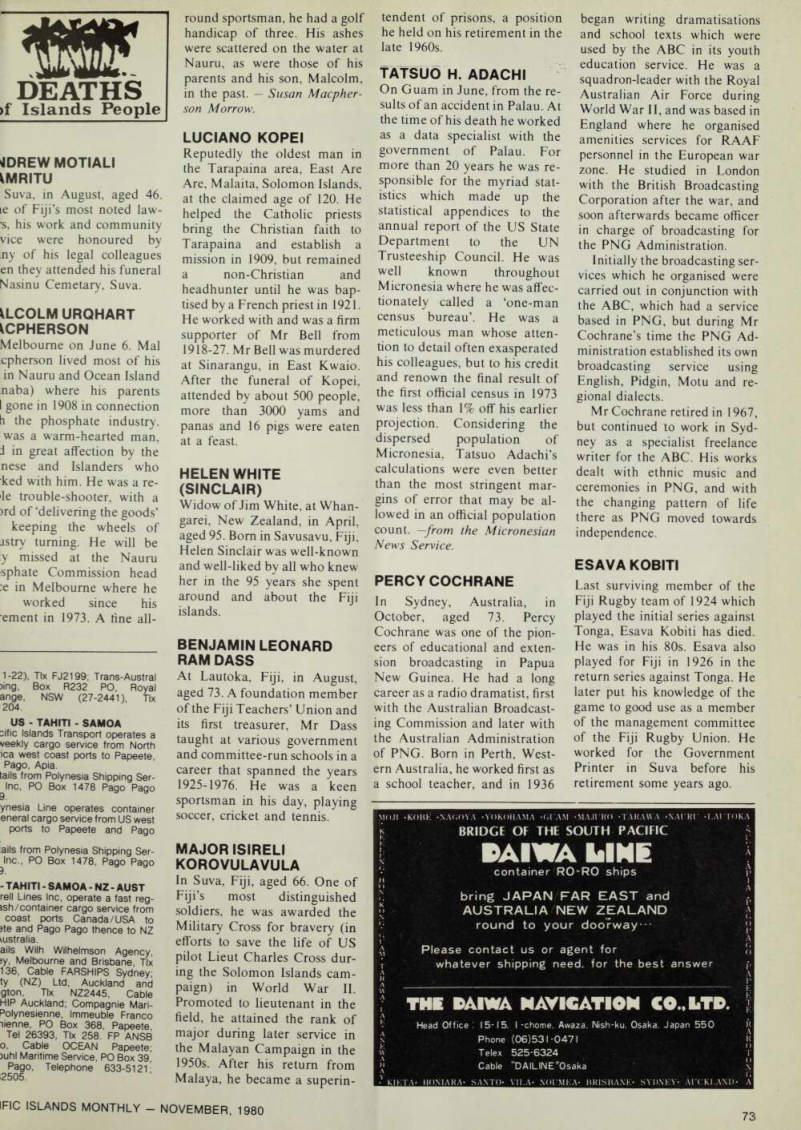
of Islands People
Jdrew Motiali
Uviritu
Suva, in August, aged 46. te of Fiji’s most noted law ’s, his work and community vice were honoured by ny of his legal colleagues en they attended his funeral
Nasinu Cemetary, Suva.
Vlcolm Urqhart
Mcpherson
Melbourne on June 6. Mai epherson lived most of his in Nauru and Ocean Island naba) where his parents I gone in 1908 in connection
h the phosphate industry,
was a warm-hearted man, i in great affection by the nese and Islanders who ked with him. He was a re ie trouble-shooter, with a )rd of ‘delivering the goods’ keeping the wheels of astry turning. He will be y missed at the Nauru sphate Commission head ;e in Melbourne where he worked since his ement in 1973. A tine all
round sportsman, he had a golf handicap of three. His ashes were scattered on the water at Nauru, as were those of his parents and his son, Malcolm, in the past. Susan Macpher son Morrow.
Luciano Kopei
Reputedly the oldest man in the Tarapaina area, East Are Are, Malaita, Solomon Islands, at the claimed age of 120. He
helped the Catholic priests
bring the Christian faith to Tarapaina and establish a mission in 1909, but remained a non-Christian and headhunter until he was bap tised by a French priest in 1921.
He worked with and was a firm supporter of Mr Bell from 1918-27. Mr Bell was murdered at Sinarangu, in East Kwaio.
After the funeral of Kopei, attended by about 500 people, more than 3000 yams and panas and 16 pigs were eaten at a feast.
Helen White
(Sinclair)
Widow of Jim White, at Whan garei, New Zealand, in April, aged 95. Bom in Savusavu, Fiji, Helen Sinclair was well-known and well-liked by all who knew her in the 95 years she spent around and about the Fiji islands.
Benjamin Leonard
Ram Dass
At Lautoka, Fiji, in August, aged 73. A foundation member of the Fiji Teachers’ Union and its first treasurer, Mr Dass taught at various government and committee-run schools in a career that spanned the years 1925-1976. He was a keen sportsman in his day, playing soccer, cricket and tennis.
Major Isireli
Korovulavula
In Suva, Fiji, aged 66. One of
Fiji’s most distinguished
soldiers, he was awarded the Military Cross for bravery (in efforts to save the life of US pilot Lieut Charles Cross dur ing the Solomon Islands cam paign) in World War 11.
Promoted to lieutenant in the field, he attained the rank of major during later service in the Malayan Campaign in the 19505. After his return from Malaya, he became a superin
tendent of prisons, a position he held on his retirement in the late 19605.
Tatsuo H. Adachi
On Guam in June, from the re sults of an accident in Palau. At the time of his death he worked as a data specialist with the government of Palau. For more than 20 years he was re sponsible for the myriad stat istics which made up the statistical appendices to the annual report of the US State Department to the UN Trusteeship Council. He was well known throughout Micronesia where he was affec tionately called a ‘one-man census bureau’. He was a meticulous man whose atten tion to detail often exasperated his colleagues, but to his credit and renown the final result of the first official census in 1973 was less than 1% off his earlier
projection. Considering the
dispersed population of
Micronesia, Tatsuo Adachi’s calculations were even better than the most stringent mar gins of error that may be al lowed in an official population count, —from the Micronesian News Service.
Percy Cochrane
In Sydney, Australia, in October, aged 73. Percy Cochrane was one of the pion eers of educational and exten sion broadcasting in Papua New Guinea. He had a long career as a radio dramatist, first with the Australian Broadcast ing Commission and later with the Australian Administration of PNG. Born in Perth, West ern Australia, he worked first as a school teacher, and in 1936
began writing dramatisations and school texts which were used by the ABC in its youth education service. He was a squadron-leader with the Royal Australian Air Force during World War 11, and was based in England where he organised amenities services for RAAF personnel in the European war zone. He studied in London with the British Broadcasting Corporation after the war, and soon afterwards became officer in charge of broadcasting for the PNG Administration.
Initially the broadcasting ser vices which he organised were carried out in conjunction with the ABC, which had a service based in PNG, but during Mr Cochrane’s time the PNG Ad ministration established its own broadcasting service using English, Pidgin, Motu and re gional dialects.
Mr Cochrane retired in 1967, but continued to work in Syd ney as a specialist freelance writer for the ABC. His works dealt with ethnic music and ceremonies in PNG, and with the changing pattern of life there as PNG moved towards independence.
Esava Kobiti
Last surviving member of the Fiji Rugby team of 1924 which played the initial series against Tonga, Esava Kobiti has died.
He was in his 80s. Esava also played for Fiji in 1926 in the return series against Tonga. He later put his knowledge of the game to good use as a member of the management committee of the Fiji Rugby Union. He worked for the Government Printer in Suva before his retirement some years ago.
Advertisements & other items, pp. 73-74 (2 items)
73
FIC ISLANDS MONTHLY NOVEMBER, 1960
Baiwa Line
• KOHK 'XAfiOVA •YOKOHAMA -CI AM •MA.II'HO -TARAWA -NAIRI -I.AI TOKA
BRIDGE OF THE SOUTH PACIFIC
container RO-RO ships
bring JAPAN FAR EAST and
AUSTRALIA NEW ZEALAND
round to your doorway-
Please contact us or agent for
whatever shipping need, for the best answer
THE ©AIWA NAVIGATION CO., LTD.
j; A A I* I A V A C O A (, o A 1’
K K I K t Head Office : 15-15. I -chome. Awaza, Nish-ku. Osaka. Japan 550 R \ Phone (06)531-0471 R w Telex 525-6324 T
» Cable "DAILINE"Osaka N
Y * 1 - KIKTA- HONIARA* SANTO* VILA* NOIMKA- HR IS HANK- SVDNKV- AIT K LAND- A
Your doorway Into the fascinating world of the South Seas 104 PAGES - $4.00 or $US5.00 POSTED.
Send to box 3408, GPO, Sydney, NSW, 2001 or use the coupon insert in this issue.
/ N
THE UNIVERSITY OF SYDNEY
WALTER MERSH STRONG SCHOLARSHIPS
Applications are invited from Papua New Guineans for the above scholarships, which are available either as (a) undergraduate scholarships open to Papua New Guineans who are qualified to matriculate in the University of Sydney or(b) postgraduate scholarships open to Papua New Guinean graduates for postgraduate research or course work at the University of Sydney.
Further information and application forms are available from The Academic Registrar, University of Papua New Guinea, PO Box 4820, University Post Office, Port Moresby. Applications close on 14 November 1980.
Students applying for undergraduate scholarships must also apply for admission to the University through the Universities and Colleges Admissions Centre.
AUSTRALIAN MARKETING INSTITUTE
Patron: H.R.H. Prince Phillip, The Duke of Edinburgh
OFFERS MEMBERSHIP
Keeping abreast of the ever changing trends in Marketing is a problem confronting Executivesthroughout Australia.
This problem is compounded for Executives located in areas outside Australia.
To help Executives working outside Australia, the Australian Marketing Institute is offering special membership to people connected with Sales and Marketing residing outside Australia.
A.M.I., Australia’s voice for Marketing Executives, keeps its members informed of trends through regular newsletters to its members. Help is provided in establishing subgroups of Marketing Executives who can meet to discuss common interest topics. These Chapters, under the auspices of the Australian Marketing Institute, can prove most beneficial to Executives.
For further information on how to join the Australian Marketing Institute, please contact:
THE SECRETARY, AUSTRALIAN MARKETING INSTITUTE,
P.O. BOX 405, NORTH SYDNEY, 2060. AUSTRALIA.
Index To Advertisers
Aggie Grey 45 AHI Aluminium 36 Air Niugini 28 Aiwa 34 Aquilla 58 Australian Timken 68 Bankline 70 Berkey, Robert 74 Boral 57 Burns, Stuart 74 Cable & Wireless 62 Career Management 74 Citizen Watches 12 Clarion Shoji 16 Consolidated Chemicals 52,53 Cosmos Stamps & Coins 74 Eta Foods 60 Fleets 74 Fujitsu Ten 42 Furness 72 Henry Cumines 69 Hitachi 26 ICI Tasman 44 Kyowa Shipping 66 Matsushita 23 Meridian Shipping 73 Nelson & Robertson 58 Nissan 30,31 NZ Dairy Board IBC NZ Police 46 Pacific Forum 69 Papua Hotel 45 Pioneer 8 Pioneer 56
Polynesian Airlines 321: Polynesian Bookshop 45
Qbe 24
Quickstic 49 Rex Aviation 43 Seafarer Cruises 63 Sony OBC South Sea Freighters 71 Suzuki 20 Tatham, S.E. 4 Toyota 38,39 Trio-Kenwood 64 Truck Electrics 36 University of South Pacific 58 University of Sydney 74 Victor (JVC) 50 Video Recorder Centre 74 West 74 Williams 74 Wonderest 63; Yamaha 54
Advertisements & other items, pp. 74-76 (1 item)
*Video Recorders-Projectors
“National SONY *Video Recorders-Projectors * Colour Cameras & Portapaks * Latest Video Computer Games *Close Circuit Television Kits * Movie Tapes-Beta or VMS * Security Door Video Phone All at export prices AH Enquiries Welcomed
INTERCAPE AUSTRALIA
19-21, Lonsdale St.
Melbourne 3000.
STUDY GOD'S WORD
AT HOME
Send for free catalogue.
Emmaus Bible Corresp. Sch., P.O. Box 904, Saipan, C.M. 96950
FOR IMMEDIATE SALE
11 metre cruising ketch.
Bargain at Aust. $16,000.
Further details contact: Box 447, Port Vila, Vanuatu, (formerly New Hebrides).
BUYING AUSTRALIAN
COINS
Dated 1910 up to 1953.
Free list available, quoting buying prices.
MR. M. A. BYRNES
Box 188, North Ryde, N.S.W., Australia 2113 17 Amelia St, Nth. Ryde (No callers please, due to family illness.)
POSITION WANTED
CIVIL ENGINEER
Civil Engineer, MIE (Aust.), 38 yrs old. Extensive experience as Project Manager for the construction of bridges, wharves, water treatment plants, pipelines, subdivisions and highways in Australia and Canada requires interesting position in the South Pacific as an employee or in Joint Venture arrangement.
Reply: Civil Engineer, Private Box, Pacific Islands Monthly, G.P.O. Box 3408, Sydney 2001.
FOR SALE
Cessna 340, Pressurized, Class 1 I.F.R., Dual Nav. Corns., VAN 5 D.M.E. AutoPilot.
Long engine life and propeller hours to run. Latest colour scheme. Situated Bankstown (Sydney). Reg. VH-MAZ, $100,000. For further information, write to: J. West, PO Box 274, Carlingford, NSW, Aust. 2118.
FLEETS
21 ft. workboat, new 2 cyl.
Volvo diesel, $10,000. 28 ft.
General Purpose Launch, profess, bit. 1968, 100 h.p. diesel, $21,000. 28 ft. Sloop, fibreglass over marine ply, 3 cyl. diesel, $17,500.
FLEETS
221 Esplanade, Wynnum Central, Brisbane, Old.
Cable FLEETS BRISBANE
F3
J*. J
*Jifs
L V j
WH* V *
- *• 4tm m * acfef* OJ?* &&&**
S?SSc
iTisfnsT
gg|s
?87r
Bit 1
IR Sffe*
WMnk
TVt/j ■H H ■y£:
Arn^
A Ai'ltillji,
mfi\
1 ■ ■ i ■ ■ - « JwiTTmHML r BT
i h4iß
M\ [' *ncnor '/* X
Aficas,
I fat ' Ir ted milk fat I i_ . r r /
Jfied
:i whole w :fi
jr»un^
& ■ MW 'nenor. initMt ! r «4 whole Anchors M lqnt mmrnA *»6aci •S^.i \\ ik dr *
I_C3MT
— 1 buttTd v<?/
*1 BUTTER
ilk
* % LS; <i*i»» s •t* 9h «?R > ■- ' cheese
sss^
■H »l» Uinti %, m [ - -* >£< kJ r 9M '"S- % *\ 4 * * ry u
jjK?
SIS
»Jejj 'jfz si£ '*Wr/
* 9/J
/VfC.
new System Bet
presents the world’s best video entertainment!
This is the Sony Betamax you've been waiting for. The incredible Betamax SL-T7 with Color 3 System.
It lets you play back great NTSC videotape programmes, as well as PAL and SEC AM tapes. You'll see all the world's best video programmes. Exciting movies from New York (on NTSC), a soccer match from London (on PAL), and circus spectacular from Paris (on SECAM). Plus you can record from both
PAL and SECAM
broadcasts.
The new Betamax SL-T7 also has Picture Search. You can see i your programme as it zips across the TV screen at 10 1 times normal speed—in forward or reverse—just by pressing a button. So now it's easy to find a special scene in any programme,, And you operate Picture - Search by remote control!!
Only Sony could make all of these greatfeatures available in. one great videorecorder. The one andl only Sony Betamax:
SL-T7.,
THE ONE AND ONLY
* 1 cs 3 etamax
SL-T7ME