Pacific

Islands
Monthly
Ifty Years In The Pacific
ucucmocn, POU
American Samoa US$l.25 Australia Afl.OO* Fiji FSI.OO Hawaii AUS mainland... US$l.5O Nauru $A1.50 New Caledonia CFPI4O HZ. Cook Is. A Niue NZ$l.OO Norfolk Island Asl.oo Papua New Guinea K 1.45 Solomons Ssl.oo Tahiti CFPISO Tonga Pl.OO UBTT i Guam US$l.5O Vanuatu Asl.oo Western Samoa Tl.lO ‘Recommended retail price only.
Registered far posting as a publication - Category B.
? [el i j sfil s4V/i^il j
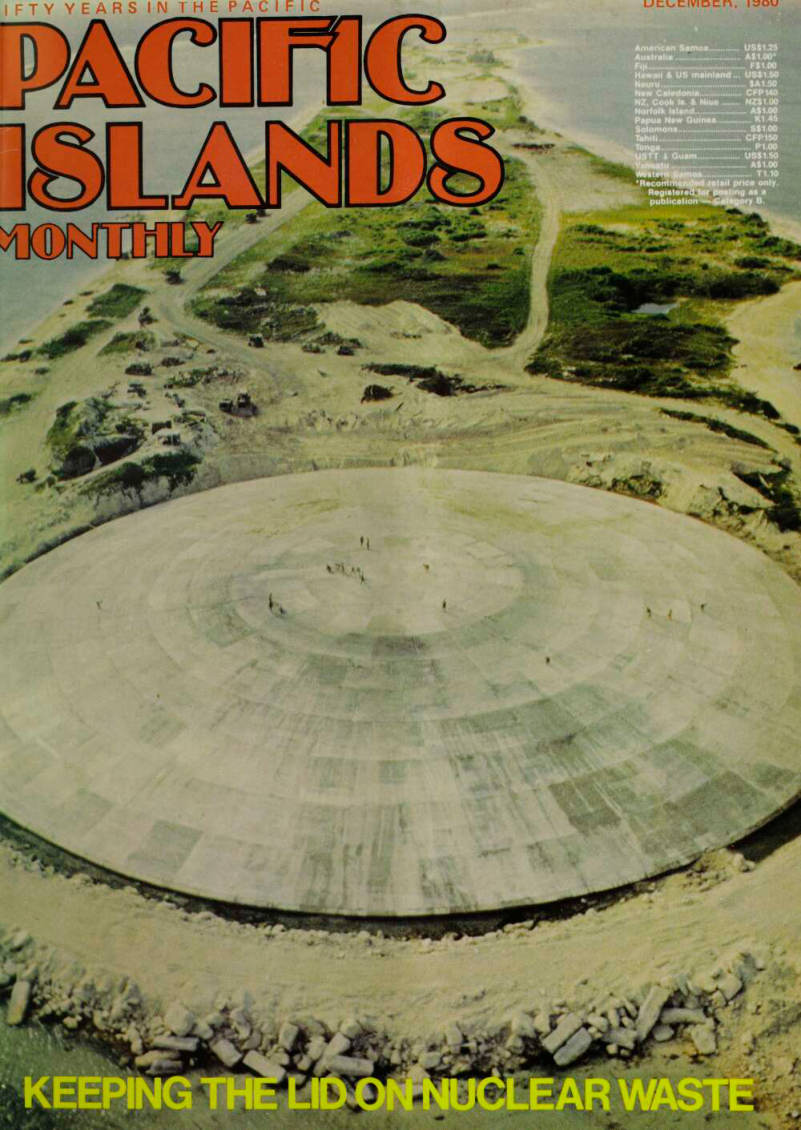
Cover: Under this gigantic dome of -concrete, recently completed on Runit Island in the Marshall Islands, lies the radio-active residue of the US atomic tests at Enewetak Atoll22years ago. The concrete is more than 100 metres wide and nearly half a metre thick, and may well be off limits for 25 000 years. But how successful are the nuclear nations in keeping the lid on atomic waste? PIM reports in this issue on the concern of island nations, expressed at the South Pacific Conference, that their environment may be used increasingly as a dumping ground for nuclear waste. The report of the conference begins on page 11.
Advertisements & other items, p. 2 (1 item)
Toyota
How to find a REAL economy car* When you look at a car billed as an economy
model, ask yourself a few questions.
What sort of fuel consumption can be expected?
Low? Good.
What about other operating costs? Oil, lubrication, that kind of thing. Low again? Great.
How about maintenance? The car has a low-breakdown record? You are definitely on the right track.
What is the average life of the car? Is it better than the average in your area? Super. That’s important in an economy car.
Now. How is the after service? Buying a car is not all in the price you know. Plenty of service outlets?
One economy car coming up. All you have to do is check the price. Then you can tell if you are really getting an economy car.
You will probably find, after asking these questions about town, that REAL economy cars come down to Toyota, the world’s economy car builder.
See Toyota first. Then you won’t have to shop around.
IHE HAPPY ECONOMIZER
TOYOTA STARLET
The car that says economy in every way.
And you will be happy for it. Big inside.
Small outside. Miserly with petrol.
Without sacrificing comfort. A good buy in an economy car even for Toyota. u il
PAPUA NEW GUINEA:
ELA MOTORS,
Scratchley Rd„ Badili, P.O. Box 675, Port Moresby.
U.S. TRUST
TERRITORY: MICROL
CORPORATION,
P.O. Box 267, Saipan.
FIJI ISLANDS:
AUTOMOTIVE
SUPPLIES COMPANY,
P.O. Box 5177, Raiwaqa, Suva
AMERICAN SAMOA:
BURNS PHILP
(SOUTHSEA) CO., LTD.,
P.O. Box 129, Pago Pago.
WESTERN SAMOA:
BURNS PHILP
(SOUTHSEA) CO., LTD.,
P.O. Box 188, Apia.
TONGA: BURNS PHILP
(SOUTHSEA) CO., LTD.,
P.O. Box 55, Nukualofa.
GUAM: ATKINS, KROLL
(GUAM) LTD., P.O. Box
6428, Tamuning.
VANUATU:
NEW HEBRIDES MOTORS,
TOYOTA
SERVICE
TOYOTA
P.O. Box 18, Vila.
SOLOMON ISLANDS;
MENDANA
ENTERPRISES (5.1.)
LTD., P.O. Box 174,
Honiara.
TAHITI: NIPPON
AUTOMOTO, B.P. 342,
Papeete.
COOK ISLANDS;
COOK ISLANDS
TRADING
CORPORATION LTD.,
P.O. Box 92, Rarotonga.
NAURU ISLAND:
NAURU COOPERATIVE
SOCIETY.
REPUBLIC OF KIRIBATI:
TARAWA MOTORS,
Box 36, Bairiki, Kiribati.
NORFOLK ISLAND:
MOUNT PITT
(ENTERPRISES) LTD.,
P.O. Box 169.
NEW CALEDONIA:
SOCIETE IMPORTATION
AUTOMOBILE DU
PACIFIQUE, Rond-Point du Pacific (Station total) B.P. 438, Noumea.
The Toyota range includes: Toyota STARLET, Toyota COROLLA, Toyota CRESSIDA, Toyota HI-LUX, Toyota HI ACE, Toyota DYNA, Toyota LAND CRUISER
Pacific Islands Monthly
ol 51 No. 12
December 1980
(Usps 952480)
Representatives
USTRALIA: Distribution: NSW & ACT: Allan Rodney /right (Circulation) Pty Ltd, PO Box 907, Darlinghursl, NSW 010; Elsewhere: Gordon & Gotch (A/asia) Ltd, Box 40, O, Rosebery, NSW 2018 Advertising Melbourne lay Brown Pty Ltd, 614 Queensberry St, North Melbourne 051, telephone 329 8522, telex 31717, Brisbane - D. /ood, Anday Agency, Box 1918, GPO, Brisbane 4001, tele hone 44 3485, 44 1546; Adelaide Hastwell Media, PO ox 30, Glen Osmond, SA 5064, 233 Glen Osmond Rd, rewville, SA 5063, telephone 79 1869 Perth Adrep, 62 /ickham St., East Perth, WA 6000, telephone 325 6395.
IJI: Distribution and subscriptions - Desai Bookshops, O Box 160, Suva, Fiji, telephone Suva 23036. Advertising ■ Fiji Times & Herald Ltd, 20 Gordon St, Suva, telephone 12 111, telex FJ2124.
RENCH POLYNESIA: Distribution - Hachette Pacifique, 0 Ave Bruat, Papeete, telephone 25610, AWAII, UNITED STATES: Distribution PIM, Hawaii, PO ox 22250, Honolulu, Hawaii 96822. Advertising - Roger rookes, PO Box 10217, Honolulu, Hawaii 96816, telephone 08 536 1784. lICRONESIA: Advertising Roger Brookes, PO Box 0217, Honolulu, Hawaii 96816.
APAN: Advertising and subscriptions Universal Media orporation, CPO Box 46, Tokyo, telephone 666 3036.
EW CALEDONIA: Distribution - Depot Centre de Presse lichel Pentecost, CBP2, Noumea, telephone 27 2434, 7 4729.
EW ZEALAND: Distribution - Gordon & Gotch, PO Box 84, 2 Carr Road, Mt. Roskill, Auckland 4. Advertising iternational Media Representatives Ltd, PO Box 2313, uckland, telephone 795 487; 493 389, cables Intereps, uckland Subscriptions Ross Haines & Son Ltd, PO Box 289, Auckland, telephone 769 042.
APUA NEW GUINEA: Distribution - Gordon & Gotch, 0 Box 3395, Port Moresby, telephone 254551, 254855. dvertlslng PNG Post-Courier, PO Box 85, Port Moresby, ilephone 21 2577.
NITED KINGDOM: The Herald & Weekly Times Ltd, 8-10 lifford's Inn, Fetter Lane, London EC4A IBU, telephone 1 831 6041, telex London 21989.
NITED STATES MAINLAND: Advertising - Joshua B owers Jr, Powers International Inc., 551 Fifth Ave, New ork, New York 100 017, telephone 867 9580, telex 36514. Subscriptions PIM, Hawaii, 2812 Kahawai St, onolulu, Hawaii 96822.
Subscriptions
IM is airfreighted to most subscribers and agents in the acific Islands and the United States, but not the UK or the ontinent
s ayment by personal cheque is accepted in Australian, US, ■Jew Zealand, UK and Fiji currency. For other remittances jlease obtain a bank draft in Australian dollars made payable o the ANZ Banking Group, 88 Wentworth Avenue, Sydney, Australia, ’ublished monthly by Pacific Publications (Aust.) Pty Ltd md printed in Australia by Paramac, Alexandria, NSW. Aus ralian cover price is recommended retail only. Registered at the GPO Sydney for transmission by post as a publication - category B. Second class postage paid at Honolulu, Hawaii. Copyright © 1978 Pacific Publications (Aust.) Pty
Ltd.
Postmaster Honolulu: Send address changes to PIM Hawaii, PO Box 22250, Honolulu, Hawaii 96822
h Lhocal Auĥt. mencan Samoa
Sus16
$13 ustralia $A12 $12 :anada $US18 $14 :ook Islands $13 iji $F12 $12 ranch Polynesia
Cfp 1700
$14 luam $US16 $13 lawaii
Sus16
$13 apan ¥4500 $16 Kiribati $13 licronesia $US16 $13 lauru $18 lew Caledonia
Cfp 1700
$14 Jew Zealand
Snz13.50
$12 Hue $13 Jorfolk Island $12 Jorthern Marianas $US16 $13 ’apua New Guinea K12 $13 iolomon Islands $13 onga $13 uvalu $13 Jnited Kingdom Stg 10 $15 JS Mainland
Sus18
$14 Vanuatu $13 Vestern Samoa $13 Elsewhere $A16
This Month’s Features
• PACIFIC AFFAIRS The 20th South Pacific Conference was held in Port Moresby in October. PIM Editor Angus Smales was there, and files an exclusive report 11 • UNITED NATIONS For the first time the UN agency, the Economic and Social Commission for Asia and the Pacific, has an office in a Pacific Island country. Peter Cummins reports on the opening of an ESCAP liaison office on Nauru 17 • BUSINESSMAN VINDICATED One of the biggest civil actions in Papua New Guinea’s history ended with the complete clearing of the plaintiff and an award to him of more than $5OO 000 against the company he created in the first place 21 • THE TERRIBLE BARON’ Bengt Danielsson, experienced in unorthodox ocean crossings himself, has what looks like being the last word on the windsurfing exploits of Baron Arnaud de Rosnay. His conclusion? The baron was ‘an honest cheat’ 25 • BOOKS Bengt Danielsson reviews a new work on the 1976 journey of the Hokule’a, which attempted to reproduce the conditions of the Polynesian navigators of yore with results that were sometimes amusing, sometimes almost disastrous 43
Books 43 Cook Islands 31 Deaths 63
Escap 17
Fiji 29, 33 French Polynesia 25, 55 Islands Press 23 Kiribati 51 Letters 7 Micronesia 29, 31, 33 Pacific Report 5 Papua New Guinea 21, 31, 41, 45 People 57 Pitcairn Island 27 Political Currents 35
Postmark Papeete 55 Shipping Services 71 Ships 67 Solomon Islands 47 South Pacific Conference 11 Tonga 27, 61 Tradewinds 61 Tradewinds Intelligence 63 Travel 47 Tropicalities 27 Tuvalu 51 US and the Pacific 35 Vanuatu 29, 37 Yachts 65 Yesterday 51
Advertisements & other items, pp. 3-4 (2 items)
3
PACIFIC ISLANDS MONTHLY - DECEMBER, 1980
Founded 1930 by R. W. Robson Editor Angus Smales Associate Editor Malcolm Salmon Editorial Adviser John Carter Manager John Berry Advertising Sales Manager Steve Gray A Pacific Publications production 76 Clarence Street, Sydney 2000 GPO Box 3408 Sydney 2001 Cables: PACPUB Sydney Telex; 21242 (answers INTARAD) Telephone: Sydney 29 6693 Melbourne 63 0211 ext. 1565 and 1858
ffnm™
I I
« 11/1 \ ?
I [HI
P £■ =-V
NEW:
ZEALAND J>S
MET
mm Ua » / WE EXPORT PRODUCTS IN ALL OF THE FOLLOWING GROUPS.
Frozen meat, fish and seafood (bulk and portion control) Dairy products Canned fruit Dry groceries Beer, wines and spirits Cigarettes Electrical appliances Household products Electrical supplies Builders hardware Engineering supplies Motor vehicles and spares and much more!!
SSSSSSSSSSSS&SSS3SSSSSSSSSSS3^
Pacific Report
Ree Association’ Compact Initialled
wo Pacific Island groups took a long step towards self- Dvernment in October when, as the culmination of 11 years of spoliations, they initialled a compact of free association with the nited States. Taking part in the ceremony at Kailua-Kona, awaii, were President Carter’s personal representative to the spoliations, Ambassador Peter R. Rosenblatt, and representa /es of the US Trust Territory of the Pacific Islands, the States of Micronesia, the Marshall Islands and an from Palau. Palau was unable to take part in the itialling because the voters of that small island group in the estern Carolines were to elect their first national government on bvember 4. A Palau representative is expected to initial the impact some time after that date. A formal signing will not take ace until after further negotiations on several subsidiary and following approval of the accords in a plebiscite • be held in Micronesia early in 1981. According to US officials, e new agreements have no exact precedent in international w, or in previous US consititutional practice. The officials say e autonomy which the island states will exercise is greater than ,at of US territories. But, US defence authority in the freely jsociated states is comprehensive, and therefore of a different ature from the treaty relationships with even America’s closest lies. The initialling marks the virtual completion of a negotiating ocess that began in 1969, and advances the goal, announced / President Carter in 1977, of ending the trusteeship in 1981. nder the new compact, the three Micronesian entities will :quire full internal self-government and authority over all jpects of their relations other than those which the US jtermines to be defence and security-related. In defence and jcurity matters, the US will retain plenary authority. The 64age compact also describes conditions for financial and other pes of assistance which the US will provide over a 15-year shod. The aid and defence provisions may continue beyond 15 jars, depending on mutual agreement. After completion of the ■maining subsidiary agreements which cover such subjects > telecommunications, extradition and military land use the impact will be presented to the voters of Micronesia for Dproval by plebiscite, and to the US Congress as a joint •solution for enactment into law. If the compact is approved le US will present it to the United Nations to seek termination f the trusteeship agreement. Ambassador Rosenblatt, address g Micronesian representatives Andon Amaraich of the sderated States of Micronesia and Anton Debrum of the larshall Islands, said that ‘the most important feature of the new jlationship is that decisions will be yours’. The US, he said, has 3sumed significant and long-lasting defence and security bligations towards the islands. Mr Rosenblatt said it was gnificant that the decision on free association was made freely nd in consultation with the local people. Mr Amaraich said the ccasion marked ‘an important event in our history, taking us oser to the goals and objectives of the UN Trusteeship Council’.
Ir Debrum said the compact set the stage for a new relationship etween the US and the Marshall Islands, and for the latter’s iternational status as a freely associated state. When initialled, le compact with Palau will embody a balancing of the Palauan onstitution’s provisions on Law of the Sea matters and nuclear laterials with US positions. Palauan voters have adopted by jferendum a ‘nuclear-free’ constitution. Talks between the two ides were being held on Guam in October.
Lauru Poll On December 6
lecember 6 is the date set for the next general election of lauru’s Parliament. The Speaker, David Peter Gadaraoa, read ut to members in chamber on October 16 an instruction from 'resident Hammer Deßoburt to dissolve parliament seven days om that day.
‘Ago: Korean Fishermen End Strike
Korean fishermen based in Pago Pago, American Samoa, took trike action in protest at the killing of three of their compatriots »y a group of Samoan men early in October (PIM Nov p 6).
Despite their extreme reluctance, they were eventually per suaded to return to work by the Korean Consul and Fishing Officer Chul-sik Park. Mr Park said that the fishermen are ‘very simple and peaceful’ people, who have been beaten repeatedly in brawls and regularly cheated by taxi drivers. ‘Never in my time here have I received a report of a fisherman starting a fight against a local youngster,’ he said. At last report a fourth Korean was on the critical list and was not expected to live. A dozen others are also in hospital, with injuries ranging from broken bones and bruises to a near-blinding. There are 2500 Korean fishermen based in Pago who man 103 boats, and 1500 Taiwan ese manning 90 boats. Joseph Theroux in Pago Pago.
Png Supports’ Asean Policies
Papua New Guinea wants to co-operate with the Association of South-east Asian Nations (ASEAN), and supports its policies, the PNG Information Minister Clement Poye said in Jakarta in October. Winding up a 10-day visit, Mr Poye said that PNG kept in close touch with ASEAN and sent observers to many of its meetings. Mr Poye said he saw many opportunities for co operation with Indonesia, especially in the light of its experience in using television as a means of spreading information to remote areas and in forging national unity. ASEAN groups the governments of Indonesia, Thailand, the Philippines, Malaysia and Singapore.
Vanuatu: Boulekone Heads Opposition
A big step towards consolidation of the paliamentary set-up in Vanuatu was taken in October when Vincent Boulekone was named as Leader of the Opposition, a post vacant until that time.
In a statement after his appointment, Mr Boulekone said a nation cannot be built with violence and in a spirit of revenge. He called for all Vanuatuans, custom leaders, church leaders, the government and all members of the opposition to work actively for the unity of the country. Mr Boulekone affirmed his recognition and support of the government led by Prime Minister Lini as the legal government of the country. He called for an independent commission of inquiry to be set up to investigate charges of police brutality against prisoners in custody, and condemned deportations, which had created social conflicts in islands and villages. At an extraordinary session of the parliament attended for the first time by Tanna MP Charlie Nakau, an opposition member Mr Boulekone charged that in Santo prison, a building designed to hold 200 prisoners, 400 were now being held. They were forced to sleep in soft mud when it rained, he said. Replying, Prime Minister Lini said an independent commission was being set up to examine such charges, and charges of police brutality in general. He said the constitution provided for police officers to be tried if found guilty of brutal treatment of prisoners of anyone else. In a related development, Vanuatu Government spokesman John Beasant said the ‘black list’ of 110 French nationals declared prohibited immigrants affected ‘too many people,’ but that a list had to be made.
French Ambassador to Vanuatu, Yves Rodrigues, had said that the ‘government should give a kind of pardon for both French and Melanesians, and there should be no French being held in prison’.
The issue of the release of such prisoners is being closely tied by the French Government to the as yet unresolved problem of future French aid to the country. Meanwhile, a Noumea paper has hinted at a possible amnesty to be proclaimed on November 29, first anniversary of the election which put the Vanuaaku Party in power in the Representative Assembly with 26 seats, a majority of 13 in the 39-member house.
Kenilorea Warns Trade Unions
Solomon Islands Prime Minister Peter Kenilorea has warned that his government will not tolerate trade union activity directed at the pursuit of political power rather than reasonable conditions for workers. He said such activity would be ‘one of the worst forms of exploitation of our people’.
Irian Java: Welcome Comment, But ...
In a statement made after a recent tour of Irian Jaya, Indonesian Vice-President Adam Malik said that civil servants there were facing difficulties because of low wages, and that there were problems in creating jobs for the Irianese and giving them greater opportunities to take part in the development process. Reporting this Sydney Morning Herald Jakarta correspondent Peter Rodgers quoted an MP from the province as welcoming Mr Malik’s remarks. Steef Nafuni said that comments such as these by Irianese themselves would lead to them being interrogated on suspicion of involvement with the rebel Free Papua Movement
(OPM) which seeks an end to Indonesian rule in the province.
Rodgers quoted Mr Nafuni as saying that fear of being stamped OPM in Irian Jaya was the same as the fear of being stamped as a member of the outlawed Communist Party in Java. The OPM was a ‘death card,’ he said.
Post-Copenhagen Meeting In Suva
A sub-regional Pacific meeting as a follow-up to the World Conference of the United Nations Decade for Women held in Copenhagen in July (PIM Oct p2l) was held in Suva from October 30-November 5.
Vanuatu Recruits Off To Png
New recruits to Vanuatu’s Mobile Force flew out to Papua New Guinea in two groups late in October. Twenty members of the existing Police Mobile Units have also gone to PNG for training together with new PNG Defence Force recruits. The Port-Vila weekly Voice of Vanuatu reported: ‘lt was with great excitement that our boys, soon to be in camouflage, waited to be off and into their new uniforms. “Can’t wait!” they told Voice of Vanuatu. But they are under no illusions about how hard the training will be.
“It’ll be tough,” they said.’ The 100 had been selected for the three-months training course from 1000 applicants. The Vanuatu Government has announced that the men will not form a defence force as such, but will be used as reinforcements for the existing Police Mobile Units. Earlier, there had been talks between the Vanuatu Government and military representatives from Australia and New Zealand. Pointing out that Australia and New Zealand were present under quite separate arrangements, a New Zealand spokesman said that talks had nevertheless taken place between the two countries and the Vanuatu Government on mutual co operation in police and defence force policies.
Kanak Independence For Xmas ’B3?
A spokesman for New Caledonia’s Kanak Independence Front told a Port Moresby seminar in November that on December 25, 1983, the Kanak flag will be hoisted throughout New Caledonia, the French flag lowered, and Kanak independence declared’
Jean-Marie Tjibaou, speaking at the 1980 Waigani Seminar, said that the Kanaks expected opposition not only from the official French riot police, but also from the so-called MOP ( Mouvement pour I’Ordre et la Paix), which has many similarities to the terrorist OAS ( Organisation de I’ArmSe Secrete), which was established by French settlers in Algeria to fight independence there. Mr. Tjibaou said of the MOP: ‘They are saying, “In Vanuatu the French Government did not defend us” and so they are building up their own defences.’
Enewetak People Face Decision
All Enewetak people living at Ujelang Atoll have returned to their home atoll as part of an experimental three-month ‘homecoming’ designed to allow the Dri-Enewetak to decide for themselves which families will permanently settle on the home atoll. Because trees planted as part of the extensive planting programme at Enewetak will not bear fruit for several years, individual families will use this opportunity to determine whether (a) to live in the 116 homes constructed on the islands of Medren, Enewetak and Japtan at Enewetak Atoll and subsist on imported food obtained through the Trust Territory, or (b) return to Ujelang Atoll until a later time.
FRANCIS SANFORD GUNG HO’ ON AIR LINK French Polynesia’s Vice-President of the Government Council, Francis Sanford, has welcomed the establishment of an independent air link between his country and Hawaii. A statement approved by Mr Sanford said in part: ‘We have here an opportunity to show that we are able to act successfully on our own without recourse to government subsidies or private capital bent on making a profit. If some people consider this a revolutionary way of going about things, let them think so.’ (Full report, Postmark Papeete, p 55.) HOW MUCH IS THAT IN VA TU7 Vatu will be the name of the new currency of Vanuatu. Vatu was chosen from two names Vatu and Franc submitted by the government to the Representative Assembly in October.
Caledonia To Cut Nickel Output
The managing director of New Caledonia’s giant nickel company, Societe le Nickel, Yves Rambaud, has said that production must be reduced next year from the present annual level of 45 000 48 000 tonnes to 43 000 45 000. He said the reduction was necessary because of the ‘very gloomy’ situation on the world nickel market. Mr Rambaud said it was too early to estimate the effect of the production cuts on employment in the company.
A New Member For Cplf
Vanuatu has been admitted as a full member of the Conference des Parlementaires de Langue Frangaise, French counterpart of the English-speaking world’s Commonwealth Parliamentary Association. The grant of membership followed a visit to a meeting of the organisation in Ottawa in September by the!
Speaker of the Representative Assembly Maxime Carlot and the now Leader of the Opposition Vincent Boulekone.
NEW PAPERS BURST OUT ALL OVER (2) Following our report of a plethora of new newspaper ventures in Island countries (PIM Nov p 6). Western Samoa has joined the act with a vengence. The Apia weekly The Observer reported on October 30: The Apia Star and the Samoa Post will be making their debuts in the near future, making things harder for the choosy readers not only in choosing what to buy or read but in making out which is which.’ The paper suggests that Western Samoa must be close to a world record for the number of newspapers per head of population (Any comment from Islands statisticians?) The Observer article, written by columnist Lemi,i added: ‘With the anticipated emergence of two more news-i papers onto the aready over-newspapered market, Apia will soon be running out not only of paper boys but also of selling space in front of the Post Office, not to mention running out of rpaHprc ’
Fiji’S Toth’ Feted Abroad
Fiji’s diplomatic missions in London, New York, Brussels, Canberra and Wellington held receptions to celebrate the 10th anniversary of the country’s independence on October 10.
Niue Marks Gospel Anniversary
October 27 was a public holiday on Niue to mark the bringing of the gospel to the island by Peniamina in 1846. Peniamina was a Niuean who became a servant to Dr Turner, a missionary in Samoa, who taught him to read and write. He had first returned to Niue in 1842, but was turned away as ‘a foreigner’. Four years later he returned again, armed with a large quantity of goods such as the Niueans had not seen before. He was thus able to buy a large number of friends at the cost of his belongings.
Finally, he was allowed to land and start preaching.
Fatal Quest For Hidden Kina
An elderly woman died and about 130 people were left homeless after fire virtually destroyed a village in Papua New Guinea’s Central Province in October. The blaze, at Bukuku village, near Kupiano, burned down 23 houses and a trade store made of bush material. It started in a house and was fanned by strong winds.
Most of Bukuku’s 300 villagers were either in their gardens, hunting or visiting nearby villages when the fire started. Only elderly men and women and children were left behind. The dead woman, aged about 80, tried to retrieve Kl3OO in cash hidden inside a sewing machine in her daughter’s house, when she was trapped by the flames.
Cancelled Passports Make Display
‘Raising public awareness of the Pacific region’ was one of the purposes of an exhibition of cancelled diplomatic, official and regular passports staged in Melbourne in late November and early December, according to organiser J. Newton-Browne. The exhibition included cancelled passports from Papua New Guinea, Fiji, Solomon Islands, Trust Territory of the Pacific Islands, Australia, the Philippines and Japan. The exhibition received assistance from United Nations headquarters in New York and a number of governments, including the Australian Government.
Art Show Promotes Lord Howe
The annual Lord Howe Island Art Exhibition and Competition was held in Sydney, October 20-29. Bill Lambourne of Pacific Maps, joint sponsors of the event with the Lord Howe Island Tourist Promotional Committee, reports that 80 % of the paintings of the island in the exhibition (by artist Erwin Weber) were sold. The competition was won by Albert King, a Lord Howe resident, for his painting of the Lord Howe supply ship Barrenjoey.
King Withdraws Son’S Right To Throne
Tonga’s King Taufa’ahau Tupou IV on November 7 formally; withdrew from his second son and any of his offspring rights ever to succeed to the throne. The king’s action follows his September proclamation annulling the marriage in Hawaii of Prince Fatafehi ’Alaivahamama’o Tuku’aho to commoner Heimataura Salmon Anderson (PIM Nov pl 5). An earlier plan for the couple to go to Tonga in October in an attempt to effect a reconciliation fell through at the last minute. The young couple remain in Hawaii, i
Advertisements & other items, p. 5 (1 item)
5
>ACIFIC ISLANDS MONTHLY - DECEMBER, 1980
:hat bottle

Letters
Mo spoof in
lince writing you the letter ffiich you were kind enough to ublish (PIM Aug p41, ‘Sense r spoof in a bottle?’), we have eliable information that the ;tter is indeed no spoof. The writer is Mr Teka, a part-Cook slander, part-Tahitian at pres nt working on the Awahnee of lonolulu, and the message was tirown overboard while the I wahnee, then on charier to the )ceanic Institute, was between he Marquesas and California, 'he letter is written in a lixture of Rarotongan, 'ahitian and English and this xplains why it can be only
mperfectly translated.
For this information we are rateful to a number of people: • To Dr George M. Balaczs f the Hawaii Institute of /larine Biology, who passed the ;tter on to Professor Jack H.
Vard of the University of iawaii, Department of Indo ‘acific Languages. • To Professor Ward, who Jentified the languages and irovided the paraphrase below, nd contacted Dr Steve /lontgomery of the University f Hawaii, Department of Ento nology. • To Dr Montgomery, who ontacted Ms Nancy Griffith, iwner of the Awahnee, and stablished Teka’s identity. • To Ms Griffith and to Teka or supplying the background nformation. • And to Teka and the Awahnee crew for providing nany people with a fascinating mzzle.
We are also grateful to all hose people who wrote to us or :ontacted La Depeche or Les Vouvelles Caledoniennes, and ake this opportunity to thank n advance those readers of 5 IM who will do the same.
The original text appeared to ead as follows: ‘August 1978 10 Teia tutu ari to matou no te
avae August 10 no tera mana gigi muri mai o troni tapae matou i nuhiva 12 tapae matou i tahuia i nia ite pai o awahhee oceanic institute ... e reira fame matou no Tahiti. Nateka, Jon, Mary, Mike, Tom.’
Professor Ward’s para phrase/translation is as follows: ‘August 10, 1978. This new picture (message?) of ours (is) of August (and) today is the 10th. Gigi (another name for Mary?) is (standing?) behind John (Jon?). We (have) arrived at Nukuhiva. (Depending upon where the sentence ends, it could also mean ‘We will arrive at Nukuhiva on the 12th’.Tense is not indicated.) (On the 12th) we will reach Tahuata (I know of no island named Tahuia in the Marquesas.) aboard the ship Awahnee, Oceanic Insti tute. Then we will depart for Tahiti. NATEKA (or it could be NA TEKA, i.e. (written) by TEKA), Jon, Mary, Mike, Tom.’
As a result of this interest, a member of our staff is prepar ing a South Pacific Bulletin article which will highlight the historical, human and scientific aspects of a message which took 15 months to travel from an as yet undetermined spot off the Marquesas to the He des Pins south of New Caledonia.
D. W. J. Stewart
Director of Administration South Pacific Commission Noumea New Caledonia A place of honour for PIM Please convey to Mr Robson and Judy Tudor the delight I felt when I heard that they were celebrating the 50th anniver sary of the Pacific Islands Monthly.
For many years this publi cation was of considerable im portance to me. I first made its acquaintance during the war when copies reached Espiritu Santo, and how avidly I read them, for they introduced me to a whole new world.
After the war, when I trav elled the area frequently, the green-covered PIM became a kind of Bible, informing me of my friends on the 40-odd islands I had known during the war years.
After that I subscribed to the journal, allotting it a place of
honour on my table, because it served as a kind of letter-from home. I was always delighted with its success, impressed by the large amount of information it contained. Such success was due principally to the efforts of Mr Robson and the challenging articles of Judy Tudor.
Their many friends in the United States wish them well, as do I.
James A. Michener
St Michaels Md
Usa
Birthday wishes
from FSP Belated but nonetheless very warm congratulations to PIM on its 50th anniversary.
Elizabeth Sil Verstein
President Foundation for the Peoples of the South Pacific New York NY
Usa
An American
Speaks Out (2)
My wife pointed out to me the letter ‘An American Speaks Out’ (PIM Aug p 35).
I’m an American citizen and I agree with Mr Robinson that not everything ‘done in the name of the flag’ has been positive and responsible.
There was an informative TV show on here in DC called ‘Welcome to Yap’, produced and directed by Dennis O’Rourke. It showed some of the grotesque, unhealthy effects of some of the contacts with ‘advanced foreigners’.
I received a copy of a tran script of the programme. More might be available from WGBH Transcripts, 125 West ern Ave, Boston, MA, 02134.
Thank you.
Robert J. Jones
Washington DC
Usa
Not Orokolo but
Koriki
In the article by Jimmy and Gwenda Cornell on the Third South Pacific Festival of Arts (PIM Sep piB) the picture said to depict an Orokolo dancer is not an Orokolo dancer but a Koriki dancer from Baimuru District in the Gulf Province.
The Orokolo contribution to the festival arose from their
revival of the art of making the Kovave masks. This art form has been dormant for more than 40 years, the last Kovave mask being made in 1939.
Joye Soloi Hareavila
Provincial Co-ordinator for Participants c/o Gulf Province Cultural Committee Kerema Papua New Guinea An Un-Christian Reverend?
The Rev. K. C. Calvert’s ‘Mar tyrs and Mercenaries’ from Tanna island, Vanuatu (PIM Sep p 29) caught my attention since American TV carried filmed reports from Tanna. 1 thought the article was very un-Christian and irreverent for the Reverend missionary.
Our papers had full reports on the Vanuatu uprisings. With ‘many years’ experience of missionary work on this Vanuatuan island’, one would think that Mr Calvert’s re sponse to this situation would generate reconciliation and not provocation.
Ronald E. Hoskins
Philadelphia Penna
Usa
France in the South Pacific I read your translation of ‘La France et le Pacifique Sud’ (PIM Sep p 25) with interest, particularly the bit starting at the end of p 27 about the presence of France in the South Pacific.
Rightly or wrongly I get the
Koriki, not Orokolo
ecling that France’s special leading about ‘communities ndowed with specific status’ nly arises because these erritories are deemed French nd that the case would not be o argued by France were these ommunilies to have the same latus with some other indus rial power for example, lermany, Portugal, Nether mds, Japan, Russia.
In the French view, is ispirilu Santo a failed /layette?
W.J. Simpson
’ort Moresby ’apua New Guinea
Clarification from
Spec
take this opportunity to cor ectly state, for the benefit of our readers, the position of the Jouth Pacific Bureau for Econ imic Co-operation (SPEC) vhich I feel was incorrectly eported by Mr Robert Keith teid in his article titled ‘Forum lacks Hebrides Government’
PIM Aug pi 7).
The report which rec immended the amalgamation »f SPEC and the South Pacific Fommission (SPC) into a single egional institution, to which Tr Keith-Reid referred, was lot a SPEC report but the eport of an independent joint :ommittee. This committee, vhich was created as a result of i decision by the 10th South 3 acific Forum held in Honiara, Solomon Islands, July 1979, ind the Nineteenth South Pacific Conference held in Papeete, French Polynesia, con isted of three Forum member governments (Australia, Cook slands and Solomon Islands), hree SPC member countries/ erritories (American Samoa, Slew Hebrides (Vanuatu) and French Polynesia for France) md an independent chairman, nominated by the Director of SPEC and the Secretary- Seneral of SPC. Its primary 'unction was to investigate the possible rationalisation of insti tutional arrangements between SPEC and SPC with a view to ensuring that overlapping of responsibilities was minimised and that the resources available to the region were utilised most effectively. In accordance with the Forum directive, the com-
mittee tabled its report at the recent 11th South Pacific Fo rum held in Tarawa, Kiribati, July 1980 through its chairman, Tuala Karanita Enari of West ern Samoa. The report was also tabled at the 20th South Pacific Conference held in Papua New Guinea, in October 1980. 1 hope that the above infor mation will clarify the position of SPEC in relation to the Report on Regional Insti tutional Arrangements referred to in Mr Keith-Reid’s article.
G.B. Gris
Director South Pacific Bureau for Economic Co-operation Suva Fiji Poem for Vanuatu
independence
I am a regular reader jk your highly informative afTO well recognised PIM. 1 enjoy reading it and I have a special interest in your poems like those supplied by Mana. It is in this spirit that I would like you to publish a poem 1 wrote for the recent independence of my country of Vanuatu, for merly the New Hebrides (Con dominium), which I would like to share with other PIM readers.
I have attempted to convey some of the main historical events of Vanuatu from the ‘Old Blackbirding Days’ to the present ‘lndependence Era’. 1 would be more than grate ful if you would kindly publish the poem in your letters column or wherever suitable, in your
next issue. I hereby enclose a copy. Thanking you in advance.
Thetidal Waves
I sal quietly, motionless.
Suddenly came A Tidal Wave.
A Wave of Evil!
A Wave of — Blackbirdcrs who robbed my ancestors Selfish-Traders who chopped down my woods First-Class Thieves who stole my land and Missionaries who messed-up my custom.
I thought that was all.
But came Another Tidal Wave.
Another Wave of Evil!
A Wave of— Colonisation Condominiumism Civilisation and Christianity.
My arse pains with rage.
Unreal but . . .
My land stolen!
My children separated!
My resources exploited!
My custom detribalised!
Unreal but . . .
Thai's Mr Two-Faced Monster!
Helpless. I lament my misfortunes.
Suddenly came Another Tidal Wave!
Another Wave of Evil?
No! It’s a Wave of— Freedom Liberty and Unity.
It’s that victorious Wave of INDEPEN
Dence!
Sampson D. Ngwele
(Vanuatu) University of PNG Port Moresby Papua New Guinea
The Club strikes
back
Let me make a somewhat late protest at the article Tourism in New Caledonia Awaits its Flowering Still’ by Andre Chaville (PIM Aug p6l).
I’m truly surprised that a publication as respected as yours would publish such an inaccurate, misleading and totally out-of-date mishmash of half-truths, misinformation, unverified rumours and innu endo.
In the first place, the article is 12 months stale. It refers to the ‘closing of the Chateau’ and ‘when the Club Med reopens . . .’. As at the time of publi cation, the Club had been operating already for 10 months.
The article snidely refers to Club Med as ‘The “Sea, Sun & Sex” holiday camp’. Your author, who has evidently never set foot in a Club village hides his ignorance behind cheap innuendo.
Your readers should know and 1 trust you will publish this rebuttal that the Club to date has catered to some 14 000 Australians and New Zealanders, mostly families with children. In August, there were 180 children, age four and up, present at the peak school holidays.
I leave you to decide whether so many middle and upper income parents would bring their children to a ‘sea, sun and sex camp’.
The article states there are no organised coach tours. Untrue.
It says the accommodation is insufficient. Untrue. Ask the hoteliers who complain about their occupancies. 1 do think that the New Caledonia tourist industry and its bright future bear review by your publication but, please, couldn’t you entrust the task to a more responsible author?
John P. Youngman
Regional Director Club Mediterranee Sydney NSW Australia One or two things slipped under our guard in the course of producing our special anniver sary issue for August, which was more than twice the nor
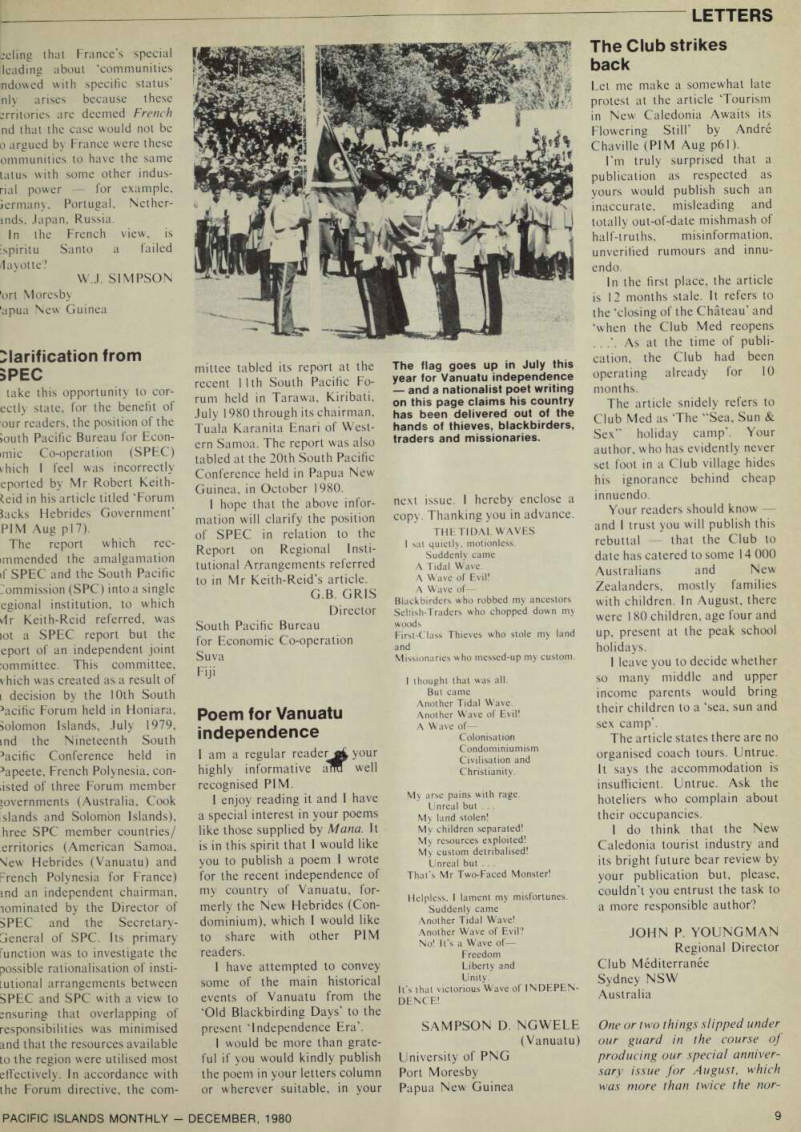
The flag goes up in July this year for Vanuatu independence - and a nationalist poet writing on this page claims his country has been delivered out of the hands of thieves, blackbirders, traders and missionaries.
mal size of our magazine. Mr Youngman is right: the article was out of date, and we are grateful to him for updating the facts on Club Mediterranee activities in New Caledonia.
Meanwhile, we hope Mr Youngman was to some extent mollified by the very favour able account of this French territory as a tourist desti nation given by lan Downs in a later issue (PIM Travel Oct p 59). Editor.
‘Come home
Dorothy’
I have been a regular PIM reader for a couple of years now and I am very proud of the great and wonderful job PIM is doing in elaborating communi cation between the whole South Pacific Region. Well done! Con gratulations!
I now would like to express my concern over the letter written to you by a reader called Dorothy Wakau who claimed to have come from Cairns (PIM Sep p 6).
The letter began by saying ‘l’m probably wasting my time ...’ I agree that Dorothy Wakau was wasting her time.
Dorothy Wakau claims to be a Papua New Guinean, but also ignores the true and valuable identity that she should respect in her country of origin, and everything it contains, its people first of all.
Why doesn’t she come back to PNG to experience the real practical climate of a Melanesian society?
Michael D. Ruimb
West Koma Community Mt Hagen Papua New Guinea
A disclaimer
from Nauru I refer to ‘From the Islands Press’ (PIM Sep p5l) where you quoted The Nauru Post reporting that ‘Nauruans de vote most of their energy to eating, and in the process have become a race of unhealthy blimps. It is a rare adult Nauruan who weights less than 200 lbs. Temptation lurks at the island’s only supermarket where shoppers waddle blithely past nutrition posters to fill their carts with cookies, cornflakes, canned meat and
mountains of beer and soda pop and these are just snacks I must protest most strongly at the manner in which you have edited the quoted text as if it originated from The Nauru Post. The Nauru Post disas sociates itself from any such suggestion as may be implied by the way you published the quoted text.
The quoted text was orig inally written by Time maga zine correspondent Ross H.
Munro in their edition of May 12, 1980. Although we repub lished it in our Issue No. 21 of May 21, 1980, The Nauru Post does not agree with the text you have quoted.
Bernard Dowiyogo
Editor The Nauru Post Nauru PIM is extremely sorry that this item was presented with an incomplete identification of its source. The sentiments ex pressed don’t reflect PI M’s opinion, either Editor.
PIM ‘paranoid 9 about French?
I am puzzled by PI M’s appar ent paranoid fixation on liberat ing the ‘French Provinces’ in the Pacific area to indepen dence.
Is this out of a genuine concern for the islanders (Abor igines in Australia, Maoris in New Zealand), or some kind of dread of French influence in the Pacific?
Doesn’t PIM have any con cern over American influence in the Pacific? I have not noticed any PIM stories pushing a pro independence drive for Hawaii or American Samoa.
Why the discrimination against the French?
William R. Plato
Cleveland Ohio
Usa
For 50years PIM has sought to reflect and support the aspir ations of the peoples of the Pacific. If we sometimes give publicity to pro-independence, or pro-self-government, move ments in French Pacific territories it is because they exist. But where are the com parable movements in
American Samoa or Hawaii?
On three occasions the American Samoans actually rejected by referendum a pro posal that they should elect their own governor or, rather than have governors appointed by Washington. Only on the fourth occasion did they accept the idea. This hardly suggests a public opinion in favour of independence. As for Hawaii, it is an historical fact that majority opinion in Hawaii was strongly in favour of becoming the 50th state of the USA.
President Eisenhower's procla mation of Hawaii as the 50th state of the union on August 21, 1959, was the culmination of a long struggle in Hawaii to attain first-class American citi zenship. Editor.
Lou Hitchcock’s
‘problem’
With reference to Lou Hitchcock’s comment (PIM Aug p3B) on the lady with the beautiful breasts on the cover of the November 1979 PIM, perhaps he would be happier if her beautiful smile was covered with a veil. The man’s got a problem.
Next April my yacht Ella will once again be in the Pacific Islands, and hopefully reported in your fine magazine. Keep us shorebound ‘islanders’ in formed we appreciate it.
Walt Poitevent
Bellingham WA Australia
A Banaban plea for
help
Since I started reading the Pacific Islands Monthly way back during my secondary school days, I have found that the articles were very interest ing and informative. Your Sou venir Edition August, 1980, was one that inspired me very much and also made me want to write to your office.
As a Banaban, the articles in the August issue which were based on Ocean Island or the Banabans were the most inter esting and informative for me.
We are trying very hard to revive our own culture, as well as our language and history.
The main difficulties we are facing are the sources of infor mation and we have found that
your Pacific Islands Monthly is one of the resources we can rely on if you are willing to help us.
Our only humble request is if it is possible for you or any of your readers to supply us with all articles as well as photos on Ocean Island or the Banabans from the first article that you published until your latest edition. We are willing to meet the costs.
We sincerely hope that you will understand our problems and help us.
Teiwaki Benaia
Principal
Rabi Junior Secondary School]
P.O. Nuku Rabi Fiji We will do what we can to help: Editor.
Requests from
correspondents
Robin Anderson, of Post Office Box 194, Glebe, NSW, Aust-i ralia 2037, writes that in con-i junction with Bob Connolly of Arundel Productions she is making a film about the history of Papua New Guinea from the turn of the century to indepen dence in 1975. Any home movies or old black and white pictures which show the PNG activities of Australians and other non-nationals of PNG are urgently required for the pres ent segment of the production programme. The sort of ma terial involved could be in the home, the club, at work or in sport, or could illustrate poli tics, plantations or celebrations.
The material will be well cared for, and returned.
Judy MacDonald, of 14 Ward Avenue, Greenmount WA, Australia 6056, is seeking ma terial for research into the ill fated Marquis de Rays ex pedition which sought to estab lish settlers on New Ireland (now part of Papua New Guinea) towards the end of last century. Mrs MacDonald first became interested in the history of the settlement, and the tragedy and deaths it caused, when she worked in Port Moresby with the Papua New Guinea Post-Courier. She would very much appreciate hearing from anyone who can provide information about the expedition itself and the set tling of survivors in the Duke of York Islands, the New Britain mainland, and in Australia.
Advertisements & other items, p. 8 (1 item)
Pioneer launches a first
m supersonic travel
In this fast-paced world of bullet trains and Concorde jetliners, to stay in touch with your favorite stereo music you need SOUNDTREK. Pioneer’s new supersonic fleet of Multi-Mode Mobile Hi-Fi. . * * • ' • For added tape-handling ease and pushbutton program selection, Pioneer offers Multi-Mode Deck design in every SOUNDTREK stereo portable. For example, there’s Song Finder.™ With it you can skip over unwanted program material, locate • and play your favorite song at the push of a button. A feature you would expect to find on a home hi-fi cassette deck. But wait till you hear the sound of our - - SOUNDTREK portables. When you do, you’ll know why We call them “Mobile Hi-Fi.” \ Explore the outer reaches of stereo listening enjoyment with SOUNDTREK * v , Multi-Mode Mobile Hi-Fi from Pioneer. They’re available in six models, all featuring Pioneer performance and supersonic sound to get you off the ground. iZ.
SK-95F
flO PIONEER
mm For further information, please contact: Australia; Pioneer Marketing Service Pty. Ltd., P.O. Box 317, Mordialloc, Victoria, 3195 Tel: 90-9011 Fiji Islands; Brijlal & Company, G.P.O. Box No. 362, Suva, Fiji Islands Tel; 22258 New Zealand; Monaco Electronics Ltd., 30 Pollen Street, Grey Lynn, Auckland, New Zealand Tel: (09) 762 098 Norfolk Island: Burns Philp (Norfolk Island) Ltd., Norfolk Island, South Pacific New Hebrides: Burns Philp (New Hebrides) Ltd.. Vila. New Hebrides Nauru Island: Jacob Enterprises, P.O. Box No. 4, Republic of Nauru Tahiti: Ets. PERFECT, B.P, 594, Papeete,Tahiti Tel: 20 407 New Caledonia: Menard Freres Ville, B.P. H2Cedex, Noumea, New Caledonia Tel: 27.52.22 American Samoa: Transpac Corporation, P.O. Box 1477, Pago Pago, American Samoa 96799 Tel; 633-5224 Rarotonga: South Seas International Ltd., P.O. Box 49, Rarotonga, Cook Islands Tel: 2 Paoua New Guinea: Bali Merchants Ptv. Ltd., P.O. Box 6103, Boroko Tel; 254887.
Politics without protest emerge
from South Pacific Conference
delegates from 26 metropolitan and Pacific Island countries met in Port Moresby in October for the 21st South Pacific Conference hosted this year by the Papua New Guinea government. They approved a budget of SA3.B million for the ■ontinuing work of the South Pacific Commission, they debated the problem of nuclear waste in the Pacific environment, hev turned a deaf ear for the time being to a PNG proposal for a Pacific Island political alliance, and they heard lome strong words from women who want a bigger role in Pacific affairs. PIM Editor Angus Smales, who was at the ronference, writes this report.
i significant aspect of this ear’s South Pacific Confer nce in Port Moresby was the itrusion of political issues hthout protest. Traditionally tie conference is a non-political ffair in which delegates from articipating governments of tie South Pacific Commission )ok at their environment, their Dciety, their technology and tieir welfare. They share their ieas and concentrate on the imilarities of ambition and ackground which override tra itional, cultural and political inferences.
At earlier conferences there ave been walk-outs and pro mts over what delegates saw as olitical trends in discussion, ut this year two issues were eavily loaded politically with ut interrupting the work or the ow of the conference. The rst, and the most sensitive, ivolved the political tensions urrounding Japanese proposals 3 dump nuclear waste in the western Pacific. Diplomatic co xistence involving some of the letropolitan countries watered own the attitude of the confer nce but the important point /as the willingness of delegates d discuss the issue ispassionately and to accept he opinions of participating overnments despite wide pread objections by Island overnments themselves to /asle-dumping in the Pacific.
The second political issue /as a proposal by PNG to form political alliance of Pacific slands ‘so that we can talk with ne voice in the world forum, nd through United Nations if iccessary’. The proposal re eived an apathetic reception, ►ut no one became steamed up iver it on the basis of politics.
Speaking informally after he conference senior delegates aid that the emergence of ringe political issues was not
unexpected in the new nation atmosphere of today’s Pacific region. They believed that pol itical issues would increasingly intrude on general debates in volving the SPC, but did not see this as a threat to the tra ditional work or structure of the
Spc.
The inclusion of Micronesian countries in this year’s confer ence added to the scope of debates. The countries were the Commonwealth of the North ern Mariana Islands, the Feder ated States of Micronesia, Guam, Marshall Islands and the Trust Territory of the Pacific Islands. All are north of the Equator, leading to infor mal supposition that the names South Pacific Commission and South Pacific Conference are fast on the way to becoming outdated.
Nuclear waste
Unofficial reports from Japan last month suggested that the Japanese government may back down at least for the time being from its controversial intention to dump low-level encapsulated nuclear waste in the Western Pacific. The pro posed site is about 900 km from the Mariana Islands.
However the conference met earlier when Japan was still insisting that the dumping would go ahead, and delegates were presented with an im passioned plea from Governor Carlos Comacho of the Com monwealth of Northern Mariana Islands. He asked the conference to endorse a motion of protest, and delegates from seven Pacific Island nations voiced the opposition of their governments to the Japanese plan. Carefully avoiding any direct initial reference to Japan Governor Comacho said ‘We have been shown an arrogant and malicious disregard of our
rights as people of the Pacific.
We reap no benefits from nu clear energy but we are being forced to share its hazards.’
Other delegates spoke of ‘the untold dangers which are only now being revealed’ and de scribed the huge clean-up cam paign which USA ‘had been obliged to shoulder in an at tempt to bury the wastes from nuclear tests on Eniwetak Atoll’. (See PIM cover picture, this issue.) The leader of the PNG del egation to the talks, Primary Industry Minister Roy Evara, said the Pacific remained one of the few major areas of the world not generally polluted by the results of nuclear activity.
He believed pressures should be exerted politically to keep it that way.
Vanuatu told the conference through its delegate, Primary Industry Minister Thomas Seru, that nuclear powers should dump their waste in their own areas ‘and leave our areas alone’.
It was at this stage that Britain and US intervened in the talks with France show ing tacit acceptance of the intervention and won accept ance of a watered-down motion dictated by diplomatic con siderations. In its final form the resolution adopted by the con ference did not protest against the Japanese plan but merely ‘noted the concern expressed by Pacific Island countries’ over the Japanese plan. The resol ution also ‘noted the desire of Pacific Island countries that alternative means and areas should be used for the disposal of nuclear waste’.
Governor Comacho said after the debate he was disap pointed that the final resolution had not been more strongly worded but he believed the Islands people had made their
point and would continue their campaign to keep the Pacific nuclear-free.
Norfolk Island
In a statement issued outside the conference room the Chief Minister of Norfolk Island, Mr David Buffett, claimed that Australia was suppressing Norfolk’s role as a member of the Pacific community. Norfolk Island, off the east coast of Australia, is technically part of Australia but has been granted a degree of autonomy. Mr Buffett attended the conference as a member of the Australian delegation.
In his statement Mr Buffett said that Norfolk Island had attended last year’s South Pacific Conference as an ad viser to the Australian del egation. Since then, he said, Norfolk had evolved from ‘a colonial-type administration to a fully-elected legislative as sembly with legislative and executive authority.’ He said Norfolk had anticipated that this would empower it to exer cise a conference vote, taking up an unused voting potential nominally held by Australia on behalf of Norfolk Island.
He said he was deeply con cerned to find that as a result of Australian intervention a pro cedural meeting preceding the conference had excluded Norfolk Island from the oppor tunity to vote in its own right.
Norfolk Island had protested strongly to the Australian government on the grounds that it was preventing Norfolk from ‘drawing closer to the Pacific family and having a voice in Pacific affairs’. He said he had sought to address the confer ence on the issue but the leader of the Australian delegation, Senator J. P. Sim, had refused permission.
Senator Sim commented out
side the conference that he was aware of the Norfolk protest but he believed the basis of the protest was not valid. The simple legal fact remained that Norfolk Island was part of Australia and funded by Aust ralia although it had an auton omy within that structure. He said that it was unthinkable that different parts of a single country could have individual voting rights in an international body. Senator Sim said re search had failed to establish
why Norfolk had been listed several years ago as a potential voting entity, and Australia’s recent action had been to cor rect this anomaly. He believed that Norfolk Island political leaders had not been unaware of the anomaly despite their current protest.
Political bloc
A feature of the conference was a bid by Papua New Guinea to sponsor a political alliance which could speak in world forums with one voice on behalf of the Pacific Islands. PNG invited delegates from all Island countries to an unofficial meeting to discuss the proposal.
The meeting did not eventuate however, apparently from hesi tance rather than from outright opposition. There was a feeling
among some delegates that the matter was too political for association with an SPC oc casion. Some of the smaller nations appeared to have vague suspicions of PNG, possibly based on size and possibly fuelled by PNG’s recent mili tary intervention (although by request) in the affairs of Vanuatu. Whatever the reason, the PNG proposal received some token support but little more.
The proposal was made by the leader of the PNG del egation, Primary Industry Min ister Roy Evara, who praised the work of existing regional institutions but said the Pacific was too unco-ordinated in the way it faced the world at large.
The original text of his speech called for a ‘political alliance’, although in delivering it he changed the words to a ‘strong organisation’. Later in talks with newsmen and other del egates he confirmed that the real nature of his proposal referred to a political bloc.
By acting individually, he said, the Island countries lacked the strength to protect their region effectively against major international pressures and attitudes.
In his prepared speech for the conference Mr Evara had planned to suggest that his proposed organisation should be ‘structured along the lines of the Organisation of African Unity with similar goals and functions’. He obviously be came aware of the sensitivities which developed, and deleted this part of his speech. However the text had already been circulated and added to the reluctance of delegates to com mit their support. Mr Evara said later that his sole concern was for a unified Pacific, and PNG would continue to work in that direction.
Women’s role
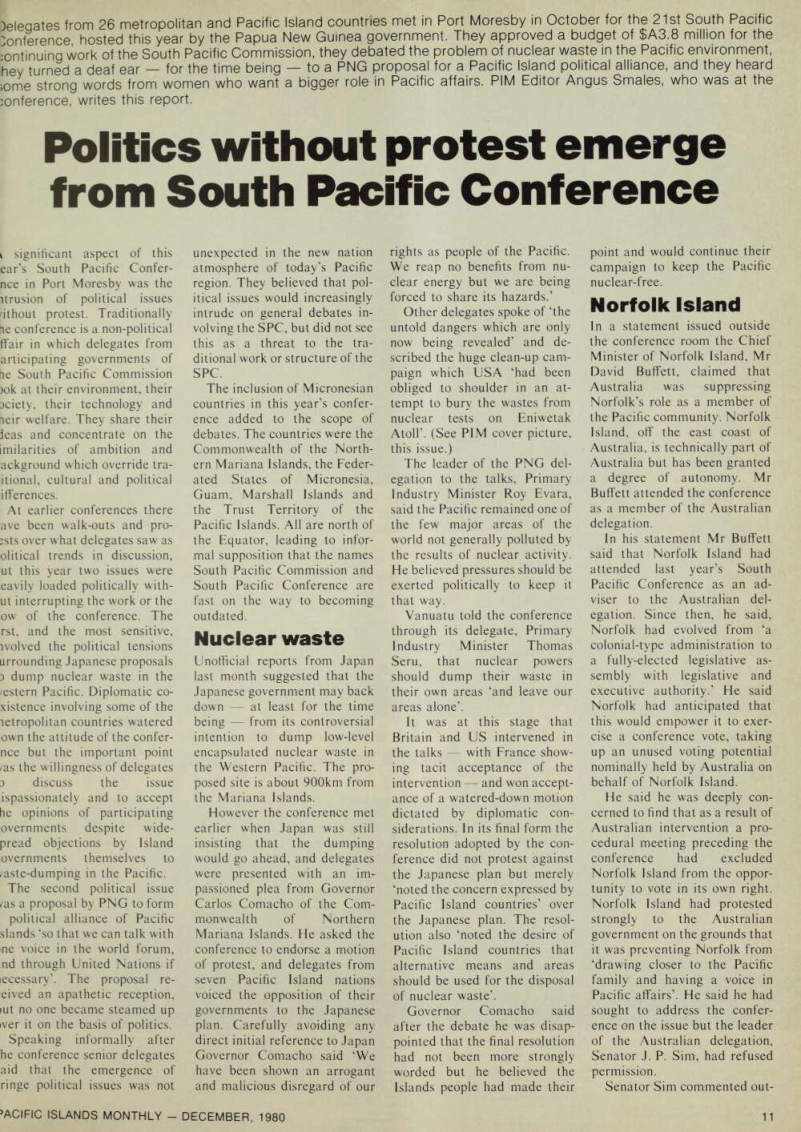
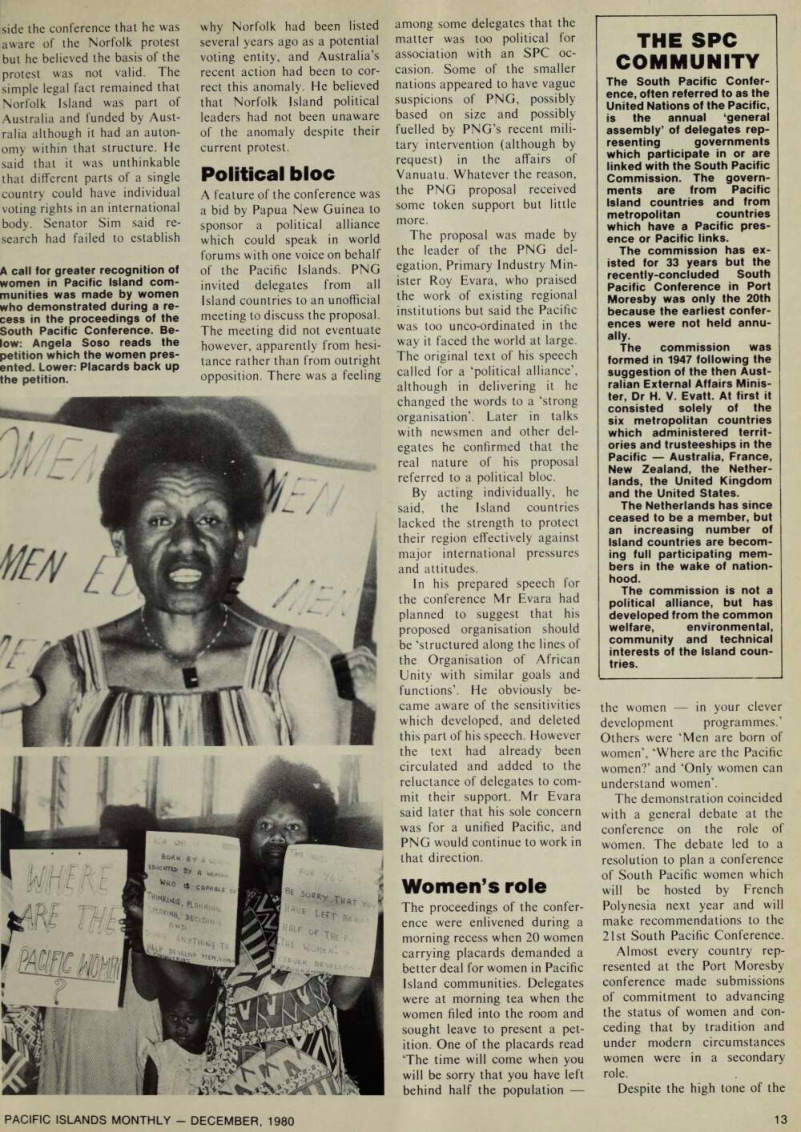
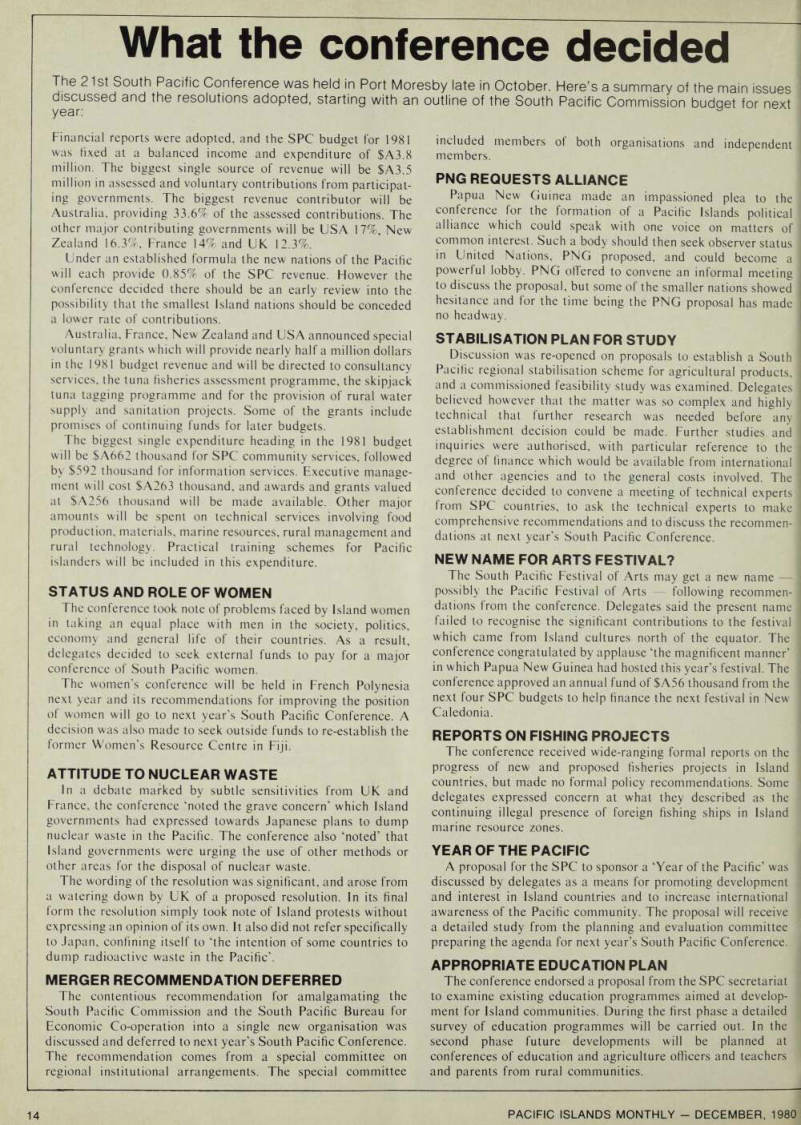
The proceedings of the confer ence were enlivened during a morning recess when 20 women carrying placards demanded a better deal for women in Pacific Island communities. Delegates were at morning tea when the women filed into the room and sought leave to present a pet ition. One of the placards read ‘The time will come when you will be sorry that you have left behind half the population
the women in your clever
development programmes.’
Others were ‘Men are born of women’, ‘Where are the Pacific women?’ and ‘Only women can understand women’.
The demonstration coincided with a general debate at the conference on the role of women. The debate led to a resolution to plan a conference of South Pacific women which will be hosted by French Polynesia next year and will make recommendations to the 21st South Pacific Conference.
Almost every country rep resented at the Port Moresby conference made submissions of commitment to advancing the status of women and con ceding that by tradition and under modern circumstances women were in a secondary role.
Despite the high tone of the
A call for greater recognition of women in Pacific Island com munities was made by women who demonstrated during a re cess in the proceedings of the South Pacific Conference. Be low: Angela Soso reads the petition which the women pres ented. Lower: Placards back up the petition.
reports and the sentiments ex pressed, many women were irritated by their nature, describing then as patronising and seeking to provide con cessions for women. ‘We want a position where we are recog nised as part of the community not concessions’ they said.
Mrs Kila Amini, Executive Director of YWCA in PNG, put it bluntly when she said ‘lt’s the attitudes that need to change. Why talk all the time about a role for women? Why not a debate on a role for men?’
But the women’s prize for annoyance went to the delegate who told the conference smugly ‘We recognise the position of women. We have a woman member in our delegation.
She’s sitting up the back there somewhere’.
Mosquito war
Fish, worms and artificially cultivated germs may be used in Island countries as part of an SPC campaign against disease carrying mosquitoes. Details of the biological control pro gramme against mosquitoes were reported to the Port Moresby conference by the SPC Secretary-General, Mr Young Vivian.
Mr Vivian said that biologi cal control of the mosquito population would be a new weapon in reducing the preva lence of at least five dangerous diseases carried by mosquitoes.
The diseases are malaria, dengue fever, Ross River fever, filariasis and encephalitis. The SPC, working in conjunction with the World Health Organis ation, will conduct a series of tests on a suitable small island which has yet to be selected and the results of the tests will be made available to SPC countries.
The standard method of con trol practised at present is to use chemical insecticides in either of two ways. One is spray fogging which indiscriminately kills mosquitoes in the immedi ate area, but which is impracti cal for the eradication of all mosquitoes. The other is re sidual spraying of vertical sur faces. Mosquitoes rest on verti cal surfaces immediately after biting people or animals, and the selective killing of these mosquitoes breaks the disease transmission cycle.
Mr Vivian told the confer ence that biological control was aimed at a significant reduction of the overall mosquito popu lation. This in turn would re duce the prevalence of diseases which were having a severe effect on the people and the economies of Island countries in the Pacific. The details of the preliminary programme were tabled at the conference in the SPC’s budget and works pro gramme for 1981. Conference delegates said that in many areas mosquitoes were develop ing a resistance to chemical insecticides, and there was also a risk to humans from the side effects of the insecticides. Con cern was also expressed that the continuing use of insecticides in large quantities could produce serious community health prob lems which might not become apparent for decades.
The ‘biological weapons’ which the SPC will use in its test campaign next year will include a nematode worm which will be placed in breed ing sites such as stagnant water, tree holes and coconut husks.
The worms are expected to eat the mosquito eggs, reducing breeding potential.
Another will be a bacterial agent which is harmless to people and animals but which can be placed in village water supplies to destroy the mos quito eggs. Other possibilities under consideration are types of fish which eat mosquito eggs in rivers and lakes.
The report said that the nematode worms and the bac terial agent had already demon strated an effectiveness in kill ing mosquito eggs, but full scale field tests were needed to demonstrate whether the prop osition was practical.
The report stressed that the necessary health assurances in relation to people has already been obtained, and there was also an assurance of environ mental protection. The ap proval on safety grounds had been provided by the World Health Organisation and by the United States Environmental Protection Agency.
If next year’s SPC tests are successful the project will be gradually extended to other islands and remote areas to develop a pool of information.
The cost of the immediate project will be about $2O 000.
Advertisements & other items, pp. 11-12 (2 items)
11
>ACIFIC ISLANDS MONTHLY - DECEMBER, 1980
Akai
UC-5 DC Stereo Power Amplifier model UC- Stereo Pre Amplifier model UC FM AM Quartz Synthesizer-Tuner model UC Stereo Cassette Deck model UC Remote Control Unit (Optional) model RC-5T Speaker System model SW UC-2 Stereo Integrated Amplifier model U( FM/AM Stereo Tuner model UC Stereo Cassette Deck model UC-!
Speaker System, 50 Watts Max. Input Power .. model SW- C 0 a o ■ 000 1111:]
iKB(V
i u m i.
\KAI MINI COMPONENTS.
Singular in Sizes
Sensational in Sound
AKAI
\KAI ELECTRIC CO., LTD.
Tokyo, Japan Akai's mini component systems, UC-5 and UC-2, are like a singularly exquisite gem. There's nothing ordinary about them.
Supremely crafted, they shine with the power, refinement, realism and brilliance of large-scale stereo, yet their dimensions are exceptionally compact. It's amazing. And, to top it all, there's that inimitable bonus-the wireless remote control unit* Quietly operating on an invisible infrared ray, it gives more than just convenience; it instantly fills the air with magic and romance.
Add to all that their uniquely streamlined and elegant looks, and you can see why the UC-5 and UC-2 are becoming the choice of more and more discerning audiophiles. They are, quite simply, sensational. (*An optional feature available with the UC-5 only.)
PNG
S O. Svensson (N G ) Ltd.
P O Box 705, Pori Moresby Tel: 2275 Fiji Islands Motibhai & Company Ltd.
P.O. Box 9175, Nadi International Airport Tel; 72-165 New Zealand Pye Ltd., Consumer Products Sector 110 ML Eden Rd , Mt. Eden. Auckland Tel: 686-437 New Caledonia Menard Pacifique sari B P H 2, Noumea Tel: 275222 Tahiti Etablissements Comimpex P.O Box 200, Papeete Tel: 20477 Vanuatu Burns Philp (New Hebrides) Co., Ltd.
P.O. Box 27, Port Vila, New Hebrides Islands Norfolk Island Burns Philp (Norfolk Island) Co . Ltd Samoa Islands Burns Philp (South Sea) Co.. Ltd.
P.O. Box 129. Pago Pago. American Samoa Mariana Islands J.C. Tenorio Enterprises P O Box 137, Saipan Tel: 6444/8 Solomon Islands Security Electrical Co.. Ltd P.O. Box 174, Honiara Tel: 881 Cook Islands JPS Enterprises Ltd.
P n Hnv Rarntnnna Tttl 91W 917fi For more information, please send this coupon to our distributor in your country or to AKAI ELECTRIC CO . LTC 12-14. 2-Chome. Higashi-Kojiya; Ohta-ku. Tokyo. Japan Name Address
The Spc
Community
The South Pacific Confer ence, often referred to as the United Nations of the Pacific, is the annual ‘general assembly’ of delegates rep resenting governments which participate in or are linked with the South Pacific Commission. The govern ments are from Pacific Island countries and from metropolitan countries which have a Pacific pres ence or Pacific links.
The commission has ex isted for 33 years but the
recently-concluded South
Pacific Conference in Port Moresby was only the 20th because the earliest confer ences were not held annu ally.
The commission was formed in 1947 following the suggestion of the then Aust ralian External Affairs Minis ter, Dr H. V. Evatt. At first it consisted solely of the six metropolitan countries which administered territ ories and trusteeships in the Pacific Australia, France, New Zealand, the Nether lands, the United Kingdom and the United States.
The Netherlands has since ceased to be a member, but an increasing number of Island countries are becom ing full participating mem bers in the wake of nation hood.
The commission is not a political alliance, but has developed from the common welfare, environmental, community and technical interests of the Island coun tries.
What the conference decided
The 21st South Pacific Conference was held in Port Moresby late in October. Here’s a summary of the main issues discussed and the resolutions adopted, starting with an outline of the South Pacific Commission budqet for next year: a
Financial reports were adopted, and the SPC budget for 1981 was fixed at a balanced income and expenditure of SA3.B million. The biggest single source of revenue will be $A3.5 million in assessed and voluntary contributions from participat ing governments. The biggest revenue contributor will be Australia, providing 33.6% of the assessed contributions. The other major contributing governments will be USA 17%, New Zealand 16.3%, France 14% and UK 12.3%.
Under an established formula the new nations of the Pacific will each provide 0.85% of the SPC revenue. However the conference decided there should be an early review into the possibility that the smallest Island nations should be conceded a lower rate of contributions.
Australia, France, New Zealand and USA announced special voluntary grants which will provide nearly half a million dollars in the 1981 budget revenue and will be directed to consultancy services, the tuna fisheries assessment programme, the skipjack tuna lagging programme and for the provision of rural water supply and sanitation projects. Some of the grants include promises of continuing funds for later budgets.
The biggest single expenditure heading in the 1981 budget will be 5A662 thousand for SPC community services, followed by $592 thousand for information services. Executive manage ment will cost 5A263 thousand, and awards and grants valued at 5A256 thousand will be made available. Other major amounts will be spent on technical services involving food production, materials, marine resources, rural management and rural technology. Practical training schemes for Pacific islanders will be included in this expenditure.
Status And Role Of Women
The conference took note of problems faced by Island women in taking an equal place with men in the society, politics, economy and general life of their countries. As a result, delegates decided to seek external funds to pay for a major conference of South Pacific women.
The women’s conference will be held in French Polynesia next year and its recommendations for improving the position of women will go to next year’s South Pacific Conference. A decision was also made to seek outside funds to re-establish the former Women’s Resource Centre in Fiji.
Attitude To Nuclear Waste
In a debate marked by subtle sensitivities from UK and France, the conference ‘noted the grave concern’ which Island governments had expressed towards Japanese plans to dump nuclear waste in the Pacific. The conference also ‘noted’ that Island governments were urging the use of other methods or other areas for the disposal of nuclear waste.
The wording of the resolution was significant, and arose from a watering down by UK of a proposed resolution. In its final form the resolution simply took note of Island protests without expressing an opinion of its own. It also did not refer specifically to Japan, confining itself to ‘the intention of some countries to dump radioactive waste in the Pacific’.
Merger Recommendation Deferred
The contentious recommendation for amalgamating the South Pacific Commission and the South Pacific Bureau for Economic Co-operation into a single new organisation was discussed and deferred to next year’s South Pacific Conference.
The recommendation comes from a special committee on regional institutional arrangements. The special committee
included members of both organisations and independent members.
Png Requests Alliance
Papua New Guinea made an impassioned plea to the conference for the formation of a Pacific Islands political alliance which could speak with one voice on matters of common interest. Such a body should then seek observer status in United Nations, PNG proposed, and could become a powerful lobby. PNG offered to convene an informal meeting to discuss the proposal, but some of the smaller nations showed hesilance and for the time being the PNG proposal has made no headway.
Stabilisation Plan For Study
Discussion was re-opened on proposals to establish a South Pacific regional stabilisation scheme for agricultural products, and a commissioned feasibility study was examined. Delegates believed however that the matter was so complex and highly technical that further research was needed before any establishment decision could be made. Further studies and inquiries were authorised, with particular reference to the degree of finance which would be available from international and other agencies and to the general costs involved. The conference decided to convene a meeting of technical experts from SPC countries, to ask the technical experts to make comprehensive recommendations and to discuss the recommen dations at next year’s South Pacific Conference.
New Name For Arts Festival?
The South Pacific Festival of Arts may get a new name possibly the Pacific Festival of Arts following recommen dations from the conference. Delegates said the present name failed to recognise the significant contributions to the festival i which came from Island cultures north of the equator. The conference congratulated by applause ‘the magnificent manner’ in which Papua New Guinea had hosted this year’s festival. The conference approved an annual fund of SAS6 thousand from the next four SPC budgets to help finance the next festival in New Caledonia.
Reports On Fishing Projects
The conference received wide-ranging formal reports on the progress of new and proposed fisheries projects in Island countries, but made no formal policy recommendations. Some delegates expressed concern at what they described as the continuing illegal presence of foreign fishing ships in Island marine resource zones.
Year Of The Pacific
A proposal for the SPC to sponsor a ‘Year of the Pacific’ was discussed by delegates as a means for promoting development and interest in Island countries and to increase international awareness of the Pacific community. The proposal will receive a detailed study from the planning and evaluation committee preparing the agenda for next year’s South Pacific Conference.
Appropriate Education Plan
The conference endorsed a proposal from the SPC secretariat to examine existing education programmes aimed at develop ment for Island communities. During the first phase a detailed survey of education programmes will be carried out. In the second phase future developments will be planned at conferences of education and agriculture officers and teachers and parents from rural communities.
Four New Nations Admitted
Four new Island nations were admitted to full participating rights in the conference by virtue of their political status and under the rules of the conference. They were the Federated States of Micronesia, the Marshall Islands, the Commonwealth of the Northern Mariana Islands and the Republic of Vanuatu.
It was also announced that the governments of the Cook Islands and Niue had filed their instruments of accession to the Canberra Agreement. The Canberra Agreement is the formal arrangement under which the South Pacific Commission is constituted, and is named after the Australian capital where the conference which founded the SPC was held.
Next Conference In Port-Vila
The conference accepted an invitation from Vanuatu to host the 21st South Pacific Conference in Port-Vila next year, but the date has yet to be fixed in negotiations between the Vanuatu government and the SPC secretariat. The conference also accepted an offer from the Commonwealth of the Northern Mariana Islands to be host in 1982 or subsequent years.
Help For Atoll Communities
The conference reaffirmed the intentions of the SPC to take wide-ranging steps to increase the self-sufficiency of small atoll communities throughout the region. The problems of remote and isolated atoll communities were first raised in detail at the 18lh South Pacific Conference two years ago, and suggestions were made that aid donors, universities and other interested countries and organisations should be approached in the interests of increasing self-sufficiency in food, energy and water an the atolls of the Pacific.
The SPC secretariat reported to this year’s conference that considerable progress had been made in defining the practical requirements of such a project and in estimating what would be entailed. It referred to earlier discussions on the problems of atoll communities, some going back more than 25 years. The costs of establishing and applying a suitable programme were estimated at SASOO million. The conference was told that an approach had been made to the European Economic Com munity, through Lome Convention channels, for finance.
New Media Centre Suggested
The conference received reports and recommendations on a move which could lead to the establishment in Vanuatu of a media training centre to serve the Island countries of the South Pacific. A detailed examination of the proposal will be left to the SPC Planning and Evaluation Committee.
At present the SPC operates a media training and resource centre in Fiji, but the conference was told that there are increasing pressures from member governments and organis ations to expand the facility because of the growth of publishing, newspapers, magazines, publicity material outlets, radio and some television in the region. In a preliminary proposal to the conference the secretariat suggested that an expanded media centre, which would train people from all over the Pacific, might benefit from being newly established in another country. Vanuatu was tentatively suggested, particu larly because French and English are both widely used there.
The preliminary proposal indicated that external funding would be needed for major expansion of the media centre.
Warning On Fishery Plans
The conference took note of a caution from the SPC secretariat that social and political factors could be expected to play an increasing role in plans for the development and management of fisheries. If fisheries were to be the economic success that Pacific governments expected, it was therefore essential that the highest standards of consultation and development should be followed, the secretariat warned. ‘Bad advice is not cheap at any price’ the report said.
Advertisements & other items, p. 16 (1 item)
A tiny sensation.
Its incredible that a component system so small can deliver such sensational sound. But there's no denying it. Hitachi M 2 MKII Minicomponents give you stereo sound that really fills the room in a size that barely fills a bookshelf.
The powerful M 2 MKII integrated amplifier, metal capable tape deck with Dolby,* phase-lock tuner and 2-way speakers. Put them together any way you like for performance you're sure to love. Their rounded-edge design makes them as versatile as they are contemporary. And the dimensions are matched for a unified look, no matter how you arrange them.
Hitachi M 2 MKII Minicomponents. Great big sound from a great little system.
FM-U 875 90 92 94 96
4 (S:
@ HITAC
J 1
HITACHI
c 4jg>;
0 HITACHI
• ««c i t t gp ? {lid} j M t K —r m
0 HITACHI
The HA-M 2 MKII Integrated Amplifier is rated at 25 watts per channel continuous RMS power.
Dimensions (WxhxD): HA-M 2 MKII integrated Amplifier (230x?4xi84 mm), D-M2 MKII cassette Deck (230X146X162 mm). FT-M 2 MKII Tuner (230X74X160 mm), and HS-M2 MKII speaker System (146x290x160 mm). * Dolby is a trademark of Dolby laboratories. • AUSTRALIA: Hitachi sales Australia Pty,, ltd., 155 Keys Road, Moorabbln, victoria 3189 Phone: (95) 8722 • NEW ZEALAND: awa New Zealand Limited, wi-neera Drive, P.o. Box 50-248. Porlrua Phone: 43-75-069 • PAPUA NEW GUINEA: S O. Swensson (N.c.) Ltd., P.O. Box 705. Port Moresby Phone: 21-2111 • Fill ISLANDS: Burns Phllp (South Sea) Co., Ltd., Box 355, C.P.0., Suva Phone: 311777 • NEW CALEDONIA: CaldlS, B P Ml. Noumea Phone: 26.23.50 • TAHITI; Ets Chene Alain, P.O. Box 272, Papeete Phone 2 88.68 • SOLOMON ISLANDS; Technique Radios Centre Ltd., P.O. Box 465, Honiara Phone: 416 • NAURU: Nauru Cooperative Society, Republic of Nauru • AMERICAN SAMOA: Burns Phllp (South sea) Co.. Ltd., P.o Box 129, Pago Pago • NEW HEBRIDES: Burns Phllp (New Hebrides) Co.. Ltd., P.o Box 27, Port Vila
HITACHI
Brand-new Pacific liaison office

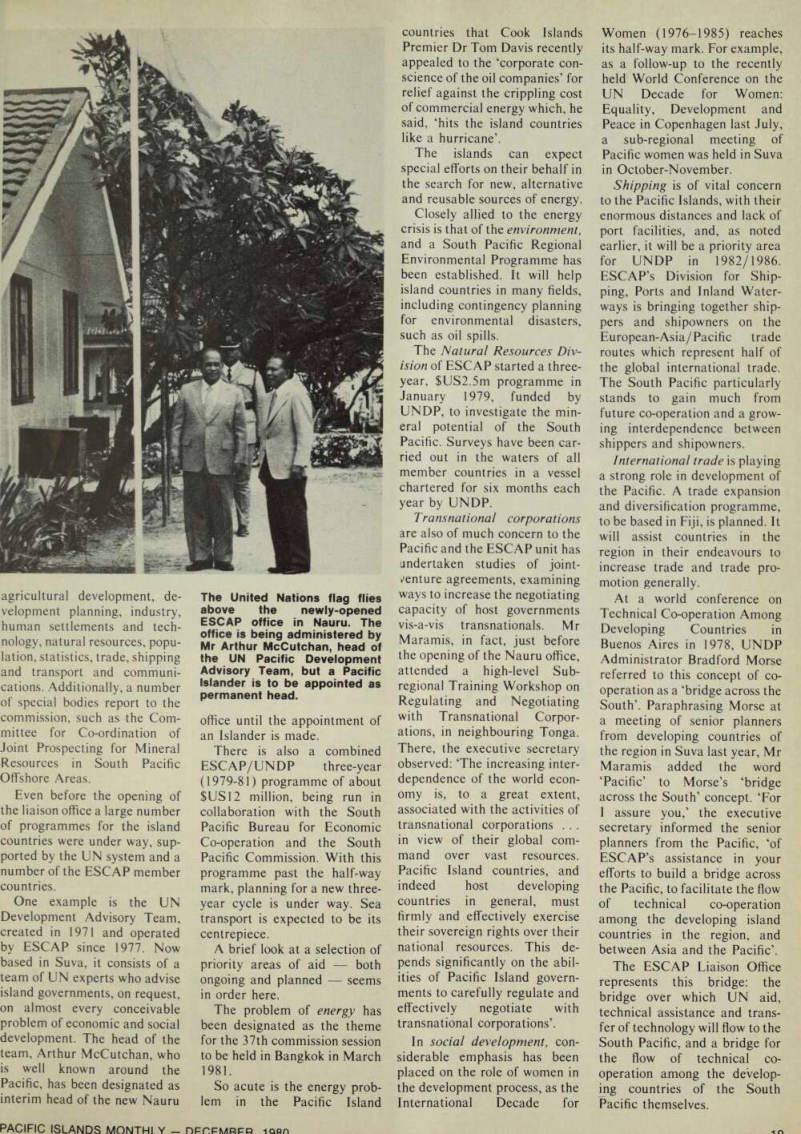
for ESCAP - and Nauru’s the host
PEJER CUMMINS* reports on the opening on Nauru in October of a new United Nations office, the Liaison Office for the Pacific of the UN’s Economic and Social Commission for Asia and the Pacific (ESCAP). He calls the office ‘a bridge’ ‘a bridge over which UN aid, technical assistance and transfer of technology will flow to the South Pacific, and a bridge for the flow of technical co-operation among the developing countries of the South Pacific themselves’.
Friday, October 3, 1980, was not a day like any other for the tiny island republic of Nauru.
At 10.30 am on that day, the President of Nauru Hammer Deßoburt and the Executive Secretary of the United Nations Economic and Social Commission for Asia and the Pacific (ESCAP) Mr J. B. P.
Maramis, raised the United Nations flag over the new ESCAP Liaison Office for the Pacific.
As the blue and white flag unfurled in the warm trade wind, the UN emblem symbol ised a promise to the peoples of the developing island states. A package of aid, spanning the vast fields of competence of the UN, would as a result flow into the region, affecting trade pro motion, natural resources, en ergy, shipping, population and related problems, training, offshore prospecting, industrial and social development, stat istics, food and agriculture, transport and communications, transnational corporations, the role of women in development, tourism and the transfer of technology.
The office will be the ‘bridge’ in the flow of technical co operation from the UN system to the region. It will also foster technical co-operation among the Pacific countries them selves, a prime goal of the UN development strategy for the 1980 s.
The liaison officer’s principal
tasks will be to improve link ages and maintain effective liaison between ESCAP and the countries of the Pacific, and to assist ESCAP’s executive sec retary in the programming and implementation of needed ac tivities.
The opening of the liaison office signifies an end and a beginning. It marks the end of an era which began 33 years ago in Shanghai when the United Nations Economic Commission for Asia and the Far East (ECAFE) was estab lished, with 10 original mem bers. Then, the islands of the Pacific were either under col onial rule or were trust territories won as ‘prizes’ in global conflicts.
It also marks the beginning of the Third Development Dec ade, a decade where phrases like interdependence, self-help, regional co-operation, new in ternational economic order, North-South and South-South dialogue, bridges across the South, and Brandi Commission will be key terms in the language of development. It is the beginning of an era of increasing assistance to the developing island countries of the South Pacific. As one Pacific Islander said during ESCAP’s annual session in Bangkok last March; ‘The Pacific Islanders’ call for assist ance has been heard’.
As the UN emblem flies for the first time in this northern area of the South Pacific, it flies in a region whose peoples have largely gained their freedom and independence. And, 33 years later, the commission, now called the Economic and Social Commission for Asia and the Pacific, has 35 mem bers and eight associate mem bers, covering a region which stretches from Iran to Indonesia, from Kiribati to
Korea. Almost half of the world’s surface and consider ably more than half the world’s population, including the world’s most populous countries, China and India, fall within ESCAP’s mandate for the 1980 s.
The Brandt Commission re port, otherwise known as North-South: A Programme for Survival, points clearly to the type of situation now exist ing in the South Pacific. In his introduction, Willy Brandt notes: ‘As a result of decolonisation in most parts of what came to be called the Third World, long established power structures crumbled or collapsed, leaving vacuums and giving birth to new political and economic groupings.’ Countries which thus were released from colonial dependence, Brandt goes on, ‘have been struggling to gain equality of opportunity in their development, (request ing) beneficial co-operation, as sistance and transfer of re sources . . . goods and techno logies ... to overcome their
poverty’.
There is a special significance in the opening of this office for the two principals involved, President Hammer Deßoburt and Executive Secretary J.B.P.
Maramis. Mr Deßoburt led his
Lilliputian-sized country’s
deputations to the UN Trusteeship Council, finally winning independence for Nauru on January 31, 1968.
He became the first president of the new republic, and he was elected chairman of ESCAP’s 32nd annual session, held in Bangkok in 1976, at which time he remarked that his election was ‘evidence of ESCAP’s in creasing involvement in the development of the Pacific Island states’.
It was at this same session that the first ‘special measures in favour of the least developed, land-locked and island countries’ were adopted.
Deßoburt has championed
*N. Peter Cummins MSc is Information Officer for the United Nations Economic and Social Commission for Asia and the Pacific (ESCAP).
Based in Bangkok, Thailand, he visited Nauru for the open ing of ESCAP’s new Liaison Office for the Pacific in October.
J.B.P. Maramis (left), Executive Secretary of the Economic and Social Commission for Asia and the Pacific, and Hammer DeRoburt, President of Nauru, at the unveiling of a plaque to mark the opening of ESCAP’s new liaison office in Nauru.
the cause of the developing island countries of the South Pacific. There is poetic justice in the liaison office being lo cated in his own island republic.
Mr Maramis was appointed as fourth Executive Secretary of ESCAP on 1 August 1973, after a distinguished career with the Indonesian Govern ment, during which he gained broad experience in inter national organisations. Fie came to ESCAP, in fact, from a posting as ambassador to Belgium and Luxembourg and head of the Indonesian Mission to the European Community.
One of the executive sec retary’s first acts was to change the name of the former Econ omic Commission for Asia and the Far East to Economic and Social Commission for Asia and the Pacific, ‘to reflect’, he said at the time, ‘the com mission’s new responsibilities to the people of the region, par ticularly in the South Pacific’.
The opening of the Pacific Liaison Office is a tribute to Maramis’ dedication to one of his goals: that the South Pacific area, particularly, which is among the most disadvantaged of the world’s least developed areas, should directly benefit from UN assistance pro grammes.
No doubt the influence of the president. Hammer Deßoburt, one of the South Pacific’s best known leaders, was a large factor in the choice of Nauru for the site of the office. As Deßoburt said in his address at the opening: ‘Earlier this year in Bangkok, the government of Nauru was pleased to be able to offer Nauru as a possible lo cation for the Liaison Office in the Pacific, and Nauru was supported in Bangkok, in the South Pacific Forum countries and in Micronesia. This morn ing sees the inauguration of the Liaison Office in premises which have been provided by the government of Nauru.’
A decentralisation of such offices is in any case desirable.
For example, Fiji to the south hosts a UN Development Ad visory Team, a UN Develop ment Programme (UNDP) office, the South Pacific Bureau for Economic Co-operation and its South Pacific Forum, the University of the South Pacific and a number of UN special ised agencies. Western Samoa
on the eastern periphery houses another UNDP office, and there is the South Pacific Com mission in New Caledonia on the western edge.
Mr Maramis summed up UN attitudes in his October 3 address; The role of Nauru in bringing about the establish ment of the ESCAP Liaison Office in the Pacific was demon strated in the active part that the delegation of Nauru played, and which led to the adoption by the commission of the two resolutions concerned. It was in recognition of this role that the Pacific Island countries agreed to Nauru as the site for the liaison office.’
Finally, the island has good telecommunications facilities, and Air Nauru offers frequent and efficient pan-Pacific air services.
Twelve Pacific Island States are members of ESCAP. Fiji, Nauru, Papua New Guinea, Western Samoa, Solomon Islands and Tonga are full members; Fiji, Papua New Guinea, Western Samoa and Solomon Islands are also mem bers of the UN. Cook Islands, Kiribati, Niue, Trust Territory of the Pacific Islands, Tuvalu and Vanuatu are associate members. Associate member ship could be regarded as ‘trial membership'.
ESCAP, often called the ‘Parliament of Asia and the Pacific’, is one of five regional economic commissions of the UN. It is administratively re sponsible to the secretary general of the UN, and, at the same time, it is responsible to its member countries and is subject to their guidance in policy matters under the overall supervision of the UN Econ omic and Social Council.
ESCAP’s primary role is to serve member countries by identifying areas of social and economic development prob lems; by providing a forum for debate on development issues, and by providing technical as sistance and advisory services and helping member countries to attract outside assistance. It does not itself provide capital resources but has helped to establish institutions to attract funds for regional and sub regional projects which, in turn, supply development aid.
Nine legislative bodies guide the work of the commission in
agricultural development, de velopment planning, industry, human settlements and tech nology, natural resources, popu lation, statistics, trade, shipping and transport and communi cations. Additionally, a number of special bodies report to the commission, such as the Com mittee for Co-ordination of Joint Prospecting for Mineral Resources in South Pacific Offshore Areas.
Even before the opening of the liaison office a large number of programmes for the island countries were under way, sup ported by the UN system and a number of the ESCAP member countries.
One example is the UN Development Advisory Team, created in 1971 and operated by ESCAP since 1977. Now based in Suva, it consists of a team of UN experts who advise island governments, on request, on almost every conceivable problem of economic and social development. The head of the team, Arthur McCutchan, who is well known around the Pacific, has been designated as interim head of the new Nauru
office until the appointment of an Islander is made.
There is also a combined ESCAP/UNDP three-year (1979-81) programme of about SUSI 2 million, being run in collaboration with the South Pacific Bureau for Economic Co-operation and the South Pacific Commission. With this programme past the half-way mark, planning for a new three year cycle is under way. Sea transport is expected to be its centrepiece.
A brief look at a selection of priority areas of aid both ongoing and planned seems in order here.
The problem of energy has been designated as the theme for the 37th commission session to be held in Bangkok in March 1981.
So acute is the energy prob lem in the Pacific Island
countries that Cook Islands Premier Dr Tom Davis recently appealed to the ‘corporate con science of the oil companies’ for relief against the crippling cost of commercial energy which, he said, ‘hits the island countries like a hurricane’.
The islands can expect special efforts on their behalf in the search for new, alternative and reusable sources of energy.
Closely allied to the energy crisis is that of the environment, and a South Pacific Regional Environmental Programme has been established. It will help island countries in many fields, including contingency planning for environmental disasters, such as oil spills.
The Natural Resources Div ision of ESCAP started a three year, SUS2.Sm programme in January 1979, funded by UNDP, to investigate the min eral potential of the South Pacific. Surveys have been car ried out in the waters of all member countries in a vessel chartered for six months each year by UNDP.
Transnational corporations are also of much concern to the Pacific and the ESCAP unit has undertaken studies of joint /enture agreements, examining ways to increase the negotiating capacity of host governments vis-a-vis transnationals. Mr Maramis, in fact, just before the opening of the Nauru office, attended a high-level Sub regional Training Workshop on Regulating and Negotiating with Transnational Corpor ations, in neighbouring Tonga.
There, the executive secretary observed: ‘The increasing inter dependence of the world econ omy is, to a great extent, associated with the activities of transnational corporations . . . in view of their global com mand over vast resources.
Pacific Island countries, and indeed host developing countries in general, must firmly and effectively exercise their sovereign rights over their national resources. This de pends significantly on the abil ities of Pacific Island govern ments to carefully regulate and effectively negotiate with transnational corporations’.
In social development, con siderable emphasis has been placed on the role of women in the development process, as the International Decade for
Women (1976-1985) reaches its half-way mark. For example, as a follow-up to the recently held World Conference on the UN Decade for Women; Equality, Development and Peace in Copenhagen last July, a sub-regional meeting of Pacific women was held in Suva in October-November.
Shipping is of vital concern to the Pacific Islands, with their enormous distances and lack of port facilities, and, as noted earlier, it will be a priority area for UNDP in 1982/1986.
ESCAP’s Division for Ship ping, Ports and Inland Water ways is bringing together ship pers and shipowners on the
European-Asia/Pacific trade
routes which represent half of the global international trade.
The South Pacific particularly stands to gain much from future co-operation and a grow ing interdependence between shippers and shipowners.
International trade is playing a strong role in development of the Pacific. A trade expansion and diversification programme, to be based in Fiji, is planned. It will assist countries in the region in their endeavours to increase trade and trade pro motion generally.
At a world conference on Technical Co-operation Among Developing Countries in Buenos Aires in 1978, UNDP Administrator Bradford Morse referred to this concept of co operation as a ‘bridge across the South’. Paraphrasing Morse at a meeting of senior planners from developing countries of the region in Suva last year, Mr Maramis added the word ‘Pacific’ to Morse’s ‘bridge across the South’ concept. ‘For I assure you,’ the executive secretary informed the senior planners from the Pacific, ‘of ESCAP’s assistance in your efforts to build a bridge across the Pacific, to facilitate the flow of technical co-operation among the developing island countries in the region, and between Asia and the Pacific’.
The ESCAP Liaison Office represents this bridge: the bridge over which UN aid, technical assistance and trans fer of technology will flow to the South Pacific, and a bridge for the flow of technical co operation among the develop ing countries of the South Pacific themselves.
The United Nations flag flies above the newly-opened ESCAP office in Nauru. The office is being administered by Mr Arthur McCutchan, head of the UN Pacific Development Advisory Team, but a Pacific Islander is to be appointed as permanent head.
Advertisements & other items, pp. 18-20 (2 items)
Pty. Ltd.
WATER WHEEL EXPORTS
493 Bourke Street, Melbourne, 3000, Australia Cables; Watermill-Melbourne.
Telex: AA 32165 Telephone: 602 1433
THE WATER WHEEL GROUP OF COMPANIES
Winners of Australia’s Top Export Award and Flour Millers for over 100 years.
BEST AUSTRALIAN
WHEATEN FLOUR
(High Protein, Bakers, Stone ground Wholemeal, Donut).
COOLROOMS REFRIGERATED
CABINETS ETC.
INCLUDING SALT WATER
ICE MAKERS
STOCK & POULTRY FEEDS
(Pellets or Mash form)
YELLOW SPLIT PEAS &
WHOLE PEAS
(Machine-Dressed)
COMPLETE RANGE OF FROZEN
AND GENERAL FOOD ITEMS
QUALITY AUSTRALIAN
WINES
WOOD FUEL STOVES
AND WATER HEATERS
It’s got a love for life ...just like you!
Honda 2-door Hatchback.
juipment may vary in some countries.
This energetic Accord reflects your
sunny personality and complements
your active lifestyle. Its high-spirited performance will never disappoint you and its ability to change from a 5-passenger family car into a versatile 2-seater sports wagon with the rear seat folded to make way for your golf clubs or a mountain of luggage, is an extra quality you’ll appreciate. You demand more from your car and the Accord delivers. Economical operation low fuel consumption and low maintenance is important today, and so is a comfortable ride and good roadability. The all-independent suspension, rack and pinion steering and disc brakes make it handle with precision. Looking for a new partner to take you where you want to go?
Take along the Accord. It’s a pleasure!
A HONDA
Accord
r IT 'm T T%.:lj) PA PGA NEW GUINEA: Steamships-Machinery P.O, Box 1. Port Moresby/TAHITI: Honda Distribution S.A.R.L. BP 1665 Papeete/FIJI ISLANDS: Carpenters Motors 616!
W ■ A M Foster St., Walu Bay. Suva / KIRIBATI: Atoll Auto Stores P.O. Box 71. Bairiki Tarawa/G.S. TRUST TERRITORY: United Micronesia Development Assn. P.O. Box 238, Saipan )NDA MOTOR CO., LTD. TOKYO, JAPAN Mariana Islands 96950/ COOK ISLANDS: Cook Islands Motor Center Ltd. P.O. Box 74. Rarotonga/AMERICAN SAMOA: Holidy Motors, Parts and Service P.O. Box 968 Pago Pago Haleck’s Service Center P.O. Box 1138, Pago Pago/GUAM: Mark’s Motor Co., Inc. P.O Box DV, Agana/WESTERN SAMOA: Motor Distributors (Samoa) Ltd P.O. Box 576, Apia/SOLOMON ISLANDS; Trading Company (Solomon) Ltd. P.O. Box 114, Honiara/NEW CALEDONIA: Establissements Ballande Boite Postale No. C 4, Noumer Cedex/NIGE ISLAND: Niue Island United Enterprises P.O. Box 4, Alofi/NAURU: Nauru Cooperative Society Republic of Nauru, Nauru Island, Central Pacific/VANUATU: Santc fpntr. i w DO M. T..u a i„ Pn.nnpratiuo Whnlpulp Snriptu P O Rr,v Funafuti T. ivali ./TONGA: Morris Hedstrom Ltd. P.O. Box 63. Nukualofa Tonga
19
PACIFIC ISLANDS MONTHI Y DFrFMRPR
story of an expensive campaign
Politics in the boardroom - the story of an expensive campaign
Alan Morris, company director, associate of Papua New Guinea political leaders and once mastermind of a plan to keep two political parties in funds, has emerged from a turbulent 20 months of bitter boardroom in-fighting which touched the fringe of PNG politics. PIM Editor ANGUS SMALES, who was in Port Moresby when the judgement was handed down, describes how one of the biggest civil actions in PNG legal history has found Morris was the victim of a boardroom campaign to discredit him and has awarded him more than half a million dollars against the company he created.
There's always been something of the go-gelling politician in the make-up of Alan Arthur Morris, Australian ex serviceman from World War 11, one-time carnival showman, taxi operator, and eventually chairman, managing director and driving force of PNG Associated Industries which he built into a prosperous Papua New Guinea company listed on the Sydney Stock Exchange.
The company's interests involve automotive sales and service, air conditioning, solar healing and air freight services.
Morris climbed to all the trappings of the ‘establishment’ businessman. He fought his way back to health and work after a stroke which would have warned many men to step down.
He was an extensive overseas business traveller, his Volvo car was registered AAM.OOO, he was active in Rotary and had travelled to Rotary conventions throughout the world, he had a readiness to lend his influence to causes which caught his attention, and his house (com plete with swimming pool) was high on a Port Moresby hill looking out to the ocean. But for all this he never fitted neatly into the ‘establishment’ image, and that may well have been an ingredient in the turbulence which surrounded him. ‘He is an abrasive man’ a witness told civil court proceedings in Port Moresby which have now cleared Morris of allegations of misconduct.
At the height of his personal power and influence in business live years ago and on the eve of political independence in PNG Morris was on the calling lists of government and opposition alike. Earlier he had been involved solely with backers of the United Parly which became PNG's first official parliamen tary opposition. By 1975, how ever, he was associating also with advisers to the Pangu
Parly which became PNG's first national government under Michael Somare.
There’s little doubt his in volvements at first were the reactions of a prudent business man who seeks to protect his investment in the arena of new nation politics, but he was clearly a man who liked to be in the middle of things. Into the picture then came Samoa born Walter Lussick who had been a member of parliament in pre-independence PNG and had subsequently become senior advisor to the prominent Papua New Guinea politician Sir Tei Abal, PNG’s first leader of the opposition after indepen dence.
Morris and Lussick devel oped a plan in which the Morris company was to be taken over by a holding group, removed from public listing and effectively owned by the two main (and opposing) political parlies of the time Sir Tei Abal’s United Parly and Michael Somare's Pangu Party.
The check and balance of having opposing parties was seen as a means of removing the sensitivities of linking politics with big business, while at the same lime ensuring a source of political funds. Somare and Sir Tei both signed letters of intent, although Pangu pulled out at the last moment and other PNG national groups were brought into the structure.
Lussick (who has since be come chairman) and Sir Tei Abal went on to the board.
Morris was retained as chair man and managing director under a five-year contract which provided retirement settlements as well as salary.
The financing relied on the fact that by transferring ownership to PNG nationals the firm qualified for a five-year tax holiday, helping it to pay out Morris and other original share holders and to be fairly
generous in salary settlements for Morris and other non nationals being phased out.
In retrospect it was probably unfortunate that Pangu pulled out because the way was left open for less-satisfactory liaisons. There were subsequent rearrangements of the company structure, growing boardroom tensions, arguments about the real extent of United Party holdings and finally what was referred to in court as a person ality clash between Lussick and Morris.
A turning point came on March 2, 1979 when a meeting of directors purported to sack Morris. Subsequently he was accused by the company of grave misconduct as a result of which his retirement deed was not recognised. The grave mis conduct was said to involve his manner of obtaining a personal loan, arrangements under which a company car was maintained in Brisbane, the manner in which a financial guarantee to a Port Moresby football club had been minuted, alleged over-drawings of salary, some book-keeping matters, al leged concealment of over payments to the company by a government department, claims that confidential information was leaked and claims of conflict between duty and per sonal interest.
Morris fought back with a successful injunction when the company attempted to evict him from his company house, and he settled down to a long fight in a situation which in creasingly polarised political and business factions in Port Moresby.
Morris launched an action against the company on grounds of wrongful dismissal, claiming damages based on salary and retirement contracts.
It became one of the biggest civil actions in PNG legal history, heard over more than
three months by Mr Justice Andrew Wilson in the National Court, Port Moresby, and run ning to more than 2000 pages of transcript. Three parliamen tarians, including Sir Tei Abal, were among the 16 witnesses for the company.
In a highly-detailed judge ment Judge Wilson has now found that none of the alle gations against Morris amounted to misconduct, let alone grave misconduct. Meet ings purporting to sack Morris were invalid, he said.
Judge Wilson was critical of much of the company’s de fence evidence, referring to selective memories, half-truths, evasions and cover-ups. He said he had been impressed by the demeanour and candour of Morris whose evidence ‘was credible and had the ring of truth’. He found on the evi dence that control of the com pany had moved into the hands of Lussick and Sir Tei Abal.
Lussick believed Morris was a threat to him, and accordingly a plan was formulated to get rid of Morris. A man described as ‘a tough young solicitor’, Russell Hay, had been brought on to the board with the initial task ‘to engineer the sacking’ of Morris, Judge Wilson said.
The court awarded Morris a total of K 433 598 (equivalent to about $590 000) made up of his retirement deed entitlement of K 270 000, salary and salary associated claims. He was also awarded costs. The court up held a counter-claim by the company that it be repaid the K 45 000 loan it had made to Morris.
The company has announced it will appeal. (Mr A. Goldberg, QC and Mr G. Beaumont, instructed by Francis and Francis for Morris; Mr F. McAlary QC and Mr B.
Rayment, instructed by Russell Hay and Company for PNG Associated Industries).
Advertisements & other items, p. 22 (1 item)
Cessna
FLYCESSNH
The World's Number 1 Business Airline
:■ m Wm m mi ■ ■ ‘jv, m mm m m i_ M i tez
When did you last
miss an important business
appointment because of
unsuitable airline
connections?
It need not happen again - with over half a million seats available in over 100,000 aeroplanes, Cessna owners can fly direct to over 23,000 destinations worldwide. Everyday hundreds of thousands of people are using Cessna as their own airline. Because, unlike other airlines, this is the one airline service you can fly and schedule yourself, not one you buy a ticket on.
Whether you decide to charter, lease or purchase, think what this can mean to you as a traveller: • you leave when you want to. • you return when you want to. • you determine your destination. • you maximise your work and travel time. • you eliminate lost time in airports. • your luggage always takes the same flight.
These are some of the reasons why people fly their own business airline ... and since more people fly in our planes than anything else, this makes Cessna the World’s No. 1 Business Airline.
CONTACT US TODAY - BEFORE YOUR COMPETITION DOES t I
Cessna
DISTRIBUTORS
DALHOFF & KING AVIATORS LTD
P.O. BOX 75 PAPAKURA, NEW ZEALAND.
Please send me more information on the World’s No. 1 Business Airline Name Position Company..
Address...
Telephone
Press
From the
Islands
From the Nauru Post, Nauru Young girl being interviewed by local employment service officer was asked if she had any special hobbies. She said her main interest was in spending weekends with her boyfriend, touring the country on the back of his motor bike and camping out under the stars. ‘Really,’ said the interviewer, ‘doesn’t that worry your mother?’ ‘Oh, no,' said the girl, ‘I always wear a safety helmet.’
From Micronesian Independent, Majuro
The Ralik Ratak sunk in the Majuro lagoon on the night of Sept. 15. A group of potential spectators had gathered at Monkabuk membership club in hopes of witnessing the final voyage but the ship wailed until after dark to depart. It had been anchored for several years. The Evangeline anchored nearby is now listing and seems to be following the route of the Ralik Ratak. The Ralik Ratak was owned by MI ECO and was a field trip ship in the sixties and seventies Geoff Sinclair in the Cook Islands News Here’s the letter of the week, and I quote it in full. It was posted from Rarotonga; ‘I was trying to organise our wedding night. First point was accommodation, so I rang the resort hotel. The Rarotongan, asking the tariff for the bridal suite. “Just a moment,” came the reply. A couple of moments later the receptionist returned. “Is that for two persons or one?” The writer adds: ‘lt’s true ... It could only happen in the Cook Islands.’ (Thanks to W.
R. Tschan, Rarotonga, for directing our attention to this item Editor. PIM.j From the Papua New Guinea Post-Courier, Port Moresby, reporting criticism of overseas trips for
parliamentarians
The member for Gulf, Mr Tom Koraea, called for an end to the gross wastage of public funds. T find it hard to believe that an elected member of parliament can effectively look after the people of his electorate when he is spending his time in a girlie bar in a foreign country,'he said.
From a tongue-in-cheek column by ‘The Nose’,
Micronesian Independent, Majuro
Secret sources placed in highly secret places have indicated that the Kili Council has been given the State of Alaska to resettle on.
This word comes from a source in the Kremlin that indicated that several high level talks had gone on between members of the Kili Council and several Soviet ambassadors in the United Nations.
The Kili Council has been complaining that the United States has not given them an adequate place to live after blowing up their home island of Bikini years ago and leaving it a nuclear wasteland.
The Soviet Union further explained that the territory of Alaska was sold to the United Stales for the sum of 12 million dollars back in 1867, and that that agreement was made by the old Defunct Czarisl Regime. Since, as far as the Kremlin is concerned, that agreement is a hundred plus years old and was made by the old Czarisl government, the Soviet Union does not recognize that deal and maintains now that Alaska is once again Russian territory. The Soviet Union said that while Alaska may be colder than what most people in Kili are used to, the place has several choice islands in
the Aleutian Chain as well as vast mineral reserves that could be used to buy lots of cola and USDA food . . .
From Tohi Tale Niue, Niue A poor unfortunate lady and her three children were robbed of their fish lunch last Friday in Alofi by a big, brown, hungry dog.
Although the woman reported tha matter to the police hoping to receive compensation from the dog’s owner, little could be done.
Moral of the story beware of big, brown, hungry dogs.
From a letter signed ‘Love Game’, Tam Tam, Vanuatu While 1 appreciate wholeheartedly the PNGDF soldiers promptness in calming within a mere three weeks the situation on Santo which highly trained British and French Commandos could not tackle, I cannot help criticising our women for their unshamefull cheatings of their husbands and boyfriends, by going off, flirting and sleeping with some of the PNGDF officers . ..
From Marshall Islands Journal (successor to
Micronesian Independent)
Adding to the normal confusion at the start of the school year is the lack of school buses. The two large yellow buses which normally carry most of the students are both,out of operation. One lacks only a fan belt but the other needs major parts, according to an Education dept, official. By Thursday October 9 one of the buses was back in operation.
From Our News, published by the Office of Information, Papua New Guinea The United Church has called for a stop to the sale of Playboy magazine, and to make rules harder for the selling of liquor in villages. The Church made this decision after the 13th Urban Regions United Church Synod at Vabukori village in the National Capital District. It said these things were both bad for the welfare of the people . . .
From Tam Tam, Vanuatu Southern District’s or TAFEA’s Agricultural Show held at Lenakel, Tanna, from October 9-10, attracted at least 4000 people from all islands of the South. His Excellency, President Ati Sokomanu, who declared the Show open on the second day, told the crowd that Tanna Island, being the most fertile island in the whole of Vanuatu, producing the best and largest potatoes, onions and other tropical vegetables, means that her people must work even harder to increase their agricultural produce so that the country will eventually decrease its imports from Australia . . .
From the Tonga Chronicle, Nukualofa Some people in Tonga have been trying to smuggle Eua parrots into New Zealand to sell them at very high prices, the Ministry of Police revealed in a recent statement. Superintendent of Police, Paula Vivili, said that on September 25 he received a telephone call from New Zealand Customs Department informing him that it had confiscated 16 parrots on board the Frysma. This species of parrot is only found on Eua, and nowhere else in the world.
According to Superintendent Vivili, individual birds have been bought in Eua for between $3 and $lO and sold in New Zealand for prices ranging from $2OO to $3OO. The Eua parrot is included in the list of birds which are protected all year. ..
From The Nauru Post, Nauru Further to our article World War 2 Relics Unearthed of Issue No 39, another underground concrete chamber’s still air was disturbed after 35 years, when high spirited Romanus Billy and Ricky Kun broke through the phosphate-filled entrance, last Thursday. This chamber is situated close to the other one found the previous week, and from it the youngsters dragged out to the surface what appeared to be part of a metal operating table and trolley, which suggests the use of this underground chamber by the Japanese during World War 11 as an operating theatre. The interior appeared to have had an application of veneered panelling which had been charred either by deliberate burning or as a result of a flame thrower. Since the last issue, a number of people have visited the area to have a look at the findings.
Advertisements & other items, p. 24 (1 item)
Talking to Ibnga
and the Cook Islands
is now so easy.
With the opening of Cable and Wireless earth stations in Tonga and the Cook Islands, a world of communication possibilities has begun.
Now, the people of Tonga and the Cook Islands can enjoy the benefits of the fastest, most efficient and reliable telephone, telex and telegraph links with the rest of the world.
Lying to the east of Tonga, the Cook Islands is the latest geographical location to receive a Cable and Wireless Satellite Earth Station.
A century of experience is at work behind the design, installation and maintenance of this and all Cable and Wireless communication systems the world over including over 30 earth stations designed to suit individual climatic and geographic conditions.
Want to know more about our powers of communication? Contact us. m w '
s) Stable &Wireless
helps the world communicate
Mead Office, Cable & Wireless Ltd, Dept. FEA, Mercury House, Theobalds Road, London WCIX BRX Tel: 01-242 4433 Telex: 23181 Tonga Branch, Corner of Queen Salote Road & Takauvove Road, Fongola, Tonga.
Cook Islands Branch, P.O. Box 529, Rarotonga, Cook Islands.
Windsurfing
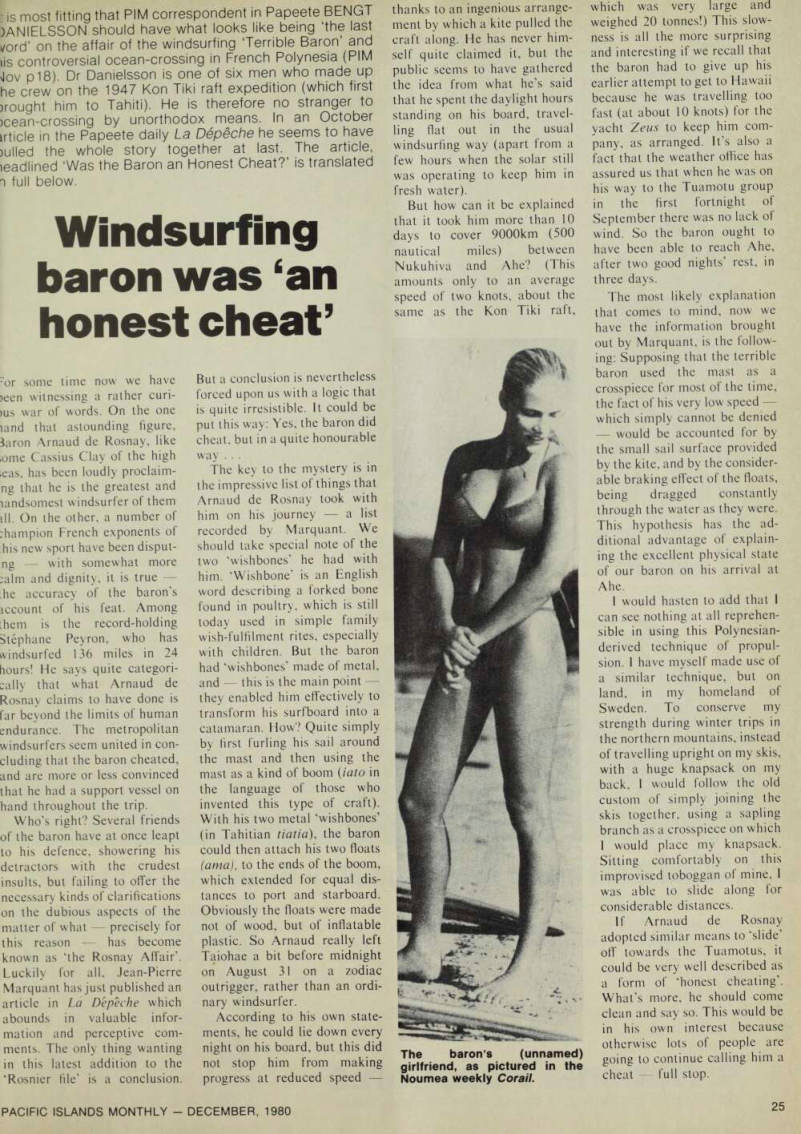
baron was ‘an honest cheat’
; is most fitting that RIM correspondent in Papeete BENGT )ANIELSSON should have what looks like being ‘the last vord’ on the affair of the windsurfing ‘Terrible Baron’ and lis controversial ocean-crossing in French Polynesia (PIM vlov p 18). Dr Danielsson is one of six men who made up he crew on the 1947 Kon Tiki raft expedition (which first jrought him to Tahiti). He is therefore no stranger to >cean-crossing by unorthodox means. In an October irticle in the Papeete daily La Depeche he seems to have julled the whole story together at last. The article, leadlined ‘Was the Baron an Honest Cheat?’ is translated i full below.
r or some time now we have >een witnessing a rather curi >us war of words. On the one land that astounding figure, 3aron Arnaud de Rosnay, like ,ome Cassius Clay of the high ;eas, has been loudly proclaim ng that he is the greatest and landsomesl windsurfer of them ill. On the other, a number of :hampion French exponents of his new sport have been disput ng with somewhat more :alm and dignity, it is true .he accuracy of the baron’s iccount of his feat. Among :hem is the record-holding Stephane Peyron, who has windsurfed 136 miles in 24 hours! He says quite categori cally that what Arnaud de Rosnay claims to have done is far beyond the limits of human endurance. The metropolitan windsurfers seem united in con cluding that the baron cheated, and are more or less convinced that he had a support vessel on hand throughout the trip.
Who’s right? Several friends of the baron have at once leapt to his defence, showering his detractors with the crudest insults, but failing to offer the necessary kinds of clarifications on the dubious aspects of the matter of what precisely for this reason has become known as The Rosnay Affair’.
Luckily for all, Jean-Pierre Marquant has just published an article in La Depeche which abounds in valuable infor mation and perceptive com ments. The only thing wanting in this latest addition to the ‘Rosnier file’ is a conclusion.
But a conclusion is nevertheless forced upon us with a logic that is quite irresistible. It could be put this way: Yes, the baron did cheat, but in a quite honourable way . . .
The key to the mystery is in the impressive list of things that Arnaud de Rosnay took with him on his journey a list recorded by Marquant. We should lake special note of the two ‘wishbones’ he had with him. ‘Wishbone’ is an English word describing a forked bone found in poultry, which is still today used in simple family wish-fulfilment riles, especially with children. But the baron had ‘wishbones’ made of metal, and this is the main point they enabled him effectively to transform his surfboard into a catamaran. How? Quite simply by first furling his sail around the mast and then using the mast as a kind of boom (iato in the language of those who invented this type of craft).
With his two metal ‘wishbones’ (in Tahitian tiatia ), the baron could then attach his two floats (ama), to the ends of the boom, which extended for equal dis tances to port and starboard.
Obviously the floats were made not of wood, but of inflatable plastic. So Arnaud really left Taiohae a bit before midnight on August 31 on a zodiac outrigger, rather than an ordi nary windsurfer.
According to his own state ments, he could lie down every night on his board, but this did not stop him from making progress at reduced speed
thanks to an ingenious arrange ment by which a kite pulled the craft along. He has never him self quite claimed it, but the public seems to have gathered the idea from what he’s said that he spent the daylight hours standing on his board, travel ling flat out in the usual windsurfing way (apart from a few hours when the solar still was operating to keep him in fresh water).
But how can it be explained that it took him more than 10 days to cover 9000 km (500 nautical miles) between Nukuhiva and Ahe? (This amounts only to an average speed of two knots, about the same as the Kon Tiki raft,
which was very large and weighed 20 tonnes!) This slow ness is all the more surprising and interesting if we recall that the baron had to give up his earlier attempt to get to Hawaii because he was travelling too fast (at about 10 knots) for the yacht Zeus to keep him com pany, as arranged. It’s also a fact that the weather office has assured us that when he was on his way to the Tuamotu group in the first fortnight of September there was no lack of wind. So the baron ought to have been able to reach Ahe, after two good nights’ rest, in three days.
The most likely explanation that comes to mind, now we have the information brought out by Marquant, is the follow ing: Supposing that the terrible baron used the mast as a crosspiece for most of the time, the fact of his very low speed which simply cannot be denied would be accounted for by the small sail surface provided by the kite, and by the consider able braking effect of the floats, being dragged constantly through the water as they were.
This hypothesis has the ad ditional advantage of explain ing the excellent physical state of our baron on his arrival at Ahe. 1 would hasten to add that I can see nothing at all reprehen sible in using this Polynesian derived technique of propul sion. 1 have myself made use of a similar technique, but on land, in my homeland of Sweden. To conserve my strength during winter trips in the northern mountains, instead of travelling upright on my skis, with a huge knapsack on my back, I would follow the old custom of simply joining the skis together, using a sapling branch as a crosspiece on which 1 would place my knapsack.
Sitting comfortably on this improvised toboggan of mine, 1 was able to slide along for considerable distances.
If Arnaud de Rosnay adopted similar means to ‘slide’ off towards the Tuamotus, it could be very well described as a form of ‘honest cheating’.
What’s more, he should come clean and say so. This would be in his own interest because otherwise lots of people are going to continue calling him a cheat full slop.
The baron’s (unnamed) girlfriend, as pictured in the Noumea weekly Corail.
Advertisements & other items, p. 26 (1 item)
arth. Wind and Fire. In their element with our cassette radios.
O 11 i l
□aa 999 51 a • 0 BE (' 1 jJll m • -./.- N 7 v/.-lw TMU'J 1 hflQ-- 1 1 h ••22 3D Wm v> r [[[ «» arth. Wind and Fire. In their element with our cassette radios.
When it comes to the best in pop music, look to Earth, Wind and Fire. The superoup that's shot to the top of the charts worldwide with the speed of a whirlwind.
And when it comes to portable cassette radios, look to us. Were the people who ’ote the book.
Our plushy portables are put together by experts. The people with more experience m just about anybody in the business.
And, as you can see and hear it shows. Whether you're into Earth, Wind and Fire home or in the great outdoors.
i National Panasonic
National and Panasonic are the brandnames of Matsushita Electric.
'•e
Pitcairnese as
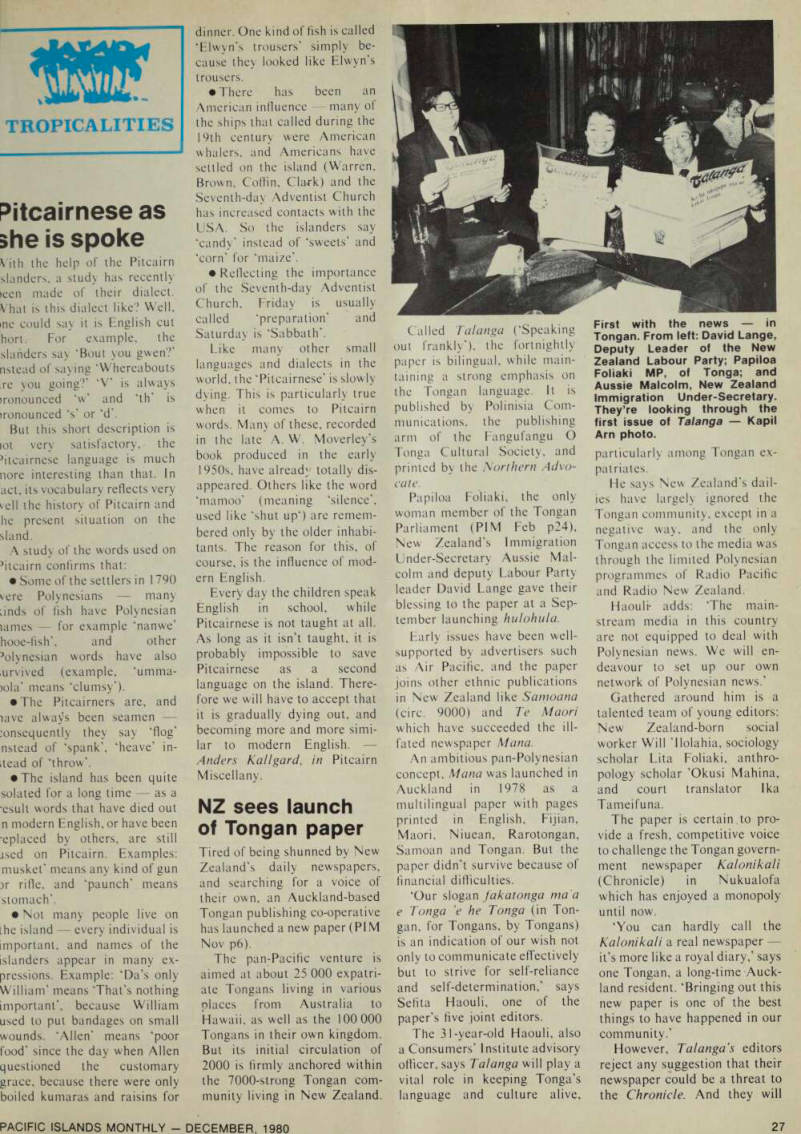
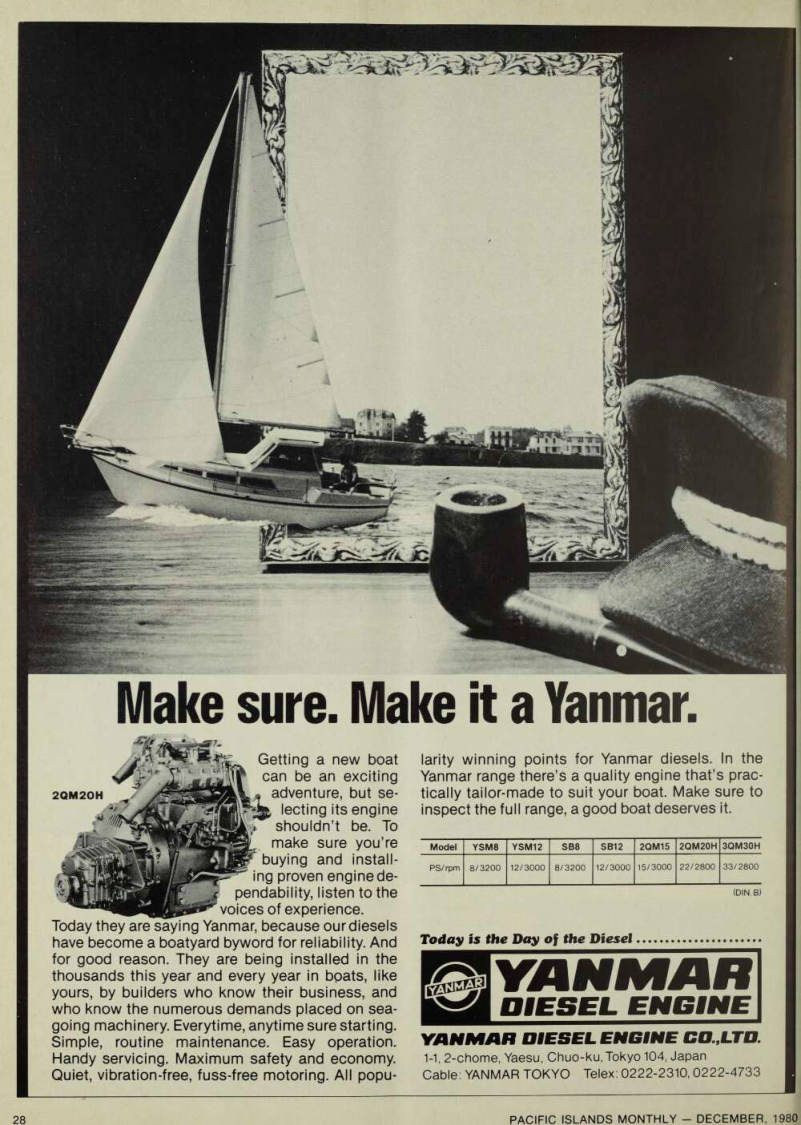
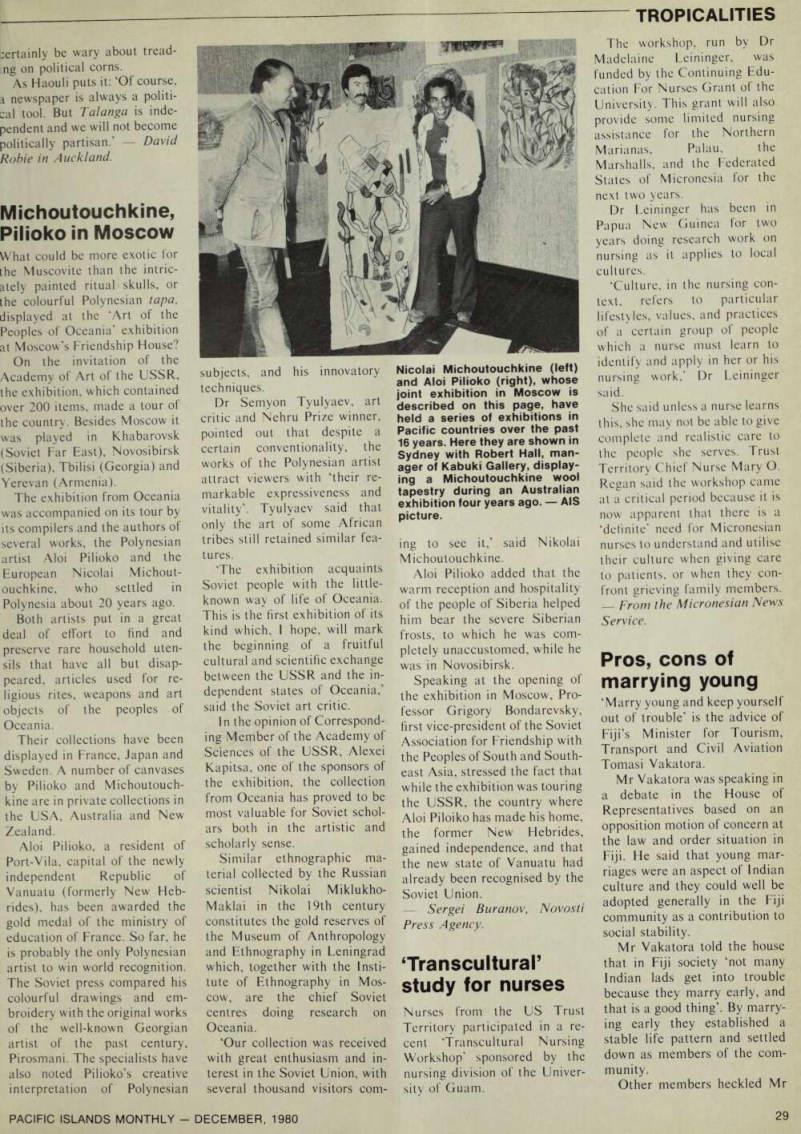
Tropicalities
she is spoke
Vilh the help of the Pitcairn slanders, a study has recently ►cen made of their dialect.
Vhal is this dialect like? Well, me could say it is English cut horl. For example, the slanders say ‘Bout you gwen?' nslead of saying ‘Whereabouts re you going?’ ‘V’ is always (renounced ‘w’ and ‘th’ is (renounced ‘s’ or ‘d’.
But this short description is lot very satisfactory, the fitcairnese language is much nore interesting than that. In act, its vocabulary reflects very veil the history of Pitcairn and he present situation on the sland.
A study of the words used on filcairn confirms that: • Some of the settlers in 1790 vere Polynesians many finds of fish have Polynesian James for example ‘nanwe’ hooe-fish’, and other Polynesian words have also urvived (example, ‘umma >ola’ means ‘clumsy’). • The Pitcairners are, and tave always been seamen :onsequenlly they say ‘flog’ nslead of ‘spank’, ‘heave’ in ;tead of ‘throw’. • The island has been quite solaled for a long time as a ■esult words that have died out n modern English, or have been •eplaced by others, are still ised on Pitcairn. Examples: musket' means any kind of gun Dr rifle, and ‘paunch’ means stomach’. • Not many people live on [he island every individual is important, and names of the islanders appear in many ex pressions. Example: ‘Da’s only William’ means ‘That’s nothing important’, because William used to pul bandages on small wounds. ‘Allen’ means ‘poor food’ since the day when Allen questioned the customary grace, because there were only boiled kumaras and raisins for
dinner. One kind of fish is called ‘Elwyn’s trousers’ simply be cause they looked like Elwyn’s trousers. • There has been an American influence many of the ships that called during the 19th century were American whalers, and Americans have settled on the island (Warren, Brown, Coffin, Clark) and the Seventh-day Adventist Church has increased contacts with the USA. So the islanders say ‘candy’ instead of ‘sweets’ and ‘corn’ for ‘maize’. • Reflecting the importance of the Seventh-day Adventist Church, Friday is usually called ‘preparation’ and Saturday is ‘Sabbath’.
Like many other small languages and dialects in the world, the ‘Pitcairnese’ is slowly dying. This is particularly true when it comes to Pitcairn words. Many of these, recorded in the late A. W. Moverley’s book produced in the early 19505, have already totally dis appeared. Others like the word ‘mamoo’ (meaning ‘silence’, used like ‘shut up‘) are remem bered only by the older inhabi tants. The reason for this, of course, is the influence of mod ern English.
Every day the children speak English in school, while Pitcairnese is not taught at all.
As long as it isn’t taught, it is probably impossible to save Pitcairnese as a second language on the island. There fore we will have to accept that it is gradually dying out, and becoming more and more simi lar to modern English.
Anders Kallgard, in Pitcairn Miscellany.
NZ sees launch
of Tongan paper
Tired of being shunned by New Zealand’s daily newspapers, and searching for a voice of their own, an Auckland-based Tongan publishing co-operative has launched a new paper (PI M Nov p 6).
The pan-Pacific venture is aimed at about 25 OQO expatri ate Tongans living in various places from Australia to Hawaii, as well as the 100 000 Tongans in their own kingdom.
But its initial circulation of 2000 is firmly anchored within the 7000-strong Tongan com munity living in New Zealand.
Called Talanga (‘Speaking out frankly’), the fortnightly paper is bilingual, while main taining a strong emphasis on the Tongan language. It is published by Polinisia Com munications, the publishing arm of the Fangufangu O Tonga Cultural Society, and printed by the Northern Advo cate.
Papiloa Foliaki, the only woman member of the Tongan Parliament (PIM Feb p 24).
New Zealand’s Immigration Under-Secretary Aussie Mal colm and deputy Labour Party leader David Lange gave their blessing to the paper at a Sep tember launching hulohula.
Early issues have been well supported by advertisers such as Air Pacific, and the paper joins other ethnic publications in New Zealand like Samoana (circ. 9000) and Te Maori which have succeeded the ill fated newspaper Mana.
An ambitious pan-Polynesian concept, Mana was launched in Auckland in 1978 as a multilingual paper with pages printed in English, Fijian, Maori, Niuean, Rarotongan, Samoan and Tongan. But the paper didn’t survive because of financial difficulties. ‘Our slogan Jakatonga ma'a e Tonga ’e he Tonga (in Ton gan, for Tongans, by Tongans) is an indication of our wish not only to communicate effectively but to strive for self-reliance and self-determination,’ says Sefita Haouli, one of the paper’s five joint editors.
The 31-year-old Haouli, also a Consumers’ Institute advisory officer, says Talanga will play a vital role in keeping Tonga’s language and culture alive,
particularly among Tongan ex patriates.
He says New Zealand’s dail ies have largely ignored the Tongan community, except in a negative way, and the only Tongan access to the media was through the limited Polynesian programmes of Radio Pacific and Radio New Zealand.
Haouli* adds; ‘The main stream media in this country are not equipped to deal with Polynesian news. We will en deavour to set up our own network of Polynesian news.’
Gathered around him is a talented team of young editors; New Zealand-born social worker Will ’llolahia, sociology scholar Lita Foliaki, anthro pology scholar 'Okusi Mahina, and court translator Ika Tameifuna.
The paper is certain.to pro vide a fresh, competitive voice to challenge the Tongan govern ment newspaper Kalonikali (Chronicle) in Nukualofa which has enjoyed a monopoly until now. ‘You can hardly call the Kalonikali a real newspaper it’s more like a royal diary,’ says one Tongan, a long-time Auck land resident. ‘Bringing out this new paper is one of the best things to have happened in our community.’
However, Talanga’s editors reject any suggestion that their newspaper could be a threat to the Chronicle. And they will
First with the news - in Tongan. From left: David Lange, Deputy Leader of the New Zealand Labour Party; Papiloa Foliaki MP, of Tonga; and Aussie Malcolm, New Zealand Immigration Under-Secretary.
They’re looking through the first issue of Talanga - Kapil Arn photo.
:ertainly be wary about tread ng on political corns.
As Haouli puts it: ‘Of course, a newspaper is always a politi cal tool. But Talanga is inde pendent and we will not become
politically partisan.’ David
Robie in Auckland.
Michoutouchkine,
Pilioko in Moscow
What could be more exotic for the Muscovite than the intric ately painted ritual skulls, or the colourful Polynesian tapa, displayed at the ‘Art of the Peoples of Oceania’ exhibition at Moscow’s Friendship House?
On the invitation of the Academy of Art of the USSR, the exhibition, which contained over 200 items, made a tour of the country. Besides Moscow it was played in Khabarovsk (Soviet Far East), Novosibirsk (Siberia), Tbilisi (Georgia) and Yerevan (Armenia).
The exhibition from Oceania was accompanied on its tour by its compilers and the authors of several works, the Polynesian artist Aloi Pilioko and the European Nicolai Michout ouchkine, who settled in Polynesia about 20 years ago.
Both artists put in a great deal of effort to find and preserve rare household uten sils that have all but disap peared, articles used for re ligious rites, weapons and art objects of the peoples of Oceania.
Their collections have been displayed in France, Japan and Sweden. A number of canvases by Pilioko and Michoutouch kine are in private collections in the USA, Australia and New Zealand.
Aloi Pilioko, a resident of Port-Vila, capital of the newly independent Republic of Vanuatu (formerly New Heb rides), has been awarded the gold medal of the ministry of education of France. So far, he is probably the only Polynesian artist to win world recognition.
The Soviet press compared his colourful drawings and em broidery with the original works of the well-known Georgian artist of the past century, Pirosmani. The specialists have also noted Pilioko’s creative interpretation of Polynesian
subjects, and his innovatory techniques.
Dr Semyon Tyulyaev, art critic and Nehru Prize winner, pointed out that despite a certain conventionality, the works of the Polynesian artist attract viewers with ‘their re markable expressiveness and vitality’. Tyulyaev said that only the art of some African tribes still retained similar fea tures. ‘The exhibition acquaints Soviet people with the little known way of life of Oceania.
This is the first exhibition of its kind which, I hope, will mark the beginning of a fruitful cultural and scientific exchange between the USSR and the in dependent states of Oceania,’ said the Soviet art critic.
In the opinion of Correspond ing Member of the Academy of Sciences of the USSR, Alexei Kapitsa, one of the sponsors of the exhibition, the collection from Oceania has proved to be most valuable for Soviet schol ars both in the artistic and scholarly sense.
Similar ethnographic ma terial collected by the Russian scientist Nikolai Miklukho- Maklai in the 19th century constitutes the gold reserves of the Museum of Anthropology and Ethnography in Feningrad which, together with the Insti tute of Ethnography in Mos cow, are the chief Soviet centres doing research on Oceania. ‘Our collection was received with great enthusiasm and in terest in the Soviet Union, with several thousand visitors com
ing to see it,’ said Nikolai Michoutouchkine.
Aloi Pilioko added that the warm reception and hospitality of the people of Siberia helped him bear the severe Siberian frosts, to which he was com pletely unaccustomed, while he was in Novosibirsk.
Speaking at the opening of the exhibition in Moscow, Pro fessor Grigory Bondarevsky, first vice-president of the Soviet Association for Friendship with the Peoples of South and South east Asia, stressed the fact that while the exhibition was touring the USSR, the country where Aloi Piloiko has made his home, the former New Hebrides, gained independence, and that the new state of Vanuatu had already been recognised by the Soviet Union.
Sergei Buranov, Novosti Press Agency.
Transculturar
study for nurses
Nurses from the US Trust Territory participated in a re cent Transcultural Nursing Workshop’ sponsored by the nursing division of the Univer sity of Guam.
The workshop, run by Dr Madclaine Leininger, was funded by the Continuing Edu cation For Nurses Grant of the University. This grant will also provide some limited nursing assistance for the Northern Marianas, Palau, the Marshalls, and the Federated Slates of Micronesia for the next two years.
Dr Fcininger has been in Papua New Guinea for two years doing research work on nursing as it applies to local cultures. ‘Culture, in the nursing con text, refers to particular lifestyles, values, and practices of a certain group of people which a nurse must learn to identify and apply in her or his nursing work. Dr Feininger said.
She said unless a nurse learns this, she may not be able to give complete and realistic care to the people she serves. Trust Territory Chief Nurse Mary O.
Regan said the workshop came at a critical period because it is now apparent that there is a ‘definite’ need for Micronesian nurses to understand and utilise their culture when giving care to patients, or when they con front grieving family members. From the Micronesian News Service.
Pros, cons of
marrying young
‘Marry young and keep yourself out of trouble’ is the advice of Fiji’s Minister for Tourism, Transport and Civil Aviation Tomasi Vakatora.
Mr Vakatora was speaking in a debate in the House of Representatives based on an opposition motion of concern at the law and order situation in Fiji. He said that young mar riages were an aspect of Indian culture and they could well be adopted generally in the Fiji community as a contribution to social stability.
Mr Vakatora told the house that in Fiji society ‘not many Indian lads get into trouble because they marry early, and that is a good thing’. By marry ing early they established a stable life pattern and settled down as members of the com munity.
Other members heckled Mr
Nicolai Michoutouchkine (left) and Aloi Pilioko (right), whose joint exhibition in Moscow is described on this page, have held a series of exhibitions in Pacific countries over the past 16 years. Here they are shown in Sydney with Robert Hall, man ager of Kabuki Gallery, display ing a Michoutouchkine wool tapestry during an Australian
exhibition four years ago. - AIS
picture.
Vakatora as he spoke, claiming that early marriage would con tribute to population problems. ‘That may be so, but there are ways of overcoming it,’ Mr Vakatora retorted. He claimed that the stability of Indian family groups spoke for itself.
Earlier, at a party political meeting, Prime Minister Ratu Sir Kamisese Mara urged Fijian families to take note of the disciplined way in which Indian families raised their children.
Subsequently Mr Vakatora was criticised by sections of the Indian community for basing his argument on what they claimed was a false foundation.
In a letter to The Fiji Times, Dr T. U. Bavadra said that the trend in the past 15 years had been for Indians to defer mar riage. He saw a priority for all people to establish a sound education and income-earning base before marriage.
Dr Bavadra wrote: ‘1 feel that the emphasis should be on advising Fijians to go back to the village and work the land if they have nothing useful to do in urban centres. Those Fijians with a regular income in towns should be advised and encour aged to save enough money for a house, and to plan the size of their families.’
Kokoda: Cadets
meet Vets
Ten members of Sydney’s Scots College Army Cadet Unit, wearing their Black Watch tartan kilts and the Papua New Guinea Defence Force badges presented to them after they had successfully completed a patrol over the Kokoda Trail in 1979, took part in a ceremony in October at which they met veterans who fought in PNG in World War 11.
The occasion was the handover to the college by the Sixth Division (Second AIF) Association of the emblem of PNG mounted on PNG timber.
The emblem had previously been presented to the associ ation by a representative of the PNG Government as a mem ento of the Auslralia-Papua New Guinea Friendship Trust.
The trust was set up by the Sixth Division Association,
along with other veterans’ or ganisations, to present school books to primary schoolchild ren in PNG. The books bear the message ‘Australia remembers the help given by the people of PNG in World War ll’.
The association selected Scots College to receive the emblem because cadets from the college have been over the Kokoda Trail four times in recent years, thus forming a close association with the
Pngdf.
PIM vindicated
28 years on
‘Come January 1981 the Palauans will join other Micronesian political entities in sporting locally ratified consti tutional government,’ writes a commentator in the Micronesian News Service. ‘When Palau ceases to be a “district" somebody in Washington will have to come up with a new official definition
for the term “Trust Territory of the Pacific Islands".' The commentator went on: ‘Twenty-eight years ago. in 1952, the Pacific Islands Monthly, the news magazine of the South Pacific, which is published in Australia, saw the problem with the title “Trust Territory of the Pacific Islands" and chastised the United Slates for using it.
'The PIM editorialised at the lime: “The Americans, with unusual lack of imagination, have named their Micronesian administration The United Slates Trust Territory of the Pacific Islands."
It went on to say: “The Territory comprises the well known Micronesian groups of Palau, the Carolines, Marshalls and Marianas. The groups were held originally by the Spaniards, sold or lost by war by Spain, and became part of the German colonial empire; were handed over to the Americans as a Trust Territory after World War II.” ‘The PIM was not in the least impressed with the new desig nation the Americans gave to their new Pacific wards. It said in its brave editorial: “The total area of the lot is only 715 square miles (they were called Micronesia because they com prised a lot of very small islands), and their total popu lation is only 50 000. (Micronesia today has a popu lation of about 130 000. MNS.) Vet they arc called ‘The Trust Territory of the Pacific Islands', irrespective of the fact that, apart from Philippines and Hawaii, all the Pacific Islands
worth talking about lie south of the Equator, and are all British and Irendi.”
'The PIM advised the United Stales: "In order to keep the description within focus and understanding, the four groups should be called the United Stales Trust Territory of Micronesi The MNS writer concludes: 'By next \ear, there will be four Micronesian political entities, all with certain political ties with the United Stales, and the Pacific Islands Monthly may have been closer to the truth than many people realised in 1952.'
Dogs dogging
Rarotongans
While experts in demography see a bleak future in world population statistics, Rarotonga, Cook Islands, is plagued with an over population problem of a dilTcrent kind: there are 100 many dogs on the island. Be cause the public is fed up with dogs knocking over rubbish tins, and wandering across the roads constituting a real hazard for motor cyclists. the Rarotonga Police Department has mounted a campaign that might lower Rarotonga's canine population. The public has been warned that all dogs over the age of six months must be registered ($5 a year for a female and S 3 for a male) or they will be destroyed.
Unfortunately, there are sev eral problems with this measure. Inspector Tiki Malapo of the Police Depart ment points out that as Rarotonga has no pound or other facilities for destroying animals out of the public eye, the police will shoot the dogs where they find them. The impression created by rifle toting police, shooting animals in full public view, is not a favourable one. The bigger problem is that if all the dogs are registered. Rarotonga’s dog problem will still not be solved.
It is small consolation to know that the dog that runs out in front of your motor cycle is likely to be registered, rather than not. Paul Rysavy in Rarotonga.
Major General Alan Murchison, a former Inspector General of the Australian Army Reserve, and Senior Cadet Under Officer Cameron Marks hold the newly presented emblem following the ceremony described on this page. Others in the picture, left to right, are Major M. Frank, OC Cadets; CUO T. Hardwig; Mr G.
Renney, Scots College princi pal; Captain Rev. Dr J. Croft; CUO T. McMullen; CUO T.
Fisher; first-former Tangil Okuk, son of the Papua New Guinea deputy prime minister; Mr B. Oberleuter, PNG Consul; Dr T. Selby, convenor of the Australian-PNG Friendship Trust.
10 countries get
culture grants
Australia provided $A 100 000 to 10 South Pacific countries in the year ended 30 June, from its Fund for the Preservation and Development of South Pacific Cultures. Recipients of funds for specific projects were Vanuatu, Tuvalu, Niue, Tokelau, Cook Islands, Solomon islands, Fiji, Tonga, Western Samoa and Kiribati.
For Pacific-wide activities grants of $5OOO each were made to the Institute of Pacific Studies and the South Pacific Creative Arts Association. The South Pacific Social Science Association received $4OOO, and the University of the South Pacific $6OOO. University of South Pacific Extension Centres in Solomon Islands, Fiji, Tonga, Western Samoa and Kiribati each received grants of $lOOO to sponsor cultural activities in the area served by each centre. The extension centre in the Cook Islands received $BOO and the centre in Niue $4OO.
In Solomon Islands $2500 was for the National Site Sur vey to finance archaeological studies and $lOOO to the National Library to buy books.
The Solomon Islands Cultural Association will use its grant of $4OO to publish museum journals and custom story books. The largest single amount to the Solomons,ssooo, is being administered by the ministry of education to sponsor school cultural festivities and functions. A further $l5O was for school equipment in Malaila.
Kiribati’s grants included $3OOO for district festivals, $2OOO for recording oral tra ditions, $2500 for books in schools and libraries. Vanuatu received grants of $5650 for its cultural centre, $3OOO to buy artifacts and $2OOO to support the country’s First National Cultural Festival.
Tuvalu and Niue each re ceived grants of $lOOO and Tokelau $5OO for general cul tural activities.
In Western Samoa a grant of $2OOO was made to the Nelson Library to buy books and $2500 was provided to Tonga to help
in the school advisory, project.
The largest amount, $2O 000, went to Fiji for the Fijian Dictionary Project. A sum of $ 1 1 000 is to assist a project for the documentation of Fijian ceremonial procedure, dance and music.
Marianas act
on youth crime
The Northern Marianas House of Representatives has ap proved the creation of an office within the government whose sole job is to help the young people of the Commonwealth.
According to a report by the House Committee on Health, Education, and Welfare, juven ile delinquency and crime caused by the breakdown of traditional institutions and pressures and complexity of the changing Marianas society are becoming a serious problem.
The report cites the following statistics 28% of all charges filed with the police are against juveniles; 63% of all burglaries are committed by juveniles; 39% of larceny charges are against youth and 60% of car thefts are committed by juven iles.
The House report also said that when compared with the rest of the Pacific, the Northern Marianas reports ‘among the highest rates in juvenile bur glary and larceny’. From the Marianas Variety A r ews & Views.
A witch doctor’s
bad advice
Witchcraft was the reason why a 58-year-old man and his young woman companion re moved some of the ashes of a newly-cremated body from a cemetery, a court at Lautoka, Fiji, heard in September.
The woman had seen a witchdoctor for an illness and was told to bring some ashes from a crematorium to be used to cure her.
Mun Sarny, taxi driver, of Natabua, and Premila Devi, 26, salesgirl, of Namoli Avenue, admitted trespassing on burial grounds.
Magistrate John Tomlinson fined them $6O each in default three months in prison.
Advertisements & other items, pp. 28-34 (1 item)
Make sure. Make it a Yanmar.
4'M rj * * '
2QM2OH
Getting a new boat can be an exciting m adventure, but selecting its engine shouldn’t be. To make sure you’re buying and installing proven engine dependability, listen to the voices of experience.
Today they are saying Yanmar, because our diesels have become a boatyard byword for reliability. And for good reason. They are being installed in the thousands this year and every year in boats, like yours, by builders who know their business, and who know the numerous demands placed on seagoing machinery. Everytime, anytime sure starting.
Simple, routine maintenance. Easy operation.
Handy servicing. Maximum safety and economy.
Quiet, vibration-free, fuss-free motoring. All popu- * larity winning points for Yanmar diesels. In the Yanmar range there’s a quality engine that’s practically tailor-made to suit your boat. Make sure to inspect the full range, a good boat deserves it.
(DIN. B)
Today is the Day of the Diesel
YAM MAR DIESEL ENGINE CO.,LTO.
1-1, 2-chome, Yaesu, Chuo-ku, Tokyo 104, Japan Cable: YANMAR TOKYO Telex: 0222-2310,0222-4733
\ W^. i> * tt x ML \ 7 *3,-v . i *>*, m? ■ ■ mK ... i sr rv „• »> !
I -°o„ /., rtf/Pf •'Or S/Sr 'OO 7 -■-■ • W y. »•* f / / •/.: 'sy /.* / ' f
s^-xf
■ft. »* • • a ■/• /"
Deep-down accuracy.
Water-resistant quartz watches from Citizen.
Under a clear blue sky or the deep blue sea, these slim quartz watches from Citizen are always at home. Accurate to within seconds a month, the Water Resist 100 series keeps time at 100 meters below the surface as well as it does on dry land. All models, analog and digital, feature day and date and all are made to Citizen’s high standards of ruggedness and precision.
watsTresistlOO ‘ CITIZEN
Citizen Watches Australia Pty. Ltd., 122 Old Pittwater Road, Brookvale, N.S.W. 2100. Telephone 939 7077 P.O. Box 218, Brookvale, N.S.W. 2100. Cable; Citizen. Sydney. Telex; AA26633
; : * isiiiaiii its «5 oj3am I s**-r ' \ :■ ■■■{.'■■.:■ : ;•;••• *= -: - " . « N 1 s
This is the quietest
plane of its size
ever to fly
With the new McDonnell Douglas DC-9 Super 80, the high-noise area around airports is just one-fifth of what it is with today’s comparable aircraft. It’s the first big jetliner to meet the new U.S.A. and international noise requirements for the 80s and beyond.
The Super 80 also offers airlines the lowest operating cost per seat mile of any aircraft in its class, plus the lowest fuel consumption per passenger of any commercial jetliner, up to its maximum range. That’s 40% better on fuel than today’s most widely-flown jetliner. Commonality of maintenance and support systems helps keep costs down, too.
The Super 80’s new cockpit boasts the first systematic application of simple, reliable, lightweight and highly accurate digital technology in an airliner. The result: lower cost, more capability, and reduced flight crew workload.
Passengers will appreciate the Super 80’s new cabin decor. Accommodating up to 172 passengers, the seats are every bit as wide as those on jumbo jets. We’ve increased ventilation and decreased cabin noise as well.
The quiet, comfortable, fuel-efficient DC-9 Super 80. It’s precisely what airlines need for the 80s and beyond.
DC-9 Super 80
AfCDOiVAfELL X
DOUGLAS i
Aquila water tanks completely enclosed to ensure clean water and built to last from strong, Aquila water tanks - m- r T I I completely enclosed to I b \ ensure clean water and m j built to last from strong, I i ;! ; durable galvanised steel.
You assemble them yourself from our comprehensive kits. Capacities range from 2300 litres to 49250 litres.
Send for a brochure today.
Aquila Engineering Division, 25 Pacific Highway, Bennetts Green, New South Wales, Australia.
Name Address P/code
AQ2O/2
AQUILA
GET THE INSIDE STORY
In a series of inside views by Pacific people, the most recent book produced by the University of the South Pacific’s Institute of Pacific Studies is:
VANUATU
which Father Walter Uni requested the University to produce as one contribution towards the recent independence celebration of the former New Hebrides with chapters by 20 local authors (including Prime Minister Walter Lini, President George Kalkoa and leaders in politics, commerce, women’s affairs etc.), it describes in three languages the past development of this new nation and the future hopes of its people. Price A 57.50 plus surface postage and packing $2.00 (hard cover, 281 pages).
Other recent publications by Pacific writers include: Art in the New Pacific by Vilsoni Tausie F 52.00 or A 53.00.
The Celebration: Collection of Short Stories by Raymond Pillai
FSI.OO.
Politics in Kiribati by leremia Tabai et. al F 53.00.
His Majesty King Taufa’ahau Tupou IV of the Kingdom of Tonga by Amanaki Taulahi F 52.00 and the latest edition of Mana a South Pacific Journal of Language and Literature: Solomon Islands Issue F 53.00 All plus $2.00 per order postage and handling.
A complete publications catalogue (nearly 100 titles almost all by Pacific islanders) and order forms are available free of charge from the Institute of Pacific Studies, University of the South Pacific, P.O. Box 1168, Suva, Fiji.
All prices are In Fijian or Australian dollars For U.S. or New Zealand dollars, add twenty per cent.
/ H ' •*“ » n- j r w lu3x
U- U. U- W
O O O y]
AIWA p*CM*uncn C5O .J i O 3 m ... ffhr a touch of mu mu enchantment
i M-50Imini component system
AIWA (ormillsmnnship
frim AIWA
JWA CO.. LTD. 11-9, Ueno 1-chome, Taito-ku, Tokyo, Japan ustralia AIWA Australia Pty , Ltd , P.O Box 339, Rockdale, 1.5. W.; Australia 2216 Tel: 597 2388/2808 ook Islands Island Merchants Ltd , PO Box 69. Rarotopga, Cook Islands iji D Ranchhod & Company, Corner or Vidilo St. & Vitogo PDF. PO Box 18, autoka. Fiji Tel; 60227 iji P Hargovmd Bros . Duty Free Centre 190 Renwick Road Suva iji Tel; 24350 uam Micropac Audio, Inc ,PO Box 3478, Agana, Guam 96910Te1; 472-8091 New Caledonia hifivox; 79 rue de sebastopol 19 avenue Foch B P 1458 Noumea, New Caleddnia Tel: 27 24 66 et 28 29 31 P N G. Oceania Indent Agency (PN G ) Pty , Ltd. Box 5518, Boroko, Port Moresby, PN G Tel: PM 256406 Solomon Islands Harvest Pacific Ltd . G PO 517, Honiara, Solomon Islands Tel 718 Tahiti Fare Hi-Fi Stereo, Rue du Marechal Foch, PO Box 269, Papeete, Tahiti R C 6604 A Vanuatu (New Hebrides) The Sound Centre Ltd , PO Box 434, Vila.
Vanuatu (New Hebrides) Tel: 2035
‘Low-key’ U.S.
Political
Currents
‘Low-key’ U.S. role in Pacific
Two US citizens from very different backgrounds here present very different views of the US role in the Pacific in the 1980 s. Dr EVELYN COLBERT of the US State Department speaks in Suva of the ‘low-key’ role her government plans to play in the region, while Hawaiian poet WAYNE KAUMUALII WESTLAKE writes from Honolulu of what he sees as much less benevolent US intentions in the region.
America's role in the affairs of the South Pacific will continue to be a low-key one, according to a US foreign affairs expert.
Dr Evelyn Colbert, until re cently deputy assistant sec retary of the US Stale Depart ment's Bureau of East Asian and Pacific Affairs, told a meeting in Suva in October that her country wanted to avoid being pul in a dominating position in the area. ‘There is a broader, rather amorphous concern that while we might be nicer than the Russians, we are awfully big and all we really want is to do it by ourselves,' she said. ‘I don't think that is true, but it is not unnatural that people feel that way.’ ‘lt is up to us to make it clear that those suspicions are un founded.' Dr Colbert, who retired from the US State Department re cently after 37 years with it, was speaking to a local audi ence about US interests in the South-west Pacific, and how it related to her country’s East Asian policy.
America's view of the region had begun changing in 1976, when it saw that the emergence of independent stales was cre ating a different situation, she said.
Russian approaches at this lime had caused a flurry of concern in the Slate Depart ment.
But this had receded when it was realised that reports of Russian intentions were exag gerated.
A firm Soviet fooling in the region was regarded now as ‘an unlikely development,’ Dr Colbert said.
Talking about objections to US policy on tuna fishing rights which had led to the South
Pacific Forum's exclusion of her country from the regional fisheries agency. Dr Colbert said the US has since received indications from some Forum members, particularly Papua New Guinea, that they wanted the US to be part of a larger fishing organisation. ‘We will be very interested in hearing what that plan is,' she said.
‘We would prefer a regulat ory organisation.' It looked as if the 1981 target for completing agreements with the remaining US Trust Territories the Marshalls, Palau and the Federated States of Micronesia would not now be attained because of the lengthy legal processes in volved.
But after what are known as the Compacts of Free Associ ation with them had been completed they would be free to run their foreign and other affairs provided that anything touching on defence matters had the sanction of the US Government.
The US hoped that the three territories would be admitted as full members of the Forum, but this depended on whether Fo rum members would accept them as being really indepen dent. From a news report in The Fiji Times.
‘Pacific leaders
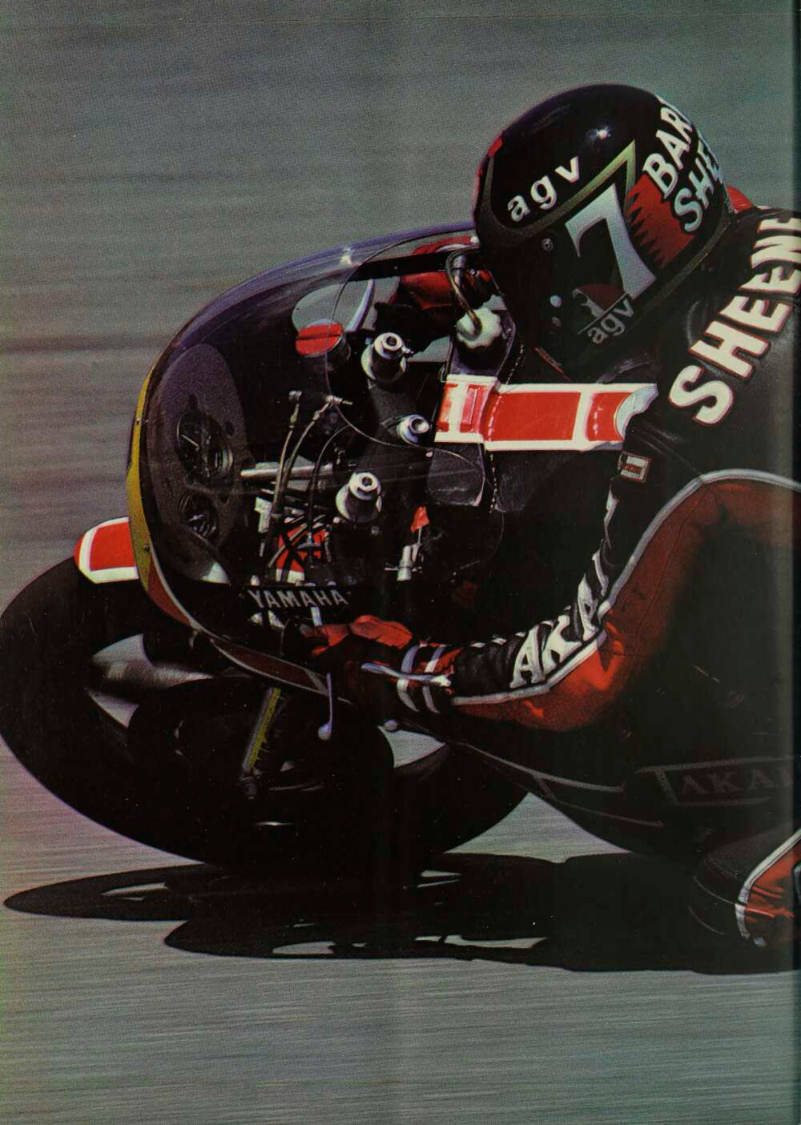
aren’t blind’
‘The Mediterranean is the ocean of the past, the Atlantic the ocean of the present, but the Pacific is the ocean of the future.' Thus spoke John Hay, US Secretary of State, 1898- 1905. ‘The Pacific is the most dynamic growth region in the world.' Thus spoke Walter Mondale, Vice-President of the United States. ‘lf there was ever an idea whose time has come, it is development in the Pacific.’
Thus spoke James Joseph, pres ent US Under-secretary of the Interior. ‘lt’s in the Pacific . . . where it all is, what it’s all about and where our future lies . . . The greatest potential in the world is in the Pacific . . . And in this respect, the Stale of Hawaii is in a very important geographic and economic position as this huge and relatively underdevel oped area grows.’ Thus spoke Mike Mansfield, current US Ambassador to Japan.
Pacific Islanders must be wondering why, after nearly a century of neglect, the United Slates is all of a sudden showing
such an intense interest in their homelands. And why Hawaii, a mid-Pacific island slate, has so arrogantly assumed the self appointed role of leader in this sudden move to influence and develop their territories and independent nations.
There is no question that the decade of the 'Bos will be the decade of the Pacific, and the 21st century the century of the Pacific due to its untapped potential for economic develop ment. According to Governor Carlos Camacho of the North ern Marianas; ‘Technologies, spurred by world shortages, are becoming available to harvest the immense potential wealth of our ocean floor and the ocean itself. And each island, each land mass, each square mile of ocean is now achieving strategic significance that we could not have foreseen or planned for as recently as 10 years ago.’
Yet Fiji’s Prime Minister Ratu Sir Kamisese Mara cau tions: ‘I hope we are planning for a society which will enable us to preserve our own unique character and quality of life, while accepting such contri
billions of modern technology and investment as are advan tageous to us. The nature and the measure of such contri bution should be for us to determine. Let the decisions be made in Apia, Nukualofa, Port Moresby, Honiara and Suva, rather than Sydney, New York and Tokyo.’
Apparently, the Pacific leaders themselves want to weigh the advantages of econ omic development against the threat to their Pacific way of life. Their desire is to control the development of their islands and the seas around them, thus maintaining their self-determ ination and contributing in their own way to the world community, but with a mini mum of outside influence. As Prime Minister Mara said, ‘When it comes to identifying the problems, who knows better than the wearer of the shoe that
pinches.’
As if to assuage the sus picions of Pacific Island leaders that America’s newly aroused concerns are just a clever disguise for further colonialism, Hawaii’s Myron Thompson, Governor George Ariyoshi’s special assistant for Pacific Island affairs, sheepishly pro claimed: ‘We are here to ad vance the quality of life of our Pacific peoples, whom we love.
It’s as simple as that. And by quality of life we do not mean only material progress. We are not here to impose alien econ omic or social methods on others; or to demonstrate better ways of harvesting coral to sell to tourists; or to help Pacific Islanders become unpaid care takers of nuclear waste from continents that don’t know what to do with such leftovers. No.
We are here to help our Pacific peoples to grow; to prosper; to advance spiritually, mentally, emotionally, physically, at their own pace and in their own place.’
Evidently, to many Pacific
sland leaders, Thompson’s vords rang hollow. Asi Aikeni, Vestern Samoa’s Justice Min ster, expressed doubts: ‘Our riend, the United States loesn’t really care . . . it’s not vhat you say, it’s what you do hat matters.’ And Guam’s Jovernor Paul Calvo summed ip his misgivings succinctly: Our collective fate as a people »n this island in the Pacific is leld in the hands of elected lational leaders in Washington )C for whom we do not even ote.’ The bottom line of course yas expressed by President barter himself: ‘All options for lolitical development should be ipen so long as their (Pacific slanders’) choices are im ilemented when economically easible and in a manner that loes not compromise the lational security of the United Jtates.’
The Pacific Island leaders are lot about to fall for the illusory iromises of the American )ream. Nobody knows better han they do that progress in he wrong direction is not irogress at all. They are not so
naive as not to know the real reasons why America is so suddenly interested in their affairs. It is clear as the ocean surrounding their islands that the United States wants some thing, in fact, needs something from them now desperately.
And that something is obvious; instant windfall profits from massive over-development; a place to store and dump nuclear garbage; greedy exploitation of ocean resources; and, most of all, forward strategic military outposts.
Nor are the Pacific leaders about to be fooled by Hawaii’s role in this American scheme.
They are not so blind as not to see Hawaii as it really is; a ‘super-colonised’ US island state, culturally barren, physically over-developed and over-populated, economically dependent on tourism and the US military, and spiritually dead. They see Hawaii as a place where indigenous peoples’ traditions and heritage have been raped and bastardised, crushed and demolished, all in the name of Progress and the
American Dream. Hawaii is no ‘role model’ for Pacific Island territories and emerging nations to imitate. If anything, it’s an example to avoid.
Indeed, as Governor Peter Coleman of American Samoa declared, ‘a new continent has arisen in the Pacific’. A 30million-square-mile continent of islands and ocean which covers more than a third of the globe and sustains nearly as much of the world’s population.
A vast, young and emerging continent, the last area on earth to break the stranglehold of colonialism.
Less than a century ago, American imperialists plucked the luscious pear that once was Hawaii. Let us hope America is not about to pluck the luscious mango of the New Pacific.
Wayne Kaumualii Westlake in Honolulu.
Vanuatu an
‘Algeria’?
Vanuatu could develop into an ‘Algeria of the Pacific’ if the sympathies of the ruling
Vanuaaku Pali for resistance groups in the region were al lowed to dominate govern mental attitudes, according to Hilda Lini.
Ms Lini, a sister of Vanuatu Prime Minister Father Walter Lini, represented the Vanuaaku Pati at a Nuclear-Free Pacific Forum held in Sydney in September.
After Algeria gained inde pendence from France in 1962 following an eight-year war, it developed into a crowded haven for rebel and insurgent groups from a large number of countries.
Interviewed by PIM in Syd ney, Ms Lini said that the Kanak independence move ment in New Caledonia, and independence forces in French Polynesia, wished to set up ‘consulates’ in Port-Vila, but it was unlikely that the Vanuatu Government would permit such a move.
France had indicated that it would withhold all aid if Vanuatu assisted liberation movements in French Pacific territories. The Australian
lovernment has also given pri ate indications that it would ut aid if such facilities were fforded the anti-Indonesian )PM movement in Irian Jaya.
One possibility was that a Dint information centre could e provided in Vanuatu for use y such groups. This idea was nder study by the government.
In one recent incident French epresentatives in Vanuatu /arned the government against ermitting the Kanaks to make scheduled propaganda broad est over Radio Vanuatu on September 24. On this occasion he warning was ignored, and he broadcast went ahead.
But the whole issue was ighly complex, said Ms Lini.
Ihe appealed for international nderstanding of the dilemma i which it placed the govern lenl.
On the matter of the much üblicised beatings by police of ebel prisoners brought to Port- Tla following the quelling of he revolt on Santo, she said the overnmenl had no inkling that he police intended to take such ction. Those involved had cted in retaliation for beatings hey had themselves received in ianto at the hands of rebels fter their capture at the begin ing of the secession. Tony 7 ole.
Shan stronger,
analysis says
official Australian analysis if the political situation in *apua New Guinea claims that he government of Sir Julius ffian has ‘significantly slren ;thened’ its position at the xpense of the Somare oppo ition. (But see neck and neck >opularity for Chan and Somare, Pacific Report, this ssue).
Mr Michael Somare, the oundation prime minister of >NG was defeated on a parlia nentary no-confidence motion :arly this year after more than ix years of leadership before md after independence. Mr Somare spoke optimistically at he time of his belief that he vould return to power as soon is constitutionally possible.
There were early indications, :00, that the new government of Sir Julius Chan was as vulner ible as Mr Somare believed.
But the Australian Depart ment of Foreign Affairs has now published a background analy sis which suggests that Sir Julius is consolidating his pos ition. The analysis does not carry the weight of an Aust ralian government statement, but it represents an authoritat ive assessment of current politi cal factors in PNG. It says: Towards the end of its first six months of office, Sir Julius Chan’s coalition government has recovered from what ap-
peared to be some slippage in political support in parliament, and now seems to be in a stronger position than at any time since it took office.
The motion of no confidence which brought Chan to power was carried by a vote of 57 to 49. The Chan government did not appear to have an easy settling down period. It had to contend with difficulties in the civil aviation area, especially with the operations of Air Niugini. Problems with the judiciary have not been fully resolved following the leaking in Parliament of a highly criti cal letter to the Prime Minister from Mr Justice Wilson. In addition, the Government felt obliged to make a number of important changes at senior levels in the Public Service.
The fineness of the politi cal balance was shown in parlia mentary defeats suffered by the Government in July on three divisions relating to the timing of the next parliamentary session.
However, the political out look has changed significantly, following the Government’s de cision to meet a request from the Prime Minister of Vanuatu, Father Walter Lini, for assist ance in restoring law and order on Santo Island. Prior to this decision, 150 troops of the
Papua New Guinea Defence Force (PNGDF) had been sent to participate in the Vanuatu independence celebrations.
As the deployment overseas on active service of the PNGDF required parliamentary ap proval, the Prime Minister called an emergency session of Parliament for August 5. At this session, Opposition Leader Somare opposed the use of the PNGDF in Vanuatu on the basis proposed. He claimed that the Prime Minister had contra vened the Constitution in send ing troops to the independence celebrations, knowing they would stay on to play a peace keeping role. Somare proposed instead a regional peacekeeping force, organised under the aus pices of the South Pacific Forum. It soon became clear that the Government had the numbers to get the legislation passed. In general, the voting pattern indicated that the Government’s position had strengthened significantly, and that it now had the support of up to 62 members, including the speaker, with 47 supporting the opposition.
A move
to Asia?
The island nations of the South Pacific are moving towards a closer relationship with Asia, particularly the non-communist states of South-east Asia, ac cording to a statement by Western Samoa Prime Minister Tupuola Efi, made in Honolulu in October.
Tupuola, who has travelled this year to India, China, Japan, the Philippines and
Malaysia, said the independent South Pacific countries were looking to Asia rather than to the West for assistance in developing their economies.
Tupuola said South Pacific governments were pursuing approaches to the non communist states belonging to the Association of South-east Asian Nations (ASEAN), made up of Thailand, Malaysia, Singapore, the Philippines and Indonesia.
Sir Julius Chan
Advertisements & other items, pp. 36-42 (3 items)
| National
NATIONAL
INSURANCE
—v %
COVERS THE
PACIFIC
FIJI
THE NATIONAL INSURANCE COMPANY OF FIJI, LIMITED (Incorporating Southern Pacific Insurance Co. (Fiji) Ltd) SUVA Dominion House, Thomson St, Phone 25601, Tlx 2337.
L. M. Rolls, General Manager. S. Bahadur, Manager.
LAUTOKA Ist Floor National Bank Bldg. Phone 62951. M. Y. Hussain, Resident Inspector.
LABASA Ist Floor National Bank Bldg. Phone 81099. A. Singh, Resident Inspector.
PAPUA NEW GUINEA
THE SOUTHERN PACIFIC INSURANCE COMPANY (PNG) LIMITED. (Incorporating C.I.C. Insurance (Pacific) Pty Ltd) PORT MORESBY 8 Champion Parade, Phone 21-1388, Tlx 22261. D. J. McCall,Group Manager.
LAE Second St, Phone 42-4590, Tlx 42443. T. S. Kennedy, Manager.
RABAUL Mango Ave, Phone 92-2755, Tlx 92923. P. M. Mitchell, Manager.
MT HAGEN Boroko Motors Ltd, Phone 521-433. J. P. Devaney, Resident Inspector.
ARAWA Arawa Motors, Phone 951-633.
iIP
* N i< is. *
SOLOMONS
THE NATIONAL INSURANCE COMPANY OF NEW ZEALAND, LIMITED.
HONIARA Ist Floor Kingsley Bldg. Phone 919 Kaituu & Co. Ltd (W. V. Gledhill) Agent.
WESTERN SAMOA
NATIONAL PACIFIC INSURANCE LIMITED.
(National Insurance Company of New Zealand, Ltd Managing Agents) APIA Taufusi St, Phone 20481, Tlx 228. D. I. Humphry, Managing Director.
PAGO PAGO Suite 200, Lumana’i Bldg, Phone 96799. J. McGuire, Manager.
TONGA Fathom Fisheries (Tonga) Ltd, Nuku’alofa Agents.
NIUE Niue Services Ltd, Alofi Agents.
COOK ISLANDS
THE NATIONAL INSURANCE COMPANY OF NEW ZEALAND, LIMITED, RAROTONGA U.I.T. Bldg. Avarua, Phone 2076, Tlx 62013. R. Wheeler, Local Manager.
' e*
PCI'
Portacel
Paterson Candy
?ermutit-Boby
Houseman Service
I r r Clarifying, Screening, Straining, Scraping, Separating, Filtering, Ultra filtration, Reverse Osmosis, Neutralising, Chemical treatment. Chlorine generation, Internal Treatment for boiler, cooling systems etc. Swimming pools, Demineralisation, Deionisation, Condensate polishing, Chlorinating, Recovery, Reuse, Sewage and effluent, etc.
It all adds up to
Portals Water Treatment
- one of the World's largest groups in the field.
Portals,in New Zealand alone, has a specialist staff of 75 including 8 Professional Engineers and has served New Zealand for over 50 years.
Portals Water Treatment (NZ) Ltd P.O. Box 13-558, Auckland 6, New Zealand.
Candy House, 11 Spring Street, Onehunga, Auckland. Telephone: 661-079 (7 lines) • Telegrams: Portals Auckland. Telex: NZ 21175 1595
*1 * ae 4 B £ 4 f ' IK 4 •>"' r >v ,■ 7 /~ C' \
"T- '/p. ■ i;
♦ r* */••• ■ ■.. vi K* ’* ’ <’ • t A Ml i • v.
V4^ ■ &# * .if. 7 &£ v v c (sl^'' "tvSl-7. mi.
Mi#£r ~v* **■***£, •~~tb
YAMAHA
LISTENS
mething needed create a bike for sryone that’s as ique in its own ly as are those perlative racers built ■ the select few. e result, based on Dusands of erviews with unites from Paris Perth, has now * vV< / jr "s J r en before the oil crisis, Yamaha was listening to s demands for personal-size bikes. Ones that would easy to ride, start and steer. The kind that would :ract a new class of riders. In short, sort of an onomical alternative to the r for tripping around town. »r some companies, this ght have been a huge allenge. But not for Yamaha, lose engineering excellence s created the fastest, surest d most consistent racing bikes history. Lessons learned on the track, ainst the best of the rest, gave maha that extra changed the whole concept of two wheeled transportation. Called “mopeds 1 by some, “town bikes” or “soft bikes' by others, these peppy little two strokes squeeze more out of a lite of gas. At the same time, with thei step-through frames, bicycle-lik( handling and surprising performance, they’re capable o handling the heaviest traffic For quick trips around town commuting or just enjoying th( sun, they’re one of the mos sensible choices arounC And, while they will neve come close to our racing -—bike’s 270 kph nerve P *** W testing speed, the' can make goin< anywhere more fur Yamaha mopeds Another answer fron the people who listei better to make lifestyle: more exciting and living more convenieni V &
YAMAHA
2500 SHINGAI IWATA-SHI SHIZUOKA-KEN JAPAN
'1
READY'FLASHLIGHTS
ONLY THE SUN
SHINES BETTER
EVRUDK THE WORLD'S LEAMNG BRAND
085.P.718 ‘Eveready’ and ‘Union Carbide’ are registered trade marks.
PORT MOR
* Right in business ce, * A trad it io if f comfort food * All air conditioned * Restaurant * Bani * Banquet hall
*A. C. NEUMANN
manager Phone 21-2622 Cable?
Stay at Aggie Grey’s . . . the South Pacific’s
legendary hotel.
Situated right in the heart of Western Samoa. Enjoy Polynesian-stylc friendliness and service, in cool surroundings, superb entertainment and food.
Magnificent white sand beaches only a short drive away. Airconditioned rooms, swimming pool and full bar facilities.
Bookings through Union Steamship Company ofNZ,Pan Am, Air New Zealand or direct to Aggie Grey’s, Apia, Western Samoa. Cables: ‘AGGIES' Apia.
EXPORTERS OF FINE BEDDING TO THE PACIFIC ISLANDS
♦ PAPUA NEW GUINEA
♦ SOLOMON ISLANDS
♦VANUATU
Contact: WEST TASMAN TRADERS
P O. BOX 709 PORT MORESBY Ph. 21 4332
ALL OTHER AREAS
Contact
HEAD OFFICE
MATTRESS MAKERS
CABLE WONDEREST
BRISBANE
W/4801
Create your own world of
listening enjoyment
There are times when you really want to get away from it all. The day-to-day pressures at work, final exams, you name it. Well, when you feel the need for a refreshing change from the world around you, why not create your own with an AVANTE system from Pioneer.
These handsomely packaged system components like our AVANTE 700, offer all the performance of separate hi-fi components and all the beauty and styling of fine furniture.
Each component is carefully matched and designed to deliver the finest in stereo listening enjoyment from the world leader in high fidelity.
If you feel it’s time to get away from it all, why not get one of our exciting AVANTE hi-fi component systems. There are five great AVANTE systems to choose from so you can create a world of enjoyment that’s right for you. AVANTE . . . the getaway machines from Pioneer —get one today.
(!rD PIONEER
or further information, please contact: jstralia: Pioneer Marketing Service Pty. Ltd., P.O. Box 317, Mordialloc, Victoria, 3195 1:90-9011 ji Islands: Brijlal & Company, G.P.O. Box No. 362, Suva, Fiji Islands Tel; 22258 3w Zealand: Monaco Electronics Ltd., 30 Pollen Street, Grey Lynn, Auckland, swZealand Tel: (09)762098 arfolk Island: Burns Philp (Norfolk Island) Ltd., Norfolk Island, South Pacific 5w Hebrides: Burns Philp (New Hebrides) Ltd., Vila, New Hebrides Nauru Island: Jacob Enterprises, P.O. Box No. 4, Republic of Nauru Tahiti: Ets. PERFECT, B.P 594, Papeete, Tahiti Tel: 20 407 New Caledonia: Menard Freres Ville, B.P H 2 Cedex, Noumea, New Caledonia Tel: 27.52.22 American Samoa: Transpac Corporation, P.O. Box 1477, Pago Pago, American Samoa 96799 Tel: 633-5224 Rarotonga: South Seas International Ltd., PO. Box 49, Rarotonga, Cook Islands Tel: 2327 Papua New Guinea: Bali Merchants Pty. Ltd., P.O. Box 6103, Boroko Tel: 254887,
Political Currents
37
'ACIFIC ISLANDS MONTHLY - DECEMBER, 1980
Political Currents
41
>ACIFIC ISLANDS MONTHLY - DECEMBER, 1980
Hokule'a: In pursuit
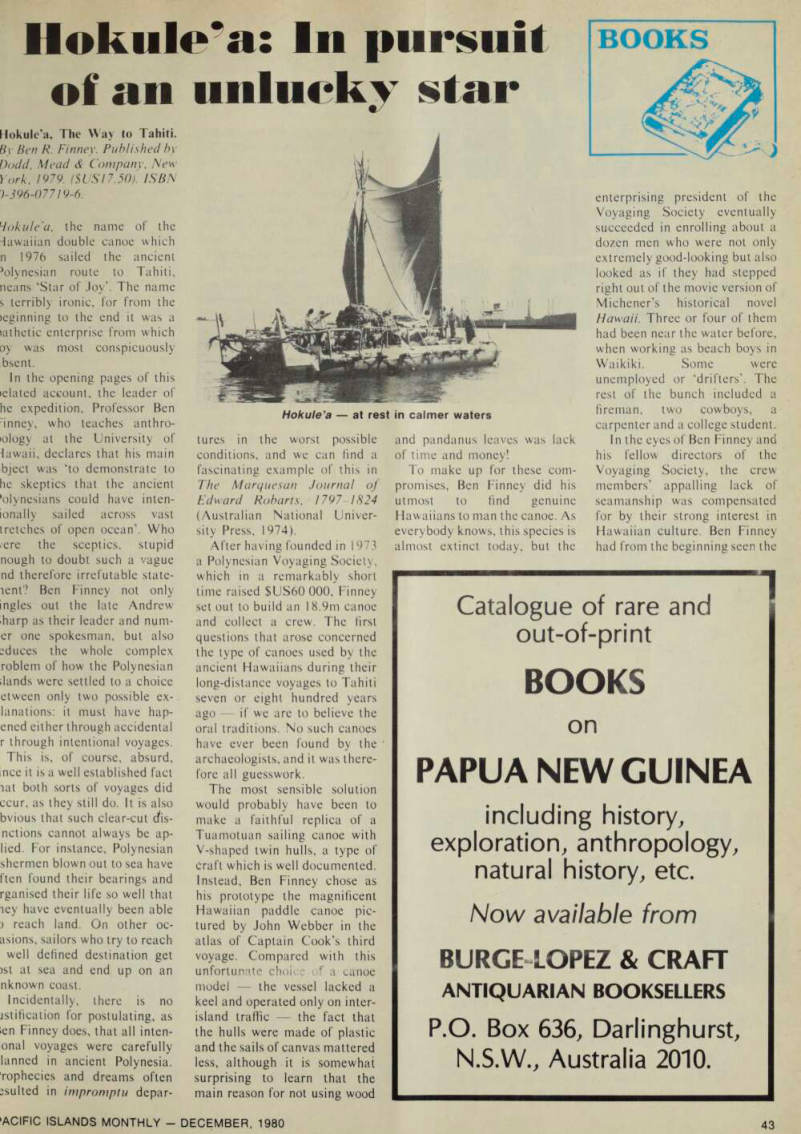
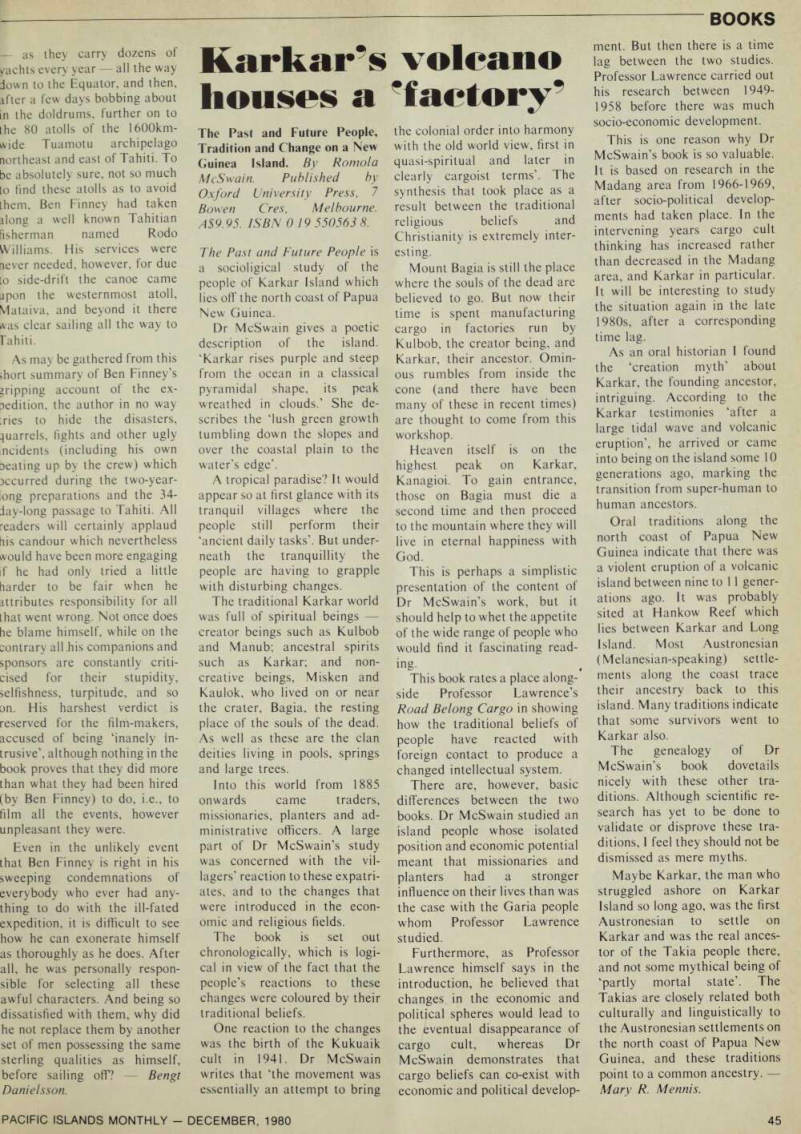
Books
Hokule'a: In pursuit of an unlucky star
Hokule'a, The Way to Tahiti.
Sr Ben R Finney. Published by Dodd, Mead & Company, New York. 1979. (5U517.50). ISBN 1-396-07719-6.
Hokule'a, the name of the Jawaiian double canoe which n 1976 sailed the ancient ’olynesian route to Tahiti, neans ‘Star of Joy’. The name s terribly ironic, for from the >eginning to the end it was a lathetic enterprise from which oy was most conspicuously bsent.
In the opening pages of this •elated account, the leader of he expedition. Professor Ben : inney, who leaches anthro pology at the University of lawaii, declares that his main bject was ‘to demonstrate to he skeptics that the ancient ‘olynesians could have inten ionally sailed across vast iretches of open ocean’. Who /ere the sceptics, stupid nough to doubt such a vague nd therefore irrefutable state lenl? Ben Finney not only ingles out the late Andrew harp as their leader and num er one spokesman, but also educes the whole complex roblem of how the Polynesian Jands were settled to a choice etween only two possible ex lanalions; it must have hap ened either through accidental r through intentional voyages.
This is, of course, absurd, nee it is a well established fact lal both sorts of voyages did ccur, as they still do. It is also bvious that such clear-cut dta nclions cannot always be ap lied. For instance, Polynesian shermen blown out to sea have flen found their bearings and rganised their life so well that icy have eventually been able ) reach land. On other oc asions, sailors who try to reach well defined destination get >sl at sea and end up on an nknown coast.
Incidentally, there is no istification for postulating, as ;en Finney does, that all inten onal voyages were carefully lanned in ancient Polynesia, rophecies and dreams often jsulled in impromptu depar-
tures in the worst possible conditions, and we can find a fascinating example of this in The Marquesan Journal of Edward Roharts, I 797 1824 (Australian National Univer sity Press, 1974).
After having founded in 1973 a Polynesian Voyaging Society, which in a remarkably short lime raised SUS6O 000, Finney set out to build an 18.9 m canoe and collect a crew. The first questions that arose concerned the type of canoes used by the ancient Hawaiians during their long-distance voyages to Tahiti seven or eight hundred years ago if we are to believe the oral traditions. No such canoes have ever been found by the • archaeologists, and it was there fore all guesswork.
The most sensible solution would probably have been to make a faithful replica of a Tuamoluan sailing canoe with V-shaped twin hulls, a type of Craft which is well documented.
Instead, Ben Finney chose as his prototype the magnificent Hawaiian paddle canoe pic tured by John Webber in the atlas of Captain Cook’s third voyage. Compared with this unfortunate choice of a canoe model the vessel lacked a keel and operated only on inter island traffic the fact that the hulls were made of plastic and the sails of canvas mattered less, although it is somewhat surprising to learn that the main reason for not using wood
and pandanus leaves was lack of lime and money!
To make up for these com promises, Ben Finney did his utmost to find genuine Hawaiians to man the canoe. As everybody knows, this species is almost extinct today, but the
enterprising president of the Voyaging Society eventually succeeded in enrolling about a dozen men who were not only extremely good-looking but also looked as if they had stepped right out of the movie version of Michener’s historical novel Hawaii. Three or four of them had been near the water before, when working as beach boys in Waikiki. Some were unemployed or ‘drifters’. The rest of the bunch included a fireman, two cowboys, a carpenter and a college student.
In the eyes of Ben Finney and his fellow directors of the Voyaging Society, the crew members’ appalling lack of seamanship was compensated for by their strong interest in Hawaiian culture. Ben Finney had from the beginning seen the
Hokule’a - at rest in calmer waters
whole enterprise as a powerful means to revive the ancient Polynesian culture. Among other things, he had organised a carefully researched and re hearsed canoe launching cer emony that made the pro fessional showmen in Waikiki green with envy.
As it soon turned out, the Hawaiian crewmen played their part only too well, for they constantly resorted to spells, incantations and all sorts of magic rites. Sometimes, at their request, a professional kahuna was called in, and although his magic, of course, was genuinely Hawaiian, his often exorbitant fees had to be paid in American dollars. Ben Finney went along with all this mumbo-jumbo but balked, quite understandably, when the crew tried to get rid of all their haole sponsors, includ ing the expedition leader him self!
Although this brash attempt should have served as a warn ing, Ben Finney kept his motley crew of rebellious landlubbers on the payroll, and after a few more disasters, including a swamping of the canoe, he eventually put to sea with eight of them on May 1, 1976. The captain he had chosen, a charming Hawaiian ‘sunset cruiser’ named Kawika (David), was even less able than himself to instil discipline and order. As if quantity could make up for quality, he signed on another four captains or navigators. One was the Micronesian master mariner Mau Piailug who was very popular but of little help, as he did not know this part of the Pacific and spoke no English.
The remaining three were all haoles and included Dr David Lewis, but in spite of their profound knowledge of ancient and modern navigation the Hawaiians refused to take any notice of them, or if they did so, were openly hostile.
With a mutinous crew, a weak leader and too many unpopular leaders, the great experiment in Polynesian sur vival technique which was to be undertaken during the trip nat urally came to nothing. Accord ing to the much-touted plans, the Hokule’a sailors were to live solely on dried bananas, pounded taro, salted fish, and
other Hawaiian delicacies.] Once at sea, however, the Hawaiian crew members den cided that cultural revival should stop at spiritual matters and categorically refused to touch the Polynesian foodstuffs] Their refusal no doubt had something to do with the easj] access they had to American! food and beer. They even got it free of charge. The generous purveyors were the captain and crew of the escort and rescue vessel Meotai, financed by the National Geographic Society] in exchange for permission to make a documentary film about! the expedition. A few of the haoles bravely kept chewing on the dried bananas, only to discover shortly afterwards that! most of these Polynesian pro-] visions had been spoiled by careless preparation.
In one respect, and not the least important, the trip was nevertheless an unqualified such cess: the prehistoric navigation! without charts, sextant,] compass and chronometer offered not the slightest difficulty. Favourable winds and currents carried the canoe
Political as well as cultural history went to sea with Hokule’a. Here the old flag of Hawaii, with the Union Jack in the corner, flies from the rig ging.
as they carry dozens of yachts every year all the way down to the Equator, and then, after a few days bobbing about in the doldrums, further on to the 80 atolls of the 1600km wide Tuamotu archipelago northeast and east of Tahiti. To be absolutely sure, not so much to find these atolls as to avoid them, Ben Finney had taken along a well known Tahitian fisherman named Rodo Williams. His services were never needed, however, for due to side-drift the canoe came upon the westernmost atoll, Mataiva, and beyond it there was clear sailing all the way to Fahili.
As may be gathered from this ihort summary of Ben Finney’s gripping account of the ex pedition, the author in no way tries to hide the disasters, quarrels, fights and other ugly ncidents (including his own beating up by the crew) which occurred during the two-year iong preparations and the 34day-long passage to Tahiti. All readers will certainly applaud bis candour which nevertheless would have been more engaging if he had only tried a little harder to be fair when he attributes responsibility for all that went wrong. Not once does he blame himself, while on the contrary all his companions and sponsors are constantly criti cised for their stupidity, selfishness, turpitude, and so on. His harshest verdict is reserved for the film-makers, accused of being ‘inanely in trusive’, although nothing in the book proves that they did more than what they had been hired (by Ben Finney) to do, i.e., to film all the events, however unpleasant they were.
Even in the unlikely event that Ben Finney is right in his sweeping condemnations of everybody who ever had any thing to do with the ill-fated expedition, it is difficult to see how he can exonerate himself as thoroughly as he does. After all, he was personally respon sible for selecting all these awful characters. And being so dissatisfied with them, why did he not replace them by another set of men possessing the same sterling qualities as himself, before sailing off? Bengt Danielsson.
Advertisements & other items, pp. 43-44 (2 items)
43
ACIFIC ISLANDS MONTHLY - DECEMBER, 1980
Catalogue of rare and out-of-print
out-of-print
BOOKS
on
PAPUA NEW GUINEA
including history, exploration, anthropology, natural history, etc.
Now available from
BURGE-LOPEZ & CRAFT
ANTIQUARIAN BOOKSELLERS
P.O. Box 636, Darlinghurst, N.S.W., Australia 2010.
OUR
MARKET
THE
WORLD
ICI
ICI Tasman Unruled vu; . yr l V \n ->.
msmsvAk
tig' \
m. / In a country like NEW ZEALAND, where the economy depends heavily on the exports of products from the land, it isn’t surprising to find total commitment to effective animal remedies and agricultural chemicals.
The standards set by ICI TASMAN are respected by farmers Worldwide.
ARE YOU WITH
US?
Healthy Stock Healthy Crops Greater Yields Higher Profit Animal Remedies
★ TASVAX - VACCINES
★ TASTONE - PEPTONES
★ TASMIX - FEED SUPPLEMENTS
★ NILVERM - DRENCH
★ COMBAT - DIP
Agricultural Chemicals
★ GRAMOXONE - WEEDKILLER
★ ORTHENE - INSECTICIDE
★ AMBUSH - INSECTICIDE
★ ACTELLIC - INSECTICIDE
★ MILCURB - FUNGICIDE
Available throughout the South Pacific, these products give you the benefits of the reputation & international research of ICI.
ICI Tasman Limited P.O. Box 900, Auckland, New Zealand
Karkar’s volcano
houses a 'factory’
The Past and Future People, Tradition and Change on a New Guinea Island. By Romola McSwain. Published by Oxford University Press, 7 Bowen Cres, Melbourne.
AS 9.95. ISBN 0 19 550563 8.
The Past and Future People is a socioligical study of the people of Karkar Island which lies off the north coast of Papua New Guinea.
Dr McSwain gives a poetic description of the island. ‘Karkar rises purple and steep from the ocean in a classical pyramidal shape, its peak wreathed in clouds.’ She de scribes the ‘lush green growth tumbling down the slopes and over the coastal plain to the water’s edge’.
A tropical paradise? It would appear so at first glance with its tranquil villages where the people still perform their ‘ancient daily tasks’. But under neath the tranquillity the people are having to grapple with disturbing changes.
The traditional Karkar world was full of spiritual beings creator beings such as Kulbob and Manub; ancestral spirits such as Karkar; and non creative beings, Misken and Kaulok, who lived on or near the crater, Bagia, the resting place of the souls of the dead.
As well as these are the clan deities living in pools, springs and large trees.
Into this world from 1885 onwards came traders, missionaries, planters and ad ministrative officers. A large part of Dr McSwain’s study was concerned with the vil lagers’ reaction to these expatri ates, and to the changes that were introduced in the econ omic and religious fields.
The book is set out chronologically, which is logi cal in view of the fact that the people’s reactions to these changes were coloured by their traditional beliefs.
One reaction to the changes was the birth of the Kukuaik cult in 1941. Dr McSwain writes that ‘the movement was essentially an attempt to bring
the colonial order into harmony with the old world view, first in quasi-spiritual and later in clearly cargoist terms’. The synthesis that took place as a result between the traditional religious beliefs and Christianity is extremely inter esting.
Mount Bagia is still the place where the souls of the dead are believed to go. But now their time is spent manufacturing cargo in factories run by Kulbob, the creator being, and Karkar, their ancestor. Omin ous rumbles from inside the cone (and there have been many of these in recent times) are thought to come from this workshop.
Heaven itself is on the highest peak on Karkar, Kanagioi. To gain entrance, those on Bagia must die a second time and then proceed to the mountain where they will live in eternal happiness with God.
This is perhaps a simplistic presentation of the content of Dr McSwain’s work, but it should help to whet the appetite of the wide range of people who would find it fascinating read ing.
This book rates a place along side Professor Lawrence’s Road Belong Cargo in showing how the traditional beliefs of people have reacted with foreign contact to produce a changed intellectual system.
There are, however, basic differences between the two books. Dr McSwain studied an island people whose isolated position and economic potential meant that missionaries and planters had a stronger influence on their lives than was the case with the Garia people whom Professor Lawrence studied.
Furthermore, as Professor Lawrence himself says in the introduction, he believed that changes, in the economic and political spheres would lead to the eventual disappearance of cargo cult, whereas Dr McSwain demonstrates that cargo beliefs can co-exist with economic and political develop
ment. But then there is a time lag between the two studies.
Professor Lawrence carried out his research between 1949- 1958 before there was much socio-economic development.
This is one reason why Dr McSwain’s book is so valuable.
It is based on research in the Madang area from 1966-1969, after socio-political develop ments had taken place. In the intervening years cargo cult thinking has increased rather than decreased in the Madang area, and Karkar in particular.
It will be interesting to study the situation again in the late 1980 s, after a corresponding time lag.
As an oral historian I found the ‘creation myth’ about Karkar, the founding ancestor, intriguing. According to the Karkar testimonies ‘after a large tidal wave and volcanic eruption’, he arrived or came into being on the island some 10 generations ago, marking the transition from super-human to human ancestors.
Oral traditions along the north coast of Papua New Guinea indicate that there was a violent eruption of a volcanic island between nine to 11 gener ations ago. It was probably sited at Hankow Reef which lies between Karkar and Long Island. Most Austronesian (Melanesian-speaking) settle ments along the coast trace their ancestry back to this island. Many traditions indicate that some survivors went to Karkar also.
The genealogy of Dr McSwain’s book dovetails nicely with these other tra ditions. Although scientific re search has yet to be done to validate or disprove these tra ditions, I feel they should not be dismissed as mere myths.
Maybe Karkar, the man who struggled ashore on Karkar Island so long ago, was the first Austronesian to settle on Karkar and was the real ances tor of the Takia people there, and not some mythical being of ‘partly mortal state’. The Takias are closely related both culturally and linguistically to the Austronesian settlements on the north coast of Papua New Guinea, and these traditions point to a common ancestry.
Mary R. Mennis.
Advertisements & other items, p. 46 (1 item)
See the world with Air New Zealand
If your journey is to take you far or near, first see Air New Zealand or your travel agent to discuss the flights and fares that suit you best.
In the Pacific we fly to New Zealand, Australia, Fiji, Honolulu, Tahiti, Samoa, New Caledonia and Rarotonga. If you’re travelling farther, let us fly you to our Gateway cities to the world - Los Angeles, Hong Kong and Singapore, where you can connect with the airline of your choice.
And best of all, you’ll start by enjoying the special attentive service Air New Zealand is famous for.
Begin your trip with Air New Zealand /SL T5~
air new zeaiano
We fly the Pacific.
ANZ 79/12C
for a special flag-raising
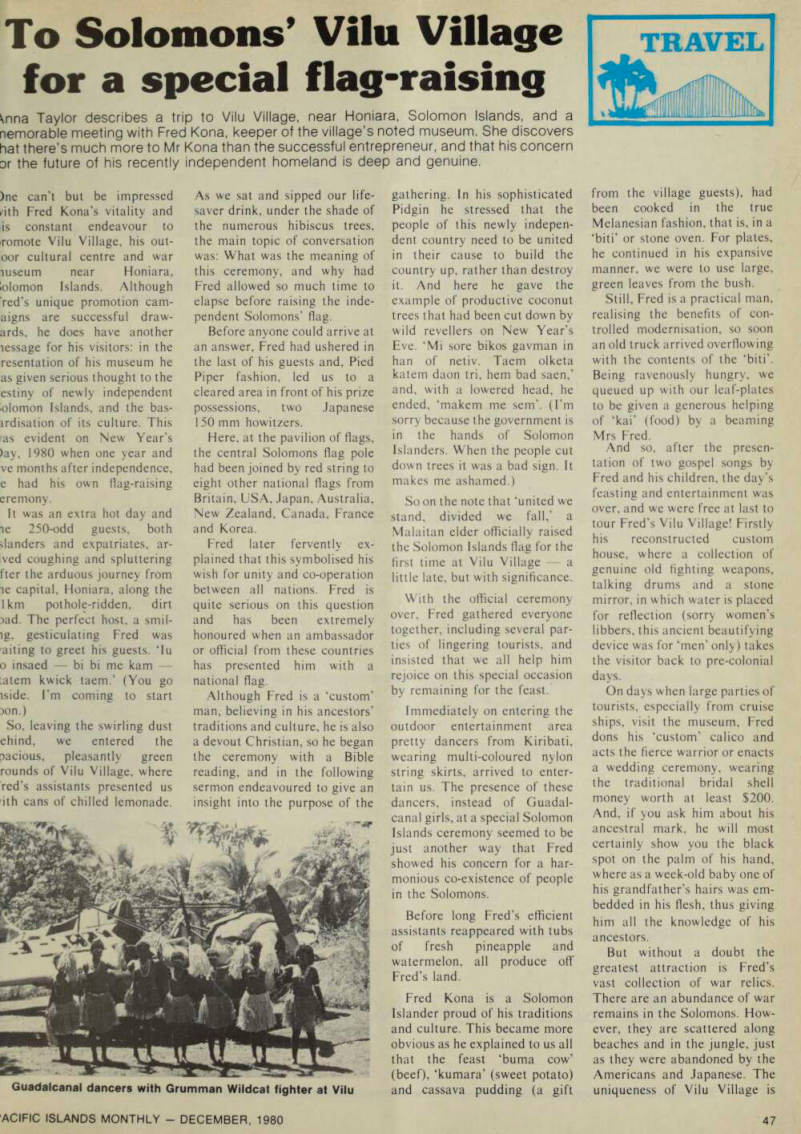

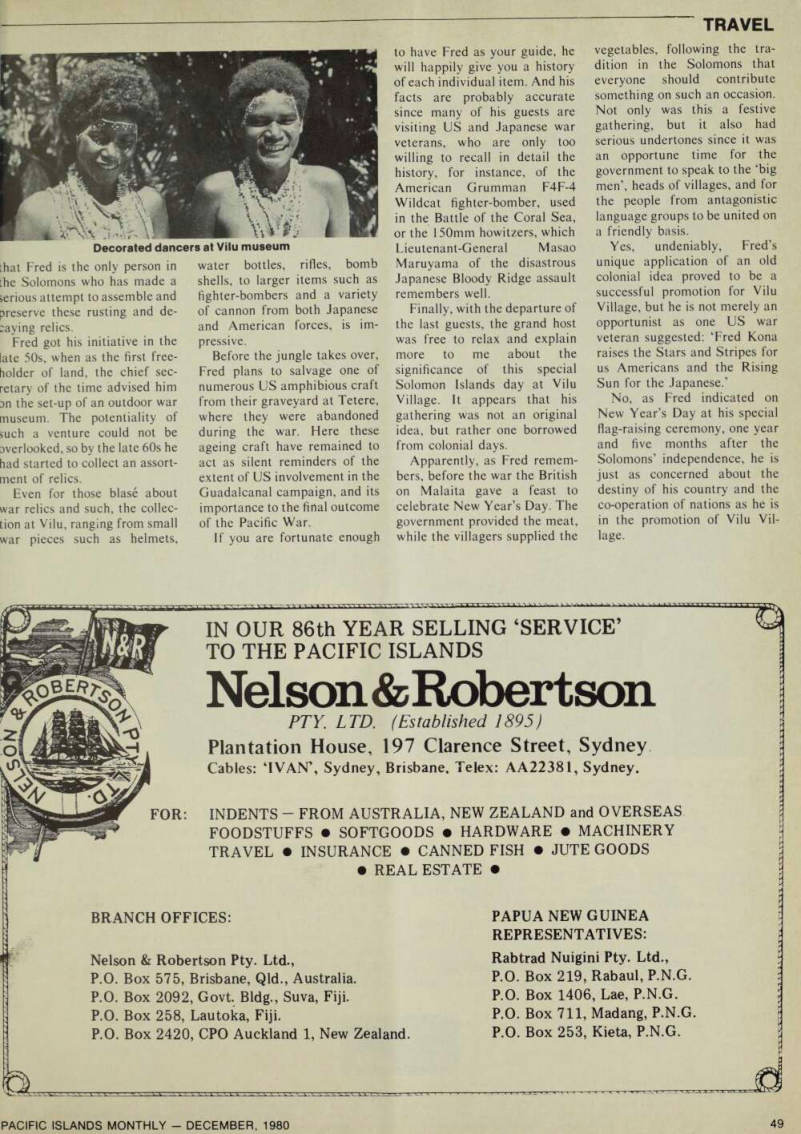
Travel
To Solomons’ Vilu Village for a special flag-raising
Taylor describes a trip to Vilu Village, near Honiara, Solomon Islands, and a nemorable meeting with Fred Kona, keeper of the village’s noted museum. She discovers hat there’s much more to Mr Kona than the successful entrepreneur, and that his concern or the future of his recently independent homeland is deep and genuine.
)ne can’t but be impressed nth Fred Kona’s vitality and is constant endeavour to remote Vilu Village, his out oor cultural centre and war luseum near Honiara, lolomon Islands. Although red’s unique promotion cam aigns are successful draw ards, he does have another lessage for his visitors: in the resentation of his museum he as given serious thought to the estiny of newly independent olomon Islands, and the bas irdisation of its culture. This 'as evident on New Year’s )ay, 1980 when one year and ve months after independence, e had his own flag-raising eremony.
It was an extra hot day and ie 250-odd guests, both danders and expatriates, ar ved coughing and spluttering fter the arduous journey from ie capital, Honiara, along the Ikm pothole-ridden, dirt Dad. The perfect host, a smil ig, gesticulating Fred was ailing to greet his guests. ‘lu o insaed bi bi me kam :atem kwick taem.’ (You go iside. I’m coming to start Don.) So, leaving the swirling dust ehind, we entered the Dacious, pleasantly green rounds of Vilu Village, where red’s assistants presented us ith cans of chilled lemonade.
As we sat and sipped our life saver drink, under the shade of the numerous hibiscus trees, the main topic of conversation was: What was the meaning of this ceremony, and why had Fred allowed so much time to elapse before raising the inde pendent Solomons’ flag.
Before anyone could arrive at an answer, Fred had ushered in the last of his guests and. Pied Piper fashion, led us to a cleared area in front of his prize possessions, two Japanese 150 mm howitzers.
Here, at the pavilion of flags, the central Solomons flag pole had been joined by red string to eight other national flags from Britain, USA, Japan, Australia, New Zealand, Canada, France and Korea.
Fred later fervently ex plained that this symbolised his wish for unity and co-operation between all nations. Fred is quite serious on this question and has been extremely honoured when an ambassador or official from these countries has presented him with a national flag.
Although Fred is a ‘custom’ man, believing in his ancestors’ traditions and culture, he is also a devout Christian, so he began the ceremony with a Bible reading, and in the following sermon endeavoured to give an insight into the purpose of the
gathering. In his sophisticated Pidgin he stressed that the people of this newly indepen dent country need to be united in their cause to build the country up, rather than destroy it. And here he gave the example of productive coconut trees that had been cut down by wild revellers on New Year’s Eve. ‘Mi sore bikos gavman in han of netiv. Taem olketa katem daon tri, hem bad saen,’ and, with a lowered head, he ended, ‘makem me sem’. (Em sorry because the government is in the hands of Solomon Islanders. When the people cut down trees it was a bad sign. It makes me ashamed.) So on the note that ‘united we stand, divided we fall,’ a Malaitan elder officially raised the Solomon Islands flag for the first time at Vilu Village a little late, but with significance.
With the official ceremony over, Fred gathered everyone together, including several par ties of lingering tourists, and insisted that we all help him rejoice on this special occasion by remaining for the feast.
Immediately on entering the outdoor entertainment area pretty dancers from Kiribati, wearing multi-coloured nylon string skirts, arrived to enter tain us. The presence of these dancers, instead of Guadal canal girls, at a special Solomon Islands ceremony seemed to be just another way that Fred showed his concern for a har monious co-existence of people in the Solomons.
Before long Fred’s efficient assistants reappeared with tubs of fresh pineapple and watermelon, all produce off Fred’s land.
Fred Kona is a Solomon Islander proud of his traditions and culture. This became more obvious as he explained to us all that the feast ‘buma cow’ (beef), ‘kumara’ (sweet potato) and cassava pudding (a gift
from the village guests), had been cooked in the true Melanesian fashion, that is, in a ‘biti’ or stone oven. For plates, he continued in his expansive manner, we were to use large, green leaves from the bush.
Still, Fred is a practical man, realising the benefits of con trolled modernisation, so soon an old truck arrived overflowing with the contents of the ‘biti’.
Being ravenously hungry, we queued up with our leaf-plates to be given a generous helping of ‘kai’ (food) by a beaming Mrs Fred.
And so, after the presen tation of two gospel songs by Fred and his children, the day’s feasting and entertainment was over, and we were free at last to tour Fred’s Vilu Village! Firstly his reconstructed custom house, where a collection of genuine old fighting weapons, talking drums and a stone mirror, in which water is placed for reflection (sorry women’s libbers, this ancient beautifying device was for ‘men’ only) takes the visitor back to pre-colonial days.
On days when large parties of tourists, especially from cruise ships, visit the museum, Fred dons his ‘custom’ calico and acts the fierce warrior or enacts a wedding ceremony, wearing the traditional bridal shell money worth at least $2OO.
And, if you ask him about his ancestral mark, he will most certainly show you the black spot on the palm of his hand, where as a week-old baby one of his grandfather’s hairs was em bedded in his flesh, thus giving him all the knowledge of his ancestors.
But without a doubt the greatest attraction is Fred’s vast collection of war relics.
There are an abundance of war remains in the Solomons. How ever, they are scattered along beaches and in the jungle, just as they were abandoned by the Americans and Japanese. The uniqueness of Vilu Village is
Guadalcanal dancers with Grumman Wildcat fighter at Vilu
that Fred is the only person in the Solomons who has made a serious attempt to assemble and preserve these rusting and de fying relics.
Fred got his initiative in the late 50s, when as the first free holder of land, the chief sec retary of the time advised him :>n the set-up of an outdoor war
museum. The potentiality of
such a venture could not be averlooked, so by the late 60s he had started to collect an assort ment of relics.
Even for those blase about war relics and such, the collec tion at Vilu, ranging from small war pieces such as helmets,
water bottles, rifles, bomb shells, to larger items such as fighter-bombers and a variety of cannon from both Japanese and American forces, is im
pressive.
Before the jungle takes over, Fred plans to salvage one of numerous US amphibious craft from their graveyard at Tetere, where they were abandoned during the war. Here these ageing craft have remained to act as silent reminders of the extent of US involvement in the Guadalcanal campaign, and its importance to the final outcome of the Pacific War.
If you are fortunate enough
to have Fred as your guide, he will happily give you a history of each individual item. And his facts are probably accurate since many of his guests are visiting US and Japanese war veterans, who are only too willing to recall in detail the history, for instance, of the American Grumman F4F-4 Wildcat fighter-bomber, used in the Battle of the Coral Sea, or the 150 mm howitzers, which Lieutenant-General Masao Maruyama of the disastrous Japanese Bloody Ridge assault remembers well.
Finally, with the departure of the last guests, the grand host was free to relax and explain more to me about the significance of this special Solomon Islands day at Vilu Village. It appears that his gathering was not an original idea, but rather one borrowed from colonial days.
Apparently, as Fred remem bers, before the war the British on Malaita gave a feast to celebrate New Year’s Day. The government provided the meat, while the villagers supplied the
vegetables, following the tra dition in the Solomons that everyone should contribute something on such an occasion.
Not only was this a festive gathering, but it also had serious undertones since it was an opportune time for the government to speak to the ‘big men’, heads of villages, and for the people from antagonistic language groups to be united on a friendly basis.
Yes, undeniably, Fred’s unique application of an old colonial idea proved to be a successful promotion for Vilu Village, but he is not merely an opportunist as one US war veteran suggested; ‘Fred Kona raises the Stars and Stripes for us Americans and the Rising Sun for the Japanese.’
No, as Fred indicated on New Year’s Day at his special flag-raising ceremony, one year and five months after the Solomons’ independence, he is just as concerned about the destiny of his country and the co-operation of nations as he is in the promotion of Vilu Vil lage.
Decorated dancers at Vilu museum
Advertisements & other items, pp. 48-50 (1 item)
Expert
Insurance Service
throughout the islands
I
Queensland Insurance (Fiji) Limited
Head Office, 34 Usher St., SUVA . General Manager: L. G. Liddell A.A.1.1. Assistant Manager: Vijay Lai. Phone; 23851.
LAUTOKA OFFICE: Burns Philp Bldg., Naviti St. District Manager: J. Dalton. Phone: 60642.
Queensland Insurance (PNG) Limited
PAPUA NEW GUINEA
Head Office, B.N.G. Building, Musgrave St.,PORT MORESBY. General Manager: J. M. Dawe.
Assistant Manager: R. V. Maskell. Phone: 212144.
LAE: 4th St. & Coronation Drive. District Manager: I. R. Martin. Phone: 423873.
MOUNT HAGEN: Hagen Drive. District Manager: D. F Carroll. Phone: 521002.
ARAWA: Chebu St. District Manager: J. Longbut. Phone: 951555.
MADANG: Kasagten St. District Manager: N. D. Ramage. Phone; 822020.
RABAUL: Wirraway St. District Manager: W. F. Tinker. Phone; 921014.
QBE Insurance Limited
VANUATU, PORT VILA: Rue de Paris, Suite 19, Oceania Bldg. Manager: G. F. Donnelly.
Phone; 2299.
SANTO: Burns Philp (Vanuatu) Ltd. Phone; 230.
PACIFIC AGENCIES
NEW CALEDONIA: T A.Hagen, Ste. W. A. Johnston, S.A.R.L. 5 Rue Anatole France, NOUMEA.
Phone; 272083.
TAHITI: Arthur Chung. Immeuble 8.1.5., Front de Mer, PAPEETE. Phone; 2.86.19.
NIUE: Burns Philp (South Sea) Company Ltd.
NORFOLK ISLAND: Burns Philp (N I) Company Ltd. Phone: 2191.
SAMOA: APIA, Burns Philp (South Sea) Company Ltd. Phone: 22611.
TONGA: Burns Philp (South Sea) Company Ltd. NUKUALOFA. Phone 21500 HAAPAI, VAVAU.
MEMBERS OF THE:
INSURANCE GROUP UMUED
% 'U -0 o & m X 4/ 6
FOR:
IN OUR 86th YEAR SELLING ‘SERVICE’
TO THE PACIFIC ISLANDS
Nelson & Robertson
PTY. LTD. (Established 1895)
Plantation House, 197 Clarence Street, Sydney
Cables: ‘IVAN% Sydney, Brisbane. Telex: AA22381, Sydney.
INDENTS - FROM AUSTRALIA, NEW ZEALAND and OVERSEAS FOODSTUFFS • SOFTGOODS • HARDWARE • MACHINERY TRAVEL • INSURANCE • CANNED FISH • JUTE GOODS
• REAL ESTATE •
BRANCH OFFICES:
Nelson & Robertson Pty. Ltd., P.O. Box 575, Brisbane, Qld., Australia.
P.O. Box 2092, Govt. Bldg., Suva, Fiji.
P.O. Box 258, Lautoka, Fiji.
P.O. Box 2420, CPO Auckland 1, New Zealand.
PAPUA NEW GUINEA
REPRESENTATIVES:
Rabtrad Nuigini Pty. Ltd., P.O. Box 219, Rabaul, P.N.G.
P.O. Box 1406, Lae, P.N.G.
P.O. Box 711, Madang, P.N.G.
P.O. Box 253, Kieta, P.N.G.
SANSUI DRAMATIZES
ITS TECHNOLOGICAL
LEADERSHIP AGAIN!
too 45 2XJ to
OAS
OJO
u m ml e e 3P 0 The superb sound quality of the top-of-the-line SUPER COMPO System will impress the most dedicated audiophile.
And the unique visual displays combined with easy operation create new pleasures for music lovers. Only Sansui’s finely honed advanced technology offers such multi-dimensional benefits.
Take a good look at the C-77 control center preamplifier with its built-in auto/manual fader. The colorful display shows you how smoothly one sound source is fading out while another is coming in. The fact is this is the first time in audio history that such a function has been offered in a quality stereo system.
Now look at the “Linear A” DC-Servo power amplifier.
You’ll see a large spectrum analyzer display and detailed peak power display. But what you can’t see is the Linear A design which eliminates switching distortion for exceptional pure sound you will clearly hear. Combined with DC-Servo circuitry, the B-77 outperforms any other amplifier in its class.
Look at other audio systems and now examine the front of the T-77 Digital Quartz PLL Synthesizer tuner. It allows you to “program in” eight of your favorite AM or FM stations for instant pushbutton recall. In addition, an auto search feature scans either up or down the band until it locks on a good quality station.
The more you look, the more you listen, the more will the tangible advantages of Sansui’s special technology impress you and your listeners. Superior musical quality is what SUPER COMPO is all about.
Stinsui
SANSUI ELECTRIC CO., LTD. 14-1 Izumi 2-chome. Suginami-ku, Tokyo 168, Japan • Australia VANFI (Aust.) Pty. Ltd. 297, City Road, South Melbourne, Victoria 3205, Australia Phone: 699-5473 I 283 Alfred Street, North Sydney, N.S.W. 2060, Australia Phone: 929-0293 • Fiji Prabhu Brothers Ltd. P.O. Box 183, Nadi Phone: 70183/4 • Papua New Guinea Oceania Indent Agency (P.N.G.) Pty. Ltd. Box 5518, Boroko, Port Moresby Phone: PM 256406 •New Zealand David Reid Electronics Ltd. C.P.O. Box 2630, Auckland, 1 Phone: 492-189 *A/ew Caledonia Ets Michel MERCIER BP 1123, Noumea Phone: 27, 59. 11 • South Pacific Miltons Department Stores Limited P.O. Box 146, Norfolk Island 2899 • Central Pacific Nauru Co-operative Society Republic
Where the trade winds blow
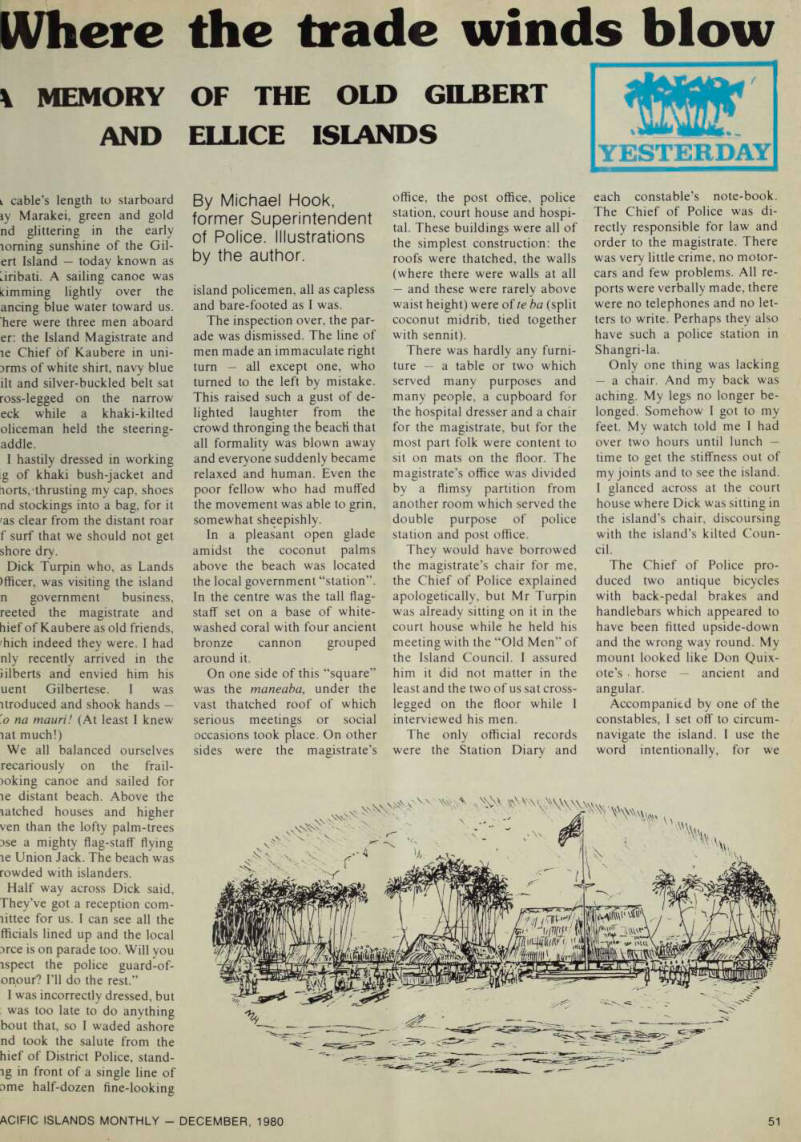
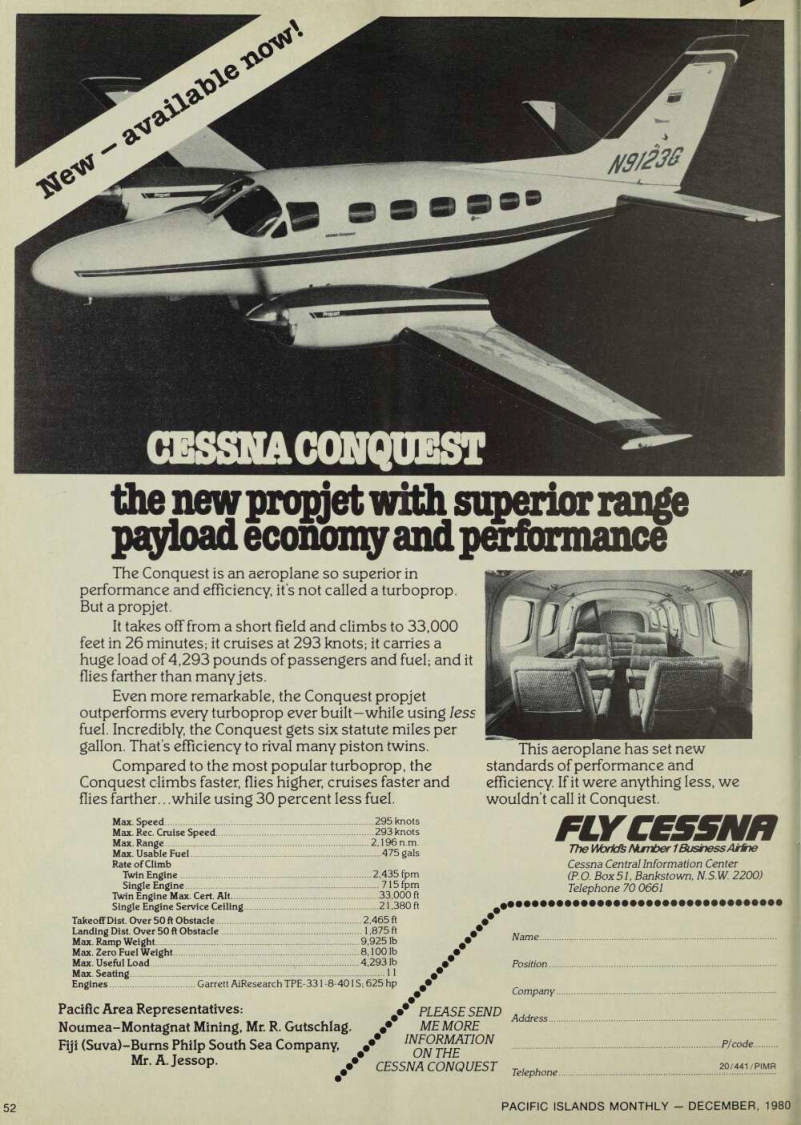
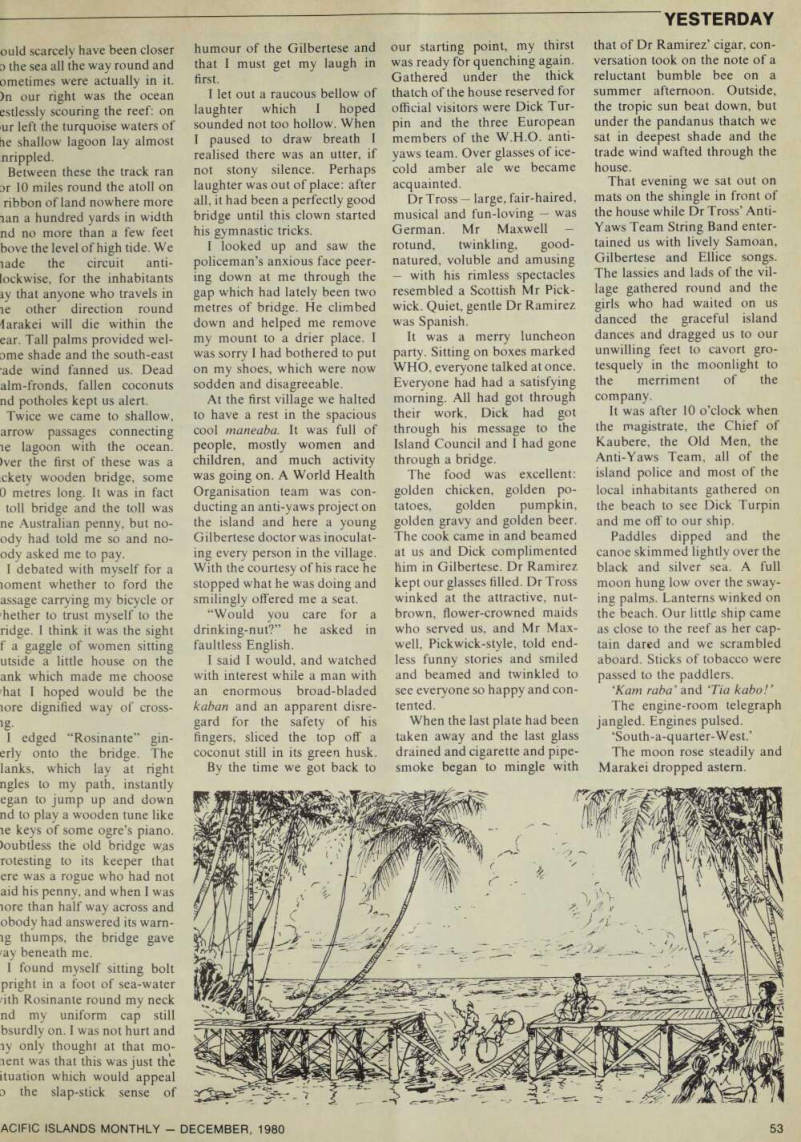
Yesterday
A Memory Of The Old Gilbert
And Ellice Islands
l cable’s length to starboard iy Marakei, green and gold nd glittering in the early rorning sunshine of the Gil ert Island today known as Kiribati. A sailing canoe was
dmming lightly over the
ancing blue water toward us. here were three men aboard er: the Island Magistrate and le Chief of Kaubere in uni- Drms of white shirt, navy blue ilt and silver-buckled belt sat ross-legged on the narrow eck while a khaki-kilted oliceman held the steering addle.
I hastily dressed in working ig of khaki bush-jacket and lorts, thrusting my cap, shoes nd stockings into a bag, for it 'as clear from the distant roar f surf that we should not get
shore dry.
Dick Turpin who, as Lands )fficer, was visiting the island n government business,
reeted the magistrate and
hief of Kaubere as old friends, 'hich indeed they were. I had nly recently arrived in the xilberts and envied him his uent Gilbertese. I was itroduced and shook hands \o na mauri! (At least I knew rat much!) We all balanced ourselves recariously on the frail >oking canoe and sailed for le distant beach. Above the
latched houses and higher
ven than the lofty palm-trees
3se a mighty flag-staff flying
re Union Jack. The beach was rowded with islanders.
Half way across Dick said, They’ve got a reception com littee for us. I can see all the fficials lined up and the local Dree is on parade too. Will you
ispect the police guard-of
onour? I’ll do the rest.”
I was incorrectly dressed, but was too late to do anything bout that, so I waded ashore nd took the salute from the hief of District Police, stand ig in front of a single line of
ame half-dozen fine-looking
By Michael Hook,
former Superintendent
of Police. Illustrations by the author. island policemen, all as capless and bare-footed as I was.
The inspection over, the par ade was dismissed. The line of men made an immaculate right turn all except one, who turned to the left by mistake.
This raised such a gust of de
lighted laughter from the
crowd thronging the beach that all formality was blown away and everyone suddenly became relaxed and human. Even the poor fellow who had muffed the movement was able to grin,
somewhat sheepishly.
In a pleasant open glade amidst the coconut palms above the beach was located the local government “station’’.
In the centre was the tall flag staff set on a base of white washed coral with four ancient bronze cannon grouped around it.
On one side of this “square” was the maneaba, under the vast thatched roof of which serious meetings or social occasions took place. On other sides were the magistrate’s
office, the post office, police station, court house and hospi tal. These buildings were all of the simplest construction: the roofs were thatched, the walls (where there were walls at all and these were rarely above waist height) were of te ba (split coconut midrib, tied together with sennit).
There was hardly any furni ture a table or two which served many purposes and many people, a cupboard for the hospital dresser and a chair for the magistrate, but for the most part folk were content to sit on mats on the floor. The magistrate’s office was divided
by a flimsy partition from
another room which served the double purpose of police station and post office.
They would have borrowed the magistrate’s chair for me, the Chief of Police explained
apologetically, but Mr Turpin
was already sitting on it in the court house while he held his meeting with the “Old Men’’ of the Island Council. I assured him it did not matter in the least and the two of us sat cross legged on the floor while I interviewed his men.
The only official records were the Station Diary and
each constable’s note-book.
The Chief of Police was di rectly responsible for law and order to the magistrate. There was very little crime, no motor cars and few problems. All re ports were verbally made, there were no telephones and no let ters to write. Perhaps they also have such a police station in
Shangri-la.
Only one thing was lacking a chair. And my back was
aching. My legs no longer be
longed. Somehow I got to my feet. My watch told me I had over two hours until lunch time to get the stiffness out of my joints and to see the island.
I glanced across at the court house where Dick was sitting in the island’s chair, discoursing with the island’s kilted Coun cil.
The Chief of Police pro
duced two antique bicycles
with back-pedal brakes and handlebars which appeared to have been fitted upside-down and the wrong way round. My mount looked like Don Quix ote’s • horse ancient and
angular.
Accompanied by one of the constables, I set off to circum navigate the island. I use the word intentionally, for we
ould scarcely have been closer 3 the sea all the way round and ometimes were actually in it. )n our right was the ocean estlessly scouring the reef; on ur left the turquoise waters of
tie shallow lagoon lay almost
nrippled.
Between these the track ran 3r 10 miles round the atoll on ribbon of land nowhere more lan a hundred yards in width nd no more than a few feet bove the level of high tide. We lade the circuit anti lockwise, for the inhabitants iy that anyone who travels in le other direction round larakei will die within the
ear. Tall palms provided wel
ime shade and the south-east ade wind fanned us. Dead aim-fronds, fallen coconuts
nd potholes kept us alert.
Twice we came to shallow, arrow passages connecting le lagoon with the ocean. )ver the first of these was a
ckety wooden bridge, some
0 metres long. It was in fact toll bridge and the toll was ne Australian penny, but no ody had told me so and no ody asked me to pay.
I debated with myself for a loment whether to ford the assage carrying my bicycle or ffiether to trust myself to the ridge. I think it was the sight
f a gaggle of women sitting
utside a little house on the ank which made me choose r hat I hoped would be the lore dignified way of cross !g-
I edged “Rosinante” gin
erly onto the bridge. The lanks, which lay at right
ngles to my path, instantly
egan to jump up and down nd to play a wooden tune like
le keys of some ogre’s piano.
)oubtless the old bridge was rotesting to its keeper that ere was a rogue who had not aid his penny, and when I was lore than half way across and obody had answered its wam
ig thumps, the bridge gave
ray beneath me.
I found myself sitting bolt pright in a foot of sea-water dth Rosinante round my neck nd my uniform cap still bsurdly on. I was not hurt and
iy only thought at that mo
nent was that this was just the
ituation which would appeal
3 the slap-stick sense of
humour of the Gilbertese and that I must get my laugh in first.
I let out a raucous bellow of
laughter which I hoped
sounded not too hollow. When I paused to draw breath I realised there was an utter, if not stony silence. Perhaps laughter was out of place: after all, it had been a perfectly good bridge until this clown started his gymnastic tricks.
I looked up and saw the policeman’s anxious face peer ing down at me through the gap which had lately been two metres of bridge. He climbed down and helped me remove my mount to a drier place. I was sorry I had bothered to put on my shoes, which were now sodden and disagreeable.
At the first village we halted to have a rest in the spacious cool maneaba. It was full of
people, mostly women and
children, and much activity was going on. A World Health Organisation team was con
ducting an anti-yaws project on
the island and here a young Gilbertese doctor was inoculat ing every person in the village.
With the courtesy of his race he stopped what he was doing and smilingly offered me a seat.
“Would you care for a drinking-nut?” he asked in
faultless English.
I said I would, and watched with interest while a man with an enormous broad-bladed kaban and an apparent disre gard for the safety of his fingers, sliced the top off a coconut still in its green husk.
By the time we got back to
our starting point, my thirst was ready for quenching again.
Gathered under the thick thatch of the house reserved for official visitors were Dick Tur pin and the three European members of the W.H.O. anti yaws team. Over glasses of ice cold amber ale we became
acquainted.
Dr Tross large, fair-haired, musical and fun-loving was German. Mr Maxwell rotund, twinkling, good natured, voluble and amusing with his rimless spectacles resembled a Scottish Mr Pick wick. Quiet, gentle Dr Ramirez
was Spanish.
It was a merry luncheon party. Sitting on boxes marked WHO, everyone talked at once.
Everyone had had a satisfying morning. All had got through their work, Dick had got through his message to the Island Council and I had gone through a bridge.
The food was excellent; golden chicken, golden po
tatoes, golden pumpkin,
golden gravy and golden beer.
The cook came in and beamed at us and Dick complimented him in Gilbertese. Dr Ramirez kept our glasses filled. Dr Tross winked at the attractive, nut brown, flower-crowned maids who served us, and Mr Max well, Pickwick-style, told end less funny stories and smiled and beamed and twinkled to see everyone so happy and con tented.
When the last plate had been taken away and the last glass drained and cigarette and pipe smoke began to mingle with
that of Dr Ramirez’ cigar, con versation took on the note of a reluctant bumble bee on a summer afternoon. Outside, the tropic sun beat down, but under the pandanus thatch we sat in deepest shade and the trade wind wafted through the house.
That evening we sat out on mats on the shingle in front of the house while Dr Tross’ Anti- Yaws Team String Band enter tained us with lively Samoan, Gilbertese and Ellice songs.
The lassies and lads of the vil lage gathered round and the girls who had waited on us danced the graceful island dances and dragged us to our unwilling feet to cavort gro tesquely in the moonlight to the merriment of the company.
It was after 10 o’clock when the magistrate, the Chief of Kaubere, the Old Men, the Anti-Yaws Team, all of the island police and most of the local inhabitants gathered on the beach to see Dick Turpin and me off to our ship.
Paddles dipped and the canoe skimmed lightly over the black and silver sea. A full moon hung low over the sway ing palms. Lanterns winked on the beach. Our little ship came as close to the reef as her cap tain dared and we scrambled aboard. Sticks of tobacco were
passed to the paddlers.
‘Kam raba’ and ‘Tia kabo!’
The engine-room telegraph
jangled. Engines pulsed.
‘South-a-quarter-West.’
The moon rose steadily and Marakei dropped astern.
Advertisements & other items, pp. 51-54 (3 items)
51
ACIFIC ISLANDS MONTHLY - DECEMBER, 1980
payload econbnty and performance
o a? 7h i sV ◄ 0- / e J M H
The Conquest is an aeroplane so superior in performance and efficiency, it’s not called a turboprop.
But a propjet.
It takes off from a short field and climbs to 33,000 feet in 26 minutes; it cruises at 293 knots; it carries a huge load 0f4,293 pounds of passengers and fuel; and it flies farther than many jets.
Even more remarkable, the Conquest propjet outperforms every turboprop ever built—while using less fuel. Incredibly the Conquest gets six statute miles per gallon. That’s efficiency to rival many piston twins.
Compared to the most popular turboprop, the Conquest climbs faster, flies higher, cruises faster and flies farther.. .while using 30 percent less fuel.
Max. Speed 295 knots Max. Rec. Cruise Speed 293 knots Max. Range 2,196 n.m.
Max. Usable Fuel 475 gals Rate of Climb Twin Engine 2,435 fpm Single Engine 715 fpm Twin Engine Max. Cert. Alt 33,000 ft Single Engine Service Ceiling 21.380 ft Takeoff Dist. Over 50 ft Obstacle 2,465 ft Landing Dist. Over 50 ft Obstacle 1.875 ft Max. Ramp Weight 9.925 lb Max. Zero Fuel Weight 8.100 lb Max. Useful Load 4,293 lb Max. Seating 11 Engines Garrett Aißesearch TPE-331 -8-401 S : 625 hp This aeroplane has set new standards of performance and efficiency If it were anything less, we wouldn’t call it Conquest.
The World's Number 1 Business Airline Cessna Central Information Center (P.O. Boxsl, Bankstown, N.S.W. 2200) Telephone 70 0661 Name.
V Position.
Pacific Area Representatives: Noumea-Montagnat Mining, Mr. R. Gutschlag.
Fiji (Suva)-Bums Philp South Sea Company, Mr. A.Jessop. ' V
PLEASE SEND
ME MORE
INFORMATION
ON THE
CESSNA CONQUEST
Company.
Address. / .P/code..
Telephone.
20/441/PIMR
CONSTRUCTIVE
ADVICE.
Komatsu makes 76-ton Bulldozers Small 2-ton Bulldozers. w *v Swamp Bulldozers as well as Swamp Dozer Shovels.
Dozer Shovels.
Radio-Controlled Bulldozers and Dozer Shovels.
Electric Powered Dozer Shovels.
A wide range of Pipelayers. rf- Amphibious Bulldozers. ( n u sT\ w.
Wheel Loaders.
A wide selection of Off-Highway Dump Trucks.
Slag Dump Trucks.
And offer Motor Graders. .
A L
, -aL ' --Y
A.
As well as Motor Scrapers.
Soil Compactors.
Trash Compactors.
Towing Tractors. 5? § M Vibratory Rollers. Diesel Generator Sets.
Portable Air Compressors.
A wide selection of Diesel Engines.
Machine Tools. v h i-x ■ Fi >5 0 *- Q MB Mechanical and Hydraulic Presses. A variety of Maypres Presses. OBS Power Presses. Tunnel-Boring Machines.
We're constructive in other ways. We offer castings, foundries, and important advice on construction and manufacturing projects.
•§• KOMATSU LTD
Tokyo, Japan Komatsu overseas offices: Singapore, Jakarta, Manila, Bangkok, Bangalore, Karachi, Beijing, Seoul, Sydney, Ankara, Cairo, Alger, Dubai, Teheran, Baghdad, Jeddah, Riyadh Ad Dammam, Nairobi, Abidjan, Lagos, Johannesburg, Moscow, Warszawa, Brussels, Paris, Madrid, Frankfurt, Stuttgart, London, Habana, Buenos Aires, Panama, Caracas Sao Paulo, Mexico City, San Francisco. Oakland, Philadelphia, Detroit, Dallas, Atlanta, Chicago. Toronto. Vancouver, and distributors in over 100 countries around the world
Yesterday
53
ACIFIC ISLANDS MONTHLY - DECEMBER, 1980
Tahiti-Hawaii
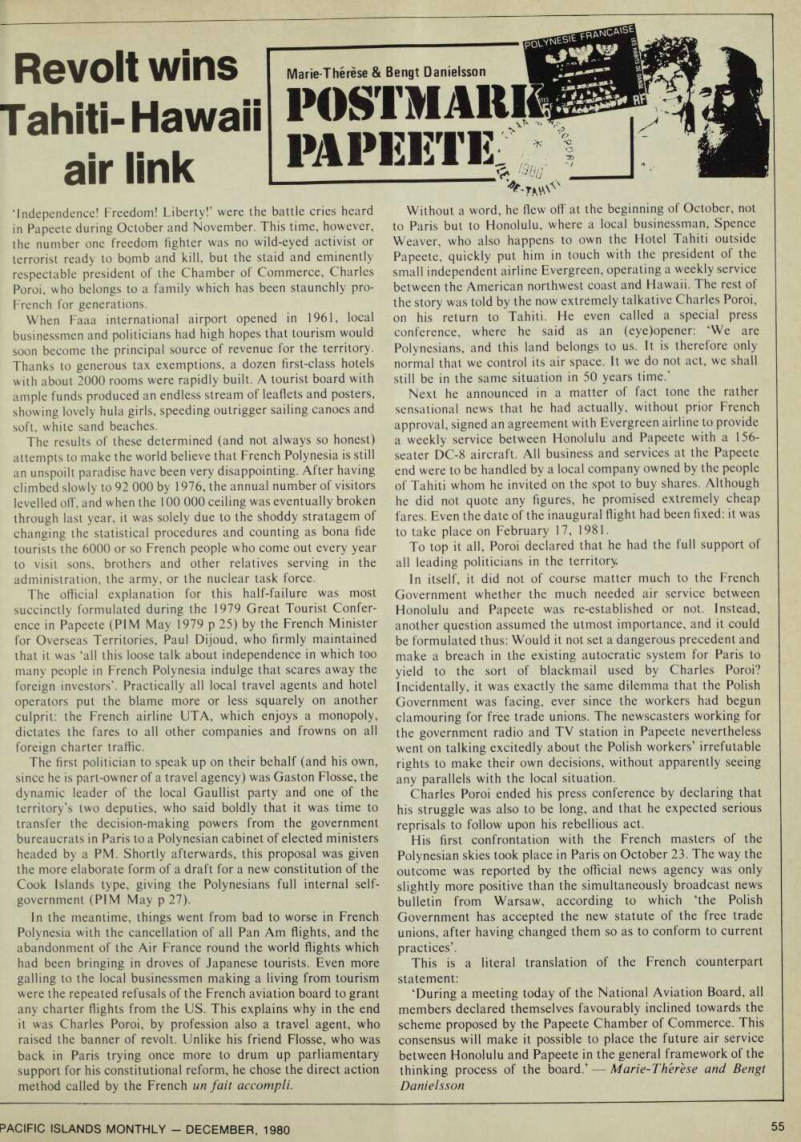
Revolt wins Tahiti-Hawaii air link
‘lndependence! Freedom! Liberty!’ were the battle cries heard in Papeete during October and November. This time, however, the number one freedom fighter was no wild-eyed activist or terrorist ready to bomb and kill, but the staid and eminently respectable president of the Chamber of Commerce, Charles Poroi, who belongs to a family which has been staunchly pro- French for generations.
When Faaa international airport opened in 1961, local businessmen and politicians had high hopes that tourism would soon become the principal source of revenue for the territory.
Thanks to generous tax exemptions, a dozen first-class hotels with about 2000 rooms were rapidly built. A tourist board with ample funds produced an endless stream of leaflets and posters, showing lovely hula girls, speeding outrigger sailing canoes and soft, white sand beaches.
The results of these determined (and not always so honest) attempts to make the world believe that French Polynesia is still an unspoilt paradise have been very disappointing. After having climbed slowly to 92 000 by 1976, the annual number of visitors levelled off, and when the 100 000 ceiling was eventually broken through last year, it was solely due to the shoddy stratagem of changing the statistical procedures and counting as bona fide tourists the 6000 or so French people who come out every year to visit sons, brothers and other relatives serving in the administration, the army, or the nuclear task force.
The official explanation for this half-failure was most succinctly formulated during the 1979 Great Tourist Confer ence in Papeete (PIM May 1979 p 25) by the French Minister for Overseas Territories, Paul Dijoud, who firmly maintained that it was ‘all this loose talk about independence in which too many people in French Polynesia indulge that scares away the foreign investors’. Practically all local travel agents and hotel operators put the blame more or less squarely on another culprit; the French airline UTA, which enjoys a monopoly, dictates the fares to all other companies and frowns on all foreign charter traffic.
The first politician to speak up on their behalf (and his own, since he is part-owner of a travel agency) was Gaston Flosse, the dynamic leader of the local Gaullist party and one of the territory’s two deputies, who said boldly that it was time to transfer the decision-making powers from the government bureaucrats in Paris to a Polynesian cabinet of elected ministers headed by a PM. Shortly afterwards, this proposal was given the more elaborate form of a draft for a new constitution of the Cook Islands type, giving the Polynesians full internal self government (PIM May p 27).
In the meantime, things went from bad to worse in French Polynesia with the cancellation of all Pan Am flights, and the abandonment of the Air France round the world flights which had been bringing in droves of Japanese tourists. Even more galling to the local businessmen making a living from tourism were the repeated refusals of the French aviation board to grant any charter flights from the US. This explains why in the end it was Charles Poroi, by profession also a travel agent, who raised the banner of revolt. Unlike his friend Flosse, who was back in Paris trying once more to drum up parliamentary support for his constitutional reform, he chose the direct action method called by the French un fait accompli.
Without a word, he flew off at the beginning of October, not to Paris but to Honolulu, where a local businessman, Spence Weaver, who also happens to own the Hotel Tahiti outside Papeete, quickly put him in touch with the president of the small independent airline Evergreen, operating a weekly service between the American northwest coast and Hawaii. The rest of the story was told by the now extremely talkative Charles Poroi, on his return to Tahiti. He even called a special press conference, where he said as an (eye)opener: ‘We are Polynesians, and this land belongs to us. It is therefore only normal that we control its air space. It we do not act, we shall still be in the same situation in 50 years time.’
Next he announced in a matter of fact tone the rather sensational news that he had actually, without prior French approval, signed an agreement with Evergreen airline to provide a weekly service between Honolulu and Papeete with a 156seater DC-8 aircraft. All business and services at the Papeete end were to be handled by a local company owned by the people of Tahiti whom he invited on the spot to buy shares. Although he did not quote any figures, he promised extremely cheap fares. Even the date of the inaugural flight had been fixed; it was to take place on February 17, 1981.
To top it all, Poroi declared that he had the full support of all leading politicians in the territory.
In itself, it did not of course matter much to the French Government whether the much needed air service between Honolulu and Papeete was re-established or not. Instead, another question assumed the utmost importance, and it could be formulated thus: Would it not set a dangerous precedent and make a breach in the existing autocratic system for Paris to yield to the sort of blackmail used by Charles Poroi?
Incidentally, it was exactly the same dilemma that the Polish Government was facing, ever since the workers had begun clamouring for free trade unions. The newscasters working for the government radio and TV station in Papeete nevertheless went on talking excitedly about the Polish workers’ irrefutable rights to make their own decisions, without apparently seeing any parallels with the local situation.
Charles Poroi ended his press conference by declaring that his struggle was also to be long, and that he expected serious reprisals to follow upon his rebellious act.
His first confrontation with the French masters of the Polynesian skies took place in Paris on October 23. The way the outcome was reported by the official news agency was only slightly more positive than the simultaneously broadcast news bulletin from Warsaw, according to which ‘the Polish Government has accepted the new statute of the free trade unions, after having changed them so as to conform to current
practices’.
This is a literal translation of the French counterpart statement: ‘During a meeting today of the National Aviation Board, all members declared themselves favourably inclined towards the scheme proposed by the Papeete Chamber of Commerce. This consensus will make it possible to place the future air service between Honolulu and Papeete in the general framework of the
thinking process of the board.’
Marie-Therese and Bengt
Danielsson
Advertisements & other items, p. 56 (1 item)
Clarion welcomes you to the wonderful
world of Hi-Fi car audio. A never-ending quest for better sound quality assures the ultimate performance.
Our wealth of experience is backed by a global reputation for superior quality.
We've car stereo systems, car radios and speakers to please everyone.
In Car Entertainment Company What is your pleasure? @ Clarion Clarion Co.. Ltd. Tokyo, Japan r « 0 Australia: Amalgamated Wireless (Australasia) Ltd. 554 Parramatta Road, Ashfield N.S.W., 2131/New Zealand: AWA New Zealand Limited P.O. Box! 50-248 Porirua/ Fiji Islands: Brijlal &Co., Ltd. G.P.O. Box 362 Suva/Tahiti: Hi-Fi Vairaatoa P.O. Box 1128 Papeete/New Caledonia: Caldis B.P Ml Noumea \ Cedex/Guam: Guam Radio & TV Shop P.O. Box 1939 Agana, Guam 96910/New Hebrides: The Sound Centre P.O. Box 434, Vila/Cook Islands: South Seas International Ltd. P.O. Box 49 Rarotonga/Papua New Guinea: Hagemeyer (P.N.G.) Pty. Ltd. P.O. Box 1428, Boroko, Port Moresby. . * Dolby and the double-D symbol are trademarks of Dolby Laboratories.
People
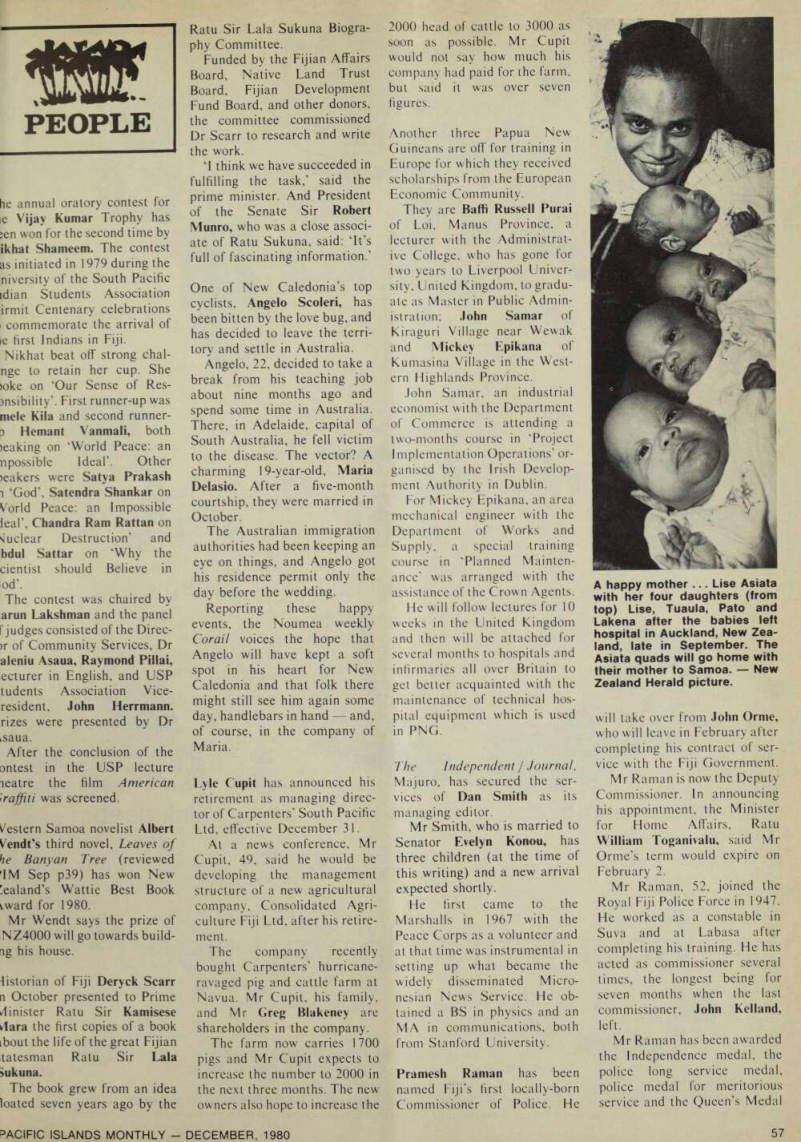

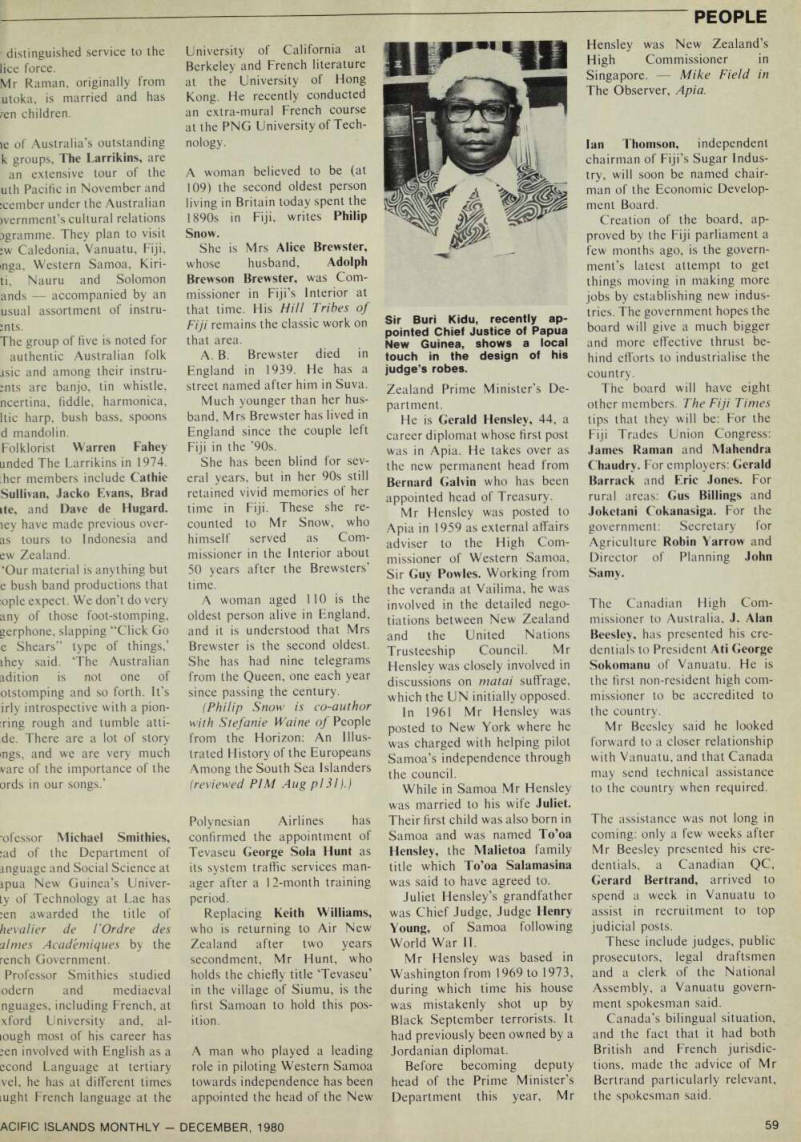
he annual oratory contest for e Vijay Kumar Trophy has ;en won for the second time by ikhat Shameem. The contest as initiated in 1979 during the niversity of the South Pacific idian Students Association irmit Centenary celebrations i commemorate the arrival of ic first Indians in Fiji.
Nikhat beat off strong chal nge to retain her cup. She >oke on ‘Our Sense of Res msibility’. First runner-up was mele Kila and second runner a Hemant Vanmali, both >eaking on ‘World Peace: an npossible Ideal’. Other >eakers were Satya Prakash i ‘God’, Satendra Shankar on Vorld Peace: an Impossible leal’, Chandra Ram Rattan on Nuclear Destruction’ and bdul Sattar on ‘Why the cientist should Believe in od’.
The contest was chaired by arun Lakshman and the panel [judges consisted of the Direc >r of Community Services, Dr aleniu Asaua, Raymond Filial, ecturer in English, and USP tudents Association Vice resident, John Herrmann, rizes were presented by Dr isaua.
After the conclusion of the ontest in the USP lecture leatre the film American Taffiti was screened.
Western Samoa novelist Albert Vendt’s third novel, Leaves of he Banyan Tree (reviewed iM Sep p 39) has won New Zealand’s Wattie Best Book iward for 1980.
Mr Wendt says the prize of NZ4OOO will go towards build rig his house.
Jistorian of Fiji Deryck Scarr n October presented to Prime Minister Ratu Sir Kamisese rtara the first copies of a book ibout the life of the great Fijian talesman Ratu Sir Lala Sukuna.
The book grew from an idea loated seven years ago by the
Ratu Sir Lala Sukuna Biogra phy Committee.
Funded by the Fijian Affairs Board, Native Land Trust Board, Fijian Development Fund Board, and other donors, the committee commissioned Dr Scarr to research and write the work.
T think we have succeeded in fulfilling the task,’ said the prime minister. And President of the Senate Sir Robert Munro, who was a close associ ate of Ratu Sukuna, said: ‘lt’s full of fascinating information.’
One of New Caledonia’s top cyclists, Angelo Scoleri, has been bitten by the love bug, and has decided to leave the terri tory and settle in Australia.
Angelo, 22, decided to take a break from his teaching job about nine months ago and spend some time in Australia.
There, in Adelaide, capital of South Australia, he fell victim to the disease. The vector? A charming 19-year-old, Maria Delasio. After a five-month courtship, they were married in October.
The Australian immigration authorities had been keeping an eye on things, and Angelo got his residence permit only the day before the wedding.
Reporting these happy events, the Noumea weekly Corail voices the hope that Angelo will have kept a soft spot in his heart for New Caledonia and that folk there might still see him again some day, handlebars in hand and, of course, in the company of Maria.
Lyle Cupit has announced his retirement as managing direc tor of Carpenters’ South Pacific Ltd, effective December 31.
At a news conference, Mr Cupit, 49, said he would be developing the management structure of a new agricultural company. Consolidated Agri culture Fiji Ltd, after his retire ment.
The company recently bought Carpenters’ hurricane ravaged pig and cattle farm at Navua. Mr Cupit, his family, and Mr Greg Blakeney are shareholders in the company.
The farm now carries 1700 pigs and Mr Cupit expects to increase the number to 2000 in the next three months. The new owners also hope to increase the
2000 head of cattle to 3000 as soon as possible. Mr Cupit would not say how much his company had paid for the farm, but said it was over seven figures.
Another three Papua New Guineans are off for training in Europe for which they received scholarships from the European Economic Community.
They are Baffi Russell Purai of Loi, Manus Province, a lecturer with the Administrat ive College, who has gone for two years to Liverpool Univer sity, United Kingdom, to gradu ate as Master in Public Admin istration; John Samar of Kiraguri Village near Wewak and Mickey Epikana of Kumasina Village in the West ern Highlands Province.
John Samar, an industrial economist with the Department of Commerce is attending a two-months course in ‘Project Implementation Operations' or ganised by the Irish Develop ment Authority in Dublin.
For Mickey Epikana, an area mechanical engineer with the Department of Works and Supply, a special training course in ‘Planned Mainten ance' was arranged with the assistance of the Crown Agents.
He will follow lectures for 10 weeks in the United Kingdom and then will be attached for several months to hospitals and infirmaries all over Britain to gel better acquainted with the maintenance of technical hos pital equipment which is used in PNG.
The Independent / Journal, Majuro, has secured the ser vices of Dan Smith as its managing editor.
Mr Smith, who is married to Senator Evelyn Konou, has three children (at the time of this writing) and a new arrival
expected shortly.
He first came to the Marshalls in 1967 with the Peace Corps as a volunteer and at that lime was instrumental in setting up what became the widely disseminated Micro nesian News Service. He ob tained a BS in physics and an MA in communications, both from Stanford University.
Pramesh Raman has been named Fiji’s first locally-born Commissioner of Police. He
will take over from John Orme, who will leave in February after completing his contract of ser vice with the Fiji Government.
Mr Raman is now the Deputy Commissioner. In announcing his appointment, the Minister for Flome Affairs, Ratu William Toganivalu, said Mr Orme’s term would expire on February 2.
Mr Raman, 52, joined the Royal Fiji Police Force in 1947.
He worked as a constable in Suva and at Labasa after completing his training. He has acted as commissioner several times, the longest being for seven months when the last commissioner, John Kelland, left.
Mr Raman has been awarded the Independence medal, the police long service medal, police medal for meritorious service and the Queen’s Medal
A happy mother ... Lise Asiata with her four daughters (from top) Lise, Tuaula, Rato and Lakena after the babies left hospital in Auckland, New Zea land, late in September. The Asiata quads will go home with their mother to Samoa. - New Zealand Herald picture.
distinguished service to the lice force.
Mr Raman, originally from utoka, is married and has fen children. le of Australia’s outstanding k groups, The Larrikins, are an extensive tour of the ulh Pacific in November and icember under the Australian wernment’s cultural relations Dgramme. They plan to visit ;w Caledonia, Vanuatu, Fiji, inga. Western Samoa, Kiri ti, Nauru and Solomon ands accompanied by an usual assortment of instru cts.
The group of five is noted for authentic Australian folk isic and among their instru cts are banjo, tin whistle, ncertina, fiddle, harmonica, Itic harp, bush bass, spoons d mandolin.
Folklorist Warren Fahey unded The Larrikins in 1974.
Ter members include Cathie Sullivan, Jacko Evans, Brad ite, and Dave de Hugard. ley have made previous over as tours to Indonesia and ew Zealand. ‘Our material is anything but e bush band productions that ople expect. We don’t do very any of those foot-stomping, gerphone, slapping “Click Go e Shears” type of things,’ ihey said. The Australian adition is not one of otstomping and so forth. It’s irly introspective with a pion :ring rough and tumble atti de. There are a lot of story mgs, and we are very much vare of the importance of the ords in our songs.’ ofessor Michael Smithies, ;ad of the Department of anguage and Social Science at ipua New Guinea’s Univer- Ly of Technology at Lae has ;en awarded the title of hevalier de I’Or dr e des limes Academiques by the rench Government.
Professor Smithies studied odern and mediaeval nguages, including French, at xford University and, al lough most of his career has :en involved with English as a econd Language at tertiary vel, he has at different times lughl French language at the
University of California at Berkeley and French literature at the University of Hong Kong. He recently conducted an extra-mural French course at the PNG University of Tech nology.
A woman believed to be (at 109) the second oldest person living in Britain today spent the
1890 s in Fiji, writes Philip
Snow.
She is Mrs Alice Brewster, whose husband, Adolph Brewson Brewster, was Com missioner in Fiji’s Interior at that time. His Hill Tribes of Fiji remains the classic work on that area.
A. B. Brewster died in England in 1939. He has a street named after him in Suva.
Much younger than her hus band, Mrs Brewster has lived in England since the couple left Fiji in the ’9os.
She has been blind for sev eral years, but in her 90s still retained vivid memories of her lime in Fiji. These she re counted to Mr Snow, who himself served as Com missioner in the Interior about 50 years after the Brewsters’ time.
A woman aged 110 is the oldest person alive in England, and it is understood that Mrs Brewster is the second oldest.
She has had nine telegrams from the Queen, one each year since passing the century. (Philip Snow is co-author with Stefanie Waine of People from the Horizon: An Illus trated History of the Europeans Among the South Sea Islanders (reviewed PIM Aug pi 31).} Polynesian Airlines has confirmed the appointment of Tevaseu George Sola Hunt as its system traffic services man ager after a 12-month training period.
Replacing Keith Williams, who is returning to Air New Zealand after two years secondment, Mr Hunt, who holds the chiefly title Tevaseu’ in the village of Siumu, is the first Samoan to hold this pos ition.
A man who played a leading role in piloting Western Samoa towards independence has been appointed the head of the New
Zealand Prime Minister’s De partment.
He is Gerald Hensley, 44, a career diplomat whose first post was in Apia. He takes over as the new permanent head from Bernard Galvin who has been appointed head of Treasury.
Mr Hensley was posted to Apia in 1959 as external affairs adviser to the High Com missioner of Western Samoa, Sir Guy Powles. Working from the veranda at Vailima, he was involved in the detailed nego tiations between New Zealand and the United Nations Trusteeship Council. Mr Hensley was closely involved in discussions on matai suffrage, which the UN initially opposed.
In 1961 Mr Hensley was posted to New York where he was charged with helping pilot Samoa’s independence through the council.
While in Samoa Mr Hensley was married to his wife Juliet.
Their first child was also born in Samoa and was named To’oa Hensley, the Malietoa family title which To’oa Salamasina was said to have agreed to.
Juliet Hensley’s grandfather was Chief Judge, Judge Henry Young, of Samoa following World War 11.
Mr Hensley was based in Washington from 1969 to 1973, during which time his house was mistakenly shot up by Black September terrorists. It had previously been owned by a Jordanian diplomat.
Before becoming deputy head of the Prime Minister’s Department this year, Mr
Hensley was New Zealand’s High Commissioner in Singapore. Mike Field in The Observer, Apia. lan Thomson, independent chairman of Fiji’s Sugar Indus try, will soon be named chair man of the Economic Develop ment Board.
Creation of the board, ap proved by the Fiji parliament a few months ago, is the govern ment’s latest attempt to get things moving in making more jobs by establishing new indus tries. The government hopes the board will give a much bigger and more effective thrust be hind efforts to industrialise the country.
The board will have eight other members. The Fiji Times tips that they will be: For the Fiji Trades Union Congress: James Raman and Mahendra Chaudry. For employers; Gerald Barrack and Eric Jones. For rural areas: Gus Billings and Joketani Cokanasiga. For the government: Secretary for Agriculture Robin Yarrow and Director of Planning John Sarny.
The Canadian High Com missioner to Australia, J. Alan Beesley, has presented his cre dentials to President Ati George Sokomanu of Vanuatu. He is the first non-resident high com missioner to be accredited to the country.
Mr Beesley said he looked forward to a closer relationship with Vanuatu, and that Canada may send technical assistance to the country when required.
The assistance was not long in coming; only a few weeks after Mr Beesley presented his cre dentials, a Canadian QC, Gerard Bertrand, arrived to spend a week in Vanuatu to assist in recruitment to top judicial posts.
These include judges, public prosecutors, legal draftsmen and a clerk of the National Assembly, a Vanuatu govern ment spokesman said.
Canada’s bilingual situation, and the fact that it had both British and French jurisdic tions, made the advice of Mr Bertrand particularly relevant, the spokesman said.
Sir Buri Kidu, recently ap pointed Chief Justice of Papua New Guinea, shows a local touch in the design of his judge’s robes.
Advertisements & other items, pp. 57-60 (3 items)
57
3 ACIFIC ISLANDS MONTHLY - DECEMBER, 1980
noA op OJOLU jeqM
»>>>)>>>)>>> ? > ) >>> m >>> > >>>)> > > ) > > >>> > >>>)>>>)>>>)>>> \ MdtflG 232 L - (20) 9Lioq d( 7.Z.02 M S N'AqsuJOH 09 xog O d Z3O/131A1O a3iiiAin vnvyisnv iN3iAidinD3 >iyvnD §§
d©op iimp noA joj Aeuoiu puß
"■JSBJ. 4OUOJJ
MJOOLUS o>jßJ
I m S
■"UB0|O dOOMS
2 X If
A A I
A 'ii /s /s 7 H ■"lsbj peo| Ipßjiqejß
■•‘UMop 6jp
"MBn UN
PH IMM jeoqog v j sa !, \2 <((<<(<<<l<<<(<(<<<(<<<l<<<« « <<< « «< < (< ««« < «««< < «««<( <«««<«««o? J ««« <<<((<(<<< „ <<<(<<(<(<(<<({<(((<(<<<{<(((<(<<((<((<(((<(<<((<((<(<{((({<(((<(((<(((<{((<<<(((<<<(<({({(<<<w<<((tt<{<< ,
RICOH
oes
200« l 70-18 3.5 *• HOtl 14 ft vD < I i f. 11 *« »» t* H -Hk It Ik
RICOH
lilt o » 4 « I 1* II M 1 4 I I i' ' "« I I 3lHltt* ((< * TlMltt » v**« MAOf i«
M I I
1 lif»Ti f Hm« oH*4fc**S 'I «. K . -* .-•» : /t I ( f •* i < ItitU »»< m * *.
RICOH
: ar« ip
- 4 1 ♦« /SK- IT ■ i sii ■'Sts fo| sttlC*a i -5?
I• /
KR-io
• •c I s *• 120 «•« J P • ( ! -Si* ***... • zz s - . !SS IS 7 54 5 21i 3 15 » i n i M" in i N• 4 41 W « »4 4* « i*U a *4 4 2J
11 11 BSi 42J
Bl *
eSr** ■
I . -■ : v
HOOV®
Hf ' 1 T 3K.-& ... , - *. - ■ c • • "K- ■ "■ ar; ■-y The Easiest Way to Improve Your Image r The easiest way to improve your image, from snapshots to high quality photographs, is with the new Ricoh KRIO. The compact, lightweight SLR camera that gives you the convenience of automatic exposures and the control of manual. With outstanding cost performance. In a full-featured system MH J that includes auto flash, auto winder, XR MUfOfflClflC CIUCI PICITiIICII Rikenon lenses and accessories. ■ Ricoh KRIO, automatic and manual. M J I I can improve your image in I ■ ■ ■ more ways than one. I I
;o<oto
For more information about the Ricoh KRIO, write to RICOH COMPANY, LTD. 14-6, Ginza 6-chome, Chuoku, Tokyo 104, Japan.
Distributors; Australia Bell & Howell Australia Pty. Ltd. •G.P.O. Box 4778, 55-69 Murray Street, Pyrmont, N.S.W., Australia. New Zealand H.E; Perry Ltd. #145 Victoria Street, PO. Box 111, Christchurch 1, New Zealand, Norfolk Is. Miltons Department Stores Ltd. • PO. Box 146, Norfolk Island 2899. South Pacific, Fiji Narseys Limited eßenwick Road, Suva, Fiji, Tahiti Ets. Coutimex • B.P 617, Papeete, Tahiti (French Polynesia),!
New Caledonia Omnium Caledonien Imoortation • Rue de L’Esoerance. B.P 2248. Maaenta Noumea Nouvelle-Caledonie
People
59
ACIFIC ISLANDS MONTHLY - DECEMBER, 1980
poses problems

Trade
Winds
Development poses problems in Tonga
Vhile Tonga develops its position as a trading partner of ,ther nations in the South Pacific there are signs that its and mining for concrete, its timber cutting for artefact >roduction and even the new forced pace of its agriculture ire contributing to a possible ecological problem.
onga Faces Ecological Disas er shouted a banner headline cross the front page of a recent ;sue of the Tonga Chronicle.
Below it, the paper reported a üblic lecture given by a US •eace Corps Volunteer, homas Hubbard, who until ecently had worked in the ingdom as a marine biologist nd supervisor of Tonga’s five esignaled marine national arks, in which all lagoon life, oral and beach sands are now ully protected.
Mr Hubbard cited a broad pectrum of causes for public oncern, notably: Effect on land tenure and raditional subsistence farming 1 explosive population growth i a country with only about OOsq km of land area, and the onsequent emergence of a new andless class. • Sea-caused coastal erosion esulting from the escalation of andmining, to meet an ever acreasing demand for locally nanufactured concrete and oncrete blocks. » Rapidly diminishing stocks if important culture trees as ised in the making of handi rafts, cosmetic oils and folk nedicines, and traditional lance costumes. ► Polluting potential of agricul ural chemicals on land and of >il exploration and transport on he sea. » Endangered wildlife, particu arly among certain unique fongan animal and bird species ind the whales and turtles in erritorial waters.
In his conclusion Mr dubbard warned that time was •unning out and that there was in urgent need to pinpoint the problems and seek the sol itions.
Inquiries at senior govern ment level reveal that the problems are, in fact, very Nearly realised and that sol utions are being actively
sought, though within a frame work which must, inevitably, strike a balance between developmental and ecological demands, and allow for both financial and cultural con straints. Relevant departmental heads proved most willing -to provide PIM with information relating to their various areas of concern.
Under the constitution, every Tongan male attaining the age of 16 years is entitled to a ‘tax allotment’ of 3.3 ha, but the combination of population ex plosion and finite land area is effectively nullifying this legal right. An estimated 70% of eligible young men have been unable to obtain a farming land allocation, thus becoming the new ‘landless class’ to which Mr Hubbard referred.
On the other hand, govern ment surveys indicated that two-thirds of Tonga’s available arable land is either unculti vated or capable of far more intensive cultivation; and that about 90% of the nominally landless have access to farming land through extended family links if they really want and need to grow traditional foods for themselves or their immedi ate families.
With population growth pushing up the demand for housing, development creating the demand for larger-scale commercial, industrial and tourist facilities, and the vari ous religions constantly aiming for more and bigger churches, the volume of locally available building materials required has long since outstripped what can be safely supplied without dam age to the environment.
With the assistance of aid funds and expertise, the for estry division is going all out on afforestation and sawmilling projects. But in the short term this can do little to offset the emphasis on concrete and the
consequent drain on the beach sands which are the natural buffer zone against sea-caused erosion.
Somewhat to the ire of local construction companies, des perate for more and more concrete to meet contract com mitments, the ministry of lands, surveys and natural resources has imposed stringent licensing and supervisory controls on sandmining.
At the same lime it has enlisted overseas experts to help evaluate the cost and feasibility of saving the threatened beaches by obtaining essentials and supplies from uninhabited offshore islands or by dredging the seabed.
Along with its industrial pro gramme, the forestry division has for years been experiment ing with the propagation of seedlings of culture trees and in publicising the need for tree planting programmes by indi viduals throughout the king dom.
Action has also been taken to put an end to the lucrative sandalwood export trade. Per mission has been given to ex port slocks from trees already cut, under licence and supervis ion, but further felling has been banned. Meanwhile it is hoped that the successful propagation technique achieved in Tonga will in lime replenish supply.
Tonga’s most pressing pol lution problem pertains to the slocks of agricultural pesticides and herbicides in the highly hazardous category which were dumped on this country as cut price bargains after being banned in the producing countries.
The agricultural department is seeking watertight legislation to prevent further import of chemicals designated as dangerous and in the interim is issuing radio and press warn ings, identifying highly and moderately hazardous products by brand name. It is also insisting that all agricultural chemicals brought into the country should have safety-and usage instructions printed in Tongan as well as English.
The natural resources auth ority is also keenly aware of the potential problems associated with oil exploration and trans portation. In view of the pro posed oil-search programme by Webb (Tonga) Inc in the waters
between Tongalapu and Eua, and the real possibility of oil slicks being deposited by giant tankers plying territorial waters, it has sought expert advice on the formulation of stringent regulations on oper ational procedures and on pen alties in the event of pollution occurring.
The government’s national parks programme, under the ministry of lands, is designed to counterbalance the environ mental effects of the present extensive agriculture, fisheries and economic development pro grammes.
The five designated marine parks are suitable habitats for breeding fish and shellfish populations whose progeny are expected to migrate from these protected areas to replenish overfished catchment areas.
The terrestrial national parks on the island of Eua and in the indigenous forest area of Pelehake will help to preserve rare and endangered species of trees, plants, birds and animals.
In addition to aiding conser vation goals, the parks are intended to serve increasingly important recreational, edu cational and research purposes by providing areas in which human interference is now con trolled and minimised.
Specific bans have also been imposed in territorial waters: • In 1978 an indefinite mora torium was imposed on the catching of humpback whales, one of whose few identified breeding places lies within Tongan waters. • A total ban on turtle catching during the designated breeding season has existed for many years and has been re cently extended over a longer period as a further safety measure.
On the broad front of the population problem, nobody questions Mr Hubbard’s assess ment that this is Tonga’s most pressing problem. But it would be simplistic to assume that the
obvious family planning sol ution can be implemented over night, or even over one gener ation. ‘Large families,’ said one senior official ‘have been part of our cultural tradition since time
immemorial. In pre-Christian
days they were demanded by the tribal chiefs who needed warriors for their tribal clashes.
And in the 19th century the missionaries came and in their turn exhorted us to go forth and multiply. That indoctrination aver generations is still power ful today. And, in a country
that cannot as yet afford many social services, a large family is in effect the poor man’s in
surance policy.’
Public education is obviously one essential but even that is not so simple in a country with a cultural taboo against dis cussions of sexual issues on radio, in newspapers or in the classroom.
There is a government sponsored family planning pro gramme under the direction of the ministry of health, backed up by a supportive voluntary one under the aegis of the
Regional Family Planning As sociation. Measurable results are being achieved but the latest official statistics on the annual birth rate (28.3 per thousand) indicate that effective stabilisation of a popu lation already approaching 100 000 is still a long way off.
Singapore’s solution of financial whips-and-carrots, India’s experiment sterilis ation of males after two chil dren are unthinkable in the Tongan context of a proud and inherently independent people.
So what alternative is there.
except education and more education?
It would seem that primary and secondary school curricula will have to be revised, so that the message can be pounded home via geography, econ omics, social studies, math ematics and biology lessons that X amount of natural re sources in only 700 sq km of land area cannot possibly sup port an ever-expanding popu lation without leading to depri vation for all concerned.
Penny Hodgkinson in Nukualofa.
Advertisements & other items, pp. 62-64 (1 item)
plumbing supplies Wast
Total service 0n ...
You can get all your needs from one supply source: water taps, valves, copper tube, tools and a host of other fittings and related plumbing equipment for domestic, industrial and multi-storey buildings.
Watson & Crane Pty Ltd have over 20,000 plumbing items in stock at their central warehouse located at Waterloo, NSW, Australia.
Years of experience in handling and shipping right throughout the South Pacific add up to another big reason for you to deal with Watson & Crane Pty Ltd.
Representatives call regularly at Papua New Guinea, the Solomons, New Hebrides and Fiji Islands to personally discuss your requirements and appropriate credit arrangements.
Write, cable or telephone today for complete plumbers' supplies service. f* <.
Watson & Crane Pty. Ltd. 1037 Bourke Street, Waterloo,
NSW 2017.
Phone: Sydney 699-1333.
Telex: AA 25548.
Cables: "Watcrane" Sydney.
Pacific Island distributors of Crano Enfield copper tube for water, sanitation, engineering, refrigeration and air conditioning.
WATSON & CRANE
are organised to fulfil your needs
wherever you are in the South Pacific
IRADEWINDS
INTELLIGENCE... TRADEWINDS INTELLIGENCE... TRADEWINDS
INTI
PAPUA New Guinea’s 1981 budget was brought down in November, and, according to Finance Minister John Kaputin, it is directed at overcoming ‘stagnation’ in the private sector. The Dudget will provide for an expenditure equivalent to about SA9I6 nillion an increase of about 5% on the 1980 expenditure. Mr Kaputin believes PNG can continue its economic growth rate of 3%, which will require holding inflation below 10%, a revival of agriculture earnings, and continued high earnings from gold. The audget introduces an agricultural credit scheme in an attempt to boost earnings from smallholder agricultural properties. A feature 3f the budget is the abolition of a 30% duty on imported vegetables 'tinned, fresh and frozen), most of which come from Australia and New Zealand. The duty had been imposed to stimulate local production. But local producers failed to accept the opportunity and simply raised their own prices with the result that consumers were penalised and local production failed to expand. The budget retains corporate tax at 36.5%, but has added trusts and superannuation funds to the taxed economy to prevent tax avoidance book-keeping.
FIVE international timber operators have submitted proposals to the Fiji Pine Commission (a statutory authority) for handling and processing pine logs. The commission is planting 60 000 hectares af Caribbean pine on the islands of Vanua Levu and Viti Levu. The proposals, which envisage multi-million-dollar capitalisation, are from Shell Fiji Ltd, M. K. Hunt Foundation Ltd of New Zealand, New Zealand Forest Products Ltd, United Marketing Corporation and British Petroleum (South West Pacific) Ltd. Canadian consultants to the commission will evaluate the proposals and make recommendations before the end of December.
TWO major hotels in Port-Vila, capital of Vanuatu, are upgrading.
The 135-room Le Lagon is adding 15 new rooms, eight of which will be family bungalows, five beach bungalows and two garden bungalows. Food and beverage bars are also getting facelifts, and a new terrace bar with beach facilities is being built. The 166-room Intercontinental Island Inn is working on a new conference/ ballroom with seating capacity for 200 people.
THE South Pacific Commission in September ended a three-year field programme of tagging skipjack and other tunas in the SPC region. Skipjack and baitfish resources of all countries and territories in the SPC area were surveyed and more than 152 000 skipjack and other tunas were tagged and released. This exceeded target by more than 50%.
NUKUALOFA, Tonga, stores were without bread in October due to a strike by Tonga’s five bakeries. The bakeries, which supply the whole country, wanted to increase the price of a standard loaf by 6e to 28c, but had been permitted only a 1C increase by the pricefixing authority. The government said it would consider a bigger increase after getting more information about costs and more talks.
THE Lae Port Authority in Papua New Guinea received a loan of $l2 million from the ordinary capital resources of the Asian Development Bank (ADB) as part of the 1980 third quarter allocations. Coupled with an Asian Development Fund loan of $8 million, the funds will be used to expand port facilities, particularly for handling containerised cargo, and to provide a sheltered tidal basin. The work will include construction of a 180 m multi-purpose berth, a transit shed, a paved storage area and internal roads.
LIKIEP and Mejit atolls in the Marshall Islands are the latest to be linked by air with the capital, Majuro, as the government’s aggressive programme to open up the outer islands to air transport by constructing small runways on them rolls on. Next on the list is Ailinglaplap, and another is being planned for either Mili or Jaluit Atoll in the near future. The government-owned Marshall Islands Airways flies two Australian-built Nomad aircraft.
BARCLAYS Bank International Ltd is to make an independence gift of SA2O 000 to the people of Vanuatu. The regional general manager of Barclays Denis J. Tabor and the Barclays branch manager in Port-Vila, Eric Crutchley, were to be present when the cheque was handed to President Ati George Sokomanu on November 4. The money will be used to buy medical equipment.
THE Asian Development Bank is to make a SUSI million loan to the Cook Islands and provide a $7O 000 technical assistance grant.
It is the bank’s first loan to the Cooks. Only one of the development projects to be financed by it will be on Rarotonga, where most development has taken place in the past.
EMPEROR Mines Ltd, Fiji, rode the crest of the gold boom in the latest year to post a sixteen-fold increase in after-tax profit. The company reported in October a profit of $F1.52 million in the year to June 30 compared with $95 000 in 1978-79.
STEAMSHIPS Trading Company Pty Ltd, a Papua New Guinea merchandising, manufacturing and service group, announced in November plans to acquire New Guinea Industries Pty Ltd for SAIO million. The move would mean that PNG nationals’ stockholding in Steamships would increase, as they already own about 30% of NGI.
TRADEWINDS
INTELLIGENCE TRADEWINDS INTELLIGENCE... TRADEWINDS IN
Save $lOO,OOO on
this corporate aircraft
«« Your own corporate aircraft can actually save you money by saving time. Let us prove it to you and as an extra bonus you could save 100,000 on a brand new Rockwell 840 Jetprop Commander, the last at 1980 prices.
The Rockwell 840 is ideal for the pacific islands environment with short field take-off and landing capability. Cruises at 30,000 ft. in pressurised comfort at over 350 mph. 8 place Club Seating with executive writing desk, bar and tea/coffee facilities, toilet.
It’s an aircraft you should know about.
Rockwell Commander
For further information ring or telex Norman St. John, Marketing Director, Civil Flying Services Pty. Ltd., PO Box 210, Cheltenham, Vic. 3192, Australia. Telephone (03) 90 6066.
Telex 30842 Civfly.
Civil
SAM 34
Yachts
» CAIRA. A 12.9 m ketch of the Trintella class was sailed to Fiji by Werner and Inge Friderich, reports Gunter Cross in Suva. They left their lomeport Wesel on the Rhine n West Germany in July 1977.
After spending a year in the Caribbean they entered the Pacific through the Panama Canal in January 1979. The first landfall was the Marquesas, then the Tuamotus, the Society Islands, Suwarrow, Pago Pago, and Vavau, Tonga. At time of writing Werner and Inge were preparing themselves at the beautifully protected anchor age of the Tradewinds Hotel, here in Suva, for the continu ation of the circumnavigation via New Zealand, Vanuatu, Solomon Islands, Papua New Guinea, and on into the Indian Ocean. In Hivaoa Atoll, in the Tuamotus, they had a lucky escape when a shark attacked their inflatable rubber dinghy and bit a hole approximately 0.3 m in diameter into one air chamber. It happened while they were taking a friend back to the village in the evening: fortunately the only damage was to their nerves and the rubber dinghy. In Vavau they had their best time so far, and were greatly impressed by the helpfulness, hospitality and friendliness of officials as well as villagers.
• Hasardeur. From
Bremerhaven, West Germany, an 8.22 m sloop, was built by owner Gerhard Behre. With his crew, Regine Wache, he left West Germany in 1979 for a circumnavigation. After clear ing Panama they had pleasant stays in the Galapagos, Societies, and Vavau. From Fiji they plan to sail on to New Caledonia and Australia. There they plan to rest for a while before cruising on into the Indian Ocean on their way back to Germany. • MINTAKA. From the USA is
a 9.75 m Colin Archer bought
by Charlie and Nita Martin in
1977 as a bare hull and deck.
From this they built their home for a possible circumnavi gation. From Willow Creek in Montana where the boat was launched Charlie and Nita navigated the inland water ways to San Francisco and there, from the Stockton Yacht Club, they started on their first Pacific crossing to the Hawaiian Islands where they spent a year while friends from the States came for visits. In 1979 they sailed to the Society Islands and on the way Charlie, an experienced hand in off shore game fishing, had a very successful time as they sailed through the doldrums. One of the nicest places in French Polynesia for Nita was Bora Bora where they spent some weeks at the local yacht club.
The cruise went on via Suwarrow (where several weeks were spent snorkelling, fishing and socialising with other yachts), Pago Pago, Western Samoa, Vavau, and then Fiji. Here Charlie and Nita are taking it easy for a while as they prepare for their trip to New Zealand where they plan to have some work done to the Mintaka’s accommodation be cause the original fitting out was done in a bit of a rush to get going. After the cyclone season they plan to return to the tropical South Pacific to visit Vanuatu, New Caledonia, Solomon Islands and then, after another stop in Australia, via Papua New Guinea into the Indian Ocean. Two further crew members are Callie a common or garden cat, and Coco a Siamese. They give the impression that the cruising life is to their liking also, probably not least because of the fre quent feeds of fresh fish.
• Skookum. An 8.84 M
Chuck Burns-design sloop was built by Dale and Pat Albin at their home in San Francisco in 1977. The boat is a pure sailing vessel because Dale and Pat reckon that they had had enough trouble with engines in their previous boats so to propel Skookum in an absolute calm a big sweep is used for sculling. It is normally strapped to the deck. In October 1978 the Pacific cruise started from San Francisco via San Diego, the Marquesas, the Society Islands and Vavau, to Fiji. Here in Suva the Albins are getting
ready for the crossing to New Zealand where they plan to spend the cyclone season. Pat reckons it is too soon to talk about plans after New Zealand as there are so many island groups that are just waiting to be visited. The Barrier Reef in Australia looks good too.
• Ding-Dingues. From La
Rochelle France. This is a 9m French-design fibreglass sloop of the Super Arlequin class.
She is skippered by Jacqueline and Christianne Darde, prob ably the most adventurous sisters in the Pacific at present.
Not only are they enjoying their trip around the world but they make it a point to visit the more remote island groups. The cir cumnavigation started in September 1978 when Ding- Dingues left France to sail via Madeira, Canary Islands, and the West Indies to Panama. In March Jacqueline and Christi anne set out on their Pacific crossing with the first call at Easter Island where they spent 35 days to experience for the first time the friendliness and hospitality of Pacific Islanders.
Then on to Pitcairn Island for three days and Gambier Island for six weeks. After that up north again to the Marquesas, Ahe Atoll in the Tuamotus, and finally Papeete, in March 1980.
The cruise went on through the Society Islands, Suwarrow, Pago Pago, Western Samoa, Wallis Island, and Fiji. Here Christianne and Jacqueline plan to have a look at the outer islands before setting off for New Zealand for the coming summer to do some refitting to their cruising home. After the cyclone season the voyage is to go on to New Caledonia, Australia, Papua New Guinea and into the Indian Ocean for a slow trip back to France.
• Moana Nui. A 13.7 M
James Warren-designed cata maran and was built in Auck land in 1972. Dick Zohrab bought the boat in 1979 for a cruise through the South Pa cific and to Australia. He left Whangarei, his homeport in New Zealand, in June 1980 with New Zealander Bob Laurie, and Paul Toth and Bill Caplin from the USA. Their first stop was Raoul Island in the Kermadecs where they spent five days enjoying the hos pitality of the New Zealand meteorologists who are
stationed there. The trip went on to Fiji where in Suva the crew left to look at the islands at their own leisure and Dick was joined by his son Glen who flew out from New Zealand.
Together they cruised exten sively the Astrolabe Reef and northern Kadavu. But soon the time came to set sail again via New Caledonia for Australia because the cruising funds are running low and Dick plans to look for work in Queensland. • HOPE. Was built in 1938 in Dunedin, New Zealand, an Ericson Class 9.75 m Colin Archer. Skipper Graham Wright bought her in 1977 to be his floating home. The present cruise started for Graham and his crew Claudin Gorden and young Robert on April 15 when they left the Bay of Islands, New Zealand, bound for the Society Islands.
But that was not meant to be: after battling easterly gales for 28 days, and experiencing one serious knockdown, they de cided to go to Pago Pago instead. From there Hope sailed on to Apia and Asau in Western Samoa, then to spend two months in Vavau, northern Tonga, and now here in Suva Fiji Graham has plans to sail home to New Zealand for the coming summer. • FOREVER. From San Francisco, was a stock Columbia 8.7 m when skipper Bill Howell bought her in 1978 and started to modify to his own specifications the accom modation and standing and running rigging, and generally to strengthen the craft for extended cruising. Amongst other things Bill took out the engine and now Forever is a pure sailing craft, something to be found less and less often among modern cruising yachts. Fourteen days before departing San Francisco in November 1979 Bill secured his crew by marrying Laura, and they set off on a honey moon cruise via San Diego to the Society Islands and Vavau to Fiji. The only plan Bill and Laura have at present is to sail to Sydney in the next month or so, and once there it will be soon enough to decide what to do next. • VINGILA. Was designed by Brian Lello of South Africa, a 14.6 m steel ketch. When skip per Frank Stilwell bought her
she was about half-finished and he with his family, wife Marien, son Robert and daughter Nicky finished her off for the launching in June 1977.
After more preparations they left their homeport Durban in January 1978 for a circumnavi gation. Leaving South Africa from Capetown they stopped at St Helena, the Ascension Islands, spent several months in Brazil and some time in the Caribbean before crossing through the Panama Canal into the Pacific. After visiting the Las Perlas Islands on the Panamanian coast Vingila sailed down the coast of Ecuador, then to the Galapa gos Islands, the Marquesas, the Tuamotus, Society Islands, to Penrhyn in the northern Cooks, Suwarrow, Pago Pago, Western Samoa, Vavau, and at present are well anchored here at Suva in Fiji. For the coming cyclone season Frank and Marien want to visit Australia, but next year they plan to come back to have a better look at the Fijian islands before carrying on with the circum
navigation via Solomon Islands, Papua New Guinea and so on into the Indian Ocean. • LEMON BUTT. Was orig inally a ship’s lifeboat but in 1975 conversion started to make her into a 7.3 m yacht.
Pat Synge and Silvia Merope bought her in 1977 at St Vincent in the West Indies after sailing there from Europe in
their 5.5 m yacht. Completing
the conversion and sailing for some months in the Caribbean they entered the Pacific through the Panama Canal at the beginning of 1979 to sail on to the Marquesas, Tuamotus, Society Islands, Suwarrow, Pago Pago, West ern Samoa, Wallis and Futuna, Fiji, and New Zealand where they spent last summer. This year Lemon Butt was sailed back to Fiji because Silvia and Pat wanted to have a better look at the group. But now at the end of the cruising season they are making plans to sail to Australia with the aim of build ing a bigger boat there.
• KERAMOS. An early arrival in New Zealand this season was Keramos, an Ocean 75’ flying a British flag, after a weeklong passage from Suva, on the wind in 20 to 25 knots all the way, reports Jane De Bidder from New Zealand. The Van de Staadt-designed
22.86 m fibreglass ketch is one
of the world’s largest fibreglass production yachts, exceeded in size only by the ‘Swan 76’ and a series of 24.39 m now under production in Poole by the British company which built Keramos, (Greek for ‘cer amic’). Keramos is a fitting name for the vessel which belongs to Henry Podmore whose Stoke-on-Trent com pany provides all forms of pottery supplies everything from firing kilns to cups and saucers to firms the world over. Keramos left the UK in March of ’79 for a proposed three-and-a-half-year cruise.
She is powered by a German MAN 156 hp 5-cylinder diesel, steered by Neco auto pilot. All systems are electric, including cooking. After a New Zealand refit, plans are to carry on to Australia, Papua New Guinea, Indonesia, and the Indian Ocean, skipper John Kemish said. The yacht sails with owner, skipper, and crew of three young men Nick Allen engineer, Arthur Lane cook, and Simon Davis, the only remaining member of the orig inal ship’s company.
• Silverheels. Is A
Sparkman and Stephens ‘Yankee 26’ sailed to New Zealand by Dave and Pat Mancini. They were joined by a tiny crew member in the Bay of Islands Sara Mancini. An entire quarter berth is now filled with baby gear, including a sheepskin-lined cradle. Dave admits that he never dreamed one extra person could take up such a lot of room. Dave bought Silverheels (‘she shows her heels and leaves a silver wake’) in San Diego in 1974.
He and Pat left California in 1978, sailing the engineless yacht to the Marquesas and Tahiti, the Samoas, Tonga and Fiji. They spent a full year in Polynesia. Vavau was their favourite stop, though they feel it is not an area where they would feel comfortable staying
any length of time, for the people of the Friendly Islands are so poor, yet so giving, that it becomes difficult to know how to say no. Cruising on a small boat with no head and no engine is ‘the only way to fly’, Dave and Pat agree. Dave said: ‘A head is a contrivance our technological civilisation has foisted on us. When we think of the time others spent on maintenance while we were snorkelling!’ While the Mancinis cooled their heels during the southern winter after the departure of most fellow cruising yachts, they enjoyed the company and hos pitality of offshore voyager and Opua resident Celia Reed with whom they had cruised for many months. Celia sailed her own 7.9 m Manu Iti II to Tahiti and back in ’7B-’79, much of the time capably single-handing her yacht. Dave and Pat feel that the wonderful camaraderie among blue water voyagers is ‘what cruis ing is all about’.
• Cameo. A 10.43 M
wooden-built ketch arrived from Lyttelton, South Island, New Zealand, reports Don Travers in a delayed report from Tubuai, Austral Islands.
On board were owner-builder Lionel Jefcoate, daughters Anne and Jennifer, and friend Owen Byfield, all of New Zea land. They left for Raivavae and Tahiti and the Society Islands, with plans to call at other islands to the west as they return home to New Zealand. • SIMPLA. A Belgian registered sloop, 8.53 m Simpla, is also visiting Rarotonga. She is sailed by Andre Selen and his wife Solonge. Accompanying them are their two young daughters, Tamara and Wanda. Simpla left Belgium in August 1978 and sailed to England, Spain, the Canary Islands, Senegal, Barbados, the Caribbean, Panama, the Marquesas, Tuamotus, Tahiti and Rarotonga. The plan is to sail around the world in three years, but consideration for the children’s education may dictate that the Selens return to Tahiti to enrol them in school.
Advertisements & other items, p. 66 (1 item)
Sailboats
SAILORS
To be available in the South Pacific as part of a new exciting Christian Mission work beginning in 1981.
Experienced people in boat building, navigation and Pacific sailing especially desired although we welcome enquiries from any who would love to serve on such a venture and who is willing to work hard. On the job training will be given as crews work together after a 4 month live in mission training programme.
For a brochure on this programme write to:
BERNIE OGILVY
“SMALL BOAT MINISTRY”
P.O. BOX 13580, AUCKLAND 6
NEW ZEALAND. PH: 667-209
Pacific Forum Line: It could be
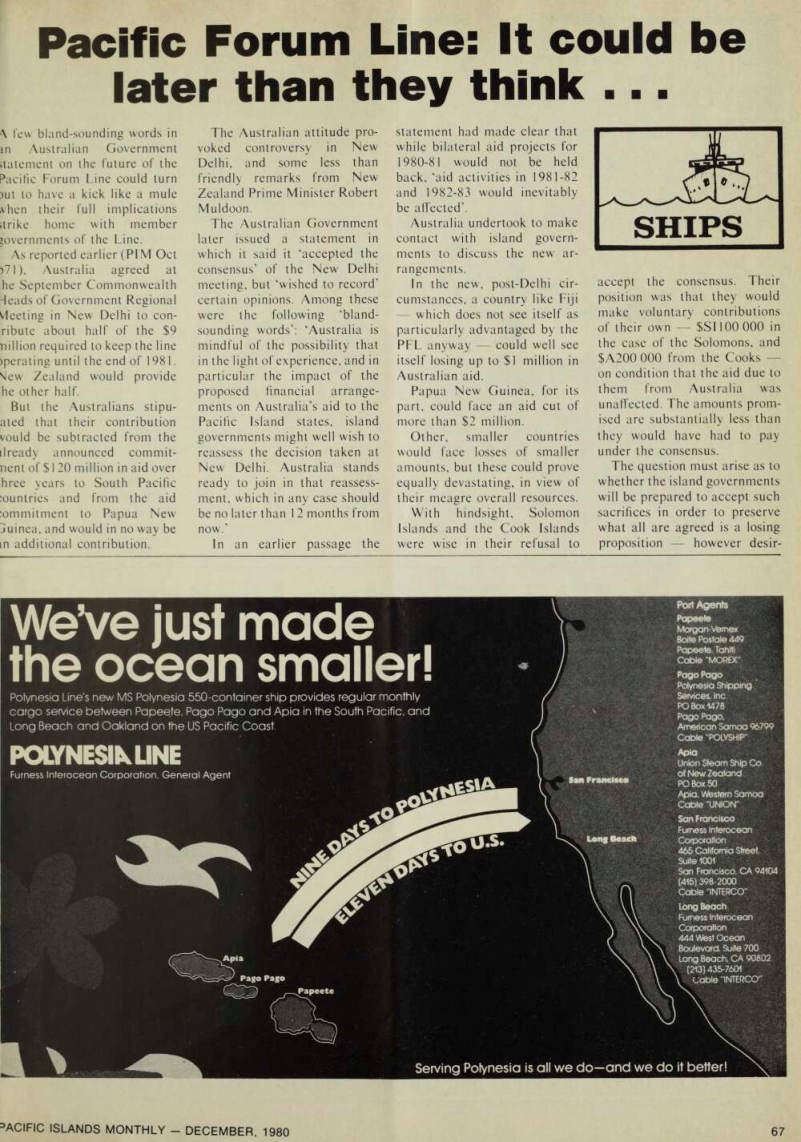
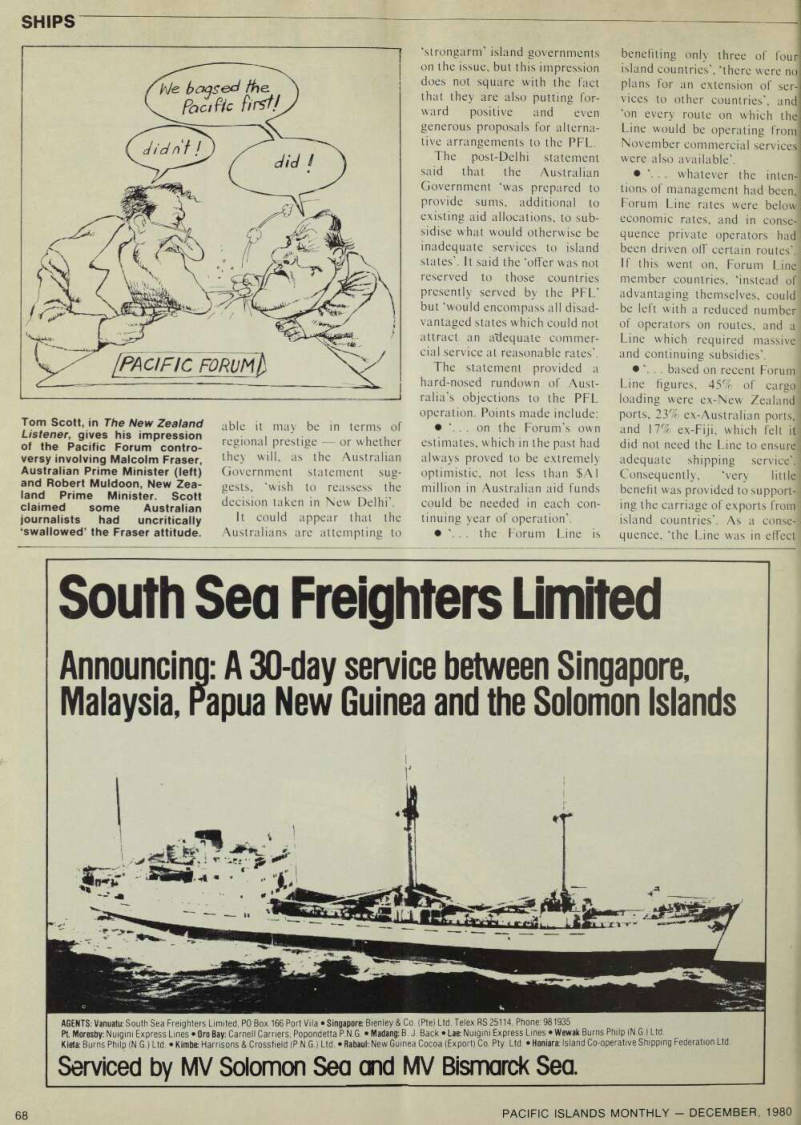
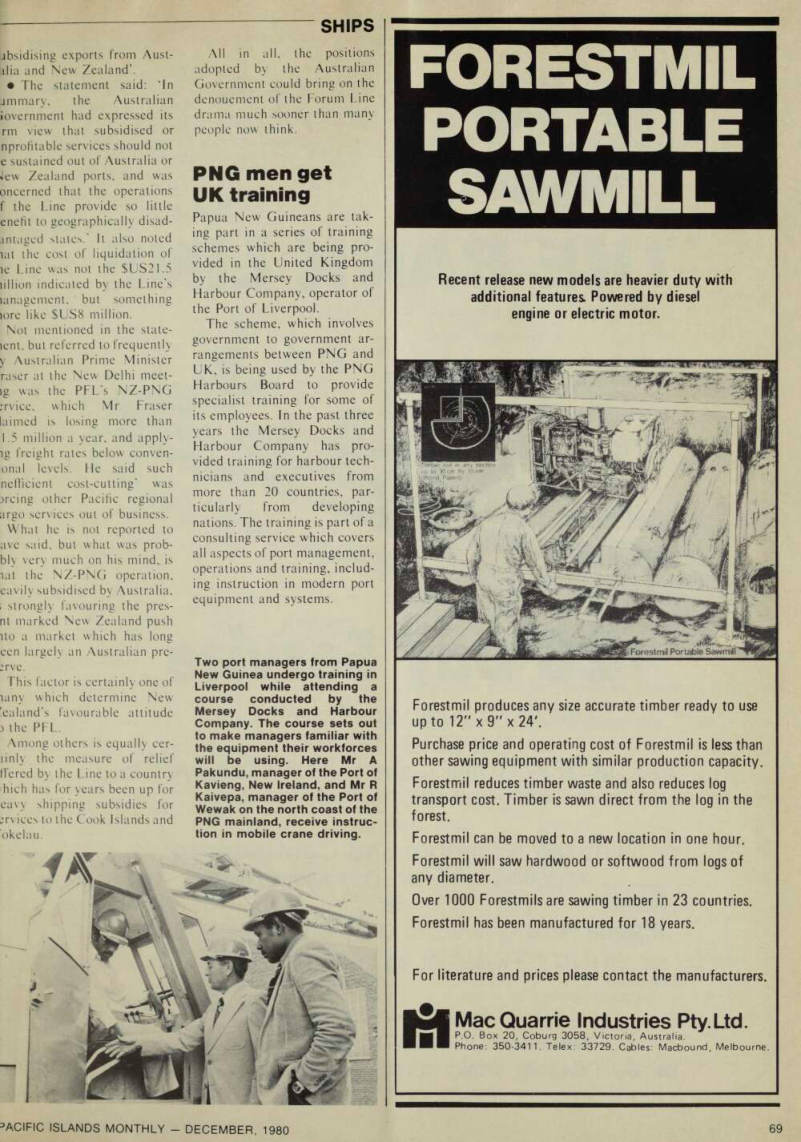
Ships
Pacific Forum Line: It could be later than they think ...
\ few bland-sounding words in in Australian Government Jtalemcnl on the future of the Pacific Forum Line could turn )ut to have a kick like a mule vhen their full implications itrike home with member governments of the Line.
As reported earlier (PI M Oct )71), Australia agreed at he September Commonwealth deads of Government Regional Meeting in New Delhi to con ribute about half of the $9 million required to keep the line iperating until the end of 1981.
'Jew Zealand would provide he other half.
But the Australians stipu ated that their contribution vould be subtracted from the ilready announced commit nent of $l2O million in aid over hree years to South Pacific rountries and from the aid :ommilmenl to Papua New juinea, and would in no way be in additional contribution.
The Australian attitude pro voked controversy in New Delhi, and some less than friendly remarks from New Zealand Prime Minister Robert Muldoon.
The Australian Government later issued a statement in which it said it ‘accepted the consensus’ of the New Delhi meeting, but ‘wished to record’ certain opinions. Among these were the following ‘bland sounding words’; ‘Australia is mindful of the possibility that in the light of experience, and in particular the impact of the proposed financial arrange ments on Australia’s aid to the Pacific Island states, island governments might well wish to reassess the decision taken at New Delhi. Australia stands ready to join in that reassess ment, which in any case should be no later than 12 months from now.’
In an earlier passage the
statement had made clear that while bilateral aid projects for 1980-81 would not be held back, ‘aid activities in 1981-82 and 1982-83 would inevitably be affected’.
Australia undertook to make contact with island govern ments to discuss the new ar rangements.
In the new, post-Delhi cir cumstances, a country like Fiji which does not see itself as particularly advantaged by the PFL anyway could well see itself losing up to $1 million in Australian aid.
Papua New Guinea, for its part, could face an aid cut of more than $2 million.
Other, smaller countries would face losses of smaller amounts, but these could prove equally devastating, in view of their meagre overall resources.
With hindsight, Solomon Islands and the Cook Islands were wise in their refusal to
accept the consensus. Their position was that they would make voluntary contributions of their own SSI 100 000 in the case of the Solomons, and SA2OO 000 from the Cooks on condition that the aid due to them from Australia was unaffected. The amounts prom ised arc substantially less than they would have had to pay under the consensus.
The question must arise as to whether the island governments will be prepared to accept such sacrifices in order to preserve what all are agreed is a losing proposition however desir-
able it may be in terms of regional prestige or whether they will, as the Australian Government statement sug gests, ‘wish to reassess the decision taken in New Delhi’.
It could appear that the Australians are attempting to
‘slrongarm’ island governments on the issue, but this impression does not square with the fact that they are also putting for ward positive and even generous proposals for alterna tive arrangements to the PFL.
The post-Delhi statement said that the Australian Government ‘was prepared to provide sums, additional to existing aid allocations, to sub sidise what would otherwise be inadequate services to island states’. It said the ‘offer was not reserved to those countries presently served by the PFL’ but ‘would encompass all disad vantaged states which could not attract an adequate commer cial service at reasonable rates’.
The statement provided a hard-nosed rundown of Aust ralia’s objections to the PFL operation. Points made include: • ‘. . . on the Forum’s own estimates, which in the past had always proved to be extremely optimistic, not less than SAI million in Australian aid funds could be needed in each con tinuing year of operation’. • ‘. . . the Forum Line is
benefiting only three of four island countries’, ‘there were no; plans for an extension of serH vices to other countries’, and ‘on every route on which the Line would be operating from November commercial services were also available’. • ' . . whatever the inten-| lions of management had been, Forum Line rates were below! economic rales, and in conse quence private operators had been driven off certain routes’.
If this went on. Forum Line' member countries, ‘instead of advantaging themselves, could be left with a reduced number of operators on routes, and a j Line which required massive and continuing subsidies’. • . . . based on recent Forum Line figures, 45% of cargo* loading were ex-New Zealand ports, 23% ex-Australian ports, and 17% ex-Fiji, which fell it did not need the Line to ensure adequate shipping service’.; Consequently, ‘very little benefit was provided to support ing the carriage of exports from island countries’. As a conse-! quence, ‘the Line was in effect
Tom Scott, in The New Zealand Listener, gives his impression of the Pacific Forum contro versy involving Malcolm Fraser, Australian Prime Minister (left) and Robert Muldoon, New Zea land Prime Minister. Scott claimed some Australian journalists had uncritically ‘swallowed' the Fraser attitude.
ibsidising exports from Aust ria and New Zealand’. • The statement said: ‘ln jmmary, the Australian lovernment had expressed its rm view that subsidised or nprofilable services should not e sustained out of Australia or Jew Zealand ports, and was oncerned that the operations f the Line provide so little enefit to geographically disad unlaged states.' It also noted ml the cost of liquidation of te Line was not the SUS2I.S lillion indicated by the Line’s lanagcmenl, but something lore like SUSB million.
Not mentioned in the state icnt. but referred to frequently y Australian Prime Minister rascr at the New Delhi meel ig was the PFL's NZ-PNG jrvice, which Mr Fraser laimed is losing more than 1.5 million a year, and apply ig freight rales below conven onal levels. Fie said such ncllicicnl cost-cutting’ was arcing other Pacific regional argo services out of business.
What he is not reported to avc said, but what was prob bly very much on his mind, is lal the NZ-PNG operation, eavily subsidised by Australia, ; strongly favouring the pres nt marked New Zealand push ilo a market which has long ccn largely an Australian pre :rve.
This factor is certainly one of tany which determine New Zealand's favourable altitude 3 the PFL.
Among others is equally cer linly the measure of relief IFercd by the Line to a country hich has for years been up for cavy shipping subsidies for ;rvices to the Cook Islands and okclau.
All in all, the positions adopted by the Australian Government could bring on the denouement of the Forum Line drama much sooner than many people now think.
PNG men get
UK training
Papua New Guineans are tak ing part in a series of training schemes which are being pro vided in the United Kingdom by the Mersey Docks and Harbour Company, operator of the Port of Liverpool.
The scheme, which involves government to government ar rangements between PNG and UK, is being used by the PNG Harbours Board to provide specialist training for some of its employees. In the past three years the Mersey Docks and Harbour Company has pro vided training for harbour tech nicians and executives from more than 20 countries, par ticularly from developing nations. The training is part of a consulting service which covers all aspects of port management, operations and training, includ ing instruction in modern port equipment and systems.
Two port managers from Papua New Guinea undergo training in Liverpool while attending a course conducted by the Mersey Docks and Harbour Company. The course sets out to make managers familiar with the equipment their workforces will be using. Here Mr A Pakundu, manager of the Port of Kavieng, New Ireland, and Mr R Kaivepa, manager of the Port of Wewak on the north coast of the PNG mainland, receive instruc tion in mobile crane driving.
Advertisements & other items, pp. 67-70 (3 items)
67
3 ACIFIC ISLANDS MONTHLY - DECEMBER, 1980
We’ve just made
the ocean smaller!
Polynesia Line's new MS Polynesia 550-container ship provides regular monthly cargo service between Papeete, Pago Pago and Apia in the South Pacific, and Long Beach and Oakland on the US Pacific Coast.
POLYNESIMINE
Furness Interocean Corporation, General Agent V Port Agents V ?2 <2 AS .s
To u
9 & £ * * & & Apia Pago Pago Papeete is all we do—and we do it better!
Serving Polynesia
Morgan-Vemex Boite Postale 449 Papeete, Tahiti Cable "MOREX"
Pago Pago Polynesia Shipping Services, Inc.
PO Box 1478 Pago Pago.
American Samoa 96799 Cable ‘‘POLYSHIP"
Apia Union Steam Ship Co. of New Zealand
POBoxSO
Apia. Vfestern Samoa Cable “UNION"
San Francisco Furness Interocean Corporation 465 California Street, Suite 1001 San Francisco, CA 94104 (416) 398-2000 Cable “INTERCO"
Long Beach Furness Interocean Corporation 444 West Ocean Boulevard. Suite 700 Long Beach. CA 90802 (213)435-7601 Cable "INTERCO"
V v :> V
South Sea Freighters Limited
Announcing: A 30-day service between Singapore,
Malaysia, Papua New Guinea and the Solomon Islands •i ♦ i * -ir j - » -■«# * -4 • • <4l tLt&i, AGENTS: Vanuatu: South Sea Freighters Limited, PO Box 166 Port Vila • Singapore: Bienley & Co, (Pte) Ltd. T elex RS 25114, Phone: 981935 PI Moresby: Nuigini Express Lines • Oro Bay: Carnell Carriers, Popondetta P N G. • Madang: B. J. Back • Lae: Nuigini Express Lines • Wewak Burns Philp (N.G.) Ltd.
Kieta; Burns Philp (N.G.) Ltd. • Kimbe: Harrisons & Crossfield (P.N.G.) Ltd. • Rabaul; New Guinea Cocoa (Export) Co. Pty. Ltd • Honiara: Island Co-operative Shipping Federation Ltd.
Serviced by MV Solomon Sea and MV Bismarck Sea.
FORESTMIL
PORTABLE
SAWMILL
Recent release new models are heavier duty with additional features. Powered by diesel engine or electric motor. t * iMb •• yfi i z. > Forestmtl Portable SawmSl Forestmil produces any size accurate timber ready to use up to 12" x 9" x 24'.
Purchase price and operating cost of Forestmil is less than other sawing equipment with similar production capacity.
Forestmil reduces timber waste and also reduces log transport cost. Timber is sawn direct from the log in the forest.
Forestmil can be moved to a new location in one hour.
Forestmil will saw hardwood or softwood from logs of any diameter.
Over 1000 Forestmils are sawing timber in 23 countries.
Forestmil has been manufactured for 18 years.
For literature and prices please contact the manufacturers.
IH
MacQuarrie Industries Pty.Ltd.
P.O. Box 20, Coburg 3058, Victoria, Australia.
Phone: 350-3411. Telex: 33729. Cables: Macbound, Melbourne.
g;
GLOBAL SERVICE FOR SHIPPERS
V
THE
LINE
28 Day Service
United Kingdom and Continent to:
PAPEETE • NOUMEA
PAPUA NEW GUINEA and SOLOMON ISLANDS
PORT VILA & SANTO BY TRANSHIPMENT
■X - United Kingdom and Continent to: SUVA AND LAUTOKA (FCL LCL & UNITISED ONLY) Papua New Guinea and Solomon Islands to:
UNITED KINGDOM and CONTINENT
s.
For particulars apply:
THE BANK LINE (AUSTRALASIA) PTY. LTD.
18th Root 1 York Street SYDNEY N.S.W 2000 Australia Tel: 272041 Telex: 24063
Ships
69
3 ACIFIC ISLANDS MONTHLY - DECEMBER, 1980
Shipping
Services
Should any shipping company wish 0 have its services cargo and >assenger included in these list ngs they should contact PIM.
Australia - Fiji
Carlander (Aust) Pty Ltd operates nthly cargo services from Sydney to /a and Lautoka. details from Karlander (Aust) Pty Ltd, 31 Pitt Street, Sydney (27-6301), gety Shipping, 461 Bourke Street, 1 bourne (60-0731), Burns Philp (SS) Ltd, Suva and Lautoka.
Sofrana-Unilines (Fiji Express Line) jrates to Suva and Lautoka every se weeks from the main ports on the »t coast of Australia and monthly to jtoka from Melbourne and Sydney.
Details from Sofrana-Unilines, 19 Pitt eet, Sydney, (27-2031), Trans stral Shipping Pty Ltd, 570 Bourke eet, Melbourne (67-9162), ACTA Pty (. Brisbane (221-3116), Elder-ANL 1 Ltd, Port Adelaide (47-5688), ANL, wcastle (049-24364), Clements & rshall, Burnie, Tasmania -1833).
Australia - Fiji - Samoas -
Tonga
Pacific Forum Line operates a fully itainerised service (Gen/Reefer) m Brisbane and Sydney to Lautoka, /a, Nukualofa, Apia and Pago go. : unafuti cargo transhipped at Apia.
Details from Pacific Forum Line, Syd /; Union Bulkships, Sydney; Bulk ps, Melbourne, Brisbane; Burns ilp (SS) Co, Lautoka, Suva and Apia; ion Co, Nukualofa; Polynesia Ship ig Services, Pago Pago or Pacific rum Line Head Office, Apia.
Australia - Lord Howe Is -
Norfolk Is
Dompagnie des Chargeurs iledoniens operates four-weekly rgo service Sydney - Lord Howe ind and Norfolk Island.
Details Hetherington Kingsbury Pty j, 37-49 Pitt Street, Sydney M 671).
Australia - Nauru -
Kiribati
Nauru Pacific Line operates regular rgo/passenger service from Mel urne to Nauru and Tarawa.
Details: Nauru Pacific Line, Nauru >use, 80 Collins Street, Melbourne 53-5709), Nedlloyd Swire, 8 Spring 'eet, Sydney (2-0522).
Australia - New Caledonia
(And/Or) Vanuatu
Karlander operates a monthly service im Sydney to Noumea.
Details: Karlander (Aust) Pty Ltd, i-31 Pitt Street. Sydney (27-6301).
Sofrana-Unilines ships serve jumea every three weeks from the ain ports along the east Australian »ast.
Details from Sofrana-Unilines, 19 Pitt reet, Sydney (27-2031), Trans jstral Shipping Pty Ltd, 570 Bourke reet, Melbourne (67-9162), ACTA Pty d, Brisbane (221-3116), Elders-ANL y Ltd, Port Adelaide (47-5688), ANL, ewcastle (049-24364), Clements & arshall, Burnie, Tasmania H-1833).
Compagnie des Chargeurs Cale aniens operates a three-weekly con
tainerised cargo service from Sydney to Noumea.
Details Hetherington Kingsbury Pty Ltd, 37-49 Pitt Street, Sydney (27-1671).
Compagnie Generate Maritime oper ates a monthly service from Sydney to Noumea, Port Vila and Santo, using a ro-ro vessel.
Details Compagnie Generate Mari time. 12 Castlereagh Street, Sydney (231-3700).
Daiwa Line operates a con tainer/breakbulk service every 30 days to Vila and Santo and every 60 days to Noumea.
Details Meridian Shipping & Trans port Agencies Pty Ltd, Box 3410 GPO Sydney 2001 (290-1633), Tlx.
AA25970.
Australia - Nz - Fiji -
Hawaii - Us
P & O liners call at Auckland, Suva, Pago Pago and Honolulu and Van couver on eastbound and westbound voyages between Sydney and the US.
Details from P & O Booking Centre, World Travel Headquarters Pty Ltd, 33 Bligh Street. Sydney (231-6655).
AUSTRALIA - NZ - FIJI - TONGA -
Vanuatu - Noumea - Png -
Solomons - Samoas - Tahiti
Sitmar Cruises operates a year-round cruise programme to include most of the above countries.
Details from Sitmar Cruises, 47 Elizabeth Street, Sydney (232-7511).
P & O liners call at Auckland. Bay of Islands, Honiara, Lautoka, Noumea, Nukualofa, Pago Pago, Papeete, Port Moresby, Santo, Savusavu, Suva, Vavau and Vila on cruises from Aus tralia.
Details from P & O Booking Centre, World Travel Headquarters Pty Ltd, 33 Bligh Street, Sydney (231-6655).
Pacific Forum Line operates con tainerized and general cargo service from Australia and NZ to Fiji, Apia, Pago Pago, Tonga and other South Pacific ports.
Details from Polynesia Shipping Ser vices Inc, PO Box 1478, Pago Pago 96799.
Australia - Micronesia
Nauru Pacific Line operates a regular container service from Melbourne to Majuro, Kosrae, Ponape, Truk, Guam and Saipan.
Details Nauru Pacific Line, Nauru House, 80 Collins Street, Melbourne, (653-5709), Nedlloyd Swire, 8 Spring Street, Sydney (2-0522).
Australia - Png
New Guinea Express Lines operates three-weekly conventional and con tainer services Melbourne, Sydney, Brisbane, Port Moresby, Lae, Rabaul, Alotau.
Details from New Guinea Express Lines, PO Box R 73, Royal Exchange PO, Sydney (241-3991) MacArthur Shipping Agency Co, 82-92 Eagle Street, Brisbane (229-3777), New Guinea Express Lines, 327 Collins Street, Melbourne (61-3053), Niugini Express Lines in Port Moresby (21-4572), Lae (42-1536), Rabtrad Niugini Pty Ltd, Rabaul (92-2911), Alotau Stevedoring & T'sport (61-1318).
Karlander New Guinea Line’s cargo vessels call at Melbourne, Sydney, Port Moresby, Lae, Madang, Wewak, Manus, Kimbe, Rabaul, Popondetta.
Details from Karlander (Aust) Pty Ltd, 19-31 Pitt Street, Sydney (27-6301), Dalgety Shipping, 461 Bourke Street, Melbourne (60-0731).
Australia - Png - Solomons
A consortium of Conpac, NGAL/PNGL have three container vessels operating on a 28 day turn around from Melbourne. Sydney and Brisbane to Port Moresby, Lae, Rabaul, Kavieng, Wewak, Madang, Kieta and Honiara supplemented by Daiwa vessels, Pacific Princess and Fiji Maru
extending from Sydney to Lae on a monthly basis.
Details from Burns, Philp & Co Ltd 51 Pitt Street, Sydney (2-0547) and Interocean Swire, 8 Spring Street, Syd ney. (2-0522).
Australia - Solomons -
Kiribati - Micronesia
Daiwa Line operates a container ser vice every 30 days from Sydney to Honiara, Kieta, Tarawa and Guam. Gizo cargoes transhipped at Honiara, Sai pan, cargoes transhipped at Guam.
Details Meridian Shipping & Trans port Agencies Pty Ltd, Box 3410 GPO Sydney 2001 (290-1633). Tlx.
AA25970.
Australia - Solomons -
Northern Marianas-Taiwan
Japan
Daiwa Line offers a four-weekly ser vice Sydney-Honiara-Guam-Taiwan- Japan with transhipment at Guam for Saipan.
Details Meridian Shipping & Trans port Agencies Pty Ltd, Box 3410 GPO, Sydney 2001 (290-1633). Tlx.
AA25970.
Australia - Tahiti
Compagnie Generate Maritime oper ates a monthly service from Sydney to Papeete using a'ro-ro vessel.
Details Compagnie Generate Mari time, 12 Castlereagh Street, Sydney (231-3700).
Australia - Tahiti - Us
Karlander operates a monthly cargo service from Melbourne and Sydney to Papeete, US west coast.
Details: Karlander (Aust) Pty Ltd, 19-31 Pitt Street, Sydney (27-6301).
Australia - W. Samoa
Compagnie Generate Maritime oper ates a monthly service from Sydney to Apia.
Details Compagnie Generate Mari
(231'-37 2 00? aStlerea9h StrBet ' Sydney
Fiji - Line Islands
(Kiribati)
Sisco Shipping Co Ltd has commen ced a 30 day service from Suva to Fan ning, Washington and Christmas Islands. Back loadings from Suva for en route islands accepted.
Details from Sisco Shipping Co Ltd PO Box 670, Honiara (808/809) Tlx 66346.
Far East - Fiji - New
Zealand
New Zealand Unit Express (NZUE) operates a fortnightly palletised cargo service from Manila, Keelung, Kaoshiung and Hong Kong to Lautoka Suva and thence to NZ.
Details from Carpenters Shipping Suva (312-244), Burns Philp, Suva P & O S.N. Co, Wellington (736-477) or Nedlloyd Swire Pty Ltd Sydney (20-522).
Nedlloyd operates bi-weekly cargo service with four ships from Sourabaya, Jakarta, Bangkok, Port Kelang and Singapore to Suva and NZ ports.
Details from Nedlloyd (Aust) Pty Ltd 8 Spring St, Sydney (27 3801), Burns Philp (SS) Co Ltd, Suva and Lautoka.
Far East - Mid-S. Pacific
China Navigation’s New Guinea Pa cific Line (NGPL) operates a regular cargo service from Hong Kong, Taiwan.
Manila, Port Kelang and Singapore to Wewak, Madang, Kimbe, Rabaul, Kieta, Lae, Port Moresby, Honiara, Santo, Vila, Noumea, Papeete, Pago Pago, Apia, Tarawa and Nauru.
Details from Steamships Trading Co., Port Moresby (21-2000).
Kyowa Shipping Ltd, operates monthly services from Hong Kong, Taiwan, S. Korea and Japan, to Guam, Saipan, Solomons, New Caledonia, Fiji, Western and American Samoa, Tahiti,
Cook Is., Tonga and Vanuatu.
Details: Hetherington Kingsbury Pty Ltd, 37-49 Pitt Street, Sydney (27-1671).
Daiwa Line operates 30-day service from Moji, Kobe, Nagoya and Yokohama to Papeete, Pago Pago, Apia, Suva, Lautoka, Noumea, Vila, Santo, Honiara, Kieta, Tarawa and Guam.
Details: Meridian Shipping & Trans port Agencies Pty Ltd, Box 3410 GPO Sydney 2001 (290-1633) Tlx: AA25970.
Japan - Fiji - New Zealand
China Navigation, operates a monthly service from main ports Japan to Suva and Lautoka and thence Noumea and NZ.
Details from Carpenters Shipping Suva (312-244).
Japan - Png
Mitsui O.S.K. Lines operates a monthly service from main ports Japan and Port Moresby, Rabaul, Lae Madang, Kieta and Kimbe.
Details from J. C. Waller, Port
Moresby (21-2466/21-1898).
JAPAN - GUAM - FIJI - TAHITI -
Samoa - N. Caledonia -
Solomons - Kiribati
Daiwa Lines runs a monthly cargo service from Japan via Guam to Lau toka, Suva, Papeete, Pago Pago, Apia, Sydney, Noumea, Honiara, Tarawa Guam.
Details from Burns Philp (SS) Co Ltd Suva.
Hawaii - Bamoab - Tonga
Warner Pacific Line operates uni tized/palletized and reefer cargo service Honolulu/Pago Pago-Apia- Nuku'alofa. Line Islands and Suva by inducement.
Details from Hawaii-Pacific Maritime Inc., Honolulu, Hi 96801. Tel. (808) 521-9806 Freight Dept. Tlx (RCA):
723-8330 ITT 743-0040 Cable? ‘Oral’.
New Caledonia - Fiji - West
Coast North America
PAD Line operates an approx. 3 weekly ro-ro service from Noumea and Suva to Honolulu and West Coast USA and Canadian ports.
Details from Sofrana-Unilines SA BR 1602, Noumea (27-51-91), Tlx NMO4B W. R. Carpenter, 100 Thomson St 3 Suva (31-11-22). Tlx FJ2199; TransJ Austral Shipping, Box R 232 PC, Roya
Exchange, NSW (27-2441), TIJ
AA21204.
Png - Uk/Continent
Bank Line operates regular cargo! service from Kieta, Rabaul, Kimbe] Madang and Lae to Cardiff, Hamburg, Rotterdam and Antwerp.
Details from Bank Line (A’asia) Pty Ltd, 1 York Street, Sydney (27-2041 Vi Burns Philp (PNG) Ltd. ports.
Png - Us
Bank Line operates regular cargo] service from Kieta, Rabaul, Kimbe, Madang and Lae direct to New Orleans; calls at other US and Gulf and East Coast ports on inducement.
Details from Bank Line (A’asia) Pty Ltd, 1 York Street, Sydney (27-2041); Burns Philp (PNG) Ltd, PNG ports.
Solomons - Usa -
Uk/Continent
Bank Line operates regular cargo] service from Honiara to New Orleans, Cardiff, Hamburg, Rotterdam and Ant werp.
Details from Bank Line (A’asia) Pty] Ltd, 1 York Street, Sydney (27-2041); Trading Co, Honiara (389).
NZ - COOK IS - NIUE -
Tahiti
Shipping Corporation of NZ Ltd oper ates cargo services based on pallets and similar units from Auckland to Niue, Cook Islands and Tahiti.
iDetails from the Shipping Corp of NZ j, PO Box 3420, Auckland 97-210), Waterfront Commission, PO tjx 61, Rarotonga; Lighterage and evedoring Co, Aitutaki; Niue Govt Tices, Niue Island Compagnie Mari ne Polynesienne, B'P’ 368, Papeete, ihiti.
Nz - Fiji
Reef operates a regular 18-day ser :e from Auckland to Suva and Lau ka.
Details from Reef Shipping Agencies, 3 Box 3382, Auckland, NZ 7-1221-3).
Pacific Line with one ship operates rtnightly roro cargo service New aaland, Lautoka, Suva.
Details: Sofrana Unilines, 18 Cus ms Street, Auckland (773-279) PO dx 3614, Telex: NZ2313.
Z - FIJI - NORTH AMERICA (WC) Blue Star Line Ltd Pacific Coast con iner services. Only direct service to id from New Zealand. Blue Star ssels call at Suva and Honolulu on 7-US-West Coast voyages.
Details from Blueport ACT (NZ) Ltd, 3 Box 192, Wellington (739-029) jrns Philp (SS) Co Ltd, GPO Box 355, jva, Fiji (311-777).
NZ - FIJI - SAMOAS - TONGA Pacific Forum Line operates a fully mtainerised three-weekly service )en/ Reefer) from Auckland to Lau ka, Suva, Apia, Pago Pago and uku’alofa.
Details from Pacific Forum Line, ellington; Union Co, Auckland, Lau ka, Suva, Apia and Nuku'alofa; jlynesia Shipping Services, Pago ago or Pacific Forum Line Head ffice, Apia.
NZ - N. CALEDONIA - FIJI -
Solomons - Png
Pacific Forum Line operates a fully antainerised service (Gen/Reefer) 3m Lyttelton, Napier, Tauranga, uckland to Suva, Lautoka, Honiara, ieta, Lae and Port Moresby.
Details from Pacific Forum Line, 'ellington; Shipping Corporation of Z, Lyttelton, Napier; Union Co, auranga, Auckland, Suva, Lautoka; teamships Trading Co, Kieta, Lae, ort Moresby; Sullivans (SI) Ltd, oniara or Pacific Forum Line Head ffice, Apia.
Z - N. CALEDONIA - VANUATU -
Png • Solomons
Sofrana Unilines with three ships op 'ates to Vila and Santo, to Honiara and apua New Guinea and to Norfolk land and Noumea.
Details from Sofrana Unilines, 18 ustoms Street, Auckland (773-279), 0 Box 3614, Telex NZ2313.
Nz - Tahiti
Compagnie Tahitienne Maritime SA ith one ship operates monthly service ew Zealand - Papeete.
Details from Sofrana Unilines, PO ox 3614, 18 Customs St, Auckland Tlx NZ2313.
Nz - Tonga - Samoas
Warner Pacific Line services uckland - Nuku’alofa/Vavau/ pia/Pago Pago fortnightly carrying eneral and freezer cargoes. Also imaru - Nuku’alofa/Vavau/Apia every 1 days carrying freezer cargo.
Details from McKay Shipping Ltd, owntown House, 21 Queen St, uckland, PO Box 1372 (30-299), ;ables MACSHIP, Telex NZ2554.
Europe - Tahiti -
New Caledonia
Compagnie Generate Maritime oper tes services from Europe and Mediter anean ports to Papeete and Noumea sing three ro-ro and multi-purpose essels thus ensuring a bi-monthly sail ig to and from.
Details Compagnie Generate Mari me, 12 Castlereagh Street, Sydney 231-3700).
EUROPE - TAHITI - W. SAMOA -
Fiji - N. Caledonia
Nedlloyd offers regular cargo ser vices from Northern Europe and UK to Papeete, Apia, Fiji and New Caledonia.
Details Nedlloyd (Aust) Pty Ltd, 8 Spring Street, Sydney (27-3801).
EUROPE - TAHITI - W. SAMOA - TONGA - FIJI - SOLOMONS - PNG Columbus Line Reederei GMBH op erates 2-monthly service from Ham burg, Rotterdam, Antwerp, Dunkirk and Le Havre to Papeete, Apia, Nukualofa, Suva, Lautoka, Noumea, Honiara, Port Moresby, Kieta, Rabaul, Lae, and return to Europe.
Details from Columbus Overseas Services Pty Ltd, 333 George Street, Sydney (290-2966), Columbus Mari time Services, 17 Albert Street, Auckland (77-3460).
Uk - N Continent - Fiji
The Bank Line operates a regular 28 day cargo service from Hull, Hamburg, Bremen, Antwerp and Rotterdam to Suva and Lautoka.
Details from The Bank Line (Aus tralasia) Pty Ltd, 1 York St, Sydney (27-2041); Burns Philp (South Sea) Co Ltd, Suva and Lautoka.
Uk/N. Continent - Png -
Solomons
The Bank Line operates a regular 28 day cargo service from Hull, Hamburg, Bremen, Antwerp and Rotterdam to Port Moresby. Lae, Madang, Kimbe, Rabaul, Kieta and Honiara and on inducement to Yandina.
Details from The Bank Line (A’asia) Pty Ltd, 1 York Street, Sydney (27-2041); Burns Philp (PNG) Ltd, PNG ports; Trading Co Honiara.
Uk/N. Continent - Tahiti -
N. Caledonia - N. Hebrides
The Bank Line operates a regular 28 day cargo service from Hull, Hamburg, Bremen, Antwerp and Rotterdam to Papeete and Noumea.
Details from The Bank Line (A’asia) Pty Ltd, 1 York Street, Sydney (27-2041); Ets A M Fare UTE, Papeete; Ets Ballande, Noumea.
US - FIJI - TAHITI - NZ -
Australia
The Bank and Savill Line Ltd, oper ates regular cargo services from US Gulf ports to Australia and NZ. Calls at Suva, Lautoka and Papeete on de mand.
Details from The Bank Line (A’asia) Pty Ltd, 1 York Street, Sydney (27-2041) or Howard Smith Industries Pty Ltd, 1 York Street, Sydney (27-5611).
Us • Hawaii • Micronesia
Philippines, Micronesia & Orient Navigation Co (PM&O Lines) operates regular container service on self sustained ship with ro-ro capabilities from Oakland, Portland and Honolulu to Majuro, Kosrae, Ponape, Truk, Saipan, Yap and Koror.
Details for Micronesia can be obtained from Larry Guerrero, PM&O Owners Rep, PO Box 803, Saipan, Ml
96950, Cable Commontime; Pm&O
Lines, 181 Fremont St, San Francisco.
California 94105, Cable PMONAV.
Us - Hawaii • Nauru -
Micronesia
Nauru Pacific Line operates regular conventional/container and passenger service from San Francisco and Honolulu to Majuro, Ponape, Truk and Saipan. Cargo is accepted for Nauru and Kosrai with transhipment at Majuro and Ponape.
Details from Nauru Pacific Line, Nauru House, 80 Collins Street, Mel bourne (653-5709); North American Maritime Agencies, 100 California St., San Francisco, California 9411.
Us - Noumea - Fiji
PAD Line operates an approx 3-weekly roro service from West Coast USA and Canada to Noumea and Suva.
Details from Sofrana-Unilines SA, BP 1602, Noumea (27-51 -91). Tlx NMO4B; W, R. Carpenter, 100 Thomson St, Suva (31-11-22), Tlx FJ2199; Trans-Austral Shipping, Box R 232 PO, Royal Exchange, NSW (27-2441), Tlx AA21204.
Us - Tahiti - Samoa
Pacific Islands Transport operates a five weekly cargo service from North America west coast ports to Papeete, Pago Pago, Apia.
Details from Polynesia Shipping Ser vices Inc, PO Box 1478 Pago Pago 96799.
Polynesia Line operates container and general cargo service from US west coast ports to Papeete and Pago Pago.
Details from Polynesia Shipping Ser vices Inc., PO Box 1478, Pago Pago 96799.
US - TAHITI - SAMOA - NZ - AUST Farrell Lines Inc, operate a fast reg ular lash/container cargo service from west coast ports Canada/USA to Papeete and Pago Pago thence to NZ and Australia.
Details Wilh Wilhelmson Agency, Sydney, Melbourne and Brisbane, Tlx AA20136, Cable FARSHIPS Sydney; Dalgety (NZ) Ltd, Auckland and Wellington, Tlx NZ2445, Cable DALSHIP Auckland; Compagnie Mari time Polynesienne, Immeuble Franco Oceanienne, PO Box 368, Papeete, Tahiti, Tel 26393, Tlx 258. FP ANSB Taporo, Cable OCEAN Papeete; Kneubuhl Maritime Service, PO Box 39, Pago Pago, Telephone 633-5121; Tlx 782505.
Advertisements & other items, pp. 71-72 (2 items)
71
’ACIFIC ISLANDS MONTHLY - DECEMBER, 1980
Henry Cumines
a PACIFIC
* FORUfn
Line
OWNED BY THE PEOPLE
OF THE PACIFIC ISLANDS
Regular Monthly Liner Services
from Australia and New Zealand
to the South and Central Pacific
FOR INFORMATION CONTACT AGENTS:
AMERICAN SAMOA
Polynesian Shipping Services Inc. P.O. Box 1478, Pago Pago
AUSTRALIA
The Australian National Line, 50 Queen Street, Melbourne.
Union Bulkships Pty.Ltd., 333 339 George Street. Sydney.
KIRIBATI:
Gilbert Islands Shipping Corp. P.O. Box 495, Tarawa.
FIJI;
Burns Philp South Sea Co Ltd. GPO Box 355, Suva.
NEW CALEDONIA
ETS Ballande, BP. C 4, Noumea.
VANUATU:
Burns Philp New Hebrides Limited, Vila.
NEW ZEALAND:
Tho Shipping Corp. of N.Z. Ltd. P.O. Box 3344, Wellington
PAPUA NEW GUINEA
Steamships Trading Co. Ltd. P.O. Box 1, Port Moresby.
SOLOMON ISLANDS:
Sullivans S.l. Ltd. GPO Box 3, Honiara.
TONGA
Union Steam Ship Co. P.O. Box 4, Nukualofa.
HENRY CUMINES
PTY. LTD.
EXPORTERS o GENERAL MERCHANTS
428 GEORGE ST., SYDNEY
CABLES: HENCO SYDNEY. G.P.O. Box 3949. PHONE; 232-5377 • •
For specialised and personalised buying service
throughout the Pacific Islands and the East.
LOCAL AGENTS AND REPRESENTATION:
PAPUA NEW GUINEA:
RABAUL: M. & C. Seeto, P.O. Box 131, Rabaul.
Telephone 92-2919.
MADANG: W. Double, P.O. Box 22, Madang.
Telephone 82-2696.
SOLOMON
FIJI:
K. Witherington Ltd., P.O. Box 293, Suva.
Telephone 22-356.
VANUATU:
John Lum & Associates, P.O. Box 65, Santo.
Telephone 329.
ISLANDS:
Mr. Tom Lo, P.O. Box 327, Honiara.
Telephone 399. -• Resident Apen t$ in other Pacific Territories. •-
YOUR BUSINESS PARTNER
I I I I L
KYOWA
Japan
KYOWA LINE
Taiwan
S. Korea
To Solomoa New Caledonia, Fiji. W Samoa, A Samoa. Tahiti. Cook Is,. Tonga. New Hebrides. Ellice Is . Nauru 10. Guam, Saipan, Truk, Ponape, Majuro, Yap, Koror
Taiwan HHHongKong
To; Papua New Guinea. Other Pacific Islands
AGENTS
Taiwan: Royal Steamship Corp., Ltd., Taipei S. Korea: Dong Sue Shipping Co., Ltd., Seoul Hong Kong: Dahzun Enterprises Ltd.
Singapore; Ocean Shipping & Enterprises Re., Ltd.
Guam: Maritime Agencies of The Pacific Ltd., Guam Saipan: Saipan Shipping Co. Inc., Saipan Solomon: Solomon Taiyo Ltd., Honiara Tahiti: J. A. Cowan & Fils, Papeete Cooks: Eastern Associates Ltd., Rarotonga Tonga: E. M. Jones Ltd., Nukualofa Vanuatu: Pentecost Pacific S.A., Port Vila
Singapor e
Philippines: Sky International Inc., Manila Ponape: United Micronesia Development Association, Ponape A. Samoa: Island Pacific Agencies Inc., Pago Pago W. Samoa: Morris Hedstrom Ltd., Apia Fiji: Carpenter Shipping, Suva & Lautoka Nauru: Nauru Phosphate Corp.
PNG: Carpenter Shipping Agencies, Port Moresby, Rabaul New Caledonia; Agence Maritime Du Rond Point Du Pacific, Noumea Indonesia: P. T. Porodisa Raya Shipping Lines, Jakarta Sabah: KOH Han Ming Shipping & Forwarding Agent, Kotakinabalu Sarawak: Pan Sarawak Agencies Sdn. Bhd., Sibu & Kuching Australia: Hetherington Kingsbury Pty. Ltd., Sydney, N.S.W.
New Zealand: Russell & Summers Ltd., Auckland n I
KYOWA SHIPPING CO.. LTD.
HEAD OFFICE
sth FI., Suzumaru Bldg. 39 8, 2-chome, Nishi-Shinbashi. Minato-ku, Tokyo, Japan.
Phone : 03(437)2885(Rep.) Cables : “MARIQUEEN” Tokyo. Telex : 242-4651 Kyowa J.
OSAKA OFFICE
Frontier Bldg., 3-13 Hirano-cho, Higashi ku. Osaka. Japan.
Phone : 06(227)0422(Rep.) Cables : “MARIQUEEN" Osaka. Telex : 522 3896 Kyowa 0.
Deaths
of Islands People
Ron Berking
At Taufusi, Western Samoa, on September 27, aged 48. Mr Berking, an Opposition MP, was reported to have been ‘beaten to death’ in his office by two young men, who were later questioned by police, and taken into custody on a ‘holding charge’ of ‘grievous assault causing death’. According to
reports, Mr Berking, who was manager of Samoa Tropical Products, visited his office with his daughter on the Saturday afternoon of his death. Two men were ‘loitering’ in front of the office. When Mr Berking told them to leave they became angry, and entered the factory.
There was a tussle in which cans of coconut cream were thrown at Berking. Berking’s daughter called the police, but he was dead on arrival at the hospital, according to the re ports. Mr Berking was gener ally regarded as a strong advo cate of freedom of expression, and a determined questioner of government policies. His fu neral was attended by the Head of State Malietoa Tanumafili 11, Prime Minister Tupuola Efi, Leader of the Opposition Vaai Kolone, members of Cabinet, MPs, and others.
Toleafoa Talitimu
At Faga, Savaii, Western Samoa in October, aged 62. He was an Opposition MP and a former Speaker of Western Samoa’s parliament. But he was perhaps most famous as the youngest of the three liga brothers of concert-makers and songwriters. Gatoloai Peseta Siaosi, the last of the liga brothers, was also ‘Speaker’ of the old Fono of Saipule, the forerunner of the present legis lative assembly, from 1951 to 1953. Songs written by the liga brothers have been recorded on a long-playing disc by the choir of Avele Boys.
Fangupo Latavao
On Tongatapu, Tonga, on October 23, aged 27. He was the only fatality when a sudden whirlwind hit Nukualofa and other parts of Tongatapu on
that date. He was electrocuted when he tried to pick up a live broken power line lying on the flooded Vahaakolo Road at Vaololoa.
Michael Self
On October 31, in a road accident near Wagga Wagga, New South Wales, Michael Self, 19-year-old son of Ron and Della Self who lived for many years in Papua New Guinea and now live in Canberra.
Michael, who was born in PNG and had lived with his parents in Madang, Daru, Samarai and Port Moresby, had joined the Royal Australian Air Force and was returning to the air force base at Wagga Wagga from leave when the accident oc curred.
Robert Cheung
In July, aged 45. A pioneer trader in the Papua New Guinea Highlands town of Mt Hagen, ‘China Robert’ became a household word in the area because of his cheerful dispo sition and innovative business techniques. Despite many set backs, including a 1971 fire which gutted his store, Robert Cheung always fought back. He is said to have rebuilt his business three times after troubles of various kinds. His friend, Bishop Bernarding, de scribed him as ‘one of the most humane men ever to be met’.
Norman Deck
In Sydney, Australia, in August, aged 98. A pioneer missionary of the South Seas Evangelical Church, Norman Deck first arrived in Solomon
Islands in 1913. Early studend of Onepusu school, Malaita] remember his hard work to build the place, which manjj years later became the Onepusu Bible Training Centre. A dentist, Mr DecM practised this profession in Solomon Islands during World War 11, returning to Australia after the war. He was a skilled photographer, musician and author, writing a number of books and translating the New Testament into the Kwara’ae language. He also captained his church’s first mission vessel.
Philip Tui Andrews
At Savusavu, Fiji, aged 86.
Philip Tui Andrews was a veteran of World War I in which he served with the 1 stj New Zealand Expeditionary; Force in France, Turkey, Egypt and Palestine. He worked for Burns Philp in Western Samoa for about 30 years, returning to Fiji in 1949. He later became the owner of the Lovonisikeci copra estate in Kasavu, Savusavu.
Roy Palmer Clark
On Pitcairn Island, in May! aged 86. American-born Roy P.
Clark came to Pitcairn in 1909 with his father, Lincoln Clark.
In 1913 he was married to Hyacinth May Coffin. He later became head schoolteacher, was Church Elder for some time, and finally became the Island’s Postmaster, a position he held for 18 years. A tribute in Pitcairn Miscellany com ments upon his passion for reading, the writing of poetry, ' and his love of animals.
Advertisements & other items, p. 73 (2 items)
73
3 ACIFIC ISLANDS MONTHLY - DECEMBER, 1980
■Aiwa Line
MOJI • KOKK *\A(.OYA •YOKOHAMA •'.! AM -MA.II Ho •1 A HAW A •V\l HI IAI |oK
k BRIDGE OF THE SOUTH PACIFIC
container RO-RO ships ii H bring JAPAN FAR EAST and
o AUSTRALIA NEW ZEALAND
round to your doorwaya Please contact us or agent for \ whatever shipping need, for the best answer a A
! THE DAIWA MAYICATIOH CO., LTD.
Head Office : 15-15. I -chome. Awaza. Nish-ku, Osaka. Japan 550 n Phone (06)531-0471 « 1 Telex 525-6324 h Cable “DAILINE"Osaka • V KIKTA- HO.MAHA- SANTO- VII. A- NOIMKA- HHISBANK- SVHNKV- Alt' Kl AN 11 •
Advertisers Index
Aggie Grey 41 Air New Zealand 46 Aiwa 34 Akai Electric 12 Aquilla qo
Awa 28
Bankline 70 Berkey, Robert L. 74 Berge-Lopez & Craft 43 Cable & Wireless 24 Cessna 22 Citizen Watches 30 Civil Flying 64 Clarion Shoji 56 Clark Equipment 58 Daddon, S. 74 Fleets 74 Furness 68 Henry Cumines 71 Hitachi 16 Holland, N. 74 Honda Motor Co. 20 ICI Tasman 44 Komatsu 54 Kleckham, Fred 74 Kyowa Shipping 72 MacQuarrie Industries 69 Matsushita 26
McDonnell-Oouglas 32
Meridian Shipping 73 Middlemore Hospital 74 National Insurance 36 Nelson 81 Robertson 49 New Zealand Dairy Board 75 Pacific Forum 71 Papua Hotel 41 Pioneer g Pioneer 42
Portals 37 QBE Insurance 4g Rex Aviation , 52 Ricoh go Sansui Electric 50 Sony 76 South Sea Freighters 67 Tatham 4 Toyota Motors 2 Union Carbide 40 University of the South Pacific 33 Video Recorder 74 Waterwheel Exports 18 Watson & Crane 62 Wonderest 41 Yamaha 38-9 Yanmar Diesel 28 Youth Mission 66
Advertisements & other items, pp. 74-76 (1 item)
Require
POSITION WANTED
Experienced plantation manager requires position with development firm, preferably with cattle and cover-crop.
Please contact P.O. Box 324, Vila Vanuatu.
STUDY GOD'S WORD
AT HOME
Send for free catalogue.
Emmaus Bible Corresp. Sch., P.O. Box 904, Saipan, C.M. 96950
FLEETS
21 ft. workboat, new 2 cyl.
Volvo diesel, $lO,OOO. 28 ft.
General Purpose Launch, profess, bit. 1968, 100 h.p. diesel, $21,000. 28 ft. Sloop, fibreglass over marine ply, 3 cyl. diesel, $17,500.
FLEETS
221 Esplanade, Wynnum Central, Brisbane, Old.
Cable FLEETS BRISBANE
F3j
A RATHER SPECIAL
AUSTRALIAN LADY!
BOOKKEEPER,
SECRETARY.
GIRL FRIDAY and
experienced in staff management is seeking an interesting position/ adventure in Pacific region.
Personal details: Mid 30s, divorced.
No commitments in Australia.
Intelligent, reliable & capable.
Reply with details of position offered to:
THE ADVERTISER.
6/77 FITZWILLIAM RD„
VAUCLUSE2O3O
AUSTRALIA.
TEL. (02) 337 2620 EVENINGS.
REQUIRE
DRIED SHARK FINS
FOR PRICES AND
INFORMATION ETC.,
PLEASE WRITE TO:
S. DADDOW,
ASIA TONGA TRADING,
66 JALAN KERUING,
SINGAPORE, 2880
CO-ORDINATOR/TUTOR
PACIFIC PARAMEDICAL TRAINING CENTRE
A training centre is being established in Wellington, New Zealand, to assist in the development of appropriate medical technologies for the Pacific region.
Applications are sought from suitable candidates for the position of Co-ordinator/T utor.
The successful applicant will be expected to organise, co-ordinate and participate in the teaching programmes of the centre. Preference will be given to people with relevant medical laboratory experience in developing countries.
The salary level is negotiable and the initial appointment will be for 3 years, with the possibility of renewal.
Applications will be received until 31st December, 1980.
Applications, with the names and addresses of two referees, should be forwarded to:—
THE PACIFIC PARAMEDICAL TRAINING CENTRE
P.O. Box 7013, Wellington South, New Zealand.
SONY
*Video Recorders-Projectors
*Colour Cameras & Portapaks * Latest Video Computer Games *Close Circuit Television Kits * Movie Tapes-Beta or VHS *Security Door Video Phone All at export prices AH Enquiries Welcomed
INTERCAPE AUSTRALIA
19-21. Lonsdale St.
Melbourne 3000.
New CrGc 2eal» lld
bv creamery
' butter
J
LACt CHECK STOCK ROTATION
HC:
My music, My Sony
Sony's CFS-45S stereo radio cassette recorder makes sweet music wherever you take it— and you can take it anywhere.
It has 7 watts of highly portable power, and great features such as Cue and Review so you can skip ahead to the love songs or review a disco hit once more.
You've also a choice of FM «<l m
CFM-23S
stereo, MW or two SW band: And there are two built-in microphones for making your own stereo recordings. Sony also makes a 4 watt CFM-23S monaural radio cassette recorder. Whichever you choose, you've got it made in the shade with the great soun of Sony.