Pacific
Islands
Monthly
January; 1981
American Samoa US$l.75 Australia s-ii, JV A 51.50 Fiji i 3«1.50\ Hawaii ft US mainland ... U 554.95 Nauru ... A$l.H, New Caledonia i. CFPI.90 V NZ, Cook Islands. Niue ...NZ$l.5O Norfolk Island A 51.50 Papua New Guinea K 1.45 Solomons 551.50 Tahiti . •, CFPI.9O Tonga P 1.50 USTT & Guam US$l.95 Vanuatu A 51.50 Western Samoa ...» T 1.60 ‘Recommended retail price only.
Registered for posting as a publication Category B.
Anchomesia:
How Much Trust In
The Trusteeship ? I
Noumea I
Punsoat Dipiuma®Yi
Oki Tihiii Wme ©F Fl
©©©CC
Advertisements & other items, p. 2 (1 item)
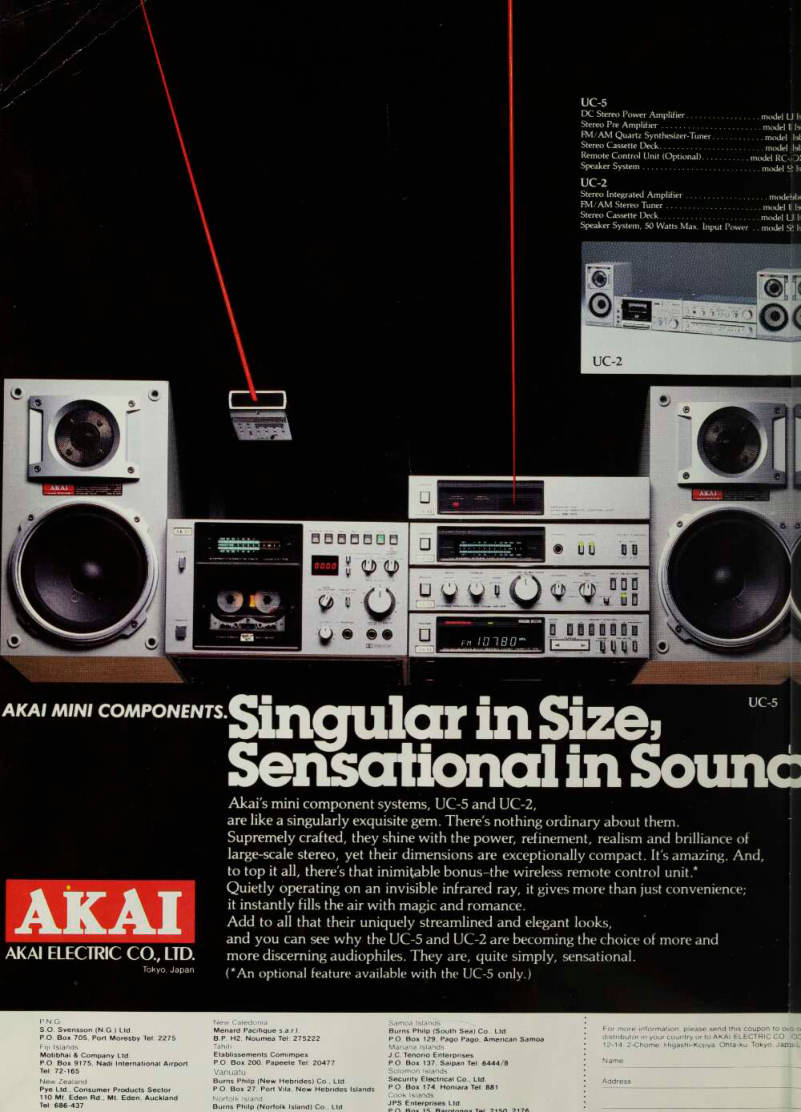
Akai
I — l
mSZZZZ!
DQDBDOD q
HUH U ai k I v> UC-5 DC Stereo Power Amplifier model U Is Stereo Pre Amplifier model U b FM/AM Quartz Synthesizer-Tuner model bt Stereo Cassette Deck moc e i ( y [ Remote Control Unit (Optional) model RC O' Speaker System model S b UC-2 Stereo Integrated Amplifier modehtw FM/AM Stereo Tuner model U b Stereo Cassette Deck model U It Speaker System, 50 Watts Max. Input Power . model Si I ■■■
*lll3l
V t y
y « e • Id
#■ V, A I 111 ja
AKAI MINI COMPONENTS.
LJC-5
Singular in Size>
Sensational in Sounc
AKAI
AKAI ELECTRIC CO., LTD.
Tokyo, Japan Akai's mini component systems, UC-5 and UC-2, are like a singularly exquisite gem. There's nothing ordinary about them.
Supremely crafted, they shine with the power, refinement, realism and brilliance of large-scale stereo, yet their dimensions are exceptionally compact. It's amazing. And, to top it all, there's that inimitable bonus-the wireless remote control unit* Quietly operating on an invisible infrared ray, it gives more than just convenience; it instantly fills the air with magic and romance.
Add to all that their uniquely streamlined and elegant looks, and you can see why the UC-5 and UC-2 are becoming the choice of more and more discerning audiophiles. They are, quite simply, sensational. (*An optional feature available with the UC-5 only.)
PNG
S.O. Svensson (N G ) Ltd.
P.O. Box 705, Port Moresby Tel: 2275 Fiji Islands Motlbhai & Company Ltd.
P.O Box 9175, Nadi International Airport Tel: 72-165 New Zealand Pye Ltd., Consumer Products Sector 110 Mt. Eden Rd , Ml Eden. Auckland Tel: 686-437 New Caledonia Menard Pacitique s.a.r.l.
B P H 2, Noumea Tel: 275222 Tahiti Etablissements Comimpex P.O Box 200, Papeete Tel: 20477 Vanuatu Burns Philp (New Hebrides) Co., Ltd P.O Box 27, Port Vila, New Hebrides Islands Norfolk Island Burns Philp (Norfolk Island) Co., Ltd Samoa Islands Burns Philp (South Sea) Co.. Ltd P.O. Box 129. Pago Pago, American Samoa Mariana Islands J.C. Tenorio Enterprises P.O Box 137, Saipan Tel 6444/8 Solomon Islands Security Electrical Co., Ltd.
P O Box 174, Honiara Tel: 881 Cook Islands JPS Enterprises Ltd For more information please send this coupon to oio o distributor in your country or to AKAI ELECTRIC CO . OC 12-14. 2-Chome. Higashi-Kojiya. Ohta-ku. Tokyo. Jap:tßL Name Address
Pacific Islands Monthly
Vol. 52 No. 1
January 1981
[Usps 952480]
Representatives
’ AUSTRALIA: Distribution: NSW & ACT: Allan Rodney I Wright (Circulation) Pty Ltd, PO Box 907, Darlinghurst, NSW ' 2010, Elsewhere: Gordon & Gotch (A/asia) Ltd, Box 40, : PO, Rosebery, NSW 2018. Advertising Melbourne - ■ Ray Brown Pty Ltd, 614 Queensberry St, North Melbourne 1 3051 telephone 329 8522, telex 31717; Brisbane D Wood. Anday Agency, Box 1918, GPO, Brisbane 4001, tele : phone 44 3485, 44 1546 Adelaide Hastwell Media, PO Box 30, Glen Osmond, SA 5064, 233 Glen Osmond Rd, rFrewville. SA 5063, telephone 79 1869. Perth Adrep, 62 [Wickham St., East Perth, WA 6000, telephone 325 6395 FIJI: Distribution and subscriptions Desai Bookshops, PO Box 160, Suva, Fiji, telephone Suva 23036. Advertising - Fiji Times & Herald Ltd, 20 Gordon St, Suva, telephone [312 111. telex FJ2124 FRENCH POLYNESIA: Distribution - Hachette Pacifique, lOAve Bruat, Papeete, telephone 25610.
HAWAII, UNITED STATES: Distribution PIM, Hawaii, PO Box 22250, Honolulu, Hawaii 96822 Advertising Roger Brookes. PO Box 10217, Honolulu, Hawaii 96816, telephone 808 536 1784, MICRONESIA; Advertising - Roger Brookes, PO Box 10217, Honolulu, Hawaii 96816.
JAPAN: Advertising and subscriptions Universal Media Corporation, CPO Box 46, Tokyo, telephone 666 3036.
NEW CALEDONIA: Distribution Depot Centre de Presse Michel Pentecost, CBP2, Noumea, telephone 27 2434, 27 4729 NEW ZEALAND: Distribution Gordon & Gotch, PO Box 584, 2 Carr Road. Mt. Roskill, Auckland 4 Advertising - International Media Representatives Ltd, PO Box 2313, Auckland, telephone 795 487; 493 389, cables Intereps, Auckland Subscriptions Ross Haines & Son Ltd, PO Box 1289, Auckland, telephone 769 042 PAPUA NEW GUINEA: Distribution - Gordon & Gotch PO Box 3395, Port Moresby, telephone 254551, 254855 Advertising PNG Post-Courier, PO Box 85, Port Moresby, telephone 21 2577 UNITED KINGDOM: The Herald & Weekly Times Ltd, 8-10 Clifford s Inn, Fetter Lane, London EC4A IBU, telephone 01 831 6041, telex London 21989.
UNITED STATES MAINLAND: Advertising - Joshua B Powers Jr, Powers International Inc., 551 Fifth Ave, New Tork, New York 100 017, telephone 867 9580, telex 236514 Subscriptions - PIM, Hawaii, 2812 Kahawai St, Honolulu, Hawaii 96822.
Subscriptions
3 IM is airfreighted to most subscribers and agents in the 3 acific Islands and the United States, but not the UK or the Continent,
s ayment by personal cheque is accepted in Australian, US, 'lew Zealand, UK and Fiji currency. For other remittances )lease obtain a bank draft in Australian dollars made payable o the ANZ Banking Group, 88 Wentworth Avenue, Sydney, Australia ’ublished monthly by Pacific Publications (Aust.) Pty Ltd ind printed in Australia by Paramac, Alexandria, NSW. Aus ralian cover price is recommended retail only. Registered it the GPO Sydney for transmission by post as a publication - category B. Second class postage paid at Honolulu, Hawaii Copyright © 1978 Pacific Publications (Aust.) Pty
Ltd.
Postmaster Honolulu: Send address changes to PIM Hawaii, PO Box 22250, Honolulu, Hawaii 96822.
Local Aust.
American Samoa $US16 $13 Vjstralia $A12 $12 Canada $US18 $14 Dock Islands $13 : iji $F12 $12 : rench Polynesia
Cfp 1700
$14 3uam $US16 $13 Hawaii $US16 $13 lapan ¥4500 $16 <mbati $13 Micronesia
Sus16
$13 Hauru $18 Hew Caledonia
Cfp 1700
$14 Hew Zealand $NZ13.50 $12 Hiue $13 Horfolk Island $12 northern Marianas
Sus16
$13 3 apua New Guinea K12 $13 Solomon Islands $13 ronga $13 Fuvalu $13 Jnited Kingdom Stg 10 $15 JS Mainland
Sus18
$14 /anuatu $13 Vestern Samoa $13 Elsewhere $A16
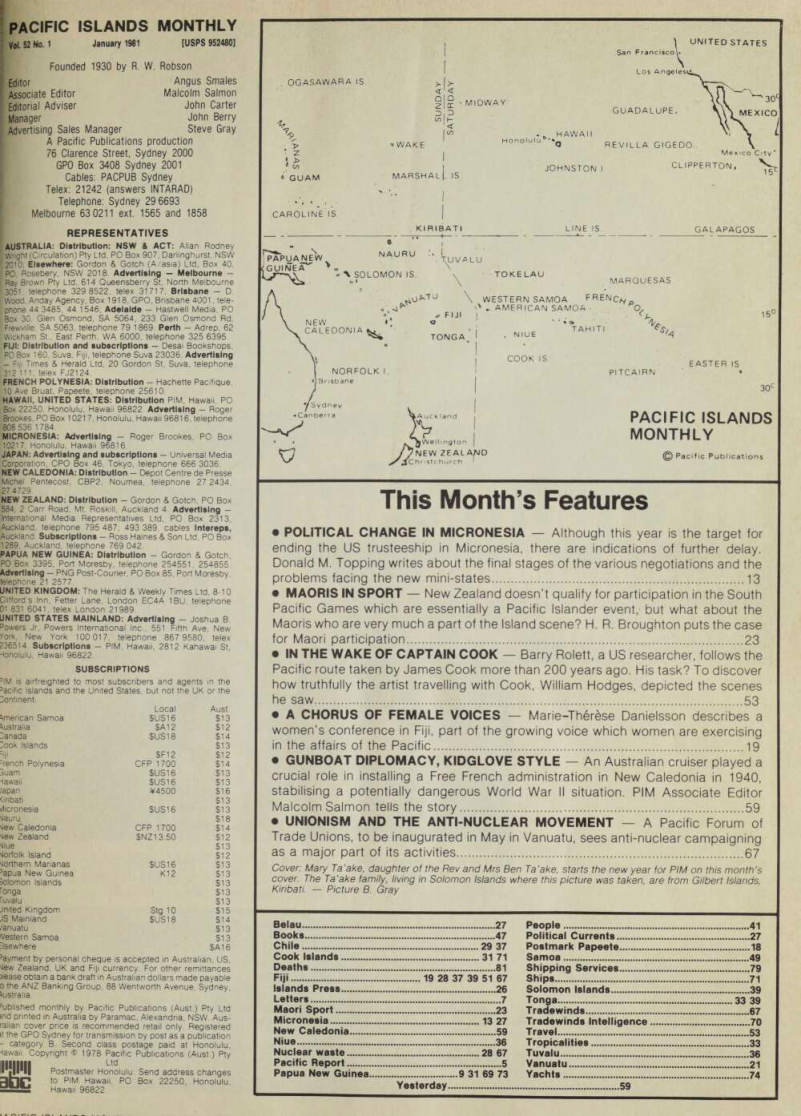
This Month’s Features
• POLITICAL CHANGE IN MICRONESIA Although this year is the target for ending the US trusteeship in Micronesia, there are indications of further delay.
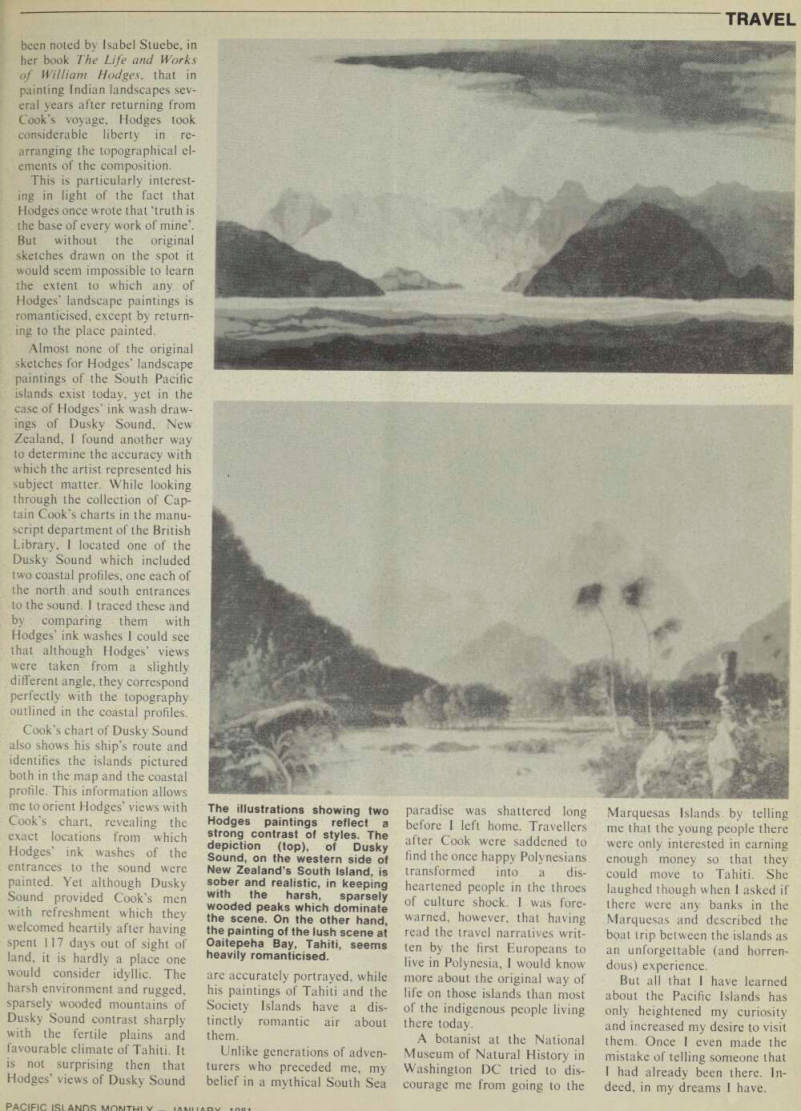
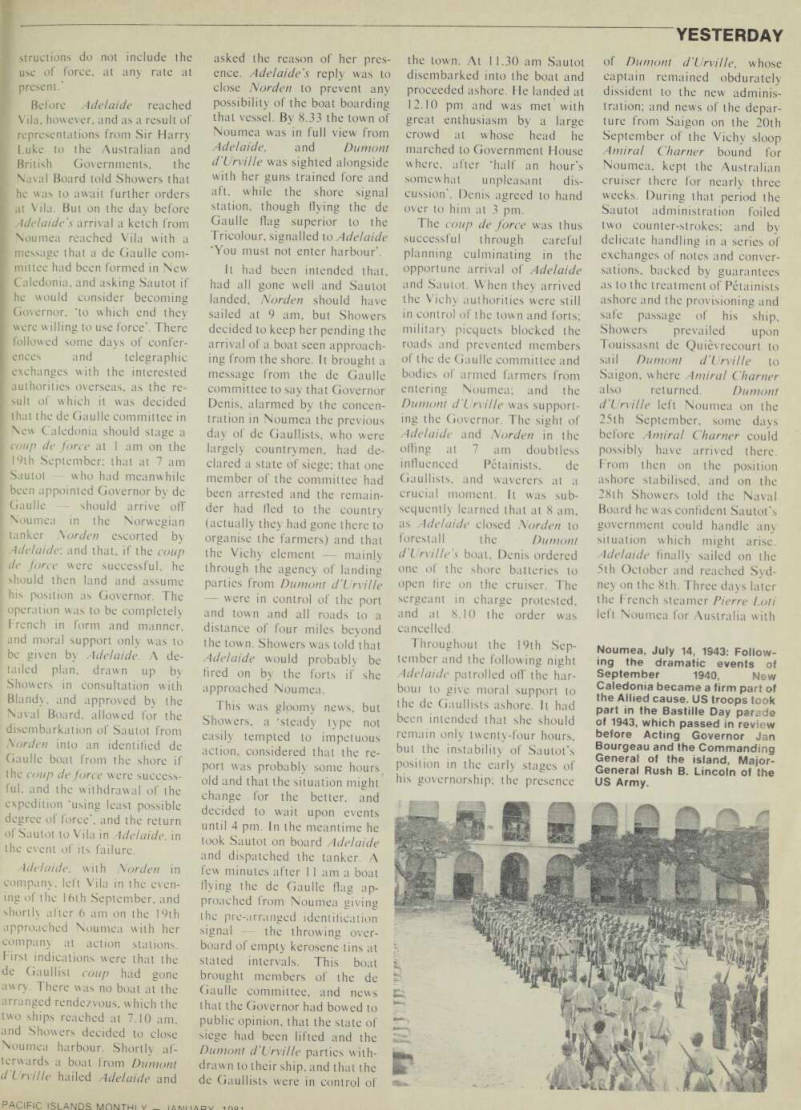
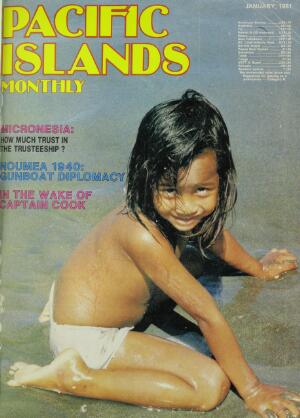
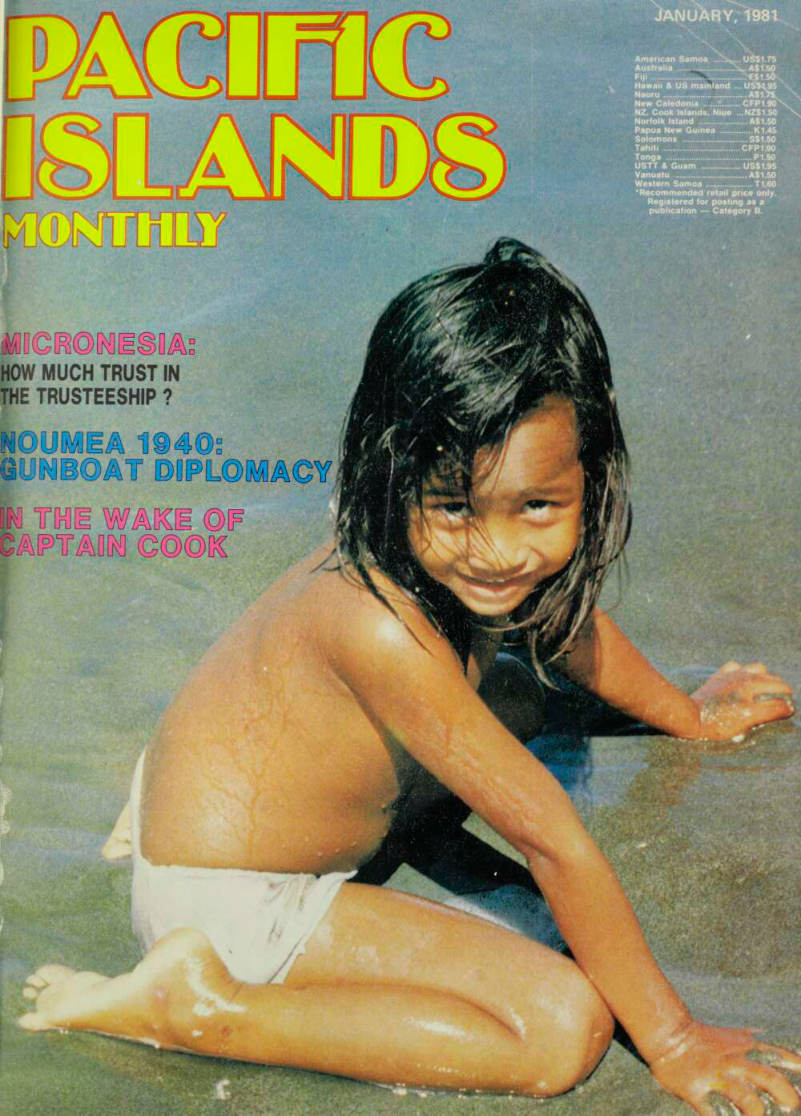
Donald M. Topping writes about the final stages of the various negotiations and the problems facing the new mini-states 13 • MAORIS IN SPORT New Zealand doesn’t qualify for participation in the South Pacific Games which are essentially a Pacific Islander event, but what about the Maoris who are very much a part of the Island scene? H. R. Broughton puts the case for Maori participation 23 • IN THE WAKE OF CAPTAIN COOK Barry Rolett, a US researcher, follows the Pacific route taken by James Cook more than 200 years ago. His task? To discover how truthfully the artist travelling with Cook, William Hodges, depicted the scenes he saw 53 • A CHORUS OF FEMALE VOICES Marie-Therese Danielsson describes a women’s conference in Fiji, part of the growing voice which women are exercising in the affairs of the Pacific 19 • GUNBOAT DIPLOMACY, KIDGLOVE STYLE An Australian cruiser played a crucial role in installing a Free French administration in New Caledonia in 1940, stabilising a potentially dangerous World War II situation. PIM Associate Editor Malcolm Salmon tells the story 59 • UNIONISM AND THE ANTI-NUCLEAR MOVEMENT A Pacific Forum of Trade Unions, to be inaugurated in May in Vanuatu, sees anti-nuclear campaigning as a major part of its activities 67 Cover: Mary Ta'ake, daughter of the Rev and Mrs Ben Ta’ake, starts the new year for PIM on this month’s cover. The Ta 'ake family, living in Solomon Islands where this picture was taken, are from Gilbert Islands, Kiribati. Picture B. Gray
Belau 27 Books 47 Chile 29 37 Cook Islands 31 71 Deaths 81 Fiji 19 28 37 39 51 67 Islands Press 26 Letters 7 Maori Sport 23 Micronesia 13 27 New Caledonia 59 Niue 36 Nuclear waste 28 67 Pacific Report 5 Papua New Guinea 9 31 69 73
People 41 Political Currents 27 Postmark Papeete 18 Samoa 49 Shipping Services 79 Ships 71 Solomon Islands 39 Tonga 33 39 Tradewinds 67 Tradewinds Intelligence 70 Travel 53 Tropicalities 33 Tuvalu 36 Vanuatu 21 Yachts 74
Yesterday 59
Advertisements & other items, pp. 3-4 (2 items)
t
Founded 1930 by R. W. Robson f Editor Angus Smales I Associate Editor Malcolm Salmon I Editorial Adviser John Carter [ Manager John Berry I Advertising Sales Manager Steve Gray A Pacific Publications production 76 Clarence Street, Sydney 2000 GPO Box 3408 Sydney 2001 Cables; PACPUB Sydney Telex: 21242 (answers INTARAD) Telephone: Sydney 29 6693 Melbourne 63 0211 ext. 1565 and 1858
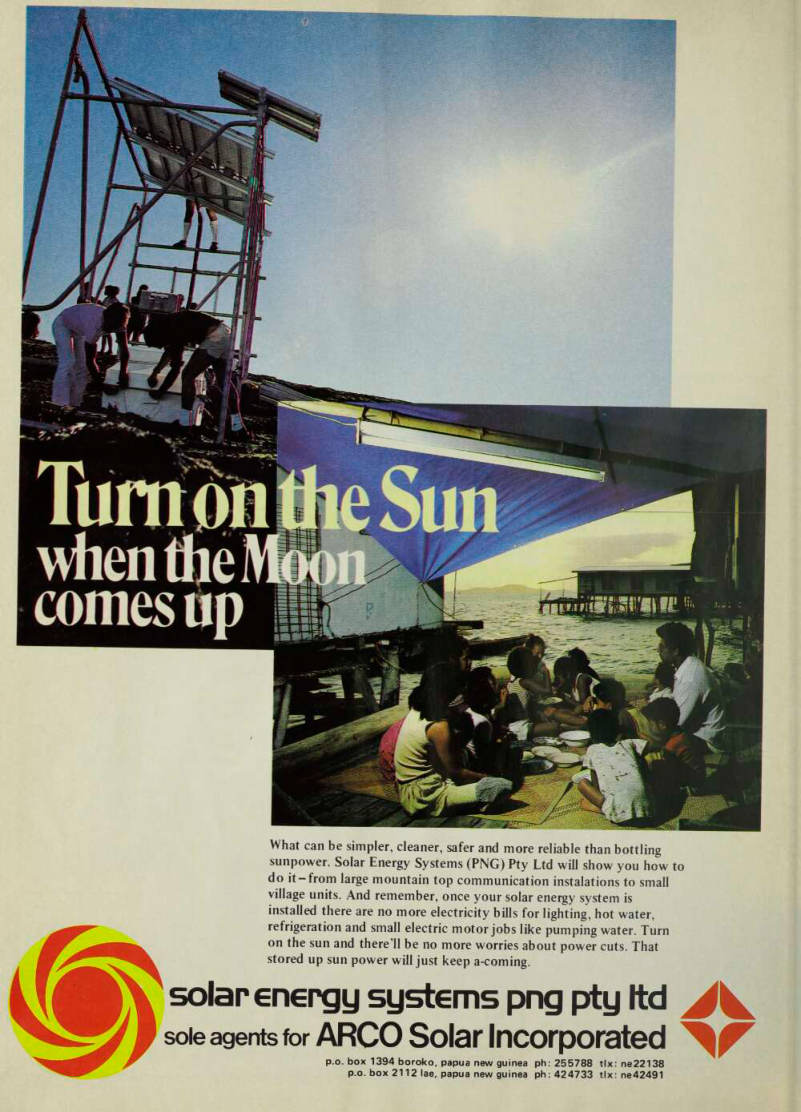
solar energy systems png pty ltd A
miA
What can be simpler, cleaner, safer and more reliable than bottling sunpower. Solar Energy Systems (PNG) Pty Ltd will show you how to do it-from large mountain top communication instalations to small village units. And remember, once your solar energy system is installed there are no more electricity bills for lighting, hot water, refrigeration and small electric motor jobs like pumping water. Turn on the sun and there’ll be no more worries about power cuts. That stored up sun power will just keep a-coming. solar energy systems png pty ltd A
sole agents for ARCO Solar Incorporated
p.o. box 1394 boroko, papua new guinea ph: 255788 tlx: ne22138 p.o. box 2112 lae, papua new guinea ph: 424733 tlx: ne42491
Pacific Report
Strike Paralyses Fiji Sugar Mills
Fiji's vital sugar-milling industry was paralysed in November when most of the 220 members of the Fiji Sugar-Milling Staff Association objected to the appointment of an Australian as chief engineer at the Fiji Sugar Corporation’s Labasa mill. The unionists, who hold senior supervisory jobs in the FSC’s four mills, claimed a ‘local’ should have got the job. All four mills were closed within two days of the outbreak of the strike, and 690 000 tonnes of cane worth about SF2I million was in danger of being left to rot unharvested, only a few weeks short of the end of the 1980 harvest. About 3700 mill workers faced premature lay-offs, and 14 000 part-time cane cutters were idle. The engineer’s position had been advertised in local newspapers in July, but no local engineer had applied. After five days of intense effort by the independent chairman of the sugar industry lan Thomson and Minister of Agriculture Jonati Mavoa, the dispute ended up before Fiji’s Prime Minister Ratu Sir Kamisese Mara. What happened at the meeting has not been made public, but suddenly the strikers were ready to return to work, and did, the ‘offending’ engineer was transferred, and a three-man indepen dent committee was being appointed to examine the causes of the dispute. The FSC management board later claimed that Ratu Mara had ‘humiliated’ the corporation, and ‘undermined’ its authority. The board said it appeared that displays of militancy would be allowed to override any rational or ethical stances.
Hurricane Hits Moruroa
A hurricane hit the French nuclear-testing site of Moruroa Atoll, French Polynesia, on November 28. Despite official claims minimising damage, the Papeete daily La Depeche estimated it would cost about CFPIOO million to repair. The atomic testing centre’s desalination plant which provides the centre with fresh water was put out of action. Due to advance warning, personnel were able to take shelter, but about 30 people were reported to nave suffered slight injuries.
Png Pm In Australia, Indonesia
The Papua New Guinea Prime Minister, Sir Julius Chan, made a brief visit to Australia in December and appealed to Australian industry to invest more heavily in his country. Sir Julius said he was disappointed that few Australian investors had taken up opportunities now available to establish export industries in PNG to supply Australian markets. He believed that such arrange ments, which were provided for under the PNG-Australia Trade and Commercial Relations Agreement, were to the benefit of both countries. Sir Julius was speaking in Canberra to the newly formed Australia-PNG Business Cooperation Committee. He said that Australian businessmen at times were risking their capital in unstable overseas environments while ignoring the safer opportunities in PNG close to home. Sir Julius praised the Australian aid programme to PNG. He described it as ‘the most noble and dignified arrangement ever made between a former administering country and its past colony’. Sir Julius held talks with several Australian cabinet ministers before leaving for an
official visit to Indonesia. President Soeharto of Indonesia discussed regional and bilateral issues with Sir Julius in Jakarta, and gave an assurance that Indonesia did not wish to interfere with the affairs of its neighbours. This was seen as a direct response to often-voiced fears by Papua New Guineans that the land border between the two countries was a gateway for Indonesian influences. The talks between Sir Julius and President Soeharto touched on the role in which PNG sees itself as a bridge between South-east Asia and the Pacific.
Santo’S ‘Government In Exile’
Former French residents of Santo who fled to Noumea are ‘for all practical purposes’ operating as a government in exile, according to John Beasant, official spokesman for the government of Vanuatu. In a December press interview, he said that the ‘government in exile’ comprised a core of some 40 former French colons who were still trying to promote the secession of Santo. Mr Beasant said the government would declare Arnaud Lizop, French lawyer, a prohibited immigrant because of his role in promoting Santo secession (see p2l). It has already taken this step, and for the same reason, in relation to Jean-Jacques Robert, former French resident commissioner in the New Hebrides. Meanwhile the Vanuatu Government an nounced on ‘Unity Day’, November 29, that there would be no pardons granted until all persons charged in connection with the secessionist revolt on Santo had been tried. Pardons would only come after completion of the court hearings against the 100 or so people who were then still to stand trial.
‘Boycott Japan’ Call In Micronesia
The Congress of the Federated States of Micronesia (FSM) has urged the FSM president to open talks with other Pacific countries with a view to organising a boycott of Japanese goods should Japan go ahead with plans to dump nuclear waste ‘north of the Mariana Islands or elsewhere in the Pacific Basin’. The resolution, carried by the congress late in November, noted that nations and territories of the Pacific ‘imported hundreds of millions of dollars in goods from Japan', and that the threat of a unified boycott by these nations should discourage the government of Japan from proceeding with its dumping plans.
Adoption of the resolution followed the visit to Ponape in mid- November of a team of Japanese experts to explain the Japanese plans to FSM officials. Earlier, the state legislatures of Ponape, Truk and Yap had adopted resolutions opposing the nuclear dumping plans.
Northern Marianas Disaster Area’
President Carter has declared the Commonwealth of the Northern Mariana Islands a major disaster area following November 22’s devastating Typhoon Dinah. Tinian and Saipan suffered severe damage from winds which reached 185 kph.
Federal assistance from the president’s disaster relief funds will include temporary housing assistance for disaster victims, low interest loans from the Small Business Administration, and emergency loan assistance from the Farmers’ Home Adminis tration. The cost of removal of debris and restoration of public facilities will be shared on a 75%-25% basis by Federal and Commonwealth agencies.
Fijian Nationalists Woo Soviets
The Fijian Nationalist Party, which was responsible for the defeat of the ruling Alliance government in the 1977 general election, has asked the Soviet Union to help it to organise for the general election due in 1982. A vice-president of the party, who had met the Soviet Ambassador to Australia in Canberra, said the Russians were ready to offer training to people from Fiji ‘subject to (Fiji) Government approval’. Aid for the Nationalist Party had been discussed but ‘no commitment’ had been given, he said.
Fiji Says ‘No Asylum’ For Chileans
The Fiji Government in December refused the request of five Chilean men for political asylum. Denying charges of ‘inhumanity’ on the part of the government, Minister for Labour and Immigration Ratu David Toganivalu said that the men had left Chile for Hong Kong on valid passports. Arriving in Australia, they were allowed to stop at Brisbane as transit passengers. Between Hong Kong and Brisbane they had ‘lost their passports’. They had applied for refugee status in Australia, but ‘for reasons best known to Australian immigration’ were refused. The Chilean ambassador told them to return home by Lan Chile airlines.
When they arrived at Nadi there were representations by various public people that the government should receive them.
However in view of the data’ it had collected, the government be^ 0 u 6C L the A y should move on as ducted by their ambassador and by the Australian Government. Ratu David said he ‘did not think there was any inhumanity on the part of government in exercising its duties on this basis, and therefore they returned to uniie .
Nz Aid Under Microscope
The level of New Zealand’s overseas aid has been criticised by a committee that advises the government on its aid programmes The committee has championed the target figure of 0 7% of the gross national product as the level of official aid. In its latest a x nn . U ?'T, port notes that the fi 9 ure for 1978 was 0.34%. A peak of 0.52 /o was reached in 1975. The committee said that the question of priorities in the distribution of aid was another important concern. It said: ‘A large proportion of New Zealand a| d goes to the Pacific. This is our region and there are sound political and economic reasons for this choice. However the volume of aid now flowing into the Pacific does raise serious questions. These Island nations do not suffer the same degree of poverty as other developing countries.’ The emphasis on the Pacific has meant restricted programmes in such countries as India and Bangladesh where desperate human need exists on a vast scale. But Dr Tom Davis, Cook Islands premier, who was in New Zealand at the time the report was released, still expects an •Hcrease in New Zealand aid to his country. In a statement published two days after release of the committee’s report, he said that in 1964 New Zealand budgetary aid met 75% of’the Cooks’ total budget. The figure was now 23%. ‘lt has decreased over the years, which is the way we mutually wanted it to go and still wish it to go, said Dr Davis. ‘But we’d like to keep it at its present level because of all the things left undone, like maintenance of the roads.’ Dr David declined to say how much extra aid the Cooks sought, but concluded: ‘The outcome I think, will be an increase in New Zealand’s contribution ’
Permanent Hq For Games
Permanent headquarters for the South Pacific Games were established in November in Noumea. Head of the new office Roger Kaddour has appealed to Games officials throughout the region to send him all available documents relating to the organisation of the Games for SPG archives he is in the process
of establishing.
Fiji To Join Sparteca
Fiji has decided to join SPARTECA (the South Pacific Regional Trade and Economic Co-operation Agreement) after at first declining to do so. The agreement provides duty-free unrestric ted access to Australia and New Zealand for most products exported by South Pacific Forum countries. One of Fiji’s difficulties was over orange juice, where it was felt that Sparteca did not give it the assured access it needed on the New Zealand market. However, after talks between New Zealand’s Minister of Trade and Industry Lance Schneider and Fiji officials it was agreed that New Zealand would review its Sparteca arrange ments for orange juice when the Fiji product comes ‘on stream’ in 1982. Fiji then announced its intention to join.
Behind The Cooks Joining Spc
The Cook Islands’ accession to full membership of the South Pacific Commission (PIM Dec p 15) is important in the international field, ‘where there is little understanding of the significance of self-government and the Cook Islands’ special relationship with New Zealand,’ according to Jim Gosselin, the Cooks’ secretary of external affairs. Mr Gosselin added: ‘The membership is also part and parcel of our application to accede to the Lome Convention. The premier stated in a letter to the (South Pacific) Conference that the move was significant in that it was the first time the Cook Islands had become party to a multilateral agreement which includes Britain and France. Now our point is that if we can become a party to a multilateral agreement here, there is no reason why we couldn’t become party to the Lome Convention which also includes Britain and France.’ Other countries admitted as full members of the SPC at the recent conference in Port Moresby were the Federated States of Micronesia, Commonwealth of the Northern Mariana Islands Republic of Vanuatu, and Niue.
Mmy Stevens’ ‘Wife’ Who Wasn’T
There were red faces in Australian media circles in December when a woman presented at a book launching as Ravae ‘the 27th wife of Jimmy Stevens’ turned out to be a Sydney actress simply
playing a part. She fooled Sydney’s newspapers, television anon hac'a W r h r P?^ formance - Tha young woman, Isobel Gidlews has an English father and a Vanuatuan mother. She has in recenn times been active promoting drama in Vanuatu. She appeared ini as a Stevens wife at the launching at a Sydney hotel oo ? h d °° k ’ Cwonut War, by Australian journalist Richaroi rhff^inlt 6 t b th°o ls Said t 0 take a '•'Qht-hearted, tongue-inn mLh* c k 3 tha + Santo secessionist revolt of May-August 19800 Matters reached the point where Jimmy Stevens himself wa°e interviewed on the subject in gaol in Port-Vila by an Australian* pressman. An incredulous Stevens said: ‘Ravae? Ravae? Who H Ravae? I have no wife called Ravae.’ He added: ‘I don’t even* tlfat 0 Q t 7 wives / 1 th'Hk 't’s 20.’ The reporter expressed his doubld that Stevens had in fact ‘married’ even 20 women. He wrote:e 9 u V ? S im P ression that on e marriage was “solem-n msed but is reticent about the remainder which fall under th©r category of custom” marriages.’
The Saga Of The Chidiock Tichborne
Late last year when he made landfall at Cairns, Queensland t 38 -y ear -°|d w ebb Chiles completed a two-yearj 13 68S km crossing of the Pacific in his open 5.5 m boat, ChidiockA: Tichborne. On May 10 1980 in Vanuatu waters his boat hit a half-t submerged object and was swamped. He took to his rubben* hferaft and secured to the crippled Chidiock Tichborne, driftedb 480 km in 14 days before being washed over a reef on an islandb in Vanuatu. He was rescued by villagers, flown to hospital withfi acute malnutrition and badly infected feet. After recuperatinq hee repaired the boat and set sail for Australia on October 9 Thee remar k able voyage started from San Diego, California, onn November 12 1978. Chiles, who has previously circumnavigatedb solo in a much larger yacht, writes books and magazine articless about his voyages. He does it, he says, ‘because I want to go toe he edge of human experience’. His boat, with no protection fromr the elements, is so small that he has to sit on the floorboards andt steer by hand. He sleeps stretched out in the bottom of the boat which has no bunks. He has to wear protective clothing andt sunscreen in the heat of the tropics to prevent illness through r severe exposure. * NEW PAPERS BURST OUT ALL OVER (3) Derson Ramon, Federated States of Micronesia Information Specialist, writes: ‘Under your Pacific Report (PIM Nov p 6) you forgot to mention the FSM newspaper in the item ‘New Papers Burst Out All Over’. The FSM Government has started a bi weekly newspaper, The National Union. This paper is for the government and people of the FSM.' Thank you, Derson Ramon.
Fiji To Push ‘Up-Market’ Soaps
A slice of the quality toilet soap market in Australia, New Zealand, Hong Kong, Canada and on the United States West Coast was the prize being sought by a Fiji Government mission which toured those parts in October-November. At a press conference in Sydney sponsored by the office of South Pacific Trade Commissioner Ron Hegerhorst, members of the mission pointed out that Australia alone imports $2 750 000 worth of ‘up market’ soaps every year. With the admitted packaging problems faced by Fiji s two soap factories overcome, members of the mission believed that Fiji could capture about 5% of the Australian market in 18 months. They pointed out that the strength of the Fiji product lay in its high proportion of coconut oil; from 25% to 100%, depending on the brand. Soaps generally available on the Australian market contain as little as 10% - 12%. With prices of quality European soaps skyrocket ing, they believed that the Fijian product would be extremely competitive. The mission was funded by Britain’s Commonwealth Fund for Technical Co-operation.
Off-The-Record On France-Oz Ties
The Paris correspondent of the Noumea weekly Corail, Hubert Chavelet, reports an alleged off-the-record comment by French Foreign Minister Jean Frangois-Poncet on the General Barthelemy affair (PIM Nov p 5). Mr Frangois-Poncet is reported to have said: ‘We can’t do anything in the South Pacific that upsets the Australians. We have too great a need for their mineral resources coal, uranium, and so on. We must give in to them on whatever they ask of us.’ (General Barthelemy, former commander of French armed forces in New Caledonia, was abruptly recalled earlier this year after he had written to the Australian Consul in Noumea accusing Australia of ‘direct participation in repressive operations’ against French citizens on the island of Santo, Vanuatu.)
The price of PIM
PIM regrets that starting from this issue it has been found necessary to increase the price for news-stand copies. The decision to raise the price it is the first price rise for three years was taken reluctantly after a careful study of rising costs of production and distribution. The costs of distribution in particular have been rising steeply, and have become a big factor in air-freighting PIM to readers throughout the Pacific Islands and beyond. For a limited period, subscription prices will remain unchanged.
Advertisements & other items, pp. 5-6 (2 items)
ACIFIC IRI ANDS MfIMTHI V iamiiadv mm
6
PACIFIC ISLANDS MONTHI Y JANUARY IQRI
Shipping chief

Letters
sets record
straight
1 was concerned to read your article TNG line slips far into the red’ (PIM Oct p 72). Over the past 13 years as a reader and contributor to your magazine, I have come to respect the quality of your maritime reporting. It is most unfortunate that you should on this occasion produce an article, which could have poten tially damaging effects on the PNG Shipping Corporation, based on third party information, and not a particularly reliable source at that.
The PNG Shipping Corpor ation did make a loss in 1979, a loss of K 143 000 before payment of Australian turn-over tax, which exacerbated the loss to K 246 163. Expressed as a func tion of an income in excess of K 8.5 million, the loss (before tax) amounts to 1.67% of revenue.
These results take no account of profits from stevedoring invest ments, which are accounted within a different financial year.
While the corporation is less than satisfied with these results, we believe that they should be read in context with the enor-
These developments were not achieved without cost. The coastal trade in PNG operated in 1979 on a government-controlled tariff which had seen no increase for three years. However, with the introduction of reasonable increases to freight rates, and the consolidation of advances made in 1979, 1980 should see the return of the corporation’s coastal business to profitability.
It is regrettable that advisers with little relevant experience or competence should cast subjec tive criticism on ship size and relative effort in the coastal trade. I recollect, with some chagrin, that at least 90% of the (60 hour + working week) effort of the small executive of the corporation in 1979 was dedi cated towards the coastal trade.
I cannot accept that the cor poration has expanded its over seas activities at the expense of the coastal trade. Priority from the outset has been directed towards the coastal trade. Our overseas activities have been basically threefold. • Participation in the PNGL/ NGAL Joint Service element of the highly successful Chief Con tainer Service. This service runs with its own self-contained man agement unit; • Extension of our coastal services through to Darwin.
Given the size and speed of ships we operate, this has been achieved by careful program ming without detriment to the coastal trade. In the course of the year this trade has seen an increase in tonnage of PNG exports carried from 840 tons on the inaugural voyage to 2400 tons on the current voyage; and • Our trans-Pacific service, in troduced earlier this year, has proved extremely successful.
With the fourth sailing currently under way, we have carried the entire PNG coffee crop exported to North America, together with substantial quantities of cocoa, tea, frozen fish and seafood. This
mous progress achieved by the corporation during 1979 and since in terms of providing effective shipping services to PNG, especially on the coastal trade. I would like to take this opportunity of reviewing these developments in order that your readers may get a more balanced view of our activities.
Up to the beginning of 1979, the PNG coastal trade had trad itionally been carried by an armada of superannuated, in competent vessels. Nineteen seventy-eight saw the collapse of the then principal carrier, leaving extensive debts and a near break down of cargo movements on certain routes. Mainport Car goes, in whom the Shipping Corporation had a minority shareholding, took over as the principal inter-mainport carrier, and immediately set about retonnaging and remodelling the company’s operations to match the requirements imposed upon it. This retonnaging was ex ecuted in accordance with a detailed plan, which foresaw not only the immediate requirement but also the future of the PNG coastal trade.
In the course of 1979, the corporation bought out the re maining shareholding in Main ports; injected new management into the company; commissioned one new ship, Moresby Chief, onto the coastal trade; intro duced a limited container oper ation in step with customer demand; and pensioned-off three old vessels. These changes, together with two smaller mod ern ship units commissioned in the latter part of 1978, have given Mainport Cargoes (now renamed PNG Mainport Liner Services) a balanced modern fleet of vessels and capabilities snited to the requirements of the coastal trade. More particularly, it has given our customers the sort of service they require, with adequate capacity for future
developments.
profitable initiative on the part of the corporation has ad ditional benefits to the country in terms of the hidden earnings of carrying PNG cargo in PNG flag ships. Our trans-Pacific service offers stop-off calls to Solomon Islands and Kiribati.
In addition to our coastal and overseas trades, the corporation operates towing and salvage ser vices based in Lae and Port Moresby. These operations pro vide a profitable, vital service.
For the record, the corporation operates a total of six ships, three tugs and a barge.
The corporation has achieved all this on strictly commercial terms in a strongly competitive environment, without recourse to government guarantees, and only modest, by shipping standards, calls on shareholder equity. We have created over 200 jobs for Papua New Guineans, and have established comprehensive train ing programmes for Papua New Guineans in the disciplines of shipping management, navigat ion and marine engineering.
I trust that the foregoing sets the corporation’s record straight within your pages. It is regret table that a line which has demonstrated real initiative and dedication in the development of Papua New Guinea’s shipping requirements should come under such unjustified cloud.
(Captain) P. H. KING
Managing Director Papua New Guinea Shipping Corporation Pty Ltd Port Moresby
Png
Film man asks
for help
I am at present negotiating seven one hour dive/travel films in the Pacific region.
The general theme will be built around the idea of an ex serviceman returning to areas where many spent their youth fighting during World War 11.
We intend diving and filming on ships and aircraft, filming the rusting reminders on land, show ing local culture and the beauty of the areas.
Some of the proposed lo cations are: Papua New Guinea, Solomon Islands, Vanuatu, Guam, and so on.
Assistance and information is required as regards the diving and the location of wrecks (ships or aircraft). The remains of
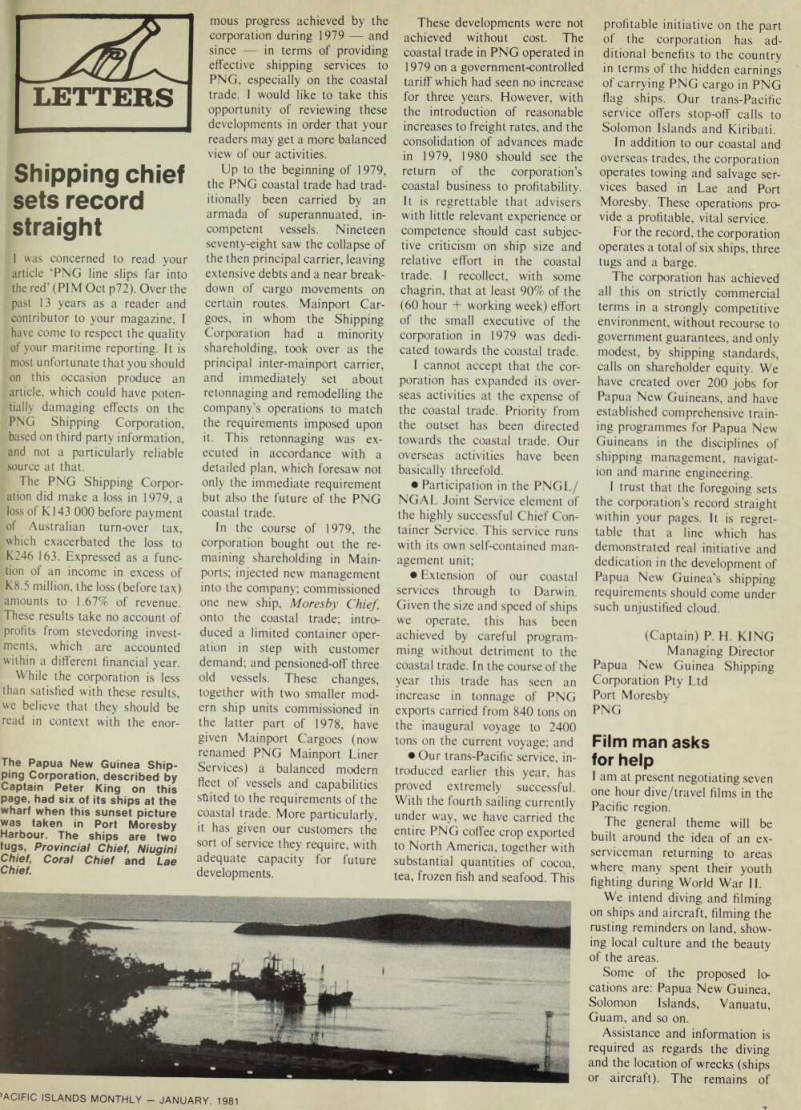
The Papua New Guinea Ship ping Corporation, described by Captain Peter King on this page, had six of its ships at the wharf when this sunset picture was taken in Port Moresby Harbour. The ships are two [?]tugs, Provincial Chief, Niugini Chief, Coral Chief and Lae Chief.
bombers or fighters on land and other reminders of the past, details from people who can remember aircraft coming down or a ship sinking. In fact, any information that will make the film more interesting would be
greatly appreciated.
Hoping that PIM readers can assist.
Walter Deas
Seasports 8 Arkana Place Engadine 2233 Australia
N-testing and
independence
I don’t wish to join the continuing tiff between your correspondents S. Polume and T. de Montluc.
Nevertheless, I would like to take a sniper-shot at the latter’s letter entitled ‘A rose by any other name ...’ (PIM Oct plO).
Specifically, I would endeav our to take de Montluc up on the question of the realtionship be tween ‘nuclear testing’ and ‘inde pendence’. The fifth paragraph of de Montluc’s letter states: ‘.. . most of our people (Tahitian cum Polynesian) do not condone nu clear testing and I am also completely against it; but that is a completely different issue from the independence one’.
On the contrary I would like to contend that there is a definite, direct relationship between nu clear testing and independence.
At the Nuclear-free Pacific Conference 1980, which I was privileged to attend as a rep resentative of the University of the South Pacific Students As sociation, the delegations from the Pacific Islands unanimously agreed that nuclear testing, nu clear waste dumping, and the deployment of nuclear missiles and nuclear-powered vessels in the Pacific Ocean are on the one hand simply the manifestations of our (Pacific Islanders’) help lessness as a political force in the face of the continuing presence of colonial powers such as France and the United States in the Pacific. On the other hand, they are extensions (and the deadliest of all) of what metropolitan colonial governments and peoples have been doing to us ever since they set foot on our shores from blackbirding to shady land deals and now to possible mass genocide through
nuclear radiation poisoning. Fur thermore, the Pacific Island del egations also recognised and resolved that the struggle for a Nuclear-free Pacific is basically a struggle for an independent Pacific Basin. I do not wish to split hairs over the nuances of the word ‘independence’, but I must qualify the ‘Pacific Island delegations’ that I have been referring to.
The Pacific Island delegations at the conference were indigen ous people from Vanautu, Tonga, Fiji, Cook Islands, Palau, Marshall Islands, Truk, Tahiti, Maoris from Aotearoa, Aborigi nes from Australia, Hawaiians from Hawaii, Indians from North America and Canada, and Filipinos from the Philippines.
We were literally drawn together by the realisation that if we were to examine the nuclear fuel and nuclear bomb cycles we would emerge with the disconcerting fact that each major stage of the nuclear cycles (except where the button is) is being centred in or around areas populated by the likes of the above group of people.
Uranium is mined on Aust ralian Aborigines’ and American Indians’ lands. This uranium is transported via the Pacific Ocean to nuclear reactors erected in areas like the Bataan province in the Philippines or on American Indian soil. Nuclear bombs are being tested on Moruroa and were tested in the past in the Micronesian area. Now they are talking of dumping radioactive waste in the Pacific Ocean.
Please note however that there are non-Pacific Islanders residing in these areas too, but a closer inspection will reveal that these are what the metropolitan col onial governments regard as the ‘expendable scum’ of the earth, just like us poor but peace-loving Pacific Islanders.
With these salient points, who in his/her rational mind would dare suggest that there is no relationship between nuclear testing and the independence struggle?
With all respect I will honour de Montluc’s views, but I would also honour the countless voices of the Tahitians in the Te Toto Tupuna, and other similar groups. My request to de Montluc, and to all Pacific Islanders for that matter, is to
please cease looking at ourselves as Tahitian, Tongan, Papua New Guinean, Polynesian, Micro nesian, or Melanesian but to begin to perceive ourselves as Pacific Islanders full stop. In passing I wish to remind de Montluc that if someone sneezes in New Zealand, we catch a cold in Fiji, and if France were to press the button, we’re dead.
Lopeti Senituli
University of the South Pacific Suva Fiji Vanuatu: Was
PNG right?
Operation ‘Wantok Durua’ is over. Members of the Papua New Guinea Kumul Force are settling back into their respect ive battalions. Generally, the whole Vanuatu operation re ceived mixed reactions. While the success of our troops in Vanuatu was highly com mended and acclaimed by many people, countries and forums alike, the initial de cision to send the troops there was not so fortunate.PNG re ceived criticism from within as well as from outside. Amongst those who were highly critical of PNG was Fiji, one of its nearest neighbours and a mem ber nation of the South Pacific Forum.
In the. November 1980 PIM (p 32), a member of Fiji’s House of Representatives, Ratu Osea Gavidi, after having bitterly
attacked PNG, suggested that PNG should have considered the following options to settle the Vanuatu problem: Adopt the tactics that were used on Bougainville; or enter Vanuatu under the umbrella of an inter national peace-keeping oper ation approved by the United Nations.
Fiji’s arguments are certainly valid and legitimate. However, it would be misleading and unfair to compare Bougainville with Vanuatu, simply because the nature, magnitude and in tensity of the rebellion on Vanuatu were dramatically different from the secessionist movement on Bougainville. On the question of an official re quest from the United Nations, the UN charter does not forbid one country from intervening in another’s affairs provided that a request was made by the country seeking aid.
Leaving my counter arguments aside, there are cer tainly a number of basic ques tions that have never been answered to the satisfaction of our critics. One of these basic questions is, ‘Was PNG right in accepting Father Uni’s re quest?' Hopefully the answer or answers to this question would help our critics to appreciate the Vanuatu problem from a defence and security point of view. In the following com ments. 1 am going to suggest that PNG’s decision to accept
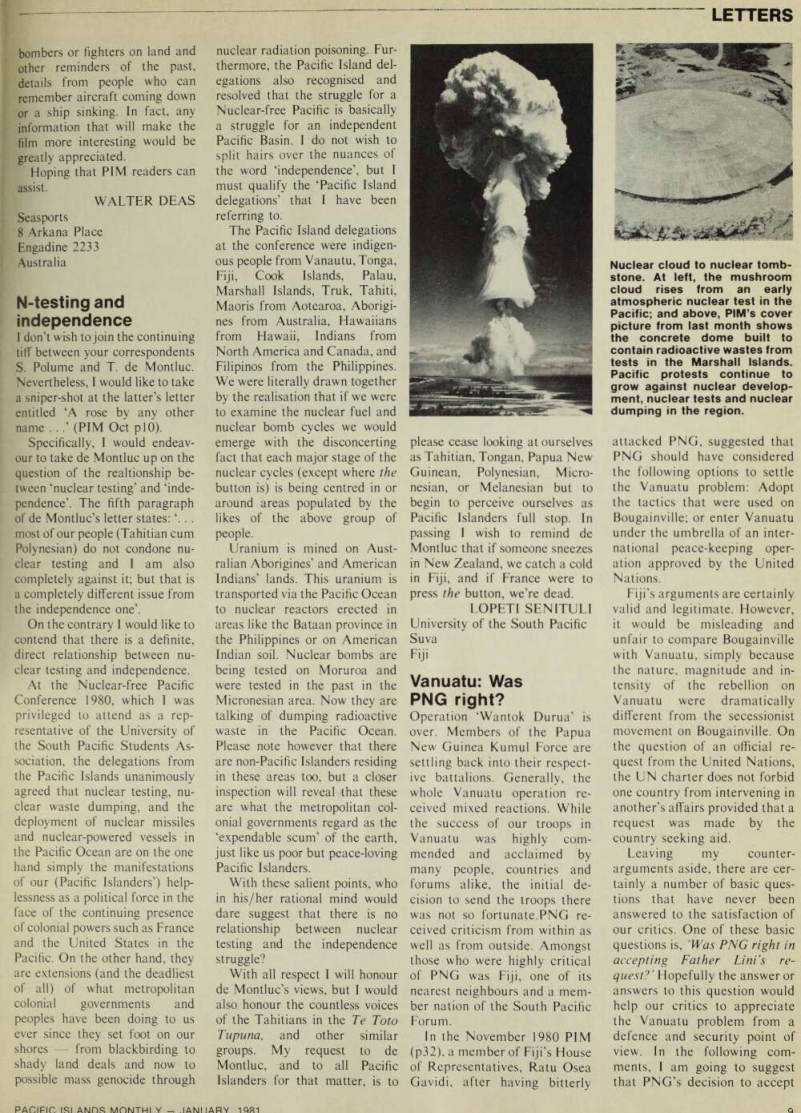
Nuclear cloud to nuclear tomb stone. At left, the mushroom cloud rises from an early atmospheric nuclear test in the Pacific; and above, PIM’s cover picture from last month shows the concrete dome built to contain radioactive wastes from tests in the Marshall Islands.
Pacific protests continue to grow against nuclear develop ment, nuclear tests and nuclear dumping in the region.
Lini’s request was based pri marily on purely political and security considerations. And, given the circumstances that surrounded Vanuatu’s post independence period, the de cision was timely.
To be able to understand how PNG reached that decision, it is helpful to go back and trace the events that led to the request for PNG’s military assistance.
The path to independence for Vanuatu has not been as fortu nate as other neighbouring island nations. Vanuatu in fact has experienced serious politi cal unrest going as far back as the early 70s when talks began about self-rule and indepen dence.
At the heart of this problem was Vanuatu’s unique status as a condominium under the joint administration of France and Britain. Before the elections in 1979, various political groups emerged to contest them. These parties fell into two broad categories of either British or French supporters. The politi cal campaigns generated bitter ness amongst the people which in turn created deep divisions between the French- and British-oriented Vanuatuans.
It was not surprising when the election results favoured the British side by a large majority that violence and se cessionist movements befell the country. As Melanesians, de feat in the elections for the French side caused severe loss of face, and the only way to restore their pride appeared to be to resort to violence.
These violent and rebellious activities were concentrated on the island of Espiritu Santo under the leadership of Jimmy Stevens. At the height of the tension, Luganville, the main town on Santo, was virtually under rebel control. They even commanded strategic points such as the airport, hospital, water resources and fuel installations. There was evi dence of gun-running, and some French settlers were suspected of shipping arms from New Caledonia to Santo. Among the rebels were about 150 hard liners who were armed and were maintaining radio communi cations for the rebels.
France’s position on Vanuatu’s independence was
far from whole-hearted ap proval. On Tanna island, for instance, the French supporters took over Tanna in the initial stages of the revolt. While French officials were not show ing open support for the rebels, their settlers and some mem bers of the police force were seen to be co-operating with them. There was, therefore, an underlying likelihood that there was an element of French involvement in the revolt, if not by its officials, at least by its citizens and settlers.
One other factor that critics need to realise is that France has a formidable military pres ence in the Pacific. According to the London-based Inter national Institute for Strategic Studies (ISS), France main tains four overseas commands, including, interestingly enough, one in New Caledonia and another in French Polynesia.
Some 19 000 French personnel from all services are deployed overseas. As there are two commands in the Pacific alone, the number of French military personnel in the region could easily reach 10 000, a significant force indeed. French troops in New Caledonia can be moved to Port-Vila, the capital of Vanuatu, within an hour.
So, at independence Vanuatu had an internal security prob lem. There were people who were against Father Lini’s
government and has resorted to rebellion activities. Unfortu nately for Fr Lini, these rebels were being supported and insti gated by citizens of a country that has a significent military presence in the Pacific. If French citizens were directly or indirectly involved in the rebel activities the uncertainties and risks to Fr Lini’s losing control were very high. Similarly, the fear of outsiders supporting an underground movement to overthrow Lini’s government was there. If that fear was in fact groundless it did exist philosophically, in the minds of Lini and his government. In such a desperate situation what was Father Lini, the father of the newest nation in the Pacific, going to do?
There were a number of options that were open to him; (a) He could choose to nego tiate with the rebels in the Melanesian way as suggested by Ratu Osea Gavidi. But how does one negotiate in a Melanesian fashion with the barrels of guns pointed at you by hard-liner rebels? (b) He could request the British police and marines to clear out the rebels. But that was asking for a possible shoot out between French settlers who were mixed up with the rebels, and British forces. (c) He could invite New
Zealand or Australia after all, they are close neighbours as well as having huge resources available. But what’s the politi cal logic? He was sending two colonial powers out, the next day he was asking another two in.
In his position, Fr Lini re alised that to negotiate with the rebels would risk innocent lives.
On the other hand, to invite Britain, New Zealand and Australia would attract poss ible sharp and angry reactions from members of the South Pacific Forum and from France. In essence, Fr Lini had a political dilemma. He realised that, while he wanted quick assistance, that assistance must come from a country that: (a) Would invite minimum angry reactions from the region and from France. (b) Would have a significant capability to capture the rebels. (c) Would be sufficiently strongly armed to deter any possible outside aggression.
To Fr Lini, PNG and Fiji appeared ideal choices. Both
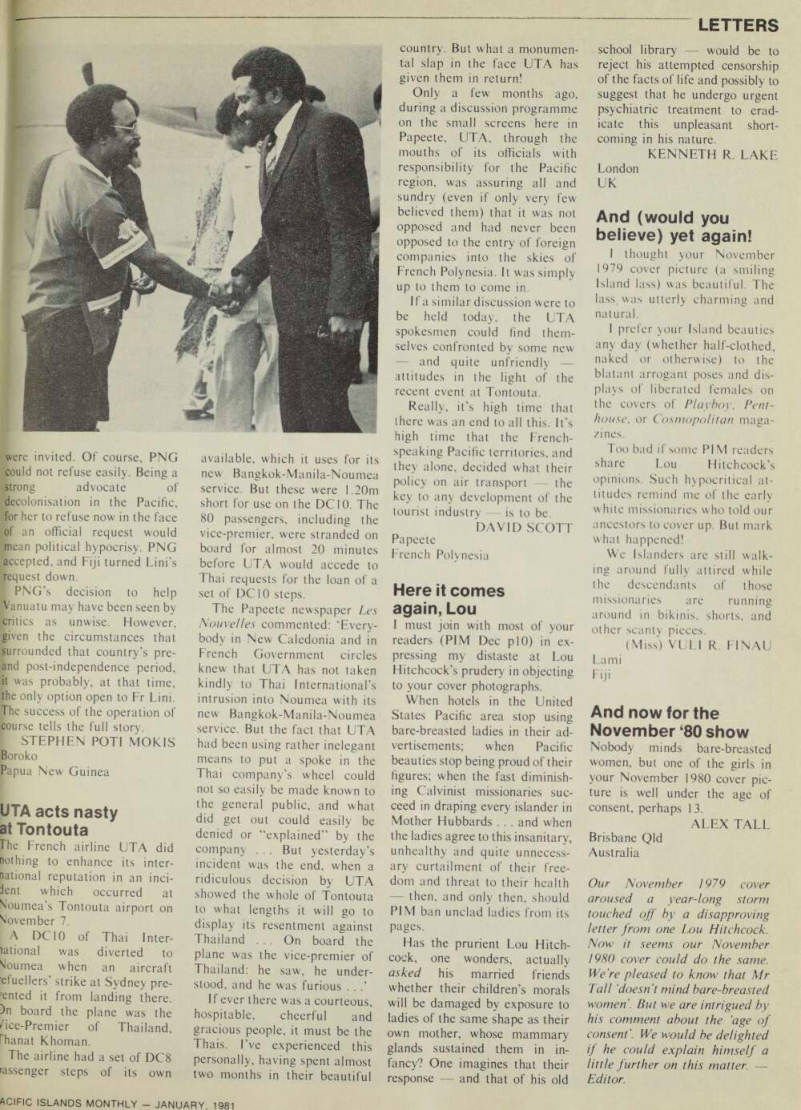
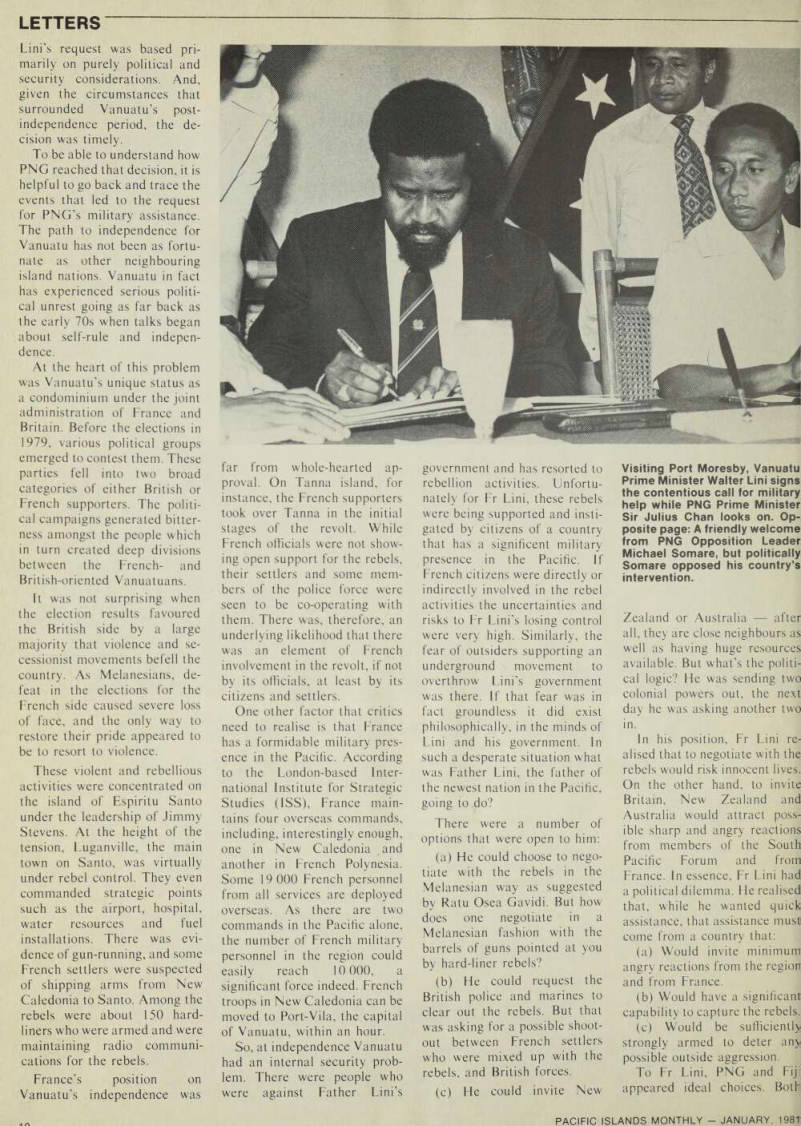
Visiting Port Moresby, Vanuatu Prime Minister Walter Lini signs the contentious call for military help while PNG Prime Minister Sir Julius Chan looks on. Op posite page: A friendly welcome from PNG Opposition Leader Michael Somare, but politically Somare opposed his country’s intervention.
were invited. Of course, PNG could not refuse easily. Being a iStrong advocate of idecolonisation in the Pacific, for her to refuse now in the face of an official request would mean political hypocrisy. PNG accepted, and Fiji turned Lini’s request down.
I PNG’s decision to help Vanuatu may have been seen by critics as unwise. However, given the circumstances that surrounded that country’s pre end post-independence period, it was probably, at that time, the only option open to Fr Lini.
The success of the operation of course tells the full story.
Stephen Poti Mokis
Boroko Papua New Guinea
UTA acts nasty
at Tontouta
Fhe French airline UTA did nothing to enhance its inter national reputation in an inci dent which occurred at Noumea’s Tontouta airport on November 7.
A DC 10 of Thai Inter lational was diverted to Noumea when an aircraft efuellers’ strike at Sydney pre rented it from landing there. )n board the plane was the /ice-Premier of Thailand, Phanat Khoman.
The airline had a set of DCS •assenger steps of its own
available, which it uses for its new Bangkok-Manila-Noumea service. But these were 1.20 m short for use on the DC 10. The 80 passengers, including the vice-premier, were stranded on board for almost 20 minutes before UTA would accede to Thai requests for the loan of a set of DC 10 steps.
The Papeete newspaper Les Nouvelles commented: ‘Every body in New Caledonia and in French Government circles knew that UTA has not taken kindly to Thai International’s intrusion into Noumea with its new Bangkok-Manila-Noumea service. But the fact that UTA had been using rather inelegant means to put a spoke in the Thai company’s wheel could not so easily be made known to the general public, and what did get out could easily be denied or “explained” by the
company . . . But yesterday’s
incident was the end, when a ridiculous decision by UTA showed the whole of Tontouta to what lengths it will go to display its resentment against Thailand ... On board the plane was the vice-premier of Thailand: he saw, he under stood, and he was furious . . .’
If ever there was a courteous, hospitable, cheerful and gracious people, it must be the Thais. I've experienced this personally, having spent almost two months in their beautiful
country. But what a monumen tal slap in the face UTA has given them in return!
Only a few months ago, during a discussion programme on the small screens here in Papeete, UTA, through the mouths of its officials with responsibility for the Pacific region, was assuring all and sundry (even if only very few believed them) that it was not opposed and had never been opposed to the entry of foreign companies into the skies of French Polynesia. It was simply up to them to come in.
If a similar discussion were to be held today, the UTA spokesmen could find them selves confronted by some new - and quite unfriendly attitudes in the light of the recent event at Tontouta.
Really, it’s high lime that there was an end to all this. It’s high time that the French speaking Pacific territories, and they alone, decided what their policy on air transport the key to any development of the tourist industry is to be.
David Scott
Papeete French Polynesia Here it comes
again, Lou
I must join with most of your readers (PIM Dec plO) in ex pressing my distaste at Lou Hitchcock’s prudery in objecting to your cover photographs.
When hotels in the United States Pacific area stop using bare-breasted ladies in their ad vertisements; when Pacific beauties stop being proud of their figures; when the fast diminish ing Calvinist missionaries suc ceed in draping every islander in Mother Hubbards . . . and when the ladies agree to this insanitary, unhealthy and quite unnecess ary curtailment of their free dom and threat to their health then, and only then, should PIM ban unclad ladies from its pages.
Has the prurient Lou Hitch cock, one wonders, actually asked his married friends whether their children’s morals will be damaged by exposure to ladies of the same shape as their own mother, whose mammary glands sustained them in in fancy? One imagines that their response and that of his old
school library would be to reject his attempted censorship of the facts of life and possibly to suggest that he undergo urgent psychiatric treatment to erad icate this unpleasant short coming in his nature.
Kenneth R. Lake
London UK And (would you
believe) yet again!
I thought your November 1979 cover picture (a smiling Island lass) was beautiful. The lass, was utterly charming and natural.
I prefer your Island beauties any day (whether half-clothed, naked or otherwise) to the blatant arrogant poses and dis plays of liberated females on the covers of Playboy, Pent house. or Cosmopolitan maga zines.
Too bad if some PIM readers share Lou Hitchcock’s opinions. Such hypocritical at titudes remind me of the early white missionaries who told our ancestors to cover up. But mark what happened!
We Islanders are still walk ing around fully attired while the descendants of those missionaries are running around in bikinis, shorts, and other scanty pieces.
(Miss) Vuli R. Final
Lami Fiji And now for the November ‘BO show Nobody minds bare-breasted women, but one of the girls in your November 1980 cover pic ture is well under the age of consent, perhaps 13.
Alex Tall
Brisbane Qld Australia Our November 1979 cover aroused a year-long storm touched off by a disapproving letter from one Lou Hitchcock.
Now it seems our November 1980 cover could do the same.
We’re pleased to know that Mr Tall ‘doesn ’t mind bare-breasted women’. But we are intrigued by his comment about the ‘age of consent’. We would be delighted if he could explain himself a little further on this matter. - Editor.
Advertisements & other items, pp. 7-12 (4 items)
’Acific Islands Monthly January, 1981
listening enjoyment
Create your own world of
There are times when you really want to get away from it all. The day-to-day pressures at work, final exams, you name it. Well, when you feel the need for a refreshing change from the world around you, why not create your own with an AVANTE system from Pioneer.
These handsomely packaged system components like our AVANTE 700, offer all the performance of separate hi-fi components and all the beauty and styling of fine furniture.
Each component is carefully matched and designed to deliver the finest in stereo listening enjoyment from the world leader in high fidelity.
If you feel it’s time to get away from it all, why not get one of our exciting AVANTE hi-fi component systems. There are five great AVANTE systems to choose from so you can create a world of enjoyment that’s right for you. AVANTE . . . the getaway machines from Pioneer—get one today.
OiDpiomeer
or further information, please contact: jstralia: Pioneer Marketing Service Pty. Ltd., P.O. Box 317, Mordialloc, Victoria, 3195 1. 90 “901 1 ji Islands; Brijlal & Company, G.P.O. Box No. 362, Suva, Fiji Islands TeL 22258 aw Zealand: Monaco Electronics Ltd., 30 Pollen Street, Grey Lynn Auckland swZealand Tel: (09) 762098 orfolk Island: Burns Philp (Norfolk Island) Ltd., Norfolk Island, South Pacific ?w Hebrides: Burns Philp (New Hebrides) Ltd., Vila, New Hebrides Nauru Island: Jacob Enterprises, P.O. Box No. 4, Republic of Nauru Tahiti: Ets. PERFECT, B.P 594, Papeete, Tahiti Tel: 20 407 New Caledonia: Menard Freres Ville, B.P. H2Cedex, Noumea, New Caledonia Tel: 27.52.22 American Samoa: Transpac Corporation, P.O. Box 1477, Pago Pago American Samoa 96799 Tel: 633-5224 Rarotonga : South Seas International Ltd., P.O. Box 49, Rarotonga, Cook Islands Tel: 2327 Y Papua New Guinea: Bali Merchants Ptv. Ltd PO Rnx fim.R Rnmkn tpi-
fin
» * Dorf makes water high performance, maintenance free, accessories. ;ome alive-with Colour co-ordinated, .taps, showers and ' —*7
Dorf...the
GOLDEN DOLPHIN
BASIN SET DE-4A
A A s %
BASIN MIXER
(ADJUSTABLE) DE-4
EXPOSED BATH MIXER
Dorf Industries
Manufacturers of taps, showers and plumbing fittings
DISTRIBUTORS FOR MALAYSIA:
William Jacks & Co (M)Sdn. Bhd Petaling Jaya-Tel. 774011 and also at - Chartered Bank Chambers Union Street, Penang-Tel. 64731 Dorf Branch Office Inchcape House, Alexander Road, Singapore 5-Tel. 646076 Dorf Head Office 1503 Centre Road, Clayton, 3168. Australia. Phone 5441011. Telex Dorfv AA 34449 m
Letters
9
PACIFIC ISI AMDS MONTH! Y JANUARY IPRI
Letters
ACIFIC ISLANDS MONTHLY JANUARY 1981
ending the U.S. Trusteeship

Micronesia: The long, long haul to ending the U.S. Trusteeship
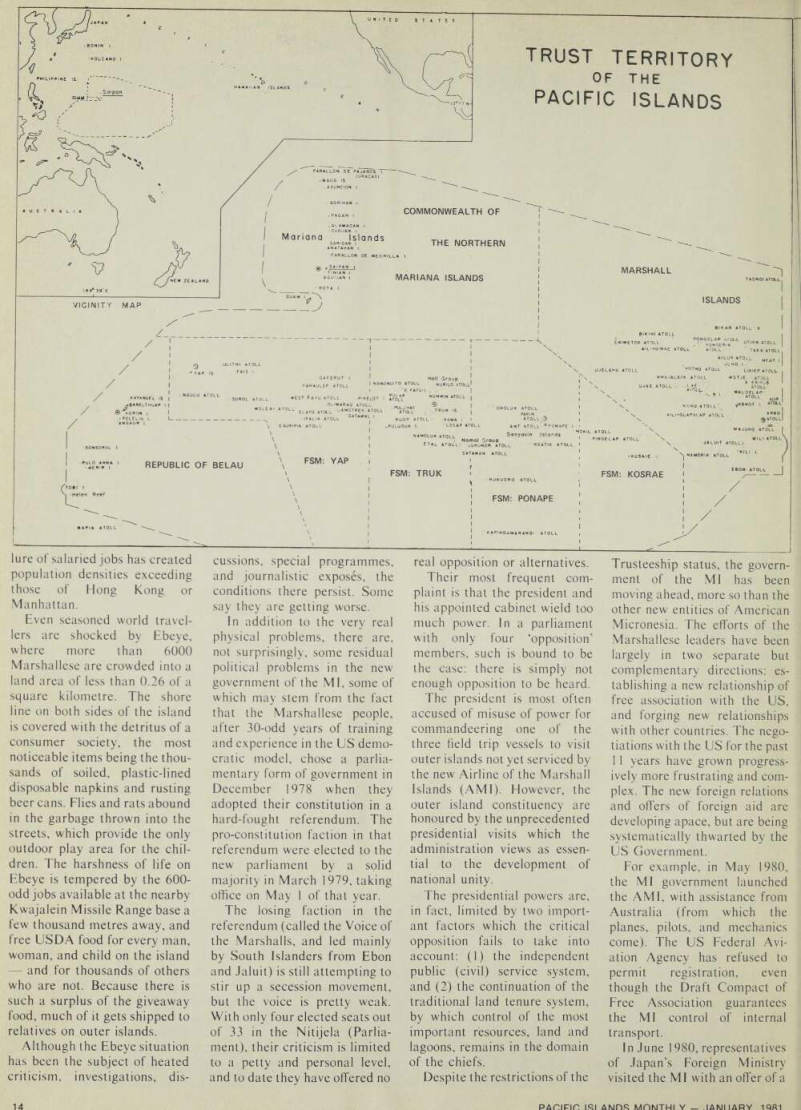
With 1981 upon us, the long-awaited termination of the United Nations Trustee ship Agreement relating to Micronesia may be in for another delay. Although 1981 was named as the target year for termination by the Carter Adminis tration, some of the more sanguine observers are now beginning to talk about 1984 as a reasonable date for finalising an arrange ment under which the three remaining entities of the Trust Territory of the Pacific Islands, Marshall Islands (Ml), Belau (formerly
Palau), and the Federated States of Micronesia (FSM), would establish a new pol itical status probably ‘in free association’ with the United States.
While the ‘Statement of Agreed Principles of Free Association’ eight major points were worked out at the status negotiations held in Hilo, Hawaii, more than two years ago (April 19, 1978), the fine and final details posed many prob lems for the negotiators on all sides of the table.
The initialling by the FSM and the Ml of the Compact
of Free Association with the US at Kailua-Kona, Hawaii, in October (PIM Dec p 5) represented an interim suc cess. Belau, then on the eve of its November election (see Political Currents), was expected to initial the com pact later on, and has since done so.
But the initialling is far from the end of the matter.
A formal signing will not take place until after further negotiations on several subsidiary agreements, and following approval in a plebiscite planned to be held in Micronesia early in
1981. Even with these hurdles surmounted, the compact must still be pres ented to the US Congress as a joint resolution for enactment into law.
While the three entities Belau, Ml, and FSM are all working towards a similar relationship of free association with the US, the problems they face are quite different. In this article, DONALD M. TOP PING* looks at some of the recent developments in Belau and Ml which may help bring the differences into focus.
1. Marshalls: Eager to get it over
The new constitutional govern ment of the MI (since May 1, 1979) is experiencing many of the familiar problems of a new Pacific Island state: population pressures (3.5% annual in crease), limited land area, urban drift (60% in the urban centers of Majuro and Ebeye, where the population density is the highest in the world), nega tive import-export balance, un employment, and government services that are currently too costly to maintain on self generated revenues. These stan dard problems, found through out the Pacific, are com pounded by US federal welfare programmes that are having a debilitating effect on the tra ditional self-sufficiency of the outer islanders, and continue to lead to unrealistic expectations.
The effects of the devastating
* Professor Donald M. Top ping is Director of the Social Science Research Institute, University of Hawaii at Manoa, in Honolulu, Hawaii.
He has long been an advocate of closer ties between the US State of Hawaii and the Island countries of the Pacific.
1979 tidal wave which inun dated Majuro are still a major problem, with hundreds of fam ilies still living in badly deteriorating tents.
Although a SUS 2 million federal housing programme has been made available for the wave victims, not much prog ress has been made, largely due to the inappropriateness of a federal disaster relief pro gramme with inflexible guide lines applied in a Pacific Island setting. Also, this new housing programme is forcing a funda mental question of who has authority over lands in the MI?
Does the government, through its zoning laws, or the tra ditional landowners have the final say on housing density and who may live where in the capital of the MI?
The US Department of Agriculture (USDA) food is only part of the much broader federal welfare system which is, according to some observers, creating a strong dependency on US support throughout Micronesia, and especially in the MI. The range of such programmes is broad, and the list of recipients extremely
long, since nearly everyone in the Ml qualifies for benefits when the US standard for income level is applied. While the effects of the massive wel fare programmes have not been measured, they have clearly proved to be a disincentive to subsistence farming and fish ing, which form the basis for social organisation in the outer islands.
The recent fall in the price of copra the only cash crop in the Ml from more than 90c to about I4C per kg has made it easier for the outer islanders to rely on US hand outs. The sudden drop in price, a chain reaction to the Soviet invasion of Afghanistan, has resulted in a dramatic re duction in copra production. (Because of the invasion, the US stopped corn oil shipments to Russia, thus reducing the US need for coconut oil.) The relatively new Tobolar copra processing mill in Majuro, once bustling with 24-hour pro duction, is now locked up most of the time due to a lack of copra, or power, or both.
The existing infrastructure of Majuro, installed and operated by American expatriates for nearly 35 years, is of mixed quality. The international air port at Majuro is superb, built to the latest US military specifications in 1973. The 22km long macadam road (the
longest of any atoll in the world) connecting more than half of the islets of the horseshoe-shaped lagoon, is in good condition, and is well travelled by the multitude of vehicles of Majuro. On the other hand, running water is available for only one hour per day (6 to 7pm), and the power goes out as frequently and unprcdiclably as the tropical rainshowers come down.
Internal and external communi cations are practically non existent, except for the military-Trust Territory relay through which all messages are monitored in Kwajalcin and Saipan.
Taken all together, the parts of the infrastructure that work, plus those that don’t, present maintenance problems that even a technologically oriented, well-heeled government would find overwhelming.
While the problems of de veloping and maintaining an adequate infrastructure are very real, they pale when com pared with the more serious problem of population, more than half of which has been dislocated for one reason or another. Starting with the relo cation of the Kwajalein, Bikini, and Enewetak people in the 19505, the Marshallese people have been on the move, mostly towards the urban centres of Ebeye and Majuro, where the
lure of salaried jobs has created population densities exceeding those of Hong Kong or Manhattan.
Even seasoned world travel lers are shocked by Ebeye, where more than 6000 Marshallese are crowded into a land area of less than 0.26 of a square kilometre. The shore line on both sides of the island is covered with the detritus of a consumer society, the most noticeable items being the thou sands of soiled, plastic-lined disposable napkins and rusting beer cans. Flies and rats abound in the garbage thrown into the streets, which provide the only outdoor play area for the chil dren. The harshness of life on Ebeye is tempered by the 600odd jobs available at the nearby Kwajalein Missile Range base a few thousand metres away, and free USDA food for every man, woman, and child on the island and for thousands of others who are not. Because there is such a surplus of the giveaway food, much of it gets shipped to relatives on outer islands.
Although the Ebeye situation has been the subject of heated criticism, investigations, dis
cussions, special programmes, and journalistic exposes, the conditions there persist. Some say they are getting worse.
In addition to the very real physical problems, there are, not surprisingly, some residual political problems in the new government of the MI, some of which may stem from the fact that the Marshallese people, after 30-odd years of training and experience in the US demo cratic model, chose a parlia mentary form of government in December 1978 when they adopted their constitution in a hard-fought referendum. The pro-constitution faction in that referendum were elected to the new parliament by a solid majority in March 1979, taking office on May I of that year.
The losing faction in the referendum (called the Voice of the Marshalls, and led mainly by South Islanders from Ebon and Jaluil) is still attempting to stir up a secession movement, but the voice is pretty weak.
With only four elected seats out of 33 in the Nitijela (Parlia ment), their criticism is limited to a petty and personal level, and to date they have offered no
real opposition or alternatives.
Their most frequent com plaint is that the president and his appointed cabinet wield too much power. In a parliament with only four ‘opposition’ members, such is bound to be the case: there is simply not enough opposition to be heard.
The president is most often accused of misuse of power for commandeering one of the three field trip vessels to visit outer islands not yet serviced by the new Airline of the Marshall Islands (AMI). However, the outer island constituency are honoured by the unprecedented presidential visits which the administration views as essen tial to the development of national unity.
The presidential powers are, in fact, limited by two import ant factors which the critical opposition fails to take into account: (I) the independent public (civil) service system, and (2) the continuation of the traditional land tenure system, by which control of the most important resources, land and lagoons, remains in the domain of the chiefs.
Despite the restrictions of the
Trusteeship status, the govern ment of the MI has been moving ahead, more so than the other new entities of American Micronesia. The efforts of the Marshallese leaders have been largely in two separate but complementary directions: es tablishing a new relationship of free association with the US, and forging new relationships with other countries. The nego tiations with the US for the past 11 years have grown progress ively more frustrating and com plex. The new foreign relations and offers of foreign aid are developing apace, but are being systematically thwarted by the US Government.
For example, in May 1980, the MI government launched the AMI, with assistance from Australia (from which the planes, pilots, and mechanics come). The US Federal Avi ation Agency has refused to permit registration, even though the Draft Compact of Free Association guarantees the MI control of internal transport.
In June 1980, representatives of Japan’s Foreign Ministry visited the Ml with an offer of a
complete $7 million dollar sat ellite communications system, but the offer was withdrawn in August after US officials an nounced that the MI would be hooked up with the rest of Micronesia through a satellite system provided by the US through Comsat.
Undaunted by such setbacks, the MI is still actively cultivat ing foreign relations and aid in such disparate countries as Taiwan, West Germany, and the United Kingdom, which has * recently made an offer of a new power plant. The Ml Govern ment has recently completed fishing agreements with Japan with terms far more favourable than those offered by the US Tuna Fisheries Association.
And, much to the chagrin of US authorities, a bilateral agricul tural aid scheme provided by Taiwan has been operating in
2. Belau: Politics hold centre stage
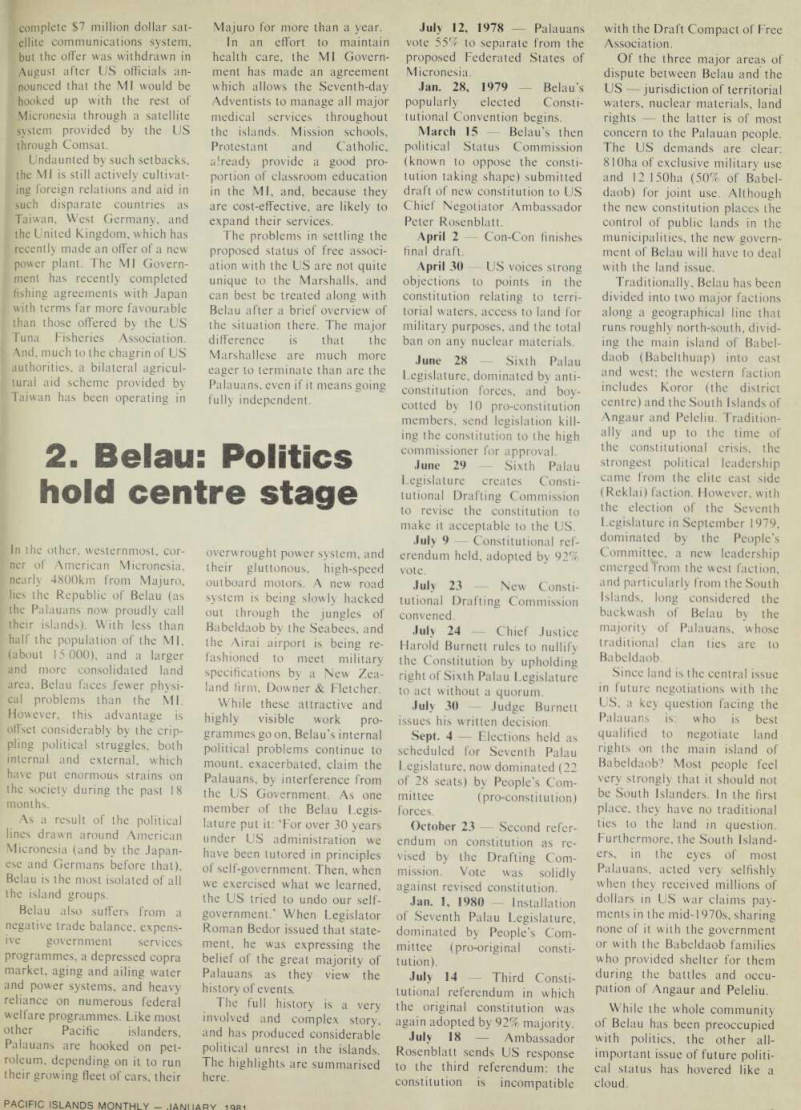
; In the other, westernmost, cor- ; ner of American Micronesia, nearly 4800 km from Majuro, lies the Republic of Belau (as the Palauans now proudly call their islands). With less than half the population of the Ml, (about 15 000), and a larger and more consolidated land area, Belau faces fewer physical problems than the ML However, this advantage is offset considerably by the crippling political struggles, both internal and external, which have put enormous strains on the society during the past 18 months - As a result of the political lines drawn around American Micronesia (and by the Japanese and Germans before that), Belau is the most isolated of all the island groups.
Bclau also suffers from a negative trade balance, expensive government services programmes, a depressed copra market, aging and ailing water and power systems, and heavy reliance on numerous federal welfare programmes. Like most other Pacific islanders, Palauans are hooked on pelroleum, depending on it to run their growing fleet of cars, their
Majuro for more than a year.
In an effort to maintain health care, the MI Govern ment has made an agreement which allows the Seventh-day Adventists to manage all major medical services throughout the islands. Mission schools, Protestant and Catholic, already provide a good pro portion of classroom education in the MI, and, because they are cost-effective, are likely to expand their services.
The problems in settling the proposed status of free associ ation with the US are not quite unique to the Marshalls, and can best be treated along with Belau after a brief overview of the situation there. The major difference is that the Marshallese are much more eager to terminate than are the Palauans, even if it means going fully independent.
overwrought power system, and their gluttonous, high-speed outboard motors. A new road system is being slowly hacked out through the jungles of Babcldaob by the Seabees, and the Airai airport is being re fashioned to meet military specifications by a New Zea land firm. Downer & Fletcher, While these attractive and highly visible work pro grammes go on, Belau’s internal political problems continue to mount, exacerbated, claim the Palauans, by interference from the US Government. As one member of the Belau Legis- Jature put it: Tor over 30 years under US administration we have been tutored in principles of self-government. Then, when we exercised what we learned the US tried to undo our self government.’ When Legislator Roman Bedor issued that state ment, he was expressing the belief of the great majority of Palauans as they view the history of events, The full history is a very involved and complex story, and has produced considerable political unrest in the islands, The highlights are summarised here.
July 12, 1978 Palauans vote 55% to separate from the proposed Federated States of Micronesia.
Jan. 28, 1979 Belau’s popularly elected Consti tutional Convention begins.
March 15 Belau’s then political Status Commission (known to oppose the consti tution taking shape) submitted draft of new constitution to US Chief Negotiator Ambassador Peter Rosenblatt.
April 2 Con-Con finishes final draft.
April 30 US voices strong objections to points in the constitution relating to terri torial waters, access to land for military purposes, and the total ban on any nuclear materials.
June 28 Sixth Palau Legislature, dominated by anti constitution forces, and boy cotted by 10 pro-constitution members, send legislation kill ing the constitution to the high commissioner for approval.
June 29 Sixth Palau Legislature creates Consti tutional Drafting Commission to revise the constitution to make it acceptable to the US.
July 9 Constitutional ref erendum held, adopted by 92% vote.
July 23 New Consti tutional Drafting Commission convened.
July 24 Chief Justice Harold Burnett rules to nullify the Constitution by upholding right of Sixth Palau Legislature to act without a quorum.
July 30 Judge Burnett issues his written decision.
Sept. 4 Elections held as scheduled for Seventh Palau Legislature, now dominated (22 of 28 seats) by People’s Com mittee (pro-constitution) forces.
October 23 Second refer endum on constitution as re vised by the Drafting Com mission. Vote was solidly against revised constitution.
Jan. 1, 1980 Installation of Seventh Palau Legislature, dominated by People’s Com mittee (pro-original consti tution).
July 14 Third Consti tutional referendum in which the original constitution was again adopted by 92% majority.
July 18 Ambassador Rosenblatt sends US response to the third referendum: the constitution is incompatible
with the Draft Compact of Free Association.
Of the three major areas of dispute between Belau and the US —jurisdiction of territorial waters, nuclear materials, land rights the latter is of most concern to the Palauan people.
The US demands are clear: 810 ha of exclusive military use and 12 150 ha (50% of Babel daob) for joint use. Although the new constitution places the control of public lands in the municipalities, the new govern ment of Belau will have to deal with the land issue.
Traditionally, Belau has been divided into two major factions along a geographical line that runs roughly north-south, divid ing the main island of Babel daob (Babelthuap) into east and west; the western faction includes Koror (the district centre) and the South Islands of Angaur and Peleliu. Tradition ally and up to the time of the constitutional crisis, the strongest political leadership came from the elite east side (Reklai) faction. However, with the election of the Seventh Legislature in September 1979, dominated by the People’s Committee, a new leadership emerged from the west faction, and particularly from the South Islands, long considered the backwash of Belau by the majority of Palauans, whose traditional clan ties are to Babcldaob.
Since land is the central issue in future negotiations with the US, a key question facing the Palauans is: who is best qualified to negotiate land rights on the main island of Babcldaob? Most people feel very strongly that it should not be South Islanders. In the first place, they have no traditional ties to the land in question.
Furthermore, the South Island ers, in the eyes of most Palauans, acted very selfishly when they received millions of dollars in US war claims pay ments in the mid-19705, sharing none of it with the government or with the Babcldaob families who provided shelter for them during the battles and occu pation of Angaur and Peleliu.
While the whole community of Belau has been preoccupied with politics, the other all important issue of future politi cal status has hovered like a cloud.
3. Overview: Whose ‘defence needs’?
The long and arduous process of terminating the 1947 Trusteeship Agreement that placed the islands of Micronesia under US control is taking much longer than any one ever anticipated. And as the proposed termination date of 1981 arrived, the negotiators were drifting still further apart.
Since the first negotiations, which were held in Washington in October 1969, governments and negotiators have changed, as have some of the goals and aspirations. But one thing that has remained constant, in the eyes of the Micronesians, is the determination of the US to maintain enough control over the area to keep other foreign powers out, and particularly foreign military powers. This is commonly referred to as the ‘Denial Theory’.
After nearly nine years of on again-off-again negotiations, marred seriously in 1976 by the disclosure of CIA bugging of the Micronesian negotiators’ rooms, a major breakthrough was reached on April 9, 1978,
known as the Hilo Accord. At that round of talks in Hilo, Hawaii, an agreement was reached and signed by the negotiators from the US, Marshall Islands, Belau, and the Federated States of Micro nesia. What they signed was the ‘Statement of Agreed Prin ciples for Free Association’ which consisted of eight major points on which a formal, bind ing document could be devel oped.
Nearly two years later Janua-ry 1980 the ‘Draft Compact of Free Association’
was presented to the nego tiators at Kailua-Kona, Hawaii.
Although parts of it, especially those pertaining to financing, were left somewhat vague, the Marshallese negotiators initial led it, thereby indicating their basic acceptance and earnest desire to work out the fine details. The negotiators from Belau (where the new govern ment had just been installed) and the FSM took the Draft Compact back to their com munities unsigned, with the explanation that it had to be referred back to the people.
While Belau and the FSM were willing to postpone the termination of the Trusteeship status, for somewhat different reasons, the Marshall Islands pushed hard for a final agree ment before the November 1980 US elections. But some major issues are still unresolved, and the process of getting approval from the vari ous principals on the US side is fraught with too many factions and problems.
The key issues on which agreement has proved elusive involve money, land, water, foreign relations, and, overrid ing all of these issues, the perceived defence needs of the US.
The money issue has aroused the ire of the Micronesians from all three of the entities, who feel that the US is being extremely unfair. In the first place, they blame the US for having cultivated an import dependent economy based on US subsidies. Many call it a welfare state. Having success fully implanted that system, the US now threatens to scale down its financial support to levels that Micronesians consider un acceptable. Indeed, with rising prices for imported goods and cutbacks in operating budgets and federal programmes, the financial crunch is already be ing felt in all of Micronesia.
The FSM and Belau also fear that the US may leave them without an adequate infrastruc ture, essential to any meaning ful development. The MI, on the other hand, feel that they can develop their own infra
structure more efficiently after termination, providing there will be continued US and other foreign aid, now discouraged, if not prohibited, by the Trustee ship status. Although the US is proceeding with airport expan sions (Truk, Kosrae, Belau), and building new roads, the Micronesians of Belau and the FSM feel that much more is needed before the US gives up its caretaker role.
The land issue, which is particularly crucial in the MI and Belau, is linked inextri cably with money. The US requirements have been clearly stated: continued exclusive use of the Kwajalein Missile Range in the Ml, and in Belau, 810 ha of exclusive military use, and 12 150 ha (half of Babeldaob) of joint military-civilian use, in cluding harbour and airport facilities.
At Kwajalein, the full mili tary facilities have long been in place and operational; the ques tion now under negotiation is how much money, and the time intervals between renogiations.
In Belau, the question is yet to be seriously negotiated, and most Palauans are wary of com mitting any portion of their lands for the use of any foreign power. Since the newly adopted constitution assigns control of all public lands to the individ ual 16 states (municipalities), each with its own government structure, any national govern ment to government nego tiations over land in Belau are
virtually impossible.
The question of territorial waters is also proving to be a thorny one, particularly in the case of Belau, where the new constitution established sover eignty and jurisdiction over all waters within 200 nautical miles of the baselines con necting all the islands of Belau.
The Palauan claim follows the controversial ‘archipelagic the ory’ of the International Law of the Sea, but which the US does not recognise, favouring instead a three-mile territorial sea. At present, the US position is that the Palauan claim to territorial waters is simply not an accept able one to negotiate. The distinction in this case between the 200-mile economic zone, which the US is willing to accept, and the 200-mile terri torial zone, is a crucial one for the US because it impinges on
US defence needs, i.e., accessi bility to all Micronesian waters for all vessels, including nuclear-powered ones.
The question of defence needs presents another major problem for the negotiators, and is closely bound to the problems mentioned above: money, land, and water. This particular problem is com pounded by the very different viewpoints. The US views the offer of military defence of Microrfesia as a favour for which the Micronesians should be grateful and willing to pay in the form of trade-offs. The Micronesians, on the other hand, have never asked to be defended, and view the pres ence of military troops as a liability, as it proved to be in World War 11. Consequently, the Micronesians feel that the US should pay for the privilege of using Micronesian land and waters to deny access to other foreign powers. They further feel that the fees should be comparable to those paid by the US to such host countries as Spain and the Philippines.
The question boils down to this; Whose defence needs are the plans designed to meet, and what price is the US willing to pay?
Closely related to the de fence needs is the notion of ‘strategic denial’, which has always been in the background, but surfaced with some force at the status negotiations held in Kailua-Kona in the first week of October 1980. What this means is that no foreign military power, except the US, will be permitted in Micronesia, and the US military will be the enforcing agent. Before the Kona talks, the assumption was that strategic denial would be maintained during the 15-year life of the Compact. At Kona, the new US position on denial was announced, a move which severely alienated the Micro nesian negotiators. Not only was the US seen as changing an agreement previously made, but is now demanding denial rights ‘in perpetuity’.
The control of foreign affairs presents yet another thorny problem to the negotiators.
Although the Draft Compact assigns this responsibility to each of the new entities, it adds a critical caveat: ‘except as otherwise provided in this Corn
Peter Rosenblatt, US negotiator
pact'. (Article 11, Section 121(a)). The Compact further states in Section 123 that ‘the Governments . . . shall consult, in the conduct of their foreign affairs, with the Government of the United States’. The bound aries of foreign affairs are further restricted by a later paragraph in the Compact (Section 313) which reads: ‘The Governments of Palau, Marshall Islands, and the Fed erated States of Micronesia will refrain from actions which the Government of the United States determines, after appro priate consultation with those Governments, to be incompat ible with its authority and responsibility for security and defence matters in or relating to Palau, Marshall Islands, and the Federated States of Micro nesia.’
Some of the Micronesian negotiators are now concluding that the above paragraph gives too much authority to the US to determine what actions may be deemed ‘incompatible’, and are beginning to view this proviso as overly restrictive.
Perhaps the biggest obstacle to successful US-Micronesian negotiations is the patchwork of US Government departments, agencies, and, not least, the individuals who have a personal stake in the outcome.
Although Ambassador Peter R. Rosenblatt, the chief US negotiator, also bears the title of the President’s Personal Rep resentative, his job requires that he accomplish the nearly impossible task of satisfying the demands of the Departments of State, Defense, Interior, En ergy, and Commerce; the entire US Congress, some of whose members have very strong con victions against releasing any territories gained through a bloody war; and the UN Secur ity Council, where any agree ment seems almost hopeless.
The Marshallese were es pecially anxious to conclude the Agreement before the November 1980 elections in the US. Although they have had serious difficulties during the past three and a half years with the Carter Administration, they feared that should Reagan win (as he did) they will be forced back to the starting point again, only with a more intransigent opponent.
At the time of writing, hopes
for conclusive negotiations have thus given rise to more overt talk of independence as the only option, with the case being presented to the world body of sovereign nations to judge.
In a last-minute effort to finalise a formal agreement between the US and Micro nesia before President Reagan and the Republican Senate take command, representatives from the Ml and the FSM initialled the Compact of Free Associ ation in Washington. The Palauans followed suit, after their elections on November 4.
Although most of the details of free association set forth in the 52-page document have been agreed upon, certain major disputes remain unresolved, particularly those issues in the Palauan consti tution which were described by Ambassador Rosenblatt as ‘in compatible’ with the compact.
These are the Palauan claim to the 200-mile territorial sea zone, the prohibition against the exercise of ‘eminent do main’ over lands for use by any foreign power, and the ban against nuclear substances.
However, according to a US State Department official, these and other outstanding issues will be resolved at some future date through ‘subsidiary agree ments’ between the US and the three separate entities.
Obviously, all parties in volved were anxious to finalise something. The Carter Admin istration would like to claim successful completion of the negotiations. The Micronesians are fearful of being forced back to point zero in negotiating with the incoming Republicans. The agreement reached may prove to have too many loose ends.
The major hurdles are; 1) the subsidiary agreements; 2) ratification of the compact by separate plebiscites in Micro nesia and by both Houses of the US Congress; 3) approval of the UN Security Council.
With regard to the last point, the US is now stating publicly that UN approval is not necess ary for termination of the trusteeship agreement. UN officials however have ex pressed an opposite view.
While the initialling of the compact is a major step towards terminating the trust territory status for Micronesia, the end is not yet in sight.
Advertisements & other items, pp. 13-18 (4 items)
13
PACIFIP. IRI AKinQ MDMTUI V lAMIIADV moH
14
PAniPir i Afon<s momthi v iami iary iqri
Aiwa
Most pocket-sized stereo cassette players
don t know what they’re missing.
Only AIWA did something about it.
(We call it the
Pocket Deck
99 % ft (Oj % ST, % * CM-30
It’s a fact.AlWA’s mini-sized cassette player
is also a stereo recorder. And at only 365 grams," " / the world’s lightest, too. The TP-S3O from AIWA can perform stereo dubbing from a second unit, and record in monaural from its built-in condenser mic.
Or, you can connect the optional CM-30 one-point stereo microphone and make spectacular live recordings in real 2-channel stereo. Compare our playback performance too! Frequency response with metal tapes is an incredibly wide 40 to 16,000 Hz. Super light headphones also included.
AlWA’s Pocket Deck—we remembered to put in what the others left out.
AIWA for (ralisnunsty
AIWA
AIWA CO., LTD. 11-9, Ueno 1-chome, Taito-ku, Tokyo, Japan.
Australia AIWA Australia Pty., Ltd., P.O. Box 339, Rockdale, N.S.W., Australia 2216 Tel: 597-2388/2808 Cook Islands Island Merchants Ltd., P.O. Box 69, Rarotonga, Cook Islands Fiji D. Ranchhod & Company, Corner of Vidilo St. & Vitogo PDE, P.O Box 18 Lautoka. Fiji Tel: 60227 Fiji P. Hargovind Bros., Duty Free Centre 190 Renwick Road, Suva Fiji Tel; 24350 Guam Micropac Audio, Inc., P.O. Box 3478, Agana, Guam 96910Te1;472-8091 New Caledonia hifivox; 79 rue de Sebastopol 19 avenue Foch B.P. 1458 Noumea, New Caledonia Tel: 27 24 66 et 28 29 31 P.N.G. Oceania Indent Agency (P.N.G.) Pty., Ltd. Box 5518, Boroko, Port Moresby, P.N.G. Tel; PM 256406 Solomon Islands Harvest Pacific Ltd., G.P.O. 517, Honiara, Solomon Islands Tel: 718 Tahiti Fare Hi-Fi Stereo, Rue du Marechal Foch, P.O. Box 269, Papeete, Tahiti R C 6604 A Vanuatu (New Hebrides) The Sound Centre Ltd.; P.O. Box 434, Vila, Vanuatu (New Hebrides) Tel: 2035
The voices of Pacific women are being heard more and more; often at international conferences. Our correspondent inr French Polynesia, Marie-Therese Danielsson, who is very\ active in local politics and women’s associations, reports here; on the recent regional meeting in Suva, whose agenda she< helped to draw up during the UN-sponsored Copenhagen meeting in July.
Completely belying the frequently heard complaints about the slow and inefficient United Nations bureaucratic machinery, a regional follow-up meeting to implement the resolutions adopted at the Mid-Decade Conference for Women in Copenhagen last July (PIM Oct 21) was organised in Suva by the Economic and Social Commission for Asia and the Pacific (ESCAP for short) less than three months later, (October 30- November 3).
Rising to the occasion, the 29 delegates (all women) from the Pacific area, closely watched by more than 60 observers representing local associations and various international bodies, swiftly formulated and adopted 137 proposals for concrete actions based on the overall goals of the UN Decade for Women in the fields of equality, economic development and peace.
To underline the importance attached by the UN to this meeting for Pacific nations, the special secretary-general for the Decade for Women, Ms Lucille Mair, flew out from New York to give a much applauded address. Other guest speakers included Sir Robert Munro, president of the Fiji Senate, and J.B.P. Maramis, the executive secretary of ESCAP.
While the Copenhagen conference can be likened to a gathering of composers charged with the delicate task of creating an international theme song or women’s battle hymn, the main aim of the Suva meeting was to form a Pacific orchestra able to play it in a harmonious manner on instruments familiar to the local people. Although there were no false notes at the Suva meeting, a plaintive tone was often heard: the participants again and again regretted that their little band had not yet reached full strength.
Most conspicuously absent from the proceedings were the French territories of Polynesia, New Caledonia and Wallis and Futuna which, in principle, are represented at international conferences by the delegates of their “mother-country”.
However, in such a purely regional organization as ESCAP, there is no statutory room for a European country like France, even though she administers hundred of islands in the Pacific, while other past or present colonial powers like Australia and New Zealand undeniably are Pacific countries. The new French ambassador in Suva showed his displeasure with this paradoxical situation by not sending any observer to this followup meeting, although invited to do so, as were the British high Symbol of the women’s conference: Left, equality sign; centre, female biological sign; overall, dove of peace.
18
PAniFin isi anhs monithi y January 1981
A chorus
of female voices
commissioner and the US ambassador, who on the contrary availed themselves of this opportunity.
All this explains why the number of Pacific countries participating in the meeting was only twelve Australia, Fiji, Nauru, New Zealand, Papua New Guinea, Samoa, Solomon Islands, Tonga, Cook Islands, Kiribati, Tuvalu and Vanuatu.
The silent observers from French Polynesia and New Caledonia, however, had many opportunities to make their voices heard in between the sessions, and never failed to do so.
The youngest nation, Vanuatu, was ably represented (as in Copenhagen before independence) by the youngest delegate, Hilda Uni, who greatly enlivened the debate without ever failing in dignity.
After four days of general debates and concentrated work in three separate committees, the delegates adopted in a plenary session chaired by Ms Esiteri Kamikamica of the host country, a Plan of Action for the Second Half of the Decade for Women, 1980-85, preceded by this moving declaration of solidarity: 'ln a world where so many nations have proudly and fiercely cast off the stains of colonialism and economic imperialism, there remains in the Pacific sister islands, including New Caledonia and French Polynesia, who are denied their inalienable right to self-determination, to walk in dignity as free Pacific peoples. We women of the Pacific stand in solidarity with our sisters. We offer them our love and support through this seemingly endless period of struggle, insult and degra dation. We will stand with them one day in joy and celebration at their nationhood.’
The next paragraphs deal with the dire threats to the whole region resulting from nuclear pollution: ‘We have been forced against our will to become a testing ground lor weapons and armaments which ultimately threaten the well being of all peoples of the world and which in the meantime are causing sterility, genetic malformation, nuclear pollution of our sea and foodstuffs, the nuclear pollution of the very air we breathe. ‘At a time when there is a grave doubt throughout the world about mankind s capacity to develop technology to protect itself from nuclear waste, the Pacific is threatened with this ultimate form of nuclear pollution, the dumping of nuclear wastes in our oceans.’
Financial exploitation by outsiders is condemned; ‘We the women of the Pacific recognise that the nations of the Pacific cannot be free to choose a pattern of development of their own accord until there is elimination of economic exploitation in our region. It is our firm determination only to accept aid which satisfies needs we ourselves have identified, in ways that are in harmony with the traditions of our lands. We shall not allow aid to separate women from men, forcing the women to retain the image of the South Seas postcards, while the men are trained to enter a modern technological world. The women and the men shall jointly build their own future.’
When it comes to the 137 concrete proposals contained in the I 7-pagc plan of action, all I can do, of course, is offer this highly personal selection of those that I myself consider the most important ones:
• All existing legislation should be reviewed to eliminate any discrimination on the basis of sex and marital status. • Political parties should be encouraged to nominate women canditates to positions and ensure that they have equal chances with the men of being elected. • National institutions should collect data relating to women and undertake research, in the first place by local persons. • Traditional medical practices should be studied and recognised, and these practices should be incorporated into existing health care systems provided by government and non government organisations. • All forms of advertising of alcohol and tobacco should be banned by the governments of the region, and stricter penalties should be provided for offences related to alcohol misuse. • Public awareness campaigns should be undertaken to make known the mental health problems of women, especially arising from rural/urban migration, separation from traditional support systems, isolation within an urban community, violence induced by alcohol, prostitution, and the consequent lack of self-esteem among women. • It is our wish that the benefits of tourism should stay within the region, that all employment created by the introduction of tourism should go to nationals of the Pacific without discrimination of sex and race, and that the mode of tourism introduced minimises social and cultural dislocations. • It is high time to establish a Pacific Region Women’s Resource Centre as an autonomous inter-government mental institution staffed by women of the Pacific with the following function: a) To facilitate communications between women’s organis ations, researchers and individual women. b) To collect all available data and research findings on women in the Pacific and to initiate needed research. To exchange information on successful project policy and training programmes. c) To provide technical assistance to aid donors to ensure that the women of the Pacific, both participate in, and benefit from all development assistance in the region. d) To develop a register of skilled women in the Pacific. e) To disseminate information of particular reference to Pacific women e.g. on the side-effects of certain contraceptives, on health hazards of nuclear testing, on successful action to combat alcoholism etc. f) To review, monitor and evaluate the impact of develop ment assistance.
To use the musical metaphor once more, this 137-point plan resembles more than anything else a composer’s score, the female musicians are beginning to know their parts quite well, and some of them are already singing their battle hymn at the lop of their voices, to the accompaniment of booming drums, instruments traditionally reserved for men in the Pacific.
In consequence, the next public performance will be very interesting indeed. It is a sort of seminar to be held in Papeete sometime in 1981 for the benefit of the South Pacific Commission countries, to determine the exact degree of harmony achieved by then. Marie-Th'erese Danielsson.
Advertisements & other items, p. 20 (1 item)
<Icoh
c<_
Z °OM 1 3JS TOMS
11 WKEUOM t;4
4T«i>»
RICOH
i » (»« - S > <?«»* « t i ian n » t i i S** - S332n**»»»*
-‘L'IHsS-lilitt*
L.■ »'x < M>n • «» t = s i . vt»* *A9t im i « ( l; ..».»» i f is» v it; jt < ' »lt< V?-, “-- - - • «t * 5 (it m ♦ « i < r- I-* W V I ( s r
RICOH
kr-io
*. »\oo» * m*9 »0 5 XR '*>iu i«t !SS
IS 7 S
10 5 3 15 1 215 »»*» i it i
» K (I M
I |* * I II I
MU 41 W
Ktt 8 *H 8 5j Sul 4 2jt 4 2J *
HOO" 5
»/» W! - r - - * - * - *5.- * * ::■ • - . -t.
The Easiest Way to Improve Your Image. < i m The easiest way to improve your image, from snapshots to high quality photographs, is with the new Ricoh KRIO. The compact, lightweight SLR camera that gives you the convenience of automatic exposures and the control of manual. With outstanding cos performance. In a full-featured system n.. M that includes auto flash, auto winder, XR MUfOlllClflC CWCI FICHUICI
Rikenon lenses and accessories. m ■
Ricoh KRIO, automatic and manual. I I can improve your image in H|l m ■ U more ways than one. Mm, I m M I or more information about the Ricoh KRIO, write to RICOH COMPANY, LTD. 14-6, Ginza fr-chome, Chuo-ku, Tokyo 104 Japan istnbutors: Australia Bell & Howell Australia Pty. Ltd. *0.9.0. Box 4778, 55-69 Murray Street. Pyrmont, N S W , Australia, New Zealand H.E. f oo #145 Victoria Street, P.O. Box 111, Christchurch 1, New Zealand, Norfolk Is. Miltons Department Stores Ltd. #PO Box 146 Norfolk land 2899. South Pacific. Fiji Narseys Limited • Renwick Road. Suva, Fiji, Tahiti Ets. Coutimex • B.P 617. Papeete, Tahiti (French Polynesia) Oil/ I 010/lAnm «I« «J : I L X • • ■ i . ' J “
distinguished absent friends)
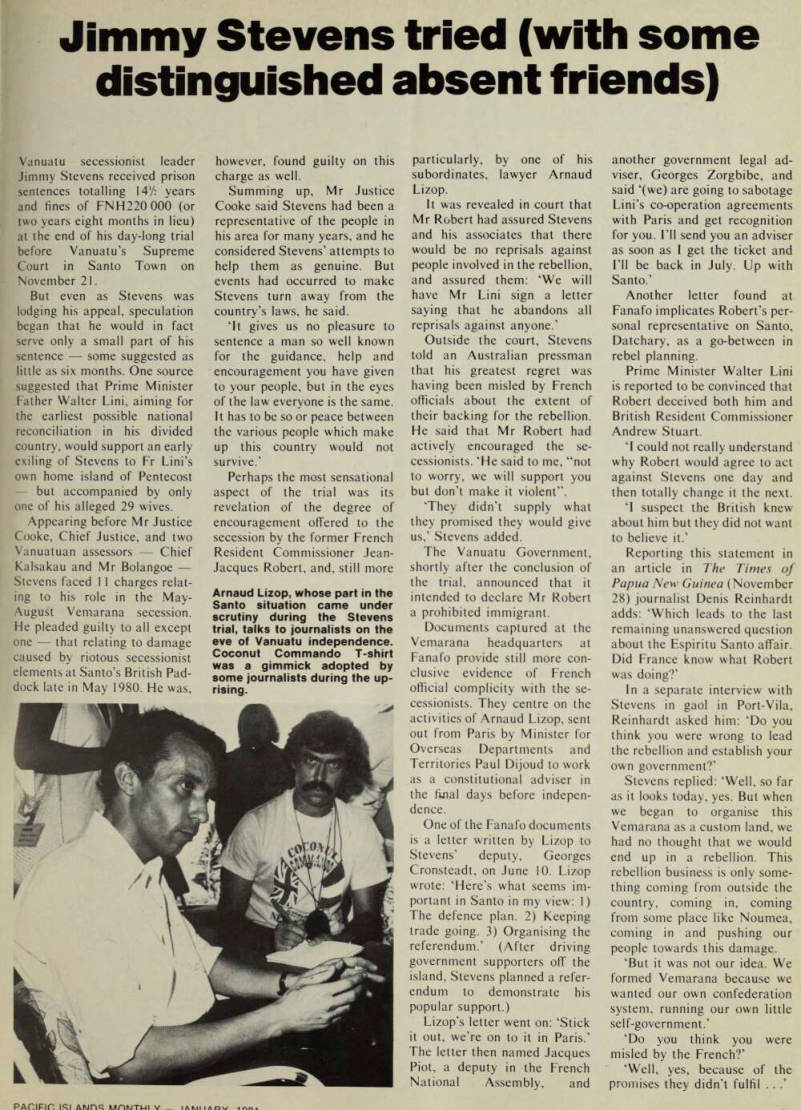
Jimmy Stevens tried (with some distinguished absent friends)
Vanuatu secessionist leader Jimmy Stevens received prison sentences totalling 14'/; years and fines of FNH22O 000 (or two years eight months in lieu) at the end of his day-long trial before Vanuatu’s Supreme Court in Santo Town on November 21.
But even as Stevens was lodging his appeal, speculation began that he would in fact serve only a small part of his sentence some suggested as little as six months. One source suggested that Prime Minister Father Waller Lini, aiming for the earliest possible national reconciliation in his divided country, would support an early exiling of Stevens to Fr Lini’s own home island of Pentecost but accompanied by only one of his alleged 29 wives.
Appearing before Mr Justice Cooke, Chief Justice, and two Vanuatuan assessors Chief Kalsakau and Mr Bolangoe Stevens faced 11 charges relat ing to his role in the May- August Vemarana secession.
He pleaded guilty to all except one that relating to damage caused by riotous secessionist elements at Santo’s British Pad dock late in May 1980. He was.
however, found guilty on this charge as well.
Summing up, Mr Justice Cooke said Stevens had been a representative of the people in his area for many years, and he considered Stevens’ attempts to help them as genuine. But events had occurred to make Stevens turn away from the country’s laws, he said. ‘lt gives us no pleasure to sentence a man so well known for the guidance, help and encouragement you have given to your people, but in the eyes of the law everyone is the same.
It has to be so or peace between the various people which make up this country would not survive.’
Perhaps the most sensational aspect of the trial was its revelation of the degree of encouragement offered to the secession by the former French Resident Commissioner Jean- Jacques Robert, and, still more
particularly, by one of his subordinates, lawyer Arnaud Lizop.
It was revealed in court that Mr Robert had assured Stevens and his associates that there would be no reprisals against people involved in the rebellion, and assured them: ‘We will have Mr Lini sign a letter saying that he abandons all reprisals against anyone.’
Outside the court, Stevens told an Australian pressman that his greatest regret was having been misled by French officials about the extent of their backing for the rebellion.
He said that Mr Robert had actively encouraged the se cessionists. ‘He said to me, “not to worry, we will support you but don’t make it violent”. ‘They didn’t supply what they promised they would give us,’ Stevens added.
The Vanuatu Government, shortly after the conclusion of the trial, announced that it intended to declare Mr Robert a prohibited immigrant.
Documents captured at the Vemarana headquarters at Fanafo provide still more con clusive evidence of French official complicity with the se cessionists. They centre on the activities of Arnaud Lizop, sent out from Paris by Minister for Overseas Departments and Territories Paul Dijoud to work as a constitutional adviser in the final days before indepen dence.
One of the Fanafo documents is a letter written by Lizop to Stevens’ deputy, Georges Cronsteadt, on June 10. Lizop wrote: ‘Here’s what seems im portant in Santo in my view; 1) The defence plan. 2) Keeping trade going. 3) Organising the referendum.’ (After driving government supporters off the island, Stevens planned a refer endum to demonstrate his popular support.) Lizop’s letter went on: ‘Stick it out, we’re on to it in Paris.’
The letter then named Jacques Piot, a deputy in the French National Assembly, and
another government legal ad viser, Georges Zorgbibe, and said ‘(we) are going to sabotage Uni’s co-operation agreements with Paris and get recognition for you. I’ll send you an adviser as soon as I get the ticket and I’ll be back in July. Up with Santo.’
Another letter found at Fanafo implicates Robert’s per sonal representative on Santo, Datchary, as a go-between in rebel planning.
Prime Minister Walter Lini is reported to be convinced that Robert deceived both him and British Resident Commissioner Andrew Stuart. ‘I could not really understand why Robert would agree to act against Stevens one day and then totally change it the next. ‘I suspect the British knew about him but they did not want to believe it.’
Reporting this statement in an article in The Times of Papua New Guinea (November 28) journalist Denis Reinhardt adds: ‘Which leads to the last remaining unanswered question about the Espiritu Santo affair.
Did France know what Robert was doing?’
In a separate interview with Stevens in gaol in Port-Vila, Reinhardt asked him: ‘Do you think you were wrong to lead the rebellion and establish your own government?’
Stevens replied; ‘Well, so far as it looks today, yes. But when we began to organise this Vemarana as a custom land, we had no thought that we would end up in a rebellion. This rebellion business is only some thing coming from outside the country, coming in, coming from some place like Noumea, coming in and pushing our people towards this damage. ‘But it was not our idea. We formed Vemarana because we wanted our own confederation system, running our own little self-government.’ ‘Do you think you were misled by the French?’ ‘Well, yes, because of the promises they didn’t fulfil . . .’
Arnaud Lizop, whose part in the Santo situation came under scrutiny during the Stevens trial, talks to journalists on the eve of Vanuatu independence.
Coconut Commando T-shirt was a gimmick adopted by some journalists during the up
rising.
Advertisements & other items, pp. 21-22 (3 items)
PACIFIC ISI AMDS MONTMI V _ iammadv -ino-.
21
PACIFIC ISI AMDS MONTMI V iammadv -ino-.
22
Dnmcm ici amho mhmtui v iami iadv
inr emd
fi* % V
MI(S
D A I . it; J r 4 M ■aw : c & new^ m* «
ZEALAND
& 9 s£r $P A WE EXPORT PRODUCTS IN ALL OP THE POLLOWING GROUPS.
Frozen meat, fish and seafood (bulk and portion control) Dairy products Canned fruit Dry groceries Beer, wines and spirits Cigarettes Electrical appliances Household products Electrical supplies Builders hardware Engineering supplies Motor vehicles and spares and much more!!
The case for Maori participation
in the South Pacific Games
H. R. BROUGHTON* writes below bf a newly formed Maori sporting organisation which is seeking membership of the South Pacific Games Council so that New Zealand’s Maori athletes may participate in future South Pacific Games.
Noting that the aims of the South Pacific Games Council are to promote friendship among the peoples ‘of the South Pacific region’, the writer points out that the Maori people are ‘very much part of the South Pacific’.
The first South Pacific Games were held in Fiji in 1963 as a result of a proposal put forward at a meeting of the South Pacific Commission. The idea of the Games was that they would enable the coming together of peoples of the South Pacific. However, New Zea land, although a metropolitan member of the South Pacific Commission, did not feature in the Games and has not done so to date. It has been felt that New Zealand athletes would be too strong and would dominate all the sports contested at such Games. But no consideration has ever been given to the possibility of the Maori people representing New Zealand at the Games.
Since the first Games in Fiji similar Games have been staged in New Caledonia, French Polynesia, Papua New Guinea, and Guam, and more recently, again in Fiji.
The objects of the South Pacific Games Council (SPGC) arc (a) to create bonds of kindred friendship and brother hood amongst people of the countrics/lerritories of the South Pacific region without any distinction whatever (race, religion, politics, etc); (b) to promote amateur sports in these same countries/ territories: and (c) to ensure etficicnl propaganda in favour of sport amongst these people.
The above objects therefore would allow Maoris to lake part in the South Pacific Games, noting that the Maoris are very much part of the South Pacific.
New Zealand as a metropolitan member should suggest to the South Pacific community that Maoris be represented in the Games. The Maoris do not feature prominently in such
sporls as athletics, swimming, boxing, soccer, cricket, hockey, archery, and so on.
However, in Rugby Union, Rugby League, basketball, netball, lawn tennis and golf there is a strong involvement.
This is so, even though the national teams in these sports have not had a significant Maori membership, with one exception: men’s basketball, where there were four Maoris in the 1980 national team.
If the objects of the SPGC arc to be of value then at the very least consideration should be given to the New Zealand Maoris becoming members.
Politics should not be seen as a means of excluding the Maoris, but certainly the strength of a nation's competitors may have to be taken into account as it is at the moment.
Participation in the Games will provide an incentive for the Maoris to take part in all amateur sports in New Zealand both at club and provincial levels.
The charier of the SPGC defines membership as being ‘open to one duly recognised amateur sports organisation in each country/territory. Each country/territory desiring affiliation to the SPGC shall form an autonomous amateur sports organisation which may also function as a national Olympic committee . . .' The New Zealand governing body controlling amateur sports fea tured in the Commonwealth and Olympic Games is the New Zealand Olympic and Com monwealth Games Association (Inc) (NZO&CGA), with other codes having their own national committees for example, Rugby Union. There are very few Maoris who involve them selves in the administration of the national committees. This is certainly so with the NZO&CGA, and this fact may need some attention.
There has already been con
siderable interest expressed by the Maoris in taking part in the Games. This has been acknowl edged by both the New Zealand Maori Council and the Maori Women’s Welfare League.
Currently the views prevail ing in circles concerned with the various codes are being obtained, and it is expected that many questions will be asked in Maori circles as to why they should participate and so on.
In order to comply with the charter of the SPGC certain procedures are being undertaken so that both infor mal and formal approaches can be made to the SPGC. An interim committee was set up in the course of 1980 and has been meeting regularly to develop a national Maori sporting body.
This is now known as the New Zealand Maori Sports Feder ation, under the authority of the New Zealand Maori Council.
The federation is the organis ation that will be seeking mem bership of the SPGC, having fulfilled the necessary criteria as far as membership is con cerned. The constitution of the federation which is currently being prepared involves the importance of health and cul ture within the framework of its objects.
Whilst it would appear that the federation is a separate organisation it relies strongly on the support of the national sporting codes as well as the NZO&CGA and the New Zea land community.
In support of our application to the South Pacific Games the federation’s objects are stated as: (a) to promote in every way the interests of amateur sport amongst the Maoris in New Zealand. (b) to act as a communi cations organisation as a means of promoting participation of the Maoris in all sport. (c) to stimulate partici pation of Maori youth in ama-
Icur sport so as to achieve good health both in mind and body. (d) to educate public opinion as to the value of properly organised physical recreation in improving the knowledge of Maori culture. (c) to ensure that regular tournaments are held amongst participants so that appropriate selections can be made for other venues for example, regional and national meetings, the South Pacific Games, etc. (f) to liaise with national sporting codes on matters of mutual interest. (g) to uphold Maori tra ditions amongst all people of New Zealand in the world of international sport. (h) to foster greater sporting and cultural contact amongst the South Pacific community. (i) to encourage all New Zealanders to support the Maoris in involvement in such amateur sports at local, national and international levels. (j) to award trophies, certificates or medals as appro priate to recognise achieve ments made at any such fixtures.
It is important that we in form the member countries/ territories of the SPGC of our intention to become a member of the SPGC. This also means pointing out the current state of Maori involvement in sport to illustrate why in fact Maoris would benefit from such Games.
Letters are to be sent to member counlries/territories with a view to gaining support and advice toward membership in the Games. It is our hope that this article will serve as yet another valuable means of con veying our viewpoint.
The Island Games to be held in Solomon Islands in July 1981 may provide an opportunity for the NZ Maori Sports Feder ation to gain membership.
*Dr H. R. Broughton is chairman/convenor of the New Zealand Maori Sports Feder ation, under authority of the New Zealand Maori Council.
Advertisements & other items, pp. 23-25 (2 items)
PACIFIC ISLANDS MONTHI Y - iammarv iqqi
x f lAjGd
N
KYO
SS •r Avn\ o Plain RP 5->"
OSHIMA^
s>
OKINAWA^^...^
U X
IPEJJ
''ten >3 . KO »»«*<» x 'Ss'tgJ TkbaaoXana • t W 7 - A
**~*\/ tSrz* «sr*.
V r'7U-A<».ui r< **-uB * vw/
PHILIPPINE
-dw£«£
'MANILA X
J6p^ PMiy kok fH"-r f-*.\ IW* >«■ r/jr^ / a-~Uv - r
ISLES
- 7?%£&V £*5*TF
Fololrp I '«rr <£•£*« .v. * •‘■-ft*. „ j PKoj-r^, Maniadd" y. ./)*«
ifVT
P"\l.>
SINGAPORE
xfcj .-
x f lAjGd
L -w-. y ■ % *r . 7iwrt ' S S*i -yC S"V \ V <> JWW« t—J Uumh<Jt‘ : \M i-c 3 ♦ >C ■Por» \
Hsrsl
w** J A
i*sw/ f^-
&*<*■ C 5 iiu!P .%&?•. j Ir*. £*lP Q & "» or ii*i 3$ Pr«dk Henry . \ OF tnajvry . Lv N. 1 ***
PrJ&szr*-
t!? x
HONIAA
SP< I" «k*»i A ■ X X j, , ■r£*’ x y D
1 TA ! Ri
'% . 3f* “Peri “**^ t ■ * Horse Shor ” a ■''■'■ S artfa^ fl f-7"
H r A M An qustli
jgg*
■Vir: rr^jJß X.
SYDNEY
■X:; M: M BUff
OURNE
as*
X
Discover the Pacific with Air Nauru.
r We want to show you how times L&rura Lamina 7
have changed.
HONOLULU
one of
j/AJS.C.
'Helnon L 'uTakul if. „ /W/ . • '‘■TSfe' ’ ii/j , <ri g ~. iw" 1 <V^txw
• MAJURO
QILBE
• TARAWA
NAURU
x Lof HaniLsome Faopit, ssanr 0^ f*.
VILA
r e f. j /V-**
1 NADI?
)UMEA
«■* s /_ Our thanks to this Pacific basin map, drawn and colored in 1852 by J. Wyld, geographer to the Queen and HRH Prince Albert, for reminding us how isolated we used to be, and what a difference a modern airline can make to life and leisurd.
If you find the notion of hopping by air from island to island still a terribly adventurous one, we hasten to assure you that Air Nauru has made Pacific travel satisfying beyond your romantic dreams. From Hong Kong via Nauru to Auckland, from Singapore via Nauru to Melbourne, and to all the beautiful islands in between, you will enjoy being with us, sharing our Pacific island heritage.
The first airline ever to link the major Pacific ethnic regions of Micronesia, Melanesia and Polynesia, we are also the only all-jet airline flying between many of the islands of the Pacific.
We are also happy to say that we’re an internationally-scheduled airline with big airline standards, an all-Boeing fleet of 727 and 737 jets, an-impeccable flying style, delightful stopovers, a pleasant, unpretentious inflight hospitality.
Talking about pleasant things, you will observe on this map, if you look closely that we were once even known as Pleasant Island [a name given us by Captain John Fearn of the whaling vessel “Hunter,” the first European to visit Nauru in 1798).
Let this be your friendly reminder to visit the Pacific at least once in your lifetime, on the airline that has helped change the times.
Fake I /o or diet AI
f APIA Ut
SUV* b&'Sfe. rjyjp -ass£z‘ /“vTrr
TONGA.
yu+U'Lton i Shoalt V •Vu XjjUon .(■?». m I H JHuwlrr /
V/W NAURU
V AIRLINE OF THE CENTRAL PACIFIC - / P / For ticketing, reservations and flight information, telephone; 740 in Apia, Western Samoa; 477-7106 in Guam 595 or 727 in 653 5709 i*MTou?ne LSa a,Uro ' Ma,Sha " ' S ' ant)S: 3 ’ 2 ' 377 Suva ’ 7279s Nadl ' ** 448 Tar “ a - and
Islands
From the
Press
From the News Drum, Solomon Islands The Ministry of Home Affairs remind everyone that December 1 is not a public holiday, although it is shown as one on the 1980 government calendar.
From a Department of Agriculture and Fisheries Notice in Tohi Tala Niue, Niue The Public is reminded that all fish which the Traders obtain from this department is to be sold for Not more than $2.50 per kg unless fish is cooked or processed otherwise. Consumers who are over charged are invited to launch their complaint with the Director of Agriculture and Fisheries in Alofi immediately.
From The Times, Port Moresby, Papua New Guinea As soon as Finance Minister Mr John Kaputin stood up to indicate his prc-Budgel press conference was over, a radio was tuned in to the frantic harangue of the Melbourne Cup commentator. Mr Kaputin paused to listen to the result before entering Parliament to hand down the Budget. He wryly denied trying to boost the economy with a million or two on an outsider with a hot tip. It was a slightly strange scene, the economic gurus of PNG dropping their Budget papers to attend to that most Australian of cultural events.
From Voice of Vanuatu, Port-Vila A Tanna teenager climbed to the top of a tree. She is alleged to have leapt to her death after a love dispute. Police are investigating the death. A coroner’s report is proceeding. The girl was unhappy about her forthcoming marriage, the police understand. Police said the death occurred in the Middle Bush areea. The girl is thought to have fallen 16 feet, the police spokesman said.
From Atoll Pioneer, Tarawa, Kiribati A refrigeration superintendent and other officials of the Fisheries Division left for Tamana yesterday to pick up bottles of ammonia from off the Korean fishing vessel which ran aground there some months ago. The people of the island have been worried that the ammonia is dangerous to the children who constantly play on the vessel.
From a letter signed by ‘John Brechtefeld’ in the Nauru Post, Nauru On December 6 1980 a General Election will be held in all the constituencies to select 18 candidates to become Members of Parliament. To those who are eligible to vote, now is the time to undergo a cross examination. 1. EXAMINE THE CANDIDATES with the greatest amount of knowledge (i.e. how much he knows) against those who ‘have not’. We cannot afford candidates with the least knowledge to become an MP. 2. EXAMINE THOSE CANDIDATES who has been sitting on an MP chair for more than two terms and try to identify fruits of their works.
IF NONE, DO NOT RE-ELECT THEM. 3. DO NOT BE INFLUENCED BY CANDIDATES who PROMISE you a job, or a house when in reality you know and he (the candidate) knows that ‘EMPTY VESSELS MAKE THE LOUDEST NOISE’ . . . LET YOU BE THE JUDGE!
From Voice of Vanuatu, Port-Vila Barclays Bank International seemed to have captured the bill for the tops of the Christmas present list. Having struck a cupro-nickel crown piece in honour and commemoration of the Queen Mother’s 80th birthday, it has arrived in Port-Vila just in time for the most significant gamblers’ Christmas present ever in Vanuatu. It is the
first double-headed coin known to Voice of Vanuatu. Corrections are welcomed. The coin depicts the Queen’s head on the reverse side and on the obverse the head of the Queen Mother which has radiating from it bows and lions. The Queen Mother’s family name is Bowes-Lyon. Only 100 FNH. They are limited in number and available from the Port-Vila branch of Barclays Bank.
From the Samoa Times, Apia, Western Samoa News coverage of the Third World by First and Second World reporters was severely criticised by the editor of The Samoa Times, Leulu Felise Va’a during a panel discussion in Honolulu last week . . Many Third World countries say that Western news services either trivialise their experiences, reporting scandals, disasters, and the like, or else write about them through an industrialised, capitalist nation point of view . . . Va’a said that Western reporters sometimes have little knowledge about the countries they are writing about and are not able to understand or sympathise with the enormous struggle that is a part of the
development process . . .
From Tohi Tala Niue, Alofi A Solomon Islands MP who has moved a motion to ban alcohol in Solomon Islands was recently convicted for stealing a bottle of rum at a party.
From an editorial in The Nauru Post, Nauru Driving around the island these past few weeks one hardly sees the ‘ubiquitous’ can, which has been an eyesore. This is indeed a most happy sight, environmentally speaking, but alas let us not be led to think that environmentally speaking there are no other problems. For there are indeed other pressing problems such as the phosphate dust flying freely and indiscriminately through, all over Aiwo District, and which interferes with the health and comfort of the residents, and the toxic waste material from the calcination plant which are dumped in the vicinity of the residents of Buada District. In the meantime, while other problems, environmental or otherwise, are piling up, the numbers of ‘illegal’ dogs on the island are forever increasing. But what are the authorities doing about this matter, to safeguard the health of the people? With the increasing number of vehicles on the highway these days, The Nauru Post says one of the priorities of any government is to install street lighting in the districts, without any unnecessary delay for the safety and well-being of our pedestrians.
From Papua New Guinea Post-Courier, Port Moresby Air Niugini has destroyed 1600 copies of the special South Pacific Festival of Arts edition of its Paradise in-flight magazine because of a topless picture of two European women. Pictures of the two in later copies of the magazine are being blacked out as they come in. One of the women intends to seek damages, legal sources said yesterday, claiming the pictures were taken and published without consent.
From a letter signed by Gka Kama Ramis in Papua New Guinea Post-Courier, Port Moresby Every day I see a group of young men wearing rugby jerseys and other sports jerseys, walking around Arawa. Sometimes they wear rugby club’s full uniform. My friends, don’t show off. Do you want to show the people that you are professionals? My friends, do you ever feel hot in those thick jerseys? It would be better if you wore them at night and on rainy days.
From Uni Tavur, Port Moresby, the University of Papua New Guinea students’ news sheet Mr James Wala, vice-president of the Education Students Society, said the reason boys abuse girls was obvious. Male students were frustrated because they had little opportunity to mix with the girls.
He said he believed the fault was with the females. They should socialise with, and respect, the male students’ he said.
Letter from a correspondent to the Samoa Times, Apia, Western Samoa May I say a few words to those people who don’t know how to respond when they have dialled a wrong number? Please, folks, have the courtesy to say ‘Sorry, wrong number’. Don’t demand to know who I am or what my number is. And please don’t slam the receiver in my ear without a word as if it were MY fault. . . How about a little respect please?
Advertisements & other items, p. 26 (1 item)
26
t
Palau now Belau
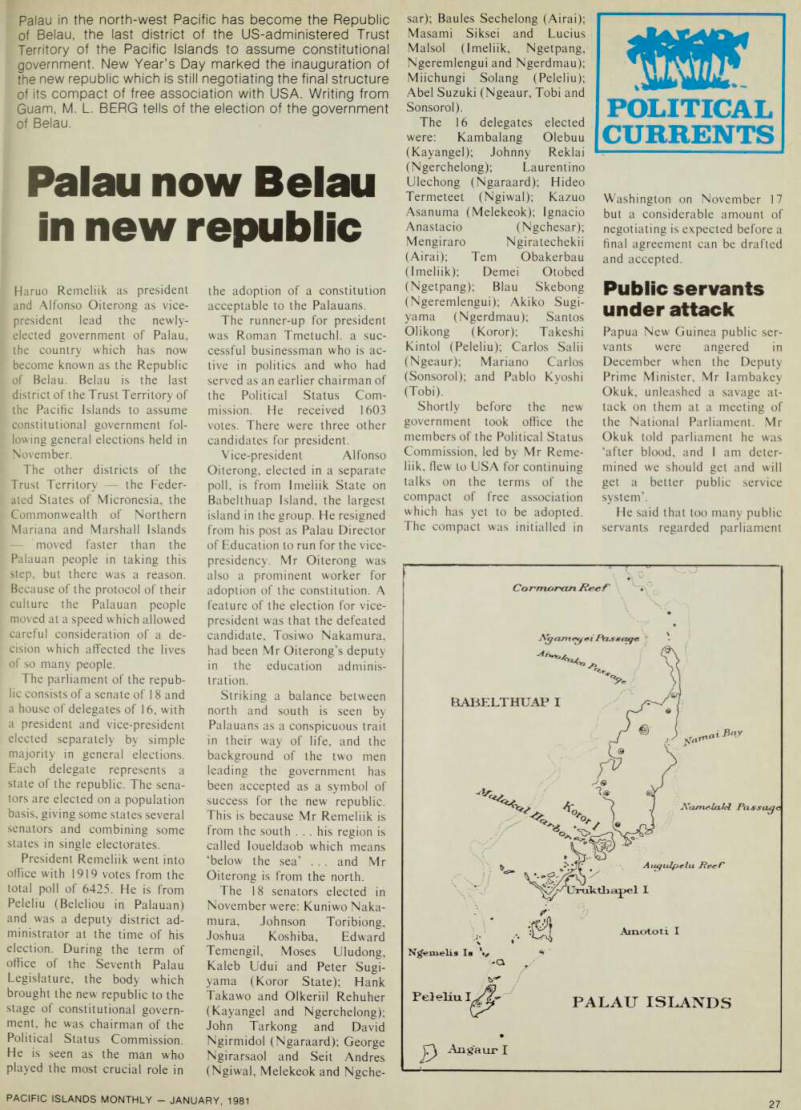
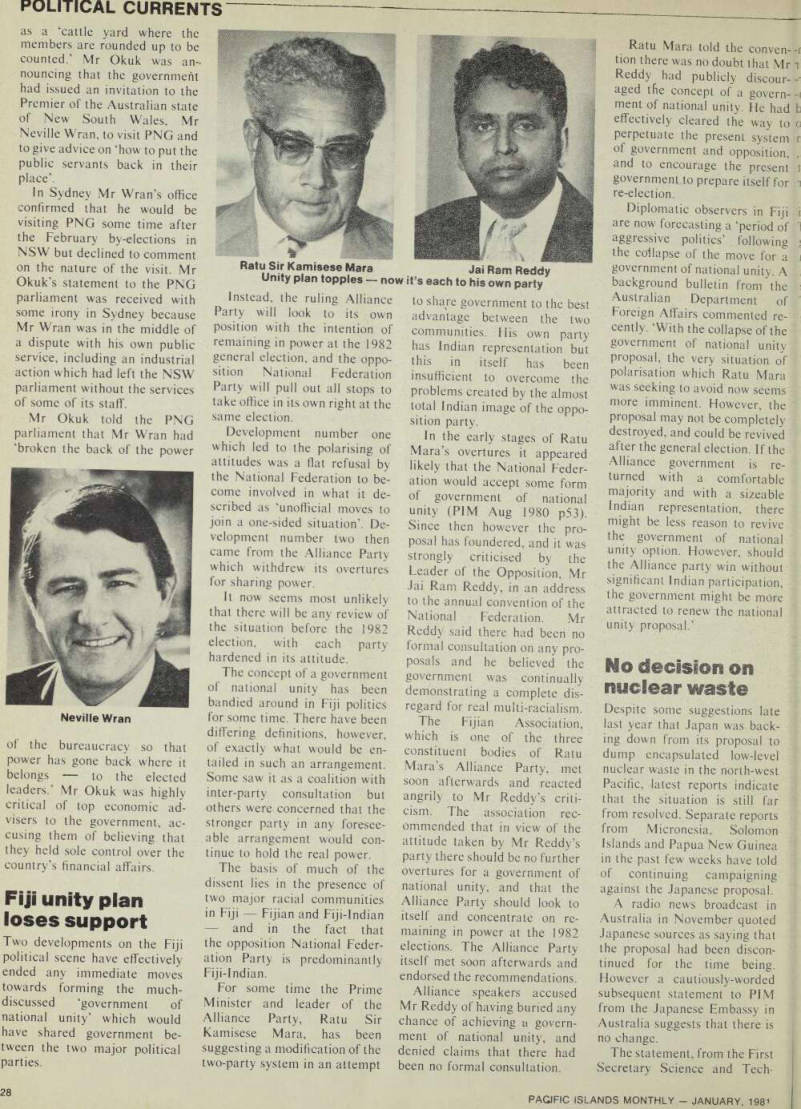
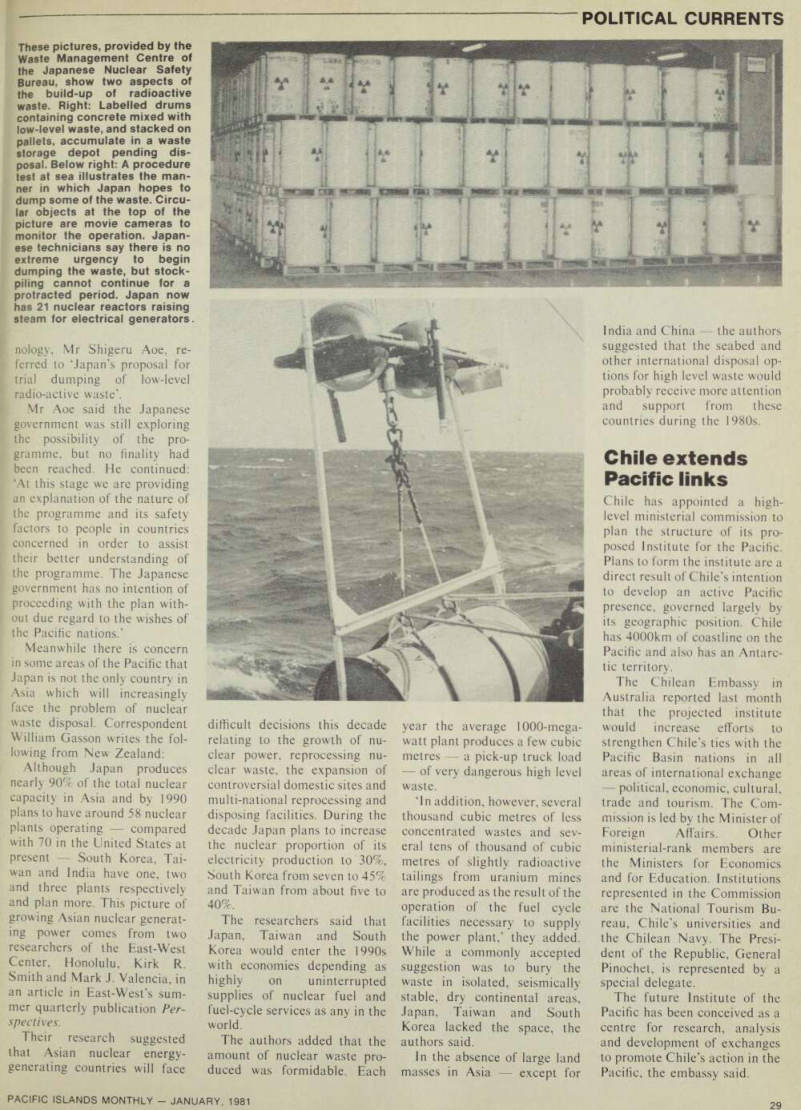
Political
Currents
Palau now Belau in new republic
Palau in the north-west Pacific has become the Republic of Belau, the last district of the US-administered Trust Territory of the Pacific Islands to assume constitutional government. New Year’s Day marked the inauguration of the new republic which is still negotiating the final structure of its compact of free association with USA. Writing from Guam, M. L. BERG tells of the election of the government of Belau.
Haruo Remeliik as president and Alfonso Oiterong as vice president lead the newly : elected government of Palau, the country which has now f become known as the Republic [ of Belau. Belau is the last district of the Trust Territory of the Pacific Islands to assume constitutional government fol l lowing general elections held in November.
The other districts of the Trust Territory the Feder ated States of Micronesia, the Commonwealth of Northern Mariana and Marshall Islands moved faster than the Palauan people in taking this ; step, but there was a reason.
Because of the protocol of their culture the Palauan people moved at a speed which allowed careful consideration of a de cision which affected the lives of so many people.
The parliament of the repub lic consists of a senate of 18 and a house of delegates of 16, with a president and vice-president elected separately by simple majority in general elections.
Each delegate represents a stale of the republic. The sena tors are elected on a population basis, giving some states several senators and combining some states in single electorates.
President Remeliik went into office with 1919 votes from the total poll of 6425. He is from Peleliu (Beleliou in Palauan) and was a deputy district ad ministrator at the time of his election. During the term of office of the Seventh Palau Legislature, the body which brought the new republic to the stage of constitutional govern ment, he was chairman of the Political Status Commission.
He is seen as the man who played the most crucial role in
the adoption of a constitution acceptable to the Palauans.
The runner-up for president was Roman Tmetuchl. a suc cessful businessman who is ac tive in politics and who had served as an earlier chairman of the Political Status Com mission. He received 1603 votes. There were three other candidates for president.
Vice-president Alfonso Oiterong, elected in a separate poll, is from Imeliik Slate on Babellhuap Island, the largest island in the group. He resigned from his post as Palau Director of Education to run for the vice presidency. Mr Oiterong was also a prominent worker for adoption of the constitution. A feature of the election for vice president was that the defeated candidate, Tosiwo Nakamura, had been Mr Oiterong’s deputy in the education adminis tration.
Striking a balance between north and south is seen by Palauans as a conspicuous trait in their way of life, and the background of the two men leading the government has been accepted as a symbol of success for the new republic.
This is because Mr Remeliik is from the south ... his region is called loueldaob which means ‘below the sea’ . . . and Mr Oiterong is from the north.
The 18 senators elected in November were: Kuniwo Naka mura, Johnson Toribiong, Joshua Koshiba, Edward Temengil, Moses Uludong, Kaleb Udui and Peter Sugi yama (Koror State); Hank Takawo and Olkeriil Rehuher (Kayangel and Ngerchelong); John Tarkong and David Ngirmidol (Ngaraard); George Ngirarsaol and Seit Andres (Ngiwal, Melekeok and Ngche
sar); Baules Sechelong (Airai); Masami Siksei and Lucius Malsol (Imeliik, Ngetpang, Ngeremlengui and Ngerdmau); Miichungi Solang (Peleliu); Abel Suzuki (Ngeaur, Tobi and Sonsorol).
The 16 delegates elected were: Kambalang Olebuu (Kayangel); Johnny Reklai (Ngerchelong); Laurentino Ulechong (Ngaraard); Hideo Termeteet (Ngiwal); Kazuo Asanuma (Melekeok); Ignacio Anastacio (Ngchesar); Mengiraro Ngiratechekii (Airai); Tern Obakerbau (Imeliik); Demei Otobed (Ngetpang); Blau Skebong (Ngeremlengui); Akiko Sugi yama (Ngerdmau); Santos Olikong (Koror); Takeshi Kintol (Peleliu); Carlos Salii (Ngeaur); Mariano Carlos (Sonsorol); and Pablo Kyoshi (Tobi).
Shortly before the new government look office the members of the Political Status Commission, led by Mr Reme liik, flew to USA for continuing talks on the terms of the compact of free association which has yet to be adopted.
The compact was initialled in
Washington on November 17 but a considerable amount of negotiating is expected before a final agreement can be drafted and accepted.
Public servants
under attack
Papua New Guinea public ser vants were angered in December when the Deputy Prime Minister, Mr lambakey Okuk, unleashed a savage at tack on them at a meeting of the National Parliament. Mr Okuk told parliament he was ‘after blood, and I am deter mined we should get and will get a better public service system’.
He said that too many public servants regarded parliament
as a ‘cattle yard where the members are rounded up to be counted.’ Mr Okuk was an nouncing that the government had issued an invitation to the Premier of the Australian state of New South Wales, Mr Neville Wran, to visit PNG and to give advice on ‘how to put the public servants back in their place’.
In Sydney Mr Wran’s office confirmed that he would be visiting PNG some time after the February by-elections in NSW but declined to comment on the nature of the visit. Mr Okuk’s statement to the PNG parliament was received with some irony in Sydney because Mr Wran was in the middle of a dispute with his own public service, including an industrial action which had left the NSW parliament without the services of some of its staff.
Mr Okuk told the PNG parliament that Mr Wran had ‘broken the back of the power
of the bureaucracy so that power has gone back where it belongs to the elected leaders.’ Mr Okuk was highly critical of top economic ad visers to the government, ac cusing them of believing that they held sole control over the country’s financial affairs.
Fiji unity plan
loses support
Two developments on the Fiji political scene have effectively ended any immediate moves towards forming the much discussed ‘government of national unity’ which would have shared government be tween the two major political parties.
Instead, the ruling Alliance Party will look to its own position with the intention of remaining in power at the 1982 general election, and the oppo sition National Federation Party will pull out all stops to take office in its own right at the same election.
Development number one which led to the polarising of attitudes was a flat refusal by the National Federation to be come involved in what it de scribed as ‘unofficial moves to join a one-sided situation’. De velopment number two then came from the Alliance Party which withdrew its overtures for sharing power.
It now seems most unlikely that there will be any review of the situation before the 1982 election, with each party hardened in its attitude.
The concept of a government of national unity has been bandied around in Fiji politics for some lime. There have been differing definitions, however, of exactly what would be en tailed in such an arrangement.
Some saw it as a coalition with inter-party consultation but others were concerned that the stronger party in any foresee able arrangement would con tinue to hold the real power.
The basis of much of the dissent lies in the presence of two major racial communities in Fiji Fijian and Fiji-Indian and in the fact that the opposition National Feder ation Party is predominantly Fiji-Indian.
For some time the Prime Minister and leader of the Alliance Party, Ratu Sir Kamisese Mara, has been suggesting a modification of the two-party system in an attempt
to share government to the best advantage between the two communities. His own party has Indian representation but this in itself has been insufficient to overcome the problems created by the almost total Indian image of the oppo sition party.
In the early stages of Ratu Mara’s overtures it appeared likely that the National Feder ation would accept some form of government of national unity (PIM Aug 1980 p 53).
Since then however the pro posal has foundered, and it was strongly criticised by the Leader of the Opposition, Mr Jai Ram Reddy, in an address to the annual convention of the National Federation. Mr Reddy said there had been no formal consultation on any pro posals and he believed the government was continually demonstrating a complete dis regard for real multi-racialism.
The Fijian Association, which is one of the three constituent bodies of Ratu Mara’s Alliance Party, met soon afterwards and reacted angrily to Mr Reddy’s criti cism. The association rec ommended that in view of the attitude taken by Mr Reddy’s party there should be no further overtures for a government of national unity, and that the Alliance Party should look to itself and concentrate on re maining in power at the 1982 elections. The Alliance Party itself met soon afterwards and endorsed the recommendations.
Alliance speakers accused Mr Reddy of having buried any chance of achieving a govern ment of national unity, and denied claims that there had been no formal consultation.
Ratu Mara told the conven tion there was no doubt that Mr Reddy had publicly discour aged the concept of a govern ment of national unity. He had effectively cleared the way to perpetuate the present system of government and opposition, and to encourage the present government to prepare itself for re-election.
Diplomatic observers in Fiji are now forecasting a ‘period of aggressive politics’ following the collapse of the move for a government of national unity. A background bulletin from the Australian Department of Foreign Affairs commented re cently. ‘With the collapse of the government of national unity proposal, the very situation of polarisation which Ratu Mara was seeking to avoid now seems more imminent. However, the proposal may not be completely destroyed, and could be revived after the general election. If the Alliance government is re turned with a comfortable majority and with a sizeable Indian representation, there might be less reason to revive the government of national unity option. However, should the Alliance party win without significant Indian participation, the government might be more attracted to renew the national unity proposal.’
Mo decision on
nuclear waste
Despite some suggestions late last year that Japan was back ing down from its proposal to dump encapsulated low-level nuclear waste in the north-west Pacific, latest reports indicate that the situation is still far from resolved. Separate reports from Micronesia, Solomon Islands and Papua New Guinea in the past few weeks have told of continuing campaigning against the Japanese proposal.
A radio news broadcast in Australia in November quoted Japanese sources as saying that the proposal had been discon tinued for the time being.
However a cautiously-worded subsequent statement to PIM from the Japanese Embassy in Australia suggests that there is no change.
The statement, from the First Secretary Science and Tech
Neville Wran
Ratu Sir Kamisese Mara Jai Ram Reddy Unity plan topples - now it’s each to his own party
nology, Mr Shigeru Aoe, re ferred to ‘Japan’s proposal for trial dumping of low-level radio-active waste’.
Mr Aoe said the Japanese government was still exploring the possibility of the pro gramme, but no finality had been reached. He continued: ‘At this stage we are providing an explanation of the nature of the programme and its safety factors to people in countries concerned in order to assist their better understanding of the programme. The Japanese government has no intention of proceeding with the plan with out due regard to the wishes of the Pacific nations.’
Meanwhile there is concern in some areas of the Pacific that Japan is not the only country in Asia which will increasingly face the problem of nuclear waste disposal. Correspondent William Gasson writes the fol lowing from New Zealand: Although Japan produces nearly 90% of the total nuclear capacity in Asia and by 1990 plans to have around 58 nuclear plants operating compared with 70 in the United States at present South Korea, Tai wan and India have one, two and three plants respectively and plan more. This picture of growing Asian nuclear generat ing power comes from two researchers of the East-West Center, Honolulu, Kirk R.
Smith and Mark J. Valencia, in an article in East-West’s sum mer quarterly publication Per spectives.
Their research suggested that Asian nuclear energy generating countries will face
difficult decisions this decade relating to the growth of nu clear power, reprocessing nu clear waste, the expansion of controversial domestic sites and multi-national reprocessing and disposing facilities. During the decade Japan plans to increase the nuclear proportion of its electricity production to 30%, South Korea from seven to 45% and Taiwan from about five to 40%.
The researchers said that Japan, Taiwan and South Korea would enter the 1990 s with economies depending as highly on uninterrupted supplies of nuclear fuel and fuel-cycle services as any in the world.
The authors added that the amount of nuclear waste pro duced was formidable. Each
year the average 1000-megawatt plant produces a few cubic metres a pick-up truck load of very dangerous high level waste. ‘ln addition, however, several thousand cubic metres of less concentrated wastes and several tens of thousand of cubic metres of slightly radioactive tailings from uranium mines are produced as the result of the operation of the fuel cycle facilities necessary to supply the power plant,’ they added.
While a commonly accepted suggestion was to bury the waste in isolated, seismically stable, dry continental areas, Japan, Taiwan and South Korea lacked the space, the authors said.
In the absence of large land masses in Asia except for
India and China the authors suggested that the seabed and other international disposal op tions for high level waste would probably receive more attention and support from these countries during the 1980 s.
Chile extends
Pacific links
Chile has appointed a high level ministerial commission to plan the structure of its pro posed Institute for the Pacific.
Plans to form the institute are a direct result of Chile’s intention to develop an active Pacific presence, governed largely by its geographic position. Chile has 4000 km of coastline on the Pacific and also has an Antarc tic territory.
The Chilean Embassy in Australia reported last month that the projected institute would increase efforts to strengthen Chile’s ties with the Pacific Basin nations in all areas of international exchange political, economic, cultural, trade and tourism. The Com mission is led by the Minister of Foreign Affairs. Other ministerial-rank members are the Ministers for Economics and for Education. Institutions represented in the Commission are the National Tourism Bu reau, Chile’s universities and the Chilean Navy. The Presi dent of the Republic, General Pinochet, is represented by a special delegate.
The future Institute of the Pacific has been conceived as a centre for research, analysis and development of exchanges to promote Chile’s action in the Pacific, the embassy said.
These pictures, provided by the Waste Management Centre of the Japanese Nuclear Safety Bureau, show two aspects of the build-up of radioactive waste. Right: Labelled drums containing concrete mixed with low-level waste, and stacked on pallets, accumulate in a waste storage depot pending dis posal. Below right: A procedure test at sea illustrates the man ner in which Japan hopes to dump some of the waste. Circu lar objects at the top of the picture are movie cameras to monitor the operation. Japan ese technicians say there is no extreme urgency to begin dumping the waste, but stock piling cannot continue for a protracted period. Japan now has 21 nuclear reactors raising steam for electrical generators.
Advertisements & other items, p. 30 (1 item)
inner ’s Edge
The rally's underway.
The competition is tough.
The skills that make up a champion are many.
J fie IATI ' 7O r' / r* /_• / rm i . . J winners edge-reliability. The kind of reliability you expect from Clarion car stereo.
High guality performance all the way.
Check out the full lineup. You'll find it in the * 151 winner's circle , every time.
inner ’s Edge
In Car Entertainment Company Clarion Co., Ltd. Tokyo, Japan : ■? a m i * * - I . ■ Wc /
Overseas electorate
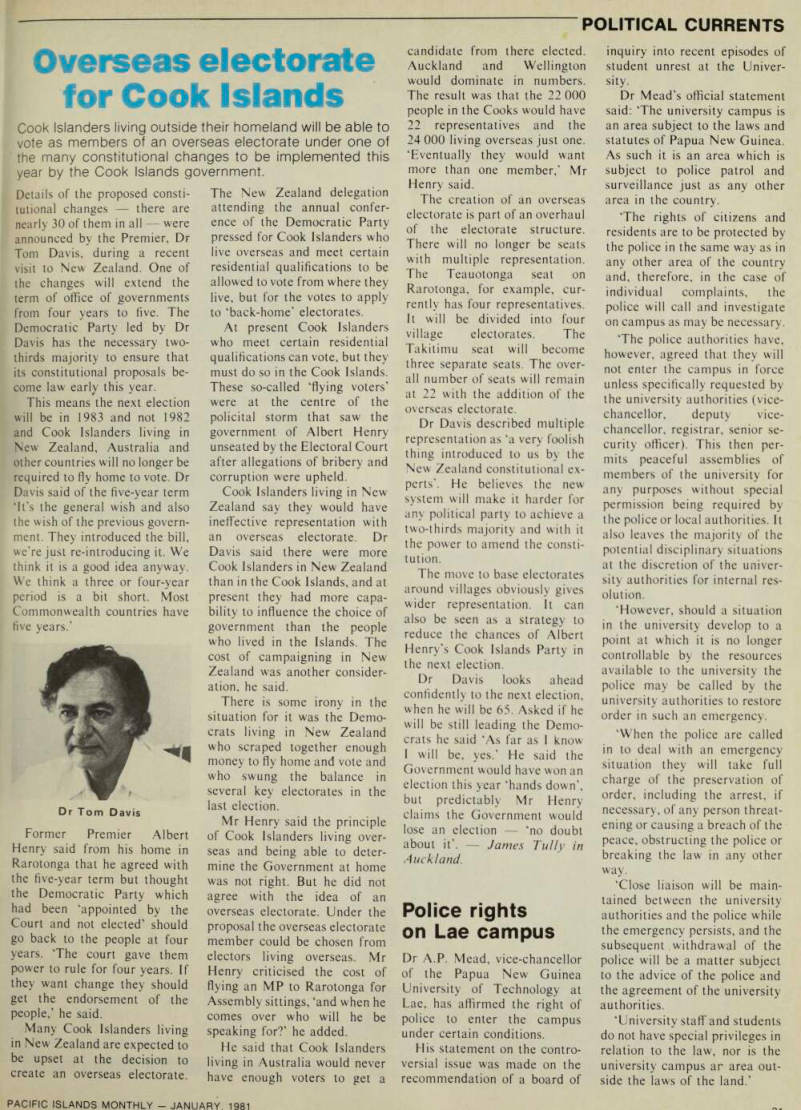
for Cook Islands
Cook Islanders living outside their homeland will be able to vote as members of an overseas electorate under one of the many constitutional changes to be implemented this year by the Cook Islands government.
Details of the proposed consti tutional changes there are nearly 30 of them in all were announced by the Premier, Dr Tom Davis, during a recent visit to New Zealand. One of the changes will extend the term of office of governments from four years to five. The Democratic Party led by Dr Davis has the necessary two thirds majority to ensure that its constitutional proposals be come law early this year.
This means the next election will be in 1983 and not 1982 and Cook Islanders living in New Zealand, Australia and other countries will no longer be required to fly home to vote. Dr Davis said of the five-year term ‘lt’s the general wish and also the wish of the previous govern ment. They introduced the bill, we’re just re-introducing it. We think it is a good idea anyway.
We think a three or four-year period is a bit short. Most Commonwealth countries have five years.’
The New Zealand delegation attending the annual confer ence of the Democratic Party pressed for Cook Islanders who live overseas and meet certain residential qualifications to be allowed to vote from where they live, but for the votes to apply to ‘back-home’ electorates.
At present Cook Islanders who meet certain residential qualifications can vote, but they must do so in the Cook Islands.
These so-called ‘flying voters’ were at the centre of the policital storm that saw the government of Albert Henry unseated by the Electoral Court after allegations of bribery and corruption were upheld.
Cook Islanders living in New Zealand say they would have ineffective representation with an overseas electorate. Dr Davis said there were more Cook Islanders in New Zealand than in the Cook Islands, and at present they had more capa bility to influence the choice of government than the people who lived in the Islands. The cost of campaigning in New Zealand was another consider ation, he said.
There is some irony in the situation for it was the Demo crats living in New Zealand who scraped together enough money to fly home and vote and who swung the balance in several key electorates in the last election.
Mr Henry said the principle of Cook Islanders living over seas and being able to deter mine the Government at home was not right. But he did not agree with the idea of an overseas electorate. Under the proposal the overseas electorate member could be chosen from electors living overseas. Mr Henry criticised the cost of flying an MP to Rarotonga for Assembly sittings, ‘and when he comes over who will he be speaking for?’ he added.
He said that Cook Islanders living in Australia would never have enough voters to get a
Former Premier Albert Henry said from his home in Rarotonga that he agreed with the five-year term but thought the Democratic Party which had been ‘appointed by the Court and not elected’ should go back to the people at four years. The court gave them power to rule for four years. If they want change they should get the endorsement of the people,’ he said.
Many Cook Islanders living in New Zealand are expected to be upset at the decision to create an overseas electorate.
candidate from there elected.
Auckland and Wellington would dominate in numbers.
The result was that the 22 000 people in the Cooks would have 22 representatives and the 24 000 living overseas just one. ‘Eventually they would want more than one member,’ Mr Henry said.
The creation of an overseas electorate is part of an overhaul of the electorate structure.
There will no longer be seats with multiple representation.
The Teauotonga seat on Rarotonga, for example, cur rently has four representatives.
It will be divided into four village electorates. The Takitimu seat will become three separate seats. The over all number of seats will remain at 22 with the addition of the overseas electorate.
Dr Davis described multiple representation as ‘a very foolish thing introduced to us by the New Zealand constitutional ex perts’. He believes the new system will make it harder for any political party to achieve a two-thirds majority and with it the power to amend the consti tution.
The move to base electorates around villages obviously gives wider representation. It can also be seen as a strategy to reduce the chances of Albert Henry's Cook Islands Party in the next election.
Dr Davis looks ahead confidently to the next election, when he will be 65. Asked if he will be still leading the Demo crats he said ‘As far as I know I will be, yes.’ He said the Government would have won an election this year ‘hands down’, but predictably Mr Henry claims the Government would lose an election ‘no doubt
about it’.
James
Tally in
Auckland.
Police rights
on Lae campus
Dr A.P. Mead, vice-chancellor of the Papua New Guinea University of Technology at Lae, has affirmed the right of police to enter the campus under certain conditions.
His statement on the contro versial issue was made on the recommendation of a board of
inquiry into recent episodes of student unrest at the Univer sity.
Dr Mead’s official statement said: The university campus is an area subject to the laws and statutes of Papua New Guinea.
As such it is an area which is subject to police patrol and surveillance just as any other area in the country.
The rights of citizens and residents are to be protected by the police in the same way as in any other area of the country and, therefore, in the case of individual complaints, the police will call and investigate on campus as may be necessary.
The police authorities have, however, agreed that they will not enter the campus in force unless specifically requested by the university authorities (vice chancellor, deputy vice chancellor, registrar, senior se curity officer). This then per mits peaceful assemblies of members of the university for any purposes without special permission being required by the police or local authorities. It also leaves the majority of the potential disciplinary situations at the discretion of the univer sity authorities for internal res olution. ‘However, should a situation in the university develop to a point at which it is no longer controllable by the resources available to the university the police may be called by the university authorities to restore order in such an emergency. ‘When the police are called in to deal with an emergency situation they will take full charge of the preservation of order, including the arrest, if necessary, of any person threat ening or causing a breach of the peace, obstructing the police or breaking the law in any other way. ‘Close liaison will be main tained between the university authorities and the police while the emergency persists, and the subsequent withdrawal of the police will be a matter subject to the advice of the police and the agreement of the university authorities. ‘University staff and students do not have special privileges in relation to the law, nor is the university campus ar area out side the laws of the land.’
Dr Tom Davis
Advertisements & other items, p. 32 (2 items)
32
DAr'lCir I Q I AM HQ MOMTUI V lAMIIADV IQQI
If you’ve got a problem
you can stick it!
Quik Stik have a range of hardworking self adhesive products designed to assist you with stock control, filing, product pricing and car decorating.
Stock labels. Retailers’ pricing guns.
Printers packs. Safety tread - adhesive vinyl for slippery areas. Auto accessories - Decrastrip and Pinstripe. Each product designed to do a job and stick to it.
See your nearest Quik Stik stockist.
They’re right throughout the Pacific Islands and South East Asia. Or contact Quik Stik in New Zealand.
If you’ve got a problem, we’ve got a label for it.
Quik Stik international Limited Telex: NZ 21717. P.O. Box 76221, Manukau City, Auckland, New Zealand.
Cable: Quik Stik Auckland. 25000
E
$7490 KIT
St L R ■ I I ■ f '
74 RUSSELL STREET, TOOWOOMBA,
OLD. 4350. PHONE (076) 32 3411
Our home units come in kit form. Easy to transport anywhere.
Approved in cyclone areas - A ft / / / / / / / / / / / / 6*^ / s- a /
CTS W >P
/ ° ,o S' / S> / i J
style
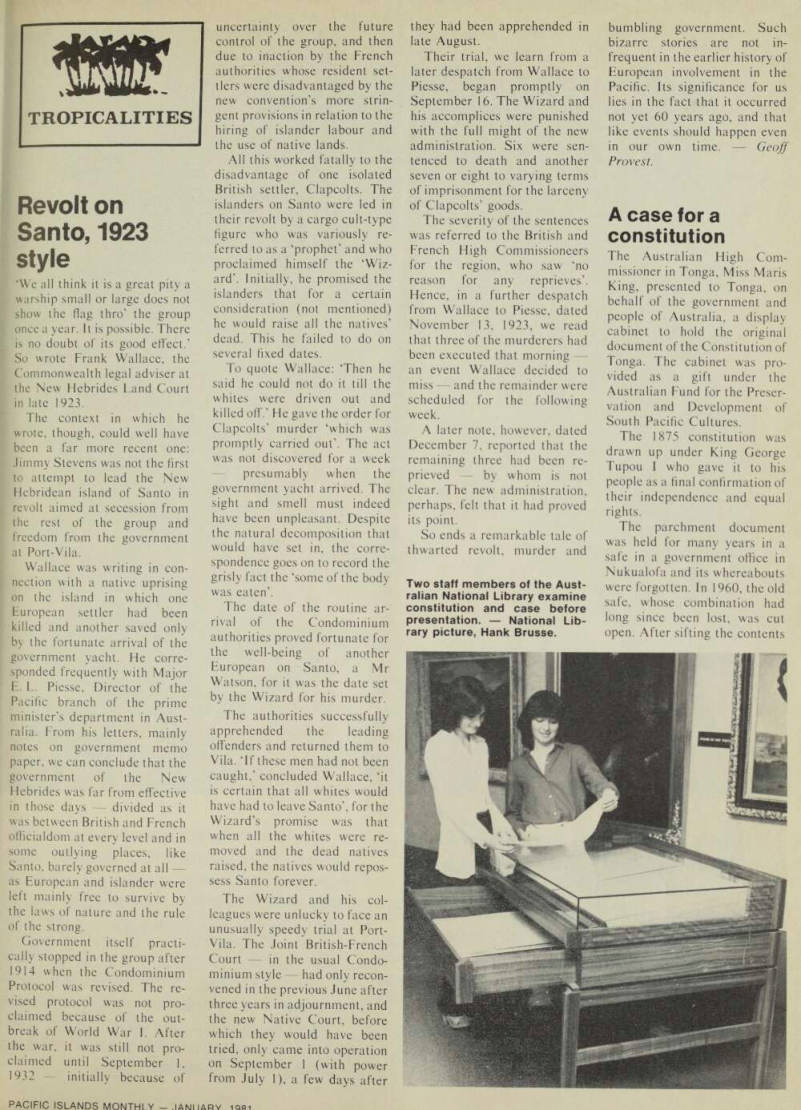
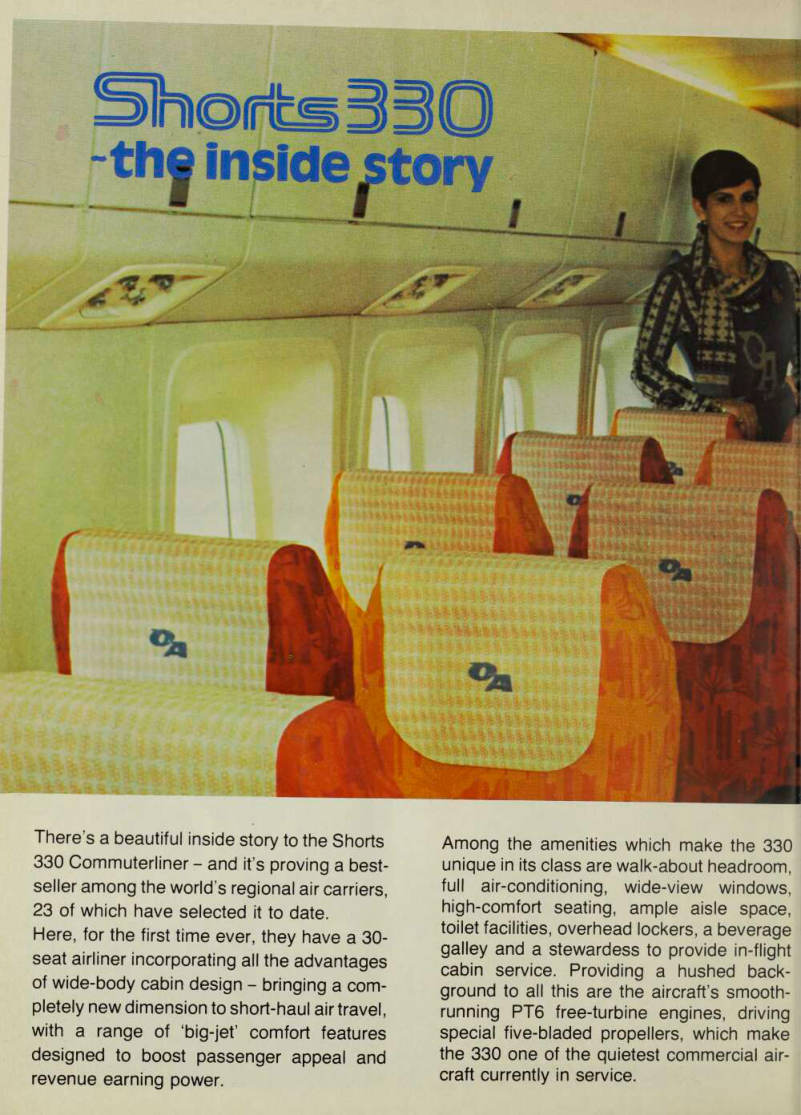
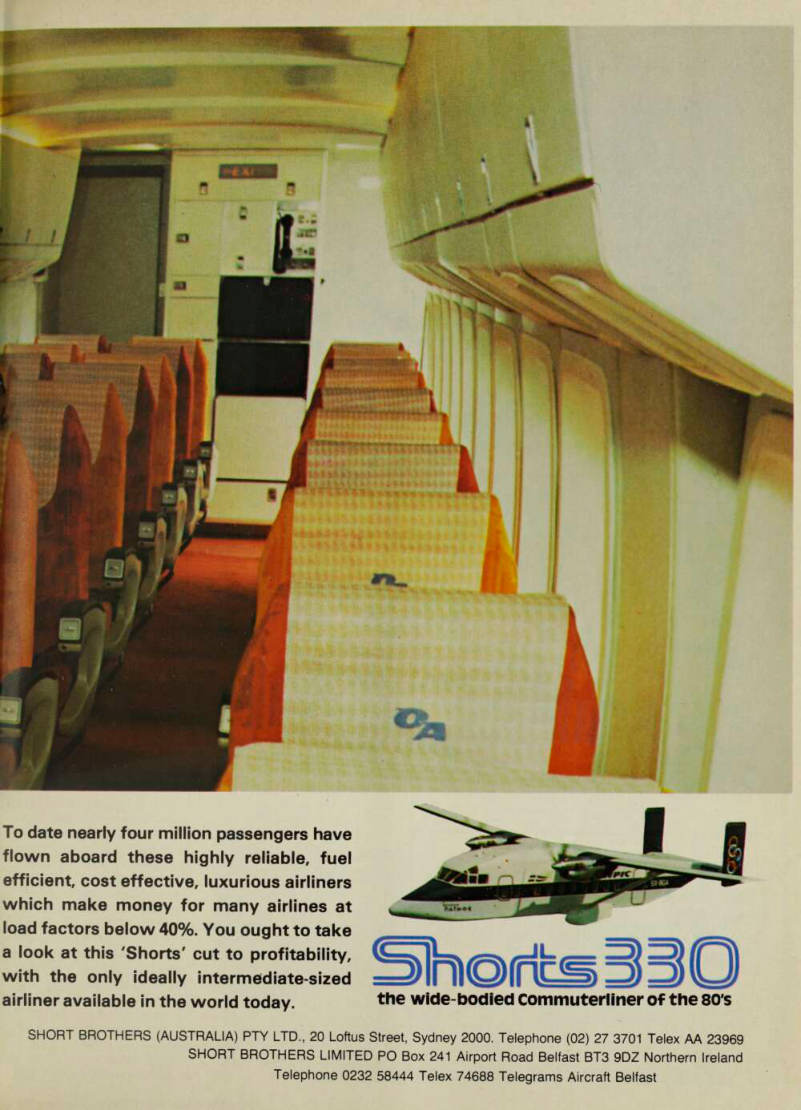
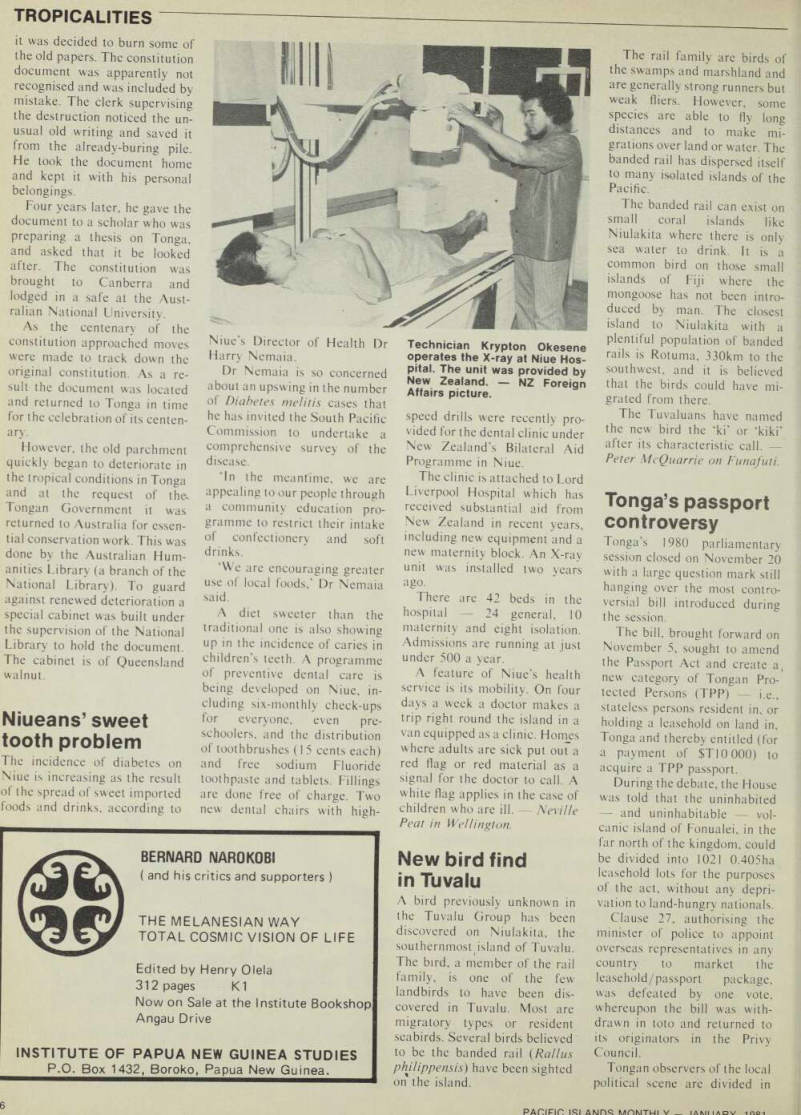
Tropicalities
uncertainly over the future control of the group, and then due to inaction by the French authorities whose resident set tlers were disadvantaged by the new convention’s more strin gent provisions in relation to the hiring of islander labour and the use of native lands.
All this worked fatally to the disadvantage of one isolated British settler, Clapcolts. The islanders on Santo were led in their revolt by a cargo cult-type figure who was variously re ferred to as a ‘prophet’ and who proclaimed himself the ‘Wiz ard’. Initially, he promised the islanders that for a certain consideration (not mentioned) he would raise all the natives’ dead. This he failed to do on several fixed dales.
To quote Wallace: ‘Then he said he could not do it till the whites were driven out and killed off.' He gave the order for Clapcolts’ murder ‘which was promptly carried out’. The act was not discovered for a week presumably when the government yacht arrived. The sight and smell must indeed have been unpleasant. Despite the natural decomposition that would have set in, the corre spondence goes on to record the grisly fact the ‘some of the body was eaten’.
The date of the routine ar rival of the Condominium authorities proved fortunate for the well-being of another European on Santo, a Mr Watson, for it was the date set by the Wizard for his murder.
The authorities successfully apprehended the leading offenders and returned them to Vila. ‘lf these men had not been caught,’ concluded Wallace, ‘it is certain that all whites would have had to leave Santo’, for the Wizard’s promise was that when all the whites were re moved and the dead natives raised, the natives would repos sess Santo forever.
The Wizard and his col leagues were unlucky to face an unusually speedy trial at Port- Vila. The Joint British-French Court in the usual Condo minium style had only recon vened in the previous June after three years in adjournment, and the new Native Court, before which they would have been tried, only came into operation on September 1 (with power from July 1), a few days after
Revolt on
Santo, 1923
style
‘We all think it is a great pity a warship small or large does not show the flag thro' the group once a year. It is possible. There is no doubt of its good effect.’
So wrote Frank Wallace, the Commonwealth legal adviser at the New Hebrides Land Court in late 1923.
The context in which he wrote, though, could well have been a far more recent one: Jimmy Stevens was not the first to attempt to lead the New Hebridean island of Santo in revolt aimed at secession from the rest of the group and freedom from the government at Port-Vila.
Wallace was writing in con nection with a native uprising on the island in which one European settler had been killed and another saved only by the fortunate arrival of the government yacht. He corre sponded frequently with Major E. L. Piesse, Director of the Pacific branch of the prime minister’s department in Aust ralia. From his letters, mainly notes on government memo paper, we can conclude that the government of the New Hebrides was far from effective in those days divided as it was between British and French officialdom at every level and in some outlying places, like Santo, barely governed at all as European and islander were left mainly free to survive by the laws of nature and the rule of the strong.
Government itself practi cally stopped in the group after 1914 when the Condominium Protocol was revised. The re vised protocol was not pro claimed because of the out break of World War I. After the war, it was still not pro claimed until September I, 1 932 initially because of
they had been apprehended in late August.
Their trial, we learn from a later despatch from Wallace to Piesse, began promptly on September 16. The Wizard and his accomplices were punished with the full might of the new administration. Six were sen tenced to death and another seven or eight to varying terms of imprisonment for the larceny of Clapcolts’ goods.
The severity of the sentences was referred to the British and French High Commissioneers for the region, who saw ‘no reason for any reprieves’.
Hence, in a further despatch from Wallace to Piesse, dated November 13, 1923, we read that three of the murderers had been executed that morning an event Wallace decided to miss and the remainder were scheduled for the following week.
A later note, however, dated December 7, reported that the remaining three had been re prieved by whom is not clear. The new administration, perhaps, felt that it had proved its point.
So ends a remarkable tale of thwarted revolt, murder and
bumbling government. Such bizarre stories are not in frequent in the earlier history of European involvement in the Pacific. Its significance for us lies in the fact that it occurred not yet 60 years ago, and that like events should happen even
in our own time.
Geoff
Provest.
A case for a
constitution
The Australian High Com missioner in Tonga, Miss Maris King, presented to Tonga, on behalf of the government and people of Australia, a display cabinet to hold the original document of the Constitution of Tonga. The cabinet was pro vided as a gift under the Australian Fund for the Preser vation and Development of South Pacific Cultures.
The 1875 constitution was drawn up under King George Tupou 1 who gave it to his people as a final confirmation of their independence and equal rights.
The parchment document was held for many years in a safe in a government office in Nukualofa and its whereabouts were forgotten. In 1960, the old safe, whose combination had long since been lost, was cut open. After sifting the contents
Two staff members of the Aust ralian National Library examine constitution and case before presentation. - National Lib rary picture, Hank Brusse.
it was decided to burn some of the old papers. The constitution document was apparently not recognised and was included by mistake. The clerk supervising the destruction noticed the un usual old writing and saved it from the already-buring pile.
He took the document home and kept it with his personal belongings.
Four years later, he gave the document to a scholar who was preparing a thesis on Tonga, and asked that it be looked after. The constitution was brought to Canberra and lodged in a safe at the Aust ralian National University.
As the centenary of the constitution approached moves were made to track down the original constitution. As a re sult the document was located and returned to Tonga in time for the celebration of its centen ary.
However, the old parchment quickly began to deteriorate in the tropical conditions in Tonga and at the request of the- Tongan Government it was returned to Australia for essen tial conservation work. This was done by the Australian Hum anities Library (a branch of the National Library). To guard against renewed deterioration a special cabinet was built under the supervision of the National Library to hold the document.
The cabinet is of Queensland walnut.
Niueans’ sweet
tooth problem
The incidence of diabetes on Niue is increasing as the result of the spread of sweet imported foods and drinks, according to
Niue’s Director of Health Dr Harry Nemaia.
Dr Nemaia is so concerned about an upswing in the number of Diabetes melitis cases that he has invited the South Pacific Commission to undertake a comprehensive survey of the disease. ‘ln the meantime, we are appealing to our people through a community education pro gramme to restrict their intake of confectionery and soft drinks. ‘We are encouraging greater use of local foods,' Dr Nemaia said.
A diet sweeter than the traditional one is also showing up in the incidence of caries in children’s teeth. A programme of preventive dental care is being developed on Niue, in cluding six-monthly check-ups for everyone, even pre schoolers, and the distribution of toothbrushes (15 cents each) and free sodium Fluoride toothpaste and tablets. Fillings are done free of charge. Two new dental chairs with high-
speed drills were recently pro vided for the dental clinic under New Zealand’s Bilateral Aid Programme in Niue.
The clinic is attached to Lord Liverpool Hospital which has received substantial aid from New Zealand in recent years, including new equipment and a new maternity block. An X-ray unit was installed two years ago.
There are 42 beds in the hospital 24 general, 10 maternity and eight isolation.
Admissions are running at just under 500 a year.
A feature of Niue’s health service is its mobility. On four days a week a doctor makes a trip right round the island in a van equipped as a clinic. Homes where adults are sick put out a red flag or red material as a signal for the doctor to call. A white flag applies in the case of children who are ill. Neville Peat in Wellington.
New bird find
in Tuvalu
A bird previously unknown in the Tuvalu Group has been discovered on Niulakita, the southernmostisland of Tuvalu.
The bird, a member of the rail family, is one of the few landbirds to have been dis covered in Tuvalu. Most are migratory types or resident seabirds. Several birds believed to be the banded rail (Railus philippensis) have been sighted on the island.
The rail family are birds of the swamps and marshland and are generally strong runners but weak fliers. However, some species are able to fly long distances and to make mi grations over land or water. The banded rail has dispersed itself to many isolated islands of the Pacific.
The banded rail can exist on small coral islands like Niulakita where there is only sea water to drink. It is a common bird on those small islands of Fiji where the mongoose has not been intro duced by man. The closest island to Niulakita with a plentiful population of banded rails is Rotuma, 330 km to the southwest, and it is believed that the birds could have mi grated from there.
The Tuvaluans have named the new bird the ‘ki’ or ‘kiki’ after its characteristic call.
Peter McQuarrie on Funafuti.
Tonga’s passport
controversy
Tonga’s 1980 parliamentary session closed on November 20 with a large question mark still hanging over the most contro versial bill introduced during the session.
The bill, brought forward on November 5, sought to amend the Passport Act and create a, new category of Tongan Pro tected Persons (TPP) i.e., stateless persons resident in, or holding a leasehold on land in, Tonga and thereby entitled (for a payment of STIO 000) to acquire a TPP passport.
During the debate, the House was told that the uninhabited - and uninhabitable vol canic island of Fonualei, in the far north of the kingdom, could be divided into 1021 0.405 ha leasehold lots for the purposes of the act, without any depri vation to land-hungry nationals.
Clause 27, authorising the minister of police to appoint overseas representatives in any country to market the
leasehold/passport package,
was defeated by one vote, whereupon the bill was with drawn in toto and returned to its originators in the Privy Council.
Tongan observers of the local political scene are divided in
Technician Krypton Okesene operates the X-ray at Niue Hos pital. The unit was provided by
New Zealand. - NZ Foreign
Affairs picture.
their views of what is likely to happen next. Some predict it will be legalised by special ordinance under the consti tutional machinery which oper ates to grease the wheels of government between parlia mentary sessions and re turned to the Legislative As sembly in 1981 for ratification at a time when the government is certain of the numbers.
Others believe that the unusually widespread public reaction against the proposal may well lead to its being dropped altogether.
The main discussion point among Tongan nationals at all levels hinges on concern that the scheme would debase the status of their own passports and increase the already con siderable difficulties encoun tered by Tongans seeking visas and work permits in Australia, New Zealand and the USA.
Another, more limited, school of thought was summed up by one Tongan pragmatist who characteristically quoted Scripture in his comment. ‘Our Government,’ he said ‘obviously sees this proposal as a painless way of solving some of the financial problems facing our small country with its very limited resources. But, if we have to sell our birthright in the effort to make ends meet, the mess of pottage should be a lot bigger. If Tuvalu turned down an offer of $5O 000 a passport and some South-east Asian countries fixed on a going rate of $3O 000, it would seem that the kind of people prepared to buy passports would be ready to hand over far more than a mere $lO 000.’
Expatriate comment centres in the main on the insuperable difficulties of controlling over seas agents, checking out infor mation supplied in affidavits, and screening out undesirables.
They fear that Tonga would buy into problems, both intern ally and internationally, which could far outweigh the revenue gain if some STIO million.
In particular, they quote re cent press and radio publicity, citing reports that the South Pacific is rapidly becoming the ‘in’ place for drug-runners’ staging posts on the way to Australia and New Zealand, and point out that TPP pass
ports could provide a useful cover for such illegal and lucra tive activities.
Meanwhile, parliament has squarely lobbed this hot potato back into the court of the Privy Council, the ultimate governing body which effectively formu lates all the kingdom’s national policies. Penny Hodgkinson in Nukualofa.
Ratu Mara and
the Queen Mary
The Fiji Prime Minister, Ratu Sir Kamisese Mara, revealed in a recent interview how he once wished he could have bought the liner Queen Mary when it was being sold comparatively cheaply at the end of its active life. The reason? To put on board all 15 000 people from the Lau Islands (his home province), to take them round the world, and to let them realise what a good place their home was.
Queen Mary, built and oper ated by Britain, was one of the world’s biggest and most famous passenger liners and once held the Blue Ribbon for the fastest sea-crossing of the Atlantic. The liner was com missioned in the 1930 s and after going out of service a quarter of a century later was sold to USA where it berthed as a tourist attraction.
Ratu Mara made his com ments in an interview with Deacon Ritterbusch from Im pulse, the magazine of the East-West Center Participants Association in Hawaii. He said it was a matter for regret that so
many Fijians listened to people who told them that Fiji was backward, or who believed that outside ways and places were better than those at home.
He said: ‘1 come from Lau which is interpreted by your colleagues as being a very poor country, but I keep telling my people that the resources here can give you better nutrition than anywhere else in the world. There is material for good housing, and you can learn a great deal on how to make a living through the knowledge that still exists among our people. It is a great irony for us to be told that ours is not the right way to live. We choose to live 55 years of our lives or I think our life span has risen to 65 years now divided alter nately for holiday, a little work, holiday, a little work. And then we see old people coming from all those developed countries, with walking sticks, after work ing for 55 years to earn enough to be able to come and enjoy the sun and the sand. ‘You know, when the Queen Mary was being auctioned off, I thought I would like to acquire that, put all the Lauans on board and send them around the world. Then when they come back home I’ll ask “Do you still want to go to the rest of the world, having seen it?”.’
Ratu Mara said that one of the greatest problems facing his country at present was over coming the political environ ment which was a heritage of colonialism. Under this en vironment bureaucrats, experts and civil servants saw them selves as slightly above the
elected representatives of the people. The result was that it was not always certain that policies adopted by the people were executed by the officials.
This was contrary to the effective administration which had existed before colonialism when the people themselves made the policies and carried them out.
Too many civil servants had also inherited ‘arrogant, domi neering attitudes’ from their predecessors, he said.
Tourist plan on
Robinson Crusoe
Robinson Crusoe Island is about to put an end to its isolation. The island where British castaway Alexander Selkirk ruggedly fought his lonely battle for survival, later inspiring Defoe’s immortal novel, is to be the site of a SUS 6 million tourist complex, to be completed this year.
Robinson Crusoe is one of the islands in the Juan Fernandez archipelago, off the central coast of Chile. The projected complex is being carried out by a company called Complejo Turistico Robinson Crusoe Ltd, working in technical partner ship with Sheraton Towers of Orlando, Florida.
The complex will feature a
Beach scene on Katafaga Island in the Lau Islands. ‘Our home, and as good as anywhere in the world’ says Fiji Prime Minister Ratu Sir Kamisese Mara whose
home province is Lau. - Fiji
Government official picture.
70-room hotel with tennis courts, water-skiing, yachting and other facilities.
The government of Chile has undertaken extension of the island's airstrip. Until this is ready, tourists will be ferried from Valparaiso either by sea plane or later, in a 500-tonne ship, with capacity for 100 passengers.
The Juan Fernandez archi pelago has been declared a Chilean National Park. The complex, therefore, must con form with the environmental characteristics of the island in its design. Materials to be used in building will be mainly timber and stone, both of which are locally available in abun dance. ‘We don’t want another Miami,’ say architects Boza, Luers and Muzard, who are responsible for the design. ‘The island should be kept as un touched as possible and should maintain its character through out.’
Prince Charles
on Fiji coin
The Fijian Government has produced a coin to commemor ate last October’s 10th anniver sary of independence.
With a limited production of 5000, the $2OO gold coin carries a likeness to Prince Charles on one side and the Fijian coat of arms on the other. Princess Anne, who attended the inde pendence celebrations in Fiji, was presented with the first gold coin bearing the portrait of her brother.
It is the first time the head of the heir to the throne of England has appeared on any coin in the Pacific region. A special portrait photograph was taken of the prince for the coin.
The coin is expected to arouse keen interest with both investors and collectors. It is a limited release and coins bear ing a likeness to Prince Charles are rare: only three coins featur ing Prince Charles are in circu lation all in the Caribbean.
The production of the coin was limited to 2500 proof coins and 2500 uncirculated. This compares with one recent gold coin issue of 300 000 by the Royal Mint.
The proof coins sells at $675
and the uncirculated coin at $550.
The demand for gold coins is still strong in both numismatist and investment circles through out the world. The new Fijian coin is expected to be of particular interest to American collectors who are always keen to have coins bearing a likeness to any member of the British royal family.
The coin, which contains 0.7 troy ounces of pure gold, is worth about $350 just in melt ing down value. It is a 22 carat coin, weighing 15.98 gr and has a diameter of 28.4 mm.
Laugh-and-learn
English in Tonga
The practical English course for the University of the South Pacific’s Tonga Centre Con tinuing Education Programme in the villages is going well after eight months of field-testing on 36 classes in 21 villages.
The idea of a laugh-and learn, informal English course for adults was developed by Centre Director Filimone Fifita from scratch in ’79 after
village-by-village research
based on the question ‘What do you most want to learn?’
I became personally involved when he challenged me to switch from English tutoring to preparing course material tail ored to local conditions and based on my knowledge of methods used in Australia’s successful English-as-a-second language programme for its migrant intake.
All the material is based on
the teaching and learning of simple English speech patterns, using pictorial readers, mime and class activities to reinforce student ability to use and com prehend everyday sentence and question forms.
As the situational teaching techniques employed are new to the Tongan primary school teachers who make up the teaching squad, the Teacher Texts are presented in a two column formal, with how-to teach-il instructions in the left hand column and examples of the relevant student exercise opposite. The course is divided into four parts and the teachers attend concentrated training sessions at the USP Centre in Nukualofa before tackling each section in the classroom.
An evaluation study conduc ted last September, and cover ing all 36 classes, revealed a most impressive grasp by the teachers of the new techniques involved, and a gratifying level of progress among the students, who range in age from late teens to late 60s.
About two-thirds of the 556
students (predominantly
women) who enrolled for the field-test classes have success fully completed part one of the course and moved enthusiasti cally on to the greater complexities of part two.
As the evaluation revealed that variable vowels and extra, unfamiliar consonants were something of a problem for teachers and students alike, a special section devoted to pronouncialion exercises was incorporated into part two with tongue-twisters like ‘Pul the big pig in the pink bag’ and ‘Hit the tin and make a din’ occasioning
helpless mirth as Tongan tongues struggle to differentiate between ‘p’, ‘b’, ‘d’ and ‘t’.
Filimonc Fifita reports that the centre is already planning to start new classes in many other Tongatapu villages, following receipt of a further 1000 student applications. Fie also has plans to bring the same course to villages in the outer island groups of Vava’u and Ha’apai in 1981. Penny Hodgkinson in Nukualofa.
First Solomons
novel sees light
The Solomon Islands Centre of the University of the South Pacific late last year announced publication of the first Solomon Islands novel. The Alternative, by John Saunana.
The dust jacket describes the book as ‘a thought-provoking work set in the period of decolonisation in Solomon Islands’.
It adds: "The Alternative is a story in which the undercur rents of a society in change are brought close to the deceptively placid surface through its characters and their conflicts.
At a lime when Solomon Islands writing is growing in scope and depth, this novel will stand as a signal achievement, as a challenge to other Solomon Islands writers’.
John Selwyn Saunana, born in Arosi (Markira) in 1945, was minister of education in the last Solomon Islands government.
After attending Pawa and King George VI schools at home, he graduated with a Bachelor of Arts degree from the University of Papua New Guinea in 1971.
Having worked in broadcasting, teaching and linguistics, he was elected to the Legislative As sembly in 1977.
His first published writings appeared while he was at UPNG. A collected edition of his poetry is planned for the near future.
The Institute of Pacific Studies and the South Pacific Creative Arts Society were associated with the USP SI Centre in publishing The Alternative. Copies may be obtained from the centre at 5512.50 for overseas orders, bulk orders of 20 or more 5512.00.
English language class - laugh while you learn in Tonga.
Advertisements & other items, pp. 34-40 (2 items)
ory
/ - Mk mmr d m Jh OL IfMitii iW *5.
There’s a beautiful inside story to the Shorts 330 Commuterliner - and it’s proving a bestseller among the world’s regional air carriers, 23 of which have selected it to date.
Here, for the first time ever, they have a 30seat airliner incorporating all the advantages of wide-body cabin design - bringing a completely new dimension to short-haul air travel, with a range of ‘big-jet’ comfort features designed to boost passenger appeal and revenue earning power.
Among the amenities which make the 330 unique in its class are walk-about headroom, full air-conditioning, wide-view windows, high-comfort seating, ample aisle space, toilet facilities, overhead lockers, a beverage galley and a stewardess to provide in-flight cabin service. Providing a hushed background to all this are the aircraft’s smoothrunning PT6 free-turbine engines, driving special five-bladed propellers, which make the 330 one of the quietest commercial aircraft currently in service.
i *» ** x, em i -■ ■ i K To date nearly four million passengers have flown aboard these highly reliable, fuel efficient, cost effective, luxurious airliners which make money for many airlines at load factors below 40%. You ought to take a look at this 'Shorts' cut to profitability, with the only ideally intermediate-sized airliner available in the world today.
L. a the wide-bodied commuterliner of the 80's SHORT BROTHERS (AUSTRALIA) PTY LTD., 20 Loftus Street, Sydney 2000. Telephone (02) 27 3701 Telex AA 23969 SHORT BROTHERS LIMITED PO Box 241 Airport Road Belfast BT3 9DZ Northern Ireland Telephone 0232 58444 Telex 74688 Telegrams Aircraft Belfast
BERNARD NAROKOBI
( and his critics and supporters )
THE MELANESIAN WAY
TOTAL COSMIC VISION OF LIFE
Edited by Henry Olela 312 pages K 1 Now on Sale at the Institute Bookshop Angau Drive
INSTITUTE OF PAPUA NEW GUINEA STUDIES
P.O. Box 1432, Boroko, Papua New Guinea.
a first
m supersonic travel
sf2&-"»s^sr
‘ Irrt * o9 * de Wth 1 you 0311 sk| P over unwanted program material locatP to find on y ° U h faV °u- e f SOn9 at the push of a button - A Mature you would expect SOUNDTRFKnoftI'h/l BUt Wait 1111 yOU hear ,he sound of our UNDTREK portables. When you do, you’ll know why We call them “Mobile Hi-Fi ” * the outer caches of stereo listening enjoyment with SOUNDTREK ■ Rorie^^rfor^anrp' F, "/ rom "one* They’re available 7 in r,, Pioneer performance and supersonic sound to get you off the ground. 9 4 r ®sai 4
SK-61F
r .i: ■v £
SK-95F
Wm slands: Brijlal & Company, G.P.O. Box No. 362, Suva, Fiji Islands Tel: 22258 *** FreresVille ' RP H2Ced6x ' Noumea - New Caledonia Tel°(o9 ) (76^M8 ,n,CS 3 ® Pollen s,reet - ® rey ynFl, Auck tend.
HoKriHoc ■ Ri irnr /Mn,., i *_i Pacific South Seas International Ltd., P.O. Box 49, Rarotonga, Cook Islands Tel: 2327
When the time next comes for you to fly out to do business fly Polynesian Airlines. Polynesian really understands the businessman’s requirements for a quick and efficient service between all Polynesian countries.
In fact, part of the reason we established our first service (Apia Pago Pago) back in 1959 was to meet the business sector’s demand for a fast and frequent service between the Samoas.
Since then Polynesian Airlines has spread its wings. Today our extensive route network covers the whole of Polynesia east of Fiji and now extends down to Auckland, New Zealand. And, as in ‘59 a lot of the people we’re carrying today are professional people. People who know that when it comes to flying anywhere in Polynesia on business there is only one airline. Polynesian Airlines, Fly Polynesian. It’s a pleasure doing business with us.
Offices in: Auckland, Tonga, Niue, Rarotonga.
Box 599 Apia, Western Samoa, Ph 21261.
WESTERN
AMERICAN
SAMOA
rn^izoi.
Qj polynesian/aTrlines
Nandi Airport, Nandi Ph 72733.
TONGA
We are Polynesia. 2067
Tropicalities
36
PAHIFin ISI AMDS MOMTHI V lAMMAdv inoi
People
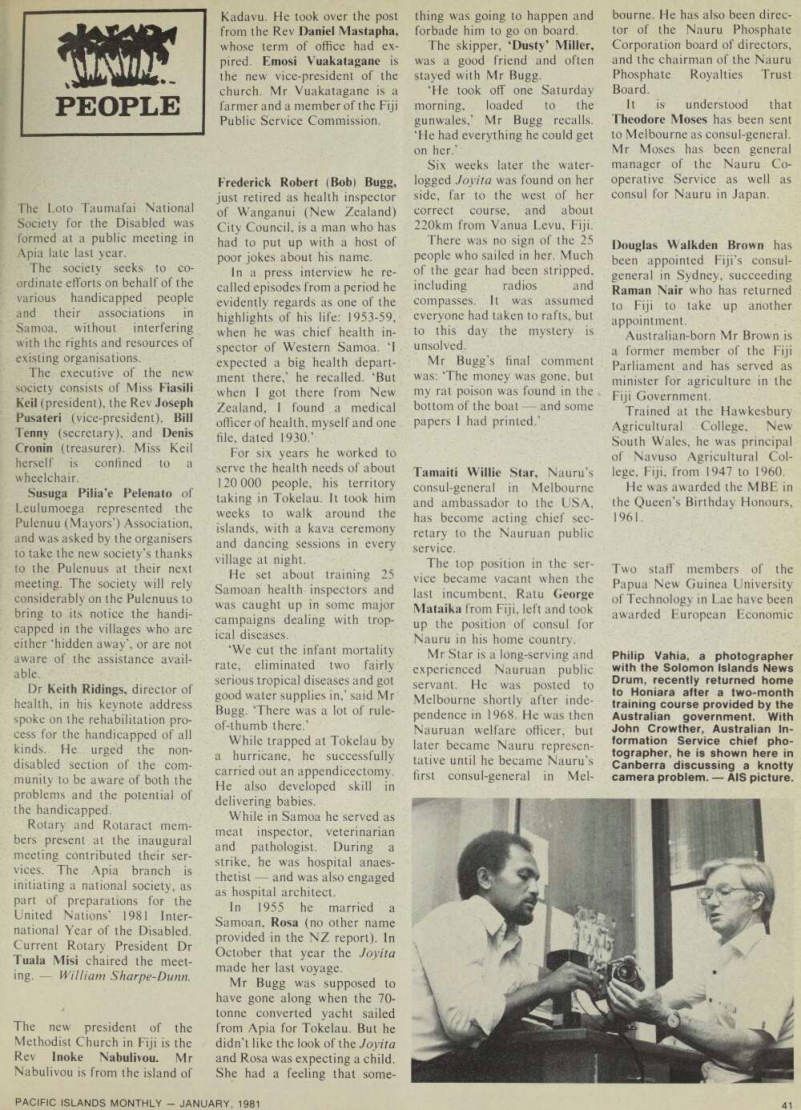


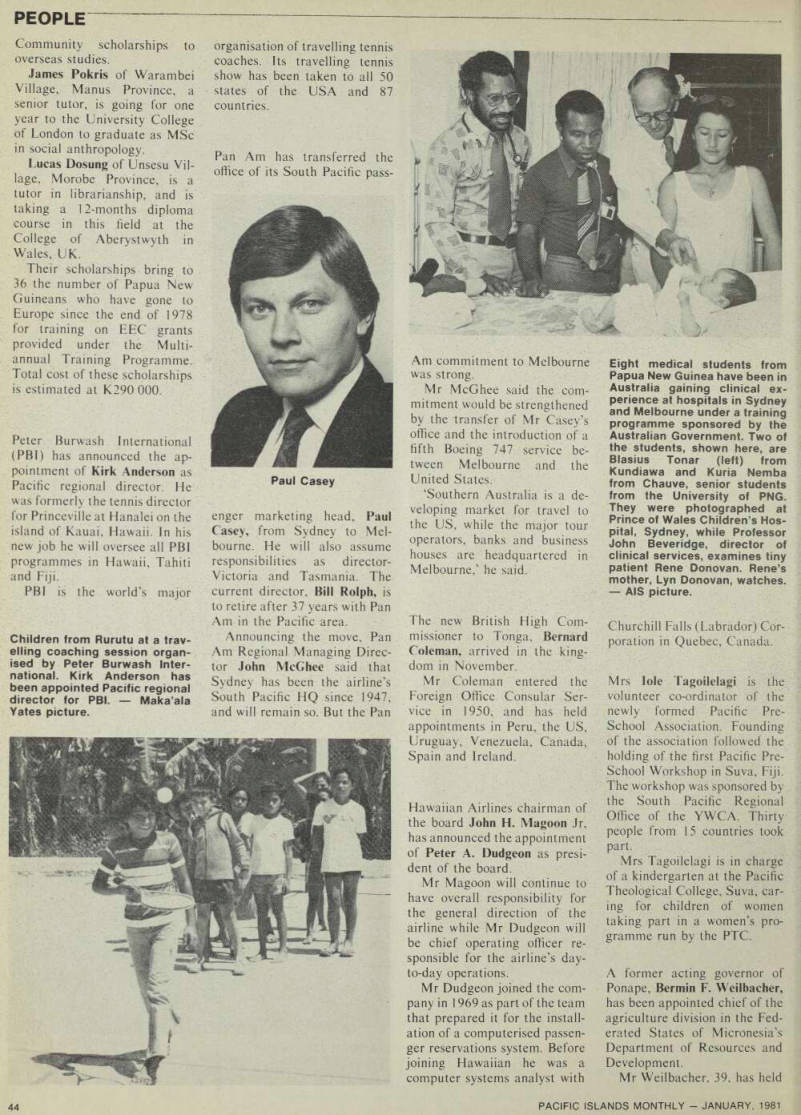
The Loto Taumafai National Society for the Disabled was formed at a public meeting in Apia late last year.
The society seeks to co ordinate efforts on behalf of the various handicapped people and their associations in Samoa, without interfering with the rights and resources of existing organisations.
The executive of the new society consists of Miss Fiasill Keil (president), the Rev Joseph Pusateri (vice-president), Bill Tennv (secretary), and Denis Cronin (treasurer). Miss Keil herself is confined to a wheelchair.
Susuga Pilia’e Pelenato of Leulumoega represented the Pulenuu (Mayors’) Association, and was asked by the organisers to take the new society’s thanks to the Pulenuus at their next meeting. The society will rely considerably on the Pulenuus to bring to its notice the handi capped in the villages who are either ‘hidden away’, or are not aware of the assistance avail able.
Dr Keith Ridings, director of health, in his keynote address spoke on the rehabilitation pro cess for the handicapped of all kinds. He urged the non disabled section of the com munity to be aware of both the problems and the potential of the handicapped.
Rotary and Rotaract mem bers present at the inaugural meeting contributed their ser vices. The Apia branch is initialing a national society, as part of preparations for the United Nations’ 1981 Inter national Year of the Disabled.
Current Rotary President Dr Tuala Misi chaired the meet
ing.
William Sharpe-Dunn.
Kadavu. He took over the post from the Rev Daniel Mastapha, whose term of office had ex pired. Emosi Vuakatagane is the new vice-president of the church. Mr Vuakatagane is a farmer and a member of the Fiji Public Service Commission.
Frederick Robert (Bob) Bugg, just retired as health inspector of Wanganui (New Zealand) City Council, is a man who has had to put up with a host of poor jokes about his name.
In a press interview he re called episodes from a period he evidently regards as one of the highlights of his life: 1953-59, when he was chief health in spector of Western Samoa. ‘I expected a big health depart ment there,’ he recalled. ‘But when I got there from New Zealand, I found a medical officer of health, myself and one file, dated 1930.’
For six years he worked to serve the health needs of about 120 000 people, his territory taking in Tokelau. It took him weeks to walk around the islands, with a kava ceremony and dancing sessions in every village at night.
He set about training 25 Samoan health inspectors and was caught up in some major campaigns dealing with trop ical diseases. ‘We cut the infant mortality rate, eliminated two fairly serious tropical diseases and got good water supplies in,’ said Mr Bugg. ‘There was a lot of rule of-thumb there.’
While trapped at Tokelau by a hurricane, he successfully carried out an appendicectomy.
He also developed skill in delivering babies.
While in Samoa he served as meat inspector, veterinarian and pathologist. During a strike, he was hospital anaes thetist and was also engaged as hospital architect.
In 1955 he married a Samoan, Rosa (no other name provided in the NZ report). In October that year the Joyita made her last voyage.
Mr Bugg was supposed to have gone along when the 70tonne converted yacht sailed from Apia for Tokelau. But he didn’t like the look of the Joyita and Rosa was expecting a child.
She had a feeling that some-
The new president of the Methodist Church in Fiji is the Rev Inoke Nabulivou. Mr Nabulivou is from the island of
thing was going to happen and forbade him to go on board.
The skipper, ‘Dusty’ Miller, was a good friend and often stayed with Mr Bugg. ‘He took off one Saturday morning, loaded to the gunwales,’ Mr Bugg recalls. ‘He had everything he could get on her.’
Six weeks later the water logged Joyita was found on her side, far to the west of her correct course, and about 220 km from Vanua Levu, Fiji.
There was no sign of the 25 people who sailed in her. Much of the gear had been stripped, including radios and compasses. It was assumed everyone had taken to rafts, but to this day the mystery is unsolved.
Mr Bugg’s final comment was: ‘The money was gone, but my rat poison was found in the bottom of the boat and some papers I had printed.’
Tamaiti Willie Star, Nauru’s consul-general in Melbourne and ambassador to the USA, has become acting chief sec retary to the Nauruan public service.
The top position in the ser vice became vacant when the last incumbent, Ratu George Mataika from Fiji, left and took up the position of consul for Nauru in his home country.
Mr Star is a long-serving and experienced Nauruan public servant. He was posted to Melbourne shortly after inde pendence in 1968. He was then Nauruan welfare officer, but later became Nauru represen tative until he became Nauru’s first consul-general in Mel
bourne. He has also been direc tor of the Nauru Phosphate Corporation board of directors, and the chairman of the Nauru Phosphate Royalties Trust Board.
It is understood that Theodore Moses has been sent to Melbourne as consul-general.
Mr Moses has been general manager of the Nauru Co operative Service as well as consul for Nauru in Japan.
Douglas Walkden Brown has been appointed Fiji’s consul general in Sydney, succeeding Raman Nair who has returned to Fiji to take up another appointment.
Australian-born Mr Brown is a former member of the Fiji Parliament and has served as minister for agriculture in the Fiji Government.
Trained at the Hawkesbury Agricultural College, New South Wales, he was principal of Navuso Agricultural Col lege, Fiji, from 1947 to 1960.
He was awarded the MBE in the Queen’s Birthday Honours, 1961.
Two staff members of the Papua New Guinea University of Technology in Lae have been awarded European Economic
Philip Vahia, a photographer with the Solomon Islands News Drum, recently returned home to Honiara after a two-month training course provided by the Australian government. With John Crowther, Australian In formation Service chief pho tographer, he is shown here in Canberra discussing a knotty camera problem. - AIS picture.
Community scholarships to overseas studies.
James Pokris of Warambei Village, Manus Province, a senior tutor, is going for one year to the University College of London to graduate as MSc in social anthropology.
Lucas Dosung of Unsesu Vil lage, Morobe Province, is a tutor in librarianship, and is taking a 12-months diploma course in this field at the College of Aberystwyth in Wales, UK.
Their scholarships bring to 36 the number of Papua New Guineans who have gone to Europe since the end of 1978 for training on EEC grants provided under the Multi annual Training Programme.
Total cost of these scholarships is estimated at K 290 000.
Peter Burwash International (PBI) has announced the ap pointment of Kirk Anderson as Pacific regional director. He was formerly the tennis director for Princeville at Hanalei on the island of Kauai, Hawaii. In his new job he will oversee all PBI programmes in Hawaii, Tahiti and Fiji.
PBI is the world’s major
organisation of travelling tennis coaches. Its travelling tennis show has been taken to all 50 states of the USA and 87 countries.
Pan Am has transferred the office of its South Pacific pass-
enger marketing head, Paul Casey, from Sydney to Mel bourne. He will also assume responsibilities as director- Victoria and Tasmania. The current director, Bill Rolph, is to retire after 37 years with Pan Am in the Pacific area.
Announcing the move. Pan Am Regional Managing Direc tor John McGhee said that Sydney has been the airline’s South Pacific HQ since 1947, and will remain so. But the Pan
Am commitment to Melbourne was strong.
Mr McGhee said the com mitment would be strengthened by the transfer of Mr Casey’s office and the introduction of a fifth Boeing 747 service be tween Melbourne and the United States. ‘Southern Australia is a de veloping market for travel to the US, while the major tour operators, banks and business houses are headquartered in Melbourne,’ he said.
The new British High Com missioner to Tonga. Bernard Coleman, arrived in the king dom in November.
Mr Coleman entered the Foreign Office Consular Ser vice in 1950, and has held appointments in Peru, the US, Uruguay, Venezuela, Canada, Spain and Ireland.
Hawaiian Airlines chairman of the board John H. Magoon Jr, has announced the appointment of Peter A. Dudgeon as presi dent of the board.
Mr Magoon will continue to have overall responsibility for the general direction of the airline while Mr Dudgeon will be chief operating officer re sponsible for the airline’s day
to-day operations.
Mr Dudgeon joined the com pany in 1969 as part of the team that prepared it for the install ation of a computerised passen ger reservations system. Before joining Hawaiian he was a computer systems analyst with
Churchill Falls (Labrador) Cor poration in Quebec, Canada.
Mrs lole Tagoilelagi is the volunteer co-ordinator of the newly formed Pacific Pre- School Association. Founding of the association followed the holding of the first Pacific Pre- School Workshop in Suva, Fiji.
The workshop was sponsored by the South Pacific Regional Office of the YWCA. Thirty people from 15 countries took part.
Mrs Tagoilelagi is in charge of a kindergarten at the Pacific Theological College, Suva, car ing for children of women taking part in a women’s pro gramme run by the PTC.
A former acting governor of Ponape, Bermin F. Weilbacher, has been appointed chief of the agriculture division in the Fed erated States of Micronesia’s Department of Resources and Development.
Mr Weilbacher, 39. has held
Children from Rurutu at a trav elling coaching session organ ised by Peter Burwash Inter national. Kirk Anderson has been appointed Pacific regional director for PBI. - Maka'ala Yates picture.
Paul Casey
Eight medical students from Papua New Guinea have been in Australia gaining clinical ex perience at hospitals in Sydney and Melbourne under a training programme sponsored by the Australian Government. Two of the students, shown here, are Blasius Tonar (left) from Kundiawa and Kuna Nemba from Chauve, senior students from the University of PNG.
They were photographed at Prince of Wales Children’s Hos pital, Sydney, while Professor John Beveridge, director of clinical services, examines tiny patient Rene Donovan. Rene’s mother, Lyn Donovan, watches. - AIS picture.
a number of posts with the Trust Territory government.
Among them were acting governor of Ponape from December 1977 to April 1979; deputy district administrator of Ponape from 1974 to 1977; and chief of the agriculture division at Trust Territory headquarters on Saipan from 1972 to 1974.
He holds a degree in agricul tural technology from the Uni versity of Hawaii.
Boxers from Vanuatu did well at their first overseas inter national boxing tournament in Solomon Islands late last year.
Jeffry Nauras, Tanna, brought back first prize in the flyweight division. Sam Kalsong, Emau, took out second prize in the same division, and Naui Namak, Tanna, won second prize in the welter weight contest. ‘Aoba: Lini Taken Captive’ was the sensational frontpage head line in a November issue of the Port-Vila weekly, Voice of Vanuatu.
But the story inside reassured those who might have felt that things had taken a new turn for the worse in the troubled archi pelago.
It said: The road was blocked. ‘Prime Minister Father Walter Lini’s transport stopped in front of the blockade. ‘Warriors leapt out from the dense bush which flanked the road. ‘They surrounded the truck.
Armed with clubs and bows and arrows they tied up the prime minister, his wife and others in the official party. ‘The bound captives were marched off to appear before the Chief. ‘They were to be eaten. ‘But compassion took hold of the warrior leader. He asked for the captives to be spared. ‘They looked to be quite good men, he said. ‘And so the prime minister and his fellow captives were given food, drink and presents by the people welcoming them to the opening of Aoba’s Com munity Centre. ‘lt was a fine custom wel come, indeed. And it was fol lowed by a kava ceremony.’
A representative of the communist-led French trade union federation CGT visited New Caledonia and French Polynesia in October.
Gilbert Julis told the Papeete newspaper Les Nouvelles that he did not intend to set up a local branch of the CGT in the territory, but he believed that
the CGT could help local union bodies to develop their econ omic and social policies.
Dr Lindsey Verrier, one of the founders of the ruling Alliance political party in Fiji, has re turned to active involvement in the party’s affairs after an eight-year rift with Ratu Sir Kamisese Mara, prime minister and parliamentary leader of the party. Tm going back into the thick of things, to give whatever service I can’ he told the Alliance annual convention in Suva. Welcoming him back Ratu Mara said ‘He was my mentor who picked me out of medical school and sent me to higher education. It was politics that caused a little difference between us and I’m glad it’s politics that has brought us together again’.
President Jimmy Carter was represented at Fiji’s 10th anni versary celebrations by Benjamin Hooks, leader of the National Association for the Advancement of Colored People (NAACP), the oldest and largest civil rights organis ation in the.USA.
Accompanying Mr Hooks and his wife were William Borders Jr, who is president of the National Bar Association of the US, and Ronald Nathan, a Washington attorney.
Also representing the US at the celebrations were US Am bassador to Fiji William Bodde Jr, and Mrs Bodde.
Akosita Na\usolo, a seventh form student of Natobua High School, Fiji, was presented by Princess Anne with a prize of SF7S, and a copy of the autobi ography of the late Ratu Sir Lala Sukuna, for winning the first prize in a national essay competition on the theme of Fiji’s independence. Occasion was the 10th anniversary of Fiji’s independence on October 10.
But now Akosita, 19, says she is ready to return the prizes because the essay was not her own work. When she wrote it, she didn’t know it had to be.
Akosita said she made up the essay by lifting extracts from a government publication of 1970 when Fiji became independent, and from messages of Prime' Minister Ratu Sir Kamisese Mara, and then Leader of the Opposition Siddiq Koya. She also lifted extracts from a 1979 edition of Fiji Today, a govern ment publication.
The question arose when The Fiji Times received a com plaint from a parent that the essay was not an original work.
Our best information on how the sad story ended is that Akosita posted her prize back to the organisers.
Backed by the Papua New Guinea flag, Lindy Kelly, vice president of the Papua New Guinea Social Club in Sydney, presents a prize to Gary Beecroft at a function held by the club. The social club is one of a number of organisations in Australia which are maintaining strong links between the two countries, involving the PNG community in Australia and Australians with PNG interests. - Terry Seddon picture.
Polynesian artist Aloi Pilioko, who lives in Vanuatu, recently visited Moscow at the invitation of the USSR Academy of Art to display his own works and other art from Polynesia (PIM Dec p29). He is shown here at Moscow Friendship House dis cussing his work with Soviet art critic Dr Semyon Tyulayev. - Novosti picture.
Advertisements & other items, pp. 42-46 (1 item)
#
X V / ' m
H, Lu*
>■ m % • A * i'i • f * > m * ♦ : m f . » r “ »)! M i I »: I « ■ ■ ♦ * x t ' * •f. If I- W 1 111 N«)i lilt *• P * I i^mSKL. inbeatable after service; ! oS' BOX 675, POrt Moresby ' us - TRUST TERRITORY; MICROL CORPORATION. P.O. Box 267, ’.OQ “■ AU l?ilxlou f««« L J ES COMPANY ' P - Box 5177 ’ Raiwaqa, Suva. AMERICAN SAMOA: BURNS PHILP (SOUTHSEAI CO., LTD., ° X a^o ’ WESTERN SAMOA: BURNS PHILP (SOUTHSEA) CO., LTD., P.O. Box 188, Apia. TONGA: BURNS PHILP (SOUTHSEAI CO LTD ox 55, Nukualofa. GUAM: ATKINS, KROLL (GUAM) LTD., P.O. Box 6248, Tamuning. VANUATU: NEW HEBRIDES MOTORS, P.O. Box 18, Vila.
w m m
TOYOTA TOYO ACE
TOYOTA HI-LUX
m m t \
TOYOTA LAND CRUISER
9 i Mi 4 * k , ■ i : l TH >
TOYOTA HI ACE
TOYOTA DYNA
■ % * iMfcs, ■ 9| ; ' “gES-E-S M END ANAENTERPRIS ES (5.1.) LTD., P.O. Box 174, Honiara. TAHITi: NIPPON UTOMQTO. B.P. 342, Papeete. COOK LSLANDS: COOK ISLANDS TRADING CORPORATION LTD idibati 9 -?’ Raroton 9 a - NAURU ISLANDS: NAURU COOPERATIVE SOCIETY. :NTFR T °d^ R |’ B °* i? 6, Bairiki> KiribatL NORFOLK ISLAND: MOUNT PITT aJfiOUF RoL p’ ♦ w d X , o EW CALEDON,A: SOCIETE IMPORTATION AUTOMOBILE DU ACIFIQUE, Rond-Pomt du Pacific (Station Totah B.P 43ft Nn. imoa
TOYOTA TRUCK
TOYOTA
TEN
You just think you’re hard to please!
Take a look at this dazzling assortment of “TEN”
products. Car stereos, cassette decks, tuners,
amps, speakers, graphic equalizers, marine
compo units— from the simplest to the most complex, the modestly priced to the super deluxe. When it comes to audio equipment, you may think you’re a very tough customer to please. But we know better. With such
a fantastic variety of top-quality, feature-
packed products, you couldn’t help but find on it! . ■ i i
m wskkkm
f i, - .k s m #»|
piWllt
I • mm Mi * ft * « A i nmw m m ■ mr jm
FUJITSU TEN LIMITED
Head Office:
2-28, Gosho-dori 1-chome, Hyogo-ku, Kobe, Japan.
Tokyo Office (Export Section); Shuwa Onarimon Bldg., 2nd FI, 1-1, Shimbashi 6-chome, Minato-ku, Tokyo Japan Phone: (03) 438-1611, Cable: TENFUJITSU TOKYO. Telex: 2425101 TENTOK J
Distributors:
Papua New Guinea: CHIN H MEEN N SONS PTY., LTD. PO, Box 1106, Boroko. Port Moresby, Papua New Guinea. Phone: 256546.
Guam; MICROPAC AUDIO INC. P.O. Box 3478, Agana. Guam 96910 Phone: 472-8091.
Tahiti: FARE HI-FI STEREO. PO Box 269, Rue du Marechal Foch, Papeete.
New Hebrides: BURNS PHILP NEW HEBRIDES LIMITED. Vila, New Hebrides Cook Islands; AVATIU GENERAL TRADERS. PO Box 27, Rarotonga Fiji: D. GOKAL& CO., LTD. G. PO, Box 501, Suva, Fiji Phone, 25259/22995,
Islanders' own gong
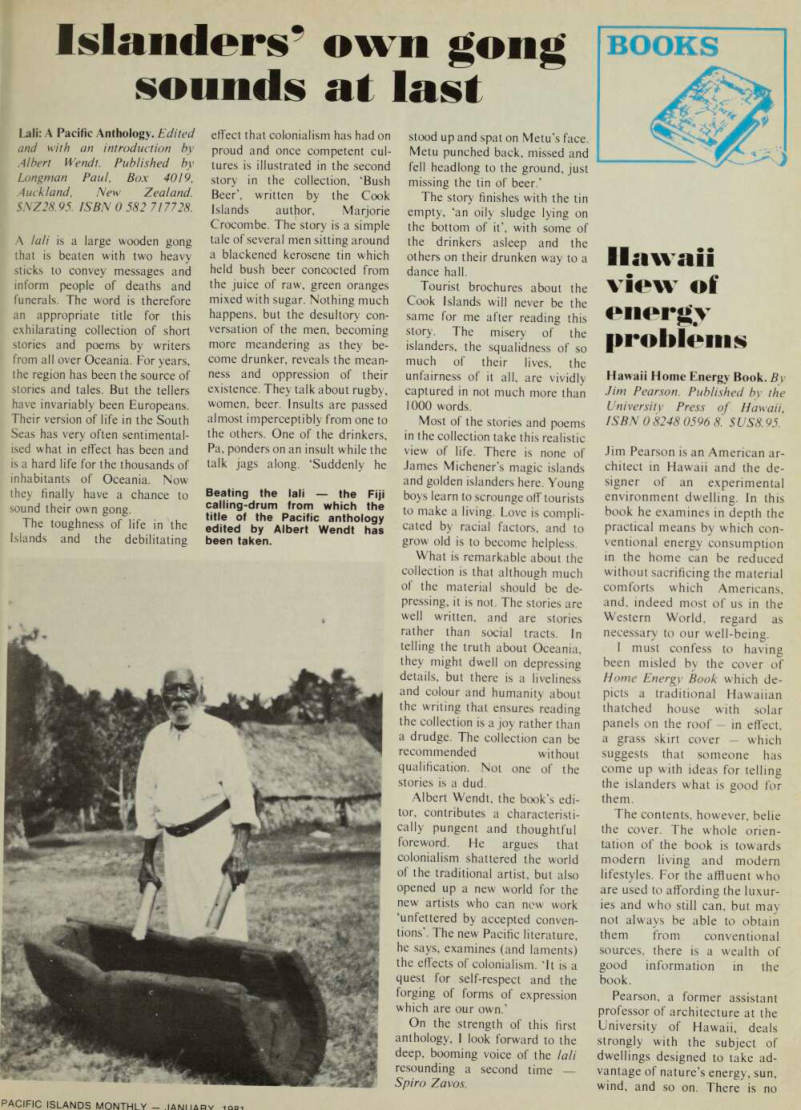
sounds at last
Lali: A Pacific Anthology. Edited and with an introduction by Albert Wendt. Published by Longman Paul, Box 4019, Auckland, New Zealand.
5Nz28.95. Isbn 0 582 717728.
A lali is a large wooden gong that is beaten with two heavy sticks to convey messages and inform people of deaths and funerals. The word is therefore an appropriate title for this exhilarating collection of short stories and poems by writers from all over Oceania. For years, the region has been the source of stories and tales. But the tellers have invariably been Europeans.
Their version of life in the South Seas has very often sentimental ised what in effect has been and is a hard life for the thousands of inhabitants of Oceania. Now they finally have a chance to sound their own gong.
The toughness of life in the Islands and the debilitating
effect that colonialism has had on proud and once competent cul tures is illustrated in the second story in the collection, ‘Bush Beer’, written by the Cook Islands author, Marjorie Crocombe. The story is a simple tale of several men sitting around a blackened kerosene tin which held bush beer concocted from the juice of raw, green oranges mixed with sugar. Nothing much happens, but the desultory con versation of the men, becoming more meandering as they be come drunker, reveals the mean ness and oppression of their existence. They talk about rugby, women, beer. Insults are passed almost imperceptibly from one to the others. One of the drinkers.
Pa, ponders on an insult while the talk jags along. ‘Suddenly he
stood up and spat on Metu’s face.
Metu punched back, missed and fell headlong to the ground, just missing the tin of beer.’
The story finishes with the tin empty, ‘an oily sludge lying on the bottom of it’, with some of the drinkers asleep and the others on their drunken way to a dance hall.
Tourist brochures about the Cook Islands will never be the same for me after reading this story. The misery of the islanders, the squalidness of so much of their lives, the unfairness of it all, are vividly captured in not much more than 1000 words.
Most of the stories and poems in the collection take this realistic view of life. There is none of James Michener’s magic islands and golden islanders here. Young boys learn to scrounge off tourists to make a living. Love is compli cated by racial factors, and to grow old is to become helpless.
What is remarkable about the collection is that although much of the material should be de pressing, it is not. The stories are well written, and are stories rather than social tracts. In telling the truth about Oceania, they might dwell on depressing details, but there is a liveliness and colour and humanity about the writing that ensures reading the collection is a joy rather than a drudge. The collection can be recommended without qualification. Not one of the stories is a dud.
Albert Wendt, the book’s edi tor, contributes a characteristi cally pungent and thoughtful foreword. He argues that colonialism shattered the world of the traditional artist, but also opened up a new world for the new artists who can new work ‘unfettered by accepted conven tions’. The new Pacific literature, he says, examines (and laments) the effects of colonialism. ‘lt is a quest for self-respect and the forging of forms of expression which are our own.’
On the strength of this first anthology, I look forward to the deep, booming voice of the lali resounding a second time Spiro Zavos.
Beating the lali - the Fiji
calling-drum from which the title of the Pacific anthology edited by Albert Wendt has been taken.
problems
Books
Hawaii view of energy problems
Hawaii Home Energy Book. By Jim Pearson. Published by the
University Press of Hawaii ,
ISBN 0 8248 0596 8. SUSS. 95.
Jim Pearson is an American ar chitect in Hawaii and the de
signer of an experimental
environment dwelling. In this book he examines in depth the practical means by which con ventional energy consumption in the home can be reduced without sacrificing the material comforts which Americans, and, indeed most of us in the Western World, regard as necessary to our well-being.
I must confess to having been misled by the cover of Home Energy* Book which de picts a traditional Hawaiian thatched house with solar panels on the roof in effect, a grass skirt cover which suggests that someone has come up with ideas for telling the islanders what is good for them.
The contents, however, belie the cover. The whole orien tation of the book is towards modern living and modern lifestyles. For the affluent who are used to affording the luxur ies and who still can, but may not always be able to obtain them from conventional sources, there is a wealth of good information in the book.
Pearson, a former assistant professor of architecture at the University of Hawaii, deals strongly with the subject of dwellings designed to take ad vantage of nature’s energy, sun, wind, and so on. There is no
doubt this is a concept which has enormous potential.
If we can build to trap the sun’s energy for warming space and water in winter and for water heating the year round, insulating for winter warmth and summer coolness, we can
seriously reduce our depen
dence on fossil fuels.
This is basically what Pear son’s Hawaii Home Energy is about. He ranges over a whole
gamut of building techniques
and design oriented towards middle-class standard dwell ings suitable for the tropics, and in fact his ideas could apply to any area favoured with ample sunshine. The book is an extravaganza of freehand
explanatory drawings, which
also give the impression that Pearson may be preaching to islanders with tongue in cheek.
Creditably, he goes to great lengths to tell readers how by planning and careful use the consumption of commodities such as energy and water can be greatly reduced.
The book is good value for the extensive information con tained in its somewhat dis
jointed layout. From a printing
and layout point of view it can only be regarded as a hotch
potch of typefaces with a large
part of it obviously being knocked out on a typewriter.
It’s also commercially oriented with a large block of advertise ments at the back of the book.
It contains 183 pages without the advertising section.
An excellent five-page bibli ography, or as titled. Sugges tions for Further Reading, is
included.
H.R.S.
PNG, Fiji
handbooks
Papua New Guinea Handbook and Travel Guide, Fiji Hand book and Travel Guide. Pub lished by Pacific Publications.
Each 5A12.50 posted from PI Ms Mail Order Bookshop, GPO Box 3408, Sydney 2001.
As a rule, a handbook, or any sort of reference book, doesn't come in the thriller class, but Pacific Publications, with half a century behind it of digging deeply in the Pacific Islands, has managed to produce two volumes as full of interest as they are of facts and figures.
Papua New Guinea and Fiji, the leading Island countries in the South Pacific, are develop ing rapidly and are, therefore, worthy of close attention from business and commercial inter ests. The handbooks supply such people with all the necess ary details. For everyone else, the traveller, student sociol ogist, quiz-master, the hand books have it all, plus a supply of maps not to be found be tween any other covers.
The Papua New Guinea Handbook is in its 10th edition and has been brought very much up-to-date. The Fiji Handbook is the first published for eight years, and amply bridges that gap.
Intending canoe
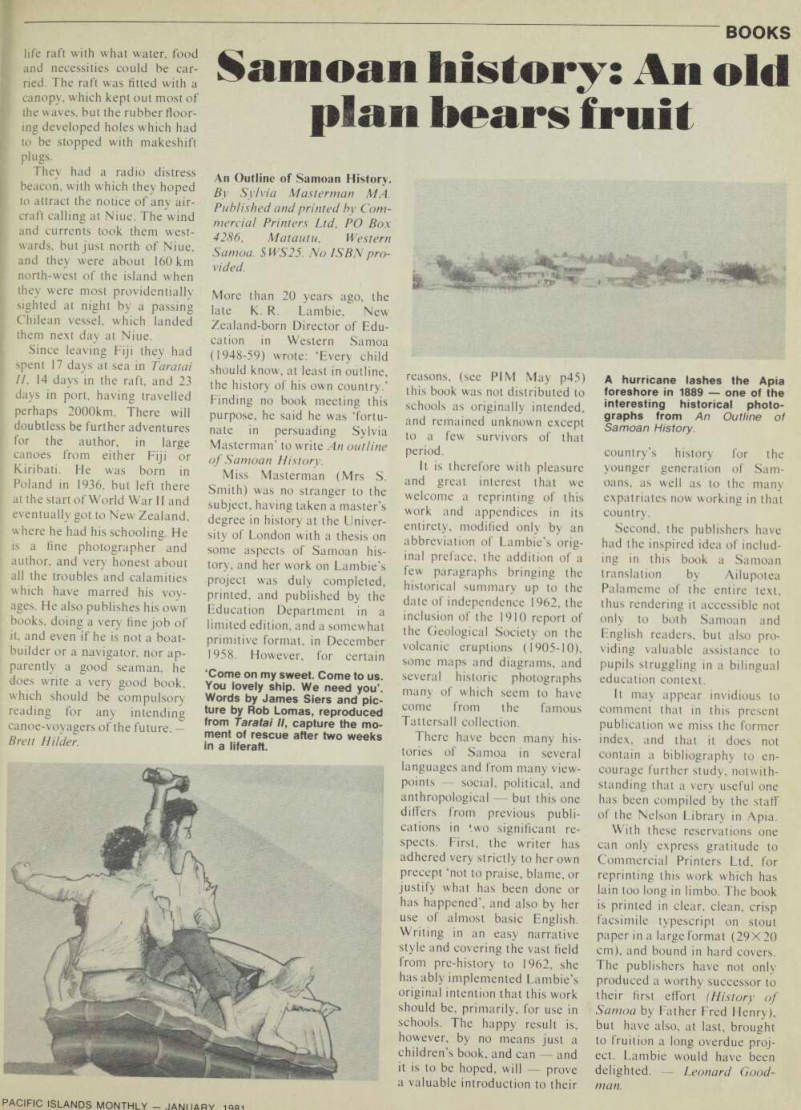
A 'must' for Intending canoe voyagers
Taratai II: A Continuing Pa cific Adventure. By James Siers. Published by Millwood Press, Wellington, New Zealand. ISBN 0 908582 28 5. $A 14.50.
This is very much a follow-up of the same author’s Taratai , which dealt with a previous voyage in a giant outrigger canoe, or baurua , built in Kiribati. Taratai II was built in Fiji for the author, to more modern plans and of modern materials, such as an extruded metal mast, and plywood and fibreglass. However this book is the mixture as before, teem
ing with glossy photographs
and maps, with a well-written text, which deals largely with personalities and the ports of call.
It is a tale of misadventures
really, for the design was faulty
in many regards, and had to be altered before the vessel got away from Fiji. The mast had bent too badly in a squall and had to be replaced by a lamina ted one made from Fijian hardwoods. The outrigger float was too high and had to have its struts shortened, and the
fibreglass split along the keel
and had to be replaced. The
giant hardwood steering oars
broke, and later in the voyage the wooden mast broke.
All these calamities appeared to stem from the vessel being driven too hard in
rough weather, apparently in
an effort to get to the next des
tination. Finally, the outrigger
booms broke and the hull lay on its side, presumably having no ballast to keep it upright without the outrigger, and was abondoned about 320 km east of Niue Island. This was per haps one of the gravest mis takes of the whole unfortunate adventure, as the hull found its way back to Fiji three months later, drifting ashore at Rabi Island, while the outrigger float landed at Gamea Island.
The author gives very few navigational details, nor much information about the object of the voyage, which was to sail to Rarotonga and thence all the way to New Zealand, the author’s homeland, to prove the ability of the ancient canoes of Polynesia to sail eastwards
against the prevailing winds.
The crew, including the author, consisted of six men and the author’s 10-year-old son, Conrad, obviously named after Joseph Conrad, the famous Pole who became a captain of British sailing ships, and then a famous author. Half the six men were Europeans, the others natives of Kiribati, Fiji and Tonga. There was a lot of
ill-feeling during the early part
of the voyage, mainly caused
by unsuitability and inef
ficiency, but this was largely overcome by some of the men leaving the expedition and bet ter men joining. There were some really hard workers with hearts of oak, and it was largely due to their strength of purpose that the adventure ended with out loss of life.
Being a continuing story
from the first book, the reader would have to refer back to it for a description of how Tara tai II was built, as the present book gives no plan of Taratai //, but begins with her sea trials and the initial disasters for the five weeks prior to the start of the real voyage, which began on June 29, 1977.
After six days at sea they reached Tonga, where there were some crew changes. After 17 days there they set forth for Niue, which took another six days. Leaving Niue on August 3 they headed eastwards for Rarotonga in heavy weather, the wooden mast broke, and was repaired. On the night of August 8, while driving hard for Rarotonga, the outrigger booms broke, and it was de cided to abandon the hull and all hands got into the rubber
' life raft with what water, food and necessities could be car [ ried. The raft was fitted with a ■ canopy, which kept out most of the waves, but the rubber floor ing developed holes which had to be stopped with makeshift plugs.
They had a radio distress beacon, with which they hoped to attract the notice of any air craft calling at Niue. The wind and currents took them west wards, but just north of Niue, and they were about I6okm north-west of the island when
they were most providentially
sighted at night by a passing
Chilean vessel, which landed them next day at Niue.
Since leaving Fiji they had spent 17 days at sea in Taratai 11, 14 days in the raft, and 23 days in port, having travelled perhaps 2000 km. There will doubtless be further adventures for the author, in large canoes from either Fiji or Kiribati. He was born in Poland in 1936, but left there at the start of World War II and eventually got to New Zealand, where he had his schooling. He is a fine photographer and author, and very honest about all the troubles and calamities which have marred his voy ages. He also publishes his own books, doing a very fine job of it, and even if he is not a boat builder or a navigator, nor ap parently a good seaman, he does write a very good book, which should be compulsory
reading for any intending
canoe-voyagers of the future. -
Brett Milder.
‘Come on my sweet. Come to us.
You lovely ship. We need you’.
Words by James Siers and pic ture by Rob Lomas, reproduced from Taratai II, capture the mo ment of rescue after two weeks in a liferaft.
Advertisements & other items, p. 48 (2 items)
Books
48
n*nnr 101 ami~>c mnMTUI V lAMI lARY IQRI
Exporters Of Fine Bedding To The Pactfic Islands
♦ PAPUA NEW GUINEA
♦ SOLOMON ISLANDS
♦VANUATU
Contact; WEST TASMAN TRADERS
P.O. BOX 709 PORT MORESBY Ph. 21 4332
ALL OTHER AREAS
Contact
HEAD OFFICE
MATTRESS MAKERS
CABLE WONDEREST
BRISBANE
plan bears fruit
Samoan history: An old plan bears fruit
An Outline of Samoan History.
By Sylvia Masterman MA.
Published and printed by Com mercial Printers Ltd. PO Box 4286, Matautu, Western Samoa. SWS2S. No ISBN pro vided.
More than 20 years ago, the late K. R. Lambie, New Zealand-born Director of Edu cation in Western Samoa (1948-59) wrote: ‘Every child should know, at least in outline, the history of his own country.’
Finding no book meeting this purpose, he said he was ‘fortu nate in persuading Sylvia Masterman’ to write An outline of Samoan History.
Miss Masterman (Mrs S.
Smith) was no stranger to the subject, having taken a master’s degree in history at the Univer sity of London with a thesis on some aspects of Samoan his tory, and her work on Lambie’s project was duly completed, printed, and published by the Education Department in a limited edition, and a somewhat primitive format, in December 1958. However, for certain
reasons, (see PIM May p 45) this book was not distributed to schools as originally intended, and remained unknown except to a few survivors of that period.
It is therefore with pleasure and great interest that we welcome a reprinting of this work and appendices in its entirety, modified only by an abbreviation of Lambie’s orig inal preface, the addition of a few paragraphs bringing the historical summary up to the date of independence 1962, the inclusion of the 1910 report of the Geological Society on the volcanic eruptions (1905-10), some maps and diagrams, and several historic photographs many of which seem to have come from the famous Tattersall collection.
There have been many his tories of Samoa in several languages and from many view points social, political, and anthropological but this one differs from previous publi cations in two significant re spects. First, the writer has adhered very strictly to her own precept ‘not to praise, blame, or justify what has been done or has happened’, and also by her use of almost basic English.
Writing in an easy narrative style and covering the vast field from pre-history to 1962, she has ably implemented Lambie’s original intention that this work should be, primarily, for use in schools. The happy result is, however, by no means just a children’s book, and can and it is to be hoped, will prove a valuable introduction to their
country’s history for the younger generation of Sam oans, as well as to the many expatriates now working in that country.
Second, the publishers have had the inspired idea of includ ing in this book a Samoan translation by Ailupotea Palamcme of the entire text, thus rendering it accessible not only to both Samoan and English readers, but also pro viding valuable assistance to pupils struggling in a bilingual education context.
It may appear invidious to comment that in this present publication we miss the former index, and that it does not contain a bibliography to en courage further study, notwith standing that a very useful one has been compiled by the staff of the Nelson Library in Apia.
With these reservations one can only express gratitude to Commercial Printers Ltd, for reprinting this work which has lain too long in limbo. The book is printed in clear, clean, crisp facsimile typescript on stout paper in a large formal (29X 20 cm), and bound in hard covers.
The publishers have not only produced a worthy successor to their first effort ( History of Samoa by Father Fred Henry), but have also, at last, brought to fruition a long overdue proj ect. Lambie would have been delighted. Leonard Good man.
A hurricane lashes the Apia foreshore in 1889 - one of the interesting historical photo graphs from An Outline of
Samoan History.
Advertisements & other items, p. 50 (1 item)
by container
•is m House kits (up to 150 square metres in size) fit a 6 metre container and are currently being exported to Pacific Islands.
If**
It arrives
by container
and you build it
with a Spanner in a
matter of weeks.
•MS i .-o- The "Logan Unit" kits consist of galvanised steel framed-insulated-asbestor cement sheeted modules 1 metre wide. Each kit contains all modules including windows and doors, roof members, roof sheets, ceilings and fixing to complete a lock-up unit.
Erection of a kit on an established floor is about 8 days for 2 men. ■■ .V' t - »v
A Marlin Modular Home.
Marlin Modular Constructions supply (and construct where required] cyclone rated modular homes and buildings The system is adaptable for use as housing, schools, offices etc.
MARLIN MODULAR CONSTRUCTIONS
P.O. Box 149, Rocklea. 4106 Old. Australia. PH 345 4539, Telex "Marmod" AA44636
TRADE ENQUIRIES WELCOME.
Fiji’s 10 years in words
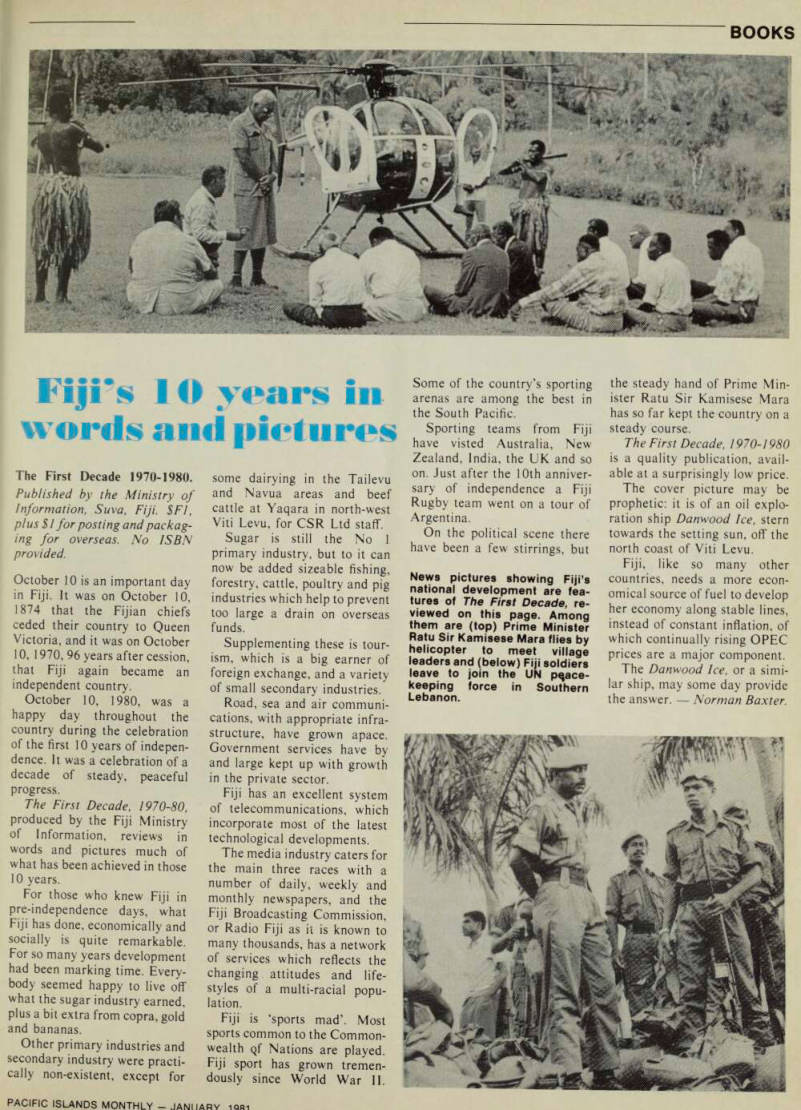
words and pictures
The First Decade 1970-1980.
Published by the Ministry of Information, Suva, Fiji. SFI, plusSl for posting andpackaging for overseas. No ISBN provided.
October 10 is an important day in Fiji. It was on October 10, 1874 that the Fijian chiefs ceded their country to Queen Victoria, and it was on October 10, 1970, 96 years after cession, that Fiji again became an independent country.
October 10, 1980, was a happy day throughout the country during the celebration of the first 10 years of independence. It was a celebration of a decade of steady, peaceful progress.
The First Decade, 1970-80, produced by the Fiji Ministry of Information, reviews in words and pictures much of what has been achieved in those 10 years.
For those who knew Fiji in pre-independence days, what hiji has done, economically and socially is quite remarkable.
For so many years development had been marking time. Everybody seemed happy to live off what the sugar industry earned, plus a bit extra from copra, gold l ? ananas - Other primary industries and secondary industry were practically non-existent, except for
Some of the country’s sporting arenas are among the best in the South Pacific.
Sporting teams from Fiji have visted Australia, New Zealand, India, the UK and so on. Just after the 1 Oth anniversary of independence a Fiji Rugby team went on a tour of Argentina.
On the political scene there have been a few stirrings, but
the steady hand of Prime Min ister Ratu Sir Kamisese Mara has so far kept the country on a steady course, The First Decade, 1970-1980 is a quality publication, avail able at a surprisingly low price, The cover picture may be prophetic: it is of an oil explo ration ship Danwood Ice, stern towards the setting sun, off the north coast of Viti Levu.
Fiji, like so many other countries, needs a more econ omical source of fuel to develop u , . , .. F her econom y alon g stal >le lines, instead of constant inflation, of which continually rising OPEC prices are a major component, j, ■ ■ anwo ce < or a simi *ar ma y some day provide
some dairying in the Tailevu an d Navua areas and beef cattle at Yaqara in north-west Viti Levu, for CSR Ltd staff.
Sugar is still the No 1 primary industry, but to it can now be added sizeable fishing, forestry, cattle, poultry and pig industries which help to prevent too large a drain on overseas funds.
Supplementing these is tour ism, which is a big earner of foreign exchange, and a variety of small secondary industries.
Road, sea and air communi cations, with appropriate infra structure, have grown apace, Government services have by and large kept up with growth in the private sector, Fiji has an excellent system of telecommunications, which incorporate most of the latest
technological developments,
The media industry caters for the main three races with a number of daily, weekly and monthly newspapers, and the Fiji Broadcasting Commission, or Radio Fiji as it is known to many thousands, has a network of services which reflects the changing attitudes and life styles of a multi-racial popu lation.
Fiji is ‘sports mad’. Most sports common to the Common wealth qf Nations are played, Fiji sport has grown tremen dously since World War 11.
the answer.
Norman Baxter.
News pictures showing Fiji’s national development are fea tures of The First Decade, re viewed on this page. Among them are (top) Prime Minister Ratu Sir Kamisese Mara flies by helicopter to meet village leaders and (below) Fiji soldiers leave to join the UN peace keeping force in Southern Lebanon.
Advertisements & other items, p. 52 (2 items)
. . . . . . A , . . . A M A K Iti ■ ■ V / I A Ikll I A Rx/ Ho O H
Awa Marine
When you have to get the message across here is one name you can trust . . .
AWA/ACSI6
6 channel 5 watt unit featuring the latest in modern design for 27 MHz Marine Transceiver for fixed base station and mobile use. • Durable metal case for long life and protection from electrical interference. • 6 channel operation with back lighted dial. Crystals fitted for 27.86, 27.88, 27.90, 27.91, 27.94 and 27.96 MHz. (New fishing channels also available.) • 5 watts input power into final stage. • Squelch control. • P. A. facililty and on/off volume control.
• External speaker facility.
• Transmit and receive L.E.D. indicators.
AWA Tamaphone
The main marine use of the AWA Tamaphone is for UHF onboard communications between personnel in any compartment or area of a vessel e.g. it may be used for bridge to fo’clse and aft for berting operations and bridge to double bottoms or tank compartments during cleaning or maintenance. Because of their nature, UHF signals penetrate every corner of a steel vessel and are an effective means of communication to and from areas with restricted access.
AWA/HECBI
The AWA/HECBI has four channels and may be used by pilots and ship masters for
controlling tugs during berthing operations.
They may also be used on pleasure craft VHF channels for the control of yacht and power boat races and the reporting of results to the race centre. They are also effective for communications between yacht or power boats and shore parties or tenders, and as a back up for the main VHF transceiver in the event of breakdown or power failure.
AWA Pilotphone VII
A.W.A.’s new Pilotphone VII transceiver offers a number of important features of great concern to sail and power boatowners alike. To start with, the Pilotphone VII has V.H.F.’s well known clear, sharp reception which is virtually free of interference in either day or night time use. For power boatowners particularly, the Pilotphone VII transceiver is much less effected by the engine (s) ignition interference and in all but isolated cases (such as twin 6 cylinder outboard installations) is able to provide
outstanding clarity and transmission qualities.
AWA
LEADERS IN MARINE ELECTRONICS
MARINE SALES & SERVICE DEPOTS
The Marine Manager, A.W.A. P.O. Box 218, Leichhardt NSW 2040.
Please send me a free copy of the 32-page catalogue (with price list and stockist information) covering AWA’s extensive range of electronic equipment. My primary interest is in □ Depth Sounders □ Radios □ Auto-pilots □ Radar □ Wind Instruments
□ RDF □ EPIRBs
NAME.
Adelaide (08) 47-4822 Brisbane (07) 44-1631 Fremantle (09) 335-2881 Hobart (002) 72-4366 Launceston (003) 44-5155 Melbourne (03) 699-6144 Newcastle (049) 69-4722 Pt. Kembla (042) 29-5881 Townsville (077) 79-6155
ADDRESS
STATE
P/CODE
Hodges, 208 years on
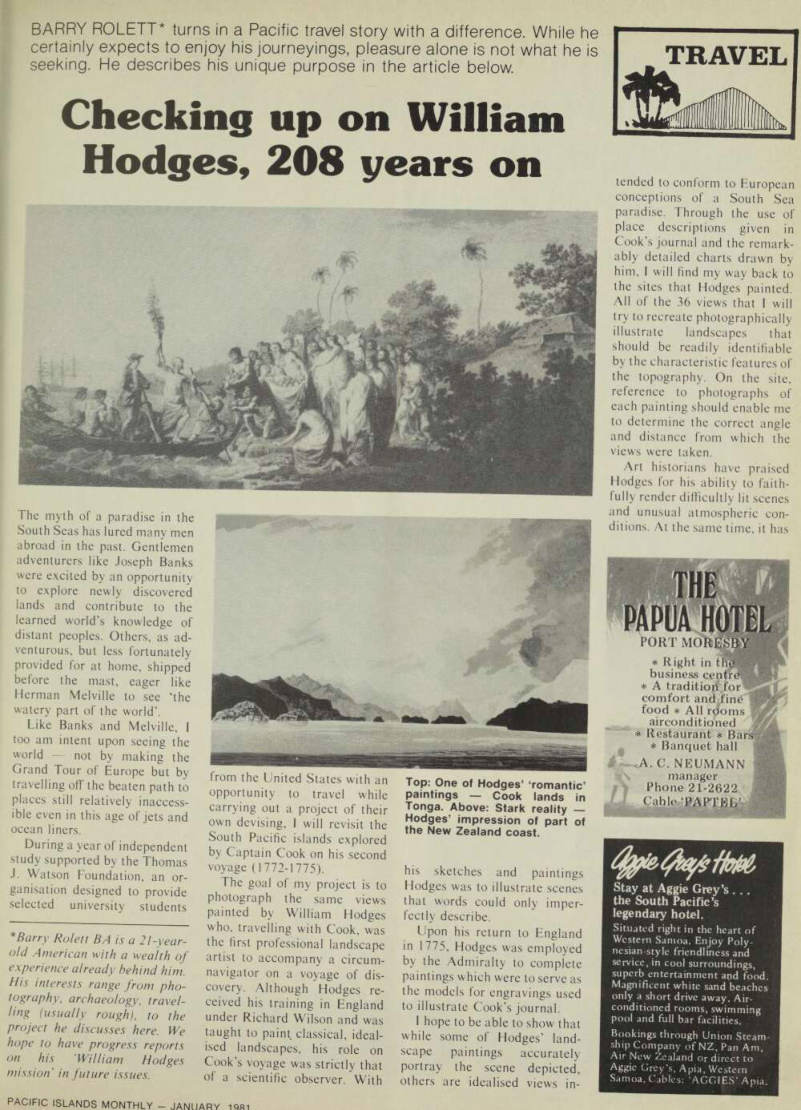


Travel
Checking up on William Hodges, 208 years on
BARRY ROLETT* turns in a Pacific travel story with a difference. While he certainly expects to enjoy his journeyings, pleasure alone is not what he is seeking. He describes his unique purpose in the article below.
The myth of a paradise in the South Seas has lured many men abroad in the past. Gentlemen adventurers like Joseph Banks were excited by an opportunity to explore newly discovered lands and contribute to the learned world’s knowledge of distant peoples. Others, as ad venturous, but less fortunately provided for at home, shipped before the mast, eager like Herman Melville to see ‘the watery part of the world’.
Like Banks and Melville, I too am intent upon seeing the world not by making the Grand Tour of Europe but by travelling off the beaten path to places still relatively inaccess ible even in this age of jets and ocean liners.
During a year of independent study supported by the Thomas J. Watson Foundation, an or ganisation designed to provide selected university students
from the United States with an opportunity to travel while carrying out a project of their own devising, I will revisit the South Pacific islands explored by Captain Cook on his second voyage (1772-1775).
The goal of my project is to photograph the same views painted by William Hodges who, travelling with Cook, was the first professional landscape artist to accompany a circum navigator on a voyage of dis covery. Although Hodges re ceived his training in England under Richard Wilson and was taught to paint classical, ideal ised landscapes, his role on Cook’s voyage was strictly that of a scientific observer. With
his sketches and paintings Hodges was to illustrate scenes that words could only imper fectly describe.
Upon his return to England in 1775, Hodges was employed by the Admiralty to complete paintings which were to serve as the models for engravings used to illustrate Cook’s journal.
I hope to be able to show that while some of Hodges’ land scape paintings accurately portray the scene depicted, others are idealised views in
tended to conform to European conceptions of a South Sea paradise. Through the use of place descriptions given in Cook’s journal and the remark ably detailed charts drawn by him, I will find my way back to the sites that Hodges painted.
All of the 36 views that 1 will try to recreate photographically illustrate landscapes that should be readily identifiable by the characteristic features of the topography. On the site, reference to photographs of each painting should enable me to determine the correct angle and distance from which the views were taken.
Art historians have praised Hodges for his ability to faith fully render difficultly lit scenes and unusual atmospheric con ditions. At the same lime, it has
* Barry Rolett BA is a 21-year old American with a wealth of experience already behind him.
His interests range from pho tography, archaeology, travel ling (usually rough}, to the project he discusses here. We hope to have progress reports on his ‘William Hodges mission’ in future issues.
Top: One of Hodges' ‘romantic’ paintings - Cook lands in Tonga. Above: Stark reality - Hodges’ impression of part of the New Zealand coast.
been noted by Isabel Stuebe, in her book The Life and Works of William Hodges , that in painting Indian landscapes sev eral years after returning from Cook’s voyage, Hodges took considerable liberty in re arranging the topographical el ements of the composition.
This is particularly interest ing in light of the fact that Hodges once wrote that ‘truth is the base of every work of mine’.
But without the original sketches drawn on the spot it would seem impossible to learn the extent to which any of Hodges’ landscape paintings is romanticised, except by return ing to the place painted.
Almost none of the original sketches for Hodges’ landscape paintings of the South Pacific islands exist today, yet in the case of Hodges’ ink wash draw ings of Dusky Sound, New Zealand, I found another way to determine the accuracy with which the artist represented his subject matter. While looking through the collection of Cap tain Cook’s charts in the manu script department of the British Library, I located one of the Dusky Sound which included two coastal profiles, one each of the north and south entrances to the sound. I traced these and by comparing them with Hodges’ ink washes I could see that although Hodges’ views were taken from a slightly different angle, they correspond perfectly with the topography outlined in the coastal profiles.
Cook’s chart of Dusky Sound also shows his ship’s route and identifies the islands pictured both in the map and the coastal profile. This information allows me to orient Hodges’ views with Cook’s chart, revealing the exact locations from which Hodges’ ink washes of the entrances to the sound were painted. Yet although Dusky Sound provided Cook’s men with refreshment which they
welcomed heartily after having
spent 117 days out of sight of land, it is hardly a place one would consider idyllic. The harsh environment and rugged, sparsely wooded mountains of Dusky Sound contrast sharply with the fertile plains and favourable climate of Tahiti. It is not surprising then that Hodges’ views of Dusky Sound
are accurately portrayed, while his paintings of Tahiti and the Society Islands have a dis tinctly romantic air about them.
Unlike generations of adven turers who preceded me, my belief in a mythical South Sea
paradise was shattered long before I left home. Travellers after Cook were saddened to find the once happy Polynesians transformed into a dis heartened people in the throes of culture shock. I was fore warned, however, that having read the travel narratives writ ten by the first Europeans to live in Polynesia, I would know more about the original way of life on those islands than most of the indigenous people living there today.
A botanist at the National Museum of Natural History in Washington DC tried to dis courage me from going to the
Marquesas Islands by telling me that the young people there were only interested in earning enough money so that they could move to Tahiti. She laughed though when I asked if there were any banks in the Marquesas and described the boat trip between the islands as an unforgettable (and horren dous) experience.
But all that I have learned about the Pacific Islands has only heightened my curiosity and increased my desire to visit them. Once I even made the mistake of telling someone that 1 had already been there. In deed, in my dreams I have.
The illustrations showing two Hodges paintings reflect a strong contrast of styles. The depiction (top), of Dusky Sound, on the western side of New Zealand’s South Island, is sober and realistic, in keeping with the harsh, sparsely wooded peaks which dominate the scene. On the other hand, the painting of the lush scene at Oaitepeha Bay, Tahiti, seems heavily romanticised.
Advertisements & other items, pp. 53-58 (2 items)
Stay at Aggie Grey’s . . .
the South Pacific’s
legendary hotel.
Situated right in the heart of Western Samoa. Enjoy Polynesian-stylc friendliness and service, in cool surroundings, superb entertainment and food.
Magnificent white sand beaches only a short drive away. Airconditioned rooms, swimming pool and full bar facilities.
Bookings through Union Steamship Company of NZ, Pan Am, Air New Zealand or direct to Aggie Grey’s, Apia, Western Samoa. Cables: ‘AGGIES’ Apia.
While other car companies are
making their big cars smaller,
Datsun is making
their small cars roomier
and more comfortable.
For most car companies, the rule s the roomier you make a car, the >igger and heavier you have to make t. Consequently it uses more gas. 50 it’s no surprise that their cars are jetting smaller.
But then most car companies iren't Datsun.
At Datsun, we not only accept wch conflicts, we look for them. Then ve look for ways to bring them into harmony.” Because, to us, harmony 3 balance. The balance of apparent :ontradictions. And the better the >alance we re able to achieve, the better the cars we’re able to build.
Consequently, for 1981, every new Datsun across the board is roomier and more comfortable than the model that preceded it. Yet each one runs on as little gas. Or less.
And we didn’t make them roomier inside by making them more box-like outside. We did it by finding a better way to redistribute the space we had.
We reduced the space between the engine and the dash panel, between the fan and the radiator and between the radiator and the grill.
Then we added that space to the passenger compartment in the form of more leg and hip room.
More space was added to the interior by reducing the distance between the front tires and wheel wells. At the same time, by moving * * ■ i i i the dashboard and windshield forward and making the windshield more inclined, we not only increasec physical space but also added to the impression of spaciousness. Human sensitivity answered by carefully studied human engineering.
Still more space was added to the interior by reducing the thickness of the doors. Which meant we had to strengthen the doors. Which we did with high-tensile steel panels, and supports.
More head and shoulder room
DATSUN CREATES HA
I merican Samoa: BF. KNEUBUHL INC,. Pago Pago/ Cook Islands: COOK ISLANDS MOTOR CENTRE LTD.. Rarotonga/ Fiji: CARPENTERS MOTORS. Suva/ Guam: DATSUN MOTOC ■ALES. Agana/ Hawaii: NISSAN MOTOR CORPORATION IN HAWAII LTD . Honolulu / Kiribati: ATOLL AUTO STORES, Tarawa/ Nauru: JACOB ENTERPRISES LTD New Caledonu
mt*n
i m as added by reducing the height the seats. Which meant we had place an extra layer of padding Jtween the springs and seat pads to >ep you comfortable.
And after we made the interior as roomy as possible, we made it seem even roomier. Color, pattern and texture, carefully attuned to human sensitivity, make broad seating seem even broader.
Problem-solving by designresolving conflicting elements to improve the overall quality of the product-has helped Datsun to build cars that are quiet and roomy, yet light and fuel efficient.
Our way may not be right for most car companies. But, at Datsun, we measure our success in terms of how well we build the kind of cars the world needs. Without sacrificing what you want in your car.
That’s harmony.
The model shown above is the Datsun 1608 for the Middle East.
Specifications and equipment may vary according to market.
DATSUN
IKIONY BY DESIGN
-E ALMA S.A . Noumea/ Vanuatu PPMTcnnor o a
THE NAME OF QUALITY
NISSAN
MfC AI KAA O A / .. NISSAN MOTOR CO LTD NUh ALMA S.A. Noumea/ Vanuatu PENTECOST S A \/,io 0 0 * , .. 1 an: JOETEN MOTOR COMPANY ,NC / Solomon Islands: ENTERPRISES LtS' TAHIT^In' R £ R P ? P °* Ne " Gui " ea: BOROKO MOTORS LTD Pbrt Moresby u u Hon,ara/Tah 'ti TAHITIBULL SARD. Papeete/ Western Samoa: MORRIS HEDSTROM LTD Api
m /A JC Wk
Make sure. Make it a Yanmar.
2QM2OH
Getting a new boat can be an exciting * adventure, but selecting its engine ■ f shouldn’t be. To make sure you’re buying and installing proven engine de- / pendability, listen to the voices of experience.
Today they are saying Yanmar, because our diesels have become a boatyard byword for reliability. And for good reason. They are being installed in the thousands this year and every year in boats, like yours, by builders who know their business, and who know the numerous demands placed on seagoing machinery. Everytime, anytime sure starting.
Simple, routine maintenance. Easy operation.
Handy servicing. Maximum safety and economy.
Quiet, vibration-free, fuss-free motoring. All popularity winning points for Yanmar diesels. In the Yanmar range there’s a quality engine that’s practically tailor-made to suit your boat. Make sure to inspect the full range, a good boat deserves it.
(DIN. B)
Today is the Day of the Diesel YANMAR DIESEL
YANMAR
GIESEL
Y&NMMN DIESEL ENGIN
1-1,2-chome, Yaesu, Chuo-ku, Tokyo 104, Japan Cable: YANMAR TOKYO Telex: 0222-2310,0222-4733
Cabernet
Saimgnon
I m -■§ I
You name it, Mono pumps it.
Tell us your needs, we’ll show you the pump. For over 30 years we’ve been pumping liquids of every viscosity, under all kinds of conditions. Water to stock and to irrigation systems, all kinds of dairy products, food ingredients, chemicals, corrosives and abrasives, sludges and waste, even solids in suspension.
If it can be conveyed by pipeline, we can move, meter or mix it as quickly or slowly as you wish. We provide pumps that run on all kinds of power - petrol, kerosene, diesel, electricity, even P.T.O. tractor drive.
Transportable pumps, pumps that can be readily cleaned in place and pumps that meet the strictest hygiene requirements. No matter what business you’re in, if there’s anything you want to know about pumping, call us at Mono.
We’ve got the pumps and the experience.
MONO
PUMPS
.AUSTRALIA PTY. LTD.
MOVE IT WITH MONO
Directly represented in the Philippines by Mono’s own regional office.
Agents in: Indonesia, Fiji, Singapore, Thailand, Malaysia, Hong Kong, Korea, Papua New Guinea and the Pacific. 344P0004/R
.MONO,
Travel
PACIFIC ISLANDS MOMTHI V IA KM lADV -ino-<
diplomacy, kidglove style
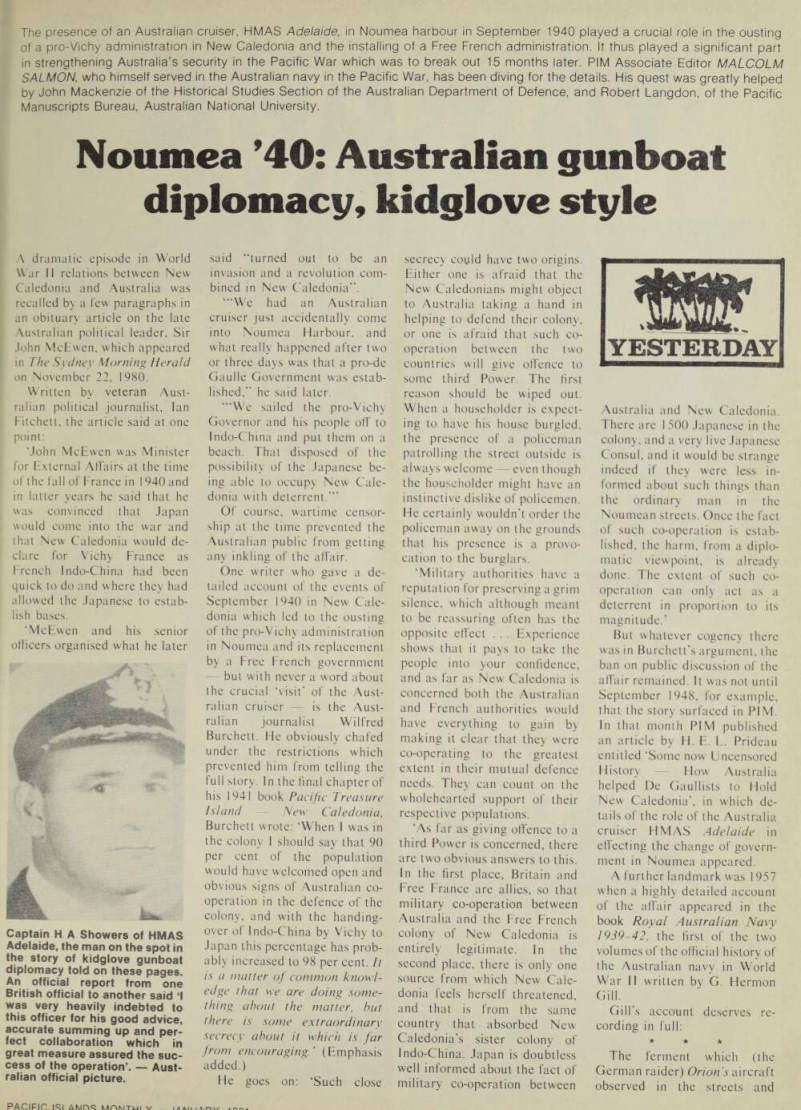
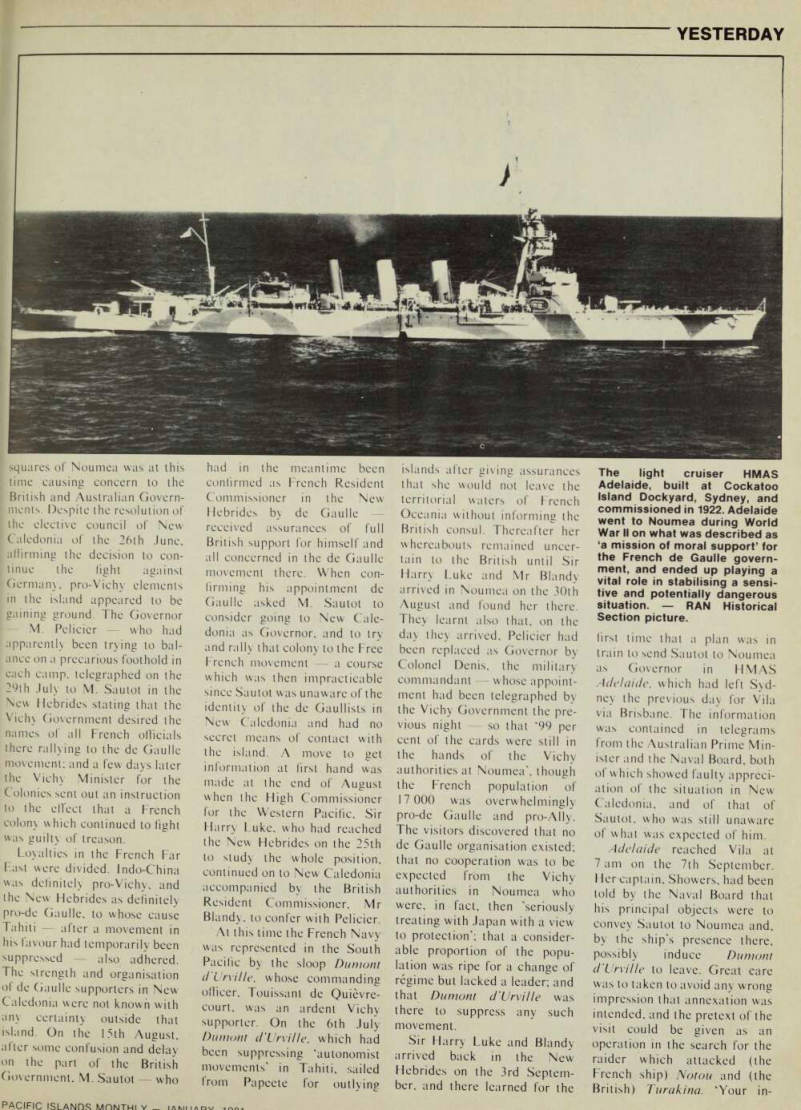
Noumea ’4O: Australian gunboat diplomacy, kidglove style
The presence of an Australian cruiser, HMAS Adelaide, in Noumea harbour in September 1940 played a crucial role in the ousting of a pro-Vichy administration in New Caledonia and the installing of a Free French administration. It thus played a significant part in strengthening Australia’s security in the Pacific War which was to break out 15 months later. PIM Associate Editor MALCOLM SALMON, who himself served in the Australian navy in the Pacific War, has been diving for the details. His quest was greatly helped by John Mackenzie of the Historical Studies Section of the Australian Department of Defence, and Robert Langdon, of the Pacific Manuscripts Bureau, Australian National University.
A dramatic episode in World War II relations between New Caledonia and Australia was recalled by a few paragraphs in an obituary article on the late Australian political leader. Sir John McEwen, which appeared in The Sydney Morning Herald on November 22, 1980.
Written by veteran Aust ralian political journalist, lan Fitchetl, the article said at one point: ‘John McEwen was Minister for External Affairs at the time of the fall of France in 1940 and in latter years he said that he was convinced that Japan would come into the war and that New Caledonia would de clare for Vichy France as French Indo-China had been quick to do and where they had allowed the Japanese to estab lish bases. ‘McEwen and his senior officers organised what he later
said “turned out to be an invasion and a revolution com bined in New Caledonia”. ‘“We had an Australian cruiser just accidentally come into Noumea Harbour, and what really happened after two or three days was that a pro-de Gaulle Government was estab lished,” he said later. ‘“We sailed the pro-Vichy Governor and his people off to Indo-China and put them on a beach. That disposed of the possibility of the Japanese be ing able to occupy New Cale donia with deterrent.'”
Of course, wartime censor ship at the time prevented the Australian public from getting any inkling of the affair.
One writer who gave a de tailed account of the events of September 1940 in New Cale donia which led to the ousting of the pro-Vichy administration in Noumea and its replacement by a Free French government but with never a word about the crucial ‘visit’ of the Aust ralian cruiser is the Aust ralian journalist Wilfred Burchett. He obviously chafed under the restrictions which prevented him from telling the full story. In the final chapter of his 1941 book Pacific Treasure Island New Caledonia, Burchett wrote: ‘When I was in the colony 1 should say that 90 per cent of the population would have welcomed open and obvious signs of Australian co operation in the defence of the colony, and with the handing over of Indo-China by Vichy to Japan this percentage has prob ably increased to 98 per cent. It is a matter of common know l edge that we are doing some thing about the matter, but there is some extraordinary secrecy about it which is far from encouraging.’ (Emphasis added.) He goes on; ‘Such close
secrecy could have two origins.
Either one is afraid that the New Caledonians might object to Australia taking a hand in helping to defend their colony, or one is afraid that such co operation between the two countries will give offence to some third Power. The first reason should be wiped out.
When a householder is expect ing to have his house burgled, the presence of a policeman patrolling the street outside is always welcome even though the householder might have an instinctive dislike of policemen.
He certainly wouldn’t order the policeman away on the grounds that his presence is a provo cation to the burglars. ‘Military authorities have a reputation for preserving a grim silence, which although meant to be reassuring often has the
opposite effect . . . Experience
shows that it pays to take the people into your confidence, and as far as New Caledonia is concerned both the Australian and French authorities would have everything to gain by making it clear that they were co-operating to the greatest extent in their mutual defence needs. They can count on the wholehearted support of their respective populations. ‘As far as giving offence to a third Power is concerned, there are two obvious answers to this.
In the first place, Britain and Free France are allies, so that military co-operation between Australia and the Free French colony of New Caledonia is entirely legitimate. In the second place, there is only one source from which New Cale donia feels herself threatened, and that is from the same country that absorbed New Caledonia’s sister colony of Indo-China. Japan is doubtless well informed about the fact of military co-operation between
Yesterday
Australia and New Caledonia.
There arc 1500 Japanese in the colony, and a very live Japanese Consul, and it would be strange indeed if they were less in formed about such things than the ordinary man in the Noumean streets. Once the fact of such co-operation is estab lished, the harm, from a diplo matic viewpoint, is already done. The extent of such co operation can only act as a deterrent in proportion to its magnitude.’
But whatever cogency there was in Burchett’s argument, the ban on public discussion of the affair remained. It was not until September 1948, for example, that the story surfaced in PINT In that month PIM published an article by H. E. L. Prideau entitled ‘Some now Uncensorcd History How Australia helped De Gaullists to Hold New Caledonia’, in which de tails of the role of the Australia cruiser HMAS Adelaide in effecting the change of govern ment in Noumea appeared.
A further landmark was 1957 when a highly detailed account of the affair appeared in the book Royal Australian Navy 1939-42, the first of the two volumes of the official history of the Australian navy in World War II written by G. Hermon Gill.
Gill’s account deserves re cording in full; ★ ★ ★ The ferment which (the German raider) Orion’s aircraft observed in the streets and
Captain H. A. Showers of HMAS Adelaide, the man on the spot in the story of kidglove gunboat diplomacy told on these pages.
An official report from one British official to another said ‘I was very heavily indebted to this officer for his good advice, accurate summing up and per fect collaboration which in great measure assured the suc cess of the operation’. - Aust ralian official picture.
[ squares of Noumea was at this time causing concern to the British and Australian Govern menls. Despite the resolution of the elective council of New f Caledonia of the 261 h June, affirming the decision to con tinue the fight against Germany, pro-Vichy elements in the island appeared to be gaining ground. The Governor M. Pclicicr who had apparently been trying to bal ance on a precarious foothold in each camp, telegraphed on the 29th July to M. Saulot in the New Hebrides staling that the Vichy Government desired the names of all French officials there rallying to the de Gaulle movement; and a few days later the Vichy Minister for the Colonies sent out an instruction to the effect that a French colony which continued to fight was guilty of treason.
Loyalties in the French Far Fast were divided. Indo-China was definitely pro-Vichy, and the New Hebrides as definitely pro-de Gaulle, to whose cause Tahiti after a movement in his favour had temporarily been suppressed also adhered.
The strength and organisation of de Gaulle supporters in New Caledonia were not known with any certainly outside that island. On the Islh August, alter some confusion and delay on the part of the British Government. M. Saulol who
had in the meantime been confirmed as French Resident Commissioner in the New Hebrides by de Gaulle received assurances of full British support for himself and all concerned in the de Gaulle movement there. When con firming his appointment de Gaulle asked M. Saulot to consider going to New Cale donia as Governor, and to try and rally that colony to the Free French movement a course which was then impracticable since Saulol was unaware of the identity of the de Gaullists in New Caledonia and had no secret means of contact with the island. A move to gel information at first hand was made at the end of August when the High Commissioner for the Western Pacific, Sir Harry Luke, who had reached the New Hebrides on the 25th to study the whole position, continued on to New Caledonia accompanied by the British Resident Commissioner, Mr Blandy. to confer with Pclicicr.
At this time the French Navy was represented in the South Pacific by the sloop Dumont d Urville. whose commanding officer, Touissanl de Quievre courl, was an ardent Vichy supporter. On the 6lh July Dumont d’Urville, which had been suppressing ‘autonomist movements’ in Tahiti, sailed from Papeete for outlying
islands after giving assurances that she would not leave the territorial waters of French Oceania without informing the British consul. Thereafter her whereabouts remained uncer tain to the British until Sir Harry Luke and Mr Blandy arrived in Noumea on the 30lh August and found her there.
They learnt also that, on the day they arrived, Pclicicr had been replaced as Governor by Colonel Denis, the military commandant whose appoint ment had been telegraphed by the Vichy Government the pre vious night so that ‘99 per cent of the cards were still in the hands of the Vichy authorities at Noumea’, though the French population of 1 7 000 was overwhelmingly pro-de Gaulle and pro-Ally.
The visitors discovered that no de Gaulle organisation existed; that no cooperation was to be expected from the Vichy authorities in Noumea who were, in fact, then ’seriously treating with Japan with a view to protection’; that a consider able proportion of the popu lation was ripe for a change of regime but lacked a leader; and that Dumont d'Urville was there to suppress any such movement.
Sir Harry Luke and Blandy arrived back in the New Hebrides on the 3rd Septem ber, and there learned for the
first lime that a plan was in train to send Saulol to Noumea as Governor in HMAS Adelaide . which had left Syd ney the previous day for Vila via Brisbane. The information was contained in telegrams from the Australian Prime Min ister and the Naval Board, both of which showed faulty appreci ation of the situation in New Caledonia, and of that of Saulot, who was still unaware of what was expected of him.
Adelaide reached Vila at 7am on the 7th September.
Her captain. Showers, had been told by the Naval Board that his principal objects were to convey Sautol to Noumea and, by the ship’s presence there, possibly induce Dumont d'Urville to leave. Great care was to taken to avoid any wrong impression that annexation was intended, and the pretext of the visit could be given as an operation in the search for the raider which attacked (the French ship) Notou and (the British) Turakina. ‘Your in
The light cruiser HMAS Adelaide, built at Cockatoo Island Dockyard, Sydney, and commissioned in 1922. Adelaide went to Noumea during World War II on what was described as ‘a mission of moral support' for the French de Gaulle govern ment, and ended up playing a vital role in stabilising a sensi tive and potentially dangerous situation. RAN Historical Section picture.
structions do not include the I use of force, at any rate at
I present.'
Before Adelaide reached I Vila, however, and as a result of I representations from Sir Harry r Luke to the Australian and [ British Governments, the I Naval Board told Showers that I he was to await further orders I at Vila. But on the day before B Adelaide’s arrival a ketch from B Noumea reached Vila with a B message that a de Gaulle com- I mitlce had been formed in New I Caledonia, and asking Sautol if I he would consider becoming I Governor, ‘to which end they I were willing to use force’. There I followed some days of confer enccs and telegraphic I exchanges with the interested I authorities overseas, as the re- I suit of which it was decided that the dc Gaulle committee in I New Caledonia should stage a I coup de force at I am on the I 19th September; that at 7am K Sautol - who had meanwhile I been appointed Governor by de Gaulle should arrive off I Noumea in the Norwegian I tanker IMorden escorted by I Adelaide ; and that, if the coup I de force were successful, he should then land and assume his position as Governor. The operation was to be completely French in form and manner, f and moral support only was to 1 be given by Adelaide. A de tailed plan, drawn up by Showers in consultation with Blandy. and approved by the Naval Board, allowed for the disembarkation of Sautot from A ’orden into an identified de Gaulle boat from the shore if the coup de force were success ful. and the withdrawal of the expedition ‘using least possible degree of force’, and the return ol Sautol to Vila in Adelaide, in the event of its failure.
Adelaide, with Norden in company, left Vila in the even ing ol the 16th September, and shortly after 6 am on the 19th approached Noumea with her company at action stations.
First indications were that the de Gaul list coup had gone awry. There was no boat at the arranged rendezvous, which the two ships reached at 7.10 am, and Showers decided to close Noumea harbour. Shortly af terwards a boat from Dumont d Vrville hailed Adelaide and
asked the reason of her pres ence. Adelaide’s reply was to close Norden to prevent any possibility of the boat boarding that vessel. By 8.33 the town of Noumea was in full view from Adelaide . and Dumont d’Urville was sighted alongside with her guns trained fore and aft, while the shore signal station, though flying the de Gaulle flag superior to the Tricolour, signalled to Adelaide ‘You must not enter harbour’.
It had been intended that, had all gone well and Sautot landed, Norden should have sailed at 9 am. but Showers decided to keep her pending the arrival of a boat seen approach ing from the shore. It brought a message from the de Gaulle committee to say that Governor Denis, alarmed by the concen tration in Noumea the previous day of de Gaullists, who were largely countrymen, had de clared a state of siege; that one member of the committee had been arrested and the remain der had fled to the country (actually they had gone there to organise the farmers) and that the Vichy element mainly through the agency of landing parlies from Dumont d'Urville were in control of the port and town and all roads to a distance of four miles beyond the town. Showers was told that Adelaide would probably be fired on by the forts if she approached Noumea.
This was glpomy news, but Showers, a 'steady type not easily tempted to impetuous action, considered that the re port was probably some hours old and that the situation might change for the better, and decided to wait upon events until 4 pm. In the meantime he look Sautot on board Adelaide and dispatched the tanker. A few minutes after 11 am a boat flying the de Gaulle flag ap proached from Noumea giving the pre-arranged identification signal the throwing over board of empty kerosene tins at stated intervals. This boat brought members of the de Gaulle committee, and news that the Governor had bowed to public opinion, that the state of siege had been lifted and the Dumont d’Urville parties with drawn to their ship, and that the de Gaullists were in control of
the town. At I 1.30 am Sautot disembarked into the boat and proceeded ashore. He landed at 12.10 pm and was met with great enthusiasm by a large crowd at whose head he marched to Government House where, alter ‘half an hour’s somewhat unpleasant dis cussion'. Denis agreed to hand over to him at 3 pm.
The coup de force was thus successful through careful planning culminating in the opportune arrival of Adelaide and Sautot. When they arrived the Vichy authorities were still in control of the town and forts; military picqucts blocked the roads and prevented members of the dc Gaulle committee and bodies of armed farmers from entering Noumea; and the Dumont d’Urville was support ing the Governor. The sight of Adelaide and A orden in the offing at 7 am doubtless influenced Pclainists, dc Gaullisls, and waverers at a crucial moment. It was sub sequently learned that at 8 am, as Adelaide closed Norden to forestall the Dumont d Urvilie’s boat, Denis ordered one of the shore batteries to open tire on the cruiser. The sergeant in charge protested, and at 8.10 the order was cancelled.
Throughout the I9lh Sep tember and the following night Adelaide patrolled off the har boui to give moral support to the dc Gaullists ashore. It had been intended that she should remain only twenty-four hours, but the instability of Sautot’s position in the early stages of his governorship; the presence
of Dumont d’Urville, whose captain remained obdurately dissident to the new adminis tration; and news of the depar ture from Saigon on the 20th September of the Vichy sloop Amiral Charner bound for Noumea, kept the Australian cruiser there for nearly three weeks. During that period the Sautot administration foiled two counter-strokes; and by delicate handling in a series of exchanges of notes and conver sations, backed by guarantees as to the treatment of Petainisls ashore and the provisioning and safe passage of his ship.
Showers prevailed upon Touissasnl dc Quievrecourt to sail Dumont d’Urville to Saigon, where Amiral Charner also returned. Dumont d’Urville left Noumea on the 25th September, some days before Amiral Charner could possibly have arrived there.
From then on the position ashore stabilised, and on the 28th Showers told the Naval Board he was confident Saulot’s government could handle any situation which might arise.
Adelaide finally sailed on the sth October and reached Syd ney on the Blh. Three days later the French steamer Pierre Loti left Noumea for Australia with
Noumea, July 14, 1943: Follow ing the dramatic events of September 1940, New Caledonia became a firm part of the Allied cause. US troops took part in the Bastille Day parade of 1943, which passed in review before Acting Governor Jan Bourgeau and the Commanding General of the island, Major- General Rush B. Lincoln of the US Army.
some 230 Pelainisls, including Colonel Denis and military and civil officers, for onward pass age to Indo-China.
The success of the Noumea operation concurrently with the failure of that at Dakar (an unsuccessful attempt to plant the Free French flag in West Africa) was largely due to adequate planning in cooper ation with the de Gaullisls on the spot. W ithout such planning it might well have proved another Dakar, but with more dangerous implications in view ol the possibility of Japanese intervention backed by superior sea power. The part played by Adelaide and her ship’s com pany and especially by Showers was considerable in bringing about the results achieved. I was very heavily indebted,' Blandy later wrote in his report to Sir Harry Luke, ‘to this officer [Showers] during the trying wailing period for his good advice, accurate summing up and perfect collaboration, which in great measure ensured the success of the operation and
the stabilisation of the final position.’ * ★ * So, what might be called an exercise in ‘kidglove gunboat diplomacy' was an unqualified success: the ‘gunboat’ was used for plainly ‘diplomatic’ pur poses and achieved its aim without a shot fired in anger.
This is not to belittle the courage and determination of the Free French supporters on shore in New Caledonia. Their action was vital to the outcome.
But it is beyond doubt that it would not have been so rapidly and easily achieved without the comforting presence offshore of HMAS Adelaide, which was armed at the time (according to her official ‘biography’) with eight six-inch guns, three four inch anti-aircraft guns, 12 smaller guns and two depth charge chutes. There is no doubt that had it come to a conflict, Adelaide had the ca pacity to blow Dumont d’Urville out of the water and everyone concerned was well aware of the fact.
Henri Sautot... a resounding success story.
Advertisements & other items, pp. 59-64 (4 items)
Pacific Isi Amhq Momtui V Iamhanu
Listens
YAMAHA
maximum. r & As a newcomer to boat building 15 years ago, Yamaha had to listen carefully if they were to succeed in this terrifically competitive field. And what they heard, they put into magnificent practice in their first FRP boat, a 19-ton tuna trawler.
Since then, Yamaha has grown into a major supplier of fishing and leisure craft by developing its FRP technology to an art and applying the latest computer design techniques to the centuries-old craft of hull building.
Yamaha FRP boats are far lighter than conventional boats and only require a fraction of the power.
They don’t rust, corrode or become waterlogged.
Maintenance is minimum and performance In Japan, Yamaha builds fishing boats up to 100 tons, prizes winning sailboats and dozens of different models for pleasure use. Abroad, as part of their intense involvement in local fishery operations, they have established boat factories in Mexico, Sri Lanka, Nigeria, and other countries. And everywhere you find Yamaha boats, outboards and marine diesels, you’ll find fishermen netting more profit and pleasure boaters reaping more fun.
Yamaha boats. From the people who listen better to make life and leisure more rewarding.
YAMAHA
YAMAHA MOTOR CO., LTD. 2500 shingai iwata-shi shizuoka-ken japan
Talking to Ibnga
and the Cook Islands
is now so easy.
With the opening of Cable and Wireless earth stations in Tonga and the Cook Islands, a world of communication possibilities has begun.
Now, the people of Tonga and the Cook Islands can enjoy the benefits of the fastest, most efficient and reliable telephone, telex and telegraph links with the rest of the world.
Lying to the east of Tonga, the Cook Islands is the latest geographical location to receive a Cable and Wireless Satellite Earth Station.
A century of experience is at work behind the design, installation and maintenance of this and all Cable and Wireless communication systems the world over including over 30 earth stations designed to suit individual climatic and geographic conditions.
Want to know more about our powers of communication? Contact us.
helps the world communicate
»ad Office, Cable & Wireless Ltd, Dept. FEA, Mercury House, Theobalds Road, London WCIX BRX Tel: 01-242 4433 Telex: 23181 Tonga Branch, Corner of Queen Salote Road & Takauvove Road, Fongola, Tonga.
Cook Islands Branch, P.O. Box 529, Rarotonga, Cook Islands.
See the world with Air New Zealand If your journey is to take you far or near, first see Air New Zealand or your travel agent to discuss the flights and fares that suit you best.
In the Pacific we fly to New Zealand, Australia, Fiji, Honolulu, Tahiti, Samoa, New Caledonia and Rarotonga. If you’re travelling farther, let us fly you to our Gateway cities to the world - Los Angeles, Hong Kong and Singapore, where you can connect with the airline of your choice.
And best of all, you’ll start by enjoying the special attentive service Air New Zealand is famous for.
Begin your trip with Air New Zealand
air new zeaiann
We fly the Pacific. anz 79/12C
Yesterday
PACIFIC ISLANDS MOMTHI V iamiiadv
Yesterday
PACIFIC ISLANDS MONTMI V iamiiadv moi
McEwen’s
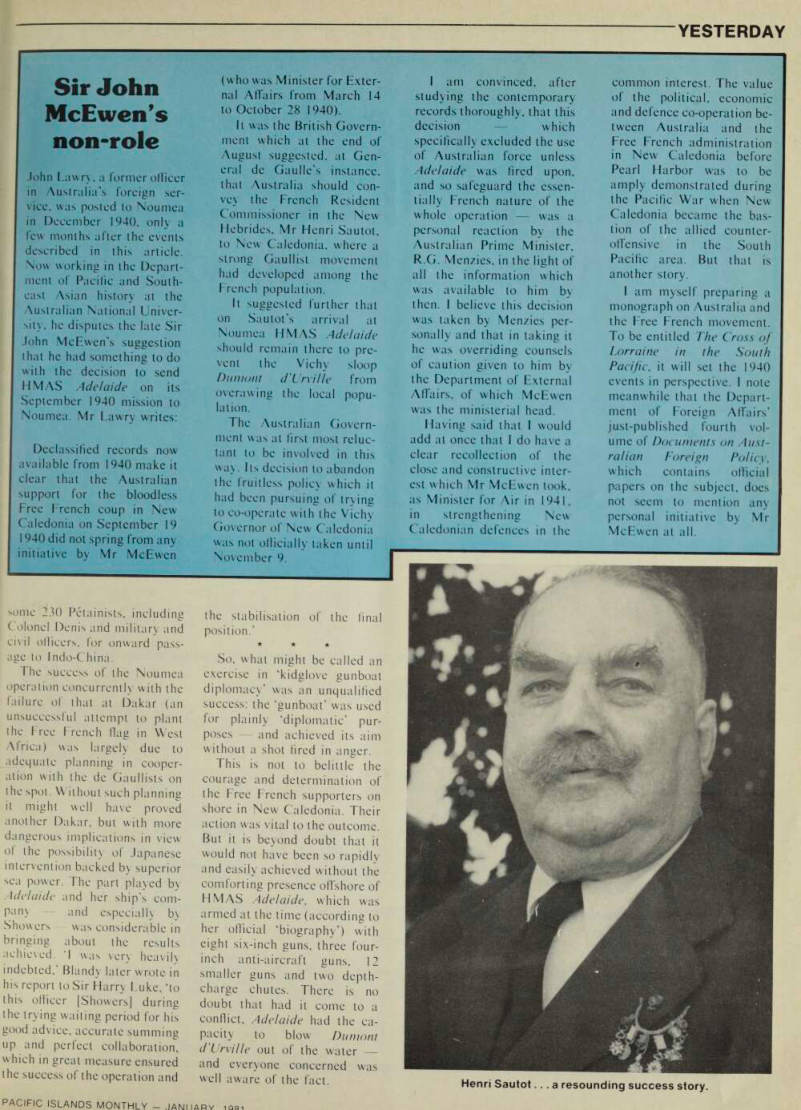
Sir John McEwen’s non-role
John Lawry. a former officer in Australia's foreign ser vice, was posted to Noumea in December 1940. only a few months after the events described in this article.
Now working in the Depart ment of Pacific and South east Asian history at the Australian National Univer sity, he disputes the late Sir John McEwen’s suggestion that he had something to do with the decision to send HMAS Adelaide on its September 1940 mission to Noumea. Mr Lawry writes: Declassified records now available from 1940 make it clear that the Australian support for the bloodless Free French coup in New Caledonia on September 19 1 940 did not spring from any initiative by Mr McEwen
(w ho was Minister for Exter nal Affairs from March 14 to October 28 1940).
It was the British Govern ment which at the end of August suggested, at Gen eral dc Gaulle's instance, that Australia should con vey the French Resident Commissioner in the New Hebrides. Mr Henri Saulol, to New Caledonia, where a strong Gaullisl movement had developed among the French population.
It suggested further that on Saulol’s arrival at Noumea HMAS Adelaide should remain there to pre vent the Vichy sloop Dumont d'Urville from overawing the local popu lation.
The Australian Govern ment was at first most reluc tant to be involved in this way. Its decision to abandon the fruitless policy which it had been pursuing of trying to co-operate with the Vichy Governor of New Caledonia was not officially taken until November 9.
I am convinced, after studying the contemporary records thoroughly, that this decision which specifically excluded the use of Australian force unless Adelaide was fired upon, and so safeguard the essen tially French nature of the whole operation was a personal reaction by the Australian Prime Minister, R.G. Menzies, in the light of all the information which was available to him by then. 1 believe this decision was taken by Menzies per sonally and that in taking it he was overriding counsels of caution given to him by the Department of External Affairs, of which McEwcn was the ministerial head.
Having said that I would add at once that I do have a clear recollection of the close and constructive inter est which Mr McEwcn took, as Minister for Air in 1941, in strengthening New Caledonian defences in the
common interest. The value of the political, economic and defence co-operation be tween Australia and the Free French administration in New Caledonia before Pearl Harbor was to be amply demonstrated during the Pacific War when New Caledonia became the bas tion of the allied counter offensive in the South Pacific area. But that is another story.
I am myself preparing a monograph on Australia and the Free French movement.
To be entitled The Cross of Lorraine in the South Pacific, it will set the 1940 events in perspective. I note meanwhile that the Depart ment of Foreign Affairs’ just-published fourth vol ume of Documents on Aust ralian Foreign Policy, which contains official papers on the subject, does not seem to mention any personal initiative by Mr McEwcn at all.
Advertisements & other items, p. 66 (1 item)
Expert
Insurance Service
throughout the islands
Queensland Insurance (Fiji) Limited
Head Office, 34 Usher St., SUVA . General Manager: L. G. Liddell A.A.1.1. Assistant Manager: Vijay Lai. Phone: 23851.
LAUTOKA OFFICE: Burns Philp Bldg., Naviti St. District Manager: J. Dalton. Phone: 60642,
Queensland Insurance (PNG) Limited
PAPUA NEW GUINEA
Head Office, B.N.G. Building, Musgrave St.PORT MORESBY. General Manager: J. M. Dawe.
Assistant Manager: R. V. Masked. Phone; 212144.
LAE: 4th St. & Coronation Drive. District Manager: I. R. Martin. Phone: 423873.
MOUNT HAGEN: Hagen Drive. District Manager: D. F. Carroll. Phone; 521002.
ARAWA: Chebu St. District Manager: J. Longbut. Phone: 951555.
MADANG: Kasagten St. District Manager; N. D. Ramage. Phone: 822020.
RABAUL; Wirraway St. District Manager: W. F. Tinker. Phone: 921014.
QBE Insurance Limited
VANUATU, PORT VILA. Rue de Paris, Suite 19, Oceania Bldg. Manager; G. F. Donnelly.
Phone: 2299.
SANTO: Burns Philp (Vanuatu) Ltd. Phone: 230.
PACIFIC AGENCIES
NEW CALEDONIA: T. A.Hagen, Ste. W. A. Johnston, S.A.R.L. 5 Rue Anatole France, NOUMEA.
Phone: 272083.
TAHITI: Arthur Chung. Immeuble 8.1.5., Front de Mer, PAPEETE. Phone; 2.86.19.
NIUE: Burns Philp (South Sea) Company Ltd.
NORFOLK ISLAND; Burns Philp (N I) Company Ltd. Phone; 2191.
SAMOA: APIA, Burns Philp (South Sea) Company Ltd. Phone: 22611.
TONGA; Burns Philp (South Sea) Company Ltd. NUKUALOFA. Phone 21500 HAAPAI, VAVAU.
yut MEMBERS OFTHE:
insurance group umited
Anti-nuclear stand by proposed
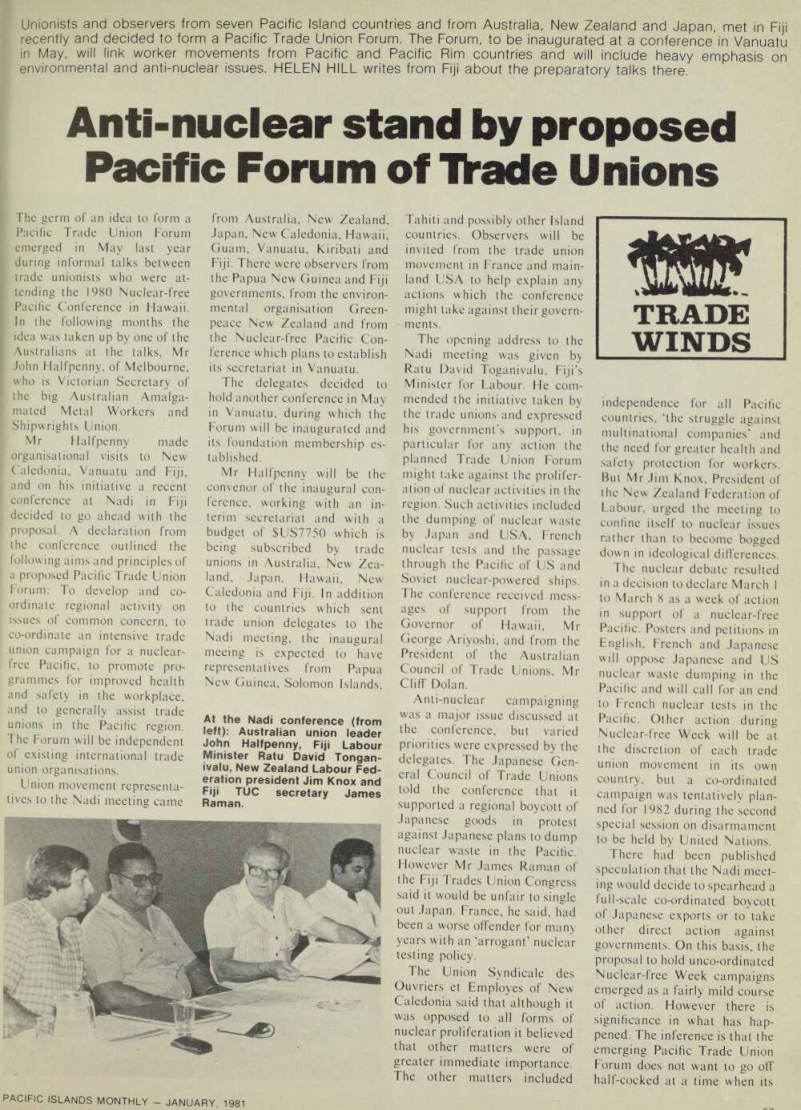

Trade
Winds
Anti-nuclear stand by proposed Pacific Forum of Trade Unions
Unionists and observers from seven Pacific Island countries and from Australia, New Zealand and Japan, met in Fiji recently and decided to form a Pacific Trade Union Forum. The Forum, to be inaugurated at a conference'in Vanuatu in May, will link worker movements from Pacific and Pacific Rim countries and will include heavy emphasis on environmental and anti-nuclear issues. HELEN HILL writes from Fiji about the preparatory talks there.
The germ of an idea to form a Pacific Trade Union Forum emerged in May last year during informal talks between trade unionists who were attending the 1980 Nuclear-free Pacific Conference in Hawaii.
In the following months the idea was taken up by one of the Auslralians at the talks, Mr John Halfpenny, of Melbourne, who is Victorian Secretary of the big Australian Amalgamated Metal Workers and Shipwrights Union.
Mr Halfpenny made organisational visits to New Caledonia, Vanuatu and Fiji, and on his initiative a recent conference at Nadi in Fiji decided to go ahead with the proposal. A declaration from the conference outlined the following aims and principles of a proposed Pacific Trade Union Forum. To develop and coordinate regional activity on issues of common concern, to co-ordinate an intensive trade union campaign for a nuclearfree Pacific, to promote programmes for improved health and safety in the workplace, and to generally assist trade unions in the Pacific region.
T L n r- ... . , 6 , I he rorum will be independent of existing international trade union organisations Un 'on movement represent. lives to the Nadi meeting came
from Australia, New Zealand, Japan, New Caledonia, Hawaii, Guam, Vanuatu, Kiribati and Fiji. There were observers from the Papua New Guinea and Fiji governments, from the environ mental organisation Green peace New Zealand and from the Nuclear-free Pacific Con ference which plans to establish its secretariat in Vanuatu, The delegates decided to hold another conference in May in Vanuatu, during which the Forum will be inaugurated and its foundation membership es lablished.
Mr Halfpenny will be the convenor of the inaugural con ference, working with an in lerim secretariat and with a budget of SUS77SO which is being subscribed by trade unions in Australia, New Zea land, Japan, Hawaii, New Caledonia and Fiji. In addition to the countries which sent trade union delegates to the Nadi meeting, the inaugural meeing is expected to have representatives from Papua New Guinea, Solomon Islands,
Tahiti and possibly other Island countries. Observers will be invited from the trade union movement in France and main land USA to help explain any actions which the conference might lake against their govern ments.
The opening address to the Nadi meeting was given by Ralu David Toganivalu, Fiji’s Minister for Labour. He com mended the initiative taken by the trade unions and expressed his government’s support, in particular for any action the planned Trade Union Forum might lake against the prolifer ation of nuclear activities in the region. Such activities included the dumping of nuclear waste by Japan and USA, French nuclear tests and the passage through the Pacific of US and Soviet nuclear-powered ships.
The conference received mess ages of support from the Governor of Hawaii, Mr George Ariyoshi, and from the President of the Australian Council of Trade Unions, Mr Cliff Dolan.
Anti-nuclear campaigning was a major issue discussed at the conference, but varied priorities were expressed by the delegates. The Japanese Gen eral Council of Trade Unions told the conference that it supported a regional boycott of Japanese goods in protest against Japanese plans to dump nuclear waste in the Pacific.
However Mr James Raman of the Fiji Trades Union Congress said it would be unfair to single out Japan. France, he said, had been a worse offender for many years with an ‘arrogant’ nuclear testing policy.
The Union Syndicale des Ouvriers el Employes of New Caledonia said that although it was opposed to all forms of nuclear proliferation it believed that other matters were of greater immediate importance.
The other matters included
independence for all Pacific countries, ‘the struggle against multinational companies’ and the need for greater health and safety protection for workers.
But Mr Jim Knox, President of the New Zealand Federation of Labour, urged the meeting to confine itself to nuclear issues rather than to become bogged down in ideological differences.
The nuclear debate resulted in a decision to declare March I to March 8 as a week of action in support of a nuclear-free Pacific. Posters and petitions in English, French and Japanese will oppose Japanese and US nuclear waste dumping in the Pacific and will call for an end to French nuclear tests in the Pacific. Other action during Nuclear-free Week will be at the discretion of each trade union movement in its own country, but a co-ordinated campaign was tentatively plan ned for 1982 during the second special session on disarmament to be held by United Nations.
There had been published speculation that the Nadi meet ing would decide to spearhead a full-scale co-ordinated boycott of Japanese exports or to take other direct action against governments. On this basis, the proposal to hold unco-ordinated Nuclear-free Week campaigns emerged as a fairly mild course of action. Flowever there is significance in what has hap pened. The inference is that the emerging Pacific Trade Union Forum does not want to go off half-cocked at a lime when its
At the Nadi conference (from left): Australian union leader John Halfpenny, Fiji Labour Minister Ratu David Tongan ivalu, New Zealand Labour Fed eration president Jim Knox and Fiji TUC secretary James Raman.
full influence has yet to be proved. By biding its time and seeking wider support the f o rum clearly wants to make sure that any strong action it takes will have the support not only of worker movements, but of the Island governments themselves.
Forced landing
for airline
Papua New Guinea last month was still attempting to gel Indonesia to reverse a decision . which has had a serious effect on the weekly Port Moresby to Singapore flight by Air Niugini. and which in the long term could mean the end of the service. The trouble arose from an Indonesian decision which clTccliveK forces Air Niugini make an uneconomic landing in Indonesia on the way to Singapore.
Air Niugini flies the Port Moresby to Singapore route with a Boeing 707 which makes an intermediate landing in Jakarta. Towards the end of last year however the Jakarta stopover became so unecon omic it was averaging only 12 passengers a week that Air Niugini decided to discon tinue it, to close its Jakarta office, and to fly direct between Port Moresby and Singapore.
This would have saved lurnround costs, handling costs, landing fees and flying lime.
However the decision also meant obtaining permission to fly through Indonesian air space, and Indonesia refused permission or more accu rately, as PNG officials said later, Indonesia would not countenance any change in the existing situation. There was some belief among PNG officials that the Indonesian attitude arose from earlier PNG refusals to allow the Indonesian airline Garuda to use Port Moresby as an access airport for onward flights to Australia, New Zealand and other Pacific ports.
Officials of the two countries met in Jakarta in a bid by PNG to resolve the situation. As far as PNG was concerned the bid failed, but Indonesia issued a statement which said ‘Agree ment was reached on all points and the air services between the two countries will continue as
this was seen to be beneficial to both countries’.
The PNG Transport Minister and Deputy Prime Minister. Mr lambakey Okuk, reacted angrily by cancelling plans for PNG pilots to train at the Indonesia Air Training College.
He said Indonesia had taken a line which was ‘regrettable, unjust and could reflect hard ship on our country’. It would be hypocritical to take part in the pilot training scheme while Indonesia refused flyover rights to a PNG airline, he said. Mr Okuk said his country could not grant Pacific access rights to Garuda because such action would jeopardise PNG’s own agreements with other countries.
A renewal of PNG’s sub missions to Indonesia was plan ned for late in the year.
Fiji tax down
but levies up
The 1981 Fiji budget reduces income lax for thousands of wage and salary earners, but seeks to make up the lost revenue of SF9 million by introducing higher indirect taxes. The budget, introduced by Finance Minister Charles Walker, follows the trend of a number of Pacific Island countries in placing increasing reliance on indirect taxation.
Mr Walker achieved his in come tax cuts for those in the lower brackets by raising the tax-free threshold to $lOOO, against $6OO previously. This is expected to give taxpayers an extra $1 to $2 a week from January 1.
At the top end of the scale, those who start paying the maximum rale of 50c in the dollar on taxable income of more than $ 12 000, will not now do so till the $2O 000 point.
Petrol tax has been increased by half a cent a litre and fuel oil by 0.22 of a cent. Excise on locally-brewed beer has been raised by 3.5 cents a litre to 36 cents and on locally-made ciga rettes by two cents for a packet of 10.
There has been no lax in crease on cars with engine capacities up to IOOOcc, but higher-powered cars will be taxed at higher rales.
Mr Walker granted con
cessions for investment in new building and in agriculture, and those who invest in locally made ships benefit in a similar manner to those who build hotels.
A lON tax on cameras, in cluding flood lamps, flash bulbs, lenses, binoculars, telescopes, projectors. film rewinders, slideviewers and exposure meters has been abolished.
The budget plans for an overall expenditure of $315 million.
New mill for
Bougainville
The big Papua New Guinea gold and copper miner Bougainville Copper Ltd, a subsidiary of Conzinc Riolinlo of Australia, is to install a new ball mill ore crusher to keep production as high as possible in the face of declining grades.
The mill will become the I llh on the mine site at Panguna on Bougainville Island, and is ex pected to lift production ca pacity by about 10 %. It will cost about SA4B million and is expected to go into service late in 1982.
The decision to install a new mill was taken at a recent meeting of the Bougainville board which includes represen tation from the PNG govern ment. About one-fifth of the equity in the mining project is held by the government.
The declining grades which are being taken from the deepening pit at the Bougainville mine are not unex pected. based on extensive core tests which were carried out during the exploratory phase.
However there are indications that the grades are falling behind some of the predictions.
The overall situation has been affected, too, by a period of depressed copper prices, and the installation of the new' mill is part of a general programme to maintain efficiency and financial targets.
The mine is a vital com ponent of the PNG economy, contributing lax, royalties and employment in addition to the government’s direct return from its shareholding. In August last year the PNG Finance Minister, Mr Kaputin, warned that significant drops in
production could scriouslv damage his country's economic projections. Where possible PNG is not using earnings from the mine for ongoing expendi tures. but is ploughing the money into development.
Because many of these developmental schemes are now committed, a general drop in production from the mine could have far-reaching effects.
The expected drop in pro duction without the establish ment of the new mill is IAVr, which means that the increase expected from the mill will reflect a small net gain.
The mine is still considered to be one of the most efficiently structured operations of its type, pulling PNG in a far less vulnerable situation than many
other copper-producing
countries.
Credit firm’s
new outlets
Credit Corporation (PNG) Limited, the 3()-monlh-old fi nance companx wholly owned b\ Papua New Guinean nationals, has established a ready-made branch network by entering into an agency agree ment with the Federation of Savings and Loan Societies Limited. Under the agreement selected credit unions through out PNG will act as general agents lor the finance, approv ing and processing hire pur chase applications and process ing the repayment instalments.
This in turn will assist and protect the credit unions which w ill be able to use hire purchase lunds and security for many of the loan advances which they make available. The arrange ment was announced recently by the chairman of the finance company. Sir Maori Kiki. and the chairman of the federation.
Mr William Grillin. Both or ganisations are constitutionally confined to investment by PNG nationals, as individuals and businesses which they wholly own.
The finance company was formed in 1978 in a move to give Papua New Guineans a share in the hire purchase investment market which until then had been dominated by major Australian hire purchase operators.
Advertisements & other items, pp. 68-70 (1 item)
pswg6
A FLEET OF DEPENDABLE PERFORMERS
-FOR POWER IN THE WATER
W/^WA.
w m Taking to the open sea or to calmer waters?
Going for sport or for labor?
Get there and back in style with dependability.
Go with a Suzuki! choose that outboard motor among our powerful fleet,
just matching your boating needs.
CaNP
ON
pswg6
FOB
i Look into the traditional excellence of Suzuki’s performance-proven motorcycles and 4-wheel drive vehicles something to satisfy your every motoring need. Going by sea or by land ... go with a Suzuki.
SUZUKI 4 WHEEL
DRIVE VEHICLE
ZUKI MOTOR CO., LTD. reserves the right to change, without notice, equipment, reifications, colours, materials and other items to apply local conditions. Each model jht be discontinued without notice. Please inquire at your local dealer for details of f such changes. Actual body colours might differ slightly from the colours in this ad.
SUZUKI MOTOR CO, LTD
Hamamatsu, Japan
SUZUKI
M.OMON ISLANDS SOLOMON ISLAND SERVICE STATION LTD. «NEW CALEDONIA STE. SUPERCAL •PAPUA NEW GUINEA BURNS PHILP EW GUINEA) LTD. #NEW HEBRIDES HENRI LEROUX «NIUE ISLAND BURNS PHILP (SOUTH SEA) CO.. LTD. #PONAPE LEO ETSCHEIT •TAHITI 3 PON AUTOMOTO • ELLICE ISLAND TUVALU COOPERATIVE WHOLESALE SOCIETY LTD. ©GUAM & SAIPAN ISLAND CYCLERY, INC. lORFOLK MARTIN’S AGENCIES LTD. • SAMOA PACIFIC PRODUCTS, INC. • TARAWA GILBERT ISLANDS COOPERATIVE FEDERATION LIMITED ’ONGA MORRIS HEDSTROM LTD. • WESTERN CAROLINES BECHESRRAK T. COMPANY ®YAP AMBROSE D. MINGINFEL’S WHOLESALER ■ASTERN CAROLINES KIOMASA STORE • NAURU EQUAPAC MOTORS •FUI NIRANJANS AUTOPORT LTD.
TRADEWINDS INTELLIGENCE... TRADEWINDS INTELLIGENCE... TRADEWINDS INTI
gram of 224 000 European Units of Account (about $A272 000).
Aranuka is one ol the last ol the atolls in Kiribati to receive an airstrip. It is expected that the last airstrip (Tabiteuea South) will also be financed by the EEC in the near future.
INABILITY to keep the selling price of cement in line with inflation was the main reason for a drop of $lO5 000 in the profit ol Fiji Industries Etd in the last financial year. The latest net profit was $206 000. A downturn in sales also had an effect on the profit.
CARPTRAC. the Caterpillar dealers in Fiji, have successfully negotiated a deal to supply the Nadi water supply contractors with SFS million worth of carthmoving equipment.
BRITAIN is to continue and increase budgetary assistance to Tuvalu in 1981 -82. Britain will also consider supplying a new interisland vessel to the country financed out of the programme of UK Capital Grants worth about 5.1 million pounds sterling committed at Tuvalu's independence in October 1978.
THE Asian Development Bank has approved a SUS 3 million concessional loan for the Agricultural Development Project in Western Samoa as part of pioneer co-financing with the International Development Association and the Australian Development Assistance Bureau. The bank's loan will finance part of the foreign exchange costs $7 million of the project, which aims at enhancing agricultural production and productivity. The balance of the foreign exchange costs will be financed by a $2 million credit from the World Bank’s ‘soft loan window’ the IDA and as 2 million grant from the ADAB. The credit being provided by I DA is its first co-financing with the ADB in the South Pacific. This is under an agreed framework between the two institutions whereby they will, from time to time, co-finance specific projects in the South Pacific
BANKCARD and Master Charge credit card operations have been extended to include the Cook Islands. The general manager of New Zealand Bankcard Associates Ltd. Mr T. D. Sullivan, said the Cooks were proving a popular holiday area for New Zealanders and the tourist potential seemed certain to develop further.
Bankcard has appointed Arthur Hosking, of Rarotonga, as a local representative.
THE BANK of Guam started service in November in Majuro, Marshall Islands. Ml President Amata Kabua welcomed the bank's arrival, noting the country's need for full and broader banking services. Bank of America opened its Majuro branch in 1969. In March 1980 BofA announced the sale to the Bank of Guam of its branches in Saipan. Truk and Majuro.
TONGA'S new airline will start business this year with six aircraft operating on the major tourist routes into Tonga, according to a statement from the Palace. Orders have been placed with the British Aerospace Group for two BACI-1 Is, two Islanders, and two BA 748 medium range aircraft. Delivery date of the aircraft is expected to be mid-1981. To be known as Royal Tongan Airline, the venture is a joint one between the Kingdom of Tonga and the Tongan Fnlwicklungs Corporation GmbH in West Berlin. Tonga is to have a 51 r T majority shareholding.
PACIFIC Island industries wholly or part-owned by Australia’s biggest company. Broken Hill Proprietary Co Ltd, contributed about 5A2.72 million in the 12 months to May 1980 to the group’s profit. The company's total profit from its mainly steel-making and fabricating, minerals and coal mining, shipping, and oil and gas operations in Australia, Asia, and North and South America, was $217 million. The Pacific contribution was from eight factories in New Zealand, Papua New Guinea, Fiji and New Caledonia. Steel drums, steel roof and wall cladding, steel office furniture, steel fence posts, structural steel, and hot water systems are made in the factories at Auckland, Wellington, Christchurch, Lae, Rabaul, Port Moresby, Suva and Noumea.
NAVITI Investments, Fiji, has paid almost SFSOO 000 in debts to the Fiji National Provident Fund and the Australian and New Zealand Bank, after selling the Navili Resort hotel to Australian buyers. The Fiji public company, on the verge of financial collapse since 1978, now owes only about $5OO 000 to the ANZ Bank, according to an official statement. Early in 1981 Navili’s shareholders arc expected to be asked at their annual general meeting whether to carry on the company or sell its other assets and wind it up.
AUSTRAFI AN-bascd Export Finance and Insurance Corporation is providing a loan of SA3S million to the Fiji Government to finance construction of the Nadi/Fautoka regional water supply scheme by a consortium of three Australian contractors. The contract was won by a joint venture of Wood Hall Ltd (Hornibrook), Feighlon Holdings Ltd, and Thiess Holdings Ltd.
Total contract value of about $53 million is the biggest Fiji contract to come Australia’s way. It is also one of the largest contracts of its type to be carried out in the Pacific Basin. The project will involve construction of an earth/rock fill dam across the Nadi River at Mogodro, as well as 40km of gravity pipeline, water treatment plants, service reservoirs and access roads. Due for completion in March 1983, it will provide a more reliable and belter quality water reticulation system for the dry western coasllands of Fiji. It is hoped that this will improve conditions for the development of tourism, irrigated agriculture and light industry.
FINANCING of the construction of an airstrip on Aranuka, an atoll in the middle of the Republic of Kiribati, has been approved by the European Economic Community. The decision involves a
PACIFIC
ISLANDS
TRANSPORT
LINE
MS AFRICANSTARS
Express Freight Service between Pacific Coast Ports of U.S.A. and...
Tahiti 6 Samoa
PAPEETE APIA PAGO PAGO
Full container service including reefers.
GENERAL STEAMSHIP CORPORATION LTD.
General Agents 400 California Street, San Francisco, California, U.S.A.
APIA; Bums Fhilp (South Sea) Company Ltd.
PAPEETE; Agenoe Maritime Internationale, Tahiti.
PAGO PAGO; Polynesia Shipping Services Inc.
TRADEWINDS INTELLIGENCE... TRADED
Barges, workboats boost
Ships
Barges, workboats boost Cook Islands services
Five barges and two workboats provided under New Zealand’s bilateral aid programme have brought a new dimension to ship and sea-cargo handling in the Cook Islands.
All five barges two for Atiu, two for Mangaia and one for Aitutaki have been built on Rarotonga, main island of the group. The two workboats, which have mainly tug functions, are stationed at Rarotonga and Aitutaki.
Sister craft, the Avatiu (Rarotonga) and O-Rongo (Aitutaki) were built in Auckland by Vos and Brijs Ltd and shipped to the Cooks as deck cargo. Their overall length is
9.5 m and they are equipped
with 115 hp diesel engines which provide a speed of 8 1 /? nots - The Avatiu provides an improved tug service for the ships of up to about 300 m in length which call at Rarotonga, in-
eluding unit-load freighters Fetu Moana and Tiare Moana.
They are chartered from the Shipping Corporation of New Zealand to serve the Cook Islands and Niue. The pair also alternate on a fortnightly call at Aitutaki where they anchor in open roadstead. Cargo is lightered between ship and shore on barges towed by the O- Rongo whose engine is turbo charged to provide an extra 30hp for negotiating strong tidal currents in the passage through the reef.
The O-Rongo and her sister also have a search and rescue capability, The steel barge for Aitutaki is 15m long a bigger craft than the steel and wooden barges it is replacing. Unlike the other lighters it has a hold.
It is not self-powered, The other four barges for the outer islands are sister craft 10m long, steel, and powered
with twin 75hp diesel engines.
They carry 9-10 tonnes of cargo.
All five barges were built by Rarotonga Welding and Steel Construction Co Ltd over the past five years, with funding by the bilateral aid programme.
The two Atiu barges were the first to be built.
The firm was established nine years ago by Ross Hunter, formerly of Auckland, who has been living in the Cook Islands for the past 14 years. He employs a staff of 10.
The second Mangaia barge was recently completed and the Aitutaki lighter has already been towed to its destination.
Neville Peat.
PM&O’s new Concord Philippines, Micronesia & Orient Navigation Company (PM&O Lines) has announced
the addition of the MV Con cord to its fleet. The Concord replaces the Jade Bounty and joins the Broadsword in serving the islands of Micronesia.
The Concord has an over-the side gantry crane which permits a more rapid discharge of containers, and enables the handling of cargo such as buses and tractors which cannot be containerised.
The vessel carries a forklift which is put ashore in each port to work in the container yards.
Carrying capacity of the Concord is 352 TEU (20 foot equivalent units). It has a maximum speed of 20 knots, but cruises at 17 knots to conserve fuel.
PM&O operates the only containerised, direct service from the US West Coast and Hawaii to Micronesia.
Advertisements & other items, pp. 71-72 (1 item)
Nelson &Robertson
pBEf??-
v?
O <Vr 'U 2 -0 O > Cys &
FOR:
IN OUR 86th YEAR SELLING ‘SERVICE’
TO THE PACIFIC ISLANDS
Nelson &Robertson
PTY. LTD. (Established 1895)
Plantation House, 197 Clarence Street, Sydney
Cables: ‘IVANT, Sydney, Brisbane. Telex: AA22381, Sydney.
INDENTS - FROM AUSTRALIA, NEW ZEALAND and OVERSEAS FOODSTUFFS • SOFTGOODS • HARDWARE • MACHINERY TRAVEL • INSURANCE • CANNED FISH • JUTE GOODS
• REAL ESTATE •
I
BRANCH OFFICES:
3
PAPUA NEW GUINEA
REPRESENTATIVES:
Nelson & Robertson Pty. Ltd., P-O. Box 575, Brisbane, Qld., Australia.
P-O. Box 2092, Govt. Bldg., Suva, Fiji.
P.O. Box 258, Lautoka, Fiji.
P.O. Box 2420, CPO Auckland 1, New Zealand.
Rabtrad Nuigini Pty. Ltd., P.O. Box 219, Rabaul, P.N.G.
P.O. Box 1406, Lae, P.N.G.
P.O. Box 711, Madang, P.N.G P.O. Box 253, Kieta, P.N.G. 6
CATERPILLAR
wheel loaders
Throughout the Pacific Islands you will find CATERPILLAR working to develop the land.
Caterpillar wheel loaders are among those machines. They are dependable, with the adjustment-free Cat diesel engine, rugged planetary power shift transmission and long-life sealed hydraulic system to keep you working.
Caterpillar wheel loaders give you 4-wheel drive, articulated steering and caliper disc brakes to get you in, out and around, fast. You can rely on Caterpillar to get the job done economically and efficiently.
HASTINGS PEERING
BA 10451
LAE :
Milford Haven Road, Telephone 42 2355
PORT MORESBY :
Telephone 256650
BOUGAINVILLE ;
Itakara Industrial Park, Arawa. Telephone 959077
PLUS
All CATERPILLAR equipment is backed by CAT PLUS service. CAT PLUS is a package of programmes designed to help you protect your investments and get the maximum return on your machines. CAT PLUS is the most comprehensive service programme available... .anytime, anywhere.
When you invest in CATERPILLAR equipment you have the full backing of your CAT Dealer and
CAT PLUS.
0 SUVA : Carpenter Street, Raiwai.
Private Mail Bag, GPOSuva. Fiji. Ph. 381622, Telex FJ2190 Cables CARPTRAC LAUTOKA : Veitari. Telephone 61877 LABASA : Vulovi, Telephone 81888 m
VOUR
CATII
DEALER
Caterpillar. Cat and (B are Trademarks of Caterpillar Tractor Co.
New, long reach for Moresby Chief
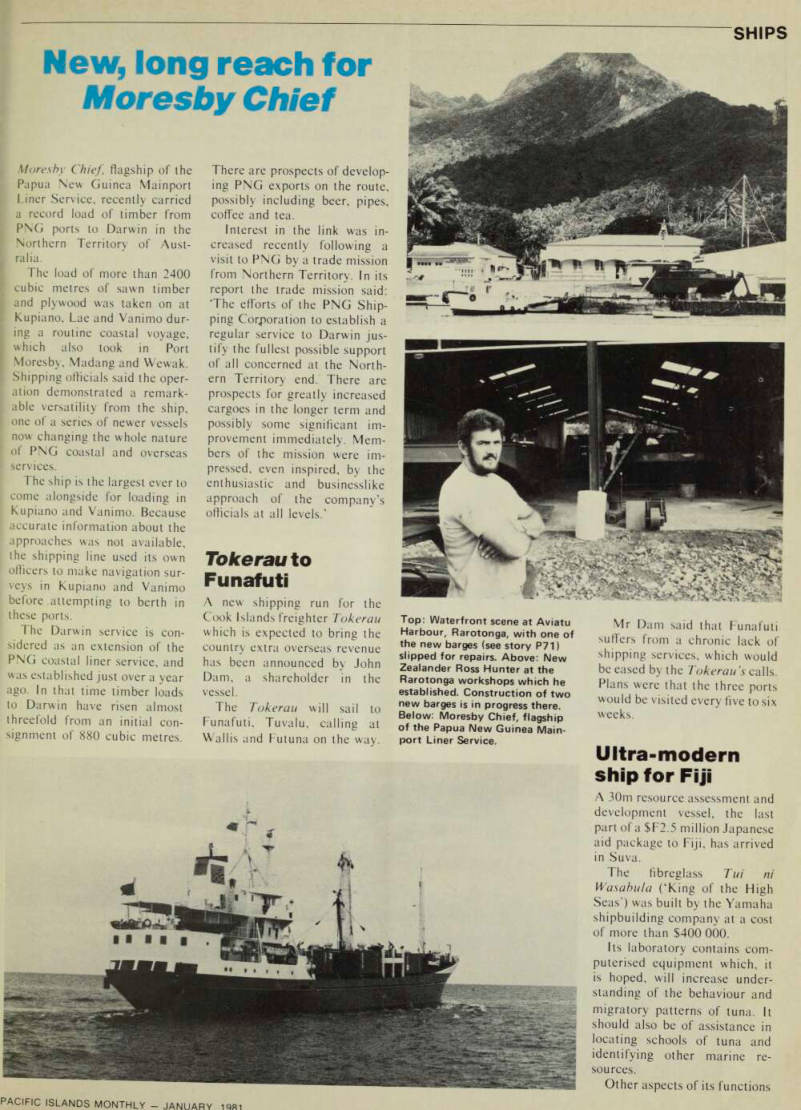
Moresby Chief
Moresby Chief, flagship of the Papua New Guinea Mainport Liner Service, recently carried I a record load of timber from PNG ports to Darwin in the Northern Territory of Aust
[ ralia.
The load of more than 2400 I cubic metres of sawn timber I and plywood was taken on at Kupiano, Lae and Vanimo dur ing a routine coastal voyage, I which also took in Port Moresby, Madang and Wewak.
Shipping officials said the oper . ation demonstrated a remark able versatility from the ship, one of a series of newer vessels now changing the whole nature of PNG coastal and overseas services.
The ship is the largest ever to come alongside for loading in Kupiano and Vanimo. Because accurate information about the approaches was not available, the shipping line used its own officers to make navigation sur veys in Kupiano and Vanimo before attempting to berth in these ports.
The Darwin service is con sidered as an extension of the PNG coastal liner service, and was established just over a year ago. In that time timber loads to Darwin have risen almost threefold from an initial con signment of 880 cubic metres.
There are prospects of develop ing PNG exports on the route, possibly including beer, pipes, coffee and tea.
Interest in the link was in creased recently following a visit to PNG by a trade mission from Northern Territory. In its report the trade mission said: ‘The efforts of the PNG Ship ping Corporation to establish a regular service to Darwin jus tify the fullest possible support of all concerned at the North ern Territory end. There are prospects for greatly increased cargoes in the longer term and possibly some significant im provement immediately. Mem bers of the mission were im pressed, even inspired, by the enthusiastic and businesslike approach of the company’s officials at all levels.’
Tokerau to
Funafuti
A new shipping run for the Cook Islands freighter Tokerau which is expected to bring the country extra overseas revenue has been announced by John Dam, a shareholder in the vessel.
The Tokerau will sail to Funafuti, Tuvalu, calling at Wallis and Futuna on the way.
Mr Dam said that Funafuti suffers from a chronic lack of shipping services, which would be eased by the Tokerau 's calls.
Plans were that the three ports would be visited every five to six weeks.
Ultra-modern
ship for Fiji
A 30m resource assessment and development vessel, the last part of a 5F2.5 million Japanese aid package to Fiji, has arrived in Suva.
The fibreglass Tui ni Wasahula (‘King of the High Seas’) was built by the Yamaha shipbuilding company at a cost of more than $4OO 000.
Its laboratory contains com puterised equipment which, it is hoped, will increase under standing of the behaviour and migratory patterns of tuna. It should also be of assistance in locating schools of tuna and identifying other marine re sources.
Other aspects of its functions
Top: Waterfront scene at Aviatu Harbour, Rarotonga, with one of the new barges (see story P7l) slipped for repairs. Above: New Zealander Ross Hunter at the Rarotonga workshops which he established. Construction of two new barges is in progress there.
Below: Moresby Chief, flagship of the Papua New Guinea Main port Liner Service.
Columbus says
are determining sea tempera ture and salinity.
The vessel is equipped with a ‘bouke-ami’ net designed to investigate the effects of bait fishing, and to determine whether a given marine re source is being exploited to excess.
Captain Timoci Vuatani sakea is master of the vessel, which will also carry a fisheries master, a scientific officer, an engineer, and three crewmen, crewmen.
On-board training will be given to local personnel by two Japanese aid officers on a casual basis.
Columbus says
‘No’ to PFL
‘Columbus Line, the German shipping company that Western Samoa was courting ardently to take up the management of the ailing Pacific Forum Line (PFL), and breathe new life into it, has decided against making the attempt.’
Reporting this on October 31, 1980, The Samoa Times said the bad news had been
conveyed to the Western Samoa Government by a senior Columbus official a few days before.
The paper said it was under stood the German shipping man had made ‘a most discouraging report regarding the future of the line’.
Sisco sails
to Lines
August 1980 saw the inaugur ation of a service from Suva to some of the Line Islands (Fan ning, Washington and Christ mas) in Kiribati.
Aim of the Honiara-based company Sisco Shipping Co which inaugurated the service was to have sailings for these islands every 30 days.
Managing Director B. H.
Allport said in a letter to PIM: ‘We would accept back-loading from Suva for.any of the islands en route, such as Wallis, Tokelau, etc. But because of the backlog of copra on Fan ning and Washington, space for loadings back to Suva will be short for the first three months.’
The service will be provided by the company’s MV Sisco.
Close look at
the Leonora
The Historic Preservation Office of the United States Trust Territory of the Pacific Islands planned last December to begin an archaeological sur vey of the Leonora, the ship of the blackbirder Bully Hayes, which sank in Utwe Harbour, Kosrae State, in the 1870 s.
According to TT Historic Preservation Officer Scott Russell, the survey was to be conducted by the Submerged Cultural Unit of the US National Park Service, on loan for the occasion.
The survey is designed to gather data on the condition of the wreck which will allow appropriate preservation plans to be developed.
The survey, originally re quested by officials in Kosrae State, is the first of its kind undertaken in Micronesia.
now on Pacific trials the Japanese tanker Aitoku Maru has metal sails as well as engines. - Petroleum Gazette picture.
Advertisements & other items, p. 74 (1 item)
South Sea Freighters Limited
Announcing: A 30-day service between Singapore,
Malaysia, Papua New Guinea and the Solomon Islands 9 -A « * ut AGENTS: Vanuatu: South Sea Freighters Limited, PO Box 166 Port Vila • Singapore: Bienley & Co. (Re) Ltd. Telex RS 25114, Phone: 981935 Pt Moresby: Nuigini Express Lines • Oro Bay: Carnell Carriers, Popondetta PNG. • Madang: B. J. Back* Lae: Nuigini Express Lines *Wewak Burns Philp(N.G.) Ltd.
Kieta: Burns Philp (N.G.) Ltd. • Kimbe: Harrisons & Crossfield (P N G.) Ltd. • Rabaul; New Guinea Cocoa (Export) Co. Pty. Ltd. • Honiara: Island Co-operative Shipping Federation Ltd.
Serviced by MV Solomon Sea and MV Bismarck Sea.
Yachts
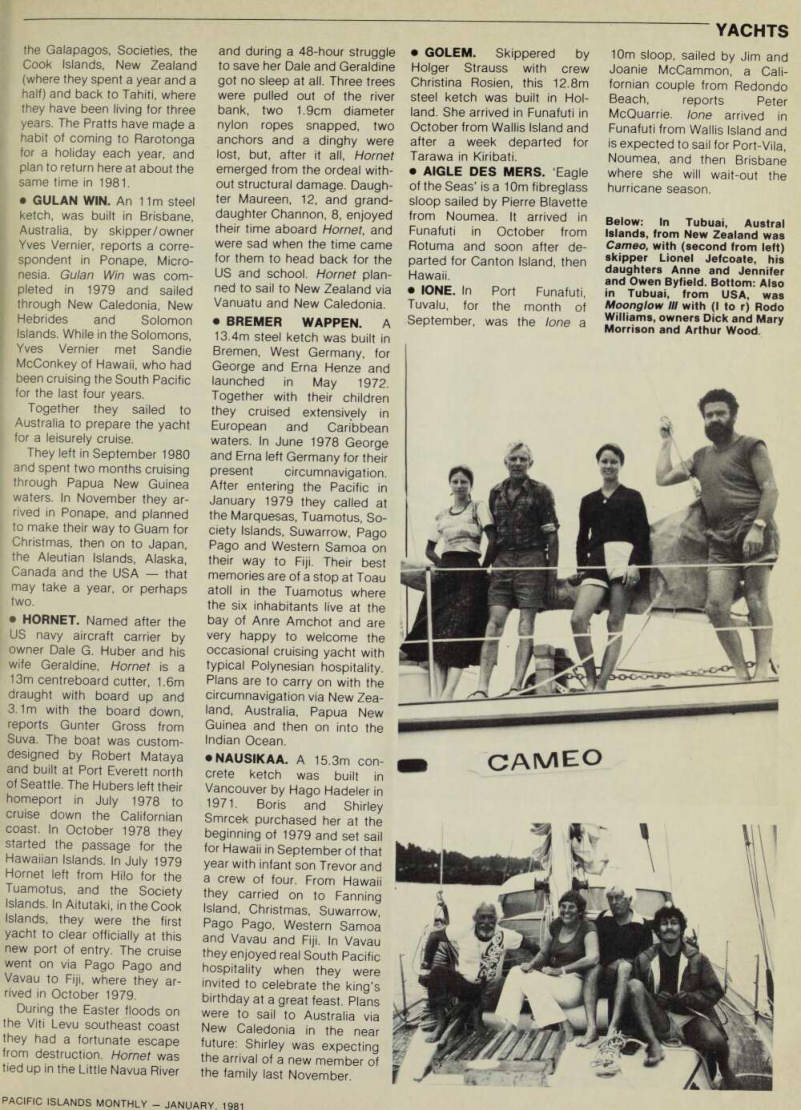
• W. N. RAGLAND. This top sail schooner, registered in [Halifax, Nova Scotia, stirred more than usual interest in \ Rarotonga, reports Paul Rysavy from the capital of the [Cook Islands. Word spread ; quickly that she is owned by [rock star Neil Young, formerly of Crosby, Stills, Nash and Young, and that he was ex pected to join the boat in Rarotonga. Unfortunately, Neil was busy working on a new album and never arrived. W. N.
Ragland dwarfed the other yachts in Avatiu Harbour. The schooner, named after Neil Young’s grandfather, is 24m on deck and 31m overall. She was built in Denmark in 1913 as a Baltic Schooner. [ Young began refurbishing
the schooner in 1976, and the job was completed in 1978.
Skipper Roger Katz and his permanent crew of Scotty Fairchild, Tree Conway and Suzanne Valier left Fort Lauderdale, Florida, in November 1978 and sailed to the Bahamas, Panama, Cen tral America and Mexico, and then cruised in a leisurely manner up the coasts of Cali fornia, Oregon and Washington to Canada for the Wooden Boat Festival, which Katz claims was the highlight of their North American cruise.
From Canada, W. N.
Ragland returned down the coast to Mexico before striking out for the Marquesas, which Katz describes as ‘Paradise Regained’. From the Marquesas the schooner sailed for Tahiti where Neil Young, his wife Peggy and their son Ben came on board for a cruise through the So ciety Islands. After Young and his family returned to the US, W. N. Ragland sailed directly to Rarotonga where at time of writing she has been berthed for about three weeks. From here she sails to New Zealand
to wait out the hurricane season, after which she will return to cruise through the Tongan and Fijian islands. • MOTHER CAREY. Another visitor to Rarotonga, Mother Carey is an 11m South African canoe stern racing cutter. She was launched in Durban in 1963, and came into skipper Hank Knobloch’s possession six years ago. His only crew member is Jacqueline Moak.
Knobloch left his home port of Annapolis, Maryland, in June 1976, and made for the Caribbean, where he spent four years cruising before go ing on to the San Bias Islands, the Marquesas, Tuamotus, Bora Bora and finally Rarotonga.
After spending a leisurely three weeks here Mother Carey headed for Nukualofa before sailing to New Zealand to sit out the hurricane season.
In March 1981, Knobloch plans to sail to Fiji and then south to Australia. When asked how long he expected to keep cruising, the skipper said simply: ‘l’m on a 20-year plan.
This is the only home I’ve got.
So why should I be in a hurry?’ • TWIGA. The six-year-old 11m cutter arrived in Rarotonga in October with Stephan and Marja Vance.
Twiga was designed by William Lapworth and built by Gensen Marine in California. She left Dana Point, California, in 1979, and sailed to Acapulco, the Marquesas, Tuamotus, and the Society Islands before arriving in Rarotonga. After a short spell here Twiga con tinued on to New Zealand where she will remain for the hurricane season. Stephan Vance says that they have had a wonderful time, but they have no exciting sea tales to tell. He’d like to keep it that way. • DRYAD. A late -comer to Rarotonga, in view of the fact that the hurricane season be gins in November, was Dryad, a 14m Rhodes Yawl which arrived in late October. The 43-year-old yacht, owned by Dick and Marty Pratt, is regis tered in St Thomas in the Virgin Islands. The Pratts left St Thomas in 1974 and sailed to Panama, the Cocos Islands,
the Galapagos, Societies, the Cook Islands, New Zealand (where they spent a year and a half) and back to Tahiti, where they have been living for three years. The Pratts have enable a habit of coming to Rarotonga for a holiday each year, and plan to return here at about the same time in 1981. • GULAN WIN. An 11m steel ketch, was built in Brisbane, Australia, by skipper/owner Yves Vernier, reports a corre spondent in Ponape, Micro nesia. Gulan Win was com pleted in 1979 and sailed through New Caledonia, New Hebrides and Solomon Islands. While in the Solomons, Yves Vernier met Sandie McConkey of Hawaii, who had been cruising the South Pacific for the last four years.
Together they sailed to Australia to prepare the yacht for a leisurely cruise.
They left in September 1980 and spent two months cruising through Papua New Guinea waters. In November they ar rived in Ponape, and planned to make their way to Guam for Christmas, then on to Japan, the Aleutian Islands, Alaska, Canada and the USA that may take a year, or perhaps two. • HORNET. Named after the US navy aircraft carrier by owner Dale G. Huber and his wife Geraldine, Hornet is a 13m centreboard cutter, 1.6 m draught with board up and
3.1 m with the board down,
reports Gunter Gross from Suva. The boat was custom designed by Robert Mataya and built at Port Everett north of Seattle. The Hubers left their homeport in July 1978 to cruise down the Californian coast. In October 1978 they started the passage for the Hawaiian Islands. In July 1979 Hornet left from Hilo for the Tuamotus, and the Society Islands. In Aitutaki, in the Cook Islands, they were the first yacht to clear officially at this new port of entry. The cruise went on via Pago Pago and Vavau to Fiji, where they ar rived in October 1979.
During the Easter floods on the Viti Levu southeast coast they had a fortunate escape from destruction. Hornet was tied up in the Little Navua River
and during a 48-hour struggle to save her Dale and Geraldine got no sleep at all. Three trees were pulled out of the river bank, two I.9cm diameter nylon ropes snapped, two anchors and a dinghy were lost, but, after it all, Hornet emerged from the ordeal with out structural damage. Daugh ter Maureen, 12, and grand daughter Channon, 8, enjoyed their time aboard Hornet, and were sad when the time came for them to head back for the US and school. Hornet plan ned to sail to New Zealand via Vanuatu and New Caledonia.
• Bremer Warren. A
13.4 m steel ketch was built in Bremen, West Germany, for George and Erna Henze and launched in May 1972.
Together with their children they cruised extensively in European and Caribbean waters. In June 1978 George and Erna left Germany for their present circumnavigation.
After entering the Pacific in January 1979 they called at the Marquesas, Tuamotus, So ciety Islands, Suwarrow, Pago Pago and Western Samoa on their way to Fiji. Their best memories are of a stop at Toau atoll in the Tuamotus where the six inhabitants live at the bay of Anre Amchot and are very happy to welcome the occasional cruising yacht with typical Polynesian hospitality.
Plans are to carry on with the circumnavigation via New Zea land. Australia. Papua New Guinea and then on into the Indian Ocean. • NAUSIKAA. A 15.3 m con crete ketch was built in Vancouver by Hago Hadeler in 1971. Boris and Shirley Smrcek purchased her at the beginning of 1979 and set sail for Hawaii in September of that year with infant son Trevor and a crew of four. From Hawaii they carried on to Fanning Island, Christmas, Suwarrow, Pago Pago, Western Samoa and Vavau and Fiji. In Vavau they enjoyed real South Pacific hospitality when they were invited to celebrate the king’s birthday at a great feast. Plans were to sail to Australia via New Caledonia in the near future: Shirley was expecting the arrival of a new member of the family last November.
• GOLEM. Skippered by Holger Strauss with crew Christina Rosien. this 12.8 m steel ketch was built in Hol land. She arrived in Funafuti in October from Wallis Island and after a week departed for Tarawa in Kiribati.
• Aigle Des Mers. Eagle
of the Seas’ is a 10m fibreglass sloop sailed by Pierre Blavette from Noumea. It arrived in Funafuti in October from Rotuma and soon after de parted for Canton Island, then Hawaii. • lONE. In Port Funafuti, Tuvalu, for the month of September, was the lone a
10m sloop, sailed by Jim and Joanie McCammon, a Cali fornian couple from Redondo Beach, reports Peter McQuarrie. lone arrived in Funafuti from Wallis Island and is expected to sail for Port-Vila, Noumea, and then Brisbane where she will wait-out the hurricane season.
Below: In Tubuai, Austral Islands, from New Zealand was Cameo, with (second from left) skipper Lionel Jefcoate, his daughters Anne and Jennifer and Owen Byfield. Bottom: Also in Tubuai, from USA, was Moonglow III with (l to r) Rodo Williams, owners Dick and Mary Morrison and Arthur Wood
Advertisements & other items, pp. 75-78 (2 items)
Cific Islands Monthly - January, 1981
Kyowa Shipping Co., Ltd.
Japan
S. Korea
Hong Kong
Singapore
’ » , . j., m. uumua, . oam ): Guam, Saipan, Truk, Ponape, Majuro, Yap. Koror
Hong Kong
To: Papua New Guinea, Other Pacific Islands.
Singapore
Phillippine
KYOWA SHIPPING CO., LTD.
HEAD OFFICE:
sth FI., Suzumaru Bldg. 39-8, 2-chome, Nishi-Shinbashi, Minato-ku, Tokyo, Japan Phone: 03(437)2885(Rep.) Cables: “MARIQUEEN" Tokyo. Telex; 242-4651 Kyowa J
OSAKA OFFICE;
Okajima Bldg., 7th Floor, 2-14, Nishihonmachi 1-chome. Nishi-ku. Osaka, Japan 3 hone: 06(533)5821 (Rep.) Cables. “MARIQUEEN" Osaka Telex: 525-6271 Ssjosa J.
YOUR BUSINESS PARTNER
i
AGENTS
Ltd.
S. Korea: Dong Sue Shipping Co.. Ltd., Seoul Taiwan: Royal Steamship Corp., Ltd., Taipei Hong Kong: Dahzun Enterprises Ltd.
Singapore: Ocean Shipping & Enterprses Pte.
Philippines: Sky International Inc., Manila Manansa Is: Martime Agencies of Pacific Ltd Guam Truk: Truk Shipping Co., Truk Ponape: United Micronesia Development Association. Ponape rap: Waab Transportation Co., Inc., Yap Koror: Belau Transfer & Terminal Co., Palau.
Solomon: Solomon Taiyo Ltd., Honiara New Hebrides: Pentecost Pacific S.A., Port Vila New Caledonia: Agence Maritime Du Rond point Du Pacific. Noumes Fiji: Carpenter Shipping, Suva & Lautoka A. Samoa; Polynesia Shipping Services, Inc., Pago Pago W. Samoa: Morris Hedstrom Ltrom Ltd., Apia Tahiti; J.A. Cowan & Fils, Papeete Cooks: Eastern Associates Ltd., Rarotonga Tonga: E.M. Jones Ltd., Nukualofa PNG: Carpenter Shipping Agencies. Port Moresby, Rabaul Indonesia: P.T. Porodisa Raya Shipping Lines. Jakarta Sabah: KOH Han Ming & Forwarding Agent., Kotakinabalu Sarawak: Pan Sarawak Agencies Sdn. Bhd., Sibu & Kuching Australia: Hethenngton Kingsbury Pty. Ltd., Sydney. N.S.W Newzealand; Russell & Summers Ltd., Aukland Nauru: Nauru Cooperative Society., Nauru
All this and great sound too!
Spectrum 102 V is a complete hi-fi component system. It has an amplifier, a tuner, a cassette deck, a turntable, an audio timer, speakers with stands. And a beautifully crafted, space-saver rack.
But it’s more than just a collection of components. Because, each one is carefully designed to work in harmony with the others. So there’s no waste of performance or your money.
That’s one advantage of choosing a system specially put together by experts.
After all, Kenwood engineers are responsible for some of the world’s most advanced hi-fi technology.
Like the High Speed DC Zero-Switching circuitry in the KA-400 power amplifier shown here.
Here’s another advantage of the Spectrum 102 V. Aftersale help.
Kenwood’s expert service people are never far away, should the unexpected happen.
Spcctmm-102V
•KA-400 DC stereo integrated amplifier •KT-400 FM-AM stereo tuner • KX-500 metal tape cassette deck with Dolby* NR and touch-key controls •KD-2100 fully automatic turntable •LS-90 3-way 3-speaker system •AT-80 audio timer •SRC-120 audio rack •Trademark of Dolby Laboratories. c lilt m
TRIO-KENWOOD CORPORATION
(NEW ADDRESS) Shionogi Shibuya Building, 17-5, 2-chome, Shibuya, Shibuya-ku, Tokyo 150, Japan AUSTRALIA TRIO-KENWOOD (AUSTRALIA) PTY LTD. Australia Tel. 439-4322 NEW ZEALAND JOHN GILBERT & CO., LTD. Auckland Tel. 30839 FIJI THE DOMINION IMPORT & EXPORT PROMOTIONS Nadi Tel 72-165 PAPUA NEW GUINEA S O. SVENSSON (N.G.) LTD. Port Moresby Tel. 24-2275/2285 NORFOLK ISLAND BURNS PHILP (NORFOLK ISLAND) LTD.
SOLOMON ISLANDS TECHNIQUE RADIOS CENTRE LTD. Honiara Tel. 416 NEW CALEDONIA HI-FI VOX Noumea Tel. 27-2466 NEW HEBRIDES RUE HIGGINSON Vila Tel. 2556 TAHITI MAI SON AURORE Papeete Tel. 29703 AMERICAN SAMOA ISLAND PACIFIC AGENCIES, INC. Pago Pago Tel. 633-4687
REPUBLIC OF NAURU NAURU CO-OPERATIVE SOCIETY
MARIANA ISLANDS J.C. TENORIO ENTERPRISES Saipan Tel. 6445
F
GLOBAL SERVICE FOR SHIPPERS
THE BANK LINE
Papua New Guinea & Solomon Islands
UK/Continent Service
Regular direct 28 day service
PAPUA NEW GUINEA and SOLOMON ISLANDS
to;
UNITED KINGDOM and CONTINENT
For particulars apply:
THE BANK LINE (AUSTRALASIA) PTY LTD.
18th Floor 1 York Street Sydney N.S.W. 2000 Australia Telephone: 272041 Telex: 24063
Services

Shipping
Should any shipping company wish to have its services cargo and passenger included in these list ings they should contact PIM
Australia - Fiji
Karlander (Aust) Pty Ltd operates monthly cargo services from Sydney to Suva and Lautoka.
Details from Karlander (Aust) Pty Ltd. 19-31 Pitt Street, Sydney (27-6301), Dalgety Shipping, 461 Bourke Street, Melbourne (60-0731), Burns Philp (SS) Co Ltd, Suva and Lautoka.
Sofrana-Unilines (Fiji Express Line) operates to Suva and Lautoka every three weeks from the main ports on the east coast of Australia and monthly to Lautoka from Melbourne and Sydney.
Details from Sofrana-Unilines, 19 Pitt Street, Sydney, (27-2031), Trans- Austral Shipping Pty Ltd, 570 Bourke Street, Melbourne (67-9162), ACTA Pty Ltd, Brisbane (221-3116), Elder-ANL Pty Ltd, Port Adelaide (47-5688), ANL, Newcastle (049-24364), Clements & Marshall, Burnie, Tasmania (31-1833).
Australia - Fiji - Samoas -
Tonga
Pacific Forum Line operates a fully containerised service (Gen/Reefer) from Brisbane and Sydney to Lautoka, Suva, Nukualofa, Apia and Pago Pago, Funafuti cargo transhipped at Apia Details from Pacific Forum Line, Syd ney: Union Bulkships, Sydney; Bulk ships, Melbourne, Brisbane; Burns Philp (SS) Co, Lautoka, Suva and Apia; Union Co, Nuku’alofa; Polynesia Ship ping Services, Pago Pago or Pacific Forum Line Head Office, Apia.
Australia - Lord Howe Is -
Norfolk Is
Compagnie des Chargeurs Caledoniens operates four-weekly cargo service Sydney - Lord Howe Island and Norfolk Island.
Details Hetherington Kingsbury Pty Ltd, 37-49 Pitt Street, Sydney (27-1671).
Australia - Nauru -
Kiribati
Nauru Pacific Line operates regular cargo/passenger service from Mel bourne to Nauru and Tarawa Details: Nauru Pacific Line, Nauru House, 80 Collins Street. Melbourne (653-5709), Nedlloyd Swire, 8 Spring Street, Sydney (2-0522).
Australia - New Caledonia
(And/Or) Vanuatu
Karlander operates a monthly service from Sydney to Noumea.
Details: Karlander (Aust) Pty Ltd 19-31 Pitt Street, Sydney (27-6301). ’
Sofrana-Unilines ships serve Noumea every three weeks from the main ports along the east Australian coast.
Details from Sofrana-Unilines, 19 Pitt Street, Sydney (27-2031), Trans- Austral Shipping Pty Ltd, 570 Bourke Street, Melbourne (67-9162), ACTA Pty Ltd, Brisbane (221-3116), Elders-ANL Pty Ltd, Port Adelaide (47-5688), ANL Newcastle (049-24364), Clements & Burnie . Tasmania
Compagnie des Chargeurs Cale
doniens operates a three-weekly con
tainerised cargo service from Sydney to Noumea.
Details Hetherington Kingsbury Pty Ltd, 37-49 Pitt Street, Sydney (27-1671).
Compagnie Generale Maritime oper ates a monthly service from Sydney to Noumea, Port Vila and Santo, using a ro-ro vessel.
Details Compagnie Generale Mari time, 12 Castlereagh Street, Sydney (231-3700).
Daiwa Line operates a con tainer/breakbulk service every 30 days to Vila and Santo and every 60 days to Noumea.
Details Meridian Shipping & Trans port Agencies Pty Ltd, Box 3410 GPO Sydney 2001 (290-1633), Tlx: AA25970.
Australia - Nz - Fiji -
Hawaii - Us
P & O liners call at Auckland, Suva, Pago Pago and Honolulu and Van couver on eastbound and westbound voyages between Sydney and the US.
Details from P & O Booking Centre, World Travel Headquarters Pty Ltd, 33 Bligh Street, Sydney (231-6655).
AUSTRALIA - NZ - FIJI - TONGA -
Vanuatu - Noumea - Png -
Solomons - Samoas - Tahiti
Sitmar Cruises operates a year-round cruise programme to include most of the above countries.
Details from Sitmar Cruises, 47 Elizabeth Street, Sydney (232-7511).
P & O liners call at Auckland, Bay of Islands, Honiara, Lautoka, Noumea, Nukualofa, Pago Pago. Papeete, Port Moresby, Santo, Savusavu, Suva, Vavau and Vila on cruises from Aus tralia.
Details from P & O Booking Centre, World Travel Headquarters Pty Ltd, 33 Bligh Street, Sydney (231-6655).
Pacific Forum Line operates con tainerized and general cargo service from Australia and NZ to Fiji, Apia, Pago Pago, Tonga and other South Pacific ports.
Details from Polynesia Shipping Ser vices Inc, PC Box 1478, Pago Paqo 96799. y
Australia - Micronesia
Nauru Pacific Line operates a regular container service from Melbourne to Majuro, Kosrae, Ponape, Truk, Guam and Saipan.
Details Nauru Pacific Line, Nauru House, 80 Collins Street, Melbourne, (653-5709), Nedlloyd Swire, 8 Spring Street, Sydney (2-0522).
Australia - Png
New Guinea Express Lines operates three-weekly conventional and con tainer services Melbourne, Sydney, Brisbane, Port Moresby, Lae, Rabaul Alotau.
Details from New Guinea Express Lines, PC Box R 73, Royal Exchange PC, Sydney (241-3991) MacArthur Shipping Agency Co, 82-92 Eagle Street, Brisbane (229-3777), New Guinea Express Lines, 327 Collins Street, Melbourne (61-3053), Niugini Express Lines in Port Moresby (21-4572), Lae (42-1536), Rabtrad Niugini Pty Ltd, Rabaul (92-2911), Alotau Stevedoring & T’soort (61-1318). M Karlander New Guinea Line's cargo vessels call at Melbourne, Sydney, Port Moresby, Lae, Madang, Wewak, Manus, Kimbe, Rabaul, Popondetta.
Details from Karlander (Aust) Pty Ltd 19-31 Pitt Street, Sydney (27-6301)’
Dalgety Shipping, 461 Bourke Street' Melbourne (60-0731).
Australia - Png - Solomons
A consortium of Conpac, NGAL/PNGL have three container vessels operating on a 28 day turn around from Melbourne, Sydney and Brisbane to Port Moresby, Lae, Rabaul, Kavieng, Wewak, Madang, Kieta and Honiara supplemented by Daiwa
vessels, Pacific Princess and Fiji Maru extending from Sydney to Lae on a monthly basis.
Details from Burns, Philp & Co. Ltd. 51 Pitt Street, Sydney (2-0547) and Interocean Swire, 8 Spring Street, Syd ney. (2-0522).
Australia - Solomons -
Kiribati - Micronesia
Daiwa Line operates a container ser vice every 30 days from Sydney to Honiara, Kieta, Tarawa and Guam. Gizo cargoes transhipped at Honiara, Sai pan, cargoes transhipped at Guam.
Details Meridian Shipping & Trans port Agencies Pty Ltd, Box 3410 GPO Sydney 2001 (290-1633), Tlx.
AA25970.
Australia - Solomons -
Northern Marianas-Taiwan -
Japan
Daiwa Line offers a four-weekly ser vice Sydney-Honiara-Guam-Taiwan- Japan with transhipment at Guam for Saipan.
Details Meridian Shipping & Trans port Agencies Pty Ltd, Box 3410 GPO, Sydney 2001 (290-1633). Tlx.
AA25970.
Australia - Tahiti
Compagnie Generate Maritime oper ates a monthly service from Sydney to Papeete using a ro-ro vessel.
Details Compagnie Generate Mari time, 12 Castlereagh Street, Sydney (231-3700).
Australia - Tahiti - Us
Karlander operates a monthly cargo service from Melbourne and Sydney to Papeete, US west coast.
Details: Karlander (Aust) Pty Ltd, 19-31 Pitt Street. Sydney (27-6301).
Australia - W. Samoa
Compagnie Generate Maritime oper ates a monthly service from Sydney to Apia.
Details Compagnie Generate Mari
time, 12 Castlereagh Street. Sydney (231-3700).
Fiji • Line Islands
(Kiribati)
Sisco Shipping Co Ltd has commen ced a 30 day service from Suva to Fan ning. Washington and Christmas Islands. Back loadings from Suva for en route islands accepted.
Details from Sisco Shipping Co Ltd, PO Box 670, Honiara (808/809) Tlx 66346, or agents Burns Philp, Box 355, Suva.
Far East - Fiji - New
Zealand
New Zealand Unit Express (NZUE) operates a fortnightly palletised cargo service from Manila, Keelung, Kaoshiung and Hong Kong to Lautoka!
Suva and thence to NZ.
Details from Carpenters Shipping, Suva (312-244), Burns Philp. Suva (311-777), P & O S.N. Co, Wellington (736-477) or Nedlloyd Swire Pty Ltd Sydney (20-522).
Nedlloyd operates bi-weekly cargo service with four ships from Sourabaya, Jakarta, Bangkok, Port Kelang and Singapore to Suva and NZ ports.
Details from Nedlloyd (Aust) Pty Ltd 8 Spring St. Sydney (27 3801), Burns Philp (SS) Co Ltd, Suva and Lautoka.
Far East - Mid-S. Pacific
China Navigation's New Guinea Pa cific Line (NGPL) operates a regular cargo service from Hong Kong, Taiwan, Manila, Port Kelang and Singapore to Wewak, Madang, Kimbe, Rabaul, Kieta, Lae, Port Moresby, Honiara, Santo, Vila, Noumea, Papeete, Pago Pago, Apia, Tarawa and Nauru.
Details from Steamships Trading Co., Port Moresby (21-2000).
Kyowa Shipping Ltd, operates monthly services from Hong Kong, Taiwan, S. Korea and Japan, to Guam, Saipan, Solomons. New Caledonia, Fiji,
Western and American Samoa, Tahiti.
Cook Is., Tonga and Vanuatu.
Details: Hetherington Kingsbury Pty Ltd, 37-49 Pitt Street, Sydney (27-1671).
Daiwa Line operates 30-day service from Moji, Kobe, Nagoya and Yokohama to Papeete, Pago Pago, Apia, Suva, Lautoka, Noumea, Vila!
Santo, Honiara, Kieta. Tarawa and Guam, Details: Meridian Shipping & Trans port Agencies Pty Ltd, Box 3410 GPO Sydney 2001 (290-1633) Tlx AA25970.
Japan - Fiji - New Zealand
China Navigation, operates a monthly service from main ports Japan to Suva and Lautoka and thence Noumea and NZ.
Details from Carpenters Shipping, Suva (312-244).
Japan • Png
Mitsui O.S.K. Lines operates a monthly service from main ports Japan and Port Moresby, Rabaul, Lae, Madang, Kieta and Kimbe.
Details from J. C. Waller, Port Moresby (21-2466/21-1898).
JAPAN - GUAM - FIJI - TAHITI -
Samoa - N. Caledonia -
Solomons - Kiribati
Daiwa Lines runs a monthly cargo service from Japan via Guam to Lau toka, Suva, Papeete. Pago Pago, Apia, Sydney, Noumea, Honiara, Tarawa, Guam.
Details from Burns Philp (SS) Co Ltd, Suva.
Hawaii - Samoas - Tonga
Warner Pacific Line operates uni tized/palletized and reefer cargo service Honolulu/Pago Pago-Apia- Nuku’alofa. Line Islands and Suva by inducement.
Details from Hawaii-Pacific Maritime Inc., Honolulu, Hi 96801. Tel. (808) 521-9806 Freight Dept. Tlx (RCA):
723-8330 ITT 743-0040 Cables ‘Oral’.
New Caledonia - Fiji - West
Coast North America
PAD Line operates an approx. 3weekly ro-ro service from Noumea and Suva to Honolulu and West Coast USA and Canadian ports.
Details from Sofrana-Unilines SA, BP 1602, Noumea (27-51 -91), Tlx NMO4B; W. R. Carpenter, 100 Thomson St' Suva (31-11-22), Tlx FJ2199; Trans- Austral Shipping, Box R 232 PO, Royal Exchange, NSW (27-2441), Tlx AA21204.
Png - Inter - Mainport
Papua New Guinea Mainport Liner Services offer scheduled 10/20 coastal liner services linking all PNG mainports with containerisation, reefer, heavy lift and transhipment facilities.
Details from PNG Mainport Liner Ser vices, Box 1448, Lae, PNG (42-3537) Tlx PNG 42465.
Png - North Australia -
Kiribati - Solomon Islands -
West Coast Usa
Papua New Guinea Line offers a 60-day service from Port Moresby, Lae and Vanimo to Darwin with through bills of lading from West Coast North American ports. Inducement calls at Wei pa and Gove.
Details from PNG Shipping Corpor ation, Box 543, Port Moresby, PNG (21-1174), Tlx PNG 22269.
Papua New Guinea Line offers a 60-day service from Port Moresby, Lae, Rabaul and Kieta to San Francisco and Los Angeles with inducement at Van couver and stop-off calls at Tarawa and Honiara. Through bills from all PNG mainports and mini-bridge services to other US and Canadian destinations.
Details from PNG Shipping Corpor ation, Box 543, Port Moresby. PNG (21 -1174), Tlx PNG 22269; or from TFC Shipping, 100 California St, San Fran
cisco, CA. USA (415 398-1604). Tlx
340958 Gts Ur Sfo.
Png - Uk/Continent
Bank Line operates regular cargo service from Kieta. Rabaul, Kimbe, Madang and Lae to Cardiff, Hamburg, Rotterdam and Antwerp.
Details from Bank Line (A’asia) Pty Ltd, 1 York Street, Sydney (27-2041); Burns Philp (PNG) Ltd, ports.
Png - Us
Bank Line operates regular cargo service from Kieta, Rabaul, Kimbe, Madang and Lae direct to New Orleans; calls at other US and Gulf and East Coast ports on inducement.
Details from Bank Line (A’asia) Pty Ltd, 1 York Street, Sydney (27-2041); Burns Philp (PNG) Ltd, PNG ports.
Solomons - Usa -
Uk/Continent
Bank Line operates regular cargo service from Honiara to New Orleans, Cardiff, Hamburg, Rotterdam and Ant werp. ; Details from Bank Line (A’asia) Pty Ltd, 1 York Street, Sydney (27-2041); Trading Co, Honiara (389).
NZ - COOK IS - NIUE -
Tahiti
[ Shipping Corporation of NZ Ltd oper ates cargo services based on pallets and similar units from Auckland to Niue, Cook Islands and Tahiti.
Details from the Shipping Corp of NZ Ltd, PO Box 3420. Auckland (797-210), Waterfront Commission, PO Box 61. Rarotonga; Lighterage and Stevedoring Co, Aitutaki; Niue Govt Offices, Niue Island Compagnie Mari time Polynesienne. B’P’ 368, Papeete, Tahiti.
Nz • Fiji
Reef operates a regular 18-day ser vice from Auckland to Suva and Lau toka.
Details from Reef Shipping Agencies, PO Box 3382, Auckland, NZ (77-1221-3).
Pacific Line with one ship operates fortnightly roro cargo service New Zealand, Lautoka, Suva.
Details; Sofrana Unilines, 18 Cus toms Street, Auckland (773-279) PO Box 3614, Telex: NZ2313.
NZ - FIJI - NORTH AMERICA (WC) Blue Star Line Ltd Pacific Coast con ainer services. Only direct service to md from New Zealand. Blue Star vessels call at Suva and Honolulu on WZ-US-West Coast voyages.
Details from Blueport ACT (NZ) Ltd, >0 Box 192, Wellington (739-029) Jurns Philp (SS) Co Ltd, GPO Box 355,’ >uva, Fiji (311-777).
NZ - FIJI - SAMOAS - TONGA Pacific Forum Line operates a fully ;ontainerised three-weekly service Gen/Reefer) from Auckland to Lau- Dka, Suva, Apia, Pago Pago and Juku’alofa.
Details from Pacific Forum Line Wellington; Union Co, Auckland, Lau )ka, Suva, Apia and Nuku'alofa; olynesia Shipping Services, Pago ago or Pacific Forum Line Head >ffice, Apia.
NZ - N. CALEDONIA - FIJI -
Solomons - Png
Pacific Forum Line operates a fully ontainerised service (Gen /Reefer) om Lyttelton, Napier, Tauranga, uckland to Suva, Lautoka, Honiara, ieta, Lae and Port Moresby.
Details from Pacific Forum Line, Wellington; Shipping Corporation of Z, Lyttelton, Napier; Union Co, auranga, Auckland, Suva, Lautoka; teamships Trading Co, Kieta, Lae! crt Moresby; Sullivans (SI) Ltd, oniara or Pacific Forum Line Head ffice, Apia.
Z - N. CALEDONIA - VANUATU -
Png - Solomons
Sofrana Unilines with three ships op ates to Vila and Santo, to Honiara and
Papua New Guinea and to Norfolk Island and Noumea.
Details from Sofrana Unilines, 18 Customs Street, Auckland (773-279) PO Box 3614, Telex NZ2313.
Nz - Tahiti
Compagnie Tahitienne Maritime SA with one ship operates monthly service New Zealand - Papeete.
Details from Sofrana Unilines, PO Box 3614, 18 Customs St, Auckland (773-279), Tlx NZ2313.
Nz - Tonga - Samoas
Warner Pacific Line services Auckland - Nukualofa/Vavau/ Apia/Pago Pago fortnightly carrying general and freezer cargoes. Also Timaru - Nuku’alofa/Vavau/Apia every 21 days carrying freezer cargo.
Details from McKay Shipping Ltd, Downtown House. 21 Queen St, Auckland, PO Box 1372 (30-299) Cables MACSHIP, Telex NZ2554,
Europe - Tahiti -
New Caledonia
Compagnie Generate Maritime oper ates services from Europe and Mediter ranean ports to Papeete and Noumea using three ro-ro and multi-purpose vessels thus ensuring a bi-monthly sail ing to and from.
Details Compagnie Generate Mari time, 12 Castlereagh Street, Sydney (231-3700).
EUROPE - TAHITI - W. SAMOA -
Fiji - N. Caledonia
Nedlloyd offers regular cargo ser vices from Northern Europe and UK to Papeete, Apia, Fiji and New Caledonia.
Details Nedlloyd (Aust) Pty Ltd 8 Spring Street, Sydney (27-3801).
EUROPE - TAHITI - W. SAMOA - TONGA - FIJI - SOLOMONS - PNG Columbus Line Reederei GMBH op erates 2-monthly service from Ham burg, Rotterdam, Antwerp, Dunkirk and Le Havre to Papeete, Apia, Nukualofa, Suva, Lautoka, Noumea, Honiara, Port Moresby, Kieta, Rabaul, Lae, and return to Europe, Details from Columbus Overseas Services Pty Ltd, 333 George Street Sydney (290-2966), Columbus Mari time Services, 17 Albert Street, Acckland (77-3460).
Uk - N Continent - Fiji
The Bank Line operates a regular 28 day cargo service from Hull, Hamburg, Bremen, Antwerp and Rotterdam to Suva and Lautoka.
Details from The Bank Line (Aus tralasia) Pty Ltd, 1 York St, Sydney (27-2041); Burns Philp (South Sea) Co Ltd, Suva and Lautoka.
Uk/N. Continent - Png -
Solomons
The Bank Line operates a regular 28 day cargo service from Hull, Hamburg, Bremen, Antwerp and Rotterdam to Port Moresby, Lae, Madang, Kimbe.
Rabaul, Kieta and Honiara and on inducement to Yandina.
Details from The Bank Line (A’asia) Pty Ltd, 1 York Street, Sydney (27-2041), Burns Philp (PNG) Ltd, PNG ports; Trading Co Honiara.
Uk/N. Continent - Tahiti -
N. Caledonia - N. Hebrides
The Bank Line operates a regular 28 day cargo service from Hull, Hamburg, Bremen, Antwerp and Rotterdam to Papeete and Noumea.
Details from The Bank Line (A’asia) Pty Ltd, 1 York Street, Sydney (27-2041); Ets A M Fare UTE, Papeete; Ets Ballande, Noumea.
US - FIJI - TAHITI - NZ -
Australia
The Bank and Savill Line Ltd, oper ates regular cargo services from US Gulf ports to Australia and NZ. Calls at Suva, Lautoka and Papeete on de mand.
Details from The Bank Line (A’asia) Pty Ltd, 1 York Street, Sydney
(27-2041) or Howard Smith Industries Pty Ltd, 1 York Street, Sydney (27-5611).
Us - Hawaii - Micronesia
Philippines, Micronesia & Orient Navigation Co (PM&O Lines) operates regular container service on self sustained ship with ro-ro capabilities from Oakland, Portland and Honolulu to Majuro, Kosrae, Ponape, Truk. Saipan, Yap and Koror.
Details for Micronesia can be obtained from Larry Guerrero, PM&O Owners Rep, PO Box 803, Saipan, Ml
96950, Cable Commontime; Pm&O
Lines, 181 Fremont St, San Francisco, California 94105, Cable PMONAV.
Us - Hawaii - Nauru -
Micronesia
Nauru Pacific Line operates regular conventional/container and passenger service from San Francisco and Honolulu to Majuro, Ponape, Truk and Saipan. Cargo is accepted for Nauru and Kosrai with transhipment at Majuro and Ponape.
Details from Nauru Pacific Line, Nauru House, 80 Collins Street, Mel bourne (653-5709); North American Maritime Agencies, 100 California St., San Francisco, California 9411.
Us - Noumea - Fiji
PAD Line operates an approx 3-weekly roro service from West Coast USA and Canada to Noumea and Suva.
Details from Sofrana-Unilines SA, BP 1602, Noumea (27-51-91), Tlx NMO4B; W. R. Carpenter, 100 Thomson St, Suva (31-11-22), Tlx FJ2199; Trans-Austral Shipping, Box R 232 PO. Royal Exchange, NSW (27-2441), Tlx AA21204.
Us - Tahiti - Samoa
Pacific Islands Transport operates a five weekly cargo service from North America west coast ports to Papeete Pago Pago, Apia.
Details from Polynesia Shipping Ser vices Inc, PO Box 1478 Pago Pago 96799. y Polynesia Line operates container and general cargo service from US west coast ports to Papeete and Pago Pago, Details from Polynesia Shipping Ser vices Inc., PO Box 1478, Pago Pago 96799.
US - TAHITI - SAMOA - NZ - AUST Farrell Lines Inc, operate a fast reg ular lash/container cargo service from west coast ports Canada/USA to Papeete and Pago Pago thence to NZ and Australia.
Details Wilh Wilhelmson Agency, Sydney, Melbourne and Brisbane, Tlx AA20136, Cable FARSHIPS Sydney; Dalgety (NZ) Ltd, Auckland and Wellington, Tlx NZ2445, Cable DALSHIP Auckland; Compagnie Mari
time Polynesienne, Immeuble Franco Oceanienne, PO Box 368, Papeete, Tahiti, Tel 26393, Tlx 258. FP ANSB Taporo, Cable OCEAN Papeete; Kneubuhl Maritime Service, PO Box 39, Pago Pago, Telephone 633-5121 : Tlx 782505.
Advertisements & other items, pp. 79-81 (1 item)
Henry Cumines
w.
Aquila water tanks completely enclosed to ensure clean water and built to last from strong, durable galvanised steel.
You assemble them yourself from our comprehensive kits. Capacities range from 2300 litres to 49250 litres.
Send for a brochure today.
Aquila Engineering Division, 25 Pacific Highway, Bennetts Green, New South Wales, Australia.
Name Address P/code
AQ2O/2
AQUILA
HENRY CUMINES
PTY.LTD.
EXPORTERS o GENERAL MERCHANTS
428 GEORGE ST., SYDNEY
CABLES: HENCO SYDNEY. G.P.O. Box 3949, PHONE; 232-5377 For specialised and personalised buying service throughout the Pacific Islands and the East.
• LOCAL AGENTS AND REPRESENTATION;
PAPUA NEW GUINEA: FIJI:
RABAUL: M. & C. Seeto P.O. Box 131, Rabaul.
Telephone 92-2919.
K. Witherington Ltd., P.O. Box 293, Suva.
Telephone 22-356.
MADANG: W. Double, P.O. Box 22, Madang.
Telephone 82-2696.
SOLOMON
VANUATU:
John Lum & Associates, P.O. Box 65, Santo.
Telephone 329.
ISLANDS:
Mr, Tom Lo, P.O. Box 327, Honiara.
Telephone 399.
Resident Agents in other Pacific Territories. ».
WHEN YOUR DEALER CAN'T SUPPLY
MERGENCY!
SPARE PARTS SERVICE
R. T. MUIRHEAD COMPANY
EXPORTERS
ESTABLISHED 1935
We furnish genuine Spare parts for any American manufactured Construction • Mining • Logging • Transportation • Quarry and Industrial Equipment.
“EMERGENCY SERVICE IS OUR SPECIAL TY”
WE WILL ARRANGE CUSTOM CLEARANCE AND DELIVERY TO YOUR WAREHOUSE.
SATISFIED CUSTOMERS THROUGHOUT AUSTRALIA, NEW ZEALAND, PACIFIC ISLANDS, SOUTH EAST ASIA AND OTHER
COUNTRIES - REFERENCES AVAILABLE.
TELEX: 69-1392 R. T. MUIRHEAD CO.
CABLE ADDRESS: MUIRHEAD LOS ANGELES 1923 STAUNTON AVENUE TELEPHONE: (213) 749-4418 LOS ANGELES, CALIF. 90058
P.O. BOX 58512 A
t*>o>^nz>^n>r-»>^>so>-}-*2>co-»ozo*ozoi-o2c:rmn*-
MOJI—KOBE—NAGOYA—YOKOHAMA—GUAM—MAJURO—TARAWA—NAURU— LAUTOKA
BRIDGE OF THE SOUTH PACIFIC
BAIWA LINE
container RO-RO ships bring JAPAN/FAR EAST and
AUSTRALIA NEW ZEALAND
round to your doorway- Please contact us or agent for whatever shipping need, for the best answer
THE BAIWA NAYICATION CO.. LTD.
Head Office : 15-15, I -chome, Awaza. Nish-ku. Osaka, Japan 550 Phone (06)531-0471 Telex 525-6324 Cable “DAILINE*Osaka
KIET APHONIA RA- SANTO- VILA- AUCKLAN-
D>OZOHO?D>?O«-WHWWa>"O—OO>-T3On> > T3«->~T3> > -><;c:<ya«
Deaths
of Islands People
Kopil Padipurakil
Alexander
At Lautoka, Fiji, in September, aged 88. Mr Alexander came to Fiji from India in 1912 as an indentured labourer. He re ceived his early education at Basil Mission School at Paraperi, in the Indian state of Kerala. After his agreement period, he joined the Methodist Mission Teachers’ Training In stitute at Davuilevu, and qualified as a teacher in 1925.
His first school was Balata Indian School at Tavua. He later taught at schools at Rakiraki, Sigatoka and Nadi before retiring in 1949. His only son is Dr Henry Alexander, Divisional Medical Officer (western).
Powells Of Fiji
In an air crash near Jakarta, Indonesia, in August. Both born in Lautoka, Fiji, Jim Powell, 35, and his wife Eliza (nee Beddoes), 32, were killed when a Vickers Viscount of the dom estic Indonesian airline Bouraq Airlines crashed into marshland about 30km from Jakarta. With them died their
daughters Robina, 11, and Davina, 7. Jim Powell was employed at the time as execu tive assistant manager of the Regent of Balikpapan Hotel, Jakarta.
Frederick Stanley
Buffett
At Concord Repatriation Hos pital, Sydney, Australia, in September, aged 83. ‘Uncle Stan' was the second youngest son of the 13 children of Henry Seymour and Marianne Selina both Buffetts who came from Pitcairn in 1856 and married on Norfolk in 1873.
Selina was the last child to be born on Pitcairn before the removal to Norfolk. ‘Uncle Stan’ saw service with the 7th Australian Light Horse in World War I in Egypt and other parts of the Middle East.
He lived all his later life on Norfolk. Two years ago he had a leg amputated, and it was soon after a second leg ampu tation that he passed away.
Mary Laulei
At Vanikoro Island, Eastern Islands Province, Solomon Islands, in August, at an esti mated age of 124. Believed to be the oldest woman on Vanikoro (if not in the whole
country), Mary Laulei saw four generations of her own family before her death. Shortly be fore she died, she said she was about 15 when Bishop J. C.
Patleson was clubbed to death at Nukapu, Reef Islands, in 1871. She recalled seeing the Bishop once at Matema island before he was killed. In 1908 Mary Laulei accompanied her husband to Norfolk Island where they were trained in Christian teachings. They re turned to Vanikoro in 1909 only to return to Norfolk after a year. They finished their train ing and returned home for good in 1912. Her husband died of old age many years ago, as many of her own children have done.
Bessie Adams
On Norfolk Island in August, aged 77. Bessie Adams was a daughter of Philip and Mary (nee Christian) McCoy, and at the time of her death was living in the original McCoy family
home at Steele’s Point. Because she had not been at church on the Sunday morning, Pastor Doug Harrigan went out to see her on the following Tuesday and found that she had died some hours before.
Edgar Edward
(‘Brud’) Young
Of a heart attack in New/ Zealand in September, aged 62.
Norfolk Island-born ‘Brud’
Young was the second son oft the late Rupert and Rose Christine (nee Quintal) Young..
“Brud' Young joined the New, Zealand forces in World War 11, was in Greece and was; evacuated to Crete where he; lost an arm and was stabbedl through the heart. His New' Zealand doctor always called! him the ‘Miracle Man’ who, by' the law of averages, should! have been dead. He was for many years the popular porter at the Great Northern Hotel ini Queen St, Auckland.
Advertisements & other items, p. 81 (1 item)
K Cific Islands Monthly January, 1981
Advertisers' Index
Air New Zealand 64
A.W.A. 52
Akai 2
Aiwa 16
Air Nauru 24-25
Aquilla 79
Aggie Grey Hotel 53
Bankline 78
Berkey 82
Billett Wright & Assoc. 82
Carptrack 72
Clarion Shoji 30
Cable 8I Wireless 62
Downs Modular Homes 32
Dorf Industries 12
Daddow 82
Fleets 82
Fujitsu Ten 46
Henry Cumines 79
Institute Png Studies 36
Kyowa Shipping 75
Mono Pumps 58
Marlin Modular Homes 50
Muirhead 80
Meridian Shipping 81
Nz Dairy Board 83
Nissan 54-55
Nelson & Robertson 70
Polynesian Airlines 40
Pioneer 8,38
Papua Hotel 53
Quickstick 32
Qbe Insurance 66
Ricoh 20
Solar Energy Systems 4
Suzuki 68
Sony 84
Short Bros. 34-35
South Seas Freighters 74
Toyota 42-43
Tatham 22
Trio-Kenwood 76
Video Recorder Centre 82
Wonderest 48
Yanmar Diesel 56
Yamaha 60
Advertisements & other items, pp. 82-84 (2 items)
Require
FLEETS
21 ft. workboat, new 2 cyl.
Volvo diesel, $lO,OOO. 28 ft.
General Purpose Launch, profess, bit. 1968, 100 h.p, diesel, $21,000. 28 ft. Sloop, fibreglass over marine ply, 3 cyl. diesel, $17,500.
FLEETS
221 Esplanade, Wynnum Central, Brisbane, Old.
Cable FLEETS BRISBANE
f:
REQUIRE
DRIED SHARK FINS
FOR PRICES AND
INFORMATION ETC.,
PLEASE WRITE TO:
S. DADDOW,
ASIA TONGA TRADING,
66 JALAN KERUING,
SINGAPORE, 2880
FLEETS
49f1. Planked Ketch Rig Motor Sailer, profess, bit 1966. major conversion 1977. 6 LX Gardner, diesel aux , Big Saloon, Master's Cabin aft, 2 toilets & showers, deep freeze & re frig., Radar, Auto Pilot etc $105,000.00
FLEETS
221 Esplanade, Wynnum Central, Brisbane.
Cable FLEETS BRISBANE.
F.A.
STUDY GOD'S WORD
AT HOME
Send for free catalogue.
Emmaus Bible Corresp. Sch., P.O. Box 904, Saipan, C.M. 96950
For Sale By Tender
Tenders are invited for the sale of one:+ “I.H.C. Beaver” Type 1812 Model 40D DEMOUNTABLE 450 MM (18") CUTTER SUCTION DREDGER
COMPRISING:—
GROUP‘'A” HULL & PONTOONS
i Main Pontoon 15mx 3m x 2.4 m ii 2 Forward Side pontoon each 12m x2m x I.Bm iii 2 Aft Side pontoons each 7m x2m x 1.2 m iv 2 Cylindrical Fuel tanks of approx. 9,000 gall capacity each. v 1 x 2 1 /2 Ton A frame pontoon (engine driven winch) vi 1x 1 Ton A frame pontoon (hand winch) vii 2 x 1000 gal fuel tanks on floatation pontoons.
GROUP “B” DREDGING EQUIPMENT
i Dredge pump: 450 mm discharge, centrifugal including 1 new +1 used casing 2 new +1 used impeller. ii Cutter Ladder and Gantry: 1000 mm dia tube. iii Cutter and Motors: 5 Bladed, 1575 mm dia cutter @2orpm x two Motors x 2133 psi. (2 new cutter heads). iv Suction and Discharge Pipe approx. 450 mm dia. v Spuds 2 x 520 mm dia with hydraulic rams. vi Various parts including cutlass bearings, hydraulic hoses, wear sleeves, pipe flanges, pipe fittings.
GROUP “C” MACHINERY
i Diesel Engines 3xI6V7IGM
1 x BV7I GM
1 x 1 Cyl. Lister ii Reduction Gearbox twin input, single output including spares. iii Various parts for above engines including filters, seals, bearings etc.
Tenders will be accepted for the whole or part of the dredger as in Group “A” and “B” or “C” above on “as is where is” basis.
Additional information including specifications and indicative re-commissioning costs can be obtained from the following address to which all correspondence should be directed.
BILLETT, WRIGHT & ASSOCIATES LIMITED.
P.0.80X 3092,
LAMI, FIJI.
The highest or any tender will not necessarily be accepted and Tenders close on 31st January 1981.
■ 0 m W3, mm a ag ■' JO \m n .°n fat dried milk
\j'JL j /JIL,
I ! - (J •«I m ■UN •Wed milk A d instant fted whole fM i w jraililP *Ulk i * </ / New '
gSijSSy
butter
Instant I whole jUk 'hstan' Anchors £5= wh arfrhoi m at MAn o a Anchor »IB
milk
Zealand > A UKra+aJamd o Sn ar 7 HO r II
STOCK ROTATION
- r»- ..,.'j^,,.'...:
A HWTP
o r cheese
I—T BUTTER
i
Aft
Bff
'T Of v o VS ? <a £ £ *•*2^ s
iSm
■' ~~V --^. nr 9/? ■w /^c. £s* mmmm mm
WsSony !
Waifanan £>y So/iy. The world's first stereo cassette player for work, play or sport. It's the free spirited portable so stylish and light you can listen to it anywhere.
Only Sony could give you fidelity this high in a package so si TIL The sound that flows through Walkman's featherhght headph MM S MmMCm I COMKXIvS phenomenal. There's even an extra headphone jack for a fne . ■ That's the name of the fashion and s»i MfW| j f sound sensation that's sweeping
MmS VVflJlllllCUll the
Paris London and Tokyo. Try one on and hear why Walkman's all the rage. tn