Pacihc
Islands
Monthly
rconUMn T, I
American Samoa US$l.75
Australia HKk'..Asl.so
F*i» ns:Fsi.so Hawaii & US mainland ... US$l.95 Nauru A 51.75 New Caledonia |. CFPI.9O N 2. Cook Islands. Niue ...N2y.50 Norfolk Island ..181.50 Papua New Guinea ..1H.45 Solomons 551.50
Cfpi.9O
Tonga |L P 1.50 USTT A Guam US$l.95 Vanuatu A 51.50 Western Samoa T 1.60 ‘Recommended retail price only.
Registered for posting as a publication Category B.
UHLv mmmm]
fg
Advertisements & other items, p. 2 (1 item)
Toyota
How to find a REAL economy can When you look at a car billed as an economy
model, ask yourself a few questions.
What sort of fuel consumption can be expected?
Low? Good.
What about other operating costs? Oil, lubrication, that kind of thing. Low again? Great.
How about maintenance? The car has a low-breakdown record? You are definitely on the right track.
What is the average life of the car? Is it better than the average in your area? Super. That’s important in an economy car.
Now. How is the after service? Buying a car is not all in the price you know. Plenty of service outlets?
One economy car coming up. All you have to do is check the price. Then you can tell if you are really getting an economy car.
You will probably find, after asking these questions about town, that REAL economy cars come down to Toyota, the world’s economy car builder.
See Toyota first. Then you won’t have to shop around.
IHE HAPPY ECONOMIZER
TOYOTA STARLET
The car that says economy in every way And you will be happy for it. Big inside.
Small outside. Miserly with petrol.
Without sacrificing comfort. A good buy in an economy car even for Toyota. ft
PAPUA NEW GUINEA:
ELA MOTORS,
Scratchley Rd., Badili, P.O. Box 675, Port Moresby.
U.S. TRUST
TERRITORY: MICROL
CORPORATION,
P.O. Box 267, Saipan.
FIJI ISLANDS:
AUTOMOTIVE
SUPPLIES COMPANY,
P.O. Box 5177, Raiwaqa, Suva
AMERICAN SAMOA:
BURNS PHILP
(SOUTHSEA) CO., LTD.,
P.O. Box 129, Pago Pago.
WESTERN SAMOA:
BURNS PHILP
(SOUTHSEA) CO., LTD.,
P.O. Box 188, Apia.
TONGA: BURNS PHILP
(SOUTHSEA) CO., LTD.,
P.O. Box 55, Nukualofa.
GUAM: ATKINS, KROLL
(GUAM) LTD., P.O. Box
6428, Tamuning.
VANUATU:
NEW HEBRIDES MOTORS,
P.O. Box 18, Vila.
SOLOMON ISLANDS:
MENDANA
ENTERPRISES (5.1.)
LTD., P.O. Box 174,
Honiara.
TAHITI: NIPPON
AUTOMOTO, B.P. 342,
Papeete.
COOK ISLANDS:
COOK ISLANDS
TRADING
If iV/r I A CORPORATION LTD.,
I p O- ox 92, Rarotonga.
TOYOTA
SERVICE
NAURU ISLAND:
NAURU COOPERATIVE
SOCIETY.
REPUBLIC OF KIRIBATI:
TARAWA MOTORS,
Box 36, Bairiki, Kiribati.
NORFOLK ISLAND:
MOUNT PITT
(ENTERPRISES) LTD.,
P.O. Box 169.
NEW CALEDONIA:
SOCIETE IMPORTATION
AUTOMOBILE DU
PACIFIQUE, Rond-Point du Pacific (Station total) B.P. 438, Noumea.
The Toyota range includes: Toyota STARLET, Toyota COROLLA, Toyota CRESSIDA, Toyota HI-LUX, Toyota HI ACE, Toyota DYNA, Toyota LAND CRUISER
Pacific Islands Monthly
Vu.52N1.2
Faferianr 1981
(Usps 952480)
Representatives
AUSTRALIA: Distribution: NSW & ACT: Allan Rodney Wright (Circulation) Pty Ltd, PO Box 907, Darlinghurst, NSW 2010; Elsewhere: Gordon & Gotch (A/asia) Ltd, Box 40, PO, Rosebery, NSW 2018. Advertising - Melbourne - Ray Brown Pty Ltd, 614 Queensberry St, North Melbourne 3051, telephone 329 8522, telex 31717; Brisbane - D.
Wood, Anday Agency, Box 1918, GPO, Brisbane 4001, tele phone 44 3485, 44 1546; Adelaide Hastwell Media, PO Box 30, Glen Osmond, SA 5064, 233 Glen Osmond Rd, Frewville, SA 5063, telephone 79 1869. Perth Adrep, 62 Wickham St., East Perth, WA 6000, telephone 325 6395.
FIJI: Distribution and subscriptions Desai Bookshops, PO Box 160, Suva, Fiji, telephone Suva 23036. Advertising Fiji Times & Herald Ltd. 20 Gordon St. Suva, telephone 312 111, telex FJ2124.
FRENCH POLYNESIA; Distribution Hachette Pacifique, 10 Ave Bruat, Papeete, telephone 25610.
HAWAII, UNITED STATES: Distribution PIM, Hawaii, PO Box 22250, Honolulu, Hawaii 96822 Advertising Roger Brookes, PO Box 10217, Honolulu, Hawaii 96816, telephone 808 536 1784 MICRONESIA: Advertising Roger Brookes, PO Box 10217, Honolulu, Hawaii 96816 JAPAN: Advertising and subscriptions Universal Media Corporation, CPO Box 46, Tokyo, telephone 666 3036.
NEW CALEDONIA; Distribution Depot Centre de Presse Michel Pentecost, CBP2, Noumea, telephone 27 2434 27 4729.
NEW ZEALAND: Distribution Gordon & Gotch, PO Box 584, 2 Carr Road, Mt. Roskill, Auckland 4. Advertising International Media Representatives Ltd, PO Box 2313, Auckland, telephone 795 487; 493 389, cables Intereps, Auckland. Subscriptions - Ross Haines & Son Ltd, PO Box 1289, Auckland, telephone 769 042.
PAPUA NEW GUINEA; Distribution Gordon & Gotch, PO Box 3395, Port Moresby, telephone 254551, 254855 Advertising - PNG Post-Courier, PO Box 85, Port Moresby telephone 21 2577.
UNITED KINGDOM: The Herald & Weekly Times Ltd, No. 1 Maltravers Street. London WC2R 3DZ, England, telephone 01 836 5162, telex London 21989.
UNITED STATES MAINLAND: Advertising - Joshua B Powers Jr, Powers International Inc., 551 Fifth Ave New York, New York 100 017, telephone 867 9580, telex 236514 Subscriptions - PIM, Hawaii, 2812 Kahawai St, Honolulu, Hawaii 96822.
Subscriptions
PIM is airfreighted to most subscribers and agents in the Pacific Islands and the United States, but not the UK or the Continent.
ayment by personal cheque is accepted in Australian, US, lew Zealand, UK and Fiji currency. For other remittances lease obtain a bank draft in Australian dollars made payable ) the ANZ Banking Group, 88 Wentworth Avenue Svdnev iustralia. 71 üblished monthly by Pacific Publications (Aust.) Pty Ltd nd printed in Australia by Paramac, Alexandria, NSW Aus ahan cover price is recommended retail only. Registered ( the GPO Sydney for transmission by post as a publication - category B Second class postage paid at Honolulu awan. Copyright © 1978 Pacific Publications (Aust) Ptv 1111111 l Ltd
Postmaster Honolulu: Send address changes to PIM Hawaii, PO Box 22250, Honolulu.
Hawaii 96822.
Local Aust.
American Samoa $US16 $13 Australia $A12 $12 Canada $US18 $14 Dock Islands $13 : iji $F12 $12 -ranch Polynesia
Cfp 1700
$14 3uam
Sus16
$13 Hawaii
Sus16
$13 lapan ¥4500 $16 Kiribati $13 Micronesia
Sus16
$13 Jauru $18 Hew Caledonia
Cfp 1700
$14 Jew Zealand
Snz13.50
$12 Jiue $13 Jorfolk Island $12 Jorthern Marianas
Sus16
$13 'apua New Guinea K12 $13 lolomon Islands $13 bnga $13 uvalu $13
Jnited Kingdom
Stg 10 $15 IS Mainland
Sus18
$14 'anuatu $13 i/estern Samoa $13 Isewhere $A16
This Month’s Features
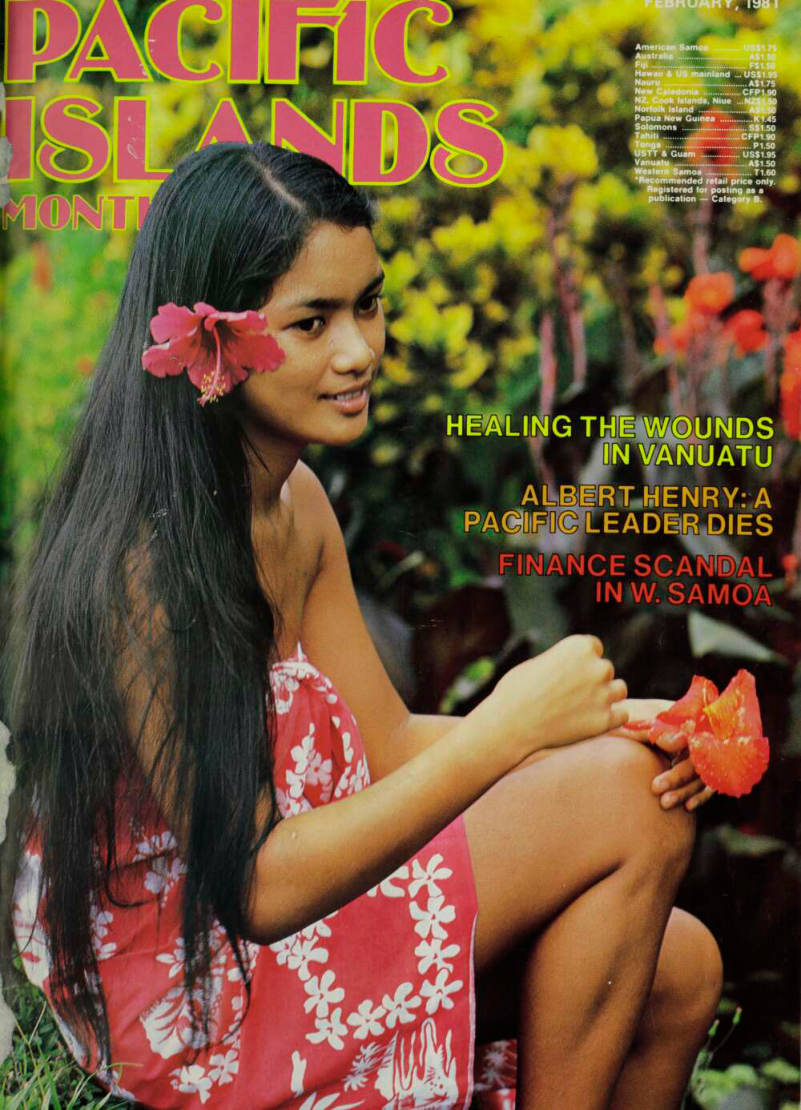
• THE CONSOLIDATION OF VANUATU POLITICS After a troubled independence process, reconciliation is needed between the country’s political factions 13 • ALBERT HENRY, DEATH OF A PACIFIC LEADER Stuart Inder writes of the man who led the Cook Islands to a national identity 17 • MISAPPROPRIATION ALLEGED IN WESTERN SAMOA A public accounts committee report tabled in parliament alleges that a politician, four senior government officers and a businessman were involved in a scheme to defraud the government 31 • TRAVEL In the wartime Solomon Islands of 35 years ago every one had a weapon, but Bruce Adams describes today how ‘only Vincent can use the gun’ 51 • A MEETING, BUT NOT OF MINDS Marie Therese and Bengt Danielsson describe a conference to discuss the study of Pacific cultures, but question the worth of what happened 18 • SHIPS A tourist operator in Fiji tries a modern version of an old idea by rigging a power cruiser as a staysail schooner to use sail and power 65 Cover: Eliana Torea of Tahiti is the girl on this month’s PIM cover. Martin Jeffery of Sydney took the picture in Tahiti.
Books 44 Cook Islands 45, 17, 73 Deaths 73 Fiji 66, 29, 31, 65 French Polynesia 32, 18 Hawaii 49 Honours lists 5, 43 Islands Press 23 Letters 7 Maoris 25 Micronesia 29 New Caledonia 21 Noumea Notebook 21 Pacific Report 4 Papua New Guinea 29, 32, 65
People 35 Political Currents 31 Postmark Papeete 18 Shipping Schedules 71 Ships 65 Solomon Islands 31, 51 Stamps 57 Stuart Inder’s Pacific 17 Tonga 25 Tradewinds 59 Travel 51 Tropicalities 25 Vanuatu 13, 44 Western Samoa 27, 31 Yachts 67
Advertisements & other items, pp. 3-4 (2 items)
3
ACIFIC ISLANDS MONTHLY - FEBRUARY, 1981
Founded 1930 by R. W. Robson Editor Angus Smales Associate Editor Malcolm Salmon Editorial Adviser John Carter Manager John Berry Advertising Sales Manager Steve Gray A Pacific Publications production 76 Clarence Street, Sydney 2000 GPO Box 3408 Sydney 2001 Cables; PACPUB Sydney Telex; 21242 (answers INTARAD) Telephone: Sydney 29 6693 Melbourne 63 0211 ext. 1565 and 1858
fnuro
I 1 If
•f j NEW■■ Aiio
ZEALAND
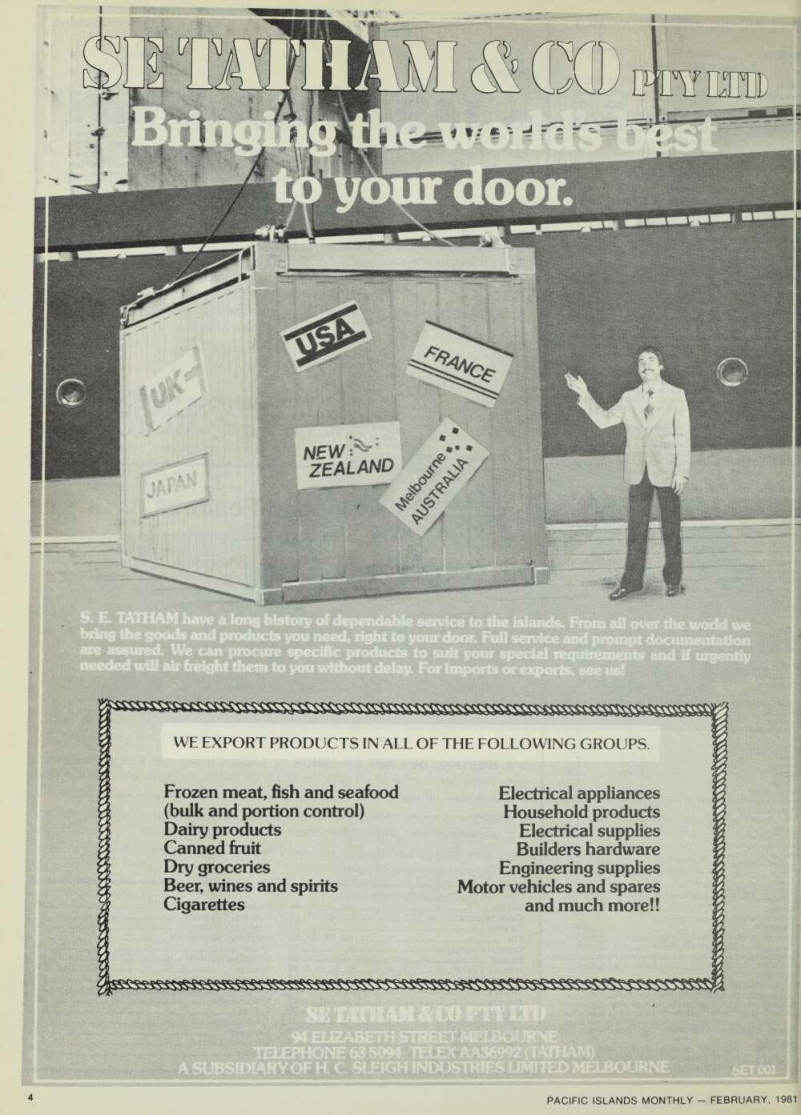
f <5? * s -J ■ MB WE EXPORT PRODUCTS IN ALL OF THE FOLLOWING GROUPS.
Frozen meat, fish and seafood (bulk and portion control) Dairy products Canned fruit Dry groceries Beer, wines and spirits Cigarettes Electrical appliances Household products Electrical supplies Builders hardware Engineering supplies Motor vehicles and spares and much more!! ■mm
Pacific Report
Islands Graced By New Knights
Pacific Island countries have three new knights (KBEs) following announcement by Queen Elizabeth II of the 1981 New Year’s Honours. They are Premier Sir Thomas Davis of the Cook Islands; the Rt Rev Sir Zurewe Kamong Zurenuo, Bishop of the Lutheran Church in Papua New Guinea; and Sir Charles Croft Marsack, resident-judge of the Fiji Court of Appeal. (Full lists p 43.)
Surprises In Nauru Poll
Nauru’s December 6 election (PIM Dec 1980 p 5) produced some surprises, with three prominent MPs losing their seats. They were the veteran politician Roy Degoregore, Leo Keke, minister of justice in the last government, and Lagumot Harris, who was president of the republic for a brief period in April-May 1978.
When the country’s sixth parliament convened on December 9, David Gadaroa was re-elected speaker, and James Bop was also re-elected as his deputy. When nominations for president were called, President Hammer Deßoburt was nominated and he accepted. Another member (unnamed in the report in the weekly The Nauru Post) was nominated and duly seconded but ‘had to decline’, in the Post’s phrase. President Deßoburt was thus re elected unopposed. The new ministry was announced on December 10. It is: President Hammer Deßoburt: Island Development and Industry, External Affairs, Internal Affairs, and Minister responsible for the Public Service: Buraro Detudamo: Works and Minister Assisting the President: Joseph Audo: Justice; Kenas Aroi: Finance: Lawrence Stephen: Health and Education.
Guam Agog Over Pope’S Visit
Buamanians were agog in January over the planned February risit of Pope John Paul II to their island. Many islanders were laying that the last time residents of the islands in the Western Pacific were excited over a Papal action was probably in the late 19th century, when a Pope in Rome arbitrated the division of hese islands between Spain and Germany. Guam’s daily, The Pacific Daily News, reported that three giant arches, 50 000 flags, md a string of lights long enough to go right round Guam’s Jishop Flores’ house are on the shopping list of a group of ‘very (racious people’ who are planning arrangements for the visit, half of Micronesia’s population is Catholic, and although nany would like to see the Pope in person, probably only a small umber would have that opportunity because of transport lifficulties between the islands. From the Micronesian News Service.
Lew Steps Forward For Belau
he new constitutional government of the Republic of Belau ormerly Palau) was installed on January 1. Haruo I. Remeliik and Jfonso R. Oiterong were sworn in as respectively first president nd vice-president of the new republic. The 34 members of the icameral legislature also took their oaths. Kaleb Udui was sleeted as president of the Senate and Carlos Salii was chosen s speaker of the House of Delegates. But the elections for the osts of vice-president and floor leader of the Senate presented lore difficulty: at last report (January 8) eight attempts to elect lese officers had resulted in a nine-each vote of the 18-member namber for all four candidates; Joshua Koshiba and George girarsaol (vice-presidential candidates), and John Tarkong and Dhnson Tonbiong (candidates for floor leader). Senate President aleb Udui was reported on January 8 to have imposed a round le-clock session of the senate in an effort to break the deadlock, he senators had only four days to choose their officers before ie national legislature convened in formal session on January 13. three-day inauguration ceremony for the new republic was meduled for the end of January. Thirty-five countries had been vited to send representatives to the celebrations
X-Minister Arrested
Jke Dini, who held the portfolio of transport in the Government National Unity which was in office before Vanuatu’s November
1979 elections, was arrested on Santo in December for alleged involvement in the Santo secession.
Two Big Drug Hauls In Noumea
A million dollars’ worth of hashish bound for New Zealand was intercepted in December by Customs officers in Noumea. It was their second major drug grab for the month. The second haul 19 kg was found hidden in the linings of four suitcases belonging to an in-transit passenger travelling from Kathmandu, Nepal, to New Zealand. It came just days after New Zealand motor racing star Ron Kendall was detained in Noumea when searchers allegedly found 6.2 kg of hashish, worth $3OO 000, in the linings of suitcases bearing his name.
Fiji’S Culture Grant From Japan
Fiji in December received an educational and cultural grant totalling Y 25 million (about SF9O 000) from the Japanese Government. It was the first grant of its kind between the two countries. The money will be used to buy educational equipment such as microscopes and materials for the Fijian Dictionary Project, and the Fijian Culture Project. Items to be purchased include cassette recorders, cameras and video equipment. The dictionary project involves Fijian into English, English into Fijian, definition of Fijian words in Fijian, and dialectal variations and interpretations.
Lini On Santo-Noumea Rebel Links
Vanuatu’s Prime Minister Father Walter Lini on December 9 wrote to French Ambassador in Port-Vila Yves Rodrigues asking him to arrange the deportation of 31 French nationals working in Santo on the grounds that they were promoting rebellion. The prime minister’s letter indicated his government’s belief that the 31, mainly mixed-race French-speaking settlers, were in contact with the 700 former colons who fled to Noumea in the wake of the collapse last August of the Santo secession. It suggested that France was aware of this and was giving tacit support to the contact. One hundred and ten of the 700 have been declared prohibited immigrants and can never return to Vanuatu. The letter said that the colons in Noumea had formed an ‘association’, which was ‘no less than a government in exile’. It added: ‘We urge you to advise those in authority in Noumea to take immediate steps to control the activities of the Vemarana (Santo) rebels (now in New Caledonia), and, ideally, to remove them fron} the Pacific altogether, as their continued presence represents a real threat to the authority of the Vanuatu Government. I (also) ask that you use your best endeavours to control the machinations within Vanuatu of the people named above as my government is rapidly losing patience with these people, and only the firmest undertakings for their future good behaviour will avoid their removal from the republic.’
Dick Ukeiwe At The U.N.
Back from a visit to the United Nations in New York, Dick Ukeiwe, vice-president of New Caledonia’s government council, said he believed that he had succeeded in improving the understanding of the people he met, many of whom knew little about New Caledonia and had previously spoken on the subject only with representatives of France. He told the Nouvelles CalSdoniennes : ‘I tried to present the reality of the economic, social and political situation in New Caledonia. In this way I think I was able to clear up some of the misunderstandings created by spokesmen for the Independence Front.’
U.S. Peace Corps For Png
Papua New Guinea’s Prime Minister Sir Julius Chan late last year announced his government’s intention to establish a United States Peace Corps Volunteers programme in his country. The Peace Corps is to be involved in food production, nutrition, water supply and rural health projects. It is expected that 10 or 20 people would be involved in the programme each year. Their term of employment would be two years. PNG’s National Executive Council had asked Minister for Foreign Affairs and Trade Noel Levi to sign an agreement on the subject with US Ambassador to PNG Harvey Feldman.
Micronesians For Reagan Inauguration
Ten dignitaries from Micronesia were invited to attend the inauguration ceremonies of US President Ronald Reagan in Washington in January. They were Trust Territory High Com missioner and Mrs Adrian P. Winkel, Belau President and Mrs Haruo I. Remeliik, a Belau legislature leader not yet identified, Marshalls President Amata Kabua and his wife, Yap State Governor John Mangefel and his wife, Truk State Governor Erhart Aten and his wife, Ponape State Governor and Mrs Leo A.
Falcam, Kosrae State Governor Jacob Nena and his wife and Federated States of Micronesia President and Mrs Tosiwo Nakayama.
Oz Went Quiet On N-Test
The latest testing of a nuclear device at Moruroa Atoll took place on December 9, according to reports. Asked in January if Australia had registered a protest with the French Government, a spokesman for the Foreign Affairs Department said it had not adding: ‘Our policy is well-known. We don’t actually go to the wall each time.’ A few days before, the Australian Government had announced the signing in Paris of a nuclear transfers agreement with France.
‘Britain Not Folding Its Tents’ Envoy
Britain will continue its interest in the Pacific region, according to British High Commissioner to Fiji Viscount Dunrossil. ‘We have absolutely no intention of folding our tents and quietly stealing away now that we have achieved our objective of bringing the countries of the region to fruitful independence,’ he told a graduation ceremony at Nasinu Teachers’ College in December British aid to the Pacific region in 1979 totalled SFSS million of which $l2 million went to Fiji.
Spia Spreads Its Wings
The Pago-based company South Pacific Island Airways is due to open a Honolulu-Pago-Tahiti service on February 27. A Boeing 707 aircraft will fly the route. The US airline Pan Am will provide administrative and technical personnel, the 707 will come from American Airlines, and ground services at Tahiti are expected to be provided by UTA and Air Polynesie.
Indians Cleared Of Murder Charge
Six men of Indian extraction were acquitted by a Sydney Australia, magistrate late last year of the murder in Sydney of a Fijian man, Esoa Tupou, 26. in February 1980. Tupou died in a clash which occurred after he and three other people had gone to a house in which a Hindu religious ceremony was being held
Papua New Guinea’S 3 000 799
Early processing of figures from the recent national census in Papua New Guinea has given a total population of just over three million. The detailed figure was 3 000 799, which was slightly lower than expected. The census was the first to be held in PNG since Australia ceased to be the administering country there
Club Med Noumea Race, ’Bl
A representative of the Cruising Yacht Club of Australia has returned from Noumea and reported highly satisfactory progress in preparations by the Cercle Nautique Caledonien for the Club Med Noumea Yacht Race ’Bl. A new feature in this year’s race, to take place in May, will be a dual start the main fleet leaving from Sydney Harbour on May 23. and the Brisbane division, expected to number about 20 yachts, from Sandgate Pier on May 25. Both fleets should arrive at the same time, and the event will be treated as one race, except that trophies will be handled separately.
Dedicating New Bislama Bible
More than 1000 people from various churches in Vanuatu took part in a dedication service late last year of the New Testament Bislama Bible. The translation took nine years to complete.
Pastor Bill Camden, driving force of the project, was guest speaker at the service held at Luganville, Santo. A copy of the new translation of the Bible was presented to the Northern District Commissioner, Job Dalesa. A service was also held in Port-Vila, where the Bible was dedicated by Pastor Mahion Vatoko of the Presbyterian Church. Copies were presented to President Ati George Sokomanu and Prime Minister Father Walter Lini
Apia Backs Pfl Appointment
The government of Western Samoa is reported to have come out in support of the appointment of an Auckland businessman, H. L.
Julian, as New Zealand director of the Pacific Forum Line. The term of the present incumbent, R. P. Shead, was cut short because of his commitments as deputy general manager of the New Zealand Shipping Corporation. According to a report in The New Zealand Herald, the opposition members of parliament in New Zealand claimed Mr Julian was appointed because of his friendship with Prime Minister Robert Muldoon. Mr Muldoon responded by quoting a Radio Samoa news report in which a government spokesman in Apia said that Mr Julian ‘brought to his task a great deal of experience in shipping, and shipping-related activities’. More broadly, the spokesman said, Mr Julian had gained a reputation as a most energetic and successful businessman in New Zealand.
Tahitian Accused May Write In Tahitian
Tahitians being held in France awaiting trial for the murder of s French businessman in Tahiti have won the right, denied them, to write home to their families in the Tahitian language.
New Poll Ordered In Honiara
Solomon Islands’ Electoral Commission ruled late last year thai a new election must be held in the constituency of West Honiars before March 1981. The election follows the disqualification oi the successful candidate Ben Gale, who was found by the High Court to have committed election offences.
Stevens’ Counsel Raps French
The New Caledonia-based French lawyer who defended Jimmv Stevens at his trial over the Santo secession crisis in Vanuatu (RIM Jan p 21) has sheeted home to France ‘complete responsi bility for what happened. Me Leder told a Noumea newspaper on his return from Vanuatu: ‘I found that France, even though it bore the entire responsibility for what had taken place (there are serious, precise, and consistent grounds confirming this) was completely disinterested in the Santo people and had simply dumped them.’ (He was referring to the failure of France to provide any assistance with interpretation at Stevens’ trial ) Of the role of former French Inspector-General Jean-Jacques Robert, he said: ‘. . . one gets the impression that he went mad and that when he spoke to the Santo people and the people at Fanafo he was in a state of dementia. But he was not the only one . . .’ Of the role of legal adviser Arnaud Lizop, Me Leder said’ ‘When he went with the Arribaud-Donald mission he was a legal adviser to the government on an official mission. At Stevens’ trial, the minutes of a meeting between Lizop, Stevens and Maliu were produced. They show there was talk of a constitution and of the organisation necessary for a secessionist state. This explains the ban on Arnaud Lizop returning to Vanuatu. Taking all these elements into account, it is difficult indeed to deny that the French Government was the promoter of the Santo rebellion.’ The French lawyer said in conclusion: ‘I prefer to believe that (the French officials then serving in the Hebrides) they were incompetent, because if they had really had a clear idea of what they were doing they’d be eligible for trial before a court of common law ’
Oz Businessmen Back Brych
A group of businessmen in Melbourne, Australia, raised most of the SUSIOO 000 bail money for the controversial cancer specialist Milan Brych, who was arraigned in Los Angeles in December on six counts relating to illegal medical practice. The businessmen are part of an Australia-wide group calling itself ‘Friends of Rarotonga’, a reference to the fact that before he went to the USA Brych practised at Rarotonga, Cook Islands. The president of the Victorian branch of ‘Friends’ said: ‘We’re not wealthy but we believe in Brych’s cancer therapy treatment and we’re very angry at the ridiculously high amount of bail set for what are misdemeanours.’
NEW PAPERS BURST OUT ALL OVER (4) New Caledonia saw the launching of a new daily newspaper, Noumea-Journal, in December. A frontpage article signed ‘Eridan’, sought to set the tone of the new paper when it promised ‘a serious and reflective attitude to facts, events and to comments which come our way’. It went on: ‘I propose to stand back and look at things and not to be in the position of not seeing the wood for the trees . . . Believe me, I’m pushing nobody’s barrow.’
Vanuatu-South Korea Link
Vanuatu has established diplomatic relations with the Republic of (South) Korea.
Radio Reporters Hold Workshop
Radio reporters from neighbouring countries gathered in Western Samoa in December to study the preparation and presentation of news with emphasis on development stories. The sub-region'-' workshop on development journalism was sponsored by the Asia Pacific Institute for Broadcasting Development (AIBD). The workshop was directed by a senior news editor from New Zealand.
Stuart Inder Mbe
Stuart Inder of Sydney, former chief executive of Pacific Publications (Aust) Pty Ltd, and for many years publisher and editor of PIM, was awarded an MBE in the 1981 New Year’s Honours conferred by Her Majesty Queen Elizabeth 11. The citation accompanying Mr Inder’s award said it had been made for services to journalism.
Advertisements & other items, p. 5 (1 item)
5
ISLANDS MONTHLY - FEBRUARY, 1981
Letters

Hokule’a: The case for the defence
In his review of my book Hokule’a: The Way to Tahiti (PIM Dec p 43), Bengt Danielsson spends an inordinate amount of time castigating me, and insulting just about every one else involved in the voyage of Hokule’a to Tahiti in 1976, including some fine Pacific Island seamen. Your reviewer, who professed to be warmly supportive of the project during the preparatory stages, and who appeared to welcome us sin cerely to Tahiti, vehemently turned against the project, and particularly me, once he had learned that the voyage had been a troubled one.
Fortunately, our Tahitian friends of the Tainui Society
stuck by us in that difficult period just after our arrival in Tahiti when we had to reorgan ise the crew and refit the canoe so that Hokule’a could sail back to Hawaii with honour.
Their commitment to the proj ect was genuine for they truly believed in the twin goals which guided our effort; I) to demon strate the worth of the ancient canoes and ways of navigating; 2) to help modern Polynesians rediscover their cultural heri tage as premier blue water sailors. A brief re-examination of our project in terms of these goals, rather than a point by point rebuttal of Danielsson’s distortions and prejudices is, I believe, the best way to balance your reviewer’s supercilious dia tribe.
Yes, an argument can be made that it was an error to try and combine two such difficult goals in one voyage. Why didn’t we just concentrate on sailing to Tahiti and back, and ignore the Hawaiian and Tahitian public?
I have been tempted many a time since the voyage to wish we had done just that. Yet, even though such an exclusive ap proach would probably have made for a smoother voyage, I still support the decision to make our voyage culturally meaningful. We wanted our voyage to be more than a Kon Tiki-Vike expedition in which a group of adventurers crash their raft over a reef to announce to the puzzled islanders that their ancestors had drifted there in just the same way. We were trying to recreate (however incompletely) a documented Polynesian sailing and naviga tional technology; we were at tempting to retrace a voyaging route celebrated in ancient legend; and we were working to
involve a wide spectrum of Hawaiians and Tahitians in the planning and execution of the voyage.
Because of errors committed during a period when some Hawaiians had become acutely sensitive to co-operating with persons from other ethnic groups, the voyage was very nearly scuttled before we left, and we had the utmost difficulty in reaching Tahiti without an all-out mutiny. Rather than tell that tale, Danielsson apparently would rather have me flagellate myself on every page for each and every mis-step along the way. Yet, while accepting as I do in the book my burden of blame, I cannot claim all of it, just as I cannot in any way claim sole credit for Hokule’a’s very real triumphs.
Here the group participation that was so disastrous tactically proved its strategic merit. The thousands of Tahitians who jammed Papeete harbour upon our arrival did not assemble to welcome some sleek racing yacht or visiting warship. They came, well informed by the Tainui Society of the nature of our experiment, to greet a Polynesian canoe, captained by Kawika Kapahulehua (a Hawaiian whose fluency in the Niihau dialect of Hawaiian allowed him to converse with the Tahitians), navigated by Mau Piailug (a Micronesian who used essentially the same non-instrument methods to guide Hokule’a as the ancient Polynesian navigators used to direct their canoes) and manned by a largely Polynesian crew including Rodo Williams (a Tahitian master mariner whose contributions Danielsson chooses to slight).
The Hawaiians too claimed Hokule’a as theirs upon her return to Hawaii and have not allowed her to moulder away on some beach, or suffer a slower death in some warehouse. Since her return Hokule’a has been used as a ‘floating classroom’ to teach the children of Hawaii about the maritime technology that made the first settlement of their islands possible, and, as readers of the June 1980 (p9l) PIM know, the canoe recently completed a second round-trip voyage to Tahiti and back.
Hokule’a is alive and well today, and so is the resurgence in Polynesian pride in their
oceanic heritage that she sparked.
Hokule’a has a life of her own and continually draws people to her. She is not the property of Herb Kane, Tom Holmes or myself, but of a public group, the Polynesian Voyaging Society, which we founded to sponsor the voyage and subsequent educational programmes. We have retired to the status of advisers to the society. New blood has taken over, and significantly much of it is contained in the veins and arteries of young Hawaiians who are literally re-discovering their maritime roots (or should that be ‘wakes’) through sailing aboard Hokule’a.
Twenty - seven - year - old Nainoa Thompson is an out standing but not a typical example of this movement. It was Nainoa who, under the tutelage of the Micronesian master Mau Piailug, navigated Hokule’a to Tahiti and back without instruments on the re cent voyage which confirmed and extended the accomplish ments of the earlier one.
There can be no doubt now that the Polynesians had a sailing technology superbly adapted to blue water voyaging.
Those who experienced the rancour and conflict of the 1976 voyage can rest, for the twin goals of research and cultural discovery are now meshing smoothly to expand our knowl edge and appreciation of Polynesia’s oceanic heritage.
Ben R. Finney
Honolulu Hawaii
Usa
Bengt Danielsson comments: It is really not very surprising that Professor Finney is unhappy about my review of his book Hokule’a: The Way to Tahiti (PIM Dec p 43), for when re lated in such a condensed form all his incredibly stupid mis takes and miscalculations stand out even more clearly. I can
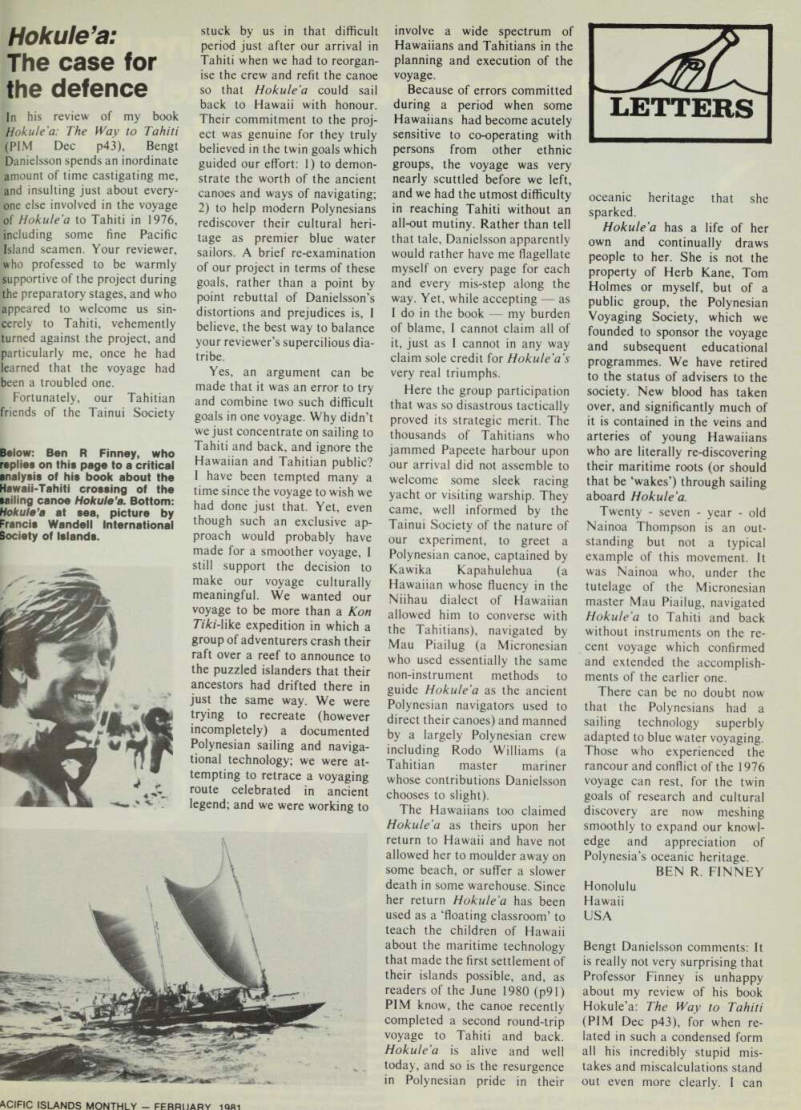
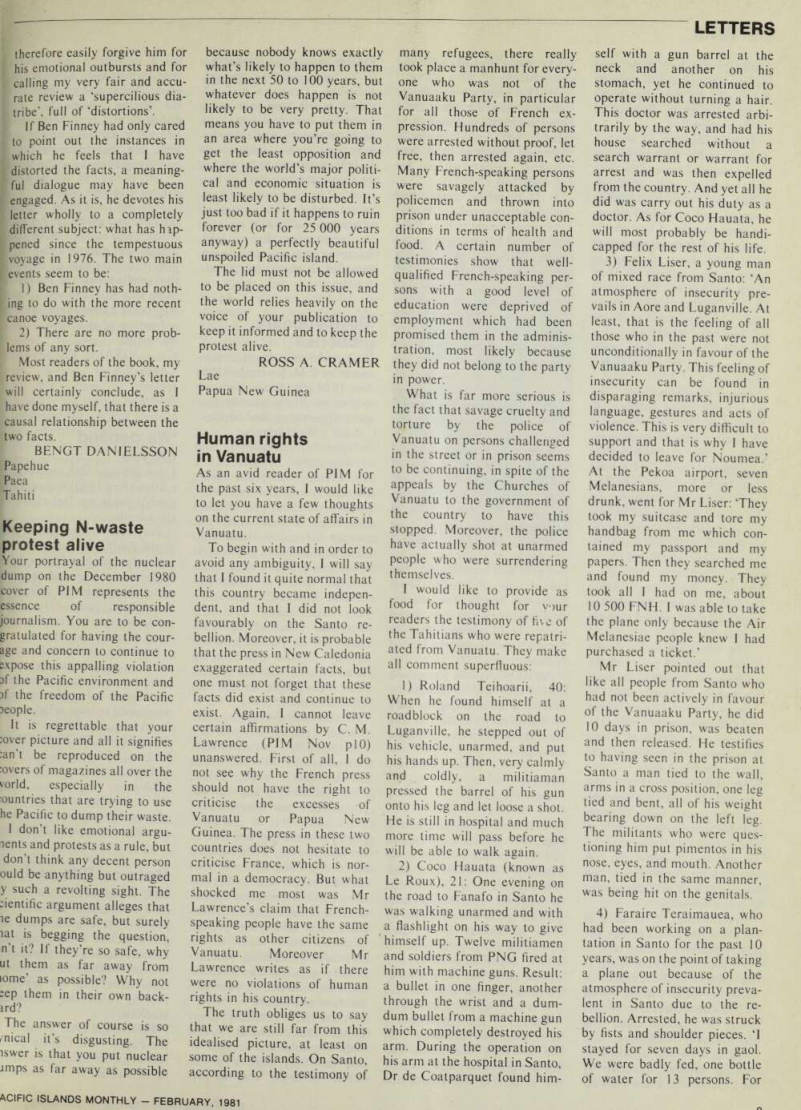
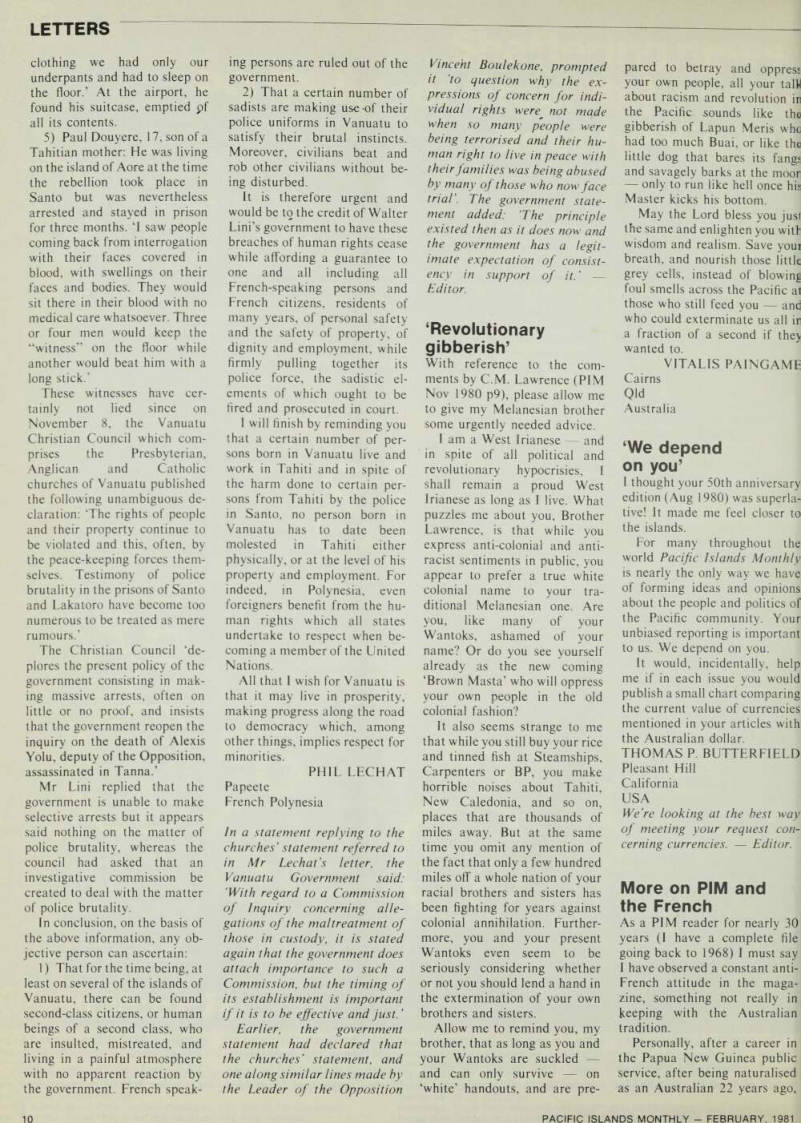
Below: Ben R Finney, who replies on this page to a critical snalysis of his book about the Hawaii-Tahiti crossing of the sailing canoe Hokule’a. Bottom: Hokule’a at sea, picture by Francis Wandell International Society of Islands.
therefore easily forgive him for v his emotional outbursts and for calling my very fair and accu rate review a ‘supercilious dia tribe’, full of ‘distortions’.
If Ben Finney had only cared to point out the instances in which he feels that I have distorted the facts, a meaning ful dialogue may have been engaged. As it is, he devotes his letter wholly to a completely different subject; what has hap pened since the tempestuous I voyage in 1976. The two main I events seem to be: 1) Ben Finney has had noth ing to do with the more recent canoe voyages. 2) There are no more prob lems of any sort.
Most readers of the book, my review, and Ben Finney’s letter will certainly conclude, as I have done myself, that there is a causal relationship between the two facts.
Bengt Danielsson
Papehue Paea Tahiti
Keeping N-waste
protest alive
Your portrayal of the nuclear dump on the December 1980 cover of PIM represents the essence of responsible journalism. You are to be con gratulated for having the cour age and concern to continue to expose this appalling violation the Pacific environment and af the freedom of the Pacific aeople.
It is regrettable that your 'over picture and all it signifies :an’t be reproduced on the :overs of magazines all over the vorld, especially in the countries that are trying to use he Pacific to dump their waste. 1 don’t like emotional argu ments and protests as a rule, but don’t think any decent person ould be anything but outraged y such a revolting sight. The :ientific argument alleges that te dumps are safe, but surely lat is begging the question, n’t it? If they’re so safe, why ut them as far away from iome’ as possible? Why not sep them in their own back ed?
The answer of course is so
/nical it’s disgusting. The
iswer is that you put nuclear imps as far away as possible
because nobody knows exactly what’s likely to happen to them in the next 50 to 100 years, but whatever does happen is not likely to be very pretty. That means you have to put them in an area where you’re going to get the least opposition and where the world’s major politi cal and economic situation is least likely to be disturbed. It’s just too bad if it happens to ruin forever (or for 25 000 years anyway) a perfectly beautiful unspoiled Pacific island.
The lid must not be allowed to be placed on this issue, and the world relies heavily on the voice of your publication to keep it informed and to keep the protest alive.
Ross A. Cramer
Lae Papua New Guinea
Human rights
in Vanuatu
As an avid reader of PIM for the past six years, I would like to let you have a few thoughts on the current state of affairs in Vanuatu.
To begin with and in order to avoid any ambiguity, I will say that I found it quite normal that this country became indepen dent, and that I did not look favourably on the Santo re bellion. Moreover, it is probable that the press in New Caledonia exaggerated certain facts, but one must not forget that these facts did exist and continue to exist. Again, I cannot leave certain affirmations by C. M.
Lawrence (PIM Nov plO) unanswered. First of all, I do not see why the French press should not have the right to criticise the excesses of Vanuatu or Papua New Guinea. The press in these two countries does not hesitate to criticise France, which is nor mal in a democracy. But what shocked me most was Mr Lawrence’s claim that French speaking people have the same rights as other citizens of Vanuatu. Moreover Mr Lawrence writes as if there were no violations of human rights in his country.
The truth obliges us to say that we are still far from this idealised picture, at least on some of the islands. On Santo, according to the testimony of
many refugees, there really took place a manhunt for every one who was not of the Vanuaaku Party, in particular for all those of French ex pression. Hundreds of persons were arrested without proof, let free, then arrested again, etc.
Many French-speaking persons were savagely attacked by policemen and thrown into prison under unacceptable con ditions in terms of health and food. A certain number of testimonies show that well qualified French-speaking per sons with a good level of education were deprived of employment which had been promised them in the adminis tration, most likely because they did not belong to the party in power.
What is far more serious is the fact that savage cruelty and torture by the police of Vanuatu on persons challenged in the street or in prison seems to be continuing, in spite of the appeals by the Churches of Vanuatu to the government of the country to have this stopped. Moreover, the police have actually shot at unarmed people who were surrendering themselves.
I would like to provide as food for thought for v«>ur readers the testimony of five of the Tahitians who were repatri ated from Vanuatu. They make all comment superfluous: 1) Roland Teihoarii, 40: When he found himself at a roadblock on the road to Luganville, he stepped out of his vehicle, unarmed, and put his hands up. Then, very calmly and coldly, a militiaman pressed the barrel of his gun onto his leg and let loose a shot.
He is still in hospital and much more time will pass before he will be able to walk again. 2) Coco Hauata (known as Le Roux), 21: One evening on the road to Fanafo in Santo he was walking unarmed and with a flashlight on his way to give himself up. Twelve militiamen and soldiers from PNG fired at him with machine guns. Result: a bullet in one finger, another through the wrist and a dum dum bullet from a machine gun which completely destroyed his arm. During the operation on his arm at the hospital in Santo, Dr de Coatparquet found him
self with a gun barrel at the neck and another on his stomach, yet he continued to operate without turning a hair.
This doctor was arrested arbi trarily by the way, and had his house searched without a search warrant or warrant for arrest and was then expelled from the country. And yet all he did was carry out his duty as a doctor. As for Coco Hauata, he will most probably be handi capped for the rest of his life. 3) Felix User, a young man of mixed race from Santo: ‘An atmosphere of insecurity pre vails in Aore and Luganville. At least, that is the feeling of all those who in the past were not unconditionally in favour of the Vanuaaku Party. This feeling of insecurity can be found in disparaging remarks, injurious language, gestures and acts of violence. This is very difficult to support and that is why I have decided to leave for Noumea.’
At the Pekoa airport, seven Melanesians, more or less drunk, went for Mr Liser: They took my suitcase and tore my handbag from me which con tained my passport and my papers. Then they searched me and found my money. They took all 1 had on me, about 10 500 FNH. I was able to take the plane only because the Air Melanesiae people knew I had purchased a ticket.’
Mr Liser pointed out that like all people from Santo who had not been actively in favour of the Vanuaaku Party, he did 10 days in prison, was beaten and then released. He testifies to having seen in the prison at Santo a man tied to the wall, arms in a cross position, one leg tied and bent, all of his weight bearing down on the left leg.
The militants who were ques tioning him put pimentos in his nose, eyes, and mouth. Another man, tied in the same manner, was being hit on the genitals. 4) Faraire Teraimauea, who had been working on a plan tation in Santo for the past 10 years, was on the point of taking a plane out because of the atmosphere of insecurity preva lent in Santo due to the re bellion. Arrested, he was struck by fists and shoulder pieces. T stayed for seven days in gaol.
We were badly fed, one bottle of water for 13 persons. For
clothing we had only our underpants and had to sleep on the floor.’ At the airport, he found his suitcase, emptied pf all its contents. 5) Paul Douyere, 17, son of a Tahitian mother: He was living on the island of Acre at the time the rebellion took place in Santo but was nevertheless arrested and stayed in prison for three months. T saw people coming back from interrogation with their faces covered in blood, with swellings on their faces and bodies. They would sit there in their blood with no medical care whatsoever. Three or four men would keep the “witness” on the floor while another would beat him with a long stick.' These witnesses have cer tainly not lied since on November 8, the Vanuatu Christian Council which com prises the Presbyterian, Anglican and Catholic churches of Vanuatu published the following unambiguous de claration: The rights of people and their property continue to be violated and this, often, by the peace-keeping forces them selves. Testimony of police brutality in the prisons of Santo and Lakatoro have become too numerous to be treated as mere rumours.’
The Christian Council ‘de plores the present policy of the government consisting in mak ing massive arrests, often on little or no proof, and insists that the government reopen the inquiry on the death of Alexis Yolu, deputy of the Opposition, assassinated in Tanna.’
Mr Lini replied that the government is unable to make selective arrests but it appears said nothing on the matter of police brutality, whereas the council had asked that an investigative commission be created to deal with the matter of police brutality.
In conclusion, on the basis of the above information, any ob jective person can ascertain: 1) That for the time being, at least on several of the islands of Vanuatu, there can be found second-class citizens, or human beings of a second class, who are insulted, mistreated, and living in a painful atmosphere with no apparent reaction by the government. French speak
ing persons are ruled out of the government. 2) That a certain number of sadists are making use-of their police uniforms in Vanuatu to satisfy their brutal instincts.
Moreover, civilians beat and rob other civilians without be ing disturbed.
It is therefore urgent and would be to the credit of Walter Lini’s government to have these breaches of human rights cease while affording a guarantee to one and all including all French-speaking persons and French citizens, residents of many years, of personal safety and the safety of property, of dignity and employment, while firmly pulling together its police force, the sadistic el ements of which ought to be fired and prosecuted in court.
I will finish by reminding you that a certain number of per sons born in Vanuatu live and work in Tahiti and in spite of the harm done to certain per sons from Tahiti by the police in Santo, no person born in Vanuatu has to date been molested in Tahiti either physically, or at the level of his property and employment. For indeed, in Polynesia, even foreigners benefit from the hu man rights which all states undertake to respect when be coming a member of the United Nations.
All that I wish for Vanuatu is that it may live in prosperity, making progress along the road to democracy which, among other things, implies respect for minorities.
Phil Lechat
Papeete French Polynesia In a statement replying to the churches’ statement referred to in Mr Lechat’s letter, the Vanuatu Government said: ‘With regard to a Commission of Inquiry concerning alle gations of the maltreatment of those in custody, it is stated again that the government does attach importance to such a Commission, but the timing of its establishment is important if it is to be effective and just. ’
Earlier, the government statement had declared that the churches’ statement, and one along similar lines made by the Leader of the Opposition
Vincent Boulekone, prompted it ‘to question why the ex pressions of concern for indi vidual rights not made when so many people were being terrorised and their hu man right to live in peace with their families was being abused by many of those who now face trial’. The government state ment added: ‘The principle existed then as it does now and the government has a legit imate expectation of consist ency in support of it.’
Editor.
‘Revolutionary
gibberish’
With reference to the com ments by C M. Lawrence (PIM Nov 1980 p 9), please allow me to give my Melanesian brother some urgently needed advice.
I am a West Irianese and in spite of all political and revolutionary hypocrisies, I shall remain a proud West Irianese as long as I live. What puzzles me about you. Brother Lawrence, is that while you express anti-colonial and anti racist sentiments in public, you appear to prefer a true white colonial name to your tra ditional Melanesian one. Are you, like many of your Wantoks, ashamed of your name? Or do you see yourself already as the new coming ‘Brown Masta’ who will oppress your own people in the old colonial fashion?
It also seems strange to me that while you still buy your rice and tinned fish at Steamships, Carpenters or BP, you make horrible noises about Tahiti, New Caledonia, and so on, places that are thousands of miles away. But at the same time you omit any mention of the fact that only a few hundred miles off a whole nation of your racial brothers and sisters has been fighting for years against colonial annihilation. Further more, you and your present Wantoks even seem to be seriously considering whether or not you should lend a hand in the extermination of your own brothers and sisters.
Allow me to remind you, my brother, that as long as you and your Wantoks are suckled and can only survive on ‘white’ handouts, and are pre
pared to betray and oppress your own people, all your talk about racism and revolution in the Pacific sounds like the gibberish of Lapun Meris who had too much Buai, or like the little dog that bares its fangs and savagely barks at the moor only to run like hell once his Master kicks his bottom.
May the Lord bless you just the same and enlighten you with wisdom and realism. Save your breath, and nourish those little grey cells, instead of blowing foul smells across the Pacific at those who still feed you and who could exterminate us all in a fraction of a second if they wanted to.
Vitalis Paingame
Cairns Qld Australia
‘We depend
on you’
I thought your 50th anniversary edition (Aug 1980) was superla tive! It made me feel closer to the islands.
For many throughout the world Pacific Islands Monthly is nearly the only way we have of forming ideas and opinions about the people and politics of the Pacific community. Your unbiased reporting is important to us. We depend on you.
It would, incidentally, help me if in each issue you would publish a small chart comparing the current value of currencies mentioned in your articles with the Australian dollar.
Thomas P. Butterfield
Pleasant Hill California
Usa
We're looking at the best way of meeting your request con cerning currencies. Editor.
More on PIM and the French As a PIM reader for nearly 30 years (I have a complete file going back to 1968) I must say I have observed a constant anti- French attitude in the maga zine, something not really in keeping with the Australian tradition.
Personally, after a career in the Papua New Guinea public service, after being naturalised as an Australian 22 years ago,
and having a PNG wife, 1 sup pose I could claim to be objec tive about international affairs.
For instance, I was even un popular with my former French countrymen in North Queens land when I supported cam paigns against nuclear tests in the Pacific.
I feel that, apart from the readers’ letters always inter esting in their variety PIM should be more unbiased in some of its editorial comments.
I For instance, Stuart Inder, (PIM Nov 1980 pi 7) denies that he is ‘anti-French’. Gener ally, I agree with his evaluation of French influence in the Pacific. However, when Mr Inder writes ‘. . . as citizens they’ (‘foreign’ Frenchmen J.H. deN.) ‘have the vote im mediately on arrival’ (in New Caledonia), he forgets that, in the reverse case, Pacific Islanders, or any persons from overseas territories of France, have the vote also on their arrival in France.
It is well known that the president of the French Senate was, for many years, Mr Monerville, a mixed-blood poli tician from Guiana. Can you imagine that, before PNG inde pendence, Sir John Guise, for example, could have been presi dent of the Senate in Canberra?
Or that Michael Somare could have been a minister in the Australian Government?
But Leopold Senghor, presi dent of Senegal for many years until he resigned in January his year), and Felix Jouphouet-Boigny, leader of he independent country of vory Coast, were in earlier imes members of the French jovernment in Paris.
These facts give a different >erspective on French ‘colonial snT. As far as the Pacific is oncerned, if the image of r rance is not perfect in Tahiti r New Caledonia, why is it that At Inder forgot that the USA as no more rights than anyone Ise in Hawaii, far from the American coast, or in Guam? )r that the Indonesians have no lore rights than anyone else in Vest New Guinea?
J. Huon De
Navrancourt
itherton )ld Australia
More memories of
Captain Musick
The letter from David Sievers in Pago (PIM Nov 1980 p 11) brought back memories of my experiences with Captain Edwin (not Lorenzo) Musick, and of his air adventures in the Pacific.
In 1963 Pan Am invited Captain Musick’s widow to visit American Samoa at their ex pense since she had never had the opportunity to visit the area in which her husband was killed. I was assigned by the governor to entertain Mrs Musick during her brief visit.
We were able to find a number of local people who had not only seen Captain Musick in Samoa, but had talked to him.
Typically, the Samoans had written a song about the cap tain’s air adventures. While 1 don’t remember all the words to their song, it ended with his tragic crash near Tutuila. Pan Am experts feel the explosion which destroyed both plane and crew was caused by petrol being jettisoned before landing in Pago after a malfunction devel oped shortly after taking off for Auckland.
Several Samoans told me that they paddled out in canoes immediately after the crash.
Nothing, unfortunately, was re covered.
Captain Edwin Musick was a trail-blazer for American avi ation not only in the Pacific but also in South America and the Far East. He pioneered not only the Pan Am Grace routes to South America, but also flew the first China Clipper to Hong Kong in 1936. (The date of the Pago crash was January 11, 1938).
Mrs Cleo Musick was so impressed by the traditional courtesy of the Samoan people that she asked me to help her set up some type of scholarship award for Samoan students. We agreed on a replica of the medal Captain Musick had been given in 1935 in connection with the Harmon Trophy for aviation pioneering. I have one of the medals in my possession.
Feeling that the Musick story should be told completely, I decided to ask Dr Eugene Burdick (Blue of Capricorn ), professor of English at the
University of California, to col laborate with me on the story.
On returning to California in 1964, however, I learned that he had died suddenly of a heart attack. As far as I know the story has never been fully writ ten.
Jack E. Harlan
Kona Hawaii
Usa
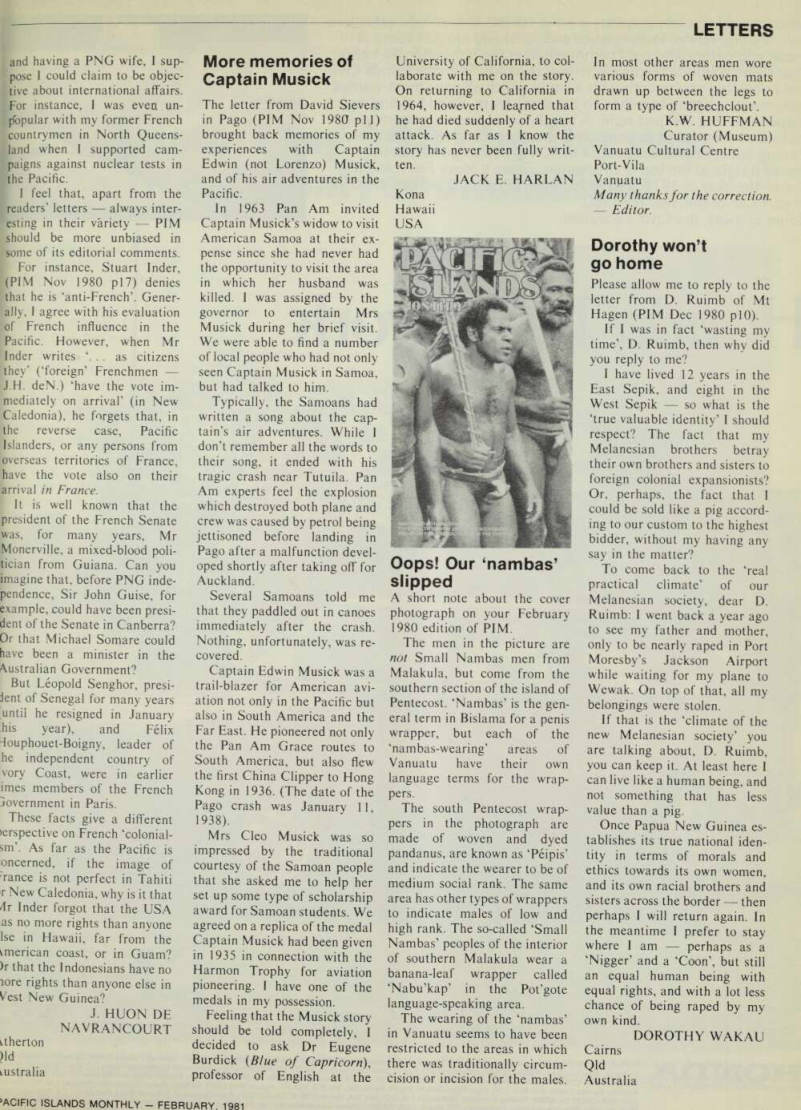
Oops! Our ‘nambas’
slipped
A short note about the cover photograph on your February 1980 edition of PIM.
The men in the picture are not Small Nambas men from Malakula, but come from the southern section of the island of Pentecost. ‘Nambas’ is the gen eral term in Bislama for a penis wrapper, but each of the ‘nambas-wearing’ areas of Vanuatu have their own language terms for the wrap pers.
The south Pentecost wrap pers in the photograph are made of woven and dyed pandanus, are known as ‘Peipis’ and indicate the wearer to be of medium social rank. The same area has other types of wrappers to indicate males of low and high rank. The so-called ‘Small Nambas’ peoples of the interior of southern Malakula wear a banana-leaf wrapper called ‘Nabu’kap’ in the Pot’gote
language-speaking area.
The wearing of the ‘nambas’ in Vanuatu seems to have been restricted to the areas in which there was traditionally circum cision or incision for the males.
In most other areas men wore various forms of woven mats drawn up between the legs to form a type of ‘breechclout’.
K.W. Huffman
Curator (Museum) Vanuatu Cultural Centre Port-Vila Vanuatu Many thanks for the correction.
Editor.
Dorothy won’t
go home Please allow me to reply to the letter from D. Ruimb of Mt Hagen (PIM Dec 1980 plO).
If I was in fact ‘wasting my time’, D. Ruimb, then why did you reply to me?
I have lived 12 years in the East Sepik, and eight in the West Sepik so what is the ‘true valuable identity’ I should respect? The fact that my Melanesian brothers betray their own brothers and sisters to foreign colonial expansionists?
Or, perhaps, the fact that 1 could be sold like a pig accord ing to our custom to the highest bidder, without my having any say in the matter?
To come back to the ‘real practical climate’ of our Melanesian society, dear D.
Ruimb: I went back a year ago to see my father and mother, only to be nearly raped in Port Moresby’s Jackson Airport while waiting for my plane to Wewak. On top of that, all my belongings were stolen.
If that is the ‘climate of the new Melanesian society’ you are talking about, D. Ruimb, you can keep it. At least here I can live like a human being, and not something that has less value than a pig.
Once Papua New Guinea es tablishes its true national iden tity in terms of morals and ethics towards its own women, and its own racial brothers and sisters across the border then perhaps 1 will return again. In the meantime I prefer to stay where 1 am perhaps as a ‘Nigger’ and a ‘Coon’, but still an equal human being with equal rights, and with a lot less chance of being raped by my own kind.
Dorothy Wakau
Cairns Qld Australia
Advertisements & other items, pp. 7-12 (4 items)
Acific Islands Monthly - Ffrriiary Iqri
Shattering news!
m
POLYMER GRAPHITE
ymer Graphite) proves
MMtoV.. • : ; . : .. ■ ;
best for digital
. apt MX ... f
Dynamite with Digital Discs!
New dynamic dimension for Pioneer’s HPMs. They easily handle the wide dynamic range (90dB or more) of PCM
recordings with astonishing accuracy.
The reason is our exclusive new cone material. We call it PG for Polymer Graphite. To you, PG will mean Positively Great. Here’s why.
Paper “wrinkles,” metal “rings.” But PG doesn’t. Perio* Conventional paper cones are light for good transients, and have high internal loss for clean sound. But laser holography shows paper copes “wrinkle” and deform at high sound pressure levels, causing distortion.
Holograph of a paper corn
HPM-1100
Holograph of a PG cone.
PG cones don’t. Period.
Metal cones, on the other hand, are rigid enough. But they have poor transient response and awful internal loss.
Computerized X-Y plotting shows they “ring” in their own false colors.
PG cones don’t. Period.
PG is light, rigid and has high internal loss.
Graphite is the basic ingredient in PG. Without the specis polymers we add it would tend to shatter or crumble. But its unique molecular characteristics add up to refreshingly hones', and accurate sound reproduction. Hear it with our High Polymer supertweeters in Pioneer’s new HPM systems. It’s dynamite for digital! o o * -.PM-300 ■ ■** If
HPM-300
:«1|
HPM-50
HPM-700
HPM-900
For further information, please contact: Australia: Pioneer Marketing Service Pty.Ltd., P.O. Box 317, Mordialloc, Victoria, 3195 Tel: 90-9011 Fiji Islands: Brijlal & Company, G.P.O. Box No. 362, Suva, Fiji Islands Tel: 22258 New Zealand: Monaco Distributors Ltd., 30 Pollen Street, Grey Lynn, Auckland, New Zealand Tel: (09) 762 098 Norfolk Island: Burns Philp (Norfolk Island) Ltd., P.O. Box 21, Norfolk Island, New Hebrides; Burns Philp (New Hebrides)Ltd., Vila, New Hebrides Nauru Island: Jacob Enterprises, P.O. Box No. 4, Republic of Nauru Tahiti: Tahiti Hi-Fi, P.O. Box 848, Papeete, Tahiti New Caledonia: Menard Pacifique Saru, B.R 3899, Noumea, New Caledonia Tel; 48*24.36 American Samoa: Transpac Corporation, P.O. Box 1477, Pago Pago, American Samoa 96799 Tel; 633-5224 Rarotonga: South Seas International Ltd., P.O. Box 49, Rarotonga, Cook Islands Tel: 23E Papua New Guinea: Bali Merchants Rv. Ltd., P.O. Box 6103, Boroko Tel: 254887
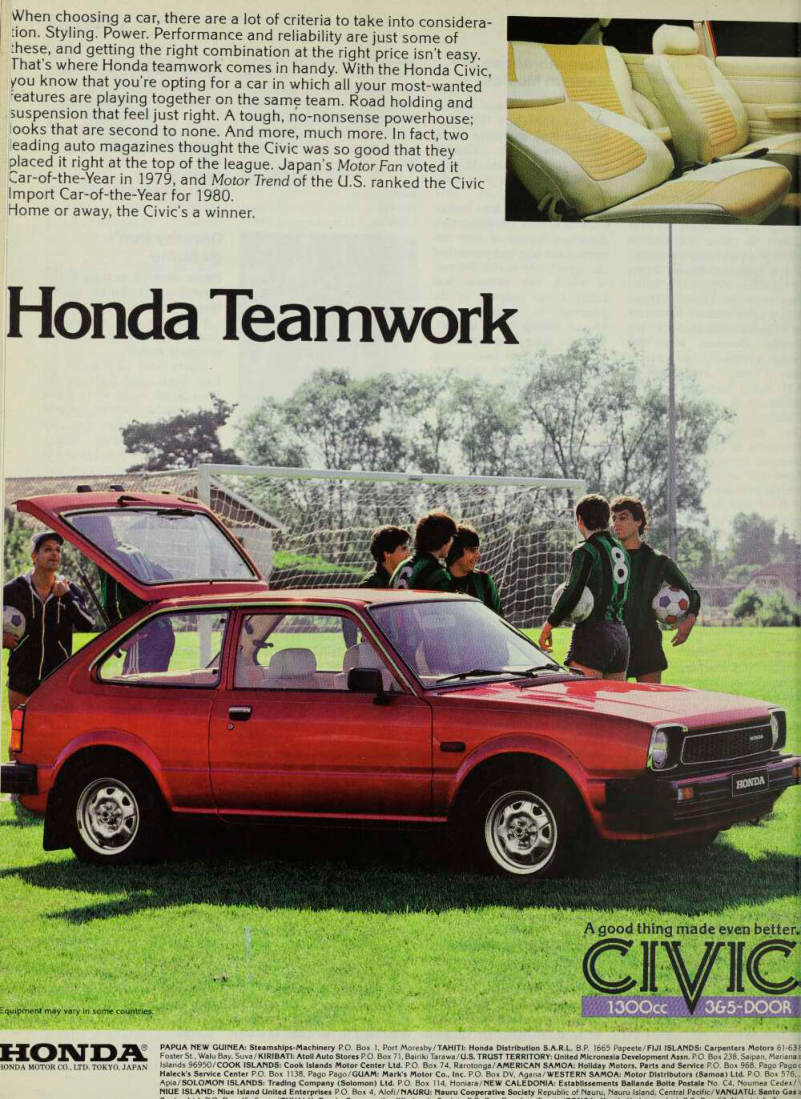
When choosing a car, there are a lot of criteria to take into considera- :ion. Styling. Power. Performance and reliability are just some of these, and getting the right combination at the right price isn’t easy.
That’s where Honda teamwork comes in handy. With the Honda Civic, you know that you’re opting for a car in which all your most-wanted * Features are playing together on the same team. Road holding and suspension that feel just right. A tough, no-nonsense powerhouse; looks that are second to none. And more, much more. In fact, two leading auto magazines thought the Civic was so good that they placed it right at the top of the league. Japan’s Motor Fan voted it Car-of-the-Year in 1979, and Motor Trend of the (J.S. ranked the Civic Import Car-of-the-Year for 1980.
Home or away, the Civic’s a winner.
Honda Teamwork
Nk % 1 M m u wm a r >$%\
». (jTVV
m • mm a mm ISmm m mm him ummMi m Equipment may vary in some countries.
A good thing made even better.
znr^'
II MW ■ II MM
• If II \\ // II If : -J-' ' I * . ' 1 1300cc 365-DOOR ►'4
iONDA MOTOR CO., LTD. TOKYO. JAPAN
PAPUA NEW GUINEA: Steamships-Machinery P.O. Box 1, Port Moresby/TAHITI: Honda Distribution S.A.R.L. B.P. 1665 Papeete/FIJI ISLANDS: Carpenters Motors 61-63?
Foster St., Walu Bay, Suva/KIRIBATI: Atoll Auto Stores P.O. Box 71, Bairiki Tarawa/U.S. TRUST TERRITORY: United Micronesia Development Assn. P.O. Box 238, Saipan, Mariana e Islands 96950/COOK ISLANDS: Cook Islands Motor Center Ltd. P.O. Box 74, Rarotonga/AMERICAN SAMOA: Holiday Motors. Parts and Service P.O. Box 968, Pago Pagoc Haleck's Service Center P.O. Box 1138, Pago Pago/GUAM; Mark’s Motor Co., Inc. P.O. Box DV, Agana/WESTERN SAMOA: Motor Distributors (Samoa) Ltd. P.O. Box 576,, Apia/SOLOMON ISLANDS: Trading Company (Solomon) Ltd. P.O. Box 114, Honiara/NEW CALEDONIA: Establissements Ballande Bolte Postale No. C4, Noumea CedexA NIUE ISLAND: Niue Island United Enterprises P.O. Box 4, Alofi/NAURU: Nauru Cooperative Society Republic of Nauru, Nauru Island, Central Pacific/VANUATU: Santo Gas a
Letters
ACIFIC ISLANDS MONTHLY - FEBRUARY, 1981
Letters
Vanuatu: May 1981 be the year
of national reconciliation
An expatriate resident of Vanuatu of several years standing who has now left the country reflects on his experiences, and writes on what he sees as the country’s most urgent problem: reconciliation of the various groups in the population which have been at loggerheads in the past. Not content merely to express pious hope, he lists without the least wish to interfere a number of practical steps which he believes, in the light of his experience, could well serve this purpose.
The independence of Vanuatu on July 30, 1980, was a deeply moving event for all involved.
After years of struggle the people of Vanuatu finally achieved a freedom for which many of them had worked over many years. \ Ten days before Indepen dence Week began, the French and British had still not given the final go-ahead for the cel ebrations, so the government of the country decided to carry on with the celebrations in any case, and, if necessary, make their own declaration of inde pendence with the backing of other Pacific Island states.
Fortunately, this was not necessary. The long-awaited agreement of the French was finally announced and the plan ned events went ahead exactly is planned.
There was however one hitch.
Mthough the new Vanuatu flag vas raised in 90 places through mt the new republic at noon on fuly 30, the flag had to be aised at Luganville (Santo fown) with a French and British guard, to ensure that it vas not hauled down again by epresentatives of the Vemarana Provisional Govern nent which had taken over the ‘land of Espiritu Santo in May.
To the amazement and dis ust of the government led by r Walter Lini, this secessionist overnment in Santo led by immy Stevens (leader of the Jagriamel Movement) was al )wed to continue up to and fter independence by the ritish and French, who could at agree what to do about it. übsequently, the Lini govern icnt became convinced that ie French administration in le condominium had actually sen encouraging the emarana government in an tempt to force the Lini overnment to make various
concessions. The most import ant of these demands was the formation of a confederal government with considerable devolution of power to local federations of islands. The Lini government saw this as an attempt to undermine the unity of the country and allow foreign interests to control certain parts of it.
The Lini government was furious that the French should attempt to impose a confederal system in their way as Mr Paul Dijoud, acting as representative of the French Government, had already signed the national constitution, drawn up by a wide cross-section of people from different parties and groups in 1979. In this consti tution everyone had agreed to the establishment of a unitary state with limited devolution of power to island governments, of which Santo and Tanna were to be the first.
Elections for the Santo and Tanna Regional Assemblies had taken place at the same time as the general election in November 1979, and the Vanuaaku Party had obtained a majority in both the national Representative Assembly and the two Regional Assemblies.
The Lini government there fore saw the moves to create secessionist or rival govern ments in Santo and other islands as a final attempt by the French administration, the co lons (settlers), American busi ness interests and opposition parties, to undermine its legal authority by any means avail able, as the opposition parties had been unable to gain a majority in the Santo and Tanna Regional Assemblies. (These Assemblies had been accepted by the Vanuaaku Party at the insistence of the French Minister for Overseas Departments and Territories,
Paul Dijoud, although the Vanuaaku Party group in the constitutional committee saw no reason why these two islands should be treated differently from the rest.) Immediately after indepen dence, therefore, the Lini government asked Papua New Guinea for help, and their army, together with a section of the recently united Vanuatu police force, put down the rebellion on Santo and many people, including Jimmy Stevens, were arrested. The PNG soldiers were disciplined and comparatively few com plaints were made about their behaviour. In the case of the Vanuatu police, however, it was quite a different story.
Resentment against Jimmy Stevens and the Vemarana government had been building up from the moment that the ‘British Paddock’ had been attacked on the night of the
take-over in Santo Town by the Vemarana forces. In spite of its name, the ‘British Paddock’ was mostly inhabited by New Hebrideans working in the dis trict administration and the police. Their houses had been ransacked, some of them had been taken off to Jimmy Stevens’ headquarters at Fanafo in the Santo bush, and some women had been mis treated.
In later developments, there had been much looting, as the French Resident Commissioner had insisted that the Vemarana government suspend its police,
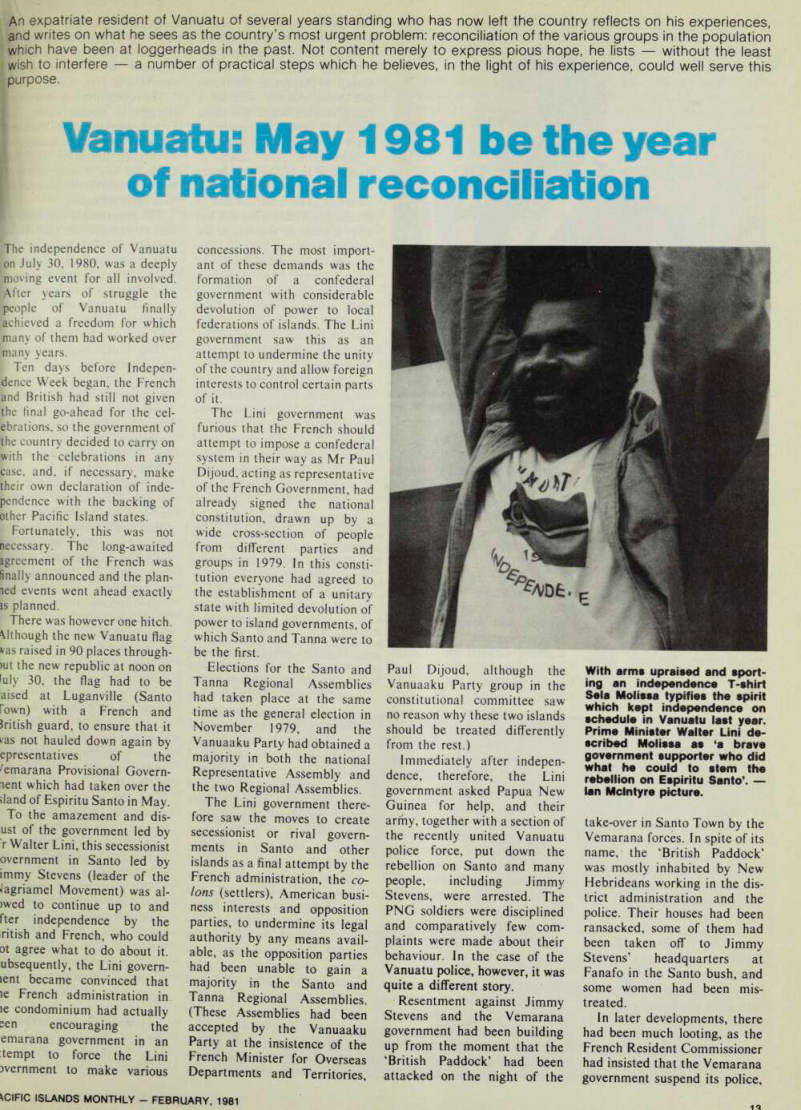
With arms upraised and sport ing an independence T-shirt Sela Molissa typifies the spirit which kept independence on schedule in Vanuatu last year.
Prime Minister Walter Uni de scribed Molissa as ‘a brave government supporter who did what he could to stem the rebellion on Espiritu Santo’.lan Mclntyre picture.
after he had persuaded it to accept the British and French troops being stationed in Santo Town (Luganville) to ‘protect the population’. There were reports that some church build ings had been used as toilets.
The New Hebrides Govern ment in Port-Vila, the British Resident Commissioner and the Australian Consul had pre viously called on government servants and Commonwealth citizens to leave Santo, so their properties had been left unpro tected. No such call was made for French citizens to leave the town. The staff of the Presbyterian, Anglican, Apos tolic and Adventist churches and the Churches of Christ had left the town; the Roman Cath olics remained. The bitterness which all this caused became apparent when the Vanuatu police were left on their own to continue ‘anti-rebel’ operations after the PNG troops had left.
They moved first to the island of Malakula, and news began to reach Port-Vila of arrests of the male inhabitants of certain Roman Catholic villages which had allegedly supported the Santo secessionists and at tempted to establish their own provisional government on the island. A reconciliation team consisting of leaders of all the main churches was at Port-Vila airport waiting to go to Malakula when they heard that the mobile police had arrived there, and their visit was can celled. Two Roman Catholic priests, one French and one Italian, were arrested and later
released. It appeared as if anybody who might have been implicated in any way in the setting up of provisional govern ments, or the receiving of stolen goods from Santo, or who was suspected of being sympathetic to the ‘rebels’, was likely to be arrested.
Conditions in the prisons were becoming very bad, as they were desperately over crowded with people waiting to be interrogated. The Roman Catholic Church was attempt ing to supply blankets and food to the prisoners, as these ap peared to be in short supply. It was reported that some people were being assaulted at the time of arrest, or while in prison, or under interrogation.
In these circumstances, the churches felt that they had to speak out.
The Vanuatu Christian Council made a formal protest to the Vanuatu Government, which was signed by the leaders of the council and heads of the Roman Catholic, Anglican and Presbyterian churches, and a representative of the Churches of Christ. The Pacific Church Leaders’ Conference, organised by the Pacific Conference of Churches, which happened to be meeting in Vanuatu in October, also discussed the matter at length and sent a delegation to the government to express their concern.
However, the government
was determined that police action should continue till all suspects had been rounded up, and after Malakula the police moved to Ambrym, Pentecost and Aoba. Arrests were on a much smaller scale, but there were still reports of maltreat ment of certain individuals.
Meanwhile, the cases of those held in prison were being heard, sometimes at the rate of 30 a day. The Chief Justice at first had judicial assistance, but after a while he was left as the only one trying to cope with the avalanche of judicial work. The court moved from Santo to Port-Vila where the final cases were heard. Jimmy Stevens received 14'/2 years; other leaders received lesser sen tences according to their degree of involvement.
What had been the action of the government in all this? Both the Prime Minister and the Minister for Home Affairs, Pastor Fred Timakata, had made broadcasts. Pastor Timakata, who was previously assembly clerk (general sec retary) of the Presbyterian Church and then (after his election in November 1979) chairman of the Representative Assembly, had become deputy prime minister and minister of home affairs at independence.
It was anticipated by many that he would be a moderating influence.
He asked for restraint to be exercised by the police, but only visited Malakula in order to call off the campaign there after all arrests had been made.
Some saw the lack of control of the police by his ministry as a sign of weakness on the part of the government. Others be lieved that the government had condoned some of the actions which had been taken against the Catholics.
Pastor Timakata vigorously denied that it was a ‘religious war’, as was being claimed by some Catholics in Vanuatu and New Caledonia, and it is im portant to note that when the police moved to Aoba the arrests there were mostly of those ex-members of the Churches of Christ who had allied themselves with Jimmy Stevens’ breakaway ‘Royal Church of Nagriamel’.
However, many of the arrests were of French-speaking ni- Vanuatu (the local term for
indigenous people), most o whom were Catholics, as well as of Jimmy Stevens’ immediatl followers who were mostll members of Nagriamel.
The opposition saw this as ar attempt to silence them; thri
French-speaking ni-Vanuatl
saw it as an effort to stamp ou all French influence; and thr Catholics saw it as an attemp by the Presbyterians to consoll date their influence.
The government did little sb first to demonstrate that these impressions were false, prefer ring to wait until all court case had been heard before begin ning attempts at reconciliation However, there were certaii important signs that the tidl had begun to turn.
The Independent Group ii the opposition, the onll effective opposition in parliaE ment, agreed to appoint one a their number (Vincent Boule kone) as official leader of thi opposition, and another mem ber of the three-man group Maxime Carlot (a Pres byterian) was elected aj speaker of parliament, an office he had held previously (aj Chairman of the Representai tive Assembly) under the Kalsakau Government in the first year of internal self! government.
Discussions aimed at rec: onciliation between rival politii cal groups were begun on Aobai Customary feasts for the same purpose were held on Santa Aoba, Maewo and elsewhere.
The government drew uj plans for an amnesty for some of the prisoners and discusseo ways of keeping Jimmy Stevem under surveillance, if releasee from prison. Reconciliation was in the air.
At the same time a comi mission of experienced police officers from overseas was ap< pointed to look into the reorgan-i isation and improvement of the Vanuatu police force.
The government hoped that by the end of 1980 a new spirit of co-operation and understand ing between different parties would begin to manifest itselft and that 1981 would be the yean of reconciliation, and provide aa better image for Vanuatu over seas.
However, reconciliation will not be easy and the government may be underestimating the difficulties.
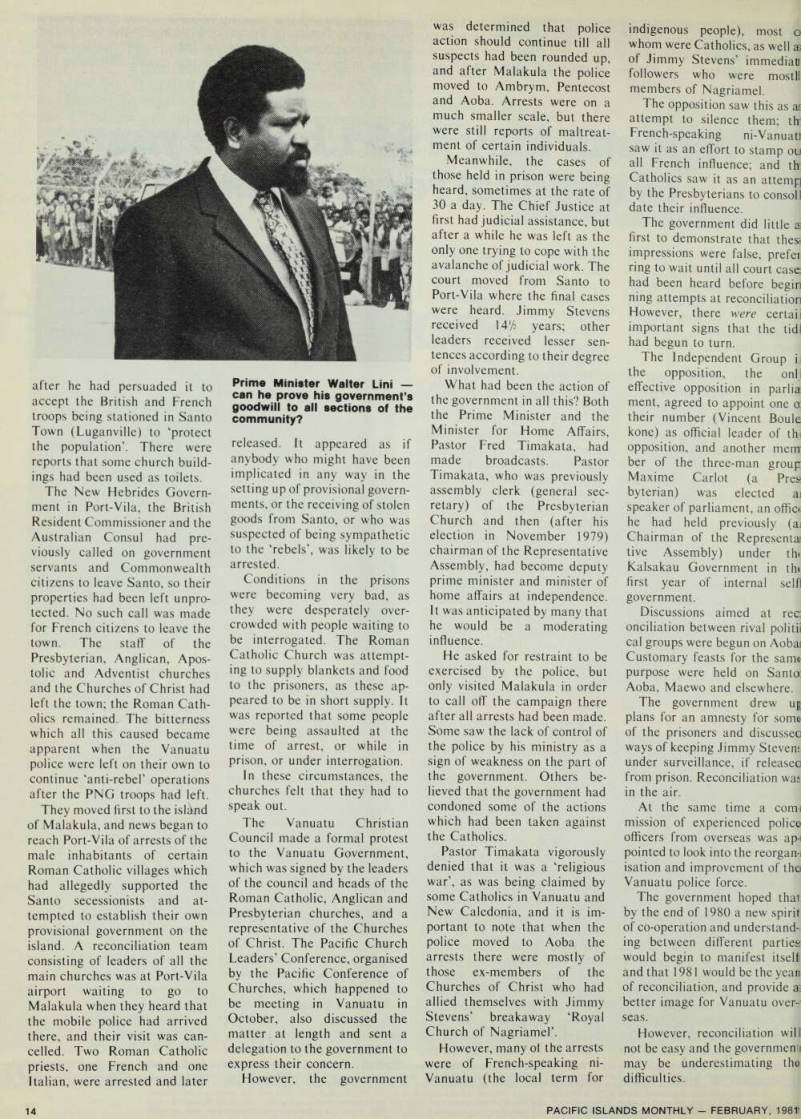
Prime Minister Walter Uni can he prove his government’s goodwill to all sections of the community?
The French-speaking ni- Vanuatu and the members of Nagriamel and other opposition i parties are uncertain about their future, and this feeling of insecurity has been deepened by the wave of arrests after independence, especially as many of those arrested were subsequently released because of insufficient evidence against them. These people cannot for get that the Vanuaaku Party once declared itself against the French language, a move which led Father Gerard Leymang, Jean-Marie Leye and Aime Malere to leave the National Party (as it then was) and form other parties.
The Vanuaaku Party still seems to have little understand ing of the fears of French speaking ni-Vanuatu. Although it has accepted French as an official language (with English and Bislama) the ‘Franco phones’ can point to many things which disturb them; the lack of any ‘Francophone’ min isters in the Lini government, the control of the party by local commissars who appear to limit the government’s ability to con ciliate between rival groups in the islands, and the presence in the government of four minis ters of religion (all Presbyterian, except Father Walter Lini, the prime minis ter, who is Anglican) who have not always spoken out strongly against the un-Christian actions of some of their followers, especially those in the Vanuatu police. In addition, they stress that the Vanuaaku Party itself set up a People’s Provisional Government in 1977, and that its vigilante groups in certain islands (especially Tanna) have been active in the past against the ‘Moderates’ (a general name for those in opposition to the government).
These things have made it hard for most of those who are not in the Vanuaaku Party really to believe in the goodwill of the government, and much more will need to be done to reassure the non-Vanuaaku Party people that the govern ment really sees an important place for them in the life of the nation in future.
The non-Vanuaaku Party groups must however make their position clear, and must reassure the government that they are willing to participate
and co-operate. They must clearly indicate that they will accept and abide by the consti tution, that they will not en courage any uprising in future against the legally elected government, and that they will cease to allow foreign elements to foment trouble in the country.
The churches and the Nat ional Council of Chiefs have a very special role to play in the work of reconciliation and nation-building, and this needs to be openly recognised and stated by the government. The leaders of the Roman Catholic Church in particular have a special responsibility to encour age their people to work together with other Christians, and to overcome the feeling that they have of being a persecuted minority.
Catholics who are members of parliament could give a lead by taking their seats in the House some of them have not even attended one sitting since the new parliament was elected in November 1979, and Vanuaaku Party members of
Parliament suspect them of being unwilling to voice their grievances in a democratic way.
The chiefs may be able to arrange customary ways of rec onciliation between opposing groups at village level, and encourage MPs representing ‘custom’ groups in various islands (especially Santo and Tanna) to play their full part in the work of parliament. They also have a special respons ibility to see that land problems are settled amicably, now that, since independence, all title to rural land has been returned to custom owners. Local people will have the opportunity to use the land (in co-operation with non-Melanesians in many places) for the economic and social development of the country.
Personally, my hopes for Vanuatu in 1981 are as follows: I would hope to see a greater emphasis on peace and under standing (rather than just law and order), and a more Christian spirit everywhere. 1 would hope that all parties and groups will try to root out the bitterness and hatred which have marked Vanuatu politics for too long, and that there may be an effort by French-speaking and English-speaking ni- Vanij|itu really to communicate their hopes and fears to one another and find a way forward acceptable to the great majority of the population.
I would like to see the government co-operate actively with the Vanuatu Christian
Council and the National Council of Chiefs in encourag ing a deeper understanding between rival groups, especially at the village level. Certain broad aims for the next few years need to be worked out by a process of consultation and consensus throughout the nation. The central government could involve the island govern ments, the churches, the chiefs, the business sector and other important groups in this pro cess, which should lead to a sharing of the power and wealth which seems to be concentrated in the hands of a few at the moment.
One hopes that in time sufficient key people suitably qualified will emerge to take over all the political work, and that the pastors at present involved in politics will be able to return to their pastoral du ties. And, not least, one hopes for a police force which will be respected rather than feared, and one in which discipline will be understood and upheld. I trust that my expression of these hopes will not be seen as a wish to interfere!
Vanuatu has many friends throughout the world who are longing that it may become a stable, peaceful and just country. The republic needs all the encouragement and support its friends can give it, without their meddling in its internal affairs: May 1981 be a year of new hope for the Republic of Vanuatu and its parliament, its government and its people.
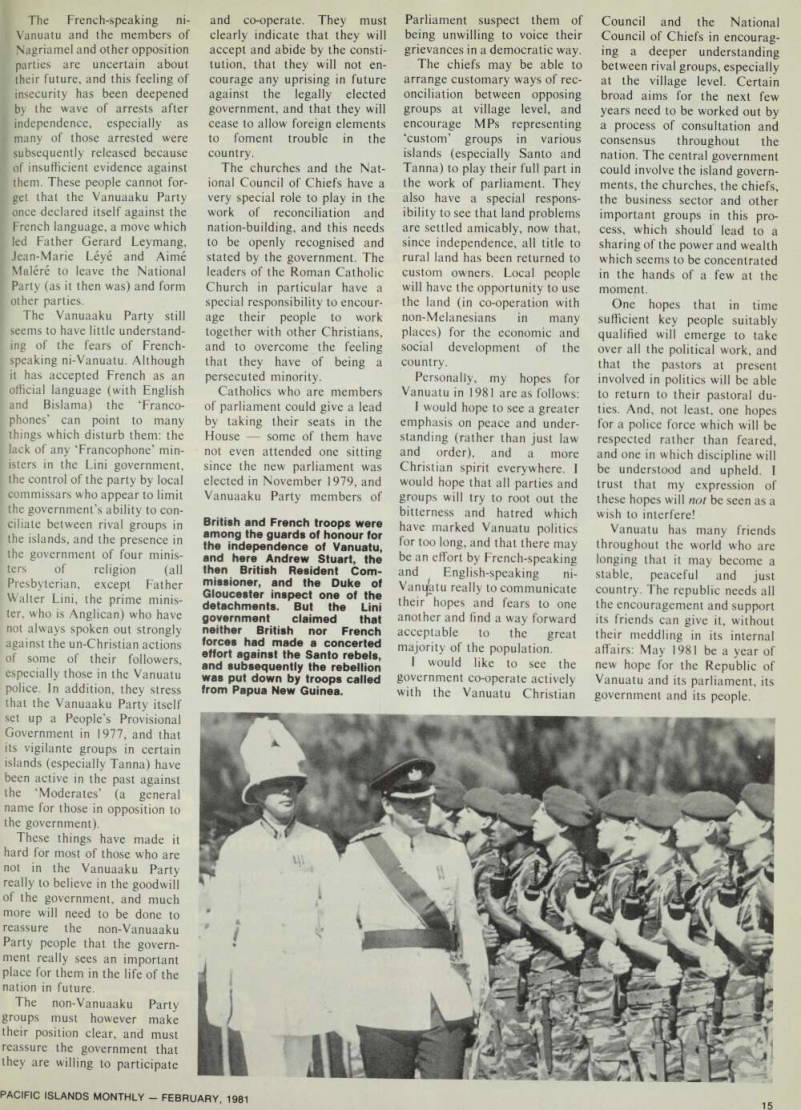
British and French troops were among the guards of honour for the independence of Vanuatu, and here Andrew Stuart, the then British Resident Com missioner, and the Duke of Gloucester inspect one of the detachments. But the Uni government claimed that neither British nor French forces had made a concerted effort against the Santo rebels, and subsequently the rebellion was put down by troops called from Papua New Guinea.
Advertisements & other items, pp. 13-16 (2 items)
Islands Monthly - February. 1981
Citizen
\ rrJ tr-i .
X ■Vi : ;■ as WiJJlte /•> \ r h'* 4 I . *4. say '*• ft &
"OWL
IV •Wr> / S' ■-S L t; **r. f/? *£ *Hji *<4/ m ;7 - V. * ■//•// ft’ /*. / £ .'/''• , " X, ' *,
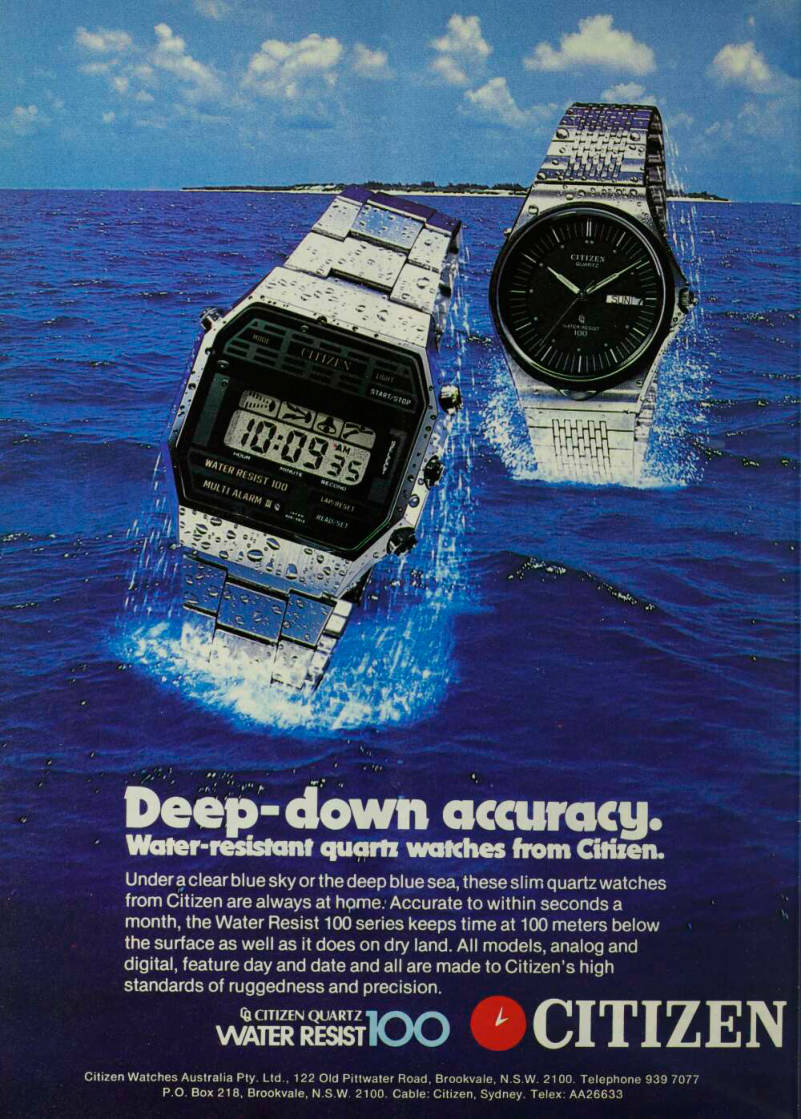
Deep-down accuracy.
Water-resistant quarts watches from Citiien.
Under a clear blue sky or the deep blue sea, these slim quartz watches from Citizen are always at hpme. Accurate to within seconds a month, the Water Resist 100 series keeps time at 100 meters below the surface as well as it does on dry land. All models, analog and digital, feature day and date and all are made to Citizen’s high standards of ruggedness and precision.
Qj CITIZEN QUARTZ L
WATER RESIST IUU
CITIZEN
Citizen Watches Australia Pty. Ltd., 122 Old Pittwater Road, Brookvale, N.S.W. 2100. Telephone 939 7077 P.O. Box 218, Brookvale, N.S.W. 2100. Cable: Citizen, Sydney. Telex; AA26633
Inder’S
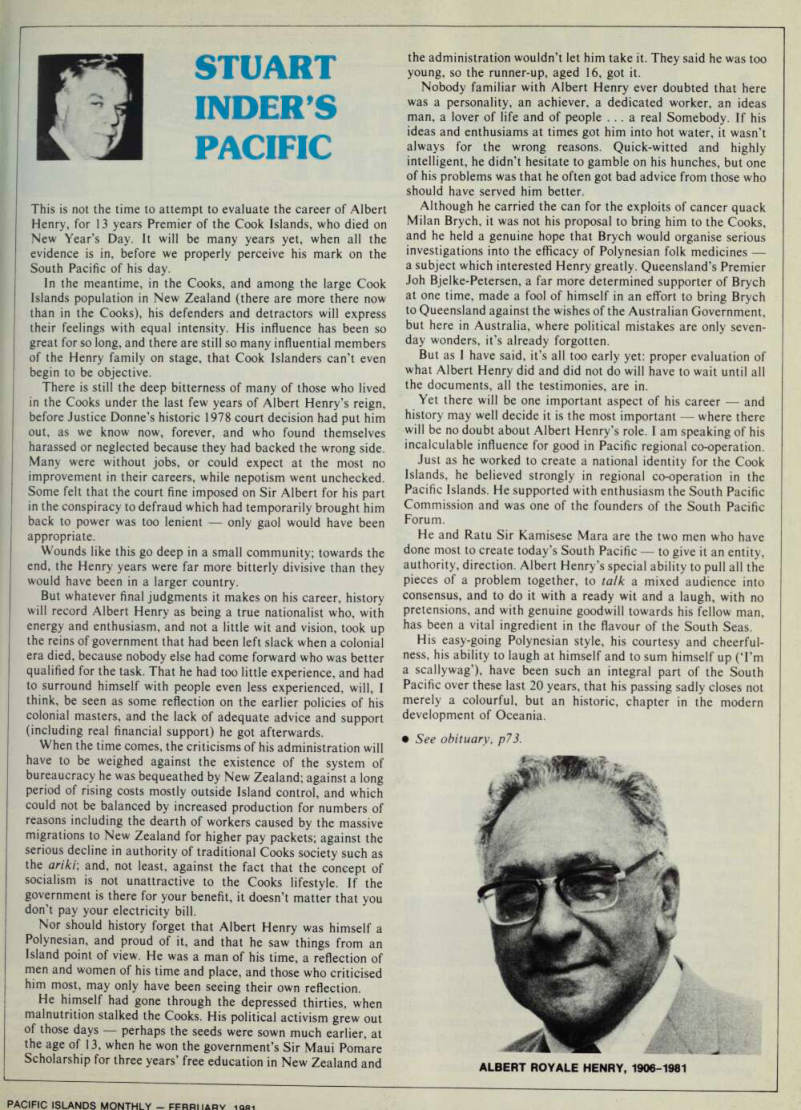
Stuart
Pacific
This is not the time to attempt to evaluate the career of Albert Henry, for 13 years Premier of the Cook Islands, who died on New Year’s Day. It will be many years yet, when all the evidence is in, before we properly perceive his mark on the South Pacific of his day.
In the meantime, in the Cooks, and among the large Cook Islands population in New Zealand (there are more there now than in the Cooks), his defenders and detractors will express their feelings with equal intensity. His influence has been so great for so long, and there are still so many influential members of the Henry family on stage, that Cook Islanders can’t even begin to be objective.
There is still the deep bitterness of many of those who lived in the Cooks under the last few years of Albert Henry’s reign, before Justice Donne’s historic 1978 court decision had put him out, as we know now, forever, and who found themselves harassed or neglected because they had backed the wrong side.
Many were without jobs, or could expect at the most no improvement in their careers, while nepotism went unchecked.
Some felt that the court fine imposed on Sir Albert for his part in the conspiracy to defraud which had temporarily brought him back to power was too lenient only gaol would have been appropriate.
Wounds like this go deep in a small community; towards the end, the Henry years were far more bitterly divisive than they would have been in a larger country.
But whatever final judgments it makes on his career, history will record Albert Henry as being a true nationalist who, with energy and enthusiasm, and not a little wit and vision, took up the reins of government that had been left slack when a colonial era died, because nobody else had come forward who was better qualified for the task. That he had too little experience, and had to surround himself with people even less experienced, will, 1 think, be seen as some reflection on the earlier policies of his colonial masters, and the lack of adequate advice and support (including real financial support) he got afterwards.
When the time comes, the criticisms of his administration will have to be weighed against the existence of the system of bureaucracy he was bequeathed by New Zealand; against a long period of rising costs mostly outside Island control, and which could not be balanced by increased production for numbers of reasons including the dearth of workers caused by the massive migrations to New Zealand for higher pay packets; against the serious decline in authority of traditional Cooks society such as the ariki ; and, not least, against the fact that the concept of socialism is not unattractive to the Cooks lifestyle. If the government is there for your benefit, it doesn’t matter that you don’t pay your electricity bill.
Nor should history forget that Albert Henry was himself a Polynesian, and proud of it, and that he saw things from an Island point of view. He was a man of his time, a reflection of men and women of his time and place, and those who criticised him most, may only have been seeing their own reflection.
He himself had gone through the depressed thirties, when malnutrition stalked the Cooks. His political activism grew out of those days perhaps the seeds were sown much earlier, at the age of 13, when he won the government’s Sir Maui Pomare Scholarship for three years’ free education in New Zealand and
the administration wouldn’t let him take it. They said he was too young, so the runner-up, aged 16, got it.
Nobody familiar with Albert Henry ever doubted that here was a personality, an achiever, a dedicated worker, an ideas man, a lover of life and of people ... a real Somebody. If his ideas and enthusiams at times got him into hot water, it wasn’t always for the wrong reasons. Quick-witted and highly intelligent, he didn’t hesitate to gamble on his hunches, but one of his problems was that he often got bad advice from those who should have served him better.
Although he carried the can for the exploits of cancer quack Milan Brych, it was not his proposal to bring him to the Cooks, and he held a genuine hope that Brych would organise serious investigations into the efficacy of Polynesian folk medicines a subject which interested Henry greatly. Queensland’s Premier Joh Bjelke-Petersen, a far more determined supporter of Brych at one time, made a fool of himself in an effort to bring Brych to Queensland against the wishes of the Australian Government, but here in Australia, where political mistakes are only seven day wonders, it’s already forgotten.
But as I have said, it’s all too early yet: proper evaluation of what Albert Henry did and did not do will have to wait until all the documents, all the testimonies, are in.
Yet there will be one important aspect of his career and history may well decide it is the most important where there will be no doubt about Albert Henry’s role. I am speaking of his incalculable influence for good in Pacific regional co-operation.
Just as he worked to create a national identity for the Cook Islands, he believed strongly in regional co-operation in the Pacific Islands. He supported with enthusiasm the South Pacific Commission and was one of the founders of the South Pacific Forum.
He and Ratu Sir Kamisese Mara are the two men who have done most to create today’s South Pacific to give it an entity, authority, direction. Albert Henry’s special ability to pull all the pieces of a problem together, to talk a mixed audience into consensus, and to do it with a ready wit and a laugh, with no pretensions, and with genuine goodwill towards his fellow man, has been a vital ingredient in the flavour of the South Seas.
His easy-going Polynesian style, his courtesy and cheerful ness, his ability to laugh at himself and to sum himself up (‘l’m a scallywag’), have been such an integral part of the South Pacific over these last 20 years, that his passing sadly closes not merely a colourful, but an historic, chapter in the modern development of Oceania.
• See obituary, p 73.
Albert Roy Ale Henry, 1906-1981
A meeting,
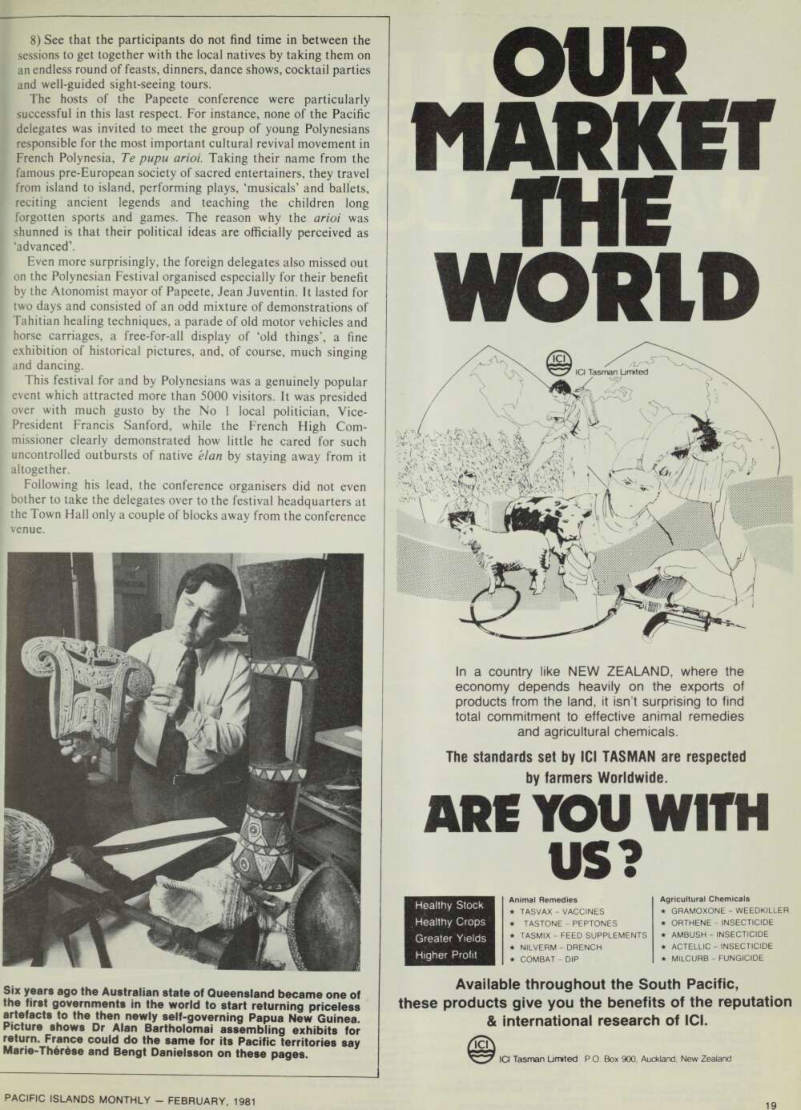
but not of minds
Within the framework of the UNESCO project for the study of Oceanic cultures initiated in 1971, yet another regional conference was held in Papeete in December. Compared with the previous ones, it could best be described as a sort of scientific rump parliament.
Of the 18 island nations in the Pacific, only seven were represented, and of these Samoa, Vanuatu, Papua New Guinea and the Cook Islands each sent only one delegate, while the three French possessions provided no fewer than 10. In addition, half a dozen museums and international organisations, foremost among them the Australian Museum, the Bernice P. Bishop Museum, and I’ICOM, sent delegates.
The scope of the meeting, too, was extremely limited. As originally planned, the conference was supposed to deal with ‘the advisability of creating a regional body in Oceania to safeguard the cultural and natural heritage’. At the request of the International Council of Museums, Geoffrey Mosuwadoga, director of the National Museum of Papua new Guinea, had prepared in advance a ‘basic working document’ in which he made concrete proposals for achieving this aim and outlined the main tasks of such a regional cultural association.
All his key propositions, however, had been omitted from the conference agenda by the French hosts who are dead against all regional associations for the very simple reason that they will in all likelihood be dominated by the independent ‘Anglophone’ countries. Gone, too, of course were all Mosuwadoga’s paragraphs dealing with environmental problems, such as the radioactive pollution due to the nuclear tests at Moruroa.
Having thus been firmly steered away from the real issues, the delegates in the end, without much enthusiasm, adopted nine vaguely worded resolutions in support of a bewildering array of ill-defined cultural programmes. It was an exercise in pure futility, considering that they were all old pet UNESCO projects, already initiated a long time ago such as, for example, the training of Pacific islanders in museum adminis tration and conservation, the preservation of archaeological sites and historical monuments, and the introduction of appropriate legislation to prevent theft of and illicit trade in artefacts. For some unfathomable reason, one of the resolutions concerned the urgency of making an inventory of all Pacific artefacts a project begun in 1975 by Professor Peter Gathercole, and carried out in such a competent and determined manner that it is by now practically completed.
It is equally difficult to understand what prompted the French hosts to recommend so warmly the construction of multi purpose cultural centres for native performers in all fields, since they have not followed this sensible policy themselves in French Polynesia. Instead they have erected a foretress-like Polynesian Centre without Polynesians (except in the menial capacities of caretakers and washerwomen), which serves mainly as a depository of antiquities, working offices for French scientists, and last but not least as a monument to the glory of French governors, admirals, missionaries and other colonisers.
The only resolution which really made sense was the earnest request to all foreign museums to return a sizeable portion of the Pacific artefacts they hold. These are often so numerous that they cannot all be displayed, but are hidden away in large quantities in their basements or attics. The French representa tives could have shown the way here by promising on the spot to return a selection of the artefacts entombed in this way in a dozen or more museums in France. But no such offer was
forthcoming.
Much more interesting than the lame debates and vague resolutions were actually the tactics used by the organisers to avoid any open criticism of the cultural colonialism practised in the French Pacific territories, and to make sure that the foreign delegates did not contaminate the local natives with their subversive ideas, as happened, for instance, during the 1979 South Pacific Conference in Papeete. The main lessons of the 1980 UNESCO conference may therefore best be expressed in the form of the following rules of general validity: 1) Make sure from the beginning that you have a majority by enlarging your own delegation to the maximum extent possible.
In accordance with this vital principle, the host delegation from French Polynesia had well in advance been well larded with half a dozen French expatriate scientists and government officials, some of whom had never seen a living specimen of the Polynesian race before they were packed off to Tahiti. Together with the delegates from the other two French possessions, New Caledonia and Wallis and Futuna, the Francophones thus outnumbered the Anglophones by 10 to five. Quite useful to the former was also the general practice of nominating the head of the host delegation as chairman of the meeting. 2) When in such a position of strength, do not have any formal votes but adopt all decisions by ‘mutual consent’. It looks better this way. 3) Ask all participants to prepare lengthy position papers on the cultural policies of their respective countries. When all these papers more easily available as mimeographed documents have eventually been read, translated and discussed, there is only a very slight risk that the delegates will have time or strength left for more important questions. 4) Let the chairman rule that all embarrassing questions are ‘political’ in nature and therefore strictly taboo. 5) Forbid all outsiders from addressing or petitioning the meeting. The term ‘outsider’ denotes, of course, any person, however competent and knowledgeable he may be, who is not well regarded by the organisers. 6) Hold the meeting in the smallest available hall and fill up the public section with government-appointed ‘silent observers’.
A friendly and positive atmosphere may thus be guaranteed. 7) Limit the mass media coverage to ‘essential’ information.
In the present case, for instance, documents released to local newspapers consisted exclusively of papers in French submitted by French delegates. No Anglophones were ever interviewed by the local press or by local radio or TV.
8) See that the participants do not find time in between the sessions to get together with the local natives by taking them on an endless round of feasts, dinners, dance shows, cocktail parties and well-guided sight-seeing tours.
The hosts of the Papeete conference were particularly successful in this last respect. For instance, none of the Pacific delegates was invited to meet the group of young Polynesians responsible for the most important cultural revival movement in French Polynesia, Te pupu arioi. Taking their name from the famous pre-European society of sacred entertainers, they travel from island to island, performing plays, ‘musicals’ and ballets, reciting ancient legends and teaching the children long forgotten sports and games. The reason why the arioi was shunned is that their political ideas are officially perceived as ‘advanced’.
Even more surprisingly, the foreign delegates also missed out on the Polynesian Festival organised especially for their benefit by the Atonomist mayor of Papeete, Jean Juventin. It lasted for two days and consisted of an odd mixture of demonstrations of Tahitian healing techniques, a parade of old motor vehicles and horse carriages, a free-for-all display of ‘old things’, a fine exhibition of historical pictures, and, of course, much singing and dancing.
This festival for and by Polynesians was a genuinely popular event which attracted more than 5000 visitors. It was presided over with much gusto by the No 1 local politician, Vice- President Francis Sanford, while the French High Com missioner clearly demonstrated how little he cared for such uncontrolled outbursts of native elan by staying away from it altogether.
Following his lead, the conference organisers did not even bother to take the delegates over to the festival headquarters at the Town Hall only a couple of blocks away from the conference venue.
Six years ago the Australian state of Queensland became one of the first governments in the world to start returning priceless artefacts to the then newly self-governing Papua New Guinea.
Picture shows Dr Alan Bartholomai assembling exhibits for return. France could do the same for its Pacific territories say Marie-Therese and Bengt Danielsson on these pages.
Advertisements & other items, pp. 18-20 (2 items)
18
PAniPin ISI ANDR MDNITHI Y FFRRUARV 1981
Market
«££<
OUR
THE
WORLD
ICI
ICI Tasman Limited Z*, In a country like NEW ZEALAND, where the economy depends heavily on the exports of products from the land, it isn’t surprising to find total commitment to effective animal remedies and agricultural chemicals.
The standards set by ICI TASMAN are respected by farmers Worldwide.
ARE YOU WITH
US?
Healthy Stock Healthy Crops Greater Yields Higher Profit Animal Remedies
★ TASVAX - VACCINES
★ TASTONE - PEPTONES
★ TASMIX - FEED SUPPLEMENTS
★ NILVERM - DRENCH
★ COMBAT - DIP
Agricultural Chemicals
★ GRAMOXONE - WEEDKILLER
★ ORTHENE - INSECTICIDE
★ AMBUSH - INSECTICIDE
★ ACTELLIC - INSECTICIDE
★ MILCURB - FUNGICIDE
Available throughout the South Pacific, these products give you the benefits of the reputation & international research of ICI.
ICI Tasman Limited P O Box 900, Auckland, New Zealand
YOU’LL
NEVER
WALK ALONE
Wjth the wide choice of superb portable radio cassette Akai, you’ll always be accompanied by your
favorite musicians—wherever you go.
if *■ AJ-500^
4-band, 2-way 4-speaker sysle
: AJ-485* 4-band. 2-w m m w AJ-530 * *IPSS, Twinfield Super GX Head, 2-way 4-speaker system with metal tape capability
♦ Metal tape capability ★Stereo system
AJ-420^
3-band. 2-speaker (12cm) systerr
AKAI
AKAI ELECTRIC CO.. LTD.
Tokyo, Japan
AJ-360 3-band, 16-cm speakers
New Caledonia Menard Pacifique s.a.r.l.
B P H 2. Noumea Tel 275222 Tahiti Etablissements Comimpex P O Box 200, Papeete Tel 20477 Vanuatu Burns Philp (New Hebrides) Co . Ltd.
PO Box 27, Port Vila, New Hebrides Islands Norfolk Island Burns Philp (Norfolk Island) Co , Ltd.
Samoa Islands Burns Philp (South Sea) Co.. Ltd.
P O Box 129. Pago Pago. American Samoa Mariana Islands J.C. Tenorio Enterprises P O Box 137. Saipan Tel 6444/8 Solomon Islands Security Electrical Co.. Ltd P O Box 174. Honiara Tel: 881 Cook Islands JPS Enterprises Ltd.
P O Box 15, Rarotonga Tel: 2150. 2176 For more information please send this coupon to our distributor in your country or to AKAI ELECTRIC CO LTD 12-14. 2-Chome Higashi-Kojiya Ohta-ku Tokyo Japan
Land reform plan
well advanced
PIM this month introduces Noumea Notebook, a regular column of New Caledonian news and comments contributed by well-known New Caledonian journalist Daniel Tardieu.
Mr Tardieu is editor of the Noumea weekly Corail. As with other columnists, the views expressed by him are his own, and are not necessarily shared by the editors of PIM.
For two years now a process of returning land to Melanesians has been under way in New Caledonia. The French Parliament has just legalised this retrocession of land which had previously belonged to European colon ists, to the state, or to bodies of a religious or territorial character.
In 1979, 5000 hectares were redistributed in this way. In 1980, the figure reached I 0 900 ha. For the most part, the land went to Melanesian communities, but in some cases the beneficiaries were young farmers belonging to other races. This land reform is set to go on for 10 years, during which time it is hoped that a major part of the existing demands for land will be met. It also represents an agrarian reform, in that it is designed to achieve a more effective distribution of Caledonian land.
The Melanesian popu lation of New Caledonia represents 43% of the total population (140 000). But it owns 60% of the total land area, both on the main island and in the Loyalties group.
At the beginning of European colonisation, a number of tribes were driven off their lands, which were often near the coast, and moved on to areas with inferior soil. The present land reform is designed by the French Government to remedy these injustices.
Funds will be made avail able to young farmers who want to develop the new allotments.
Matters are going ahead, but not without problems.
There has been lengthy de bate in Paris about it all.
Various delegations have turned up in the French capital to make their view points known to government authorities. One group in particular, calling itself RURALE, has pressed the case of European colonists established in inland New Caledonia. Others, on the other hand, have supported the French Government’s plan, which has been the subject of heated arguments in New Caledonia’s Terri torial Assembly.
The Independence Front of New Caledonia, however, challenges the basic concept of the reforms. Basically, its view is that all New Caledonian land belongs to the Kanaks.
But it does seem that the reforms are being well re ceived by the Melanesian population, many of whom live on the islands of Lifou, Mare Ouvea, He des Pins and Belep.
They don’t feel great con cern because from the start their islands have been re serves on which all commer cial or real estate develop ments have been forbidden.
Row on sacked
teachers
The dismissal of two teachers from metropolitan France who had been work ing at a Catholic school on Ouvea, Loyalty Islands, has precipitated a major crisis between the Independence
Front of New Caledonia and the Catholic Church hier archy in the territory.
The elected representa tives of the Front, as well as Melanesian leaders, have protested vigorously against what they call ‘political sackings’. In substance they are accusing the Catholic Church of having acted under the influence of the French administration. The latter, however, points out that the dismissals were en tirely the affair of the re sponsible authorities in the Catholic education system.
A group representing Inde pendence Front members of the Territorial Assembly en tered the administrative headquarters of the Catholic education system in Noumea and held the direc tor of Catholic education, the Rev Fr R. P. Delbos, captive in his office. But he resisted their demands, and police intervened to clear the premises.
On the following day, a silent demonstation was staged by about 200 people outside the residence of the Catholic bishop. They sat on the road awaiting the out come of an interview granted by Monsignor Klein, Bishop of New Caledonia, to a deputation from the pro testers. But the bishop would not budge from his position.
The demonstrators then staged a march through town. There was no violence or disorder.
On Christmas Day dem onstrators blocked entry to Catholic churches on the east coast of the territory, in
particular at Tye near Poindimie, 400 km to the northwest of Noumea, where the missionary was unable to celebrate the traditional midnight mass. Likewise Mgr Klein was unable to go to Canala, on the east coast 200 km from Noumea, to officiate at planned First Communion services.
Political observers see in the affair a challenge by the Independence Front to the Catholic Church in New Caledonia, which has main tained a neutral stance on the question of indepen dence, probably because majority opinion among its flock is unwilling to under write the idea of the terri tory’s accession to indepen dence.
School holiday
flood
Flights between Sydney and Noumea and vice-versa are always rather crowded at school holiday times. It’s the traditional holiday flood, during which Australians are to be seen in Noumea in increasing numbers. In 1979, 54 521 tourists visited the territory. In 1981 the figure will probably be 62 000 a very healthy increase. It appears that it will be due to an increase in the numbers of Japanese visitors, but also to Aust ralians who are finding the Club Mediterranee ‘for mula’ to their liking. The Club’s success is hurting the traditional hotels, who find they’ve lost part of their former clientele.
Advertisements & other items, p. 22 (1 item)
Talking to Tonga
and the Cook Islands
is now so easy.
With the opening of Cable and Wireless earth stations in Tonga and the Cook Islands, a world of communication possibilities has begun.
Now, the people of Tonga and the Cook Islands can enjoy the benefits of the fastest, most efficient and reliable telephone, telex and telegraph links with the rest of the world.
Lying to the east of Tonga, the Cook Islands is the latest geographical location to receive a Cable and Wireless Satellite Earth Station.
A century of experience is at work behind the design, installation and maintenance of this and all Cable and Wireless communication systems the world over including over 30 earth stations designed to suit individual climatic and geographic conditions.
Want to know more about our powers of communication? Contact us.
K+V* y. .' • ' r *
Cable & Wireless
helps the world communicate
. ~««*ad Office, Cable & Wireless Ltd, Dept. FEA, Mercury House, Theobalds Road, London WCIX BRX Tel: 01-242 4433 Telex: 23181 Tonga Branch, Corner of Queen Salote Road & Takauvove Road, Fongola, Tonga.
Cook Islands Branch, P.O. Box 529, Rarotonga, Cook Islands.
Islands
From the
Press
From a Letter to the Editor in Marianas Variety, Commonwealth of Mariana Islands Pacific Daily News of December 9 carried a picture of French President Valery Giscard D’Estaing walking alone beside the highway on his way to the European summit. There is a President of a large country who has confidence enough in his own people and himself to feel safe walking by himself along a highway without guards and police officers trailing him. In contrast, here in the Northern Marianas we have a small Governor who will not even walk to his car or to the bathroom without guards and police officers following him and opening doors for him. I don’t know what the problem is. It could be a symptom of paranoia, insecurity, lack of confidence, and fear of death on the part of the Governor. When I went to the December meeting of the Chamber of Commerce to hear the Governor’s speech, two guards were outside the chamber meeting to make sure that the Governor would not get killed by the members of the Chamber of Commerce.
From a feature article by Euralia Paine in The Times of Papua New Guinea Two thousand kina, six thousand, twenty thousand the price of a stereo set, brand new car or a win at the lottery ticket sales? NO, none of that. These are recent amounts paid by young men in this * country to acquire a wife. Bride price is one custom in Papua New Guinea that is still alive, even where some of the other customs are dying out.
A golfer’s lament from a letter to the Nauru Post,
Nibok, Nauru
As a paying member of the most expensive and exclusive club on Nauru for the purpose of enjoying my recreation time, I wish to ■egister my annoyance at those drinkers who insist on using the 'airways as their drinking area, mainly in the dark hours, and caving their caps and other mess on the course. ■rom a Fiji Times, Suva, interview with magistrate Mr *bbas Koya leaving to join an Australian law firm r Koya said that top Indian civil servants were migrating to greener pastures’ because the writing was on the wall.
Circumstances in Fiji are such that discrimination in jobs is bound 0 come and with it will come trouble’, he said, instructions to tourists driving hire cars, from What’s
)n In Tonga, Nukualofa
'Jote. Should you see or hear His Majesty’s advance guard (a navy lue police vehicle with two flashing blue lights and a siren) please ull over to the extreme left hand side to allow H.M. to pass. This pplies in either direction. Should H.M. be in front of you, do not ttempt to pass. His Majesty is accompanied by four motor-bike utriders. rom Town Talk in the Arawa Bulletin, North >olomons Province, Papua New Guinea •ne chap wasted a lot of his time on his recent leave.. His Solair ight was scheduled to leave Aropa on 20th December at 8.40 am nd the plane was on the tarmac in good time at 8.00 am for >admg. However, the same plane did not leave Aropa until about IJO am as the customs clearance officer did not turn up until then nd then only after several calls from the airport. On his trip back 1 Bougainville, the same gent had the misfortune to be on another olair flight which did a bit of island-hopping, landing at Balalae.
The plane was held up as the customs officer could not be located and then it was discovered he had gone fishing for the day. As a result the plane had to return to Gizo.
From the Norfolk Islander, Norfolk Island Contributed I am always moved by the solemnity of the Prayer at the meetings of the Legislative Assembly. May I offer a suggestion that before the Public Service work days commences, the following Prayer be used: ‘Blessed are those who collect revenue without capital risk, but more blessed are those who risk their capital to pay the wages of those who bless the revenue they collect.
Amen’.
From a letter in The Reporter, Papua New Guinea
University of Technology
I refer to dinner parties last weekend . . . involving monotonous breaches of confidentiality before midnight. The rule on campus is quite reasonable: Every one has the right to be intoxicated enough to reveal the proceedings of confidential meetings from midnight onwards.
From an editorial in The Fiji Times, Suva . . Apart from a few frantic moments at Christmas and the New Year tourism in Suva never was a golden goose, but just a silver bulbul or ruby-eyed mynah. After all, hand on heart, what has our capital to offer that can t be covered by the average visitor in less than a day? Two minutes for the guard at Government House, 30 minutes around the museum, a quick gawp at Government Buildings, 10 minutes messing around the market, and a cruise through Gumming Street, and that’s the lot.
Allegations against an off-duty policeman, made in a letter to the Samoa Times, Apia, Western Samoa I found him guilty of (1) being a party to negligent driving; (2) carelessly throwing a bottle of beer; (3) swearing at other people; (4) urinating openly and in full view of other people, an action most frustrating to my wife and daughter... If I were the commissioner of police I would not hesitate to give him a good hiding.
A statement by David Manua, of Margarima Patrol Post, quoted in The Times of Papua New Gujnea 1 ask the government to show a little mercy to the people of this country. After all, they are elected to serve the people not themselves.
From Atoll Pioneer, Kiribati A tragic end to his career came when his plane had a mid-air collision with one of his pilot students. The accident crippled him and as a result he was invalidated. He was given a 50 percent war pension as a reward.
From the impressions of a Micronesian travelling overseas for the first time, published in the Ponape Sun When I first travelled abroad it was to Honolulu back in 1962 I was told that the aircraft had just flown over the international date line. I woke up and looked down out of the window to see what it looked like!!!
The Fiji Times, Suva
It costs taxpayers $7OOO to have the Senate discuss only one motion, but do they get their money’s worth? There is no apparent result from the work done by the Senate, Senator Colin Weaver said, asking and answering his own question in the Senate.
The News Drum, Honiara, Solomon Islands, describing the work of a local artist who has carved a bust of the Prime Minister, Mr Kenilorea . . and he is planning to do other artwork on the governor-general, the archbishop of Melanesia and any other national leaders, if there is a demand.
From an article on how to slaughter and dress a pig in The Cook Islands News, Rarotonga I do not recommend the common methods of killing pigs used in the Cook Islands which are either to stick a knife into the heart or by strangling the animal. These methods ruin the appearance of the meat, cause bruising to almost a quarter of the carcase and create bleeding within the animal. Also, they are not humane methods of slaughter and cause great pain to the pig.
Advertisements & other items, pp. 23-24 (2 items)
Cific Islands Monthly February 1981
| National
NATIONAL
INSURANCE
Wi
COVERS THE
PACIFIC
FIJI
THE NATIONAL INSURANCE COMPANY OF FIJI, LIMITED. (Incorporating Southern Pacific Insurance Co. (Fiji) Ltd) SUVA Dominion House, Thomson St, Phone 25601, Tlx 2337.
L. M. Rolls, General Manager. S. Bahadur, Manager.
LAUTOKA Ist Floor National Bank Bldg. Phone 62951. M. Y. Hussain, Resident Inspector.
LABASA Ist Floor National Bank Bldg. Phone 81099. A. Singh, Resident Inspector.
PAPUA NEW GUINEA
THE SOUTHERN PACIFIC INSURANCE COMPANY (PNG) LIMITED. (Incorporating C.I.C. Insurance (Pacific) Pty Ltd) PORT MORESBY 8 Champion Parade, Phone 21-1388, Tlx 22261. D. J. McCall,Group Manager.
LAE Second St, Phone 42-4590, Tlx 42443. T. S. Kennedy, Manager.
RABAUL Mango Ave, Phone 92-2755, Tlx 92923. P. M. Mitchell, Manager.
MT HAGEN Boroko Motors Ltd, Phone 521-433. J. P. Devaney, Resident inspector.
ARAWA Arawa Motors, Phone 951-633. % *
SOLOMONS
THE NATIONAL INSURANCE COMPANY OF NEW ZEALAND, LIMITED.
HONIARA Ist Floor Kingsley Bldg. Phone 919 Kaituu & Co. Ltd (W. V. Gledhill) Agent.
SAMOA
NATIONAL PACIFIC INSURANCE LIMITED.
(National Insurance Company of New Zealand, Ltd Managing Agents) APIA Taufusi St, Phone 20481, Tlx 228. D. I. Humphry, Managing Director.
PAGO PAGO Suite 200, Lumana’i Bldg, Phone 96799. J. McGuire, Manager.
COOK ISLANDS
THE NATIONAL INSURANCE COMPANY OF NEW ZEALAND, LIMITED.
RAROTONGA U.I.T. Bldg. Avarua, Phone 2076, Tlx 62013. R. Wheeler, Local Manager.
a-building
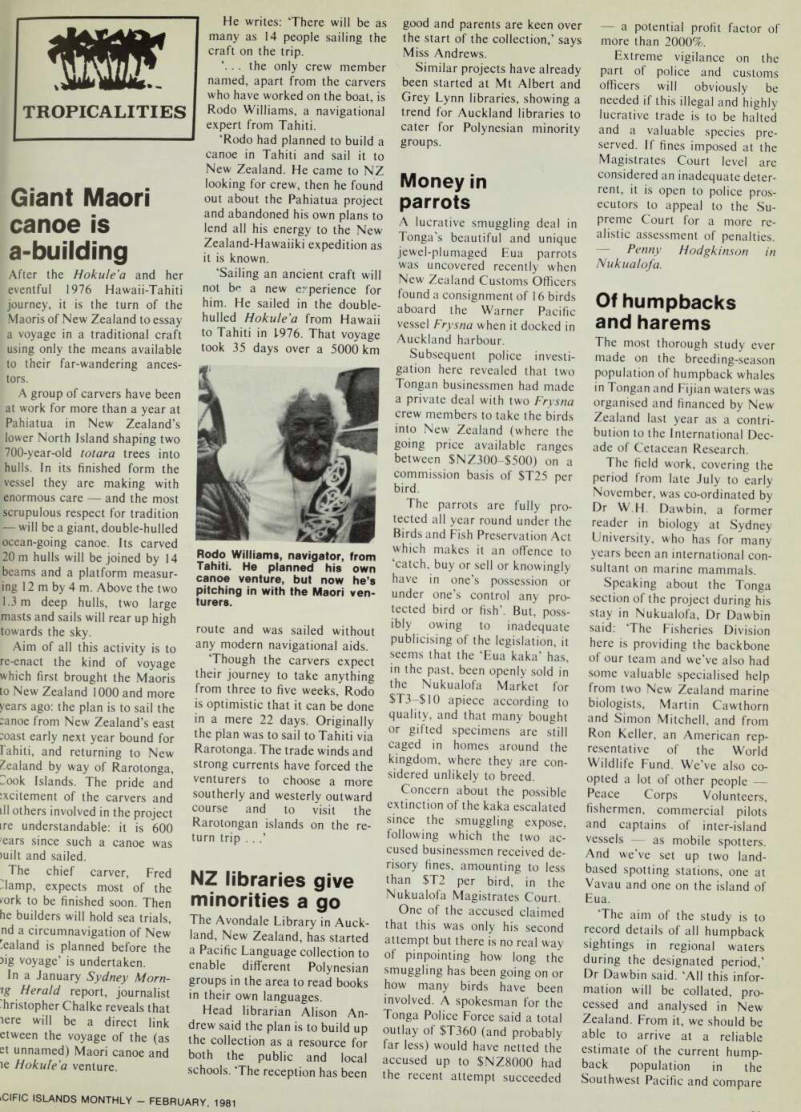
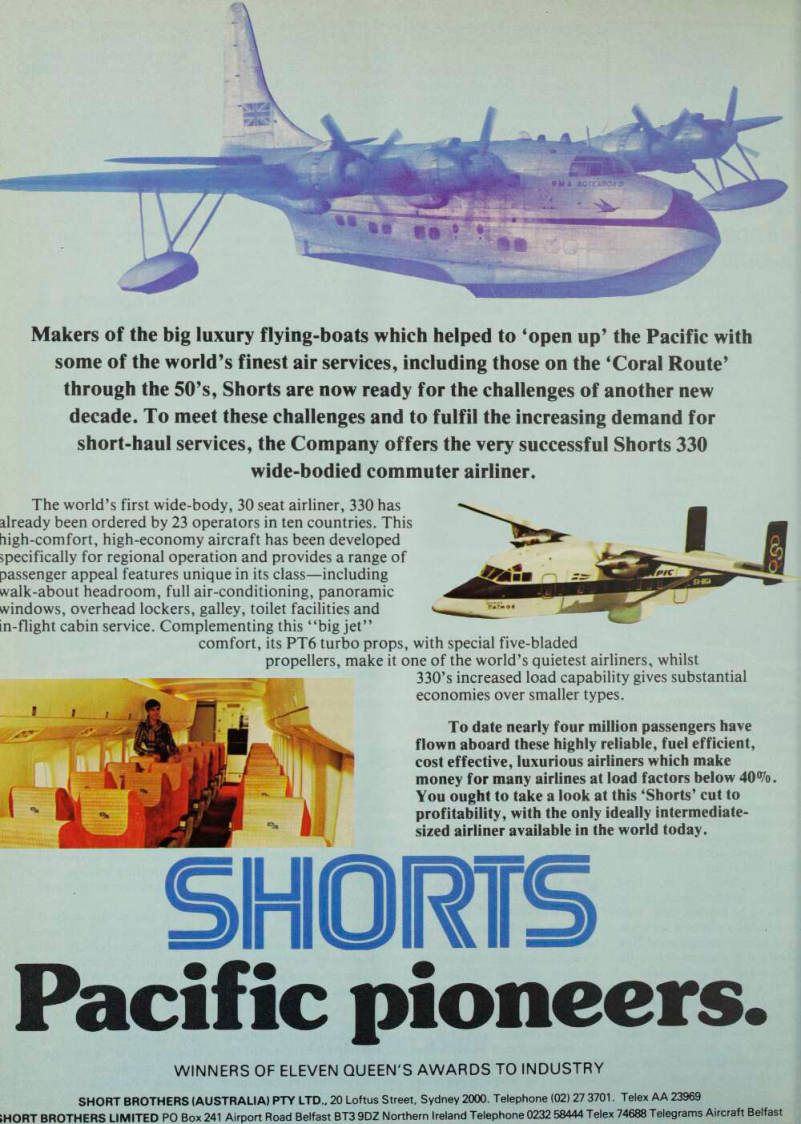
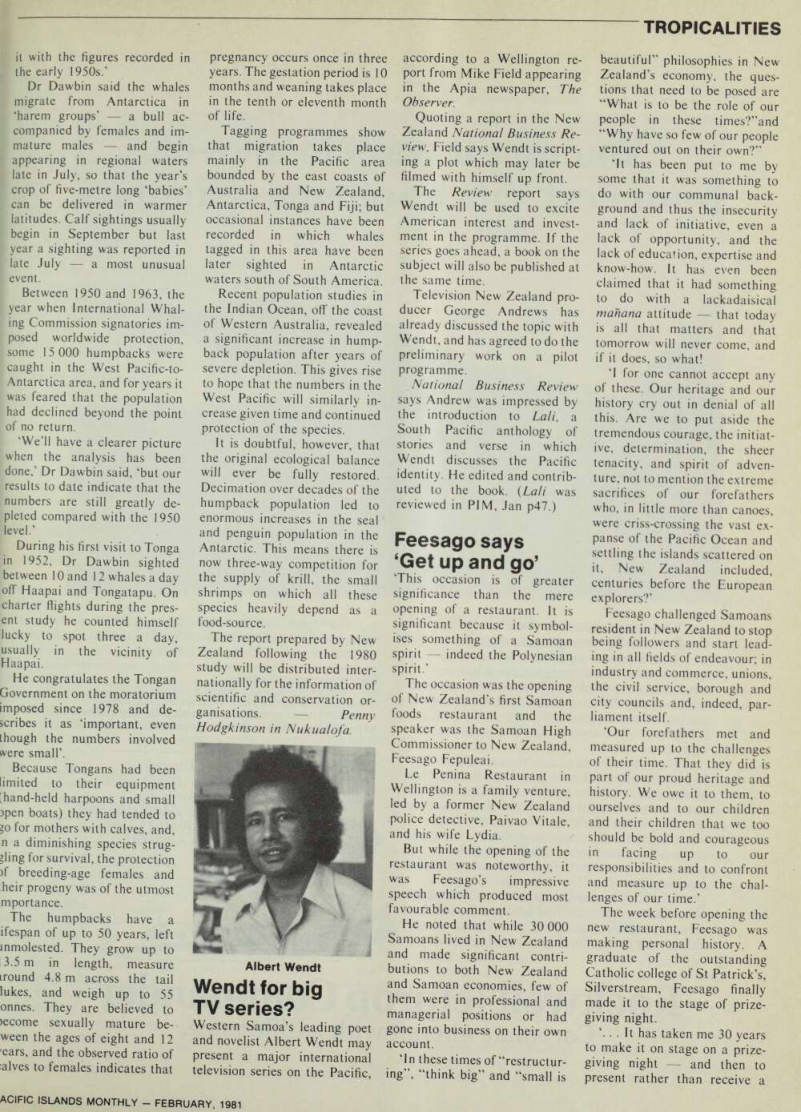
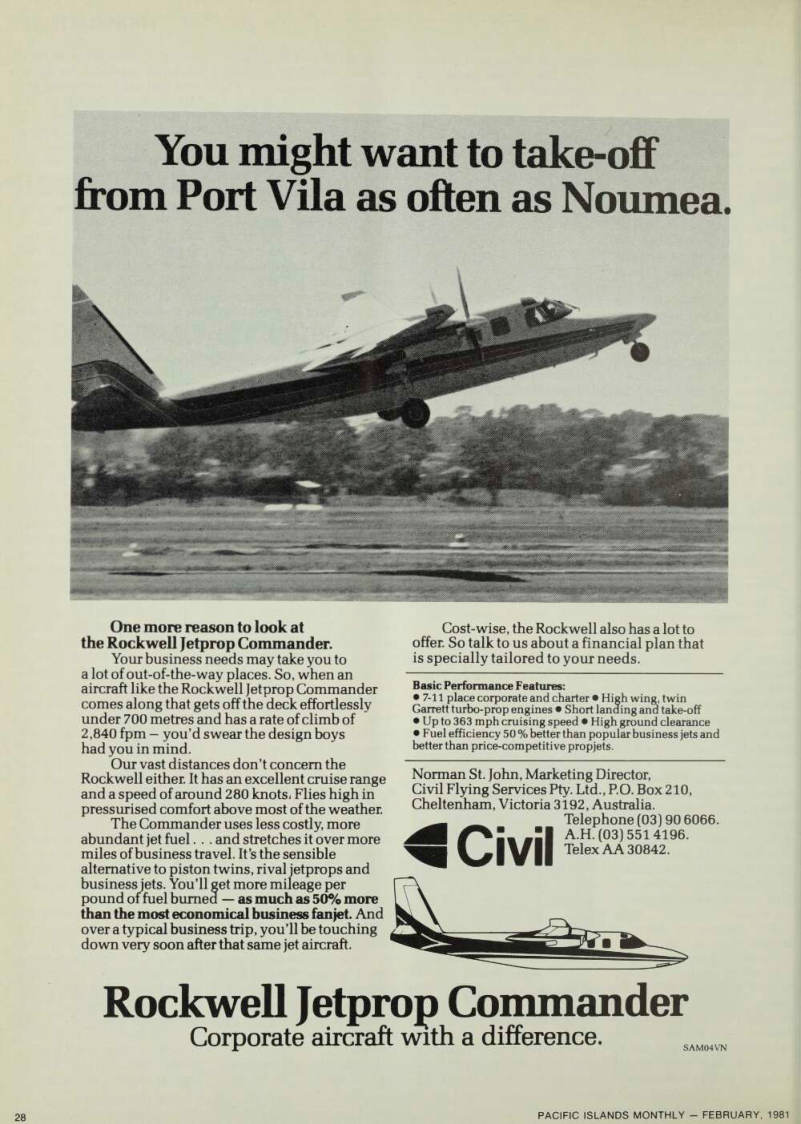
Tropicalities
Giant Maori canoe is a-building
After the Hokule’a and her eventful 1976 Hawaii-Tahiti journey, it is the turn of the Maoris of New Zealand to essay a voyage in a traditional craft using only the means available to their far-wandering ances tors.
A group of carvers have been at work for more than a year at Pahiatua in New Zealand’s lower North Island shaping two 700-year-old totara trees into hulls. In its finished form the vessel they are making with enormous care and the most scrupulous respect for tradition will be a giant, double-hulled ocean-going canoe. Its carved 20 m hulls will be joined by 14 beams and a platform measur ing 12 mby4 m. Above the two 1.3 m deep hulls, two large masts and sails will rear up high towards the sky.
Aim of all this activity is to re-enact the kind of voyage which first brought the Maoris to New Zealand 1000 and more years ago: the plan is to sail the :anoe from New Zealand’s east -oast early next year bound for Tahiti, and returning to New Zealand by way of Rarotonga, "ook Islands. The pride and ;xcitement of the carvers and ill others involved in the project ire understandable: it is 600 'ears since such a canoe was milt and sailed.
The chief carver, Fred -lamp, expects most of the /ork to be finished soon. Then he builders will hold sea trials, nd a circumnavigation of New Zealand is planned before the )ig voyage’ is undertaken.
In a January Sydney Morn -7g Herald report, journalist hristopher Chalke reveals that icre will be a direct link etween the voyage of the (as et unnamed) Maori canoe and le Hokule’a venture.
He writes: There will be as many as 14 people sailing the craft on the trip. ‘. . . the only crew member named, apart from the carvers who have worked on the boat, is Rodo Williams, a navigational expert from Tahiti. ‘Rodo had planned to build a canoe in Tahiti and sail it to New Zealand. He came to NZ looking for crew, then he found out about the Pahiatua project and abandoned his own plans to lend all his energy to the New Zealand-Hawaiiki expedition as it is known. ‘Sailing an ancient craft will not be a new experience for him. He sailed in the double hulled Hokule’a from Hawaii to Tahiti in 1976. That voyage took 35 days over a 5000 km
route and was sailed without any modern navigational aids. ‘Though the carvers expect their journey to take anything from three to five weeks, Rodo is optimistic that it can be done in a mere 22 days. Originally the plan was to sail to Tahiti via Rarotonga. The trade winds and strong currents have forced the venturers to choose a more southerly and westerly outward course and to visit the Rarotongan islands on the re turn trip . . .’
NZ libraries give
minorities a go
The Avondale Library in Auck land, New Zealand, has started a Pacific Language collection to enable different Polynesian groups in the area to read books in their own languages.
Head librarian Alison An drew said the plan is to build up the collection as a resource for both the public and local schools. ‘The reception has been
good and parents are keen over the start of the collection,’ says Miss Andrews.
Similar projects have already been started at Mt Albert and Grey Lynn libraries, showing a trend for Auckland libraries to cater for Polynesian minority groups.
Money in
parrots
A lucrative smuggling deal in Tonga’s beautiful and unique jewel-plumaged Eua parrots was uncovered recently when New Zealand Customs Officers found a consignment of 16 birds aboard the Warner Pacific vessel Frysna when it docked in Auckland harbour.
Subsequent police investi gation here revealed that two Tongan businessmen had made a private deal with two Frysna crew members to take the birds into New Zealand (where the going price available ranges between $NZ300-$500) on a commission basis of $T25 per bird.
The parrots are fully pro tected all year round under the Birds and Fish Preservation Act which makes it an offence to catch, buy or sell or knowingly have in one’s possession or under one’s control any pro tected bird or fish’. But, poss ibly owing to inadequate publicising of the legislation, it seems that the ‘Eua kaka’ has, in the past, been openly sold in the Nukualofa Market for $T3-$10 apiece according to quality, and that many bought or gifted specimens are still caged in homes around the kingdom, where they are con sidered unlikely to breed.
Concern about the possible extinction of the kaka escalated since the smuggling expose, following which the two ac cused businessmen received de risory fines, amounting to less than $T2 per bird, in the Nukualofa Magistrates Court.
One of the accused claimed that this was only his second attempt but there is no real way of pinpointing how long the smuggling has been going on or how many birds have been involved. A spokesman for the Tonga Police Force said a total outlay of $T360 (and probably far less) would have netted the accused up to $NZ8000 had the recent attempt succeeded
-a potential profit factor of more than 2000%.
Extreme vigilance on the part of police and customs officers will obviously be needed if this illegal and highly lucrative trade is to be halted and a valuable species pre served. If fines imposed at the Magistrates Court level are considered an inadequate deter rent, it is open to police pros ecutors to appeal to the Su preme Court for a more re alistic assessment of penalties.
Penny Hodgkinson in Nukualofa.
Of humpbacks
and harems
The most thorough study ever made on the breeding-season population of humpback whales in Tongan and Fijian waters was organised and financed by New Zealand last year as a contri bution to the International Dec ade of Cetacean Research.
The field work, covering the period from late July to early November, was co-ordinated by Dr W.H. Dawbin, a former reader in biology at Sydney University, who has for many years been an international con sultant on marine mammals.
Speaking about the Tonga section of the project during his stay in Nukualofa, Dr Dawbin said: The Fisheries Division here is providing the backbone of our team and we’ve also had some valuable specialised help from two New Zealand marine biologists, Martin Cawthorn and Simon Mitchell, and from Ron Keller, an American rep resentative of the World Wildlife Fund. We’ve also co opted a lot of other people Peace Corps Volunteers, fishermen, commercial pilots and captains of inter-island vessels as mobile spotters.
And we’ve set up two land based spotting stations, one at Vavau and one on the island of Eua. ‘The aim of the study is to record details of all humpback sightings in regional waters during the designated period,’
Dr Dawbin said. ‘All this infor mation will be collated, pro cessed and analysed in New Zealand. From it, we should be able to arrive at a reliable estimate of the current hump back population in the Southwest Pacific and compare
Rodo Williams, navigator, from Tahiti. He planned his own canoe venture, but now he’s pitching in with the Maori ven turers.
it with the figures recorded in the early 19505.’
Dr Dawbin said the whales migrate from Antarctica in ‘harem groups’ a bull ac companied by females and im mature males and begin appearing in regional waters late in July, so that the year’s crop of five-metre long ‘babies’ can be delivered in warmer latitudes. Calf sightings usually begin in September but last year a sighting was reported in late July a most unusual event.
Between 1950 and 1963, the : year when International Whal ing Commission signatories im posed worldwide protection, some 15 000 humpbacks were caught in the West Pacific-to- Antarctica area, and for years it was feared that the population had declined beyond the point of no return. ‘We’ll have a clearer picture when the analysis has been done,’ Dr Dawbin said, ‘but our results to date indicate that the numbers are still greatly de pleted compared with the 1950 level.’
During his first visit to Tonga in 1952, Dr Dawbin sighted between 10 and 12 whales a day off Haapai and Tongatapu. On charter flights during the pres ent study he counted himself lucky to spot three a day, usually in the vicinity of Haapai.
He congratulates the Tongan Government on the moratorium imposed since 1978 and de scribes it as ‘important, even though the numbers involved were small’.
Because Tongans had been limited to their equipment 'hand-held harpoons and small 3pen boats) they had tended to for mothers with calves, and, n a diminishing species strug gling for survival, the protection
)f breeding-age females and
heir progeny was of the utmost mportance.
The humpbacks have a ifespan of up to 50 years, left inmolested. They grow up to 3.5 m in length, measure iround 4.8 m across the tail lukes, and weigh up to 55 onnes. They are believed to )ecome sexually mature be ween the ages of eight and 12 'ears, and the observed ratio of alves to females indicates that
pregnancy occurs once in three years. The gestation period is 10 months and weaning takes place in the tenth or eleventh month of life.
Tagging programmes show that migration takes place mainly in the Pacific area bounded by the east coasts of Australia and New Zealand, Antarctica, Tonga and Fiji; but occasional instances have been recorded in which whales tagged in this area have been later sighted in Antarctic waters south of South America.
Recent population studies in the Indian Ocean, off the coast of Western Australia, revealed a significant increase in hump back population after years of severe depletion. This gives rise to hope that the numbers in the West Pacific will similarly in crease given time and continued protection of the species.
It is doubtful, however, that the original ecological balance will ever be fully restored.
Decimation over decades of the humpback population led to enormous increases in the seal and penguin population in the Antarctic. This means there is now three-way competition for the supply of krill, the small shrimps on which all these species heavily depend as a food-source.
The report prepared by New Zealand following the 1980 study will be distributed inter nationally for the information of scientific and conservation or ganisations. Penny Hodgkinson in Nukualofa.
Wendt for big
TV series?
Western Samoa’s leading poet and novelist Albert Wendt may present a major international television series on the Pacific,
according to a Wellington re port from Mike Field appearing in the Apia newspaper, The Observer.
Quoting a report in the New Zealand National Business Re view, Field says Wendt is script ing a plot which may later be filmed with himself up front.
The Review report says Wendt will be used to excite American interest and invest ment in the programme. If the series goes ahead, a book on the subject will also be published at the same time.
Television New Zealand pro ducer George Andrews has already discussed the topic with Wendt, and has agreed to do the preliminary work on a pilot programme.
National Business Review says Andrew was impressed by the introduction to Lali, a South Pacific anthology of stories and verse in which Wendt discusses the Pacific identity. He edited and contrib uted to the book. ( Lali was reviewed in PIM, Jan p 47.)
Feesago says
‘Get up and go’
This occasion is of greater significance than the mere opening of a restaurant. It is significant because it symbol ises something of a Samoan spirit indeed the Polynesian spirit.’
The occasion was the opening of New Zealand’s first Samoan foods restaurant and the speaker was the Samoan High Commissioner to New Zealand, Feesago Fepuleai.
Le Penina Restaurant in Wellington is a family venture, led by a former New Zealand police detective, Paivao Vitale, and his wife Lydia.
But while the opening of the restaurant was noteworthy, it was Feesago’s impressive speech which produced most favourable comment.
He noted that while 30 000 Samoans lived in New Zealand and made significant contri butions to both New Zealand and Samoan economies, few of them were in professional and managerial positions or had gone into business on their own account. ‘ln these times of “restructur ing”, “think big” and “small is
beautiful” philosophies in New Zealand’s economy, the ques tions that need to be posed are “What is to be the role of our people in these times?”and “Why have so few of our people ventured out on their own?” ‘lt has been put to me by some that it was something to do with our communal back ground and thus the insecurity and lack of initiative, even a lack of opportunity, and the lack of education, expertise and know-how. It has even been claimed that it had something to do with a lackadaisical mahana attitude that today is all that matters and that tomorrow will never come, and if it does, so what! ‘I for one cannot accept any of these. Our heritage and our history cry out in denial of all this. Are we to put aside the tremendous courage, the initiat ive, determination, the sheer tenacity, and spirit of adven ture, not to mention the extreme sacrifices of our forefathers who, in little more than canoes, were criss-crossing the vast ex panse of the Pacific Ocean and settling the islands scattered on it. New Zealand included, centuries before the European explorers?’
Feesago challenged Samoans resident in New Zealand to stop being followers and start lead ing in all fields of endeavour; in industry and commerce, unions, the civil service, borough and city councils and, indeed, par liament itself. ‘Our forefathers met and measured up to the challenges of their time. That they did is part of our proud heritage and history. We owe it to them, to ourselves and to our children and their children that we too should be bold and courageous in facing up to our responsibilities and to confront and measure up to the chal lenges of our time.’
The week before opening the new restaurant, Feesago was making personal history. A graduate of the outstanding Catholic college of St Patrick’s,
Silverstream, Feesago finally
made it to the stage of prize giving night.
It has taken me 30 years to make it on stage on a prize giving night and then to present rather than receive a
Albert Wendt
prize. So much for my Silverstream academic achieve ments.’
Feesago, who was formerly the Clerk of the Legislative Assembly in Apia, is only one of a large number of Pacific old boys from St Patrick’s. His boss, Samoa’s Prime Minister Tupuola Efi, was also educated there. ‘ln its 50 years, Silverstream has already made a consider able impact throughout New Zealand and the South Pacific,’ said Feesago, commenting on the widespread involvement of Silverstream old boys in Pacific missionary fields, as well as in government and commerce.
Michael Field in Wellington.
N-test move by
victim’s daughter
A new foundation has been established in Denmark; The Copenhagen Foundation Against Nuclear Tests, whose purpose is to support and in itiate • dissemination of infor mation about nuclear tests, • investigations of their consequences for man and the environment, • campaigns for the abol ition of all nuclear tests.
A statement issued by the foundation said: ‘Nuclear tests are an important prerequisite of the nuclear arms race in the world. They are preparation for nuclear war. They are a threat to the environment and particu larly to the basis of life of the populations living near the test zones. ‘The foundation is now com posing an international panel dready counting Owen Wilkes, 3eace researcher from New Zealand, the former UN High commissioner for Refugees 3 rince Sadruddin Aga Khan, low president of the Bellerive jroup in Geneva who has varned against the dissemi lation of plutonium in the vorld, Bengt and Marie- Pherese Danielsson, authors of Moruroa, mon amour”, the Norwegian peace researcher ohan Galtung, and the inter ational editor of the American Bulletin of Atomic Scientists”
Valter C. Patterson. ‘The Danish board of the zmndation is composed of
Martine Petrod (founder), Kirsten Bruun, co-editor of the magazine “Forsvar” (Defence), Bent Sorensen, professor of physics, Ove Nathan, professor of physics and member of the Royal Danish Academy, and Jens Bilgrav-Nielsen, member of parliament for the centre party Det Radikal Venstre.
The Foundation’s initial capital consists of a sum paid by the French nuclear authorities as a kind of insurance policy when one of their employees (the father of founder Martine Petrod), who had taken part in the French nuclear tests in Polynesia, died recently.
The first activity of the foundation will be to inform public opinion about the French nuclear tests. They are carried out in French Polynesia, a colony, that has no represen tation of its own in international organs, and therefore particu larly needs international help. ‘Further information about the foundation can be obtained from Martine Petrod, S 0 Ivgade 86 st.th., DK-1307 Copenhagen K.’
Chan says ‘We’re
best mapped’
Papua New Guinea’s Prime Minister Sir Julius Chan last year described PNG as one of the best mapped developing countries in the world. He made the comment at a ceremony to mark the completion of the primary mapping of the nation by the Royal Australian Survey Corps.
Australian High Com missioner Gerry Nutter pres ented the prime minister with a bound, three volume set of the 180 maps which comprise the series, at a scale of one to 100 000.
Sir Julius told guests that the full value of the work per formed by the men of the survey corps was ‘immense’. He said good maps were a basic necessity for economic and social development. They were essential, for example, for the planning of agricultural, timber and mining projects, communi cation networks and transport systems.
Sir Julius said they had already been used to determine the Torres Strait boundary, the
Papua New Guinea/Indonesia Border Arrangements Agree ment and at the recent PNG/ Indonesia Maritime Boundary Talks. In future, the maps would help in the fixing of the boundary with the United States Trust Territory of the Pacific Islands and the median line boundary with Solomon Islands. They would also be used as the basis for redefining provincial boundaries.
The primary mapping task began at a relatively low level in 1954. Progress accelerated from late 1971 when the Aust ralian Army raised the 8 Field Survey Squadron at Popondetta under the command of Lt- Colonel Alexander Laing. The Royal Australian Air Force made a significant contribution to the project through its Oper ation ‘Skai Piksa’ between 1972 and 1975. RAAF aircraft were used to undertake high altitude aerial photography required by the cartographers.
Work is continuing in Aust ralia on a derived mapping programme to produce, from the primary coverage, ad ditional maps and aeronautical charts at scales of 1:250 000, 1:500 000 and 1:1 000 000.
The figurine in
the toolbox
One of only 11 known examples of carved ivory Tongan goddess figurines has turned up in a 19th century carpenter’s toolbox at Levuka, Fiji.
The carving, described by the Fiji Museum as ‘an exceptional rarity,’ dates from the 18th or 19th century and has been given to the museum by Mrs Regina Patterson, of Levuka, and her family.
Most of the other carvings were collected in Tonga by Captain James Cook 200 years ago and are in museums in Britain, America, New Zealand and Austria.
The museum’s 97 mm high acquisition has lost an arm and is damaged in other parts.
But the museum’s director, Fergus Clunie, writing in Fiji Heritage, describes the figurine as a ‘tremendous boost’ for its collection.
Her history is not known.
Only Mr Patterson, who died recently, would have known
how she came to be in the tool box, Mr Clunie says.
But she was carved from a whale’s tooth and in Tonga was probably kept as a fetish in the temple of a particular goddess.
Other figurines like her col lected in Fiji foreign mu seums were most likely traded in from Tonga or perhaps made in Fiji by canoe-builders from Haapai.
Mr Clunie says that accord ing to one of Fiji’s former governors, Sir Arthur Gordon, Fijians held such carvings in great superstitious awe, and were believed to be possessed by Fijian goddesses after they got to Fiji.
The ‘little Levuka lady’ says Mr Clunie, ‘probably was once possessed in a similar manner to the rather sinister Nalilavatu, (a very dangerous goddess of the Nadi area), losing her personality when her parents or priests abandoned the old re ligion’.
They’ll feast
with Falcam
The annual Ponape traditional feast to be hosted by Governor Leo A. Falcam and Mrs Falcam for all the Ponape Nanmwarkis (Chiefs) is scheduled for Feb ruary 28, 1981, at the Ponape Nahs (Community House) at 10 am in Kolonia, according to a December 1980 an nouncement by Mr Falcam.
The governor said that he has to do it because of his tra ditional title as Luhk Ponape, bestowed upon him by the five top traditional chiefs of Ponape. ‘lt is part of my responsibility as the bearer of this title,’ he said.
He went on to stress that he would like to have all traditional leaders assembled at the feast to discuss current issues.
A formal invitation had already been extended to the Nanmwarki of Net at Palias when Luhk Ponape (Mr Falcam) was attending a tra ditional feast there.
Mr Falcam said that invi tations to other Nanmwarkis would also be offered.
He concluded by saying that the invitation was also open to all the people of Ponape who could find time to attend the feast. ‘They will be most wel come,’ he said.
Advertisements & other items, pp. 25-30 (4 items)
‘Cific Islands Monthly - February, 1981
Pacific pioneers.
Makers of the big luxury flying-boats which helped to ‘open up’ the Pacific with some of the world’s finest air services, including those on the ‘Coral Route’ through the 50’s, Shorts are now ready for the challenges of another new decade. To meet these challenges and to fulfil the increasing demand for short-haul services, the Company offers the very successful Shorts 330 wide-bodied commuter airliner.
The world’s first wide-body, 30 seat airliner, 330 has already been ordered by 23 operators in ten countries. This tiigh-comfort, high-economy aircraft has been developed specifically for regional operation and provides a range of passenger appeal features unique in its class—including walk-about headroom, full air-conditioning, panoramic windows, overhead lockers, galley, toilet facilities and in-flight cabin service. Complementing this “big jet” comfort, its PT6 turbo props, with special five-bladed propellers, make it one of the world’s quietest airliners, whilst 330’s increased load capability gives substantial economies over smaller types.
To date nearly four million passengers have flown aboard these highly reliable, fuel efficient, cost effective, luxurious airliners which make money for many airlines at load factors below 40%.
You ought to take a look at this ‘Shorts’ cut to profitability, with the only ideally intermediatesized airliner available in the world today. 1 L / . i
PIC
. u n
Pacific pioneers.
WINNERS OF ELEVEN QUEEN'S AWARDS TO INDUSTRY SHORT BROTHERS (AUSTRALIA) PTY LTD., 20 Loftus Street, Sydney 2000. Telephone (02) 27 3701. Telex AA 23969 ►HORT BROTHERS LIMITED PO Box 241 Airport Road Belfast BT3 9DZ Northern Ireland Telephone 0232 58444 Telex 74688 Telegrams Aircraft Belfast
You might want to take-off
from Port Vila as often as Noumea. mm : ... ■ One more reason to look at the Rockwell Jetprop Commander.
Your business needs may take you to a lot of out-of-the-way places. So, when an aircraft like the Rockwell Jetprop Commander comes along that gets off the deck effortlessly under 700 metres and has a rate of climb of 2,840 fpm - you’d swear the design boys had you in mind.
Our vast distances don’t concern the Rockwell either. It has an excellent cruise range and a speed of around 280 knotSi Flies high in pressurised comfort above most of the weather.
The Commander uses less costly, more abundant jet fuel. . . and stretches it over more miles of business travel. It’s the sensible alternative to piston twins, rival jetprops and businessjets. You’ll get more mileage per pound of fuel bumea as much as 50% more than the most economical business fan jet. And over a typical business trip, you’ll be touching down very soon after that same jet aircraft.
Cost-wise, the Rockwell also has a lot to offer. So talk to us about a financial plan that is specially tailored to your needs.
Basic Performance Features: • 7-11 place corporate and charter • High wing, twin Garrett turbo-prop engines • Short landing and take-off • Up to 363 mph cruising speed • High ground clearance • Fuel efficiency 50 % better than popular business jets and better than price-competitive propjets.
Norman St. John, Marketing Director, Civil Flying Services Pty. Ltd., P.O. Box 210, Cheltenham, Victoria 3192, Australia.
Telephone (03) 90 6066.
"| A.H. (03) 551 4196.
1 TelexAA3oB42.
Rockwell Jetprop Commander
Corporate aircraft with a difference. s
Clarion welcomes you to the wonderful
world of Hi-Fi car audio. A never-ending
quest for better sound quality
assures the ultimate performance.
Our wealth of experience is backed by a
global reputation for superior quality.
We've car stereo systems, car radios and
speakers to please everyone.
In Car Entertainment Company
What is your pleasure? 6 Clarion
Clarion Co., Ltd. Tokyo, Japan /: v i % 0 Australia; Amalgamated Wireless (Australasia) Ltd. 554 Parramatta Road, Ashfield N.S.W., 2131/New Zealand: AWA New Zealand Limited PO. Box 50-248 Porirua/Flji Islands: Brijlal &Co., Ltd. G.P.O. Box 362 Suva/Tahitl: Hi-Fi Vairaatoa PO. Box 1128 Papeete/New Caledonia: Caldis B.P Ml Noumea Cedex/Guam: Guam Radio & TV Shop PO. Box 1939 Agana, Guam 96910/New Hebrides: The Sound Centre PO. Box 434, Vila/Cook Islands: South Seas International Ltd. PO. Box 49 Rarotonga/Papua New Guinea; Hagemeyer (P.N.G.) Pty. Ltd. PO, Box 1428, Boroko, Port Moresby. *Dolby and the double-D symbol are trademarks of Dolby Laboratories.
Tropicalities
ACIFIC ISLANDS MONTHLY FEBRUARY, 1981
Tropicalities
ACIFIC ISLANDS MONTHLY - FEBRUARY, 1981
W. Samoa public
funds scandal
A politician, four senior govern ment officers and the manager of an import firm were involved in a stores and supply con spiracy which ‘deprived the government of substantial sums of money’ according to a report tabled in the Western Samoa parliament.
The government has come under criticism inside and out side parliament because the background of the affair suggests that insufficient atten tion was given to national man agement and financial controls.
The report tabled in parlia ment is the result of an investi gation conducted by the parlia mentary public accounts com mittee, and alleges ‘secretive and fraudulent practices’ relat ing to irregularities in ordering and buying government supplies. The men named in the report are the former health minister, Tofaeono Tile; a doc tor who had acted as director of health, Solia Tapeni; a senior finance official in the depart ment, Sione Sinitau; a senior administative official in the department, Lesa Fatupaito; the controller of Government stores, James Passi; and the manager of Sonny Industries of Apia, Sopoaga Fiu.
The report makes no estimate of the total amount of money said to have been misappropri ated, mentioning what it calls ‘huge funds’ and ‘substantial amounts’. However it lists specific irregularities involving short supply, duplicated orders and payment for non-existent supplies which suggest that at least $63 000 was involved. The alleged irregularities also in clude short cuts in ordering procedures, direct ordering in stead of tenders, the supply of second-hand equipment pur ported to be new, inability to locate equipment and supplies, lack of reconciliation between payment vouchers and goods received, and the duty-free im port of some goods diverted to retail stores.
Goods and services itemised in the irregularities include
electrical wiring, floor tiles, copying machines and their maintenance, dental clinic equipment, electric motors, electronic paging equipment, maintenance of air conditioners and freezers, hospital furniture, kitchen and catering equipment and mortuary equipment.
The report was tabled in parliament in December follow ing an extensive investigation led by the accounts committee chairman, Leaupepe Taoipu. It led to angry exchanges in par liament, a series of public attacks on the government and disciplinary action in some top sections of the public service.
The immediate result was a move to tighten up ordering procedures and controls over public expenditure, but the full outcome of the allegations will not be known until February when parliament sits again to debate the report.
Tofaeono Tile, the politician named in the report, was given leave under standing orders to make a personal explanation to parliament. His explanation in cluded an angry attack on the integrity of the public accounts committee, and he claimed that many of the reported irregularities had occurred three months after he had ceased to hold the health port folio, and some went back to the time before he was in office. He accused the committee of a conspiracy of its own to shield other politicians and senior pub lic servants from involvement, and he claimed that the com mittee had made up its mind without calling evidence from the people it accused.
Leaupepe Taoipu attempted
to answer the attack on behalf of his public accounts com mittee, but sat down with angry tears in his eyes when it was ruled under standing orders that no debate was permitted on personal explanations given by members. All aspects of the report and issues affecting it could be discussed in detail when the report came up for consideration in February, the speaker, Tuuu Faletoese, ruled.
Political
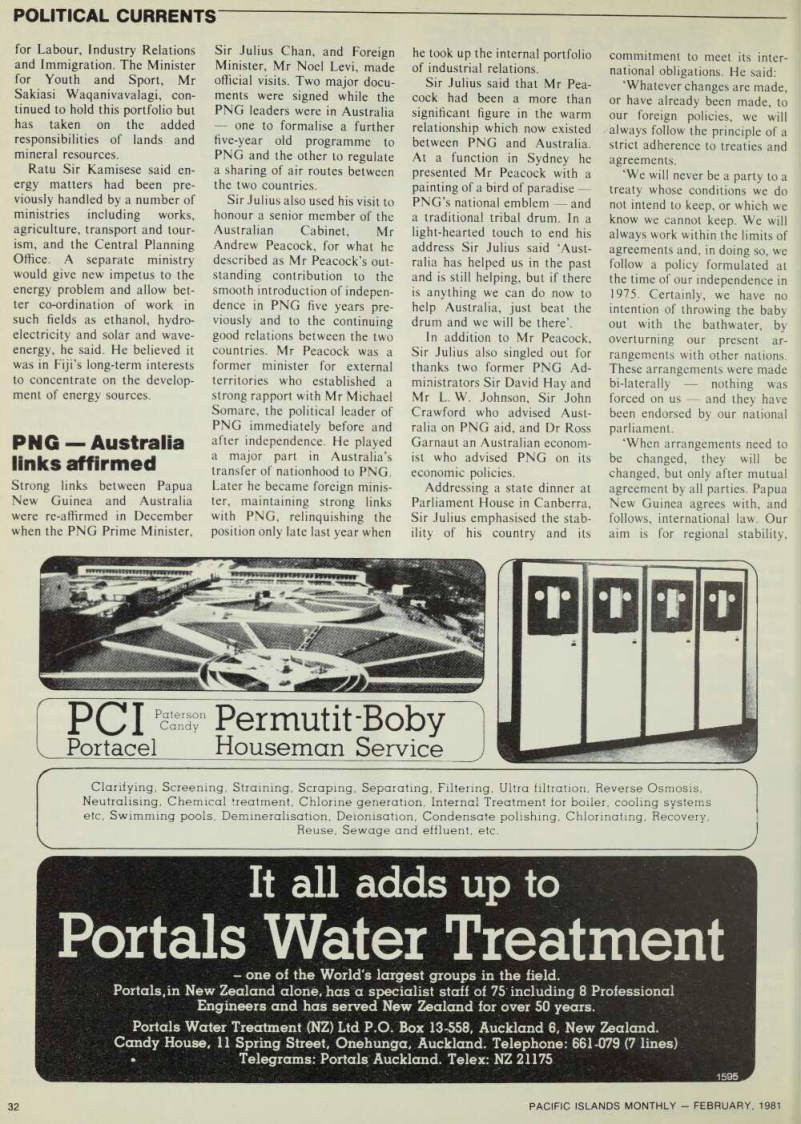
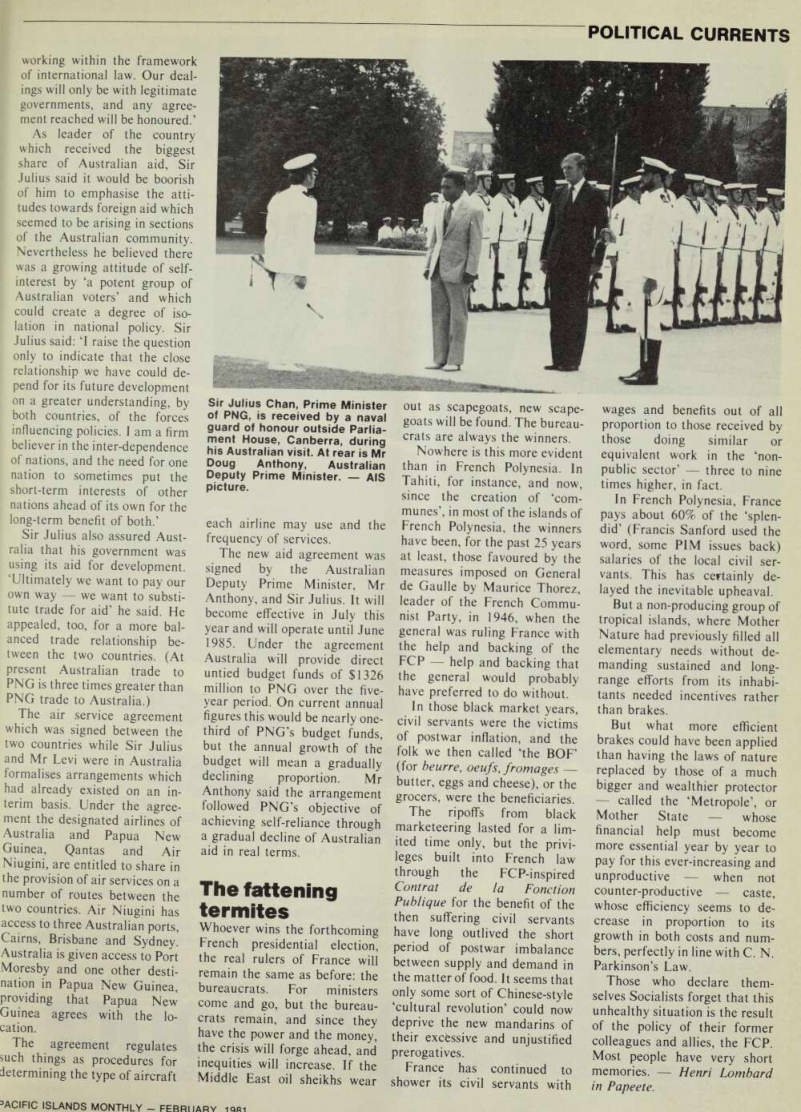
Currents
Solomons could
get president
The new coalition government in Solomon Islands has issued a manifesto to formalise its poli cies and to set down what it sees as the needs of the country and the people. One of the most contentious issues in the mani festo is the possibility of a constitutional change under which Queen Elizabeth, titular head of the Commonwealth of Nations would no longer be titular head of state of Solomon Islands. Under the proposal Solomon Islands would retain its present parliamentary struc ture but would recognise a ‘ceremonial president’ of its own as head of state. The president would be elected by parliament, but effective power would remain with the prime minister and his government as at present. The government said that it was not committed to the suggested change, but was putt ing forward the proposal as part of natural constitutional evol ution. The people would be fully consulted before any change was considered. The manifesto does not indicate the method of consultation referendum or electorate inquiries which the government would be likely to employ in seeking public opinion.
The manifesto is divided into matters which the government will examine or review and matters to which it has commit ted itself. Seven policy sections are involved. They are the system of government and ad ministration, the development of human resources, the devel opment of the people them selves as communities and indi viduals, the use of natural resources, commercial and in dustrial development, regional co-operation to develop national unity, and foreign relations.
Matters to which the govern ment has committed itself in clude the encouragement of
trade unionism, the creation of a reserve bank as the central control of money and exchange, the creation of a national invest ment board to encourage and regulate investment from all sources and a revision of land ownership and titles. The government also plans to review its media legislation but on lines which superficially conflict. On the one hand it plans legislation to ensure that the press and radio are unbiased and free, but on the other it plans legislation to censor or ban what it calls ‘undesirable’ publications.
The manifesto indicates that firmer measures will be adopted to ensure that the economy is vested in Solomon Islands citi zens to the greatest possible degree.
In its efforts to formalise land ownership and registration of ownership the government plans to establish a register of tribal groups equated to land ownership and land customs.
The government also plans re views of the police force, the housing authority, the edu cation system, the public trans port system and the lending policies of the development bank.
Fiji ministry is
changed
The Fiji Prime Minister, Ratu Sir Kamisese Mara, reshuffled his Cabinet in mid-January to make way for a new ministry which will deal with existing and alternative forms of energy.
The Minister for Energy under the new arrangement will be Mr Bill Clark who had held the land and minerals portfolio. He will lead efforts to develop new sources of energy from hydro schemes, ethanol, solar power and sea-wave power.
In the reshuffle, six of Ratu Sir Kamisese’s ministers changed their portfolios. Ratu David Toganivalu left the labour portfolio to become Min ister for Commerce and Indus try, replacing Mr Mohammed Ramzan. Mr Ramzan became Minister for Health.
The Minister who formerly held the health portfolio, Mr Ted Beddoes, became Minister for Tourism, Transport and Civil Aviation. He took over from Mr Tomasi Vakatora who has become the new Minister
for Labour, Industry Relations and Immigration. The Minister for Youth and Sport, Mr Sakiasi Waqanivavalagi, con tinued to hold this portfolio but has taken on the added responsibilities of lands and mineral resources.
Ratu Sir Kamisese said en ergy matters had been pre viously handled by a number of ministries including works, agriculture, transport and tour ism, and the Central Planning Office. A separate ministry would give new impetus to the energy problem and allow bet ter co-ordination of work in such fields as ethanol, hydro electricity and solar and wave energy, he said. He believed it was in Fiji’s long-term interests to concentrate on the develop ment of energy sources.
PNG Australia
links affirmed
Strong links between Papua New Guinea and Australia were re-affirmed in December when the PNG Prime Minister,
Sir Julius Chan, and Foreign Minister, Mr Noel Levi, made official visits. Two major docu ments were signed while the PNG leaders were in Australia one to formalise a further five-year old programme to PNG and the other to regulate a sharing of air routes between the two countries.
Sir Julius also used his visit to honour a senior member of the Australian Cabinet, Mr Andrew Peacock, for what he described as Mr Peacock’s out standing contribution to the smooth introduction of indepen dence in PNG five years pre viously and to the continuing good relations between the two countries. Mr Peacock was a former minister for external territories who established a strong rapport with Mr Michael Somare, the political leader of PNG immediately before and after independence. He played a major part in Australia’s transfer of nationhood to PNG.
Later he became foreign minis ter, maintaining strong links with PNG, relinquishing the position only late last year when
he took up the internal portfolio of industrial relations.
Sir Julius said that Mr Pea cock had been a more than significant figure in the warm relationship which now existed between PNG and Australia.
At a function in Sydney he presented Mr Peacock with a painting of a bird of paradise PNG’s national emblem and a traditional tribal drum. In a light-hearted touch to end his address Sir Julius said ‘Aust ralia has helped us in the past and is still helping, but if there is anything we can do now to help Australia, just beat the drum and we will be there’.
In addition to Mr Peacock, Sir Julius also singled out for thanks two former PNG Ad ministrators Sir David Hay and Mr L. W. Johnson, Sir John Crawford who advised Aust ralia on PNG aid, and Dr Ross Garnaut an Australian econom ist who advised PNG on its economic policies.
Addressing a state dinner at Parliament House in Canberra, Sir Julius emphasised the stab ility of his country and its
commitment to meet its inter national obligations. He said: ‘Whatever changes are made, or have already been made, to our foreign policies, we will always follow the principle of a strict adherence to treaties and agreements. ‘We will never be a party to a treaty whose conditions we do not intend to keep, or which we know we cannot keep. We will always work within the limits of agreements and, in doing so, we follow a policy formulated at the time of our independence in 1975. Certainly, we have no intention of throwing the baby out with the bathwater, by overturning our present ar rangements with other nations.
These arrangements were made bi-laterally nothing was forced on us and they have been endorsed by our national parliament. ‘When arrangements need to be changed, they will be changed, but only after mutual agreement by all parties. Papua New Guinea agrees with, and follows, international law. Our aim is for regional stability,
working within the framework of international law. Our deal ings will only be with legitimate governments, and any agree ment reached will be honoured.’
As leader of the country which received the biggest share of Australian aid, Sir Julius said it would be boorish of him to emphasise the atti tudes towards foreign aid which seemed to be arising in sections of the Australian community.
Nevertheless he believed there was a growing attitude of self interest by ‘a potent group of Australian voters’ and which could create a degree of iso lation in national policy. Sir Julius said: ‘I raise the question only to indicate that the close relationship we have could de pend for its future development on a greater understanding, by both countries, of the forces influencing policies. I am a firm believer in the inter-dependence of nations, and the need for one nation to sometimes put the short-term interests of other nations ahead of its own for the long-term benefit of both.’
Sir Julius also assured Aust ralia that his government was using its aid for development. ‘Ultimately we want to pay our own way we want to substi tute trade for aid’ he said. He appealed, too, for a more bal anced trade relationship be tween the two countries. (At present Australian trade to PNG is three times greater than PNG trade to Australia.) The air service agreement which was signed between the two countries while Sir Julius and Mr Levi were in Australia formalises arrangements which had already existed on an in terim basis. Under the agree ment the designated airlines of Australia and Papua New Guinea, Qantas and Air Niugini, are entitled to share in the provision of air services on a number of routes between the two countries. Air Niugini has access to three Australian ports, Cairns, Brisbane and Sydney.
Australia is given access to Port Moresby and one other desti nation in Papua New Guinea, providing that Papua New Guinea agrees with the lo cation.
The agreement regulates such things as procedures for determining the type of aircraft
each airline may use and the frequency of services.
The new aid agreement was signed by the Australian Deputy Prime Minister, Mr Anthony, and Sir Julius. It will become effective in July this year and will operate until June 1985. Under the agreement Australia will provide direct untied budget funds of $1326 million to PNG over the five year period. On current annual figures this would be nearly one third of PNG’s budget funds, but the annual growth of the budget will mean a gradually declining proportion. Mr Anthony said the arrangement followed PNG’s objective of achieving self-reliance through a gradual decline of Australian aid in real terms.
The fattening
termites
Whoever wins the forthcoming French presidential election, the real rulers of France will remain the same as before: the bureaucrats. For ministers come and go, but the bureau crats remain, and since they have the power and the money, the crisis will forge ahead, and inequities will increase. If the Middle East oil sheikhs wear
out as scapegoats, new scapegoats will be found. The bureaucrats are always the winners.
Nowhere is this more evident than in French Polynesia. In Tahiti, for instance, and now, since the creation of ‘communes’, in most of the islands of French Polynesia, the winners have been, for the past 25 years at least, those favoured by the measures imposed on General de Gaulle by Maurice Thorez, leader of the French Communist Party, in 1946, when the general was ruling France with the help and backing of the FCP help and backing that the general would probably have preferred to do without.
In those black market years, civil servants were the victims of postwar inflation, and the folk we then called ‘the BOF’ (for beurre, oeufs, fromages butter, eggs and cheese), or the grocers, were the beneficiaries.
The ripoffs from black marketeering lasted for a limited time only, but the privileges built into French law through the FCP-inspired Contrat de la Fonction Pubhque for the benefit of the then suffering civil servants have long outlived the short period of postwar imbalance between supply and demand in the matter of food. It seems that only some sort of Chinese-style cultural revolution’ could now deprive the new mandarins of their excessive and unjustified prerogatives.
France has continued to shower its civil servants with
wages and benefits out of all proportion to those received by those doing similar or equivalent work in the ‘non public sector’ three to nine times higher, in fact.
In French Polynesia, France pays about 60% of the ‘splen did’ (Francis Sanford used the word, some PIM issues back) salaries of the local civil ser vants. This has certainly de layed the inevitable upheaval.
But a non-producing group of tropical islands, where Mother Nature had previously filled all elementary needs without de manding sustained and long range efforts from its inhabi tants needed incentives rather than brakes.
But what more efficient brakes could have been applied than having the laws of nature replaced by those of a much bigger and wealthier protector called the ‘Metropole’, or Mother State whose financial help must become more essential year by year to pay for this ever-increasing and unproductive when not counter-productive caste, whose efficiency seems to de crease in proportion to its growth in both costs and num bers, perfectly in line with C. N.
Parkinson’s Law.
Those who declare them selves Socialists forget that this unhealthy situation is the result of the policy of their former colleagues and allies, the FCP.
Most people have very short
memories.
Henri Lombard
in Papeete.
Sir Julius Chan, Prime Minister of PNG, is received by a naval guard of honour outside Parlia ment House, Canberra, during his Australian visit. At rear is Mr Doug Anthony, Australian Deputy Prime Minister. AIS picture.
Advertisements & other items, pp. 32-34 (2 items)
Portals Water Treatment
PCI'
Portacel
Paterson Candy
?ermutit-Boby
douseman Service
Clarifying, Screening, Straining, Scraping, Separating, Filtering, Ultra filtration, Reverse Osmosis, Neutralising, Chemical treatment. Chlorine generation, Internal Treatment for boiler, cooling systems etc. Swimming pools, Demineralisation, Deionisation, Condensate polishing, Chlorinating, Recovery, Reuse, Sewage and effluent, etc.
It all adds up to
Portals Water Treatment
- one of the World's largest groups in the field.
Portals,in New Zealand alone, has a specialist staff of 75 including 8 Professional Engineers and has served New Zealand for over 50 years.
Portals Water Treatment (NZ) Ltd P.O. Box 13-558, Auckland 6, New Zealand.
Candy House, 11 Spring Street, Onehunga, Auckland. Telephone: 661-079 (7 lines) • Telegrams: Portals Auckland. Telex: NZ 21175 1595
IB m ■ ...
I % \ :: \ < ■ m m 9**°& <S& And if you’re between the ages of 19-34 and meet the minimum requirements of 173 cm tall, 67kg in weight and have a chest measurement of 91cm at least, you may apply to become a Police Officer.
For those that possess the right physical and mental requirements, a good work record and a satisfactory educational background the Police offer you a worthwhile and rewarding career with thorough training, the opportunity for promotion, and excellent starting salary with s leave iSiEf
SERVING THE COMMUNITY
NZ POLICE
superannuation benefits, generous leave (including sick leave with pay), free uniform, but above all we offer job security, satisfaction and comradeship in a necessary job helping society.
If you’re interested, we would like to talk it over with you. Call at your nearest Police Station for further details
WE WANT THE BEST
L82593AC
3 Acific Islands Monthly February 1Q«1
POLITICAL CURRENTS
Beobfe
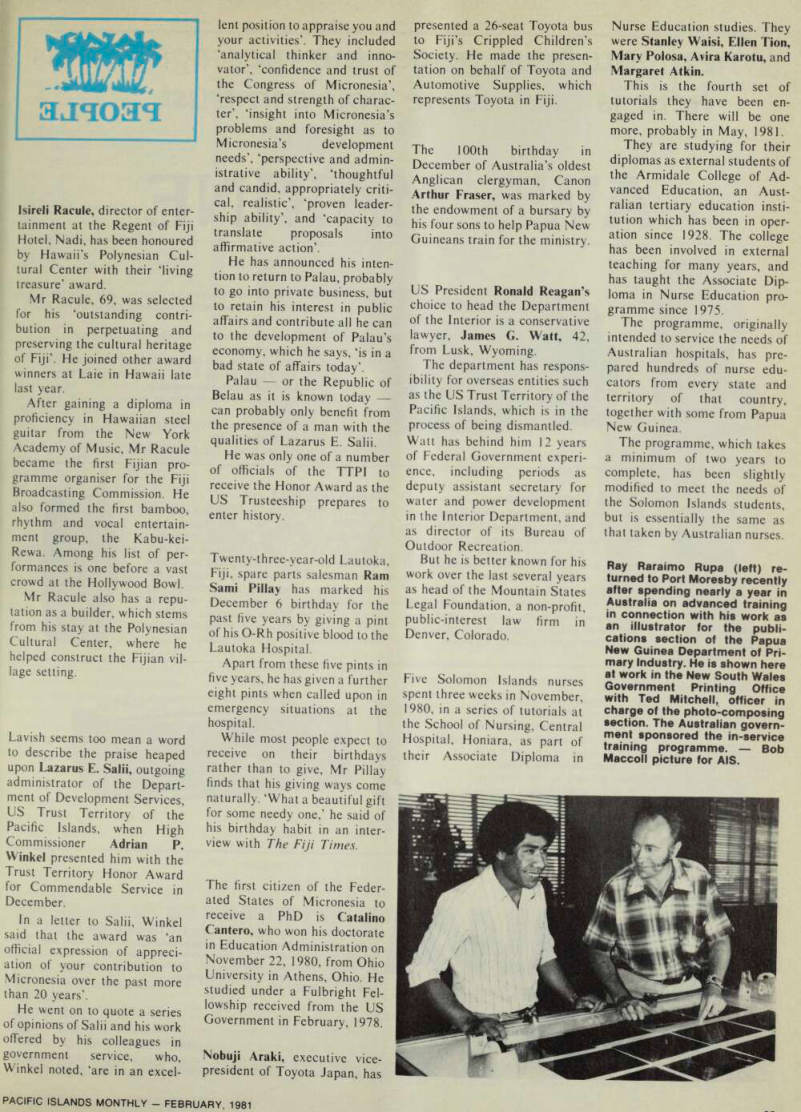
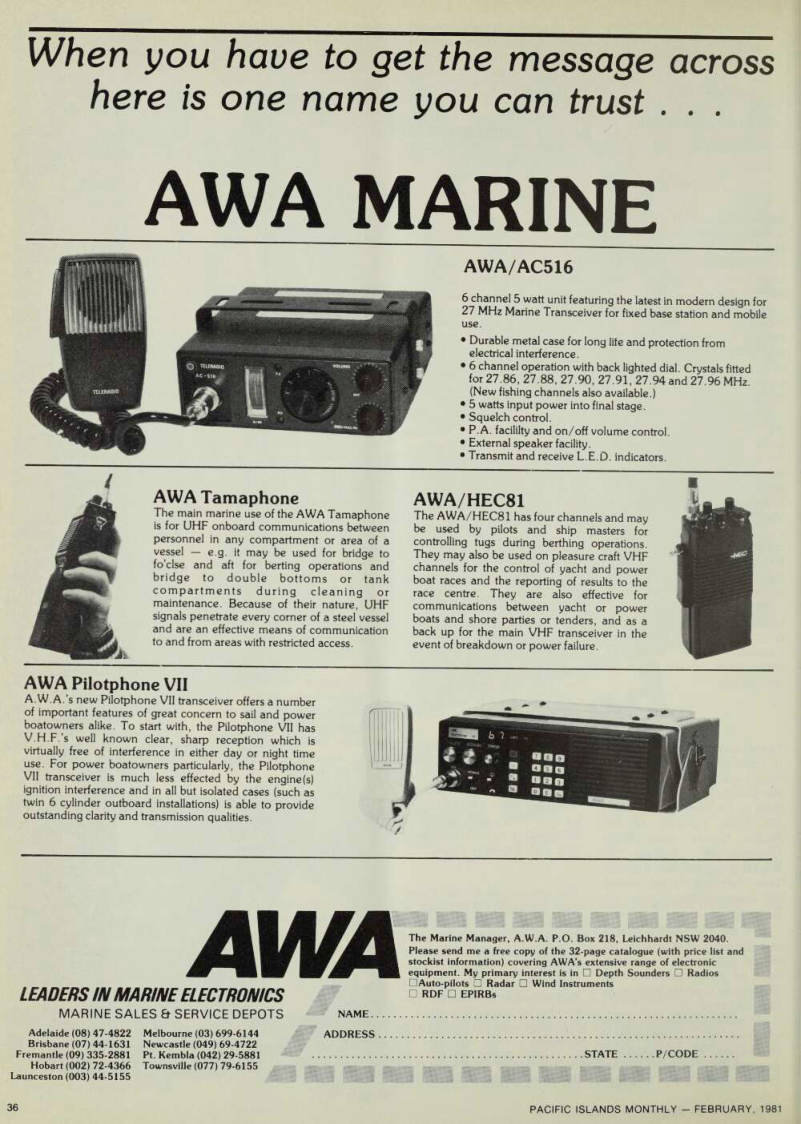
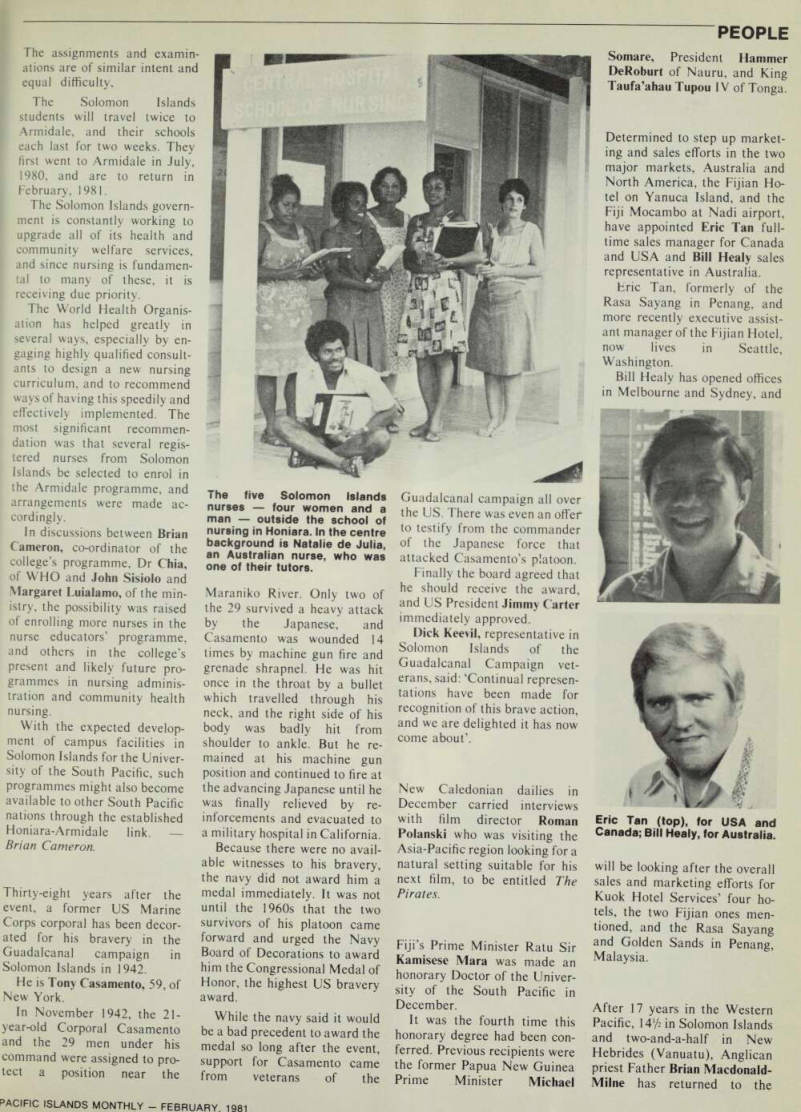
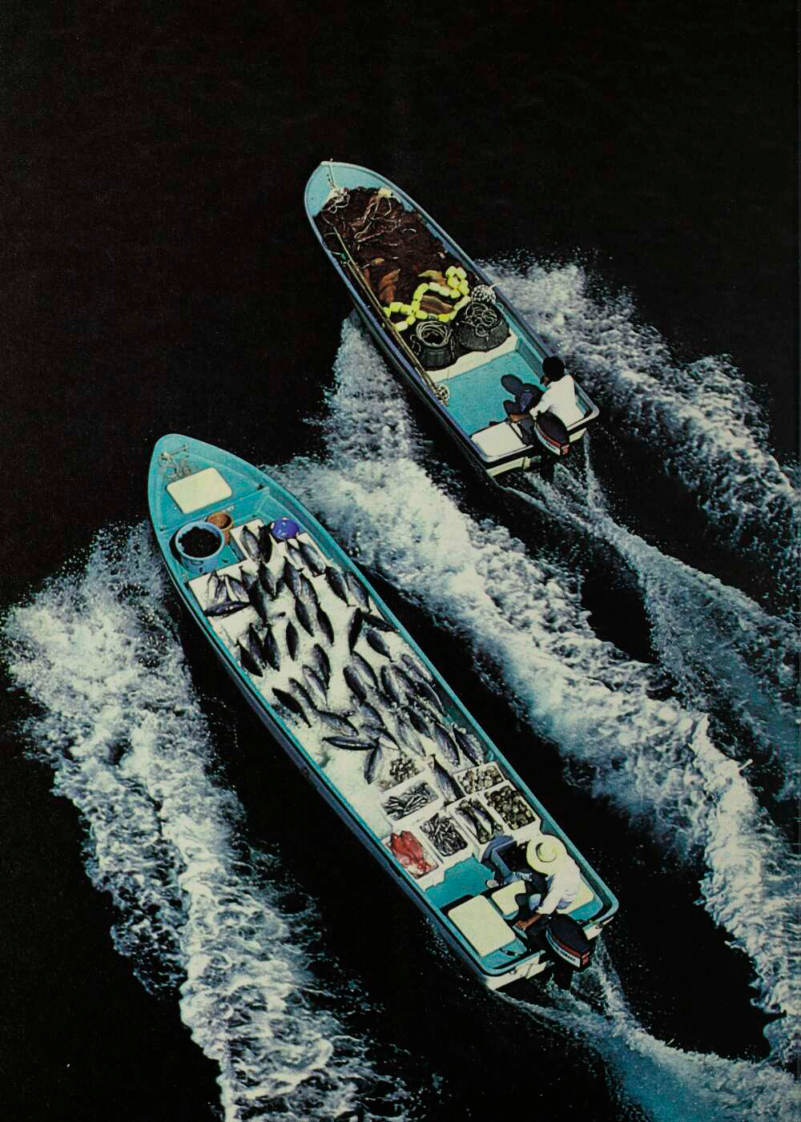
Isireli Racule, director of enter tainment at the Regent of Fiji Hotel, Nadi, has been honoured by Hawaii’s Polynesian Cul tural Center with their ‘living treasure’ award.
Mr Racule, 69, was selected for his ‘outstanding contri bution in perpetuating and preserving the cultural heritage of Fiji’. He joined other award winners at Laie in Hawaii late last year.
After gaining a diploma in proficiency in Hawaiian steel guitar from the New York Academy of Music, Mr Racule became the first Fijian pro gramme organiser for the Fiji Broadcasting Commission. He also formed the first bamboo, rhythm and vocal entertain ment group, the Kabu-kei- Rewa. Among his list of per formances is one before a vast crowd at the Hollywood Bowl.
Mr Racule also has a repu tation as a builder, which stems from his stay at the Polynesian Cultural Center, where he helped construct the Fijian vil lage setting.
Lavish seems too mean a word to describe the praise heaped upon Lazarus E. Salii, outgoing administrator of the Depart ment of Development Services, US Trust Territory of the Pacific Islands, when High Commissioner Adrian P.
Winkel presented him with the Trust Territory Honor Award for Commendable Service in December.
In a letter to Salii, Winkel said that the award was ‘an official expression of appreci ation of your contribution to Micronesia over the past more than 20 years’.
He went on to quote a series of opinions of Salii and his work offered by his colleagues in government service, who, Winkel noted, ‘are in an excel
lent position to appraise you and your activities’. They included ‘analytical thinker and inno vator’, ‘confidence and trust of the Congress of Micronesia’, ‘respect and strength of charac ter’, ‘insight into Micronesia’s problems and foresight as to Micronesia’s development needs’, ‘perspective and admin istrative ability’, ‘thoughtful and candid, appropriately criti cal, realistic’, ‘proven leader ship ability’, and ‘capacity to translate proposals into affirmative action’.
He has announced his inten tion to return to Palau, probably to go into private business, but to retain his interest in public affairs and contribute all he can to the development of Palau’s economy, which he says, ‘is in a bad state of affairs today’.
Palau — or the Republic of Belau as it is known today — can probably only benefit from the presence of a man with the qualities of Lazarus E. Salii.
He was only one of a number of officials of the TTPI to receive the Honor Award as the US Trusteeship prepares to enter history.
Twenty-three-year-old Lautoka,
Fiji, spare parts salesman Ram Sami Pillay has marked his December 6 birthday for the past five years by giving a pint of his O-Rh positive blood to the Lautoka Hospital.
Apart from these five pints in five years, he has given a further eight pints when called upon in emergency situations at the hospital.
While most people expect to receive on their birthdays rather than to give, Mr Pillay finds that his giving ways come naturally. ‘What a beautiful gift for some needy one,’ he said of his birthday habit in an inter view with The Fiji Times.
The first citizen of the Feder ated States of Micronesia to receive a PhD is Catalino Cantero, who won his doctorate in Education Administration on November 22, 1980, from Ohio University in Athens, Ohio. He studied under a Fulbright Fel lowship received from the US Government in February, 1978.
Nobuji Araki, executive vice president of Toyota Japan, has
presented a 26-seat Toyota bus to Fiji’s Crippled Children’s Society. He made the presen tation on behalf of Toyota and Automotive Supplies, which represents Toyota in Fiji.
The 100th birthday in December of Australia’s oldest Anglican clergyman, Canon Arthur Fraser, was marked by the endowment of a bursary by his four sons to help Papua New Guineans train for the ministry.
US President Ronald Reagan’s choice to head the Department of the Interior is a conservative lawyer, Janies G. Watt, 42, from Lusk, Wyoming.
The department has respons ibility for overseas entities such as the US Trust Territory of the Pacific Islands, which is in the process of being dismantled.
Watt has behind him 12 years of Federal Government experi ence, including periods as deputy assistant secretary for water and power development in the Interior Department, and as director of its Bureau of Outdoor Recreation.
But he is better known for his work over the last several years as head of the Mountain States Legal Foundation, a non-profit, public-interest law firm in Denver, Colorado.
Five Solomon Islands nurses spent three weeks in November, 1980, in a series of tutorials at the School of Nursing, Central Hospital, Honiara, as part of their Associate Diploma in
Nurse Education studies. They were Stanley Waisi, Ellen Tion, Mary Polosa, Avira Karotu, and Margaret Atkin.
This is the fourth set of tutorials they have been en gaged in. There will be one more, probably in May, 1981.
They are studying for their diplomas as external students of the Armidale College of Ad vanced Education, an Aust ralian tertiary education insti tution which has been in oper ation since 1928. The college has been involved in external teaching for many years, and has taught the Associate Dip loma in Nurse Education pro gramme since 1975.
The programme, originally intended to service the needs of Australian hospitals, has pre pared hundreds of nurse edu cators from every state and territory of that country, together with some from Papua New Guinea.
The programme, which takes a minimum of two years to complete, has been slightly modified to meet the needs of the Solomon Islands students, but is essentially the same as that taken by Australian nurses.
Ray Raraimo Rupa (left) re turned to Port Moresby recently after spending nearly a year in Australia on advanced training in connection with his work as an illustrator for the publi cations section of the Papua New Guinea Department of Pri mary Industry. He is shown here at work in the New South Wales Government Printing Office with Ted Mitchell, officer in
charge of the photo-composing
section. The Australian govern ment sponsored the in-service training programme. Bob
Maccoll picture for AIS.
The assignments and examin ations are of similar intent and equal difficulty.
The Solomon Islands students will travel twice to Armidale, and their schools each last for two weeks. They first went to Armidale in July, 1980, and are to return in February, 1981.
The Solomon Islands govern ment is constantly working to upgrade all of its health and community welfare services, and since nursing is fundamen tal to many of these, it is receiving due priority.
The World Health Organis ation has helped greatly in several ways, especially by en gaging highly qualified consult ants to design a new nursing curriculum, and to recommend ways of having this speedily and effectively implemented. The most significant recommen dation was that several regis tered nurses from Solomon Islands be selected to enrol in the Armidale programme, and arrangements were made ac
cordingly.
In discussions between Brian Cameron, co-ordinator of the college’s programme, Dr Chia, of WHO and John Sisiolo and Margaret Luialamo, of the min istry, the possibility was raised of enrolling more nurses in the nurse educators’ programme, and others in the college’s present and likely future pro grammes in nursing adminis tration and community health nursing.
With the expected develop ment of campus facilities in Solomon Islands for the Univer sity of the South Pacific, such programmes might also become available to other South Pacific nations through the established Honiara-Armidale link.
Brian Cameron.
Thirty-eight years after the event, a former US Marine Corps corporal has been decor ated for his bravery in the Guadalcanal campaign in Solomon Islands in 1942.
He is Tony Casamento, 59, of New York.
In November 1942, the 21year-old Corporal Casamento and the 29 men under his command were assigned to pro tect a position near the
Maraniko River. Only two of the 29 survived a heavy attack by the Japanese, and Casamento was wounded 14 times by machine gun fire and grenade shrapnel. He was hit once in the throat by a bullet which travelled through his neck, and the right side of his body was badly hit from shoulder to ankle. But he re mained at his machine gun position and continued to fire at the advancing Japanese until he was finally relieved by re inforcements and evacuated to a military hospital in California.
Because there were no avail able witnesses to his bravery, the navy did not award him a medal immediately. It was not until the 1960 s that the two survivors of his platoon came forward and urged the Navy Board of Decorations to award him the Congressional Medal of Honor, the highest US bravery award.
While the navy said it would be a bad precedent to award the medal so long after the event, support for Casamento came from veterans of the
Guadalcanal campaign all over the US. There was even an offer to testify from the commander of the Japanese force that attacked Casamento’s platoon.
Finally the board agreed that he should receive the award, and US President Jimmy Carter immediately approved.
Dick Keevil, representative in Solomon Islands of the Guadalcanal Campaign vet erans, said: ‘Continual represen tations have been made for recognition of this brave action, and we are delighted it has now come about’.
New Caledonian dailies in December carried interviews with film director Roman Polanski who was visiting the Asia-Pacific region looking for a natural setting suitable for his next film, to be entitled The Pirates.
Fiji’s Prime Minister Ratu Sir Kamisese Mara was made an honorary Doctor of the Univer sity of the South Pacific in December.
It was the fourth time this honorary degree had been con ferred. Previous recipients were the former Papua New Guinea Prime Minister Michael
Determined to step up market ing and sales efforts in the two major markets, Australia and North America, the Fijian Ho tel on Yanuca Island, and the Fiji Mocambo at Nadi airport, have appointed Eric Tan full time sales manager for Canada and USA and Bill Healy sales representative in Australia.
Uric Tan, formerly of the Rasa Sayang in Penang, and more recently executive assist ant manager of the Fijian Hotel, now lives in Seattle, Washington.
Bill Healy has opened offices in Melbourne and Sydney, and
will be looking after the overall sales and marketing efforts for Kuok Hotel Services’ four ho tels, the two Fijian ones men tioned, and the Rasa Sayang and Golden Sands in Penang, Malaysia.
After 17 years in the Western Pacific, 14'/2 in Solomon Islands and two-and-a-half in New Hebrides (Vanuatu), Anglican priest Father Brian Macdonald- Milne has returned to the
The five Solomon Islands nurses four women and a man outside the school of nursing in Honiara. In the centre background is Natalie de Julia, an Australian nurse, who was one of their tutors.
Somare, President Hammer Deoburt of Nauru, and King Taufa’ahau Tupou IV of Tonga.
Eric Tan (top), for USA and Canada; Bill Healy, for Australia.
United Kingdom. His new mission? To edit and write various books for the Pacific Islands which he was unable to finish while working as co ordinator of the Pacific Churches Research Centre in Port-Vila, Vanuatu. The centre is an agency of the Pacific Conference of Churches which Fr Macdonald Milne was asked to establish in 1978.
His work as co-ordinator of the centre was taken over in January by Father Xavier Zewen, a Catholic priest from Luxembourg, who has been working as a linguist in the Marshall and Caroline Islands of Micronesia for a number of years.
Other staff of the centre will be the administrative secretary, Mrs Idau Nafuki (from Papua New Guinea), and her husband, Pastor Allen Nafuki (from Vanuatu), who is attached to the centre by the Vanuatu Christian Council as a co ordinator of its national pro gramme of research.
Peter F. Fetchko, an ethnologist who specialises in the peoples and cultures of the Pacific, has been appointed director of the Peabody Museum of Salem in the US State of Massachusetts.
Mr Fetchko, who specialised in Pacific cultures while at the Sorbonne, Paris, is a US citizen who has been associated with the Peabody Museum for 12 years. He has been assistant director since 1977 and has worked with the museum’s ex tensive Pacific Islands collec tion.
‘Froggie’ Daly, for many years a ministering angel to countless French-speaking patients at Royal Prince Alfred Hospital, Sydney (PIM Jul 1979 p 75), has been decorated by the government of France for her extraordinary work.
At a ceremony late last year at the French Consulate- General in Sydney, beneath a bust of the explorer Laperouse, Froggie received a decoration making her a Knight of the National Order of Merit.
The French Consul-General, Mr Jacques Dircks-Dilly, con ferred the honour before a group of about 30 well-wishers, who then toasted her health naturally, in French cham pagne.
Froggie has become a fam iliar and beloved figure around the hospital and her kind face, gentle manner and great patience have made her a great favourite with New Caledonian patients, many of whom speak virtually no English.
At 74, she is much more than a voluntary interpreter: she accompanies patients to special ists, meets and farewells them at the airport. Froggie is often on hand at 6.30 am to calm and reassure patients about to be operated on. ‘Sometimes, she has to be persuaded to go home at all,’ said Mrs Betty McKim, Volun teer Co-ordinator.
Froggie Daly herself came from New Caledonia, and first arrived in Australia at the age of 16, with her French mother and Irish father. She spoke no
English. Tragically, her father died the year after they arrived.
She has, over the years, been interpreter for many doctors, including Sir Kempson Maddox.
In his eloquent address, Mr Dircks-Dilly referred to her invaluable contribution to the welfare of New Caledonian patients, who, despite the excel lent care afforded them by doctors and nurses are often apprehensive because of language difficulties.
The presence of Froggie Daly and the incalculable benefits she brings to the RPAH prove that, despite the prodigious technology, miraculous com puterisation and mammoth in fusions of funds, no modern hospital functions effectively, or even satisfactorily, without the compassion and warmth that can be transmitted from one human being to another. Con gratulations Froggie! With acknowledgements to Pace maker, staff news sheet of the RPAH. Sydney.
Air Pacific’s assistant general manager Kit Naidu has been named manager Australia, and Solomon Beg will now head up the Air Pacific operation in New Zealand.
Mr Naidu will be head quartered at the new Air Pacific offices in Sydney while Mr Beg will be stationed in Auckland.
These are among changes announced by the airline’s deputy general manager Akuila Savu.
Mr Savu said that Mr
Naidu’s new assignment under scores the extreme importance the Australian market holds for Air Pacific.
Mr Beg will be managing the New Zealand operation with a Christchurch service probably beginning in October added to the airline’s Auckland desti nation.
Other changes announced by Mr Savu were: • Edward Bower, formerly cabin services superintendent has been named manager Fiji. • Kolinio Kama, previously Tonga manager, is now man ager East Pacific which in cludes Tahiti, Tonga, the Cook Islands, Western Samoa and American Samoa. • Philip Pandaram, formerly traffic controller Nausori, is now airport services manager. • Eparama Qaranivalu, for merly customer relations man ager in Brisbane, has been named traffic controller Nausori. • Vijend Prasad, formerly tariffs controller, is now sales services manager. • Taniela Bolea, formerly a systems specialist with the Carpenter Group, has been appointed systems manager in corporate planning. • Bob Hills, a Qantas auditor, has been named financial con troller for the airline.
These appointments were effective December 1 1980 while the following were effective early in 1981: • Bal Krishna, a public service commission employee, has been named training and manpower planning officer. • Emelita Wendt, editor of The Fiji Beach Press, has been named public relations and in formation officer.
The changes reflect the criti cal challenges Air Pacific will
Brian Macdonald-Milne
Froggie Daly - ‘a familiar and much-loved figure’ at her investiture. With her are Betty McKim, co-ordinator of volun teers and Jacques Dircks-Dilly, French Consul-General.
need to meet in the 1980 s including the introduction of new equipment and routes, said Mr Savu, and these appoint ments are among those that will be made to meet these chal lenges.
Gerald Barrack has been named chairman of the board of Burns Philp (South Sea) Co Ltd. He replaces Charles Wardrop who has retired, after four years as chairman and 14 years as a director. Mr Wardrop made a major contribution in developing the company’s motor division. As well as occu-
pying his new post, Mr Barrack is president of the Fiji Em ployers’ Consultative Associ ation and deputy chairman of Fiji’s Economic Development Board.
A wide range of honours for public service to Pacific Island communities is contained in this year’s New Year honours lists which were announced from Buckingham Palace in London by Queen Elizabeth. In ad dition to the three knighthoods which went to Pacific Island leaders (see Pacific Report in this issue), other awards were made to men and women from Pacific Island countries for ser vice to their own communities and several awards were made to citizens of Australia, New Zealand and UK for service to Pacific Island communities.
The awards are (CMG, Com panion of the Order of St Michael and St George; CBE, Commander of the Order of the British Empire; OBE, Officer of the Order of the British Empire; MBE, Member of the Order of the British Empire; BEM, British Empire Medal; ISO,
Imperial Service Order; QPM, Queen’s Police Medal for Dis tinguished Service):
Australian List. Mr
Stuart Inder of Sydney, who retired last year as chief execu tive of Pacific Publications, publishers of PIM, was made an MBE for services to journalism.
Mr Inder, a former editor and publisher of PIM for many years, is still associated with the company as associate editor, book publishing.
New Zealand List.
The Rev Francis George McKean, of Pokeno in New Zealand, was made an OBE for services to the community in Tonga, Vanuatu, Papua New Guinea and Solomon Islands.
Over the past eight years Mr McKean, who is a Baptist minister, has organised aid proj ects from New Zealand to help hospitals, libraries, schools and village projects in Pacific Island communities.
United Kingdom
LIST. Mr A.F. Ward, the deputy high commissioner at the British High Commission in Fiji was made an OBE. He has been a member of the British diplomatic service for 31 years.
Papua New Guinea
LIST. CMG: Mr Sevese Morea, Speaker of the National Parlia ment, who has a long record of service in local government and national politics and who was once an announcer, commen tator and news reader trained by the Australian Broadcasting Commission. CBE; Dr Gabriel Gris, a former dental health administrator, vice-chancellor of the University of PNG, and now director of the South Pacific Bureau for Economic Co-operation, based in Fiji; Mr lambakey Okuk, deputy prime minister and one of the most controversial figures in PNG politics. OBE: Mr W.H. Clark, an Australian now living in Sydney who helped to establish the national banking structure in PNG; Mr Israel Edom, for several years director of posts and telegraphs and now chair man of the public service board; Mr R. Robertson, formerly from Scotland, who became official secretary to the PNG Governor general; Mr A.O. Maino, magis trate and ombudsman; Mr Mali Voi, who directed last year’s highly-successful South Pacific
Arts Festival in PNG; Mr Matiabe Yuwi, a national parlia mentarian with a long record of electorate service. MBE: Mr Hugo Berghuser, who came from Germany and is now a PNG citizen, and who has been active in the Port Moresby business community and in schemes for youth and rural development; Mr J.K. Apau, assistant commissioner for cor rective services; Chief Superin tendent A. Gawi of the Royal Papua New Guinea Constabu lary; Mr M. Kalup, recognised for his services to community development; Mrs B. Ketauwo, one of the few PNG women although the numbers are in creasing who have been active in the business com munity; Miss N.F. Lutton, an Australian now living in West ern Australia, who helped ex pand library services in PNG; Mr Jim MacKinnon, a former PNG member of parliament who came to the Sepik River area as an Australian settler nearly 30 years ago and has since become closely involved in village communities and their development; Mr G. Masa, a member of the national parlia ment; Mrs E. Pita, long in volved in women’s community affairs; Mr A. Turmurang, a community spokesman with a long record of community lead ership; Mr F.N. Warner Shand, a former Australian govern ment officer in PNG who estab lished a legal practice in Rabaul more than 20 years ago and who has been recognised for service to law. Military MBE: Chief Warrant Officer K.P. Peni of the PNG Defence Force. BEM: Mr J. Bari, corrective services officer; Mr A. Base, driver to the Prime Minister; Mr K. Heni, public service officer; Sgt- Major H.W. Naiawi, Royal Papua New Guinea Constabu lary; Mr P. Namba, aid post orderly; Mr H.M.O. Omat, medical orderly. Military BEM: Corporal G. Pilol, Corporal R.
Toge, Lance-corporal W. Yasi, all of the PNG Defence Force.
ISO: Mr N.W. Paulius, admin istrative secretary of East New Britain province.
Fiji List. Cbe: Mr L.J.
Gardiner, comptroller of cus toms and excise, for long service to the public service of Fiji.
OBE: Mr T.M. Biumaiwai, for
service to health and sport; Mr R.D. Dods, secretary for tour ism, transport and civil avi ation; Mr K.P. Sharma, deputy registrar of the Supreme Court.
MBE: Mr J.E. Beddmves, ser vice to the community; Mr M. Khan, service to the com munity; Mr S. Nayate, service to the community; Mr W.R.
Suliwaliwa, service to the com munity. Military MBE: War rant Officer I. Buadromo, Royal Fiji Military Forces. BEM: Mr I.N. Daveta, public service; Chief Fire Officer H.J.
Henderson, Suva Fire Brigade, Mr R.D. Mishra, public service; Mr R. Prasad, community ser vice. Military BEM: Chief Petty Officer W.R. Nakabea, Royal Fiji Military Forces.
QPM: Superintendent M.H.
Moore, communications ad viser; Senior Superintendent N. Panikar. ISO: Mr S.S.
Vadigar, principal collector cus toms and excise.
Tuvalu List. Obe; Mr
A. McDonald, administrative secretary. MBE; Mr T.
Manuella, public service. BEM: Mrs K. Malua, service to women’s organisations; Mr T.
Teuka, magistrate.
Solomon Islands
LIST. CMC: The Rt Rev Norman Palmer, Archbishop of the Church of Melanesia, a former school teacher and head master who was educated in New Zealand and has been associated with education and the church in Solomon Islands for many years. MBE: Mr Emilio Bulu, the government officer who organised last year’s general election as secretary to the Electoral Commission; Mr George Lepping, a chief field officer with the ministry of agriculture who has been associ ated with the development of sport and village agricultural projects; Mrs Lilly Poznanski, who was the first Solomon Island woman to be a member of parliament and who is now chief administrative officer of the national parliament. BEM: Mrs Mary Makini, a volunteer worker for the Red Cross who established a centre for handi capped children in Honiara; Mr John Baptist Tura, a former warden of Honiara Technical Institute who has been active in community service and is now a teacher in the Russell Islands.
Gerald Barrack
Advertisements & other items, pp. 36-43 (3 items)
Awa Marine
When you have to get the message across here is one name you can trust . . .
I
AWA/ACSI6
6 channel 5 watt unit featuring the latest in modern design for 27 MHz Marine Transceiver for fixed base station and mobile use. • Durable metal case for long life and protection from electrical interference. • 6 channel operation with back lighted dial. Crystals fitted for 27.86, 27.88, 27.90, 27.91, 27.94 and 27.96 MHz. (New fishing channels also available.) • 5 watts input power into final stage. • Squelch control. • P.A. facililty and on/off volume control. • External speaker facility. • Transmit and receive L.E.D. indicators.
AWA Tamaphone
The main marine use of the AWA Tamaphone is for UHF onboard communications between personnel in any compartment or area of a vessel e.g. it may be used for bridge to fo’clse and aft for berting operations and bridge to double bottoms or tank compartments during cleaning or maintenance. Because of their nature, UHF signals penetrate every corner of a steel vessel and are an effective means of communication to and from areas with restricted access.
AWA/HECBI
The AWA/HECBI has four channels and may be used by pilots and ship masters for controlling tugs during berthing operations.
They may also be used on pleasure craft VHF channels for the control of yacht and power boat races and the reporting of results to the race centre. They are also effective for communications between yacht or power boats and shore parties or tenders, and as a back up for the main VHF transceiver in the event of breakdown or power failure.
AWA Filotphone VII
A.W.A.’s new Filotphone VII transceiver offers a number of important features of great concern to sail and power boatowners alike. To start with, the Filotphone VII has V.H.F.’s well known clear, sharp reception which is virtually free of interference in either day or night time use. For power boatowners particularly, the Filotphone VII transceiver is much less effected by the engine(s) ignition interference and in all but isolated cases (such as twin 6 cylinder outboard installations) is able to provide outstanding clarity and transmission qualities.
AWA
LEADERS IN MARINE ELECTRONICS
MARINE SALES & SERVICE DEPOTS
Adelaide (08) 47-4822 Brisbane (07) 44-1631 Fremantle (09) 335-2881 Hobart (002) 72-4366 Launceston (003) 44-5155 Melbourne (03) 699-6144 Newcastle (049) 69-4722 Pt. Kembla (042) 29-5881 Townsville (077) 79-6155
NAME. .
ADDRESS
The Marine Manager, A.W.A. P.O. Box 218, Leichhardt NSW 2040.
Please send me a free copy of the 32-page catalogue (with price list and stockist information) covering AWA’s extensive range of electronic equipment. My primary interest is in □ Depth Sounders □ Radios □ Auto-pilots □ Radar □ Wind Instruments
□ RDF □ EPIRBs
STATE P/CODE
\ i X i \ 'Jfi W f 9 ... r v> •r-', k 1i .*-* v r • •• • V- ✓ %m z S & * -x « •> 4t*S V :\ ■ * i a Ti W C? : > f. y. sV ■r V^. : ?• A •a ?
V
YAMAHA
LISTENS
As a newcomer to boat building 15 years ago, Yamaha had to listen carefully if they were to succeed in this terrifically competitive field.
And what they heard, they put into magnificent practice in their first FRP boat, a 19-ton tuna trawler.
Since then, Yamaha has grown into a major supplier of fishing and leisure craft by developing its FRP technology to an art and applying the latest computer design techniques to the centuries-old craft of hull building. Yamaha FRP boats are far lighter than conventional boats and only require a fraction of the power. They don’t rust, corrode or become waterlogged.
Maintenance is minimum and performance maximum.
In Japan, Yamaha builds fishing boats up to 60 tons, prize winning sailboats and dozens of different models for pleasure use. Abroad, as part of their intense involvement in local fishery operations, they have established boat factories in Mexico, Sri Lanka, Nigeria and other countries.
And everywhere you find Yamaha boats, outboards and marine diesels you’ll find fishermen netting more profit and pleasure boaters reaping more fun.
Yamaha boats. From the people who listen better to make life and leisure more rewarding. $ I * -
YAMAHA
s i/'f.
YAMAHA MOTOR CO., LTD. 2500 shingai iwata shi shizuoka-ken japan
$7490 KIT
,1 ; • < R ■ L
\ L 74 RUSSELL STREET, TOOWOOMBA,
4350. PHONE (076) 32 3411
Our home units come in kit form. Easy to transport anywhere. / / / / / / / J M
mum
AHI Aluminium Limited
MARKET LEADERS IN ALUMINIUM WINDOWS & DOORS
lAFisHer
Designers and manufacturers marketing a complete range of extrusions and components for fabrication of aluminium joinery products. wm t
ft t
V *
FOR FURTHER INFORMATION CONTACT
AHI ALUMINIUM FRANCHISING COMPANY
P.O. BOX 18299, AUCKLAND. NEW ZEALAND
TELEPHONE: 580 704 CABLES: AHIAL TELEX: 2222
1 - - , ■ - ■ ■■ sr. ■ ■; ZZ&v&s&a ■■ ■ ■■ ••,•••-/•- * **
Throughout the Pdcific...
we’re your kind of people
When you fly in the Pacific, you’ll feel at home with Air New Zealand.
Fly with us to Australia,Cook Islands, Fiji, Hong Kong,Honolulu, Japan, Los Angeles, New Caledonia, Norfolk Island, Singapore, Tahiti, Tonga, Western Samoa and, naturally, throughout New Zealand.
. .The Pacific’s
Number One
air neiu ZEatano
ANZ 80/18
People
’ACIFIC ISLANDS MONTHLY - FEBRUARY. 1981
People
3 ACIFIC ISLANDS MONTHLY FEBRUARY, 1981
books begins to flow
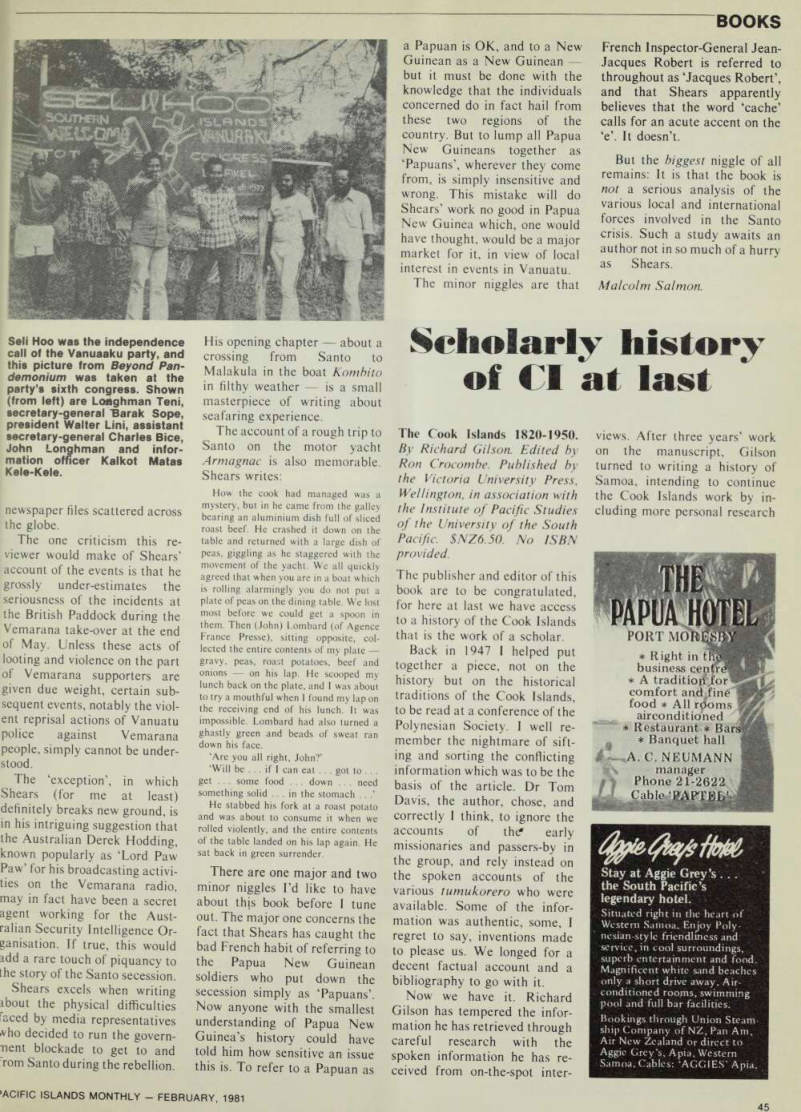
Books
Vanuatu: The tide of books begins to flow
Vanuatu. Published by Insti tute of Pacific Studies, Univer sity of the South Pacific, and the South Pacific Social Sci ences Association. No price or ISBN given. Beyond Pande monium From the New Hebrides to Vanuatu, By Father Walter Lini. Published by Asia Pacific Books, PO Box 3978, Wellington, New Zealand, in association with the Institute of Pacific Studies, University of the South Pacific, Suva. 5NZ6.95 (hardback), $4.50 (softback). ISBN 0 908583 12 5 (hbkj, ISBN 0 908583 13 3 (sbk). The Coconut War The Crisis on Espiritu Santo By Richard Shears. Published by Cassell Australia. Price
5A6.95. Isbn 0 7269 7866 3.
Pacific buff's who index their libraries will need to make a new entry under ‘V’, for the predictable flood of books on the new nation of Vanuatu is now well underway.
Of the three books under review, Vanuatu was the first to be published. Already noticed briefly in PIM (Sep 1980 plO), the book is a series of 21 essays, mainly by leading Vanuatuans, on separate aspects of the country’s affairs. Lands Minis ter Selhy Regenvanu writes on the land problem. President Ati George Sokomanu writes on government, Grace Molisa writes on women, Mildred Sope writes on the people, Godwin Ligo writes on custom and culture, and so on.
As the book is printed in Bislama, French and English, and runs to fewer than 300 pages, some of the articles are necessarily fairly short. But they provide indispensable basic information for all who intend to follow closely the fate of the new republic as it strives to move forward following its painful and difficult accession to independence.
The book was prepared by a team at the University of the South Pacific at the express request of Father Walter Lini, prime minister of Vanuatu, ‘as part of our independence cel ebrations’. He says of the book in a foreword: ‘lt is as if it were the last chapter of our people’s struggle for independence in the last 10 years.’
All concerned with the proj ect are to be congratulated on a generous and wholehearted re sponse to Fr Lini’s request. The work amounts to a basic hand book that will serve interested inquirers for a long time to come.
Beyond Pandemonium From the New Hebrides to Vanuatu, is a slighter, but still valuable, exercise.
Its 63 pages contain a brief autobiography by Fr Lini (tran scribed by his sister Hilda from his dictation into a tape re corder), and, following each chapter, essays by other people amplifying the subject matter just dealt with by him.
This arrangement makes for rather jerky reading. But in
view of the fact that Fr Lini’s picture of his career is painted with an extremely broad brush understandable in a man who has been subject to the kinds of pressures he has suffered in recent times some means had to be found to depict matters in a little more detail.
A valuable aspect of the autobiographical section is the way it traces the origins of the National Party (later the Vanuaaku Party) in such bodies as the New Hebrides Cultural Association, founded by Fr Lini, and other present-day ministers such as Education Minister Donald Kalpokas.
Such an evolution from bodies designed to foster national cultural awareness to full-fledged political parties is to be seen in the growth of independence movements in many parts of the world.
The autobiography also re cords Fr Lini’s misgivings about aspects of his theological and other studies in New Zealand: ‘Towards the end of 1968 life in Auckland grew more and more frustrating for me because I felt that the Western ways and influence were almost over whelming me. I think I got away from New Zealand just in time,’ he says at one point. And again; T began to grow uneasy about the way New Zealanders and Pacific Islanders were forced to learn theology, ethical principles, and philosophies, ideas which were completely foreign to us. I felt that it was wrong for me to pursue my theological studies in this way.’
Here, clearly, one can see the genesis of Fr Lini’s ideas about the ‘Pacific Way’, which, how ever vaguely they may be defined, serve as one of the mainsprings of his activity. If he did not learn in Auckland just what was the ‘Pacific Way’, he obviously developed quite strong ideas about what it was not.
The book is valuable for another reason; it gathers together important historical documents, such as Fr Lini’s 1976 address to the United
Nations Committee of 24 in New York (on decolonisation), George Kalkoa’s speech ‘Devel opment the Pacific Way’, de livered at the ceremony at which he received his presiden tial title of Ati George Sokomanu, and Fr Lini’s July 30, 1980 Independence Day speech.
The two works just described may be regarded as semi-official Vanuatu documents, although of course formally they are not official government statements.
But they are close enough to being so for them occasionally to contain elements of the ‘triumphalism’ and the minimising of difficulties which seem to characterise the state ments of governments of every stripe, and wherever they may be.
The Coconut War The Crisis on Espiritu Santo, on the other hand, is thoroughly ‘unofficial’. English journalist Richard Shears was sent to the then New Hebrides in 1980 to cover the secessionist crisis on the island of Santo for the London Daily Mail. Although press presentations of his book have described it as a ‘light hearted, tongue-in-cheek’ ac count of the events, Shears in fact has done quite a bit of homework and his book con tains useful background on the history of Vanuatu from the days of Pedro Fernandez de Quiros and his ill-fated ‘New Jerusalem’ settlement on Santo in 1606, through the condo minium period, up to the pres ent day.
His account of the secession ist crisis is pretty ‘straight’, and includes accounts of his several interviews with Jimmy Stevens at Fanafo. But with one exception it adds little to what has already been pub lished. Its chief service from this point of view is that it pulls together, in thoroughly read able form, a story which until now has been accessible only in
newspaper files scattered across the globe.
The one criticism this re viewer would make of Shears’ account of the events is that he grossly under-estimates the seriousness of the incidents at the British Paddock during the Vemarana take-over at the end of May. Unless these acts of looting and violence on the part of Vemarana supporters are given due weight, certain sub sequent events, notably the viol ent reprisal actions of Vanuatu police against Vemarana people, simply cannot be under stood.
The ‘exception’, in which Shears (for me at least) definitely breaks new ground, is in his intriguing suggestion that the Australian Derek Hodding, known popularly as ‘Lord Paw Paw’ for his broadcasting activi ties on the Vemarana radio, may in fact have been a secret agent working for the Aust ralian Security Intelligence Or ganisation. If true, this would add a rare touch of piquancy to the story of the Santo secession.
Shears excels when writing about the physical difficulties faced by media representatives *vho decided to run the govern ment blockade to get to and rom Santo during the rebellion.
His opening chapter about a
crossing from Santo to
Malakula in the boat Kombito in filthy weather is a small
masterpiece of writing about
seafaring experience.
The account of a rough trip to Santo on the motor yacht Armagnac is also memorable.
Shears writes:
How the cook had managed was a mystery, but in he came from the galley bearing an aluminium dish full of sliced roast beef. He crashed it down on the table and returned with a large dish of peas, giggling as he staggered with the movement of the yacht. We all quickly agreed that when you are in a boat which is rolling alarmingly you do not put a plate of peas on the dining table. We lost most before we could get a spoon in them. Then (John) Lombard (of Agence France Presse), sitting opposite, col lected the entire contents of my plate gravy, peas, roast potatoes, beef and onions on his lap. He scooped my lunch back on the plate, and I was about to try a mouthful when 1 found my lap on the receiving end of his lunch. It was impossible. Lombard had also turned a ghastly green and beads of sweat ran down his face. ‘Are you all right, John?’ ‘Will be ... if I can eat . . . got to . . . get some food . . . down . . . need something solid ... in the stomach . . .’
He stabbed his fork at a roast potato and was about to consume it when we rolled violently, and the entire contents of the table landed on his lap again. He sat back in green surrender.
There are one major and two
minor niggles I’d like to have
about thjs book before I tune
out. The major one concerns the
fact that Shears has caught the
bad French habit of referring to
the Papua New Guinean
soldiers who put down the
secession simply as ‘Papuans’.
Now anyone with the smallest
understanding of Papua New
Guinea’s history could have
told him how sensitive an issue this is. To refer to a Papuan as
a Papuan is OK, and to a New Guinean as a New Guinean but it must be done with the knowledge that the individuals concerned do in fact hail from these two regions of the country. But to lump all Papua New Guineans together as ‘Papuans’, wherever they come from, is simply insensitive and wrong. This mistake will do Shears’ work no good in Papua New Guinea which, one would have thought, would be a major market for it, in view of local interest in events in Vanuatu.
The minor niggles are that
French Inspector-General Jean- Jacques Robert is referred to throughout as ‘Jacques Robert’, and that Shears apparently believes that the word ‘cache’ calls for an acute accent on the ‘e’. It doesn’t.
But the biggest niggle of all remains: It is that the book is not a serious analysis of the various local and international forces involved in the Santo crisis. Such a study awaits an author not in so much of a hurry as Shears.
Malcolm Salmon.
Sell Hoo was the independence call of the Vanuaaku party, and this picture from Beyond Pan demonium was taken at the party’s sixth congress. Shown (from left) are Longhman Teni, secretary-general Barak Sope, president Walter Lini, assistant secretary-general Charles Bice, John Longhman and infor mation officer Kalkot Matas Kele-Kele.
Advertisements & other items, p. 44 (1 item)
Wonderest
the rest life your EXPORTERS OF FINE BEDDING TO THE PACIFIC ISLANDS
♦ PAPUA NEW GUINEA
♦ SOLOMON ISLANDS
♦VANUATU
Contact. WEST TASMAN TRADERS
P.O. BOX 709 PORT MORESBY Ph. 21 4332
ALL OTHER AREAS
Contact
HEAD OFFICE
MATTRESS MAKERS
CABLE WONDEREST
BRISBANE
O CO £
Scholarly history
of Cl at last
The Cook Islands 1820-1950.
By Richard Gilson. Edited by Ron Crocombe. Published by the Victoria University Press, Wellington, in association with the Institute of Pacific Studies of the University of the South Pacific. SNZ6.SO. No ISBN provided.
The publisher and editor of this book are to be congratulated, for here at last we have access to a history of the Cook Islands that is the work of a scholar.
Back in 1947 1 helped put together a piece, not on the history but on the historical traditions of the Cook Islands, to be read at a conference of the Polynesian Society. I well re member the nightmare of sift ing and sorting the conflicting information which was to be the basis of the article. Dr Tom Davis, the author, chose, and correctly I think, to ignore the accounts of thef early missionaries and passers-by in the group, and rely instead on the spoken accounts of the various tumukorero who were available. Some of the infor mation was authentic, some, I regret to say, inventions made to please us. We longed for a decent factual account and a bibliography to go with it.
Now we have it. Richard Gilson has tempered the infor mation he has retrieved through careful research with the spoken information he has re ceived from on-the-spot inter
views. After three years’ work on the manuscript, Gilson turned to writing a history of Samoa, intending to continue the Cook Islands work by in cluding more personal research
and information on the islands of the outer groups.
Unfortunately he died before this could be done, and it fell to Ron Crocombe to sift through the manuscript and reduce it to manageable size. Of course, events in the Cook Islands moved very fast after 1950, which is as far as the book goes.
But those events are now well recorded by government agencies and journalists so that the future student of the history of the Cook Group will find his studies greatly simplified.
The early missionaries to the Pacific Islands gave more thought to the spreading of Christianity than to the written word. They were, for the most part, ill-educated, and did con tinuing harm by their rather juvenile misinterpretation of what they saw about them. The ariki system, particularly as it concerned tenure of land, was not a feudal system with rights of primogeniture, but that is how they saw it. Early agents and other white leaders seem to have left very little in writing.
Judge Ayson, William Tailby and the more recent resident commissioners wrote only brief and irrelevant official reports.
Much was said of afternoon tea parties, but little of the appli cation of traditional customs and thinking to the 20th cen tury. Captain Cook and his assistants seem to have been the only reliable source of careful observation without impulsive conclusions. But that was too long ago to be applicable today.
One omission in the book that puzzles me is that of the contribution of Sir George Grey, who published a fine work on the history of the Pacific Islands.
In editing the book, Ron Crocombe was obliged to re duce the original manuscript by a third and has added ad ditional material regarding the outer islands. To the commonly used sources of Gill, Buzacott, Williams and others of dubious authenticity, we now have a quid* reference to the more contemporary and more careful scholars such as Buck, Beaglehole and the present premier, Tom Davis. Rather than having to pore over the welter of information that comes out of the reports of the
South Pacific Commission, again, quick reference is avail able.
However, the scholar who believes that he can obtain useful information, particularly on statistical matters from the government departments con cerned with Pacific affairs and located in New Zealand, had best put on his jogging shoes. I tried this system myself re cently. Foreign Affairs thought I should try General Assembly library at one end of Wellington, General Assembly thought I should try National Archives at the other end.
Archives, having only one re port that they could dig out, thought I should try Turnbull Library somewhere in the
middle of Wellington. Back to Foreign Affairs, who thought 1 should try Rarotonga.
The Cook Islands has in cluded in it, whether by Ron Crocombe or by the author, appendices concerning exports, imports, and public accounts, although the information is admittedly not recent. I ap preciate the skill required to find them to include at all.
Public accounts of the Cook Islands do seem to become increasingly elusive. Perhaps that would be a good project for a researcher who would like to extend the date of 1950 to 1980 in recording the chequered his tory of this fascinating little
group of islands.
Lydia
Davis.
Advertisements & other items, pp. 45-46 (2 items)
Books
’ACIFIC ISLANDS MONTHLY FEBRUARY, 1981
MOfl
PORT
♦ Right in business cep? * A traditiojflfi comfort food * All airconditioned * Restaurant * Ba q * Banquet hall
I C. NEUMANN
i\ manager Phone 21-2622 'ab la
Stay at Aggie Grey’s . , . the South Pacific’s
legendary hotel.
Situated right in the heart of Western Samoa. Enjoy Polynesian-stylc friendliness and service, in cool surroundings, superb entertainment and food.
Magnificent white sand beaches only a short drive away. Airconditioned rooms, swimming pool and full bar facilities.
Bookings through Union Steamship Company of NZ, Pan Am, Air New Zealand or direct to Aggie Grey’s, Apia, Western Samoa. Cables: 'AGGIES' Apia.
A tiny sensation.
It s incredible that a component system so small can deliver such sensational sound. But there's no denying it. Hitachi M 2 MKII Minicomponents give you stereo sound that really fills the room - in a size
that barely fills a bookshelf.
The powerful M 2 MKll integrated amplifier, metal capable tape deck with Dolby,* phase-lock tuner and 2-way speakers. Put them together any way you like for performance you're sure to love. Their rounded-edge design makes them as versatile as they are contemporary. And the dimensions are matched for a unified look, no matter how you arrange them.
Hitachi M 2 MKII Minicomponents. Great big sound
from a great little system.
His
2 BREAKER tV*TIW
©HITACH
Q J
UTT MVOICATOW »
oil I KJ 03 3 -O JOW 9
HITACHI
STEREO CASSETTE TAPE DECK D~M3uki
"Sr .. P^ 1 ' 11 l |l < ©HITACHI 4B
METAL
JKS2S2L
The HA-M 2 MKII Integrated Amplifier Is rated at 25 watts per channel continuous RMS power.
Dimensions (WxhxD): HA-M 2 MKII integrated Amplifier (230x74x184 mm), D-M2 MKII Cassette Deck (230X146X162 mm). FT-M 2 MKII Tuner (230X74X160 mm), and HS-M2 MKII Speaker System (146x290x160 mm). * Dolby is a trademark of Dolby Laboratories. • AUSTRALIA: Hitachi Sales Australia Pty„ Ltd,, 153 Keys Road, Moorabbln, Victoria 3189 Phone: (95) 8722 • NEW ZEALAND: awa New Zealand Limited, Wl-neera Drive, P.o. Box 50-248, Porirua Phone: 43-75-069 • PAPUA NEW GUINEA: s o. Svensson (N.c.) Ltd., P.O. Box 705, Port Moresby Phone: 21-2111 • FIJI islands: Burns Phllp (South Sea) Co., Ltd., Box 355, C.P.0., Suva Phone: 311777 • NEW CALEDONIA: Caldls, B.P. mi, Noumea Phone: 26.23.50 • TAHITI: Ets Chene Alain, P.o. Box 272, Papeete Phone: 2.88.68 • SOLOMON ISLANDS: Technique Radios centre Ltd., P.o. Box 465, Honiara Phone: 416 • NAURU: Nauru Cooperative Society. Republic of Nauru • American SAMOA: Burns Phllp (South Sea) Co., Ltd., P.O. Box 129, Pago Pago • NEW HEBRIDES: Burns Phllp (New Hebrides) Co,, Ltd., P.O. Box 27, Port Vila
HITACHI
Samoa’s unlucky

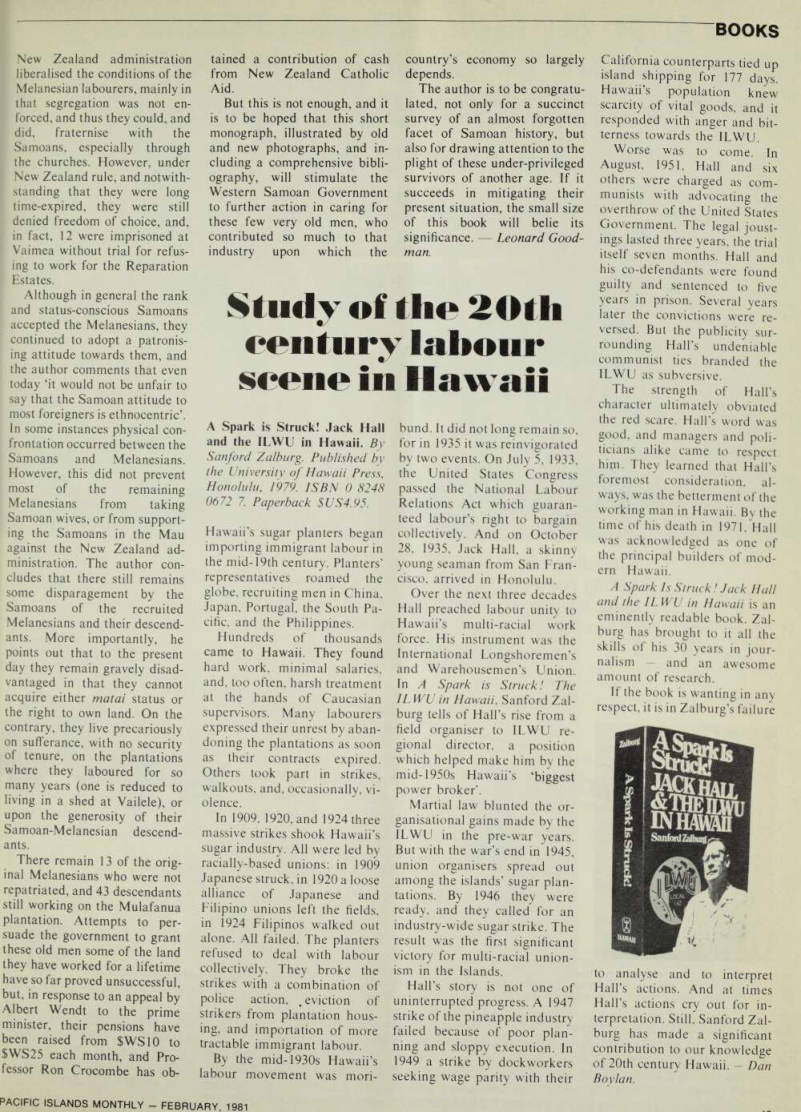
survivors of another age
O Tama Uli. Melanesians in Samoa. By Malama Meleisea.
Published by Institute of Pacific Studies, University of the South Pacific, Box 1168, Suva, Fiji. No price or ISBN provided.
This 56-page monograph is significant for two main reasons.
First, within its limited compass it summarises the social history of a selected group of recruited Melanesian labourers in a Polynesian environment, and, by including four first-person accounts from survivors of that period spanning 75 years of Samoan history under German, New Zealand and independent rule it records vividly the life and conditions of these strangers under the successive administrations, and provides an interesting commentary upon the interaction of the different racial entities thus thrown together.
Second, it highlights the disabilities under which the few survivors of that experience and their descendants still suffer in Samoa. The author clearly sympathises with them in their plight.
The German annexation of
north-eastern New Guinea in 1884 gave the German trading firms a monopoly of the recruit ment of Melanesian labour for their plantations, and when, by the international settlement of 1900, the Germans annexed Western Samoa, for the plan tations in Samoa also, where such labour was essential for the profitable conduct of the copra industry.
The author considers that while in a general sense this recruitment of labour was a form of exploitation, he points out that, at that time and to the labourers so engaged, it did not seem so. On the contrary as these survivors emphasise when interviewed at this distance in time they were, at least initially, delighted with the conditions, and especially with the quantity and quality of the food supplied. Moreover not only did some re-enlist for a further term, but the excite ment engendered in New Guinea by the sight of the time expired labourers returning laden with their boxes of ‘cargo’ tempted many youths to enlist and even to stow away on the recruiter’s vessels.
This was not, of course, in any
sense a ‘blackbirding’ enter prise. The labour was regularly recruited under very specific conditions of selection, and con tracts which ensured their wel fare and nutrition during both transit and overseas residence, and provided for repatriation on completion of contract.
The German administration in Samoa under Dr Solf identified itself with the DHPG enterprise, and established a monopoly of Melanesian labour for that firm, much to the annoyance of other European planters who were thus forced to employ Chinese labour at higher cost, with less stringent control, and for cash wages (which did not apply to the Melanesians).
In general the Melanesians seemed to have considered their German employers fair, but very strict, not only in discipline occasionally enforced by physical punishment but also in their insistence on complete segregation from the Samoans.
Moreover, unlike the Chinese who had a consul in Apia, they had neither political nor social status, nor independent rep resentation.
At the time of the capture of Samoa by the New Zealand forces in 1914 there were 877 Melanesians working on the German plantations many time-expired and by 1921 about 145 still had not been repatriated as provided for in their contracts. The official New Zealand records imply that by 1929 all who so wished had been repatriated, but it seems that with the take-over of the German plantations by the New Zealand administration as reparations, they discovered the need to retain the Melanesian labour to maintain the economy of the country, and the author considers that ‘the failure of the New Zealand administration to repatriate 125 Melanesians after 1921 was probably a breach of contract and an act of gross exploitation’. In the event, the need for this expatriate labour was so great that New Zealand appealed to the Aust ralian administration of German New Guinea to make a further 200 recruits available for the Samoan plantations, a request that was refused.
Th£ transfer of Samoa to
New Zealand administration liberalised the conditions of the Melanesian labourers, mainly in that segregation was not en forced, and thus they could, and did, fraternise with the Samoans, especially through the churches. However, under New Zealand rule, and notwith standing that they were long time-expired, they were still denied freedom of choice, and, in fact, 12 were imprisoned at Vaimea without trial for refus ing to work for the Reparation Estates.
Although in general the rank and status-conscious Samoans accepted the Melanesians, they continued to adopt a patronis ing attitude towards them, and the author comments that even today ‘it would not be unfair to say that the Samoan attitude to most foreigners is ethnocentric’.
In some instances physical con frontation occurred between the Samoans and Melanesians.
However, this did not prevent most of the remaining Melanesians from taking Samoan wives, or from support ing the Samoans in the Mau against the New Zealand ad ministration. The author con cludes that there still remains some disparagement by the Samoans of the recruited Melanesians and their descend ants. More importantly, he points out that to the present day they remain gravely disad vantaged in that they cannot acquire either matai status or the right to own land. On the contrary, they live precariously on sufferance, with no security of tenure, on the plantations where they laboured for so many years (one is reduced to living in a shed at Vailele), or upon the generosity of their Samoan-Melanesian descend ants.
There remain 13 of the orig inal Melanesians who were not repatriated, and 43 descendants still working on the Mulafanua plantation. Attempts to per suade the government to grant these old men some of the land they have worked for a lifetime have so far proved unsuccessful, but, in response to an appeal by Albert Wendt to the prime minister, their pensions have been raised from SWSIO to SWS2S each month, and Pro fessor Ron Crocombe has ob
tained a contribution of cash from New Zealand Catholic Aid.
But this is not enough, and it is to be hoped that this short monograph, illustrated by old and new photographs, and in cluding a comprehensive bibli ography, will stimulate the Western Samoan Government to further action in caring for these few very old men, who contributed so much to that industry upon which the
country’s economy so largely depends.
The author is to be congratu lated, not only for a succinct survey of an almost forgotten facet of Samoan history, but also for drawing attention to the plight of these under-privileged survivors of another age. If it succeeds in mitigating their present situation, the small size of this book will belie its
significance.
Leonard Good-
man.
Advertisements & other items, p. 48 (1 item)
Expert
Insurance Service
throughout the islands
Queensland Insurance (Fiji) Limited
Head Office, 34 Usher St., SUVA . General Manager; L. G. Liddell A.A.1.1. Assistant Manager: Vijay Lai. Phone: 23851.
LAUTOKA OFFICE: Burns Philp Bldg., Naviti St. District Manager: J. Dalton. Phone: 60642.
Queensland Insurance (PNG) Limited
PAPUA NEW GUINEA
Head Office, B.N.G. Building, Musgrave St.PORT MORESBY. General Manager: J. M. Dawe.
Assistant Manager: R. V. Masked. Phone: 212144.
LAE: 4th St. & Coronation Drive. District Manager: I. R. Martin. Phone: 423873.
MOUNT HAGEN: Hagen Drive. District Manager: D. F. Carroll. Phone: 521002.
ARAWA: Chebu St. District Manager: J. Longbut. Phone; 951555.
MADANG: Kasagten St. District Manager: N. D. Ramage. Phone: 822020.
RABAUL: Wirraway St. District Manager: W. F. Tinker. Phone: 921014.
QBE Insurance Limited
VANUATU, PORT VILA: Rue de Paris, Suite 19, Oceania Bldg. Manager: G. F. Donnelly.
Phone; 2299.
SANTO: Burns Philp (Vanuatu) Ltd. Phone: 230.
PACIFIC AGENCIES
NEW CALEDONIA: T. A.Hagen, Ste. W. A. Johnston, S.A.R.L. 5 Rue Anatole France, NOUMEA.
Phone: 272083.
TAHITI: Arthur Chung. Immeuble 8.1.5., Front de Mer, PAPEETE. Phone; 2.86.19.
NIUE: Burns Philp (South Sea) Company Ltd.
NORFOLK ISLAND: Burns Philp (N I) Company Ltd. Phone; 2191.
SAMOA: APIA, Burns Philp (South Sea) Company Ltd. Phone: 22611.
TONGA: Burns Philp (South Sea) Company Ltd. NUKU’ALOFA. Phone 21500 HAAPAI, VAVAU.
MEMBERS OFTHE:
INSURANCE GROUP LIMITED
Study of the 20tli
century labour scene in Hawaii
A Spark is Struck! Jack Hall and the ILWU in Hawaii. By Sanford Zalburg. Published by the University of Hawaii Press, Honolulu, 1979. ISBN 0 8248 0672 7. Paperback 5U54.95.
Hawaii’s sugar planters began
importing immigrant labour in
the mid-19th century. Planters’ representatives roamed the globe, recruiting men in China, Japan, Portugal, the South Pa cific, and the Philippines.
Hundreds of thousands came to Hawaii. They found hard work, minimal salaries, and, too often, harsh treatment at the hands of Caucasian supervisors. Many labourers expressed their unrest by aban doning the plantations as soon as their contracts expired.
Others took part in strikes, walkouts, and, occasionally, vi olence.
In 1909, 1920, and 1924 three massive strikes shook Hawaii’s sugar industry. All were led by racially-based unions: in 1909 Japanese struck, in 1920 a loose alliance of Japanese and Filipino unions left the fields, in 1924 Filipinos walked out alone. All failed. The planters refused to deal with labour
collectively. They broke the
strikes with a combination of police action, eviction of strikers from plantation hous ing, and importation of more tractable immigrant labour.
By the mid-1930s Hawaii’s labour movement was mori
bund. It did not long remain so, for in 1935 it was reinvigorated by two events. On July 5, 1933, the United States Congress passed the National Labour Relations Act which guaran teed labour’s right to bargain collectively. And on October 28, 1935, Jack Hall, a skinny young seaman from San Fran cisco, arrived in Honolulu.
Over the next three decades Hall preached labour unity to Hawaii’s multi-racial work force. His instrument was the
International Longshoremen’s
and Warehousemen’s Union.
In A Spark is Struck! The IL WU in Hawaii , Sanford Zal burg tells of Hall’s rise from a field organiser to ILWU re
gional director, a position
which helped make him by the mid-1950s Hawaii’s ‘biggest power broker’.
Martial law blunted the or
ganisational gains made by the
ILWU in the pre-war years.
But with the war’s end in 1945, union organisers spread out among the islands’ sugar plan tations. By 1946 they were ready, and they called for an industry-wide sugar strike. The result was the first significant victory for multi-racial union ism in the Islands.
Hall’s story is not one of uninterrupted progress. A 1947 strike of the pineapple industry failed because of poor plan ning and sloppy execution. In 1949 a strike by dock workers seeking wage parity with their
California counterparts tied up island shipping for 177 days.
Hawaii’s population knew scarcity of vital goods, and it responded with anger and bit terness towards the ILWU.
Worse was to come. In August, 1951, Hall and six others were charged as com munists with advocating the overthrow of the United States
Government. The legal joust
ings lasted three years, the trial itself seven months. Hall and his co-defendants were found guilty and sentenced to five years in prison. Several years later the convictions were re versed. But the publicity sur rounding Hall’s undeniable communist ties branded the ILWU as subversive.
The strength of Hall’s character ultimately obviated the red scare. Hall’s word was good, and managers and poli ticians alike came to respect him- They learned that Hall’s foremost consideration, al ways, was the betterment of the working man in Hawaii. By the time of his death in 1971, Hall was acknowledged as one of the principal builders of mod ern Hawaii.
A Spark Is Struck! Jack Hall and the ILWU in Hawaii is an eminently readable book. Zal burg has brought to it all the skills of his 30 years in jour nalism and an awesome amount of research.
If the book is wanting in any respect, it is in Zalburg’s failure
to analyse and to interpret Hall’s actions. And at times Hall’s actions cry out for in terpretation. Still, Sanford Zal burg has made a significant contribution to our knowledge
of 20th century Hawaii.
Dan
Boylan.
Advertisements & other items, p. 50 (1 item)
mqbe
A CLASSY, SUPERBLY-
“GET-ABOUT” MACHh
ON AND OFF THE /TO.
ngineered,
FOR POWER
m mgs. - Spending a lot of time on cross-country travel or errands?
Seeking something with dependable power, yet economical?
Make it in good time with one of our “get-about” machines.
Go with a Suzuki!— choose one of our performance-proven motorcycles,
just answering travel needs.
ro^B
MP
mqbe
fob
n d a « Look further into Suzuki’s traditional excellence and discover the results in our 4-wheel drive vehicles and fleet of outboard motors something to satisfy your every motoring need.
Going by land or by sea ... go with a Suzuki.
SUZUKI 4 WHEEL
DRIVE VEHICLE
DTBS
JZUKI MOTOR CO., LTD. reserves the right to change, without notice, equipment, Dedications, colours, materials and other items to apply local conditions. Each model ight be discontinued without notice. Please inquire at your local dealer for details of ly such changes. Actual body colours might differ slightly from the colours in this ad.
SUZUKI MOTOR CO , LTD
Hamamatsu, Japan
SUZUKI
OLOMON ISLANDS SOLOMON ISLAND SERVICE STATION LTD. «NEW CALEDONIA STE. SUPERCAL • PAPUA NEW GUINEA BURNS PHILP JEW GUINEA) LTD. #NEW HEBRIDES HENRI LEROUX #NIUE ISLAND BURNS PHILP (SOUTH SEA) CO., LTD. #PONAPE LEO ETSCHEIT# TAHITI IPPON AUTOMOTO •ELLICE ISLAND TUVALU COOPERATIVE WHOLESALE SOCIETY LTD. «GUAM & SAIPAN ISLAND CYCLERY, INC.
NORFOLK MARTIN’S AGENCIES LTD. «SAMOA PACIFIC PRODUCTS, INC. • TARAWA GILBERT ISLANDS COOPERATIVE FEDERATION LIMITED TONGA MORRIS HEDSTROM LTD. •WESTERN CAROLINES BECHESRRAK T. COMPANY ®YAP AMBROSE D. MINGINFEL’S WHOLESALER EASTERN CAROLINES KIOMASA STORE • NAURU EQUAPAC MOTORS ©FIJI NIRANJANS AUTOPORT LTD.
In the Solomons today,
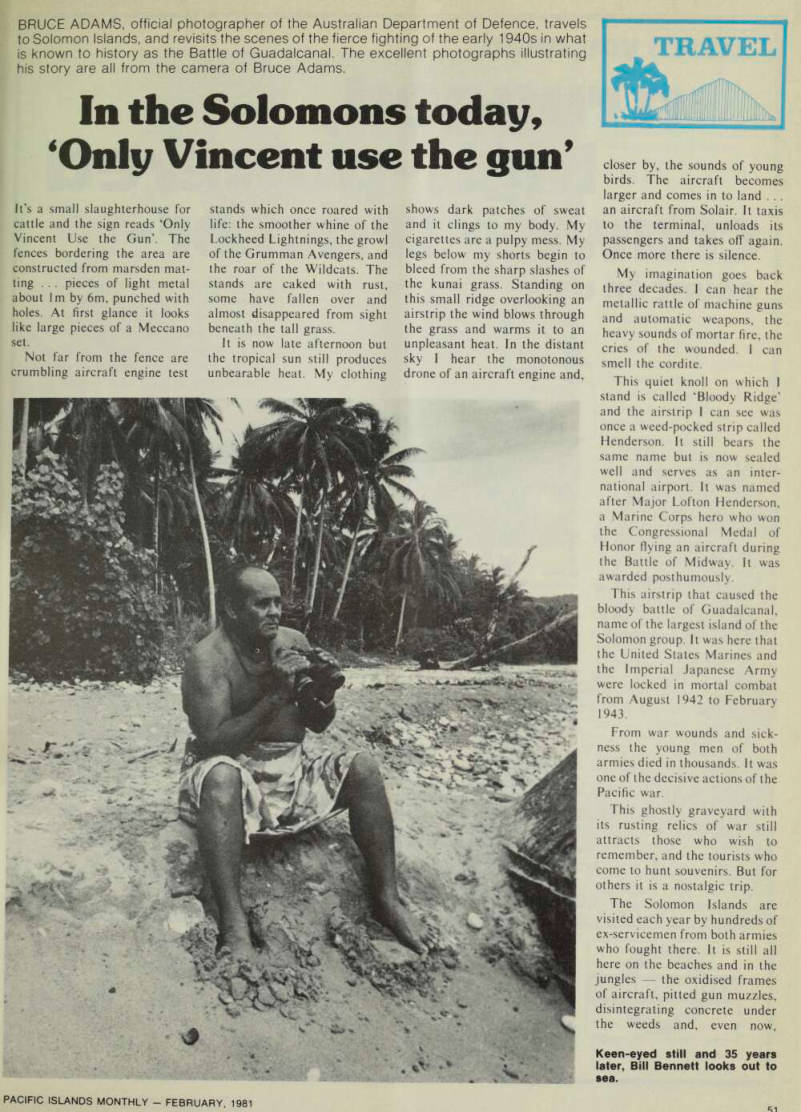

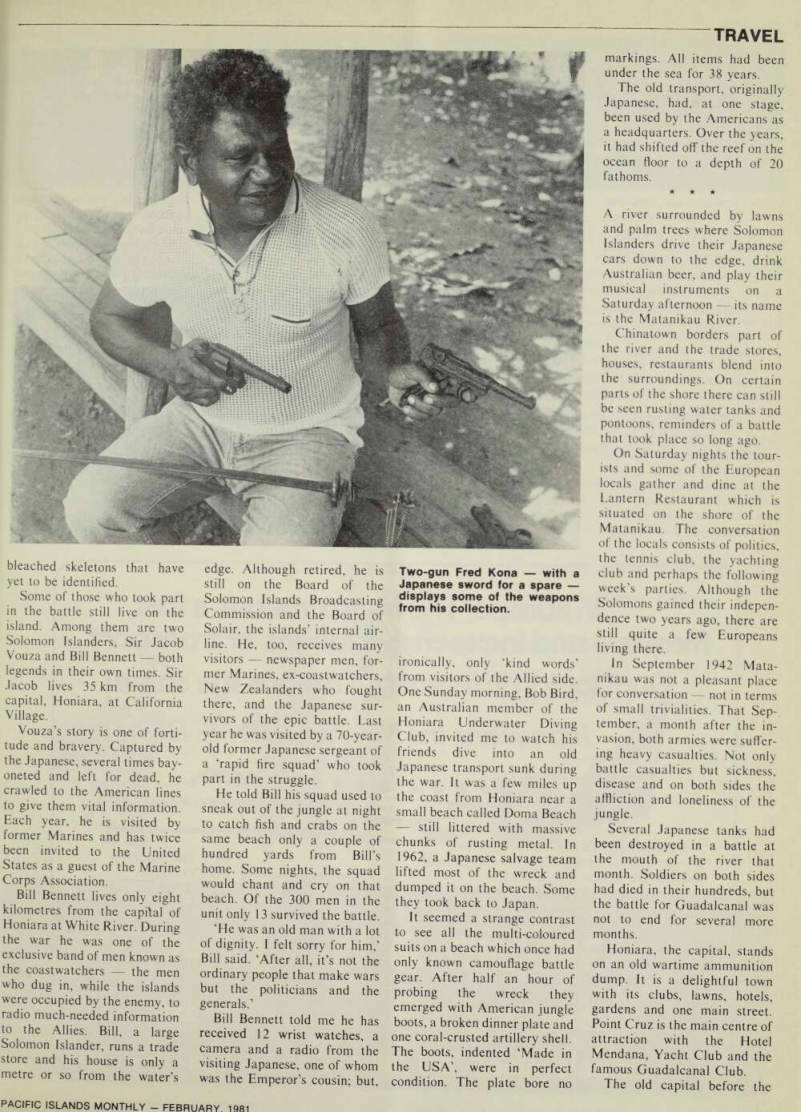
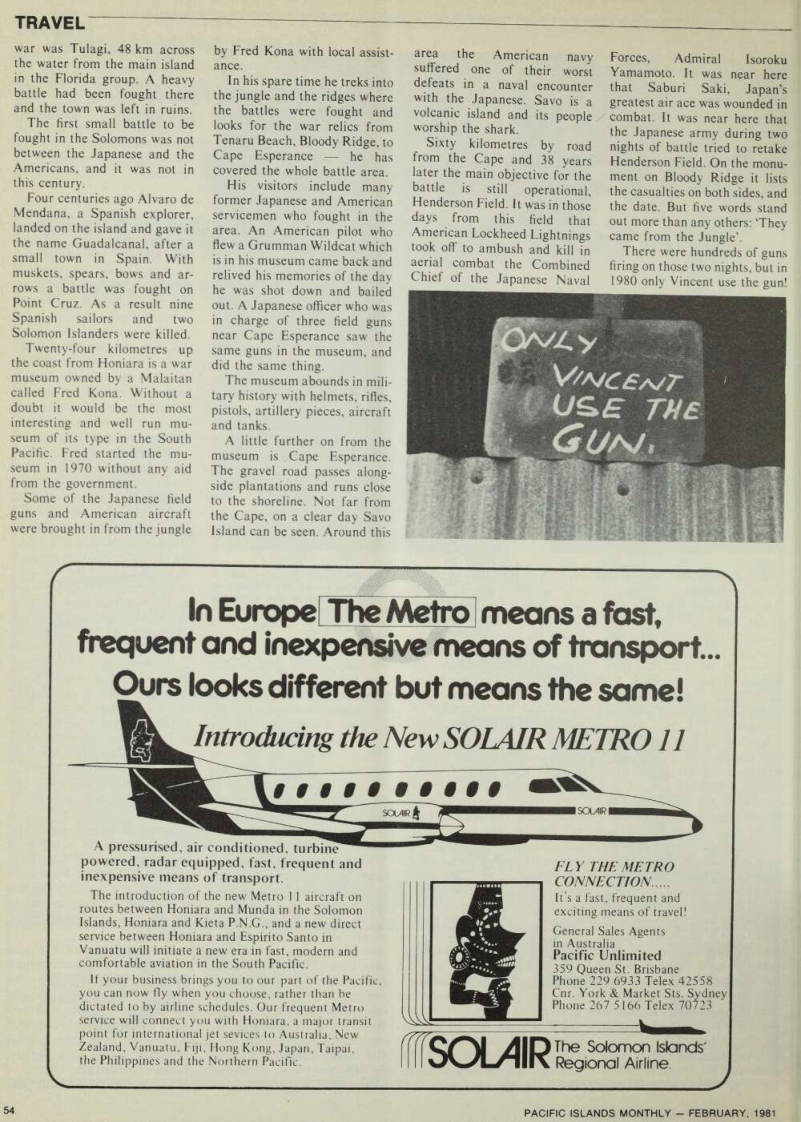
Travel
In the Solomons today, ‘Only Vincent use the gun’
BRUCE ADAMS, official photographer of the Australian Department of Defence, travels to Solomon Islands, and revisits the scenes of the fierce fighting of the early 1940 s in what is known to history as the Battle of Guadalcanal. The excellent photographs illustrating his story are all from the camera of Bruce Adams.
It’s a small slaughterhouse for cattle and the sign reads ‘Only Vincent Use the Gun’. The fences bordering the area are constructed from marsden mat ting . . . pieces of light metal about 1m by 6m, punched with holes. At first glance it looks like large pieces of a Meccano set.
Not far from the fence are crumbling aircraft engine test
stands which once roared with life; the smoother whine of the Lockheed Lightnings, the growl of the Grumman Avengers, and the roar of the Wildcats. The stands are caked with rust, some have fallen over and almost disappeared from sight beneath the tall grass.
It is now late afternoon but the tropical sun still produces unbearable heat. My clothing
shows dark patches of sweat and it clings to my body. My cigarettes are a pulpy mess. My legs below my shorts begin to bleed from the sharp slashes of the kunai grass. Standing on this small ridge overlooking an airstrip the wind blows through the grass and warms it to an unpleasant heat. In the distant sky I hear the monotonous drone of an aircraft engine and.
closer by, the sounds of young birds. The aircraft becomes larger and comes in to land . . . an aircraft from Solair. It taxis to the terminal, unloads its passengers and takes off again.
Once more there is silence.
My imagination goes back three decades. 1 can hear the metallic rattle of machine guns and automatic weapons, the heavy sounds of mortar fire, the cries of the wounded. I can smell the cordite.
This quiet knoll on which I stand is called ‘Bloody Ridge’ and the airstrip I can see was once a weed-pocked strip called Henderson. It still bears the same name but is now sealed well and serves as an inter national airport. It was named after Major Lofton Henderson, a Marine Corps hero who won the Congressional Medal of Honor flying an aircraft during the Battle of Midway. It was
awarded posthumously.
This airstrip that caused the bloody battle of Guadalcanal, name of the largest island of the Solomon group. It was here that the United States Marines and the Imperial Japanese Army were locked in mortal combat from August 1942 to February 1943.
From war wounds and sick ness the young men of both armies died in thousands. It was one of the decisive actions of the Pacific war.
This ghostly graveyard with its rusting relics of war still attracts those who wish to remember, and the tourists who come to hunt souvenirs. But for others it is a nostalgic trip.
The Solomon Islands are visited each year by hundreds of ex-servicemen from both armies who fought there. It is still all here on the beaches and in the jungles the oxidised frames of aircraft, pitted gun muzzles, disintegrating concrete under the weeds and, even now,
Keen-eyed still and 35 years later, Bill Bennett looks out to sea.
bleached skeletons that have yet to be identified.
Some of those who took part in the battle still live on the island. Among them are two Solomon Islanders, Sir Jacob Vouza and Bill Bennett both legends in their own times. Sir Jacob lives 35 km from the capital, Honiara, at California Village.
Vouza’s story is one of forti tude and bravery. Captured by the Japanese, several times bay oneted and left for dead, he crawled to the American lines to give them vital information.
Each year, he is visited by former Marines and has twice been invited to the United States as a guest of the Marine Corps Association.
Bill Bennett lives only eight kilometres from the capital of Honiara at White River. During the war he was one of the exclusive band of men known as the coastwatchers the men who dug in, while the islands were occupied by the enemy, to radio much-needed information to the Allies. Bill, a large Solomon Islander, runs a trade store and his house is only a metre or so from the water’s
edge. Although retired, he is still on the Board of the Solomon Islands Broadcasting Commission and the Board of Solair, the islands’ internal air line. He, too, receives many visitors newspaper men, for mer Marines, ex-coastwatchers, New Zealanders who fought there, and the Japanese sur vivors of the epic battle. Last year he was visited by a 70-year old former Japanese sergeant of a ‘rapid fire squad’ who took part in the struggle, He told Bill his squad used to sneak out of the jungle at night to catch fish and crabs on the same beach only a couple of hundred yards from Bill’s home. Some nights, the squad would chant and cry on that beach. Of the 300 men in the unit only 13 survived the battle. ‘He was an old man with a lot of dignity. I felt sorry for him,' Bill said. ‘After all, it’s not the ordinary people that make wars but the politicians and the generals.’
Bill Bennett told me he has received 12 wrist watches, a camera and a radio from the visiting Japanese, one of whom was the Emperor’s cousin; but,
ironically, only ‘kind words’ from visitors of the Allied side.
One Sunday morning, Bob Bird, an Australian member of the Honiara Underwater Diving Club, invited me to watch his friends dive into an old Japanese transport sunk during the war. It was a few miles up the coast from Honiara near a small beach called Doma Beach - still littered with massive chunks of rusting metal. In 1962, a Japanese salvage team lifted most of the wreck and dumped it on the beach. Some they took back to Japan.
It seemed a strange contrast to see all the multi-coloured suits on a beach which once had only known camouflage battle gear. After half an hour of probing the wreck they emerged with American jungle boots, a broken dinner plate and one coral-crusted artillery shell.
The boots, indented ‘Made in the USA’, were in perfect condition. The plate bore no
markings. All items had been under the sea for 38 years.
The old transport, originally Japanese, had, at one stage, been used by the Americans as a headquarters. Over the years, it had shifted off the reef on the ocean floor to a depth of 20 fathoms. ★ * * A river surrounded by lawns and palm trees where Solomon Islanders drive their Japanese cars down to the edge, drink Australian beer, and play their musical instruments on a Saturday afternoon its name is the Matanikau River.
Chinatown borders part of the river and the trade stores, houses, restaurants blend into the surroundings. On certain parts of the shore there can still be seen rusting water tanks and pontoons, reminders of a battle that took place so long ago.
On Saturday nights the tour ists and some of the European locals gather and dine at the Lantern Restaurant which is situated on the shore of the Matanikau. The conversation of the locals consists of politics, the tennis club, the yachting club and perhaps the following week’s parties. Although the Solomons gained their indepen dence two years ago, there are still quite a few Europeans living there.
In September 1942 Mata nikau was not a pleasant place for conversation not in terms of small trivialities. That Sep tember, a month after the in vasion, both armies were suffer ing heavy casualties. Not only battle casualties but sickness, disease and on both sides the affliction and loneliness of the jungle.
Several Japanese tanks had been destroyed in a battle at the mouth of the river that month. Soldiers on both sides had died in their hundreds, but the battle for Guadalcanal was not to end for several more months.
Honiara, the capital, stands on an old wartime ammunition dump. It is a delightful town with its clubs, lawns, hotels, gardens and one main street.
Point Cruz is the main centre of attraction with the Hotel Mendana, Yacht Club and the famous Guadalcanal Club.
The old capital before the
Two-gun Fred Kona with a Japanese sword for a spare displays some of the weapons from his collection.
war was Tulagi, 48 km across the water from the main island in the Florida group. A heavy battle had been fought there and the town was left in ruins.
The first small battle to be fought in the Solomons was not between the Japanese and the Americans, and it was not in this century.
Four centuries ago Alvaro de Mendana, a Spanish explorer, landed on the island and gave it the name Guadalcanal, after a small town in Spain. With muskets, spears, bows and ar rows a battle was fought on Point Cruz. As a result nine Spanish sailors and two Solomon Islanders were killed.
Twenty-four kilometres up the coast from Honiara is a war museum owned by a Malaitan called Fred Kona. Without a doubt it would be the most interesting and well run mu seum of its type in the South Pacific. Fred started the mu seum in 1970 without any aid from the government.
Some of the Japanese field guns and American aircraft were brought in from the jungle
by Fred Kona with local assist ance.
In his spare time he treks into the jungle and the ridges where the battles were fought and looks for the war relics from Tenaru Beach, Bloody Ridge, to Cape Esperance he has covered the whole battle area.
His visitors include many former Japanese and American servicemen who fought in the area. An American pilot who flew a Grumman Wildcat which is in his museum came back and relived his memories of the day he was shot down and bailed out. A Japanese officer who was in charge of three field guns near Cape Esperance saw the same guns in the museum, and did the same thing.
The museum abounds in mili tary history with helmets, rifles, pistols, artillery pieces, aircraft and tanks.
A little further on from the museum is Cape Esperance.
The gravel road passes along side plantations and runs close to the shoreline. Not far from the Cape, on a clear day Savo Island can be seen. Around this
area the American navy suffered one of their worst defeats in a naval encounter with the Japanese. Savo is a volcanic island and its people worship the shark.
Sixty kilometres by road from the Cape and 38 years later the main objective for the battle is still operational, Henderson Field. It was in those days from this field that American Lockheed Lightnings took off to ambush and kill in aerial combat the Combined Chief of the Japanese Naval
Forces, Admiral Isoroku Yamamoto. It was near here that Saburi Saki, Japan’s greatest air ace was wounded in combat. It was near here that the Japanese army during two nights of battle tried to retake Henderson Field. On the monu ment on Bloody Ridge it lists the casualties on both sides, and the date. But five words stand out more than any others: They came from the Jungle’.
There were hundreds of guns firing on those two nights, but in 1980 only Vincent use the gun!
Advertisements & other items, pp. 52-56 (2 items)
a rugged,
When you need
high *po«iered
crawler tractor-
count on us
Caterpillar track type tractors are built tough to tackle the rugged terrain commonly found in developing areas of the Pacific Islands. For
maximum dependability the high-
powered Cat-built engine features an adjustment-free fuel system, a
large radiator and heavy duty air
cleaners to ensure continuous performance in hot, dusty conditions.
Whether your job is dozing or ripping-or any other crawler application-you can count on Cat-built track type tractors to meet your demands. j- -1 t. fen f r* Id
' ■ I-'W « >(|M •••
\ ■K«x=ssfws*mr ■ - - >••• _-•a• a • • • Ml Sr <3 ns ■2rs« fe*e
SSO
W- 'tf-v m m V.O •jtf 3k# *8? y* mm •a- Om
LAE:
Milford Haven Road, Telephone 42 2355.
PORT MORESBY:
Telephone 256650.
BOUGAINVILLE:
Itakara Industrial Park, Arawa Telephone 959077
carptrac
HASTINGS DURING
YOUR
CATEPPILLAP
DEALER
Caterpillar, Cat and tB are Trademarks of Caterpillar Tractor Co
In Europc Thc Metro] means a fast.
Ours looks different but means the same!
Introducing the New SOLAIR METRO 11
SOMIR
SOL4IR
A pressurised, air conditioned, turbine
powered, radar equipped, fast, frequent and
inexpensive means of transport.
The introduction of the new Metro 11 aircraft on routes between Honiara and Munda in the Solomon Islands, Honiara and Kieta P.N.G., and a new direct service between Honiara and Espirito Santo in Vanuatu will initiate a new era in fast, modern and comfortable aviation in the South Pacific.
If your business brings you to our part of the Pacific, you can now fly when you choose, rather than be dictated to by airline schedules. Our frequent Metro service will connect you with Honiara, a major transit point for international jet sevices to Australia, New Zealand, Vanuatu, Fiji. Hong Kong, Japan, Taipai, the Philippines and the Northern Pacific.
FL Y THE METRO
CONNECTION
It's a fast, frequent and exciting means of travel!
General Sales Agents in Australia Pacific Unlimited 359 Queen St. Brisbane Phone 229 6933 Telex 42558 Cnr. York & Market Sts. Sydney Phone 267 5166 Telex 70723
iilDThe Solomon Islands'
Regional Airline.
Total service 0n ...
plumbing supplies
You can get all your needs from one supply source: water taps, valves, copper tube, tools and a host of other fittings and related plumbing equipment for domestic, industrial and multi-storey buildings.
Watson & Crane Pty Ltd have over 20,000 plumbing items in stock at their central warehouse located at Waterloo, NSW, Australia.
Years of experience in handling and shipping right throughout the South Pacific add up to another big reason for you to deal with Watson & Crane Pty Ltd.
Representatives call regularly at Papua New Guinea, the Solomons, New Hebrides and Fiji Islands to personally discuss your requirements and appropriate credit arrangements.
Write, cable or telephone today for complete plumbers' supplies service. m * 0 ✓ jMS s* Watson & Crane Pty. Ltd. 1037 Bourke Street, Waterloo,
NSW 2017.
Phone: Sydney 699-1333.
Telex: AA 25548.
Cables: "Watcrane" Sydney.
Pacrflc Island distributors of Crano Enfield copper tube for water, sanitation, engineering, refrigeration and air conditioning.
WATSON & CRANE
are organised to fulfil your needs
wherever you are in the South Pacific
CONSTRUCTIVE
ADVICE.
25 *h w
•a. Tj'
Swamp Bulldozers as well as Swamp Dozer Shovels.
Dozer Shovels.
Radio-Controlled Bulldozers and Dozer Shovels.
Electric Powered A wide range of Pipelayers.
Dozer Shovels.
Amphibious Bulldozers. 2 a Wheel Loaders.
A wide selection of Off-Highway Slag Dump Trucks.
Dump Trucks.
And offer Motor Graders.
* Afe
As well as Motor Scrapers. <1 Soil Compactors.
Trash Compactors.
Towing Tractors.
A mi 5?
Vibratory Rollers. Diesel Generator Sets. rid • ik m m Portable Air Compressors.
A wide selection of Diesel Engines. i ill Machine Tools. 9 Mechanical and Hydraulic Presses. A variety of Maypres Presses. OBS Power Presses. Tunnel-Boring Machines.
We're constructive in other ways. We offer castings, foundries, and important advice on construction and manufacturing projects.
•(•KOMATSU LTD
Tokyo, Japan Komatsu overseas offices: Singapore, Jakarta, Manila, Bangkok, Bangalore, Karachi, Beijing, Seoul, Sydney, Ankara, Cairo, Alger, Dubai, Teheran, Baghdad, Jeddah, Riyadh Ad Dammam, Nairobi, Abidjan, Lagos, Johannesburg, Moscow, Warszawa, Brussels, Paris, Madrid, Frankfurt, Stuttgart, London, Habana, Buenos Aires, Panama, Caracas SanPaiiln Mevirn PiK/ san Franricrn Oaklanrl Philadplnhla iSptrnif Dalla«: Atlanta P.hirann Tornntn Vancouver and distributors in Over 100 Countries around the WOrld
Dific Islands Monthly - February Iqri
Stamps
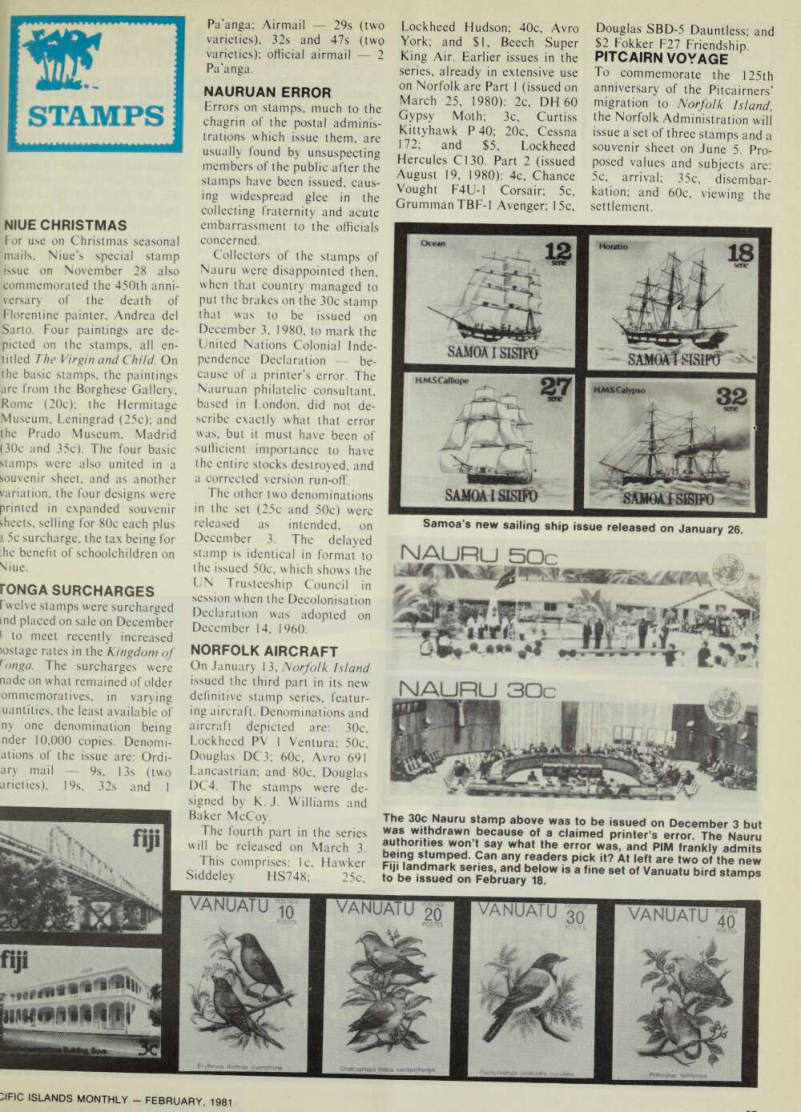

Niue Christmas
For use on Christmas seasonal mails. Niue’s special stamp issue on November 28 also commemorated the 450th anni versary of the death of Florentine painter, Andrea del Sarto. Four paintings are de picted on the stamps, all en titled The Virgin and Child. On the basic stamps, the paintings arc from the Borghese Gallery, Rome (20c); the Flermitage Museum, Leningrad (25c); and the Prado Museum, Madrid (30c and 35c). The four basic stamps were also united in a souvenir sheet, and as another variation, the four designs were printed in expanded souvenir wheels, selling for 80c each plus i 5c surcharge, the tax being for :he benefit of schoolchildren on Niue.
Fongasurcharges
fwelve stamps were surcharged md placed on sale on December I to meet recently increased lostagc rales in the Kingdom of r onga. The surcharges were nadc on what remained of older ommemoratives, in varying uanlilies, the least available of ny one denomination being nder 10,000 copies. Denomi alions of the issue are: Ordi ary mail 9s, 13s (two arictics), 19s, 32s and 1
Pa’anga; Airmail —29 s varieties), 32s and 47s (two varieties); official airmail 2 Pa'anga.
Nauruan Error
Errors on stamps, much to the chagrin of the postal adminis trations which issue them, are usually found by unsuspecting members of the public after the stamps have been issued, caus ing widespread glee in the collecting fraternity and acute embarrassment to the officials concerned.
Collectors of the stamps of Nauru were disappointed then, when that country managed to put the brakes on the 30c stamp that was to be issued on December 3, 1980, to mark the United Nations Colonial Inde pendence Declaration be cause of a printer's error. The Nauruan philatelic consultant, based in London, did not de scribe exactly what that error was, but it must have been of sufficient importance to have the entire stocks destroyed, and a corrected version run-off.
The other two denominations in the set (25c and 50c) were released as intended, on December 3. The delayed stamp is identical in format to the issued 50c, which shows the UN Trusteeship Council in session when the Decolonisation Declaration was adopted on December 14, 1960.
Norfolk Aircraft
On January 13, Norfolk Island issued the third part in its new definitive stamp series, featur ing aircraft. Denominations and aircraft depicted are: 30c.
Lockheed PV 1 Ventura; 50c, Douglas DC3; 60c, Avro 691 Lancastrian; and 80c, Douglas DC4. The stamps were de signed by K. J. Williams and Baker McCoy.
The fourth part in the series will be released on March 3.
This comprises: Ic, Hawker Siddeley HS74B; 25c,
Lockheed Hudson; 40c, Avro York; and $l, Beech Super King Air. Earlier issues in the series, already in extensive use ° n Norfolkare Part 1 (issued on arch 1980): , 2c ' ,P H 60 b Mo ‘ h ; n Gur,lss ,„ tyhawk l P l°; 20c ,’ Cessna Hercules Cl3O. Part 2 (issued l9> J 9Blß) =‘* c - Cha " ce )-° Ught 1 . A Corsalr; sc ' GrummanTßF -' Avenger; 15c,
Douglas SBD-5 Dauntless- and $2 Fokker F 27 Friendship
Pitcairn Voyage
To commemorate the 125th anniversary of the Pitcairners’ 25 ' migration to Norfolk Island. the Norfolk Administration will issue a set of three stamps and a Lit , Jo souvenir sheet on June 5. Pro posed values and subjects are: , s c. arrival; 35c, disembar katlon; and viewing the settlement.
The 30c Nauru stamp above was to be issued on December 3 but was withdrawn because of a claimed printer’s error. The Nauru authorities won’t say what the error was, and PIM frankly admits being stumped. Can any readers pick it? At left are two of the new Fiji landmark series, and below is a fine set of Vanuatu bird stamps to be issued on February 18. K
Norfolk and Pitcairn will combine to produce a joint first day cover. Each cover will bear a set of stamps from both islands, with the Pitcairn set postmarked on the anniversary of the date of departure and the Norfolk set postmarked on the anniversary of the date of ar rival. These covers are expected to be in great demand among collectors and will represent an interesting souvenir of the oc casion.
Kiribati Flora
Kiribati is not prolific in flora, the more common varieties be ing the hibiscus and the frangi pani, and the island adminis tration has chosen to show off some of its less familiar, but equally beautiful, flowers on postage stamps. John Cooler designed a set of stamps, which has been printed by Format International, for release on February 18.
Acalypha godseffiama, known to the Gilbertese as te toara graces the 12c stamp, and the 30c features one of the less common varieties of hibiscus, hibiscus schizopetalus. Te
bumorimori is the local name for calotropis gigantea shown on the 35c, and the 50c value is resplendent with euphorbia pulcherrima, known locally as te kabekau.
Christmas Island
The third of a four-part stamp series depicting the various stages of the phosphate indus try, will be issued by Christmas Island on February 9. Designed by Mr Leslie Curtis, the stamps feature screening and stockpil ing (22c), train loading (28c), railing (40c) and drying (60c).
Part 1 of the series was issued on May 5 last year when the first four stages of the industry were illustrated: Surveying (15c), drilling for samples (22c), sample analysis (40c) and mine planning (55c). On July 14, the second part in the series was released, depicting jungle clearing (15c), overbur den removal (22c), opencut mining (40c) and restoration (55c).
French Polynesia
Aircraft are featured on four stamps issued by French Polynesia on December 15.
Denominations and types of aircraft are: 15Fr, Catalina flying boat; 26Fr, Twin Otter feeder airliner; 30Fr, CAMS-55 seaplane; and 50Fr, Douglas DC6. Official maximum cards of the issue were also released.
These cards are based on the stamp design, with provision for affixing the appropriate stamp and having it postmarked.
Samoa Ships
The third in a series of stamps featuring ships was issued by Western Samoa on January 26.
Designed by John Cooler, the stamps depict the following sailing ships: Ocean, US whaler, 12 sene; Horatio. US whaler, 18 sene; HMS Calliope, British frigate, 27 sene; and HMS Calypso, British frigate, 32 sene.
Fiji Landmarks
Released in December was the second part in Fiji’s buildings and landmarks definitive stamp series. Denominations and de signs of the December release were Lautoka mosque (sc); GPO, Suva (6c); public school, Levuka (12c); Labasa sugar
mill (18c); Grand Pacific Hotel,, Suva (35c); Shiva temple, Suvaj (45c); Surua Island village; (50c); Solo lighthouse ($1); andl Baker Memorial Hall, Nausorii ($2).
The first part in this definitive; series, in concurrent use, was; issued on November 11, 1979..
Featured on these stamps are; the old town hall, Suva (1c);; Dudley Church, Suva (2c); Fijii international telecommuni cations building, Suva (3c); Fiji i visitors bureau, Suva (10c);; Colonial War Memorial Hos pital, Suva (15c); Rew bridge,, Nausori (20c); Sacred Heart cathedral, Suva (30c); and Government House ($5).
In Brief
On March 25, Papua New' Guinea will issue a set of four' stamps honouring the PNG Defence Force.
Four stamps designed by John Cooler, and depicting butterflies, will be issued by Kiribati on February 4.
New Caledonia issued a 60Fr stamp on December 13, depict ing one of the fluorescent corals at Noumea Aquarium.
Advertisements & other items, pp. 57-58 (2 items)
■'Ific Islands Monthly February, 1981
Epkjlass
MARINE TECHNOLOGY.
Products developed in the , proven on the water ...
plans proposed


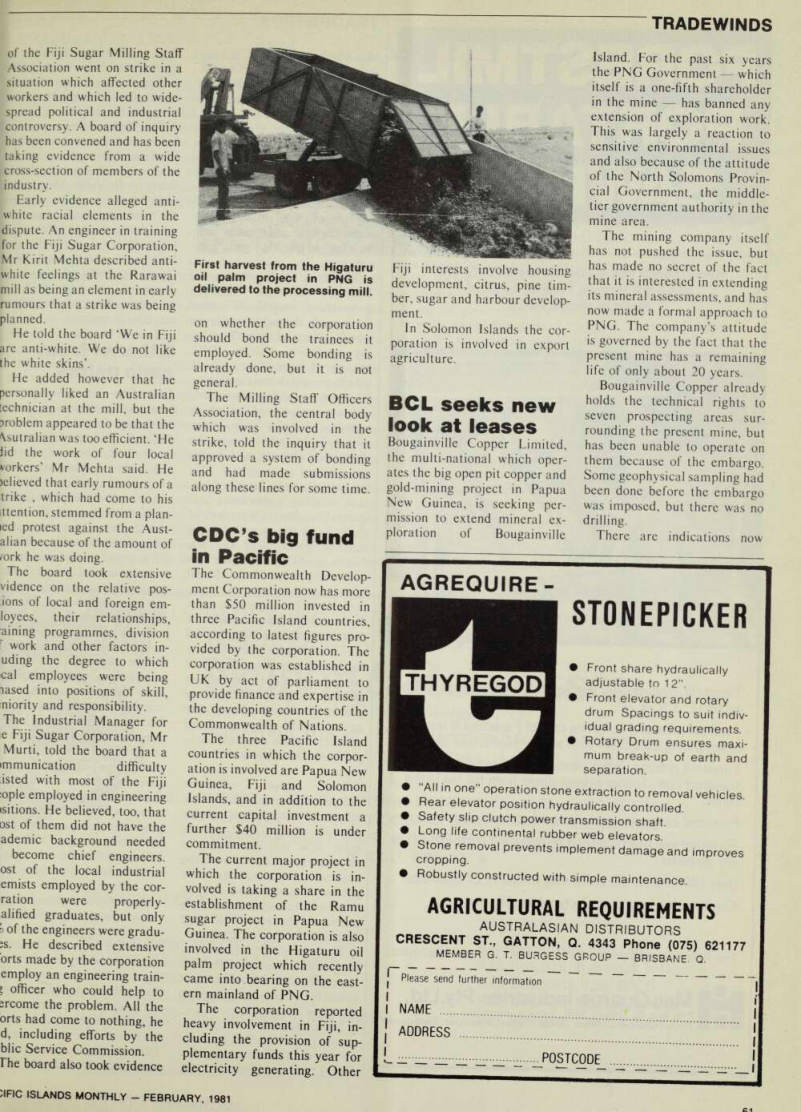
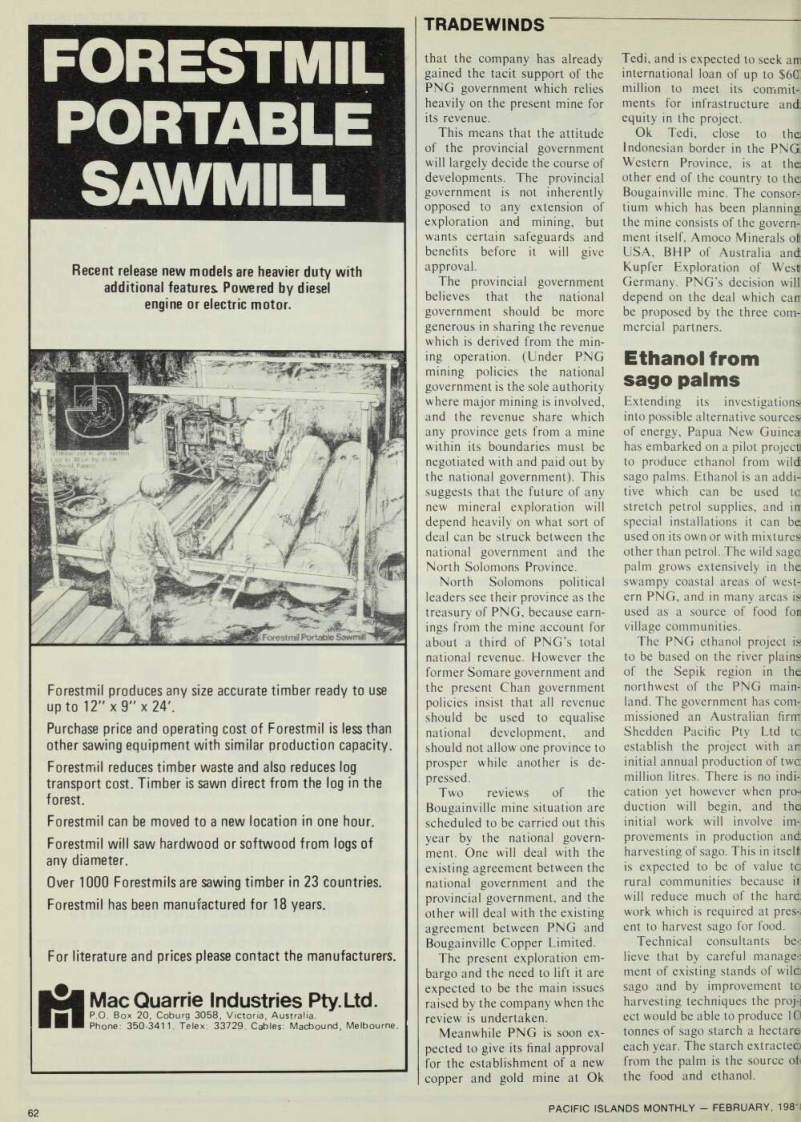
Trade
Winds
New Zealand aid plans proposed
Vanuatu figures most promi nently in a list of proposed projects under New Zealand’s bilateral aid programme for Pacific Island countries re leased in Wellington just after New Year.
Being considered is a pro posal to give scientific assist ance with a survey of agricul tural pests and diseases in Vanuatu, and another to pro vide two mobile pressure units for timber treatment. The tim ber treatment project, which is almost certain to be im plemented, includes mainten ance of the plant and operator training.
New Zealand believes that suitably treated Vanuatu tim ber could replace all imported timber for construction pur poses.
A New Zealand forest ser vice engineer may also visit Vanuatu to examine the poten ial for coconut stem milling.
The service pioneered research into the utilisation of senescent coconut trunks, and is at pres ent overseeing the provision of a second coconut stem sawmill for Tonga, in the Ha’apai Group. The first Tongan coco nut sawmill is on Tongatapu.
Other Vanuatu projects ex pected to gain approval are the appointment of an adminis tration officer for the Ministry of Health to plan and co ordinate medical and public health administration. This is a rationalisation process as Vanuatu has inherited two sys tems, British and French, from its colonial days.
Another appointment in tended to be made under New Zealand aid is an ecomonic planning officer for Vanuatu’s Central Planning Office, to co ordinate and implements post
independence national develop
ment plan.
Appointment of a consultant
to study the requirements for a Vanuatu boatbuilding industry is also envisaged. His term is expected to be of two years’ duration, and his brief will also be to recommend appropriate design and construction methods.
Other proposals include $2O 000 for two woodgas power units to generate electricity in rural areas and there is a proposal to have $5O 000 on hand for various small projects.
The Vanuatu Government would liaise with the New Zealand High Commissioner, based in Honiara, to draw on the small projects fund.
Schemes for the Cook Islands under the bilateral aid pro gramme include the provision of two banana driers at Rarotonga, and a market survey of New Zealand areas where Cook Islands produce does not yet penetrate which for most purposes means outside Auck land and Wellington.
A Cook Islands Government request is being considered for cssistance in building a power house and providing electrical reticulation on Mangaia, at a cost of $3OO 000.
In Fiji, the programme is likely to provide a lecturer in business studies at the Fiji Institute of Technology, for the next two years, and an adviser to the Ika Corporation, Government-backed tuna fleet operator, also for the next two years. A Fiji Government re quest for funds and training for a project to ‘seed’ inland lakes and rivers with imported fish stocks to provide inland fisheries is also on the pro gramme. Only $lO 000 is in volved.
Proposals being considered for Niue, while modest, should make an impact on the small community, particularly those for the extension of the Niue Development Board’s factory, If approved they will provide space for a laboratory for the
factory’s food technologist, al lowing for improvements in quality controls. A new lime press, fruit washer, and copra drier are also proposed.
The Niue high school, built last year with New Zealand assistance, should get exten sions to its skills training build ing, as well as washrooms, toilet facilities and a roof water catch ment system. Improved tele phone facilities for villages on the western part of the island could be part of an upgrading of the national telephone system on Niue.
At Hanan International Air port on Niue assistance is pro posed to install new navigational aids to bring it up to the standard to handle Boe ing 7375, probably this year.
Runway resealing has already been undertaken with New Zea land help and with the 737 s in mind.
Proposed aid for Papua New Guinea includes expertise to improve and stimulate high lands horticultural production on behalf of the Food Market
ing Corporation which operates the Lae cool store.
PNG health projects include assistance for the redevelop ment of Vanimo General Hos pital and Oksapmin Health Centre in West Sepik Province, provision of equipment for an expanded nutrition section in the Department of Health, and provision of a 21-metre launch to provide health services to isolated coastal villages. This vessel is to be based in the Manus Province.
Other assistance to PNG to be approved involves several small-scale enterprises such as a shoe factory and a foundry, the appointment of an adviser to help restructure the small-boat building industry, help for an urban community assistance programme, a maintenance al location for the Lae cool store and assistance with pilot smallholder energy projects.
Proposals for Tonga under study include a further banana rehabilitation programme, but this is subject to an industry review now being carried out by
Tonga. If the review suggests that an aid proposal is war ranted, the aid will consist of quality incentive subsidies and chemicals.
Other projects for Tonga awaiting approval include further funding of experimental reading using a cheap method developed in the Caribbean and construction of agriculture access roads and finger wharves on outlying islands.
Tuvalu has one project await ing approval, for the employ ment of an electrical superviser at its power station.
Projects awaiting approval for Western Samoa are largely agricultural, and include pro vision of a poultry complex at the University of the South Pacific School of Tropical Agriculture at Alafua. The aim is to make Alafua a centre for extension activities which will strengthen village production and lessen Samoan dependence on imported poultry and eggs.
Assistance for the construc tion of an integrated livestock services centre at Avela and
support for the establishment oft an animal health sub-centre atl Salelolonga on Savaii are alsoc contemplated in Westernr Samoa.
Samoan industrial develop ment could be carried a stepc further with capital funding for factory buildings on the Vaitele; Estate, where a controversial! cigarette factory is already es tablished. Food processing andl engineering ventures are also( being considered. The Western!
Samoan Government has in vited New Zealand to contrib ute $5OO 000 to the $2.5 millioni copra-crushing mill scheme; backed already by the Asiam
Development Bank
Don
Bryant in Wellington.
Inquiry on big
sugar strike
Fiji has begun an inquiry into the big sugar mill strike which paralysed the milling industry in November and which led to the intervention of the Prime Minister. Ratu Sir Kamisese Mara. More than 200 members
of the Fiji Sugar Milling Staff Association went on strike in a situation which affected other workers and which led to wide spread political and industrial controversy. A board of inquiry has been convened and has been taking evidence from a wide cross-section of members of the industry.
Early evidence alleged anti white racial elements in the dispute. An engineer in training for the Fiji Sugar Corporation, Mr Kirit Mehta described anti white feelings at the Rarawai mill as being an element in early rumours that a strike was being planned.
Fie told the board ‘We in Fiji are anti-white. We do not like the white skins’.
He added however that he personally liked an Australian technician at the mill, but the jroblem appeared to be that the \sutralian was too efficient. ‘He iid the work of four local vorkers’ Mr Mehta said. He >elieved that early rumours of a trike , which had come to his ittention, stemmed from a plan icd protest against the Aust alian because of the amount of /ork he was doing.
The board took extensive vidence on the relative pos ions of local and foreign em loyees, their relationships, aining programmes, division • work and other factors in uding the degree to which cal employees were being lased into positions of skill, niority and responsibility.
The Industrial Manager for e Fiji Sugar Corporation, Mr Murti, told the board that a
•mmunication difficulty
isted with most of the Fiji ;ople employed in engineering •sitions. He believed, too, that ost of them did not have the ademic background needed become chief engineers, ost of the local industrial emists employed by the cor ration were properly alified graduates, but only 5 of the engineers were gradu- He described extensive orts made by the corporation employ an engineering train l officer who could help to srcome the problem. All the orts had come to nothing, he d, including efforts by the blic Service Commission, fhe board also took evidence
on whether the corporation should bond the trainees it employed. Some bonding is already done, but it is not general.
The Milling Staff Officers Association, the central body which was involved in the strike, told the inquiry that it approved a system of bonding and had made submissions along these lines for some time.
CDC’s big fund
in Pacific
The Commonwealth Develop ment Corporation now has more than $5O million invested in three Pacific Island countries, according to latest figures pro vided by the corporation. The corporation was established in UK by act of parliament to provide finance and expertise in the developing countries of the Commonwealth of Nations.
The three Pacific Island countries in which the corpor ation is involved are Papua New Guinea, Fiji and Solomon Islands, and in addition to the current capital investment a further $4O million is under commitment.
The current major project in which the corporation is in volved is taking a share in the establishment of the Ramu sugar project in Papua New Guinea. The corporation is also involved in the Higaturu oil palm project which recently came into bearing on the east ern mainland of PNG.
The corporation reported heavy involvement in Fiji, in cluding the provision of sup plementary funds this year for electricity generating. Other
Fiji interests involve housing development, citrus, pine tim ber, sugar and harbour develop ment.
In Solomon Islands the cor poration is involved in export agriculture.
BCL seeks new look at leases Bougainville Copper Limited, the multi-national which oper ates the big open pit copper and gold-mining project in Papua New Guinea, is seeking per mission to extend mineral ex ploration of Bougainville
Island. For the past six years the PNG Government which itself is a one-fifth shareholder in the mine has banned any extension of exploration work.
This was largely a reaction to sensitive environmental issues and also because of the attitude of the North Solomons Provin cial Government, the middle tier government authority in the mine area.
The mining company itself has not pushed the issue, but has made no secret of the fact that it is interested in extending its mineral assessments, and has now made a formal approach to PNG. The company’s attitude is governed by the fact that the present mine has a remaining life of only about 20 years.
Bougainville Copper already holds the technical rights to seven prospecting areas sur rounding the present mine, but has been unable to operate on them because of the embargo.
Some geophysical sampling had been done before the embargo was imposed, but there was no drilling.
There are indications now
First harvest from the Higaturu oil palm project in PNG is delivered to the processing mill.
that the company has already gained the tacit support of the PNG government which relies heavily on the present mine for its revenue.
This means that the attitude of the provincial government will largely decide the course of developments. The provincial government is not inherently opposed to any extension of exploration and mining, but wants certain safeguards and benefits before it will give approval.
The provincial government believes that the national government should be more generous in sharing the revenue which is derived from the min ing operation. (Under PNG mining policies the national government is the sole authority where major mining is involved, and the revenue share which any province gets from a mine within its boundaries must be negotiated with and paid out by the national government). This suggests that the future of any new mineral exploration will depend heavily on what sort of deal can be struck between the national government and the North Solomons Province.
North Solomons political leaders see their province as the treasury of PNG, because earn ings from the mine account for about a third of PNG’s total national revenue. However the former Somare government and the present Chan government policies insist that all revenue should be used to equalise national development, and should not allow one province to prosper while another is de pressed.
Two reviews of the Bougainville mine situation are scheduled to be carried out this year by the national govern ment. One will deal with the existing agreement between the national government and the provincial government, and the other will deal with the existing agreement between PNG and Bougainville Copper Limited.
The present exploration em bargo and the need to lift it are expected to be the main issues raised by the company when the review is undertaken.
Meanwhile PNG is soon ex pected to give its final approval for the establishment of a new copper and gold mine at Ok
Tedi, and is expected to seek am international loan of up to S6CC million to meet its commit ments for infrastructure and equity in the project.
Ok Tedi, close to the Indonesian border in the PNG Western Province, is at the other end of the country to the Bougainville mine. The consor tium which has been planning the mine consists of the govern ment itself, Amoco Minerals oft USA, BHP of Australia and Kupfer Exploration of West!
Germany. PNG’s decision will depend on the deal which cam be proposed by the three com mercial partners.
Ethanol from
sago palms
Extending its investigations into possible alternative sources of energy, Papua New Guinea has embarked on a pilot project! to produce ethanol from wild sago palms. Ethanol is an addi tive which can be used to stretch petrol supplies, and inr special installations it can be used on its own or with mixtures other than petrol. The wild saga palm grows extensively in the swampy coastal areas of west ern PNG, and in many areas is used as a source of food fon village communities.
The PNG ethanol project is to be based on the river plains of the Sepik region in the northwest of the PNG main land. The government has com missioned an Australian firm Shedden Pacific Pty Ltd tc establish the project with am initial annual production of twa million litres. There is no indi cation yet however when pro-i duction will begin, and the initial work will involve im provements in production and; harvesting of sago. This in itselft is expected to be of value to rural communities because it will reduce much of the hard work which is required at pres-; ent to harvest sago for food.
Technical consultants be-; lieve that by careful manage-; ment of existing stands of wild sago and by improvement to harvesting techniques the proj-j ect would be able to produce 10 tonnes of sago starch a hectare each year. The starch extracted from the palm is the source oh the food and ethanol.
Advertisements & other items, pp. 59-64 (4 items)
Cific Islands Monthly - February Iqri
EType
/i
[EWOLASS]
C-
EType
antifouling
EPIGLASS E-TYPE
ANTIFOULING:
The Antifouling specially developed for use throughout the waters of the Pacific and proven on the oceans of the world.
Epiglass E-Type gives up to 12 months growth-free performance, for pleasure and commercial craft. Available in Racing Red Blue Green and Gold.
[|p|OLASS]
PRODUCTS OF HEALING TECHNOLOGY.
Made in New Zealand by Healing Industries Limited, Auckland.
Branches in Wellington, Christchurch, Dunedin, Sydney and Singapore.
Available from: COOK ISLANDS: Cook Island Trading Corporation Ltd.
FIJIAN ISLANDS; Burns Philp (SS) Co Ltd.
NEW HEBRIDES: Burns Philp (NH) Ltd NOUMEA: Enterprise Guy Limousin NIUE ISLAND; Niue Island United PAGO PAGO: Max Haleck Inc., Burns Philp (SS) Ltd.
PAPUA NEW GUINEA: KIEXA; Nikana Wholesalers. LAE; Faulkner-Tait (NG) Pty Ltd. MADANG; Burns Philp (NG) Co.
Ltd. PORT MORESBY: Steamships Honda Centre RABAUL; Elvee Trading Pty Ltd.
WEWAK. Burns Philp (P.N.G.).
SOLOMON ISLANDS: P.K.R. Pacific Sales Co.
TAHITI; Marine Corail, Tahiti Sport, Comptior Polynesien.
TONGA: Burns Philp (SS) Co. Ltd.
WESTERN SAMOA: Burns Philp (SS) Co. Ltd. E.A. Coxon Ltd, Gold Star Transport Co. Ltd, Morris Hedstrom Ltd.
NORFOLK ISLAND: Irvines Building Supplies.
WHEN YOUR DEALER CAN'T SUPPLY
EMERGENCY!
SPARE PARTS SERVICE
R. I. MUIRHEAD COMPANY
EXPORTERS
ESTABLISHED 1935
We furnish genuine Spare parts for any American manufactured Construction • Mining • Logging • Transportation • Quarry and Industrial Equipment.
“EMERGENCY SERVICE IS OUR SPECIAL TV"
WE WILL ARRANGE CUSTOM CLEARANCE AND DELIVERY TO YOUR WAREHOUSE.
SATISFIED CUSTOMERS THROUGHOUT AUSTRALIA, NEW ZEALAND, PACIFIC ISLANDS, SOUTH EAST ASIA ANO OTHER
COUNTRIES - REFERENCES AVAILABLE.
TELEX: 69-1392 R. T. MUIRHEAD CO.
CABLE ADDRESS: MUIRHEAD LOS ANGELES 1923 STAUNTON AVENUE TELEPHONE: (213) 749-4418 LOS ANGELES, CALIF. 90058
P.O. BOX 58512 A
AGREQUIRE-
A
THYREGOD
STONEPICKER
• Front share hydraulically adjustable to 12”. • Front elevator and rotary drum Spacings to suit individual grading requirements. • Rotary Drum ensures maximum break-up of earth and separation. • “All in one” operation stone extraction to removal vehicles • Rear elevator position hydraulically controlled. • Safety slip clutch power transmission shaft • Long life continental rubber web elevators. • Stone removal prevents implement damage and improves cropping. • Robustly constructed with simple maintenance.
AGRICULTURAL REQUIREMENTS
AUSTRALASIAN DISTRIBUTORS
CRESCENT ST., GATTON, Q. 4343 Phone (075) 621177 MEMBER G. T. BURGESS GROUP BRISBANE. Q. j~ Please send further information I
I NAME
J ADDRESS
!_ .^POSTCODE
FORESTMIL
PORTABLE
SAWMILL
Recent release new models are heavier duty with additional features. Powered by diesel engine or electric motor. 3* WJ*r f Forestmil Portae Sawmif Forestmil produces any size accurate timber ready to use up to 12" x 9" x 24'.
Purchase price and operating cost of Forestmil is less than other sawing equipment with similar production capacity.
Forestmil reduces timber waste and also reduces log transport cost. Timber is sawn direct from the log in the forest.
Forestmil can be moved to a new location in one hour.
Forestmil will saw hardwood or softwood from logs of any diameter.
Over 1000 Forestmilsare sawing timber in 23 countries.
Forestmil has been manufactured for 18 years.
For literature and prices please contact the manufacturers.
lit
MacQuarrie Industries Pty.Ltd.
P.O. Box 20, Coburg 3058, Victoria, Australia.
Phone: 350-3411. Telex: 33729. Cables: Macbound, Melbourne.
TRADEWINDS INTELLIGENCE... TRADEWINDS INTELLIGENCE... TRADEWINDS INTJ
BOUGAINVILLE Copper Limited, the multi-national gold and copper miner in Papua New Guinea, ended the 1980 year with substantially reduced production levels. The copper output for the year dropped from 170 000 tonnes in 1979 to 145 813. Production of contained gold and silver was also down. The reason for the drop was much lower grades, demonstrated by the fact that the amount of ore milled was up by about 3%. The grades are not expected to change significantly in the immediate future, and the company plans to lift production by installing additional crushing equipment by next year.
WESTERN Samoa plans to spend more than $36 million on development projects in 1981, more than half the budget funds approved in December. More than $16 million will come from overseas aid and $12 million from loans. Nearly $2 million will be spent on agricultural projects.
AIR NEW ZEALAND S first flight to Tonga from Auckland was made on January 8 with the arrival at Fua’amotu Airport of a Boeing 737 with 88 passengers, nine for Tonga, the rest for Western Samoa.
THE NATIONAL Broadcasting Commission in Papua New Guinea is to open an alternative radio network known as Radio 2 which will be entirely financed by advertising revenue. The commission is a statutory authority funded by the government but its operations have been partly-subsidised by a limited volume of advertising and by recorded music sales. Cabinet has given approval for the planned expansion and for the establishment of loans to finance it.
FIJI S cane crop for 1980 was 3.36 million tonnes, the second highest harvest in Fiji’s sugar industry and only slightly below the record figure set in 1979. However because of cyclones and drought the cane quality was below average and the sugar yield of 396,157 tonnes was only the third highest annual yield. The figures were announced recently by the Fiji Sugar Corporation. The final return
to growers is expected to be slightly less than at first forecast because of the lower quality of the cane.
ACCORDING to the Fiji Auditor-General’s report for 1979, the Fiji military mission in Lebanon cost $7 447 652 to the end of 1979 and, of that amount, the United Nations had repaid $3 549 643 to the Fiji Government. Expenses for clothing, messing, travelling, transport and lighting were not included and, so far, have not been claimed from the UN.
NORTH Solomon’s provincial budget for 1981 has earmarked 68% of the total expenditure of more than $14 million for capital works to include the upgrading of roads, new office complexes, community halls, school dormitories and health centres. Upgrading the Kumo-Wakunai road will cost $1 million.
THE BANK of Papua New Guinea — the country’s central money authority — has expressed concern at borrowing programmes which the government is undertaking. The concern was expressed recently by the Governor of the bank, Mr Henry ToRobert, who appealed for what he called ‘greater fiscal discipline’. Reviewing the economy of the past 12 months, Mr ToRobert said that PNG was living beyond its means and would have to reduce its borrowings. PNG generally has had a good reputation for national financial policies, but Mr ToRobert’s warning is the second in recent months. The other was contained in an analysis from the World Bank.
AN AGGRESSIVE trade promotion programme in Northern Australia, the Pacific Islands and Europe is planned for this year by Papua New Guinea. The campaign will be spear-headed by delegations representing manufacturers, primary producers and the government. The delegations will visit Cairns and Darwin in northern Australia, Vanuatu, Solomon Islands, UK and West Germany. In addition to tropical commodity crops the delegations will push the sale of PNG beer, clothing, plywood, jewellery and soap.
FOR
IN OUR 86th YEAR SELLING ‘SERVICE’
TO THE PACIFIC ISLANDS
Nelson & Robert son
PTY. LTD.(Established 1895)
Plantation House, 197 Clarence Street, Sydney
Cables: ‘IVAN*, Sydney, Brisbane. Telex: AA22381, Sydney.
INDENTS FROM AUSTRALIA, NEW ZEALAND and OVERSEAS FOODSTUFFS • SOFTGOODS • HARDWARE • MACHINERY TRAVEL • INSURANCE • CANNED FISH • JUTE GOODS
• REAL ESTATE •
BRANCH OFFICES:
Nelson & Robertson Pty. Ltd., P-O. Box 575, Brisbane, Qld., Australia.
P.O. Box 2092, Govt. Bldg., Suva, Fiji.
P.O. Box 258, Lautoka, Fiji.
P.O. Box 2420, CPO Auckland 1, New Zealand.
PAPUA NEW GUINEA
REPRESENTATIVES:
Rabtrad Nuigini Pty. Ltd., P.O. Box 219, Rabaul, P.N.G.
P.O. Box 1406, Lae, P.N.G.
P.O. Box 711, Madang, P.N.G P.O. Box 253, Kieta, P.N.G.
Make sure. Make it a Yanmar.
v/ S
2QM2OH
*7 Getting a new boat can be an exciting adventure, but selecting its engine p shouldn’t be. To make sure you’re buying and install- , tiling proven enginede- * pendability, listen to the voices of experience.
Today they are saying Yanmar, because our diesels have become a boatyard byword for reliability. And for good reason. They are being installed in the thousands this year and every year in boats, like yours, by builders who know their business, and who know the numerous demands placed on seagoing machinery. Everytime, anytime sure starting.
Simple, routine maintenance. Easy operation.
Handy servicing. Maximum safety and economy.
Quiet, vibration-free, fuss-free motoring. All popularity winning points for Yanmar diesels. In the Yanmar range there’s a quality engine that’s practically tailor-made to suit your boat. Make sure to inspect the full range, a good boat deserves it.
(DIN. B)
Today is the Day of the Diesel YANMAR DIESEL
YANMAB
YANMAR
DIESEL ENGINE
YANMAR DIESEL ENGINE CD. t LTD.
1-1,2-chome, Yaesu, Chuo-ku, Tokyo 104, Japan Cable: YANMAR TOKYO Telex: 0222-2310,0222-4733
Tradewinds
'IFIC ISLANDS MONTHLY FEBRUARY, 1981
\Cific Islands Monthly - February. 1981
Ships
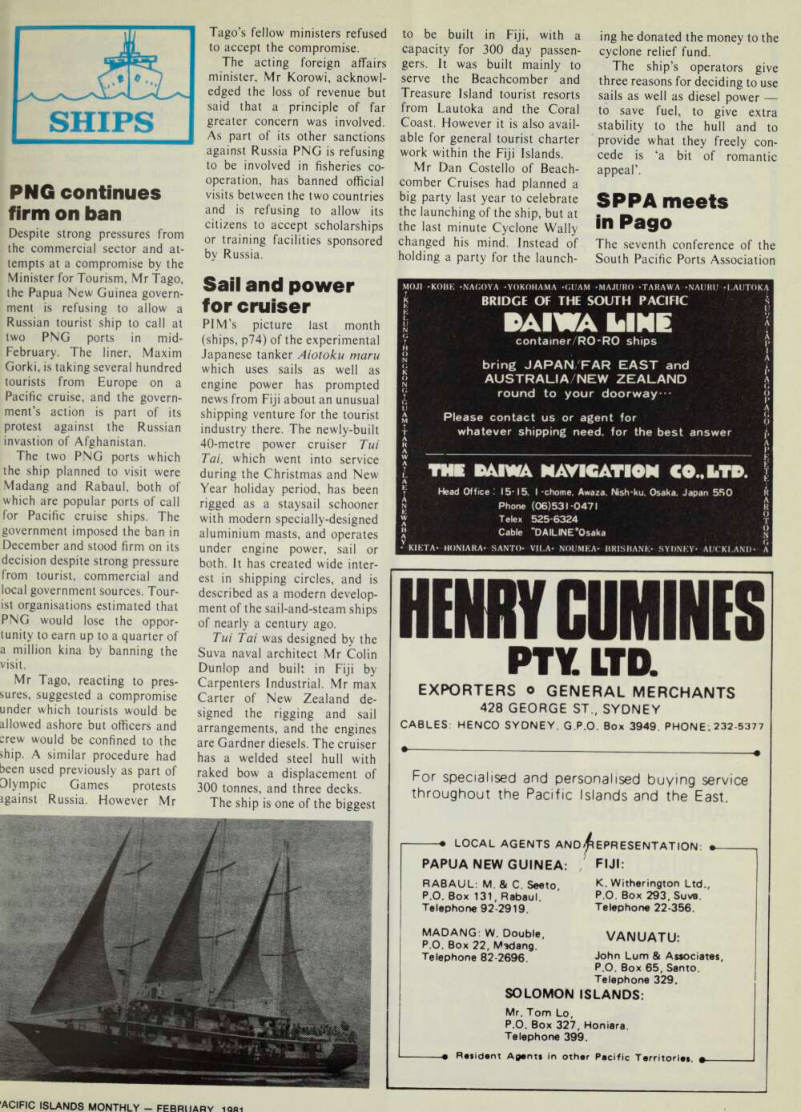

Tago’s fellow ministers refused to accept the compromise.
The acting foreign affairs minister, Mr Korowi, acknowl edged the loss of revenue but said that a principle of far greater concern was involved.
As part of its other sanctions against Russia PNG is refusing to be involved in fisheries co operation, has banned official visits between the two countries and is refusing to allow its citizens to accept scholarships or training facilities sponsored by Russia.
Sail and power
for cruiser
PI M’s picture last month (ships, p 74) of the experimental Japanese tanker Aiotoku maru which uses sails as well as engine power has prompted news from Fiji about an unusual shipping venture for the tourist industry there. The newly-built 40-metre power cruiser Tui Tai, which went into service during the Christmas and New Year holiday period, has been rigged as a staysail schooner with modern specially-designed aluminium masts, and operates under engine power, sail or both. It has created wide inter est in shipping circles, and is described as a modern develop ment of the sail-and-steam ships of nearly a century ago.
Tui Tai was designed by the Suva naval architect Mr Colin Dunlop and built in Fiji by Carpenters Industrial. Mr max Carter of New Zealand de signed the rigging and sail arrangements, and the engines are Gardner diesels. The cruiser has a welded steel hull with raked bow a displacement of 300 tonnes, and three decks.
The ship is one of the biggest
PNG continues
firm on ban
Despite strong pressures from the commercial sector and at tempts at a compromise by the Minister for Tourism, Mr Tago, the Papua New Guinea govern ment is refusing to allow a Russian tourist ship to call at two PNG ports in mid- February. The liner, Maxim Gorki, is taking several hundred tourists from Europe on a Pacific cruise, and the govern ment’s action is part of its protest against the Russian invastion of Afghanistan.
The two PNG ports which the ship planned to visit were Madang and Rabaul, both of which are popular ports of call for Pacific cruise ships. The government imposed the ban in December and stood firm on its decision despite strong pressure from tourist, commercial and local government sources. Tour ist organisations estimated that PNG would lose the oppor tunity to earn up to a quarter of a million kina by banning the visit.
Mr Tago, reacting to pres sures, suggested a compromise under which tourists would be allowed ashore but officers and crew would be confined to the ship. A similar procedure had been used previously as part of Dlympic Games protests igainst Russia. However Mr
to be built in Fiji, with a capacity for 300 day passengers. It was built mainly to serve the Beachcomber and Treasure Island tourist resorts from Lautoka and the Coral Coast. However it is also available for general tourist charter work within the Fiji Islands.
Mr Dan Costello of Beachcomber Cruises had planned a big party last year to celebrate the launching of the ship, but at the last minute Cyclone Wally changed his mind. Instead of holding a party for the launch-
ing he donated the money to the cyclone relief fund.
The ship’s operators give three reasons for deciding to use sails as well as diesel power to save fuel, to give extra stability to the hull and to provide what they freely con cede is ‘a bit of romantic appeal’,
SPPA meets
- D
POflO
The seventh conference of the South Pacific Ports Association
was held in Pago Pago, American Samoa, late last year.
Official delegates attended from Australia, New Zealand, Papua New Guinea, Kiribati, New Caledonia, Western Samoa, Fiji, Saipan, Yap, Kosrae, the Cook Islands and Solomon Islands.
The association was set up to promote regional co-operation,
friendship and understanding
between port members and port users, and to promote measures to increase the efficiency and harmonious development of ports in the South Pacific.
Anchor threat to
drunk goes
Suva City Council in December took drastic action to remove two massive iron anchors which had stood for about a year outside the city’s Old Town Hall. The reason? They were judged to be a possible ‘hazard to passing inebriates’.
The council’s action was hotly contested by Malcolm Brain, a director of Fiji Biomarine Ltd, which leases the Old Town Hall and uses it as an aquarium. It also owns the anchors.
But Suva’s Mayor Cr Maan .Singh said Fiji Biomarine had been warned more than six months ago to remove the anchors, but had made no move to do so.
The anchors had been placed in a footpath reserve outside the defined area leased by the company.
A variety of alternative ar rangements had been discussed, but nothing happened. Hence the council’s direct action on December 7.
Writing in The Fiji Times on the affair, the columnist ‘Beach comber’ added a new and slightly sinister dimension to it. ‘Beachcomber’ said: The saga of the Suva Aquarium’s anchors, in which the Suva City Council appears not to have covered itself with glory may have another, darker aspect.
The anchors are from the ship, Cardinia, which left Levuka, on September 22, 1921.
She was becalmed and drifted in the current on to the Toberua Reef.
Her captain, a mariner named Smith, is said to have ordered that five big anchors be dropped to prevent his ship being driven on to the reef.
The anchors failed to hold and the ship was lost, but not before the enraged Captain Smith had placed a sailor’s curse upon the offending anchors.
The curse, believed by some to be active until this day, is that if ever the anchors were removed in anger from their place of rest the person or persons responsible would suffer severe ill-health and financial trouble until the anchors once again were in their rightful place.
A mariner’s curse is taken very seriously in certain parts of the world. Who knows, now, what may happen?
Meantime Suva waits with bated breath to see what next their city fathers are about to decree for the safety of our city’s revellers.
Anchors, they say, are aweigh!
Diamantina
gift to Qld
HMAS Diamantina, the Royal Australian Navy frigate on which the Japanese forces in Nauru and Ocean Island officially surrendered in 1945 at the end of World War 11, has been presented by the Aust ralian Government to the Queensland Maritime Museum Association.
Diamantina, now decommis sioned, will be installed as a permanently dry-berthed exhibit within the old graving dock at South Brisbane.
The ship had spent her last 20 years of active life as an oceano graphic research vessel.
Australian Prime Minister Malcolm Fraser said it was fitting that Queensland should be the final home for Diaman tina.
The ship had been built in Queensland by Walkers Ltd at Maryborough, was named after the wife of Queensland’s first Governor Sir George Bowen, and carried the same name as one of Queensland’s major rivers.
Advertisements & other items, pp. 65-66 (2 items)
Acific Islands Monthly - February 1001
'•<>s>Skz>—rr>r->S>x>-HS>'
MOJI -KOBK -NAGOYA -YOKOHAMA •GUAM -MAJURO -TARAWA -NAURU -LAUTOK
* BRIDGE OF THE SOUTH PACIFIC
BAIWA LINE
V container/RO-RO ships
bring JAPAN FAR EAST and
« AUSTRALIA NEW ZEALAND
V round to your doorway--- Please contact us or agent for whatever shipping need, for the best answer
THE BAIWA MAYICATION CO.. LTD.
Head Office ! 15*15. I -chome, Awaza. Nish-ku. Osaka. Japan 550 Phone (06)531*0471 Telex 525-6324 Cable "DAILINE’Osaka * KIKTA- HONIARA* SANTO- VH.A- NOUMKA- BRISBANK- SYDNKY- AUCKLAND- -1 S u V A P I A 1, A G O I* A G 9
HENRY CUMINES
PTY LTD.
EXPORTERS o GENERAL MERCHANTS
428 GEORGE ST., SYDNEY
CABLES. HENCO SYDNEY. G.P.O. Box 3949. PHONE; 232-5377 • m For specialised and personalised buying service throughout the Pacific Islands and the East. • LOCAL AGENTS AN PRESENT AT ION: •-
PAPUA NEW GUINEA: FIJI:
RABAUL: M. & C. Seeto, P.O. Box 131, Rabaul.
Telephone 92-2919.
K. Witherington Ltd., P.O. Box 293, Suva.
Telephone 22-356.
MADANG: W. Double, P.O. Box 22, Madang.
Telephone 82-2696.
VANUATU:
John Lum & Associates, P.O. Box 65, Santo.
Telephone 329.
SOLOMON ISLANDS:
Mr. Tom Lo, P.O. Box 327, Honiara.
Telephone 399.
Resident Agents in other Pacific Territories. *.
% m
*TSS^
WATER WHEEL EXPORTS
Pty. Ltd.
493 Bourke Street, Melbourne, 3000, Australia Cables: Watermill-Melbourne.
Telex: AA 32165 Telephone: 602 1433
THE WATER WHEEL GROUP OF COMPANIES
Winners of Australia’s Top Export Award and Flour Millers for over 100 years.
BEST AUSTRALIAN
WHEATEN FLOUR
(High Protein, Bakers, Stone ground Wholemeal, Donut).
COOLROOMS REFRIGERATED
CABINETS ETC.
INCLUDING SALTWATER
ICE MAKERS
STOCK & POULTRY FEEDS
(Pellets or Mash form)
YELLOW SPLIT PEAS &
WHOLE PEAS
(Machine-Dressed)
COMPLETE RANGE OF FROZEN
AND GENERAL FOOD ITEMS
QUALITY AUSTRALIAN
WINES
WOOD FUEL STOVES
AND WATER HEATERS
(3
Yachts
• WINDSTAR. This 12.6 m Sparkman & Stephens fibreglass sloop was in Funafuti, Tuvalu, in December, reports Peter McQuarrie. She was sailed by owner/skipper Wally Sanger and son Greg from the Hawaiian Yacht Club, with crew Richard Dempsey of the Lahaina Yacht Club.
Windstar called at Funafuti from Rotuma, and after visiting some northern Tuvalu islands expected to sail to Tarawa, Kiribati, then to Nauru. • RAIL! 111. A report from Japan by merchant marine officer Gordon Grey brings us up to date with the doings of the yacht Raili 111, and of those who sail in her, Arvo and Raili Nokelainen. Gordon Grey writes: ‘Raili 111 visited Port Sudan as planned, and the Nokelainens were able to or ganise a trip to the ancient city of Suakin nearby through which port the Queen of Sheba once travelled. From there through the Suez Canal to the Mediterranean, where the boat
• ALBATROSS. A Valiant 40 fibreglass cutter arrived at Tubuai, Austral Islands, in November, 1980, reports Don Travers. On board were Chuck and Hertha Stotts of Seattle, Washington, USA. They bought their yacht new in Washington in 1977 and made a shakedown cruise in 1978 in Canadian waters before leav ing Seattle in 1979 for Cali fornia, Mexico, Costa Rica, Galapagos Islands, Easter Island, Pitcairn Island, Mangareva and Tahiti. Plans from Tubuai were to sail to Raivavae and the southern Tuamotus and return to Tahiti before heading west towards Australia in April on a planned circumnavigation.
Their present voyage is actu ally the continuation of an earlier round-the-world cruise which commenced in 1968 on an earlier Albatross, a 10m wood-planked Colin Archer cutter purchased in Norway. At that time Chuck met the Danish Hertha and they cruised the canals of Europe, and then the Mediterranean, Scandinavia, Canaries, West Indies, Panama, Galapagos, Marquesas, Tuamotus, Tahiti and Hawaii, where they arrived in 1973 and sold the earlier boat. Chuck decided to accept a job for an American com pany in Saudi Arabia for five /ears, permitting the purchase af a larger yacht to continue
their circumnavigation.
Bad luck struck during their time at Tubuai, with Chuck suffering from a serious infec ion of the foot. On December he was flown, accompanied ay Hertha, to Tahiti where the aetter hospital facilities would, t was hoped, speed up his Jure. Hurried plans were made or me, accompanied by a Tench cruising couple, Gilles Borgnon and Chantal Morin, yho are schoolteachers at übuai, to sail the Albatross to 'ahiti for the Stotts.
wintered. During the spring, Arvo and Rail! visited Greece, Turkey, Cyprus, Italy and Spain, and were in Tenerife in late October 1980. From there, plans were to sail to Barbados, being in Bridgetown until mid- December. After that, they intend cruising in the West Indies and the Gulf of Mexico, before heading for the Panama Canal and the Pacific.’ • FRAUKEN. A Bremen registered gaff-rigged 10m yacht, is on the hard for refit at Oram’s Marina in Whangarei, New Zealand, taking time out from a second voyage around the world, reports Jane Deßidder. The first was a two year circumnavigation for which solo sailor Utz Mailer- Treu was awarded the Blue Water Cruising Medal in 1976.
He was the seventh man to sail single-handed around the world. MUIIer-Treu’s route is undecided: ‘I am at a cross roads here. I can carry on by way of the Roaring Forties or via the Great Barrier Reef and the Indian Ocean, or I can go north to Alaska and home by way of the Panama Canal.’ The German-born blue water voy
ager has spent most of his life at sea. Shipwrecked at 21 years of age when a Belgian motor yacht on which he was serving as engineer foundered in bad weather in the Bay of Biscay, he was picked up by a passing British ship and left in Port-of-Spain, Trinidad. Here he was taken on by a Nor wegian ship. As a result, he was to serve in the Norwegian merchant marine for 25 years.
Sixteen years ago, Utz bought a fishing boat hull of Norwegian pine, sturdily con structed to withstand ice, iron fastened on oak frames. Work ing behind his house in Bremen, he put on a keel, mast and cabin, and outfitted the sloop with cotton sails which he personally hand-stitched.
He installed a 16hp Saab diesel engine. He installed Aries self-steering gear only recently in Las Palmas, a piece of equipment slightly out of harmony with the orange clinker-hulled vessel’s var nished spars and tanned sails, dead eyes and baggy wrinkle.
Describing Frauken as ‘the smallest and youngest of the Tall Ships’, Utz says, ‘I wouldn’t change with any boat in the harbour’. • SEAFREE. This is Lloyd and Jaquie Grime’s 16m, 50-tonne, double-ended ketch. She’s a steel adaptation of an Alden design, built in Huntington Beach, California, in 1965 by George Sutton, finished off by the Grimes themselves. Lloyd, a plant engineer, found that his welding and machining back ground came in handy.
Seafree carries 1275 gallons of fuel, 940 gallons of water. A Daimler-Benz engine is situ ated in the keel, and she’s equipped with a Wood- Freeman auto pilot of the ‘hunting’ type. ‘We’ve always wanted to go cruising. When our two boys were grown, we became runaway parents!’
Between Socorro Island off Mexico and the Marquesas, Seafree reeled off 200 and 240 nautical mile days before they reduced sail. Lloyd lost more than 20kg as a result of hepatitis contracted in the Tuamotus. ‘We wouldn’t rec ommend Polynesia. It’s an expensive rip-off. There seems to be one price for tourists and yachties, another for locals.’
Samoa was a pleasant surprise
Hertha and Chuck Stotts with Albatross in the Austral Islands. -Picture Don Travers.
to them. The Grimes speak of the kindness and helpfulness of the Samoan people. The crossing from Nukualofa to New Zealand was made on the wind with a leaky exhaust system patched up with chicken wire and cement. They were welcomed by a Kiwi fisherman who guided them into the Northland fishing port of Ngunguru. After a summer in New Zealand, Seafree heads for Fiji, then either an early start for Alaska, or a winter in Hawaii. Jaquie, whose ham call sign is KA6HRT, keeps in touch with family and friends by means of overseas phone patches and a regular newslet ter telling of their adventures. • MOONSHADOW. Seattle registered Moonshadow ar rived in Opua from Raratonga with Richard Evans and Mar garet Whittemore on board.
She is a Skukum 40 designed by Bill Garden, custom-built in Port Townsend, Washington.
Dick and Margaret left Seattle in July 1980 and sailed to New Zealand by way of the Marquesas, the Tuamotus, the
Leeward Islands and the Cooks. They have had as many as five people all told for portions of the trip. ‘The aft cabin arrangement is super for privacy, though even then it can be hectic with more bodies underfoot!’ A German couple, teachers from Rome on sab batical leave, sailed on Moon shadow as far as Papeete, providing gourmet meals even at sea. The 12m centre cockpit flush-decker is steered by a Swedish ‘Sailomat’ self steerer which handles the sloop well. Margaret says that reading at sea for hours at a time with the wind vane steer ing is a wonderful form of relaxation. The ‘Sailomat’s’ fail-safe rudder safety shaft sheered just before their arrival in the Bay of Islands, an accident which made Dick and Margaret realise just how much they depend on the wind vane. ‘Cruising on a vessel this size can be hard work!’ Dick ad mits. • GYPSY. Registered in Portland, Oregon, Gypsy is a modified Cal 40, a summer
visitor to Northland, New Zea land. Doug Hotchkiss, Los Angeles oceanographer who has ‘always wanted to go cruising’, owned a Santana 27 for several years before buying Gypsy. Built in 1964, she has teak decks and a mahogany cabin, unlike her all fibreglass production sister ships. Doug and Kristie, an environmental scientist from Portland, Oregon, were married in Moorea. The young couple do not plan on heading further west; they will probably sail to Fiji, then back through Polynesia, and thence to Hawaii and Alaska. Kristie says that though ocean pollution is not as serious as they had been led to believe, they are concerned by lagoon-silting caused by large construction projects which is destroying so many of the islands’ reefs. She enjoys being in port, but does not enjoy passages. ‘I am an orderly person and at sea a certain disorder is inevitable.’ • TAREMA. Garry Adams bought Tarema, his diminutive Tasmanian-built Trekka class
sloop, in California. He has since made two voyages to New Zealand in the 6m strip planked yacht. On his second visit he met and married a Kiwi lass, Sandra Meier. Ted and Molly Leeds, themselves blue water voyagers and former owners of the Giles-designed Trekka, Reefer, held the wed ding party in their home over looking the Opua yacht moor ings. On their return voyage to California, Garry and Sandy report passages of 26 days to Papeete with southerlies most of the way, and 23 days to Hilo. ‘We’re using the same chart as the 1975 trip so have an incentive to try to increase the daily runs. We started the trip from Papeete with the Walker logline hanging straight down. One’s opinion on the necessity of engines changes once you’ve been wallowing around for a couple of days. . .
In retrospect we should have filled our lazarette and cockpit with pamplemousse (Tahitian grapefruit). They sure are re freshing at sea.’ • WISP. A November arrival in
the Bay of Islands is a 13m cutter belonging to Conrad and Charlotte Skladol from San Francisco, unique in that it was designed by first mate I Charlotte who is a mechanical engineer. Wisp’s glass hull is laid up with Sea Flex. Her interior is all wood ash overheads, teak floor, Honduras mahogany panelling the meticulous part-time work of Conrad, an aeronaut ical engineer. Charlotte says; ‘lt seems we’ve done nothing but build boats together all our married life. We had to get married because we owned a boat together!’ The Skladols spent four months in Hawaii, left at the end of February 1980 for French Polynesia, sailed to American Samoa, Rarotonga, (‘lt was so full of boats and there was so much surge in such a small harbour that we stayed only 15 minutes . . .’), then on to Tonga, Fiji and New Zealand. About their way of life, Charlotte says; ‘We live like millionaires even if we aren’t.’ • KIM. A sturdy 12 m steel ketch whose crew was in Whangarei, making last minute preparations for a year in Antarctica. They are four young men from Montelimar on the Rhone, France Bruno Maroux, Daniel Gazaneon, Michel Chopard, and Claude Monchaud. The four adven turers built the brown multiple chine yacht near Avignon on evenings and weekends over a period of a year. Three years ago they left France, pausing for eight months on Africa’s Ivory Coast to work. They then sailed to Brazil where they spent six months exploring Amazonia, venturing up sev eral of the rivers, before con tinuing on to the Caribbean.
The boys love to dive, and have managed to earn their way as they go, seeking and selling rare shells. Cypraea surinamensis, one of the rarest Df all cowries, they found in Martinique.
The boys’ aim has been all along to sail Kim to Antarctica.
Fhey received much valuable advice from Antarctic voyager, Jerome Poncet, of yacht Damien and his Tasmanian aorn wife, Sally, whom they spent time with in Australia.
The Poncets’ baby was born in Antarctica. The lads from Kim hope to meet up with them again soon in Antarctica.
Upon leaving New Zealand, Kim will sail south as far as possible. The well-found, well stocked vessel is insulated with 4cm of polystyrene. An iron pot-bellied stove with a gim balled carburettor heats the interior even underway. The ports are sealed with clear plastic so that a 5 cm airspace guards against condensation.
Kim’s self-steering system is a stainless steel version of the Aries gear built by All Marine in Sydney. A sledge, skis, and a strong tent are unusual items to be carried on a cruising yacht, but Kim has them and much more, for the lads want to be entirely self-sufficient.
For that reason they do not have a radio transmitter.
Bruno, a 27-year-old land sur veyor explains: ‘We do not expect any help from anyone.’
If the Antarctic voyage goes according to plan, Kim will be back on the Rhone for the summer of ’B2, having touched upon South Georgia, the Falkland Islands and Rio de Janeiro en route. • VAPAY.An Allied 36 glass ketch from Salem, Massa chusetts. A hard beat down from Suva to Opua in the Bay of Islands took a week longer than Bob and Ginny Gross had planned, but Ginny says: ‘lt was no hardship. We had plenty of paperbacks to read.’
Bob, an amateur radio oper ator (WIENH) kept in touch with other yachts making the same passage against heavy headwinds, and with Colin Busch (ZLIBKD), a Kiwi ham who keeps track of the pos itions of offshore yachts, pass ing on weather info and fore casts. Bob and Ginny left the US east coast in 1975 with the intention of going to the Bahamas, *. . . and look where we are now!. . . We’ll probably keep going on around.’ Ginny was a nurse, Bob a career military man trained in elec tronics. He worked with Honeywell Computers before he and Ginny left their grown family and set off to sea.
• Rainbow. An 11M
Norman Cross-designed tri maran from San Diego, Cali
fornia. Steve and Sharry Glass took five years to build her, two and a half years of which they reckon was spent thinking about how to go about it. Rain bow is well planned, superbly built and finely finished, so the system obviously paid off.
Sharry and Steve cruised Mexico, the Marquesas, the Tuamotus and Tonga before sailing to New Zealand. Their best cruising was in Vavau, and in French Polynesia where they spent 13 months in all, their only regret being not having taken French lessons before setting off from California.
Charmed with New Zealand, (‘the Kiwis have time for each other’), they spent the southern winter in the Bay of Islands. They report oc casional ice on deck and almost a month of steady rain . . .
Sharry is blind. She had always dreamed of cruising the islands of the South Pacific on her own boat and did not let the disability stop her from enjoying the experience, though she finds the long passages trying. The young couple have a 10 speed tan dem bicycle for shopping and for exercise. Steve and Sharry will probably become land based before too long so that Sharry will be able to devote more time to helping the newly blind. • BELLE POULE. Flies the Canadian maple leaf. She’s a wooden gaff schooner —l5 m
overall, 12 m on deck on a round-the-world trip with Montrealers Eddie Seifred and Francine Blain. Eddie bought the juniper-hulled schooner in Mississippi in 1977 where she had been built two years be fore, fitted her out in Fort Lauderdale, and left Florida at Christmas of ’7B for the Caribbean. Eddie’s 18-year old son Mark who joined the ship on the Caribbean island of St Vincent will reluctantly head back to Montreal from New Zealand to finish his studies.
Mark says that he has main tained his bilingualism by read ing alternatively a book in French, then one in English, during their passages. After a haulout, paint-up and stock up, Belle Poule will carry on to Australia, then home by way of South-east Asia. • ERYNGO. The dictionary defines ‘eryngo’ as ‘an edible seaweed with aphrodisiac qualities’. It is also the name of a 12 m cold-moulded ketch of Sam Crocker design built h Toronto in ’67, now spending the southern summer in New Zealand. Andy Van Herk says: The name is an apt one. We had a couple of kids in The British Virgin Islands!’ They are Sandy, now three and a half, and 18-months-old Chad.
Andy and Carolyn Van Herk left Toronto via the St Lawrence in ’74, got thoroughly cold in the iceberg area, so Eryngo headed first for the Bahamas, then thoroughly explored the islands of the Caribbean.
Mechanical technician by trade, Andy got work as cap tain of a 15 m Gulf Star charter for a while. Then he and Sandy rented land on Cooper Island, one of the British Virgin Islands, where they converted a house into a restaurant for charter yachts. They were the only people living on the island.
Two years and two children later, with the cruising kitty filled, Eryngo set off for the South Pacific. They were de lighted to be permitted to stay eight days in the Galapagos Islands instead of the three which is all yachts are gener ally allowed these days. Seems the commanding officer of the naval academy at Wreck Bay was missing his own kids . . .
Raili III off northern Australia before making Europe. (See p67).
Advertisements & other items, pp. 67-70 (3 items)
’Acific Islands Monthly - February 1981
Sanderum
1 s® Aquila water tanks completely enclosed to ensure clean water and built to last from strong, durable galvanised steel.
You assemble them yourself from our comprehensive kits. Capacities range from 2300 litres to 49250 litres.
Send for a brochure today.
Aquila Engineering Division, 25 Pacific Highway, Bennetts Green, New South Wales, Australia.
Name Address P/code
AQ2O/2
AQUILA
ccr
SANDERUM
The first real
“all purpose”
S Tine
cultivator.
A NEW NAME IN ALL-PURPOSE CULTIVATORS
★ Adjustable Tines Choice of 4 Tine settings to suit varying Soil Preparation. ★ Sanderum Tine meets the most critical standards Made from a specially heat treated Steel and Shot Blasted. ★ 18” depth Wheels as standard equipment. ★ Rolling Harrows, Finger Harrows and Levelling Bars available. ★ Linkage Model 5’ 11” to 20’ 8” Trailed Models 17’ 9” to 26’ 6”. ★ Sanderum Futura is extendable Built up from 2’ 11” wide sections can be extended to make full use of increased Tractor Power; as’ 11 ”
Cultivator can be extended to 26’ 6”. ★ Easy to transport —All sizesfrom 11’ 10” can be folded fortransport. 17’ 9” and larger models folded by Single Hydraulic Ram. ★ Made in Denmark to a high standard of quality. Competitively Priced and Marketed throughout the World Sanderum Futura Cultivators are now available in Australia.
AGRICULTURAL REQUIREMENTS
AUSTRALASIAN DISTRIBUTORS
CRESCENT ST., GATTON, Q. 4343 Phone (075) 621177 MEMBER G. T. BURGESS GROUP BRISBANE. Q.
Please forward me further details Name Address Postcode
GLOBAL SERVICE FOR SHIPPERS
V
THE
LINE
28 Day Service
United Kingdom and Continent to:
PAPEETE • NOUMEA
PAPUA NEW GUINEA and SOLOMON ISLANDS
PORT VILA & SANTO BY TRANSHIPMENT
■¥r United Kingdom and Continent to: SUVA AND LAUTOKA (FCL LCL & UNITISED ONLY) Papua New Guinea and Solomon Islands to:
UNITED KINGDOM and CONTINENT
is.
Cflh For particulars
THE BANK LINE (AUSTRALASIA) PTY. LTD.
18th Floor 1 York Street SYDNEY N.S.W. 2000 Australia Tel: 272041 Telex: 24063
Acific Islands Monthly _ Ffrri Iapv -Iqdi
ACIFIC ISLANDS MONTHLY FFRRi iapv -iqdi
YACHTS
Services
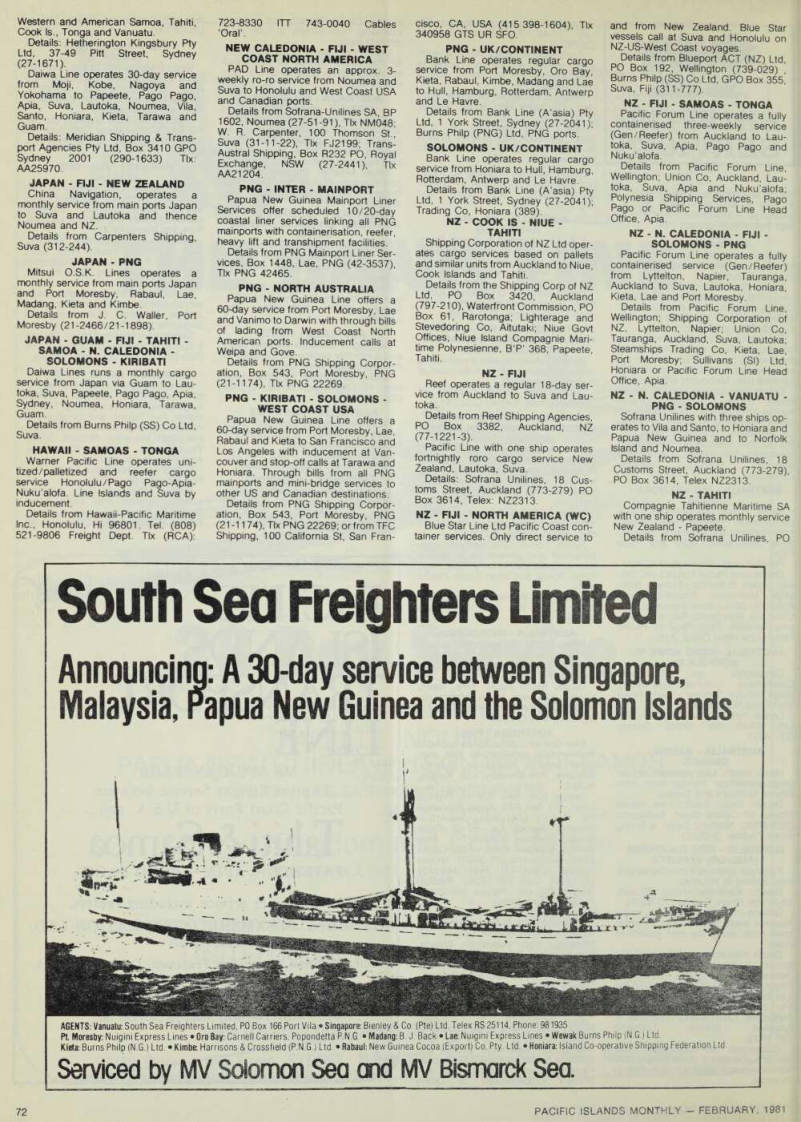
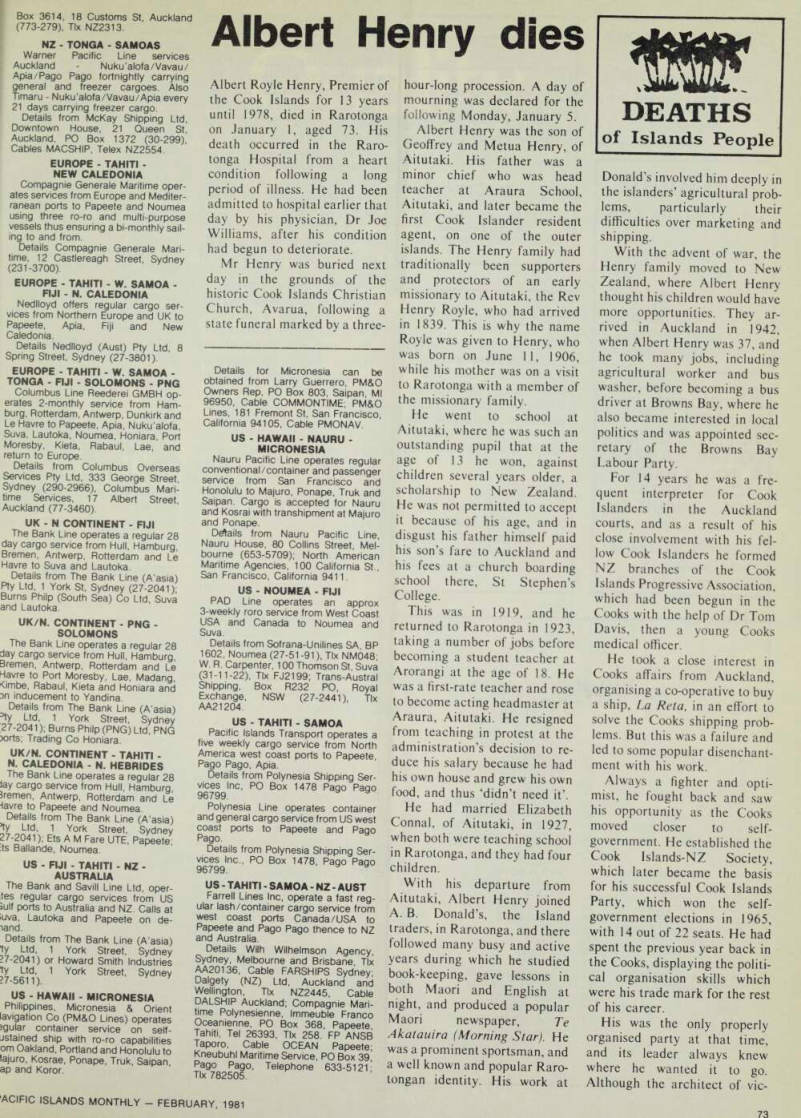
Shipping
Should any shipping company wish to have its services cargo and passenger included in these list ings they should contact PIM.
Australia - Fiji
Karlander (Aust) Pty Ltd operates monthly cargo services from Sydney to Suva and Lautoka.
Details from Karlander (Aust) Pty Ltd, 19-31 Pitt Street, Sydney (27-6301), Dalgety Shipping, 461 Bourke Street, Melbourne (60-0731), Burns Philp (SS) Co Ltd, Suva and Lautoka.
Sofrana-Unilines (Fiji Express Line) operates to Suva and Lautoka every three weeks from the main ports on the east coast of Australia and monthly to Lautoka from Melbourne and Sydney.
Details from Sofrana-Unilines, 19 Pitt Street, Sydney, (27-2031). Trans- Austral Shipping Pty Ltd. 570 Bourke Street, Melbourne (67-9162), ACTA Pty Ltd, Brisbane (221-3116), Elder-ANL Pty Ltd, Port Adelaide (47-5688), ANL Newcastle (049-24364). Clements & Marshall, Burnie, Tasmania (31-1833).
Australia - Fiji - Samoas -
Tonga
Pacific Forum Line operates a fully :ontainerised service (Gen/Reefer) tom Brisbane and Sydney to Lautoka, Suva, Nukualofa, Apia and Pago "’ago, Funafuti cargo transhipped at Apia.
Details from Pacific Forum Line, Syd ney; Union Bulkships, Sydney; Bulk ships, Melbourne, Brisbane; Burns s hilp (SS) Co, Lautoka, Suva and Apia; Jnion Co, Nukualofa, Polynesia Ship ting Services. Pago Pago or Pacific orum Line Head Office, Apia.
Australia - Lord Howe Is -
Norfolk Is
Compagnie des Chargeurs laledoniens operates four-weekly argo service Sydney - Lord Howe ►land and Norfolk Island.
Details Hetherington Kingsbury Pty td, 37-49 Pitt Street, Sydney >7-1671). y
Australia - Nauru -
Kiribati
Nauru Pacific Line operates regular argo/passenger service from Mel- Durne to Nauru and Tarawa.
Details: Nauru Pacific Line, Nauru ouse, 80 Collins Street, Melbourne •53-5709), Nedlloyd Swire, 8 Spring teet, Sydney (2-0522).
Australia - New Caledonia
(And/Or) Vanuatu
Karlander operates a monthly service am Sydney to Noumea.
Details: Karlander (Aust) Pty Ltd. *-31 Pitt Street, Sydney (27-6301).
Sofrana-Unilines ships serve aumea every three weeks from the ain ports along the east Australian •ast' Details from Sofrana-Unilines. 19 Pitt reet, Sydney (27-2031), Trans jstral Shipping Pty Ltd, 570 Bourke reet, Melbourne (67-9162), ACTA Pty d, Brisbane (221-3116), Elders-ANL y Ltd, Port Adelaide (47-5688), ANL awcastle (049-24364), Clements & arshall, Burnie, Tasmania 1-1833).
Compagnie des Chargeurs Cale •niens operates a three-weekly con nerised cargo service from Sydney to )umea.
Details Hetherington Kingsbury Pty Ltd, 37-49 Pitt Street, Sydney (27-1671).
Compagnie Generate Maritime oper ates a monthly service from Sydney to Noumea, Port Vila and Santo, using a ro-ro vessel.
Details Compagnie Generate Mari time, 12 Castlereagh Street, Sydney (231-3700).
Daiwa Line operates a con tainer/breakbulk service every 30 days to Vila and Santo and every 60 days to Noumea.
Details Meridian Shipping & Trans port Agencies Pty Ltd, Box 3410 GPO Sydney 2001 (290-1633), Tlx: AA25970.
AUSTRALIA - N 2 - FIJI -
Hawaii - Us
P & O liners call at Auckland, Suva, Pago Pago and Honolulu and Van couver on eastbound and westbound voyages between Sydney and the US.
Details from P & O Booking Centre.
World Travel Headquarters Pty Ltd, 33 Bligh Street, Sydney (231-6655).
AUSTRALIA - NZ - FIJI - TONGA -
Vanuatu - Noumea - Solomons -
Samoas - Tahiti
Sitmar Cruises operates a year-round cruise programme to include most of the above countries.
Details from Sitmar Cruises. 47 Elizabeth Street, Sydney (232-7511).
AUSTRALIA - NZ - FIJI - TONGA
Vanuatu - Noumea - Solomons -
Samoas - Tahiti
P & O liners call at Auckland, Bay of Islands, Honiara, Lautoka, Noumea, Nukualofa, Pago Pago, Papeete, Port Moresby, Santo, Savusavu, Suva, Vavau and Vila on cruises from Aus tralia.
Details from P & O Booking Centre, World Travel Headquarters Pty Ltd, 33 Bligh Street, Sydney (231-6655).
Pacific Forum Line operates con tainerized and general cargo service from Australia and NZ to Fiji, Apia, Pago Pago, Tonga and other South Pacific ports.
Details from Polynesia Shipping Ser vices Inc, PC Box 1478, Pago Pago 96799.
Australia - Micronesia
Nauru Pacific Line operates a regular container service from Melbourne to Majuro, Kosrae, Ponape, Truk. Guam and Saipan.
Details Nauru Pacific Line, Nauru House, 80 Collins Street. Melbourne, (653-5709), Nedlloyd Swire, 8 Spring Street. Sydney (2-0522).
Australia - Png
New Guinea Express Lines operates three-weekly conventional and con tainer services Melbourne, Sydney, Brisbane, Port Moresby. Lae, Rabaul’
Alotau.
Details from New Guinea Express Lines, PO Box R 73. Royal Exchange PC, Sydney (241-3991) MacArthur Shipping Agency Co, 82-92 Eagle Street, Brisbane (229-3777), New Guinea Express Lines, 327 Collins Street, Melbourne (61-3053), Niugini Express Lines in Port Moresby (21-4572), Lae (42-1536), Rabtrad Niugini Pty Ltd, Rabaul (92-2911), Alotau Stevedoring & T'sport (61-1318).
Karlander New Guinea Line’s cargo vessels call at Melbourne, Sydney, Port Moresby. Lae, Madang, Wewak, Manus, Kimbe, Rabaul, Popondetta.
Details from Karlander (Aust) Pty Ltd 19-31 Pitt Street, Sydney (27-6301),’
Dalgety Shipping, 461 Bourke Street' Melbourne (60-0731).
Australia - Png - Solomons
A consortium of Conpac, NGAL/PNGL have three container vessels operating on a 28 day turn around from Melbourne, Sydney and Brisbane to Port Moresby, Lae, Rabaul Kavieng, Wewak, Madang, Kieta and Honiara supplemented by Daiwa
vessels, Pacific Princess and Fiji Maru extending from Sydney to Lae on a monthly basis.
Details from Burns, Philp & Co. Ltd. 51 Pitt Street, Sydney (2-0547) and Interocean Swire, 8 Spring Street, Syd ney. (2-0522).
Australia - Solomons -
Kiribati - Micronesia
Daiwa Line operates a container ser vice every 30 days from Sydney to Honiara, Kieta, Tarawa and Guam. Gizo cargoes transhipped at Honiara, Sai pan, cargoes transhipped at Guam.
Details Meridian Shipping & Trans port Agencies Pty Ltd, Box 3410 GPO Sydney 2001 (290-1633), Tlx.
AA25970.
Australia - Solomons -
Northern Marianas-Taiwan -
Japan
Daiwa Line offers a four-weekly ser vice Sydney-Honiara-Guam-Taiwan- Japan with transhipment at Guam for Saipan.
Details Meridian Shipping & Trans port Agencies Pty Ltd, Box 3410 GPO, Sydney 2001 (290-1633). Tlx.
AA25970.
Australia - Tahiti
Compagnie Generate Maritime oper ates a monthly service from Sydney to Papeete using a ro-ro vessel.
Details Compagnie Generate Mari time, 12 Castlereagh Street, Sydney (231-3700).
Australia - Tahiti - Us
Karlander operates a monthly cargo service from Melbourne and Sydney to Papeete, US west coast.
Details: Karlander (Aust) Pty Ltd, 19-31 Pitt Street, Sydney (27-6301).
Australia - W. Samoa
Compagnie Generate Maritime oper ates a monthly service from Sydney to Apia.
Details Compagnie Generate Mari
time, 12 Castlereaah Street Svdnpv (231-37001 9 Y Y
Fiji * Line Islands
(Kiribati)
Sisco Shipping Co Ltd has commen ced a 30 day service from Suva to Fan nin 9' Washington and Christmas Islands. Back loadings from Suva for en route islands accepted.
Details from Sisco Shipping Co Ltd, P 0 Box 670 ' Honiara (808/809) Tlx 66346, or agents Burns Philp, Box 355
Suva ’
Far East - Fiji - New
Zealand
New Zealand Unit Express (NZUE) operates a fortnightly palletised cargo service from Manila, Keelung, Kaoshiung and Hong Kong to Lautoka, SU |YL 3 M d thence *° Nz uetaiis from Carpenters Shipping, uv , a 4 n 4 )- Rlurns Phi| P. Suva '• p & ° S.N. Co, Wellington (736-477) or Nedlloyd Swire Pty Ltd, (20-522).
Nedlloyd operates bi-weekly cargo service with four ships from Sourabaya.
Jakarta. Bangkok, Port Kelang and Singapore to Suva and NZ oorts Details , r om NMtovd Plv Ltd g spring St, Sydrey (27 3801) Burns Philp (SS) Co Ltd, Suva and Lautoka
Far East - Mid-S. Pacific
China Navigation's New Guinea Pa cific Line (NGPL) operates a regular r 9.° service from Hong Kong, Taiwan, Por l Kelar !9 and Singapore to Wewak, Madang, Kimbe, Rabaul, Kieta, S' ?° n |? ra ' n, °' Y* 3 ’ N° umea - Papeet9 - Pa 9Q Pago, AP Sj?ctrnm 3 <So a N3U K U ‘ r (21 Trad ' n9 C ° ’
Kyowa Shipping Ltd, operates 7™'? T H ° n . 9 . K °" 9 ' Taiwan, S. Koraa and Japan, to Guam, Saipan, Solomons. New Caledonia, Fill,
Western and American Samoa, Tahiti, Cook Is., Tonga and Vanuatu.
Ltd^ ta 37-4 H 9 eth p r r t 0 (27-1671) ’ V Daiwa Line operates 30-day service from Moii Kobe Nanova and Yokohama to Papeete, Pago Pago, Apia, Suva, Lautoka, Noumea, Vila, Santo Honiara Kiata Tarawa anri Honiara, Kieta, Tarawa and Details: Meridian Shipping & Transport Agencies Pty Ltd, Box 3410 GPO Sydney 2001 (290-1633) Tlx: AA259/0.
Japan - Fiji - New Zealand
China Navigation, operates a monthly service from main ports Japan to Suva and I autnka anri thenrp Noumea and NZ Details fmm CarnpntPrs qhinninn Suva Sip-Sun CarpenterS 8hl PP |n 9' ' '
Japan - Png
Mitsui O.S.K. Lines operates a monthly service from main ports Japan SanrK.» im S abaU '- Lae - DetaHs from J C Waller Port Moresby (21 2466/21 -1898) ' * Moresoy 1898).
JAPAN - GUAM - FIJI - TAHITI -
Samoa - N. Caledonia -
Solomons - Kiribati
Daiwa Lines runs a monthly cargo service from Japan via Guam to Lautoka, Suva. Papeete. Pago Pago. Apia.
Sydney, Noumea, Honiara, Tarawa, G Details from Rums Philn rosy Pn I td Details trom burns Philp (SS) Co Ltd,
Hawaii - Samoas - Tonga
Warner Pacific Line operates unitized/palletized and reefer cargo service Honolulu/Pago Pago-Apia- Nukualofa. Line Islands and Suva by inducement.
Details from Hawaii-Pacific Maritime Inc., Honolulu, Hi 96801. Tel. (808) 521-9806 Freight Dept. Tlx (RCA):
723-8330 ITT 743-0040 Cables ‘Oral’.
New Caledonia - Fiji - West
Coast North America
PAD Line operates an approx. 3weekly ro-ro service from Noumea and Suva to Honolulu and West Coast USA and Canadian ports.
Details from Sofrana-Unilines SA, BP 1602, Noumea (27-51-91), Tlx NMO4B; W. R. Carpenter. 100 Thomson St , Suva (31-11-22), Tlx FJ2199; Trans- Austral Shipping, Box R 232 PO, Royal Exchange. NSW (27-2441), Tlx AA21204.
Png - Inter - Mainport
Papua New Guinea Mainport Liner Services offer scheduled 10/20-day coastal liner services linking all PNG mainports with containerisation, reefer, heavy lift and transhipment facilities.
Details from PNG Mainport Liner Ser vices, Box 1448, Lae, PNG (42-3537) Tlx PNG 42465.
Png - North Australia
Papua New Guinea Line offers a 60-day service from Port Moresby, Lae and Vanimo to Darwin with through bills of lading from West Coast North American ports. Inducement calls at Weipa and Gove.
Details from PNG Shipping Corpor ation, Box 543, Port Moresby, PNG (21-1174), Tlx PNG 22269.
Png - Kiribati - Solomons -
West Coast Usa
Papua New Guinea Line offers a 60-day service from Port Moresby, Lae, Rabaul and Kieta to San Francisco and Los Angeles with inducement at Van couver and stop-off calls at Tarawa and Honiara. Through bills from all PNG mainports and mini-bridge services to other US and Canadian destinations.
Details from PNG Shipping Corpor ation. Box 543, Port Moresby. PNG (21 -1174), Tlx PNG 22269; or from TFC Shipping, 100 California St. San Fran
cisco, CA, USA (415 398-1604). Tlx
340958 Gts Ur Sfo.
Png - Uk/Continent
Bank Line operates regular cargo service from Port Moresby, Oro Bay, Kieta, Rabaul, Kimbe, Madang and Lae to Hull, Hamburg, Rotterdam, Antwerp and Le Havre.
Details from Bank Line (A’asia) Pty Ltd. 1 York Street, Sydney (27-2041); Burns Philp (PNG) Ltd, PNG ports.
Solomons - Uk/Continent
Bank Line operates regular cargo service from Honiara to Hull, Hamburg.
Rotterdam, Antwerp and Le Havre.
Details from Bank Line (A’asia) Pty Ltd, 1 York Street, Sydney (27-2041); Trading Co, Honiara (389).
NZ - COOK IS - NIUE -
Tahiti
Shipping Corporation of NZ Ltd oper ates cargo services based on pallets and similar units from Auckland to Niue, Cook Islands and Tahiti.
Details from the Shipping Corp of NZ Ltd, PO Box 3420, Auckland (797-210), Waterfront Commission, PO Box 61, Rarotonga; Lighterage and Stevedoring Co, Aitutaki; Niue Govt Offices, Niue Island Compagnie Mari time Polynesienne, B‘P’ 368, Papeete, Tahiti.
Nz - Fiji
Reef operates a regular 18-day ser vice from Auckland to Suva and Lau toka.
Details from Reef Shipping Agencies, PO Box 3382, Auckland, NZ (77-1221-3).
Pacific Line with one ship operates fortnightly roro cargo service New Zealand, Lautoka, Suva.
Details: Sofrana Unilines, 18 Cus toms Street, Auckland (773-279) PO Box 3614, Telex. NZ2313.
NZ - FIJI - NORTH AMERICA (WC) Blue Star Line Ltd Pacific Coast con tainer services. Only direct service to
and from New Zealand. Blue Star vessels call at Suva and Honolulu on NZ-US-West Coast voyages.
Details from Blueport ACT (NZ) Ltd PC Box 192, Wellington (739-029) Burns Philp (SS) Co Ltd, GPO Box 355’
Suva, Fiji (311-777).
NZ - FIJI - SAMOAS - TONGA Pacific Forum Line operates a fully containerised three-weekly service (Gen/Reefer) from Auckland to Lau toka, Suva, Apia, Pago Pago and Nukualofa.
Details from Pacific Forum Line, Wellington; Union Co, Auckland, Lau toka, Suva, Apia and Nuku’alofa; Polynesia Shipping Services, Pago Pago or Pacific Forum Line Head Office, Apia.
NZ - N. CALEDONIA - FIJI -
Solomons - Png
Pacific Forum Line operates a fully containerised service (Gen/Reefer) from Lyttelton, Napier, Tauranga, Auckland to Suva, Lautoka, Honiara, Kieta, Lae and Port Moresby.
Details from Pacific Forum Line, Wellington; Shipping Corporation of NZ, Lyttelton, Napier; Union Co, Tauranga, Auckland, Suva, Lautoka; Steamships Trading Co, Kieta, Lae, Port Moresby; Sullivans (SI) Ltd, Honiara or Pacific Forum Line Head Office, Apia.
NZ - N. CALEDONIA - VANUATU -
Png - Solomons
Sofrana Unilines with three ships op erates to Vila and Santo, to Honiara and Papua New Guinea and to Norfolk Island and Noumea.
Details from Sofrana Unilines, 18 Customs Street, Auckland (773-279), PO Box 3614, Telex NZ2313.
Nz - Tahiti
Compagnie Tahitienne Maritime SA with one ship operates monthly service New Zealand - Papeete.
Details from Sofrana Unilines, PO
Box 3614, 18 Customs St, Auckland [ (773-279), Tlx NZ2313.
Nz - Tonga - Samoas
Warner Pacific Line services Auckland - Nuku’alofa/Vavau/ Apia /Pago Pago fortnightly carrying general and freezer cargoes. Also Timaru - Nuku’alofa/Vavau/Apia every 21 days carrying freezer cargo.
Details from McKay Shipping Ltd, Downtown House, 21 Queen St, Auckland, PO Box 1372 (30-299), Cables MACSHIP, Telex NZ2554.
Europe - Tahiti -
New Caledonia
Compagnie Generate Maritime oper ates services from Europe and Mediter ranean ports to Papeete and Noumea using three ro-ro and multi-purpose vessels thus ensuring a bi-monthly sail ing to and from.
Details Compagnie Generate Mari time, 12 Castlereagh Street, Sydnev (231-3700).
EUROPE - TAHITI - W. SAMOA -
Fiji - N. Caledonia
Nedlloyd offers regular cargo ser vices from Northern Europe and UK to Papeete, Apia, Fiji and New Caledonia.
Details Nedlloyd (Aust) Pty Ltd, 8 Spring Street, Sydney (27-3801).
EUROPE - TAHITI - W. SAMOA - TONGA - FIJI - SOLOMONS - PNG Columbus Line Reederei GMBH op erates 2-monthly service from Ham burg, Rotterdam, Antwerp, Dunkirk and Le Havre to Papeete, Apia, Nukualofa, Suva. Lautoka, Noumea, Honiara, Port Moresby, Kieta, Rabaul, Lae, and return to Europe.
Details from Columbus Overseas Services Pty Ltd, 333 George Street, Sydney (290-2966), Columbus Mari time Services. 17 Albert Street, Auckland (77-3460).
Uk - N Continent - Fiji
The Bank Line operates a regular 28 day cargo service from Hull, Hamburg, Bremen, Antwerp, Rotterdam and Le Havre to Suva and Lautoka.
Details from The Bank Line (A’asia) Pty Ltd. 1 York St, Sydney (27-2041 V Burns Philp (South Sea) Co Ltd, Suva and Lautoka.
Uk/N. Continent - Png -
Solomons
The Bank Line operates a regular 28 day cargo service from Hull, Hamburg, Bremen, Antwerp, Rotterdam and Le Havre to Port Moresby. Lae, Madang, <imbe, Rabaul, Kieta and Honiara and Dn inducement to Yandina.
Details from The Bank Line (A’asia) Ltd. 1 York Street, Sydney 27-2041); Burns Philp (PNG) Ltd. PNG
X)rts; Trading Co Honiara.
Uk/N. Continent - Tahiti -
N. Caledonia - N. Hebrides
The Bank Line operates a regular 28 lay cargo service from Hull, Hamburg Bremen. Antwerp. Rotterdam and Le favre to Papeete and Noumea.
Details from The Bank Line (A’asia)
JV Jr“. 1 York Street, Sydney
27-2041); Ets A M Fare UTE, Papeete; ;ts Ballande, Noumea.
US - FIJI - TAHITI - NZ -
Australia
The Bank and Savill Line Ltd, oper tes regular cargo services from US *ulf ports to Australia and NZ. Calls at iuva, Lautoka and Papeete on de land.
Details from The Bank Line (A'asia) ty Ltd, 1 York Street, Sydney 27-2041) or Howard Smith Industries ty Ltd, 1 York Street, Sydnev 27-5611). y y
Us - Hawaii - Micronesia
Philippines, Micronesia & Orient lavigation Co (PM&O Lines) operates jgular container service on self jstained ship with ro-ro capabilities om Oakland, Portland and Honolulu to lajuro, Kosrae, Ponape, Truk, Saipan, ap and Koror.
Details for Micronesia can be obtained from Larry Guerrero, PM&O Owners Rep, PO Box 803, Saipan Ml
96950, Cable Commontime; Pm&O
Lines, 181 Fremont St, San Francisco, California 94105, Cable PMONAV.
Us - Hawaii - Nauru -
Micronesia
Nauru Pacific Line operates regular conventional/container and passenger service from San Francisco and Honolulu to Majuro, Ponape. Truk and Saipan. Cargo is accepted for Nauru and Kosrai with transhipment at Majuro and Ponape.
Ddtails from Nauru Pacific Line, Nauru House, 80 Collins Street. Mel bourne (653-5709); North American Maritime Agencies, 100 California St..
San Francisco, California 9411.
Us - Noumea - Fiji
PAD Line operates an approx 3-weekly roro service from West Coast USA and Canada to Noumea and Suva.
Details from Sofrana-Unilines SA, BP 1602, Noumea (27-51-91). Tlx NMO4B W. R. Carpenter. 100 Thomson St, Suva (31-11-22), Tlx FJ2199; Trans-Austral Shipping, Box R 232 PO. Royal Exchange, NSW (27-2441), Tlx AA21204.
Us - Tahiti - Samoa
Pacific Islands Transport operates a five weekly cargo service from North America west coast ports to Papeete Pago Pago, Apia.
Details from Polynesia Shipping Ser vices Inc. PO Box 1478 Pago Paqo 96799. y Polynesia Line operates container and general cargo service from US west coast ports to Papeete and Paqo Pago.
Details from Polynesia Shipping Ser vices Inc., PO Box 1478, Pago Paqo 96799.
US - TAHITI - SAMOA - NZ - AUST Farrell Lines Inc, operate a fast reg ular lash/container cargo service from west coast ports Canada/USA to Papeete and Pago Pago thence to NZ and Australia.
Details Wilh Wilhelmson Agency, Sydney. Melbourne and Brisbane, Tlx AA20136, Cable FARSHIPS Sydney; Dalgety (NZ) Ltd, Auckland and Wellington, Tlx NZ2445, Cable DALSHIP Auckland; Compagnie Mari time Polynesienne, Immeuble Franco Oceanienne, PO Box 368, Papeete Tahiti, Tel 26393, Tlx 258. FP ANSB Taporo, Cable OCEAN Papeete; Kneubuhl Maritime Service, PO Box 39 Pago Pago, Telephone 633-5121 : Tlx 782505.
Advertisements & other items, pp. 71-72 (2 items)
<Cific Islands Monthly - February, 1981
Transport
PACIFIC
ISLANDS
LINE
MS AFRICANSTARS
Express Freight Service between Pacific Coast Ports of U.S.A, and...
Tahiti 6 Samoa
PAPEETE - APIA - PAGO PAGO
Full container service including reefers.
GENERAL STEAMSHIP CORPORATION LTD
General Agents 400 California Street, San Francisco, California, U.S.A.
PAPFFTp I7 *. Ph “ P 15° uth Company Ltd.
Mlnt r e International*, Tahiti. t'AOO PAGO: Polynesia Shippir* Services Inc.
South Sea Freighters Limited
Announcing: A 30-day service between Singapore,
Malaysia, Papua New Guinea and the Solomon Islands rr - r 'K:P 4 • t » AGENTS: Vanuatu: South Sea Freighters Limited, PO Box 166 Port Vila • Singapore; Bienley & Co. (Pte) Ltd. Telex RS 25114, Phone: 981935 PL Moresby: Nuigini Express Lines • Oro Bay: Carnell Carriers, Popondetta P N G • Madang: B J Back • Lae: Nuigmi Express Lines • Wewak Burns Philp (N.G.) Ltd Kieta: Burns Philp (N.G.) Ltd. • Kimbe: Harrisons & Crossfield (P N G.) Ltd. • Rabaul: New Guinea Cocoa (Export) Co. Pty. Ltd. • Honiara: Island Co-operative Shipping Federation Ltd.
Serviced by MV Solomon Sea and MV Bismarck Sea
Albert Henry dies
Deaths
of Islands People
Albert Royle Henry, Premier of the Cook Islands for 13 years until 1978, died in Rarotonga on January 1, aged 73. His death occurred in the Raro tonga Hospital from a heart condition following a long period of illness. He had been admitted to hospital earlier that day by his physician. Dr Joe Williams, after his condition had begun to deteriorate.
Mr Henry was buried next day in the grounds of the historic Cook Islands Christian Church, Avarua, following a state funeral marked by a three
hour-long procession. A day of mourning was declared for the following Monday, January 5.
Albert Henry was the son of Geoffrey and Metua Henry, of Aitutaki. His father was a minor chief who was head teacher at Araura School, Aitutaki, and later became the first Cook Islander resident agent, on one of the outer islands. The Henry family had traditionally been supporters and protectors of an early missionary to Aitutaki, the Rev Henry Royle, who had arrived in 1839. This is why the name Royle was given to Henry, who was born on June 11, 1906, while his mother was on a visit to Rarotonga with a member of the missionary family.
He went to school at Aitutaki, where he was such an outstanding pupil that at the age of 13 he won, against children several years older, a scholarship to New Zealand.
He was not permitted to accept it because of his age, and in disgust his father himself paid his son’s fare to Auckland and his fees at a church boarding school there, St Stephen’s College.
This was in 1919, and he returned to Rarotonga in 1923, taking a number of jobs before becoming a student teacher at Arorangi at the age of 18. He was a first-rate teacher and rose to become acting headmaster at Araura, Aitutaki. He resigned from teaching in protest at the administration’s decision to re duce his salary because he had his own house and grew his own food, and thus ‘didn’t need it’.
He had married Elizabeth Connal, of Aitutaki, in 1927, when both were teaching school in Rarotonga, and they had four children.
With his departure from Aitutaki, Albert Henry joined A. B. Donald’s, the Island traders, in Rarotonga, and there followed many busy and active years during which he studied book-keeping, gave lessons in both Maori and English at night, and produced a popular Maori newspaper, Te Akatauira (Morning Star). He was a prominent sportsman, and a well known and popular Raro tongan identity. His work at
Donald’s involved him deeply in the islanders’ agricultural prob lems, particularly their difficulties over marketing and shipping.
With the advent of war, the Henry family moved to New Zealand, where Albert Henry thought his children would have more opportunities. They ar rived in Auckland in 1942, when Albert Henry was 37, and he took many jobs, including agricultural worker and bus washer, before becoming a bus driver at Browns Bay, where he also became interested in local politics and was appointed sec retary of the Browns Bay Labour Party.
For 14 years he was a fre quent interpreter for Cook Islanders in the Auckland courts, and as a result of his close involvement with his fel low Cook Islanders he formed NZ branches of the Cook Islands Progressive Association, which had been begun in the Cooks with the help of Dr Tom Davis, then a young Cooks medical officer.
He took a close interest in Cooks affairs from Auckland, organising a co-operative to buy a ship, La Reta, in an effort to solve the Cooks shipping prob lems. But this was a failure and led to some popular disenchant ment with his work.
Always a fighter and opti mist, he fought back and saw his opportunity as the Cooks moved closer to self government. He established the Cook Islands-NZ Society, which later became the basis for his successful Cook Islands Party, which won the self government elections in 1965, with 14 out of 22 seats. He had spent the previous year back in the Cooks, displaying the politi cal organisation skills which were his trade mark for the rest of his career.
His was the only properly organised party at that time, and its leader always knew where he wanted it to go.
Although the architect of vie
tory, he himself was not elected to the assembly because of a rule that Islanders had to be resident in the Cooks for three years before an election. But Henry campaigned on the basis that electors should install his sister Marguerite Story, to keep his seat warm until the new assembly could change the rule to one-year residence. This they did, and, with the rule changed, Mrs Story resigned and Albert Henry was elected.
The Henry government was in power from 1965 to 1978, facing elections in 1968, 1974 and 1978.
Albert Henry received a knighthood (the KBE) person ally at the hands of the Queen during her visit to Rarotonga in 1974, and was proud of the honour. He was despondent at having the knighthood taken away from him in 1979 follow ing his conviction for fraud.
This arose from the general elections of March 1978, when he arranged to fly in voters from New Zealand (legal under the electoral laws), offering free passage on condition that they voted for the Cook Islands Party. He used money for aircraft charter which was later proved to have been govern ment money.
The Opposition Democratic Party under Dr Tom Davis launched a court challenge on the legality of the fly-ins. The appeal was upheld, and in July 1978 the illegal votes were discounted, resulting in the Opposition taking government.
In August, 1979, Sir Albert was fined for conspiracy to defraud and for a breach of the Public Monies Act.
He had lived fairly quietly in Rarotonga since those tumul tuous events. It was typical of the man that after the July 1978 court had made its decision to turn out the government, Albert Henry congratulated the new Premier, announced that he would abide by the rule of the law, and appealed to his sup porters for calm.
Fatialofa Momo’E
While on a private visit to Hawaii, in December. Fatialofa was a veteran politician of Western Samoa. An MP since 1967 representing the territorial constituency of Lepa, Fatialofa was minister of post office and radio in 1970. He also served on
various parliamentary com mittees. He was in Hawaii to attend the ordination ceremon ies of a young Catholic priest, the son of a friend.
Sir Alan Burns
On September 23, 1980, Sir Alan Burns, GCMG, the dis tinguished colonial adminis trator, aged 93.
Entering the British Colonial Service in 1905, he served in the Leeward Islands, Bahamas, Nigeria and the Gold Coast Colony, and in this latter governorship, initiated the Burns Constitution which led to self-government and the inde pendence of Ghana.
In the Pacific he led the 1958 Burns Commission into the Natural Resources and Popu lation Trends in Fiji.
The author of many works on colonial matters, he was a great patriot and a man of rare common sense, and will be remembered not only for his influence upon the evolution of former colonies to self government status, but also for his devoted personal interest in the welfare of all races in the territories entrusted to his ad
ministration.
LG.
Sir Mark Turner
In London, England, on December 13, Sir Mark Turner, 74, chairman of Rio Tinto-Zinc Corporation Ltd, and a director of the Australian mining group CRA Ltd. Sir Mark, as former chief executive of RTZ, played a significant role in the decision making which led to the estab lishment of the big Bougainville copper and gold mining oper ation in Papua New Guinea.
Thelma Hazel
Schmidt
In Auckland, New Zealand, on November 30, 1980, aged 85.
Her nephew, Quentin Anthony, writes: ‘She was the widow of Paul “Karkar” Schmidt, an old New Guinea identity who pion eered the first coconut plan tations on Karkar Island after his arrival in German New Guinea late last century. Mrs Schmidt, a member of the well-known New Zealand pion eering Monk family, met and married her husband in Rabaul in the early 1930 s and returned with him to his plantation at Palmalmal, Jacquinot Bay, New Britain.’
Advertisements & other items, p. 73 (1 item)
73
ACIFIC ISLANDS MONTHLY - FEBRUARY, 1981
Advertisers' Index
Air New Zealand 42
A.W.A. 36
Akai 20
Aggie Grey Hotel 45
Aquilla 68
A.H.I. Aluminium 40
Agricultural Require. 61
Agricultural Require. 68
Bankline 70
Berkey, R. 74
Civil Flying Service 28
Carptrack 52
Clarion Shoji 30
Cable & Wireless 22
Citizen Watches 16
Downs Modular Homes 40
Daddow, S. 74
Epiglass 58-59
Fleets 74
General Steamships 71
Henry Cumines 65
Hitachi 46
Honda 12
1.C.1. Tasman 19
Komatsu 56
Muirhead 60
Meridian Shipping 65
Macquarrie Industries 62
Meyer, K. 74
New Zealand Police 34
N.Z. Dairy Board 75
Nelson & Robertson 63
National Insurance 24
Portals 32
Pioneer 8
Papua Hotel 45
Q.B.E. Insurance 48
Solair 54
South Sea Freighters 72
Short Bros. 26
Suzuki 50
Sony 76
Toyota 2
Tatham 4
Video Recorder Centre 74
Watson & Crane 55
Waterwheel 66
Wonderest 44
Yanmar Diesel 64
Yamaha 38-39
Advertisements & other items, pp. 74-76 (2 items)
Require
STUDY GOD'S WORD
AT HOME
Send for free catalogue.
Emmaus Bible Corresp. Sch., P.O. Box 904, Saipan, C.M. 96950
FLEETS
63ft. Charter Cruiser, Major re-fit 1971, in Survey2o knots top speed, 11 berths, approx. 50 cu.ft. refrigerator, Radar, S.S.B Radio, Air Conditioner, Auto Pilot, all Survey equipment, $130,000.00.
FLEETS
221 Esplanade, Wynnum Central, Brisbane.
Cable FLEETS BRISBANE.
F.B.
REQUIRE
DRIED SHARK FINS
FOR PRICES AND
INFORMATION ETC.,
PLEASE WRITE TO:
S. DADDOW,
ASIA TONGA TRADING,
66 JALAN KERUING,
SINGAPORE, 2880
TAHITI
Diesel mechanic or some one with experience in boat building and good basic knowledge of diesel engines wanted for boat workshop and power boat maintenance on Raiatea Island, one year contract, renewable.
Write to: Karl-L. Meyer 8.P.380 Uturoa, lie Raiatea French Polynesia
SONY
VIDEO RECORDERS
COLOUR CAMERAS
& PORTAPAKS
MOVIE TAPES
CLOSE CIRCUIT TV.
AH Enquiries Welcomed
INTERCAPE AUSTRALIA
19-21 Lonsdale St, Melbourne 3000, Aust.
Szssv
T m M 'T- \i'J[ 1
SKI
nonfat dried milk i i' ku JO
\j n J
non Ir ted milk it < 'Micaor d instant
Scwhoi
€ hr i i rip irn O „
SZSSv
butter
i Hdo X *st& Nk Anchors dtstan* Wh - MA o milk Nig Uta+^a ju<i O . *> •E.at JU.3S L j ho* Ik r .
S'r>CK
I >K Ho
JJMC UHhAMER
butter cheese £V An y?o w 04 S, ° r^l ■mi S3^m * ©/sir#
* jv 9j9 / J?~C -
D's Sony!
Walkman by Sony. The world's first stereo cassette player for work, play or sport. It's the free spirited portable so stylish and light you can listen to it anywhere. m
D's incredible!
Only Sony could give you fidelity this high in a package so small.
The sound that flows through Walkman s featherlight headphone, l phenomenal. There's even an extra headphone jack for a friend.
I
[fls Walkman!
That's the name of the fashion and sound sensation that's sweeping the world. From New York and L.A. to Paris, London and Tokyo. Try one on and hear why Walkman's all the rage. iTrrn