Pacific

Islands
Monthly
’ V. ' ■ , . - w .
American Samoa US$l.75 Australia A 51.50 Fiji F 51.50 Hawaii & US mainland ... US$l.95 Nauru A 51.75 New Caledonia CFPI.9O NZ, Cook Islands, Niue ...NZ$l.5O Norfolk Island A 51.50 Papua New Guinea K 1.45 Solomons 551.50 Tahiti CFPI.9O Tonga P 1.50 USTT & Guam US$l.95 Vanuatu A 51.50 Western Samoa T 1.60 ‘Recommended retail price only.
Registered for posting as a publication Category B.
©y ad »>3 CPfV. HIS »ylliiL4dB^inßTO^Ml^^
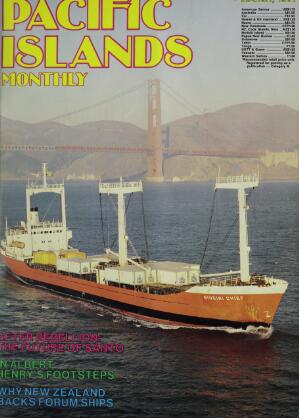
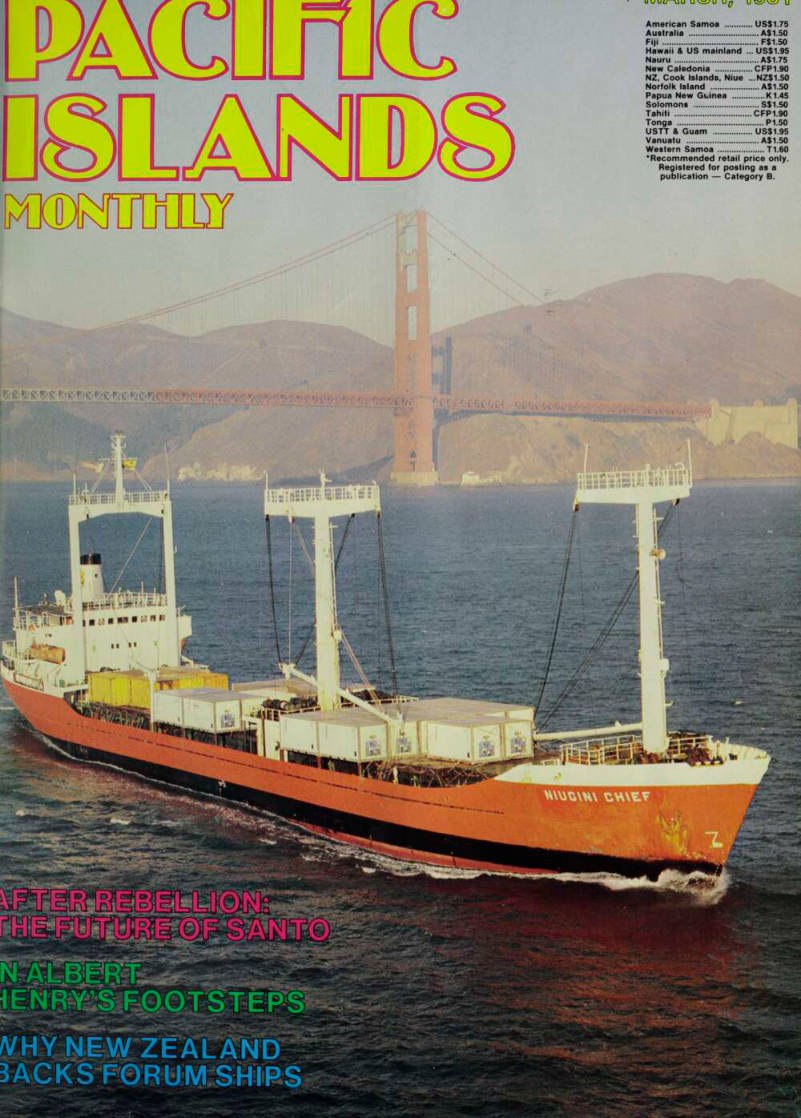
Cover picture: For the first time an Island country in the southwest Pacific has begun operating its own shipping link across the Pacific to USA. This month's cover picture uses the San Francisco Golden Gate bridge as a backdrop for the arrival off the US west coast of the cargo ship Niugini Chief, operated by the Papua New Guinea Shipping Corporation. Its cargoes to USA are PNG-produced coffee cocoa tea and frozen fish.
Advertisements & other items, p. 2 (1 item)
You’Ll
NEVER
WALK ALONE
'With the wide choice of superb portable radio cassette Akai, you’ll always be accompanied by your favorite musicians—wherever you go.
AJ-500* 4-band, 2-way 4-speaker syi -I i i I Mai AJ-530* *IPSS, Twinfield Super GX Head. 2-way 4-speaker system with metal tape capability ♦ Metal tape capability ★Stereo system AJ-420* 3-hand, 2-speaker (I2eni) syst\
AKAI
AKAI ELECTRIC CO., LTD.
Tokyo, Japan
Pacific Islands Monthly
Vol. 52 No. 3
March 1981
(Usps 952480)
AUSTRALIA: Distribution: NSW A ACT: Allan Rodney Wright (Circulation) Pty Ltd, PO Box 907, Darlinghurst, NSW 2010; Elsewhere: Gordon & Gotch (A/asia) Ltd, Box 40, PO, Rosebery, NSW 2018. Advertising - Melbourne - Ray Brown Pty Ltd, 614 Queensberry St, North Melbourne 3051, telephone 329 8522, telex 31717; Brisbane - D.
Wood, Anday Agency, Box 1918, GPO, Brisbane 4001, tele phone 44 3485, 44 1546: Adelaide - Hastwell Media, PO Box 30, Glen Osmond, SA 5064, 233 Glen Osmond Rd, Frewville, SA 5063, telephone 79 1869 Perth - Adrep, 62 Wickham St., East Perth, WA 6000, telephone 325 6395.
FIJI; Distribution and subscriptions Desai Bookshops, PO Box 160, Suva, Fiji, telephone Suva 23036. Advertising - Fiji Times & Herald Ltd, 20 Gordon St, Suva, telephone 312 111, telex FJ2124, FRENCH POLYNESIA: Distribution Hachette Pacifique, 10 Ave Bruat, Papeete, telephone 25610.
HAWAII, UNITED STATES: Distribution PIM, Hawaii, PO Box 22250, Honolulu, Hawaii 96822 Advertising - Roger Brookes, PO Box 10217, Honolulu, Hawaii 96816, telephone 808 536 1 784.
MICRONESIA: Advertising - Roger Brookes, PO Box 10217, Honolulu, Hawaii 96816.
JAPAN: Advertising and subscriptions - Universal Media Corporation, CPO Box 46, Tokyo, telephone 666 3036.
NEW CALEDONIA: Distribution Depot Centre de Presse Michel Pentecost, CBP2, Noumea, telephone 27 2434, 27 4729.
NEW ZEALAND: Distribution - Gordon & Gotch, PO Box 584, 2 Carr Road, Mt, Roskill, Auckland 4. Advertising - International Media Representatives Ltd, PO Box 2313 Auckland, telephone 795 487; 493 389, cables Intereps' Auckland Subscriptions - Ross Haines & Son Ltd, PO Box 1289, Auckland, telephone 769 042 PAPUA NEW GUINEA: Distribution - Gordon & Gotch 3 0 Box 3395, Port Moresby, telephone 254551, 254855 Advertising - PNG Post-Courier, PO Box 85, Port Moresby elephone 21 2577. 1 JNITED KINGDOM: The Herald & Weekly Times Ltd, No I Maltravers Street, London WC2R 3DZ, England, telephone 31 836 5162, telex London 21989 JNITED STATES MAINLAND; Advertising - Joshua B ’owers Jr, Powers International Inc,, 551 Fifth Ave New fork, New York 100 017, telephone 867 9580 ' telex >36514. Subscriptions - PIM, Hawaii, 2812 Kahawai St Honolulu, Hawaii 96822.
Subscriptions
>IM is airfreighted to most subscribers and agents in the pacific Islands and the United States, but not the UK or the /Ontinent.
lyment by personal cheque is accepted in Australian, US, ?w Zealand, UK and Fiji currency. For other remittances a in Australian dollars made payable the ANZ Banking Group, 88 Wentworth Avenue, Sydney jstralia. 7 7 ’ iblished monthly by Pacific Publications (Aust.) Pty Ltd d printed in Australia by Paramac, Alexandria, NSW Aus- T™ pnce is commended retail only. Registered the GPO Sydney for transmission by post as a publication category B. Second class postage paid at Honolulu iwan. Copyright © 1978 Pacific Publications (Aust.) Pty
Mmihi Ltd.
Postmaster Honolulu: Send address changes to PIM Hawaii, PO Box 22250, Honolulu, Hawaii 96822.
American Samoa Local Aust.
Sus16
$13 Australia $A12 $12 ianada $US18 $14 ■ook Islands $13 •jl $F12 $12 ranch Polynesia
Cfp 1700
$14 iuam $US16 $13 awaii $US16 $13 span ¥4500 $16 iribati $13 licronesia $US16 $13 auru ew Caledonia
Cfp 1700
$18 $14 ew Zealand
Snz13.50
$12 iue orfolk Island $13 $12 $13 orthern Marianas $US16 apua New Guinea K12 $13 Jlomon Islands $13 xiga jvalu $13 $13
lited Kingdom
3 Mainland Stg 10 $US18 $15 $14 muatu $13 estern Samoa $13 $A16 sewhere
This Month’s Features
• VANUATU: THE GOVERNMENT, THE OPPOSITION AND THE ECONOMY Malcolm Salmon, PlM’s Associate Editor, revisits Vanuatu anchtalks to Prime Minister Walter Uni and Opposition Leader Vincent Boulekone 13 • NEW CALEDONIA: A WAR OF WORDS For the first time in the English language PIM publishes the translation of a controversy over the extent to which France was involved in the events which led to rebellion last year on the Vanuatu island of Espiritu Santo 17 • PINE POLITICS IN FIJI Will the Fiji government develop its big pine forest scheme by accepting a partner it doesn’t want or by accepting a partner the electors don’t want? Christy Sills, writing from Suva, tells how either course of action could mean trouble 33 • IN THE FOOTSTEPS OF ALBERT HENRY The Cook Islands Party announces that its new leader will be Geoffrey Henry, cousin of the man who gave the Cooks its modern national identity 35 • TRAVEL Joseph Theroux provides a delightful guide on how to understand the subtle (and sometimes not so subtle) messages contained in Polynesian body language • IN DEFENCE OF THE FORUM LINE New Zealand concedes that ‘some changes’ may be needed in the operation of the ailing Pacific Forum shipping line, but defends its financial commitment to the line in the interests of Island communities 67
Australia in the Pacific 59 Books 47 Cook Islands 35 Deaths 81 Fiji 5,6, 33 French Polynesia 22 Guam 37 Hawaii 5, 7 Islands Press 57 Kiribati 26 Letters 7 New Caledonia 17, 21 New Zealand in the Pacific 37, 67 Noumea Notebook 21 Pacific Report 5
Papua New Guinea 5, 26, 35, 59, 71 People 39 Political Currents 33 Postmark Papeete 22 Shipping Schedules 79 Ships 67 Stamps 53 Tonga 37, 67 Tradewinds 59 Tradewinds Intelligence 65 Travel 51 Tropicalities 26 Vanuatu 13, 59, 71 Western Samoa 26 Yachts 73
Advertisements & other items, pp. 3-4 (2 items)
Acific Islands Monthly March, 1981
Founded 1930 by R. W. Robson Editor Angus Smales Associate Editor Malcolm Salmon Editorial Adviser John Carter Manager John Berry Advertising Sales Manager Steve Gray A Pacific Publications production 76 Clarence Street, Sydney 2000 GPO Box 3408 Sydney 2001 Cables: PACPUB Sydney Telex; 21242 (answers INTARAD) Telephone; Sydney 29 6693 Melbourne 63 0211 ext. 1565 and 1858
REPRESENTATIVES
tobiSS
Looking for handy, reliable transport from home to town?
For performing everyday tasks?
Go with a Suzuki!— choose one of our rugged,
high-performing 4-wheel drive vehicles,
just meeting your transport needs.
and
fob
MOB?.
M 0
tobiSS
p©WEB
Look into the traditional excellence of Suzuki’s performanceproven motorcycles and fleet of outboard motors — something to satisfy your every motoring need. Going by land or by sea ... go with a Suzuki.
DT85
SUZUKI TS 125
SUZUKI MOTOR CO., LTD. reserves the right to change, without notice, equipment, specifications, colours, materials and other items to apply local conditions. Each model might be discontinued without notice. Please inquire at your local dealer for details of any such changes. Actual body colours might differ slightly from the colours in this ad.
SUZUKI MOTOR CO LTD
Hamamatsu, Japan
SUZUKI
SOLOMON ISLANDS SOLOMON ISLAND SERVICE STATION LTD. #NEW CALEDONIA STE. SUPERCAL • PAPUA NEW GUINEA BURNS PHILP (NEW GUINEA) LTD. #NEW HEBRIDES HENRI LEROUX #NIUE ISLAND BURNS PHILP (SOUTH SEA) CO., LTD. #PONAPE LEO ETSCHEIT# TAHITI NIPPON AUTOMOTO • ELLICE ISLAND TUVALU COOPERATIVE WHOLESALE SOCIETY LTD. «GUAM & SAIPAN ISLAND CYCLERY, INC. • NORFOLK MARTIN’S AGENCIES LTD. «SAMOA PACIFIC PRODUCTS, INC. • TARAWA GILBERT ISLANDS COOPERATIVE FEDERATION LIMITED •TONGA MORRIS HEDSTROM LTD. • WESTERN CAROLINES BECHESRRAK T. COMPANY •YAP AMBROSE D. MINGINFEL’S WHOLESALER • EASTERN CAROLINES KIOMASA STORE • NAURU EQUAPAC MOTORS •FIJI NIRANJANS AUTOPORT LTD.
Pacific Report
Nosedive in France-Vanuatu relations Vanuatu-France relations took a nosedive in the first days of February, with Vanuatu declaring French Ambassador Yves Rodrigues persona non grata and giving him 24 hours to quit the country, and a senior French spokesman threatening to cancel completely promised French aid to the infant republic. The trouble began when, on February 1, Barak Sope, arriving at Noumea’s Tontouta airport to attend a congress of New Caledonia’s Independence Front, was told that his visa (granted to him by the French Embassy in Port-Vila the day before) had been withdrawn, and that he would be unable to attend the congress. Two other delegates travelling with him were permitted to take part. The official French explanation was that Mr Sope, who as well as being secretary-general of the Vanuaaku Party is first secretary in Vanuatu’s Prime Minister’s Department, should not attend the meeting, ‘because of his official functions’. The French statement added: ‘But he could hold talks with French authorities in Noumea on matters of common interest. During his stay, Mr Sope met officials at the French High Commission, as planned.’ The next day, February 2, Mr Rodrigues was declared oersona non grata. A government spokesman explained that the action was taken ‘with much sadness’, but ‘was the only means af protest in the government’s power’. It sought to demonstrate that ‘the dignity and integrity of its representatives must be 'espected’. The government also announced that personnel at :he French Embassy would be reduced to the same number (five) as those staffing the British and Australian High Commissions. On r ebruary 3 in Paris, Olivier Stirn, a Deputy Minister of Foreign Affairs, announced that France had decided to withdraw its aid aersonnel from Vanuatu following the action against Mr Rodrigues. (There were almost 200 French teachers working in /anuatu.) Referring to the fact that an agreement on co operation between the two countries had been due to be signed, Mr Stirn declared; ‘lt is hard to see France signing an agreement on co-operation with a country with a First Secretary of the Prime Minister’s Department who attends meetings of people hostile to he presence of France in one of its own territories.’ The igreement would therefore not be signed. The sequence of ivents, with a Foreign Ministry official granting the visa in Vanuatu one day, and Overseas Department and Territories officials withdrawing it in New Caledonia the next, immediately touched off speculation that there had been a lack of liaison between hese two arms of the French bureaucracy. Some observers said i ‘furious quarrel’ had erupted between the two. A Papeete lewspaper quoted sources close to the Vanuatu Government as aying: ‘The French Embassy knew perfectly well why Mr Sope /as going to New Caledonia and raised no objections at all’, idications of a possible Australian initiative to ease the situation ppeared in an editorial in The Sydney Morning Herald on ebruary 16. An editorial in that paper reported that a February 7 meeting of the Australian Cabinet would discuss a proposal to rant Vanuatu special aid of about $7 million over and above the nnual Australian grant now running at slightly over $4 million. It aid: ‘What Vanuatu needs now is not the blessings of French ivilisation, which apparently can only be had on humiliating 3rms, but a period of peace and political stability in which the ountry’s Melanesian people can draw closer together. If the rench make good their threat (to withdraw aid), Vanuatu will in ict be able to move more quickly towards its plan ultimately to -place the dual education system with a unified curriculum he net cost of finding about 80 Australian teachers preferably 'ith French language qualifications in addition to the loss of ?venue caused by the departure of 180 very highly paid French jachers will run out at about $7 million annually. This is a small jm. We can afford the money and it is very much in Australia’s -gional and strategic interests to do so if the French carry out ieir threat . . .’ (See earlier interview with Father Walter Lini, 13.) Monumental conspiracy’ in PNG fire 3 art of a monumental conspiracy’ involving arson, murder and lisappropriation such is the finding of a commission of inquiry ito a fire which two years ago destroyed most of the Papua New
Guinea Government’s finance department. A copy of the still unreleased report was obtained in January by The Sydney Morning Herald. ‘We are of the opinion that the fire was deliberately lit, with malicious intent,’ the commissioners concluded in their report. ‘However, after months of investigation, we are still unable to prove who did it or why.’ The fire, which occurred on January 19, 1979, on the sixth floor of the central government building at Waigani in Port Moresby, destroyed most of the finance department, including its files. The report was handed to the then prime minister Michael Somare in January 1980, but has still not been made public. The commissioners expressed the belief that David Balagaize, the building manager and a key witness, was murdered to silence him. Mr Balagaize was found dead in a Port Moresby house on November 2, 1979, three days after he began giving evidence to the commission. A coroner found that he committed suicide. The commissioners said they felt they were getting closer to the truth after eight months of investigations, but stopped work under pressure from the government to produce the report. They said a plausible explanation for the fire was that it had been lit deliberately to prevent a prosecution. The auditor-general has already reported that there are vast sums of money being syphoned off annually from the nation’s treasury by way of false accounting, misappropriation and so on,’ their report said. Following publication of newspaper reports, PNG Prime Minister Sir Julius Chan said that government’s failure to act on the report was due to ‘administrative oversight’ within his department. He pledged that the report would be tabled in the February session of parliament, adding: ‘I will ensure that all matters revealed in the report are followed up and appropriate action taken.’
Four PNG ministers fall foul of law Four ministers have been dropped from the Papua New Guinea Cabinet following court convictions or pending court action against them. John Jaminan, 38, minister for health, was sacked by the Prime Minister, Sir Julius Chan, when he refused to resign.
He had been convicted of drink-driving and assault. The three others resigned. They were Ibne Kor, 40, minister for environ ment, who is to stand trial on a rape charge; Gabriel Bakani, 33, minister for energy, who was convicted of obstructing police: and Mark Ipuia, 33,minister for works and supply, who was convicted of drink-driving. Late in February the Chan coalition government, weakened by conflicts in cabinet and factional issues, was due to face a test of its solidarity. The pending test was a parliamentary no-confidence motion in Police Minister, Warren Dutton. There were indications that the government itself could be divided over the vote.
Islands reps at Socialist Gabfest Representatives from Fiji, New Caledonia and Palau were among foreign observers who attended a conference of the Asia-Pacific Socialist Organisation in Sydney, Australia, in February. Fiji was represented by its parliamentary Opposition Leader Jai Ram Reddy and James R. Raman, national secretary of the Fiji Trades Union Congress. From New Caledonia came three representa tives of the Independence Front: Frangois Otanari, Henri Bally and Suzanne Ounei. The conference gave full backing to their call for independence for New Caledonia. Senator Moses Uludong came from the Republic of Palau, which had only a week before (on January 29-31) celebrated the inauguration of its consti tutional government. The senator said that his country had achieved only limited independence from the United States, but hoped to obtain full independence in the next two years. He told the conference he believed his country’s constitution was the first in the world to address the issue of nuclear arms and waste.
Representatives also attended from Asian countries such as Japan and Malaysia. The newly formed Asia-Pacific Socialist Organisation is an offshoot of the Socialist International, the umbrella organisation of the world’s labour and social democratic parties. The conference was officially opened by Neville Wran, Premier of the Australian Labor Party government of the Australian State of New South Wales.
President Reagan and the Islands Anxiety about the new Reagan Administration’s attitude to United States Pacific territories was voiced in a recent editorial in the Honolulu Advertiser. The editorial said in part; ‘One of the areas where the Carter Administration can claim a good record is in its relationship with America’s Pacific territories. The region, often relegated to backwater status in the past, was given increasingly high visibility over the last four years . . . What
direction Reagan takes in dealing with our Pacific territories will not be clear for a few more weeks. But the choices facing the administration are clear. The Republicans can choose to further develop a policy which recognises the uniqueness of the islands and which gives their problems high bureaucratic visibility. Or they can return to a time when these far-flung islands were thought of as being no more than curious political appendages and actual or potential military bases, and when official oolicv reflected that.’
Fiji soldier killed in Lebanon A Fiji soldier serving in the United Nations Peacekeeping Forces in Lebanon died late in January from wounds suffered during an attack by Palestinian guerrillas. He was Corporal Lemeki Yabia, 40, a member of the Royal Fiji Military Territorial Forces and a farmer of Vuci, Toktoka, in Tailevu. Cpl Yabia was shot in the head while working outside the kitchen of the Fiji Battalion HQ in Cana. Rushed to hospital, he did not regain consciousness.
Fiji opens Tokyo Embassy
The Fiji Embassy in Japan was formally opened in Tokyo on January 19. In a supplement on Fiji published in the Japanese daily Asahi Shimbun to mark the occasion. Fiji Prime Minister Ratu Sir Kamisese Mara has a message noting that Fiji’s purchases from Japan had increased by 18% in two years, from SF46 million in 1977 to $56 million in 1979. He went on: ‘As Fiji is a small country totally reliant on a healthy level of external earnings for its economic well-being, it is our fervent hope that your country will reciprocally and favourably offer Fiji the opportunity to supply Japan with essential raw materials and other requirements in increasing quantities.’ He pointed out that Japan had bought from Fiji s3l million worth of sugar and $1 million worth of timber last year. Japan was also an important source of tourists to Fiji, Ratu Mara said. He expressed the hope that more tourists would visit Fiji now that there was a direct air service between the two countries.
Vanuatu cabinet reshuffle Vanuatu in February saw its first Cabinet reshuffle since independence. Prime Minister Father Walter Lini announced the changes, effective from February 9. Former Minister of Lands, Sethy Regenvanu, becomes Minister of Agriculture, Forestry and Fisheries: Thomas Reuben Seru, former Minister of Primary Industries, gets the Lands portfolio: George Worek, former Health Minister, becomes Minister of Social Affairs; Willie Korisa, former Minister of Social Affairs, takes the porfolio of Health.
Fiji resort official fined Peter Batey, 31, finance and development manager at the Plantation Island resort on Malololailai in Fiji, has been fined SF2O 000, in default six months in prison, for attempting to smuggle S3O 000 out of Fiji, in breach of the country’s currency laws.
Suva’s duty-free trade slumps
Suva’s duty-free stores have been hit by the worst slump in their history, with sales down at least 25% on previous years. One reason is that the port has lost most of its formerly thriving Christmas and New Year cruise ship trade. Competition from other countries with duty-free shops, New Zealand import restrictions, and a slump in Australian and New Zealand tourist traffic are other reasons, according to traders. President of the Suva Duty-Free Dealers’ Association Mohan Musadilal said; ‘Many of my members are stocking and selling non duty-free goods to stay in business.’ Mr Gokal said the immediate cause of the slump, the worst in the trade’s 25-year history, was the withdrawal of Russian ships chartered by Australian companies for cruises from Sydney due to an Australian Government ban on them in retaliation for the Russian invasion of Afghanistan.
Crime waves ebb and flow Crime is on the increase in Tonga, according to Police Superintendent Paula Vivili who appealed in a statement in January for public co-operation in the prevention of crime. The value of goods stolen or destroyed in the period December 23 1980 to January 5 1981 had increased by a third compared with the same period in 1979-80. Crimes committed in Nukualofa exceeded those in all the rest of the country. In Fiji, Police Commissioner John Orme reported in January that there had been a 15% drop in violent crime in Fiji in 1980 compared with 1979. There had also been a drop of 24% in the number of juvenile offenders. For his part, Papua New Guinea’s Prime Minister Sir Julius Chan said in an open letter to an Australian newspaper in February that in the second half of 1980 Port
Moresby s crime rate, which had climbed dramatically earlier im t i h Q e Q n oar^ d o° P, ? e 1 d Sl 9 nificant| y- Christmas in Port Moresby in 1980, said Sir Julius, was the most trouble-free for 15 years.
Bid for V.C.’s bones fails again Fiji has again asked for and been refused permission to exhume 1 the remains of World War II Victoria Cross hero Corporal Sefanaia Sukanaivalu from the Bita Paka war cemetery near Rabaul Papua New Guinea. The matter was first raised some years ago’
The Minister for Home Affairs Ratu William Toganivalu revived it in discussions he held in February with the visiting Director- General of the Commonwealth War Graves Commission, A. K.
Pallot. But Mr Pallet reiterated the commission’s stand, which is written into the Commonwealth War Graves Convention’, refusing permission to exhume remains of any war dead. He said the commission was strongly against such exhumations, and had refused requests from governments and wealthy relatives of dead soldiers remains. He said the commission was of the view that ‘if the dead soldiers were to have been asked where they wanted to be buried, they would prefer to have been buried with their comrades-in-arms’. He said the war graves served as an ‘historical monument where descendants of the dead soldiers could visit and recite to their children the sufferings and miseries encountered’. Mr Pallot visited the war cemetery in Suva, and expressed the commission’s gratitude to the Fiji Government for constructing and maintaining it without charge. Making his annual South Pacific tour, Mr Pallot headed for Noumea after his visit.
Tupuola takes over broadcasting
Western Samoa’s Prime Minister Tupuola Efi has taken over the portfolio of Broadcasting. This brings under the PM’s direct control the second of the country’s two tax-funded media, the radio station 2AP and the fortnightly newspaper Savali.
Murdered MP’s seat is filled Jacob John Olaf Jack Netzler has won one of the two Individual Voters’ seats in Western Samoa’s Legislative Assembly. The late January by-election was made necessary by the death by murder of sitting member Ron Berking (PIM Dec p 73). Like Berking, Netzler represents the Human Rights Protection Party (HRPP).
Netzler’s vote was 354, Ricky Schwalger’s 261 and Peter Paul’s 236. Only 11 votes were informal.
Irian Jaya ’quake kills 263 An earthquake which struck Irian Jaya on January 20 caused a minimum of 263 deaths. The ’quake, registering 6.8 on the Richter scale, was centred in the far west of the Irian Jaya mainland. An indication of its severity is that it caused a large number of casualties, despite the sparseness of population in the area.
Palau deadlock broken The deadlock in attempts to elect the vice-president and floor leader of the Senate of the Republic of Palau (PIM Jan p 5) was broken on January 12, only one day before the due date for the holding of the legislature’s first formal session. After a long succession of tied votes, George Ngirarsaol was elected vice president (defeating Joshua Koshiba), and Johnson Toribiong was elected floor leader over John Tarkong. 31 000 in Marshalls A census of the population of Marshall Islands has turned up a tentative figure of 31 000, excluding Kwajalein Island.
Australian pilot dies in PNG A 25-year-old Australian pilot was stabbed to death in Port Moresby in February when he went to the aid of his Papua New Guinean girlfriend. Peter Cousins, a pilot with the PNG domestic airline Talair, was attacked outside a party early in the morning of February 9. A police spokesman said a Papua New Guinean had tried to molest Cousins’ girlfriend, and when Cousins intervened the man pulled a knife, stabbed him several times, and ran off.
Malaria: Solomons try Fenitrothion Solomon Islands is experimenting with a new insecticide in its efforts to cut down on the incidence of malaria in the country. The product, Fenitrothion, is said to have two advantages over DDT, which is, also in use in Solomon Islands: the malaria mosquitoes don’t avoid the walls sprayed after feeding and so are killed, and it has a fumigant action, releasing an invisible vapour which kills flying mosquitoes within a few hours. The experiment with Fenitrothion is financed by the World Health Organisation with the assistance of a Japanese company which supplies the insecti cide.
Advertisements & other items, p. 5 (1 item)
5
ACIFIC ISLANDS MONTHLY - MARCH, 1981
says designer
Letters
Hokule’a is a culture pivot, says designer
In his December review of Ben Finney’s book Hokule’a, the Way to Tahiti, Bengt Danielsson’s information is in some respects incorrect because the book itself is a highly )ersonal view of events which iuffers from distortions and irrors of omission.
As co-founder of the Poly lesian Voyaging Society, gen :ral designer and construction upervisor of the double canoe Hokule’a, and skipper of a hakedown and training cruise hroughout the Hawaiian slands, I write to correct some lisinformation created by this ook and by the press during he few months that this project f as in some difficulties.
The design of the hull was not ill guesswork’. Hokule’a’s ulls have the convex V of the ahitian pahi, also seen in some irly drawings of some sections f Hawaiian sailing canoes, his V, not unlike that of the uamotuan hull Danielsson iggests we should have fol wed, enables the canoe to ork sufficiently to windward to il between Hawaii and Tahiti, his course is a close reach with beam current both ways )t with ‘favourable winds and irrents’ as Danielsson states.
Sail plan is similar to that ed throughout Eastern ilynesia and New Zealand at e time of European contact, fleeting general design fea res rather than some of the ecialised features which were
:al developments evolving
ler the era of long-distance yaging had ceased.
The hulls are not ‘plastic’ (a mour started by a reporter in hiti) but are built of lami led wood with a protective ating of fibreglass. We knew w the old canoes were built.
but we did not know how they performed; therefore our inter est was not in building a materials-accurate replica, but rather a replica which would be performance-accurate. Per formance of the hulls is not dependent on the materials used, but on the shape, surface, and assembly by flexible lash ings. The painted, highly glossed surfaces of Hawaiian canoes which excited admir ation from early European ob servers was not substantially different from a fibreglass sur face. And Hokule’a is lashed together by six km of line in flexible lashings which function admirably as ‘shock absorbers’.
Tests during the first cruise revealed that the canoe could sail into the wind sufficiently well to make it to Tahiti and back. Also, tests in the rough channel waters between the Hawaiian islands showed that Hokule’a would have no difficulty on the open sea in anything less than a survival storm.
Sentimentalists who chaffed us for not using traditional materials were invariably not sailors. Of the giant koa from which huge Hawaiian canoes were once made only a few remain of sufficient size, some being riddled with rot. It seemed better to leave these magnificent trees standing. In the old days a canoemaker would form and bend a hau branch with splints and lashings so that his grandson might someday be able to cut a perfectly-curved crossboom for a double canoe, but that tra dition had passed before our grandfathers were born. Thus
our crossbooms were made of laminated wood.
During the first cruise we tested the sail plan with heavy canvas while pandanus sail mat ting was being made. Pro fessional commitments forced me to take temporary leave from the project (entirely a volunteer project) after the first cruise; and much to my chagrin the pandanus sails were not used on the Tahiti voyage, and rotted because they were not properly aired. However, these mat sails weighed only 35 lb. each, and subsequent testing has shown that a pandanus sail doesn’t differ significantly in performance from a sail of heavy canvas. Being stiffer than canvas, it actually seems faster.
I named the canoe Hokule’a, the Hawaiian name for Arcturus, a zenith star (appear ing to pass directly overhead) of Hawaii, and thus a latitude indicator for ancient voyagers returning to Hawaii from the South Pacific. As a star that guided them back to Hawaii, it was aptly named Hokule’a (star of gladness).
The widely and inaccurately publicised difficulties we experi enced just prior to and during the first leg of the Hawaii-Tahiti round trip were due largely to a clash of objectives between those (like Finney) who were primarily interested in ‘scien tific’ objectives; those who were in it for simple adventure and ego gratification; and those who saw its potential as a cultural experiment. I was of the latter group. Recognising that no cul ture can exist without its ob jects, my hope was that by rebuilding what had been a
central object of the old culture and actively using it in Hawaiian waters, some revival of related elements of the old culture would be stimulated. I was pleased to see that the canoe ‘spoke’ to Hawaiians in all the islands, and that it did become a focus and stimulus for retrieval and revival of tra ditions in the arts and crafts of old Hawaii that are threatened with extinction.
Mistakes were made, as might be expected, for on the first time around a new track one is apt to stumble into the potholes. But things did get shaped up. The return from Tahiti to Hawaii (after Finney left the project) went well.
The recent (1980) round trip voyage to Tahiti logged 6000 miles perfectly navigated by Hawaiian Nainoa Thompson without charts or instruments.
Under skipper Gordon Piianaia, crew morale and efficiency was excellent.
We are now informed that a double canoe is being made at Pahiatua, New Zealand. A re surgence of interest in canoes and voyaging was seen at the recent South Pacific Arts Festi val. To all Pacific Islanders whose ancestors explored and settled this ocean world, the voyaging canoe is a common symbol. And any direct experi-
On board Hokule’a during the historic crossing from Hawaii to Tahiti, crew member Tony Holmes displays a day’s catch.
The photograph is by Ben Finney, author of the contro versial book of the voyage. PIM reviewed the book in December, prompting corre spondence which is continued on this page.
ence with canoe sailing and non instrument navigation must re mind us of the resourcefulness, inventiveness, and courage of those ancestors. Certainly they possessed qualities which we would do well to emulate today.
Herb Kawainui Kane
Kailua-Kona Hawaii USA Some new words on the wantok system Please excuse my southern Cali fornia ignorance of southern Pacific cultural systems, but the PI M article in November about books vanishing from the Uni versity of Papua New Guinea has me wondering as to the meaning and origin of the ‘wantok system’ said to be practised by library staff there.
I am interested to know if my staff at the Scripps Institution of Oceanography Library may be guilty of the same philos ophy, especially when our dis tinguished academicians here at SIO slip past our exit turn stile with non-circulating copies of PIM tucked under their coals.
Paul L. Leverenz
SIO Library La Jolla California USA Wantoks are people of the tame kin or from the same ! illage of origin. The word omes from the English ‘one alk' sharing a single anguage among the hundreds f PNG languages and dialects.
Jnder the want ok system pref rential treatment is given and xpected between wantoks, even f this sometimes means bend ng the rules. Unless reader .everenz can establish some ort of home-town link between ny of his staff and any of the V M-smugglers, then his rouble is definitely not >antokism. Maybe the mugglers just like reading TM. Editor. onga should move vith the times wish to write about the larriage of Tonga’s Prince Lla’ivahamama’o to Miss leimalaura Salmon Anderson PIM Nov pi 5 and Dec p 8). our magazine pointed out one nporlant fact; King
Taufa'ahau should have stopped this romance before the marriage. I, myself, believe that a high chief’s daughter has enough rank to marry a prince!
European monarchies see the necessity of keeping with the modern times. In Europe, many royals have married com moners. Even Britain’s Princess Anne married a commoner. In many countries, the people have fell closer to their royal family after a royal-commoner mar riage. This is a good example for Tonga!
One always hears that Tonga is moving toward development.
Yet the royal house is forced to live by traditions from the Middle Ages. Now we learn that King Taufa’ahau has with drawn his son from succession to the throne of Tonga. The King has made a move which is outdated and undemocratic.
Prince Ala’i should have sought his father’s permission for this marriage, because that is part of Tongan law. However, the King should set a new example by welcoming Miss Anderson (a commoner) into his family.
If the King will show kind ness and reconciliation toward his wayward son. His Maiestv
will be known as a good father and a wise monarch.
Randy Duff
Indianapolis Indiana USA Tuvalu secession call not official I refer to the letter written by Telavi Fali (PIM Oct p 11) under the title A Tuvalu Se cession so that your readers may not be misled into thinking that the writer has been author ised to speak on behalf of the people of Nanumea.
In fact although Telavi Fati writes that he is appealing on behalf of the Nanumea Com munity he has no right at all to do so. He is not an elected representative of the people either in the Parliament of Tuvalu or in the Island Council of Nanumea and he has not been asked by the Island to speak on its behalf either in making statements about the intentions of the community or in seeking loans.
I am sure that your readers and Commonwealth countries to which the appeals are ad dressed will ignore such wild and unrealistic statements and appeals until they are satisfied that they come not from some self-appointed spokesman but from someone who has been
given proper authority to rep resent the Island.
Maheu Naniseni
Funafuti Tuvalu Mr Naniseni is the Member of for the electorate of Nanumea.
An ‘absurd’ PNG
character writes Please allow me once more to reply to Ms De Montluc’s letter (PIM Oct 1980 plO). The kind lady accuses me of being a racist, nazi, and an ‘absurd’
Papua New Guinean. Before I answer these accusations, I would like briefly to make some comments on her second letter. (1) There was no misunder standing on my part on the main point of this kind lady’s earlier letter (PIM Dec 1979 pi 5). Her letter resulted from what Mr Ebia Olewale had said during a speaking engagement in which the former foreign minister of PNG was asked by the French Polynesian ‘nationalists’ to speak on the theme ‘internal autonomy and independence’.
Unfortunately, however, the kind lady went out of her way to bring in the issue of the ‘high standard of living’ in French Polynesia, the ‘lawlessness’ in PNG, and the Irian Jaya issue.
In so doing, she seemed to associate: (a) ‘dependency’ (of French Polynesia on France) as the key to the ‘high standard of living’; (b) ‘independence’ as leading to ‘lawlessness’ (the example was PNG); and then (c) the issue of Irian Jaya, suggesting that PNG had sold the birthright of Irian Jayans to the present colonising power.
I’ve been long enough in this world to understand that the kinds of assumptions, argu ments, and so on, that Ms De Montluc chose to use in her first letter are typical of the ‘colonial mentality’. With the best of intentions, my subsequent reply was directed to the author, who saw fit to air her views on the rights of French Polynesians. (2) The reference I made to ‘true’ French Polynesians in my earlier letter (PIM Jun 1980 p 6) stemmed from the theme of ‘internal autonomy and inde pendence’. Ms De Montluc agrees that this was the theme
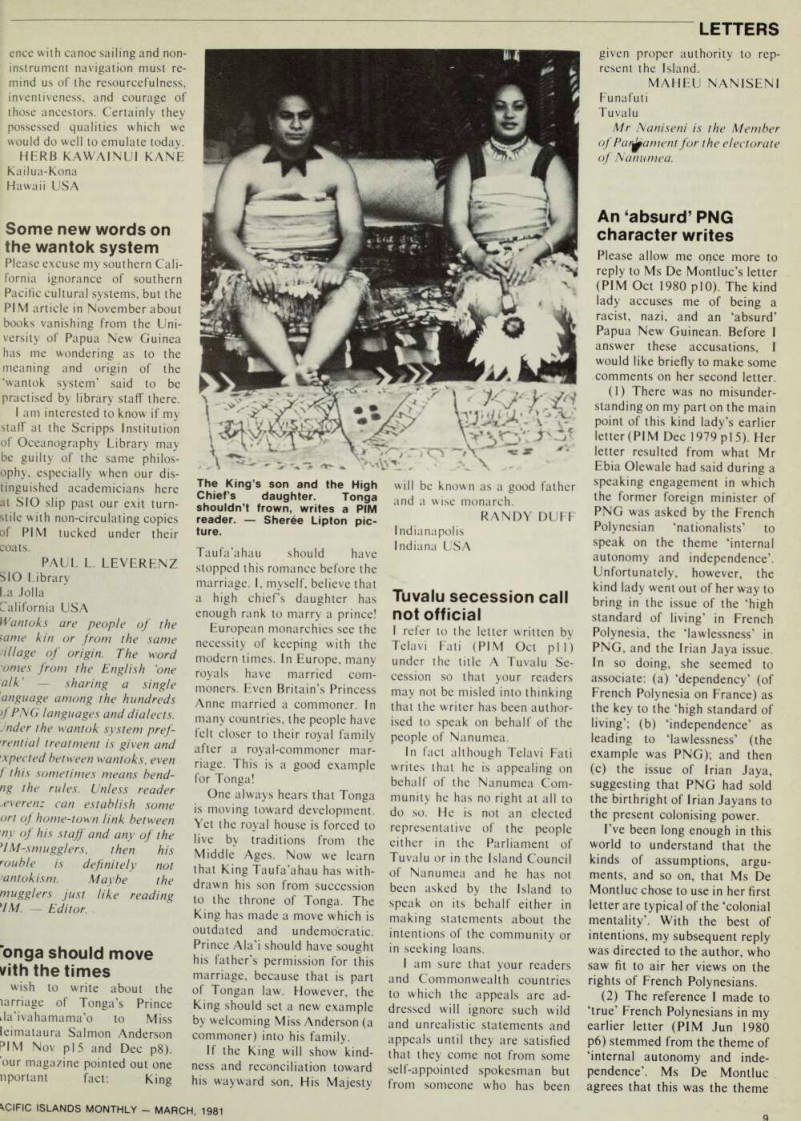
The King’s son and the High Chief’s daughter. Tonga shouldn’t frown, writes a PIM
reader. - Sheree Lipton pic
ture.
that prompted her to express her views about PNG and, in particular, Mr Olewale. Here, I associate ‘true’ French Polynesians with: (a) those who preach ‘independence’ and are not afraid of it; (b) those who see the ‘injustices’ of the colonising power (the prime example being the nuclear tests); and (c) those who, partly from experience elsewhere in the world, are concerned about the future of their children and are determined to make that future something to look for ward to.
These are some of the fea tures which I believe dis tinguish a ‘true’ French Polynesian or, for that mat ter, a Micronesian or Melanesian, whose interests are those of the people, and not those interests handed down by the colonising power.
In reading Ms De Montluc’s first letter, it occurred to me that the comments she made were those that I would associ ate with a colonising power, and any persons who share that power’s interests and, noting the surname, I felt this sup ported my assumption. Please note that, whatever her name, I would not have singled her letter out for reply if it had not been for the type of arguments she used.
As far as the other Pacific leaders to whom Ms De Montluc refers in her second letter are concerned, I cannot distinguish them any more than I could an American from a Canadian. The only way I could distinguish them would be from the types of responses they made to any questions I might possibly be able to put to them.
It would be quite dishonourable of me to accuse these gentlemen as being ‘totally unrepresent ative of their respective countries’, as Ms De Montluc suggests I might. (3) I am glad that Ms De Montluc ‘does not condone French nuclear testing’, but I am indeed sorry that she dis sociates independence for French Polynesia from nuclear testing in French Polynesia, regarding them as two separate issues. How different are they really? Am I wrong in assuming that for as long as French Polynesia is dependent on
France, the latter can manipu late the domestic and inter national policies of the former to suit its purposes?
The kind lady made refer ence to the fact that French Polynesia has chosen ‘internal autonomy’ over immediate in dependence until such time as French Polynesia is ‘economi cally self-sufficient’. Which country on the face of this earth is ‘economically self-sufficient’?
Would the USA, which imports a major part of its energy needs in the form of oil, think of reverting to its 18th century state of political dependence on Britain until such time as its economy is ‘self-sufficient’?
Truly, if we were to use Ms De Montluc’s yardstick, we’d all be colonies until kingdom come!
Finally, I would like to ex press my thanks to Ms De Montluc for promoting me from ‘primitive’ PNGean to ‘absurd’
PNGean. My sincere thanks to PIM readers for putting up with
my ‘absurdity’.
Samson M. Polume
Victoria BC Canada An invisible host on
Sudest Island
The article Through the Louisiades by Morning Star, written by Michael Adlington (PIM Aug p 59), is full of inaccuracies, omissions and in ventions. I know, because I am the ‘friend’ whom the author came to visit.
I am an anthropologist who lived for over a year in the home of Martin Peter, Nora Moses and their family in Jelewaga Village on Sudest Island, or, to use the island's true name, Vanatinai. Mr Adlington, an acquaintance who had learned of the very existence of the Louisiades from me, arrived unexpectedly by boat one day in June, 1978. Following local custom for even an unwanted guest, I gave up my room and slept on a pandanus mat with the children for the duration of his stay, even though I was then recovering from a severe ma laria attack. I provided the bulk of Mr. Adlington’s food from my own stores and by bartering with the other villagers so as not
to strain Marlin and Nora’s garden resources unduly. I translated conversations with the local people for Mr Adlington and explained to him the activities which he wit nessed.
Mr Adlington completely omits from his story the fact that his only prior acquaintance at Jelewaga was myself, a white woman who was living there and who was present in virtually every scene which he describes in the village. He pretends I do not exist and never mentions me in the article. He implies that Marlin Peter was the ‘old friend’ who greeted him June 13 by describing a garden tour with ‘my host and namesake’
June 14, but Martin Peter did not return home to Jelewaga until June 18 to find a stranger in his house. Mr Adlington freely uses my words of expla nation of village events verbatim throughout his story as if they were his own. But he still manages to get many facts wrong. For example, there were no ‘bamboo drums,’ or any drums, played at the aid post opening celebration, which took place on June 22 and not on June 15, as the article states.
Mr Adlington refused the vil lagers’ invitations to dance; perhaps that is why he failed to notice that the music was pro vided by tape recordings of string bands which had been specially brought for the oc casion by off-island visitors.
Also, the photograph of page 61 was taken off Sideia Island, near Samarai and the PNG mainland, and not in or near the Louisiades as the caption implies. The Louisiade peoples do not make or use long, outrigger-less canoes.
Why did Mr Adlington omit any reference to my presence in this purported eyewitness ac count? He thanked me in person at Jelewaga, saying, T would never have been able to come and stay in such a remote place if you hadn’t been living here’.
Why then was mentioning my existence so difficult for him to do in print? By contrast, in another recent PIM travel article describing a visit to Tubetube Island near Samarai, the authors felt no need to suppress the fact that they found an anthropologist living
on the island. PIM readers deserve accuracy as well as colourful stories about exotic places in a magazine which they trust. The reality of life on Vanatinai is far more interest ing than anything Mr Adlington could invent.
In any case, congratulations on your 50 years of publication!
My subscription copy of PIM used to arrive without fail at Jelewaga, albeit a month or two late. It usually came by canoe for the last leg of its journey or else was hand-carried by some kind person making the all-day walk to the village from the government station at Tagula.
Everyone at Jelewaga greatly enjoyed looking at each new issue. I know that on many other remote islands, PIM is one of the only publications which occasionally filters in providing local residents with a treasured link with the rest of the Pacific. Best wishes for the next 50 years!
Maria Lepowsky
Dept of Anthropology University of California Berkeley California USA In fairness to Richard Adlington regarding one aspect of the above letter, PIM takes responsibility for the pictures which were received from an independent source. They were included to indicate the general nature of the Milne Bay Prov ince coasts and islands, and not specifically Sudest Island. - Editor.
Will the French follow the rules?
The recent sale of Australian Northern Territory uranium to French interests brought shouts of glee and dollar signs to the eyes of the NT. government and to many people in the NT.
A local newspaper ejaculated to the Chief Minister of the Northern Territory, ‘Go to it, Mr Everingham’.
The uranium is sold subject to rules laid down by the Australian government, i.e. that no NT. uranium be used in nuclear tests.
We all know how the French will treat these rules once they have the NT. uranium.
I am sure that Mr Evering ham would like to hear the
I opinion of all the people and governments of the Pacific re gion concerning this sale of j NT. uranium to the French.
His address is: P. A. E.
I Everingham, Post Office Box [ 3146, Darwin, Northern Terri tory, Australia 5794.
T. A. Nalder
I Glencoe Crescent I Tiwi NT. Australia Thanks from a friend of 10 years I treasure every edition of PIM.
Your 50th anniversary edition was absolutely superb! Thank you for the 10 or so years I’ve known you.
(Ms) Mel Kernahan
Balboa Calif
Usa
Poetic points (1)
beautiful
I would be very grateful if you could pass my comment through your magazine to the poet of The Tidal Waves (PIM Dec p 9).
While enjoying the contents of the PIM December issue, I came to terms with a beautiful poem for a newly independent country which, among others, blamed the work of the missionaries and Christianity for diverging people from their traditional custom. As a Christian I know that one of the reasons why the Jews crucified Christ is because He did not conform to their national spirit and dreams, which are mani fested in their ideas of the coming Messiah.
I am not a fanatic Christian and I do not want to defend nissionary work since it is true hat many of our good customs lave been abolished. However, wouldn’t have blindly blamed Tristianity before taking in ventory of the benefits and costs )f the missionary work. I have io idea about missionary his ory in Vanuatu, but for us, Christianity has unified us, who nee lived scattered, as small solated communities. Unfor unately, tribe-oriented mind till persists among many of us indering co-operation at a time
/e desperately need unity.
If we have troubles, social efection, disunity, and the like,
it is because we haven’t submit ted ourselves fully to be led by that Kindly Light. I never find any defection in the type of social life recommended in the Bible. Do you regret having Christ as your saviour? I don’t.
To the editors 1 would like to express a very special thanks for the now and then pieces of news about Irian Jaya. It reminds me that you never forget us as a South Pacific folk.
Yan P. Karafir
(Irian Jaya) New England University Armidale NSW Australia
Poetic points (2)
hypocrisy
Might I ask Sampson Ngwele who wrote the poem for Vanuatu independence (PIM Dec p 9) upon which tidal wave he floated across to the Univer sity of PNG? His indiscriminate condemnation of all things foreign would not smack so much of hypocrisy were it launched from some jungle fast ness in his native Vanuatu and not the halls of an institution
that is as much an import to the Pacific Islands as are the things he condemns.
Mana does not inspire my poetry curiosity occasionally does. ‘My posterior pains with rage,’
Is what I think you said.
Does this mean.
My friend unseen.
That you sit upon your head?
Laurie Meintjes
Apia Western Samoa Mr Meintjes is a former District Officer in PNG and is now a teacher in Western Samoa.
Support for Maori
entry to games I would like to thank Dr H. R.
Broughton on his view seeking membership for the New Zea land Maori athletes to partici pate in future Pacific Games (PIM Jan p 23).
I, Tali Churton, second the proposal that we give the Maori people a chance to prove that they can participate in the games like any other country.
If all the other South Pacific nations are participating in the games, why not the Maoris?
After all they are very much part of the South Pacific.
We South Pacific people are a happy, fun-loving race and the main object of the South Pacific
Games is to create bonds of love, kindred, understanding, friendship and brotherhood, without any distinction whatso ever of race, colour, religion, politics etc., and to promote amateur sports in these South Pacific lands.
Tali Churton
Balmoral Street Essendon Vic. Australia
Australian role in
wartime Noumea
It has been drawn to my attention that a date is wrongly given in my published com ments (PIM Jan p 65) concern ing the Australian Govern ment’s role in assisting New Caledonia’s adherence to the Free French movement in 1940.
It speaks of the maintenance until November 9 of the policy of trying to co-operate with the Vichy governor of the colony.
The correct date is of course September 9.
Would you be kind enough to publish an appropriate correc tion, thus finally setting the record straight?
John Lawrey
Australian National University Canberra ACT Australia
Interest in Pacific
area newspapers
1 have been interested to read in PIM of the various newspapers within the South Pacific area which have commenced (and ceased) publication. I am a collector of newspapers, but my selection from the South Pacific Islands is very limited. I would ask your readers if they would like to send me copies of newspapers, both current and past, for which I am prepared to pay.
While preferring papers writ ten in English, no restrictions are placed on other language papers, privately or government published. Publications which have ceased are particularly welcome, as are Hawaiian and US papers. Papers I obtain are also used by students for school studies.
A. R. Webb
8 Petersen Street Sarina Qld. Australia 4737
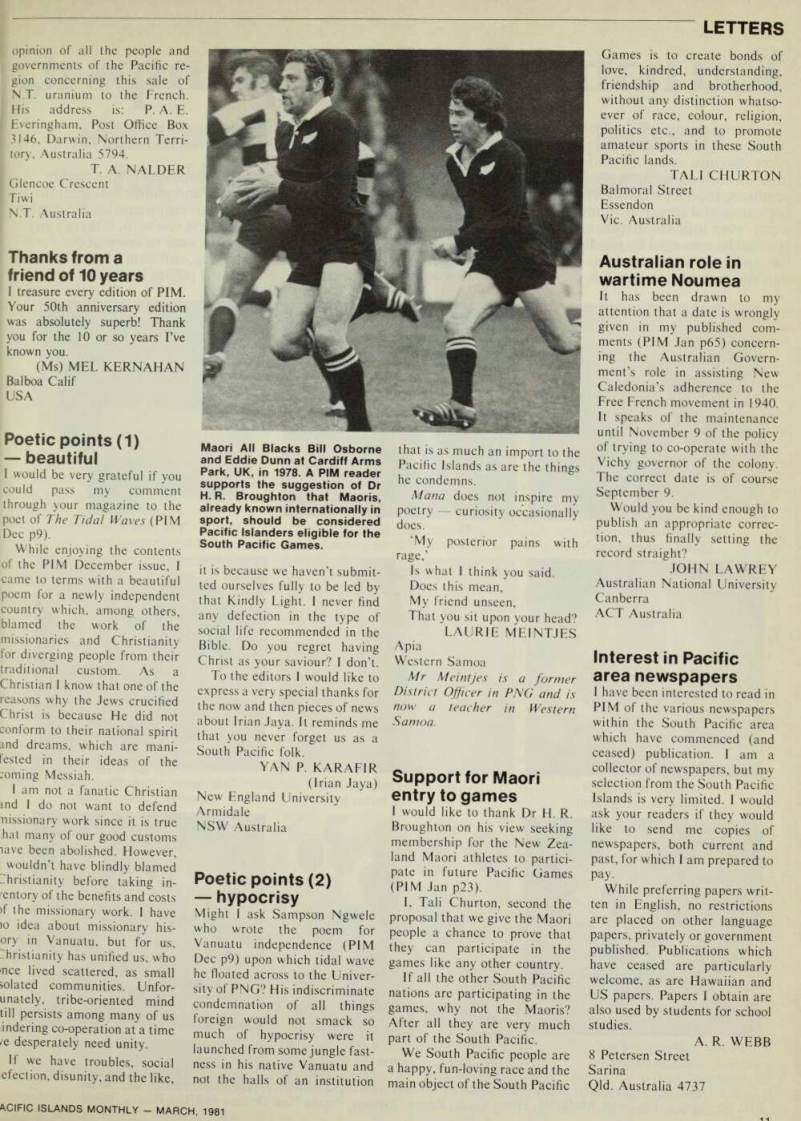
Maori All Blacks Bill Osborne and Eddie Dunn at Cardiff Arms Park, UK, in 1978. A PIM reader supports the suggestion of Dr H. R. Broughton that Maoris, already known internationally in sport, should be considered Pacific Islanders eligible for the South Pacific Games.
Advertisements & other items, pp. 7-12 (4 items)
Cific Islands Monthly March 1981
S# Clarion
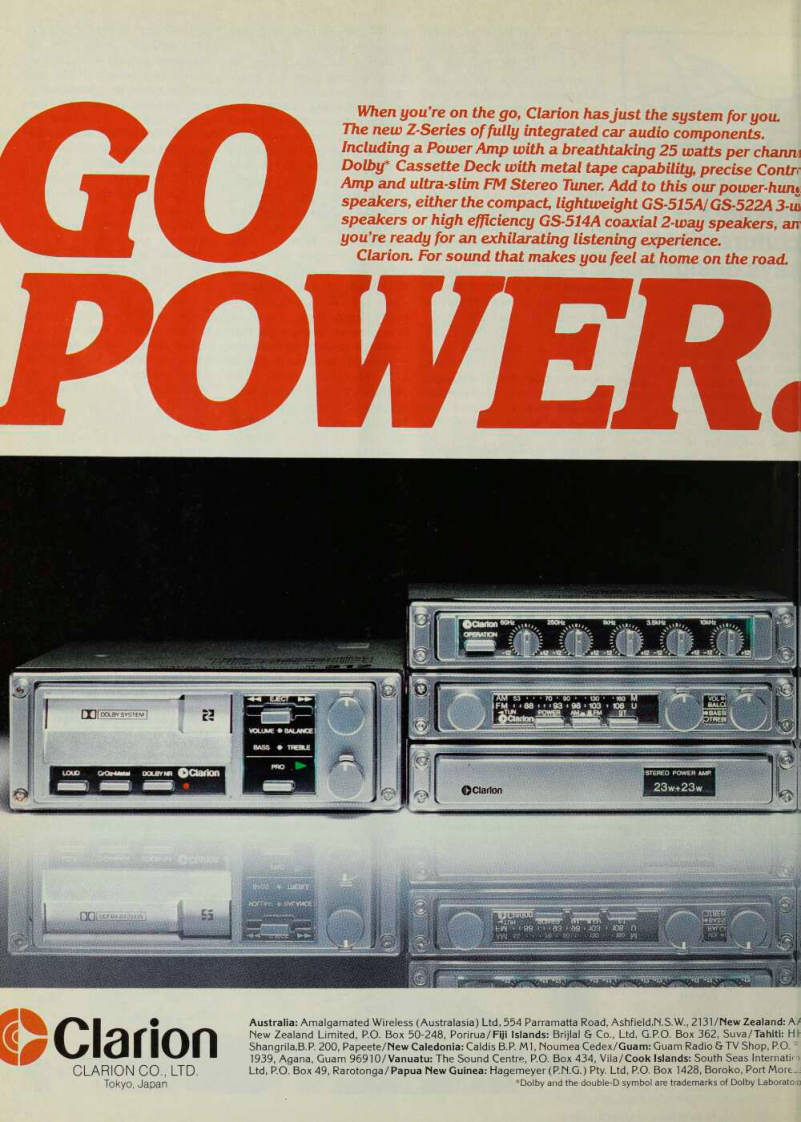
When you’re on the go, Clarion has Just the system for you.
The new Z-Series of fully integrated car audio components.
Including a Power Amp with a breathtaking 25 watts per chann Dolby* Cassette Deck with metal tape capability, precise Contr Amp and ultra-slim FM Stereo Tuner. Add to this our power-hunt speakers, either the compact, lightweight GS-515A/GS-522A 3-u 1 speakers or high efficiency GS-514A coaxial 2-way speakers, an you’re ready for an exhilarating listening experience.
Clarion. For sound that makes you feel at home on the road. o li --. . j
I T DOLBY SYSTEM
K A wr OClark* ©Clarion m - ■
S# Clarion
CLARION CO., LTD.
Tokyo, Japan Australia: Amalgamated Wireless (Australasia) Ltd, 554 Parramatta Road, Ashfield,N.S.W., 2131/New Zealand: A/ New Zealand Limited, P.O. Box 50-248, Porirua/Fiji Islands: Brijlal & Co., Ltd, G.P.O. Box 362, Suva/Tahiti: HI Shangrila,B.P. 200, Papeete/New Caledonia: Caldis B.P. Ml, Noumea Cedex/Guam: Guam Radio & TV Shop, P.O. 1939, Agana, Guam 96910/Vanuatu: The Sound Centre, P.O. Box 434, Vila/Cook Islands: South Seas Ltd, P.O. Box 49, Rarotonga/ Papua New Guinea: Hagemeyer (P.N.G.) Pty. Ltd, P.O. Box 1428, Boroko, Port More~ *Dolby and the double-D symbol are trademarks of Dolby Laborato c
You name it,Mono pumps it.
Tell us your needs, we’ll show you the pump.
For over 30 years we’ve been pumping liquids of every viscosity, under all kinds of conditions. Water to stock and to irrigation systems, all kinds of dairy products, food ingredients, chemicals, corrosives and abrasives, sludges and waste, even solids in suspension.
If it can be conveyed by pipeline, we can move, meter or mix as quickly or slowly as you wish.
We provide pumps that run on all kinds of power-petrol, kerosene, diesel, electricity, even P.T.O. tractor drive.
Transportable pumps, pumps that can be readily cleaned in place and pumps that meet the strictest hygiene requirements. No matter what business you’re in, if there’s anything you want to know about pumping, call us at Mono. We’ve got the pumps and the experience.
IMONO
AUSTRALIA PTY. LTD.
MOVE IT WITH MONO
Massecuite to molasses.
Mono pumps it easily.
Grime, rust, corrosion.
Spray it away with Mono. m -- You cork it.
Mono pumps it. iiousw* sSS j Mono pumps them without bruising them.
Whatever the measurement Mono can meter it.
The things people flush away Mono can pump away. r - r r;
SsSi
* & You mine it.
Mono pumps it.
You raise the crop, Mono will raise the water.
You name it, Mono pumps it.
Directly represented in the Philippines by Mono’s own regional office. Agents in: Indonesia, AgS.
Fiji, Singapore, Thailand, Malaysia, Hong Kong, Korea, Taiwan, Papua New Guinea and The Pacific. feSf 344p00i5/r
Letters
9
\CIFIC ISLANDS MONTHLY - MARCH, 1981
Letters
ACIFIC ISLANDS MONTHLY - MARCH, 1981
Vanuatu PM sees bright future
for ‘the big island’ of Santo
PIM Associate Editor MALCOLM SALMON spent a week in Vanuatu in January. He interviewed Prime Minister Father Walter Lini and Opposition Leader Vincent Boulekone, spent a day in Santo, and generally nosed around. His reports follow.
There is rich irony in the fact I that the office now used by Vanuatu's Prime Minister Father Walter Lini in the for mer French Residency in Port- Vila was used until the country became independent on July 30 1980 by the last French Resi dent Commissioner, Inspector- General Jean-Jacques Robert - with whom Fr Lini’s re lations were strained, to say the least. But when I interviewed him in his office in January Fr Lini seemed in no mood to savour such twists of fate. His talk was all of the present, and above all of the future.
He told me: ‘Generally, things are settling down. The security situation is stabilised.
There is freedom to move around. ‘The civil servants are de veloping a spirit of loyalty to the Vanuatu Government, shedding their old sense of commitment to either the British or the French. One problem is that we need to secure better quality people for the civil service we consider we've inherited too
many from the former ruling powers. ‘Economic development is at the centre of our attention.
There are many proposals be fore us, some small, some very big. We have to study them closely. ‘For example, there is a proposal for an oil refinery here which would employ 3000 people and have an annual profit potential of SUSIBO million. ‘Then there is our plan to establish a shipping register along the lines of the Liberian operation. (See Ships, this issue.) ‘Another major problem with heavy economic implications is the matter of French aid. ‘As the French proposals stand, especially as they affect education, we don’t feel comfortable with them. They don't line up with our way of thinking. They tend to take us back to the dual system of education we’ve lived with for so long. And they have aspects which we feel could tie us to an extent that we couldn’t look our brothers and sisters in New Caledonia and French Polynesia in the eye. ‘Last week we took a step
which we hope will help to resolve the situation: we set up a commission charged with work ing out the details of a unified national education system: edu cational experts from a number of countries will work for six weeks and come up with a report. We don’t really know what the French reaction will be, but we hope that the experts’ recommendations will provide us with a firmer base in our negotiations with them. ‘What is certain is that the French Foreign Ministry people with whom we’re now negotiat ing seem much more conscious than the Overseas Departments and Territories officials with whom we had to deal in pre independence days of the re gional implications of what they’re doing. They are keenly aware that failure to reach an aid agreement with us would be a setback for France in the region. We see this as a positive factor.’ 1 told the PM of my im pressions of a day’s visit to Santo which I’d made earlier in the week of its depressed economic state, of the loss of population in Santo Town (down from more than 6000 in May 1980 to about 3000, with
most of those who’ve left being ni-Vanuatu), of the two cruise ship visits slated for Santo in 1981 as against 18 in 1979, and also of what I was told of the continuing ‘traumatisation’ of society following the calamity of the secession.
In reply, Fr Lini said quietly: ‘Such wounds cannot be healed in a few days, or even a few months. But we’re convinced that Santo has a very important future. ‘The government has plans for a major upgrading of Santo’s wharf facilities, and the building of a copra mill nearby.
The one that was burnt down by the rebels was a long way off.
The job of tar-sealing the road to the airport will soon get under way. ‘ln agriculture we have high hopes of the rice project at Big Bay, and we will be seeking Commonwealth Development Corporation aid for a palm oil development project. ‘Since it is the main agricul tural island in Vanuatu, we intend to go ahead with our plan to move the Department of Agriculture from Port-Vila to Santo.’
About major construction projects on Santo, the PM mentioned in particular the secondary school to be built with an Australian aid grant of $2.5 million on a beautiful site at Matevula.
As an immediate measure to ease the problems on Santo, the government had recently set up a commission with the task of restoring production on aban doned plantations and cattle runs, some of which have fallen into a state of serious neglect.
Announcing establishment of the commission, Lands Minister Sethy Regenevanu emphasised that management was the sole prerogative of the commission, and its activity had absolutely nothing to do with ownership,
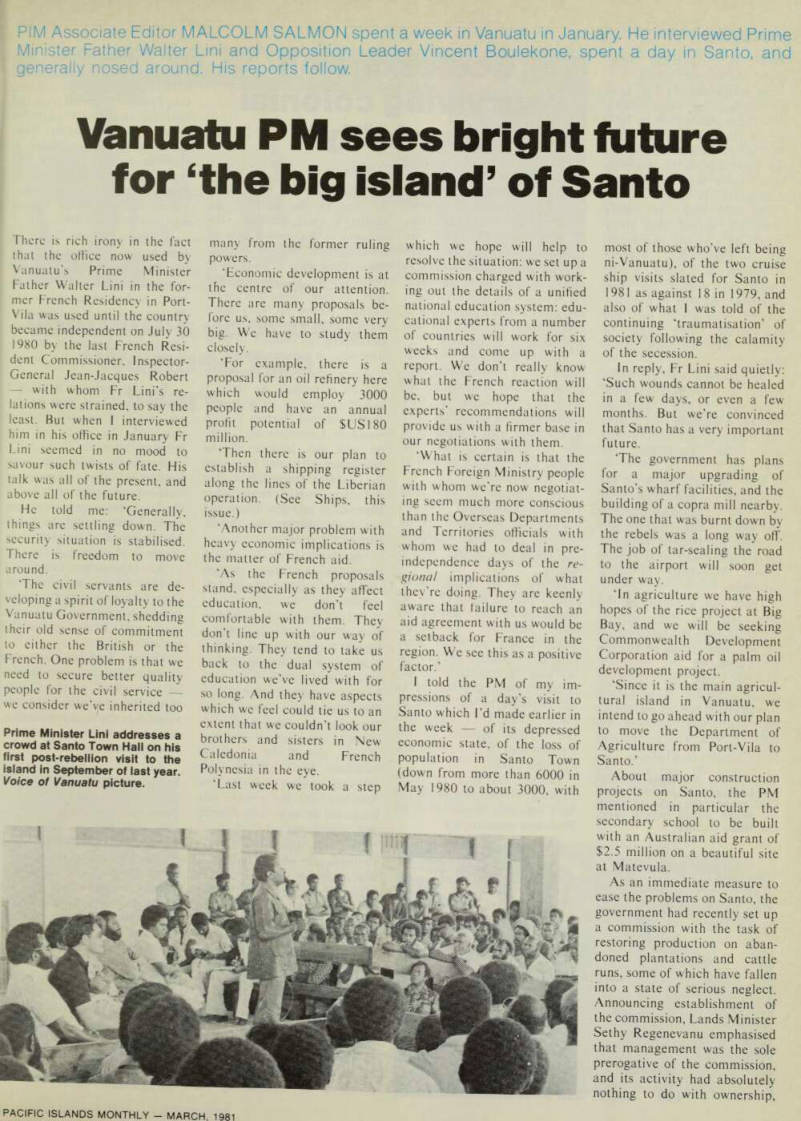
Prime Minister Lini addresses a crowd at Santo Town Hall on his first post-rebellion visit to the island in September of last year.
Voice of Vanuatu picture.
either by expatriate title holders or custom owners.
On parliament, Fr Lini said by-elections for seats which have fallen vacant will be held during the first half of 1981. ‘We are at present working on the legal aspects of stripping MPs who’ve been deported of their status,’ he said.
The PM said that while everybody agreed that there should be a strong parliamen tary opposition, Vincent Boulekone as Leader of the Opposition, despite his good intentions, seemed in his view sometimes to ‘go too far’, and put himself in danger of undermining his own credi bility.
On relations with the inde pendence movement in New Caledonia, Fr Lini said he thought it unlikely that a New Caledonian government-in-exile would be established in Vanuatu. ‘But,’ he went on, ‘our ap preciation and understanding of the New Caledonian problem will become deeper and deeper.
Vanuatu will become more and more vocal about what France should be doing in New Caledonia.’
There was a knock on the door and the PM’s private secretary John Beasant entered to say that Speaker of the Representative Assembly Maxime Carlot had arrived for his appointment. My interview was over but not before Fr Lini had a warm word to say, offering New Year’s greetings to all readers of PIM.
‘surviving colonial
Boulekone on ‘surviving colonial mentality’
I met Vanuatu’s leader of the Opposition Vincent Boulekone in his office in the Government Building in Port-Vila in January. Aged 37, the Pentecost-born politician is married, with three children.
He is handsome and articulate, and gives a strong impression of commitment to the unity and well-being of his country.
Vincent Boulekone was edu cated at a French-language primary school in Santo, got his secondary education in New Caledonia, and stayed on there to graduate with a diploma in law in Noumea in 1972. He speaks good English as well as excellent French.
He returned to the New Hebrides at the end of 1973 and worked for five years as an assistant judiciaire , represent ing indigenous people in the courts.
Active on the ‘francophone’ side of politics since 1974, Mr Boulekone in 1979 formed his own ‘Nakamal’ movement, which sought to stand aside from party politics and provide ‘an area of reflection’ on the country’s political problems. In this initiative he was joined by Father Gerard Leymang and the present Speaker of the Representative Assembly, Maxime Carlot.
Despite his lack of party backing, Vincent Boulekone has been regularly re-elected in his Pentecost constituency.
He is forthright about what he sees as the root of the country’s chief problem: the survival of a colonial state of mind among certain French men. ‘They want to hang on to the lifestyle of the colonial past,’ he said. ‘They don’t want change. Above all, they don’t want to see the Melanesians developing the country in their own way, in independence.’
About the Santo secession and its aftermath, he said; T saw it coming in 1979. I con stantly advised (former French Resident Commissioner) Rob ert and the leaders of the Moderate Party not to go too far, warning them that if they did they would compromise themselves as Frenchmen, and could also compromise the fu ture of the country. ‘But they didn’t want to listen to Melanesians. They thought their ideas would turn out right in the end. ‘So the French, supported by Robert, staged this secession in Santo. Everything that is hap pening now is a consequence of this state of mind. ‘The present danger is that these people still do not realise that what they did was wrong. It is not to my mind an imminent danger, but if the people in Noumea don’t change their ways of looking at things, our relations with big powers who could aid us, especially France, will be endangered. ‘lt’s high time that certain Frenchmen, whose names I won’t mention, put their trust in Melanesians. Because it is the ni-Vanuatu who are going to institute democracy in this country, and ensure respect for the Constitution. It is we alone who will protect the democratic system in our country.’
Other major problems touched upon in the interview were the land problem in particular the difficulty of identifying true custom owners of alienated lands and the problems of replenishing the
ranks of parliamentarians one of whom (Alexis Yolou) is dead, others (Georges Cronsteadt and Guy Prevost) deported from the country, and others again in prison for secessionist and other subversive activities. There is also the happier case of the need to elect a replacement for President Ali George Soko manu, who as George Kalkoa was previously an MP.
Of the strengths and the weaknesses of the government, Mr Boulekone said: T under stand that the present govern ment wishes to establish the peace and unity of our country, and especially to try to prevent foreign interference in our pol itical life. This is its sincere objective. ‘But the means it is using I disapprove. There were necess ary arrests of people who have damaged the unity of the country. ‘But in my view, after inde pendence, the government made the mistake of ignoring the law in the way arrests were made. I believe that the Police Mobile Units maltreated some people in the islands. ‘As Opposition Leader, I criticise these practices, al though I realise that the arrests were necessary. This is the major point I have against the government.’
Vincent Boulekone was also sharply critical of what he sees as a ‘bending’ of the Consti tution by the government in relation to the vital law relating to decentralisation, a sensitive issue in Vanuatu.
But, in a gesture which augurs well for the consoli dation of Vanuatu’s fledgling parliamentary system, he was still prepared to pay warm tribute to the work of the ruling Vanuaaku Party in the achieve ment of independence, saying: T must recognise and thank the government for having fought to achieve indepence. We are proud of that fight, in which I also took part. ‘The Vanuaaku Party was the first movement to demand the independence of the country. ‘Now that we have indepen dence, we must at all costs respect our institutions, our laws, and our Constitution all those things which guarantee our freedom.’
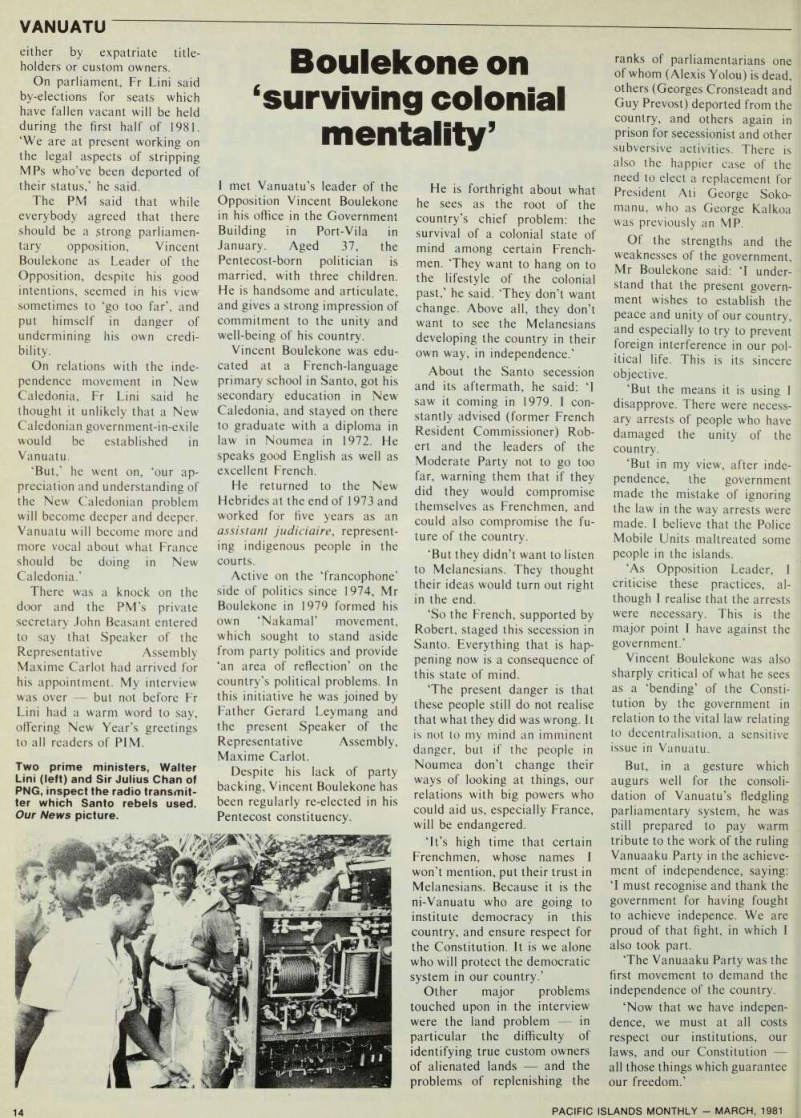
Two prime ministers, Walter Uni (left) and Sir Julius Chan of PNG, inspect the radio transmit ter which Santo rebels used.
Our News picture.
years...’
Vanuatu’s economy: ‘We need two years...’
‘Give us 18 months to two years and this place will be booming .. .’ I can’t say how often I heard this idea expressed dur ing the January week I spent in Port-Vila. It’s a kind of article of faith around the place, and the people espousing it aren’t simply naive optimists they include some of the town’s hardest business heads, with decades of experience of the local scene behind them.
They were speaking against the background of the inevi table economic downturn which came in the wake of the country’s turbulent accession to independence. But they spoke also from an intimate and long term understanding of the econ-
omic resilience that can be displayed by this fecund archi pelago of 80-plus islands.
Of course there are prophets of gloom and doom as well.
There is considerable im patience with the government’s delay in taking decisions on certain important problems.
But as one well-informed ex patriate resident put it to me: ‘Perhaps they’re right to be taking their time. I sometimes think it’s one of our problems that we always want things to have been done yesterday .. .’
There is apprehension too as to how the new land legislation will shake down.
Again, there are quite serious grumbles at aspects of the government’s work, inevitable perhaps in view of its inexperi ence and the circumstances in which it is placed. A good example is a letter signed ‘Vic tim of Santo Rebellion’ in the weekly Voice of Vanuatu (January 9). Still awaiting com pensation for his own losses as a result of the rebellion, the writer alleges that an ‘agent of the rebels’ had been authorised by a governmnent official to operate certain businesses be longing to deported Santo busi nessmen now in Noumea. He writes: ‘Such incidents nat urally cause fear that if people in authority do not give serious care and intelligent thought to such issues a rebel or rebel’s agent could easily be given
rights to enter into Luganville but with evil plans even as fatal as murder.’ He makes the dark suggestion that the government official who authorised the ‘rebel agent’ had a ‘drinking habit’, saying: ‘The drinking habit is a personal affair but one needs to ensure that one is in the right state of mind when carry ing on one’s highly important official duties.’
The identities of the ‘rebel’s agent’ and the official are a matter of common knowledge on Santo. But the complaint reveals a disturbing undertow in the complex problem of restor ing the big island to something approaching normality.
An intriguing sidelight to the Vanuatu effort to promote tour ism emerged when a prominent local expatriate citizen recently visited Australia. As a spare time activity he’d gone around various tourist offices in Syd ney, presenting himself as a potential tourist visitor to Vanuatu. He found he got quite proper treatment at the big city agencies, but once he pen etrated the smaller suburban
establishments he found he was likely as not told ‘Vila? Oh, you don’t want to go there. You’d probably finish up with an arrow in your chest.’ The irony is that Port-Vila can boast an atmosphere of social calm and a generally sound law-and-order situation which could well be the envy of some other South Pacific capitals. All this leaves aside the intrinsic attractions of the place for the tourist which have been lauded often enough for me to leave the subject alone.
One final comment on the economic prospects of Vanuatu gleaned during my stay: a close observer of the local scene told me that while some potential investors are buttoning their wallets, really big money is being spent by some others.
They are none other than the local Chinese and Vietnamese businessmen, who are taking advantage of the present de pressed prices to snap up resi dential, industrial and agricul tural properties on both Efate and Santo at a cracking pace.
As my informant remarked: ‘And their track record as businessmen is just about
second to none . .
Malcolm
Salmon.
Vincent Boulekone
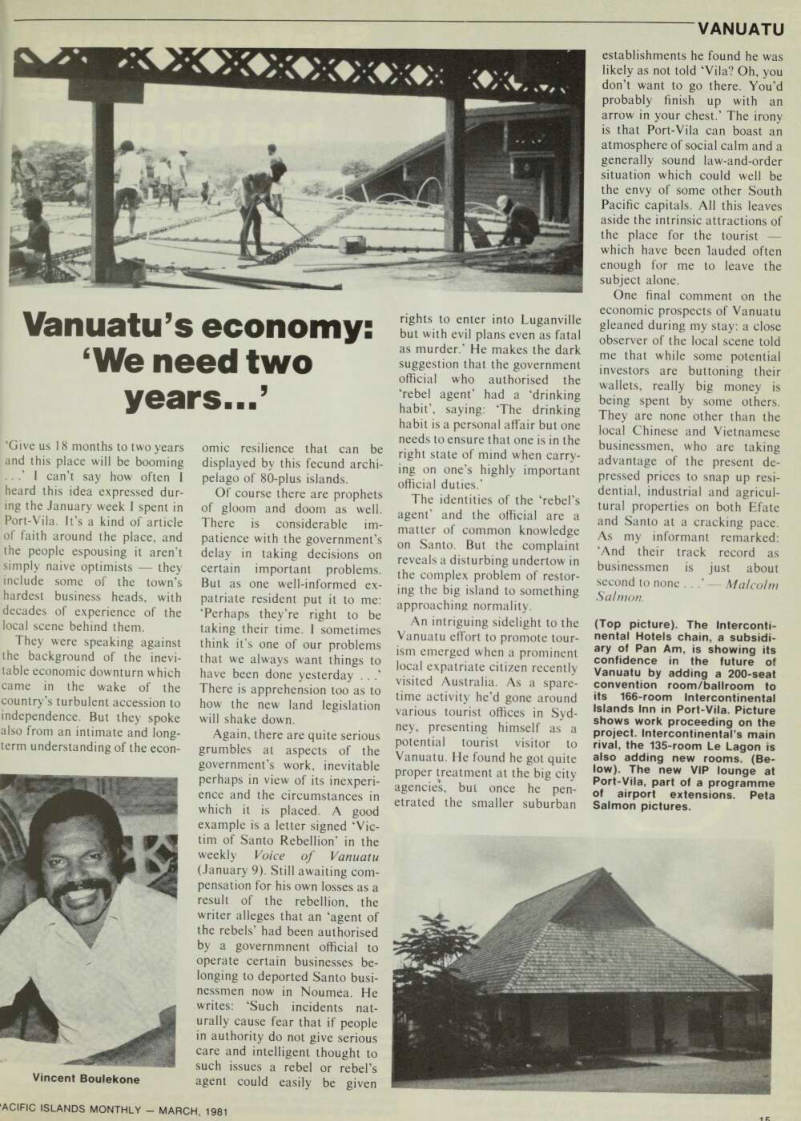
(Top picture). The interconti nental Hotels chain, a subsidi ary of Pan Am, is showing its confidence in the future of Vanuatu by adding a 200-seat convention room/ballroom to its 166-room Intercontinental Islands Inn in Port-Vila. Picture shows work proceeding on the project. Intercontinental’s main rival, the 135-room Le Lagon is also adding new rooms. (Be low). The new VIP lounge at Port-Vila, part of a programme of airport extensions. Peta Salmon pictures.
Advertisements & other items, pp. 15-16 (2 items)
Vanuatu
ACIFIC ISLANDS MONTHLY MARCH, 1981
Shattering news!
m
MER GRAPHITE
ymer Graphite) proves
best for digital.
Dynamite with Digital Discs!
New dynamic dimension for Pioneer’s HPMs. They easily handle the wide dynamic range (90dB or more) of PCM recordings with astonishing accuracy.
The reason is our exclusive new cone material. We call it PG for Polymer Graphite. To you, PG will mean Positively Great. Here’s why.
Paper “wrinkles,” metal “rings.” But PG doesn’t. Period.
Conventional paper cones are light for good transients, and have high internal W ' loss for clean sound. But laser holography shows paper cones “wrinkle” and deform at high sound pressure levels, causing distortion.
Holograph of a paper cone.
HPM-1100
Holograph of a PG cone.
PG cones don’t. Period.
Metal cones, on the other hand, are rigid enough. But they have poor transient response and awful internal loss.
Computerized X-Y plotting shows they “ring” in their own false colors.
PG cones don’t. Period.
O O
aSiii
mmmmsrn
* ■ mm PG is light, rigid and has high internal loss.
Graphite is the basic ingredient in PG. Without the special polymers we add it would tend to shatter or crumble. But its unique molecular characteristics add up to refreshingly honest and accurate sound reproduction. Hear it with our High Polymer supertweeters in Pioneer’s new HPM systems. It’s dynamite for digital! m #• o PM-900 ■ it ■HI .
O ■?-8 j
HPM-700
further information, please contact: itralia: Pioneer Marketing Service Ry. Ltd., P.O. Box 317, Mordialloc, Victoria, 3195 90-9011 Islands: Brijlal & Company, G.P.O. Box No. 362, Suva, Fiji Islands Tel: 22258 v Zealand; Monaco Distributors Ltd., 30 Pollen Street, Grey Lynn, Auckland, v Zealand Tel: (09) 762 098 folk Island: Burns Philp (Norfolk Island)Ltd., P.O. Box 21, Norfolk Island, v Hebrides: Burns Philp (New Hebrides) Ltd., Vila, New Hebrides Nauru Island: Jacob Enterprises, P.O. Box No. 4, Republic of Nauru Tahiti; Tahiti Hi-Fi, P.O. Box 848, Papeete, Tahiti New Caledonia: Menard Pacifique Saru, B.P. 3899, Noumea, New Caledonia Tel: 48-24.36 American Samoa; Transpac Corporation, P.O. Box 1477, Pago Pago, American Samoa 96799 Tel: 633-5224 Rarotonga: South Seas International Ltd., P.O. Box 49, Rarotonga, Cook Islands Tel: 2327 Papua New Guinea: Bali Merchants Ry. Ltd., P.O. Box 6103, Boroko Tel: 254887
Santo events spark a memorable
war of words in Noumea paper
On November 27 1980, and again on January 15 1981, the Noumea daily Nouvelles Caledoniennes published documents of absorbing interest to all who have tried to follow the recent history of the new nation of Vanuatu. They were first an interview with the prominent Noumea barrister MaTtre Jean Leder, who defended Jimmy Stevens and other Santo accused at their trials, then an open letter replying to Me Leder written by the last French Resident Commissioner in the New Hebrides, Inspector-General Jean-Jacques Robert, and finally a further interview with Me Leder who commented on Mr Robert’s letter. In its capacity as a journal of record, RIM publishes below a full translation of the three documents. The first is the November 27 1980 interview with Me Leder.
With the 14‘h-years gaol sen tence imposed on Jimmy Stevens, the Santo trials have come to an end. Malt re Leder, who handled 400 briefs in the space of two months, is now back in the Territory and has told us of his feelings about the
whole sorry Santo epic, as well as the conclusions he has drawn from it. His account points very directly to the responsibility of the French Government in the Santo rebellion, and makes a forthright denunciation of France’s abandonment of those who had believed in her, her promises and her assistance. ‘From the formal viewpoint,’
Me Leder says, ‘the trials were conducted correctly. No pres sure was put on anyone to prevent the truth being told.
and I was not prevented from saying what I wished. But I would make two qualifications, ‘I) The presiding judge was constantly saying: “We’re here to deal ■ with breaches of the joint regulations. I don’t want politics brought into it.’’ I was obliged to reply that for Ravulia, for example, who was charged with being the No. 3 figure in the Vemarana, it was difficult not to talk politics. ‘2) Another disagreeable aspect was the system of translation. For the Jimmy Stevens trial I had a good interpreter, but there was a problem: I had to stop every 30 seconds for the translation, so my presentation of the defence case lasted two ours - On the deficiencies in the translation system, the barrister pointed out that France had done nothing to help its former friends; ‘I saw that France, although fully responsible for what had happened (there is serious, precise and consistent evidence of this) was taking absolutely no interest in the Santo people and had simply dumped them. Look, I ve defended some of the “Milieu” people in France, and the Milieu look an interest in them right up to the trial and even after. (The Milieu is a term popularly applied to an organisation in France generally believed to have links with the Mafia. PIM.) ‘Given its responsibilities in the Santo affair, I believe that France could at least have given some moral support to Jimmy Stevens. There’s a thousand and one ways of letting a friend know you haven’t forgotten him. Jimmy Stevens said at his trial that the reason he was training troops on Santo was
because he believed that France would set up a military base on the island. He added: “France was to settle in, I wanted to provide her with soldiers.’ ’’
But Me Leder goes further on the matter of responsibility: ‘I was greatly put out by the complete absence of France from the trials of people who would never have done what they did if they hadn’t been pushed into it by representative French authorities. When I speak of serious, precise and consistent evidence, I mean that I have proof, and have gathered the evidence.
Take the case of Inspector- General Robert, for instance.
One could well say that he went mad and that, when he spoke to the Luganville people and then the Fanafo people, he was in a state of dementia. But he wasn’t the only one. Others did worse things than he did. For example, there was this major who did the rounds of Santo to show people how to stage a rebellion. At meetings he drew sketches on a blackboard to demonstrate the mechanics of a campaign of subversion. Then there was this other major who explained to Man Santo that a man armed with a bow and arrow was more dangerous than a man with a gun because an arrow makes no noise. Imagine; and there were the Papuans’ (term invariably used by the French to describe Papua New Guinean soldiers PIM) ‘equipped with bullet-proof vests! The bow-and-arrow fel lows simply took to the scrub at the first sound of gunfire.
There’s also the message sent from Noumea on May 27 giving the green light for insurrection.
It was certainly sent through military radio channels. To
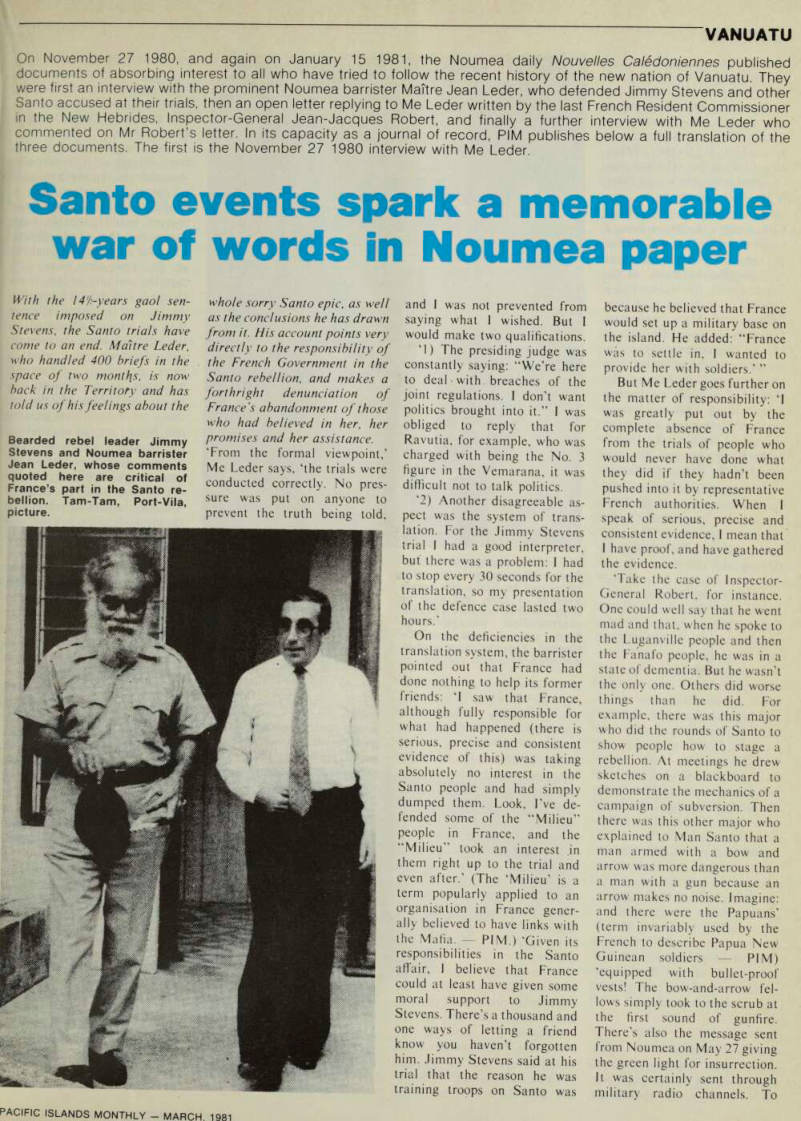
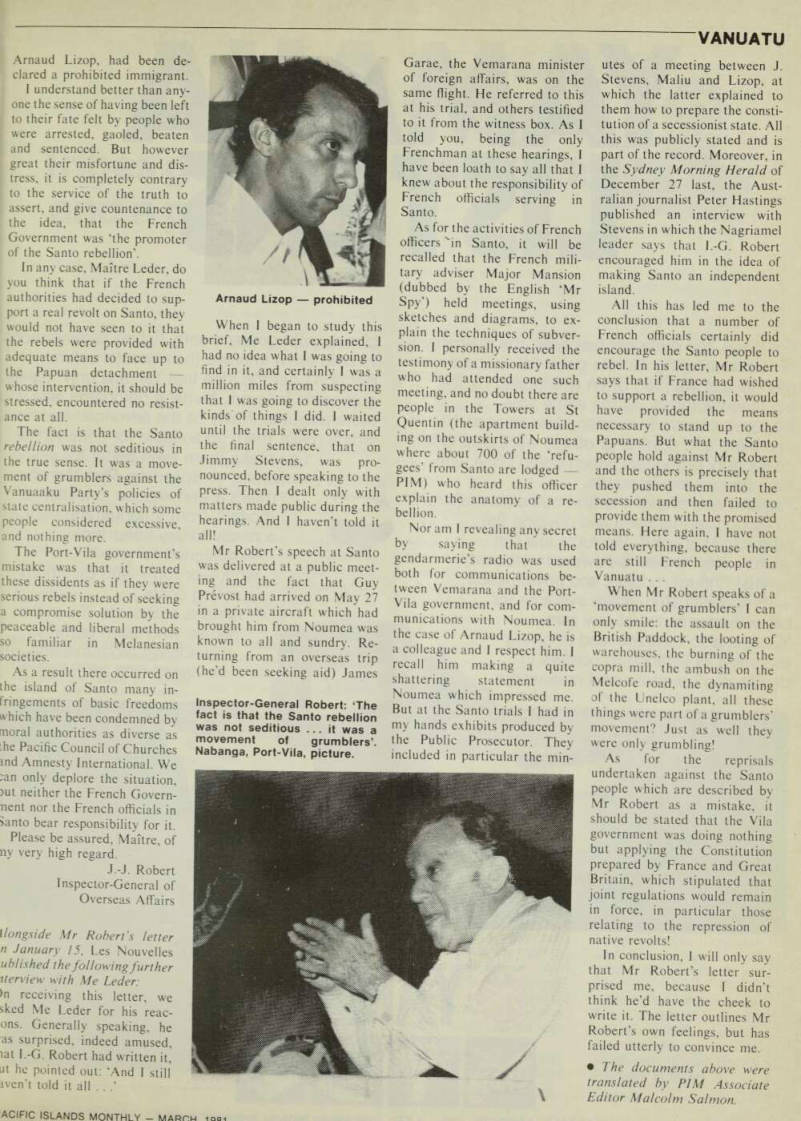
Bearded rebel leader Jimmy Stevens and Noumea barrister Jean Leder, whose comments quoted here are critical of France's part in the Santo re bellion. Tam-Tam, Port-Vila, picture.
check on this message, there is no doubt that Guy Prevost did the round trip to Noumea and back in an aircraft made avail able to him by the adminis tration. Among those waiting to greet him at Santo’s Pekoa airport when he returned was the gendarme. He wasn’t there of his own volition. ‘When Arnaud Lizop went with the Arribaud-Donald mission, he was a legal adviser to the government, charged with an official mission. At the Stevens trial, the minutes of a meeting between Lizop, Stevens and Maliu were pro duced in evidence. The talk at the meeting concerned the con stitution and organisation of a secessionist state. This is why Arnaud Lizop is now banned from visiting Vanuatu. Taking all these factors into account, it is hard to say that the French Government was not the pro moter of the Santo rebellion.’
The regulations under which those who are called ‘the Santo rebels’ were charged are Condo minium regulations. They are joint regulation No. 12 of 1962 dealing with riot situations, and No. 11 of 1974 on disturbances of public order. Me Leder asks: ‘Why were these texts used?
Simply because in the Consti tution set up by Messrs Dijoud and Blaker, which was voted into being at breakneck speed in one night, there is article 93: Joint regulations in force on the day of independence will re main applicable as if they had been decided in application of the Constitution. This clearly shows that the French adminis tration, after pushing the Santo people into staging a rebellion, gave Walter Lini the stick to beat them with.’
Me Leder sums up: ‘This is what makes me doubt the competence and discernment of the French officials working in the Hebrides at the time. I prefer to put it down to incom petence, because if all this had been done advisedly, with full knowledge of the facts, they would be liable to face trial in the common law courts.’
On January 15, 1981, Les Nouvelles published an open letter by I nspector-General Jean-Jacques Robert replying to Me Leder, a reply introduced
by the newspaper in the follow ing way: In reply to an inter view with Me Leder which appeared in Les Nouvelles on November 27 last, Inspector- General Robert has sent us the letter published below. Oddly, he also sent copies to other local newspapers we can only wonder why. If he dis played subtlety and tact of the same order in his political and diplomatic dealings, always wanting to run with the hare and hunt with the hounds, many things can perhaps be explained ...’ Mr Robert’s letter said: MaTtre, I have only just become aware of your statements to the Caledonian press, most particu larly those published in the November 27 issue of Les Nouvelles. I confess that I was astonished to read the charges you make concerning my activi ties, and those of some of my
assistants, in the New Hebrides.
Certainly I realise that it was tactically sound for you to base your defence of J. Stevens and the other Santo accused on a shifting of responsibility for the actions with which they were charged on to other persons who ran no risk of being called before the court. But that should not have led you into giving wide currency in the press to statements which are not only contrary to the truth, but which could well prove damaging to France’s future relations with Vanuatu and the other South Pacific countries.
I was perhaps in a state of dementia (since you say so) when I addressed the Santo people, and I did so many a time during the crisis which pre ceded independence. But one would require a particularly vivid imagination to read into the cautionary words I used on these occasions any encourage ment to a rebellion which 1 knew would meet with the complete disapproval of the French Government. Until the very last minute 1 strove to achieve a just accommodation between the government in Port-Vila and the de facto
government set up in Luganville by J. Stevens. 1 did not succeed, but ! would hope that every honest witness would agree that I did everything I could to reach an agreement.
You also state that French army officers went to Santo to ‘demonstrate the mechanics of a campaign of subversion’. A careful checking of your sources would probably have shown you that these officers, who took no personal initiatives at all, and who were only carrying out my orders, were charged with no such mission.
As for the statement alleging that an aircraft chartered by the administration, or military radio facilities, were used to carry messengers or transmit messages from Noumea to Luganville on May 27,1 declare that it too is completely ground less. Need I remind you that, on the contrary, the New Cale donian authorities strove to ensure scrupulous respect for the decisions taken by the Port- Vila government in relation to the blockade of Santo’s port and airport, as well as the isolation of the island.
Nor did Mr Lizop have the task, as you have said, of setting up ‘the constitution and organis ation of a secessionist state’.
Together with Messrs Arribaud, Donald and Yash Ghai his duty was to seek a form of understanding between Walter Lini and Jimmy Stevens in an effort to reach a compro mise which would have pro vided the island of Santo with a certain number of administrat ive and political freedoms within the state structure of Vanuatu.
If the persons mentioned by you in the article in Nouvelles Caledoniennes had been guilty of the actions alleged by you they would have been disobey ing express instructions issued by the Secretary of State for Overseas Departments and Territories; they did not do so, I can vouch for it.
Moreover none of them to my knowledge has been implicated in any of the procedures and judicial proceedings instituted in Vanuatu after independence by the governmental authorities who, what is more, hastened to deny the rumours then being put about that I, together with
The eve of rebellion. Inspector- General Jean-Jacques Robert is welcomed to Santo by Jimmy Stevens in June last year as events moved towards a violent confrontation between the Santo secessionists and the elected Vanuatu government.
Nabanga, Port-Vila, picture.
Arnaud Lizop, had been de clared a prohibited immigrant.
I understand better than any one the sense of having been left to their fate felt by people who were arrested, gaoled, beaten and sentenced. But however great their misfortune and dis tress, it is completely contrary to the service of the truth to assert, and give countenance to the idea, that the French Government was ‘the promoter of the Santo rebellion’.
In any case, Maitre Leder, do you think that if the French authorities had decided to sup port a real revolt on Santo, they would not have seen to it that the rebels were provided with adequate means to face up to the Papuan detachment — whose intervention, it should be stressed, encountered no resist ance at all.
The fact is that the Santo rebellion was not seditious in the true sense. It was a move ment of grumblers against the Vanuaaku Party’s policies of state centralisation, which some people considered excessive, and nothing more.
The Port-Vila government’s mistake was that it treated these dissidents as if they were serious rebels instead of seeking a compromise solution by the peaceable and liberal methods so familiar in Melanesian societies.
As a result there occurred on the island of Santo many in fringements of basic freedoms which have been condemned by moral authorities as diverse as :he Pacific Council of Churches md Amnesty International. We 'an only deplore the situation, 3ut neither the French Govern ment nor the French officials in Santo bear responsibility for it.
Please be assured, Maitre, of ny very high regard.
J.-J. Robert
Inspector-General of Overseas Affairs I longside Mr Robert’s letter n January 15, Les Nouvelles üblished the following further Uerview with Me Leder: )n receiving this letter, we sked Me Leder for his reac ons. Generally speaking, he as surprised, indeed amused, lat 1.-G. Robert had written it.
Lit he pointed out: ’And I still iven’t told it all .. .’
When I began to study this brief. Me Leder explained, 1 had no idea what I was going to find in it, and certainly I was a million miles from suspecting that I was going to discover the kinds of things I did. I waited until the trials were over, and the final sentence, that on Jimmy Stevens, was pro nounced, before speaking to the press. Then I dealt only with matters made public during the hearings. And I haven’t told it all!
Mr Robert’s speech at Santo was delivered at a public meet ing and the fact that Guy Prevost had arrived on May 27 in a private aircraft which had brought him from Noumea was known to all and sundry. Re turning from an overseas trip (he'd been seeking aid) James
Garae, the Vemarana minister of foreign affairs, was on the same flight. He referred to this at his trial, and others testified to it from the witness box. As I told you, being the only Frenchman at these hearings, I have been loath to say all that I knew about the responsibility of French officials serving in Santo.
As for the activities of French officers Santo, it will be recalled that the French mili tary adviser Major Mansion (dubbed by the English ‘Mr Spy’) held meetings, using sketches and diagrams, to ex plain the techniques of subver sion. I personally received the testimony of a missionary father who had attended one such meeting, and no doubt there are people in the Towers at St Quentin (the apartment build ing on the outskirts of Noumea where about 700 of the ‘refu gees’ from Santo are lodged PIM) who heard this officer explain the anatomy of a re bellion.
Noram I revealing any secret by saying that the gendarmerie’s radio was used both for communications be tween Vemarana and the Port- Vila government, and for com munications with Noumea. In the case of Arnaud Lizop, he is a colleague and I respect him. I recall him making a quite shattering statement in Noumea which impressed me.
But at the Santo trials I had in my hands exhibits produced by the Public Prosecutor. They included in particular the min
utes of a meeting between J.
Stevens, Maliu and Lizop, at which the latter explained to them how to prepare the consti tution of a secessionist state. All this was publicly stated and is part of the record. Moreover, in the Sydney Morning Herald of December 27 last, the Aust ralian journalist Peter Hastings published an interview with Stevens in which the Nagriamel leader says that 1.-G. Robert encouraged him in the idea of making Santo an independent island.
All this has led me to the conclusion that a number of French officials certainly did encourage the Santo people to rebel. In his letter, Mr Robert says that if France had wished to support a rebellion, it would have provided the means necessary to stand up to the Papuans. But what the Santo people hold against Mr Robert and the others is precisely that they pushed them into the secession and then failed to provide them with the promised means. Here again, 1 have not told everything, because there are still French people in Vanuatu ...
When Mr Robert speaks of a ‘movement of grumblers’ I can only smile; the assault on the British Paddock, the looting of warehouses, the burning of the copra mill, the ambush on the Melcofe road, the dynamiting of the Unelco plant, all these things were part of a grumblers’ movement? Just as well they were only grumbling!
As for the reprisals undertaken against the Santo people which are described by Mr Robert as a mistake, it should be stated that the Vila government was doing nothing but applying the Constitution prepared by France and Great Britain, which stipulated that joint regulations would remain in force, in particular those relating to the repression of native revolts!
In conclusion, I will only say that Mr Robert’s letter sur prised me, because I didn’t think he’d have the cheek to write it. The letter outlines Mr Robert’s own feelings, but has failed utterly to convince me. • The documents above were translated by PIM Associate Editor Malcolm Salmon.
Arnaud Lizop - prohibited
Inspector-General Robert: 'The fact is that the Santo rebellion was not seditious ... it was a movement of grumblers’.
Nabanga, Port-Vila, picture.
Advertisements & other items, pp. 19-20 (2 items)
Vanuatu
ACIFIC ISLANDS MONTHLY MARrw -moi
Listens
YAMAHA
For years, the outboard has been the mainstay of leisure boating. But its potential for commercial use was too often overlooked by the big manufacturers. At the same time, however, coastal fishermen, river transport operators and dozens of others were calling for heavy duty outboards which could cope with their special requirements.
Yamaha was one of the first outboard makers to recognize this need and develop the products to meet it. Products like the world’s first kerosene powered outboard, special Enduro models, and powerheads with sophisticated intake systems for better performance at low rpm.
Yamaha also took the lead in giving technical assistance to boaters in developing countries and now works closely with governmental fishery organizations to help them improve their coastal catch.
But don’t get the idea that Yamaha only makes outboards for work. Yamaha outboards give you more play, too. Many of the advanced features which make them so suitable for commercial use make them even better for skiing, fishing, or speeding. Plus Yamaha offers a tremendous selection of models, from a lighter 2hp mini to a revolutionary 85hp triple.
All designed for maximum work—or fun—with minimum running costs.
Yamaha outboards. From the people who listen better to make living more exciting, on the land or on the water. ... . v, ■ *
YAMAHA
v YAMAHA MOTOR CO., LTD. 2500 shingai iwata-shi shizuoka-ken japan
Noumea
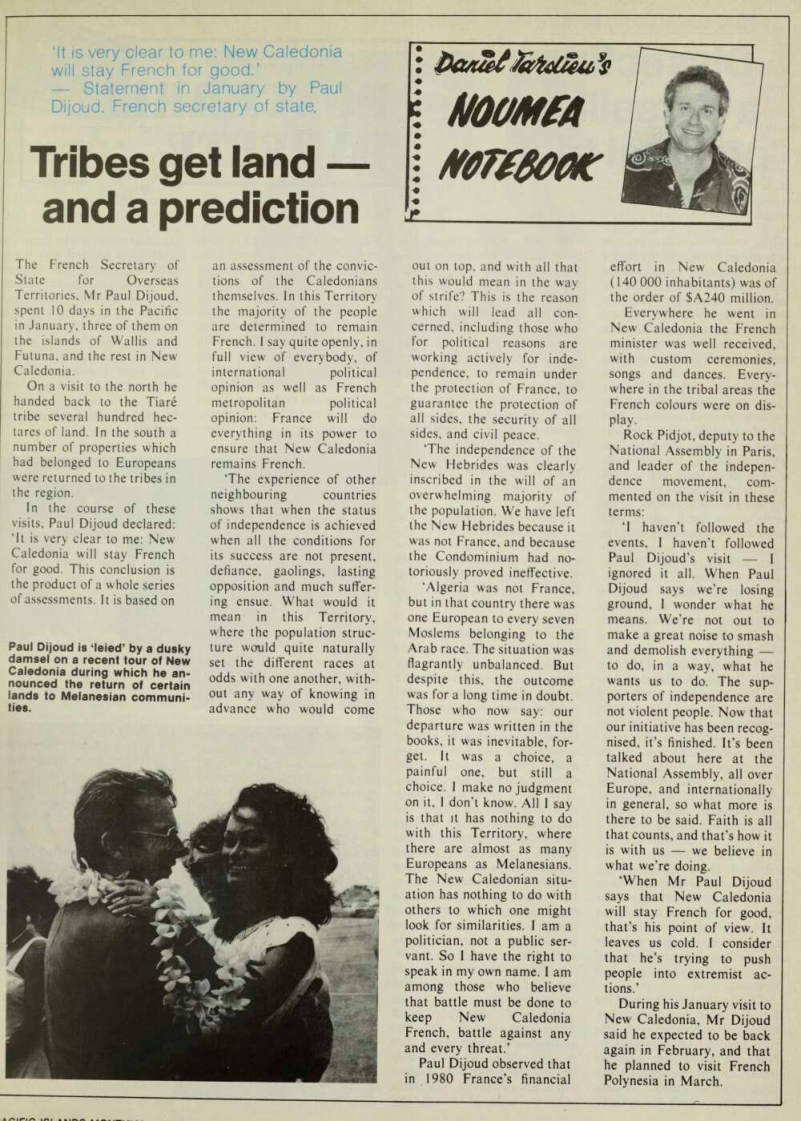
Dariel Tardieu's
Notebook
Tribes get land and a prediction
‘lt is very clear to me; New Caledonia will stay French for good.’
Statement in January by Paul Dijoud. French secretary of state.
The French Secretary of State for Overseas Territories, Mr Paul Dijoud. spent 10 days in the Pacific in January, three of them on the islands of Wallis and Futuna, and the rest in New Caledonia.
On a visit to the north he handed back to the Tiare tribe several hundred hec tares of land. In the south a number of properties which had belonged to Europeans were returned to the tribes in the region.
In the course of these visits, Paul Dijoud declared: ‘lt is very clear to me: New Caledonia will stay French for good. This conclusion is the product of a whole series of assessments. It is based on
an assessment of the convic tions of the Caledonians themselves. In this Territory the majority of the people are determined to remain French. I say quite openly, in full view of everybody, of international political opinion as well as French metropolitan political opinion; France will do everything in its power to ensure that New Caledonia remains French. ‘The experience of other neighbouring countries shows that when the status of independence is achieved when all the conditions for its success are not present, defiance, gaolings, lasting opposition and much suffer ing ensue. What would it mean in this Territory, where the population struc ture would quite naturally set the different races at odds with one another, with out any way of knowing in advance who would come
out on top, and with all that this would mean in the way of strife? This is the reason which will lead all con cerned, including those who for political reasons are working actively for inde pendence, to remain under the protection of France, to guarantee the protection of all sides, the security of all sides, and civil peace.
The independence of the New Hebrides was clearly inscribed in the will of an overwhelming majority of the population. We have left the New Hebrides because it was not France, and because the Condominium had no toriously proved ineffective. ‘Algeria was not France, but in that country there was one European to every seven Moslems belonging to the Arab race. The situation was flagrantly unbalanced. But despite this, the outcome was for a long lime in doubt.
Those who now say: our departure was written in the books, it was inevitable, for get. It was a choice, a painful one, but still a choice. I make no judgment on it, I don’t know. All I say is that it has nothing to do with this Territory, where there are almost as many Europeans as Melanesians.
The New Caledonian situ ation has nothing to do with others to which one might look for similarities. I am a politician, not a public ser vant. So I have the right to speak in my own name. I am among those who believe that battle must be done to keep New Caledonia French, battle against any and every threat.’
Paul Dijoud observed that in 1980 France’s financial
effort in New Caledonia (140 000 inhabitants) was of the order of SA24O million.
Everywhere he went in New Caledonia the French minister was well received, with custom ceremonies, songs and dances. Every where in the tribal areas the French colours were on dis play.
Rock Pidjot, deputy to the National Assembly in Paris, and leader of the indepen dence movement, com mented on the visit in these terms: ‘I haven’t followed the events, I haven’t followed Paul Dijoud’s visit I ignored it all. When Paul Dijoud says we’re losing ground, I wonder what he means. We’re not out to make a great noise to smash and demolish everything to do, in a way, what he wants us to do. The sup porters of independence are not violent people. Now that our initiative has been recog nised, it’s finished. It’s been talked about here at the National Assembly, all over Europe, and internationally in general, so what more is there to be said. Faith is all that counts, and that’s how it is with us we believe in what we’re doing. ‘When Mr Paul Dijoud says that New Caledonia will stay French for good, that’s his point of view. It leaves us cold. I consider that he’s trying to push people into extremist ac tions.’
During his January visit to New Caledonia, Mr Dijoud said he expected to be back again in February, and that he planned to visit French Polynesia in March.
Paul Dijoud is ‘leied’ by a dusky damsel on a recent tour of New Caledonia during which he an nounced the return of certain lands to Melanesian communi ties.
Papeete:';
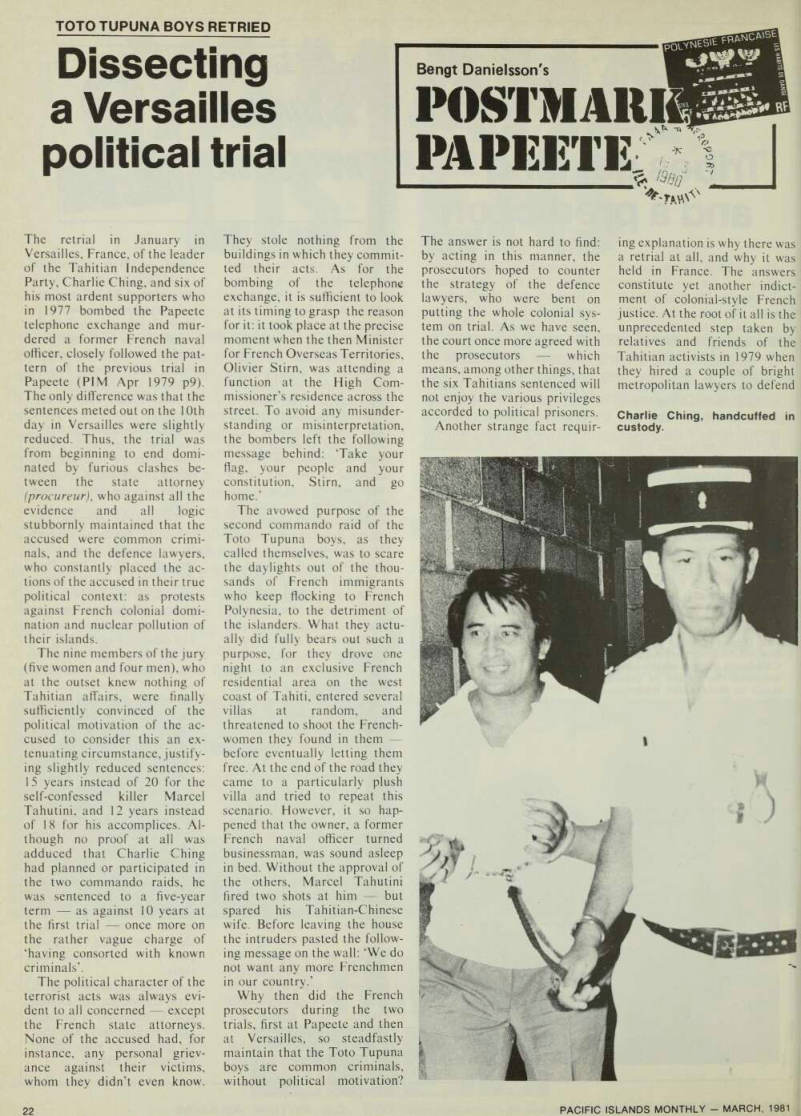
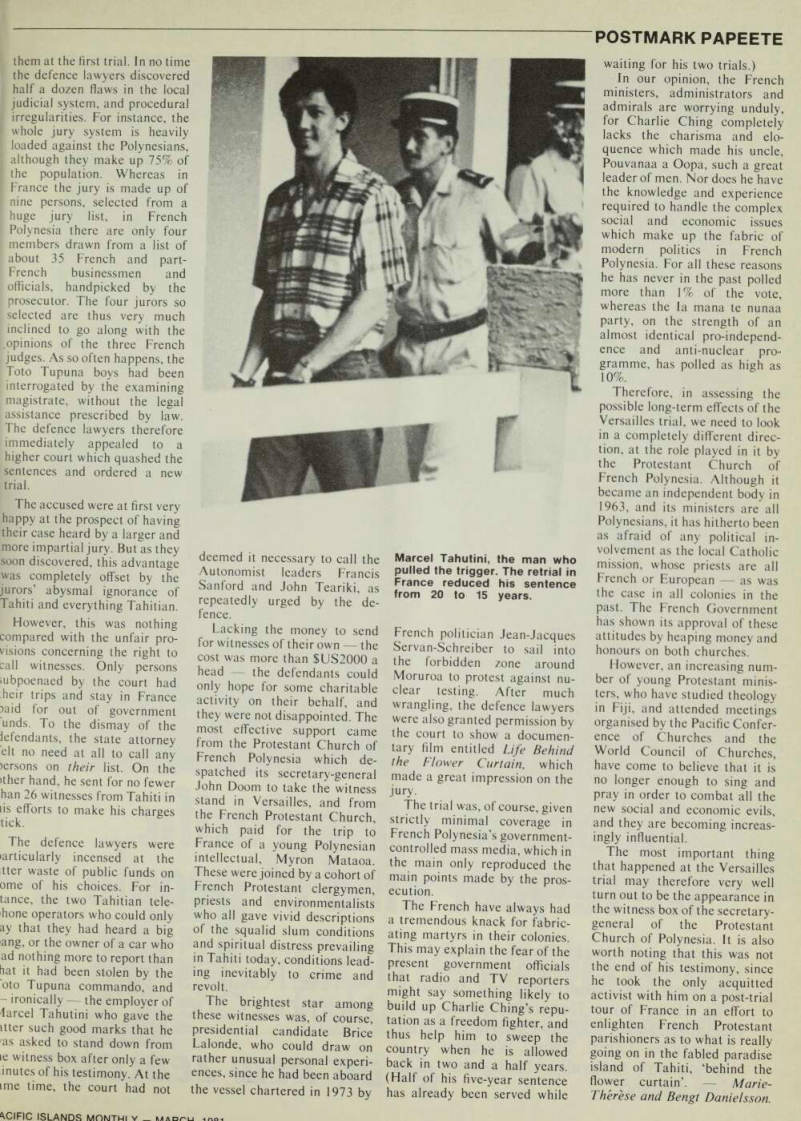
Toto Tupuna Boys Retried
Dissecting a Versailles political trial
Bengt Danielsson's ■
Postmark
Papeete:';
The retrial in January in Versailles, France, of the leader of the Tahitian Independence Party, Charlie Ching, and six of his most ardent supporters who in 1977 bombed the Papeete telephone exchange and mur dered a former French naval officer, closely followed the pat tern of the previous trial in Papeete (PIM Apr 1979 p 9).
The only difference was that the sentences meted out on the 10th day in Versailles were slightly reduced. Thus, the trial was from beginning to end domi nated by furious clashes be tween the state attorney (procureur), who against all the evidence and all logic stubbornly maintained that the accused were common crimi nals, and the defence lawyers, who constantly placed the ac tions of the accused in their true political context: as protests against French colonial domi nation and nuclear pollution of their islands.
The nine members of the jury (five women and four men), who at the outset knew nothing of Tahitian affairs, were finally sufficiently convinced of the political motivation of the ac cused to consider this an ex tenuating circumstance, justify ing slightly reduced sentences: 15 years instead of 20 for the self-confessed killer Marcel Tahutini, and 12 years instead of 18 for his accomplices. Al though no proof at all was adduced that Charlie Ching had planned or participated in the two commando raids, he was sentenced to a five-year term as against 10 years at the first trial once more on the rather vague charge of ‘having consorted with known criminals’.
The political character of the terrorist acts was always evi dent to all concerned except the French state attorneys.
None of the accused had, for instance, any personal griev ance against their victims, whom they didn’t even know.
They stole nothing from the buildings in which they commit ted their acts. As for the bombing of the telephone exchange, it is sufficient to look at its timing to grasp the reason for it: it took place at the precise moment when the then Minister for French Overseas Territories, Olivier Stirn, was attending a function at the High Com missioner’s residence across the street. To avoid any misunder standing or misinterpretation, the bombers left the following message behind: Take your flag, your people and your constitution, Stirn, and go home.’
The avowed purpose of the second commando raid of the Toto Tupuna boys, as they called themselves, was to scare the daylights out of the thou sands of French immigrants who keep flocking to French Polynesia, to the detriment of the islanders. What they actu ally did fully bears out such a purpose, for they drove one night to an exclusive French residential area on the west coast of Tahiti, entered several villas at random, and threatened to shoot the French women they found in them before eventually letting them free. At the end of the road they came to a particularly plush villa and tried to repeat this scenario. However, it so hap pened that the owner, a former French naval officer turned businessman, was sound asleep in bed. Without the approval of the others, Marcel Tahutini fired two shots at him but spared his Tahitian-Chinese wife. Before leaving the house the intruders pasted the follow ing message on the wall; ’We do not want any more Frenchmen in our country.’
Why then did the French prosecutors during the two trials, first at Papeete and then at Versailles, so steadfastly maintain that the Toto Tupuna boys are common criminals, without political motivation?
The answer is not hard to find: by acting in this manner, the prosecutors hoped to counter the strategy of the defence lawyers, who were bent on putting the whole colonial system on trial. As we have seen, the court once more agreed with the prosecutors which means, among other things, that the six Tahitians sentenced will not enjoy the various privileges accorded to political prisoners.
Another strange fact requir-
ing explanation is why there was a retrial at all, and why it was held in France. The answers constitute yet another indict ment of colonial-style French justice. At the root of it all is the unprecedented step taken by relatives and friends of the Tahitian activists in 1979 when they hired a couple of bright metropolitan lawyers to defend
Charlie Ching, handcuffed in custody.
them at the first trial. In no time the defence lawyers discovered half a dozen flaws in the local judicial system, and procedural irregularities. For instance, the whole jury system is heavily loaded against the Polynesians, although they make up 75% of the population. Whereas in France the jury is made up of nine persons, selected from a huge jury list, in French Polynesia there are only four members drawn from a list of about 35 French and part- French businessmen and officials, handpicked by the prosecutor. The four jurors so selected are thus very much inclined to go along with the .opinions of the three French judges. As so often happens, the Toto Tupuna boys had been interrogated by the examining magistrate, without the legal assistance prescribed by law.
The defence lawyers therefore immediately appealed to a higher court which quashed the sentences and ordered a new trial.
The accused were at first very happy at the prospect of having their case heard by a larger and more impartial jury. But as they soon discovered, this advantage was completely offset by the jurors’ abysmal ignorance of Tahiti and everything Tahitian.
However, this was nothing compared with the unfair pro visions concerning the right to call witnesses. Only persons subpoenaed by the court had heir trips and stay in France said for out of government unds. To the dismay of the lefendants, the state attorney elt no need at all to call any )ersons on their list. On the >ther hand, he sent for no fewer han 26 witnesses from Tahiti in lis efforts to make his charges tick.
The defence lawyers were particularly incensed at the tter waste of public funds on ome of his choices. For in tance, the two Tahitian tele hone operators who could only ay that they had heard a big ang, or the owner of a car who ad nothing more to report than hat it had been stolen by the oto Tupuna commando, and - ironically the employer of Parcel Tahutini who gave the itter such good marks that he 'as asked to stand down from ic witness box after only a few inutes of his testimony. At the ime time, the court had not
deemed it necessary to call the Autonomist leaders Francis Sanford and John Teariki, as repeatedly urged by the de fence.
Lacking the money to send for witnesses of their own the cost was more than SUS2OOO a head the defendants could only hope for some charitable activity on their behalf, and they were not disappointed. The most effective support came from the Protestant Church of French Polynesia which de spatched its secretary-general John Doom to take the witness stand in Versailles, and from the French Protestant Church, which paid for the trip to France of a young Polynesian intellectual, Myron Mataoa.
These were joined by a cohort of French Protestant clergymen, priests and environmentalists who all gave vivid descriptions of the squalid slum conditions and spiritual distress prevailing in Tahiti today, conditions lead ing inevitably to crime and revolt.
The brightest star among these witnesses was, of course, presidential candidate Brice Lalonde, who could draw on rather unusual personal experi ences, since he had been aboard the vessel chartered in 1973 by
French politician Jean-Jacques Servan-Schreiber to sail into the forbidden zone around Moruroa to protest against nu clear testing. After much wrangling, the defence lawyers were also granted permission by the court to show a documen tary film entitled Life Behind the Flower Curtain, which made a great impression on the jury.
The trial was, of course, given strictly minimal coverage in French Polynesia’s government controlled mass media, which in the main only reproduced the main points made by the pros ecution.
The French have always had a tremendous knack for fabric ating martyrs in their colonies.
This may explain the fear of the present government officials that radio and TV reporters might say something likely to build up Charlie Ching’s repu tation as a freedom fighter, and thus help him to sweep the country when he is allowed back in two and a half years. (Half of his five-year sentence has already been served while
waiting for his two trials.) In our opinion, the French ministers, administrators anc admirals are worrying unduly for Charlie Ching completely lacks the charisma and elo quence which made his uncle, Pouvanaa a Oopa, such a great leader of men. Nor does he have the knowledge and experience required to handle the complex social and economic issues which make up the fabric of modern politics in French Polynesia. For all these reasons he has never in the past polled more than 1% of the vote, whereas the la mana te nunaa party, on the strength of an almost identical pro-independ ence and anti-nuclear pro gramme, has polled as high as 10%.
Therefore, in assessing the possible long-term effects of the Versailles trial, we need to look in a completely different direc tion, at the role played in it by the Protestant Church of French Polynesia. Although it became an independent body in 1963, and its ministers are all Polynesians, it has hitherto been as afraid of any political in volvement as the local Catholic mission, whose priests are all French or European as was the case in all colonies in the past. The French Government has shown its approval of these attitudes by heaping money and honours on both churches.
However, an increasing num ber of young Protestant minis ters, who have studied theology in Fiji, and attended meetings organised by the Pacific Confer ence of Churches and the World Council of Churches, have come to believe that it is no longer enough to sing and pray in order to combat all the new social and economic evils, and they are becoming increas ingly influential.
The most important thing that happened at the Versailles trial may therefore very well turn out to be the appearance in the witness box of the secretary general of the Protestant Church of Polynesia. It is also worth noting that this was not the end of his testimony, since he took the only acquitted activist with him on a post-trial tour of France in an effort to enlighten French Protestant parishioners as to what is really going on in the fabled paradise island of Tahiti, ‘behind the
flower curtain’.
Marie-
Therese and Bengt Danielsson.
Marcel Tahutini, the man who pulled the trigger. The retrial in France reduced his sentence from 20 to 15 years.
Advertisements & other items, pp. 22-25 (2 items)
Page 22
to9mm mmm ■H m Wmßm %Smm : - A :f: ; C, * ■ - , ■ • -*;
■hHBH
Throughout the Pacific...
we’re your kind of people
When you fly in the Pacific, you’ll feel at home with Air New Zealand.
Fly with us to Australia,Cook Islands, Fiji, Hong Kong,Honolulu, Japan, Los Angeles, NewCaledonia,Norfolk Island, Singapore, Tahiti, Tonga, Western
k The Pacific’s
Number One
New Zealand.
thWhout air newzeatann
ANZ 80/18
Come up to kool The cool refreshing taste of menthol.
Postmark Papeete
ISLANDS MDMTWi v . M h oo -4
Problems in selling


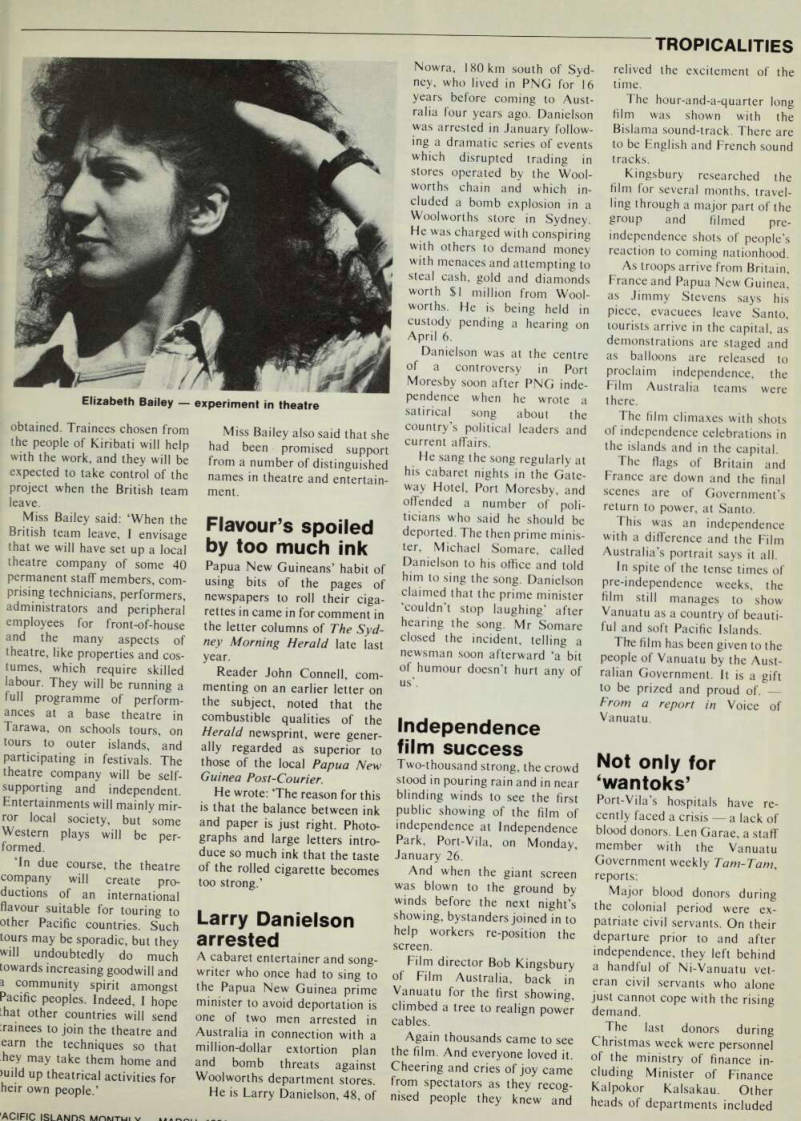
Tropicalities
Problems in selling up a famous hotel
Aggie Grey’s hotel in Apia up for sale?
The question has been bandied about the Pacific for several months now since Mrs Grey said in an interview last September with a New Zealand TV team that she would con sider selling the hotel if ‘the right offer’ was given.
Her son Alan Grey told the Apia weekly The Observer that he thought she might be con sidering selling because, at more than 80 years of age, she wants to ‘split some money around the family’.
But selling off what is prob ably the most celebrated hotel in the Pacific is proving much more complicated than most real estate transactions.
Former Apia correspondent W. Sharpe-Dunn commented for PIM in Sydney: The prob lem about having established a good reputation is: what hap pens to it when you pull out of the job? When the repute of the hotel concerned is inter nationally known, and the hotel has become a national symbol, the problem is compounded.
At this stage (early February), there have been no major developments made pub lic about the suggested sale of Aggie Grey’s hotel.
Following the New Zealand TV statement by the redoubt able Aggie Grey, offers appar ently ‘poured in’, and a great amount of sifting was done, with the number of bids reportedly being reduced to a short list of three by December.
Although manager and well known sportsman Alan Grey is not averse to leaving the hotel business in which all his youth and adult life have been spent, he and many locals fear for the reputation of the establishment once it leaves the hands of the Grey family.
The Western Samoa Govern ment does not want the hotel to become part of an international chain because of loss of revenue to the country. Immigration officials would be unhappy about an influx of foreigners working permanently there.
The departments of Econ
omic Development and Tourism fear ‘a loss of image’ for Samoa’s premier hotel if it goes into other, less sympathetic hands.
If Aggie Grey finally decides to sell, it would probably be to a local consortium, with the government holding 50% of the shares or, following on from previous experience with the Tiafau and Tusitala hotels, with the backing and interest of the Nauruan Government.
Revived casino
debate in PNG
There’s been a revival in Papua New Guinea of a long-discussed controversy over whether a hotel-casino should be estab lished to give a boost to the tourist industry and to provide new government revenue from gambling tax. This time how ever parliament is to have the final say, and if approval emerges from the debate a group of investors are prepared to build a 150-room inter national standard hotel with a casino on the top two floors.
The move to enable casinos to be licensed has come from a parliamentary back-bencher, Mr Karl Stack, who was min erals and energy minister when the Somare government was in power. Mr Stack has given notice of a private member’s bill to legalise and regulate casinos. His bill is an amend ment to existing gambling legis lation in PNG. The major responsibility of the existing legislation is the licensing and regulation of privately-owned betting shops which pay betting taxes to the government and operate mainly on Australian horse-racing.
For many years there have been sporadic proposals to es tablish hotel-casinos, but most of the moves have met with heavy opposition from churches, civic organisations and some politicians. One pro posal was for the establishment of a hotel-casino on a small island just outside Port Moresby harbour. Three years ago a draft report on tourism recommended a hotel-casino as
a potential big money earner for the government. The report said that ‘careful examination indi cated a casino would not be deleterious’, and that a casino would heavily attract tourists from Australia and further afield. There was immediate public opposition and no action was taken.
Mr Stack now claims that his proposal to legalise casinos has the support of 14 of PNG’s 15 provincial governments. He has suggested that in addition to the investors who are prepared to back the scheme, equity should be available to the national government and to provincial governments. His proposal en visages the construction of one hotel-casino on a five-year trial basis, to be followed by others if warranted. Four possible lo cations one in Port Moresby have been selected, he says.
Highlands fight
rules broken
A provincial government leader in the Western Highlands of Papua New Guinea has criti cised tribesmen for ‘breaking the traditional rules of tribal fighting’ during several recent clashes between tribes. The rules are sacred and shouldn’t be broken, the Premier of the Western Highlands, Mr Nambuga Mara, said. He ap pealed to the national govern ment to make sure that if tribes must fight, then they should stick to the rules enshrined in tradition.
Mr Mara, who is also a village chief, said one of the traditional rules being broken was that women, children and chiefs should not be injured or killed in tribal fights. As well, warriors were not obeying the rule that no person killed in a clash should .be ‘cooked or burnt’. He added: ‘Another significant rule which has not been observed lately is that feuding groups are not sup posed to make surprise attacks before 6am and after spm.’
Mr Mara was in Port Moresby to rally support for the introduction of a state of emerg ency in the Highlands in a bid to stop rising tribal fighting and other lawlessness. He said tribal fights were a custom of High lands people and could not be stopped overnight. However, he was disappointed the national government had not found ways
to curb tribal clashes. Mr Mara said the Highlands economy was suffering because of the
fighting.
In talks with Mr Mara, the Prime Minister, Sir Julius Chan ruled out a state of emergency for the Highlands, but promised the concentrated use of police in areas ‘in most need of it’.
Meanwhile, police have re ported four deaths in recent tribal fights in three highlands areas. Two people died and several were wounded in a fight over land in the Western High lands. About 300 tribesmen were involved and they dam aged houses and food crops. In the Southern Highlands a 10year-old boy was speared to death in one of the incidents which Mr Mara said were breaking the traditional rules of inter-tribal fighting. A 35-year old man was killed in a tribal clash in the Enga Province.
Michael Prain in Port Moresby.
Theatre group
for Kiribati
An unusual experiment in pro fessional theatre is being spon sored by the British actress Elizabeth Bailey. She plans to establish what she has named Theatre Kiribati, a theatre com pany based in Kiribati.
Miss Bailey told PIM from London that she ‘fell in love with Kiribati’ during a Pacific tour which also took in Micronesia and Hawaii. She described her proposed Theatre Kiribati as ‘a meld of Western technolog> and local traditional culture’. It will be started by a team of British actors and technicians who will go to Kiribati as volunteers but will leave five years later when they hope the project will be self supporting.
The work of the visitors will be to seek out local myths, legends and stories of actual events, study the social cus toms, and create theatrical pro ductions from the information
obtained. Trainees chosen from the people of Kiribati will help with the work, and they will be expected to take control of the project when the British team leave.
Miss Bailey said; ‘When the British team leave, I envisage that we will have set up a local theatre company of some 40 permanent staff members, com prising technicians, performers, administrators and peripheral employees for front-of-house and the many aspects of theatre, like properties and cos tumes, which require skilled labour. They will be running a full programme of perform ances at a base theatre in Tarawa, on schools tours, on tours to outer islands, and participating in festivals. The theatre company will be self supporting and independent.
Entertainments will mainly mir ror local society, but some Western plays will be per formed.
Tn due course, the theatre company will create pro ductions of an international flavour suitable for touring to other Pacific countries. Such tours may be sporadic, but they
will undoubtedly do much
towards increasing goodwill and
a community spirit amongst Pacific peoples. Indeed, I hope that other countries will send rainees to join the theatre and earn the techniques so that hey may take them home and mild up theatrical activities for heir own people.’
Miss Bailey also said that she had been promised support from a number of distinguished names in theatre and entertain ment.
Flavour’s spoiled
by too much ink
Papua New Guineans’ habit of using bits of the pages of newspapers to roll their ciga rettes in came in for comment in the letter columns of The Syd ney Morning Herald late last year.
Reader John Connell, com menting on an earlier letter on the subject, noted that the combustible qualities of the Herald newsprint, were gener ally regarded as superior to those of the local Papua New Guinea Post-Courier.
He wrote; ‘The reason for this is that the balance between ink and paper is just right. Photo graphs and large letters intro duce so much ink that the taste of the rolled cigarette becomes too strong.’
Larry Danielson
arrested
A cabaret entertainer and song writer who once had to sing to the Papua New Guinea prime minister to avoid deportation is one of two men arrested in Australia in connection with a million-dollar extortion plan and bomb threats against Woolworths department stores.
He is Larry Danielson, 48. of
Nowra, 180 km south of Syd ney, who lived in PNG for 16 years before coming to Aust ralia four years ago. Danielson was arrested in January follow ing a dramatic series of events which disrupted trading in stores operated by the Wool worths chain and which in cluded a bomb explosion in a Woolworths store in Sydney.
He was charged with conspiring with others to demand money with menaces and attempting to steal cash, gold and diamonds worth $1 million from Wool worths. He is being held in custody pending a hearing on April 6.
Danielson was at the centre of a controversy in Port Moresby soon after PNG inde pendence when he wrote a satirical song about the country’s political leaders and current affairs.
He sang the song regularly at his cabaret nights in the Gate way Hotel, Port Moresby, and offended a number of poli ticians who said he should be deported. The then prime minis ter. Michael Somare, called Danielson to his office and told him to sing the song. Danielson claimed that the prime minister ‘couldn’t stop laughing’ after hearing the song. Mr Somare closed the incident, telling a newsman soon afterward ‘a bit of humour doesn’t hurt any of us’.
ndependence
film success
Two-thousand strong, the crowd stood in pouring rain and in near blinding winds to see the first public showing of the film of independence at Independence Park, Port-Vila, on Monday, January 26.
And when the giant screen was blown to the ground by winds before the next night’s showing, bystanders joined in to help workers re-position the screen.
Film director Bob Kingsbury of Film Australia, back in Vanuatu for the first showing, climbed a tree to realign power cables.
Again thousands came to see the film. And everyone loved it.
Cheering and cries of joy came from spectators as they recog nised people they knew and
relived the excitement of the time.
The hour-and-a-quarter long film was shown with the Bislama sound-track. There are to be English and French sound tracks.
Kingsbury researched the film for several months, travel ling through a major part of the group and filmed pre independence shots of people’s reaction to coming nationhood.
As troops arrive from Britain, France and Papua New Guinea, as Jimmy Stevens says his piece, evacuees leave Santo, tourists arrive in the capital, as demonstrations are staged and as balloons are released to proclaim independence, the Film Australia teams were there.
The film climaxes with shots of independence celebrations in the islands and in the capital.
The flags of Britain and France are down and the final scenes are of Government’s return to power, at Santo.
This was an independence with a difference and the Film Australia’s portrait says it all.
In spite of the tense times of pre-independence weeks, the film still manages to show Vanuatu as a country of beauti ful and soft Pacific Islands.
The film has been given to the people of Vanuatu by the Aust ralian Government. It is a gift to be prized and proud of.
From a report in Voice of Vanuatu.
Yot only for
‘wantoks’
Port-Vila’s hospitals have re cently faced a crisis a lack of blood donors. Len Garae, a staff member with the Vanuatu Government weekly Tam-Tam , reports: Major blood donors during the colonial period were ex patriate civil servants. On their departure prior to and after independence, they left behind a handful of Ni-Vanuatu vet eran civil servants who alone just cannot cope with the rising demand.
The last donors during Christmas week were personnel of the ministry of finance in cluding Minister of Finance Kalpokor Kalsakau. Other heads of departments included
Elizabeth Bailey - experiment in theatre
Radio Vanuatu Director Joe Carlo. ‘We are glad to see that Ni- Vanuatus are now responding to our appeals,’ says a senior official of Port-Vila Base Hos pital, Daniel Kalorib. He says the idea is to give to save, regardless of whose life it is. Mr Kalorib says there exists a system at the hospital which he called a ‘wantok system’, where a person prefers only to donate his blood within his own family circle. This, says Mr Kalorib, is not right. ‘The hospital provides the service, but the community must support it,’ he says. He estimated the hospital’s present needs at between 40 to 70 pints a week. ‘Young people must get into the idea of donating blood,’ he stresses.
He says they were lucky at the hospital last Christmas be cause there were no seriously ill people in need of blood except one woman.
Two women, a Tannese and a Fijian, were both heavy with child. Both were told they would be operated on for the deliveries. The Fijian lady’s husband brought in six friends to donate some blood since it was likely his wife might need it. But luck was with him as his wife did just fine without the six pints of blood. However it was lucky all the same that the men donated their blood when they did. Those pints all went to the lady from Tanna and saved her life. She would not have lived had they not donated their blood. Thanks to those strangers.
Len Garae closed with the question: ‘Now do you see what I mean?’
Expedition to
Pitcairn
The Sir John Barrow Commem orative Expedition, 1980, named after one of the founders of the Royal Geographical So ciety, who was also the author of the first authoritative ac count of the Bounty mutiny, was on Pitcairn island late last year.
Financed by a variety of travel and other organisations in several countries, its chief in spirer was Glynn Christian, a great-great-great-great grand
son of Fletcher Christian, who is hard at work on his cherished project of writing a biography of his famous ancestor.
The expedition made up of 11 members, and the four-man crew of their ship Taiyo aimed to map and photograph the three settlements made by Fletcher Christian and Bounty after the mutiny. Glynn Christian writes in an article in Pitcairn Miscellany. ‘We wish to record both the original and current state of sites where possible; the former so that conflicting stories of events can be more carefully dealt with.
This mapping is a useful en deavour in itself and here 1 must acknowledge those who have done the earlier work (especially on Pitcairn) on which we are building. The maps and a collection of photo graphs from the expedition will be presented to the Royal Geo graphical Society of London.’
Glynn’s aim is to ‘discard publicly the romance and the irrelevancies’ in previous writ ings on the subject. He says that in all the 2500 books devoted to the mutiny, there is no biogra phy of Fletcher Christian.
He adds: ‘During two years’ research and two trips around the world, 1 have discovered Christian family papers that bring to life our ancestors as far back as 1380, and then some.
With such additional finds as a diary of Fletcher’s first cousin and an autobiograpy of his brother Charles, I can at last say that a biography of Fletcher is possible. Finally it is to add solid fact to Sir John Barrow’s book.’
Glynn Christian’s work is due to be published in the USA, Britain and Australia at the end of this year. It is tentatively called Fragile Paradise The Life and Death of Fletcher Christian. In addition, a film on Pitcairn Island is in preparation by US film-maker Ted Cochran who was on the expedition.
Glynn comments: ‘. . . the film will illustrate far better than any words I can write that Fletcher found one of the world’s most wonderful spots . . . We found (on Pitcairn) one of the world’s happiest com munities, and nothing remotely like the sad village that previous films showed.’
Advertisements & other items, pp. 27-32 (2 items)
The luxury of jergens
Available at last!
Three delicately scented soaps with the total freshness of nature.
Deep cleansing clear soap for problem skin. Contains Glycerine. (CCnocnts , TT", c Gentle Touch Soaps, in three colours, with the soothing good ness of Baby Oil. & "Xio 7 ; (; 1= mm
ne*G
JeiU
ens The wonderful young shampoo and conditioner that leave your hair with a soft delicate fragrance for hours. "Gee, your hair smells terrific!"
DRYAD DEODORANTS.
With the lasting springtime fresh fragrance. Available in aerosol, stick and roll-on.
Hand and body lotions to enrich dry skin. Jergens White and Jergens Yellow, fnP Pvtra nm i • ... »»i iiic «tnu jtrgens renew, the extra nourishment for extra-dry skin.
Also available: Jergens Lotion-mila soap.
A“r y s
TRADE ENQUIRIES WELCOME
MANUFACTURED BY: THE ANDREW JERGENS Co. Cincinnati, U.S.A Distributed by: S. E. Tatham, Melbourne, Australia.
l*' %
SUE
\i*rw n A i 1 d .*■
I ISII
fl “i <r- J?
NEWt’r' *•••
ZEALAND /*/
I WE EXPORT PRODUCTS IN ALL OF THE FOLLOWING GROUPS Frozen meat, fish and seafood (bulk and portion control) Dairy products Canned fruit Dry groceries Beer, wines and spirits Cigarettes Electrical appliances Household products Electrical supplies Builders hardware Engineering supplies Motor vehicles and spares and much more!!
i JvrkOatl'V 1 C. l»Wi utin
JAVAN i
f w~fr '"jr/
■7 . <«r I'wfrm
KYO
Nam <B*~r 1
*csr;
y, 'uljwoir
OKINAWA i
Ai/- ntnJi*
MAS
&I
.**■■ ■, I J T ,n
MANILA '
t.iii ■ x4> jnfj)<r* tt "
R *» q &angojL V
jJ'AnoluilH.
I* <s£s xa». . „ . . > Jir Ki,>S^p^.' <6 « k ,
■ W?££fc! •.*"*
-»• 4*' I Pak>. OT va ™ tr Lu V‘iTV J .j buw£ r i ' J / SebastiaTLlobos Jttef' t"::k N> »-'■ •
■Ste* -/
•■jte&fcp
Jltt/' f J **%£■*■ * Paio. or iitofed ■* .. u„—.*+-'■ —I &T . >?*>&- . Mnnauulf 1 ' -InAr r I ► .</ r Tarw& ■l,-rJflMguJ n ✓ '•DonJcuis I* .Vafitey&vLL* iso* ' PS qwrxonr or ’ £r*r*N / V z-
Cft?
* V, ■'H *-£?✓ f*
■tos&irZL*.
'»" • -W, M
■w.«.■ v sh>»l
* iV *-£T P %
o '-w.<w f ‘\* k y\ „ U’JLsßtef'* K ‘ L-/>eh>t*wuc
/MOSUL.T SAotiV
L a»op-v :W/ J> U-■ Z.JuuSh , DrvKnnk . / y Dayuis Her/' Ifvrde Shoe
iSZrj&, t
Snto* AviA’ f&Z Gdif Siclhaf^n 8^ hnmpacr
fiSssß^i
jjanlx^Vy, R T
ILo'
*O9.
Airr oDtxo • r 4 Fi trutuU * Perl&fW* n<r*i<l>cr<. % Arrc*snutKf /3E v >' s r r a i, i
SYDNEY
>\% f tot !>'
R N E
Kmyj 1 jV» l^ 1 - >' - 7 l<l^u l |,
... Discover the Pacific with Air Nauru.
WO want to show you how times
have changed.
Larrara, Lanura 'Heision L WaJcu I
HONOLULU
.U.IM.il Of.. j/AX C £ B. ♦ Wakes Rockj trajpars I £s* Our thanks to this Pacific basin map, drawn and colored in 1852 by J. Wyld, geographer to the Queen and HRH Prince Albert, for reminding us how isolated we used to be, and what a difference a modern airline can make to life and leisurd.
If you find the notion of hopping by air from island to island still a terribly adventurous one, we hasten to assure you that Air Nauru has made Pacific travel satisfying beyond your romantic dreams. From Hong Kong via Nauru to Auckland, from Singapore via Nauru to Melbourne, and to all the beautiful islands in between, you will enjoy being with us, sharing our Pacific island heritage.
The first airline ever to link the major Pacific ethnic regions of Micronesia Melanesia and Polynesia, we are also the only all-jet airline flying between many of the islands of the Pacific w
•Ml MAJURO
*'*•l "%r
TARAWA
NAURU
Her el t fhsrry I Hotumah or] l*
VILA
VM na6i
SUVA «
IP Y'Skf *>»»*«
—^TONGA
4EA 9 XemtnJ H rtrm i * m We are also happy to say that we're an internationally-scheduled airline with big airline standards, an all-Boeing fleet of 727 and 737 jets an impeccable flying style, delightful stopovers, a pleasant, unpretentious
inflight hospitality.
Talking about pleasant things, you will observe on this map, if you look closely that we were once even known as Pleasant Island [a name given us by Captain John Fearn of the whaling vessel Hunter,' the first European to visit Nauru in 1798), Let this be your friendly reminder to visit the Pacific at least once in your lifetime, on the airline that has helped change the times.
Danger L* mmm
APIA '
AIR I INF DF T l-l P PCMTD A I as\ i, , j —\ airline of the central pacific p A < - qA f •*** / F 477 - 7106 in Gua^69s - ™ in 653-5709 in Melbourne, Australia. 312 ‘ 377 10 Suva ' 7279s in Nadi, Fiji; 448 in Tarawa, Kiribati: and
OUR
MARKET
THE
WORID
\ Li 4 l » '' *; •■ ' \ Si.* 5 o \ In a country like NEW ZEALAND, where the economy depends heavily on the exports of products from the land, it isn’t surprising to find total commitment to effective animal remedies and agricultural chemicals.
The standards set by ICI TASMAN are respected by farmers Worldwide.
ARE YOU WITH
US?
Healthy Stock Healthy Crops Greater Yields Higher Profit Animal Remedies
★ TASVAX - VACCINES
★ TASTONE - PEPTONES
★ TASMIX - FEED SUPPLEMENTS
★ NILVERM - DRENCH
★ COMBAT - DIP
Agricultural Chemicals
★ GRAMOXONE - WEEDKILLER
★ ORTHENE - INSECTICIDE
★ AMBUSH - INSECTICIDE
★ ACTELLIC - INSECTICIDE
★ MILCURB - FUNGICIDE
Available throughout the South Pacific, these products give you the benefits of the reputation & international research of ICI.
ICI Tasman Limited P.O. Box 900, Auckland, New Zealand
Tropicalities
'ACIFIC ISLANDS Mnwrui v
pine plans
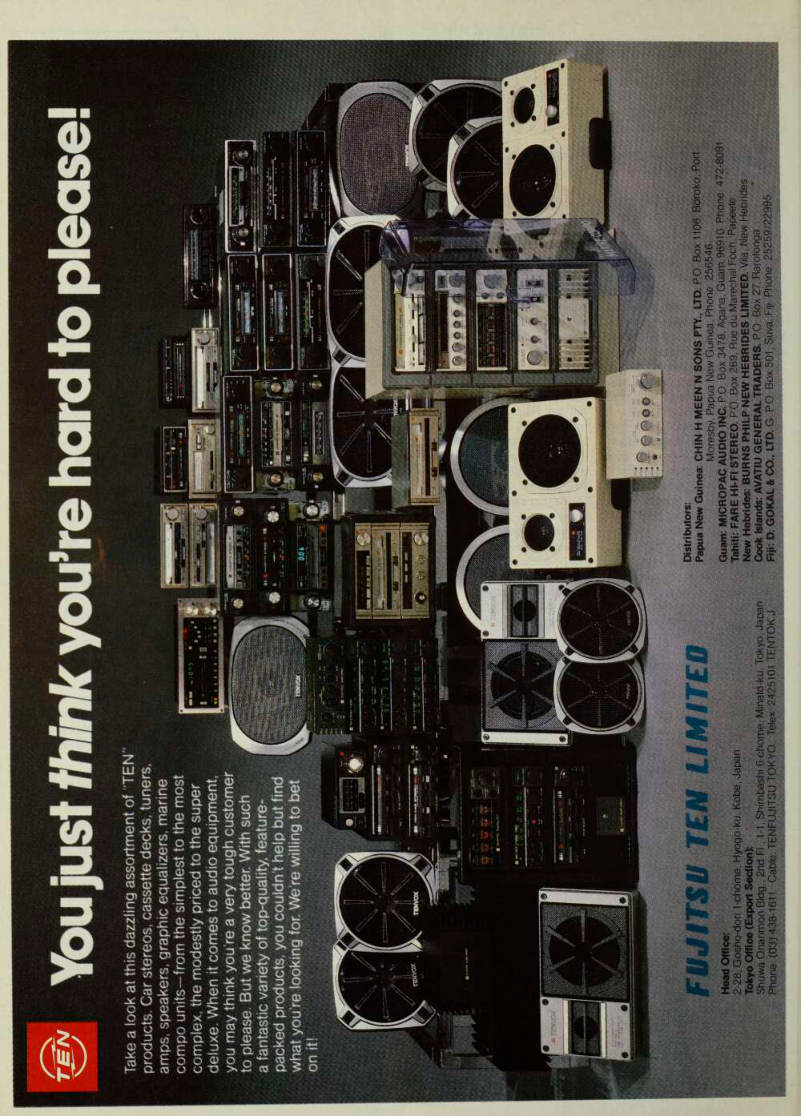
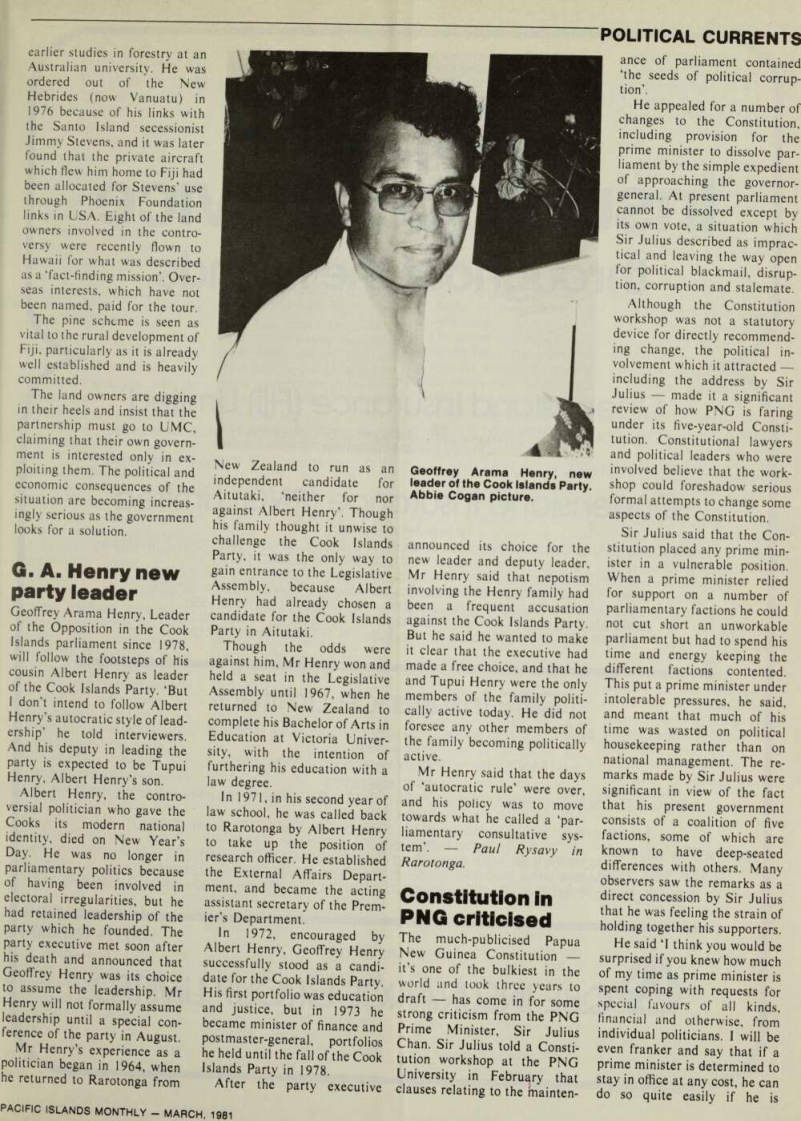

Political
Currents
Political threat in pine plans
In a situation involving politics and the economy, Fiji faces a serious threat to its much-vaunted pine timber project Does the government take in an unwanted partner or does it fly in the face of electorate opinion? Either way would seem to be inviting trouble. Writing from Suva, CHRISTY SILLS has a look at the situation.
Political concern is growing in Fiji over the manner in which a little-recognised development company from USA entered Fiji under the government’s guard, won the support of an influential group of land owners and is now using this support in an attempt to become a major partner in the big Fiji pine timber project.
The government, which had planned to invite an established and recognised company to be a partner in the timber project, has been forced into a corner and has still not resolved the situation. It is frankly sus picious of the manner in which the US firm, United Marketing Corporation, won the support of the land owners. It also has doubts about UMC’s capacity to meet all the commitments which would be involved. But the land owners, won over by promises from UMC, are putt ing strong electorate pressures on the government to accept a UMC partnership and are using independent political support in parliament.
To add to the government’s concern there are now alle gations that UMC, which can vassed support at the village level, is linked with the contro versial US-based Phoenix Foun dation. The Phoenix Foun dation is an authoritarian free enterprise group which preaches the elimination of all government control in business and commerce. In 1972 it clashed with the King and government of Tonga when it attempted to take possession of a Tongan reef. Later the Phoenix Foundation was ac ively involved in support for he Vanuatu rebel leader limmy Stevens, and it has been iccused of meddling in the tffairs of other Pacific Island md some Caribbean countries.
The timber project in Fiji
which is at the centre of the controversy involves the plant ing, logging, milling and pro cessing of new pine forests under a scheme controlled by a statutory organisation, the Fiji Pine Commission. The first stands matured last year and have already brought in over seas earnings of about SFI million. The next stage of the project will be the establish ment of a complete industrialis ation system to process the increasing volume of pine which will become available. To bring in the necessary expertise and capital the government pro posed a three-way partnership.
The partnership is to consist of the government itself through pine commission, the land owners who control 85% of the land on which the pine is growing, and an industrial de veloper.
By the middle of last year the government had a short list of three applicants to become its industrial partner. All three have recognised expertise and financial backing, and they have prepared proposals for making sawn timber, fibre board, wood-chemical products, paper, pulpwood, wood chip and alternative fuels.
The three short-listed con tenders were British Petroleum South West Pacific Ltd, Shell Fiji Ltd in association with New Zealand Forest Products, and the M.K. Hunt Foundation Ltd of New Zealand.
Shortly before the govern ment was to make its choice, UMC entered the field as a fourth contender. UMC officials earlier had sidestepped official channels and worked directly at the village level enlisting support from the land owners. Their efforts were so persuasive that many of the land owners were prepared to assign marketing rights uni
laterally to UMC. Concerned at the trend, the Prime Minister, Ratu Sir Kamisese Mara, warned ‘foreign timber hi jackers, beware’. The pine com mission also warned the land owners not to act unilaterally on the grounds that such action would have no legal standing.
Pressures from the land owners became so great how ever that the government was forced to allow UMC to submit a late proposal for partnership in the scheme. The land owners flocked to the Ministry of Finance building and held a prayer meeting in the base ment, praying for the success of the UMC application. UMC’s 84-page proposal was submitted to the government by the UMC president, Mr Paul Sandblom, who was accompanied by the man described as his timber adviser, Mr Jay Gruinfeld. The government has yet to announce its decision.
UMC was incorporated in Arizona in 1975. Inquiries about its background have not indicated any experience in the timber industry, and the com pany s activities were described to one inquirer as ‘undeter mined’. Sandblom owns an automotive firm in Glendale, Arizona, and it is linked to what is described as a ‘training insti tute’.
The extent to which UMC had been successful in selling its position at grassroots level be came evident in August last year when tensions mounted over the assignment of market ing rights.
Increasing speculation about Phoenix Foundation links is supported by the involvement of a controversial figure in Fijian politics, Ratu Osea Gavidi, a high chief in the western div ision of Viti Levu, independent member of parliament and an influential leader of the land owners.
Initially the land owners were not enthusiastic about the pine scheme because they are subsistence farmers with little knowledge of long-term rural development projects. But as the trees began to grow and increasing reference was made to the potential earnings the land owners became anxious in case the money passed them by.
However they remained sus picious of government motives and became emotional about
their rights as land owners.
Against this background they became receptive to many influences including the UMC ‘sales drive’.
Working through Ratu Osea Gavidi, UMC chose from the start to bypass official channels and instead sold its industrialis ation plans at village level.
Meeting across the yaqona bowl, Paul Sandblom and other representatives reportedly talked of profits of up to $5O million a year to be divided equally between UMC and the land owners if UMC were assigned the marketing rights.
Such a figure exceeds even the most optimistic estimates.
Presenting its proposal, UMC admitted that it may ‘seem unusual that we would be willing to share 50% of the profit from the operation while still paying slumpage for the right to harvest trees, retiring the debt and paying all the capital works.’
UMC’s proposed capital in vestment is $2.5 million, a figure which government ad visers describe as ‘a gross understatement of what is needed . It contrasts sharply with figures of $lOO million and more offered by other con tenders.
UMC won much of its sup port by advocating sawmills and other industrial installations at village level, rather than the establishment of a central pro cessing complex. But here, 100, government advisers are con cerned. They say that if Fiji wants a reliable and efficient export industry from the project a central technologically developed plant is essential.
Ratu Osea, the politician who has been acting as a liaison man for UMC, is a powerful force in Fiji politics and his involvement has added to the government’s concern. He has a persuasive personal manner, is a good speaker and has gained much of his reputation in the present controversy because of his
earlier studies in forestry at an Australian university. He was ordered out of the New Hebrides (now Vanuatu) in 1976 because of his links with the Santo Island secessionist Jimmy Stevens, and it was later found that the private aircraft which flew him home to Fiji had been allocated for Stevens’ use through Phoenix Foundation links in USA. Eight of the land owners involved in the contro versy were recently flown to Hawaii for what was described as a ‘fact-finding mission’. Over seas interests, which have not been named, paid for the tour.
The pine scheme is seen as vital to the rural development of Fiji, particularly as it is already well established and is heavily committed.
The land owners are digging in their heels and insist that the partnership must go to UMC, claiming that their own govern ment is interested only in ex ploiting them. The political and economic consequences of the situation are becoming increas ingly serious as the government looks for a solution.
G. A. Henry new
party leader
Geoffrey Arama Henry, Leader of the Opposition in the Cook Islands parliament since 1978, will follow the footsteps of his cousin Albert Henry as leader of the Cook Islands Party. ‘But I don’t intend to follow Albert Henry’s autocratic style of lead ership’ he told interviewers.
And his deputy in leading the party is expected to be Tupui Henry, Albert Henry’s son.
Albert Henry, the contro versial politician who gave the Cooks its modern national identity, died on New Year’s Day. He was no longer in parliamentary politics because of having been involved in electoral irregularities, but he had retained leadership of the party which he founded. The party executive met soon after his death and announced that Geoffrey Henry was its choice to assume the leadership. Mr Henry will not formally assume leadership until a special con ference of the party in August.
Mr Henry’s experience as a politician began in 1964, when he returned to Rarotonga from
New Zealand to run as an independent candidate for Aitutaki, ‘neither for nor against Albert Henry’. Though his family thought it unwise to challenge the Cook Islands Party, it was the only way to gain entrance to the Legislative Assembly, because Albert Henry had already chosen a candidate for the Cook Islands Party in Aitutaki.
Though the odds were against him, Mr Henry won and held a seat in the Legislative Assembly until 1967, when he returned to New Zealand to complete his Bachelor of Arts in Education at Victoria Univer sity, with the intention of furthering his education with a law degree.
In 1971, in his second year of law school, he was called back to Rarotonga by Albert Henry to take up the position of research officer. He established the External Affairs Depart ment, and became the acting assistant secretary of the Prem ier’s Department.
In 1972, encouraged by Albert Henry, Geoffrey Henry successfully stood as a candi date for the Cook Islands Party.
His first portfolio was education and justice, but in 1973 he became minister of finance and postmaster-general, portfolios he held until the fall of the Cook Islands Party in 1978.
After the party executive
announced its choice for the new leader and deputy leader, Mr Henry said that nepotism involving the Henry family had been a frequent accusation against the Cook Islands Parly.
But he said he wanted to make it clear that the executive had made a free choice, and that he and Tupui Henry were the only members of the family politi cally active today. He did not foresee any other members of the family becoming politically active.
Mr Henry said that the days of ‘autocratic rule’ were over, and his policy was to move towards what he called a ‘par liamentary consultative sys tem’. Paul Rysavy in Rarotonga.
Constitution in
PNG criticised
The much-publicised Papua New Guinea Constitution it’s one of the bulkiest in the world and look three years to draft has come in for some strong criticism from the PNG Prime Minister, Sir Julius Chan. Sir Julius told a Consti tution workshop at the PNG
University in February that
clauses relating to the mainten
ance of parliament contained ‘the seeds of political corrup tion’.
He appealed for a number o changes to the Constitution including provision for the prime minister to dissolve par liament by the simple expedient of approaching the governor general. At present parliament cannot be dissolved except by its own vote, a situation which Sir Julius described as imprac tical and leaving the way open for political blackmail, disrup tion, corruption and stalemate.
Although the Constitution workshop was not a statutory device for directly recommend ing change, the political in volvement which it attracted including the address by Sir Julius made it a significant review of how PNG is faring under its five-year-old Consti tution. Constitutional lawyers and political leaders who were involved believe that the work shop could foreshadow serious formal attempts to change some aspects of the Constitution.
Sir Julius said that the Con stitution placed any prime min ister in a vulnerable position.
When a prime minister relied for support on a number of parliamentary factions he could not cut short an unworkable parliament but had to spend his time and energy keeping the different factions contented.
This put a prime minister under intolerable pressures, he said, and meant that much of his time was wasted on political housekeeping rather than on national management. The re marks made by Sir Julius were significant in view of the fact that his present government consists of a coalition of five factions, some of which are known to have deep-seated differences with others. Many observers saw the remarks as a direct concession by Sir Julius that he was feeling the strain of holding together his supporters.
He said ‘I think you would be surprised if you knew how much of my time as prime minister is spent coping with requests for special favours of all kinds, financial and otherwise, from individual politicians. I will be even franker and say that if a prime minister is determined to stay in office at any cost, he can do so quite easily if he is
Geoffrey Arama Henry, new leader of the Cook Islands Party.
Abbie Cogan picture.
prepared to grant enough favours. But if he follows that course, what happens to the good of the country and the people as a whole?’
Sir Julius said that when a prime minister reached the stage of being unable to govern effectively, and realised this because of conflict among his supporters and in parliament, he should have the power to seek and obtain a dissolution of parliament by approaching the head of state. (Under the consti tutional structure and as a member of the Commonwealth of Nations PNG recognises Queen Elizabeth as head of state represented by a governor general who is a PNG citizen elected by parliament).
Sir Julius said that under the present system where only par liament could dissolve itself, it was possible for a dissident parliament to deliberately keep itself in office and at the same time deny the government a stable base from which to govern. Potential corruption then arose because a prime minister had to resort to politi cal favours to hold together some form of support.
Sir Julius also criticised the constitutional situation which allowed frequent attempts to unseat a government and prime minister by ambitious poli ticians. He was referring to the process of no-confidence which has been exercised repeatedly in the PNG parliament. Sir Julius himself came to power through this process, although the man behind the move was not Sir Julius himself. The move came from Mr lambakey Okuk, now deputy to Sir Julius.
Sir Julius said there was a need to carefully re-examine the situation and provide greater restraints on when and how votes of no-confidence could be initiated.
Angry politics
in Guam strike
In a deep-seated strike with political, industrial and even cultural overtones, 700 teachers and supporting workers walked off the job on Guam in mid- January over a pay claim.
It was the biggest walkout Guam has known and was the first serious test of union
strength in opposition to politi cal leadership. It was also the first strike against the govern ment on Guam. It led to angry picketing incidents, to fluctuat ing loyalties by some workers who had never before experi enced industrial action and to allegations that political agi tation from outside had contrib uted to the problem. There were also claims that the strike had broken traditional Micronesian cultural attitudes towards work.
Four death threats were re ceived by the Director of Edu cation, Mrs Aguon, although no violence was reported.
At last report the strikers were still standing out after three weeks off the job, and there were threats of calling for union support from as far away as Australia, Japan, Hawaii and west coast USA.
Although members of the Guam Federation of Teachers were the central figures in the strike there was also some support from other government workers and from supporting workers in the education sys tem. A series of huge rallies fanned the strike fever. The teachers claimed they were striking on behalf of the entire government workforce.
The origin of the strike went back to protracted claims last year for higher rates of pay. The original claim was for an across the board increase of 30%, but in August the immediate heat was taken out of the claims when government workers were granted a flat increase of $7OO on annual salary. This amounted to about 5% on aver age pay packets.
The situation erupted angrily in December however when members of the 15th Guam Legislature awarded them selves pay rises ranging from 35 to 50%. A rally and a union vote followed, calling a strike of all members of the federation of teachers. About three-quarters of the membership voted, and of these 70% supported strike action. The strike went ahead despite a series of delaying legal and political tactics. Port workers threw in their lot with the teachers, and there were picketing incidents on the wharves involving port workers and truck drivers.
Suspension notices were
served on 700 Department of Education employees, followed by threats of dismissal which only entrenched the confron tation between the government and the strikers. Legal penalty actions were also filed against the unionists.
A representative of the American Federation of Teachers, Mr Stephen Porter, flew from USA and addressed a rally in which he urged the teachers to maintain their picket lines at schools and offices ‘for as long as it takes’.
He also outlined financial aid available to them from US union sources.
The government was heavily criticised for alleged attempts to split the strikers on a racial basis. Governor Paul Calvo of Guam made a television plea to the local Chamorro people in volved in the strike not to follow the lead of the American teachers involved. Mrs Marcia Hartsock, executive director of the teachers federation accused him of ‘pitting Statesiders against Chamorros’ in what was essentially a Guam issue.
M. L Berg on Guam.
New Zealand’s
Pacific role
A German academic believes that New Zealand is taking an increasingly important role as a stabilising influence in the de velopment of small island nations in the South Pacific. He is Professor Ulrich Schwein furth, director of the geography department at the South Asia Institute of Heidelberg Univer sity in Germany. His views on New Zealand’s relationships in the Pacific are contained in a recent issue of Aussen Politik, a German foreign affairs review.
He said that New Zealand influence had been a factor in controlling the spread of ‘alien and undesirable’ influences in the South Pacific.
Professor Schweinfurth said that with 200-mile economic zones, New Zealand had a completely new future, with a position of dominance in the South West Pacific. He claimed that the people of New Zealand had yet to realise this, but the small island states were already looking to New Zealand as a stabilising factor.
Noting the continuous chain of islands, all with 200-mile zones, from Tokelau to the sub- Antarctic, the writer said all the states in-between had worked in close co-operation for some time. ‘All these islands look mainly to New Zealand for economic and other forms of support and New Zealand has made a good name for itself in these and other islands in the course of the years’. Professor Schweinfurth said.
New Zealand, as a ‘reliable partner’ of the West, had man aged to control alien influences in the region, as well as advise states ‘which because of their difficult economic situation are especially susceptible’.
Professor Schweinfurth said ‘New Zealand, thanks to its geographical situation and the skilful use of the possibilities the law of the sea conference allowed, as well as its experi ence in the South West Pacific area, has become a political factor in tropical and subtropi cal South West Pacific, though it does not have great techno logical power. It exerts influence by pragmatic use of the given possibilities’.
The professor said that Pacific states prefer ‘little’ New Zealand to the immensely larger Australian continent. ‘Australia’s tasks, assuming agreement can be reached on a sensible division of labour be tween the antipodean neigh bours, especially in the South West Pacific, lie towards Melanesia, and mainly New Guinea, Indonesia and South
East Asia.’
Michael Field in
Wellington.
Tonga election
set for May
Tonga will hold elections on May 1 for the seven people’s representatives in its Legislat ive Assembly. The Assembly is made up of a speaker and cabinet appointed by the King, seven nobles elected by the 33 nobles in the kingdom, and the people’s representatives. The assembly will meet soon after the May elections to swear in the new people’s representatives and to prepare estimates for the 1981/82 financial year.
Advertisements & other items, pp. 33-38 (2 items)
’Acific Islands Monthi Y _ M A Dru Mo-.
’ACIFIC ISLANDS MONTHI Y M A Dru mo-.
Ten Limited
TEN
You just think you’re hard to please!
Take a look at this dazzling assortment of TEN"
products. Car stereos, cassette decks, tuners,
amps, speakers, graphic equalizers, marine
compo units— from the simplest to the most complex, the modestly priced to the super deluxe. When it comes to audio equipment, you may think you're a very tough customer to please. But we know better. With such
a fantastic variety of top-quality, feature-
packed products, you couldn't help but find what you’re looking for. We re willing to bet on it! r f obt mmdii <* ■ t mojojuaarn- 1 ® • try: V t : .
' ■ H ■'. * =» 1 0.0 b ■ : '-T 'T i P V rj*
■NVQX
■ i— l m « .7 % S? • \ /I
BHI
wlirMMtl
TEN LIMITED
Head Office:
2-28, Gosho-dori 1-chome, Hyogo-ku, Kobe, Japan.
Tokyo Office (Export Section); Shuwa Onarimon Bldg., 2nd FI., 1-1, Shimbashi 6-chome, Minatd-ku, Tokyo, Japan.
Phone; (03)438-1611 Cable. TENFUJITSU TOKYO Telex: 2425101 TENTOKJ.
Distributors:
Papua New Guinea: CHIN H MEEN N SONS PTY., LTD. P.O. Box 1106, Boroko. Port Moresby, Papua New Guinea Phone: 256546.
Guam; MICROPAC AUDIO INC. P.O. Box 3478, Agana, Guam 96910, Phone: 472-8091.
Tahiti: FARE HI-FI STEREO. PO Box 269, Rue du Marechal Foch, Papeete New Hebrides: BURNS PHILP NEW HEBRIDES LIMITED. Vita. New Hebrides Cook Islands; AVATIU GENERAL TRADERS. P.O Box 27. Rarotonga Fiji: D. GOKAL & CO., LTD. G PO, Box 501, Suva, Fiji. Phone: 25259/22995,
Expert
Insurance Service
throughout the islands
Queensland Insurance (Fiji) Limited
Head Office, 34 Usher St., SUVA . General Manager: L. G. Liddell A.A.1.1. Assistant Manager: Vijay Lai. Phone: 23851.
LAUTOKA OFFICE; Burns Philp Bldg., Naviti St. District Manager: J. Dalton. Phone: 60642
Queensland Insurance (PNG) Limited
PAPUA NEW GUINEA
Head Office, B.N.G. Building, Musgrave St.,PORT MORESBY. General Manager: J. M. Dawe.
Assistant Manager: R. V. Maskell. Phone: 212144.
LAE: 4th St. & Coronation Drive. District Manager: I. R. Martin. Phone: 423873.
MOUNT HAGEN: Hagen Drive. District Manager: D. F. Carroll. Phone: 521002.
ARAWA: Chebu St. District Manager: J. Longbut. Phone: 951555.
MADANG: Kasagten St. District Manager: N. D. Ramage. Phone: 822020.
RABAUL: Wirraway St. District Manager: W. F. Tinker. Phone: 921014.
QBE Insurance Limited
VANUATU, PORT VILA: Rue de Paris, Suite 19, Oceania Bldg. Manager; G. F. Donnelly.
Phone; 2299.
SANTO; Burns Philp (Vanuatu) Ltd. Phone: 230.
PACIFIC AGENCIES
NEW CALEDONIA: T A. Hagen, Ste. W. A. Johnston, S.A.R.L. 5 Rue Anatole France, NOUMEA.
Phone: 272083.
TAHITI: Arthur Chung. Immeuble 8.1.5., Front de Mer, PAPEETE. Phone: 2.86.19.
NIUE: Burns Philp (South Sea) Company Ltd.
NORFOLK ISLAND; Burns Philp (N I) Company Ltd. Phone: 2191.
SAMOA: APIA, Burns Philp (South Sea) Company Ltd. Phone: 22611.
TONGA: Burns Philp (South Sea) Company Ltd. NUKUALOFA. Phone 21500 HAAPAI, VAVAU.
MEMBERS OFTHE:
%£?qbe insurance group umited
Most pocket-sized stereo cassette players
don’t know what they’re missing.
Only AIWi did something about it.
(We call it the “Pocket Deck?)
I (a \ zz § *** CM-30
It’s a fact.AlWA’s mini-sized cassette player
is also a stereo recorder. And at only 365 grams, the world’s lightest, too. The TP-S3O from AIWA can perform stereo dubbing from a second unit, and record in monaural from its built-in condenser mic.
Or, you can connect the optional CM-30 one-point stereo microphone and make spectacular live recordings in real 2-channel stereo. Compare our playback performance too! Frequency response with metal tapes is an incredibly wide 40 to 16,000 Hz. Super light headphones also included.
AlWA’s Pocket Deck—we remembered to put in what the others left out.
AIWA forcrofismamty
AIWA
AIWA CO., LTD. 11-9, Ueno 1-chome, Taito-ku, Tokyo, Japan.
Australia AIWA Australia Pty., Ltd., P.O. Box 339, Rockdale, N.S.W., Australia 2216 Tel: 597-2388/2808 Cook Islands Island Merchants Ltd., P.O. Box 69, Rarotonga, Cook Islands Fiji D. Ranchhod & Company, Corner of Vidilo St. & Vitogo PDE, P.O. Box 18, Lautoka. Fiji Tel: 60227 Fiji P. Hargovind Bros., Duty Free Centre 190 Renwick Road, Suva, Fiji Tel: 24350 Guam Micropac Audio, Inc., P.O. Box 3478, Agana, Guam 96910Te1: 472-8091 New Caledonia hifivox; 79 rue de Sebastopol 19 avenue Foch B.P. 1458 Noumea, New Caledonia Tel: 27 24 66 et 28 29 31 P.N.G. Oceania Indent Agency (PN G.) Pty., Ltd. Box 5518, Boroko, Port Moresby, P.N.G. Tel; PM 256406 Solomon Islands Harvest Pacific Ltd., G.P.O. 517, Honiara, Solomon Islands Tel: 718 Tahiti Fare Hi-Fi Stereo, Rue du Marechal Foch, P.O. Box 269, Papeete, Tahiti R C 6604 A Vanuatu (New Hebrides)The Sound Centre Ltd.; P.O. Box 434, Vila, Vanuatu (New Hebrides) Tel: 2035
People
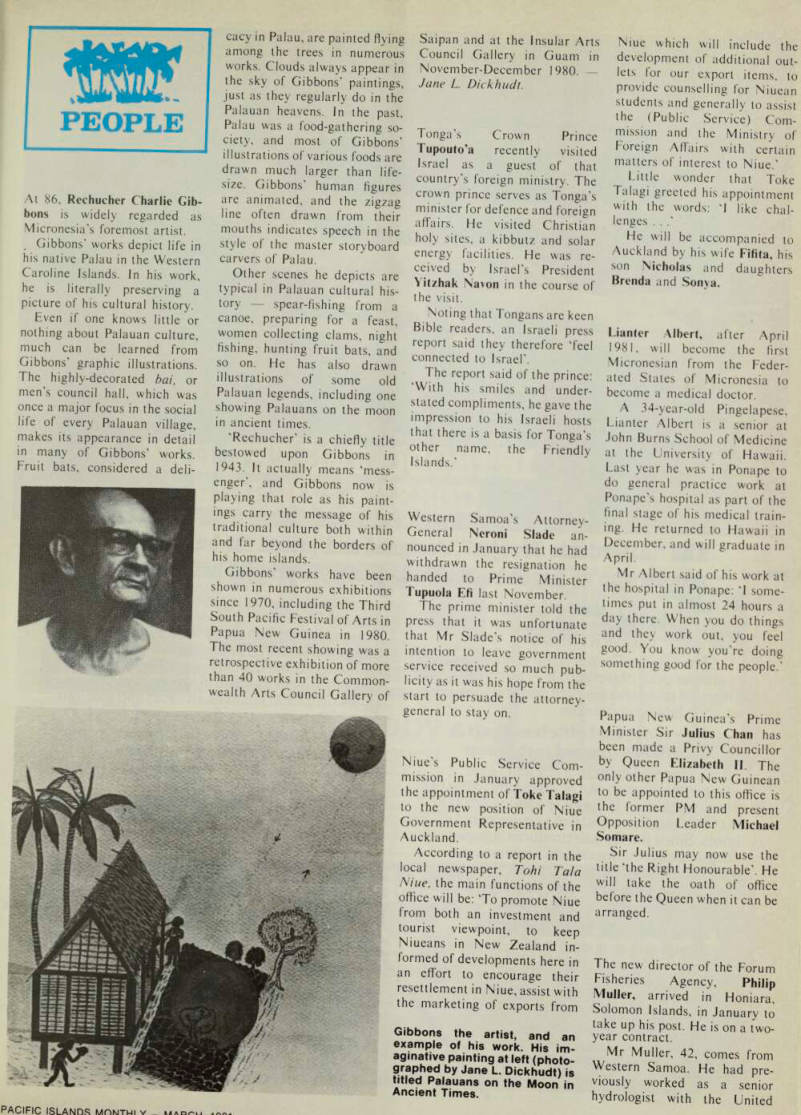



At 86. Rechucher Charlie Gib bons is widely regarded as Micronesia’s foremost artist. . Gibbons’ works depict life in his native Palau in the Western Caroline Islands. In his work, he is literally preserving a picture of his cultural history.
Even if one knows little or nothing about Palauan culture, much can be learned from Gibbons’ graphic illustrations.
The highly-decorated bai, or men’s council hall, which was once a major focus in the social life of every Palauan village, makes its appearance in detail in many of Gibbons’ works.
Fruit bats, considered a deli-
cacy in Palau, are painted flying among the trees in numerous works. Clouds always appear in the sky of Gibbons’ paintings, just as they regularly do in the Palauan heavens. In the past, Palau was a food-gathering so ciety, and most of Gibbons’ illustrations of various foods are drawn much larger than life size. Gibbons’ human figures are animated, and the zigzag line often drawn from their mouths indicates speech in the style of the master storyboard carvers of Palau.
Other scenes he depicts are typical in Palauan cultural his tory spear-fishing from a canoe, preparing for a feast, women collecting clams, night fishing, hunting fruit bats, and so on. He has also drawn illustrations of some old Palauan legends, including one showing Palauans on the moon in ancient times. ’Rechucher’ is a chiefly title bestowed upon Gibbons in 1943. It actually means ‘mess enger , and Gibbons now is playing that role as his paint ings carry the message of his traditional culture both within and far beyond the borders of his home islands.
Gibbons’ works have been shown in numerous exhibitions since 1970, including the Third South Pacific Festival of Arts in Papua New Guinea in 1980.
The most recent showing was a retrospective exhibition of more than 40 works in the Common wealth Arts Council Gallery of
Saipan and at the Insular Arts Council Gallery in Guam in November-December 1980.
Jane L. Dickhudt.
Tonga’s Crown Prince Tupouto’a recently visited Israel as a guest of that country’s foreign ministry. The crown prince serves as Tonga’s minister for defence and foreign affairs. He visited Christian holy sites, a kibbutz and solar energy facilities. He was re ceived by Israel’s President Vitzhak Navon in the course of the visit.
Noting that Tongans are keen Bible readers, an Israeli press report said they therefore Teel connected to Israel’.
The report said of the prince; With his smiles and under stated compliments, he gave the impression to his Israeli hosts that there is a basis for Tonga's other name, the Friendly Islands.’
Western Samoa’s Attorney- General Neroni Slade an nounced in January that he had withdrawn the resignation he handed to Prime Minister Tupuola Efi last November.
The prime minister told the press that it was unfortunate that Mr Slade’s notice of his intention to leave government service received so much pub licity as it was his hope from the start to persuade the attorney general to stay on.
Niue’s Public Service Com mission in January approved the appointment of Toke Talagi to the new position of Niue Government Representative in Auckland.
According to a report in the local newspaper. To hi Tala Niue, the main functions of the office will be: To promote Niue from both an investment and tourist viewpoint, to keep Niueans in New Zealand in formed of developments here in an effort to encourage their resettlement in Niue, assist with the marketing of exports from
Niue which will include the development of additional out lets for our export items, to provide counselling for Niuean students and generally to assist the (Public Service) Com mission and the Ministry of Foreign Affairs with certain matters of interest to Niue.’
Little wonder that Toke Talagi greeted his appointment with the words: ‘I like chal lenges . .
Fie will be accompanied to Auckland by his wife Fifita, his son Nicholas and daughters Brenda and Sonya.
Lianter Albert, after April 1981, will become the first Microncsian from the Feder ated Stales of Micronesia to become a medical doctor.
A 34-year-old Pingelapese, Lianter Albert is a senior at John Burns School of Medicine at the University of Hawaii.
Last year he was in Ponape to do general practice work at Ponape's hospital as part of the final stage of his medical train ing. He returned to Hawaii in December, and will graduate in April.
Mr Albert said of his work at the hospital in Ponape: k l some times put in almost 24 hours a day there. When you do things and they work out, you feel good. You know you’re doing something good for the people.' Papua New Guinea’s Prime Minister Sir Julius Chan has been made a Privy Councillor by Queen Elizabeth II The only other Papua New Guinean to be appointed to this office is the former PM and present Opposition Leader Michael Somare.
Sir Julius may now use the title ‘the Right Honourable’. He will take the oath of office before the Queen when it can be arranged.
The new director of the Forum Fisheries Agency, Philip Muller, arrived in Honiara, Solomon Islands, in January to lake up his post. He is on a two year contract.
Mr Muller, 42, comes from Western Samoa. He had pre viously worked as a senior hydrologist with the United
Gibbons the artist, and an example of his work. His im aginative painting at left (photo graphed by Jane L. Dickhudt) is titled Palauans on the Moon in Ancient Times.
Nations in Western Samoa. He is also a former chairman of Western Samoa’s Public Ser vice Commission.
Mr Muller holds a science degree from Auckland Univer sity.
Bill Sharpe-Dunn left Australia intending to spend two years in Western Samoa to ‘repay a debt’. But that was in 1965, and when he returned to Sydney a few weeks ago the two years had turned to 15 and he left behind him in Samoa a long and valued association as a teacher, broad caster and writer. Mr Sharpe- Dunn was born in Broken Hill in the far west of New South Wales and the ‘debt’ he decided to repay was for his own education which he received from Catholic Church schools in Australia. He went to West ern Samoa as a volunteer teacher for the Catholic Mission, and remained teaching as a volunteer throughout his 15 years there. He taught at Chanel College and Moama Theological Seminary.
He became well known on Radio 2AP where he presented classical music programmes for nine years. He learnt the language, wrote for a news paper in Western Samoa, and has two books on the way. One is a history of the Catholic Church in Samoa which will be completed by research which he is now carrying out in Sydney.
The Very Reverend Father Etuale Lealofi, 39, has taken up the reins of office as fourth rector of the Pacific Regional Seminary, Suva. He succeeds the Very Rev Fr Soane Foliaki, who has returned to Tonga.
Fr Etuale was educated by the Marist Brothers in Samoa, in San Rafael (USA), and at Christchurch and Mosgiel Seminaries, New Zealand. He was ordained to the priesthood in Apia on December 8, 1969.
In numbers, the Suva semin ary is now the largest in the South Pacific, including Aust ralia and New Zealand. It opened its doors in 1970.
The first rector was the Very
Rev Fr Laurence Ross SM, an American-born Samoan citizen.
Bob Rankin, the New Zealander who went to Western Samoa more than 30 years ago as a young school teacher and stayed to become a successful businessman, has diversified his activities; as well as running his established textile printing and garment business, he last year branched out into wine-making.
The first bottles went on sale in May 1980.
Bob wrote to a friend in September: The winery is now in full production and we have a
sweet passionfruit/papaya/
banana wine, a semi-dry orange/banana wine, and creme de cacao and passionfruit liqueurs. I expect to be bottling about 1600 bottles every three weeks, and so far the products are meeting with very good public acceptance. The first two brews are all sold out. It should prove to be quite a profitable undertaking and just ideal for the country as it uses about 70% local input, and we hope to be
able to export about 80% of production . .
The wine sells under the brand name Talofa.
But if he is proud of the success of his new enterprise.
Bob and his Samoan-born wife Sophia are probably prouder still of the achievements of their children.
One of them Leone, last year finished her medical course in New Zealand and is now a doctor. She is believed to be the first Samoan scholarship student who has never had to resit any of her exams.
Another, son Danny, has completed his training course on flying jets and is now First Officer on the Boeing 737 leased by Polynesian Airlines from Air New Zealand. He flies twice a week to New Zealand and back.
Daughters Pele and Tuila last November completed their three-year courses in fashion design at Australia’s East Syd ney Technical College, and it was hoped they would return to Western Samoa to join the business.
Son Johnny recently returned
Tom the United States to do ust that, and Robbie, the youngest son, did his School Certificate at Samoa College ast year. It is his father’s hope hat he will do a course in food echnology. Bob Rankin says: This must be the coming thing or most tropical countries, and specially Samoa. It ties in well vith the winery too . . .’
Nauru’s President Hammer Jeßoburt celebrated an import nt anniversary in December 980 25 years as Head Chief if Nauru. He was elected head hief on December 21, 1955, fter being elected to the Nauru -ocal Government Council for he district of Boe.
The occasion was marked by arge-scale festivities on )ecember 26-27. former secretary to the Cook lands Premier, Tamarii ierre, is now Director of Ad inistration for the South acific Commission. He re aces Don Stewart. Mr Pierre’s rm of office is three years. His )pointment took effect on muary 1, 1981. nother two Papua New uineans have received schol ships from the European :onomic Communities to udy in Europe.
Tom Manjin, of Wewak, a
anpower planning officer with
e Department of the Prime inister is attending a Training r Trainers course at anchester University, United
Kingdom, which began on January 12, for three months.
Arnold Dougl Kamayagl of Kundiawa, Assistant Secretary for Information of the Public Services Commission, is attend ing a course in public relations at the Central Office of Infor mation in London, for three months.
Ever considered turning your house into a museum? Steve Aiken of Saipan has done just that. Now retired from the US Navy and a Trust Territory Government job, Aiken has been bringing stuff home including a Japanese Zero fighter plane since he arrived in Micronesia with the US Navy Bomb and Mine Disposal Team in 1955. Aiken recently put the collection on display for the public by opening his House of Artifacts in San Vicente village, Saipan, Northern
Mariana Islands.
Jane L.
Dickhudt.
Colin Messervy has joined the Australian Trade Commission in Port Moresby, Papua New Guinea, as one of its two Assistant Trade Com missioners. He replaces Geoff Gray who has returned to Aust ralia.
A former Auckland toy retailer and Harbour Board member, Alister Martin, is now chief executive of the Rewa Co-op Dairy Company, Fiji. Mr Mar tin, 54, sees his job as helping the company boost its image, and to produce a marketing
strategy that will ‘enable the company to keep its place in the sun’.
Ruby Vaa is the new principal of Western Samoa’s Samoa College, the premier govern ment high school. She succeeds Mr Esekia Solofa who is now chairman of the Public Service Commission.
Suva lawyer F.M.K. Sherani has been appointed Fiji High Commissioner in Canberra, Australia, in succession to Major J. Takala who becomes Secretary for Fijian Affairs and Rural Development in Fiji.
Dr Te’o lan Fairbairn, senior United Nations adviser to Western Samoa’s Economic Development Department, completed his term in February, and was expected to return to Australia. lan was raised in Samoa, but educated in New Zealand, Australia and the USA. His mother, from Tanugamanoro, is the sister of the recently de ceased Chief Interpreter Atoa Te’o Tuvale. Dr Fairbairn has written extensively on the econ omics of several South Pacific countries. At one time he was economist with the South Pacific Commission.
In the recent Western Samoan University Exam Results (UE) conducted by the New Zealand educational authorities the top mark was gained by Samoan born Deborah Ryan of St Mary’s College, Vaimoso, Western Samoa. She gained 307, followed by Keneti Faulolo (303) and Ben Matalaveu (282) of Samoa and Avele Colleges respectively.
Sister Mary Emanuela Betham, SMSM, made history two years ago when she became the first Samoan head of any Catholic college in the country St Mary’s College, Vaimoso.
Now she makes history again by being selected for the Rome headquarters of her congre
gation, Missionary Sisters of the Society of Mary, as Bursar.
She’ll take up her post in the Eternal City in 1982, and is spending this year at study in New Zealand brushing up her French, Italian and account ancy.
Sister Emanuela, a well known personality in Western Samoa, is the daughter of Gus and Sesilia Betham of Aleipata and Faatoia, Apia.
In Rome, she will succeed as Bursar-General Sister Frances- Miriam, an American who also formerly served in Samoa.
Papua New Guinea Chamber of Commerce and Industry Presi dent and Executive Officer, John Cruikshank, returned re cently from Germany where he attended a three-week training course for chamber officials from developing countries. Or ganised by International Trade Centre, a division of UNCTAD-GATT, and the As sociation of German Chambers of Commerce and Industry, the sessions focused on trade pro motion services that chambers can provide to member firms.
This training event was financed by the Government of the Federal Republic of
Germany.
Officials from national chambers of commerce and
industry in 15 developing
countries were selected from 60 applicants to attend the course.
PNG was the only South Pacific country to be represented.
The New Caledonia Govern ment Tourist Office’s new re gional manager in Australia is Jacques Saint.
Mr Saint, 31, has joint Aust ralian and French citizenship, and has seven years of experi ence in Australia working with a major travel agency, American Express.
This experience, together with his personal knowledge of New Caledonia, places Mr Saint very favourably for his job as a co-ordinator of efforts on both sides of the water to develop New Caledonia’s tour
ist industry.
He operates out of Sydney, and is married, with one son.
Talofa liqueur label
Advertisements & other items, pp. 39-46 (4 items)
Pacific Islands Momtui V __ . Ka A Ddu
PACIFIC ISLANDS momtui v . KA A DDU
Flycessnh
VA ■ mm mmm m* mm Hi) ill in i Htm m v “
Jk>l 'l'M*
The “Affordable Propjet”, designed and priced for business people who’ve never been able to justify a propjet before!
Moving up to propjet efficiency has sometimes been hard to justify. Some turboprops have been “too much” aircraft.
The Cessna Corsair is the aircraft designed to answer your objections. It’s “just right’.’
The right price and the right performance, an affordable combination.
The most fuel efficient Pratt & Whitney powered turboprop Faster and more fuel efficient no competitive aircraft can so efficiently utilize high propjet altitudes. It climbs to altitude (25,000 - 30,000 feet) faster and has a cruise speed of 259 knots. Since the Corsair produces superior propjet performance on less horsepower than other versions of the basic Pratt & Whitney powerplant, you get the speed and fuel economy a turboprop should deliver.
Corsair’s aerodynamically efficient airframe features Cessna’s famous wide-oval cabin.
Generous first-class seats, wide aisle, room for optional hot and cold refreshment centres, hardwood cabin dividers, stowable writing desks and toilet. With all those amenities, the Corsair stores up to 500 kgs in its aft cabin and spacious nose compartment.
The Corsair. . . more performance . . . more fuel efficiency . . . more cabin .. . more baggage. . . quieter... at an affordable price.
FLYCESSNH
The Worlds Number 1 Business Airline Rex Aviation P.O. Boxsl, Bankstown, N.S. W. 2200 Telephone: 02HO-0661 The quietest twin flying Based on our flyover noise level of 71.4 Name decibels, the Corsair is the quietest twin-engine Speeasesend aircraft flying. The low propeller rpm and wide, #• ME more Position prop-to-fuselage clearance, make the Corsair V information cabin whisper-quiet*. It is not only quiet, / CE°SN but roomy and comfortable too. Address Pacific Area Representatives: • R Aviation Fiji (Suva) Burns Philp South Sea Company, •* PI code Mr. A. Jessop V p O. Box 51, * Ref : ' Business and Commercial Aviation ' Bankstown, N. S. W. 2200 Te , ephone 34/425/PIM/R Vol. 46. No. 4 (April 1980) •
T Paterson
x X Cand Y
Portacel
Permutit-Boby
Houseman Service
Clarifying, Screening, Straining, Scraping, Separating, Filtering, Ultra filtration, Reverse Osmosis, Neutralising, Chemical treatment, Chlorine generation, Internal Treatment for boiler, cooling systems etc, Swimming pools, Demineralisation, Deionisation, Condensate polishing, Chlorinating, Recovery, Reuse, Sewage and effluent, etc.
It all adds up to
Portals Water Treatment
- one of the World's largest groups in the field.
Portals,in New Zealand alone, has a specialist staff of 75 including 8 Professional Engineers and has served New Zealand for over 50 years.
Portals Water Treatment (NZ) Ltd P.O. Box 13-558, Auckland 6, New Zealand.
Uandy House, 11 Spring Street, Onehunga. Auckland. Telephone: 661-079 (7 lines) • Telegrams: Portals Auckland. Telex: NZ 21175 1595
. ill Ijpfr' 1 he Toyota truck range, uilt to be unbeatable, ad weather conditions, tto ad drr cult loads, no coni e it.
Toyota truck bi :esl mat % ir r unbeatable after service: »UA NEW GUINEA: ELA MOTORS, Scratchley Rd., Badili, P.O. Box 675, Port Moresby. U.S. TRUST TERRITORY: MICROL CORPORATION. P.O. Box 267, pan. FIJI ISLANDS: AUTOMOTIVE SUPPLIES COMPANY, P.O. Box 5177, Raiwaqa, Suva. AMERICAN SAMOA: BURNS PHILP (SOUTHSEA) CO., LTD., i. Box 129, Pago Pago. WESTERN SAMOA: BURNS PHILP (SOUTHSEA) CO.. LTD., P.O. Box 188, Apia. TONGA: BURNS PHILP (SOUTHSEA) CO., LTD., . .. cc AIIAII. ATI/IMC l/om I ITH DO o<->v ROAR Tamnninn VANUATU- MFW HFRRIDFS MOTORS. P.O. Box 18. Vila.
■ nst % A %
TOYOTA LAND CRUISER
TOYOTA HI ACE
TOYOTA DYNA
rnMnrn S^t N ?>fo ENDANA ENTERPRISES (S.l.) LTD., P.O. Box 174, Honiara. TAHITI: NIPPON TOMOTO, B.P. 342, Papeete. COOK ISLANDS: COOK ISLANDS TRADING CORPORATION LTD ). Box 92. Rarotonga. NAURU ISLANDS: NAURU COOPERATIVE SOCIETY.
M0T0RS - Box 36, Bairiki, Kiribati. NORFOLK ISLAND: MOUNT PITT ’’ P °' B ° X 169 ' NEW CALED0N,A: SOCIETE IMPORTATION AUTOMOBILE DU CIFIQUE, Rond-Pomt du Pacific. LRtatinn Tntflh RD A'iQ ki^iim.—
TOYOTA TRUCK
TOYOTA
— <& a % -: r 3* s Hi
DO BUSINESS W
When the time next comes for you to fly out to do business — fly Polynesian Airlines. Polynesian really understands the businessman’s requirements for a quick and efficient service between all Polynesian countries.
In fact, part of the reason we established our first service (Apia — Pago Pago) back in 1959 was to meet the business sector’s demand for a fast and frequent service between the Samoas.
Since then Polynesian Airlines has spread its wings. Today our extensive route network covers the whole of Polynesia east of Fiji and now extends down to Auckland, New Zealand. And, as in ‘59 a lot of the people we’re carrying today are professional people. People who know that when it comes to flying anywhere in Polynesia on business there is only one airline. Polynesian Airlines, Fly Polynesian. It’s a pleasure doing business with us.
Offices in: Auckland, Tonga, Niue, Rarotonga.
Box 599 Apia, Western Samoa, Ph 21261.
WESTERN
WALLIS IS AMERICAN
SAMOA
—... -w
Gj POLYNESIAN/AIRLINES
Nandi Airport Nandi Ph 72733.
fONGA
We are Polynesia. 2067
Gnema Vision The famous picture has made our sets bestsellers in quality-conscious Japan. And a byword for soft, natural colour in Europe and the US, Having written the book on colour TV, we knew we'd have to think big to open a new chapter in home entertainment for the Eighties.
And, as you can see, that's exactly what we've done. The new TC-4500 one-piece projection TV has a picture over five times bigger than an ordinary 20" colour set. Yet it's no deeper than many regular console TVs.
The three in-line 7" high-brightness projection tubes we use virtually do away with the colour aberration inherent in delta-type projection TV systems.
We also give you a mighty 10 watts per channel 2-way speaker system. And throw in a 26-function infrared remote control so simple, a kid can handle it.
You have to see and hear your favourites "cinemasize" to appreciate the difference between the 4500 and ordinary TV. It's truly a large-as-life experience.
Hook up a video cassette recorder and you've turned the 4500 into something really special. A private cinema that never closes.
CiramflVision
i National Panasonic
National and Panasonic are the brandnames of Matsushita Electric.
People
PACIFIC ISLANDS MOMTHi v uadpu
Islands Monthi Y _ Marhm Iqri
ISLANDS MONTHI Y MARHM IQRI
PEOPLE
(unmatching) volumes
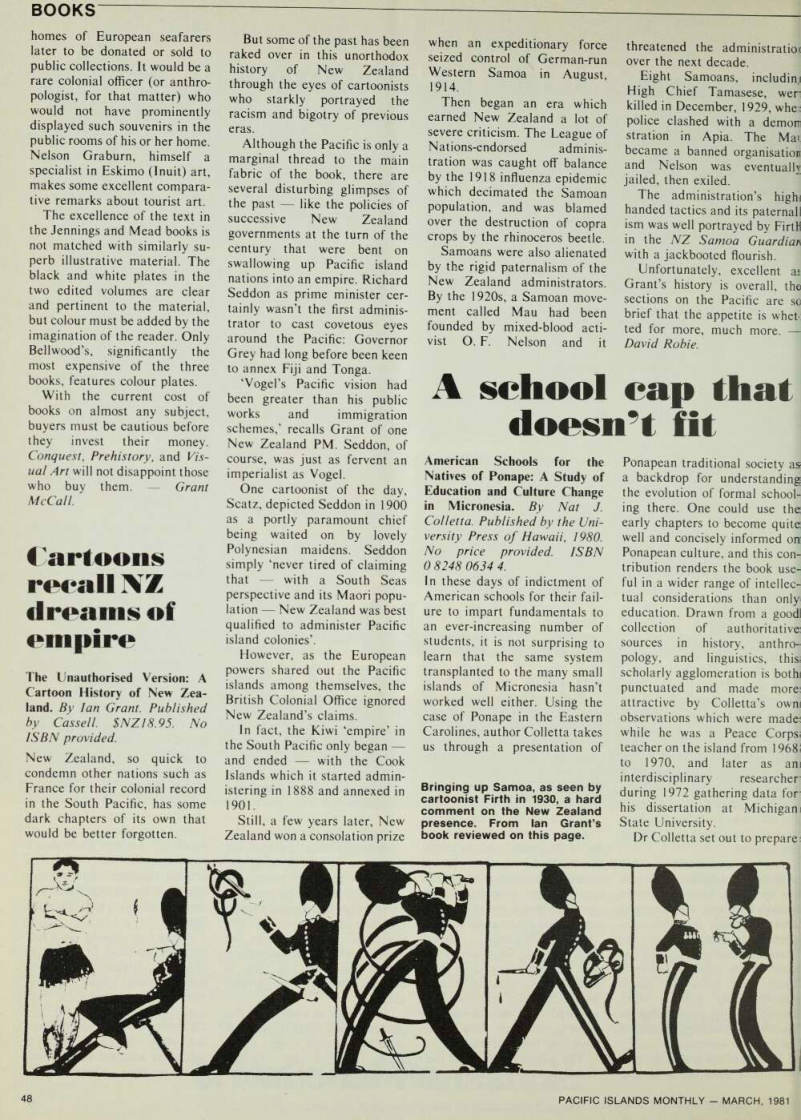
Books
Encyclopaedia in three (unmatching) volumes
Man’s Conquest of the Pacific.
Hie Prehistory of Southeast \sia and Oceania. By Peter Sell wood. Published by William Collins. 5A39.95
Sbn 0 00 216911 8.
Hie Prehistory of Polynesia.
Edited by Jesse D. Jennings.
Published by Harvard Univer ity Press. 5U535.00. ISBN 0 *74 70060 0. exploring the Visual Art of )ceania. Australia, Melanesia, /ficronesia, and Polynesia.
Edited by Sidney M. Mead, ssisted by Isabelle Brymer nd Susan Martich. Published y the University Press of fawaii. SUS 25.00. ISBN 0 248 0598 4. here can be an economy about xpensive, big books and for bout $lOO the Pacific enthusi >t can purchase three volumes lat together constitute a refer ice encyclopaedia of things :eanic.
Man’s Conquest of the acific, Exploring the Visual rt of Oceania and The rehistory of Polynesia are imprehensive landmarks in holarly research, containing gether about 1300 pages, nu erous illustrations, and not a nail amount of scholarly wit.
To take the best first, Peter illwood’s Conquest must rely rank as one of the major >oks on the region to appear in cent times. The author irtrays Pacific archaeology
nd physical anthropology and
iguistics, and cultural history, d . .) as a lively progress over e millennia from South China igins* (for some) to far-flung stinations.
His arguments are fficiently detailed to please 5 specialist, and well-written ough to inform the interested lateur. Aside from his com ;hensive command of the mature, Bellwood himself has ne much original research, am the numerous photo tphs, most without attri tion, we can assume that he s travelled widely in search of graphic material.
In spite of the price, one must nember what one is getting:
the full story, so far as modern scientists know it, of the peopl ing of the Pacific, fully refer enced and illustrated. It is a summary statement drawn from the over 1500 books and articles cited in his bibli ography. His solid scholarship, however, does not interfere with readability.
The long and detailed index serves as a kind of dictionary and makes it easy to look up particular islands or peoples.
Yet for all the expertise of the particular coverage, it is the overall integrated picture that gives Bellwood’s work its useful ness.
In most cases, when someone uses “Pacific” in a title, it means some section of it, such as Polynesia, Melanesia or, even, a single island group. In Bellwood’s case, though. Pacific means the entire ocean, save the American continents and polar caps. Because the book is con cerned with origins and deri vations, the prehistory must stretch back to South-east Asia, as the subtitle of the book indicates.
Collins, as is well known, publishes the Bible; Bellwood’s book is the prehistorical equivalent for the Pacific fan.
A common way to achieve comprehensiveness in a volume is to invite a number of experts to contribute individual articles on their specialist areas and that is the course taken in Jennings’ Prehistory and Mead’s Visual Art.
The Jennings book derives from the editor’s abiding inter est in Polynesia and, to comp lement his own concerns, he has invited 16 colleagues to contrib ute original chapters to his survey. There is everything that anyone has ever wanted to know about Polynesia before Europeans, at least, everything in a descriptive sense, for these well-written essays (for the most part) critically analyse their material only insofar as they have given their data coher ence, but not explanation.
The authors have seen their task as a summary one. But this
caveat should not be taken as a cavil, for the material that the authors present in prose and photograph is satisfying, even pleasing, both for the specialist and the non-specialist.
In Jennings Patrick McCoy gives us a succinct view of Easter Island’s prehistoric de velopment, whilst from Ben Finney there is a colourful and evocative account of Polynesian navigation that made the settle ment of that remote island possible. Peter Bellwood (again) is there to provide an extract from his larger volume on the context of Polynesia in the human population of the Great Ocean, and offers also a general piece on settlement patterns.
The familiar William Howells condenses much of his longer book-length study into a chapter on physical character istics, just before Patrick Kirch looks at how those Polynesian people made their living on the islands they discovered.
In addition to the McCoy piece on Easter Island, there are individual sections on New Zea land, Samoa and Tonga (both by Janet Davidson), the Societies (Kenneth Emory), the Marquesas (Yosihiki Sinoto), and Fiji (Everett Frost). For balance, Sydney University’s Peter White makes some inter esting comparisons in a contri bution on Melanesia.
Althogether, Jennings’
Prehistory makes for a worthy compilation, one that the specialist and the generalist both will find rewardingly in formative. The conclusions, the speculations about unexplained mysteries, further thinking, are left to the reader to pursue.
Mead’s Visual Art looks at an area that is both ancient and contemporary, for the arts and crafts of Pacificans can be found both in archaeological trench and, with any luck, in modern markets or airport stalls.
As though to emphasise this contemporary quality, the vol ume begins with a very up-to date foreword by Michael Somare, in which the former
chief minister of Papua New Guinea serves up some very pungent comments.
Visual Art derives from a conference held in Canada in 1974, though there is little evidence that any cross fertilisation occurred amongst the 25 participants, now con tributors. To offset this, how ever, Mead’s introduction to the articles provides the reader with a summary and overview of the contributions and the confer ence from which they derive.
The book ends with what seems to be obligatory, pro forma, these days for meetings; a set of recommendations and resolutions, this time dealing with cultural integrity and pres ervation.
Visual Art is a much more ambitious effort than Jennings’
Prehistory, not only in its geo graphical coverage the whole of Oceania but also in its attempt to encompass a time scale from ancient rock art to the most contemporary debates on the restitution of artefacts to the museums now being estab lished throughout the Pacific area.
For too much of the history of the Pacific, indigenous master pieces have been up for export for a few beads or dollars, the unscrupulous being both local broker and foreign collector.
The Australian National Uni versity’s Anthony Forge de livers an excellent discussion of Sepik art, perhaps Melanesia’s most famous, while specialist articles consider such diverse topics as fly whisks, Aika aes thetics, masks, and ancestor figures.
Airport or tourist art, too, receives attention. In one sense, of course. Islanders have been making such tourist art for more than two centuries, trad ing, then selling it to the crewmen and collectors on pass ing ships. Many a priceless piece has adorned the mantel piece or glass cabinet in the
homes of European seafarers later to be donated or sold to public collections. It would be a rare colonial officer (or anthro pologist, for that matter) who would not have prominently displayed such souvenirs in the public rooms of his or her home.
Nelson Graburn, himself a specialist in Eskimo (Inuit) art, makes some excellent compara tive remarks about tourist art.
The excellence of the text in the Jennings and Mead books is not matched with similarly su perb illustrative material. The black and white plates in the two edited volumes are clear and pertinent to the material, but colour must be added by the imagination of the reader. Only Bellwood’s, significantly the most expensive of the three books, features colour plates.
With the current cost of books on almost any subject, buyers must be cautious before they invest their money.
Conquest. Prehistory, and Vis ual Art will not disappoint those
who buy them.
Grant
McCall.
Advertisements & other items, p. 47 (1 item)
47
3IFIC ISLANDS MONTHLY MARCH, 1981
empire
Cartoons recall NZ dreams of empire
The Unauthorised Version: A Cartoon History of New Zea land. By lan Grant. Published by Cassell. SNZ 18.95. No ISBN provided.
New Zealand, so quick to condemn other nations such as France for their colonial record in the South Pacific, has some dark chapters of its own that would be better forgotten.
But some of the past has been raked over in this unorthodox history of New Zealand through the eyes of cartoonists who starkly portrayed the racism and bigotry of previous eras.
Although the Pacific is only a marginal thread to the main fabric of the book, there are several disturbing glimpses of the past like the policies of successive New Zealand governments at the turn of the century that were bent on swallowing up Pacific island nations into an empire. Richard Seddon as prime minister cer tainly wasn’t the first adminis trator to cast covetous eyes around the Pacific: Governor Grey had long before been keen to annex Fiji and Tonga. ‘Vogel’s Pacific vision had been greater than his public works and immigration schemes,’ recalls Grant of one New Zealand PM. Seddon, of course, was just as fervent an imperialist as Vogel.
One cartoonist of the day, Scatz, depicted Seddon in 1900 as a portly paramount chief being waited on by lovely Polynesian maidens. Seddon simply ‘never tired of claiming that with a South Seas perspective and its Maori popu lation New Zealand was best qualified to administer Pacific island colonies’.
However, as the European powers shared out the Pacific islands among themselves, the British Colonial Office ignored New Zealand’s claims.
In fact, the Kiwi ‘empire’ in the South Pacific only began and ended with the Cook Islands which it started admin istering in 1888 and annexed in 1901.
Still, a few years later, New Zealand won a consolation prize
when an expeditionary force seized control of German-run Western Samoa in August, 1914.
Then began an era which earned New Zealand a lot of severe criticism. The League of Nations-endorsed adminis tration was caught off balance by the 1918 influenza epidemic which decimated the Samoan population, and was blamed over the destruction of copra crops by the rhinoceros beetle.
Samoans were also alienated by the rigid paternalism of the New Zealand administrators.
By the 19205, a Samoan move ment called Mau had been founded by mixed-blood acti vist O. F. Nelson and it
threatened the administration over the next decade.
Eight Samoans, including High Chief Tamasese, wen killed in December, 1929, whei; police clashed with a demom stration in Apia. The Mau became a banned organisation and Nelson was eventually jailed, then exiled.
The administration’s high) handed tactics and its paternal! ism was well portrayed by Firth in the NZ Samoa Guardian with a jackbooted flourish.
Unfortunately, excellent as Grant’s history is overall, the sections on the Pacific are so brief that the appetite is whet-; ted for more, much more. —|
David Robie.
doesn’t fit
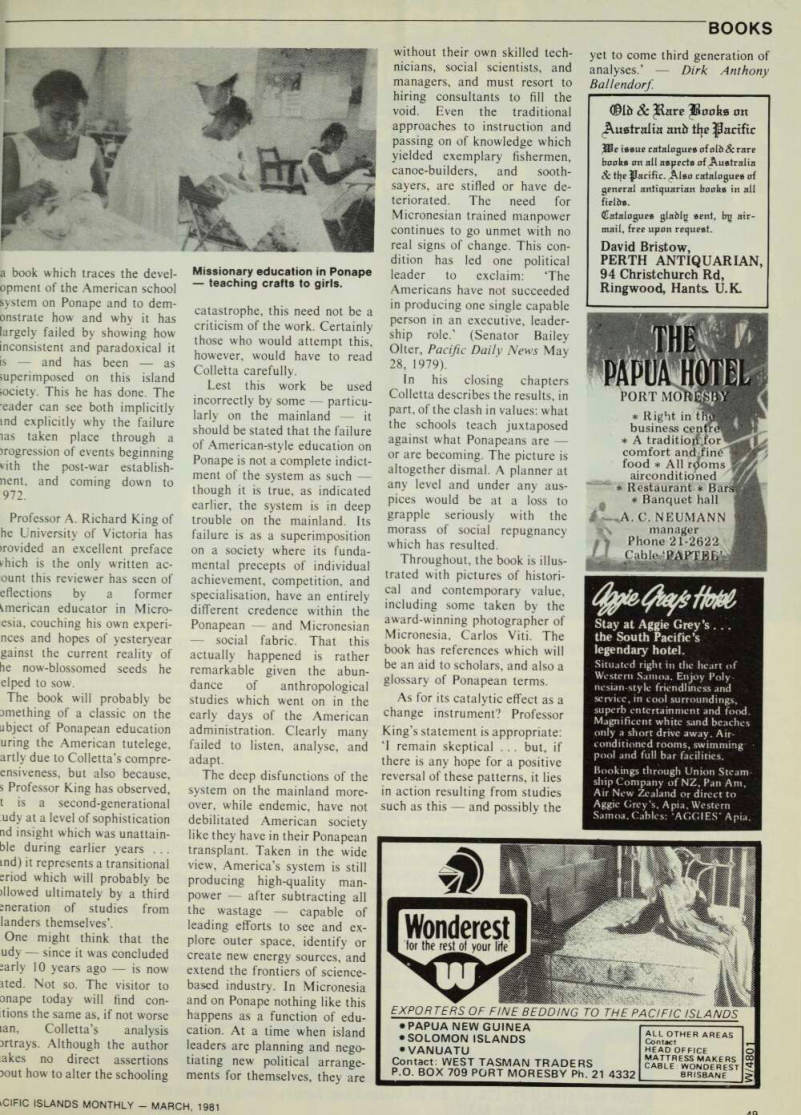
A school cap that doesn’t fit
American Schools for the Natives of Ponape: A Study of Education and Culture Change in Micronesia. By Nat J.
Colletta. Published by the Uni versity Press of Hawaii. 1980.
No price provided. ISBN 0 8248 0634 4.
In these days of indictment of American schools for their fail ure to impart fundamentals to an ever-increasing number of students, it is not surprising to learn that the same system transplanted to the many small islands of Micronesia hasn’t worked well either. Using the case of Ponape in the Eastern Carolines, author Colletta takes us through a presentation of
Ponapean traditional society as
a backdrop for understanding
the evolution of formal school ing there. One could use the early chapters to become quite well and concisely informed onr Ponapean culture, and this con tribution renders the book use ful in a wider range of intellec tual considerations than only\ education. Drawn from a good! collection of authoritative: sources in history, anthro pology, and linguistics, this* scholarly agglomeration is bothi punctuated and made more; attractive by Colletta’s owm observations which were made; while he was a Peace Corps* teacher on the island from 1968* to 1970, and later as am
interdisciplinary researcher
during 1972 gathering data for his dissertation at Michigan) State University.
Dr Colletta set out to prepare;
Bringing up Samoa, as seen by cartoonist Firth in 1930, a hard comment on the New Zealand presence. From lan Grant’s book reviewed on this page.
a book which traces the devel opment of the American school system on Ponape and to dem onstrate how and why it has largely failed by showing how inconsistent and paradoxical it is and has been as juperimposed on this island jociety. This he has done. The •eader can see both implicitly md explicitly why the failure las taken place through a regression of events beginning vith the post-war establish nent, and coming down to 972.
Professor A. Richard King of he University of Victoria has rovided an excellent preface vhich is the only written ac ount this reviewer has seen of eflections by a former American educator in Micro esia, couching his own experi nces and hopes of yesteryear gainst the current reality of lie now-blossomed seeds he elped to sow.
The book will probably be Dmething of a classic on the übject of Ponapean education uring the American tutelege, artly due to Colletta’s compre ensiveness, but also because, s Professor King has observed, t is a second-generational udy at a level of sophistication nd insight which was unattain
ble during earlier years . ..
md) it represents a transitional eriod which will probably be )llowed ultimately by a third deration of studies from landers themselves’.
One might think that the udy since it was concluded -arly 10 years ago is now ited. Not so. The visitor to onape today will find con ations the same as, if not worse tan, Colletta’s analysis Drtrays. Although the author akes no direct assertions )out how to alter the schooling
catastrophe, this need not be a criticism of the work. Certainly those who would attempt this, however, would have to read Collelta carefully.
Lest this work be used incorrectly by some particu larly on the mainland it should be stated that the failure of American-style education on Ponape is not a complete indict ment of the system as such though it is true, as indicated earlier, the system is in deep trouble on the mainland. Its failure is as a superimposition on a society where its funda mental precepts of individual achievement, competition, and specialisation, have an entirely different credence within the Ponapean and Micronesian social fabric. That this actually happened is rather remarkable given the abun dance of anthropological studies which went on in the early days of the American administration. Clearly many failed to listen, analyse, and adapt.
The deep disfunctions of the system on the mainland more over, while endemic, have not debilitated American society like they have in their Ponapean transplant. Taken in the wide view, America’s system is still producing high-quality man power after subtracting all the wastage capable of leading efforts to see and ex plore outer space, identify or create new energy sources, and extend the frontiers of science based industry. In Micronesia and on Ponape nothing like this happens as a function of edu cation. At a time when island leaders are planning and nego tiating new political arrange ments for themselves, they are
without their own skilled tech nicians, social scientists, and managers, and must resort to hiring consultants to fill the void. Even the traditional approaches to instruction and passing on of knowledge which yielded exemplary fishermen, canoe-builders, and sooth sayers, are stifled or have de teriorated. The need for Micronesian trained manpower continues to go unmet with no real signs of change. This con dition has led one political leader to exclaim: ‘The Americans have not succeeded in producing one single capable person in an executive, leader ship role.’ (Senator Bailey Olter, Pacific Daily News May 28, 1979).
In his closing chapters Colletta describes the results, in part, of the clash in values: what the schools teach juxtaposed against what Ponapeans are or are becoming. The picture is altogether dismal. A planner at any level and under any aus pices would be at a loss to grapple seriously with the morass of social repugnancy which has resulted.
Throughout, the book is illus trated with pictures of histori cal and contemporary value, including some taken by the award-winning photographer of Micronesia, Carlos Viti. The book has references which will be an aid to scholars, and also a glossary of Ponapean terms.
As for its catalytic effect as a change instrument? Professor King’s statement is appropriate: T remain skeptical ... but, if there is any hope for a positive reversal of these patterns, it lies in action resulting from studies such as this and possibly the
yet to come third generation of
analyses.’
Dirk Anthony
Ballendorf
Missionary education in Ponape - teaching crafts to girls.
Advertisements & other items, pp. 49-50 (2 items)
Books
kCIFIC ISLANDS MONTHLY - MARCH, 1981
iliwiN
Sc Jlare Jlooks on
Australia anh tljc
3ffle iaaue cataloguca ofolb&rare books on all aapecta of Auatralia Sc tljc pacific. Alao cataloguea of general antiquarian books in all fielbe.
Cataloguca glaMg aent, Iqj airmail, free upon requeat.
David Bristow,
PERTH ANTIQUARIAN,
94 Christchurch Rd, Ringwood, Hants. U.K.
iliwiN
PORT MOh
* Right in t business ce * A tradition,
comfort ancLfin£*
food ♦ All rooms airconditioned * Restaurant ♦ Bai * Banquet hall
.A. C. NEUMANN
manager Phone 21-2622 9 Stay at Aggie Grey’s . , . the South Pacific’s legendary hotel.
Situated right in the heart of Western Samoa. Enjoy Polynesian-style friendliness and service, in cool surroundings, superb entertainment and food.
Magnificent white sand beaches only a short drive away. Airconditioned rooms, swimming pool and full bar facilities.
Bookings through Union Steamship Company of NZ, Pan Am, Air New Zealand or direct to Aggie Grey’s, Apia, Western Samoa. Cables: ‘AGGIES' Apia.
Wondercst
the rest Irfe your EXPORTERS OF FINE BEDDING TO THE PACIFIC ISLANDS
♦ PAPUA NEW GUINEA
♦SOLOMON ISLANDS
♦VANUATU
Contact: WEST TASMAN TRADERS
P-O- BOX 709 PORT MORESBY Ph. 21 4332
ALL OTHER AREAS
Contact
HEAD OFFICE
MATTRESS MAKERS
CABLE WONOEREST
BRISBANE
1. The DeZURIK® V-Port Ball Valve A rugged and unique control valve that combines high capacity and low cost. Offers precision control for a variety of applications to 740 psi with temperature ratings to 1000°F. Sizes W -20”.
2. The DeZURIK PERMASEAL®
Plug Valve This simple, tough valve features a self-adjusting plug that compensates for wear and temperature changes, plus “true top entry” for in-line maintenance.
Bi-directional shutoff to 1480 psi.
ANSI 150, 300 and 600 in sizes V2”-6”. 3. The DeZURIK C Series Knife Gate A proven performer in the toughest abrasive and corrosive services. Available with lever, handwheel, electric motor, on-off or positioning cylinder actuators.
Sizes 2”-72”.
4. The DeZURIK FIG 660 RS
Butterfly Valve A unique seat design ensures bidirectional shutoff to 150 psi and a streamlined disc delivers high flow capacity. Choice of seat materials, actuators and wafer or lug in sizes 2”-12”.
5. The DeZURIK FIG 632 RS
Butterfly Valve The resilient seated butterfly valve that offers unequalled performance and an exclusive double-seat in sizes 2”-20”. Wide choice of actuators. Choice of wafer or lug body in all sizes: 2”-36”. 6. The DeZURIK HP Butterfly Valve A high performance valve that features an exclusive TFE/titanium seat design to assure a lasting, bubble-tight shutoff. Excellent corrosion resistance and temperature accommodation in sizes 2”-20”. ANSI 150 and 300 to 740 psi. 7. The DeZURIK Eccentric Valve 28 sizes and a host of options assure the exact combination for any application. Eccentric action delivers a lasting dead-tight shutoff in sizes from 1 /2”-72”. 8. The DeZURIK 3-Way & 4-Way Valves Rugged performance for virtually any shutoff or switching application. Lever, handwheel, onoff or positioning cylinder available in sizes 3”-16”. 9. The DeZURIK Rotating Sensor Consistency Transmitter Electronic or pneumatic control assures unmatched sensing accuracy. Unique involute ribs are influenced only by stock consistency.
A UNIT OF GENERAL SIGNAL
DeZURIK
DeZURIK OF AUSTRALIA PTY. LTD., P.O, Box 204. Vineyard Road. Sunbury. Victoria 3429. Australia Telephone: 03-744-2244. Telex: AA33732
Polynesia’s body language:
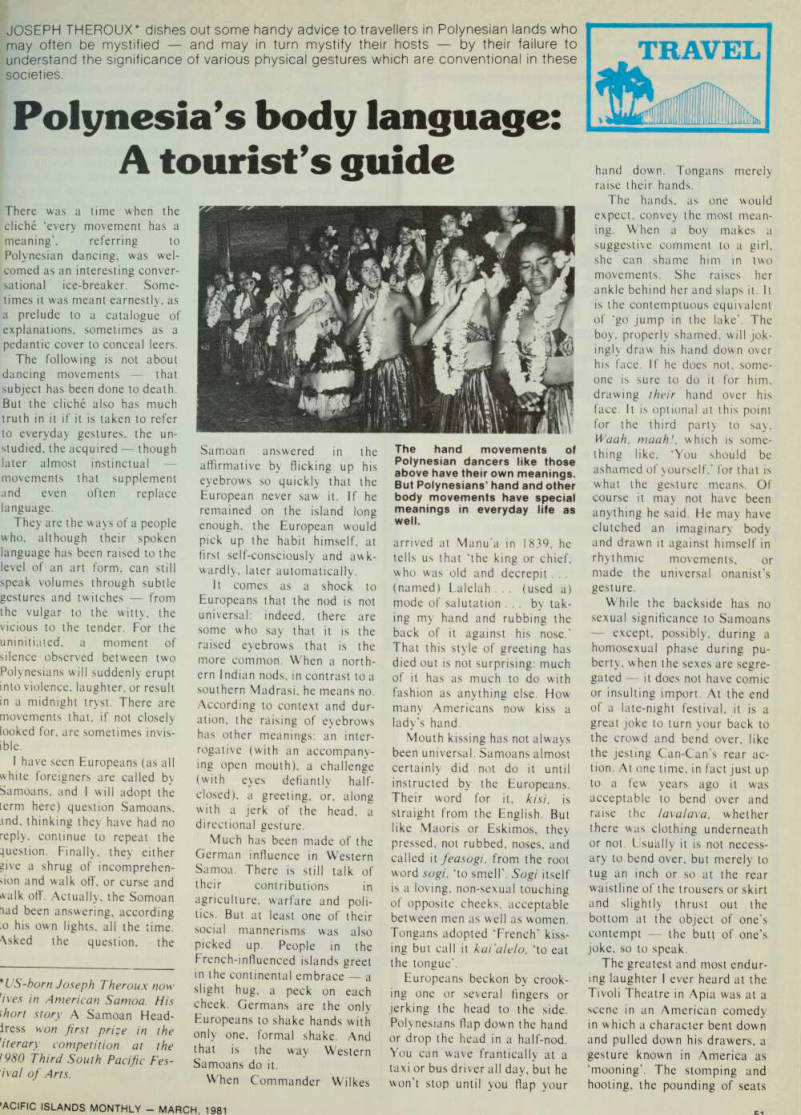
Travel
Polynesia’s body language: A tourist’s guide
JOSEPH THEROUX* dishes out some handy advice to travellers in Polynesian lands who may often be mystified and may in turn mystify their hosts by their failure to understand the significance of various physical gestures which are conventional in these societies.
There was a lime when the cliche ‘every movement has a meaning', referring to Polynesian dancing, was wel comed as an interesting conver sational ice-breaker. Some times it was meant earnestly, as a prelude to a catalogue of explanations, sometimes as a pedantic cover to conceal leers.
The following is not about dancing movements that subject has been done to death.
But the cliche also has much truth in it if it is taken to refer to everyday gestures, the un studied, the acquired though later almost instinctual movements that supplement and even often replace language.
They arc the ways of a people who, although their spoken language has been raised to the level of an art form, can still speak volumes through subtle gestures and twitches from the vulgar to the witty, the vicious to the tender. For the uninitiated, a moment of silence observed between two Polynesians will suddenly erupt into violence, laughter, or result in a midnight tryst. There are movements that, if not closely looked for, are sometimes invis ible.
I have seen Europeans (as all white foreigners are called by Samoans, and I will adopt the lerm here) question Samoans, and. thinking they have had no reply, continue to repeat the question. Finally, they either Twc a shrug of incomprehen sion and walk off, or curse and walk off. Actually, the Somoan lad been answering, according o his own lights, all the time. \sked the question, the
Samoan answered in the affirmative by flicking up his eyebrows so quickly that the European never saw it. If he remained on the island long enough, the European would pick up the habit himself, at first self-consciously and awk wardly. later automatically.
It comes as a shock to Europeans that the nod is not universal: indeed, there are some who say that it is the raised eyebrows that is the more common. When a north ern Indian nods, in contrast to a southern Madrasi, he means no.
According to context and dur ation, the raising of eyebrows has other meanings: an inter rogative (with an accompany ing open mouth), a challenge (with eyes defiantly half closed), a greeting, or, along with a jerk of the head, a directional gesture.
Much has been made of the German influence in Western Samoa. There is still talk of their contributions in agriculture, warfare and poli tics. But at least one of their social mannerisms was also picked up. People in the French-influenced islands greet in the continental embrace a slight hug, a peck on each check. Germans are the only Europeans to shake hands with only one, formal shake. And that is the way Western Samoans do it.
When Commander Wilkes
arrived at Manu'a in 1839. he tells us that ‘the king or chief, who was old and decrepit . . . (named) Lalelah .. . (used a) mode of salutation ... by tak ing my hand and rubbing the back of it against his nose.' That this style of greeting has died out is not surprising: much of it has as much to do with fashion as anything else. How many Americans now kiss a lady's hand.
Mouth kissing has not always been universal. Samoans almost certainly did not do it until instructed by the Europeans.
Their word for it, kisi, is straight from the English. But like Maoris or Eskimos, they pressed, not rubbed, noses, and called it feasogi, from the root word sogi, To smell'. Sogi itself is a loving, non-sexual touching of opposite cheeks, acceptable between men as well as women.
Tongans adopted ‘French’ kiss ing but call it kai'alelo, ‘to eat the tongue'.
Europeans beckon by crook ing one or several fingers or jerking the head to the side.
Polynesians flap down the hand or drop the head in a half-nod.
You can wave frantically at a taxi or bus driver all day, but he won’t stop until you flap your
hand down. Tongans merely raise their hands.
The hands, as one would expect, convey the most mean ing. When a boy makes a suggestive comment to a girl, she can shame him in two movements. She raises her ankle behind her and slaps it. It is the contemptuous equivalent of ‘go jump in the lake'. The boy. properly shamed, will jok ingly draw his hand down over his face. If he does not. some one is sure to do it for him. drawing their hand over his face. It is optional at this point for the third parly to say, Waah. maah!, which is some thing like. ‘You should be ashamed of yourself.' for that is what the gesture means. Of course it may not have been anything he said. He may have clutched an imaginary body and drawn it against himself in rhythmic movements, or made the universal onanist's gesture.
While the backside has no sexual significance to Samoans except, possibly, during a homosexual phase during pu berty. when the sexes are segre gated it does not have comic or insulting import. At the end of a late-night festival, it is a great joke to turn your back to the crowd and bend over, like the jesting Can-Can's rear ac tion. At one lime, in fact just up to a few years ago it was acceptable to bend over and raise the lavalava, whether there was clothing underneath or not. Usually it is not necess ary to bend over, but merely to tug an inch or so at the rear waistline of the trousers or skirt and slightly thrust out the bottom at the object of one’s contempt the butt of one’s joke, so to speak.
The greatest and most endur ing laughter I ever heard at the Tivoli Theatre in Apia was at a scene in an American comedy in which a character bent down and pulled down his drawers, a gesture known in America as ‘mooning’. The stomping and hooting, the pounding of seats
* US-born Joseph Theroux now 'ives in American Samoa. His ihort story A Samoan Head dress won first prize in the 'iter ary competition at the 1980 Third South Pacific Fes ival of Arts.
The hand movements of Polynesian dancers like those above have their own meanings.
But Polynesians' hand and other body movements have special meanings in everyday life as well.
and walls, shook the old barn and made me fear for its life.
The mournful, almost religious reverence with which Romeo and Juliet was watched, the students in the crowd saying the lines along with the actors, reminiscent of a liturgy, was broken only when Romeo put aside his doublet and tights.
Chaos.
It is also a traditional insult, if done in anger, and, by extension, a challenge. After the Hawaiian chiefs had mur dered Cook, this gesture was called into play by a warrior.
Gavan Daws writes in his his tory of Hawaii, Shoal of Time: ‘As King was being rowed back to his ship a native standing on a rock “had the Insolence to turn up his backside and make other signs of Contempt,” and King had to be restrained from shooting him.' One wonders what those ‘other signs of Con tempt' were. The sailors had learned how to interpret the gesture, if it wasn’t plain enough, for earlier they had witnessed Hawaiian boxing matches. The victor would ‘turn his backside' on his opponent and arrogantly walk away.
In any culture, the language of the eyes has an infinite vocabulary, the subtleties defy ing description. In Polynesia, with the help of a go-between to start things off, a courtship can be carried on from across the room, amidst crowds, and the first anyone has heard of it is when the couple have taken off to the bush to live together.
To arouse someone’s am orous attention, the Maoris covertly scratch the desired's elbow. Samoan and Tongan youths tickle the palm with the middle finger during a hand clasp, but this is probably an imported gesture. When all else fails, or where proximity is ditficull, the reliable wink knows no cultural limits.
As words are subject to misinterpretation, so are ac tions. The vulgar European gesture of thrusting up the forearm and clasping the upper arm is only a sign of strength to a Maori. Sticking out the longue is a Maori’s symbolic gesture of defiance, wrongly interpreted by non-Maoris as an action to instil fear. It no more accomplishes this than when a
child does it in an infantile; insult. When it is necessary to< walk in front of someone, it is, improper to pass by standing erect. You bend down, some times squat if the person you are passing is sitting, and dart across, scurrying, bowing, not out of deference a Samoan assures you it is not bowing as such but to avoid being seen and heard, much as a European avoids blocking a movie projector light as he crosses the room.
A European enters an office and does not sit until he is asked, only the boss having the right to sit in his office until the visitor is bidden to take a chair.
I have witnessed a bewildered Samoan ejected from an office, the boss in the doorway mutter ing, ‘Who does he think he is?’ and deduced what had hap pened. The Samoan, transplant ing manners from his home, would not speak until he has sat down: you don’t stand and talk down to anyone, you sit first, right? his face said. Yes, but only in Samoan homes and offices, I wanted to tell him.
A European expresses size with his hands, measuring the space between his hands. A Polynesian begins by showing the first joint of his index finger to indicate the smallest. He clasps his wrist, his forearm, his elbow, points to his shoulder and then the next shoulder, while holding the other arm out, to show the varying degrees of size. Significantly, the arm or hand is always kept perfectly straight, as though to assist the imagination.
In a poetic gesture of thanks, a gift is raised to the top of the forehead. This has two pur poses. It is a display of the gift for all to see, and, at the same time, a self-deprecatory action, as though to say that he who receives the gift is not really worthy of it.
Language is learned through study, memorising, writing and listening. But there is also that silent language of the body and its movements that is only learned through observation.
And if this increases our knowl edge and understanding of other peoples, it may not bring a halt to wars or suffering, but it may stop miscommunication.
Or a taxi.
Advertisements & other items, pp. 51-52 (2 items)
51
ACIFIC ISLANDS MONTHLY - MARCH 1981
Group Mark
We've pooled our talents at Group Mark.
And under one roof we can now otter a total print buying and creative service.
Competitively priced throughout the Pacific
THE
ONE-STOP
DESIGN &
PRINTING
SERVICE IN
THE PACIFIC
New Zealand-quality printing and design where and when it's wanted. The expertise of our Export Print Division is a direct reflection of our parent company , . Group Graphics Limited of Hamilton.
A growing advertising business of 5 years, whose satisfied International and National clients like the way we get to grips with their work Brochures, Packaging, Newspaper Campaigns, Graphics, Radio and T V. producing relevant and vigorous advertising and printed work, not once but consistently.
To Group Mark no job is too tall or too small and we now offer this totally professional design and print service, whether we work from your own visuals, preparing artwork, or simply handling your printing needs.
We know what creative approach and printing technique will best suit your market, because we export too!
The first step is simple.
Let Group Mark quote your next print job
Group Mark
EXPORT ■PRINT DIVISION
Contact John McGlinchey, Group Mark South Pacific Ltd Box 9420 Hamilton, New Zealand
Telex 'GROUPMARK' NZ2273
Telephones 82-180 or 395-512
Stamps
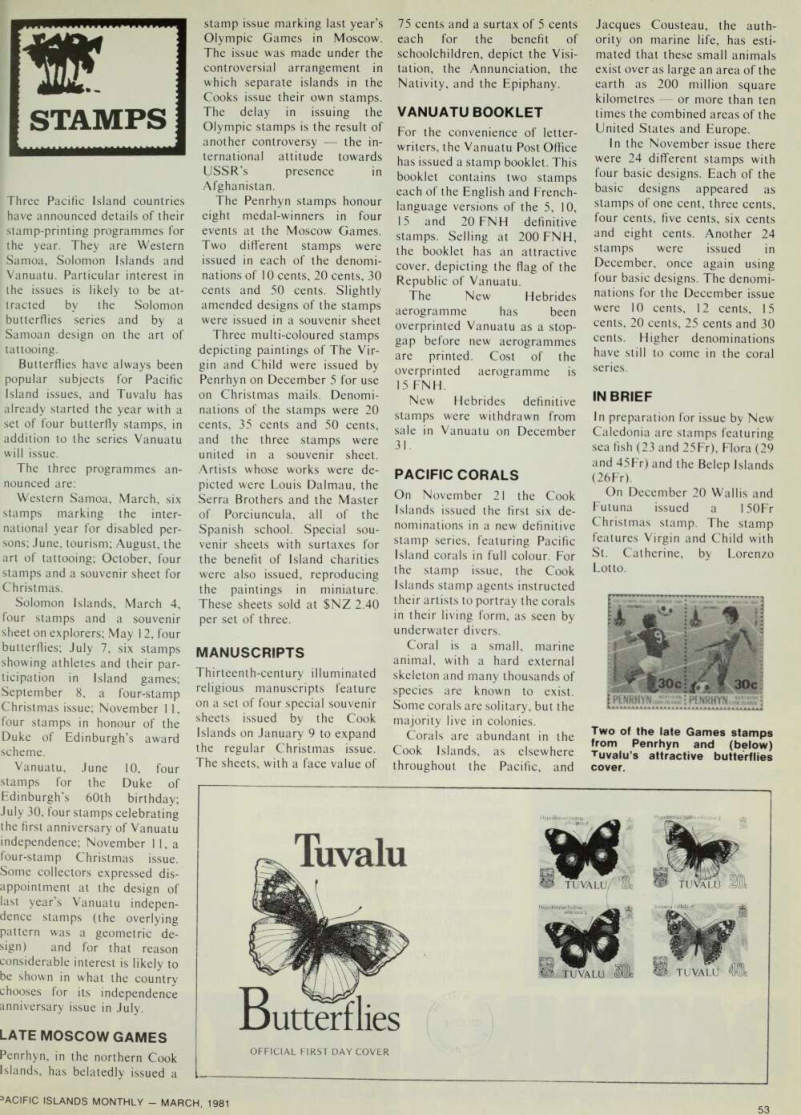
Three Pacific Island countries have announced details of their stamp-printing programmes for the year. They are Western Samoa, Solomon Islands and Vanuatu. Particular interest in the issues is likely to be at tracted by the Solomon butterflies series and by a Samoan design on the art of tattooing.
Butterflies have always been popular subjects for Pacific Island issues, and Tuvalu has already started the year with a set of four butterfly stamps, in addition to the series Vanuatu will issue.
The three programmes an nounced are: Western Samoa, March, six stamps marking the inter national year for disabled per sons; June, tourism; August, the art of tattooing; October, four stamps and a souvenir sheet for Christmas.
Solomon Islands, March 4, four stamps and a souvenir sheet on explorers; May 12, four butterflies; July 7, six stamps showing athletes and their par ticipation in Island games; September 8, a four-stamp Christmas issue; November 11, four stamps in honour of the Duke of Edinburgh’s award scheme.
Vanuatu, June 10, four stamps for the Duke of Edinburgh’s 60th birthday; July 30, four stamps celebrating the first anniversary of Vanuatu independence; November 11, a four-stamp Christmas issue.
Some collectors expressed dis appointment at the design of last year’s Vanuatu indepen dence stamps (the overlying pattern was a geometric de sign) and for that reason considerable interest is likely to be shown in what the country chooses for its independence anniversary issue in July.
Late Moscow Games
Penrhyn, in the northern Cook Islands, has belatedly issued a
stamp issue marking last year’s Olympic Games in Moscow.
The issue was made under the controversial arrangement in which separate islands in the Cooks issue their own stamps.
The delay in issuing the Olympic stamps is the result of another controversy the in ternational attitude towards USSR’s presence in Afghanistan.
The Penrhyn stamps honour eight medal-winners in four events at the Moscow Games.
Two different stamps were issued in each of the denomi nations of 10 cents, 20 cents, 30 cents and 50 cents. Slightly amended designs of the stamps were issued in a souvenir sheet Three multi-coloured stamps depicting paintings of The Vir gin and Child were issued by Penrhyn on December 5 for use on Christmas mails. Denomi nations of the stamps were 20 cents, 35 cents and 50 cents, and the three stamps were united in a souvenir sheet.
Artists whose works were de picted were Louis Dalmau, the Serra Brothers and the Master of Porciuncula, all of the Spanish school. Special sou venir sheets with surtaxes for the benefit of Island charities were also issued, reproducing the paintings in miniature.
These sheets sold at SNZ 2.40 per set of three.
Manuscripts
Thirteenth-century illuminated religious manuscripts feature on a set of four special souvenir sheets issued by the Cook Islands on January 9 to expand the regular Christmas issue.
The sheets, with a face value of
75 cents and a surtax of 5 cents each for the benefit of schoolchildren, depict the Visi tation, the Annunciation, the Nativity, and the Epiphany.
Vanuatu Booklet
For the convenience of letter writers, the Vanuatu Post Office has issued a stamp booklet. This booklet contains two stamps each of the English and French language versions of the 5, 10, 15 and 20 FNH definitive stamps. Selling at 200 FNH, the booklet has an attractive cover, depicting the flag of the Republic of Vanuatu.
The New Hebrides aerogramme has been overprinted Vanuatu as a stop gap before new aerogrammes are printed. Cost of the overprinted aerogramme is
15 Fnh.
New Hebrides definitive stamps were withdrawn from sale in Vanuatu on December 31.
Pacific Corals
On November 21 the Cook Islands issued the first six de nominations in a new definitive stamp series, featuring Pacific Island corals in full colour. For the stamp issue, the Cook Islands stamp agents instructed their artists to portray the corals in their living form, as seen by underwater divers.
Coral is a small, marine animal, with a hard external skeleton and many thousands of species are known to exist.
Some corals are solitary, but the majority live in colonies.
Corals are abundant in the Cook Islands, as elsewhere throughout the Pacific, and
Jacques Cousteau, the auth ority on marine life, has esti mated that these small animals exist over as large an area of the earth as 200 million square kilometres or more than ten times the combined areas of the United States and Europe.
In the November issue there were 24 different stamps with four basic designs. Each of the basic designs appeared as stamps of one cent, three cents, four cents, five cents, six cents and eight cents. Another 24 stamps were issued in December, once again using four basic designs. The denomi nations for the December issue were 10 cents, 12 cents, 15 cents, 20 cents, 25 cents and 30 cents. Higher denominations have still to come in the coral series.
In Brief
In preparation for issue by New Caledonia are stamps featuring sea fish (23 and 25Fr), Flora (29 and 45Fr) and the Belep Islands (26Fr).
On December 20 Wallis and Futuna issued a 150 Fr Christmas stamp. The stamp features Virgin and Child with St. Catherine, by Lorenzo Lotto.
Two of the late Games stamps from Penrhyn and (below) Tuvalu’s attractive butterflies cover.
Advertisements & other items, pp. 53-56 (2 items)
53
3 ACIFIC ISLANDS MONTHLY - MARCH, 1981
Datsun Creates Ha
Ordinarily you don’t
think of a sports car as
being a luxury car.
But then there’s nothing ordinary
about the DATSUN 280ZX.
When you think of a sports car, you think of high performance, sure handling, sharp responsiveness and stability at high speeds.
And when you think of a luxury car, you think of a plush interior, a soft ride, perfect temperature control and quiet performance.
What most people never think of is having all of those qualities in the same car. Because they are conflicting qualities.
Ordinarily, the more powerful the engine, the more noise it makes.
And the softer the ride, the less responsive the handling. / At Datsun, we not only accept such conflicts, we look for them.
Then we look for ways to bring them into ' harmony '. Because to us harmony is balance. The balance of apparent contradictions. And we believe the better the balance we are able to achieve, the better the cars we are able to build.
The DATSUN 280ZX is an outstanding example of this philosophy.
It’s every inch a true G.T sports car.
It’s also a luxury car in the plushest sense of the word. And it’s also a car for the 80s.. .a responsible car, meeting the energy, environmental and safety needs of our times.
Through harmony by design, for example, we were able to lower the floor and waistline which also lowered the center of gravity.
The result. More room and comfort inside. Sportier looks outside, and improved handling.
Similar apparent conflicts resulted in solid product improvements throughout the car.
DATSUN CREATES HA
ISLANDS MOTOR CENTRE LTD., Rarotonga/Fiji: CARPENTERS MOTORS, Suva/Guam: DATSUN MOTOR SALES, Agana/Hawaii: NISSAN MOTO ( ORPORATION IN HAWAII LTD,, Honolulu/Kiribati: ATOLL AUTO STORES, Tarawa/Nauru: JACOB ENTERPRISES LTD./New Caledonia: AGENCE ALMA S.A., Noumea
It has a new, “tuned” indepen- -14-wheel suspension system with :ial sound-proofing materials, result. Improved maneuverty, fewer vibrations and the othest and quietest ride of any n its class.
It has a lumbar support for the II of your back and a height adjustt for the back of your thighs, result. Less fatigue. More com- Even on day-long drives.
It is lighter than its predecessor, equally as strong. With improved combustion efficiency. An improved power train. And improved aerodynamic styling. The result. More performance per gallon.
Its more streamlined appearance is really a cover up. For a nearly perfect 50-50 weight distribution, front and rear. The result. Improved ride and handling, regardless of the road.
These are but a few of the results we were able to achieve through harmony in the design of the DATSU N 280ZX. The basic idea is the same in the design of every Datsun.
Find new ways to give you exactly what you want in your new car. While not forgetting what the world needs in a car.
That’s harmony.
The model shown above is the Datsun 280ZX for South America.
Specifications and equipment may vary according to market.
SN P Y E rN T C E ?Solom<fn l^ a l V « l^^ln, ?L™p!? C n <? S Vn R^ S MOT ° RS ' Pa P“ a BOROKO MOTORS LTD,, For, Moresby/Saipan: JOETEN MOTOR sands. UNITED ENTERPRISES LTD , Honiara Tahiti: TAHITIBULL S.A.R.L, Papeete/Western Samoa: MORRIS HEDSTROM LTD., Apia
PERFORMANCE
dependable
marine engines
When fishing is your living, you know you need dependable gear working with minimum downtime and your engines have to deliver reliable power when and where you need it.
CATERPILLAR offers you a comprehensive selection of performance proven Cat Marine Diesel Engines from 85hp up to IOOOhp, backed by after sales service and replacement parts facilities that are second to none. 2) [Q 3 S. & F F b i nr 2W
dependable
Whatever your electric power needs, there’s a Catbuilt generator set to meet them. Caterpillar generators feature adjustment free fuel systems, large capacity radiators, heavy duty air cleaners and quick-change fuel and oil filters to ensure dependable performance throughout the islands, in all kinds of tropical conditions.
HASTINGS DEERING
LAE:
Milford Haven Road, Telephone 42 2355.
PORT MORESBY:
Telephone 256650.
BOUGAINVILLE:
Itakara Industrial Park, Arawa Telephone 959077.
carptrac
SUVA: Carpenter Street, Raiwai.
Private Mail Bag, GPO Suva, Fiji. Ph. 381622.
Telex FJ2190 Cables CARPTRAC.
LAUTOKA: Veitari. Telephone 61877.
LABASA; Vulovi. Telephone 81868.
YOUR
CATERPILLAR
DEALER
Caterpillar, Cat and CB are Trademarks of Caterpillar Tractor Co. 8A10452
Islands
From the
Press
A reader’s complaint to the Papua New Guinea Post- Courier, Port Moresby, about an earlier-published cartoon Your cartoon attempted to label the British expatriate as forever complaining and whining about his life, when it is undoubtedly a fact that the average Australian, New Zealander and indeed Papua New Guinean will complain no more, or no less than the average Briton. It is a fact, too, that should such a cartoon appear in a British newspaper denigrating West Indians or Pakistanis, the editor would soon find himself hauled before the Race Relations Board. Is Papua New Guinea such an illiberal country that it can allow such attitudes to prevail? Can we expect to see so-called Irish jokes appearing in the Post-Courier in the near future? I hope that the staff of the Post-Courier can appreciate the difference between preaching about racism on the one hand and practising it on the ather. -rom a commentary on the current political scene written by Moi Avei and published in The Times of 3 apua New Guinea, Port Moresby ndependence brought us hope and raised our expectations. Some aw possibilities of an egalitarian society. But it was an illusion. We :ontinue to have inequalities, with the rich getting richer and the )oor getting poorer. . . . The idealism evaporated into thin air and t left a sour taste behind. Our universities have become intellectual leserts. Even our leading poets and playwrights have mostly put lown their pens. : rom Cook Islands News, Rarotonga \n unusual phenomenon has occurred at the Legislative Assembly ince the debate on the Constitution Amendment Bill started. Mr -es Priest of the Hansard office reports that since the debate tarted, a number of the members have been borrowing copies of he 1978 Hansard debate. No 13, on the five-year term amendment. >o many members have been borrowing this particular Hansard, hat Mr Priest has only one copy left which he is holding on to.
At Priest said that running out of the Hansard is unusual as there re normally plenty of copies to refer to . . . : rom the political writings of a Papua New Guinea miversity student, quoted in the Post-Courier, Port
Moresby
Jroadly speaking, this assimilative tendency is to defeat any •otential rivals. Hitherto, the two successive governments had ound it viable to cohere, but apparently the underlying principle if viscosity has either been forgotten or simply was superseded by ecalcitrancy and unilateralism thus consequented by incoherence nd incompatibility as a general trend. .etter to the editor in the Marshall Islands Journal am writing to complain about the many loose pigs roaming round. These pigs are unsanitary and unhealthy, they run through nd destroy gardens, they knock down fences and they cause traffic
accidents. There is a law on the books making loose pigs illegal, but maybe the police are afraid to enforce the law. I would like to suggest that the pigs be picked up by the police and then sold by the police to help pay for badly needed repairs to the police headquarters. Anything would be better than the present situation we must get rid of those unpenned pigs.
Part of a letter to the editor, Fiji Times, Suva It has now become more difficult for sensitive musical ears to listen to any Fiji Broadcasting Commission programme because of the constant procession of Moaning Minnies, Wailing Willies and Thunderous Thudders.
Letter to the editor in the Post-Courier, Port Moresby, Papua New Guinea As a young girl from Koboka I am complaining on how young boys and old men act to young girls. When we go around the town these boys and old men always hiss and hiss as if we girls are snakes, and sometimes they call out ‘favour’, ‘I love you’, ‘you are so beautiful’ and so on.
Part of an editorial in Witika the Wampire’s news sheet, Rabaul, Papua New Guinea This is the year when true citizens of Papua New Guinea should cease to quote the by now incessant ramblings of ‘that’s not our custom’. It’s becoming a boorish syndrome. The vocal person is usually smoking cigarettes, drinking beer, in a western-type bar, working for a western company and living in a western-type house.
Western civilisation is here to stay.
From an editorial in the Fiji Times, Suva Air Pacific’s slow but sure entry into the big league of the international airline business will put it in one of the world’s most cut-throat competitive industries ... In opening its Sydney office the airline is engaging in a public relations exercise which might go down well with the privileged people flown there for the party, but which at the local level at home in Fiji is getting off to an unfortunate start. . . Surely the airline would have gained more if every cent being spent on champagne bubbles had been allocated instead to the business of selling tickets in the hard market that is
Sydney.
From Les Nouvelles Catedoniennes, Noumea Antoine Honakoko went to a cricket match because his fiancee was playing in one of the teams. During a torrid period in the game his beloved was struck on the head by a delivery from a hefty matron bowling for the other side. She collapsed, KO’d for the count. One of her team-mates immediately fell upon her and started to give her moulh-to-mouth resuscitation. But Antoine, no doubt believing he was witnessing a display of Lesbianism, suddenly became violently jealous and, leaping on the indecent provider of first aid, clobbered her with all his strength, putting her out of action for two whole days ... The process-server couldn’t immediately find Honakoko to present the summons, but he’s still up for an 8000 CFP fine, plus 5000 francs damages and costs to the assaulted player ...
From an article by Meredith Glenn in The National Union, Ponape, Federated States of Micronesia . . . Now the man had a big desk in a big office. He had his own private secretary and his own special assistant. His office had six other secretaries, several technicians, advisors, and planners. They all deferred to the man because they knew he must be important to fill a job like this. When they asked him if they should do something, the man would frown, consider, and then give them the answer befitting a man in his important position: ‘No, we can’t do this because .. . Moral: The ability to stop or delay something may be the only power available to unimportant people, but their use of this power can make them very important. . .
Letter to the editor in the Post-Courier, Port Moresby, Papua New Guinea So, the deputy prime minister, Mr Okuk, wants to be prime minister, and the prime minister, Sir Julius Chan, thinks this is all very ‘healthy’. I mean, it’s nice to see such good cheer and amity between a prime minister and his deputy. Perhaps they could take it turn and turn about for a year or two so they could both get a ride in the executive jet and generally share things around.
Advertisements & other items, pp. 57-58 (2 items)
57
ACIFIC ISLANDS MONTHLY - MARCH, 1981
Solar Ex
ELECTRICITYFROM SUNLIGHT
Oil short, ruralised, developing nations are great beneficiaries of the advances being made in SOLAR ELECTRIC GENERATORS m m u ft It m a a V-:- - m The communal hut of this Pacific island village has a projector and video recorder powered by a photovoltaic generator. These units are used to show the villagers current farming techniques basic health and child care along with providing valuable assistance for the regional educational program All of the huts have a solar powered lighting system and the communal health centre keeps drugs sterile and temperate in a solar-powered refrigerator-freezer The villagers have a central water catchment supplied by a Solarex Photovoltaic Pumping System while communications are effected by means of a H.F. radio network powered by the central solar generator.
Photovoltaic generators where chosen over the more traditional liquid fuelled systems because they were the most cost effective option when the following was considered: •Virtual unlimited operational life • Fuel free •Minimal maintenance to be carried out by non-skilled personnel exchange savings resulting from a lower liquid fuel bill.
Solar powered generators are often the most economic alternative for: • Remote homes and villages • Remote communication sites • Water pumping • Telemetry outstations, etc.
If you would like to know more about the Pacific areas most abundant free energy source, contact; SOLAREX PTY. LIMITED 'THE FREE ENERGY COMPANY" 5 BELLONA AVE • REGENTS PARK 2143 AUSTRALIA
• TELEPHONE 644 5055
P.0.80X 204 • CHESTER HILL 2162
• TELEX AA21975
‘Buy Pacific’ is
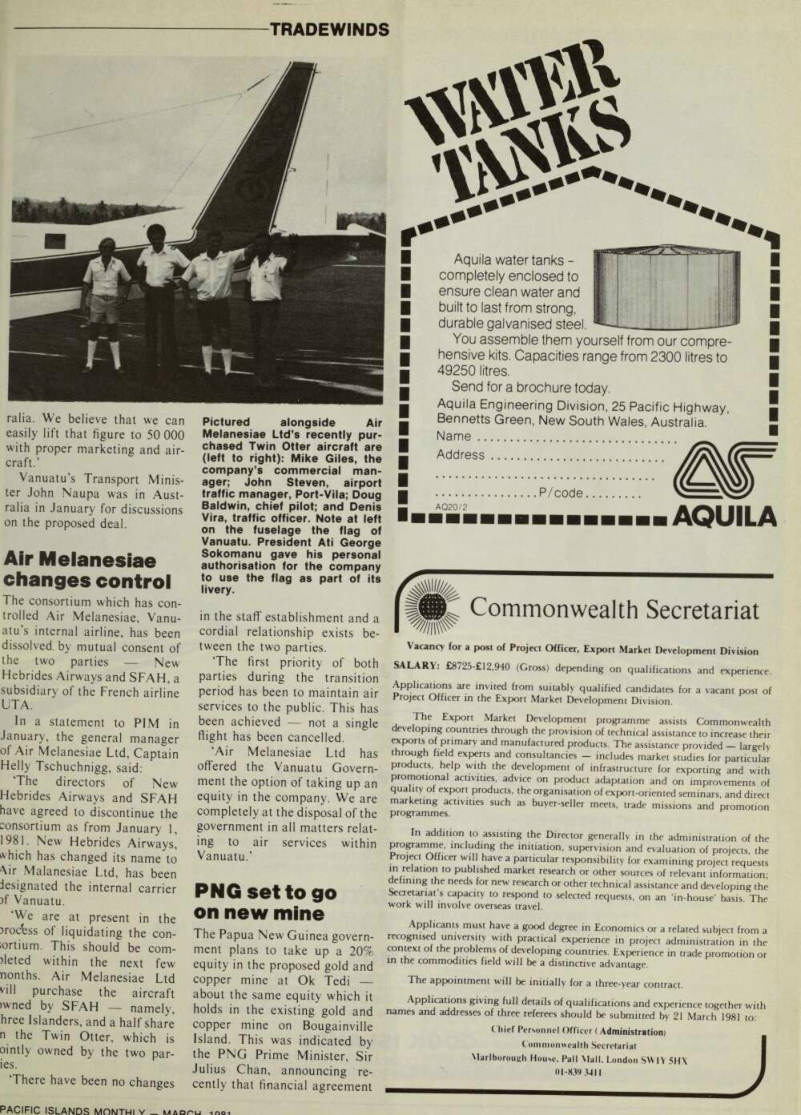
Trade
Winds
‘Buy Pacific’ is Australian call
Australia has begun an active campaign to increase the value of its imports from Pacific Island countries. Despite the high level of Australian aid to the Pacific, there is some politi cal embarrassment in Australia over the fact that the value of its exports to the Pacific is much higher than the value of its imports. This is seen as a factor in renewed Australian attempts to foster Pacific imports.
A major part of the new Australian drive is publicity for the recently-introduced South Pacific Regional Trade and Co operation Agreement (SPAR TECA), SPARTECA aims to progressively widen the opportunities for Pacific Island countries to sell goods and produce free of duty and with unrestricted access to Australia and New Zealand.
In a recent statement from Fiji the Australian Trade Com missioner for the Pacific Islands, Mr Jack White, ap pealed to companies in the region to take advantage of export opportunities offered by the new trade agreement.
Under the SPARTECA pro gramme, he said, a wide variety Df exports from Island member :ountries of the South Pacific Forum now had duty-free ac cess to Australia, and other exports would be added to the ist progressively.
Mr White said that about 10 companies, mostly from Fiji, )ut including Tonga and /anuatu, had already inquired ibout exporting to Australia mder the terms of SPAR PECA. Several of the compan es manufactured products not isted under SPARTECA, but •fficial requests for the products o be included were being onsidered, he said.
Mr White said about 97% of Australia’s imports from Forum sland countries (excluding *apua New Guinea) currently ntered duty-free. These were alued at around $74 million in 979/80 of which phosphate ccounted for $5l million. The imainder consisted largely of old, vegetable oils, tropical 'uits and handicrafts.
Australia expects to ratify SPARTECA shortly.
Among Island products now listed for duty-free entry to Australia are fish (fresh, chilled or frozen), raw coffee, canned meat products, canned tuna, banana, taro and breadfruit chips, coconut oil, biscuits, soap, raw hides and skins, saddlery and harness, um brellas, raw cocoa beans, Portland cement, vanilla, cut flowers, broom millet, masi, leather goods, wood and wooden products.
Profit down at
Bougainville
Bougainville Copper Ltd, which operates one of the world’s biggest open pit copper mines in Papua New Guinea, has re ported a 14% drop in earnings for the year to December 31.
The report, issued in February, blames rising operating costs and a fall in the sale of concentrates for the situation.
The profit figure, in PNG cur rency, was K 71.534 million compared with K 83.917 million for the previous year.
Expressed in Australian dol lars, and taking into account the differing exchange rates for the two years, the profit was just over $94 million last year and nearly $ 110 million the previous year.
The directors reported that the profit would have been even lower last year but for the write back of earlier over-provision for tax. Not only did the write back affect the figure, but it also led to a significant reduction in super-tax provisions because of the lower pre-tax profit which it created.
The super-tax is part of PNG’s mining agreement poli cies under which companies have to increasingly share with the government as tax any earnings described by formula as ‘excessive’. The government also has a 20% equity in the
mine shareholding.
The final dividend declared by the board was 8 toea a share and a bonus distribution of 4 toea a share from accumulated
profits. This brought the total distribution for the year to 20 toea a share, and distributed 90% of the earnings.
Looking to the current year the report indicated that lower metal prices did not create profit confidence.
The company has already announced its intentions to in stall an additional crushing mill it will be the eleventh on the mine site to increase pro duction volume. The cost of the mill will be $4B million. The company is also renewing sub missions to the PNG govern ment to lift an embargo on exploration sites adjacent to the present mine lease.
Vanuatu flights
for Ansett?
Ansett Airlines of Australia appeared in February to be virtually certain to become the second designated flag carrier for Vanuatu. The other is the Fiji airline, Air Pacific.
A January report in the Sydney Morning Herald said: ‘Ansett will probably use Boe ing 727-200 s or 767 s on its Sydney (or Melbourne) to Port-
Vila flights. However, they may have to be refuelled at Tontouta (Noumea) as they must carry sufficient fuel to overfly Port- Vila if its strip is unusable. ‘While the Vanuatu Govern ment is still technically open to approaches from other airlines.
Air New Zealand has shown an interest.’
The report quoted a senior Vanuatu Government official as saying ‘the most attractive as pect to the Ansett offer is the airline’s huge marketing organ isation’.
He said; ‘Through Ansett we can reach an enormous tourist potential in Australia. Ansett can devise a package deal including hotels, tours and sightseeing. Last year we had about 25 000 tourists, of whom about 80% came from Aust-
ralia. We believe that we can easily lift that figure to 50 000 with proper marketing and air craft.’
Vanuatu’s Transport Minis ter John Naupa was in Aust ralia in January for discussions on the proposed deal.
Air Melanesiae
changes control
The consortium which has con trolled Air Melanesiae, Vanu atu’s internal airline, has been dissolved, by mutual consent of the two parties New Hebrides Airways and SFAH, a subsidiary of the French airline
Uta.
In a statement to PIM in January, the general manager of Air Melanesiae Ltd, Captain Helly Tschuchnigg, said; The directors of New Hebrides Airways and SFAH have agreed to discontinue the consortium as from January 1, 1981. New Hebrides Airways, which has changed its name to Mr Malanesiae Ltd, has been designated the internal carrier )f Vanuatu. ‘We are at present in the )rockss of liquidating the con sortium. This should be com peted within the next few nonths. Air Melanesiae Ltd vill purchase the aircraft >wned by SFAH namely, hree Islanders, and a half share n the Twin Otter, which is ointly owned by the two par ies.
There have been no changes
in the staff establishment and a cordial relationship exists be tween the two parties.
The first priority of both parties during the transition period has been to maintain air services to the public. This has been achieved not a single flight has been cancelled. ‘Air Melanesiae Ltd has offered the Vanuatu Govern ment the option of taking up an equity in the company. We are completely at the disposal of the government in all matters relat ing to air services within Vanuatu.’
PNG set to go
on new mine The Papua New Guinea govern ment plans to take up a 20% equity in the proposed gold and copper mine at Ok Tedi about the same equity which it holds in the existing gold and copper mine on Bougainville Island. This was indicated by the PNG Prime Minister, Sir Julius Chan, announcing re cently that financial agreement
Pictured alongside Air Melanesiae Ltd’s recently pur chased Twin Otter aircraft are (left to right): Mike Giles, the company’s commercial man ager; John Steven, airport traffic manager, Port-Vila; Doug Baldwin, chief pilot; and Denis Vira, traffic officer. Note at left on the fuselage the flag of Vanuatu. President Ati George Sokomanu gave his personal authorisation for the company to use the flag as part of its livery.
had been reached in principle with partners in the project. At the time of Sir Julius’ an nouncement the government had still not indicated definite approval to proceed with the Ok Tedi mine. However it was generally anticipated in mining and government circles that approval was likely to be an nounced about the end of February (PIM Feb p 62).
Under its mining policy guide lines PNG does not insist on massive equities, but prefers to optimise the earnings it can make by using a sliding tax scale related to a profit margins.
It also keeps its capitalisation expenses to a minimum by buying equity where possible from future earnings and by providing infrastructure which is paid for in shares.
The specific terms under which PNG will obtain its equity in the Ok Tedi project were not announced at the time of Sir Julius’ statement, but the government’s effective capital isation share is expected to be close to SAIOO million. The government will launch its own programme of international borrowings to finance its com mitments.
The parent companies which are involved with the govern ment in the Ok Tedi project are Amoco (USA), BHP (Aust ralia) and Kupfer Explorations
(Germany).
Planning for the project was leld up late last year when PNG disagreed with some of he international borrowing )lans proposed by the partners, fhe plans were not in PNG’s )verall interests, the govern nent said, although details of he disagreements were not ;iven.
The recent announcement rom Sir Julius said that nego iations held in London had esolved all differences between *NG and its partners in finance rrangements.
Ok Fedi is in the Star /fountains in the far western iland of PNG and close to the ndonesian border. The con traction phase of the mine is xpected to occupy about four ears at a cost of about $715 lillion at today’s values. One of
ie biggest engineering projects
i the venture will be the anstruction of overland and
river transport facilities to shift copper concentrate from the mine to the coast 200 km away.
Agriculture to
get USA aid
Grants totalling $5.6 million are to be made by USA over the next five years under a scheme known as the South Pacific regional agricultural develop ment project. The scheme is designed to strengthen agri culture in the South Pacific countries served by the Univer sity of the South Pacific by assisting the university’s agri cultural programmes.
The funds will be used to expand agricultural research, extension and training pro grammes at the university’s campus at Alafua, Western Samoa.
At the end of the five years the university hopes to have helped degree and diploma graduates and to have provided higher training for staff mem bers, short courses and seminars on agricultural issues, a com munication network, scholar ships, library resources and
technology.
The US Agency for Inter national Development will man age the project from its South Pacific regional development office in Suva, the US Embassy in Wellington said. The pro grammes would be carried out in collaboration with the Uni veristy of Hawaii and Cornell University, New York, it added.
The Agency for International Development has also made a grant of $163 000 to establish a farm training centre at Moa moa on the island of Upolu in Western Samoa. The grant is to be applied by the American Catholic Relief Service. Ad ditional grants may be made later to support the project.
Catholic Relief hopes to pro vide two-year training courses at the centre, taking in small holding farmers from village communities.
About 30 farmers will attend each course, and will be given instruction in crop rotation,
planting and harvesting, mar
keting, farm budgeting, cattle
breeding, record-keeping and
pasture management.
Bill
Gasson in Wellington.
Advertisements & other items, pp. 59-64 (5 items)
'Acific Islands Monthly - March, 1981
Marine, Commercial,
FUEL INJECTION
AND ELECTRICAL SYSTEMS
SPECIALISTS FOR ALL
MARINE, COMMERCIAL,
INDUSTRIAL AND AUTOMOTIVE
INSTALLATIONS
We service and stock fuel pumps, injectors, turbochargers, governors, alternators, generators and starter motors for all applications.
CONTACT US BY TELEX FROM ANYWHERE IN THE PACIFIC FOR IMMEDIATE DESPATCH OF REPLACEMENTS AND SPARES FOR
BOSCH, BRYCE, CATERPILLAR, CAV, DIESEL KIKI
GM, HOLSET, NIPPON DENSO, ROOSAMASTER
AIR RESEARCH, SCHWITZER, SIMMS, DAHL FILTERS
and
WOODWARD GOVERNORS
SIMMS DIESEL & ELECTRICAL SERVICES LTD.
P.O. BOX 11-114 ELLERSLIE
77 LEONARD ROAD, PENROSE AUCKLAND
NEW ZEALAND
TELEX No NZ 60266 SIMMS
DAYTIME TEL,
AUCKLAND 591-159
DIESEL SPECIALISTS
EVENING TEL.
AUCKLAND 568-259
V * N <• WB I 1 m ■ » * ‘I ip * * w < m. m
Revelation!
Discover hi-fi with
an impeccable pedigree.
Once you hear a Sansui SUPER COMPO system, you will be amazed.
You will not believe that such extraordinary sound could come from such an easy-to-use complete system.
It will be a revelation of how clean and pure music can sound in your home.
Such an achievement isn't born overnight. All of Sansui's decades of experience and finely honed engineering skills were drawn upon to create today's SUPER COMPO systems. Specifics include DC-servo amp, quartz-PLL synthesizer tuner, and computerized random music selection with unique D-O-B arm. But let's forget about the technical side for a moment.
Let’s just say that only SUPER COMPO systems feature “in-depth”
matching for matchless performance
and new levels in musical enjoyment.
The revelation of SUPER COMPO is the music itself. •»
w 9QOO
\NSUI ELECTRIC CO., LTD .14-1 Izumi 2-chome, Suginami-ku, Tokyo 168. Japan \ustralia VAN FI (Aust.) Pty. Ltd. 297 City Road, South Melbourne. Victoria 3205, Australia Phone: 690-6200/283 Alfred Street, North Sydney. NSW. 2060, stralia Phone: 929-0293 • Fiji Prabhu Brothers Ltd. P.O. Box 183, Nadi Phone: 70183/4 • Papua New Guinea Oceania Indent Agency (P.N.G.) Pty. Ltd. Box 5518. roko, Port Moresby Phone; PM 256406 • New Zealand David Reid Electronics Ltd. C.P.O. Box 2630, Auckland, 1 Phone; 491-489 • New Caledonia Ets Michel ERCIER B.P. 1123, Noumea Phone: 27. 59. 11 • South Pacific Miltons Department Stores Limited P.O. Box 146. Norfolk Island 2899 • Central Pacific Nauru -operative Society Republic of Nauru • Vanuatu The Sound Centre P.O. Box 434. Port Villa • Cook Island United Island Traders Ltd. P.O. Box 1 & 2. Rarotonga • iiti RIM FI P n Rrw 3338
Sansui.
3 -s w.
Aquila water tanks -
completely enclosed to
ensure clean water and
built to last from strong,
durable galvanised steel.
You assemble them yourself from our comprehensive kits. Capacities range from 2300 litres to
49250 litres.
Send for a brochure today.
Aquila Engineering Division. 25 Pacific Highway,
Bennetts Green, New South Wales, Australia.
Name
Address
P/code.
AQ2O/2
AQUILA
Commonwealth Secretariat
Vacancy for a post of Project Officer, Export Market Development Division SALARY: £8725-£12,940 (Gross) depending on qualifications and experience.
Applications are invited from suitably qualified candidates for a vacant post of Project Officer in the Export Market Development Division.
The Export Market Development programme assists Commonwealth developing countries through the provision of technical assistance to increase their exports of primary and manufactured products. The assistance provided - largely t rough field experts and consultancies includes market studies for particular products, help with the development of infrastructure for exporting and with promotional activities, advice on product adaptation and on improvements of quality of export products, the organisation of export-oriented seminars, and direct marketing activities such as buyer-seller meets, trade missions and promotion programmes.
In addition to assisting the Director generally in the administration of the programme, including the initiation, supervision and evaluation of projects, the Project Officer will have a particular responsibility for examining project requests in relation to published market research or other sources of relevant information defining the needs for new research or other technical assistance and developing the Secretariat s capacity to respond to selected requests, on an in-house’ basis. The work will involve overseas travel.
Applicants must have a good degree in Economics or a related subject from a recognised university with practical experience in project administration in the context of the problems of developing countries. Experience in trade promotion or in the commodities field will be a distinctive advantage.
The appointment will be initially for a three-year contract.
Applications giving full details of qualifications and experience together with lames and addresses of three referees should be submitted by 21 March 1981 to: Chief Personnel Officer ( Administration) Commonwealth Secretariat Marlborough House. Pall Mall. London SWIV 5H\ 01-839 3411 )
/ «*5 > ,-J^
NATIONAL
INSURANCE
COVERS THE
PACIFIC
/ % % . .# N #> * v m %\ *
FIJI
THE NATIONAL INSURANCE COMPANY OF FIJI, LIMITED (Incorporating Southern Pacific Insurance Co. (Fiji) Ltd) SUVA Dominion House Thomson St Phone 25601 Tlx 2337 L M Rolls General Manager LAUTOKA Ist Floor National Bank Bldg. Phone 62951 M Y Hussain Resident Inspector LABASA Ist Floor National Bank Bldg. Phone 81099 A Singh Resident Inspector
PAPUA NEW GUINEA
THE SOUTHERN PACIFIC INSURANCE COMPANY (PNG) LIMITED (Incorporating C.I.C. Insurance (Pacific) Pty Ltd) PORT MORESBY 8 Champion Parade Phone 21-1388 Tlx 22261 D J McCall General Manager LAE Second St Phone 42-4590 Tlx 42443 T S Kennedy Manager RABAUL Mango Ave Phone 92-2755 Tlx 92923 P M Mitchell Manager MT HAGEN Phone 521-164 J P Devaney District Manager ARAWA B Snowden District Manager Phone 956-219
VANUATU
THE NATIONAL INSURANCE COMPANY OF NEW ZEALAND, LIMITED.
HONIARA Ist Floor Kingsley Bldg. Phone 919 Kaituu & Co. Ltd (W. V. Gledhill) Agent
SAMOA
NATIONAL PACIFIC INSURANCE LIMITED
(National Insurance Company of New Zealand, Ltd Managing Agents) APIA Taufusi St Phone 20481 Tlx 228 D I Humphry Managing Director PAGO PAGO Suite 200 Lumana’i Bldg. Phone 96799 J McGuire Manager
COOK ISLANDS
THE NATIONAL INSURANCE COMPANY OF NEW ZEALAND, LIMITED RAROTONGA U.I.T. Bldg. Avarua Phone 2076 Tlx 62013 R Wheeler Local Manager
WESTERN SAMOA
COCOA SPECIALISTS
The Government of Western Samoa has Initiated a cocoa rehabilitation and development project aimed at rapidly Increasing exports of good quality cocoa beans through an Integrated programme of research, central processing and extension aid to farmers. The Project Is assisted with A ustrallan Aid funds and has Its Headquarters at the Nu’u Crop Development Station some six miles from Apia.
AGRONOMIST
Under the direction of the Project Manager, the Agronomist will work on the establishment of seed gardens for supply of higher yielding and black pod resistant planting material, the introduction and testing of clonal material, progeny testing of introduced planting material in comparison with local Trinitario material and agronomic trials to provide local data on plant density, shade and fertiliser requirements. Other duties as directed.
QUALIFICATIONS
Degree of Diploma in Agriculture, Agricultural Science, Botany or similar field. Previous experience in cocoa agronomy or tropical tree crop agronomy is desirable.
COCOA DEVELOPMENT OFFICER
Under the direction of the Project Manager, the Development Officer will be responsible for the development of a strong cocoa extension service throughout both main islands of Western Samoa. This service will be locally staffed and is intended to provide farmers with a package programme of assistance in the establishment of cocoa farms. The Development Officer will also be responsible for the management of central cocoa fermentaries which will be located at the sub-centres for the extension teams. Other duties as directed.
QUALIFICATIONS
Degree of Diploma in Agriculture or Agricultural Extension. Previous experience in extension work and the operation of central cocoa fermentaries or central crop processing units is desirable.
AGRICULTURAL STATION MANAGER
The Station Manager’s duties centre almost entirely on operation of the Nu u Station control and allocation of labour, preparation of wage sheets, implementation of planting programmes for various field trials, operation and maintenance of machinery, crop production and general station management. The Station Manager will be responsible to and will work under the direction of the Project Manager.
QUALIFICATIONS
A person experienced in the planting and general husbandry of cocoa trees or other tropical tree crops is preferred. An experienced cocoa owner/planter or plantation manager could be suitable.
CONDITIONS
(a) Location Successful applicants will be based at the Nu’u Crop Development Centre some six miles from Apia. This is a new station developed within the last 18 months. (b) Employer Applicants will be directly employed by the Government of Western Samoa within the structure of the Public Service, which will be responsible for issuing contracts, payment of salaries and conditions of employment. (c) Applicants should be Australian citizens, or permanent residents. (d) Contracts will be initially for a period of three years with the possibility of extension by mutual agreement. (e) Housing A good standard of fully furnished new housing is available immediately. (f) Salaries Information on salary and taxation levels will be provided to applicants.
APPLICATIONS '
Full details of qualifications and experience should be submitted to the Director of Agriculture, Department of Agriculture, Apia, Western Samoa, by 31 March 1981.
H « « tie. w i a it 1
Jirl Ik
fj i JB • *’• u- Jj »« ■*
ir.fi?
/ »«*■>» Tsr afc PR
rafts
X#-- £
Sri
fck
- A * j * 1 —I ▼ <«*% «<(* r 4 \j£s O - -'iifcl.-'tL JC t* * h 5& ll* ---
& *V,> HW* *| *
■ I , * ■•• «4 * :^r-« m mm y.i ■
ppHl
yyr
If* vy’v.n
F 111 ■ JVC is now the Official Supplier of Audio and Video Systems for all major world football (soccer) cup finals.
A singular honor indeed, it’s our way of strongly identifying with the determination of football players, and also a symbol of our own determination to create some of the world’s most entertaining, advanced products.
Goal making is not new to JVC. Major breakthroughs like the world’s 0 o. o first metal-tape-compatible cassette decks, the JVCinvented VHS videocassette system, and the revolutionary VHD video disc system have long put us in the vanguard of technological innovation.
These are all things that would never have happened if not for our 53 years of hard work in all aspects of audio and video. Things that would never have happened but for the goals we set long ago.
V Official Audio A Vldao System, of tha FIFA World Cup 1982. » 0&* Official Audio A Vldao System, of tha UEFA Cup Finals. 9 Official Audio A Vldao Syatama of tha United 8 tat a.
Soccar Fadaration.
Official Audio A Vldao Syatama of tha Australian Soccar Fadaration. i Official Audio > Vldao Syatama of tha Oofd Cup
JVC
VICTOR COMPANY OF JAPAN, LIMITED
Australia: Hagemeyer (Australasia) B.V. 5-7, Garema Circuit, Kingsgrove, N.S.W., 2208 Australia Tel. 750-3777 Fiji Islands: D. Gokal & Co., Ltd., G.P.O. Box 501, Corner of Pier Street & Renwick Road, Suva, Fiji Tel, 25259 Cook Islands; J. & P, Ingram & Co., Ltd., P.O, Box 55, Rarotonga, Cook Islands Tel. 378457 New Hebrides: Wu ke Luong, P.O, Box 113, Rue Higginson, Port-Vila, New Hebrides Tel. 2115 New Caledonia: Caldis, 2, Route du Velodrome, B.P, Ml, Noumea, Cedex, New Caledonia Tel. 262350 Tahiti: Magasin Sincere, B.P, 215, Papeete, Tahiti Tel, 20060 Papua New Guinea: Hagemeyer (P.N.G.) Pty, Ltd,, P.O. Box 90 Lae, Papua New Guinea Tel, 42-3200 New Zealand: Atlas Majestic Industries Ltd,, 11, Albion Road, Otahuhu, Auckland 6, New Zealand Tel, 27-67-099
Tradewinds
PACIFIC ISLANDS MONTHi v . M A Dru •< no -t
62
DAncir IQI AMDS MDNTHI Y MARCH 1981
Tradewinds
>ACIFIC ISLANDS MONTHLY - MARCH. 1981
Tradewinds Intelligence... Tradewinds Intelligence... Tradewinds Inti
AIR NAURU, the heavily subsidised national airline of Nauru, has raised its fares in the face of what it calls ‘economic necessity’. The airline, which accounts for one of the biggest single items of expenditure in the Nauru budget, is expected to lose more than $11 million this year. The new fares represent an increase of 48% on the Nauru-Melbourne route, 65% on Nauru-Honiara and 34% on Nauru-Manila.
EXPERIMENTAL work in using windmills to pump fresh water supplies from under the ground is being carried out in the Marshall Islands by Mr Jim Abernathy, a special projects officer with the public works office. The US Department of Energy has made a grant of $7780 for the work. Salt water intrusion is one of the problems of using ground water in low-lying islands, and the Abernathy project will research methods of overcoming this. One method is the installation of a sensor to shut down the pump if salt is detected.
THE CLOSURE of the UK sugar refinery, Tate and Lyle of Liverpool, will not affect financial arrangements applying to raw sugar exports from Fiji. This assurance was given at question time in the House of Commons last month when it was announced that representations had been received from the Fiji Prime Minister, Ratu Sir Kamisese Mara, and representatives of other Lome Convention countries. The House was told that the European Economic Community’s obligations to sugar producing members of the Lome Convention would not be affected by the closure of the refinery.
TONGA’S development plans for 1981, announced recently by King Taufa’ahau Tupou IV, will include the creation of a mullet fishing farm in a 243 ha area of sea. US aid will be used in the project. Tonga also plans to complete or to begin building seven new hotels and to take delivery from Germany of a new inter-island ferry to replace the former ferry Olovaha.
NEW regulations to control crocodile farming and trading came into force in Papua New Guinea in February. In general the regulations provide for licensing and controls so that PNG can obtain the maximum financial benefit from crocodile farming without affecting crocodile numbers. PNG is considered one of the few areas in the world at present where crocodiles are not a potentially endangered species, but ecologists have warned that careful management is necessary.
PLASTIC tableware, soaps and detergents are now being manufactured in a newly-established factory in Labasa, Fiji.
The factory is owned by a family company, Gurbachan Singh Enterprises, and was established at a cost of $367 000.
The company already produces and packs food products, and is planning to establish a confectionery factory.
AIR TUNGARU, the national airline of Kiribati, has taken its first step into big equipment by ordering a Boeing 727 jet which will come into service in the second half of this year.
The price of the aircraft exceeds $3 million, and its first use will be on the Kiribati to Christmas Island route which is at present operated under charter by Air Nauru. Kiribati hopes to negotiate routes to other Pacific countries.
NEGOTIATIONS with Australian businessmen have been initiated by the Papua New Guinea Chamber of Commerce and Industry in a move to form a PNG — Australia Chamber of Commerce. The president of the PNG chamber, Mr John Cruikshank, said that senior government officers in PNG had encouraged him to formalise links which already existed between businessmen in the two countries. This was
seen as a method of promoting investment acceptable to the PNG government.
WESTERN SAMOA is to spend $10.8 million on a big agricultural development project which will provide techni cal and research facilities, extension services, training programmes and opportunities for tertiary education in agriculture. The project will be related to coconut and cocoa production and to pasture development. Funds for the project, including loans and grants, are being made available by the Asian Development Bank, the International Develop ment Association of the World Bank, the Australian Development Assistance Bureau and the Western Samoa Trust Estates Corporation. The government of Western Samoa will provide $1 million towards the project.
FIJI has negotiated a reduction of $12 a tonne on the copra freight rate to London, but the saving will not be reflected in buying rates offered to growers. The saving instead will be paid into a stabilisation fund to subsidise growers at times of low prices or low production. The present buying rate, to remain unchanged, is $280 a tonne for first grade copra and $278 for second grade.
MILAN Group (Fiji) Ltd, a major construction company in Fiji, has been put into receivership by one of its biggest creditors, the Bank of New Zealand. The company had two big contracts on its books when its affairs were taken over.
The contracts, both partly-completed, are for the school of social and economic development at the University of the South Pacific and a multi-storey shop and office block for the Native Land and Development Corporation. The university contract, worth about $ 1.8 million, was being financed by an Australian government aid grant. The development corpor ation contract is worth $2 million. Alternative arrangements are being negotiated to complete the buildings while an investigation continues into the company’s affairs.
RIGHTS to operate a big timber lease at Vanimo in the far north-west of the Papua New Guinea mainland have been granted to Hetura Meja Development Pty Ltd, a consortium of Philippines companies. But in mid-February a row was pending following allegations that the government had gone against the advice of its forestry officials. The Office of Forests is believed to have recommended a South Korean firm, Halla Resource Corporation.
A NEW type of copra drier suitable for small-scale copra producers is being manufactured in Solomon Islands and has created widespread interest. A Honiara company, Solomon Islands Steel and Welding, is producing the driers which are available in several sizes. The ‘traditional’ small-scale driers used in the Solomons at present are made from cut-down oil drums.
THE FOUR Micronesian countries which make up the Federated Slates of Micronesia — Truk, Ponape, Yap and Kosrae will get more than $2 million from Japanese fishing companies this year in return for fishing rights. Cash payments will total $ 1 845 000 with the balance of $277 000 in development aid. Up to 800 fishing boats will be allowed to operate in the zone.
SOUTH Pacific Island Airways of American Samoa expected in March to have a Boeing 707 in service between Pago Pago, Honolulu and Tahiti, replacing a service closed down by Pan American World Airways in October 1979. The 707 will be based in Honolulu under a lease and contract arrangement with Pan Am World Services, a subsidiary of Pan American. SPIA has created a separate division in Honolulu to manage the new service.
Advertisements & other items, pp. 65-66 (2 items)
Pacific Islands Monthly - March 1981
RADEWINDS INTELLIGENCE... TRADEWINDS INTELLIGENCE... TRADEWINDS INTI
Nelson & Robert son
Artist impression
$6950 KIT
*s» L
MODULAR HOMES,
\ BOX 3572, PORT MORESBY,
\ P.N.G. PHONE 252325
L 74 RUSSELL STREET, TOOWOOMBA,,
JIQLD. 4350. PHONE (076) 32 3411
Our home units come in kit form. Easy to transport anywhere.
Approved in cyclone areas n i i i / / / / O S / O ,» j /
tefj
/ J M
pBE Rr
S o % -o 2: o m >y.
V Ov
FOR:
IN OUR 86th YEAR SELLING ‘SERVICE’
TO THE PACIFIC ISLANDS
Nelson & Robert son
PTY. LTD. (Established 1895)
Plantation House, 197 Clarence Street, Sydney
Cables: ‘IVAN’, Sydney, Brisbane. Telex: AA22381, Sydney.
INDENTS - FROM AUSTRALIA, NEW ZEALAND and OVERSEAS FOODSTUFFS • SOFTGOODS • HARDWARE • MACHINERY’
TRAVEL • INSURANCE • CANNED FISH • JUTE GOODS
• REAL ESTATE •
BRANCH OFFICES:
PAPUA NEW GUINEA
REPRESENTATIVES:
Nelson & Robertson Pty. Ltd., P.O. Box 575, Brisbane, Qld., Australia.
P.O. Box 2092, Govt. Bldg., Suva, Fiji.
P.O. Box 258, Lautoka, Fiji.
P.O. Box 2420, CPO Auckland 1, New Zealand.
Rabtrad Nuigini Pty. Ltd., P.O. Box 219, Rabaul, P.N.G.
P.O. Box 1406, Lae, P.N.G.
P.O. Box 711, Madang, P.N.G P.O. Box 253, Kieta, P.N.G.
Q I - 0 o
Tonga shipping disaster
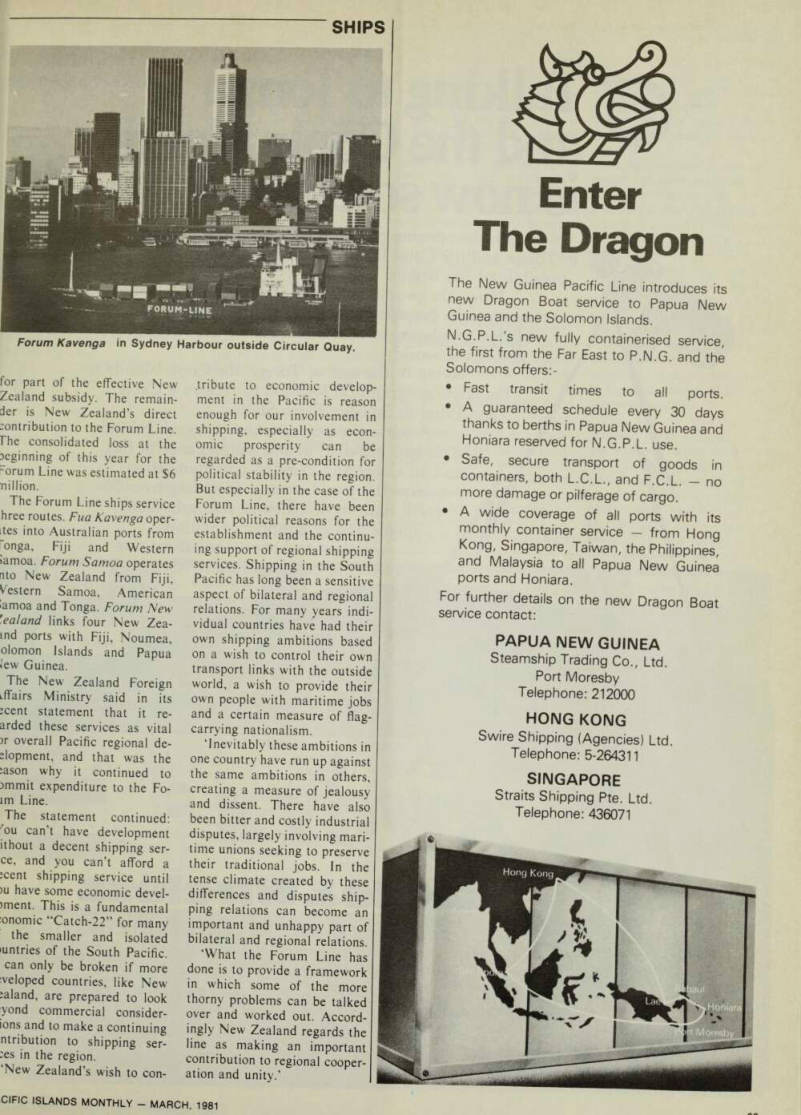

Ships
Tonga shipping disaster brings new safety call
The capsize of the Tongan inter island ferry Fetu’umoana with the loss of 11 lives has renewed pressures for a revised code of marine safety regulations in Tonga. A new code has been under preparation for some time, but is not yet ready. It is still at the ‘translation’ stage according to a government official.
Although Tonga has been a party, since 1977, to the 1960 International Convention for Safety of Life at Sea, there is still no strict observance in Tonga to the convention pro visions relating to seaworthi ness, radio equipment, life saving equipment and passen ger and cargo loading limi tations. The Tongatapu-Eua ferry, which is operated under strict control by the Shipping Company of Polynesia, is an exception in a general situation which raises the question of why accidents don’t happen more often.
The Fetu’umoana capsize was the first accident for three years. In December 1977, 66 lives were lost when MV Tokomea disappeared without trace in treacherous waters be tween Vavau and Niuafoou.
The ship was alleged to have been operating at the time with an inadequately-plugged gash more than a metre long below the waterline and with unser viceable radio equipment.
Three factors highlight the safety problem facing inter island shipping in Tonga. They are: • The homing instinct which draws Tongans in their hun dreds, and sometimes thou sands, to head for their islands of origin, especially at peak periods such as Christmas, Easter and the beginning of school holidays, • The lack of sufficient inter island shipping to cope with the demand, and • The failure of existing legislation to give to any clearly designated authority the res ponsibility and the facilities for policing maritime safety as set out in the regulations annexed
to the 1960 International Con vention.
According to the Crown Sol icitor, Mr Tevia Tupou, the Collector of Customs, under the Minister of Marine, is respon sible as Registrar of Shipping for registering all Tongan vessels and fixing their maxi mum passenger and cargo loads.
The ministry is also respon sible for policing the limits, but it has no staff to carry out the functions. Mr Tupou said that police and staff from harbourmaster offices in the various ports were attempting to supervise the situation, par ticularly at peak periods. How ever they had no authority backed by legislation and could do little more than attempt a token measure of control. The proposed new code of marine safety regulations had stemmed from the Tokomea tragedy and was expected to be introduced this year.
He said that although this would pave the way for more control of seaworthiness and safety standards, truly effective implementation would remain a problem until the government was in a position to provide the Minister of Marine with an appropriately qualified staff.
The new 300-passenger vessel being built in Germany to replace the now defunct Olovaha is expected to relieve some of the pressure when it comes into service later this year. But supplementary ship ping (and perhaps the stagger ing of school holidays) will still be needed if the annual swarms of high school boarders are to travel to and from their outer island homes in safety. —
Penny Hodgkinson in Nukualofa.
NZ in defence
of Forum Line
Differences in opinion between Australia and New Zealand towards financial support for the Pacific Forum Shipping Line have been a controversial issue since last year’s confer
ence in New Delhi of the regional heads of Common wealth governments. New Zea land has consistently supported the line, despite heavy losses, on the basis that the operation of the line is a vital component of New Zealand regional aid and is enabling the development of Island economies. Australia took a harder line at the New Delhi conference, suggesting that the extent of the losses was so heavy that other issues were involved. Australia’s effective attitude was that if aid to the line were to be continued, such aid would be at the expense of other direct developmental aid.
New Zealand claims that it has been consistently misunder stood in its involvement with the line, and has been critical of the Australian approach.
In recent developments the New Zealand government con ceded that changes or shakeups might be necessary in its ap proach to support for Pacific shipping services. At the same time, however, the government issued a series of statements justifying the attitude it has taken and reaffirming its sup port for the concept of support ing Islands development through heavy shipping sub sidies. ‘Putting our money where our mouth is’ was the expression used by the Ministry of Foreign Affairs in Wellington in background papers for warded recently to PIM.
New Zealand this year is spending $l3 million on Pacific shipping subsidies, of which just over $7 million is going to the Forum Line. The Forum Line began operating early last year in the central and western Pacific, and uses three ships on continuous charter. They are Fua Kavenga (Tonga), Forum Samoa (Samoa) and Forum New Zealand (New Zealand).
Forum New Zealand is made available to the line through the Shipping Corporation of New Zealand at a charter rate significantly lower than ruling market rates, and this accounts
for part of the effective New Zealand subsidy. The remain der is New Zealand’s direct :ontribution to the Forum Line, fhe consolidated loss at the Deginning of this year for the -orum Line was estimated at $6 nillion.
The Forum Line ships service hree routes. Fua Kavenga oper ites into Australian ports from Fiji and Western >amoa. Forum Samoa operates nto New Zealand from Fiji, Vestern Samoa, American 'amoa and Tonga. Forum New Zealand links four New Zea ind ports with Fiji, Noumea, olomon Islands and Papua Jew Guinea.
The New Zealand Foreign affairs Ministry said in its icent statement that it re arded these services as vital )r overall Pacific regional de slopment, and that was the ;ason why it continued to Dmmit expenditure to the Fo im Line.
The statement continued: 'ou can’t have development ithout a decent shipping ser ce, and you can’t afford a ;cent shipping service until m have some economic devel )ment. This is a fundamental onomic “Catch-22” for many the smaller and isolated 'untries of the South Pacific, can only be broken if more veloped countries, like New jaland, are prepared to look yond commercial consider ions and to make a continuing ntribution to shipping ser ies in the region. ‘New Zealand’s wish to con
.tribute to economic develop ment in the Pacific is reason enough for our involvement in shipping, especially as econ omic prosperity can be regarded as a pre-condition for political stability in the region.
But especially in the case of the Forum Line, there have been wider political reasons for the establishment and the continu ing support of regional shipping services. Shipping in the South Pacific has long been a sensitive aspect of bilateral and regional relations. For many years indi vidual countries have had their own shipping ambitions based on a wish to control their own transport links with the outside world, a wish to provide their own people with maritime jobs and a certain measure of flag carrying nationalism. ‘lnevitably these ambitions in one country have run up against the same ambitions in others, creating a measure of jealousy and dissent. There have also been bitter and costly industrial disputes, largely involving mari time unions seeking to preserve their traditional jobs. In the tense climate created by these differences and disputes ship ping relations can become an important and unhappy part of bilateral and regional relations. ‘What the Forum Line has done is to provide a framework in which some of the more thorny problems can be talked over and worked out. Accord ingly New Zealand regards the line as making an important contribution to regional cooper ation and unity,’
Forum Kavenga in Sydney Harbour outside Circular Quay.
Vanuatu plans
ships register
Vanuatu is to establish a Ship ping Register along the lines of the Liberian operation.
An official statement in January said: The government of Vanuatu has agreed in prin ciple to the establishment in Vanuatu of a Shipping Regis ter, and hopes to have the enabling legislation passed by Parliament before the end of February 1981.
The register will be similar to the Shipping Register in Liberia, and the maritime legis lation will be based on the latest laws of Liberia. ‘All registrations will be handled in New York as at present, and persons accus tomed to registrations under Liberian law will have no difficulty in effecting regis trations under the laws of Vanuatu. ‘Vanuatu is on automatic
;elephone dialling from most
countries in the world, and has iutomatic telex facilities, both
of which operate around the clock. ‘Experienced and capable personnel have already been engaged, subject to the com pletion of the necessary formalities.’
Commenting on the move to the Port-Vila weekly Voice of Vanuatu , the Vanuatu prime minister’s press spokesman said the announcement was being made simultaneously in New York by Gary Vandersluis, Vanuatu’s Registrar of Com panies, who was attending a conference on tax havens as a representative of the Vanuatu Government and Finance Centre.
The Voice of Vanuatu report said: ‘Following the recent coup in Liberia, the new government tripled the fees paid by ships using its register, and indicated that costs would continue to be increased steadily and significantly in the future. ‘These moves have angered shipping magnates. ‘The setting up of Vanuatu’s register is thus seen as timely. ‘lt is the intention of the
government that the Vanuatu shipping register shall be of the finest standard and come under impeccable management.
The present Finance Centre of Vanuatu, which has earned itself a sound worldwide repu tation since it was set up in 1971, the lack of foreign exchange controls, Vanuatu’s tax-free status, and the telecom munications facilities in exist ence, all provide an excellent framework for the proposed shipping register.’
PNG sells its
lights tender
The former lighthouse tender MV Noel Buxton , an indepen dence gift from Australia to Papua New Guinea, has been sold to a group of Australian businessmen for use as a cruise ship on the Great Barrier Reef.
The price which was paid to bring the ship back to Australia has not been disclosed.
For about 10 years before independence in PNG the Aust ralian lighthouse service used
the ship to service navigation lights on the north coast of the PNG mainland and in the PNG islands. The ship was based at Samarai, on the eastern tip of the PNG mainland, for much of this time.
At the approach of indepen dence Australia presented the Noel Buxton to the PNG government, but the Australian crew was gradually withdrawn in keeping with PNG’s wishes to maintain its own services.
Soon afterwards the ship be came the centre of a contro versy with allegations that it was not suited to the work it was doing. After only a short period of operation it was tied up at a wharf in Port Moresby where it remained for nearly five years.
It was badly damaged by van dals and squatters.
The ship is now in the Brisbane River in Queensland where its new owners are restor ing it for charter cruise work.
One of its first charters will be to take Australian ex-service men, former members of the 61st Battalion, on a cruise to Milne Bay and Bougainville.
in capsize
Eleven died in capsize
Eleven people died in December when the Tongan inter-island ferry Fetu’u moana capsized between two islands in the Haapai group. The ferry, which was owned by the Roman Cath olic Church in Pangai, was registered to carry 30 pass engers. At the time of the accident it was carrying 121 passengers and crew.
Superintendent Paula Vivili, who was in charge of the subsequent police in quiry, said that only a fortu nate combination of circum stances had prevented the death toll from being much higher.
The capsize was at 9.30 in the morning, and the alarm was raised about five hours later by a group of crewman who reached nearby Haaf eva Island on a raft. By chance a party of police were visiting the island and they organised an immediate and efficient rescue oper ation, getting the first rescue boats to the scene at 4.30.
There was still sufficient daylight time for the rescue operation to be extremely thorough. Marine officials believe that if the accident had happened later in the day and if the police had not been immediately available on Haafeva, nightfall would have brought a heavy loss of life. Subsequent searches re covered four bodies, but the bodies of seven others known to have been on board were not recovered.
There were some early suggestions that the ferry was carrying more than 121 passengers and crew and that the loss of life was therefore much higher than indicated. However official nquiries have established hat the figure of 121 was accurate, and that there llO survivors.
p enny Hodgkinson.
Advertisements & other items, pp. 67-72 (4 items)
Cific Islands Monthly - March 1981
k P im
K
ItJL
SUZUKI QUTBOARDS are truly ALL ROUND PERFORMER reliable.
and economical under affy situation.
SUZUKI prepared outboards line up exclusively for the usage of professionals* , and of course, also for the pleasure. Each has different construction^ respectively, So that you can choose your engine that is best.sui.ted to youf boat and usage.
Get the fruitful life through SUZUKI OUTBOARDS, ii. i SUZUKI MOTOR CO LTD Hamamatsu Japan
SUZUKI GENERATOR
SEIOOD
• NEW ZEALAND SOUTH PACIFIC SUZUKI DISTRIBUTORS LTD. PHONE: 58-599 • PAPUA NEW GUINEA HI SPEED DIESEL SERVICE PTY. LTD. PHONE: 42-2679 • FIJI NIRANJANS AUTOPORT LTD. PHONE: 381555 • TAHITI NIPPON AUTOMOTO PHONE: 2-98 • SOLOMON SOLOMON ISLAND PHONE: 565# VANUATU HENRI LEROUX • NEW CALEDONIA STE. SUPERCAL PHONE. 272068 • AMERICAN SAMOA PACIFIC PRODUCTS, INC. PHONE: 639-9140 • WESTERN SAMOA VATCO LTD • GUAM ISLAND CYCLERY, INC.
PHONE: 565-2298 • NIUE BURNS PHILPCO., LTD. • NAURU EQUIPAC MOTORS PHONE: 4019 •TONGA TONGA EQUIPMENT • YAP AMBROSE • KOROR BECHESRRAK T. COMPANY PHONE; 338 • TRUK KIOMASA STORE PHONE; 470
Enter
The Dragon
The New Guinea Pacific Line introduces its new Dragon Boat service to Papua New Guinea and the Solomon Islands.
N.G.P.L. s new fully containerised service, the first from the Far East to P.N.G. and the Solomons offers:- • Fast transit times to all ports. • A guaranteed schedule every 30 days thanks to berths in Papua New Guinea and Honiara reserved for N.G.P.L. use. • Safe, secure transport of goods in containers, both L.C.L., and F.C.L. - no more damage or pilferage of cargo. • A wide coverage of all ports with its monthly container service from Hong
Kong, Singapore, Taiwan, the Philippines,
and Malaysia to all Papua New Guinea ports and Honiara.
For further details on the new Dragon Boat service contact:
PAPUA NEW GUINEA
Steamship Trading Co., Ltd.
Port Moresby
Telephone: 212000
HONG KONG
Swire Shipping (Agencies) Ltd.
Telephone: 5-264311
SINGAPORE
Straits Shipping Pte. Ltd.
Telephone: 436071
/ST Talking to Tonga
W and the Cook Islands
is now so easy.
With the opening of Cable and Wireless earth stations in Tonga and the Cook Islands, a world of communication possibilities has begun.
Now, the people of Tonga and the Cook Islands can enjoy the benefits of the fastest, most efficient and reliable telephone, telex and telegraph links with the rest of the world.
Lying to the east of Tonga, the Cook Islands is the latest geographical location to receive a Cable and Wireless Satellite Earth Station.
A century of experience is at work behind the design, installation and maintenance of this and all Cable and Wireless communication systems the world over including over 30 earth stations designed to suit individual climatic and geographic conditions.
Want to know more about our powers of communication? Contact us. i „ •% j§ w: > '. - ' *
helps the world communicate
ffead Office, Cable & Wireless Ltd, Dept. FEA, v Mercury House, Theobalds Road, London WCIX BRX Tel: 01-242 4433 Telex: 23181 Tonga Branch, Corner of Queen Salote Road & Takauvove Road, Fongola, Tonga.
Cook Islands Branch, P.O. Box 529, Rarotonga, Cook Islands. -
Japan
S. Korea
T aiwan
Hong Kong
Singapore
To- r S “’ NeW ? al ® d ° D nia ’ Fiji> W ‘ Samoa ’ A ‘ Samoa ’ Tahiti - Cook Is- Tonga. New Hebrides. Ellice I^Nemm 10. Guam. Sa nan Truk Pnnano mm V
Hong Kong
Singapore
Phil I ippine
To: Papua New Guinea, Other Pacific Islands.
KYOWA SHIPPING CO., LTD.
HEAD OFFICE:
sth FI., Suzumaru Bldg. 39-8, 2-chome, Nishi-Shinbashi, Minato-ku, Tokyo, Japan Phone: 03(437)2885(Rep.) Cables: “MARIQUEEN’’ Tokyo. Telex :0242-4651 Kyowa J
OSAKA OFFICE:
Okajima Bldg., 7th Floor, 2-14, Nishihonmachi 1-chome, Nishi-ku, Osaka, Japan Cables: “MARIQUEEN" Osaka Telex; 525-6271 Ssjosa J.
YOUR BUSINESS PARTNER
i
KYOWA
AGENTS
S. Korea: Dong Sue Shipping Co., Ltd., Seoul Taiwan: Royal Steamship Corp., Ltd., Taipei Hong Kong: Dahzun Enterprises Ltd.
Singapore: Ocean Shipping & Enterprses Pte., Ltd Philippines: Sky International Inc., Manila Manansa Is: Martime Agencies of Pacific Ltd. Guam Truk: Truk Shipping Co., Truk Ponape: United Micronesia Development Association. Ponape Yap: Waab Transportation Co., Inc., Yap Koror: Belau Transfer & Terminal Co., Palau Solomon: Solomon Taiyo Ltd., Honiara New Hebrides: Pentecost Pacific S.A., Port Vila New Caledonia: Agence Maritime Du Rond point Du Pacific. Noumes Fiji: Carpenter Shipping, Suva & Lautoka A. Samoa; Polynesia Shipping Services, Inc., Pago Pago W. Samoa; Morris Hedstrom Ltrom Ltd., Apia Tahiti: J.A. Cowan Sc Fils, Papeete Cooks; Eastern Associates Ltd., Rarotonga Tonga: E.M. Jones Ltd., Nukualofa PNG: Carpenter Shipping Agencies. Port Moresby, Rabaul Indonesia: P.T. Porodisa Raya Shipping Lines. Jakarta Sabah: KOH Han Ming & Forwarding Agent., Kotakinabalu Sarawak: Pan Sarawak Agencies Sdn. Bhd., Sibu & Kuching Australia: Hethenngton Kingsbury Pty. Ltd., Sydney. N.S W Newzealand: Russell & Summers Ltd., Aukland Nauru: Nauru Cooperative Society., Nauru
KERR BROS. PTY. LTD.
95-99 York Street, Sydney, NSW 2000 Australia Cables: Carefulnes, Sydney Telex: AA23181 Phone 29-5703 Box 3838 GPO Sydney, NSW, 2001, Australia.
WE WILL BE PLEASED TO BRING THE
WORLD TO YOUR WAREHOUSE
Bonvpajg
o
icon
m m whole m t Glis
CELEBRITY
COMPLETE AUSTRALIAN BUYING SERVICE
EXPERT ATTENTION TO ALL TRADE
REQUIREMENTS
The people in the Pacific for; *777* Brand Mackeral, Bekaert Wire Products, Dandy Chewing Gum, Co-Ro Soft Drink Products, Sheldon Refrigerators, Bompani Gas Cookers, Swedish Match Co., Gilbeys Gin, J & B Rare Scotch Whisky, Fay Paper Products, Lasher Tools, Lamex Laminated Sheets, Ole Brand Nuts, Vicon Agricultural Equipment, Celebrity Meat Products, Oatfield Sweets, Bicks Pickles, Da Silva Wines, Girmi Electrical Appliances, Sigma Paints... and many more (enquiries welcome). ♦Note: Some agencies restricted to certain territories*
Cific Islands Monthly March. 1981
SHIPS
Ships
CIRC ISLANDS MONTHLY - MARCH. 1981
Yachts

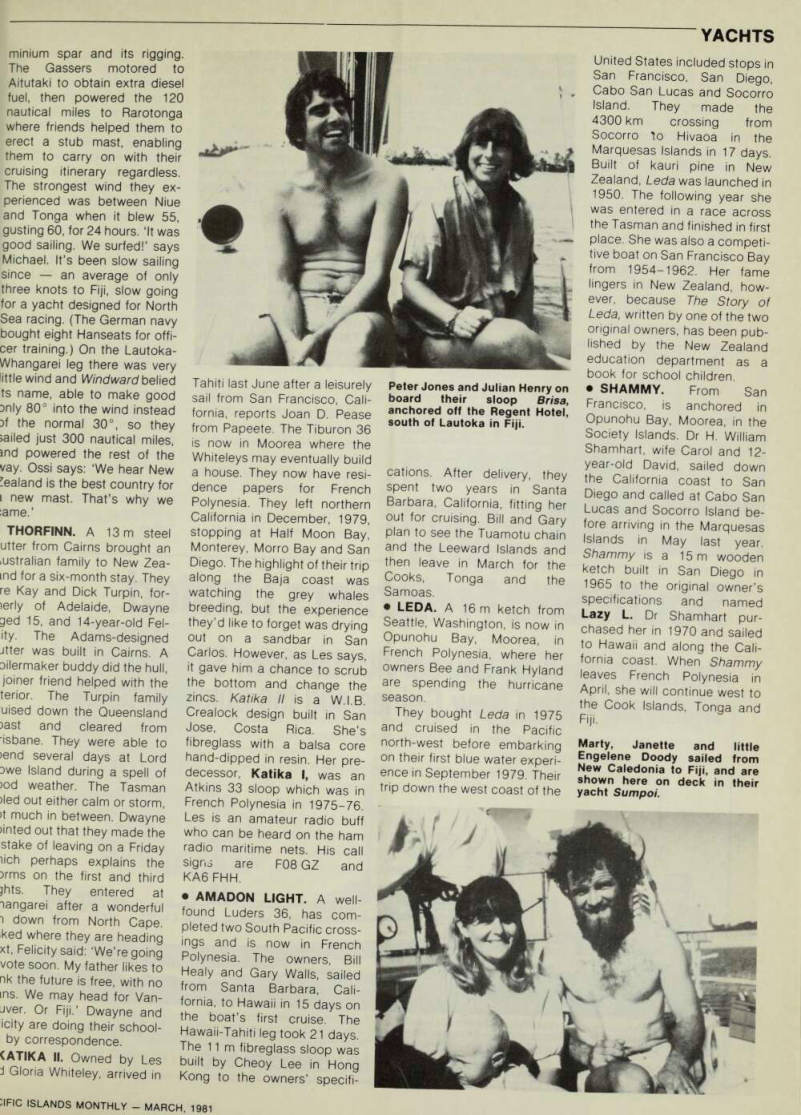
• POTPOURRI. Al and Karen Huso are back in their home port of Oxnard after a two-year cruise in their Islander 32 around the Pacific Basin. The final leg of their return voyage from New Zealand was ‘defi nitely our most pleasant long voyage. We never did get round the Pacific High’. It took them 25 days to sail 3200 nautical miles from Kaneohi Bay in Hawaii to their California landfall. They tell of flat glassy seas and warm days with a jreat deal of hazy overcast.
Fhey caught mahi mahi and albacore, and had fresh fish learly every day, finally resort ng to drying some tuna after narinating it in equal parts soy, 'inegar and water. At about 36 o 37° north latitude, 157° vest longitude. Karen and Al >icked up two glass floats,
using a large fishing net to salvage their valuable finds.
Several other yachts report finding them in the same gen eral area. Karen writes that she is back in the classroom and Al is studying for his Ocean Skip per’s licence. • ISLE OF FLIGHT. A 7.6 m yawl from San Diego, Isle of Flight spent the southern win ter in the Waikere Inlet in the Bay of Islands, New Zealand, an estuary appearing utterly remote and untouched. Here Jon Powers and Connie Nypen from Mono County, Cali fornia, and Washington’s Skagit Valley respectively became involved in the pro duction of Soma Windmills, wind generators designed for use both on yachts and in land installations. Isle of Flight, a one-off yawl built by Okomoto & Son, Yokohama, shares certain characteristics with the well-known Maya class by the same designer. When they found the 17-year-old double skin wooden yawl in 1976, their only previous experience had been sailing their 2.7 m lapstrake cedar dinghy in San Diego Bay, After a cruise to
Coho Point and the Channel Islands and a new set of sails, Jon and Connie set off for the Marquesas. Thirty-nine days later they made their landfall on Hiva Oa. They spent two and a half months in the Marquesas, and a full year in the Society Islands, circum navigating Tahiti, exploring the Leeward Islands, and surfing their two surfboards. Borabora to Rarotonga was an idyllic tradewind passage. The first day the 6.4 m waterline yacht reeled off 128 nautical miles.
Aitutaki was Connie’s and Jon’s favorite Pacific island ‘a good combination of barrier reef, motus, and high island’.
Isle of Flight carried on to the Samoas in Force 6-7 trade winds, then to Fiji by way of the Nanuku Passage and the Koro Sea, entering at Levuka. They then sailed inside the reef to the Rewa River, which they navigated across the island of Viti Levu to Suva, a distance of about 50 km negotiable by vessels up to 1.8 m draft de pending on tide. During their past year in New Zealand, among other adventures, they hitch-hiked down to the south
of the South Island. In the Bay of Islands, Isle of Flight took part in the Russell Tall Ships Race. ‘We placed 21st out of 29 entrants but were disquali fied as not being long enough, in spite of a bowsprit we jury rigged for the occasion.’
• Windward. An 11M
German Hanseat racing sloop limped into Whangarei jury rigged after having been dis masted several months pre viously. Austrians Ossi Gasser,
professional photographer,
and his wife Gerlinde, with their English bull terrier Bonita and three Hasselblad cameras, are making a round-the-world voyage to photograph for a book all the islands they visit.
Their 18-year-old son Michael leaves Windward in New Zea land. He will fly to Florida to join his sister Karen as fellow photographer on the Nor wegian-American Line cruise ship Sagafjord. Apparently Windward’s mast carried away in 30-knot winds 400 nautical miles from Tahiti when two lower shrouds parted. Michael dived over to attach a line to the masthead. As a result, they were able to salvage the alu
minium spar and its rigging.
The Gassers motored to Aitutaki to obtain extra diesel fuel, then powered the 120 nautical miles to Rarotonga where friends helped them to erect a stub mast, enabling them to carry on with their cruising itinerary regardless.
The strongest wind they ex perienced was between Niue and Tonga when it blew 55, gusting 60, for 24 hours. ‘lt was good sailing. We surfed!’ says Michael. It’s been slow sailing since an average of only three knots to Fiji, slow going for a yacht designed for North Sea racing. (The German navy bought eight Hanseats for offi cer training.) On the Lautoka- Whangarei leg there was very little wind and Windward belied ts name, able to make good 3nly 80° into the wind instead Df the normal 30 °, so they jailed just 300 nautical miles, md powered the rest of the vay. Ossi says: ‘We hear New Zealand is the best country for i new mast. That’s why we :ame.’
THORFINN. A 13 m steel utter from Cairns brought an Australian family to New Zea md for a six-month stay. They re Kay and Dick Turpin, for ierly of Adelaide, Dwayne ged 15, and 14-year-old Fel ity. The Adams-designed Jtter was built in Cairns. A Dilermaker buddy did the hull, joiner friend helped with the terior. The Turpin family uised down the Oueensland )ast and cleared from 'isbane. They were able to >end several days at Lord Dwe Island during a spell of >od weather. The Tasman )led out either calm or storm, >t much in between. Dwayne >inted out that they made the stake of leaving on a Friday lich perhaps explains the )rms on the first and third jhts. They entered at nangarei after a wonderful i down from North Cape, ked where they are heading xt, Felicity said; ‘We’re going vote soon. My father likes to nk the future is free, with no ms. We may head for Van jver. Or Fiji.’ Dwayne and icity are doing their school by correspondence. (ATIKA 11. Owned by Les J Gloria Whiteley, arrived in
Tahiti last June after a leisurely sail from San Francisco, Cali fornia, reports Joan D. Pease from Papeete. The Tiburon 36 is now in Moorea where the Whiteleys may eventually build a house. They now have resi dence papers for French Polynesia. They left northern California in December, 1979, stopping at Half Moon Bay, Monterey, Morro Bay and San Diego. The highlight of their trip along the Baja coast was watching the grey whales breeding, but the experience they’d like to forget was drying out on a sandbar in San Carlos. However, as Les says, it gave him a chance to scrub the bottom and change the zincs. Katika II is a W. 1.8.
Crealock design built in San Jose, Costa Rica. She’s fibreglass with a balsa core hand-dipped in resin. Her pre decessor, Katika I, was an Atkins 33 sloop which was in French Polynesia in 1975-76.
Les is an amateur radio buff who can be heard on the ham radio maritime nets. His call signs are FOB GZ and
Ka6 Fhh.
• Amadon Light. A Well
found Luders 36, has com pleted two South Pacific cross ings and is now in French Polynesia. The owners, Bill Healy and Gary Walls, sailed from Santa Barbara, Cali fornia, to Hawaii in 15 days on the boat’s first cruise. The Hawaii-Tahiti leg took 21 days.
The 11 m fibreglass sloop was built by Cheoy Lee in Hong Kong to the owners’ specifi
cations. After delivery, they spent two years in Santa Barbara, California, fitting her out for cruising. Bill and Gary plan to see the Tuamotu chain and the Leeward Islands and then leave in March for the Cooks, Tonga and the Samoas. • LEDA. A 16 m ketch from Seattle, Washington, is now in Opunohu Bay, Moorea, in French Polynesia, where her owners Bee and Frank Hyland are spending the hurricane season.
They bought Leda in 1975 and cruised in the Pacific north-west before embarking on their first blue water experi ence in September 1979. Their trip down the west coast of the
United States included stops in San Francisco, San Diego, Cabo San Lucas and Socorro Island. They made the 4300 km crossing from Socorro to Hivaoa in the Marquesas Islands in 17 days.
Built of kauri pine in New Zealand, Leda was launched in 1950. The following year she was entered in a race across the Tasman and finished in first place. She was also a competi tive boat on San Francisco Bay from 1954-1962. Her fame lingers in New Zealand, how ever. because The Story of Leda, written by one of the two original owners, has been pub lished by the New Zealand education department as a book for school children. • SHAMMY. From San Francisco, is anchored in Opunohu Bay, Moorea, in the Society Islands. Dr H. William Shamhart, wife Carol and 12year-old David, sailed down the California coast to San Diego and called at Cabo San Lucas and Socorro Island be fore arriving in the Marquesas Islands in May last year.
Shammy is a 15 m wooden ketch built in San Diego in 1965 to the original owner’s specifications and named Lazy L. Dr Shamhart pur chased her in 1970 and sailed to Hawaii and along the Cali fornia coast. When Shammy leaves French Polynesia in April, she will continue west to the Cook Islands, Tonga and Fiji.
Marty, Janette and little Engelene Doody sailed from New Caledonia to Fiji, and are shown here on deck in their yacht Sumpoi.
Peter Jones and Julian Henry on board their sloop Brisa, anchored off the Regent Hotel, south of Lautoka in Fiji.
• KIRSTEN. A Colin Archer type cutter, has returned to French Polynesia, where she will cruise for two years. In 1976 the owners, Stan and Joan Pease, sailed with their two daughters from San Francisco, California, to Tahiti and spent six months in the Society Islands. Feeling they’d only had a taste of the South Pacific, they determined to return. Following a short stop in Rarotonga, Cook Islands, Kirsten sailed non-stop to Syd ney, Australia, where the Pease family took jobs and continued to live aboard for three and a half years. They
spent three months on a refit last year before crossing the Tasman to New Zealand in May. After a month in Whangarei, they sailed direct to Tahiti. The 10 m cutter is now in Moorea and will go to the Leeward and Tuamotu Islands this year. • J.S. This 12 m Freedom cat ketch arrived in Rarotonga in early January, a time when Avatiu Harbour is usually empty, reports Paul Rysavy.
Owner/skipper Scott Willard, is bound for Australia with one crew member, Australian Louise Bee.
Willard left Newport, Rhode
Island, in April 1980 and sailed to Bermuda, the West Indies, the Caribbean, Curagao, Panama, Ecuador, the Marquesas, Tuamotus and the Societies before arriving in Rarotonga. The 10-month-old ketch is constructed from fibreglass and balsa, a com bination that Willard believes will stand up to any heavy weather they may encounter on their journey.
From Rarotonga, J.S. sails to Penrhyn, Pago Pago, West ern Samoa, Fiji, the Loyalty Islands and New Caledonia before following the Australian coast down to Sydney. • TAIYO. Another visitor to Rarotonga in January was Taiyo, a 29 m (23 m on deck) brigantine. Taiyo is a charter boat owned by 16 partners, and is skippered by the operat ing partner, Terry Burkiss. The steel vessel was designed by Eldridge McGuinness, and is a replica of the traditional 18th century square-rigged brigan tines.
In Rarotonga, a group of tourists boarded Taiyo for a
13-day tour of the Cooks. After returning to Rarotonga, another group will sail to Tonga. The brigantine is fol lowing a set tour schedule throughout the Pacific, ultimately arriving in Port Moresby, Papua New Guinea in September, where a new tour schedule will be arranged.
Taiyo was in the limelight last year when Glynn Christian, a direct descendant of Fletcher Christian, who engineered the mutiny on the Bounty, char tered the brigantine to try to solve some of the mysteries surrounding Fletcher Christian and his fellow crew members.
The Taiyo sailed from Tahiti to Tubuai and Pitcairn, where they searched for a mass grave which could contain Fletcher Christian’s bones, and for a treasure of gold and silver coins which is known to have been on the Bounty but has never been found. The results of Christian’s research will be made public when he publishes his biography of his great-great-great-great grand father.
Advertisements & other items, pp. 73-78 (3 items)
'Ific Islands Monthly - March, 1981
R. I. Muirhead Company
WHEN YOUR DEALER CAN’T SUPPLY
SPARE PARTS SERVICE
EXPORTERS
ESTABLISHED 1935
We furnish genuine Spare parts for any American manufactured Construction • Mining • Logging • Transportation • Quarry and Industrial Equipment.
“EMERGENCY SERVICE IS OUR SPECIAL TY”
WE WILL ARRANGE CUSTOM CLEARANCE AND DELIVERY TO YOUR WAREHOUSE.
SATiSFiED CUSTOMERS THROUGHOUT AUSTRALIA. NEW ZEALAND, PAC.FiC .SLANDS, SOUTH EAST AS.A AND OTHER
COUNTRIES - REFERENCES AVAILABLE.
TELEX: 69-1392
"S S R 441 E 8 AD LOS ANGELES 192 * AVENUE 1 149 4418 LOS ANGELES, CALIF. 90058
P.O. BOX 58512 A
If you’ve got a problem
you can stick it!
Quik Stik have a range of hardworking self adhesive products designed to assist you with stock control, filing, product pricing and car decorating.
Stock labels. Retailers’ pricing guns.
Printers packs. Safety tread - adhesive vinyl for slippery areas. Auto accessories - Decrastrip and Pinstripe. Each product designed to do a job and stick to it.
See your nearest Quik Stik stockist.
They’re right throughout the Pacific Islands and South East Asia. Or contact Quik Stik in New Zealand.
If you’ve got a problem, we’ve got a label for it.
Quik Stik International Limited Telex: NZ 21717. P.O. Box 76221, Manukau City, Auckland, New Zealand.
Cable: Quik Stik Auckland. o 25000
In Europe The Metro means a fast,
frequent and inexpensive means of transport...
Ours looks different but means the same!
Introducing the New SOLAIR METRO 11
SOMIR
SOMIR
A pressurised, air conditioned, turbine
powered, radar equipped, fast, frequent and
inexpensive means of transport.
The introduction of the new Metro 1 1 aircraft on routes between Honiara and Munda in the Solomon Islands, Honiara and Kieta P.N.G., and a new direct service between Honiara and Espirito Santo in Vanuatu will initiate a new era in fast, modern and comfortable aviation in the South Pacific.
If your business brings you to our part of the Pacific, you can now fly when you choose, rather than be dictated to by airline schedules. Our frequent Metro service will connect you with Honiara, a major transit point for international jet sevices to Australia, New Zealand, Vanuatu, Fiji, Hong Kong, Japan, Taipai, the Philippines and the Northern Pacific. «J
FLY THE METRO
CONNECTION
It's a fast, frequent and exciting means of travel!
General Sales Agents in Australia Pacific Unlimited 359 Queen St. Brisbane Phone 229 6933 Telex 42558 Cnr. York & Market Sts. Sydney Phone 267 5166 Telex 70723
rTTTi
SOMIR
The Solomon Islands'
Regional Airline.
FQR SALE
43' COLIN ARCHER massively constructed ship is fir on oak.
Served fifty years as pilot boat in North Sea before conversion to yacht. 135 hp Scania-Vabis diesel, two sets of sails. Gross wt: 25 tons; Ballast: 10 tons; Beam: 16ft.; Draft B'6". Two double staterooms am idship; VHP, DSB, RDF. Full safety gear. Sleeps eight. Boat in Suva, Fiji.
Call Crider, 383 991 or write: P.O. Box 218, Suva, Fiji.
Delivery can be arranged.
Asking $28,000.
South Sea Freighters Limited
Announcing: A 30-day service between Singapore,
Malaysia, Papua New Guinea and the Solomon Islands is? - **■*- • • ‘ -%.
W
tXi db
t >' *■ -> Vanuatu; South Sea Freighters Limited, PO Box 166 Port Vila • Singapore: Bienley & Co. (Pte) Ltd Telex RS 25114, Phone; 981935 s hu- Minnini Fxnrfiss I mes • Oro Bav: Carnell Carriers, Pooondetta P.N.G • Madang: B. J, Back • Lae; Nuigmi Express Lines* Wewak Burns Philp (N G.) Ltd AGENTS; . nkl „ , Serviced by MV Solomon Sea and MV Bismarck Sea.
o
TIMKEN
PUTYOUR
FOOT DOWN.
DEMAND
TIMKEN
BEARINGS!
\ K % If you’re hard headed about the bearings you use . . . put your foot down!
Demand Timken" tapered roller bearings, and you’ll get the brand with proven quality, durability and performance.
The brand that’s given you a long run for your money, wherever it’s used.
On top of all this, you’ll benefit from our consistent supply, delivery, and sales and service engineering assistance available from Australian Timken and Authorized Timken" Bearing Distributors throughout the Pacific.
Another way of looking at it is that you’re not going to put your foot in it when you put your foot down and demand Timken bearings.
TIMKEN
REGISTERED TRADEMARK
TAPERED ROLLER BEARINGS
Authorised Timken' Bearing Distributors in the Pacific are: Enterprises LtT^HONIARA^nh 063 ' 1 ? 9 ® ervice Company Ltd., AUCKLAND; Niven Bearings Limited, AUCKLAND- United 4954 4
THE BANK LINE
28 Day Service
United Kingdom and Continent to;
PAPEETE • NOUMEA
PAPUA NEW GUINEA and SOLOMON ISLANDS
PORT VILA& SANTO BY TRANSHIPMENT
■¥r United Kingdom and Continent to: SUVA AND LAUTOKA (FCL LCL & UNITISED ONLY) Papua New Guinea and Solomon Islands to:
UNITED KINGDOM and CONTINENT
For particulars apply:
THE BANK LINE (AUSTRALASIA) PTY. LTD.
18th Floor 1 York Street SYDNEY NSW 2000 Australia Tel: 272041 Telex: 24063 ,2,
Yachts
'IFIC ISLANDS MONTHLY - MARCH, 1981
Services
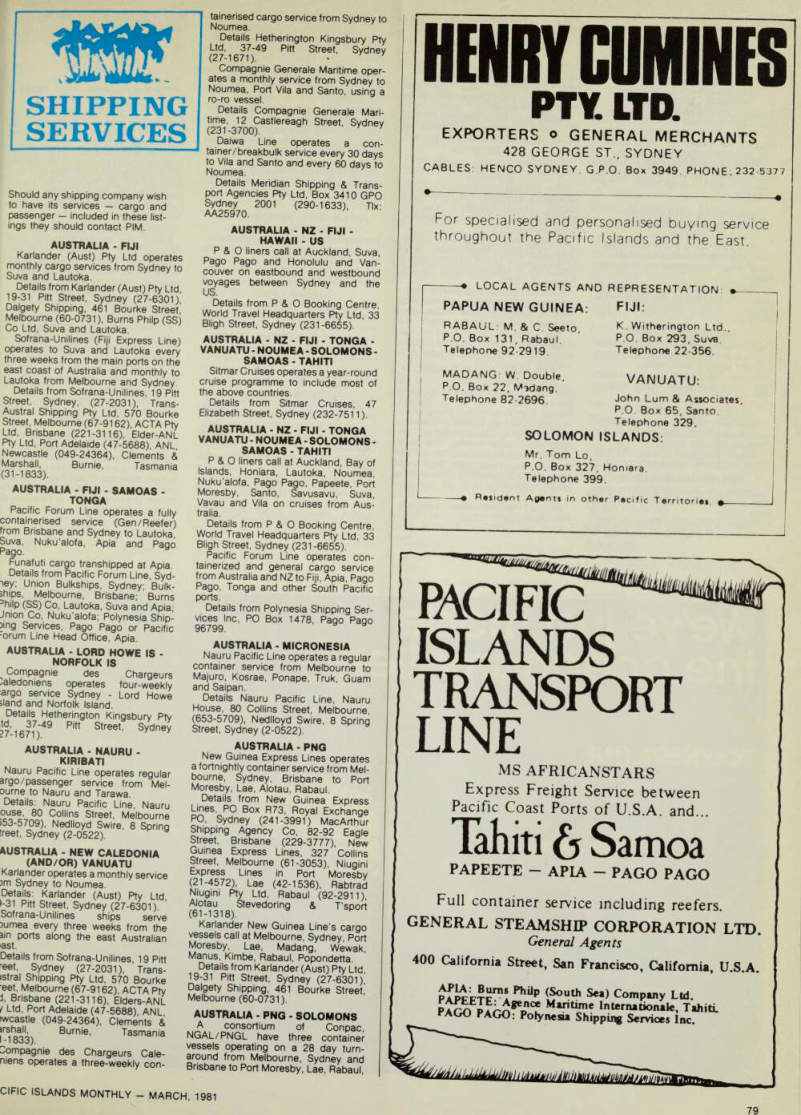
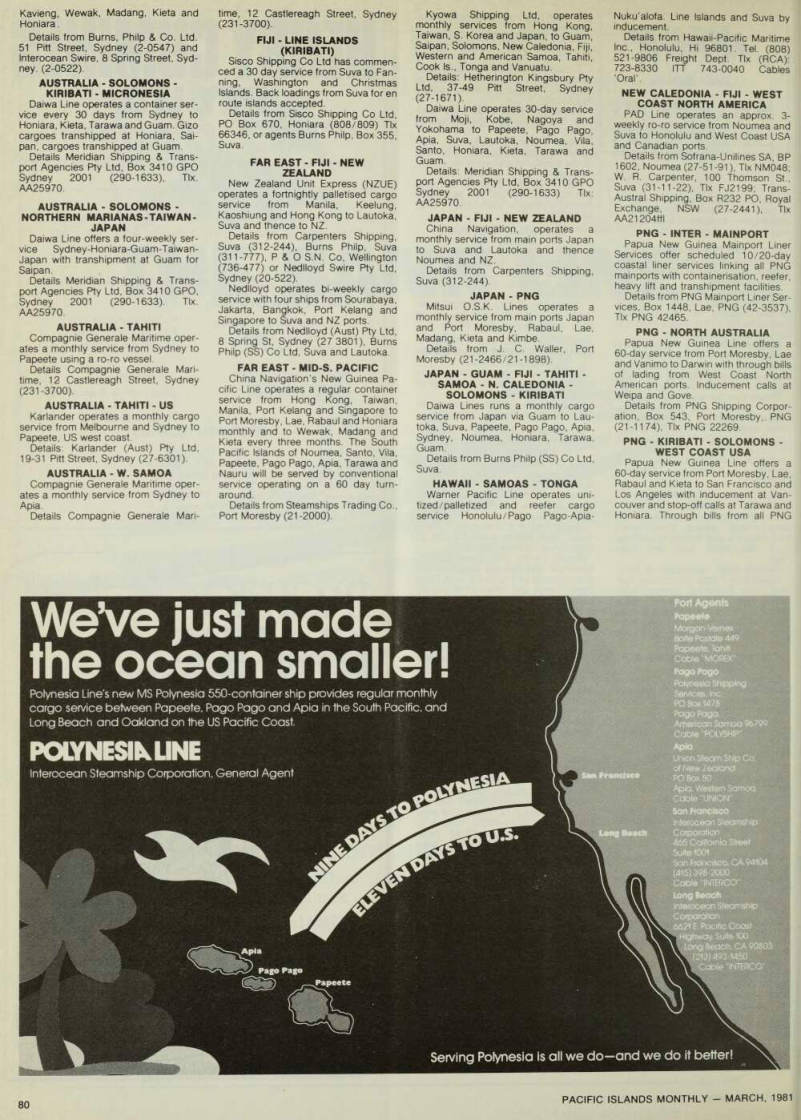
Shipping
Should any shipping company wish to have its services cargo and passenger included in these list ings they should contact PIM.
Australia - Fiji
Karlander (Aust) Pty Ltd operates monthly cargo services from Sydney to Suva and Lautoka.
Details from Karlander (Aust) Pty Ltd, 19-31 Pitt Street, Sydney (27-6301), Dalgety Shipping, 461 Bourke Street, Melbourne (60-0731), Burns Philp (SS) Co Ltd, Suva and Lautoka.
Sofrana-Unilines (Fiji Express Line) operates to Suva and Lautoka every three weeks from the main ports on the east coast of Australia and monthly to Lautoka from Melbourne and Sydney.
Details from Sofrana-Unilines, 19 Pitt Street, Sydney, (27-2031), Trans- Austral Shipping Pty Ltd, 570 Bourke Street, Melbourne (67-9162), ACTA Pty Ltd, Brisbane (221-3116). Elder-ANL Pty Ltd, Port Adelaide (47-5688), ANL Newcastle (049-24364), Clements & Marshall, Burnie, Tasmania (31-1833).
Australia - Fiji - Samoas ■
Tonga
Pacific Forum Line operates a fully containerised service (Gen /Reefer) from Brisbane and Sydney to Lautoka Suva, Nukualofa, Apia and Pago Pago.
Funafuti cargo transhipped at Apia Details from Pacific Forum Line, Syd ney; Union Bulkships, Sydney; Bulk ships, Melbourne, Brisbane; Burns 3 hilp (SS) Co, Lautoka, Suva and Apia; Jnion Co. Nukualofa; Polynesia Ship )ing Services, Pago Pago or Pacific ■orum Line Head Office, Apia.
Australia - Lord Howe Is -
Norfolk Is
N Compagnie des Chargeurs /aledoniens operates four-weekly argo service Sydney - Lord Howe sland and Norfolk Island.
Details Hetherington Kingsbury Pty 57’ ictJc 49 Pitt Street - Sydney it-1 671).
Australia - Nauru -
Kiribati
Nauru Pacific Line operates regular argo/passenger service from Mel ourne to Nauru and Tarawa.
Details; Nauru Pacific Line, Nauru ouse, 80 Collins Street, Melbourne >53-5709), Nedlloyd Swire, 8 Spring treet, Sydney (2-0522).
Australia - New Caledonia
(And/Or) Vanuatu
Karlander operates a monthly service )m Sydney to Noumea.
Details: Karlander (Aust) Pty Ltd 1-31 Pitt Street, Sydney (27-6301).
Sofrana-Unilines ships serve )umea every three weeks from the Jin ports along the east Australian ast.
Details from Sofrana-Unilines, 19 Pitt eet, Sydney (27-2031). Trans istral Shipping Pty Ltd. 570 Bourke eet, Melbourne (67-9162), ACTA Pty 1, Brisbane (221-3116). Elders-ANL / Ltd, Port Adelaide (47-5688), ANL (wcastle (049-24364), Clements & Burnie, Tasmania I -1833).
Sompagnie des Chargeurs Cale niens operates a three-weekly con
tainerised cargo service from Sydney to Noumea.
Details Hetherington Kingsbury Pty Ltd, 37-49 Pitt Street, Sydney (27-1671). • 1 Compagnie Generate Maritime oper ates a monthly service from Sydney to Noumea, Port Vila and Santo, using a ro-ro vessel.
Details Compagnie Generate Mari time, 12 Castlereagh Street, Sydney (231-3700).
Daiwa Line operates a con tainer/breakbulk service every 30 days to Vila and Santo and every 60 days to Noumea.
Details Meridian Shipping & Trans port Agencies Pty Ltd, Box 3410 GPO Sydney 2001 (290-1633), Tlx AA25970.
Australia - Nz - Fiji -
Hawaii - Us
P & O liners call at Auckland, Suva, Pago Pago and Honolulu and Van couver on eastbound and westbound voyages between Sydney and the US.
Details from P & O Booking Centre, World Travel Headquarters Pty Ltd, 33 Bligh Street, Sydney (231-6655), AUSTRALIA - NZ - FIJI - TONGA -
Vanuatu - Noumea - Solomons -
Samoas - Tahiti
Sitmar Cruises operates a year-round cruise programme to include most of the above countries.
Details from Sitmar Cruises, 47 Elizabeth Street, Sydney (232-7511).
AUSTRALIA - NZ - FIJI - TONGA
Vanuatu - Noumea - Solomons -
Samoas - Tahiti
P & O liners call at Auckland, Bay of Islands, Honiara, Lautoka, Noumea, Nukualofa, Pago Pago, Papeete, Port Moresby, Santo, Savusavu, Suva, Vavau and Vila on cruises from Aus tralia.
Details from P & O Booking Centre, World Travel Headquarters Pty Ltd, 33 Bligh Street, Sydney (231-6655).
Pacific Forum Line operates con tainerized and general cargo service from Australia and NZ to Fiji, Apia, Pago Pago, Tonga and other South Pacific ports.
Details from Polynesia Shipping Ser vices Inc, PC Box 1478, Pago Paqo 96799.
Australia - Micronesia
Nauru Pacific Line operates a regular container service from Melbourne to Majuro, Kosrae, Ponape, Truk, Guam and Saipan.
Details Nauru Pacific Line, Nauru House, 80 Collins Street, Melbourne, (653-5709), Nedlloyd Swire, 8 Spring Street, Sydney (2-0522).
Australia - Png
New Guinea Express Lines operates a fortnightly container service from Mel bourne, Sydney, Brisbane to Port Moresby, Lae, Alotau, Rabaul.
Details from New Guinea Express Lines, PC Box R 73, Royal Exchange PC, Sydney (241-3991) MacArthur Shipping Agency Co, 82-92 Eagle Street. Brisbane (229-3777), New Guinea Express Lines. 327 Collins Street, Melbourne (61-3053), Niugini Express Lines in Port Moresby (21-4572), Lae (42-1536), Rabtrad Niugini Pty Ltd, Rabaul (92-2911), Alotau Stevedoring & T'sport (61-1318). M Karlander New Guinea Line's cargo vessels call at Melbourne, Sydney, Port Moresby, Lae, Madang, Wewak, Manus, Kimbe, Rabaul, Popondetta Details from Karlander (Aust) Pty Ltd 19-31 Pitt Street, Sydney (27-6301)’
Dalgety Shipping, 461 Bourke Street’
Melbourne (60-0731).
Australia - Png - Solomons
A consortium of Conpac, NGAL/PNGL have three container vessels operating on a 28 day turn around from Melbourne, Sydney and Brisbane to Port Moresby, Lae, Rabaul
Kavieng, Wewak, Madang, Kieta and Honiara.
Details from Burns, Philp & Co. Ltd. 51 Pitt Street, Sydney (2-0547) and interocean Swire, 8 Spring Street, Sydney. (2-0522).
Australia - Solomons -
Kiribati - Micronesia
Daiwa Line operates a container service every 30 days from Sydney to Honiara, Kieta, Tarawa and Guam. Gizo cargoes transhipped at Honiara, Saipan, cargoes transhipped at Guam.
Details Meridian Shipping & Transport Agencies Pty Ltd, Box 3410 GPO Sydney 2001 (290-1633), Tlx.
AA25970
Australia - Solomons -
Northern Marianas-Taiwan-
Japan
Daiwa Line offers a four-weekly service Sydney-Honiara-Guam-Taiwan- Japan with transhipment at Guam for Saipan, Details Meridian Shipping & Transport Agencies Pty Ltd, Box 3410 GPO, Sydney 2001 (290-1633). Tlx, AA25970 a 1 ictrai ia TAHITI
Australia - Tahiti
Compagnie Generale Maritime operates a monthly service from Sydney to Papeete using a ro-ro vessel.
Details Compagnie Generale Maritime, 12 Castlereagh Street, Sydney (231-3700).
Australia . Tahiti - Us
AUSTRALIA - lAßiii - Ub Karlander operates a monthly cargo service from Melbourne and Sydney to Papeete. US west coasL
icPU p,. eSL™ fo\ tm 1
19-31 Pm Street. Sydney (27-6301).
Australia - W. Samoa
Compagnie Generale Maritime operates a monthly service from Sydney to Apia.
Details Compagnie Generale Mari-
time, 12 Castlereagh Street, Sydney (231-3700). pin . mkjc ISLANDS
(Kiribati)
S isco Shipping Co Ltd has commen ce(j a 30 day service from Suva to Fan ning. Washington and Christmas Islands. Back loadings from Suva for en route islands accepted, Details from Sisco Shipping Co Ltd, PO Box 670, Honiara (808/809) Tlx 66346, or agents Burns Philp, Box 355, Suva.
Cad Cact
Hah E
New Zealand Unit Express (NZUE) operates a fortnightly palletised cargo service from Manila, Keelung, Kaoshiung and Hong Kong to Lautoka, Suva and thence to NZ.
Details from Carpenters Shipping, Suva (312-244), Burns Philp, Suva (311-777), P & O S.N. Co, Wellington (736-477) or Nedlloyd Swire Pty Ltd, Sydney (20-522).
Nedlloyd operates bi-weekly cargo service with four ships from Sourabaya, Jakarta, Bangkok, Port Kelang and Singapore to Suva and NZ ports.
Details from Nedlloyd (Aust) Pty Ltd, q spring St, Sydney (27 3801), Burns Phi p (SS) Co Ltd Suva and Lautoka
Far East - Mid-S. Pacific
China Navigation’s New Guinea Pa cific Line operates a regular container service from Hong Kong, Taiwan, Manila, Port Kelang and Singapore to Port Moresb Lae a ßabaul £ oniara month| an J , 0 Wewak Mad an(j Kieta every three months. The South Paci,ic lslands 01 Noumea, Santo, Vila, Papeete. Pago Pago, Apia. Tarawa and Nauru will be served by conventional service operating on a 60 day turn around.
Details from Steamships Trading Co., Port Moresby (21-2000).
Kyowa Shipping Ltd, operates monthly services from Hong Kong, Taiwan, S. Korea and Japan, to Guam, Saipan, Solomons, New Caledonia, Fiji, Western and American Samoa, Tahiti, Cook Is., Tonga and Vanuatu.
Details: Hetherington Kingsbury Pty Ltd, 37-49 Pitt Street, Sydney (27-1671).
Daiwa Line operates 30-day service from Moji, Kobe, Nagoya and Yokohama to Papeete, Pago Pago.
Apia, Suva, Lautoka, Noumea, Vila, Santo, Honiara, Kieta, Tarawa and Guam.
Details: Meridian Shipping & Trans port Agencies Pty Ltd, Box 3410 GPO Sydney 2001 (290-1633) Tlx: AA25970.
Japan - Fiji - New Zealand
China Navigation, operates a monthly service from main ports Japan to Suva and Lautoka and thence Noumea and NZ.
Details from Carpenters Shipping, Suva (312-244).
Japan - Png
Mitsui O.S.K. Lines operates a monthly service from main ports Japan and Port Moresby, Rabaul. Lae, Madang, Kieta and Kimbe.
Details from J. C. Waller, Port Moresby (21-2466/21-1898).
JAPAN - GUAM - FIJI - TAHITI -
Samoa - N. Caledonia -
Solomons • Kiribati
Daiwa Lines runs a monthly cargo service from Japan via Guam to Lau toka. Suva, Papeete. Pago Pago, Apia, Sydney, Noumea, Honiara, Tarawa, Guam.
Details from Burns Philp (SS) Co Ltd, Suva.
Hawaii - Samoas - Tonga
Warner Pacific Line operates uni tized/palletized and reefer cargo service Honolulu/Pago Pago-Apia-
Nuku’alofa. Line Islands and Suva by inducement.
Details from Hawaii-Pacific Maritime Inc., Honolulu, Hi 96801. Tel. (808) 521-9806 Freight Dept. Tlx (RCA): 723-8330 ITT 743-0040 Cables ‘Oral’.
New Caledonia - Fiji - West
Coast North America
PAD Line operates an approx. 3weekly ro-ro service from Noumea and Suva to Honolulu and West Coast USA and Canadian ports.
Details from Sofrana-Unilines SA, BP 1602, Noumea (27-51-91), Tlx NMO4B; W. R. Carpenter. 100 Thomson St., Suva (31-11-22), Tlx FJ2199; Trans- Austral Shipping, Box R 232 PO, Royal Exchange, NSW (27-2441), Tlx AA2l2o4ffl
Png - Inter - Mainport
Papua New Guinea Mainport Liner Services offer scheduled 10/20-day coastal liner services linking all PNG mainports with containerisation, reefer, heavy lift and transhipment facilities.
Details from PNG Mainport Liner Ser vices, Box 1448, Lae. PNG (42-3537), Tlx PNG 42465.
Png - North Australia
Papua New Guinea Line offers a 60-day service from Port Moresby, Lae and Vanimo to Darwin with through bills of lading from West Coast North American ports. Inducement calls at Weipa and Gove.
Details from PNG Shipping Corpor ation, Box 543, Port Moresby, PNG (21-1174), Tlx PNG 22269.
Png - Kiribati - Solomons -
West Coast Usa
Papua New Guinea Line offers a 60-day service from Port Moresby, Lae, Rabaul and Kieta to San Francisco and Los Angeles with inducement at Van couver and stop-off calls at Tarawa and Honiara. Through bills from all PNG
[mainports and mini-bridge services to other US and Canadian destinations.
Details from PNG Shipping Corpor ation, Box 543, Port Moresby, PNG (21-1174). Tlx PNG 22269; or from TFC Shipping, 100 California St, San Fran- I cisco, CA, USA (415 398-1604), Tlx
340958 Gts Ur Sfo.
Png - Uk/Continent
Bank Line operates regular cargo service from Port Moresby, Oro Bay, Kieta, Rabaul, Kimbe, Madang and Lae to Hull, Hamburg, Rotterdam, Antwerp and Le Havre.
Details from Bank Line (A’asia) Pty Ltd, 1 York Street, Sydney (27-2041); Burns Philp (PNG) Ltd, PNG ports.
Solomons - Uk/Continent
Bank Line operates regular cargo service from Honiara to Hull, Hamburg, Rotterdam, Antwerp and Le Havre.
Details from Bank Line (A'asia) Pty Ltd, 1 York Street. Sydney (27-2041); Trading Co, Honiara (389).
NZ - COOK IS - NIUE -
Tahiti
Shipping Corporation of NZ Ltd oper ates cargo services based on pallets and similar units from Auckland to Niue, Cook Islands and Tahiti.
Details from the Shipping Corp of NZ Ltd, PO Box 3420, Auckland (797-210), Waterfront Commission, PO Box 61, Rarotonga: Lighterage and Stevedoring Co, Aitutaki; Niue Govt Dffices, Niue Island Compagnie Mari time Polynesienne, B‘P’ 368, Papeete fahiti.
Nz - Fiji
Reef operates a regular 18-day ser vice from Auckland to Suva and Lau oka.
Details from Reef Shipping Agencies, 3 0 Box 3382. Auckland, NZ 77-1221-3).
Pacific Line with one ship operates crtnightly roro cargo service New Zealand, Lautoka, Suva.
Details: Sofrana Unilines. 18 Cus- Dms Street. Auckland (773-279) PO lox 3614, Telex; NZ2313.
IZ - FIJI - NORTH AMERICA (WC) Blue Star Line Ltd Pacific Coast con liner services. Only direct service to id from New Zealand. Blue Star jssels call at Suva and Honolulu on Z-US-West Coast voyages.
Details from Blueport ACT (NZ) Ltd D Box 192, Wellington (739-029) urns Philp (SS) Co Ltd. GPO Box 355’ jva, Fiji (311-777).
NZ - FIJI - SAMOAS - TONGA Pacific Forum Line operates a fully
tntainerised three-weekly service
ien/Reefer) from Auckland to Lau ka. Suva, Apia. Pago Pago and jku’alofa.
Details from "Pacific Forum Line, ellington; Union Co, Auckland, Lau <a, Suva, Apia and Nuku’alofa;
Hynesia Shipping Services, Pago
igo or Pacific Forum Line Head fice, Apia.
NZ - N. CALEDONIA - FIJI -
Solomons - Png
Pacific Forum Line operates a fully ntainerised service (Gen/Reefer)
im Lyttelton, Napier, Tauranga,
ickland to Suva, Lautoka, Honiara Jta, Lae and Port Moresby.
Details from Pacific Forum Line, Jllington; Shipping Corporation of Lyttelton, Napier; Union Co, uranga, Auckland, Suva, Lautoka; Jamships Trading Co, Kieta, Lae’ rt Moresby; Sullivans (SI) Ltd, niara or Pacific Forum Line Head ice, Apia. : - N. CALEDONIA - VANUATU -
Png - Solomons
sofrana Unilines with three ships op ites to Vila and Santo, to Honiara and pua New Guinea and to Norfolk tnd and Noumea.
Details from Sofrana Unilines. 18 stems Street, Auckland (773-279) Box 3614, Telex NZ2313.
Nz - Tahiti
Compagnie Tahitienne Maritime SA with one ship operates monthly service New Zealand - Papeete.
Details from Sofrana Unilines, PO Box 3614, 18 Customs St, Auckland (773-279), Tlx NZ2313.
Nz - Tonga - Samoas
Warner Pacific Line services Auckland - Nuku’alofa/Vavau/ Apia /Pago Pago fortnightly carrying general and freezer cargoes. Also Timaru - Nuku’alofa/Vavau/Apia every 21 days carrying freezer cargo.
Details from McKay Shipping Ltd, Downtown House, 21 Queen St, Auckland, PO Box 1372 (30-299), Cables MACSHIP, Telex NZ2554.
Europe - Tahiti -
New Caledonia
Compagnie Generate Maritime oper ates services from Europe and Mediter ranean ports to Papeete and Noumea using three ro-ro and multi-purpose vessels thus ensuring a bi-monthly sail ing to and from.
Details Compagnie Generate Mari time. 12 Castlereagh Street, Sydney (231-3700).
EUROPE - TAHITI - W. SAMOA -
Fiji - N. Caledonia
Nedlloyd offers regular cargo ser vices from Northern Europe and UK to Papeete, Apia, Fiji and New Caledonia.
Details Nedlloyd (Aust) Pty Ltd 8 Spring Street, Sydney (27-3801).
EUROPE - TAHITI - W. SAMOA - TONGA - FIJI - SOLOMONS - PNG Columbus Line Reederei GMBH op erates 2-monthly service from Ham burg, Rotterdam, Antwerp. Dunkirk and Le Havre to Papeete, Apia, Nukualofa, Suva, Lautoka, Noumea, Honiara. Port Moresby, Kieta, Rabaul, Lae, and return to Europe.
Details from Columbus Overseas Services Pty Ltd, 333 George Street Sydney (290-2966), Columbus Mari time Services, 17 Albert Street Auckland (77-3460).
Uk - N Continent - Fiji
The Bank Line operates a regular 28 day cargo service from Hull, Hamburg, Bremen, Antwerp, Rotterdam and Le Havre to Suva and Lautoka.
Details from The Bank Line (A'asia) Pty Ltd, 1 York St, Sydney (27-2041) Burns Philp (South Sea) Co Ltd. Suva and Lautoka.
Uk/N. Continent - Png -
Solomons
The Bank Line operates a regular 28 day cargo service from Hull, Hamburg, Bremen, Antwerp, Rotterdam and Le Havre to Port Moresby, Lae, Madang, Kimbe, Rabaul, Kieta and Honiara and on inducement to Yandina.
Details from The Bank Line (A’asia) Pty Ltd, 1 York Street, Sydney (27-2041); Burns Philp (PNG) Ltd, PNG ports; Trading Co Honiara.
Uk/N. Continent - Tahiti -
N. Caledonia - N. Hebrides
The Bank Line operates a regular 28 day cargo service from Hull. Hamburg.
Bremen, Antwerp, Rotterdam and Le Havre to Papeete and Noumea.
Details from The Bank Line (A’asia) Pty Ltd, 1 York Street, Sydney (27-2041); Ets A M Fare UTE, Papeete; Ets Ballande, Noumea.
US - FIJI - TAHITI - NZ -
Australia
The Bank and Savill Line Ltd, oper ates regular cargo services from US Gulf ports to Australia and NZ. Calls at Suva, Lautoka and Papeete on de mand.
Details from The Bank Line (A'asia) Pty Ltd. 1 York Street. Sydney (27-2041) or Howard Smith Industries Pty Ltd, 1 York Street, Sydney (27-5611). y
Us - Hawaii - Micronesia
Philippines, Micronesia & Orient Navigation Co (PM&O Lines) operates
regular container service on self sustained ship with ro-ro capabilities from Oakland, Portland and Honolulu to Majuro, Kosrae, Ponape, Truk, Saipan, Yap and Koror.
Details for Micronesia can be obtained from Larry Guerrero. PM&O Owners Rep, PO Box 803, Saipan, Ml
96950, Cable Commontime; Pm&O
Lines, 181 Fremont St, San Francisco, California 94105, Cable PMONAV.
Us - Hawaii - Nauru -
Micronesia
Nauru Pacific Line operates regular conventional/container and passenger service from San Francisco and Honolulu to Majuro, Ponape, Truk and Saipan. Cargo is accepted for Nauru and Kosrai with transhipment at Majuro and Ponape.
Details from Nauru Pacific Line, Nauru House, 80 Collins Street, Mel bourne (653-5709); North American Maritime Agencies, 100 California St., San Francisco. California 9411.
Us - Noumea - Fiji
PAD Line operates an approx 3-weekly roro service from West Coast USA and Canada to Noumea and Suva.
Details from Sofrana-Unilines SA, BP 1602, Noumea (27-51-91), Tlx NMO4B; W. R. Carpenter. 100 Thomson St, Suva (31-11-22), Tlx FJ2199; Trans-Austral Shipping. Box R 232 PO, Royal Exchange, NSW (27-2441), Tlx AA21204.
Us - Tahiti - Samoa
Pacific Islands Transport operates a five weekly cargo service from North America west coast ports to Papeete.
Pago Pago, Apia.
Details from Polynesia Shipping Ser vices Inc, PO Box 1478 Pago Pago 96799. y y Polynesia Line operates container and general cargo service from US west coast ports to Papeete and Pago Pago.
Details from Polynesia Shipping Ser vices Inc., PO Box 1478, Pago Pago 96799.
US - TAHITI - SAMOA - NZ - AUST Farrell Lines Inc. operate a fast reg ular lash/container cargo service from west coast ports Canada/USA to Papeete and Pago Pago thence to NZ and Australia.
Details Wilh Wilhelmson Agency, Sydney, Melbourne and Brisbane Tlx AA20136, Cable FARSHIPS Sydney; Dalgety (NZ) Ltd, Auckland and Wellington. Tlx NZ2445, Cable DALSHIP Auckland; Compagnie Mari time Polynesienne, Immeuble Franco Oceanienne, PO Box 368, Papeete Tahiti, Tel 26393, Tlx 258. FP ANSB Taporo. Cable OCEAN Papeete; Kneubuhl Maritime Service. PO Box 39, Pago Pago, Telephone 633-5121 ’
Tlx 782505.
Advertisements & other items, pp. 79-80 (2 items)
79
CIFIC ISLANDS MONTHLY - MARCH, 1981
Henry Cumines
PTY. LTD.
EXPORTERS o GENERAL MERCHANTS
428 GEORGE ST., SYDNEY
CABLES: HENCO SYDNEY. G.P.O. Box 3949 PHONE; 232-5377 f"or specialised and personalised buying service throughout the Pacific Islands and the East.
LOCAL AGENTS AND REPRESENTATION
PAPUA NEW GUINEA;
RABAUL: M. & C. See to P.O. Box 131, Rabaul.
Telephone 92-2919
FIJI;
K. Witherington Ltd., P.O. Box 293, Suva.
Telephone 22-356.
MADANG W. Double, P.O. Box 22, Madang.
Telephone 82-2696
VANUATU:
John Lum & Associates, P.O. Box 65, Santo.
Telephone 329.
SOLOMON ISLANDS:
Mr. Tom Lo, P.O. Box 327, Honiara Telephone 399.
Resident in other Pacific Territories. » I
ISLANDS
TRANSPORT
LINE
MS AFRICANSTARS
Express Freight Service between Pacific Coast Ports of U.S.A. and...
Tahiti 6 Samoa
PAPEETE - APIA - PAGO PAGO
Full container service including reefers.
GENERAL STEAMSHIP CORPORATION LTD.
General Agents 400 California Street, San Francisco, California, U.S.A.
PAPPPTP™! PhUp l?° uth *•*) Company Led.
M an tune Internationale, Tahiti "AGO PAGO; Polynesia Shippuw Services Inc.
WeVe just made
the ocean smaller!
Polynesia Line's new MS Polynesia 550-container ship provides regular monthly cargo service between Papeete, Pago Pago and Apia in the South Pacific, and Long Beach and Oakland on the US Pacific Coast.
POLYNESIA LINE
Interocean Steamship Corporation, General Agent Port Agents Papeete Morgan-Vernex oOa e 5511 & jS s VS v Apia Pago Pago Sk Serving Polynesia is all we do—and we do it better!
Deaths
of Islands People
Rose Christine Young
At the Norfolk Island Hospital on December 2, 1980. Born Rose Christine Quintal on September 20, 1890, Aunt Lil, as she was known, married her childhood sweetheart, Rupert Young, on his return from the Boer War in 1914. They had five children including Edgar (Brud) Young, whose recent death was reported last month (PIM Jan pB2). In an obituary tribute The Norfolk Islander wrote: ‘A strong character, always with a witty remark, she was a person who radiated gentleness with her firmness and had a particular care about all who came in contact with her ... Another of the older Norfolkers whose lifestyle we should all remember has been taken from us.’
Fredrick Stuart
Baker
On December 4, 1980, aged 86.
His son Len Baker writes: ‘My parents went to Fiji in 1922 on the SS Suva and lived there until 1948. Since 1961 they have lived at Woolgoolga, NSW, Australia. In 1924 my father joined the Prisons De partment in Suva and remained with it until his retirement in 1948. He would also be remem bered for his work with the Royal Life Saving Society as he founded the Fiji Branch in 1937 with the assistance of Charles
Lament, a teacher at Suva Boys’ Grammar School, who was later killed in a bombing raid over Germany while serv ing with the RNZAF in World War 11. On October 20 last year my parents celebrated their 60th wedding anniversary an event which brought together all their immediate family to a celebration at Woolgoolga. To have lived so long in such harmony is I believe proof that life in the islands cannot be as destructive as some critics would have us believe.’
Bruce Adams
On February 8 in Sydney, of cancer, aged 50. Bruce Adams was widely known and re spected in the Pacific Islands as a photo-journalist. He made more than 50 visits to Papua New Guinea, and was a regular visitor to other Island groups.
PIM published hundreds of his photographs over the years, including many memorable cover pictures. His last illus trated feature, prepared follow ing a visit to Solomon Islands, appeared in PI M’s February 1981 issue.
While working as a freelance, he produced Battleground South Pacific, a magnificent pictorial record of the after math of the war, which he later revised as Rust in Peace, a work which is still selling. He also produced two other books.
In recent years he joined the Australian Defence Depart ment as a photographer with the RAAF. His splendid, fre quently dramatic air-to-air photographs, published widely in newspapers and magazines, enhanced the public image of the RAAF, and he was always a popular and welcome super numerary with aircrews.
Bruce Adams was an unpre tentious man, modest about his skills, with a deep affection for the islands. His memorial is his extensive and invaluable library of film, in colour and black and white, which captured the Southwest Pacific and its people during an important period of their development.
S.I.
Nabetari Biribo
On January 5 in Kiribati, aged 58. The South Pacific Com mission Intermediate Reader 2 for Primary Schools tells the story of Nabetari, known in his
own country as The Marathon Swimmer’. The book contains the stories of his two great ordeals at sea. The first oc curred in the 1930 s when he, his father and companions were lost for a week on what should have been a one-day journey from Nikunau to Beru they eventually made landfall at Tabiteuea. The second was in 1942 when, in an effort to escape the Japanese occu pation, Nabetari and some com panions tried to sail from Ocean Island to the Gilberts, but wind and current being against them sailing east, they decided to sail westward. After a seven-month journey, during which all his mates perished, Nabetari eventually made landfall in the Ninigo Islands, in Papua New Guinea. It was 2400 km from his starting point. Apart from these experiences, Nabetari’s title came from his great ability as a long-distance swimmer.
Atoa Te’O Tuvale
In New Zealand in January, aged 64. Regarded as ‘irre placeable’ as a translator, Atoa was chief interpreter/ translator of Western Samoa’s Legislative Assembly. ‘Fifty years of public service was the enviable record of this greatly loved true servant of the people,’ was the comment of one Apia resident on news of his death. His former boss at the Legislative Assembly Lew Clare regarded him as ‘most diligent’ and having ‘a common sense approach to life’. Fata Faalogo Pito, manager of the Samoa Times, called Atoa’s translating ability ‘a God-given gift’. Though plagued by ill health for most of his life, Atoa never let it interfere with the goals he had set himself. His death during a holiday in New Zealand drew a spate of eu logies from his colleagues in the assembly, the elected members of the legislature, and from church and business leaders in the country.
Tu’Iha’Angana
In Auckland on January 24.
One of the nobles of the realm of King Taufa’ahau Tupou IV, Tu’iha’angana was a former MP. He was first elected as a representative of the Haapai nobles in 1941, shortly after being installed in the hereditary noble title of Tu’iha’angana.
Advertisements & other items, p. 81 (2 items)
81
3IFIC ISLANDS MONTHLY - MARCH, 1981
baiwa line
MOJI -KOBE ■NAGOYA -TARAWA ’NAURU*LAUTOK/\
BRIDGE OF THE SOUTH PACIFIC
container/RO-RO ships bring JAPAN/FAR EAST and
AUSTRALIA/NEW ZEALAND
round to your doorway* Please contact us or agent for whatever shipping need, for the best answer
T* baiwa mayicatiom CO., ltd.
Head Office . 15-15. I -chome. Awaza, Nish-ku. Osaka. Japan 550 Phone (06)531-0471 Telex 525-6324 Cable “DAILINE’Osaka
A«-SANTO«-VIL A«-NQUMEA»~ BRIS BANE«—SYDNEY«-AUCKLAND <
Advertisers' Index
Aust. Timken 77
Air New Zealand 24
Amatil 25
Aust. Dev. Assist. Board 63
Akai 2
Air Nauru 30-31
Aggie Grey 49
Aiwa 38
Aquilla 61
Bristow, D. 49
Bankline 78
Berkey, R.L. 82
Commonwealth Sec. 61
Carptrac 56
Clarion Shoji 8
Cable & Wireless 70
China Navigation Co. 69
Crioer 76
Dezurik Aust. 50
Downs Modular 66
Fujitsu Ten 34
Fleets 82
Group Mark 52
General Steamships 79
Henry Cumines 79
1.C.1. Tasman 32
Jergens, A. 27
Kerr Bros 72
Kyowa Shipping 71
Matsushita 46
Meridian Shipping 81
Muirhead, R.T. 73
Mono Pumps 12
National Insurance 62
Nelson & Robertson 66
Nissan 54-55
Nz Dairy Board 83
Portals 41
Pioneer 16
Papua Hotel 49
Polynesian Airlines 44
Polynesian Lines 80
Pacific Forum 82
Qbe Insurance 36
Quik Stik 74
Rex Aviation 40
Solarex 58
Sansui 60
Simms Engineering 59
So Lair 74
Suzuki 4,68
South Sea Freighters 76
Sony 84
Tatham, S.E. 28
Toyota 42-43
Victor 64
Video Recorder Centre 82
Wonderest 49
Yamaha 20
Advertisements & other items, pp. 82-84 (1 item)
Pacific
FLEETS
48ft. Twin Diesel Cruiser, bit. Norman Wright 1978, for Coastal Cruising, luxuriously furnished, Onan aux , Radar, Auto Pilot, S.S.B radio, Flying Bridge, Master's Cabin, $175,000.00.
FLEETS
221 Esplanade, Wynnum Central, Brisbane.
Cable FLEETS BRISBANE.
F.C.
SONY
VIDEO RECORDERS
COLOUR CAMERAS
& PORTAPAKS
MOVIE TAPES
CLOSE CIRCUIT TV.
AH Enquiries Welcomed
INTERCAPE AUSTRALIA
19-21 Lonsdale St, Melbourne 3000, Aust.
STUDY GOD'S WORD
AT HOME
Send for free catalogue.
Emmaus Bible Corresp. Sch., P.O. Box 904, Saipan, C.M. 96950
PACIFIC
FORUm
Line
OWNED BY THE PEOPLE
OF THE PACIFIC ISLANDS
Regular Monthly Liner Services
•.£; from Australia and New Zealand
MB to the South and Central Pacific
FOR INFORMATION CONTACT AGENTS:
AMERICAN SAMOA
Polynesian Shipping Services Inc. P.O. Box 1478, Pago Pago.
AUSTRALIA
The Australian National Line, 50 Queen Street, Melbourne.
Union Bulkships Pty.Ltd., 333-339 George Street, Sydney.
KIRIBATI:
Gilbert Islands Shipping Corp. P.O. Box 495, Tarawa.
FIJI;
Burns Philp South Sea Co Ltd. GPO Box 355, Suva.
NEW CALEDONIA
ETS Ballande, BP. C 4, Noumea.
VANUATU:
Burns Philp New Hebrides Limited, Vila.
NEW ZEALAND:
Tho Shipping Corp. of N.Z. Ltd. P.O. Box 3344, Wellington.
PAPUA NEW GUINEA:
Steamships Trading Co. Ltd. P.O. Box 1, Port Moresby.
SOLOMON ISLANDS
Sullivans S.l. Ltd. GPO Box 3, Honiara.
TONGA:
Union Steam Ship Co. P.O. Box 4, Nukualofa.
■AS * 0 * *r V . **>• s!f
sirs
fesSsS
s fel *?sas % *>*« <w - : jfe <■&*? apifl* *ar - •.✓ >'£ l * v ' ►•J • V‘ « * '4 >4~ H. *>' •• "W <' « l«L8 fW&0& 9fe m i 'i>- ' SI & . ■
IrV* 2
m P 3K >■*> >VSm ■ m*. 1U \m -**•*
Sw®s
6^S f jssj aa -■•f
mmsmm>
P \ non fat *milk * Wi
Axu
uoi
5* JO m non ps‘‘ Irtei milk m ** m m Arn :ftor r.
j*RS*
lini
»li» Wlk f isl 4 instant ■ Jf iad whole I %&or
A^ hor ' &*k J|l^W
m 09MAWO ■*^ fch ‘ qfcy wh J New Zea if rl/
3U creamed
out
butter
< / 4?
Anchors
milk
'^ftATffl
ilk
I . .
IT! >«(0^ g
Ilk
at stock cheese * Hum) y *“%■ ’<si S£ c ¥. *; -
sffigggte*
aSKT
9JS i et< ri
MIK
!fipu »!•
LSJ»
gr jv V? #C
ill
5? ••• •••! •*l! »••• •••I • ••• • •| •••* ••♦; **•! ••• ••M M‘| #••• ••• •IM ••• ••• 111 IS 5 »•»
liiiiii;
iiiliii
*•* **• M* .** II •••!!!• »•••*!!! •••*! •••mu «•«•••** «•••*•!!! »«»♦»•»•♦
IHMHH
•UIHIHI
IItWHtH
*»**•»*•* *** *** ,*» • ** it* »•* ,*• IB «*•••«•»»»♦
HHIUtMtMI
miihmiuh* mwhh*** *»•••*•***••**
MHHMUfI**
•••a •••I ••• »*• • •• »«• • •• • •• ••• •♦•••♦••• »•♦••
•UMHMMtMHUMU
ICF-2001
It'saSmall World Radio.
Sony makes the entire world seem as close as home with the new ICF-2001 world receiver. Incredibly compact, the ICF-2001 gives you the whole world of AM and FM. And with Sony's frequency synthesized "calculator type" tuning, one touch of a button easily gives you LW/MW/SW bands, including marine, amateur radio and even Citizen's band. The ICF-2001 offers you virtually every
broadcast source on the globe.
It's simple to operate. You don't have to be a professional radio operator to enjoy putting your ear to the world. If you're far from home, home won't seem so far, just preset the frequency to wherever home is. Whether it be America, Europe or Asia. You'll find it easily with the ICF-2001's four different tuning methods for fast and simple
operation. Sony's sophisticated technology gives you
precision and extreme stability and a microcomputer to control all reception functions. Like Direct Access, Memory, Auto Scan and Manual. All with a push of a button. The ICF-2001, the world receiver for the
world traveler far from home.