Islands

Pacific
Monthly
U^(9)U American Samoa US$1.75 Australia AS1.50 Fiji FS1.50 Hawaii & US mainland ... US$1.95 Nauru A$1.75 New Caledonia CFP1.90 NZ, Cook Islands, Niue ...NZ$1.50 Norfolk Island AS1.50 Papua New Guinea K1.45 Solomons S$1.50 Tahiti CFP1.90 Tonga P1.50
Ustt & Guam Us$1.95
Vanuatu AS1.50 Western Samoa T1.60 ‘Recommended retail price only.
Registered for posting as a publication — Category B.
J\( mmm
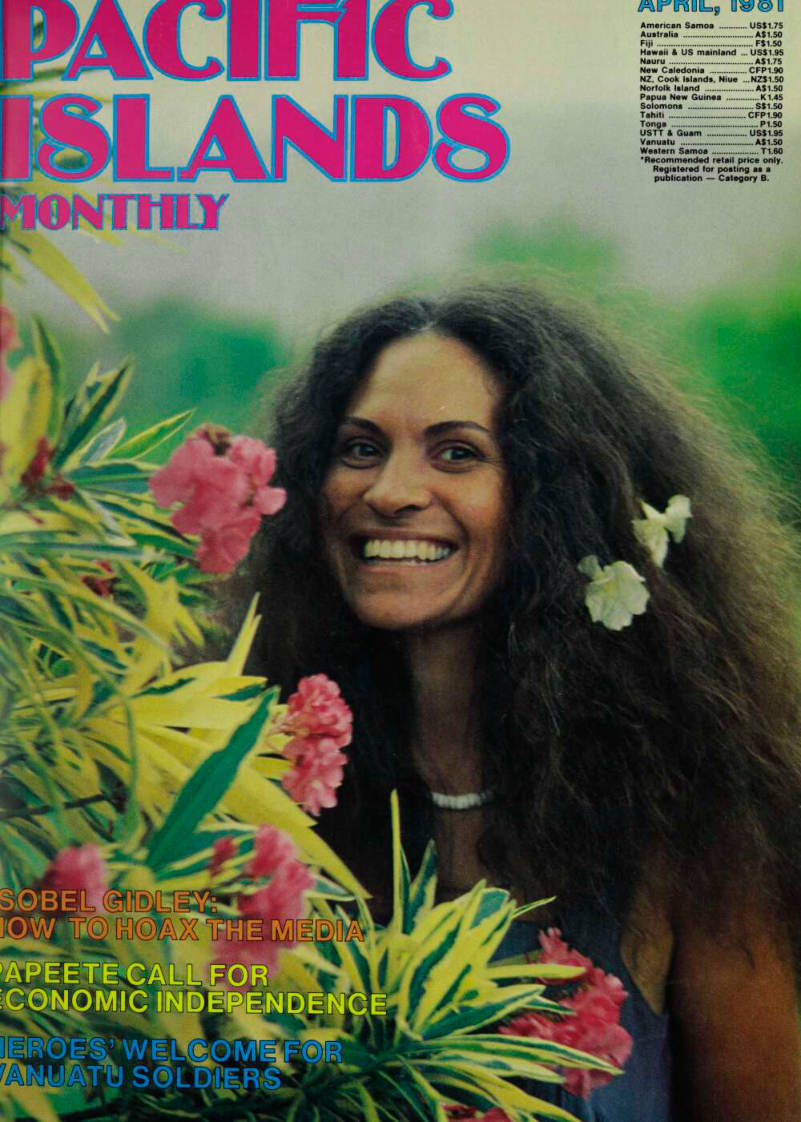
°° ve f lsabel Gidley. the actress who tooled Australian media people last December when she posed at a book launching as ‘Jimmy Stevens’ 27th wife’. There’s a lot more to Isobel than such horsino around as the story on p 24 will show. Richard Shears picture.
Advertisements & other items, p. 2 (1 item)
Toyota
How to find a REAL economy car.
When you look at a car billed as an economy
model, ask yourself a few questions.
What sort of fuel consumption can be expected?
Low? Good.
What about other operating costs? Oil, lubrication, that kind of thing. Low again? Great.
How about maintenance? The car has a low-breakdown record? You are definitely on the right track.
What is the average life of the car? Is it better than the average in your area? Super. That’s important in an economy car.
Now. How is the after service? Buying a car is not all in the price you know. Plenty of service outlets?
One economy car coming up. All you have to do is check the price. Then you can tell if you are really
getting an economy car.
You will probably find, after asking these questions about town, that REAL economy cars come down to Toyota, the world’s economy car builder.
See Toyota first. Then you won’t have to shop around.
IHE HAPPY ECONOMIZER
TOYOTA STARLET
The car that says economy in every way.
And you will be happy for it. Big inside.
Small outside. Miserly with petrol.
Without sacrificing comfort. A good buy in an economy car even for Toyota. mmmn
PAPUA NEW GUINEA:
ELA MOTORS,
Scratchley Rd„ Badili, P.O. Box 675, Port Moresby.
U.S. TRUST
TERRITORY; MICROL
CORPORATION,
P.O. Box 267, Saipan.
FIJI ISLANDS:
AUTOMOTIVE
SUPPLIES COMPANY,
P.O. Box 5177, Raiwaqa, Suva
AMERICAN SAMOA:
BURNS PHILP
(SOUTHSEA) CO., LTD.,
P.O. Box 129, Pago Pago.
WESTERN SAMOA:
BURNS PHILP
(SOUTHSEA) CO., LTD.,
P.O. Box 188, Apia.
TONGA: BURNS PHILP
(SOUTHSEA) CO., LTD.,
P.O. Box 55, Nukualofa.
GUAM: ATKINS, KROLL
(GUAM) LTD., P.O. Box
6428, Tamuning.
VANUATU:
NEW HEBRIDES MOTORS,
TOYOTA
SERVICE
* , , ;1
TOYOTA
? P.O. Box 18, Vila.
SOLOMON ISLANDS:
MENDANA
ENTERPRISES (5.1.)
LTD., P.O. Box 174,
Honiara.
TAHITI: NIPPON
AUTOMOTO, B.P. 342,
Papeete.
COOK ISLANDS:
COOK ISLANDS
TRADING
CORPORATION LTD.,
P.O. Box 92, Rarotonga.
NAURU ISLAND:
NAURU COOPERATIVE
SOCIETY.
REPUBLIC OF KIRIBATI:
TARAWA MOTORS,
Box 36, Bairiki, Kiribati.
NORFOLK ISLAND:
MOUNT PITT
(ENTERPRISES) LTD.,
P.O. Box 169.
NEW CALEDONIA:
SOCIETE IMPORTATION
AUTOMOBILE DU
PACIFIQUE, Rond-Point du Pacific (Station total) B.P. 438, Noumea.
The Toyota range includes: Toyota STARLET, Toyota COROLLA, Toyota CRESSIDA, Toyota HI-LUX, Toyota HI ACE, Toyota DYNA, Toyota LAND CRUISER
Pacific Islands Monthly
Vol. 52 No 4
April 1981
(Usps 952480)
Representatives
AUSTRALIA; Distribution; NSW & ACT: Allan Rodney Wright (Circulation) Pty Ltd, PO Box 907, Darlinghurst, NSW 2010, Elsewhere: Gordon & Gotch (A%asia) Ltd, Box 40, PO, Rosebery, NSW 2018 Advertising - Melbourne - Ray Brown Pty Ltd, 614 Queensberry St, North Melbourne 3051, telephone 329 8522, telex 31717, Brisbane - D.
Wood, Anday Agency, Box 1918, GPO, Brisbane 4001, tele phone 44 3485, 44 1546, Adelaide Hastwell Media, PO Box 30, Glen Osmond, SA 5064, 233 Glen Osmond Rd, Frewville, SA 5063, telephone 79 1869. Perth - Adrep, 62 Wickham St., East Perth, WA 6000, telephone 325 6395.
FIJI: Distribution and subscriptions Desai Bookshops, PO Box 160, Suva, Fiji, telephone Suva 23036. Advertising Fiji Times & Herald Ltd, 20 Gordon St, Suva, telephone 312 111, telex FJ2124 FRENCH POLYNESIA: Distribution - Hachette Pacifique, 10 Ave Bruat, Papeete, telephone 25610.
HAWAII, UNITED STATES; Distribution PiM, Hawaii. PO Box 22250, Honolulu, Hawaii 96822 Advertising Roger Brookes, PO Box 10217, Honolulu, Hawaii 96816, telephone 808 536 1 784 MICRONESIA. Advertising Roger Brookes, PO Box 10217, Honolulu, Hawaii 96816.
JAPAN; Advertising and subscriptions - Universal Media Corporation, CPO Box 46, Tokyo, telephone 666 3036 NEW CALEDONIA: Distribution Depot Centre de Presse Michel Pentecost, CBP2, Noumea, telephone 27 2434 27 4729 NEW ZEALAND: Distribution Gordon & Gotch, PO Box 584, 2 Carr Road, Mt. Roskill, Auckland 4. Advertising - International Media Representatives Ltd, PO Box 2313, Auckland, telephone 795 487; 493 389, cables Intereps, Auckland Subscriptions - Ross Haines & Son Ltd, PO Box 1289, Auckland, telephone 769 042 PAPUA NEW GUINEA; Distribution Gordon & Gotch PO Box 3395, Port Moresby, telephone 254551, 254855 Advertising - PNG Post-Courier, PO Box 85, Port Moresby telephone 21 2577 JNITED KINGDOM: The Herald & Weekly Times Ltd, No I Maltravers Street, London WC2R 3DZ, England, telephone )1 836 5162, telex London 21989.
JNITED STATES MAINLAND; Advertising Joshua B 3 owers Jr, Powers International Inc., 551 Fifth Ave New fork, New York 100 017, telephone 867 9580 telex >36514. Subscriptions - PIM, Hawaii, 2812 Kahawai St ■lonolulu, Hawaii 96822.
Subscriptions
’IM is airfreighted to most subscribers and agents in the ’acific Islands and the United States, but not the UK or the Continent.
ayment by personal cheque is accepted in Australian, US, ew Zealand, UK and Fiji currency. For other remittances ease obtain a bank draft in Australian dollars made payable the ANZ Banking Group, 88 Wentworth Avenue Sydney jstralia. 7 ' Jblished monthly by Pacific Publications (Aust.) Pty Ltd id printed in Australia by Paramac, Alexandria, NSW Aus iiian cover price is recommended retail only. Registered the GPO Sydney for transmission by post as a publication category B Second class postage paid at Honolulu jwaii. Copyright © 1978 Pacific Publications (Aust.) Pty
Ltd.
Postmaster Honolulu: Send address changes to PIM Hawaii, PO Box 22250, Honolulu Hawaii 96822.
jhu Local Aust.
American Samoa
Sus16
$13 Australia $A12 $12 Canada $US18 $14 /OOk Islands $13 ij' $F12 $12 ranch Polynesia
Cfp 1700
$14 Suam $US16 $13 lawaii $US16 $13 apan ¥4500 $16 Kiribati $13 licronesia $US16 $13 lauru $18 lew Caledonia
Cfp 1700
$14 lew Zealand
Snz13.50
$12 Hue $13 brtolk Island $12 brthern Marianas $US16 $13 apua New Guinea K12 $13 olomon Islands $13 anga $13 jvalu $13 nlted Kingdom Stg 10 $15 S Mainland $US18 $14 anuatu $13 'estern Samoa $13 sewhere $A16
This Month’s Features
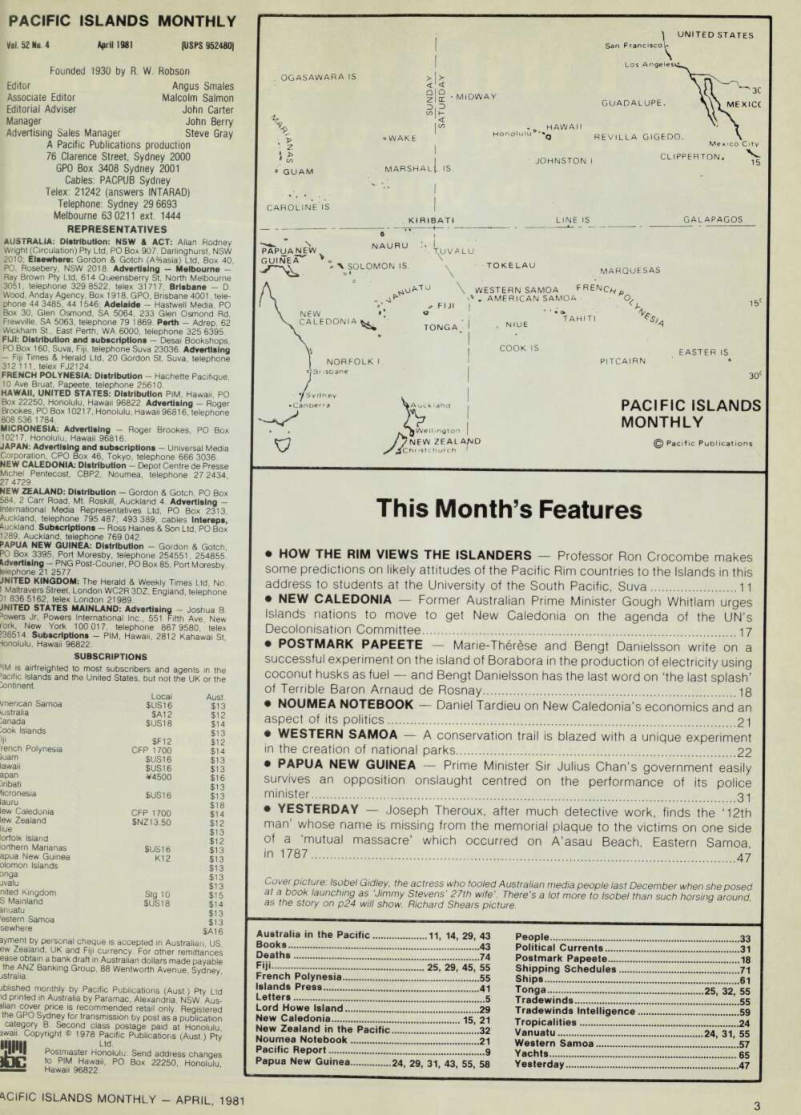
• HOW THE RIM VIEWS THE ISLANDERS Professor Ron Crocombe makes some predictions on likely attitudes of the Pacific Rim countries to the Islands in this address to students at the University of the South Pacific, Suva 11 • NEW CALEDONIA Former Australian Prime Minister Gough Whitlam urges Islands nations to move to get New Caledonia on the agenda of the UN’s Decolonisation Committee 17 • POSTMARK PAPEETE Marie-Therese and Bengt Danielsson write on a successful experiment on the island of Borabora in the production of electricity using coconut husks as fuel and Bengt Danielsson has the last word on ‘the last splash’ of Terrible Baron Arnaud de Rosnay iq • NOUMEA NOTEBOOK Daniel Tardieu on New Caledonia’s economics and an aspect of its politics 21 • WESTERN SAMOA A conservation trail is blazed with a unique experiment in the creation of national parks 22 • PAPUA NEW GUINEA Prime Minister Sir Julius Chan’s government easily survives an opposition onslaught centred on the performance of its police minister 31 • YESTERDAY Joseph Theroux, after much detective work, finds the ‘l2th man’ whose name is missing from the memorial plaque to the victims on one side of a mutual massacre’ which occurred on A’asau Beach, Eastern Samoa, in 1787 47
Australia in the Pacific 11, 14, 29, 43 Books 43 Deaths 74 Fiji 25, 29, 45, 55 French Polynesia 55 Islands Press 41
Letters .""*...5
Lord Howe Island 29 New Caledonia 15, 21 New Zealand in the Pacific 32 Noumea Notebook 21 Pacific Report g Papua New Guinea 24, 29, 31, 43, 55, 58
People 33 Political Currents 31 Postmark Papeete 18 Shipping Schedules 71 Ships 61 Tonga 25, 32, 55 Tradewinds 55 Tradewinds Intelligence 59 Tropicalities 24 Vanuatu 24, 31, 55 Western Samoa 57 Yachts 65 Yesterday 47
Advertisements & other items, pp. 3-4 (2 items)
3
ACIFIC ISLANDS MONTHLY APRIL, 1981
Founded 1930 by R. W. Robson Editor Angus Smales Associate Editor Malcolm Salmon Editorial Adviser John Carter Manager John Berry Advertising Sales Manager Steve Gray A Pacific Publications production 76 Clarence Street, Sydney 2000 GPO Box 3408 Sydney 2001 Cables: PACPUB Sydney Telex: 21242 (answers INTARAD) Telephone: Sydney 29 6693 Melbourne 63 0211 ext. 1444
'4 I* %
mi?
Cv D r w J? 3* I T 11 i H ! ■‘ I- I i
NEW : 7
ZEALAND
s- V WE EXPORT PRODUCTS IN ALL OF THE FOLLOWING GROUPS.
Frozen meat, fish and seafood (bulk and portion control) Dairy products Canned fruit Dry groceries Beer, wines and spirits Cigarettes Electrical appliances Household products Electrical supplies Builders hardware Engineering supplies Motor vehicles and spares and much more!!
Cannibalism,
Letters
facts and
fictions
In the January issue of PIM, Brett Hilder reviewed James Siers’ most recent book, Taratai II; A Continuing Pacific Adventure, praising the author’s skill as both writer and photographer. Like Brett Hilder, I have had a great deal of pleasure from James Siers’ other books and the criticism I feel obliged to make of one aspect of his new book is made with a certain reluctance.
The author recounts a story at the beginning of Chapter Fwo which your reviewer obvi ously accepted at face value as would most Europeans and, •egrettably, a great number of Pacific Islanders. The story is one of those seemingly endless lumbers of tales about canni lalism which one and all hap )ily believe are true stories, and lowever horrific and vile need lot be questioned. Let me show »ow misleading one of these iccounts can be.
Here is James Siers’ tale: The Mamanuca Islands were lot always so friendly. In the 840s the United States Ex iloring Expedition to the ‘acific anchored near what is ow Plantation Village. The rew became friendly with the ocal people. But Fiji was a urbulent place in those times nd the natives were fond of ating humans (italics are line). They unwisely sampled ome of the Americans and the ill fury of Commodore Wilkes irned upon them. ’
The journals of the Exploring xpedition give quite a ifferent description of the ime incident; On or about the 3rd July, 1840, a launch and a utter from the expedition ar ved at the southern end of lalolo (in the Mamanucas) to mdezvous with Commodore /ilkes. The day before an
armed party from the launch had gone ashore and while there had seized a boy ‘with an armload of war clubs’, and forced him to accompany them back to the beach in spite of protests from a crowd of other Fijians. The consequence of this action was an attack on a small party of Americans who landed on the following day hoping to pick up badly needed provisions. Two Americans were killed in the attack: one, Joseph Underwood, a man popular with his shipmates, the second, Wilkes Henry, even more unfortunate for the Fijians, nephew of the ex pedition’s commander.
As soon as Commodore Wilkes was told of the incident, he ordered a full-scale attack. ‘Destroy everything except women and children’, were his orders. The Fijians fought valiantly but were soon over come by ‘the irresistible force of the white man’s arms’. Their village was razed, many vil lagers were killed or wounded and the Americans sailed away with most of the island’s store of yams and coconuts.
Nowhere is there any men tion of Maloloans having ‘sampled some of the Amer icans’ and one would hardly describe any of the Americans’ actions as ‘friendly’.
I don’t mean to single out James Siers as the only Pacific writer whose preconceptions about cannibalism lead him to accept as authentic question able, even erroneous, accounts of the eating of human flesh as a common practice among cer tain Pacific Islanders; they all do it. Shirley Maddock, another New Zealand writer, in her newest book, These Antipodes, A New Zealand Album 1814 to 1854 , repeats verbatim sev eral second- or third-hand re ports of man-eating by New Zealand Maoris during the 19th century.
The author entertains not the slightest doubt about the authenticity of her sources. The book is sprinkled throughout with phrases like ‘killed and eaten’, ‘cannibal feast’ and ‘gnawed and mangled remains’.
A drawing of an eccentric 19th century trader-settler, Barnet Burns, sketched where or by whom we are not told, illus trates the subject in bizarre dress with a large bone of
doubtful type or origin, lying behind one of Burns’s feet.
Shirley Maddock’s flippant comment on this rather obvious ‘prop’ is that ‘tossed non chalantly behind one of Mr Burns’s feet is a human shin bone, picked clean’.
Fictional writing on this sub ject exercises no restraint what soever, just as one might expect.
Only last year, The Elizabeth Affair, a novel written by Robert Barry Holmes and set in early New Zealand tells us, ‘based on historical fact’, on pages 144 and 145 a dreadful tale of a cannibal orgy that allegedly followed a raid on a Maori village led by a devious and bloodthirsty chief named Te Rauparaha. Te Rauparaha was a real 19th century Maori chief of some renown. Presum ably this is one of the book’s ‘historical facts’. The orgy is described in almost loving de tail: ‘Though ... all from Elizabeth (an English ship) knew the Maoris were canni bals, the actual sight of human bodies being baked for eating was repulsive . . . They stood there staring at the Satanic scene’. And, further on, ‘The victorious raiding party were left on their own to enjoy the cannibal feast ... As they gnawed at the bones of dead Ngaitahu, the human fat dripped from their lips . . .’
This is not fiction based on ‘fact’ but the worst kind of purple prose calculated to ap peal to the lowest common denominator.
Unfortunately, many Pacific Islanders have come to believe what was originally an almost exclusively European preoccu pation, undoubtedly influenced by the sheer weight of the kind of evidence I have been examin ing. I recall two examples of this in letters from Papua New Guinea to PIM. One reader appeared to accept that the Fore of PNG are or were
cannibals who transmitted the fatal disease Kure throughout their tribe by eating contami nated flesh. There is no ‘hard’ evidence that either hypothesis is true. Another PNG reader wrote in the October issue deploring the misrepresentation of PNG society by foreign correspondents and then added ‘Cannibalism, which hardly exists today, was once a ritual practice’. Where is it still in existence? Where and by whom was it a ritual practice? What are the sources of these beliefs?
I have yet to turn up one story of cannibalism in the Pacific as a widespread, common practice which could be authenticated.
Like the old philosopher, I tend to regard belief in cannibalism as just another example of, ‘the trouble with most folks ain’t what they don’t know, but what they do know that ain’t so’.
Guy Bartell
Auckland New Zealand The work of Sir
Harry Luke
Malcolm Salmon’s article on Australian gunboat diplomacy in New Caledonia before the Pacific war (PIM Jan p 59) interested me, but I felt it didn’t do full justice to the part played by the late Sir Harry Luke and the small (900 tonnes) ‘gunboat’
HMCS Viti. I feel Sir Harry was the real diplomat who
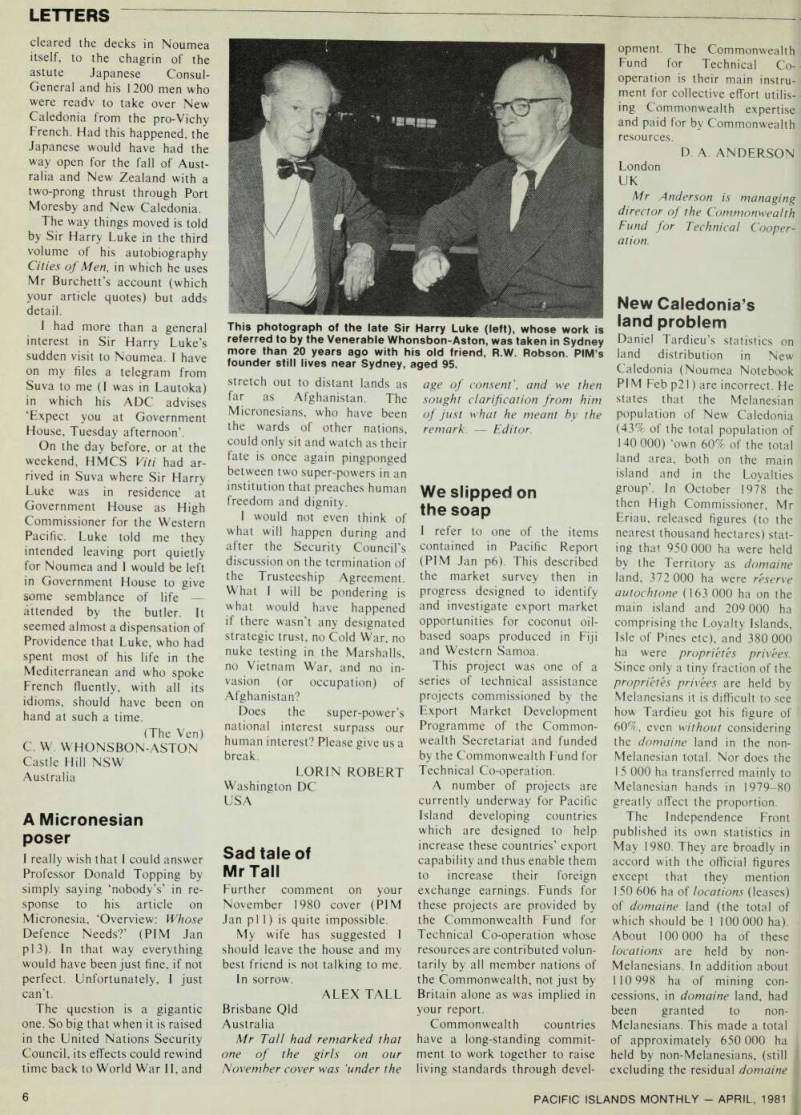
Although they were not eaten, this monument at Mt Auburn Cemetery in Cambridge Massachusetts, USA, is to the two Americans killed at Malolo in 1840, and the inscription reads: “Fell by the hands of savages while promoting the cause of science and
philanthropy.”
cleared the decks in Noumea itself, to the chagrin of the astute Japanese Consul- General and his 1200 men who were readv to take over New Caledonia from the pro-Vichy French. Had this happened, the Japanese would have had the way open for the fall of Aust ralia and New Zealand with a two-prong thrust through Port Moresby and New Caledonia.
The way things moved is told by Sir Harry Luke in the third volume of his autobiography Cities of Men, in which he uses Mr Burchett’s account (which your article quotes) but adds detail.
I had more than a general interest in Sir Harry Luke’s sudden visit to Noumea. I have on my files a telegram from Suva to me (I was in Lautoka) in which his ADC advises ‘Expect you at Government House, Tuesday afternoon’.
On the day before, or at the weekend, HMCS Viti had ar rived in Suva where Sir Harry Luke was in residence at Government House as High Commissioner for the Western Pacific. Luke told me they intended leaving port quietly for Noumea and I would be left in Government House to give some semblance of life attended by the butler. It seemed almost a dispensation of Providence that Luke, who had spent most of his life in the Mediterranean and who spoke French fluently, with all its idioms, should have been on hand at such a time. (The Ven)
C. W. Whonsbon-Aston
Castle Hill NSW Australia A Micronesian poser I really wish that I could answer Professor Donald Topping by simply saying ‘nobody’s’ in re sponse to his article on Micronesia, ‘Overview: Whose Defence Needs?’ (PIM Jan pi 3). In that way everything would have been just fine, if not perfect. Unfortunately, I just can’t.
The question is a gigantic one. So big that when it is raised in the United Nations Security Council, its effects could rewind time back to World War 11, and
stretch out to distant lands as far as Afghanistan. The Micronesians, who have been the wards of other nations, could only sit and watch as their fate is once again pingponged between two super-powers in an institution that preaches human freedom and dignity.
I would not even think of what will happen during and after the Security Council’s discussion on the termination of the Trusteeship Agreement.
What I will be pondering is what would have happened if there wasn’t any designated strategic trust, no Cold War, no nuke testing in the Marshalls, no Vietnam War, and no in vasion (or occupation) of Afghanistan?
Does the super-power’s national interest surpass our human interest? Please give us a break.
Lorin Robert
Washington DC
Usa
Sad tale of Mr Tall Further comment on your November 1980 cover (PIM Jan pi 1) is quite impossible.
My wife has suggested I should leave the house and my best friend is not talking to me.
In sorrow.
Alex Tall
Brisbane Qld Australia Mr Tall had remarked that one of the girls on our November cover was ‘under the
age of consent’, and we then sought clarification from him of just what he meant by the remark. Editor.
Weslipped on
the soap I refer to one of the items contained in Pacific Report (PIM Jan p 6). This described the market survey then in progress designed to identify and investigate export market opportunities for coconut oil based soaps produced in Fiji and Western Samoa.
This project was one of a series of technical assistance projects commissioned by the Export Market Development Programme of the Common wealth Secretariat and funded by the Commonwealth Fund for Technical Co-operation.
A number of projects are currently underway for Pacific Island developing countries which are designed to help increase these countries’ export capability and thus enable them to increase their foreign exchange earnings. Funds for these projects are provided by the Commonwealth Fund for Technical Co-operation whose resources are contributed volun tarily by all member nations of the Commonwealth, not just by Britain alone as was implied in your report.
Commonwealth countries have a long-standing commit ment to work together to raise living standards through devel
opment. The Commonwealth Fund for Technical Co operation is their main instru ment for collective effort utilis ing Commonwealth expertise and paid for by Commonwealth resources.
D. A. Anderson
London UK Mr Anderson is managing director of the Commonwealth Fund for Technical Cooper ation.
New Caledonia’s
land problem
Daniel Tardieu’s statistics on land distribution in New Caledonia (Noumea Notebook PI M Feb p2l) are incorrect. He states that the Melanesian population of New Caledonia (43% of the total population of 140 000) ‘own 60% of the total land area, both on the main island and in the Loyalties group’. In October 1978 the then High Commissioner, Mr Eriau, released figures (to the nearest thousand hectares) stat ing that 950 000 ha were held by the Territory as domaine land, 372 000 ha were reserve autochtone (163 000 ha on the main island and 209 000 ha comprising the Loyalty Islands, Isle of Pines etc), and 380 000 ha were proprietes privees.
Since only a tiny fraction of the proprietes privees are held by Melanesians it is difficult to see how Tardieu got his figure of 60%, even without considering the domaine land in the non- Melanesian total. Nor does the 1 5 000 ha transferred mainly to Melanesian hands in 1979-80 greatly affect the proportion.
The Independence Front published its own statistics in May 1980. They are broadly in accord with the official figures except that they mention 150 606 ha of locations (leases) of domaine land (the total of which should be 1 100 000 ha).
About 100 000 ha of these locations are held by non- Melanesians. In addition about 110 998 ha of mining con cessions, in domaine land, had been granted to non- Melanesians. This made a total of approximately 650 000 ha held by non-Melanesians, (still excluding the residual domaine
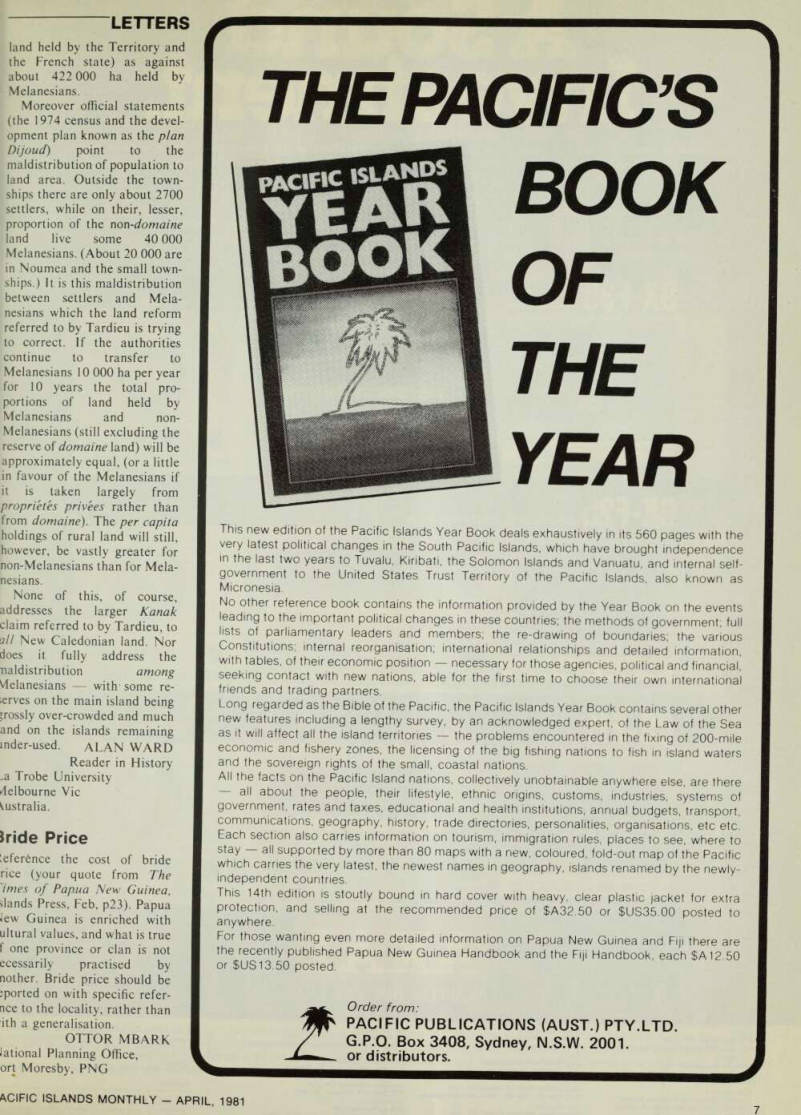
This photograph of the late Sir Harry Luke (left), whose work is referred to by the Venerable Whonsbon-Aston, was taken in Sydney more than 20 years ago with his old friend, R.W. Robson. PIM’s founder still lives near Sydney, aged 95.
land held by the Territory and the French state) as against about 422 000 ha held by Melanesians.
Moreover official statements (the 1974 census and the devel opment plan known as the plan Dijoud) point to the maldistribution of population to land area. Outside the town ships there are only about 2700 settlers, while on their, lesser, proportion of the non -domaine land live some 40 000 Melanesians. (About 20 000 are in Noumea and the small town ships.) It is this maldistribution between settlers and Mela nesians which the land reform referred to by Tardieu is trying to correct. If the authorities continue to transfer to Melanesians 10 000 ha per year for 10 years the total pro portions of land held by Melanesians and non- Melanesians (still excluding the reserve of domaine land) will be approximately equal, (or a little in favour of the Melanesians if it is taken largely from proprietes privees rather than from domaine ). The per capita holdings of rural land will still, however, be vastly greater for non-Melanesians than for Mela nesians.
None of this, of course, addresses the larger Kanak claim referred to by Tardieu, to all New Caledonian land. Nor does it fully address the
naldistribution among
Vlelanesians with some re serves on the main island being grossly over-crowded and much and on the islands remaining
mder-used.
Alan Ward
Reader in History
.a Trobe University
delbourne Vic Australia.
Jride Price
Reference the cost of bride rice (your quote from The imes of Pap.ua New Guinea, dands Press, Feb, p 23). Papua Jew Guinea is enriched with ultural values, and what is true f one province or clan is not ecessarily practised by nother. Bride price should be sported on with specific refer nce to the locality, rather than ith a generalisation.
Ottor Mbark
lational Planning Office, ort Moresby, PNG
Advertisements & other items, pp. 5-8 (3 items)
5
’ACIFIC ISLANDS MONTHLY - APRIL, 1981
Letters
7
ACIFIC ISLANDS MONTHLY - APRIL, 1981
Thepacific’S
BOOK
OF
THE
YEAR
This new edition of the Pacific Islands Year Book deals exhaustively in its 560 pages with the very latest political changes in the South Pacific Islands, which have brought independence in the last two years to Tuvalu, Kiribati, the Solomon Islands and Vanuatu, and internal selfgovernment to the United States Trust Territory of the Pacific Islands, also known as No other reference book contains the information provided by the Year Book on the events leading to the important political changes in these countries; the methods of government; full lists of parliamentary leaders and members; the re-drawing of boundaries; the various Constitutions: internal reorganisation; international relationships and detailed information, with tables, of their economic position necessary for those agencies, political and financial! seeking contact with new nations, able for the first time to choose their own international friends and trading partners.
Long regarded as the Bible of the Pacific, the Pacific Islands Year Book contains several other new features including a lengthy survey, by an acknowledged expert, of the Law of the Sea as it will affect all the island territories the problems encountered in the fixing of 200-mile economic and fishery zones, the licensing of the big fishing nations to fish in island waters and the sovereign rights of the small, coastal nations.
All the facts on the Pacific Island nations, collectively unobtainable anywhere else, are there all about the people, their lifestyle, ethnic origins, customs, industries, systems of government, rates and taxes, educational and health institutions, annual budgets, transport, communications, geography, history, trade directories, personalities, organisations, etc etc.
Each section also carries information on tourism, immigration rules, places to see, where to stay all supported by more than 80 maps with a new, coloured, fold-out map of the Pacific which carries the very latest, the newest names in geography, islands renamed by the newlyindependent countries.
This 14th edition is stoutly bound in hard cover with heavy, clear plastic jacket for extra protection, and selling at the recommended price of $A32.50 or $U535.00 posted to For those wanting even more detailed information on Papua New Guinea and Fiji there are the recently published Papua New Guinea Handbook and the Fiji Handbook, each $A 12.50 or $U513.50 posted.
Micronesia anywhere.
Order from:
PACIFIC PUBLICATIONS (AUST.) PTY.LTD.
G.P.O. Box 3408, Sydney, N.S.W. 2001. or distributors.
Abound .
Investment
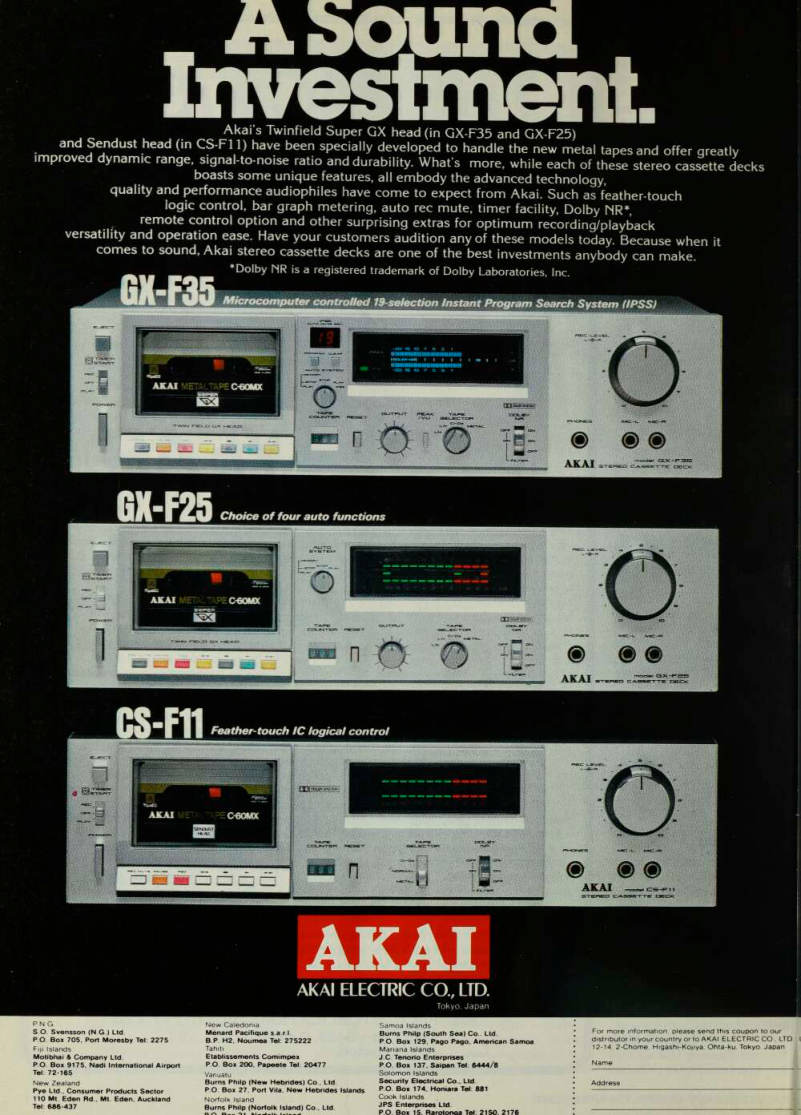
Akai’s Twinfield Super GX head (in GX-F35 and GX-F25) and Sendust head (in CS-F 11) have been specially developed to handle the new metal tapes and offer greatly improved dynamic range, signal-to-noise ratio and durability. Whafs more, while each of these stereo cassette decks boasts some unique features, all embody the advanced technology, quality and performance audiophiles have come to expect from Akai. Such as feather-touch logic control, bar graph metering, auto rec mute, timer facility, Dolby NR*, remote control option and other surprising extras for optimum recording/playback versatility and operation ease. Have your customers audition any of these models today. Because when it comes to sound, Akai stereo cassette decks are one of the best investments anybody can make. * Dolby NR is a registered trademark of Dolby Laboratories, Inc.
'earch System (IPSS)
GX-F
Microcomputer controlled 19-selection Instant
AKAI C-60MX
m c o*o Choice of four auto functions
AKAI
C-60MX
C □ Q
cs-fh
Feather-touch 1C logical control
AKAI
O6OMX
Q Q 0.
AKAI
AKAI ELECTRIC CO., LTD.
Tokyo, Japan New Zealand Rye Ltd., Consumer Products Sector 110 Mt. Eden Rd., Ml Eden. Auckland Tel: 686-437 Vanuatu Burns Philp (New Hebrides) Co., Ltd.
P.O. Bo* 27, Port Vila, New Hebrides Islands Norfolk Island Burns Philp (Norfolk Island) Co.. Ltd.
Samoa Islands Burns Philp (South Sea) Co.. Ltd.
PO Box 129. Pago Pago. American Samoa Manana Islands J.C. Tenorio Enterprises P O Box 137. Saipan Tel: 6444/8 Solomon Islands Security Electrical Co., Ltd P.O. Box 174. Honiara Tel: 881 Cook Islands JPS Enterprises Ltd.
P.O Box IS. Rarotonoa Tel: 2150. 2176 For more information please send this coupon to our distributor in your country or to AKAI ELECTRIC CO , LTD < 12-14. 2-Chome. Higashi-Koiiya. Ohfa-ku. Tokyo. Japan
Pacific Report
U.S. Aid Being Cut
American aid to the Pacific Islands is likely to be reduced as a result of cuts in all US developmental assistance recommended by President Reagan. He’s proposed a 26% reduction in the current 1982 aid budget, and further reductions through 1983- 86. The agencies and programmes affected include payments to UN agencies, the Agency for International Development (AID) and the Peace Corps. Specific details will be released when the revised budget goes to Congress.
France-Vanuatu Tensions Ease
France and Vanuatu appeared in March to be inching towards a reconciliation following the expulsion from Port-Vila in February of French Ambassador Yves Rodrigues (PIM Mar p 5). Most obvious sign of the relaxation was the Vanuatu Government announce ment in mid-February that French schools would reopen on February 23, and an accompanying request to France to appoint a new ambassador to replace Mr Rodrigues. But there was still no clear indication of when or if the agreement on French aid would be signed. At one point earlier in the month it had seemed that the Vanuatu Government would take the plunge and decide to go ahead without French aid. But after what appeared to be a struggle within the Cabinet the above announcements were made. One high level source in the government said of the differences of opinion in Cabinet: ‘Some people’s hearts were ruling their heads at one stage. But at the end of the day the government realised that they needed aid from whatever source ’
Prime Minister Father Walter Uni appealed to French residents in Vanuatu to remain calm, and assured them that the government appreciated their contribution to national development and looked forward to their continued participation in it. The tone of newspaper comment in Noumea was indicative of the new situation. The daily Les Nouvelles Caledoniennes commented; ‘lt seems that this announcement (on the reopening the schools and the request for a new French ambassador) has to be seen as a denial of the rumours . . . that Walter Lini would reject French aid and co-operation . . . Vanuatu seems to be moderating its plans and wishes to limit the scope of its conflict with France
Five Png Opposition Mps Defect
Five members of Papua New Guinea’s parliamentary opposition including Deputy Opposition Leader Raphael Doa, defected to the government in February. The group, members of the United Party, crossed the floor of parliament to reunite with other members of their party who already support the government coalition. The party split in March 1980 during the political in fighting that led to the fall of the government led by Michael somare. Mr Doa said that although he respected the leadership Somare (now leader of the opposition) some members of Vr Somare’s Pangu Party were ‘trying to dig my grave’ ‘I intend o leave before I fall into it,’ he said. Mr Somare told parliament he United Party’s decision to reunite was a matter he had nurtured and at the same time encouraged’. ‘The party must be Jnited, whether in opposition or government,’ he said. Outside )arhament Mr Somare denied the loss of the five MPs was a blow 0 the opposition. He pointed out that his party was still the argest in parliament.
J.K. Minister In Fiji
Fhe closure of the big Tate and Lyle sugar refinery in Britain would lot cut Fiji s sugar exports to Britain, UK Minister for Overseas Development Neil Marten said in Suva in March. He said the efmery had only been closed because it was making ‘such a :o ossal loss’. But Britain’s commitment to taking Fiji’s sugar was ' t n h n ere - ‘ AH reived will be refined, though they will move >0 000 tonnes somewhere else to refine,’ he said. Mr Marten .poke to reporters at the end of a four-day visit during which he iiscussed British aid with government ministers and spent part of 1 day at Rabi Island looking at progress on a SFI.B million British nanced aid project for the Banaban people there. Mr Marten
said his trip to the South Pacific was to learn what changes governments wanted in their aid dealings with Britain. The fact that British commitments to the region totalled $56 million showed his country’s interest in it, Mr Marten said.
Ok Tedi Agreement Signed
As anticipated (PIM Mar p6l), the go-ahead agreement on Papua New Guinea’s giant Ok Tedi gold-copper mining project was finally signed in early March. The PNG Government has a 20% slice of the project, and is partnered by Australian, American and West German companies. Perched on the 2095 metres Mount Fubilan in the remote Star Mountains next to the Irian Jayan border in PNG’s Western Province, Ok Tedi boasts gold deposits of 34 million tonnes and copper deposits of 376 million tonnes. It has been likened to a giant gold-capped tooth with copper roots. The open-cut mine is expected to have a working life of 25-30 years.
Row Over Png’S Vip Aircraft
Papua New Guinea’s new multi-million dollar VIP jet would give the country a ‘banana republic’ image, the national parliament was told in February. Opposition front-bencher Barry Holloway made the claim during a fiery debate over the PNG Government’s controversial decision to buy the plane, a Grumman Gulfstream 2. Mr Holloway said the jet’s purchase would damage PNG’s standing and image overseas, particularly among lending organisations such as the World Bank and the Asian Develop ment Bank. The plane cost PNG K 6 million (SA7.B million). The opposition called on the government to sell the jet, but the move was defeated 57 votes to 36. Prime Minister Sir Julius Chan, describing the plane as a ‘mini-707’, said it was ‘a tremendous national investment’. It would place the PNG Government on an equal footing when dealing and negotiating with big business. ‘We’re talking about a lousy six million kina,’ he said. Opposition Leader Michael Somare said big companies like Conzinc Riotinto and Bougainville Copper could afford such a plane, but PNG could not.
Bokissa Island Auction
Australian newspapers in February and March carried display advertisements for an auction in Sydney on April 14 of a ‘Private Tropical Resort Island, Bokissa Island. Vanuatu’. An initial announcement by the public relations firm responsible described the island, just off Santo, as a ‘freehold island’. But it rapidly put out a disclaimer, pointing out that the island is not ‘freehold’ because ‘since independence in 1980 title to Bokissa Island is to be converted to long-term leasehold’.
Tonga-Israel Diplomatic Ties
The Kingdom of Tonga has established diplomatic relations with Israel. Israeli Ambassador Abraham Kidron presented his credentials to King Taufa’ahau Tupou IV in February in Nukualofa. Mr Kidron is based in Canberra.
Vanuatu Planes On Png Register?
France’s withdrawal of the French public servant who previously served as Vanuatu’s director of civil aviation has caused delay in establishing an aircraft register for the country, and to a request from Transport Minister John Naupa that aircraft operating in his country should be placed on Papua New Guinea’s aircraft register. PNG Transport Minister lambakey Okuk appeared favourably disposed to the idea.
Cyclone Cliff Didn’T Discriminate
Although their leading politicians may have sharp differences, Vanuatu and New Caledonia alike fell victim to Cyclone Cliff which in February caused extensive damage in both places The cyclone destroyed houses on Pentecost, Malakula, Ambrym, Epi, Efate and other islands in Vanuatu. Trees were blown down in the capital, and Port-Vila was blacked out for several hours. The Air Club hangar at Bauerfield had half its roof blown off and sheets of corrugated iron were flung on to a fence 50 metres away. In New Caledonia damage was most extensive in the Houailou and Bourail regions. A member of the Bouirou tribe was killed by a falling tree. The Council of Government on February 17 declared the communes of Houailou, Bourail, Canala (Kouaoua) and Ponerihouen ‘disaster zones’.
Death Of John Knight
Australian Senator John Knight, 37, died unexpectedly of a heart attack in Canberra in March. Senator Knight, Government Whip in the Senate, was well known in the South Pacific as a former member of the Australian High Commission staff in Suva, and as a member of the Senate Standing Committee on Foreign Affairs
and Defence which made an extensive inquiry into Australia’s relations with the South Pacific in 1977. He contributed many valuable articles to PIM on the importance of continued Australian aid to the Islands.
Aid Bureau Retains Its Independence
Death of Senator Knight (above) came at a time when one of the Australian organisations whose work he espoused, the Australian Development Assistance Bureau, had just defeated an attack on its independence which threatened to destroy its capacity to distribute aid to the South Pacific quickly and efficiently. The bureau, which in the current financial year is distributing Australian overseas aid to the value of $A553 million, develops its own programmes under its own administrator, Mr Jim Ingram, who is responsible directly to the Australian Minister for Foreign Affairs. This enables the bureau to operate with a minimum of bureaucratic entanglements, and in the last three years it has built up a reputation in the South Pacific for being an entirely professional body, quickly able to supply the type of help the islands ask for, rather than what the donor thinks might be good for them. Because of internal jealousies in Canberra, the Australian Government was put under pressure to fully integrate the bureau into the Department of Foreign Affairs. The bureau’s defenders rushed to protest that this would curtail the bureau’s vital flexibility, and, after further representations at top level, the heat was turned off. One of the deciding factors in the battle was that although the aid programme has grown considerably, the bureau’s staff in recent years has dropped from 700 to under 500.
Introducing The Nauru Corporation
The Nauru Co-operative Society announced in February it had changed its name to Nauru Corporation. The change follows a resolution by Nauru’s Local Government Council that the organisation should be given a facelift in the commercial world.
In an editorial comment, The Nauru Post weekly said: ‘More can be read into Council’s decision to change the name to Nauru Corporation. It could be taken as Council’s intention to incorporate it under Nauru’s Company Act. Such a step is a clear indication on the part of Council to carry out the operations of trading on a more business-like footing. Then perhaps an annual balance sheet and other financial statements can be brought out.’
ISLANDS REPS AT OZ N-FREE PACIFIC WEEK Pacific Islands delegates took part in a Nuclear-free Pacific Week held in Sydney in March. They were Dorothy Levy from Tahiti, Bernie Keldermans from Palau, and Soli Niheu from Hawaii. The week included a concert, a candlelight procession through the streets of Sydney, and a public meeting. The week was designed to protest against the militarisation of the Pacific region. Calls were made for a Nuclear-free Pacific Zone, no nuclear weapons testing, no nuclear waste dumping, and closure of foreign military and nuclear bases in the region.
The Pope On Guam
In a prepared 10-minute speech on his arrival in Guam in February, Pope John Paul II three times switched to the Chamorro language. ’I am happy to see your beautiful island and you, children of God,’ was his first greeting in Chamorro. Later he told the huge cheering crowd in their language that he was happy to visit the Pacific Islands, and concluded with ‘Hu guiya todi hamyo’ ‘I love all of you.’ The pope spent 18 hours in Guam before leaving for Japan.
Rotuma Centenary On May 13
The Fiji Government will make a SF9O 000 contribution to Rotuma’s centenary celebrations in May. The celebrations will mark the cession of the island to Britain on May 13 1881.
Sanford On Polynesia’S ‘Luck’
French Polynesia’s Vice-President of the Government Council Francis Sanford said in a press interview in February: ‘I have confidence in the future. I say that Polynesia is the most developed of all the Pacific archipelagoes . . . We’re lucky in Polynesia. We shouldn’t complain too much, but we’re like spoilt children: the more we’re given, the more we want.’ On the matter of eventual independence for French Polynesia he said: ‘lt’s the mass of the people who must decide, not one man. It will have to be decided by referendum. Neither the Assembly nor the Council of Government can make such a decision, and I would refuse absolutely to have any part of it.’
Weak Turnout For Port-Vila Poll
Only 887 of the 5000 eligible voters took part in the February 11 election of the new Port-Vila municipal council. Locals put the low
turnout down to many people having left the capital because they were out of a job, weak electoral campaigning by most candidates, and the confusion as to their rights of many expatriates who were in fact perfectly entitled to a vote. The voters returned six Vanuaaku Party councillors, six members of the opposition ‘Moderate’ party, and two members of the Natatok Party.
Experts’ Green Light For Fiji Tv
A team of experts has recommended that television be introduced in Fiji in three languages English, Fijian and Hindi within the next three years. The team, from the Asia-Pacific Institute for Broadcasting Development, made the recommen dation in a report delivered to the Fiji Government in March. The report needs the Cabinet’s appraisal and approval before being tabled in parliament.
Gold On Santo?
Gold has been discovered on the Vanuatu island of Santo, according to a report in The Times of Papua New Guinea. Two companies had bought exploration rights. The gold is also associated with porphyry copper, as in the giant Ok Tedi project in PNG. If the reserves are proven, the Vanuatu Government is expected to negotiate a development agreement along the lines of the Ok Tedi agreement, with a substantial share remaining in government hands.
Japan-Marshalls Fishing Accord
An agreement between the governments of Japan and the Marshall Islands will call for about SUSI. 2 million paid by Japan for the right to fish within the exclusive economic zone of the Marshall Islands, according to the February 20 issue of The Marshall Islands Journal. The paper added that Japan had agreed to increase the annual fishing access fee from $9OO 000 to $1 000 000 in cash. There is also another $175 000 to provide goods and services to the Japanese, mainly in the fishing area.
Guadalcanal Bus Service Up For Grabs
The Guadalcanal Bus Service has been advertised for sale.
Manager Mark Lewis said it had been decided for some time that the company would close, and a strike by its workers launched on February 10 provided the opportunity. Mr Lewis said two Solomon Islands groups had already approached him as prospective buyers. On the union side, a spokesman for the National Union of Workers was concerned to see that all employees received their due in severance pay and benefits based on their years of service to the company.
Marshallese-Language Bible Near
The 15-year project of translating the entire Bible into Marshallese is nearing completion. Final review sessions were held in February at the Marshalls Theological College. Jornadrik Jelke, off Ebeye, has been in charge of the file of each word used in the translation. There have been 3000 Marshallese words used, and 200 English words borrowed.
Jewellery Tops Sales In Fiji Duty-Frees
Jewellery has become the biggest line of business in the Fiji duty free trade. Sales of perfumes and pocket calculators are proving to be growth business also, but sales of radio and other electronic goods, cameras and photographic equipment are stagnant or falling, according to the 1979 trade report, published in March.
Duty-free imports cost SF2O 079 000 and jewellery imports accounted for $5 066 000 of the total.
Air Hostesses Barred From Hotel
A number of Air Nauru hostesses were asked to leave Melbourne’s Southern Cross Hotel in February. The high-class hotel is next door to Nauru House, and is frequently used by Nauruan officials visiting Melbourne. Riotous and drunken behaviour appears to have been the reason. The Nauru Post commented: ‘According to a reliable source, windows were broken, furniture was smashed, and the room flooded. Damage done was more akin to the work of vandals and certainly could not have been imagined to be the handiwork of a refined young girl holding down a responsible position such as an air hostess.’
33 Fishermen Presumed Dead In Storm
Thirty-three Taiwanese fishermen have been lost and are presumed dead off Manua in- the worst storm to hit American Samoa since 1966. Tropical storm Esau struck Manua in the evening of March 2 after sparing Savaii, Upolu and Tutuila, and caused damage estimated at SUS 4 million, not counting agricultural losses. The search for the fishermen’s two boats was abandoned after a small amount of wreckage had been found.
Joseph Theroux.
Advertisements & other items, p. 9 (1 item)
9
ACIFIC ISLANDS MONTHLY - APRIL, 1981
The giants of the Pacific Rim eye
the pygmies of the Centre
Professor RON CROCOMBE* discusses the present state and likely future development of super-power influences on Pacific Islands countries. He says that, to draw maximum advantage for themselves from such influences, Islands countries need to start doing some intensive homework on the subject.
The world’s largest super powers are on the Pacific Rim.
But the world’s smallest micro powers are the Pacific Islands nations. The imbalance is ex treme, but that does not mean that the situation is hopeless in fact, relative to size, the Pacific Islands nations have better options than most. But it does necessitate being realistic about what is and what is not achievable.
In population numbers there are about 2000 million in countries on the Pacific Rim, as against only five million Pacific Islanders. Pacific Islanders are outnumbered 400 to one.
Wealth shows a similar dis proportion. In education the USA, Japan and Australia have about 10 times the tertiary educated manpower per 1000 of population that the Pacific Islands have, and the Islands are not catching up. Military power shows an even worse imbalance. Only three Pacific Islands countries have military forces, and those are very small.
For most of this century, the >uper-power in relation to the Pacific was the United King dom, but it is now finished so far is the Pacific is concerned. For
he 1980 s the super-power in
he Pacific is the USA, though lot necessarily for much longer. would expect the USA’s lower in relation to the Pacific slands to increase for a few and then go into a perma tent decline.
The USA’s interest in the has always been mainly nilitary. Hawaii was taken by he USA in a coup organised by American business interests in 894, followed by US annex
ation in 1898, and has since been developed as the biggest US military base off the main land.
Also in 1898 the USA took Guam by military action and set up an enormous military base there it was from there that much of the bombing of Vietnam was done.
In 1 899 the USA took Ameri can Samoa and ran that as a naval base for more than 50 years.
Then at the end of World War II the USA look the Marianas, Caroline and Marshall Islands by military action from Japan and is likely to maintain the dominant influence there for a long time.
The USA has always preached anti-colonialism, while absorbing its colonies rather than freeing them. Of the English-speaking colonial powers in the Pacific, the USA has been the most imperialist in terms of authoritarian govern ment, force-feeding of Ameri can values and culture, and protection from non-American influences. The USA is the only colonial power to have run most of its Pacific colonies, most of the lime, by direct military rule.
The amount of money to be made by the USA in the Pacific Islands is of very minor significance, but having effective control over the kinds of governments and economies in the Pacific Islands is of considerable significance to US interests throughout the Pacific Rim.
It is cheaper, easier and more acceptable to the USA to wield much of her influence over the Pacific Islands indirectly (though she is building tremen dous direct control of Pacific media). It’s the modern equivalent of what the British colonial system called ‘indirect rule’.
That role in the Pacific is subcontracted in part to satellite states which have in the last decade or so moved into the US orbit and away from the UK Australia and New Zealand in particular. It suits Australia’s and New Zealand s interests to play that mediator role, though New Zealand is becoming increasingly a satellite of Australia, rather than an equal pa l!" er r , The formal military alliance m mg the USA, Australia and AN7IIS t a f?k u l5 cal ' ed ANZUS, but the basis for that linkage is very much deeper in cultural, economic and politica re alions. ut that is a 1970 s emphasis ralher than a 1980 s one. The biggest changes for the Pacific Islands in the 1980 s and 1990 s will come from the north: first and most strongly from Japan.
Influence from the USSR is likely to increase significantly, but to be overshadowed in the Pacific Islands by China But China’s major influence in the area may not begin for another generation.
Japan was the colonial power over Micronesia from 1914 to 1944. Her administration was efficient but ruthless, the economy boomed, but so many Japanese settlers were brought in that they soon outnumbered the Micronesians. Japan's past record as a colonial power in the Pacific Islands was not good, Her future record as a neocolonial power is not likely to be any better.
But the day of single superpowers is now over. Regionalism is becoming a major basis for the mobilising of power.
Japan initiated the concept of a Pacific Basin Community, and Japan is likely to be the major beneficiary from it. But it is probably an inevitable next
stage in Pacific politics. It aims to pull together what they call the market economies, or the capitalist economies, or what ever one wants to call them, of the Pacific Rim: Japan and the USA, South Korea, the ASEAN nations (Singapore, Malaysia, Indonesia, the Philippines and Thailand), Australia, New Zealand, and the Pacific Islands nations.
In an informal sense it is already a reality, and formalis ing it will only give recognition to a grouping that is in many ways already functional. The exact form it will take still has to be worked out presumably it will start with a softening-up process through the media, edu cational and cultural exchanges and some liberalising of trade, and of course political leverage and a military back-up which won’t gel much publicity but which will be very influential.
I can imagine Pacific Islands university students opposing all this in principle, but have no doubt that when it is converted into trips, conferences, scholar ships, exchange schemes and money, jobs in international organisations arising from it, etc, that the Pacific’s university students will be the most en thusiastic and most over represented participants from this part of the world.
Now let’s turn to the USSR, because its Pacific coast is becoming more significant and it is an enormous military power. Obviously it would like to be the major source of influence in the Pacific Islands, but the USA is already firmly in control.
I lend to assume that if there is a third world war, the USA and the USSR will destroy or neutralise each other as world powers, in which case Japan will become the Pacific super-power
Ron Crocombe is Director, nstitute of Pacific Studies, Jniversity of the South Pacific.
Advertisements & other items, pp. 11-12 (2 items)
11
ACIFIC ISLANDS MONTHLY - APRIL, 1981
&
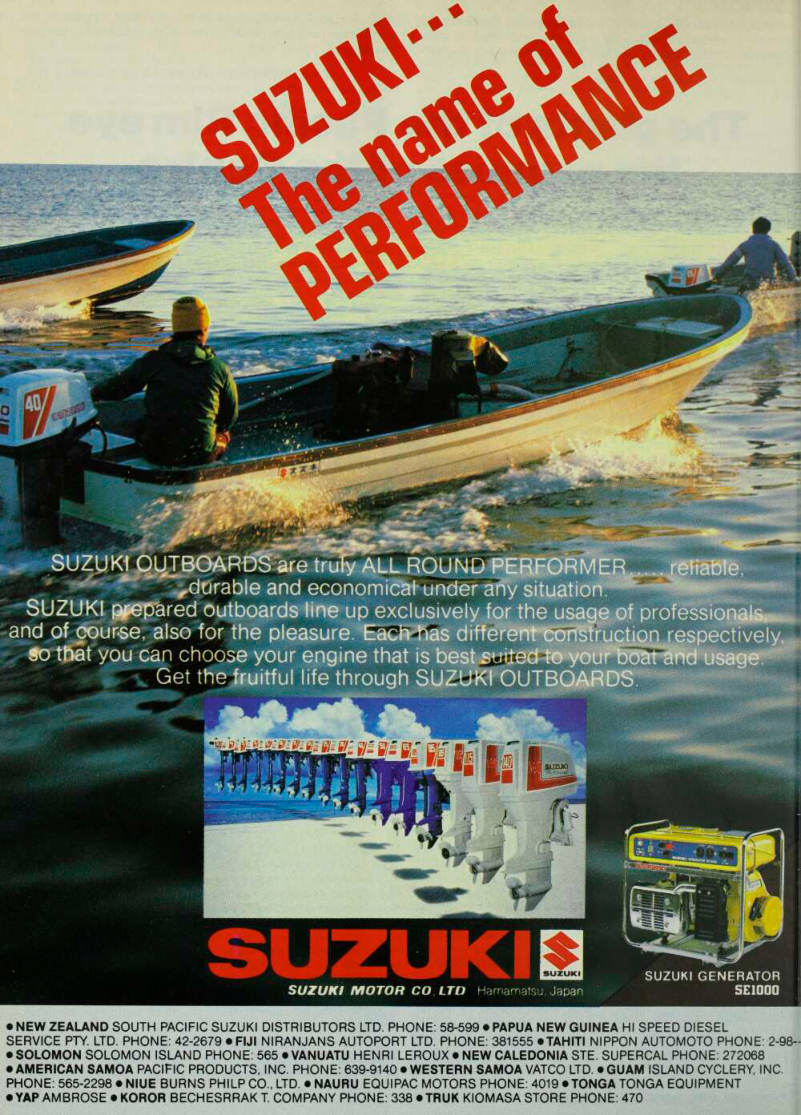
W' #l# P ■ ■ SUZUKI OUTBOARDS are truly ALL ROUND PERFORMER reliable. adorable and economical under any situation. ' ***- SUZUKI spared outboards line up exclusively for the usage of , and of course, also for the pleasure. Each has different construction respectively So tftat you can choose your engine that is best suited to your boat and usage.
Get the fruitful life through SUZUKI OUTBOARDS. i r «a •-
SUZUKI GENERATOR
SEIQDO
• NEW ZEALAND SOUTH PACIFIC SUZUKI DISTRIBUTORS LTD. PHONE: 58-599 • PAPUA NEW GUINEA HI SPEED DIESEL SERVICE PTY. LTD. PHONE: 42-2679 • FIJI NIRANJANS AUTOPORT LTD. PHONE: 381555 •TAHITI NIPPON AUTOMOTO PHONE: 2-98- • SOLOMON SOLOMON ISLAND PHONE: 565 • VANUATU HENRI LEROUX • NEW CALEDONIA STE. SUPERCAL PHONE: 272068 • AMERICAN SAMOA PACIFIC PRODUCTS, INC. PHONE: 639-9140 • WESTERN SAMOA VATCO LTD. ©GUAM ISLAND CYCLERY, INC.
PHONE; 565-2298 • NIUE BURNS PHILP CO., LTD. • NAURU EQUIPAC MOTORS PHONE: 4019 • TONGA TONGA EQUIPMENT • YAP AMBROSE • KOROR BECHESRRAK T. COMPANY PHONE: 338 • TRUK KIOMASA STORE PHONE: 470
"Lord - Your sea is so large
even more quickly. If there is no third world war in our time, the USA and Japan will probably be able to keep the USSR out of major influence in the Pacific.
But whenever you have strong competition for leader ship, the competitors will pay a high price for someone from the other side to break ranks. The price the USSR or its satellites will be prepared to pay will no doubt increase, and the bidding by the USA and its satellites will have to increase to hold the Pacific Islands in the Western block. The temptation to break ranks will increase, and main taining Pacific Islands unity might become more difficult.
It is sometimes said that the Pacific Islands nations are non aligned politically. But the truth is the opposite: that they are so firmly aligned with the Western bloc that they really do not belong in a non-aligned movement (not that the non aligned movement is non aligned!). Being non-aligned is hardly possible in a highly polarised world.
In an ideal world, Pacific Islands nations would obviously prefer to be truly non-aligned, but that option is not available to them. Even if they had the choice between Americans and Russians, there is no doubt in my mind that the Americans are the lesser of the two evils; when one has no choice but to be part of someones else’s empire, it is probably better to choose the one that is richest, softest and that has a language and culture that you understand and can deal with. And the USA at least has a more flexible society which accommodates more options. But abroad, the USA supports many military dictatorships and in fact helps them into power in many cases, and the USA’s history in the short time it has been a world power shows that it will be as ruthless as the Russians if it suits its interests. To paraphrase Lord Acton, all power corrupts and the greater the power, the more corrupt the use of that power is likely to be.
On the Russian side one only iceds to thinks of their totally uthless crushing of such places
is Hungary, Czechoslovakia
md recently Afghanistan, and )n the American side the :qually ruthless attempts to
crush elected governments in Vietnam and Chile, and their support for brutal dictatorships in many parts of the world. It is not that the Russians and Americans are more ruthless than others in the pursuit of their own self-interest. It is just that, at this phase of history, they have the power. Pacific Islanders will find in the next decade or so that China and Japan are even more concerned with their own self-interest and likely to be even less scrupulous in the pursuit of it.
Before looking at the influ ence or leverage of big powers in the Pacific Islands, let’s look first at those that already have almost total control of Pacific Islands. The USA has incorpor ated Hawaii, Guam, Northern Marianas, American Samoa, Wake, Midway, Palmyra, the Aleutians and various others as part of the USA. And the Marshalls and Caroline Islands are to be partially self governing, but with the USA holding all the major leverage.
All the North Pacific Islands then have already been taken over by the USA.
To the west, the Indonesians have taken West New Guinea (or more accurately they were given it by the USA in a tradeoff for not opposing the USA’s mvasion of Vietnam). West New Guinea is the second largest group of people in the Pacific Islands (nearly one million), and Indonesia runs it as a military colony.
In the east, Chile will retain its hold on Easter Island. Again it is a military administration.
In the south. New Zealand has long since been taken over by Europeans. And Melanesians are the minority in Fiji and New Caledonia.
If the USSR becomes invdved, what appear at the moment to be the most likely channels might be via New Caledonia, where French impenalism is so pervasive that any external support may be welcomed by those seeking a more just society, for the Melanesian population particularly; or Vanuatu. Such a possibility in Vanuatu is considerably reduced since independence has been attained with the help of Papua New
Guinea’s forces. It is a sad reality that almost no one else was prepared to help a genu inely elected government from being subverted by foreign in terests. Much will depend on Pacific neighbours providing genuine assistance to facilitate the development of an effective independent nation there, it is almost inevitable that the USSR’s involvement will increase from its present mini mum. The only potential gain for the Pacific is as an alterna tive lever for Islanders to lean on to the extent that the Pacific Basin group (especially Japan the USA and Australia) don’t provide for them. It is a danger ous game, but it would be surprising if no one was ever tempted to play it.
What options are available to the Pacific Islands nations in getting the best possible deal from this new structuring of enormous power all round them? They can do little to stop it happening, and are obviously called upon to work towards as deep an understanding as they can get of the likely future realities.
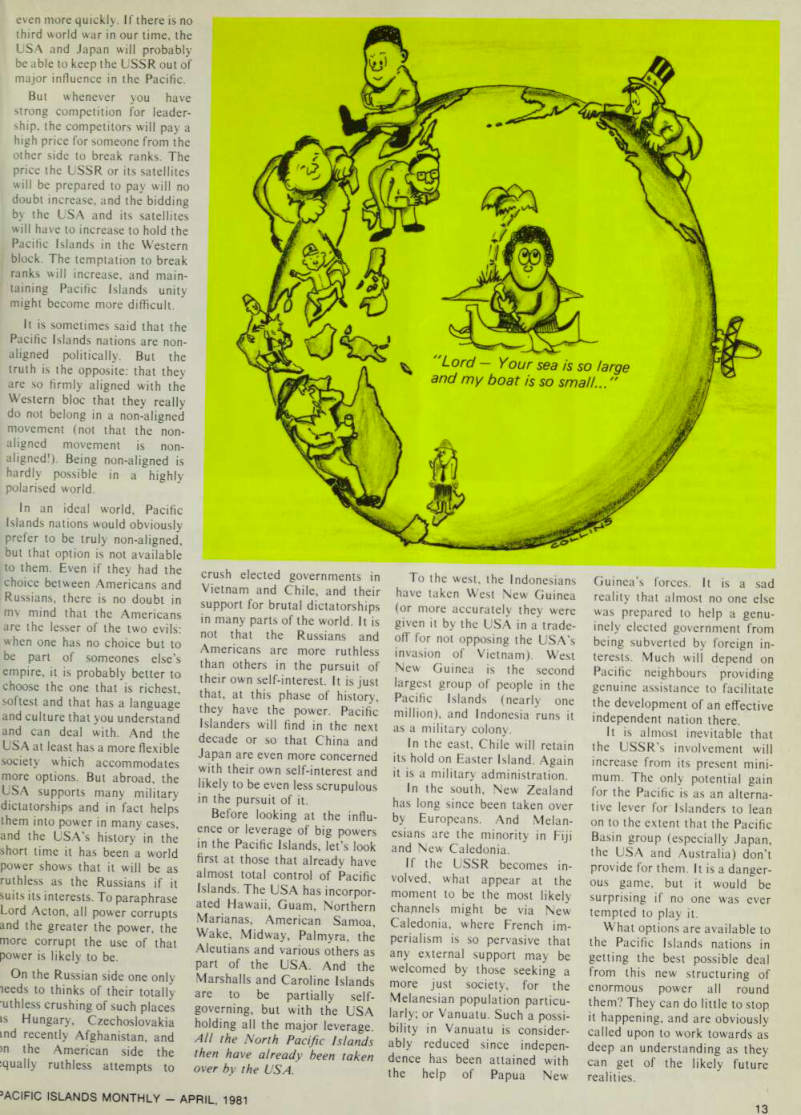
"Lord - Your sea is so large and my boat is so small..."
One urgent need is for a Pacific Islands ‘think tank’ an institution geared to collect ing data, sorting out options, heightening public awareness, and drawing on the best minds available. Japan’s Nomura Re search Institute is one of several that have been doing their homework on the future of the Pacific, and very effectively it seems. The Brookings Institute in the USA is one of the many that have been helping the Americans find the best sol utions for them in the Pacific.
New Zealand has its Com mission on the Future, and so on. Perhaps the University of the South Pacific should take the initiative and start some more focused thinking on the future, perhaps in co-operation with the South Pacific Bureau for Economic Co-operation and the South Pacific Commission.
So far, the Pacific has had to respond belatedly to the big powers’ proposals. It would be in a much stronger position if it clarified its own options and to do so needs a continuous, open, responsive programme.
The danger is that those with big power interests in the Pacific would want to fund it and influence its direction.
Obviously the Pacific Islands states are likely to gain more from fuller co-ordination which does not necessarily mean unified action. Compared with most parts of the world.
Pacific regional co-operation so far has been relatively success ful, but it would be unrealistic to expect (or even to aim for) too high a degree of co operation when interests are so diverse, and when the short term payoff to the country that plays the role of Judas is so high.
All Pacific Islands nations are very weak in world terms. A closed Pacific Islands region would be a club of the weak, and that would be of little value.
One doesn’t get strength from joining only with the weak, more strength can come from joining with the strong though that usually means pay ing a higher price in depen dency on a range of fronts.
In monetary terms at least, the largest short-term gains will come from splitting, and each attaching itself to one major power, with multiple strings to at least some other powers. This
is already the case: the USA controls the North Pacific almost totally (and is likely to aim to attain maximum lever age over Kirabati and to a lesser extent Western Samoa); Aust ralia is the overwhelming exter nal influence for Papua New Guinea and increasingly for the rest of Melanesia; New Zealand is for the Cooks, Niue and Tokelau; France is in New Caledonia, Tahiti, Wallis and Futuna. Japan is going to find a place in this a very powerful place but the stronger Japan’s role becomes the more the small Islands states are likely to see common interests with their present big partners.
While in the short term the Pacific Islands nations could do best by playing off one big power against the other, the Western bloc powers are likely to limit that by developing a co ordinated strategy towards the Pacific Islands. And playing outside the Western bloc is a much bigger gamble involving very high stakes.
It comes back to the need, as part of the complex network of linkages, for the strengthening of common interests of the Pacific Islands, and flexibly co ordinating some of the crucial external bargaining.
But regional co-operation in the Pacific Islands will only succeed in the long term to the extent that the benefits from it are shared. The central nation usually becomes the main beneficiary, usually playing down its benefits and over rating its costs, until the peripheral smaller countries turn elsewhere at which stage the central nation is likely to be the main loser. A major reason for the collapse of the Caribbean Federation was the disproportionate benefits de rived by Jamaica. Likewise Kenya’s taking of the lion’s share was a major issue in the collapse of the East African Community. Unless the benefits of Pacific regional co-operation are more realistically shared, not only will the Pacific nations be worse off, but the leverage of the super-powers will be so much greater.
Pacific Islands universities and other Islands institutions can make an important contri bution by understanding, ana lysing and publicising the emerging new pattern of power relations in the Pacific, promot ing realistic forward thinking with creative options, and work ing towards more effective co operation among all the diverse peoples of the Pacific Islands.
Advertisements & other items, p. 13 (1 item)
13
>ACIFIC ISLANDS MONTHLY - APRIL, 1981
‘spec[?]
Papua Ne[?]
Pacifi[?] ‘spec[?]
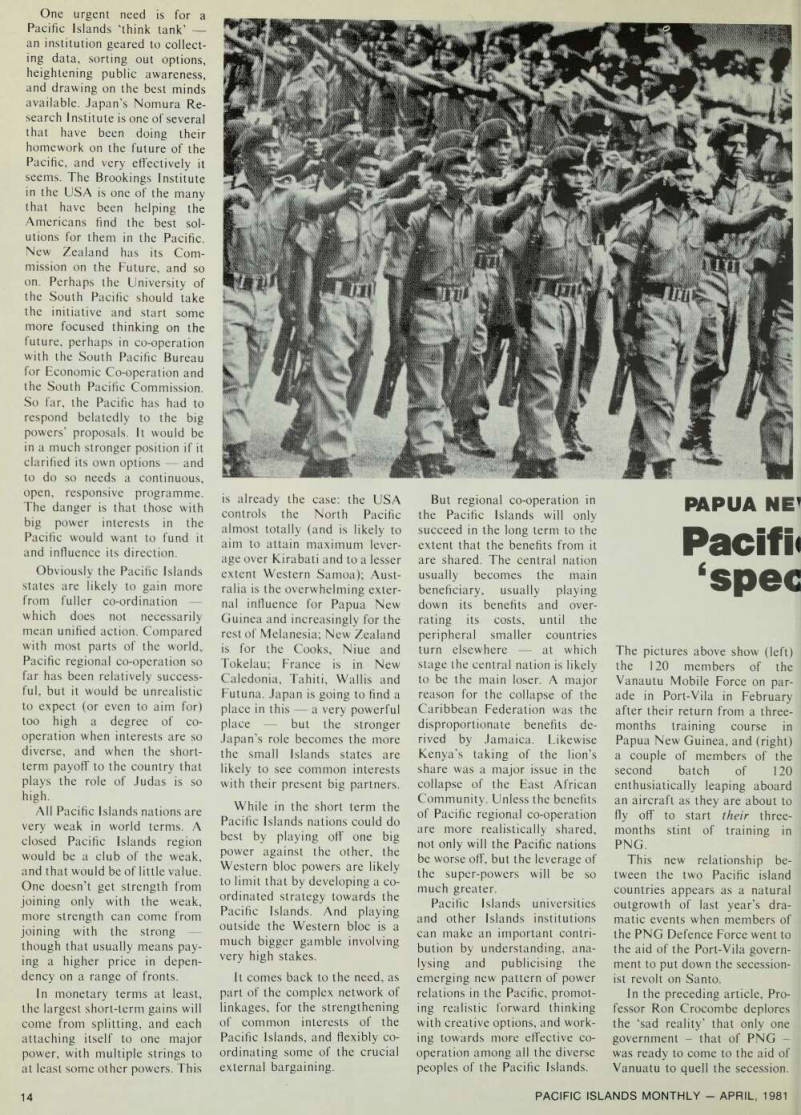
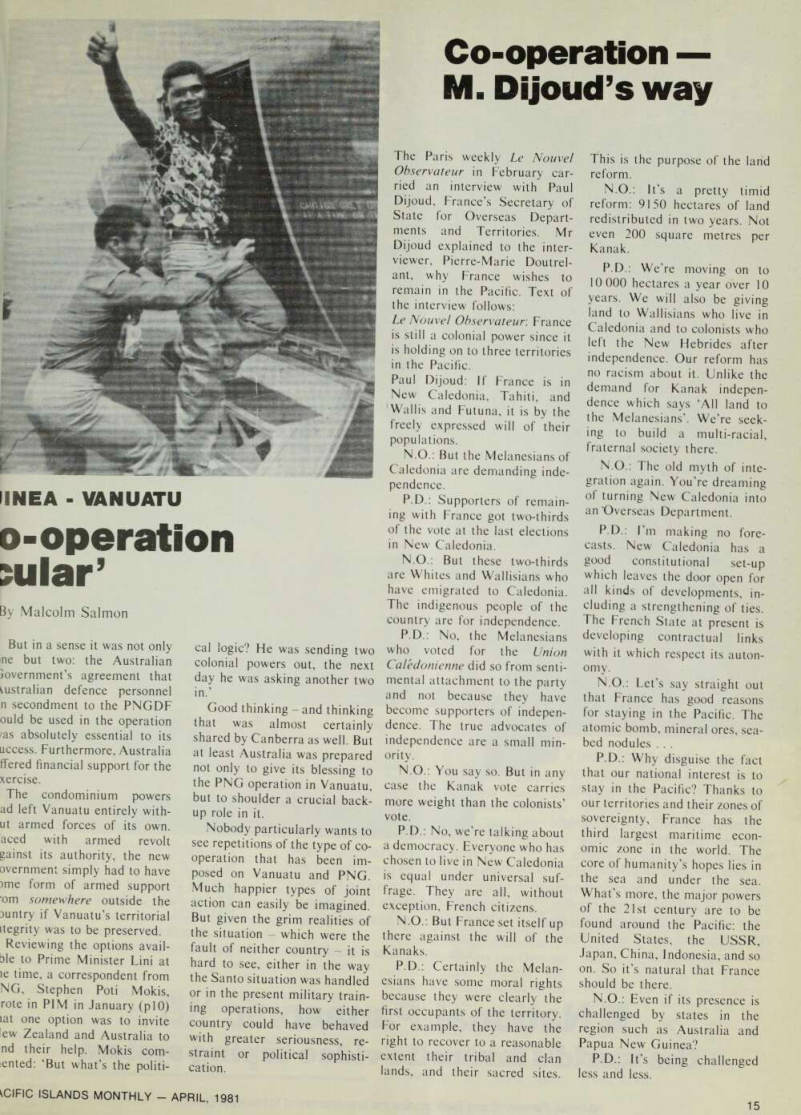
The pictures above show (left) the 120 members of the Vanautu Mobile Force on par ade in Port-Vila in February after their return from a three months training course in Papua New Guinea, and (right) a couple of members of the second batch of 120 enthusiatically leaping aboard an aircraft as they are about to fly off to start their three months stint of training in
Png.
This new relationship be tween the two Pacific island countries appears as a natural outgrowth of last year’s dra matic events when members of the PNG Defence Force went to the aid of the Port-Vila govern ment to put down the secession ist revolt on Santo.
In the preceding article, Pro fessor Ron Crocombe deplores the ‘sad reality’ that only one government - that of PNG was ready to come to the aid of Vanuatu to quell the secession.
By Malcolm Salmon
But in a sense it was not only ne but two: the Australian Jovernment’s agreement that Australian defence personnel n secondment to the PNGDF ould be used in the operation ' as absolutely essential to its uccess. Furthermore, Australia ffered financial support for the xercise.
The condominium powers ad left Vanuatu entirely withut armed forces of its own. aced with armed revolt gamst its authority, the new overnment simply had to have )me form of armed support om somewhere outside the Duntry if Vanuatu’s territorial itegnty was to be preserved.
Reviewing the options avail- 51e to Prime Minister Lini at ie time, a correspondent from NG, Stephen Poti Mokis, rote in PIM in January (plO) iat one option was to invite ew Zealand and Australia to nd their help. Mokis comcated: But what’s the politi-
cal logic? He was sending two colonial powers out, the next day he was asking another two in.’
Good thinking - and thinking that was almost certainly shared by Canberra as well But at least Australia was prepared not only to give its blessing to the PNG operation in Vanuatu, but to shoulder a crucial back up role in it.
Nobody particularly wants to see repetitions of the type of co operation that has been im posed on Vanuatu and PNG Much happier types of joint action can easily be imagined But given the grim realities of the situation - which were the fault of neither country - it is hard to see, either in the way the Santo situation was handled or in the present military train ing operations, how either country could have behaved with greater seriousness, re strain! or political sophisti cation.
Co-operation -
M. Dijoud’s way
The Paris weekly Le Nouvel Observateur in February car ried an interview with Paul Dijoud, France’s Secretary of State for Overseas Depart ments and Territories. Mr Dijoud explained to the inter viewer, Pierre-Marie Doutrel ant, why France wishes to remain in the Pacific. Text of the interview follows: Le Nouvel Observateur. France is still a colonial power since it is holding on to three territories in the Pacific.
Paul Dijoud: If France is in New Caledonia, Tahiti, and Wallis and Futuna, it is by the freely expressed will of their populations.
N. 0.: But the Melanesians of Caledonia are demanding inde pendence.
P D.: Supporters of remain ing with France got two-thirds of the vole at the last elections in New Caledonia.
NO.: But these two-thirds are Whites and Wallisians who have emigrated to Caledonia.
The indigenous people of the country are for independence.
P.D.: No, the Melanesians who voted for the Union Caledonienne did so from senti mental attachment to the party and not because they have become supporters of indepen dence. The true advocates of independence are a small min ority.
N. 0.; You say so. But in any case the Kanak vote carries more weight than the colonists’ vote.
P.D.: No, we’re talking about a democracy. Everyone who has chosen to live in New Caledonia is equal under universal suf frage. They are all, without exception, French citizens.
N. 0.: But France set itself up there against the will of the Kanaks.
P.D.: Certainly the Melan esians have some moral rights because they were clearly the first occupants of the territory.
For example, they have the right to recover to a reasonable extent their tribal and clan lands, and their sacred sites.
This is the purpose of the land reform.
N. 0.: It’s a pretty timid reform: 9150 hectares of land redistributed in two years. Not even 200 square metres per Kanak.
P.D.: We’re moving on to 10 000 hectares a year over 10 years. We will also be giving land to Wallisians who live in Caledonia and to colonists who left the New Hebrides after independence. Our reform has no racism about it. Unlike the demand for Kanak indepen dence which says ‘All land to the Melanesians’. We’re seek ing to build a multi-racial, fraternal society there.
N. 0.: The old myth of inte gration again. You’re dreaming of turning New Caledonia into an ‘Overseas Department.
P.D.: I’m making no fore casts. New Caledonia has a good constitutional set-up which leaves the door open for all kinds of developments, in cluding a strengthening of ties.
The French Stale at present is developing contractual links with it which respect its auton omy.
NO.: Let’s say straight out that France has good reasons for staying in the Pacific. The atomic bomb, mineral ores, sea bed nodules . . .
P.D.: Why disguise the fact that our national interest is to stay in the Pacific? Thanks to our territories and their zones of sovereignty, France has the third largest maritime econ omic zone in the world. The core of humanity’s hopes lies in the sea and under the sea.
What’s more, the major powers of the 21st century are to be found around the Pacific: the United States, the USSR, Japan, China, Indonesia, and so on. So it’s natural that France should be there.
N. 0.: Even if its presence is challenged by states in the region such as Australia and Papua New Guinea?
P.D.: It’s being challenged less and less.
Advertisements & other items, pp. 15-16 (2 items)
o-operation
15
<C\F\C ISLANDS MONTHLY - APRIL, 1981
lINEA - VANUATU
o-operation Hilar’
the good guyalways wins!
In the final showdown,
v i ri
'/pMMes
0 "1 - ■■a? ■ *« - •
Jfer./i- jSi
Sail I * • • m iThtTtrrrrrfl *JV.
If you’ve been holding back on bringing a video system into your life, here’s something you should know.
National's VHS has galloped ahead to become the world’s favourite video-taping system.
And our slim new NV-7000, with a memory, eight programmes and a 12-function remote control, is the smartest, most sophisticated video recorder we’ve ever offered for your pleasure. ism n c
j j j J J]]] aa
NV-7000 Your nearest National dealer will show off its great sound and picture. Not to mention the allelectronic controls that make video-taping as easy as falling off a horse.
Sure, any video recorder lets you watch what you like when you like. But you’re way ahead with the world’s favourite system. Whether it’s the 7000 or the budget-priced NV-2000.
Just like in the movies, the good guy has won in the end.
S National/Panasonic
u i nir
the world’s favourite video-taping system
National, Panasonic and Technics are the brandnames of Matsushita Electric.
TV picture simulated..t Unauthorised recordiib TV programmes and ( I materials may infringe
New Caledonia
Whitlam urges U.N. moves on New Caledonia
South Pacific nations must speak out with a strong and united voice in order to get the situation in the French colony of New Caledonia on the agenda of the United Nations Decolonisation Committee, according to Gough Whitlam.
Speaking at a press conference in Honiara, Solomon islands, in February, the former prime minister of Australia said the majority of Melanesians in New Caledonia wanted independence from France.
Mr Whitlam, a fellow of the Australian National University, Canberra, stopped a few days in Honiara where he met government officials including Prime Minister Peter Kenilorea.
Mr Whitlam was on his way back from Canada where he presented a paper on political
science at a constitutional con ference.
Mr Whitlam said it had become urgent that the major ity of Melanesians in New Caledonia who had voted for independence should make known their plea to the world. ‘lt is the biggest problem,’ he said.
Mr Whitlam said the indigen ous New Caledonian people could not take this problem direct to the UN unless it has been placed on the Decolon isation Committee’s agenda.
To do this, it must first win two-thirds of the votes of nations on the committee, in which the Pacific is represented by Australia and Fiji. This could only be achieved if South Pacific nations like Australia, New Zealand, Fiji, Tonga, Samoa. Solomon Islands and
others speak out clearly in support of such a move.
Mr Whitlam said Papua New Guinea was the only country in the South Pacific region which had made it plain to France that her colonies in the South Pacific must be given self-determin ation and independence.
Mr Whitlam said some African nations for sure will not give their support for an inde pendent New Caledonia at the UN because of strong French influence.
Mr Whitlam said he was glad to hear that the Solomon Islands government had asked the United States of America to renew an undertaking concern ing aid.
He said the Asian Develop ment Bank, from which the Solomons and other nations get most of their loans for big projects, is helped and financed by the USA.
Mr Whitlam said that the world’s economic centre of gravity is moving in favour of the Pacific, just as it did in favour of Western Europe dur ing the industrial revolution. ‘South-east Asia and Oceania are the most dynamic and rapidly developing areas of the world,’ he said.
He said at this stage Aust ralia ‘should relax’ the tra ditional tendency to depend on United States and European investments but move more
actively in her immediate en vironment.
Mr Whitlam said the biggest resource the Pacific Island countries have is the sea and they should ensure that they (Island nations) receive a fair return for fish caught in their waters.
He suggested that they form a ‘Pacific Fisheries Convention’ which would look after Pacific nations’ fishing interests. He noted that the United States and South Korea at present say no nation owns tuna, because it is a highly migratory species.
According to their view the fish could be caught within any country’s 200-mile exclusive economic zone. This rep resented a major problem for Pacific Island countries.
On Australia’s helping Vanuatu to build the latter’s police force, Mr Whitlam said ‘the British and French had conducted themselves in the most irresponsible manner by leaving Vanuatu without a police force’.
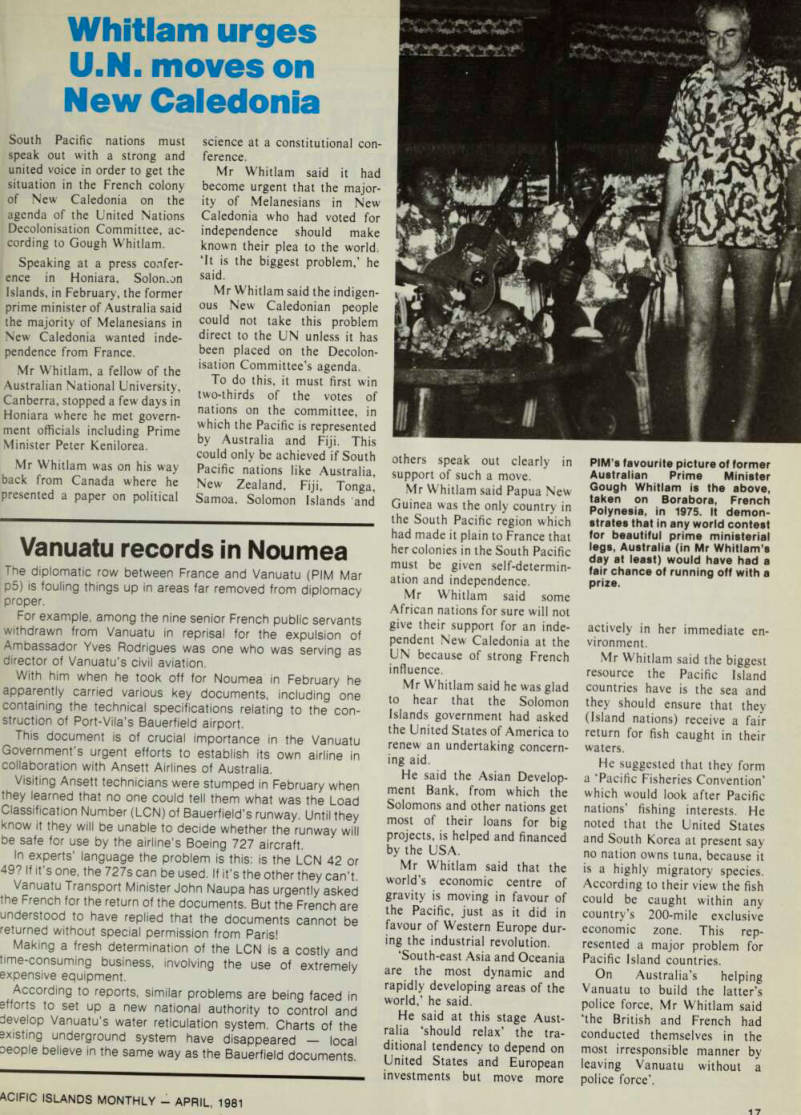
PIM’s favourite picture of former Australian Prime Minister Gough Whitlam is the above, taken on Borabora, French Polynesia, in 1975. It demon strates that in any world contest for beautiful prime ministerial legs, Australia (in Mr Whitlam’s day at least) would have had a fair chance of running off with a prize.
Vanuatu records in Noumea
The diplomatic row between France and Vanuatu (PIM Mar p 5) is fouling things up in areas far removed from diplomacy proper.
For example, among the nine senior French public servants withdrawn from Vanuatu in reprisal for the expulsion of Ambassador Yves Rodrigues was one who was serving as director of Vanuatu's civil aviation.
With him when he took off for Noumea in February he apparently carried various key documents, including one containing the technical specifications relating to the con struction of Port-Vila’s Bauerfield airport.
This document is of crucial importance in the Vanuatu Government’s urgent efforts to establish its own airline in collaboration with Ansett Airlines of Australia.
Visiting Ansett technicians were stumped in February when they learned that no one could tell them what was the Load Classification Number (LCN) of Bauerfield’s runway. Until they know it they will be unable to decide whether the runway will be safe for use by the airline’s Boeing 727 aircraft.
In experts’ language the problem is this: is the LCN 42 or 49? If it’s one, the 727 s can be used. If it’s the other they can’t.
Vanuatu Transport Minister John Naupa has urgently asked the French for the return of the documents. But the French are understood to have replied that the documents cannot be returned without special permission from Paris!
Making a fresh determination of the LCN is a costly and time-consuming business, involving the use of extremely expensive equipment.
According to reports, similar problems are being faced in efforts to set up a new national authority to control and develop Vanuatu’s water reticulation system. Charts of the existing underground system have disappeared local eeople believe in the same way as the Bauerfield documents.
Advertisements & other items, p. 17 (1 item)
17
ACIFIC ISLANDS MONTHLY APRIL, 1981
More power
to the folk of Borabora
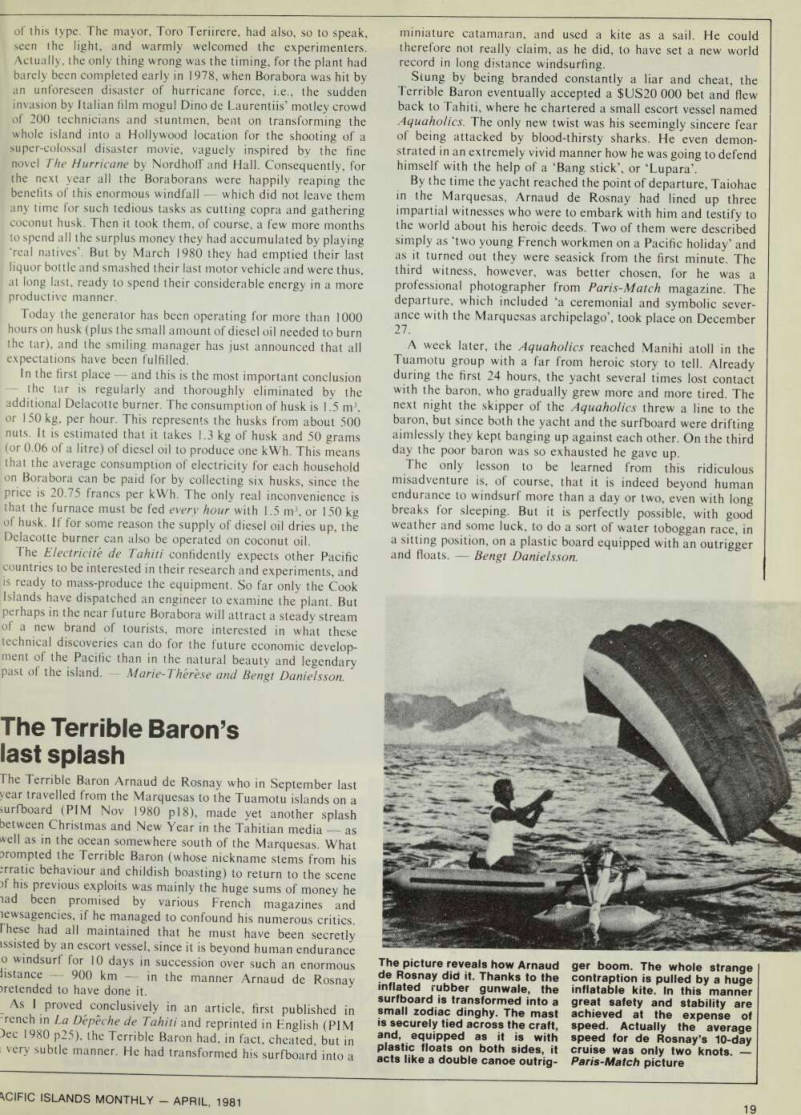
For the past year, the many tourists flocking to Borabora in the hope of finding a perfect South Sea paradise have been puzzled by a strange, humming sound which is in strong contrast to the melodious beating of the waves on the reef, and the soft rustling of the palm trees. This unexpected noise emanates from two big metal cylinders pointing to the sky like moon rockets ready for their momentous take-off. In the ensuing guessing game, no visitor ever comes up with the correct explanation, i.e., that the ‘rockets’ are actually the combustion chambers of a recently built, experimental model of an electric power plant, using coconut husks for fuel.
Of course, gas engines are nothing new. They were particularly common in Europe during World War II (even for use in motor cars) when petrol and coal were in short supply.
And already long before that more precisely between 1928 and 194$ the power plant that produced the modest amount of electricity needed to light the town of Papeete was run entirely on coconut husks. Maintenance was, however, always a problem, for the gas was full of tar which continually clogged up the machinery. For this reason, this easily available fuel was eventually abandoned in favour of imported oil of which there seemed to be, in the 1950 s and 19605, an endless supply at very reasonable cost.
When the Arabs began changing all that in 1974, the French Government claimed with some smugness that it had long since foreseen the oil crisis and therefore opted for nuclear energy as the only possible alternative. Many French ministers and other official spokesmen tried to make us believe that it was thanks to the bomb tests at Moruroa that France possessed such an advanced nuclear technology. It was therefore most appropri ate, it was said, to compensate the people of French Polynesia for past hardships by having installed on the most populous island, Tahiti, as a gift from the mother country, a nuclear power plant, using as its basic component a generator of the type especially designed for the French atomic submarines. This seemingly very generous offer was, however, angrily rejected by all local political and civic leaders when they learned that the plant they were offered was an experimental prototype of untested and unproven safety. In consequence, they told the eager donors to try out this strange nuclear contraption in their own backyard in France.
Instead, the local leaders began clamouring for other types of generators, using such natural energy sources as the sun, wind, rivers and ocean. The French response was rather lame: up to date only a handful of VAT technicians (the French counterpart to the American Peace Corps) have arrived and most of them spend their time pottering about with old-fashioned wind-mills.
Meanwhile being a private company, the Electricite de Tahiti (owned by the powerful Martin family, also in the profitable brewing business) could and did act in a much more efficient manner. At first glance the decision of the EDT board to build an experimental power plant in Borabora, fuelled with coconut husks in the same way as the old Papeete plant does not
make much sense. Closer scrutiny, however, reveals a difference of vital importance: the new Borabora plant is equipped with an additional small burner (running on diesel fuel) capable of destroying the obnoxious tar content of the gas produced. As the EDT manager tells the story, this burner was invented by a French engineer named Delacotte, who continued to work on gas engines all his life, in spite of the general indifference that existed up to the 1974 oil crisis! As a crowning triumph, he was brought to Borabora shortly before his death to help in setting up this pilot plant which will open up a new era in the field of economic power production all this according to the EDT manager The main reason why Borabora had been chosen was that its population, 2700, was of the right size for testing a 190 kW plant
of this type. The mayor, Toro Teriirere, had also, so to speak, seen the light, and warmly welcomed the experimenters.
Actually, the only thing wrong was the timing, for the plant had barely been completed early in 1978, when Borabora was hit by an unforeseen disaster of hurricane force, i.e., the sudden invasion by Italian film mogul Dino de Laurentiis’ motley crowd of 200 technicians and stuntmen, bent on transforming the whole island into a Hollywood location for the shooting of a super-colossal disaster movie, vaguely inspired by the fine novel The Hurricane by NordhofT and Hall. Consequently, for the next year all the Boraborans were happily reaping the benefits of this enormous windfall which did not leave them any time for such tedious tasks as cutting copra and gathering coconut husk. Then it took them, of course, a few more months to spend all the surplus money they had accumulated by playing ‘real natives’. But by March 1980 they had emptied their last liquor bottle and smashed their last motor vehicle and were thus, at long last, ready to spend their considerable energy in a more productive manner.
Today the generator has been operating for more than 1000 hours on husk (plus the small amount of diesel oil needed to burn the tar), and the smiling manager has just announced that all expectations have been fulfilled.
In the first place and this is the most important conclusion the tar is regularly and thoroughly eliminated by the additional Delacotte burner. The consumption of husk is 1.5 m 3. or 150 kg, per hour. This represents the husks from about 500 nuts. It is estimated that it takes 1.3 kg of husk and 50 grams (or 0.06 of a litre) of diesel oil to produce one kWh. This means that the average consumption of electricity for each household on Borabora can be paid for by collecting six husks, since the price is 20.75 francs per kWh. The only real inconvenience is that the furnace must be fed every hour with 1.5 m 3, or 150 kg of husk. If for some reason the supply of diesel oil dries up, the Delacotte burner can also be operated on coconut oil.
The Electricite de Tahiti confidently expects other Pacific countries to be interested in their research and experiments, and is ready to mass-produce the equipment. So far only the Cook Islands have dispatched an engineer to examine the plant. But perhaps in the near future Borabora will attract a steady stream of a new brand of tourists, more interested in what these technical discoveries can do for the future economic develop ment of the Pacific than in the natural beauty and legendary
past of the island.
Marie-Therese and Bengt Danielsson.
last splash
The Terrible Baron’s last splash
The Terrible Baron Arnaud de Rosnay who in September last year travelled from the Marquesas to the Tuamotu islands on a surfboard (PIM Nov 1980 pl 8), made yet another splash between Christmas and New Year in the Tahitian media as as in the ocean somewhere south of the Marquesas. What srompted the Terrible Baron (whose nickname stems from his erratic behaviour and childish boasting) to return to the scene )f his previous exploits was mainly the huge sums of money he lad been promised by various French magazines and lewsagencies, if he managed to confound his numerous critics.
Fhese had all maintained that he must have been secretly issisted by an escort vessel, since it is beyond human endurance 0 windsurf for 10 days in succession over such an enormous listance 900 km —in the manner Arnaud de Rosnay )retended to have done it.
As I proved conclusively in an article, first published in rench in La Depeche de Tahiti and reprinted in English (PIM )ec 1980 p 25), the Terrible Baron had. in fact, cheated but in 1 ver y subtle manner. He had transformed his surfboard into a
miniature catamaran, and used a kite as a sail. He could therefore not really claim, as he did, to have set a new world record in long distance windsurfing.
Stung by being branded constantly a liar and cheat, the Terrible Baron eventually accepted a SUS2O 000 bet and flew back to Tahiti, where he chartered a small escort vessel named Aquaholics. The only new twist was his seemingly sincere fear of being attacked by blood-thirsty sharks. He even demon strated in an extremely vivid manner how he was going to defend himself with the help of a ‘Bang stick’, or ‘Lupara’.
By the time the yacht reached the point of departure, Taiohae in the Marquesas, Arnaud de Rosnay had lined up three impartial witnesses who were to embark with him and testify to the world about his heroic deeds. Two of them were described simply as ‘two young French workmen on a Pacific holiday’ and as it turned out they were seasick from the first minute. The third witness, however, was better chosen, for he was a professional photographer from Paris-Match magazine. The departure, which included ‘a ceremonial and symbolic sever ance with the Marquesas archipelago’, took place on December 27.
A week later, the Aquaholics reached Manihi atoll in the Tuamotu group with a far from heroic story to tell. Already during the first 24 hours, the yacht several times lost contact with the baron, who gradually grew more and more tired. The next night the skipper of the Aquaholics threw a line to the baron, but since both the yacht and the surfboard were drifting aimlessly they kept banging up against each other. On the third day the poor baron was so exhausted he gave up.
The only lesson to be learned from this ridiculous misadventure is, of course, that it is indeed beyond human endurance to windsurf more than a day or two, even with long breaks for sleeping. But it is perfectly possible, with good weather and some luck, to do a sort of water toboggan race, in a sitting position, on a plastic board equipped with an outrigger
and floats.
Bengt Danielsson.
The picture reveals how Arnaud de Rosnay did it. Thanks to the inflated rubber gunwale, the surfboard is transformed into a small zodiac dinghy. The mast is securely tied across the craft, and, equipped as it is with plastic floats on both sides, it acts like a double canoe outrig-
ger boom. The whole strange contraption is pulled by a huge inflatable kite. In this manner great safety and stability are achieved at the expense of speed. Actually the average speed for de Rosnay’s 10-day cruise was only two knots. - Paris-Match picture
Advertisements & other items, pp. 19-20 (2 items)
19
\CIFIC ISLANDS MONTHLY APRIL, 1981
Throughout the Pdcific...
■ wsk y*T*rr
we’re your kind of people
When you fly in the Pacific, you’ll feel at home with Air New Zealand.
Fly with us to Australia,Cook Islands, Fiji, Hong Kong,Honolulu, Japan, Los Angeles, New Caledonia, Norfolk Island, Singapore, Tahiti, Tonga, Western New Zealand.
gir heuu zEatann
ANZ 80/18
k The Pacifies
Number One
budgets and
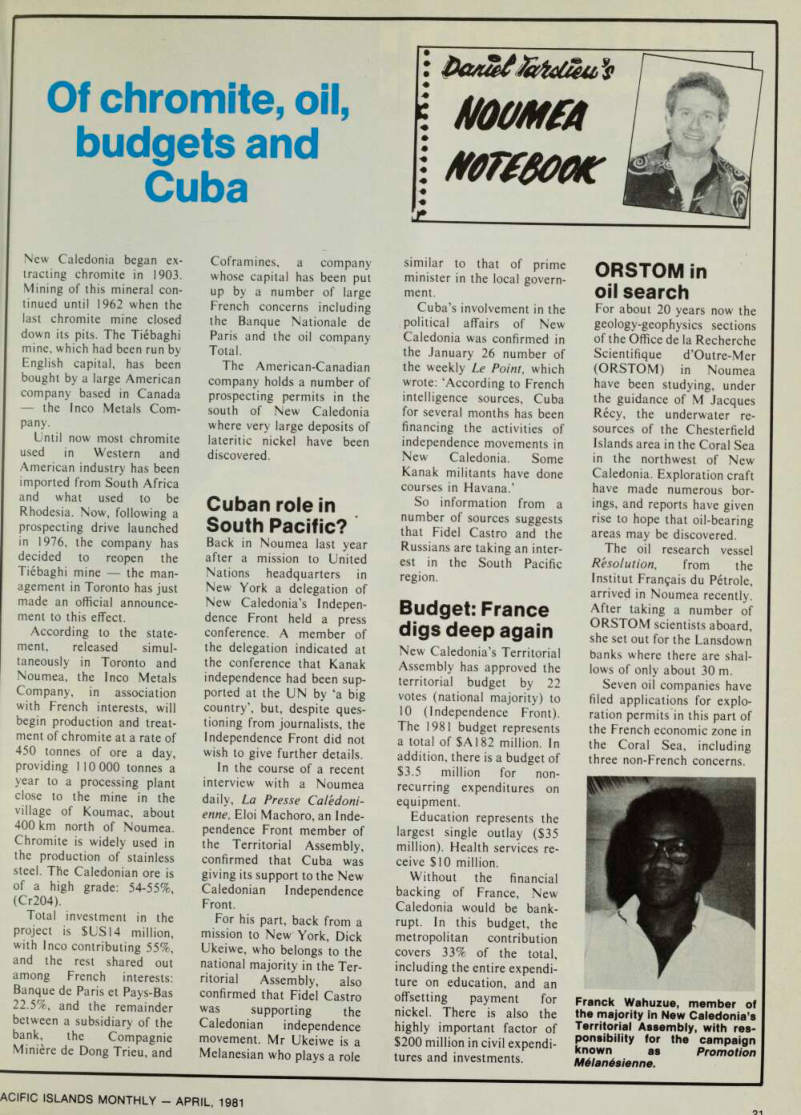
Of chromite, oil, budgets and Cuba
New Caledonia began ex tracting chromite in 1903.
Mining of this mineral con tinued until 1962 when the last chromite mine closed down its pits. The Tiebaghi mine, which had been run by English capital, has been bought by a large American company based in Canada the Inco Metals Com pany.
Until now most chromite used in Western and American industry has been imported from South Africa and what used to be Rhodesia. Now, following a prospecting drive launched in 1976, the company has decided to reopen the Tiebaghi mine the man agement in Toronto has just made an official announce ment to this effect.
According to the state ment, released simul taneously in Toronto and Noumea, the Inco Metals Company, in association with French interests, will begin production and treat ment of chromite at a rate of 450 tonnes of ore a day, providing 110 000 tonnes a year to a processing plant close to the mine in the village of Koumac, about 400 km north of Noumea.
Chromite is widely used in the production of stainless steel. The Caledonian ore is of a high grade: 54-55%, (Cr2o4).
Total investment in the
project is SUSI 4 million,
with Inco contributing 55%, and the rest shared out among French interests: Banque de Paris et Pays-Bas 22.5%, and the remainder between a subsidiary of the bank, the Compagnie Miniere de Dong Trieu, and
Coframines, a company whose capital has been put up by a number of large French concerns including the Banque Nationale de Paris and the oil company Total.
The American-Canadian company holds a number of prospecting permits in the south of New Caledonia where very large deposits of lateritic nickel have been discovered.
Cuban role in
South Pacific?
Back in Noumea last year after a mission to United Nations headquarters in New York a delegation of New Caledonia’s Indepen dence Front held a press conference. A member of the delegation indicated at the conference that Kanak independence had been sup ported at the UN by ‘a big country’, but, despite ques tioning from journalists, the Independence Front did not wish to give further details.
In the course of a recent interview with a Noumea daily, La Presse Caledoni enne, Eloi Machoro, an Inde pendence Front member of the Territorial Assembly, confirmed that Cuba was giving its support to the New Caledonian Independence Front.
For his part, back from a mission to New York, Dick Ukeiwe, who belongs to the national majority in the Ter ritorial Assembly, also confirmed that Fidel Castro was supporting the Caledonian independence movement. Mr Ukeiwe is a Melanesian who plays a role
similar to that of prime minister in the local govern ment.
Cuba’s involvement in the political affairs of New Caledonia was confirmed in the January 26 number of the weekly Le Point, which wrote: ‘According to French intelligence sources, Cuba for several months has been financing the activities of independence movements in New Caledonia. Some Kanak militants have done courses in Havana.’
So information from a number of sources suggests that Fidel Castro and the Russians are taking an inter est in the South Pacific region.
Budget: France
digs deep again
New Caledonia’s Territorial Assembly has approved the territorial budget by 22 votes (national majority) to 10 (Independence Front).
The 1981 budget represents a total of SAIB2 million. In addition, there is a budget of $3.5 million for non recurring expenditures on equipment.
Education represents the largest single outlay ($35 million). Health services re ceive $lO million.
Without the financial backing of France, New Caledonia would be bank rupt. In this budget, the metropolitan contribution covers 33% of the total, including the entire expendi ture on education, and an offsetting payment for nickel. There is also the highly important factor of $2OO million in civil expendi tures and investments.
Orstom In
oil search
For about 20 years now the
geology-geophysics sections
of the Office de la Recherche
Scientifique d’Outre-Mer
(ORSTOM) in Noumea have been studying, under the guidance of M Jacques Recy, the underwater re sources of the Chesterfield Islands area in the Coral Sea in the northwest of New Caledonia. Exploration craft have made numerous bor ings, and reports have given rise to hope that oil-bearing areas may be discovered.
The oil research vessel Resolution, from the Institut Fransais du Petrole, arrived in Noumea recently.
After taking a number of ORSTOM scientists aboard, she set out for the Lansdown banks where there are shal lows of only about 30 m.
Seven oil companies have filed applications for explo ration permits in this part of the French economic zone in the Coral Sea, including three non-French concerns.
Franck Wahuzue, member of the majority in New Caledonia’s Territorial Assembly, with res ponsibility for the campaign known as Promotion Melansienne.
Advertisements & other items, p. 21 (1 item)
21
ACIFIC ISLANDS MONTHLY - APRIL, 1981
Samoa blazes
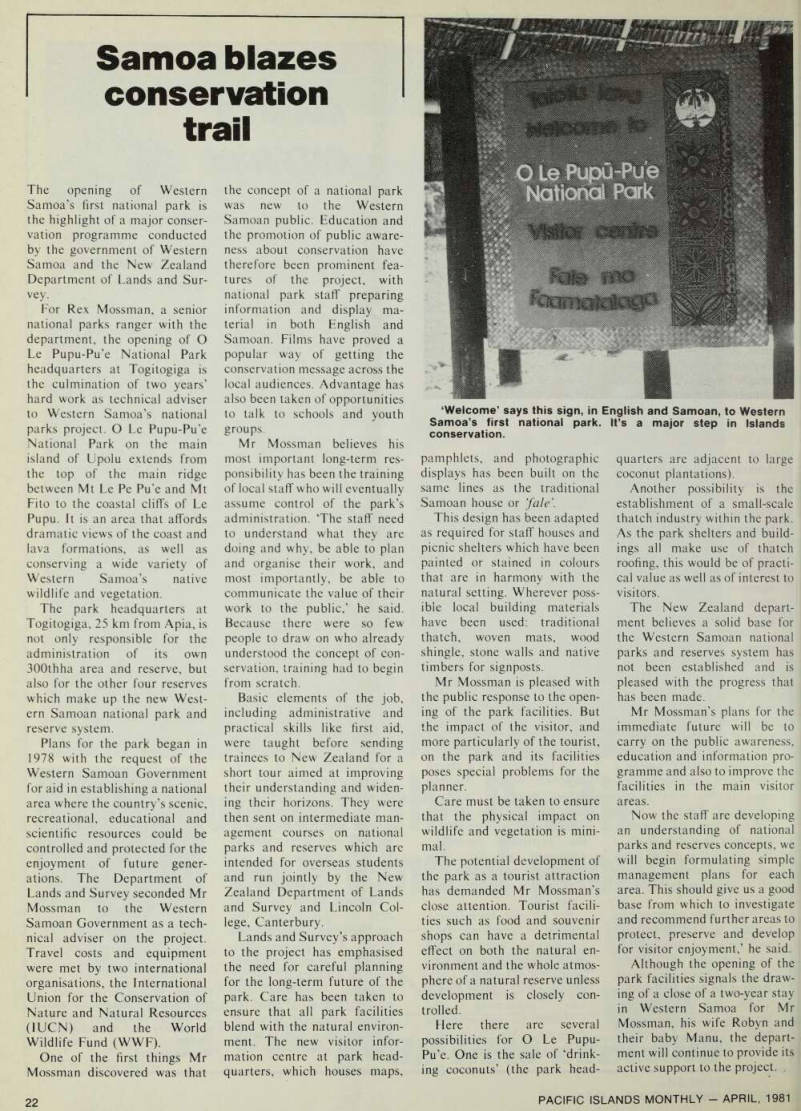
conservation trail
The opening of Western Samoa’s first national park is the highlight of a major conser vation programme conducted by the government of Western Samoa and the New Zealand Department of Lands and Sur vey.
For Rex Mossman, a senior national parks ranger with the department, the opening of O Le Pupu-Pu’e National Park headquarters at Togitogiga is the culmination of two years’ hard work as technical adviser to Western Samoa’s national parks project. O Le Pupu-Pu’e National Park on the main island of Upolu extends from the top of the main ridge between Mt Le Pe Pu'e and Mt Fito to the coastal cliffs of Le Pupu. It is an area that affords dramatic views of the coast and lava formations, as well as conserving a wide variety of Western Samoa’s native wildlife and vegetation.
The park headquarters at Togitogiga, 25 km from Apia, is not only responsible for the administration of its own BOOlhha area and reserve, but also for the other four reserves which make up the new West ern Samoan national park and reserve system.
Plans for the park began in 1978 with the request of the Western Samoan Government for aid in establishing a national area where the country’s scenic, recreational, educational and scientific resources could be controlled and protected for the enjoyment of future gener ations. The Department of Lands and Survey seconded Mr Mossman to the Western Samoan Government as a tech nical adviser on the project.
Travel costs and equipment were met by two international organisations, the International Union for the Conservation of Nature and Natural Resources (lUCN) and the World Wildlife Fund (WWF).
One of the first things Mr Mossman discovered was that
the concept of a national park was new to the Western Samoan public. Education and the promotion of public aware ness about conservation have therefore been prominent fea tures of the project, with national park staff preparing information and display ma terial in both English and Samoan. Films have proved a popular way of getting the conservation message across the local audiences. Advantage has also been taken of opportunities to talk to schools and youth groups.
Mr Mossman believes his most important long-term res ponsibility has been the training of local staff who will eventually assume control of the park’s administration. The staff need to understand what they are doing and why, be able to plan and organise their work, and most importantly, be able to communicate the value of their work to the public,’ he said.
Because there were so few people to draw on who already understood the concept of con servation, training had to begin from scratch.
Basic elements of the job, including administrative and practical skills like first aid, were taught before sending trainees to New Zealand for a short tour aimed at improving their understanding and widen ing their horizons. They were then sent on intermediate man agement courses on national parks and reserves which are intended for overseas students and run jointly by the New Zealand Department of Lands and Survey and Lincoln Col lege, Canterbury.
Lands and Survey’s approach to the project has emphasised the need for careful planning for the long-term future of the park. Care has been taken to ensure that all park facilities blend with the natural environ ment. The new visitor infor mation centre at park head quarters, which houses maps,
pamphlets, and photographic displays has been built on the same lines as the traditional Samoan house or fale\ This design has been adapted as required for staff houses and picnic shelters which have been painted or stained in colours that are in harmony with the natural setting. Wherever poss ible local building materials have been used; traditional thatch, woven mats, wood shingle, stone walls and native timbers for signposts.
Mr Mossman is pleased with the public response to the open ing of the park facilities. But the impact of the visitor, and more particularly of the tourist, on the park and its facilities poses special problems for the planner.
Care must be taken to ensure that the physical impact on wildlife and vegetation is mini mal.
The potential development of the park as a tourist attraction has demanded Mr Mossman’s close attention. Tourist facili ties such as food and souvenir shops can have a detrimental effect on both the natural en vironment and the whole atmos phere of a natural reserve unless development is closely con trolled.
Here there are several possibilities for O Le Pupu- Pu’e. One is the sale of ‘drink ing coconuts’ (the park head
quarters are adjacent to large coconut plantations).
Another possibility is the establishment of a small-scale thatch industry within the park.
As the park shelters and build ings all make use of thatch roofing, this would be of practi cal value as well as of interest to visitors.
The New Zealand depart ment believes a solid base for the Western Samoan national parks and reserves system has not been established and is pleased with the progress that has been made.
Mr Mossman’s plans for the immediate future will be to carry on the public awareness, education and information pro gramme and also to improve the facilities in the main visitor areas.
Now the staff are developing an understanding of national parks and reserves concepts, we will begin formulating simple management plans for each area. This should give us a good base from which to investigate and recommend further areas to protect, preserve and develop for visitor enjoyment,’ he said.
Although the opening of the park facilities signals the draw ing of a close of a two-year stay in Western Samoa for Mr Mossman, his wife Robyn and their baby Manu, the depart ment will continue to provide its active support to the project. .
‘Welcome' says this sign, in English and Samoan, to Western Samoa's first national park. It’s a major step in Islands conservation.
Advertisements & other items, pp. 23-30 (1 item)
Pioneer launches a first
m supersonic travel
In this fast-paced world of bullet trains and Concorde jetliners, to stay in touch with your favorite stereo music you need SOUNDTREK. Pioneer’s new supersonic fleet of Multi-Mode Mobile Hi-Fi. ■ For added tape-handling ease and pushbutton program selection. Pioneer ; offer s Multi-Mode Deck design in every SOUNDTREK stereo portable. For example, ; , there’s Song Finder. With it you can skip over unwanted program material locate • and play your favorite song at the push of a button. A feature you would expect to find on a home hi-fi cassette deck. But wait till you hear the sound of our / SOUNDTREK portables. When you do, you’ll know why we call them “Mobile Hi-Fi." *. Explore the outer reaches of stereo listening enjoyment with SOUNDTREK v Multi-Mode Mobile Hi-Fi from Pioneer. They're available in six models, all featuring Pioneer performance and supersonic sound to get you off the ground. v m /min bit
SK-95F
Further information, please contact: MarketingService Pty.Ltd., P.O. 80x317, Mordialloc, Victoria,3l9s & Company, G.P.O. Box No. 362, Suva, Fiji Islands Tel: 22258 “ LW ’ 3 ° *** Gr6y Ly ""' AuCkland ' Hebrides- £22 2", lp flf*i sland ) L W- P-O. Box 21, Norfolk Island, Hebrides. Burns Philp (New Hebrides) Ltd., Vila, New Hebrides
fiD pioneer
Nauru Island: Jacob Enterprises, P.O. Box No. 4, Republic of Nauru Tahiti: Tahiti Hi-Fi, P.O. Box 848, Papeete, Tahiti New Caledonia: Menard Pacifique Saru, B.P. 3899, Noumea, New Caledonia rel: 48 • 24 • 36 Sanoa 966335224 Rft *“ 1477 ’ Pa9 ° Pa9 °- American Rarotonga: South Seas International Ltd., P.O. Box 49, Rarotonga, Cook Islands Tel: 232
Foraworld
that cant afford
to waste its energy
on thirsty cars.
Remember when gas wastlirt cheap? There were no lines. And you could buy all you wanted.
Who cared about miles per gallon? When the tank got low, stop at the next station and fill it up. Big deal.
There were a lot of things we didn’t care much about in those days.
Like the height or strength of the bumper. The safety of the doors. The location of the gas tank. Much less how much pollution came out of fhe exhaust pipe.
As you know, things are much different today. Everyone cares about energy conservation and fuel - %k efficiency. In a world of rising petroleum prices and shrinking supplies, we have to.
So today’s order of business at Datsun goes something like this: Make it light, but make sure it’s just as strong. Make it with less air resistance, but make sure it’s roomy and comfortable. Make it safe and solid, but make sure it goes a long way on a gallon of gas. Make it look good, but make sure its good looks last.
Contradictions? To some, yes.
But not to our researchers, developers, designers and craftsmen.
There are essentially three basic factors which influence fuel efficiency.
And you’ll find them in the same places on every car. Under the hood.
Along the sheet metal. And beneath the floorboard.
The engine must be designed with less friction and more combustion efficiency. The exterior must be designed with less air resistance.
The drive train must be designed to maximize the efficiency of the transmission, differential and tires. And all of the above must be designed to save weight.
The trick is to upgrade the quail of each element. Without harming tH performance of another element ortl overall Quality of the completed car..
DATSUN CREATES HI
Cook Islands: COOK ISLANDS MOTOR CENTRE LTD., Rarotonga/ Fiji: CARPENTERS MOTORS, Suva/Guam: DATSUN MOTOR SALES, Agana Hawaii; NISSAN MO CORPORATION IN HAWAII LTD., Honolulu/Kiribati: ATOLL AUTO STORES, Tarawa/ Nauru: JACOB ENTERPRISES LTD. /New Caledonia: AGENCE ALMA S.A., Noum
j may call that a kind of balancing.
At Datsun, we call it “harmony.” d it is by design.
Thinking and working in harmony mits us to resolve seemingly unre- /able problems.
For example, at highway.speeds, less air resistance, the more fuel ciency. But, under city driving ditions, the less weight, the more I efficiency.
Must we choose? Or can we offer both economies in one car?
According to U.S. Environmental tection Agency estimates, a 1980 sun delivers the highest gasoline mileage of any car sold in America.
Both on the highway and in the city.
Datsun has also been the champion of many other fuel economy runs around the world. Problem-solving b' design-resolving conflicting elements to improve the overall quality of the product—has helped Datsun to build cars that are strong and safe, yet light and fuel efficient.
There is one other important factor in fuel efficiency. You. The driver. Our figures show the skill of the driver can affect overall fuel efficiency 30~40%! So please, avoid rapid-fire speed-ups and slow-downs.
Obey speed limits. Keep your engine tuned and your tires properly inflated.
Increasing your fuel efficiency is money in the bank. Your money. At Datsun, we’re working hard to design the kind of cars the world needs.
Without sacrificing the things you want in your car.
That’s harmony.
The model shown above is the Datsun 140 Y for the Middle East.
Specifications and equipment may vary accordinq to market.
DATSUN
MONY BY DESIGN
uatu: PENTFnn.QT q a d m *w:i . 1
THE NAME OF QUALITY
NISSAN
NISSAN MOTOR CO. LTD
SSLKSPSW S.A., Port Vila and MOTORS/Papua New Guinea. . omara/Tahiti. TAHITIBULL S.A.R.L, Papeete/ Western Samoa: MORRIS HEDSTROM lin Ani MPANY INC /Solomon Islands; UNITED BOROKO MOTORS LTD , Port Moresby/Saipan; JOETEN MOTOR
Expert
Insurance Service
throughout the islands
Queensland Insurance (Fiji) Limited
Head Office, 34 Usher St., SUVA . General Manager: L. G. Liddell A.A.1.1. Assistant Manager: Vijay Lai. Phone; 23851.
LAUTOKA OFFICE; Burns Philp Bldg., Naviti St. District Manager; J. Dalton. Phone: 60642.
Queensland Insurance (PNG) Limited
PAPUA NEW GUINEA
Head Office. B.N.G. Building, Musgrave St..PORT MORESBY. General Manager: J. M. Dawe.
Assistant Manager: R. V. Maskell. Phone; 212144.
LAE; 4th St. & Coronation Drive. District Manager: I. R. Martin. Phone; 423873.
MOUNT HAGEN; Hagen Drive. District Manager: D. F Carroll. Phone: 521002.
ARAWA: Chebu St. District Manager: J. Longbut. Phone: 951555.
MADANG. Kasagten St. District Manager: N. D. Ramage. Phone: 822020.
RABAUL; Wirraway St. District Manager: W. F. Tinker. Phone: 921014.
QBE Insurance Limited
VANUATU, PORT VILA: Rue de Paris, Suite 19, Oceania Bldg. Manager: G. F. Donnelly.
Phone: 2299.
SANTO: Burns Philp (Vanuatu) Ltd. Phone: 230.
PACIFIC AGENCIES
NEW CALEDONIA- T A Hagen, Ste. W. A. Johnston, S.A.R.L. 5 Rue Anatole France, NOUMEA Phone: 272083.
TAHITI Arthur Chung. Immeuble 8.1.5., Front de Mer, PAPEETE. Phone: 2.86.19.
NIUE: Burns Philp (South Sea) Company Ltd.
NORFOLK ISLAND; Burns Philp (N I) Company Ltd. Phone: 2191.
SAMOA: APIA, Burns Philp (South Sea) Company Ltd. Phone: 22611.
TONGA: Burns Philp (South Sea) Company Ltd. NUKU’ALOFA. Phone 21500 HAAPAI, VAVAU
MEMBERS OFTHE:
€?qbe insurance group umited
Clarion welcomes you to the wonderful world of Hi-Fi car audio. A never-ending quest for better sound quality assures the ultimate performance.
Our wealth of experience is backed by a global reputation for superior quality.
We've car stereo systems, car radios and speakers to please everyone.
What is your pleasure?
In Car Entertainment Company
Clarion
Clarion Co., Ltd. Tokyo. Japan * Australia: Amalgamated Wireless (Australasia) Ltd. 554 Parramatta Road, Ashfield N.S.W., 2131/New Zealand: AWA New Zealand Limited P.O. Box 50-248 Porirua/Fiji Islands: Bnjlal &Co., Ltd. G.P.O. Box 362 Suva/Tahiti: Hi-Fi Vairaatoa PO. Box 1128 Papeete/New Caledonia: Caldis B.P Ml Noumea Cedex/Guam: Guam Radio & TV Shop PO. Box 1939 Agana, Guam 96910/New Hebrides: The Sound Centre PO. Box 434, Vila/Cook Islands: South Seas International Ltd. PO. Box 49 Rarotonga/Papua New Guinea: Hagemeyer (P.N.G.) Pty. Ltd. PO. Box 1428, Boroko, Port Moresby. * Dolby and the double-D symbol are trademarks of Dolby Laboratories.
cover girl
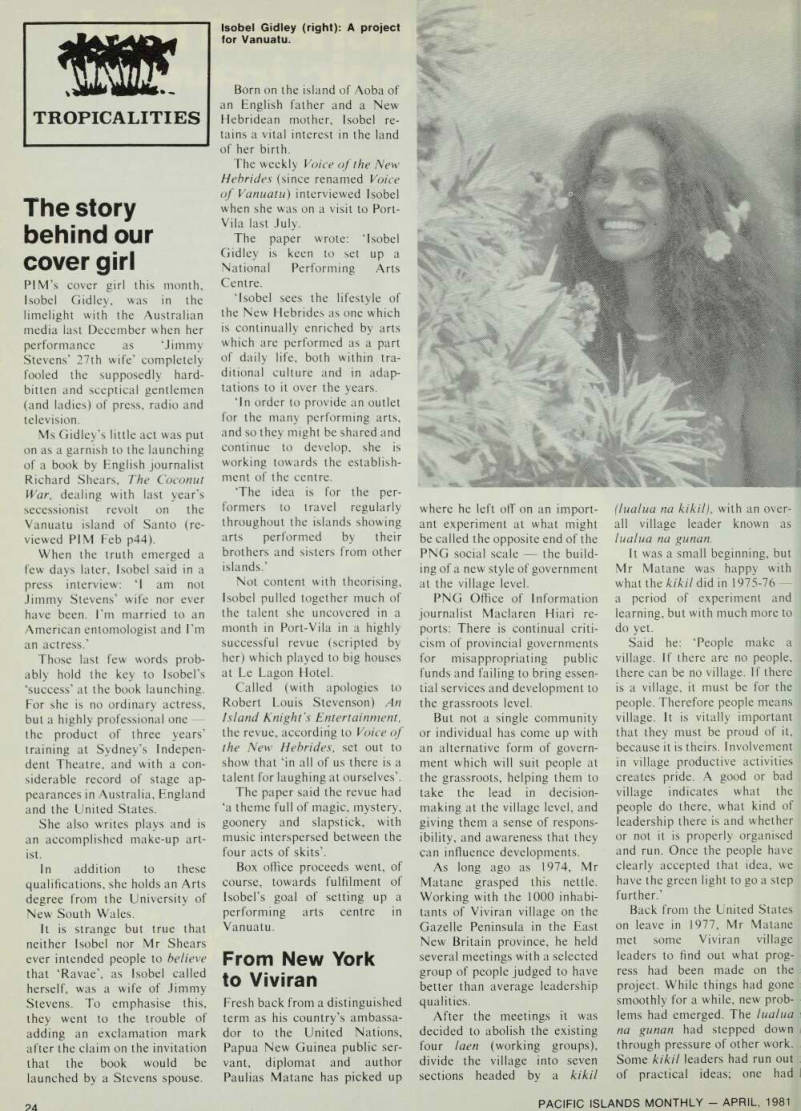
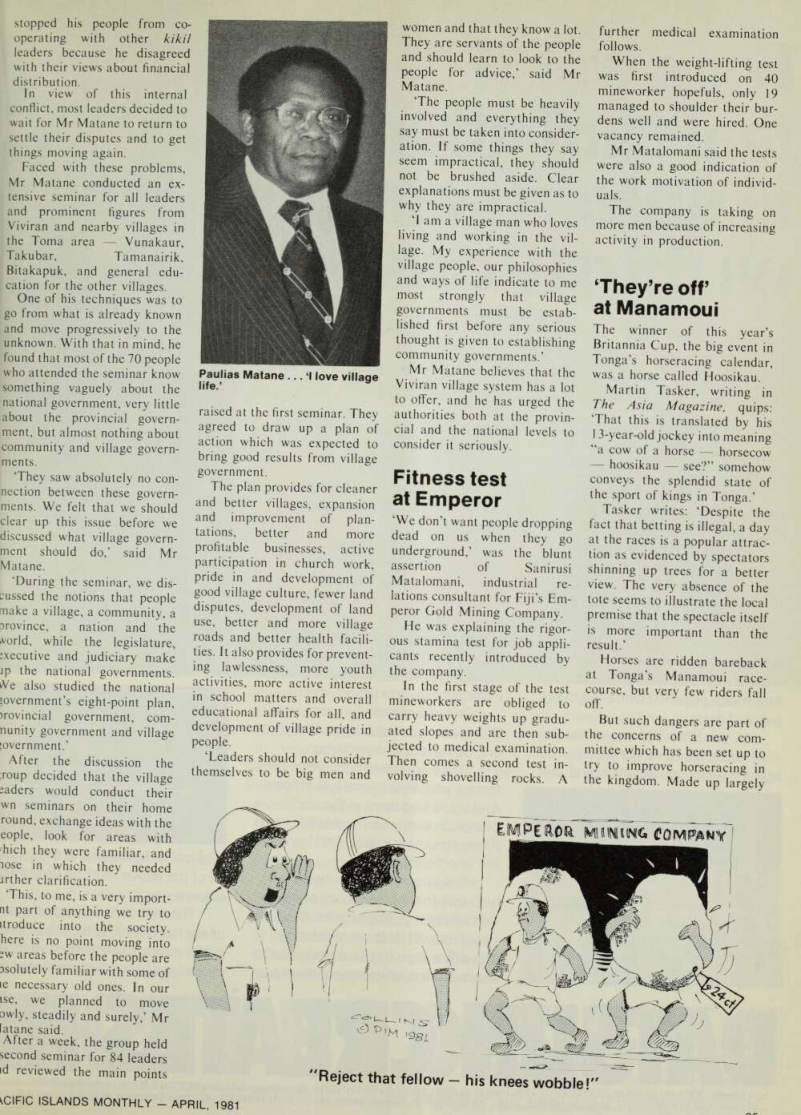


Tropicalities
The story
behind our
cover girl
PI M’s cover girl this month, Isobel Gidley, was in the limelight with the Australian media last December when her performance as ‘Jimmy Stevens’ 27th wife’ completely fooled the supposedly hard bitten and sceptical gentlemen (and ladies) of press, radio and television.
Ms Gidley’s little act was pul on as a garnish to the launching of a book by English journalist Richard Shears, The Coconut War, dealing with last year’s secessionist revolt on the Vanuatu island of Santo (re viewed PIM Feb p 44).
When the truth emerged a few days later, Isobel said in a press interview: ‘1 am not Jimmy Stevens’ wife nor ever have been. I’m married to an American entomologist and I’m an actress.’
Those last few words prob ably hold the key to Isobel’s ‘success’ at the book launching.
For she is no ordinary actress, but a highly professional one the product of three years’ training at Sydney’s Indepen dent Theatre, and with a con siderable record of stage ap pearances in Australia, England and the United States.
She also writes plays and is an accomplished make-up art ist.
In addition to these qualifications, she holds an Arts degree from the University of New South Wales.
It is strange but true that neither Isobel nor Mr Shears ever intended people to believe that ‘Ravae’, as Isobel called herself, was a wife of Jimmy Stevens. To emphasise this, they went to the trouble of adding an exclamation mark after the claim on the invitation that the book would be launched by a Stevens spouse.
Born on the island of Aoba of an English father and a New Hebridean mother, Isobel re tains a vital interest in the land of her birth.
The weekly Voice of the New Hebrides (since renamed Voice of Vanuatu ) interviewed Isobel when she was on a visit to Port- Vila last July.
The paper wrote; Isobel Gidley is keen to set up a National Performing Arts Centre. ‘lsobel sees the lifestyle of the New Hebrides as one which is continually enriched by arts which are performed as a part of daily life, both within tra ditional culture and in adap tations to it over the years. ‘ln order to provide an outlet for the many performing arts, and so they might be shared and continue to develop, she is working towards the establish ment of the centre. ‘The idea is for the per formers to travel regularly throughout the islands showing arts performed by their brothers and sisters from other islands.’
Not content with theorising, Isobel pulled together much of the talent she uncovered in a month in Port-Vila in a highly successful revue (scripted by her) which played to big houses at Le Lagon Hotel.
Called (with apologies to Robert Louis Stevenson) An Island Knight’s Entertainment, the revue, according to Voice of the New Hebrides, set out to show that ‘in all of us there is a talent for laughing at ourselves’.
The paper said the revue had ‘a theme full of magic, mystery, goonery and slapstick, with music interspersed between the four acts of skits’.
Box office proceeds went, of course, towards fulfilment of Isobel’s goal of setting up a performing arts centre in Vanuatu.
From New York
to Viviran
Fresh back from a distinguished term as his country’s ambassa dor to the United Nations, Papua New Guinea public ser vant, diplomat and author Paulias Matane has picked up
where he left off on an import ant experiment at what might be called the opposite end of the PNG social scale the build ing of a new style of government at the village level.
PNG Office of Information journalist Maclaren Hiari re ports: There is continual criti cism of provincial governments for misappropriating public funds and failing to bring essen tial services and development to the grassroots level.
But not a single community or individual has come up with an alternative form of govern ment which will suit people at the grassroots, helping them to take the lead in decision making at the village level, and giving them a sense of respons ibility, and awareness that they can influence developments.
As long ago as 1974, Mr Matane grasped this nettle.
Working with the 1000 inhabi tants of Viviran village on the Gazelle Peninsula in the East New Britain province, he held several meetings with a selected group of people judged to have better than average leadership qualities.
After the meetings it was decided to abolish the existing four laen (working groups), divide the village into seven sections headed by a kikil
(lualua na kikil), with an over all village leader known as lualua na gunan.
It was a small beginning, but Mr Matane was happy with what the kikil did in 1975-76 —| a period of experiment and learning, but with much more to do yet.
Said he; ‘People make a village. If there are no people, there can be no village. If there is a village, it must be for the people. Therefore people means village. It is vitally important that they must be proud of it, because it is theirs. Involvement in village productive activities creates pride. A good or bad village indicates what the people do there, what kind of leadership there is and whether or not it is properly organised and run. Once the people have clearly accepted that idea, we have the green light to go a step further.’
Back from the United States on leave in 1977, Mr Matane met some Viviran village leaders to find out what prog ress had been made on the project. While things had gone smoothly for a while, new prob lems had emerged. The lualua na gunan had stepped down through pressure of other work.
Some kikil leaders had run out of practical ideas; one had
Isobel Gidley (right): A project for Vanuatu.
stopped his people from co operating with other kikil leaders because he disagreed with their views about financial distribution.
In view of this internal conflict, most leaders decided to wait for Mr Matane to return to settle their disputes and to get things moving again.
Faced with these problems, Mr Matane conducted an ex tensive seminar for all leaders and prominent figures from Viviran and nearby villages in the Toma area Vunakaur, Takubar, Tamanairik, Bitakapuk, and general edu cation for the other villages.
One of his techniques was to go from what is already known and move progressively to the unknown. With that in mind, he found that most of the 70 people who attended the seminar know something vaguely about the national government, very little about the provincial govern ment, but almost nothing about community and village govern ments. ‘They saw absolutely no con nection between these govern ments. We felt that we should clear up this issue before we discussed what village govern ment should do,’ said Mr Matane. ‘During the seminar, we dis cussed the notions that people make a village, a community, a province, a nation and the vorld, while the legislature,
;xecutive and judiciary make
ip the national governments.
A/e also studied the national
Government’s eight-point plan,
)rovincial government, com nunity government and village 'overnment.’
After the discussion the roup decided that the village caders would conduct their wn seminars on their home round, exchange ideas with the eople, look for areas with hich they were familiar, and lose in which they needed irther clarification. ‘This, to me, is a very import nt part of anything we try to itroduce into the society, here is no point moving into cw areas before the people are isolulely familiar with some of ie necessary old ones. In our ise, we planned to move owly, steadily and surely,’ Mr (atane said.
After a week, the group held second seminar for 84 leaders id reviewed the main points
raised at the first seminar. They agreed to draw up a plan of action which was expected to bring good results from village government.
The plan provides for cleaner and better villages, expansion and improvement of plan tations, better and more profitable businesses, active participation in church work, pride in and development of good village culture, fewer land disputes, development of land use, better and more village roads and better health facili ties. It also provides for prevent ing lawlessness, more youth activities, more active interest in school matters and overall educational affairs for all, and development of village pride in people. ‘Leaders should not consider themselves to be big men and
women and that they know a lot.
They are servants of the people I and should learn to look to the people for advice,’ said Mr Matane.
The people must be heavily involved and everything they say must be taken into consider ation. If some things they say seem impractical, they should not be brushed aside. Clear explanations must be given as to why they are impractical. ‘I am a village man who loves living and working in the vil lage. My experience with the village people, our philosophies and ways of life indicate to me most strongly that village governments must be estab lished first before any serious thought is given to establishing community governments.’
Mr Matane believes that the Viviran village system has a lot to offer, and he has urged the authorities both at the provin cial and the national levels to consider it seriously.
Fitness test
at Emperor
‘We don’t want people dropping dead on us when they go underground,’ was the blunt assertion of Sanirusi Matalomani, industrial re lations consultant for Fiji’s Em peror Gold Mining Company.
He was explaining the rigor ous stamina test for job appli cants recently introduced by the company.
In the first stage of the test mineworkers are obliged to carry heavy weights up gradu ated slopes and are then sub jected to medical examination.
Then comes a second test in volving shovelling rocks. A
further medical examination follows.
When the weight-lifting test was first introduced on 40 mineworker hopefuls, only 19 managed to shoulder their bur dens well and were hired. One vacancy remained.
Mr Matalomani said the tests were also a good indication of the work motivation of individ uals.
The company is taking on more men because of increasing activity in production.
‘They’re off’
at Manamoui
The winner of this year’s Britannia Cup, the big event in Tonga’s horseracing calendar, was a horse called Hoosikau.
Martin Tasker, writing in The Asia Magazine, quips; That this is translated by his 1 3-year-old jockey into meaning ’a cow of a horse horsecow hoosikau see?” somehow conveys the splendid state of the sport of kings in Tonga.’
Tasker writes: ‘Despite the fact that betting is illegal, a day at the races is a popular attrac tion as evidenced by spectators shinning up trees for a better view. The very absence of the tote seems to illustrate the local premise that the spectacle itself is more important than the result.’
Horses are ridden bareback at Tonga’s Manamoui race course, but very few riders fall off.
But such dangers are part of the concerns of a new com mittee which has been set up to try to improve horseracing in the kingdom. Made up largely
Paulias Matane ... ‘I love village life.’
"Reject that fellow - his knees wobble!"
of expatriate Australians with experience of the international racing scene, the committee hopes to introduce saddles and helmets.
They are also concerned to do something about crowd safety with rails to protect the crowds.
At this year’s race. Tasker observed members of the crowd surge on to the track for a better I view of the horses pounding I straight at them down the final
I straight.
They would also like to stop I the picturesque practice of daubing horses' numbers on their flanks with whitewash.
But despite all the plans, Tasker believes there will be ’little change in the unique atmosphere of Manamoui'. • This year’s silver Britannia Cup was won by jockey Carl Willis and the German expatri ate trainer of Hoosikau, Oum Gobiel.
Gogodala
goodies
A display of cultural material by Papua New Guinea’s Gogodala people was held at the Anthropology Museum of the University of Queensland in Brisbane, Australia, late last year. It was the first exhibition of the material in Australia, and only the second in the world since the Gogodala people be gan reviving their traditional cultural skills in 1973.
Museum curator Dr Peter Lauer said the Queensland dis play was unusual in that items were for sale, the first lime in nnore than 50 years that 3ogodala cultural items had seen available.
The Gogodala people are Dased on the Aramia River, in lOulhern Papua New Guinea, tear the Fly River.
Dr Lauer told PIM that European contact and mission
ictivities had destroyed
jogodala culture early this entury, and reduced it to ’mere
nemories’. The University of
Queensland had been able to lay a significant role in the evival of their culture.
In 1914, an Australian iovernment official, A.P. -yons, who was a resident tagistrate in the area, took holographs of Gogodala eople and their cultural activi-
ties. These photographs were donated to the University of Queensland’s Fryer Library, and came into the possession of the Anthropology Museum.
When the Gogodala people began their cultural revitalisation, using the skills of their elders, they made inquir ies to the university to see if it had any early Gogodala ma terial which might provide in spiration for their work. The university has since maintained close contact with the Gogodala people, who spent two years preparing for the Brisbane dis play.
The display its contents, layout and design was pre pared by the Gogodala Cultural Centre at Balimo, in conjunc tion with the National Cultural Council of Papua New Guinea.
The 118 artifacts on display included dance masks, totem effigies, ceremonial canoes, an cestral figures, drums, weapons, smoke pipes, musical instru ments, woven material and body ornaments.
TC at work
in Suva
Teen Challenge or TC for short is alive and well in Fiji’s capital, Suva.
TC originated in America, and its aim is to lake teenagers off the streets, away from wasted lives of drugs and prosti tution, and to give them an opportunity for a new life.
Jese Sikivou, writing in The Fiji Times, reports that it was imported into Fiji by the pastor of Calvary Temple, the Rev Alipate Cakau, and was estab lished in Suva last year with the support of the Fiji Assemblies of God Church.
The Rev Jone Kata, pastor responsible for the project, said it was started with donations of everything from clothing to cutlery. Members of the church donated odd bowls or spare spoons to gel it going.
Housed in an old wooden building at the top of Suva’s Robertson Road, when Sikivou reported in February there were 20 young men involved in the project.
The one condition of entry into the TC project is that a young man had no alternative open to him.
The centre is most interested
in youths between the ages of 13 and 20.
Sikivou writes; ‘During the day the boys are put on various projects like upholstering old furniture or repairing cars.
They have been given a plot of land near Wainivula where they grow vegetables for the kitchen.
There are also a few acres in Naitasiri which were given by a man who wanted to help the boys. They go up there for two weeks at a time.’
Mr Kata said; ‘Nothing here is compulsory, not the prayers or any spiritual meetings. It is not important for the boys to be members of the Assemblies of God Church or even to be Christians.’
The boys receive no allow ance but divide up the money from contracts given to the centre.
Operating budget for Suva’s TC project is about SFIOOO a month.
The centre has appealed to the Ministry of Youth and Sport, which has given it car pentry tools, and there is a promise of $lO 000 from the Fijian Affairs Board.
There are plans to get -a similar centre underway in Lautoka.
woodhen
is saved
Australia’s success in saving the threatened Lord Howe Island woodhen species from extinc tion (PIM Aug 1980 p 42) has raised hopes in that country that it may win a top inter national ecology award.
Late last year there were only six breeding pairs of the woodhen the world’s rarest bird in existence. Under the meticulous care of scientists, by February 1981 they had hatched 13 chicks, and the threat of the bird’s disappear ance had been effectively lifted.
It is believed in Australia that the achievement puts the country in the running for the John Paul Getty Foundation’s international conservation award for 1980.
Lord Howe Island is adminis tered by the government of the State of New South Wales.
Mr T. Tumun addresses guests at the opening of the display of Gogodala cultural material at the Anthropology Museum of the University of Queensland, Brisbane, Australia. The exhi bition was made possible by a remarkable revival of their tra ditional skills which began in 1973.
Advertisements & other items, pp. 25-29 (2 items)
Kcific Islands Monthly April, 1981
Tropic Alities
ACIFIC ISLANDS MONTHLY APRIL, 1981
Chan Govt licks
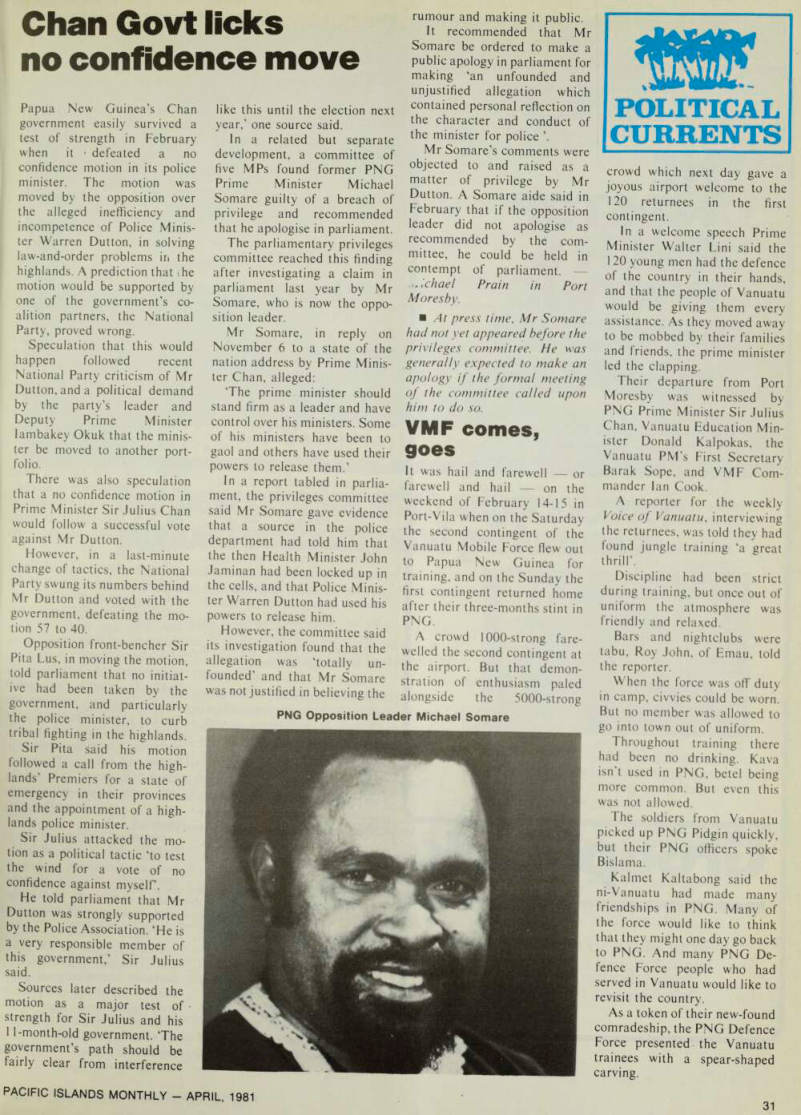
Political
Currents
Chan Govt licks no confidence move
Papua New Guinea’s Chan government easily survived a test of strength in February when it • defeated a no confidence motion in its police minister. The motion was moved by the opposition over the alleged inefficiency and incompetence of Police Minis ter Warren Dutton, in solving law-and-order problems ir. the highlands. A prediction that the motion would be supported by one of the government’s co alition partners, the National Party, proved wrong.
Speculation that this would happen followed recent National Party criticism of Mr Dutton, and a political demand by the party’s leader and Deputy Prime Minister lambakey Okuk that the minis ter be moved to another port folio.
There was also speculation that a no confidence motion in Prime Minister Sir Julius Chan would follow a successful vote against Mr Dutton.
However, in a last-minute change of tactics, the National Party swung its numbers behind Mr Dutton and voted with the government, defeating the mo tion 57 to 40.
Opposition front-bencher Sir Pita Lus, in moving the motion, told parliament that no initiat ive had been taken by the government, and particularly the police minister, to curb tribal fighting in the highlands.
Sir Pita said his motion followed a call from the high lands’ Premiers for a state of emergency in their provinces and the appointment of a high lands police minister.
Sir Julius attacked the mo tion as a political tactic ‘to test the wind for a vote of no confidence against myself.
He told parliament that Mr Dutton was strongly supported by the Police Association. ‘He is a very responsible member of this government,’ Sir Julius said.
Sources later described the motion as a major test of strength for Sir Julius and his 11-month-old government. ‘The government’s path should be fairly clear from interference
like this until the election next year,’ one source said.
In a related but separate development, a committee of five MPs found former PNG Prime Minister Michael Somare guilty of a breach of privilege and recommended that he apologise in parliament.
The parliamentary privileges committee reached this finding after investigating a claim in parliament last year by Mr Somare, who is now the oppo sition leader.
Mr Somare, in reply on November 6 to a state of the nation address by Prime Minis ter Chan, alleged; ‘The prime minister should stand firm as a leader and have control over his ministers. Some of his ministers have been to gaol and others have used their powers to release them.’
In a report tabled in parlia ment, the privileges committee said Mr Somare gave evidence that a source in the police department had told him that the then Health Minister John Jaminan had been locked up in the cells, and that Police Minis ter Warren Dutton had used his powers to release him.
However, the committee said its investigation found that the allegation was ‘totally un founded’ and that Mr Somare was not justified in believing the
rumour and making it public.
It recommended that Mr Somare be ordered to make a public apology in parliament for making ‘an unfounded and unjustified allegation which contained personal reflection on the character and conduct of the minister for police Mr Somare’s comments were objected to and raised as a matter of privilege by Mr Dutton. A Somare aide said in February that if the opposition leader did not apologise as recommended by the com mittee, he could be held in contempt of parliament.
Prain in Port M ores by. ■ At press time, Mr Somare had not yet appeared before the privileges committee. He was generally expected to make an apology if the formal meeting of the committee called upon him to do so.
VMF comes,
goes
It was hail and farewell or farewell and hail on the weekend of February 14-15 in Porl-Vila when on the Saturday the second contingent of the Vanuatu Mobile Force flew out to Papua New Guinea for training, and on the Sunday the first contingent returned home after their three-months stint in
Png.
A crowd 1000-strong fare welled the second contingent at the airport. But that demon stration of enthusiasm paled alongside the 5000-strong
crowd which next day gave a joyous airport welcome to the 120 returnees in the first contingent.
In a welcome speech Prime Minister Walter Lini said the 120 young men had the defence of the country in their hands, and that the people of Vanuatu would be giving them every assistance. As they moved away to be mobbed by their families and friends, the prime minister led the clapping.
Their departure from Port Moresby was witnessed by PNG Prime Minister Sir Julius Chan, Vanuatu Education Min ister Donald Kalpokas, the Vanuatu PM’s First Secretary Barak Sope, and VMF Com mander lan Cook.
A reporter for the weekly Voice of Vanuatu , interviewing the returnees, was told they had found jungle training ‘a great thrill’.
Discipline had been strict during training, but once out of uniform the atmosphere was friendly and relaxed.
Bars and nightclubs were tabu, Roy John, of Emau, told the reporter.
When the force was off duty in camp, civvies could be worn.
But no member was allowed to go into town out of uniform.
Throughout training there had been no drinking. Kava isn t used in PNG, betel being more common. But even this was not allowed.
The soldiers from Vanuatu picked up PNG Pidgin quickly, but their PNG officers spoke Bislama.
Kalmet Kaltabong said the ni-Vanuatu had made many friendships in PNG. Many of the force would like to think that they might one day go back to PNG. And many PNG De fence Force people who had served in Vanuatu would like to revisit the country.
As a token of their new-found comradeship, the PNG Defence Force presented the Vanuatu trainees with a spear-shaped carving.
PNG Opposition Leader Michael Somare
NZ improves
its aid
New Zealand officials say that if they can’t get all the money they need to finance Pacific aid programmes, they hope to improve the quality of the available aid.
They are using the current lull in new aid projects crea ted by economic conditions in New Zealand to review the aid programme and to be more selective and flexible.
They realise at the same time that the Island governments have their problems too. The Islands want to accelerate developments and cannot afford the time for reviews and debates. They want action.
New Zealand believes it is giving all it can in a straitened economy. In the last budget, aid to the Pacific Islands rose by $1.5 million to $29,765 million which represented 69% of total bilateral aid. The per centage figure rather than the dollar figure represents the measure of New Zealand interest and involvement in the Islands. Where money might
be lacking for capital develop
ments officials point to the wealth of expertise and advice
in the agricultural, engineer
ing, forestry, building and fish
ing fields that can be drawn on by Island governments.
Improvements in New Zealand’s approach to aid pro
jects include inviting Island
officials to Wellington so they can be involved directly in the selection of aid people
appointed to key development
areas in the Islands. Another improvement is New Zealand’s readiness to meet recurrent costs in a project to ensure that it gets off the ground. Pre viously aid money was primar
ily for establishing the project
before handing it over to Island governments.
New Zealand is also looking at ways to help find alternative sources of energy in the islands, and to plan studies for alterna tive energy sources. This may not emerge as bilateral oper ations but through an inter
national approach to develop
ing countries. With New Zealand itself studying various energy alternatives, any
developments must also help
the Islands.
The aid projects are varied.
From providing technical advice in Solomon Islands for
building 21-metre long skip
jack tuna vessels and on the job
training to morse-key instruc
tion for Suva post office staff; from providing an economic
planning officer to building
village water schemes and bridges for the Solomon Islands.
At the same time New Zealand’s Pacific Islands
Industrial Development
Scheme (PUDS) is accelerat
ing. according to enthusiastic
officials. They claim that 27 projects are in operation throughout Forum Island members with another 23 ap plications under consideration while 23 more companies have made firm enquiries. Since the scheme began in 1976, one pro ject has collapsed and another looks shaky but officials insist that the momentum is increas ing and they point to the almost 400 jobs the PUDS projects have created among the Islands.
Tonga claims 112 of those jobs which, for the size of the country, represents a fair im
provement in employment fig
ures. The cost so far to New Zealand in providing firms with incentives to develop industries in the islands totals $647 000. Officials are unable at this stage to measure the level of export earnings for the Islands from these industries or the savings from import substi tution operations. They also cannot measure the service industries that expand with the
growth of manufacturing
plant.
Industries introduced range from the production of soccer balls and jewellery to proces sed foodstuffs and buckets, from ballet shoes and indus trial gases to adhesives and sausage casings.
PUDS projects in the pipe line include manufacturing footwear and a tropical plant nursery in Fiji, egg and poultry
production and fibre glass
tanks in the Cook Islands and coconut timber projects in a number of islands. William Gass on in Wellington
Advertisements & other items, pp. 32-34 (1 item)
Group Mark
\ We've pooled our talents at Group Mark And under one root we can now otter a total print buying and creative service.
Competitively priced throughout the Pacific.
THE
ONE-STOP
DESIGN &
PRINTING
SERVICE IN
THE PACIFIC
New Zealand-quality printing and design where and when it's wanted. The expertise of our Export Print Division is a direct reflection ot our parent company . . Group Graphics Limited ot Hamilton A growing advertising business ot 5 years, whose satisfied International and National clients like the way we get to grips with their work.
Brochures, Packaging, Newspaper Campaigns, Graphics, Radio and T V, producing relevant and vigorous advertising and printed work, not once but consistently.
To Group Mark no job is too tall or too small and we now otter this totally professional design and print service, whether we work from your own visuals, preparing artwork, or simply handling your printing needs.
We know what creative approach and printing technique will best suit your market, because we export too!
The first step is simple.
Let Group Mark quote your next print job.
Group Mark
EXPORT IPRINT DIVISION
Contact John McGlinchey.
Group Mark South Pacific Ltd Box 9420 Hamilton, New Zealand.
Telex 'GROUPMARK' NZ2273
Telephones 82-180 or 395-512 V /
d H
the new propjet with superior range
payload economy and performance
The Conquest is an aeroplane so superior in performance and efficiency, it's not called a turboprop But a propjet.
It takes off from a short field and climbs to 33,000 feet in 26 minutes; it cruises at 293 knots; it carries a huge load 0f4,293 pounds of passengers and fuel; and it flies farther than many jets.
Even more remarkable, the Conquest propjet
outperforms every turboprop ever built—while using less fuel. Incredibly, the Conquest gets six statute miles per gallon. That’s efficiency to rival many piston twins.
Compared to the most popular turboprop the Conquest climbs faster, flies higher, cruises faster and flies farther.. .while using 30 percent less fuel.
Max. Speed Max. Rec. Cruise Speed Max. Range Max. Usable Fuel Rate of Climb *«£» Twin Engine Max. Cert. Alt 30 rJr) ft Single Engine Service Ceiling 21 380 ft Takeoff Dist. Over 50 ft Obstacle ? 4fic - Landing Dist. Over 50 ft Obstacle ,07c A Max. Ramp Weight q q/r ill Max. Zero Fuel Weight ftinmK Max. Useful Load Ji2S* Max. Seating 4.293 ft.
Engines Garrett Aißesearch TPE-331-8-40 IS-625 hp This aeroplane has set new standards of performance and efficiency If it were anything less, we wouldn’t call it Conquest. .295 knots 293 knots 2.196 n.m. 475 gals The Worlds Number 1 Business Airline Rex Aviation (T O. Box 51. Bankstown. N.S.W. 2200) Telephone 70 0661 Name.
Position.
Company.
Pacific Area Representatives: Fiji (Suva)-Bums Philp South Sea Company
Mr. A.Jessop.
V
/ PLEASE SEND
»• ME MORE
>• INFORMATION
ON THE
CESSNA CONQUEST
Address. .P/code..
Telephone 20/441 /PIMRR
r* o 5K2 it ,
K7S?T:-
te%, > ' N
I=—._Sk:
Uv v^\
ft %* -A ; * , % v *■ \ p. ir ' j • - * - -- - - • tk ‘teS ~r m m r r V9i
«r*?sS^
✓ ✓ £ / <J *. f &z - ■ «v> -... 3K 'fs*
People
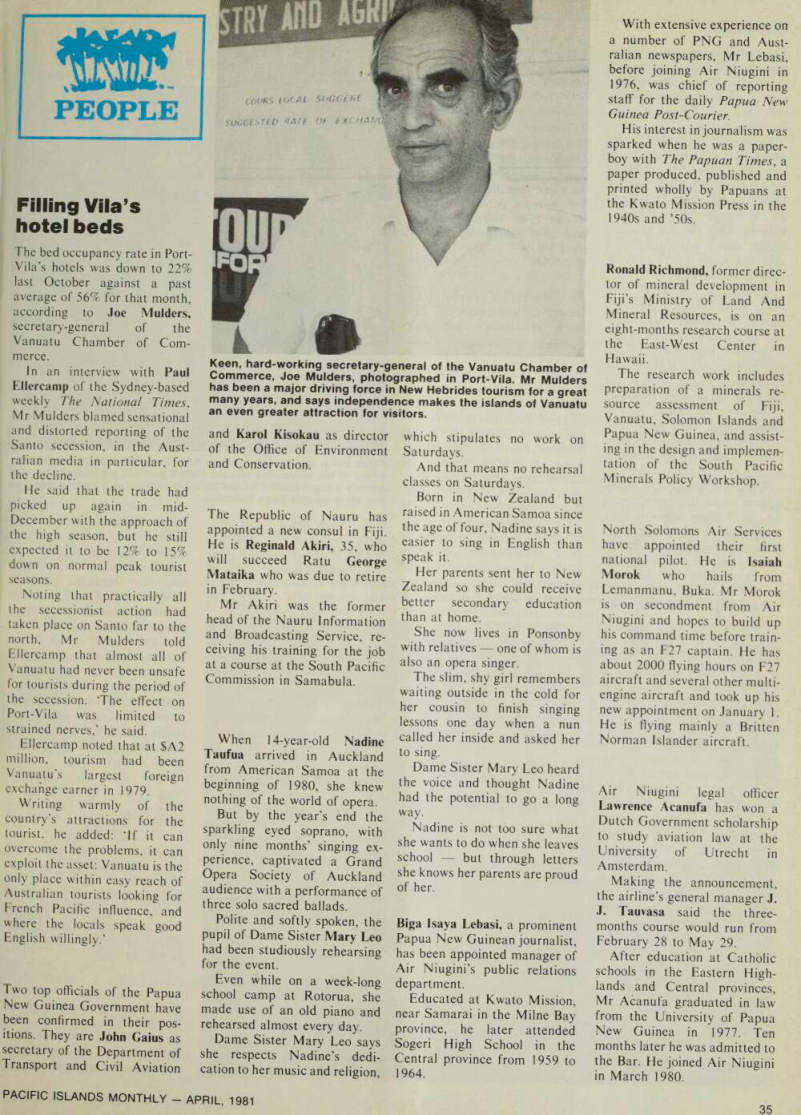
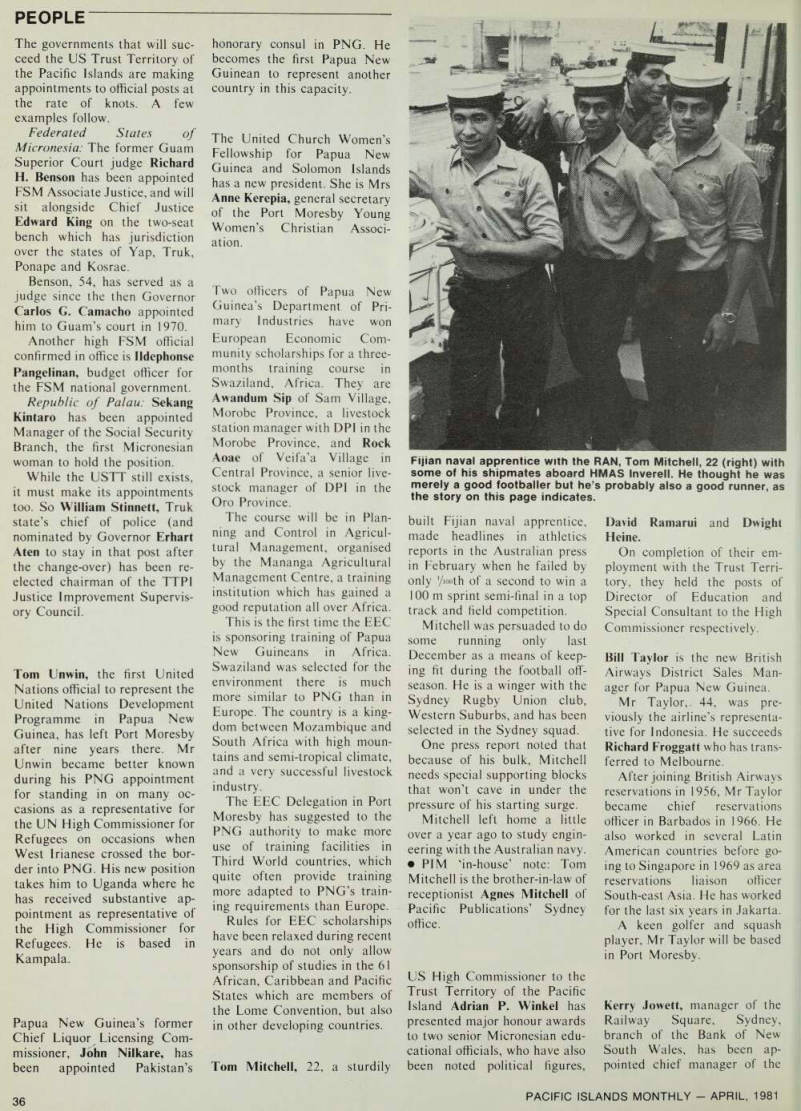
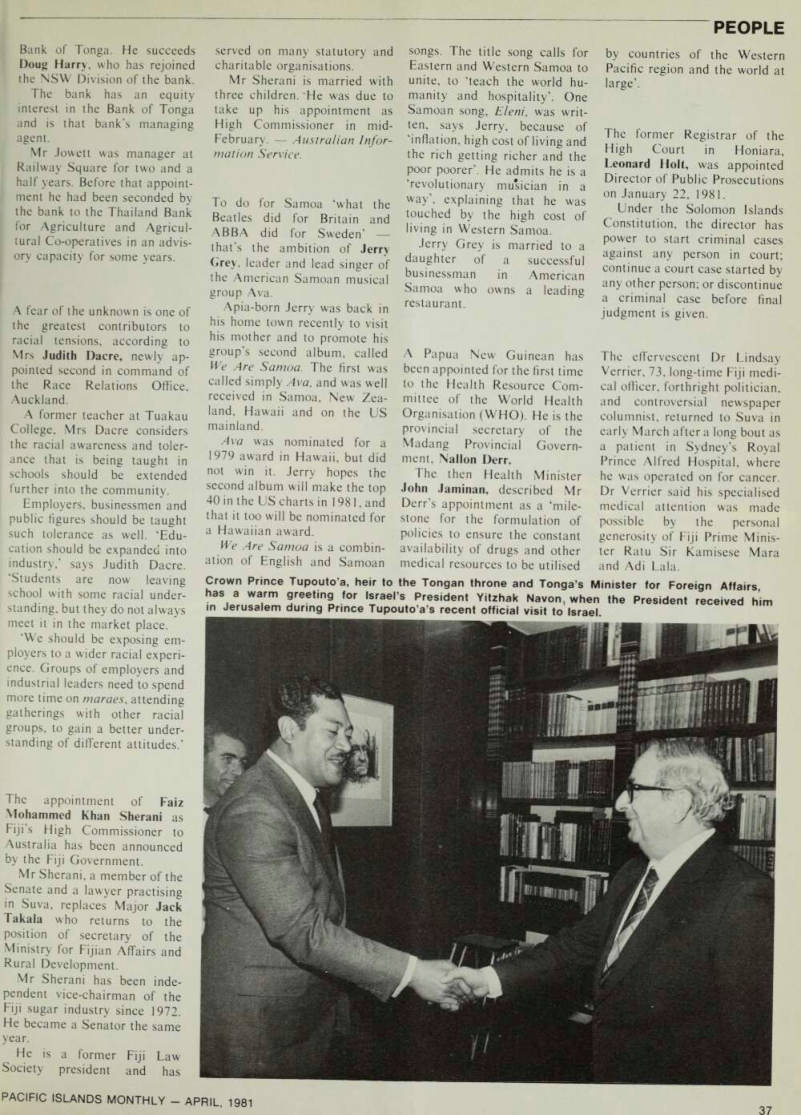
Filling Vila’s hotel beds
The bed occupancy rate in Port- Vila’s hotels was down to 22% last October against a past average of 56% for that month, according to Joe Mulders, secretary-general of the Vanuatu Chamber of Com merce.
In an interview with Paul Ellercamp of the Sydney-based weekly The National Times , Mr Mulders blamed sensational and distorted reporting of the Santo secession, in the Aust ralian media in particular, for the decline.
He said that the trade had picked up again in mid- December with the approach of the high season, but he still expected it to be 12% to 15% down on normal peak tourist seasons.
Noting that practically all the secessionist action had taken place on Santo far to the north, Mr Mulders told Ellercamp that almost all of Vanuatu had never been unsafe for tourists during the period of the secession. The effect on Port-Vila was limited to strained nerves,’ he said.
Ellercamp noted that at SA2 million, tourism had been Vanuatu’s largest foreign exchange earner in 1979.
Writing warmly of the country’s attractions for the tourist, he added: k lf it can overcome the problems, it can exploit the asset: Vanuatu is the only place within easy reach of Australian tourists looking for French Pacific influence, and where the locals speak good
English willingly.’
Two top officials of the Papua New Guinea Government have been confirmed in their pos itions. They are John Gaius as secretary of the Department of Transport and Civil Aviation
and Karol Kisokau as director of the Office of Environment and Conservation.
The Republic of Nauru has appointed a new consul in Fiji.
He is Reginald Akiri, 35, who will succeed Ratu George Mataika who was due to retire in February.
Mr Akiri was the former head of the Nauru Information and Broadcasting Service, re ceiving his training for the job at a course at the South Pacific Commission in Samabula.
When 14-year-old Nadine Taufua arrived in Auckland from American Samoa at the beginning of 1980, she knew nothing of the world of opera.
But by the year’s end the sparkling eyed soprano, with only nine months’ singing ex perience, captivated a Grand Opera Society of Auckland audience with a performance of three solo sacred ballads.
Polite and softly spoken, the pupil of Dame Sister Mary Leo had been studiously rehearsing for the event.
Even while on a week-long school camp at Rotorua, she made use of an old piano and rehearsed almost every day.
Dame Sister Mary Leo says she respects Nadine’s dedi cation to her music and religion,
which stipulates no work on
Saturdays.
And that means no rehearsal classes on Saturdays.
Born in New Zealand but raised in American Samoa since the age of four, Nadine says it is easier to sing in English than speak it.
Her parents sent her to New Zealand so she could receive better secondary education than at home.
She now lives in Ponsonby with relatives one of whom is also an opera singer.
The slim, shy girl remembers waiting outside in the cold for her cousin to finish singing lessons one day when a nun called her inside and asked her to sing.
Dame Sister Mary Leo heard the voice and thought Nadine had the potential to go a long way.
Nadine is not too sure what she wants to do when she leaves school but through letters she knows her parents are proud of her.
Biga Isaya Lebasi, a prominent Papua New Guinean journalist, has been appointed manager of Air Niugini’s public relations department.
Educated at Kwato Mission, near Samarai in the Milne Bay province, he later attended Sogeri High School in the Central province from 1959 to 1964.
With extensive experience on a number of PNG and Aust ralian newspapers, Mr Lebasi, before joining Air Niugini in 1976, was chief of reporting staff for the daily Papua New Guinea Post-Courier.
His interest in Journalism was sparked when he was a paper boy with The Papuan Times , a paper produced, published and printed wholly by Papuans at the Kwato Mission Press in the 1940 s and ’sos.
Ronald Richmond, former direc tor of mineral development in Fiji’s Ministry of Land And Mineral Resources, is on an eight-months research course at the East-West Center in Hawaii.
The research work includes preparation of a minerals re source assessment of Fiji, Vanuatu, Solomon Islands and Papua New Guinea, and assist ing in the design and implemen tation of the South Pacific Minerals Policy Workshop.
North Solomons Air Services have appointed their first national pilot. He is Isaiah Morok who hails from Lemanmanu, Buka. Mr Morok is on secondment from Air Niugini and hopes to build up his command time before train ing as an F 27 captain. He has about 2000 flying hours on F 27 aircraft and several other multi engine aircraft and took up his new appointment on January 1.
He is flying mainly a Britten Norman Islander aircraft.
Air Niugini legal officer Lawrence Acanufa has won a Dutch Government scholarship to study aviation law at the University of Utrecht in Amsterdam.
Making the announcement, the airline’s general manager J.
J. Tauvasa said the three months course would run from February 28 to May 29.
After education at Catholic schools in the Eastern High lands and Central provinces, Mr Acanufa graduated in law from the University of Papua New Guinea in 1977. Ten months later he was admitted to the Bar. He joined Air Niugini in March 1980.
Keen, hard-working secretary-general of the Vanuatu Chamber of Commerce, Joe Mulders, photographed in Port-Vila. Mr Mulders has been a major driving force in New Hebrides tourism for a great many years, and says independence makes the islands of Vanuatu an even greater attraction for visitors.
The governments that will suc ceed the US Trust Territory of the Pacific Islands are making appointments to official posts at the rate of knots. A few examples follow.
Federated States of Micronesia: The former Guam Superior Court judge Richard H. Benson has been appointed FSM Associate Justice, and will sit alongside Chief Justice Edward King on the two-seat bench which has jurisdiction over the states of Yap, Truk, Ponape and Kosrae.
Benson, 54, has served as a judge since the then Governor Carlos G. Camacho appointed him to Guam’s court in 1970.
Another high FSM official confirmed in office is Ildephonse Pangelinan, budget officer for the FSM national government.
Republic of Palau: Sekang Kintaro has been appointed Manager of the Social Security Branch, the first Micronesian woman to hold the position.
While the USTT still exists, it must make its appointments too. So William Stinnett, Truk state’s chief of police (and nominated by Governor Erhart Aten to stay in that post after the change-over) has been re elected chairman of the TTPI Justice Improvement Supervis ory Council.
Tom Unwin, the first United Nations official to represent the United Nations Development Programme in Papua New Guinea, has left Port Moresby after nine years there. Mr Unwin became better known during his PNG appointment for standing in on many oc casions as a representative for the UN High Commissioner for Refugees on occasions when West Irianese crossed the bor der into PNG. His new position takes him to Uganda where he has received substantive ap pointment as representative of the High Commissioner for Refugees. He is based in Kampala.
Papua New Guinea’s former Chief Liquor Licensing Com missioner, John Nilkare, has been appointed Pakistan’s
honorary consul in PNG. He becomes the first Papua New Guinean to represent another country in this capacity.
The United Church Women’s Fellowship for Papua New Guinea and Solomon Islands has a new president. She is Mrs Anne Kerepia, general secretary of the Port Moresby Young Women’s Christian Associ ation.
Two officers of Papua New Guinea’s Department of Pri mary Industries have won European Economic Com munity scholarships for a three months training course in Swaziland, Africa. They are Awandum Sip of Sam Village, Morobe Province, a livestock station manager with DPI in the Morobe Province, and Rock Aoae of Veifa’a Village in Central Province, a senior live stock manager of DPI in the Oro Province.
The course will be in Plan ning and Control in Agricul tural Management, organised by the Mananga Agricultural Management Centre, a training institution which has gained a good reputation all over Africa.
This is the first time the EEC is sponsoring training of Papua New Guineans in Africa.
Swaziland was selected for the environment there is much more similar to PNG than in Europe. The country is a king dom between Mozambique and South Africa with high moun tains and semi-tropical climate, and a very successful livestock industry.
The EEC Delegation in Port Moresby has suggested to the PNG authority to make more use of training facilities in Third World countries, which quite often provide training more adapted to PNG’s train ing requirements than Europe.
Rules for EEC scholarships have been relaxed during recent years and do not only allow sponsorship of studies in the 61 African, Caribbean and Pacific States which are members of the Lome Convention, but also in other developing countries.
Tom Mitchell, 22, a sturdily
built Fijian naval apprentice, made headlines in athletics reports in the Australian press in February when he failed by only '/iooth of a second to win a 100 m sprint semi-final in a top track and field competition.
Mitchell was persuaded to do some running only last December as a means of keep ing fit during the football off season. He is a winger with the Sydney Rugby Union club, Western Suburbs, and has been selected in the Sydney squad.
One press report noted that because of his bulk, Mitchell needs special supporting blocks that won’t cave in under the pressure of his starting surge.
Mitchell left home a little over a year ago to study engin eering with the Australian navy. • PIM ‘in-house’ note: Tom Mitchell is the brother-in-law of receptionist Agnes Mitchell of Pacific Publications’ Sydney office.
US High Commissioner to the Trust Territory of the Pacific Island Adrian P. Winkel has presented major honour awards to two senior Micronesian edu cational officials, who have also been noted political figures,
David Ramarui and Dwight Heine.
On completion of their em ployment with the Trust Terri tory, they held the posts of Director of Education and Special Consultant to the High Commissioner respectively.
Bill Taylor is the new British Airways District Sales Man ager for Papua New Guinea.
Mr Taylor,. 44, was pre viously the airline’s representa tive for Indonesia. He succeeds Richard Froggatt who has trans ferred to Melbourne.
After joining British Airways reservations in 1956, Mr Taylor became chief reservations officer in Barbados in 1966. He also worked in several Latin American countries before go ing to Singapore in 1969 as area reservations liaison officer South-east Asia. He has worked for the last six years in Jakarta.
A keen golfer and squash player, Mr Taylor will be based in Port Moresby.
Kerry Jowett, manager of the Railway Square, Sydney, branch of the Bank of New South Wales, has been ap pointed chief manager of the
Fijian naval apprentice with the RAN, Tom Mitchell, 22 (right) with some of his shipmates aboard HMAS Inverell. He thought he was merely a good footballer but he’s probably also a good runner, as the story on this page indicates.
Bank of Tonga. He succeeds Doug Harry, who has rejoined the NSW Division of the bank.
The bank has an equity interest in the Bank of Tonga and is that bank's managing agent.
Mr Jowetl was manager at Railway Square for two and a half years. Before that appoint ment he had been seconded by the bank to the Thailand Bank for Agriculture and Agricul tural Co-operatives in an advis ory capacity for some years.
A fear of the unknown is one of the greatest contributors to racial tensions, according to Mrs Judith Dacre, newly ap pointed second in command of the Race Relations Office, Auckland.
A former teacher at Tuakau College, Mrs Dacre considers the racial awareness and toler ance that is being taught in schools should be extended further into the community.
Employers, businessmen and public figures should be taught such tolerance as well. ‘Edu cation should be expanded into industry,’ says Judith Dacre. ‘Students are now leaving school with some racial under standing, but they do not always meet it in the market place. ‘We should be exposing em ployers to a wider racial experi ence. Groups of employers and industrial leaders need to spend more time on maraes , attending gatherings with other racial groups, to gain a better under standing of different attitudes.’
The appointment of Faiz Mohammed Khan Sherani as Fiji’s High Commissioner to Australia has been announced by the Fiji Government.
Mr Sherani, a member of the Senate and a lawyer practising in Suva, replaces Major Jack Takala who returns to the position of secretary of the Ministry for Fijian Affairs and
Rural Development.
Mr Sherani has been inde pendent vice-chairman of the Fiji sugar industry since 1972.
He became a Senator the same year.
He is a former Fiji Law Society president and has
served on many statutory and charitable organisations.
Mr Sherani is married with three children. ’He was due to take up his appointment as High Commissioner in mid- February. Australian Infor mation Service.
To do for Samoa ‘what the Beatles did for Britain and ABBA did for Sweden’ that’s the ambition of Jerry Grey, leader and lead singer of the American Samoan musical group Ava.
Apia-born Jerry was back in his home town recently to visit his mother and to promote his group’s second album, called We Are Samoa. The first was called simply Ava, and was well received in Samoa, New Zea land, Hawaii and on the US mainland.
Ava was nominated for a 1979 award in Hawaii, but did not win it. Jerry hopes the second album will make the top 40 in the US charts in 1981, and that it too will be nominated for a Hawaiian award.
We Are Samoa is a combin ation of English and Samoan
songs. The title song calls for Eastern and Western Samoa to unite, to ‘teach the world hu manity and hospitality’. One Samoan song, Eleni, was writ ten, says Jerry, because of ‘inflation, high cost of living and the rich getting richer and the poor poorer’. He admits he is a ‘revolutionary musician in a way’, explaining that he was touched by the high cost of living in Western Samoa.
Jerry Grey is married to a daughter of a successful businessman in American Samoa who owns a leading restaurant.
A Papua New Guinean has been appointed for the first time to the Health Resource Com mittee of the World Health Organisation (WHO). He is the provincial secretary of the Madang Provincial Govern ment, Nation Derr.
The then Health Minister John Jaminan, described Mr Derr’s appointment as a ‘mile stone for the formulation of policies to ensure the constant availability of drugs and other medical resources to be utilised
by countries of the Western Pacific region and the world at large’.
The former Registrar of the High Court in Honiara, Leonard Holt, was appointed Director of Public Prosecutions on January 22, 1981.
Under the Solomon Islands Constitution, the director has power to start criminal cases against any person in court; continue a court case started by any other person; or discontinue a criminal case before final judgment is given.
The effervescent Dr Lindsay Verrier, 73, long-time Fiji medi cal officer, forthright politician, and controversial newspaper columnist, returned to Suva in early March after a long bout as a patient in Sydney’s Royal Prince Alfred Hospital, where he was operated on for cancer.
Dr Verrier said his specialised medical attention was made possible by the personal generosity of Fiji Prime Minis ter Ralu Sir Kamisese Mara and Adi Lala.
Crown Prince Tupouto'a, heir to the Tongan throne and Tonga’s Minister for Foreign Affairs, has a warm greeting for Israel's President Yitzhak Navon, when the President received him in Jerusalem during Prince Tupouto'a's recent official visit to Israel.
Advertisements & other items, pp. 38-40 (2 items)
Swhoi
m wm ' ••i © mm
I S 4 m mm **”' "■■ >-
YAMAHA
LISTENS
For years, the outboard has been the mainstay of leisure boating. But its potential for commercial use was too often overlooked by the big manufacturers. At the same time, however, coastal fishermen, river transport operators and dozens of others were calling for heavy duty outboards which could cope with their special requirements.
Yamaha was one of the first outboard makers to recognize this need and develop the products to meet it.
Products like the world’s first kerosene powered outboard, special Enduro models, and power heads with sophisticated intake systems for better performance at low rpm. Yamaha also took the lead in giving technical assistance to boaters in developing countries and now works closely with governmental fishery organizations to help them improve their coastal catch.
But don’t get the idea that Yamaha only makes outboards for work.
Yamaha outboards give you more play, too. Many of the advanced features which make them so suitable for commercial use make them even better for skiing, fishing, or speeding. Plus Yamaha offers a tremendous selection of models, from a lighter 2hp mini to a revolutionary 85hp triple.
All designed for maximum work—or fun —with minimum running costs.
Yamaha outboards.
From the people who listen better to make living more exciting, on the land or on the water.
Mi' m v
YAMAHA
* I
YAMAHA MOTOR CO.. LTD
. 2500 SHINGAI IWATA SHI SHIZUOKA KEN JAPAN
feli
o 'l*s 1 * 5 e '»l' [ ' 0 V B\' a °, c ao s »f»d m m
IS i 8 <4 % w B X'O© 9 I 3U 1
JCA*
Ao^ 00 rt <> c^e P ' meP ce ®,«o'^ o V rt '»^ e '' ca<X rte C°v, e ss eS '
TS&-*”.., s.--
iOO^ s ’ noO^ 5 ’ v„mbA -\<a AA
Z°^%^ C S^'
p'oo 0 eQ u "V.- v \ n o'?'":
suW'' 1
wV?'" 4
sct^
aw*
sse-co
i#' sS '
0^
Islands
From the
Press
From Savali, Apia, Western Samoa Members of parliament during the budget debate cited myths, 1 legends and some made up stories in trying to illustrate points raised. One example: The tourist industry was said to be like a motor car. The Minister of Economic Development steps on the gas pedal, while the Minister of Transport does the steering, but stepping hard on the brakes is the Minister of Finance. And, according to the story-teller, the brakes must be pulled out and
thrown away . . .
From Marshall Islands Journal, Majuro During its meeting yesterday, the Cabinet approved a municipal ordinance from Likiep Atoll. The ordinance 80-1 is to prohibit the selling of beer or any other type of intoxicating beverages within the boundaries of Likiep Atoll. The ordinance says in part; ‘The municipality of Likiep Atoll is defined as all islands and the area surrounding all the islands in Likiep as stated in the Constitution of the Marshall islands or up to five miles from the reef surround the islands of Likiep Atoll. Any persons violating this provision shall be fined not more than $ 100.00 or be penalised to public labor not more than 30 days or both.’
From the Cook Islands News, Rarotonga (above a picture of a remarkably muscular young woman) Bodybuilding for women is mushrooming throughout the United States. The women train like professional sportsmen, keeping to a strict diet. Although they risk torn muscles and snapped hamstrings, female bodybuilding enthusiasm is not dampened.
Now that the bodybuilding trend has sparked off enthusiasm in the Cook Islands we may be seeing ‘muscled-up’ women similar to the
female pictured below . . .
From Cook Islands News, Rarotonga The following are the various classes of motor vehicles now rolling along our 20 miles of perimeter road. Motor cars, trucks, pickups, vans, buses, tractors, various cranes, front-end loaders etc motorcycles. Impressed by these high figures, Cook Islands News made inquiries to estimate the total length of all the above vehicles (excluding motorcycles). An average length a modest one of 15 feet per vehicle was allowed. Motor vehicles total ' 478 f X „ I “, 221 70 ft four mil es approximately. This means that if all the four-wheeled vehicles were placed end to end they would approximately reach from the Post Office to the end of Nikao :>ocia Centre. The final remark came from Sergeant Tini: ‘and if /ou placed all the motor cycles in Rarotonga end to end along with he cars, the chain would reach twice round Rarotonga’’ (I
shepherd.)
" r °m Solomon Islands News Drum, Honiara a letter by Nelson J. Ngani: If the members of the film censor )oard are so concerned about editing sex scenes in films (after they lave enjoyed seeing them), then they should also edit the murder cenes m films. : rom an editorial in the Marshall Islands Journal vlajuro ’ -rime is up. The latest month for which statistics are available Jecember 1980, saw an 89% increase over December 1979 (34
reported crimes as compared to 18). While December 1979 was an unusual month, the rise is real according to Police Chief Wally Wotnng . . . The particular problem that is bothering many Majuro residents regardless of national origin is burglary . . . For example, Errol Driver, manager of the Airline of the Marshall Islands, was recently hit for the sixth time in less than a year.
Wotring himself has been burglarised twice in the past year, once while he was in the house. Wotring stressed that the police have a problem because usually ‘the police are the last to know’ about a crime. Victims are complaining to everybody but the police, he said . . .
From a letter by Real Man Tanna’ in Tam Tam, Vila, in reply to a letter from Fr Arthur Tierney Please Father, the whole of Tanna knows you. Think twice before expressing your views to the public otherwise YOU’LL GET
Stuck In The Hot Pot!
From The Fiji Times, Suva Two thousand cartons of canned beer that were airfreighted from Australia by Morris Hedstrom Ltd were sold out in one day, the store’s liquor manager, Mr Noel Ah Sam, said yesterday. The cans of KB beer appeared on MH’s liquor shelves on Tuesday morning and by yesterday (Wednesday) there were none left. Mr Ah Sam said a 24-can carton of KB retailed at $22.50 each. One thousand eight hundred cartons were sold in Suva and the rest in the Western Division. The beer was part of 4000 cartons of beer held at Svdnev by the Qantas stewards’ strike . . . Meanwhile, there has been no contact between Carlton Brewery (Fiji) Ltd and the National Union of Factory and Commercial Works to resolve the strike. The strike by the 90-odd beer workers enters its second month today The beer strike has had some beneficial effects, the Fiji Road Safety Council reported yesterday. There has been a big drop in road accidents . . .
From a letter by Buley Tru in Papua New Guinea Post-
Courier, Port Moresby
As far as I am concerned policemen have the right to arrest any ‘two-kina’ ladies. It is no good women going around the street looking for money instead of staying home and working in gardens earning their living. They also should get married and wait for their husbands to give them money. Sometimes they even go around with married men who have families to look after. Instead of the men going home they go with the ‘two kinas’ drinking or driving around.
When they turn up at their homes they find the family half starving.
Then what do the wives do? They argue and fight, but who is there to solve their problems. The police, ‘The Policemen’?
From Tohi Tala Niue, Alofi Sunday flight landings are very rare on Niue, but a single-handed Cessna 201 skipped lightly to touchdown en route to Sydney.
According to Mr Waters, Airport Superintendent, the $112,000 Cessna was on a delivery flight from Honolulu to Sydney and the stop-over was to give the pilot ‘a rest’ during the long flight. These flights are not unusual and it is reported that up to 7 similar crafts have been delivered at one time in such manner. These delivery flights usually stopover in Nadi but Niue was chosen this time From The National Union, Kolonia, Ponape, Federated States of Micronesia New Year is a happy occasion in the Federated States of Micronesia. People prepare lots of food for themselves, buy firecrackers, visit their relatives and friends, etc. On the eve of December 31, people, especially children, are out on the road singing and shouting ‘Happy New Year’ (as the young man in the bottom picture is doing). Some people ride on cars singing and beating on empty drums (as people in three of these pictures are doing). Close to midnight, the shouting of ‘Happy New Year’ and singing become louder and louder. And when midnight arrives, the singing and the shouting of ‘Happy New Year’ are at their loudest and best. The fun continues until daytime. On January 1, people hold agriculture shows, sports competitions, parties, etc . . . Many FSM students, who are abroad, remember New Year’s celebration back home, and it is one of the things they want to see when they return home . . .
Advertisements & other items, p. 42 (1 item)
Tracking time
Another teehnologlcal first from Citizen
New Citizen
r J i
• No more second hand. Now there’s a second band; an LCD time teack that measures each second with pinpoint precision as it travels around the circumference of the watch face. But of course there’s more. In the mode the time track speeds up to complete a fi^revolution each second for split-second readings. And these readings can be verified digitally at just the touch of a button - right down to J/lOOth of a second.
Thpdigital portion of the Time Track contains an alarrri, digital stopwatch, an hourly chime, and a permanently-set calendar showing date and d&y Time Track by Citizen.
The new way to keep track of time. * * * 8 8 ** s at LLlji, s s •• w
CITIZEN QUARTZ «MCMNA
TimElrack
mu Pl* M.S
SST
STOPWATCH
5 ®BBI I3i
CITIZEN
AHEAD OF THEIR TIME
r % ii«
universities in PNG
Books
A troubled birth for universities in PNG
A Thousand Graduates: Conflicts in University Develop ment in Papua New Guinea, 1961-76. By lan Howie-Willis.
Pacific Research Monograph Number Three, published by Australian National Univer sity, Canberra, 1980. ISBN
0 909150 01 X. Sab.Oo.
lan Willis is well qualified to write of the beginnings and growth of the two universities in Papua New Guinea. He taught and did research in the Univer sity of Papua New Guinea. A Thousand Graduates is not only a fine historical record of the two institutions, it is also an important record of some Aust ralian altitudes leading to politi cal independence in PNG.
Willis describes the problems the institutions had in their dealings with the Australian Minister for Territories and with the minister’s department.
He discusses the conflicts which arose between the universities and the Australian adminis tration of PNG and with the PNG government. He details the findings of two commissions of inquiry into university devel opment the Brown Com mittee (1970) and the Gris Committee (1973). He writes of the worries of the PNG Direc tor of Education about the lack of rationalisation in tertiary education, ‘the strongly en trenched conservative element within the university (of PNG) professorial board’, and ‘the hidden curriculum’ at UPNG.
This led to the setting up of the Brown Committee. I don’t know what led to the establishment of the Gris Committee, but one of the widely-circulated rumours was that it was at the behest of a critic of UPNG wanting to see the institution operating as some sort of ‘barefoot univer sity’. As it turned out, both committees seem to have been a complete waste of lime and money. Their reports brought minimal response. Willis also links some of the internal and external conflicts to person alities.
When I was invited to review A Thousand Graduates I was greatly leased by the ethics of an acceptance. The monograph was dedicated to my colleague Dr Eric Duncanson and myself.
I had been Vice-Chancellor of UPNG and I’d been a member of the Currie Commission. I had read the original thesis by Willis, and later the monograph now being reviewed, before receiving the invitation. As a member of the. Currie Com mission I felt I could contribute.
Willis wrote of the com mission's report; ‘Their system promised a degree of co ordination within higher edu cation which would minimise the duplication and waste of effort implicit in many separate educational institutions.’ Yet his Chapter Five is given to ‘Problems of Co-ordination'.
Not only had the Minister for Territories and some of his departmental advisers treated the report with disrespect, their consideration of it was confined to the establishment of the university and the institute. The Currie Report was a package deal. It gave gratuitous advice about school and technical edu cation. It is therefore surprising to read that Dr Ken McKinnon, the Director of Education, be moaned the results of a haphaz ard growth of post-school edu cation. It was well within the power of the then Australian administration of PNG to have followed the Currie Com mission advice. Perhaps UPNG was not blameless, but when the Currie Report was not followed regarding the Institute of Higher Technical Education and the Administrative College, UPNG could well ask itself whether it should be used in a piecemeal way to meet the whims of some institutions and not others. Currie rec ommended a school of edu cation within the university to embrace all teacher training, not just the Goroka Teachers College.
The transfer to Lae of the Institute of Higher Technical
Education later to become the Institute of Technology and then the University of Tech nology was a major blunder stemming from the strange transitory ambitions of one man, the late Don Barrett. It has been written of Barrett in PIM that he ‘exuded self confidence, was never still, always planning, pushing, work ing, talking’. Willis writes that Barrett was seen as a ‘trouble some meddler’ who would never be satisfied to stay in the background for long. Barrett could be a most capable admin istrator and planner, and his organisation of the 1969 Third South Pacific Games in PNG was outstanding. Earlier he had been president of the Planters Association of New Guinea for many years, yet he was an unsuccessful farmer perhaps only because of the lime he spent on political and public affairs which so attracted him.
He was not an astute politician, he lost elections as often as he won them. Because he and his minority support in the council of the Institute of Higher Tech nical Education couldn’t have their way, Barrett acted un ilaterally and was able to get the House of Assembly to transfer the Institute from Port Moresby to Lae. The cost in money terms and the incalculable cost of conflicts have been made PNG the poorer.
Before I was invited to review A Thousand Graduates I had just finished reading Melbourne Studies in Education 1980,
edited by Stephen Murray-
Smith. In this there are two chapters about the universities in PNG. One by Professor K. S.
Inglis, a former UPNG Vice- Chancellor, tells about the first 10 years there. The other by Sir Louis Matheson, former Chan cellor of the University of Technology, an eminent engin eer and the creator of Monash University, tells of the develop ment of UOT and asks ‘could a different route have been fol lowed?’ He thinks so! ‘lf Currie and his colleagues had specified
a full university, Auslralian slyle, for Waigani' (Waigani is the Port Moresby suburb con taining UPNG) ‘UPNG would have had a complete outfit’, he writes. Indeed, the Currie Com mission might well have done this but it was convinced the highest priority had to be given in the first instance to ‘know how’ training in various techno logical fields. It mulled over the problem, as indeed it was being mulled over in Australia at the time.
Just as Australian education saw the need for what were to become colleges of advanced education, the Currie Com mission anticipated what was formulating in the minds of Marlin, Wark and many others, and proposed an institution that could have worked if people had wanted it to work. It had seen something similar working in Australia. The commission wanted to preserve the defin ition of a university, and yet provide for training below the ‘know-why’ level. Even in medi cine, the commission prescribed the qualification of Licentiate which could be acceptable to the General Medical Council of the United Kingdom rather than a degree. But just as altitudes in Australia changed and the advanced colleges look on a different, ambitious, ex panding mien, so in PNG the Institute of Higher Technical Education became the Institute of Technology and then the University of Technology. The processes followed the path taken by the University of New South Wales, just as the Currie Commission had predicted they would if the technical institute were divorced from the univer sity.
It is interesting to note that recently two Christian missions - the Seventh-day Adventists in Port Moresby and the Roman Catholic Church in Madang are creating tertiary insti tutions. These have been
euphemistically called univer sities by the PNG Deputy Prime Minister when in fact they are training colleges, as was well said by Father Morrison in Madang where he is building ‘something similar to what the Institute of Tech nology in Lae started out to be'.
He said that the church’s aim is to fill what he called the skill gap- If only the Currie Report had been thoroughly read by those whose duly it was to read it.
there would have been no need for a Brown Committee or a Gris Committee. There would have been rationalised higher education and a minimal but optimum disbursement of funds. UPNG would have had great presilge by now, 1980-81, and a second university to be located in Goroka would have been in the planning stage.
In the sixties and seventies, particularly in developing countries, two words came into prominence, became trendy, when discussing universities.
They were relevance and elitism. A Thousand Graduates gives consideration to both. 1 am not sure I know the meaning of either in the manner they were being used by politicians, some staff and some students.
As for relevance, in the eyes of one university which I studied, it meant implanting in the minds of the students (and the staff) the philosophies of the one political party in power. In another it meant ensuring that the larger ethnic community in the state got places in the professions of choice according to their numbers and not ac
cording to their school perform ances; it also meant teaching and examining in the language of that larger group. A question that was proposed to me by the Gris Committee was ‘how do you prevent the development of an elite?’. I replied you couldn’t - and I stick to that. The Director of Education saw something sinister at UPNG which he called a ‘hidden cur riculum’. The UPNG students and staff took a pride in them selves. Is that elitism? Inglis, in Studies in Education, tells of the ‘elite’ bar in the Boroko Hotel, Port Moresby, ‘reserved’ for whites. Students insisted on drinking in it. More power to them! Was this inspired by the ‘hidden curriculum’, by ‘elitism’ or by ‘egalitarianism’?
It didn't matter the univer sity had given them confidence in themselves.
Not only does Willis write the histories of the universities, as I said in the beginning of this review, but much of what he writes is essential reading for those who would know more of the lead-up to self-government and independence. Those who read A Thousand Graduates should also read the two chap ters in Melbourne Studies in Education 1980, and re-read Currie’s Report of the Com mission on Higher Education in Papua and New Guinea. -
John Gunther.
Another
side to
the atom
The Struggle for Power: What We Haven’t Been Told and Why. By John Grover. Pub lished by E. J. Dwyer (Aust ralia) Pty Ltd, Sydney. ISBN 0 85574 211 9. $A9.95.
A major political and social issue in the Pacific Islands today concerns the attitudes of the Islands governments and their people towards nuclear power, nuclear testing and nu clear waste dumping. In some respects, nuclear controversies have been late to develop in the Pacific Islands, running well behind the waves of controversy
which affected many of the developed countries. This is perhaps ironic in view of the fact that the Pacific itself was one of the earliest testing grounds used by developed countries experimenting with nuclear explosions. France is still engaged in a programme of sporadic Pacific nuclear tests, and is almost universally criti cised by Pacific Island com munities as a result.
What has happened is that many of the world powers and industrialised countries even Japan with its memories of being the first country subject to atomic bombing have accepted the use of atomic power for peaceful purposes and are drawing an increasing amount of their power needs from nuclear reactors. Many trade unions in Europe and even some left-wing European policilal parlies are now sup porting nuclear power develop ment and have been putting pressure on their governments to proceed with nuclear plants.
Under today’s technology atomic power is not an immedi ate economic proposition for Pacific Island countries so the controversy is unbalanced by any real pressures to investigate the application of atomic power. The controversy is further fanned by fears that the Pacific will be damaged by the nuclear development of non- Pacific countries. The present controversy about Japan’s pro posal to dump low-level nuclear waste in the north-west Pacific is an example of this.
Australia’s inability to come to grips with its own nuclear altitudes is another factor in the spread of the controversy to the Islands, and there is no doubt that Australian anti-nuclear factions are playing a major part in moulding Pacific Island altitudes. The proposed Pacific Forum of Trade Unions, to be established shortly, is an avowed anti-nuclear movement with heavy support from Aust ralian factions.
Why is the anti-nuclear movement so strong in Aust ralia and why is it becoming entrenched in Pacific Island altitudes? An attempt to answer this forms the subject of John Grover’s new book The Struggle for Power, a heavily-
I documented work with two I themes. One theme is that I peaceful nuclear development I is not the bogey which it has 1 been painted. The other is that the anti-nuclear camp in Aust- I ralia and the Islands is the I product and the victim of I a deliberate international cam- I paign of falsehoods, misrep- I resentation and factual sup pression which has been mounted for purposes of politi- I cal disruption.
Grover labels the campaign [ pop propaganda’ and says it is I playing on the ignorance of I ordinary people, generating needless fears and suppressing I an impressive collection of in [ formation on the benefits of nuclear development.
John Grover, an Australian, is a former geophysical and geochemical worker who has been associated with mineral searches, geological pro grammes and seismo vulcanological work in Solomon Islands, Fiji, Vanuatu, Papua j New Guinea, New Caledonia and Hawaii. He was awarded a United Nations fellowship and grants from the Nuffield Foun dation and the Royal Society to undertake geophysical research throughout the world. He re turned to Australia in 1977 and says he was appalled at ‘the emotive lies and half-truths being dished out by environ mentalists’ against nuclear power generation. The result is his newly-published book which he describes as a layman’s guide to nuclear affairs. His con clusion is that a conspiracy of disruption, largely formulated in USA, is behind the present Australian and Pacific oppo sition to nuclear development.
He says he is upset to see that politicians often from oppos es parties churchmen, school teachers and trade inions are propagating ‘a well
neaning but damaging cam
paign based on ignorance, lack )f information and downright nisinformation’.
By far the strongest aspect of lis book is the documentation )f its sources. Had Grover nerely expounded his own news of the benefits of peaceful mclear development he may veil have been vulnerable to the ame criticism he levels against nany of the anti-nukes
ignorance and emotion. But his book provides logical support for a threefold argument: That every person should have the opportunity to make an in formed personal decision about the rights or wrongs of peaceful nuclear application, that this opportunity is effectively im
possible today because of a campaign of deliberate misin formation, and that he has assembled and referenced the information which makes in formed decision possible. In this respect his book is not to be
dismissed lightly.
Angus
Smales.
Advertisements & other items, p. 44 (1 item)
The Old Pacific
ANTIPODEAN BOOKS,
MAPS & PRINTS
David & Cathy Lilburne.
Specialists in antiquarian Australian & South Pacific material.
For current Catalogue, please write to: 79 Grosvenor Rd, Muswell Hill, London NlO, England.
Members PBFA.
Maps and Prints of
The Old Pacific
New catalogue listing a targe stock of original antiquarian views and maps of Australia, New Zealand, Papua New Guinea and ail island groups of the Pacific now available.
Write today for your free copy.
COLIN HINCHCLIFFE
7, Royd avenue. Heckmondwike. West Yorkshire.
United Kingdom. WFI6 9AL.
m
Wondcrcst
for the life rest your
♦ PAPUA NEW GUINEA
♦ SOLOMON ISLANDS
♦VANUATU
Contact; WEST TASMAN TRADERS
P.O. BOX 709 PORT MORESBY Ph. 21 4332
ALL OTHER AREAS
Contact
HEAD OFFICE
MATTRESS MAKERS
CABLE WONDEREST
BRISBANE
lands in the Pacific
Adjusting to alien lands in the Pacific
South Pacific Stories. Edited by Chris and Helen Tiffin. Pub lished by South Pacific Associ ation for Commonwealth Literature and Language Studies, Department of English, University of Queens land, Australia 4067. ISBN 909892 77 6 (Hard cover), 909892 78 4 (Soft cover). 5A9.75. or $5.50.
Perhaps one of the hardest personal adjustments to make is that of learning to live in a country not one’s own, to adapt happily to an alien cultural milieu. Sometimes a lifetime is not sufficient to render painless the absence of one's own national heritage, and even second and third generation settlers find it difficult to come to terms with the social and cultural mores of their adopted country.
The theme of acculturation which characterises many of the tales in this volume of South Pacific Stories is a recur rent one in the literature of the southern hemisphere. Martin Boyd, in his Langton novels, treats with insight and under standing the motif of separation from one’s homeland. The Langton family, British mi grants to Melbourne in the 19th century, shuttle back and forth between their physical home in Australia and what they regard as their spiritual and cultural heritage in Europe. Neither seems totally satisfactory.
Each story in this collection originates from the South Pacific region, but the writers are all from races in some sense alien to this part of the world.
Indians taken to Fiji during the indenture system of the 19th century, and British trans planted to Australia and New
Zealand during the last 200 years, have struggled to come to terms with the utterly different environment in which they found themselves.
These stories reflect some thing of that struggle. In the introduction, Chris and Helen Tiffin give a sympathetic ac count of the pain and fear experienced by ‘new arrivals’, as the breakdown of their
cultural identity slowly takes
place, and the search begins for a new self more in tune with the adopted homeland.
Fiji is the background for two stories by the same author in which the country is seen through the eyes of an Indian woman and a New Zealand girl.
Though separated in time, the predominant feeling in both stories is that the main charac ters are mislocated. ‘Gamalian’s Woman’, writ ten by Fiji Indian, Subramani, is an amalgam of obscure epi sodes, hazy memories and visions, in which an old Indian woman remembers the hard ships of a life spent working in the sugarcane fields. As she nears death she drifts away from the ‘reality’ of a world which perhaps had never seemed real to her, and seeks release in her dreams of an Indian heaven.
The young New Zealand girl, Elaine, in ‘Dear Primitive’, was born in Fiji and lived all her life there, but still feels isolated and torn by conflicting loyalties.
After an unhappy affair with a tourist, she seems to slip into madness ‘. . . the dark waters flowed into her head. She knew she was drowned’. Isolation from one’s own people can indeed become insupportable.
The best story to my mind is ‘The Well-Bred Thief’ by
Elizabeth Jolley. Written in sparse epistolary style, it docu ments the fate of a manuscript sent by an Englishwoman in Western Australia to a pub lisher friend in the UK.
Mabel and Barbara are starkly contrasted through their letters; the understated loneli ness of the woman in Medulla - ‘l’m living all alone in the country waiting for the jarrah to grow . . . there’s no one to talk to except the fowls’ draws down a complete ava lanche of incomprehension from the indifferent and preda tory friend in Kent. Her main concern is for a new colour scheme in the bathroom - ‘Matching towels are such a problem aren’t they?’ rather than the fate of the precious manuscript.
This is an interesting collec tion of stories, well worth read ing, and has a part to play in
promoting understanding
among the people of various races who make up the popu lation of the contemporary
South Pacific.
Jo Rudd.
Advertisements & other items, pp. 45-46 (2 items)
45
'ACIFIC ISLANDS MONTHLY - APRIL, 1981
BOOKS
Port Mob]
* Right in tl business cep| * A traditiop for comfort food * All rdoms airconditioned * Restaurant ♦ Bai * Banquet hall
C. NEUMANN
manager Phone 2622
Stay at Aggie Grey’s . . . the South Pacific’s
legendary hotel.
Situated right in the heart of Western Samoa. Enjoy Polynesian-stylc friendliness and service, in cool surroundings, superb entertainment and food.
Magnificent white sand beaches only a short drive away. Airconditioned rooms, swimming pool and full bar facilities.
Bookings through Union Steamship Company of NZ, Pan Am, Air New Zealand or direct to Aggie Grey’s, Apia, Western Samoa. Cables: ‘AGGIES’Apia.
i m % , .
' ct— : W
Revelation!
<0 - -
Discover hi-fi with an impeccable pedigree.
Once you hear a Sansui SUPER COMPO system, you will be amazed. You will not believe that such extraordinary sound could come from such an easy-to-use complete system. It will be a revelation of how clean and pure music can sound in your home.
Such an achievement isn’t born overnight. All of Sansui's decades of experience and finely honed engineering skills were drawn upon to create today’s SUPER COMPO systems. Specifics include DC-servo amp. quartz-PLL synthesizer tuner, and computerized random music selection with unique D-O-B arm. But lets forget about the technical side for a moment.
Let’s just say that only SUPER COMPO systems feature ‘in-depth” matching for matchless performance and new levels in musical enjoyment. The revelation of SUPER COMPO is the music itself.
SANSUI ELECTRIC CO., LTD. 14-1 Izumi 2-chome. Suginami-ku, Tokyo 168. Japan •Australia VAN FI (Aust.) Pty. Ltd. 297 City Road. South Melbourne. Victoria 3205. Australia Phone: 690-6200/283 Alfred Street. North Sydney. N.S W 2 -cu Australia Phone: 929-0293 •Fi/i Prabhu Brothers Ltd. P O Box 183, Nadi Phone; 70183/4 »Papua New Guinea Oceania Indent Agency (P.N.G.) Pty. Ltd.
Box 5518, Boroko. Port Moresby Phone, PM 256406 •New Zealand David Reid Electronics Ltd. C.P.O Box 2630. Auckland, 1 Phone 491-459 •New Caledonia Ets Michel MERCIER B P 1123, Noumea Phone: 27. 59. 11 •South Pacific Miltons Department Stores Limited P.O Box 146, NorfoilK island 2899 Phone; 2161 •Central Pacific Nauru Co-operative Society Republic of Nauru •Vanuatu The Sound Centre P.O. Box 434, Port Villa Phone: 2035 • island United Island Traders Ltd. PO. Box 1 & 2, Rarotonga • Tahit SIMEL P.O. Box 3338 Phone: 26979
Scuisui.
The hidden injustice on the A’asu
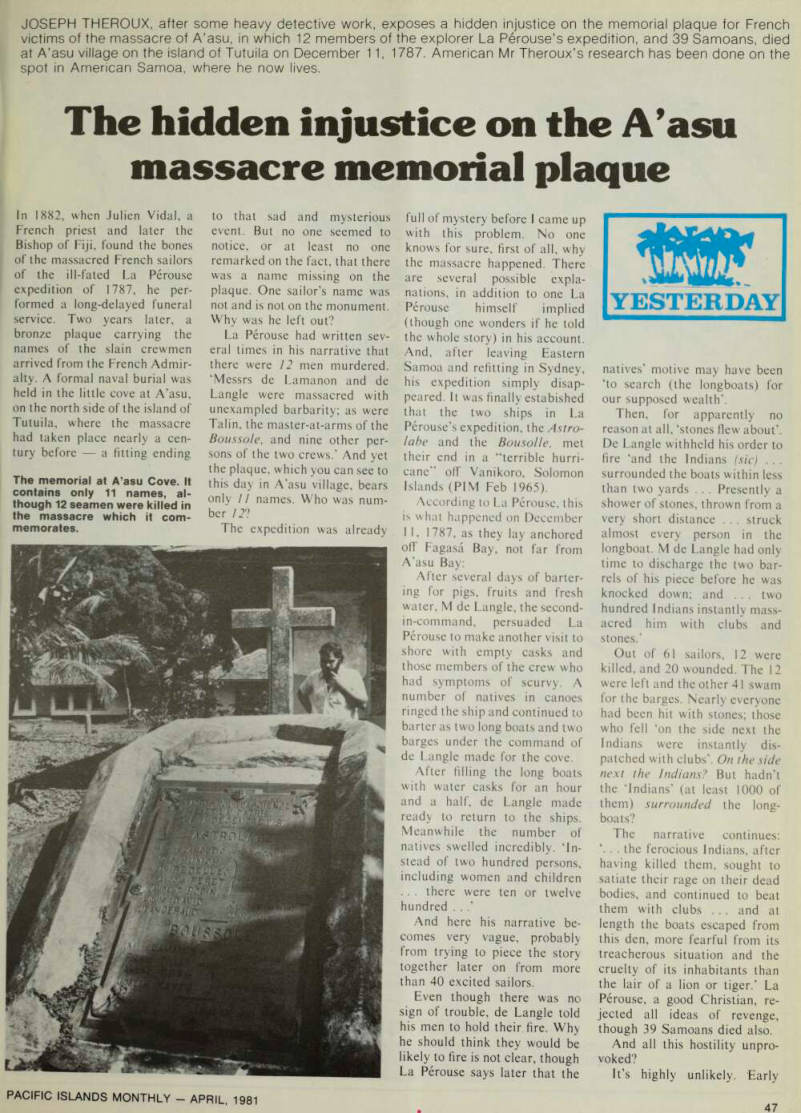
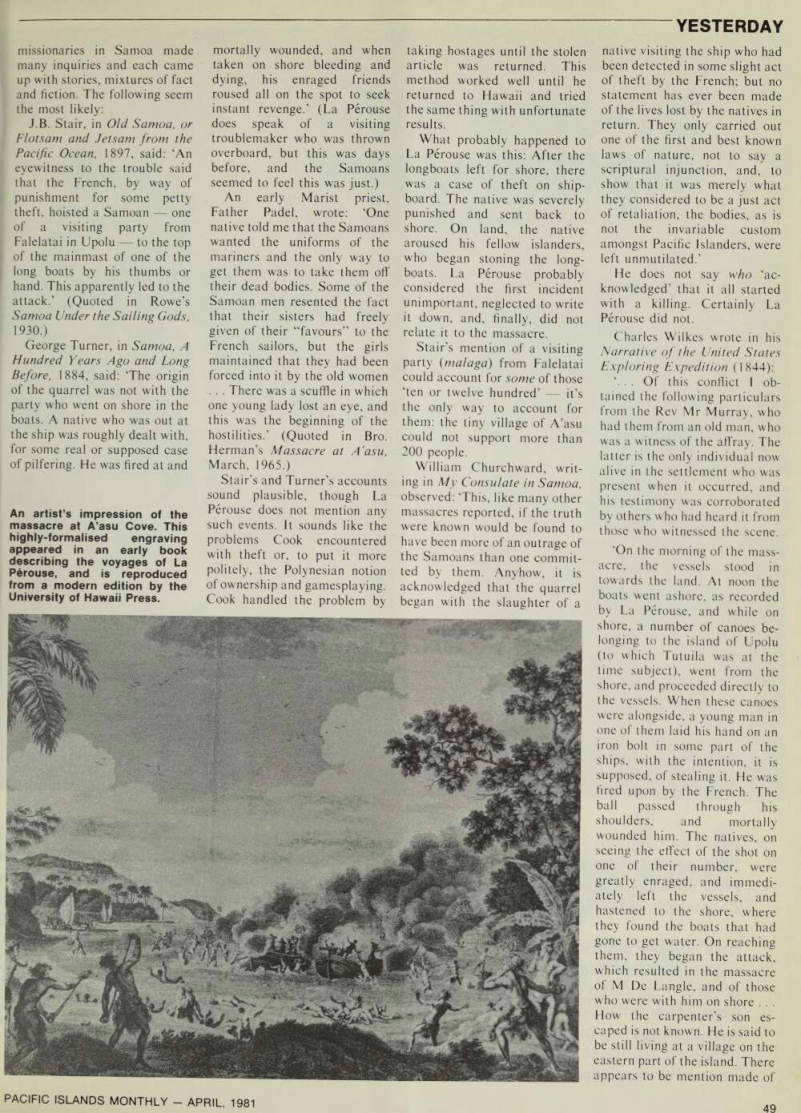
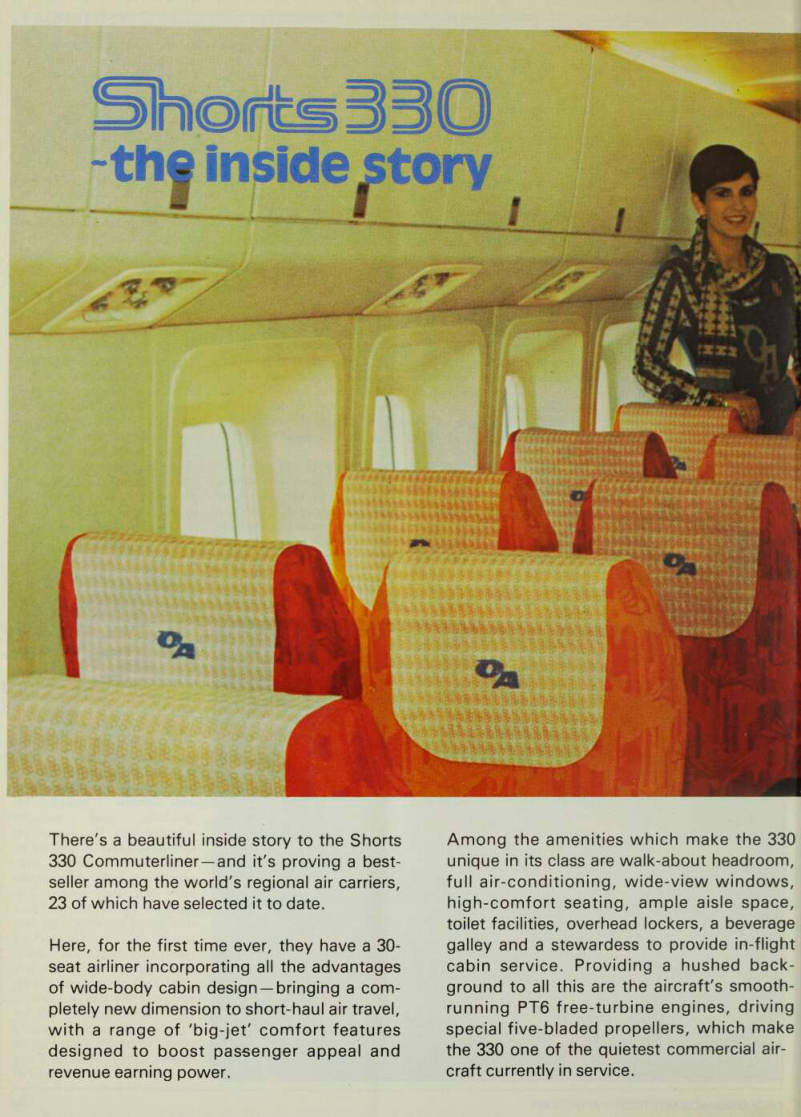
Yesterday
The hidden injustice on the A’asu massacre memorial plaque
JOSEPH THEROUX, after some heavy detective work, exposes a hidden injustice on the memorial plaque for French victims of the massacre of A’asu, in which 12 members of the explorer La Perouse’s expedition, and 39 Samoans, died at A’asu village on the island of Tutuila on December 11, 1787. American Mr Theroux’s research has been done on the spot in American Samoa, where he now lives.
In 1882, when Julien Vidal, a French priest and later the Bishop of Fiji, found the bones of the massacred French sailors of the ill-fated La Perouse expedition of 1787, he per formed a long-delayed funeral service. Two years later, a bronze plaque carrying the names of the slain crewmen arrived from the French Admir alty. A formal naval burial was held in the little cove at A’asu, on the north side of the island of Tutuila, where the massacre had taken place nearly a cen tury before a fitting ending
to that sad and mysterious event. But no one seemed to notice, or at least no one remarked on the fact, that there was a name missing on the plaque. One sailor’s name was not and is not on the monument.
Why was he left out?
La Perouse had written sev eral times in his narrative that there were 12 men murdered. ‘Messrs de Lamanon and de Langle were massacred with unexampled barbarity; as were Talin, the master-at-arms of the Boussole, and nine other per sons of the two crews.’ And yet the plaque, which you can see to this day in A’asu village, bears only II names. Who was num ber 121 The expedition was already
full of mystery before I came up with this problem. No one knows for sure, first of all, why the massacre happened. There are several possible expla nations, in addition to one La Perouse himself implied (though one wonders if he told the whole story) in his account.
And, after leaving Eastern Samoa and refitting in Sydney, his expedition simply disap peared. It was finally estabished that the two ships in La Perouse’s expedition, the Astro labe and the Bousolle, met their end in a “terrible hurri cane’’ off Vanikoro, Solomon Islands (PIM Feb 1965).
According to La Perouse, this is what happened on December 11, 1787, as they lay anchored off Fagasa Bay, not far from A’asu Bay; After several days of barter ing for pigs, fruits and fresh water, M de Langle, the second in-command, persuaded La Perouse to make another visit to shore with empty casks and those members of the crew who had symptoms of scurvy. A number of natives in canoes ringed the ship and continued to barter as two long boats and two barges under the command of de Langle made for the cove.
After filling the long boats with water casks for an hour and a half, de Langle made ready to return to the ships.
Meanwhile the number of natives swelled incredibly. ‘ln stead of two hundred persons, including women and children . . . there were ten or twelve hundred . . .’
And here his narrative be comes very vague, probably from trying to piece the story together later on from more than 40 excited sailors.
Even though there was no sign of trouble, de Langle told his men to hold their fire. Why he should think they would be likely to fire is not clear, though La Perouse says later that the
natives’ motive may have been ‘to search (the longboats) for our supposed wealth’.
Then, for apparently no reason at all, ‘stones flew about’.
De Langle withheld his order to fire ‘and the Indians (sic) .. . surrounded the boats within less than two yards . . . Presently a shower of stones, thrown from a very short distance . . . struck almost every person in the longboat. M de Langle had only time to discharge the two bar rels of his piece before he was knocked down; and . . . two hundred Indians instantly mass acred him with clubs and stones.’
Out of 61 sailors, 12 were killed, and 20 wounded. The 12 were left and the other 41 swam for the barges. Nearly everyone had been hit with stones; those who fell ‘on the side next the Indians were instantly dis patched with clubs’. On the side next the Indians? But hadn’t the ‘lndians’ (at least 1000 of them) surrounded the long boats?
The narrative continues: ‘. . . the ferocious Indians, after having killed them, sought to satiate their rage on their dead bodies, and continued to beat them with clubs . . . and at length the boats escaped from this den, more fearful from its treacherous situation and the cruelty of its inhabitants than the lair of a lion or tiger.’ La Perouse, a good Christian, re jected all ideas of revenge, though 39 Samoans died also.
And all this hostility unpro voked?
It’s highly unlikely. Early
The memorial at A’asu Cove. It contains only 11 names, al though 12 seamen were killed in the massacre which it com memorates.
missionaries in Samoa made many inquiries and each came up with stories, mixtures of fact and fiction. The following seem the most likely; J.B. Stair, in Old Samoa, or Flotsam and Jetsam from the Pacific Ocean, 1897, said: ‘An eyewitness to the trouble said that the French, by way of punishment for some petty theft, hoisted a Samoan one of a visiting party from Falelatai in Upolu to the top of the mainmast of one of the long boats by his thumbs or hand. This apparently led to the attack.’ (Quoted in Rowe’s Samoa Under the Sailing Gods, 1930.) George Turner, in Samoa, A Hundred Years Ago and Long Before, 1884, said: ‘The origin of the quarrel was not with the party who went on shore in the boats. A native who was out at the ship was roughly dealt with, for some real or supposed case of pilfering. He was fired at and
mortally wounded, and when taken on shore bleeding and dying, his enraged friends roused all on the spot to seek instant revenge.’ (La Perouse does speak of a visiting troublemaker who was thrown overboard, but this was days before, and the Samoans seemed to feel this was just.) An early Marist priest, Father Padel, wrote: ‘One native told me that the Samoans wanted the uniforms of the mariners and the only way to get them was to take them off their dead bodies. Some of the Samoan men resented the fact that their sisters had freely given of their “favours” to the French sailors, but the girls maintained that they had been forced into it by the old women . . . There was a scuffle in which one young lady lost an eye, and this was the beginning of the hostilities.’ (Quoted in Bro.
Herman’s Massacre at A’asu, March, 1965.) Stair’s and Turner’s accounts sound plausible, though La Perouse does not mention any such events. It sounds like the problems Cook encountered with theft or, to put it more politely, the Polynesian notion of ownership and gamesplaying.
Cook handled the problem by
taking hostages until the stolen article was returned. This method worked well until he returned to Hawaii and tried the same thing with unfortunate results.
What probably happened to La Perouse was this: After the longboats left for shore, there was a case of theft on ship board. The native was severely punished and sent back to shore. On land, the native aroused his fellow islanders, who began stoning the long boats. La Perouse probably considered the first incident unimportant, neglected to write it down, and, finally, did not relate it to the massacre.
Stair’s mention of a visiting party ( malaga ) from Falelatai could account for some of those ‘ten or twelve hundred’ it’s the only way to account for them: the tiny village of A’asu could not support more than 200 people.
William Churchward, writ ing in My Consulate in Samoa, observed: ‘This, like many other massacres reported, if the truth were known would be found to have been more of an outrage of the Samoans than one commit ted by them. Anyhow, it is acknowledged that the quarrel began with the slaughter of a
native visiting the ship who had been detected in some slight act of theft by the French; but no statement has ever been made of the lives lost by the natives in return. They only carried out one of the first and best known laws of nature, not to say a scriptural injunction, and, to show that it was merely what they considered to be a just act of retaliation, the bodies, as is not the invariable custom amongst Pacific Islanders, were left unmutilated.’
He does not say who ‘ac knowledged’ that it all started with a killing. Certainly La Perouse did not.
Charles Wilkes wrote in his Narrative of the United States Exploring Expedition (1844): ‘. . . Of this conflict I ob tained the following particulars from the Rev Mr Murray, who had them from an old man, who was a witness of the affray. The latter is the only individual now alive in the settlement who was present when it occurred, and his testimony was corroborated by others who had heard it from those who witnessed the scene. ‘On the morning of the mass acre, the vessels stood in towards the land. At noon the boats went ashore, as recorded by La Perouse, and while on shore, a number of canoes be longing to the island of Upolu (to which Tuluila was at the time subject), went from the shore, and proceeded directly to the vessels. When these canoes were alongside, a young man in one of them laid his hand on an iron bolt in some part of the ships, with the intention, it is supposed, of stealing it. He was fired upon by the French. The ball passed through his shoulders, and mortally wounded him. The natives, on seeing the effect of the shot on one of their number, were greatly enraged, and immedi ately left the vessels, and hastened to the shore, where they found the boats that had gone to get water. On reaching them, they began the attack, which resulted in the massacre of M De Langle, and of those who were with him on shore . . .
How the carpenter’s son es caped is not known. He is said to be still living at a village on the eastern part of the island. There appears to be mention made of
An artist’s impression of the massacre at A’asu Cove. This highly-formalised engraving appeared in an early book describing the voyages of La Perouse, and is reproduced from a modern edition by the University of Hawaii Press.
a boy among the missing, in La Perouse’s account.’
But this is all the mention that Wilkes makes of a missing boy. Another mystery. He does I agree that the Samoans in volved were from Falelatai and the Tutuilians gave the dead chiefly burials. And the murder may be that mentioned by Churchward.
Over the years more missionaries asked about it and got no clear answers. The Samoans in A’sau remained quiet about it. They buried the 12 in tapa cloths and told no one where.
In 1882, Fr Vidal decided to erect a chapel on what he believed the site to be. He had tried to discover the grave for years without any success. As Vidal dug the foundation near a stream, an 80-year-old man pointed out the grave-site he had learned of from his father.
He told Vidal: ‘we would not tell you before because, according to our traditions, exhuming the bodies of old enemies is equivalent to a declaration of war. You may go ahead, for we know that you only want to honour your dead.’ Digging
down, the priest found the bones.
Vidal wrote to the French Admiralty to tell them of his find. The Admiralty had a plaque made which says (see accompanying box); Only 1 1 names. I have come across no mention of this anomaly and yet it is nearly 100 years since the plaque was made, and 200 years since the (mutual) massacre.
After questioning several lo cal pundits, I was put in touch with the Rev Simon Bourke, SM, who has been in the Pacific since 1940. He is the Acting Secretary of the Episcopal Con ference of the Pacific and a kindly, brusque gentleman.
I explained my problem and he dug out a tattered, brittle transcript. The History of the Leone Station (parish) by Alexander Coupillaud. It was in French, but Fr Bourke trans lated as rapidly as if he were reading English. It recounted the massacre and the efforts of Er Vidal. Then he found what I was looking for. Evidently it was an early draft of what the plaque should look like. It was just like the words on the plaque, except for a longer heading, misspellings and the mention of an extra person (see accompanying box):
Can you read this? 4 Fr Bourkc pointed to one line. My French is shaky at best, but good enough to translate Un Chinois’ A Chinese!
A Chinese would never be missed on the plaque, the Ad miralty or the engraver must have thought. So they tele scoped the heading, changed the order of the names, correc ted the spellings and left out one man because he was only a Chinese and no job was listed for him.
Checking the 1807 edition of La Pcrouse’s A Voyage Round the World, volume 111, chapter XXIV, I found Un Chinois listed as a matelot, a sailor, or seaman. There is no other
reference to him. A check into the ship's log would probably yield nothing. He may still be referred to only as Un chinois..
I n a 1 799 edition of A Voyage .. . there is a map showing where the Boussole (Compass) and the Astrolabe (Quadrant) were anchored outside Fagasa Bay. A short distance down the coast. A'asu Bay is labelled ‘Assassins Bay’, which may refer to the Samoans or the French.
It's the old problem who were the savages? There was brutality on both sides, but it was the French who refused to honour one of their own slain men.
French navigator La Perouse, a picture from one of his own books published nearly 200 years ago.
Advertisements & other items, pp. 48-54 (2 items)
| National
/ a?** k
NATIONAL
INSURANCE
m
COVERS THE
PACIFIC
nr ,00* . 'W n
■mfSk\
i\ *
FIJI
THE NATIONAL INSURANCE COMPANY OF FIJI, LIMITED (Incorporating Southern Pacific Insurance Co. (Fiji) Ltd) SUVA Dominion House Thomson St Phone 25601 Tlx 2337 L M Rolls General Manager LAUTOKA Ist Floor National Bank Bldg. Phone 62951 M Y Hussain Resident Inspector LABASA Ist Floor National Bank Bldg. Phone 81099 A Singh Resident Inspector
PAPUA NEW GUINEA
THE SOUTHERN PACIFIC INSURANCE COMPANY (PNG) LIMITED (Incorporating C.I.C. Insurance (Pacific) Pty Ltd) PORT MORESBY 8 Champion Parade Phone 21-1388 Tlx 22261 D J McCall General Manager LAE Second St Phone 42-4590 Tlx 42443 T S Kennedy Manager RABAUL Mango Ave Phone 92-2755 Tlx 92923 P M Mitchell Manager MT HAGEN Phone 521-164 J P Devaney District Manager ARAWA B Snowden District Manager Phone 956-219
VANUATU
THE NATIONAL INSURANCE COMPANY OF NEW ZEALAND, LIMITED.
HONIARA Ist Floor Kingsley Bldg. Phone 919 Kaituu & Co. Ltd (W. V. Gledhill) Agent
SAMOA
NATIONAL PACIFIC INSURANCE LIMITED
(National Insurance Company of New Zealand, Ltd Managing Agents) APIA Taufusi St Phone 20481 Tlx 228 D I Humphry Managing Director PAGO PAGO Suite 200 Lumana’i Bldg. Phone 96799 J McGuire Manager
COOK ISLANDS
THE NATIONAL INSURANCE COMPANY OF NEW ZEALAND. LIMITED RAROTONGA U.I.T. Bldg. Avarua Phone 2076 Tlx 62013 R Wheeler Local Manager
The twelfth man
Moris Pour La Science et la Palrie Le 11 Decembre 1787 Astrolabe M Malelots De Langle Capl. Vais. Commandant Yves Humon Jean Redellec Francois Ferel Laurent Robin Louis David Canonnier servant Jean Geraud Domestique Boussole M. de Lamanon Pierre Talin Andre Roth Joseph Rayes Erige en I 883 Physicien et Naturaliste Maitre Canonnier Canonniers servants Aux Morts Tombes Pour La Patrie et Pour La Science 11 Decembre 1787 L'Astrolabe M de Langle Capitaine de Vaisseau Yves Hamon Malclot Jean Revellu ”
Francis Feret ”
Laurent Robin ”
Louis David Canonnier servant Jean Giraud Domestique Un Chinois La Boussole Pierre Talin Maftre Canonnier Andre Roth Canonnier servant Joseph Rayes De Lamanon Naturaliste 1883
J& \ «■ m \ * i And if you’re between the ages of 19-34 and meet the minimum requirements of 173 cm tall, 67kg in weight and have a chest measurement of 91 cm at least, you may apply to become a Police Officer.
For those that possess the right physical and mental requirements, a good work record and a satisfactory educational background the Police offer you a worthwhile and rewarding career with thorough training, the opportunity for promotion, and excellent starting salary with s. s leave OiO
SERVING THE COMMUNITY
NZ POLICE
superannuation benefits, generous leave (including sick leave with pay), free uniform, but above all we offer job security, satisfaction and comradeship in a necessary job helping society.
If you’re interested, we would like to talk it over with you. Call at your nearest Police Station for further details
WE WANT THE BEST
L82593AC
th| inside story
L D 3
—iwjwj... ■ ■ ‘- up ' -. \ ' jff i *♦<*!*&■£ m , ** \n*k 1 $ % V •. There's a beautiful inside story to the Shorts 330 Commuterliner—and it's proving a bestseller among the world's regional air carriers, 23 of which have selected it to date.
Here, for the first time ever, they have a 30seat airliner incorporating all the advantages of wide-body cabin design —bringing a completely new dimension to short-haul air travel, with a range of 'big-jet' comfort features designed to boost passenger appeal and revenue earning power.
Among the amenities which make the 330 unique in its class are walk-about headroom, full air-conditioning, wide-view windows, high-comfort seating, ample aisle space, toilet facilities, overhead lockers, a beverage galley and a stewardess to provide in-flight cabin service. Providing a hushed background to all this are the aircraft's smoothrunning PT6 free-turbine engines, driving special five-bladed propellers, which make the 330 one of the quietest commercial aircraft currently in service.
. * m
MUM ■
C* o date nearly four million passengers have lown aboard these highly reliable, fuel fficient, cost effective, luxurious airliners vhich make money for many airlines at sad factors below 40%. You ought to take look at this 'Shorts' cut to profitability, t/ith one of the few 30-passenger comnuter airliners available in the world today.
Lj PfC L o the wide-bodied Commuterliner of the 80's SHORT BROTHERS (AUSTRALIA) PTY LTD., 20 Loftus Street, Sydney 2000. Telephone (02) 27 3701 Telex AA 23969 SHORT BROTHERS LIMITED PO Box 241 Airport Road Belfast BT3 9DZ Northern Ireland Telephone 0232 58444 Telex 74688 Telegrams Aircraft Belfast
"AMAZING"
INCREDIBLE"
"FANTASTIC .
Just some of the words used to describe the Argo at demonstrations.
Replace your trail bike, utility and some tractor jobs with this one versatile unit that can also swim. 6 or 8 wheel model available /// Please send me brochure □ Advise my nearest dealer □
Ring me to arrange demoD
For further information tick appropriate square and mail coupon to: ARGO ALL TERRAIN VEHICLES, 1830 SANDGATE ROAD, VIRGINIA, OLD, AUSTRALIA 4014. Telephone: (07) 265 2265.
Invest NOW in the New Era of Modular Living
MODERATE OUTLAY - QUICK RETURNS
7#^ ip
GROUND & FIRST FLOOR PLAN
Our advanced building system saves greatly in time and costs. So your money works for you faster. Fully erected in 6 - 8 weeks.
INTERNATIONAL
74 RUSSELL STREET,
£ TOOWOOMBA
OLD. 4350
PHONE 32 3411
KLA7
Look at the features of Modular Construction •Strength •Speed of Construction • Insulated • Fire Resistant •Termite Resistant • Economy • Low Maintenance 4 A
of independence
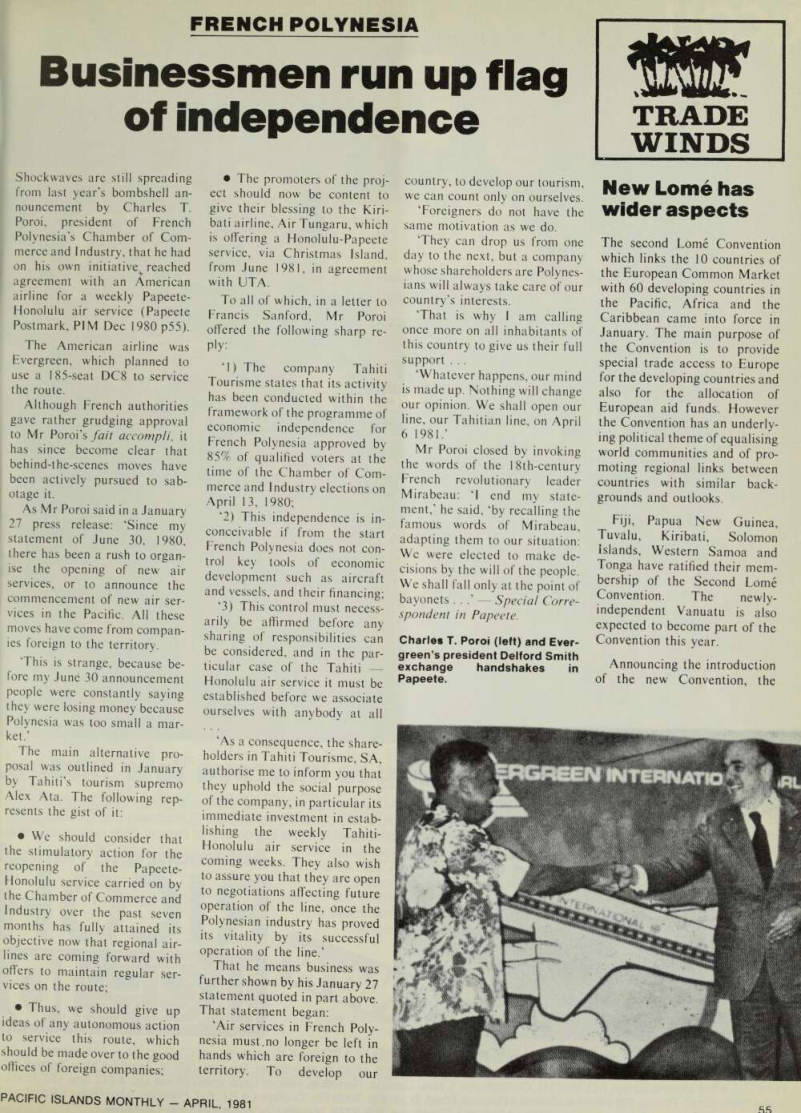
Trade
Winds
French Polynesia
Businessmen run up flag of independence
S Shockwaves are still spreading from last year’s bombshell an nouncement by Charles T. ; Poroi, president of French Polynesia’s Chamber of Com [ merce and Industry, that he had I on his own reached agreement with an American ! airline for a weekly Papeete- Honolulu air service (Papeete Postmark, PIM Dec 1980 p 55).
The American airline was Evergreen, which planned to use a 185-seat DCS to service the route.
Although French authorities gave rather grudging approval to Mr Poroi’s fait accompli, it has since become clear that behind-the-scenes moves have been actively pursued to sab- I otage it.
As Mr Poroi said in a January 27 press release: ‘Since my statement of June 30, 1980, there has been a rush to organ ise the opening of new air services, or to announce the commencement of new air ser vices in the Pacific. All these moves have come from compan ies foreign to the territory. ‘This is strange, because be fore my June 30 announcement people were constantly saying they were losing money because Polynesia was too small a mar ket.’
The main alternative pro posal was outlined in January by Tahiti’s tourism supremo Alex Ata. The following rep resents the gist of it: • We should consider that the stimulatory action for the reopening of the Papeete- Honolulu service carried on by the Chamber of Commerce and Industry over the past seven months has fully attained its objective now that regional air lines are coming forward with offers to maintain regular ser vices on the route; • Thus, we should give up ideas of any autonomous action to service this route, which should be made over to the good offices of foreign companies;
• The promoters of the proj ect should now be content to give their blessing to the Kiri bati airline, AirTungaru, which is offering a Honolulu-Papeete service, via Christmas Island, from June 1981, in agreement with UTA.
To all of which, in a letter to Francis Sanford, Mr Poroi offered the following sharp re ply: ‘1) The company Tahiti Tourisme states that its activity has been conducted within the framework of the programme of economic independence for French Polynesia approved by 85% of qualified voters at the time of the Chamber of Com merce and Industry elections on April 13, 1980; ‘2) This independence is in conceivable if from the start French Polynesia does not con trol key tools of economic development such as aircraft and vessels, and their financing; ‘3) This control must necess arily be affirmed before any sharing of responsibilities can be considered, and in the par ticular case of the Tahiti Honolulu air service it must be established before we associate ourselves with anybody at all ‘As a consequence, the share holders in Tahiti Tourisme, SA, authorise me to inform you that they uphold the social purpose of the company, in particular its immediate investment in estab lishing the weekly Tahiti- Honolulu air service in the coming weeks. They also wish to assure you that they are open to negotiations affecting future operation of the line, once the Polynesian industry has proved its vitality by its successful operation of the line.’
That he means business was further shown by his January 27 statement quoted in part above.
That statement began; ‘Air services in French Poly nesia must.no longer be left in hands which are foreign to the territory. To develop our
country, to develop our tourism, we can count only on ourselves. ‘Foreigners do not have the same motivation as we do.
They can drop us from one day to the next, but a company whose shareholders are Polynes ians will always take care of our country’s interests. ‘That is why I am calling once more on all inhabitants of this country to give us their full support . . . ‘Whatever happens, our mind is made up. Nothing will change our opinion. We shall open our line, our Tahitian line, on April 6 1981.' Mr Poroi closed by invoking the words of the 18th-century French revolutionary leader Mirabeau; ’I end my state ment,’ he said, ‘by recalling the famous words of Mirabeau, adapting them to our situation: We were elected to make de cisions by the will of the people.
We shall fall only at the point of
bayonets .. .’
Special Corre-
spondent in Papeete.
New Lome has
wider aspects
The second Lome Convention which links the 10 countries of the European Common Market with 60 developing countries in the Pacific, Africa and the Caribbean came into force in January. The main purpose of the Convention is to provide special trade access to Europe for the developing countries and also for the allocation of European aid funds. However the Convention has an underly ing political theme of equalising world communities and of pro moting regional links between countries with similar back grounds and outlooks.
Fiji, Papua New Guinea, Tuvalu, Kiribati, Solomon Islands, Western Samoa and Tonga have ratified their mem bership of the Second Lome Convention. The newly independent Vanuatu is also expected to become part of the Convention this year.
Announcing the introduction of the new Convention, the
Charles T. Poroi (left) and Ever green’s president Delford Smith exchange handshakes in Papeete.
Advertisements & other items, pp. 56-59 (1 item)
<Icoh
< : ** 1:4
JOOM
70 •H Hit
RICOH
« i» ! t>
MAOE Itt
i ' ♦# >st3 If it > =ll It ti : V '5 « */CQ// KR-10 N v ws <ll ■ <! *lu )U I 3 * 11*1 1111 * M 4* « I 11,1 8 5j 42J *l. r *> x
HOO^
H I I I
. livi' i
& 5 -.: - •„ ; -V- 4' €9 s SO S . :»*« » ... ■ v /j: v j I ! ; s** I : -' ' t '*!l f ' j < I - ■' u is 7 5 4 m ”5 215 w:m 11,1 *54 424 -- : ■. \ ‘ • ■*' - ■- --- ’ x % *.7 ♦, The Easiest Way to Improve Your Image.
The easiest way to improve your image, from snapshots to high quality photographs, k is with the new Ricoh KRIO. The compact, lightweight SLR camera that gives you the It convenience of automatic exposures and the control of manual. With outstanding cost/
performance. In a full-featured system
that includes auto flash, auto winder, XR Rikenon lenses and accessories.
Ricoh KRIO, automatic and manual It can improve your image in more ways than one.
Automatic and Manual
For more information about the Ricoh KRIO, write to RICOH COMPANY, LTD. 14-6, Ginza 6-chome, Chuo-ku, Tokyo 104, Japan.
Distributors: Australia Bell & Howell Australia Pty. Ltd. 0G.P.0. Box 4778, 55-69 Murray Street, Pyrmont, N.S.W., Australia, New Zealand H.E.
Perry Ltd. 0145 Victoria Street, PO. Box 111, Christchurch 1, New Zealand, Norfolk Is. Miltons Department Stores Ltd. oPO. Box 146, Norfolk Island 2899, South Pacific, Fiji Narseys Limited oßenwick Road, Suva, Fiji, Tahiti Ets. Coutimex oB.P 617, Papeete, Tahiti (French Polynesia), New Caledonia Omnium Calprlonipn Imnnrtatinn #Riip He I Fsnprannp R P ??4R Maopnta Noiimpa. Nouvpllp-Caledonie.
TRADEWINDS INTELLIGENCE...TRADEWINDS INTELLIGENCE...TRADEWINDS INTELLI
BECHTEL, the giant US engineering group, is believed to be the front-runner in the race to become prime contractor on the $A 1300 million Ok Tedi gold and copper project in Papua New Guinea. Its main competitors are understood to be Fluor and McKee Davey Pacific. Ok Tedi was officially incorporated in PNG in late February.
A LAUTOKA, Fiji, paint company has begun exporting locally produced paints to New Zealand under the SPARTECA agreement recently concluded between Pacific Forum countries.
Asian Paints (South Pacific) Ltd, a subsidiary of Asian Paints (India) Ltd, in February sent a first order worth more than SFIOOOO to New Zealand. A company spokesman said it was expected that exports to the New Zealand market would be worth $lOO 000 a year.
WESTERN Samoa’s Inland Revenue Department earned a record SWS 260 331 in revenue in 1979. The figure exceeded the 1978 figure by $950 813, an increase of 18.08%. Costs of collection were only 2.45% of the total revenue collected, as against 3% in 1978.
The department’s annual report for 1979 was released by Finance Minister Vauvasa Filipo in late February.
PRESIDENT Amata Kabua of Marshall Islands in February signed an agreement with the Midland Bank, London, for a loan package to the amount of SUS 24 899 799 to assist in financing the construction of a 12 megawatt power plant and a six million gallon fuel tank storage farm.
FIJI had a SFSO million trade surplus with Britain last year, according to British figures. Fiji bought $24 million of British goods, mainly whisky, chemicals, machinery, scientific instruments
and manufactured goods. In return, Fiji exported $74 million worth of sugar, fish and vegetable oils to Britain.
BURNS, Philp (New Guinea) Ltd, in a bid to make the company ‘an even more integral part of Papua New Guinea’, is to issue one million K 1 ($A 1.31) ordinary shares at K 2 a share to PNG citizens.
The issue is fully underwritten by the Investment Corporation of PNG. The new shares will only be offered to PNG citizens and companies and associations which are incorporated, controlled and at least 75% owned in PNG. The issue will increase the company’s capital to Kl 3 million, more than 30% of which will be owned by Papua New Guineans. The Investment Corporation now holds 26% of the existing capital.
KIRIBATI received a grant from the European Economic Community of more than SA2OO 000 for construction of an airfield on the southern part of Tabiteuea Atoll. With the completion of Tabiteuea South Airfield all inhabited islands of the country would be connected by regular air services with the main island, Tarawa.
Earlier, the EEC granted about $270 000 for the construction of an airstrip on the island of Aranuka.
TRUK and Kosrae governments. Federated States of Micronesia, have asked the Marshalls copra processing mill Tobolar to buy copra from their areas. This followed a Tobolar announcement that it was buying copra again after being idle for several months, and had raised the buying price to SUSI7O a ton at the outer islands, or $2OO a ton for copra delivered on Majuro. The company pointed out that the copra market had strengthened after being down for a year. The other copra processing plant in the Trust Territory, MIC (Micronesian Industrial Corporation) located in Palau has been idle for some time now.
[ISOLA^
PRODUCTS OF HEALING TECHNOLOGY.
Made in New Zealand by Healing Industries Limited, Auckland.
Branches in Wellington. Christchurch, Dunedin, Sydney and Singapore.
Available from; COOK ISLANDS; Cook Island Trading Corporation Ltd.
FIJIAN ISLANDS: Burns Philp (SS) Co Ltd.
NEW HEBRIDES: Burns Philp (NH) Ltd.
NOUMEA: Enterprise Guy Limousin NIUE ISLAND; Niue Island United.
PAGO PAGO: Max Haleck Inc., Burns Philp (SS) Ltd.
PAPUA NEW GUINEA: KIEXA: Nikana Wholesalers. LAE; Faulkner-Tait (NG) Pty Ltd. MaDANG: Burns Philp (NG) Co.
Ltd. PORT MORESBY; Steamships Honda Centre.
RABAUL; Elvee Trading Pty Ltd.
WEWAK: Burns Philp (P.N.G.).
SOLOMON ISLANDS: P.K.R. Pacific Sales Co.
TAHITI: Marine Corail, Tahiti Sport, Comptior Polynesien.
TONGA: Burns Philp (SS) Co. Ltd.
WESTERN SAMOA: Burns Philp (SS) Co. Ltd, E.A. Coxon Ltd, Gold Star Transport Co. Ltd, Morris Hedstrom Ltd.
NORFOLK ISLAND: Irvines Building Supplies.
Lepiolass] i I
antifouling
EPIGLASS E-TYPE
ANTIFOULING:
The Antifouling specially developed for use throughout the waters of the Pacific and proven on the oceans of the world.
Epiglass E-Type gives up to 12 months growth-free performance, for pleasure and commercial craft. Available in Racing Red Blue Green and Gold.
Timber project

European Economic Com munity committed itself to the support of the developing countries in the Pacific, Africa and the Caribbean. The EEC said that through the Conven tion it would continue to play a role in providing financial and technical resources which would not be a burden on future generations and which would not interfere with the sover eignty of the recipient countries.
The EEC said it appreciated that differing countries had differing approaches to how development should be im plemented, but this was recog nised in basic planning. A team of experts had already toured the Pacific area countries in volved and had drawn up lists of priorities on the basis of what the Pacific countries wanted.
Under the Lome Convention the developing countries have duty-free access to European markets for more than 99% of their exports. They also had the benefit of the scheme known as STABEX which was effectively an insurance system against
unexpected low returns from agricultural products. The STABEX scheme under the First Lome Convention was restricted to agricultural prod ucts, but under the new Conven tion the insurance is also ex tended to mining products.
The EEC also announced that it was preparing a pro gramme to increase its assist ance to Pacific regional tele communications and to the Pacific Forum Shipping Line.
In Fiji, EEC aid has mainly gone towards improving rural services, including roads, air strips and jetties. Other aid has gone towards hurricane recon struction and in interest subsidies for loans which are
developing hydro-electricity
projects.
In Western Samoa, EEC aid has also assisted hydro-electric development mainly the Samasoni scheme and has gone to small-scale rural ven tures and agricultural develop ment. The STABEX scheme has paid compensation for shortfalls in Western Samoa’s
copra, cocoa, timber and banana exports.
In Tonga, EEC funds have assisted the development of port facilities at Vava’u and have been used to purchase equipment for the Department of Works. Tonga has also received STABEX compensation for reduced returns from copra, bananas and vanilla.
In Tuvalu, the major proportion of EEC aid has been used for increasing the generaling capacity of electricity plants at Funafuti and for providing copra storage facilities.
STABEX funds in Tuvalu have covered shortfalls in the export of copra.
Timber project
for w. Samoa
A major timber project in Western Samoa is to be supported by a foreign aid grant from New Zealand and a low interest concessional loan from the Asian Development Bank.
The total funds from the two sources SUSI. 74 million from the Development Bank
and SUSI.2B million from New Zealand will be used for forest conservation, re-affore station, timber logging and mill ing.
The development bank loan will be over 40 years with no repayments for the first 10 years, no interest and a service charge of 1% a year. The loan and the grant will completely cover the foreign exchange costs of the project and part of the local currency costs, The project will be on Upolu and Savai’i Islands. Western Samoa estimates that when the project is fully established the re-afforestation areas will be capable of the continuous pro duction of timber valued at SUSI.S million a year on '“E'fs.™ „„ rorall on more than half of its land area, but a third of the forest land is on steep terrain where forests are considered protec live rather than productive, Announcing approval of the concessional loan, the develop ment bank said last month that most of the land was under
customary ownership and was being cleared in a random way by farmers moving from place to place. The bank’s announce ment continued: ‘Shifting cultivation and the growing demand for logs, sawn wood and fuelwood are deplet ing the country’s forest re sources, making an increasing amount of land marginally pro ductive, and endangering water catchment areas. The project will substantially contribute to improved land use by demon strating systematic timber ex traction and reforestation on margin land. It will also stimu late the conservation and man agement of forests in catchment areas to ensure adequate supplies of water for hydro electric generation. It will pro vide access roads and tracks, equipment, plant and mainten ance facilities, and appropriate overseas training for local for estry personnel. The annual output of sawn timber at full production will have a value of $1.5 million.’
The total cost of the project
will be SUS 4.7 million, with Western Samoa providing $1.76 million. In addition to the direct costs of re-afforestation and conservation the project will include road construction, logging and milling facilities and overseas training for West ern Samoans.
Cattle project
planned in PNG
Two major cattle-raising proj ects are to be established in Papua New Guinea with grants
and soft loans provided by the European Economic Com munity. The total EEC commit ment to the scheme is K 1.7 million, of which 71.5% will be in loans and 28.5% will be in
grants. The loan will be at only 1% annually with an initial 10year grace period and to be paid off within 40 years. PNG itself will also contribute to the estab lishment of the projects.
The cattle properties are to be established at Rigo on the south coast of the PNG main land not far from the PNG capital, Port Moresby, and at Bogia in the Madang Province in the north of the mainland.
The Rigo property will be on 10 000 hectares of grassland and the Bogia property on 2200 hectares. Between them they will run about 10 000 head.
The projects are to be shareholding ventures involving the traditional land owners and their families in the two areas.
The Rigo project will involve about 3500 shareholders and the Bogia project about 1500.
The shares will be allocated on the basis of capital subscribed and on the value of land made available. Many of the share holders and members of their families will also become wage earners from the projects.
Information Technology Sys tems PNG managing director, Phil Saunders (left), and Ron Webb, marketing manager of Bell & Howell Australia’s Asia/ Pacific division, are pictured at the signing of an agreement appointing ITS as exclusive distributor for Bell & Howell micrographics products.
Advertisements & other items, pp. 57-60 (1 item)
Nelson&Robertson
n6E/?> * o % 2 -X) o lP & >l/
FOR:
IN OUR 86th YEAR SELLING ‘SERVICE’
TO THE PACIFIC ISLANDS
Nelson&Robertson
PTY. LTD. (Established 1895)
Plantation House, 197 Clarence Street, Sydney
Cables: ‘IVAN 1 , Sydney, Brisbane. Telex: AA22381, Sydney.
INDENTS - FROM AUSTRALIA, NEW ZEALAND and OVERSEAS FOODSTUFFS • SOFTGOODS • HARDWARE • MACHINERY"
TRAVEL • INSURANCE • CANNED FISH • JUTE GOODS
• REAL ESTATE •
BRANCH OFFICES:
Nelson & Robertson Pty. Ltd., P.O. Box 575, Brisbane, Qld., Australia.
P.O. Box 2092, Govt. Bldg., Suva, Fiji.
P.O. Box 258, Lautoka, Fiji.
P.O. Box 2420, CPO Auckland 1, New Zealand.
PAPUA NEW GUINEA
REPRESENTATIVES:
Rabtrad Nuigini Pty. Ltd., P.O. Box 219, Rabaul, P.N.G.
P.O, Box 1406, Lae, P.N.G.
P.O. Box 711, Madang, P.N.G.
P.O. Box 253, Kieta, P.N.G.
EPMLASS
MARINE TECHNOLOGY.
Products developed In the laboratory, proven on the water ...
All this and great sound too!
Spectrum 102 V is a complete hi-fi component system. It has an amplifier, a tuner, a cassette deck, a turntable, an audio timer, speakers with stands. And a beautifully crafted, space-saver rack.
But it’s more than just a collection of components. Because, each one is carefully designed to work in harmony with the others. So there’s no waste of performance or your money.
That’s one advantage of choosing a system specially put together by experts.
After all, Kenwood engineers are responsible for some of the world’s most advanced
hi-fi technology.
Like the High Speed DC Zero-Switching circuitry in the KA-400 power amplifier shown here.
Here’s another advantage of the Spectrum 102 V. Aftersale help.
Kenwood’s expert service people are never far away, should the unexpected happen.
Spcclram-102V
•KA-400 DC stereo integrated amplifier •KT-400 FM-AM stereo tuner •KX-500 metal tape cassette deck with Dolby* NR and touch-key controls •KD-2100 fully automatic turntable • LS-90 3-way 3-speaker system •AT-80 audio timer •SRC-120 audio rack . ’Trademark of Dolby Laboratories. mi €
ENWOOD
TRIO-KENWOOD CORPORATION
(NEW ADDRESS) Shionogi Shibuya Building, 17-5, 2-chome, Shibuya, Shibuya-ku, Tokyo 150, Japan AUSTRALIA TRIO-KENWOOD (AUSTRALIA) PTY LTD. Australia Tel. 439-4322 NEW ZEALAND JOHN GILBERT & CO., LTD Auckland Tel. 30839 FIJI THE DOMINION IMPORT & EXPORT PROMOTIONS Nadi Tel. 72-165 PAPUA NEW GUINEA S.O. SVENSSON (N.G.) LTD, Port Moresby Tel. 24-2275/2285 NORFOLK ISLAND BURNS PHILP (NORFOLK ISLAND) LTD.
SOLOMON ISLANDS TECHNIQUE RADIOS CENTRE LTD. Honiara Tel. 416 NEW CALEDONIA HI-FI VOX Noumea Tel 27-2466 NEW HEBRIDES RUE HIGGINSON Vila Tel. 2556 TAHITI MAI SON AURORE Papeete Tel. 29703 AMERICAN SAMOA ISLAND PACIFIC AGENCIES, INC Pago Pago Tel 633-4687
REPUBLIC OF NAURU NAURU CO-OPERATIVE SOCIETY
MARIANA ISLANDS J.C. TENORIO ENTERPRISES Saipan Tel, 6445
ease Solomons problems
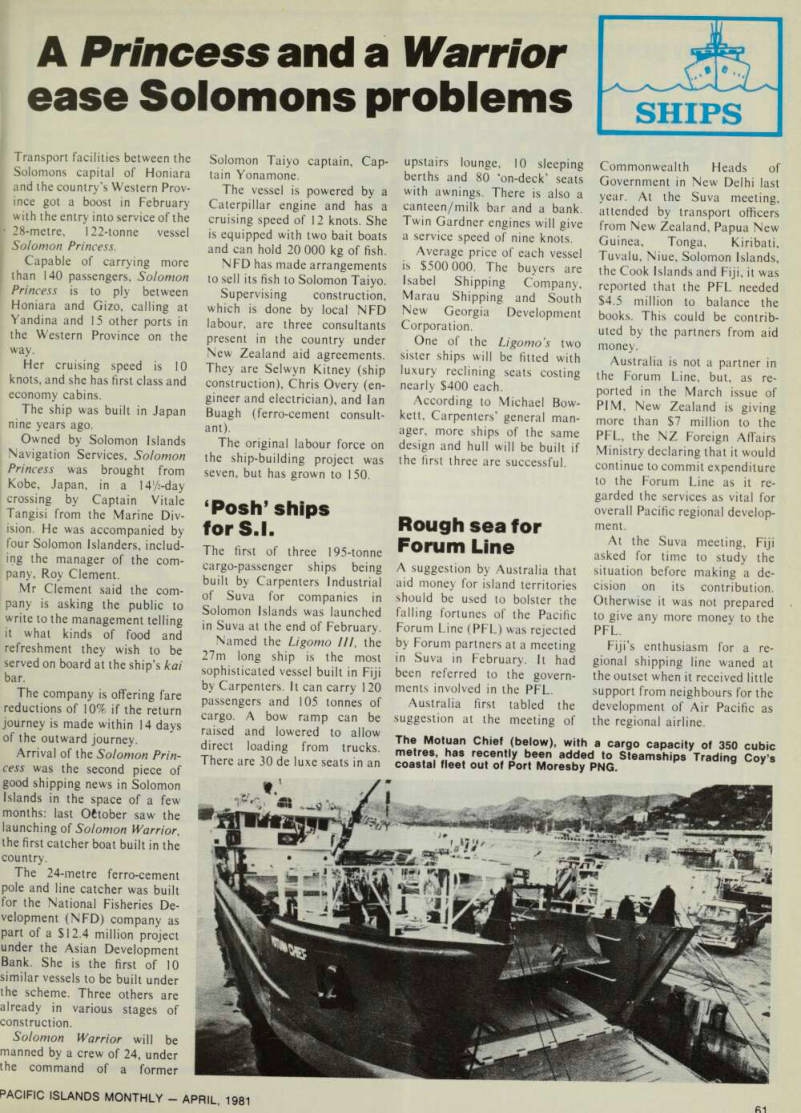


Ships
A Princess and a Warrior ease Solomons problems
Transport facilities between the I Solomons capital of Honiara 1 and the country’s Western Prov- I ince got a boost in February with the entry into service of the ;• 28-metre, 122-tonne vessel [ Solomon Princess.
Capable of carrying more I than 140 passengers, Solomon Princess is to ply between Honiara and Gizo, calling at Yandina and 15 other ports in the Western Province on the way.
Her cruising speed is 10 knots, and she has first class and economy cabins.
The ship was built in Japan nine years ago.
Owned by Solomon Islands Navigation Services, Solomon Princess was brought from Kobe, Japan, in a 14'/>day crossing by Captain Vitale Tangisi from the Marine Div ision. He was accompanied by four Solomon Islanders, includ ing the manager of the com pany, Roy Clement.
Mr Clement said the com pany is asking the public to write to the management telling it what kinds of food and refreshment they wish to be served on board at the ship’s kai bar.
The company is offering fare reductions of 10% if the return journey is made within 14 days of the outward journey.
Arrival of the Solomon Prin cess was the second piece of good shipping news in Solomon Islands in the space of a few months: last October saw the launching of Solomon Warrior, the first catcher boat built in the country.
The 24-metre ferro-cement pole and line catcher was built for the National Fisheries De velopment (NFD) company as part of a $12.4 million project under the Asian Development Bank. She is the first of 10 similar vessels to be built under the scheme. Three others are already in various stages of construction.
Solomon Warrior will be manned by a crew of 24, under the command of a former
Solomon Taiyo captain, Cap tain Yonamone.
The vessel is powered by a Caterpillar engine and has a cruising speed of 12 knots. She is equipped with two bait boats and can hold 20 000 kg of fish.
NFD has made arrangements to sell its fish to Solomon Taiyo.
Supervising construction, which is done by local NFD labour, are three consultants present in the country under New Zealand aid agreements.
They are Selwyn Kitney (ship construction), Chris Overy (en gineer and electrician), and lan Buagh (ferro-cement consult ant).
The original labour force on the ship-building project was seven, but has grown to 150.
‘Posh’ ships
for S.l.
The first of three 195-tonne cargo-passenger ships being built by Carpenters Industrial of Suva for companies in Solomon Islands was launched in Suva at the end of February.
Named the Ligomo 111, the 27m long ship is the most sophisticated vessel built in Fiji by Carpenters. It can carry 120 passengers and 105 tonnes of cargo. A bow ramp can be raised and lowered to allow direct loading from trucks.
There are 30 de luxe seats in an
upstairs lounge, 10 sleeping berths and 80 ’on-deck’ seats with awnings. There is also a canteen/milk bar and a bank.
Twin Gardner engines will give a service speed of nine knots.
Average price of each vessel is $5OO 000. The buyers are Isabel Shipping Company, Marau Shipping and South New Georgia Development Corporation.
One of the Ligomo’s two sister ships will be fitted with luxury reclining seats costing nearly $4OO each.
According to Michael Bow kett. Carpenters’ general man ager, more ships of the same design and hull will be built if the first three are successful.
Rough sea for
Forum Line
A suggestion by Australia that aid money for island territories should be used to bolster the falling fortunes of the Pacific Forum Line (PFL) was rejected by Forum partners at a meeting in Suva in February. It had been referred to the govern ments involved in the PFL.
Australia first tabled the suggestion at the meeting of
Commonwealth Heads of Government in New Delhi last year. At the Suva meeting, attended by transport officers from New Zealand, Papua New Guinea, Tonga, Kiribati, Tuvalu, Niue, Solomon Islands, the Cook Islands and Fiji, it was reported that the PFL needed $4.5 million to balance the books. This could be contrib uted by the partners from aid money.
Australia is not a partner in the Forum Line, but, as re ported in the March issue of PIM, New Zealand is giving more than $7 million to the PFL, the NZ Foreign Affairs Ministry declaring that it would continue to commit expenditure to the Forum Line as it re garded the services as vital for overall Pacific regional develop ment.
At the Suva meeting, Fiji asked for time to study the situation before making a de cision on its contribution.
Otherwise it was not prepared to give any more money to the
Pfl.
Fiji’s enthusiasm for a re gional shipping line waned at the outset when it received little support from neighbours for the development of Air Pacific as the regional airline.
The Motuan Chief (below), with a cargo capacity of 350 cubic metres has recently been added to Steamships Trading Coy’s coastal fleet out of Port Moresby PNG.
Grounding in
Tokelau
The Suva-based inter-island ship Ai Sokula went aground on a reef off Fakaofo atoll in Tokelau in late February, but the crew of 17 and several passengers were unharmed.
The Ai Sokula, which was on tier way from Apia to Fakaofo with 350 tonnes of cargo, is iwned by Wong’s Shipping.
She is on a three-month charter :o the New Zealand Foreign \ffairs Department.
The cargo was later unloaded rom the ship which is believed o have escaped serious dam age.
>ne up for
Kiribati
he Kiribati fishing fleet has rown by one with the entry into of a new pole and line shing vessel, Nei \rintetetongo.
The ship was made available ) Kiribati under the Japanese id programme.
Engineer’s
►hort rest
etirement for 52-year-old atu Mosese Duilomaloma om his job as a Fiji Public /orks Department engineer at ie end of January lasted only a ;w days. Early in February he
was appointed as the first local port engineer for the Fiji Ports Authority.
One of his jobs will be to assist in planning new projects for the ports of Suva, Lautoka and Levuka under the auth ority’s new $ll million rehabili tation scheme.
Ship arrest
in Yap
Yap State Governor John A.
Mangefel cabled the govern ment of the Republic of Palau in February that the govern ment of Yap State was holding the 670-tonne cargo vessel Unrui until the Palau Ship ping Company paid off SUS 32 361.410 it owed to the state.
The action came after Bill Acker, manager of Waab Transportation Company in Yap, informed the governor that Palau Shipping owed $3l 504.980 to his company for stevedoring fees, including the off-loading of Unrui on February 12.
The Transportation Division of the state then informed Governor Mangafel that Palau Shipping also owed $856,430 to the government for dockage and entry fees. Mangefel, there fore, ordered that the ship remain in port until its agent, Palau Shipping Co, paid all the debts.
Advertisements & other items, p. 62 (1 item)
and engines
When you need
more than Just the
best machines
and engines
count on
Whether you need earthmoving, agricultural, materials handling or forestry machines or industrial engines and generator sets - you'll want full support ... before and after you buy.
That's what you'll get with Cat-built machines and engines and our Cat Plus services.
Our Cat Plus program starts by offering you expert assistance in job planning and machine or engine selection. And, helps ensure your equipment has the right attachments to meet your requirements.
We can also tailor purchase arrangements to fit your needs.
A team of specialist mechanics can help with on-site machine or engine problems, as well as carrying out regular service or major overhauls in our wellequipped workshops. Our extensive local parts supplies help avoid long hold-ups on the job. And, our people can work with you to help prevent downtime and keep it to a minimum when trouble does occur. Caterpillar-built equipment includes track and wheel-type dozers and loaders, motor graders, wheel tractor-scrapers, excavators, compactors, off-highway trucks, log skidders and lift-trucks. And a wide range of genrator sets and industrial engines.
We are your direct access to this equipment and Cat Plus. We are a local business, staffed, stocked and equipped to offer you the full benefits of Caterpillarbuilt equipment and Cat Plus services.
Why not contact us today?
iSWffll
• l nnpia** mypwf X: t
HASTINGS DURING
LAE:
Milford Haven Road, Telephone 42 2355.
PORT MORESBY:
W - Telephone 256650.
BOUGAINVILLE:
Itakara Industrial Park, 'K " Arawa Telephone 959077.
carptrac
v SUVA: Carpenter Street, Raiwai.
Private Mail Bag, GPO Suva, Fiji Ph. 381622.
Telex FJ2190 Cables CARPTRAC.
LAUTOKA: Veitari, Telephone 61877.
LABASA ; Vulovi, i| , . Telephone 81888. □
YOUR
CATERPILLAR
DEALER
Caterpillar. Cat and |tt| are Trademarks of Caterpillar Tractor Co 8A10453
That sinking feeling
A Fiji inter-island cutter, Malolelei, has again sunk and the spot where it sits outside the government slipway in Suva could turn out to be its grave.
This is unless someone buys the ship from its owner, Josefa Saladoka.
Malolelei has been a jinx ship for its owner and the accidents that it has met with could be a record for local ships.
On August 15, 1978, the ship was blown ashore in Suisui Passage near Gau and salvage and repair costs amounted to more than SFSOOO.
One January 22, 1979, she was struck by a Marine Pacific barge while moored at Walu Bay and repair costs came to $320.
In January 1980 disaster struck again Malolelei sank at its moorings and was refloated by Mr Saladoka.
About two months later, on March 14, the ship sank again and was refloated yet again by Mr Saladoka.
Malolelei now sits on the bottom of the sea again while the waves wash over her and marine life find her a safe refuge.
Meanwhile, Mr Saladoka, with the help of the Fiji Development Bank, is looking for a buyer.
Advertisements & other items, pp. 63-64 (2 items)
63
SHIPS
ACIFIC ISLANDS MONTHLY - APRIL, 1981
Pty. Ltd.
WATER WHEEL EXPORTS
493 Bourke Street, Melbourne, 3000, Australia Cables; Watermill-Melbourne.
Telex: AA 32165 Telephone: 602 1433
THE WATER WHEEL GROUP OF COMPANIES
Winners of Australia’s Top Export Award and Flour Millers for over 100 years. (High Protein, Bakers, Stone ground Wholemeal, Donut).
COOLROOMS REFRIGERATED
CABINETS ETC.
INCLUDING SALT WATER
ICE MAKERS
STOCKS POULTRY FEEDS
YELLOW SPLIT PEAS S
WHOLE PEAS
COMPLETE RANGE OF FROZEN
AND GENERAL FOOD ITEMS
QUALITY AUSTRALIAN
WINES
WOOD FUEL STOVES
AND WATER HEATERS
BEST AUSTRALIAN
WHEATEN FLOUR
(Pellets or Mash form) (Machine-Dressed)
CONSTRUCTIVE
ADVICE.
A
Qi^aa/vj
Komatsu makes 76-ton Bulldozers.
Small 2-ton Bulldozers. ”r w mu Swamp Bulldozers as well as Swamp Dozer Shovels.
Dozer Shovels.
B Radio-Controlled Bulldozers and Dozer Shovels.
Electric Powered Dozer Shovels.
A wide range of Pipelayers.
Amphibious Bulldozers.
F= if St aT\ u- Wheel Loaders.
A wide selection of Off-Highway Dump Trucks.
Slag Dump Trucks.
And offer Motor Graders.
api
As well as Motor Scrapers.
Soil Compactors.
Trash Compactors.
Towing Tractors. 5? i ii S Tills Vibratory Rollers. Diesel Generator Sets.
Portable Air Compressors.
A wide selection of Diesel Engines.
Machine Tools.
N
■Liri 3
3 ) Mechanical and Hydraulic Presses. A variety of Maypres Presses. OBS Power Presses. Tunnel-Boring Machines.
We're constructive in other ways. We offer castings, foundries, and important advice on construction and manufacturing projects.
•H KOMATSU LTD
Tokyo, Japan Komatsu overseas offices: Singapore, Jakarta, Manila, Bangkok, Bangalore, Karachi. Beijing, Seoul, Sydney, Ankara, Cairo, Alger, Dubai, Teheran, Baghdad. Jeddah. Riyadh Ad Dammam, Nairobi, Abidjan, Lagos, Johannesburg, Moscow. Warszawa, Brussels, Paris, Madrid, Frankfurt, Stuttgart, London, Habana, Buenos Aires, Panama, Caracas Sao Paulo. Mexico City, San Francisco, Oakland, Philadelphia, Detroit. Dallas, Atlanta, Chicago. Toronto. Vancouver, and distributors in over 100 countries around the world
Yachts
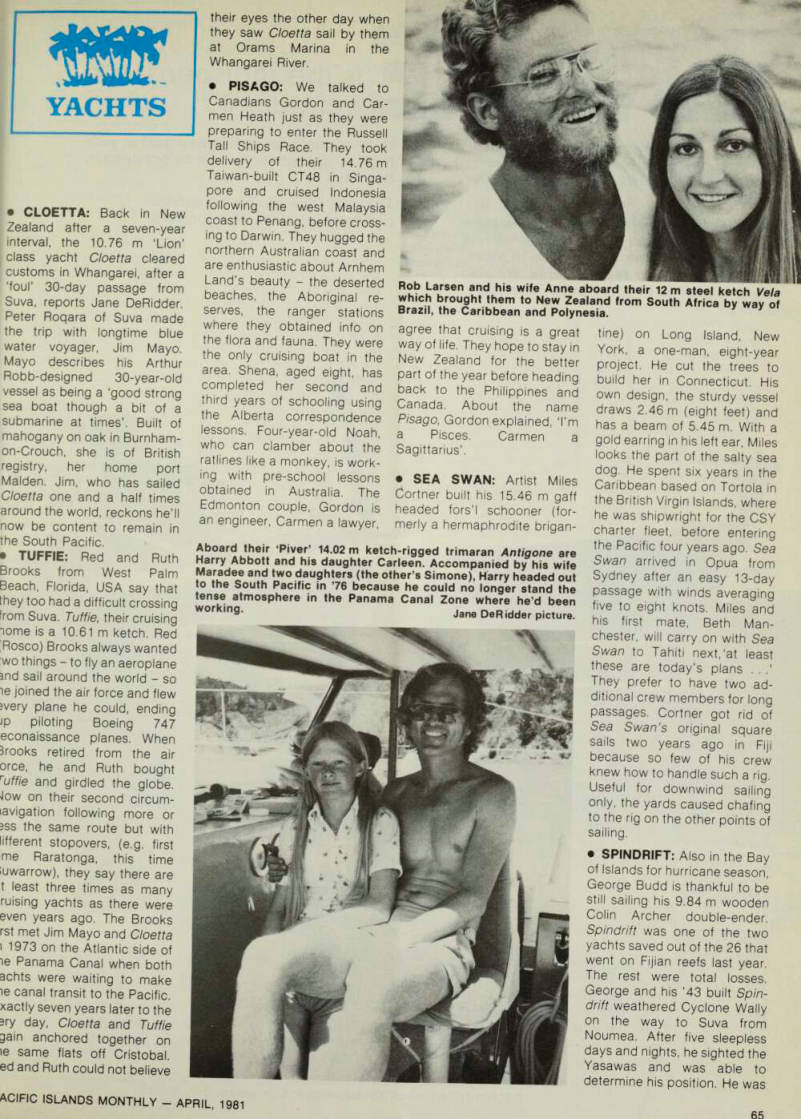

their eyes the other day when they saw Cloetta sail by them at Crams Marina in the Whangarei River. • PISAGO: We talked to Canadians Gordon and Car men Heath just as they were preparing to enter the Russell Tall Ships Race. They took delivery of their 14.76 m Taiwan-built CT4B in Singa pore and cruised Indonesia following the west Malaysia coast to Penang, before cross ing to Darwin. They hugged the northern Australian coast and are enthusiastic about Arnhem Land’s beauty - the deserted beaches, the Aboriginal re serves, the ranger stations where they obtained info on the flora and fauna. They were the only cruising boat in the area. Shena, aged eight, has completed her second and third years of schooling using the Alberta correspondence lessons. Four-year-old Noah, who can clamber about the ratlines like a monkey, is work ing with pre-school lessons obtained in Australia. The Edmonton couple, Gordon is an engineer, Carmen a lawyer,
• CLOETTA: Back in New Zealand after a seven-year interval, the 10.76 m ‘Lion’ class yacht Cloetta cleared customs in Whangarei, after a ‘foul’ 30-day passage from Suva, reports Jane Deßidder.
Peter Roqara of Suva made the trip with longtime blue water voyager, Jim Mayo.
Mayo describes his Arthur Robb-designed 30-year-old vessel as being a ‘good strong sea boat though a bit of a submarine at times’. Built of mahogany on oak in Burnham on-Crouch, she is of British registry, her home port Malden. Jim, who has sailed Cloetta one and a half times around the world, reckons he’ll now be content to remain in the South Pacific. • TUFFIE: Red and Ruth Brooks from West Palm Beach. Florida, USA say that they too had a difficult crossing from Suva. Tuffie, their cruising lome is a 10.61 m ketch. Red Brooks always wanted wo things - to fly an aeroplane jnd sail around the world - so le joined the air force and flew jvery plane he could, ending
jp piloting Boeing 747
econaissance planes. When Brooks retired from the air orce, he and Ruth bought r uffie and girdled the globe.
Jow on their second circum
lavigation following more or
sss the same route but with lifferent stopovers, (e.g. first me Raratonga, this time luwarrow), they say there are t least three times as many ruising yachts as there were even years ago. The Brooks rst met Jim Mayo and Cloetta i 1973 on the Atlantic side of le Panama Canal when both achts were waiting to make ie canal transit to the Pacific, xactly seven years later to the 2ry day, Cloetta and Tuffie gain anchored together on ie same flats off Cristobal, ed and Ruth could not believe
agree that cruising is a great way of life. They hope to stay in New Zealand for the better part of the year before heading back to the Philippines and Canada. About the name Pisago, Gordon explained, Tm a Pisces. Carmen a Sagittarius’. • SEA SWAN: Artist Miles Cortner built his 15.46 m gaff headed fors’l schooner (for merly a hermaphrodite brigan
tine) on Long Island, New York, a one-man, eight-year project. He cut the trees to build her in Connecticut. His own design, the sturdy vessel draws 2.46 m (eight feet) and has a beam of 5.45 m. With a gold earring in his left ear, Miles looks the part of the salty sea dog. He spent six years in the Caribbean based on Tortola in the British Virgin Islands, where he was shipwright for the CSY charter fleet, before entering the Pacific four years ago. Sea Swan arrived in Opua from Sydney after an easy 13-day passage with winds averaging five to eight knots. Miles and his first mate, Beth Man chester. will carry on with Sea Swan to Tahiti next,‘at least these are today’s plans . ..’
They prefer to have two ad ditional crew members for long passages. Cortner got rid of Sea Swan’s original square sails two years ago in Fiji because so few of his crew knew how to handle such a rig.
Useful for downwind sailing only, the yards caused chafing to the rig on the other points of sailing. • SPINDRIFT: Also in the Bay of Islands for hurricane season, George Budd is thankful to be still sailing his 9.84 m wooden Colin Archer double-ender.
Spindrift was one of the two yachts saved out of the 26 that went on Fijian reefs last year.
The rest were total losses.
George and his ’43 built Spin drift weathered Cyclone Wally on the way to Suva from Noumea. After five sleepless days and nights, he sighted the Yasawas and was able to determine his position. He was
Aboard their ‘River’ 14.02 m ketch-rigged trimaran Antigone are Harry Abbott and his daughter Carleen. Accompanied by his wife Maradee and two daughters (the other’s Simone), Harry headed out to the South Pacific in 76 because he could no longer stand the tense atmosphere in the Panama Canal Zone where he’d been W orking. Jane DeRidder picture.
Rob Larsen and his wife Anne aboard their 12 m steel ketch Vela which brought them to New Zealand from South Africa by wav of Brazil, the Caribbean and Polynesia.
talking on his radio when Sprindrift hit the reef south of Likuri Islands about six miles , north of the Fijian Hotel.
George feels the salt-clogged auto pilot may have packed up and turned the yacht off i course. Apparently, no one reported his distress flares.
George is an amateur radio ; operator whose call sign is N4DMP. He contacted Sydney ham, Bruce Henderson, IVK2DFH, who called Can i berra. Canberra contacted Nadi. Nadi notified Suva. Three ' hours later a tug was on its way. Spindrift uninsured as are so many cruising yachts was pulled off the reef to the tune of $3OOO, unholed but with 15 broken ribs and a smashed rudder. Budd has decided to give up single handed sailing. His present crew, Jim Ray of Bend, Oregon, is the son of friends.
Rotarian George Budd addresses Rotary Clubs as he travels, encouraging and in spiring IYFOR groups Inter national Yachting Fellowship of Rotarians.
• SHADOW of Los Angeles is a ‘Cal 36’ glass production racing sloop. Dick Lubke reckons the 11.05 m yacht makes a great cruising vessel, consistently able to beat other cruising boats for elapsed time. Lubke, computer engin eer, and his younger brother Hank left Marina Del Rey, California, in July ’79, spent two months in Hawaii, then sailed the 1200 miles to Christmas Island, where they spent several weeks. ‘I have never seen such prolific sea life. And the bird life was fantastic, the diving the best yet. Shy friendly people and only twelve yachts or so a year.’ The other island the Lubke brothers enjoyed above all others was Suwarrow. Dick reports that Sir Tom Davis, the Cook Islands premier whom he met in Rarotonga, is talking of making Suwarrow a national park. ‘Tom Davis’s association with yachting goes back a long way, for he sailed around the Horn and back to attend Harvard University.’ Hank left Shadow in Fiji, and Dick car
ried on solo. Dick says single handing has its own rewards. ‘lt gives confidence to know you can do it yourself, but I am sure that most cruising people could do it if they wanted to.’ • TAKANUPI: Single-hander John Dunlop’s Van de Stadt designed Port Adelaide registered half-tonner was named after a small island off Bougainville. (John worked for Bougainville Copper as mining engineer until 1977.) Dunlop has sailed his Aussie-built yej low and blue ‘Pion 30’ 11 000 miles to date, up and down the Australian coast and to Noumea and back. John’s latest voyage brought him to New Zealand from Coffs Har bour via Lord Howe Island which he says is a paradise.
His next passage will perhaps take him to Tahiti. The 9.23 m glass yacht is one of a Dutch national class which John has modified somewhat for cruis ing, adding extra storage and gear. He converted Takanupi to masthead instead of 7 / 8 rig, adding preventer back stays.
The cast iron bolt-on keel means the half-tonner can take the ground without structural damage. Takanupi draws 1.89 m (six feet). • MINTAKA is the name of Nita and Charlie Martin’s 9.8 m Atkins double-ender now in the Kerikeri River taking time off from ocean voyaging. It is also the name of the northernmost star in the belt of Orion, a handy star for navigators, Charlie explained, for since it is so close to the celestial equator it can be used as a compass check when rising or setting, to determine true east or west. Charlie and Nita are sailing round the world with their two cats. ‘We just couldn’t leave them behind.’
Coco the Siamese is 13, Callie the calico cat is nine. The Martins are the only cruising people from Montana as far as they know. They write of their adventures for the Sunday edition of a Montana news paper. Mintaka has a glass and balsa core hull. Charlie finished
off the interior in a mere three months, launching the 11-ton . vessel in the Snake River in Idaho. They descended eight sets of locks to reach Portland, j Oregon, through the river sys i tern that is now silted up as a I result of the Mount St Helen eruption. This is by no means ' the Martins’ first boat, though it is their first sailing yacht.
They had nine power boats of various lengths over the years prior to setting off to sea in June ’7B in Mintaka. While in New Zealand Charlie and Nita will rent a house overlooking the Kerikeri River so as to be able to redo the interior of the boat. The cats will stay aboard to mind the ship, and to satisfy agricultural regulations. • XIPHIAS is the zoological name for swordfish. Roger Olson has fittingly named his dinghy Fillet of Xiphias Xiphias is an 8.61 m Bristol Channel Cutter. The Lyle Hess designed yacht is 11.07 m overall with bowsprit. She’s a larger sister ship to Lynn and Larry Pardy’s famous 7.38 m circumnavigator, Seraffyn.
Jim Polkinghorn, Roger’s for mer crew member from Malibu, California, joined Jim and Cheri Lowden on Canadian yacht Feng Shui in Suva when Celia Vanderpool rejoined Xiphias with her children, Amy, 11, and Nathan, four. (Feng Shui is now in Australia.) With her enlarged crew, the character ship carried on to New Cal edonia for a few weeks, then made an eight-day passage from the Isle of Pines to Opua. • COQUETTE, a Lidgard 34 built in Auckland in 1972 of double diagonal kauri with dynel sheathing, has been bought by Tasmanians Philip and Pamela McLure with a view to blue water cruising.
They became interested in cruising as a way of life after chartering a ‘Davidson 20’ in 1977 from Rainbow Charters in Opua. The McLures returned in August ’BO to charter a larger vessel, a 7.7 m ‘Tracker’.
Philip, antique dealer and re storer, and Pamela, owner of a ladies’ sportswear shop, both sold their Launceston bus-
inesses to move aboard their kauri cruising home. • ZEPHYR V: Lorna and Jon Hunkin arrived back in Kerikeri in the Bay of Islands, New Zealand, after their third major offshore cruise, this time to Tasmania and New South Wales for a year. Their home is a ‘Brandlmyer 41’ cruising ketch of Vancouver registry which they built in Tauranga, New Zealand ‘Everything but welding the keel’. She is of triple diagonal kauri construc tion. Jon describes her as an amazingly trouble-free boat, very simple, and well balanced. ‘We never have crew.’ For the
last several years they have been based in Kerikeri, work ing ashore off and on and ‘houseminding’ when the oc casion arises. ‘We’re happy to live on board and want to continue,’ Lorna said. • REPINA, a steel ‘Nordia 45’, Dutch-built for Kurt Preister, journalist from Dusseldorf, was in Oram’s Marina in Whangarei for general refit and some rigging changes. Repina is a well found ship outfitted with such luxuries as Omega and computer navigational sys tems. Preister took the oppor tunity to fly back to Germany while the work was underway.
Bill and Janet Baker and baby Noah aboard their steel ketch An Den Sioul. They found the boat in Papeete, had the chance to buy her and sailed straight to New Zealand where Noah was born 27 days after their arrival. j an e DeRidder picture.
Advertisements & other items, pp. 65-70 (4 items)
65
ACIFIC ISLANDS MONTHLY APRIL, 1981
ingredient
D Woodward governors, synchronizers and synchrophasers are tested, calibrated and maintained at Woodward plants around the globe.
Our Sydney, Australia branch has complete facilities for overhaul, test and field service with new and exchange governors in stock for smaller governor requirements. We also carry a full range of spare parts for rapid delivery.
is the indispensable
ingredient
In most cases, complete overhaul of your main engine governor can be provided in two days.
The next time you have a service requirement, think of Woodward. r * W* s«a i l ■ » I • A 4?v M 1 •dw
Company
Woodward
Gove
nor since 1870 orporate Headquarters ockford, Illinois, U.S.A.
Unit 17, 59 Moxon Road Punchbowl, NWS 2196 (Sydney) Australia Phone: (02) 709-5911 • Telex: AA24175 Ft. Collins, Colprado; Hoofddorp, The Netherlands; Slough England; Tomisato, Chiba, Japan; Campinas, S.P., Brazil
ETOO3
i ■ m ** t « * -4’JL. s£.
PACIFIC
FORUM LINE
Regular and Reliable Container and Roll - ON - OFF Services
owned by the people
of the Forum Nations
MV FUA KAVENGA
MV FORUM SAMOA
MV FORUM NEW ZEALAND
With our head office in Apia, our regional offices in Suva, Auckland, and Sydney, and our network of agents, we cover the South Pacific to ensure your goods get to you or to your buyer on time.
We tranship also, to or from almost anywhere in the world.
NOMINATE PERFORMANCE: NOMINATE PFL
Agents in: Australia, New Zealand, Fiji, Tonga, Western Samoa, American Samoa, New Caledonia, Papua New Guinea, Solomon Is, Kiribati, Tuvalu, Vanuatu.
HENRY CUMINES
PTY LTD.
EXPORTERS o GENERAL MERCHANTS
428 GEORGE ST. ( SYDNEY
CABLES: HENCO SYDNEY. G.P.O. Box 3949. PHONE; 232-5377 For specialised and personalised buying service throughout the Pacific Islands and the East.
• LOCAL AGENTS AND REPRESENTATION:
PAPUA NEW GUINEA: FIJI:
RABAUL: M. & C. Seeto.
P.O. Box 131, Rabaul.
Telephone 92-2919.
MADANG W. Double, P.O. Box 22, Madang, Telephone 82-2696.
K. Witherington Ltd.
P.O. Box 293, Suva Telephone 22-356.
VANUATU:
L John Lum & Associates, P.O. Box 65, Santo.
Telephone 329.
SOLOMON ISLANDS:
Mr. Tom Lo, P.O. Box 327, Honiara.
Telephone 399.
Resident Agents in other Pacific Territories. »
kO w.
Aquila water tankscompletely enclosed to ensure clean water and built to last from strong, durable galvanised steel.
You assemble them yourself from our compre hensive kits. Capacities range from 2300 litres to 49250 litres.
Send for a brochure today.
Aquila Engineering Division, 25 Pacific Highway, Bennetts Green, New South Wales, Australia.
Name Address P/code
AQ2O/2
AQUILA
WHEN YOUR DEALER CAN'T SUPPLY
EMERGENCY!
SPARE PARTS SERVICE
R. T. MUIRHEAD COMPANY
EXPORTERS
ESTABLISHED 1935
We furnish genuine spare parts for any American manufactured Construction • Mining • Logging • Transportation • Quarry and Industrial Equipment.
“EMERGENCY SERVICE IS OUR SPECIAL TY”
WE WILL ARRANGE CUSTOM CLEARANCE AND DELIVERY TO YOUR WAREHOUSE.
SATISFIED CUSTOMERS THROUGHOUT AUSTRALIA, NEW ZEALAND, PACIFIC ISLANDS, SOUTH EAST ASIA AND OTHER
COUNTRIES - REFERENCES AVAILABLE.
TELEX: 69-1392 R. T. MUIRHEAD CO.
CABLE ADDRESS: MUIRHEAD LOS ANGELES 1923 STAUNTON AVENUE TELEPHONE: (213) 749-4418 LOS ANGELES, CALIF. 90058
P.O. BOX 58512 A
South Sea Freighters Limited
Announcing: A 30-day service between Singapore,
Malaysia, Papua New Guinea and the Solomon Islands rr : •• r n «3«ri r * t x > i G M„ T r«! u an M a,U: SO c th Sea reigh,e : s Limited ' Po Box 166 Port Vi| a • Singapore: Bienley & Co. (Pte) Ltd Telex R 525114 Phone- 981935 KietXnfpSllp (N G) ifd \ 8 J r ßack * F Lafc Nuigini Express Unes * Wewak Burns Ph "P (N-G.) Ltd.
Mmoft Harrisons & Crossfield (P.N.G./ Ltd. • Rabaul: New Guinea Cocoa (Export) Co. Pty. Ltd • Honiara; Island Co-operative Shipping Federation Ltd Serviced by MV Solomon Sea and MV Bismarck Sea.
Y
GLOBAL SERVICE FOR SHIPPERS
V
THE BANK LINE
28 Day Service 4
United Kingdom and Continent to:
PAPEETE • NOUMEA
PAPUA NEW GUINEA and SOLOMON ISLANDS
PO RT VI LA & SANTO BY TRANSHIPMENT * United Kingdom and Continent to: SUVA AND LAUTOKA (FCL LCL & UNITISED ONLY) Papua New Guinea and Solomon Islands to:
UNITED KINGDOM and CONTINENT
For particulars apply:
THE BANK LINE (AUSTRALASIA) PTY. LTD.
18th Floor 1 York Street SYDNEY NSW 2000 Australia Tel: 272041 Telex: 24063
Yachts
67
<VCIFIC ISLANDS MONTHLY APRIL, 1981
69
YACHTS
ACIFIC ISLANDS MONTHLY - APRIL, 1981
Services
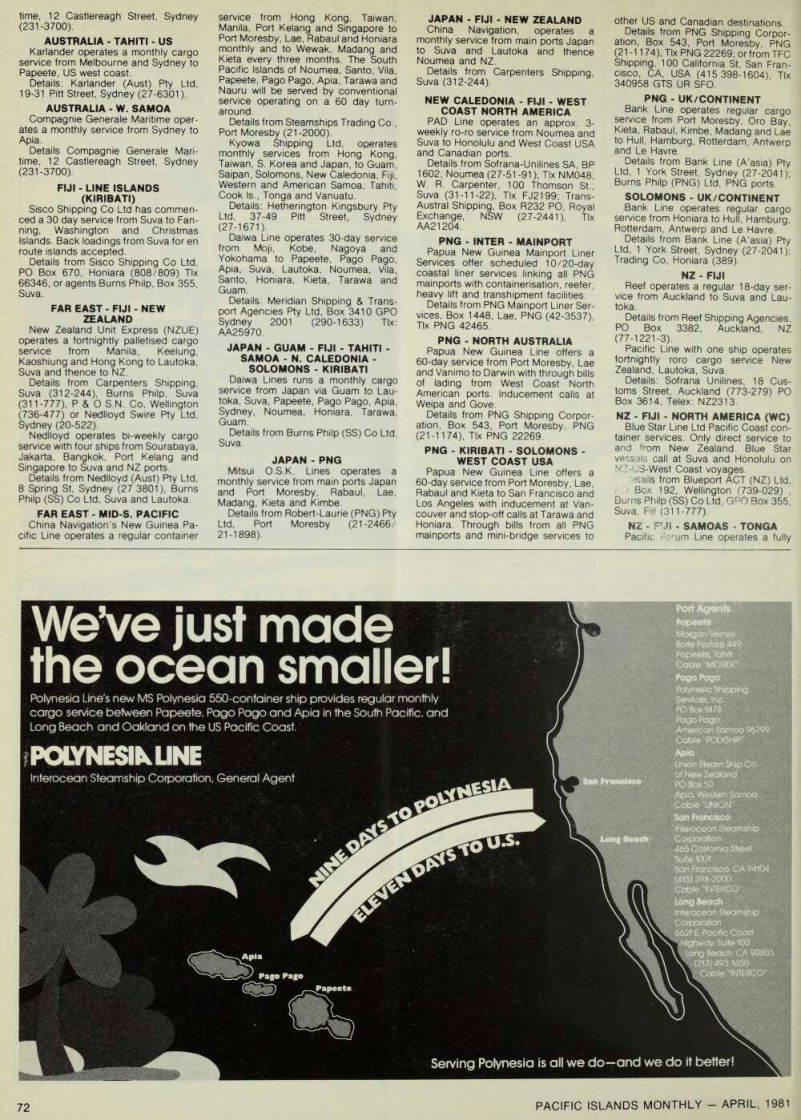
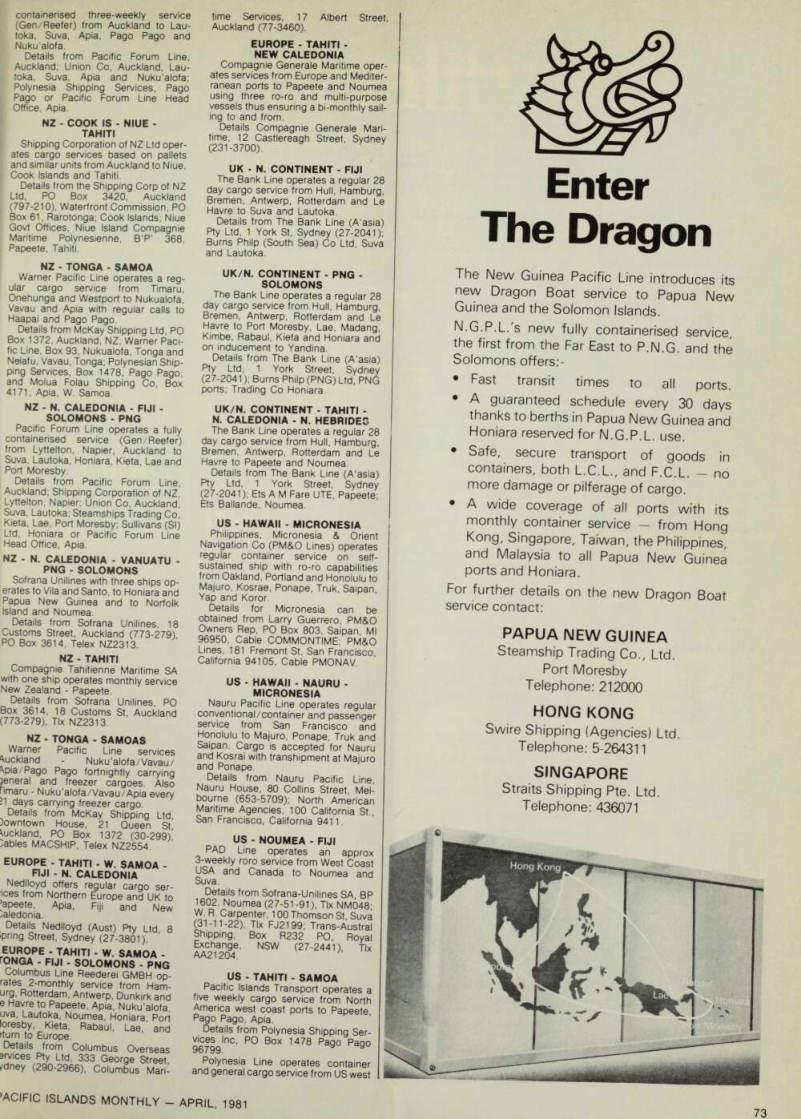
Shipping
Should any shipping company wish to have its services cargo and passenger included in these list ings they should contact PIM.
Australia - Fiji
Karlander (Aust) Pty Ltd operates monthly cargo services from Sydnev to Suva and Lautoka.
Details from Karlander (Aust) Pty Ltd, 19-31 Pitt Street, Sydney (27-6301), Dalgety Shipping, 461 Bourke Street, Melbourne (60-0731), Burns Philp (SS) Co Ltd, Suva and Lautoka Sofrana-Unilines (Fiji Express Line) operates to Suva and Lautoka every three weeks from the main ports on the east coast of Australia and monthly to Lautoka from Melbourne and Sydney.
Details from Sofrana-Unilines, 19 Pitt Street, Sydney, (27-2031), Trans- Austrai Shipping Pty Ltd, 570 Bourke Street, Melbourne (67-9162). ACTA Pty Ltd, Brisbane (221-3116), Elder-ANL Pty Ltd, Port Adelaide (47-5688), ANL, Newcastle (049-24364). Clements & Marshall, Burnie, Tasmania (31-1833).
Australia - Fiji - Samoas ■
Tonga
Pacific Forum Line operates a fully containerised service (Gen/Reefer) from Brisbane and Sydney to Lautoka, Suva, Nukualofa Apia and Pago Pago Funafuti cargo transhipped at Apia.
Details from Pacific Forum Line. Syd ney; Union Bulkships. Sydney and Mel bourne; Australian National Line, Brisbane; Burns Philp (SS) Co, Lau :oka, Suva and Apia; Union Co Nukualofa: Polynesia Shipping Ser /ices, Pago Pago or Pacific Forum Line Head Office, Apia
Australia - Lord Howe Is -
Norfolk Is
Compagnie des Chargeurs operates four-weekly :argo service Sydney - Lord Howe >land and Norfolk Island.
Details Hetherington Kingsbury Pty -td, 37-49 Pitt Street, Sydney 27-1671).
Australia - Nauru -
Kiribati
Nauru Pacific Line operates regular argo/passenger service from Mel ourne to Nauru and Tarawa Details. Nauru Pacific Line, Nauru louse, 80 Collins Street, Melbourne 553-5709), Nedlloyd Swire. 8 Spring treet, Sydney (2-0522).
Australia - New Caledonia
(And/Or) Vanuatu
Karlander operates a monthly service om Sydney to Noumea Details: Karlander (Aust) Pty Ltd 9-31 Pitt Street, Sydney (27-6301).
Sofrana-Unilines ships serve oumea every three weeks from the ain ports along the east Australian Dast.
Details from Sofrana-Unilines 19 Pitt reet, Sydney (27-2031), Trans ustral Shipping Pty Ltd, 570 Bourke reet, Melbourne (67-9162). ACTA Pty d, Brisbane (221-3116), Elders-ANL y Ltd, Pod Adelaide (47-5688) ANL ewcastle (049-24364) Clements & arshall, Burnie, Tasmania 1-1833).
Compagnie des Chargeurs Cate
doniens operates a three-weekly con tainerised cargo service from Sydney to Noumea.
Details Hetherington Kingsbury Pty Ltd, 37-49 Pitt Street, Sydney (27-1671).
Compagnie Generale Maritime oper ates a monthly service from Sydney to Noumea, Port Vila and Santo using a ro-ro vessel.
Details Compagnie Generate Mari time, 12 Castlereagh Street, Sydney (231-3700).
Daiwa Line operates a con tainer/breakbulk service every 30 days to Vila and Santo and every 60 days to Noumea.
Details Meridian Shipping & Trans port Agencies Pty Ltd, Box 3410 GPO Sydney 2001 (290-1633). Tlx: AA25970.
Australia - Nz ■ Fiji -
Hawaii - Us
P & O liners call at Auckland, Suva, Pago Pago and Honolulu and Van couver on eastbound and westbound voyages between Sydney and the US.
Details from P & O Booking Centre, World Travel Headquarters Pty Ltd, 33 Bligh Street, Sydney (231-6655).
AUSTRALIA - NZ - FIJI - TONGA -
Vanuatu - Noumea - Solomons -
Samoas - Tahiti
Sitmar Cruises operates a year-round cruise programme to include most of the above countries.
Details from Sitmar Cruises, 47 Elizabeth Street, Sydney (232-7511).
AUSTRALIA - NZ - FIJI - TONGA
Vanuatu - Noumea - Solomons -
Samoas - Tahiti
P & O liners call at Auckland, Bay of Islands, Honiara, Lautoka, Noumea, Nukualofa, Pago Pago, Papeete, Port Moresby, Santo. Savusavu, Suva, Vavau and Vila on cruises from Aus tralia.
Details from P & O Booking Centre, World Travel Headquarters Pty Ltd 33 Bligh Street, Sydney (231-6655), Pacific Forum Line operates con tainerized and general cargo service from Australia and NZ to Fiji, Apia, Pago Pago, Tonga and other South Pacific ports.
Details from Polynesia Shipping Ser vices Inc, PC Box 1478, Paqo Paqo 96799.
Australia - New Zealand -
Pacific Islands - South East
Asia-China
Minghua Cruises operates regular cruise services from Sydney to most Pacific ports, with several cruises to South East Asia, including Japan and Hong Kong, Details Minghua Cruises, 7 Bridge Street, Sydney, NSW 2000 and all Burns Philp Travel offices in Australia
Australia - Micronesia
Nauru Pacific Line operates a regular container service from Melbourne to Majuro, Kosrae, Ponape. Truk, Guam and Saipan, Details Nauru Pacific Line, Nauru House. 80 Collins Street, Melbourne, (653-5709), Nedlloyd Swire, 8 Spring Street, Sydney (2-0522).
Australia - Png
New Guinea Express Lines operates a fortnightly container service from Mel bourne, Sydney, Brisbane to Port Moresby, Lae, Alotau. Rabaul Details from New Guinea Express Lines, PO Box R 73, Royal Exchange PC. Sydney (241-3991) MacArthur Shipping Agency Co, 82-92 Eagle Street, Brisbane (229-3777), New Guinea Express Lines, 327 Collins Street, Melbourne (61-3053), Niugini Express Lines in Port Moresby (21-4572), Lae (42-1536). Rabtrad Niugini Pty Ltd. Rabaul (92-2911).
Alotau Stevedoring & T’soort (61-1318).
Karlander New Guinea Line’s cargo vessels call at Melbourne, Sydney. Port
Moresby, Lae, Madang, Wewak.
Manus, Kimbe, Rabaul, Popondetta.
Details from Karlander (Aust) Pty Ltd. 19-31 Pitt Street, Sydney (27-6301), Dalgety Shipping, 461 Bourke Street.
Melbourne (60-0731).
Australia - Png - Solomons
A consortium of Conpac, NGAL/PNGL have three container vessels operating on a 28 day turn around from Melbourne, Sydney and Brisbane to Port Moresby, Lae, Rabaul, Kavieng, Wewak, Madang, Kieta and Honiara.
Details from Burns, Philp & Co. Ltd. 51 Pitt Street, Sydney (2-0547) and Interocean Swire 8 Spring Street. Syd ney. (2-0522).
Australia - Solomons
Kiribati - Micronesia
Daiwa Line operates a container ser vice every 30 days from Sydney to Honiara, Kieta, Tarawa and Guam Gizo
cargoes transhipped at Honiara, Sai pan, cargoes transhipped at Guam.
Details Meridian Shipping & Trans port Agencies Pty Ltd, Box 3410 GRO Sydney 2001 (290-1633), Tlx AA25970.
Australia - Solomons -
Northern Marianas-Taiwan
Japan
Daiwa Line offers a four-weekly ser vice Sydney-Honiara-Guam-Taiwan- Japan with transhipment at Guam for Saipan.
Details Meridian Shipping & Trans port Agencies Pty Ltd, Box 3410 GRO, Sydney 2001 (290-1633), Tlx AA25970.
Australia - Tahiti
Compagnie Generate Maritime oper ates a monthly service from Sydney to Papeete using a ro-ro vessel Details Compagnie Generate Mari
time, 12 Castlereagh Street. Sydney (231-3700).
Australia - Tahiti - Us
Karlander operates a monthly cargo service from Melbourne and Sydney to Papeete, US west coast.
Details: Karlander (Aust) Pty Ltd 19-31 Pitt Street, Sydney (27-6301) ’
Australia - W. Samoa
Compagnie Generale Maritime operates a monthly service from Sydney to A P' a - . . .. .
Details Compagnie Generale Mantime, 12 Castlereagh Street, Sydney (231-3700).
Fiji - Line Islands
(Kiribati)
Sisco Shipping Co Ltd has commenced a 30 day service from Suva to Fanning, Washington and Christmas Islands. Back loadings from Suva for en route islands accepted.
Details from Sisco Shipping Co Ltd, PO Box 670, Honiara (808/809) Tlx 66346, or agents Burns Philp, Box 355, Suva.
Far East - Fiji - New
Zealand
New Zealand Unit Express (NZUE) operates a fortnightly palletised cargo service from Manila, Keelung, Kaoshiung and Hong Kong to Lautoka, Suva and thence to NZ.
Details from Carpenters Shipping, Suva (312-244), Burns Philp, Suva (311-777), P & O S.N. Co, Wellington (736-477) or Nedlloyd Swire Pty Ltd, Sydney (20-522).
Nedlloyd operates bi-weekly cargo service with four ships from Sourabaya, Jakarta, Bangkok, Port Kelang and to Suva and NZ Details from Nedlloyd (Aust) Pty Ltd, 8 Spnng SL Sydney (27 3801), Burns Philp (SS) Co Ltd. Suva and Lautoka.
Far East - Mid-S. Pacific
China Navigation’s New Guinea Pacific Line operates a regular container
service from Hong Kong, Taiwan, Manila, Port Kelang and Singapore to Port Mor osby, Lae, Rabaul and Honiara monthly and to Wewak, Madang and £ ieta ever Y three months. The South Paciflc Elands of Noumea, Santo. Vila, Papeete, Pago Pago, Apia, Tarawa and Nauru will be served b V conventional “™nd. ° Pera "" 9 °" 3 60 ** Details from Steamships Trading Co., p o rt Moresby (21 -2000).
Kyowa Shipping Ltd, operates monthly services from Hong Kong, Taiwan, S. Korea and Japan, to Guam, Saipan, Solomons, New Caledonia, Fiji, Western and American Samoa, Tahiti, Cook ls - Ton ga and Vanuatu.
Kingsbury Pty 37-49 Pitt Street, Sydney ( 2 T-1671). . Daiwa Line operates 30-day service rom Kobe. Nagoya and Yokohama to Papeete, Pago Pago, AP ,a - s^ a \ Lautoka. Noumea, Vila, Santo, Honiara, Kieta, Tarawa and Guam Details; Meridian Shipping & Trans port Agencies Pty Ltd, Box 3410 GPO Sydney 2001 (290-1633) Tlx: AA25970 _. mTl
* Tahiti -
' N-P A Ledonia -
Solomons - Kiribati
Daiwa Lines runs a monthly cargo service from Japan via Guam to Lau *°ka’ Suva > Papeete, Pago Pago, Apia, Sydney, Noumea, Honiara, Tarawa, Guam.
Details from Burns Philp (SS) Co Ltd, Suva.
Japan - Png
Mitsui O.S.K. Lines operates a monthly service from main ports Japan anc j p ort Moresby, Rabaul, Lae, Madang, Kieta and Kimbe.
Details from Robert-Laurie (PNG) Pty Ltd, Port Moresby (21-2466/ 21-1898).
Japan - Fiji - New Zealand
China Navigation, operates a monthly service from main ports Japan to Suva and Lautoka and thence Noumea and NZ.
Details from Carpenters Shipping, Suva (312-244).
New Caledonia - Fiji - West
Coast North America
PAD Line operates an approx. 3weekly ro-ro service from Noumea and Suva to Honolulu and West Coast USA and Canadian ports.
Details from Sofrana-Unilines SA, BP 1602, Noumea (27-51 -91), Tlx NMO4B; W. R. Carpenter, 100 Thomson St., Suva (31-11-22), Tlx FJ2199; Trans- Austral Shipping, Box R 232 PC, Royal Exchange, NSW (27-2441), Tlx AA21204.
Png - Inter - Mainport
Papua New Guinea Mainport Liner Services offer scheduled 10/20-day coastal liner services linking all PNG mainports with containerisation, reefer, heavy lift and transhipment facilities.
Details from PNG Mainport Liner Ser vices, Box 1448, Lae, PNG (42-3537), Tlx PNG 42465.
Png - North Australia
Papua New Guinea Line offers a 60-day service from Port Moresby, Lae and Vanimo to Darwin with through bills of lading from West Coast North American ports. Inducement calls at Weipa and Gove.
Details from PNG Shipping Corpor ation, Box 543, Port Moresby, PNG (21-1174), Tlx PNG 22269.
Png - Kiribati - Solomons -
West Coast Usa
Papua New Guinea Line offers a 60-day service from Port Moresby, Lae, Rabaul and Kieta to San Francisco and Los Angeles with inducement at Van couver and stop-off calls at Tarawa and Honiara. Through bills from all PNG mainports and mini-bridge services to
other US and Canadian destinations.
Details from PNG Shipping Corpor ation, Box 543, Port Moresby, PNG (21 -1174), Tlx PNG 22269; or from TFC Shipping, 100 California St, San Fran cisco, CA, USA (415 398-1604), Tlx
340958 Gts Ur Sfo.
Png - Uk/Continent
Bank Line operates regular cargo service from Port Moresby, Oro Bay, Kieta, Rabaul, Kimbe, Madang and Lae to Hull, Hamburg, Rotterdam. Antwerp and Le Havre.
Details from Bank Line (A’asia) Pty Ltd, 1 York Street, Sydney (27-2041); Burns Philp (PNG) Ltd, PNG ports.
Solomons - Uk/Continent
Bank Line operates regular cargo service from Honiara to Hull, Hamburg, Rotterdam, Antwerp and Le Havre.
Details from Bank Line (A’asia) Pty Ltd, 1 York Street, Sydney (27-2041); Trading Co, Honiara (389).
Nz - Fiji
Reef operates a regular 18-day ser vice from Auckland to Suva and Lau toka.
Details from Reef Shipping Agencies, PC Box 3382, Auckland, NZ (77-1221-3).
Pacific Line with one ship operates fortnightly roro cargo service New Zealand, Lautoka, Suva.
Details: Sofrana Unilines, 18 Cus toms Street, Auckland (773-279) PC Box 3614, Telex: NZ2313.
NZ - FIJI - NORTH AMERICA (WC) Blue Star Line Ltd Pacific Coast con tainer services. Only direct service to and from New Zealand. Blue Star vessels call at Suva and Honolulu on NZ-US-West Coast voyages. etails from Blueport ACT (NZ) Ltd, > Box 192, Wellington (739-029) , Burns Philp (SS) Co Ltd, GPQ Box 355, Suva, Fiji (311-777).
Nz- Fmi -Samoas - Tonga
Pacific i-o r um Line operates a fully
containerised three-weekly service (Gen/Reefer) from Auckland to Lau toka, Suva, Apia, Pago Pago and Nukualofa.
Details from Pacific Forum Line, Auckland; Union Co, Auckland, Lau toka, Suva, Apia and Nuku’alofa; Polynesia Shipping Services, Pago Pago or Pacific Forum Line Head s Office, Apia.
NZ - COOK IS - NIUE -
Tahiti
Shipping Corporation of NZ Ltd oper ates cargo services based on pallets and similar units from Auckland to Niue, Cook Islands and Tahiti.
Details from the Shipping Corp of NZ Ltd, PC Box 3420, Auckland 1 (797-210), Waterfront Commission, PC Box 61, Rarotonga; Cook Islands; Niue Govt Offices, Niue Island Compagnie Maritime Polynesienne, B'P’ 368, Papeete, Tahiti.
Nz - Tonga - Samoa
Warner Pacific Line operates a reg ular cargo service from Timaru, Onehunga and Westport to Nukualofa, Vavau and Apia with regular calls to Haapai and Pago Pago.
Details from McKay Shipping Ltd, PC Box 1372, Auckland, NZ; Warner Paci fic Line, Box 93, Nukualofa, Tonga and Neiafu, Vavau, Tonga; Polynesian Ship ping Services, Box 1478, Pago Pago; and Molua Folau Shipping Co, Box 4171, Apia, W. Samoa.
NZ - N. CALEDONIA - FIJI -
Solomons - Png
Pacific Forum Line operates a fully containerised service (Gen/Reefer) from Lyttelton, Napier, Auckland to Suva, Lautoka, Honiara, Kieta, Lae and Port Moresby.
Details from Pacific Forum Line, Auckland; Shipping Corporation of NZ, Lyttelton, Napier; Union Co, Auckland, Suva, Lautoka; Steamships Trading Co, Kieta, Lae, Port Moresby; Sullivans (SI) Ltd. Honiara or Pacific Forum Line Head Office, Apia.
NZ - N. CALEDONIA - VANUATU -
Png - Solomons
Sofrana Unilines with three ships op erates to Vila and Santo, to Honiara and Papua New Guinea and to Norfolk Island and Noumea.
Details from Sofrana Unilines, 18 Customs Street, Auckland (773-279) PO Box 3614, Telex NZ2313.
Nz - Tahiti
Compagnie Tahitienne Maritime SA with one ship operates monthly service New Zealand - Papeete.
Details from Sofrana Unilines, PO Box 3614, 18 Customs St, Auckland (773-279), Tlx NZ2313.
Nz ■ Tonga - Samoas
Warner Pacific Line services Auckland - Nuku'alofa/Vavau/ \pia/Pago Pago fortnightly carrying general and freezer cargoes. Also
fimaru - Nuku’alofa/Vavau/Apia every
-1 days carrying freezer cargo.
Details from McKay Shipping Ltd, Downtown House, 21 Queen St Auckland. PO Box 1372 (30-299)’ tables MACSHIP, Telex NZ2554.
EUROPE - TAHITI - W. SAMOA -
Fiji - N. Caledonia
Nedlloyd offers regular cargo ser ices from Northern Europe and UK to ’apeete, Apia, Fiji and New ✓aledonia.
Details Nedlloyd (Aust) Pty Ltd. 8
'Pring Street, Sydney (27-3801).
■SSSJOPB - TAHITI - W. SAMOA rONGA - FIJI - SOLOMONS - PNG Columbus Line Reederei GMBH op rates 2-monthly service from Ham urg, Rotterdam, Antwerp, Dunkirk and e Havre to Papeete, Apia, Nuku’alofa, uva, Lautoka, Noumea, Honiara Port loresby, Kieta, Rabaul, Lae, and (turn to Europe.
Details from Columbus Overseas sryices Pty Ltd, 333 George Street /dney (290-2966), Columbus Mari
time Services, 17 Albert Street, Auckland (77-3460).
Europe - Tahiti -
New Caledonia
Compagnie Generate Maritime oper ates services from Europe and Mediter ranean ports to Papeete and Noumea using three ro-ro and multi-purpose vessels thus ensuring a bi-monthly sail ing to and from.
Details Compagnie Generate Mari time, 12 Castlereagh Street, Sydney (231-3700).
Uk - N. Continent - Fiji
The Bank Line operates a regular 28 day cargo service from Hull, Hamburg, Bremen, Antwerp, Rotterdam and Le Havre to Suva and Lautoka.
Details from The Bank Line (A’asia) Pty Ltd, 1 York St. Sydney (27-2041); Burns Philp (South Sea) Co Ltd, Suva and Lautoka.
Uk/N. Continent - Png -
Solomons
The Bank Line operates a regular 28 day cargo service from Hull, Hamburg, Bremen, Antwerp, Rotterdam and Le Havre to Port Moresby, Lae, Madang, Kimbe, Rabaul, Kieta and Honiara and on inducement to Yandina.
Details from The Bank Line (A'asia) Pty Ltd, 1 York Street, Sydney (27-2041); Burns Philp (PNG) Ltd, PNG ports; Trading Co Honiara.
Uk/N. Continent - Tahiti -
N. Caledonia - N. Hebrides
The Bank Line operates a regular 28 day cargo service from Hull, Hamburg, Bremen, Antwerp, Rotterdam and Le Havre to Papeete and Noumea, Details from The Bank Line (A’asia) Pty Ltd, 1 York Street, Sydney (27-2041); Ets A M Fare DTE, Papeete; Ets Ballande, Noumea.
Us - Hawaii - Micronesia
Philippines, Micronesia & Orient Navigation Co (PM&O Lines) operates regular container service on self sustained ship with ro-ro capabilities from Oakland, Portland and Honolulu to Majuro, Kosrae, Ponape, Truk, Saipan, Yap and Koror.
Details for Micronesia can be obtained from Larry Guerrero, PM&O Owners Rep, PO Box 803, Saipan Ml
96950, Cable Commontime; Pm&O
Lines, 181 Fremont St, San Francisco, California 94105, Cable PMONAV.
Us - Hawaii - Nauru -
Micronesia
Nauru Pacific Line operates regular conventional/container and passenger service from San Francisco and Honolulu to Majuro, Ponape, Truk and Saipan. Cargo is accepted for Nauru and Kosrai with transhipment at Majuro and Ponape.
Details from Nauru Pacific Line Nauru House, 80 Collins Street, Mel bourne (653-5709); North American Maritime Agencies, 100 California St.
San Francisco. California 9411.
Us - Noumea - Fiji
PAD Line operates an approx 3-weekly roro service from West Coast USA and Canada to Noumea and Suva.
Details from Sofrana-Unilines SA BP 1602, Noumea (27-51-91), Tlx NMO4B' W. R, Carpenter, 100 Thomson St, Suva (31-11-22), Tlx FJ2199; Trans-Austral Shipping, Box R 232 PO, Royal Exchange, NSW (27-2441) Tlx AA21204.
Us - Tahiti - Samoa
Pacific Islands Transport operates a five weekly cargo service from North America west coast ports to Papeete Pago Pago, Apia.
Details from Polynesia Shipping Ser -9679 C ’ P ° B ° X 1478 Pa9 ° Pag ° Polynesia Line operates container and general cargo service from US west
coast ports to Papeete and Pago Pago.
Details from Polynesia Shipping Ser vices Inc., PO Box 1478, Pago Pago 96799.
US - FIJI - TAHITI - NZ
Australia
The Bank and Savill Line Ltd, oper ates regular cargo services from US Gulf ports to Australia and NZ, Calls at Suva, Lautoka and Papeete on de mand.
Details from The Bank Line (A'asia) Pty Ltd, 1 York Street, Sydney (27-2041) or Howard Smith Industries Pty Ltd, 1 York Street, Sydney (27-5611).
US TAHITI - SAMOA -NZ - AUST Farrell Lines Inc, operate a fast reg ular lash/container cargo service from west coast ports Canada/USA to Papeete and Pago Pago thence to NZ and Australia Details Wilh Wilhelmson Agency, Sydney, Melbourne and Brisbane, Tlx AA20136, Cable FARSHIPS Sydney; Dalgety (NZ) Ltd, Auckland and Wellington, Tlx NZ2445, Cable DALSHIP Auckland; Compagnie Mari time Polynesienne, Immeuble Franco Oceanienne, PO Box 368, Papeete, Tahiti, Tel 26393, Tlx 258. FP ANSB Taporo, Cable OCEAN Papeete; Kneubuhl Maritime Service, PO Box 39, Pago Pago, Telephone 633-5121; Tlx 782505.
Advertisements & other items, pp. 71-74 (3 items)
71
ACIFIC ISLANDS MONTHLY - APRIL, 1981
Transport
MOJI— KOBE— NAGOYA-*YOKOHAMA—GUAM— MAJURO-*TARA WA—NAURU—LAUTOJ
f BRIDGE OF THE SOUTH PACIFIC
■AIWA LINE
container/RO-RO ships
bring JAPAIM/FAR EAST and
AUSTRALIA/NEW ZEALAND
round to your doorway m Please contact us or agent for i whatever shipping need, for the best answer R A
I tm baima nayication co.. km
Head Office : 15-15. I -chome. Awaza. Nish-ku. Osaka. Japan 550 n Phone (06)531-0471 Telex 525-6324 a Cable “DA ILlNE’Osaka
KIETA—HONIARA—SANTO—VILA—NOUMEA-BRISBANE- SYDNEY- AUCKLAND-
PACIFIC
ISLANDS
TRANSPORT
LINE
MS AFRICANSTARS
Express Freight Service between Pacific Coast Ports of U.S.A. and...
Tahiti (s Samoa
PAPEETE - APIA - PAGO PAGO
Full container service including reefers.
GENERAL STEAMSHIP CORPORATION LTD
General Agents 400 California Street, San Francisco, California, U.S.A APU: Bums Philp (South Sea) Company Ltd.
E^ EE T E: A B encc Maritime Internationale, Tahiti.
PAGO PAGO: Polynesia Shipping Services Inc.
WeVe just made
the ocean smaller!
Polynesia Line's new MS Polynesia 550-container ship provides regular monthly cargo service between Papeete, Pago Pago and Apia in the South Pacific, and Long Beach and Oakland on the US Pacific Coast.
POLYNESIMJNE
Interocean Steamship Corporation, General Agent
oOk
\2 .s
Tou
SL 5* 3 5* Apia Pago Pago Papeete and we do it better!
Serving Polynesia is all we do Port Agents Papeete Morgan-Vernex Boil© Postal© 449 Papeete. Tahiti Cable "MOREX"
Pago Pago Polynesia Shipping Services. Inc.
POBox 1478 Pago Pago, American Samoa 96799 Cable "POLYSHIP"
Apta Union Steam Ship Co. of New Zealand
POSoxSO
Apia, Western Samoa Cable "UNION"
Son Francisco Interocean Steamship Corporation 465 Californio Street Suit© 1001 San Francisco, CA 94104 (415) 398-2000 Cable ’INTERCO"
Long Beach interdcean Steamship Corporation 6621 E. Pacific Coasl ay. Suite 100 long Beach, CA 90803 {2l3] 493-1450 Cable "fNTERCO"
Enter
The Dragon
The New Guinea Pacific Line introduces its new Dragon Boat service to Papua New Guinea and the Solomon Islands.
N.G.P.L.'s new fully containerised service, the first from the Far East to P.N.G. and the Solomons offers:- • Fast transit times to all ports. • A guaranteed schedule every 30 days thanks to berths in Papua New Guinea and Honiara reserved for N.G.P.L. use. • Safe, secure transport of goods in containers, both L.C.L., and F.C.L. - no more damage or pilferage of cargo. • A wide coverage of all ports with its monthly container service from Hong Kong, Singapore, Taiwan, the Philippines, and Malaysia to all Papua New Guinea ports and Honiara.
For further details on the new Dragon Boat service contact:
PAPUA NEW GUINEA
Steamship Trading Co., Ltd.
Port Moresby Telephone: 212000
HONG KONG
Swire Shipping (Agencies) Ltd.
Telephone: 5-264311
SINGAPORE
Straits Shipping Pte. Ltd.
Telephone: 436071 t
s ft
* \ . 1 . /
FLEETS
49ft Planked Ketch Rig Motor Sailer, profess bit 1966 major conversion 1977. 6 LX Gardner, diesel aux Big Saloon, Master's Cabin aft, 2 toilets & showers, deep freeze & refrig , Radar, Auto Pilot etc. $lO5 000.00
FLEETS
221 Esplanade, Wynnum
Central, Brisbane.
Cable FLEETS BRISBANE.
F. A.
Freely
Given
A true understanding of God's Word.
If you have been search ing for the true meaning, of the Scriptures this free monthly booklet is for you.
Write to God's Way P.O. Box 41, North Ryde, Australia 2113
73
'ACIFIC ISLANDS MONTHLY - APRIL, 1981
Advertising Index
Advertiser page
Antipodean Bookshop 44
Air New Zealand 20
Amatil 34
Aquilla Engineering 68
Akai 8
Aggie Grey Hotel 45
Argo 52
Bankline 70
Berkey 74
Clarion Shoji 30
China Navigation Co. 73
Citizen Watches 42
Carptrac 62
Dept. Trade & Resources 40
Daddow 74
Epiglass 58-59
Fleets 74
Farrell 74
Group Mark 32
General Steamships 71
Henry Cumines 68
Hinchcliffe, C. 44
Komatsu 64
Matsushita 16
Meridian Shipping 71
Muirhead 68
Nz Police 54
Nz Dairy Board 75
National Insurance 48
Nissan 26 27
Nelson 8. Robertson 57
Newway International 52
Polynesian Line 72
Pacific Forum 67
Papua Hotel 45
Pioneer 23
Qbe Insurance 28
Ricoh 56
Rex Aviation 36
Suzuki 12
Short Bros 50 51
South Sea Freighters 69
Sansui 46
Sony 76
Trio-Kenwood 60
Tatham 4
Toyota 2
Video Recorder Centre 74
Woodward Governor Co. 66
Wonderest 44
Waterwheel 63
Yamaha 3839
Deaths
of Islands People
David Bamforo
In Port Moresby on January 26 following a brief illness. David Bamford was a tourist industry official who was one of the main organisers, as deputy director, of last year’s highly successful South Pacific Festival of Arts in Papua New Guinea. A national message of sympathy at his death was given by the PNG Prime Minister, Sir Julius Chan.
Norman John Salter
In Port Moresby on January 27, following a stroke, aged 55.
Norman Salter was a Welsh born boxing promoter whose dream was to see a Papua New Guinean win a world boxing crown. He once clashed with the PNG government which threatened to deport him be cause his work permit did not cover training and managing boxers But the rift was healed and he went into partnership with the government preparing John Aba for the world feather weight title in 1979. The bid failed and was financially disas trous. Friends said the strain and the financial setbacks con tributed to Salter’s death.
Raymond Colardeau
Of a heart attack in Port-Vila, on January 7, aged 49. A member of a family well-known in the old New Hebrides (now Vanuatu), Mr Colardeau was the highly regarded secretary general of Port-Vila’s Munici pal Council.
John O’Grady
On January 14, in Sydney, aged 74. One of Australia’s best known writers of humorous fiction, John O’Grady lived in Western Samoa in the 19505, learned the language, and as sumed the role of chief story teller, a place that the people had once given Robert Louis Stevenson. While in Samoa, he finished writing his most famous work, They’re a Weird Mob, a humorous study of the
impact of Australian society on Italian immigrants.
R.W. (‘Torchy’)
Sellars
On January 11. at Castlemaine, Victoria, aged 74. Torchy’
Sellars was a marine engineer who spent 30 years in Fiji and South Pacific shipping. Part of his career was spent with the Fiji Naval Reserve Force in World War 11.
Percy Ray Hoare
On December 8, 1980, on Norfolk Island, aged 68. Ray went to Norfolk from his native New Zealand 32 years ago with his wife Merval (the island’s historian), and his lifetime on the island was spent as a radio technician with the Department of Civil Aviation, and later as the official in charge of radio communications.
Percy Jones
In Sydney on January 21. Percy Jones was the last of the European pioneer business identities in Tonga. He was a five-year-old when he first came to Tonga with his parents.
Leo Etscheit
At Ponape, Federated States of Micronesia, on October 12, 1980, aged 82. Belgian-born Leo Etscheit first came to Ponape in 1927, and proved a highly successful businessman.
He was formally thanked in 1979 by the FSM Congress for ‘his kindness and generous gifts to support the public good and the welfare of Micronesians in the State of Ponape’. In 1978 he donated SUSIOO 000 to be placed in a Leo Etscheit Foun dation, the interest from which is used to provide gifts and other amenities for patients at the Ponape Hospital on holidays and special occasions. In 1979 another $lOO 000 donation was made by him to assist the Ponape Agriculture and Trade School (PATS). In September 1980 a further $2OO 000 was given by him for a second Leo Etscheit Foundation the inter est from which will be used to celebrate once a year the end of World War II as far as it affected Ponape. September 11 has been proclaimed by the Ponape governor as the day to be celebrated every year as Ponape Liberation Day.
Advertisements & other items, pp. 74-76 (2 items)
Require
STUDY GOD'S WORD
AT HOME
Send for free catalogue.
Emmaus Bible Corresp. Sch., P.O. Box 904, Saipan, C.M. 96950
REQUIRE
DRIED SHARK FINS
FOR PRICES AND
INFORMATION ETC.,
PLEASE WRITE TO;
S. DADDOW,
ASIA TONGA TRADING
66 JALAN KERUING,
SINGAPORE, 2880
SSNationai
SONY
VIDEO RECORDERS
COLOUR CAMERAS
& PORTAPAKS
MOVIE TAPES
CLOSE CIRCUIT TV.
AH Enquiries We/comed
INTERCAPE AUSTRALIA
19-21 Lonsdale St.
Melbourne 3000, Aust.
Anehoi
v. .. -V. 46*1 -;
cts
'f' J X .1 . -yW> f s Sr 7r w* J: ? ■ n? - ' / -rf * ’'. ♦, ' '}Zi-<S*P ‘.ty* ?*’’*.:?',■* •’ 1 *V' * ■!* ‘ - £*v'* v ‘ ;y*~. • • i/fv
Anehoi
EA^ f Ull CR
milk
ir
|imi#sSP¥a
q dw d . ’•■ ' ■-V ' : ■ i/1 v.?./ ' '* ■-' '^L &&>?/ >•*#
PULL CPt
milk
A<’
X* M cr£
PQWO^
?KIM Mil
NEW
in
POW
Q >- Kf >» w. -.*■■: HO V. km S 3
Ihor
« x bOR s* > r' ' r m \w y ,
' , . Enquiries tb:
* , - ; New-2e&lM;Dairy. Board. PO Box 417, Wellington. New Zealand . ; V •: Telex: N 23348 Telephone: 724-399. 9w JCw.
S * -<4
6035 kHz TWR,
itovakia 6105 kHz Air F
In dtm 6110 kHz R. Ci
7285 kHz
7295 kHz 7350 kHz
Warsaw, Poland
RFE/RL
EU, USSR
Hanoi, Vietnam
EU/AS, USSR
Peking, China
91J
fac
968*. 9690 kHz RFI ; France \ 9700 kHz R. Sofia , Buigarsai 9705 kHz HCJB, Ecuador 9715 kHz R. Tirana, Aibanid 964 y
Wmst
iii;
••• ••• ••• % ,s% •••I s.**; •••*! •••* *•••?! •••*! ••• ••• •••*!! *••• •••*• • MM* ••• ••• ••• mmm* ••• *•• i** • •• 5 ••• ••• »•* ••• »•* »»• »*• ••• ••• *•• ••• I •••*! •••*?* •**••• •*••• ••***? ••• ••• ••• ••• ••• • *!ll**»* ! • •• ••• ••• *•• ••• •**t!.*** #M ••• • m !lmm*** • •• mm ••• ••• ••• •••! ••• ••• ••• ••• ■8
Ills:::
saaass
•••MMM*
••• »»» • •• • •• ••• • •• • •• *•*••• ••• M* • •• •••
mix
liiiiiiisi
It's a Small World Radio.
-. iji
&mSm Sony makes the entire world seem as close as home with the new ICF-2001 world receiver. Incredibly compact, the ICF-2001 gives you the whole world of AM and FM. And with Sony's frequency synthesized "calculator type" tuning, one touch of a button easily gives you LW/MW/SW bands, including marine, amateur radio and even Citizen's band. The ICF-2001 offers you virtually every
broadcast source on the globe.
It's simple to operate. You don't have to be a professional radio operator to enjoy pytting yolir ear to the world. If you're far from home, home won't seem so far, just preset the frequency to wherever home is. Whether it be America, Europe or Asia. You'll find it easily with the ICF-2001's four different tuning methods for fast and simple
operation. Sony's sophisticated technology gives you
precision and extreme stability and a microcomputer to control all reception functions. Like Direct Memory, Auto Scan and Manual. All with a of a button. The ICF-2001, the world receiver :
world traveler far from home.