Pacific Island
Monthly
4m.|i«.n Samoa L USSI-75
£‘" iii
Nauru ... ASI7S New Caledonia CEPI-90 NZ, Coo| Islands, Niue ...NZ$l.5O Norfolk island 1.50 Papua New GM«ll»a Solomons ...XJI JZ. '.y&ivtb Tahiti . M- CHcTso “
IsT 9 T4Guam XZ.. u&Js
Vanuatu 1pr.50
Western Samoa tl. pffW*
•Recommended fitail
Registered tit posting as a V
p^jbhcation
He Energy Crisis:
H*li iMp, Ifuatei -
Iwkwimmiivu'-
m&mmßmSM > r ■ ■ V '* ■' w. /TO”V .
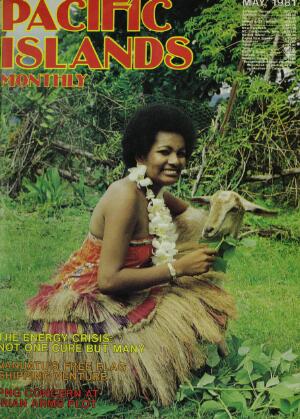
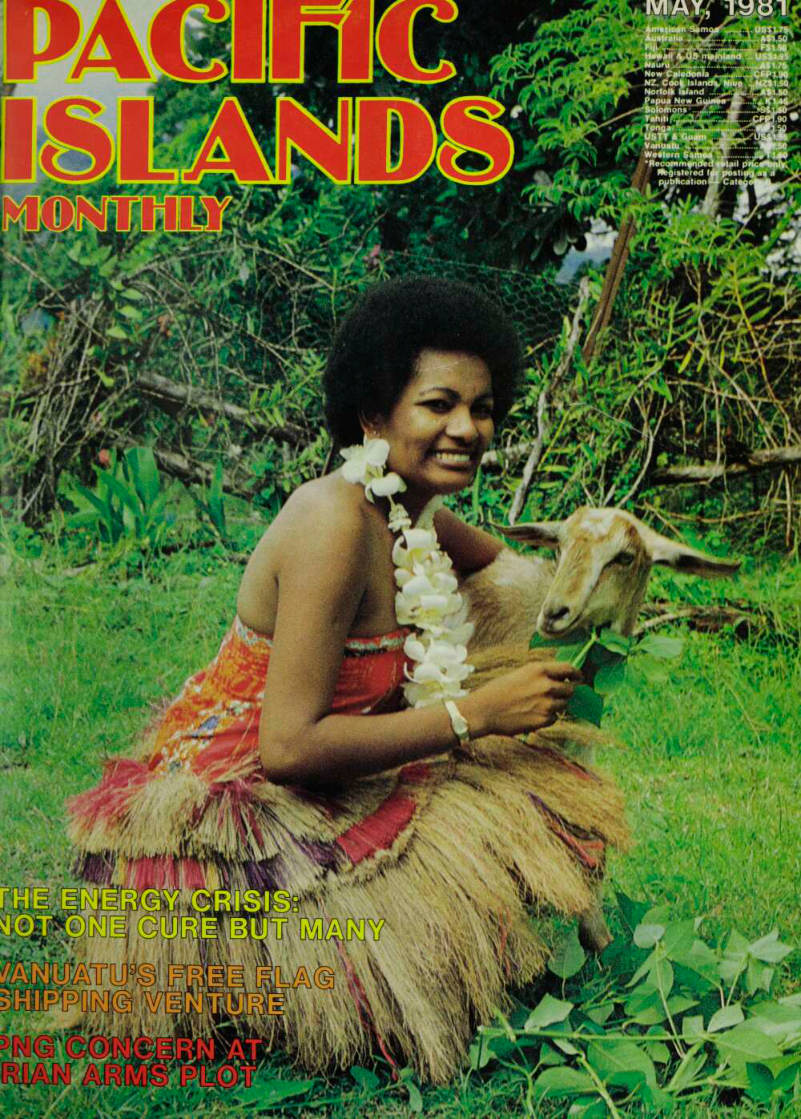
Cover picture: When Jennifer Abaijah was crowned Miss Papua New Guinea 1981 at this year’s Red Cross Ball in Port Moresby her only immediate comment was 7 don’t know what to say’. Her lack of anythinq to sa y was something of a family contrast she’s the younger sister of one of PNG’s most outspoken politicians Josephine Abaijah. Jennifer, wearing a traditional and colourful Trobriand skirt, was photographed for our cover by Air Niugini public relations manager, Biga Lebasi.
Advertisements & other items, p. 2 (1 item)
_ asound.
asound.
Investment.
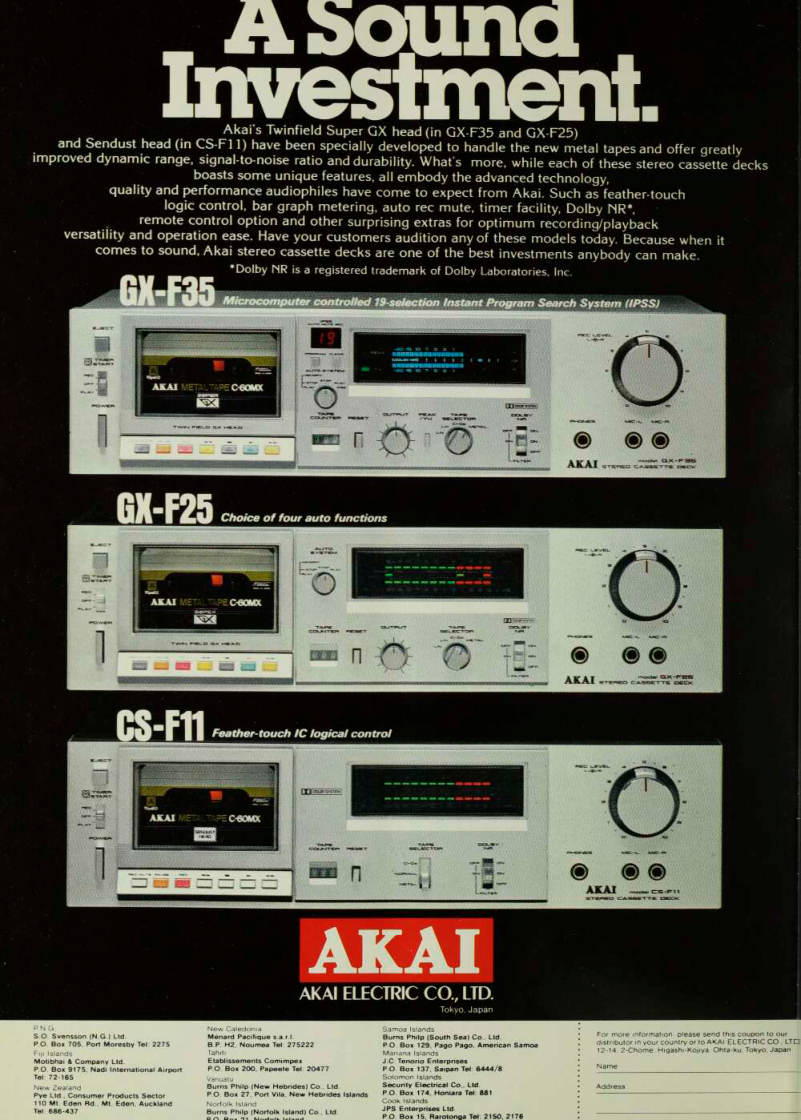
Akai’s Twinfield Super GX head (in GX-F35 and GX-F25) and Sendust head (in CS-F 11) have been specially developed to handle the new metal tapes and offer greatly improved dynamic range, signal-to-noise ratio and durability. What’s more, while each of these stereo cassette decks boasts some unique features, all embody the advanced technology, quality and performance audiophiles have come to expect from Akai. Such as feather-touch logic control, bar graph metering, auto rec mute, timer facility, Dolby NR*, remote control option and other surprising extras for optimum recording/playback versatility and operation ease. Have your customers audition any of these models today. Because when it comes to sound, Akai stereo cassette decks are one of the best investments anybody can make. * Dolby NR is a registered trademark of Dolby Laboratories. Inc.
Search System UPSS)
m
AKAI VE*_ C-60MX
E 3 m
OXO
mm
Choice of four auto functions
m
AKAI
C-6CMX
sga
c C; C
Feather-touch 1C logical control
AKAI
C-60MX
C Q C
AKAI
AKAI ELECTRIC CO., LTD.
Tokyo. Japan
PNG
S O Svensson (N.G.) Ltd.
P.O. Box 705, Port Moresby Tel: 2275 Fiji Islands Motibhai & Company Ltd.
P.O. Box 9175, Nadi International Airport Tel: 72-165 New Zealand Pye Ltd., Consumer Products Sector 110 Mt. Eden Rd.. Mt. Eden, Auckland Tel: 686-437 New Caledonia Menard Pacifique sari B P H 2. Noumea Tel: 275222 Tahiti Etablissements Comimpex P.O. Box 200, Papeete Tel: 20477 Vanuatu Burns Philp (New Hebrides) Co., Ltd.
P.O Box 27, Port Vila. New Hebrides Islands Norfolk Island Burns Philp (Norfolk Island) Co.. Ltd.
Samoa Islands Burns Philp (South Sea) Co.. Ltd.
P.O Box 129, Pago Pago, American Samoa Mariana Islands J C Tenorio Enterprises PO Box 137, Saipan Tel 6444/8 Solomon Islands Security Electrical Co.. Ltd P.O Box 174, Honiara Tel: 881 Cook Islands JPS Enterprises Ltd.
P O Box 15, Rarotonga Tel: 2150. 2176 For more information please send this coupon to our distributor in your country or to AKAI ELECTRIC CO . LTD 12-14. 2-Chome Higashi-Kojiya. Ohta-ku. Tokyo. Japan Name Address
Pacific Islands Monthly
Val. 52 No. 5
May 1981
(Usps 952480)
Representatives
AUSTRALIA: Distribution; NSW & ACT: Allan Rodney Wright (Circulation) Pty Ltd, PO Box 907, Darlinghurst, NSW 2010; Elsewhere: Gordon & Gotch (A/asia) Ltd, Box 40, PO, Rosebery, NSW 2018. Advertising - Melbourne - Ray Brown Pty Ltd, 614 C eensberry St, North Melbourne 3051, telephone 329 8522 telex 31717; Brisbane - D.
Wood, Anday Agency, Box 1918, GPO, Brisbane 4001, tele phone 44 3485, 44 1546; Adelaide - Hastwell Media, PO Box 30, Glen Osmond, SA 5064, 233 Glen Osmond Rd, Frewville, SA 5063, telephone 79 1869. Perth Adrep, 62 Wickham St., East Perth, WA 6000, telephone 325 6395.
FIJI: Distribution and subscriptions Desai Bookshops, PO Box 160, Suva, Fiji, telephone Suva 23036. Advertising Fiji Times & Herald Ltd, 20 Gordon St, Suva, telephone 312 111, telex FJ2124.
FRENCH POLYNESIA: Distribution Hachette Pacifique, 10 Ave Bruat, Papeete, telephone 25610.
HAWAII, UNITED STATES: Distribution PIM, Hawaii, PO Box 22250, Honolulu, Hawaii 96822 Advertising Roger Brookes, PO Box 10217, Honolulu, Hawaii 96816, telephone 808 536 1784.
MICRONESIA: Advertising Roger Brookes, PO Box 10217, Honolulu, Hawaii 96816.
JAPAN: Advertising and subscriptions - Universal Media Corporation, CPO Box 46, Tokyo, telephone 666 3036.
NEW CALEDONIA: Distribution Depot Centre de Presse Michel Pentecost, CBP2, Noumea, telephone 27 2434, 27 4729.
NEW ZEALAND: Distribution - Gordon & Gotch, PO Box 584, 2 Carr Road, Mt. Roskill, Auckland 4. Advertising International Media Representatives Ltd. PO Box 2313, Auckland, telephone 795 487; 493 389, cables Intereps, Auckland. Subscriptions - Ross Haines & Son Ltd, PO Box .1289, Auckland, telephone 769 042.
PAPUA NEW GUINEA: Distribution - Gordon & Gotch, PO Box 3395, Port Moresby, telephone 254551, 254855.
Advertising PNG Post-Courier, PO Box 85, Port Moresby telephone 21 2577.
UNITED KINGDOM: The Herald & Weekly Times Ltd, No. 1 Maltravers Street, London WC2R 3DZ, England, telephone 01 836 5162, telex London 21989.
UNITED STATES MAINLAND; Advertising - Joshua B Powers Jr, Powers International Inc., 551 Fifth Ave, New fork, New York 100 017, telephone 867 9580, telex 236514 Subscriptions - PIM, Hawaii, 2812 Kahawai St, Honolulu, Hawaii 96822.
Subscriptions
3 IM is airfreighted to most subscribers and agents in the pacific Islands and the United States, but not the UK or the Continent. Telephone inquiries about subscriptions should je made to Melbourne (03) 63 0211 ext. 1638.
ayment by personal cheque is accepted in Australian, US. lew Zealand, UK and Fiji currency. For other remittances lease obtain a bank draft in Australian dollars made payable ) the ANZ Banking Group, 88 Wentworth Avenue, Sydney ustralia. üblished monthly by Pacific Publications (Aust.) Pty Ltd nd printed in Australia by Paramac, Alexandria, NSW. Aus ahan cover price is recommended retail only. Registered I the GPO Sydney for transmission by post as a publication ■ category B. Second class postage paid at Honolulu, awaii. Copyright © 1978 Pacific Publications (Aust.) Pty
Ltd.
Postmaster Honolulu: Send address changes to PIM Hawaii, PO Box 22250, Honolulu Hawaii 96822.
Local Aust.
American Samoa $US16 $13 Vustralia $A12 $12 Canada
Sus18
$14 3ook Islands $13 : iji $F12 $12 ■ranch Polynesia
Cfp 1700
$14 3uam
Sus16
$13 Hawaii
Sus16
$13 lapan ¥4500 $16 Ciribati $13 Micronesia $US16 $13 Jauru $18 Jew Caledonia
Cfp 1700
$14 Jew Zealand Jiue
Snz13.50
$12 $13 Jorfolk Island $12 Jorthern Marianas
Sus16
$13 *apua New Guinea K12 $13 Solomon Islands $13 onga $13 uvalu $13 Jnited Kingdom Stg 10 $15 JS Mainland
Sus18
$14 'anuatu $13 Western Samoa $13 Jsewhere $A16
This Month’s Features
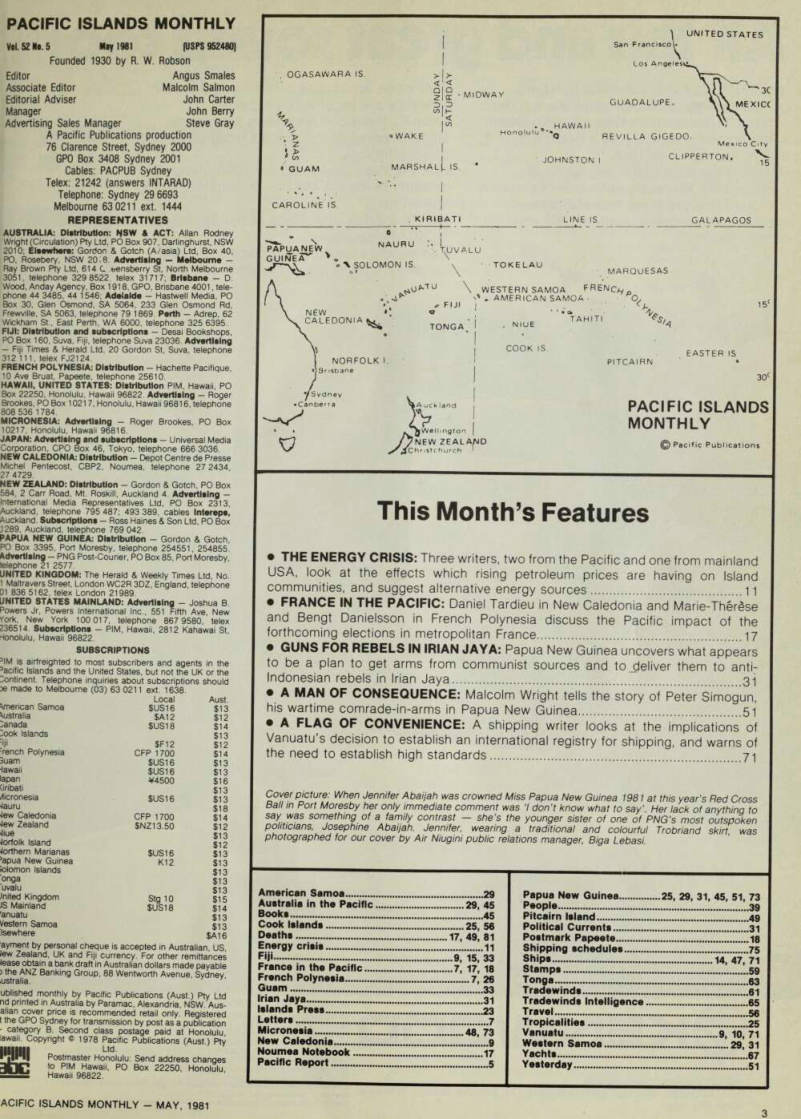
• THE ENERGY CRISIS: Three writers, two from the Pacific and one from mainland USA, look at the effects which rising petroleum prices are having on Island communities, and suggest alternative energy sources 11 • FRANCE IN THE PACIFIC: Daniel Tardieu in New Caledonia and Marie-Therdse and Bengt Danielsson in French Polynesia discuss the Pacific impact of the forthcoming elections in metropolitan France 17 • GUNS FOR REBELS IN IRIAN JAYA: Papua New Guinea uncovers what appears to be a plan to get arms from communist sources and to them to anti- Indonesian rebels in Irian Jaya 31 • A MAN OF CONSEQUENCE: Malcolm Wright tells the story of Peter Simogun, his wartime comrade-in-arms in Papua New Guinea 51 • A FLAG OF CONVENIENCE: A shipping writer looks at the implications of Vanuatu’s decision to establish an international registry for shipping, and warns of the need to establish high standards 71
American Samoa 29 Australia in the Pacific 29, 45 Books 45 Cook Islands 25, 56 Deaths 17, 49, 81 Energy crisis 11 Fiji 9, 15, 33 France in the Pacific 7, 17, 18 French Polynesia 7, 26 Guam 33 Irian Jaya ...31 Islands Press 23 Letters 7 Micronesia 43, 73 New Caledonia 9 Noumea Notebook 17 Pacific Report 5
Papua New Guinea 25, 29, 31, 45, 51, 73 People Pitcairn Island 49 Political Currents 31 Postmark Papeete 18 Shipping schedules 75 Ships 14, 47, 71 Stamps 59 Tonga 63 Tradewinds 61 Tradewinds Intelligence 65 Travel Tropicalities 25 Vanuatu 9, 10, 71 Western Samoa 29, 31 Yachts 67 Yesterday 51
Advertisements & other items, pp. 3-4 (2 items)
3
ACIFIC ISLANDS MONTHLY - MAY, 1981
Founded 1930 by R. W. Robson Editor Angus Smales Associate Editor Malcolm Salmon Editorial Adviser John Carter Manager John Berry Advertising Sales Manager Steve Gray A Pacific Publications production 76 Clarence Street, Sydney 2000 GPO Box 3408 Sydney 2001 Cables: PACPUB Sydney Telex; 21242 (answers INTARAD) Telephone: Sydney 29 6693 Melbourne 63 0211 ext. 1444
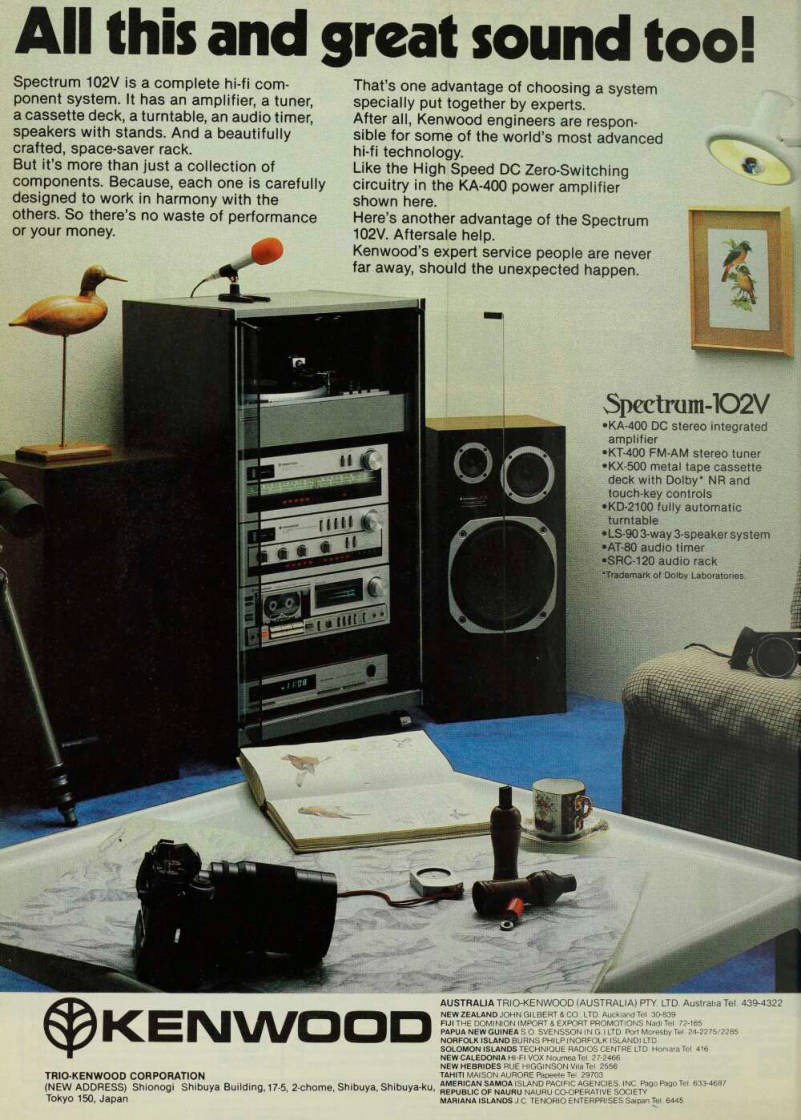
All this and great sound too!
Spectrum 102 V is a complete hi-fi component system. It has an amplifier, a tuner, a cassette deck, a turntable, an audio timer, speakers with stands. And a beautifully crafted, space-saver rack.
But it’s more than just a collection of components. Because, each one is carefully designed to work in harmony with the others. So there’s no waste of performance or your money.
That’s one advantage of choosing a system specially put together by experts.
After all, Kenwood engineers are responsible for some of the world’s most advanced hi-fi technology.
Like the High Speed DC Zero-Switching circuitry in the KA-400 power amplifier shown here.
Here’s another advantage of the Spectrum 102 V. Aftersale help.
Kenwood’s expert service people are never far away, should the unexpected happen.
Spcctmm-102V
•KA-400 DC stereo integrated amplifier •KT-400 FM-AM stereo tuner •KX-500 metal tape cassette deck with Dolby* NR and touch-key controls •KD-2100 fully automatic turntable •LS-90 3-way 3-speaker system •AT-80 audio timer •SRC-120 audio rack 'Trademark of Dolby Laboratories. il ill c lilt I*
EIMWOOD
TRIO-KEN WOOD CORPORATION
AUSTRALIA TRIO-KENWOOD (AUSTRALIA) PTY. LTD. Australia Tel. 439-4322 NEW ZEALAND JOHN GILBERT &CO . LTD. Auckland Tel 30-839 FIJI THE DOMINION IMPORT & EXPORT PROMOTIONS Nadi Tel 72-165 PAPUA NEW GUINEA S O. SVENSSON (N G ) LTD Port Moresby Tel. 24-2275/2285
NORFOLK ISLAND BURNS PHILP(NORFOLK ISLAND) LTD.
SOLOMON ISLANDS TECHNIQUE RADIOS CENTRE LTD. Honiara Tel 416 NEW CALEDONIA HI-FI VOX Noumea Tel. 27-2466 NEW HEBRIDES RUE HIGGINSON Vila Tel 2556 TAHITI MAI SON AURORE Papeete Tel. 29703 (NEW ADDRESS! Shionogi Shibuya Building, 17-5, a-chome, Shibuya, Shlbuya-ku, 63:M687 Tokyo 150, Japan MARIANA ISLANDS J C.TENORIO ENTERPRISES Saipan Tel. 6445
Pacific Report
France-Vanuatu aid package signed The governments of France and Vanuatu, following lengthy and often tense negotiations, finally signed an aid and co-operation agreement in Port-Vila on March 10. The agreement provides for French aid equivalent to about 5A6.9 million in 1981. The agreement contains a clause in which each country pledges non interference in the other’s affairs, a clause inserted on the initiative of France, which fears Vanuatu Government support for independence movements in French Pacific territories, especially New Caledonia. On the other hand, the government of Vanuatu pledges in the agreement to protect the well-being and property of French citizens living in the country. Behind-the-scenes moves, believed to have been initiated by the Vanuatu Government, to have Australia pick up the tab so that Vanuatu could dispense with French aid, eventually came to nothing. The aid allocation to Vanuatu is reported to place it among the top half-dozen recipients of French aid on a world scale.
Japan’s N-dump plans latest Micronesian governments and anti-nuclear activists believe they have succeeded in halting for at least this year a plan by the Japanese to dump radioactive waste from their 21 nuclear reactors into the Pacific north of the Marianas. Without public announcement. Japan indicated in February that it had put off its plan to begin experimental dumping this year. In January Japan’s Science and Technology Agency said the bulk of its funds for the Jumping programme for the coming fiscal year would be for further surveys of ocean radio-activity and tests of pressure-proof Jisposal drums. The only other appropriation was one of about 8U5350 000 to finance explanatory films and the travel of science agency officials to Micronesia, presumably for further explanations. Writing in The New York Times, US journalist Henry <amm quotes lawyer Jeffrey A. Cook, chairman of the Marianas Mliance Against Nuclear Dumping, as saying; ‘Clearly, the Japanese have a very strong intention of selling their plan this 'ear. They will invite government leaders to Japan and offer economic aid in return for stopping opposition to dumping.’ Mr :ook quoted an official of STA as saying: ‘We will continue to lave a plan to dump. We did not give up the plan ’
Memorable Ash Wednesday in Hawaii ■or a few minutes on Wednesday March 4 Ash Wednesday in he Christian calendar the headquarters of the US Pacific at Camp Smith, Hawaii, was the cene of an Ash Wednesday religious service held by nine anti tuclear protesters who had somehow managed to get into the Juclear War Policy and Plans Office and put ash crosses on the /alls before holding their service. The group included Monsignor )amel Dever, superintendent of Catholic schools in Hawaii, who xplained his participation as a response to a speech made scently in Japan by Pope John Paul II about the destructive jower of nuclear weapons. Although the protesters were etained by military police for two hours, no action appears to ave been taken against them. A spokesman for the group said e believed the US military was so embarrassed by the ease with mich the group had entered this supposedly most secure part of 18 uA o u hat !t would be unlikel V t 0 P ress charges. The Camp mith Ash Wednesday Liturgy was part of a week of action in upport of a Nuclear-free Pacific which was co-ordinated in sveral countnes. In Fiji the week was observed by the Methodist ■hurch and the YWCA, who combined to present a slide-tape low and discussion evening on the effects of nuclear war and urrent nuclear activities in the Pacific region. The week was also □served in Sydney, Australia (PIM Apr p 10). Helen Hill liscard or? Territories divided oting intentions of the various political groupings in New a led on i a and French Polynesia in the French presidential ection (first round April 26, second round May 10) presented a tore than usually confused picture. In French Polynesia, the main Dnservative party (led by Gaston Flosse) campaigned for the ection of Gaullist candidate Jacques Chirac mayor of Paris and •rrner French prime minister. The majority Autonomist party led / Francis Sanford, on the other hand, recommended a vote for
President Valery Giscard d’Estaing, largely on the strength of a promise of future wider powers for the locally elected government reported to have been made by the president in Paris in March to veteran Autonomist leader and chairman of the Territorial Assembly, John Teariki. The socialist grouping, which won 10% of the vote at the last election, campaigned for Frangois Mitterand, socialist candidate. In New Caledonia, the ruling coalition was divided, with the rightwing party, led by Deputy Jacques Lafleur, campaigning for Chirac, and his centrist coalition partners under Senator Lionel Cherrier supporting Giscard. The Independence Front, which forms the opposition in the Territorial Assembly, supported Mitterand. (See Noumea Notebook 017, Postmark Papeete p 18.) Four new ministers in PNG Cabinet The Papua New Guinea Prime Minister Sir Julius Chan in March appointed four new ministers to his cabinet. They replaced three ministers who resigned and another who was sacked after they had been obliged to make court appearances (PIM Feb p 5). The new ministers are Silas Atopare (Works and Supply), Yano Belo (Environment and Conservation), Martin Tovadek (Health), and Angmai Bilas (Public Utilities). One of the ministers who resigned, Gabriel Bakani, who held the Minerals and Energy portfolio later had drunk and disorderly charges (which caused his resignation) dismissed by a magistrate in West New Britain. Describing the case as one which the police should not have proceeded with the magistrate ordered that Mr Bakani’s KBO bail be refunded and that the government pay him more than KlOOO for expenses incurred in the case. The Minerals and Energy portfolio is now held by Wiwa Korowi, who had previously held Public Utilities.
W. Samoa health fraud case for court Allegations of fraud affecting Western Samoa’s Health Depart ment (PIM Feb p3l) were ruled out of order as a matter for debate by the Speaker of the country’s legislative assembly in March He said they were the subject of an official inquiry, and therefore to be considered sub judice. Two senior officials of the department Since appeared before a magistrate. The sum of SWS2SO 000 is alleged to have been lost through payments for electrical work by Sonny Industries Ltd Of Western Samoa which was never carried out. Formal court proceedings have been set for July.
Big step forward in Tonga, but...
A dramatic break with tradition has occurred on the Tongan island of Niuafoou in the Vavau group. Tenants of land belonging to the king, the government and the nobles have been given exclusive rights to the 3.3 ha (BV2 acres) traditionally allotted by the government to men over the age of 16. Custom has long dictated that a landlord has the right to demand a share of his tenant s product. The landowner, Baron Tuita, has distributed 426 allotments to men on the island, and has made it plain the product will be all theirs. Tonga-watchers see the development as a highly significant move away from the generally rigid feudal social structures of the kingdom, where more than 90 000 commoners have the same number of representatives in parliament seven as do 33 noble families. ... ‘as you were’ in W. Samoa The parliament of Western Samoa has rejected moves to give the vote to all Samoans 21 years or older. The move would have introduced general suffrage for all Samoans, although only matais, the heads of the extended families, could stand for election. At present the Western Samoa legislative assembly consists of a Speaker and 45 members who are elected by matais. The reform was recommended by a special committee set up by the Western Samoa Council of Deputies headed by Tupua Tamasese Lealofi IV, but only two MPs fully supported its recommendations. The report expressed concern that if the present parliamentary system were not changed to suit the times, the issue could be forced on the country’s lawmakers in the future.
Muldoon sees ‘crunch’ ahead for PFL The New Zealand Shipping Corporation and the Columbus Shipping Line had both conducted surveys of the long-term viability of the Pacific Forum Line and both had arrived at the conclusion that the line would break even by the end of next year, according to an April statement by New Zealand Prime Minister Muldoon. However, in the short term, the line was in danger of collapse, he said. The next 18 months would be the crunch . Fiji has announced it does not want to contribute to the line, either directly or from Australian aid (an option offered
members of the line by the Australian Government, which last year said it would cease to contribute directly in support of the line).
Vanuatu chiefs elect their leader Chief Willie Bongmatur of Ambrym was elected president of Vanuatu’s National Council of Chiefs (NCC) at the council’s first meeting held in Port-Vila in March. Chief Bongmatur was voted in by 15 chiefs out of the total of 19 present. The 20th, Isaac Rongreiu of the Torres Group, was absent due to transport problems. Prime Minister Walter Lini addressed the chiefs, stressing the importance of their role as guardians of custom Kava was served at the end of the meeting to ‘bind’ the NCC and the government in a good relationship.
Daiwa in hands of administrator Japan’s High Court in March appointed an administrator for the Daiwa Navigation Company. Daiwa, well known on many Pacific Island runs, has been in financial trouble for several months.
PNG-Vanuatu strain on OPM ‘office’
Papua New Guinea’s Minister of Foreign Affairs Noel Levi said in March his country might have to review its relations with Vanuatu ‘following that country’s decision to allow the Free Papua Movement (OPM) to be represented at an office in Port-Vila’.
However, PlM’s inquiry with Port-Vila brought a denial by government spokesman John Beasant that any such office existed.
Tanna trials close, but no amnesty yet Trials of 256 accused in connection with pre-independence troubles on the island of Tanna, Vanuatu, ended in March. The trials spanned two months. An immediate opposition move for the declaration of a general amnesty for convicted persons from throughout the country was defeated in the Representative Assembly, Prime Minister Walter Lini saying that the time was not yet ripe for such a move.
Bikini people sue for SUS4SO million The people of Bikini, Marshall Islands, who were evacuated in 1946 to make way for US nuclear tests, launched a legal action in March suing the USA for the sum of SUS4SO million. They claim that Bikini was twice taken unlawfully in 1946 for atmospheric nuclear tests that lasted 12 years, and in 1979 when it was found that radiation had made the atoll unsafe. The suit was filed in the US Court of Claims by the ruling Bikini Council, and by Senator Henchi Balos, who represents them in the Marshall Islands legislature.
Radio blockbuster on Australia in PNG One of the Australian Broadcasting Commission’s most am bitious social history projects, Taim Bilong Masta, offers a sweeping survey of the history of Australian involvement with Papua New Guinea. It consists of 24 radio programmes to be presented in three series of eight. The first series began on one ABC network on April 12, and is being repeated on another network from April 17. It is generally expected that on completion of transmission of the three series in Australia, the ABC will offer them for rebroadcasting by the National Broadcasting Com mission of PNG. < Solomons to have own honours Solomon Islands, with the consent of Queen Elizabeth, has announced a separate system of honours, the first Pacific Island nation to do so. There will be three awards the Star of the Order of the Solomons (ranked fifth in the 72 approved honours): the Cross of the Order of the Solomons (ranked 14th); and the Medal of Solomon Islands (ranked immediately above the QBE).
U.S. businessman on Fiji ‘banned’ list Paul Sandblom, American businessman, has been placed on the Fiji Government list of ‘banned foreigners’. As president of the United Marketing Corporation, Sandblom has been active in efforts to become a major partner in Fiji’s big pine timber project (PIM Mar p 33). Evidence of his links with the Phoenix Foundation of Nevada, USA, which played an active role in support of the attempted Santo secession in Vanuatu, is widely believed in Fiji to be behind the ban.
Barak Sope to go a-roving Barak Sope, former first secretary in Vanuatu’s prime minister’s department, has been appointed the country’s first roving ambassador.
W. Samoa expels New Zealander Murray Drake, a New Zealander, was ordered to quit Western Samoa within 24 hours in late March. Drake, partner in a Western
Samoa law firm and married to a Samoan solicitor, had been in the country for about five years. Prime Minister Tupuola Efi refused to comment on the deportation order. He said: ‘I have my reasons, and they are good reasons.’
PNG Deputy PM accused on land deal Papua New Guinea’s Deputy Prime Minister lambakey Okuk participated in deliberately stealing a coffee plantation from an ill and elderly Australian woman, according to Barry Cohen a Labor MP, speaking in the Australian House of Representatives in March. He said that Mrs M. H. Barker, who had lived in PNG for more than 50 years and whose husband died 14 years ago, ‘had battled for years’ to pay off mortgages on her plantation near Wau. For the past five years she had tried to sell the property to Papua New Guineans at depressed prices caused by government attitudes. She had incurred heavy legal expenses because broken contracts and delaying tactics had continually prevented settlement. In July last year Mr Okuk had contracted to buy the property after a succession of buyers had either defaulted or had been stopped by administrative intervention. Mr Okuk had taken immediate occupation by paying a 10% deposit, K4BOO, and by contracting to pay a monthly occupation fee of K3OO pending settlement. Mrs Barker had moved to Australia, but had received only one occupation fee and no settlement. Mrs Barker had moved to Australia, but had received only one occupation fee and no settlement. Mr Cohen said that because people living near the property had objected to the sale there was still no ministerial approval for transfer. He said he hoped his disclosures of a disgraceful situation would shame the PNG government and Mr Okuk to the point where ‘they will give this woman the last few dollars she is entitled to and has earned’. In Port Moresby later Mr Okuk denied the allegations against him.
He said the monthly occupation fees were paid up to date and full settlement of the capital was to be made by the end of April. 19 Taiwanese fishermen found Nineteen of the 33 Taiwanese fishermen thought to have been lost in a storm at sea off Manua, American Samoa (PIM Apr p 10), have been found. Their boat had been out of radio communi cation during the storm. The other boat, with 14 men on board, remains lost, and those on board are presumed dead. Joseph Theroux.
Vanuatu planes for Solomons register A plan for Papua New Guinea to register Vanuatu aircraft (PIM Apr p 9) has fallen through. Vanuatu has decided instead to use the Solomon Islands register. PNG’s Superintendent for Air Transport Fred Ramos said; The Vanuatu Government appreci ated our assistance, but Solomon Islands is closer to Vanuatu, and it would be much cheaper to register aircraft there until they are able to do it themselves.’ He said flying operations, airworthiness and documentation had to be checked regularly.
Extra technical staff had to be endorsed and placed in Honiara to check out the registration for Vanuatu.
Paul Dijoud in New Caledonia On a visit to New Caledonia in March France’s Secretary of State for Overseas Departments and Territories Paul Dijoud strongly urged the people of the territory to vote for President Giscard d’Estaing in the April-May French presidential poll. He said that if Giscard were ‘placed in difficulty’ in New Caledonia in the first round of voting, then metropolitan Frenchmen would see it as a disavowal of French solidarity and support, while France’s Pacific neighbours would doubt her determination to stay in this part of the world. Mr Dijoud faced demonstrations on the island of Mare in the Loyalty group, where about 100 independence supporters clashed with French gendarmes who used teargas to disperse the demonstration. According to a report in an Australian news paper, among several people who were injured in the clash was the traditional leader of Mare, Chief Naisseline. On neighbouring Lifou Island, Mr Dijoud was also met by demonstrators. Following the incidents, a message of solidarity was sent by the mayor of Erakor, a municipality near Port-Vila, Vanuatu, to Roch Pidjot, leader of the Independence Front and a deputy to the National Assembly in Paris.
Death of Captain Brett Milder The death occurred in April at his home in Currumbin, Queensland, Australia, of Captain Brett Hilder, master mariner, historian and artist. He had only a few days before celebrated his 70th birthday. Captain Hilder’s last published work, The Voyage of Torres, is reviewed on p 47 of this issue. An obituary tribute will appear in PlM’s June issue.
Advertisements & other items, p. 5 (1 item)
*Cific Islands Monthly - May, 1981
Polynesia

Letters
‘Wrong way’ in French Polynesia
From conversations during a recent visit to Europe with people from former French colonies in Africa, I am con vinced that President de Gaulle’s action in granting them self-rule was a mistake.
The same mistake has been made in the Pacific. Pretending to grant the Polynesians internal autonomy’ the French then used all possible means Haltering the elected people and :orrupting as many of them as possible, and making as big a Dunch of accomplices as poss ble of the local fonctionnaires 'civil servants) by overpaying hem to go back on the principle of ‘internal auton )my’.
The mistake has been made vorse by the so-called energy crisis, since the cost of trying to :eep all these small islands in he French orbit by buying their avours through so-called social >rogress a lot of schooling, a ot of hospitals, a lot of enter ainment and a lot of propa ;anda on the TV screens and in he local press for local portsmen and women has rown enormously. Such efforts ave certainly swollen the egos f certain people with very little ritical sense, but they have also fft many of them unemployed, nd most of them totally unpro uctive.
These people, who call them ;lves ‘Tahitians’, are by now a fixture of ancestral Malay and lelanesians, cross-bred with 'hinese, Whites and a tiny Drinkling of Indians (from ondicherry, mostly), and some lack people from the French lands in the Caribbean. In ion they are of a great variety, ome of them are quite nice, ut most are extremely primi ve and are quite unbearable hen given any sort of official
authority. If they were given the opportunity to live a hard life again they would revert to their former ways, which were quite pleasant.
But too many of them have been transformed by the French into spoilt brats. And it is evident that the French Govern ment wants them to stay that way. This I wrote as far back as 1967, hoping to stop the trend, but the trend was the will of the French Government, and could not thus be reversed. I only made more enemies than ever, both among the overpaid mixed-race civil servants and among representatives of the French Government, all the way up to the rue Oudinot, headquarters of the so-called Overseas France Sub- Secretariat of State.
The main job of Paul Dijoud, the present State Sub-secretary for the Overseas Departements and Territories, is to weave a spider’s web around the so called freely elected representa tives of the Tahitian people through cajoling, granting credits, refusing credits, accept ing with official congratulations the incredible squandering of the taxpayers’ money if the author or authors of the venture happen to be UDF (Mr Giscard’s party), or refusing essential credits where they might allow economic develop ment in an island or a group of islands.
There is one thing that the present French Government wants to avoid at all costs, and that is to find itself with an economically self-sufficient archipelago (like the Maldives, southwest of Sri Lanka), in which the French would only have their bases of Moruroa and Hao.
It is clear, moreover, that the only part of the local population that could run this group of islands are the quite numerous Chinese descendants of the first coolies imported by France to plant and cut sugar cane, and also to pick the cotton formerly grown in Atimaono and in Raiatea. Because they were hard-working, shrewd, and not money-squandering, childish, whimsical people like the natives, they put up small bazaar-like stalls everywhere, grew vegetables, and slowly became the dominant factor in trade, speculation in vanilla
beans preparation and export, baking bread, roasting coffee, opening restaurants, and even acting as bankers. Two families, the Chin Foo and the Siu, started a bank, called the Banque Kon Ah, which failed.
But only after its founders had bought a lot of land with the depositors’ money. They kept the land, and one of the two prospered under the very cun ning guidance of Mr Ah You Siu. One of his sons is today the agent for Mobil Oil, as well as having the Mercedes-Benz and Ford agencies. Other offspring have entered the administration (Fisheries), after gaining de grees at US universities.
Having a French (or for that matter one of any other nation ality, like British or German) Governor who avoided getting the local people into ‘politics’ whatever that meant in the conception of the natives was by far the best, and even the only, possible way to run the
archipelago properly.
Here we are now with a greedy, incompetent, dishonest, irresponsible, corrupt and inefficient administration, which has stifled and will stifle any attempt at economic devel opment made by anybody in this archipelago, except if one bribes them all, which is only possible if you are an importer and have some sort of a mon opoly.
Finally, regarding the police: there is nowhere in the Pacific with as many policemen, as high a percentage of traffic accidents, and such a display of military force to keep such a small population from starting any meeting or rally to ask for complete independence.
This in fact is not even necessary, since the average Tahitian has become too lazy to request independence, which some understand as meaning doing away with luxuries like running around in a big car, even to cover no more than 80 metres in 10 minutes due to traffic jams, watching TV until one falls asleep, buying too much food (imported of course) in supermarkets, eating too much, drinking too much, and finally dying around 55 of heart failure, or other conditions com ing from over-indulgence in banqueting, cocktail parties, and never a day of hard work.
Extracting enough money from the working classes be they owners, bosses, or em ployees will become more difficult as lime goes by until only about half of the people in the ‘private sector’ are left.
They will only survive through bribery of the bureaucracy, very hard work, and employing only members of their families to avoid the very high cost of that other pork barrel ‘social security’.
Only monopolies will survive, for some time at least, and they will all be French ethnic Chinese. The latter have been all naturalised French because they were known to vote for ‘the French presence’, and because they all know that if the Tahitians attained indepen dence, the standard of living would revert to what it was 40 years ago a Western Samoan, Tongan, Vanuatuan,
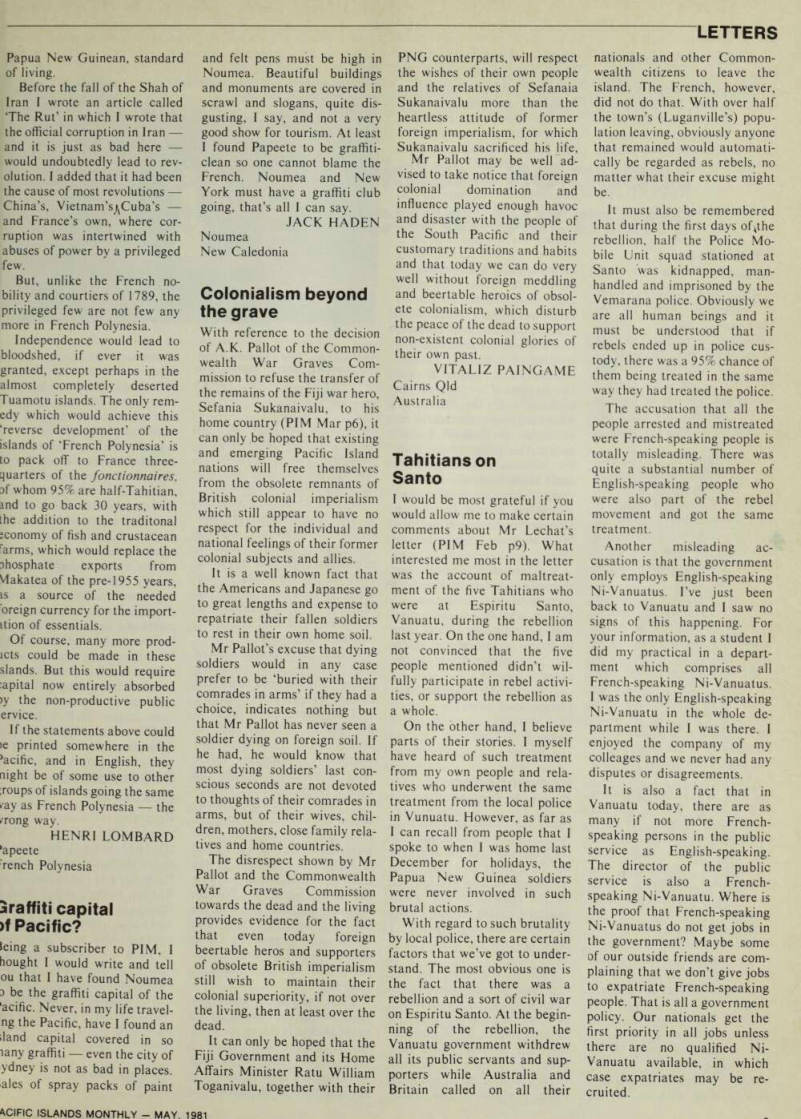
Paul Dijoud - ‘his main job is to weave a spider’s web around the so-called freely-elected representatives’.
Papua New Guinean, standard of living.
Before the fall of the Shah of Iran I wrote an article called ‘The Rut’ in which I wrote that the official corruption in Iran and it is just as bad here would undoubtedly lead to rev olution. I added that it had been the cause of most revolutions China’s, — and France’s own, where cor ruption was intertwined with abuses of power by a privileged few.
But, unlike the French no bility and courtiers of 1789, the privileged few are not few any more in French Polynesia.
Independence would lead to bloodshed, if ever it was granted, except perhaps in the almost completely deserted Tuamotu islands. The only rem edy which would achieve this
‘reverse development’ of the
islands of ‘French Polynesia’ is to pack off to France three quarters of the fonctionnaires, 3f whom 95% are half-Tahitian, and to go back 30 years, with the addition to the traditonal sconomy of fish and crustacean r arms, which would replace the Dhosphate exports from Vlakatea of the pre-1955 years, is a source of the needed breign currency for the import ition of essentials.
Of course, many more pred icts could be made in these slands. But this would require :apital now entirely absorbed >y the non-productive public ervice.
If the statements above could »e printed somewhere in the Acific, and in English, they night be of some use to other ;roups of islands going the same /ay as French Polynesia the /rong way.
Henri Lombard
‘apeete rench Polynesia
araffiti capital
>f Pacific?
leing a subscriber to PIM, I bought I would write and tell ou that I have found Noumea 3 be the graffiti capital of the ’acific. Never, in my life travel ng the Pacific, have I found an ;land capital covered in so lany graffiti even the city of ydney is not as bad in places, ales of spray packs of paint
and felt pens must be high in Noumea. Beautiful buildings and monuments are covered in scrawl and slogans, quite dis gusting, I say, and not a very good show for tourism. At least I found Papeete to be graffiti clean so one cannot blame the French. Noumea and New York must have a graffiti club going, that’s all I can say.
Jack Haden
Noumea New Caledonia
Colonialism beyond
the grave With reference to the decision of A.K. Pallot of the Common wealth War Graves Com mission to refuse the transfer of the remains of the Fiji war hero, Sefania Sukanaivalu, to his home country (PIM Mar p 6), it can only be hoped that existing and emerging Pacific Island nations will free themselves from the obsolete remnants of British colonial imperialism which still appear to have no respect for the individual and national feelings of their former colonial subjects and allies.
It is a well known fact that the Americans and Japanese go to great lengths and expense to repatriate their fallen soldiers to rest in their own home soil.
Mr Pallet’s excuse that dying soldiers would in any case prefer to be ‘buried with their comrades in arms’ if they had a choice, indicates nothing but that Mr Pallot has never seen a soldier dying on foreign soil. If he had, he would know that most dying soldiers’ last con scious seconds are not devoted to thoughts of their comrades in arms, but of their wives, chil dren, mothers, close family rela tives and home countries.
The disrespect shown by Mr Pallot and the Commonwealth War Graves Commission towards the dead and the living provides evidence for the fact that even today foreign beertable heros and supporters of obsolete British imperialism still wish to maintain their colonial superiority, if not over the living, then at least over the dead.
It can only be hoped that the Fiji Government and its Home Affairs Minister Ratu William Toganivalu, together with their
PNG counterparts, will respect the wishes of their own people and the relatives of Sefanaia Sukanaivalu more than the heartless attitude of former foreign imperialism, for which Sukanaivalu sacrificed his life, Mr Pallet may be well ad vised to take notice that foreign colonial domination and influence played enough havoc and disaster with the people of the South Pacific and their customary traditions and habits and that today we can do very well without foreign meddling and beertable heroics of obsol ete colonialism, which disturb the peace of the dead to support non-existent colonial glories of their own past.
Vitaliz Paingame
Cairns Qld Australia
Tahitians on
Santo
I would be most grateful if you would allow me to make certain comments about Mr Lechat’s letter (PIM Feb p 9). What interested me most in the letter was the account of maltreat ment of the five Tahitians who were at Espiritu Santo, Vanuatu, during the rebellion last year. On the one hand, I am not convinced that the five people mentioned didn’t wil fully participate in rebel activi ties, or support the rebellion as a whole.
On the other hand, I believe parts of their stories. I myself have heard of such treatment from my own people and rela tives who underwent the same treatment from the local police in Vunuatu. However, as far as I can recall from people that I spoke to when I was home last December for holidays, the Papua New Guinea soldiers were never involved in such brutal actions.
With regard to such brutality by local police, there are certain factors that we’ve got to under stand. The most obvious one is the fact that there was a rebellion and a sort of civil war on Espiritu Santo. At the begin ning of the rebellion, the Vanuatu government withdrew all its public servants and sup porters while Australia and Britain called on all their
nationals and other Common wealth citizens to leave the island. The French, however, did not do that. With over half the town’s (Luganville’s) popu lation leaving, obviously anyone that remained would automati cally be regarded as rebels, no matter what their excuse might be.
It must also be remembered that during the first days rebellion, half the Police Mo bile Unit squad stationed at Santo was kidnapped, man handled and imprisoned by the Vemarana police. Obviously we are all human beings and it must be understood that if rebels ended up in police cus tody, there was a 95% chance of them being treated in the same way they had treated the police.
The accusation that all the people arrested and mistreated were French-speaking people is totally misleading. There was quite a substantial number of English-speaking people who were also part of the rebel movement and got the same treatment.
Another misleading ac cusation is that the government only employs English-speaking Ni-Vanuatus. Eve just been back to Vanuatu and I saw no signs of this happening. For your information, as a student I did my practical in a depart ment which comprises all
French-speaking Ni-Vanuatus.
I was the only English-speaking Ni-Vanuatu in the whole de partment while I was there. I enjoyed the company of my colleages and we never had any disputes or disagreements.
It is also a fact that in Vanuatu today, there are as many if not more French speaking persons in the public service as English-speaking.
The director of the public service is also a French speaking Ni-Vanuatu. Where is the proof that French-speaking Ni-Vanuatus do not get jobs in the government? Maybe some of our outside friends are com plaining that we don’t give jobs to expatriate French-speaking people. That is all a government policy. Our nationals get the first priority in all jobs unless there are no qualified Ni- Vanuatu available, in which case expatriates may be re cruited.
We are Ni-Vanuatus, not Francophones or Anglophones, as some people would want to call us in their divide-and-rule tactics. Despite outside inter ference, we are now one people and will always be one people, looking into the future as one nation.
Ni-Vanuatu
(Name and address supplied.) What’s in a name?
It would be a pleasure to reply to comments made by my Melanesian brother, Vitaliz Paingame, to my letter in PIM (Nov 1980 p 9). Honestly, I don’t see any logic in him dictating to me what name I should use. He has no right to do this. Besides, my name has nothing to do with the issue in my letter.
Congratulations on the fact that my brother admits being a true West Irianese who will always remain one. I believe in the decolonisation of the Pacific and I am committed to assisting this cause as long as I am a Pacific Islander and a son of Melanesia.
It is very sad and also offensive to see that my brother Melanesian mistook both my nationality and my country of origin and birth. He seems to argue his points as though I am a Papua New Guinean by attacking certain customs of the people of PNG. For his infor mation, I am a Ni-Vanuatu and my country is the Republic of Vanuatu. I will always remain a Ni-Vanuatu.
There are a few questions that I would like to ask my Melanesian brother. Firstly, since when has Vanuatu sold any of their Melanesian brothers to imperialism and colonialism? Secondly, when has Vanuatu aided in the exter mination of any of its Melanesian brothers? If my Melanesian brother is referring to his homeland, West Papua (Irian Jaya), I am sorry to say that we do support the Irianese people in their struggle for freedom but we will never, as long as we are a nation, play a part in the destruction of our Melanesian brothers. For my brother’s information, we have today, living with us in our
country, leaders of the West Papua freedom movement and we don’t put them in refugee camps as some other nations do.
With regards to comments about white handouts, that is a fact of life today in most Third World countries. You don’t expect to be independent today and tomorrow you have all that you need. There is also the fact of interdependence among nations of the world in order to survive. There is no such thing as being fully independent. A country can always be politi cally independent but never fully economically independent.
In reply to comments that we might be exterminated in a fraction of a second, I would like to say that I believe this will not happen if we played our cards right. On the other hand, why should we be scared to suffer for our beliefs? I don’t accept this petty advice from my Melanesian brother and I don’t think he really has any thing constructive to offer as an alternative to my first letter.
Destructive comments will not bring anybody progress in any thing.
It is far better to understand things fully before making wild comments and valuations. I believe what I am doing and saying is right and 1 don’t have to listen to comments unless they are constructive to my cause.
C. M. Lawrence
University of PNG Port Moresby Papua New Guinea
Remembering
Captain Cook
Amid the mounting interest in Australia in matters concerning the bicentenary of the arrival of the First Fleet in 1788, let us not forget the man who sparked off the train of events which headed Captain Arthur Phillip and his colonising fleet of 11 ships towards this continent in 1787.
Had it not been for the expertise of Lieutenant James Cook RN in navigation, his skill as a seaman and perseverance as an explorer, it is probable that this country would have been a French possession.
Cook’s landing on an island off Cape York in Torres Strait,
proclaiming the East Coast of Terra Australis as a British possession was a moment of destiny for millions of this country’s future inhabitants.
My first 25 years were spent on the South Coast of New South Wales among topographical features sighted, named and charted by Cook such as Mt Dromedary near Tilba, Pigeon House behind Milton, Pt Perpendicular at Jervis Bay and Hat Hill over looking Wollongong.
In later years as a resident of New Guinea and travelling periodically between there and Sydney by steamer I became well acquainted with many of his further sightings such as Smoky Cape, Pt Danger, Mt Warning, Glasshouse Moun tains, Whitsunday Passage and Lizard Island, to name a few.
It was therefore a fitting sequel and a moving experience recently for me to visit Kaelakekua Bay on the Island of Hawaii and to stand at the cairn of volcanic rock marking the burial place of William Hayman, a seaman gunner from one of Cook’s two ships. The burial service, read by Cook, was the first Christian service performed in the Sandwich Islands.
Then, moving a short dis tance around the bay one comes to the obelisk marking the place where, just two weeks later, on January 14, 1779, Cook himself was attacked and killed by a horde of natives whose awe and
veneration of Cook as a reincarnation of one of their gods had turned to hostility when some of their number were punished by flogging for theft of ship’s gear.
Immediately offshore of the obelisk is the area where Resol ution and Discovery had been at anchor and where the few pitiful remnants of his cannibal ised body, as recovered from his slayers six days later, were given sea burial.
For Captain James Cook RN, son of a farm labourer, grocer’s boy turned sailor, a concrete shaft on a remote Pacific island marks the scene of his death.
But Australia and its ongoing life and people are the main tribute to his seaman’s career and its far-reaching effects on all of us.
B. E. Weston
Wollstonecraft NSW Australia
Sail on forever
Hokule’a!
Regarding the discussion of the voyage of the Hokule’a in PIM (Dec p 43, Feb p 7), I would like to say the following: Because of the first trip of the Hokule’a, we had the second, and a third is coming in the near future. May Hokule’a never be put in a museum. May we all grow with its good and bad experiences, mellow with time, become kinder, more tolerant, warmer, more loving and understanding souls. Our only hope is to live peacefully in the Pacific, and in the world. Sail on Hokule’a!
Mala Swe
Honolulu Hawaii
Usa
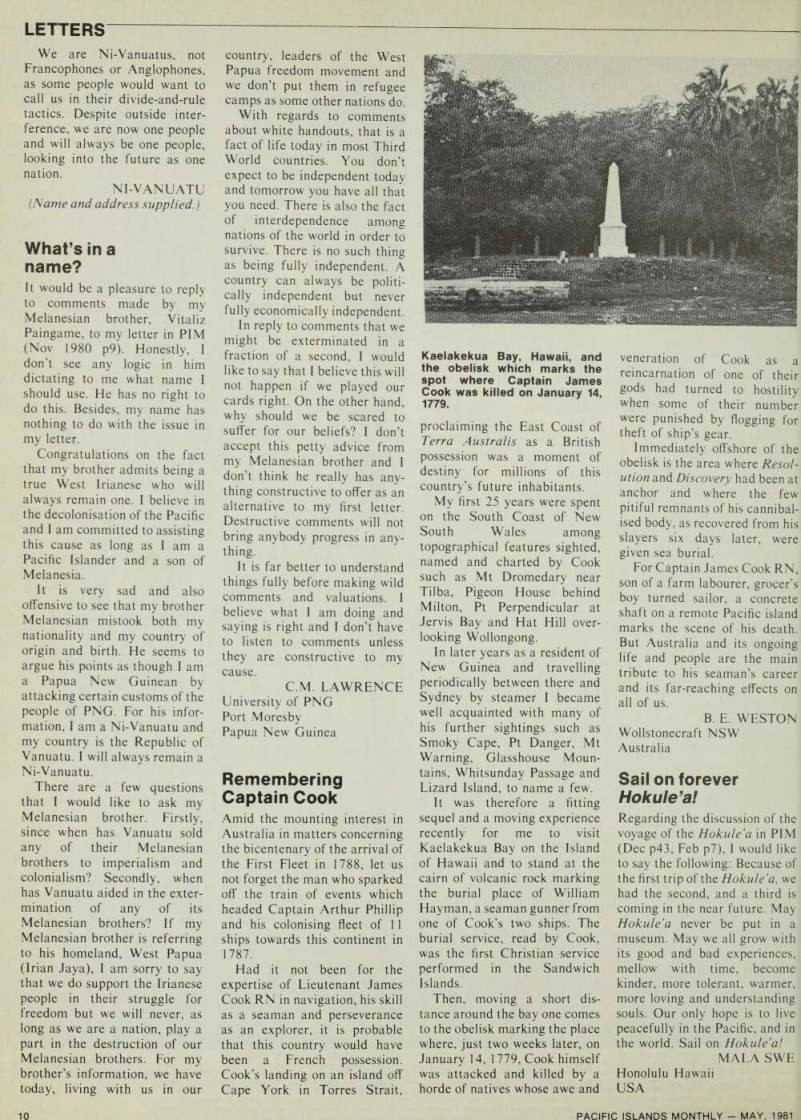
Kaelakekua Bay, Hawaii, and the obelisk which marks the spot where Captain James Cook was killed on January 14, 1779.
Advertisements & other items, pp. 7-9 (3 items)
Acific Islands Monthi Y _ May 1001
ACIFIC ISLANDS MONTHI Y may 1001
A symphony by nature.
it i iiais J J* N * y i? i -"- : ’ '-. ■ -- i- v.- xi H ••; . : : / •• * V-- •H- _>v. V.N- ' . ■■- • -■■-'• ■• V. •' • v ‘ • -• ■,. . . ■ •■■■ '
Prelude in name only.
The new Honda Prelude is a car that value features you’ve always wanted: power, performance, and style, plus traditional Honda driving economy.
Over-sized bumpers with recessed side and turn indicators not only look smart, but combine safety with classic appearance.
Inside, surfaces are carefully color coordinated and finished in smooth, A I . *o* L cut-pile carpeting. Even the doors have the same luxurious carpet trim. And an electric sunroof with elegant smoked glass further emphasizes the Prelude’s already stunning looks.
Options include Hondamatic transmission with overdrive, an exclusive Honda power steering system, and sporty alloy wheels.
Prelude and symphony.
By Honda.
PAPUA MEW GUIMEA: Steamships-Machinery P.O. Box 1. Port Moresby/TAHITI; Honda Distribution S.A.R.L. B.P. 1665 Papeete/FIJI ISLANDS: Carpenters Motors 61-6 Foster St., Walu Bay, Suva/KIRIBATI: Atoll Auto Stores P.O. Box 71, Bairiki Tarawa/U.S. TRUST TERRITORY: United Micronesia Development Assn. P.O. Box 238, Saipan, Marian Islands 96950/COOK ISLANDS? Cook Islands Motor Center Ltd. P.O. Box 74, Rarotonga/AMERICAN SAMOA: Holiday Motors, Parts and Service P.O. Box 968, Pago Pac Haleck’s Service Center P.O. Box 1138, Pago Pago/GUAM: Mark’s Motor Co., Inc. P.O. Box DV, Agana/WESTERN SAMOA: Motor Distributors (Samoa) Ltd. P.O. Box 57 1 Apia/SOLOMON ISLANDS: Trading Company (Solomon) Ltd. P.O. Box 114, Honiara/NEW CALEDONIA: Establissements Ballande Boite Postale No. C 4, Noumea Cede* NIUE ISLAND; Niue Island United Enterprises P.O. Box 4, Alofi/NAURU; Nauru Cooperative Society Republic of Nauru, Nauru Island, Central Pacific/VANUATU: Santo G« r.ntr. i tA on Rrw as <;antn/ tmva l M- Tiii/ain Pn-onpratiw Whniocaio Soriotv PO Box Funafuti. Tuvalu/TONGA: Morris Hedstrom Ltd. P.O. Box 63, Nukualofa Tongi
Letters
9
*CIFIC ISLANDS MONTHLY - MAY. 1981
The energy crisis: The quest
is not for one cure, but many
The following three articles, two from the Pacific and one from mainland USA, strive to come to grips with energy problems faced by Pacific Island and other developing countries. One is an interview by HERBERT LEE, staff correspondent of the US International Communications Agency, with JO BARDACH, assistant director of the East-West Resource Systems Institute, Honolulu. The second is an extract from a paper ‘Research Could Tap a Wealth of “New” Energy Resources’ by ROGER REVELLE, professor of science and public policy at the University of California at San Diego. The paper from which it is taken was also published by USICA. The third, from Papua New Guinea, discusses the potential of using coconut wood charcoal to fuel coastal ships.
\n expert in marine energy ‘eserves says the world’s oceans lold great potential as a future mergy source. But, he adds, for he time being fuel-short Pacific lations and islands will have to idopt new attitudes towards mergy conservation to cope vith the region’s growing en rgy problem.
Jo Bardach, assistant director if the East-West Resource Sys ems Institute in Honolulu, ex iressed these views in an inter iew given recently as the US •enate and Natural Resources ’ommittee prepared to open wo days of hearings in Hono ilu on Pacific energy needs.
Bardach, who was among ;veral official and private 'finesses who testified at the earings, said he saw no single
;chnological breakthrough
merging at any time soon that light serve as a cure-all for Jgional energy problems.
Instead, he believed solutions lay lie in studying and evaluat ig energy requirements for articular defined places, con nued joint co-operative efforts i the islands and territories, id the furthering of an inter itional approach, especially rough involvement of such mntries as New Zealand and ustralia.
On his own institute’s activi js, Bardach said: ‘We are now idertaking a seven-year en gy and raw material develop ent project aimed at reducing pendence on fossil fuels while spending to increasing needs r energy as development ogresses.’ ‘We must do this,’ he went , ‘in as ecologically and socio gically benign a manner as we n. This implies that we must )k at several kinds of renew le energy resources.’
Stressing that there is no macea’ or instant remedy, he ggested that the most likely
approach will be to progress along several lines at once, such as through development of biomass techniques (securing of energy through the total de composition of organic ma terials PIM), geothermal energy, and Ocean Thermal Energy Conversion (OTEC).
Hawaii, he said, has been an experimental station for OTEC research. However, he added, ocean thermal energy conver sion in the words of Hawaii’s Governor Ariyoshi is now ’where flight was with the Wright brothers’.
Bardach said that although opinions differ and some insist that the first applications of OTEC technology may be available in a few years he believes it may be a full century before the technology is fully
developed.
Until recently, he added, engineers have concentrated on large projects involving several hundred megawatts, but ‘micro technology’ must be developed to supply islands which may need only 50 megawatts.
Bardach cited windmills as one of the more readily avail able applications of renewable natural energy resources. At the same time, he pointed out some drawbacks. ‘Natural’ usually conjures up the idea of ‘no cost’, he said. ‘But the truth is that natural energy resources can be the most costly ... All modes of natural energy generation pose their environmental problems.
Thus, a windmill pre-empts land space, and it needs main tenance.’ ‘ln another sense,’ Bardach added, ‘we are victims of past developments. Almost every island has a central electric generating plant using imported diesel oil. Switching over to wind power means getting away from a central grid. A backstop
is needed if the wind doesn’t blow.’
Beyond those problems, Bardach said. Pacific Islanders have become victims of a rapid change in their culture base a result of ‘modernisation’.
Large cars, air conditioning, and all sorts of energy-using gadgets, he said, have become part of their way of life. ‘And now we are in the position of telling them they must go the other way.’
Bardach said he was not sure whether the islands are suffer ing from a real shortage of diesel fuel, or whether transport failures are to blame. ‘Fuel may appear to be the problem, but it is not,’ he said. ‘They will face a real, and more serious, energy problem at some time in the future.’ Much will have to be done by the islanders them selves, largely through strict conservation, he added.
Bardach said Islanders have already demonstrated a will for collective action in meetings of the South Pacific Forum, and that a number of young Islanders throughout the region are seriously concerned with long-term solutions as opposed to temporary remedies.
Other speakers at the hear ings described the progress in renewable energy development in Hawaii which has the goal of becoming America’s first energy-self-sufficient state and some suggested that Hawaii might become a model for other islands.
Peter Lewis, vice-president of the Hawaiian Electric Com pany, said his firm is moving as rapidly as possible towards the use of alternate energy sources as a substitute for oil.
On the island of Hawaii, Lewis said, work has started on installation of a geothermal turbine generator at a volcano site, with planned completion in
1981. He said the project should provide valuable knowl edge about the problems of geothermal power.
He also noted that a 200kilowatt wind turbine generator was dedicated in Hawaii in July 1980, and the first successful ocean thermal energy conver sion plant was dedicated in 1979 off the island of Hawaii. ‘This should speed up com mercialisation of OTEC by several years,’ he said.
During the first day of hear ings US Deputy Undersecret ary of the Interior for Terri torial and International Affairs Wallace Green told the com mittee that the islands and territories are facing a particu larly severe problem with en ergy shortages and escalating costs because their isolated positions make them dependent on air and sea transport. Such dependence, he said, subjects a territory to greater inflation than on the mainland and, at worst, ‘could result in a crisis situation involving severe short ages in food and a threat to public health’.
Other speakers including officials from American Samoa, Marshall Islands, the Federated States of Micronesia (Ponape, Kosrae, Truk, Yap), Palau, and the Northern Mariana Islands agreed that along with re duction of dependence on im ported oil, the islands need to develop new power sources to meet increased energy needs resulting from economic growth.
Hawaii’s Governor Ariyoshi, in a statement submitted to the committee, noted that Hawaii has attracted ‘world attention and admiration’ for its expertise in energy applications. Hawaii expects to share its experience and expertise, he added, with other Pacific Island communi ties.
Advertisements & other items, pp. 11-12 (2 items)
OlCir' 101 A iirin t .. . . . .
Revelation!
w r\ - I V x m ■i r v ■- ** .• v, i I \ ir m • - -Xx
s^^?9ooo
Discover hi-fi with an impeccable pedigree.
Once you hear a Sansui SUPER COMPO system, you will be amazed. You will not believe that such extraordinary sound could come from such an easy- to-use complete system. It will be a revelation of how clean and pure music can sound in your home.
Such an achievement isn’t born overnight. All of Sansui’s decades of experience and finely honed engineering skills were drawn upon to create today’s SUPER COMPO systems. Specifics include DC-servo amp, quartz-PLL synthesizer tuner, and computerized random music selection with unique D-O-B arm. But let’s forget about the technical side for a moment.
Let’s just say that only SUPER COMPO systems feature “in-depth” matching for matchless performance and new levels in musical enjoyment. The revelation of SUPER COMPO is the music itself.
SansuL
SANSUI ELECTRIC CO., LTD. 14-1 Izumi 2-chome, Suginami-ku, Tokyo 168. Japan •Australia VAN FI (Aust.) Pty. Ltd. 297 City Road. South Melbourne, Victoria 3205, Australia Phone; 690-6200/283 Alfred Street, North Sydney, NSW. 2060, Australia Phone: 929-0293 •Fiji Prabhu Brothers Ltd. P.0.80x 183, Nadi Phone: 70183/4 • Papua New Guinea Oceania Indent Agency (P.N.G.) Pty. Ltd.
Box 5518, Boroko, Port Moresby Phone: PM 256406 •New Zealand David Reid Electronics Ltd. C.P.O, Box 2630, Auckland, 1 Phone 491-489 »New Caledonia Ets Michel MERCIER B.P 1123, Noumea Phone: 27 59. 11 •South Pacific Miltons Department Stores Limited P O Box 146, Norfolk Island 2899 Phone: 2161 •Central Pacific Nauru Co-operative Society Republic of Nauru •Vanuatu The Sound Centre P.O. Box 434, Port Villa Phone; 2035 •Cook
Wood: The poor
The Energy Crisis
Wood: The poor man’s oil, if he can get it
Wood, where it can be found, is ‘the poor man’s oil’. It is used for cooking, heating and most house hold chores.
But wood is rapidly disappear ing as world forests are destroyed for fuel, timber and agriculture.
In its study Global 2000 the US Government estimated that if current trends continue, 40% of the remaining forests in develop ing countries would be gone in 20 years. Soil erosion, rapid silting of water resources, desertification, flooding and loss of important plant and animal species are among the consequences of defor estation.
Coupled with the scarcity of wood is the inefficient manner in which it is now used where it can be found. In Asia, for example, much wood is burned wet, using valuable energy to drive off steam rather than supply cooking heal. And traditional
stoves burn wood inefficiently,
ising only 5% to 10% of the heat energy of combustion for actually soiling rice or cooking. Finally, he yield of wood particularly n the natural forests of Asia is extremely low.
The problems and solutions are
eomplex. Research and develop
ment are required in each of the developing countries where trees can be a primary source of heat, In addition, international research centres might be established simi lar to the International Rice Research Institute in Los Banos in the Philippines.
Reforestation is a necessity, of course. And high-yield, fast growing trees are one answer. But should, for example, the ecology of the tropical forests be altered by replacing indigenous species with high-yield trees? Which trees are best suited for particular soils, climate and topography? These are among the questions that research could answer, A variety of such trees have been discovered in recent years in different parts of the world, Among them is the ‘Hawaiian Giant’, or the Salvadoran variety of the green tropical legume, Leucaena Leucephala.
The Leucaena is especially well suited for humid and semi-humid lowland tropics. It is able to withstand long dry seasons and tolerate a wide array of soil conditions except that it does not grow well in very acid soils or at high altitudes. The stumps readily regrow, defying the wood
cutter. And the tree can tolerate moderate shade and does not excessively shadow lower plants.
Furthermore, the leaves are good fertiliser. It has been estimated that six bags of Leucaena leaves contain as much nitrogen as one bag of expensive ammonium sul phate fertiliser made from fossil fuels.
Philippine officials plan an energy plantation of several thou sand hectares of Leucaena for electrical power generation, and a Japanese steel company has planted over 5000 hectares of Leucaena as a source of smelling charcoal.
In Indonesia, Bangladesh and Sri Lanka, trees for fuelwood and livestock are grown together in family gardens with vegetables, fruits and spices. The plants have a complex three-dimensional ecol ogy. The tallest trees provide desirable partial shade for the lower trees and crops grown near the ground. Falling leaves fertilise the small plants.
In some areas, village ‘woodlots’ are being planted with fast-growing trees for fuel. How ever, because of pressures on food production to feed growing popu lations, it is essential to avoid diverting good cropland for that purpose, and to try instead to increase the yield of wood from forested areas that are not suit able for agriculture due to steep slopes, rocky or thin soil, or other reasons.
Improved cookstoves that burn
wood charcoal and other fuel and that can be used inside or out doors and are two to three times more efficient than traditional stoves have been developed in different parts of the world. If they were universally substituted for traditional stoves, they would reduce domestic energy use by 50%. But they have not been widely accepted. Research might reveal why this is so. One sugges tion is that some of these stoves were designed without the consul tation and advice from the people who use them the village women. In one African country, where women themselves de signed more efficient stoves, the stoves are being used.
The inefficient use of wood in cooking is an example of the universal problems of energy con version, which are as prevalent in developed countries as in the developing nations. But the prob lems are especially urgent in poor countries. Besides the combustion of wood, they include the conver sion of wood to charcoal, the heating (pyrolysis) of organic wastes to produce charcoal, gas and oil; the bacterial production of methane from human, animal and vegetable waste; the role of micro-organisms in converting nitrogen in the air to nitrogen usable by plants, and the con version of organic material to transportation fuel.
Charcoal is preferable to wood as a household fuel. It converts two to three times more energy to heat than wood; it creates less smoke, and it is easier to trans port.
Charcoal is made from peanut shells and sawmill wastes in Georgia in the United States, from rice husks and the wood of mangrove forests in Thailand and from coconut husks in Sri Lanka, to mention a few. Research and development are needed to adapt existing highly efficient charcoal kilns, which convert 50 to 60% of the heat energy from the feedstock into usable energy but operate on a large scale, to smaller kilns that can be used in villages or by households.
Indonesia has developed equip ment to convert rice hulls and straw to charcoal, oil and gas; efforts could be made to adapt this kind of equipment as well for use in villages throughout the developing world. Roger Revelle.
[?]or use as a domestic cooking fuel, wood is becoming one of the scarcest resources in urbanised parts of the Pacific Islands. But many researchers now believe that properly-managed wood resources could [?]educe dependency on petroleum fuels. In this picture researchers from the University of California, USA , are investigating the fule potential of 'rubbish' plants, investigating techniques which could be
[?]pplied throughout the Pacific.
Coconut charcoal
could fuel ships
Writing from Papua New Guinea, DENNIS RICHARDSON* looks at a fascinating aspect of the fuel and energy scene: the possibility of making charcoal from coconut palm wood and using the charcoal as a fuel or fuel additive in coastal motor ships, or in a new breed of coastal steam ships.
One of the heaviest costs facing countries with isolated coast lines and numerous islands is the operation of vital inter island and coastal shipping ser vices. This is a typical Pacific Islands situation, and today the costs are rising steeply as the price of petroleum-based fuel increases.
The South Pacific Agricul tural Survey (SPAS) sponsored by the Asian Development Bank (ADB) and published earlier this year identified the high cost of inter-island ship ping as a major constraint to economic development through agriculture. The east-west spread of the islands of Kiribati, for example, extends over 3000 km. The cost of maintaining a regular transport system for people and commodities is pro hibitive for such a country with a population of only 50,000, and with export earnings projected at SUS 3 million a year by 1982.
Similarly, the 2100 islands which until recently made up the US Trust Territory of the Pacific Islands support a total population of 100,000 and ex tend over millions of square kilometres. Even Fiji and Papua New Guinea, which many tour ists think of as single islands, have, in fact, respectively 320 and over 800 islands to be serviced by production from populations totalling 0.5 million and 3.5 million. Except for the mineral-exploiting countries (Nauru and New Caledonia) there is no way that the Pacific Islands have been able to ac commodate increased costs of transportation stemming from the OPEC-controlled oil price
rises begun in 1973, and they cannot see their way to doing so in future.
The cost of Arabian light crude oil has risen from SUS2.6B a barrel in 1973 to a current price approaching $4l a barrel, but the price of copra (the principal export earner of most of the Islands) has not risen at all over the same period.
Copra prices have fluctuated wildly from year to year and from month to month. The other major Island export, fish, has increased in price by over 100% but the Islanders are only incidental beneficiaries of this resource.
There have been several studies of island shipping prob lems but they do not address the major issue of hard currency cost reduction, other than through suggestions for the elimination of services or the expensive modernisation of vessels.
In a forest economy profile for Kiribati prepared by ADB in 1979, the suggestion was made for a feasibility study of charcoal-powered inter-island shipping, which echoed a con tention made in the bank’s forestry sector paper issued in 1978. It is repeated in the forestry section of SPAS and is of some significance in the light
of current programmes to re place old coconut palms by higher-yielding varieties. Most copra producers are committed to coconut replacement pro grammes and, if the pro grammes are implemented, large quantities of stems will have to be utilised or destroyed.
The stems cannot be left to rot because of the risk of infes tation by the rhinoceros beetle which breeds in the old stems but attacks the newly planted nuts.
While many of the Islands have much to teach the rest of us about coconut stem utilis ation, it is unlikely that uses can be found for more than a fraction of the replaced stems.
As fuelwood, coconut leaves much to be desired (it has a high moisture content, and is bulky) but in the form of charcoal it has a high thermal efficiency. Thus, even the coral atolls which have no wood resource could produce and store supplies of coconut stem charcoal until such time as they could establish conventional tree plantations to produce it.
The technology of production is simple and well known. Short billets are split and air-dried, and can be burned in simple kilns or even in 40-gallon drums.
The technology for using charcoal in ships is also avail able. There are at least three possible systems. The first is to pulverise charcoal and mix it with fuel oil for use in unmodified diesel engines. It can be mixed up to 20% by volume without any significant loss of engine efficiency. The second method is to use it to fire a steam engine, and thus use a
technology which is more highly developed than moon rocketry. The third is to gener ate producer gas, which will fire an ordinary internal combustion engine.
With all systems, the major technical problem is that the space required to store the charcoal in relation to cargo capacity is greater than that needed for oil or coal. This should not be an insuperable problem in the case of short inter-island hauls, with locally manufactured charcoal dumps on every island. On the longer hauls, bigger ships are in any event necessary and there may be a case for returning, if not to sail, to a combination of steam and sail such as was common in the 1850-1900 era.
The economics of charcoal fired shipping are not known and, in any event, the feasibility of the operation would vary with circumstance. A priori, however, a case can be made for its inclusion in any further studies of Pacific Island trans portation. In view of the SPAS suggestions, the ADB might be persuaded to finance such a study if requested by a member country. Alternatively, it could be an appropriate field for the South Pacific Commission or the South Pacific Bureau for Economic Cooperation. A feasi bility study of this nature could appropriately be carried out by the University of Technology in Papua New Guinea. The engin eering and forestry departments there have considerable exper tise in charcoal production and utilisation, and the university already operates a pilot pyrolig neous oil rig. If the economic feasibility matched the techni cal promise, a pilot-scale oper ation could be started using a producer-gas unit (several are available) or pulverised char, without significant modification of existing engines.
If the use of coconut stem charcoal develops, there could be some spin-off from the sub sequent production in the islands of coconut shell char coal. Coconut shells produce a very high grade, pharmaceut ical charcoal, eminently suit able for activation. High value, low volume commodities such as this are ideal products for export from the islands.
* Professor Dennis Richardson, M.A., B.Sc., D. Phil., is head of the department of forestry in the faculty of natural resources at the Papua New Guinea University of Technology, Lae.
Papua New Guinea is increasingly using solar power for water heating and communications. Solar collectors in picture are under test at the University of Queensland in Australia.
Advertisements & other items, p. 14 (1 item)
The Energy Crisis
Old Levuka opens
a door to history
At Levuka, once the capital of Fiji, the Levuka Historical and Cultural Society has embarked on an ambitious programme to preserve the past. VICTOR CARELL, who is associated with the movement, writes here about the annual re-enactment of an important occasion and about the projects which are being undertaken today.
Just over 106 years ago Sir Hercules Robinson, then Governor of New South Wales, arrived on Ovalau Island at Levuka which was to become the first recognised capital of Fiji. There he accepted the deed of cession under which Ratu Seru Cakobau, Chief Ma’afu and 11 other leaders transferred sovereignty of their country to the British Crown an ar rangement which was to last for nearly a century.
Every year now the ceremony is re-enacted, and the story of ;he re-enactment captures the spirit of the past. This is the story of a modern re-enactment ceremony, but equally it is the story of the first ceremony.
The day was hot and the talwart warriors of Levuka in the green leaves of ncient dress, stood on guard at he inner perimeter of the ession ground as a slow pro ession of imposing figures en ured from the pathway. In the recession were the man ad ressed as King, Ratu Seru 'akobau, white-haired and 'hite-bearded, and the iovernor of New South Wales, ir Hercules Robinson, red niformed and white-helmeted.
'hief Ma’ufa from the Lau slands was another of the antral figures.
Ratu Seru Cakobau, deliber te and slow, spoke with care hile the interpreter Wilkinson )llowed in English: ‘Before nally ceding his country to Her lajesty the Queen of Great ritain and Ireland, the King -sires through Your Excel ncy, to give Her Majesty the ily thing he possesses that may terest her. The King gives to er Majesty his old and favour “ war club, the former and itil lately, the only known w of Fiji.’
Accepting the club, Sir ercules read the procla
mation: The legal forms for the transfer of the government of this country to the Queen have just been completed ... It now therefore only remains for me to declare Fiji to be from this time forth a possession and depen dency of the British Crown’, There was a moment of silence, a command rang out, and slowly the Cakobau flag was lowered.
The British flag went up in its place.
The names go back over a century, but that was how a modern-day crowd saw the events at the most recent re enactment.
The re-enactment of cession has become a regular event but in colour and ceremony it could well be the real thing dating back to 1874. Among onlookers at the most recent re-enactment was today’s Fiji Governor- General, Ratu Sir George Cakobau, a direct descendant of Seru Cakobau. The occasion was the opening day of Back to Old Levuka Week, a ceremony which had special significance because Fiji has now passed its tenth year of modern political
independence.
The official parade for the Levuka re-enactment and as sociated celebrations was more than a mile long. Many of the
people in the parade were dressed in costumes of the times, and floats portrayed im portant ‘firsts’ which marked the history of Levuka. They portrayed the early mission aries, the establishment in 1869 of the Fiji Times newspaper, the establishment in 1879 of Levuka Public School, the first in Fiji, and the establishment of the Levuka Town Council in 1877. Entertainment groups in cluded the Morrismen of Suva, a colourful Chinese lion, march ing girls, the Royal Fiji Military Forces Band, tribal warriors from the villages, and Miss Hibiscus and Miss Charity Queen from Suva.
The ceremony, and the rising interest in the history of Levuka, has stimulated interest in an ambitious project which has been undertaken by the Levuka Historical and Cultural Society. The society has taken over two big buildings in the wharf area and is establishing a museum, a community centre and recreation park.
The two buildings were orig inally wharf and bulk stores used by the Morris Hedstrom company. The company passed them over to the Fiji National Trust, and the historical and cultural society has shouldered
the responsibility of repairing and converting them.
More than $3O 000 in cash has been subscribed for the project, and aid and materials worth more than $lO 000 have been donated. In Australia, a recent islands night held in Sydney by the Fiji Association of New South Wales raised $l2OO, but further funds are still being sought.
When the complex is com plete later this year it will include a community centre, historical museum, library, gymnasium and YWCA facili ties. There will also be a meeting hall and a park with sporting facilities.
The museum project has cre ated widespread interest and has already attracted a nucleus of exhibits. They include the big flywheel from the first elec tricity generating station at Levuka, the press on which the Fiji Times newspaper was printed more than 100 years ago and the Cakobau flag which was lowered 106 years ago when Fiji became a British dependency.
Audrey Ashley with parasol and cameo: Levuka belle of 1874.
Re-enactment of Fiji Cession: Manoa Rasigatale as Ratu Seru Cakobau and Major Elliott as Sir Hercules Robinson lead the pro
cession. - Fiji Times picture.
Advertisements & other items, p. 16 (1 item)
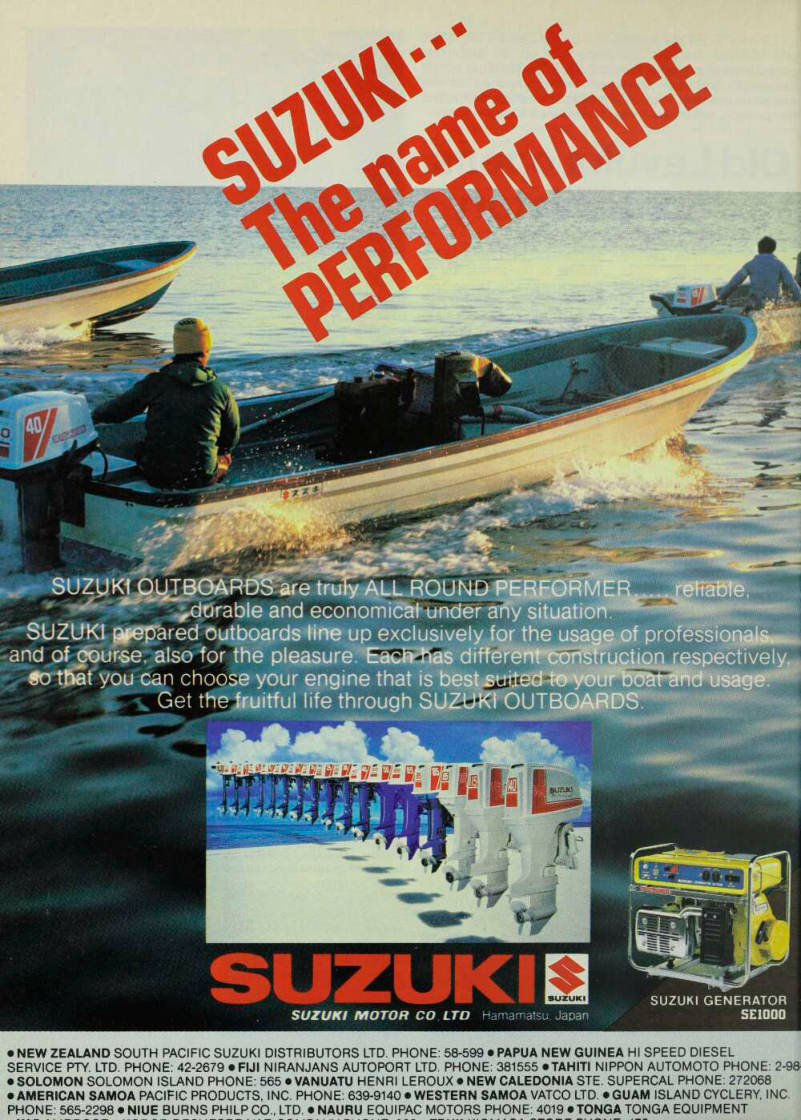
SUZUKI OLITBOARDS are truly ALL ROUND PERFORMER..... reliable,
3^ V * ■ wii, M SUZUKI OLITBOARDS are truly ALL ROUND PERFORMER... reliable, adorable and economical under aify situation. Ifc** SUZUKI outboards line up exclusively for the usage of and of course, also for the pleasure. Each fias different construction respectively, to that you can choose your engine that is best suited to your boat and usage.
Get the fruitful life through SUZUKI OUTBOARDS.
SUZUKI MOTOR CO LTD Hamamatsu Japan
SUZUKI GENERATOR
SEIDOQ
• NEW ZEALAND SOUTH PACIFIC SUZUKI DISTRIBUTORS LTD. PHONE: 58-599 • PAPUA NEW GUINEA HI SPEED DIESEL SERVICE PTY. LTD. PHONE: 42-2679 •FIJI NIRANJANS AUTOPORT LTD. PHONE: 381555 • TAHITI NIPPON AUTOMOTO PHONE: 2-98 • SOLOMON SOLOMON ISLAND PHONE; 565 • VANUATU HENRI LEROUX • NEW CALEDONIA STE. SUPERCAL PHONE; 272068 • AMERICAN SAMOA PACIFIC PRODUCTS, INC. PHONE; 639-9140 •WESTERN SAMOA VATCO LTD. • GUAM ISLAND CYCLERY, INC.
PHONE: 565-2298 • NIUE BURNS PHILP CO.. LTD. • NAURU EQUIPAC MOTORS PHONE: 4019 • TONGA TONGA EQUIPMENT
Presidential poll:
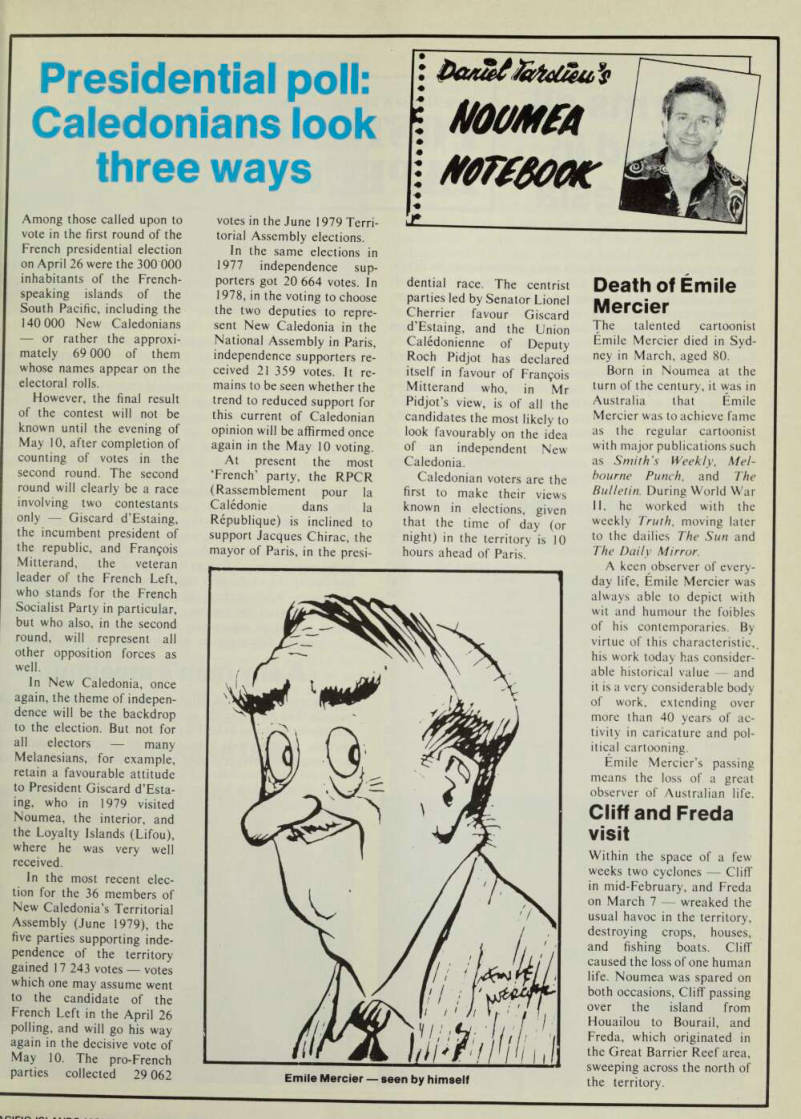
Caledonians look three ways
Dariel Tardieu's
Noumes
Notebook
Among those called upon to vote in the first round of the French presidential election on April 26 were the 300 000 inhabitants of the French speaking islands of the South Pacific, including the 140 000 New Caledonians or rather the approxi mately 69 000 of them whose names appear on the electoral rolls.
However, the final result of the contest will not be known until the evening of May 10, after completion of counting of votes in the second round. The second round will clearly be a race involving two contestants only Giscard d’Estaing, the incumbent president of the republic, and Francis Mitterand, the veteran leader of the French Left, who stands for the French Socialist Party in particular, but who also, in the second round, will represent all other opposition forces as well.
In New Caledonia, once again, the theme of indepen dence will be the backdrop to the election. But not for all electors many Melanesians, for example, retain a favourable attitude to President Giscard d’Esta ing, who in 1979 visited Noumea, the interior, and the Loyalty Islands (Lifou), where he was very well received.
In the most recent elec tion for the 36 members of New Caledonia’s Territorial Assembly (June 1979), the five parties supporting inde pendence of the territory gained 17 243 votes votes which one may assume went to the candidate of the French Left in the April 26 polling, and will go his way again in the decisive vote of May 10. The pro-French parties collected 29 062
votes in the June 1979 Terri torial Assembly elections.
In the same elections in 1977 independence sup porters got 20 664 votes. In 1978, in the voting to choose the two deputies to repre sent New Caledonia in the National Assembly in Paris, independence supporters re ceived 21 359 votes. It re mains to be seen whether the trend to reduced support for this current of Caledonian opinion will be affirmed once again in the May 10 voting.
At present the most ‘French’ party, the RPCR (Rassemblement pour la Caledonie dans la Republique) is inclined to support Jacques Chirac, the mayor of Paris, in the presi
dential race. The centrist parties led by Senator Lionel Cherrier favour Giscard d Estaing, and the Union Caledonienne of Deputy Roch Pidjot has declared itself in favour of Francis Mitterand who, in Mr Pidjot’s view, is of all the candidates the most likely to look favourably on the idea of an independent New Caledonia.
Caledonian voters are the first to make their views known in elections, given that the time of day (or night) in the territory is 10 hours ahead of Paris.
Death of Emile
Mercier
The talented cartoonist Emile Mercier died in Syd ney in March, aged 80.
Born in Noumea at the turn of the century, it was in Australia that Emile Mercier was to achieve fame as the regular cartoonist with major publications such as Smith’s Weekly. Mel bourne Punch, and The Bulletin. During World War 11, he worked with the weekly Truth, moving later to the dailies The Sun and The Daily Mirror.
A keen observer of every day life, Emile Mercier was always able to depict with wit and humour the foibles of his contemporaries. By virtue of this characteristic,, his work today has consider able historical value and it is a very considerable body of work, extending over more than 40 years of ac tivity in caricature and pol itical cartooning.
Emile Mercier’s passing means the loss of a great observer of Australian life.
Cliff and Freda
visit
Within the space of a few weeks two cyclones Cliff in mid-February, and Freda on March 7 wreaked the usual havoc in the territory, destroying crops, houses, and fishing boats. Cliff caused the loss of one human life. Noumea was spared on both occasions, Cliff passing over the island from Houailou to Bourail, and Freda, which originated in the Great Barrier Reef area, sweeping across the north of
the territory.
Emile Mercier - seen by himself
Polynesia
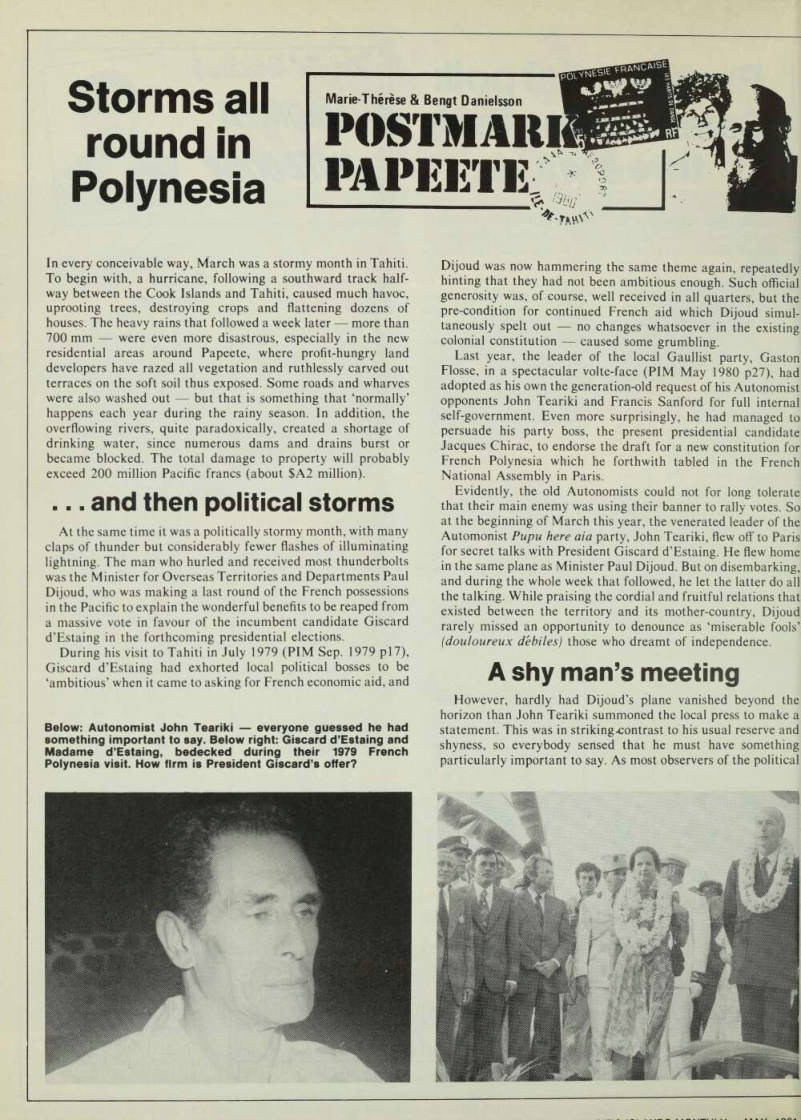
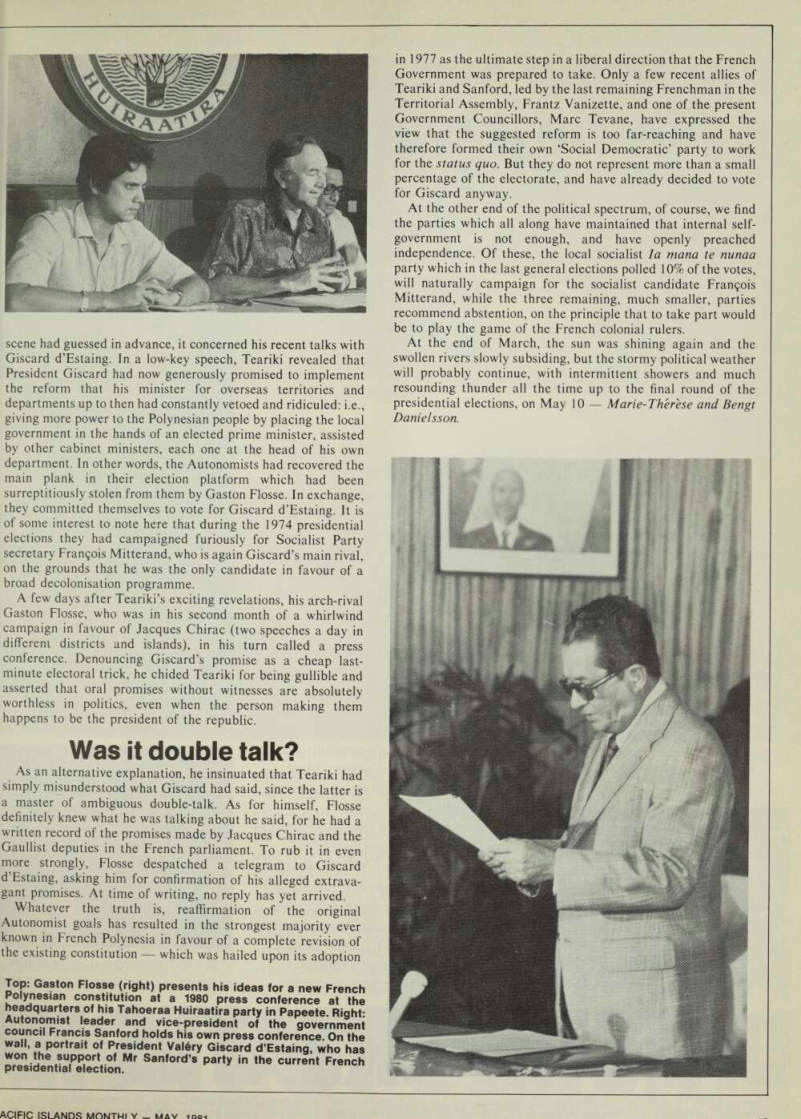
Storms all round in Polynesia
In every conceivable way, March was a stormy month in Tahiti.
To begin with, a hurricane, following a southward track half way between the Cook Islands and Tahiti, caused much havoc, uprooting trees, destroying crops and flattening dozens of houses. The heavy rains that followed a week later more than 700 mm were even more disastrous, especially in the new residential areas around Papeete, where profit-hungry land developers have razed all vegetation and ruthlessly carved out terraces on the soft soil thus exposed. Some roads and wharves were also washed out but that is something that ‘normally’ happens each year during the rainy season. In addition, the overflowing rivers, quite paradoxically, created a shortage of drinking water, since numerous dams and drains burst or became blocked. The total damage to property will probably exceed 200 million Pacific francs (about SA2 million).
... and then political storms
At the same time it was a politically stormy month, with many claps of thunder but considerably fewer flashes of illuminating lightning. The man who hurled and received most thunderbolts was the Minister for Overseas Territories and Departments Paul Dijoud, who was making a last round of the French possessions in the Pacific to explain the wonderful benefits to be reaped from a massive vote in favour of the incumbent candidate Giscard d’Estaing in the forthcoming presidential elections.
During his visit to Tahiti in July 1979 (PIM Sep. 1979 p 17), Giscard d’Estaing had exhorted local political bosses to be ‘ambitious’ when it came to asking for French economic aid, and
Dijoud was now hammering the same theme again, repeatedly hinting that they had not been ambitious enough. Such official generosity was, of course, well received in all quarters, but the pre-condition for continued French aid which Dijoud simul taneously spelt out no changes whatsoever in the existing colonial constitution caused some grumbling.
Last year, the leader of the local Gaullist party, Gaston Flosse, in a spectacular volte-face (PIM May 1980 p 27), had adopted as his own the generation-old request of his Autonomist opponents John Teariki and Francis Sanford for full internal self-government. Even more surprisingly, he had managed to persuade his party boss, the present presidential candidate Jacques Chirac, to endorse the draft for a new constitution for French Polynesia which he forthwith tabled in the French National Assembly in Paris.
Evidently, the old Autonomists could not for long tolerate that their main enemy was using their banner to rally votes. So at the beginning of March this year, the venerated leader of the Automonist Pupu here aia party, John Teariki, flew off to Paris for secret talks with President discard d’Estaing. He flew home in the same plane as Minister Paul Dijoud. But on disembarking, and during the whole week that followed, he let the latter do all the talking. While praising the cordial and fruitful relations that existed between the territory and its mother-country, Dijoud rarely missed an opportunity to denounce as ‘miserable fools’ (douloureux debiles) those who dreamt of independence.
A shy man’s meeting
However, hardly had Dijoud’s plane vanished beyond the horizon than John Teariki summoned the local press to make a statement. This was in striking -contrast to his usual reserve and shyness, so everybody sensed that he must have something particularly important to say. As most observers of the political
Below: Autonomist John Teariki - everyone guessed he had something important to say. Below right: Giscard d’Estaing and Madame d’Estaing, bedecked during their 1979 French Polynesia visit. How flrm is President Giscard’s offer?
scene had guessed in advance, it concerned his recent talks with Giscard d’Estaing. In a low-key speech, Teariki revealed that President Giscard had now generously promised to implement the reform that his minister for overseas territories and departments up to then had constantly vetoed and ridiculed: i.e., giving more power to the Polynesian people by placing the local government in the hands of an elected prime minister, assisted by other cabinet ministers, each one at the head of his own department. In other words, the Autonomists had recovered the main plank in their election platform which had been surreptitiously stolen from them by Gaston Flosse. In exchange, they committed themselves to vote for Giscard d’Estaing. It is of some interest to note here that during the 1974 presidential elections they had campaigned furiously for Socialist Party secretary Francis Mitterand, who is again Giscard’s main rival, on the grounds that he was the only candidate in favour of a broad decolonisation programme.
A few days after Teariki’s exciting revelations, his arch-rival Gaston Flosse, who was in his second month of a whirlwind campaign in favour of Jacques Chirac (two speeches a day in different districts and islands), in his turn called a press conference. Denouncing Giscard’s promise as a cheap last minute electoral trick, he chided Teariki for being gullible and asserted that oral promises without witnesses are absolutely worthless in politics, even when the person making them happens to be the president of the republic.
Was it double talk?
As an alternative explanation, he insinuated that Teariki had simply misunderstood what Giscard had said, since the latter is a master of ambiguous double-talk. As for himself, Flosse definitely knew what he was talking about he said, for he had a written record of the promises made by Jacques Chirac and the Gaullist deputies in the French parliament. To rub it in even more strongly, Flosse despatched a telegram to Giscard d’Estaing, asking him for confirmation of his alleged extrava gant promises. At time of writing, no reply has yet arrived.
Whatever the truth is, reaffirmation of the original Autonomist goals has resulted in the strongest majority ever known in French Polynesia in favour of a complete revision of the existing constitution which was hailed upon its adoption
in 1977 as the ultimate step in a liberal direction that the French Government was prepared to take. Only a few recent allies of Teariki and Sanford, led by the last remaining Frenchman in the Territorial Assembly, Frantz Vanizette, and one of the present Government Councillors, Marc Tevane, have expressed the view that the suggested reform is too far-reaching and have therefore formed their own ‘Social Democratic’ party to work for the status quo. But they do not represent more than a small percentage of the electorate, and have already decided to vote for Giscard anyway.
At the other end of the political spectrum, of course, we find the parties which all along have maintained that internal self government is not enough, and have openly preached independence. Of these, the local socialist la mana te nunaa party which in the last general elections polled 10% of the votes, will naturally campaign for the socialist candidate Francis Mitterand, while the three remaining, much smaller, parties recommend abstention, on the principle that to take part would be to play the game of the French colonial rulers.
At the end of March, the sun was shining again and the swollen rivers slowly subsiding, but the stormy political weather will probably continue, with intermittent showers and much resounding thunder all the time up to the final round of the presidential elections, on May 10 Marie-Therese and Bengt Danielsson.
Top: Gaston Flosse (right) presents his ideas for a new French Polynesian constitution at a 1980 press conference at the headquarters of his Tahoeraa Huiraatira party in Papeete. Right- Autonomist leader and vice-president of the government council Francis Sanford holds his own press conference. On the wall a portrait of President Valery Giscard d’Estaing, who has won the support of Mr Sanford’s party in the current French presidential election.
Advertisements & other items, pp. 18-22 (3 items)
t
Acific Islands Monthi Y _ May -Moi
19
ACIFIC ISLANDS MONTHI Y MAY -moi
Datsun Creates He
\bu never see a lot
of our best work.
Today, people are looking at new cars in a new way.
Sure, you still want a car that will zip through traffic. But you also need one that will zip past gas pumps and repair shops.
You want a car that is comfortable. But you also need one that is comfortably priced.
You want a car that looks nice.
But you also need one that will hold its good looks for some years to come.
And that comes from the way the people who built the car think.
At Datsun, we think in terms of “harmony.”
Harmony between research and development. Between design and engineering. Throughout testing. And retesting. And up and down each of our assembly lines.
In short, harmony from concept through the completed car.
Thinking and working in harmony permits us to resolve seemingly unresolvable differences. To balance flatout contradictions.
For example, you want a strong, safe car. But you also need one that is fuel efficient. More strength would seem to mean more weight. More fuel efficiency would seem to mean less weight.
Our solution: A new, high-tension steel. It is thinner and lighter than the steel it replaced. Yet equally as strong. More pounds were saved, with no loss of strength, by drilling holes in the steel suspension system (which were later filled with rubber plugs).
Problem-solving by designresolving conflicting elements to 'SM m improve the overall quality of the product—has helped Datsun to build
DATSUN CREATES HE
Cook Islands; COOK ISLANDS MOTOR CENTRE LTD , Rarotonga/Fiji; CARPENTERS MOTORS, Suva/Guam: DATSUN MOTOR SALES, Agana/Hawaii: NISSAN MOTO CORPORATION IN HAWAII LTD., Honolulu/Kiribati: ATOLL AUTO STORES, Tarawa/Nauru: JACOB ENTERPRISES LTD. New Caledonia: AGENCE ALMA S A , Noume;
5 that are strong and safe, yet light fuel efficient.
Harmony has also led to many 9r solid product improvements, ne you see. Some you don’t.
When a Datsun leaves the assemline, it leaves with nearly nine nds of gleaming acrylic paint.
I almost four and a half pounds of nd deadener.
Part of that paint does an underer job. Inside the air cleaner, the underside of the hood. Under the mat in the trunk. Even the drive shaft is painted. As is the inside of the rocker panels, fender wells and splash pans. (Which also receive a generous extra layer of stone guard coat to help fight off salt damage in colder climates.) Every trunk is sealed with more than a pound of weather stripping.
Every door with nearly half a pound.
And every door also comes with a hole in the bottom...a precisely-positioned drain hole to prevent build-up of water running down the windowpane.
So now you have some idea of why Datsuns are so right for the times.
They offer you what the world needs.
Without sacrificing what you want.
That’s harmony.
The model shown above is the Datsun 120 Y for South America.
Specifications and equipment may vary according to market.
DATSUN
MONY BY DESIGN
THE NAME OF QUALITY
NISSAN
NISSAN MOTOR CO. LTD
/ >*<s a*
NATIONAL
INSURANCE
Wi •<
COVERS THE
PACIFIC
i r / B 's * A N m *
FIJI
THE NATIONAL INSURANCE COMPANY OF FIJI, LIMITED (Incorporating Southern Pacific Insurance Co. (Fiji) Ltd) SUVA Dominion House Thomson St Phone 25601 Tlx 2337 L M Rolls General Manager LAUTOKA Ist Floor National Bank Bldg. Phone 62951 M Y Hussain Resident Inspector LABASA Ist Floor National Bank Bldg. Phone 81099 A Singh Resident Inspector
PAPUA NEW GUINEA
THE SOUTHERN PACIFIC INSURANCE COMPANY (PNG) LIMITED (Incorporating C.I.C. Insurance (Pacific) Pty Ltd) PORT MORESBY 8 Champion Parade Phone 21-1388 Tlx 22261 D J McCall General Manager LAE Second St Phone 42-4590 Tlx 42443 T S Kennedy Manager RABAUL Mango Ave Phone 92-2755 Tlx 92923 P M Mitchell Manager MT HAGEN Phone 521-164 J P Devaney District Manager ARAWA B Snowden District Manager Phone 956-219
VANUATU
THE NATIONAL INSURANCE COMPANY OF NEW ZEALAND, LIMITED.
HONIARA Ist Floor Kingsley Bldg. Phone 919 Kaituu & Co. Ltd (W. V. Gledhill) Agent
SAMOA
NATIONAL PACIFIC INSURANCE LIMITED
(National Insurance Company of New Zealand, Ltd Managing Agents) APIA Taufusi St Phone 20481 Tlx 228 D I Humphry Managing Director PAGO PAGO Suite 200 Lumana’i Bldg. Phone 96799 J McGuire Manager
COOK ISLANDS
THE NATIONAL INSURANCE COMPANY OF NEW ZEALAND, LIMITED RAROTONGA U.I.T. Bldg. Avarua Phone 2076 Tlx 62013 R Wheeler Local Manager
Islands
From the
Press
From the caption to a picture in Solomons News Drum, Honiara 12 Tafuliae shell money and 2 more (not in picture) plus $ 1,113 in cash were part of bride price during a marriage at Vara Creek, Honiara. The 14 shell money were worth about $ 1,700. The marriage was between a boy from Are’Are and a girl from Kwara’ae. The normal bride price in Kwara’ae is 5 Tofuliae. The 1 4 shell money, plus $1,113 paid to the girl’s family were to ensure happiness and peace between the boy’s and girl’s families, after weeks of negotiations about the affair of the boy and girl.
From an editorial in Voice of Vanuatu, explaining the weekly’s change-over to newsprint from the glossy finish paper previously used May I welcome readers to the first ‘fish and chip’ edition . . . Why do I call it ‘fish and chip’. Here’s the secret. In countries like England, of which I’m very fond, this paper is used to wrap up fish and chips. It helps to keep them hot on the cold frosty evening walks home. You will find this paper has many uses. It keeps things hot and it keeps things cold. Wrap a tin of Fosters in a Voice and you’ll find it keeps colder longer. The absorbent new newsprint is excellent for use in the home. It is strong and resilient and will prove most useful if you get caught short with nothing to wrap your rubbish in. If you collect enough Voice of Vanuatu you will find them excellent for putting under mats to keep away the damp . . .
From a reader’s letter, entitled ‘Please Show Some Concern’, in Our News, Papua New Guinea Please allow me space in your column to comment on some policemen who are reckless when driving their police vehicles. I, as a highlander have witnessed nearly every police driver in the Western Highlands and Enga Province driving recklessly. I wish to advise their instructors that these policemen have a habit of holding the steering wheel incorrectly. Road blocks are being put up at "very corner of the road where they frequently check vehicles and :harge drivers for faults in the vehicle and breach of traffic rules.
This, I feel is reasonable, however there is nobody to inspect police vehicles. 1 am totally miserable about this matter and I want authorities concerned to inspect all police vehicles before they go an the road. The police force is in an awkward position of being lassie examples to the people. They should understand that their aad examples will be copied by the public if such attitudes :ontinue. Let me tell you of an incident which happened a couple af months ago in which a PMV and a police truck collided on the Hagen-Wabag road. The blue uniform cops were under the nfluence of liquor while holding steering wheels during official aours. This of course caused damage to the PMV truck and the aolicemen escaped without stopping to find out what had happened.
Please blue uniform cops, do not teach your fellow countrymen the vrong things. They will eventually copy your example and this will ead to a lot of problems.
From a report on a meeting of the House of Assembly n the Cook Islands News, Rarotonga Inatio Akaruru, Opposition Member for Pukapuka, hoped that the ncrease in the appropriation for the medical services would be used o get more doctors. He also thought that the Minister of Health vas wasting his time as a politician and he and Sir Tom Davis
(Premier) should return to their professions as doctors where they could serve their country better. ‘You are a good nurse,’ interjected Hon Sir Thomas in good humour.
From Solomons News Drum, Honiara Solomon Islands beat the Rest of the World by 122 runs in a cricket match at Town Ground, Honiara on February 8. The Solomon Islands team of seven was boosted by the inclusion of four players from the Australian State of Victoria.
From a letter by G. Kidipale in Solomons News Drum, Honiara To further enhance their position, the Australian staff (of the Honiara branch of the Australian Commonwealth Bank) have always resorted to such tactics as making their jobs appear formidable and complicated. In reality, nearly all bank work is mere routine stuff which any fool can do blindfolded like assembling a general purpose machine gun in a dark tropical jungle.
From extracts from Fiji parliamentary debates quoted in the magazine Fiji, published by the Fiji Ministry of Information Mr K. L. Matatolu, Opposition backbencher, parrying a verbal thrust from Government backbencher Mr Fred Caine; ‘My trade union colleague has just come up and I would like to advise him of the prayer which goes on like this: Lord help me to keep my big mouth shut till I know what I am talking about. I am talking about the tourist industry which he does not know anything about.’
Sir Charles Stinson, Government backbencher: ‘Sir, I consider it as absolutely pathetic and I say again pathetic this constant attack on the ministerial car pool. Surely, we have bigger things to think of and talk about.’
Mr J. R. Singh, Opposition backbencher: ‘May I reiterate that if this nuclear testing goes on and if the Japanese and the Americans dump their nuclear waste in the Pacific that would not only contaminate or kill our marine life but would pollute our atmosphere and generally endanger our very survival on these islands, and after that we may not have to worry about our budget debate any more.’
From an editorial in The Nauru Post, Nauru It is amazing that after thirteen years of independence Nauru still has secrets and perhaps has become even more secretive and less open in the conduct of its businesses. This is particularly so when we are non-military not even a shadow of a defence system. But it would appear that Government believes that there are things which the people should not know about. Perhaps they are right and some matters should remain secret from the public, but should the price of phosphate be one of those on the secret list because even Members of Parliament are ignorant of it. Are not the landowners even entitled to know at what price they are selling their phosphate or at what price N.P.C. is selling their phosphate?
From Tohi Tala Niue, Alofi .. . The event (a general election) is certainly interesting to a new generation of eligible voters who have taken into account what the last Niue Assembly has brought into Legislature this past three years. It has brought into force: old age pension for the over 60 year olds, lowering of driver’s licence from 16 to 14 years, prohibited Sunday fishing, mid-week socio-events such as picture/dance for elementary school-aged children and freedom of speech under a nom-de-plume to name a few.
From The Fiji Times, Suva A man was warned in Suva Court yesterday that if he kept touching girls’ bottoms, he would be brought to court again and fined. Hari Shankar, 34, of Suva, pleaded guilty to a charge of indecent assault . . . Passing sentence, the magistrate Mr Anthony Amstell said he knew the young girls’ bottoms were attractive. ‘But you can’t go around poking bottoms,’ Mr Amstell said. ‘Any more bottoms and you will be brought back and fined.’
From the Cook Islands News, Rarotonga Penrhyn copra farmers are now choosing to be pearl dealers. They revealed that pearls are easier in comparison. A spokesman from Outer Island Affairs said; ‘You get yourself clean and make money, whereas in making copra, you make money the hard way.’
Advertisements & other items, pp. 23-24 (2 items)
isi ANn.c; momtui v _ mav mo-,
isi ANn.c; momtui v mav mo-,
SClarion
When you’re on the go, Clarion has just the system for you.
The new Z-Series of fully integrated car audio components.
Including a Power Amp with a breathtaking 25 watts per Dolby* Cassette Deck with metal tape capability, precise Control Amp and ultra-slim FM Stereo Tuner. Add to this our power-hungi speakers, either the compact, lightweight 3-wi speakers or high efficiency GS-514A coaxial 2-way speakers, anc you’re ready for an exhilarating listening experience.
Clarion. For sound that makes you feel at home on the road.
mm m J
ff i imiiiinai -
I 1 l| DOLBY SYSTEM [
t I V . i
SClarion
CLARION CO., LTD.
Tokyo, Japan Australia: Amalgamated Wireless (Australasia) Ltd, 554 Parramatta Road, Ashfield,N.S.W., 2131/New Zealand: AW/' New Zealand Limited, P.O. Box 50-248, Porirua/Fiji Islands: Brijlal & Co., Ltd, G.P.O. Box 362, Suva/Tahiti: HI-FI Shangrila,B.P. 200, Papeete/New Caledonia: Caldis B.P. Ml, Noumea Cedex/Guam: Guam Radio & TV Shop, P.O. Boc 1939, Agana, Guam 96910/Vanuatu: The Sound Centre, P.O. Box 434, Vila/Cook Islands: South Seas Internationa Ltd, P.O. Box 49, Rarotonga/ Papua New Guinea: Hagemeyer (P.N.G.) Pty. Ltd, P.O. Box 1428, Boroko, Port Moresby *Dolby and the double-D symbol are trademarks of Dolby Laboratories
Wollongong
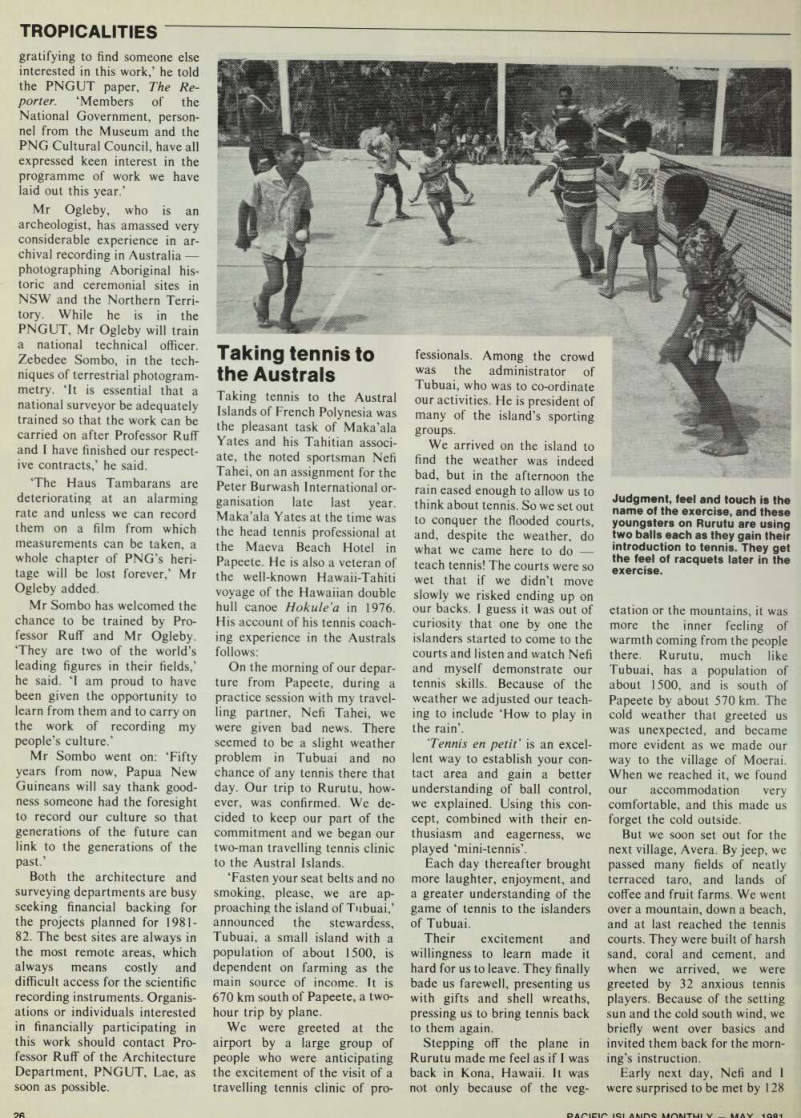


Tropicalities
Pukapukans at home in Wollongong
Word about good earnings available in the steelworks soon reached the people on the lonely island, where average income may total $2OO a year mostly from copra. So in 1980 Metara Phillip and his wife Porora set out for Australia, bringing their two-year-old daughter Okera.
Metara soon found a good job in the steel industry, and the family settled down happily.
They were soon followed by 67year-old Torea Manea, Anita’s uncle. Torea had never left the atoll during his life as a fisherman and copra worker. He decided it was time to travel and see the world. With him came Tipora Uatai, a lovely young woman in her early 20s, bringing her two-year-old daughter from a broken mar riage. And before long they were followed by Nakui Yalau and Makea Matau’s youngest daughter Emma.
Astute Pukapukans in Auck land soon became aware of the Australia-New Zealand Trans- Tasman agreement, and, as New Zealanders, they knew they could travel freely to Australia. So Pukapukan Ruria Junior and his wife also came to Wollongong during this period, and Ruria too got work in the steel industry. Four or five other Pukapukans came in 1980, bringing the community’s num ber to near two-dozen.
All the Pukapukans have decided to become Australians.
They have adapted readily to their new life. Metera, Nakui, and the other younger men play rugby for Wollongong Techni cal College and enjoy trips all over New South Wales. The older men fish and gather shell fish on the coast just as they did back home. The women enjoy housework, shopping, sewing and crocheting, and on rugby weekends the whole com munity turns out to cheer their
Wollongong, Australia, is a rather unexpected place to find a thriving colony of some 20 Cook Islanders from the re mote, far-flung atoll of Puka puka, also known as Danger Island, which lies 1220 km northwest of Rarotonga. But, roving to new places is in keep ing with the character of Polynesians, and the people of Pukapuka are among the purest remaining members of this sea faring race. Their superbly con structed nine to 11m long sennit-fastened ocean-going canoes may still be seen, resting under palm thatches on the shores of their lovely island.
The Wollongong colony started in the mid-1960s when Urutapu, the attractive daugh ter of Matau Makea, Puka puka’s best known fisherman, departed for New Zealand on the monthly supply ship Moana Roa. She met her Australian husband from Wollongong in Auckland, and together they returned t€ the New South Wales steel town where they settled.
Urutapu, more commonly
known as Anita away from her island, sent her family letters and money, and in 1978 Matau Makea and his wife Porora decided to visit their daughter.
They flew to Wollongong, bring ing their five-year-old adopted son. They soon found that the climate and wonders of Aust ralia suited them, and decided to stay. The word soon reached the large Pukapukan com munity in Auckland, and in 1979 a young Pukapukan, Nooangatau, met and married an Australian girl. They de cided to come to Australia and Nooangatau logically decided to settle near his countrymen.
He took up work in the local
steel industry.
boys.
W. H. Hambuechen.
• For a glimpse of the Pukapukans at home, see Travel section
Saving the Haus
Tambarans
The Architecture and Survey ing Departments of the Papua New Guinea Institute of Tech nology, Lae, have embarked on an ambitious joint project to record the fast disappearing
Haus Tambarans of the Sepik areas. The work, which was started by Professor Wallace Ruff, will be considerably speeded up by the introduction of terrestrial photogrammetric techniques provided by Cliff Ogleby of the surveying department.
Sites in the Sepik will be photographed by a special camera known as a phototheodolite.
The resulting photos will provide an accurate historical record, as well as being used to produce detailed drawings, or to
reconstruct the Haus Tambarans should this ever be thought necessary.
Professor Ruff, who heads the architecture department at PNGUT, has battled on alone for many years in the area of heritage recording. He has wel corned the participation of the surveying department. ‘lt is
A typical Haus Tambaran, or spirit house, from the Sepik area of PNG. They are part of a cultural heritage and need pro tection, researchers say.
gratifying to find someone else interested in this work,’ he told the PNGUT paper, The Re porter. ‘Members of the National Government, person nel from the Museum and the PNG Cultural Council, have all expressed keen interest in the programme of work we have laid out this year.’
Mr Ogleby, who is an archeologist, has amassed very considerable experience in ar chival recording in Australia photographing Aboriginal his toric and ceremonial sites in NSW and the Northern Terri tory. While he is in the PNGUT, Mr Ogleby will train a national technical officer.
Zebedee Sombo, in the tech niques of terrestrial photogram metry. ‘lt is essential that a national surveyor be adequately trained so that the work can be carried on after Professor Ruff and I have finished our respect ive contracts,’ he said. ‘The Haus Tambarans are deteriorating at an alarming rate and unless we can record them on a film from which measurements can be taken, a whole chapter of PNG’s heri tage will be lost forever,’ Mr
Ogleby added.
Mr Sombo has welcomed the chance to be trained by Pro fessor Ruff and Mr Ogleby. ‘They are two of the world’s leading figures in their fields,’ he said. ‘I am proud to have been given the opportunity to learn from them and to carry on the work of recording my people’s culture.’
Mr Sombo went on: ‘Fifty years from now, Papua New Guineans will say thank good ness someone had the foresight to record our culture so that generations of the future can link to the generations of the past.’
Both the architecture and surveying departments are busy seeking financial backing for the projects planned for 1981- 82. The best sites are always in the most remote areas, which always means costly and difficult access for the scientific recording instruments. Organis ations or individuals interested in financially participating in this work should contact Pro fessor Ruff of the Architecture Department, PNGUT, Lae, as soon as possible.
Taking tennis to
the Australs
Taking tennis to the Austral Islands of French Polynesia was the pleasant task of Maka’ala Yates and his Tahitian associ ate, the noted sportsman Nefi Tahei, on an assignment for the Peter Burwash International or ganisation late last year.
Maka’ala Yates at the time was the head tennis professional at the Maeva Beach Hotel in Papeete. He is also a veteran of the well-known Hawaii-Tahiti voyage of the Hawaiian double hull canoe Hokule’a in 1976.
His account of his tennis coach ing experience in the Australs follows: On the morning of our depar ture from Papeete, during a practice session with my travel ling partner, Nefi Tahei, we were given bad news. There seemed to be a slight weather problem in Tubuai and no chance of any tennis there that day. Our trip to Rurutu, how ever, was confirmed. We de cided to keep our part of the commitment and we began our two-man travelling tennis clinic to the Austral Islands. ‘Fasten your seat belts and no smoking, please, we are ap proaching the island of Tubuai,’ announced the stewardess, Tubuai, a small island with a population of about 1500, is dependent on farming as the main source of income. It is 670 km south of Papeete, a two hour trip by plane.
We were greeted at the airport by a large group of people who were anticipating the excitement of the visit of a travelling tennis clinic of pro
fessionals. Among the crowd was the administrator of Tubuai, who was to co-ordinate our activities. He is president of many of the island’s sporting groups.
We arrived on the island to find the weather was indeed bad, but in the afternoon the rain eased enough to allow us to think about tennis. So we set out to conquer the flooded courts, and, despite the weather, do what we came here to do teach tennis! The courts were so wet that if we didn’t move slowly we risked ending up on our backs. I guess it was out of curiosity that one by one the islanders started to come to the courts and listen and watch Nefi and myself demonstrate our tennis skills. Because of the weather we adjusted our teach ing to include ‘How to play in the rain’. ‘Tennis en petit’ is an excel lent way to establish your con tact area and gain a better understanding of ball control, we explained. Using this con cept, combined with their en thusiasm and eagerness, we played ‘mini-tennis’.
Each day thereafter brought more laughter, enjoyment, and a greater understanding of the game of tennis to the islanders of Tubuai.
Their excitement and willingness to learn made it hard for us to leave. They finally bade us farewell, presenting us with gifts and shell wreaths, pressing us to bring tennis back to them again.
Stepping off the plane in Rurutu made me feel as if I was back in Kona, Hawaii. It was not only because of the veg-
elation or the mountains, it was more the inner feeling of warmth coming from the people there. Rurutu, much like Tubuai, has a population of about 1500, and is south of Papeete by about 570 km. The cold weather that greeted us was unexpected, and became more evident as we made our way to the village of Moerai.
When we reached it, we found our accommodation very comfortable, and this made us forget the cold outside.
But we soon set out for the next village, Avera. By jeep, we passed many fields of neatly terraced taro, and lands of coffee and fruit farms. We went over a mountain, down a beach, and at last reached the tennis courts. They were built of harsh sand, coral and cement, and when we arrived, we were greeted by 32 anxious tennis players. Because of the setting sun and the cold south wind, we briefly went over basics and invited them back for the morn ing’s instruction.
Early next day, Nefi and I were surprised to be met by 128
Judgment, feel and touch is the name of the exercise, and these youngsters on Rurutu are using two balls each as they gain their introduction to tennis. They get the feel of racquets later in the exercise.
enthusiasts, many of whom were lifting a tennis racquet for the first time in their lives.
Their progress in the clinics was amazing and enabled us to move quickly. Before the day was done they were playing doubles.
We began some team compe tition, having one team on either side of the net, encourag ing them to use all the skills they had learned during the earlier clinic. We had them playing a game that allowed two racquets per team. As the finals were about to be played, the shouting and laughter brought almost everyone from their homes and their work in the taro fields. The teams got more and more excited as they were allowed only one racquet now, which automatically brought out a more complete team effort. The day, with all of its excitement, seemed to end too quickly, but the players all left anxious for the next day’s instruction.
The next morning was filled with the energy and excitement of the young students. We introduced the ‘J.F.T.’ (Judg ment, Feel and Touch) drills concept. These drills allowed everyone to become quickly aware of their physical abilities relating to racquet and ball co ordination. By the end of the day the students were well able to direct the ball to specific parts of the tennis court.
As it came time for us to leave Rurutu, once again it was difficult for us to say goodbye to its friendly and caring people.
Two days spent in Tubuai and the three days on Rurutu al owed Nefi and me to share with ;hese people something of their vay of life. We certainly look orward to returning one day.
We left the Austral Islands md returned to Papeete. But we elt we had built an understand ng of the game of tennis and he way it relates to life and lappiness among people who md never had the chance to )lay and enjoy the game before. • The trip was sponsored by he Comite Territorial de la 'eunesse (CTJ) of French Poly nesia. It was co-ordinated by 'deques Teheiura, a territorial ndviser and member of the Municipal Council of Rurutu.
A bad deal for
card players
Hundreds of Papua New Guineans who have been gaoled or fined for gambling with cards in recent years may have been handed a wrong deal, if a legal irregularity is confirmed. The irregularity was detected by a legal officer for the Morobe Provincial Government, Miss Tracy Doherty. She was asked to appear on behalf of eight women who were being held in custody in Lae after they had been found playing cards.
The women were charged with gambling on ‘an illegal game’ but Miss Doherty found that cards had not been ga zetted among illegal games. She told a magistrate that although the women admitted playing cards, the prosecution would have to prove that playing cards was illegal. The police sought legal advice and then withdrew the charges.
The Morobe Premier, Mr Utula Samana, drew the atten tion of the national government to the situation, claiming that hundreds of people had been subjected to hardship, penalties and wrongful conviction under an apparently faulty process.
More honour to
RLS in Apia
Robert Louis Stevenson is to be honoured in a project under taken by the Congregational Church of Jesus.
The project, the Robert L.
Stevenson Cultural Centre, will be on two hectares owned by the church behind its Vailima school The first phase, to cost SWSIOO 000, will consist of a Stevenson museum, a small restaurant which will serve Samoan food to visitors, three arts and crafts buildings, two storage buildings, a malae (open ground) for the perform ance of Samoan music and dancing, an auditorium for cul tural performances, and a VIP fale.
Funds for the project will come initially from the church.
The rest it is hoped to raise from contributions by churches in the United States and other chari ties. Chairman of the project board is Aumua loane, MP.
Project director is William Pili Collins, an American with a background in marketing and business management.
Eventually it is hoped that a cable car will be installed to take visitors up Mt Vaea to see Stevenson’s tomb.
Big maths comp,
on again
Secondary schools in the Southwest Pacific in March received invitations for students to enter the 1981 Australian Mathematics Competition for the Wales awards.
The competition, which in 1980 attracted 155 000 entries, including 15 000 from countries in the Pacific outside Australia, is jointly sponsored by the Canberra College of Advanced Education, the Bank of New South Wales, and the Canberra Mathematical Association.
Special features of the com petition this year include • SA2O 000 in prize money; • 45% of entrants receive merit certificates; • Special Bank of New South Wales book awards to the best entrant from each participating school in the smaller Southwest Pacific countries; • Braille and large print ver sions of the competition papers for visually handicapped students; • French version of the com petition papers available for students from New Caledonia, Vanuatu and French Polynesia.
If a secondary school in the Southwest Pacific has not re ceived an invitation and wishes to have one, contact should be made with Mrs Sally Bakker, School of Information Sciences, Canberra CAE, PO Box 1, Belconnen, ACT, Australia, 2616.
A real champion
windsurfer
Unlike the Terrible Baron Arnaud de Rosnay, whose ‘honest cheating’ at windsurfing around French Polynesia has been amply covered in PIM, American windsurfer Bill Hyman can claim a genuine windsurfing record: in February he rode his board from Ameri can Samoa to Western Samoa
to become the first person ever to do so. His time was 10 hours 46 minutes. The distance: about 170 km.
The Apia newspaper The Observer reports that at Tam one February morning three men, including Hyman, left American Samoa to attempt to windsurf their way to Aleipata on the westernmost end of the Western Samoa island of Upolu.
A back-up vessel, with friends of the three men and a Pago newspaper reporter on board, trailed the men in order to provide rescue emergency services if required.
At about 5.45 in the after noon Hyman, who had sped off to a good lead at the start of the trip, became the only one to complete the crossing.
Tired and bruised, Hyman, who was met at the Satitoa wharf by a small group of onlookers and government officials from the immigration, customs and agriculture depart ments, was reported to be in good health and very much elated by his success.
After a brief rest in Apia, he returned to Pago.
Radio Australia
tops in Vila
About 80% of radios in the Port- Vila area of Vanuatu are now regularly tuned to Radio Aust ralia’s Neo-Melanesian service.
The estimate was given in the 48th annual report of the Aust ralian Broadcasting Com mission (ABC). Radio Aust ralia is the overseas section of the ABC.
The report said that during 1979-80 there was an increased number of Neo-Melanesian/ Bislama interviews, and an ac tive search for public affairs material from this region had resulted in increasing corre spondence in English and Bislama to Radio Australia.
Radio Australia broadcasts 75 minutes daily in Neo- Melanesian. It also broadcasts English 24 hours a day, Indonesian nine hours, Stan dard Chinese three hours, Cantonese and Japanese two hours each, Basic English 105 minutes, French 150 minutes and Thai and Vietnamese one hour each.
Advertisements & other items, pp. 25-30 (4 items)
IQI A MHO llAimn w t i . w . .
Tropicalities
26
DAncir ici AMnc momtui v mav 1001
Pioneer launches a first
in supersonic travel
X 4 In this fast-paced world of bullet trains and Concorde jetliners, to stay in touch with your favorite stereo music you need SOUNDTREK. Pioneer’s new supersonic fleet of Multi-Mode Mobile Hi-Fi. • . For added tape-handling ease ahd pushbutton program selection, Pioneer offers Multi-Mode Deck design in every SOUNDTREK stereo portable. For example, * there’s Song Finder.™ With it you can skip over unwanted program material, locate and play'your favorite song at the push of a button. A feature you would expect to find on a home hi-fi cassette deck. But wait till you hear the sound of our SOUNDTREK portables. When you do, you’ll know wtiy we call them “Mobile Hi-Fi.” *. Explore the outer reaches of stereo listening enjoyment with SOUNDTREK * . Multi-Mode Mobile Hi-Fi from‘Pioneer. They’re available in six models, all featuring Pioneer performance and supersonic sound to get you off the ground. , i
SK-95F
C,5 PIONEER
further information, please contact: SSSi£ ioneer Marketin 9 Service Pty.Ltd., P.O. Box 317, Mordialloc, Victoria, 3195 yu-9oi i Islands; Brijlal & Company, G.P.O. Box No. 362, Suva, Fiji Islands Tel: 22258 * ? a,and: Monaco Distributors Ltd., 30 Pollen Street, Grey Lynn, Auckland j Zealand Tel: (09) 762 098 folk Island: Burns Phiip (Norfolk Island) Ltd., P.O. Box 21, Norfolk Island Hebrides: Burns Philo iNew HAhridocM tn \/n Nauru Island: Jacob Enterprises, P.O. Box No. 4, Republic of Nauru Tahiti: Tahiti Hi-Fi, P.O. Box 848, Papeete, Tahiti New Caledonia: Menard Pacifique Saru, B.P 3899, Noumea, New Caledonia Tel; 48*24.36 American Samoa: Transpac Corporation, P.O. Box 1477, Pago Pago, American Samoa 96799 Tel: 633-5224 Rarotonga; South Seas International Ltd., P.O. Box 49, Rarotonga, Cook Islands Tel: 2327
l* % ■>). V a*rw D
r \SM)
4 , 1 f / § - d
I [III
fl iJiUSL w.
'j. IStiT' 4
ZEALAND />/
■ V> J>. ;.. ' WE EXPORT PRODUCTS IN ALL OF THE FOLLOWING GROUPS.
Frozen meat, fish and seafood (bulk and portion control) Dairy products Canned fruit Dry groceries Beer, wines and spirits Cigarettes Electrical appliances Household products Electrical supplies Builders hardware Engineering supplies Motor vehicles and spares and much more!! ssssssssssssssssssssss^^
IMHi
Mono sweetens up
your crop yield.
When it comes to borehole pumps, Mono is No. 1.
Where there’s underground water down to depths of 183 metres. Mono can raise it to give you water year round. And Mono keeps the water flowing at up to 109,000 litres per hour from deep well bores or river bank installations. And our bore-hole drive heads can be powered by petrol or diesel engines, electric motors or tractor PTO shafts.
All good reasons why Mono is No. 1 for borehole pumps.
MONO
And for positive displacement suction lift agricultural pump requirements, Mono’s self priming ability gives high suction lifts up to 7.6 metres before the pump.
In fact Mono can pump almost anything-slurries and sludges, pig effluent, sewage, storm water, chemical sprays, bore water and more. And we can give you farmhouse water at city mains pressure.
For all agricultural applications, call us at Mono.
We’ve got the pumps and the experience.
AUSTRALIA PTY. LTD.
* - *, •. . * * m Agents Head Office: Directly represented in the Philippines and Hong Kong by Mono's own regional offices, s in: Indonesia, Fiji. SingapprerThailand. Korea. Papua New Guinea and the Pacific. )ffice: P.O. Box 123. Mordialloc. 3195, Australia. Telex: Aimmo 342,36. Telephone (03)905211
HOMO
Tropic Alities
ACIFIC ISLANDS MDMThi v mav men
concerns PNG

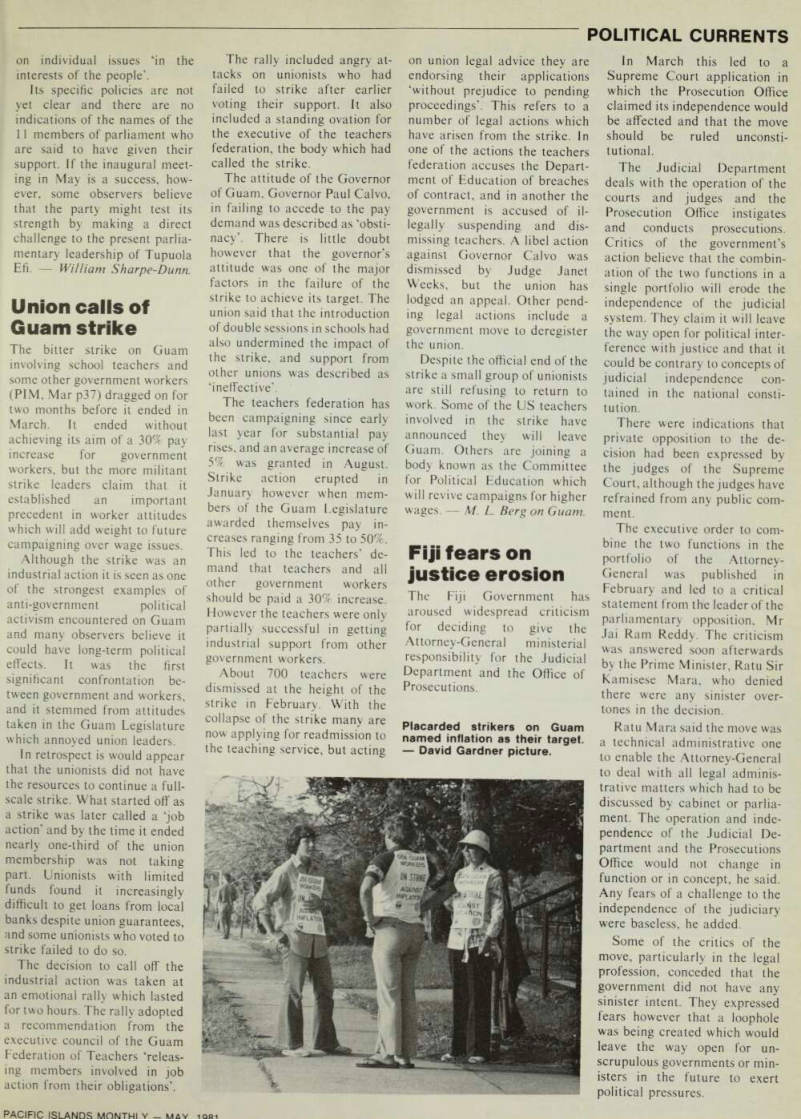
Political
Currents
Rebel arms plot concerns PNG
One of the most sensitive issues in Papua New Guinea home and foreign affairs, the anti-Indonesian rebel movement in adjoining Irian Jaya, has been revived just when it seemed to be settling down. This report from Port Moresby tells of an apparently ham-fisted but potentially serious attempt to smuggle arms through PNG to the rebels.
Papua New Guinea police and security officials claimed in March to have discovered a plot to smuggle weapons from com munist sources to rebels in the Indonesian province of Irian Jaya. PNG was to be used as the transfer point for getting the weapons to the rebels, investi gators said. The investigations included the interception of a letter in the mails, police raids on two houses, and the seizing of a number of documents from the houses.
Irian Jaya, once known as West New Guinea, shares a land border with PNG. It con tains rebel cells of the Free Papua Movement (OPM) which opposes Indonesian sov ereignty in Irian Jaya and is calling for independence.
Because of ethnic links the OPM looks to Papua New Guineans for support, but the PNG government recognises Irian Jaya as part of Indonesia and supports the Indonesian attitude of outlawing the rebels.
PNG has given permissive resi dence to some Irianese who have been able to establish refugee status under inter national protocol, but has banned them from any involve ment in rebel politics. The
recent investigations suggest
however that some of the Irianese living in PNG have
broken their undertaking and
lave been giving secret support :o the rebels across the border.
The investigation started ifter security officials in PNG :ame into possession of a letter vhich had been mailed from 3 NG to Turkey. It had alleg edly been sent to a Russian contact in Turkey but had been eturned to PNG through postal channels after being indelivered.
The letter said ‘with the issistance of communist countries the imperialist dog
Indonesia can be driven out of Irian Jaya’.
The secretary of the prime minister’s department, Mr F.
Reiher, who is also chairman of the national security advisory committee, said the government took a serious view of what had been disclosed. ‘We are not treating this merely as a hoax’ he said.
As a result of information contained in the letter police raided two houses occupied by Irianese, one in Port Moresby and the other in Madang. They took possession of documents and other letters. There was no immediate decision on the nature of any prosecutions which might follow the police action.
There have been two develop ments since the prime minis ter’s office confirmed that it was taking a serious view of OPM activity involving PNG.
In the first development the PNG foreign minister, Mr Noel Levi, played down the significance of the documents which had been seized. ‘There is not enough evidence at this stage we only have a few letters' he said.
In the other development one of the Irianese whose homes were raided confirmed that the OPM was seeking arms from Russia and from Cuba also but he strongly denied that there was any intention to involve PNG as a smuggling point. The statement came from Mr Henk Joku of Port Moresby who said the suggestion that PNG would be involved was ‘humiliating’. The decision to seek arms had been made outside PNG and the intention was that the arms should be landed directly in Irian Jaya.
PNG and its sovereignty were not involved, he said.
Members of the OPM have long carried out military-type
drill in camps which they have established in isolated parts of Irian Jaya. However they have had few rifles and their drill exercises have involved carry ing sticks on their shoulders like rifles. The number of active rebels is believed to have dwindled considerably in the past three years. There have been occasional reports of rebel patrol attacks on Indonesian military outposts. On these oc casions most of the rebels were reported to have been armed with bows, arrows and spears, although a few were said to have old rifles and shotguns.
Indonesian officials deny that there has been any rebel ac tivity since 1978 when one of the key men in the OPM, Jacob Prai, crossed illegally into PNG and was captured by PNG police. Prai served a gaol term in Port Moresby for being a prohibited migrant and was able to establish refugee status.
PNG however refused to give him permissive residence be cause of the sensitivity of re lations with Indonesia and he was eventually granted permiss ive residence in Sweden where
he still lives.
Michael Praia
in Port Moresby.
W. Samoa move
for parties
‘I have washed my hands of the two existing parties in parlia ment that is the government and the opposition like Pilate who washed his hands to prove himself innocent of Christ’s blood.’ A Western Samoan member of parliament, Mapuilesua Pelenato, used this Bible-based imagery when he announced plans in February for the formation of a new political party. No name has yet been give to the proposed party, but its name will be announced when the expected formal in auguration is carried out in May.
At present Western Samoa has only one formally constituted political party, the Human Rights Protection Parly, which unofficially sees itself as the opposition in parlia ment. The constitution does not provide for a formal opposition, and all members of parliament are technically independents.
The emergence of the Human Rights Party led to the creation of a loosely-allied group in
government known simply as ‘the government party’.
Mapuilesua’s newly-planned party will attempt to gain office at the next general election in 1982, but it could move for power earlier. The parliament has 47 members, and Mapuilesua claims to have 11 supporters already from the present membership of parlia ment.
The Samoa Weekly quoted him as saying The main aim of this new party is to change the government so that righteous ness and lawful judgment are carried out for the benefit of everyone. We will fight the people’s rights.’
Mapuilesua was elected to parliament only last year at a by-election for a seal in Savaii.
He cut short a visit to USA to stand for election and ostensibly was a strong supporter of the Prime Minister, Tupuola Efi.
Western Samoa has been independent since 1962 and its constitution makes no provision for political parties. This was a deliberate move on the basis that party politics could be nationally disruptive. It was a direct contrast to the manner in which some other Pacific Island countries planned their political independence. Papua New Guinea, for instance, delib erately fostered political parties in the belief that this was the most effective manner to de velop an active nationalism. It was not until the elections of 1979 that the first party-type groupings emerged in Western Samoa when the veteran poli tician Vaai Kolone led a dissent ing group away from Tupuola Efi. The new party became the Human Rights Protection Party and made a bid for government, but Tupuola Efi defeated Vaai Kolone by one vote for the position of prime minister.
Mapuilesua claims that in the immediate future his planned party will not ally itself with either of the two existing group ings but will take its own stand
on individual issues ‘in the interests of the people’.
Its specific policies are not yet clear and there are no indications of the names of the 11 members of parliament who are said to have given their support. If the inaugural meet ing in May is a success, how ever, some observers believe that the party might test its strength by making a direct challenge to the present parlia mentary leadership of Tupuola
Efi.
William Sharpe-Dunn.
Union calls of
Guam strike
The bitter strike on Guam involving school teachers and some other government workers (PIM, Mar p 37) dragged on for two months before it ended in March. It ended without achieving its aim of a 30% pay increase for government workers, but the more militant strike leaders claim that it established an important precedent in worker attitudes which will add weight to future campaigning over wage issues.
Although the strike was an industrial action it is seen as one of the strongest examples of anti-government political activism encountered on Guam and many observers believe it could have long-term political effects. It was the first significant confrontation be tween government and workers, and it stemmed from attitudes taken in the Guam Legislature which annoyed union leaders.
In retrospect is would appear that the unionists did not have the resources to continue a full scale strike. What started off as a strike was later called a ‘job action’ and by the time it ended nearly one-third of the union membership was not taking part. Unionists with limited funds found it increasingly difficult to get loans from local banks despite union guarantees, and some unionists who voted to strike failed to do so.
The decision to call off the industrial action was taken at an emotional rally which lasted for two hours. The rally adopted a recommendation from the executive council of the Guam Federation of Teachers ‘releas ing members involved in job action from their obligations’.
The rally included angry at tacks on unionists who had failed to strike after earlier voting their support. It also included a standing ovation for the executive of the teachers federation, the body which had called the strike.
The attitude of the Governor of Guam, Governor Paul Calvo, in failing to accede to the pay demand was described as ‘obsti nacy’. There is little doubt however that the governor’s attitude was one of the major factors in the failure of the strike to achieve its target. The union said that the introduction of double sessions in schools had also undermined the impact of the strike, and support from other unions was described as ‘ineffective’.
The teachers federation has been campaigning since early last year for substantial pay rises, and an average increase of 5% was granted in August.
Strike action erupted in January however when mem bers of the Guam Legislature awarded themselves pay in creases ranging from 35 to 50%.
This led to the teachers’ de mand that teachers and all other government workers should be paid a 30% increase.
However the teachers were only partially successful in getting industrial support from other government workers.
About 700 teachers were dismissed at the height of the strike in February. With the collapse of the strike many are now applying for readmission to the teaching service, but acting
on union legal advice they are endorsing their applications ‘without prejudice to pending proceedings’. This refers to a number of legal actions which have arisen from the strike. In one of the actions the teachers federation accuses the Depart ment of Education of breaches of contract, and in another the government is accused of il legally suspending and dis missing teachers. A libel action against Governor Calvo was dismissed by Judge Janet Weeks, but the union has lodged an appeal. Other pend ing legal actions include a government move to deregister the union.
Despite the official end of the strike a small group of unionists are still refusing to return to work. Some of the US teachers involved in the strike have announced they will leave Guam. Others are joining a body known as the Committee for Political Education which will revive campaigns for higher
wages.
M. L Berg on Guam.
Fiji fears on
justice erosion
The Fiji Government has aroused widespread criticism for deciding to give the Attorney-General ministerial responsibility for the Judicial Department and the Office of Prosecutions.
In March this led to a Supreme Court application in which the Prosecution Office claimed its independence would be affected and that the move should be ruled unconsti tutional.
The Judicial Department deals with the operation of the courts and judges and the Prosecution Office instigates and conducts prosecutions.
Critics of the government’s action believe that the combin ation of the two functions in a single portfolio will erode the independence of the judicial system. They claim it will leave the way open for political inter ference with justice and that it could be contrary to concepts of judicial independence con tained in the national consti tution.
There were indications that private opposition to the de cision had been expressed by the judges of the Supreme Court, although the judges have refrained from any public com ment.
The executive order to com bine the two functions in the portfolio of the Attorney- General was published in February and led to a critical statement from the leader of the parliamentary opposition, Mr Jai Ram Reddy. The criticism was answered soon afterwards by the Prime Minister, Ratu Sir Kamisese Mara, who denied there were any sinister over tones in the decision.
Ratu Mara said the move was a technical administrative one to enable the Attorney-General to deal with all legal adminis trative matters which had to be discussed by cabinet or parlia ment. The operation and inde pendence of the Judicial De partment and the Prosecutions Office would not change in function or in concept, he said.
Any fears of a challenge to the independence of the judiciary were baseless, he added.
Some of the critics of the move, particularly in the legal profession, conceded that the government did not have any sinister intent. They expressed fears however that a loophole was being created which would leave the way open for un scrupulous governments or min isters in the future to exert political pressures.
Placarded strikers on Guam named inflation as their target. - David Gardner picture.
Advertisements & other items, pp. 31-34 (3 items)
’Acific Islands Monthly - May. 1981
Ago Is Al 5 Year Old Idea.
S 3 % *4 The 15 year old golf ball.
The Olivetti daisy wheel.
THAT FANTASTIC IDEA Of 15 YEARS
AGO IS Al 5 YEAR OLD IDEA.
NOW ITS THE AGE Of THE OLIVETTI
ELECTRONIC TYPEWRITER.
As a concept the golf ball typewriter still continues to fulfill a useful function.
But times do change.
Now you have a typewriter that prints faster, smarter and quieter than ever before.
Olivetti Electronic Typewriters have just changed the whole technology of typing and typing will never be the same again.
The Olivetti Electronic Typewriters print from the new technology daisy wheel and have many other effortless advantages over anything any secretary has seen or used before. Some have features like the remarkable 20 character illuminated display window which allows the typist to correct errors before they are typed on the paper, memory function for phrases and formats, automatic centering and underscoring, automatic numeric alignment and centering of columns on a page. What does it all mean?
For the typist it means freedom from mundane and timeconsuming typing tasks.
For management it means increased productivity and immaculate presentations that it will be proud to sign.
And it comes at a price no-one else can match.
Only a demonstration of the Olivetti Electronic Typewriters can bring to life the many advantages of Olivetti electronic typing. So phone today for a demonstration.
Olivetti 121 - standard electronic typewriter Olivetti 221 - sophisticated electronic typewriter with memory.
Olivetti 231 - sophisticated electronic typewriter with 10 page memory. n Export Manager, Olivetti Australia Pty. Ltd 140 William Street, Sydney, NSW 2011.
Name.
Company.
Model.
Address. .Postcode.
Phone.
L
0L1506/FMMH
m m ' :■ I U
Olivetti
Armstrong & Springhall, 163 Victona Parade, Suva, Fiji. Tel 24 071 Armstrong & Sprinhall, 99-107 Dixon Street, Wellington, New Zealand. Tel: 850 777. Armstrong & Sprmghall, P.O Box 498, Apia, Western Samoa. Tel: 21 777. Ets Rene Solan & Fils, 7 Rue du General de Gaulle, Papeete, Tahiti. Tel; 25359. Maison Barrau, Boite Postale A 4, Noumea, Nouvelle-Caledonie. Tel: 27 3774. P.N.G. Printing, P.O. Box 633, Port Moresby, Papua New Guinea. Tel: 21 2277. Tonga Equipment, cnr. Taufa'ahau & Laifone Roads, Nuku'Alofa, Tonga. Tel: 21 320. For farther information please contact any of the above, or send coupon to Export Division, Olivetti Australia. We welcome enquiries for agencies in areas not covered by above.
A tiny sensation.
It's incredible that a component system so small can deliver such sensational sound. But there's no denying it. Hitachi M 2 MKll Minicomponents give you stereo sound that really fills the room - in a size
that barely fills a bookshelf.
The powerful M 2 MKll integrated amplifier, metal capable tape deck with Dolby,* phase-lock tuner and 2-way speakers. Put them together any way you like for performance you're sure to love. Their rounded-edge design makes them as versatile as they are contemporary. And the dimensions are matched for a unified look, no matter how you arrange them.
Hitachi M 2 MKll Minicomponents. Great big sound
from a great little system.
rw-u 975 90 92 94 3 speaker /*•" /tT &
@ HITAC
HITACHI
* Mi
ru m
m The HA-M 2 MKll Integrated Amplifier is rated at 25 watts per channel continuous RMS power.
Dimensions (WxhxD): HA-M 2 MKll integrated Amplifier (230x?4xi84 mm), D-M2 MKll cassette Deck (230x146x162 mm). FT-M 2 MKll Tuner (230x74x160 mm), and HS-M2 MKll Speaker System (146x290x160 mm). * Dolby is a trademark of Dolby Laboratories. i AUSTRALIA: Hitachi Sales Australia Pty., Ltd., 153 Keys Road. Moorabbln, victoria 3189 Phone: (95) 8722 NEW ZEALAND: AWA New Zealand Limited, Wl-neera Drive, PO. Box 50-248. Porirua Phone: 43-75-069 ’ PAPUA NEW GUINEA: s.O. Svensson (N.C.) Ltd., PO. box 705, Port Moresby Phone: 21-2111 ’ FUi islands: Burns Phllp (South Sea) Co., Ltd., Box 355, C.P.0., Suva Phone: 311777 . NEW CALEDONIA: Caldis, B.P Ml, Noumea Phone: 26.23 50 TAHITI: Ets Chene Alain, p.o. box 272, Papeete Phone: 2.88.68 SOLOMON ISLANDS: Technique Radios Centre Ltd.. PO. Box 465. Honiara Phone: 416 NAURU: Nauru Cooperative Society, Republic of Nauru AMERICAN SAMOA: Burns Phllp (South sea) Co., Ltd., P O Box 129, Pago Pago NEW HEBRIDES: Burns Phllp (New Hebrides) Co., Ltd., P.O. Box 27, Port Vila
HITACHI
Political Currents
PACIFIC ISLANDS MONTH! Y MAY ioai
PNG party system
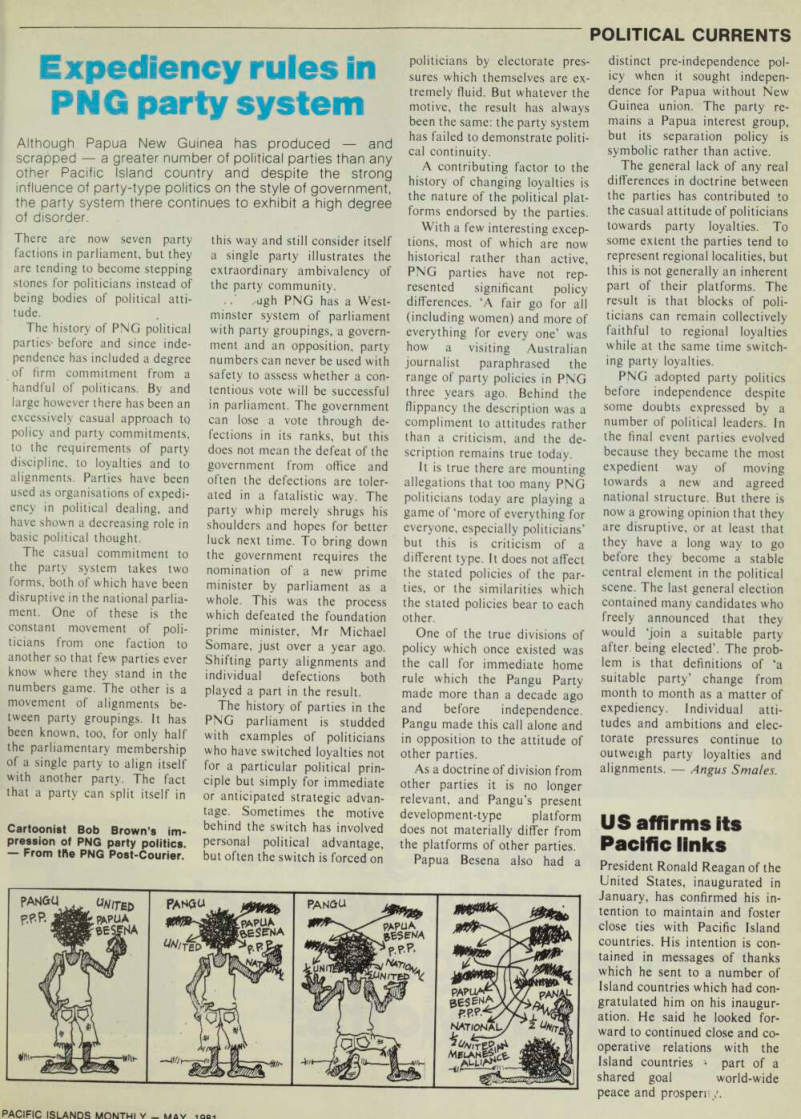
Expediency rules in PNG party system
Although Papua New Guinea has produced and scrapped a greater number of political parties than any other Pacific Island country and despite the strong influence of party-type politics on the style of government, the party system there continues to exhibit a high degree of disorder.
There are now seven party factions in parliament, but they are tending to become stepping stones for politicians instead of being bodies of political atti tude.
The history of PNG political parties- before and since inde pendence has included a degree of firm commitment from a handful of politicans. By and large however there has been an excessively casual approach to policy and party commitments, to the requirements of party discipline, to loyalties and to alignments. Parties have been used as organisations of expedi ency in political dealing, and have shown a decreasing role in basic political thought.
The casual commitment to the party system takes two forms, both of which have been disruptive in the national parlia ment. One of these is the constant movement of poli ticians from one faction to another so that few parties ever know where they stand in the numbers game. The other is a movement of alignments be tween party groupings. It has been known, too, for only half the parliamentary membership of a single party to align itself with another party. The fact that a party can split itself in
this way and still consider itself a single party illustrates the extraordinary ambivalency of the party community. -. --ugh PNG has a West minster system of parliament with party groupings, a govern ment and an opposition, party numbers can never be used with safely to assess whether a con tentious vote will be successful in parliament. The government can lose a vote through de fections in its ranks, but this does not mean the defeat of the government from office and often the defections are toler ated in a fatalistic way. The party whip merely shrugs his shoulders and hopes for better luck next time. To bring down the government requires the nomination of a new prime minister by parliament as a whole. This was the process which defeated the foundation prime minister, Mr Michael Somare, just over a year ago.
Shifting party alignments and individual defections both played a part in the result.
The history of parties in the PNG parliament is studded with examples of politicians who have switched loyalties not for a particular political prin ciple but simply for immediate or anticipated strategic advan tage. Sometimes the motive behind the switch has involved personal political advantage, but often the switch is forced on
politicians by electorate pres sures which themselves are ex tremely fluid. But whatever the motive, the result has always been the same: the party system has failed to demonstrate politi cal continuity.
A contributing factor to the history of changing loyalties is the nature of the political plat forms endorsed by the parties.
With a few interesting excep tions, most of which are now historical rather than active, PNG parties have not rep resented significant policy differences. ‘A fair go for all (including women) and more of everything for every one’ was how a visiting Australian journalist paraphrased the range of party policies in PNG three years ago. Behind the flippancy the description was a compliment to attitudes rather than a criticism, and the de scription remains true today.
It is true there are mounting allegations that too many PNG politicians today are playing a game of ‘more of everything for everyone, especially politicians’ but this is criticism of a different type. It does not affect the stated policies of the par ties, or the similarities which the stated policies bear to each other.
One of the true divisions of policy which once existed was the call for immediate home rule which the Pangu Party made more than a decade ago and before independence.
Pangu made this call alone and in opposition to the attitude of other parties.
As a doctrine of division from other parties it is no longer relevant, and Pangu’s present
development-type platform
does not materially differ from the platforms of other parties.
Papua Besena also had a
distinct pre-independence pol icy when it sought indepen dence for Papua without New Guinea union. The party re mains a Papua interest group, but its separation policy is symbolic rather than active.
The general lack of any real differences in doctrine between the parties has contributed to the casual attitude of politicians towards party loyalties. To some extent the parties tend to represent regional localities, but this is not generally an inherent part of their platforms. The result is that blocks of poli ticians can remain collectively faithful to regional loyalties while at the same time switch ing party loyalties.
PNG adopted party politics before independence despite some doubts expressed by a number of political leaders. In the final event parties evolved because they became the most expedient way of moving towards a new and agreed national structure. But there is now a growing opinion that they are disruptive, or at least that they have a long way to go before they become a stable central element in the political scene. The last general election contained many candidates who freely announced that they would ‘join a suitable party after being elected’. The prob lem is that definitions of ‘a suitable party’ change from month to month as a matter of expediency. Individual atti tudes and ambitions and elec torate pressures continue to outweigh party loyalties and
alignments.
Angus Smales.
US affirms its
Pacific links
President Ronald Reagan of the United States, inaugurated in January, has confirmed his in tention to maintain and foster close ties with Pacific Island countries. His intention is con tained in messages of thanks which he sent to a number of Island countries which had con gratulated him on his inaugur ation. He said he looked for ward to continued close and co operative relations with the Island countries * part of a shared goal world-wide peace and prospen /.
Cartoonist Bob Brown’s im pression of PNG party politics.
From the PNG Post-Courier.
Advertisements & other items, pp. 35-38 (3 items)
Pacific Islands Monthi Y _ May 1001
PACIFIC ISLANDS MONTHI Y may 1001
POLITICAL CURRENTS
36
PAP.IFin IRI AMDS MONTHLY - MAY. T9S4
to great lengths -
w: r I ■< 4 ■ « ■ ■ &$ mm m i vj IB H ■ mmm ' ■ ■ « AH A ■ ■ir I i K rt!
“To make flying more
comfortable, we went
to great lengths -
and great widths.”
Pete Conrad Former Astronaut Senior Vice-President Douglas Aircraft Company
■ iiiii ■ I mm w m “The first thing you’ll feel when you step into our new Super 80 is a sense of space - from front to back and side to side.
“You won’t find that in narrow-cabin jets with six-across seating. They stuff 159 passengers into 28 rows. Our new Super 80 stretches 152 seats along 32 rows. Four additional rows, all only five seats wide, take away the crowded feeling.
“The Super 80 is a realization of advantages we’ve always had in DC-9s. Wider seats and a wider aisle, because we have only five seats across instead of six.
“Four out of five passengers get a window or aisle seat in the Super 80.
“Wherever you sit, you get more room to yourself.
Every seat is just as wide as those in the jumbo jets.
We’ve redesigned the seat supports, too, so carry-on luggage slips easily underneath.
“Because our new Super 80 is quiet on the outside, you’d expect it to be quieter inside - and it is. Frankly, you have to hear it (or not hear it) to believe it.
“The new DC-9 Super 80. It’s everything the world needs to fly comfortably in the future.
And it’s here, today.”
Super 80
/V7CDO/V/VELL v\
DOUGLAS
STATESMAN
CORONA
STATESMAN
STATESMAN
HALF CORONA
5,
STATESMAN
OWETTE
STATESMAN
STATESMAN
LANCERS
K> 5
STATESMAN
▼ © © Q 7
PANATELLA UWO
5 PANATEIXA
STATESMAN
Smooth, mild cigars.
© W. D. & H. O. WILLS (AUSTRALIA) LIMITED
E6BO
People
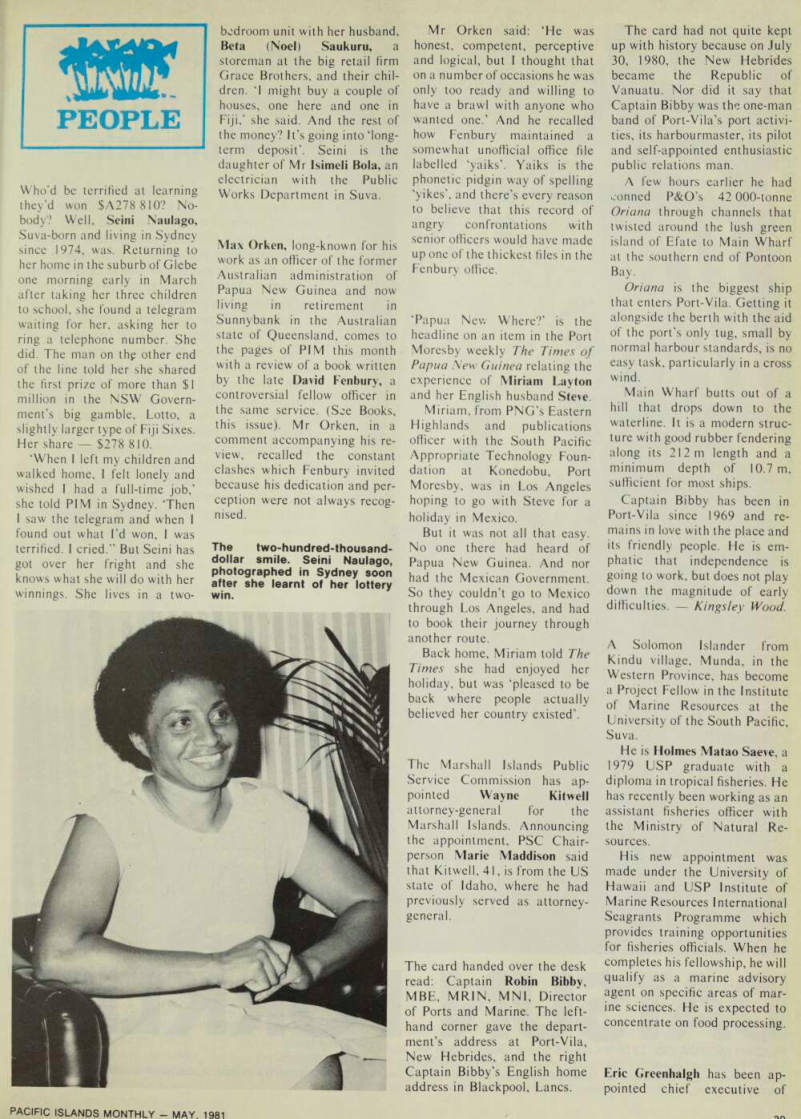

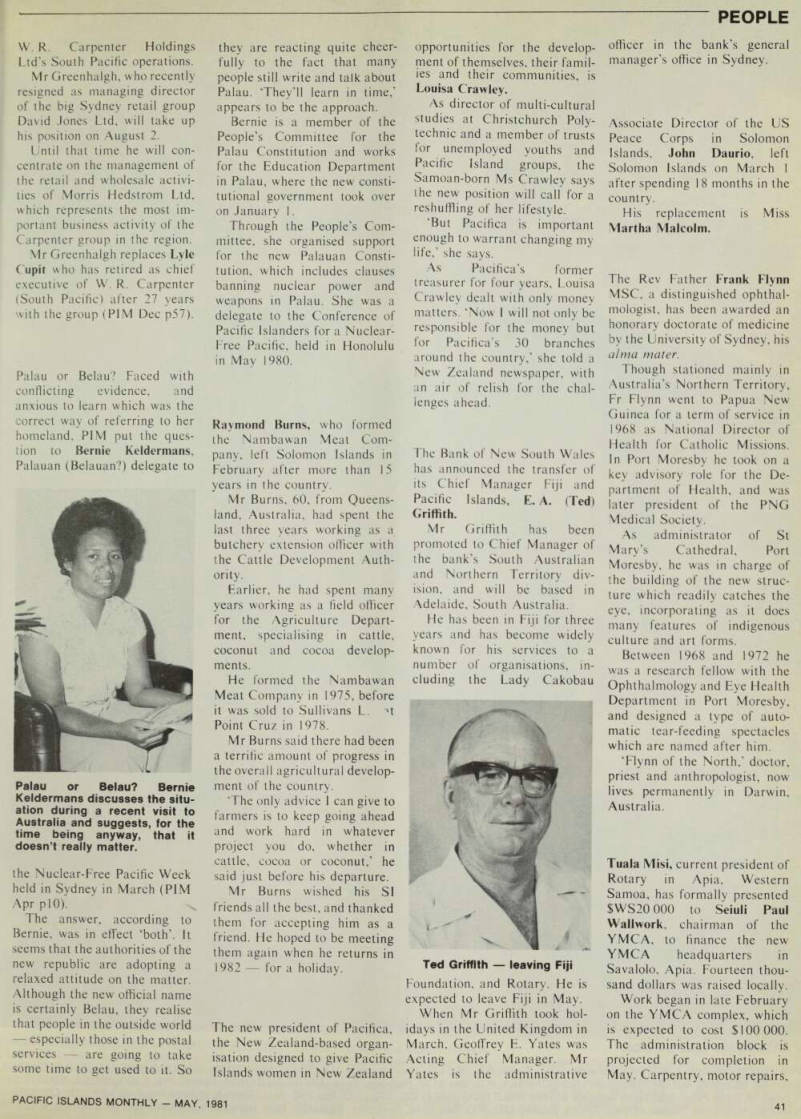

Who’d be terrified at learning they’d won SA27B 810? No body? Well, Seini Naulago, Suva-born and living in Sydney since 1974, was. Returning to her home in the suburb of Glebe one morning early in March after taking her three children to school, she found a telegram wailing for her, asking her to ring a telephone number. She did. The man on thp other end of the line told her she shared the first prize of more than $1 million in the NSW Govern ment’s big gamble. Lotto, a slightly larger type of Fiji Sixes.
Her share $278 810. ‘When I left my children and walked home, I felt lonely and wished I had a full-time job,' she told PIM in Sydney. Then I saw the telegram and when I found out what I’d won, I was terrified. 1 cried.” But Seini has got over her fright and she knows what she will do with her winnings. She lives in a two
bedroom unit with her husband, Beta (Noel) Saukuru, a storeman at the big retail firm Grace Brothers, and their chil dren. ‘I might buy a couple of houses, one here and one in Fiji,’ she said. And the rest of the money? It’s going into ‘long term deposit'. Seini is the daughter of Mr Isimeli Bola, an electrician with the Public Works Department in Suva.
Max Orken, long-known for his work as an officer of the former Australian administration of Papua New Guinea and now living in retirement in Sunnybank in the Australian state of Queensland, comes to the pages of PIM this month with a review of a book written by the late David Fenbury, a controversial fellow officer in the same service. (See Books, this issue). Mr Orken, in a comment accompanying his re view, recalled the constant clashes which Fenbury invited because his dedication and per ception were not always recog nised.
Mr Orken said; ‘He was honest, competent, perceptive and logical, but I thought that on a number of occasions he was only too ready and willing to have a brawl with anyone who wanted one.’ And he recalled how Fenbury maintained a somewhat unofficial office file labelled ‘yaiks’. Yaiks is the phonetic pidgin way of spelling ‘yikes’, and there’s every reason to believe that this record of angry confrontations with senior officers would have made up one of the thickest files in the Fenbury office. ‘Papua New Where?’ is the headline on an item in the Port Moresby weekly The Times of Papua New’ Guinea relating the experience of Miriam Layton and her English husband Steve.
Miriam, from PNG’s Eastern Highlands and publications officer with the South Pacific Appropriate Technology Foun dation at Konedobu, Port Moresby, was in Los Angeles hoping to go with Steve for a holiday in Mexico.
But it was not all that easy.
No one there had heard of Papua New Guinea. And nor had the Mexican Government.
So they couldn’t go to Mexico through Los Angeles, and had to book their journey through another route.
Back home, Miriam told The Times she had enjoyed her holiday, but was ‘pleased to be back where people actually believed her country existed’.
The Marshall Islands Public Service Commission has ap pointed Wayne Kitwell attorney-general for the Marshall Islands. Announcing the appointment, PSC Chair person Marie Maddison said that Kitwell, 41, is from the US state of Idaho, where he had previously served as attorney general.
The card handed over the desk read: Captain Robin Bibby, MBE, MRIN, MNI, Director of Ports and Marine. The left hand corner gave the depart ment’s address at Port-Vila, New Hebrides, and the right Captain Bibby’s English home address in Blackpool, Lancs.
The card had not quite kept up with history because on July 30, 1980, the New Hebrides became the Republic of Vanuatu. Nor did it say that Captain Bibby was the one-man band of Port-Vila’s port activi ties, its harbourmaster, its pilot and self-appointed enthusiastic public relations man.
A few hours earlier he had conned P&O’s 42 000-tonne Oriana through channels that twisted around the lush green island of Efale to Main Wharf at the southern end of Pontoon Bay.
Oriana is the biggest ship that enters Port-Vila. Getting it alongside the berth with the aid of the port’s only tug, small by normal harbour standards, is no easy task, particularly in a cross wind.
Main Wharf butts out of a hill that drops down to the waterline. It is a modern struc ture with good rubber fendering along its 212 m length and a minimum depth of 10.7 m, sufficient for most ships.
Captain Bibby has been in Port-Vila since 1969 and re mains in love with the place and its friendly people. He is em phatic that independence is going to work, but does not play down the magnitude of early difficulties. Kingsley Wood.
A Solomon Islander from Kindu village, Munda, in the Western Province, has become a Project Fellow in the Institute of Marine Resources at the University of the South Pacific, Suva.
He is Holmes Matao Saeve, a 1979 USP graduate with a diploma in tropical fisheries. He has recently been working as an assistant fisheries officer with the Ministry of Natural Re sources.
His new appointment was made under the University of Hawaii and USP Institute of Marine Resources International Seagrants Programme which provides training opportunities for fisheries officials. When he completes his fellowship, he will qualify as a marine advisory agent on specific areas of mar ine sciences. He is expected to concentrate on food processing.
Eric Greenhalgh has been ap pointed chief executive of
The two-hundred-thousand dollar smile. Seini Naulago, photographed in Sydney soon after she learnt of her lottery win.
W. R. Carpenter Holdings Ltd’s South Pacific operations.
Mr Greenhalgh, who recently resigned as managing director of the big Sydney retail group David Jones Ltd, will take up his position on August 2.
Until that time he will con centrate on the management of the retail and wholesale activi ties of Morris Hedstrom Ltd, which represents the most im portant business activity of the Carpenter group in the region.
Mr Greenhalgh replaces Lyle Cupit who has retired as chief executive of W. R. Carpenter (South Pacific) after 27 years with the group (PIM Dec p 57).
Palau or Belau? Faced with conflicting evidence, and anxious to learn which was the correct way of referring to her homeland, PIM put the ques tion to Bernie Keldermans, Palauan (Belauan?) delegate to
the Nuclear-Free Pacific Week held in Sydney in March (PIM Apr plO).
The answer, according to Bernie, was in effect ‘both’. It seems that the authorities of the new republic are adopting a relaxed attitude on the matter.
Although the new official name is certainly Belau, they realise that people in the outside world especially those in the postal services are going to take some time to get used to it. So
they are reacting quite cheer fully to the fact that many people still write and talk about Palau. ‘They’ll learn in time,' appears to be the approach.
Bernie is a member of the People’s Committee for the Palau Constitution and works for the Education Department in Palau, where the new consti tutional government took over on January 1.
Through the People’s Com mittee, she organised support for the new Palauan Consti tution, which includes clauses banning nuclear power and weapons in Palau. She was a delegate to the Conference of Pacific Islanders for a Nuclear- Free Pacific, held in Honolulu in May 1980.
Raymond Burns, who formed the Nambawan Meat Com pany, left Solomon Islands in February after more than 15 years in the country.
Mr Burns, 60, from Queens land, Australia, had spent the last three years working as a butchery extension officer with the Cattle Development Auth ority.
Earlier, he had spent many years working as a field officer for the Agriculture Depart ment, specialising in cattle, coconut and cocoa develop ments.
He formed the Nambawan Meat Company in 1975, before it was sold to Sullivans L. M Point Cruz in 1978.
Mr Burns said there had been a terrific amount of progress in the overall agricultural develop ment of the country. ‘The only advice 1 can give to farmers is to keep going ahead and work hard in whatever project you do, whether in cattle, cocoa or coconut,’ he said just before his departure.
Mr Burns wished his SI friends all the best, and thanked them for accepting him as a friend. He hoped to be meeting them again when he returns in 1982 for a holiday.
The new president of Pacifica, the New Zealand-based organ isation designed to give Pacific Islands women in New Zealand
opportunities for the develop ment of themselves, their famil ies and their communities, is Louisa Crawley.
As director of multi-cultural studies at Christchurch Poly technic and a member of trusts for unemployed youths and Pacific Island groups, the Samoan-born Ms Crawley says the new position will call for a reshuffling of her lifestyle. ‘But Pacifica is important enough to warrant changing my life,’ she says.
As Pacifica’s former treasurer for four years, Louisa Crawley dealt with only money matters. ‘Now I will not only be responsible for the money but for Pacifica’s 30 branches around the country,’ she told a New Zealand newspaper, with an air of relish for the chal lenges ahead.
The Bank of New South Wales has announced the transfer of its Chief Manager Fiji and Pacific Islands, E. A. (Ted) Griffith.
Mr Griffith has been promoted to Chief Manager of the bank’s South Australian and Northern Territory div ision, and will be based in Adelaide, South Australia.
He has been in Fiji for three years and has become widely known for his services to a number of organisations, in cluding the Lady Cakobau
Foundation, and Rotary. He is expected to leave Fiji in May.
When Mr Griffith took hol idays in the United Kingdom in March, Geoffrey E. Yates was Acting Chief Manager. Mr Yates is the administrative
officer in the bank’s general manager’s office in Sydney.
Associate Director of the US Peace Corps in Solomon Islands. John Daurio, left Solomon Islands on March 1 after spending 18 months in the country.
His replacement is Miss Martha Malcolm.
The Rev Father Frank Flynn MSC, a distinguished ophthal mologist, has been awarded an honorary doctorate of medicine by the University of Sydney, his alma mater.
Though stationed mainly in Australia’s Northern Territory, Fr Flynn went to Papua New Guinea for a term of service in 1968 as National Director of Health for Catholic Missions.
In Port Moresby he took on a key advisory role for the De partment of Health, and was later president of the PNG Medical Society.
As administrator of St Mary’s Cathedral, Port Moresby, he was in charge of the building of the new struc ture which readily catches the eye, incorporating as it does many features of indigenous culture and art forms.
Between 1968 and 1972 he was a research fellow with the Ophthalmology and Eye Health Department in Port Moresby, and designed a type of auto matic tear-feeding spectacles which are named after him. ‘Flynn of the North,’ doctor, priest and anthropologist, now lives permanently in Darwin, Australia.
Tuala Misi, current president of Rotary in Apia, Western Samoa, has formally presented SWS2O 000 to Seiuli Paul Wallwork, chairman of the YMCA, to finance the new YMCA headquarters in Savalolo, Apia. Fourteen thou sand dollars was raised locally.
Work began in late February on the YMCA complex, which is expected to cost $lOO 000.
The administration block is projected for completion in May. Carpentry, motor repairs,
Palau or Belau? Bernie Keldermans discusses the situ ation during a recent visit to Australia and suggests, for the time being anyway, that it doesn’t really matter.
Ted Griffith - leaving Fiji
sports, rural development pro grammes, and staff training will all be catered for in the new building.
The donation was the result of two years’ fund-raising by Rotary under the presidencies of John McDonald and the Rev Joe Pusateri.
L. G. M. (Gordon) Latimer ar rived in Solomon Islands in February to take over as the first general manager and a director of the National Bank of Solomon Islands (NBSI) on a three-year appointment.
The NBSI took over the Solomon Islands banking oper ations of the (Australian) Com monwealth Banking Corpor ation from March 2.
Mr Latimer will be on secondment from the CBC, where he has had wide experi ence in many aspects of the bank’s operations.
Nadi lawyer Manikam Pillai has been appointed Fiji’s new attorney-general. He succeeds Andrew Deoki who has resigned to live in Australia.
A senior economist with Fiji’s Ministry of Commerce and Industry, Arvindra Rao, is on a three-year scholarship to do a master’s degree in economics at the University of New England, New South Wales, Australia.
Mr Rao graduated with a bach elor’s degree from the Univer sity of Canterbury, New Zea land, in 1973. The new course has been made possible under an Australia aid programme.
Count and Countess Bernadette of Sweden visited Fiji in March.
The countess said the visit was a 70th birthday present for the count, who, as a member of the Swedish royal family, is related to most of Europe’s royalty.
The couple said that while in many countries tourists were ‘merely tolerated’ they felt that in Fiji ‘people were pleased to have us’.
Alan Hannay has been named the new regional manager for Fiji of the Bank of New Zea
land. He succeeds John Galt, who returns to Wellington to take up a head office post.
James Vaiagina Makasiale, a Fijian with 20 years experience in rural development in his own country, has been appointed to the East-West Center staff as administrator of the insti tution’s new Pacific Islands Development Program.
Mr Makasiale, 43, served as
director of extension services and as a district commissioner in Fiji before joining the East- West Center. He will be in charge of a programme of education, research and train ing which is being organised as the result of a policy conference of government heads and plan ning directors of 20 Pacific Islands states at the Center last year.
'Mr Makasiale is uniquely qualified to direct this exciting new programme at the East- West Center,’ said Acting President Lee-Jay Cho in an nouncing the appointment. ‘He is a good example of the new breed of administrative leader ship that has been emerging not only in the independent states of the South Pacific but in the new governments of the Micro nesian Trust Territory.’
After serving for three years in Fiji’s early rural development programmes, Mr Makasiale came to the East-West Center in 1963 to study for a bachelor’s degree in agricultural science at the University of Hawaii. Re turning to Fiji, he served as a district agricultural officer, earned a post-graduate diploma in agricultural extension at the University of Queensland,
Australia, and in 1975 was appointed director of extension services and lecturer at the University of the South Pacific in Suva.
In 1976, he was appointed commissioner for Fiji’s Eastern Division, and in 1978 became commissioner for the Central Division, the largest of the country’s four divisions. As commissioner, he was the highest ranking government official of the division, with overall responsibility for the administration of his region, responsible directly to the prime minister.
The Olbiil Era Kelulau (Palau National Congress) during its first regular session in February adopted a joint resolution awarding Rechucher Charlie W. Gibbons (PIM Mar p 39) the title of an honorary senator of the first Olbiil Era Kelulau of the Republic of Palau.
The resolution, introduced by Senator Edobo (Edward) Temengil, said it was designed to honour Rechucher Charlie W. Gibbons ‘for many years of outstanding contributions to the art, culture and heritage of Palau’.
The resolution added that Gibbons had worked as a black smith in Yap, was employed by the German administration in Yap and Palau in laying the first cable between Guam, Min danao and Shanghai, spent seven years in Ponape working with the Japanese constabulary, became director of the agriculture training programme for the Japanese adminis tration, was employed by the US military administration as an interpreter after the war, then became special assistant to the military governor under the navy administration, became the first Palauan ever appointed assistant district agriculturist in 1945, served as associate judge from 1948 to 1959, joined the staff of the Palau Museum, and launched his career as wood carver. At the age of 70, Gibbons took up water colour painting, and became an excel lent painter.
His paintings depict the cul ture and heritage of Palau, including scenes of important rituals, and have been exhibited
in the United States, Europe, Guam, Saipan, Palau and Papua New Guinea.
Gibbons was born in Ngaraad State, Palau, on April 1, 1894. In 1945 he was made Rechucher of Koror State, a title he still bears.
The resolution concluded: 'The people of Palau through their elected extend their best wishes for continued good health and boundless happiness to Rechu cher Charlie W. Gibbons.’
Da\id Caffin has taken over as New Zealand High Com missioner to Western Samoa from Douglas Law, who is returning to Wellington on com pletion of his term of office.
Mr Caffin, 41, took up his new appointment in April.
Joe Lynch, an Australian law yer who has spent 28 years drafting law in Papua New Guinea and Kiribati, has been appointed legislative counsel to the Marshall Islands Nitijela (parliament).
Mr Lynch went to the Marshall Islands in mid-1980 to draft legislation and has now been appointed part-time legis lative counsel pending appoint ment of a fulltime officer.
Ken Bidwell recently took up the position of manager of the Fiji operations of the insurance
broking company Reed Stenhouse Ltd, formerly known as Stenhouse Sullivan (Pacific Islands) Ltd. He replaces Kevin Fowlie, who has become service manager at the company’s Auckland office.
James Makasiale
Ken Bidwell
Advertisements & other items, pp. 40-43 (1 item)
Datsun Forklift
.■5 fh A \a
Heavyweights Built
To Dazzle You With
Fancy Footwork.
Now you can really think heavy-duty.
New heavy-duty Datsun Forklift 3.5-ton cushion tire and 4-ton pneumatic tire models deliver the total toughness, power and gradeability you require. Also speed, tight-space maneuverability and operator ease you never thought possible in a heavy-duty heavyweight.
Rugged monocoque body construction reduces dimensions, increases maneuverability. Proven high-efficiency engines assure superb torque, speed and gradeability. The powerful gasoline or turbocharged diesel engine matches your needs exactly. Power steering, single-lever tilt/lift control, hydro-booster brakes and exceptional forward visibility keep operator fatigue low, work output high.
Built for high reliability, speed and efficiency. Heavy-duty Datsun Forklift 3.5-ton cushion tire and 4-ton pneumatic tire models.
NISSAN
DATSUN FORKLIFT
NISSAN MOTOR CO., LTD. 17-1, Ginza 6-Chome, Chuo-ku, Tokyo 104, Japan Loadlift Equipment Limited P.O. Box 12593, Penrose, Auckland 6, New Zealand Tel: 663-714 Nissan Motor Co., (Australia) Pty. Ltd. Industrial Machinery Division P.O. Box 249, Kings Cross, Sydney, N.S.W. 2011, Australia Tel: 358-5444 Boroko Motors Ltd. P.O. Box 1259, Boroko, Port Moresby, Papua New Guinea Tel: 255255, 255-347
unbeatable after service: JA NEW GUINEA: ELA MOTORS, Scratchley Rd„ Badili, P.O. Box 675, Port Moresby. U.S. TRUST TERRITORY: MICROL CORPORATION, P.O. Box 267, an. FIJI ISLANDS: AUTOMOTIVE SUPPLIES COMPANY, P.O. Box 5177, Raiwaqa, Suva. AMERICAN SAMOA: BURNS PHILP (SOUTHSEA) CO.. LTD., Box 129, Pago Pago. WESTERN SAMOA: BURNS PHILP (SOUTHSEA) CO., LTD., P.O. Box 188, Apia. TONGA; BURNS PHILP (SOUTHSEA) CO., LTD., Box 55, Nukualofa. GUAM: ATKINS, KROLL (GUAM) LTD., P.O. Box 6248, Tamuning. VANUATU: NEW HEBRIDES MOTORS, P.O. Box 18, Vila.
'M irs' 4 * mm m •vi* i * 0M 1
TOYOTA HI-LUX
/ r ?
TOYOTA LAND CRUISER
m mw 0
TOYOTA HI ACE
**■ * ■ 0 I w i
TOYOTA DYNA
* * d )MOTO S bT3 D 4 S 2 P«ITrZ E^S SJ ' ) LTD ’ Po ' Box 174 - Honiara. TAHITi: NIPPON o qo'd ’ Ra P eete - COOK I SLANDS: COOK ISLANDS TRADING CORPORATION LTD f?* 9 TAr?A?IIi tOn9a ’ NAURU ISLANDS: NAURU COOPERATIVE SOCIETY “2L22J** MOTORS - Box 36, Bairiki, Kiribati. NORFOLK ISLAND- MOUNT PITT QU d LT p o ;nt o H B P X 1 f 69 EW CALED °N'A: SOC.ETE IMPORTATION AUTOMOBILE DU IQUE, Rond-Point du Pacific (Station Total) B.P. 438, Noumea.
TOYOTA TRUCK
TOYOTA
political planner
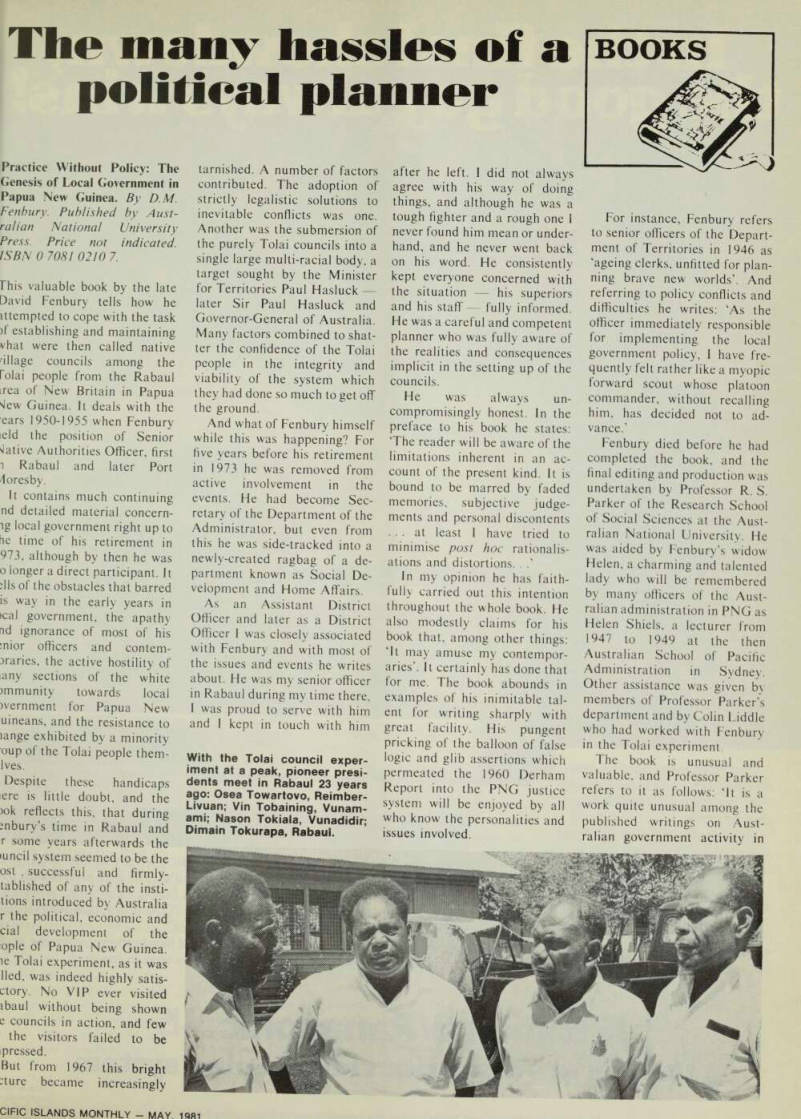

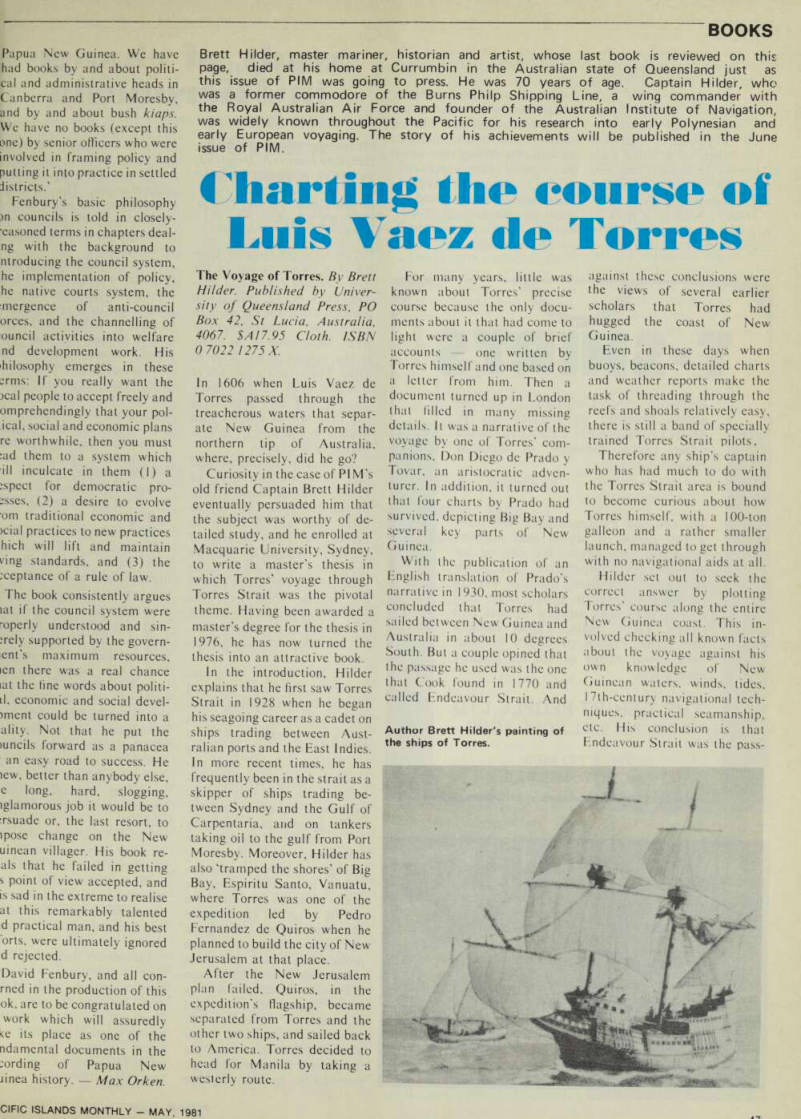
Books
The many hassles of a political planner
Practice Without Policy: The Genesis of Local Government in Papua New Guinea. By DM.
Fenbury. Published by Aust ralian National University Press. Price not indicated.
Isbn 0 7081 0210 7.
This valuable book by the late David Fenbury tells how he ittempted to cope with the task )f establishing and maintaining vhat were then called native ullage councils among the folai people from the Rabaul Tea of New Britain in Papua slew Guinea. It deals with the ears 1950-1955 when Fenbury eld the position of Senior Native Authorities Officer, first 1 Rabaul and later Port Moresby.
It contains much continuing nd detailed material concern ig local government right up to tie time of his retirement in 973, although by then he was o longer a direct participant. It dls of the obstacles that barred is way in the early years in •cal government, the apathy nd ignorance of most of his :nior officers and contem nraries, the active hostility of any sections of the white immunity towards local ivernment for Papua New uineans, and the resistance to lange exhibited by a minority oup of the Tolai people them- Ives.
Despite these handicaps ere is little doubt, and the >ok reflects this, that during mbury’s time in Rabaul and r some years afterwards the •uncil system seemed to be the ost , successful and firmly tablished of any of the insti tions introduced by Australia r the political, economic and cial development of the ople of Papua New Guinea. ie Tolai experiment, as it was lied, was indeed highly satis ctory. No VIP ever visited ibaul without being shown e councils in action, and few the visitors failed to be pressed.
But from 1967 this bright
:ture became increasingly
tarnished. A number of factors contributed. The adoption of strictly legalistic solutions to inevitable conflicts was one.
Another was the submersion of the purely Tolai councils into a single large multi-racial body, a target sought by the Minister for Territories Paul Hasluck later Sir Paul Hasluck and Governor-General of Australia.
Many factors combined to shat ter the confidence of the Tolai people in the integrity and viability of the system which they had done so much to get off the ground.
And what of Fenbury himself while this was happening? For five years before his retirement in 1973 he was removed from active involvement in the events. He had become Sec retary of the Department of the Administrator, but even from this he was side-tracked into a newly-created ragbag of a de partment known as Social De velopment and Home Affairs.
As an Assistant District Officer and later as a District Officer I was closely associated with Fenbury and with most of the issues and events he writes about. He was my senior officer in Rabaul during my time there, I was proud to serve with him and I kept in touch with him
after he left. 1 did not always agree with his way of doing things, and although he was a tough fighter and a rough one I never found him mean or under hand, and he never went back on his word. He consistently kept everyone concerned with the situation his superiors and his staff fully informed.
He was a careful and competent planner who was fully aware of the realities and consequences implicit in the setting up of the councils.
He was always un compromisingly honest. In the preface to his book he states: ‘The reader will be aware of the limitations inherent in an ac count of the present kind. It is bound to be marred by faded memories, subjective judge ments and personal discontents ... at least I have tried to minimise post hoc rationalis ations and distortions. . .’
In my opinion he has faith fully carried out this intention throughout the whole book. He also modestly claims for his book that, among other things: It may amuse my contempor aries’. It certainly has done that for me. The book abounds in examples of his inimitable tal ent for writing sharply with great facility. His pungent pricking of the balloon of false logic and glib assertions which permeated the 1960 Derham Report into the PNG justice system will be enjoyed by all who know the personalities and issues involved.
For instance, Fenbury refers to senior officers of the Depart ment of Territories in 1946 as ‘ageing clerks, unfitted for plan ning brave new worlds’. And referring to policy conflicts and difficulties he writes: ‘As the officer immediately responsible for implementing the local government policy, I have fre quently felt rather like a myopic forward scout whose platoon commander, without recalling him, has decided not to ad vance.’
Fenbury died before he had completed the book, and the final editing and production was undertaken by Professor R. S.
Parker of the Research School of Social Sciences at the Aust ralian National University. Fie was aided by Fenbury’s widow Helen, a charming and talented lady who will be remembered by many officers of the Aust ralian administration in PNG as Helen Shiels, a lecturer from 1947 to 1949 at the then Australian School of Pacific Administration in Sydney.
Other assistance was given b> members of Professor Parker’s department and by Colin Fiddle who had worked with Fenbury in the Tolai experiment The book is unusual and valuable, and Professor Parker refers to it as follows: ‘lt is a work quite unusual among the published writings on Aust ralian government activity in
With the Tolai council exper iment at a peak, pioneer presi dents meet in Rabaul 23 years ago: Osea Towartovo, Reimber- Livuan; Vin Tobaining, Vunam ami; Nason Tokiala, Vunadidir; Dimain Tokurapa, Rabaul.
Papua New Guinea. We have had books by and about politi cal and administrative heads in Canberra and Port Moresby, and by and about bush kiaps.
We have no books (except this one) by senior officers who were involved in framing policy and pulling it into practice in settled districts.' Fenbury’s basic philosophy )n councils is told in closely casoned terms in chapters deal ng with the background to ntroducing the council system, he implementation of policy, he native courts system, the mergence of anti-council orces, and the channelling of ouncil activities into welfare nd development work. His philosophy emerges in these irms; If you really want the )cal people to accept freely and omprehendingly that your pol ical, social and economic plans re worthwhile, then you must ;ad them to a system which ill inculcate in them (1) a aspect for democratic pre sses, (2) a desire to evolve om traditional economic and >cial practices to new practices hich will lift and maintain ving standards, and (3) the :ceptance of a rule of law.
The book consistently argues lal if the council system were roperly understood and sin :rely supported by the govern ent’s maximum resources, icn there was a real chance lat the fine words about politi d, economic and social devel imcnl could be turned into a ality. Not that he put the mncils forward as a panacea an easy road to success. He lew, better than anybody else, e long, hard, slogging, iglamorous job it would be to :rsuade or, the last resort, to ipose change on the New uinean villager. His book re als that he failed in getting s point of view accepted, and is sad in the extreme to realise at this remarkably talented d practical man, and his best
brls, were ultimately ignored
d rejected.
David Fenbury, and all con rned in the production of this ok, are to be congratulated on work which will assuredly <e its place as one of the ndamental documents in the :ording of Papua New Jinea history. Max Or ken.
Advertisements & other items, pp. 45-46 (2 items)
Cific Islands Monthly May Iqri
te good gu&always wins
In the final showdown,
■ n o vnU*. ’vwwc vw»
Q QO=
31303033 dd ■; •• - V ; ;; : NV-7000 If you’ve been holding back on bringing a video system into your life, here’s something you should know.
Nationals VHS has galloped ahead to become the world’s favourite video-taping system.
And our slim new NV-7000, with a memory, eight programmes and a 12-function remote control, is the smartest, most sophisticated video recorder we’ve ever offered for your pleasure.
Your nearest National dealer will show off its great sound and picture. Not to mention the allelectronic controls that make video-taping as easy as falling off a horse.
Sure, any video recorder lets you watch what you like when you like. But you’re way ahead with the world’s favourite system. Whether it’s the 7000 or the budget-priced NV-2000.
Just like in the movies, the good guy has won in the end.
National/Panasonic
\/i ir
nu
the world’s favourite video-taping system
National. Panasonic and Technics are the brandnames of Matsushita Electric.
TV picture simulates Unauthorised reconc TV programmes amn materials mav infrim
Charting the course of Luis Vaez de Torres

Luis Vaez de Torres
Brett Milder, master mariner, historian and artist, whose last book is reviewed on this page, died at his home at Currumbin in the Australian state of Queensland just as this issue of RIM was going to press. He was 70 years of age. Captain Milder, who was a former commodore of the Burns Philp Shipping Line, a wing commander with the Royal Australian Air Force and founder of the Australian Institute of Navigation, was widely known throughout the Pacific for his research into early Polynesian and early European voyaging. The story of his achievements will be published in the June issue of PIM.
The Voyage of Torres. By Brett Milder. Published by Univer sity of Queensland Press, PO Box 42, St Lucia, Australia, 4067. $ A 11.9 5 Cloth. ISBN 0 7022 1275 X.
In 1606 when Luis Vaez de Torres passed through the treacherous waters that separ ate New Guinea from the northern tip of Australia, where, precisely, did he go?
Curiosity in the case of PI M’s old friend Captain Brett Milder eventually persuaded him that the subject was worthy of de tailed study, and he enrolled at Macquarie University, Sydney, to write a master’s thesis in which Torres’ voyage through Torres Strait was the pivotal theme. Having been awarded a master’s degree for the thesis in 1976, he has now turned the thesis into an attractive book.
In the introduction, Milder explains that he first saw Torres Strait in 1928 when he began his seagoing career as a cadet on ships trading between Aust ralian ports and the East Indies.
In more recent times, he has frequently been in the strait as a skipper of ships trading be tween Sydney and the Gulf of Carpentaria, and on tankers taking oil to the gulf from Port Moresby. Moreover, Milder has also ‘tramped the shores’ of Big Bay, Espiritu Santo, Vanuatu, where Torres was one of the expedition led by Pedro Fernandez de Quiros when he planned to build the city of New Jerusalem at that place.
After the New Jerusalem plan failed, Quiros, in the expedition's flagship, became separated from Torres and the other two ships, and sailed back to America. Torres decided to head for Manila by taking a westerly route.
For many years, little was known about Torres’ precise course because the only docu ments about it that had come to light were a couple of brief accounts one written by Torres himself and one based on a letter from him. Then a document turned up in London that filled in many missing details. Ii was a narrative of the voyage by one of Torres’ com panions, Don Diego dc Prado y Tovar, an aristocratic adven turer. In addition, it turned out that four charts by Prado had survived, depicting Big Bay and several key parts of New Guinea.
Wiih the publication of an English translation of Prado's narrative in 1930. most scholars concluded that Torres had sailed between New Guinea and Australia in about 10 degrees South. But a couple opined that the passage he used was the one that Cook found in 1770 and called Endeavour Strait. And
against these conclusions were the views of several earlier scholars that Torres had hugged the coast of New Guinea.
Even in these days when buoys, beacons, detailed charts and weather reports make the task of threading through the reefs and shoals relatively easy, there is still a band of specially trained Torres Strait pilots.
Therefore any ship’s captain who has had much to do with the Torres Strait area is bound to become curious about how Torres himself, with a 100-ton galleon and a rather smaller launch, managed to get through with no navigational aids at all.
Milder set out to seek the correct answer by plotting Torres' course along the entire New Guinea coast. This in volved checking all known facts about the voyage against his own knowledge of New Guinean waters, winds, tides, 17th-century navigational tech niques, practical seamanship, etc. His conclusion is that Endeavour Strait was the pass-
Author Brett Hilder's painting of the ships of Torres.
age that Torres used, and that in doing so he was in sight of the Cape Yorke Peninsula for two days.
In reaching his conclusion, Hilder found that two import ant lines had been omitted from a transcript of a letter from Torres to the Spanish king, and that this omission had led earlier scholars astray.
Hilder’s book is a work of painstaking detection with no fewer than 71 illustrations, of
which seven are in colour. The latter include three of Prado’s charts.
Anyone who cares to follow Hilder in Torres’ wake is un likely to disagree with him on major issues. Also, it is difficult to resist his finding that, as an exercise in 17th-century dis covery, navigation, surveying, seamanship, endurance and sur vival on native foods, Torres’ voyage was one of great merit.
Robert Langdon.
Advertisements & other items, p. 47 (1 item)
Books
CIFIC ISLANDS MONTHLY - MAY, 1981
Study of change
in Micronesia
Micronesia: Winds of Change.
Edited by Francis S. Hezel, SJ, and Mark L Berg. Published by Trust Territories Publi cations Office, Saipan. SUS2O.
No ISBN provided.
Pacific historian Gregory Den ing in a recent review in the New Zealand Journal of His tory (Vol 1, No 12, 1978, p 82), comments that ‘the Pacific is an historically underdeveloped area’. Those close to the study of the subject would have to agree. There exist a number of problems with Pacific histori ography and the foremost is that most of it is and has been written by outsiders. This is beginning to change.
Specifically, it can be said that there are two types of Pacific histories; those written by outsiders about their experi ences and activities in the islands, and those histories of the islands written by islanders themselves, or by people living in the islands who take a view of the outside world from the islands. The present work is not an example of this second type, but is perhaps the last precur sor.
The first type is, of course, important, and the research and writing on it continues. With each deliberate and serious effort, it gets better. Courses in Pacific history wherever they are taught need such ma terial in increasingly well pres ented forms. And that is, hap pily, what the present volume is.
The generalisation made by Dr Dening applies to Micronesia, but Winds of Change contributes consider ably to its vitiation. Over the course of the US administration and its efforts in education in Micronesia some very good curriculum materials have been produced and used. The most notable on history have been Micronesian Backgrounds by Alice Shorett in 1970, and Micronesia’s Yesterdays by James M. Vincent and Carlos Viti in 1973. Each of these, like the present work, presents pri mary source material together
with photos and sketches. Bezel and Berg however, go much further, are thematic, and more comprehensive. The develop ment perspective which can be observed with this Micronesian historiography is clear and very encouraging.
Messrs Bezel and Berg have prepared a book which goes beyond the classroom for more general use by people wanting to know something of the his tory of Micronesia. I say ‘pre pared’ because I think it is the most appropriate term to use in their case: they have gone beyond just editing. At the beginning of each chapter 17 in all they’ve written original essays which serve to introduce and synthesise, or as they state in their preface, ‘provide the background information necess ary for the understanding of the readings’.
The readings are excellent, well selected, and presented with photos and sketches to highlight and give meaning to the text. The readings some of which have not appeared before separate from their pri mary source have been gathered and brought together from a wide variety of sources in far-flung places. They can be characterised, as the editors say, as letting ‘those who were participants in or, at least, eye witnesses to the events, tell their own story’. A real service was performed by, in some cases, combining several primary sources into one, more coherent, reading.
Donald Buchholz did the excellent lay-out work and sketches which have given life to the textual material. Includ ing several hundred sources, photo credits, and illustrations with maps, there are 538 pages in all.
The editors themselves bear some particular attention.
They’ve not only prepared this work, but they are part of it.
They are at once historians, teachers, and Micronesian edu cators, although they are not native Micronesians. Since they have given themselves to the
study of the Micronesian ex perience for a combined total of some 25 years, they are really up to the measure of their task.
Hezel has been in Micronesia since his seminary days in 1963 almost constantly. He has taught many Micronesians dur ing that time, and has contrib uted regularly articles, reviews, and essays to the growing body of literature and account/ commentary on the islands. At present, as director of the Micronesian Seminar at Truk, he has, more than any other person, attempted and suc ceeded in bringing current and vital social issues to the fore front of island political thought.
He is sought out and queried by foreigners and locals alike on the widest range of Micronesian affairs. He is the single most important and knowledgeable foreign intellectual in Micronesia today.
Mark L. Berg is a younger, but most impressive, com panion to Hezel. He has lived and worked in Micronesia for seven years. He was educated in England and at Yale University where he took his degree in literature, and then came to the islands as a Peace Corps Volun teer to teach. He has written many articles and reviews on Micronesia, and has edited the three-volume History of Palau
published by the Community
Action Agency in Koror.
It should be clear that Winds )f Change represents the first ype of Pacific history men ioned earlier: that written ibout the islands by foreigners, fhe editors make no bones bout this. They say: ‘The eadings are largely first-hand ccounts written by foreigners lescribing what they saw or did n the islands.’ There is yet that ther type written for, by, nd of the islanders which till has to appear in a succinct ut comprehensive form.
The work being done at Ron Yocombe’s Pacific Studies In titule at the University of the outh Pacific has promoted this -cond type of Pacific history t)r years, and perhaps we can >ok to Fiji sometime soon for n announcement of the appear nce of a large and deliberate icond-type counterpart akin to lezel’s and Berg’s effort.
Hrk Anthony Ballendorf.
Advertisements & other items, p. 48 (1 item)
T-Shirts
Promote your Company, Organisation, Product or Service on T-
SHIRTS, SCREEN PRINTED with
your Logo, Message or Special Design.
We are the Professionals. We have a full range of styles and colours available Our prices by Sea or by Air are very competitive. Our products are of excellent quality. Orders however must be more than 250 shirts. We also supply Sports Uniforms, Caps, Hats, Flags, Badges etc. Write, Phone, or Telex us now with your order or for an instant quotation.
THE T-SHIRT PEOPLE LTD.
G.P.O. Box 9431 HONG KONG.
Tel: 3 7213409 Telex: 75974 PBDWL HX
EXPORTERS OF FINE BEDDING TO THE PACIFIC ISLANDS
♦ PAPUA NEW GUINEA
♦ SOLOMON ISLANDS
♦VANUATU
Contact. WEST TASMAN TRADERS
P.O. BOX 709 PORT MORESBY Ph. 21 4332
ALL OTHER AREAS
Contact
HEAD OFFICE
MATTRESS MAKERS
CABLE WONDEREST
BRISBANE
Last (and latest) word
latest) word on Pitcairn stamps
The Pitcairn Island Stamp Catalogue 1981 Edition. By Bill Hornadge. Published by Review Publications Ltd, 1 Sterling St. Dubbo, NSW.
Australia 2830. SA9 within Australia postpaid. No ISBN provided.
A revised and updated edition of The Pitcairn Islands Stamp Catalogue edited by Bill Hornadge has been published.
The 1981 edition has been enlarged to 224 pages and has a striking four-colour cover de signed by Jennifer Toombs, the English artist who has been responsible for many fine Pit cairn stamps in recent years.
When the first edition of the catalogue appeared in 1976 it quickly established itself as the definitive work on Pitcairn stamps and postal history. This reputation will only be enhan ced by the new edition which has been revised and contains much new material.
The stamp listings run to more than 70 pages and cover perforations, watermarks, print ers, designers, plate numbers, quantities and a great amount of background detail on designs.
Varieties are extensively covered (the major ones are illustrated) and hundreds of new varieties and flaws are mentioned in the new edition.
All stamps are priced mint and used, and prices are given for sets. First Day covers and imprint blocks. Prices are those generally prevailing at retail level in Australia late in 1980.
The listings are up to date and include all stamps issued up to and including January 1981.
A feature of the catalogue is a new 60-page section dealing with the postal markings of Pitcairn. This includes a com plete numbered and illustrated checklist of all known postal markings compiled by the English expert in this field Mr Cy Kitching. The listing is the
fullest coverage of the subject yet published The catalogue really amounts to an in-depth handbook on both the history and postal history of Pitcairn and includes extensive chapters on Pitcairn history, Pitcairn postal history, the Specimen stamps (including the forgeries), the complete story of the 1940 booklets, the 1938 Radio covers, the 1939 Byrd Expedition cachet, the 1950 Air Letter (a myth exploded). Burn ing Remainders, Pitcairn As sociated stamps. Ships of Pitcairn Island and a bibli ography.
The work is illustrated with a double-page map showing key island features and with illus trations of old prints, unusual covers and postal items. The catalogue is produced on good quality paper and is perfect bound.
sale
1981 Year Book on sale
The Pacific Islands Year Book (14th edition). Published by Pacific Publications, GPO Box 3408, Sydney $ A 32.50. or 5U535.00 posted. National Li brary of Australia ISBN 0 85807 049 9; Library of Con gress (USA) Catalogue Card Number 32-24429.
This new edition of the Pacific Islands Year Book, long re garded as the ‘Bible of the Pacific', keeps up with, and in some cases gallops ahead of, the latest political changes in this vast area of millions of square kilometres of ocean and 39 island political entities. Since the 13th edition appeared in 1978, Tuvalu. Kiribati, Solomon Islands and Vanuatu have achieved independence, and the three island groups of Micronesia forming the US Trust Territory of the Pacific Islands have reached the half way house in their relationship with the United States, which has been scheduled to terminate the trusteeship this year.
This new edition gives latest available information on all these important changes together with lists of the people in the new governments, infor
mation which cannot be found elsewhere within the covers of a single book.
There is also a new, and lengthy, article on the Law of the Sea by an expert on the subject which spells out the problems and the obstacles to agreement encountered in the latest Law of the Sea Confer ence being held at present in New York.
The history and geography of all the individual islands form an important part of the Year Book, and the various facets of life in the islands, their social life and customs, the economy, trade, taxation, education, are amply covered.
The Year Book also contains most of the answers which
intending tourists find difficulty
in getting from tourist agencies.
There are more than 80 maps along with a large, coloured fold-out map of the Pacific which embodies the most recent changes in the names of many islands, especially in newly in
dependcnt countries.
J.C.L.
Advertisements & other items, pp. 49-50 (2 items)
Books
ISI AMHQ Mr»MTi_ii \/ uav
Port Mo Ti
* Right in tl business cep * A traditiorf for comfort and fin^ difi food ♦ All rpoms airconditioned * Restaurant-* Bai * Banquet hall
i ..A. C. NEUMANN
manager Phone 21-2( 2622 Cable
Stay at Aggie Grey’s . . . the South Pacific’s legendary hotel.
Situated right in the heart of Western Samoa. Enjoy Fplynesian-style friendliness and service, in cool surroundings, superb entertainment and food.
Magnificent white sand baches only a'short drive away.‘Airconditioned rooms, swimming pool and full bar facilities.
Bookings through Union Steamship Company of NZ, Fan Am, Air New Zealand or direct to Aggie Grey’s, Apia, Western Samoa. Cables: *AGGIES’ Apia.
Ricoh KRIO Awarded Best Overall 35mm Single Lens Reflex Camera by What Camera Weekly. (November 22, 1980 issue) .We first tested the Ricoh KRIO back in July and were very, very impressed. Since then there has been nothing offering better value and performance.”
Aperture-priority automatic exposure and manual. Compact, lightweight, easy-handling design.
Large, bright full-information view-
finder with 3-way focusing.
“.. .there is little else you need to take good photographs..
Shutter speeds up to 1/1,000 sec.
ASA range 12-3200. Exposure compensation ±2 f-stops. Selftimer. And more. u .. .It is a camera to build a system around..
XR-Rikenon interchangeable lenses w * it deserves the title ‘Camera of the Year’...”
We couldn’t have said it better ourselves. with versatile K-mount. XR Winder-1. XR Speedlite 240.
And accessories. ...Yes, the Ricoh KRIO certainly &
ricoh mmo
For more information about the Ricoh KRIO, write to RICOH COMPANY, LTD. 14-6, Ginza 6-chome, Chuo-ku, Tokyo 104, Japan.
Distributors: Australia Maxwell Photo-Optics Pty. Ltd. *55-69 Murray Street, Pyrmont, N.S.W., Australia, New Zealand H.E. Perry Ltd. *145 Victoria Street, P.O. Box 111, Christchurch 1, New Zealand, Norfolk Is. Miltons Ltd. *PO. Box 146, Norfolk Island 2899, South Pacific, Fuji Narseys Limited •Renwick Road. Suva. Fiii. Tahiti Ets. Coutimex *B.P 617. Paoeete. Tahiti (French Polynesia) New Caledonia Omnium Caledonien Importation
Peter Simogun: The story of
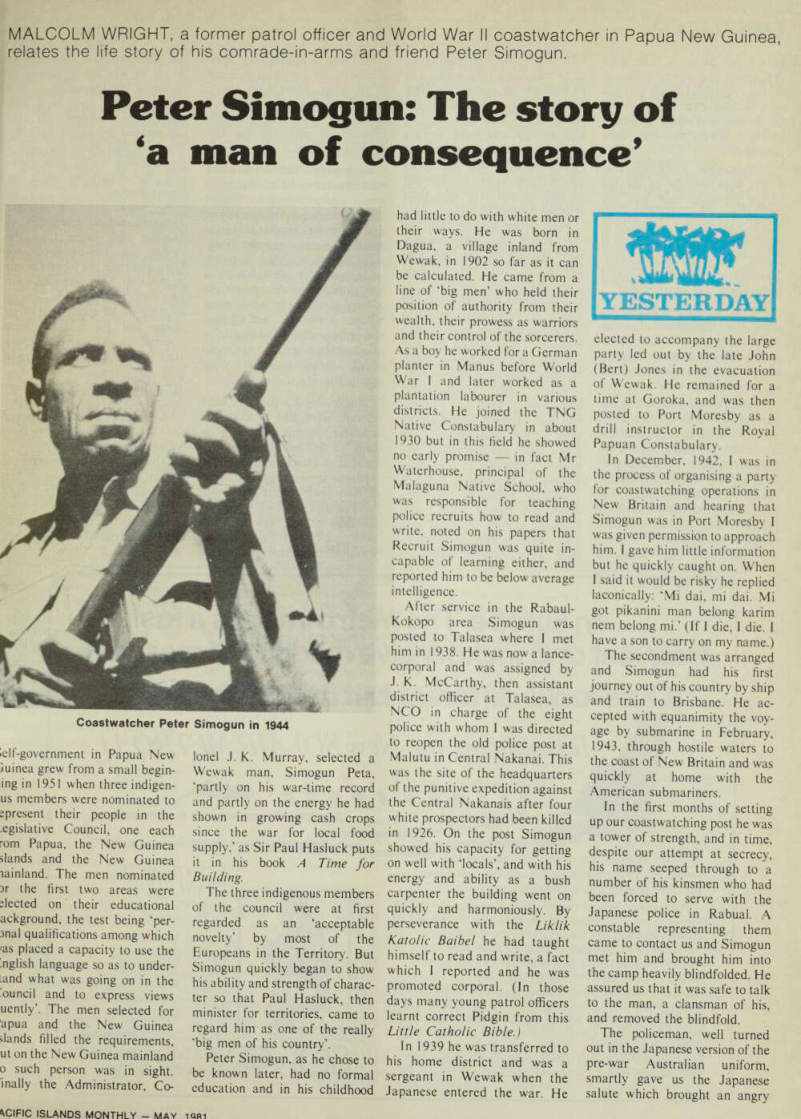
‘a man of consequence’
Yesterday
MALCOLM WRIGHT, a former patrol officer and World War II coastwatcher in Papua New Guinea relates the life story of his comrade-in-arms and friend Peter Simogun.
lelf-government in Papua New juinea grew from a small begin ing in 1951 when three indigen us members were nominated to their people in the .egislative Council, one each rom Papua, the New Guinea slands and the New Guinea lainland. The men nominated 3r the first two areas were elected on their educational ackground, the test being ‘per- Dnal qualifications among which 'as placed a capacity to use the nglish language so as to under and what was going on in the ouncil and to express views uenlly’. The men selected for apua and the New Guinea ffands filled the requirements, ut on the New Guinea mainland o such person was in sight, inally the Administrator, Co
lonel J. K. Murray, selected a Wewak man, Simogun Peta, ‘partly on his war-time record and partly on the energy he had shown in growing cash crops since the war for local food supply,’ as Sir Paul Hasluck puts it in his book A Time for Building.
The three indigenous members of the council were at first regarded as an ‘acceptable novelty’ by most of the Europeans in the Territory. But Simogun quickly began to show his ability and strength of charac ter so that Paul Hasluck, then minister for territories, came to regard him as one of the really ‘big men of his country’.
Peter Simogun, as he chose to be known later, had no formal education and in his childhood
had little to do with white men or their ways. He was born in Dagua, a village inland from Wewak, in 1902 so far as it can be calculated. He came from a line of ‘big men’ who held their position of authority from their wealth, their prowess as warriors and their control of the sorcerers.
As a boy he worked for a German planter in Manus before World War I and later worked as a plantation labourer in various districts. He joined the TNG Native Constabulary in about 1930 but in this field he showed no early promise in fact Mr Waterhouse, principal of the Malaguna Native School, who was responsible for teaching police recruits how to read and write, noted on his papers that Recruit Simogun was quite in capable of learning either, and reported him to be below average intelligence.
After service in the Rabaul- Kokopo area Simogun was posted to Talasea where I met him in 1938. He was now a lance corporal and was assigned by J. K. McCarthy, then assistant district officer at Talasea, as NCO in charge of the eight police with whom I was directed to reopen the old police post at Malutu in Central Nakanai. This was the site of the headquarters of the punitive expedition against the Central Nakanais after four white prospectors had been killed in 1 926. On the post Simogun showed his capacity for getting on well with ‘locals’, and with his energy and ability as a bush carpenter the building went on quickly and harmoniously. By perseverance with the Liklik Katolic Baibel he had taught himself to read and write, a fact which I reported and he was promoted corporal. (In those days many young patrol officers learnt correct Pidgin from this Little Catholic Bible.} In 1939 he was transferred to his home district and was a sergeant in Wewak when the Japanese entered the war. He
elected to accompany the large party led out by the late John (Bert) Jones in the evacuation of Wewak. He remained for a time at Goroka, and was then posted to Port Moresby as a drill instructor in the Royal
Papuan Constabulary.
In December, 1942, I was in the process of organising a party for coastwatching operations in New Britain and hearing that Simogun was in Port Moresby I was given permission to approach him. I gave him little information but he quickly caught on. When I said it would be risky he replied laconically: ‘Mi dai, mi dai. Mi got pikanini man belong karim nem belong mi.’ (If I die, I die. I have a son to carry on my name.) The secondment was arranged and Simogun had his first journey out of his country by ship and train to Brisbane. He ac cepted with equanimity the voy age by submarine in February, 1943, through hostile waters to the coast of New Britain and was quickly at home with the American submariners.
In the first months of setting up our coastwatching post he was a tower of strength, and in time, despite our attempt at secrecy, his name seeped through to a number of his kinsmen who had been forced to serve with the Japanese police in Rabual. A constable representing them came to contact us and Simogun met him and brought him into the camp heavily blindfolded. He assured us that it was safe to talk to the man, a clansman of his, and removed the blindfold.
The policeman, well turned out in the Japanese version of the pre-war Australian uniform, smartly gave us the Japanese salute which brought an angry
Coastwatcher Peter Simogun in 1944
bark from Simogun. The man apologised and swung a British salute. From this contact we built up a nucleus of informants inside the fortress who would have been valuable if Rabaul had been attacked.
In September, 1943, reinforce ments were brought in for the Allied advance, and five ad ditional coastwatching parties were organised for operations in New Britain. My party moved across the island into Central Nakanai where Simogun and I had worked five years before.
We were given a warm wel come and renewed old acquaint ances, Simogun now a sergeant major being received with great respect and his rank contracted to ‘Mesa’ (Major).
Alerted of our presence by the capture of one of the parties on the south coast the Japanese sent a patrol in strength against us.
Our spies gave us warning of their coming and we moved into hiding with some supplies. The patrol burnt our camp and all the supplies they could find, then returned to the coast.
It was then that Simogun
told us that without consulting us he had left a note with a gift of tobacco for one of the New Guineans serving with the Japanese. It said that we had had enough and were moving out to join the Americans at Arawe on the south coast. The patrol made no further attempt to find us and return to their base at Cape Hoskins.
With strong backing from the local people we quickly reorgan ised. But as Rabaul had been heavily hit, and the air base destroyed, our function as coaslwatchers was reduced. The Japanese were now retreating eastwards along the coast road to Rabaul. They moved in well organised groups, and our scouts reported them to be relatively fit.
After Allied Headquarters had given approval and weapons had been supplied, village groups were formed into sections, and given some quick training. We began guerrilla operations against the Japanese in January, 1944. By February the com mand. now named Tiger Force, consisted of more than 200 men.
The village sections were led by their own headmen and were
armed with shotguns, rifles, hand grenades and captured weapons of all types. There were also a number of spearmen who had either not made the grade as riflemen or preferred the traditional weapons.
Each section had its portion of road to cover and a headquarters group under Simogun covered the approaches to the camp. The first action was against a Marine patrol that came into the mountarns against us. Not knowing where we were, they halted at Umu village and waited for signs of activity. There were many villages in the area, but all gave the appearance of being descried. Only when the afternoon clouds came down did they spring into life.
Simogun and a party of local riflemen were sent to scout the Japanese movements, but afler doing so for one day Simogun decided to attack. It caught the Japanese unprepared but failed as Simogun’s submachine gun jammed and the locals, not yet confident of their new weapons, hung back. His gun cleared, Simogun continued the attack
and some Japanese were seen to be hit. It was not a successful operation but the effect on the local men was good as it had given them confidence. It also discouraged the guides with the Japanese, and after that not a single native would dare come into the mountains with an enemy patrol.
A week later a second Japanese patrol, composed of Marines and larger than the earlier one, moved back into Umu and from the reports of our guides they were prepared for a long stay. They seemed intent on locating us. All approaches to our camp and the villages were covered by riflemen and every trick that the Nakanais could pull out of the bag was used spear pits were dug, rocks, logs and spears were set on trip ropes, and the entire population moved into the bush again leaving their villages deserted.
There was no movement either by the Japanese or the guerrillas for several days until one evening we saw a large bonfire in the Japanese camp: they appeared to be challenging us to attack them.
Shortly afterwards there were sounds from the village to the right where Simogun was in command; a large fire had been lit and figures could be seen dancing around it. I did not know what was happening but I had confidence in Simogun.
Next morning at first light there was the sound of rifle fire on the steep slopes below Umu, and shortly afterwards we saw the Japanese retreating through the village carrying several casualties with them. Later in the morning an excited Simogun reported that he felt sure that his fire and sing-sing would draw the Japanese to him. But instead of moving out at first light as he reckoned they would do, he and his men set out during the night and, knowing the country, took up ambush positions and hit the enemy when they came down the rough track in the early light of dawn.
Guerrilla attacks on the en emy moving along the coast road became daily affairs, and Simogun was in his element.
His appearance was magnifi cent: he wore an Australian slouch hat, a Japanese officer’s jacket studded with a variety of badges of rank, medal ribbons and regimental patches that he had taken from his victims, and light US Marine boots on his feet. His face was painted with red ochre, and of all the weapons now available to him he had selected the small cal ibre Japanese carbine.
The effect was both impress ive and startling and this figure emerging from the bush must have been a frightening sight for the already demoralised Japanese. It also had an effect on the Nakanais who regarded the ‘Mesa’ with almost worship ping awe. His tally of kills, authenticated by the guerrillas’ own council, was growing and by the time we handed over to our relief party after six weeks of operations he had 31 confirmed kills in a total of 286.
The selection of a fitting award was something of a problem for as a member of the RPC he was itill a civilian; he was awarded the British Empire Medal.
After the war he remained with the PNG Constabulary for a time but his ability and his nfluence were wasted in this service. He returned to his
village and organised his people in the growing of cash crops. In the process he emerged as a man of considerable business acumen and did well as a planter and truck operator. His wife, Berta, also showed a keen eye for business and success fully took over the management of his interests when he became immersed in politics.
Simogun, adding the pho netic version of his baptismal name to be called Simogun Peta, and later Peta Simogun, became known throughout the mainland of New Guinea as well as New Britain as a ‘big man’.
While he was a member of the Legislative Council he was a PNG delegate to the South Pacific Conference in Suva in 1956. Now if the situation required he could speak some English, he could understand it well, and could hold his own in any company officially or socially.
His intelligence, his lively personality and his sense of humour made him a most interesting companion. It is told that at one of the official dinners at the Suva conference the host, a Fijian of noble birth, Oxford education and great distinction asked Simogun to ‘press on’
‘Cannibals must stick together’
with him after the guests had left. ‘We cannibals must stick together,’ he told the PNG delegation leader.
Later Peta Simogun was a leading member of the PNG delegation to the United Nations and addressed the As sembly. He spoke in Melanesian Pidgin with the machine-gun delivery that he never lost. His speech was translated by Horace (now Sir Horace) Niall, himself well versed in rapid expression.
At home he became active in the affairs of the New Guinean ex-servicemen and attended a national RSL conference in Canberra where he attracted the interest of the Duke of Edinburgh. At a later such conference in Brisbane his ad dress was interpreted by Eric Feldt, the original commander of the Coastwatchers.
In the first general election in the Territory Simogun stood for
his home electorate and was returned with a good majority.
In the new Assembly he became Under-Secretary for Police and during his administration the Constabulary under the commissionership of Robert Cole emerged as a modern force. He was defeated in the next election, but at the age of (approximately) 65 he did not accept retirement or a govern ment sinecure but took on the job of spearheading the oil palm industry in New Britain near the area where he had led guerrillas 15 years before. The scheme was successful and Simogun remained there until 1977 when he returned to his village.
After his retirement from politics the people of Wewak, both black and white, combined to show their appreciation of Peta Simogun’s efforts for his country. A large number of people gathered in the town and during the festivities Simogun was presented with a sizeable sum of money collected in a public subscription. He ac knowledged the gesture but donated the money to his people for the purchase of school books.
In 1965 Peta Simogun was a guest at the launching of my
book If I Die which told of our war experiences and in which he figured prominently. His com ing was well advertised by the publisher, and as visits of PNG politicians to Melbourne were then rare occurrences he was much sought by radio and TV interviewers.
One TV personality in Syd ney asked him what he thought of the Chevron where we were staying. He replied: ‘All right.
Just like the Hilton in New York.’ The interviewer told us afterwards that it was some thing he had never realised before: The Chevron was just like the New York Hilton.
A number of ill-informed questions on PNG politics were put to him and he answered them as blandly as a Canberra veteran would. To the one on his views on the newly formed Pangu Party he replied slowly and carefully: ‘Me no lookim constitution yet. Me lookim, all
right me can talk.’ The inter viewer understood this: no translation was required and no further question necessary.
Over a cup of coffee in the Cross after we had inspected
photographs advertising the en
tertainment available in one of the dens he told me that when he had been in one such place in San Francisco he had been approached by a big blonde woman. ‘Flow much?’ he asked her. ‘A hundred bucks,’ she replied. ‘How many times?’ he continued. ‘One time, of course.’ ‘Jees,’ said Simogun, T could get a second hand truck for that in Wewak.’
This visit meant for Peta Simogun and for me the revival of our earlier friendship. In the old days we were ‘kiap’ and ‘sergeant-major’. There existed between us a close understand ing and a deep appreciation, but always there was the barrier of the times, the barrier between white man and native. In 1965 happily this was gone and we were on even terms. In the spirit of the occasion we made an agreement regarding our famil ies, to take on each other’s in a sort of adoptive parenthood. In this arrangement he got my two and I got his eight. My wife asked for assurance that spouses were not included in this agreement.
Now Peter Simogun lives in his village, Dagua, in dignity, enjoying the prestige that his life has entitled him to expect.
He tells me that his trucking and bus business is doing well and he is considering going into the liquor trade. His back gives him pain occasionally and he is losing his teeth.
His family are all doing well and he is content, except for the complaint that present-day poli ticians in PNG no longer take the advice of the ‘big men’. He is happy with the way things have gone, and, although he does not say it, is well satisfied with the part he has played in the rise of his country to nationhood.
In 1966 in a letter to me Lord Casey, then Governor-General, told of his meeting with Peter Simogun, and described him as a ‘man of consequence’. Of the man who was in 1930 ‘incapable of learning to read and write’ this is truly so.
Advertisements & other items, pp. 51-55 (3 items)
Islands Monthly - May Iqfli
Somir
In EuropcLThc Metro means a fast,
frequent and inexpensive means of transport...
Ours looks different but means the same!
Introducing the New SOLAIR METRO 11
A pressurised, air conditioned, turbine
powered, radar equipped, fast, frequent and
inexpensive means of transport The introduction of the new Metro 1 1 aircraft on routes between Honiara and Munda in the Solomon Islands, Honiara and Kieta P.N.G., and a new direct service between Honiara and Espirito Santo in Vanuatu will initiate a new era in fast, modern and comfortable aviation in the South Pacific.
If your business brings you to our part of the Pacific, you can now fly when you choose, rather than be dictated to by airline schedules. Our frequent Metro service will connect you with Honiara, a major transit point for international jet sevices to Australia, New Zealand, Vanuatu, Fiji. Hong Kong, Japan, Taipai. the Philippines and the Northern Pacific. iJ
FLY THE METRO
CONNECTION
It's a fast, frequent and exciting means of travel!
General Sales Agents in Australia Pacific Unlimited 359 Queen St. Brisbane Phone 229 6933 Telex 42558 Cm. York & Market Sts. Sydney Phone 267 5166 Telex 70723
SOMIR
The Solomon Islands'
Regional Airline.
Ban he
OKINAWA
KO Bar runJT*
< MANILA"
A • 'Redoruj I > * ~T (J 1 A v A x “ »- Jw.siZi ...
Jlatrtn A,t~.L,hr h.\,B
JtyjiXttxxZun I
1 v ■
KYO **
K •Fatmuxj 'luvdrtl
KAGOSHIMA N>
Thdos loj o Plata S)* Jl,mA Iff* Q Ganges L Rim de Oro
>D^A»a.
f " _> t •>* -V
S-Jlaj/uubi
• Ldf Scru/^e
I SehastumLobos Jieef' L HWb/.' FareUon S But [ j ra£a J r ' Gl 9' X * p
tiSihtki
2759
a -‘-'fe S 3
V , f r'tAA. »b pI, H v s (W‘ MunCtnt Jbxkt ] I V' .10 ' M -if-j. Paioa or / S S afUib ’ La ?y*** u \ ftSSL°. r , v * \ gaio* «■ *& and)lr *
\A jmU.l. 9 '^* h ***(*
\ .ZJrs-jk'Huw, ■■'"•*'
Si P^CaJ y Vroi^wl
, *. ,v«/' . , i,—..< "1 Naxru'LukI g • S*?or* >»
s£wwr 5j Salibabo 1
#«**<OV * TarrvJf - ' ’/■ rj \orCh* 1..
CEI B ( *S«C oTartfret, J’A Jwlvruta' m HeltnJL a rJiir t£- J V . M y M %
_2uu</\%zsftr
y Mxjrdxxkl B ''Donkoisl*
"azzxir
‘Pvquxramr », ’ TirmPMH-trAJ ■ w/y
!>•' V V V
. ij^ssp
Z'&A/ rh.,*"»•'' I iV^oa^n <*ralM f trryptruutr j7t* 'V > 1,-*,, —
/, / M~*Ai, qiLTTU I
ta.y.j *-•■ ,
JitMfnnfor\ Daruis Re*/' Skoal > Worse Shoe
- iSL
r r n
•J. rt™< . Norjf Sho, ( fajtrrtici 'N- ,r : ' r Lo\ ’ ibr o2ho ■ 'J ■uW r/'orlP s r
A I, I
i.*i ,55*^-^ Autir , W/ SP> * in.tr a.
X \
Discover the Pacific with Air Nauru.
we want to show you how times
have changed.
*J HalrwrtL 'WaJoul A*.
HONOLULU
i/a:n >9-Oa la/ __► /w/ - Mo«nnio' Group • 1 /U™gJ‘"** v *f Jan *T‘ 4' B ° P ‘ l ’ Beaton/- Ansc*is ST\&aL Our thanks to this Pacific basin map, drawn and colored in 1852 by J. Wyld, geographer to the Queen and HRH Prince Albert, for reminding us how isolated we used to be, and what a difference a modern airline can make to life and leisurd.
If you find the notion of hopping by air from island to island still a terribly adventurous one, we hasten to assure you that Air Nauru has made Pacific travel satisfying beyond your romantic dreams. From Hong Kong via Nauru to Auckland, from Singapore via Nauru to Melbourne, and to all the beautiful islands in between, you will enjoy being with us, sharing our Pacific island heritage.
The first airline ever to link the major Pacific ethnic regions of Micronesia, Melanesia and Polynesia, we are also the only all-jet airline flying between many of the islands of the Pacific.
MAJURO
TARAWA
■Vfcif- ‘j-~/
NAURU
charter' a d| «i Pe-TBir /Ormst* si taßani
APIA L-
tmhryn vTla
■&&SSS.
SUVA • oSL
ItEJ nV I -
- NAOI
■M Arr x»R*£
iTONGA
MEA
rtn H funm >I
LAND
We are also happy to say that we’re an internationally-scheduled airline with big airline standards, an all-Boeing fleet of 727 and 737 jets, an impeccable flying style, delightful stopovers, a pleasant, unpretentious inflight hospitality.
Talking about pleasant things, you will observe on this map, if you look closely that we were once even known as Pleasant Island [a name given us by Captain John Fearn of the whaling vessel ‘ Hunter,” the first European to visit Nauru in 1798].
Let this be your friendly reminder to visit the Pacific at least once in your lifetime, on the airline that has helped change the times. y.eTv|ry ftrrertdqe* Mrs/'
ViMff NAURU
V AIRLINE OF THE CENTRAL PACIFIC ** OfxjroL * * Bau 1. - Mm* At
“ rv'X-i
/ For ticketing, reservations and flight information, telephone: 740 in Apia, Western Samoa 477-7106 in Guam 595 or 727 in ISlandS: 229 m Majuro ' Marsha' l Islands; 312-377 in Suva, 72795 in Nadi, Fiji; 448 in Tarawa Kiribati and 653-5709 in Melbourne, Australia
Yesterday
3 ACIFIC ISLANDS MONTHLY - MAY, 1981
the Yanks in Pukapuka

A right royal welcome for the Yanks in Pukapuka
Travel
American freelance travel writer JAMES C. SIMMONS turns in an account of his visit to Pukapuka, northern Cook Islands, with a group of his fellow countrymen. He says they were the first group of tourists in history to visit Pukapuka Thev chartered a Cook Islands copra boat, the Manuvai, to pull off the feat.
It was after midnight and I could not sleep. I passed the time watching a brown roach slowly make its way across the stained ceiling of our sultry cabin. Our boat, the Manuvai, a 44 m copra boat and a relic from an earlier era of Pacific travel, pitched and rolled. plunged and hung, and then plunged again through ‘boisterous seas’ (our captain’s phrase).
I had tied myself into the top bunk with a sheet as a precaution against being thrown onto the metal floor below, Suddenly, a particularly violent lurch of the ship shook the roach loose, and it fell into the bunk across from me. My companion went on sleeping fitfully, unaware he now had company. From deep in the
bowels of the Manuvai I could hear the muffled sounds of the engines that seemed to repeat over and over, ‘Puka-puka, puka-puka’ through the long night.
I was with a group of 20 other Americans, most from Southern California, who had signed on to the Manuvai, sailing under charter to Richard Goodman of Oakland’s Goodtravel Tours, for what had sounded like the finest Pacific adventure in a decade the chance to be among the first group of tourists ever to visit the remote, legendary atolls of the northern Cook Islands. Our group included a retired Hollywood film director, an insurance salesman from San Jose, a housewife from
Whittier, and an 82-year-old freighter buff. What we all had in common was a lifelong love affair with the Pacific islands of romance and myth. For us the.
Manuvai with its utter lack of amenities was less an ordeal and more a challenge, a pant of the adventure we had come to experience.
The islands in the northern group of the Cook Islands are among the most legendary in the Pacific. These are the atolls of fantasy and romance, each one a handful of emerald chips scattered across the opal waters of a shallow lagoon, snugly tucked inside a coral reef which encircles them all like a loose fitting necklace. Lying far off the major shipping and yacht ing routes and sporting such
names as Pukapuka, Rakahanga, Manihiki, and Palmerston, the islands of the northern group are accessible only to travellers willing to endure the rigours of the Silk and Boyd Steamship Co on one of their infrequent trips to that part of the Pacific.
Three days after departing from American Samoa we ar rived at Pukapuka, home to 786 people and one of the most famous yet least visited islands
in the entire Pacific. The sea that morning was smooth as silk, stretching away to infinity, making our copra boat appear pitifully small against its im mensity. Ahead beyond a line of surf we could see the vivid belt of green coconut and pandanus trees poised in the air above beaches of glittering whiteness.
Almost lost in the shadows of the trees were small thatched houses. For a moment I thought I had been hurled back in time to an older Polynesia where virgin islands could still surprise the voyager the Polynesia that captured the imaginations of Herman Melville and Paul Gauguin.
Soon three longboats ap peared in the lagoon and motored toward the Manuvai, riding at anchor just beyond the reef. Our plans called for three days to be spent here, living with the islanders in their homes and sharing their way of life. An hour later we clam bered ashore at Waletoa Beach where virtually the entire popu lation of the island was on hand in their Sunday best to welcome us. No one wore grass skirts or sarongs. Their Western dress was testimony to the effectiveness of the London Missionary Society’s efforts over a century ago. After end less formal speeches of welcome and prayers for the success of our trip, each of us was assigned to a family, our group being evenly divided among the atoll’s three villages so as not to stimulate their fierce rivalry.
As I walked through the village with my host, a 15-year old boy who lived with his grandfather, a fisherman, I re membered the words of Robert Dean Frisbie, an American /agabond-turned-novelist, who had settled on Pukapuka 50 /ears before, married a local maiden, and remained for a decade, tending a small general »tore. ‘The island is a dream :ome true, so that romanticists kvho are patient enough and adventurous enough may see /indicated their faith in lonely ands beyond the fartherest horizons.’
Time has been kind to Pukapuka in the decades since Frisbie ran his small store there.
Fhe changes it has brought lave been subdued. Land is still
held communally by the vil lages rather than by individuals.
The extended family, which reaches out to encompass dis tant cousins, still exerts a pro found influence. And a man’s generosity, not his accumulated goods, often determines his place within the village.
We had arrived on Sunday morning. The islanders, always very religious, were eager we share in this social ritual with them. So we all congregated at the large white-washed Cook Islands’ Christian Church.
Their entire service was conduc ted in the island’s unique language, spoken nowhere else in the Pacific. The hymns were sung with an abandonment reminiscent of American gos pel.
Afterwards the islanders es corted us to a large communal meeting hall for a kai-kai, or native feast. The long table groaned under the weight of a smorgasbord the like of which few travellers to the islands ever experience. There were a dozen varieties of freshly caught reef fish baked in earthen ovens, succulent chunks of chicken, pork, and lobster, mountains of baked taro root and breadfruit, dishes of coconut cream to dip them in, and beside each plate a giant bright red coconut crab, one of the rarest delicacies in all the Pacific. While we ate our fill, a dozen women with great fans moved around the table keeping the flies away. A crowd of villagers stood just outside the verandah and shouted en couragement to us as we tackled the huge supply of foodstuffs they had prepared for us.
Early on the second morning we all gathered on Waletoa Beach for a trip to the other two islands on the atoll, Motu Ko and Motu Kotawa. Both were used exclusively for the pro duction of copra and were off limits to villagers most of the year except by special per mission.
All of our group and a dozen islanders crowded into two long boats for the trip across the lagoon. The surf flickered along the reef where flying fish skipped. Our villagers were exuberant. They began beating out a rhythm on empty tins and the gunwales and chanting a Pukapukan song. One of the
men translated for us. T draw on my trousers,/ They are red like the eye of the sun./ They dazzle the young maidens.’
On Motu Ko everybody scat tered. Several of us hiked across the interior to the other side, through an almost impenetrable jungle of cordia and hernandia trees, groves of coconut palms, and thickets of magnolia bushes. White terns by the hundreds flashed overhead against the green foliage. Sud denly we broke through the jungle to the beach on the windward side of the island. I bent over and picked up a handful of yellow sand and examined it closely. Each grain was in fact a liny shell or the skeleton of a coral polyp. I realised then how much an atoll is a living island, belonging in its entirely to the organic world.
In the early afternoon we motored to Motu Kotawa, another large uninhabited island. We swam and snorkeled in the turquoise waters off a virgin beach. The islanders pre pared a barbecue for us in the traditional Polynesian manner.
They dug a large pit in the sand and filled it with burning coco nut shells. Freshly caught reef fish, wrapped in green leaves, were spread across the coals to steam in their packets.
We left our friends on Pukapuka on the third day. My young host broke out his hand made outrigger canoe and together we paddled across the still lagoon to Yato Beach.
Several hundred villagers had gathered there to see us off. The farewell ceremonies took 90 minutes. There were coconut husking competitions, wrestling matches, and the endless fare well speeches by the island leaders. We boarded the Manuvai burdened with gifts from our families of finely woven mats, handmade hats, and shell necklaces.
Ahead of us the other atolls of the northern group shim mered like mirages over the distant horizon. Manihiki, whose pearl shell divers are famous throughout the Pacific for their feats, often diving to 60 m without the benefit of scuba gear. Rakahanga, where villagers build small houses over the dead for the living to come and spend the night.
Suwarrow. the home for 25 years of Tom Neale, the famous Hermit of Suwarrow, who lived a Robinson Crusoe existence alone on his uninhabited atoll 320 km from the nearest ship ping routes. ,And finally tiny Palmerston, originally settled in 1862 by William Marsters, a Scottish adventurer, and his three Polynesian wives. His descendants today still speak a form of 19th-century Scottish dialect.
Pukapuka was our stepping stone to the others and a reassurance that there are still places left in the Pacific where the modern romanticist can capture the ecstasy of Gauguin shortly after he arrived at Tahiti in 1890: ‘Civilisation is falling from me little by little.
All the joys of a free life are mine. 1 have escaped every thing.’
Coral-walled houses at Roto Village on Pukapuka. - W.
Percival picture.
Advertisements & other items, pp. 56-58 (2 items)
We make life easier.
m I * > r Quik Stik have a range of hardworking Self-adhesive products, designed to assist you with stock control, filing, product pricing and car decorating,stock labels, retailers, pricing guns, auto accessories - decrastrip.
Thousands of uses in Office, Factory, Home and School.
Quik Stik also have a fully equipped art studio and manufacturing plant to produce quality labels to fit any custom print requirements.
LABELS CAN BE SUPPLIED IN SHEET
OR ROLL FORM FOR APPLICATION.
QUIK STIK INTERNATIONAL LTD P.O. BOX 76221 MANUKAU CITY AUCKLAND, NEW ZEALAND PHONE 2780939 TLX NZ 21717 CABLE QUIK STIK, AUCKLAND
You just think you’re hard to pleasel Take a look at this dazzling assortment of “TEN”
products. Car stereos, cassette decks, tuners,
amps, speakers, graphic equalizers, marine
compo units— from the simplest to the most complex, the modestly priced to the super deluxe. When it comes to audio equipment, you may think you're a very tough customer to please. But we know better. With such
a fantastic variety of top-quality, feature-
packed products, you couldn’t help but find what you’re looking for. We re willing to bet on it!
TEN
k:„. r* 5 am « «. m r* 51# SH3
mr* f
—ttm -
** B r-rm t •, s T»W«t *
rfl
■say 1
limp
rs« »* « » \ oo r Head Office;
2-28, Gosho-dori 1-ohome, Hyogo-ku, Kobe, Japan
Tokyo Office (Export Section): Shuwa Onarimon Bldg , 2nd FI., 1-1, Shimbashi 6-chome, Minato-ku, Tokyo Japan Phone: (03) 438-1611 Cable: TENFUJITSU TOKYO, Telex: 2425101 TENTOK J
Distributors:
Papua New Guinea: CHIN H MEEN N SONS PTY., LTD. PO Box 1106, Boroko, Port Moresby, Papua New Guinea Phone: 256546.
Guam: MICROPAC AUDIO INC. PO. Box 3478, Agana, Guam 96910. Phone: 472-8091, Tahiti: FARE HI-FI STEREO. P.O, Box 269, Rue du Marechal Foch, Papeete.
New Hebrides: BURNS PHILP NEW HEBRIDES LIMITED. Vila, New Hebrides Cook Islands: AVATIU GENERAL TRADERS. PO Box 27, Rarotonga Fiji: D. GOKAL& CO., LTD. G. PO. Box 501, Suva, Fiji Phone; 25259/22995,
Travel
57
’ACIFIC ISLANDS MONTHLY - MAY, 1981
Stamps
On May 22, a set of four Nauru stamps will illustrate the progressive nature of fishing on the island, from ancient canoe to powered vessel. The issue will be promoted widely, especially at Vienna in Austria, where the Nauru Philatelic Bureau will participate in the WIPA 1981 International Stamp Exhi bition. The exhibition will be staged at Vienna’s Imperial and Trade Palaces on May 22 and 23. The stamps will show hand casting a net 80, a traditional canoe 200, a powered boat 320, and a fishing vessel 400.
In July Nauru will commem orate the fifth anniversary of the Bank of Nauru. A stamp issue is to be made for the occasion, but details have not yet been announced.
Nauru also plans to issue an undisclosed number of stamps in October to mark United Nations Day and the Economic and Social Council for the South Pacific.
Nauru plans to end the year with a Christmas issue which will have a basic design similar to that of the stamps designed by Clive Abbott for last Christmas. Gold printing will be added to the design.
Sailing Contrasts
Sailing ships and voyaging canoes are always a popular Pacific Island subject for stamps, and Penrhyn in the northern Cook Islands is com bining the two in a new set of definitives which became avail able in February. There are five denominations, 10, 30, 40, and 100, but each includes four different designs.
Four sailing ships from the Old World are included in the designs. They are Magellan’s Victoria from Spain, Drake’s Golden Hind and Bligh’s Bounty from England, and d’Urville’s Astrolabe from France.
Contrasting strongly with the European sailing ships are the five voyaging and special pur pose canoes featured in the other designs. One of the canoes shown is the amatasi, a single sail canoe up to 20 metres long and able to carry 25 men.
Another is the ndrua, a heavy canoe traditionally used in some of the fringe islands of Fiji.
There is also the waka, a double-hull canoe designed to travel long distances. One type of war canoe used by the Maoris
Disabled Painter
Pacific stamp issues are re sponding to the world-wide theme in which 1981 is the International Year for Disabled Persons.
Perhaps one of the most inter esting is a set of four stamps issued by Fiji to show the work of the disabled Fijian artist Semsi Maya. One of the stamps, 500, shows Maya at work. The others are a coastal scene 60, an underwater scene 350 and a peacock 600. The printing was done by House of and the stamps were ssued on April 21.
American Samoa has tied to gether two themes in its ap )roach to stamp issues for the Fear of the Disabled. The hemes recognise that the for ner US president Franklin D.
Roosevelt was disabled by polio, nd also that he was a stamp ollector of some note. There re six stamps in the set which /ill be issued in May. One of he six, 38s, shows the president t work on his stamp collection. )thers show him with his fam y 12s, at his inauguration 48 ears ago 18s, and with his wife Jeanor Roosevelt 275. The two thers include a picture of the Roosevelt summer home 'ampobello House $l, and a 941 Atlantic wartime convoy ssociated with the Roosevelt nd-lease legislation 325.
Lauru Head Chiefs
i February Nauru celebrated ie 30th anniversary of its local avernment council, issuing tree stamps to honour head fiefs who were prominent ‘ remain prominent in the odern politics of the country, he portraits are of the 1951-53 ‘ad chief Timothy Detudamo )0, the 1953-55 head chief aymond Gadabu 300, and the ‘ad chief who became presi “nt of the new country, Ham er Deßoburt, 500. The amps also include a picture of e domanead, or meeting mse, taken from the 9d stamp 1954.
of New Zealand was known as a waka tuua. The remaining canoes in the stamp designs are the tongiaki, a fast, single-sail, double-hull craft from Tonga; and the vaa teuua, a sturdy and large canoe from the Marquesas.
Png Defence Force
The Papua New Guinea De fence Force is the biggest of the three military forces main tained by any of the Pacific Island countries. (The two others are in Fiji and Tonga.) It consists of infantry, infantry support, maritime and air el ements, and it evolved at inde pendence in 1975 from the defence structure created by Australia in PNG. It achieved prominence last year when it intervened, at the request of the Vanuatu government, in the Santo rebellion.
PNG has now issued a set of four stamps featuring the force.
The stamps are in values of 7t, Ist, 40t and 50t. One shows a mortar platoon providing fire support, one shows a Dakota patrol aircraft in flight, the third shows the patrol ship Aitape and the fourth shows a medical platoon providing civil assistance. The 15l aircraft stamp was designed by T. Reilly and the three others by Richard Bates. Printing was by Joh Enschede En Zonen of Holland.
PNG’s next stamp issue will be a set of four on June 4 and will depict missionary aviation.
Reciprocal Sets
On May 5, Pitcairn Islands will issue three stamps to commem orate the 125th anniversary of the Pitcairners’ migration to Norfolk Island. Denominations of the set are 90, 350 and 700.
Commemorating the arrival of the Pitcairners at Norfolk
Island, a set of three stamps, (50, 350 and 600), and a souvenir sheet will be issued by Norfolk on June 5. The Pitcairners landed on Norfolk in the ship Morayshire, on June 8, 1856, and since that date, descendants of the Pitcairn families have annually com memorated the safe arrival in traditional fashion.
June 8 each year is a public holiday on Norfolk, and the festivities commence with a re enactment of the 1856 landing.
After a spiritual ceremony, families of Pitcairn descendants proceed to Government House for the judging of the most originally dressed family. After an anniversary day picnic lunch, an annual cricket match is contested between The Bounty team and The Allcomers team. A ball is held at night.
Fish And Space
French Polynesia has started the year with a dramatic series of stamps ranging from fish in the ocean to astronauts in space.
The first issue for the year featured Polynesian fish. These big stamps show the zebra unicorn I 3Fr, the yellow striped snapper 16Fr and the purple spotted grouper 24Fr. (In PNG, Australia and New Zealand the grouper is more generally known as the groper.) Gauguin paintings were fea tured in a I OOFr stamp issued in March, followed by an impress ive 300 Fr issue in April to commemorate the 20th anniver sary of man in space.
A Cook Islands issue linking space exploration with the 17th Century physicist Kepler and the 19th Century writer Jules Verne is attracting wide inter est. Pictured is the Kepler set of four stamps.
Advertisements & other items, p. 60 (1 item)
SUZUKI-the name of performance
Breathes of glory and experience in racing.
Watch it feeling over on-roads and boldly crossing off-roads.
Presenting SUZUKI s motorcycles that blends superb performance with elegant modernistic styling.
Seen strikingly alive in SUZUKI’s motorcycles is SUZUKI’s technology and experience originally incorporated in the champion machine which has claimed a variety of race titles.
These climaxing technological innovations are apt to attract motorbike fans worldover. * m m y m r f V r % \ /€R f I s > m j. f m-* t Jn % V i * , A i - » 11 m
SUZUKI MOTOR CO , LTD
SUZUKI SOOTakatsuka, Hamamatsu, Japan SOLOMON ISLANDS SOLOMON ISLAND SERVICE STATION LTD. NEW CALEDONIA STE. SUPERCAL PAPUA NEW GUINEA HI SPEED DIESEL SERVICE PTY LTD. NEW HEBRIDES HENRI LEROUX NIUE ISLAND BURNS PHILP (SOUTH SEA) CO.. LTD. PONAPE LEO ETSCHEIT TAHITI NIPPON AUTOMOTO ELLICE ISLAND TUVALU COOPERATIVE WHOLESALE SOCIETY LTD. GUAM & SAIPAN ici AKin ns/m cdv iwr* madcai k madtiktq aofwp.if.Q Irn SAMOA PACIFIC PRODUCTS. INC. KIRIBATI GILBERT ISLANDS
to landplanes

Trade
Winds
From flying boats to landplanes on Island routes
Short Brothers, the United Kingdom aircraft firm, recently flew their newest aircraft, the Shorts 330, more than halfway round the world for a Pacific Islands demon stration. It was a link with history as much as a sales operation because the Islands well remember the big flying-boats which Shorts once built and which pioneered many of today’s Pacific air links.
The story of how the Wright Brothers at the turn of the century hand-made and flew the world’s first heavier-than-air aircraft at Kitty Hawk in USA needs little •etching. But not so widely known s the problem, common enough oday, which faced them only a ew years later. They ran into a iroduction problem.
The year was 1909 and they lad an order for six of their edeveloped biplanes, but they lidn’t have the production facili ies. The result was that they icgotiated across the Atlantic /ith the UK firm Short Brothers, ow based in Belfast, Northern reland. Shorts built the six bright biplanes the first reduction run in aviation history.
Shorts was founded last cen iry as a manufacturer of lighter lan-air aircraft, building many of le balloons which made extra rdinarily long journeys in ngland and into the European lainland.
In the Pacific, however, the impany’s reputation lies in the inge of big flying-boats which aced back to the 1930 s and hich became the mainstay of so any Island services in the 1940 s id 1 9505. The Short flying-boats
- high-winged, four-engined,
11-finned and wide-bodied (in the lys before wide-bodied was a shionable term) were used r route surveys, regular mail
and passenger services and cargo flights to every major island country in the South Pacific. The final version, the Short Solent, was operated by TEAL (later Air New Zealand) across the Tasman to Australia.
More recently Shorts have been concentrating on the pro duction of land-based commuter type aircraft, and the rear-loading Skyvan with its square-section fuselage was well known in Papua New Guinea until a few years ago. Now Shorts have begun a Pacific sales drive to interest Island operators in their newest model, the Shorts 330. The 330 is a 360 km/hour, 30-passenger wide-bodied commuter airliner
which can be quickly converted into an all-freight or part-freight configuration.
It is unpressurised, but fully air-conditioned, and like the Skyvan has been designed round a square-section (but much big ger) fuselage. The internal dimen sions of the cabin are two metres square and 9.5 metres long, with a special square hatch for cargo handling in addition to the passen ger door. It is powered by two Pratt and Whitney turbines.
More than 80 of the 330 s have already been sold, including sales to USA and Australia, and others are on order.
The company has just flown a demonstration 330 (it was the second prototype, G-BDBS) more than halfway round the world to show it to governments and airlines in the Pacific Islands. The aircraft used a long-range internal fuel tank to give added range for the positioning flight stages, and then was demonstrated in normal passenger configuration. It was flown from Belfast under the command of Captain Alan Dea con, and the sales team included three senior sales executives from the company, Mr Tom Mansfield from Belfast, Mr Philip Dunnington from London and Mr John Burleigh from Sydney.
The Island countries where demonstrations were given were Fiji, Tonga, Western Samoa and American Samoa, and later the aircraft was demonstrated in New Zealand where the Shorts team saw one of their Solent flying boats being restored as an aviation museum piece in Auck land.
The Prime Minister of Fiji, Ratu Sir Kamisese Mara, and the King and the Crown Prince of Tonga were among Island leaders who flew in the aircraft.
Shorts have made two specific sales proposals in the Pacific Islands. One is to sell two of the aircraft to Air Pacific in Fiji and the other is to sell another two to Polynesian Airlines in Western Samoa. Financing arrangements at low interest have been offered
Top: The Shorts 330, G-BDBS, recently flown from Northern Ireland for demonstrating in the Pacific Islands. Above: King Taufa’ahau Tupou IV of Tonga follows the coast of Tongatapu Island during a flight in the aircraft. Bottom: A look back in history to the flying-boats Shorts once made. This Solent operated by TEAL (now Air New
Zealand) was photographed off
Tahiti in November 1951 after a proving flight from New Zea land.
through UK government export assistance channels.
The Fiji proposals envisage replacement of Brazilian-built Bandeirante aircraft on internal routes and to take over short-haul international routes. The pro posals have been generally well received in Fiji where load factors show a potential for increase, but the Western Samoa response so far has been more reserved.
Polynesian Airlines are at present using an Australian Nomad on some of the routes which are seen suitable for the 330.
Newsletter on
Islands affairs
The South Sea Digest, a fort nightly newsletter on Pacific Islands affairs which is available Dnly by private subscription, was aunched in Sydney in April. It’s designed for people and organis itions with a close interest in Pacific Islands matters who need lignificant news and likely trends n concise form for quick refer :nce.
The newsletter concentrates on >olitical, economic and business natters in all the Islands, and is >osted from Sydney every second Tiday. Overseas subscribers get t airmail.
The first issue comprised 45 ems, ranging from developments nd trends in Vanuatu, trouble in he Papua New Guinea Chan Cabinet, Japanese fishing plans, le fraud allegations in Western amoa, the Cook Islands Budget, nd Islands diplomatic and busi ess postings.
The South Sea Digest is a acific Publications venture, and compiled and edited by Stuart ider and John Carter. An over :as airmail subscription is SAISO * r year, and SAI2S within ustralia, and includes regular iditional fact sheets on Pacific land nations.
Vork completed
•n Fiji distillery
he Fletcher Organisation : iji) Ltd recently completed ie construction of Fiji’s first stillery in a joint venture with cal contractor Reddy Con ruction Co Ltd.
Reddy-Fletcher Contractors irried out site preparation and lilt the steel-framed buildings id fermentation and distil
lation structures for the main contractor, Fletcher and Stewart Ltd, of England.
Construction of the distillery began in December, 1979 with site works such as drainage and foundations and above-ground building was started in September, 1980. The Reddy- Fletcher contract was worth $1 million.
Gin produced by South Pacific Distilleries Limited at the Lautoka distillery was on sale in Fiji in time for Christmas. The company plans to introduce progressively throughout 1981 vodka, meth ylated spirits, industrial alcohol and, eventually, rum.
While the new products will be mainly for local consumption the company is aiming to export at least some of its production to other Pacific Island countries.
Tonga gets two
new facilities
The King of Tonga flew to Vavau on February 25 and on the following day officially opened two major projects, both of which have been funded under the Australian develop ment assistance programme.
The new bulk fuel depot at Toulo and the substantially enlarged and upgraded hospital in Neiafu were built by a locally recruited workforce trained and supervised by project manager Leo Foley of the Australian Department of Housing and Construction, who was seconded there in December 1977.
The SA66O 000 fuel depot comprises a tanker mooring, discharge and handling facili ties, road, water and safety systems, and large-capacity storage tanks for petrol, diesel oil and kerosene, together with all ancillary equipment and three demountable fuel trucks for deliveries to the villages.
The Prince Ngu Hospital originally built in 1956 has been completely redesigned, re furbished and re-equipped to provide radiology, pathology, dispensary and public health sections on the lower level and medical, surgical, obstetric, children’s, isolation and inten sive care wards on the upper floor.
Four completely new build ings, linked by covered ways, provide for: • Casualty and outpatients, dental section, maternal and child health clinic, administrat ive office and records; • Operating theatre, delivery suites, central sterile supply unit; • Kitchen and staff dining room; • Laundry and morgue, with garage, workshop, storerooms and services rooms on the lower level.
The SA2 million complex also includes a new nurses’ home and four staff houses.
Tonga’s Director of Health Dr S. Foliaki says he expects the new-look, 61-bed hospital to be fully operative by May.
Staffing would be commen surate with the expanded facili ties, he said. It would include four medical officers, an Australian-trained adminis trator, two sisters, 16 fully trained nurses, six kitchen staff, plus technicians, orderlies, wardmaids and laundry maids.
Resident medical staff would
also have back-up from visiting specialists from Nukualofa and overseas.
Work has also begun on a new and larger wharf facility for Neiafu. The SAI.2 million project is being funded by a soft loan from the European Econ omic Community, and a firm of Australian consultant engineers has provided a specialist super visor, J. Fallon, to take charge of the steel piling work for the wharf face. The rest of the project, including backfilling of the bay and construction of a barge-loading ramp behind the wharf face to create a large storage area, is under the direc tion of Sione Taumoepeau of the Tongan Ministry of Works.
Mr Taumoepeau is the king dom’s first graduate in civil engineering. He obtained his degree at Auckland University in 1975 and gained experience with the New Zealand Ministry of Works and the Bay of Islands Harbour Board before return ing to Tonga to take up his present position in Vavau at the
beginning of this year.
Penny
Hodgkinson in Nukualofa
Advertisements & other items, pp. 61-65 (5 items)
Icific Isi Ann.«? Momtui V
n*ncir ici aMnQ MHMTMI Y MAY 1981
Expert
Insurance Service
throughout the islands
I
Queensland Insurance (Fiji) Limited
Head Office, 34 Usher St., SUVA . General Manager: L. G. Liddell A.A.1.1. Assistant Manager: Vijay Lai. Phone: 23851.
LAUTOKA OFFICE: Burns Philp Bldg., Naviti St. District Manager: J. Dalton. Phone: 60642,
Queensland Insurance (PNG) Limited
PAPUA NEW GUINEA
Head Office, B.N.G. Building, Musgrave St..PORT MORESBY. General Manager: J. M. Dawe.
Assistant Manager: R. V. Maskell. Phone: 212144.
LAE; 4th St. & Coronation Drive. District Manager: I. R. Martin. Phone: 423873.
MOUNT HAGEN: Hagen Drive. District Manager: D. F. Carroll. Phone: 521002.
ARAWA: Chebu St. District Manager: J. Longbut. Phone: 951555.
MADANG; Kasagten St. District Manager: N. D. Ramage. Phone: 822020.
RABAUL: Wirraway St. District Manager: W. F. Tinker. Phone; 921014.
QBE Insurance Limited
VANUATU, PORT VILA; Rue de Paris, Suite 19, Oceania Bldg. Manager: G. F. Donnelly.
Phone: 2299.
SANTO: Burns Philp (Vanuatu) Ltd. Phone: 230.
PACIFIC AGENCIES
NEW CALEDONIA: T. A.Hagen, Ste. W. A. Johnston, S.A.R.L. 5 Rue Anatole France, NOUMEA.
Phone: 272083.
TAHITI: Arthur Chung. Immeuble 8.1.5., Front de Mer, PAPEETE. Phone; 2.86.19.
NIUE: Burns Philp (South Sea) Company Ltd.
NORFOLK ISLAND: Burns Philp (N I) Company Ltd. Phone: 2191.
SAMOA: APIA, Burns Philp (South Sea) Company Ltd. Phone: 22611.
TONGA: Burns Philp (South Sea) Company Ltd. NUKUALOFA. Phone 21500 HAAPAI, VAVAU.
MEMBERS OF THE:
%£?qbe insurance group umited
FUEL INJECTION
AND ELECTRICAL SYSTEMS
SPECIALISTS FOR ALL
MARINE, COMMERCIAL,
INDUSTRIAL AND AUTOMOTIVE
INSTALLATIONS
We service and stock fuel pumps, injectors, turbochargers, alternators generators and starter motors for all applications.
CONTACT US BY TELEX FROM ANYWHERE IN THE PACIFIC FOR IMMEDIATE DESPATCH OF REPLACEMENTS AND SPARES FOF
BOSCH, BRVCE, CATERPILLAR, CAV, DIESEL KIKI
GM, HOLSET, NIPPON DENSO, ROOSAMASTER
AIR RESEARCH, SCHWITZER, SIMMS, DAHL FILTERS
and
WOODWARD GOVERNORS
SIMMS DIESEL & ELECTRICAL SERVICES LTD.
P.O. BOX 11-114 ELLERSLIE
77 LEONARD ROAD, PENROSE AUCKLAND
NEW ZEALAND
TELEX No NZ 60266 SIMMS
TEL EVENING TEL.
AUCKLAND 591-159 DIESEL SPECIALISTS AUCKLAND 568-259
- toother luxuriously for the f irst time ever.
AIM CS-M 1
Stereo mdio-microcassette recorder
Metal tapecompatibility/AM*FM stereo receiver/1.4 Watts output power (Max.)
Full range of exciting AIWA accessories
AIWA for craftsmanship
AIWA
AIWA CO., LTD. 11-9, Ueno 1-chome, Taito-ku, Tokyo, Japan.
Australia AIWA Australia Pty., Ltd., P.O. Box 339, Rockdale, N.S.W., Australia 2216 Tel: 597-2388/2808 Cook Islands Island Merchants Ltd., P.O. Box 69, Rarotonga, Cook Islands Fiji D. Ranchhod & Company, Corner or Vidilo St. & Vitogo PDE, P.O. Box 18, Lautoka. Fiji Tel: 60227 Fiji P. Hargovind Bros., Duty Free Centre, 190 Renwick Road, Suva, Fiji Tel: 24350 Guam Micropac Audio, Inc., P.O. Box 3478, Agana, Guam 96910 Tel; 472-8091 Npw P.alpHnnia hifivny 7Q nip Hp Spha.qtnnnl R P 1458 P.N.G. Oceania Indent Agency (P.N.G.) Pty., Ltd. Box 5518, Boroko, Port Moresby, P.N.G. Tel: PM 256406 Solomon Islands Harvest Pacific Ltd., G.P.O. 517, Honiara, Solomon Islands Tel: 718 Tahiti Fare Hi-Fi Stereo, Rue de Marechal Foch, P.O. Box 269, Papeete, Tahiti R C 6604 A Vanuatu (New Hebrides) The Sound Centre Ltd.; P.O. Box 434, Vila, Vanuatu (New Hebrides) Tel: 2035
TRADEWINDS INTELLIGENCE... TRADEWINDS INTELLIGENCE... TRADEWINDS INTI
THE NATIONAL Bank of Solomon Islands Ltd (NBSI) came into operation on March 2 to take over the functions of the Australian Commonwealth Banking Corporation. The new bank is 49% owned by the Solomon Islands Government and 51% by the Commonwealth Banking Corporation. The new general manager of NBSI Gordon Latimer said at an inaugural reception in Honiara that the bank had two main objectives: to train and develop Solomon Islands people to take on greater responsibility in the running ofltheir bank, and to operate as a commercial undertaking.
BOUGAINVILLE Copper Ltd has announced that it has given a. mandate to the Bank of America (through its wholly owned subsidiary BA Asia Ltd), and the Commonwealth Trading Bank of Australia to lead, manage and underwrite a new syndicated SUS125 million revolving credit facility. The facility will be available to provide part of the funds required for the company’s expenditure programme, part of funds required for additional working capital requirements, and a buffer against fluctuations in the company’s cash flow caused by movements in metal prices and seasonal cash demands.
THE FRENCH international airline UTA made a profit of FCP1.2 billion ($A11.5 million) in 1980. However, UTA’s chief executive said the company’s situation remained ‘delicately balanced’.
SOLAIR, the Solomon Islands regional airline, is now operating a iirect service between Honiara and Santo, Vanuatu. Aircraft used s the airline’s new Metro II, which also services the Honiara- Vlunda route in Solomon Islands, and the Honiara-Kieta (Papua Mew Guinea) run.
PHREE islands in Fiji’s Lau group — Vulaga, Vanuavatu and Dgea — shared more than SF2000 in March after selling fish to the Mational Marketing Authority. The fish were caught and sold mder a fisheries development scheme for outlying islands run by he Extension Unit of the Fisheries Division. The unit concentrates m areas where villagers have little income available but ommercially viable fishing grounds.
KIRIBATI now has the services of a Cessna 206 amphibious ircraft recently purchased by Gilbert Islands Industries Ltd. The US 136 000 plane is expected to ease problems experienced by iHages in outer islands far from airports in getting their crayfish atch out. A spokesman for GIIL said the plane had been bought 3 ensure a constant supply of crayfish for export to Hawaii.
HE AMERICAN Tunaboat Association and the maritime uthorities of the Federated States of Micronesia, Belau and the farshall Islands have signed an agreement to govern tuna fishing i waters under the fishery management authority of the three licronesian authorities. The agreement provides for a joint jrtificate of access to be issued on behalf of the three maritime ithonties to each US fishing vessel. It establishes a fee of $US30 net registered ton of the vessel for the first year and $40 per net gistered ton for the second year.
HE SOLOMON Islands Government has told the United States overnment it is gravely concerned about reports that the new eagan administration is considering major cuts in foreign aid. ■ancis Bugotu, Solomons Ambassador to the USA, sent the essage on behalf of Prime Minister Peter Kenilorea to mbassador Harvey Feldman at the US Embassy in Port Moresby.
LEADING ‘difficulties beyond its control’, an American •mpany, Dakota Exploration, has secured permission from the Fiji overnment to postpone for a year the start of oil drilling >erations in the Lomaitivi area. Drilling by Dakota had been due s^. r f at enc * Ma y- Other oil exploration companies active Fiji are Mapco and Pacific Energy and Minerals. Two ploratory holes were drilled in the Bligh Water area, north of Viti jvu, last year. Four more mineral exploration companies have cently been registered in Fiji. They are Minerals Exploration Ltd
an American company headquartered in Los Angeles; Geopacific Ltd, a private company with Mr Williams Brook, a geologist of Tamavua, Suva, as a director; Cluff Mineral Exploration Ltd, a British company; and Newmont Pty Ltd, which has as directors five Americans, one Australian and one Briton.
DOMESTIC fishing development in Solomon Islands will benefit from a SSI 1 million scheme for a new rural network of ice machines, insulated fish boxes (eskies), marketing buildings and transport facilities.
NEW ZEALAND shipper McKay Shipping Ltd has announced that, owing to increases in ship-handling costs in New Zealand, it intends to increase freight rates to Nukualofa, Apia and Pago Pago by approximately 10% from May 15. It said one of the major increases in the cost of New Zealand operations was a 14% wage rise for waterside workers, effective from March 23.
NEW ZEALAND has made a further contribution of $NZ75 000 to the Asian Development Bank’s Technical Assistance Special Fund (TASF). This fifth New Zealand contribution to the fund brings its total pay-out to the equivalent of $US852 650.
DOCTORS at the Apia National Hospital, Western Samoa, threatened a limited strike in February. In support of their demands they had decided to do no work after hours or at weekends, limiting their hours to the normal 40 a week. But the strike was averted when Public Service Commission Chairman Esekia Solofa advised doctors that their demands would be met.
COMPANIES and organisations using Guadalcanal in their names have been asked by the Guadalcanal Provincial Assembly, Solomon Islands, to change them. President of the Assembly Samual Ono said in a memorandum that the only organisation eligible to bear the name Guadalcanal is the assembly itself.
FIJI’S Cabinet in February agreed to seek parliament’s approval for a government guarantee on a loan of $F6 million to be raised by the Fiji Electricity Authority from the Fiji National Provident Fund at an interest rate of 10.8% a year and repayable over 20 years. The loan is to part-finance the FEA’s Capital Expenditure Plan for 1981 of $67 575 000 for development of the Monasavu Hydro Scheme.
NORTH Queensland’s Mt Isa underground mine hauls and treats about 4.6 million tonnes of copper ore each year to produce 150 000 tonnes of copper. To achieve the same output of contained copper, Bougainville Copper’s Panguna opencut mine last year handled 37.6 million tonnes of ore. Unless there is dramatic and unexpected change it could be handling more ore for less copper this year as ore grades are diluted further by the deepening and widening of the opencut.
MORE than £F10 million in low-interest loans has been made available to Fijians by the Fiji Development Bank. The special loans scheme for them begun in 1975 had approved 2002 loans worth $ 10 147 000 by the end of June 1980, according to the bank’s 1979-80 report.
GUAM Oil Refinery Co and Cambridge Royalty, a Texas firm, have applied to the government of the Commonwealth of the Northern Marianas to do exploratory drilling for oil west of the Northern Marianas chain. A government committee headed by Pete Dela Cruz, director of the Department of Natural Resources, was set up to study the proposal.
STRONG improvement in Australian operations easily offset downturns in overseas earnings and helped W. R. Carpenter Holdings Ltd to a 14.9% increase in profit and a higher dividend in the six months to December 1980. Group earnings rose from SA6.09 million to $6.99 million on a modest 6.7% growth in turnover from $206.25 million to $219.98 million. Directors consider the result satisfactory’ and have proposed to increase interim dividend from 6.50 to 7.50 a share.
RADEWINDS INTELLIGENCE... TRADEWINDS INTELLIGENCE... TRADEWINDS INTI
Tradewinds
CIFIC ISLANDS. MDNTMi v uav -moi
Yachts
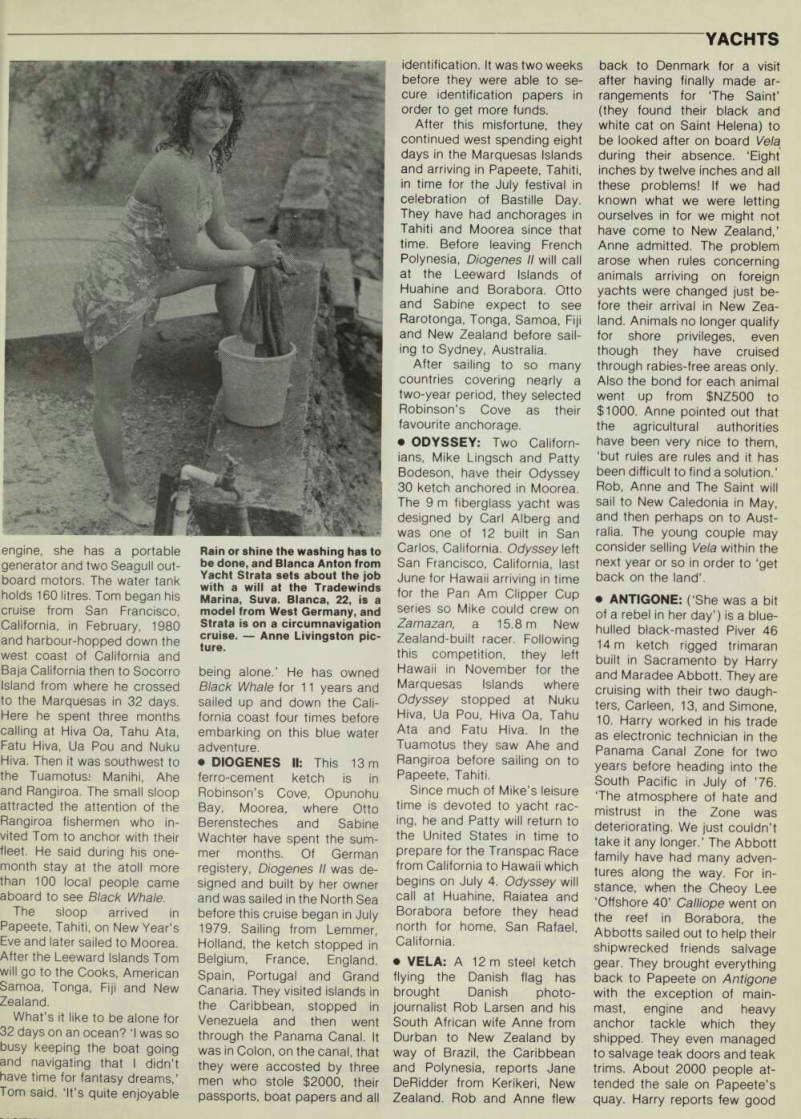
• Stratosphere: A 19 M
catamaran racer, Stratosphere arrived in Rarotonga in late January, reports Paul Rysavy.
The Auckland-registered yacht was designed by New Zealander David Barker. With bubble portholes and a stream-lined finish, she was known as ‘the spaceship’ in Rarotonga.
On board are owner skipper, Gordon Miller, his wife Phyllis, daughter Fiona (who describes herself as ‘entertain ment officer’), and a crew of three. Miller took three and a half years to build the fibreglass cat and launched her mi Auckland two years ago.
The second race Stratosphere participated in was the White Island Race, a 480 km course from Auckland to Tauranga.
Stratosphere not only won, but
also succeeded in breaking the previous record set by the American Maxi Racer Kialoa by eight and a half hours. Since then Stratosphere has been entered in numerous other races in the Auckland area.
This is the cat’s and the Millers’ first ocean cruise. From Rarotonga the Millers and their crew plan to sail to Tahiti where they will decide whether to continue on to Hawaii, or to make for the Caribbean. The skipper anticipates returning to Auckland in about six months. • SAMBA: A 12 m steel ketch was built by owner Renato Botelho in Rio de Janeiro, Brazil, reports Joan D. Pease from Papeete. He and his crew Susy Collingwood began their cruise from Rio in November 1979 and visited anchorages in the Caribbean before going through the Panama Canal.
The ketch called at the Marquesas and Tuamotu Islands, Tahiti and Moorea.
After seeing the Leeward Islands, including Maupiti, they will continue west to Rarotonga, the Tongan islands, Fiji and Australia. ‘Our favorite islands are Makemo
and Tahanea in the Tuamotus,’ said Susy.
• Kamaaina: A Cal 2-46
ketch from Honolulu is in the Society Islands. Owners Bob and Marianne Miller arrived in Tahiti in January after a 24-day passage from Hawaii. The 14 m ketch called at Moorea before going to Huahine, Raiatea, Tahaa and Borabora.
Although Bob has been racing boats and cruising since the 19305, this was his first experi ence with a wind vane. He installed an RVG vane and says, ‘lt really did a job. It’s better than three hands and lets you know when the boat isn’t properly balanced.’ The Milters will return to Hawaii in July and will cruise the Kona Coast. • TANGARORA: Built by owner Fred Landman, Tangarora spent the month of March in Moorea, Society Islands, waiting for clear weather to sail to the Leeward Islands. Fred began his cruise in the 9.75 m Tahiti ketch from Santa Cruz, California, and called at ports as far down the west coast as Cabo San Lucas, Mexico. He visited the
Marquesas, Tuamotu and So ciety Islands, and will continue west single handed with plan ned stops at Rarotonga, Cook Islands and Fiji.
• Gabbiano Ii: A 15.5 M
steel ketch owned by the Gabbiano family Gianfranco, Lidia and son Michele is on a circumnavi gation which began in Italy two years ago. They are now in French Polynesia and have called at the Marquesas, Tuamotus, Tahiti and Moorea.
Their stops at the atolls in cluded Makemo, Tahanea, Faaite, Fakarava and Toau.
After the Leeward Islands and Rarotonga, they hope to see Niue. Their planned voyage includes stops in Sydney, Australia, Christmas Island and Cocos Islands before crossing the Indian Ocean and entering the Red Sea. • BLACK WHALE: Skippered singlehanded by Tom Laginess, this 6.85 m sloop is now in Moorea, Society Islands. In spite of its size, the small yacht is equipped with a stove and oven, portable tele vision set and VHF radio.
Although Black Whale has no
engine, she has a portable generator and two Seagull out board motors. The water tank holds 160 litres. Tom began his cruise from San Francisco, California, in February, 1980 and harbour-hopped down the west coast of California and Baja California then to Socorro Island from where he crossed to the Marquesas in 32 days.
Here he spent three months calling at Hiva Oa, Tahu Ata, Fatu Hiva, Ua Pou and Nuku Hiva. Then it was southwest to the Tuamotus:- Manihi, Ahe and Rangiroa. The small sloop attracted the attention of the Rangiroa fishermen who in vited Tom to anchor with their fleet. He said during his one month stay at the atoll more than 100 local people came aboard to see Black Whale.
The sloop arrived in Papeete, Tahiti, on New Year’s Eve and later sailed to Moorea.
After the Leeward Islands Tom will go to the Cooks, American Samoa, Tonga, Fiji and New Zealand.
What’s it like to be alone for 32 days on an ocean? ‘I was so busy keeping the boat going and navigating that I didn’t have time for fantasy dreams,’
Tom said. ‘lt’s quite enjoyable
being alone.’ He has owned Black Whale for 11 years and sailed up and down the Cali fornia coast four times before embarking on this blue water adventure.
• Diogenes Ii: This 13 M
ferro-cement ketch is in Robinson’s Cove, Opunohu Bay, Moorea, where Otto Berensteches and Sabine Wachter have spent the sum mer months. Of German registery, Diogenes II was de signed and built by her owner and was sailed in the North Sea before this cruise began in July 1979. Sailing from Lemmer, Holland, the ketch stopped in Belgium, France, England.
Spain, Portugal and Grand Canaria. They visited islands in the Caribbean, stopped in Venezuela and then went through the Panama Canal. It was in Colon, on the canal, that they were accosted by three men who stole $2OOO, their passports, boat papers and all
identification. It was two weeks before they were able to se cure identification papers in order to get more funds.
After this misfortune, they continued west spending eight days in the Marquesas Islands and arriving in Papeete, Tahiti, in time for the July festival in celebration of Bastille Day.
They have had anchorages in Tahiti and Moorea since that time. Before leaving French Polynesia, Diogenes II will call at the Leeward Islands of Huahine and Borabora. Otto and Sabine expect to see Rarotonga, Tonga, Samoa, Fiji and New Zealand before sail ing to Sydney, Australia.
After sailing to so many countries covering negrly a two-year period, they selected Robinson’s Cove as their favourite anchorage. • ODYSSEY: Two Californ ians, Mike Lingsch and Patty Bodeson, have their Odyssey 30 ketch anchored in Moorea.
The 9 m fiberglass yacht was designed by Carl Alberg and was one of 12 built in San Carlos, California. Odyssey left San Francisco, California, last June for Hawaii arriving in time for the Pan Am Clipper Cup series so Mike could crew on Zamazan. a 15.8 m New Zealand-built racer. Following this competition, they left Hawaii in November for the Marquesas Islands where Odyssey stopped at Nuku Hiva, Da Pou, Hiva Oa, Tahu Ata and Fatu Hiva. In the Tuamotus they saw Ahe and Rangiroa before sailing on to Papeete, Tahiti.
Since much of Mike’s leisure time is devoted to yacht rac ing, he and Patty will return to the United States in time to prepare for the Transpac Race from California to Hawaii which begins on July 4. Odyssey will call at Huahine, Raiatea and Borabora before they head north for home, San Rafael, California. • VELA: A 12 m steel ketch flying the Danish flag has brought Danish photo journalist Rob Larsen and his South African wife Anne from Durban to New Zealand by way of Brazil, the Caribbean and Polynesia, reports Jane Deßidder from Kerikeri, New Zealand. Rob and Anne flew
back to Denmark for a visit after having finally made ar rangements for The Saint’ (they found their black and white cat on Saint Helena) to be looked after on board Vela during their absence. ‘Eight inches by twelve inches and all these problems! If we had known what we were letting ourselves in for we might not have come to New Zealand,’
Anne admitted. The problem arose when rules concerning animals arriving on foreign yachts were changed just be fore their arrival in New Zea land. Animals no longer qualify for shore privileges, even though they have cruised through rabies-free areas only.
Also the bond for each animal went up from SNZSOO to $lOOO. Anne pointed out that the agricultural authorities have been very nice to them, ‘but rules are rules and it has been difficult to find a solution.’
Rob, Anne and The Saint will sail to New Caledonia in May, and then perhaps on to Aust ralia. The young couple may consider selling Vela within the next year or so in order to ‘get back on the land’. • ANTIGONE: (‘She was a bit of a rebel in her day’) is a blue hulled black-masted River 46 14 m ketch rigged trimaran built in Sacramento by Harry and Maradee Abbott. They are cruising with their two daugh ters, Carleen, 13, and Simone, 10. Harry worked in his trade as electronic technician in the Panama Canal Zone for two years before heading into the South Pacific in July of ’76. ‘The atmosphere of hate and mistrust in the Zone was deteriorating. We just couldn’t take it any longer.’ The Abbott family have had many adven tures along the way. For in stance, when the Cheoy Lee ‘Offshore 40’ Calliope went on the reef in Borabora, the Abbotts sailed out to help their shipwrecked friends salvage gear. They brought everything back to Papeete on Antigone with the exception of main mast, engine and heavy anchor tackle which they shipped. They even managed to salvage teak doors and teak trims. About 2000 people at tended the sale on Papeete’s quay. Harry reports few good
Rain or shine the washing has to be done, and Blanca Anton from Yacht Strata sets about the job with a will at the Tradewinds Marina, Suva. Blanca, 22, is a model from West Germany, and Strata is on a circumnavigation
cruise. - Anne Livingston pic
ture.
passages over the years, the best being the most recent from Brisbane where they’d spent a full year, to Opua. It was a gentle close reach all the way across the Tasman with the biggest waves 15 to 20 cm high as they moved with the centre of a protective high.
Antigone leaves New Zealand for Tahiti next, and from there will head for Hawaii. • BACCHUS: The fibreglass hull and decks and teak interior joinery of the Peterson 44 13.4 m sloop were built in Taiwan. Everything else the engining, instrumentation, installation of spars and rig ging, winches and lifelines was completed in San Diego. ‘She’s perfect for us,’ say Harry and Donna Mae Disharoon. ‘The Stowaway Mast, a copy of Hood’s built by Super Spar of Huntington Beach, is 100% perfect. We wouldn’t be without it. We reef in 30 seconds without stepping out of the cockpit.’ The Oxnard couple left California in ’7B and are in New Zealand for the second time. The Disharoons
plan to head back towards Tahiti from here. Their last stop over was Queensland which they describe as being ‘the epitome of living, with its year round favourable climate, beautiful coast, friendly people and its opportunities .. .’
• Doreen Beatrice: When
Syd Durrant’s wife, Doreen Beatrice, died five years ago, he sold everything including his Surrey home, bought a Vancouver 27 an 8.2 m sloop built in Newhaven by Pheon Yachts and set off singlehanded to seek a part of the world where the air is balmy, the people friendly, and the cost of living reasonable. ‘The English climate is too severe,’ says Syd, now 69.
He’d been 16 years at sea already, including two years on Arctic trawlers. Durrant ended his merchant navy career as wireless operator on Blue Fun nel Line tramps, travelling all over the Far East taking Malaysians to Jeddah pil grims who had saved all their lives to go to Mecca. Doreen Beatrice called in at Gibraltar,
the Canaries, and at Barbados before spending a year island hopping in the Caribbean. He rode out Hurricanes David and Frederick nosed into the man groves in Roadtown, Tortola.
Syd, who always singlehandles his little sloop, could have done with an extra crew member when, near the Galapagos, a whale took out the self steering. Unable to return to the Galapagos because of strong currents, he tiller steered during the day, hove to at night to rest. It took 75 days to do the 4800 km from Las Perlas to the Marquesas. ‘I was getting short of food when I finally arrived in Nuka Hiva . . .’
Another mishap occurred near Papeete when his engine stopped as he was entering the pass and the yacht went on the reef. None the worse for wear, he was helped into the lagoon by a passing outrigger. Syd speaks of the hundreds of wonderful friends he has made since he left England, and of the comradeship between yachties. Doreen Beatrice headed out in April for New
Caledonia, then across to Bundaberg, Australia, and north along the Great Barrier Reef.
• Pursuit Of Nantucket:
Belongs to David Wright, British pro fessional yacht skipper, and his Rhodesian first mate Annie.
The young couple met some years ago in Greece when they were both crewing on the 30 m ketch Cecile, built in 1914 for Kaiser Wilhelm. David was skipper, Annie cook. Later they made their way on a three-master to the West Indies. Together they ran a 15 m meter charter boat Nightwind out of St Lucia for 18 months. Then in 1978 they bought their own ketch in Nantucket. She’s 50 years old and a typical Alden vessel rebuilt back to the original specs from the waterline up.
While in New Zealand they will haul the 18-tonne vintage vessel at Jim Ashby’s shipyard to laminate some new frames, replace a plank or two and recaulk. Eventually David and Annie plan to ‘carry on round’
via Tonga, Fiji, Australia and South Africa. • AN DEN SIOUL: The words translate as The Tranquil Man’ from the ancient Breton tongue. Janet and Bill Baker found the steel ketch at the quay in Papeete. They liked her lines. That boat will be ours,’ they decided. An Den Sioul was built in Holland in 1972 along with 12 others which were used for a navigational school in the North Sea. The originals were so designed that 12 cadets could be accommodated. A Frenchman from Britanny modified An Den Sioul and sailed her to the South Pacific.
He had a heart attack in Tahiti so decided to sell her. Janet and Bill had arrived in Tahiti in ’77 on their Piver Lodestar trimaran Shearwater (now the Papeete charter yacht Otara ). ‘We wanted a heavier cruising boat with headroom,’ Bill ex plained. After leaving Moorea, it took more than 24 hours for Janet to get used to the added pendulum motion of her soon to-be-born baby and the monohull’s angle of heel. From Borabora Janet and Bill sailed direct to New Zealand, a voy age of three gales and 27 days.
An Den Sioul arrived in Opua on October 27, Labour Day, for which Janet was teased appropriately by NZ customs officers. Twenty-seven days later in Whangarei hospital, 27-year-old Janet gave birth to a son. She came home from hospital on November 27, American Thanksgiving Day, with Noah her Kiwi son. Noah’s sheepskin-lined quarter berth is on the starboard side of the ark. • TUILIPE: This was the win ning boat in the Open Class Unlimited rowing event at the Opua Regatta on January 31.
The Tongan-built 4.2 m pulling boat was built for Bill Sellers of the Atkin 10.4 m cutter Nim bus at the island-village of Utungake near Neiafu in the Vavau group. American scrimshander, Bill Sellers, lost his previous New Zealand-built fibreglass tender when he was forced to move anchorage in the middle of the night. While Bill was towing the 4.2 m Salthouse boat behind Nimbus in rough seas from Alofi to the
other side of Niue, the dinghy’s painter chafed through. In Neiafu, where clinker rowing boats are traditionally used, Sellers arranged with a Tongan carver from Utungake to build him a 4.2 m plumb-stemmed row boat from sketches, using transom and midship section shapes which Sellers provided.
For the planking, the builder Luke selected and felled a tavahi tree because of its light wood. Nimbus towed the log to Neiafu for milling at Miline Noa’s Lister diesel-powered mill. After the planking was seasoned for two weeks, the vessel took shape amidst much doubtful head-tilting and dubious head-scratching in the village. It is considerably narrower than the Tongan lapstrake boats which are sometimes called upon to carry half a village at a time.
Sellers built Nimbus in Opua, NZ, and had with him his power planer and skill saws. Luke used the power tools to fashion meticulously the little craft on a stem of heart kauri and on a douglas fir keel and transom.
From time to time Bill crossed to Neiafu on Nimbus to get another beer bottle of petrol for the Honda generator. • PHAT DUCK: This is a Morgan 45 13.7 m ketch built in Florida. She’s cruising home to Californians Paul and Marian Mclntosh. Paul has been sailing for over 30 years, delivering and racing yachts, and latterly selling them in Dana Point, California. One of Marian and Paul’s favourite stops during this cruise was at Fanning Island. Their son Scott, daughter-in-law Gwen and grand-daughter Adriel who is ‘three going on five’, joined them in early November in Suva. Another grandchild is due in May. The Mclntoshes had a slow and difficult pass age from Fiji. Phat Duck’s transmission was out, her smaller sails out of com mission, and the weather either flat calm, full gale, or head winds ... 21 days of it. They were all totally overwhelmed with the warmth of their recep tion in New Zealand. Future plans include Vanuatu, New Caledonia, Solomons, Papua New Guinea and next hurri cane season in Australia.
Advertisements & other items, pp. 66-70 (4 items)
Aquila
-s IP Aquila water tanks completely enclosed to ensure clean water and built to last from strong, durable galvanised steel You assemble them yourself from our comprehensive kits. Capacities range from 2300 litres to 49250 litres.
Send for a brochure today.
Aquila Engineering Division, 25 Pacific Highway, Bennetts Green, New South Wales, Australia.
Name Address P/code
AQ2O/2
AQUILA
FORESTMIL
PORTABLE
SAWMILL
Recent release new models are heavier duty with additional features. Powered by diesel engine or electric motor.
Forestmil produces any size accurate timber ready to use up to 12" x 9" x 24'.
Purchase price and operating cost of Forestmil is less than other sawing equipment with similar production capacity.
Forestmil reduces timber waste and also reduces log transport cost. Timber is sawn direct from the log in the forest.
Forestmil can be moved to a new location in one hour.
Forestmil will saw hardwood or softwood from logs of any diameter.
Over 1000 Forestmils are sawing timber in 23 countries.
Forestmil has been manufactured for 18 years.
For literature and prices please contact the manufacturers.
MacQuarrie Industries Pty.Ltd.
P.O. Box 20, Coburg 3058, Victoria, Australia.
Phone. 350-3411. Telex: 33729. Cables: Macbound, Melbourne
-1 ■ sagasßNSi
Throughout the Pacific
we’re your kind of people
When you fly in the Pacific, you’ll feel at home with Air New Zealand.
Fly with us to Australia,Cook Islands, Fiji, Hong Kong,Honolulu, Japan, Los Angeles, New Caledonia, Norfolk Island, Singapore, Tahiti, Tonga, Western
The Pacific’s
Number One
New Zealand.
throughout BIF HEUU
ANZ 80/18
WHEN YOUR DEALER CANT SUPPLY
EMERGENCY!
SPARE PARTS SERVICE
R. T. AAUIRHEAD COMPANY
EXPORTERS
ESTABLISHED 1935
We furnish genuine Spare parts for any American manufactured Construction • Mining • Logging • Transportation • Quarry and Industrial Equipment.
“EMERGENCY SERVICE IS OUR "
WE WILL ARRANGE CUSTOM CLEARANCE AND DELIVERY TO YOUR WAREHOUSE.
SATISFIED CUSTOMERS THROUGHOUT AUSTRALIA, NEW ZEALAND, PACIFIC ISLANDS, SOUTH EAST ASIA AND OTHER
COUNTRIES - REFERENCES AVAILABLE.
An'nocoo R - T - MUIRHEAD c 0 L pir ß f®; U ' RHEAD LOS ANGELES 1923 STAUNTON AVENUE ELEPHONE. (213) 749-4418 LOS ANGELES, CALIF. 90058
P.O. BOX 58512 A
HENRY CUMINES
PTY. LTD.
EXPORTERS o GENERAL MERCHANTS
428 GEORGE ST., SYDNEY
CABLES: HENCO SYDNEY. G.P.O. Box 3949. PHONE: 232-5377
For specialised and personalised buying service
throughout the Pacific Islands and the East.
• LOCAL AGENTS AND REPRESENTATION
PAPUA NEW GUINEA: FIJI:
RABAUL M. & C. Seeto, P.O. Box 131, Rabaul.
Telephone 92-2919.
MADANG W. Double, P.O. Box 22, Madang Telephone 82-2696 K. Witherington Ltd.
P.O. Box 293, Suva Telephone 22-356.
VANUATU:
John Lum & Associates, P.O. Box 65, Santo.
Telephone 329.
SOLOMON ISLANDS:
Mr. Tom Lo, P.O. Box 327, Honiara Telephone 399.
Resident Agents in other Pacific Territories. *
PACIF^^^
ISLANDS
TRANSPORT
LINE
MS AFRICANSTARS
Express Freight Service between Pacific Coast Ports of U.S.A. and...
Tahiti 6 Samoa
PAPEETE - APIA - PAGO PAGO
Full container service including reefers.
GENERAL STEAMSHIP CORPORATION LTD.
General Agents 400 California Street, San Francisco, California, U.S.A.
APIA: Bums Philp (South Sea) Company Ltd, PAPEETE: Agenoe Maritime Internationale, Tahiti PAGO PAGO: Polynesia Shipping Services Inc.
Yachts
Yachts
Yachts
Vanuatu
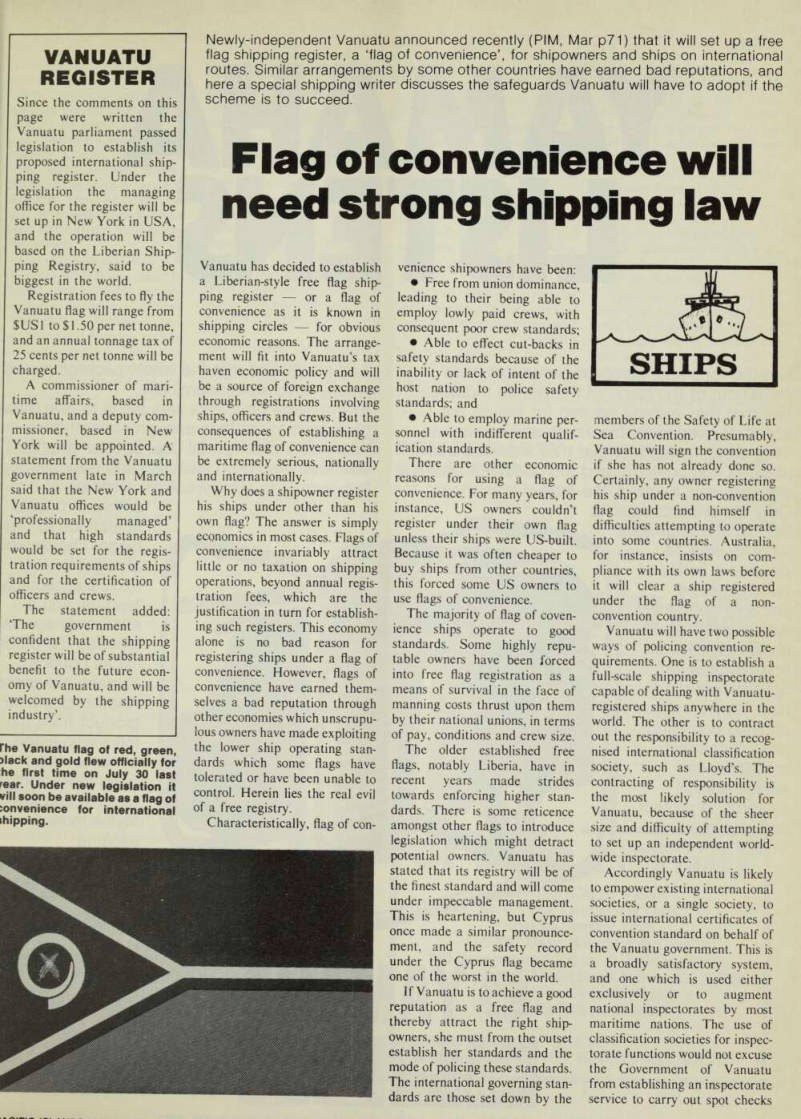
Register
Since the comments on this page were written the Vanuatu parliament passed legislation to establish its proposed international ship ping register. Under the legislation the managing office for the register will be set up in New York in USA, and the operation will be based on the Liberian Ship ping Registry, said to be biggest in the world.
Registration fees to fly the Vanuatu flag will range from SUS Ito $ 1.50 per net tonne, and an annual tonnage tax of 25 cents per net tonne will be charged.
A commissioner of mari time affairs, based in Vanuatu, and a deputy com missioner, based in New York will be appointed. A statement from the Vanuatu government late in March said that the New York and Vanuatu offices would be
‘professionally managed’
and that high standards would be set for the regis tration requirements of ships and for the certification of officers and crews.
The statement added; ‘The government is confident that the shipping register will be of substantial benefit to the future econ omy of Vanuatu, and will be welcomed by the shipping industry’.
need strong shipping law

Ships
Flag of convenience will need strong shipping law
Newly-independent Vanuatu announced recently (PIM, Mar p7l) that it will set up a free flag shipping register, a ‘flag of convenience’, for shipowners and ships on international routes. Similar arrangements by some other countries have earned bad reputations, and here a special shipping writer discusses the safeguards Vanuatu will have to adopt if the scheme is to succeed.
Vanuatu has decided to establish a Liberian-style free flag ship ping register or a flag of convenience as it is known in shipping circles for obvious economic reasons. The arrange ment will fit into Vanuatu’s tax haven economic policy and will be a source of foreign exchange through registrations involving ships, officers and crews. But the consequences of establishing a maritime flag of convenience can be extremely serious, nationally
and internationally.
Why does a shipowner register his ships under other than his own flag? The answer is simply economics in most cases. Flags of convenience invariably attract little or no taxation on shipping operations, beyond annual regis tration fees, which are the justification in turn for establish ing such registers. This economy alone is no bad reason for registering ships under a flag of convenience. However, flags of convenience have earned them selves a bad reputation through other economies which unscrupu lous owners have made exploiting the lower ship operating stan dards which some flags have tolerated or have been unable to control. Herein lies the real evil of a free registry.
Characteristically, flag of con-
venience shipowners have been: • Free from union dominance, leading to their being able to employ lowly paid crews, with consequent poor crew standards; • Able to effect cut-backs in safety standards because of the inability or lack of intent of the host nation to police safety standards; and • Able to employ marine per sonnel with indifferent qualif ication standards.
There are other economic reasons for using a flag of convenience. For many years, for instance, US owners couldn’t register under their own flag unless their ships were US-built.
Because it was often cheaper to buy ships from other countries, this forced some US owners to use flags of convenience.
The majority of flag of coven ience ships operate to good standards. Some highly repu table owners have been forced into free flag registration as a means of survival in the face of manning costs thrust upon them by their national unions, in terms of pay, conditions and crew size.
The older established free flags, notably Liberia, have in recent years made strides towards enforcing higher stan dards. There is some reticence amongst other flags to introduce legislation which might detract potential owners. Vanuatu has stated that its registry will be of the finest standard and will come under impeccable management.
This is heartening, but Cyprus once made a similar pronounce ment, and the safety record under the Cyprus flag became one of the worst in the world.
If Vanuatu is to achieve a good reputation as a free flag and thereby attract the right ship owners, she must from the outset establish her standards and the mode of policing these standards.
The international governing stan dards are those set down by the
members of the Safety of Life at Sea Convention. Presumably, Vanuatu will sign the convention if she has not already done so.
Certainly, any owner registering his ship under a non-convention flag could find himself in difficulties attempting to operate into some countries. Australia, for instance, insists on com pliance with its own laws before it will clear a ship registered under the flag of a non convention country.
Vanuatu will have two possible ways of policing convention re quirements. One is to establish a full-scale shipping inspectorate capable of dealing with Vanuatu registered ships anywhere in the world. The other is to contract out the responsibility to a recog nised international classification society, such as Lloyd’s. The contracting of responsibility is the most likely solution for Vanuatu, because of the sheer size and difficulty of attempting to set up an independent world wide inspectorate.
Accordingly Vanuatu is likely to empower existing international societies, or a single society, to issue international certificates of convention standard on behalf of the Vanuatu government. This is a broadly satisfactory system, and one which is used either exclusively or to augment national inspectorates by most maritime nations. The use of classification societies for inspec torate functions would not excuse the Government of Vanuatu from establishing an inspectorate service to carry out spot checks
The Vanuatu flag of red, green, Black and gold flew officially for [?]he first time on July 30 last [?]ear. Under new legislation it will soon be available as a flag of [?]onvenience for international [?]hipping.
internationally and to conduct marine enquiries.
The question of cheap mann ing need not necessarily pose a problem to safety at sea. For years, Indian, Chinese, and more recently Kiribati and Papuan crews have effectively manned European flag ships to very high standards. However these crews have been certificated, and have been administered by high cal ibre officers.
One of the greatest dangers to the safety of life at sea created by flags of convenience has been the indifferent licensing of officers.
Established free flag nations such as Liberia and Panama, with no examination service of their own, issue certificates of competency at worldwide embassies against the production of an equivalent certificate from a non-free-flag nation. Thus, a British master mariner can produce his certificate of competency at a Liberian embassy and be issued with a Liberian certificate. The system has been subject to abuse.
Further, not all examining mari time nations require the same standards of competency and experience for examination for a certificate acceptable for free flag certification.
If Vanuatu adopts the Liber ian system, and if she is to naintain standards at a level vhich will attract responsible )wners, then she must be ex remely careful in defining the countries which have certificates )f competency considered icceptable for the issue of /anuatu certificates.
In summary, Vanuatu’s pro ved establishment of a free flag egistry is in line with the tax laven economic policy of the lation. It could afford substantial conomies to shipowners seeking □ register their vessels under flag f convenience. However, if Vanuatu’s ambitions for an npeccably managed free flag egistry of the highest standards re not to founder under the xploitation of unscrupulous hipowners seeking an alternative 3 the tightening standards of iberia, then the country will ave to implement stringent ship ing law and establish an
ffective professional shipping
ispectorate from the outset, liven such, Vanuatu would robably attract the right sort of igh calibre owner.
Repairs For
Mv Tokera
After nearly four months of uncertainty about the future of the damaged Cook Islands ship MV Tokerau , the ship’s owners are now calling tenders for its repairs and return to service.
Tokerau was delivered to its owners. South Pacific Import Network Company, only last August (PIM, Oct p7l). Al though 40 years old the ship had been refitted and classed by Lloyd’s, and its owners put it into service on cargo routes to Western Samoa, Fiji and Tuvalu.
In December the ship struck a reef northwest of the Fiji island of Viti Levu while mak ing for Suva on a voyage from Tuvalu. No one was injured, but the ship was hard on the reef with damaged plating, some holing and severe damage to propeller and rudder. The en gine room flooded 12 hours after the grounding. Six days after the grounding the hull was patched and a salvage tug refloated the ship and towed it to Suva.
Since then the ship has been in Suva while financial and insurance matters affecting its future have been under inquiry.
The owners now believe it will be possible to return the ship to service later this year.
Paul Rysavy in Rarotonga.
Png Affirms
Forum Aid
Papua New Guinea has com mitted itself to the continued support of the Pacific Forum Shipping Line despite con tinued losses by the line and despite Australian questioning of the viability of the operation.
Last year Australia told heads of Pacific Island govern ments that it would support the line if this was the wish of the Islands, but the support could be at the expense of Australian general aid to the region. New Zealand clashed with Australia over the issue and said it would continue to aid the line in the interests of developing the ex port economies of the smaller Pacific countries (PIM, Mar p 67).
The Papua New Guinea Prime Minister, Sir Julius Chan, has now reaffirmed his
country’s support to moves to keep the line alive. PNG itself, Sir Julius said, would continue to participate in the line and to provide budget support but he added that the extent of the budget support would depend on PNG’s aid received from Australia.
Sir Julius said ‘By supporting the line we see ourselves helping the smaller Island nations such as Tonga, Kiribati and Niue.
We can’t deny services to these places’.
He said that a prime respons ibility to revive the line and turn its losses into profits rested with the governments of Australia and New Zealand in the inter ests of the Pacific community.
He welcomed the New Zealand commitment to contribute to the line.
Police Party
Nabs Ships
Yap, in the Federated States of Micronesia, is adopting an in creasingly tough attitude to foreign fishing ships which en ter its territorial waters without clearance, even if there is no evidence that the visiting ships are taking fish.
In a recent incident off the south coast of Yap police im pounded three ships which had hove to and were apparently transferring fuel. One was the 3900 tonne fisheries vessel Reefer Star which is registered in Panama but is owned by the US firm Star Kist which has fishing agreements with the Papua New Guinea govern ment. Its crew of 45 officers and
men included Koreans, Papua New Guineans, Filipinos and Japanese. The two small ships which were alongside it were owned by Japanese interests and were manned by Okinawan crews.
Police on Yap used two prisoners from a local gaol to crew an open dinghy which went out to the three ships. The three police who travelled in the dinghy questioned the masters of the ships, and instructed the ships to follow them The ships obeyed the instruc tion after some argument and were later fined a total of $5OOO on charges relating to unauthor ised entry to territorial waters and spilling diesel fuel. The ships were allowed to leave several days later after the fines were paid.
A spokesman for the Yap attorney-general’s office said that fisheries were an important resource for Yap, and although the state was ill-equipped to deal with breaches of its terri torial regulations it would spare no effort to act against the presence of unauthorised ships.
Eight Saved
From Wreck
Eight Japanese crewmen were rescued unharmed by a sister ship after their fishing ship Tokusho Maru 5 struck a reef east of Truk Island in the Federated States of Micronesia in February. The ship has remained firm on the reef, and the damaged hull is now con sidered to be beyond salvage.
Advertisements & other items, pp. 72-74 (2 items)
Listens
YAMAHA
Not too long ago, personal generators were priced out of the reach of the private individual.
Not that they weren’t wanted for leisure purposes or needed for blackouts and brownouts.
They were. It was just that they were too complicated, too powerful and too costly for the average user. In short, the market was there.
Only the product wasn’t.
So Yamaha engineers went to work to develop a series of suitcase-sized portable generators with a balance of performance, cost and features just right for private use. They un-complicated operating procedures and maintenance.
Added special systems to protect careless owners from themselves.
And made sure that the whole package ran as quietly as it did economically.
At the same time, care was taken to give these generators more than enough strength for heavy-duty commercial use. Special emphasis was also placed on reliability and easy starting.
Depending on area, you have a choice of 8 different models.
In addition to this bigger choice, you also get several exclusive Yamaha features and a number of special features the others list as options.
Yamaha generators Another practical product from the folks who listen better to make living more comfortable and lifestyles more exciting.
IMUM
m
YAMAHA
- YAMAHA MOTOR CO.. LTD. 2500 SHINGAI IWATA-SHI SHIZUOKA-KEN JAPAN
For Sale TS “Teraaka
Passenger/Cargo Vessel
Built 1959, Converted 1968, Special Survey 1980 Grt 980 Dead Weight 490 Tons 160 Passengers 1400 cu. ft. hold capacity.
Engine Sulzer 6TD 48 1800 B.N.P. at 225 R.P.M.
Offers Over Austs3oo,ooo Apply for full particulars
M.T.S.
Betio/Tarawa P.O. Box 511 KIRIBATI
VIS INTERNATIONAL
Planning a New Era in Modular Living m j.
Kit Price 19397
RIvERVIEW
13 M
HOTELS, MOTELS,
ACCOMMODATION
TWO STOREY
DUPLEX UNITS
SCHOOLCLASS
ROOMS
Also Specialists in LOW COST Housing 2 Bedroom Kits from $3500
RTIST S IMPRESSION
BED 3
DINING
LIVING
BED 1
BED 2
PATIO
8 cs> Our advanced building system saves greatly in time and costs* So your money works for you faster. Fully erected in 6 - 8 weeks.
Look at the features of Modular Construction: •Strength •Speed of Construction • Insulated • Fire Resistant •Termite Resistant • Economy • Low Maintenance \ i I /// 0 jjr A. si-#* *?/ //
s£S£ * O % £ O 5*S 0^ 4/
FOR:
IN OUR 86th YEAR SELLING ‘SERVICE’
TO THE PACIFIC ISLANDS
Nelson & Robertson
PTY. LTD. (Established 1895)
Plantation House, 197 Clarence Street, Sydney
Cables: ‘IVAN\ Sydney, Brisbane. Telex: AA22381, Sydney.
INDENTS - FROM AUSTRALIA, NEW ZEALAND and OVERSEAS.
FOODSTUFFS • SOFTGOODS • HARDWARE • MACHINERY TRAVEL • INSURANCE • CANNED FISH • JUTE GOODS
• REAL ESTATE •
BRANCH OFFICES:
Nelson & Robertson Pty. Ltd., P.O. Box 575, Brisbane, Qld., Australia.
P.O. Box 2092, Govt. Bldg., Suva, Fiji.
P.O. Box 258, Lautoka, Fiji.
P.O. Box 2420, CPO Auckland 1, New Zealand.
PAPUA NEW GUINEA
REPRESENTATIVES:
Rabtrad Niugini Pty. Ltd., P.O. Box 219, Rabaul, P.N.G.
P.O. Box 1406, Lae, P.N.G.
P.O. Box 711, Madang, P.N.G P.O. Box 253, Kieta, P.N.G.
Ships
Services
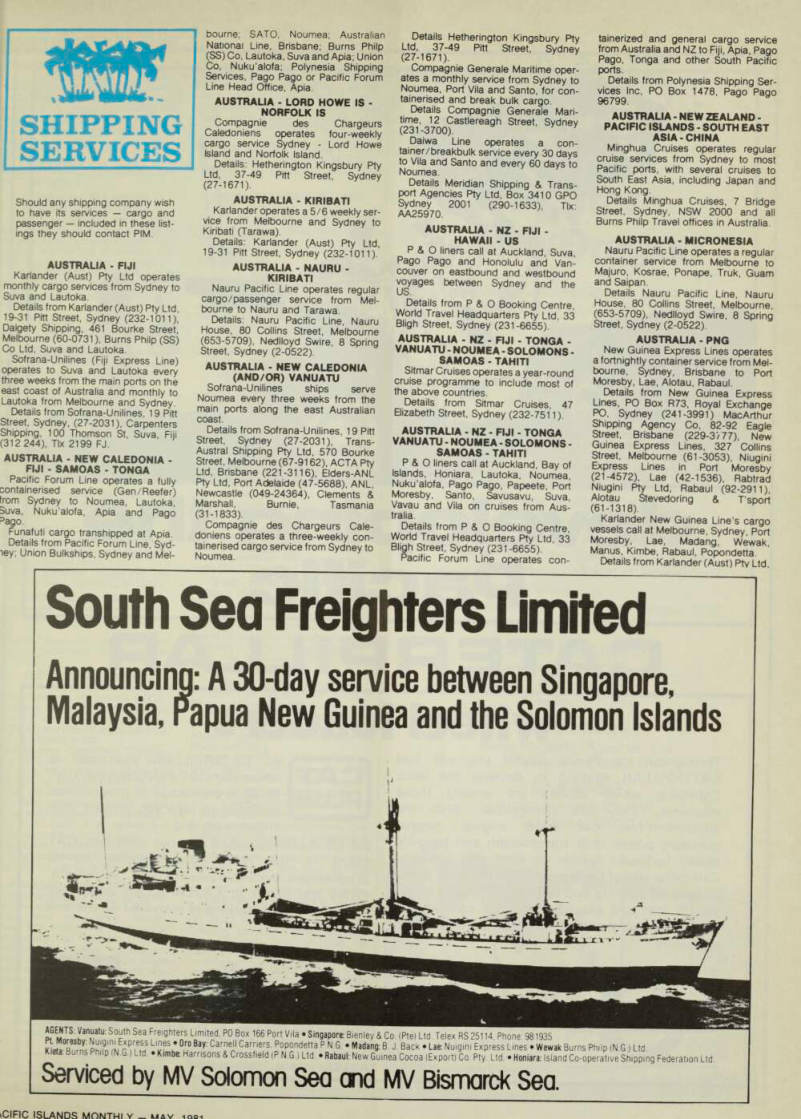

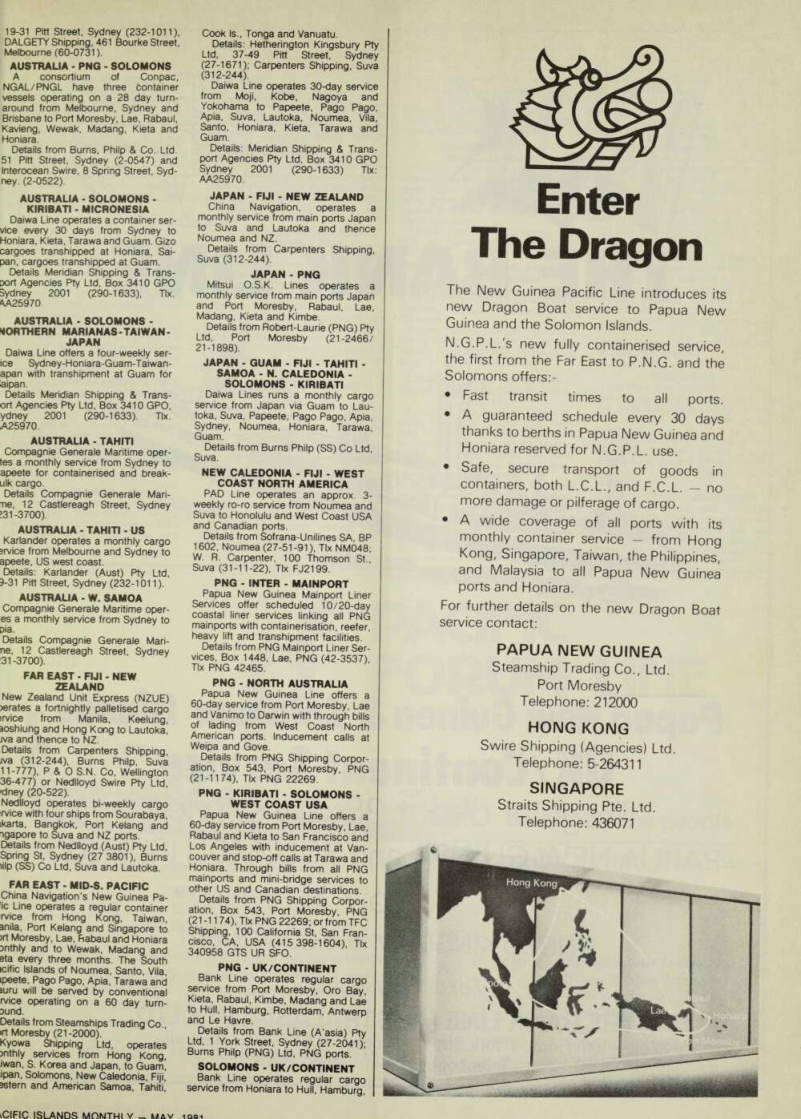
Shipping
Should any shipping company wish to have its services cargo and passenger included in these list ings they should contact PIM.
Australia - Fiji
Karlander (Aust) Pty Ltd operates monthly cargo services from Sydney to Suva and Lautoka.
Details from Karlander (Aust) Pty Ltd, 19-31 Pitt Street, Sydney (232-1011).
Dalgety Shipping, 461 Bourke Street, Melbourne (60-0731), Burns Philp (SS) Co Ltd, Suva and Lautoka.
Sofrana-Unilines (Fiji Express Line) operates to Suva and Lautoka every three weeks from the main ports on the east coast of Australia and monthly to Lautoka from Melbourne and Sydney.
Details from Sofrana-Unilines. 19 Pitt Street, Sydney, (27-2031), Carpenters Shipping, 100 Thomson St, Suva Fiji (312 244), Tlx 2199 FJ.
Australia - New Caledonia -
Fiji - Samoas - Tonga
Pacific Forum Line operates a fully
containerised service (Gen/Reefer)
from Sydney to Noumea, Lautoka.
Suva, Nukualofa, Apia and Pago 3 ago.
Funafuti cargo transhipped at Apia.
Details from Pacific Forum Line, Syd ney: Union Bulkships, Sydney and Mel
bourne; SATO, Noumea; Australian National Line, Brisbane; Burns Philp (SS) Co, Lautoka, Suva and Apia; Union Co, Nukualofa; Polynesia Shipping Services, Pago Pago or Pacific Forum Line Head Office, Apia.
Australia - Lord Howe Is -
Norfolk Is
Compagnie des Chargeurs Caledoniens operates four-weekly cargo service Sydney - Lord Howe Island and Norfolk Island.
Details: Hetherington Kingsbury Pty Ltd, 37-49 Pitt Street, Sydney (27-1671).
Australia - Kiribati
Karlander operates a 5/6 weekly ser vice from Melbourne and Sydney to Kiribati (Tarawa).
Details. Karlander (Aust) Pty Ltd, 19-31 Pitt Street, Sydney (232-1011).
Australia - Nauru -
Kiribati
Nauru Pacific Line operates regular cargo/passenger service from Mel bourne to Nauru and Tarawa.
Details: Nauru Pacific Line, Nauru House, 80 Collins Street, Melbourne (653-5709), Nedlloyd Swire, 8 Spring Street, Sydney (2-0522).
Australia - New Caledonia
(And/Or) Vanuatu
Sofrana-Unilines ships serve Noumea every three weeks from the main ports along the east Australian coast.
Details from Sofrana-Unilines, 19 Pitt Street, Sydney (27-2031), Trans- Austral Shipping Pty Ltd, 570 Bourke Street, Melbourne (67-9162). ACTA Pty Ltd, Brisbane (221-3116), Elders-ANL Pty Ltd, Port Adelaide (47-5688), ANL, Newcastle (049-24364), Clements & Marshall, Burnie, Tasmania (31-1833).
Compagnie des Chargeurs Cale doniens operates a three-weekly con tainerised cargo service from Sydney to Noumea.
Details Hetherington Kingsbury Pty Ltd, 37-49 Pitt Street, Sydney (27-1671). 1 X Compagnie Generate Maritime oper ates a monthly service from Sydney to Noumea, Port Vila and Santo, for con tainerised and break bulk cargo.
Details Compagnie Generate Mari time, 12 Castlereagh Street, Sydney (231-3700). X Daiwa Line operates a con tainer/breakbulk service every 30 days to Vila and Santo and every 60 days to Noumea.
Details Meridian Shipping & Trans port Agencies Pty Ltd, Box 3410 GPO Sydney 2001 (290-1633). Tlx; AA25970.
Australia - Nz - Fiji -
Hawaii - Us
P & O liners call at Auckland, Suva, Pago Pago and Honolulu and Van couver on eastbound and westbound voyages between Sydney and the US.
Details from P & O Booking Centre, World Travel Headquarters Pty Ltd 33 Bligh Street, Sydney (231-6655).
AUSTRALIA - NZ - FIJI - TONGA -
Vanuatu - Noumea - Solomons -
Samoas - Tahiti
Sitmar Cruises operates a year-round cruise programme to include most of the above countries.
Details from Sitmar Cruises, 47 Elizabeth Street, Sydney (232-7511).
AUSTRALIA - NZ - FIJI - TONGA
Vanuatu - Noumea - Solomons -
Samoas - Tahiti
P & O liners call at Auckland, Bay of Islands, Honiara, Lautoka, Noumea Nukualofa, Pago Pago, Papeete, Port Moresby, Santo. Savusavu, Suva, Vavau and Vila on cruises from Aus tralia.
Details from P & O Booking Centre, World Travel Headquarters Pty Ltd, 33 Bligh Street, Sydney (231-6655).
Pacific Forum Line operates con
tainerized and general cargo service from Australia and NZ to Fiji, Apia, Pago Pago, Tonga and other South Pacific ports.
Details from Polynesia Shipping Ser vices Inc, PO Box 1478, Pago Pago 96799.
Australia - New Zealand -
Pacific Islands - South East
Asia-China
Minghua Cruises operates regular cruise services from Sydney to most Pacific ports, with several cruises to South East Asia, including Japan and Hong Kong.
Details Minghua Cruises, 7 Bridge Street, Sydney, NSW 2000 and all Burns Philp Travel offices in Australia.
Australia - Micronesia
Nauru Pacific Line operates a regular container service from Melbourne to Majuro, Kosrae, Ponape, Truk, Guam and Saipan, Details Nauru Pacific Line, Nauru House, 80 Collins Street, Melbourne, (653-5709), Nedlloyd Swire, 8 Spring Street, Sydney (2-0522).
Australia - Png
New Guinea Express Lines operates a fortnightly container service from Mel bourne, Sydney, Brisbane to Port Moresby, Lae, Alotau, Rabaul.
Details from New Guinea Express Lines, PO Box R 73, Royal Exchange PC, Sydney (241-3991) MacArthur Shipping Agency Co, 82-92 Eagle Street, Brisbane (229-3 V 77). New Guinea Express Lines, 327 Collins Street, Melbourne (61-3053), Niugini Express Lines in Port Moresby (21-4572), Lae (42-1536), Rabtrad Niugini Pty Ltd. Rabaul (92-2911), Alotau Stevedoring & T’sport (61-1318).
Karlander New Guinea Line's cargo vessels call at Melbourne, Sydney, Port Moresby, Lae, Madang, Wewak, Manus, Kimbe, Rabaul, Popondetta.
Details from Karlander (Aust) Pty Ltd.
19-31 Pitt Street, Sydney (232-1011), DALGETY Shipping, 461 Bourke Street, Melbourne (60-0731).
Australia - Png - Solomons
A consortium of Conpac, NGAL/PNGL have three container vessels operating on a 28 day turn around from Melbourne, Sydney and Brisbane to Port Moresby, Lae, Rabaul, Kavieng, Wewak, Madang, Kieta and Honiara.
Details from Burns, Philp & Co. Ltd. 51 Pitt Street, Sydney (2-0547) and Interocean Swire, 8 Spring Street, Syd ney. (2-0522).
Australia - Solomons -
Kiribati - Micronesia
Daiwa Line operates a container ser vice every 30 days from Sydney to Honiara, Kieta, Tarawa and Guam. Gizo cargoes transhipped at Honiara, Sai pan, cargoes transhipped at Guam.
Details Meridian Shipping & Trans port Agencies Pty Ltd, Box 3410 GPO Sydney 2001 (290-1633), Tlx. \A25970
Australia - Solomons -
Northern Marianas-Taiwan -
Japan
Daiwa Line offers a four-weekly ser ice Sydney-Honiara-Guam-Taiwan apan with transhipment at Guam for aipan.
Details Meridian Shipping & Trans ort Agencies Pty Ltd, Box 3410 GPO, ydney 2001 (290-1633). Tlx.
A 25970.
Australia - Tahiti
Compagnie Generate Maritime oper les a monthly service from Sydney to apeete for containerised and break ulk cargo.
Details Compagnie Generate Mari ne, 12 Castlereagh Street, Sydney >3l-3700).
Australia - Tahiti - Us
Karlander operates a monthly cargo J rvice from Melbourne and Sydney to apeete, US west coast.
Details: Karlander (Aust) Pty Ltd, 3-31 Pitt Street. Sydney (232-1011).
Australia - W. Samoa
Compagnie Generate Maritime oper es a monthly service from Sydney to pia.
Details Compagnie Generate Mari ne. 12 Castlereagh Street, Sydney 31-3700).
Far East - Fiji - New
Zealand
New Zealand Unit Express (NZUE) )erates a fortnightly palletised cargo (rvice from Manila, Keelung, aoshiung and Hong Kong to Lautoka, jva and thence to NZ.
Details from Carpenters Shipping, jva (312-244), Burns Philp, Suva 11-777), P & O S.N. Co, Wellington 36-477) or Nedlloyd Swire Pty Ltd, 'dney (20-522).
Nedlloyd operates bi-weekly cargo rvice with four ships from Sourabaya, ikarta, Bangkok, Port Kelang and igapore to Suva and NZ ports.
Details from Nedlloyd (Aust) Pty Ltd, Spring St, Sydney (27 3801), Burns lilp (SS) Co Ltd, Suva and Lautoka.
Far East - Mid-S. Pacific
China Navigation’s New Guinea Pa le Line operates a regular container rvice from Hong Kong, Taiwan, anila, Port Kelang and Singapore to >rt Moresby, Lae, Rabaul and Honiara anthly and to Wewak, Madang and Bta every three months. The South icific Islands of Noumea. Santo, Vila, ipeete, Pago Pago, Apia, Tarawa and turu will be served by conventional rvice operating on a 60 day turn xmd.
Details from Steamships Trading Co., irt Moresby (21-2000).
Kyowa Shipping Ltd. operates )nthly services from Hong Kong, iwan, S. Korea and Japan, to Guam, ipan, Solomons, New Caledonia, Fiji, astern and American Samoa, Tahiti,
Cook Is., Tonga and Vanuatu.
Details: Hetherington Kingsbury Pty Ltd, 37-49 Pitt Street, Sydney (27-1671); Carpenters Shipping, Suva (312-244).
Daiwa Line operates 30-day service from Moji, Kobe, Nagoya and Yokohama to Papeete, Pago Pago, Apia, Suva, Lautoka, Noumea, Vila, Santo, Honiara, Kieta, Tarawa and Guam.
Details; Meridian Shipping & Trans port Agencies Pty Ltd, Box 3410 GPO Sydney 2001 (290-1633) Tlx: AA25970.
Japan - Fiji - New Zealand
China Navigation, operates a monthly service from main ports Japan to Suva and Lautoka and thence Noumea and NZ.
Details from Carpenters Shipping, Suva (312-244).
Japan - Png
Mitsui O.S.K. Lines operates a monthly service from main ports Japan and Port Moresby, Rabaul, Lae, Madang, Kieta and Kimbe.
Details from Robert-Laurie (PNG) Pty Ltd, Port Moresby (21-2466/ 21-1898).
JAPAN - GUAM - FIJI - TAHITI -
Samoa - N. Caledonia -
Solomons - Kiribati
Daiwa Lines runs a monthly cargo service from Japan via Guam to Lau toka, Suva, Papeete, Pago Pago, Apia, Sydney, Noumea, Honiara, Tarawa, Guam.
Details from Burns Philp (SS) Co Ltd, Suva.
New Caledonia - Fiji - West
Coast North America
PAD Line operates an approx. 3weekly ro-ro service from Noumea and Suva to Honolulu and West Coast USA and Canadian ports.
Details from Sofrana-Unilines SA, BP 1602, Noumea (27-51-91), Tlx NMO4B; W. R. Carpenter, 100 Thomson St., Suva (31-11-22), Tlx FJ2199.
Png - Inter - Mainport
Papua New Guinea Mainport Liner Services offer scheduled 10/20-day coastal liner services linking all PNG mainports with containerisation, reefer, heavy lift and transhipment facilities.
Details from PNG Mainport Liner Ser vices, Box 1448, Lae, PNG (42-3537).
Tlx PNG 42465.
Png - North Australia
Papua New Guinea Line offers a 60-day service from Port Moresby, Lae and Vanimo to Darwin with through bills of lading from West Coast North American ports. Inducement calls at Weipa and Gove.
Details from PNG Shipping Corpor ation, Box 543, Port Moresby, PNG (21-1174), Tlx PNG 22269.
Png - Kiribati - Solomons -
West Coast Usa
Papua New Guinea Line offers a 60-day service from Port Moresby, Lae, Rabaul and Kieta to San Francisco and Los Angeles with inducement at Van couver and stop-off calls at Tarawa and Honiara. Through bills from all PNG mainports and mini-bridge services to other US and Canadian destinations.
Details from PNG Shipping Corpor ation. Box 543, Port Moresby. PNG (21 -1174), Tlx PNG 22269; or from TFC Shipping, 100 California St, San Fran cisco, CA, USA (415 398-1604), Tlx
340958 Gts Ur Sfo.
Png - Uk/Continent
Bank Line operates regular cargo service from Port Moresby, Oro Bay, Kieta, Rabaul, Kimbe, Madang and Lae to Hull, Hamburg, Rotterdam. Antwerp and Le Havre.
Details from Bank Line (A’asia) Pty Ltd, 1 York Street. Sydney (27-2041)- Burns Philp (PNG) Ltd. PNG ports.
Solomons - Uk/Continent
Bank Line operates regular cargo service from Honiara to Hull, Hamburg,
Rotterdam, Antwerp and Le Havre.
Details from Bank Line (A’asia) Pty Ltd, 1 York Street, Sydney (27-2041); Trading Co, Honiara (389).
NZ - COOK IS - NIUE -
Tahiti
Shipping Corporation of NZ Ltd oper ates cargo services based on pallets and similar units from Auckland to Niue, Cook Islands and Tahiti.
Details from the Shipping Corp of NZ Ltd, PO Box 3420, Auckland (797-210), Waterfront Commission, PO Box 61, Rarotonga; Cook Islands; Niue Govt Offices. Niue Island Compagnie Maritime Polynesienne, B'P’ 368, Papeete, Tahiti.
Nz - Fiji
Reef operates a regular 18-day ser vice from Auckland to Suva and Lau toka.
Details from Reef Shipping Agencies, PO Box 3382, Auckland, NZ (77-1221-3).
Pacific Line with one ship operates fortnightly ro-ro cargo service New Zealand, Lautoka, Suva.
Details; Sofrana Unilines, 18 Cus toms Street, Auckland (773-279) PO Box 3614, Telex: NZ2313; Carpenters Shipping, Private Mail Bag, Suva (312244), Tlx. 2199 FJ.
NZ - FIJI - NORTH AMERICA (WC) Blue Star Line Ltd Pacific Coast con tainer services. Only direct service to and from New Zealand. Blue Star vessels call at Suva and Honolulu on NZ-US-West Coast voyages.
Details from Blueport ACT (NZ) Ltd, PO Box 192, Wellington (739-029) , Burns Philp (SS) Co Ltd, GPO Box 355, Suva. Fiji (311-777).
NZ - FIJI - SAMOAS - TONGA Pacific Forum Line operates a fully containerised three-weekly service (Gen/Reefer) from Auckland to Lau toka, Suva, Apia, Pago Pago and Nuku'alofa.
Details from Pacific Forum Line, Auckland; Union Co, Auckland, Lau toka, Suva, Apia and Nuku'alofa; Polynesia Shipping Services, Pago Pago or Pacific Forum Line Head Office, Apia.
Nz - Tonga - Samoa
Warner Pacific Line operates a reg ular cargo service from Timaru, Onehunga and Westport to Nukualofa, Vavau and Apia with regular calls to Haapai and Pago Pago.
Details from McKay Shipping Ltd, PO Box 1372, Auckland, NZ; Warner Paci fic Line, Box 93, Nukualofa, Tonga and Neiafu, Vavau, Tonga; Polynesian Ship ping Services, Box 1478, Pago Pago; and Molua Folau Shipping Co, Box 4171, Apia, W. Samoa.
NZ - N. CALEDONIA - FIJI -
Solomons - Png
Pacific Forum Line operates a fully containerised service (Gen/Reefer) from Lyttelton, Napier, Auckland to Suva, Lautoka, Honiara, Kieta, Lae and Port Moresby.
Details from Pacific Forum Line, Auckland: Shipping Corporation of NZ, Lyttelton. Napier; Union Co. Auckland, Suva, Lautoka; Steamships Trading Co, Kieta, Lae, Port Moresby; Sullivans (SI) Ltd, Honiara or Pacific Forum Line Head Office, Apia.
NZ - N. CALEDONIA - VANUATU -
Png - Solomons
Sofrana Unilines with three ships op erates to Vila and Santo, to Honiara and Papua New Guinea and to Norfolk Island and Noumea.
Details from Sofrana Unilines, 18 Customs Street, Auckland (773-279), PO Box 3614, Telex NZ2313.
Nz - Tahiti
Compagnie Tahitienne Maritime SA with one ship operates monthly service New Zealand - Papeete.
Details from Sofrana Unilines. PO Box 3614, 18 Customs St, Auckland (773-279), Tlx NZ2313.
Nz - Tonga - Samoas
Warner Pacific Line services Auckland - Nuku’alofa/Vavau/ Apia/Pago Pago fortnightly carrying general and freezer cargoes. Also Timaru - Nuku’alofa/Vavau/Apia every 21 days carrying freezer cargo.
Details from McKay Shipping Ltd, Downtown House, 21 Queen St, Auckland, PO Box 1372 (30-299), Cables MACSHIP, Telex NZ2554.
Europe - Tahiti -
New Caledonia
Compagnie Generate Maritime oper ates services from Europe and Mediter ranean ports to Papeete and Noumea using three ro-ro and multi-purpose vessels thus ensuring a bi-monthly sail ing to and from.
Details Compagnie Generate Mari time, 12 Castlereagh Street. Sydney (231-3700).
EUROPE - TAHITI - W. SAMOA -
Fiji - N. Caledonia
Nedlloyd offers regular cargo ser vices from Northern Europe and UK to Papeete, Apia, Fiji and New Caledonia.
Details Nedlloyd (Aust) Pty Ltd, 8 Spring Street, Sydney (27-3801); Car penters Shipping, 100 Thomson St, Suva (312 244), Tlx 2199 FJ.
EUROPE - TAHITI - W. SAMOA - TONGA - FIJI - SOLOMONS - PNG -
Vanuatu
Columbus Line Reederei GMBH op erates 2-monthly service from Ham burg, Rotterdam, Antwerp, Dunkirk and Le Havre to Papeete, Apia. Nukualofa, Suva, Port Vila, Santo, Noumea, Honiara. Port Moresby, Kieta, Rabaul, Lae, and return to Europe.
Details from Columbus Overseas Services Pty Ltd, 333 George Street, Sydney (290-2966), Columbus Mari time Services, 17 Albert Street, Auckland (77-3460); Carpenters Ship ping, 100 Thomson St, Suva (312 244), Tlx 2199 FJ.
Uk - N. Continent - Fiji
The Bank Line operates a regular 28 day cargo service from Hull, Hamburg, Bremen, Antwerp, Rotterdam and Le Havre to Suva and Lautoka.
Details from The Bank Line (A'asia) Pty Ltd, 1 York St. Sydney (27-2041); Burns Philp (South Sea) Co Ltd, Suva and Lautoka.
Uk/N. Continent - Png -
Solomons
The Bank Line operates a regular 28 day cargo service from Hull, Hamburg, Bremen, Antwerp, Rotterdam and Le Havre to Port Moresby, Lae, Madang, Kimbe, Rabaul, Kieta and Honiara and on inducement to Yandina.
Details from The Bank Line (A’asia) Pty Ltd, 1 York Street, Sydney (27-2041); Burns Philp (PNG) Ltd, PNG ports; Trading Co Honiara.
Uk/N. Continent - Tahiti -
N. Caledonia - N. Hebrides
The Bank Line operates a regular 28 day cargo service from Hull, Hamburg, Bremen, Antwerp, Rotterdam and Le Havre to Papeete and Noumea.
Details from The Bank Line (A’asia) Pty Ltd, 1 York Street, Sydney (27-2041); Ets A M Fare UTE, Papeete; Ets Ballande, Noumea.
US - FIJI - TAHITI - NZ -
Australia
The Bank and Savill Line Ltd, oper ates regular cargo services from US Gulf ports to Australia and NZ. Calls at Suva, Lautoka and Papeete on de mand.
Details from The Bank Line (A’asia) Pty Ltd, 1 York Street, Sydney (27-2041) or Howard Smith Industries Pty Ltd, 1 York Street, Sydney (27-5611).
Us - Hawaii - Micronesia
Philippines, Micronesia & Orient Navigation Co (PM&O Lines) operates regular container service on self sustained ship with ro-ro capabilities from Oakland, Portland and Honolulu to
Majuro, Kosrae, Ponape. Truk, Saipan, Yap and Koror.
Details for Micronesia can be obtained from Larry Guerrero, PM&O Owners Rep, PO Box 803, Saipan, Ml
96950, Cable Commontime; Pm&O
Lines, 181 Fremont St, San Francisco, California 94105, Cable PMONAV.
Us - Hawaii - Nauru -
Micronesia
Nauru Pacific Line operates regular conventional/container and passenger service from San Francisco and Honolulu to Majuro, Ponape, Truk and Saipan. Cargo is accepted for Nauru and Kosrai with transhipment at Majuro and Ponape.
Details from Nauru Pacific Line, Nauru House, 80 Collins Street, Mel bourne (653-5709); North American Maritime Agencies, 100 California St..
San Francisco, California 9411.
Us - Noumea - Fiji
PAD Line operates an approx 3-weekly roro service from West Coast LISA and Canada to Noumea and Suva.
Details from Sofrana-Unilines SA, BP 1602, Noumea (27-51 -91), Tlx NMO4B; N. R. Carpenter, 100 Thomson St, Suva ;31-11-22), Tlx FJ2199; Trans-Austral Shipping. Box R 232 PO, Royal Exchange, NSW (27-2441). Tlx \A21204.
Us - Tahiti - Samoa
Pacific Islands Transport operates a ive weekly cargo service from North America west coast ports to Papeete, ’ago Pago. Apia.
Details from Polynesia Shipping Ser ices Inc, PO Box 1478 Pago Pago >6799.
Polynesia Line operates container nd general cargo service from US west oast ports to Papeete and Pago ’ago.
Details from Polynesia Shipping Ser
vices Inc., PO Box 1478, Paqo Paqo 96799.
US - TAHITI - SAMOA - NZ - AUST Farrell Lines Inc, operate a fast reg ular lash/container cargo service from west coast ports Canada/USA to Papeete and Pago Pago thence to NZ and Australia.
Details Wilh Wilhelmson Agency, Sydney, Melbourne and Brisbane, Tlx AA20136, Cable FARSHIPS Sydney; Dalgety (NZ) Ltd, Auckland and Wellington, Tlx NZ2445, Cable DALSHIP Auckland; Compagnie Mari time Polynesienne, Immeuble Franco Oceanienne, PO Box 368, Papeete, Tahiti, Tel 26393, Tlx 258. FP ANSB Taporo, Cable OCEAN Papeete; Kneubuhl Maritime Service, PO Box 39, Pago Pago, Telephone 633-5121; Tlx 782505.
Advertisements & other items, pp. 75-80 (4 items)
kCIFIC ISLANDS MONTHI v mav iooi
South Sea Freighters Limited
Announcing: A 30-day service between Singapore,
Malaysia, Papua New Guinea and the Solomon Islands rr , ; r -ur.i •• & •• ' •• ■ > <«"**' •* r ifiiil nrw Mn T rscll an M a,U: S °c th Sea l : reigh,e : s Limited ' P 0 Box 1 66 Port Vila • Singapore: Bienley & Co. (Pte) Ltd. Telex RS 25114, Phone: 981935 Kiefa Rums PhlPn^M^^ l? Li !? S k °u° Bay: Car o ne '' Carners ' Popondetta pN G * Wadang: B J Back • Lae: Nuigim Express Lines • Wewak Burns Ph.lp (N.G.) Ltd Kieta. Burns Ph.lp (N.G.) Ltd. • Kimbe: Harrisons & Crossfield (P N G.) Ltd. • Rabaul: New Guinea Cocoa (Export) Co Pty. Ltd • Honiara; Island Co-operative Shipping Federation Ltd Serviced by MV Solomon Sea and MV Bismarck Sea.
■ m H *» ■ -*y r* - -
developing the
wheel loaders
Throughout the Pacific Islands you will find CATERPILLAR working to develop the land.
Caterpillar wheel loaders are among those machines. They are dependable, with the adjustment-free Cat diesel engine, rugged planetary power shift transmission and long-life sealed hydraulic system to keep you working.
Caterpillar wheel loaders give you 4-wheel drive, articulated steering and caliper disc brakes to get you in, out and around, fast. You can rely on Caterpillar to get the job done economically'and efficiently.
HASTINGS DEERING
BA 10451
LAE ;
Milford Haven Road, Telephone 42 2355
PORT MORESBY ;
Telephone 256650
BOUGAINVILLE ;
Itakara Industrial Park, Arawa. Telephone 959077 All CATERPILLAR equipment is CAT backed by CAT PLUS service. CAT PI MS PLU S is a package of programmes designed to help you protect your investments and get the maximum return on your machines. CAT PLUS is the most comprehensive service programme available. . . .anytime, anywhere.
When you invest in CATERPILLAR equipment you have the full backing of your CAT Dealer and
CAT PLUS.
0 SUVA : Carpenter Street, Raiwai.
Private Mail Bag, GPO Suva. Fiji. Ph. 381622, Telex FJ2190 Cables CARPTRAC LAUTOKA : Veitari. Telephone 61877 LABASA : Vulovi, Telephone 81888 m
YOUR
CATERPILLAR
DEALER
Caterpillar. Cat and IB are Trademarks of Caterpillar Tractor Co
Enter
The Dragon
The New Guinea Pacific Line introduces its new Dragon Boat service to Papua New Guinea and the Solomon Islands.
N.G.P.L.'s new fully containerised service, the first from the Far East to P.N.G. and the Solomons offers:- • Fast transit times to all ports. • A guaranteed schedule every 30 days thanks to berths in Papua New Guinea and Floniara reserved for N.G.P.L. use. • Safe, secure transport of goods in containers, both L.C.L., and F.C.L. - no more damage or pilferage of cargo. • A wide coverage of ail ports with its monthly container service from Hong Kong, Singapore, Taiwan, the Philippines, and Malaysia to all Papua New Guinea ports and Honiara.
For further details on the new Dragon Boat service contact:
PAPUA NEW GUINEA
Steamship Trading Co., Ltd.
Port Moresby Telephone: 212000
HONG KONG
Swire Shipping (Agencies) Ltd.
Telephone: 5-264311
SINGAPORE
Straits Shipping Pte. Ltd.
Telephone: 436071 i ? Yr ■
rw
GLOBAL SERVICE FOR SHIPPERS
V
THE
LINE
Papua New Guinea & Solomon Islands
UK/Continent Service
Regular direct 28 day service
PAPUA NEW GUINEA and SOLOMON ISLANDS
to;
UNITED KINGDOM and CONTINENT
For particulars apply:
THE BANK LINE (AUSTRALASIA) PTY LTD.
18th Floor 1 York Street Sydney NSW. 2000 Australia Telephone: 272041 Telex: 24063
PACIFIC
FORUM
i * :« I •s&JCw
LIME
Regular and Reliable Container and Roll ■ ON - OFF Services
MV FUA KAVENGA
MV FORUM SAMOA
MV FORUM NEW ZEALAND
owned by the people
of the Forum Nations
With our head office in Apia, our regional offices in Suva, Auckland, and Sydney, and our network of agents, we cover the South Pacific to ensure your goods get to you or to your buyer on time.
We tranship also, to or from almost anywhere in the world.
NOMINATE PERFORMANCE: NOMINATE PFL
Agents in: Australia, New Zealand, Fiji, Tonga, Western Samoa, American Samoa, New Caledonia, Papua New Guinea, Solomon Is, Kiribati, Tuvalu, Vanuatu.
o u
PUTYOUR
FOOT DOWN.
DEMAND
TIMKEN
BEARINGS!
I
TIMKEN
RIGfSimO I*AD€MA*I
1 If you’re hard headed about the bearings you use ... put your foot down!
Demand Timken R tapered roller bearings, and you’ll get the brand with proven quality, durability and performance.
The brand that’s given you a long run for your money, wherever it’s used.
On top of all this, you’ll benefit from our consistent supply, delivery, and sales and service engineering assistance available from Australian Timken and Authorized Timken” Bearing Distributors throughout the Pacific.
Another way of looking at it is that you’re not going to put your foot in it when you put your foot down and demand Timken bearings.
TIMKEN
REGISTERED TRADEMARK
TAPERED ROLLER BEARINGS
Authorised Timken' Bearing Distributors in the Pacific are: O. F. Nelson and Co. Ltd., APIA; Bearing Service Company Ltd., AUCKLAND; Niven Bearings Limited, AUCKLAND; United Enterprises Ltd., HONIARA; Sunbeam Transport Ltd., LAUTOKA; Nelle Cie SATMA, NOUMEA; P.N.G. Bearing Service, PORT MORESBY: Saravanua Import, PORT VILA; Burns Philp (South Sea) Company Ltd., SUVA. 4954 atx
Kcific Islands Monthi Y _ May Iqoi
kCIFIC ISLANDS MONTHI Y may iqoi
79
ACIFIC ISLANDS MONTHLY - MAY, 1981
Deaths
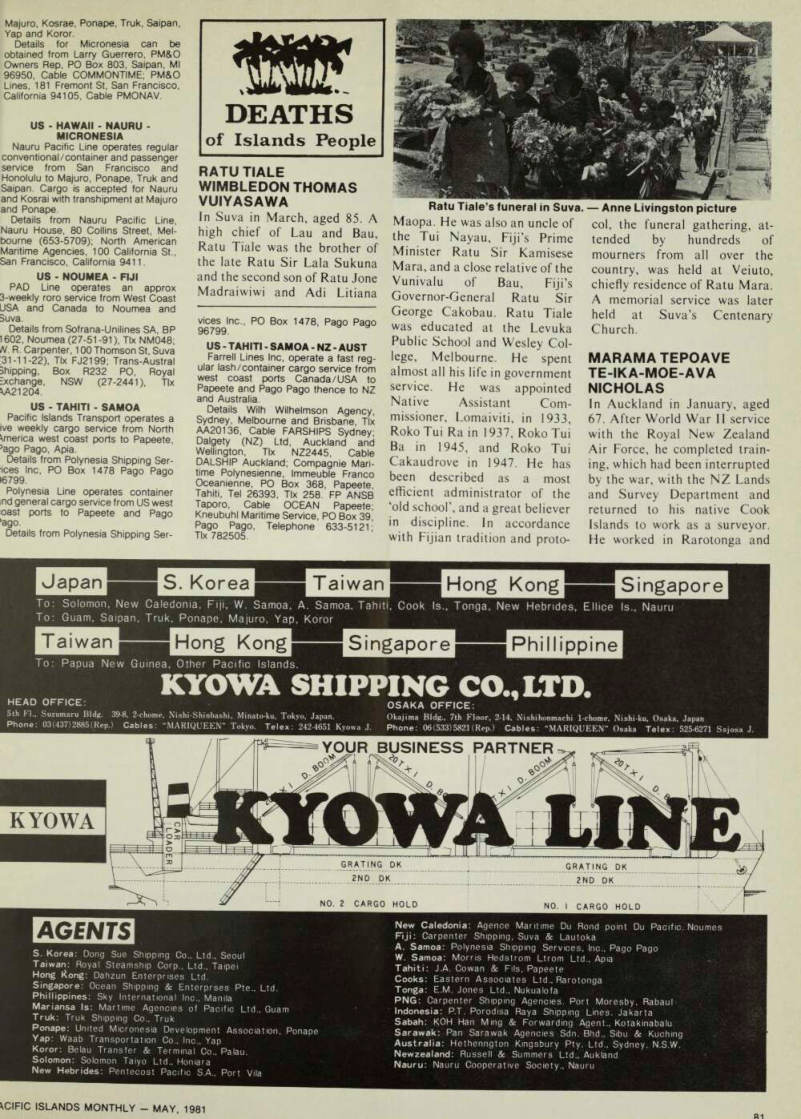
of Islands People
Ratu Tiale
Wimbledon Thomas
Vuiyasawa
In Suva in March, aged 85. A high chief of Lau and Bau, Ratu Tiale was the brother of the late Ratu Sir Lala Sukuna and the second son of Ratu Jone Madraiwiwi and Adi Litiana
Maopa. He was also an uncle of the Tui Nayau, Fiji’s Prime Minister Ratu Sir Kamisese Mara, and a close relative of the Vunivalu of Bau, Fiji’s Governor-General Ratu Sir George Cakobau. Ratu Tiale was educated at the Levuka Public School and Wesley Col lege, Melbourne. He spent almost all his life in government service. He was appointed Native Assistant Com missioner, Lomaiviti, in 1933, RokoTui Ra in 1937, RokoTui Ba in 1945, and Roko Tui Cakaudrove in 1947. He has been described as a most efficient administrator of the ‘old school’, and a great believer in discipline. In accordance with Fijian tradition and proto
col, the funeral gathering, at tended by hundreds of mourners from all over the country, was held at Veiuto, chiefly residence of Ratu Mara.
A memorial service was later held at Suva’s Centenary Church.
Maramatepoave
Te-Ika-Moe-Ava
Nicholas
In Auckland in January, aged 67. After World War II service with the Royal New Zealand Air Force, he completed train ing, which had been interrupted by the war, with the NZ Lands and Survey Department and returned to his native Cook Islands to work as a surveyor.
He worked in Rarotonga and
Ratu Tiale’s funeral in Suva. - Anne Livingston picture
the outer islands on all types of survey work, including the cit rus replanting scheme, housing development, water works, air port, etc. He represented the Cook Islands at the coronation of Queen Elizabeth II in 1953 as a member of the New Zealand Government contin gent. He was a prominent figure in many sports, performing as a team mate of the late Albert Henry, former Cook Islands premier, in athletics and rugby for the old Avatiu Club in 1936-37. He was also a keen golfer.
Archbishop Herman
Topaivu
Of a heart attack at Vunapope, New Britain, Papua New Guinea, in February, aged 69.
As Roman Catholic Archbishop of Port Moresby, he was the
first Papua New Guinean to achieve such rank in the church. A member of the Tolai people, he graduated from mission schools to become a teacher. He began his theologi cal studies at Vunapope before the Pacific War during which he carried on his studies pri vately, and at considerable risk.
With four other Papua New Guineans he made history in late 1953 and early 1954 when they became the first Catholic priests who had done all their study in the then Territory.
Topaivu spent most of his life in parish work and is remembered for his personal piety, prudence and zeal. He became Arch bishop of Port Moresby in January 1976. Among the honours he received was that of Commander of the Order of St Michael and St George (CMG), recommended for him by the PNG Government.
William Sharpe-Dunn.
Alfred Henry
Marlow
In Suva in February, aged 95. A colourful Suva businessman and a pioneer of Fiji aviation Mr Marlow was associated with the Fiji building industry for most of his life. A number of major structures throughout the country were erected by his firm. In the early 19205, when Fiji aviation was in its infancy, Mr Marlow owned a small Dornier flying boat which he used to visit various parts of the then colony when major roads were practically non-existent.
He was active in business affairs also through the Suva Chamber of Commerce in which he had held the office of president.
Pastor Elisaha
Gorapava
In Honiara in February, aged 50. Pastor Gorapava served the Seventh-day Adventist Church for 30 years in both Solomon Islands and Papua New Guinea. He represented the church at an SDA general conference session in the United States, and was a member of the Australasian division execu tive committee of SDA churches for five years from 1975.
Chief Romolou
On New Year’s Eve 1980 on Puluwat island, Truk state, Fed
erated States of Micronesia.
Chief Romolou was chief of Puluwat island. FSM President Tosiwo Nakayama was among those sending messages of con dolence to the families of the late chief.
Sister Marie Chiara
In Italy in February aged 47.
Sister Marie served as catechist at Port-Vila’s Ecole Jeanne d’Arc from 1977 to 1979. Dur ing her stay, she made a dynamic contribution to the life of Port-Vila’s Catholic com munity. She was widely ad mired as setting an example of devotion and hard work, es pecially among the young people of the parish.
Louis Boissery
In Noumea in February, aged 77. Born at Bourail, New Caledonia, he was among the first volunteers to join the French Pacific Battalion which fought on the Allied side in the Middle East and elsewhere. He was wounded in the arms and legs at El Alamein. In postwar years he was an active figure in New Caledonian sporting circles, and the popular pro prietor of Noumea’s Cafe de la Mairie.
David O’Connor
In Suva in January, aged 53.
David O’Connor coached the Fiji national hockey team which won the gold medal at the 1979 South Pacific Games in Suva.
As a young man he played rugby for the Suva and Lautoka European representative sides.
He also played hockey for Suva and Lautoka. One of his last duties was to manage the Suva men’s hockey team on its recent tour of Australia.
Ailsa May Sheehan
In Sydney in March Mrs Sheehan lived in Port Moresby from 1954-78. Her husband Gregory was Papua New Guinea’s registrar-general.
Kathleen Snell
On Norfolk Island in February,, aged 78. Mrs Snell was one of the four children of Gerald Allen and his wife Hilda (nee; Buffett). She lived all her life om the island, with an occasional! visit to mainland Australia. She; married Eddie (Narta) Snell ini 1939. They had no children.
Advertisements & other items, pp. 81-82 (2 items)
Islands Monthly - May. 1981
Kyowa Shipping Co., Ltd.
Knrrn Tni-nn I Innp Kong Singapore
To: Solomon, New Caledonia, Fiji, W. Samoa, A. Samoa, Tahiti. Cook Is.. Tonga, New Hebrides, Ellice Is.. Nauru To: Guam, Saipan, Truk, Ponape, Majuro, Yap, Koror
Singapore Phillippine
To; Papua New Guinea. Other Pacific Islands.
KYOWA SHIPPING CO., LTD.
HEAD OFFICE: OSAKA OFFICE:
sth FI.. Suzumaru Bldg. 39-8. 2-chome, Nishi-Shinbashi, Minato-ku, Tokyo, Japan.
Phone: 03(437)2885(Rep.) Cables; "MARIQUEEN" Tokyo. Telex: 242-4651 Kyowa J.
Okajima Bldg., 7th Floor, 2-14. Nishihonmachi 1-chome. Nishi-ku. Osaka, Japan Phone: 06(533)5821 (Rep.) Cables; “MARIQUEEN” Osaka Telex: 525-6271 Ssjosa J. 1 *
KYOWA
A A
AGENTS
S. Korea: Dong Sue Shipping Co., Ltd., Seoul Taiwan: Royal Steamship Corp., Ltd.. Taipei Hong Kong; Dahzun Enterprises Ltd.
Singapore: Ocean Shipping & Enterprses Pte., Ltd.
Phillippines: Sky International Inc.. Manila Mariansa Is; Martime Agencies of Pacific Ltd.. Guam Truk: Truk Shipping Co.. Truk Ponape: United Micronesia Development Association, Ponape Yap; Waab Transportation Co., Inc., Yap Koror: Belau Transfer & Terminal Co.. Palau.
Solomon: Solomon Taiyo Ltd.. Honiara New Hebrides: Pentecost Pacific S.A., Port Vila New Caledonia: Agence Maritime Du Rond point Du Pacific. Noumes Fiji: Carpenter Shipping, Suva & Lautoka A. Samoa; Polynesia Shipping Services. Inc.. Pago Pago W. Samoa: Morris Hedstrom Ltrom Ltd.. Apia Tahiti: J.A. Cowan & Fils, Papeete Cooks: Eastern Associates Ltd.. Rarotonga Tonga: E.M. Jones Ltd., Nukualofa PNG: Carpenter Shipping Agencies. Port Moresby. Rabaul Indonesia; P.T. Porodisa Raya Shipping Lines. Jakarta Sabah: KOH Han Ming & Forwarding Agent., Kotakmabalu Sarawak; Pan Sarawak Agencies Sdn. Bhd.. Sibu & Kuching Australia: Hethenngton Kingsbury Pty. Ltd., Sydney. N.S.W.
Newzealand; Russell & Summers Ltd., Aukland Nauru: Nauru Cooperative Society.. Nauru
FLEETS
63ft. Charter Cruiser, Major re-fit 1971, in Survey2o knotstopspeed, 11 berths, approx. 50 cu.ft. refrigerator, Radar, S.S.B. Radio, Air Conditioner, Auto Pilot, all Survey equipment, $130,000.00.
FLEETS
221 Esplanade, Wynnum Central, Brisbane.
Cable FLEETS BRISBANE.
F.B.
SONY
VIDEO RECORDERS
COLOUR CAMERAS
& PORTAPAKS
MOVIE TAPES
CLOSE CIRCUIT TV.
AH Enquiries Welcomed
INTERCAPE AUSTRALIA
19-21 Lonsdale St, Melbourne 3000, Aust.
STUDY GOD'S WORD
AT HOME
Send for free catalogue.
Emmaus Bible Corresp. Sch., P.O. Box 904, Saipan, C.M. 96950
REQUIRE
DRIED SHARK FINS
FOR PRICES AND
INFORMATION ETC.,
PLEASE WRITE TO:
S. DADDOW,
ASIA TONGA TRADING
66 JALAN KERUING,
SINGAPORE, 2880
Freely
Given
A true understanding of God's Word.
If you have been searching for the true meaning, of the Scriptures this free monthly booklet is for you.
Write to God's Way.
P.O. Box 41, North Ryde, Australia 2113
Advertising
Index
Air New Zealand 68
Air Nauru 54-55
Australian Timken 80
Amatil 38
Aquila Engineering 66
Akai 2
Aggie Grey' Hotel 49
Aiwa 64
Bankline 78
Berkey 82
China Navigation 77
Clarion Shoji 24
Carptrac 76
Daddow 82
Farrell 82
Fujitsu Ten 58
Fleets 82
General Steamships 70
Henry Cumines 70
Honda 8
Hitachi 34
Kyowa Shipping 81
Ministry Of Education,
Training 8T Culture 73
McDonald douglas 36-27
Mono Pumps 30
Macquarrie Indust G 2
Muirhead 69
Matsushita 46
Newway Internat 74
National Insurance 22
Nissan Motor 20-21
Nelson & Robertson 74
Nz Dairy Board 83
Nissan 40
Olivetti Aust 32
Pacific Forum 79
Papua Hotel 49
Pioneer 27
Quikstik 56
Qbe Insurance 62
Ricoh 50
Sony 84
Suzuki 16,60
Sansui 12
Solair 52
Simms Engineering 63
Tatham 28
T-Shirt People, The 48
Trio Kenwood 4
Toyota 42-43
Video Rec. Centre 82
Wonderest 48
Yamaha 72
Advertisements & other items, pp. 83-84 (1 item)
S«lwho» |
is the world's
«*♦ •I** •■/;:, >•> An«
L \fH
nonfat
dried milk nor VtM n.iiw u
jjl
! w // * mi
.ipUllfi
If/ // tr\ few . ( j
New Zealand
bu creamery
butter
lienor . instant B
S«lwho»
k*v\ »ao c Anchor s jyifr » J
LOTMT
Ml) OVMAYT*O Alfcho ' IT!
SSuteLtiMO Anchor»
,iIJ
HMr
* IMST ®
SSWS* 1
V- i Sn V m * r ’ i »!• M*U»<
FUR£ CR£AM€RV
butter
ESC
or n v ■ :" >' R 1/ %*S. v’V ' M. *- 7 , P «•> • r*r- iw y^ ■“' ' V«T'
ujries to: .■:>••
k!< ’-4' M • I-T 'IS.'- • ' . :.'- '•; ■ x/ /117 j
f Fird^ 964 jy «
S 9/J I
s'"
ICF-2001
It's a Small World Radio.
Sony makes the entire world seem as close as home with the new ICF-2001 world receiver. Incredibly compact, the ICF-2001 gives you the whole world of AM and FM. And with Sony's frequency synthesized "calculator type" tuning, one touch of a button easily gives you LW/MW/SW bands, including marine, amateur radio and even Citizen's band. The ICF-2001 offers you virtually every broadcast source on the globe.
It's simple to operate. You don't have to be a professional radio operator to enjoy putting your ear to the world. If you're far from home, home won't seem so far, just preset the frequency to wherever home is. Whether it be America, Europe or Asia. You'll find it easily with the ICF-2001's four different tuning methods for fast and simple operation. Sony's sophisticated technology gives you precision and extreme stability and a microcomputer to control all reception functions. Like Direct Access, Memory, Auto Scan and Manual. All with a push of a button. The ICF-2001, the world receiver for the world traveler far from home.