Pacific

Islamds
Mothly
mil4L3
American Samoa US$l.75 Australia *A$l.5O Cook Islands NZ$l.5O Fiji F 51.50 Hawaii &US mainland US$l.95 BMauru A 51.75 New Caledonia CFPI.9O
• jkfcvZealand NZ$l.75
Niue...*. NZ$l.5O Norfolk Island A 51.50 Papua New Guinea K 1.50 Solomons... 551.50 Tahiti CFPI.9O T0nga...*...*,.. P 1.50 USTT & Guam US$l.95 Vanuatu A 51.50 Western Samoa T 1.60 •Recommended retail price only. 4' Registered tor posting as a publication Category B.
i? I jl]^ ucHpSspc® i *?h
ffigpoAipipfiipf
V%tll€Bi& JJ® LT 9 Wr?T -. sjJO,
Advertisements & other items, p. 2 (1 item)
How to find a REAL economy car.
When you look at a car billed as an economy model, ask yourself a few questions.
What sort of fuel consumption can be expected?
Low? Good.
What about other operating costs? Oil, lubrication, that kind of thing. Low again?
Great. How about maintenance?
The car has a low-breakdown record? You are definitely on the right track.
What is the average life of the car? Is it better than the average in your area? Super.
That’s important in an economy car.
Now. How is the after service? Buying a car is not all in the price you know.
Plenty of service outlets? One economy car coming up. All you have to do is check the price. Then you can tell if you are really getting an economy car.
You will probably find, after asking these questions about town, that REAL economy cars come down to Toyota, the world’s economy car builder.
See Toyota first. Then you won’t have to shop around.
IHE HAPPY ECONOMIZER
TOYOTA STARLET
The car that says economy in every way.
And you will be happy for it. Big inside.
Small outside. Miserly with petrol.
Without sacrificing comfort. A good buy in an economy car even for Toyota.
STARLET
PAPUA NEW GUINEA:
ELA MOTORS,
Scratchley Rd., Badili, P.O. Box 675, Port Moresby
U.S. TRUST
TERRITORY: MICROL
CORPORATION,
P.O. Box 267, Saipan.
FIJI:
AUTOMOTIVE
SUPPLIES COMPANY,
P.O. Box 5177, Raiwaqa, Suva
AMERICAN SAMOA:
BURNS PHILP
(SOUTHSEA) CO.. LTD ,
P.O. Box 129, Pago Pago.
WESTERN SAMOA;
BURNS PHILP
(SOUTHSEA) CO., LTD.,
P.O. Box 188, Apia.
TONGA: BURNS PHILP
(SOUTHSEA) CO., LTD.,
P.O. Box 55, Nukualofa.
GUAM: ATKINS, KROLL
(GUAM) LTD , P.O. Box
6428, Tamuning.
TOYOTA
SERVICE
TOYOTA
VANUATU:
VANUATU MOTORS.
P.O. Box 18, Port Vila.
SOLOMON:
MENDANA
ENTERPRISES (5.1.) LTD.,
G.P.O. Box 174, Honiara.
TAHITI: NIPPON
AUTOMOTO, B.P. 342,
Papeete.
COOK ISLANDS;
COOK ISLANDS
TRADING
CORPORATION LTD.,
P.O. Box 92, Rarotonga.
NAURU:
NAURU COOPERATIVE
SOCIETY.
KIRIBATI:
TARAWA MOTORS,
Box 36, Bairiki, Kiribati.
NORFOLK ISLAND:
BORRY’S RENTAL CAR’S
MOUNT PITT
(ENTERPRISES) LTD.,
P.O. Box 169,
NEW CALEDONIA:
SERVICE IMPORTATION
AUTOMOBILE DE
PACIFIQUE, Rond-Point du Pacific (Station total) B.P. 438, Noumea.
The Toyota range includes: Toyota STARLET, Toyota COROLLA, Toyota CRESSIDA, Toyota HI-LUX, Toyota HI ACE, Toyota DYNA, Toyota LAND CRUISER
Pacific Islands Monthly
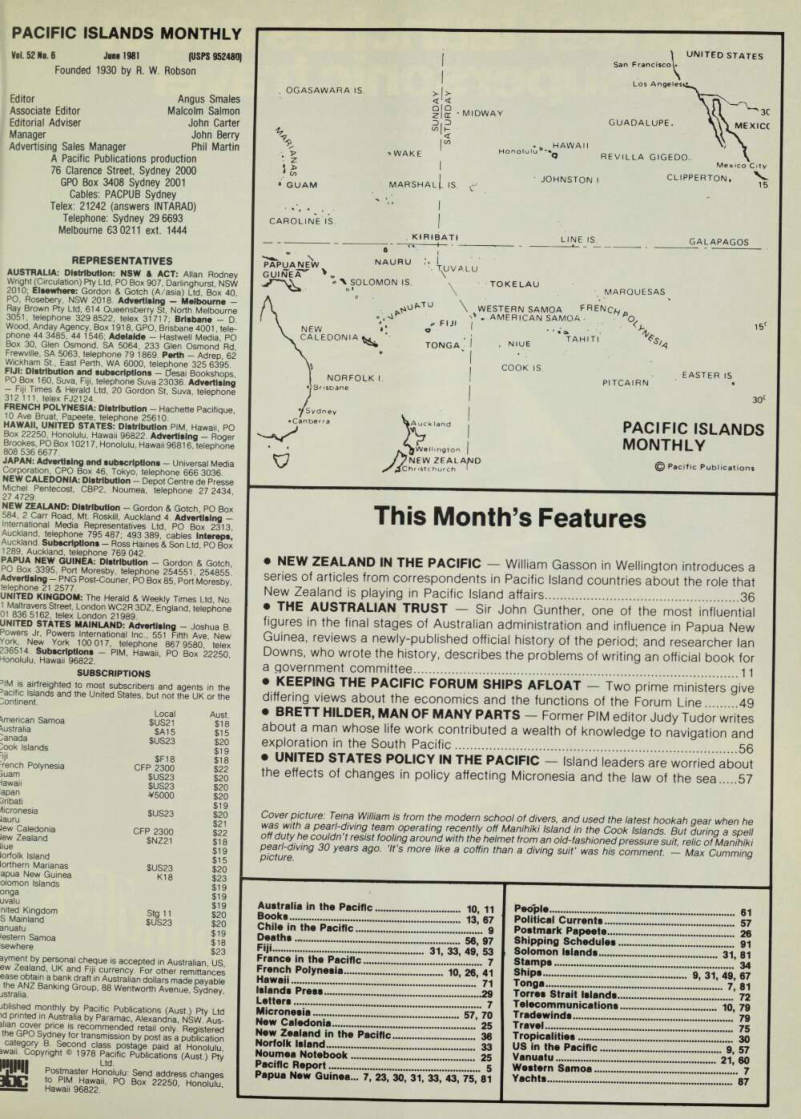
Vol. 52 No. 6
June 1981
(Usps 952480)
Representatives
AUSTRALIA: Distribution: NSW & ACT: Allan Rodney Wright (Circulation) Pty Ltd, PO Box 907, Darlinghurst, NSW 2010; Elsewhere: Gordon & Gotch (A/asia) Ltd, Box 40 PO, Rosebery, NSW 2018. Advertising - Melbourne - Ray Brown Pty Ltd, 614 Oueensberry St. North Melbourne 3051, telephone 329 8522, telex 31717, Brisbane - D Wood, Anday Agency, Box 1918, GPO, Brisbane 4001, tele phone 44 3485, 44 1546; Adelaide - Hastwell Media PO Box 30. Glen Osmond, SA 5064, 233 Glen Osmond Rd Frewville, SA 5063, telephone 79 1869 Perth - Adrep 62 Wickham St., East Perth, WA 6000. telephone 325 6395.
FIJI: Distribution and subscriptions - desai Bookshops, PO Box 160, Suva, Fiji, telephone Suva 23036. Advertising Fiji Times & Herald Ltd, 20 Gordon St, Suva, telephone 312 111, telex FJ2124.
FRENCH POLYNESIA: Distribution Hachette Pacifique 10 Ave Bruat, Papeete, telephone 25610.
HAWAII, UNITED STATES: Distribution PIM, Hawaii PO Box 22250, Honolulu, Hawaii 96822 Advertising - Roger Brookes, PO Box 10217, Honolulu, Hawaii 96816, telephone 808 536 6677 JAPAN: Advertising and subscriptions - Universal Media Corporation. CPO Box 46, Tokyo, telephone 666 3036.
NEW CALEDONIA: Distribution Depot Centre de Presse Michel Pentecost, CBP2, Noumea, telephone 27 2434 27 4729.
NEW ZEALAND; Distribution Gordon & Gotch PO Box 584, 2 Carr Road, Mt. Roskill, Auckland 4 Advertising - International Media Representatives Ltd, PO Box 2313 Auckland, telephone 795 487; 493 389, cables Intereps, Auckland Subscriptions - Ross Haines & Son Ltd PO Box 1289, Auckland, telephone 769 042 PAPUA NEW GUINEA: Distribution - Gordon & Gotch PO Box 3395, Port Moresby, telephone 254551 254855 Advertising - PNG Post-Courier, PO Box 85, Port Moresby telephone 21 2577.
UNITED KINGDOM; The Herald & Weekly Times Ltd No l/!?~ avers Street London WC2R 3DZ, England, telephone 01 836 5162, telex London 21989 UNITED STATES MAINLAND: Advertising - Joshua B Powers Jr, Powers International Inc., 551 Fifth Ave New York New York 100 017, telephone 867 9580,' telex 236514, Subscriptions - PIM, Hawaii, PO Box 22250 Honolulu, Hawaii 96822.
Subscriptions
is airfreighted to most subscribers and agents in the acific Islands and the United States, but not the UK or the continent.
ayment by personal cheque is accepted in Australian, US GK and F 'ji currency. For other remittances e 5f. 0 .,’ ai Q a bank draft in Australian dollars made payable JStraHa* 2 Banking Grou P' 88 Wentworth Avenue, Sydney, Jbhshed monthly by Pacific Publications (Aust.) Pty Ltd id printed in Australia by Paramac, Alexandria, NSW Aus thoVorPe P J' Ce '? recom mended retail only. Registered St2Sv S B^ n |^onH ran p miSSi0n by as a Plication category B. Second class postage paid at Honolulu jwan. Copyright © 1978 Pacific Publications (Aust) Pty ilium ud. k y
Postmaster Honolulu: Send address changes u PIM ” a * aii ' P 0 Box 22250, Honolulu, Hawaii 96822.
\merican Samoa Australia Local $US21 $A15 Aust. $18 $15
Sus23
$20 Islands $19 •iji $F18 $18 ranch Polynesia
Cfp 2300
$22 5uam $US23 $20 Hawaii $US23 $20 apan Kiribati Micronesia lauru lew Caledonia ¥5000 $US23
Cfp 2300
$20 $19 $20 $21 $22 lew Zealand liue lorfolk Island $NZ21 $18 $19 $15 $20 lorthern Marianas $US23 apua New Guinea K18 $23 $19 olomon Islands onga uvalu nited Kingdom S Mainland anuatu Stg 11 $US23 $19 $19 $20 $20 'estern Samoa $19 $18 $23 sewhere
This Month’s Features
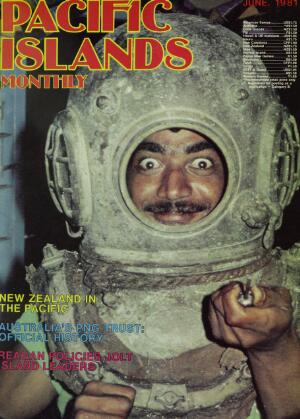
• NEW ZEALAND IN THE PACIFIC William Gasson in Wellington introduces a series of articles from correspondents in Pacific Island countries about the role that New Zealand is playing in Pacific Island affairs 36 • THE AUSTRALIAN TRUST Sir John Gunther, one of the most influential figures in the final stages of Australian administration and influence in Papua New Guinea, reviews a newly-published official history of the period; and researcher lan Downs, who wrote the history, describes the problems of writing an official book for a government committee 11 • KEEPING THE PACIFIC FORUM SHIPS AFLOAT Two prime ministers give differing views about the economics and the functions of the Forum Line 49 • BRETT HILDER, MAN OF MANY PARTS - Former PIM editor Judy Tudor writes about a man whose life work contributed a wealth of knowledge to navigation and exploration in the South Pacific 56 • UNITED STATES POLICY IN THE PACIFIC - Island leaders are worried about the effects of changes in policy affecting Micronesia and the law of the sea 57 ■ Wi "i am iS fr ° m the m ° dern Scho °' of divers ’ and used the latest hookah gear when he ™ s ™ th * Pearl-divmg team operating recently off Manihiki Island in the Cook Islands. But during a spell around with the helmet from an old-fashioned pressure suit , relic of Manihiki picture 930 3 9 f S m ° re ' ke 9 COff ' n thSn 3 d ' Vir>9 SUit WaS his comment - Max Gumming
Australia in the Pacific 10 11 Books 13’ 07 Chile in the Pacific ’ g D® ath * - .:::^*97 : 31, 33, 49, 53 France m the Pacific 7 French Polynesia 7 10. 26 41 Hawaii 71 Islands Press 90
Letters .ZZIZZZZZ?
Micronesia... 7777 57‘ 70
New Caledonia 25 New Zealand in the Pacific 36 Norfolk Island 33 Noumea Notebook 77777777.7 25 Pacific Report 5 Papua New Guinea... 7, 23, 30, 31,‘Vs.'si
People 61 Political Currents 57 Postmark Papeete 26 Shipping Schedules .7’.’ 91 Solomon Islands 31 Q 1 Stamps " ’34 f h| P 77757 n 49, 67 Tonga. 81 Torres Strait Islands 72 Telecommunications in 79 Tradewinds ’ 79 Travel ...777777 75 Tropicalities 30 US in the Pacific g 57
Vanuatu 7” 2l’ 60
Western Samoa 7 Yachts g 7
Advertisements & other items, pp. 3-4 (2 items)
Founded 1930 by R. W. Robson
Editor Angus Smales Associate Editor Malcolm Salmon Editorial Adviser John Carter Manager John Berry Advertising Sales Manager Phil Martin A Pacific Publications production 76 Clarence Street, Sydney 2000 GPO Box 3408 Sydney 2001 Cables: PACPUB Sydney Telex: 21242 (answers INTARAD) Telephone; Sydney 29 6693 Melbourne 63 0211 ext. 1444
Pioneer launches a first
in supersonic travel
In this fast-paced world of bullet trains and Concorde jetliners, to* stay in touch with your favorite stereo music you need SOUNDTREK. Pioneer’s new supersonic fleet of Multi-Mode Mobile Hi-Fi. % * ■'. For added tape-handling ease ahd pushbutton program selection, Pioneer offers Multi-Mode Deck design in every SOUNDTREK stereo portable. For example, ’ there’s Song Finder.™ With it you can skip over unwanted program material, locate and.play'your favorite song at the push of a button. A feature you would expect to find on a home hi-fi cassette deck. But wait till you hear the sound of our - SOUNDTREK portables. When you do, you’ll know why we call them “Mobile Hi-Fi.
' . Explore the outer reaches of stereo listening enjoyment with SOUNDTREK • Multi-Mode Mobile Hi-Fi from'Pioneer. They’re available in six models, all featuring Pioneer performance and supersonic sound to get you off the ground. . v iU&I 5 Tt A
SK-71F
SK-95F
m m Nauru Island: Jacob Enterprises, P.O. Box No. 4, Republic of Nauru Tahiti: Tahiti Hi-Fi, P.O. Box 848, Papeete, Tahiti New Caledonia: Menard Pacifique Saru, B.P. 3899, Noumea, New Caledonia Tel; 48.24.36 American Samoa: Transpac Corporation, P.O. Box 1477, Pago Pago, American Samoa 96799 Tel: 633-5224 Rarotonga: South Seas International Ltd., P.O. Box 49, Rarotonga, Cook Islands Tel: 2327 Papua New Guinea; Bali Merchants Pty. Ltd., P.O. Box 6103, Boroko Tel; 254887 further information, please contact: ralia: Pioneer Marketing Service Pty. Ltd., P.O. Box 317, Mordialloc, Victoria, 3195 30-9011 stands: Brijlal & Company, G.P.O. Box No. 362, Suva, Fiji Islands Tel: 22258 Zealand: Monaco Distributors Ltd., 30 Pollen Street, Grey Lynn, Auckland, Zealand Tel; (09) 762 098 dlk Island: Burns Philp (Norfolk Island)Ltd., P.O. Box 21, Norfolk Island, Hebrides; Burns Philp (New Hebrides) Ltd., Vila, New Hebrides
Pacific Report
Giscard Lost France, Held Pacific Territories
While voters in metropolitan France on May 10 rejected him in favour of socialist presidential candidate Frangois Mitterand, former French President Valery Giscard d’Estaing obviously retained the loyalty of a majority of voters in the French Pacific territories. In French Polynesia he received 37 440 votes (76.71%) to Mr Mitterand’s 11 377 (23.28%). There were 1060 ballot papers rendered informal by voters writing on them ‘Pour I’independance’ (‘For independence’), as called for by one of the pro-independence parties. Other pro-independence groups called for a complete abstention from voting, and their stand is believed to account in part for the relatively low voter turnout only 63.46% of those enrolled. Giscard’s vote was undoubtedly boosted by the decision of the ruling Autonomist Party to support his candidacy. Since political parties right across the spectrum in French Polynesia now favour a considerably greater degree of local autonomous power, their dealings with Mr Mitterand, who has expressed sympathy with such aspirations, should not prove too difficult. Observers expect little change, if any, in France’s nuclear testing activities at Moruroa as a result of Mr Mitterand’s election. In New Caledonia, Giscard secured 34 250 votes (65.50%) to Mitterand’s 18 039 (34.49%). At 72.13%, voter turnout in New Caledonia was higher than in French Polynesia. In the all-Melanesian constituency of the Loyalty Islands (Mare, Ouvea and Lifou), where the independence movement is relatively strong, Mitterand decisively turned the tables on Giscard by scoring 3468 votes (61.59%) to Giscard’s 2162 (38.40%). The scene was rather different in another, smaller, all- Melanesian constituency at the Isle of Pines where Giscard netted 244 votes (55.20%) to Mitterand’s 118 (44.79%). In highly conservative Wallis and Futuna, where church influences are particularly strong, voters gave 4776 votes to Giscard, an overwhelming 97.68%, and only 113 (2.31 %) to Mitterand. An Australian expert on New Caledonia, Dr Alan Ward, of Melbourne’s La Trobe University, said the territory’s politics would become ‘more mobile and fluid’ as a result of Mr Mitterand’s success.
Banabans’ Millions, But...
At a ceremony in London in April, the Rev Kaitangare Kaburoro, leader of the Banaban Islanders resident on Rabi Island, Fiji, accepted cheques totalling exactly SFI4 584 549.75 b as com pensation for the British Phosphate Commission’s 50-year operation on their home island of Banaba (Ocean Island) in the central Pacific. Minister for State at the British Foreign Office Peter Blaker handed over the cheques in return for guarantees from Mr Kaburoro indemnifying the British, Australian and New Zealand Governments, operators of the phosphate commission, from further legal action. In a brief speech at the ceremony, Mr Kaburoro conceded that the legal chapter was closed, but said he hoped that the three commission governments would ‘generously accept that the Banaban people still have a continuing moral claim on them for assistance’. In particular, he sought Britain’s help in the islanders’ campaign for self government they were included in independent Kiribati in 1979 against their will and in providing funds for the development cf Rabi, where most of them settled after the Japanese invasion n 1942 and where 2500 of them now live.
PUT PAST BEHIND US’ CALL IN VANUATU Fhe curtain was officially rung down on Vanuatu’s Santo secession drama with the release in April of a statement by the country’s Minister for Home Affairs Fred Timakata. Mr Timakata’s statement said: ‘lt is now almost 11 months since the Santo ebellion took place and almost eight months since it was brought o an er| d- During the process of bringing to justice those esponsible for the acts of violence, theft and brutality which were 3 feature of it, the government never lost sight of the desirability )f bringing at the earliest possible time the whole sad and shameful episode to a close. That time has now arrived and I take considerable pleasure in officially confirming it. Throughout the difficult matter of seeing to it that all suspected of having
committed acts of violence have appeared before the courts, and that there was as far as humanly possible a fair and equal application of justice, it has always been the wish and intention of the government to establish a time when no further prosecutions were brought against people for acts associated with the rebellion. I take the opportunity to say that as from today no further charges will be laid against people suspected of acts concerned with the rebellion, with the exception of those cases currently being investigated. That is to say, those people who were concerned with acts of rebellion will now be free of prosecution and deportation for unlawful acts from this day forward. However, in the event of criminal charges for acts perpetrated after today, then any individual who had been suspected of illegal acts during the rebellion would of course have such acts taken into account. I hope and pray that this will not arise and that the official closing of the Santo situation will be welcomed by the general population and be reciprocated with peaceful and lawful behaviour. Let us now put the past behind us.
Let us together join hands in the task of developing Vanuatu, and, in doing so, let all of us look to the future with hope and confidence.’
Controversial Png Jet In New Trouble
The SAB million VIP jet bought recently by the Papua New Guinea government in the face of political controversy over the money involved was damaged during a landing incident in Australia in mid-April. A service hydraulic system failed to operate when the jet, a Grumman Gulfstream 2, was landing at Brisbane Airport. A back-up braking system had to be used after touchdown, but the force of the braking burst four tyres and damaged the landing gear. The landing was completed safely but the aircraft was grounded for five days for repairs. The jet was carrying seven passengers, including a former deputy prime minister Sir Maori Kiki. The PNG Prime Minister, Sir Julius Chan, who has been criticised for allegedly wasting taxpayers’ money over the purchase, had planned to use the jet the following day to fly to Australia. He travelled instead in a Fokker Fellowship airliner chartered from the PNG national airline Air Niugini.
Changes In Cooks’ Constitution
While planning to retain the Cook Islands’ status as an internally self-governing state in free association with New Zealand, the government of Sir Thomas Davis is seeking a substantial strengthening of the country’s autonomy. That is the aim of its controversial Constitutional Amendment Bill, which was due for its third and final reading on May 13. Under the bill: the Legislative Assembly becomes the Parliament of the Cook Islands; the Premier becomes Prime Minister; the life of elected governments is extended from four to five years; the judicial system is changed to provide for only one set of courts, the High Court, with its own three divisions: Criminal, Civil and Land; some electoral constituencies are divided, and a new one is created the Overseas Constituency which, as well as raising the number of MPs from 22 to 23, has the effect of permitting Cook Islanders living in New Zealand to vote in that country, thus doing away with the ‘fly-in’ voters’ scheme, abuse of which helped bring down the previous Henry government. The legislation has been hotly contested by the Cook Islands Party opposition. An 18-page newspaper, The Petitioner, was produced in May by opponents of the bill.
Png Warns On Springbok Tour
Papua New Guinea has warned that relations between Commonwealth countries could be disrupted if the proposed South African (Springbok) Rugby tour of New Zealand goes ahead later this year. It claimed the tour could undermine relations between some Commonwealth countries, as well as the role of the Commonwealth. The government said it was also worried by the timing of the tour, which clashes with the Commonwealth Heads of Government meeting in Melbourne from September 30-October 7.
Public Servants’ Strike In W. Samoa
At press time there seemed no end in sight to the public servants’ strike in Western Samoa, which has halted operation of many services, and reduced others to skeleton, emergency pro portions. The strike over pay demands involved a reported 3000 government workers, and appeared to be the country’s biggest industrial upheaval to date. At last report the government on May 7 had issued an ultimatum that if the strikers had not returned to work by 4 pm, May 11, they would lose the offer of the Public Service Commission to regard the roughly five weeks
of the strike as ‘special leave’, not affecting their status as public servants. But if they had not returned by that time, according to the ultimatum, they would lose public-servant status and have to re-apply for employment. Observers were seeing increasingly strong political overtones in the strike, with the opposition’s backing of the union, the Public Service Association, posing a threat to the one-vote parliamentary majority enjoyed by Prime Minister Tuouola Efi.
China In New Bougainville Deal
China is to negotiate a new export deal with Bougainville Copper Ltd. Talks on the subject between Chinese and BCL officials were planned for late May. In talks with PNG’s Deputy Prime Minister lambakey Okuk, who visited China in May, Chinese Foreign Minister and Vice-Premier Huang Hua said China was also interested in timber importsTrom PNG.
Petrol Rise Helps Fiji Workers?
Fiji’s trade unionists will get workers’ compensation and other benefits from a levy of 1b to be imposed on the price of a litre of petrol, and automotive distillate, and the payment into a fund by employers of 1 % of their total payroll. The other benefits will include funeral and medical assistance. The predictions were made in the report of the May annual general meeting of the Fiji Trades Union Congress. The report said that a bill to establish the scheme was to go to the Fiji Parliament in July. It said the scheme would be run by a statutory board, with levies being collected by the Fiji National Provident Fund.
Tasman S Not What It Was
The ‘no-passport required’ arrangement for Australian and New Zealand citizens visiting each others’ countries fades into history on July 1 at the insistence of the Australian Government. Reasons advanced are prevention of entry of possible drug traffickers, criminals and political terrorists. The Australian Government has made the point that even now. half the criminal deportees from Australia are New Zealanders. The new rule could hit Islanders who have been gaining permanent access to Australia with false claims that they are New Zealand Maoris, or have residency status in New Zealand.
Pago’S Looking For Trade
A 15-strong American Samoa trade mission was due in Suva and Tarawa in May. It was also to visit New Zealand, Nauru and Western Samoa. According to American Samoa Governor Peter Tali Coleman, the mission’s aim was to ‘explore development opportunities of mutual benefit to Pacific Island economies’.
Mission leader is Pete Galeasi, director of economic development and planning of the American Samoa Government.
TWO DIE: FIRST LOSS OF PNG PILOTS A military aircraft crash in Papua New Guinea claimed two lives on May 4 when a Nomad patrol aircraft of the PNG Defence Force ploughed into a mountainside about 50 km south of Vanimo near the northern end of the border with the Indonesian province of Irian Jaya. It was the first loss of life for any PNG nationals trained as civil or military pilots. The dead men were Major John Tasi, 28, one of the PNGDF’s most experienced pilots, and Lieutenant Emmanuel Skoli, 22. Visibility was poor at the scene of the crash.
The Nomad was one of three given by Australia under defence aid arrangements.
U.S. TO SEEK OVERFLY RIGHTS IN PNG The United States would always seek the permission of the Papua New Guinea Government before its aircraft overflew PNG territory, according to a spokesman for the US Embassy in Port Moresby. PNG Prime Minister Sir Julius Chan had earlier expressed concern over the arrangement reached between Australia and the US for US 852 bombers to stage at Darwin on flights from Guam. Sir Julius reportedly told Australian PM Malcolm Fraser that he thought PNG should have been consulted.
Fiji Talks On Jobless Youth
About 14 200 persons, 6.9% of Fiji’s active labour population of 205 000, are unemployed, according to a report to a recent seminar on employment at Lautoka. Most of the unemployed were under 25 and were unable to get jobs because they were unskilled, inexperienced and lacked any formal vocational training, the report said.
‘Racist’ Charge Sends Manager Home
The Australian general manager of a guesthouse in Lae, Papua New Guinea, has been asked to leave the country voluntarily. The action against Ralph Stocker, 47, was taken following numerous complaints from Papua New Guineans about what they called Mr
Stocker’s ‘racist attitudes’ in the running of the establishment, Lae Lodge. Strict segregation of accommodation as between Papua New Guineans and others was one of the main charges.
Recently, PNG’s Decentralisation Minister Fr John Momis was refused accommodation at Lae Lodge unless he identified his nationality.
Tanna: Case Of Charlie Nako, Mr
Vanuatu’s Supreme Court, sitting in Tanna in April, handed out an 11-months gaol term and fines totalling VT3O 000 (approxi mately SA3OO) to Charlie Nako, member for a Tanna constitu ency in the country’s Representative Assembly. But Mr Nako, 32, will not go to gaol. Immediately after pronouncing sentence, Mr Justice Cooke announced that the gaol term would be suspended for three years. The judge said that the suspension was due to the fact that peace had returned to Vanuatu, and that Mr Nako had taken his seat in parliament. He said: ‘We hope that you will do everything in your power to keep peace in Tanna. You are the only MP representing Tanna for the Opposition and a lot of responsibility is on your shoulders. The people of Tanna are relying on you.’ Nako had pleaded guilty to three charges unlawful assembly, riot and incitement to riot. The charges related to pre-independence disturbances on the southern island.
He was sentenced to 11 months gaol on each charge, the sentences to be served concurrently. If Mr Nako commits any crime during the three years, he will have to serve the sentences.
He thanked the court for what he considered the fair manner in which he had been treated, and said he would do his best to keep out of trouble and help the people of Tanna.
Uni, Okuk, Cable Mitterand
Vanuatu’s Prime Minister Walter Lini, in a congratulatory telegram to new French President Frangois Mitterand, has expressed the hope that his election ‘will herald a new era of close co-operation and understanding between our two peoples’, lambakey Okuk acting prime minister of Papua New Guinea, said in his message: ‘We hope your election will bring about a positive change in the attitude of the French Government towards the future of its Pacific territories, and the desire of Pacific nations for an end to nuclear testing in the region.’
Cook Islands Into Ships Act?
Following Vanuatu’s decision to establish a shipping registry (PIM Mar p7l, May p7l), the Cook Islands is reported to be preparing legislation for a similar venture. According to press reports, both moves are believed related to a planned South Pacific visit by a New York shipping consultant said to have Lebanese finance.
Marianas Volcano Erupts
Mount Pagan, a long dormant 625 m-high volcano on Pagan Island, northernmost inhabited island in the Commonwealth of the Northern Marianas, erupted in mid-May. Smoke and ash were flung 10 000 m into the air. US pilots sent over the island from Guam said smoke was billowing 260 km out over the sea, making it quite impossible to land on the island’s airstrip. All 53 inhabitants, including 32 children, were later reported to be heading safely for Saipan aboard a rescue boat.
Election Upsets In Tonga
Tonga’s general elections on May 1 produced a record turnout of voters, a record amount of lively electioneering in the run-up period, and a surprise result, as four out of the seven sitting People’s Representatives lost their seats and two others lost the No 1 divisional placings they had held for many years. In the Tongatapu division, Tomiteau Finau (third generation member of a well-known political family) and Mrs Papiloa Foliaki (who romped in in ’7B as the Kingdom’s first ever woman commoner to gain office) were replaced by Central Nukualofa Town Officer Sitili Tupouniua and Nukualofa publican Joe Tu’ilatai Mataele. In Haapai veteran former MP Pousima Afeaki ousted prominent businessman ‘Uliti Uata and in Vavau Ula Afuha’amango defeated Palavilala Tapueluelu. The new lineup selected by the voters appears to be strongly traditionalist and pro- Establishment. Informed opinion here expects it to give the government three years of smooth sailing through legislative waters, without the regular ripples, periodic waves and occasional tsunami which shook the ship-of-state during Mrs Foliaki’s brief but spectacular term in office. Papiloa’s many disappointed supporters attribute her downfall mainly to a fallacious but highly successful whispering campaign which painted her as solely responsible for the substantial and unpopular rises in bus fares last year, on all suburban and country routes. Penny Hodgkinson in Nukualofa.
Advertisements & other items, p. 5 (1 item)
>Acific Islands Monthly - June Iqri
A park sparks

Letters
ideas for
W. Samoa
I was cheered by your article about the new Western Samoa national park on the island of Upolu (PIM Apr p 22). I have long felt that the country needed a national park. The central dividing range rises impressively behind Apia (and sometimes one gets an even more exciting look at it on a flight from Pago Pago). But it is not easy to find a way into it, or any information about it. I hope that the park project will rectify this situation as well as protec ting the island’s fine rain forests from increasing attack by both large-scale agricultural and tim ber development, and tra ditional cut-and-burn agricul ture.
It is even more clear that the great island of Savaii needs parks, and this should be the next step. It has vast and trackless rain forests, but they are remote and difficult of access, and they face the same
threat of increasing develop
ment.
The most interesting natural eature of the island is its great ihield volcano with vast lava lows and forests and many finder cones culminating in Mt Mlisili (1858 m), highest in the slands. But the only two trails, >r tracks, to the top have been fiosed by the superstitious and mco-operative villages of Aopo md Satuiatua where the tracks >egin.
The first objective should be large reserve to protect the ummit and a generous belt of orest at all altitudes, with racks free from village inter erence. Some consideration night be given to accommo iation such as alpine huts or tostels with roof catchments, as he rain forest is difficult for amping, and there is a lack of
public accommodation and sur face water at the western end of the island near the mountain.
I hope the new national park will be successful, that infor mation on it will be made avail able — a problem in Samoa — and that it will be expanded to Savaii, largest, highest and wildest island in Samoa.
Roger A C. Williams
Tafuna American Samoa
A moving plea
from ‘inside’
As a very keen and regular reader of your most excellent periodical, I am writing to say how regretful I am really, that I have been unable to read it for a long time. This for me is a great loss.
The reason is simply my imprisonment at the state peni tentiary named below.
Upon my entry into prison, I came across many other readers of your excellent publication, and they have the same feeling of loss as I do at not being able to read it any more.
Hence, in writing to you, it is our only wish to request you to send us a copy or two of previous issues, even if not recent ones, if you have any available, at no cost.
It is also our wish that in future if you have some copies in excess after you have sup plied your customers and sub scribers you would make them available to us at regular inter vals.
Many thanks for any help that you may offer, and looking forward to hearing from you soon.
Winch Rodger Lee
Detainee, and colleagues Bomana Corrective Institution PO Box 5161 Boroko Papua New Guinea PIM will act on this request.
Editor.
How Tonga moves with the times I am referring to the letter b> Randy Duff Tonga should move with the times’ (PIM Mar p 9). Apparently your previous reports on the Tongan prince’s wedding gave Mr Duff his ver> much mistaken attitude to wards our King and our tra ditions, for it is obvious that he
knows nothing at all about the reason behind His Majesty’s decision disallowing it.
It is very unfortunate that our royal family and our traditions have come under such unde served criticism and humili ation and frankly I am very surprised at Mr Anderson (father of Miss Heimatataura Salmon Anderson, the prince’s bride PIM). Either he is a very loyal father, or he has a very short memory in which he expects us Tongans to share.
So much for his version of the story, for he was supposed to be in Hawaii unaware of what his daughter was doing in Tonga and only to be surprised by the couple’s turning up on his doorstep demanding that they be married. And the best he could do was to throw a sumptu ous celebration which attracted the utmost publicity, knowing that a long-standing friendship with Their Majesties would suffer.
For Mr DufTs information on our traditions, there is no law against a royal-commoner ro mance or marriage. But it takes more than just being a high chief s daughter to be taken as a suitable wife for a prince in Tonga, or in any other kingdom marching with the times things like birth status and background. And there is definitely nothing ‘Middle Ages’ about such values.
P Manutu’Ufanga ’Unga
Sydney NSW Australia
'Satanic 9 Mr
Dijoud?
In his interview with Le Nouvel Observateur (PIM Apr pis), France’s Secretary of State for Overseas Departments and Territories Paul Dijoud clearly expressed the conservative, capitalistic and satanic views of the colonialist Paris adminis tration on decolonisation in the Pacific.
His blatant statement that ‘. . . it is by the clearly ex pressed will of the inhabitants’ of its territories that France is in the Pacific is drastically mis leading and false.
I wonder whether Mr Dijoud’s government which is an advocate of human rights - would have the courage to permit a referendum to deter mine the true wishes of the islands’ peoples?
The recent experience on Santo in Vanuatu should one call it ‘the abortive French connection’? reflected the active involvement of Paris in brain-washing campaigns, and her eagerness to exploit the islands and deprive the is landers of their legitimate right to self-determination.
The seabed mineral nodules that Mr Dijoud longs to get his hands on rightly belong to the
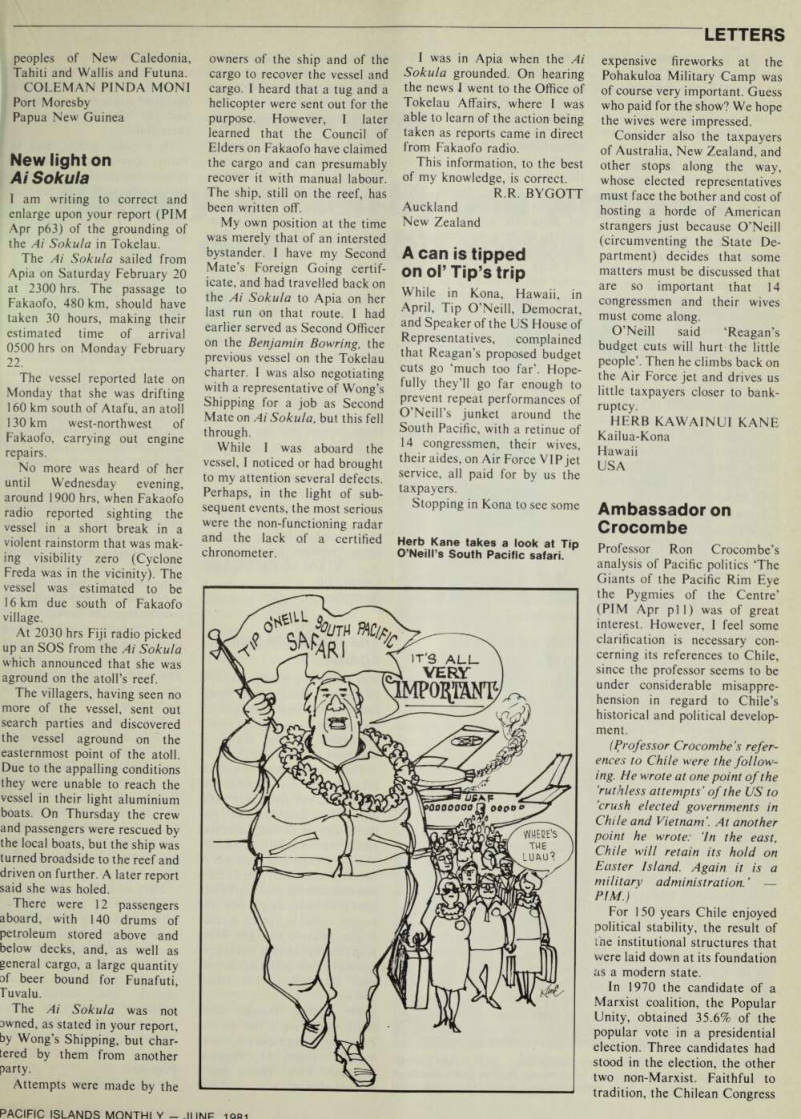
Tongan Prince Fatafehi ’Alai vahamama’o Tuku’aho (left) with his bride, the former Heimataura Salmon Anderson -Sheree Lipton picture.
peoples of New Caledonia, Tahiti and Wallis and Futuna.
Coleman Pinda Moni
Port Moresby Papua New Guinea New light on Ai Sokula I am writing to correct and enlarge upon your report (PIM Apr p 63) of the grounding of the Ai Sokula in Tokelau.
The Ai Sokula sailed from Apia on Saturday February 20 at 2300 hrs. The passage to Fakaofo, 480 km, should have taken 30 hours, making their estimated time of arrival 0500 hrs on Monday February 22.
The vessel reported late on Monday that she was drifting 160 km south of Atafu, an atoll 130 km west-northwest of Fakaofo, carrying out engine repairs.
No more was heard of her until Wednesday evening, around 1900 hrs, when Fakaofo radio reported sighting the vessel in a short break in a violent rainstorm that was mak ing visibility zero (Cyclone Freda was in the vicinity). The vessel was estimated to be 16 km due south of Fakaofo village.
At 2030 hrs Fiji radio picked up an SOS from the Ai Sokula which announced that she was aground on the atoll’s reef.
The villagers, having seen no more of the vessel, sent out search parties and discovered the vessel aground on the easternmost point of the atoll.
Due to the appalling conditions they were unable to reach the vessel in their light aluminium boats. On Thursday the crew and passengers were rescued by the local boats, but the ship was turned broadside to the reef and driven on further. A later report said she was holed.
There were 12 passengers aboard, with 140 drums of petroleum stored above and below decks, and, as well as general cargo, a large quantity af beer bound for Funafuti, Tuvalu.
The Ai Sokula was not awned, as stated in your report, by Wong’s Shipping, but char tered by them from another party.
Attempts were made by the
I was in Apia when the Ai Sokula grounded. On hearing the news I went to the Office of Tokelau Affairs, where I was able to learn of the action being taken as reports came in direct from Fakaofo radio.
This information, to the best of my knowledge, is correct.
owners of the ship and of the cargo to recover the vessel and cargo. I heard that a tug and a helicopter were sent out for the purpose. However, I later learned that the Council of Elders on Fakaofo have claimed the cargo and can presumably recover it with manual labour.
The ship, still on the reef, has been written off.
My own position at the time was merely that of an intersted bystander. I have my Second Mate’s Foreign Going certif icate, and had travelled back on the Ai Sokula to Apia on her last run on that route. I had earlier served as Second Officer on the Benjamin Bowring, the previous vessel on the Tokelau charter. I was also negotiating with a representative of Wong’s Shipping for a job as Second Mate on Ai Sokula, but this fell through.
While I was aboard the vessel, I noticed or had brought to my attention several defects.
Perhaps, in the light of sub sequent events, the most serious were the non-functioning radar and the lack of a certified chronometer.
R.R. Bygott
Auckland New Zealand A can is tipped
on ol’ Tip’s trip
While in Kona, Hawaii, in April, Tip O’Neill, Democrat, and Speaker of the US House of Representatives, complained that Reagan’s proposed budget cuts go ‘much too far’. Hope fully they’ll go far enough to prevent repeat performances of O’Neill’s junket around the South Pacific, with a retinue of 14 congressmen, their wives, their aides, on Air Force VIP jet service, all paid for by us the taxpayers.
Stopping in Kona to see some
expensive fireworks at the Pohakuloa Military Camp was of course very important. Guess who paid for the show? We hope the wives were impressed.
Consider also the taxpayers of Australia, New Zealand, and other stops along the way, whose elected representatives must face the bother and cost of hosting a horde of American strangers just because O’Neill (circumventing the State De partment) decides that some matters must be discussed that are so important that 14 congressmen and their wives must come along.
O’Neill said ‘Reagan’s budget cuts will hurt the little people’. Then he climbs back on the Air Force jet and drives us little taxpayers closer to bank ruptcy.
Herb Kawainui Kane
Kailua-Kona Hawaii
Usa
Ambassador on
Crocombe
Professor Ron Crocombe’s analysis of Pacific politics ‘The Giants of the Pacific Rim Eye the Pygmies of the Centre’ (PIM Apr pi I) was of great interest. However, I feel some clarification is necessary con cerning its references to Chile, since the professor seems to be under considerable misappre hension in regard to Chile’s historical and political develop ment. (professor Crocombe’s refer ences to Chile were the follow ing. He wrote at one point of the ‘ruthless attempts’ of the US to ‘crush elected governments in Chile and Vietnam’. At another point he wrote: In the east, Chile will retain its hold on Easter Island. Again it is a military administration. ’
Pim.)
For 150 years Chile enjoyed political stability, the result of the institutional structures that were laid down at its foundation as a modern state.
In 1970 the candidate of a Marxist coalition, the Popular Unity, obtained 35.6% of the popular vote in a presidential election. Three candidates had stood in the election, the other two non-Marxist. Faithful to tradition, the Chilean Congress
Herb Kane takes a look at Tip O’Neill’s South Pacific safari.
Advertisements & other items, pp. 7-9 (3 items)
Acific Islands Monthly - June, 1981
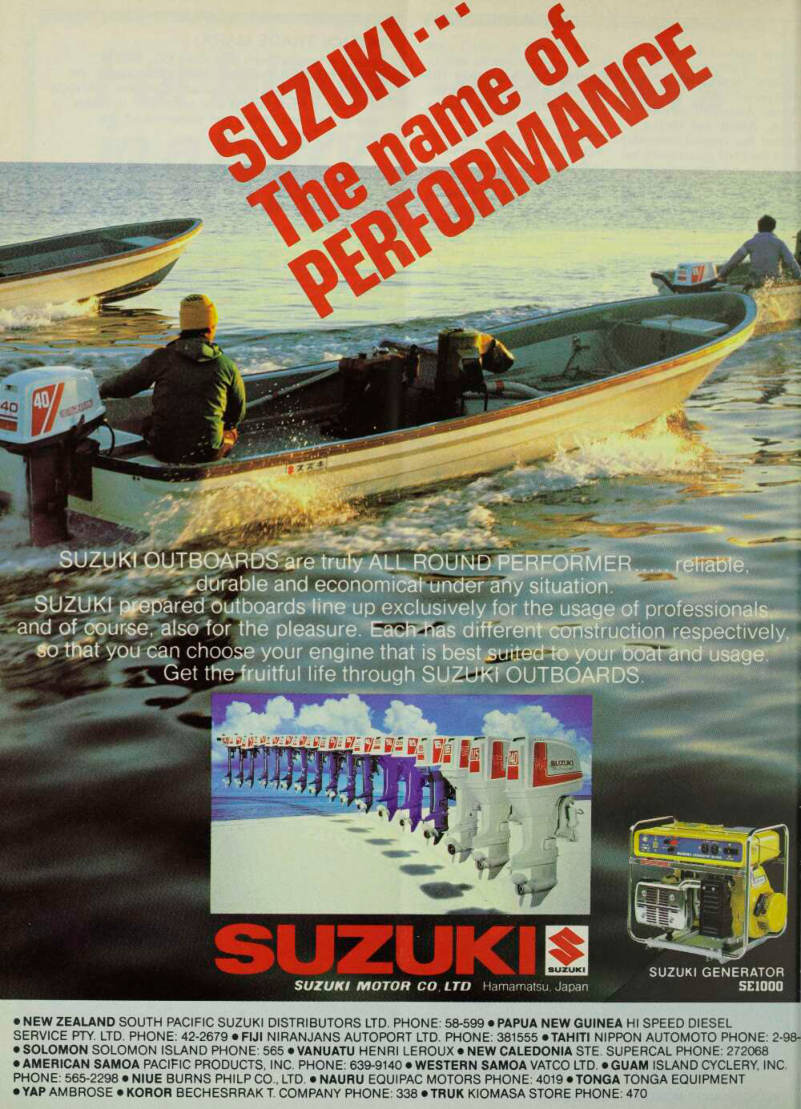
sUZUKI-the name or performance
Breathes of glory and experience in racing.
Watch it feeling over on-roads and boldly crossing off-roads.
Presenting SUZUKI s motorcycles that blends superb performance with elegant modernistic styling.
Seen strikingly alive in SUZUKI’s motorcycles is SUZUKI’s technology and experience originally incorporated in the champion machine which has claimed a variety of race titles.
These climaxing technological innovations are apt to attract motorbike fans worldover.
SM - » I * K 6* ■ JT. r \ V I ? 15 2 v t- ' *2* * *
SUZUKI MOTOR CO , LTD
suzukil SOOTakatsuka, Hamamatsu, Japan SOLOMON ISLANDS SOLOMON ISLAND SERVICE STATION LTD. NEW CALEDONIA STE. SUPERCAL PAPUA NEW GUINEA HI SPEED DIESEL SERVICE PTY LTD. NEW HEBRIDES HENRI LEROUX NIUE ISLAND BURNS PHILP (SOUTH SEA) CO.. LTD. PONAPE LEO ETSCHEIT TAHITI NIPPON AUTOMOTO ELUCE ISLAND TUVALU COOPERATIVE WHOLESALE SOCIETY LTD. GUAM & SAIPAN ISLAND CYCLERY, INC. NORFOLK MARTIN'S AGENCIES LTD. SAMOA PACIFIC PRODUCTS, INC. KIRIBATI GILBERT ISLANDS ii-r-r-r-k TAkiA an* AiriA nnnm iotd imo At AI idi t CT/'M I A DAO UATADC Cl iiMIDAM lAKIQ Al ITDDDDT ITD
Letters
again
followed the principle of first past-the-post, and confirmed the Popular Unity candidate as president, although the consti tution actually permitted it to ‘elect between the first two majorities’.
The fact that the Popular Unity had openly proclaimed its scorn for what it termed ‘bour geois democracy’, and avowed its intention of doing away with it, led congress to demand the signing of a Statute of Guaran tees, by which the Popular Unity committed itself to re spect Chile’s independence and democratic ways. In retrospect, that document strongly evokes Mr Neville Chamberlain and his umbrella. The extent to which this statute was broken and violated is reflected in the statements made in 1973, both by the Chilean Congress and the Chilean High Court, to the effect that through violence and illegal measures the Popular Unity government had placed itself beyond the law.
It must be borne in mind that Chile’s economy was to a great extent socialised by 1970. Land reforms had proceeded since 1960. Copper concerns had first been ‘Chileanised’ at the time of the Christian-Democratic government, and finally nationalised in 1971. The gov ernment held in its hands mech anisms of total economic con trol.
When the Marxist regime assumed power the inflation rate was running at around 30%. An indication of the economic situation of Chile in the ensuing years was an inflation rate of more than 1000% in 1973. Meanwhile, the taking-over of total power by means of armed violence was constantly advocated by leaders of the government coalition.
Fifteen thousand trained guer rillas, mainly Cuban, had ar rived in Chile and guerrilla training camps operated openly.
Seen against its proper back ground and perspective, there can be no doubt that the events of September 1973 were, in their essence, a Chilean move ment of assertion of national independence and freedom. In light of Professor Crocombe’s thesis it should be of interest to observe these events in their appropriate context.
As for his references to Easter Island, it seems necess ary to make clear that the island is an integral part of Chilean territory. It is a province of the country’s Fifth Region, and its administration falls within the regular civil administration of the nation. It has a provincial governor and a mayor who heads the local council. It holds no particular military status, and the Chilean navy ceased to administer it in 1966.
I hope this background ma terial will be of help to those who have appreciated Professor Crocombe’s enlightening article.
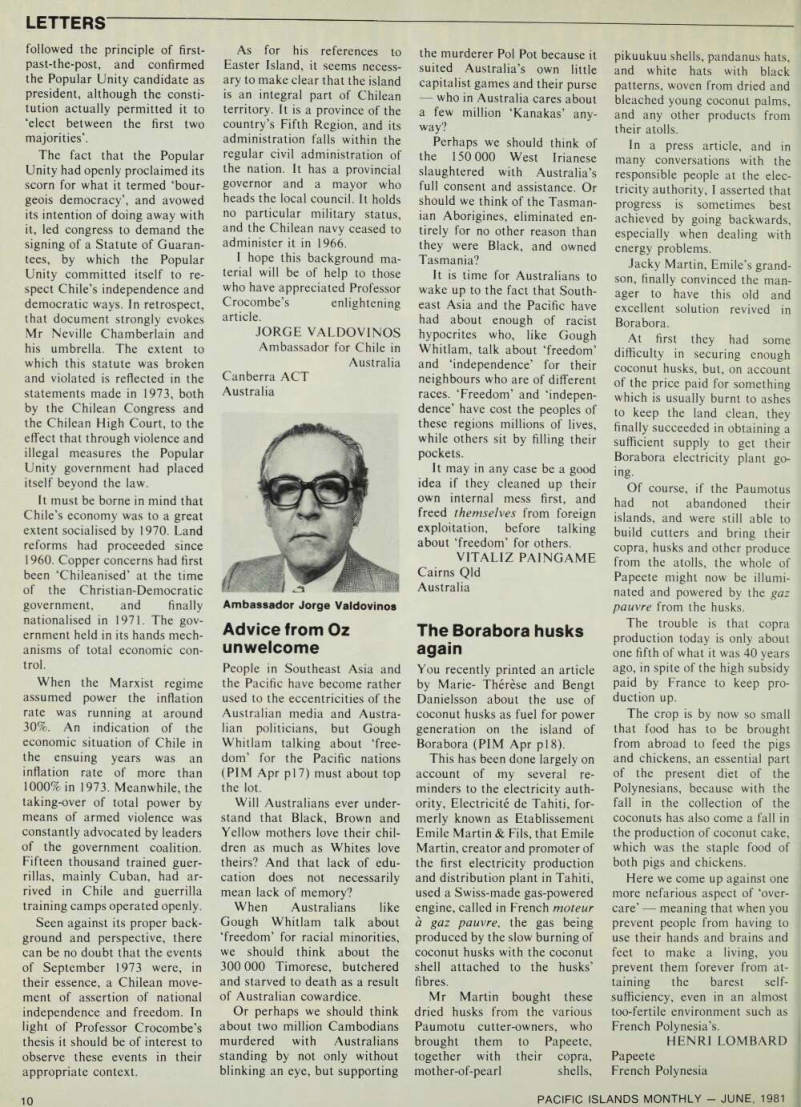
Jorge Valdovinos
Ambassador for Chile in Australia Canberra ACT Australia
Advice from Oz
unwelcome
People in Southeast Asia and the Pacific have become rather used to the eccentricities of the Australian media and Austra lian politicians, but Gough Whitlam talking about ‘free dom’ for the Pacific nations (PIM Apr pi 7) must about top the lot.
Will Australians ever under stand that Black, Brown and Yellow mothers love their chil dren as much as Whites love theirs? And that lack of edu cation does not necessarily mean lack of memory?
When Australians like Gough Whitlam talk about ‘freedom’ for racial minorities, we should think about the 300 000 Timorese, butchered and starved to death as a result of Australian cowardice.
Or perhaps we should think about two million Cambodians murdered with Australians standing by not only without blinking an eye, but supporting
the murderer Pol Pot because it suited Australia’s own little capitalist games and their purse who in Australia cares about a few million ‘Kanakas’ any way?
Perhaps we should think of the 150 000 West Irianese slaughtered with Australia’s full consent and assistance. Or should we think of the Tasman ian Aborigines, eliminated en tirely for no other reason than they were Black, and owned Tasmania?
It is time for Australians to wake up to the fact that South east Asia and the Pacific have had about enough of racist hypocrites who, like Gough Whitlam, talk about ‘freedom’ and ‘independence’ for their neighbours who are of different races. ‘Freedom’ and ‘indepen dence’ have cost the peoples of these regions millions of lives, while others sit by filling their pockets.
It may in any case be a good idea if they cleaned up their own internal mess first, and freed themselves from foreign exploitation, before talking about ‘freedom’ for others.
Vitaliz Paingame
Cairns Qld Australia
The Borabora husks
again
You recently printed an article by Marie- Therese and Bengt Danielsson about the use of coconut husks as fuel for power generation on the island of Borabora (PIM Apr pi8).
This has been done largely on account of my several re minders to the electricity auth ority, Electricite de Tahiti, for merly known as Etablissement Emile Martin & Fils, that Emile Martin, creator and promoter of the first electricity production and distribution plant in Tahiti, used a Swiss-made gas-powered engine, called in French moteur a gaz pauvre, the gas being produced by the slow burning of coconut husks with the coconut shell attached to the husks’ fibres.
Mr Martin bought these dried husks from the various Paumotu cutter-owners, who brought them to Papeete, together with their copra, mother-of-pearl shells.
pikuukuu shells, pandanus hats, and white hats with black patterns, woven from dried and bleached young coconut palms, and any other products from their atolls.
In a press article, and in many conversations with the responsible people at the elec tricity authority, I asserted that progress is sometimes best achieved by going backwards, especially when dealing with energy problems.
Jacky Martin, Emile’s grand son, finally convinced the man ager to have this old and excellent solution revived in Borabora.
At first they had some difficulty in securing enough coconut husks, but, on account of the price paid for something which is usually burnt to ashes to keep the land clean, they finally succeeded in obtaining a sufficient supply to get their Borabora electricity plant go ing.
Of course, if the Paumotus had not abandoned their islands, and were still able to build cutters and bring their copra, husks and other produce from the atolls, the whole of Papeete might now be illumi nated and powered by the gaz pauvre from the husks.
The trouble is that copra production today is only about one fifth of what it was 40 years ago, in spite of the high subsidy paid by France to keep pro duction up.
The crop is by now so small that food has to be brought from abroad to feed the pigs and chickens, an essential part of the present diet of the Polynesians, because with the fall in the collection of the coconuts has also come a fall in the production of coconut cake, which was the staple food of both pigs and chickens.
Here we come up against one more nefarious aspect of ‘over care’ meaning that when you prevent people from having to use their hands and brains and feet to make a living, you prevent them forever from at taining the barest self sufficiency, even in an almost too-fertile environment such as French Polynesia’s.
Henri Lombard
Papeete French Polynesia
Ambassador Jorge Valdovinos
Advertisements & other items, p. 10 (1 item)
Letters
close to the action

Australia in PNG, 1945-75 History written by one who was close to the action
Sir JOHN GUNTHER, one of the most distinguished Australian public servants to be associated with Papua New Guinea in recent times, here reviews an important new publication on Australia’s role in PNG, Papua New Guinea: The Australian Trusteeship 1945-75 , * by lAN DOWNS. Sir John is a former director of health and assistant administrator in PNG. His last official post before retirement was to serve as the foundation vice-chancellor of the University of Papua New Guinea.
lan Downs went as a cadet patrol officer to what was the Mandated Territory of New Guinea in January 1936. Late in 1938, after a short course at the University of Sydney, Downs was sent to Wabag to put down an insurrection by some 6000 Enga warriors against the presence of a small base camp left by Taylor’s Hagen-Sepik patrol. He then became officer-in-charge of Chimbu, at that time the biggest sub-district in the terri tory. Thus, much of his early experience was among the iso lated mountain people of the central highlands the re cently contacted people of Taylor’s Middle Kingdom. Dur ing the war, Downs spent most of his time in command of small ships. A mutual friend, the very engaging J. K. McCarthy, told me that he drove his ship with such resolution that he became well acquainted with reefs in New Guinea’s northern waters.
After the war, Downs gained wide experience, rising quickly from the rank of patrol officer to district commissioner. He served in four districts, in one as a magistrate, and then briefly at headquarters before returning to the ‘Middle Kingdom’. He was a man of great initiative, an mproviser. In his district, no natter in what field of endeav our, if there was a real problem le only had to be asked once md he would give assistance.
As district commissioner in he eastern highlands Downs’
*The Australian Trusteeship: s apua New Guinea 1945-75. By ’an Downs. Published by the iustralian Government Pub ishing Service, Canberra. $2B.
Sbn 0 642 04139 3.
dynamic drive built a road over the Ramu-Purari divide and into the upper Markham River valley. This was a masterly piece of engineering, amateur if you like, but the route taken is not far from the professionally engineered road that was to replace it over Kassam Pass.
It was done by the people, using'picks and shovels, guided by young men of the Native Affairs Department. It was something quite magnificent. It joined the coast to the high lands. He extended the road to the west over Dualo Pass. This is all now part of the Highlands Highway, a Downs brainchild.
A consequence of this was the system of feeder roads that led to the villages and hamlets.
Downs’ tree-planting cam paign along the denuded high valley floors and on to the slopes must be greatly admired. The people should be eternally grateful, and it was his initiat ive.
Coffee was a crop that seemed well suited to the high lands, and villagers were en couraged by Downs and his officers to plant it, even before the Department of Agriculture gave its blessing. It brought in cash to people less than 20 years from the time when their tools were stone. Coffee also at tracted white settlers, who took up land in an unconventional way.
Hasluck, now Sir Paul Hasluck, then minister for territories, who had been a student of settlement in West ern Australia, has written most sympathetically about early Aboriginal rights. He was deter mined to see that over alienation of land and uncon trolled settlement didn’t occur in Papua New Guinea. He was
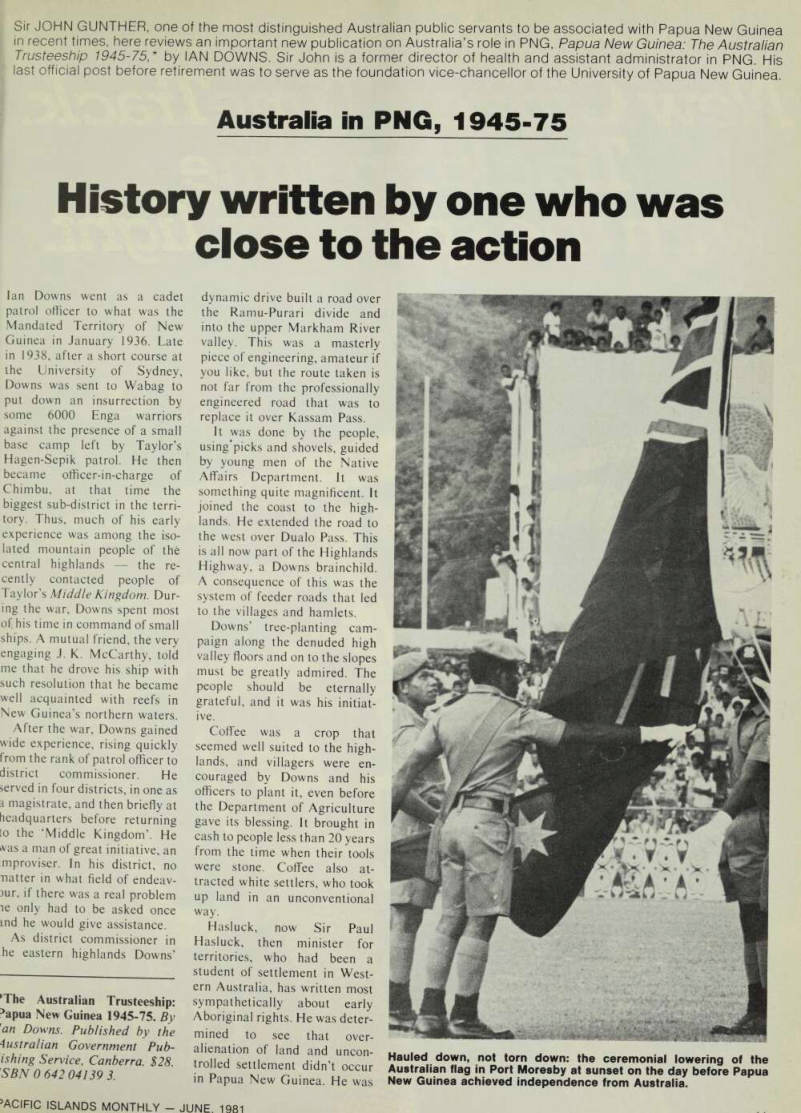
Hauled down, not torn down: the ceremonial lowering of the Australian flag in Port Moresby at sunset on the day before Papua New Guinea achieved independence from Australia.
The Australian Trust
disturbed by the fact that officers of the administration, and senior ones at that, while holding positions of authority, had ‘squatted on’ and planted up land with coffee, land for which they held no title. lan Downs’ The Australian Trusteeship: Papua New Guinea 1945-75, was described on an invitation to its launching as the ‘Official History of New Guinea’. Downs apparently had full access to the Department of Territories (and External Territories) files. He has put his own interpretation on what they threw up. He sought the opinions of many people. His own great experience in Papua New Guinea, and his ready access to documents, clearly entitle him to assume the role of an historian.
On the other hand, Sir Paul Hasluck'has written A Time for Building. He uses his fully argued minutes during the time he was minister to set down what Australian trusteeship policies were from 1951 to 1963. Where A Time for Build ing and The Australian Trusteeship are in conflict either as to fact or interpret ation, one would have to lean towards Sir Paul Hasluck.
The two books, however,
‘There are some who saw no good in the policies of Paul Hasluck. the minister responsible for Papua New Guinea.
Hasluck was accused of gradualism, inflexibility, and of not listening to local advice. I don ’t accept any of these charges. If gradualism meant slow but progressive advance, then it simply is not true. Hasluck was impatient with slowness. He did change his views if the discussion justified it. But if having heard all argument he made up his mind, he expected immediate and loyal support. ’
complement each other: the minister and Downs, the colonial civil servant, entrepreneur and local politician, saw some things differently. Indeed, Downs has quoted those who said they saw no good in Hasluck’s policies. He was accused of gradualism, inflexibility, and of not listening to experienced local or territory advice. I don t accept any of these charges. If gradualism meant slow but progressive advance, then it simply is not true.
Hasluck was impatient with slowness. He did change his views if the discussion justified it. But if having heard all
argument he made up his mind, he expected immediate and loyal support.
He did listen to local advice, if it was sound and well pres ented. But too often it was not sound and well presented. Let me take just one example. For some years during the budget debate in the Legislative Coun cil the administration was casti gated for levying unfair export duties on the products of econ omic tree crops. It could best be replaced by income tax. As
Downs writes, there was ample opportunity to review the terri tory’s finances before income tax was introduced. It was apparent to all those debating the Review of Finances that they were in fact debating the introduction of income tax, de spite official denials. But about all the opponents of income tax could come up with was a demand for that hoary old delayer of progress an in quiry.
I have boundless respect for both authors. Downs as a public servant had opportunities to thrust ahead, and he did. He had flexibility, and he used it
As an entrepreneur, he was a very successful manager of a coffee estate. I always had a feeling he kept a separate card for each tree and for each shade tree. He sponsored and fostered a body of farmers and settlers whose voice was heard and listened to in Port Moresby perhaps with more attention than the voice of the New Guinea Planters Association.
The Highland Farmers and Settlers Association was a lib eral body which encouraged New Guineans to become mem bers. In this respect it was much in advance of kindred associ ations in Papua and in New Guinea. Downs was an active and helpful politician, as this review will try to show.
Downs’ book is between 300 000 and 350 000 words long, and as he writes in his preface it was reduced to this size from the original of ‘over half a million words’. One person who saw an early manu script thought it might well have contained 750 000 words.
Should an ‘official history’ be too rigidly cut down? If the author has to cut, what does he leave out? My understanding is and I have no authority for this that Downs wanted to write about the part played by Australians in the development of Papua New Guinea. He sought access to departmental files, and instead was offered employment in the public ser vice of Australia and given the task of writing a history. But a history of what'l
Papua New Guinea was a colony, the metropolitan power 1 was a next-door neighbour. His tory could detail Australian policies and how those policies came to be adopted. In Papua New Guinea those policies were pul into being by a separate civil service. The adminis tration of Papua New Guinea had a twofold task: it carried out policy directions, but it also represented the dependent people. There was an obligation on the administration to put forward what it thought was in the best interests of the Papua New Guinea people, whether this was in Australia’s best interest or not. It should surely continue to do this until the minister gave an unequivocal direction. Then the public ser vice had to carry out Australian policy.
Thus in any history of Aust ralia’s trusteeship what was being thought in Papua New Guinea would be an important component of that history although I am not sure that Papua New Guinea’s archives are complete and easily access
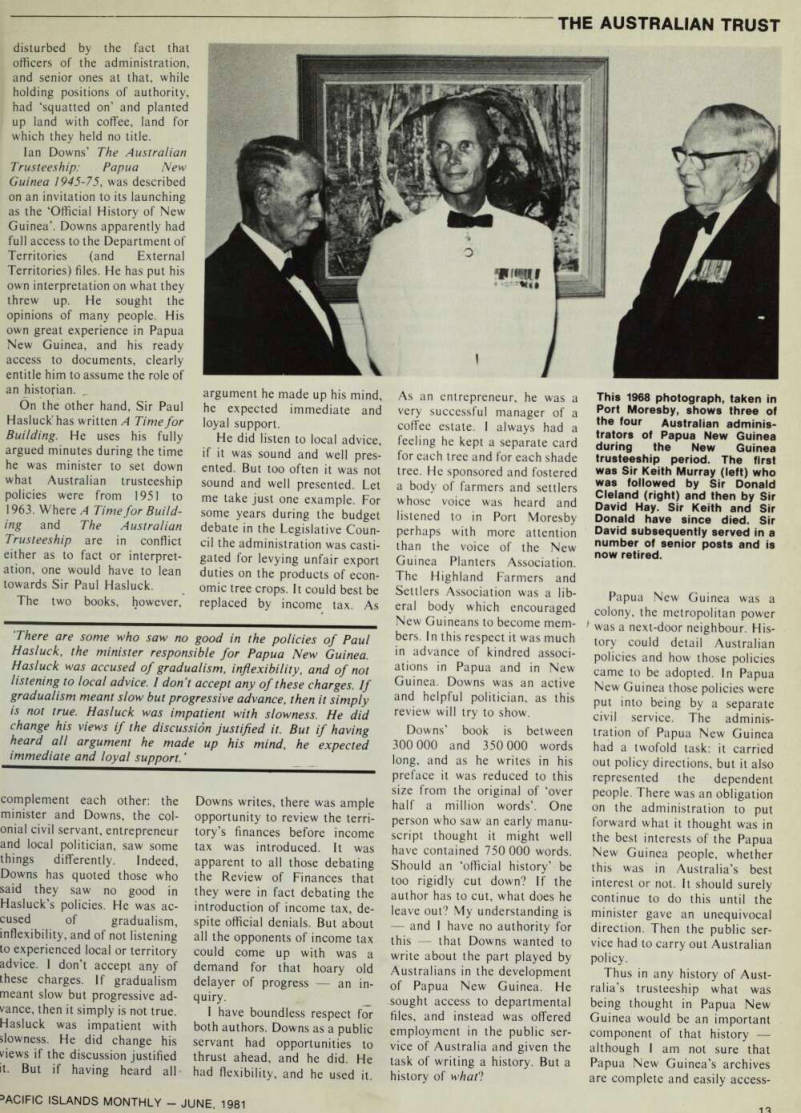
This 1968 photograph, taken in Port Moresby, shows three of the four Australian adminis trators of Papua New Guinea during the New Guinea trusteeship period. The first was Sir Keith Murray (left) who was followed by Sir Donald Cleland (right) and then by Sir David Hay. Sir Keith and Sir Donald have since died. Sir David subsequently served in a number of senior posts and is now retired.
ible. I can think of an example.
Downs does not give much cover of the national salaries arbitration case, although at the time it was a sensational issue in Papua New Guinea.
The Public Service Associ ation sought an increase of the 1964 salaries before the arbi trator. J.H. Wootten QC, now a judge of the Supreme Court of New South Wales, was retained by the public service com missioner. At first J. Greville Smith, then president of the Public Service Association, now Mr Justice Greville Smith of the Supreme Court of Papua New Guinea, represented the national public servants.
Wootten produced an amended salaries scale which was accept able to Greville Smith. But this was rejected by Canberra.
After lengthy proceedings, the proposed scale was almost exactly the same as that eventu ally determined by the Arbi trator. R. J. L. Hawke, an Aust ralian union advocate who is now a member of the Australian Parliament, later entered the lists on behalf of the public servants. The case dragged on, daily becoming more emotional and bitter, and as Downs writes ‘it was stored up to make trouble at a later stage’. This situation would never have been reached if the Wootten/Smith accord had been followed.
Sound Papua New Guinea ad ministration advice had been ignored.
Downs must have been ex tremely harassed in trying to write a full history of the Australian trusteeship, and meet the requirements of his editors and I’m sure he hasn’t satisfied himself. It would be natural to take samples, hoping they would represent the whole. These are done extremely well: the role of the kiap; land policy; the visits of two United Nations missions; the J. K. Murray era; the devel opment of the eastern high lands; the 1968 five-year plan; the Derham report and the administration of justice; the Tolai nation and local govern ment councils; Whitlam’s influence. I got the impression that if he had to cut savagely the author chose to delete those matters with which he was less familiar. New Guinea seems
more dominant in his text than Papua. Downs was a New Guinea man. The Tommy Kabu movement of Papua is not mentioned, whereas the so called Paliau, Yali, Hahalis and Johnson cults of New Guinea are well covered. The Tommy Kabua movement was as im portant as they were, as was and is Papua Besena, which occupies small space beside the Mataungan Association and Napidakoe Navitu.
Hasluck’s 1961 development
‘lt is interesting to conjecture what might have happened if Paul Hasluck had remained responsible for Papua New Guinea after the 1963 Australian elections. I would guess universal primary education would have been achieved, the 1961 development plan would have flowed, the university would have started a year earlier, and self-government and independence would have come a year sooner. ’
plan gets scant mention, yet it set targets in economic develop ment and also goals for social advance. Its targets were not unlike those prepared by the World Bank mission in 1964 and put into a programme in 1968. What is more Hasluck was personally interested in the creation of an infrastructure, and this meant staff, housing, offices and tools. Downs says that between 1961 and 1968 Australia provided an annual average grant of 15%. What he doesn’t say is that the rate of the
average increase to achieve Hasluck’s targets was just short of 18%, and that of Barnes leading to the five-year plan just over 11%.
It is interesting to conjecture what might have happened if Hasluck had remained as minis ter after the 1963 elections. I would guess universal primary education would have been achieved, the 1961 plan would have flowed, the university would have started a year earlier, and self-government
and independence would have come a year sooner. It is just possible that if F. N. Chaney, now a senator and the present Australian minister for social security, had remained the executive officer of Guise’s 1965 Select Committee on Con stitutional Development, inde pendence would have come a year sooner.
Hasluck’s effect and Chaney’s endeavours could not be compounded. In Chaney’s case the proviso would be that there would be no outside inter
ference with the select com mittee. Unfortunately there was. Chaney was then a young man, a lawyer in the Papua New Guinea public service.
Guise had called for a name, a flag, an anthem, and Chaney went about devising ways to educate the people, including the select committee, as to what a constitution was.
About the only political change the committee achieved was to be told that seventh statehood or other consti tutional links with Australia were not on. There would have been some who would have predicted that in 1965, al though readily admitting it would have been a very short odds favourite in any ballot giving a free choice to the people of Papua New Guinea and, as Downs shows, more than 30% of Australians would have accepted it. But would such a number have accepted
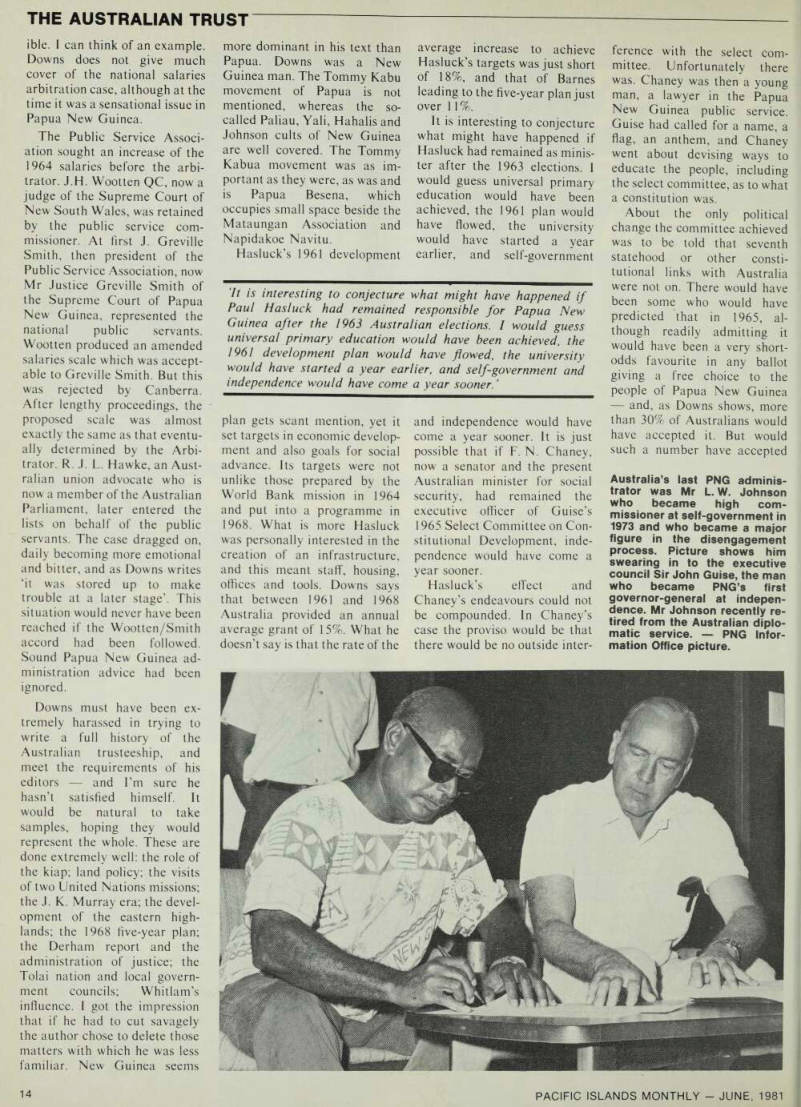
Australia’s last PNG adminis trator was Mr L. W. Johnson who became high com missioner at self-government in 1973 and who became a major figure in the disengagement process. Picture shows him swearing in to the executive council Sir John Guise, the man who became PNG’s first governor-general at indepen dence. Mr Johnson recently re tired from the Australian diplo matic service. PNG Infor mation Office picture.
Papua New Guinea as a seventh state if the question had been put: Would you agree to two million Papua New Guineans being given free access at all ' times to Australia, and one million of them voting in federal elections?
The administration of justice was forever an issue. A continu ing bone of contention was whether there should be native or village* courts! The field officers of the Department of Native Affairs were nearly unanimous that there should be; the judges and the lawyers were generally totally opposed. The policy-makers thought they must accept the views of the judges and the lawyers. They did not disparage what the native affairs officers thought. A choice had to be made. Downs does not argue the other side of the case.
Much of the ‘lntroduction’ in The Australian Trusteeship is given over to the paternal kiap system. This treatment occurs more than once again through out the text. A sub-chapter is The End of the Department of Native Affairs’. I found such a lament unnecessary and not needed by a body of men who for the most part were fine officers. Their ultimate job was to hand over to nationals.
Where much material had to be cut out these few pages could have been replaced by a very much longer discourse as to why the department and the police did not see the need to use the word Downs doesn’t like: local ise.
The two departments where localisation should have oc curred as soon as it was possible were Native Affairs and Police.
In the case of Police it could have happened in 1947 with the appointment of John Guise, now Sir John Guise GCMG, KBE, LL.D., as an officer.
There were a few who could have been found and who could have been trained as Native Affairs officers. Indeed, the ;ame Guise was an assistant :lerk in the late 1950 s doing vhat was essentially the kind of vork done by Native Affairs )fficers. For Downs to say the education system did not eadily produce sufficiently ;ducated nationals is but a pale :xcuse. Other departments
were training their personnel even Native Affairs was train ing local government clerks, but not patrol officers. I know of no move until the late 1950 s by either Native Affairs or Police to consider such training. At first the police set out such ridiculous requirements for en try into a police college as the Leaving Certificate and six, or was it eight, years experience as a constable. What man in those days with a Leaving Certificate would have wasted time as a constable when so much more was offering?
The Director of Native Labour, J. L. Taylor had no difficulty in 1945-46 recruiting as clerks Papuans who had been to Australia to undertake a medical course in the 19305.
One of the most sophisticated telecommunication systems in the developing world is main tained by Papua New Guin eans. The director of post and telegraphs began planning and set about the training of techni cal staff from 1953 onwards.
The story of that development deserves a place in any history of Papua New Guinea. 1 am not sure I can accept Downs’ statement that the
7 am not sure I can accept lan Downs' statement that the adoption of a parliamentary system in the image of Westminster was a compromise. I agree all alternative systems that seemed to be available were thoroughly canvassed, but the Westminster system was always the most likely one to be acceptable to Papua New Guineans. ’
adoption of a parliamentary system in the image of Westminster was a compro mise. I agree all alternative systems that seemed to be available were thoroughly can vassed, but the Westminster system was always the one most likely to be acceptable to Papua New Guineans. An integral part of that system is a ‘loyal opposition’. It was not difficult for the official members to play their role as the executive government, quasi if you wish, according to Westminster, but nearly impossible for them to create an opposition just for the sake of doing so. One has to accept that the Legislative Councils and the first two Houses of Assembly had edu cative roles. Downs admirably fulfilled the role of teaching
what an opposition was. I don’t remember a day from the time he was elected to the Legislat ive Council when he didn’t call meetings of the non-official members, where they discussed the legislation before the parlia ment. It would have been easy for the official members to have been complacent from 1951-61.
Despite Downs’ complaint that their majority made good government impossible, official members took their role seriously, often because of Downs’ badgering. They saw the need to try to influence all members from 1961 when there was a non-official majority this official practice was essen tial.
It is possible that if Hurrell had not moved as he did in 1961 and 1962, with the full conniv ance of Downs, the establish ment of the House of Assembly might have been delayed. There is no knowing what a new minister and a new prime minister may have done if the 1962 select committee had been held up for two years.
Self-government and indepen dence would have come later rather than sooner. Who knows?
If that had happened, perhaps
the governor-general-designate would not have said '.. . we are lowering the flag of our colonisers. We are lowering it.
We are not tearing it down.’
Viable political parties were very slow in assembling. Downs gave a boost in this direction without attempting to set down any principles. This was the election of John Guise, who so carefully lowered the Aust ralian flag, as leader of the elected members. Mathias Toliman was elected his deputy.
Perhaps Guise did not grasp the possible significance of the pos ition for his political future. I can remember in 1965 in a London hospital when trying to describe who Guise was I said he was the ‘elected leader of the elected members’. The doctor replied ‘Oh, he is like a chief
minister’. And so he was put in a bed under one of the honorary surgeons to Her Majesty. One should add to Downs’ history that just as he had created the position for Guise and I’m sure it was his idea and his alone he just as suddenly decided the position was no longer necessary.
I think Australian Trustee ship might well have looked more thoroughly into the failure of the administration to promote political parties. One of the warts that is now almost malignant, and which is a result of that neglect, is the number of splinter parties. Parties did not have time to establish traditions and loyalties. Splinter parties do not help a developing nation.
They can lead to one-party parliaments.
The Australian Trusteeship: Papua New Guinea 1945-75 is a history of Australia’s devolution of authority to a new and independent nation in a gener ation. The historian apparently had complete access to official records. He has used his exten sive personal experience to in terpret the information avail able to him. Although I would find it hard to call it ‘official’, it is an important document. It certainly deserves to be widely read by Australians. Aust ralians should be proud of their achievements in Papua New Guinea. It will be of interest to other Melanesian people from Irian Jaya through to Solomon Islands and Vanuatu, and to New Caledonia and Fiji, to study the status the English speaking countries enjoy since Britain and Australia granted them independence without strings.
It took a long time to print from when lan Downs com pleted his preface in April 1978 to its launching in March 1981.
But this has been well done, and done in Australia, even if the book has that official Australian Government Publishing Service look about it.
The waiting has been worth
it.
John Gunther.
• Author lan Downs has some words of his own to add to the story of why his book took so long to appear. One Page 17 he describes the problems of writ ing for a government com mittee.
Advertisements & other items, pp. 11-16 (4 items)
’Acific Islands Monthly - June 1981
Time Track
Another technological fiist from Citizen
ime
i • - No more second hand. Now there’s a second band; an LCD time brack that measures each second with pinpoint precision as.it travels around the circumference of the watch face. But of course there’s more. In the mode the time track speeds up to complete a each second for split-second readings. And these readings can be verified digitally at just the touch of a button - right down to J/lOOth of a second. portion of the Time Track contains an alarni, digital.stopwatch, an hourly chime, and a permanently-set calendar showing date and d&y Time Track by Citizen.
The new way to keep track of time. * $ Kl CCrr S s
WSBI
s :* as*.
CITIZEN QUARTZ feDIGI-ANA
Time Track
o
iIiSS
s /" ‘ •Mill * wfi
tSSSSi
m »s K K
STOPWATCH
ALA
r A J EN Citizen Pty Ltd, 122 Old NSW 2100. Telephone 939 70' W Brookyale NSW Sydney. Telex: AA26633
AHEAD OF THEIR TIME
Oriental
ou’re tuning an A 1 RX-2700. Anothe
S National/Panasonic
; 'vv v ''
m<sm m
laoan.A
3 Acific Islands Monthly - June, 1981
’Acific Islands Monthly - .11 Inf Iqri
THE AUSTRALIAN TRUST
history in Canberra
The many trials of writing PNG history in Canberra
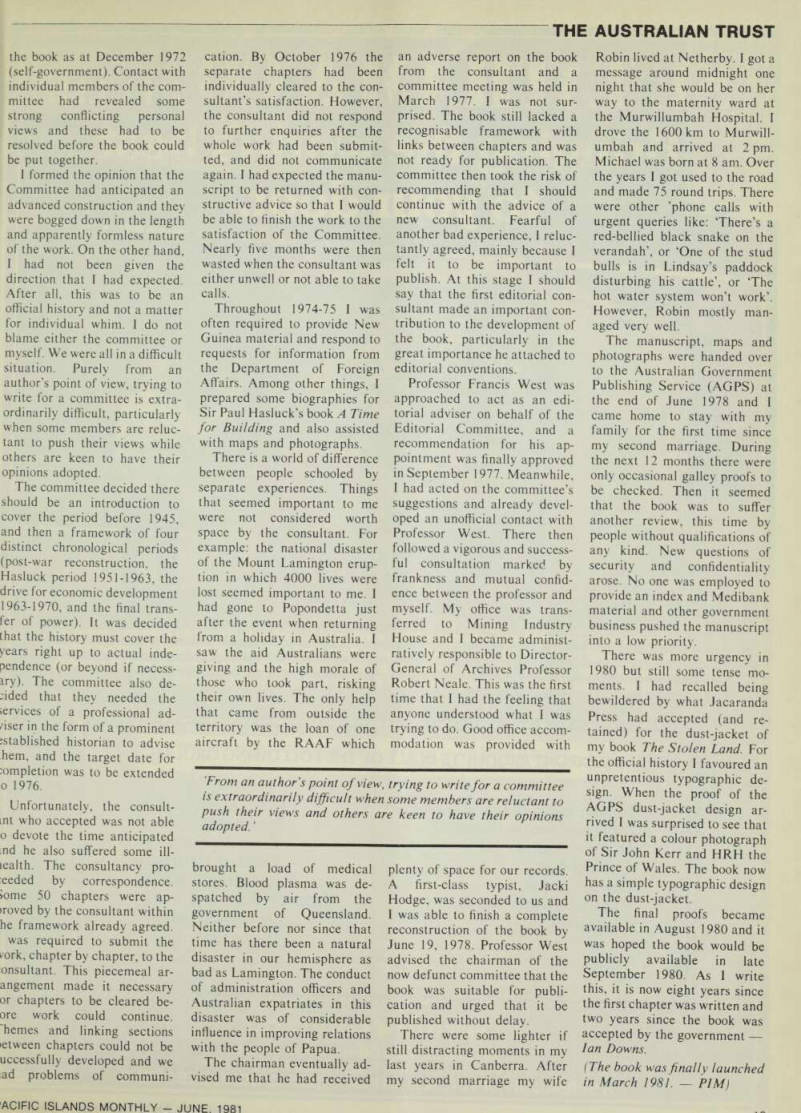
lAN DOWNS, author of the work reviewed in the preceding article, here tells his own colourful story of how it came to be written. Mr Downs’ account, full of humour and heartbreak, will strike a chord in the hearts of all who have experience as outsiders trying to negotiate a path through the labyrinthine corridors of power in a major bureaucracy in this case, the one that has its home in Canberra, Australia.
In September 1972,1 was asked to write an official history: The Australian Trusteeship: Papua New Guinea, 1945-1975. My contact with Canberra orig inated with inquiries I had made to see government records because I intended to write a non-fiction book about Papua New Guinea. I found that the idea of an official history, based on the work of the Department of External Territories, had been in the air for some time.
With independence in the offing, the days of the depart ment were numbered and some officials wished to write their own panegyric. There was some concern that a professional his torian might get in first. How ever, there was also concern that a documentary about bu reaucrats by bureaucrats might not be well received and so it was decided to hire someone outside of government with some knowledge of the country and Australian policy to pro duce a suitable book. Andrew Peacock was the Minister for External Territories at that time and he authorised the project.
There were no real guide lines, but I was warned that the book must include important official events and express the view from Australia, and not be biased by Melanesian or ex patriate opinion in the then Trust Territory. An assistant secretary asked me if I was capable of writing ‘a big book: much longer than a paperback’ and how long that would take. I suggested 1975, the target date for independence. I was told 1 would have to finish the work within two years because the department was winding down.
At the time I had no real conception of how long it would take. I had recently had a novel published of roughly 80 000
words and that had taken me less than four months, but I was aware that as a guideline for this task, a work of fiction was misleading.
I approached the job with understandable humility. My qualifications did not include expertise as a historian nor the advantage of a suitable aca demic background. However, I had been close to the action and the personalities in most of the events leading up to self government in Papua New Guinea. Over a period of 33 years I had been in government, in opposition politics and in private enterprise. Most of the important people, both Aust ralians and Papua New Guin eans, had at one time or another been guests in my house. Many had been my friends. Ever since World War 11, I had been making notes for something more important than a novel.
An official history would have to depend mainly on official records. It would have to give an account of economic devel opment, public works, health education and welfare, and other things not usually found in good literature and seldom included in good history. This would have to be a book for ordinary people rather than academics, but still important enough for students to use as a guide for their own research. I would have to show what Aust ralians had accomplished be fore Papuans and New Guineans began their own his tory as a nation. New nations tend to remember only the bad things that metropolitan powers impose upon them and little of the good. In the beginning I wanted to tell it all and when I found that I had far too much to say within the confines of one book I was frustrated and sad to think that the work of so many
fine people might be overlooked and forgotten. I admit that I tried to report too many events, include too many places and the activities of too many people.
At one stage the manuscript reached over 800 000 words. It became a horror for any editor to contemplate. Problems of bias and subjectivity were always in my mind. No writer can totally avoid bias, but in a book of this kind subjectivity had to be put aside as far as humanly possible even if this meant that much of the book would just be dull.
In 1972 I was living part of the time in Sydney, but most of the time at Netherby, a small farm overlooking the beautiful Tweed Valley in Northern New South Wales where I breed gentle Brahman cattle. I had business interests in Sydney and it was decided that I should be attached to the Sydney office of the Department of External Territories. While in Canberra, I was promised the assistance of a qualified research officer with a degree in arts and the services of a manuscript typist. I should have known that this would never happen. In the public service no one can promise anything without disturbing someone else. The most easily disturbed persons belong to the Public Service Board.
A novelist can begin a book by getting out his portable typewriter and starting to write.
The framework and research if any research is required can come later and the book just develops. A novelist only has to be true to himself. Writing history is not like that, and writing an official history is something else again. My re search would have to be all embracing even if I did not use more than a fraction of what I collected. Along the road I
knew that research would lead to themes and links and provide a bank of information on which I could draw later. I was more aware than most people of the significant events in the history of the Trust Territory, but I was humbled when I discovered how much I did not know. Historical facts do not find their own way into any particular set of sources and any selection of sources must have an element of interpretation. What I eventu ally wrote was drawn mainly from official records, letters on files, statements by ministers and amplified by personal inter views. These had to be checked against contemporary articles, books, parliamentary debates, submissions by bureaucrats, law reports and the press.
I began with the press. By the end of December 1972, I had recorded and indexed every press reference to Papua New Guinea and what was once West New Guinea that had been reported in The Sydney Morning Herald, The Canberra Times and the Brisbane Courier-Mail from 1944 to
lan Downs, author of the newly published official history of the Australian trusteeship in New Guinea. In his own account of how the book was written Downs tells on these pages of the humour and handicaps of writing for a government com mittee.
1972. In January 1973, I was asked to transfer to Canberra and was promised an office and the staff that had been orig inally proposed if I would agree to go. There was no practicable alternative. All the official files were in Canberra along with the National Archives, and there was no substitute for the National Library. I accepted and was given a desk in a general office in which nine other people were working and many more seemed to be com ing and going. I had access to a typing pool, but no priority.
Pages of manuscript were often mislaid because my work was thought to be less important than any official letter. It was usually given to probationary ladies still learning to type.
They were not used to pages and pages of manuscript that lacked the protection and auth ority of an official file and were not addressed to anyone. It was beyond their public service ex perience. Delays were extra ordinary. During lunch hours, when the intimidating lady in charge of the pool was away, I used to go and look for my work so that I could submit it again.
Once I was flattered to find a person munching sandwiches and reading the manuscript to pass the time. I could not store records and so I did most of my research during office hours and wrote the book at night. I did most of my work in my flat. It was a crazy situation and but for the encouragement that 1 received from Hugh Clarke, then the director of information at the department, I would have given up and gone home to the farm. Instead, 1 paid for the manuscript to be typed in a private office.
I complained, and in June 1973 I was given an office of my own and a research assistant with a university degree who explained that she was about to apply for maternity leave. She departed after a few weeks and I never saw her again. I did hear that she had given birth to a son. I also got a typist who tried very hard and helped in many ways, but she could not keep up with the volume of work. Never theless, by August 1973 I had completed over 90 000 words together with source notes which covered the reconstruc
tion period after the war. This reference to number of words was born of my Canberra ex perience. The department wanted to get its money’s worth.
Volume of work done rather than quality was the yardstick by which my need for a typist could be justified. Work con tinued on a chronological basis because this seemed the best way to hold the book together until alternatives could be con sidered.
I was given authority to
‘When the intimidating lady in charge of the pool was away I would look for my work so I could submit it again. Once I was flattered to find a person munching sandwiches and reading the manuscript. ’
examine all departmental re cords by the then secretary of the department, D. O. (now Sir David) Hay. I was given intro ductions to other departments and everything possible was done to make material avail able. Unfortunately much time was wasted collecting material from distant offices or making photocopies in the National Library because I had no suit able assistance. I travelled widely to interview and discuss the book with eminent persons like Sir John Gunther, the late Sir Keith Murray and W. A.
Lalor. The staff at the Aust ralian School of Pacific Admin istration and many former Papua New Guinea residents living in Australia were most helpful. I had a need to discuss aspects of the book with other people, particularly those out side government. Discussion within the department tended to be cautious and guarded.
Outside of government the op posite was true. I received help and kindness from more than 100 people. Only two that I approached were unable to find the time, or else were reluctant, to discuss their place in the history of Papua New Guinea.
One was Sir Paul Hasluck and the other was E. G. Whitlam.
Fortunately, both of them had produced a mass of contempor ary material in parliamentary debates, official letters, public statements and speeches, signed articles and retrospective books.
Any absence from Canberra was always dangerous. Only public servants accustomed to
defending themselves against predators will understand the need for eternal vigilance. Most of our office moves were ordered while I was away. It was not unusual for chairs, tables or even telephones to be hijacked.
On one occasion when I came back from interstate I found I had no telephone.
In 1973 the Department of External Territories ceased to exist and I became a bureau cratic orphan attached to the Department of Foreign Affairs,
but accommodated by the Aust ralian Development Assistance Agency (ADAA) of which the first director-general was L. W.
Johnson who had been the last administrator of Papua New Guinea. At about this time I was fortunate to have Mrs Eileen Ryan join what was now called ‘A History Section’. Mrs Ryan took over much of the research and set about keeping our affairs in proper public service order. I no longer had to concern myself with anything except writing the book. This was just as well. ADAA was reduced to a bureau within Foreign Affairs and we lost our accommodation. We were moved about in shuttles be tween different office buildings and temporarily joined the households of several different departments, where space and services were sometimes only grudgingly given. Each time we moved all the records had to be packed and unpacked. Some times our new destinations were not ready to receive us. On one occasion we were left in limbo for nearly two weeks. Fortu nately 1 had taken the pre caution of paying for my own mail box in Canberra and so we were able to keep in touch with people answering our inquiries.
The closure of the PNG office, where John Greenwell and Alan Kerr had been work ing within the Department of Foreign Affairs, was followed by a decision to appoint an Editorial Committee in November 1974 to which I would be ultimately responsible
for the book. The committee appointed comprised: D. O.
Hay (Chairman), Professor Henry Mayer, Professor R. G.
Neale, Messrs L. W. Johnson, A. J. Kerr, J. Greenwell and myself.
The Editorial Committee suffered from too much talent and not enough time to attend to committee affairs. David Hay was the secretary for Aboriginal Affairs, Professor Mayer was Professor of Govern ment at Sydney University, Professor Neale was the Director-General of Archives, L. W. Johnson was soon to become the Australian Am bassador to Greece, while Alan Kerr and John Greenwell were moving on to higher duties in other departments. It was almost impossible for all these people to come together at the same time.
These were bad years. My mother died in 1973 while staying with me in Canberra.
And in November 1974 my wife Judith died after a long struggle against cancer. I began to neglect my own affairs to the point where a profitable busi ness in Sydney had to be closed down and my cattle stud went into a loss situation from which it has since barely recovered.
The person supposed to be looking after the farm departed, leaving his wife and children to handle the cattle. The cattle felt neglected and in justifiable dis gust the stud bull took the herd into the Mooball State Forest.
Meanwhile, I went on writing and churning out chapters which had become separate compartments rather than part of a coherent whole.
In February 1975 I submit ted a rough chronological narra tive to the Editorial Committee.
The committee had come to gether for the first time and it was necessary to lay out what had been done and to obtain (for the first time) their con sidered opinion before embark ing on particular themes within a framework. Papua New Guinea was still a Trust Terri tory and negotiations for the transfer of power had been more or less continuous from 1972. 1 not only had to write a book, but also keep up with current events as they occurred.
I had always wished to conclude
the book as at December 1972 (self-government). Contact with individual members of the com mittee had revealed some strong conflicting personal views and these had to be resolved before the book could be put together.
I formed the opinion that the Committee had anticipated an advanced construction and they were bogged down in the length and apparently formless nature of the work. On the other hand, I had not been given the direction that I had expected.
After all, this was to be an official history and not a matter for individual whim. I do not blame either the committee or myself. We were all in a difficult situation. Purely from an author’s point of view, trying to write for a committee is extra ordinarily difficult, particularly when some members are reluc tant to push their views while others are keen to have their opinions adopted.
The committee decided there should be an introduction to cover the period before 1945, and then a framework of four distinct chronological periods (post-war reconstruction, the Hasluck period 1951-1963, the
drive for economic development
1963-1970, and the final trans fer of power). It was decided that the history must cover the years right up to actual inde pendence (or beyond if necess ary). The committee also de eded that they needed the services of a professional ad viser in the form of a prominent established historian to advise hem, and the target date for completion was to be extended o 1976.
Unfortunately, the consult mt who accepted was not able o devote the time anticipated ind he also suffered some ill icalth. The consultancy pre ceded by correspondence. >ome 50 chapters were ap iroved by the consultant within he framework already agreed. was required to submit the chapter by chapter, to the onsultant. This piecemeal ar angemenl made it necessary or chapters to be cleared be ore work could continue, 'hemes and linking sections •etween chapters could not be
uccessfully developed and we
ad problems of communi
cation. By October 1976 the separate chapters had been individually cleared to the con sultant’s satisfaction. However, the consultant did not respond to further enquiries after the whole work had been submit ted, and did not communicate again. I had expected the manu script to be returned with con structive advice so that I would be able to finish the work to the satisfaction of the Committee.
Nearly five months were then wasted when the consultant was either unwell or not able to take calls.
Throughout 1974-75 I was often required to provide New Guinea material and respond to requests for information from the Department of Foreign Affairs. Among other things, I prepared some biographies for Sir Paul Hasluck’s book A Time for Building and also assisted with maps and photographs.
There is a world of difference between people schooled by separate experiences. Things that seemed important to me were not considered worth space by the consultant. For example: the national disaster of the Mount Lamington erup tion in which 4000 lives were lost seemed important to me. I had gone to Popondetta just after the event when returning from a holiday in Australia. I saw the aid Australians were giving and the high morale of those who took part, risking their own lives. The only help that came from outside the territory was the loan of one aircraft by the RAAF which
From an author s point of view, trying to write for a committee is extraordinarily difficult when some members are reluctant to push their views and others are keen to have their opinions adopted. ’
brought a load of medical stores. Blood plasma was de spatched by air from the government of Queensland.
Neither before nor since that time has there been a natural disaster in our hemisphere as bad as Lamington. The conduct of administration officers and Australian expatriates in this disaster was of considerable influence in improving relations with the people of Papua.
The chairman eventually ad vised me that he had received
an adverse report on the book from the consultant and a committee meeting was held in March 1977. I was not sur prised. The book still lacked a recognisable framework with links between chapters and was not ready for publication. The committee then took the risk of recommending that 1 should continue with the advice of a new consultant. Fearful of another bad experience, 1 reluc tantly agreed, mainly because I felt it to be important to publish. At this stage I should say that the first editorial con sultant made an important con tribution to the development of the book, particularly in the great importance he attached to editorial conventions.
Professor Francis West was approached to act as an edi torial adviser on behalf of the Editorial Committee, and a recommendation for his ap pointment was finally approved in September 1977. Meanwhile, I had acted on the committee’s suggestions and already devel oped an unofficial contact with Professor West. There then followed a vigorous and success ful consultation marked by frankness and mutual confid ence between the professor and myself. My office was trans ferred to Mining Industry House and I became administ ratively responsible to Director- General of Archives Professor Robert Neale. This was the first time that I had the feeling that anyone understood what I was trying to do. Good office accom modation was provided with
plenty of space for our records.
A first-class typist, Jacki Hodge, was seconded to us and I was able to finish a complete reconstruction of the book by June 19, 1978. Professor West advised the chairman of the now defunct committee that the book was suitable for publication and urged that it be published without delay.
There were some lighter if still distracting moments in my last years in Canberra. After my second marriage my wife
Robin lived at Netherby. I got a message around midnight one night that she would be on her way to the maternity ward at the Murwillumbah Hospital. I drove the 1600 km to Murwill umbah and arrived at 2 pm.
Michael was born at 8 am. Over the years I got used to the road and made 75 round trips. There were other ’phone calls with urgent queries like: ‘There’s a red-bellied black snake on the verandah’, or ‘One of the stud bulls is in Lindsay’s paddock disturbing his cattle’, or ‘The hot water system won’t work’.
However, Robin mostly man aged very well.
The manuscript, maps and photographs were handed over to the Australian Government Publishing Service (AGPS) at the end of June 1978 and I came home to stay with my family for the first time since my second marriage. During the next 12 months there were only occasional galley proofs to be checked. Then it seemed that the book was to suffer another review, this time by people without qualifications of any kind. New questions of security and confidentiality arose. No one was employed to provide an index and Medibank material and other government business pushed the manuscript into a low priority.
There was more urgency in 1980 but still some tense mo ments. I had recalled being bewildered by what Jacaranda Press had accepted (and re tained) for the dust-jacket of my book The Stolen Land. For the official history I favoured an unpretentious typographic de sign. When the proof of the AGPS dust-jacket design ar rived I was surprised to see that it featured a colour photograph of Sir John Kerr and HRH the Prince of Wales. The book now has a simple typographic design on the dust-jacket.
The final proofs became available in August 1980 and it was hoped the book would be publicly available in late September 1980. As I write this, it is now eight years since the first chapter was written and two years since the book was accepted by the government lan Downs. (The book was finally launched
in March 1981.
Pim
Advertisements & other items, pp. 19-20 (2 items)
The Australian Trust
ACIFIC ISLANDS MONTHLY - JUNE 1981
Zealand/F/
v 4 J* \hrw 4 Q m ■j mo f f I I ' - : I Jt B <T '
NBW:
WE EXPORT PRODUCTS IN ALL OF THE FOLLOWING GROUPS.
Frozen meat, fish and seafood (bulk and portion control) Dairy products Canned fruit Dry groceries Beer, wines and spirits Cigarettes Electrical appliances Household products Electrical supplies Builders hardware Engineering supplies Motor vehicles and spares and much more!! o /7 M m up SK
Vanuatu: Philippe writes Paul
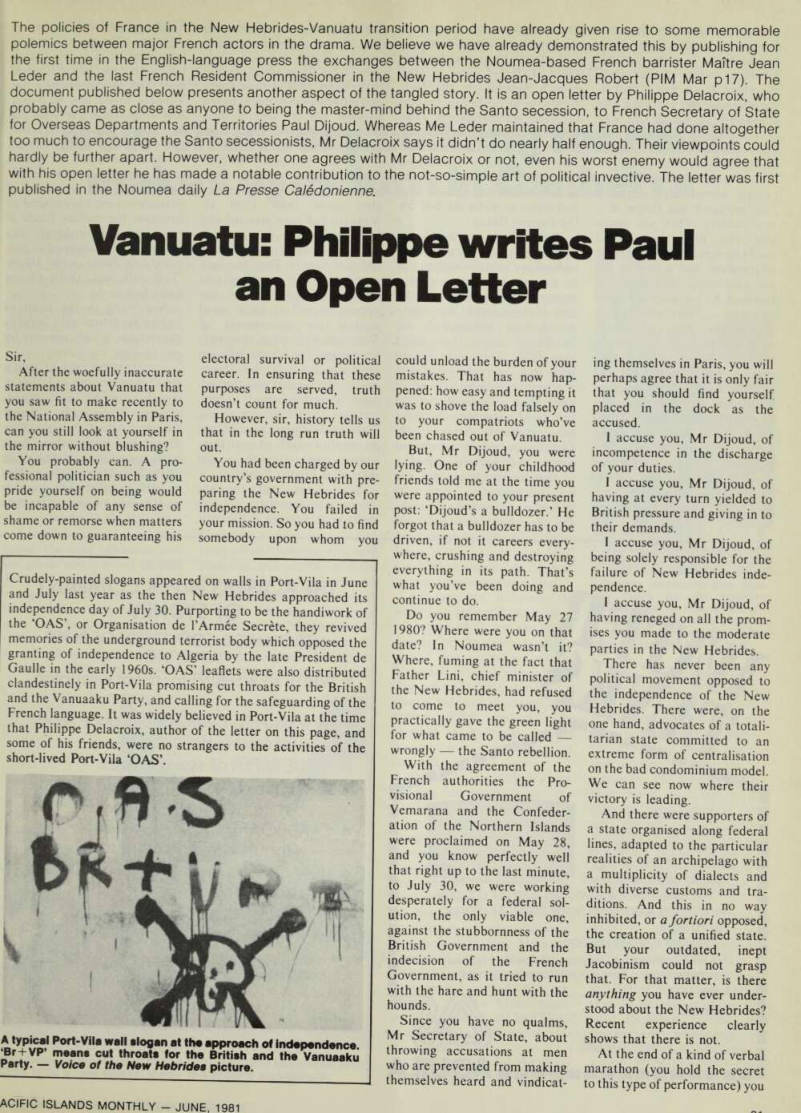
an Open Letter
The policies of France in the New Hebrides-Vanuatu transition period have already given rise to some memorable polemics between major French actors in the drama. We believe we have already demonstrated this by publishing for the first time in the English-language press the exchanges between the Noumea-based French barrister MaTtre Jean Leder and the last French Resident Commissioner in the New Hebrides Jean-Jacques Robert (RIM Mar pl 7). The document published below presents another aspect of the tangled story. It is an open letter by Philippe Delacroix, who probably came as close as anyone to being the master-mind behind the Santo secession, to French Secretary of State for Overseas Departments and Territories Paul Dijoud. Whereas Me Leder maintained that France had done altogether too much to encourage the Santo secessionists, Mr Delacroix says it didn’t do nearly half enough. Their viewpoints could hardly be further apart. However, whether one agrees with Mr Delacroix or not, even his worst enemy would agree that with his open letter he has made a notable contribution to the not-so-simple art of political invective. The letter was first published in the Noumea daily La Presse Caledonienne.
Sir, After the woefully inaccurate statements about Vanuatu that you saw fit to make recently to the National Assembly in Paris, can you still look at yourself in the mirror without blushing?
You probably can. A pro fessional politician such as you pride yourself on being would be incapable of any sense of shame or remorse when matters come down to guaranteeing his
electoral survival or political career. In ensuring that these purposes are served, truth doesn’t count for much.
However, sir, history tells us that in the long run truth will out.
You had been charged by our country’s government with pre paring the New Hebrides for independence. You failed in your mission. So you had to find somebody upon whom you
Crudely-painted slogans appeared on walls in Port-Vila in June and July last year as the then New Hebrides approached its independence day of July 30. Purporting to be the handiwork of the ‘OAS’, or Organisation de I’Armee Secrete, they revived memories of the underground terrorist body which opposed the granting of independence to Algeria by the late President de Gaulle in the early 19605. ‘OAS’ leaflets were also distributed clandestinely in Port-Vila promising cut throats for the British and the Vanuaaku Party, and calling for the safeguarding of the French language. It was widely believed in Port-Vila at the time that Philippe Delacroix, author of the letter on this page, and some of his friends, were no strangers to the activities of the short-lived Port-Vila ‘OAS’.
could unload the burden of your mistakes. That has now hap pened: how easy and tempting it was to shove the load falsely on to your compatriots who’ve been chased out of Vanuatu.
But, Mr Dijoud, you were lying. One of your childhood friends told me at the time you were appointed to your present post; ‘Dijoud’s a bulldozer.’ He forgot that a bulldozer has to be driven, if not it careers every where, crushing and destroying everything in its path. That’s what you’ve been doing and continue to do.
Do you remember May 27 1980? Where were you on that date? In Noumea wasn’t it?
Where, fuming at the fact that Father Lini, chief minister of the New Hebrides, had refused to come to meet you, you practically gave the green light for what came to be called wrongly the Santo rebellion.
With the agreement of the French authorities the Pro visional Government of Vemarana and the Confeder ation of the Northern Islands were proclaimed on May 28, and you know perfectly well that right up to the last minute, to July 30, we were working desperately for a federal sol ution, the only viable one, against the stubbornness of the British Government and the indecision of the French Government, as it tried to run with the hare and hunt with the hounds.
Since you have no qualms, Mr Secretary of State, about throwing accusations at men who are prevented from making themselves heard and vindicat
ing themselves in Paris, you will perhaps agree that it is only fair that you should find yourself placed in the dock as the accused.
I accuse you, Mr Dijoud, of incompetence in the discharge of your duties.
I accuse you, Mr Dijoud, of having at every turn yielded to British pressure and giving in to their demands.
I accuse you, Mr Dijoud, of being solely responsible for the failure of New Hebrides inde pendence.
I accuse you, Mr Dijoud, of having reneged on all the prom ises you made to the moderate parties in the New Hebrides.
There has never been any political movement opposed to the independence of the New Hebrides. There were, on the one hand, advocates of a totali tarian state committed to an extreme form of centralisation on the bad condominium model.
We can see now where their victory is leading.
And there were supporters of a state organised along federal lines, adapted to the particular realities of an archipelago with a multiplicity of dialects and with diverse customs and tra ditions. And this in no way inhibited, or a fortiori opposed, the creation of a unified state.
But your outdated, inept Jacobinism could not grasp that. For that matter, is there anything you have ever under stood about the New Hebrides?
Recent experience clearly shows that there is not.
At the end of a kind of verbal marathon (you hold the secret to this type of performance) you
A typocal Port-Vila wall slogan at the approach of independence.
'Br+VP' means cut throats for the British and the Vanuaaku Party. Voice of the New Hebrides picture.
forced the New Hebridean op position to sign a lame duck constitution. 1 write ‘forced’ advisedly, in view of your table thumping. It was five o’clock in the morning and everyone was exhausted. It was in this way that, together with your British accomplice who was rubbing his hands with glee while he let you add to your tally of blunders (which served his purposes), you ‘prepared’ the future of a new country. Then you swore that the draft constitution would be submitted to a popular referendum. But referenda are not customary procedures in England. So you gave in for the first time there would be no referendum. The constitution envisaged that regional powers, a watered-down version of fed eralism, would be defined and submitted to the New Hebrides parliament after independence.
England didn’t take at all kindly to the idea which would have set a bad example for Solomon Islands and Papua New Guinea. So you capitu lated for the second time, thus disavowing your own signature, formally committing our
government, which appears at the end of the constitution.
You also let down the Del egate Extraordinary of the French Republic in the New Hebrides by dictating to him the false statements and false promises he was to make to the Santo population at the end of July 1980 in order to secure an uneventful departure of the British and French troops, who had come to make the bed for the Papuan forces.
With these actions you ruined the trust that thousands of Vanuatu inhabitants had put in France. For that, sir, you cannot be forgiven. For, in the eyes of those people, now aban doned, you represented the France in which they could have faith. They were not to know that you represented only a government, which is never more than an episode in the history of a country. You did not represent France, Mr Dijoud; you merely represented a sorry and shameful episode.
And now we learn that you are planning to come ‘to Noumea and meet the refugees.
Do you think they have the
slightest desire to see you? Do you believe that your chronic verbal ravings can win them over? Aren’t you afraid, on the other hand, that in their anger and bitterness they might be led to show you the toes of their boots in a way you will long remember?
For did you not, Mr Sec retary of State, refrain from telling the National Assembly that more than 1500 ni- Vanualu had been arrested and imprisoned in the various islands of the north, and not only on Santo? That the only crime of these people was to have been members of the opposition and to have voted against the government of Walter Lini? In short, they were imprisoned for having different opinions. Such is the ‘demo cratic’ regime that you, through your mistakes, your incom petence, your capriciousness, your backslidings, have helped to install: an authoritarian theo cratic republic, with a gut hatred of French Popery.
Was it as much in the majority as you claim, sir. this party now in power in Vanuatu,
which has been able to assert its authority only through the in tervention of foreign troops?
Left to its own devices it would have had to compromise and Vanuatu would now be a con federation where everyone had his place, without ostracism, and everyone would be subject to the same laws. So, you’ve made a mess of everything, Mr Dijoud. So, Mr Secretary of State, when one has endured ad nauseum the endless floods of your mischief-making elo quence, one is tempted to say, parodying Zazie in the Metro, ‘Talk, talk, talk, that’s all you know how to do’.
Not being in the habit of ending my letters with impolite expressions, it only remains for me to sign my name.
Philippe Delacroix
PS: 1 would point out that I, together with my friends George Cronsteadt, Jimmy Stevens, Albert Ravutia, Guy Prevot and many others, have participated in the political life of the New Hebrides from 1968 to 1980, and that when speaking of Vanuatu I know better than you what it’s all about.
Advertisements & other items, pp. 21-22 (2 items)
Acific Islands Monthly - June 1981
Aquila
THE ROGERS PAPER COMPANY
OF SYDNEY
MERCHANTS & CONVERTERS OF PAPER
SUPPLYING
• WHITE NEWSPRINT for meat wrapping, etc. • NEWSPAPERS overissued & once read.
Tabloid & Herald size. • TISSUE PAPER oil sizes & types. • SERVIETTES & D'OYLEYS single ply, white, scolloped tissue.
• CARDBOARD CARTONS used
(thousands of sizes in stock).
• NEW CARDBOARD CARTONS & BOXES
stock sizes & made to order.
• ALL PACKING AIDS & SUPPLIES.
• WOODWOOL & SHREDDED PAPER.
FOR TOP SERVICE & COMPETITIVE PRICES
CONTACT
10 MARTIN AVENUE,
ARNCLIFFE, N.S.W. 2205
AUSTRALIA
PHONE 597 5111 (6 LINES) REVERSE CHARGES
1 w.
Aquila water tanks completely enclosed to ensure clean water and built to last from strong, durable galvanised steel You assemble them yourself from our comprehensive kits. Capacities range from 2300 litres to 49250 litres.
Send for a brochure today.
Aquila Engineering Division, 25 Pacific Highway, Bennetts Green, New South Wales, Australia.
Name Address P/code
AQ2O/2
AQUILA
New chancery building for PNG
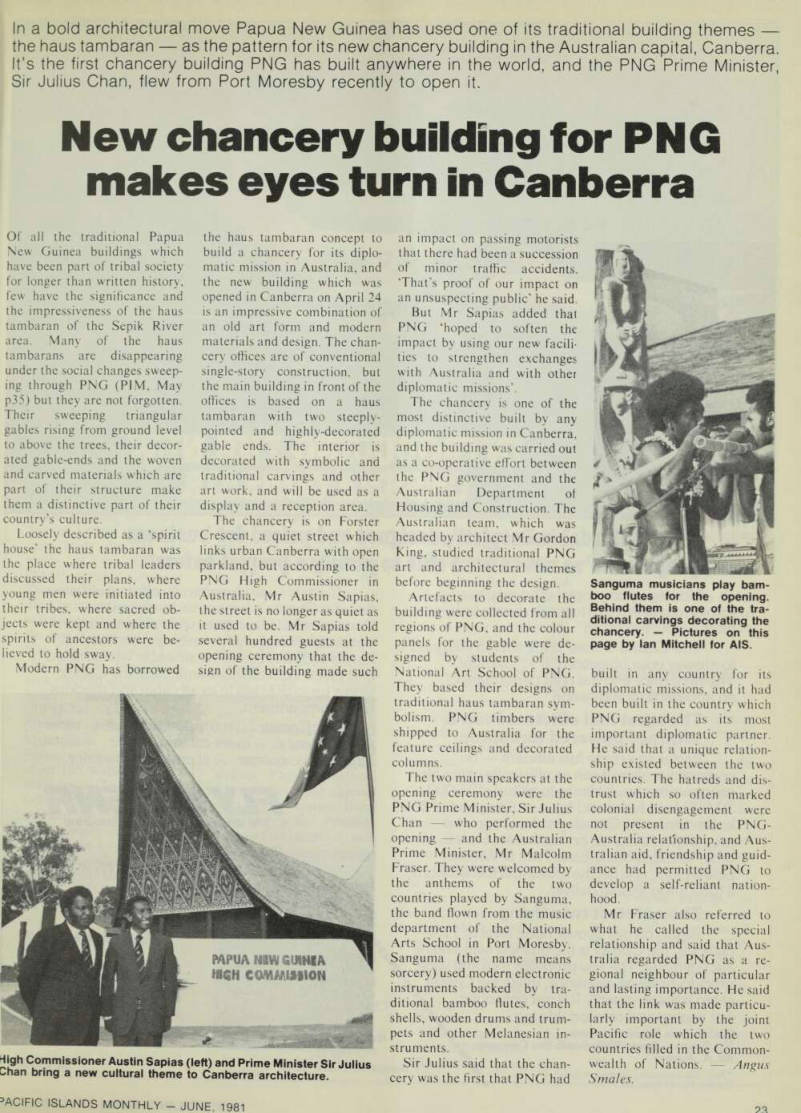
makes eyes turn in Canberra
In a bold architectural move Papua New Guinea has used one of its traditional building themes the haus tambaran as the pattern for its new chancery building in the Australian capital, Canberra.
It’s the first chancery building PNG has built anywhere in the world, and the PNG Prime Minister, Sir Julius Chan, flew from Port Moresby recently to open it.
Of all the traditional Papua New Guinea buildings which have been part of tribal society for longer than written history, few have the significance and the impressiveness of the haus tambaran of the Sepik River area. Many of the haus tambarans are disappearing under the social changes sweeping through PNG (PIM, May p 35) but they are not forgotten.
Their sweeping triangular gables rising from ground level to above the trees, their decorated gable-ends and the woven and carved materials which are part of their structure make them a distinctive part of their country’s culture.
Loosely described as a ‘spirit house' the haus tambaran was the place where tribal leaders discussed their plans, where young men were initiated into their tribes, where sacred objects were kept and where the spirits of ancestors were believed to hold sway.
Modern PNG has borrowed
the haus tambaran concept to build a chancery for its diplo matic mission in Australia, and the new building which was opened in Canberra on April 24 is an impressive combination of an old art form and modern materials and design. The chan eery offices are of conventional single-story construction, but the main building in front of the offices is based on a haus tambaran with two steeply pointed and highly-decorated gable ends. The interior is decorated with symbolic and traditional carvings and other art work, and will be used as a display and a reception area, The chancery is on Forster Crescent, a quiet street which links urban Canberra with open parkland, but according to the PNG High Commissioner in Australia. Mr Austin Sapias, the street is no longer as quiet as it used to be. Mr Sapias told several hundred guests at the opening ceremony that the de sign of the building made such
an impact on passing motorists that there had been a succession of minor traffic accidents.
That's proof of our impact on an unsuspecting public’ he said.
But Mr Sapias added that PNG ‘hoped to soften the impact by using our new facili ties to strengthen exchanges with Australia and with other diplomatic missions’.
The chancery is one of the most distinctive built by any diplomatic mission in Canberra, and the building was carried out as a co-operative effort between the PNG government and the Australian Department of Housing and Construction. The Australian team, which was headed by architect Mr Gordon King, studied traditional PNG art and architectural themes before beginning the design.
Artefacts to decorate the building were collected from all regions of PNG, and the colour panels for the gable were de signed by students of the National Art School of PNG.
They based their designs on traditional haus tambaran sym bolism. PNG timbers were shipped to Australia for the feature ceilings and decorated columns.
The two main speakers at the opening ceremony were the PNG Prime Minister, Sir Julius Chan who performed the opening and the Australian Prime Minister, Mr Malcolm Fraser. They were welcomed by the anthems of the two countries played by Sanguma, the band flown from the music department of the National Arts School in Port Moresby.
Sanguma (the name means sorcery) used modern electronic instruments backed by tra ditional bamboo flutes, conch shells, wooden drums and trum pets and other Melanesian in struments.
Sir Julius said that the chan cery was the first that PNG had
built in any country for its diplomatic missions, and it had been built in the country which PNG regarded as its most important diplomatic partner.
He said that a unique relation ship existed between the two countries. The hatreds and dis trust which so often marked colonial disengagement were not present in the PNG- Australia relationship, and Aus tralian aid, friendship and guid ance had permitted PNG to develop a self-reliant nation hood.
Mr Fraser also referred to what he called the special relationship and said that Aus tralia regarded PNG as a re gional neighbour of particular and lasting importance. He said that the link was made particu larly important by the joint Pacific role which the two countries filled in the Common
wealth of Nations.
Angus
Smales.
High Commissioner Austin Sapias (left) and Prime Minister Sir Julius Chan bring a new cultural theme to Canberra architecture.
Sanguma musicians play bam boo flutes for the opening.
Behind them is one of the tra ditional carvings decorating the chancery. Pictures on this page by lan Mitchell for AIS.
Advertisements & other items, pp. 23-24 (2 items)
23
3 ACIFIC ISLANDS MONTHLY JUNE, 1981
Flycessnh
■ * r t: mamsx i~:~ f ■ ■ . . m - ■- ■■ “-^evMKq
♦-.**£ jf Sl. •/ IViTkv^S
‘•■•r. Rh hM The “Affordable Propjet”, designed and priced for business people who’ve never been able to justify a propjet before!
Moving up to propjet efficiency has sometimes been hard to justify. Some turboprops have been “too much” aircraft.
The Cessna Corsair is the aircraft designed to answer your objections. It’s “just right’.’
The right price and the right performance, an affordable combination.
The most fuel efficient Pratt & Whitney powered turboprop Faster and more fuel efficient no competitive aircraft can so efficiently utilize high propjet altitudes. It climbs to altitude (25,000 - 30,000 feet) faster and has a cruise speed of 259 knots. Since the Corsair produces superior propjet performance on less horsepower than other versions of the basic Pratt & Whitney powerplant, you get the speed and fuel economy a turboprop should deliver.
Corsair’s aerodynamically efficient airframe features Cessna’s famous wide-oval cabin.
Generous first-class seats, wide aisle, room for optional hot and cold refreshment centres, hardwood cabin dividers, stowable writing desks and toilet. With all those amenities, the Corsair stores up to 500 kgs in its aft cabin and spacious nose compartment.
The Corsair. . . more performance .. . more fuel efficiency .. . more cabin .. . more baggage . . . quieter... at an affordable price.
FLYCESSNH
The Workfe Number 1 Business Airline Rex Aviation P.O. Box 51, Bankstown , N.S. W. 2200 Telephone: 02/70-0661 The quietest twin flying * Based on our flyover noise level of 71. 4 Name decibels, the Corsair is the quietest twin-engine V aircraft flying. The low propeller rpm and wide, «• PL me S more° Position prop-to-fuselage clearance, make the Corsair V information cabin whisper-quiet*. It is not only quiet, #• ONCompany but roomy and comfortable too. / Address Pacific Area Representatives: •* s^ n Fiji (Suva) - Bums Philp South Sea Company, V nex viaiton p/code Mr. A. Jessop P- O. Box 51 , •Ref -Business and Commercial Aviation. / Bankstown. N.S. IV. 34/425/HM/R Vol 46. No. 4 (April 1980) •
Giscard
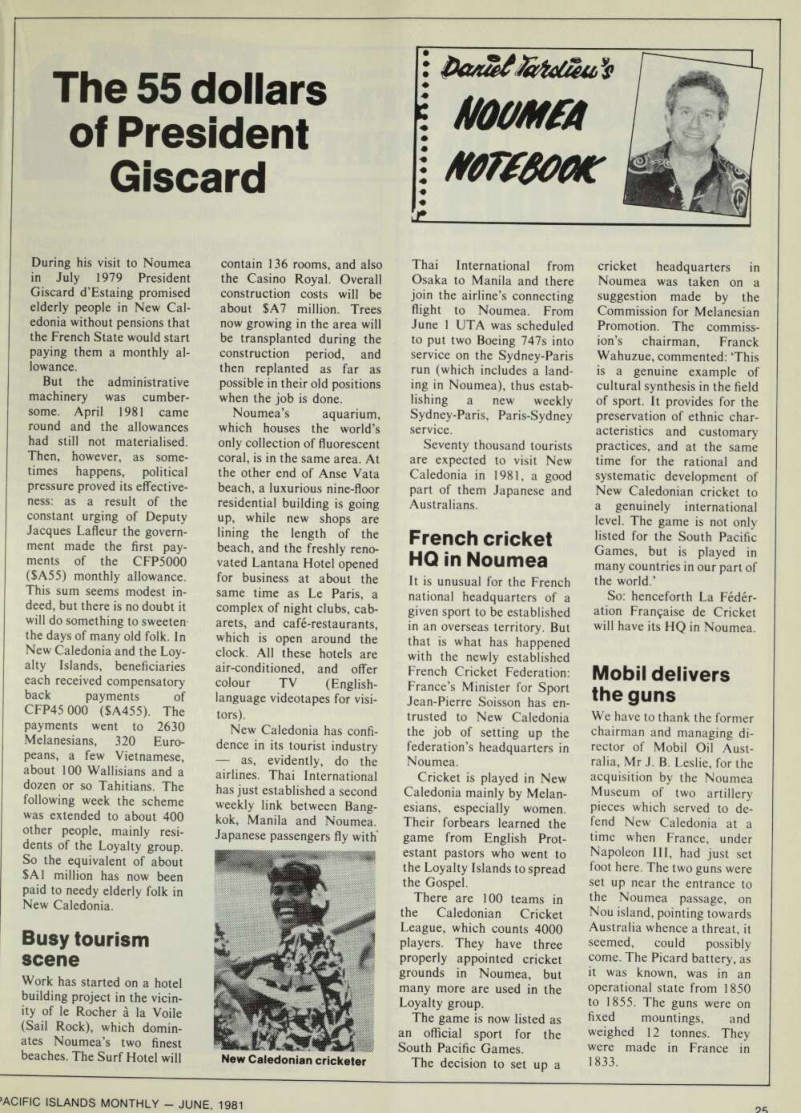
The 55 dollars of President Giscard
During his visit to Noumea in July 1979 President Giscard d’Estaing promised elderly people in New Cal edonia without pensions that the French State would start paying them a monthly al lowance.
But the administrative machinery was cumber some. April 1981 came round and the allowances had still not materialised.
Then, however, as some times happens, political pressure proved its effective ness; as a result of the constant urging of Deputy Jacques Lafleur the govern ment made the first pay ments of the CFPSOOO (SASS) monthly allowance.
This sum seems modest in deed, but there is no doubt it will do something to sweeten the days of many old folk. In New Caledonia and the Loy alty Islands, beneficiaries each received compensatory back payments of
Cfp4S 000 ($A455). The
payments went to 2630 Melanesians, 320 Euro peans, a few Vietnamese, about 100 Wallisians and a dozen or so Tahitians. The following week the scheme was extended to about 400 other people, mainly resi dents of the Loyalty group.
So the equivalent of about SAI million has now been paid to needy elderly folk in New Caledonia.
Busy tourism
scene Work has started on a hotel building project in the vicin ity of le Rocher a la Voile (Sail Rock), which domin ates Noumea’s two finest beaches. The Surf Hotel will
contain 136 rooms, and also the Casino Royal. Overall construction costs will be about SA7 million. Trees now growing in the area will be transplanted during the construction period, and then replanted as far as possible in their old positions when the job is done.
Noumea’s aquarium, which houses the world’s only collection of fluorescent coral, is in the same area. At the other end of Anse Vata beach, a luxurious nine-floor residential building is going up, while new shops are lining the length of the beach, and the freshly reno vated Lantana Hotel opened for business at about the same time as Le Paris, a complex of night clubs, cab arets, and cafe-restaurants, which is open around the clock. All these hotels are air-conditioned, and offer colour TV (English language videotapes for visi tors).
New Caledonia has confi dence in its tourist industry as, evidently, do the airlines. Thai International has just established a second weekly link between Bang kok, Manila and Noumea.
Japanese passengers fly with'
Thai International from Osaka to Manila and there join the airline’s connecting flight to Noumea. From June 1 UTA was scheduled to put two Boeing 747 s into service on the Sydney-Paris run (which includes a land ing in Noumea), thus estab lishing a new weekly Sydney-Paris, Paris-Sydney service.
Seventy thousand tourists are expected to visit New Caledonia in 1981, a good part of them Japanese and Australians.
French cricket
HQ in Noumea
It is unusual for the French national headquarters of a given sport to be established in an overseas territory. But that is what has happened with the newly established French Cricket Federation: France’s Minister for Sport Jean-Pierre Soisson has en trusted to New Caledonia the job of setting up the federation’s headquarters in Noumea.
Cricket is played in New Caledonia mainly by Melan esians, especially women.
Their forbears learned the game from English Prot estant pastors who went to the Loyalty Islands to spread the Gospel.
There are 100 teams in the Caledonian Cricket League, which counts 4000 players. They have three properly appointed cricket grounds in Noumea, but many more are used in the Loyalty group.
The game is now listed as an official sport for the South Pacific Games.
The decision to set up a
cricket headquarters in Noumea was taken on a suggestion made by the Commission for Melanesian Promotion. The commiss ion’s chairman, Franck Wahuzue, commented: ‘This is a genuine example of cultural synthesis in the field of sport. It provides for the preservation of ethnic char acteristics and customary practices, and at the same time for the rational and systematic development of New Caledonian cricket to a genuinely international level. The game is not only listed for the South Pacific Games, but is played in many countries in our part of the world.’
So: henceforth La Feder ation de Cricket will have its HQ in Noumea.
Mobil delivers
the guns
We have to thank the former chairman and managing di rector of Mobil Oil Aust ralia, Mr J. B. Leslie, for the acquisition by the Noumea Museum of two artillery pieces which served to de fend New Caledonia at a time when France, under Napoleon 111, had just set foot here. The two guns were set up near the entrance to the Noumea passage, on Nou island, pointing towards Australia whence a threat, it seemed, could possibly come. The Picard battery, as it was known, was in an operational state from 1850 to 1855. The guns were on fixed mountings, and weighed 12 tonnes. They were made in France in 1833.
New Caledonian cricketer
Advertisements & other items, p. 25 (1 item)
25
‘ACIFIC ISLANDS MONTHLY - JUNE, 1981
topsy-turvy
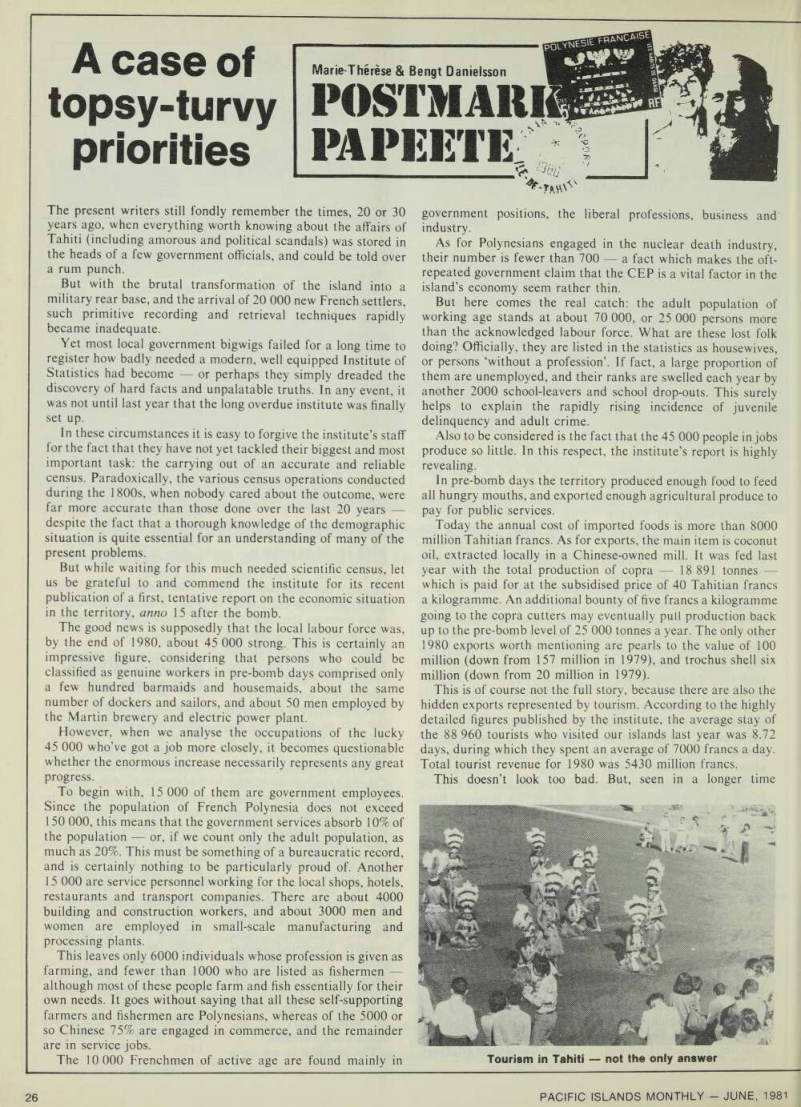

A case of topsy-turvy priorities
The present writers still fondly remember the times, 20 or 30 years ago, when everything worth knowing about the affairs of Tahiti (including amorous and political scandals) was stored in the heads of a few government officials, and could be told over a rum punch.
But with the brutal transformation of the island into a military rear base, and the arrival of 20 000 new French settlers, such primitive recording and retrieval techniques rapidly became inadequate.
Yet most local government bigwigs failed for a long time to register how badly needed a modern, well equipped Institute of Statistics had become or perhaps they simply dreaded the discovery of hard facts and unpalatable truths. In any event, it was not until last year that the long overdue institute was finally set up.
In these circumstances it is easy to forgive the institute’s staff for the fact that they have not yet tackled their biggest and most important task: the carrying out of an accurate and reliable census. Paradoxically, the various census operations conducted during the 1800 s, when nobody cared about the outcome, were far more accurate than those done over the last 20 years despite the fact that a thorough knowledge of the demographic situation is quite essential for an understanding of many of the present problems.
But while waiting for this much needed scientific census, let us be grateful to and commend the institute for its recent publication of a first, tentative report on the economic situation in the territory, anno 15 after the bomb.
The good news is supposedly that the local labour force was, by the end of 1980, about 45 000 strong. This is certainly an impressive figure, considering that persons who could be classified as genuine workers in pre-bomb days comprised only a few hundred barmaids and housemaids, about the same number of dockers and sailors, and about 50 men employed by the Martin brewery and electric power plant.
However, when we analyse the occupations of the lucky 45 000 who’ve got a job more closely, it becomes questionable whether the enormous increase necessarily represents any great progress.
To begin with, 15 000 of them are government employees.
Since the population of French Polynesia does not exceed 150 000, this means that the government services absorb 10% of the population or, if we count only the adult population, as much as 20%. This must be something of a bureaucratic record, and is certainly nothing to be particularly proud of. Another 15 000 are service personnel working for the local shops, hotels, restaurants and transport companies. There are about 4000 building and construction workers, and about 3000 men and women are employed in small-scale manufacturing and processing plants.
This leaves only 6000 individuals whose profession is given as farming, and fewer than 1000 who are listed as fishermen although most of these people farm and fish essentially for their own needs. It goes without saying that all these self-supporting farmers and fishermen are Polynesians, whereas of the 5000 or so Chinese 75% are engaged in commerce, and the remainder are in service jobs.
The 10 000 Frenchmen of active age are found mainly in
government positions, the liberal professions, business and industry.
As for Polynesians engaged in the nuclear death industry, their number is fewer than 700 a fact which makes the oft repeated government claim that the CEP is a vital factor in the island’s economy seem rather thin.
But here comes the real catch: the adult population of working age stands at about 70 000, or 25 000 persons more than the acknowledged labour force. What are these lost folk doing? Officially, they are listed in the statistics as housewives, or persons ‘without a profession’. If fact, a large proportion of them are unemployed, and their ranks are swelled each year by another 2000 school-leavers and school drop-outs. This surely helps to explain the rapidly rising incidence of juvenile delinquency and adult crime.
Also to be considered is the fact that the 45 000 people in jobs produce so little. In this respect, the institute’s report is highly revealing.
In pre-bomb days the territory produced enough food to feed all hungry mouths, and exported enough agricultural produce to pay for public services.
Today the annual cost of imported foods is more than 8000 million Tahitian francs. As for exports, the main item is coconut oil, extracted locally in a Chinese-owned mill. It was fed last year with the total production of copra 18 891 tonnes which is paid for at the subsidised price of 40 Tahitian francs a kilogramme. An additional bounty of five francs a kilogramme going to the copra cutters may eventually pull production back up to the pre-bomb level of 25 000 tonnes a year. The only other 1980 exports worth mentioning are pearls to the value of 100 million (down from 157 million in 1979), and trochus shell six million (down from 20 million in 1979).
This is of course not the full story, because there are also the hidden exports represented by tourism. According to the highly detailed figures published by the institute, the average stay of the 88 960 tourists who visited our islands last year was 8.72 days, during which they spent an average of 7000 francs a day.
Total tourist revenue for 1980 was 5430 million francs.
This doesn’t look too bad. But, seen in a longer time
Tourism in Tahiti not the only answer
perspective, and compared to the planned and expected results, the 1980 figure of 89 000 tourists represents a major setback.
When, about 10 years ago, the French Government began encouraging foreign firms to invest in French Polynesia, one of the results was the rapid construction of four major hotels in Tahiti, and half-a-dozen smaller ones on Moorea. The serious minded and competent planners predicted a steady increase of about 50 000 tourists a year, culminating in a figure of 500 000 by 1980.
In fact, the number levelled off at 90 000 in 1974, and has stayed around that figure ever since. It is clearly not surprising that the local hoteliers are unwilling to expand the present 2069-bed capacity.
The explanation most commonly heard for this stagnation is the virtual monopoly enjoyed on the Tahiti route by the French airline UTA, which is accused of maintaining too high a fare structure and of blocking much needed American charter flights.
UTA officials hotly retort that unless more hotels are built first, there is no point in lowering fares and permitting cheap charter flights. So far UTA’s viewpoint has invariably prevailed, even when recently the very militant president of the Papeete Chamber of Commerce, Charles Poroi, backed by all prominent local businessmen, vowed to form his own airline and travel company to break the French monopoly (PIM Dec 1980, p 55, and Apr 1981, p 55). Originally scheduled for February, the inaugural Honolulu-Papeete flight of the Poroi venture has now been postponed indefinitely.
The number of people directly employed by the existing hotels is fewer than 1830. It is often claimed that a further 4000 people make their living from tourism in various service jobs but this is far from certain. But even if true, it still represents a very meagre proportion of a total potential labour force of 70 000.
It seems therefore most unlikely that tourism could ever become the main industry in French Polynesia and perhaps this is just as well for the Polynesian people.
To replace it there is always as local political leaders such as John Teariki and Francis Sanford steadfastly maintain agricultural development, aquaculture in the lagoons, deepsea fishing, and, perhaps, in the more distant future, ocean mining.
In other words, it is time to return to a more productive type af economy, built not on a flow of salaries to selected and specially favoured ethnic groups, but on the wealth in the soil and the sea which can be exploited by and for the benefit of the Polynesians.
While waiting for this complete turn-around of economic priorities (which in the final analysis can result only from aolitical changes in France), the institute’s report predicts a aleak year ahead for the Polynesian workers.
Main reason for this is that inflation, which last year was unning at between 15% and 20%, will increase even more iteeply in 1981.
This is due to: • Continued steady increases in prices in the exporting countries (believed to have been 9.3% last year in Australia, and 16.1% in New Zealand); • Anticipated higher freight rates (up 20% in 1980); and • The increasing value of US, Australian and New Zealand lollars.
The only thing lacking in the government report from which ve have repeatedly quoted here is a frank admission that the vrong choice has been made, and a firmly expressed letermination, emanating from government circles, to make the erritory economically independent.
But since there is a strong suspicion that such a course will lutomatically also lead to political independence, it is one which ias been consistently vetoed by all presidents of the Fifth
Tench Republic.
Marie-Therese and Bengt Danielsson.
Advertisements & other items, pp. 27-28 (1 item)
Bulk Secondhand
.v.v
CLOTHING SUPPLIES
V.V we can offer a regular supply of .v.v. qua I ity second hand/x’v’; clothing to the Pacific area ’ full range of men’s women’s and chi Idren’s clothing household lines blankets pillows and cushions.
.BUY DIRECT FROM OUR FACTORY :•
ANY-QUANTITY
FOR ALL INFORMATION WRITE TO;.; v
The Manager, Life Line Mission, 38 George St., Burwood, Sydney, Australia. 2134. .
Phone Sydney 02 747-3777 Telex 21411
V? m K I The 15 year old golf ball.
The Olivetti daisy wheel.
THAT FANTASTIC IDEA OF 15 YEARS
AGO IS Al 5 YEAR OLD IDEA.
NOW IT'S THE AGE OF THE OLIVETTI
ELECTRONIC TYPEWRITER.
As a concept the golf ball typewriter still continues to fulfill a useful function.
But times do change.
Now you have a typewriter that prints faster, smarter and quieter than ever before.
Olivetti Electronic Typewriters have just changed the whole technology of typing and typing will never be the same again.
The Olivetti Electronic Typewriters print from the new technology daisy wheel and have many other effortless advantages over anything any secretary has seen or used before. Some have features like the remarkable 20 character illuminated display window which allows the typist to correct errors before they are typed on the paper, memory function for phrases and formats, automatic centering and underscoring, automatic numeric alignment and centering of columns on a page. What does it all mean?
For the typist it means freedom from mundane and time consuming typing tasks.
For management it means increased productivity and immaculate presentations that it will be proud to sign.
And it comes at a price no-one else can match.
Only a demonstration of the Olivetti Electronic Typewriters can bring to life the many advantages of Olivetti elec- \ I \ % tronic typing. So phone today for & a demonstration.
Olivetti 121 - standard electronic typewriter Olivetti 221 - sophisticated electronic typewriter with memory.
Olivetti 231 - sophisticated electronic typewriter with 10 page memory. n Phone Li
0L1525/FMMH
m
Olivetti
Export Manager, Olivetti Australia Pty. Ltd 140 William Street, Sydney, NSW 2011.
Name Address Armstrong & Springhalt, 163 Victoria Parade, Suva, Fiji. Tel; 24 071. Armstrong & Springhalt, 99-107 Dixon Street, Wellington, New Zealand. Tel: 850 777. Armstrong & Springhall, P.O. Box 498, Apia, Western Samoa. Tel: 21 777, Ets Rene Solari & Fils, 7 Rue du General de Gaulle, Papeete, Tahiti.
Tel: 25359. Maison Barrau, Boite Postale A 4, Noumea, Nouvelle-Caledonie. Tel: 27 3774. P.N.G. Printing, P.O. Box 633, Port Moresby, Papua New Guinea. Tel: 21 2277. Tonga Equipment, cnr. Taufa’ahau & Laifone Roads, NukuAlofa, Tonga. Tel: 21 320.
For farther Information please contact any of the above, or send coupon to Export Division, Olivetti Australia. We welcome enquiries for agencies in areas not covered by above.
Islands
From the
Press
An advertisement in the Fiji Times, Suva The new 132kV electricity transmission line linking Suva and Lautoka to the Monasavu hydro project will be brought into service commencing midnight on 31 March 1981. This line has been designed for hydro-electricity which is generated using water. In case of minor leakages in the first few days of service, power consumers are advised to move beds and furniture away from under light fittings and power points and to place containers to catch drips. . . .. and a letter to the editor appearing in the same paper two days later On March 31 I placed an advertisement in this newspaper regarding the commissioning of the Fiji Electricity Authority’s 132kV transmission line. This was, of course, intended to be a harmless April Fool’s Day joke. To anyone who did not find it funny I offer my sincere apologies for any inconvenience caused. Kevin Cairns, Lautoka.
A letter signed Granny, prompted by allegations of radio programme censorship, published in the Papua New Guinea Post-Courier, Port Moresby In the light of present confusion over what programmes the National Broadcasting Commission should allow the public to hear, may I suggest that all future broadcasts should be preceded as a brief announcement indicating that they have the “Good Broadcasting’’ seal of approval. Further, that they have the personal endorsement of the NBC Chairman, the Deputy Prime Minister, the Festival of Light, the Daughters of the American Republic, and Aunt Hortense of Twickenham. Alternatively, the NBC could channel some of its energies into establishing a second network reserved exclusively for all political broadcasts, all plays not adapted from the Enid Blyton original, all programmes of a religious nature, and any other contentious material, such as sporting broadcasts by Ray Seymour and recipes from Kene Kala.
A parliamentary report from the Cook Islands News, Rarotonga, quoting a ruling given by the Speaker in parliament I was going to suggest that the amendment to the amendment may be made to the second part of your amendment only, because the previous part of the amendment, to delete ‘October’, is already included in your amendment. That is the part I was going to allow to amend the amendment. As a matter of fact you may make four amendments to a main amendment. So an amendment to the previous amendment has been moved. The first part of the amendment cannot be accepted because that part has already been included in the first amendment. So therefore the part of the amendment to delete the words ‘March 1978’ and insert the words August 1978 is the only part of this last amendment that we will accept. We will now deal with the amendment to the amendment and then we will go on to the main amendment and from there to the clause as amended.
A statement in the Post- Courier, Port Moresby, in which the Papua New Guinea deputy prime minister, Mr Okuk, defends his right to have business interests My background is business and therefore I cannot live my life without having business. In fact it is a right of a leader in our society to own more so that he can give more.
From the Seen and Heard column of The Nauru Post Heard the following on Radio Nauru: Announcer apologising to listeners as she could not bring them the world news as scheduled.
The reason given was that there was no one at the wireless station to tune them in.
From the Samoa Times, Apia Members of a church at Savaia, Lefaga, are angry because they believe that their minister had been defamed in an article recently published in the newspaper Tau tua Mo Samoa’. . . One prominent matai angrily challenged the youth of the village to find the editor, bind him up and carry him with a pole between his tied legs and hands to Savaia ‘to be questioned as to who wrote the article’.
From The Fiji Times, Suva On Wednesday we said the name of a four-legged chicken in Nausori was Mohammed. The bird itself was not called Moham med but is the pet of Mrs Saliman Bibi’s youngest grandchild, Mohammed Riyaz.
From the ‘Police’ column by Sergeant Bernie in the Norfolk Islander ... I have been deeply distressed this last week after we, the Police, discovered that a group of young men on this island have been breaking into shops and stealing goods from those shops. Several members of this community knew this was going on but were not prepared to come forward and have it stopped earlier. (I hope this never happens to them if ever they go into business.) From a letter by Krishna Datt in The Fiji Times, Suva As in Jamaica, marijuana could become Fiji’s most profitable agricultural crop. Marijuana may create some problems but it could rid us of many others, such as unemployment which could be reducing greatly, as I’m sure many people would be interested in farming marijuana. It is always a lucrative business. The introduction of marijuana in Fiji would surely boost the tourist industry. Many of the tourists would not mind getting ‘high’ legally.
Fiji could then be truly called ‘the paradise of the Pacific’
From the Norfolk Islander, Norfolk Island FOUND AND LOST. At the last NATS Play Reading held at the school a lady’s pink evening bag was left in the Supper Room.
It can be claimed by contacting Eric Williams. Some months ago I lent my beach umbrella to some lady for use at some function. I cannot remember who the lady was and as it has not been returned she has obviously forgotten who she borrowed it from. This note may turn on a light. If so Eric Williams would be pleased with the return of his umbrella.
From an ad in Cook Islands News, Rarotonga FOR SALE: Datsun 1608 Saloon Born in May 1973 and answers to the name ‘Brownie’. A regular member of the Motor Health Centre where its fitness is confirmed by a trouble-free Heart or ‘Blood Pressure’ ailments. Recently contracted a tropical skin disease that is common in these parts, but a good and knowledgeable technician could reproduce its former appearance.
For inspection Ph 2532 anytime!
From a letter to the editor in The Observer, Apia, Western Samoa Regarding the news I received this week about my termination from the Public Service. I wish to say thank you very very much to the Public Service Commission. I had been wanting to get rid of being engaged with the Health Department where I have been wasting my time to put things in order but there was nobody to support me as an ordinary public servant. Special thanks to my Administrative Officer who I know off by heart, the very person who is running the Puppet show . . .
From the Papua New Guinea Post-Courier, Port
Moresby
Now hear this. P & T does not have a direct line to the dead. An angry Port Moresby exchange operator says he and his colleagues are being driven around the bend by callers trying to phone long dead relatives on 000. There are often eight to 10 attempted hook ups a day, he says. And in what must qualify as a worthy contender for quote of the year, he says: ‘No one in the world can talk to dead relatives by phone. We wish to advise the public we are not a morgue.’
Mr Speaker
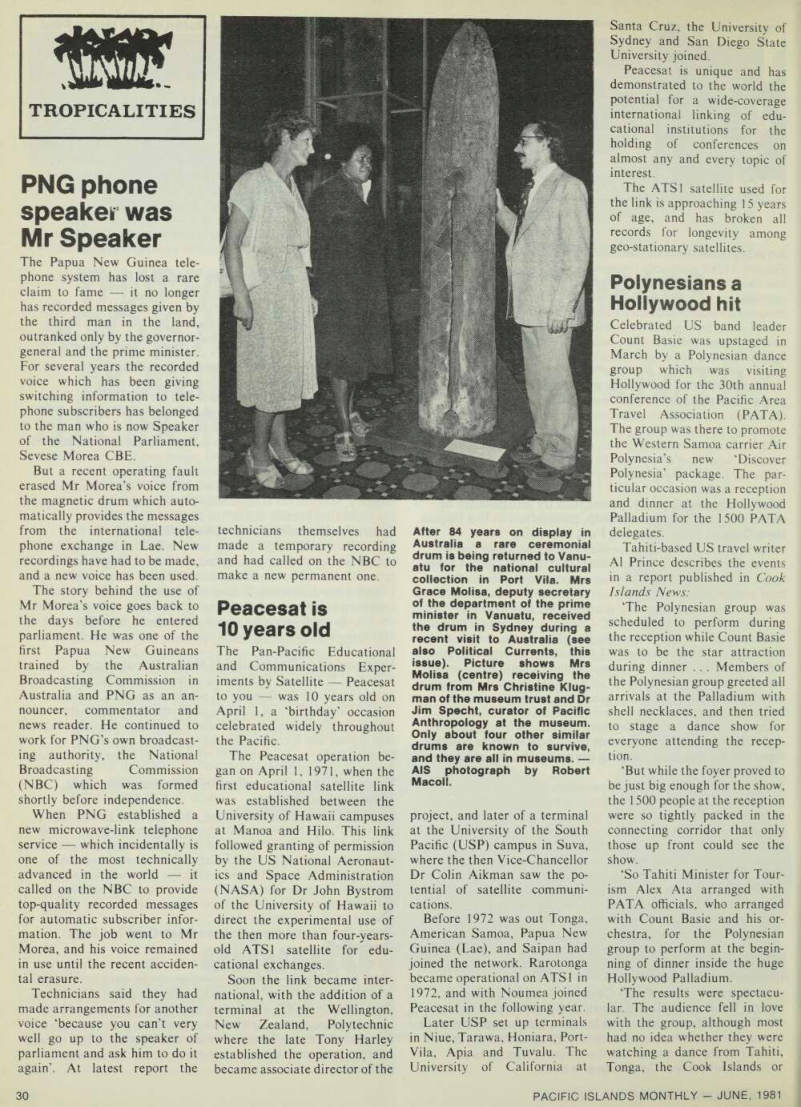
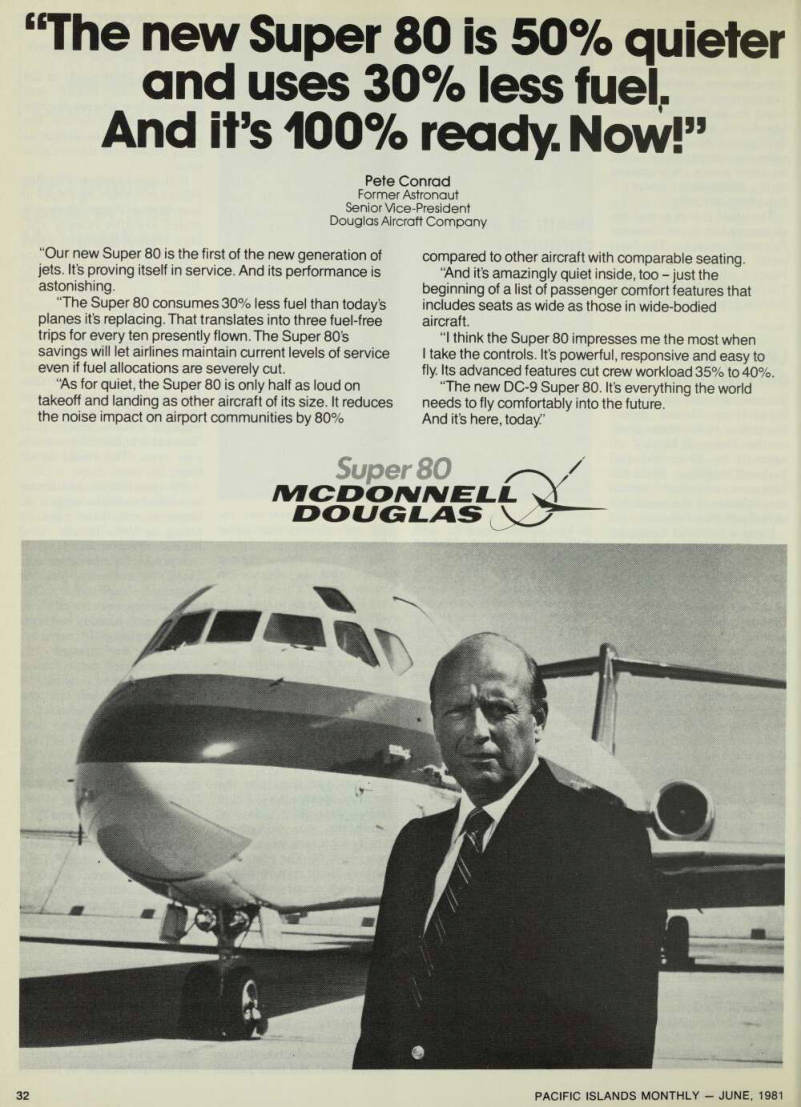
Tropicalities
PNG phone
speaker was
Mr Speaker
The Papua New Guinea tele phone system has lost a rare claim to fame it no longer has recorded messages given by the third man in the land, outranked only by the governor general and the prime minister.
For several years the recorded voice which has been giving switching information to tele phone subscribers has belonged to the man who is now Speaker of the National Parliament, Sevese Morea CBE.
But a recent operating fault erased Mr Morea’s voice from the magnetic drum which auto matically provides the messages from the international tele phone exchange in Lae. New recordings have had to be made, and a new voice has been used.
The story behind the use of Mr Morea’s voice goes back to the days before he entered parliament. He was one of the first Papua New Guineans trained by the Australian Broadcasting Commission in Australia and PNG as an an nouncer, commentator and news reader. He continued to work for PNG’s own broadcast ing authority, the National Broadcasting Commission (NBC) which was formed shortly before independence.
When PNG established a new microwave-link telephone service which incidentally is one of the most technically advanced in the world it called on the NBC to provide top-quality recorded messages for automatic subscriber infor mation. The job went to Mr Morea, and his voice remained in use until the recent acciden tal erasure.
Technicians said they had made arrangements for another voice ‘because you can’t very well go up to the speaker of parliament and ask him to do it again’. At latest report the
technicians themselves had made a temporary recording and had called on the NBC to make a new permanent one.
Peacesat is
10 years old
The Pan-Pacific Educational and Communications Exper iments by Satellite Peacesat to you was 10 years old on April I, a ‘birthday’ occasion celebrated widely throughout the Pacific.
The Peacesat operation be gan on April I, 1971, when the first educational satellite link was established between the University of Hawaii campuses at Manoa and Hilo. This link followed granting of permission by the US National Aeronaut ics and Space Administration (NASA) for Dr John Bystrom of the University of Hawaii to direct the experimental use of the then more than four-years old ATS I satellite for edu cational exchanges.
Soon the link became inter national, with the addition of a terminal at the Wellington.
New Zealand, Polytechnic where the late Tony Harley established the operation, and became associate director of the
project, and later of a terminal at the University of the South Pacific (USP) campus in Suva, where the then Vice-Chancellor Dr Colin Aikman saw the po tential of satellite communi cations.
Before 1972 was out Tonga, American Samoa, Papua New Guinea (Lae), and Saipan had joined the network. Rarotonga became operational on ATSI in 1972, and with Noumea joined Peacesat in the following year.
Later USP set up terminals in Niue, Tarawa, Honiara, Porl- Vila, Apia and Tuvalu. The University of California at
Santa Cruz, the University of Sydney and San Diego State
University joined.
Peacesat is unique and has demonstrated to the world the potential for a wide-coverage international linking of edu cational institutions for the holding of conferences on almost any and every topic of interest.
The ATSI satellite used for the link is approaching 15 years of age, and has broken all records for longevity among geo-stationary satellites.
Polynesians a
Hollywood hit
Celebrated US band leader Count Basie was upstaged in March by a Polynesian dance group which was visiting Hollywood for the 30th annual conference of the Pacific Area Travel Association (PATA).
The group was there to promote the Western Samoa carrier Air Polynesia’s new ‘Discover Polynesia’ package. The par ticular occasion was a reception and dinner at the Hollywood Palladium for the 1500 PATA delegates.
Tahiti-based US travel writer A 1 Prince describes the events in a report published in Cook Islands News: ‘The Polynesian group was scheduled to perform during the reception while Count Basie was to be the star attraction during dinner .. . Members of the Polynesian group greeted all arrivals at the Palladium with shell necklaces, and then tried to stage a dance show for everyone attending the recep tion. ‘But while the foyer proved to be just big enough for the show, the 1500 people at the reception were so tightly packed in the connecting corridor that only those up front could see the show. ‘So Tahiti Minister for Tour ism Alex Ata arranged with PATA officials, who arranged with Count Basie and his or chestra, for the Polynesian group to perform at the begin ning of dinner inside the huge Hollywood Palladium. ‘The results were spectacu lar. The audience fell in love with the group, although most had no idea whether they were watching a dance from Tahiti, Tonga, the Cook Islands or
After 84 years on display in Australia a rare ceremonial drum is being returned to Vanu atu for the national cultural collection in Port Vila. Mrs
Grace Molisa, deputy secretary
of the department of the prime minister in Vanuatu, received the drum in Sydney during a recent visit to Australia (see also Political Currents, this issue). Picture shows Mrs
Molisa (centre) receiving the
drum from Mrs Christine Klug man of the museum trust and Dr Jim Specht, curator of Pacific Anthropology at the museum.
Only about four other similar drums are known to survive, and they are all in museums.
AIS photograph by Robert
Macoll.
Western Samoa.
The Polynesian dance show, however, symbolised the new approach being used in the South Pacific to promote these islands, as well as American Samoa and Niue. Instead of operating independently, these six island groups are promoting their destinations under a Polynesian umbrella.’
The island groups named are all wrapped up in the ‘Discover Polynesia’ package. The ‘um brella’ outfit mentioned by Prince is officially known as the Tourism Marketing Council of Polynesia, based in Tonga.
Library gets
old PNG film
Six reels of movie film shot in Papua New Guinea before World War II have been given to the National Library of Australia by 80-year-old Jim Taylor of Mt Hagen, PNG. Mr Taylor is a retired district commissioner of the mandated territory of New Guinea.
Using a borrowed hand-held camera, Mr Taylor shot most of the film in 1938 when he led the last major pre-war patrol in New Guinea; it moved from the Highlands to what is now the Irian Jaya border, and lasted 18 months.
The film shows Junkers air craft dropping supplies to the patrol. It also shows some of the the thousands of New Guineans encountered by the patrol.
Many of them had never seen a white man and some, regarding the white men as supernatural beings bringing messages from the dead, became hysterical. A third point of interest is that the film includes rare footage of local clan warfare, with thou sands of people involved.
Some of the film has deterio rated seriously in the tropical Mt Hagen environment. Three reels in particular are affected, and library sources say it will be a long and difficult job to restore them. However, when resto ration has been completed, the library will make copies for presentation to the National Library of PNG.
Accompanying Mr Taylor on his April visit to Canberra to hand over the film was another former patrol officer, John
Black, 70, now a farmer in South Australia. Mr Black also took part in the 1938 patrol and believes he was the last white man to go through the Sepik area of New Guinea before the Japanese arrived. He has prom ised the library a collection of photographs of ‘the old days’ in New Guinea.
Death of Joyita
chronicler
Novelist Viscount (Robin) Maugham died in Britain in March, aged 64. He was the nephew of the novelist Somerset Maugham and the son of Frederick Maugham, a former Lord High Chancellor of Eng land. He wrote more than 35 books, most notably The Ser vant, and a widely acclaimed biography of his uncle, Somerset and All the Maughams.
Viscount Maugham visited Fiji in the early 19605, attracted by the story of the modern Marie Celeste, the 70-tonne motorship Joyita, which was found half-submerged and drifting 140 km north of Fiji on November 10, 1955.
There was no trace of the nine passengers and 16 crew, and none has ever been found.
Forty lifejackets and two rafts which were on board when the Joyita sailed from Apia for Tokelau were also missing.
Viscount Maugham bought the Joyita which had been lying on the beach at Levuka ever since she was found, and wrote a book in which he advanced his theory explaining the mystery.
Over the years the remains of the motorship have disinte grated.
‘Fijian language
under threat’
The Fijian language and culture is in danger of eventual extinc tion because Fijians get too much schooling in English, a British language expert says.
Professor George Milner be lieves that Fiji Indian languages and culture face the same threat.
He told the Fiji Society in March he believed that edu cation policy was the main cause of a decline of Fijian fluency in Fijian.
Young children were using English words in place of Fijian ones that they did not know because they had not been taught them.
Fijians were on the same path that had led to the extinction of the Hawaiian language and culture. ‘One is waiting for a public figure to state that the Fijian language must be preserved and defended for future gener ations,’ he said.
Critics of Fijian claimed that it was a language that was in capable of coping with modern needs. This was nonsense. Fijian was a highly flexible language which, if used properly and intelligently ‘is more than capable of handling almost any demands made on it’.
Speaking at the Fiji Museum to the society’s first meeting this year. Professor Milner said the dominance of English as the language for teaching was due partly to the influence of the ‘new missionaries’. These were highly motivated, dedicated and professional overseas ex perts and advisers sent under aid projects.
Fijians in the audience stressed that to advance to Western levels, Fijians had to learn English early so that they could get a Western-style uni versity education.
Fijians had accepted the idea, along with the advice that they should discard customs that were supposedly a waste of lime, energy and money. ‘Western education is re garded with a respect which it does not always deserve.’ Pro fessor Milner said.
He was told that from the time they began school, Fijian children were given a dose of English that was worked up from two hours a week to 38 hours out of 40. The result was that they learnt relatively little of their own country and roots.
I am told that many Fijians and Indians read and write in English but not in their own native language,’ he said.
This was causing ‘serious consequences’. One was their inability to learn from old craftsmen such skills as housebuilding. They were blocked from knowledge about the use of local plants and other resources that had been passed
orally from generation to gener ation.
Professor Milner said he did not deny that English was needed in Fiji. To some extent it was a language of survival. But the Fijians ‘are in danger of being cut off from their cultural roots’.
Professor Milner has studied Fijian for 32 years. He helped to launch the Fijian dictionary project and after recently writ ing a Samoan dictionary, is now beginning work on a new Fijian- English, English-Fijian diction ary.
Unseen guests
in Solomons?
The Japanese Government in April dropped 100 000 Japanese-language leaflets on the island of Vella Layella in Solomon Islands which said: The war is ended. Throw down your arms. The enemy is no longer.’
The operation was an attempt to contact soldiers who, it is believed, may have been in hiding on Vella Lavella since the end of World War 11.
Japanese Ambassador to Papua New Guinea Takashi Sengoku explained that Japanese reporters travelling in the Solomons recently had been told of sightings of men be lieved to be war veterans.
They occurred last year, once in August and twice in December. Villagers on the island said food had been stolen from huts and gardens, and washing taken from clotheslines.
If there are in fact survivors of the bloody 1942-43 Guadalcanal battle on Vella Lavella the youngest would be at least 57 years old.
Before the recent reports, late last year a team from Japan’s Welfare Ministry which was collecting remains and relics of missing Japanese personnel on Vella Lavella also heard rumours of stragglers on the island.
A ministry official said: ‘One of the team apparently asked local people if they knew any thing about Japanese soldiers still in the jungle, and someone must have said something posi tive, or at least not negative.’
But he stressed that ‘so far it is
only a kind of rumour, and we have no evidence’.
Seven years ago a former first lieutenant in the Japanese Im perial Army Hirod Onoda was found in the wilds of the Philippines and persuaded to surrender. Onoda had not heard that World War II had ended in 1945, and continued a one-man campaign for 29 years.
Is that a record about to be eclipsed by still longer stayers on the Solomons’ Vella Lavella?
We’re not holding our breaths until we find out. Our hunch is that maybe communications problems between the Japanese and the locals played a part in this story.
Brainwork gets
you Goofy...
Fiji is to host a 1981 Mental Olympics in Suva in August.
The event follows the success of the 1980 Fiji Invitational Mental Abilities Tournament, which attracted over 400 con testants from Fiji high schools.
The newly named Mental Olympics, to be held on August 24-27, will include an old-style English Spelling Bee, a current events quiz, and contests in mathematics, verbal reasoning, mechanical reasoning, and ab stract reasoning. There will also be tests of knowledge in science, geography and history, and a test of general mental abilities.
The eleventh event is to be a chess tournament. Contestants can take part in any number of events even all 11 if they wish to.
The organising committee this year is inviting overseas intermediate and secondary schools to send participants.
Overseas visitors are promised ‘expert guided tours of interest ing underwater sites and cul tural centres’.
The committee apparently believes that after the intense cerebral activity of the Olympics, the young partici pants are entitled to some light relief among prizes offered this year are trips to Cali fornia’s Disneyland, sponsored by the Fiji Visitors Bureau.
Chief sponsoring organis ations for the Olympics are Air New Zealand, Air Pacific, Desai Bookshops, Fiji Teachers Union, Fijian Teachers Associ
ation, and the Jaycees of Suva and Nausori.
Persons wanting further de tails should write to the Sec retary, Committee for the 1981 Mental Olympics, PO Box 2071, Suva.
Rabaul airport
troubles
Traditional landowners around Rabaul, Papua New Guinea, want the equivalent of SAI7 million before they will allow the land to be used for exten sions to the town’s airport.
But PNG Government officials have rejected the de mand, claiming another airport could be built for the price.
The Matupit people’s de mands include $195 000 for each hectare of land purchased outright, or $7150 a year for each hectare taken on a 10-year lease.
They also want compensation for trees and crops that need to be removed, including $lO4O for each coconut tree, $260 for each fruit or nut tree, $l3O for ‘useful’ trees, and $l3O for edible plants and ferns.
About 60 pilots employed by PNG’s national airline Air Niugini had refused to use the airport for several days on grounds that towering coconut palms lining each side of the runway made landings unsafe.
The ban was lifted after officials reached a part settlement with the landowners and some trees were trimmed, but negotiations
continue
Michael Prain in
Port Moresby.
Calling all
inventors!
Seven broadcasting authorities in Pacific Island countries are co-operating with the British Broadcasting Corporation in England in an inventions com petition open to radio listeners in developing countries. The competition is being conducted in conjunction with the BBC’s Hullo Tomorrow!, a taped radio programme which is broadcast to the world and which is made available for local use in developing country radio broadcasts.
Listeners are being asked to send in details of small-scale
equipment, or adaptations of equipment, which they have designed for local use and from, locally-available materials.
Inventions and developments which are considered simple and practicable for developing country communities will be described in the programme.
They will also be judged for ingenuity and suitability, and prizes of tools will be awarded to the designers whose projects are considered best. Total value of the prizes will be more than
Sa6Oo.
Pacific broadcasting authorities which are co operating in the project, and which have entry forms for the competition, are: Cook Islands Broadcasting Corporation, Rarotonga; National Broadcast ing Commission, Boroko, Papua New Guinea; Solomon Islands Broadcasting Commission, Honiara; Fiji Broadcasting Commission, Suva; Govern ment Broadcasting Depart ment, Apia, Western Samoa; Kiribati Broadcasting Auth ority, Bairiki; Radio Vanuatu, Port-Vila. Other broadcasting authorities in Africa, Asia and the Caribbean are also taking part.
Maxime’s new
chair
Speaker of the Vanuatu Rep resentative Assembly Maxime Carlot now has a new chair to sit on as he presides over assembly proceedings.
Standing 1.8 m high, the chair was designed by Port-Vila artist Rick Fraser. Carved on it are the Vanuatu motto and coat of arms. This work was done by an Australian carver.
The chair is an independence gift from Australia to Vanuatu.
It was presented to the new nation by Australian High Commissioner Michael Ovington and received by Vanuatu Prime Minister Walter Lini.
Kolonia tower
to be saved
The US Heritage Conservation and Recreation Service has announced a grant of SUS3O 000 for the stabilisation of the old Catholic church bell tower in Kolonia, Ponape State,
in the Federated States of Micronesia.
The grant will be used for general cleaning-up of the structure and for needed struc tural stabilisation of the apse and belfry tower.
The belfry tower and apse are all that remain of the large church which was built by the Capuchin fathers in 1909. Dur ing World War II much of the church was razed by the Japan ese military for construction materials.
The bell tower is one of the rare surviving examples of German colonial architecture in the Pacific area. Unfortunately, years of neglect and the tropical climate have combined to weaken the structural integrity of the tower, and some portions are thought to be in danger of collapse.
The present plan is to protect the famous Ponape landmark from further decay, as well as to provide safe access for visitors.
Micronesian News Service.
Norfolk’s
dry blow
Norfolk Islanders are still scratching their heads about the ‘dry cyclone’ (Cyclone Freda in fact) whose 60-knot winds struck the island earlier this year.
The Norfolk Islander wrote in a front-page report: ‘After the long dry spell we have experienced, we were waiting in anticipation of the usual beneficial downpour which accompanies a cyclone. We were prepared to put up with the wind and that was all we got, no rain at all! ‘The hot, dry wind played havoc with the gardens and trees, all being severely burned.
Literally thousands of avocado pears (and we were expecting a bumper crop this year) were blown off. One lady who has a prize mandarin tree kept it alive by hosing it all day (in the middle of a cyclone, mind you!). ‘The hope that Freda would bring rain and ease our long stretch of hot, humid weather, came to nothing. Freda has gone on to give New Zealand a good drenching, and Norfolk looks all burnt up. ‘Maybe we should plant more trees . ..’
Advertisements & other items, p. 32 (1 item)
And it’s 100% ready. Now!”
“The new Super 80 is 50% quieter
and uses 30% less fuel.
Pete Conrad Former Astronaut Senior Vice-President Douglas Aircraft Company “Our new Super 80 is the first of the new generation of jets. It’s proving itself in service. And its performance is astonishing.
“The Super 80 consumes 30% less fuel than today’s planes it’s replacing. That translates into three fuel-free trips for every ten presently flown. The Super 80’s savings will let airlines maintain current levels of service even if fuel allocations are severely cut.
“As for quiet, the Super 80 is only half as loud on takeoff and landing as other aircraft of its size. It reduces the noise impact on airport communities by 80% compared to other aircraft with comparable seating.
“And it’s amazingly quiet inside, too - just the beginning of a list of passenger comfort features that includes seats as wide as those in wide-bodied aircraft.
“I think the Super 80 impresses me the most when I take the controls. It’s powerful, responsive and easy to fly. Its advanced features cut crew workload 35% to 40%.
“The new DC-9 Super 80. It’s everything the world needs to fly comfortably into the future.
And it’s here, today”
Super 80
/VfCDO/V/VELL
. : ' ■ • . .. x / r ■■ / , m Yi* : 1 •:w
Stamps

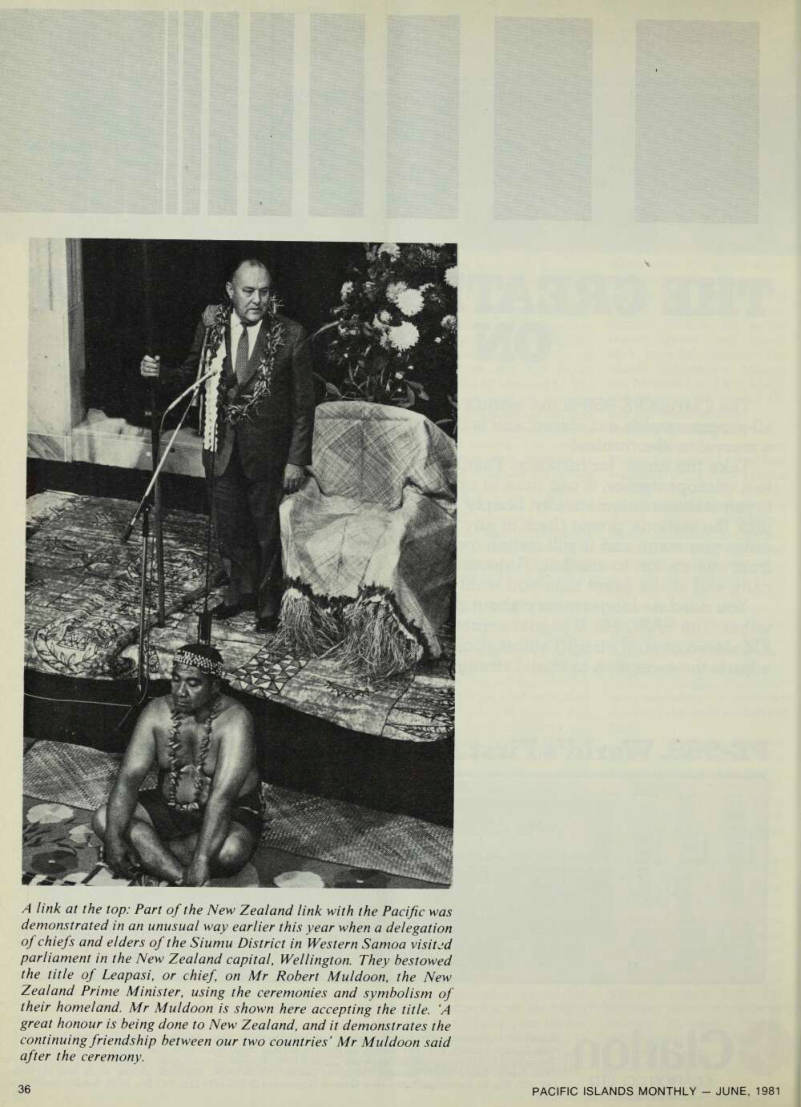
Stamp Picture
Shows Error
Stamp dealers and collectors with sharp eyes sat up and took notice recently when they re ceived advance notice of a Pacific stamp issue which ap peared to contain a spelling error.
The notice came from the Cook Islands where stamp issues amount to a national industry and where issues are made under the separate names of islands within the Cooks. The Cook Islands notified the issue of three Easter stamps from the northern island of Penrhyn, together with three souvenir sheetlets. Illustrations showed that each stamp would contain part of a classical crucifixion painting, and that each sheetlet would show the full painting enclosed in a decorative border and with the perforated stamp in the centre.
One of the paintings was advised as being Van Dyck’s 17th century Pieta (50c for the stamp, 700 plus 50 charity surcharge for the sheetlet).
However the illustration which accompanied the notification showed the artist’s name en graved on the border of the sheetlet as Van Dik.
Collectors were cautious about the discovery which they said could have been a proofing error in the illustration. They said they were waiting to see the actual stamps. Australian col lectors contacted by PIM had not seen the stamps. They said the mere appearance of an error in a stamp issue did not make the stamps valuable provided the issue ran its normal course.
They added however that the way was left open for what they called ‘developments’. The issue could be withdrawn after only a few stamps had been sold and this would inflate values.
There have been instances in some countries where inside knowledge that a stamp issue is to be withdrawn has allowed unscrupulous manipulation of the market.
The two other paintings in the issue are Jesus at the Grove, by Veronese (300 for the stamp, 70c plus 5c charity surcharge for the sheetlet), and Christ with the Crown of Thorns by Titian (40c for the stamp, 70c plus 50 charity surcharge for the sheetlet).
Pacific Birds
Aitutaki (another of the stamp sources established by the Cook Islands) has just issued 16 new stamps featuring birds of the Pacific. This is only part of a planned series which will event ually consist of 32 stamps.
The 16 stamps just issued cover eight values, and the birds depicted are the Gouldian finch and common starling Ic, golden whistler and scarlet robin 20, long-tailed fantail and per egrine falcon 30, Java sparrow and barn owl 4c, Pacific lorikeet and white-breasted wood swallow SC, purple swamp hen and rock dove 60, chestnut breasted finch and peaceful dove 100, reef heron and com mon mynah 120.
Aitutaki also issued a set of Easter stamps in which the illustrations were taken from the statue Burial of Christ by Pedro Rodian. The statue is in the Charity Hospital, Seville, Spain. The three Aitutaki stamps based on the statue are the Virgin mourning 300, head of Christ 40c, and St John mourning 500. The three stamps, each surcharged 20 for local charities, are also united in a souvenir sheet.
Tuvalu Ships
Rich in naval history, it is appropriate that the Pacific Islands should feature ships on their stamps. The latest country to do so is Tuvalu, which re leased a colourful set of six stamps on this theme on May 13. The six vessels illustrated have all called at the islands of Tuvalu at some time over the last 200 years. Included are naval vessels, traders and a whaler.
Designed by Richard Granger Barrett, the stamps were printed in sheetlets of six, and they depict the following vessels: Brig Elizabeth 100, brigantine Rebecca 250, whaler
Independence II 350, HMS Basilisk 400, HMS Royalist 450 and MV Olivebank 500.
The earliest of these vessels to visit Tuvalu was the brig Eliz abeth, under the command of Captain Patterson, which visited the island of Nanumea in 1809.
On February 3, Tuvalu was granted membership of the Uni versal Postal Union, and to commemorate this important event in the postal history of the nation, two stamps (70c and $ 1) and a souvenir sheet will be issued on November 4.
A report from Funafuti indi cates that a series of postage due stamps is now in use in Tuvalu. Inscribed Postage Due, each stamp in the series bears the Tuvalu crest and the de nominations are 1,2, 5, 10, 20, 30, 40, and 50 cents and $l. The stamps are used on incoming mail on which postage has been insufficiently prepaid at the point of posting. The postage due stamps were designed by Gordon Drummond and printed in sheets of 50 by the House of Questa. No official first day of issue was announced.
A stamp issue featuring the Tuvalu Maritime School will be released on August 12. Denomi nations will be 10, 25, 35 and 45 cents.
Norfolk Stationery
Aerogrammes designed by the Australian artist and designer Roger Murphy will go on sale shortly on Norfolk Island. The aerogrammes will feature many of the colonial sites on Norfolk and are sure to be popular with tourists. Postal stationery will also feature flora and fauna of the island, and is likely to contribute to the already significant income from phila telic sales for Norfolk island’s 1700 people.
Pacific Flowers
Niue has released the first part of a colourful new series of definitive stamps which feature flowers of the South Pacific.
The stamps add to the increas ing material on Pacific animals, birds, insects, plants and fishes which is now being featured in South Pacific issues.
In releasing the stamps the Niue postal authorities said that most cultivation on the island was for food crops, and the law required every landholder to use land for growing food.
Flower cultivation for ornamen
tal purposes was not general, but a number of species were being grown successfully.
Twelve stamps are contained in the newly-released issues.
They are divided into six values, and each value consists of two stamps with a different illus tration of a single flower. The values and flowers illustrated are moth orchid 2b, poinsettia sb, black-eyed Susan 10b, but tercup tree 10b, frangipani 25b.
Kiribati Islands
The islands making up Kiribati are to be featured on an annual stamp series, the first of which was issued on May 6.
Designed by John Cooler and printed by Format International Security Printers, the stamps feature typical coral islands with colourful lagoons. The islands featured are Abaiang and Makakei 12b, Little Makin and Butaritari 30b, Maiana 35b and Christmas island $l.
Nauru Exhibition
As previously announced, Nauru has issued a set of four stamps (8, 20, 32 and 40b) titled Fishing A Way of Life. To commemorate involvement in WIPA ’Bl, the international stamp exhibition at Vienna, Austria, Nauru has now issued a block of four of the 40c values in a souvenir sheet, with a face value of $ A 1.60. The stamps and souvenir sheet went on sale on May 22 on Nauru, at the Republic’s exhibition stand at WIPA ’Bl and across the coun ters of Australian philatelic outlets. A special presentation pack containing the miniature sheet was also made available at SA2.
Apart from being an ideal opportunity to commemorate participation in such an import ant international stamp exhi bition, the fishing stamps also commemorated the first anni versary of the Nauru Fishing Corporation.
On May 22, Nauru also issued a special maximum card, its fourth, bearing the WIPA ’Bl exhibition emblem. A maxi mum card features the same design as a stamp, and the latest Nauruan card’s design is based on the current 40b definitive stamp featuring the iwiyi, a Nauruan wading bird. The maximum card is available on Nauru at 20b unused, or with the appropriate 40c stamp on the picture-side and post marked, 60b-
A link at the top: Part of the New Zealand link with the Pacific was demonstrated in an unusual way earlier this year when a delegation of chiefs and elders of the Siumu District in Western Samoa visited parliament in the New Zealand capital, Wellington. They bestowed the title of Leapasi, or chief, on Mr Robert Muldoon, the New Zealand Prime Minister, using the ceremonies and symbolism of their homeland. Mr Muldoon is shown here accepting the title. ‘A great honour is being done to New Zealand, and it demonstrates the continuing friendship between our two countries’ Mr Muldoon said after the ceremony.
Advertisements & other items, p. 35 (1 item)
Clarion
1 Hi-Way Fidelity Series
V/iailUM PROGRAMMABLE TUNER
K
ITII COLBY SYSTEM
PROGRAM
t n-n o
I u• u u
PM Cro2
ft , €HHI
** POWER
i>«l
TUNER PROGRAMMING
THE GREATEST ROADSHOW
ON EARTH.
The Clarion PE-959 is the world's first all-programmable car stereo, and is it a marvel in electronics!
Take the tuner, for instance. Thanks to a microprocessor, it can tune in up to ten stations automatically. Simply pick the stations, preset them in any order you want, and it will switch over from one station to another. Automatically and at the exact time you want it.
You need no longer worry about noise either. The SASC Mk II (signal-actuated FM stereo control circuit) automatically adjusts the reception to signal strength, assuring the best reception mode at all times.
The Clarion PE-959 has all the sophistication you could ask for. Metal tape capability. Dolby NR* circuit. Easy, all-pushbutton operation with 32 logically laid out control buttons. Quartz digital display. High 23W + 23W power, using a GA-301 stereo power amplifier.
There's no question about it. The Clarion PE-959 is "hi-way fidelity."
You can drive for mile after mile, and be sure of enjoying every minute of it.
PE-959. World's First All-Programmable Car Stereo.
[fl g !+ r~~~i l R Clarion Fidelity Sertes rf si VrICJI lull PROGRAMMABLE tuner
EJECT
in n o
I U U
□□ O'
PM C'o> U
TUNER PROGRAMMING
‘Dolby and the double-D symbol are trademarks of Dolby Laboratories Licensing Corporation. >
Clarion
CLARION CO., LTD.
Tokyo, Japan Australia: Amalgamated Wireless (Australasia) Ltd., 554 Parramatta Road, Ashfleld, N.S.W., 2131/New Zealand: AWA New Zealand Limited, P.O. Box 50-248, Porirua/Fiji Islands: Brijlal & Co., Ltd., G.P.O. Box 362, Suva/Tahiti: HI-FI Shangrila, B.P. 200, Papeete/New Caledonia: Caldis.B.P.Ml, Noumea Cedex/Guam: Guam Radio & TV Shop, P.O. Box 1939, Agana, Guam 96910/Vanuatu: The Sound Centre, P.O. Box 434, Vila/Cook Islands: South Seas International Ltd., P.O. Box 49, Rarotonga/Papua New Guinea: Hagemeyer (P.N.G.) Pty. Ltd., P.O. Box 1428, Boroko, Port Moresby.
new zealand
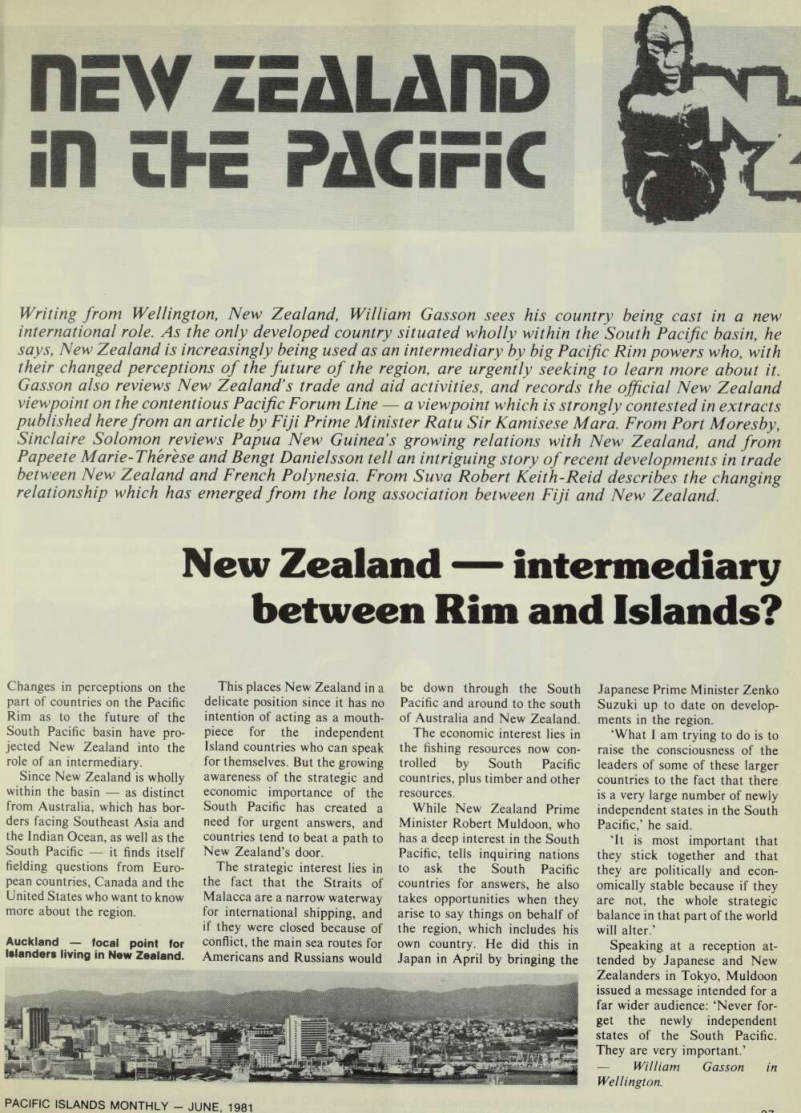
Writing from Wellington, New Zealand, William Gasson sees his country being cast in a new international role. As the only developed country situated wholly within the South Pacific basin, he says, New Zealand is increasingly being used as an intermediary by big Pacific Rim powers who, with their changed perceptions of the future of the region, are urgently seeking to learn more about it.
Gasson also reviews New Zealand's trade and aid activities, and records the official New Zealand viewpoint on the contentious Pacific Forum Line a viewpoint which is strongly contested in extracts published here from an article by Fiji Prime Minister Ratu Sir Kamisese Mara. From Port Moresby, Sinclaire Solomon reviews Papua New Guinea s growing relations with New Zealand, and from Papeete Marie-Therese and Bengt Danielsson tell an intriguing story of recent developments in trade between New Zealand and French Polynesia. From Suva Robert Keith-Reid describes the changing relationship which has emerged from the long association between Fiji and New Zealand.
New Zealand - intermediary
between Rim and Islands?
Changes in perceptions on the part of countries on the Pacific Rim as to the future of the South Pacific basin have pro jected New Zealand into the role of an intermediary.
Since New Zealand is wholly within the basin — as distinct from Australia, which has bor ders facing Southeast Asia and the Indian Ocean, as well as the South Pacific — it finds itself fielding questions from Euro pean countries, Canada and the United States who want to know more about the region.
This places New Zealand in a delicate position since it has no intention of acting as a mouth piece for the independent Island countries who can speak for themselves. But the growing awareness of the strategic and economic importance of the South Pacific has created a need for urgent answers, and countries tend to beat a path to New Zealand’s door.
The strategic interest lies in the fact that the Straits of Malacca are a narrow waterway for international shipping, and if they were closed because of conflict, the main sea routes for Americans and Russians would
be down through the South Pacific and around to the south of Australia and New Zealand.
The economic interest lies in the fishing resources now con trolled by South Pacific countries, plus timber and other resources.
While New Zealand Prime Minister Robert Muldoon, who has a deep interest in the South Pacific, tells inquiring nations to ask the South Pacific countries for answers, he also takes opportunities when they arise to say things on behalf of the region, which includes his own country. He did this in Japan in April by bringing the
Japanese Prime Minister Zenko Suzuki up to date on develop ments in the region. ‘What I am trying to do is to raise the consciousness of the leaders of some of these larger countries to the fact that there is a very large number of newly independent states in the South Pacific,’ he said. ‘It is most important that they stick together and that they are politically and econ omically stable because if they are not, the whole strategic balance in that part of the world will alter.’
Speaking at a reception at tended by Japanese and New Zealanders in Tokyo, Muldoon issued a message intended for a far wider audience: ‘Never for get the newly independent states of the South Pacific.
They are very important.’
William Gasson in
Wellington.
Auckland focal point for Islanders living in New Zealand.
Advertisements & other items, p. 38 (1 item)
Spedding
A wide range of chemicals for automative, electrical, marine and industry applications.
iU! r
■ 3Ber—i A range of domestic appliances, including Typhoon, Breville and Carlton.
"OPCOOK
2s.
Growers canned foodstuffs, Top Cook cooking oils. Sun Dew cordials. Dairy products and detergents.
Starcraft aluminium boats and Fi-Glass Fibreglass boats The Spedding Consolidated Limited Corporation. Established in 1897, Speddings have been in the business of Manufacturing and Exporting Products a long time. This wealth of experience and expertise in the areas in which we are interested has built up a firm base of trust and respect with our many valued clients.
We believe we can help you too, whatever your particular market may be. If you would like to get to know us better, and in doing so, improve your profitability, please contact us.
SPEDDING
All enquiries to: The Export Manager, Spedding Consolidated Limited Group, P.O. Box 13-166, Onehunga, Auckland, New Zealand.
Ph AAI.97Q Tpipy 7SJ79QQ4 Pahlp- QPFnAT.FNT SE/1
money, but great
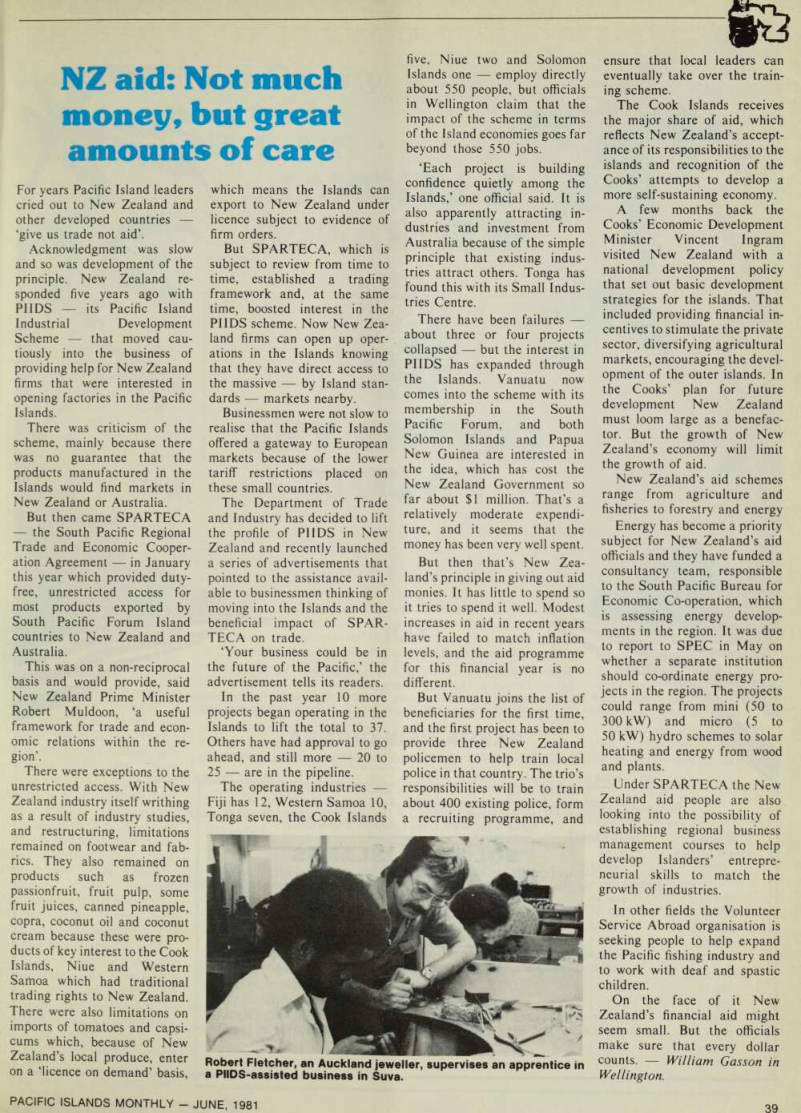
NZ aid: Not much money, but great amounts of care
For years Pacific Island leaders cried out to New Zealand and other developed countries ‘give us trade not aid’.
Acknowledgment was slow and so was development of the principle. New Zealand re sponded five years ago with PUDS its Pacific Island Industrial Development Scheme that moved cau tiously into the business of providing help for New Zealand firms that were interested in opening factories in the Pacific Islands.
There was criticism of the scheme, mainly because there was no guarantee that the products manufactured in the Islands would find markets in New Zealand or Australia.
But then came SPARTECA the South Pacific Regional Trade and Economic Cooper ation Agreement in January this year which provided duty free, unrestricted access for most products exported by South Pacific Forum Island countries to New Zealand and Australia.
This was on a non-reciprocal basis and would provide, said New Zealand Prime Minister Robert Muldoon, ‘a useful framework for trade and econ omic relations within the re gion’.
There were exceptions to the unrestricted access. With New Zealand industry itself writhing as a result of industry studies, and restructuring, limitations remained on footwear and fab rics. They also remained on products such as frozen passionfruit, fruit pulp, some fruit juices, canned pineapple, copra, coconut oil and coconut cream because these were pro ducts of key interest to the Cook Islands, Niue and Western Samoa which had traditional trading rights to New Zealand.
There were also limitations on imports of tomatoes and capsi cums which, because of New Zealand’s local produce, enter on a ‘licence on demand’ basis,
which means the Islands can export to New Zealand under licence subject to evidence of firm orders.
But SPARTECA, which is subject to review from time to time, established a trading framework and, at the same time, boosted interest in the PUDS scheme. Now New Zea land firms can open up oper ations in the Islands knowing that they have direct access to the massive by Island stan dards markets nearby.
Businessmen were not slow to realise that the Pacific Islands offered a gateway to European markets because of the lower tariff restrictions placed on these small countries.
The Department of Trade and Industry has decided to lift the profile of PUDS in New Zealand and recently launched a series of advertisements that pointed to the assistance avail able to businessmen thinking of moving into the Islands and the beneficial impact of SPAR TECA on trade. ‘Your business could be in the future of the Pacific,’ the advertisement tells its readers.
In the past year 10 more projects began operating in the Islands to lift the total to 37.
Others have had approval to go ahead, and still more 20 to 25 are in the pipeline.
The operating industries Fiji has 12, Western Samoa 10, Tonga seven, the Cook Islands
five, Niue two and Solomon Islands one employ directly about 550 people, but officials in Wellington claim that the impact of the scheme in terms of the Island economies goes far beyond those 550 jobs. ‘Each project is building confidence quietly among the Islands,’ one official said. It is also apparently attracting in dustries and investment from Australia because of the simple principle that existing indus tries attract others. Tonga has found this with its Small Indus tries Centre.
There have been failures about three or four projects collapsed but the interest in PUDS has expanded through the Islands. Vanuatu now comes into the scheme with its membership in the South Pacific Forum, and both Solomon Islands and Papua New Guinea are interested in the idea, which has cost the New Zealand Government so far about $1 million. That’s a relatively moderate expendi ture, and it seems that the money has been very well spent.
But then that’s New Zea land’s principle in giving out aid monies. It has little to spend so it tries to spend it well. Modest increases in aid in recent years have failed to match inflation levels, and the aid programme for this financial year is no different.
But Vanuatu joins the list of beneficiaries for the first time, and the first project has been to provide three New Zealand policemen to help train local police in that country. The trio’s responsibilities will be to train about 400 existing police, form a recruiting programme, and
ensure that local leaders can eventually take over the train ing scheme.
The Cook Islands receives the major share of aid, which reflects New Zealand’s accept ance of its responsibilities to the islands and recognition of the Cooks’ attempts to develop a more self-sustaining economy.
A few months back the Cooks’ Economic Development Minister Vincent Ingram visited New Zealand with a national development policy that set out basic development strategies for the islands. That included providing financial in centives to stimulate the private sector, diversifying agricultural markets, encouraging the devel opment of the outer islands. In the Cooks’ plan for future development New Zealand must loom large as a benefac tor. But the growth of New Zealand’s economy will limit the growth of aid.
New Zealand’s aid schemes range from agriculture and fisheries to forestry and energy Energy has become a priority subject for New Zealand’s aid officials and they have funded a consultancy team, responsible to the South Pacific Bureau for Economic Co-operation, which is assessing energy develop ments in the region. It was due to report to SPEC in May on whether a separate institution should co-ordinate energy pro jects in the region. The projects could range from mini (50 to 300 kW) and micro (5 to 50 kW) hydro schemes to solar heating and energy from wood and plants.
Under SPARTECA the New Zealand aid people are also looking into the possibility of establishing regional business management courses to help develop Islanders’ entrepre neurial skills to match the growth of industries.
In other fields the Volunteer Service Abroad organisation is seeking people to help expand the Pacific fishing industry and to work with deaf and spastic children.
On the face of it New Zealand’s financial aid might seem small. But the officials make sure that every dollar
counts.
William Gasson in
Wellington.
Robert Fletcher, an Auckland jeweller, supervises an apprentice in a PIIDS-assisted business in Suva.
Advertisements & other items, p. 40 (1 item)
| National
>rfS
/s •n W r-
NATIONAL
INSURANCE
% ft 1
COVERS THE
PACIFIC
FIJI
THE NATIONAL INSURANCE COMPANY OF FIJI, LIMITED (Incorporating Southern Pacific Insurance Co. (Fiji) Ltd) SUVA Dominion House, Thomson St, Phone 25601, Tlx 2337.
L. M. Rolls, General Manager.
LAUTOKA Ist Floor National Bank Bldg. Phone 62951. M. Y. Hussain, Resident Inspector LABASA Ist Floor National Bank Bldg. Phone 81099. A. Singh, Resident Inspector.
PAPUA NEW GUINEA
THE SOUTHERN PACIFIC INSURANCE COMPANY (PNG) LIMITED. (Incorporating C.I.C. Insurance (Pacific) Pty Ltd) PORT MORESBY 8 Champion Parade, Phone 21-1388, Tlx 22261, D. J. McCall.General Manager LAE Second St. Phone 42-4590. Tlx 42443. T. S. Kennedy. Manager.
RABAUL Mango Ave, Phone 92-2755, Tlx 92923. P. M. Mitchell, Manager.
MT HAGEN MT HAGEN Phone 521 -164. J. P, Devaney, District Manager, ent inspector.
Arawa B. Snowden, District Manager. Phone 956-219 / * N 4 m *
SOLOMON ISLANDS
THE NATIONAL INSURANCE COMPANY OF NEW ZEALAND, LIMITED.
HONIARA Ist Floor Kingsley Bldg. Phone 919 B. R. International Agencies (W.V. Gledhill) Agent.
WESTERN SAMOA
NATIONAL PACIFIC INSURANCE LIMITED.
(National Insurance Company of New Zealand. Ltd Managing Agents) APIA Taufusi St, Phone 20481, Tlx 228. D. I. Humphry, Managing Director.
PAGO PAGO Suite 200, Lumana'i Bldg, Phone 96799. J. McGuire, Manager.
COOK ISLANDS
THE NATIONAL INSURANCE COMPANY OF NEW ZEALAND. LIMITED.
RAROTONGA U.I.T. Bldg. Avarua, Phone 2076, Tlx 62013. R. Wheeler, Local Manager.
between NZ, Tahiti
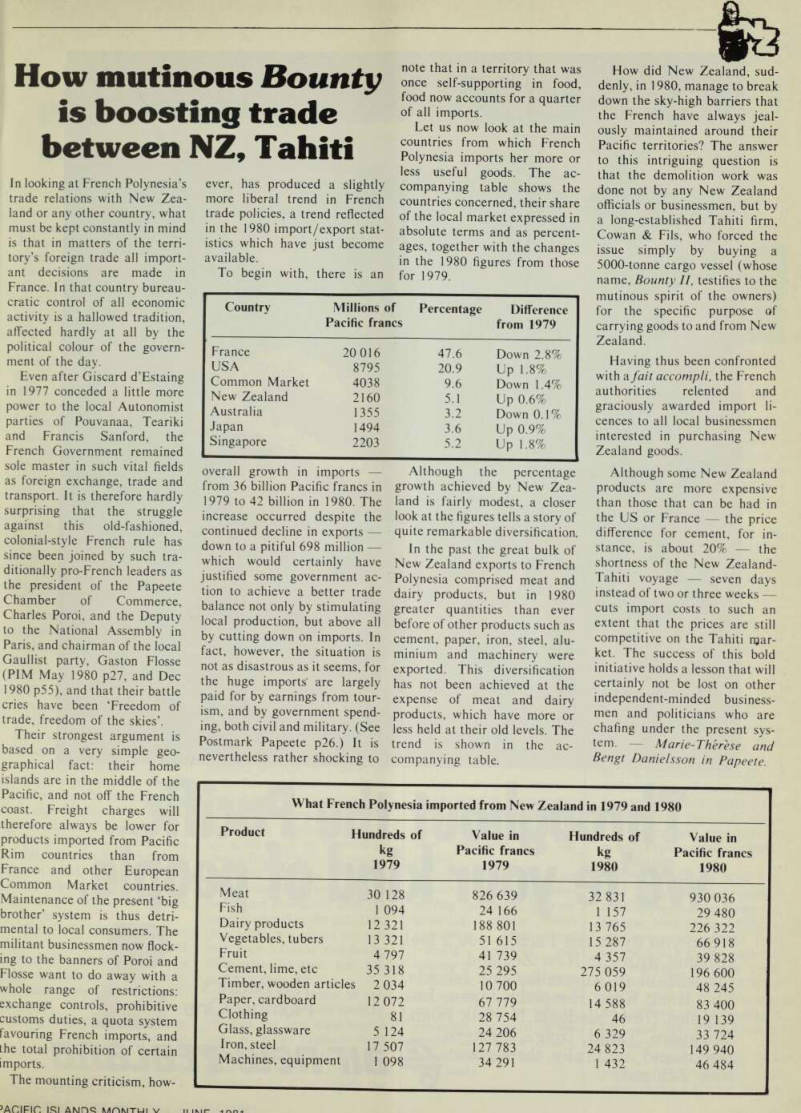
How mutinous Bounty is boosting trade between NZ, Tahiti
In looking at French Polynesia’s trade relations with New Zea land or any other country, what must be kept constantly in mind is that in matters of the terri tory’s foreign trade all import ant decisions are made in France. In that country bureau cratic control of all economic activity is a hallowed tradition, affected hardly at all by the political colour of the govern ment of the day.
Even after Giscard d’Estaing in 1977 conceded a little more power to the local Autonomist parties of Pouvanaa, Teariki and Francis Sanford, the French Government remained sole master in such vital fields as foreign exchange, trade and transport. It is therefore hardly surprising that the struggle against this old-fashioned, colonial-style French rule has since been joined by such tra ditionally pro-French leaders as the president of the Papeete Chamber of Commerce, Charles Poroi, and the Deputy to the National Assembly in Paris, and chairman of the local Gaullist party, Gaston Flosse (PIM May 1980 p 27, and Dec 1980 p 55), and that their battle cries have been ‘Freedom of trade, freedom of the skies’.
Their strongest argument is based on a very simple geo graphical fact: their home islands are in the middle of the Pacific, and not off the French coast. Freight charges will therefore always be lower for products imported from Pacific Rim countries than from France and other European Common Market countries.
Maintenance of the present ‘big brother’ system is thus detri mental to local consumers. The militant businessmen now flock ing to the banners of Poroi and Flosse want to do away with a whole range of restrictions: exchange controls, prohibitive customs duties, a quota system favouring French imports, and the total prohibition of certain imports.
The mounting criticism, how
ever, has produced a slightly more liberal trend in French trade policies, a trend reflected in the 1980 import/export stat istics which have just become available.
To begin with, there is an
overall growth in imports from 36 billion Pacific francs in 1979 to 42 billion in 1980. The increase occurred despite the continued decline in exports down to a pitiful 698 million which would certainly have justified some government ac tion to achieve a better trade balance not only by stimulating local production, but above all by cutting down on imports. In fact, however, the situation is not as disastrous as it seems, for the huge imports' are largely paid for by earnings from tour ism, and by government spend ing, both civil and military. (See Postmark Papeete p 26.) It is nevertheless rather shocking to
note that in a territory that was once self-supporting in food, food now accounts for a quarter of all imports.
Let us now look at the main countries from which French Polynesia imports her more or less useful goods. The accompanying table shows the countries concerned, their share of the local market expressed in absolute terms and as percentages, together with the changes in the 1980 figures from those for 1979.
Although the percentage growth achieved by New Zea land is fairly modest, a closer look at the figures tells a story of quite remarkable diversification.
In the past the great bulk of New Zealand exports to French Polynesia comprised meat and dairy products, but in 1980 greater quantities than ever before of other products such as cement, paper, iron, steel, alu minium and machinery were exported. This diversification has not been achieved at the expense of meat and dairy products, which have more or less held at their old levels. The trend is shown in the ac companying table.
How did New Zealand, sud denly, in 1980, manage to break down the sky-high barriers that the French have always jeal ously maintained around their Pacific territories? The answer to this intriguing question is that the demolition work was done not by any New Zealand officials or businessmen, but by a long-established Tahiti firm, Cowan & Fils, who forced the issue simply by buying a 5000-tonne cargo vessel (whose name, Bounty 11, testifies to the mutinous spirit of the owners) for the specific purpose of carrying goods to and from New Zealand.
Having thus been confronted with a fait accompli, the French authorities relented and graciously awarded import li cences to all local businessmen interested in purchasing New Zealand goods.
Although some New Zealand products are more expensive than those that can be had in the US or France the price difference for cement, for in stance, is about 20% the shortness of the New Zealand- Tahiti voyage seven days instead of two or three weeks cuts import costs to such an extent that the prices are still competitive on the Tahiti mar ket. The success of this bold initiative holds a lesson that will certainly not be lost on other independent-minded business men and politicians who are chafing under the present sys tcm. Marie-Therese and Bengt Danielsson in Papeete.
What French Polynesia imported from New Zealand in 1979 and 1980 Product Hundreds of kg 1979 Value in Pacific francs 1979 Hundreds of kg 1980 Value in Pacific francs 1980 Meat 30 128 826 639 32 831 930 036 Fish 1 094 24 166 1 157 29 480 Dairy products 12 321 188 801 13 765 226 322 Vegetables, tubers 13 321 51 615 15 287 66918 Fruit 4 797 41 739 4 357 39 828 Cement, lime, etc 35 318 25 295 275 059 196 600 Timber, wooden articles 2 034 10 700 6019 48 245 Paper, cardboard 12 072 67 779 14 588 83 400
Clothing
81 28 754 46 19 139 Glass, glassware 5 124 24 206 6 329 33 724 Iron,steel 17 507 127 783 24 823 149 940 Machines, equipment 1 098 34 291 1 432 46 484
Country Millions of Pacific francs Percentage Difference from 1979 France 20 016 47.6 Down 2.8%
Usa
8795 20.9 Up 1.8% Common Market 4038 9.6 Down 1.4% New Zealand 2160 5.1 Up 0.6% Australia 1355 3.2 Down 0.1% Japan 1494 3.6 Up 0.9% Singapore 2203 5.2 Up 1.8%
Advertisements & other items, pp. 41-42 (2 items)
’Acifir: Isi And.Q Momtui V Iiimc-
Throughout the Pacific...
■ ■ M ms* m '■A ;a , - -- '
we’re your kind of people.
When you fly in the Pacific, you’ll feel at home with Air New Zealand.
Fly with us to Australia,Cook Islands, Fiji, Hong Kong, Honolulu, Japan, Los
Angeles,NewCaledonia,Norfolk Island,
Singapore, Tahiti, Tonga, Western &e“and aturally ' throughout BIE PEIU ZEBLBPD
W ANZ 80/18
The Pacific's
Number One
Papua New Guinea
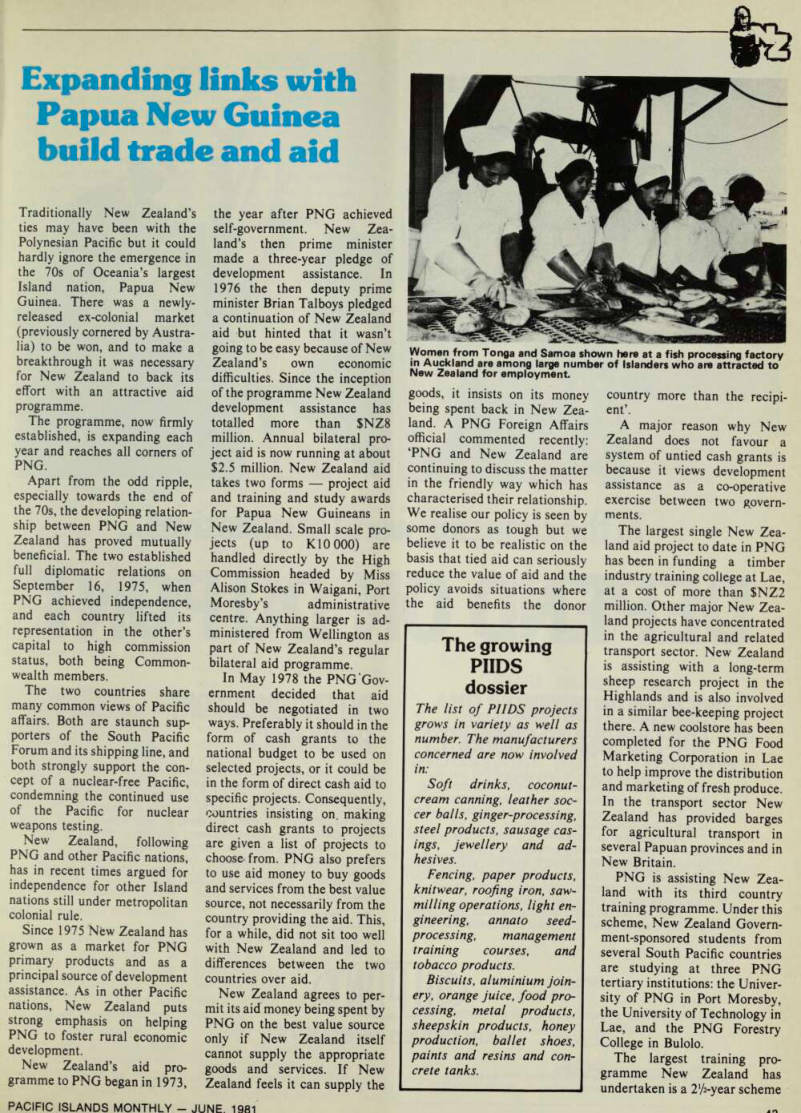
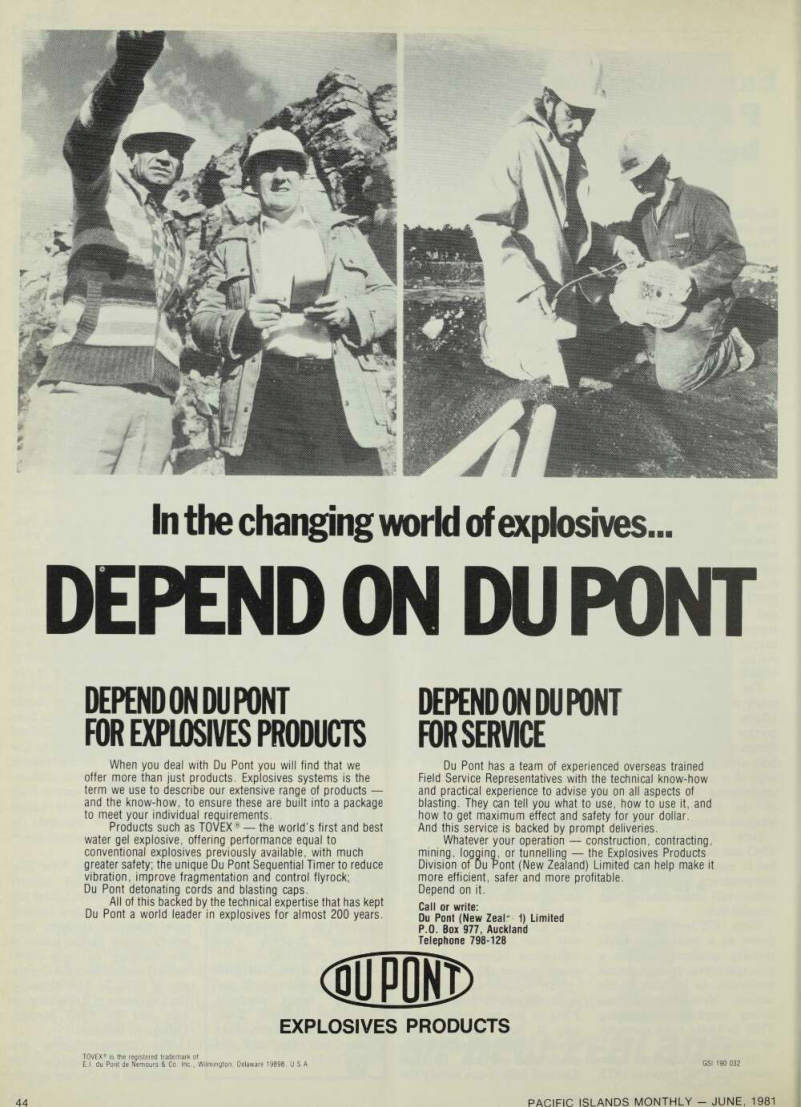
Expanding links with Papua New Guinea build trade and aid
Traditionally New Zealand’s ties may have been with the Polynesian Pacific but it could hardly ignore the emergence in the 70s of Oceania’s largest Island nation, Papua New Guinea. There was a newly released ex-colonial market (previously cornered by Austra lia) to be won, and to make a breakthrough it was necessary for New Zealand to back its effort with an attractive aid programme.
The programme, now firmly established, is expanding each year and reaches all corners of
Png.
Apart from the odd ripple, especially towards the end of the 70s, the developing relation ship between PNG and New Zealand has proved mutually beneficial. The two established full diplomatic relations on September 16, 1975, when PNG achieved independence, and each country lifted its representation in the other’s capital to high commission status, both being Common wealth members.
The two countries share many common views of Pacific affairs. Both are staunch sup porters of the South Pacific Forum and its shipping line, and both strongly support the con cept of a nuclear-free Pacific, condemning the continued use of the Pacific for nuclear weapons testing.
New Zealand, following PNG and other Pacific nations, has in recent times argued for independence for other Island nations still under metropolitan colonial rule.
Since 1975 New Zealand has grown as a market for PNG primary products and as a principal source of development assistance. As in other Pacific nations, New Zealand puts strong emphasis on helping PNG to foster rural economic
development.
New Zealand’s aid pro gramme to PNG began in 1973,
the year after PNG achieved self-government. New Zea land’s then prime minister made a three-year pledge of development assistance. In 1976 the then deputy prime minister Brian Talboys pledged a continuation of New Zealand aid but hinted that it wasn’t going to be easy because of New Zealand’s own economic difficulties. Since the inception of the programme New Zealand development assistance has totalled more than SNZB million. Annual bilateral pro ject aid is now running at about $2.5 million. New Zealand aid takes two forms project aid and training and study awards for Papua New Guineans in New Zealand. Small scale pro jects (up to KlO 000) are handled directly by the High Commission headed by Miss Alison Stokes in Waigani, Port
Moresby’s administrative
centre. Anything larger is ad ministered from Wellington as part of New Zealand’s regular bilateral aid programme.
In May 1978 the PNGGov ernment decided that aid should be negotiated in two ways. Preferably it should in the form of cash grants to the national budget to be used on selected projects, or it could be in the form of direct cash aid to specific projects. Consequently, countries insisting on. making direct cash grants to projects are given a list of projects to choose from. PNG also prefers to use aid money to buy goods and services from the best value source, not necessarily from the country providing the aid. This, for a while, did not sit too well with New Zealand and led to differences between the two countries over aid.
New Zealand agrees to per mit its aid money being spent by PNG on the best value source only if New Zealand itself cannot supply the appropriate goods and services. If New Zealand feels it can supply the
goods, it insists on its money being spent back in New Zea land. A PNG Foreign Affairs official commented recently: ‘PNG and New Zealand are continuing to discuss the matter in the friendly way which has characterised their relationship.
We realise our policy is seen by some donors as tough but we believe it to be realistic on the basis that tied aid can seriously reduce the value of aid and the policy avoids situations where the aid benefits the donor
country more than the recipi ent’.
A major reason why New Zealand does not favour a system of untied cash grants is because it views development assistance as a co-operative exercise between two govern ments.
The largest single New Zea land aid project to date in PNG has been in funding a timber industry training college at Lae, at a cost of more than SNZ2 million. Other major New Zea land projects have concentrated in the agricultural and related transport sector. New Zealand is assisting with a long-term sheep research project in the Highlands and is also involved in a similar bee-keeping project there. A new coolstore has been completed for the PNG Food Marketing Corporation in Lae to help improve the distribution and marketing of fresh produce.
In the transport sector New Zealand has provided barges for agricultural transport in several Papuan provinces and in New Britain.
PNG is assisting New Zea land with its third country training programme. Under this scheme, New Zealand Govern ment-sponsored students from several South Pacific countries are studying at three PNG tertiary institutions: the Univer sity of PNG in Port Moresby, the University of Technology in Lae, and the PNG Forestry College in Bulolo.
The largest training pro gramme New Zealand has undertaken is a I'/z-year scheme
Women from Tonga and Samoa shown here at a fish processing factory in Auckland are among large number of Islanders who are attracted to New Zealand for employment.
of electrical and instrument training for 10 Air Niugini apprentices at Air New Zea land’s engineering section in Christchurch.
New Zealand is helping PNG to equalise trade between the two countries, at present run ning about three to one in favour of New Zealand. PNG is included in New Zealand’s Pacific Islands Industrial De velopment Scheme (PUDS) and the Developing Countries Liaison Unit (DCLU).
Although the PNG Depart ment of Trade sees PNG’s prospect of trade with New Zealand as limited in volume and value, its main exports of coffee, cocoa, tea, artefacts, logs and plywood are increas ing. Coffee was the major money earner in 1979-80, sell ing for SNZS.O7 million. New Zealand imports from PNG during that period totalled SNZ7.OS million compared with SNZS.4 million in 1978-79. ‘Coffee makes up 80% of PNG’s total export to New Zealand and will continue to be the major revenue earner here for a long time’, PNG’s High Commissioner to New Zealand, Mr Brian Amini, said in Wellington recently. ‘I believe the volume of trade is increas-
mg in our favour, especially with the introduction of SPARTECA,’ Mr Amini said.
Hie wants at least three extra )fficers for the PNG Office, one n the still vacant consular post md two in trade matters.
In the other direction, New Zealand has experienced an ncreasing demand for its pro lucts in PNG, biting into Aus
tralia’s overall share of the PNG market. Imports from New Zealand are mainly food, chemicals, chemical products, machinery and transport equip ment. The food sector is an area with great potential for New Zealand, as food accounts for more than 20% of PNG imports.
New Zealand’s exports of food (meat, dairy products, eggs and fish) to PNG in 1979-80 totalled just over SNZ9 million.
PNG imports from New Zea land during that period totalled 5NZ34.3 million compared with SNZ2I.B million in 1978-79.
Companies which already deal with exporters from New Zealand include Sullivans Pty Ltd, Shannon Marketing Inter national, Rabtrad Niugini Pty Ltd, Co-operative Wholesale Society, and Collins and Leahy.
The first two companies have offices in New Zealand and are interested in promoting new lines. Another New Zealand company, Wm Scollay Ltd, has established a wholly-owned sub sidiary in PNG. This company has established an office in Port Moresby and regards food im porting as a major priority. A number of buyers, particularly of meat and fish, find it con venient to deal with an inter mediary as it saves them the difficulty of arranging suppliers and shipping.
The introduction of a direct shipping route between the two countries saw an upsurge in trade, and other New Zealand shipping companies are under stood to be interested in sharing the route. Today, South Pacific Forum Line, Sofrano Line and PNG Pacific operate regular services between PNG and New Zealand ports.
Although the Forum Line is in severe financial difficulty the New Zealand Prime Minister, Mr Muldoon told me in Wellington recently that New Zealand would go out of its way to keep the line afloat. PNG Prime Minister Sir Julius Chan has also pledged PNG’s con tinued support for the ailing line.
Initially PNG was a number of New Zealand preferential tariff arrangements. These in cluded the British Preference Scheme (phased out in 1977),
the Commonwealth Preference Scheme (phased out in 1978) and Generalised Scheme of Preference (GSP). After the first two preference schemes were ended. New Zealand ex tended its GSP scheme on a unilateral and non-reciprocal basis to compensate developing Commonwealth countries for the loss of these preferences in the New Zealand market. The extension of GSP covered 70% of all lines of tariffs, including agricultural and manufactured goods, providing more favour able tariffs for PNG goods under the other preference schemes.
New Zealand investment in PNG has gone into the dairy, timber and related industries.
New Zealand giant Fletcher is building PNG’s spectacular National Parliament building in Port Moresby at a contract price of SNZI9.4 million.
Fletcher’s presence in PNG was strengthened last year with the purchase of Morobe Construc tions Pty Ltd, one of PNG’s
largest building companies which had been in voluntary receivership for three months.
The move was also part of a deliberate programme to re duce Fletcher Construction’s dependence on the New Zea land market. The Parliament project, by far the biggest investment by a New Zealand firm in PNG, is expected to be finished within three years.
The New Zealand Dairy Board, Neil Holdings, Rent-O- Kil and Scollay (PNG) Ltd are among other big companies operating in PNG at present.
The flow of tourists from New Zealand into PNG is small but growing. The PNG Govern ment is still considering a direct air link between the two countries. The South Pacific Arts Festival staged in PNG last year attracted a large New Zealand contingent and cover age. But in New Zealand, Papua New Guinea is still known simply as New Guinea Sinclaire Solomon in Port Moresby.
High Commissioner Brian Amini
The growing
Puds
dossier
The list of PUDS projects grows in variety as well as number. The manufacturers concerned are now involved in: Soft drinks, coconut cream canning, leather soc cer balls, ginger-processing, steel products, sausage cas ings, jewellery and ad hesives.
Fencing, paper products, knitwear, roofing iron, saw milling operations, light en gineering, annato seed processing. management training courses. and tobacco products.
Biscuits, aluminium join ery, orange juice, food pro cessing, metal products, sheepskin products, honey production, ballet shoes, paints and resins and con crete tanks.
Advertisements & other items, pp. 44-46 (1 item)
Depend On Du Pont
m : •• %
In the chaining world of explosives...
DEPENDONDUPONT
FOR EXPLOSIVES PRODUCTS
When you deal with Du Pont you will find that we offer more than just products. Explosives systems is the term we use to describe our extensive range of products and the know-how, to ensure these are built into a package to meet your individual requirements.
Products such as TOVEX®— the world’s first and best water gel explosive, offering performance equal to conventional explosives previously available, with much greater safety; the unique Du Pont Sequential Timer to reduce vibration, improve fragmentation and control flyrock; Du Pont detonating cords and blasting caps.
All of this backed by the technical expertise that has kept Du Pont a world leader in explosives for almost 200 years.
DEPENDONDUPONT
FOR SERVICE
Du Pont has a team of experienced overseas trained Field Service Representatives with the technical know-how and practical experience to advise you on all aspects of blasting. They can tell you what to use, how to use it, and how to get maximum effect and safety for your dollar.
And this service is backed by prompt deliveries.
Whatever your operation construction, contracting, mining, loggino, or tunnelling the Explosives Products Division of Du Pont (New Zealand) Limited can help make it more efficient, safer and more profitable.
Depend on it.
Call or write: Du Pont (New Zeal' 1) Limited P.O. Box 977, Auckland Telephone 798-128
(fIOUHt)
EXPLOSIVES PRODUCTS
TOVEX® is the registered trademark of E.l. du Pont de Nemours & Co. Inc., Wilmington, Delaware 19898, U.S.A. GSI 190 032
FUEL INJECTION
AND ELECTRICAL SYSTEMS
SPECIALISTS FOR ALL
MARINE, COMMERCIAL,
INDUSTRIAL AND AUTOMOTIVE
INSTALLATIONS
We service and stock fuel pumps, injectors, turbochargers, alternators, generators and starter motors for all applications.
CONTACT US BY TELEX FROM ANYWHERE IN THE PACIFIC FOR IMMEDIATE DESPATCH OF REPLACEMENTS AND SPARES FOR
BOSCH, BRVCE, CATERPILLAR, CAV, DIESEL KIKI
CM, HOLSET, NIPPON DENSO, ROOSAMASTER
AIR RESEARCH, SCHWITZER, SIMMS, DAHL FILTERS
and
WOODWARD GOVERNORS
SIMMS DIESEL & ELECTRICAL SERVICES LTD.
P-O. BOX 11-114 ELLERSLIE
77 LEONARD ROAD, PENROSE AUCKLAND
NEW ZEALAND
TELEX No NZ 60266 SIMMS
DAYTIME TEL,
AUCKLAND 591-159
DIESEL SPECIAUSTS
EVENING TEL.
AUCKLAND 568-259
\ \ * I . n rwr. ■
sfc»*°3s<S »
sion Act- ,977) And if you’re between the ages of 19-34 and meet the minimum requirements of 173 cm tall, 67kg in weight and have a chest measurement of 91 cm at least, you may apply to become a Police Officer.
For those that possess the right physical and mental requirements, a good work record and a satisfactory educational background the Police offer you a worthwhile and rewarding career with thorough training, the opportunity for promotion, and excellent starting salary with superannuation benefits, generous leave (including sick leave with pay), free uniform, but above all we offer job security, satisfaction and comradeship in a necessary job helping society.
If you’re interested, we would like to talk it over with you. Call at your nearest Police Station for further details
SERVING THE COMMUNITY
NZ POLICE
WE WANT THE BEST
L82593AC
Muldoon argues the case
case for the Pacific Forum Line . . .
New Zealand Prime Minister Robert Muldoon took the op portunity of his recent visit to Japan to suggest that the Japanese might help the financially crippled Pacific Fo rum Line. He had in mind a ship that could provide a feeder service between some of the smaller islands and the ports visited by bigger Forum Line vessels.
The West Germans, Mul doon told Japanese PM Zenko Suzuki, had chipped in with a couple of ships for the Forum Line his way of giving the Japanese a nudge and a wink.
The Forum Line was very much on Muldoon’s mind when he went to Japan.
The line’s creditors are press ing it to recover debts, and New Zealand pumped in an extra NZsl million in March to help pay some of the current debts.
But about $9 million is needed to refloat the foundering line which both New Zealand and Australia believe will begin to break even in about 18 months.
In New Delhi last October the Forum members decided by consensus to support the line financially. New Zealand pledged $4.5 million and Aus tralia, which is not a share holder, promised the other half.
The catch was that Australia said the money would have to come from the bilateral aid it gave to the Island states. It declined to make any further contribution direct. While the Island states agreed to give part of their Australian aid to the line, their resolve faltered when Fiji said it did not propose to go ahead with the consensus.
Muldoon said that Fiji had explained that its position was that the Forum Line carried Australian and New Zealand goods, and was really for the benefit of those countries. It argued that the Forum Line would be in no difficulty if it carried Fiji sugar to New Zea land. But union issues made
that impossible, Muldoon said.
The whole concept of the Forum Line became possible only when the New Zealand unions said they were prepared to have cross-trading ships manned by Island crews call at New Zealand, provided one of the ships in the Forum Line was manned by New Zealanders.
This so-called Waitangi Agreement provided the break through that made the regional shipping scheme feasible, but it would end if the Forum Line collapsed. That would mean that ships manned by Island crews would only be worked in New Zealand ports if they traded directly from the country of origin, rather than cross-trading to other Island states. ‘The effect of that on South Pacific shipping would be cata strophic,’ said Muldoon.
But, under the Waitangi Agreement, the New Zealand Seamen’s Union refused to per mit the Forum Line to carry Fiji sugar because this was carried in ships crewed by New Zealanders. They would not agree to it being carried in ships crewed by low-wage Pacific Islanders.
Fiji also said it was neither appropriate nor fair that its people be told to accept cutbacks in their Australian aid funds in order to finance the Forum Line’s operations. ‘The fact of the matter is that the decision was made by con sensus at the Forum in New Delhi and (the Fiji Prime Min ister) Ratu Sir Kamisese Mara was part of that consensus,’ said Muldoon.
Muldoon added that he was pleased, however, that a dia logue was developing with the Fiji Government. He said: T am sure that if the thing is ex plained clearly and carefully then they will agree that we did have a consensus in New Delhi and it is reasonable that it should be implemented.’ The whole issue is to come up for
review at the regular meeting of the Forum Shipping Council in June.
Meanwhile, one by one the member states have signalled their intention to contribute funds to the line. The Cook Islands offered $25 000 and the Solomon Islands SIOO 000, while Tonga and Western Samoa moved to have their share of Australian aid released and paid over to the Forum Line. This totalled about
Ssoo 000.
Muldoon sees the line as ‘the most important practical demonstration of the value of the Forum and its collapse really would be very, very serious.’
New Zealand in fact places great weight on the importance of shipping for the development of the economics of the South Pacific islands.
Last financial year it spent $14.5 million with only $1.5 million coming out of its aid programme to the Pacific Islands on various shipping services. Some $6 million went into the Cook Islands-Niue ser vice, and another $1 million to the Tokelau-Tuvalu service.
New Zealand’s attitude is that while it could follow the arguments of other people such as the Australians and let commercial shipping com panies develop services, that would simply mean the smaller islands would be by-passed.
That suggests a difference in shipping philosophy between Australia and New Zealand.
The New Zealanders have ham mered their colours to the Pacific Forum Line mast. They have found it painful to do so but insist on the merit of their actions.
The fact that, in its formative stages, the Forum Line used unsuitable ships and had man agement problems simply com pounded New Zealand’s suffer ings.
Possibly because of New Zealand’s commitment to ship ping, other South Pacific countries believe that its Gov ernment will rescue the Forum Line even if they fail to provide funds.
Reasoning of that type badly misjudges Muldoon’s determi nation to see that the South Pacific pulls together as a region.
The present movement is towards regionalism towards Fiji’s idea of anew regional organisation which could amal gamate the existing plethora of South Pacific organisations and eliminate duplication of effort and waste of limited resources.
Muldoon has already sig nalled his belief that this is a good idea. But New Zealand accepts that the impetus for this movement must come from the Pacific Island states them
selves.
William Gas son in
Wellington.
. . . and Fiji’s Ratu

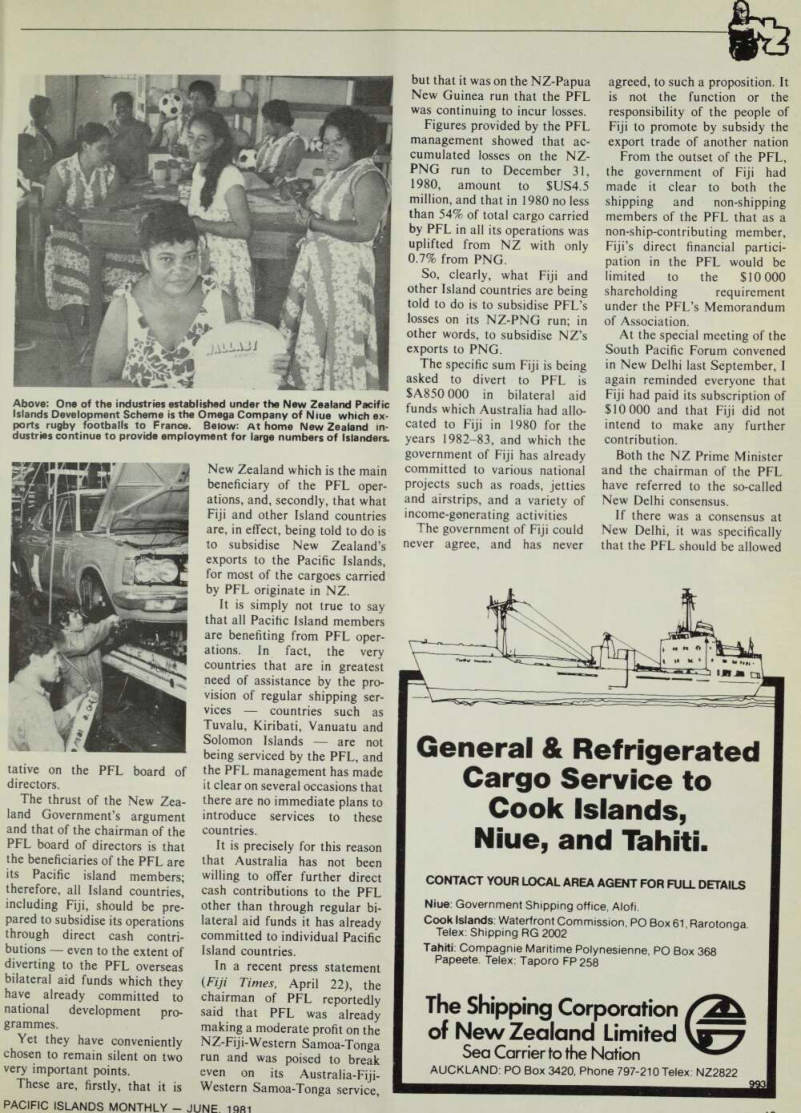

Mara takes time out to disagree
Fiji’s Prime Minister Ratu Sir Kamisese Mara in a 3000-word article published in The Fiji Times in May mounted a spirited defence of his government’s refusal to surrender $850 000 in bilateral Australian aid funds to help keep the Pacific Forum Line afloat.
Extracts from his article are published here.
So much has been said recently about Fiji’s attitude towards the
Pacific Forum Line. It almost seems that it is a deliberate and concerted attempt to coerce Fiji to adopt a position which in the view of the government is clearly not in our national interest. It is quite obvious, for instance, that The Fiji Times, in its editorial comment of April 20, has been persuaded by recent public comment by the New Zealand Prime Minister and by the Chairman of the Pacific Forum Line, Mr Harry Julian, who is also the New Zealand Government represen-
tative on the PFL board of directors.
The thrust of the New Zea land Government’s argument and that of the chairman of the PFL board of directors is that the beneficiaries of the PFL are its Pacific island members; therefore, all Island countries, including Fiji, should be pre pared to subsidise its operations through direct cash contri butions even to the extent of diverting to the PFL overseas bilateral aid funds which they have already committed to national development pro grammes.
Yet they have conveniently chosen to remain silent on two very important points.
These are, firstly, that it is
New Zealand which is the main beneficiary of the PFL oper ations, and, secondly, that what Fiji and other Island countries are, in effect, being told to do is to subsidise New Zealand’s exports to the Pacific Islands, for most of the cargoes carried by PFL originate in NZ.
It is simply not true to say that all Pacific Island members are benefiting from PFL oper ations. In fact, the very countries that are in greatest need of assistance by the pro vision of regular shipping ser vices countries such as Tuvalu, Kiribati, Vanuatu and Solomon Islands are not being serviced by the PFL, and the PFL management has made it clear on several occasions that there are no immediate plans to introduce services to these countries.
It is precisely for this reason that Australia has not been willing to offer further direct cash contributions to the PFL other than through regular bi lateral aid funds it has already committed to individual Pacific Island countries.
In a recent press statement {Fiji Times, April 22), the chairman of PFL reportedly said that PFL was already making a moderate profit on the
NZ-Fiji-Western Samoa-Tonga
run and was poised to break even on its Australia-Fiji- Western Samoa-Tonga service
but that it was on the NZ-Papua New Guinea run that the PFL was continuing to incur losses.
Figures provided by the PFL management showed that ac cumulated losses on the NZ PNG run to December 31, 1980, amount to SUS4.S million, and that in 1980 no less than 54% of total cargo carried by PFL in all its operations was uplifted from NZ with only 0.7% from PNG.
So, clearly, what Fiji and other Island countries are being told to do is to subsidise PFL’s losses on its NZ-PNG run; in other words, to subsidise NZ’s exports to PNG.
The specific sum Fiji is being asked to divert to PFL is SABSO 000 in bilateral aid funds which Australia had allo cated to Fiji in 1980 for the years 1982-83, and which the government of Fiji has already committed to various national projects such as roads, jetties and airstrips, and a variety of
income-generating activities
The government of Fiji could never agree, and has never
agreed, to such a proposition. It is not the function or the responsibility of the people of Fiji to promote by subsidy the export trade of another nation From the outset of the PFL, the government of Fiji had made it clear to both the shipping and non-shipping members of the PFL that as a
non-ship-contributing member,
Fiji’s direct financial partici pation in the PFL would be limited to the $lO 000 shareholding requirement under the PFL’s Memorandum of Association.
At the special meeting of the South Pacific Forum convened in New Delhi last September, I again reminded everyone that Fiji had paid its subscription of $lO 000 and that Fiji did not intend to make any further contribution.
Both the NZ Prime Minister and the chairman of the PFL have referred to the so-called New Delhi consensus.
If there was a consensus at New Delhi, it was specifically that the PFL should be allowed
Above: One of the industries established under the New Zealand Pacific Islands Development Scheme is the Omega Company of Niue which ex ports rugby footballs to France. Below: At home New Zealand in dustries continue to provide employment for large numbers of Islanders.
to continue in operation if the necessary finance could be found to alleviate its financial difficulties.
But there was never any unanimous agreement among the Pacific Island countries that they would all divert bilateral aid already allocated to them by Australia towards the PFL . . .
The Fiji Times also referred to a suggestion by Fiji that the PFL should try to secure the contract to ship the 60 000 tons of sugar that Fiji sells annually to NZ.
The point is not that there is no cost to Fiji in the shipment of its sugar to NZ. Nor is it that the PFL does not have the type of ship suitable for the carriage of sugar.
Fiji made this suggestion because it had been quite clear from reports from the PFL management that a major con tributing factor to the PFL’s financial difficulties was the inadequacy of cargo loadings on the return-services to NZ and Australia from the Pacific Island countries.
The 60 000 tons of sugar Fiji sells annually to NZ is worth not less than $2 million in shipping contracts each year. If the PFL could secure these contracts, it could very well be the lifeline that it badly needs.
What is really unclear is whether the NZ trade unions will allow it and whether the NZ Government is committed enough to this idea to persuade the NZ buyer of Fiji sugar into giving the shipping contract to the PFL . . .
At the meeting of senior officials from Forum member countries held in February at the Suva headquarters of the South Pacific Bureau for Econ omic Co-operation (SPEC) to try to find a solution to the financial problems of the PFL, Fiji informed the other Forum countries that it would be ready and willing to take part in a further review of the financial situation of the PFL if the following information could be furnished: (a) proposals which would convince all that the PFL oper
ations on the major or trunk routes would be commercially viable; (b) proposals for reg ular services on the develop ment routes, i.e., to Pacfic Island countries not at present serviced by the PFL, together with cost implications; (c) proposals to deal with the problem of the lack or inad equacy of cargo loadings on the return services to the major ports; and (d) an analysis of the benefits to each participating
country of the PFL operations.
This information is yet to be made available, and it may be hoped that the study on the PFL being undertaken by a team from the Commonwealth Fund for Technical Co-operation will provide it.
The position Fiji has taken on the PFL is neither unreasonable nor is it inconsistent with Fiji’s support for practical regional co-operation that is mutually beneficial to all ...
Advertisements & other items, pp. 48-52 (1 item)
Bryco 12*7(11
M A m » v
Hygienic! Durable!
Non Corrosive!
Impact Resistant!
Low Cost!
For Freezing, Dairying, Food processing,
primary processing industries.
BRYCO 12*7(11
Bench Drill
POLAROL low-temperature conveyor rollers are successfully meeting strict hygienic requirements in many New Zealand freezing works and meat packing houses, and have proved to be completely hygienic, easy-to-clean and impact resistant.
Light. Far lighter than comparable metal rollers, but with equal strength. * Width: any width from 100 mm upwards. * Diameter; 50mm * Spindle size: 11mm round steel or 11mm hexagonal stub axle. * Maximum load per roller 25kg. * Maximum temperature; + 50°C loaded * Minimum temperature: - 15 °C loaded.
Complete systems or kitset parts available.
For full information, get in touch with: Bryco bench drills. A choice of three models equally suited to engineering and home workshop applications.
Bryco drills are clean and simple in design. All moving parts are fully guarded for operator safety. Ball pivot and lever actions are smooth and positive. For a lifetime of accurate, trouble free service Bryco drills.
Illustrated: Bryco drill O.S. with fixed table. Also available with tilting table (0.T.) and Mini Drill (0.M.) with short column.
Specifications: * Chuck capacity —12.7 mm ( 1 / 2 ”) * Speeds 4-550 to 3600 R.P.M. approx. * Drilling depth —77 mm * Distance chuck to column —140 mm * Distance chuck to table —330 mm (O.S. and 0.T.) * Distance chuck to base 430 mm (O.S. and 0.T.) * Table size —195 mm x 190 mm * Base size —215 mm x 340 mm * Motor y 3 H.P. Cap Start 1440 R.P.M.
Features: * Hinged belt cover * Fully adjustable motor base pivot and belt drive * Adjustable guide sleeve * Adjustable depth stop* V»" (12.7 mm) capacity chuck * Adjustable depth stop with locking clamp * Ground finish column, table and base * Floor models also available Master Agent Agents required: Applications are invited from reputable companies interested in becoming local agents for both conveyor equipment and Bryco bench drills.
cerAmqd
Mesco McCabe
Marketing, Manufacturing and Importing Engineers Made in New Zealand Head Office: 17 Maurice Road, Auckland 6, New Zealand. P.O. Box 12-160, Auckland. Telephone 661-209. Telegraphic address ‘Mesco’ Auckland. Telex ‘Mescoak’
NZ 2340,
General & Refrigerated
Cargo Service to
Cook Islands,
Niue, and Tahiti.
CONTACT YOUR LOCAL AREA AGENT FOR FULL DETAILS Niue. Government Shipping office, Alofi.
Cook Islands; Waterfront Commission, PO Box 61 Rarotonoa Telex; Shipping RG 2002 Tahiti: Compagnie Maritime Polynesienne, PO Box 368 Papeete. Telex: Taporo FP2SB
The Shipping Corporation
of New Zealand Limited U i
Sftn Cnrripr tr> fho KJnti^n AUCKLAND: PO Box 3420. Phone 797-210 Telex; NZ2822
m . . u ■ mrnm KS 09 m
YAMAHA
LISTENS
Not too long ago, personal generators were priced out of the reach of the private individual. Not that they weren’t wanted for leisure purposes or needed for blackouts and brownouts. They were. It was just that they were too complicated, too powerful and too costly for the average user.
In short, the market was there.
Only the product wasn’t.
So Yamaha engineers went to work to develop a series of suitcase-sized portable generators with a balance of performance, cost and features just right for private use. They uncomplicated operating procedures and maintenance.
Added special systems to protect careless owners from themselves.
And made sure that the whole package ran as quietly as it did economically.
At the same time, care was taken to give these generators more than enough strength for heavy-duty commercial use. Special emphasis was also placed on reliability and easy starting.
Depending on area, you have a choice of 8 different models.
In addition to this bigger choice, you also get several exclusive Yamaha features and a number of special features the others list as options.
Yamaha generators.
Another practical product from the folks who listen better to make living more comfortable and lifestyles more exciting. 1"
I II
YAMAHA
1 YAMAHA MOTOR CO., LTD. 2500 shingai iwata-shi shizuoka-ken japan
EOUIRROS
The sawmi
with all the right
answers for a
relocatable or
isolated milling
situation
sawmiff
r VS % The Edwards relocatable mill offers some exciting configurations and specifications to satisfy many minor logging situations.
Greater accuracy and precision is our mainstay brought about by our accutc flair for greater technical and engineering excellence.
If you 're interested in relocatable sawmills, contact us now and we’ll satisfy your enquiry with some very interesting facts.
A.A.EDMIARDS&SONS LTD
SA WMILLING, MARINE & GENERAL ENGINEERS.
P.O. BOX 269 TAURANGA NZ PHONE 89-074 TELEX NZ21002.
Fiji gets more formal


but retains special relationship with NZ
Fiji’s dealings with New Zea land are not quite so free and easy as they once were. They are tending to become more formal and at times almost cool as trade and aid dealings be tween the two countries become more complex, and as emotions about such matters as shipping
and civil aviation are stirred up by regional politics.
But associations going back to the middle of the last century are not something which can be erased overnight. Fiji’s relations with the Land of the Long White Cloud, 1800 kilometres to the south are probably its
closest with any other country but Britain.
New Zealand’s education system, once the foundation stone of Fiji’s, is fast being displaced as the Fiji Education Department rewrites its sylla bus to suit local needs. However hundreds of Fiji secondary school children still sit for New Zealand university entrance examinations and scores of Fiji students study at New Zealand higher education institutions.
New Zealand remains Fiji’s second biggest source of foreign aid after Australia and, again after Australia, is its second source of imports and tourists.
The Fiji Prime Minister Ratu Sir Kaminsese Mara from time to time is involved in disagree ments with Prime Minister Robert Muldoon which when viewed superficially, suggest that the two countries are not on the best of terms. But a New Zealander continues to head Fiji’s small army, New Zealand troops are welcome visitors sev eral times a year on jungle warfare exercises and each time
a hurricane or other disaster strikes, New Zealand air force helicopters are ferried north.
Until late 1979, when Fiji opened a high commission office in Wellington, most dealings between the two countries took place through the New Zealand high commission in Suva. Trade and aid matters occupy much of the time of the two com missions. Fiji’s approach is be coming more aggressive as it seeks to persuade New Zealand to close a trade gap between the two countries (the gap is in New Zealand’s favour) or presses for a bigger share for its own airline, Air Pacific, of air traffic between Nadi and Auckland that in the past has been almost the exclusive preserve of Air New Zealand.
The trade gap narrowed in the past two years as New Zealand’s purchases of sugar rose from 40 000 tonnes to 60 000 tonnes annually and as Fiji’s exports of timber, fruit and vegetables rose slowly.
Fiji’s exports to new Zealand rose from $15.4 million in 1979
to $29 million last year, and there is scope for doing much better if Fiji businessmen make use of the new South Pacific regional trade agreement,
Sparteca.
Purchases from New Zea land rose from $59 million in 1979 to $67.5 million last year, but New Zealand exporters are coming under increasing pres sure of competition from Aus tralia, Japan, Taiwan, Singapore, Hong Kong, China and other suppliers.
The SPARTECA arrange ment should remove many of the gripes that Fiji sounded in the past about its products being denied entry to New Zealand by tariff and quota barriers.
Although trade develop ments are to Fiji’s general satisfaction its tourist industry is alarmed by a slump in New Zealand tourist traffic, which in 1980 dived by 18% to 36 000 visitors as New Zealand’s own economic troubles made travel less attractive for its people.
New Zealand’s aid, running
at $6 million a year, is financing some of Fiji’s biggest develop ment projects and a host of smaller ones. It’s especially appreciated because unlike New Zealand aid for most other countries there are no strings attached to it.
New Zealand’s banking, in surance and commercial rep resentation in Fiji is prominent in all main towns. Direct New Zealand investment in manu facturing, tourism and other business tends to be shaded by the dominance of Australian interest.
However New Zealand entre preneurs are becoming more active, particularly in food pro cessing, with the help of the New Zealand government’s Pacific Islands Industrial De velopment scheme. The scheme provides various types of assist ance in setting up joint venture enterprises in the South Pacific.
A dozen such businesses have been launched in Fiji since the scheme began two years ago and at least a dozen others are at an advanced stage.
Advertisements & other items, pp. 53-55 (2 items)
We make life easier.
SP Ouik Stik have a range of hardworking Self-adhesive products, designed to assist you with stock control, filing, product pricing and car decorating,stock labels, retailers, pricing guns, auto accessories - decrastrip.
Thousands of uses in Office, Factory, Home and School.
Quik Stik also have a fully equipped art studio and manufacturing plant to produce quality labels to fit any custom print requirements.
LABELS CAN BE SUPPLIED IN SHEET
OR ROLL FORM FOR APPLICATION.
QUIK STIK INTERNATIONAL LTD P.O. BOX 76221 MANUKAU CITY AUCKLAND, NEW ZEALAND PHONE 2780939 TLX NZ 21717 CABLE QUIK STIK, AUCKLAND
♦ * o^o T* • * A\' v V’ ;^1 -■ V o *>.
Mi • >: > \ \ /" /S ~r *s s **o/r. r aysae sa~ "Mr? • - —”>■ - .
V /1 * J C»z V■■■•i ag £j-
ID m AHI Aluminium Limited
Rylock
MARKET LEADERS IN ALUMINIUM WINDOWS & DOORS Designers and manufacturers marketing a complete range of extrusions and components for fabrication of aluminium joinery products. r m I M k V
FOR FURTHER INFORMATION CONTACT
AHI ALUMINIUM FRANCHISING COMPANY
P O, BOX 18299, AUCKLAND, NEW ZEALAND TELEPHONE: 580 704 CABLES: AHIAL TELEX: 2222
PAriPir IQI AMHC MrkMXLJi \/ miuc -irko-t
Brett Hilder, man
Obituary
Brett Hilder, man of the sea, man of many parts
Captain Brett Hilder, MBE, RD, MA, Extra Master, was a per sonality rather than a character.
Outwardly a bluff, commonsense seafarer, he pursued a greater variety of interesting extra curricular interests than half a dozen ordinary men.
He died quietly at his desk in his home at Currumbin, Queens land, on April 9, while waiting to go to the funeral of his friend Mrs Lillian Barclay-Millar (Tiger Lil’) who had died a few days before (see p 97).
Brett Hilder was born in Sydney on March 27, 19l I, son of J. J. Hilder, noted Australian water-colourist. He went to sea as a cadet with Burns Philp Line when he was 16 and served in the famous BP seven-letter ‘M’ ships the ill-fated Malabar, which gave its name to a piece of
Sydney scenery, Morinda, Malaita. M angola, Montoro (Marks I and sometimes II), as well as others all of which were once as much a part of the Southwest Pacific as the reefs and the coconuts.
His first command was an old fashioned tub called Maiwara, trading out of Rabaul with plantation stores and back loading copra. That was 1939, just after he had marooned himself ashore for a year to study for and pass the exam for Extra Master’s certificate, then rare his was only the sixth awarded in Australia. Thirty seven years later it was accepted by Macquarie University, Syd ney, in lieu of matriculation, and led to an MA degree for the Hilder thesis on the voyages of Luis Daez de Torres. This was recently published as a book by the University of Queensland Press (a review of the book appeared in PIM May p 47 accompanied by the magazine’s first announcement of the author’s death).
For his command of Maiwara, Captain Hilder grew a beard, at a time when beards were not fashionable, ‘in order to look older’. But within months World War II broke out, he was recalled to Navy Reserve in Sydney, and seconded to the Royal Australian Air Force, Point Cook, Victoria, as a navi gation instructor. Typically, he at once set about learning to fly and to making the transfer perma nent, calculating that the air force was likely to see more action than the navy.
The only casualty was the beard. Lieutenant Hilder, Royal Australian Naval Reserve (RANR), finally emerged as clean-shaven Wing-Commander Hilder, RAAF, with a Catalina squadron sowing minefields in northern waters.
When BP ships returned to the Southwest Pacific after war service, Brett Hilder, red beard regrown, returned with them, this time as Master of larger vessels running from Sydney
through the New Hebrides, Solomons, Papua New Guinea and occasionally to the then Gilbert and Ellice Islands Col ony.
Not even Bulolo, the ultimate in BP ships and first departure from the company’s early fashion of nomenclature, was in the luxury class. Passenger accommodation on most was limited. The crews were on Australian articles, which guaranteed a lack of pamper ing.
Nonetheless, most of those who made those Hilder voyages treasure the experience, having managed to identify with the ship as an alternative to going slowly crazy as it meandered in stop-go fashion among the islands; putting up with days alongside some decrepit wartime wharf; or anchored out, while wet-season wet thundered down; taking a personal interest in delivering cases of canned meat and bags of rice to some isolated Solomons plantation; or picking a way out through the reef off Inus, Bougainville, in the dark, guided by a hurricane lantern stuck on a stick at the edge of the pass.
They ate BP food (dinner at 5.30 in port), imbibed ferocious cocktails when the ship’s com pany entertained, and met a procession of Islands identities who streamed on board at every port and flukey anchorage to see the skipper and yarn their yarns.
All this largely because, along with superb seamanship, Brett Hilder had a rare gift for friendship. No one who ever travelled the Islands with him forgot him or them. His friends from the Islands are legion.
On board his ships he was host as well as Master, instigator of a
hundred discussions, inspiring in others interest in his interests, ranging widely through marine biology, higher mathematics, Polynesian migrations, exotic grog, painting, navigation, charts, anthropology, lore of the sea, and much, much more.
In the late 1960 s BP ships began to disappear from the Pacific, one by one no longer economic, according to their owners. Finally, the flagship Bulolo went the way of the others, Brett Hilder, by then Commodore of the Line, with her.
During his early service in the RAAF he decided that any son of J. J. Hilder should be able to paint, and after trial and error, self-taught, he painted. Exhi bitions of his water colours, mostly of Islanders, have been held in Sydney, Melbourne, New York and the Islands.
In 1961 his self-illustrated autobiography, Navigator in the South Seas, was published in London. The Heritage of J. J.
Hilder followed in 1966. At the same time he was contributing dozens of articles and drawings to magazines.
Nonetheless, with all his sideline activities, he would probably most like to be remem bered as a Master Mariner and a navigator, a disciple of the great Captain James Cook, whom he admired most among the early explorers of the Pacific.
Of the awards and honours that came his way he probably valued most those bestowed by the Admiralty his name on a tiny, previously uncharted group of islands off Bougainville, or the naming of Hilder Reef, part of the Great Barrier Reef, after he had discovered a new pass in 1963.
To his many Islands friends he was once the youngest and then the last of the great Burns Philp skippers, symbols of a younger and less complicated age when Pacific Islands still retained their South Seas magic, and communications between iso lated plantation or government outpost depended on the six weekly call of a smallish mer chant ship whose name had seven letters and began with an ‘M’.
Brett is survived by his second wife, Janey; his three daughters Beatrice, Christine and Tania,
and his son Julius.
Judy
Tudor.
Brett Hilder a self-portrait
Advertisements & other items, p. 56 (2 items)
56
PAPIFir IQI AMnQ MHMTWI V II IMF IQRI
; t m
i
mMm
PORT MOll
* < * Right in t business ce * A tradition z comfort food * All rpoms airconditk/ned * Restaurant * Bai * Banquet hall
C. NEUMANN
manager Phone 21-2622 Stay at Aggie Grey’s . . . the South Pacific’s legendary hotel.
Situated right in the heart of Western Samoa. Enjoy Polynesian-style friendliness and service, in cool surroundings, superb entertainment and food.
Magnificent white sand beaches only a short drive away. Airconditioned rooms, swimming pool and full bar facilities.
Bookings through Union Steamship Company ofNZ,Pan Am, Air New Zealand or direct to Aggie Grey’s, Apia, Western Samoa. Cables: ‘AGGIES’ Apia.
policy on sea law, Micronesia
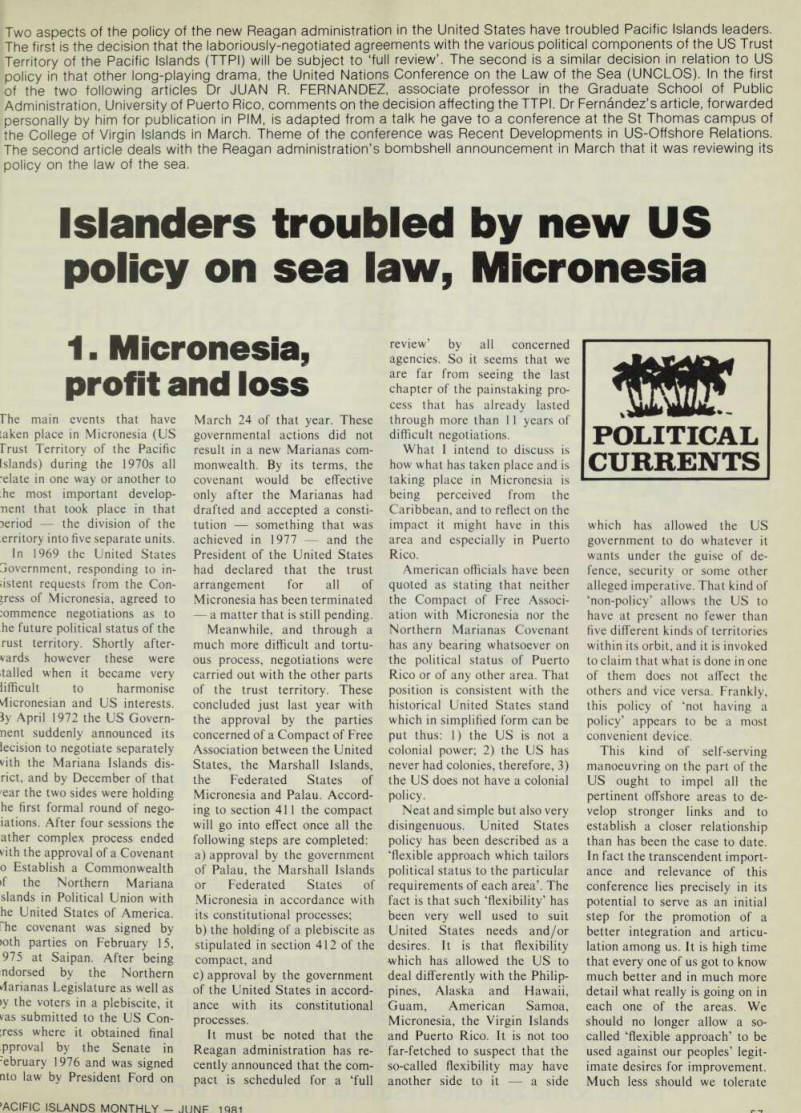

Political
Currents
Islanders troubled by new US policy on sea law, Micronesia
Two aspects of the policy of the new Reagan administration in the United States have troubled Pacific Islands leaders.
The first is the decision that the laboriously-negotiated agreements with the various political components of the US Trust Territory of the Pacific Islands (TTPI) will be subject to ‘full review’. The second is a similar decision in relation to US policy in that other long-playing drama, the United Nations Conference on the Law of the Sea (UNCLOS). In the first of the two following articles Dr JUAN R. FERNANDEZ, associate professor in the Graduate School of Public Administration, University of Puerto Rico, comments on the decision affecting the TTPI. Dr Fernandez’s article, forwarded personally by him for publication in PIM, is adapted from a talk he gave to a conference at the St Thomas campus of the College of Virgin Islands in March. Theme of the conference was Recent Developments in US-Offshore Relations.
The second article deals with the Reagan administration’s bombshell announcement in March that it was reviewing its policy on the law of the sea.
1. Micronesia, profit and loss
The main events that have taken place in Micronesia (US Frust Territory of the Pacific Islands) during the 1970 s all •elate in one way or another to ;he most important develop nent that took place in that period the division of the erritory into five separate units.
In 1969 the United States government, responding to in sistent requests from the Con gress of Micronesia, agreed to commence negotiations as to he future political status of the rust territory. Shortly after vards however these were tailed when it became very lifficult to harmonise vlicronesian and US interests.
Sy April 1972 the US Govern nent suddenly announced its lecision to negotiate separately vith the Mariana Islands dis rict, and by December of that 'ear the two sides were holding he first formal round of nego iations. After four sessions the ather complex process ended vith the approval of a Covenant o Establish a Commonwealth >f the Northern Mariana slands in Political Union with he United States of America, "he covenant was signed by >oth parties on February 15, 975 at Saipan. After being ndorsed by the Northern Tarianas Legislature as well as >y the voters in a plebiscite, it vas submitted to the US Con fess where it obtained final pproval by the Senate in r ebruary 1976 and was signed nto law by President Ford on
March 24 of that year. These governmental actions did not result in a new Marianas com monwealth. By its terms, the covenant would be effective only after the Marianas had drafted and accepted a consti tution something that was achieved in 1977 and the President of the United States had declared that the trust arrangement for all of Micronesia has been terminated a matter that is still pending.
Meanwhile, and through a much more difficult and tortu ous process, negotiations were carried out with the other parts of the trust territory. These concluded just last year with the approval by the parties concerned of a Compact of Free Association between the United States, the Marshall Islands, the Federated States of Micronesia and Palau. Accord ing to section 411 the compact will go into effect once all the following steps are completed: a) approval by the government of Palau, the Marshall Islands or Federated States of Micronesia in accordance with its constitutional processes; b) the holding of a plebiscite as stipulated in section 412 of the compact, and c) approval by the government of the United States in accord ance with its constitutional processes.
It must be noted that the Reagan administration has re cently announced that the com pact is scheduled for a ‘full
review’ by all concerned agencies. So it seems that we are far from seeing the last chapter of the painstaking pro cess that has already lasted through more than 11 years of difficult negotiations.
What I intend to discuss is how what has taken place and is taking place in Micronesia is being perceived from the Caribbean, and to reflect on the impact it might have in this area and especially in Puerto Rico.
American officials have been quoted as stating that neither the Compact of Free Associ ation with Micronesia nor the Northern Marianas Covenant has any bearing whatsoever on the political status of Puerto Rico or of any other area. That position is consistent with the historical United States stand which in simplified form can be put thus: 1) the US is not a colonial power; 2) the US has never had colonies, therefore, 3) the US does not have a colonial policy.
Neat and simple but also very disingenuous. United States policy has been described as a ‘flexible approach which tailors political status to the particular requirements of each area’. The fact is that such ‘flexibility’ has been very well used to suit United States needs and/or desires. It is that flexibility which has allowed the US to deal differently with the Philip pines, Alaska and Hawaii, Guam, American Samoa, Micronesia, the Virgin Islands and Puerto Rico. It is not too far-fetched to suspect that the so-called flexibility may have another side to it a side
which has allowed the US government to do whatever it wants under the guise of de fence, security or some other alleged imperative. That kind of ‘non-policy’ allows the US to have at present no fewer than five different kinds of territories within its orbit, and it is invoked to claim that what is done in one of them does not affect the others and vice versa. Frankly, this policy of ‘not having a policy’ appears to be a most convenient device.
This kind of self-serving manoeuvring on the part of the US ought to impel all the pertinent offshore areas to de velop stronger links and to establish a closer relationship than has been the case to date.
In fact the transcendent import ance and relevance of this conference lies precisely in its potential to serve as an initial step for the promotion of a better integration and articu lation among us. It is high time that every one of us got to know much better and in much more detail what really is going on in each one of the areas. We should no longer allow a so called ‘flexible approach’ to be used against our peoples’ legit imate desires for improvement.
Much less should we tolerate
that such desires be dismissed by some US official saying that what has been conceded else where has no bearing whatso ever on the other situations.
That is simply no longer accept able. Now that Micronesia has been the first to engage in what to some extent has been bilat eral negotiation and is or was at the brink of getting what she wants we should all do our best to see that that is ac complished. We should all put our efforts together so that no ‘full review’ based on a so-called ‘flexible approach’ is used to con her out of what is rightly hers.
As far as Puerto Rico is concerned the compact of free association that has been agreed to by the US and Micronesia’s representatives should serve as a stimulus for the improvement of its present commonwealth status.
If there is one point of agreement among Puerto Rican leaders and the people in gen eral it is that our current situation is highly unsatisfac tory and that change is needed.
Those of us who favour auton omy and free association must strive for the attainment of the improvements that will trans form commonwealth into a legitimate and acceptable pol itical status both domestically and internationally. For that the Micronesian experience may well serve to orient our endeav ours in the right direction.
But, what about our partner to the north? Is it capable of rising to the heights required by the contemporary world? It is indeed ironic that as decoloni sation is coming to an end the United States is being in creasingly perceived as the last great coloniser. Will it be that the closing chapter of the decolonisation story will be smirch the country that after World War II was the hope of the oppressed peoples and countries?
Indeed, things have changed and the image the United States now projects is far from being the one it had in that not so distant past. The way Americans have dealt with their offshore areas has undoubtedly been a factor promoting that negative image. The rumblings coming from the new adminis
tration are not the least encour aging. First we are told that the Compact of Free Association that resulted from more than eleven years of hard nego tiations and that was duly initialled last October by US and Micronesian representa tives is scheduled for a ‘full review’ by the Washington side.
In addition, the acceptance of the resignation of Ambassador Rosenblatt, who had so ably headed the American team in the negotiations with the Micronesians for the last difficult three years, has also been a source of deep worry.
The intended ‘full review’ without Mr Rosenblatt’s par ticipation and in the context of such recent actions taken by President Reagan as the with drawal of a fisheries treaty with Canada from consider ation by the Senate, holding up American participation in the Law of the Sea Conference, and the dismissal of a commission appointed by President Carter to examine the claims of native Hawaiians growing out of the annexation of their islands by the US in 1898, does not bode well for Micronesia.
But it also may prove harm ful for the US if they don’t deal fairly with this situation. It is high time for the US to shed the requirement for subordination that has so obviously character ised American policy in its dealings with the offshore areas.
Of course, it is within its powers not to do so, but that would be at a price. Though it is true that in the international scenario we may not be all that relevant, on the other hand we are not completely powerless.
The offshore areas would be in a much better position if we could present a more united front opposite US intentions. I be lieve we should strive for this.
Moreover, in the contempor ary world there are other ways and other forums in which we can be heard. That possibility should not be ignored either.
Certainly, it would be more enlightened and convenient for the US to avoid all that and to deal differently, and in a fairer, more equitable and even handed way with its offshore areas. Unfortunately, from here and now, there is not much
room for hope.
Juan R.
Fernandez.
2. The scuttling
Of Unclos
The Reagan administration threw a huge spanner in the works of the seven-year-old United Nations Conference on the Law of the Sea (UNCLOS) in March when it announced that it was ‘reviewing’ its policy on the whole matter. The an nouncement came just two days before the final session of the conference was due to begin.
Now, a new UNCLOS session is scheduled for Geneva in August.
The US action has caused dismay among many developed countries and outrage among developing countries, not least those in the Pacific. Most of the precious seabed mineral re sources potato-like nodules containing nickel, cobalt, manganese and copper lie on the floor of the Pacific. Islands leaders have repeatedly voiced the hopes of future economic
benefit to their countries flow ing from these resources.
Reporting from Washington in The Sydney Morning Her ald, Australian journalist Mike Steketee wrote in April: ‘Most of the members of the 158 delegations have become con vinced that the US is out to scuttle the proposed treaty be cause of pressure from private American mining interests. ‘There are also dark mutter ings in the recesses of the Reagan administration that the proposed treaty is all a Soviet plot . . . ‘Five mining consortia have developed the technology to the point where mining (the seabed) could become feasible in several years. Four of those five consortia have substantial US participation. ‘This is where the clash of interests occurs. The mining
companies say that, if they go to the trouble of mining the deep sea, the profits should be theirs. ‘The developing countries ob ject to the US plundering re sources it does not own.’ (The principle adopted by UNCLOS is that the seabed minerals are ‘the common heritage of man kind’).
The compromise in the draft treaty is the creation of an international authority to con trol development of the nodules. ‘With the lofty name of The Enterprise, it would issue li cences to private companies for mining and it would charge a royalty, much as national governments do now. ‘ln addition, The Enterprise would be entitled to establish a mine for each one developed by private industry. ‘The profits from this, together with the royalty, would be distributed to poor nations. ‘lt would be one step towards narrowing the gap between the developed and the developing world a gap that has widened greatly in recent years, mainly because of soaring oil costs. ‘Some elements in the Reagan administration believe this all smacks too much of a Soviet-inspired model of central planning. ‘The perceived Soviet plot comes from the fact that the Russians, while they have their own abundant reserves of the minerals found in the deep sea, want to limit US access to them so that the Americans have to continue relying on potentially unstable suppliers in Africa.’
Steketee described the man ner in which the US about-face was effected as ‘an object lesson in how not to conduct diplo macy’. He recorded the follow ing sequence of events: • On March 7, two days before the final session of UNCLOS was due to begin, the administration sacked the head of the US delegation, George Aldrich, and most of his senior staff. • One US delegate learnt of his dismissal while reading a newspaper on his way to the conference. • American allies, including Australia, found out about it in the same way, despite the administration’s lavish prom ises of a new era of co-operation.
• James Malone, an in coming assistant secretary of state, was appointed to replace Mr Aldrich. • Because of Mr Malone’s limited background in law-of the-sea issues, Leigh Ratiner was added to the delegation. (Mr Ratiner, from 1977 to 1979, was a lobbyist for Kennecott Corporation, a lead ing member of one of the deep sea consortia and the company most vocal of all in its oppo sition to the treaty.) Steketee summed up: ‘While the administration has been extraordinarily taciturn, it is clear that the “policy review” is a euphemism for rewriting the treaty to give the mining com panies a bigger return some thing which probably is imposs ible at this stage or keeping it in limbo indefinitely. ‘ln the meantime, the American companies could well decide to start mining, since they already have the backing of a unilateral US law on seabed mining. ‘That would mean the nego tiations that Mr Elliot Richardson, a former head of the US delegation, described as “the most significant single event in the history of peaceful co-operation since the founding of the United Nations” would dissolve into a more typical bout of international wrangling.’
Asking questions
on Vanuatu
Two distinguished citizens of the new nation of Vanuatu visited Australia in March- April as guests of the Austra lian Government. They were Grace and Sela Molisa, respect ively deputy secretary of the prime minister’s department and general manager of the Vanuatu Co-operative Feder ation.
They travelled extensively throughout Australia during their three-week stay, and dur ing their visit to Sydney the husband and wife team agreed to be interviewed by PIM.
PIM used as a basis for the interview several points raised in a letter we had received from an expatriate resident of Vanuatu who, while friendly to the government, made a num
ber of criticisms of its work since independence. The Melisas answered the questions with great poise. Only once or twice did a note of impatience appear at what they evidently saw as poorly informed atti tudes on the part of the writer.
Point 1: The government has made little progress in econ omic development since inde pendence.
Comment: We don’t want to make excuses for the lack of action in this field, but the fact is that the condominium powers made no preparations for the setting-up of an independent state. This has left us with many problems of all kinds, not least in the economic field. It is doubtful if any other country has faced problems of such magnitude on attaining inde pendence.
On top of this, we have had the problem of the Santo se cession. This again we believe to have been a unique set of cir cumstances.
We know that there should be proper economic planning, so that the country can take off on a sound fooling. But we’ve had to neglect things that we knew to be essential. However, de spite the difficult beginning, we are doing all we can to steer ourselves on to the right course as quickly as possible. For example, a National Economic Development Committee has been set up. It has the job of charting a course of economic development for the next five or 10 years.
A second thing we believe to be important is that the public service survey being done by experts from the United Nations Development Pro gramme should be complete by about the middle of the year.
This will give us an idea of the kind of public service our country can afford.
What happened at indepen dence is that the condominium powers landed three separate administrations in our lap British, French, and joint and left it to us to sort things out. One thing was obvious: they were too expensive.
Some salary levels were too high, some too low. It was crazy. The British and French had entirely different ideas. A trained British nursing sister
was getting the same money as a French trainee nurse. Trained British specialists were paid the same as a French messenger.
We have high hopes that the UNDP survey will help us greatly in sorting out the tangle.
Point 2: There are only three French-speaking soldiers in the Vanuatu Defence Force and I would like to know what advantages members of the force enjoy that are not avail able to other people.
Comment: Taking the second point first. The Vanuatu Mobile Force is the correct name of this new body. These people are policemen. After returning from Papua New Guinea, they do three months training in police duties. As civil servants, they get exactly the same pay as anyone else coming into any department.
On the first point, we believe there are at least 10 or more French-speaking members in the force from Erakor village near Port-Vila.
In general, we’re surprised that anyone who’s lived in the country, and who understands anything about it especially about the French education system, and its links with the Catholic Church would ask this question.
Point 3. There has been much discussion of the circum stances surrounding the sack ing of the expatriate former managing director of Vanua Navigation, Claus Bjornum.
Why did it happen?
Comment: Vanua Navigation is a shipping company which is owned 10% by the Vanuatu Government, 50% by the Vanuatu Co-operative Feder ation, and 40% by the Noumea based Sofrana Unilines. It is concerned with freight handling, principally in Santo and Port-Vila.
Sofrana in particular thought that the previous manager was too ‘soft’ towards the Co operative Federation. So, from November 1, 1980, Mr Bjornum was brought in as managing director, with par ticular responsibility for stevedoring. He was a very tough guy, very professional in stevedoring matters.
On January 26 Mr Bjornum sent letters to company em ployees. Fifty-two of them were
informed by letter that they were dismissed.
The government felt that there was a political motive in the action, and objected par ticularly to the fact that no notice had been given to those who were sacked. This, in sum mary, is why Mr Bjornum’s work permit in Vanuatu was terminated. (Sela Molisa, as general man ager of the majority share holder company in Vanua Navi gation, continued: I was in formed four days before the people were sacked. If it had been brought up at a board meeting, I could have argued it out as a director. After it had happened, I was called to the prime minister’s office, and I expressed my view that I would have preferred some expatriates to be sacked.
The order dismissing Claus was authorised by the prime minister.) Point 4. Opposition member Father Gerard Leymang charges the government with surrendering control of Vanuatu’s affairs to expatriate advisers and his charge seems plausible to anyone who has an evening drink on the terrace of the Hotel Rossi.
Comment: We were pleased to see this statement by Father Leymang.
Back in 1979, the political situation reached the point where it was agreed that the Vanuaaku Party (VP) would participate in government, and so the Government of National Unity was formed. In accord ance with the principles of the VP, its ministers moved into government with entirely local staff. Their intention was also to work without expatriate ad visers.
But the political situation was very difficult, and compromises had to be made. So each VP minister took on two advisers, one British, one French. But their staffs remained all Black.
But Chief Minister Father Leymang, on the other hand, was entirely surrounded by Whites. No Bislama was spoken in his office. He even had a French submariner as his first secretary.
That’s why we’re so pleased that Father Leymang has woken up.
Advertisements & other items, pp. 57-58 (2 items)
Acific Islands Monthly - Junf Iqfti
Kerr Bros. Pty. Ltd.
95-99 York Street, Sydney, NSW 2000 Australia Cables: Carefulnes, Sydney Telex: AA23181 Phone 29-5703 Box 3838 GPO Sydney, NSW, 2001, Australia.
WE WILL BE PLEASED TO BRING THE
WORLD TO YOUR WAREHOUSE
Bon'P®
won mm
**WB»WnS£
CELEBRITY
GJAf
~v
COMPLETE AUSTRALIAN BUYING SERVICE
EXPERT ATTENTION TO ALL TRADE
REQUIREMENTS
The people in the Pacific for: 777' Brand Mackeral, Bekaert Wire Products, Dandy Chewing Gum, Co-Ro Soft Drink Products, Sheldon Refrigerators, Bompani Gas Cookers, Swedish Match Co., Gilbeys Gin, J & B Rare Scotch Whisky, Fay Paper Products, Lasher Tools, Lamex Laminated Sheets, Ole Brand Nuts, Vicon Agricultural Equipment, Celebrity Meat Products, Oatfield Sweets, Bicks Pickles, Da Silva Wines, Girmi Electrical Appliances, Sigma Paints... and many more (enquiries welcome). *Note: Some agencies restricted to certain territories*
People
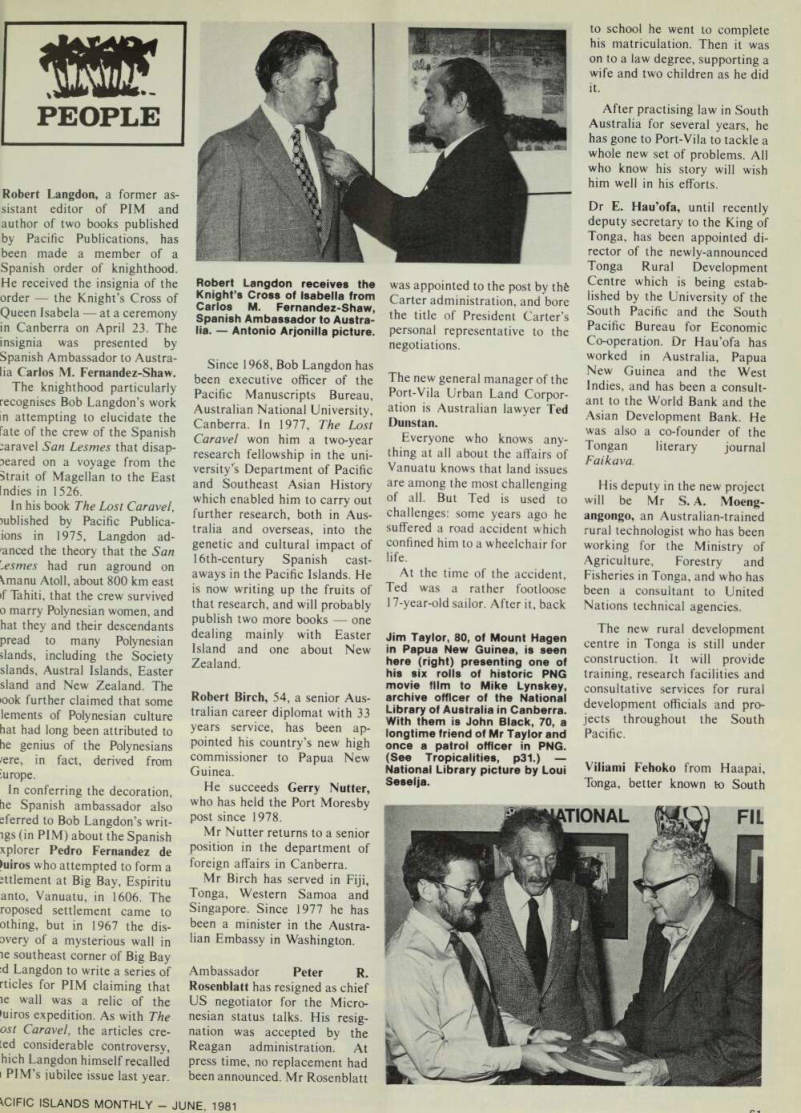
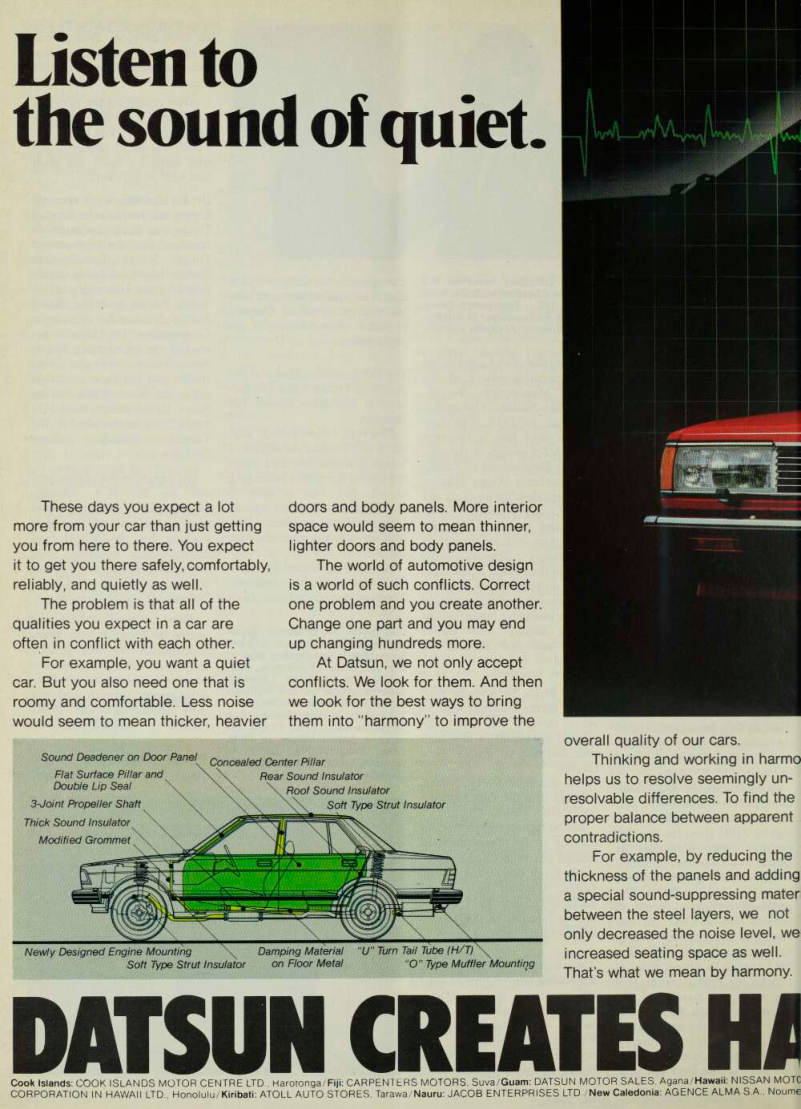

Robert Langdon, a former as sistant editor of PIM and author of two books published by Pacific Publications, has been made a member of a Spanish order of knighthood.
He received the insignia of the order the Knight’s Cross of Queen Isabela at a ceremony in Canberra on April 23. The insignia was presented by Spanish Ambassador to Austra lia Carlos M. Fernandez-Shaw.
The knighthood particularly recognises Bob Langdon’s work in attempting to elucidate the fate of the crew of the Spanish :aravel San Lesmes that disap peared on a voyage from the Strait of Magellan to the East indies in 1526.
In his book The Lost Caravel, mblished by Pacific Publica ions in 1975, Langdon ad vanced the theory that the San lesmes had run aground on Atoll, about 800 km east »f Tahiti, that the crew survived 0 marry Polynesian women, and hat they and their descendants pread to many Polynesian dands, including the Society slands, Austral Islands, Easter sland and New Zealand. The •ook further claimed that some lements of Polynesian culture hat had long been attributed to he genius of the Polynesians 'ere, in fact, derived from Europe.
In conferring the decoration, he Spanish ambassador also sferred to Bob Langdon’s writ igs (in PIM) about the Spanish xplorer Pedro Fernandez de luiros who attempted to form a Jttlement at Big Bay, Espiritu anto, Vanuatu, in 1606. The roposed settlement came to othing, but in 1967 the dis- Dvery of a mysterious wall in ie southeast corner of Big Bay :d Langdon to write a series of rticles for PIM claiming that ie wall was a relic of the >uiros expedition. As with The ost Caravel, the articles cre ted considerable controversy, hich Langdon himself recalled 1 PlM’s iubilee issue last year.
Since 1968, Bob Langdon has been executive officer of the Pacific Manuscripts Bureau, Australian National University, Canberra. In 1977, The Lost Caravel won him a two-year research fellowship in the uni versity’s Department of Pacific and Southeast Asian History which enabled him to carry out further research, both in Aus tralia and overseas, into the genetic and cultural impact of 16th-century Spanish cast aways in the Pacific Islands. He is now writing up the fruits of that research, and will probably publish two more books one dealing mainly with Easter Island and one about New Zealand.
Robert Birch, 54, a senior Aus tralian career diplomat with 33 years service, has been ap pointed his country’s new high commissioner to Papua New Guinea.
He succeeds Gerry Nutter, who has held the Port Moresby post since 1978.
Mr Nutter returns to a senior position in the department of foreign affairs in Canberra.
Mr Birch has served in Fiji, Tonga, Western Samoa and Singapore. Since 1977 he has been a minister in the Austra lian Embassy in Washington.
Ambassador Peter R.
Rosenblatt has resigned as chief US negotiator for the Micro nesian status talks. His resig nation was accepted by the Reagan administration. At press time, no replacement had been announced. Mr Rosenblatt
was appointed to the post by the Carter administration, and bore the title of President Carter’s personal representative to the negotiations.
The new general manager of the Port-Vila Urban Land Corpor ation is Australian lawyer Ted Dunstan.
Everyone who knows any thing at all about the affairs of Vanuatu knows that land issues are among the most challenging of all. But Ted is used to challenges: some years ago he suffered a road accident which confined him to a wheelchair for life.
At the time of the accident, Ted was a rather footloose 17-year-old sailor. After it, back
to school he went to complete his matriculation. Then it was on to a law degree, supporting a wife and two children as he did it.
After practising law in South Australia for several years, he has gone to Port-Vila to tackle a whole new set of problems. All who know his story will wish him well in his efforts.
Dr E. Hau’ofa, until recently deputy secretary to the King of Tonga, has been appointed di rector of the newly-announced Tonga Rural Development Centre which is being estab lished by the University of the South Pacific and the South Pacific Bureau for Economic Co-operation. Dr Hau’ofa has worked in Australia, Papua New Guinea and the West Indies, and has been a consult ant to the World Bank and the Asian Development Bank. He was also a co-founder of the Tongan literary journal Faikava.
His deputy in the new project will be Mr S. A. Moeng angongo, an Australian-trained rural technologist who has been working for the Ministry of Agriculture, Forestry and Fisheries in Tonga, and who has been a consultant to United Nations technical agencies.
The new rural development centre in Tonga is still under construction. It will provide training, research facilities and consultative services for rural development officials and pro jects throughout the South Pacific.
Viliami Fehoko from Haapai, Tonga, better known to South
Robert Langdon receives the Knight’s Cross of Isabella from Carlos M. Fernandez-Shaw, Spanish Ambassador to Austra lia. Antonio Arjonilla picture.
Jim Taylor, 80, of Mount Hagen in Papua New Guinea, is seen here (right) presenting one of his six rolls of historic PNG movie film to Mike Lynskey, archive officer of the National Library of Australia in Canberra.
With them is John Black, 70, a longtime friend of Mr Taylor and once a patrol officer in PNG. (See Tropicalities, p31.)
National Library picture by Loui
Seselja.
Pacific yachties as Tonga Bill, recently dropped in at Cairns, North Queensland, Australia, to show some friends how to roast pig, Polynesian style.
Not long before, Bill had twice capsized his tiny (5.5 m) home-built plywood sloop Mata Moana in big trade-wind seas, and been blown on to a reef in northeast Papua New Guinea, holing his boat badly.
Other cruising yachtsmen know Tonga Bill as one of those real-life characters who just
keeps on keeping on. The Aus tralians among them will cer tainly miss him when he moves on to his next destination, the USA. Paul and Sue Malkinson.
Joketani Cokanasiga, a former general manager of the Fiji Visitors Bureau, has been ap pointed director-administration of the Ports Authority of Fiji.
He succeeds Narayan Singh, who has become the PAF’s first director-operations.
Until recently Mr Cokan asiga was working in Nauru for the Nauru Local Government Council.
His new job will involve co ordinating work in the PAF sections dealing with finance, personnel, public relations, training, electronic data pro cessing, research and planning, and operational methods.
Announcing the appoint ments, Director-General Loh Heng Kee said it was regretted that on a few occasions, for reasons beyond the PAF’s con trol, customers had been left dissatisfied. He gave his assur ance that it was a concern of the PAF that port users were looked after and served to the best of the port’s ability. He believed the new appointments would help ensure this was done.
Joseph David Gibson is the new Fiji high commissioner to New Zealand. Mr Gibson was pre viously high commissioner in London. He has swapped jobs with his predecessor in New Zealand, Ratu Josua Togan valu, who had served there since 1978.
Pope John Paul II has named Monsignor Francesco De Nittis as Papal Pro-Nuncio to Papua New Guinea and Apostolic Del egate in Solomon Islands.
Monsignor De Nittis was also appointed an archbishop.
Senior posts in the Royal Fiji Military Forces are to be reshuffled in July.
Chief of Staff Lt-Col Ratu Epeli Nailatikau will take up a senior appointment at the head quarters of the United Nations Peace-keeping Force in south ern Lebanon at Qana. He will be succeeded as chief of staff by Lt-Col Sitiveni Rabuka, outgo ing commander of the RFMF battalion in Lebanon. Lt-Col Rabuka will be replaced by Lt- Col Edward Tuivanuavou as battalion commander.
Former commander of the battalion, Lt-Col Jim Sanday is doing a senior officer’s course at the Australian Military Acad emy in Canberra.
The nine-member operations group for the Commonwealth
Games, Brisbane, Australia in October 1982 includes David Keating, who will serve as venues divisional manager.
Mr Keating is a former distance runner, physical edu cation teacher and sports master.
He worked in Papua New Guinea for nine years as head-
master of secondary boarding
schools, represented PNG at three South Pacific Games, and was a national selector and coach for basketball. He was awarded the PNG Indepen dence Medal in 1977 for ser vices to sport.
Bill Brown, director of pro grammes for the South Pacific Commission, has been re appointed for another three year term. The appointment was approved by the 20th South Pacific Conference held in Papua New Guinea last year.
Akuila Savu has been appointed chief executive of Air Pacific, Fiji’s national airline. He re places Captain Alan Bodger.
Mr Savu was previously deputy general manager of the airline, as well as the director of the Fiji Government central planning office.
Tonga’s Finance Minister Mahe ’Uli’uli Tupouniua was elected in March as the chairman of the 37th session of the United Nations Economic and Social Commission for Asia and the Pacific (ESCAP).
Long involved in economic development activities in the region, Mr Tupouniua is well remembered as the first director of the South Pacific Bureau for Economic Co-operation
David Keating
(SPEC), and for the many posts he has held in government in Tonga.
Detective-Inspector George Namaka of the Vanuatu police has returned from a successful two-month study course in for ensic science in Adelaide, Aus tralia. Det-Insp Namaka passed all exams to become the first police officer from a developing Pacific country to complete the training.
Police Captain Robert Kumtak has become the first Marshall ese to serve as chief of police in the Marshall Islands. He suc ceeds H. Wally Wotring, who has declined another contract.
Mr Wotring said; ‘I feel it is time the Marshallese people took over the position of leader ship in this department I feel it is time they were given the opportunity. The only way to learn is to do the job.’ He added that his decision was in line with the government’s policy of phasing out expatriates so that more capable Marshallese can take over their jobs.
Captain Kumtak has been in the police force for almost 14 years. He was promoted to sergeant in 1975, in 1978 to lieutenant, and more recently to captain.
Expressing pride in his new appointment, he said: T’m look ing forward to working and helping the Marshallese people to the best of my ability.’ fhe board of regents of the College of Micronesia has an aounced the selection of Resio Moses as the new president of he Community College of Micronesia in Ponape state, iccording to the Federated States of Micronesia’s Public information Officer Derson iamon.
Moses was chosen from 33 ipplicants for the post, which vas advertised in several news )apers throughout the Pacific.
The College of Micronesia is nade up of the CCM on Ponape tate, the CCM Nursing School n the Commonwealth of the Northern Marianas, and the rticronesian Occupational Col ege in the Republic of Belau.
Mr Moses, 36, is a teacher nd administrator of wide ex
perience. He taught at the CCM in the early ’7os, and was Ponape DistAd (district admin istrator) from December 1976 to November 1977. He was a member of the House of Rep resentatives, Congress of Micronesia, from 1972 to October 1976.
Jack Nash, a former director of prison establishments in the Corrective Services Com mission of the Australian state of New South Wales, on a two year assignment with the Fiji Prison Service. Mr Nash’s title is that of prisons adviser.
His appointment follows rec ommendations made by Fiji Solicitor-General Qoriniasi Bale after his investigation of the riots which shook Fiji’s prison system in early January 1980.
Tonga’s only woman MP, Papiloa Foliaki, spent five weeks in the US in March and April attending a series of women’s conferences in various states organised to mark the half-way point of the Inter national Decade of Women.
Her trip was jointly spon sored by the Asia Foundation and the Overseas Education Fund of the American League of Women Voters.
Mrs Foliaki was one of six overseas guests invited to attend the conferences because of their ‘positive and objective’ contri butions to the International Women’s Conference in Copenhagen last year (PIM Oct 1980 p2l). Others in the group came from Southeast Asia, Sri Lanka, Africa, Colombia and New Zealand (representing the Maoris of that country).
Penny Hodgkinson in Nukualofa.
Kipling Uiari, former Lord Mayor of Port Moresby, has been appointed public affairs manager for the Ok Tedi Min ing Company. In this position he will be the top Papua New Guinean in the company. Mr Uiari was educated in Austra lia. He has been a trainee diplomat, a psychologist, and, until a year ago, secretary for PNG’s Department of Labour and Industry.
When he left the department
he went to the Public Services Commission and served as Lord Mayor until the suspension of Port Moresby City Council last October.
Professor Roger W. Hopkins, former deputy vice-chancellor of the University of the South Pacific, has resigned to take up a senior post in management studies at the University of Waikato, New Zealand. He had spent almost six years as pro fessor of accountancy at USP.
His successor as deputy vice chancellor is Professor Donald E. Paterson, head of the school of social and economic develop ment at USP. Professor Paterson has been at USP since January 1979.
Komeini Kanawi, the first Papua New Guinean to become a licensed engineer, has been given a major award by the Royal New Zealand Aeronaut ics Society. It is the Douglas Patterson Award and Medal for outstanding achievement. Mr Kanawi, who is employed by Air Niugini, is on a 12-month engineering training pro gramme with Air New Zealand.
The Douglas Patterson award was introduced recently to en courage people from the South Pacific to make a career in aviation. Mr Kanawi is from Langendrona Village, Manus Island.
The United Nations Year of the Disabled Person seems a good time to pay tribute to the achievements of a well-known resident of the Western Samoa
capital Apia, Roderick Crichton, called Liki in Samoan.
A promising boxer in his youth, Mr Crichton became blind at the age of 19.
Despite his handicap, he suc cessfully undertook a four-year course at Malua Theological College. It was while he was preaching in a south coast village of Upolu that he met and married his wife, Sia. They have five sons, the eldest 14.
After completing correspon dence courses in economics and journalism, in 1976 Liki launched his own newspaper.
The Samoa Weekly, which is still flourishing today. It caters principally for Samoan language readers. Eight thou sand copies are printed weekly, and distribution is to the two Samoas and other islands, Hawaii, New Zealand and Aus tralia.
Mr Crichton is also founder of the Association of the Blind, whose presidency he resumed in 1980. He was also elected first president of the Western Samoa Press Association last year.
His Samoa Weekly, with its Samoan-language stories, be gan the recent press revolution in the country, which now boasts 13 weekly papers/mag azines, and two fortnightlies.
William Sharpe-Dunn.
Officials from Pacific Island and Asian countries recently at tended an Australian-organised course on trade marks and their role in the economy. In Canberra, Irene Pellegrino of the Australian Patent Office discusses the course with (from left) Tere Mataio, Cook Islands; I.V. Helu, Fiji; and Tekoreaua
Kairoro, Kiribati.-AIS picture
by Darryl Lawton.
Advertisements & other items, pp. 61-66 (3 items)
Kcific Islands Monthly - June, 1981
Datsun Creates Hi
Listen to
the sound of quiet.
These days you expect a lot more from your car than just getting you from here to there. You expect it to get you there safely, comfortably, reliably, and quietly as well.
The problem is that all of the qualities you expect in a car are often in conflict with each other.
For example, you want a quiet car. But you also need one that is roomy and comfortable. Less noise would seem to mean thicker, heavier doors and body panels. More interior space would seem to mean thinner, lighter doors and body panels.
The world of automotive design is a world of such conflicts. Correct one problem and you create another.
Change one part and you may end up changing hundreds more.
At Datsun, we not only accept conflicts. We look for them. And then we look for the best ways to bring them into “harmony” to improve the Sound Deadener on Door Panel Flat Surface Pillar and Double Lip Seal 3-Joint Propeller Shaft Thick Sound Insulator Modified Grommet Concealed Center Pillar Rear Sound Insulator Roof Sound Insulator Soft Type Strut Insulator Newly Designed Engine Mounting Soft Type Strut Insulator Damping Material on Floor Metal “U” Turn Tail Tube (H/T)\ “O” Type Muffler Mounting overall quality of our cars.
Thinking and working in harmo helps us to resolve seemingly unresolvable differences. To find the proper balance between apparent contradictions.
For example, by reducing the thickness of the panels and adding a special sound-suppressing mater between the steel layers, we not only decreased the noise level, we increased seating space as well.
That’s what we mean by harmony.
DATSUN CREATES HI
Cook Islands: COOK ISLANDS MOTOR CENTRE LTD , Rarotonga/Fiji: CARPENTERS MOTORS, Suva/Guam: DATSUN MOTOR SALES, Agana/Hawaii: NISSAN MOTC CORPORATION IN HAWAII LTD , Honolulu/Kiribati: ATOLL AUTO STORES, Tarawa/Nauru: JACOB ENTERPRISES LTD New Caledonia: AGENCE ALMA SA, Noume
And there’s a lot of it in every >un.
From “fine tuning” vibrations sed by the engine, drive train and > until they mutually cancel each *r out, so that passengers enjoy lieter, more comfortable ride. * uspending the engine on special i-damping rubber insulators :h permit vibrations to escape the air before they have a chance et into the car.
From minimizing air resistance through aerodynamic styling to maximizing sound absorption by placing insulating material everywhere vibrations are likely to occur.
No noisy detail is overlooked.
Even the antenna is located where it makes the least amount of noise.
Problem-solving by designfinding the proper balance between conflicting elements—has helped Datsun build cars that are quiet and roomy, yet light and fuel efficient.
At Datsun, we’re working hard to design the kind of cars the world needs. Without sacrificing what you want in your car.
That’s harmony.
The model shown above is the Datsun 1808 for Europe.
Specifications and equipment may vary according to market.
DATSUN
MONY BY DESIGN
THE NAME OF QUALITY
NISSAN
NISSAN MOTOR CO. LTD
iatu: PENTECOST S A , Port Vila and Santo Norfolk Islands: SIRIUS MOTORS/Papua New Guinea: BOROKO MOTORS LTD , Port Moresby/Saipan: JOETEN MOTOR IPANY INC./Solomon Islands: UNITED ENTERPRISES LTD , Honiara/Tahiti: TAHITIBULL S.A.R.L , Papeete Western Samoa: MORRIS HEDSTROM LTD , Apia
Wonderest
tor the trie rest your EXPORTERS OF FINE BEDDING TO THE PACIFIC ISLANDS
♦ PAPUA NEW GUINEA
♦ SOLOMON ISLANDS
♦VANUATU
Contact: WEST TASMAN TRADERS
P.O. BOX 709 PORT MORESBY Ph. 21 4332
ALL OTHER AREAS
Contact
HEAD OFFICE
MATTRESS MAKERS
CABLE WONDEREST
BRISBANE
00 <3- 5
SHIRTS
Promote your Company, Organisation, Product or Service on T-
SHIRTS, SCREEN PRINTED with
your Logo, Message or Special
Design.
We are the Professionals. We have a full range of styles and colours available Our prices by Sea or by Air are very competitive. Our products are of excellent quality. Orders however must be more than 250 shirts. We also supply Sports Uniforms, Caps, Hats, Flags, Badges etc. Write, Phone, or Telex us now with your order or for an instant quotation.
THE T-SHIRT PEOPLE LTD.
G.P.O. Box 9431 HONG KONG.
Tel: 3 7213409 Telex; 75974 PBDWL HX
So space is at a premium but full stereo sound is a prerequisite? Then this is your component system. The J-2 Mini Hi-Fi may be slight of build, but it’s built to make your music move you. The amplifier belts out an impressive 25 watts j per channel. The tuner picks up three separate bands: FM Stereo, Medium Wave and Long Wave. The metal-tape-capable cassette deck keeps recorded music pure. And the matching speakers boast 12cm woofers and scm tweeters to mnkp everything sound like it should. The J-2 Mini Hi-Fi System from Hitachi. Its a small thing ||-| until you turn it on. fc It The Hitachi J-2 Mini Hi-Fi System includes B the HA-J 2 Integrated Amplifier, the FT-J 2 Tuner KHi with T .RD timincr inHir>nHnn tVio F1..T9 PacooHo Do with LED tuning indication, the D-J2 Cassette Deck NR,* and HS-J2 Speaker Systems. y is a trademark of Dolby Laboratories, Inc F I J| a a a %
SOFT TOUCH CONTROL
L a
©HITACHI *
♦ HITACHI
65
PEOPLE
’ACIFIC ISLANDS MONTHLY - JUNE, 1981
were king
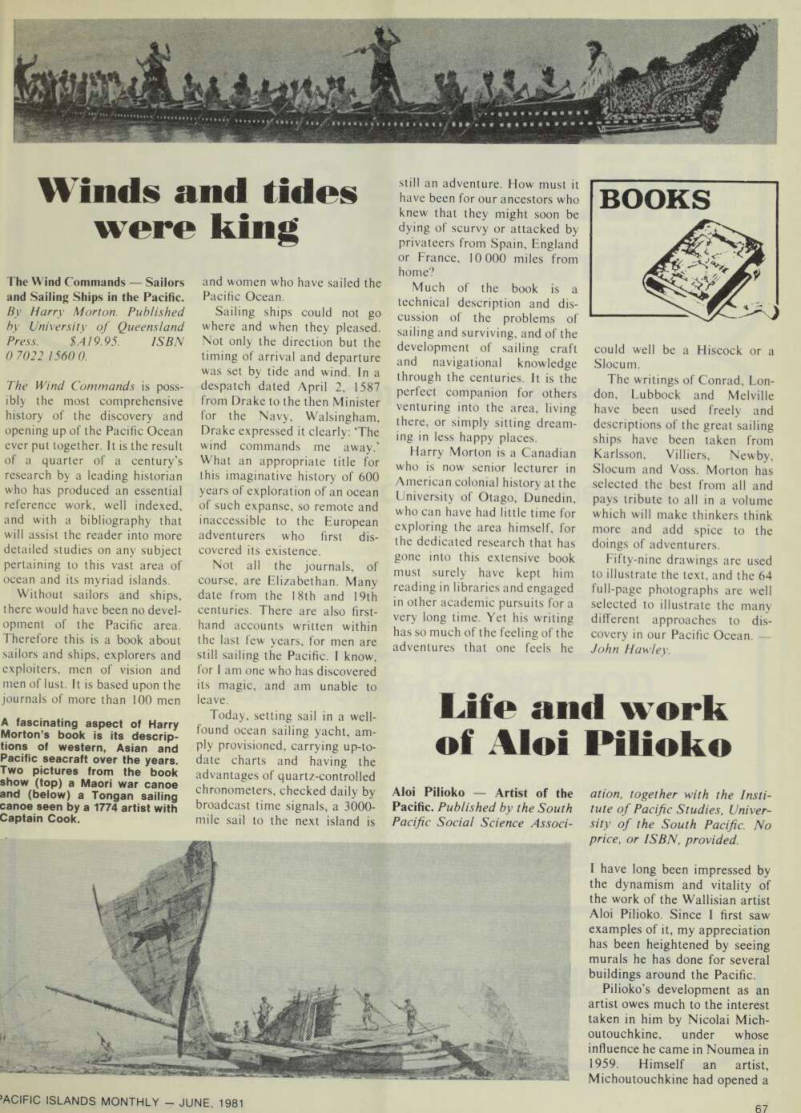
Books
Winds and tides were king
The W ind Commands Sailors and Sailing Ships in the Pacific.
By Harry Morton. Published by University of Queensland Press. 5A19.95. ISBN 0 7022 1560 0.
The Wind Commands is poss ibly the most comprehensive history of the discovery and opening up of the Pacific Ocean ever put together. It is the result of a quarter of a century’s research by a leading historian who has produced an essential reference work, well indexed, and with a bibliography that will assist the reader into more detailed studies on any subject pertaining to this vast area of ocean and its myriad islands.
Without sailors and ships, there would have been no devel opment of the Pacific area.
Therefore this is a book about sailors and ships, explorers and exploiters, men of vision and men of lust. It is based upon the journals of more than 100 men
and women who have sailed the Pacific Ocean.
Sailing ships could not go where and when they pleased.
Not only the direction but the timing of arrival and departure was set by tide and wind. In a despatch dated April 2, 1587 from Drake to the then Minister for the Navy, Walsingham, Drake expressed it clearly; The wind commands me away.’
What an appropriate title for this imaginative history of 600 years of exploration of an ocean of such expanse, so remote and inaccessible to the European adventurers who first dis covered its existence.
Not all the journals, of course, are Elizabethan. Many date from the 18th and 19th centuries. There are also first hand accounts written within the last few years, for men are still sailing the Pacific. I know, for I am one who has discovered its magic, and am unable to leave.
Today, setting sail in a well found ocean sailing yacht, am ply provisioned, carrying up-to date charts and having the advantages of quartz-controlled
chronometers, checked daily by
broadcast time signals, a 3000mile sail to the next island is
still an adventure. How must it have been for our ancestors who knew that they might soon be dying of scurvy or attacked by privateers from Spain, England or France, 10 000 miles from home?
Much of the book is a technical description and dis cussion of the problems of sailing and surviving, and of the development of sailing craft and navigational knowledge through the centuries. It is the perfect companion for others venturing into the area, living there, or simply sitting dream ing in less happy places.
Harry Morton is a Canadian who is now senior lecturer in American colonial history at the University of Otago, Dunedin, who can have had little time for exploring the area himself, for the dedicated research that has gone into this extensive book must surely have kept him reading in libraries and engaged in other academic pursuits for a very long time. Yet his writing has so much of the feeling of the adventures that one feels he
could well be a Hiscock or a Slocum.
The writings of Conrad, Lon don, Lubbock and Melville have been used freely and descriptions of the great sailing ships have been taken from Karlsson, Villiers, Newby, Slocum and Voss. Morton has selected the best from all and pays tribute to all in a volume which will make thinkers think more and add spice to the doings of adventurers, Fifty-nine drawings are used to illustrate the text, and the 64 full-page photographs are well selected to illustrate the many different approaches to dis covery in our Pacific Ocean.
John Hawley.
A fascinating aspect of Harry Morton’s book is its descrip tions of western, Asian and Pacific seacraft over the years.
Two pictures from the book show (top) a Maori war canoe and (below) a Tongan sailing canoe seen by a 1774 artist with Captain Cook.
of Aloi Pilioko

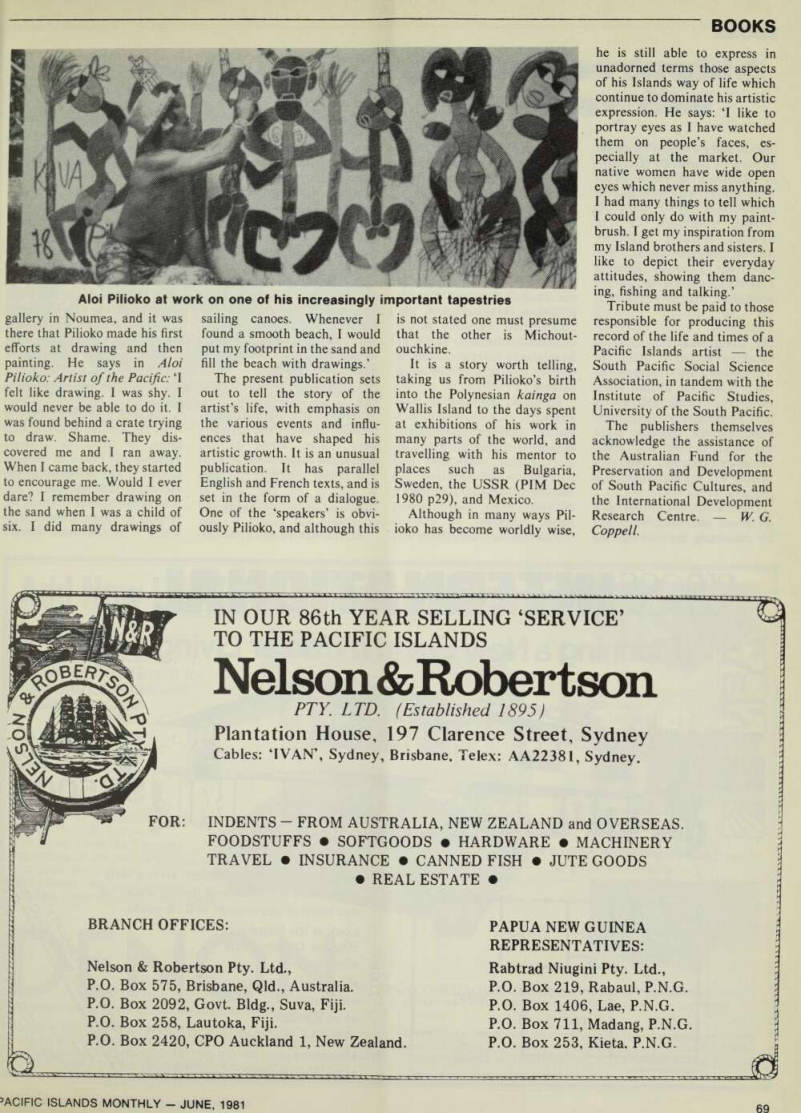
Life and work of Aloi Pilioko
Aloi Pilioko Artist of the Pacific. Published by the South Pacific Social Science Associ
ation, together with the Insti tute of Pacific Studies, Univer sity of the South Pacific. No price, or ISBN, provided.
I have long been impressed by the dynamism and vitality of the work of the Wallisian artist Aloi Pilioko. Since I first saw examples of it, my appreciation has been heightened by seeing murals he has done for several buildings around the Pacific.
Pilioko’s development as an artist owes much to the interest taken in him by Nicolai Mich outouchkine, under whose influence he came in Noumea in 1959. Himself an artist, Michoutouchkine had opened a
gallery in Noumea, and it was there that Pilioko made his first efforts at drawing and then painting. He says in Aloi Pilioko: Artist of the Pacific: ‘I felt like drawing. I was shy. I would never be able to do it. I was found behind a crate trying to draw. Shame. They dis covered me and I ran away.
When I came back, they started to encourage me. Would I ever dare? I remember drawing on the sand when I was a child of six. I did many drawings of
sailing canoes. Whenever I found a smooth beach, I would put my footprint in the sand and fill the beach with drawings.’
The present publication sets out to tell the story of the artist’s life, with emphasis on the various events and influ ences that have shaped his artistic growth. It is an unusual publication. It has parallel English and French texts, and is set in the form of a dialogue.
One of the ‘speakers’ is obvi ously Pilioko, and although this
is not stated one must presume that the other is Michout ouchkine.
It is a story worth telling, taking us from Pilioko’s birth into the Polynesian kainga on Wallis Island to the days spent at exhibitions of his work in many parts of the world, and travelling with his mentor to places such as Bulgaria, Sweden, the USSR (PIM Dec 1980 p29), and Mexico.
Although in many ways Pil ioko has become worldly wise.
he is still able to express in unadorned terms those aspects of his Islands way of life which continue to dominate his artistic expression. He says: ‘I like to portray eyes as I have watched them on people’s faces, es pecially at the market. Our native women have wide open eyes which never miss anything.
I had many things to tell which I could only do with my paint brush. I get my inspiration from my Island brothers and sisters. I like to depict their everyday attitudes, showing them danc ing, fishing and talking.’
Tribute must be paid to those responsible for producing this record of the life and times of a Pacific Islands artist the South Pacific Social Science Association, in tandem with the Institute of Pacific Studies, University of the South Pacific.
The publishers themselves acknowledge the assistance of the Australian Fund for the Preservation and Development of South Pacific Cultures, and the International Development
Research Centre.
W. G.
Coppell.
Aloi Pilioko at work on one of his increasingly important tapestries
Advertisements & other items, pp. 67-69 (3 items)
67
’ACIFIC ISLANDS MONTHLY JUNE, 1981
Expert
Insurance Service
throughout the islands
i
Queensland Insurance (Fiji) Limited
Head Office, 34 Usher St., SUVA . General Manager; L. G. Liddell A.A.1.1. Assistant Manager Vijay Lai. Phone: 23851.
LAUTOKA OFFICE: Burns Philp Bldg., Naviti St. District Manager: J. Dalton. Phone; 60642.
Queensland Insurance (PNG) Limited
PAPUA NEW GUINEA
Head Office, B.N.G. Building, Musgrave St.PORT MORESBY. General Manager; J. M. Dawe.
Assistant Manager: R. V. Masked. Phone: 212144.
LAE: 4th St. & Coronation Drive. District Manager; I. R. Martin. Phone; 423873.
MOUNT HAGEN: Hagen Drive. District Manager: D. F. Carroll. Phone; 521002.
ARAWA: Chebu St. District Manager; J. Longbut. Phone: 951555.
MADANG: Kasagten St. District Manager; N. D. Ramage. Phone: 822020.
RABAUL: Wirraway St. District Manager: W. F. Tinker. Phone; 921014.
QBE Insurance Limited
VANUATU, PORT VILA; Rue de Paris, Suite 19, Oceania Bldg. Manager: G. F. Donnelly.
Phone: 2299.
SANTO; Burns Philp (Vanuatu) Ltd. Phone: 230.
PACIFIC AGENCIES
NEW CALEDONIA; T. A. Hagen, Ste. W. A. Johnston, S.A.R.L. 5 Rue Anatole France, NOUMEA Phone; 272083.
TAHITI; Arthur Chung. Immeuble 8.1.5., Front de Mer, PAPEETE . Phone; 2.86.19.
NIUE; Burns Philp (South Sea) Company Ltd.
NORFOLK ISLAND; Burns Philp (N I) Company Ltd. Phone: 2191.
SAMOA; APIA, Burns Philp (South Sea) Company Ltd. Phone; 22611.
TONGA: Burns Philp (South Sea) Company Ltd. NUKUALOFA. Phone 21500 HAAPAI, VAVAU.
MEMBERS OF THE;
%£?QBE INSURANCE GROUP UMITED
n6E/?7> <v. o -0 2 o IP A a V. c
FOR:
IN OUR 86th YEAR SELLING ‘SERVICE’
TO THE PACIFIC ISLANDS
Nelson&Robertson
PTY. LTD. (Established 1895)
Plantation House, 197 Clarence Street, Sydney
Cables: ‘IVAN’, Sydney, Brisbane. Telex: AA22381, Sydney.
INDENTS - FROM AUSTRALIA, NEW ZEALAND and OVERSEAS.
FOODSTUFFS • SOFTGOODS • HARDWARE • MACHINERY TRAVEL • INSURANCE • CANNED FISH • JUTE GOODS
• REAL ESTATE •
BRANCH OFFICES:
Nelson & Robertson Pty. Ltd., P.O. Box 575, Brisbane, Qld., Australia.
P.O. Box 2092, Govt. Bldg., Suva, Fiji.
P.O. Box 258, Lautoka, Fiji.
P.O. Box 2420, CPO Auckland 1, New Zealand.
PAPUA NEW GUINEA
REPRESENTATIVES:
Rabtrad Niugini Pty. Ltd., P.O. Box 219, Rabaul, P.N.G.
P.O. Box 1406, Lae, P.N.G.
P.O. Box 711, Madang, P.N.G P.O. Box 253, Kieta, P.N.G.
Books
69
’ACIFIC ISLANDS MONTHLY - JUNE. 1981
Shipwreck story,
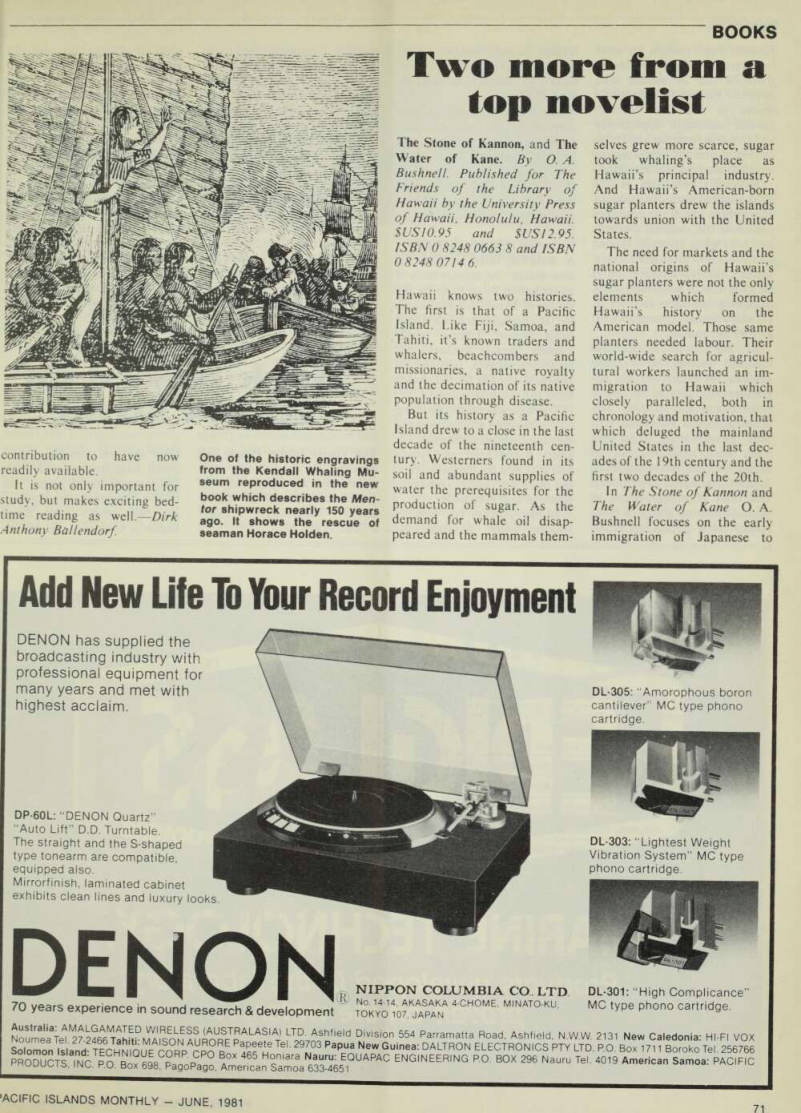
140 years on
‘Naked and a Prisoner’: Captain Edward C. Barnard’s Narrative of Shipwreck in Palau 1832- 1833. Edited, with notes and an introduction, by Kenneth R.
Martin. Published by the Kendall Whaling Museum, Sharon, Massachusetts, and the Trust Territory Historic Preservation Office, Saipan. No price given. ISBN 0 93784 01 8.
The second most famous ship wreck in Palau after the Antelope in 1783 occurred in 1832. It was the whaler, Men tor, and just before midnight on May 21 she struck Ngaruangel Reef. Twelve crewmen were lost during the first hour while confusion reigned, and the Mentor was dashed to pieces on the coral rocks.
Captain Edward C. Barnard, 31, brave and determined, led his remaining crew to relative
safety on an exposed patch of reef. As the day dawned they were rescued by Palauans from Kayangel Atoll.
The adventure which fol lowed, and the fates and experi ences of the Mentor’s captain and crew were written down by Barnard a few years later. Dr Kenneth R. Marlin, director of the Kendall Whaling Museum in Sharon, Massachusetts, dis covered this narrative in the museum’s collection, where, as he relates in his introduction ‘it snoozed until accidentally redis covered in 1979’.
Barnard’s narrative is pure adventure, but it is also of par ticular historical significance because it relates the first con tact between Americans and Palauans which involved the whalemen living for any length of time in Palau (today the Re public of Belau).
Palauans are sometimes dis
tinguished from other Micro nesians as being more opportu nistic and energetic. The his toric roots of this observation are supported by Barnard’s account. Rather than kill or set back adrift the marooned Americans, the Palauans took them in and helped them. In turn, the whalemen were tat tooed, wore Palauan attire, and learned the language. Although by doing all this the Americans did not diminish their ultimate desire to return home, they did get well settled and develop excellent local relations. They also helped to reinforce and validate the Palauans’ habit of welcoming and using foreigners the Americans promised to deliver firearms later which has carried down to the present day.
Many of the early contacts between islanders and outsiders were violent. While Barnard does relate some ill-treatment at Tobi Island, the entire emphasis is clearly on the side of beneficial mutual exchange and friendship.
Martin has edited it marvel
lously and has provided excel lent notes and description. He presents it to us ‘almost exactly as Barnard wrote it’ some 150 years ago. It is an exciting, readable story, and it also provides some noteworthy eth nographic material for serious students and scholars. Of one Palauan social custom, Barnard observes: ‘ln each pye (bai) are kept from two to 10 females gener ally taken from distant towns frequently by force (sic) they are public property (sic) it at times happens that a chief will attach one of the girls of the pye to himself, on the wifes (sic) finding it out she is disposed for revenge, and they generally are (sic) they will watch for an opportunity to cut off the girls’ ears . ..’
The book is available directly from the Kendall Whaling Mu seum, or fron. the Historic Preservation Office at Saipan, CNMI 96950. We have the US Heritage, Conservation, and Recreation Service to thank for helping to fund the publication which is an important literary
contribution to have now readily available.
It is not only important for study, but makes exciting bed
time reading as well.-
Dirk
Anthony Ballendorf
One of the historic engravings from the Kendall Whaling Mu seum reproduced in the new book which describes the Men tor shipwreck nearly 150 years ago. It shows the rescue of seaman Horace Holden.
Advertisements & other items, p. 70 (1 item)
t g[|s3soo
sass?
Planning a New Era in Modular Living
TWO STOREY
DUPLEX UNITS
SCHOOL CLASS
ROOMS
Also Specialists in LOW COST Housing UNiniiiiiiiiiii 2 Bedroom Kits from
t g[|s3soo
O. at t*- RIVERVIEW Kit Price $9397 l3 M
RTIST'S IMPRESSIOIS
BED. 3 p
BATH
KITCHEN DINING
LIVING
BED 2 pp
BED
PATIO
Our advanced building system saves greatly in time and costs. So your money works for you faster. Fully erected in 6 - 8 weeks.
Look at the features of Modular Construction: •Strength •Speed of Construction • Insulated • Fire Resistant •Termite Resistant • Economy • Low Maintenance // M/ /r#// M' A/
fop novelist
Two more from a fop novelist
The Stone of Kannon, and The Water of Kane. By O. A.
Bushnell. Published for The Friends of the Library of Hawaii by the University Press of Hawaii, Honolulu, Hawaii.
SUS 10.95 and SUS 12.95.
ISBN 0 8248 0663 8 and ISBN 0 8248 0714 6.
Hawaii knows two histories.
The first is that of a Pacific Island. Like Fiji, Samoa, and Tahiti, it’s known traders and whalers, beachcombers and missionaries, a native royalty and the decimation of its native population through disease.
But its history as a Pacific Island drew to a close in the last decade of the nineteenth cen tury. Westerners found in its soil and abundant supplies of water the prerequisites for the production of sugar. As the demand for whale oil disap peared and the mammals them
selves grew more scarce, sugar took whaling’s place as Hawaii’s principal industry.
And Hawaii’s American-born sugar planters drew the islands towards union with the United States.
The need for markets and the national origins of Hawaii’s sugar planters were not the only elements which formed Hawaii’s history on the American model. Those same planters needed labour. Their world-wide search for agricul tural workers launched an im migration to Hawaii which closely paralleled, both in chronology and motivation, that which deluged the mainland United States in the last dec ades of the 19th century and the first two decades of the 20th.
In The Stone of Kannon and The Water of Kane O. A.
Bushnell focuses on the early immigration of Japanese to
Hawaii. Their reasons for coming were strikingly similar to those of the 28 million who deserted Europe for America’s shores in the same period: greater economic opportunity and freedom from the hierarchical social and political systems which frustrated the dissenter.
Bushnell s hero, Ishi, is just such a malcontent. He seeks an atmosphere free of the arbitrary justice of the samurai’s sword, In 1868, when Hawaii’s labour recruiters first attempted to tap Japan’s surplus labour supply, he joins 150 of his countrymen in signing contracts to work in Hawaii’s fields for room, board. and $9 per month.
In The Stone of Kannon Bushnell follows Ishi s preparations for departure, his adjustment to life on the plantations, and his meeting and bedding with a Hawaiian girl, The gannen-mono. first-year men, were smuggled out of Japan, contrary to the wishes of Japan’s new Meiji government, The tales of maltreatment of the Japanese on Hawaii’s plantations soon persuaded Meiji
leaders to halt further immi gration to Hawaii. They would allow no further emigration until 1885.
The Water of Kane finds Ishi marrie d to his Hawaiian lover the father of two children? and beset by conflicts between his o wn cultural background and those of his wife, his mother-in iaw, and the Caucasian men upo n whom he depends for his livelihood.
One of them, Maui’s Henry A. Baldwin, lures him into his o wn dream: the construction of an irrigation ditch to bring the waters of Maui’s Mt Haleakala t o the drought-stricken sugar fie ds bdow Xoiling beside Yankee metal workers and Hawaiian diggers, Ishi and his Japanese friends do the mason WO rk the ditch requires, The task was enormous. It re quired clearing virgin forest and blasting through solid rock. The effort would take two years, $BO 000, and try the patience of the ditch’s principal architects, Baldwin and Alexander, l n the process Ishi and his friends know physical dis
comfort, tragedy, and the psychological pain of living in a multi-cultural society wherein challenges to one’s most cher ished values are an everyday experience.
Bushnell handles the story of Hawaii’s first Japanese immi grants with humour and under standing. We laugh at the hapless Ishi, home from long weeks in the masculine society of the labour-gang and ravenous for his wife’s body. She sits at one end of a couch fending him off with an arm and a seemingly endless recitation of a domestic problem which has developed in his absence. And we sympathise
with his attempts to reconcile his admiration for Western in dustry and ambition with his Eastern resignation to fate.
The Stone of Kannon and The Water of Kane are Bushnell’s fourth and fifth novels based on Hawaii’s past.
His first The Return of Lono , dealt with the last days of Captain Cook. Molokai told the story of Hawaii’s famed leper colony at Kalaupapa.
Ka’a’awa chronicled the 19th century development of Oahu.
With each new book Bushnell has secured more firmly a claim as Hawaii’s master story-teller.
Dan Boy lan.
Advertisements & other items, p. 71 (2 items)
71
BOOKS
’ACIFIC ISLANDS MONTHLY - JUNE, 1981
Demon
Add New Life To Your Record Enjoyment DEMON has supplied the
broadcasting industry with
professional equipment for many years and met with
highest acclaim.
DP-60L: “DEMON Quartz”
“Auto Lift” D.D. Turntable.
The straight and the S-shaped type tonearm are compatible, equipped also.
Mirrorfinish, laminated cabinet exhibits clean lines and luxury looks.
DEMON
NIPPON COLUMBIA CO LTD
70 uparc ' ' No. 14-14, AKASAKA 4-CHOME, MINATO-KU.
U years experience in sound research & development tokyo ioz, japan DL-305: "Amorophous boron cantilever” MC type phono cartridge.
DL-303: “Lightest Weight Vibration System” MC type phono cartridge.
DL-301: “High Complicance’
MC type phono cartridge.
Nolirr^e^Tel^27 2466Tah it F MA tso*N an AS IA) Division 554 Parramatta Road. Ashfield, N.W.W. 2131 New Caledonia: HI-FI VOX RnrafiF 6 H e L Pap c U4 New Guinea: DALTRON ELECTRONICS PTY LTD, P.O. Box 1711 Boroko Tel, 256766 PRODUCTS 3 ,nVp E ENGtNEERiNG PO. BOX 296 Nauru Tel. 4019 American Samoa: PACIFIC
Torres Strati
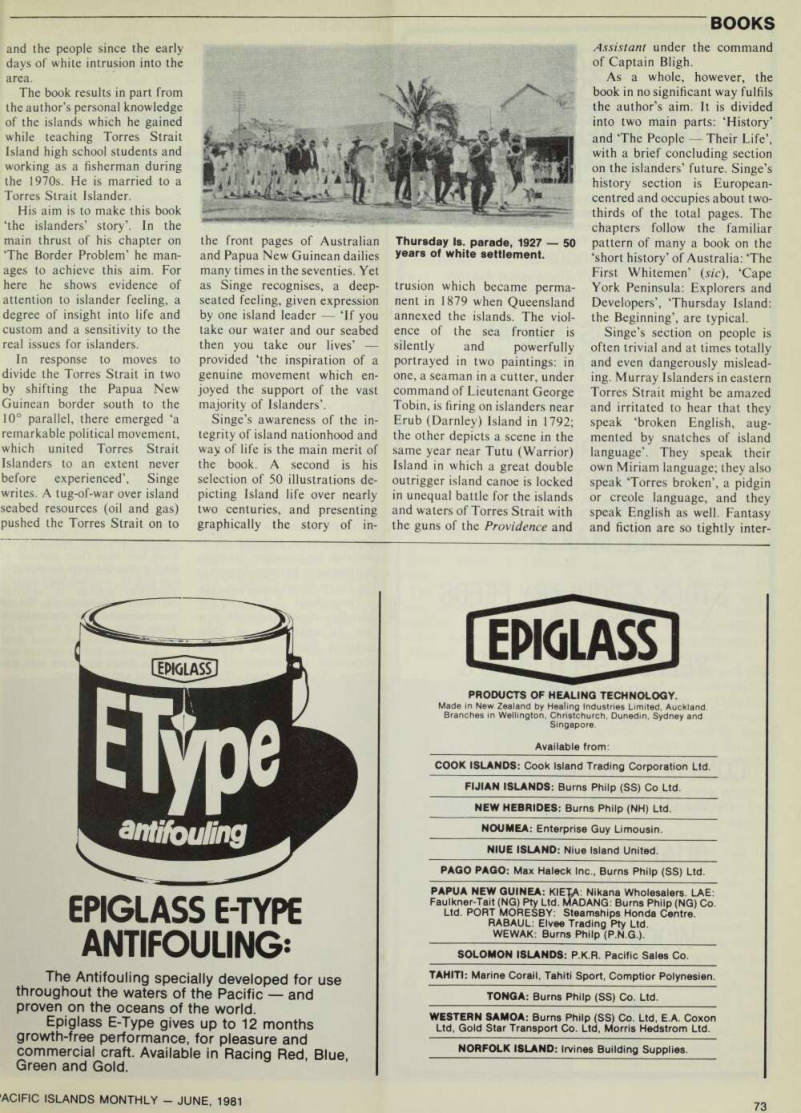
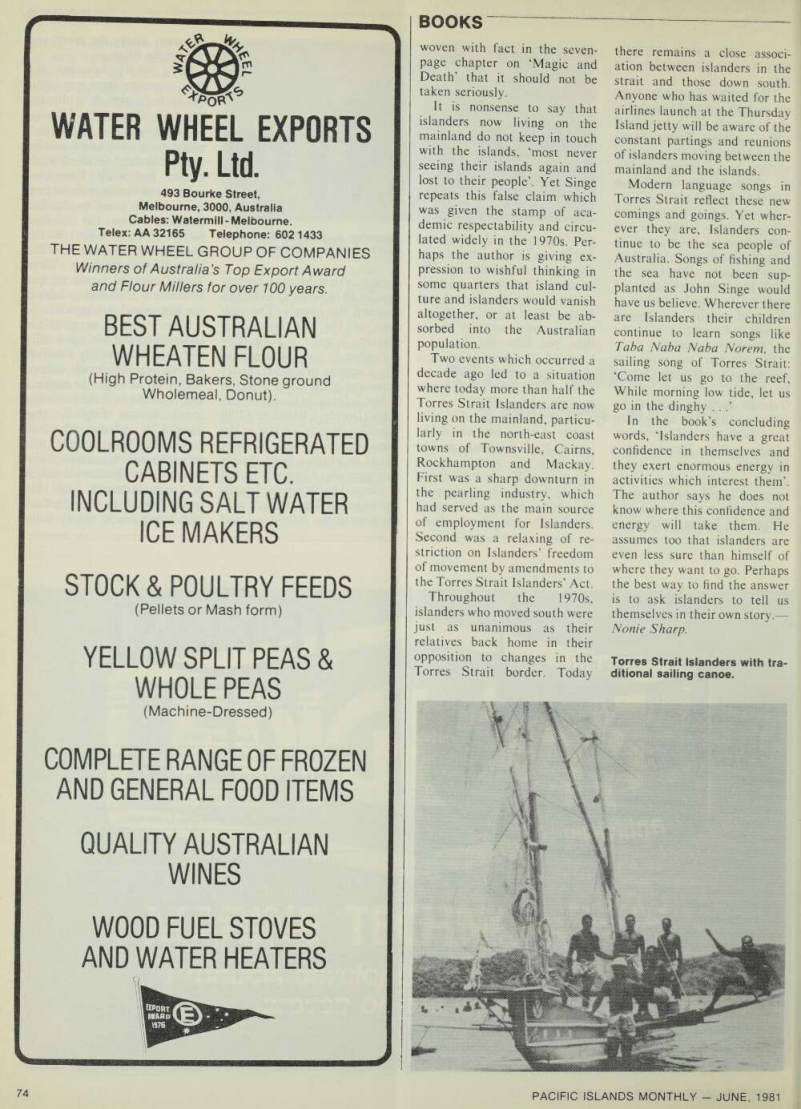
Mark missed on Torres Strati
The Torres Strait: People and History. By John Singe. Pub lished by the University of Queensland Press. St Lucia.
1979. Saw. 9 5. Isbn
0 7022 11417 5.
Over the centuries the Torres Strait Islanders ‘created a life style unique in the region, one totally integrated with the sea’.
In these words John Singe begins a history of the islands
and the people since the early days of white intrusion into the area.
The book results in part from the author’s personal knowledge of the islands which he gained while teaching Torres Strait Island high school students and working as a fisherman during the 19705. He is married to a Torres Strait Islander.
His aim is to make this book ‘the islanders’ story’. In the main thrust of his chapter on ‘The Border Problem’ he man ages to achieve this aim. For here he shows evidence of attention to islander feeling, a degree of insight into life and custom and a sensitivity to the real issues for islanders.
In response to moves to divide the Torres Strait in two by shifting the Papua New Guinean border south to the 10° parallel, there emerged ‘a remarkable political movement, which united Torres Strait Islanders to an extent never before experienced’, Singe writes. A tug-of-war over island seabed resources (oil and gas) pushed the Torres Strait on to
the front pages of Australian and Papua New Guinean dailies many times in the seventies. Yet as Singe recognises, a deep seated feeling, given expression by one island leader ‘lf you take our water and our seabed then you take our lives’ provided ‘the inspiration of a genuine movement which en joyed the support of the vast majority of Islanders’.
Singe’s awareness of the in tegrity of island nationhood and way of life is the main merit of the book. A second is his selection of 50 illustrations de picting Island life over nearly two centuries, and presenting graphically the story of in
trusion which became perma nent in 1879 when Queensland annexed the islands. The viol ence of the sea frontier is silently and powerfully portrayed in two paintings: in one, a seaman in a cutter, under command of Lieutenant George Tobin, is firing on islanders near Erub (Darnley) Island in 1792; the other depicts a scene in the same year near Tutu (Warrior) Island in which a great double outrigger island canoe is locked in unequal battle for the islands and waters of Torres Strait with the guns of the Providence and
Assistant under the command of Captain Bligh.
As a whole, however, the book in no significant way fulfils the author’s aim. It is divided into two main parts: ‘History’ and ‘The People Their Life’, with a brief concluding section on the islanders’ future. Singe’s history section is European centred and occupies about two thirds of the total pages. The chapters follow the familiar pattern of many a book on the ‘short history’ of Australia: ‘The First Whitemen’ (s/c), ‘Cape York Peninsula: Explorers and Developers’, ‘Thursday Island: the Beginning’, are typical.
Singe’s section on people is often trivial and at times totally and even dangerously mislead ing. Murray Islanders in eastern Torres Strait might be amazed and irritated to hear that they speak ‘broken English, aug mented by snatches of island language’. They speak their own Miriam language; they also speak ‘Torres broken’, a pidgin or creole language, and they speak English as well. Fantasy and fiction are so tightly inter
Thursday Is. parade, 1927 50 years of white settlement.
woven with fact in the sevenpage chapter on Magic and Death that it should not be taken seriously.
It is nonsense to say that islanders now living on the mainland do not keep in touch with the islands, ‘most never seeing their islands again and lost to their people . Yet Singe repeats this false claim which was given the stamp of academic respectability and circulated widely in the 19705. Perhaps the author is giving expression to wishful thinking in some quarters that island culture and islanders would vanish altogether, or at least be absorbed into the Australian population.
Two events which occurred a decade ago led to a situation where today more than half the Torres Strait Islanders are now living on the mainland, particularly in the north-east coast towns of Townsville, Cairns, Rockhampton and Mackay.
First was a sharp downturn in the pearling industry, which had served as the main source of employment for Islanders.
Second was a relaxing of restriction on Islanders’ freedom of movement by amendments to the Torres Strait Islanders’ Act.
Throughout the 19705, islanders who moved south were just as unanimous as their relatives back home in their opposition to changes in the Torres Strait border. Today
there remains a close associ ation between islanders in the strait and those down south.
Anyone who has waited for the airlines launch at the Thursday Island jetty will be aware of the constant partings and reunions of islanders moving between the mainland and the islands.
Modern language songs in Torres Strait reflect these new comings and goings. Yet wher ever they are, Islanders con tinue to be the sea people of Australia. Songs of fishing and the sea have not been sup planted as John Singe would have us believe. Wherever there are Islanders their children continue to learn songs like Taba Naba Naba Norem, the sailing song of Torres Strait: ‘Come let us go to the reef, While morning low tide, let us go in the dinghy . . .’
In the book’s concluding words, ‘lslanders have a great confidence in themselves and they exert enormous energy in activities which interest them’.
The author says he does not know where this confidence and energy will take them. He assumes too that islanders are even less sure than himself of where they want to go. Perhaps the best way to find the answer is to ask islanders to tell us themselves in their own story.—
Nonie Sharp.
Torres Strait Islanders with tra ditional sailing canoe.
Advertisements & other items, pp. 72-74 (2 items)
Epkjlass
MARINE TECHNOLOGY.
Products developed in the laboratory, proven on the water ...
(jMOLASp
PRODUCTS OF HEALING TECHNOLOGY.
Made in New Zealand by Healing Industries Limited, Auckland.
Branches in Wellington, Christchurch, Dunedin, Sydney and Singapore.
Available from: COOK ISLANDS: Cook Island Trading Corporation Ltd.
FIJIAN ISLANDS: Burns Philp (SS) Co Ltd.
NEW HEBRIDES: Burns Philp (NH) Ltd.
NOUMEA: Enterprise Guy Limousin.
NIUE ISLAND: Niue Island United.
PAGO PAGO: Max Haleck Inc., Burns Philp (SS) Ltd.
PAPUA NEW GUINEA: KIETA: Nikana Wholesalers. LAE: Faulkner-Tait (NG) Pty Ltd. MADANG; Burns Philp (NG) Co.
Ltd. PORT MORESBY; Steamships Honda Centre.
RABAUL: Elvee Trading Pty Ltd.
WEWAK: Burns Philp (P.N.G.).
SOLOMON ISLANDS: P.K.R. Pacific Sales Co.
TAHITI: Marine Corail, Tahiti Sport, Comptior Polynesien.
TONGA: Burns Philp (SS) Co. Ltd.
WESTERN SAMOA: Burns Philp (SS) Co. Ltd. E.A. Coxon Ltd, Gold Star Transport Co. Ltd, Morris Hedstrom Ltd.
NORFOLK ISLAND: Irvines Building Supplies.
A
L I CM AI ACCI ffl
antifouling
EPIGLASS E-TYPE
ANTIFOULING:
The Antifouling specially developed for use throughout the waters of the Pacific and proven on the oceans of the world.
Epiglass E-Type gives up to 12 months growth-free performance, for pleasure and commercial craft. Available in Racing Red, Blue Green and Gold.
WATER WHEEL EXPORTS
Pty. Ltd.
493 Bourke Street, Melbourne, 3000, Australia Cables; Watermill-Melbourne.
Telex; AA 32165 Telephone: 602 1433
THE WATER WHEEL GROUP OF COMPANIES
Winners of Australia’s Top Export Award and Flour Millers for over 100 years.
BEST AUSTRALIAN
WHEATEN FLOUR
(High Protein, Bakers, Stone ground Wholemeal, Donut).
COOLROOMS REFRIGERATED
CABINETS ETC.
INCLUDING SALT WATER
ICE MAKERS
STOCK & POULTRY FEEDS
(Pellets or Mash form)
YELLOW SPLIT PEAS &
WHOLE PEAS
(Machine-Dressed)
COMPLETE RANGE OF FROZEN
AND GENERAL FOOD ITEMS
QUALITY AUSTRALIAN
WINES
WOOD FUEL STOVES
AND WATER HEATERS
Books
73
ACIFIC ISLANDS MONTHLY - JUNE, 1981
special kind of PNG holiday
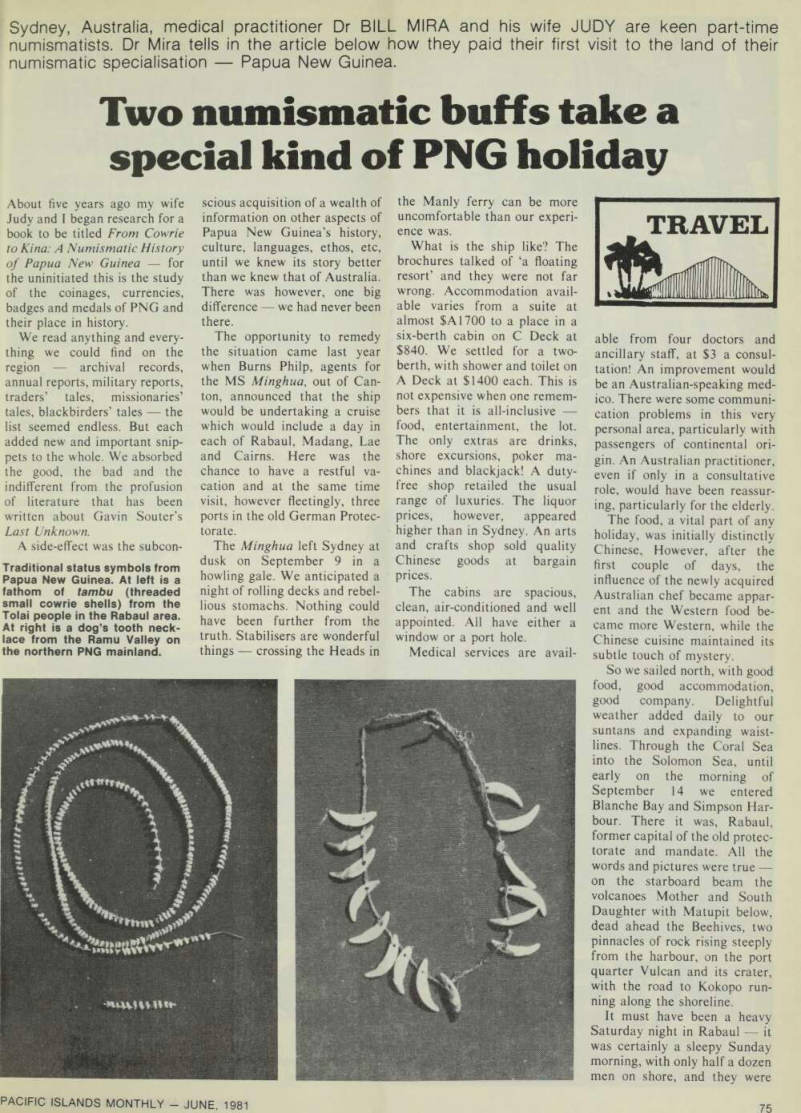

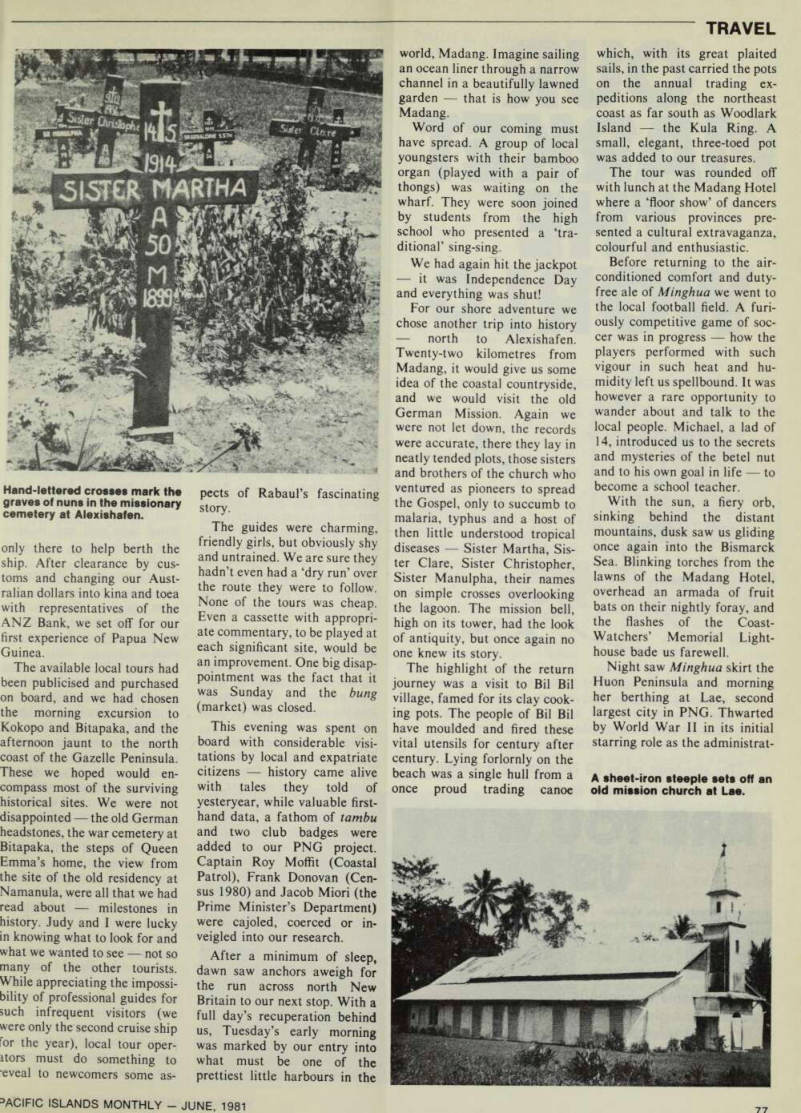
Travel
Two numismatic buffs take a special kind of PNG holiday
Sydney, Australia, medical practitioner Dr BILL MIRA and his wife JUDY are keen part-time numismatists. Dr Mira tells in the article below how they paid their first visit to the land of their numismatic specialisation Papua New Guinea.
About five years ago my wife Judy and I began research for a book to be titled From Cowrie to Kina: A Numismatic History of Papua New Guinea for the uninitiated this is the study of the coinages, currencies, badges and medals of PNG and their place in history.
We read anything and every thing we could find on the region archival records, annual reports, military reports, traders’ tales, missionaries’ tales, blackbirders’ tales the list seemed endless. But each added new and important snip pets to the whole. We absorbed the good, the bad and the indifferent from the profusion of literature that has been written about Gavin Souter’s Last Unknown.
A side-effect was the subcon
scious acquisition of a wealth of information on other aspects of Papua New Guinea’s history, culture, languages, ethos, etc, until we knew its story better than we knew that of Australia.
There was however, one big difference we had never been there.
The opportunity to remedy the situation came last year when Burns Philp, agents for the MS Minghua, out of Can ton, announced that the ship would be undertaking a cruise which would include a day in each of Rabaul, Madang, Lae and Cairns. Here was the chance to have a restful va cation and at the same time visit, however fleetingly, three ports in the old German Protec torate.
The Minghua left Sydney at dusk on September 9 in a howling gale. We anticipated a night of rolling decks and rebel lious stomachs. Nothing could have been further from the truth. Stabilisers are wonderful things crossing the Heads in
the Manly ferry can be more uncomfortable than our experi ence was.
What is the ship like? The brochures talked of ‘a floating resort’ and they were not far wrong. Accommodation avail able varies from a suite at almost SAI7OO to a place in a six-berth cabin on C Deck at $B4O. We settled for a two berth, with shower and toilet on A Deck at $l4OO each. This is not expensive when one remem bers that it is all-inclusive food, entertainment, the lot.
The only extras are drinks, shore excursions, poker ma chines and blackjack! A duty free shop retailed the usual range of luxuries. The liquor prices, however, appeared higher than in Sydney. An arts and crafts shop sold quality Chinese goods at bargain prices.
The cabins are spacious, clean, air-conditioned and well appointed. All have either a window or a port hole.
Medical services are avail-
able from four doctors and ancillary staff, at $3 a consul tation! An improvement would be an Australian-speaking med ico. There were some communi cation problems in this very personal area, particularly with passengers of continental ori gin. An Australian practitioner, even if only in a consultative role, would have been reassur ing, particularly for the elderly.
The food, a vital part of any holiday, was initially distinctly Chinese, However, after the first couple of days, the influence of the newly acquired Australian chef became appar ent and the Western food be came more Western, while the Chinese cuisine maintained its subtle touch of mystery.
So we sailed north, with good food, good accommodation, good company. Delightful weather added daily to our suntans and expanding waist lines. Through the Coral Sea into the Solomon Sea, until early on the morning of September 14 we entered Blanche Bay and Simpson Har bour. There it was, Rabaul, former capital of the old protec torate and mandate. All the words and pictures were true on the starboard beam the volcanoes Mother and South Daughter with Matupit below, dead ahead the Beehives, two pinnacles of rock rising steeply from the harbour, on the port quarter Vulcan and its crater, with the road to Kokopo run ning along the shoreline.
It must have been a heavy Saturday night in Rabaul it was certainly a sleepy Sunday morning, with only half a dozen men on shore, and they were
Traditional status symbols from Papua New Guinea. At left is a fathom of tambu (threaded small cowrie shells) from the Tolai people in the Rabaul area.
At right is a dog’s tooth neck lace from the Ramu Valley on the northern PNG mainland.
only there to help berth the ship. After clearance by cus toms and changing our Aust ralian dollars into kina and toea with representatives of the ANZ Bank, we set off for our first experience of Papua New Guinea.
The available local tours had been publicised and purchased on board, and we had chosen the morning excursion to Kokopo and Bitapaka, and the afternoon jaunt to the north coast of the Gazelle Peninsula.
These we hoped would en compass most of the surviving historical sites. We were not disappointed the old German headstones, the war cemetery at Bitapaka, the steps of Queen Emma’s home, the view from the site of the old residency at Namanula, were all that we had read about milestones in history. Judy and I were lucky in knowing what to look for and what we wanted to see not so many of the other tourists.
While appreciating the impossi bility of professional guides for such infrequent visitors (we were only the second cruise ship for the year), local tour oper ators must do something to •eveal to newcomers some as
pects of Rabaul’s fascinating story.
The guides were charming, friendly girls, but obviously shy and untrained. We are sure they hadn’t even had a ‘dry run’ over the route they were to follow.
None of the tours was cheap.
Even a cassette with appropri ate commentary, to be played at each significant site, would be an improvement. One big disap pointment was the fact that it was Sunday and the bung (market) was closed.
This evening was spent on board with considerable visi tations by local and expatriate citizens history came alive with tales they told of yesteryear, while valuable first hand data, a fathom of tambu and two club badges were added to our PNG project.
Captain Roy Moffit (Coastal Patrol), Frank Donovan (Cen sus 1980) and Jacob Miori (the Prime Minister’s Department) were cajoled, coerced or in veigled into our research.
After a minimum of sleep, dawn saw anchors aweigh for the run across north New Britain to our next stop. With a full day’s recuperation behind us, Tuesday’s early morning was marked by our entry into what must be one of the prettiest little harbours in the
world, Madang. Imagine sailing an ocean liner through a narrow channel in a beautifully lawned garden that is how you see Madang.
Word of our coming must have spread. A group of local youngsters with their bamboo organ (played with a pair of thongs) was waiting on the wharf. They were soon joined by students from the high school who presented a ‘tra ditional’ sing-sing.
We had again hit the jackpot it was Independence Day and everything was shut!
For our shore adventure we chose another trip into history north to Alexishafen.
Twenty-two kilometres from Madang, it would give us some idea of the coastal countryside, and we would visit the old German Mission. Again we were not let down, the records were accurate, there they lay in neatly tended plots, those sisters and brothers of the church who ventured as pioneers to spread the Gospel, only to succumb to malaria, typhus and a host of then little understood tropical diseases Sister Martha, Sis ter Clare, Sister Christopher, Sister Manulpha, their names on simple crosses overlooking the lagoon. The mission bell, high on its tower, had the look of antiquity, but once again no one knew its story.
The highlight of the return journey was a visit to Bil Bil village, famed for its clay cook ing pots. The people of Bil Bil have moulded and fired these vital utensils for century after century. Lying forlornly on the beach was a single hull from a once proud trading canoe
which, with its great plaited sails, in the past carried the pots on the annual trading ex peditions along the northeast coast as far south as Woodlark Island the Kula Ring. A small, elegant, three-toed pot was added to our treasures.
The tour was rounded off with lunch at the Madang Hotel where a ‘floor show’ of dancers from various provinces pre sented a cultural extravaganza, colourful and enthusiastic.
Before returning to the air conditioned comfort and duty free ale of Minghua we went to the local football field. A furi ously competitive game of soc cer was in progress how the players performed with such vigour in such heat and hu midity left us spellbound. It was however a rare opportunity to wander about and talk to the local people. Michael, a lad of 14, introduced us to the secrets and mysteries of the betel nut and to his own goal in life to become a school teacher.
With the sun, a fiery orb, sinking behind the distant mountains, dusk saw us gliding once again into the Bismarck Sea. Blinking torches from the lawns of the Madang Hotel, overhead an armada of fruit bats on their nightly foray, and the flashes of the Coast- Watchers’ Memorial Light house bade us farewell.
Night saw Minghua skirt the Huon Peninsula and morning her berthing at Lae, second largest city in PNG. Thwarted by World War II in its initial starring role as the administrat-
Hand-lettered crosses mark the graves of nuns in the missionary cemetery at Alexishafen.
A sheet-iron steeple sets off an old mission church at Lae.
ive centre of the mandated territory, to replace a Rabaul devastated by the volcanic in ferno of 1937, Lae is a postwar phenomenon, owing its growth to the rapidly developing High lands economy. As the coastal terminus of the Highlands Highway, everything, excepting air cargo, that moves in or out of the Highlands comes through Lae. With one exception, its history is of the war and postwar years: the exception is an old German Mission church, said to be the only structure standing when the area was recaptured from the Japanese.
The war cemetery is the final resting place of many Allied soldiers of World War 11. Dur ing our stay a group of Diggers led by Major-General Allan Murchison combined with the local Defence Force units in a wreath-laying ceremony at the Cross of Remembrance.
Being Wednesday, the mar ket was open and we had our first experience of the wide ranging production of what is essentially an agricultural econ omy. Subsistence farmers plied the surplus from their small gardens bananas, coconuts, taro, sweet potato, peanuts, native tobacco and any number of greens we had never seen before The street vendors had gath ered with their artefacts. Al though they were modern examples of traditional craft, they provided a strong insight into the traditional ethos of the people.
We skipped the ‘Lae City Tour’ and took ‘The War Relics’ excursion. This was a misnomer, as the only war relic was a rusting Japanese hulk, half-buried in the sand off Wagan Village. The guides, however, were first class. They were three senior students from the International School. They gave a lively and knowledgeable commentary on local features and life. A dog’s tooth necklace from the Ramu valley was the final addition to our mementoes.
This was our last port before the long run along the northeast coast, through the China Strait, past Samarai, to Cairns. The availability of a suitably anno tated map would have added much to the interest of this section of the voyage we had
our own, so were able to identify most of the significant land marks as they appeared. Mount Simpson rising high in the Owen Stanley Range, Good enough Island with its 2566-metre peak peeping through a necklace of clouds, Fergusson and Normandy Islands, along with Samarai in the China Strait all have a history worth the telling.
Cairns was the final holiday stopover although scheduled to berth at bam, Minghua arrived at 6pm the evening before, giving those with sufficient zest an opportunity to sample the North Queensland night life.
Punctuality was another im portant aspect of our cruise. We arrived on time and left on time.
Many cruises are marred by late arrivals and early depar tures, but not this one!
The run from Cairns to Syd ney through the Whitsunday passage was broken by a stop of several hours off Sandy Cape where a fishing competition was held. Both passengers and crew tested their skill and, inciden tally, made some very good catches.
Early morning of Wednesday September 24 saw Minghua enter bustling Port Jackson where we landed at Number 13 Pyrmont our holiday was over.
What will be our lasting memories of our northern neigh bour? The first is children, lots of children, smiling children, shy children, ever ready to talk of their schools, their lives and their hopes for the future. The second is of history, both tra ditional and modern, just wail ing for the interested to see. The country’s tourist potential is enormous.
So ended our first visit to Papua New Guinea would we go again? Certainly. In fact, if Minghua sails north next September we will be first in the queue to buy our tickets. Some change in the itinerary could be suggested omit Cairns and include either Port Moresby, or stay three days in Lae and offer a tour to the Highlands up by road and back by air.
Finally, if you have grown tired of the old holiday pack ages then try something new go north to Papua New Guinea.
Advertisements & other items, pp. 75-78 (2 items)
75
'ACIFIC ISLANDS MONTHLY - JUNE, 1981
Datsun Forklift
V n A V.
Heavyweights Built
To Dazzle You With
Fancy Footwork.
Now you can really think heavy-duty.
New heavy-duty Datsun Forklift 3.5-ton cushion tire and 4-ton pneumatic tire models deliver the total toughness, power and gradeability you require. Also speed, tight-space maneuverability and operator ease you never thought possible in a heavy-duty heavyweight.
Rugged monocoque body construction reduces dimensions, increases maneuverability. Proven high-efficiency engines assure superb torque, speed and gradeability. The powerful gasoline or turbocharged diesel engine matches your needs exactly. Power steering, single-lever tilt/lift control, hydro-booster brakes and exceptional forward visibility keep operator fatigue low, work output high.
Built for high reliability, speed and efficiency. Heavy-duty Datsun Forklift 3.5-ton cushion tire and 4-ton pneumatic tire models.
NISSAN
DATSUN FORKLIFT
NISSAN MOTOR CO., LTD. 17-1, Ginza 6-Chome, Chuo-ku, Tokyo 104, Japan Loadlift Equipment Limited P.O. Box 12593, Penrose, Auckland 6, New Zealand Tel: 663-714 Nissan Motor Co., (Australia) Pty. Ltd. Industrial Machinery Division P.O. Box 249, Kings Cross, Sydney, N.S.W. 2011, Australia Tel: 358-5444 Boroko Motors Ltd. P.O. Box 1259, Boroko, Port Moresby, Papua New Guinea Tel: 255255, 255-347
OUR
MARKET
THE
WORLD
In a country like NEW ZEALAND, where the economy depends heavily on the exports of products from the land, it isn’t surprising to find total commitment to effective animal remedies and agricultural chemicals.
The standards set by ICI TASMAN are respected by farmers Worldwide.
ARE YOU WITH
US?
Available throughout the South Pacific, tese products give you the benefits of the reputatior & international research of ICI.
ICI Tasman Limited P.O. Box 900. Auckland, New Zealand ICI Tasman Limited y '*!f Healthy Stock Healthy Crops Greater Yields Higher Profit Animal Remedies
★ TASVAX - VACCINES
★ TASTONE - PEPTONES
★ TASMIX - FEED SUPPLEMENTS
★ NILVERM - DRENCH
★ COMBAT - DIP
Agricultural Chemicals
♦ GRAMOXONE - WEEDKILLER
★ ORTHENE - INSECTICIDE
★ AMBUSH - INSECTICIDE
★ ACTELLIC - INSECTICIDE
★ MILCURB - FUNGICIDE
Cable partners
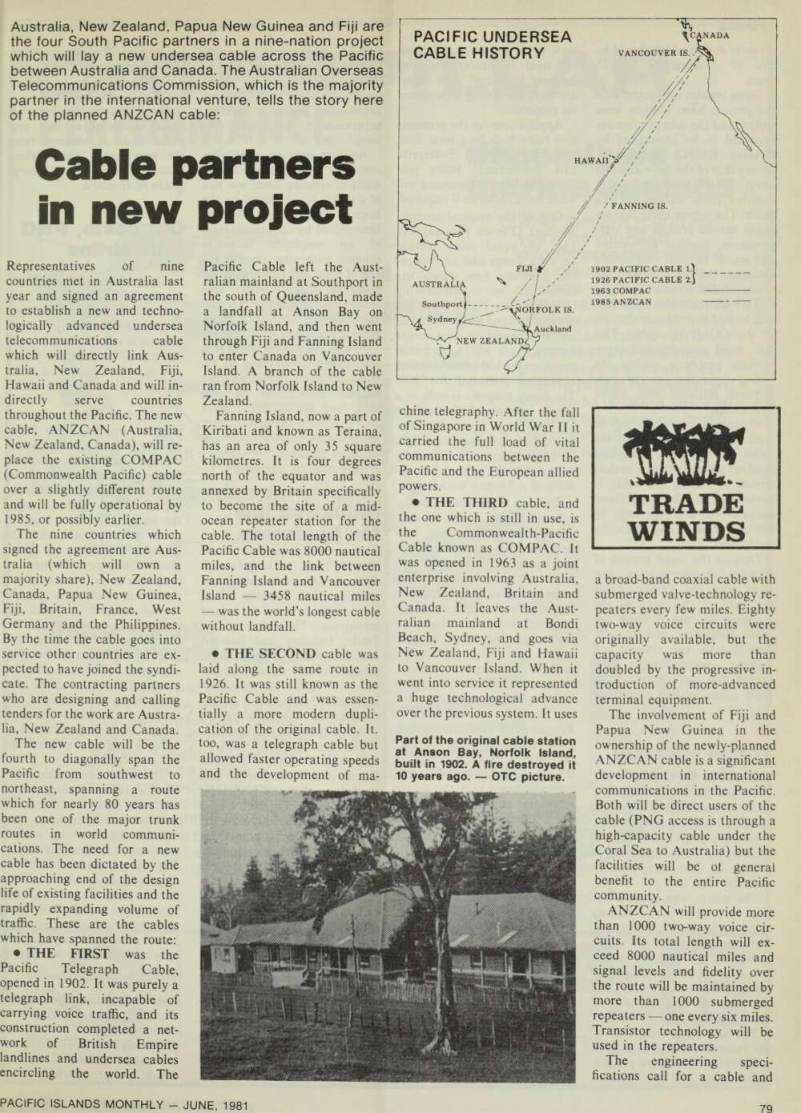
Trade
Winds
Pacific Undersea
Cable History
Cable partners in new project
Australia, New Zealand, Papua New Guinea and Fiji are the four South Pacific partners in a nine-nation project which will lay a new undersea cable across the Pacific between Australia and Canada. The Australian Overseas Telecommunications Commission, which is the majority partner in the international venture, tells the story here of the planned ANZCAN cable:
Representatives of nine countries met in Australia last year and signed an agreement to establish a new and techno logically advanced undersea telecommunications cable which will directly link Aus tralia, New Zealand, Fiji, Hawaii and Canada and will in directly serve countries throughout the Pacific. The new cable, ANZCAN (Australia, New Zealand, Canada), will re place the existing COMPAC (Commonwealth Pacific) cable over a slightly different route and will be fully operational by 1985, or possibly earlier.
The nine countries which signed the agreement are Aus tralia (which will own a majority share), New Zealand, Canada, Papua New Guinea, Fiji, Britain, France, West Germany and the Philippines.
By the time the cable goes into service other countries are ex pected to have joined the syndi cate. The contracting partners who are designing and calling lenders for the work are Austra lia, New Zealand and Canada.
The new cable will be the fourth to diagonally span the Pacific from southwest to northeast, spanning a route which for nearly 80 years has been one of the major trunk routes in world communi cations. The need for a new cable has been dictated by the approaching end of the design life of existing facilities and the rapidly expanding volume of traffic. These are the cables which have spanned the route: • THE FIRST was the Pacific Telegraph Cable, opened in 1902. It was purely a telegraph link, incapable of carrying voice traffic, and its construction completed a net work of British Empire landlines and undersea cables encircling the world. The
Pacific Cable left the Aust ralian mainland at Southport in the south of Queensland, made a landfall at Anson Bay on Norfolk Island, and then went through Fiji and Fanning Island to enter Canada on Vancouver Island. A branch of the cable ran from Norfolk Island to New Zealand.
Fanning Island, now a part of Kiribati and known as Teraina, has an area of only 35 square kilometres. It is four degrees north of the equator and was annexed by Britain specifically to become the site of a mid ocean repeater station for the cable. The total length of the Pacific Cable was 8000 nautical miles, and the link between Fanning Island and Vancouver Island 3458 nautical miles was the world’s longest cable without landfall. • THE SECOND cable was laid along the same route in 1926. It was still known as the Pacific Cable and was essen tially a more modern dupli cation of the original cable. It. too, was a telegraph cable but allowed faster operating speeds and the development of ma-
chine telegraphy. After the fall of Singapore in World War II it carried the full load of vital communications between the Pacific and the European allied powers. • THE THIRD cable, and the one which is still in use, is the Commonwealth-Pacific Cable known as COMPAC. It was opened in 1963 as a joint enterprise involving Australia, New Zealand, Britain and Canada. It leaves the Aust ralian mainland at Bondi Beach, Sydney, and goes via New Zealand, Fiji and Hawaii to Vancouver Island. When it went into service it represented a huge technological advance over the previous system. It uses
a broad-band coaxial cable with submerged valve-technology re peaters every few miles. Eighty two-way voice circuits were originally available, but the capacity was more than doubled by the progressive in troduction of more-advanced terminal equipment.
The involvement of Fiji and Papua New Guinea in the ownership of the newly-planned ANZCAN cable is a significant development in international communications in the Pacific.
Both will be direct users of the cable (PNG access is through a high-capacity cable under the Coral Sea to Australia) but the facilities will be of general benefit to the entire Pacific community.
ANZCAN will provide more than 1000 two-way voice cir cuits. Its total length will ex ceed 8000 nautical miles and signal levels and fidelity over the route will be maintained by more than 1000 submerged repeaters one every six miles.
Transistor technology will be used in the repeaters.
The engineering speci fications call for a cable and
Part of the original cable station at Anson Bay, Norfolk Island, built in 1902. A fire destroyed it 10 years ago.-OTC picture.
Tonga Industry

repeater design which should be free of maintenance for 25 years.
Some tenders connected with the project have already been called, and the acceptances are expected to be announced by October. HMNZ Monowai, a survey ship of the New Zealand navy, is still engaged on a detailed route survey for the cable. The survey takes into ac count seabed profiles and tem peratures, landfall approaches and seabed hazards which could endanger the cable. Where the route follows the existing COMPAC route the new cable will be laid five miles to the side of the COMPAC cable. This will avoid any physical inter ference problems during the laying operation or in sub sequent retrieval and repair operations.
Ploughing techniques may be used for some sections of the cable close to land. Ploughing involves the digging of a seabed trench in which the cable is buried, and is sometimes necessary to avoid damage by fishing ships using trawling equipment.
Despite the rapid growth of satellite communication sys tems over the Pacific, cable systems are still seen as the mainstay for major trunk cir cuits. Engineers believe how ever that the two systems will become progressively inte grated and complementary to each other in the immediate future.
Tonga Industry
estate grows
Four more factory buildings are under construction at the small industries estate in Nukualofa as part of a progressive develop ment by the Tonga Department of Labour, Commerce and In dustries.
The estate was opened last year to provide rental factory premises for local and overseas entrepreneurs, as part of incen tives to encourage new indus tries interested in the kingdom’s low wage structure and using the remarkable manual skills of the Tongan people.
The first phase consisted of five factories, complete with all necessary services (now produc ing saddlery, knitwear, wooden
toys, paper products and tubu lar steel furniture) and two ‘nursery buildings’ with separ ate bays for testing experimen tal projects.
Applications for the premises now being built by a local firm, Oceanic Industrial Enterprise Ltd, are already being pro cessed and the government will build more factories if required.
One of the original tenants, Michael O’Brien (Tonga) Pty Ltd, an equal joint venture between Tonga and an Austra lian saddlery firm which has moved all its manufacturing operations to Nukualofa, has applied for land on the estate on which to build its own larger factory. This will have initial provision for 100 employees and expansion potential for 500.
The firm’s progress is seen as a classic example of what can be achieved in a favourable, low overheads, low-wage situation, by bringing in trade specialists to develop the inborn manual skills of a Tongan workforce.
To keep pace with growing demand for hand-stitched saddles, accessories and har ness, the original intake of 20 apprentices has already grown to 60, and more will soon have to be added to keep pace with the order book, particularly the near-embarrassing volume of Australian and New Zealand orders for the company’s saddles. The Australian distri bution division of the firm is handling the marketing, and has recently sent samples of Tongan-made harness to UK and USA, both of which offer potential as export markets for the specialised products.
Mr O’Brien said the recent relaxation of New Zealand im port restrictions under the SPARTECA agreement had given considerable impetus to his expansion programme and the need for larger factory premises by the end of this year.
He praised the co-operation and encouragement received from the Tongan government but said there had been some teeth ing troubles during the first year of operation. ‘There is no doubt about the outstanding ability of our Tongan apprentices,’ he said ‘but at first we underestimated the number of expatriates re quired during the early training
stages. However, we have now been able to reduce our Austra lian training staff from six to four and have appointed an excellent Tongan teacher supervisor in the saddle div ision.’
Another problem, involving considerable expense through waste of training time, was loss of trainees lured abroad by the hope of higher wages. This has been solved by the introduction of an employee incentive scheme, with wage rises at the end of eight and 12 weeks and a trade test after 26 weeks. This leads to a further pay rise and entry to the company’s bonus scheme for export-quality work. ‘We’re already confident that this enterprise is going to be come an internationally-known success story,’ Mr O’Brien said, ‘and we intend to make sure that our Tongan workforce has a worthwhile financial stake
in that success’.
Penny
Hodgkinson in Nukualofa.
Industrial law
for Solomons
Solomon Islands has passed new laws to deal with industrial disputes and to promote the settlement of disputes which arise between employers and employees. The Minister for Trade, Industry and Labour, Mr Pulepada Ghemu, who piloted the law through parlia ment in April, said the new legislation had become necess ary because of the rapid growth of industry and employment.
The new law supersedes an earlier trade disputes act. Mr Ghemu said the earlier law had proved too slow and ineffective in dealing with disputes. Under the new arrangements Solomon Islands will have a permanent industrial disputes panel which will meet whenever a dispute arises. Previously the govern ment has experienced trouble in calling together arbitrators at short notice. The new panel will contain representatives of em ployers and of the Solomon Islands National Union of Workers, sitting with an inde pendent chairman. When deal ing with disputes the panel will act first as a conciliation body, but if conciliation fails it will then arbitrate. Its decisions will not be subject to challenge for
12 months. The new law also prohibits industrial action while a dispute is in the process of conciliation or arbitration.
The legislation which parlia ment has accepted was pre pared under agreement from the government, the workers
union and employers.
George
Atkin in Honiara.
Cut costs, PNG
tells airline
Air Niugini, the financially troubled airline of Papua New Guinea, will increase its fares by 16% in June. It will also drop its uneconomic weekly flight to Hawaii, it will discontinue serv ing meals on domestic flights and it will establish a com mittee to plan further econom ies.
The measures were an nounced by the PNG Prime Minister, Sir Julius Chan, fol lowing an earlier announcement by the government that it was making available additional capital of $6.5 million to assist the airline. The fact that the prime minister, rather than the transport minister or the airline itself, announced the new ar rangements and economies is a significant indication of the serious manner in which the government is viewing the air line’s situation. Sir Julius said there would be no further fleet expansion and no diversification of activities by the airline until profitability was restored. He said that the airline manage ment had been instructed to follow a programme of restraint and cost-cutting.
The committee which will investigate cost-cutting will in clude the heads of a number of government departments, and will be supported by a com missioned management survey.
The management survey will also evaluate the full structure of Air Niugini’s overseas ser vices. There is a possibility, too, that the airline may dismiss up to 150 of its 1800 employees, or may at least allow wastage to reduce the size of the workforce.
Air Niugini was established eight years ago, taking over domestic services which had previously been operated by the Australian airlines TAA and Ansett, and progressively estab-
Tradewinds
lishing overseas links with Aus tralia, Indonesia, Solomon Islands, Japan, Hawaii, the Philippines and Singapore.
Three Australian airlines TAA, Ansett and Qantas shared the original ownership with the PNG government, but Ansett is now the only share holder outside the government and has only a minority interest.
The airline has a fleet of 16 aircraft, Boeing 7075, Fokker F2Bs and Fokker F27s.
The airline has been troubled ay political controversies, some nvolving its management and leet arrangements. Sir Julius daims that under-capitalisation n the airline’s early life has )een a major ingredient in its inancial problems.
Aerial mapping
n N. Caledonia
V specialised Australian aerial urvey crew in May completed detailed mapping operation or contractors in southern New Caledonia. The aerial photogra 'hy was carried out by a pecially-equipped Cessna
4028 aircraft operated by the big Australian mining and in dustrial company Broken Hill Proprietary Co Ltd (BHP).
French authorities in Noumea commissioned BHP to do the work because of the high cost which would have been involved in flying a survey aircraft from France. It was the first time an aerial survey had been carried out over New Caledonia by a non-French team.
The main survey was carried out for the Caledonian firm Neo Topo in the area of the Yate dam southeast of Noumea. Neo Topo is engaged in a feasibility study for the energy authority Enercal which plans to increase the availability of hydro generated electricity. The area near the dam is being surveyed as part of a proposal to build two tunnels which will divert water from the Ouinne and Pourina rivers into the dam.
The BHP Cessna also took harbour photographs for the Noumea Port Authority (Port Autonome), including colour photographs of the entire Noumea peninsula. The pic
tures from 6000 metres give a dramatic perspective over the hills and bays of Noumea, and poster-size copies have been eagerly sought by Caledonian tourist authorities.
The total time spent on the survey was six weeks, spread over three periods of operation.
The aircraft is equipped with a 200 kg aerial camera which projects below the fuselage. The operator uses a video camera and video screen system.
Although BHP operates the aircraft and crew for its own mapping requirements, 70 per :ent of the work undertaken is 'or associated or outside com oanies. Major projects have ncluded mapping work in con lection with Queensland coal levelopment, oil and gas marches on the Western Aus ralian northwest shelf, and the }k Tedi copper and gold study n the western mountains of s apua New Guinea. BHP is nstalling a fully-automated icrial map production service to ncrease the flexibility of its
napping services.
Helen
Rousseau.
BP to be Fiji’s
pine partner
A political controversy which began eight months ago came to a head late in April when the Fiji Pine Commission accepted British Petroleum’s offer to be the government’s commercial partner in developing the big Fiji pine forest project (PIM, Mar p33). But the announce ment was made against a back ground of dissent.
BP was one of three com panies on a short list favoured by the government to log and process timber from the new pine forests. The dissent began last year when a fourth con tender, the US-based United Marketing Corporation, en tered the country under the government’s guard, won the support of land owners, and lodged a late application to become the commercial part ner. The government was thrown into a controversial situ ation because it did not believe UMC would be a suitable partner but the land owners
threatened to boycott the scheme and thus destroy it unless UMC were chosen.
Early in April the govern ment banned the entry to Fiji of the UMC president, Mr Paul Sandblom, on the grounds that he had a criminal record for fraud and had served 11 years in gaol. The ban precipitated strikes and protests by land owners who had employment and contracts with the pine commission.
When the pine commission met to consider applications for the commercial partnership, land owners demonstrated out side the building. In a telex message from USA Mr Sandblom withdrew the UMC application at the last moment, but the demonstrations con tinued and the pine commission continued to give the appli cation what was defined as ‘normal consideration’. The pine commission explained later it had taken this step because of the controversy created by the UMC involvement, and so that it could give specific practical reasons for refusing the appli
cation. It announced that the UMC proposal had not been found viable, and that the BP proposal appeared to offer the best means of meeting the aspirations of the land owners.
Protests and strikes con tinued among the land owners after the decision was an nounced, and 13 land owners were charged with criminal trespass. Several leaders of the land owners were also charged in connection with demon strations. The men charged with criminal trespass will ap pear in court in June.
Plans for the BP partnership in the pine deal are now being consolidated by British Pet roleum South West Pacific Ltd.
The company plans to offer a 20% equity in its processing operation to the pine com mission’s nominees, with a pro gressive shift of equity to 50%.
The processing operation will involve logging and milling, and the marketing of sawn timber and fibreboard. There will also be an extensive training scheme and the gradual phasing of Fijians into senior positions.
Advertisements & other items, pp. 81-86 (6 items)
Performance
dependable
marine engines
When fishing is your living, you know you need dependable gear working with minimum downtime and your engines have to deliver reliable power when and where you need it.
CATERPILLAR offers you a comprehensive selection of performance proven Cat Marine Diesel Engines from 85hp up to IOOOhp, backed by after sales service and replacement parts facilities that are second to none.
PERFORMANCE
3) & F . a zi a *f $
HASTINGS DURING
dependable
generator sets
Whatever your electric power needs, there’s a Catbuilt generator set to meet them. Caterpillar generators feature adjustment free fuel systems, large capacity radiators, heavy duty air cleaners and quick-change fuel and oil filters to ensure dependable performance throughout the islands, in all kinds of tropical conditions.
LAE:
Milford Haven Road, Telephone 42 2355.
PORT MORESBY:
Telephone 256650.
BOUGAINVILLE;
Itakara Industrial Park, Arawa Telephone 959077.
carptrac
SUVA: Carpenter Street, Raiwai.
Private Mail Bag, GPO Suva, Fiji. Ph. 381622.
Telex FJ2190 Cables CARPTRAC.
LAUTOKA: Veitari. Telephone 61877.
LABASA: Vulovi. Telephone 81868.
YOUR
CATERPILLAR
DEALER
Caterpillar, Cat and CQ are Trademarks of Caterpillar Tractor Co. 8A10452
For Islands-watchers
in a hurry
tfc®
vE ow
Sov*
Sf-5? rt » aC Bitted 3or>g a . p»ssp° SP recede Vet "“Co-' apP’ (see N . i„ n , ar»o ider ca ° ho'd a ,tond'‘? , auto'
C °*C»k W>' '«** - -
have 1 ' Vhe due ' jptheW I'* 1 '* . , p e rsoo. » \ aP cJ'" o t«« « oUtS ln?t oteCtedr 0 t eCted r r«*e^J oy t ■« -=t beco' roe% ,d aS o< rhe jSO roe fixe V e the 0 t the
ParUa Sdt^^ r ePn^
a r»d enter* 0 ,rr»es ,\W he< set °' Cftro'O 3 '’ t^ e u ;; 0 t av/a that* ot au ** *£'**& , P ,'. , Couh siero h
the^
High *?r«* \c,\and*> >ostea a
ss=s^
,u e °° j a tthe has 00 ' be reO^ eda 0 2A acr^ nC Ns there years Dasspot 1 Me* fid tt «** . <W -\o v°' e ' Cover reV d^ el a' * ness'^ d .
B " te nations eud — l_ nto^ecut' 0 ar \s\rv% " . yearfurther P *V Sa nto ' 0 '.ru boro
the r»evj n -
**&*** t\ag over ioterrt* ataod, state \ts autoo otuV W® ;heO e *>rh streogt passpot 1 K \oOgthe* rt S passP eods 00 d hY the' artattge ,
...-asures-
tsiauders 6 wo have those f ed a ' e .-,„woose G °.,^>odre Otseo \_eoo Hu bert Br v - i sfe
. MSO
*ho
S°V^da\ M Ses *°£*de\’, ts
,tteM- enr ' trs obC Tbese w ef6 Robe* a \\aao° ,ttepu" eote’ *he«\' \u'V ttave"- . date a P a ‘ 3M- Nustta Ntarch boro ,ro'g r .
Master
Ntacp ,hee it the rbatrv «***? oa's 30V roa'O pc >\d P a ' r>evJ d cfiro Ce<»» e Mev*’
Me'
:n *!fdep°t;
v*/W- -AS to adepeo' ,der>t was ad^p d meot - ve'°v -j/A
Fast. Reliable. Above all concise!
The facts, the trends of Islands politics and trade, airmailed from
Sydney every second Friday.
It's a new service from Pacific
Publications, for busy people
and corporations who need to know the significant news,
quickly. Subscribers also
get regular Fact Sheets on
the Pacific nations, to
update their files. And
they can buy our
Pacific reference
books and maps at
special discounts.
Fill in the form.
We'll get you up-
to-date fast.
Oev rf-v' aNe *; w aV** ete %u*r'
horr'^du'r^^.PeurhV
N\acp c\o&® ,hee 1 \oop n ishg w o< C° v ” deveWV (o vested vsh'P ■ arra n % e . pac'hc ' Auva'u
StoadP'^'
S a^ouu’ vjho Wrth d'd°' erutrv Sep' e ’ b,rb e beer> %• : °.Octoh et7 r 30-° Ct ° ie bv brer" ruh e ' e V,\\t»gr''- , ce ss' ,\s\aud erS b V UheW ,^ wa " a ,barrheV syt )oeV gbtuarV ’ •ioos^vs' , 76CW 3 s^'; d „ , Care' paciW c \a>h''r'6 have r-*' ideucN status ’ ««*• HE SOUTH SEA DIGEST, GPO Box 3408, Sydney, NSW, 2001.
I wish to subscribe to The South Sea Digest for one year (25 issues). I enclose payment of SAI2S [J within Aust ralia. Or SAISO (SUSI7S) Q overseas posted airmail.
I understand that should I cancel, I'll receive a full refund of the unused portion of my subscription.
NAME.
ADDRESS,
Signed
NOTICE TRADE MARK:
Notice is hereby given that Aiwa Co., Ltd., a corporation duly organised and existing under the laws of Japan of 9 Kandasudacho 2-chome, Chiyodaku, Tokyo, Japan, is the sole proprietor in Papua New Guinea and Nauru and elsewhere of the following Trade Mark:
AIWA
Used in respect of the following: Radio and television equipments; sound amplifying apparatus and instruments and parts thereof; microphones, loud-speakers, tuners, record players, turntables, pickups, tape recorders, video recorders, phonograph records, tapes and other sound and/or image recording and/or reproducing apparatus, articles and implements; cassette tape recorders, combined radio receivers and cassette tape recorders, phonometers; parts and accessories of foregoing goods.
The Proprietor claims all rights in respect of the above Trade Mark and will take all necessary legal steps against any person or company infringing those rights.
F. B. RICE & CO.
Patent Attorneys, Sydney, Australia.
WeVe just made
the ocean smaller!
Polynesia Line's new MS Polynesia 550-container ship provides regular monthly cargo service between Papeete, Pago Pago and Apia in the South Pacific, and Long Beach and Oakland on the US Pacific Coast.
POLYNESIA LINE
Interocean Steamship Corporation, General Agent
Pago Pago I \ San Francisco
\JBT
tSIA
v! es *2 K U.s T° VS 5* Papeete Port Agents Papeete Morgan-Vernex Boite Postale 449 Papeete, Tahiti Cable “MOREX"
Pago Pago Polynesia Shipping Services. Inc.
PO Sox 1478 Pago Pago, American Samoa 96799 Cable "POLYSHIP"
Apia Union Steam Ship Co ot New Zealand PO Box 50 Apia, Western Samoa Cable “UNION - San Francisco Interocean Steamship Corporation 465 California Street Suite KXH Son Francisco, CA 94104 (415)398-2000 Cable INTERCO"
Long Beach Interocean Steamship Corporation 6621 E. Pacific Coast Highway Suite 100 Long Beach, CA 90803 (213)493-1450 Cable “INTERCO”
Serving Polynesia is all we do—and we do it better!
K « i C 40 » «S' r ~.
SUZUKI OUTBOARDS are truly ALL ROUND PERFORMER... reliable, adorable and economical under iffy situation.
SUZUKI spared outboards line up exclusively for the usage of professionals, and of course, also for the pleasure, Each has different Construction respectively, so that you can choose your engine that is best suited to your boat and usage.
Get the fruitful life through SUZUKI OUTBOARDS. 3.
SUZUKI MOTOR CO LTD Hamamatsu. Japan
SUZUKI GENERATOR
SEIOQQ
• NEW ZEALAND SOUTH PACIFIC SUZUKI DISTRIBUTORS LTD. PHONE: 58-599 • PAPUA NEW GUINEA HI SPEED DIESEL SERVICE PTY. LTD. PHONE: 42-2679 •FIJI NIRANJANS AUTOPORT LTD. PHONE: 381555 • TAHITI NIPPON AUTOMOTO PHONE: 2-98- • SOLOMON SOLOMON ISLAND PHONE: 565 • VANUATU HENRI LEROUX • NEW CALEDONIA STE. SUPERCAL PHONE: 272068 • AMERICAN SAMOA PACIFIC PRODUCTS, INC. PHONE: 639-9140 • WESTERN SAMOA VATCO LTD. • GUAM ISLAND CYCLERY, INC.
PHONE: 565-2298 • NIUE BURNS PHILP CO., LTD. • NAURU EQUIPAC MOTORS PHONE: 4019 • TONGA TONGA EQUIPMENT • YAP AMBROSE • KOROR BECHESRRAK T. COMPANY PHONE; 338 • TRUK KIOMASA STORE PHONE: 470
83
ACIFIC ISLANDS MONTHLY - JUNE, 1981
\Cific Islands Montmi Y _ Ii Imp 1Q»1
\CIFIC ISLANDS MONTMI Y II IMP 1Q»1
TRADEWINDS
When Your Dealer Can Y Supply
SPARE PARTS SERVICE
R. T. MUIRHEAD COMPANY
EXPORTERS
ESTABLISHED 1935
We furnish genuine Spare parts for any American manufactured Construction • Mining • Logging •
Transportation • Quarry and Industrial Equipment.
“EMERGENCY SERVICE IS OUR "
WE WILL ARRANGE CUSTOM CLEARANCE AND DELIVERY TO YOUR WAREHOUSE.
SATISFIED CUSTOMERS THROUGHOUT AUSTRALIA, NEW ZEALAND, PACIFIC ISLANDS, SOUTH EAST ASIA AND OTHER
COUNTRIES - REFERENCES AVAILABLE.
TELEX: 69-1392
CABLE ADDRESS: MUIRHEAD LOS ANGELES
TELEPHONE: (213) 749-4418
R. T. MUIRHEAD CO.
1923 STAUNTON AVENUE
LOS ANGELES, CALIF. 90058
P.O. BOX 58512 A
From Australia
■ ■ r * m t
SHIPPING TO THE PACIFIC
FROM NEW ZEALAND
TO P.N.G. HONIARA, NEW CALEDONIA, VANUATU
FROM AUSTRALIA
TO P.N.G. HONIARA, NEW CALEDONIA, FIJI.
AGENTS FOR
PACIFIC LINE LTD
FORTNIGHTLY RORO SERVICE TO LAUTOKA
AND SUVA.
AGENTS FOR
COMPAGNIE TAHITIENNE
MARITIME
REGULAR MONTHLY DIRECT SERVICE
m /1 ■> N
Yachts
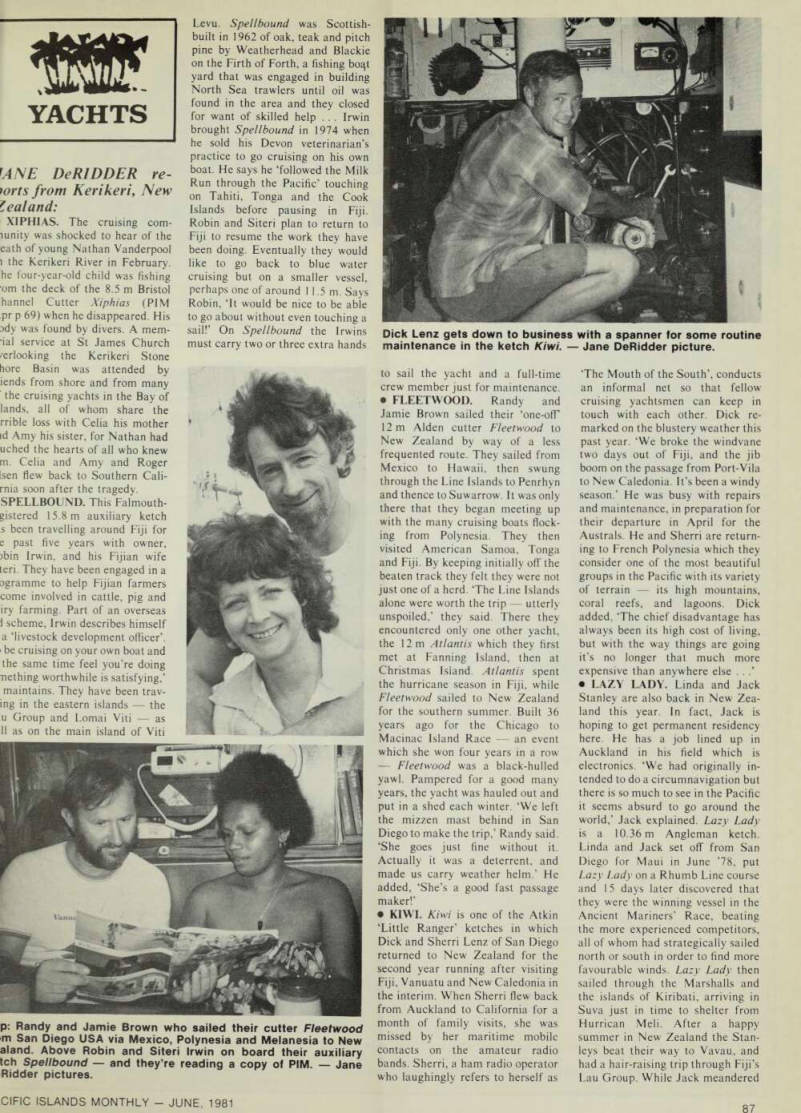

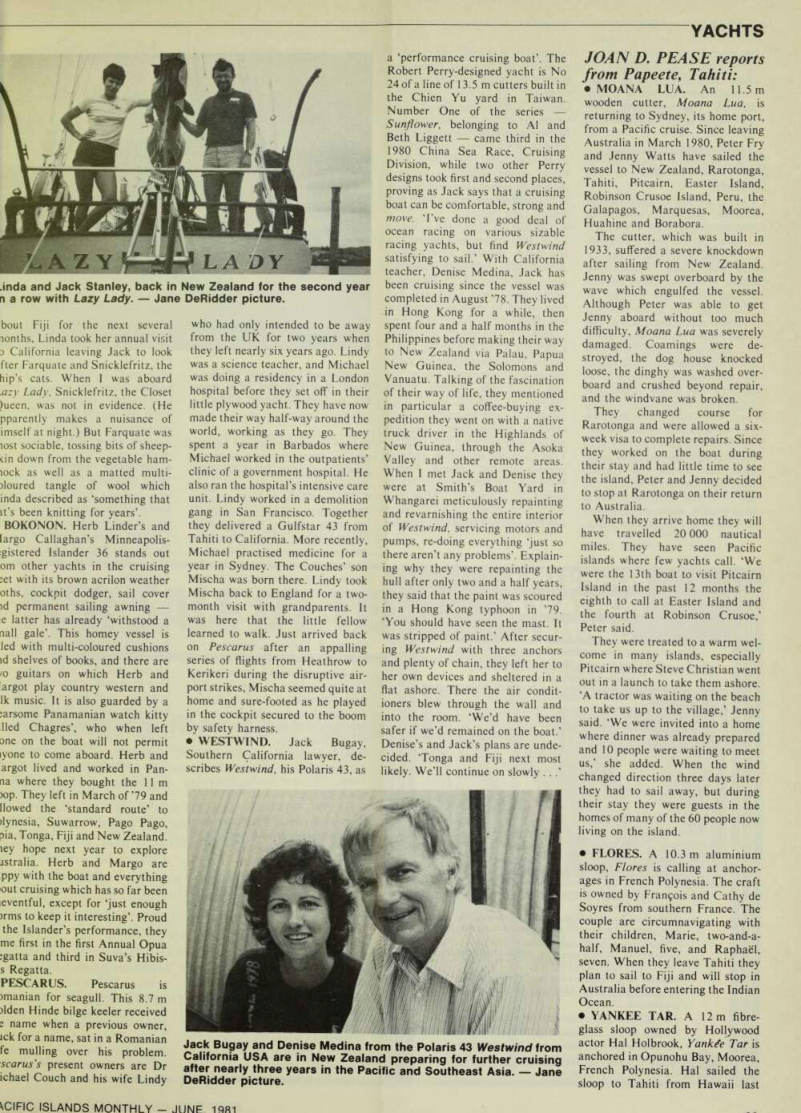
Levu. Spellbound was Scottish built in 1962 of oak, teak and pitch pine by Weatherhead and Blackie on the Firth of Forth, a fishing yard that was engaged in building North Sea trawlers until oil was found in the area and they closed for want of skilled help . . . Irwin brought Spellbound in 1974 when he sold his Devon veterinarian’s practice to go cruising on his own boat. He says he ‘followed the Milk Run through the Pacific’ touching on Tahiti, Tonga and the Cook Islands before pausing in Fiji.
Robin and Siteri plan to return to Fiji to resume the work they have been doing. Eventually they would like to go back to blue water cruising but on a smaller vessel, perhaps one of around 11.5 m. Says Robin, ‘lt would be nice to be able to go about without even touching a sail!’ On Spellbound the Irwins must carry two or three extra hands
*Ane Deridder Re
ports from Kerikeri y New
Zealand:
XI PHI AS. The cruising com tunity was shocked to hear of the eath of young Nathan Vanderpool i the Kerikeri River in February, he four-year-old child was fishing om the deck of the 8.5 m Bristol hannel Cutter Xiphias (PIM pr p 69) when he disappeared. His 3dy was found by divers. A mem •ial service at St James Church blocking the Kerikeri Stone liore Basin was attended by iends from shore and from many the cruising yachts in the Bay of lands, all of whom share the rrible loss with Celia his mother id Amy his sister, for Nathan had uched the hearts of all who knew m. Celia and Amy and Roger Isen flew back to Southern Cali rnia soon after the tragedy.
SPELLBOUND. This Falmouth
gistered 15.8 m auxiliary ketch
s been travelling around Fiji for e past five years with owner, )bin Irwin, and his Fijian wife teri. They have been engaged in a agramme to help Fijian farmers come involved in cattle, pig and iry farming. Part of an overseas I scheme, Irwin describes himself a ‘livestock development officer’. i be cruising on your own boat and the same time feel you’re doing nothing worthwhile is satisfying,’ maintains. They have been trav ing in the eastern islands the u Group and Lomai Viti as II as on the main island of Viti
to sail the yacht and a full-time crew member just for maintenance. • FLEETWOOD. Randy and Jamie Brown sailed their ‘one-ofT 12 m Alden cutter Fleetwood to New Zealand by way of a less frequented route. They sailed from Mexico to Hawaii, then swung through the Line Islands to Penrhyn and thence to Suwarrow. It was only there that they began meeting up with the many cruising boats flock ing from Polynesia. They then visited American Samoa, Tonga and Fiji. By keeping initially off the beaten track they felt they were not just one of a herd. ‘The Line Islands alone were worth the trip utterly unspoiled,’ they said. There they encountered only one other yacht, the 12 m Atlantis which they first met at Fanning Island, then at Christmas Island. Atlantis spent the hurricane season in Fiji, while Fleetwood sailed to New Zealand for the southern summer. Built 36 years ago for the Chicago to Macinac Island Race an event which she won four years in a row Fleetwood was a black-hulled yawl. Pampered for a good many years, the yacht was hauled out and put in a shed each winter. ‘We left the mizzen mast behind in San Diego to make the trip,’ Randy said. ‘She goes just fine without it.
Actually it was a deterrent, and made us carry weather helm.’ He added, ‘She’s a good fast passage maker!’ • KIWI. Kiwi is one of the Atkin ‘Little Ranger’ ketches in which Dick and Sherri Lenz of San Diego returned to New Zealand for the second year running after visiting Fiji, Vanuatu and New Caledonia in the interim. When Sherri flew back from Auckland to California for a month of family visits, she was missed by her maritime mobile contacts on the amateur radio bands. Sherri, a ham radio operator who laughingly refers to herself as
‘The Mouth of the South’, conducts an informal net so that fellow cruising yachtsmen can keep in touch with each other. Dick re marked on the blustery weather this past year. ‘We broke the windvane two days out of Fiji, and the jib boom on the passage from Port-Vila to New Caledonia. It’s been a windy season.’ He was busy with repairs and maintenance, in preparation for their departure in April for the Australs. He and Sherri are return ing to French Polynesia which they consider one of the most beautiful groups in the Pacific with its variety of terrain its high mountains, coral reefs, and lagoons. Dick added, ‘The chief disadvantage has always been its high cost of living, but with the way things are going it’s no longer that much more expensive than anywhere else . . .’ • LAZY LADY. Linda and Jack Stanley are also back in New Zea land this year. In fact. Jack is hoping to get permanent residency here. He has a job lined up in Auckland in his field which is electronics. ‘We had originally in tended to do a circumnavigation but there is so much to see in the Pacific it seems absurd to go around the world,’ Jack explained. Lazy Lady is a 10.36 m Angleman ketch.
Linda and Jack set off from San Diego for Maui in June ’7B, put Lazy Lady on a Rhumb Line course and 15 days later discovered that they were the winning vessel in the Ancient Mariners' Race, beating the more experienced competitors, all of whom had strategically sailed north or south in order to find more favourable winds. Lazy Lady then sailed through the Marshalls and the islands of Kiribati, arriving in Suva just in time to shelter from Hurrican Meli. After a happy summer in New Zealand the Stan leys beat their way to Vavau, and had a hair-raising trip through Fiji’s Lau Group. While Jack meandered
[?]p: Randy and Jamie Brown who sailed their cutter Fleetwood [?]m San Diego USA via Mexico, Polynesia and Melanesia to New [?]aland. Above Robin and Siteri Irwin on board their auxiliary [?]tch Spellbound and they’re reading a copy of PIM. Jane Ridder pictures.
Dick Lenz gets down to business with a spanner for some routine maintenance in the ketch Kiwi. Jane DeRidder picture.
bout Fiji for the next several nonths, Linda took her annual visit 3 California leaving Jack to look fter Farquate and Snicklefritz, the hip’s cats. When I was aboard azy Lady, Snicklefritz, the Closet )ueen, was not in evidence. (He pparently makes a nuisance of imself at night.) But Farquate was lost sociable, tossing bits of sheep dn down from the vegetable ham lock as well as a matted multi iloured tangle of wool which inda described as ‘something that it’s been knitting for years’.
BOKONON. Herb Linder’s and
largo Callaghan’s Minneapolis
gistered Islander 36 stands out om other yachts in the cruising ;et with its brown acrilon weather oths, cockpit dodger, sail cover
id permanent sailing awning
e latter has already ‘withstood a nail gale’. This homey vessel is led with multi-coloured cushions id shelves of books, and there are 'O guitars on which Herb and argot play country western and Ik music. It is also guarded by a
;arsome Panamanian watch kitty
lied Chagres’, who when left one on the boat will not permit lyone to come aboard. Herb and argot lived and worked in Pan na where they bought the 11m )op. They left in March of’79 and (lowed the ‘standard route’ to ilynesia, Suwarrow, Pago Pago,
pia, Tonga, Fiji and New Zealand,
icy hope next year to explore jstralia. Herb and Margo are ppy with the boat and everything out cruising which has so far been eventful, except for ‘just enough
)rms to keep it interesting’. Proud
the Islander’s performance, they me first in the first Annual Opua jgatta and third in Suva’s Hibis s Regatta.
PESCARUS. Pescarus is imanian for seagull. This 8.7 m )lden Hinde bilge keeler received z name when a previous owner, ick for a name, sat in a Romanian fe mulling over his problem. scarus’s present owners are Dr ichael Couch and his wife Lindy
who had only intended to be away from the UK for two years when they left nearly six years ago. Lindy was a science teacher, and Michael was doing a residency in a London hospital before they set off in their little plywood yacht. They have now made their way half-way around the world, working as they go. They spent a year in Barbados where Michael worked in the outpatients’ clinic of a government hospital. He also ran the hospital’s intensive care unit. Lindy worked in a demolition gang in San Francisco. Together they delivered a Gulfstar 43 from Tahiti to California. More recently, Michael practised medicine for a year in Sydney. The Couches’ son Mischa was born there. Lindy took Mischa back to England for a two month visit with grandparents. It was here that the little fellow learned to walk. Just arrived back on Pescarus after an appalling series of flights from Heathrow to Kerikeri during the disruptive air port strikes, Mischa seemed quite at home and sure-footed as he played in the cockpit secured to the boom by safety harness. • WESTWIND. Jack Bugay, Southern California lawyer, de scribes Westwind, his Polaris 43, as
a ‘performance cruising boat’. The Robert Perry-designed yacht is No 24 of a line of 13.5 m cutters built in the Chien Yu yard in Taiwan.
Number One of the series Sunflower, belonging to Al and Beth Liggett came third in the 1980 China Sea Race, Cruising Division, while two other Perry designs took first and second places, proving as Jack says that a cruising boat can be comfortable, strong and move. ‘l’ve done a good deal of ocean racing on various sizable racing yachts, but find Westwind satisfying to sail.’ With California teacher, Denise Medina, Jack has been cruising since the vessel was completed in August ’7B. They lived in Hong Kong for a while, then spent four and a half months in the Philippines before making their way to New Zealand via Palau, Papua New Guinea, the Solomons and Vanuatu. Talking of the fascination of their way of life, they mentioned in particular a coffee-buying ex pedition they went on with a native truck driver in the Highlands of New Guinea, through the Asoka Valley and other remote areas.
When I met Jack and Denise they were at Smith’s Boat Yard in Whangarei meticulously repainting and revarnishing the entire interior of Westwind, servicing motors and pumps, re-doing everything ‘just so there aren’t any problems’. Explain ing why they were repainting the hull after only two and a half years, they said that the paint was scoured in a Hong Kong typhoon in ’79. ‘You should have seen the mast. It was stripped of paint.’ After secur ing Westwind with three anchors and plenty of chain, they left her to her own devices and sheltered in a flat ashore. There the air condit ioners blew through the wall and into the room. ‘We’d have been safer if we’d remained on the boat.’
Denise’s and Jack’s plans are unde cided. ‘Tonga and Fiji next most likely. We’ll continue on slowly . . .’
JOAN D. PEASE reports
from Papeete, Tahiti:
• Moana Lua. An 11.5 M
wooden cutter, Moana Lua, is returning to Sydney, its home port, from a Pacific cruise. Since leaving Australia in March 1980, Peter Fry and Jenny Watts have sailed the vessel to New Zealand, Rarotonga, Tahiti, Pitcairn, Easter Island, Robinson Crusoe Island, Peru, the
Galapagos, Marquesas, Moorea,
Huahine and Borabora.
The cutter, which was built in 1933, suffered a severe knockdown after sailing from New Zealand.
Jenny was swept overboard by the wave which engulfed the vessel.
Although Peter was able to get Jenny aboard without too much difficulty, Moana Lua was severely damaged. Coamings were de stroyed, the dog house knocked loose, the dinghy was washed over board and crushed beyond repair, and the windvane was broken.
They changed course for Rarotonga and were allowed a six week visa to complete repairs. Since they worked on the boat during their stay and had little time to see the island, Peter and Jenny decided to stop at Rarotonga on their return to Australia.
When they arrive home they will have travelled 20 000 nautical miles. They have seen Pacific islands where few yachts call. ‘We were the 13th boat to visit Pitcairn Island in the past 12 months the eighth to call at Easter Island and the fourth at Robinson Crusoe,’
Peter said.
They were treated to a warm wel come in many islands, especially Pitcairn where Steve Christian went out in a launch to take them ashore. ‘A tractor was waiting on the beach to take us up to the village,’ Jenny said. ‘We were invited into a home where dinner was already prepared and 10 people were waiting to meet us,’ she added. When the wind changed direction three days later they had to sail away, but during their stay they were guests in the homes of many of the 60 people now living on the island. • FLORES. A 10.3 m aluminium sloop, Flores is calling at anchor ages in French Polynesia. The craft is owned by Francois and Cathy de Soyres from southern France. The couple are circumnavigating with their children, Marie, two-and-a half, Manuel, five, and Raphael, seven. When they leave Tahiti they plan to sail to Fiji and will stop in Australia before entering the Indian Ocean. • YANKEE TAR. A 12 m fibre glass sloop owned by Hollywood actor Hal Holbrook, Yankee Tar is anchored in Opunohu Bay, Moorea, French Polynesia. Hal sailed the sloop to Tahiti from Hawaii last
inda and Jack Stanley, back in New Zealand for the second year [?] a row with Lazy Lady. Jane DeRidder picture.
Jack Bugay and Denise Medina from the Polaris 43 Westwind from California USA are in New Zealand preparing for further cruising after nearly three years in the Pacific and Southeast Asia. Jane
DeRidder picture.
Advertisements & other items, pp. 87-89 (3 items)
87
CIFIC ISLANDS MONTHLY - JUNE, 1981
The luxury of jergens
Available at last!
Three delicately scented soaps with the total freshness of nature. ge~ Gentle Touch Soaps, in three colours, with the soothing goodness of Baby Oil.
DRYAD DEODORANTS.
With the lasting springtime fresh fragrance. Available in aerosol, stick and roll-on.
Deep cleansing clear soap for problem skin. Contains Glycerine. m
BgSfe
Jersens
Hand and body lotions to enrich dry skin. Jergens Wnite and Jergens Yellow, the extra nourishment for extra-dry skin.
Also available: Jergens Lotion-mila soap.
NI3O
wm The wonderful young shampoo and conditioner that leave your hair with a soft delicate fragrance for hours. "Gee, your hair smells terrific!"
The Andrew Jergens Company is proud to be able to bring this superb range of products direct from America to you. Look for these products at your favorite store when next you go shopping.
TRADE ENQUIRIES WELCOME
MANUFACTURED BY: THE ANDREW JERGENS Co, Cincinnati, U.S.A.
Distributed by: S. E. Tatham, Melbourne, Australia.
A)001
Yachts
from Rarotonga , Cook
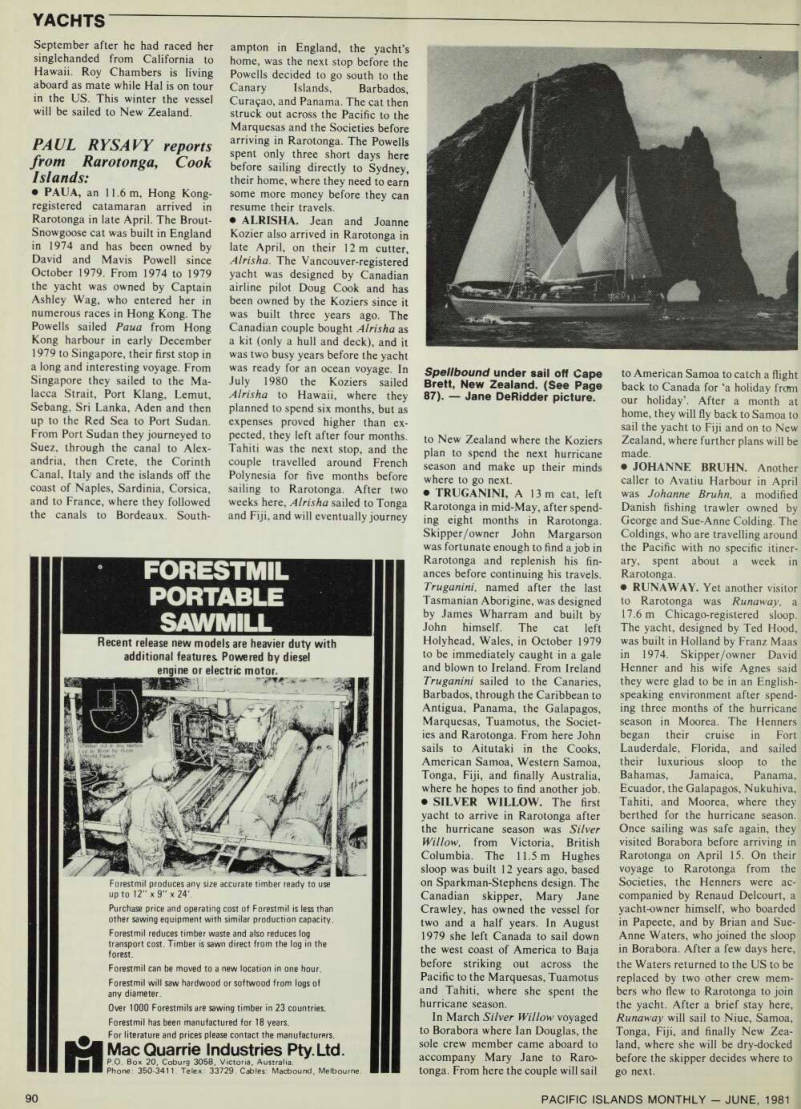
September after he had raced her singlehanded from California to Hawaii. Roy Chambers is living aboard as mate while Hal is on tour in the US. This winter the vessel will be sailed to New Zealand.
PAUL RYSAVY reports
Islands:
• PAUA, an 11.6 m, Hong Kong registered catamaran arrived in Rarotonga in late April. The Brout- Snowgoose cat was built in England in 1974 and has been owned by David and Mavis Powell since October 1979. From 1974 to 1979 the yacht was owned by Captain Ashley Wag, who entered her in numerous races in Hong Kong. The Powells sailed Paua from Hong Kong harbour in early December 1979 to Singapore, their first stop in a long and interesting voyage. From Singapore they sailed to the Ma lacca Strait, Port Klang, Lemut, Sebang, Sri Lanka, Aden and then up to the Red Sea to Port Sudan.
From Port Sudan they journeyed to Suez, through the canal to Alex andria, then Crete, the Corinth Canal, Italy and the islands off the coast of Naples, Sardinia, Corsica, and to France, where they followed the canals to Bordeaux. South
ampton in England, the yacht’s home, was the next stop before the Powells decided to go south to the Canary Islands, Barbados, Curasao, and Panama. The cat then struck out across the Pacific to the Marquesas and the Societies before arriving in Rarotonga. The Powells spent only three short days here before sailing directly to Sydney, their home, where they need to earn some more money before they can resume their travels. • ALRISHA. Jean and Joanne Kozier also arrived in Rarotonga in late April, on their 12 m cutter, Alrisha. The Vancouver-registered yacht was designed by Canadian airline pilot Doug Cook and has been owned by the Koziers since it was built three years ago. The Canadian couple bought Alrisha as a kit (only a hull and deck), and it was two busy years before the yacht was ready for an ocean voyage. In July 1980 the Koziers sailed Alrisha to Hawaii, where they planned to spend six months, but as expenses proved higher than ex pected, they left after four months.
Tahiti was the next stop, and the couple travelled around French Polynesia for five months before sailing to Rarotonga. After two weeks here, Alrisha sailed to Tonga and Fiji, and will eventually journey
to New Zealand where the Koziers plan to spend the next hurricane season and make up their minds where to go next. • TRUGANINI, A 13 m cat, left
Rarotonga in mid-May, after spend
ing eight months in Rarotonga.
Skipper/owner John Margarson was fortunate enough to find a job in Rarotonga and replenish his fin ances before continuing his travels.
Truganini. named after the last Tasmanian Aborigine, was designed by James Wharram and built by John himself. The cat left Holyhead, Wales, in October 1979 to be immediately caught in a gale and blown to Ireland. From Ireland Truganini sailed to the Canaries, Barbados, through the Caribbean to
Antigua, Panama, the Galapagos,
Marquesas, Tuamotus, the Societ ies and Rarotonga. From here John sails to Aitutaki in the Cooks, American Samoa, Western Samoa, Tonga, Fiji, and finally Australia, where he hopes to find another job. • SILVER WILLOW. The first yacht to arrive in Rarotonga after the hurricane season was Silver Willow, from Victoria, British
Columbia. The 11.5 m Hughes
sloop was built 12 years ago, based
on Sparkman-Stephens design. The
Canadian skipper, Mary Jane Crawley, has owned the vessel for two and a half years. In August 1979 she left Canada to sail down the west coast of America to Baja before striking out across the Pacific to the Marquesas, Tuamotus and Tahiti, where she spent the hurricane season.
In March Silver Willow voyaged to Borabora where lan Douglas, the sole crew member came aboard to accompany Mary Jane to Raro tonga. From here the couple will sail
to American Samoa to catch a flight back to Canada for ‘a holiday from our holiday’. After a month at home, they will fly back to Samoa to sail the yacht to Fiji and on to New Zealand, where further plans will be made. • JOHANNE BRUHN. Another caller to Avatiu Harbour in April was Johanne Bruhn, a modified Danish fishing trawler owned by George and Sue-Anne Colding. The Goldings, who are travelling around the Pacific with no specific itiner ary, spent about a week in Rarotonga. • RUNAWAY. Yet another visitor to Rarotonga was Runaway, a
17.6 m Chicago-registered sloop.
The yacht, designed by Ted Hood, was built in Holland by Franz Maas in 1974. Skipper/owner David Henner and his wife Agnes said they were glad to be in an English speaking environment after spend ing three months of the hurricane season in Moorea. The Henners began their cruise in Fort Lauderdale, Florida, and sailed their luxurious sloop to the Bahamas, Jamaica, Panama, Ecuador, the Galapagos, Nukuhiva, Tahiti, and Moorea, where they berthed for the hurricane season.
Once sailing was safe again, they visited Borabora before arriving in Rarotonga on April 15. On their voyage to Rarotonga from the Societies, the Henners were ac companied by Renaud Delcourt, a yacht-owner himself, who boarded in Papeete, and by Brian and Sue- Anne Waters, who joined the sloop in Borabora. After a few days here, the Waters returned to the US to be replaced by two other crew mem bers who flew to Rarotonga to join the yacht. After a brief stay here, Runaway will sail to Niue, Samoa, Tonga, Fiji, and finally New Zea land, where she will be dry-docked before the skipper decides where to go next.
Spellbound under sail off Cape Brett, New Zealand. (See Page 87). - Jane DeRidder picture.
Advertisements & other items, p. 90 (2 items)
Yachts
Forestmil
PORTABLE
SAWMILL
Recent release new models are heavier duty with additional features. Powered by diesel or electric motor. irt' " me m Forestmil produces any size accurate timber ready to use up to 12" x 9" x 24’.
Purchase price and operating cost of Forestmil is less than other sawing equipment with similar production capacity.
Forestmil reduces timber waste and also reduces log transport cost. Timber is sawn direct from the log in the forest.
Forestmil can be moved to a new location in one hour.
Forestmil will saw hardwood or softwood from logs of any diameter.
Over 1000 Forestmilsare sawing timber in 23 countries.
Forestmil has been manufactured for 18 years.
For literature and prices please contact the manufacturers.
MacQuarrie Industries Pty.Ltd.
P.O. Box 20, Coburg 3058, Victoria, Australia.
Phone: 350-3411. Telex: 33729. Cables: Macbound, Melbourne.
Shipping
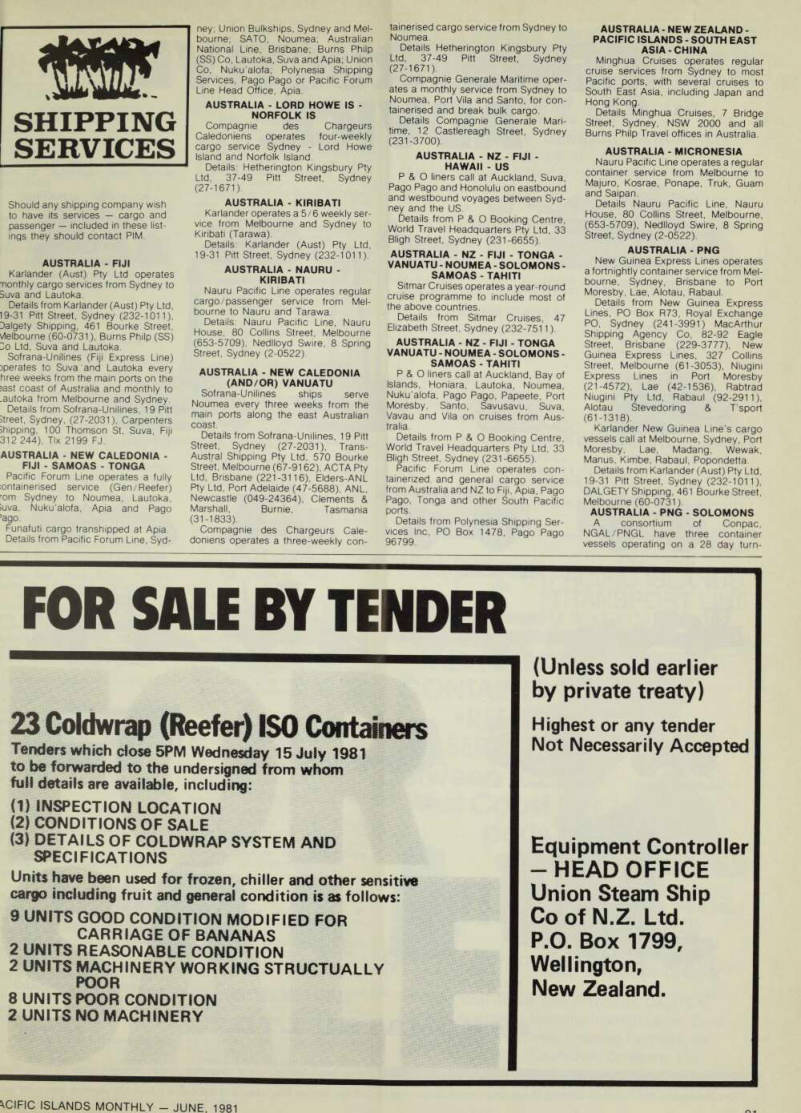

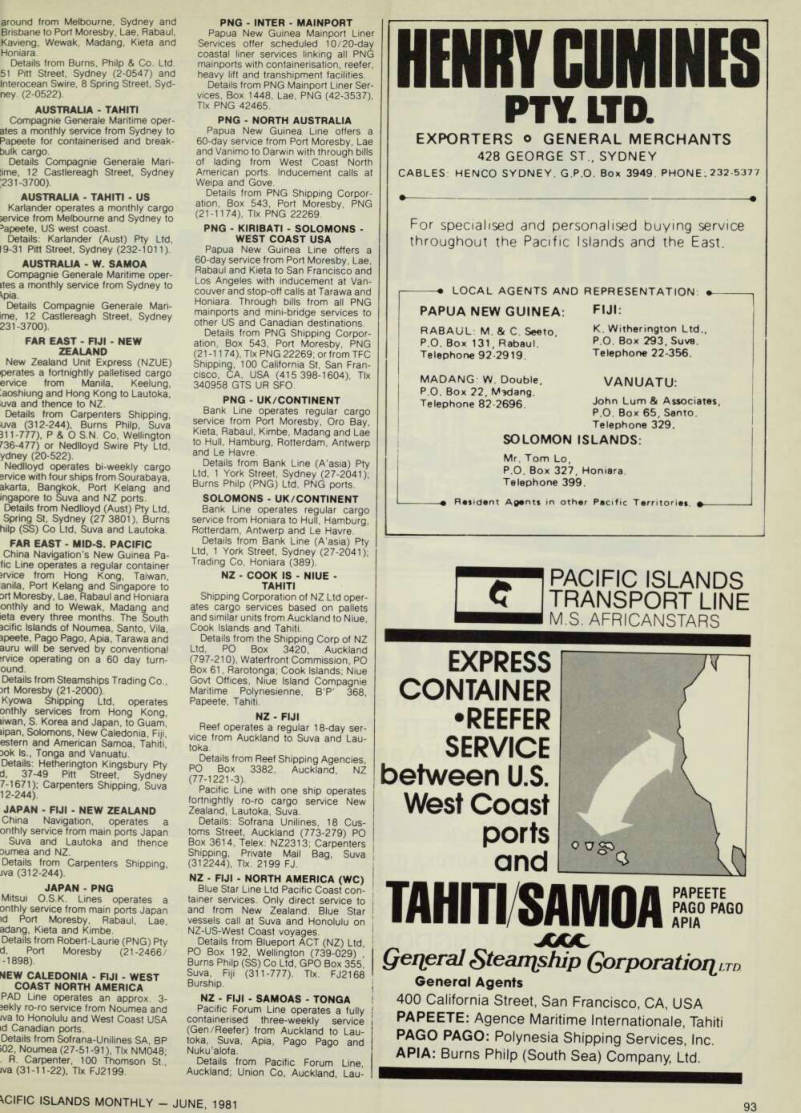
Services
Should any shipping company wish to have its services cargo and passenger included in these list ings they should contact PIM,
Australia - Fiji
Karlander (Aust) Pty Ltd operates monthly cargo services from Sydney to Suva and Lautoka.
Details from Karlander (Aust) Pty Ltd, 19-31 Pitt Street, Sydney (232-1011), Dalgety Shipping, 461 Bourke Street, Melbourne (60-0731), Burns Philp (SS) Do Ltd, Suva and Lautoka.
Sofrana-Unilines (Fiji Express Line) jperates to Suva and Lautoka every hree weeks from the main ports on the ;ast coast of Australia and monthly to .autoka from Melbourne and Sydney.
Details from Sofrana-Unilines, 19 Pitt Street, Sydney, (27-2031), Carpenters Shipping, 100 Thomson St, Suva, Fiji 312 244), Tlx 2199 FJ.
Australia - New Caledonia -
Fiji - Samoas - Tonga
Pacific Forum Line operates a fully ;ontainerised service (Gen /Reefer) r om Sydney to Noumea, Lautoka, Suva, Nuku’alofa, Apia and Pago 'ago.
Funafuti cargo transhipped at Apia.
Details from Pacific Forum Line, Syd
ney; Union Bulkships, Sydney and Mel bourne; SATO. Noumea: Australian National Line, Brisbane; Burns Philp (SS) Co, Lautoka, Suva and Apia; Union Co, Nuku’alofa; Polynesia Shipping Services, Pago Pago or Pacific Forum Line Head Office, Apia.
Australia - Lord Howe Is -
Norfolk Is
Compagnie des Chargeurs Caledoniens operates four-weekly cargo service Sydney - Lord Howe Island and Norfolk Island.
Details: Hetherington Kingsbury Pty Ltd, 37-49 Pitt Street, Sydney (27-1671).
Australia - Kiribati
Karlander operates a 5/6 weekly ser vice from Melbourne and Sydney to Kiribati (Tarawa).
Details: Karlander (Aust) Pty Ltd, 19-31 Pitt Street, Sydney (232-1011).
Australia - Nauru -
Kiribati
Nauru Pacific Line operates regular cargo/passenger service from Mel bourne to Nauru and Tarawa.
Details: Nauru Pacific Line, Nauru House, 80 Collins Street, Melbourne (653-5709), Nedlloyd Swire, 8 Spring Street, Sydney (2-0522).
Australia - New Caledonia
(And/Or) Vanuatu
Sofrana-Unilines ships serve Noumea every three weeks from the main ports along the east Australian coast.
Details from Sofrana-Unilines, 19 Pitt Street. Sydney (27-2031). Trans- Austral Shipping Pty Ltd, 570 Bourke Street, Melbourne (67-9162), ACTA Pty Ltd, Brisbane (221-3116), Elders-ANL Pty Ltd, Port Adelaide (47-5688), ANL, Newcastle (049-24364), Clements & Marshall, Burnie, Tasmania (31-1833).
Compagnie des Chargeurs Cale doniens operates a three-weekly con
tainerised cargo service from Sydney to Noumea Details Hetherington Kingsbury Pty Ltd, 37-49 Pitt Street, Sydney ( 2 7-1671).
Compagnie Generate Maritime operates a monthly service from Sydney to Noumea, Port Vila and Santo, for containerised and break bulk cargo.
Details Compagnie Generate Maritime, 12 Castlereagh Street, Sydney (231-3700).
Australia - Nz - Fiji -
Hawaii Us
P & O liners call at Auckland. Suva.
Pago Pago and Honolulu on eastbound nevan e d S Th 0 e Un uS Voya9eSbetWeenSyd ' Details from P & O Booking Centre, World Travel Headquarters Pty Ltd, 33 Bligh Street, Sydney (231-6655).
AUSTRALIA - NZ - FIJI - TONGA -
Vanuatu - Noumea - Solomons -
Samoas Tahiti
Sitmar Cruises operates a year-round cruise programme to include most of the above countries.
Details from Sitmar Cruises, 47 Elizabeth Street, Sydney (232-751 1) 1y v 1 AUSTRALIA - NZ - FIJI - TONGA
Vanuatu-Noumea-Solomons-
Samoas - Tahiti
P & O liners call at Auckland. Bay of Islands, Honiara, Lautoka, Noumea.
Nukualofa, Pago Pago, Papeete, Port Moresby, Santo, Savusavu, Suva, Vavau and Vila on cruises from Austra l' a Details from P & O Booking Centre.
World Travel Headquarters Pty Ltd, 33
Bligh Street, Sydney (231-6655).
Pacific Forum Line operates containerized and general cargo service from Australia and NZ to Fiji, Apia, Pago Pago, Tonga and other South Pacific ports Details from Polynesia Shipping Services Inc, PO Box 1478, Pago Pago 96799.
Australia - New Zealand -
Pacific Islands - South East
Asia-China
Minghua Cruises operates regular cruise services from Sydney to most Pacific ports, with several cruises to South East Asia, including Japan and Hong Kong.
Details Minghua Cruises, 7 Bridge street, Sydney, NSW 2000 and all Burns Philp Travel offices in Australia.
Australia - Micronesia
Nauru Pacific Line operates a regular t 0 8 3e ' Pona P e . Truk - Guam Details Nauru Pacific Line. Nauru S ' r e, t Melbourne, 0522? ' 8 Spn ° 9 Street, Sydney (2-0522).
Kl Australia - Png
, Naw nea pxpress Lines operates a fortnightly container service from Mel b°u r L" e h ' ?£"«* **s"®, t 0 Porl M 9s esb y. Lae. Alotau, Rabaul. , . Details from New Guinea Express PO Box R 73 Royal Exchange Sydnay ( 241 ’3" l ) acArth V r Shipping Agency Co, 82-92 Eagle Street, Brisbane (229-3777), New Guinea Express Lines, 327 Collins Street. Melbourne (61-3053), Niugini Express Lines in Port Moresby (21-4572), Lae (42-1536), Rabtrad Niugini Pty Ltd, Rabaul (92-2911), Alotau Stevedoring & T’sport (61-1318).
Karlander New Guinea Line’s cargo vessels call at Melbourne. Sydney, Port Moresby. Lae, Madang, Wewak, Manus, Kimbe, Rabaul. Popondetta Details from Karlander (Aust) Pty Ltd, 19-31 Pitt Street, Sydney (232-1011), DALGETY Shipping, 461 Bourke Street!
Melbourne (60-0731).
Australia - Png - Solomons
A consortium of Conpac, NGAL/PNGL have three container vessels operating on a 28 day turn
around from Melbourne, Sydney and Brisbane to Port Moresby, Lae, Rabaul, Kavieng, Wewak, Madang, Kieta and Honiara.
Details from Burns, Philp & Co. Ltd. 51 Pitt Street, Sydney (2-0547) and Interocean Swire, 8 Spring Street, Syd ney. (2-0522).
Australia - Tahiti
Compagnie Generate Maritime oper ates a monthly service from Sydney to Papeete for containerised and break bulk cargo.
Details Compagnie Generate Mari time. 12 Castlereagh Street, Sydney ;231-3700).
Australia - Tahiti - Us
Karlander operates a monthly cargo service from Melbourne and Sydney to 3 apeete, US west coast.
Details; Karlander (Aust) Pty Ltd, 19-31 Pitt Street. Sydney (232-1011).
Australia - W. Samoa
Compagnie Generate Maritime oper ites a monthly service from Sydney to Details Compagnie Generate Mari ime, 12 Castlereagh Street, Sydney 231-3700).
Far East - Fiji - New
Zealand
New Zealand Unit Express (NZUE) •perates a fortnightly palletised cargo ervice from Manila. Keelung, taoshiung and Hong Kong to Lautoka, dva and thence to NZ.
Details from Carpenters Shipping, uva (312-244), Burns Philp, Suva 311-777), P & O S.N. Co, Wellington or Nedlloyd Swire Pty Ltd, ydney (20-522).
Nedlloyd operates bi-weekly cargo srvice with four ships from Sourabaya, akarta, Bangkok, Port Kelang and ingapore to Suva and NZ ports.
Details from Nedlloyd (Aust) Pty Ltd, Spring St. Sydney (27 3801), Burns hilp (SS) Co Ltd, Suva and Lautoka.
Far East - Mid-S. Pacific
China Navigation’s New Guinea Pa fic Line operates a regular container jrvice from Hong Kong, Taiwan, anila. Port Kelang and Singapore to Drt Moresby, Lae, Rabaul and Honiara onthly and to Wewak, Madang and ieta every three months. The South acific Islands of Noumea, Santo, Vila, apeete, Pago Pago, Apia, Tarawa and auru will be served by conventional srvice operating on a 60 day turn ound.
Details from Steamships Trading Co., art Moresby (21-2000).
Kyowa Shipping Ltd, operates onthly services from Hong Kong, liwan, S. Korea and Japan, to Guam, lipan, Solomons, New Caledonia, Fiji, estern and American Samoa, Tahiti, xak Is.. Tonga and Vanuatu.
Details: Hetherington Kingsbury Pty d. 37-49 Pitt Street, Sydney 7-1671); Carpenters Shipping, Suva 12-244).
Japan - Fiji - New Zealand
China Navigation, operates a onthly service from main ports Japan Suva and Lautoka and thence Dumea and NZ.
Details from Carpenters Shipping jva (312-244).
Japan - Png
Mitsui O.S.K. Lines operates a onthly service from main ports Japan id Port Moresby, Rabaul, Lae, adang, Kieta and Kimbe, Details from Robert-Laurie (PNG) Pty d, Port Moresby (21-2466/ -1898).
Mew Caledonia - Fiji - West
Coast North America
PAD Line operates an approx. 3jekly ro-ro service from Noumea and iva to Honolulu and West Coast USA id Canadian ports.
Details from Sofrana-Unilines SA, BP >O2, Noumea (27-51-91), Tlx NMO4B; . R. Carpenter, 100 Thomson St., iva (31-11-22), Tlx FJ2199.
Png - Inter - Mainport
Papua New Guinea Mainport Liner Services offer scheduled 10/20-day coastal liner services linking all PNG mainports with containerisation, reefer, heavy lift and transhipment facilities.
Details from PNG Mainport Liner Ser vices, Box 1448, Lae, PNG (42-3537), Tlx PNG 42465.
Png - North Australia
Papua New Guinea Line offers a 60-day service from Port Moresby, Lae and Vanimo to Darwin with through bills of lading from West Coast North American ports. Inducement calls at Weipa and Gove.
Details from PNG Shipping Corpor ation, Box 543, Port Moresby, PNG (21-1174), Tlx PNG 22269.
Png - Kiribati - Solomons -
West Coast Usa
Papua New Guinea Line offers a 60-day service from Port Moresby, Lae, Rabaul and Kieta to San Francisco and Los Angeles with inducement at Van couver and stop-off calls at Tarawa and Honiara. Through bills from all PNG mainports and mini-bridge services to other US and Canadian destinations.
Details from PNG Shipping Corpor ation, Box 543, Port Moresby, PNG (21 -1174), Tlx PNG 22269; or from TFC Shipping, 100 California St, San Fran cisco, CA, USA (415 398-1604), Tlx
340958 Gts Ur Sfo.
Png - Uk/Continent
Bank Line operates regular cargo service from Port Moresby, Oro Bay, Kieta, Rabaul, Kimbe, Madang and Lae to Hull, Hamburg, Rotterdam, Antwerp and Le Havre.
Details from Bank Line (A'asia) Pty Ltd, 1 York Street, Sydney (27-2041); Burns Philp (PNG) Ltd. PNG ports.
Solomons - Uk/Continent
Bank Line operates regular cargo service from Honiara to Hull, Hamburg, Rotterdam, Antwerp and Le Havre.
Details from Bank Line (A'asia) Pty Ltd, 1 York Street, Sydney (27-2041); Trading Co, Honiara (389).
NZ - COOK IS - NIUE -
Tahiti
Shipping Corporation of NZ Ltd oper ates cargo services based on pallets and similar units from Auckland to Niue, Cook Islands and Tahiti.
Details from the Shipping Corp of NZ Ltd, PO Box 3420, Auckland (797-210), Waterfront Commission, PO Box 61. Rarotonga: Cook Islands; Niue Govt Offices, Niue Island Compagnie Maritime Polynesienne, B'P' 368, Papeete, Tahiti,
Nz - Fiji
Reef operates a regular 18-day ser vice from Auckland to Suva and Lau toka.
Details from Reef Shipping Agencies, PO Box 3382, Auckland, NZ (77-1221-3).
Pacific Line with one ship operates fortnightly ro-ro cargo service New Zealand, Lautoka, Suva.
Details: Sofrana Unilines, 18 Cus toms Street, Auckland (773-279) PO Box 3614, Telex: NZ2313; Carpenters Shipping, Private Mail Bag, Suva (312244), Tlx. 2199 FJ.
NZ - FIJI - NORTH AMERICA (WC) Blue Star Line Ltd Pacific Coast con tainer services. Only direct service to i and from New Zealand. Blue Star I vessels call at Suva and Honolulu on !
NZ-US-West Coast voyages.
Details from Blueport ACT (NZ) Ltd, PO Box 192, Wellington (739-029) Burns Philp (SS) Co Ltd, GPO Box 355, Suva, Fiji (311-777). Tlx. FJ2168
Burship. j
NZ - FIJI - SAMOAS - TONGA j Pacific Forum Line operates a fully j containerised three-weekly service (Gen/Reefer) from Auckland to Lau toka, Suva, Apia, Pago Pago and Nukualofa.
Details from Pacific Forum Line, Auckland; Union Co, Auckland, Lau
toka, Suva, Apia and Nukualofa; Polynesia Shipping Services, Pago Pago or Pacific Forum Line Head Office, Apia.
Nz - Tonga - Samoa
Warner Pacific Line operates a regular cargo service from Timaru, Onehunga and Westport to Nukualofa, Vavau and Apia with regular calls to Haapai and Pago Pago.
Details from McKay Shipping Ltd, PO Box 1372, Auckland, NZ; Warner Pacific Line, Box 93, Nukualofa, Tonga and Neiafu, Vavau. Tonga; Polynesian Shipping Services, Box 1478, Pago Pago; and Molua Folau Shipping Co, Box 4171, Apia, W. Samoa. » A.irnm.i. * a.
Nz ‘ - Fiji -
Solomons - Png
Pacific Forum Line operates a fully containerised service (Gen/Reefer) rom Lyttelton, Napier, Auckland to Suva, Lautoka, Honiara, Kieta, Lae and 3 ort Moresby.
Details from Pacific Forum Line, Auckland; Shipping Corporation of NZ, .yttelton, Napier; Union Co, Auckland, >uva, Lautoka; Steamships Trading Co, Cieta, Lae, Port Moresby; Sullivans (Sl)» -td, Honiara or Pacific Forum Line Head Office, Apia. 1Z - N. CALEDONIA - VANUATU -
Png - Solomons
Sofrana Unilines with three ships oprates to Vila and Santo, to Honiara and >apua New Guinea and to Norfolk ;land and Noumea.
Details from Sofrana Unilines, 18 Customs Street. Auckland (773-279), O Box 3614, Telex NZ2313.
Nz - Tahiti
Compagnie Tahitienne Maritime SA rith one ship operates monthly service lew Zealand Papeete Details from Sofrana Unilines, PO ox 3614, 18 Customs St, Auckland Tlx NZ2313.
Nz - Tonga - Samoas
Warner Pacific Line services Auckland - Nuku’alofa/Vavau/Apia/ Pago Pago fortnightly carrying general and freezer cargoes.
Details from McKay Shipping Ltd, Downtown House, 21 Queen St, Auckland, PO Box 1372 (30-299), Cables MACSHIP, Telex NZ2554.
Europe - Tahiti -
New Caledonia
Compagnie Generate Maritime oper ates services from Europe and Mediter ranean ports to Papeete and Noumea using three ro-ro and multi-purpose vessels thus ensuring a bi-monthly sail ing to and from.
Details Compagnie Generate Mari time, 12 Castlereagh Street, Sydney (231-3700).
Europe-Tahiti-New
Caledonia - New Zealand -
Peru
Polish Ocean Lines offers regular monthly sailings for containerised and breakbulk cargo from Hamburg, Ant werp, Dunkirk and Rouen to Papeete, Noumea, New Zealand and return to Europe via Peru. Other ports in the South Pacific can be served with inducement.
Details from Sotama, BP 9170, Papeete (27805), Tlx. 296; SATO, BP C 2, Noumea (272094), Tlx. 051 NM PENOCEAN; Union Steamship Co of NZ, PO Box 50, Apia, Tlx. 25; Williams and Gosling, PO Box 79. Suva (312633), Tlx. 2163; Warner Pacific Line, PO Box 93, Nukualofa (21089), Tlx. 66219; Universal Shipping Agen cies, PO Box 2282, Auckland (30930), Tlx. 21517; H. C. Sleigh, 6-10 O’Con nell Street, Sydney 2000 (923 9222), Tlx. 20428.
EUROPE - TAHITI - W. SAMOA -
Fiji - N. Caledonia
Nedlloyd offers regular cargo ser vices from Northern Europe and UK
to Papeete, Apia, Fiji and New Caledonia.
Details Nedlloyd (Aust) Pty Ltd, 8 Spring Street, Sydney (27-3801); Car penters Shipping, 100 Thomson St, Suva (312 244), Tlx 2199 FJ.
EUROPE - TAHITI - W. SAMOA - TONGA - FIJI - SOLOMONS - PNG -
Vanuatu
Columbus Line Reederei GMBH op erates 2-monthly service from Ham burg, Rotterdam, Antwerp, Dunkirk and Le Havre to Papeete, Apia, Nuku’alofa, Suva, Port Vila, Santo, Noumea, Honiara, Port Moresby, Kieta, Rabaul, Lae, and return to Europe.
Details from Columbus Overseas Services Pty Ltd, 333 George Street, Sydney (290-2966), Columbus Mari time Services, 17 Albert Street, Auckland (77-3460); Carpenters Ship ping, 100 Thomson St, Suva (312 244), Tlx 2199 FJ.
Uk - N. Continent - Fiji
The Bank Line operates a regular 28 day cargo service from Hull, Hamburg, Bremen, Antwerp, Rotterdam and Le Havre to Suva and Lautoka.
Details from The Bank Line (A’asia) Pty Ltd, 1 York St, Sydney (27-2041); Burns Philp (South Sea) Co Ltd, Suva and Lautoka.
Uk/N. Continent - Png -
Solomons
The Bank Line operates a regular 28 day cargo service from Hull, Hamburg.
Bremen, Antwerp, Rotterdam and Le Havre to Port Moresby, Lae, Madang, Kimbe, Rabaul, Kieta and Honiara and on inducement to Yandina.
Details from The Bank Line (A’asia) Pty Ltd, 1 York Street, Sydney (27-2041); Burns Philp (PNG) Ltd, PNG ports; Trading Co Honiara.
Uk/N. Continent - Tahiti -
N. Caledonia - N. Hebrides
The Bank Line operates a regular 28 day cargo service from Hull. Hamburg,
Bremen, Antwerp, Rotterdam and Le Havre to Papeete and Noumea.
Details from The Bank Line (A'asia) Pty Ltd, 1 York Street, Sydney (27-2041); Ets A M Fare UTE, Papeete; Ets Ballande, Noumea.
US - FIJI - TAHITI - NZ -
Australia
The Bank and Savill Line Ltd, oper ates regular cargo services from US Gulf ports to Australia and NZ. Calls at Suva, Lautoka and Papeete on de mand.
Details from The Bank Line (A'asia) Pty Ltd, 1 York Street, Sydney (27-2041) or Howard Smith Industries Pty Ltd, 1 York Street, Sydney (27-5611).
Us - Hawaii - Micronesia
Philippines, Micronesia & Orient Navigation Co (PM&O Lines) operates regular container service on self sustained ship with ro-ro capabilities from Oakland, Portland and Honolulu to Majuro, Kosrae, Ponape, Truk, Saipan, Yap and Koror.
Details for Micronesia can be obtained from Larry Guerrero, PM&O Owners Rep, PO Box 803, Saipan, Ml
96950, Cable Commontime; Pm&O
Lines, 181 Fremont St, San Francisco, California 94105, Cable PMONAV.
Us - Hawaii - Nauru -
Micronesia
Nauru Pacific Line operates regular conventional/container and passenger service from San Francisco and Honolulu to Majuro, Ponape, Truk and Saipan. Cargo is accepted for Nauru and Kosrai with transhipment at Majuro and Ponape.
Details from Nauru Pacific Line, Nauru House, 80 Collins Street. Mel bourne (653-5709); North American Maritime Agencies, 100 California St., San Francisco, California 9411.
Us - Noumea - Fiji
PAD Line operates an approx
weekly roro service from West Coast 3A and Canada to Noumea and jva.
Details from Sofrana-Unilines SA, BP >O2, Noumea (27-51-91). Tlx NMO4B; .R. Carpenter, 100 Thomson St, Suva 1-11-22), Tlx FJ2199; Trans-Austral lipping, Box R 232 PC, Royal change, NSW (27-2441), Tlx \21204.
Us - Tahiti - Samoa
Pacific Islands Transport operates a e weekly cargo service from North nerica west coast ports to Papeete, igo Pago, Apia.
Details from Polynesia Shipping Ser ies Inc. PC Box 1478 Pago Pago 799.
Polynesia Line operates container d general cargo service from US west ast ports to Papeete and Pago go.
Details from Polynesia Shipping Ser ies Inc., PC Box 1478, Pago Pago 799.
JS - TAHITI - SAMOA - NZ - AUST Farrell Lines Inc, operate a fast reg ir lash/container cargo service from st coast ports Canada/USA to peete and Pago Pago thence to NZ d Australia.
Details Wilh Wilhelmson Agency, dney, Melbourne and Brisbane, Tlx 20136, Cable PARSNIPS Sydney; Igety (NZ) Ltd, Auckland and Jllington, Tlx NZ2445, Cable iLSHIP Auckland: Compagnie Mari e Polynesienne, Immeuble Franco eanienne, PC Box 368, Papeete hiti, Tel 26393, Tlx 258. FP ANSB ooro, Cable OCEAN Papeete; eubuhl Maritime Service, PO Box go Pago, Telephone 633-5121 782505.
Advertisements & other items, pp. 91-96 (4 items)
\Cific Islands Monthly - June 1981
For Sue By Tender
23 Coldwrap (Reefer) ISO Containers
Tenders which dose SPM Wednesday 15 July 1981 to be forwarded to the undersigned from whom full details are available, including:
(1) INSPECTION LOCATION
(2) CONDITIONS OF SALE
(3) DETAILS OF COLDWRAP SYSTEM AND
SPECIFICATIONS
Units have been used for frozen, chiller and other sensitive cargo including fruit and general condition is as follows:
9 UNITS GOOD CONDITION MODIFIED FOR
CARRIAGE OF BANANAS
2 UNITS REASONABLE CONDITION
2 UNITS MACHINERY WORKING STRUCTUALLY
POOR
8 UNITS POOR CONDITION
2 UNITS NO MACHINERY
(Unless sold earlier
by private treaty)
Highest or any tender Not Necessarily Accepted
Equipment Controller
-HEAD OFFICE
Union Steam Ship
Co of N.Z. Ltd.
P.O. Box 1799,
Wellington,
New Zealand.
CONSTRUCTIVE
ADVICE.
oi' - a i>
m y » - * r Swamp Bulldozers as well as Swamp Dozer Shovels.
Dozer Shovels.
Radio-Controlled Bulldozers and Dozer Shovels.
Electric Powered Dozer Shovels.
A wide range of Pipelayers.
Amphibious Bulldozers. c Wheel Loaders.
A wide selection of Off-Highway Dump Trucks.
K t - 9. 1 As well as Motor Scrapers.
ST\ Si
JBl
And offer Motor Graders. - Soil Compactors.
Trash Compactors.
Towing Tractors.
Ml I % -1 A wide selection of Diesel Engines.
Machine Tools.
C~ln!Bfilk
»r Mechanical and Hydraulic Presses. A variety of Maypres Presses. OBS Power Presses. Tunnel-Boring Machines.
We're constructive in other ways. We offer castings, foundries, and important advice on construction and manufacturing projects.
•H KOMATSU LTD.
Tokyo, Japan Komatsu overseas offices: Singapore, Jakarta, Manila, Bangkok, Bangalore, Karachi, Beijing, Seoul, Sydney, Ankara, Cairo, Alger, Dubai. Teheran, Baghdad, Jeddah. Riyadh, Ad Dammam, Nairobi, Abidjan, Lagos, Johannesburg, Moscow, Warszawa, Brussels, Paris. Madrid. Frankfurt, Stuttgart, London, Habana, Buenos Aires, Panama, Caracas, Sao Paulo, Mexico City, San Francisco, Oakland, Philadelphia, Detroit, Dallas, Atlanta, Chicago, Toronto, Vancouver, and distributors in over 100 countries around the world.
HENRY CUMINES
PTY. LTD.
EXPORTERS o GENERAL MERCHANTS
428 GEORGE ST.. SYDNEY
CABLES: HENCO SYDNEY. G.P.O. Box 3949. PHONE; 232-5377
For specialised and personalised buying service
throughout the Pacific Islands and the East.
• LOCAL AGENTS AND REPRESENTATION:
PAPUA NEW GUINEA:
RABAUL: M. & C. Seeto, P.O. Box 131, Rabaul.
Telephone 92-2919.
MADANG W. Double.
P.O. Box 22, Madang.
Telephone 82 2696.
SOLOMON ISLANDS:
Mr. Tom Lo, P.O. Box 327, Honiara.
Telephone 399.
FIJI:
K. Witherington Ltd., P.O. Box 293, Suva.
Telephone 22-356.
VANUATU:
John Lum & Associates, P.O. Box 65, Santo.
Telephone 329. -• Resident Agents in other Pacific Territories. •-
c
PACIFIC ISLANDS
TRANSPORT LINE
M S. AFRICANSTARS
EXPRESS
CONTAINER
•REEFER
SERVICE
between U.S.
West Coast ports and
TAHITI/SAMOA
xu.
Qeqeral Steamship Corporation General Agents 400 California Street, San Francisco, CA, USA PAPEETE: Agence Maritime Internationale, Tahiti PAGO PAGO: Polynesia Shipping Services, Inc.
APIA: Burns Philp (South Sea) Company, Ltd. o US) c Q>
GLOBAL SERVICE FOR SHIPPERS
V
THE BANK LINE
“"1
28 Day Service «
United Kingdom and Continent to:
PAPEETE • NOUMEA
PAPUA NEW GUINEA and SOLOMON ISLANDS
PORT VILA & SANTO BY TRANSHIPMENT
■& United Kingdom and Continent to: SUVA AND LAUTOKA (FCL LCL & UNITISED ONLY) * Papua New Guinea and Solomon Islands to:
UNITED KINGDOM and CONTINENT
For particulars apply:
THE BANK LINE (AUSTRALASIA) PTY. LTD.
18th Floor 1 York Street SYDNEY N SW. 2000 Australia Tel; 272041 Telex: 24063
jf - 3 I I t * Stic..*
PACIFIC
FORUM LHIE
Regular and Reliable Container and Roll - ON - OFF Services
owned by the people
of the Forum Nations
MV FUA KAVENGA
MV FORUM SAMOA
MV FORUM NEW ZEALAND
With our head office in Apia, our regional offices in Suva, Auckland, and Sydney, and our network of agents, we cover the South Pacific to ensure your goods get to you or to your buyer on time.
We tranship also, to or from almost anywhere in the world.
NOMINATE PERFORMANCE: NOMINATE PFL
Agents in: Australia, New Zealand, Fiji, Tonga, Western Samoa, American Samoa, New Caledonia, Papua New Guinea, Solomon Is, Kiribati, Tuvalu, Vanuatu.
S*«b£>
FROM HANDICRAFTS
TO HEAVY INDUSTRIAL
ITEMS
t
Your profitability begins
with Korea
Korea's thriving export trade centers around an elite corps of corporations producing a variety of goods and services that are internationally competitive in price, quality, and reliability of supply. Supported by a strong, rapidly growing industrial base, Korean traders offer you fast, efficient service. There is a Korean trader as close as your nearest phone - give him a call today.
*£ KOREAN TRADERS ASSOCIATION
C P O Box 1117 Seoul, Cables; KOTRASO and WORLDTRADE SEOUL Telex: K 24265 KOTRASO, Tel: 771-41 Overseas Branches: New York lapan Hong Kong Diisseldorf Subsidiaries:
KOREA TRADING INTERNATIONAL INC.
68, Kyunji-dong, Chongro-ku, Seoul, Korea C.P.O. Box 3667, Seoul Tel: 72-9824/9, 9676/9 Telex: KOTII K 27434
KOREA EXHIBITION CENTER
65, Samseong-dong, Cangnam-ku, Seoul, Korea C.P.O. box 3109, Seoul Tel; 52-1165, 2161, 2171 Telex: KOEXCEN K 24594
93
KCIFIC ISLANDS MONTHLY JUNE, 1981
Islands Monthly June 1981
Deaths
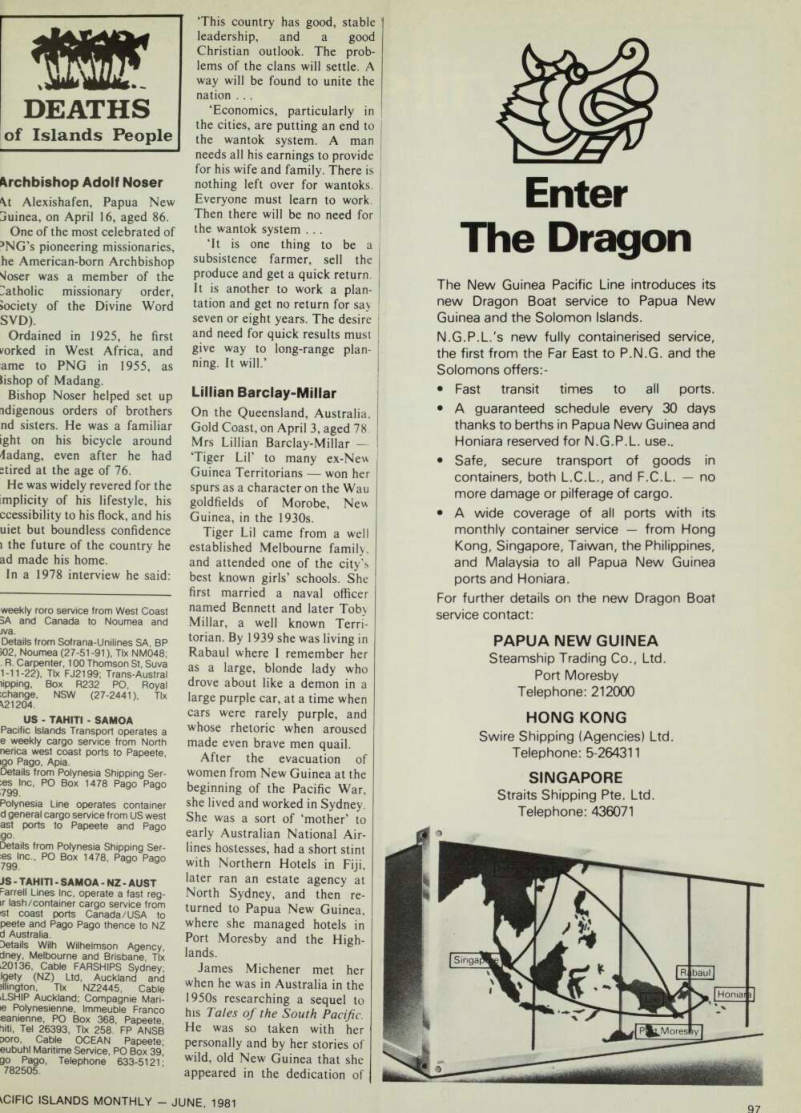
of Islands People
Archbishop Adolf Noser \t Alexishafen, Papua New jruinea, on April 16, aged 86.
One of the most celebrated of 5 NG’s pioneering missionaries, he American-born Archbishop Moser was a member of the Catholic missionary order, Society of the Divine Word
Svd).
Ordained in 1925, he first /orked in West Africa, and ame to PNG in 1955, as lishop of Madang.
Bishop Noser helped set up idigenous orders of brothers nd sisters. He was a familiar ight on his bicycle around iadang, even after he had Jtired at the age of 76.
He was widely revered for the implicity of his lifestyle, his ccessibility to his flock, and his uiet but boundless confidence i the future of the country he ad made his home.
In a 1978 interview he said:
This country has good, stable leadership, and a good Christian outlook. The prob lems of the clans will settle. A way will be found to unite the nation . . . ‘Economics, particularly in the cities, are putting an end to the wantok system. A man needs all his earnings to provide for his wife and family. There is nothing left over for wantoks.
Everyone must learn to work.
Then there will be no need for the wantok system . .. ‘lt is one thing to be a subsistence farmer, sell the produce and get a quick return.
It is another to work a plan tation and get no return for say seven or eight years. The desire and need for quick results must give way to long-range plan ning. It will.*
Lillian Barclay-Millar
On the Queensland, Australia.
Gold Coast, on April 3, aged 78.
Mrs Lillian Barclay-Millar ‘Tiger Lil* to many ex-New Guinea Territorians won her spurs as a character on the Wau goldfields of Morobe, New Guinea, in the 19305.
Tiger Lil came from a well established Melbourne family, and attended one of the city’s best known girls’ schools. She first married a naval officer named Bennett and later Toby Millar, a well known Terri torian. By 1939 she was living in Rabaul where I remember her as a large, blonde lady who drove about like a demon in a large purple car, at a time when cars were rarely purple, and whose rhetoric when aroused made even brave men quail.
After the evacuation of women from New Guinea at the beginning of the Pacific War, she lived and worked in Sydney.
She was a sort of ‘mother’ to early Australian National Air lines hostesses, had a short stint with Northern Hotels in Fiji, later ran an estate agency at North Sydney, and then re turned to Papua New Guinea, where she managed hotels in Port Moresby and the High lands.
James Michener met her when he was in Australia in the
1950 s researching a sequel to
his Tales of the South Pacific.
He was so taken with her personally and by her stories of wild, old New Guinea that she appeared in the dedication of
the book Return to Paradise as ‘Tiger Lil, of the Goldfields’, along with ‘Brett Hilder, from all over’, and a number of other Islands identities.
In recent years, Mrs Millar had been living in that haven for ex-PNG residents, the Gold
Coast.
J.T.
Papa Raui Pokoati In Rarotonga Hospital on March 25, aged 69.
Papa Raui gave leadership to the people of the island of Mitiaro in the Cook group from self-government in 1965.
Born on Mitiaro in 1911, Papa Raui attended the London Missionary Society’s Maori Mission School on the island for 10 years.
A versatile sportsman in his youth, and later on a successful planter and poultry farmer,
Papa Raui was keenly inter ested in community improve ment from early in life. This interest led him into politics in 1965, when he became MLA for Mitiaro.
He represented the island in the assembly for 13 years until he broke away from the Cook Islands Party to lead a new third party, the Unity Move ment. He lost his seat by 20 votes in the 1978 election, and although the election result was quashed he did not stand in the by-election. Instead his cousin, Tiki Tetava Ariki, was elected.
A keen Bible student to the end of his days. Papa Raui said in an account of his life he wrote in 1965: ‘My main concern is the improvement and welfare of my people and the honest governing of our people.’
Among mourners at his fu neral on Mitiaro were the Cook Islands Premier Sir Thomas Davis and a host of other
dignitaries.
Papa Raui is survived by his mother, his wife, nine children, and more than 40 grand children.
Dr Lindsay Verrier At the Home of Compassion, Suva, on April 20, aged 73.
English-born Dr Verrier took medical degrees in Britain and arrived in Fiji in 1938 to serve as a medical officer. He was transferred to the Gilbert Islands, now Kiribati, in 1940, escaping and returning to Fiji alter the arrival of the Japanese.
Dr Verrier’s connections with Fiji’s Prime Minister Ratu Sir Kamisese Mara began in the 1950 s when he began financing the future PM’s medical studies in New Zealand. But before they could be completed, Ratu Mara was recalled to Fiji by Ratu Sir Lala Sukuna to begin a civil service career that took him into national politics.
Dr Verrier was one of the founder-members of the Alli ance Party, working closely with Ratu Mara. But the pair quarrelled, and Dr Verrier left the Alliance to occupy his parliamentary seat as a one man Liberal Party. He left parliament in 1972, but in November 1980 appeared at the national convention of the Alliance to announce that be cause of the growing strength of
the National Federation Party he thought the government could do with his support again.
He and the prime minister were thus publicly reconciled, but Dr Verrier’s cancer was already very much advanced, and his convention appearance was vir tually his last public gesture.
A man of varied interests, Dr Verrier had a passion for index ing. His interest in the Fijian family system led him to work on a comprehensive record of Fijian families in the Macuata and Bua districts.
He was a familiar figure around Suva on his motor scooter. His refusal to comply with the law requiring the wearing of a crash helmet led him to court, where he was fined.
Dr Verrier spent some weeks in the Royal Prince Alfred Hospital in Sydney earlier this year (PIM Apr p 37). It seems characteristic of the man that he could quip to a friend who visited him at the time: ‘You should come to my funeral the ham’ll be good.’
Iroij Namo Hermios In Majuro, Marshall Islands, on March 26, aged 54.
Vice-speaker of the Nitijela (parliament) and Iroij of much of the Northern Ratak Chain, Namo Hermios had recently returned from a medical checkup in Hawaii where it was determined that the leukemia he suffered from was in re mission. It is therefore assumed the cause of death was a heart attack.
A week of mourning for Iroij Namo Hermios was proclaimed from March 28.
Judge James Alastair Fraser At Rarotonga Hospital on March 27, aged 70.
New Zealand-born Judge Fraser had been in the Cook Islands since 1961, when he was appointed Chief Judge of the High Court and the Land Court.
He also served as an indus trial magistrate, and as New Zealand’s acting high com missioner for the Cook Islands.
After retiring from the bench in 1965, Judge Fraser was called back in 1978 as com missioner to the High Court, a position he held until his death.
Advertisements & other items, pp. 97-98 (2 items)
97
ISLANDS MONTHLY - JUNE, 1981
The Dragon
Enter
The New Guinea Pacific Line introduces its new Dragon Boat service to Papua New Guinea and the Solomon Islands.
N.G.P.L.'s new fully containerised service, the first from the Far East to P.N.G. and the Solomons offers:- • Fast transit times to all ports. • A guaranteed schedule every 30 days thanks to berths in Papua New Guinea and Honiara reserved for N.G.P.L. use.. • Safe, secure transport of goods in containers, both L.C.L., and F.C.L. no more damage or pilferage of cargo. • A wide coverage of all ports with its monthly container service from Hong Kong, Singapore, Taiwan, the Philippines, and Malaysia to all Papua New Guinea ports and Honiara.
For further details on the new Dragon Boat service contact:
PAPUA NEW GUINEA
Steamship Trading Co., Ltd.
Port Moresby Telephone: 212000
HONG KONG
Swire Shipping (Agencies) Ltd.
Telephone: 5-264311
SINGAPORE
Straits Shipping Pte. Ltd.
Telephone: 436071 t H Pj^Moresly
Freely
Given
A true understanding of God's Word.
If you have been searching for the true meaning, of the Scriptures this free monthly booklet is for you.
Write to God's Way P.O. Box 41, North Ryde, Australia 2113
5 National
SONY
VIDEO RECORDERS
COLOUR CAMERAS
6 PORTAPAKS
MOVIE TAPES
CLOSE CIRCUIT TV.
AH Enquiries Welcomed
INTERCAPE AUSTRALIA
19-21 Lonsdale St, Melbourne 3000, Aust.
STUDY GOD'S WORD
AT HOME
Send for free catalogue.
Emmaus Bible Corresp. Sch., P.O. Box 904, Saipan, C.M. 96950
REQUIRE
DRIED SHARK FINS
FOR PRICES AND
INFORMATION ETC.,
PLEASE WRITE TO:
S. DADDOW,
ASIA TONGA TRADING,
66 JALAN KERUING,
SINGAPORE, 2880
FLEETS
48ft Twin Diesel Cruiser, bit Norman Wright 1978. for Coastal Cruising, luxuriously furnished, Onan aux , Radar, Auto Pilot, SS B radio, Flying Bridge Master's Cabin, $175,000.00.
FLEETS
221 Esplanade, Wynnum Central, Brisbane.
Cable FLEETS BRISBANE.
Advertisers Index
Aggie Grey Hotel 56 AH I Aluminium 55 Air New Zealand 42 Amatil 54 Andrew Jargons 88 Aquila 22 Asia/T onga T rad ing 98 Bankline 94 Berkey, R.L 98 Carptrac 81 China Navigation Co. 97 Citizen Watches 12 Clarion Shoji 35 Denon 71 DuPont 44 Edwards, A.A. & Sons 52 Epiglass 72 - 73 Farrell 98 Fleets 98 General Steamships 93 Henry Cummins 93 Hitachi 66 ICI Tasman 78 Kerr Bros. 58 Komatsu 92 Korean Traders 96 Lifeline Missions 27 McOonell Douglas 32 MacQuarrie Industries 90 Matsushita 16 Mesco McCabe 48 Muirhead, R.T. & Co. 85 National Insurance 40 Nelson & Robertson 69 New Way Constructions 70 Nissan 62 63 Nissan 76 NZ Dairy Board IBC NZ Police 46 NZ Shipping Corporation 49 Olivetti Australia 28 Pacific Forum 95 Papua Hotel 56 Pioneer 4 Polynesian Line 83 QBE Insurance 68 Quikstik 53 Rice, F.B. (Aiwa) 83 Rex Aviation 24 Rogers & Co. 22 Simms Engineering 45 Sofrana 86 Sony OBC South Sea Digest 82 Speddings 38 Suzuki 8, 84 T atham 20 Toyota IFC T-Shirt People 64 Union Bulk Ships 91 Video Recorder Centre 98 Waterwheel 74 Wonderest 64 Yamaha 50—51
Advertisements & other items, pp. 99-100 (2 items)
Axidioi
-rr. k is* a . ws ' • *: , •»»«* 'V u I* IfJ* m ptk * X «*v «fe
gals
: '■• i HR JO I r MK BP sis non fat
dried
milk
Axidioi
\j n j
IK nnn
VIU
•5'7- Bulk fVjF 7* / ■V A'/ f/ ftncnor instant I ,Jjjied W hol«
rill fin:
IODu
Ct Of New •
ere*
JP- H instant ■ m
JfNwhol* I *»« uXI
fiat ■- Jlik'osud' '
bu "ouc
butter
Anchor SS wh ••• Mrt -• n m „ Anchor V- -7: -.
milk
»R 1 £ Ik *5 ■V l
CHECK STOCK ROTATION
Ik
IIH"
3 *t
CHEESE
butter 'o r % An
Efi
v or ,v c > l^£ % 'o.
S An i .nar w < «S 3 rie 01ft • lira *l® if
Touch and Travel.
9/?
r/hc
\bsßo
p i m I.f’
Touch and Travel.
Sony makes the world a lot easier to listen to ICF-2001 world receiver.
Slightly smaller than a desk diary the ICF-2001 is easy and simple to operate. Calculator type, frequency synthesized tuning gives you virtually every broadcast source on the globe. One touch of a button lets you tune in anywhere in the FM, LW, MW and SW bands.
Including amateur radio and Citizen's bands.
You can tune in 150 kHz to 29,999 kHz continuously in one kilohertz steps and FM adds 76MHz to 108 MHz tuning in 100 kHz steps. with the Or preset the frequency and find it again simply with one of the ICF-2001's four different tuning methods.
Like Direct Access, Memory, Auto Scan and Manual.
Sony's sophisticated technology gives you extreme precision and stability with a microcomputer to control all reception functions. You don't have to be a professional radio operator to enjoy tuning in the world of professional radio.
The ICF-2001, the world receiver that lets you travel with a touch.
ICF-2001