Islands
Pacific
Month Ly
July, I9Bi
Hawaii &US mainland US$l.95 Nauru A 51.75 New Caledonia CFPI 90
W'ud "Z”"!“"'"”Nzs150
Papua New Guinea «... JMtfgyM Solomons V .JH|TSO
Jtpi : 5 o
Strimin W. Samoa
OBN|^tofQ(SBroHANGE M Ol>lL^G®i
Ft&Ation Iitrhe
Sajth Pacific
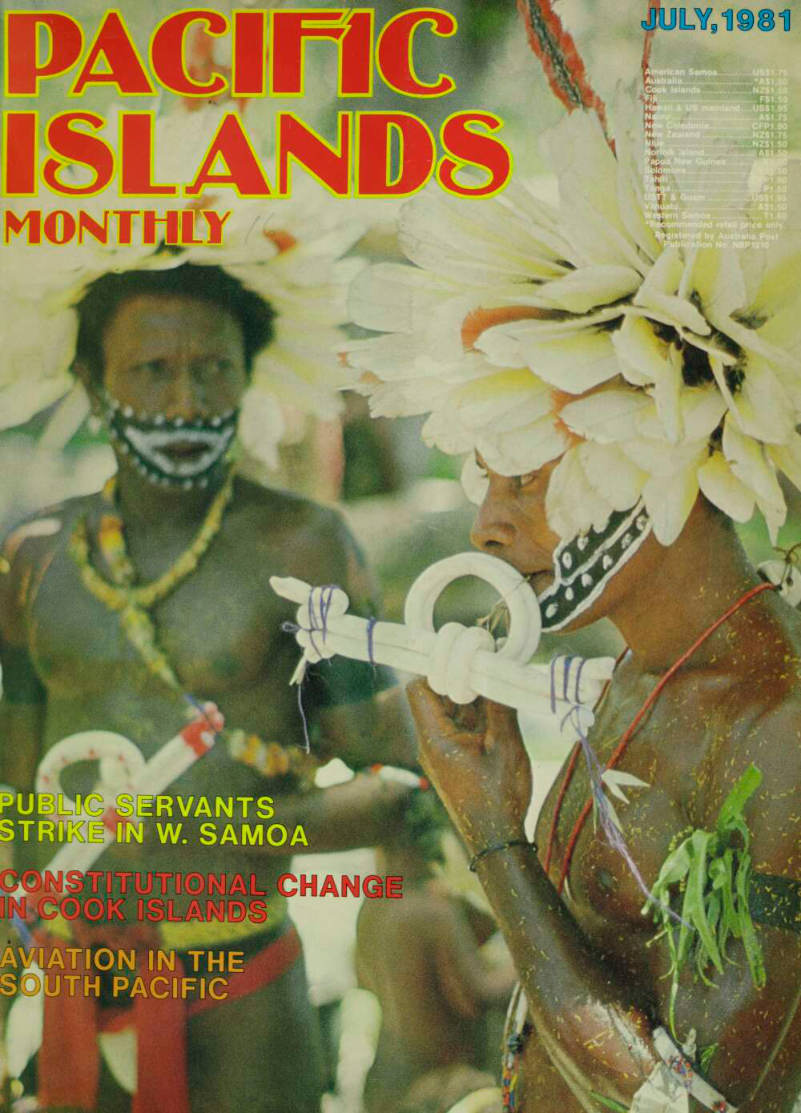
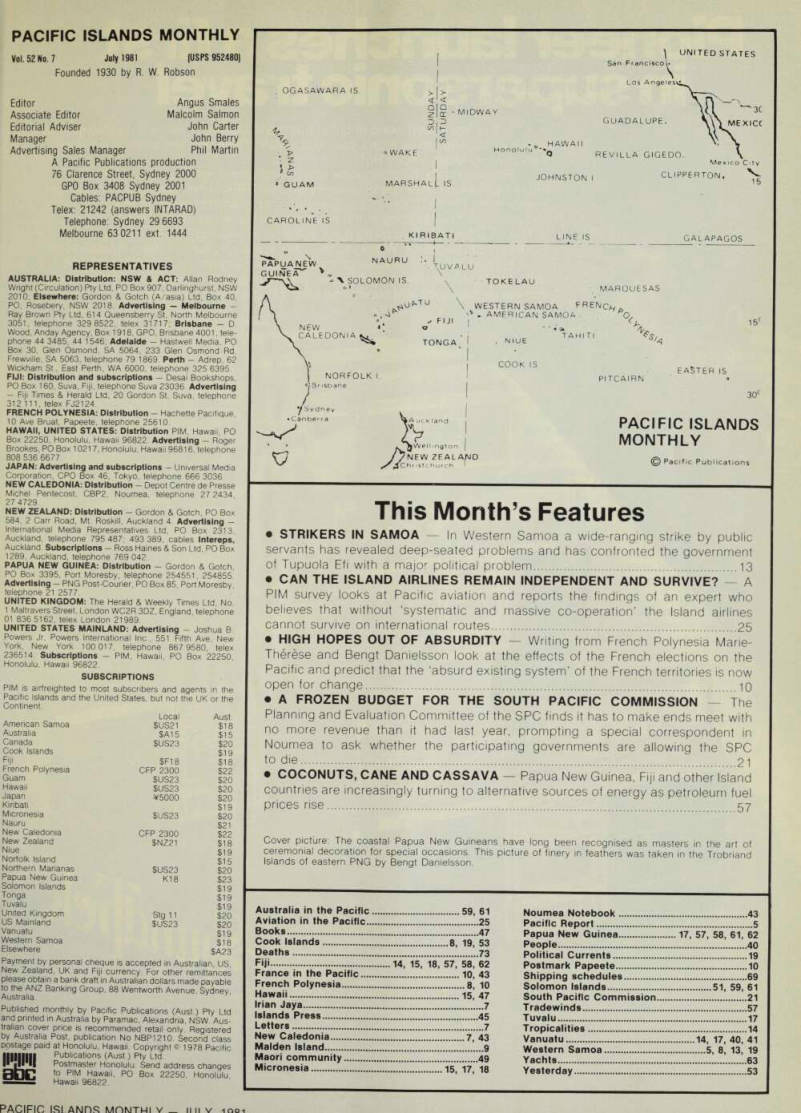
Cover picture: The coastal Papua New Guineans have long been recognised as masters in the art of ceremonial decoration for special occasions. This picture of finery in feathers was taken in the Trobriand Islands of eastern PNG by Bengt Danielsson.
Advertisements & other items, p. 2 (1 item)
Slightly Sensational
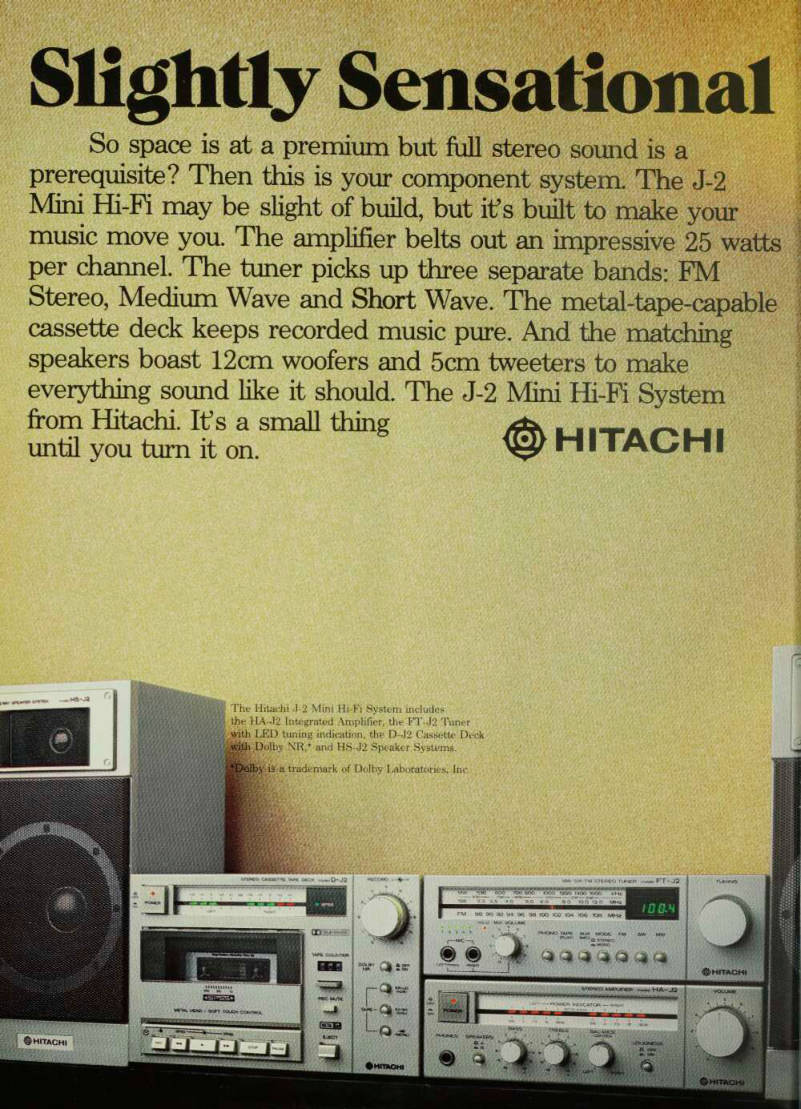
So space is at a premium but full stereo sound is a prerequisite? Then this is your component system. The J-2 Mini Hi-Fi may be slight of build, but if s built to make your music move you. The amplifier belts out an impressive 25 watts per channel. The tuner picks up three separate bands: FM Stereo, Medium Wave and Short Wave. The metal-tape-capable cassette deck keeps recorded music pure. And the matching speakers boast 12cm woofers and scm tweeters to make everything sound like it should. The J-2 Mini Hi-Fi System
from Hitachi. Ifs a small thing
until you turn it on. HITACHI The Hitachi J-2 Mini Hi-Fi System includes the HA-J 2 Integrated Amplifier, the FT-J 2 Tuner with LED tuning indication, the D-J2 Cassette Deck with Dolby NR,* and HS-J2 Speaker Systems. srere® e«asnt ee»
FM 8e9093W9698K)0K)2104 106K)8 MH*
5» VOCUMC
** * * K jss Mo ° e ** sw
<§> HITACHI
01 r
HA-J 2
UMDtCATOR swawr L o A* *
HITACHI
Jl
♦HITACHI
Pacific Islands Monthly
Vol. 52 No. 7
July 1981
(Usps 952480)
Representatives
AUSTRALIA: Distribution: NSW & ACT; Allan Rodney Wright (Circulation) Pty Ltd, PO Box 907, Darlinghurst, NSW 2010; Elsewhere: Gordon & Gotch (A/asia) Ltd, Box 40, PO, Rosebery, NSW 2018, Advertising Melbourne - Ray Brown Pty Ltd, 614 Queensberry St, North Melbourne 3051, telephone 329 8522, telex 31717; Brisbane - D Wood, Anday Agency, Box 1918, GPO, Brisbane 4001, tele phone 44 3485, 44 1546; Adelaide Hastwell Media, PO Box 30, Glen Osmond, SA 5064, 233 Glen Osmond Rd, Frewville, SA 5063, telephone 79 1869 Perth Adrep, 62 Wickham St., East Perth, WA 6000, telephone 325 6395 FIJI: Distribution and subscriptions Desai Bookshops, PO Box 160, Suva, Fiji, telephone Suva 23036 Advertising Fiji Times & Herald Ltd, 20 Gordon St, Suva, telephone 312 111, telex FJ2124.
FRENCH POLYNESIA; Distribution Hachette Pacifique, 10 Ave Bruat, Papeete, telephone 25610.
HAWAII, UNITED STATES: Distribution PIM, Hawaii, PO Box 22250, Honolulu, Hawaii 96822 Advertising Roger Brookes, PO Box 10217, Honolulu, Hawaii 96816, telephone 808 536 6677.
JAPAN: Advertising and subscriptions - Universal Media Corporation, CPO Box 46, Tokyo, telephone 666 3036.
NEW CALEDONIA: Distribution Depot Centre de Presse Michel Pentecost, CBP2, Noumea, telephone 27 2434 27 4729.
NEW ZEALAND: Distribution Gordon & Gotch, PO Box 584, 2 Carr Road, Mt Roskill, Auckland 4 Advertising International Media Representatives Ltd, PO Box 2313, Auckland, telephone 795 487; 493 389, cables Intereps, Auckland. Subscriptions - Ross Haines & Son Ltd, PO Box 1289, Auckland, telephone 769 042.
PAPUA NEW GUINEA: Distribution - Gordon & Gotch, PO Box 3395, Port Moresby, telephone 254551, 254855 Advertising - PNG Post-Courier, PO Box 85, Port Moresby telephone 21 2577.
UNITED KINGDOM; The Herald & Weekly Times Ltd, No. 1 Maltravers Street, London WC2R 3DZ, England, telephone 01 836 5162, telex London 21989.
UNITED STATES MAINLAND: Advertising - Joshua B Powers Jr, Powers International Inc., 551 Fifth Ave, New York, New York 100 017, telephone 867 9580, telex 236514 Subscriptions - PIM, Hawaii, PO Box 22250, Honolulu, Hawaii 96822.
Subscriptions
PIM is airfreighted to most subscribers and agents in the Pacific Islands and the United States, but not the UK or the Continent.
Payment by personal cheque is accepted in Australian, US, New Zealand, UK and Fiji currency. For other remittances please obtain a bank draft in Australian dollars made payable to the ANZ Banking Group, 88 Wentworth Avenue, Sydney Australia.
Published monthly by Pacific Publications (Aust.) Pty Ltd and printed in Australia by Paramac, Alexandria, NSW. Aus tralian cover price is recommended retail only.' Registered by Australia Post, publication No NBPI2IO. Second class postage paid at Honolulu, Hawaii. Copyright s 1978 Pacific
Publications (Aust.) Pty Ltd.
Postmaster Honolulu: Send address changes to PIM Hawaii, PO Box 22250, Honolulu Hawaii 96822
j Local Aust, American Samoa $US21 $18 Australia $A15 $15 Canada $US23 $20 Cook Islands $19 Fiji $F18 $18 French Polynesia
Cfp 2300
$22 Guam $US23 $20 Hawaii
Sus23
$20 Japan ¥5000 $20 Kiribati $19 Micronesia
Sus23
$20 Nauru $21 New Caledonia
Cfp 2300
$22 New Zealand
Snz21
$18 Niue $19 Norfolk Island $15 Northern Marianas
Sus23
$20 Papua New Guinea K18 $23 Solomon Islands $19 Tonga $19 Tuvalu $19 United Kingdom Stg 11 $20 US Mainland
Sus23
$20 Vanuatu $19 Western Samoa $18 Elsewhere $A23
This Month’s Features
• STRIKERS IN SAMOA In Western Samoa a wide-ranging strike by public servants has revealed deep-seated problems and has confronted the government of Tupuola Efi with a major political problem 13 • CAN THE ISLAND AIRLINES REMAIN INDEPENDENT AND SURVIVE? A PIM survey looks at Pacific aviation and reports the findings of an expert who believes that without ‘systematic and massive co-operation’ the Island airlines cannot survive on international routes 25 • HIGH HOPES OUT OF ABSURDITY Writing from French Polynesia Marie- Therese and Bengt Danielsson look at the effects of the French elections on the Pacific and predict that the ‘absurd existing system’ of the French territories is now open for change 10 • A FROZEN BUDGET FOR THE SOUTH PACIFIC COMMISSION The Planning and Evaluation Committee of the SPC finds it has to make ends meet with no more revenue than it had last year, prompting a special correspondent in Noumea to ask whether the participating governments are allowing the SPC to die 21 • COCONUTS, CANE AND CASSAVA Papua New Guinea, Fiji and other Island countries are increasingly turning to alternative sources of energy as petroleum fuel prices rise 57
Australia in the Pacific 59, 61 Aviation in the Pacific 25 Books 47 Cook Islands 8, 19, 53 Deaths 73 Fiji 14, 15, 18, 57, 58, 62 France in the Pacific 10, 43 French Polynesia 8, 10 Hawaii 15, 47 Irian Jaya 7 Islands Press 45 Letters 7 New Caledonia 7, 43 Malden Island 9 Maori community 49 Micronesia 15, 17, 18
Noumea Notebook 43 Pacific Report 5 Papua New Guinea 17, 57, 58, 61, 62 People 40 Political Currents 19 Postmark Papeete 10 Shipping schedules 69 Solomon Islands 51, 59, 61 South Pacific Commission 21 Tradewinds 57 Tuvalu 17 Tropicalities 14 Vanuatu 14, 17, 40, 41 Western Samoa 5,8, 13, 19 Yachts 63 Yesterday 53
Advertisements & other items, pp. 3-4 (2 items)
Pacific Islands Mokitni V _ Ll U V 1 Qoi
PACIFIC ISLANDS MOKITNI V ll u v 1 qoi
Founded 1930 by R. W, Robson Editor Angus Smales Associate Editor Malcolm Salmon Editorial Adviser John Carter Manager John Berry Advertising Sales Manager Phil Martin A Pacific Publications production 76 Clarence Street, Sydney 2000 GPO Box 3408 Sydney 2001 Cables: PACPUB Sydney Telex: 21242 (answers INTARAD) Telephone; Sydney 29 6693 Melbourne 63 0211 ext. 1444
Pioneer launches a first
m supersonic travel
In this fast-paced world of bullet trains and Concorde jetliners, to stay in touch with your favorite stereo music you need SOUNDTREK. Pioneer’s new supersonic fleet of Multi-Mode Mobile Hi-Fi. % ■ . For added tape-handling ease ahd pushbutton program selection, Pioneer offers Multi-Mode Deck design in every SOUNDTREK stereo portable. For example, there’s Song Finder.™ With it you can skip over unwanted program material, locate and.play your favorite song at the push of a button. A feature you would expect to find on a borne hi-fi cassette deck. But wait till you hear the sound of our • SOUNDTREK portables. When you do, you’ll know why we call them “Mobile Hi-Fi.”
'. Explore the outer reaches of stereo listening enjoyment with SOUNDTREK ‘ Multi-Mode Mobile Hi-Fi from'Pioneer. They’re available in six models, all featuring Pioneer performance and supersonic sound to get you off the ground. 4 m 4 ; w". *. f : mm
SK-95F
■£|| irther information, please contact; lia: Pioneer Marketing Service Pty.Ltd., P.O. Box 317, Mordialloc, Victoria, 3195 -9011 inds: Brijlal & Company, G.P.O. Box No. 362, Suva, Fiji Islands Tel; 22258 ealand; Monaco Distributors Ltd., 30 Pollen Street, Grey Lynn, Auckland, ealand Tel: (09) 762 098 k Island: Burns Philp (Norfolk Island)Ltd., P.O. Box 21, Norfolk Island, Nauru Island: Jacob Enterprises, PC Tahiti: Tahiti Hi-Fi, P.O. Box 848, Pap New Caledonia: Menard Pacifique S; Tel: 48*24.36 American Samoa: Transpac Corpora Samoa 96799 Tel; 633-5224 Rarotonga: South Seas International
Pacific Report
Fiji To Join Sinai Force?
Fiji, already involved in Lebanon, is among countries to be asked by the United States to send troops to join the controversial peace-keeping force in Sinai in the Middle East. The information is contained in official US documents leaked to the Australian Labor Party in Canberra in June. The documents contain instructions to US embassies in Argentina, Ecuador, Fiji, Singapore, Mexico, Nepal and Uruguay, which are the Third World countries selected by Egypt, Israel and the US to be invited to send troops to the force. According to the documents, the embassies were told to offer such inducements as payment in part or in full for military expenses, a short tour of duty (three years is preferred), and an assurance that the troops would be used only to enforce the peace treaty between Egypt and Israel.
BRITISH BANK LOAN TO MARSHALLS CAUSES STORM A British bank loan of SUS 24 million to the Marshall Islands Government to finance a power plant brought angry questions from a Republican Senator at a June session in Washington of the Interior Sub-committee of the Senate Appropriations Committee.
According to a report in the Pacific Daily News, relayed by the Micronesian News Service, the loan was negotiated without US federal authorities being informed. Department of Interior officials who oversee the territories learned of the low-interest, long-term loan from the Midland Bank of the UK to the Marshall Islands Government from newspaper clippings and lawyers’ inquiries.
Presiding over the sub-committee, Senator James McClure (Rep Idaho) began grilling Ruth Van Cleve, Deputy Assistant Secretary of the Interior, saying: ‘What recourse does the British bank have if the islands fail to pay? What do they do?. Go out and seize some coral?’ He went on: ‘How could the Marshalls get so involved without the federal authorities knowing about it?’ Ms Van Cleve replied: ‘Their interest in independence has increased greatly recently. Their communication with the High Com missioner for the Trust Territory has been very slight of late.’
Interior officials informed Senator McClure in the course of the hearing that the Reagan Administration will be cutting back federal grants to the many island groups in the Trust Territory from SUS3S million last fiscal year to about $3O million for 1982.
Most of the grants will be for sewer and water projects.
Australia To Lift Overseas Aid?
Australia is expected to announce a substantial increase in its aid to developing countries. Canberra sources estimated the rises could be about SA9O million more than the increases already planned. They would represent an attempt by the Australian Government to rejuvenate the North-South debate on aid to developing countries, and to place Australia in the vanguard of Western countries seeking to help them. Th.e increases were expected to be announced before October, in the lead-up period to the Commonwealth Heads of Government Meeting (CHOGM) which is to be held in Melbourne in that month. Many countries likely to benefit from the increases will be represented at the meeting.
NO SEA LAW ACCORD BEFORE ’B2’ U.S.
The United States has suggested that the Law of the Sea (LOS) conference wait until early next year to take a final decision on the projected 350-article legal code. US delegate Bernard B. Oxman said his country would be prepared to take part in the three-week August session of the conference (PIM Jun p 59) on the understanding that it would consist only of an informal exchange of views, and that work on the draft treaty would not be concluded during the session. The US review of the draft treaty is part of an overall study of US foreign policy objectives undertaken by the Reagan administration after the new president took office in January.
Japan Reassuring On N-Waste Plans ...
Governor Carlos Camacho of the Commonwealth of the Northern Marianas and Guam’s Deputy Governor Joseph Aida have been told by officials of Japan’s Science and Technology Agency (STA) that Japan will not dump nuclear waste in the Pacific so long as other countries are against the idea. The Micronesian
leaders told Japanese officials that dumping nuclear waste would cause more damage than had been explained by the STA. They said the damage would affect not only Micronesians, but the Japanese people themselves. .. . AND NOW IT’S ASEAN’S TURN Solomon Islands officials are concerned that the United Nations may be sponsoring Association of Southeast Asian Nations (ASEAN) plans to dump nuclear waste in the Pacific. The country’s Secretary for foreign Affairs Francis Bugotu in May asked the director of the South Pacific Bureau for Economic Co operation (SPEC) to tell all South Pacific Forum countries of Solomon Islands concern, and seek views for a united approach against any such move. Mr Bugotu’s message to SPEC said the dumping plans were being developed ‘surprisingly, under some guise of an environmental programme’. A nuclear power station is reported to be under construction in the Philippines, an ASEAN member. A project listed under the UN Environmental Pro gramme is for the establishment of marine sites for ultimate dumping of hazardous wastes. It involves a draft action plan for an East Asian seas regional programme.
600 Athletes For Honiara Mini Games
Almost 600 contestants from 16 countries and territories were expected to take part in the July South Pacific Mini Games in Honiara, Solomon Islands. President of the South Pacific Games Council Commander Stan Brown, after a visit to Honiara to look over preparations, declared: Tm very satisfied. Solomom Islands has gone about it in exactly the right way they haven’t tried to build an empire around the Games, but they have made the very best use of what they have.’
2000 March Over Pay In Honiara
More than 2000 marchers converged in May on the Honiara office of Solomon Islands Prime Minister Peter Kelinorea to present a petition signed by leaders of seven of the country’s trade unions.
The petitioners claimed that the coalition government was ‘not competent to govern the affairs of the nation’. In particular, it condemned a recent rise in MPs’ salaries, which had been supported by the government, and demanded a minimum monthly wage for workers of SSI 100. At present it is $35. In a statement after the march, Mr Kenilorea called upon the unions to go through ‘proper channels’ for redress of their grievances.
He also congratulated the Public Service Association on its refusal to sign the petition.
Pacific Trade Unions Meet In Port-Vila
A conference of trade unions from Pacific countries held in Port- Vila, Vanuatu, in late May is expected to lead to heightened co operation between regional unions for a nuclear-free Pacific. The conference, which was officially opened by Vanuatu Prime Minister Fr Walter Lini, was attended by more than 100 delegates from 12 countries and territories. They were; Australia, New Zealand, Fiji, New Caledonia, Papua New Guinea, Kiribati, French Polynesia, Guam, Hawaii, Palau, Japan and Vanuatu. Solomon Islands delegates were reported unable to attend due to labour disputes at home. The conference was chaired by Jim Knox, president of the New Zealand Federation of Labour.
MITTERAND’S MAN IN NOUMEA EXPLAINS . ..
Guy Mennesson, nominated by President Mitterand to conduct his election campaign on the spot in New Caledonia, has described in an interview with the Noumea daily Les Nouvellesthe substance of a letter on the subject of Kanak independence written by the president to Independence Front leader Rock Pidjot. Mr Mennesson said the gist of the letter was: ‘lt’s not up to the President to grant or refuse the Territory’s independence.
Yet Francois Mitterand and the Socialist Party have always acknowleged the right of the Kanak people freely to decide their own future. They have undertaken to establish, through consultation, the framework in which this may be achieved, in particular by taking up proposals for a law requiring a minimum period of residence for those taking part in votes affecting the future of the Territory.’
Vanuatu Decrees Fees For French Schools
Students at Vanuatu’s French-language schools will henceforth pay fees, like their English-speaking counterparts. Education at French schools has traditionally been free, while English language pupils have always paid fees. Minister of Education Donald Kalpokas said the new system will make it ‘fair on both sides’. Discussing complaints from some parents that they find it difficult to cope financially, especially when they have more than
one child at school, Director of Primary Education George Calo said parents’ financial situation would be taken into account: fees could be reduced to as little as 20% of normal depending on a family’s resources. He said perhaps parents could even supply the school with so many bags of taro or vegetables instead of paying cash.
Hitch In Tongan Passport Plan
An ordinance published in a Tongan Government Gazette supplement on March 31 to amend the Passport Act and permit the sale of passports (for $lO 000) to ‘Tongan Protected Persons’ was invalidated by a brief notice in the gazette of April 31 on the grounds that it ‘was not approved by the Privy Council for publication as an ordinance, and is therefore invalid and not law’. Informed sources here did not believe however that the invalidation announcement would be the end of the affair. They expected that the aborted ordinance would re-emerge as a government bill soon after the House of Assembly reassembled in mid-June. With a strong pro-Establishment line-up in the new parliament following the May 1 general elections (PIM Jun p 6), the passport act amendments, if introduced, were likely to have a smooth passage. Penny Hodgkinson in Nukualofa.
Depressed Png Drops Budget Plan
Papua New Guinea’s economic woes continuing depression of commodity prices and of production at Bougainville Copper, together with clear indications of government over-spending have forced the dropping of a Cabinet decision to introduce a supplementary budget in July. Earlier, returning from a visit to Australia and the USA, Opposition Leader Michael Somare had warned that the International Monetary Fund was ‘seriously considering’ taking over control of the PNG economy due to a drastic decline in the country’s financial credibility.
Reagan’S Men In Micronesia
The Reagan Administration’s Micronesia policy review (PIM Jun p 57) is well under way, with representatives of Palau, the Federated States of Micronesia and the Marshall Islands holding talks in Washington and New York with the administration’s Micronesia Interdepartmental Group (IG), and IG representatives in turn visiting Micronesia. The IG party, headed by US Deputy Assistant Secretary of State Ginger Lew, visited Majuro, Kwajalein, Ponape and Palau.
THEY TRIED TO STOP A LEVERS BULLDOZER Police were flown in May to New Georgia, Solomon Islands, to prevent trouble between Levers Pacific Timbers and Christian Fellowship Church villagers from Jericho and Paradise. More than 200 villagers in 21 canoes gathered at Enogae Bay in an attempt to prevent Levers from landing a bulldozer at their campsite.
There was no violence and no arrests were made. Frank Jamakana, chairman of the North New Georgia Timber Corporation, which has concluded an agreement with Levers for logging in the area, said he believed the trouble had arisen because the CFC villagers has not properly understood procedures for nominating their representatives to the corpor ation’s board. He said the corporation was ‘very anxious’ to have CFC representatives on the board. Mr Jamakana later had talks with Job Dudley, son of the Holy Mama, leader of the CFC. Mr Jamakana said after the talks that Mr Dudley ‘now appeared to accept the position’.
University Of Technology For Noumea
After 14 years of talking, the first sod was turned in mid-May for the building of a French university campus in Noumea, New Caledonia. Estimated to cost the equivalent of SAIS million, the completed University of Technology will be capable of taking in and accommodating 1500 students. After the expected com pletion of the first stage in March 1983, there will be facilities for 400 students in mechanical engineering. The completed institution will also provide for foreign students in a course on modern French civilisation. The campus, ironically, is at Nouville, site of the prison built under Emperor Napoleon 111 for the detention of convicts transported from France. Daniel Tardieu.
Churches Urge End To N.C. Immigration
Meeting in Nukualofa, Tonga, in May, the Pacific Council of Churches called on the French Government to put an immediate end to migration of non-Melanesians into New Caledonia.
Outgoing PCC secretary Mrs Lorine Tevi told the more than 200 church representatives present that the votes of non-Melanesian French citizens from Tahiti, Wallis or France were overwhelming a clear Kanak vote for independence in polls
conducted in the territory. She also urged Pacitic church leaders to help in reinstating New Caledonia on the agenda of the United Nations Committee of 24, a sub-committee dealing with problems of decolonisation.
Indonesia’S Irian Java Policy Under Fire
Indonesian Government policies in Irian Jaya were spotlighted at a ‘South Pacific Human Rights Seminar’ held at the University of Papua New Guinea in June. From former residents of Irian Jaya now living in permissive residence in PNG, the tribunal heard evidence of executions, routine beatings, prison starvation, electric torture and brainwashing by Indonesian authorities in their attempt to crush the Free Papua Movement (OPM). Tribunal organisers said they intended to send their findings to the United Nations ‘for further action’.
Loser Wins In Honiara By-Election
Gordon Billy Gatu, the Nadepa candidate, had an easy win in the May by-election for the West Honiara seat in Solomon Islands’ parliament. He polled 681 votes in a three-cornered contest, with Francis Saemala (United Party) getting 290, and Mrs Lily Poznanski (Independent) 245. The by-election became necess ary when the winning candidate in the August election Ben Gale was disqualified following a petition to the High Court organised by Mr Gatu, who had been runner-up in the election.
NO ENTRY’ SIGN UP FOR BRYCH IN COOKS Controversial cancer therapist Milan Brych ‘will not be allowed to set foot in this country again,’ Cook Islands Premier Sir Thomas Davis said in May. ‘I don’t want any part of him,’ the premier added. Sir Thomas had been asked whether Brych would be allowed to return to Rarotonga from the US to collect evidence for his defence against United States charges of treating patients by unauthorised methods. Brych, however, needs to raise S3OO 000 bail, and to have his passport returned by the US Government, before he can travel overseas. William Gasson.
SANTO-BASED COMPANY TO FISH IN S.l. WATERS An agreement granting the Vanuatu-based company South Pacific Fisheries Ltd rights to fish within the Solomon Islands exclusive economic zone was signed in May. The company, based at Palekula, Santo, will pay the SI Government SIOO 000 for rights of access, and a SIOO registration licence fee for each catcher boat. The SI Government had already received applications for registration of 33 of the company’s boats.
Tornado Slams Nukualofa’S Seafront
A tornado ravaged the seafront area of Nukualofa, Tonga, in a wild five-minute rampage in May. Hardest hit were the Friendly Islander motel and neighbouring houses in the Maufanga area.
Three motor cars were flung as far as 30 m by the tearing winds.
Trees and power poles were flattened, cutting power supplies to the area. No serious injuries to persons were reported. Unofficial estimates put total damage at more than SIOO 000.
Roving Ambassador Is True To Title
Roving ambassador of the Republic of Vanuatu, Barak Sope (PIM May p 6), was roving in earnest in May-June. He presented his credentials to Australian Governor-General Sir Zelman Cowen on May 27, before heading off to Europe. He was due to present his credentials as ambassador in London on June 2, Paris June 11, Bonn June 18, and Madrid June 25. He was also to hold discussions with officials of the European Economic Community and the Lome Convention in Brussels, and with United Nations Secretary-General Dr Kurt Waldheim in New York. A spokesman for the Vanuatu prime minister’s office said an important part of the ambassador’s mission was to present Vanuatu’s foreign policy to other countries, and to seek new areas in which they could give aid and technical assistance. Mr Sope, who was accompanied on his trip by Joseph Laloyer of the Foreign Affairs Department, was due back in Port-Vila on July 5.
Anne Gash Is At It Again
Well-known Australian singlehander yachtswoman Anne Gash, 58, reached California in May via Tahiti and Hawaii. She left Los Angeles for home on June 12 in her 7.9 m timber yacht stocked with three months supply of food, flute, 60 books and six bottles of rum. ‘I have a tot of rum with lemon and honey at the end of each day as the sun sets and I’m cooking my dinner,’ she told US reporters. Mrs Gash, mother of six and grandmother of seven, sailed to the US this time ‘mainly to sail under the Golden Gate.
I wanted that so much. It was fantastic . . .’ She expects to reach Sydney in October or November.
Advertisements & other items, p. 5 (1 item)
Pacific Isi Amn<; Mhmtwi V _ Ii Ii V -.Not
PACIFIC ISI AMn<; MHMTWI V II II v -.not
Irian Jaya
Letters
‘leaders’
in exile
Your correspondent C.M.
Lawrence (PIM May plO) seems proud that ‘West Papuan leaders’ have taken up volun tary exile in his country, Vanuatu. ‘West Papuan’ yes. ‘Leaders’ no.
The struggle for freedom and independence of the West Irian ese people is taking place in Irian Jaya, not in Port Moresby, Amsterdam, or Port-Vila.
Unfortunately, the West Irianese and the OPM have more generals, ministers and presidents all over the world than they have in Irian Jaya where the real action must take place.
Childish letters to ‘George in Turkey’ asking for ‘guns’ and SAM missiles to be brought in submarines to prepared landing places in Papua New Guinea and Irian Jaya originate in the paranoid dreams of these West Papuan exile ministers and gen erals. Meanwhile, for the past 20 years, brave, perhaps primi tive, West Irianese have gone on fighting and dying.
Neither the USA, the United Nations, Russia nor Cuba would risk World War 111 for the sick pipedreams of these exiled ‘West Papuan’ leaders.
No one ever takes serious notice of them, least of all the Indonesian Government which is supported by the UN and the USA, and about every other Western capitalist country.
Many such countries are even now participating in the total exploitation of Irian Jaya and its people.
For the West Irianese people, there are only two true West Irianese abroad Jacob Prai and Otto Ondawame. We would call them not ‘West Papuan’ but West Irianese leaders, as they are not absent from the country because they ran away, but because of betrayal by such ‘West Papuans’ in PNG who acted in collaboration with their White adviser friends.
At their trial in Port Moresby on charges of being prohibited immigrants neither man could understand sufficient English let alone legal English to know what was going on. Nor could their defence lawyers speak a word of Bahasa or Dutch.
And all this time there were in Port Moresby at least a half dozen ‘West Papuan exile min isters’, and dozens of West
Papuan ‘nationalists’ and ‘revol utionists’. But not one of them had the guts to utter one syllable of protest.
But they were quick to organ ise a ‘collection’ to pay the fees of tneir Australian QC, who certainly never made easier money than at the appeal hear ing for Prai and Ondawame.
And all this time the OPM had a sum exceeding KBOOO in a Port Moresby bank account.
Vitaliz Paingame
Cairns Qld Australia
Noumea veteran
looks back
With reference to your article ‘Noumea ’4O: Australian gun boat diplomacy, Kidglove Style’ (PIM Jan p 59), my impression is that Australian diplomacy played a crucial role in these events, in which I took an active part.
I took action immediately after the defeat of France. I ran up the flag of the Cross of Lorraine on my boat I was running a coastal vessel in New Caledonian waters at the time. I was immediately hauled up before representatives of the Petainist government in Noumea, who told me that I was to stop flying this flag.
Not long afterwards, follow ing instructions which had reached us from General de Gaulle in London, I set out for Port-Vila in my boat, the Ouvea, to ask Henri Sautot to come to Noumea to assume office as Free French Governor of New Caledonia.
After visiting Port-Vila I went on to Santo, where I also had business. On my return to Port-Vila several days later, still flying the Cross of Lorraine flag, I sighted the cruiser HMAS Adelaide and the tanker Norden.
After all these years, I wish to pay tribute to all those who like myself took grave risks in those times. There were many of them.
Maurice Houssard
Noumea New Caledonia More on Samoa’s
national park
The article on national park development in Samoa (PIM Apr p 22) provides an interest
ing and encouraging account of the implementation of an im portant aspect of national devel opment policy. It is however of some significance that prior to the events described in the article, the government of Western Samoa had been work ing for several years towards the establishment of a national parks system.
A request by the Western Samoan Government to the International Union for the Conservation of Nature and Natural Resources (lUCN) in 1972 came to the attention of the United Nations Develop ment Advisory Team for the Pacific (UNDAT) when it be came evident that financial as sistance would be needed to support the services of an lUCN expert. After a series of consultations, agreement was reached on an assignment to assist in drawing a master plan for national parks in particular, and for conservation in general.
This was carried out by an expert provided by the lUCN Secretariat together with UNDAT’s Physical Planning Adviser.
The resultant report, A National Parks System for Western Samoa , which was submitted to the Western Samoan Government early in 1975, contained a number of recommendations concerning the establishment and manage ment of national parks and reserves, and nature conser vation generally. These in cluded such matters as the establishment of a comprehen sive system comprising national parks, nature reserves, historic sites, wildlife sanctuaries and recreation areas; administration and staffing arrangements; legislation; public education.
After further consultations UNDAT was requested in April 1978 to fund a natural resources inventory of the O Le Pupu- Pu’e National Park, which had been selected by the govern ment as the first for develop ment. An international team comprising a geologist, a botan ist and a wildlife biologist was recruited by UNDAT and in August/September 1978 car ried out what was described as a benchmark survey of the ge ology, flora and wildlife re sources of the park.
Thus the Government already had a sound practical
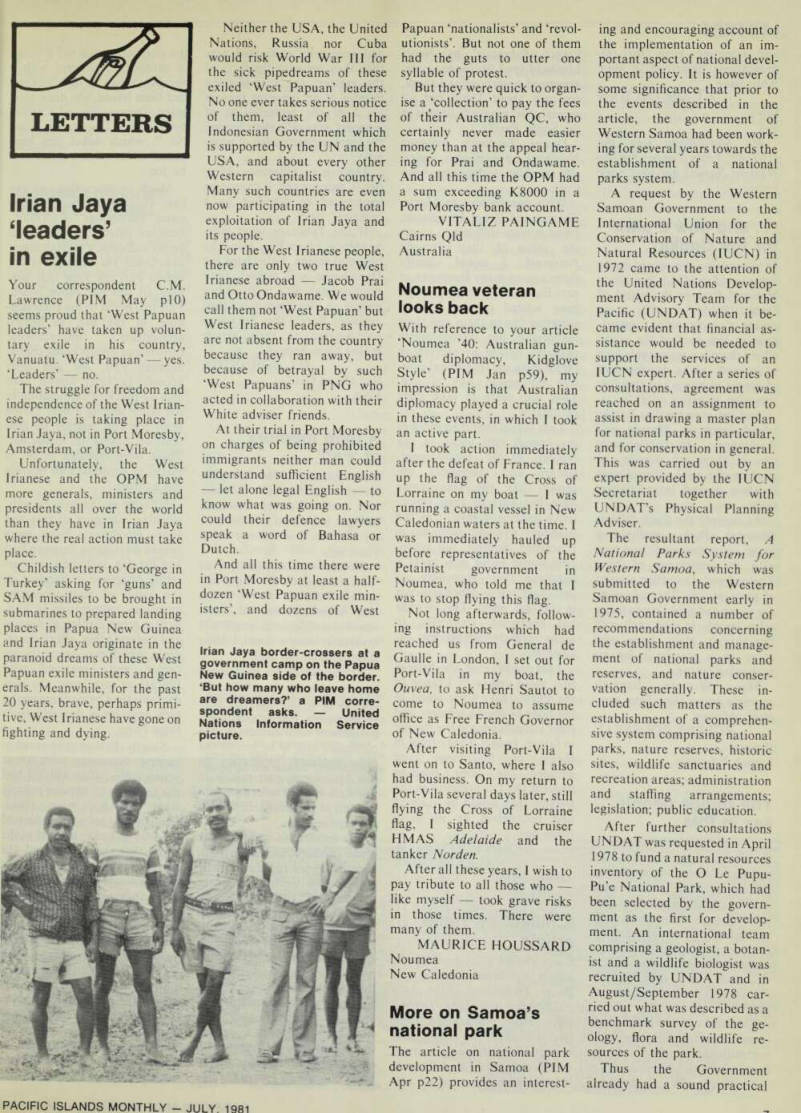
Irian Jaya border-crossers at a government camp on the Papua New Guinea side of the border. ‘But how many who leave home are dreamers?’ a PIM corre spondent asks. United Nations Information Service picture.
and scientific basis for the programme described in your April issue.
A.I. Mccutchan
Suva Fiji Mr McCutchan was the UN DAT Team Leader for the Western Samoa national park project. ... and now a park for the Cooks?
In my opinion the recent estab lishment of the O Le Pupu-Pu’e National Park in the island of Upolu (PIM Apr p 22) is an event of outstanding import ance in this part of the world where there is a regrettable lack of interest in the development of scenic reserves and the con servation of native wildlife.
And yet even smaller Pacific islands such as Morrea and Rarotonga to mention only two of them provide the nucleus of a mini national park in their rugged inland moun tains.
As regards the Cook Islands National Park, preliminary plans were prepared long ago with the assistance of New Zealand and Australian experts of great repute. The only won der to me and probably to many other people is that such well thought-out plans have now come to a standstill for no particular reason.
May Western Samoa’s example rescue them from com plete oblivion!
Robert Rousseau
Papeete French Polynesia
The things people
say in PIM ...
As a resident and traveller in the Pacific for three decades, mainly in Papua New Guinea but also a visitor to the French islands, and as a man married to a Melanesian, 1 am perhaps as well qualified as occasional re porters, or sociologists, to com ment on some of the problems in this area, and the different attitudes to them as reflected in
Pim.
The issue of May 1981 seems to me a perfect illustration of contradictory attitudes held by certain writers and readers.
The letter ‘Wrong Way in
French Polynesia’ by Henri Lombard (pp 7-9), for example, expressed exactly what I think, not only about Tahiti but all recently ‘decolonised’ islands in the South Pacific.
Daniel Tardieu’s Noumea Notebook appears also, gener ally speaking, to be very objec tive.
With due respect to Marie- Therese and Bengt Danielsson, I find it more difficult to assess the value of their Papeete Postmark. I would classify them among many European or parl-European couples who have settled in the Islands, sincerely loving them and their inhabitants, but, unconsciously perhaps, hostile to everything threatening the traditional care free Polynesian way of life.
They also seem to take sides politically. 1 am afraid that, like some of my friends still living in the typical Pacific environment, sincere and competent ob servers like the Danielssons have lost part of their objec tivity, especially insofar as the islanders’ dynamic potential is concerned. Sudden, full auton omy would prove how great a handicap their legendary and charming nonchalance is in the real world. This is what has happened, tragically, in many recently independent ex colonies. 1 am one of those who believe that some critics of France in the Pacific take their stand in the hope of seeing a larger and freer US influence in the Pacific in future. In fact if they lived in Guam or Micronesia and adopted the same position towards the US presence in the Pacific, they would be likely to find themselves on an early plane out.
John H. Huon De
Navrancourt
Atherton Qld Australia ‘Chilled’ by Tahiti article I was chilled after reading the article by Marie-Therese and Bengt Danielsson (PIM Mar p 22) about the Toto Tupuna Boys, their crimes and their trial in France. The Danielssons appear to be more concerned with establishing a difference between common criminal acts
and politically motivated acts than they are with the facts of the matter: the cold-blooded murder of an innocent man in his bed; the terrorisation of innocent women in their homes; the wanton destruction of prop erty.
There is no difference. Mur der is murder and it cannot be legitimised or dignified by a ‘political’ label.
If the Tahitians want inde pendence, I hope they gain it by peaceful means. I also hope the Danielssons will rethink their position regarding political ter rorism vs. legitimate political activism. Surely they are not so cold-hearted as their article makes them appear.
D.L. Johnston
San Diego Calif
Usa
A fond memory
of ‘Fati’
Your obituary (PIM Feb p 74) for the late Fatialofa Mamoe MP, of Western Samoa, brought back fond memories of an incident I witnessed some years ago.
Known affectionately as ‘Fati’ (a play on his name and girth), Fatialofa in his youth had been a boxer of some renown, and in later years still invariably wore a towel, trainer style, around his neck.
Relinquishing his ministerial post in the early 19705, he continued to represent his con stituency in Western Samoa’s parliament until his death. He continued also to be one of the more colourful characters on the Apia scene, particularly in the Apia RSA where, even in a bar full of personalities, he was outstanding.
The incident in question took place in the RSA where Fati, assisted by his faithful lieuten ant, Joe (a German engineer now departed for other climes), was engaged in augmenting his disposable income by way of running a raffle, the prize being a bundle of fine mats. Station ing himself strategically near the club entrance, it would have taken an even stronger person ality than Fati, of which there were few around, not to submit to his entreaties to part with only one tala for such a worth while charity. In return for this
the purchaser received a scrap of cardboard inscribed with a number. When 50 such ‘tickets’ had been issued, the draw took place, from a disused Carlton beer carton, the winner being No 7, which ticket just hap pened to have been purchased by Joe.
Much consternation, at the bar, shaking of heads, even some mumblings of ‘fraud’, until one patron, fortified by an ample sufficiency of Stainlager, summoned the courage to lay before Fati the view that per haps all was not above board.
This led, much to the entertain ment of the bar, to heated accusations, imprecations, threats and insults being traded between Fati, Joe and their accuser (a local known here only as Blackie) culminating in the latter seizing a beer carton from Joe and pouring its con tents of ‘tickets’ on to the bar.
These were revealed to be 50 pieces of cardboard all bearing the number ‘7’.
Hilarity at the bar, catcalls, whistles, stamping of feet and sheer enjoyment. Even more heated discussions between Fati and Blackie, including an inter esting discourse in Samoan on the habits of their respective ancestors, culminating in Fati, with a great display of dignity and statemanship, offering a re draw, which was promptly ac cepted and organised with Blackie as scrutineer, the win ners this time being three young girls over for a day trip from Pago Pago.
Shortly, Fati was to be seen in earnest discussion with these young ladies, after which I had the temerity to inquire politely what this had been about.
Straightforward as ever, he told me that he had explained to the three that the removal of the prized fine mats from Western Samoa would be a grave breach of local custom, bringing much misfortune upon the heads of anyone so doing. The young ladies, agreeing completely, had returned the mats to Fati’s custody. Thus Fati achieved the objectives of funds and reten tion of the mats and his dignity, Blackie achieved recognition as a man of principle and action, and the RSA patrons were all entertained for only one tala each.
A masterly performance! We
shall miss a man of his ilk. He was, in more ways than one, larger than life.
Don Stewart
Sydney NSW Australia Malden’s historian makes an appeal Eight years ago, on a visit to Fiji, I happened to read an article in a 1933 issue of PIM and it introduced me to the Line Islands, which hitherto I had not heard of, and to Malden Island in particular.
This place struck me right away as unusual, and sub sequent research confirmed it as unique. The central lagoon is of terrific depth (probably the cone of an extinct volcano) and on the barren flat surface of Malden are the most extensive Polynesian stone ruins of any uninhabited island in the Pacific.
I am now getting ready to write a book on Malden Island.
It is most unlikely that there will be another one, so it will need to be as good as it can be. ‘Complete’ would not be poss ible, but it has to read convinc ingly, at least.
A brief summary of Malden’s story might hint at the fasci nation which has sustained me throughout the often wearisome search for information about this remote and somewhat
forbidding spot.
It was officially discovered by HM’s frigate Blonde in 1825, and named for the surveying officer. Lieutenant Charles Malden, who went ashore with a party. For the next 30 years it was one of the many low islands known to whalemen, useless for ‘comforts’ of any kind, and to be avoided because of strong tide sets. But with the demand for guano as a cheap fertiliser in the late 1850 s, these unlovely equa torial coral lumps were occu pied, and their immense bird colonies • disturbed. by American interests operating from Honolulu with the exception of Malden, or Inde pendence Island, the most valu able of the lot.
The right to exploit Malden’s resources came into the hands of B. B. Nicholson, a shipping agent in Melbourne. Trying to
set the island up broke Nicholson financially (six vessels lost in under two years) and broke his health as well. He died at the age of 34, by which time the firm of Grice, Sumner & Co had inherited the lease and the problems.
After the loss of a large German ship in bizarre circum stances in 1873, insurance com panies refused to underwrite vessels going to Malden. The next year, however, Grice, Sumner had good fortune for a change, when they signed up a 36-year-old Ulsterman, Abraham McCullough, to be manager.
He was to serve on the island for 23 years. He is buried there, near the memorial to his infant son, who according to the in scription, had been ‘taken by the wild wave’. Under McCullough’s rule and that is the right word Malden Island was a going concern, and a well ordered little outpost of the British Empire. The field labourers and boatmen were recruited from the northern islands of the Cook Group.
McCullough fined them for infractions, but would permit no abuse of them by the white overseers or the crews of ships.
By the lime of McCullough's death, all the other low islands had long been abandoned, or
were being sporadically worked for tailings by the tireless John T. Arundel. Of course the opening up of Ocean Island in 1900, and later Nauru, put Malden in eclipse. But Grice, Sumner held on to the lease, and continued to work the deposits, with only New Zea land remaining as a market. It was not until 1927 that Malden Island ceased to operate as a guano station and the build ings of the beach-crest and inland settlement were left to become the island’s second col lection of ruins.
During the late 1930 s Malden was one of the islands disputed by Britain and the USA, both in quest of possible seaplane bases between North America and Australasia. The Japanese attack on Pearl Harbor cancelled all that, and the Cold War brought aircraft of stupendous technological ad vancement to the mid-Pacific.
In 1957, Malden, and Christmas Island, were the sites of ‘Operation Grapple', the first British H-Bomb tests. Five years later, the USA made similar use of them.
The most recent chapter (or paragraph) in Malden's story, as reported in PIM, November 1979, is that along with 13 other islands so earnestly staked-out by RN and USN warships 45 years ago, it is now part of the new nation of Kiribati. But two Kiribati Government ex peditions had earlier concluded that Malden could not be made suitable for habitation except at prohibitive expense.
So the birds, their numbers depleted by guano mining, im ported pigs and cats now run wild, and the flashes of super
bombs, have the island again with the ocean billows, the westerly trade wind, and the maraes and house-sites of the people who lived there centuries before the first grave of European or Cook Islander.
Ordnance huts stand with the coral-stone foundations of the guano storage sheds and staff quarters, succumbing to weather; drums of dieselene are stacked along a section of splitting railway track. The loading pier that proceeded on shear-legs from the beach-crest out over the reef, where the guano sacks, the millions of them, were winched off flatcars into lighters, lies scattered under the sea.
Tracking down information on Malden has been anything but straightforward business, yet worth all the trouble, for the co-operation and trust which I have been given by so many people. It will be my pleasure as much as duly, to acknowledge all who have thus contributed, within Australia and from six other countries, in the credits which will appear in the book.
I would now like to ask of PIM readers whom I do not know and have not reached, if there are any who might have material, however minor, to do with this out-of-the-way island; family letters, diaries, remi niscences, photographs, news paper items, etc. anything at all.
Correspondence, from any where in the world, will be promptly answered.
John C. Orr
KOA Productions, 41 Correy Avenue, Concord 2137 NSW Australia
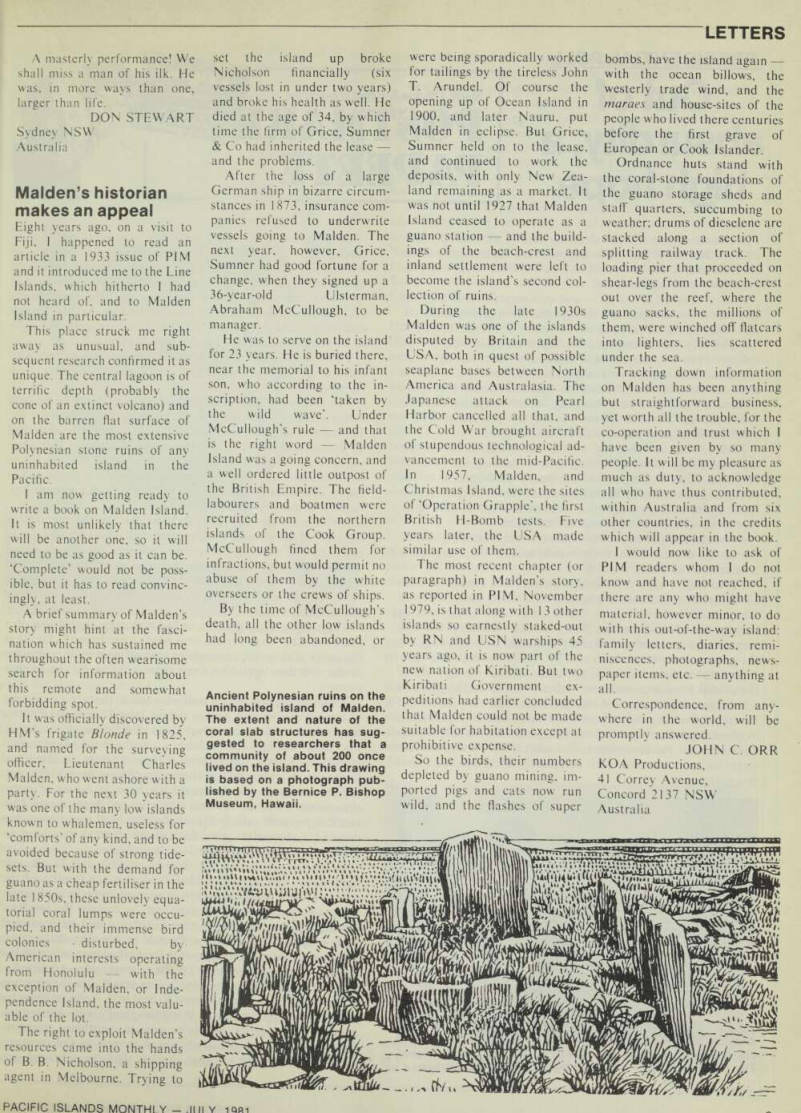
Ancient Polynesian ruins on the uninhabited island of Malden.
The extent and nature of the coral slab structures has sug gested to researchers that a community of about 200 once lived on the island. This drawing is based on a photograph pub lished by the Bernice P. Bishop Museum, Hawaii.
absurdity, a
Presidential Poll
Out of absurdity, a high hope
The two-round presidential elections held in French Polynesia on April 26 and May 10 again demonstrated the absurdity of the old-fashioned colonial system which survives today only in France’s overseas possessions.
It must be noted first of all and with regret that the local outcome of an election of this type hardly matters, since the votes cast by the 78 000 registered voters of French Polynesia (to take only this example) are lumped together with the 36 million French metropolitan votes and can hardly ever, therefore, be expected to change the final result. The recent elections showed this clearly: the local electorate here gave Giscard d’Estaing an overwhelming 76.71% majority, but this didn’t prevent Mitterand from winning the presidency with a comfortable overall majority of a million votes.
There is another anomaly this one tends to reduce the significance of Giscard’s impressive showing in French Polynesia. This is the fact of the heavy participation in the voting of predominantly Righlwing French settlers, government officials and military personnel, who are allowed to vote in all local polls as soon as they step off the plane.
Even more unfair to the Polynesians are the campaign rules.
Faithfully copied from the French model, they are quite unsuited to the island context.
For example, while it is easy in a country like France to reach voters by car, bus, train or plane, the Polynesian voters live on many small, isolated islands, scattered over an ocean area as large as the whole of Europe. The best, and sometimes the only way to wage a campaign in French Polynesia is therefore to use the government-owned radio and TV station in Papeete.
But in this election as in any other for that matter only the official French candidates there were 10 in this election - have ever been accorded this privilege, and they talked, of course, in French, and only about French domestic problems.
Without any local politicians being allowed to explain in Tahitian what the issues were, and what the local implications might be, most voters were left completely in the dark as to what was going on.
On the other hand we are constantly exposed to government propaganda varied on rare occasions with snippets of information about the doings of a few selected opposition figures. All individuals who are, however remotely, suspected of favouring independence are automatically and permanently excluded from the studios despite the fact that the French constitution and the United Nations charter recognise the right of all colonial peoples to become independent.
There are a few minor legal absurdities associated with election procedures which are really more laughable than harmful.
The first is a stipulation that national elections must be held simultaneously in all parts of the republic. Unfortunately, the 12-hour lime lag between Paris and Papeete cannot be abolished by decree, and this results in the awkward situation that when voting begins here, it is already over in France. All one has to do to discover the result in advance is to make a phone call to Paris. This takes no more than a few seconds, due to our ultra modern automatic telephone exchange.
Another absurd election rule provides for the mailing, in advance, of the election programmes of all official candidates to each and every one of the territory’s voters. Since inter-island communications, including mail services, are still very slow and irregular, it is utterly impossible effectively to apply this rule. If voters ever in fact receive their envelope, it is certainly well after the election is over.
These are what might be called statutory absurdities. But there are other more serious ones which arise from the fact that the political situation and popular aspirations are quite different in the overseas territories from those existing in ‘the mother country’.
This time there was total confusion due to the tactical mistake of the old Autonomist parties led by John Teariki and Francis Sanford in deciding to support Giscard d’Estaing. Considering -that their aim has always been as the word ‘Autonomist’ implies to win full internal self-government on the Cook Islands model, their logical choice would have been Mitterand, a political figure who for years has been in favour of auto determination for the overseas territories and departments. This sensible principle simply means that the local populations can decide for themselves what form of government they want even if this might be complete independence.
It was for this reason that Teariki in 1965, and Teariki and Sanford in 1974, supported Mitterand who, as a result, won the vote in French Polynesia but to no avail, as he lost in France.
Having been persuaded early on mainly by insidious government propaganda that Giscard would be re-elected with a huge margin by the French people, the Autonomist leaders decided this time to switch their allegiance to him, in the understandable desire to be on the winning side. Admittedly, they also had some reasons for feeling grateful to the outgoing president: he had at least agreed to deal with them, whereas his predecessors, de Gaulle and Pompidou, had always treated the Autonomist majority as if it were a worthless minority.
Furthermore, Giscard had showered money on the territory, giving everyone the pleasant illusion that the economy was
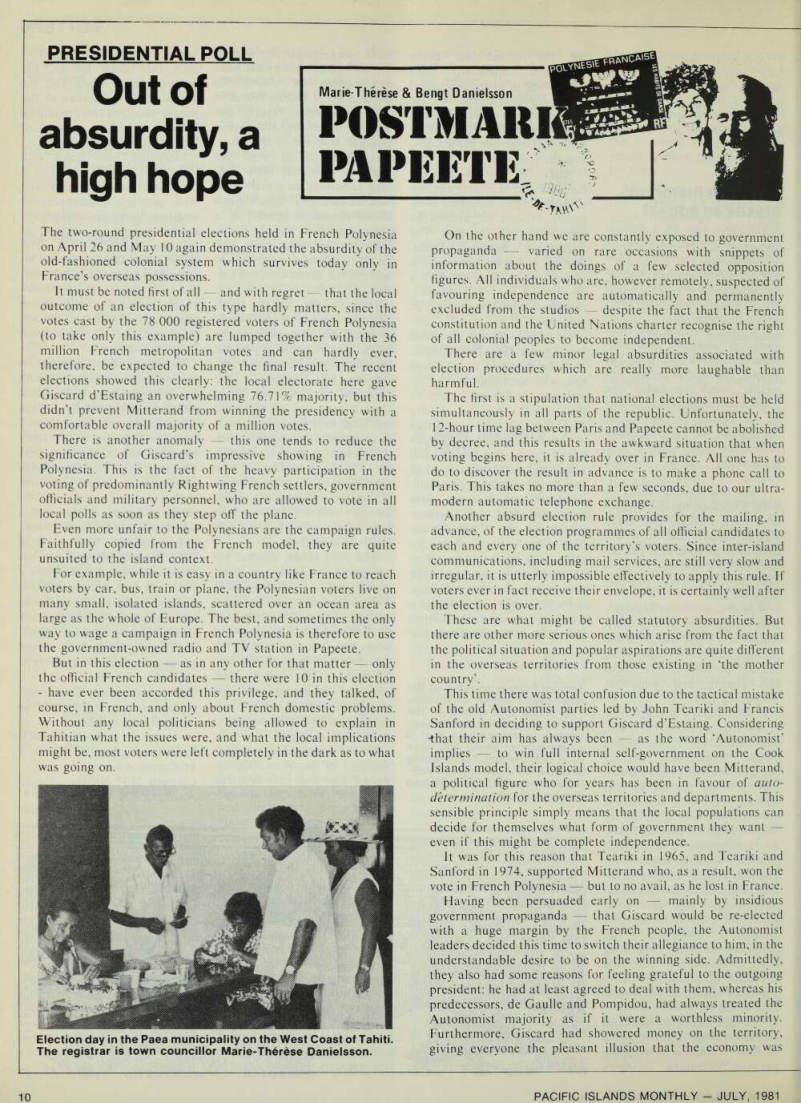
Election day in the Paea municipality on the West Coast of Tahiti.
The registrar is town councillor Marie-Therese Danielsson.
'ecovering. The two leaders of French Polynesia’s Chinese community, Michel Law and Arthur Chung, took the same dand for the same reasons.
As expected, long before the first round of the election on \pril 26 Gaston Flosse, leader of the local Gaullist party lahoeraa Huiraatira, who can usually count on a third of the erritory’s votes, launched a whirlwind campaign in favour of he candidacy of his French boss Jacques Chirac (PIM May )18). Flosse’s main talking point was the open and effective upport given by Chirac to his far-reaching Autonomist reform )rogramme which is aimed, first of all, at economic ndependence for French Polynesia (PIM May 1980 p 27). This esulted in a perfectly absurd situation. Here were the old Autonomists campaigning against Mitterand, who supports the >rinciples they have always fought for, while Flosse, tradition ary the staunchest, most pro-French, supporter of the existing ystem, was championing the Autonomist cause.
All this left the task of carrying the Mitterand banner to the mallest of the well-established parties, la mana te nunaa, which arely musters more than 10% of the vote. It could be said that hey held the banner higher and waved it with greater fervour han was warranted by Mitterand’s public statements, for they epeated endlessly that they were for independence and against he nuclear tests ...
After the first round, which eliminated eight of the 10 andidates, only one thing was certain: the three Polynesian •arties had preserved their traditional relative strengths. The andidate supported by the Autonomists (Giscard d’Estaing)
got 51.4% of the vote, Flosse’s candidate (Chirac) 35.90%, and the la mana te nunaa candidate (Mitterand) 8.32%.
As the second round approached the big question was: which of the remaining two candidates would get Flosse’s support?
Considering his strong bid for full internal self-government, Mitterand would have been his logical choice. Instead he criticised the Labour candidate the term ‘Labour’ more aptly describes Mitterand’s true position for English-language readers than ‘Socialist’ for his communist connections, and then invited all and sundry to vote ‘according to their conscience’.
Thus it came to pass that the second round turned into what must easily be the most confused and absurd political battle ever fought in French Polynesia, with the la mana te nunaa ‘radicals’, supported by a large slice of the Gaullist voters, trying to persuade the traditionally pro-Mitterand electorate of the Teariki and Sanford not to vote for the Rightist candidate
Giscard d’Estaing!
Totally bereft of local issues to stir the flagging enthusiasm of their troops, the pro-Giscard forces adopted the scare tactics of their metropolitan patron who, like his predecessors de Gaulle and Pompidou, tried without much success to persuade voters that the communists would be masters of France if Mitterand won. (In fact, the communist performance was the feeblest in modern times: only one out of seven voters supported the communist candidate, who dropped out after the first round.) At the level of local affairs, it was shouted from the housetops that a victory for the ‘socio-communists’ led by Mitterand would lead to general poverty, cancellation of all pensions and welfare payments, the sacking of thousands of civil servants, and the abolition, as in Russia, of private property!
With this sort of propaganda being spread through the islands, it was little wonder that Giscard had a handsome win in the second round. However, a sufficient number of supporters of Flosse and Teariki-Sanford voted for Mitterand for him to treble his first-round vote: he scored 1 1 357 votes in the second round, as against 37 414 for Giscard.
An old saying has it that you can’t unscramble scrambled eggs.
But this apparently unassailable truth certainly doesn’t apply to the political imbroglio in French Polynesia created by these strange elections.
As a matter of fact, most political leaders are already scrambling to get behind the new president, and we confidently predict that it won’t be long before they will all be vying with one another to do away with the absurd existing system, and set about the building of a new, free, democratic, and gradually
more and more independent Polynesian nation.
Marie-
Therese and Bengt Danielsson.
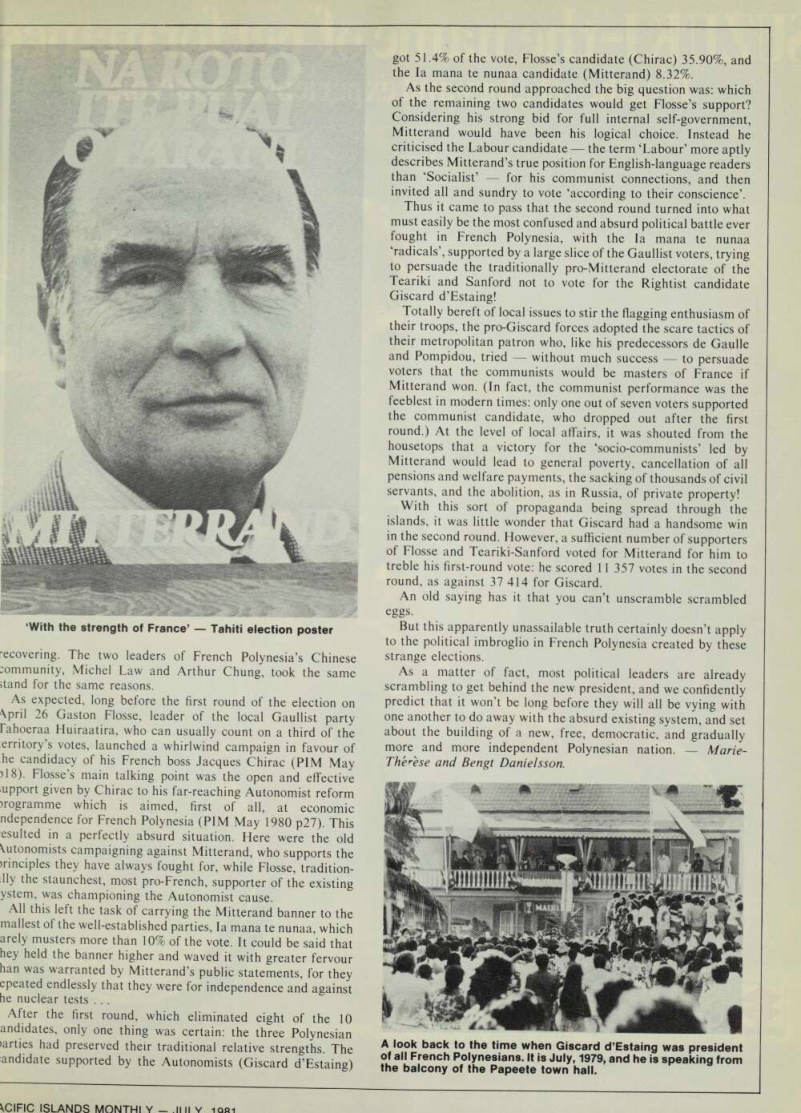
‘With the strength of France’ Tahiti election poster
A look back to the time when Giscard d’Estaing was president of all French Polynesians. It is July, 1979, and he is speaking from the balcony of the Papeete town hall.
Advertisements & other items, pp. 10-12 (2 items)
Marie-Therese & Bengt Danielsson
POSTMARK
PAPEETE
\ r
SUZUKI-the name of performance
Breathes of glory and experience in racing.
Watch it feeling oxer on-roads and boldly crossing off-roads.
Presenting SUZUKI’s motorcycles that blends superb performance with elegant modernistic styling.
Seen strikingly alive in SUZUKI’s motorcycles is SUZUKI’s technology and experience originally incorporated in the champion machine which has claimed a variety of race titles.
These climaxing technological innovations are apt to attract motorbike fans worldover.
IE I V m r v •m m I V \ mm SL mu / % * j * $ ..
SUZUKI MOTOR CO., LTD
SOOTakatsuka, Hamamatsu, Japan SOLOMON ISLANDS SOLOMON ISLAND SERVICE STATION LTD. NEW CALEDONIA STE. SUPERCAL PAPUA NEW GUINEA HI SPEED DIESEL SERVICE PTY LTD. NEW HEBRIDES HENRI LEROUX NIUE ISLAND BURNS PHILP (SOUTH SEA) CO.. LTD. PONAPE LEO ETSCHEIT TAHITI NIPPON AUTOMOTO ELLICE ISLAND TUVALU COOPERATIVE WHOLESALE SOCIETY LTD. GUAM & SAIPAN ISLAND CYCLERY. INC. NORFOLK MARTIN’S AGENCIES LTD. SAMOA PACIFIC PRODUCTS. INC. KIRIBATI GILBERT ISLANDS
\Cific Islands Monthi Y _ Nil V -Iqqi
\CIFIC ISLANDS MONTHI Y nil v -iqqi
One for the history books

W. Samoa public service strike: One for the history books
‘lt is true there were strikes before but never at such strength.’ So said Western Samoa’s Prime Minister Tupuola Efi of the marathon strike begun in April by members of the country’s Public Service Association. A New Zealand observer wrote; The first strike by public servants has significant social implications. It represents a major challenge to the mate/-dominated political system.’ (Only matais chiefs can vote and stand for parliament in Western Samoa.) Telecommunications problems both in Australia (where an industrial dispute caused bans on maintenance of equipment), and in Western Samoa, have meant that PIM is able to provide no more than the following skeleton diary of main events of the development and course of the strike. More in PIM August.
Early 1980: To combat inflation (estimated to be running at 38% a year). Western Samoa’s Pub lic Service Association, in nego tiations with the Public Service Commission, sought a 30% pay increase. Agreement was finally reached with the minister re sponsible for the public service, Asi Eikeni, that there would be a 10% increase payable from June 1980, followed by a further increase of 12.5% from January 1, 1981.
December 1980: The 1981 estimates presented to parlia ment revealed that the govern ment had decided to grant public servants only an 8% pay * rise, to be implemented in two stages, with a six-months inter val. Slo reasons were given for the scrapping of the agreement with Asi Eikeni, and the PSA was given no official statement on the matter.
Early 1981: The PSA ap pealed, and nearly 4000 marchers turned up at parlia ment to present a petition supporting a PSA demand for a 15% pay increase. The petition was referred to a committee of mainly government supporters, who rejected it.
March 1981: The PSA de cided to make one last appeal, with the understanding that rejection would be followed by immediate strike action. The appeal fell on stony ground.
April 6: The strike began.
With telecommunications workers out, the country was virtually isolated from the out side world. Airline, postal, ship ping, medical, firefighting and other services were manned by tiny emergency staffs. The gov ernment refused to discuss the strike with the PSA, saying negotiations must be carried on through the proper channels with the PSC. It also said
Western Samoa’s economy could not stand the cost of the proposed increases, estimated to be SWS3 million.
April 24: The Samoa Times reported: The strike’s effects are being felt more and more as the absence of the s'/: million injected into the economy fort nightly through government salaries and wages becomes noticeable. Funds entering by way of transfers through the Post Office are also missing from the economy and have thus aggravated the depressed state.’ The same issue of the paper reported that the PSA had established a relief fund for its 4000 striking members and had already raised more than $3OOO in cash, not counting food and clothing. PSA presi dent leti Tulealo was reported to have gone to Pago ‘to contact overseas PSAs and trade unions for support and advice’. Inter viewed by the Times, parlia mentary Opposition Leader Vaai Kolone criticised the gov ernment’s handling of the strike, saying: ‘Government should have solved the problem at the time of the PSA march to parliament, especially as the public servants were already aware of the huge salary in creases made for the Head of State, Member of the Council of Deputies, Cabinet Ministers and MPs. They were also aware of the separate deal government made with the doctors and nurses. Under such circum stances government should have carefully weighed the effect of those decisions on the morale of the rest of the public service.’ The paper also carried a picture of the third of a series of mass demonstrations and meetings being held regularly by the PSA.
April 29: Prime Minister
Tupuola Efi, reversing his previous stand, announced that henceforth he would assume •day-to-day direction of negotiations with PSA leaders’. The TTiT of the pia wee^ ly The Observer which noted this development, also reported that Western Samoa s Cardinal L . “'i $lOOO to the PSA, not he said, because he supported the strike, but as a gesture to show his recognition of the PSA’s dlfficultles ’
May 8: The Samoa Times frontpage lead story began; ‘Striking members of the PSA will have to return to work by 4pm, Monday, May 11, if they are not to lose the PSC’s offer (to regard the period of the strike as a grant) of special leave. If they do not return by that time, they will lose their
Jobs and have to seek re employment to get back into the service . This was one fth basic decisions made b h Executive Council in a meeting held at Vailima y«erday morning.’ The council also ru , ed that a emission of inquiry Woldd be set . public service salaries, and that no salaries would be paid to PS workers for the period they were on strike. The Executive Council comprises the Head of State, His Highness Malietoa Tanumafili 11, sitting with the Cabinet, and is seen as the highest .decision-making body in the land. The strikers’ re sponse: a march of about 10 000
Continued on Page 68.
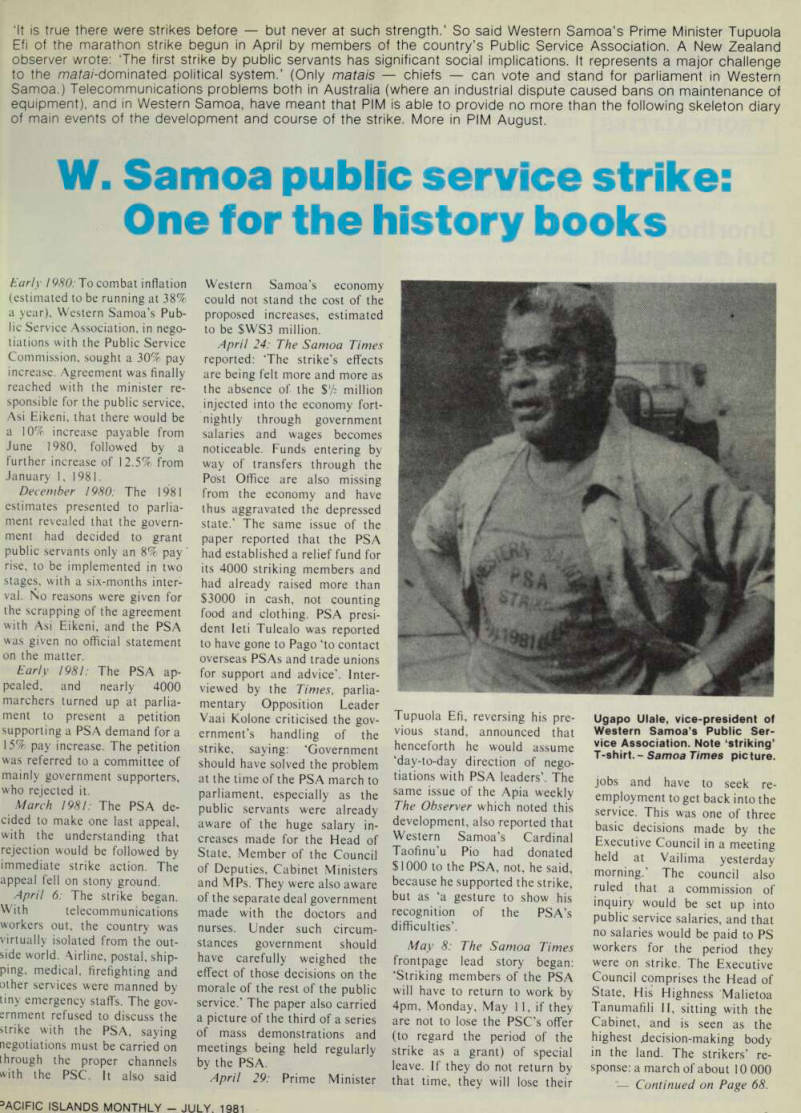
Ugapo Ulale, vice-president of Western Samoa’s Public Ser vice Association. Note ‘striking’
T-shirt. - Samoa Times picture.
people on May 1 1 rejecting the back-to-work direction.
May 14: Tupuloa announced that the May 7 decisions of the Executive Council represented the government’s final position.
May 22: The Samoa Times reported: ‘Sixty per cent of the public servants are still on strike, according to figures re leased by the PSC yesterday.
Of the 4223 salaried public servants only 1468 are back at their desks with 2755 still on strike. Of this total 617 are teachers . . .' May 23-24: A weekend strike by Electric Power Corporation workers in solidarity with the PSA cut electricity supplies. At about this time, Fiji’s Minister for Labour Tomasi Vakatora made a short visit to Apia, accompanied by two top concili ators from his department and from Fiji’s Tripartite Forum, which links government, busi ness and unions. They said they had come to ‘advise, not settle', following expressions of interest by Tupuola in Fiji’s unique methods of industrial concili ation.
June I: The 19th annual celebrations of Western Samoa’s independence reflected the depth of the social divisions caused by recent events. Official celebrations were crammed into one day (Monday June 1) instead of the customary three. They were less well attended than usual.
June 2-3: The PSA ‘took over’ the remaining two days of the traditional independence festivities, with a Tuesday morning protest march of 10 000 along Beach Road, and afternoon festivities. More ac tivities were performed on Wednesday. The Observer of June 5 commented: ‘lf public attendance at the two separate independence celebrations is a criterion indicating in which direction public sympathy and support were bending, then the PSA rally was decidedly the one.' Participation by old people, school children and University of the South Pacific students and staff was a notable feature of a number of PSA activities.
June 5: The Observer re ported: ‘The government has announced that the Executive Council has approved the rec ommendations of the com mission of inquiry on public service salaries established by it on May 7.’ The rises rec ommended would reportedly cost the government $1 559 610. They were to be effective from June 1. At PlM’s press time, it was still unclear whether the PSA would accept them. The PSA, meanwhile, was engaged in a Supreme Court action to determine if their strike action was within the law, a point vital for re instatement prospects. But ac cording to the government newspaper Savali, ‘the Execu tive Council has resolved to recommend to the PSC that in the consideration of appli cations for reinstatement by persons who have been on
strike, the PSC should exercise the powers at its discretion with benevolence'.
International support: Al though scores of messages have been received by the PSA from trade unions in foreign countries, their support has been mainly moral, and to some extent financial. When PSA leader Icti Taulealo appealed tc the conference of the New Zealand Federation of Laboui in May for a ban on all shipping to and from Western Samoa and a ban on Polynesian Air lines flights out of Auckland delegates seemed unprepared tc take such action. FOL president Jim Knox presented the West ern Samoa leader with a cheque for $lOOO, and called for a collection in support of the strike from FOL delegates as individuals.
Tomasi Vakatora To advise, not to settle’.
brought lunch
Tropicalities
Unorthodox,
but a seagull
brought lunch
A seagull which had gorged itself on fish was a factor in the salvation of two Ni-Vanuatu men who spent 20 days adrift in a crippled plywood boat in April-May: the bird delivered their lunch when it landed on the boat one day and promptly vomited six small fish out on the deck. Four flying fish also oblig ingly paid for them fatal visits.
The men, Petersen leri and Meli Whitecross, set out from Tanna on April 17 for their home island of Aniwa. Halfway between the two islands the boat’s engine failed.
An air and sea search for the two was called off after a few days. The men saw the search plane on April 19, but seas were rough and the aircraft was flying too high to see their signals.
The men lived mainly on uncooked yam, taro and kumala which they had on the boat.
They drank salt water when their fresh water supply ran out, and look turns in swimming out to retrieve coconuts they sighted bobbing past their boat.
On April 26 they were able to catch rainwater in a plastic container. This lasted them a week.
The two men ran out of food on May 4, but on May 7 they sighted the Korean fishing vessel Sam Song 17. Smoke from a mat which they burnt as a distress signal was seen by Korean fishermen and they were immediately picked up.
Four hundred people were at Port-Vila’s main wharf to wel come them when they arrived on May 13.
At the time of their rescue they were south of San Cristobal in Solomon Islands.
Petersen leri is a former
sailor, trained by the British under the old condominium.
This training stood the two men in good stead during their ordeal. But Mr leri is modest about it. He says his faith in God kept fear at bay. T knew we would be saved,’ he said.
Red faces over
Fiji textbook
‘Who in the Ministry of Edu cation approves the publication of its textbooks? Does the Min ister himself read the textbooks written by his staff at the Curriculum Development Unit?’
So began a reader’s letter in a May issue of The Fiji Times which was to send shockwaves through the country’s education hierarchy.
Correspondent Miss M.
Thomas, of Macgregor Road, Suva, quoted extracts from a new social science textbook.
Making Decisions — Teachers’
Guide, which certainly did not sound as if they had ever been subject to official scrutiny.
She quoted from page 20 of the textbook: ‘The Fiji Islands is a small country with many contrasts. It has a population which comprises native Fijians who lead a primitive livelihood of subsistence farming; and the Indians and Europeans who have a background of advanced technology and literacy. While the natives see their salvation in land. Indians and Europeans take refuge in business enter prise and education as an outlet for their progress.’
Miss Thomas asked rhetorically: ‘ls all this fact or prejudice? Does this describe Fiji? Is this the kind of nonsense the ministry pays its social scientists to come up with?’
Two days later an embar rassed Secretary for Education, Epeli Kacimaiwai, in a state ment appearing on the front page of the Times, said that the book had reached the govern ment printer ‘without the nor mal channels having been fol lowed’. It had therefore been printed ‘without proper author isation’.
Mr Kacimaiwai said of the passage quoted: ‘lt is regretted that there is a serious error of fact in the second paragraph.’
He then gave what many might suspect was a hastily improvised ‘authorised version’ of the passage, saying: ‘lt should have read as follows: “It has a population which com prises Fijians who have emerged from a livelihood of farming and Indians and Europeans who have a back ground of more advanced tech nology and a longer period of literacy.” ’
Mr Kacimaiwai said the paragraph and, if necessary, other parts of the book would be revised.
It seems fair enough to give the last word to Miss Thomas, who, after all, aired the affair in the first place. At one point in her letter she wrote: ‘School textbooks should be factual.
When an author writes about another culture, one that he seems not to understand at all,
he can at least be courteous. It is sad and frustrating to see someone inflicting 19th-century beliefs on our school children, and at the taxpayer’s expense
Fiji honeymoon
for Charles?
American Richard Evanson is a man with ideas about where Prince Charles and Lady Diana Spencer should spend their honeymoon after their July wedding: he has offered them his very own Turtle Island resort in Fiji free of charge for the occasion. (The island, known in Fijian as Nanyalevu, is in the Yasawa group.) The resort has accommo dation for 16 guests. The island also houses the set for both versions of the film. Blue La goon.
Prince Charles is known to
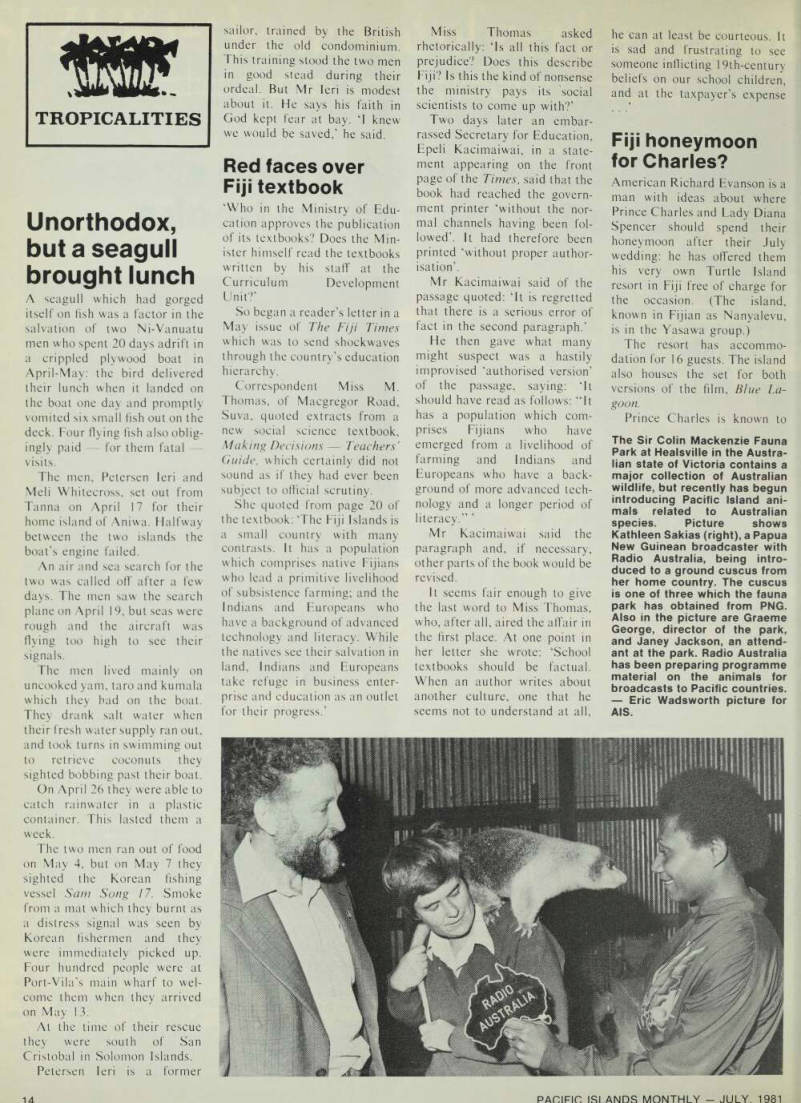
The Sir Colin Mackenzie Fauna Park at Healsville in the Austra lian state of Victoria contains a major collection of Australian wildlife, but recently has begun introducing Pacific island ani mals related to Australian species. Picture shows Kathleen Sakias (right), a Papua New Guinean broadcaster with Radio Australia, being intro duced to a ground cuscus from her home country. The cuscus is one of three which the fauna park has obtained from PNG.
Also in the picture are Graeme George, director of the park, and Janey Jackson, an attend ant at the park. Radio Australia has been preparing programme material on the animals for broadcasts to Pacific countries. -Eric Wadsworth picture for
Ais.
have a soft spot for Fiji, which may be the only country in the world to have a public holiday for his birthday. This honours his position as heir to the throne.
Game fishing
in Hawaii
Hawaii is staging two major big game fishing tournaments in the course of July-August.
They are the Hawaiian
National Championship Billfish
Tournament (from July 17-24), followed by the Hawaiian Inter national Billfish Tournament July 24-August 2).
The former event, now in its Tfth year, was established as a ough qualifying test for the alter, which celebrates its 23rd this (northern) summer.
Ten US mainland states will >e represented by 30 teams in he first tournament. They are Maska, California, Colorado, daho, Nebraska, Nevada, Oregon, South Carolina, Utah nd Washington. (Hawaii as lost is excluded from the con est.) Winners of last year’s
lational championship were the
lan Francisco Golden Caters of California. Under the leader hip of captain Jerry Davia, the lan Francisco team caught a
total of four marlin in the four days of tournament fishing and, with earned bonus points, scored 1325 points to sweep the field of 30 entries. The Californians were later ex tended an invitation to compete in this year’s international tour nament.
The governors of the Hawaiian International Billfish Association (HIBA) have also opened a special foreign section in the national championship.
This section serves as a qualify ing test for foreign-country teams trying to earn a place in the line-up of entries selected by their own country’s officials to go to Hawaii to represent their country in the ‘international’.
Australia this year has four teams appearing in the inter national tournament, with nine others in the foreign section of the national event. The teams competing in the national tour nament hope to win the foreign section competition and, per haps, unseat their fellow Aussies now representing the great southern continent in the international tournament.
It is expected that teams from 20 countries will take part in the ‘international’. From a newsletter of the Hawaiian International Billfish Associ ation.
Palau MPs ban
smokes, betel
In a move that would have the Governor of Yap John A.
Mangefel spluttering in his sleep for days on the one hand, and the US Surgeon-General jumping and kicking his heels in jubilation on the other hand, the House of Delegates of the First Olbiil Era Kelulau (Palau National Congress) has banned cigarette smoking and chewing betelnut in its chamber, reports the OEK public information officer Bonifacio Basilius.
The ban, which was the subject of a heated argument among Palau's delegates, was adopted by the barest of mar gins it took Speaker Carlos Salii himself, the presiding officer in the House of Del egates, to break the tie. Speaker Salii, a non-betelnut chewer but a chain smoker, became the object of intense lobbying from the two groups, and after he sided with those who advoca ted a smoke-and-betelnut-free chamber, many a dire predic tion was made about the immi nent collapse of the betelnut industry in the Republic.
Some say that the calamity might even be more serious, considering the fact that certain national fathers might expire prematurely at their legislative desks if deprived of their betelnut for an extended period of time.
The proponents of the ban claim, however, that the new rule has some beneficial effects aside from clearing the house chamber of smoke and betelnut stains.
They said that because the ban would result in frequent recesses to allow the other half of the house to step outside and take a puff or have a bite of betelnut, the usually lengthy debates would be cut in half, which, in turn, would materially reduce the cost of papers and overtime salaries of house staff, and the republic itself will, in the end, benefit from the ban.
Woe to the unwary who might enter the Olbiil Era
Kelulau house chamber with betelnut in his cheek or a cigarette dangling between his lips. The house sergeant-at arms has been instructed to escort such offenders out of the premises in accordance with the new-found decorum in the Palau house of delegates.
From the Marshall Islands Journal.
Rotuma marks
centenary
Rotuma, Fiji’s ‘split island’, in May celebrated the centenary (PIM Apr plO) of its cession to Britain.
Despite poor weather on the first two days of the three-day festivities, the third and most important day was clear and sunny, and the happy, festive spirit which had earlier been lacking was evident every where.
Fiji’s Governor-General Ratu Sir George Cakobau and Prime Minister Ratu Sir Kamisese Mara took part in the cel ebrations. In a message from the Queen read by the governor general, she said: ‘The decisions taken a century ago by the chiefs of Rotuma to join her destinies with Britain and again by their descendants in 1970, to remain part of the Fiji nation, were both based on trust and confidence. ‘I am glad that in both cases their decisions proved fruitful and have demonstrated their loyalty.’
Of the hundreds of visitors for the occasion, a large per centage were Rotumans who were returning to their island for the first time in many years.
It was not uncommon for visi tors to be treading the soil of their home island for the first time in 30 years.
There was a general ban on sales of the island’s famous orange wine ‘until after the visitors leave’. Except for a Royal Fiji Navy officer who had a bit too much to drink at the prime minister’s cocktail party, there was little in the way of wild revelry.
Transport, always a problem on Rotuma, was even more a problem during the cel ebrations, and people from many of the island’s more remote villages had difficulty in
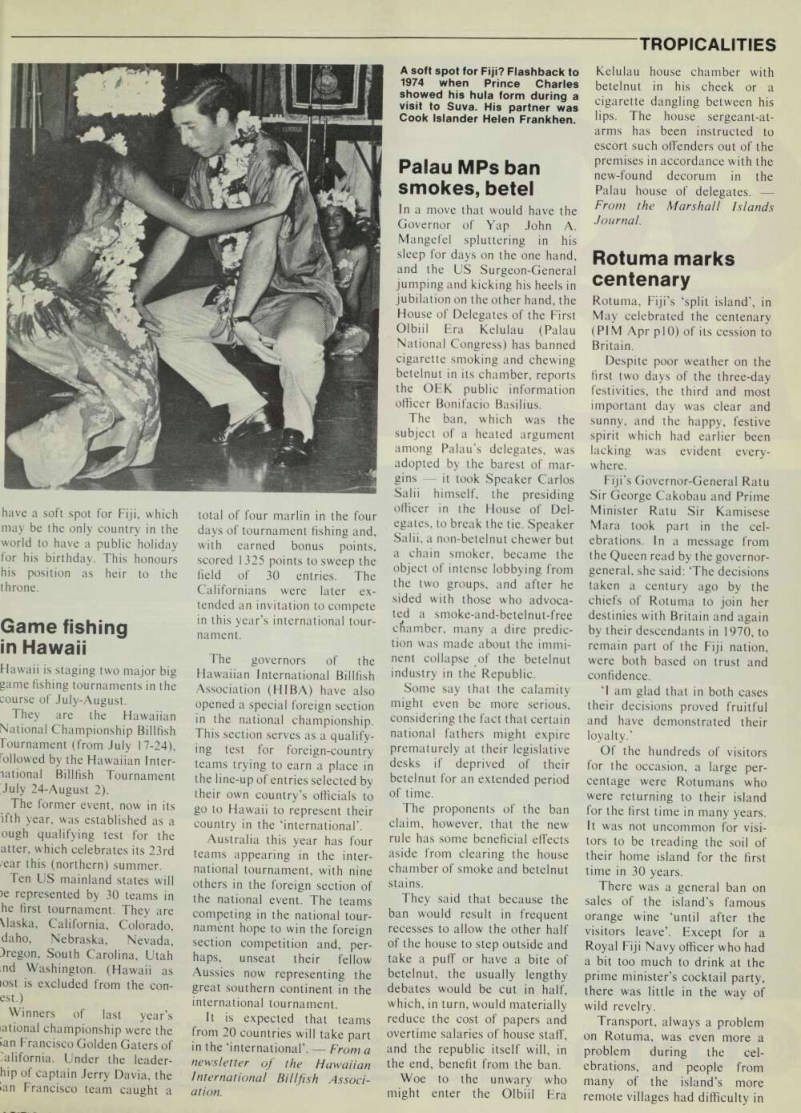
A soft spot for Fiji? Flashback to 1974 when Prince Charles showed his hula form during a visit to Suva. His partner was Cook Islander Helen Frankhen.
reaching Ahau, or returning at the end of the day.
Rotuma’s centenary cel ebrations created problems for others too; more than 1200 canecutters were reported stranded on small islands wait ing to get to Vanua Levu because the ships needed to get them to work were used to carry guests to the Rotuma cel ebrations. As a result, on one day only 800 cutters were available to supply the Labasa mill, which had to close for some time because it was not getting enough cane.
Vanuatu notes
‘the greatest’
Vanuatu’s new currency notes will be the finest in the Pacific, according to the country’s Finance Minister Kalpokor Kalsakau.
He said he’d made a careful study of notes from every Pacific country, and was confident the Vanuatu designs would be superior to any other.
The notes, whose design was still secret when Mr Kalsakau spoke, are being printed in England.
Because he still had some doubts about certain aspects of the designs, Mr Kalsakau had asked general manager of the Central Bank John Howard to go to England to check on them.
Mr Howard had shortly be fore visited Australia where he had discussed the currency change-over with Australian officials. The return to Australia of Australian banknotes at pres ent in use in Vanuatu was also discussed.
Pagan survivor
tells of terror
Residents of Pagan Island, Northern Marianas, survived molten lava and choking gases from a volcanic eruption in May 'PIM Jun p 6) by hiding in bat filled caves.
A Japanese freighter plucked 53 people off the ash-choked sland and transferred them to a US ship. A 54th Pagan resident *vas on another island when the ong-dormant volcano erupted.
The eruption had been sig lalled by ‘bad earthquakes, and he whole island was shaking,’
resident Ben Aldan told a United Press International re porter in Guam.
T grabbed my wife and two children and headed for the beach. We jumped into a canoe and paddled across the bay away from the volcano.’
Mr Aldan said ash rained down and the heat was nearly unbearable. ‘We could see fire coming out of the volcano. The island was still shaking,’ he said. ‘I thought we were all going to die.’
Willi Willi in
big trouble
The big racing yacht Willi Willi was reported in danger of breaking up in May after strik ing a mudbank off Kupiano, a coastal town about 150 km southeast of Port Moresby, Papua New Guinea.
Willi Willi won international fame under her former name Ragamuffin 11. She is said to be worth about SAISO 000.
Shortly before the grounding incident, the yacht had taken out line honours in a race between Cairns (in Queensland, Australia) and Port Moresby.
Her owner-skipper, Joe Goddard, said: ‘We struck mud like quicksand, and it just
swallowed us up.’
Michael
Prain in Port Moresby.
Tuvalu and its
kissing cousins
Tuvalu is amending its mar riage laws.
Supporting the Marriage Amendment Bill in parliament.
Minister for Communications Ilaoa Imo pointed out that marriage in Tuvalu is getting more and more difficult, since nearly everybody is related to one another through the old custom of forbidding marriages as distant as between sixth or seventh cousins.
Part of the purpose of the amendment is to allow mar riages as close as third cousins.
Commenting on the bill, the member for Nui, Lale Seluka, said the new provisions contra dict tradition and custom, but he saw the need for some change.
But, he said, he would be happier if the prohibition on marriage to third cousins were maintained.
Cassowary film
a winner
An Australian Broadcasting Commission film on a tra ditional cassowary exchange ceremony in the Southern High lands of Papua New Guinea has won a major Australian TV award.
The film, Bird of the Thunderwoman, earned a ‘Logie’ for the best single docu mentary shown on Australian TV in 1980.
ABC cameraman and pro ducer David Parer lived with the Wola people near Nipa for five months while shooting the film.
The documentary deals with preparations by the Wola for a cassowary exchange with the Halalinja an event which is part of a much larger ritual which has a 15-year cycle.
In the ceremony filmed, 30 to 40 adult cassowaries are killed and carried in a day of dancing and feasting.
The ‘Logie’ is not the first award for the film. David Parer’s work on it has also won him the Australian Film Insti tute’s award for best film pho tography. His uncle, Damien Parer, was a famous Australian war camera man who won several awards for his work in PNG in World War 11.
David Parer thanked two officers of the PNG Govern ment’s Wildlife Division, Peter Lakamc and Allan Pasisi, who worked as his sound recordists.
He said the film would not have been possible without the active help of the division, and the ‘tremendous assistance’ given by Paul Sillitoc, an anthropol ogist working in the Southern Highlands.
The ABC’s representative/ correspondent in Port Moresby Sean Dorney has presented a 16 mm print of Bird of the Thunderwoman to Director of Wildlife Karol Kisokau for screening and archival pur poses.
The documentary has been sold to the BBC for TV screen ing in Great Britain.
Islanders seek
A-test damages
More than 300 Marshall Islanders have taken legal ac tion against USA claiming damages arising from nuclear tests between 1946 and 1958.
Another 600 claims are ex pected to be lodged in the next few months.
The claims have been lodged in Washington, the US capital, by lawyers representing people on 13 atolls and islands in the Marshalls. The claims allege personal injury, property dam age and ‘cultural disruption’ suffered during the testing of more than 60 nuclear devices in the Marshalls. USA has been administering Marshall Islands as a trusteeship since soon after World War 11.
A spokesman for one of the atolls involved in the legal claims told a press conference in Washington that the people felt they had been neglected and forgotten.
He said that since the tests
A Southern Highlander in tra ditional dress feeds a captive cassowary near Nipa in PNG.
many of the islanders had suffered from thyroid tumours and vision defects, and there had been a high incidence of deformities at birth.
US transfers
goodies
Title to government-owned property, worth SUS3I million when it was acquired, has been transferred to the new govern ments of the Marshall Islands, the Federated States of Micronesia, the Republic of Belau, and the Commonwealth of the Northern Marianas from the Trust Territory.
High Commissioner Adrian P. Winkel signed the final transfer order in April, transfer ring the title to the property located in the jurisdictions of the constitutional governments.
The transfer included such items as heavy construction and road vehicles and machinery, power generators, hospital and health equipment, communi cations equipment, educational materials, office and business machines, administrative ve
hides, and assorted capital property.
This transfer of property, the first in a series of transfers, is part of the programme of pre paring for the termination of the trusteeship and dividing up the property of the Trust Terri tory government among the new successor governments.
At last, museum
for Marshalls
May 1, 1981, saw the long delayed opening of the Aide Museum at Majuro, Marshall Islands. (Alele is a traditional rolled purse-like bag for storing valuables.) Writing in the Marshall Islands Journal, Akio Heine recalls that the original impetus for the museum arose from the unfortunate death in February 1967 of George Puerschner, assistant director of the Peace Corps for the Marshall Islands.
His family dedicated a sum of money, contributed by various persons, towards the establish ment of a museum in the Marshalls.
Largely through the efforts of such people as Harley C.
Schreck Jr and Peace Corps teacher Lana Boldt, the project moved ahead. A federal aid grant provided for the library, and money for the museum came from contributions from local sources.
Heine writes: ‘ln 1979, elec tions were held for the first Board of Directors and also the Articles of Incorporation were approved. ‘ln 1973 the museum and library building was completed. ‘After that, things lagged for a while. In the meantime Nitijela (Parliament) used the building for offices. And, ac cording to Schreck Jr’s report “the Board (of Directors) then became inactive and no further progress was made on the mu seum. In fact, many of the items assembled for the collection were lost and the corporation actually ceased to function”. ‘That was the situation until February 1980. May 1, 1981, the situation is one of ac complishment.’
The date also marked the
second anniversary of consti tutional government in the Marshalls.
Brando looks
at Nadi islet
An island in Fiji’s Nadi Bay could be transformed into a resort by American interests including the actor Marlon Brando, according to the Tui Nadi, Ralu Napolioni Dawai.
He said in May that Mr Brando had been his guest recently during a stay at the Fiji Regent hotel, and discussed prospects for developing an island in the bay owned by the Nadi people.
After attending a sugar cane farmers’ conference in Mexico, Ratu Napolioni saw the actor again in Los Angeles and was introduced to some business associates. ‘Something very good could come out of it for Fiji,’ he said.
Mr Brando already has an island in French Polynesia which he uses as a private retreat. He has made several trips to Fiji in recent years.
Advertisements & other items, pp. 15-18 (4 items)
Tropicalities
G Clarion
When you’re on the go , Clarion has Just the system for you.
The new Z-Series of fully integrated car audio components.
Including a Power Amp with a breathtaking 25 watts per channel * Dolby* Cassette Deck with metal tape capability , precise Control Amp and ultra-slim FM Stereo Tuner, Add to this our power-hungn speakers , either the compact, lightweight GS-515A/GS-522A 3-wax speakers or high efficiency GS-514A coaxial 2-way speakers , and you’re ready for an exhilarating listening experience.
Clarion, For sound that makes you feel at home on the road.
Dm DOLBY SYSTEM
K ©Clarion 3
G Clarion
CLARION CO., LTD.
Tokyo, Japan Australia: Amalgamated Wireless (Australasia) Ltd, 554 Parramatta Road, Ashfield.N.S.W., 2131/New Zealand: AW/3 New Zealand Limited, P.O. Box 50-248, Porirua/Fiji Islands: Brijlal & Co., Ltd, G.P.O. Box 362, Suva/Tahiti: HI-FI Shangrila.B.P. 200, Papeete/New Caledonia: Caldis B.P. Ml, Noumea Cedex/Guam: Guam Radio & TV Shop, P.O. Boc 1939, Agana, Guam 96910/Vanuatu: The Sound Centre, P.O. Box 434, Vila/Cook Islands: South Seas International Ltd, P.O. Box 49, Rarotonga/ Papua New Guinea: Hagemeyer (P.N.G.) Pty. Ltd, P.O. Box 1428, Boroko, Port Moresby *Dolby and the double-D symbol are trademarks of Dolby Laboratories
Add New Life To Your Record Enjoyment DEMON has supplied the
broadcasting industry with
professional equipment for
many years and met with
highest acclaim.
DP-60L: “DEMON Quartz”
“Auto Lift” D.D. Turntable.
The straight and the S-shaped type tonearm are compatible, equipped also.
Mirrorfinish, laminated cabinet exhibits clean lines and luxury looks
DEMON
70 years experience in sound research & development
NIPPON COLUMBIA CO LTD
No. 14-14, AKASAKA 4-CHOME, MINATO-KU,
TOKYO 107, JAPAN
DL-305: “Amorophous boron cantilever” MC type phono cartridge. m DL-303: “Lightest Weight Vibration System” MC type phono cartridge.
DL-301: “High Complicance’
MC type phono cartridge.
Australia: AMALGAMATED WIRELESS (AUSTRALASIA) LTD. Ashfield Division 554 Parramatta Road, Ashfield, N.S.W. 2131. New Caledonia: HI-FI VOX Noumea Tel. 27-2466 Tahiti; MAISON AURORE Papeete Tel. 29703 Papua New Guinea: DALTRON ELECTRONICS PTY LTD. P.O. Box 1711 Boroko Tel 256766 Solomon Island: TECHNIQUE CORP. GPO Box 465 Honiara Nauru: EQUAPAC ENGINEERING P.O. Box 296 Nauru Tel. 4019 American Samoa: PACIFIC PRODUCTS, INC. P.O. Box 698, Pago Pago, American Samoa 633-4651
Tropic Alities
3 AP.IPIP. 1551 AMHQ MHMTUI V n n -.nr.-.
Tropic Alities
18
nA/>iriO 1 0 1 AMRO UAMTUI W 11 11 V/ H CkO A
Can Tupuola carry
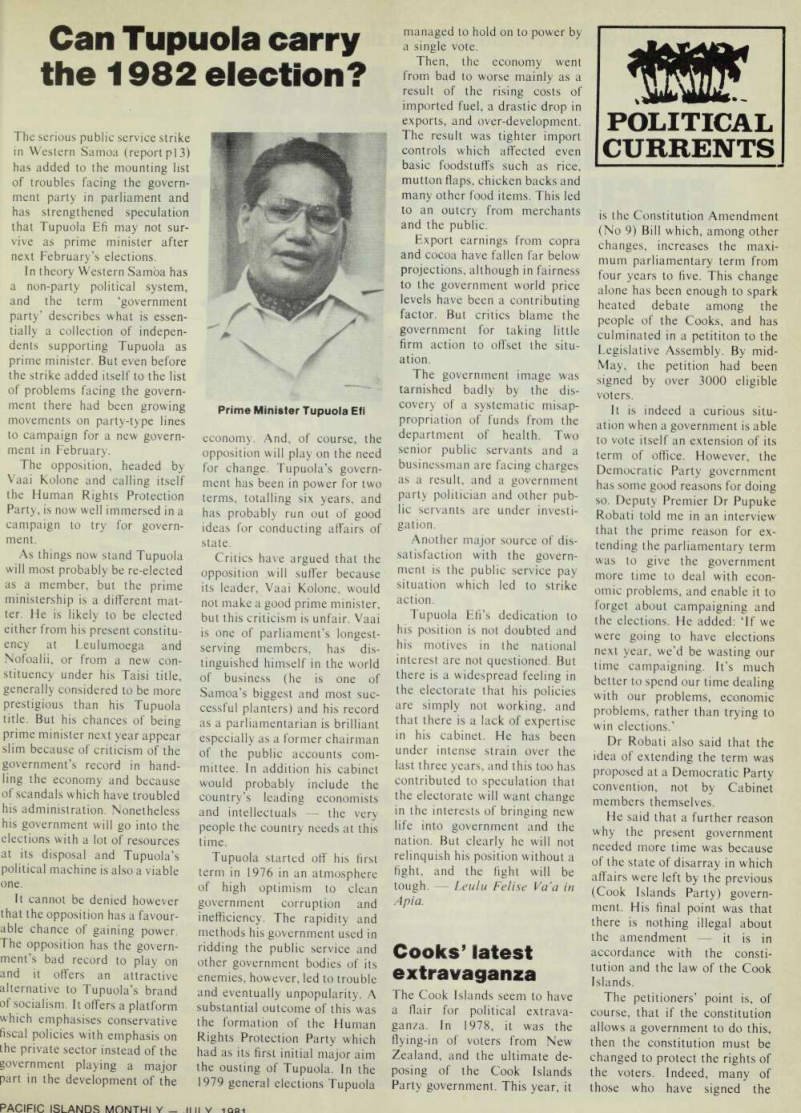
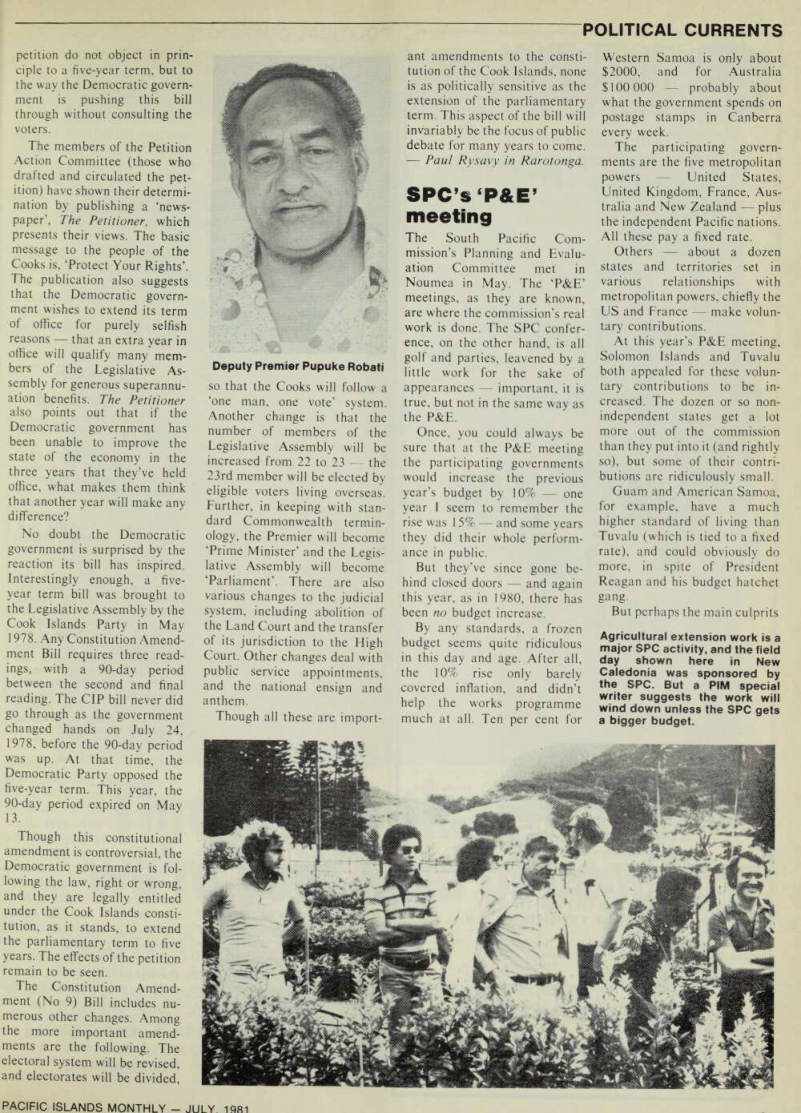
the 1982 election?
Political
Currents
The serious public service strike in Western Samoa (reportpi3) has added to the mounting list of troubles facing the govern ment party in parliament and has strengthened speculation that Tupuola Efi may not sur vive as prime minister after next February’s elections.
In theory Western Samba has a non-party political system, and the term ‘government party’ describes what is essen tially a collection of indepen dents supporting Tupuola as prime minister. But even before the strike added itself to the list of problems facing the govern ment there had been growing movements on party-type lines to campaign for a new govern ment in February.
The opposition, headed by Vaai Kolone and calling itself the Human Rights Protection Party, is now well immersed in a campaign to try for govern ment.
As things now stand Tupuola will most probably be re-elected as a member, but the prime ministership is a different mat ter. He is likely to be elected either from his present constitu ency at Leulumoega and Nofoalii, or from a new con stituency under his Taisi title, generally considered to be more prestigious than his Tupuola title. But his chances of being prime minister next year appear slim because of criticism of the government’s record in hand ling the economy and because of scandals which have troubled his administration. Nonetheless his government will go into the elections with a lot of resources at its disposal and Tupuola’s political machine is also a viable one.
It cannot be denied however that the opposition has a favour able chance of gaining power.
The opposition has the govern ment’s bad record to play on and it offers an attractive alternative to Tupuola’s brand of socialism. It offers a platform which emphasises conservative fiscal policies with emphasis on the private sector instead of the
government playing a major
part in the development of the
economy. And, of course, the opposition will play on the need for change. Tupuola’s govern ment has been in power for two terms, totalling six years, and has probably run out of good ideas for conducting affairs of state.
Critics have argued that the opposition will suffer because its leader, Vaai Kolone, would not make a good prime minister, but this criticism is unfair. Vaai is one of parliament’s longest serving members, has dis tinguished himself in the world of business (he is one of Samoa’s biggest and most suc cessful planters) and his record as a parliamentarian is brilliant especially as a former chairman of the public accounts com mittee. In addition his cabinet would probably include the country’s leading economists and intellectuals the very people the country needs at this time.
Tupuola started off his first term in 1976 in an atmosphere of high optimism to clean government corruption and inefficiency. The rapidity and methods his government used in ridding the public service and other government bodies of its enemies, however, led to trouble and eventually unpopularity. A substantial outcome of this was the formation of the Human Rights Protection Party which had as its first initial major aim the ousting of Tupuola. In the 1979 general elections Tupuola
managed to hold on to power by a single vote.
Then, the economy went from bad to worse mainly as a result of the rising costs of imported fuel, a drastic drop in exports, and over-development.
The result was tighter import controls which affected even basic foodstuffs such as rice, mutton flaps, chicken backs and many other food items. This led to an outcry from merchants and the public.
Export earnings from copra and cocoa have fallen far below projections, although in fairness to the government world price levels have been a contributing factor. But critics blame the government for taking little firm action to offset the situ ation.
The government image was tarnished badly by the dis covery of a systematic misap propriation of funds from the department of health. Two senior public servants and a businessman are facing charges as a result, and a government party politician and other pub lic servants are under investi gation.
Another major source of dis satisfaction with the govern ment is the public service pay situation which led to strike action.
Tupuola Eft’s dedication to his position is not doubled and his motives in the national interest are not questioned. But there is a widespread feeling in the electorate that his policies are simply not working, and that there is a lack of expertise in his cabinet. He has been under intense strain over the last three years, and this too has contributed to speculation that the electorate will want change in the interests of bringing new life into government and the nation. But clearly he will not relinquish his position without a fight, and the fight will be
tough.
Leulu Felise Va’a in
Apia.
Cooks’ latest
extravaganza
The Cook Islands seem to have a flair for political extrava ganza. In 1978, it was the flying-in of voters from New Zealand, and the ultimate de posing of the Cook Islands Party government. This year, it
is the Constitution Amendment (No 9) Bill which, among other changes, increases the maxi mum parliamentary term from four years to five. This change alone has been enough to spark heated debate among the people of the Cooks, and has culminated in a petititon to the Legislative Assembly. By mid- May, the petition had been signed by over 3000 eligible voters.
It is indeed a curious situ ation when a government is able to vote itself an extension of its term of office. However, the Democratic Party government has some good reasons for doing so. Deputy Premier Dr Pupuke Robati told me in an interview that the prime reason for ex tending the parliamentary term was to give the government more time to deal with econ omic problems, and enable it to forget about campaigning and the elections. He added: ‘lf we were going to have elections next year, we’d be wasting our time campaigning. It’s much better to spend our time dealing with our problems, economic problems, rather than trying to win elections.’
Dr Robati also said that the idea of extending the term was proposed at a Democratic Party convention, not by Cabinet members themselves.
He said that a further reason why the present government needed more time was because of the state of disarray in which affairs were left by the previous (Cook Islands Party) govern ment. His final point was that there is nothing illegal about the amendment it is in accordance with the consti tution and the law of the Cook Islands.
The petitioners’ point is, of course, that if the constitution allows a government to do this, then the constitution must be changed to protect the rights of the voters. Indeed, many of those who have signed the
Prime Minister Tupuola Efi
petition do not object in prin ciple to a five-year term, but to the way the Democratic govern ment is pushing this bill through without consulting the voters.
The members of the Petition Action Committee (those who drafted and circulated the pet ition) have shown their determi nation by publishing a ‘news paper’, The Petitioner, which presents their views. The basic message to the people of the Cooks is, ‘Protect Your Rights’.
The publication also suggests that the Democratic govern ment wishes to extend its term of office for purely selfish reasons that an extra year in office will qualify many mem bers of the Legislative As sembly for generous superannu ation benefits. The Petitioner also points out that if the Democratic government has been unable to improve the state of the economy in the three years that they’ve held office, what makes them think that another year will make any difference?
No doubt the Democratic government is surprised by the reaction its bill has inspired.
Interestingly enough, a five year term bill was brought to the Legislative Assembly by the Cook Islands Party in May 1978. Any Constitution Amend ment Bill requires three read ings, with a 90-day period between the second and final reading. The CIP bill never did go through as the government changed hands on July 24, 1978, before the 90-day period was up. At that time, the Democratic Party opposed the five-year term. This year, the 90-day period expired on May 13.
Though this constitutional amendment is controversial, the Democratic government is fol lowing the law, right or wrong, and they are legally entitled under the Cook Islands consti tution, as it stands, to extend the parliamentary term to five years. The effects of the petition remain to be seen.
The Constitution Amend ment (No 9) Bill includes nu merous other changes. Among the more important amend ments are the following. The electoral system will be revised, and electorates will be divided,
so that the Cooks will follow a ‘one man, one vote’ system.
Another change is that the number of members of the Legislative Assembly will be increased from 22 to 23 the 23rd member will be elected by eligible voters living overseas.
Further, in keeping with stan dard Commonwealth termin ology, the Premier will become ‘Prime Minister’ and the Legis lative Assembly will become ‘Parliament’. There are also various changes to the judicial system, including abolition of the Land Court and the transfer of its jurisdiction to the High Court. Other changes deal with public service appointments, and the national ensign and anthem.
Though all these are import
ant amendments to the consti tution of the Cook Islands, none is as politically sensitive as the extension of the parliamentary term. This aspect of the bill will invariably be the focus of public debate for many years to come.
Paul Rysavy in Rarotonga.
Spc’S ‘P&E’
meeting
The South Pacific Com mission’s Planning and Evalu ation Committee met in Noumea in May. The ‘P&E’ meetings, as they are known, are where the commission’s real work is done. The SPC confer ence, on the other hand, is all golf and parties, leavened by a little work for the sake of appearances important, it is true, but not in the same way as the P&E.
Once, you could always be sure that at the P&E meeting the participating governments would increase the previous year’s budget by 10% one year I seem to remember the rise was 15% and some years they did their whole perform ance in public.
But they’ve since gone be hind closed doors and again this year, as in 1980, there has been no budget increase.
By any standards, a frozen budget seems quite ridiculous in this day and age. After all, the 10% rise only barely covered inflation, and didn’t help the works programme much at all. Ten per cent for
Western Samoa is only about $2OOO, and for Australia $lOO 000 - probably about what the government spends on postage stamps in Canberra every week.
The participating govern ments are the five metropolitan powers United States, United Kingdom, France, Aus tralia and New Zealand plus the independent Pacific nations.
All these pay a fixed rate.
Others about a dozen states and territories set in various relationships with metropolitan powers, chiefly the US and France make volun tary contributions.
At this year’s P&E meeting, Solomon Islands and Tuvalu both appealed for these volun tary contributions to be in creased. The dozen or so non independent states get a lot more out of the commission than they put into it (and rightly so), but some of their contri butions are ridiculously small.
Guam and American Samoa, for example, have a much higher standard of living than Tuvalu (which is tied to a fixed rate), and could obviously do more, in spite of President Reagan and his budget hatchet gang.
But perhaps the main culprits
Agricultural extension work is a major SPC activity, and the field day shown here in New Caledonia was sponsored by the SPC. But a PIM special writer suggests the work will wind down unless the SPC gets a bigger budget.
Deputy Premier Pupuke Robati
among the voluntary contribu tors are French Polynesia and New Caledonia. They are affluent societies, however poor their indigenous people may be in the villages. On the other hand, no one expects Kiribati, Tokelau, or Wallis and Futuna to put very much into the kitty.
This writer believes that not only should the non-inde pendent voluntary contributors have raised their contributions, but that the fixed-rate participating governments should also have raised their pay-in by 10%.
Not a great rise, it is true, but reasonable in light of the fact that Australia, the UK, the USA and France all also give millions to projects directly, above their normal SPC bud getary contributions. (Many other governments also contrib ute in a similar manner Canada and Japan, to name only two as do United Nations agencies and their like.) Another culprit is the system.
One can see the reasons for it, but when rules become con stricting, they should be either broken or bent. In this weird dealing scene, everybody must agree on a rise in contributions.
There must be consensus if only one country holds out, that’s it. Nothing can be done.
It’s a bit like the veto in the United Nations Security Coun cil. This act has surely got to be cleaned up.
The SPC budget is a joke anyway $4 000 000 for the kind of work programme that is needed. Of course, there are additional external funds which boost it, and some criticism of the administrative costs (prob ably inevitable in New Caledonia but certain good reasons exist for keeping the SPC headquartered there).
But in the Pacific region with its vast distances, and conse quent high costs of travel, the kind of money available to the SPC is not going to stretch too far.
To the mind of this writer, the 1981 P&E meeting leaves several intriguing questions hanging in the air. Such as: Are they trying to kill the SPC? If so, they should do it now, quickly and painlessly. Or are they just letting it run down in
favour of the South Pacific Forum? It would be a pity for both bodies, in the view of this writer: the work of the South Pacific Bureau of Economic Co operation (SPEC), the Forum’s executive arm, is mainly econ omic, and the strength of the SPC is its social programmes and the fact that the small states are members. They complement each other in many ways.
Again, are they planning to marry the Forum and the SPC?
Or SPEC and the US-oriented Pacific Islands Development Commission (PIDC)? There are many possible, and interesting, combinations but the fact
remains that the SPC is unique because of the presence in it of the ‘metropolitans’, the small, still-dependent states, and so on.
If there is dirty work at the crossroads, who is up to it? One thought: the ‘metrops’ might prefer, for ease of adminis tration, as well as added politi cal kudos, to be funding SPC type projects directly. Again, the Pacific nations might be going soft on ‘regionalism’. (My belief is that they’ll rue the day if ever they do.) Then there is always the possibility that none of the above ‘intriguing’ ideas is true.
Is the SPC show faltering for the simple reason that we are all too busy at home? From a correspondent in Noumea.
Advertisements & other items, pp. 19-22 (2 items)
Pacific Islands Monthi Y _ Nil V Iqqi
PACIFIC ISLANDS MONTHI Y nil v iqqi
International
The new world of technology-on show in Melbourne for 6 days
AUSTRALIA'S
ENGINEERING EXHIBITION
iV mi -I
iMi
3
JIFF’S'
I I kne BSH MELBOURNE
MONDAYJULY27-SATURDAY AUGUSTI,I9BI
Royal Exhibition Building, Melbourne
Don’t be left behind. Catch up with the incredible new advances in technology at AIEE’BI the largest industrial exhibition in the Southern Hemisphere.
National displays include Canada, Czechoslovakia, Denmark, Federal Republic of Germany, Italy, New Zealand, People’s Republic of China, Romania, Singapore, Sweden, U.K., U.S.A.
Massive displays by these twelve countries and many Australian and overseas companies combine to make over 300 individual exhibits presenting the very latest equipment, materials and services in; □ Machine tools □ Instrumentation □ Electronic equipment □ Materials handling equipment □ Heavy industrial equipment □ Pneumatic/hydraulic equipment □ Pollution control equipment □ Automated programmed tools - plus many other facets of industrial equipment, components and associated products.
COMPLIMENTARY SEASON PASSES
Phone or write for trade passes and visitor information. These are also available at exhibition entrances upon presentation of relevant business card or suitable company identification.
AIEE’BI occupies all halls at Melbourne’s Royal Exhibition Building including the recently completed Centennial Hall.
IMTIaT s P° nSored by the Metal Trades - Industry Association of Australia.
Hours; Trade only Mon, Tues, 10am-6pm; Wed, 10am 10pm; Thurs, 10am-6pm; Fri, 10am-10pm. Trade & public: Sat, 10am-spm.
Organised by Thomson Exhibitions (Div. of Thomson Australian Holdings Pty Ltd) 49 Wellington Street, Windsor, Vic 3181. 51 0941 47 Chippen Street, Chippendale, NSW 2008. 699 6731 346 Carrington Street, Adelaide, SA 5000. 223 2157
PROFIT FROM
AUSTRALIAN
PRODUCTS
The latest range
of Australian Product Data Sheets
available FREE
The Australian Export Black Box is a product literature system located in all Australian Trade Commissioner’s offices around the world. It will give you free of charge data sheets with information on specific Australian products. Including manufacturer’s name and address, product range, specifications and performance, warranty, delivery time etc . . .
Australia’s most energetic and innovative exporters are represented in the Black Box with products ranging from Solar heaters, quarry and mine plants to pasture seeds and bakery ingredients.
Telephone, write or visit The Australian Trade Commissioner.
AVAILABLE AT THE OFFICE OF THE
AUSTRALIAN TRADE COMMISSIONER.
FIJI: Australian High Commission, Trade Office, 7th Floor, Dominion House, Thomson Street, Suva.
Telephone 31 2844, 31 2319 PAPUA NEW GUINEA: Australian High Commission, Waigani.
Telephone 25 9333 NEW ZEALAND: Australian High Commission, 72-78 Hobson Street, Thorndon, Wellington.
Australian Consulate General, 9th Floor, Lome Towers, 10 Lome Street, Auckland.
ISt-Oi *63.0 1 Free to Importers, Distributors Wholesalers, Retailers The Australian Export Black Box is an Exportad Pty Ltd project.
Telephone 73 6411 Telephone 32 429
background
The SPC background
The South Pacific Com mission is a consultative and advisory body which was established in 1947 at a con ference initiated by Austra lia. Its foundation member ship consisted of the six countries which then admin istered South Pacific territories Australia, New Zealand, UK, USA, France and the Netherlands. The Netherlands ceased to par ticipate in 1962, and the
newly-emerging indepen
dent states of the Pacific were progressively admitted to membership after 1964.
The basic purpose of the commission is to advise member governments on ways of improving the econ omic and community well being of the Pacific Islands community, and to initiate and participate in projects directed to this goal.
Advertisements & other items, pp. 23-24 (2 items)
Throughout the Pacific,
we’re your kind of people
When you fly in the Pacific, you’ll feel at home with Air New Zealand.
Fly with us to Australia,Cook Islands, Fiji, Hong Kong, Honolulu, Japan, Los Angeles, New Caledonia, Norfolk Island, Singapore, Tahiti, Tonga, Western New Zealand.
th^ g hout £ airneiu zEßLann
ANZ 80/18
The Pacific’s Number One
r m m ■ ' I r !Sk * When the time next comes for you to fly out to do business fly Polynesian Airlines. Polynesian really understands the businessman’s requirements for a quick and efficient service between all Polynesian countries.
In fact, part of the reason we established our first service (Apia Pago Pago) back in 1959 was to meet the business sector’s demand for a fast and frequent service between the Samoas.
Since then Polynesian Airlines has spread its wings. Today our extensive route network covers the whole of Polynesia east of Fiji and now extends down to Auckland, New Zealand. And, as in ‘59 a lot of the people we’re carrying today are professional people. People who know that when it comes to flying anywhere in Polynesia on business there is only one airline. Polynesian Airlines, Fly Polynesian. It’s a pleasure doing business with us.
Offices in: Auckland, Tonga, Niue, Rarotonga.
WESTERN
WALLIS IS AMERICAN
Box 599 Apia, Western Samoa, Ph 21261.
W' Nlut RAROTONGA
Ci polynesian/airunes
"■— j; *—- M We are Polynesia.
Nandi Airport, Nandi Ph 72733. 2067
24
« A mi A MPkO I lAMTUI V/ 11 I I \/ HfiOH
Aviation In
The Pacific
Since the early days of air transport the Pacific has been an airline pioneering region, its requirements dictated by the remoteness of Island communities and by long over-water crossings.
The developed nations started the air transport revolution, but in these pages PIM looks at the new involvement of Island-owned airlines.
Flag-caniers are the fashion,
but how viable are they?
The Island countries of the Pacific now have a total of nearly 40 airlines and air service operators, covering international services, dom estic services and third-level
Charter-type) operations.
Fhese are the Islands’ own air :ompanies, and the figure does lot include international oper itors from Australia, New Zea and, France and USA who 'etain some operating rights nto Pacific Island destinations.
Some of the operators in the Islands represent investment Tom outside and some have ninority shareholding links *vith airlines from developed countries but their identities are n the Island countries where ;hey are based.
It is only in the past 12 years
or so that this picture has developed, keeping in step with political changes which have seen the emergence of the independent states of the Pacific. A major part of the change has been the heavy involvement of Island govern ments in airline ownership. Os tensibly the governments have gone into the airline business because they accept respons ibility for passenger and freight services. Although this attitude may be sound enough where domestic flights or near neighbour flights are con cerned, it is more open to question when wide-ranging in ternational services are in volved. It is difficult to escape the conclusion that much of the international flying is blatant image-building for national prestige, no matter how much
this might be denied by some of the governments concerned.
The major international oper ators which have emerged from the Pacific Island countries are Air Niugini in Papua New Guinea, Air Nauru in Nauru, Air Pacific in Fiji and Polynesian Airlines in Western Samoa.
Financially all four of these airlines have been having a rough time although in their generally-published statements they tell a story of seeking bigger and shinier aircraft and of providing better and wider services. PNG and Fiji to some extent admit their airline financial difficulties, although drastic action within Air Niugini has led to a prediction by the deputy prime minister, Mr Okuk, that this year’s result will be a pre-tax profit of nearly
K 2 million. Western Samoa, which has just taken delivery of a Sl5 million Boeing 737, de nies any financial problem in its airline structure despite early indications that this year will produce a loss of $1.5 million.
Nauru gives the appearance of simply not caring what its national airline costs, and con tinues to sink a significant proportion of its budget into a losing airline. In the latest figures available Air Nauru incurred a 12-month loss of $ 15.9 million about a quarter of the national budget.
Some of the international operations of Island airlines are important in terms of Pacific development because of the links they provide with close neighbours. In this sense such operations amount to an exten sion of domestic flights across
the nearest border. Air Pacific, Air Nauru, Air Niugini and Polynesian Airlines all provide services of this nature. Oper ators in some of the smaller countries do the same.
Over a number of years there have been suggestions that the Pacific Island countries should rationalise their air services even to the extent of creating a single international airline, but
at least to provide integrated co operation. The South Pacific Forum has held discussions on these lines and the Association of South Pacific Airlines has received submissions from a world expert who advocates closer integration of services. So far however the ‘flag-carrier’ concept has proved too strong to allow much change in the pres ent situation.
Advertisements & other items, p. 25 (1 item)
25
3 ACIFIC ISLANDS MONTHLY - JUI Y IQRI
to co-operate
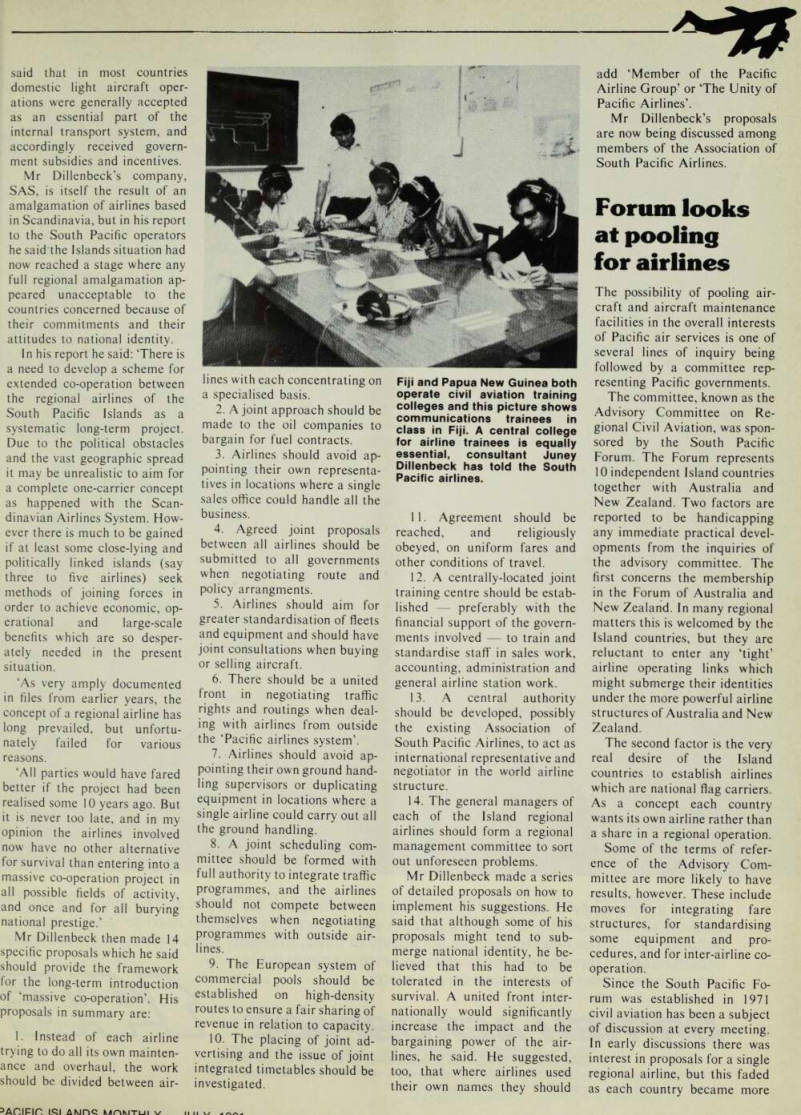
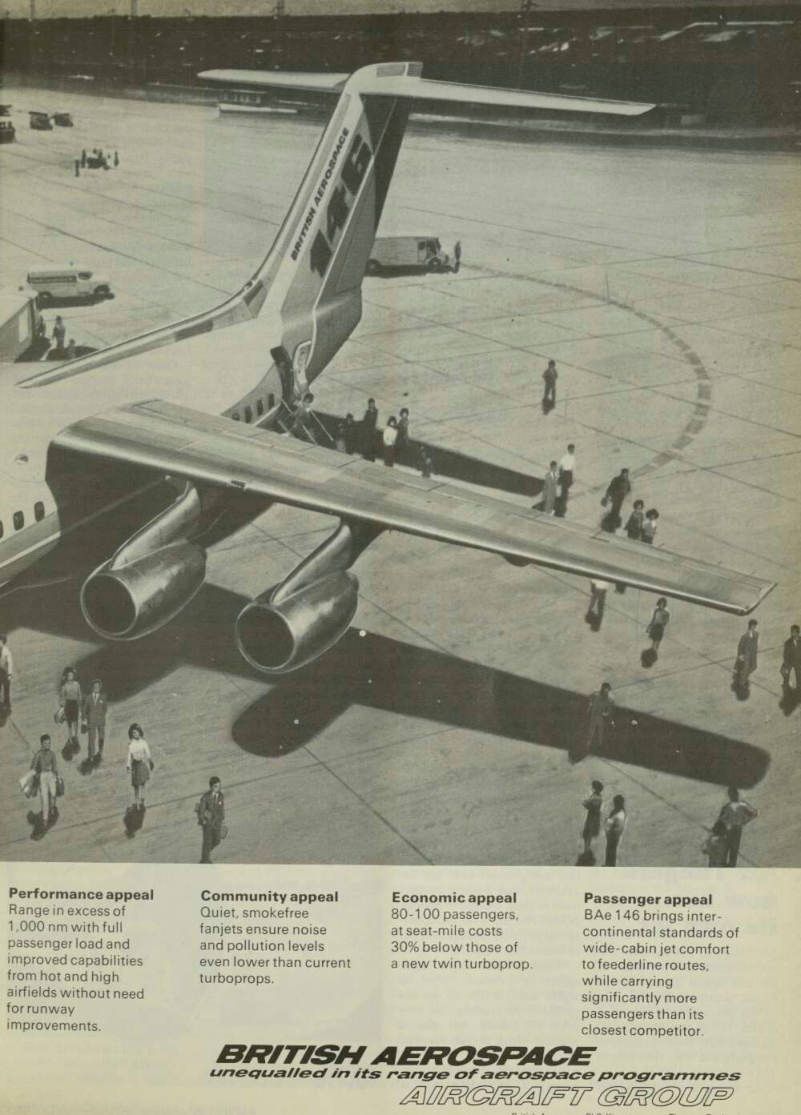
Expert tells airlines to co-operate or fail to survive
An expert consulted by the Association of South Pacific Airlines has conceded it would now be ‘unrealistic’ to expect international airlines in the Islands to form a single regional airline, but he has warned that some method of joining forces is ‘desperately needed’.
Massive co-operation and the
burying of national prestige are now the only answers to ensure survival, he believes.
The comments come from Mr Juney Dillenbeck, vice president of consulting services for the Scandinavian Airlines System. At the invitation of the South Pacific Airlines Associ ation he investigated the history
of how individual airlines developed their international services out of the Island countries, and ot t . , looked at the controversy over whether the Islands would have been better off if they had developed a single regional airi- m;. • 7 line. His investigation was confined to international oper ations, and did not take in domestic or third-level operat,ons - Referring in passing to light aircraft domestic operations,
Mr Dillenbeck said that oper ations of this type ‘are almost always uneconomic, and subject to political and social pressures as directed by governments’. He
The big four Island-owned air lines in the South Pacific region Air Nauru, Air Niugini, Air Pacific and Polynesian Airlines.
A consultant claims that a single face to the world and a burying of some national ident ity is necessary if these and smaller operators are to survive on international routes.
said that in most countries domestic light aircraft oper ations were generally accepted as an essential part of the internal transport system, and accordingly received govern ment subsidies and incentives.
Mr Dillenbeck’s company, SAS, is itself the result of an amalgamation of airlines based in Scandinavia, but in his report to the South Pacific operators he said the Islands situation had now reached a stage where any full regional amalgamation ap peared unacceptable to the countries concerned because of their commitments and their attitudes to national identity.
In his report he said: ‘There is a need to develop a scheme for extended co-operation between the regional airlines of the South Pacific Islands as a systematic long-term project.
Due to the political obstacles and the vast geographic spread it may be unrealistic to aim for a complete one-carrier concept as happened with the Scan dinavian Airlines System. How ever there is much to be gained if at least some close-lying and politically linked islands (say three to five airlines) seek methods of joining forces in order to achieve economic, op erational and large-scale benefits which are so desper ately needed in the present situation. ‘As very amply documented in files from earlier years, the concept of a regional airline has long prevailed, but unfortu nately failed for various reasons. ‘All parties would have fared better if the project had been realised some 10 years ago. But it is never too late, and in my opinion the airlines involved now have no other alternative for survival than entering into a massive co-operation project in all possible fields of activity, and once and for all burying national prestige.’
Mr Dillenbeck then made 14 specific proposals which he said should provide the framework for the long-term introduction of ‘massive co-operation’. His proposals in summary are: 1. Instead of each airline trying to do all its own mainten ance and overhaul, the work should be divided between air-
lines with each concentrating on a specialised basis. 2. A joint approach should be made to the oil companies to bargain for fuel contracts. 3. Airlines should avoid ap pointing their own representa tives in locations where a single sales office could handle all the business. 4. Agreed joint proposals between all airlines should be submitted to all governments when negotiating route and policy arrangments. 5. Airlines should aim for greater standardisation of fleets and equipment and should have joint consultations when buying or selling aircraft. 6. There should be a united front in negotiating traffic rights and routings when deal ing with airlines from outside the ‘Pacific airlines system’. 7. Airlines should avoid ap pointing their own ground hand ling supervisors or duplicating equipment in locations where a single airline could carry out all the ground handling. 8. A joint scheduling com mittee should be formed with full authority to integrate traffic programmes, and the airlines should not compete between themselves when negotiating programmes with outside air lines. 9. The European system of commercial pools should be established on high-density routes to ensure a fair sharing of revenue in relation to capacity. 10. The placing of joint ad vertising and the issue of joint integrated timetables should be investigated.
11. Agreement should be reached, and religiously obeyed, on uniform fares and other conditions of travel. 12. A centrally-located joint training centre should be estab lished preferably with the financial support of the govern ments involved to train and standardise staff in sales work, accounting, administration and general airline station work. 13. A central authority should be developed, possibly the existing Association of South Pacific Airlines, to act as international representative and negotiator in the world airline structure. 14. The general managers of each of the Island regional airlines should form a regional management committee to sort out unforeseen problems.
Mr Dillenbeck made a series of detailed proposals on how to implement his suggestions. He said that although some of his proposals might tend to sub merge national identity, he be lieved that this had to be tolerated in the interests of survival. A united front inter nationally would significantly increase the impact and the bargaining power of the air lines, he said. He suggested, too, that where airlines used their own names they should
add ‘Member of the Pacific Airline Group’ or The Unity of Pacific Airlines’.
Mr Dillenbeck’s proposals are now being discussed among members of the Association of South Pacific Airlines.
Forum looks
at pooling
for airlines
The possibility of pooling air craft and aircraft maintenance facilities in the overall interests of Pacific air services is one of several lines of inquiry being followed by a committee rep resenting Pacific governments.
The committee, known as the Advisory Committee on Re gional Civil Aviation, was spon sored by the South Pacific Forum. The Forum represents 10 independent Island countries together with Australia and New Zealand. Two factors are reported to be handicapping any immediate practical devel opments from the inquiries of the advisory committee. The first concerns the membership in the Forum of Australia and New Zealand. In many regional matters this is welcomed by the Island countries, but they are reluctant to enter any ‘tight’ airline operating links which might submerge their identities under the more powerful airline structures of Australia and New Zealand.
The second factor is the very real desire of the Island countries to establish airlines which are national flag carriers.
As a concept each country wants its own airline rather than a share in a regional operation.
Some of the terms of refer ence of the Advisory Com mittee are more likely to have results, however. These include moves for integrating fare structures, for standardising some equipment and pro cedures, and for inter-airline co operation.
Since the South Pacific Fo rum was established in 1971 civil aviation has been a subject of discussion at every meeting.
In early discussions there was interest in proposals for a single regional airline, but this faded as each country became more
Fiji and Papua New Guinea both operate civil aviation training colleges and this picture shows communications trainees in class in Fiji. A central college for airline trainees is equally essential, consultant Juney Dillenbeck has told the South Pacific airlines.
heavily committed to its own airline affairs. Fiji deliberately chose the name of Air Pacific the name was previously Fiji Airlines because of regional possibilities which subsequently were not attained.
The South Pacific Forum’s involvement in regional aviation was formalised at a meeting in 1976 when member countries established a ministerial-level body known as the South Pacific Civil Aviation Council.
It is a consultative body with the general responsibility of dealing with aviation matters of common interest to the South Pacific countries. Its members are Australia, New Zealand, Cook Islands, Fiji, Kiribati, Nauru, Niue, Papua New Guinea, Solomon Islands, Tonga, Tuvalu and Western Samoa.
The Advisory Committee on Regional Aviation, consisting of expert officials, was then estab lished as an adjunct to the council.
The advisory committee has a continuous responsibility to investigate and report on the following matters: Airline fa cilities, including tourist infra structure; route requirements in the region, including possible impediments to proposed new routes; the social and economic benefits arising from air ser vices; cost benefit studies; the co-ordination of scheduling be tween airlines; the possibility of pooling aircraft, technical maintenance and general airline resources; the possibility of joint promotion; forward plan ning for the region, including moves for greater standardis ation of equipment; fare struc tures; regional incentives and ethics.
Air Tungaru
now has
its own Jet
Air Tungaru, the national air line of Kiribati, is the latest of the new nation airlines in the Pacific to enter the jet club. The airline has taken delivery of a Boeing 727 to operate its inter national link from Tarawa to Honolulu and from Honolulu to Tahiti.
Air Tungaru, which is wholly
owned by the government, was formed in April 1978 although it did not begin operating until last year. It operated its original international service to Hono lulu with a Boeing 727 leased from Air Nauru, but now oper ates its own aircraft on the route with an extension to Tahiti.
The airline has been using Britten-Norman Islanders and Trislanders for its internal ser vices, but the internal fleet is also being expanded. A 16-seater Heron was delivered in May, and a Spanish-designed CASA short-field aircraft is due for delivery in July. The CASA
is a little-known aircraft in the Pacific, although it is used in South-East Asia and for some years has been manufactured under licence by the Indonesian government aircraft factory. It is similar to a Short Skyvan in appearance with a square section fuselage, high wing and two turbine (prop-jet) engines.
There has been some criticsm of Air Tungaru for the high degree of diversification which it has created in a com parativelly small fleet, but the airline claims that it has chosen units tailored to the require ments of the routes being flown.
Advertisements & other items, pp. 26-29 (2 items)
Recognising
a winner
Professional fishermen the world over recognise the premium quality and dependability of Gardner marine propulsion diesel engines. If your living depends on outstanding, proven reliability experience the advantages of Gardner: • Long trouble free engine life • Excellent fuel economy with minimum engine wear • Good lugging torque • Dependable performance for around the clock working • Over 110 years engineering experience 70 years manufacturing marine engines • A reputation throughout the world for robust high quality engines which keep on going • Efficient sales/service centres in each state, all of which provide both outside and workshop services and a full range of back up spares.
The Gardner range of naturally aspirated main propulsion engines feature Twin Disc reverse reduction gears. Standard equipment includes closed circuit, fresh water, heat exchanger cooling; engine driven sea water and fresh water circulating pumps: a lubricating oil cooler; sump emptying pump; alternator; and engine mounted electric and hand starting equipment.
Gardner marine engines available include; 6LXB (127 bhp at 1500 rpm); BLXB (170 bhp at 1500 rpm); BL3B (230 bhp at 1150 rpm).
Hawker Siddeley Engineering Pty. Limited
Sole Australian agents.
Sales and Service Centres: Melbourne (03) 489 2511; Sydney (02) 439 8444; Brisbane (07) 376 3599; Perth (09) 458 7022; u Adelaide: Rasch Pty. Ltd , (08) 51 5371-3; i Launceston: Glasgow Engineering Pty. Ltd , (003) 31 3499 g
& ' H ■ A sS I ■ ' A i X
There is a
of agreement
s I v 1 i I ■ 8| - " ■r 1 " " *> s There's a wide body of agreement about the airline needs of the 1980 s and beyond. The need for efficient aircraft, both to cut operating costs and to conserve fuel. The need to reduce noise and pollution levels. The need to improve the quality of travel. In twenty years, only one completely new aircraft has been developed specifically to meet these needs in the fast-growing feeder-line and local service sector '4
I I
ftk
a|*! * * \ 5 I’ m Performance appeal Range in excess of 1,000 nm with full passenger load and improved capabilities from hot and high airfields without need for runway improvements.
Community appeal Quiet, smokefree fanjets ensure noise and pollution levels even lower than current turboprops.
Economic appeal 80-100 passengers, at seat-mile costs 30% below those of a new twin turboprop.
Passenger appeal BAe 146 brings intercontinental standards of wide-cabin jet comfort to feederline routes, while carrying significantly more passengers than its closest competitor.
BR/TtSHAEROSPACE
unequal!e din its nanqe of aerospace programmes
3 Ap.Ifir. I.Qi Amne Kjiakitui \/ Mm V/ -
Islands pilots
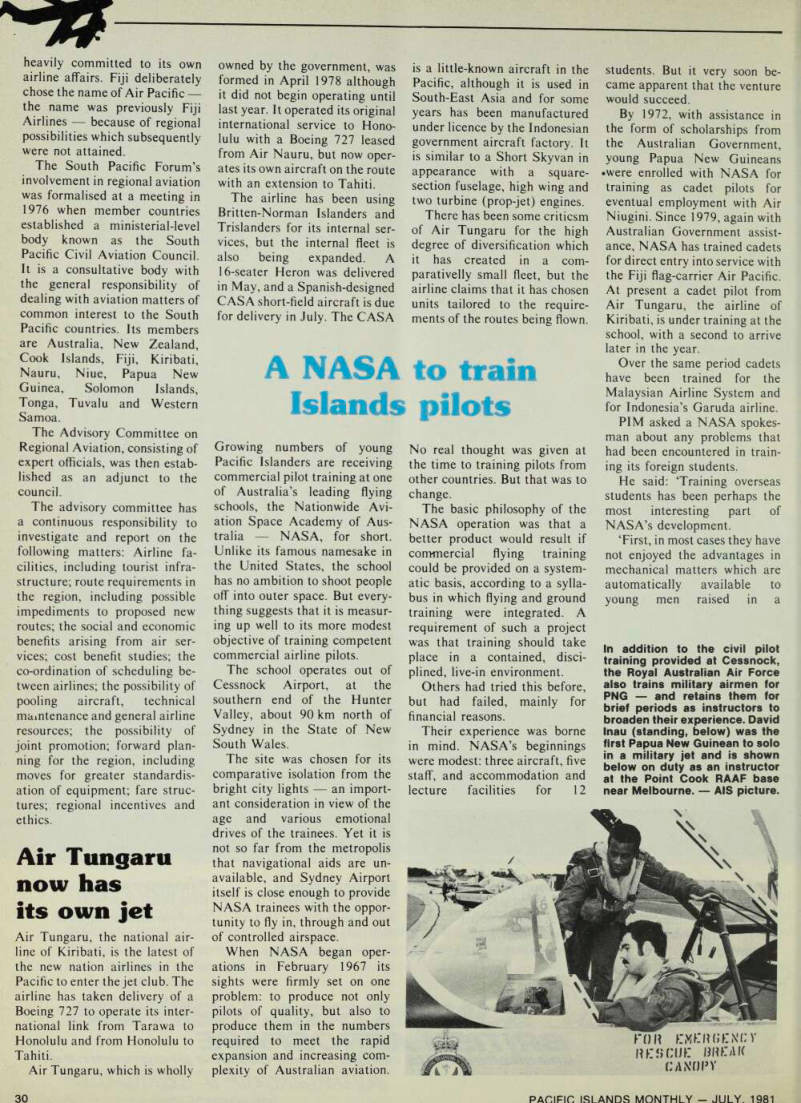
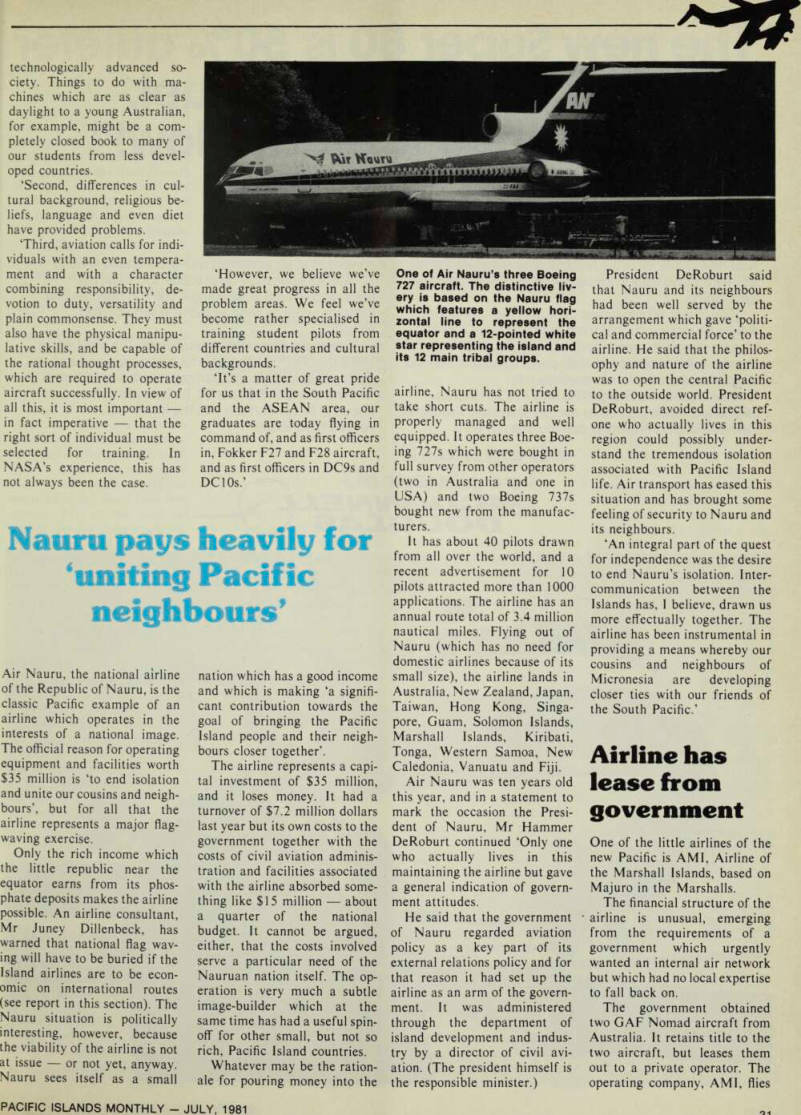
A NASA to train Islands pilots
Growing numbers of young Pacific Islanders are receiving commercial pilot training at one of Australia’s leading flying schools, the Nationwide Avi ation Space Academy of Aus tralia NASA, for short.
Unlike its famous namesake in the United States, the school has no ambition to shoot people off into outer space. But every thing suggests that it is measur ing up well to its more modest objective of training competent commercial airline pilots.
The school operates out of Cessnock Airport, at the southern end of the Hunter Valley, about 90 km north of Sydney in the State of New South Wales.
The site was chosen for its comparative isolation from the bright city lights an import ant consideration in view of the age and various emotional drives of the trainees. Yet it is not so far from the metropolis that navigational aids are un available, and Sydney Airport itself is close enough to provide NASA trainees with the oppor tunity to fly in, through and out of controlled airspace.
When NASA began oper ations in February 1967 its sights were firmly set on one problem: to produce not only pilots of quality, but also to produce them in the numbers required to meet the rapid expansion and increasing com plexity of Australian aviation.
No real thought was given at the time to training pilots from other countries. But that was to change.
The basic philosophy of the NASA operation was that a better product would result if commercial flying training could be provided on a system atic basis, according to a sylla bus in which flying and ground training were integrated. A requirement of such a project was that training should take place in a contained, disci plined, live-in environment.
Others had tried this before, but had failed, mainly for financial reasons.
Their experience was borne in mind. NASA’s beginnings were modest: three aircraft, five staff, and accommodation and lecture facilities for 12
students. But it very soon be came apparent that the venture would succeed.
By 1972, with assistance in the form of scholarships from the Australian Government, young Papua New Guineans •were enrolled with NASA for training as cadet pilots for eventual employment with Air Niugini. Since 1979, again with Australian Government assist ance, NASA has trained cadets for direct entry into service with the Fiji flag-carrier Air Pacific.
At present a cadet pilot from Air Tungaru, the airline of Kiribati, is under training at the school, with a second to arrive later in the year.
Over the same period cadets have been trained for the Malaysian Airline System and for Indonesia’s Garuda airline.
PIM asked a NASA spokes man about any problems that had been encountered in train ing its foreign students.
He said: Training overseas students has been perhaps the most interesting part of NASA’s development. ‘First, in most cases they have not enjoyed the advantages in mechanical matters which are automatically available to young men raised in a
In addition to the civil pilot
training provided at Cessnock,
the Royal Australian Air Force also trains military airmen for PNG and retains them for brief periods as instructors to broaden their experience. David Inau (standing, below) was the first Papua New Guinean to solo in a military jet and is shown below on duty as an instructor at the Point Cook RAAF base near Melbourne. AIS picture.
technologically advanced so ciety. Things to do with ma chines which are as clear as daylight to a young Australian, for example, might be a com pletely closed book to many of our students from less devel oped countries. ‘Second, differences in cul tural background, religious be liefs, language and even diet have provided problems. ‘Third, aviation calls for indi viduals with an even tempera ment and with a character combining responsibility, de votion to duty, versatility and plain commonsense. They must also have the physical manipu lative skills, and be capable of the rational thought processes, which are required to operate aircraft successfully. In view of all this, it is most important in fact imperative that the right sort of individual must be selected for training. In NASA’s experience, this has not always been the case.
‘uniting Pacific
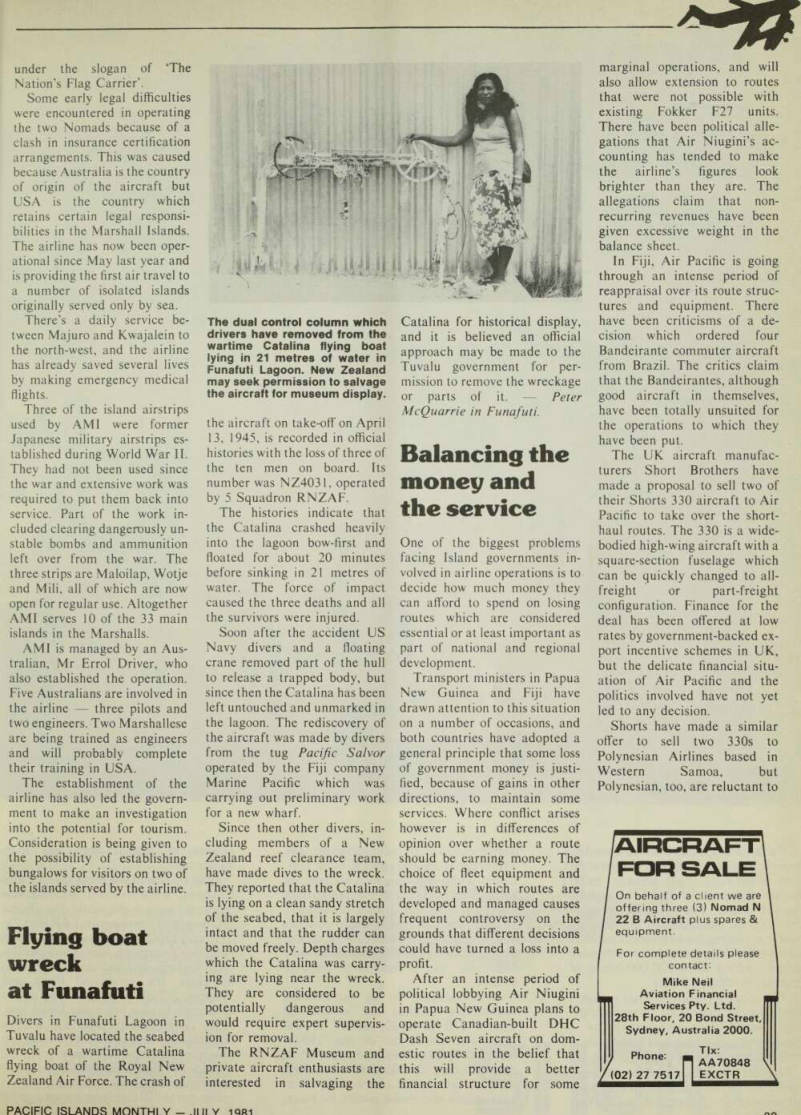

Nauru pays heavily for ‘uniting Pacific neighbours'
Air Nauru, the national airline of the Republic of Nauru, is the classic Pacific example of an airline which operates in the interests of a national image.
The official reason for operating equipment and facilities worth $35 million is ‘to end isolation and unite our cousins and neigh bours’, but for all that the airline represents a major flag waving exercise.
Only the rich income which the little republic near the equator earns from its phos phate deposits makes the airline possible. An airline consultant, Mr Juney Dillenbeck, has warned that national flag wav ing will have to be buried if the Island airlines are to be econ omic on international routes (see report in this section). The Nauru situation is politically interesting, however, because the viability of the airline is not at issue or not yet, anyway.
Nauru sees itself as a small
‘However, we believe we’ve made great progress in all the problem areas. We feel we’ve become rather specialised in training student pilots from different countries and cultural backgrounds. ‘lt’s a matter of great pride for us that in the South Pacific and the ASEAN area, our graduates are today flying in command of, and as first officers in, Fokker F 27 and F2B aircraft, and as first officers in DC9s and DC 10s.’
nation which has a good income and which is making ‘a signifi cant contribution towards the goal of bringing the Pacific Island people and their neigh bours closer together’.
The airline represents a capi tal investment of $35 million, and it loses money. It had a turnover of $7.2 million dollars last year but its own costs to the government together with the costs of civil aviation adminis tration and facilities associated with the airline absorbed some thing like $l5 million about a quarter of the national budget. It cannot be argued, either, that the costs involved serve a particular need of the Nauruan nation itself. The op eration is very much a subtle image-builder which at the same time has had a useful spin off for other small, but not so rich, Pacific Island countries.
Whatever may be the ration ale for pouring money into the
airline, Nauru has not tried to take short cuts. The airline is properly managed and well equipped. It operates three Boe ing 727 s which were bought in full survey from other operators (two in Australia and one in USA) and two Boeing 737 s bought new from the manufac turers.
It has about 40 pilots drawn from all over the world, and a recent advertisement for 10 pilots attracted more than 1000 applications. The airline has an annual route total of 3.4 million nautical miles. Flying out of Nauru (which has no need for domestic airlines because of its small size), the airline lands in Australia, New Zealand, Japan, Taiwan, Hong Kong, Singa pore, Guam, Solomon Islands, Marshall Islands, Kiribati, Tonga, Western Samoa, New Caledonia, Vanuatu and Fiji.
Air Nauru was ten years old this year, and in a statement to mark the occasion the Presi dent of Nauru, Mr Hammer Deßoburt continued ‘Only one who actually lives in this maintaining the airline but gave a general indication of govern ment attitudes.
He said that the government of Nauru regarded aviation policy as a key part of its external relations policy and for that reason it had set up the airline as an arm of the govern ment. It was administered through the department of island development and indus try by a director of civil avi ation. (The president himself is the responsible minister.)
President Deßoburt said that Nauru and its neighbours had been well served by the arrangement which gave ‘politi cal and commercial force’ to the airline. He said that the philos ophy and nature of the airline was to open the central Pacific to the outside world. President Deßoburt, avoided direct ref one who actually lives in this region could possibly under stand the tremendous isolation associated with Pacific Island life. Air transport has eased this situation and has brought some feeling of security to Nauru and its neighbours. ‘An integral part of the quest for independence was the desire to end Nauru’s isolation. Inter communication between the Islands has, I believe, drawn us more effectually together. The airline has been instrumental in providing a means whereby our cousins and neighbours of Micronesia are developing closer ties with our friends of the South Pacific.’
Airline has
lease from
government
One of the little airlines of the new Pacific is AMI, Airline of the Marshall Islands, based on Majuro in the Marshalls.
The financial structure of the airline is unusual, emerging from the requirements of a government which urgently wanted an internal air network but which had no local expertise to fall back on.
The government obtained two GAP Nomad aircraft from Australia. It retains title to the two aircraft, but leases them out to a private operator. The operating company, AMI, flies
One of Air Nauru’s three Boeing 727 aircraft. The distinctive liv ery is based on the Nauru flag which features a yellow hori zontal line to represent the equator and a 12-pointed white star representing the island and its 12 main tribal groups.
under the slogan of ‘The Nation’s Flag Carrier’.
Some early legal difficulties were encountered in operating the two Nomads because of a clash in insurance certification arrangements. This was caused because Australia is the country of origin of the aircraft but USA is the country which retains certain legal responsi bilities in the Marshall Islands.
The airline has now been oper ational since May last year and is providing the first air travel to a number of isolated islands originally served only by sea.
There’s a daily service be tween Majuro and Kwajalein to the north-west, and the airline has already saved several lives by making emergency medical flights.
Three of the island airstrips used by AMI were former Japanese military airstrips es tablished during World War 11.
They had not been used since the war and extensive work was required to put them back into service. Part of the work in cluded clearing dangerously un stable bombs and ammunition left over from the war. The three strips are Maloilap, Wotje and Mili, all of which are now open for regular use. Altogether AMI serves 10 of the 33 main islands in the Marshalls.
AMI is managed by an Aus tralian, Mr Errol Driver, who also established the operation.
Five Australians are involved in the airline three pilots and two engineers. Two Marshallese are being trained as engineers and will probably complete their training in USA.
The establishment of the airline has also led the govern ment to make an investigation into the potential for tourism.
Consideration is being given to the possibility of establishing bungalows for visitors on two of the islands served by the airline.
Flying boat
wreck
at Funafuti
Divers in Funafuti Lagoon in Tuvalu have located the seabed wreck of a wartime Catalina flying boat of the Royal New Zealand Air Force. The crash of
the aircraft on take-off on April 13, 1945, is recorded in official histories with the loss of three of the ten men on board. Its number was NZ4031, operated by 5 Squadron RNZAF.
The histories indicate that the Catalina crashed heavily into the lagoon bow-first and floated for about 20 minutes before sinking in 21 metres of water. The force of impact caused the three deaths and all the survivors were injured.
Soon after the accident US Navy divers and a floating crane removed part of the hull to release a trapped body, but since then the Catalina has been left untouched and unmarked in the lagoon. The rediscovery of the aircraft was made by divers from the tug Pacific Salvor operated by the Fiji company Marine Pacific which was carrying out preliminary work for a new wharf.
Since then other divers, in cluding members of a New Zealand reef clearance team, have made dives to the wreck.
They reported that the Catalina is lying on a clean sandy stretch of the seabed, that it is largely intact and that the rudder can be moved freely. Depth charges which the Catalina was carry ing are lying near the wreck.
They are considered to be potentially dangerous and would require expert supervis ion for removal.
The RNZAF Museum and private aircraft enthusiasts are interested in salvaging the
Catalina for historical display, and it is believed an official approach may be made to the Tuvalu government for per mission to remove the wreckage
or parts of it.
Peter
McQuarrie in Funafuti.
Balancing the
money and
the service
One of the biggest problems facing Island governments in volved in airline operations is to decide how much money they can afford to spend on losing routes which are considered essential or at least important as part of national and regional development.
Transport ministers in Papua New Guinea and Fiji have drawn attention to this situation on a number of occasions, and both countries have adopted a general principle that some loss of government money is justi fied, because of gains in other directions, to maintain some services. Where conflict arises however is in differences of opinion over whether a route should be earning money. The choice of fleet equipment and the way in which routes are developed and managed causes frequent controversy on the grounds that different decisions could have turned a loss into a profit.
After an intense period of political lobbying Air Niugini in Papua New Guinea plans to operate Canadian-built DHC Dash Seven aircraft on dom estic routes in the belief that this will provide a better financial structure for some
marginal operations, and will also allow extension to routes that were not possible with existing Fokker F 27 units.
There have been political alle gations that Air Niugini’s ac counting has tended to make the airline’s figures look brighter than they are. The allegations claim that non recurring revenues have been given excessive weight in the balance sheet.
In Fiji, Air Pacific is going through an intense period of reappraisal over its route struc tures and equipment. There have been criticisms of a de cision which ordered four Bandeirante commuter aircraft from Brazil. The critics claim that the Bandeirantes, although good aircraft in themselves, have been totally unsuited for the operations to which they have been put.
The UK aircraft manufac turers Short Brothers have made a proposal to sell two of their Shorts 330 aircraft to Air Pacific to take over the short haul routes. The 330 is a wide bodied high-wing aircraft with a square-section fuselage which can be quickly changed to all freight or part-freight configuration. Finance for the deal has been offered at low rates by government-backed ex port incentive schemes in UK, but the delicate financial situ ation of Air Pacific and the politics involved have not yet led to any decision.
Shorts have made a similar offer to sell two 330 s to Polynesian Airlines based in Western Samoa, but Polynesian, too, are reluctant to
The dual control column which drivers have removed from the wartime Catalina flying boat lying in 21 metres of water in Funafuti Lagoon. New Zealand may seek permission to salvage the aircraft for museum display.
commit themselves to replacement equipment. Polynesian took delivery only a few weeks ago of a Boeing 737 jet for regional international operation, a move which has heavily committed the airline and which has attracted some criticism on grounds of the revenue which may be generated.
In Fiji recently the Prime Minister, Ratu Sir Kamisese Mara, conceded that Air Pacific was in a‘serious and precarious financial situation’ but he did not enlarge on the reasons which might have led to this situation.
Ratu Mara made his statement when commenting on the responsibilities which governments held to provide transport links within the increasingly unified Pacific region. His comments were based on his government’s refusal to pay a direct subsidy to the Pacific Forum Shipping Line. Such a subsidy was simply not in the national interest, he said, but added that Fiji was not unmindful of regional responsibilities.
Ratu Mara continued: ‘Many critics of Fiji’s position ignore the many sacrifices we have already made in the interests of regional co-operation. Air Pacific, for instance, is in as serious and precarious a financial position as the Pacific Forum Shipping Line. As the majority shareholder in the airline, the people of Fiji have had to carry the burden of supporting Air Pacific in main taining its operation to Island countries such as Tuvalu, Kiri bati, Vanuatu and Solomon Islands. ‘Yet countries which are pressuring us to offer direct cash subsidies to the Pacific Forum Line have made no call or offer for direct support for Air Pacific to help it cover the mounting losses it is having to incur to maintain air services to these Island countries, ‘lf Fiji agreed to give direct subsidy to the Pacific Forum Line, would our regional part ners in the Forum Line and in Air Pacific also agree to do likewise for Air Pacific?’
Advertisements & other items, pp. 32-35 (1 item)
and uses 30% less fuel.
“The new Super 80 is 50% quieter
And it’s 100% ready. Now!”
Pete Conrad Former Astronaut Senior Vice-President Douglas Aircraft Company “Our new Super 80 is the first of the new generation of jets. It’s proving itself in service. And its performance is astonishing.
“The Super 80 consumes 30% less fuel than today’s planes it’s replacing. That translates into three fuel-free trips for every ten presently flown. The Super 80’s savings will let airlines maintain current levels of service even if fuel allocations are severely cut.
“As for quiet, the Super 80 is only half as loud on takeoff and landing as other aircraft of its size. It reduces the noise impact on airport communities by 80% compared to other aircraft with comparable seating.
“And it’s amazingly quiet inside, too - just the beginning of a list of passenger comfort features that includes seats as wide as those in wide-bodied aircraft.
“I think the Super 80 impresses me the most when I take the controls. It’s powerful, responsive and easy to fly. Its advanced features cut crew workload 35% to 40%.
“The new DC-9 Super 80. It’s everything the world needs to fly comfortably into the future.
And it’s here, today”
Super 80
MCDO/V/VJ
/ ■ ■ mm ■ ■ a m ' ■' -" '. ■ ' ■ i
I ... WBm.
H . I i I :
m m w W ■M ■n :C ■ u mm
On behalf of a client we are offering three (3) Nomad N 22 B Aircraft plus spares & equipment.
For complete details please contact: Mike Neil Aviation Financial Services Pty. Ltd. 128th Floor, 20 Bond Street, Sydney, Australia 2000.
Phone: Tlx: AA70848
(02) 27 75171 I EXCTR
fl
Money making
L a n
- now
wide commuter
K! r r cyrrW*h w The Shorts 330 has been designed to provide optimum efficiency operating )ver short-haul, high density route iystems in some of the world’s toughest narket places. The profit potential of he 330 has been proved many times )ver in actual revenue services operated )y many leading regional and commuter lirlines during some 200,000 hours of evenue producing flights.
The Shorts commuterliner makes ense for its operators by providing ligh levels of space and comfort for he paying passenger and high levels of >rofit potential for the airline owner.
The 330’s wide-bodied cabin features ix feet six inches of stand-up headroom liroughout and measures over 37 feet from forward to aft bulkhead to provide a total cabin volume of 1,230 cubic feet.
Cabin width is a spacious six feet six inches to provide big airline standards of seating at 30 inch pitch for 30 passengers and they can be carried in comfort along with a toilet facility, a full galley, plenty of carry-on baggage space plus 145 cubic feet of additional baggage volume.
As evidenced by its outstanding acceptance around the world, the Shorts 330 is ideally suited to the commuter demands of the 1980’s.
Selected by 26 airlines in 13 countries to date including 15 in North America, 330 s have so far carried nearly five million passengers and make profits for many airlines at load factors less than 40 per cent.
Built by one of the most famous and longest established aerospace manufacturers in the world, the Shorts 330 meets all the rigorous FAR Part 25, 121, and 135(2) regulations. Our ‘good neighbor’ commuter also uses one of the most fuel efficient turboprop engines in its class, the renowned Pratt and Whitney PT6A-45 free turbine which combines to give low noise levels and low ownership costs. TBOs continuously and rapidly extending are now approaching 6,000 hours.
Added to this the Shorts 330 cruises at speeds up to 225 miles per hour and can range out at 970 statute miles; or carry a
ull 30 passenger payload and their >aggage plus a crew of three, on stage mgths over 300 statute miles with IFR eserves.
In summary, you get what you pay or in this world except when you buy a ►30 you get that little bit extra in so many vays that you have a better opportunity o make bigger profits quicker and or longer.
For more information on how Shorts >rofit generating 330 commuterliner can nake money for you, contact Oakley brooks, Vice President Marketing,
>HORTS BROTHERS (USA) INC,
725 Jefferson Davis Highway, Suite 510 Crystal Square 2, Arlington, VA 22202. el: 703 920 0404
political elements
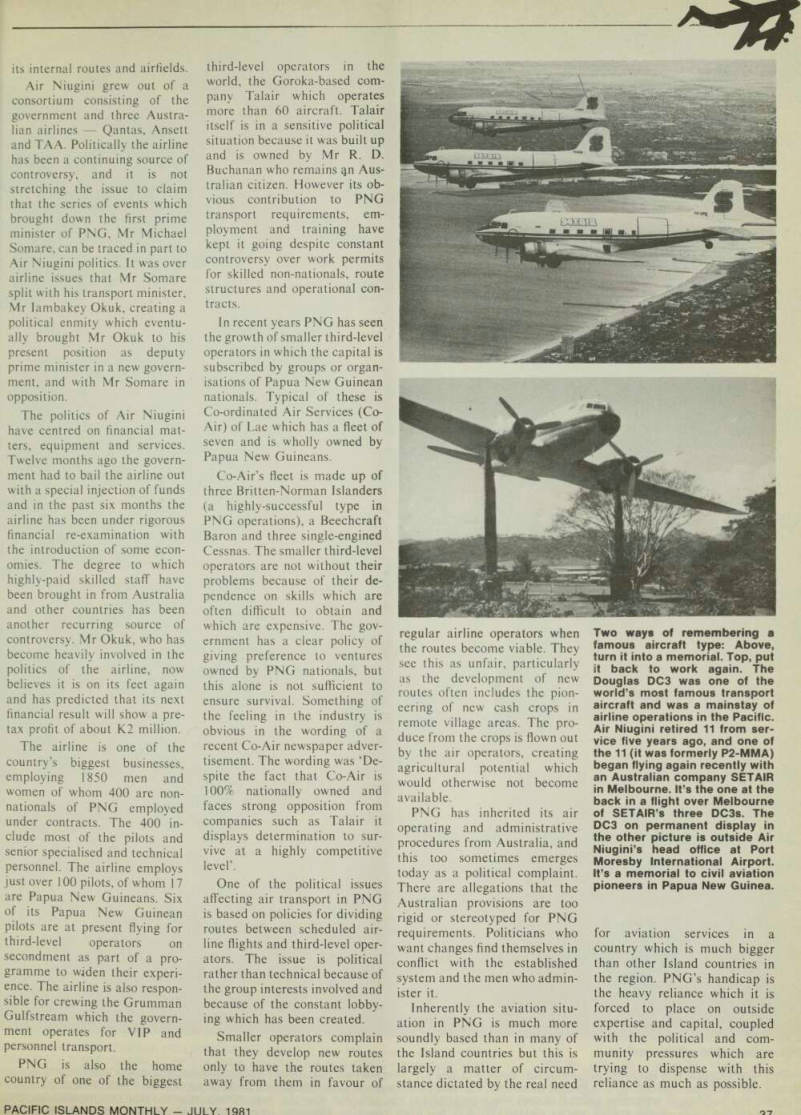
PNG aviation scene has strong political elements
Pushed into the aviation age early because of its scattered settlements and rugged terrain and because of the impetus provided by an inland gold rush, Papua New Guinea remains the biggest user of aircraft among the Pacific Island countries.
Australia, which had a pioneering role in world aviation history, sponsored most of the early aviation developments in PNG and continues to have a significant involvement despite changes in investment patterns and politics which have followed political independence.
But in its own right PNG today is the major aviationminded country in the Pacific Islands with 240 aircraft on its register. It has 14 major airports on trunk routes, about 130 official airfields and another 90
or so private airfields. It also has one of the world’s largest third level operators, The national flag-carrier, Air Niugini, flies domestic and in ternational routes and is the biggest of the Island flag carriers. Except for a nominal 7% shareholding held by the Australian Ansett group, Air Niugini is owned by the PNG government. It flies to three ports in Australia, to Japan, Indonesia, Hawaii, Hong Kong,' the Philippines and Singapore in addition to its internal oper ations on trunk routes.
It operates two Boeing 707 338 Cs, four Fokker Fellowship jets and five Fokker Friendship turbo-props. It is also planning to bring in DHC Dash Seven aircraft in the belief that these units are particularly suited to
its internal routes and airfields.
Air Niugini grew out of a consortium consisting of the government and three Austra lian airlines Qantas, Ansett and TAA. Politically the airline has been a continuing source of controversy, and it is not stretching the issue to claim that the series of events which brought down the first prime minister of PNG, Mr Michael Somare, can be traced in part to Air Niugini politics. It was over airline issues that Mr Somare split with his transport minister, Mr lambakey Okuk, creating a political enmity which eventu ally brought Mr Okuk to his present position as deputy prime minister in a new govern ment, and with Mr Somare in opposition.
The politics of Air Niugini have centred on financial mat ters, equipment and services.
Twelve months ago the govern ment had to bail the airline out with a special injection of funds and in the past six months the airline has been under rigorous financial re-examination with the introduction of some econ omies. The degree to which highly-paid skilled staff have been brought in from Australia and other countries has been another recurring source of controversy. Mr Okuk, who has become heavily involved in the politics of the airline, now believes it is on its feet again and has predicted that its next financial result will show a pre tax profit of about K 2 million.
The airline is one of the country’s biggest businesses, employing 1850 men and women of whom 400 are non nationals of PNG employed under contracts. The 400 in clude most of the pilots and senior specialised and technical personnel. The airline employs just over 100 pilots, of whom 17 are Papua New Guineans. Six of its Papua New Guinean pilots are at present flying for third-level operators on secondment as part of a pro gramme to widen their experi ence. The airline is also respon sible for crewing the Grumman Gulfstream which the govern ment operates for VIP and personnel transport.
PNG is also the home country of one of the biggest
third-level operators in the world, the Goroka-based com pany Talair which operates more than 60 aircraft. Talair itself is in a sensitive political situation because it was built up and is owned by Mr R. D.
Buchanan who remains qn Aus tralian citizen. However its ob vious contribution to PNG transport requirements, em ployment and training have kept it going despite constant controversy over work permits for skilled non-nationals, route structures and operational con tracts.
In recent years PNG has seen the growth of smaller third-level operators in which the capital is subscribed by groups or organ isations of Papua New Guinean nationals. Typical of these is Co-ordinated Air Services (Co- Air) of Lae which has a fleet of seven and is wholly owned by Papua New Guineans.
Co-Air’s fleet is made up of three Britten-Norman Islanders (a highly-successful type in PNG operations), a Beechcraft Baron and three single-engined Cessnas. The smaller third-level operators are not without their problems because of their de pendence on skills which are often difficult to obtain and which are expensive. The gov ernment has a clear policy of giving preference to ventures owned by PNG nationals, but this alone is not sufficient to ensure survival. Something of the feeling in the industry is obvious in the wording of a recent Co-Air newspaper adver tisement. The wording was ‘De spite the fact that Co-Air is 100% nationally owned and faces strong opposition from companies such as Talair it displays determination to sur vive at a highly competitive level’.
One of the political issues affecting air transport in PNG is based on policies for dividing routes between scheduled air line flights and third-level oper ators. The issue is political rather than technical because of the group interests involved and because of the constant lobby ing which has been created.
Smaller operators complain that they develop new routes only to have the routes taken away from them in favour of
regular airline operators when the routes become viable. They see this as unfair, particularly as the development of new routes often includes the pion eering of new cash crops in remote village areas. The pro duce from the crops is flown out by the air operators, creating agricultural potential which would otherwise not become available.
PNG has inherited its air operating and administrative procedures from Australia, and this too sometimes emerges today as a political complaint.
There are allegations that the Australian provisions are too rigid or stereotyped for PNG requirements. Politicians who want changes find themselves in conflict with the established system and the men who admin ister it.
Inherently the aviation situ ation in PNG is much more soundly based than in many of the Island countries but this is largely a matter of circum stance dictated by the real need
for aviation services in a country which is much bigger than other Island countries in the region. PNG’s handicap is the heavy reliance which it is forced to place on outside expertise and capital, coupled with the political and com munity pressures which are trying to dispense with this reliance as much as possible.
Two ways of remembering a famous aircraft type: Above, turn it into a memorial. Top, put it back to work again. The Douglas DCS was one of the world’s most famous transport aircraft and was a mainstay of airline operations in the Pacific.
Air Niugini retired 11 from ser vice five years ago, and one of the 11 (it was formerly P2-MMA) began flying again recently with an Australian company SETAIR in Melbourne. It’s the one at the back in a flight over Melbourne of SETAIR’s three DC3s. The DCS on permanent display in the other picture is outside Air Niugini’s head office at Port Moresby International Airport.
It’s a memorial to civil aviation pioneers in Papua New Guinea.
Advertisements & other items, pp. 36-39 (1 item)
Somir
m In Europe The Metro means a fast,
frequent and inexpensive means of transport.
Ours looks different but means the same!
Introducing the New SOLAIR METRO 11
SOMIR
A pressurised, air conditioned, turbine powered, radar equipped, fast, frequent and inexpensive means of transport.
The introduction of the new Metro 11 aircraft on routes between Honiara and Munda in the Solomon Islands, Honiara and Kieta P.N.G., and a new direct service between Honiara and Espirito Santo in Vanuatu will initiate a new era in fast, modern and comfortable aviation in the South Pacific.
If your business brings you to our part of the Pacific you can now fly when you choose, rather than be dictated to by airline schedules. Our frequent Metro service will connect you with Honiara, a major transit point for international jet sevices to Australia, New Zealand, Vanuatu, Fiji, Hong Kong, Japan, Taipai, the Philippines and the Northern Pacific. iJ
FL Y THE METRO
CONNECTION
It's a fast, frequent and exciting means of travel!
General Sales Agents in Australia Pacific Unlimited 359 Queen St. Brisbane Phone 229 6933 Telex 42558 Cnr. York & Market Sts. Sydney Phone 267 5166 Telex 70723
SOMIR
The Solomon Islands'
Regional Airline.
1 i - .ll Die Toyota truck range.
Built to be unbeatable.
Bad weather conditions, no problem.
Bad roadilnd driving surfaces, eaten up.
Difficult loads, no contest. Built tough.
Built to take it. rhere’s a Toyota truck built for : or unbeatable after service: APUA NEW GUINEA: ELA MOTORS, Scratchley Rd.. Badili, P.O. Box 675, Port Moresby. U.S. TRUST TERRITORY: MICROL CORPORATION, P.O. Box 267, laipan. FIJI ISLANDS: AUTOMOTIVE SUPPLIES COMPANY, P.O. Box 5177, Raiwaqa, Suva. AMERICAN SAMOA: BURNS PHILP (SOUTHSEA) CO.. LTD., .O. Box 129, Pago Pago. WESTERN SAMOA: BURNS PHILP (SOUTHSEA) CO., LTD., P.O. Box 188, Apia. TONGA: BURNS PHILP (SOUTHSEA) CO.. LTD., .O. BOX 55. Nukualofa. GUAM: ATKINS. KROLL (GUAM) LTD P.O. Box 6248 Tamunirm VANUATU: NIFW HFBRIDFS MOTORS P O Box 18 Vila.
TOYOTA STOUT
TOYOTA TOYO ACE
1 li > * m *
TOYOTA HI-LUX
$ 4T
TOYOTA LAND CRUISER
4
TOYOTA HI ACE
4s * -
TOYOTA DYNA
>■ . * m
TOYOTA TRUCK
rrnMnTn S^ N ?fo ENDANA ENTERPRISES (5.1.) LTD., P.O. Box 174, Honiara. TAHITI: NIPPON TOMOTO, B.P. 342, Papeete. COOK I SLANDS: COOK ISLANDS TRADING CORPORATION LTD D. Box 92. Rarotonga. NAURU ISLANDS: NAURU COOPERATIVE SOCIETY. 3IBATI: TARAWA MOTORS, Box 36, Bairiki, Kiribati. NORFOLK ISLAND: MOUNT PITT * P °' B ° X 169 NEW CALEDON| A: SOCIETE IMPORTATION AUTOMOBILE DU .OIMUUc. Rond-Pomt du Par.ifir Station TntQi\ d d aoq
TOYOTA
People
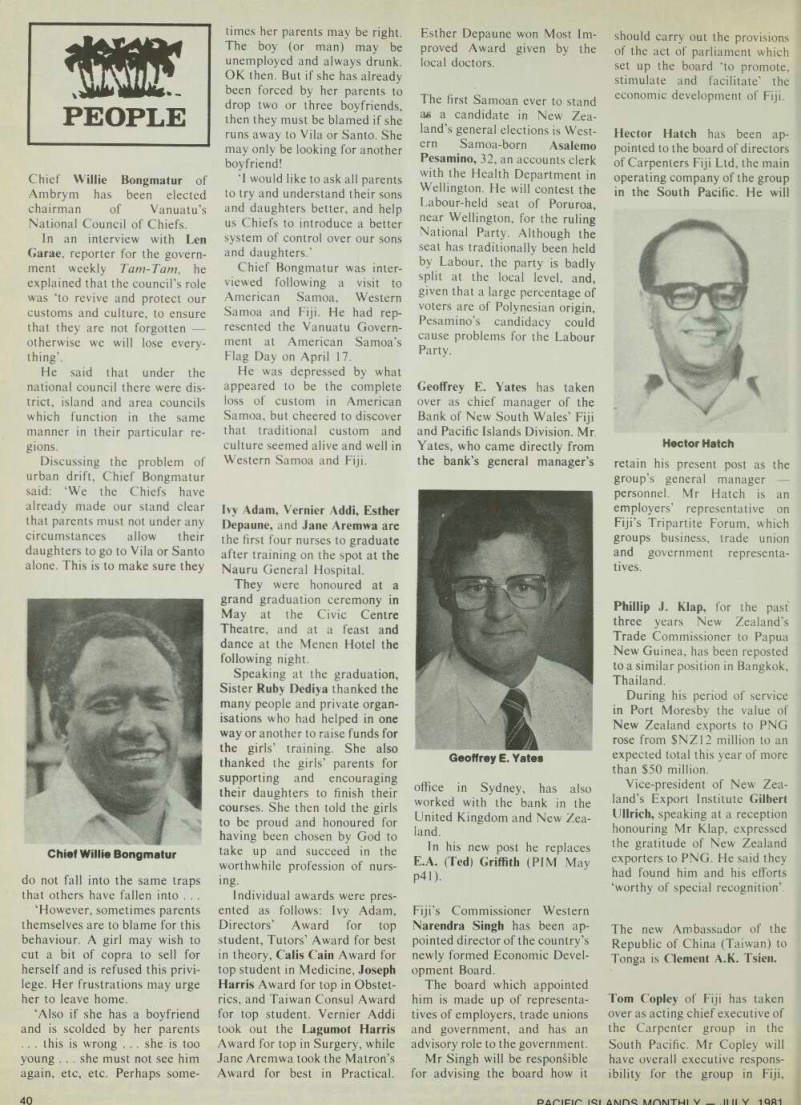
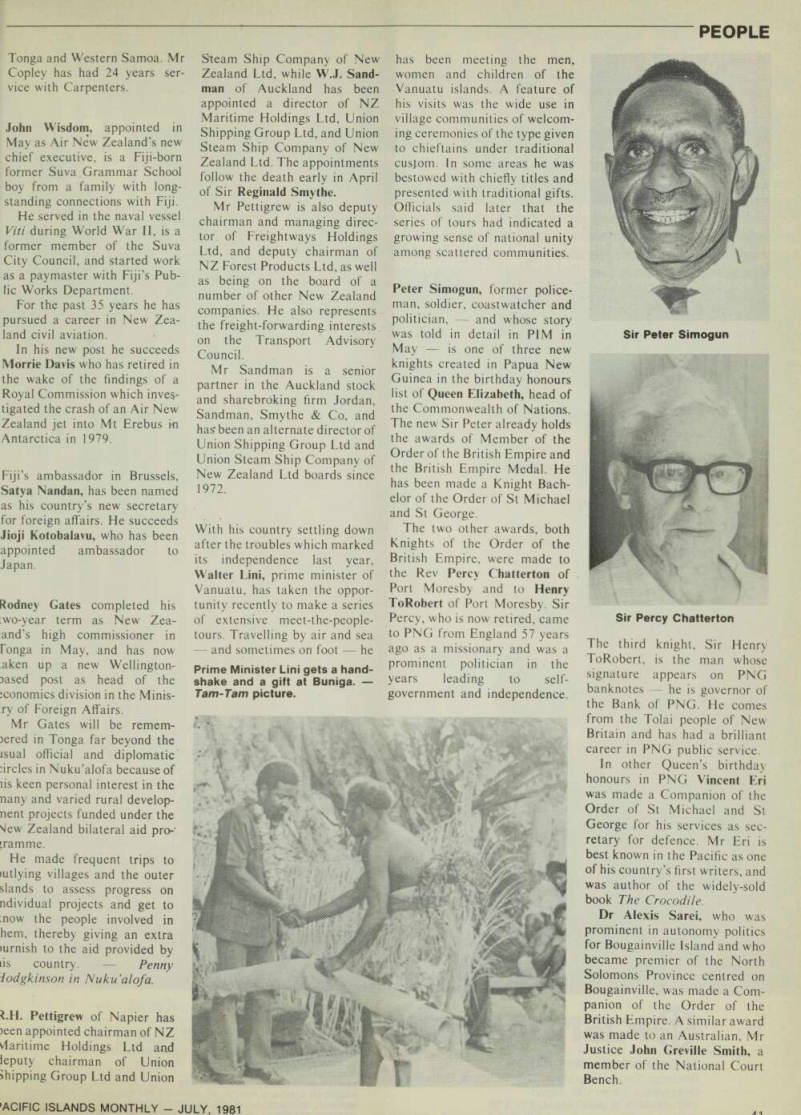
Chief Willie Bongmatur of Ambrym has been elected chairman of Vanuatu’s National Council of Chiefs.
In an interview with Len Garae, reporter for the govern ment weekly Tam-Tam, he explained that the council’s role was ‘to revive and protect our customs and culture, to ensure that they are not forgotten otherwise we will lose every thing’.
He said that under the national council there were dis trict, island and area councils which function in the same manner in their particular re gions.
Discussing the problem of urban drift, Chief Bongmatur said: ‘We the Chiefs have already made our stand clear that parents must not under any circumstances allow their daughters to go to Vila or Santo alone. This is to make sure they
do not fall into the same traps that others have fallen into . . . ’However, sometimes parents themselves are to blame for this behaviour. A girl may wish to cut a bit of copra to sell for herself and is refused this privi lege. Her frustrations may urge her to leave home. ‘Also if she has a boyfriend and is scolded by her parents . . . this is wrong . . . she is too young ... she must not see him again, etc, etc. Perhaps some
times her parents may be right.
The boy (or man) may be unemployed and always drunk.
OK then. But if she has already been forced by her parents to drop two or three boyfriends, then they must be blamed if she runs away to Vila or Santo. She may only be looking for another boyfriend!
T would like to ask all parents to try and understand their sons and daughters better, and help us Chiefs to introduce a better system of control over our sons and daughters.’
Chief Bongmatur was inter viewed following a visit to American Samoa, Western Samoa and Fiji. He had rep resented the Vanuatu Govern ment at American Samoa’s Flag Day on April 17.
He was depressed by what appeared to be the complete loss of custom in American Samoa, but cheered to discover that traditional custom and culture seemed alive and well in Western Samoa and Fiji.
Ivy Adam, Vernier Addi, Esther Depaune, and Jane Aremwa are the first four nurses to graduate after training on the spot at the Nauru General Hospital.
They were honoured at a grand graduation ceremony in May at the Civic Centre Theatre, and at a feast and dance at the Menen Hotel the following night.
Speaking at the graduation.
Sister Ruby Dediya thanked the many people and private organ isations who had helped in one way or another to raise funds for the girls’ training. She also thanked the girls’ parents for supporting and encouraging their daughters to finish their courses. She then told the girls to be proud and honoured for having been chosen by God to take up and succeed in the worthwhile profession of nurs ing.
Individual awards were pres ented as follows: Ivy Adam, Directors’ Award for top student, Tutors’ Award for best in theory, Calls Cain Award for top student in Medicine, Joseph Harris Award for top in Obstet rics, and Taiwan Consul Award for top student. Vernier Addi took out the Lagumot Harris Award for top in Surgery, while Jane Aremwa took the Matron’s Award for best in Practical.
Esther Depaune won Most Im proved Award given by the local doctors.
The first Samoan ever to stand as a candidate in New Zea land’s general elections is West ern Samoa-born Asalemo Pesamino, 32, an accounts clerk with the Health Department in Wellington. He will contest the Labour-held seat of Poruroa, near Wellington, for the ruling National Party. Although the seat has traditionally been held by Labour, the party is badly split at the local level, and, given that a large percentage of voters are of Polynesian origin, Pesamino’s candidacy could cause problems for the Labour Party.
Geoffrey E. Yates has taken over as chief manager of the Bank of New South Wales’ Fiji and Pacific Islands Division. Mr.
Yates, who came directly from the bank’s general manager’s
office in Sydney, has also worked with the bank in the United Kingdom and New Zea land.
In his new post he replaces E.A. (Ted) Griffith (PIM May p4l).
Fiji’s Commissioner Western Narendra Singh has been ap pointed director of the country’s newly formed Economic Devel opment Board.
The board which appointed him is made up of representa tives of employers, trade unions and government, and has an advisory role to the government.
Mr Singh will be responsible for advising the board how it
should carry out the provisions of the act of parliament which set up the board ‘to promote, stimulate and facilitate’ the economic development of Fiji.
Hector Hatch has been ap pointed to the board of directors of Carpenters Fiji Ltd, the main operating company of the group in the South Pacific. He will
retain his present post as the group’s general manager personnel. Mr Hatch is an employers’ representative on Fiji’s Tripartite Forum, which groups business, trade union and government representa tives.
Phillip J. Klap, for the past three years New Zealand’s Trade Commissioner to Papua New Guinea, has been reposted to a similar position in Bangkok, Thailand.
During his period of service in Port Moresby the value of New Zealand exports to PNG rose from SNZI2 million to an expected total this year of more than $5O million.
Vice-president of New Zea land’s Export Institute Gilbert Ullrich, speaking at a reception honouring Mr Klap, expressed the gratitude of New Zealand exporters to PNG. He said they had found him and his efforts ‘worthy of special recognition’.
The new Ambassador of the Republic of China (Taiwan) to Tonga is Clement A.K. Tsien.
Tom Copley of Fiji has taken over as acting chief executive of the Carpenter group in the South Pacific. Mr Copley will have overall executive respons ibility for the group in Fiji,
Chief Willie Bongmatur
Geoffrey E. Yates
Hector Hatch
Tonga and Western Samoa. Mr Copley has had 24 years ser vice with Carpenters.
John Wisdom, appointed in May as Air New Zealand’s new chief executive, is a Fiji-born former Suva Grammar School boy from a family with long standing connections with Fiji.
He served in the naval vessel Viti during World War 11, is a former member of the Suva City Council, and started work as a paymaster with Fiji’s Pub lic Works Department.
For the past 35 years he has pursued a career in New Zea land civil aviation.
In his new post he succeeds Morrie Davis who has retired in the wake of the findings of a Royal Commission which inves tigated the crash of an Air New Zealand jet into Mt Erebus hi Antarctica in 1979.
Fiji’s ambassador in Brussels, Satya Nandan, has been named as his country’s new secretary for foreign affairs. He succeeds Jioji Kotobalavu, who has been appointed ambassador to Japan.
Rodney Gates completed his ;wo-year term as New Zea and’s high commissioner in Fonga in May, and has now aken up a new Wellington 3ased post as head of the xonomics division in the Minis ry of Foreign Affairs.
Mr Gates will be remem >ered in Tonga far beyond the isual official and diplomatic circles in Nuku’alofa because of lis keen personal interest in the nany and varied rural develop nent projects funded under the 'Jew Zealand bilateral aid pro- - ;ramme.
He made frequent trips to >utlying villages and the outer slands to assess progress on ndividual projects and get to mow the people involved in hem, thereby giving an extra mrnish to the aid provided by
lis country.
Penny
Hodgkinson in Nukualofa.
LH. Pettigrew of Napier has )een appointed chairman of NZ viaritime Holdings Ltd and leputy chairman of Union Shipping Group Ltd and Union
Steam Ship Company of New Zealand Ltd, while W.J. Sand man of Auckland has been appointed a director of NZ Maritime Holdings Ltd, Union Shipping Group Ltd, and Union Steam Ship Company of New Zealand Ltd. The appointments follow the death early in April of Sir Reginald Smythe.
Mr Pettigrew is also deputy chairman and managing direc tor of Freightways Holdings Ltd, and deputy chairman of NZ Forest Products Ltd, as well as being on the board of a number of other New Zealand companies. He also represents the freight-forwarding interests on the Transport Advisory Council.
Mr Sandman is a senior partner in the Auckland stock and sharebroking firm Jordan, Sandman, Smythe & Co, and has been an alternate director of Union Shipping Group Ltd and Union Steam Ship Company of New Zealand Ltd boards since 1972.
With his country settling down after the troubles which marked its independence last year, Walter Lini, prime minister of Vanuatu, has taken the oppor tunity recently to make a series of extensive meet-the-people tours. Travelling by air and sea and sometimes on foot he
has been meeting the men, women and children of the Vanuatu islands. A feature of his visits was the wide use in village communities of welcom ing ceremonies of the type given to chieftains under traditional cusjom. In some areas he was bestowed with chiefly titles and presented with traditional gifts.
Officials said later that the series of lours had indicated a growing sense of national unity among scattered communities.
Peter Simogun, former police man, soldier, coastwatcher and politician, and whose story was told in detail in PIM in May is one of three new knights created in Papua New Guinea in the birthday honours list of Queen Elizabeth, head of the Commonwealth of Nations.
The new Sir Peter already holds the awards of Member of the Order of the British Empire and the British Empire Medal. He has been made a Knight Bach elor of the Order of St Michael and St George.
The two other awards, both Knights of the Order of the British Empire, were made to the Rev Percy Chatterton of Port Moresby and to Henry Toßobert of Port Moresby. Sir Percy, who is now retired, came to PNG from England 57 years ago as a missionary and was a prominent politician in the years leading to self government and independence.
The third knight. Sir Henry Toßoberl, is the man whose signature appears on PNG banknotes he is governor of the Bank of PNG. He comes from the Tolai people of New Britain and has had a brilliant career in PNG public service.
In other Queen’s birthday honours in PNG Vincent Eri was made a Companion of the Order of St Michael and St George for his services as sec retary for defence. Mr Eri is best known in the Pacific as one of his country’s first writers, and was author of the widely-sold book The Crocodile.
Dr Alexis Sarei, who was prominent in autonomy politics for Bougainville Island and who became premier of the North Solomons Province centred on Bougainville, was made a Com panion of the Order of the British Empire. A similar award was made to an Australian, Mr Justice John Greville Smith, a member of the National Court Bench.
Prime Minister Lini gets a hand shake and a gift at Buniga.
Tam-Tam picture.
Sir Peter Simogun
Sir Percy Chatterton
Advertisements & other items, pp. 40-42 (3 items)
40
PAPIFir IQ I AM n Q MOMTHI V .1111 Y IQftl
People
41
'ACIFIC ISLANDS MONTHLY - JULY, 1981
Reach out and the
rich musical life is
The Spectrum 50 matched-component system finally
puts a richer musical life within reach of the most
restrictive hi-fi budgets.
Each Spectrum 50 component is a star in a perfectly harmonizing audio galactic system. The brainchild of some of the hi-fi world’s most dedicated engineers.
Reach out, and your journey to music’s realm of
inner space can begin now!
5 0 0 * r 1 T 5 *
Spectrum 50
TRIO-KENWOOD CORPORATION
Shionogi Shibuya Building, 17-5, 2-chome, Shibuya,
Shibuya-ku, Tokyo 150, Japan
TRIO-KENWOOD (AUSTRALIA) PTY. LTD.
KA-50 Stereo Integrated Amplifier KT-30 FM-AM Stereo Tuner KX-50 Metal-Tape Stereo Cassette Deck with Dolby* NR
KD-40R
Direct-Drive Auto-Return Turntable
LS-110F
65W 3-way Speaker System
SRC-5
Audio Rack AT-50 Optional Audio Timer *TM Dolby Licensing Corp.
NEW ZEALAND JOHN GILBERT & CO , LTD Auckland Tel 30-839 FIJI THE DOMINION IMPORT & EXPORT PROMOTIONS Nadi Tel 72-165 PAPUA NEW GUINEA S O SVENSSON (N G ) LTD. Port Moresby Tel 24-2275/2285
NORFOLK ISLAND BURNS PHILIP(NORFOLK ISLAND) LTD
SOLOMON ISLANDS TECHNIQUE RADIOS CENTRE LTD Honiara Tel 416 NEW CALEDONIA HI-FI VOX Noumea Tel. 27-2466
VANUATUIRUE HIGGINSON Vila Tel 2556
TAHITI MAISON AURORE Papeete Tel 29703
AMERICAN SAMOA ISLAND PACIFIC AGENCIES, INC. Pago Pago Tel. 633-4687
REPUBLIC OF NAURU NAURU CO-OPERATIVE SOCIETY
4E Woodcock Place I ■lia Tol- AO'i.IARR
Dariel Tardieu's
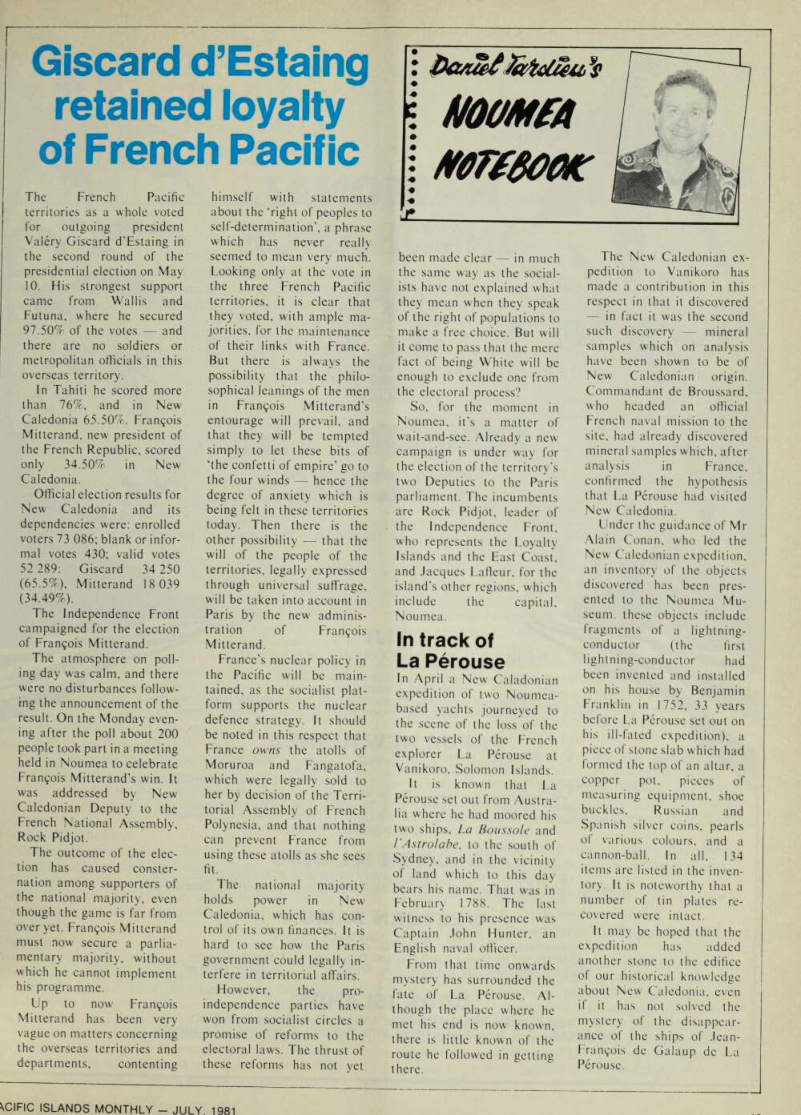
Giscard d’Estaing retained loyalty of French Pacific
Noumea
Notebook
The French Pacific territories as a whole voted for outgoing president Valery Giscard d'Estaing in the second round of the presidential election on May 10. His strongest support came from Wallis and Futuna, where he secured 97.50% of the voles and there are no soldiers or metropolitan officials in this overseas territory.
In Tahiti he scored more than 76%, and in New Caledonia 65.50%. Francois Mitterand, new president of the French Republic, scored only 34.50% in New Caledonia.
Official election results for New Caledonia and its dependencies were: enrolled voters 73 086; blank or infor mal votes 430; valid votes 52 289: Giscard 34 250 (65.5%), Mitterand 18 039 (34.49%).
The Independence Front campaigned for the election of Francis Mitterand.
The atmosphere on poll ing day was calm, and there were no disturbances follow ing the announcement of the result. On the Monday even ing after the poll about 200 people took part in a meeting held in Noumea to celebrate Francis Mitterand’s win. It was addressed by New Caledonian Deputy to the French National Assembly, Rock Pidjot.
The outcome of the elec tion has caused conster nation among supporters of the national majority, even though the game is far from over yet. Francois Mitterand must now secure a parlia mentary majority, without which he cannot implement his programme.
Up to now Francis Mitterand has been very vague on matters concerning the overseas territories and departments, contenting
himself with statements about the ‘right of peoples to self-determination’, a phrase which has never really seemed to mean very much.
Looking only at the vole in the three French Pacific territories, it is clear that they voted, with ample ma jorities, for the maintenance of their links with France.
But there is always the possibility that the philo sophical leanings of the men in Francois Mitterand's entourage will prevail, and that they will be tempted simply to let these bits of ‘the confetti of empire’ go to the four winds hence the degree of anxiety which is being felt in these territories today. Then there is the other possibility that the will of the people of the territories, legally expressed through universal suffrage, will be taken into account in Paris by the new adminis tration of Francois Mitterand.
France’s nuclear policy in the Pacific will be main tained, as the socialist plat form supports the nuclear defence strategy. It should be noted in this respect that France owns the atolls of Moruroa and Fangatofa, which were legally sold to her by decision of the Terri torial Assembly of French Polynesia, and that nothing can prevent France from using these atolls as she sees fit.
The national majority holds power in New Caledonia, which has con trol of its own finances. It is hard to see how the Paris government could legally in terfere in territorial affairs.
However, the pro independence parties have won from socialist circles a promise of reforms to the electoral laws. The thrust of these reforms has not yet
been made clear in much the same way as the social ists have not explained what they mean when they speak of the right of populations to make a free choice. But will it come to pass that the mere fact of being White will be enough to exclude one from the electoral process?
So, for the moment in Noumea, it’s a matter of wait-and-see. Already a new campaign is under way for the election of the territory’s two Deputies to the Paris parliament. The incumbents are Rock Pidjot, leader of the Independence Front, who represents the Loyalty Islands and the East Coast, and Jacques Laflcur, for the island’s other regions, which include the capital, Noumea.
In track of
La Perouse
In April a New Caladonian expedition of two Noumea based yachts journeyed to the scene of the loss of the two vessels of the French explorer La Perouse at Vanikoro, Solomon Islands.
It is known that La Perouse set out from Austra lia where he had moored his two ships, La Boussole and I’Astrolabe, to the south of Sydney, and in the vicinity of land which to this day bears his name. That was in February 1788. The last witness to his presence was Captain John Hunter, an English naval officer.
From that time onwards mystery has surrounded the fate of La Perouse. Al though the place where he met his end is now known, there is little known of the route he followed in gelling there.
The New Caledonian ex pedition to Vanikoro has made a contribution in this respect in that it discovered in fact it was the second such discovery mineral samples which on analysis have been shown to be of New Caledonian origin.
Commandant dc Broussard, who headed an official French naval mission to the site, had already discovered mineral samples which, after analysis in France, confirmed the hypothesis that La Perouse had visited New Caledonia.
Under the guidance of Mr Alain Conan, who led the New Caledonian expedition, an inventory of the objects discovered has been pres ented to the Noumea Mu seum. these objects include fragments of a lightning conductor (the first lightning-conductor had been invented and installed on his house by Benjamin Franklin in 1752, 33 years before La Perouse set out on his ill-fated expedition), a piece of stone slab which had formed the lop of an altar, a copper pot, pieces of measuring equipment, shoe buckles, Russian and Spanish silver coins, pearls of various colours, and a cannon-ball. In all, 134 items arc listed in the inven tory. It is noteworthy that a number of tin plates re covered were intact.
It may be hoped that the expedition has added another stone to the edifice of our historical knowledge about New Caledonia, even if it has not solved the mystery of the disappear ance of the ships of Jeandc Galaup dc La Perouse.
Advertisements & other items, pp. 43-44 (3 items)
\Cific Islands Monthly - July 1981
44
ICI a Mnc ynMTHI V II II Y IQRI
Insurance
/ / \ •T
NATIONAL ’>
•v
COVERS THE
PACIFIC
* A
PZiA
a *
FIJI
THE NATIONAL INSURANCE COMPANY OF FIJI, LIMITED. (Incorporating Southern Pacific Insurance Co. (Fiji) Ltd) SUVA Dominion House, Thomson St, Phone 25601, Tlx 2337.
L. M. Rolls. General Manager.
LAUTOKA Ist Floor National Bank Bldg, Phone 62951. M. Y. Hussain. Resident Inspector.
LABASA Ist Floor National Bank Bldg. Phone 81099. A. Singh, Resident Inspector.
PAPUA NEW GUINEA
THE SOUTHERN PACIFIC INSURANCE COMPANY (PNG) LIMITED. (Incorporatino C.I.C. Insurance (Pacific) Pty Ltd) PORT MORESBY 8 Champion Parade, Phone 21-1388. Tlx 22261. D. J. McCall.General Manager LAE Second St. Phone 42-4590. Tlx 42443. T. S. Kennedy, Manager.
RABAUL Mango Ave, Phone 92-2755. Tlx 92923. P. M. Mitchell. Manager.
MT HAGEN MT HAGEN Phone 521 -164. J. P. Devaney, District Manager, ent inspector.
Arawa B. Snowden, District Manager. Phone 956-219
SOLOMON ISLANDS
THE NATIONAL INSURANCE COMPANY OF NEW ZEALAND, LIMITED.
HONIARA Ist Floor Kingsley Bldg. Phone 919 B. R. International Agencies (W.V. Gledhill) Agent.
WESTERN SAMOA
NATIONAL PACIFIC INSURANCE LIMITED.
(National Insurance Company of New Zealand. Ltd Managing Agents) APIA Taufusi St, Phone 20481, Tlx 228. D. I. Humphry, Managing Director.
PAGO PAGO Suite 200, Lumana'i Bldg, Phone 96799. J. McGuire, Manager.
COOK ISLANDS
THE NATIONAL INSURANCE COMPANY OF NEW ZEALAND, LIMITED.
RAROTONGA U.I.T. Bldg. Avarua, Phone 2076, Tlx 62013. R. Wheeler, Local Manager.
Islands
From the
Press
Editorial comment in The Times of Papua New Guinea, Port Moresby, on the circumstances of native-born West Papuans in the Indonesian province of Irian Jaya Much has been said, written and photographed of the plight of the West Papuan people. Much of it has been over-emotional inaccurate and wrong-headed. The fact remains, however, that they are being dispossessed of their land. The Indonesian government wants to develop the area, it is true. But who will benefit from this development? Not, we suggest, the West Papuans. The world is not blind to the way in which Indonesia treats it minority groups. There is something constructive that Papua New Guinea can do. We can mobilise Third World opinion through our various international links and through United Nations. If we turn our backs on the West Papuans now it will be on our collective conscience for generations to come. Colonialism was always a crime. It remains so today.
Extracts from a letter in the News Drum, Honiara, Solomon Islands, in which S. Kelly bemoans the inroads which western ideas are making on traditional culture And what about our women? Most educated ones find it difficult to use high-heel shoes in the village. Their minds are more geared to urban life. I don’t think they will ever return to being called Solomon Islanders in the literal sense. We seem to be having more black-white females in this country. They are anxiously and aimlessly looking around for a big dance at the Guadalcanal Club, a weekend barbecue in Tambea, and a free ride in a big car with radio cassettes and rock and roll music. Some of these people no longer recognise their own people. They have lost their own culture. \nd what about our secondary school girls who live near Honiara?
Most of them are excited about their future. The taxi drivers do a *ood job round town providing the free rides, so most of the girls narry taxi drivers. Some of the girls who like pop music get named to unemployed pop singers. But later they realise the sound )f good music, and later the free taxi rides are gone. Thank God hat this country still has strong traditional family ties to help when ;uch circumstances occur. 1 hope this country and its people can naintain these ties,
fhe Fiji Times, Suva
\ Nausori town councillor yesterday told the committee nvestigating the Nausori Town Council affairs that councillors did lot break the law. They only bent it, Mr Ram Chandra Sharma, he first councillor to give evidence, said. Asked if he thought the :ouncil was corrupt, Mr Sharma said he had no knowledge of its
>eing corrupt.
fhe Nauru Post teeing up on the 7th hole one of our golfers couldn’t find his et of plastic tees which are normally tied together with a weight t a piece of brightly-coloured cloth. Before giving them up for lost ie happened to look up and there was his set of tees hanging from he branch of a tree. Not seeing anything close at hand he used his ,ol f club. He took careful aim, the club went twishing on its way, •ut he missed. Not only were the tees still in the tree, but so was he golf club. Fortunately some kids came along and one of them limbed the tree and retrieved the tees and the club.
Margot Marshall, writing in the Cook Islands News, Rarotonga, about a visit to Vanuatu The French restaurants in Vila are superb but expensive. One night at the Cafe de Paris I ordered snails in garlic sauce. T don’t know if I can bear to watch you eat them’, an Australian diplomat said.
They’re the curse of the country. Some Frenchman imported a few to farm years ago and now they’ve grown wild. Do you realise they have to shovel them off the runways in spring before an aircraft can land? A group of us ran a snail drive last year. Prizes for the most snails collected you know the form. Fifty-five tons we got in one day.’
Arawa Bulletin, Arawa, Papua New Guinea It’s reported that the incidence of dog bites has decreased in New York, but that of human bites has increased by 24%. One well known man about town received a bite of a different kind recently.
He caught a fish that obviously didn’t want to be caught as it bit him on the ankle. Hear he had to get 10 stitches for the wound.
Samoa Times, Apia
The five-week strike by the Public Service Association is to be commemorated in the names of twins born last week. According to informed sources a Vaiala woman named her twins PSA and PSC.
The Papua New Guinea Post-Courier, Port Moresby A reader has sent this appeal: T live in a remote area where packed cigarettes are often hard to get. So I like to smoke twist tobacco and local brus (locally-cultivated tobacco) to keep up with my smoking habit. To wrap my tobacco and brus I use no other paper than the one you put out daily. Since it has no taste for the smokers in the villages, could you think about spraying your paper with good tasting spices like ginger, cardamom or other herbs. In that way your paper will be read in urban areas, but smoked in the rural areas.’
Cook Islands News, Rarotonga The permissive and the religious sectors of the Cook Islands appear to be headed for another clash over the issue of respect for Sundays.
Some Cook Islands Christians in Ngatangiia are offended by reports of activities which are said to have taken place on the Ngatangiia lagoon last Easter Sunday. These included sailing, fishing and even a European couple sun-bathing nude on the beach.
The Coconut Telegraph, Savusavu, Fiji WHAT MAKES A TOURIST HAPPY? Some people have the idea that to please a tourist you must stuff him with duty-free goods, fancy foods and gin, rum and vodka. Not so. An Australian couple visiting Savusavu during the water shortage enjoyed what they called the most marvellous experience of their lives when the hotel manager took them to the nearby village, where they lined up in the village stream to have a bath and wash their clothes.
Wouldn’t have missed it for anything, they said.
The Times of Papua New Guinea, Port Moresby Recently a boy with an anglicised name wrote away for a scholarship in Australia. He did not get it because the people in Australia did not believe that he was a true Papua New Guinean.
His name was Nelson. Warning: Do not give your children foreign names.
From a report in the Cook Islands News, Rarotonga, describing a cricket match between Turangi and Matavera A Matavera supporter asked his friend k Hey! Tupu shouldn’t be out Ibw it was his stomach that was hit by the ball.’
Part of a letter to the editor in the Papua New Guinea
Post-Courier, Port Moresby
1 would like to express my view on a social problem which tends to lower the standard of effective planning and teaching in some of the Highlands community schools. I have noticed that Highlands teachers who have more than one wife cannot keep their work up to date. The reason is that they have a lot of family problems, such as fighting between the wives over the pay. Such incidents also give a bad show to some of the school kids. PNG is a Christian country so why not follow what the Bible says by having one wife and teaching well?
Advertisements & other items, pp. 45-46 (2 items)
45
ACIFIC ISLANDS MONTHLY - JULY, 1981
Come uptokool
The cool refreshing taste of menthol.
growing its 'bananas'
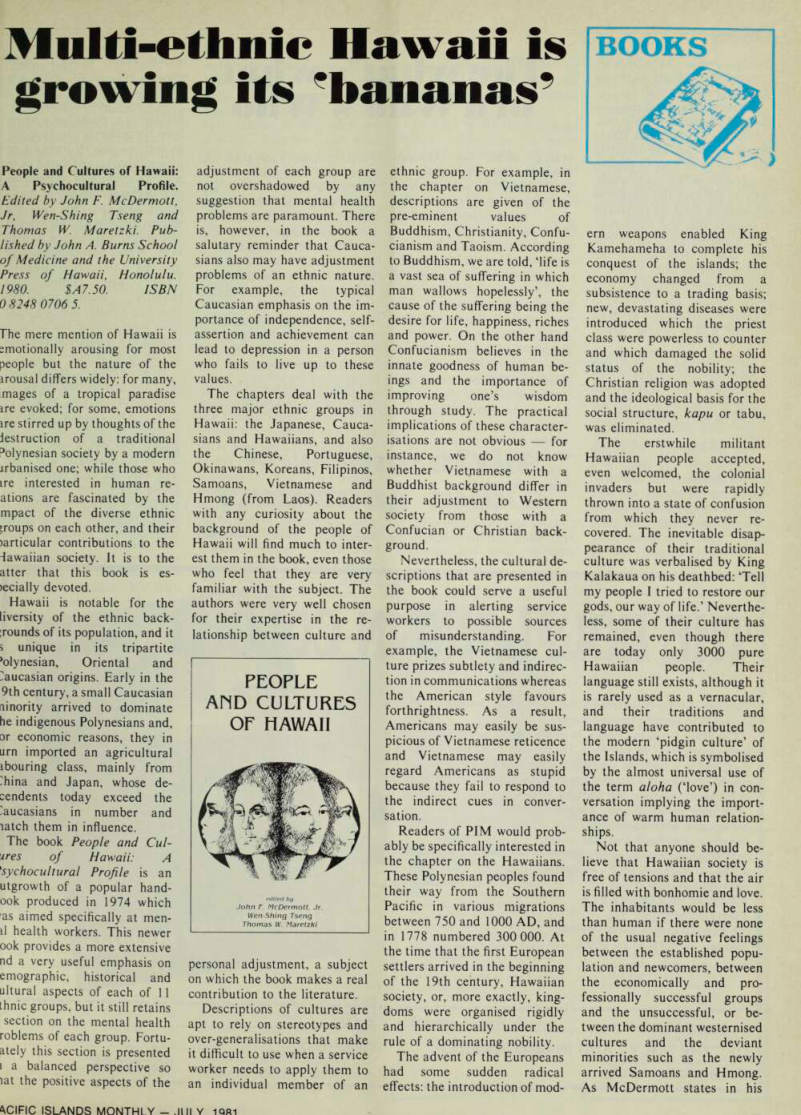
Multi-ethnic Hawaii is growing its 'bananas'
Books
People and Cultures of Hawaii: A Psychocultural Profile.
Edited by John F. McDermott, Jr, Wen-Shing Tseng and Thomas W. Maretzki. Pub lished by John A. Burns School of Medicine and the University Press of Hawaii, Honolulu.
1980. 5A7.50. Isbn
0 8248 0706 5.
The mere mention of Hawaii is emotionally arousing for most people but the nature of the arousal differs widely: for many, mages of a tropical paradise are evoked; for some, emotions are stirred up by thoughts of the lestruction of a traditional Polynesian society by a modern irbanised one; while those who ire interested in human re ations are fascinated by the mpact of the diverse ethnic ;roups on each other, and their )articular contributions to the -lawaiian society. It is to the atter that this book is es iccially devoted.
Hawaii is notable for the liversity of the ethnic back ;rounds of its population, and it 5 unique in its tripartite ’olynesian, Oriental and Caucasian origins. Early in the 9th century, a small Caucasian ninority arrived to dominate he indigenous Polynesians and, or economic reasons, they in urn imported an agricultural ibouring class, mainly from China and Japan, whose de cendents today exceed the Caucasians in number and latch them in influence.
The book People and Cul ures of Hawaii: A I sychocultural Profile is an utgrowth of a popular hand ook produced in 1974 which as aimed specifically at men il health workers. This newer ook provides a more extensive nd a very useful emphasis on emographic, historical and ultural aspects of each of 11 thnic groups, but it still retains section on the mental health roblems of each group. Fortu ately this section is presented 1 a balanced perspective so lat the positive aspects of the
adjustment of each group are not overshadowed by any suggestion that mental health problems are paramount. There is, however, in the book a salutary reminder that Cauca sians also may have adjustment problems of an ethnic nature.
For example, the typical Caucasian emphasis on the im portance of independence, self assertion and achievement can lead to depression in a person who fails to live up to these values.
The chapters deal with the three major ethnic groups in Hawaii: the Japanese, Cauca sians and Hawaiians, and also the Chinese, Portuguese, Okinawans, Koreans, Filipinos, Samoans, Vietnamese and Hmong (from Laos). Readers with any curiosity about the background of the people of Hawaii will find much to inter est them in the book, even those who feel that they are very familiar with the subject. The authors were very well chosen for their expertise in the re lationship between culture and
personal adjustment, a subject on which the book makes a real contribution to the literature.
Descriptions of cultures are apt to rely on stereotypes and over-generalisations that make it difficult to use when a service worker needs to apply them to an individual member of an
ethnic group. For example, in the chapter on Vietnamese, descriptions are given of the pre-eminent values of Buddhism, Christianity, Confu cianism and Taoism. According to Buddhism, we are told, ‘life is a vast sea of suffering in which man wallows hopelessly’, the cause of the suffering being the desire for life, happiness, riches and power. On the other hand Confucianism believes in the innate goodness of human be ings and the importance of improving one’s wisdom through study. The practical implications of these character isations are not obvious for instance, we do not know whether Vietnamese with a Buddhist background differ in their adjustment to Western society from those with a Confucian or Christian back ground.
Nevertheless, the cultural de scriptions that are presented in the book could serve a useful purpose in alerting service workers to possible sources of misunderstanding. For example, the Vietnamese cul ture prizes subtlety and indirec tion in communications whereas the American style favours forthrightness. As a result, Americans may easily be sus picious of Vietnamese reticence and Vietnamese may easily regard Americans as stupid because they fail to respond to the indirect cues in conver sation.
Readers of PIM would prob ably be specifically interested in the chapter on the Hawaiians.
These Polynesian peoples found their way from the Southern Pacific in various migrations between 750 and 1000 AD, and in 1778 numbered 300 000. At the time that the first European settlers arrived in the beginning of the 19th century, Hawaiian society, or, more exactly, king doms were organised rigidly and hierarchically under the rule of a dominating nobility.
The advent of the Europeans had some sudden radical effects: the introduction of mod-
ern weapons enabled King Kamehameha to complete his conquest of the islands; the economy changed from a subsistence to a trading basis; new, devastating diseases were introduced which the priest class were powerless to counter and which damaged the solid status of the nobility; the Christian religion was adopted and the ideological basis for the social structure, kapu or tabu, was eliminated.
The erstwhile militant Hawaiian people accepted, even welcomed, the colonial invaders but were rapidly thrown into a state of confusion from which they never re covered. The inevitable disap pearance of their traditional culture was verbalised by King Kalakaua on his deathbed: Tell my people I tried to restore our gods, our way of life.’ Neverthe less, some of their culture has remained, even though there are today only 3000 pure Hawaiian people. Their language still exists, although it is rarely used as a vernacular, and their traditions and language have contributed to the modern ‘pidgin culture’ of the Islands, which is symbolised by the almost universal use of the term aloha (‘love’) in con versation implying the import ance of warm human relation ships.
Not that anyone should be lieve that Hawaiian society is free of tensions and that the air is filled with bonhomie and love.
The inhabitants would be less than human if there were none of the usual negative feelings between the established popu lation and newcomers, between the economically and pro fessionally successful groups and the unsuccessful, or be tween the dominant westernised cultures and the deviant minorities such as the newly arrived Samoans and Hmong.
As McDermott states in his
closing chapter ‘many of these tensions are related to social class as much as race’.
Treatments of racial relation ships often overlook this con tamination of class and ethnic background, but the question still remains of how to explain why certain groups tend consist ently to fall into the middle or the working class. In particular it appears that the individual istic, achievement-oriented cul ture that is reflected in the typical Western value system is becoming predominant and that social success and respect in Hawaii will more and more go to those who play that ‘game’ well.
These changes are embodied in the local term ‘banana’ which is applied to Westernised Japanese to signify that they are ‘yellow on the outside but white inside’.
The predominant Hawaiian culture is still very much in a state of flux but there can be no doubt that the society will be a polyethnic multicultural one for
a long lime to come.
Ronald
Taft.
Advertisements & other items, p. 47 (2 items)
Acific Islands Monthly - July Iqftl
And Cultures
PEOPLE
Of HAWAII
edited by John F. McDermott, Jr.
Wen Shing Tseng Thomas W. Maretzkl
The what’s what
of a Who’s Who
Who’s Who in Oceania 1980-81. Compiled by Robert D. Craig and Russell T. Clem ent. Published by the Institute for Polynesian Studies, Brigham Young University - Hawaii Campus, Laie, Hawaii.
Hard cover 5U512.95, paper back $7.95. No ISBN provided.
Some people obviously don’t know when they’re well off. This includes Robert D. Craig and Russell T. Clement, joint edi tors of Who’s Who in Oceania 1980-81. However, as Pacific Publications were the perpet rators of two other editions of a Who's Who covering the Pacific Islands, we can sympathise with their problems, and this collec tion’s shortcomings, which they freely acknowledge.
Pacific Publications’ two efforts were published as part of the ninth and 10th editions of
Pacific Islands Year Book and were the brainchild of this misguided reviewer, who also didn’t know what she was get ting into. But our efforts, now of over a decade ago, must at least have been of some benefit to Messrs Craig and Clement in that in the early 19605, when we were preparing our first edition, it’s a safe bet that at least 99% of the indigenous inhabitants of the Pacific had never heard of a Who’s Who, and much less had any desire to appear in one.
Filling in long questionnaires (and ours was just as detailed as the Craig/Clement model) was foreign to the nature of people who frequently can’t even bring themselves to answer urgent business letters. In retrospect it is a wonder that we did as well as we did. Some biographies were eventually extracted by wandering PIM journalists
metaphorically sitting on indi genous VIP chests while ex tracting information.
Nor were non-indigenous in habitants a push-over. Apart from the minority who supplied us with enough information to fill small books, and dared us to alter as much as a comma on pain of excommunication, many others took the view that the whole thing was a gross invasion of privacy, and refused to play at all. Whole communities were afflicted in this way Rabaul, Papua New Guinea, for example leading us to be lieve that a public meeting must have been held on the subject, ending in a unaminous decision to turn thumbs down.
It was thought, by us, that after the first pioneering effort, subsequent editions would be easy. Not so. The late 1960 s was a period of great flux in the Pacific. Europeans were moving out by the planeload and those who were not were rarely to be found where they had been at the time o f our earlier edition. A huge proportion of biographies sent out for up-dating came
back marked ‘address un known’, and an equal number of recipients again ignored the whole thing, so that we had no idea whether they were living or dead, still in the same place, or had been posted to Timbuktu.
The result was total chaos. The new Who’s Who took far more time to produce than the first edition, and subsequently the whole idea was put into the too hard category and, finally, de cently buried.
In a preface to the new Craig/Clement Who’s Who, the editors catalogue some of the problems they had, includ ing: ‘.. . lack of response by important individuals, language problems, mailing and address complications and frequent changes of key personnel in some Island administrations . . .
Unfortunately only a small per centage of completed question naires were returned even after three separate mailings.’
It is obvious, therefore, that the inhabitants of the Islands haven’t changed all that much since 1968. But hope springs eternal: the editors say: ‘. . . hopefully a revised and fuller Who’s Who will be published in the next few years.’ We wish them the very best of Yankee luck.
Pacific Publications was far more catholic in its choice of participants in its Who’s Who, holding the view at the time that the general manager of Burns Philp (SS) Ltd, for in stance, was just as important to Fiji as the vice-chancellor of the local university. Messrs Craig and Clement, on the other hand, have generally restricted entries to personalities in the fields of ‘government (i.e. politicians as well as public servants), edu cation, science and religion’.
This is certainly more aca demically acceptable, although it leaves out a lot of interesting people whose contributions to the Pacific have been consider able. As in all Who’s Who, the longest screeds come from aca demics themselves. There are no reluctant dragons there.
The authors say that geo graphically the focus is on Oceania proper, Australia, New Zealand, Hawaii and Papua
New Guinea being adequately
covered elsewhere. Why PNG should be so considered it is
hard to understand and, in any event, it appears to be reason ably well represented in the Craig/Clement work. The first two names in the book are Abaijah, Josephine, and Abal, Sir Tei, and most of the other Papua New Guineans in the same line of business appear to be there as well.
As the editors acknowledge, there are mistakes in the text.
For example, Leonard Usher of Suva appears in the ‘L’ section as ‘Lisher’ probably the result of a carelessly printed ‘U’ that can look like ‘LF. There are some duplications, no doubt the result of those three post ings of questionnaires. There are also some mysteries, such as why Harry Maude’s occupation is given as ‘statesman’. (When he retired from the Australian
National University in 1970 he was Professorial Fellow in the Research School of Pacific Studies.) In spite of its shortcomings.
Who’s Who in Oceania 1980-81 is a worthy effort just how worthy those of us who laboured along the same lines in 1963 and 1968 are likely to fully appreciate.
It is doubtful if any Who’s Who could be entirely success ful in attempting to cover such a huge and diverse area as the Pacific and its scattered islands.
But until each small indepen dent nation can produce some thing of its own, the Craig/ Clement effort goes some way towards providing a lot of infor mation that otherwise would be difficult or impossible to obtain.
Judy Tudor.
Advertisements & other items, p. 48 (1 item)
The How Lan
This beautifully illustrated book, printed in Jerusalem, is now available in strictly limited supply.
The Holy Land in Colour' is an historical publication which traces both the Old and New Testaments in an even handed text, and is supported visually with over 225 colour photographs, making it a delight for all people of all ages Interested in Religion, History and Culture.
For your personal copy, fill out the coupon below and send together with Bank Draft or Money Order for Aslo.oo per copy (price inc postage and packaging) to:
LAWSON PARTNERS PTY.
LIMITED.
37 Kendall Street, West Pymble Sydney. AUSTRALIA 2073. ■ & *
PLEASE SEND ME COPIES NAME
I OF "THE HOLY LAND IN COLOUR" ADDRESS.
RETURN MAIL.
POSTCODE,
Mystique of the vanishing 'moko'
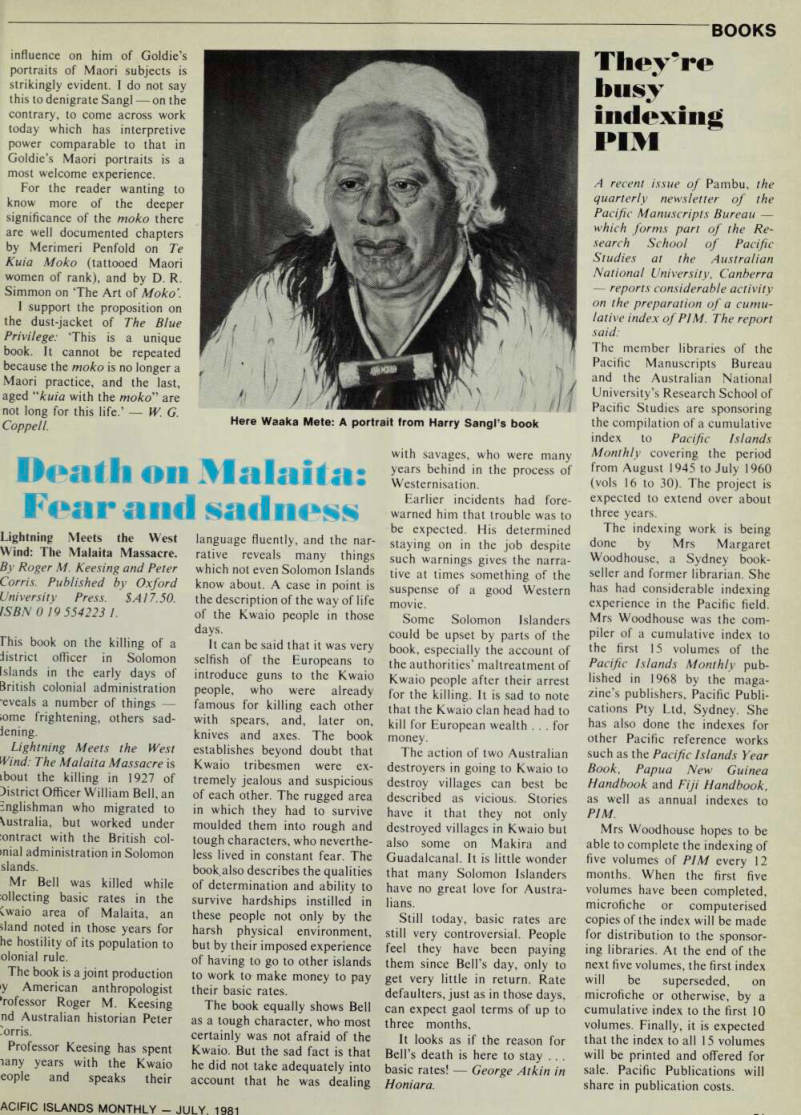
vanishing 'moko'
The Blue Privilege The Last Tattooed Maori Women. Text and paintings by Harry Sangl, with chapters by Mer inter i Penfold and D. R. Simmons.
Published by Richards Pub lishing in association with William Collins Publishers, Auckland. 5NZ29.95. ISBN 0 908596 06 5.
As a child I attended an inner city primary school in Auckland which was near the Art Gallery and the Old Colonists’ Mus eum. I spent many an hour looking at relics of the Maori Wars and of colonial days, and wondering about the signif icance of the paintings and sculptures to be seen there.
An impression gained on these museum visits of the dignity and vitality of the Maori race as portrayed by the late 19th-century artists Goldie and Landauer remains with me to this day.
Many of the portraits re corded the facial tattoos, or moko, of Maori dignitaries.
These tattoos were a method used by the Maori people of acknowledging rank in their society. They were personalised marks of status accquired only through suffering and fortitude.
Many of the chiefs who ac
cepted the 1840 Treaty of Waitangi had used represen
tations of their moko to indicate their acquiesence in the treaty, just as Europeans would use signatures.
There are several major studies of tattooing in the Pacific area, but there is still need for further study of its ritual meaning. Harry Sangl therefore has performed a valu able service in preparing The Blue Privilege. He interviewed, compiled biographies of, and recorded in paintings the char acters and the moko of 34 New Zealand Maori women. All the subjects were elderly and, sadly, many of them are now dead. The opportunity will never occur again for such encounters between a biogra pher working with words and paintbrush and a group of Maori women who took the moko with pride, and endured the pain of tattooing by chisel or needle.
I was taken aback when I opened this book at first glance I felt I was looking at a folio of Goldie’s paintings. I know nothing of Sangl’s other artistic output, but the
influence on him of Goldie’s portraits of Maori subjects is strikingly evident. I do not say this to denigrate Sangl on the contrary, to come across work today which has interpretive power comparable to that in Goldie’s Maori portraits is a most welcome experience.
For the reader wanting to know more of the deeper significance of the moko there are well documented chapters by Merimeri Penfold on Te Kuia Moko (tattooed Maori women of rank), and by D. R.
Simmon on ‘The Art of Moko’.
I support the proposition on the dust-jacket of The Blue Privilege: ‘This is a unique book. It cannot be repeated because the moko is no longer a Maori practice, and the last, aged “ kuia with the moko ” are
not long for this life.’
W. G.
Coppell.
Advertisements & other items, pp. 49-50 (2 items)
Books
IOI AkIHA UAklVii. w ...
Scholarships
Papua New Guinea a travel survival kit The totally revised and updated 2nd edition of the complete guide to the Mast unknown' is now available from bookshops or direct from the publisher.
A 56.95 + As 3 airmail postage (Asl in Australia). Cheque or charge it to Bankcard [ ]Visa[ ] Master Charge [ ] card no signature name address Lonely Planet, PO Box 88, South Yarra 3141, Australia
Applications are invited from Papua New Guineans for the above scholarships, which are available either as (a) undergraduate scholarships open to Papua New Guineans wno are qualified to matriculate in the University of Sydney or (b) postgraduate scholarships open to Papua New Guinean graduates for postgraduate research or cource work at the University of Sydney.
Walter Mersh Strong
Scholarships
The University
of Sydney
Further information and application forms are available from the Academic Registrar, University of Papua New Guinea, P.O. Box 4820, University Post Office, Port Moresby and also the Registrar, University of Sydney,
N.S.W. 2006
Applications close with the University of Sydney on 3 August 1981.
K S 0 Ji 9 W to . *4 .<«*e SUZUKI OUJBOARDS are truly ALL ROUND PERFORMER reliable, adorable and economical under arty situation. * ‘ SUZUKI fi#ep'ared outboards line up exclusively for the usage of and of course, also for the pleasure. Eactrhas different construction respectively, go that you can choose your engine that is to usage.
Get the fruitful life through SUZUKI OUTBOARDS. ws W SUZUKI MOTOR CO LTD Hamamatsu Japan
SUZUKI GENERATOR
SEIOOO
• NEW ZEALAND SOUTH PACIFIC SUZUKI DISTRIBUTORS LTD. PHONE: 58-599 • PAPUA NEW GUINEA HI SPEED DIESEL SERVICE PTY. LTD. PHONE: 42-2679 •FIJI NIRANJANS AUTOPORT LTD. PHONE: 381555 • TAHITI NIPPON AUTOMOTO PHONE: 2-98-* • SOLOMON SOLOMON ISLAND PHONE: 565 • VANUATU HENRI LEROUX • NEW CALEDONIA STE. SUPERCAL PHONE: 272068 • AMERICAN SAMOA PACIFIC PRODUCTS, INC. PHONE: 639-9140 • WESTERN SAMOA VATCO LTD. ©GUAM ISLAND CYCLERY. INC.
PHONE: 565-2298 • NIUE BURNS PHILP CO., LTD. • NAURU EQUIPAC MOTORS PHONE: 4019 • TONGA TONGA EQUIPMENT • YAP AMODHCC a IfnDriD QCCUCODDAI/ T rnUDAMV DUAMC. 000 a TDI IV ISU~\KA A C A OTCDC DUAMC' A 7f\
Death on Malaita:
Fear and sadness
Lightning Meets the West Wind: The Malaita Massacre.
By Roger M. Keesing and Peter Corris. Published by Oxford Uni versi ty Press. $A 17.50.
Isbn 0 19 554223 I.
This book on the killing of a district officer in Solomon Islands in the early days of British colonial administration •eveals a number of things lome frightening, others sad lening.
Lightning Meets the West Wind: The Malaita Massacre is ibout the killing in 1927 of District Officer William Bell, an Englishman who migrated to Australia, but worked under :ontract with the British col mial administration in Solomon slands.
Mr Bell was killed while ollecting basic rates in the Cwaio area of Malaita, an sland noted in those years for he hostility of its population to olonial rule.
The book is a joint production iy American anthropologist Yofessor Roger M. Keesing nd Australian historian Peter Morris.
Professor Keesing has spent lany years with the Kwaio eople and speaks their
language fluently, and the nar rative reveals many things which not even Solomon Islands know about. A case in point is the description of the way of life of the Kwaio people in those
days.
It can be said that it was very selfish of the Europeans to introduce guns to the Kwaio people, who were already famous for killing each other with spears, and, later on, knives and axes. The book establishes beyond doubt that Kwaio tribesmen were ex tremely jealous and suspicious of each other. The rugged area in which they had to survive moulded them into rough and tough characters, who neverthe less lived in constant fear. The book also describes the qualities of determination and ability to survive hardships instilled in these people not only by the harsh physical environment, but by their imposed experience of having to go to other islands to work to make money to pay their basic rates.
The book equally shows Bell as a tough character, who most certainly was not afraid of the Kwaio. But the sad fact is that he did not take adequately into account that he was dealing
with savages, who were many years behind in the process of Westernisation.
Earlier incidents had fore warned him that trouble was to be expected. His determined staying on in the job despite such warnings gives the narra tive at times something of the suspense of a good Western movie.
Some Solomon Islanders could be upset by parts of the book, especially the account of the authorities’ maltreatment of Kwaio people after their arrest for the killing. It is sad to note that the Kwaio clan head had to kill for European wealth ... for money.
The action of two Australian destroyers in going to Kwaio to destroy villages can best be described as vicious. Stories have it that they not only destroyed villages in Kwaio but also some on Makira and Guadalcanal. It is little wonder that many Solomon Islanders have no great love for Austra lians.
Still today, basic rates are still very controversial. People feel they have been paying them since Bell’s day, only to get very little in return. Rate defaulters, just as in those days, can expect gaol terms of up to three months.
It looks as if the reason for Bell’s death is here to stay ...
basic rates! -
George Atkin in
Honiara.
Here Waaka Mete: A portrait from Harry Sangl’s book
indexing
They’re busy indexing
Pim
A recent issue of Pambu, the quarterly newsletter of the Pacific Manuscripts Bureau which forms part of the Re search School of Pacific Studies at the Australian National University, Canberra reports considerable activity on the preparation of a cumu lative index of PIM. The report said: The member libraries of the Pacific Manuscripts Bureau and the Australian National University’s Research School of Pacific Studies are sponsoring the compilation of a cumulative index to Pacific Islands Monthly covering the period from August 1945 to July 1960 (vols 16 to 30). The project is expected to extend over about three years.
The indexing work is being done by Mrs Margaret Woodhouse, a Sydney book seller and former librarian. She has had considerable indexing experience in the Pacific field.
Mrs Woodhouse was the com piler of a cumulative index to the first 15 volumes of the Pacific Islands Monthly pub lished in 1968 by the maga zine’s publishers, Pacific Publi cations Pty Ltd, Sydney. She has also done the indexes for other Pacific reference works such as the Pacific Islands Year Book, Papua New Guinea Handbook and Fiji Handbook, as well as annual indexes to
Pim.
Mrs Woodhouse hopes to be able to complete the indexing of five volumes of PIM every 12 months. When the first five volumes have been completed, microfiche or computerised copies of the index will be made for distribution to the sponsor ing libraries. At the end of the next five volumes, the first index will be superseded, on microfiche or otherwise, by a cumulative index to the first 10 volumes. Finally, it is expected that the index to all 15 volumes will be printed and offered for sale. Pacific Publications will share in publication costs.
Advertisements & other items, pp. 51-52 (2 items)
Books
ACIFIC ISLANDS MONTHLY - JULY 1981
».. r?jl °f
D Woodward governors, synchronizers and synchrophasers are tested, calibrated and maintained at Woodward plants around the globe.
Our Sydney, Australia branch has complete facilities for overhaul, test and field service with new and exchange governors in stock for smaller governor requirements. We also carry a full range of spare parts for rapid delivery.
is the indispensable
ingredient
In most cases, complete overhaul of your main engine governor can be provided in two days.
The next time you have a service requirement, think of Woodward.
I 4 Kf.
W I * >/ * IH
mL I heart
».. r?jl °f
m since 1870
ard Go
any
Unit 17, SSKMoxon Road Corporate Headquarters Punchbowl,NNWS 2196 (Sydney) Australia Illinois, U.S.A.
Phone: (02) >s9-5911 • Telex: AA24175 Ft. Collins, Colorado; Hoofddorp, The Netherlands; Slough, England; Tomisato, Chiba, Japan; Campinas, S.P., Brazil
Remembering Capt. Andy, Cook
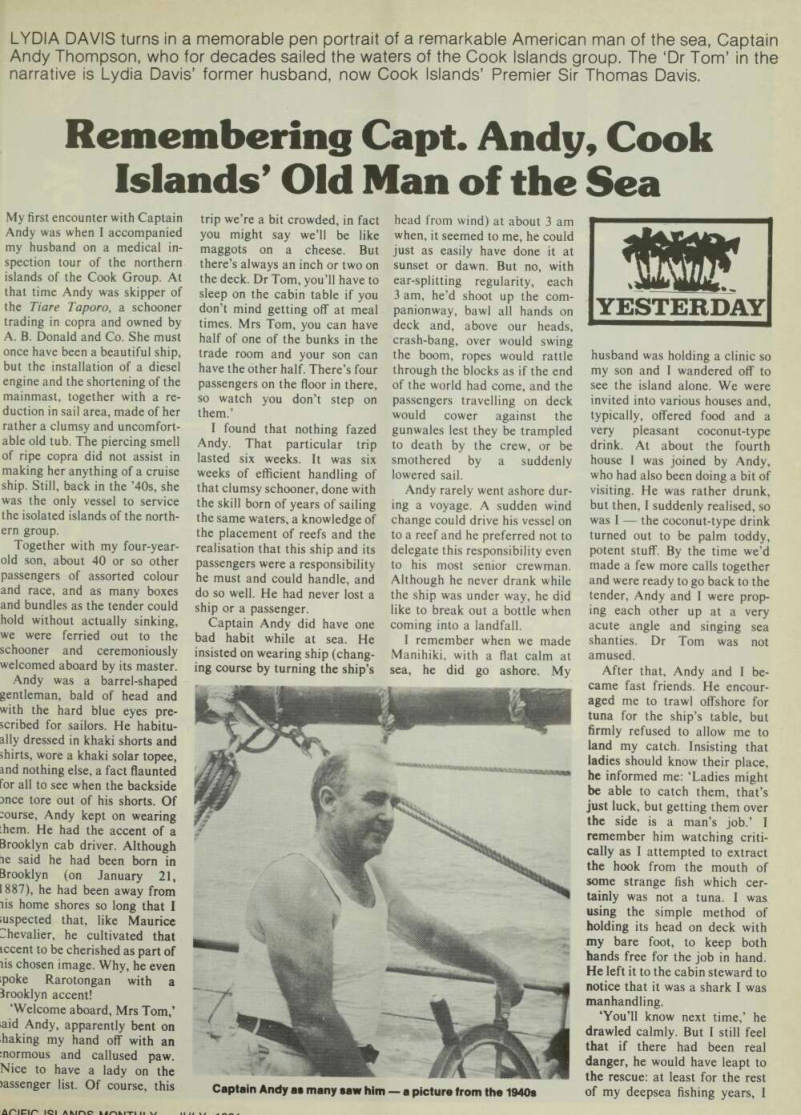
Islands’ Old Man of the Sea
Yesterday
LYDIA DAVIS turns in a memorable pen portrait of a remarkable American man of the sea, Captain Andy Thompson, who for decades sailed the waters of the Cook Islands group. The ‘Dr Tom’ in the narrative is Lydia Davis’ former husband, now Cook Islands’ Premier Sir Thomas Davis.
My first encounter with Captain Andy was when I accompanied my husband on a medical in spection tour of the northern islands of the Cook Group. At that time Andy was skipper of the Tiare Taporo, a schooner trading in copra and owned by A. B. Donald and Co. She must once have been a beautiful ship, but the installation of a diesel engine and the shortening of the mainmast, together with a re duction in sail area, made of her rather a clumsy and uncomfort able old tub. The piercing smell of ripe copra did not assist in making her anything of a cruise ship. Still, back in the ’4os, she was the only vessel to service the isolated islands of the north ern group.
Together with my four-year old son, about 40 or so other passengers of assorted colour and race, and as many boxes and bundles as the tender could hold without actually sinking, we were ferried out to the schooner and ceremoniously welcomed aboard by its master.
Andy was a barrel-shaped gentleman, bald of head and with the hard blue eyes pre scribed for sailors. He habitu ally dressed in khaki shorts and shirts, wore a khaki solar topee, and nothing else, a fact flaunted for all to see when the backside ance tore out of his shorts. Of :ourse, Andy kept on wearing ihem. He had the accent of a Brooklyn cab driver. Although ae said he had been born in Brooklyn (on January 21, 1887), he had been away from lis home shores so long that I inspected that, like Maurice chevalier, he cultivated that iccent to be cherished as part of lis chosen image. Why, he even ipoke Rarotongan with a Brooklyn accent! ‘Welcome aboard, Mrs Tom,’ aid Andy, apparently bent on baking my hand off with an mormons and callused paw.
Nice to have a lady on the lassenger list. Of course, this
trip we’re a bit crowded, in fact you might say we’ll be like maggots on a cheese. But there’s always an inch or two on the deck. Dr Tom, you’ll have to sleep on the cabin table if you don’t mind getting off at meal times. Mrs Tom, you can have half of one of the bunks in the trade room and your son can have the other half. There’s four passengers on the floor in there, so watch you don’t step on them.’
I found that nothing fazed Andy. That particular trip lasted six weeks. It was six weeks of efficient handling of that clumsy schooner, done with the skill born of years of sailing the same waters, a knowledge of the placement of reefs and the realisation that this ship and its passengers were a responsibility he must and could handle, and do so well. He had never lost a ship or a passenger.
Captain Andy did have one bad habit while at sea. He insisted on wearing ship (chang ing course by turning the ship’s
head from wind) at about 3 am when, it seemed to me, he could just as easily have done it at sunset or dawn. But no, with ear-splitting regularity, each 3 am, he’d shoot up the com panionway, bawl all hands on deck and, above our heads, crash-bang, over would swing the boom, ropes would rattle through the blocks as if the end of the world had come, and the passengers travelling on deck would cower against the gunwales lest they be trampled to death by the crew, or be smothered by a suddenly lowered sail.
Andy rarely went ashore dur ing a voyage. A sudden wind change could drive his vessel on to a reef and he preferred not to delegate this responsibility even to his most senior crewman.
Although he never drank while the ship was under way, he did like to break out a bottle when coming into a landfall.
I remember when we made Manihiki, with a flat calm at sea, he did go ashore. My
husband was holding a clinic so my son and I wandered off to see the island alone. We were invited into various houses and, typically, offered food and a very pleasant coconut-type drink. At about the fourth house I was joined by Andy, who had also been doing a bit of visiting. He was rather drunk, but then, I suddenly realised, so was I the coconut-type drink turned out to be palm toddy, potent stuff. By the time we’d made a few more calls together and were ready to go back to the tender, Andy and I were prop ing each other up at a very acute angle and singing sea shanties. Dr Tom was not amused.
After that, Andy and I be came fast friends. He encour aged me to trawl offshore for tuna for the ship’s table, but firmly refused to allow me to land my catch. Insisting that ladies should know their place, he informed me: ‘Ladies might be able to catch them, that’s just luck, but getting them over the side is a man’s job.’ I remember him watching criti cally as I attempted to extract the hook from the mouth of some strange fish which cer tainly was not a tuna. I was using the simple method of holding its head on deck with my bare foot, to keep both hands free for the job in hand.
He left it to the cabin steward to notice that it was a shark I was manhandling. ‘You’ll know next time,’ he drawled calmly. But I still feel that if there had been real danger, he would have leapt to the rescue: at least for the rest of my deepsea fishing years, I
Captain Andy as many saw him a picture from the 1940s
took care to hammer any shark to death before retrieving my hooks.
Andy’s home on Rarotonga was about eight kilometres from the main village, a handsome house that he had designed and built himself, and he loved nothing more than to hold court there. Sitting on the verandah around a beautiful table he had built from coconut wood, we would watch in respectful awe as he poured rum, squeezed limes, added just the right amount of sugar and water and philosophised on the state of the Cook Islands. In those days that state was far from satisfactory.
These evening sessions often ended unexpectedly. As a great treat, we once took the pilot of the bi-weekly aircraft to have dinner with Captain Andy. His wife, Nga, didn’t rush things and a lot of limes had been squeezed before soup was served. Perhaps the pilot was over-tired after the long day’s flight, because he quietly put his face into his full soup plate and went to sleep. Andy looked thoughtfully across the table. ‘Dr Tom, I think you’d better turn your friend’s head around.
He’d be better off breathing in air than soup.’ Calm as always.
On another occasion one of the guests decided he would walk home rather than wait to be driven. Unfortunately at the bottom of Andy’s drive, he turned left instead of right. Far be it from Andy to allow us to run down and steer him in the right direction. After an un steady 35-kilometre walk, the gentleman reached the main village in good time to go straight to his office. Andy liked that.
When my husband was sud denly picked up by the ambu lance to attend an emergency call, I was left to drive home in the hospital’s enormous old Buick. Of course Andy insisted that I have a little something for the road, and was quite de lighted when, soon after leav ing, I returned on foot to
announce that, miraculously,
the car was now firmly wedged between two large tombstones in the Catholic cemetery and would he please wake the house hold and haul it out before the island had a new scandal to munch on. Andy liked that too.
Andy seemed to prefer to stay in his own house. I don’t remember ever seeing him in anyone else’s home apart from our own. He had no love for the white civil servants who ran the Cook Islands in those days. He was friendly with the old-timers who had settled in the islands, but he disapproved of their lifestyle. He had established a fine home situation for his wife and large family, and he had no time for anyone who might be termed a beachcomber or who neglected his children. Apart from his own half-dozen off spring, he and his wife took in and cared for a string of youngsters who came and went at such a rate that no one, least of all Andy, quite remembered who was who.
Beneath this benevolent and hospitable exterior, what was this man really like? A very tough character indeed. He had learnt his sailing on square riggers going down the east coast of the Americas and round the bedevilled Horn.
He’d learnt that when an order was given, it must be implicitly obeyed, and that the ship’s master was indeed the master.
When he himself reached that status, he brooked neither con tradiction nor criticism, either at sea or ashore. There was only one opinion to be tolerated, his own, and that was to be taken very seriously. If the name of someone he disliked was men tioned, his whole face would close up, his eyes harden, his lips tighten and he would deliberately change the subject.
Although he doted on his only daughter, Christine, and always got along well with me, I don’t think Andy cared for women.
The only occasion when I in curred his wrath was when I asked him why he never invited his wife to join us around the verandah table. (Her presence could only be detected by her prompt compliance with his requests shouted somewhere towards the back of the house.) He did not deign to reply, gave me the usual cold look, and launched into a discussion of the lack of shipping in the outer islands.
But I am still bitterly disap pointed at something Andy did.
When my husband, having bought an ocean-going ketch,
started toying with the idea of making a mid-winter crossing of the South Pacific and then up to Boston on the Atlantic side, it was of course to Andy that he presented his sailing plan. ‘Well, Tom,’ said Andy thoughtfully. ‘Of course it’s never been done. Connor O’Brien tried it years ago, but I still think if he hadn’t smashed his hand four days out he could have made it, and he was no great sailor in my opinion.
That’s rough water down there and it’s damned cold, but it’s not unsafe water for a good sound ship like yours. If you forget the Horn and go up the Humboldt current to Panama, providing you don’t strike a hurricane, you should be OK. I only wish I could go with you.’
As usual, Andy had the last word, and my whining little objections were relegated to non-entity. Still, Andy was not then to know that we would strike no fewer than four hurricanes, not to mention two eyelones and assorted other misadventures. He kindly presented me with a set of navigation
tables, ancient but reliable, and sent me home to learn how to get from here to there, over water ... ‘ln case the skipper goes over the side,’ he said encouragingly.
Andy Thompson lived his life the way he wanted to live it, but he eventually had an important ambition left unfulfilled, His house was on the other side of the main road from White Sands Beach in Rarotonga, and whenever he was ashore, he liked to take a daily swim on that beach, of course without benefit of any personal covering. When vari ous capitalistic concerns chose to build a large hotel on his private swimming spot, he plot ted a delicious revenge. He de termined that on the opening day of this blight upon the land, he would sling a towel over his shoulder and stroll nude through the assembled guests, He never lived to do it.
He died at his home on Raro tonga on October 17, 1975, one of the oldest men in the Cook Islands at the age of 88 years and nine months.
Advertisements & other items, pp. 53-56 (2 items)
APlCir' ICI A MHC k iAkITI 11 w ■■ .. w .
Fujitsu Ten Limited
TEN
You just think you’re hard to please!
Take a look at this dazzling assortment of TEN”
products. Car stereos, cassette decks, tuners,
amps, speakers, graphic equalizers, marine
compo units— from the simplest to the most complex, the modestly priced to the super deluxe. When it comes to audio equipment, you may think you're a very tough customer to please. But we know better. With such
a fantastic variety of top-quality, feature-
packed products, you couldn't help but find what you’re looking for. We're willing to bet on it! :ri 9 3
ynrr-mrj
a r* i- £ •-S - Wd ■tin • i/A rnrrn i *
TfHVOK
I V
iiili
,r % S: IS .■ ;:r oo r
FUJITSU TEN LIMITED
Head Office:
2-28, Gosho-dori 1-chome, Hyogo-ku, Kobe, Japan
Tokyo Office (Export Section): Shuwa Onarimon Bldg,, 2nd FI., 1-1, Shimbashi 6-chome, Minato-ku, Tokyo, Japan Phone: (03)438-1611. Cable: TENFUJITSU TOKYO. Telex: 2425101 TENTOKJ
Distributors:
Papua New Guinea; CHIN H MEEN N SONS PTY., LTD. PO. Box 1106, Boroko, Port Moresby, Papua New Guinea. Phone: 256546.
Guam: MICROPAC AUDIO INC. PO Box 3478, Agana, Guam 96910. Phone: 472-8091, Tahiti: FARE HI-FI STEREO. PO. Box 269, Rue du Marechal Foch, Papeete.
New Hebrides: BURNS PHILP NEW HEBRIDES LIMITED. Vila, New Hebrides Cook Islands; AVATIU GENERAL TRADERS. PO Box 27, Rarotonga Fiji: D. GOKAL& CO., LTD. G PO. Box 501, Suva, Fiji, Phone: 25259/22995.
?t?uS3uEld
LOCAL AGENTS AND
REPRESENTATION
428 George St., Sydney.
Cables: Henco Sydney.
G.P.O. Box 3949.
Telephone: 232 5377.
For specialised and
personalised buying
service throughout
the Pacific Islands and the East.
Resident Agents in other Pacific Territories.
W$
PAPUA NEW GUINEA
RABAUL: M. & C. Seeto, P.O. Box 131, Rabaul.
Telephone 92 2919.
MADANG: W. Double, P.O. Box 22, Madang.
Telephone 82 2696.
FIJI
K. Witherington Ltd., P.O. Box 293, Suva.
Telephone 22 356.
VANUATU
John Lum & Associates, P.O. Box 65, Santo.
Telephone 329.
SOLOMON ISLANDS
Mr. Tom Lo, P.O. Box 327, Honiara.
Telephone 399
l* I u
\IAW
ff V\Si J i • 1 t i § ;
i [III
... - . * *. ~;v :
NEW:** *••• y pW
ZEALAND /#/ , f
*V W— •*“ ' ...
SSSSSSSSSsaS^SSSSSSS^
WE EXPORT PRODUCTS IN ALL OF THE FOLLOWING GROUPS.
Frozen meat, fish and seafood (bulk and portion control) Dairy products Canned fruit Dry groceries Beer, wines and spirits Cigarettes Electrical appliances Household products Electrical supplies Builders hardware Engineering supplies Motor vehicles and spares and much more!!
SE TATHAM &CO PIT LTD
LENSWORTH HOUSE (3RD. FLOOR) 176 QUEEN ST. MELBOURNE 3000.
PHONE (03) 67-5601/2/3/4. INT 61 3 602 3069 TELEX AA36992 (TATHAM) A SUBSIDIARY OF H.C. SLEIGH INDUSTRIES LIMITED MELBOURNE
Islands looking to new fuel sources
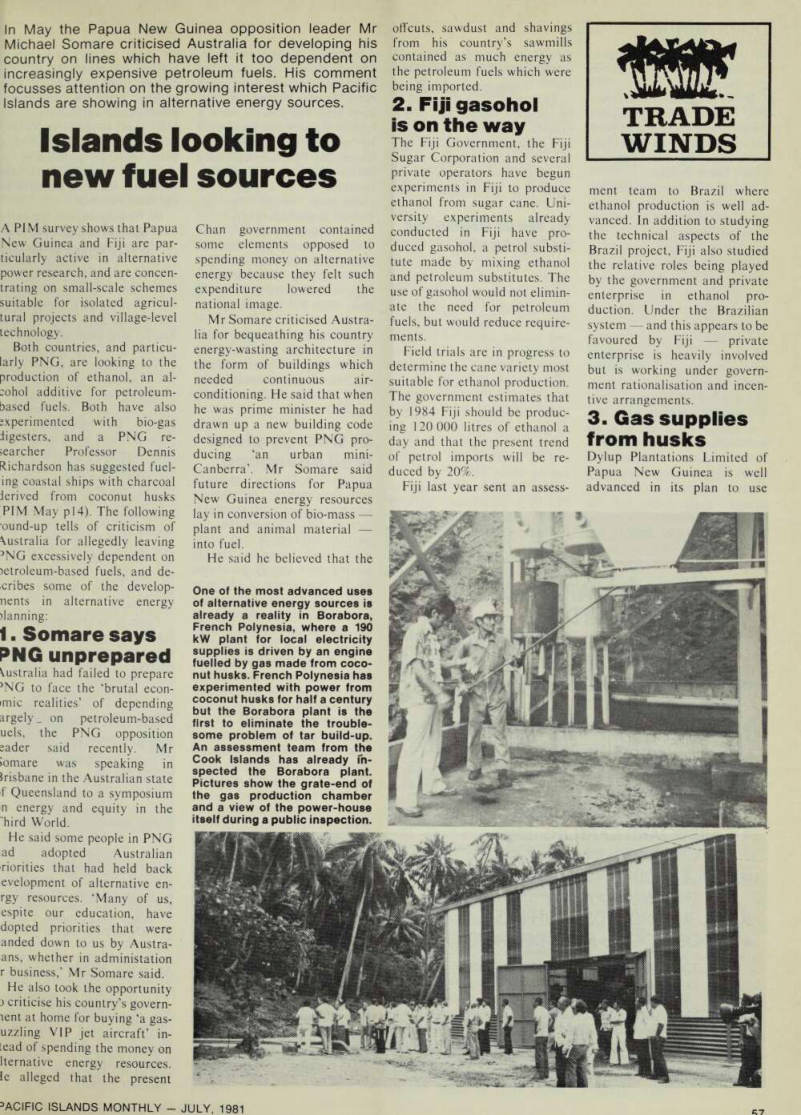
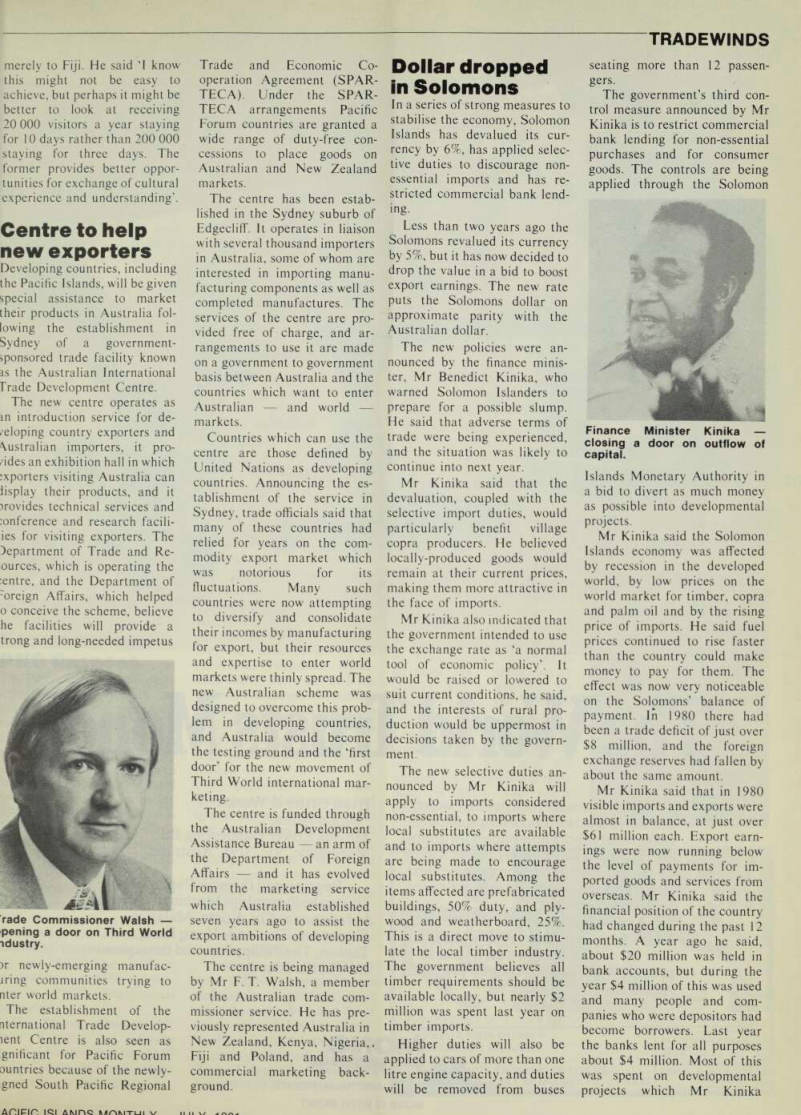

new fuel sources
Trade
Winds
In May the Papua New Guinea opposition leader Mr Michael Somare criticised Australia for developing his country on lines which have left it too dependent on increasingly expensive petroleum fuels. His comment focusses attention on the growing interest which Pacific Islands are showing in alternative energy sources.
A PIM survey shows that Papua New Guinea and Fiji are par ticularly active in alternative power research, and are concen trating on small-scale schemes suitable for isolated agricul tural projects and village-level technology.
Both countries, and particu larly PNG, are looking to the production of ethanol, an al :ohol additive for petroleum based fuels. Both have also experimented with bio-gas digesters, and a PNG re searcher Professor Dennis Richardson has suggested fuel ing coastal ships with charcoal derived from coconut husks PIM May p 14). The following •ound-up tells of criticism of \ustralia for allegedly leaving 3 NG excessively dependent on )etroleum-based fuels, and de scribes some of the develop nents in alternative energy banning:
1. Somare says
PNG unprepared
Australia had failed to prepare *NG to face the ‘brutal econ imic realities’ of depending argely on petroleum-based uels, the PNG opposition sader said recently. Mr iomare was speaking in Brisbane in the Australian state f Queensland to a symposium n energy and equity in the 'bird World.
He said some people in PNG ad adopted Australian riorities that had held back evelopment of alternative en rgy resources. ‘Many of us, espite our education, have dopted priorities that were anded down to us by Austra ans, whether in administation r business,’ Mr Somare said.
He also took the opportunity d criticise his country’s govern lent at home for buying ‘a gas uzzling VIP jet aircraft’ in- Lead of spending the money on Iternative energy resources, le alleged that the present
Chan government contained some elements opposed to spending money on alternative energy because they felt such expenditure lowered the national image.
Mr Somare criticised Austra lia for bequeathing his country energy-wasting architecture in the form of buildings which needed continuous air conditioning. He said that when he was prime minister he had drawn up a new building code designed to prevent PNG pro ducing ‘an urban mini- Canberra’. Mr Somare said future directions for Papua New Guinea energy resources lay in conversion of bio-mass plant and animal material into fuel.
He said he believed that the
offcuts, sawdust and shavings from his country’s sawmills contained as much energy as the petroleum fuels which were being imported.
2. Fiji gasohol
is on the way
The Fiji Government, the Fiji Sugar Corporation and several private operators have begun experiments in Fiji to produce ethanol from sugar cane. Uni versity experiments already conducted in Fiji have pro duced gasohol, a petrol substi tute made by mixing ethanol and petroleum substitutes. The use of gasohol would not elimin ate the need for petroleum fuels, but would reduce require ments.
Field trials are in progress to determine the cane variety most suitable for ethanol production.
The government estimates that by 1984 Fiji should be produc ing 120 000 litres of ethanol a day and that the present trend of petrol imports will be re duced by 20%.
Fiji last year sent an assess-
merit team to Brazil where ethanol production is well ad vanced. In addition to studying the technical aspects of the Brazil project, Fiji also studied the relative roles being played by the government and private enterprise in ethanol pro duction. Under the Brazilian system and this appears to be favoured by Fiji private enterprise is heavily involved but is working under govern ment rationalisation and incen tive arrangements.
3. Gas supplies
from husks
Dylup Plantations Limited of Papua New Guinea is well advanced in its plan to use
One of the most advanced uses of alternative energy sources is already a reality in Borabora, French Polynesia, where a 190 kW plant for local electricity supplies is driven by an engine fuelled by gas made from coco nut husks. French Polynesia has experimented with power from coconut husks for half a century but the Borabora plant is the first to eliminate the trouble some problem of tar build-up.
An assessment team from the Cook Islands has already in spected the Borabora plant.
Pictures show the grate-end of the gas production chamber and a view of the power-house itself during a public inspection.
substitute fuels in an attempt to overcome the mounting cost of petroleum fuels.
Dylup produces cocoa, coffee and copra from plantation properties in PNG and at pres ent relies heavily on diesel fuel for its copra driers and for rural power requirements.
Shareholders were told at last year’s annual meeting that re search had begun into methods of using cheaper fuels. At this year’s annual meeting, held in May, a further report indicated that a pyrolitic converter was now ready to be installed at Dylup, mainly for copra hot air processing.
The pyrolitic converter pro duces gas fuel from coconut husks, and the gas is used as the heat source for processing copra under clean and controlled con ditions. By-products from the converter include pyrolitic oil and high quality charcoal both of which are marketable fuels. The company eventually plans to use the by-products for generating electricity and for power requirements in cocoa processing. Diesel fuel is the
present source of energy for electricity supplies on the plan tation.
The converter is expected to be installed during July. New Guinea Industries Ply Ltd, the PNG University of Technology, the PNG government and the Mobil Oil Company have been involved in the development of the project.
4. New digester
in Fiji tests
A new type of bio-mass gas digester, developed in China, has been introduced to Fiji by the department of agriculture.
Bio-mass gas digesters use plant and animal waste to produce methane gas for cooking and lighting, and the conventional digesters which have already been tried in Fiji cost $5OOO to build and instal. The Chinese designed digester has been de veloped for single households and is smaller and simpler, costing about $BOO.
The design was brought to Fiji by a government agricul tural officer, Mr Soane Puamau, who recently attended
a four-week seminar in China.
The seminar and associated practical sessions dealt with rural digester technology, and gave details of how to build a type of digester now being used by seven million families in China. Mr Puamau supervised the building of the Fiji digester, installing it at a piggery in Lomaivuna owned by Mr Tomasi Daunikamakama.
Mr Daunikamakama’s fam ily is now using gas from the digester for cooking and heat ing, replacing kerosene as a fuel. He estimates he is saving more than $lB a week in fuel costs.
The digester is largely made from concrete reinforced by wire-netting. It uses a fixed collector dome of concrete in stead of the more usual floating dome of metal.
5. Energy plans
well advanced
Papua New Guinea’s research and development programme into renewable energy sources is now so well advanced that the country believes it can assist other Pacific Island countries in solving their energy problems.
Dr D. Newcombe of the min erals and energy department reported this in an address to an energy seminar at the Univer sity of PNG in Port Moresby.
Dr Newcombe told the sem inar ‘We have major hydro power, forest energy, agricul tural crop energy and direct solar energy potential far ex ceeding imported oil energy in total magnitude’. Desite this, oil imports were growing at about 5% a year and would cost over Kl2B million this year.
Dr Newcombe outlined the government’s efforts to develop economic production of locally available renewable energy sources, particularly alcohol fuel. The objectives of this programme are to blend ethanol with motor spirit up to 15% by volume, to establish vehicle fleets fuelled entirely by alcohol in government, major auth orities and industry, and to produce 30% of motor spirit equivalent by 1990. This would total about 130 million litres of ethanol.
A molasses-based ethanol plant is under consideration for the Ramu Valley as an annex to
the sugar industry and with a possible production of 12 million litres a year, a two million litre cassava-alcohol plant is under agricultural feasi bility study in the Sugu Valley, Southern Highlands, and nipa palm alcohol production is under an intensive three-year feasibility study at Baimuru in the Gulf Province.
Dr Newcombe said the early strategy was based on agricul tural crops but it was expected to move later to major renew able resources such as natural sago palm swamps, where pro duction could be a minimum of one billion litres a year, and natural nipa palm swamps with a potential of 230 million litres a year. Other sources were wood waste from major saw mills and forest operations.
In the area of industrial energy, Dr Newcombe said plans involved using wood fuels from wastes to provide partial or complete replacement of diesel, fuel oil and kerosene by changes to existing oil-burning equipment to allow multi-fuel combustion. Projects included commercial and small-scale charcoal production, gas pro duction from coffee cherry pulp and fuelwood production in swampland.
Projects to provide rural en ergy included provision of micro-hydropower to isolated
villages -
Maclaren Hiari in
Port Moresby.
Warning given
on tourism
The tourism minister in Fiji, Mr Ted Beddoes, has warned of a need for government controls to prevent tourism from inter fering with the national inter ests of the Fijian people. Mr Beddoes was speaking at the University of the South Pacific in Suva at the launching of a book tilled Pacific Tourism, As Islanders See It. The book, a research project by more than 20 authors, has been jointly published by the university and the South Pacific Social Sci ences Association.
Mr Beddoes appealed for the introduction of what he called ‘quality tourism’ rather than ‘volume tourism’. He said this argument applied to the South Pacific in general, and not
merely to Fiji. He said ‘I know this might not be easy to achieve, but perhaps it might be better to look at receiving 20 000 visitors a year staying for 10 days rather than 200 000 staying for three days. The former provides better oppor tunities for exchange of cultural experience and understanding’.
Centre to help
new exporters
Developing countries, including the Pacific Islands, will be given special assistance to market their products in Australia fol lowing the establishment in Sydney of a government sponsored trade facility known as the Australian International Trade Development Centre.
The new centre operates as an introduction service for de /eloping country exporters and \ustralian importers, it pro /ides an exhibition hall in which exporters visiting Australia can lisplay their products, and it arovides technical services and conference and research facili ies for visiting exporters. The department of Trade and Re ources, which is operating the centre, and the Department of 7 oreign Affairs, which helped o conceive the scheme, believe he facilities will provide a trong and long-needed impetus
Dr newly-emerging manufac iring communities trying to nter world markets.
The establishment of the nternational Trade Develop lent Centre is also seen as gnificant for Pacific Forum ountries because of the newly gned South Pacific Regional
Trade and Economic Co operation Agreement (SPAR TECA). Under the SPAR TECA arrangements Pacific Forum countries are granted a wide range of duty-free con cessions to place goods on Australian and New Zealand markets.
The centre has been estab lished in the Sydney suburb of Edgecliff. It operates in liaison with several thousand importers in Australia, some of whom are interested in importing manu facturing components as well as completed manufactures. The services of the centre are pro vided free of charge, and ar rangements to use it are made on a government to government basis between Australia and the countries which want to enter Australian and world markets.
Countries which can use the centre are those defined by United Nations as developing countries. Announcing the es tablishment of the service in Sydney, trade officials said that many of these countries had relied for years on the com modity export market which was notorious for its fluctuations. Many such countries were now attempting to diversify and consolidate their incomes by manufacturing for export, but their resources and expertise to enter world markets were thinly spread. The new Australian scheme was designed to overcome this prob lem in developing countries, and Australia would become the testing ground and the ‘first door’ for the new movement of Third World international mar keting.
The centre is funded through the Australian Development Assistance Bureau an arm of the Department of Foreign Affairs and it has evolved from the marketing service which Australia established seven years ago to assist the export ambitions of developing countries.
The centre is being managed by Mr F. T. Walsh, a member of the Australian trade com missioner service. He has pre viously represented Australia in New Zealand, Kenya, Nigeria,, Fiji and Poland, and has a commercial marketing back ground.
Dollar dropped
in Solomons
In a series of strong measures to stabilise the economy, Solomon Islands has devalued its cur rency by 6%, has applied selec tive duties to discourage non essential imports and has re stricted commercial bank lend ing.
Less than two years ago the Solomons revalued its currency by 5%, but it has now decided to drop the value in a bid to boost export earnings. The new rate puts the Solomons dollar on approximate parity with the Australian dollar.
The new policies were an nounced by the finance minis ter, Mr Benedict Kinika, who warned Solomon Islanders to prepare for a possible slump.
He said that adverse terms of trade were being experienced, and the situation was likely to continue into next year.
Mr Kinika said that the devaluation, coupled with the selective import duties, would particularly benefit village copra producers. He believed locally-produced goods would remain at their current prices, making them more attractive in the face of imports.
Mr Kinika also indicated that the government intended to use the exchange rate as ‘a normal tool of economic policy’. It would be raised or lowered to suit current conditions, he said, and the interests of rural pro duction would be uppermost in decisions taken by the govern ment The new selective duties an nounced by Mr Kinika will apply to imports considered non-essential, to imports where local substitutes are available and to imports where attempts are being made to encourage local substitutes. Among the items affected are prefabricated buildings, 50% duty, and ply wood and weatherboard, 25%.
This is a direct move to stimu late the local timber industry.
The government believes all timber requirements should be available locally, but nearly $2 million was spent last year on timber imports.
Higher duties will also be applied to cars of more than one litre engine capacity, and duties will be removed from buses
seating more than 12 passen gers.
The government’s third con trol measure announced by Mr Kinika is to restrict commercial bank lending for non-essential purchases and for consumer goods. The controls are being applied through the Solomon
Islands Monetary Authority in a bid to divert as much money as possible into developmental projects.
Mr Kinika said the Solomon Islands economy was affected by recession in the developed world, by low prices on the world market for limber, copra and palm oil and by the rising price of imports. He said fuel prices continued to rise faster than the country could make money to pay for them. The effect was now very noticeable on the Solomons’ balance of payment. In 1980 there had been a trade deficit of just over $8 million, and the foreign exchange reserves had fallen by about the same amount.
Mr Kinika said that in 1980 visible imports and exports were almost in balance, at just over $6l million each. Export earn ings were now running below the level of payments for im ported goods and services from overseas. Mr Kinika said the financial position of the country had changed during the past 12 months. A year ago he said, about $2O million was held in bank accounts, but during the year $4 million of this was used and many people and com panies who were depositors had become borrowers. Last year the banks lent for all purposes about $4 million. Most of this was spent on developmental projects which Mr Kinika
rade Commissioner Walsh pening a door on Third World [?]dustry.
Finance Minister Kinika closing a door on outflow of capital.
hoped would generate earnings to repay the loans in years ahead.
The decline in the economy has continued into 1981.
Solomon Islands foreign exchange reserves were now two-thirds of what they were at this time last year. Mr Kinika said the reserves stood at about $2O million which covered only two to three months of pay ments for goods and services. ‘We regard this as too tight for comfort’, he said.
The Solomon Islands govern ment recently invited the Inter national Monetary Fund to study the country’s economic and financial position. Mr Kinika said the government had been able to get finance from overseas for public and private sector investments. He believed the availability of funds would continue but the government had to ensure that the domestic monetary system continued to grow to provide the back-up and in-filling that specific project financing could not provide.
Mr Kinika also announced ;he government’s intention to >eek a syndicated Eurodollar oan of $2O million for capital development over two years.
George Atkin in Honiara.
New fears on
PNG finances
The Papua New Guinea oppo sition leader, Mr Somare, be lieves that deteriorating financial management in his country may force the Inter lational Monetary Fund to step n and supervise economic and inancial management. He said le was not making an empty political statement, but was ndicating a ‘serious possibility’ vhich he had learnt during a ecent visit to the United States capital, Washington.
Mr Somare said it had been nade obvious to him that the MF was becoming seriously mncerned at indications of un :ontrolled government spend ng in PNG. The IMF is nvolved because of its relation hip to PNG’s international >orrowing.
The finance minister, Mr ohn Kaputin, has already ssued a warning that ‘the IMF night come in if we don’t liscipline our expenditure’.
IMF officials made two rou tine inspections of PNG earlier this year. There are indications that they made some criticism of financial management, but there has been no official suggestion of intervention along lines feared by Mr Somare and warned of by Mr Kaputin.
In a statement late in May the deputy prime minister, Mr Okuk, claimed that PNG’s economy was troubled by short term problems but in the overview was in extremely good shape. He described current criticism of the economy as
‘politically alarmist’.
SPARTECA list
is widened
The Australian Government has added clothing, textiles and footwear to the list of goods being allowed free entry from the nations of the South Pacific Forum.
The schedule of goods is part of SPARTECA, the South Pacific Regional Trade and Co operation Agreement signed last year between the Pacific countries and Australia and New Zealand. When the list was announced at the Tarawa Forum meeting in 1980, cloth ing, textiles and footwear were omitted by Australia because they were under review by the Australian Industries Assist ance Commission. But with the reviews now completed, Austra lia has agreed to add certain products to the schedule, giving the Forum countries an advan tage over other developing nations.
A Department of Trade spokesman said the reviews had opened the way for Australia to add extra concessions, as it had intended at the time of the signing. He denied there had been criticism of the decision to withhold textiles and clothing from the schedule at first, although at the time it was reported to have upset several Forum members.
Australia and New Zealand took differing approaches to defining the terms of the agree ment. Australia drew up a list of goods covered for free entry, but New Zealand drew up a list of goods not covered. The New Zealand ‘negative’ list contains apparel and footwear, a de
cision which has already caused some criticism of New Zealand.
About 97% of Australia’s imports from the Pacific are already duty free. They were valued at about $74 million in 1979-80, with phosphate ac counting for $5l million of that.
The Trade Department spokes man said it was too soon to tell whether SPARTECA, which came into effect on January 1, had had any noticeable effect on the volume of Australian im ports from the Pacific.
The benefits of the agreement had always been seen as long term, he said. The scheme aimed to encourage investment in the islands and to promote exporting, and it would make it more difficult for Australia to back out of its special duty free arrangements in the future if it
ever wanted to.
Sue Green in
Melbourne.
SI unionists in
wages unrest
Seven trade unions mustered a demonstration of 3000 workers in May when they marched on the office of the Solomon Islands prime minister, Mr Kenilorea, and claimed he was no longer competent to govern.
The demonstration was sparked by general dissatisfaction over pay rates, coupled with anger at increases in parliamentary salaries. The government has refused a demand by the National Union of Workers for a rise of 180% on the minimum monthly wage. The present minimum is $35 and the workers are demanding a mini mum of $lOO. The rowdy demonstration outside the prime minister’s office was the
first since Mr Kenilorea led his country to independence Leaders of the demonstration delivered a petition to Mr Kenilorea’s office. In it they questioned ‘the honesty of a government which gives itself pay rises but is refusing to better the conditions of workers’.
The petition claimed that the minimum wage had fallen be low what was described as ‘the cost of survival’. It called for the appointment of a com
mission to review all salaries and wages, including those of public servants and pro fessionals in the public service.
It said that a nationwide strike would be organised if the gov ernment did not give some definite indication that it was acting on the demands.
Mr Kenilorea refused to ap pear before the demonstrators outside his office, but later he made a radio broadcast in which he described the demon stration as a political move designed to confuse the people.
He said that neither he nor his cabinet could act on the demands contained in the pet ition without a meeting of parliament. He criticised the unions for taking militant and
disruptive action
In the aftermath to the demonstration Mr Kenilorea’s United Party suffered defeat at a parliamentary by-election for one of the two Honiara seats.
The election was won convinc ingly by Gordon Billy Gatu of the union-backed National Democratic party. He defeated Francis Saemala, a close associ ate of the Prime Minister.
George Atkin in Honiara.
Tax review by
Fiji retailers
A committee of duty-free re tailers has been formed in Fiji to recommend goods from which the government should pro gressively withdraw the current import levy of 10%. The re tailers believe that although the scheme might initially lose some revenue for the govern ment, the overall boost which it would give to duty-free sales to tourists would create a net increase in exchange earnings.
The 10% levy was lifted from cameras in last year’s Fiji budget, and retailers claim this caused a significant increase in camera sales. They believe the same effect on other items would be created if the levy were relaxed. The committee is working in conjunction with the Fiji Visitors Bureau to draw up a list of goods for recommen dation to the government. The submissions are expected to be made in July.
About 60 representatives of the retailing industry attended a conference which discussed
duly free shopping in the con text of Fiji’s economy and their own business dealings. The con ference decided that there was a need for a higher level of training among shop assistants so that new technology goods could be explained to potential buyers. A report to the meeting written by the chairman of the Fiji Visitors Bureau, Mr Mahendra Patel, said that many shopkeepers were not researching the needs of their customers and a high level of training for shop assistants was not being maintained.
Delegates decided to ap proach equipment distributors in a move to arrange training facilities for shopkeepers and shop assistants dealing in new technology equipment.
The Bureau of Statistics sub mitted a report to the confer ence which showed that the share of tourist expenditure which went into duty-free shop ping in Fiji had dropped by more than 10% in the past five years. In 1975 duty-free shop ping accounted for 42% of the money spent by tourists, but by last year this had dropped to 30%. Responding to a survey conducted by the bureau, many tourists had complained that shopkeepers and stall-holders used ‘too much pressure’ in their attempts to make sales.
Profit up, but
bank cautious
The Australia and New Zea land Banking Group (PNG) Ltd has reported an interim profit increase of 58.2% to K 625 000. The bank is an 85%-owned subsidiary of the Australian-based ANZ Bank ing Group.
Despite the result the direc tors have warned that pressures on bank liquidity, official lend ing restraints and competition for deposits could have a dampening effect on the second half’s results.
The bank has declared an interim dividend of 15 toea a share, compared with 10 toea the previous year.
Directors said the buoyant result in the latest half-year period was aided by increased lending volumes and interest margins, and greater volumes of overseas borrowing.
Advertisements & other items, pp. 57-62 (5 items)
57
3 ACIFIC ISLANDS MONTHLY - JULY, 1981
The Rogers Paper Company
OF SYDNEY
MERCHANTS & CONVERTERS OF PAPER
SUPPLYING
• WHITE NEWSPRINT for meat wrapping, etc. • NEWSPAPERS overissued & once read.
Tabloid & Herald size. • TISSUE PAPER oil sizes & types. • SERVIETTES & D’OYLEYS single ply white, scolloped tissue.
• CARDBOARD CARTONS used
(thousands of sizes in stock).
• NEW CARDBOARD CARTONS & BOXES
stock sizes & mode to order.
• ALL PACKING AIDS & SUPPLIES.
• WOODWOOL & SHREDDED PAPER.
FOR TOP SERVICE 6 COMPETITIVE PRICES
CONTACT
10 MARTIN AVENUE,
ARNCLIFFE, N.S.W. 2205
AUSTRALIA
PHONE 597 5111 (6 LINES) REVERSE CHARGES
The World Trusts Mono
When it comes to providing water, the world trusts Mono Pumps. Mono make reliable bore hole pumps for almost every application, and any power source.
Mono Bore Hole Pumps raise clear, clean deep-well water and keep it flowing, year in and year out.
And with minimum of maintenance.
That’s why, in so many remote areas all over the world, people trust Mono to provide water-and to keep on providing water.
Head Office & Works: “Mono House”, 338-348 Lower Dandenong Rd., Mordialloc, Vic. 3195. Australia.
Represented through Papua New Guinea by Steamships Machinery. Agents in Indonesia, Fiji, Korea, Malaysia, Singapore, Thailand, Hong Kong, Taiwan, The Philippines, and throughout the Pacific Islands.
MONO
(AUSTRALIA) PTY. LTD.
MOVE IT WITH MONO
PORT
MO or * Right in business ce * A traditioji! comfort and Tin food ♦ All rpoms airconditioned " * Restaurant * Ba * Banquet hall
C. NEUMANN
%\ manager Phone 21-2622
Stay at Aggie Grey’s . . . the South Pacific’s
legendary hotel.
Situated right in the heart of Western Samoa. Enjoy Poly nesian-style friendliness and service, in cool surroundings, superb entertainment and food.
Magnificent white sand beaches only a short drive away. Airconditioned rooms, swimming pool and full bar facilities.
Bookings through Union Steamship Company of NZ. Pan Am, Air New Zealand or direct to Aggie Grey’s, Apia. Western Samoa. Cables: “AGGIES' Apia.
EXPORTERS OF FINE BEDDING TO THE PACIFIC ISLANDS
* PAPUA NEW GUINEA
* SOLOMON ISLANDS
•VANUATU
Contact; WEST TASMAN TRADERS
P.O. BOX 709 PORT MORESBY Ph. 21 4332
ALL OTHER AREAS
Contact
HEAD OFFICE
MATTRESS MAKERS
CABLE WONDEREST
BRISBANE
Sun- Kin
Sun Control Film
really keeps you cool!
in homes, offices, shops,
cars and boats
r~ V. rv
Transparent Solar 1
Film
• Bounces back up to 80% of solar heat and glare • Easy to apply sheets simple to install • Makes glass safer - increases shatter resistance For details apply General Sales Agents:
ROMA INTERNATIONAL
P.O. Box 417, Norwood, South Australia 5067.
Telephone: (08) 332 4252
Tradewinds
AHIFIP. IRI AMFIC MHMTUI V II II nn.
Tradewinds
AOiriO Io I * unn i ■■ » ...
Tradewinds
A /Mn y'-N IAI A A I f“N O I 1 UTI II \/ I I I I \ / A r\ O -4
Yachts
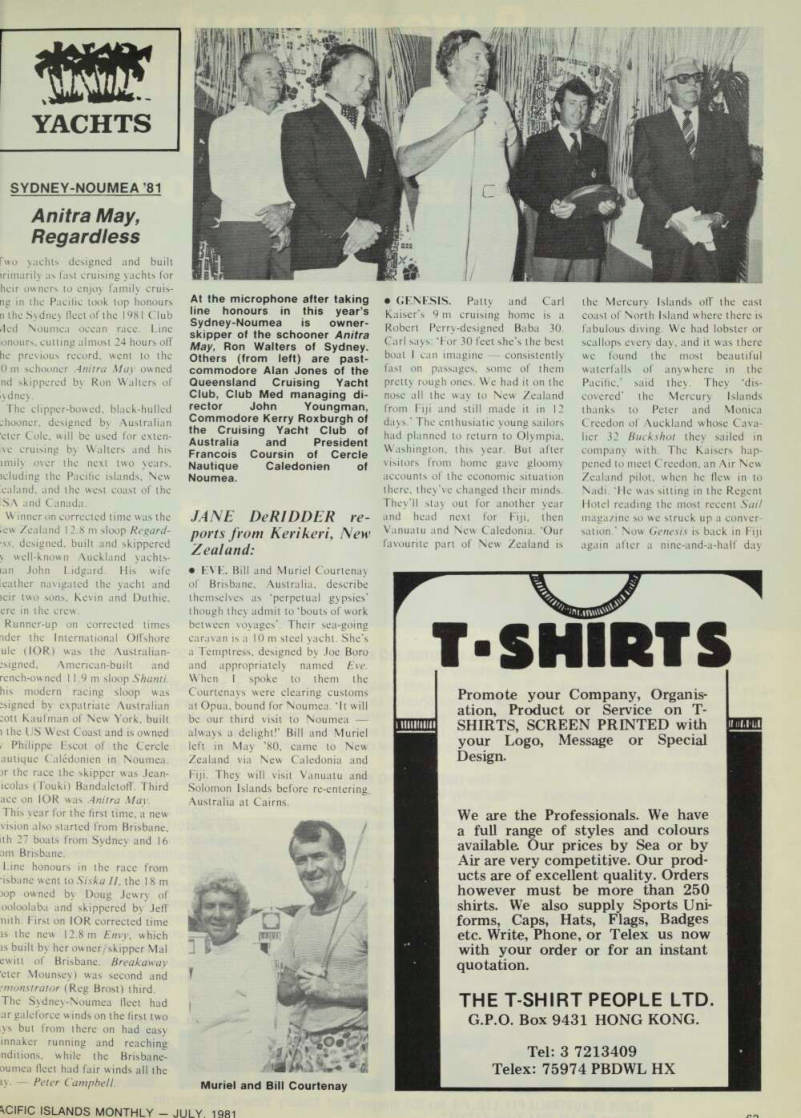

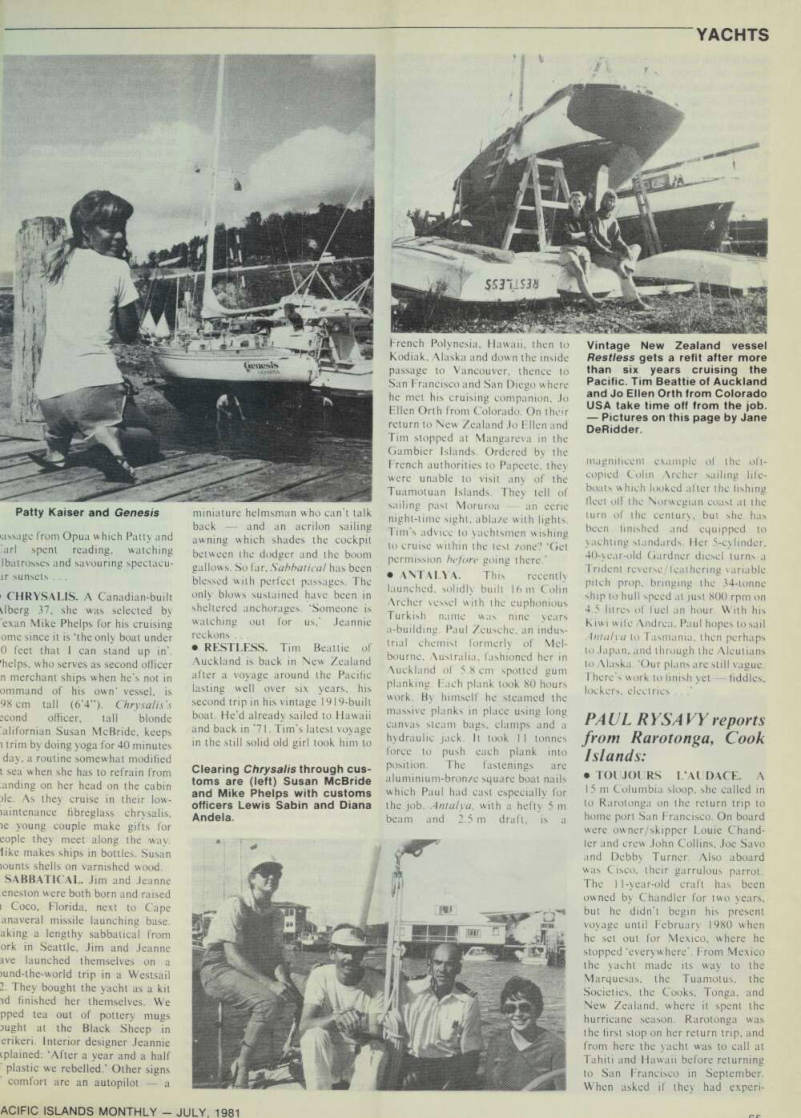
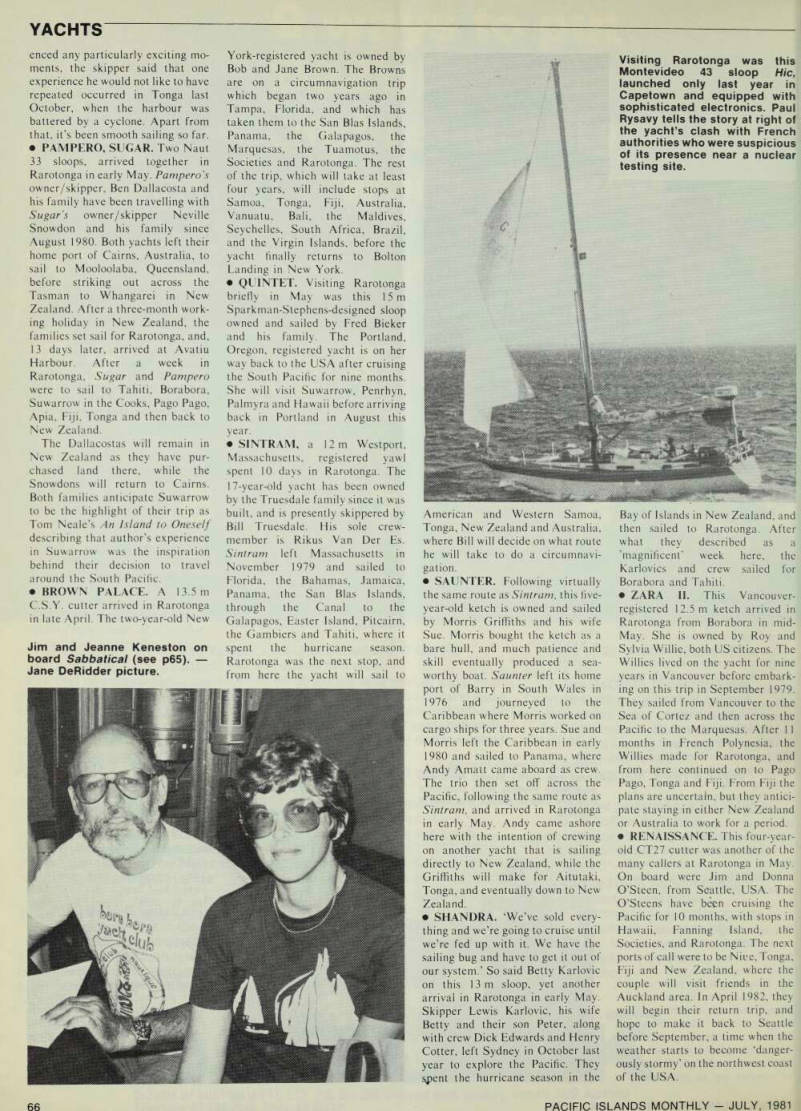
Sydney-Noumea’81
Anitra May, Regardless
fwo yachts designed and built trimarily as fast cruising yachts for heir owners to enjoy family cruis ng in the Pacific look top honours n the Sydney Heel of the 1981 Club Jed Noumea ocean race. Line onours. culling almost 24 hours olf he previous record, went to the 0 m schooner Anitra May owned nd skippered by Ron Wallers of lydney.
The clipper-bowed, black-hulled :hooner, designed by Australian clcr Cole, will be used for exten ve cruising by Wallers and his imily over the next two years, icluding the Pacific islands, New Zealand, and the west coast of the iSA and Canada.
Winner on corrected lime was the lew Zealand 12.8 m sloop Regard 's. designed, built and skippered y well-known Auckland yachts lan John Lidgard. His wife leather navigated the yacht and icir two sons, Kevin and Dulhic, ere in the crew.
Runner-up on corrected times rider the International Offshore ule (IOR) was the Australian isigncd, American-built and rench-ow ned I 1.9 m sloop Shanti. his modern racing sloop was by expatriate Australian :01l Kaufman of New York, built 1 the US West Coast and is owned < Philippe Escol of the Cercle aulique Caledonien in Noumea. 3r the race the skipper was Jean icolas (Touki) Bandaletoff. Third ace on lOR was Anitra May.
This year for the first time, a new vision also started from Brisbane, ilh 27 boats from Sydney and 16 om Brisbane.
Line honours in the race from ■isbane went to Siska 11. the 18 m x»p owned by Doug Jewry of ooloolaba and skippered by Jeff nith. First on lOR corrected time is the new 12.8 m Envy , which is built by her owner/skipper Mai
ewitt of Brisbane. Breakaway
eler Mounsey) was second and ?monstrator (Reg Brost) third.
The Sydney-Noumea fleet had ar galcforce winds on the first two ys but from there on had easy innaker running and reaching nditions. while the Brisbane □umea fleet had fair winds all the iy. Peter Campbell.
Jane Deridder Re
ports from Kerikeri y New
Zealand:
• EV E. Bill and Muriel Courtenay of Brisbane, Australia, describe themselves as ‘perpetual gypsies’ though they admit to ‘bouts of work between voyages’. Their sea-going caravan is a 10 m steel yacht. She’s a Temptress, designed by Joe Boro and appropriately named Eve.
When I spoke to them the Courtenays were clearing customs at Opua, bound for Noumea. ‘lt will be our third visit to Noumea always a delight!’ Bill and Muriel left in May ’BO, came to New Zealand via New Caledonia and Fiji. They will visit Vanuatu and Solomon Islands before re-entering, Australia at Cairns.
• GENESIS. Patty and Carl Kaiser’s 9 m cruising home is a Robert Perry-designed Baba 30.
Carl says: ‘For 30 feet she’s the best
boat I can imagine consistently
fast on passages, some of them pretty rough ones. We had it on the nose all the way to New Zealand from Fiji and still made it in 12 days.’ The cnlhusiatic young sailors had planned to return to Olympia, Washington, this year. But after visitors from home gave gloomy accounts of the economic situation there, they’ve changed their minds.
They’ll slay out for another year and head next for Fiji, then Vanuatu and New Caledonia. ‘Our favourite part of New Zealand is
the Mercury Islands ofT the east coast of North Island where there is fabulous diving. We had lobster or scallops every day, and it was there we found the most beautiful waterfalls of anywhere in the Pacific,’ said they. They ‘dis covered’ the Mercury Islands thanks to Peter and Monica Crccdon of Auckland whose Cava lier 32 Buckshot they sailed in company with. The Kaisers hap pened to meet Crcedon, an Air New Zealand pilot, when he flew in to Nadi. ‘He was sitting in the Regent Hotel reading the most recent Sail magazine so we struck up a conver sation.' Now Genesis is back in Fiji again after a nine-and-a-half day
At the microphone after taking line honours in this year’s Sydney-Noumea is owner skipper of the schooner Anitra May , Ron Walters of Sydney.
Others (from left) are past commodore Alan Jones of the Queensland Cruising Yacht Club, Club Med managing di rector John Youngman, Commodore Kerry Roxburgh of the Cruising Yacht Club of Australia and President Francois Coursin of Cercle Nautique Caledonien of Noumea.
Muriel and Bill Courtenay
iassage from Opua which Patty and 'arl spent reading, watching Ibalrosscs and savouring spectacu ir sunsets . . . • CHRYSALIS. A Canadian-built Überg 37, she was selected by 'exan Mike Phelps for his cruising ome since it is ‘the only boat under 0 feet that I can stand up in', ‘helps, who serves as second officer n merchant ships when he's not in ommand of his own’ vessel, is 98 cm tall (6’4”). Chrysalis’s :cond officer, tall blonde
Californian Susan Mcßride, keeps
1 trim by doing yoga for 40 minutes day, a routine somewhat modified t sea when she has to refrain from anding on her head on the cabin ale. As they cruise in their low
taintenance fibreglass chrysalis,
le young couple make gifts for eople they meet along the way. like makes ships in bottles. Susan lounts shells on varnished wood.
SABBATICAL. Jim and Jeanne eneston were both born and raised i Coco, Florida, next to Cape anaveral missile launching base, aking a lengthy sabbatical from ork in Seattle, Jim and Jeanne ave launched themselves on a >und-ihe-world trip in a Westsail 2. They bought the yacht as a kit ad finished her themselves. We pped lea out of pottery mugs aught at the Black Sheep in erikeri. Interior designer Jeannie cplained: ‘After a year and a half ' plastic we rebelled.’ Other signs comfort are an autopilot a
miniature helmsman who can't talk back and an acrilon sailing awning which shades the cockpit between the dodger and the boom gallows. So far. Sabbatical has been blessed with perfect passages. The only blows sustained have been in sheltered anchorages. ‘Someone is watching out for us,' Jeannie reckons . . . • RESTLESS. Tim Beattie of Auckland is back in New Zealand after a voyage around the Pacific lasting well over six years, his second trip in his vintage 1919-built boat. He'd already sailed to Hawaii and back in '7l. Tim's latest voyage in the still solid old girl took him to
French Polynesia, Hawaii, then to Kodiak, Alaska and down the inside passage to Vancouver, thence to San Francisco and San Diego w here he met his cruising companion, Jo Ellen Orth from Colorado. On their return to New Zealand Jo Ellen and Tim stopped at Mangarcva in the Gambier Islands. Ordered by the French authorities to Papeete, they were unable to visit any of the Tuamotuan Islands. They tell of sailing past Moruroa an eerie night-time sight, ablaze with lights.
Tim's adviee to yachtsmen wishing to cruise within the test zone? ‘Get permission before going there.' • ANTALYA. This recently launched, solidly built 16 m Colin Archer vessel with the euphonious Turkish name was nine years a-building. Paul Zeusche, an indus trial chemist formerly of Mel bourne, Australia, fashioned her in Auckland of 5.8 cm spotted gum planking. Each plank look 80 hours work. B\ himself he steamed the massive planks in place using long canvas steam bags, clamps and a hydraulic jack. It look 1 1 tonnes force to push each plank into position. The fastenings arc aluminium-bronze square boat nails which Paul had cast especially for the job. Antalya, with a hefty 5 m beam and 2.5 m draft, is a
magnificent example of the oft copied Colin Archer sailing life boats which looked after the fishing Heel otf the Norwegian coast at the turn of the century, but she has been finished and equipped to yachting standards. Her 5-cylinder, 40-year-old Gardner diesel turns a Trident reverse/fealhering variable pilch prop, bringing the 34-tonne ship to hull speed at just 800 rpm on 4.5 litres of fuel an hour. With his Kiwi wife Andrea. Paul hopes to sail Antalya to Tasmania, then perhaps to Japan, and through the Aleutians to Alaska. “Our plans are still vague.
There's work to finish yet fiddles, lockers, electrics . . .'
PAUL RYSAVYreports
from Rarotonga , Cook
Islands:
• Touch Rs L’Audace. A
15 m Columbia sloop, she called in to Rarotonga on the return trip to home port San Francisco. On board were owncr/skippcr Louie Chand ler and crew John Collins. Joe Savo and Dcbby Turner. Also aboard was Cisco, their garrulous parrot.
The 11-year-old craft has been owned by Chandler for two years, but he didn’t begin his present voyage until February 1980 when he set out for Mexico, where he slopped ‘everywhere’. From Mexico the yacht made its way to the Marquesas, the Tuamotus, the Societies, the Cooks, Tonga, and New Zealand, where it spent the hurricane season. Rarotonga was the first slop on her return trip, and from here the yacht was to call at Tahiti and Hawaii before returning to San Francisco in September.
When asked if they had experi
Patty Kaiser and Genesis
Clearing Chrysalis through cus toms are (left) Susan McBride and Mike Phelps with customs officers Lewis Sabin and Diana Andela.
Vintage New Zealand vessel Restless gets a refit after more than six years cruising the Pacific. Tim Beattie of Auckland and Jo Ellen Orth from Colorado USA take time off from the job.
Pictures on this page by Jane DeRidder.
enced any particularly exciting mo ments, the skipper said that one experience he would not like to have repeated occurred in Tonga last October, when the harbour was battered by a cyclone. Apart from that, it’s been smooth sailing so far.
• Pampero, Sugar. Two Naut
33 sloops, arrived together in
Rarotonga in early May. Pampero’s
owner/skipper, Ben Dallacosta and his family have been travelling with
Sugar’s owner/skipper Neville
Snowdon and his family since August 1980. Both yachts left their home port of Cairns, Australia, to sail to Mooloolaba, Queensland, before striking out across the Tasman to Whangarei in New Zealand. After a three-month work ing holiday in New Zealand, the families set sail for Rarotonga, and, 13 days later, arrived at Avatiu Harbour. After a week in
Rarotonga, Sugar and Pampero
were to sail to Tahiti, Borabora, Suwarrow in the Cooks, Pago Pago, Apia, Fiji, Tonga and then back to New Zealand.
The Dallacostas will remain in New Zealand as they have pur chased land there, while the Snowdons will return to Cairns.
Both families anticipate Suwarrow to be the highlight of their trip as Tom Neale’s An Island to Oneself
describing that author’s experience
in Suwarrow was the inspiration behind their decision to travel around the South Pacific.
• Brown Palace. A 13.5 M
C.S.Y. cutler arrived in Rarotonga in late April. The two-year-old New
York-registered yacht is owned by Bob and Jane Brown. The Browns are on a circumnavigation trip which began two years ago in Tampa, Florida, and which has taken them to the San Bias Islands, Panama, the Galapagos, the Marquesas, the Tuamotus, the Societies and Rarotonga. The rest of the trip, which will take at least four years, will include stops at Samoa, Tonga, Fiji, Australia, Vanuatu, Bali, the Maldives, Seychelles, South Africa, Brazil, and the Virgin Islands, before the yacht finally returns to Bolton Landing in New York. • QUINTET. Visiting Rarotonga briefly in May was this 15 m
Sparkman-Stephens-designed sloop
owned and sailed by Fred Bieker and his family. The Portland, Oregon, registered yacht is on her way back to the USA after cruising the South Pacific for nine months.
She will visit Suwarrow, Penrhyn, Palmyra and Hawaii before arriving back in Portland in August this year. • SINTRAM, a 12 m Westport, Massachusetts, registered yawl spent 10 days in Rarotonga. The 17-year-old yacht has been owned by the Truesdale family since it was built, and is presently skippered by Bill Truesdale. His sole crew member is Rikus Van Der Es.
Sintram left Massachusetts in November 1979 and sailed to Florida, the Bahamas, Jamaica, Panama, the San Bias Islands, through the Canal to the Galapagos, Easter Island, Pitcairn, the Gambiers and Tahiti, where it spent the hurricane season.
Rarotonga was the next stop, and from here the yacht will sail to
American and Western Samoa, Tonga, New Zealand and Australia, where Bill will decide on what route he will take to do a circumnavi gation.
• SAUNTER. Following virtually
the same route as Sintram, this five year-old ketch is owned and sailed by Morris Griffiths and his wife Sue. Morris bought the ketch as a bare hull, and much patience and skill eventually produced a sea worthy boat. Saunter left its home port of Barry in South Wales in 1976 and journeyed to the Caribbean where Morris worked on cargo ships for three years. Sue and Morris left the Caribbean in early 1980 and sailed to Panama, where Andy Amatt came aboard as crew.
The trio then set off across the Pacific, following the same route as Sintram, and arrived in Rarotonga
in early May. Andy came ashore
here with the intention of crewing on another yacht that is sailing directly to New Zealand, while the Griffiths will make for Aitutaki, Tonga, and eventually down to New Zealand. • SHANDRA. ‘We’ve sold every thing and we’re going to cruise until we’re fed up with it. We have the sailing bug and have to get it out of our system.’ So said Betty Karlovic on this 13 m sloop, yet another arrival in Rarotonga in early May.
Skipper Lewis Karlovic, his wife Betty and their son Peter, along with crew Dick Edwards and Henry Cotter, left Sydney in October last year to explore the Pacific. They spent the hurricane season in the
Bay of Islands in New Zealand, and then sailed to Rarotonga. After what they described as a ’magnificent’ week here, the Karlovics and crew sailed for Borabora and Tahiti. • ZARA 11. This Vancouver registered 12.5 m ketch arrived in Rarotonga from Borabora in mid- May. She is owned by Roy and Sylvia Willie, both US citizens. The Willies lived on the yacht for nine years in Vancouver before embark ing on this trip in September 1979.
They sailed from Vancouver to the Sea of Cortez and then across the Pacific to the Marquesas. After 11 months in french Polynesia, the Willies made for Rarotonga, and from here continued on to Pago Pago, Tonga and Fiji. From Fiji the plans are uncertain, but they antici pate staying in either New Zealand or Australia to work for a period. • RENAISSANCE. This four-year old CT27 cutter was another of the many callers at Rarotonga in May.
On board were Jim and Donna O’Steen, from Seattle, USA. The O’Steens have been cruising the Pacific for 10 months, with stops in Hawaii, Fanning Island, the Societies, and Rarotonga. The next ports of call were to be N ice, Tonga, Fiji and New Zealand, where the couple will visit friends in the Auckland area. In April 1982, they will begin their return trip, and hope to make it back to Seattle before September, a time when the weather starts to become ‘danger ously stormy’ on the northwest coast of the USA.
Jim and Jeanne Keneston on board Sabbatical (see p65).
Jane DeRidder picture.
Visiting Rarotonga was this Montevideo 43 sloop Hie, launched only last year in Capetown and equipped with sophisticated electronics. Paul Rysavy tells the story at right of the yacht’s clash with French authorities who were suspicious of its presence near a nuclear testing site.
► HIC. West German-registered Hie was also in Rarotonga in May. fhe Montevideo 43 sloop was built n South Africa about eighteen nonths ago and was launched in
lapelown in January 1980. Owner/
kipper Detlef Martens and ohannes Diemmer set sail for Irazil. and then continued on to the Vest Indies, Panama, the Marquesas, and the Societies, /here they visited over 50 atolls in he Tuamotus. The two Germans in into a little strife in French olynesia, as they stayed close to angataufa Island during a bad orm. The problem is that angataufa is only 10 km away om Moruroa, and the French lilitary were not at all pleased that icy had come so close to the
aclear testing site. Another prob
m was that Detlefs profession is arine electronics, and Hie is
juipped with sophisticated elec
onic gear. The French suspected etlefs motives, and warned him to ;ep his yacht well away from loruroa. In Rarotonga Hie took /o additional crew aboard ernelte and Rainer Detering, also am West Germany, who had flown Rarotonga from Tahiti to join the cht. The itinerary includes stops Tonga, Fiji, Noumea and Austra i before Hie heads back to South
ica for modifications. Detlef icipates returning to West rmany in June 1982.
JHAMMY. This 15 m ketch was another visitor to Rarotonga in y. The yacht is owned by lliam Shamharl and he is ac ipanied by his wife Carol and ir son David. The Shamharts, 3 left San Francisco in October 9 to sail to Baja, the Marquesas, nch Polynesia and Rarotonga,
contemplating doing a circum
igation ‘depending on who’s iting where . . .’ iITANA IV. This 10 m Westsail ter, arrived Rarotonga from the ieties. Owner Russel Dunlop
bought the Oregon-registered yacht two years ago and has been cruising ever since. His sole crew member is Brazilian Patricio Levy. Russel began his voyage in July 1979 from San Francisco, and has since visited Hawaii, the Marquesas, the Tuamotus (‘great diving’), the Societies and the Cooks. Tonga, Fiji and Australia are next, and then Russ will decide whether he wishes to brave the Indian Ocean or return home the way he came. • TIRNANOG. Her name is Welsh for ‘Forever Young’, and she visited Rarotonga briefly in May. The Vancouver-registered Truenorth 34 sloop arrived here from Tahiti and is headed for Fiji, New Zealand and Australia.
Joan D. Pease Re
ports from Papeete ,
French Polynesia:
• Quintessence. A 16.7 M
fibreglass cutter equipped with just about everything you would need on a boat, is in French Polynesia with owner Eric Tarr and friends aboard.
The vessel left Newport Beach, California, last November and cruised down the coast of Mexico before crossing from Puerto Vallarla to Hivaoa, a trip which took 16 days and 10 hours. The cutter called at anchorages in the seven islands which comprise the Marquesas and then sailed to Tahiti. Quintessence is a Trade winds 55 hull with topsides and interior designed by Eric and built to his specifications. The vessel’s equipment includes a washing ma chine and dryer, whirlpool hot tub, a large freezer and refrigerator, satellite navigation, self-furling jib and self-tailing winches. When Eric leaves the Society Islands in July, he will sail to New Zealand, Australia, and Borneo. • HALCYONE. A 10.7 m ketch, she was designed and built by owner
Will Davis. The vessel has a flush deck and is cold-moulded with fibreglass over. Will also designed and built his tender, a Tahitian style pirogue which the fishermen in the Tuamotu and Marquesas Islands found appealing. According to Will he was offered much larger canoes in trade because his pirogue is constructed of fibreglass and in the outer islands the pirogues are usually made from plywood and last only about three years. Halcyone arrived in French Polynesia from Ventura, California, and spent seven months in the Marquesas, including four months in Fatuhiva.
The vessel then called at Manihi and Ahe in the Tuamotus before arriving in Tahiti. The ketch then headed for Suwarrow Island. • OSPREY. A 12.5 m wooden sloop, she was built by Ralph Wiley in Oxford, Maryland, 25 years ago.
Dan and Peggy Van Ginhoven took possession in 1971 and set sail from Chesapeake Bay in 1977. They spent a year calling at ports on the east coast of the US and then sailed
to the Bahamas, Haiti and Panama before crossing to the Marquesas Islands. The Van Ginhovens have spent the past year in French Polynesia and are now going to American Samoa, Western Samoa, Tonga, Fiji and New Zealand. ‘We are on a very slow circumnavi gation,' Peggy said. • MICHAEL STUART. The 9 6 m bilge keel sloop is in French Polynesia with owners Jim and Liz McCann aboard. The sloop is a Golden Hind built by Terry Erskine Yachts in Plymouth, England, and launched in July 1969. The McCanns began their cruise from
Chesapeake Bay, Maryland, in
October 1979 and travelled through the Intracostal Waterways before heading ofFshore to the Bahamas, Haiti and Jamaica. They passed through the Panama Canal in May 1980 and called at the Galapagos Islands before arriving in the
Marquesas where they stayed for
several months. Liz said that one of the highlights of their trip was stopping at the Galapagos Islands.
The animals have no fear of humans. It seems almost unnatu ral.’ Before arriving in New Zea land for the summer, they will cruise to the Cooks, Tonga and Fiji.
sail off Nukuheva in the rquesas is Zara 11, a 12.5 [?]tre ketch from Vancouver. e notes at left.
A flash flood in the Kerikeri River in New Zealand caused one death, wrecked the
Pendennis Slipway at Waipapa
Landing and damaged a num ber of cruising yachts. Shown above is the New Zealand yacht Kimmoana which was cast well above high tide level by the sudden rise in the river. Another casualty was the twin-keeled Magic Dragon shown below on the hard near Opua while undergoing repairs. A car washed into the river rolled under the yacht’s hull, taking out the windvane auxiliary rud der. Pictures by Jane DeRidder.
Advertisements & other items, pp. 63-68 (5 items)
\Cific Islands Monthly - July 1981
T-Shirts
Promote your Company, Organisation, Product or Service on T-
SHIRTS, SCREEN PRINTED with
your Logo, Message or Special Design.
We are the Professionals. We have a full range of styles and colours available Our prices by Sea or by Air are very competitive. Our products are of excellent quality. Orders however must be more than 250 shirts. We also supply Sports Uniforms, Caps, Hats, Flags, Badges etc. Write, Phone, or Telex us now with your order or for an instant quotation.
THE T-SHIRT PEOPLE LTD.
G.P.O. Box 9431 HONG KONG.
Tel: 3 7213409 Telex: 75974 PBDWL HX
9 ways to put
DeZURIK quality
and reliability
to work for you
I 1 1 I nr s % > 1. The DeZURIK® V-Port Ball Valve A rugged and unique control valve that combines high capacity and low cost. Offers precision control for a variety of applications to 740 psi with temperature ratings to 1000°F. Sizes V 2 ”-20”.
2. The DeZURIK PERMASEAL®
Plug Valve This simple, tough valve features a self-adjusting plug that compensates for wear and temperature changes, plus ‘‘true top entry” for in-line maintenance.
Bi-directional shutoff to 1480 psi.
ANSI 150, 300 and 600 in sizes 1/2 ”-6”. 3. The DeZURIK C Series Knife Gate A proven performer in the toughest abrasive and corrosive services. Available with lever, handwheel, electric motor, on-off or positioning cylinder actuators.
Sizes 2”-72”.
4. The DeZURIK FIG 660 RS
Butterfly Valve A unique seat design ensures bidirectional shutoff to 150 psi and a streamlined disc delivers high flow capacity. Choice of seat materials, actuators and wafer or lug in sizes 2”-12”.
5. The DeZURIK FIG 632 RS
Butterfly Valve The resilient seated butterfly valve that offers unequalled performance and an exclusive double-seat in sizes 2”-20”. Wide choice of actuators. Choice of wafer or lug body in all sizes: 2”-36”. 6. The DeZURIK HP Butterfly Valve A high performance valve that features an exclusive TFE/titanium seat design to assure a lasting, bubble-tight shutoff. Excellent corrosion resistance and temperature accommodation in sizes 2”-20”. ANSI 150 and 300 to 740 psi. 7. The DeZURIK Eccentric Valve 28 sizes and a host of options assure the exact combination for any application. Eccentric action delivers a lasting dead-tight shutoff in sizes from 1 / 2 ”-72”. 8. The DeZURIK 3-Way & 4-Way Valves Rugged performance for virtually any shutoff or switching application. Lever, handwheel, onoff or positioning cylinder available in sizes 3”-16”. 9. The DeZURIK Rotating Sensor Consistency Transmitter Electronic or pneumatic control assures unmatched sensing accuracy. Unique involute ribs are influenced only by stock consistency.
A UNIT OF GENERAL SIGNAL
DeZURIK
DeZURIK OF AUSTRALIA PTY. LTD . P.O. Box 204. Vineyard Road. Sunbury, Victoria 3429, Australia Tolpnhnno- 03.74/1.9944 Tplpy AA 33739
c
PACIFIC ISLANDS
TRANSPORT LINE
M.S. AFRICANSTARS
EXPRESS
CONTAINER
•REEFER
SERVICE
between U.S.
West Coast
ports
and 0
TAHITI SAMOA
PAPEETE
PAGO PAGO
APIA
Qeqeral SteanishJp QorporatioriiTD General Agents 400 California Street, San Francisco, CA, USA PAPEETE: Agence Maritime Internationale, Tahiti PAGO PAGO: Polynesia Shipping Services, Inc.
APIA: Burns Philp (South Sea) Company, Ltd.
FUEL INJECTION
AND ELECTRICAL SYSTEMS
SPECIALISTS FOR ALL
MARINE, COMMERCIAL,
INDUSTRIAL AND AUTOMOTIVE
INSTALLATIONS
CONTACT US BY TELEX FROM ANYWHERE IN THE PACIFIC FOR IMMEDIATE DESPATCH OF REPLACEMENTS AND SPARES FOR
BOSCH, BRYCE, CATERPILLAR, CAV, DIESEL KIKI,
GM, HOLSET, NIPPON DENSO, ROOSAMASTER,
AIR RESEARCH, SCHWITZER, SIMMS, DAHL FILTERS
We service and stock fuel pumps, injectors, turbochargers, governors, alternators, generators and starter motors for all applications. and
WOODWARD GOVERNORS
SIMMS DIESEL & ELECTRICAL SERVICES LTD.
P O BOX 11-114 ELLERSLIE
77 LEONARD ROAD PENROSE AUCKLAND
NEW ZEALAND
TELEX No NZ 60266 SIMMS
DAYTIME TEL,
AUCKLAND 591-159
EVENING TEL.
AUCKLAND 568-259
DIESEL SPECIALISTS
Yachts
ACIFIC ISLANDS MONTHLY - JULY, 1981
Yachts
3IFIC ISLANDS MONTHLY - JULY, 1981
W. Samoa
68
PACIFIC ISLANDS MONTHLY - JULY, 1981
Strike halts W. Samoa Continued from Page 13
Shipping
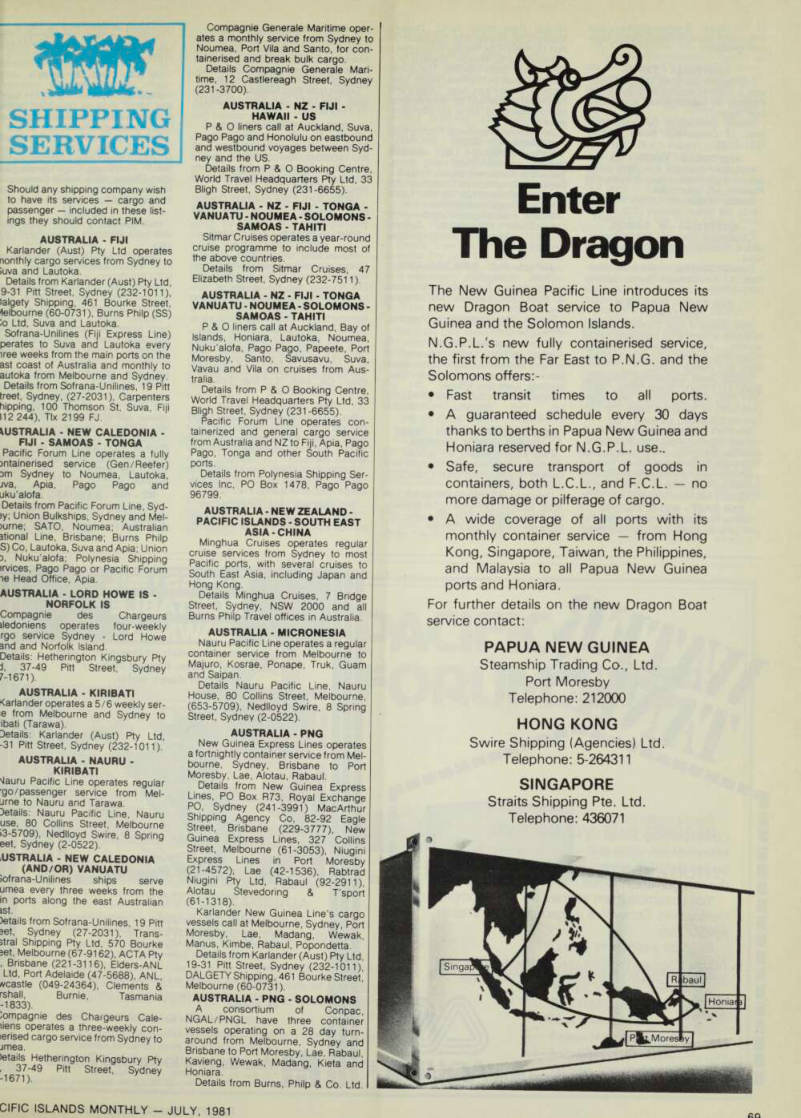


Services
Should any shipping company wish to have its services cargo and passenger included in these list ings they should contact PIM.
Australia - Fiji
Karlander (Aust) Pty Ltd operates nonthly cargo services from Sydney to iuva and Lautoka.
Details from Karlander (Aust) Pty Ltd, 9-31 Pitt Street, Sydney (232-1011), lalgety Shipping, 461 Bourke Street, lelbourne (60-0731), Burns Philp (SS) lo Ltd, Suva and Lautoka.
Sofrana-Unilines (Fiji Express Line) perates to Suva and Lautoka every iree weeks from the main ports on the ast coast of Australia and monthly to autoka from Melbourne and Sydney.
Details from Sofrana-Unilines, 19 Pitt treet, Sydney. (27-2031), Carpenters hipping, 100 Thomson St, Suva, Fiji 112 244), Tlx 2199 FJ.
Australia - New Caledonia -
Fiji - Samoas - Tonga
Pacific Forum Line operates a fully )ntainerised service (Gen/Reefer) am Sydney to Noumea, Lautoka, jva, Apia. Pago Pago and uku’alofa.
Details from Pacific Forum Line, Syd }y; Union Bulkships, Sydney and Mel >urne; SATO, Noumea; Australian stional Line, Brisbane; Burns Philp S) Co, Lautoka, Suva and Apia; Union a, Nukualofa; Polynesia Shipping (rvices, Pago Pago or Pacific Forum ae Head Office, Apia.
Australia - Lord Howe Is -
Norfolk Is
Compagnie des Chargeurs iledoniens operates four-weekly rgo service Sydney - Lord Howe and and Norfolk Island.
Details: Hetherington Kingsbury Pty J. 37-49 Pitt Street, Sydney M 671).
Australia - Kiribati
Karlander operates a 5/6 weekly ser e from Melbourne and Sydney to ibati (Tarawa).
Details: Karlander (Aust) Pty Ltd, -31 Pitt Street, Sydney (232-1011),
Australia - Nauru -
Kiribati
vlauru Pacific Line operates regular •go/passenger service from Mel jrne to Nauru and Tarawa.
Details: Nauru Pacific Line, Nauru use, 80 Collins Street, Melbourne >3-5709), Nedlloyd Swire, 8 Spring eet, Sydney (2-0522).
Ustralia - New Caledonia
(And/Or) Vanuatu
Jofrana-Unilines ships serve umea every three weeks from the in ports along the east Australian iSt. details from Sofrana-Unilines, 19 Pitt set, Sydney (27-2031), Trans- Jtral Shipping Pty Ltd, 570 Bourke set, Melbourne (67-9162), ACTA Pty , Brisbane (221-3116), Elders-ANL Ltd. Port Adelaide (47-5688), ANL (049-24364), Clements & rshall, Burnie, Tasmania -1833). )ompagnie des Chargeurs Cale liens operates a three-weekly con lerised cargo service from Sydney to jmea. details Hetherington Kingsbury Pty , 37-49 Pitt Street, Sydney -1671). y
Compagnie Generate Maritime oper ates a monthly service from Sydney to Noumea, Port Vila and Santo, for con tainerised and break bulk cargo.
Details Compagnie Generate Mari time, 12 Castlereagh Street, Sydney (231-3700).
Australia - Nz - Fiji -
Hawaii - Us
P & O liners call at Auckland, Suva, Pago Pago and Honolulu on eastbound and westbound voyages between Syd ney and the US.
Details from P & O Booking Centre, World Travel Headquarters Pty Ltd, 33 Bligh Street, Sydney (231-6655).
AUSTRALIA - NZ - FIJI - TONGA -
Vanuatu - Noumea - Solomons -
Samoas - Tahiti
Sitmar Cruises operates a year-round cruise programme to include most of the above countries.
Details from Sitmar Cruises, 47 Elizabeth Street, Sydney (232-7511).
AUSTRALIA - NZ - FIJI - TONGA
Vanuatu - Noumea - Solomons -
Samoas - Tahiti
P & 0 liners call at Auckland, Bay of Islands, Honiara. Lautoka, Noumea, Nukualofa, Pago Pago, Papeete, Port Moresby, Santo, Savusavu, Suva, Vavau and Vila on cruises from Aus tralia.
Details from P & O Booking Centre, World Travel Headquarters Pty Ltd, 33 Bligh Street, Sydney (231-6655).
Pacific Forum Line operates con tainerized and general cargo service from Australia and NZ to Fiji, Apia, Pago Pago, Tonga and other South Pacific ports.
Details from Polynesia Shipping Ser vices Inc, PO Box 1478, Pago Pago 96799
Australia - New Zealand -
Pacific Islands - South East
Asia-China
Minghua Cruises operates regular cruise services from Sydney to most Pacific ports, with several cruises to South East Asia, including Japan and Hong Kong.
Details Minghua Cruises, 7 Bridge Street, Sydney, NSW 2000 and all Burns Philp Travel offices in Australia.
Australia - Micronesia
Nauru Pacific Line operates a regular container service from Melbourne to Majuro, Kosrae, Ponape, Truk, Guam and Saipan.
Details Nauru Pacific Line, Nauru House, 80 Collins Street, Melbourne, (653-5709), Nedlloyd Swire, 8 Spring Street. Sydney (2-0522).
Australia - Png
New Guinea Express Lines operates a fortnightly container service from Mel bourne. Sydney, Brisbane to Port Moresby, Lae, Alotau, Rabaul.
Details from New Guinea Express Lines, PO Box R 73, Royal Exchange PO, Sydney (241-3991) MacArthur Shipping Agency Co, 82-92 Eagle Street, Brisbane (229-3777), New Guinea Express Lines, 327 Collins Street, Melbourne (61-3053), Niugini Express Lines in Port Moresby (21-4572); Lae (42-1536), Rabtrad Niugini Pty Ltd, Rabaul (92-2911), Alotau Stevedoring & T’sport (61-1318).
Karlander New Guinea Line’s cargo vessels call at Melbourne, Sydney, Port Moresby, Lae, Madang, Wewak, Manus, Kimbe, Rabaul, Popondetta.
Details from Karlander (Aust) Pty Ltd, 19-31 Pitt Street, Sydney (232-1011), DALGETY Shipping, 461 Bourke Street, Melbourne (60-0731).
Australia - Png - Solomons
A consortium of Conpac, NGAL/PNGL have three container vessels operating on a 28 day turn around from Melbourne, Sydney and Brisbane to Port Moresby, Lae, Rabaul, Kavieng, Wewak, Madang, Kieta and Honiara.
Details from Burns, Philp & Co. Ltd.
51 Pitt Street, Sydney (2-0547) and Interocean Swire, 8 Spring Street, Syd ney. (2-0522).
Australia - Tahiti
Compagnie Generate Maritime oper ates a monthly service from Sydney to Papeete for containerised and break bulk cargo.
Details Compagnie Generate Mari time, 12 Castlereagh Street, Sydney (231-3700).
Australia - Tahiti - Us
Karlander operates a monthly cargo service from Melbourne and Sydney to Papeete, US west coast.
Details: Karlander (Aust) Pty Ltd, 19-31 Pitt Street, Sydney (232-1011).
Australia - W. Samoa
Compagnie Generate Maritime oper ates a monthly service from Sydney to Apia.
Details Compagnie Generate Mari time, 12 Castlereagh Street, Sydney (231-3700).
Far East - Fiji - New
Zealand
New Zealand Unit Express (NZUE) operates a fortnightly palletised cargo service from Manila. Keelung, Kaoshiung and Hong Kong to Lautoka.
Suva and thence to NZ.
Details from Carpenters Shipping, Suva (312-244), Burns Philp, Suva (311-777), P & O S.N. Co, Wellington (736-477) or Nedlloyd Swire Pty Ltd, Sydney (20-522).
Nedlloyd operates bi-weekly cargo service with four ships from Sourabaya, Jakarta, Bangkok, Port Kelang and Singapore to Suva and NZ ports Details from Nedlloyd (Aust) Pty Ltd, 8 Spring St, Sydney (27 3801), Burns Philp (SS) Co Ltd, Suva and Lautoka.
Far East - Mid-S. Pacific
China Navigation’s New Guinea Pa cific Line operates a regular container
service from Hong Kong, Taiwan, Manila, Port Kelang and Singapore to Port Moresby, Lae, Rabaul and Honiara monthly and to Wewak. Madang and Kieta every three months. The South Pacific Islands of Noumea. Santo, Vila, Papeete, Pago Pago, Apia, Tarawa and Nauru will be served by conventional service operating on a 60 day turn around.
Details from Steamships Trading Co., Port Moresby (21 -2000).
Kyowa Shipping Ltd, operates monthly services from Hong Kong, Taiwan, S. Korea and Japan, to Guam, Saipan, Solomons, New Caledonia, Fiji, Western and American Samoa, Tahiti, Cook Is., Tonga and Vanuatu.
Details: Hetherington Kingsbury Pty Ltd, 37-49 Pitt Street, Sydney (27-1671); Carpenters Shipping, Suva (312-244).
Japan - Fiji - New Zealand
China Navigation, operates a monthly service from main ports Japan to Suva and Lautoka and thence Noumea and NZ.
Details from Carpenters Shipping, Suva (312-244).
Japan - Png
Mitsui O.S.K. Lines operates a monthly service from main ports Japan and Port Moresby, Rabaul, Lae, Madang, Kieta and Kimbe.
Details from Robert-Laurie (PNG) Pty Ltd, Port Moresby (21-2466/ 21-1898).
New Caledonia - Fiji - West
Coast North America
PAD Line operates an approx. 3weekly ro-ro service from Noumea and Suva to Honolulu and West Coast USA and Canadian ports.
Details from Sofrana-Unilines SA, BP 1602, Noumea (27-51 -91), tlx NMO4B; W. R. Carpenter, 100 Thomson St., Suva (31-11-22), Tlx FJ2199.
Png - Inter - Mainport
Papua New Guinea Mainport Liner Services offer scheduled 10/20-day coastal liner services linking all PNG mainports with containerisation, reefer, heavy lift and transhipment facilities.
Details from PNG Mainport Liner Services, Box 1448 Lae PNG (42-3537) Tlx PNG 42465 ’ qija ..- OTLJ .. ...
Png - North Australia
Papua New Guinea Line offers a 60-day service from Port Moresby, Lae and Vammo to Darwin with through bills of lading from West Coast North American ports. Inducement calls at Weipe and Gove.
Details from PNG Shipping Corporation, Box 543. Port Moresby, PNG (21-1174), Tlx PNG 22269.
Png -Kiribati - Solomons -
West Coast Usa
Papua New Guinea Line offers a 60-day service from Port Moresby, Lae, Rabaul and Kieta to San Francisco and Los Angeles with inducement at Vancouver and stop-off calls at Tarawa and Honiara. Through bills from all PNG mainports and mini-bridge services to other US and Canadian destinations.
Details from PNG Shipping Corporation, Box 543, Port Moresby, PNG (21 -1174), Tlx PNG 22269; or from TFC Shipping, 100 California St, San Francisco. CA, USA (415 398-1604), Tlx
340958 Gts Ur Sfo
Png - Uk/Continent
Bank Line operates regular cargo service from Port Moresby, Oro Bay, Kieta, Rabaul, Kimbe, Madang and Lae to Hull, Hamburg, Rotterdam. Antwerp and Le Havre.
Details from Bank Line (A’asia) Pty Ltd, 51 Pitt Street, Sydney (27-2041); Bums Philp (PNG) Ltd, PNG ports.
Solomons - Uk/Continent
Bank Line operates regular cargo service from Honiara to Hull, Hamburg.
Rotterdam, Antwerp and Le Havre.
Details from Bank Line (A’asia) Pty Ltd, 51 Pitt Street, Sydney (27-2041); Trading Co, Honiara (389).
NZ - COOK IS - NIUE -
Tahiti
Shipping Corporation of NZ Ltd oper ates cargo services based on pallets and similar units from Auckland to Niue, Cook Islands and Tahiti.
Details from the Shipping Corp of NZ Ltd, PC Box 3420, Auckland (797-210), Waterfront Commission, PC Box 61, Rarotonga; Cook Islands; Niue Govt Offices, Niue Island Compagnie Maritime Polynesienne. BP" 368, Papeete, Tahiti.
Nz - Fiji
Reef operates a regular 18-day ser vice from Auckland to Suva and Lau toka.
Details from Reef Shipping Agencies PC Box 3382, Auckland, NZ (77-1221-3).
Pacific Line with one ship operates fortnightly ro-ro cargo service New Zea'and, Lautoka, Suva.
Details: Sofrana Unilines, 18 Cus toms Street, Auckland (773-279) PO Box 3614, Telex: NZ2313; Carpenters Shipping, Private Mail Bag, Suva (312244), Tlx. 2199 FJ.
NZ - FIJI - NORTH AMERICA (WC) Blue Star Line Ltd Pacific Coast con tainer services. Only direct service to and from New Zealand. Blue Star vessels call at Suva and Honolulu on NZ-US-West Coast voyages.
Details from Blueport ACT (NZ) Ltd, PO Box 192, Wellington (739-029) .
Burns Philp (SS) Co Ltd, GPO Box 355, Suva, Fiji (311-777). Tlx. FJ2168 Burship.
NZ - FIJI - SAMOAS - TONGA Pacific Forum Line operates a fully containerised three-weekly service (Gen/Reefer) from Auckland to Lau
toka, Suva, Apia, Pago Pago and Muku'alofa.
Details from Pacific Forum Line, Union Co, Auckland, Lau oka, Suva, Apia and Nuku’alofa; 3 olynesia Shipping Services, Pago 3 ago or Pacific Forum Line Head Office, Apia.
Nz - Tonga - Samoa
Warner Pacific Line operates a regliar cargo service from Timaru, )nehunga and Westport to Nukualofa, f avau and Apia with regular calls to laapai and Pago Pago.
Details from McKay Shipping Ltd, PO >ox 1372, Auckland, NZ; Warner Pacic Line, Box 93, Nukualofa, Tonga and leiafu, Vavau, Tonga; Polynesian Shiping Services, Box 1478, Pago Pago; nd Molua Folau Shipping Co, Box 171, Apia, W. Samoa.
NZ - N. CALEDONIA - FIJI -
Solomons - Png
Pacific Forum Line operates a fully Dntainerised service (Gen/Reefer) om Lyttelton, Napier, Auckland to jva, Lautoka, Honiara, Kieta. Lae and c . .
jckland ShinnirTnPmrJStiin Jivz
.rtSS' fSESIS C° rporat ? n of " Z '
jckland sff
adinn Co S
S&‘fcTS:
>rum Line Head Office, Apia.
I - N. CALEDONIA - VANUATU -
Png - Solomons
Sofrana Umlmes with three ships opates to Vila and Santo, to Honiara and ipua New Guinea and to Norfolk and and Noumea.
Details from Sofrana Unilines, 18 istoms Street, Auckland (773-279), ) Box 3614, Telex NZ2313.
Nz - Tahiti
Compagnie Tahitienne Maritime SA :h one ship operates monthly service iw Zealand - Papeete.
Details from Sofrana Unilines, PO Box 3614, 18 Customs St, Auckland (773-279). Tlx NZ2313.
Nz - Tonga - Samoas
Warner Pacific Line services Auckland - Nuku’alofa/Vavau/Apia/ Pago Pago fortnightly carrying general and freezer cargoes.
Details from McKay Shipping Ltd, Downtown House, 21 Oueen St, Auckland, PO Box 1372 (30-299), Cables MACSHIP, Telex NZ2554.
Europe - Tahiti -
New Caledonia
Compagnie Generate Maritime oper ates services from Europe and Mediter ranean ports to Papeete and Noumea using three ro-ro and multi-purpose vessels thus ensuring a bi-monthly sail ing to and from.
Details Compagnie Generate Mari time. 12 Castlereagh Street. Sydney (231-3700).
Europe - Tahiti - New
Caledonia - New Zealand
Aland *
Polish Ocean Lines offers regular mon,h ly sailings for containerised and breakbulk cargo from Hamburg, Ant werp’ Dunkirk and Rouen to Papeete, Noumea, New Zealand and return to
IX served' 0 Z
h Details from Sotama, BP 9170 Papeete (27805), Tlx. 296; SATO, BP C 2, Noumea (272094), Tlx. 051 NM PENOCEAN; Union Steamship Co of NZ, PO Box 50, Apia, Tlx. 25; Williams and Gosling, PO Box 79 Suva (312633), Tlx. 2163; Warner Pacific Line, PO Box 93, Nukualofa (21089) Tlx. 66219; Universal Shipping Agen cies, PO Box 2282, Auckland (30930), Tlx. 21517; H. C. Sleigh, 6-10 O’Con nell Street, Sydney 2000 (923 9201) Tlx. 20428.
EUROPE - TAHITI - W. SAMOA -
Fiji - N. Caledonia
Nedlloyd offers regular cargo ser vices from Northern Europe and UK to Papeete, Apia, Fiji and New Caledonia.
Details Nedlloyd (Aust) Pty Ltd, 8 Spring Street, Sydney (27-3801); Car penters Shipping, 100 Thomson St, Suva (312 244), Tlx 2199 FJ.
EUROPE - TAHITI - W. SAMOA - TONGA - FIJI - SOLOMONS - PNG -
Vanuatu
Columbus Line Reederei GMBH op erates 2-monthly service from Ham burg, Rotterdam, Antwerp, Dunkirk and Le Havre to Papeete, Apia, Nukualofa, Suva, Port Vila, Santo, Noumea, Honiara, Port Moresby, Kieta, Rabaul, Lae, and return to Europe.
Details from Columbus Overseas Services Pty Ltd, 333 George Street.
Sydney (290-2966), Columbus Mari time Services, 17 Albert Street, Auckland (77-3460); Carpenters Ship ping, 100 Thomson St, Suva (312 244), Tlx 2199 FJ.
Uk - N. Continent - Fiji
The Bank Line operates a regular 28 day cargo service from Hull, Hamburg, Bremen, Antwerp, Rotterdam and Le Havre to Suva and Lautoka.
Details from The Bank Line (A’asia) Pty Ltd, 51 Pitt Street, Sydney (27-2041); Burns Philp (South Sea) Co Ltd, Suva and Lautoka.
Uk/N. Continent - Png -
Solomons
The Bank Line operates a regular 28 day cargo service from Hull, Hamburg, Bremen, Antwerp, Rotterdam and Le Havre to Port Moresby, Lae, Madang, Kimbe, Rabaul, Kieta and Honiara and on inducement to Yandina.
Details from The Bank Line (A’asia) Pty Ltd, 51 Pitt Street, Sydney (27-2041); Burns Philp (PNG) Ltd, PNG ports; Trading Co Honiara.
Uk/N. Continent - Tahiti -
N. Caledonia - N. Hebrides
The Bank Line operates a regular 28 day cargo service from Hull, Hamburg, Bremen, Antwerp, Rotterdam and Le Havre to Papeete and Noumea.
Details from The Bank Line (A’asia) Pty Ltd, 51 Pitt Street, Sydney (27-2041); Ets A M Fare UTE, Papeete; Ets Ballande, Noumea.
US - FIJI - TAHITI - NZ -
Australia
The Bank and Savill Line Ltd, oper ates regular cargo services from US Gulf ports to Australia and NZ. Calls at Suva, Lautoka and Papeete on de mand.
Details from The Bank Line (A’asia) Pty Ltd, 51 Pitt Street, Sydney (27-2041) or Orient Shipping Services, 32 Bridge Street, Sydney.
Us - Hawaii - Micronesia
Philippines, Micronesia & Orient Navigation Co (PM&O Lines) operates regular container service on self sustained ship with ro-ro capabilities from Oakland, Portland and Honolulu to Majuro, Kosrae, Ponape, Truk. Saipan, Yap and Koror.
Details for Micronesia can be obtained from Larry Guerrero, PM&O Owners Rep. PO Box 803, Saipan, Ml
96950, Cable Commontime; Pm&O
Lines, 181 Fremont St. San Francisco, California 94105. Cable PMONAV.
Us - Hawaii - Nauru -
Micronesia
Nauru Pacific Line operates regular conventional/container and passenger service from San Francisco and Honolulu to Majuro, Ponape, Truk and Saipan Cargo is accepted for Nauru and Kosrai with transhipment at Majuro and Ponape.
Details from Nauru Pacific Line.
Nauru House, 80 Collins Street, Mel bourne (653-5709); North American
Maritime Agencies, 100 California St., >an Francisco, California 9411.
Us - Noumea - Fiji
PAD Line operates an approx i-weekly roro service from West Coast ISA and Canada to Noumea and luva.
Details from Sofrana-Unilines SA, BP 602, Noumea (27-51-91), Tlx NMO4B; R. Carpenter, 100 Thomson St, Suva 31-11-22), Tlx FJ2199; Trans-Austral hipping, Box R 232 PO, Royal xchange, NSW (27-2441), Tlx A 21204.
Us - Tahiti - Samoa
Pacific Islands Transport operates a /e weekly cargo service from North merica west coast ports to Papeete, ago Pago, Apia.
Details from Polynesia Shipping Ser ces Inc, PO Box 1478 Pago Pago 3799.
Polynesia Line operates container id general cargo service from US west last ports to Papeete and Pago ago.
Details from Polynesia Shipping Ser ies Inc., PO Box 1478, Pago Pago >799.
US - TAHITI - SAMOA - NZ - AUST Farrell Lines Inc. operate a fast reg ar lash/container cargo service from ast coast ports Canada/USA to ipeete and Pago Pago thence to NZ id Australia.
Details Wilh Wilhelmson Agency, dney, Melbourne and Brisbane, Tlx Cable FARSHIPS Sydney; ilgety (NZ) Ltd. Auckland and allington, Tlx NZ2445, Cable Auckland; Compagnie Mari le Polynesienne, Immeuble Franco :eanienne, PO Box 368, Papeete, hiti. Tel 26393, Tlx 258. FP ANSB poro, Cable OCEAN Papeete; eubuhl Maritime Service. PO Box 39, go Pago, Telephone 633-5121; : 782505.
Advertisements & other items, pp. 69-74 (3 items)
69
CIFIC ISLANDS MONTHLY - JULY, 1981
The Dragon
Enter
The New Guinea Pacific Line introduces its new Dragon Boat service to Papua New Guinea and the Solomon Islands.
N.G.P.L.'s new fully containerised service, the first from the Far East to P.N.G. and the Solomons offers:- • Fast transit times to all ports. • A guaranteed schedule every 30 days thanks to berths in Papua New Guinea and Honiara reserved for N.G.P.L. use.. • Safe, secure transport of goods in containers, both L.C.L., and F.C.L. no more damage or pilferage of cargo. • A wide coverage of all ports with its monthly container service from Hong Kong, Singapore, Taiwan, the Philippines, and Malaysia to all Papua New Guinea ports and Honiara.
For further details on the new Dragon Boat service contact:
PAPUA NEW GUINEA
Steamship Trading Co., Ltd.
Port Moresby Telephone: 212000
HONG KONG
Swire Shipping (Agencies) Ltd.
Telephone: 5-264311
SINGAPORE
Straits Shipping Pte. Ltd.
Telephone: 436071
* SM Aquila water tanks completely enclosed to ensure clean water and built to last from strong, durable galvanised steel.
You assemble them yourself from our comprehensive kits. Capacities range from 2300 litres to 49250 litres.
Send for a brochure today.
Aquila Engineering Division, 25 Pacific Highway, Bennetts Green, New South Wales, Australia.
Name Address P/code
AQ2O/2
AQUILA
FORESTMIL
PORTABLE
SAWMILL
Recent release new models are heavier duty with additional features. Powered by diesel engine or electric motor.
T A Forestmil produces any size accurate timber ready to use up to 12" x 9" x 24'.
Purchase price and operating cost of Forestmil is less than other sawing equipment with similar production capacity.
Forestmil reduces timber waste and also reduces log transport cost. Timber is sawn direct from the log in the forest.
Forestmil can be moved to a new location in one hour.
Forestmil will saw hardwood or softwood from logs of any diameter.
Over 1000 Forestmils are sawing timber in 23 countries.
Forestmil has been manufactured for 18 years.
For literature and prices please contact the manufacturers.
MacQuarrie Industries Pty.Ltd.
P.O. Box 20, Coburg 3058, Victoria, Australia.
Phone: 350-3411. Telex: 33729. Cables: Macbound, Melbourne
I Itt •# m V
PACIFIC
FORUM LINE
Regular and Reliable Container and Roll ■ ON - OFF Services
owned by the people
of the Forum Nations
MV FUA KAVEIMGA
MV FORUM SAMOA
MV FORUM NEW ZEALAND
With our head office in Apia, our regional offices in Suva, Auckland, and Sydney, and our network of agents, we cover the South Pacific to ensure your goods get to you or to your buyer on time.
We tranship also, to or from almost anywhere in the world.
NOMINATE PERFORMANCE: NOMINATE PFL
Agents in: Australia, New Zealand, Fiji, Tonga, Western Samoa, American Samoa, New Caledonia, Papua New Guinea, Solomon Is, Kiribati, Tuvalu, Vanuatu.
o u
PUT YOUR
FOOT DOWN.
DEMAND
TIMKEN
BEARINGS!
TIMKEN
REGISTERED TRADEMARK
If you’re hard headed about the bearings you use ... put your foot down!
Demand Timken " tapered roller bearings, and you’ll get the brand with proven quality, durability and performance.
The brand that’s given you a long run for your money, wherever it’s used.
On top of all this, you’ll benefit from our consistent supply, delivery, and sales and service engineering assistance available from Australian Timken and Authorized Timken" Bearing Distributors throughout the Pacific.
Another way of looking at it is that you’re not going to put your foot in it when you put your foot down and demand Timken bearings.
TIMKEN
REGISTERED TRADEMARK
TAPERED ROLLER BEARINGS
Authorised Timken R Bearing Distributors in the Pacific are: O. F. Nelson and Co. Ltd., APIA; Bearing Service Company Ltd., AUCKLAND; Niven Bearings Limited, AUCKLAND; United Enterprises Ltd., HONIARA; Sunbeam Transport Ltd., LAUTOKA; Nelle Cie SATMA, NOUMEA; P.N.G. Bearing Service, PORT MORESBY: Saravanua Import, PORT VILA; Burns Philp (South Sea) Company Ltd., SUVA. 4954 atx
Japan
S. Korea
Taiwan
Hong Kong
Singapore
To: Solomon, New Caledonia, Fiji, W. Samoa. A. Samoa, Tahiti. Cook Is.. Tonga, New Hebrides. Ellice Is Nauru : Guam. Saipan. Truk, Ponape, Majuro, Yap. Koror
T aiwan
Hong Kong
Singapore
To: Papua New Guinea, Other Pacific Islands.
Phillippine
KYOWA SHIPPING CO., LTD.
HEAD OFFICE: OSAKA ’
Phone'- «»•> J *-"- Okajima Bldg.. 7.1, Floor. 2-14. Ni.hlhon«.cM 1-cho™. Nishi-h,. Oe.k., Japan p hone: 06(53315821 (R.p.l Cab.es: "MARIQUEEN" Osaka Te.e,: 525*27! Sajos. J.
YOUR BUSINESS PARTNER
KYOWA
AGENTS
S. Korea: Dong Sue Shipping Co.. Ltd., Seoul Taiwan: Royal Steamship Corp., Ltd.. Taipei Hong Kong: Dahzun Enterprises Ltd.
Singapore: Ocean Shipping & Enterprses Pte., Ltd.
Phillippines: Sky International Inc.. Manila Mariansa Is: Martime Agencies of Pacific Ltd. Guam Truk; Truk Shipping Co., Truk Ponape: United Micronesia Development Association, Ponape Yap; Waab Transportation Co., Inc., Yap Koror: Belau Transfer & Terminal Co., Palau.
Solomon: Solomon Taiyo Ltd., Honiara New Hebrides: Pentecost Pacific S.A., Port Vila A. Samoa: Polynesia Shipping Services. Inc., Pago Pago W. Samoa: Morris Hedstrom Ltrom Ltd., Apia Tahiti: J.A. Cowan & Fils. Papeete Cooks: Eastern Associates Ltd., Rarotonga Tonga: E.M. Jones Ltd., Nukualofa PNG: Carpenter Shipping Agencies. Port Moresby. Rabaul Indonesia: P.T. Porodisa Raya Shipping Lines. Jakarta Sabah: KOH Han Ming & Forwarding Agent., Kotakinabalu Sarawak: Pan Sarawak Agencies Sdn. Bhd., Sibu & Kuching Australia: Hethenngton Kingsbury Pty. Ltd., Sydney. N.S.W.
Newzealand: Russell & Summers Ltd., Aukland Nauru: Nauru Cooperative Society., Nauru
WALKING DRAGLINE
DIESEL ELECTRIC
N.C.K. RAPIER
IIO'BOOM
Three yard bucket plus 4 yard bucket (as new) 6 cylinder Cummins diesel, direct drive to generator and electric motors. Long list of spares. Motor and electrics recently overhauled. PRICE: FOB $U5175,000 or at site $U5162,000 Terms 1/3rd deposit with order. Balance on L/C.
Machine available now. i Contact: Jamas Blackwood Associates 18 Minehaha Ave., Auckland 9 Phone 498 161 Auckland N.Z
REQUIRE
DRIED SHARK FINS
FOR PRICES AND
INFORMATION ETC.,
PLEASE WRITE TO:
S. DADDOW,
ASIA TONGA TRADING
66 JALAN KERUING,
SINGAPORE, 2880
TO JOB SEEKERS IN REMOTE AREAS
WE SUPPLY YOU WITH THE LATEST
JOB ADS FROM THE AUSTRALIAN &
INTERNATIONAL PRESS. QUARTERLY
SUBSCRIPTIONS $3O. WRITE BOX 1942,
TOWNSVILLE 4810. AUSTRALIA.
FLEETS
49ft Planked Ketch Rig Motor Sailer, profess bit 1966, major conversion 1977. 6 LX Gardner, diesel aux , Big Saloon, Master's Cabin aft, 2 toilets & showers, deep freeze & refrig . Radar, Auto Pilot etc $105,000.00
FLEETS
221 Esplanade, Wynnum
Central, Brisbane.
Cable FLEETS BRISBANE.
F. A.
STUDY GOD'S WORD
AT HOME
Send for free catalogue.
Emmaus Bible Corresp. Sch., P.O. Bok 904, Saipan, C.M. 96950
SONY
VIDEO RECORDERS
COLOUR CAMERAS
& PORTAPAKS
MOVIE TAPES
CLOSE CIRCUIT TV.
AH Enquiries Welcomed
INTERCAPE AUSTRALIA
19-21 Lonsdale St, Melbourne 3000, Aust.
,0 Produce
BECHE-DE-ME
j FISH MAW,
' SHARK FINS, etc.
For details please write to:
ASIA SEAFOOD Co. (
353 A Circuit Rd., Block 64, Singapore 1337. &** ! * u, i**&
Dific Islands Monthi Y _ Mi V Iqdi
DIFIC ISLANDS MONTHI Y mi v iqdi
Deaths
of Islands People
W.H. Brooksbank Walter Hugh Brooksbank, who died in Melbourne on May 16 at the age of 85, was the man behind the scenes in Australia’s Coastwatching organisation.
He carried out the mass of detailed work involved in build ing up the organisation from its inception to its peak during the Pacific War, when its behind thc-lines activities earned its wide acclaim.
Waller Brooksbank was born in South Australia and began his long career with the Austra lian Navy Office in Melbourne in 1913 as a civilian staff clerk.
After wartime service with the Australian Army (winning the Military Medal) he became senior naval intelligence clerk when the intelligence division was established by the Navy in 1922. Because, after the first
few years and right up to 1939, the post of Director of Naval Intelligence was not fulltime, it was Brooksbank who provided staff continuity in the division under the various directors.
By 1939, when Commander R.B.M. Long became fulltime director and Brooksbank was appointed his civil assistant, 800 coastwatching reporting stations were already estab lished in Australia and the Islands. The Islands stations were soon expanded through the work of Commander Eric Feldt in Port Moresby.
Brooksbank was a polite, quietly spoken, self-effacing man. When he once appeared unexpectedly on Guadalcanal during heavy fighting to straighten out some communi cations problems, his arrival was described by historian Walter Lord, in Lonely Vigil. this way: k A courtly gentleman in a Palm Beach suit and Panama hat sauntered ashore from the destroyer Colhoun. To the gawking, sweating, grubby Marines he looked like some thing from another world a guest, perhaps, at a quiet sum mer hotel and they watched
with amazement as he made his unperturbed way to Com mander Mackenzie’s Coast watching headquarters.’
He retired from the Navy Office after the war. Four chil dren survive him.
Mum Stuart Mum Stuart was Tahiti’s oldest hoteliere when she died earlier this year, aged 84.
Local folk say she had prob ably welcomed more people to the Papeete waterfront than the Tourist Board itself. She will be remembered for the friendly smile and kind word with which she welcomed her guests from all over the world. Her historic Hotel Stuart, a Papeete harbour landmark since 1926, is now operated by her only son. Bill.
John Cuthbert Potts In Sydney, Australia, on May 27, aged 72. Born at Richmond, New South Wales, Mr Polls worked with the Colonial Sugar Refining Co Ltd in Fiji from 1929 to 1963, except for two years during World War II when he was in Australia doing munitions work. He became
CSR’s chief manager in 1957, and managing director of South Pacific Sugar Mills Ltd when that company was formed in 1962.
Mr Potts was involved in many public activities in Fiji, serving on hospital boards, gov ernment committees, and the leading committees of various sporting bodies.
Iroij Lojelan Kabua At Ebeye, Kwajalein Atoll, Marshall Islands, on May 6, aged 102.
Iroij (King) Kabua, father of Marshall Islands President Amata Kabua, was one of the paramount chiefs and the senior elder in the traditional lines of the Marshall Islands.
In an official proclamation, the Marshalls Government hailed his long and active career of public service, saying; The Marshallese people will mourn his death and miss his wise counsel and guidance.’
It noted that Iroij Kabua was the first paramount chief to pay a personal visit to a US presi dent (the late Lyndon B.
Johnson), and that he had travelled extensively in the in terest of the people of the Marshalls throughout the USA, the Pacific, Japan and Southeast Asia.
It declared a period of mourning for Iroij Kabua last ing from May 8 to 17.
Len Noerr In Auckland, New Zealand, in April, aged 92.
Mr Noerr and his brother Bert went to Fiji in the 1920 s and for the next 30 years were well known as electricians and cinema-owners in Suva.
They bought the Universal Theatre in Pier St, opposite what was then the Pier Hotel, from the Bayly sisters, and around 1938 built the Regal Theatre in Victoria Parade.
Keenly interested in man> charities, through the Rotar> Club of Suva the two brothers were responsible for establish ing the first cinema for lepros> patients at the hospital which was then on Makogai island.
Len Noerr was for a numbei of years senior representative ol the United Grand Lodge ol England.
Captain Trevor Withers At the Defence Club, Suva, ir May, aged 79.
New Zealand-born Captair Withers had a varied career as £ stockbroker, pilot and cruise operator. He mixed a stock broking business in New Zea land before World War II wit! aviation, and was associatec with the Australian airman Sii Charles Kingsford Smith in ar unsuccessful attempt to estab lish a domestic airline in Nev Zealand.
After war service with the Royal New Zealand Air Force he arrived in Fiji in the late ’4O; to join another airman, Harok Gatty, in a failed tuna-fishing venture. Mr Gatty went back te aviation and started Fiji Air ways, now Air Pacific, while Captain Withers bought a for mer government launch anc turned it into a cruiser wit! which he began what became his internationally known Blue Lagoon Cruises, which is todaj a multi-million dollar business, He opened the almost inac cessible Yasawa island group te tourism for the first time, anc made the cruise one of the earb attractions which helped tour ism to grow into one of Fiji’s major industries.
Although he sold control of the business to fellow New Zealander Claude Miller in the ’6os, Captain Withers remainec a director of the company. Blue Lagoon today runs four large steel cruisers to the Yasawas.
Advertisements & other items, p. 73 (1 item)
3Ific Islands Monthly - .Ini Y 1Q«1
Advertisers Index
Asia Tonga Trading 74 Asia Seafood 74 Aviation Financial Services 33 Australian Timken 72 Air New Zealand 23 Aquila 46 Amatil 46 Aggie Grey's Hotel 61 British Aerospace 28- 29 Berkey, Robert L. 74 James Blackwood 74 China Navigation Co. 69 Clarion Shoji 16 Henry Cumines 55 Denon 18 Dezurik 64 Exported 22 Fleets 74 Fujitsu Ten 54 General Steamship Corp. 68 Goerman, Peter 74 Hawker Siddeley 26 Hitachi IFC Kyowa Shipping 73 Lawson Partners 48 Lonely Planet 49 McDonnell Douglas. 32 Mono Pumps 60 MacQuarrie Industries 70 National Insurance 44 NZ Dairy Board OBC Polynesian Airlines 24 Papua Hotel 61 Pacific Forum Line 71 Pioneer 4 Rogers, R.S. 58 Roma International 62 Short Bros. Aviation 34-35 Suzuki 12,50 Solair 36 Simms Engineering 68 Tatham 56 Thompson Exhibitions 20 T-Shirt People 63 T oyota 38— 39 Trio Kenwood 42 University of Sydney 49 Video Recorder Centre 74 Woodward Governor 52 Wonderest 61 Yamaha OBC
Advertisements & other items, pp. 74-76 (2 items)
74
PAncir iqi AMn.q monthi Y JULY. 1981 i
I Map
Learn more about the Pacific with Pacific Publications Maps
i
FBI
MAP
mam
MMF
mm h wm mimh Fold out maps of Pacific Islands, Fiji and Papua New Guinea. An excellent up-to-date reference in full colour. In plastic envelopes, $2.50 each or US $3.00 posted.
PACIFIC
PUBLICATIONS
P.O. Box 3408, GPO Sydney, 2001
SelSe"?
butter |rt * • ■ : r,, E R 'Or <ggT (V\ New Zealand I 3 V
W /* v/V >J
.r f,r£ ff /
tir ¥ " ' j
j
O9MAYBO
anchor g milk Utra-Fastansed <v £♦' V
CHIC WHEELS
Yamaha mopeds don’t really look like mopeds.
They’re fresher, ligher, cleaner, and a whole lot more fun. But the biggest reason people are buying them involves something more.
Most riders cite the low cost convenience. They see them as easy-riding alternatives for aroundtown trips. Sort of a free-form urban transportation. And with up to 40 kilometers per liter, petrol budgets go far further.
Another reason is superb human engineering.
Yamaha have used reams of market research and banks of computers to come up with the right arrangement of riding geometry and operating features. Things like automatic transmission, ‘sit-in’ comfort, lower center of gravity and quick maneuverability didn’t happen by chance. In short, Yamaha mopeds are an exemplary balance of function and form, designed to give you more while you spend less.
Yamaha modeds. Another example of how Yamaha makes living more convenient and life more exciting.
YAMAHA
YAMAMA MOTOR CO., LTD. 2500 shingai iwata shi shizuoka ken japan