Pacific

Advertisements & other items, p. 2 (1 item)
A symphony by nature.
' <J -V SI t i I m $-■ 11 m* % w \ ' S 'IB: Vj: - ' „ • ;■ '
Prelude in name only.
The new Honda Prelude is a car that dreams are made of. The car with all the value features you’ve always wanted: power, performance, and style, plus traditional Honda driving economy.
Over-sized bumpers with recessed side and turn indicators not only look smart, but combine safety with classic appearance.
Inside, surfaces are carefully color coordinated and finished in smooth, ss 0 cut-pile carpeting. Even the doors have the same luxurious carpet trim. And an electric sunroof with elegant smoked glass further emphasizes the Prelude’s already stunning looks.
Options include Hondamatic transmission with overdrive, an exclusive Honda power steering system, and sporty alloy wheels.
Prelude and symphony.
By Honda.
iONDA MOTOR CO., LTD. TOKYO, JAPAN
PAPUA NEW GUINEA: Steamships-Machinery P.O. Box 1, Port Moresby /TAHITI: Honda Distribution S.A.R.L. B.P 1665 Papeete/FIJI ISLANDS: Carpenters Motors 61-6 Foster St., Walu Bay. Suva/ KIRIBATI: Atoll Auto Stores PO. Box 71, Bairiki Tarawa/U.S. TRUST TERRITORY: United Micronesia Development Assn. PO. Box 238, Saipan, Marian Islands 96950/COOK ISLANDS! Cook Islands Motor Center Ltd. P.O. Box 74, Rarotonga/AMERICAN SAMOA: Holiday Motors, Parts and Service PO. Box 968, Pago Pag Haleck’s Service Center PO. Box 1138, Pago Pago/GUAM: Mark’s Motor Co., Inc. PO. Box DV, Agana/ WESTERN SAMOA: Motor Distributors (Samoa) Ltd. P.O. Box 571' Apia/SOLOMON ISLANDS: Trading Company (Solomon) Ltd. P.O. Box 114, Honiara/NEW CALEDONIA: Establissements Ballande Boite Postale No. C 4, Noumea Cedex NIUE ISLAND: Niue Island United Enterprises P.O. Box 4, Alofi/NAURU: Nauru Cooperative Society Republic of Nauru, Nauru Island, Central Pacific/ VANUATU: Santo Gs Centre Ltd. P.O. Box 45, Santo/TUVALU: Tuvalu Co-operative Wholesale Society P.O. Box Funafuti, Tuvalu/TONGA: Morris Hedstrom Ltd. P.O. Box 63. Nukualofa Tongjj
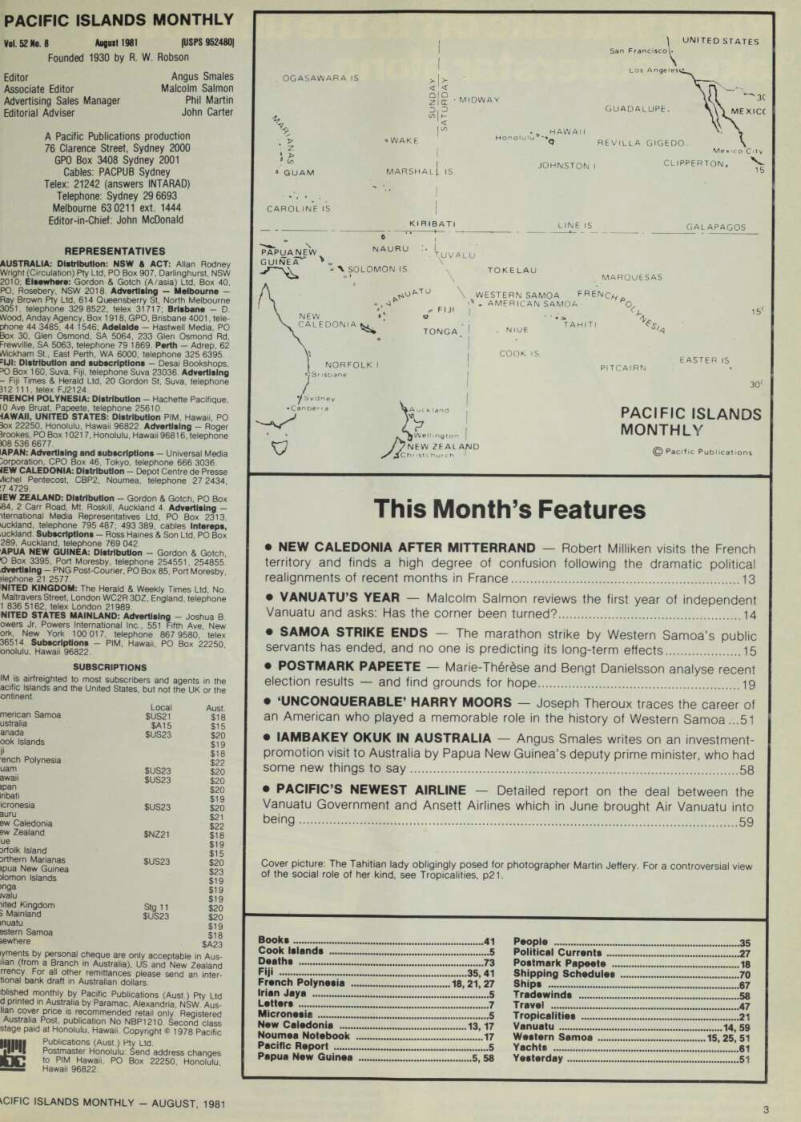
Pacific Islands Monthly
Vol. 52 No. 8
August 1981
(Usps 952480)
Representatives
AUSTRALIA: Distribution; NSW & ACT: Allan Rodney Wright (Circulation) Pty Ltd, PO Box 907, Darlinghurst, NSW 2010; Elsewhere: Gordon & Gotch (A/asia) Ltd, Box 40, PO, Rosebery, NSW 2018 Advertising Melbourne Ray Brown Pty Ltd, 614 Queensberry St, North Melbourne 3051, telephone 329 8522, telex 31717, Brisbane - D.
Wood, Anday Agency, Box 1918, GPO, Brisbane 4001, tele phone 44 3485, 44 1546; Adelaide - Hastwell Media, PO Box 30, Glen Osmond, SA 5064, 233 Glen Osmond Rd, Frewville, SA 5063, telephone 79 1869. Perth Adrep, 62 Wickham St., East Perth, WA 6000, telephone 325 6395.
“IJI: Distribution and subscriptions - Desai Bookshops, °0 Box 160, Suva, Fiji, telephone Suva 23036 Advertising - Fiji Times & Herald Ltd. 20 Gordon St, Suva, telephone 312 111, telex FJ2124 : RENCH POLYNESIA: Distribution - Hachette Pacifique, 10 Ave Bruat, Papeete, telephone 25610.
IAWAII, UNITED STATES: Distribution PIM, Hawaii. PO Box 22250, Honolulu, Hawaii 96822. Advertising Roger Brookes, PO Box 10217, Honolulu, Hawaii 96816, telephone 508 536 6677. lAPAN: Advertising and subscriptions Universal Media Corporation, CPO Box 46, Tokyo, telephone 666 3036 (EW CALEDONIA: Distribution Depot Centre de Presse 4ichel Pentecost, CBP2, Noumea, telephone 27 2434 17 4729. lEW ZEALAND: Distribution - Gordon & Gotch, PO Box 64, 2 Carr Road, Mt Roskill, Auckland 4 Advertising iternational Media Representatives Ltd, PO Box 2313, wckland, telephone 795 487; 493 389, cables Intereps, iuckland Subscriptions - Ross Haines & Son Ltd, PO Box 289, Auckland, telephone 769 042.
APUA NEW GUINEA: Distribution - Gordon & Gotch, 0 Box 3395, Port Moresby, telephone 254551, 254855 dvertislng - PNG Post-Courier, PO Box 85, Port Moresby, jlephone 21 2577.
NITED KINGDOM: The Herald & Weekly Times Ltd, No.
Maltravers Street, London WC2R 3DZ, England, telephone 1 836 5162, telex London 21989.
NITED STATES MAINLAND: Advertising - Joshua B owers Jr, Powers International Inc., 551 Fifth Ave New ork, New York 100 017, telephone 867 9580, telex 36514. Subscriptions PIM, Hawaii, PO Box 22250, onolulu, Hawaii 96822
Subscriptions
IM is airfreighted to most subscribers and agents in the acific Islands and the United States, but not the UK or the ontinent.
lyments by personal cheque are only acceptable in Aus ilian (from a Branch in Australia), US and New Zealand rrency. For all other remittances please send an inter tional bank draft in Australian dollars.
Wished monthly by Pacific Publications (Aust.) Pty Ltd d printed in Australia by Paramac, Alexandria NSW Aus han cover price is recommended retail only. Registered Australia Post, publication No NBPI2IO. Second class stage paid at Honolulu, Hawaii. Copyright © 1978 Pacific
Publications (Aust.) Pty Ltd.
Postmaster Honolulu; Send address changes to PIM Hawaii, PO Box 22250, Honolulu Hawaii 96822
Local Aust. merican Samoa $US21 $18 ustralia $A15 $15 anada
Sus23
$20 ook Islands $19 j' $18 ench Polynesia $22 uam
Sus23
$20 awaii $US23 $20 ipan $20 iribati $19 icronesia
Sus23
$20 auru $21 aw Caledonia $22 aw Zealand
Snz21
$18 ue arfolk Island $19 $15 arthern Marianas
Sus23
$20 ipua New Guinea $23 >lomon Islands $19 >nga $19 ivalu $19 lited Kingdom Stg 11 $20 > Mainland
Sus23
$20 muatu $19 astern Samoa $18 >ewhere $A23
This Month’s Features
• NEW CALEDONIA AFTER MITTERRAND Robert Milliken visits the French territory and finds a high degree of confusion following the dramatic political realignments of recent months in France 13 • VANUATU’S YEAR Malcolm Salmon reviews the first year of independent Vanuatu and asks: Has the corner been turned? 14 • SAMOA STRIKE ENDS The marathon strike by Western Samoa’s public servants has ended, and no one is predicting its long-term effects 15 • POSTMARK PAPEETE Marie-Thdrdse and Bengt Danielsson analyse recent election results and find grounds for hope 19 • ‘UNCONQUERABLE’ HARRY MOORS Joseph Theroux traces the career of an American who played a memorable role in the history of Western 5am0a...51 • lAMBAKEY OKUK IN AUSTRALIA Angus Smales writes on an investment promotion visit to Australia by Papua New Guinea’s deputy prime minister, who had some new things to say 58 • PACIFIC’S NEWEST AIRLINE Detailed report on the deal between the Vanuatu Government and Ansett Airlines which in June brought Air Vanuatu into being 59
Books 41 Cook Islands 5 Deaths 73 Fiji 35,41 French Polynesia 18,21, 27 Irian Jaya 5 Letters 7 Micronesia 5 New Caledonia 13,17 Noumea Notebook 17 Pacific Report 5 Papua New Guinea 5, 58
People 35 Political Currents 27 Postmark Papeete 18 Shipping Schedules 70 Ships 67 Tradewinds 58 Travel 47 Tropicalities 21 Vanuatu 14, 59 Western Samoa 15,25,51 Yachts 61 Yesterday 51
Advertisements & other items, pp. 3-4 (2 items)
Islands Monthly - August, 1981
Founded 1930 by R. W. Robson Editor Angus Smales Associate Editor Malcolm Salmon Advertising Sales Manager Phil Martin Editorial Adviser John Carter A Pacific Publications production 76 Clarence Street, Sydney 2000 GPO Box 3408 Sydney 2001 Cables: PACPUB Sydney Telex; 21242 (answers INTARAD) Telephone: Sydney 29 6693 Melbourne 63 0211 ext. 1444 Editor-in-Chief; John McDonald
take a superstar along.
When you take off to the unknown,
i : Next time you take off for parts unknown, add another dimension to your ventures. The new SoundTrek™ dimension by Pioneer.
A galaxy of out-of-this-world multi
band (FM/MW/SWVSW 2 ) radio-cassette
recorders designed to put great music
in your orbit.
Pioneer’s advanced hi-fi engineering
and solid audio craftsmanship make these stereo portables sound terrific.
There’s a galaxy of exciting sounds out there. Go exploring with SoundTrek from Pioneer.
SK-212F. Fashionable, Compact and dbnvenien Streamlined to go wherever you do. And so light and compact you’ll want to take your SoundTrek everywhere. Loaded with a high sensitivity FM tuner, and features; like a handy carryinc strap, a choice of 2 bands (FM/AM) and available' in a variety of fashionable colors.
SK-404F. Convenient Features for Stereo Fun.
SoundTrek SK-404F gives you a wide choice of convenient features to boost your listening pleasure. Like Pioneer’s exclusive DSS (Direct Source Selector) for instant mode changes (from tape to radio and vice versa). Music Search to automatically find and play the next number on your tape. Also the SK-606F. with the added plus of a digital clock/timer.
C.D PIONEER
SK-212F . ■■
v m I rig iiiiiiih, ;;
SK-404F
Hi-fi mobility through technology.
SoundTrek portables are displayed onfy at stores showing the emblem For further Information, please contact: Australia: Pioneer Marketing Service Pty. Ltd., P.O. Box 317, Mordialloc, Victoria, 3195 Tel: 90-9011 Fiji Islands: Brijlal & Company, G.P.O. Box No. 362, Suva, Fiji Islands Tel: 22258 New Zealand: Monaco Distributors Ltd., 30 Pollen Street, Grey Lynn, Auckland, New Zealand Tel: (09) 762 098 Norfolk Island: Burns Philp (Norfolk Island) Ltd., P.O. Box 21, Norfolk Island, New Hebrides: Burns Philp (New Hebrides) Ltd., Vila, New Hebrides Nauru Island: Jacob Enterprises, P.O. Box No. 4, Republic of Nauru Tahiti: Tahiti Hi-Fi, P.O. Box 848, Papeete, Tahiti New Caledonia: Menard Pacifique Sari, B.P. 3899, Noumea, New Caledonia Tel: 48-24.36 American Samoa: Transpac Corporation, P.O. Box 1477, Pago Pago, American Samoa 96799 Tel: 633-5224 Rarotonga: South Seas International Ltd., P.O. Box 49, Rarotonga, Cook Islands Tel: 23f Papua New Guinea: Bali Merchants Pty. Ltd., P.O. Box 6103, Boroko Tel: 254887
Pacific Report
Png ‘Deportee’ In Smoke
Papua New Guinea’s attempt to deport three Irian Jaya rebel leaders who had been living in permissive residence in the country ran into trouble in July when one of them went into hiding in Port Moresby. Two of the men Eleizer Bonay, a former governor of Irian Jaya, and Dean Kafiar were deported to Switzerland under an arrangement between the PNG Government and the United Nations High Commission for Refugees. But the third, John Hamadi, went underground before the due time for deportation, and was apparently being harboured by sympath isers among students at the University of PNG. Mr Hamadi, and student leaders, claim the deportation order is illegal anyway because he is by birth a Papua New Guinean. The deportation orders followed participation by a number of Irian Jayan ‘permissive residents’ in PNG in an unofficial South Pacific Human Rights Tribunal held at the university (PIM Jul p 6). The three men concerned took part in the tribunal, which vehemently Dondemned Indonesian policies in Irian Jaya. At press time, oolice had still not found Hamadi.
SLANDS PROTESTS AT S. AFRICAN RUGBY TOUR Fhe Cook Islands Government announced in mid-July it would not ;jrant transit visas to the South African Rugby team if it sought to and at Rarotonga airport. Rarotonga had been mentioned as a >top in one possible route by which the team could reach New Zealand for its highly controversial playing tour of that country, vhich is widely seen as condoning South Africa’s apartheid jystem. The Cooks’ move was seen as a particularly heavy blow o the New Zealand Government, given that country’s special elationship with the Cooks. Earlier, Fiji’s Prime Minister Ratu Sir (amisese Mara had announced a similar stand on any attempted ransit by the South Africans through Fiji. Criticism has also come rom the Papua New Guinea Government, which issued a itatement of stern diapproval of the tour, warning that it could Irive a wedge between Commonwealth countries. The Solomon slands Government has also protested. : IJI AGREES ‘IN PRINCIPLE’ ON SINAI : iji has accepted in principle an American request (PIM July p 5) or 600 soldiers to join a multi-national peace-keeping force to upervise the withdrawal of Israeli forces and civilians from the ►ccupied Sinai. Announcing this in Suva in June, Fiji’s Prime Minister Ratu Sir Kamisese Mara said Fiji’s involvement would not reate a precedent, as Fiji had participated in a Commonwealth orce in Zimbabwe in a similar peace-keeping exercise. Ratu /lara said that the proposed multi-national peace-keeping and •bserver force would supervise the disengagement process rranged between Israel and Egypt within the framework of the :amp David agreement. The request to be part of the 2000-man Dree, which may stay in the Sinai for two or three years, ‘gives s another opportunity to boost employment’. Ratu Mara said, lost of the cost of the force would be met directly by the US, with >rael and Egypt providing the balance.
Bipartite Research Plan On Marine Wealth
he US, Australia and New Zealand will conduct a geoscientific Dsearch programme to help South Pacific countries identify and evelop resources in their 200-mile zones and offshore seabeds. he survey was recommended last year by the Co-ordinating Committee for Joint Offshore Prospecting for Seabed Minerals in De South Pacific (CCOP/SOPAC), a subsidiary body of the Inited Nations Economic and Social Commission for Asia and ie Pacific (ESCAP). When ESCAP called upon UN members to ake an interest, the Soviet Union responded quickly and ivourably. Australia then with matching speed consulted several °uth Pacific governments and learned that they had what an fficial Australian Government statement said was ‘a clear reference that such research be undertaken by established
friends’. The three-party arrangement was then set up. A statement by the Vanuatu Government on the subject refuted press suggestions that it had been negotiating with the Soviet Union to do the work. The statement added that the plan for the three-party project should not be finally accepted without consultation with South Pacific countries, and, when agreed, should be conducted under ESCAP auspices.
Fiji, India In Satellite Accord
Fiji and India have signed a formal agreement allowing establishment and operation of a telemetry, tracking and telecommand earth station in Fiji. This follows a decision by the Fiji Cabinet to allow establishment of the station as part of a satellite project being undertaken by the Indian Space Research Organisation (ISRO). The project, code-named ‘Apple’, is for the design and construction of an experimental, body-stabilised geostationary communications satellite for domestic communi cation experiments.
Francis Sanford In Paris Talks
Francis Sanford, vice-president of French Polynesia’s Council of Government, flew to Paris in July for discussions with the new French Government. His aim: to persuade Paris to grant the territory full internal self-government on the Cook Islands model.
Such a course is now supported by all major political parties in French Polynesia. France’s new Minister for Overseas Depart ments and Territories was due to visit both French Polynesia and New Caledonia in July. For his part, the High Commissioner of France in the Pacific, Claude Charbonniaud, whose fiefdom is New Caledonia and Wallis/Futuna, had been called to Paris in June for consultations on the policies to be pursued in these territories by the government of President Mitterrand.
Marshalls Govt. Replies On British Loan
The Marshall Islands Government has issued a point-by-point rebuttal of a story in the Guam-based Pacific Daily News about the loan it has raised from Britain’s Midland Bank to finance a power plant (PIM Jul p 5). The News had suggested the loan was a ‘mystery’ affair. The Ml government statement claimed in reply: the decision to seek independent funding for a new power plant was made only after it was clear that Washington, specifically the Department of the Interior, was not going to help solve the Marshalls’ acute power supply problem; clearance for the approach to London for the loan had been granted by an official of the Department of State, Pacific Affairs Section, after exhaustive discussions; the loan had been approved by the Marshall Islands Cabinet, and, subsequently by the Nitijela (parliament): the Nitijela bill authorising the loan had been formally approved by the High Commissioner on December 23, 1980, as Public Law 1980-9. The statement appealed to the News, and its publishers the Gannett News Service, to shed an obvious obsession with ‘mystery’ and ‘secret’ loans.
Cook Islands Petition Refused
The Cook Islands’ Acting Head of State Sir Gaven Donne had ‘acted unconstitutionally’ in refusing a petition to block or delay the recent constitutional changes in the country (PIM Jul pl 9).
This claim is made by John Scott, chairman of the Petition Action Committee in a June letter to* Sir Gaven. The committee had sought to delay the Royal assent to the changes. Sir Gaven stressed that he was unable to intervene since ‘the will and process of parliament is paramount’, and ‘petitions to the Crown should be resorted to only after all legal remedies have been exhausted’. Main changes are that the Premier, Sir Thomas Davis, becomes Prime Minister, the Cook Islands Assembly is now the Parliament of the Cook Islands, and the duration of each parliament has been extended from four to five years. It is expected that general elections will now be held in 1983.
Islands Contact By U.S. Satellite?
A new Pacific Islands communications system using an American satellite may be the outcome of an international meeting held in Suva in June. Representatives from 12 countries in the region spent three days talking about rural telecommunciations needs.
The meeting, at the headquarters of the South Pacific Bureau for Economic Co-operation (SPEC), was called for by Island leaders at the South Pacific Forum meeting in Tarawa, Kiribati, last year.
SPEC organised it with the help of the Public Service Satellite Consortium of Washington, the US National Aeronautics and Space Agency (NASA), and the US Department of Commerce.
The Public Service Satellite Consortium is a private non-profit body which is working on space satellite communication systems for Micronesia.
Australian Islands Exports Up
Australian exports to several South Pacific countries increased by more than $9O million in the nine months to March 31, when compared with the corresponding nine months to March 30, 1980 $529 840 000 against $439 104 000. Imports from Australia by the various countries, with figures for the period to March 31, 1980, in brackets, were: Fiji, $122 442 000 ($lOO 875 000); Nauru, $9 965 000 ($8 898 000); New Caledonia, $3O 296 000 ($29 897 000); Vanuatu, $lO 176 000 ($ll 715 000); Papua New Guinea, $334 462 000 ($274 458 000); Solomon Islands, $22 499 000 ($l3 261 000).
Malaita Workers Form Union
A Malaita Provincial Workers’ Union has been registered in Solomon Islands. The union’s aim is to negotiate on conditions of service with the Malaita Provincial Assembly. The union has about 300 members, all provincial employees.
Two Fijians Die In Lebanon
Two Fijian soldiers serving with the United Nations Interim Force in Lebanon (UNIFIL) were shot in the back and killed in June by Palestinian guerrillas. A third solider was beaten up after being taken prisoner. UN spokesman Timor Goskel said the three Fijians were abducted after their position near the village of Kana, east of Tyre on the south Lebanese coast, was overrun by guerrillas. ‘This was cold-blooded murder,’ he said.
Vanuatu Marketing Board Set Up
Vanuatu’s Representative Assembly on July 2 approved a bill for the establishment of the Vanuatu Commodities Marketing Board tabled by Finance Minister Kalpokor Kalsakau. The minister said once the board is set up it is hoped that producers, particularly small farmers, will receive a more stable and a greater return for their produce. The board will additionally act as a buffer between overseas prices and domestic prices by introducing a price stabilisation scheme,’ he said. A spokesman for Burns Philp welcomed the decision, saying his company would do its utmost to co-operate with the board and ensure its successful operation.
Secession Mooted In Solomons
The old bogey of secession has raised its head in Solomon Islands, whre the Makira Ulawa Provincial Assembly, covering the islands of San Cristobal and Ulawa, has before it a resolution calling for secession and the establishment of a separate state.
First presentation of the resolution was aborted on the grounds of poor attendance at the assembly meeting. It was adjourned for discussion at a future, better-attended meeting.
COOKS PUSH ON WITH TAX HAVEN PLAN The Cook Islands definitely intends to go ahead with plans to establish offshore banking (tax haven) facilities in the country, according to Minister for Economic Development Vincent Ingram.
Negotiations are at present under way with New Zealand financial authorities to ensure that the scheme has no damaging effects on New Zealand’s monetary system. The talks were called at the request of the Cook Islands Government.
A BATTLE THAT’S NOT ON GAMES PROGRAMME A battle royal was shaping up on the sidelines of the July South Pacific Mini Games in Honiara (PIM Jul p 5) as Peter Paul, president of the Organising Committee for the 1983 South Pacific Games, prepared to ‘have it out’ in Honiara with Commander Stan Brown over the commander’s reported statement that Western Samoa will be ‘nowhere near ready to manage the Games by the time August 1983 rolls around’. Commander Brown is chairman of the South Pacific Games Committee. Said an irate Mr Paul as he boarded the plane at Apia on his way to Honiara: ‘Western Samoa will host the South Pacific Games.’ To build the Games facilities, Western Samoa has secured an interest-free loan of about SWS6 million from China.
Air Tungaru’S 727 In Action
Air Tungaru, flag carrier of the Republic of Kiribati, had the inaugural flight of its newly acquired Boeing 727 on June 11. The flight was on a turn-around basis from Honolulu/Christmas Island/Papeete and back. It is reported that the airline will also take over the Honolulu/Christmas Island/Tarawa and return run which was previously served by Air Nauru aircraft on charter to Air Tungaru.
116 974 People In The Ttpi
The Trust Territory of the Pacific Islands, excluding the Northern Marianas, has a population of more than 116 000, according to the US Census Bureau. The TTPI had a population of 116 974 in mid-September 1980, the bureau said. The 1970 population was 81 300. The census on the 2141 islands was taken on September 15, six months behind the main US head count. The TTPI, which
listed 18 558 housing units in 1980, includes the three Micronesian political entities. The TTPI populations by districts were: Federated States of Micronesia; Ponape 22 319, Truk 37 742, Kosrae 5522, Yap 8172. The two other entities were' Marshall Islands 31 041, and Palau 12 177. The Northern Marianas, which in 1970 was counted as part of the TTPI, was treated separately in the 1980 census, which recorded a population of 16 862, with 3463 housing units
Cooks’ Tourism Drive In Nz
A long-planned drive by the Cook Islands Ministry of Tourism to boost the country as a holiday destination for New Zealanders took off in June. Fourteen promotional seminars, the opening shots in a three-year plan to sell the Cooks in New Zealand, were to be held in 10 New Zealand centres, with the first being held in Hamilton on June 8.
Tongans In Seattle ‘Kickbacks’ Case
Following a complaint from a Tongan immigrant in Seattle, USA, that he had to give a large proportion of his pay cheque to a fellow-Tongan who had found him a job, Seattle police are investigating allegations that Tongans working for the city council are collecting ‘kickbacks’ from others in return for finding them employment with the city. The police say the practice, if true, is criminal, but a personnel director says it could be a Tongan custom and, therefore, a cultural misunderstanding. About 100 Tongans live in Seattle.
Murder Charge In New Caledonia
A French settler in New Caledonia, Guy de St Quentin, has been arrested and accused of the fatal shooting on June 8 of a Melanesian employee, Emile Kutu.
Western Pacific Studies Plan From Guam
The University of Guam is working on a plan for a programme in Western Pacific Studies. The ‘Western Pacific’ is defined for the purpose as Guam, the US Trust Territory of the Pacific Islands, and Kiribati.
Shoot-Out’ Threat In Marianas Poll Row
Anonymous telephone calls threatening a shoot-out at a planned meeting of the Democratic Party of the Commonwealth of the Northern Marianas led to the meeting’s cancellation in June. The meeting had been called by party president Vincente D. Sablan to explain his controversial ruling that Senator Herman R.
Guerrero had won the party’s nomination for governor over incumbent Governor Carlos S. Camacho. Sablan had ruled that the votes from the island of Rota were invalid because they had not been tabulated according to party rules. He thus declared Guerrero the winner by 311 votes to 247 for Camacho. If Rota’s votes had been counted, Camacho would have won by 322 to 321 for Guerrero. However, Herman Q. Guerrero, Camacho’s campaign manager, said Sablan had no authority to overturn the election results. ‘I am the chairman of the election committee,’
Guerrero said. ‘I have the authority to make the official announcement. The party president has no authority. The by laws required the election committee to report the results to the president of the party and that’s what I did.’ At press time, the dispute was unresolved.
Big Agriculture Complex For Santo
A new Agriculture Complex worth VTB.S million (AB5 000) is to be built in Luganville on the Vanuatu island of Santo. Funded by British aid, the complex will house Agriculture, Forestry and Veterinary offices, all with up-to-date equipment. It will also have an office for visiting expatriate specialists working in cocoa and root crop development. It will be built by local contractor Tari Vira Vanuatu (TVV), and is expected to be completed by the end of the year.
Rare Rail Accident On Nauru
Nauru’s only railway had one of its rare accidents in June when a diesel locomotive hauling scores of phosphate-loaded trucks was derailed. The locomotive had failed to stop at the end of the line and, crashing through the barrier, only came to a stop when it ran into a large heap of coral chips. The chips in fact prevented what could have been a serious accident: if they had not been there, the engine could have continued on for a few more metres and plunged down a cliff on to the tops of buildings which were in a direct line below. Apparently, the accident occurred when the engine operator failed to apply the brakes. The weekly, The Nauru Post, speculated that he ‘was having a snooze at the time’.
It added: ‘There were two others working on the locomotive at the time and it would seem that either they were also having a cat nap or were in no position to warn the operator of the engine.’ There was no report of injuries.
Advertisements & other items, p. 5 (1 item)
5
\CIFIC ISLANDS MONTHLY - AUGUST, 1981
Letters

‘lnnocent’
Tahitians
on Santo?
I refer to the letter by Phil Lechat, ‘Human Rights in Vanuatu’ (PIM Feb p 9), and would like to comment on the cases of the Tahitians and others he mentions who were in Santo at the time of the Vemarana secessionist bid last year. a) Roland Teihoarii: The in cident involving this person occurred on the afternoon of Friday, August 29, 1980. A vehicle containing, among others, Eddy Stephens, at tempted to force a roadblock on the approach road to Vanafo manned by members of the Papua New Guinea Defence Force ‘jungle fighters’. In an exchange of fire that took place, Eddy Stephens was fatally shot and Roland Teihoarii was in jured. The details of the inci dent are not in the records of the Vanuatu police, but may well be available from PNGDF records. Roland Teihoarii was declared a prohibited immi grant by the Vanuatu Govern nent and deported on October L 1980, instead of having to 'ace criminal charges. b) Paul Hauata (known as Coco Leroux): On the evening )f August 21, 1980, a standing »uard of about six members of he PNGDF and two officers of he Police Mobile Unit were on iuty at the Santo Water Pump ng Station following rumours hat the Vemarana rebels in ended to poison the water upply.
At about 9 pm two men were een to approach the standing ;uard who challenged them,
fhe PNGDF/PMU guard were
hen fired on with at least four ounds from an Ml .30 carbine ifle. A member of the PNGDF eturned the fire. ‘Coco Leroux’
was then arrested and found to have bullet wounds in the wrist and arm. His companion es caped, but was later arrested.
Hauata was deported and de clared a prohibited immigrant on October 9, 1980.
The only information avail able about Dr F. de Coat parquet relates to the injuries sustained by Inspector John Bill lerongen following an attack on his vehicle by Vemarana rebels led by Yann Cronsteadt on August 12, 1980. Dr de Coatparquet refused to allow the inspector to be transferred to Port-Vila, and refused to allow any British or fellow police officers to visit him.
When the British and French senior officers went to the French Hospital later to ar range his transfer to Port-Vila, the doctor was most abusive and had to be physically restrained by the French army officer.
The information in Mr Lechat’s letter relates to the doctor’s refusal to allow PNGDF/PMU officers inside the French Hospital following the admission of Hauata.
Shortly afterwards, he was or dered to Port-Vila at the request of the Vanuatu Government, and removed from the republic.
He was not arrested at gunpoint in the middle of an operation.
Dr de Coatparquet’s sympathies were entirely with the Vemarana rebels, and this was noted by the French army officer in charge before the arrival of the PNGDF. He was not the subject of a deportation order.
c) Felix Lister: Not identified. No person of this name appears to have been the subject of any Vanuatu police incident report, or was de ported. It is probable that he was one of the many French nationals who left Santo volun tarily after the arrival of the PNGDF troops. d) Faraire Teraimauea: A person of this name was ar rested by the PNGDF/PMU in August 1980. He was removed to Noumea on August 29, 1980, and declared a prohibited immi grant in October 1980. No details are available of his arrest, which was effected by
PNGDF/PMU forces.
e) Paul-Pierre Douyere: This person was arrested on September 6, 1980, charged with ‘unlawful assembly’. He was convicted and sentenced to three months imprisonment, with a further four months suspended sentence. However, he did not serve his full term, being deported on October 21, 1980, and declared a prohibited immigrant.
Mr Lechat, like so many
others, fails to recognise the fact that the Vemarana rebels had a most impressive amount of firepower at their disposal, including about 600 kg of dyna mite.
It was imperative to obtain information as to the where abouts of this, and ‘field in terrogations’ of rebels were car ried out by a team of military personnel.
Ni-Vanuatu
Port-Vila Vanuatu (Name and address supplied.)
‘Extravagance’ in
Solomons ships
It is with interest that we read the report under the heading ‘Posh ships for S.L’ (PIM Apr p6l). It is yet another example of the incredible extravagance prompted and promoted by bad advice from so-called ‘overseas experts’ who have little or no background or experience in the shipping industry.
How many times have we seen developing nations in the Pacific go ahead with projects such as this, without any real thought for the future conse quences, or the actual suit ability of the vessels concerned?
Can we really be convinced that a newly formed nation such as Solomon Islands has the need for ‘canteen milk bars, banks and $4OO reclining seats’ on its vessels?
Does the bank that has lent the $1.5 million-odd for three 26 m vessels really expect them to be able to run as a commer cial venture, and ever repay the loans?
Shipping is the lifeblood of Solomon Islands, but running a Rolls-Royce on a motor bike budget can only lead to fin ancial disaster. Admittedly the bank concerned is a develop ment bank, but unnecessary extravagance in one sector in evitably takes away finance for development in another.
Bruce Allport
Honiara Solomon Islands
‘Nuclear allergy’
in Japan
A news commentary broadcast by Radio Japan on May 19, 1981, told of ‘alarm’ and ‘up roar’ in Japan following the disclosure that American ships
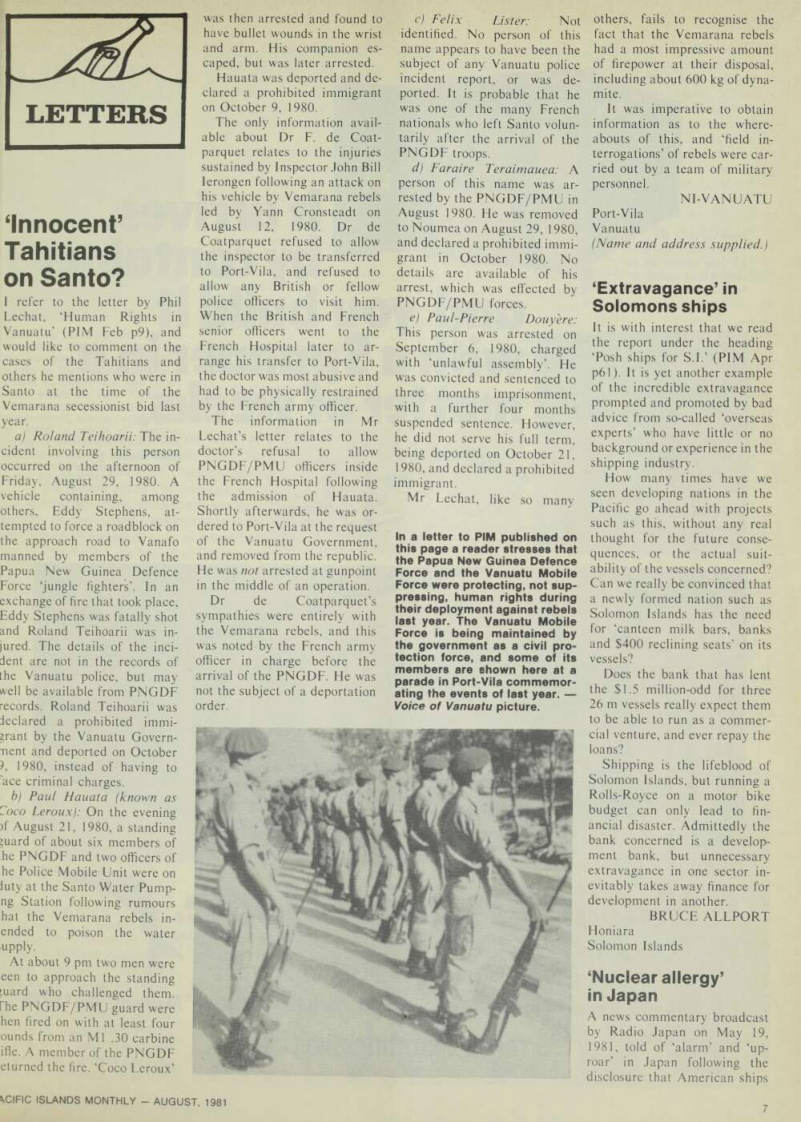
In a letter to PIM published on this page a reader stresses that the Papua New Guinea Defence Force and the Vanuatu Mobile Force were protecting, not sup
pressing, human rights during
their deployment against rebels
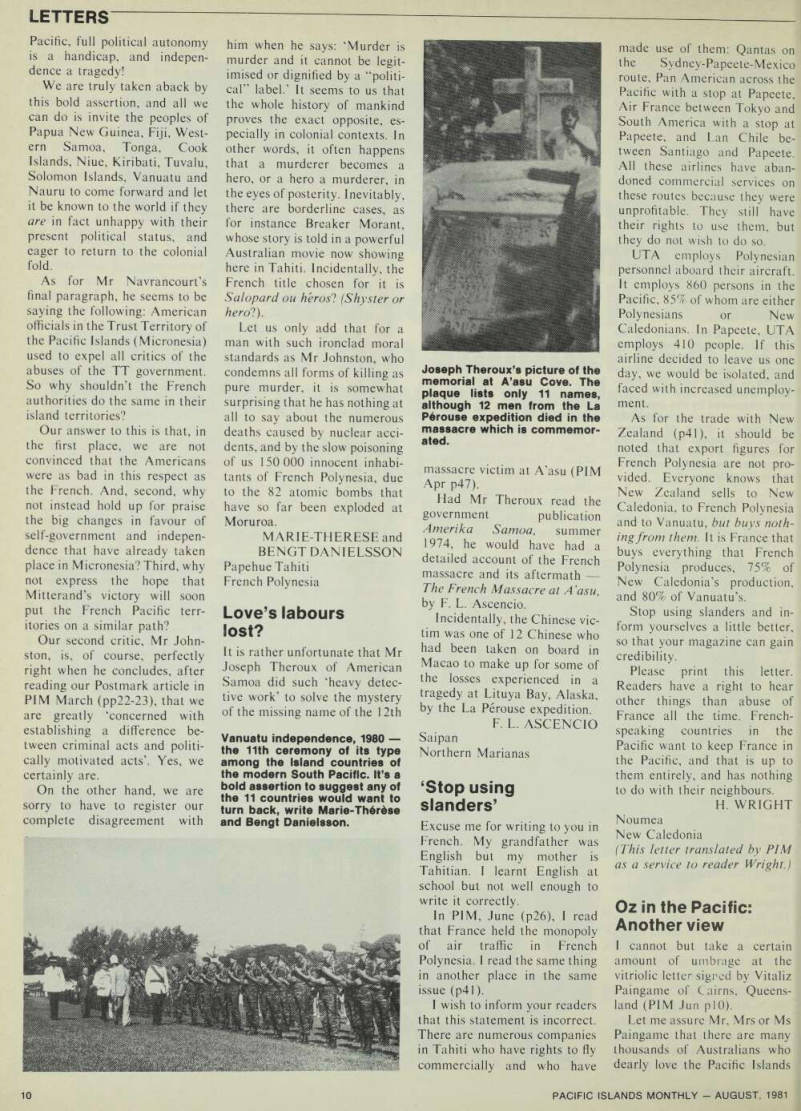
last year. The Vanuatu Mobile Force is being maintained by the government as a civil pro tection force, and some of its members are shown here at a parade in Port-Vila commemor ating the events of last year. - Voice of Vanuatu picture.
and aircraft may have carried nuclear weapons while inside Japanese territorial waters.
The commentary went on to explain that Japanese people had, understandably, a ‘nuclear allergy’ since the cities of Hiroshima and Nagasaki were erased from the map at the end )f the last war. Further, we vere advised that Japan has a hree-point nuclear policy relat ng to weapons, and that lapanese people have strong entiments against nuclear war are equipment.
The news bulletin immedi ately preceding the commen ary carried the interesting in ormation that the Science and 'echnology Agency in Japan iad' bowed to pressure and had igreed not to dump nuclear vaste in the Pacific. The chief if the agency was quoted as aying that this situation would xist ‘.. . as long as other ountries are against the idea’.
Je made his comments after neeting the Government of the Northern Mariana Islands, the >eputy Governor of Guam and ther Pacific leaders in Tokyo.
Governor Carlos Camacho of he Northern Marianas and the ‘aders of many other Pacific ations have been denouncing ie proposed Japanese dumping lans for a considerable period.
I wonder if the people of Japan have a ‘nuclear allergy’ or are ‘alarmed’ or in ‘uproar’ as they contemplate thousands of drums of nuclear waste tum bling into their (and our) Pacific food chain?
It seems that the nations of the Pacific have won the first round in the dumping issue, but it remains to be seen if the Japanese Government would prefer to keep the ‘nuclear (waste) allergy’ away from home rather than face ‘alarm’ and ‘uproar’ within the country.
Martin Hadlow
Honiara Solomon Islands
‘Presumptuous’ to
speak for dead
The Director-General ■of the Commonwealth War Graves Commission, Mr A. K. Pallot, is reported (PIM Mar p 6) as saying the commission refuses requests from governments and wealthy relatives of dead soldiers to repatriate remains.
While this is generally cor rect, there have been excep tions. The first was Maj-Gen Sir W. T. Bridges, who com manded the first Australian Imperial Forces (AIF) at Gallipoli. His body was brought back to Australia after he was killed in action at Gallipoli and buried at Duntroon, where he had been the first commandant.
The second exception was that most of the bodies of the Vietnam war dead were brought back to Australia, al
though some were buried at Terendak in Malaysia.
It is probably true to say that once finally buried the bodies are not relocated. However, at the end of World War 11, bodies were collected from all over the South Pacific area where they had been given field burials, and were collected into the various war cemeteries.
No one can speak on behalf of the dead, which makes it rather presumptuous of Mr Pallot to say ‘if the dead soldiers were to have been asked where they wanted to be buried, they would prefer to have been buried with their comrades-in arms’. No one can pretend to speak therefore on behalf of Fiji war hero Corporal Sefanaia Sukanaivalu.
R. Stocks
Bangkok Thailand
Danielssons’ reply
to critics We are happy to see that our contributions to PIM continue to provoke comment from readers, both from Islanders (mostly favourable) and Europ eans (sometimes critical). In the July issue of PIM, (p 8), two readers take issue with us on different matters: John H. Huon de Navrancourt, of Atherton, Queensland, Australia, and D. L. Johnston, of San Diego, California, USA.
Mr Navrancourt’s letter is a rather rambling affair. It opens with a strange remark about the
opinions expressed in May PIM (pp 7-8) by a French business man and lifelong resident of Tahiti, Mr Henri Lombard, who thinks and we agree with him that French Poly nesia up to now has been on the wrong road. Unfortunately, Mr Navrancourt has missed the main point: Mr Lombard as cribes the economic, social and cultural mess he so vividly describes not to a hasty and ill conceived decolonisation, but on the contrary to the rigid maintenance of old-fashioned colonial rule.
Next, Mr Navrancourt chides us for lacking objec tivity, like so many Europeans who have ‘gone native’. Above all, he thinks, we should keep away from politics. Since his rather grave charges are unsup ported by any evidence what ever, we can only ask him to spell them out in detail. If he will be good enough to do so, perhaps we may be able to dispel a few more of his miscon ceptions.
Then, all of a sudden, Mr Navrancourt takes it upon him self to make a most sweeping political assertion: in the
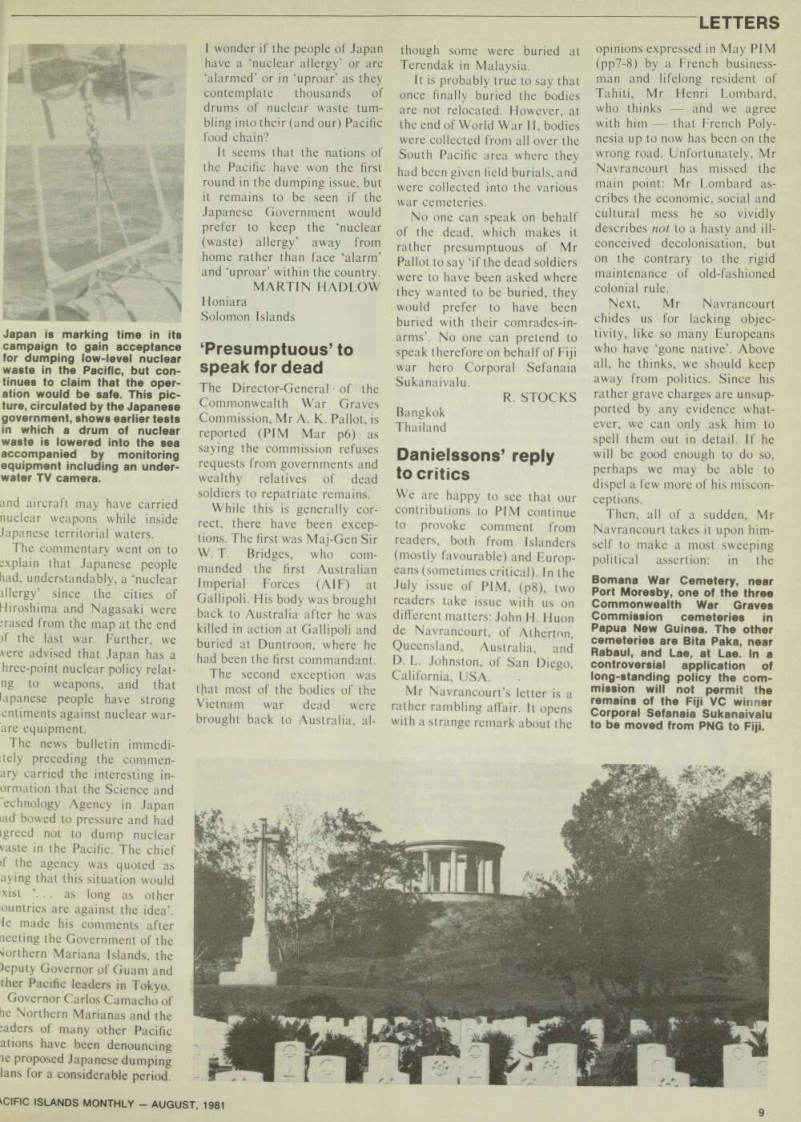
Japan is marking time in its campaign to gain acceptance for dumping low-level nuclear waste in the Pacific, but con tinues to claim that the oper ation would be safe. This pic ture, circulated by the Japanese government, shows earlier tests in which a drum of nuclear waste is lowered into the sea accompanied by monitoring equipment including an under water TV camera.
Bomana War Cemetery, near Port Moresby, one of the three Commonwealth War Graves Commission cemeteries in Papua New Guinea. The other cemeteries are Bita Paka, near Rabaul, and Lae, at Lae. In a controversial application of long-standing policy the com mission will not permit the remains of the Fiji VC winner Corporal Sefanaia Sukanaivalu to be moved from PNG to Fiji.
Pacific, full political autonomy is a handicap, and indepen dence a tragedy!
We are truly taken aback by this bold assertion, and all we can do is invite the peoples of Papua New Guinea, Fiji, West ern Samoa, Tonga, Cook Islands, Niue, Kiribati, Tuvalu, Solomon Islands, Vanuatu and Nauru to come forward and let it be known to the world if they are in fact unhappy with their present political status, and eager to return to the colonial fold.
As for Mr Navrancourt’s final paragraph, he seems to be saying the following: American officials in the Trust Territory of the Pacific Islands (Micronesia) used to expel all critics of the abuses of the TT government.
So why shouldn’t the French authorities do the same in their island territories?
Our answer to this is that, in the first place, we are not convinced that the Americans were as bad in this respect as the French. And, second, why not instead hold up for praise the big changes in favour of self-government and indepen dence that have already taken place in Micronesia? Third, why not express the hope that Mitterand’s victory will soon put the French Pacific terr itories on a similar path?
Our second critic, Mr John ston, is, of course, perfectly right when he concludes, after reading our Postmark article in PIM March (pp 22-23), that we are greatly ‘concerned with establishing a difference be tween criminal acts and politi cally motivated acts’. Yes, we certainly are.
On the other hand, we are sorry to have to register our complete disagreement with
him when he says: ‘Murder is murder and it cannot be legit imised or dignified by a “politi cal” label.’ It seems to us that the whole history of mankind proves the exact opposite, es pecially in colonial contexts. In other words, it often happens that a murderer becomes a hero, or a hero a murderer, in the eyes of posterity. Inevitably, there are borderline cases, as for instance Breaker Morant, whose story is told in a powerful Australian movie now showing here in Tahiti. Incidentally, the French title chosen for it is Salopard ou herosl (Shyster or he rod).
Let us only add that for a man with such ironclad moral standards as Mr Johnston, who condemns all forms of killing as pure murder, it is somewhat surprising that he has nothing at all to say about the numerous deaths caused by nuclear acci dents, and by the slow poisoning of us 150 000 innocent inhabi tants of French Polynesia, due to the 82 atomic bombs that have so far been exploded at Moruroa.
Marie-Therese And
Bengt Danielsson
Papehue Tahiti French Polynesia Love’s labours lost?
It is rather unfortunate that Mr Joseph Theroux of American Samoa did such ‘heavy detec tive work’ to solve the mystery of the missing name of the 12th
massacre victim at A’asu (PIM Apr p 47).
Had Mr Theroux read the government publication Amerika Samoa, summer 1974, he would have had a detailed account of the French massacre and its aftermath The French Massacre at A’asu, by F. L. Ascencio.
Incidentally, the Chinese vic tim was one of 12 Chinese who had been taken on board in Macao to make up for some of the losses experienced in a tragedy at Lituya Bay, Alaska, by the La Perouse expedition.
F. L. Ascencio
Saipan Northern Marianas
‘Stop using
slanders’
Excuse me for writing to you in French. My grandfather was English but my mother is Tahitian. I learnt English at school but not well enough to write it correctly.
In PIM, June (p 26), I read that France held the monopoly of air traffic in French Polynesia. I read the same thing in another place in the same issue (p4l).
I wish to inform your readers that this statement is incorrect.
There are numerous companies in Tahiti who have rights to fly commercially and who have
made use of them: Qantas on
the Sydney-Papeete-Mexico
route. Pan American across the Pacific with a stop at Papeete, Air France between Tokyo and South America with a stop at Papeete, and Lan Chile be tween Santiago and Papeete.
All these airlines have aban doned commercial services on these routes because they were unprofitable. They still have their rights to use them, but they do not wish to do so.
UTA employs Polynesian personnel aboard their aircraft.
It employs 860 persons in the Pacific, 85% of whom are either Polynesians or New Caledonians. In Papeete, UTA employs 410 people. If this airline decided to leave us one day, we would be isolated, and faced with increased unemploy ment.
As for the trade with New Zealand (p4l), it should be noted that export figures for French Polynesia are not pro vided. Everyone knows that New Zealand sells to New Caledonia, to French Polynesia and to Vanuatu, but buys noth ing from them. It is France that buys everything that French Polynesia produces, 75% of New Caledonia’s production, and 80% of Vanuatu’s.
Stop using slanders and in form yourselves a little better, so that your magazine can gain credibility.
Please print this letter.
Readers have a right to hear other things than abuse of France all the time. French speaking countries in the Pacific want to keep France in the Pacific, and that is up to them entirely, and has nothing to do with their neighbours.
H. Wright
Noumea New Caledonia (This letter translated by PIM as a service to reader Wright.) Oz in the Pacific: Another view I cannot but take a certain amount of umbrage at the vitriolic letter signed by Vitaliz Paingame of Cairns, Queens land (PIM Jun plO).
Let me assure Mr, Mrs or Ms Paingame that there are many thousands of Australians who dearly love the Pacific Islands
Vanuatu independence, 1980 the 11th ceremony of its type among the Island countries of the modern South Pacific. It’s a bold assertion to suggest any of the 11 countries would want to turn back, write Marie-Therese and Bengt Danielsson.
Joseph Theroux’s picture of the memorial at A’asu Cove. The plaque lists only 11 names, although 12 men from the La Perouse expedition died in the massacre which is commemor ated.
and their peoples. Not all of us run around shooting off our mouths, as our now unemployed politico Gough Whitlam does, preaching that ‘you should do this or that’, and perhaps even advocating slightly revolution ary ideas to normally peace loving people.
A careful examination by your correspondent would in fact reveal that a lot of help from Australia has been given over the years to many of our Pacific neighbours, with no strings attached.
It is interesting to note that all the derogatory statements about Australia made by your correspondent have a surprisingly familiar ring about them, having for some years been the catchcries of Leftwing, and in fact dare I say communist organisations within Australia.
Again I say, many thousands of Australians who like myself have spent a number of years in the Pacific would only want for the people of the area what they themselves strive for, without outside interference, either vo cal or physical.
Athol L. Cottrell
Magill SA Australia
PNG-Oz tangles
on citizenship
Many former Papua New Guinea residents with mixed race children are totally con fused about official Australian policy towards the citizenship of their children. Technically, children who were born in PNG before independence, who had at least two PNG grandparents and who had been registered as Australians, lost their Austra lian citizenship at indepen dence.
A correspondent of ours had three daughters born in PNG before independence. He re turned to Australia in 1972, and while making new passport ar rangements in 1977 he was told that his daughters had ceased to be Australian citizens in 1975 the year of PNG indepen dence. In this instance the aationality of the girls was mbsequently re-established but ;ome other families have ex 3erienced great difficulties with he Australian Immigration De
partment. There have even been threats of expulsion.
Eventually there was a volte face, with Australia apparently deciding that children from mixed families who had been registered as Australians before PNG independence were en titled to remain Australians.
This ruling seems logical, par ticularly as the former attitude appeared to ignore the principle of non-retroactivity.
However, contradictions in official correspondence are still being encountered today. Those who are affected don’t like to see interpretations left to the discretion of any minor immi gration officers.
John H. Huon De
Navrancourt
Atherton, Qld Australia
Mission zeal and
the Gogodala
It was interesting to read (PIM Apr p 29) that Dr Peter Lauer, curator of the Anthropology Museum at the University of Queensland, regarded mission activities as one of the causes of the destruction of the culture of the Gogodala people of Papua New Guinea.
At the same time it is possible that these same activities may have contributed to its revitalisation, which began in 1973.
While the Gogodala culture may have been reduced to ‘mere memories’, there was no doubt when I visited these people about 13 years ago that they were making efforts to preserve and strengthen these memories.
In 1968 Mr Gagore Ibina of Balimo introduced me to a man, Adewo Gabari, who had made paintings of the traditional em blems of the Gogodala people.
It was arranged that copies of these would be made for me to help ensure their preservation.
I supplied paper and colours and subsequently received 43 named designs and the em blems which were once in scribed and painted on the canoes of the clans (udaga) and sub-clans of the Gogodala.
These were accompanied by a list linking them to the names of early clan leaders, and to canoes.
I was also shown, alongside
the boundary of a mission station at Balimo, a carefully tended two-metre depression in the ground, believed to have been imprinted there by the foot of Bani, the legendary first leader of the Asipari clan who strode up the Aramia River from somewhere away to the south.
At Kini village I saw and photographed a stone adze (wagi} with an adjustable angle blade of the type once used in various parts of PNG to finish the inside of canoes. The one at Kini was still in use.
In 1970, at the Gogodala Local Government Council chamber, there had been made and placed above the entrance door on the inside a carved and painted wooden image, about two and a half metres long, of a traditional water creature, the ‘Amesibara’, important in local belief.
The Kubu villagers told me in 1968 that they were mostly pagan (ie, not adherents of any mission), and said that this was because the first missionaries had been insistent on a sudden end to native custom, and in particular had offended an im portant man by objecting to his polygamy.
I do not know whether or not any mission was involved when
the ‘Gogodala people began reviving traditional skills in 1973’, or why this revival commenced then. But in the late ’6os after talking with Gogodala people and hearing of their interest in their past, one was left with a distinct im pression that this strong holding on to tradition was a resistance to what they regarded as excess ive missionary zeal in trying to destroy it that is, that local missionaries were defeating their own purpose.
C. W. Kimmorley
Mt Riverview NSW Australia
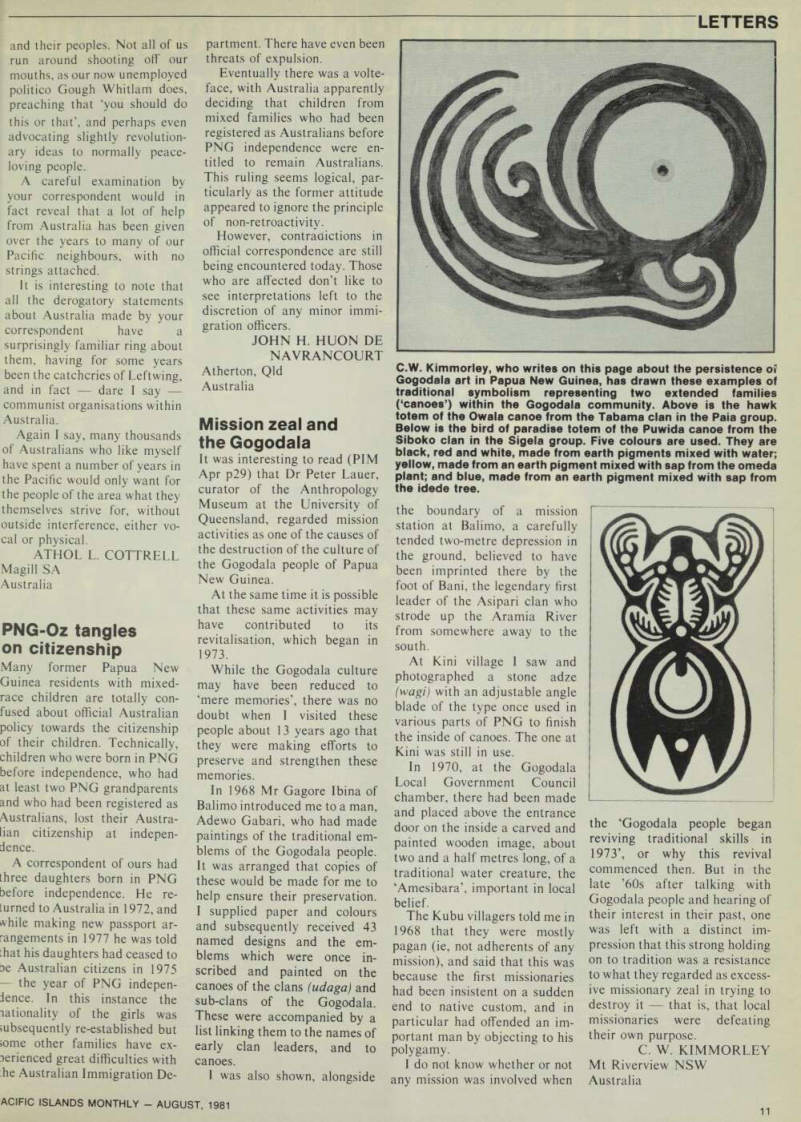
C.W. Kimmorley, who writes on this page about the persistence of Gogodala art in Papua New Guinea, has drawn these examples of traditional symbolism representing two extended families (‘canoes’) within the Gogodala community. Above is the hawk totem of the Owala canoe from the Tabama clan in the Paia group.
Below is the bird of paradise totem of the Puwida canoe from the Siboko clan in the Sigela group. Five colours are used. They are black, red and white, made from earth pigments mixed with water; yellow, made from an earth pigment mixed with sap from the omeda plant; and blue, made from an earth pigment mixed with sap from the idede tree.
Advertisements & other items, pp. 7-12 (4 items)
7
ISLANDS MONTHLY - AUGUST. 1981
by container
House kits (up to 150 square metres in size) fit into" a 6 metre container and are currently being exported to Pacific Islands. in mu IT 11 nnw ■ 7 - r:l nik •V Jt
It arrives
and you build it
with a Spanner in a
matter of weeks.
The "Logan Unit" kits consist of galvanised steel framed-insulated-asbestor cement sheeted modules 1 metre wide. Each kit contains all modules including windows and doors, roof members, roof sheets, ceilings ik f' x ' n 9 t 0 complete a lock-up unit.
Erection of a kit on an established floor is about 8 days for 2 men.
CO
A Marlin Modular Home.
Marlin Modular Constructions supply (and construct where required) cyclone rated modular homes and buildings, The system is adaptable for use as housing, schools, offices etc.
MARLIN MODULAR CONSTRUCTIONS
P.O. Box 149, Archerfield, Old. 4108, Australia. Ph: 345 4539, Tlx: "Marniod" AA44636
TRADE ENQUIRIES WELCOME.
HJZUKI-the name of performance
Breathes of glory and experience in racing.
Watch it feeling over on-roads and boldly crossing off-roads.
Presenting SUZUKI's motorcycles that blends superb performance with elegant modernistic styling.
Seen strikingly alive in SUZUKI’s motorcycles is SUZUKI’s technology and experience originally incorporated in the champion machine which has claimed a variety of race titles.
These climaxing technological innovations are apt to attract motorbike fans worldover. - $ 3», K 'm M X & v A f I f 1 > , v / ’ % 1 K
I Jr.
¥ \ :v P
SUZUKI MOTOR CO, LTD
SUZUKI! 300Takatsuka, Hamamatsu, Japan SOLOMON ISLANDS SOLOMON ISLAND SERVICE STATION LTD. NEW CALEDONIA STE. SUPERCAL PAPUA NEW GUINEA HI SPEED DIESEL SERVICE PTY LTD. VANUATU HENRI LEROUX NIUE ISLAND BURNS PHILP (SOUTH SEA) CO., LTD. PONAPE LEO ETSCHEIT TAHITI NIPPON AUTOMOTO ELLICE ISLAND TUVALU COOPERATIVE WHOLESALE SOCIETY LTD. GUAM & SAIPAN ISLAND CYCLERY, INC. NORFOLK MARTIN’S AGENCIES LTD. SAMOA PACIFIC PRODUCTS. INC. KIRIBATI GILBERT ISLANDS COOPERATIVE FEDERATION LIMITED TONGA PACIFIC PRODUCTS INC. NAURU EQUAPAC MOTORS FUINIRANJANS AUTOPORT LTD.
Letters
9
tCIFIC ISLANDS MONTHLY AUGUST, 1981
Letters
11
ACIFIC ISLANDS MONTHLY - AUGUST, 1981
Confusion on all sides as New
Caledonia faces its future
Australian journalist ROBERT MILLIKEN was in New Caledonia in June in the wake of the sweeping victory of Frangois Mitterrand in the French presidential election, which was soon to be followed by the even more spectacular success of his party in parliamentary elections. He found a high degree of uncertainty and confusion, not only among conservatives, but among supporters of full independence for the territory as well.
An air of uncertainty pervades New Caledonia following the election of France’s new social ist president, Francis Mitterrand, and his decisive victory in the more recent National Assembly elections.
For the first time in at least 25 years, New Caledonians are confronted with a French presi dent who is expected to consider seriously the demands for inde pendence from the Front Independantise, the multi racial grouping of five political parties who are calling for an end to French rule in the territory.
Mitterrand has made no com mitment on the independence question, beyond agreeing to meet Roch Pidjot, the 74-year old leader of the Front’s largest party, the Union Caledonienne.
But his silence distinguishes him from his predecessor, Valery Giscard d’Estaing, who sent his Minister for Overseas Territories Paul Dijoud to New Caledonia twice during the campaign to reassert France’s determination to hold on to its Pacific territories.
Dijoud became the focus of a melee that broke out on Mare in the Loyalty Islands when he went there, complete with heli copters and gendarmes, to tell the natives why they should vote for Giscard and remain part of France forever.
He arrived in the middle of a sacred religious ceremony in which one of the independence leaders, Nidoish Naisseline, and his followers were taking part. Dijoud finally had to leave, but not before tear gas was fired by the gendarmes and rocks were thrown at the minis ter’s party by the locals.
Back in Noumea, Dijoud announced; T have come here to
say clearly so that no one may doubt it that New Caledonia is and will remain French. ‘I often hear, with some irritation, one or another independantiste announce that independence will take place in 1982 or later That is absurd.’
In what was later taken to be a well aimed shot at Australia, Vanuatu and Papua New Guinea, Dijoud added: T say this to those about us in the Pacific region: this is the soil of our country, these are French men and women, and we will defend them with all the means at our disposal against every one. Everyone should know this.’
They were comforting words for the 50 000 whites, who are either from families long established in the territory, from metropolitan France, or from former French colonies in Africa and Indochina.
But the comfort has turned to confusion with the Mitterrand victory. And for the indepen dence supporters among the indigenous Melanesians, the
confusion has been compounded by the emergence of a split in Front Independantiste ranks during the recent National Assembly elections.
New Caledonia is represented by two deputies in the assembly in Paris. The first seat, covering white-dominated Noumea and the western half of the island, is held by Jacques Lafleur, a rightwing Gaullist and businesman.
He retained his seat in the first round of voting against a challenge by another conservative, Stanley Camerlynck.
Lafleur has called for even closer ties with France by changing New Caledonia’s status from an overseas territory to a department. This would mean it would lose the small degree of selfadministration it now has through its locally elected assembly, and instead be administered direct from Paris.
Lafleur’s easy victory surprised many observers, and“is seen in some quarters as an indication of the fear and anxiety among the European
population over Mitterrand’s possible intentions, The second seat covers the eastern part of Grande Terre, the main island in the territory, plus the three Loyalty islands, and is the centrepoint for the nationalist movement among the Melanesians, or Kanaks.
Pidjot holds this seat, but he failed to win a majority in the first round of voting under challenge from his Front col league, Naisseline. Pidjot gained a 48% majority of votes in the second round, The split between Pidjot’s Union Caledonienne and the more radical parties in the front appears to centre on the timing and nature of the independence which each side is demanding, Naisseline’s Kanak Liber ation Party trusts Mitterrand no more than Giscard, Pompidou and de Gaulle were trusted by the independence movement in the past.
In an interview in Noumea during the campaign, Naisseline said he was worried that the other independence parties would come to an ac-
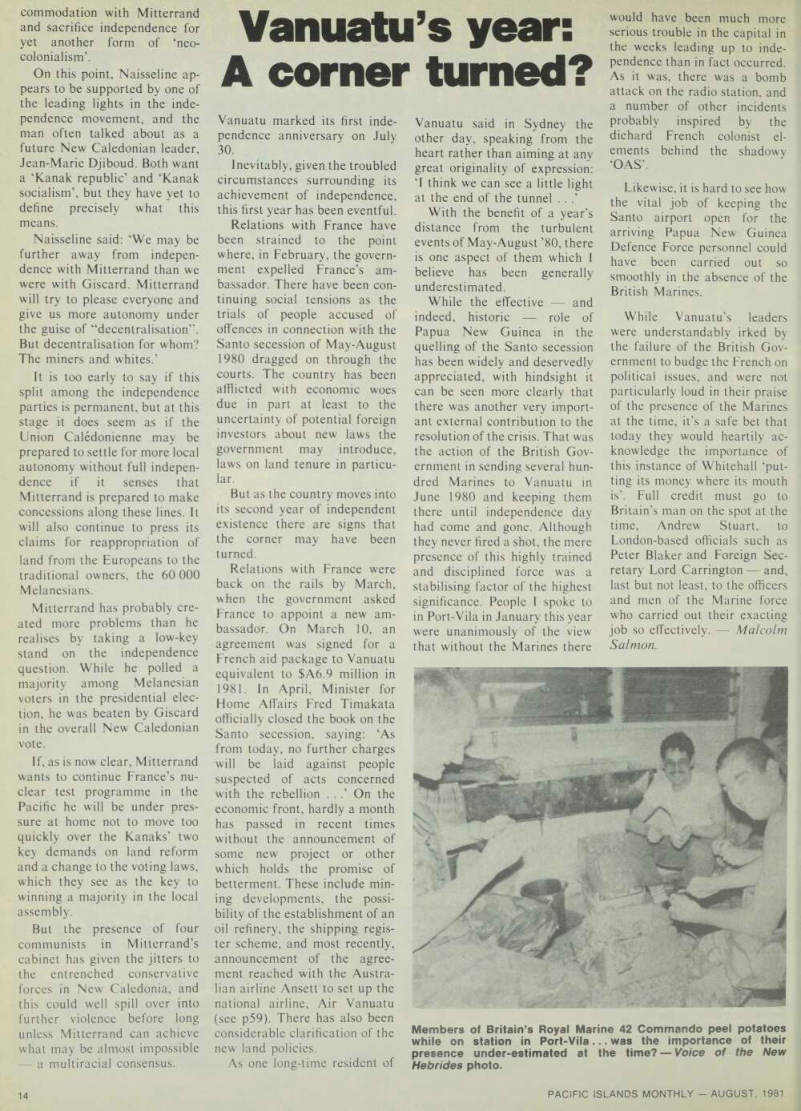
Pro-Mitterrand slogan on Noumean wall: ‘For respect of [?]he Kanak people’s rights and [?]he rights of all - vote Mitterrand.’
commodation with Mitterrand and sacrifice independence for yet another form of ‘neo colonialism’.
On this point, Naisseline ap pears to be supported by one of the leading lights in the inde pendence movement, and the man often talked about as a future New Caledonian leader, Jean-Marie Djiboud. Both want a ‘Kanak republic’ and ‘Kanak socialism’, but they have yet to define precisely what this means.
Naisseline said: ‘We may be further away from indepen dence with Mitterrand than we were with Giscard. Mitterrand will try to please everyone and give us more autonomy under the guise of “decentralisation”.
But decentralisation for whom?
The miners and whites.’
It is too early to say if this split among the independence parties is permanent, but at this stage it does seem as if the Union Caledonienne may be prepared to settle for more local autonomy without full indepen dence if it senses that Mitterrand is prepared to make concessions along these lines. It will also continue to press its claims for reappropriation of land from the Europeans to the traditional owners, the 60 000 Melanesians.
Mitterrand has probably cre ated more problems than he realises by taking a low-key stand on the independence question. While he polled a majority among Melanesian voters in the presidential elec tion, he was beaten by Giscard in the overall New Caledonian vote.
If, as is now clear, Mitterrand wants to continue France’s nu clear test programme in the Pacific he will be under pres sure at home not to move too quickly over the Kanaks’ two key demands on land reform and a change to the voting laws, which they see as the key to winning a majority in the local assembly.
But the presence of four communists in Mitterrand’s cabinet has given the jitters to the entrenched conservative forces in New Caledonia, and this could well spill over into further violence before long unless Mitterrand can achieve what may be almost impossible a multiracial consensus.
A corner turned?
Vanuatu's year: A corner turned?
Vanuatu marked its first inde pendence anniversary on July 30.
Inevitably, given the troubled circumstances surrounding its achievement of independence, this first year has been eventful.
Relations with France have been strained to the point where, in February, the govern ment expelled France’s am bassador. There have been con tinuing social tensions as the trials of people accused of offences in connection with the Santo secession of May-August 1980 dragged on through the courts. The country has been afflicted with economic woes due in part at least to the uncertainty of potential foreign investors about new laws the government may introduce, laws on land tenure in particu lar.
But as the country moves into its second year of independent existence there are signs that the corner may have been turned.
Relations with France were back on the rails by March, when the government asked France to appoint a new am bassador. On March 10, an agreement was signed for a French aid package to Vanuatu equivalent to 5A6.9 million in 1981. In April, Minister for Home Affairs Fred Timakata officially closed the book on the Santo secession, saying: ‘As from today, no further charges will be laid against people suspected of acts concerned with the rebellion . . .’ On the economic front, hardly a month has passed in recent times without the announcement of some new project or other which holds the promise of betterment. These include min ing developments, the possi bility of the establishment of an oil refinery, the shipping regis ter scheme, and most recently, announcement of the agree ment reached with the Austra lian airline Ansett to set up the national airline, Air Vanuatu (see p 59). There has also been considerable clarification of the new land policies.
As one long-time resident of
Vanuatu said in Sydney the other day, speaking from the heart rather than aiming at any great originality of expression: ‘I think we can see a little light at the end of the tunnel . . .’
With the benefit of a year’s distance from the turbulent events of May-August ’BO, there is one aspect of them which I believe has been generally underestimated.
While the effective and indeed, historic role of Papua New Guinea in the quelling of the Santo secession has been widely and deservedly appreciated, with hindsight it can be seen more clearly that there was another very import ant external contribution to the resolution of the crisis. That was the action of the British Gov ernment in sending several hun dred Marines to Vanuatu in June 1980 and keeping them there until independence day had come and gone. Although they never fired a shot, the mere presence of this highly trained and disciplined force was a stabilising factor of the highest significance. People I spoke to in Port-Vila in January this year were unanimously of the view that without the Marines there
would have been much more serious trouble in the capital in the weeks leading up to inde pendence than in fact occurred.
As it was, there was a bomb attack on the radio station, and a number of other incidents probably inspired by the diehard French colonist el ements behind the shadowy
‘Oas’.
Likewise, it is hard to see how the vital job of keeping the Santo airport open for the arriving Papua New Guinea Defence Force personnel could have been carried out so smoothly in the absence of the British Marines.
While Vanuatu’s leaders were understandably irked by the failure of the British Gov ernment to budge the French on political issues, and were not particularly loud in their praise of the presence of the Marines at the time, it’s a safe bet that today they would heartily ac knowledge the importance of this instance of Whitehall ‘put ting its money where its mouth is’. Full credit must go to Britain’s man on the spot at the time, Andrew Stuart, to London-based officials such as Peter Blaker and Foreign Sec retary Lord Carrington and, last but not least, to the officers and men of the Marine force who carried out their exacting
job so effectively. -
Malcolm
Salmon.
Members of Britain’s Royal Marine 42 Commando peel potatoes while on station in Port-Vila... was the importance of their presence under-estimated at the time? - Voice of the New Hebrides photo.
Big W. Samoa strike ends, leaving
shock waves for the future
The historic strike by Western Samoa’s public servants has ended in a considerable success for the strikers. The article below outlines their gains, and presents certain views of Western Samoans on the strike’s likely future effects on their society.
After almost 90 days, the West ern Samoa public servants’ strike (PIM Jul pi 3) ended on July 2.
The result can only be seen as a success for the striking workers, since the salary rises granted were generally far greater than the government had originally offered. Whereas an 8% rise, to be implemented in two stages with a six-months interval, had been proposed by the government in its 1981 budget, the recommendations of the government-appointed commission of inquiry, which served as the basis for the strike settlement, provided for: a 36% rise for workers on salaries of SWS7BB; 27% for those on $930; 12.44% for those on $2010; and increases ranging from 6.25% to 7.32% for those receiving up to $3965.
Those earning $4llO-$6510 a year will get rises of 6%, and above the $6710 level, 5%.
Most of the public servants 4252 are on the salary scale of $7BB-$2OlO. Six hun dred and fifty-three are on $2120-$2675 a year, 356 are on $2795-$3285, 364 on $3415-$3965, 456 on $4llO-$6510, and 75 on $6710 and above.
Announcing the increases, kvhich are expected to cost more :han $2 000 000, the govern nent also foreshadowed the vays in which it planned to •aise the revenue to pay for hem. These included establish nent of a wharf departure tax )f $1 per person, collection of additional income tax following he increases, increasing the lirport departure tax from $3 to 55, increasing outpatients’ fees n public hospitals from 100 to increasing duty on all lutiable items, and philatelic pecial sales. Government ana ysts reckon the increased rev :nue from these measures will ipproximately cover the cost of he increased public service alaries.
The question a vexed one throughout the strike of reinstatement of striking public servants appears to have been satisfactorily resolved, although some loose ends remained to be tied up as the strike ended. A key factor in the settlement was the last-minute agreement by the Chairman of the Public Service Commission, Esekia Solofa, to reinstate all strikers.
On July 1, the day before the planned return to work, it was learned that 207 of the total of 3340 applications for reinstate ment which had been made had still not been processed. Mr Solofa, in an emergency meet ing with the executive council of the Public Service Associ ation, assured them that there would be no problem with the outstanding 207 cases. On that basis, the PSA leaders an nounced at a general meeting of the PSA that all strikers should return to work on July 2.
Most interest now centres on the longer-term effects of the strike on Western Samoa’s pol itical, economic and social scene for effects there will certainly be.
Writing for PIM, from Apia before the settlement was reached, prominent journalist Felise Va’a, English-language editor of the weekly The Samoa Times, declared; ‘lf you were in Western Samoa during the time of the strike by Western Samoan pub lic servants, you were likely to take either a pro-government or pro-PSA view. ‘ln rather mild terms, you were likely to accuse the PSA of callousness towards the public welfare, or government of fail ing to resolve the legitimate interests of the public servants. ‘But one thing became in creasingly clear as the strike wore on: probably no other issue has so divided the nation since the 1926-1936 Mau movement as the PSA strike which began on April 6.’ (The Mau move
ment of protest against New Zealand maladministration laid much of the groundwork for the achievement of independence by Western Samoa in 1962, the first Pacific Island country to do so.) Felise Va’a continued: ‘Space will not allow for a thorough discussion of the sociological, economic and political causes and effects of the strike. ‘Suffice it to say that it has crippled the Western Samoan government services and econ omy, and that it may take years to get the economy back right again. ‘Since government has already lost millions in revenues as a result of the strike, it can be predicted that a serious de pression will hit the economy for the rest of this year and next, and possibly into 1983. ‘Socially, the strike has had a disruptive effect in human re lationships. Families are div ided bitterly so. A key PSA official is the brother of a cabinet minister, and so on. ‘Politically, the strike threatens to shatter the fortunes of Tupuola Efi’s political party, and of Tupuola himself. ‘So strong is the resentment felt by strikers and their rela tives towards government, and of government towards strikers and their supporters, that for many years bitter feelings and memories will persist in a country once thought to be the most stable in the world, socially, economically and pol itically. ‘All that is now in the past. It appears that, for now, Western Samoa is headed for a period of reactionary politics.’
This gloomy view of the future is not entirely supported by comments from a recent visitor to Apia who was inter viewed by PIM in Sydney shortly after his return in mid- July.
This gentleman, himself Western Samoan, noted the
almost festive atmosphere pre vailing at PSA strike meetings in Apia. ‘People would set out from home in the mornings as if they were going to work, but instead they would sit around in the parks, have picnic lunches, concerts and other social activi ties,’ he said. ‘One had the feeling that there was no en trenched bitterness about them.
It seemed that the good nature of the Samoan people was prevailing over the tensions generated by the strike.’
Where he felt a possible long term danger lay was in the fact that the government had sought to break the strike by attempt ing to enlist the matai to use their social standing to influence strikers to go back to work.
This had caused great dis sent, not least among the matai themselves. ‘There is a general feeling among the matai that they had abrogated part of their traditional rights in the name of nationalism at the time of independence. They feel it is unfair of the government now to attempt to involve them in the affairs of the national state. ‘Some matai co-operated with the government, and this in turn caused anger among the strikers and their supporters.
They saw themselves as trade unionists operating in a modern state and dealing with its gov ernment. They resented the attempt to use traditional authorities to influence them in their industrial action,’ said the visitor. ‘Other matai refused to have anything to do with the govern ment’s request. This too has its dangers, affecting as it does the existing balances of authority in Western Samoa’s society.’
Whatever the eventual effects of the strike may be, it seems clear that the country will never be quite the same after the public service strike of April-July 1981.
Advertisements & other items, pp. 15-16 (2 items)
15
'ACIFIC ISLANDS MONTHLY - AUGUST, 1981
Quality—just another good reason
r *■ > % t 1 1 ■■ / . ■ - / * > H 0 “Quality is something very difficult to define”, says noted composer John Williams, “but I know it when I hear it”.
Millions of moviegoers around the world would agree.
For twenty years, Williams’ Academy Award-winning scores have perfectly complemented a host of memorable films.
With his masterful compositions, he has heightened the tension in Jaws, underscored the heroics in Star Wars and Superman, and given meaning to the phrase, “music of the spheres”, in Close Encounters of the Third Kind.
And an important reason why Williams’ music is synonymous with quality is because it satisfies the standards of his most exacting critic. Says the composer, “A score, first and foremost, has to please me.”
Quality—just another good reason
you should look to JVC for your audio-video needs.
At JVC, the toughest standards we have to meet are our very own. That’s why, over the years, we have maintained our position in the forefront of the world’s audio-video electronics industry. With technical innovations like—to name just a few— the VHS videocassette system, the VHD videodisc system, the world’s first cassette decks capable of handling metal tapes and the Super-A hi-fi amplifiers free of traditional switching and crossover distortion.
Examples of what we’re talking about are the state-ofthe-art hi-fi components shown here. They certainly prove that while quality may sometimes be difficult to define, you’ll know it when you hear it.
JVC
VICTOR COMPANY OF JAPAN, LIMITED
Australia: Hagemeyer (Australasia) B.V 5-7, Garema Circuit, Kingsgrove, N.S.W., 2208 Australia Tel. 750-3777 Fiji Islands: D. Gokal & Co., Ltd., G.P.O. Box 501, Corner of Pier Street & Renwick Road, Suva, Fiji Tel, 25259 Cook Islands: J. & P. Ingram & Co., Ltd., P.O. Box 55, Rarotonga, Cook Islands Tel. 378457 New Hebrides: Wu ke Luong, P.O. Box 113, Rue Higginson, Port-Vila, New Hebrides Tel. 2115 New Caledonia: Caldis, 2, Route du Velodrome, B.P. Ml, Noumea, Cedex, New Caledonia Tel, 262350 Tahiti: Magasin Sincere, B.P. 215, Papeete, Tahiti Tel. 20060 Papua New Guinea: Hagemeyer (P.N.G.) Pty, Ltd., P.O. Box 90 Lae, Papua New Guinea Tel. 42-3200 New Zealand: Atlas Majestic Industries Ltd., 11, Albion Road, Otahuhu, Auckland 6, New Zealand Tel. 27-67-099
shaded pink
New Caledonia in the new regime, shaded pink
Dariel Tardieu's
Noumea
Notebook
The advent of socialism in France has done nothing to change people’s lives now that the oratorical jousting of the elections is over.
Having endured four elec tions since the beginning of the year, New Caledonians are looking forward to some peace and quiet. The visit of the Tahitian singer Gabilou is arousing more interest among newspaper readers than any political matters.
And the question of who will be crowned ‘Miss New Caledonia’ is causing more excitement than the fact that the High Commissioner of France in the Pacific Mr Charbonniaud has been called to Paris for consul tations with the new French Government.
On his return, he is ex pected to advocate new pol itical directions more in line with the socialists’ policies.
But it should be noted that the President of the Repub lic Francis Mitterrand, and his Secretary of State for Overseas Departments and Territories, the 36-year-old Henri Emmanuelli (who is of Corsican origin), have both reaffirmed the desire to maintain the French pres ence in the overseas depart ments and territories, in cluding those in the Pacific.
Replying to New Zealand Prime Minister Robert Muldoon Mr Mitterrand has said: ‘There’s no question of holding a referendum on independence (for the Pacific territories). The elec tion results are as good as a referendum.’
Mr Emmanuelli, in an interview published in the Bordeaux, France, news paper Sud-Ouest on May 29, said: ‘On May 27, following the first Cabinet meeting of the presidential term of Francis Mitterrand, I publicly stated the position of the French Government that proposals to be made for administrat ive decentralisation within France will also apply in full to the overseas departments and territories. Thus, we are a long way from any kind of break with the overseas de partments and territories, a break which is neither de sired by the great majority of the populations concerned nor envisaged by the French Government.
T also stated that the ties of solidarity between France and its overseas departments and territories will not only be. maintained, but will be
distinctly improved, particu
larly in the economic and social fields . . .
‘At my May 27 press conference I stated that the French Government would not permit any change in the existing links between France and the overseas territories. ‘All this does not rule out the possibility of discussions between the French Govern ment and the interested par ties overseas provided that such discussions are called for by democratic majority opinion.’
But there is often a funda mental gap between the good intentions proclaimed by men and the reality that ensues. No one can foresee in which direction the French overseas territories will move in the future.
Probably towards a very much wider autonomy, since this is the only course capable of mustering a popu lar consensus.
Two deputies
returned
Despite divisions both within the ranks of the majority, and among supporters of independence, New Caledonia’s two incumbent deputies to the National Assembly were returned in the June voting.
Jacques Lafleur, who favours the French presence, was returned for the con stituency of Noumea and the West coast, where a majority of electors are of European origin.
Roch Pidjot, a Melanesian supporter of independence and one of the founders of the Union Caledonienne party, was again the success ful candidate in the East coast and Loyalty Islands
constituency, which has a majority of Melanesian voters.
The campaign was calm, except for a few outbursts in the letters columns of the local press.
The election showed some loss of votes for the Indepen dence Front.
Hard times for
Santo exiles
At the end of August French financial assistance to refu gees from Vanuatu who went to New Caledonia will come to an end. Until now these people have been in receipt of monthly allow ances in cash and kind, and lodged rent-free in 18-storey apartment blocks on the outskirts of Noumea.
The costs involved in the upkeep of the 945 people involved have been borne by the French State, but, under the terms of the law on assistance to refugees, this must stop by August 31.
On that date there will still be more than 500 people who have not been assimi lated either locally, or in other places. Apart from those who have found local jobs, there are about 100 who have gone either to France, French Guyana, Wallis and Futuna, or Tahiti.
But the hapless 500-odd remain, having found no work and obliged still to inhabit those towering apart ment blocks.
The problem of what to do with them when the govern ment money runs out is a worrying one for French administrative authorities serving in Noumea.
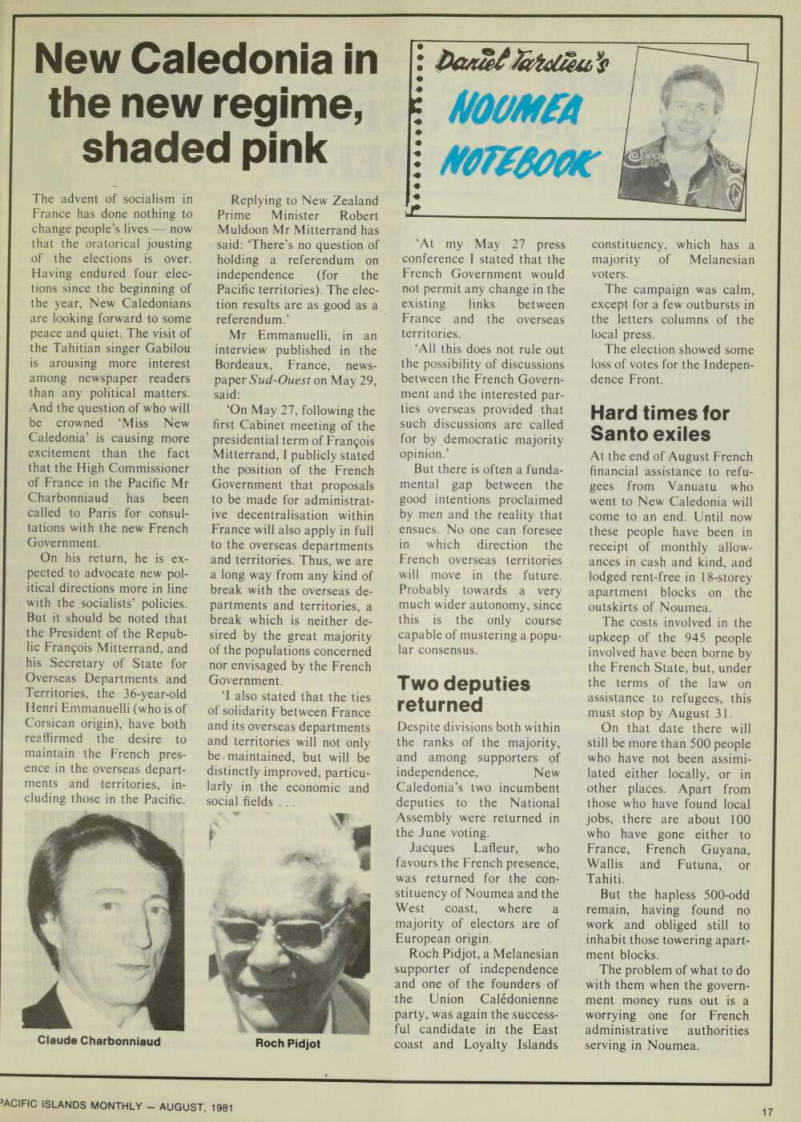
Claude Charbonniaud
Roch Pidjot
Advertisements & other items, p. 17 (1 item)
17
'ACIFIC ISLANDS MONTHLY AUGUST, 1981
Polynesia
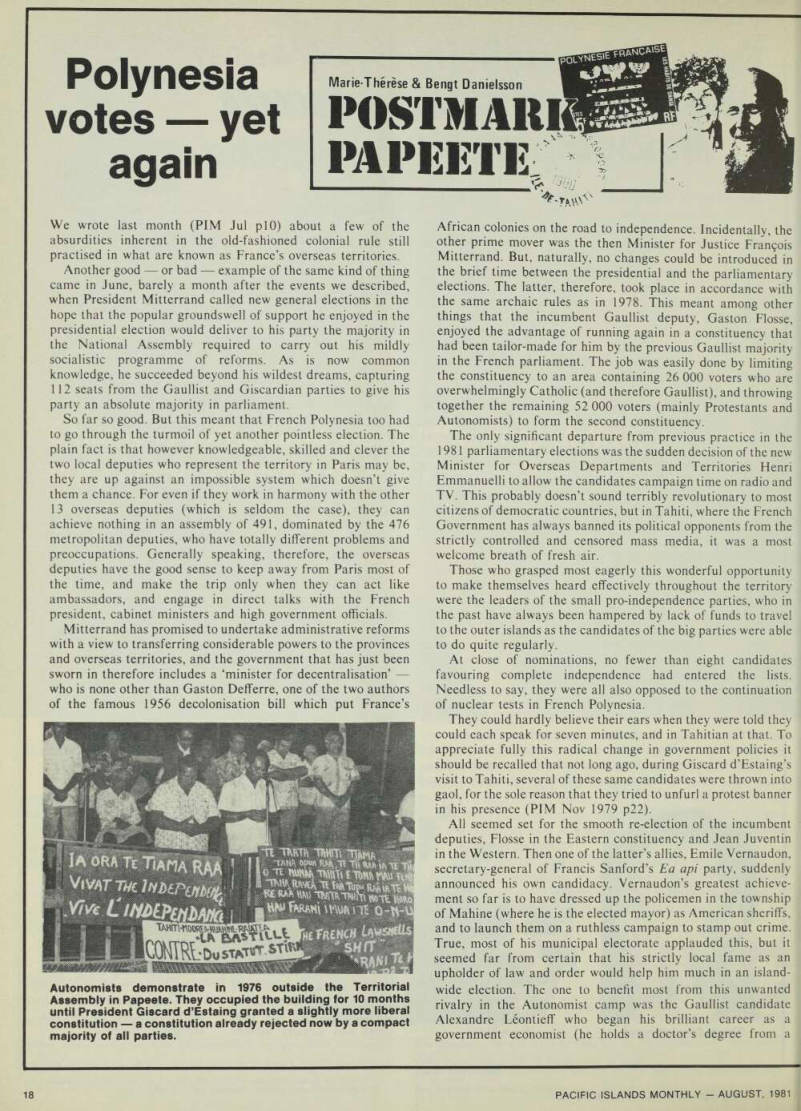
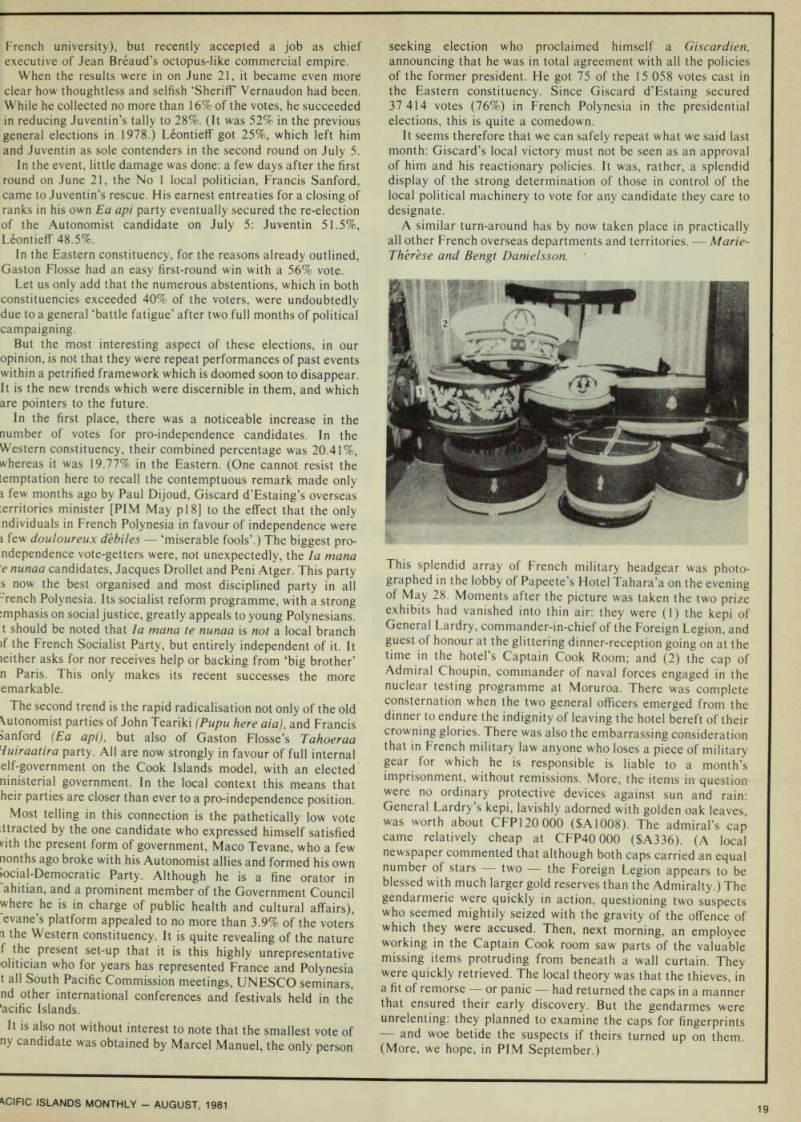
votes - yet again
We wrote last month (PIM Jul plO) about a few of the absurdities inherent in the old-fashioned colonial rule still practised in what are known as France’s overseas territories.
Another good or bad example of the same kind of thing came in June, barely a month after the events we described, when President Mitterrand called new general elections in the hope that the popular groundswell of support he enjoyed in the presidential election would deliver to his party the majority in the National Assembly required to carry out his mildly socialistic programme of reforms. As is now common knowledge, he succeeded beyond his wildest dreams, capturing 112 seats from the Gaullist and Giscardian parties to give his party an absolute majority in parliament.
So far so good. But this meant that French Polynesia too had to go through the turmoil of yet another pointless election. The plain fact is that however knowledgeable, skilled and clever the two local deputies who represent the territory in Paris may be, they are up against an impossible system which doesn’t give them a chance. For even if they work in harmony with the other 13 overseas deputies (which is seldom the case), they can achieve nothing in an assembly of 491, dominated by the 476 metropolitan deputies, who have totally different problems and preoccupations. Generally speaking, therefore, the overseas deputies have the good sense to keep away from Paris most of the time, and make the trip only when they can act like ambassadors, and engage in direct talks with the French president, cabinet ministers and high government officials.
Mitterrand has promised to undertake administrative reforms with a view to transferring considerable powers to the provinces and overseas territories, and the government that has just been sworn in therefore includes a ‘minister for decentralisation’ who is none other than Gaston Defferre, one of the two authors of the famous 1956 decolonisation bill which put France’s
African colonies on the road to independence. Incidentally, the other prime mover was the then Minister for Justice Francis Mitterrand. But, naturally, no changes could be introduced in the brief time between the presidential and the parliamentary elections. The latter, therefore, took place in accordance with the same archaic rules as in 1978. This meant among other things that the incumbent Gaullist deputy, Gaston Flosse, enjoyed the advantage of running again in a constituency that had been tailor-made for him by the previous Gaullist majority in the French parliament. The job was easily done by limiting the constituency to an area containing 26 000 voters who are overwhelmingly Catholic (and therefore Gaullist), and throwing together the remaining 52 000 voters (mainly Protestants and Autonomists) to form the second constituency.
The only significant departure from previous practice in the 1981 parliamentary elections was the sudden decision of the new Minister for Overseas Departments and Territories Henri Emmanuelli to allow the candidates campaign time on radio and TV. This probably doesn’t sound terribly revolutionary to most citizens of democratic countries, but in Tahiti, where the French Government has always banned its political opponents from the strictly controlled and censored mass media, it was a most welcome breath of fresh air.
Those who grasped most eagerly this wonderful opportunity to make themselves heard effectively throughout the territory were the leaders of the small pro-independence parties, who in the past have always been hampered by lack of funds to travel to the outer islands as the candidates of the big parties were able to do quite regularly.
At close of nominations, no fewer than eight candidates favouring complete independence had entered the lists.
Needless to say, they were all also opposed to the continuation of nuclear tests in French Polynesia.
They could hardly believe their ears when they were told they could each speak for seven minutes, and in Tahitian at that. To appreciate fully this radical change in government policies it should be recalled that not long ago, during Giscard d’Estaing’s visit to Tahiti, several of these same candidates were thrown into gaol, for the sole reason that they tried to unfurl a protest banner in his presence (PIM Nov 1979 p 22).
All seemed set for the smooth re-election of the incumbent deputies, Flosse in the Eastern constituency and Jean Juventin in the Western. Then one of the latter’s allies, Emile Vernaudon, secretary-general of Francis Sanford’s Ea api party, suddenly announced his own candidacy. Vernaudon’s greatest achieve ment so far is to have dressed up the policemen in the township of Mahine (where he is the elected mayor) as American sheriffs, and to launch them on a ruthless campaign to stamp out crime.
True, most of his municipal electorate applauded this, but it seemed far from certain that his strictly local fame as an upholder of law and order would help him much in an island wide election. The one to benefit most from this unwanted rivalry in the Autonomist camp was the Gaullist candidate Alexandre Leontieff who began his brilliant career as a government economist (he holds a doctor’s degree from a
Autonomists demonstrate in 1976 outside the Territorial Assembly in Papeete. They occupied the building for 10 months until President Giscard d’Estaing granted a slightly more liberal constitution - a constitution already rejected now by a compact majority of all parties.
French university), but recently accepted a job as chief executive of Jean Breaud’s octopus-like commercial empire.
When the results were in on June 21, it became even more clear how thoughtless and selfish ‘Sheriff Vernaudon had been.
While he collected no more than 16% of the votes, he succeeded in reducing Juventin’s tally to 28%. (It was 52% in the previous general elections in 1978.) Leontieff got 25%, which left him and Juventin as sole contenders in the second round on July 5.
In the event, little damage was done: a few days after the first round on June 21, the No 1 local politician, Francis Sanford, came to Juventin’s rescue. His earnest entreaties for a closing of ranks in his own Ea api party eventually secured the re-election of the Autonomist candidate on July 5: Juventin 51.5%, Leontieff 48.5%.
In the Eastern constituency, for the reasons already outlined, Gaston Flosse had an easy first-round win with a 56% vote.
Let us only add that the numerous abstentions, which in both constituencies exceeded 40% of the voters, were undoubtedly due to a general ‘battle fatigue’ after two full months of political campaigning.
But the most interesting aspect of these elections, in our opinion, is not that they were repeat performances of past events within a petrified framework which is doomed soon to disappear.
It is the new trends which were discernible in them, and which are pointers to the future.
In the first place, there was a noticeable increase in the number of votes for pro-independence candidates. In the Western constituency, their combined percentage was 20.41%, whereas it was 19.77% in the Eastern. (One cannot resist the temptation here to recall the contemptuous remark made only i few months ago by Paul Dijoud, Giscard d’Estaing’s overseas ;erritories minister [PIM May piB] to the effect that the only ndividuals in French Polynesia in favour of independence were t few douloureux debiles ‘miserable fools’.) The biggest pro ndependence vote-getters were, not unexpectedly, the la mana e nunaa candidates, Jacques Drollet and Peni Atger. This party s now the best organised and most disciplined party in all French Polynesia. Its socialist reform programme, with a strong emphasis on social justice, greatly appeals to young Polynesians, t should be noted that la mana te nunaa is not a local branch )f the French Socialist Party, but entirely independent of it. It icither asks for nor receives help or backing from ‘big brother’ n Paris. This only makes its recent successes the more emarkable.
The second trend is the rapid radicalisation not only of the old Autonomist parties of John Teariki (Pupu here aia), and Francis Sanford (Ea api), but also of Gaston Flosse’s Tahoeraa ■iuiraatira party. All are now strongly in favour of full internal elf-government on the Cook Islands model, with an elected ninisterial government. In the local context this means that heir parties are closer than ever to a pro-independence position.
Most telling in this connection is the pathetically low vote ttracted by the one candidate who expressed himself satisfied vith the present form of government, Maco Tevane, who a few nonths ago broke with his Autonomist allies and formed his own iocial-Democratic Party. Although he is a fine orator in ahitian, and a prominent member of the Government Council where he is in charge of public health and cultural affairs), 'evane’s platform appealed to no more than 3.9% of the voters i the Western constituency. It is quite revealing of the nature f the present set-up that it is this highly unrepresentative olitician who for years has represented France and Polynesia t all South Pacific Commission meetings, UNESCO seminars, nd other international conferences and festivals held in the 'acific Islands.
It is also not without interest to note that the smallest vote of ny candidate was obtained by Marcel Manuel, the only person
seeking election who proclaimed himself a Giscardien, announcing that he was in total agreement with all the policies of the former president. He got 75 of the 15 058 votes cast in the Eastern constituency. Since Giscard d’Estaing secured 37 414 votes (76%) in French Polynesia in the presidential elections, this is quite a comedown.
It seems therefore that we can safely repeat what we said last month; Giscard’s local victory must not be seen as an approval of him and his reactionary policies. It was, rather, a splendid display of the strong determination of those in control of the local political machinery to vote for any candidate they care to designate.
A similar turn-around has by now taken place in practically
all other French overseas departments and territories.
Marie-
Therese and Bengt Danielsso.
This splendid array of French military headgear was photo graphed in the lobby of Papeete’s Hotel Tahara’a on the evening of May 28. Moments after the picture was taken the two prize exhibits had vanished into thin air: they were (1) the kepi of General Lardry, commander-in-chief of the Foreign Legion, and guest of honour at the glittering dinner-reception going on at the time in the hotel’s Captain Cook Room; and (2) the cap of Admiral Choupin, commander of naval forces engaged in the nuclear testing programme at Moruroa. There was complete consternation when the two general officers emerged from the dinner to endure the indignity of leaving the hotel bereft of their crowning glories. There was also the embarrassing consideration that in French military law anyone who loses a piece of military gear for which he is responsible is liable to a month’s imprisonment, without remissions. More, the items in question were no ordinary protective devices against sun and rain: General Lardry’s kepi, lavishly adorned with golden oak leaves, was worth about CFPI2O 000 (SA1008). The admiral’s cap came relatively cheap at CFP4O 000 (5A336). (A local newspaper commented that although both caps carried an equal number of stars two the Foreign Legion appears to be blessed with much larger gold reserves than the Admiralty.) The gendarmerie were quickly in action, questioning two suspects who seemed mightily seized with the gravity of the offence of which they were accused. Then, next morning, an employee working in the Captain Cook room saw parts of the valuable missing items protruding from beneath a wall curtain. They were quickly retrieved. The local theory was that the thieves, in a fit of remorse or panic had returned the caps in a manner that ensured their early discovery. But the gendarmes were unrelenting: they planned to examine the caps for fingerprints and woe betide the suspects if theirs turned up on them. (More, we hope, in PIM September.)
Advertisements & other items, pp. 19-20 (2 items)
19
<\CIFIC ISLANDS MONTHLY AUGUST, 1981
Depend On Du Pont
r 9 M P m .
In the changing world of explosives...
DEPEND ON DU PONT DEPEND ON DU PONT
FOR EXPLOSIVES PRODUCTS FOR SERVICE
When you deal with Du Pont you will find that we offer more than just products. Explosives systems is the term we use to describe our extensive range of products and the know-how, to ensure these are built into a package to meet your individual requirements.
Products such as TOVEX®— the world’s first and best water gel explosive, offering performance equal to conventional explosives previously available, with much greater safety: the unique Du Pont Sequential Timer to reduce vibration, improve fragmentation and control flyrock; Du Pont detonating cords and blasting caps.
All of this backed by the technical expertise that has kept Du Pont a world leader in explosives for almost 200 years.
Du Pont has a team of experienced overseas trained Field Service Representatives with the technical know-how and practical experience to advise you on all aspects of blasting. They can tell you what to use, how to use it, and how to get maximum effect and safety for your dollar.
And this service is backed by prompt deliveries.
Whatever your operation construction, contracting, mining, logging, or tunnelling the Explosives Products Division of Du Pont (New Zealand) Limited can help make it more efficient, safer and more profitable.
Depend on it.
Calf or write: Du Pont (New Zeah 1) Limited P.O. Box 977, Auckland Telephone 798-128
EXPLOSIVES PRODUCTS
TOVEX ’ is the registered trademark of E.l. du Pont de Nemours & Co. Inc., Wilmington, Delaware 19898, U.S.A.
The politics
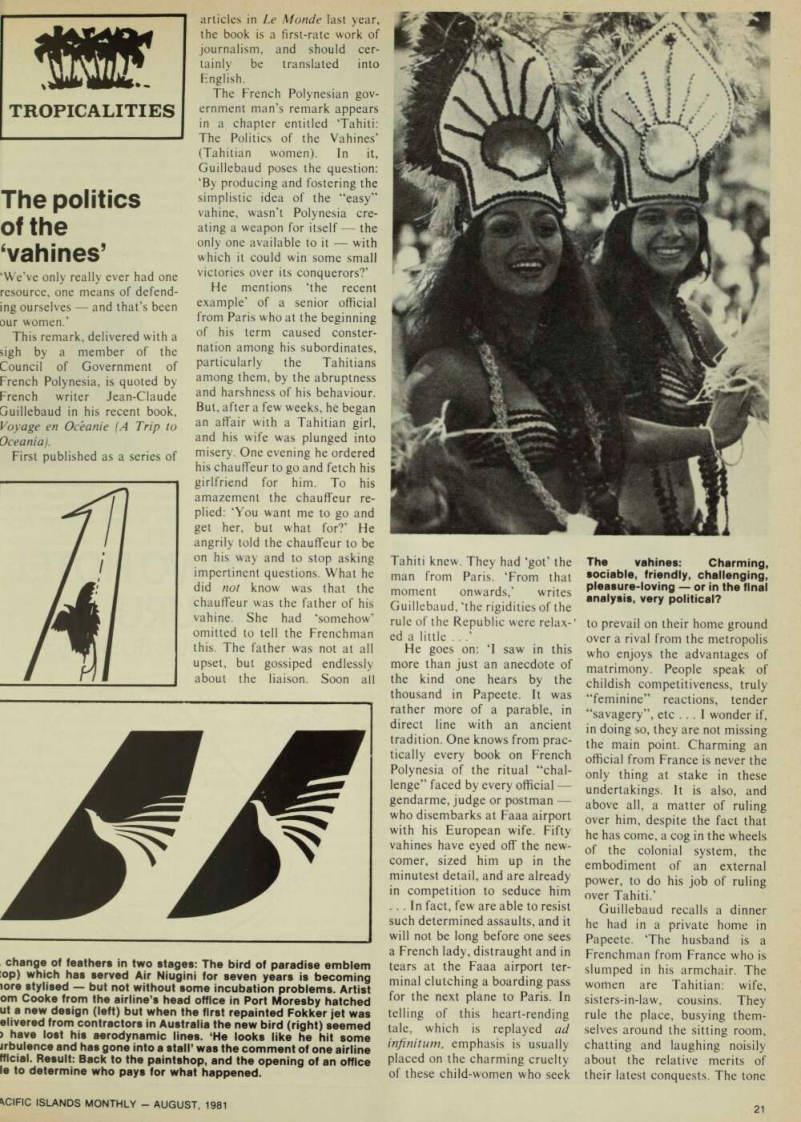
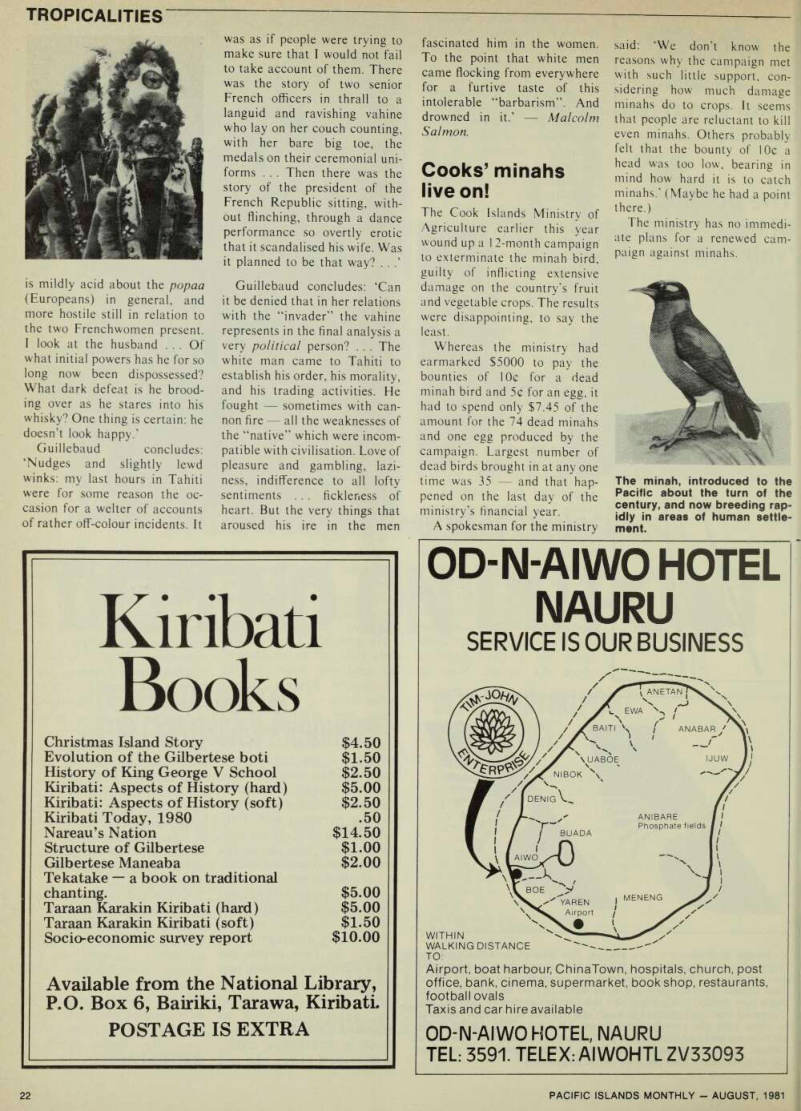
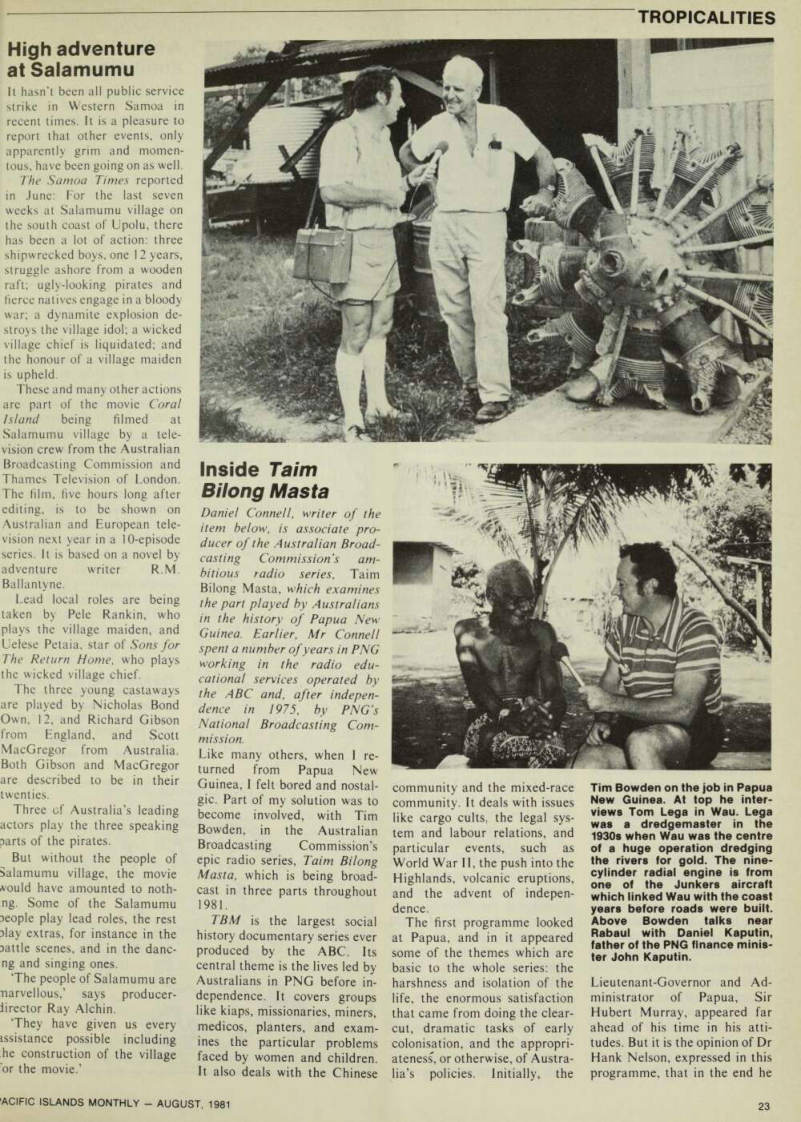
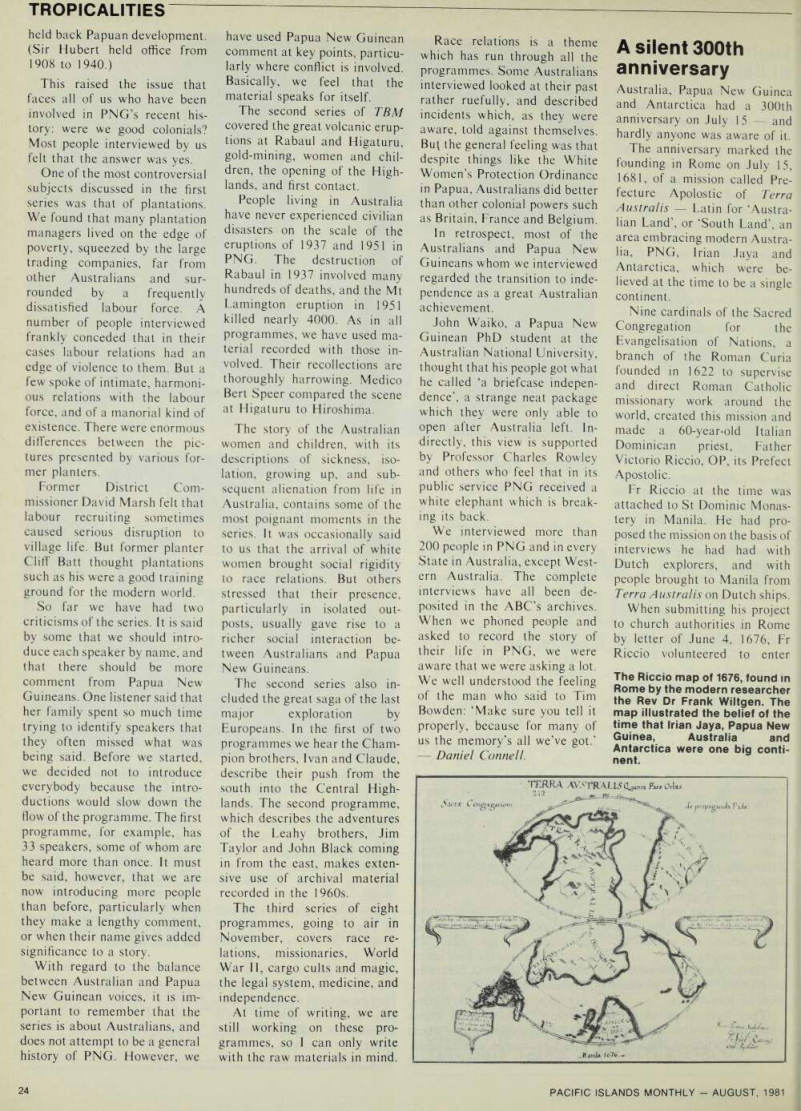
Tropicalities
of the
‘vahines’
‘We’ve only really ever had one resource, one means of defend ing ourselves and that’s been our women.’
This remark, delivered with a sigh by a member of the Council of Government of French Polynesia, is quoted by French writer Jean-Claude Guillebaud in his recent book, Voyage en Oceanic (A Trip to Oceania).
First published as a series of
articles in Le Monde last year, the book is a first-rate work of journalism, and should cer tainly be translated into English.
The French Polynesian gov ernment man’s remark appears in a chapter entitled Tahiti: The Politics of the Vahines’ (Tahitian women). In it, Guillebaud poses the question; ‘By producing and fostering the simplistic idea of the “easy” vahine, wasn’t Polynesia cre ating a weapon for itself the only one available to it with which it could win some small victories over its conquerors?’
He mentions ‘the recent example’ of a senior official from Paris who at the beginning of his term caused conster nation among his subordinates, particularly the Tahitians among them, by the abruptness and harshness of his behaviour.
But, after a few weeks, he began an affair with a Tahitian girl, and his wife was plunged into misery. One evening he ordered his chauffeur to go and fetch his girlfriend for him. To his amazement the chauffeur re plied: ‘You want me to go and get her, but what for?’ He angrily told the chauffeur to be on his way and to stop asking impertinent questions. What he did not know was that the chauffeur was the father of his vahine. She had ‘somehow’ omitted to tell the Frenchman this. The father was not at all upset, but gossiped endlessly about the liaison. Soon all
Tahiti knew. They had ‘got’ the man from Paris. ‘From that moment onwards,’ writes Guillebaud, ‘the rigidities of the rule of the Republic were relax-' ed a little . ..’
He goes on: ‘I saw in this more than just an anecdote of the kind one hears by the thousand in Papeete. It was rather more of a parable, in direct line with an ancient tradition. One knows from prac tically every book on French Polynesia of the ritual “chal lenge” faced by every official gendarme, judge or postman who disembarks at Faaa airport with his European wife. Fifty vahines have eyed off the new comer, sized him up in the minutest detail, and are already in competition to seduce him ... In fact, few are able to resist such determined assaults, and it will not be long before one sees a French lady, distraught and in tears at the Faaa airport ter minal clutching a boarding pass for the next plane to Paris. In telling of this heart-rending tale, which is replayed ad infinitum, emphasis is usually placed on the charming cruelty of these child-women who seek
to prevail on their home ground over a rival from the metropolis who enjoys the advantages of matrimony. People speak of childish competitiveness, truly “feminine” reactions, tender “savagery”, etc ... I wonder if, in doing so, they are not missing the main point. Charming an official from France is never the only thing at stake in these undertakings. It is also, and above all, a matter of ruling over him, despite the fact that he has come, a cog in the wheels of the colonial system, the embodiment of an external power, to do his job of ruling over Tahiti.’
Guillebaud recalls a dinner he had in a private home in Papeete. The husband is a Frenchman from France who is slumped in his armchair. The women are Tahitian: wife, sisters-in-law, cousins. They rule the place, busying them selves around the sitting room, chatting and laughing noisily about the relative merits of their latest conquests. The tone
change of feathers In two stages: The bird of paradise emblem [?]op) which has served Air Niugini for seven years is becoming [?]ore stylised - but not without some incubation problems. Artist [?]om Cooke from the airline's head office in Port Moresby hatched [?]ut a new design (left) but when the first repainted Fokker jet was [?]elivered from contractors in Australia the new bird (right) seemed [?] have lost his aerodynamic lines. ‘He looks like he hit some [?]rbulence and has gone into a stall’ was the comment of one airline [?]fflcial. Result: Back to the paintshop, and the opening of an office [?]e to determine who pays for what happened.
The vahines: Charming, sociable, friendly, challenging, pleasure-loving - or in the final analysis, very political?
is mildly acid about the popaa (Europeans) in general, and more hostile still in relation to the two Frenchwomen present.
I look at the husband ... Of what initial powers has he for so long now been dispossessed?
What dark defeat is he brood ing over as he stares into his whisky? One thing is certain: he doesn’t look happy.’
Guillebaud concludes: ‘Nudges and slightly lewd winks: my last hours in Tahiti were for some reason the oc casion for a welter of accounts of rather off-colour incidents. It
was as if people were trying to make sure that I would not fail to take account of them. There was the story of two senior French officers in thrall to a languid and ravishing vahine who lay on her couch counting, with her bare big toe, the medals on their ceremonial uni forms . . . Then there was the story of the president of the French Republic sitting, with out flinching, through a dance performance so overtly erotic that it scandalised his wife. Was it planned to be that way? .. .’
Guillebaud concludes: ‘Can it be denied that in her relations with the “invader” the vahine represents in the final analysis a very political person? . . . The white man came to Tahiti to establish his order, his morality, and his trading activities. He fought sometimes with can non fire all the weaknesses of the “native” which were incom patible with civilisation. Love of pleasure and gambling, lazi ness, indifference to all lofty sentiments .. . fickleness of heart. But the very things that aroused his ire in the men
fascinated him in the women.
To the point that white men came flocking from everywhere for a furtive taste of this intolerable “barbarism”. And
drowned in it.’
Malcolm
Salmon.
Cooks’ minahs
live on!
The Cook Islands Ministry of Agriculture earlier this year wound up a 12-month campaign to exterminate the minah bird, guilty of inflicting extensive damage on the country’s fruit and vegetable crops. The results were disappointing, to say the least.
Whereas the ministry had earmarked $5OOO to pay the bounties of 10c for a dead minah bird and 5c for an egg, it had to spend only $7.45 of the amount for the 74 dead minahs and one egg produced by the campaign. Largest number of dead birds brought in at any one time was 35 and that hap pened on the last day of the ministry’s financial year.
A spokesman for the ministry
said: ‘We don’t know the reasons why the campaign met with such little support, con sidering how much damage minahs do to crops. It seems that people are reluctant to kill even minahs. Others probably felt that the bounty of 10c a head was too low, bearing in mind how hard it is to catch minahs.’ (Maybe he had a point there.) The ministry has no immedi ate plans for a renewed cam paign against minahs.
The minah, introduced to the Pacific about the turn of the century, and now breeding rap idly in areas of human settle ment.
High adventure
at Salamumu
It hasn’t been all public service strike in Western Samoa in recent limes. It is a pleasure to report that other events, only apparently grim and momen tous, have been going on as well.
The Samoa Times reported in June: For the last seven weeks at Salamumu village on the south coast of Upolu, there has been a lot of action; three shipwrecked boys, one 12 years, struggle ashore from a wooden raft; ugly-looking pirates and fierce natives engage in a bloody war; a dynamite explosion de stroys the village idol; a wicked village chief is liquidated; and the honour of a village maiden is upheld.
These and many other actions are part of the movie Coral Island being filmed at Salamumu village by a tele vision crew from the Australian Broadcasting Commission and Thames Television of London.
The film, five hours long after editing, is to be shown on Australian and European tele vision next year in a 10-episode series. It is based on a novel by adventure writer R.M.
Ballantyne.
Lead local roles are being taken by Pele Rankin, who plays the village maiden, and Uelese Petaia, star of Sons for The Return Home, who plays the wicked village chief.
The three young castaways are played by Nicholas Bond Own, 12, and Richard Gibson from England, and Scott MacGregor from Australia.
Both Gibson and MacGregor are described to be in their twenties.
Three of Australia’s leading actors play the three speaking parts of the pirates.
But without the people of Salamumu village, the movie •vould have amounted to nothi ng. Some of the Salamumu people play lead roles, the rest slay extras, for instance in the :>attle scenes, and in the danc ng and singing ones. ‘The people of Salamumu are riarvellous,’ says producer lirector Ray Alehin. ‘They have given us every issistance possible including he construction of the village 'or the movie.’
Inside Taim
Bilong Mas
Daniel Connell, writer of the item below, is associate pro ducer of the Australian Broad casting Commission’s am bitious radio series, Taim Bilong Masta, which examines the part played by Australians in the history of Papua New Guinea. Earlier, Mr Connell spent a number of years in PNG working in the radio edu cational services operated by the ABC and, after indepen dence in 1975, by PNG’s National Broadcasting Com mission.
Like many others, when I re turned from Papua New Guinea, I felt bored and nostal gic. Part of my solution was to become involved, with Tim Bowden, in the Australian Broadcasting Commission’s epic radio series, Taim Bilong Masta, which is being broad cast in three parts throughout 1981.
TBM is the largest social history documentary series ever produced by the ABC. Its central theme is the lives led by Australians in PNG before in dependence. It covers groups like kiaps, missionaries, miners, medicos, planters, and exam ines the particular problems faced by women and children.
It also deals with the Chinese
community and the mixed-race community. It deals with issues like cargo cults, the legal sys tem and labour relations, and particular events, such as World War 11, the push into the Highlands, volcanic eruptions, and the advent of indepen dence.
The first programme looked at Papua, and in it appeared some of the themes which are basic to the whole series: the harshness and isolation of the life, the enormous satisfaction that came from doing the clear cut, dramatic tasks of early colonisation, and the appropri ateness, or otherwise, of Austra lia’s policies. Initially, the
Lieutenant-Governor and Ad ministrator of Papua, Sir Hubert Murray, appeared far ahead of his time in his atti tudes. But it is the opinion of Dr Hank Nelson, expressed in this programme, that in the end he
Tim Bowden on the job in Papua New Guinea. At top he inter views Tom Lega in Wau. Lega was a dredgemaster in the 1930s when Wau was the centre
of a huge operation dredging
the rivers for gold. The nine cylinder radial engine is from one of the Junkers aircraft which linked Wau with the coast years before roads were built.
Above Bowden talks near Rabaul with Daniel Kaputin, father of the PNG finance minis ter John Kaputin.
held back Papuan development. (Sir Hubert held office from 1908 to 1940.) This raised the issue that faces all of us who have been involved in PNG’s recent his tory: were we good colonials?
Most people interviewed by us felt that the answer was yes.
One of the most controversial subjects discussed in the first series was that of plantations.
We found that many plantation managers lived on the edge of poverty, squeezed by the large trading companies, far from other Australians and sur rounded by a frequently dissatisfied labour force. A number of people interviewed frankly conceded that in their cases labour relations had an edge of violence to them. But a few spoke of intimate, harmoni ous relations with the labour force, and of a manorial kind of existence. There were enormous differences between the pic tures presented by various for mer planters.
Former District Com missioner David Marsh felt that labour recruiting sometimes caused serious disruption to village life. But former planter Cliff Batt thought plantations such as his were a good training ground for the modern world.
So far we have had two criticisms of the series. It is said by some that we should intro duce each speaker by name, and that there should be more comment from Papua New Guineans. One listener said that her family spent so much time trying to identify speakers that they often missed what was being said. Before we started, we decided not to introduce everybody because the intro ductions would slow down the flow of the programme. The first programme, for example, has 33 speakers, some of whom are heard more than once. It must be said, however, that we are now introducing more people than before, particularly when they make a lengthy comment, or when their name gives added significance to a story.
With regard to the balance between Australian and Papua New Guinean voices, it is im portant to remember that the series is about Australians, and does not attempt to be a general history of PNG. However, we
have used Papua New Guinean comment at key points, particu larly where conflict is involved.
Basically, we feel that the material speaks for itself.
The second series of TBM covered the great volcanic erup tions at Rabaul and Higaturu, gold-mining, women and chil dren, the opening of the High lands, and first contact.
People living in Australia have never experienced civilian disasters on the scale of the eruptions of 1937 and 1951 in PNG. The destruction of Rabaul in 1937 involved many hundreds of deaths, and the Mt Lamington eruption in 1951 killed nearly 4000. As in all programmes, we have used ma terial recorded with those in volved. Their recollections are thoroughly harrowing. Medico Bert Speer compared the scene at Higaturu to Hiroshima.
The story of the Australian women and children, with its descriptions of sickness, iso lation, growing up, and sub sequent alienation from life in Australia, contains some of the most poignant moments in the series. It was occasionally said to us that the arrival of white women brought social rigidity to race relations. But others stressed that their presence, particularly in isolated out posts, usually gave rise to a richer social interaction be tween Australians and Papua New Guineans.
The second series also in cluded the great saga of the last major exploration by Europeans. In the first of two programmes we hear the Cham pion brothers, Ivan and Claude, describe their push from the south into the Central High lands. The second programme, which describes the adventures of the Leahy brothers, Jim Taylor and John Black coming in from the east, makes exten sive use of archival material recorded in the 19605.
The third series of eight programmes, going to air in November, covers race re lations, missionaries, World War 11, cargo culls and magic, the legal system, medicine, and independence.
At time of writing, we are still working on these pro grammes, so I can only write with the raw materials in mind.
Race relations is a theme which has run through all the programmes. Some Australians interviewed looked at their past rather ruefully, and described incidents which, as they were aware, told against themselves.
But the general feeling was that despite things like the White Women’s Protection Ordinance in Papua, Australians did better than other colonial powers such as Britain, France and Belgium.
In retrospect, most of the Australians and Papua New Guineans whom we interviewed regarded the transition to inde pendence as a great Australian achievement.
John Waiko, a Papua New Guinean PhD student at the Australian National University, thought that his people got what he called ‘a briefcase indepen dence’, a strange neat package which they were only able to open after Australia left. In directly, this view is supported by Professor Charles Rowley and others who feel that in its public service PNG received a white elephant which is break ing its back.
We interviewed more than 200 people in PNG and in every State in Australia, except West ern Australia. The complete interviews have all been de posited in the ABC’s archives.
When we phoned people and asked to record the story of their life in PNG, we were aware that we were asking a lot.
We well understood the feeling of the man who said to Tim Bowden: ‘Make sure you tell it properly, because for many of us the memory’s all we’ve got.’
Daniel Connell.
A silent 300th
anniversary
Australia, Papua New Guinea and Antarctica had a 300th anniversary on July 15 and hardly anyone was aware of it.
The anniversary marked the founding in Rome on July 15, 1681, of a mission called Pre fecture Apolostic of Terra Australis Latin for ‘Austra lian Land’, or ‘South Land’, an area embracing modern Austra lia, PNG, Irian Jaya and Antarctica, which were be lieved at the time to be a single continent.
Nine cardinals of the Sacred Congregation for the Evangelisation of Nations, a branch of the Roman Curia founded in 1622 to supervise and direct Roman Catholic missionary work around the world, created this mission and made a 60-year-old Italian Dominican priest, Father Victorio Riccio, OP, its Prefect Apostolic.
Fr Riccio at the time was attached to St Dominic Monas tery in Manila. He had pro posed the mission on the basis of interviews he had had with Dutch explorers, and with people brought to Manila from Terra Australis on Dutch ships.
When submitting his project to church authorities in Rome by letter of June 4, 1676, Fr Riccio volunteered to enter
The Riccio map of 1676, found in Rome by the modern researcher the Rev Dr Frank Wiltgen. The map illustrated the belief of the time that Irian Jaya, Papua New Guinea, Australia and Antarctica were one big conti nent.
Terra Australis and begin mission work there with the help of Franciscan priests who had agreed to accompany him from Manila.
To make sure that the cardi nals in Rome would be aware of the location, size and conse quent importance of Terra Australis, Fr Riccio enclosed with his letter a map drawn by hand in colour measuring 30 X 40 cm with many captions in Latin.
Like his letter the map was dated 1676. This was 94 years before Captain James Cook explored the east coast of Aus tralia, 100 years before the American colonies formally de clared their political indepen dence from Great Britain, and 112 years before the British flag was raised over the first European settlement in Austra lia.
A Spanish galleon carried Fr Riccio’s proposal from Manila across the Pacific to Acapulco on Mexico’s west coast. From there it went overland through Mexico City to Veracruz on Mexico’s east coast. Here it was placed aboard another Spanish galleon for the voyage across the Atlantic to Spain.
By the time Fr Riccio’s letter reached Rome five years had elapsed, causing Cardinal Pre fect Paluzio Altieri of the Evangelisation Congregation to make it the first item on the agenda for the General Meeting of July 15, 1681.
The secretary, Archbishop Edoardo Cibo, summarised Fr Riccio’s four-page Spanish let ter for the nine cardinals pres ent, telling them that Terra Australis was so vast ‘that one :an walk through it for more han two years without ever ieeing the sea’, that it was considered to be ‘the fifth pan )f the world', that ‘it has been inknown until now’, and that it contained ‘innumerable king loms and nations’.
The cardinals not only cre ited the Prefecture Apostolic of Terra Australis, as Fr Riccio md wished, but also placed him n charge as Prefect Apostolic md ruled that he was to receive ill ‘opportune faculties’ for his lew task.
But Fr Riccio may never lave learned of his appointment o Terra Australis. If Rome’s
letter to him was en route as long as his letter to Rome, it would have arrived in Manila in 1686. But Fr Riccio died in Manila on February 17, 1685 at the age of 64.
Information on Fr Riccio’s proposal and on the action taken by Rome came to light in a book published in Canberra in December 1979 by the Austra lian National University Press, and now in its second printing.
The 610-page work was re searched and written by Chicago-born Rev Dr Ralph M.
Wiltgen, a priest of the Divine Word Society who lives in Rome, and is called The Found ing of the Roman Catholic Church in Oceania, 1825 to 1850 (reviewed PIM Aug 1980 pl 33).
The book contains facsimiles of Fr Riccio’s map and letter, and also of the minutes of the meeting attended by the nine cardinals. These documents were all discovered by re searcher Wiltgen in two of the more than 4000 volumes of archive material preserved by the Evangelisation Congre gation at its headquarters in Rome.
Fr Wiltgen believes it is unlikely that Fr Riccio ever reached Terra Australis, al though he concedes that ar chive material may still be found in Manila, Spain or Rome to disprove this. ‘What is definite,’ the priest historian said, ‘is that the cardi nals in Rome recognised Fr Riccio’s vision and acted upon it without delay.’ ‘By creating the Prefecture Apostolic of Terra Australis in 1681.' he said, ‘and by preserv ing all documentation related to it, the cardinals have made it necessary for today’s historians to write new pages for inclusion
in their histories of Australia, Papua New Guinea and Antarctica.’
Seaplane gives
up its secret
A World War II US seaplane was found in June in about 18 m of water off Majuro, Marshall Islands, by Matt Holly, the local diving instructor, and his class.
The plane, a Martin PBM-3 Mariner, had apparently crashed, flipped over and sunk not far from the Eastern Gate way Hotel area, in which a seaplane landing ramp was lo cated during the war.
The plane is in poor con dition, with the engines and many other parts torn off.
An identification plate was recovered with the serial num ber 1212-B.
Mr Holly is not revealing the exact site until he has enough pictures for ‘history’. He hopes it will remain unmolested for all to view.
He is also checking the serial number with authorities, as he feels ‘somebody died when it hit’.
New deal for
Samoa’s blind?
Western Samoa’s troubled As sociation of the Blind now appears to have reverted to Association for the Blind with the recent election of four sighted major office holders.
Elected at the April AGM as president was Chief Justice R.
St John, while the other three executive positions also went to foreigners currently resident in Western Samoa.
Former president and foun der, Roderick (Liki) Crichton,
was chosen as one of the three council members. The other two councillors are also Samoan.
However, in the seven top positions. Mr Crichton is the only blind person.
Mr Crichton founded the Association of the Blind in the mid-19605. The aim was to have blind persons conducting all their own affairs. Increasing difficulties in administration and finance forced Mr Crichton’s first resignation, and a sighted medical man took over, Dr Asi Faletoese.
Disillusionment on the part of blind persons led to a vigorous campaign by the Observer newspaper to ascertain where funds for the association had gone. Mr Crichton’s own paper, Samoa Weekly also asked perti nent questions on the subject.
Alafumuo School for the Blind closed down, and soon after wards, in early 1980. Mr Crichton was re-elected presi dent. The school was reopened last year.
The Samoa Weekly, issue of May 1, 1981, commented on the 1981 AGM: ‘The Western Samoan Association of the Blind whose past financial man agement has been subject to criticism, has made some dras tic changes in the composition of its executive committee . . .
The new president intimated that he wishes the council to meet ... to consider ways and means to improve the associ ation’s facilities and financial position.’ -- W. Sharpe-Dunn.
A Martin Mariner of the type discovered on the seabed off Majuro. This picture, taken nearly 40 years ago, shows a Mariner of the Royal Australian Air Force. Australian and US crews used Mariners in World War II as transport links with Pacific Island outposts which did not have landplane access.
Advertisements & other items, pp. 21-26 (4 items)
21
ISLANDS MONTHLY - AUGUST. 1981
Books
OD-IM-AIWO HOTEL
NAURU
SERVICE IS OUR BUSINESS
<O/ / * V.
I --Jn
'1 BOE
Airport /
WITHIN
WALKING DISTANCE
TO: Airport, boat harbour, China Town, hospitals, church, post office, bank, cinema, supermarket, book shop, restaurants, football ovals Taxis and car hire available
OD-IM-AIWO HOTEL, NAURU
TEL 3591. TELEX: AIWOHTL ZV33093
Kiribati
Books
Christmas Island Story $4.50 Evolution of the Gilbertese boti $1.50 History of King George V School $2.50 Kiribati: Aspects of History (hard) $5.00 Kiribati: Aspects of History (soft) $2.50 Kiribati Today, 1980 .50 Nareau’s Nation $14.50 Structure of Gilbertese $l.OO Gilbertese Maneaba $2.00 Tekatake a book on traditional chanting. $5.00 Taraan Karakin Kiribati (hard) $5.00 Taraan Karakin Kiribati (soft) $1.50 Socio-economic survey report $lO.OO Available from the National Library,
P.O. Box 6, Bairiki, Tarawa, Kiribati
POSTAGE IS EXTRA
In the final showdown,
le mod guyalways wins!
N % > 4 % V. as % \ - ; i-,. m ii m » J <.ri£i -'= • ‘--I M iii. 00
uuaa a o j j
If you’ve been holding back * on bringing a video system into your life, here’s something you should know.
National’s VHS has galloped ahead to become the world’s favourite video-taping system.
And our slim new NV-7000, with a memory, eight programmes and a 12-function remote control, is the smartest, most sophisticated video recorder we’ve ever offered for your pleasure.
NV-7000 Your nearest National dealer will show off its great sound and picture. Not to mention the allelectronic controls that make video-taping as easy as falling off a horse.
Sure, any video recorder lets you watch what you like when you like. But you’re way ahead with the world’s favourite system. Whether it’s the 7000 or the budget-priced NV-2000.
Just like in the movies, the good guy has won in the end.
National/Panasonic \rl§
the world’s favourite video-taping system
National, Panasonic and Technics are the brandnames of Matsushita Electric.
TV picture simulated Unauthorised recordings TV programmes and othl: materials may infringe
Tropicalities
23
’ACIFIC ISLANDS MONTHLY - AUGUST, 1981
Tropicalities
25
ACIFIC ISLANDS MONTHLY AUGUST. 1981
French N-policy
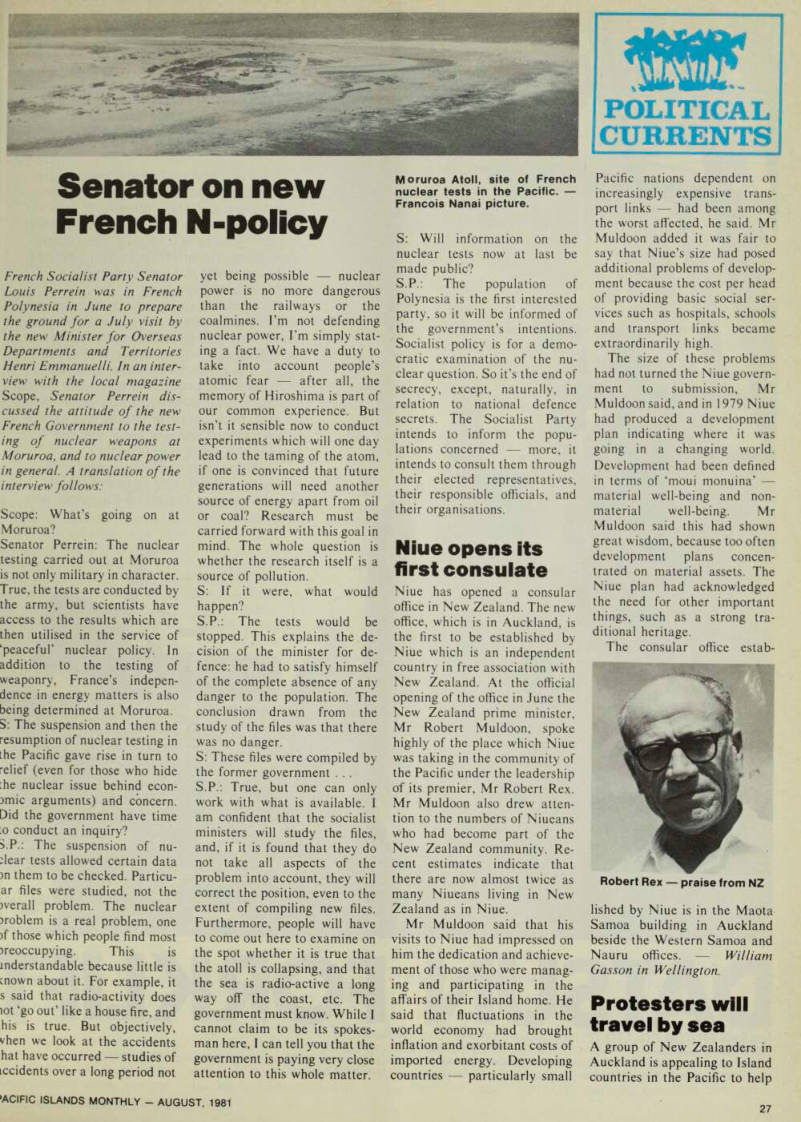

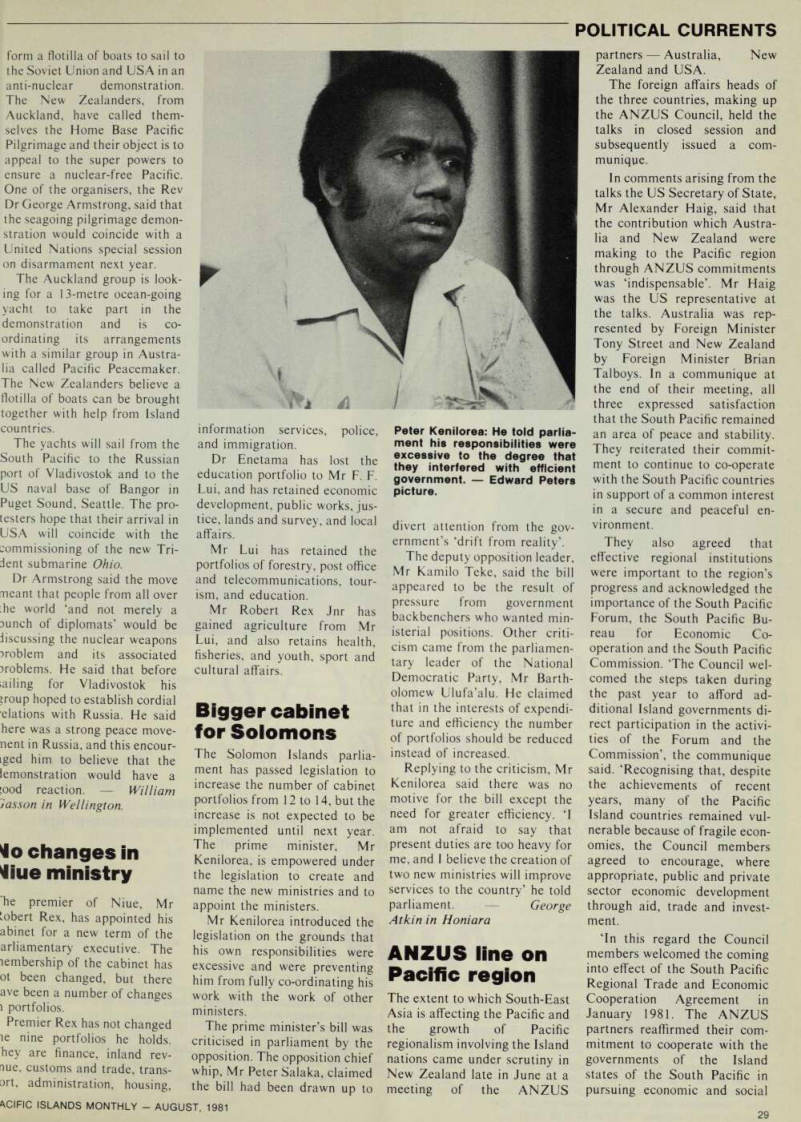

Political
Currents
Senator on new French N-policy
French Socialist Party Senator Louis Perrein was in French Polynesia in June to prepare the ground for a July visit by the new Minister for Overseas Departments and Territories Henri Emmanuelli. In an inter view with the local magazine Scope, Senator Perrein dis cussed the attitude of the new French Government to the test ing of nuclear weapons at Moruroa, and to nuclear power in general. A translation of the interview follows: Scope: What’s going on at Moruroa?
Senator Perrein: The nuclear testing carried out at Moruroa is not only military in character.
True, the tests are conducted by the army, but scientists have access to the results which are then utilised in the service of ‘peaceful’ nuclear policy. In addition to the testing of weaponry, France’s indepen dence in energy matters is also being determined at Moruroa.
S: The suspension and then the resumption of nuclear testing in the Pacific gave rise in turn to relief (even for those who hide the nuclear issue behind econ omic arguments) and concern.
Did the government have time to conduct an inquiry? 5.P.: The suspension of nu dear tests allowed certain data on them to be checked. Particu ar files were studied, not the overall problem. The nuclear oroblem is a real problem, one of those which people find most oreoccupying. This is mderstandable because little is mown about it. For example, it s said that radio-activity does lot ‘go out’ like a house fire, and his is true. But objectively, vhen we look at the accidents hat have occurred studies of iccidents over a long period not
yet being possible nuclear power is no more dangerous than the railways or the coalmines. I’m not defending nuclear power, I’m simply stat ing a fact. We have a duty to take into account people’s atomic fear after all, the memory of Hiroshima is part of our common experience. But isn’t it sensible now to conduct experiments which will one day lead to the taming of the atom, if one is convinced that future generations will need another source of energy apart from oil or coal? Research must be carried forward with this goal in mind. The whole question is whether the research itself is a source of pollution.
S: If it were, what would happen?
S.P.: The tests would be stopped. This explains the de cision of the minister for de fence: he had to satisfy himself of the complete absence of any danger to the population. The conclusion drawn from the study of the files was that there was no danger.
S: These files were compiled by the former government . ..
S.P.: True, but one can only work with what is available. I am confident that the socialist ministers will study the files, and, if it is found that they do not take all aspects of the problem into account, they will correct the position, even to the extent of compiling new files.
Furthermore, people will have to come out here to examine on the spot whether it is true that the atoll is collapsing, and that the sea is radio-active a long way off the coast, etc. The government must know. While I cannot claim to be its spokes man here, I can tell you that the government is paying very close attention to this whole matter.
S: Will information on the nuclear tests now at last be made public?
S.P.: The population of Polynesia is the first interested party, so it will be informed of the government’s intentions.
Socialist policy is for a demo cratic examination of the nu clear question. So it’s the end of secrecy, except, naturally, in relation to national defence secrets. The Socialist Party intends to inform the popu lations concerned more, it intends to consult them through their elected representatives, their responsible officials, and their organisations.
Niue opens its
first consulate
Niue has opened a consular office in New Zealand. The new office, which is in Auckland, is the first to be established by Niue which is an independent country in free association with New Zealand. At the official opening of the office in June the New Zealand prime minister, Mr Robert Muldoon, spoke highly of the place which Niue was taking in the community of the Pacific under the leadership of its premier, Mr Robert Rex.
Mr Muldoon also drew atten tion to the numbers of Niueans who had become part of the New Zealand community. Re cent estimates indicate that there are now almost twice as many Niueans living in New Zealand as in Niue.
Mr Muldoon said that his visits to Niue had impressed on him the dedication and achieve ment of those who were manag ing and participating in the affairs of their Island home. He said that fluctuations in the world economy had brought inflation and exorbitant costs of imported energy. Developing countries particularly small
Pacific nations dependent on increasingly expensive trans port finks had been among the worst affected, he said. Mr Muldoon added it was fair to say that Niue’s size had posed additional problems of develop ment because the cost per head of providing basic social ser vices such as hospitals, schools and transport finks became extraordinarily high.
The size of these problems had not turned the Niue govern ment to submission, Mr Muldoon said, and in 1979 Niue had produced a development plan indicating where it was going in a changing world.
Development had been defined in terms of ‘moui monuina’ material well-being and non material well-being. Mr Muldoon said this had shown great wisdom, because too often development plans concen trated on material assets. The Niue plan had acknowledged the need for other important things, such as a strong tra ditional heritage.
The consular office estab-
fished by Niue is in the Maota Samoa building in Auckland beside the Western Samoa and
Nauru offices.
William
Gasson in Wellington.
Protesters will
travel by sea
A group of New Zealanders in Auckland is appealing to Island countries in the Pacific to help
Moruroa Atoll, site of French nuclear tests in the Pacific. - Francois Nanai picture.
Robert Rex - praise from NZ
form a flotilla of boats to sail to the Soviet Union and USA in an anti-nuclear demonstration.
The New Zealanders, from Auckland, have called them selves the Home Base Pacific Pilgrimage and their object is to appeal to the super powers to ensure a nuclear-free Pacific.
One of the organisers, the Rev Dr George Armstrong, said that the seagoing pilgrimage demon stration would coincide with a United Nations special session on disarmament next year.
The Auckland group is look ing for a 13-metre ocean-going yacht to take part in the demonstration and is co ordinating its arrangements with a similar group in Austra lia called Pacific Peacemaker.
The New Zealanders believe a flotilla of boats can be brought together with help from Island countries.
The yachts will sail from the South Pacific to the Russian port of Vladivostok and to the US naval base of Bangor in Puget Sound, Seattle. The pro testers hope that their arrival in USA will coincide with the commissioning of the new Tri dent submarine Ohio.
Dr Armstrong said the move neant that people from all over ;he world ‘and not merely a Dunch of diplomats’ would be discussing the nuclear weapons Droblem and its associated problems. He said that before mailing for Vladivostok his >roup hoped to establish cordial elations with Russia. He said here was a strong peace move nent in Russia, and this encour iged him to believe that the lemonstration would have a
;ood reaction.
William
Gasson in Wellington.
io changes in
iiue ministry
'he premier of Niue, Mr Robert Rex, has appointed his abinet for a new term of the arliamentary executive. The lembership of the cabinet has ot been changed, but there ave been a number of changes i portfolios.
Premier Rex has not changed ie nine portfolios he holds, hey are finance, inland rev nue, customs and trade, trans it, administration, housing,
information services, police, and immigration.
Dr Enetama has lost the education portfolio to Mr F. F.
Lui, and has retained economic development, public works, jus tice, lands and survey, and local affairs.
Mr Lui has retained the portfolios of forestry, post office and telecommunications, tour ism, and education.
Mr Robert Rex Jnr has gained agriculture from Mr Lui, and also retains health, fisheries, and youth, sport and cultural affairs.
Bigger cabinet
for Solomons
The Solomon Islands parlia ment has passed legislation to increase the number of cabinet portfolios from 12 to 14, but the increase is not expected to be implemented until next year.
The prime minister, Mr Kenilorea, is empowered under the legislation to create and name the new ministries and to appoint the ministers.
Mr Kenilorea introduced the legislation on the grounds that his own responsibilities were excessive and were preventing him from fully co-ordinating his work with the work of other ministers.
The prime minister’s bill was criticised in parliament by the opposition. The opposition chief whip, Mr Peter Salaka, claimed the bill had been drawn up to
divert attention from the gov ernment’s ‘drift from reality’.
The deputy opposition leader, Mr Kamilo Teke, said the bill appeared to be the result of pressure from government backbenchers who wanted min isterial positions. Other criti cism came from the parliamen tary leader of the National Democratic Party, Mr Barth olomew Ulufa’alu. He claimed that in the interests of expendi ture and efficiency the number of portfolios should be reduced instead of increased.
Replying to the criticism, Mr Kenilorea said there was no motive for the bill except the need for greater efficiency. T am not afraid to say that present duties are too heavy for me, and I believe the creation of two new ministries will improve services to the country’ he told
parliament.
George
Atkin in Honiara
ANZUS line on
Pacific region
The extent to which South-East Asia is affecting the Pacific and the growth of Pacific regionalism involving the Island nations came under scrutiny in New Zealand late in June at a meeting of the ANZUS
partners Australia, New Zealand and USA.
The foreign affairs heads of the three countries, making up the ANZUS Council, held the talks in closed session and subsequently issued a com munique.
In comments arising from the talks the US Secretary of State, Mr Alexander Haig, said that the contribution which Austra lia and New Zealand were making to the Pacific region through ANZUS commitments was ‘indispensable’. Mr Haig was the US representative at the talks. Australia was rep resented by Foreign Minister Tony Street and New Zealand by Foreign Minister Brian Talboys. In a communique at the end of their meeting, all three expressed satisfaction that the South Pacific remained an area of peace and stability.
They reiterated their commit ment to continue to co-operate with the South Pacific countries in support of a common interest in a secure and peaceful en vironment.
They also agreed that effective regional institutions were important to the region’s progress and acknowledged the importance of the South Pacific Forum, the South Pacific Bu reau for Economic Co operation and the South Pacific Commission. The Council wel comed the steps taken during the past year to afford ad ditional Island governments di rect participation in the activi ties of the Forum and the Commission’, the communique said. ‘Recognising that, despite the achievements of recent years, many of the Pacific Island countries remained vul nerable because of fragile econ omies, the Council members agreed to encourage, where appropriate, public and private sector economic development through aid, trade and invest ment. ‘ln this regard the Council members welcomed the coming into effect of the South Pacific Regional Trade and Economic Cooperation Agreement in January 1981. The ANZUS partners reaffirmed their com mitment to cooperate with the governments of the Island states of the South Pacific in pursuing economic and social
Peter Kenilorea: He told parlia ment his responsibilities were excessive to the degree that they interfered with efficient government. - Edward Peters picture.
development,’ the communique added.
On the law of the sea issue, Australia and New Zealand emphasised the importance of successfully completing the negotiations and hoped the United States would shortly be able to participate in the con cluding negotiations.
The communique added that the United States undertook to consult closely with its ‘friends and allies’ as it determined its position. Law of the sea is one of the most sensitive areas in the Pacific attitudes of ANZUS because of conflicting views between Island countries and USA over some fisheries re sources.
The ANZUS partners also welcomed Japan’s plans to ex pand its development assistance to the Pacific region, and sup ported Japan’s policy of ‘im proving its self-defence capa bility while not seeking a wider regional security role’.
Overall the talks strengthened the commitment of the partners to the important Article Four in the ANZUS treaty which reads: ‘Each party recognises that an armed attack in the Pacific area on any of the parties would be dangerous to its own peace and security and declares that it would act to meet the common danger in accordance with its consti tutional processes.’
The next ANZUS meeting will be in Canberra next
year.
William Gasson in
Wellington.
SI looking at
staff policy
Solomon Islands is investigating the possibility of streamlining its national administration by making use of ministerial staff members appointed from out side the public service. At present only one man falls into this category —Mr Francis Saemala who is special sec retary to the Prime Minister, Mr Peter Kenilorea.
Mr Saemala made an unsuc cessful attempt to enter parlia ment at recent by-elections, and then returned to the position he held with the prime minister. In June at the invitation of the Australian Government he visited the Australian Capital
Territory, New South Wales and Queensland to assess the extent to which ministerial staff were involved in state and federal administration and to determine whether some of the practices adopted were appli cable to his own country. He will report directly to Mr.
Kenilorea.
Papua New Guinea, which is the nearest neighbour of the Solomons, already has an exten sive system of using ministerial staff. This has sometimes cre ated friction with the career public service, but in general the system is working smoothly.
Mr Saemala said during his Australian visit that he believed the use of ministerial staff provided greater flexibility in national administration, but the system had to be weighed against many other factors.
While in Australia he also investigated the structure and operation of political parties.
The party system has only recently become a significant part of Solomon Island politics, but Mr Saemala said that at present it was marked by a lack of discipline and loyalty. The Solomon Island government in principle was committed to a party system, he said, and believed that the presence of too many easily-swayed inde pendents often confused parlia mentary debate on important legislation. He believed that a properly constituted and prop erly disciplined party system would enable much better long range planning for legislation programmes.
Tuvalu holding
Its elections
A controversial call for Nanumea Island to secede from Tuvalu will be one of the campaign issues when the Tuvalu general elections are held on September 8.
One of the candidates from Nanumea, Telavi Faati, is cam paigning for Nanumea indepen dence although there is no indication that he has general support. It is his second bid for election. On his first attempt he polled only 36 votes compared with 175 and 171 for the successful candidates. The call for secession is a new issue since the last elections.
Interest is centred on the re election chances of Prime Min ister Toaripi Lauti, and even if he is re-elected there is con siderable speculation on whether he will be able to form a government. Toaripi Lauti is one of the members represent ing Funafuti, the central elec torate.
For over a year now the 12-member parliament has been split six to five in Toaripi’s favour, the post of speaker being held by the other MP for Funafuti, Elia Tavita. The bal ance of power has been held by Tepepe Papau, one of the two MPs for Niutao, whose col league is the minister for com merce and natural resources, Tomu Sione. There are sugges tions that Tepepe on several occasions would have voted against the government, had it not been for the fact that the electors of Niutao instructed their members to speak with one voice. Such considerations have not bothered the voters of Vaitupu where one member, Taui Finikaso, became minister for social services and the other, Dr Tomasi Puapua, became a leading member of the unofficial opposition. Nanumea, the northernmost island, also had split representation with Maheu Naniseni as minister for works and local government, and Motufoua Feso, a one-time supporter of the government who sided with the opposition.
The man who has been lead ing the unofficial opposition is Henry Faati Naisali from Nukulaelae, and there is con siderable speculation on his
chances of re-election. In the 1977 elections he defeated by only 14 votes Isakala Paeniu who had been a minister in the original Gilbert and Ellice Islands Government. Isakala is opposing him again, and the outcome is by no means certain.
The only certainty about the Nukulaelae seat is that the successful candidate will not be a supporter of Toaripi Lauti.
Henry Naisali from Nukulaelae and Dr Puapua from Vaitupu are both seen as possible successors to the prime ministership if Toaripi Lauti fails to be elected or cannot muster support to form a gov ernment. All three men were candidates for the then position of chief minister in 1977, al though Henry Naisali withdrew before the ballot leaving Toaripi to win by eight votes to four. From a correspondent on Funafuti.
PNG’s military
chief resigns
A radio news report in Papua New Guinea late in June caused widespread interest and reac-
Toaripi Lauti: Can he survive next year’s Tuvalu election?
Brigadier-General Diro: Six years is long enough, he says.
tion with a claim that Brigadier- General Ted Diro, Commander of the PNG Defence Force, was about to resign and enter poli tics. Subsequent reports linked him with the Peoples Progress Party (the party led by the Prime Minister, Sir Julius Chan) and claimed that he hoped to become prime minis ter.
In the reaction which fol lowed Brigadier-General Diro confirmed that he had resigned but expressed anger at what he called ‘speculation’ that he in tended to stand for parliament.
He said it was an insult to suggest that while he was the head of an apolitical organis ation he had entered into politi cal dialogue with the Peoples Progress Party or any party.
Brigadier-General Diro said that he had offered his services to the government in a career capacity because he felt the time had come for a change from his present career duties as head of the defence force.
He said he had tendered his resignation in writing to the Minister for Defence, Mr Pepena. after serving in his present position for six years.
His current term has nearly two years to run.
General Diro continued ‘To suggest that I have had some dialogue with the Peoples Pro gress Party while serving in my present position is an insult to my professional integrity. It’s in the interests of the country that the defence force remain free of and above politics. I have offered to step down under pressure from some senior min isters who feel I can serve the country in another capacity. I think that six years as com mander of the defence force is enough for anybody’.
He also quoted from his letter of resignation to Mr Pepena, which said ‘After a great deal of thinking it is with sadness that I have come to the conclusion that after serving six years as commander 1 should hand over to a new man. It has been the practice within the Common wealth for heads of defence forces to stay in office for between five and six years. I think I have served enough, and should go in order not to create a bottleneck in the senior ranks of the force.’
Brigadier-General Diro is one of the most widely known and highly respected public figures in PNG. There is little doubt, according to many political leaders themselves, that he would be a powerful force if he decided to enter politics. De spite his denials there is still a strong public feeling that he intends ultimately to enter poli tics, and that his current atti tude is largely one of prudence because of the sensitivity of his position. He is 41 years old, and graduated from the Australian officer training school in Portsea, Victoria, in 1962. No date has been given for when the resignation will become effective.
Call for strong
parties in PNG
Papua New Guinea needs a strong political party system in the interests of its national administration, according to the deputy prime minister, Mr lambakey Okuk. In an inter view in Sydney with PIM re cently Mr Okuk said plainly that he considered the present structure of the parties showed lack of discipline, lack of con sistency and a general ineffectiveness. The country would be much better off if its parties were more clearly defined and more strongly man aged and if party loyalties were given a high priority in political behaviour, he said.
Mr Okuk said he planned to tighten up the structure of his own party, the National Party, which is one of a collection of
factions in the coalition govern ment of Sir Julius Chan. Look ing to next year’s general elec tions in PNG Mr Okuk said it was not outside the bounds of possibility that his own party, if properly structured and disci plined, could gain the numbers for government in its own right.
PNG has never yet had any single party with sufficient num bers to govern alone, although the now badly-fragmented United Party once came close to this goal.
Mr Okuk’s remarks about the need for a stronger party system have particular significance be cause few political leaders in PNG have ever firmly and strongly advocated political parties as a system, although they have used them as a means to an end. Even the Pangu Party which led PNG into indepen dence frequently claimed that a ‘parliament of consensus’ might be more suitable for the country than an opposition and govern ment system with political par ties. Pangu formed a party as the most expeditious way to achieve its goal of the day immediate home rule but did not always ac cept that the party system would become established as part of the national political structure.
Mr Okuk now believes that PNG is firmly committed to a party system, but that the system itself requires strength ening.
Mr Okuk also answered re cent criticism of financial man agement in government. He said that PNG was in a much
stronger position than many critics pretended. The country had suffered from world-wide factors, from ‘these depressions which come every 10 years or so’. He said that proper financial controls were still maintained and he believed the economy would take a strong upward turn in 1982.
He said he was aware that the opposition leader, Mr Somare, had spoken of possible World Bank intervention in the man agement of PNG finances, but this had been ‘political talk’ on Mr Somare’s part.
Mr Okuk also denied the presence of any significant fric tions in the coalition govern ment, including allegations of friction between himself and the prime minister. He said that ‘some compromises’ had to be made, but this was part of the operation of any coalition. ‘The main thing is that we under stand each other, and our par ties understand each other’ he said.
Mr Okuk was visiting Austra lia as part of a campaign to assure Australian businessmen of the stability of PNG and to explain its requirements for investment from Australia. (See separate report under Trade winds in this issue).
In Melbourne Mr Okuk dis cussed plans for the Common wealth heads of government meeting to be held there in October. Shown with him are (left) Mr F. W. Milne, deputy head of organisation and Mr A.
McVittie of the Royal Melbourne Exhibition Building where the government heads will meet. - AIS picture by Terry Rowe.
Advertisements & other items, pp. 27-34 (3 items)
27
'ACIFIC ISLANDS MONTHLY - AUGUST, 1981
Datsun Forklift
n i Ml V
Heavyweights Built
To Dazzle You With
Fancy Footwork.
Now you can really think heavy-duty.
New heavy-duty Datsun Forklift 3.5-ton cushion tire and 4-ton pneumatic tire models deliver the total toughness, power and gradeability you require. Also speed, tight-space maneuverability and operator ease you never thought possible in a heavy-duty heavyweight.
Rugged monocoque body construction reduces dimensions, increases maneuverability. Proven high-efficiency engines assure superb torque, speed and gradeability. The powerful gasoline or turbocharged diesel engine matches your needs exactly. Power steering, single-lever tilt/lift control, hydro-booster brakes and exceptional forward visibility keep operator fatigue low, work output high.
Built for high reliability, speed and efficiency. Heavy-duty Datsun Forklift 3.5-ton cushion tire and 4-ton pneumatic tire models. tf *« &
NISSAN
DATSUN FORKLIFT
NISSAN MOTOR CO., LTD. 17-1, Ginza 6-Chome, Chuoku, Tokyo 104, Japan Loadlift Equipment Limited P.O. Box 12593, Penrose, Auckland 6, New Zealand Tel: 663-714 Nissan Motor Co., (Australia) Pty. Ltd. Industrial Machinery Division P.O. Box 249, Kings Cross, Sydney, N.S.W. 2011, Australia Tel: 358-5444 Boroko Motors Ltd. P.O, Box 1259, Boroko, Port Moresby, Papua New Guinea Tel; 255255, 255-347
JIJWs new CS-J 1
Too good to miss!
Now those great FM stereo programs don’t have to be missed, with AlWA’s ultra-light CS-J 1 FM-cassette combination. It makes superb stereo recordings directly off the built-in radio, as well as from
connection cords or external stereo microphones.
AIWA for craftsmanship
AIWA
0., LTD. 11-9, Ueno 1-chome, Taito-ku, Tokyo, Australia AIWA Australia Pty., Ltd., P.O. Box 339, Rockdale, N.S.W., Australia 2216 Tel: 597-2388/2808 Cook Islands Island Merchants Ltd., P.O. Box 69, Rarotonga, Cook Islands Fiji D. Ranchhod & Company, Corner of Vidilo St. & Vitogo PDE, P.O. Box 18, Lautoka. Fiji Tel: 60227 Fiji P. Hargovind Bros., Duty Free Centre, 190 Renwick Road, Suva, Fiji Tel: 24350 Guam Micropac Audio, Inc., P.O. Box 3478, Agana, Guam 96910 Tel: 472-8091 New Caledonia Hifivox; 79 rue de Sebastopol B.P. 1458 Noumea, New Caledonia Tel: 27 24 66 et 28 29 31 P.N.G. Oceania Indent Agency (P.N.G.) Pty., Ltd. Box 5518, Boroko, Port Moresby, P.N.G. Tel: PM 256406 Solomon Islands Harvest Pacific Ltd., G.P.O. 517, Honiara, Solomon Islands Tel; 718 Tahiti Fare Hi-Fi Stereo, Rue de Marechal Foch, P.O. Box 269, Papeete, Tahiti R C 6604 A Vanuatu (New Hebrides) The Sound Centre Ltd.; P.O. Box 434, Vila, Vanuatu (New Hebrides) Tel: 2035
Save energy.
Save money.
With Rheem Solar.
ixheem m x %xx Now is the time to think about installing Rheem Solar.
With a Rheem Solar system, you can save on your annual hot water bill and help conserve valuable energy.
A Rheem Solar system offers you some very special features:- The exclusive Rheem Sunstat* valve controls water temperature.
This means your water temperature can’t exceed 70 degrees, so there is no risk of accidental scalding.
Rheem Solar systems have all copper absorber plates, one of the best heat conductors in the world.
Their 200 or 300litre capacity will suit your family needs.
And they come with Rheem reliability and 40 years’ experience in the hot water business.
For a free brochure on Rheem Solar, send in the coupon below. fib: Export Manager, Appliance Division, Rheem Australia Ltd, P.O, Box 6, Rydalmere 2116. Australia.
Name: Address in DISTRIBUTORS: PAPUA NEW GUINEA. Steamships Trading Co. Ltd: Port Moresby, Lae, Kieta, Goroka, Madang, Rabaul, Popondetta, Kundiawa, Samaria, Mt. Hagen, Vanimo. Mainland Plumbing Supplies; Lae. NEW CALEDONIA. Ballande: Noumea. TAHITI. Coupimex: Papeete.
We would welcome enquiries for agencies in areas not covered above.
RHAIIO6
XiTwrr \ ■ ’
P
V II
> 'V . * A %v . * ' w» 0 • ♦ & : ' , * Vv V (V k l :.n • \
*Vfc
188 4 A & y p ; in ♦ J V> a 1 *■ \ / V - 111 I, ■• I 1 'A rm
: vliu
S < ~Jl‘ • si:£
xs! x
•V A
Political Currents
29
ISLANDS MONTHLY - AUGUST, 1981
People
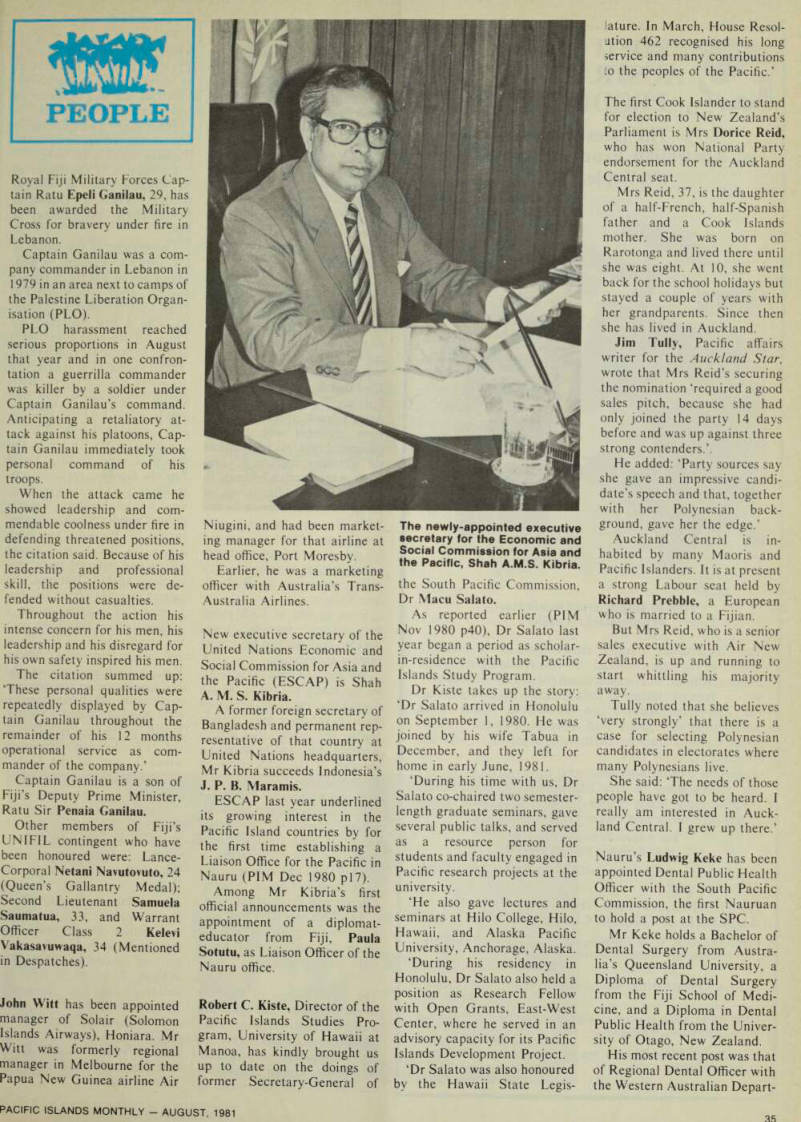
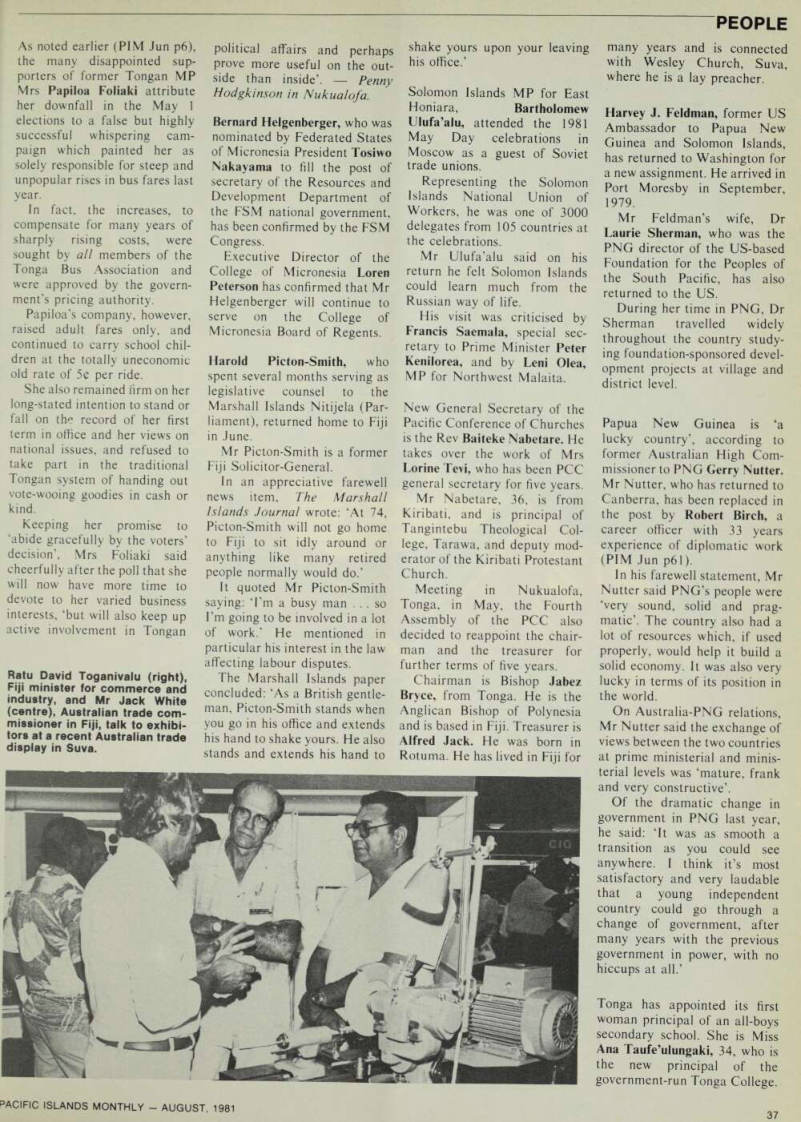
Royal Fiji Military Forces Cap tain Ratu Epeli Ganilau, 29, has been awarded the Military Cross for bravery under fire in Lebanon.
Captain Ganilau was a com pany commander in Lebanon in 1979 in an area next to camps of the Palestine Liberation Organ isation (PLO).
PLO harassment reached serious proportions in August that year and in one confron tation a guerrilla commander was killer by a soldier under Captain Ganilau’s command.
Anticipating a retaliatory at tack against his platoons, Cap tain Ganilau immediately took personal command of his troops.
When the attack came he showed leadership and com mendable coolness under fire in defending threatened positions, the citation said. Because of his leadership and professional skill, the positions were de fended without casualties.
Throughout the action his intense concern for his men, his leadership and his disregard for his own safety inspired his men.
The citation summed up: ‘These personal qualities were repeatedly displayed by Cap tain Ganilau throughout the remainder of his 12 months operational service as com mander of the company.’
Captain Ganilau is a son of Fiji’s Deputy Prime Minister, Ratu Sir Penaia Ganilau.
Other members of Fiji’s UNIFIL contingent who have been honoured were: Lance- Corporal Netani Navutovuto, 24 (Queen’s Gallantry Medal); Second Lieutenant Samuela Saumatua, 33, and Warrant Officer Class 2 Kelevi Vakasavuwaqa, 34 (Mentioned in Despatches).
John Witt has been appointed manager of Solair (Solomon Islands Airways), Honiara. Mr Witt was formerly regional manager in Melbourne for the Papua New Guinea airline Air
Niugini, and had been market ing manager for that airline at head office, Port Moresby.
Earlier, he was a marketing officer with Australia’s Trans- Australia Airlines.
New executive secretary of the United Nations Economic and Social Commission for Asia and the Pacific (ESCAP) is Shah A. M. S. Kibria.
A former foreign secretary of Bangladesh and permanent rep resentative of that country at United Nations headquarters, Mr Kibria succeeds Indonesia’s J. P. B. Maramis.
ESCAP last year underlined its growing interest in the Pacific Island countries by for the first time establishing a Liaison Office for the Pacific in Nauru (PIM Dec 1980 p!7).
Among Mr Kibria’s first official announcements was the appointment of a diplomat educator from Fiji, Paula Sotutu, as Liaison Officer of the Nauru office.
Robert C. Kiste, Director of the Pacific Islands Studies Pro gram, University of Hawaii at Manoa, has kindly brought us up to date on the doings of former Secretary-General of
the South Pacific Commission, Dr Macu Salato.
As reported earlier (PIM Nov 1980 p4O), Dr Salato last year began a period as scholar in-residence with the Pacific Islands Study Program.
Dr Kiste takes up the story: ‘Dr Salato arrived in Honolulu on September 1, 1980. He was joined by his wife Tabua in December, and they left for home in early June, 1981. ‘During his time with us, Dr Salato co-chaired two semester length graduate seminars, gave several public talks, and served as a resource person for students and faculty engaged in Pacific research projects at the university. ‘He also gave lectures and seminars at Hilo College, Hilo, Hawaii, and Alaska Pacific University, Anchorage, Alaska. ‘During his residency in Honolulu, Dr Salato also held a position as Research Fellow with Open Grants, East-West Center, where he served in an advisory capacity for its Pacific Islands Development Project. ‘Dr Salato was also honoured by the Hawaii State Legis
lature. In March, House Resol ution 462 recognised his long service and many contributions to the peoples of the Pacific.’
The first Cook Islander to stand for election to New Zealand’s Parliament is Mrs Dorice Reid, who has won National Party endorsement for the Auckland Central seat.
Mrs Reid, 37, is the daughter of a half-French, half-Spanish father and a Cook Islands mother. She was born on Rarotonga and lived there until she was eight. At 10, she went back for the school holidays but stayed a couple of years with her grandparents. Since then she has lived in Auckland.
Jim Tully, Pacific affairs writer for the Auckland Star, wrote that Mrs Reid’s securing the nomination ‘required a good sales pitch, because she had only joined the party 14 days before and was up against three strong contenders.’.
He added: ‘Party sources say she gave an impressive candi date’s speech and that, together with her Polynesian back ground, gave her the edge.’
Auckland Central is in habited by many Maoris and Pacific Islanders. It is at present a strong Labour seat held by Richard Prebble, a European who is married to a Fijian.
But Mrs Reid, who is a senior sales executive with Air New Zealand, is up and running to start whittling his majority away.
Tully noted that she believes ‘very strongly’ that there is a case for selecting Polynesian candidates in electorates where many Polynesians live.
She said: ‘The needs of those people have got to be heard. I really am interested in Auck land Central. I grew up there.’
Nauru’s Ludwig Keke has been appointed Dental Public Health Officer with the South Pacific Commission, the first Nauruan to hold a post at the SPC.
Mr Keke holds a Bachelor of Dental Surgery from Austra lia’s Queensland University, a Diploma of Dental Surgery from the Fiji School of Medi cine, and a Diploma in Dental Public Health from the Univer sity of Otago, New Zealand.
His most recent post was that of Regional Dental Officer with the Western Australian Depart
The newly-appointed executive secretary for the Economic and Social Commission for Asia and the Pacific, Shah A.M.S. Kibria.
ment of Health, stationed at Kalgoorlie.
According to the Nauru Gov ernment Bulletin, he and his family his wife Ann, and two sons Kieren and Kristian are excited about the move to Noumea. Not only will they be closer to home, but, says Ludwig Keke, ‘we are looking forward to Island life beaches, coconuts and green vegetation instead of the brown, sandy and desolate desert of Kalgoorlie’.
This is a People item with a difference: we don’t know the name of the subject, and there’s no point in our trying to find it out because nobody will tell us.
News finally reached Fiji in June that it was a soldier from Fiji serving in the British Army’s crack Special Air Ser vices regiment who led the successful raid last year against six terrorists holding 27 hos tages in the Iranian Embassy in London. The soldier is one of seven from Fiji serving in the SAS. He was decorated with the George Medal awarded for acts of conspicuous bravery in non-combat situations at a private ceremony at Bucking ham Palace.
Since names of SAS mem bers are never revealed, it was decided that the Fiji hero must remain anonymous.
We can add only these facts: he was badly burned in the leg during the operation; he comes from a province just outside Suva; he joined the British Army in 1961; and he became a member of the SAS regiment five years later.
If that’s all rather vague, the citation accompanying his George Medal was extremely clear. It said that ‘without doubt the successful rescue of most of the 27 hostages was due to the soldier’s quick thinking, courage and personal example’.
The SAS operation took only a few minutes. In that time five terrorists were shot dead and a sixth taken prisoner.
The Chief Justice of Fiji, Mr Justice Timoci Tuivaga, was made a Knight Bachelor when the lists were announced for this year’s birthday honours con ferred by Queen Elizabeth, head of the Commonwealth of
Nations. The new Sir Timoci, who is 49, became Chief Justice in March last year. He comes from Lau and was educated in New Zealand and England.
Other major awards made to Fiji citizens and residents in the birthday honours list were: Companion of the Order of St Michael and St George (CMG), Viscount Dunrossil, British High Commissioner in Fiji.
Commander of the Order of the British Empire (CBE), Major Jesoni Takala, a former teacher, army officer and Fiji High Commissioner to Austra lia, who is now Secretary for Fijian Affairs in the government service in Suva; Dr Isoa Bakani, a heart specialist with extensive service in Fiji and international health organisations, and who was president for three terms of the Fiji Medical Association.
Officer of the Order of the British Empire (OBE), David Lincoln Gordon, regional con troller in Suva for the Common wealth Development Corpor ation; Dijendra Singh, a former mayor of Ba who has been active in local government affairs and national trade pro motions; Apakuki Tuitavua, who retired last year from the De partment of Agriculture as a technical officer associated with the development of the dairy and meat industries; Micky Yee, a private businessman who has contributed to the develop ment of the meat industry; Lt- Col Sitiveni Rabuka, Com mander of the First Battalion of the Fiji Infantry Regiment which is part of the United Nations peace-keeping force in Lebanon.
Member of the Order of the British Empire (MBE), Watisoni Seruvatu, for service to the Scouting Association; Ratu Naiqama Lalabalavu, for military and public service; Jerry Tikaram, for service to the community and the Scout Association; Shew Prasad, for the development of cane growers’ co-operatives; Walter Whippy, for services to boat building and sea transport.
Military MBEs were awarded to Warrant Officer J.M.
Mucunabitu and Warrant Officer Manoa Tokalautawa, both members of the Royal Fiji Military Forces.
As noted earlier (PIM Jun p 6), the many disappointed sup porters of former Tongan MP Mrs Papiloa Foliaki attribute her downfall in the May 1 elections to a false but highly successful whispering cam paign which painted her as solely responsible for steep and unpopular rises in bus fares last year.
In fact, the increases, to compensate for many years of sharply rising costs, were sought by all members of the Tonga Bus Association and were approved by the govern ment’s pricing authority.
Papiloa’s company, however, raised adult fares only, and continued to carry school chil dren at the totally uneconomic old rate of s <t per ride.
She also remained firm on her long-stated intention to stand or fall on the record of her first term in office and her views on national issues, and refused to take part in the traditional Tongan system of handing out vote-wooing goodies in cash or kind.
Keeping her promise to ‘abide gracefully by the voters’ decision’, Mrs Foliaki said cheerfully after the poll that she will now have more time to devote to her varied business interests, ‘but will also keep up active involvement in Tongan
political affairs and perhaps prove more useful on the out side than inside’. Penny Hodgkinson in Nukualofa.
Bernard Helgenberger, who was nominated by Federated States of Micronesia President Tosiwo Nakayama to fill the post of secretary of the Resources and Development Department of the FSM national government, has been confirmed by the FSM Congress.
Executive Director of the College of Micronesia Loren Peterson has confirmed that Mr Helgenberger will continue to serve on the College of Micronesia Board of Regents.
Harold Picton-Smith, who spent several months serving as legislative counsel to the Marshall Islands Nitijela (Par liament), returned home to Fiji in June.
Mr Picton-Smith is a former Fiji Solicitor-General.
In an appreciative farewell news item. The Marshall Islands Journal wrote: 'At 74, Picton-Smith will not go home to Fiji to sit idly around or anything like many retired people normally would do.’
It quoted Mr Picton-Smith saying: ‘l’m a busy man ... so I’m going to be involved in a lot of work.’ He mentioned in particular his interest in the law affecting labour disputes.
The Marshall Islands paper concluded: ‘As a British gentle man, Picton-Smith stands when you go in his office and extends his hand to shake yours. He also stands and extends his hand to
shake yours upon your leaving his office.’
Solomon Islands MP for East Honiara, Bartholomew Ulufa’alu, attended the 1981 May Day celebrations in Moscow as a guest of Soviet trade unions.
Representing the Solomon Islands National Union of Workers, he was one of 3000 delegates from 105 countries at the celebrations.
Mr Ulufa’alu said on his return he felt Solomon Islands could learn much from the Russian way of life.
His visit was criticised by Francis Saemala, special sec retary to Prime Minister Peter Kenilorea, and by Leni Olea, MP for Northwest Malaita.
New General Secretary of the Pacific Conference of Churches is the Rev Baiteke Nabetare. He takes over the work of Mrs Lorine Tevi, who has been PCC general secretary for five years.
Mr Nabetare, 36, is from Kiribati, and is principal of Tangintebu Theological Col lege, Tarawa, and deputy mod erator of the Kiribati Protestant Church.
Meeting in Nukualofa, Tonga, in May, the Fourth Assembly of the PCC also decided to reappoint the chair man and the treasurer for further terms of five years.
Chairman is Bishop Jabez Bryce, from Tonga. He is the Anglican Bishop of Polynesia and is based in Fiji. Treasurer is Alfred Jack. He was born in Rotuma. He has lived in Fiji for
many years and is connected with Wesley Church, Suva, where he is a lay preacher.
Harvey J. Feldman, former US Ambassador to Papua New Guinea and Solomon Islands, has returned to Washington for a new assignment. He arrived in Port Moresby in September, 1979.
Mr Feldman’s wife, Dr Laurie Sherman, who was the PNG director of the US-based Foundation for the Peoples of the South Pacific, has also returned to the US.
During her time in PNG, Dr Sherman travelled widely throughout the country study ing foundation-sponsored devel opment projects at village and district level.
Papua New Guinea is ‘a lucky country’, according to former Australian High Com missioner to PNG Gerry Nutter.
Mr Nutter, who has returned to Canberra, has been replaced in the post by Robert Birch, a career officer with 33 years experience of diplomatic work (PIM Jun p6l).
In his farewell statement, Mr Nutter said PNG’s people were ‘very sound, solid and prag matic’. The country also had a lot of resources which, if used properly, would help it build a solid economy. It was also very lucky in terms of its position in the world.
On Australia-PNG relations, Mr Nutter said the exchange of views between the two countries at prime ministerial and minis terial levels was ‘mature, frank and very constructive’.
Of the dramatic change in government in PNG last year, he said: ‘lt was as smooth a transition as you could see anywhere. I think it’s most satisfactory and very laudable that a young independent country could go through a change of government, after many years with the previous government in power, with no hiccups at all.’
Tonga has appointed its first woman principal of an all-boys secondary school. She is Miss Ana Taufe’ulungaki, 34, who is the new principal of the government-run Tonga College.
Ratu David Toganivalu (right), Fiji minister for commerce and industry, and Mr Jack White (centre), Australian trade com missioner in Fiji, talk to exhibi tors at a recent Australian trade display in Suva.
Advertisements & other items, pp. 36-40 (1 item)
F Products
PROFIT FROM
AUSTRALIAN
The latest range
of Australian Product Data Sheets
available FREE
The Australian Export Black Box is a product literature system located in all Australian Trade Commissioner’s offices around the world. It will give you free of charge data sheets with information on specific Australian products. Including manufacturer’s name and address, product range, specifications and performance, warranty, delivery time etc . . .
Australia’s most energetic and innovative exporters are represented in the Black Box with products ranging from Solar heaters, quarry and mine plants to pasture seeds and bakery ingredients.
Telephone, write or visit The Australian Trade Commissioner.
AVAILABLE AT THE OFFICE OF THE
AUSTRALIAN TRADE COMMISSIONER.
FIJI: Australian High Commission, Trade Office, 7th Floor, Dominion House, Thomson Street, Suva.
Telephone 31 2844, 31 2319 PAPUA NEW GUINEA: Australian High Commission, Waigani.
Telephone 25 9333 NEW ZEALAND: Australian High Commission, 72-78 Hobson Street, Thorndon, Wellington.
Australian Consulate General, 9th Floor, Lome Towers, 10 Lome Street, Auckland.
«KMJ,
Free to Importers, Distributors, Wholesalers, Retailers The Australian Export Black Box is an Exportad Pty Ltd project.
Telephone 73 6411 Telephone 32 429
IT 3* ■'2 % ■ . ■ m ■ m ::
BEAUTY AND
THE BEAST.
Yamaha’s world-beating YZR 500 road racer and stylishly simple mopeds have one important thing in common. Yamaha engineering. And maybe that’s why Yamaha mopeds don’t really look like mopeds.
They’re lighter, fresher, cleaner and a whole lot more fun.
Because Yamaha puts a whole lot more engineering in. Most riders buy these exceptional examples of two-wheel technology because of the low cost convenience. They see them as easyriding alternatives for around-town trips. Sort of a free-form urban transporation. And with up to 40 kilometers per liter, petrol budgets go far further.
Like Yamaha racers, Yamaha mopeds have gone through an elaborate, computer-aided design process to find the right arrangement of riding geometry, handling, and operating features. Things like a butter-smooth automatic transmission, “sit-in” comfort, lower center of gravity, and pinpoint maneuverability didn’t happen by chance.
In short, Yamaha mopeds are an exemplary balance of function and form, designed to give you more while you spend less.
Yamaha mopeds. Another example of how Yamaha ± engineering f 1 makes living i? 6 more convenient and life
more exciting.
L :
YAMAHA
YAMAHA MOTOR CO., LTD. 2500 shingai iwatashi Shizuoka
KEN JAPAN
TELL THEM IT’S YOUR
PIECE OF THE PACIFIC
Words on paper won’t prevent trespass.
An efficient, effective coastal surveillance system will.
One low cost 748 Coastguarder keeps watch on an area that a fleet of patrol boats couldn’t cover. Detecting, locating, identifying, recording and directing surface vessels.
As a far ranging eye-in-the-sky, Coastguarder is equipped with high power radar and computerised tactical navigation system, whilst its large scale plotting display increases navigational efficiency and reduces operator fatigue. And it has the space for equipment, stores and essential crew rest areas.
Some 150 of this 748-type are in military use throughout the world including 12 with Australia’s Department of Defence.
That says a lot for its performance, ease of maintenance and economy of operation.
With quick reaction capability from remote unpaved airfields, 2500 nautical mile range, I2i hours flight endurance and tenacious all weather performance, Coastguarder can give Governments the authority they claim.
Coastguarder
BFttTJSM AEH>OSF*ACE
unec/ua//ec/ irt its nartge of aerospace fyno&nsmmss British Aerospace Australia Limited, 61-69 Macquarie Street, Sydney, N.S.W.TeI.: (02) 27 4622
Indenture system
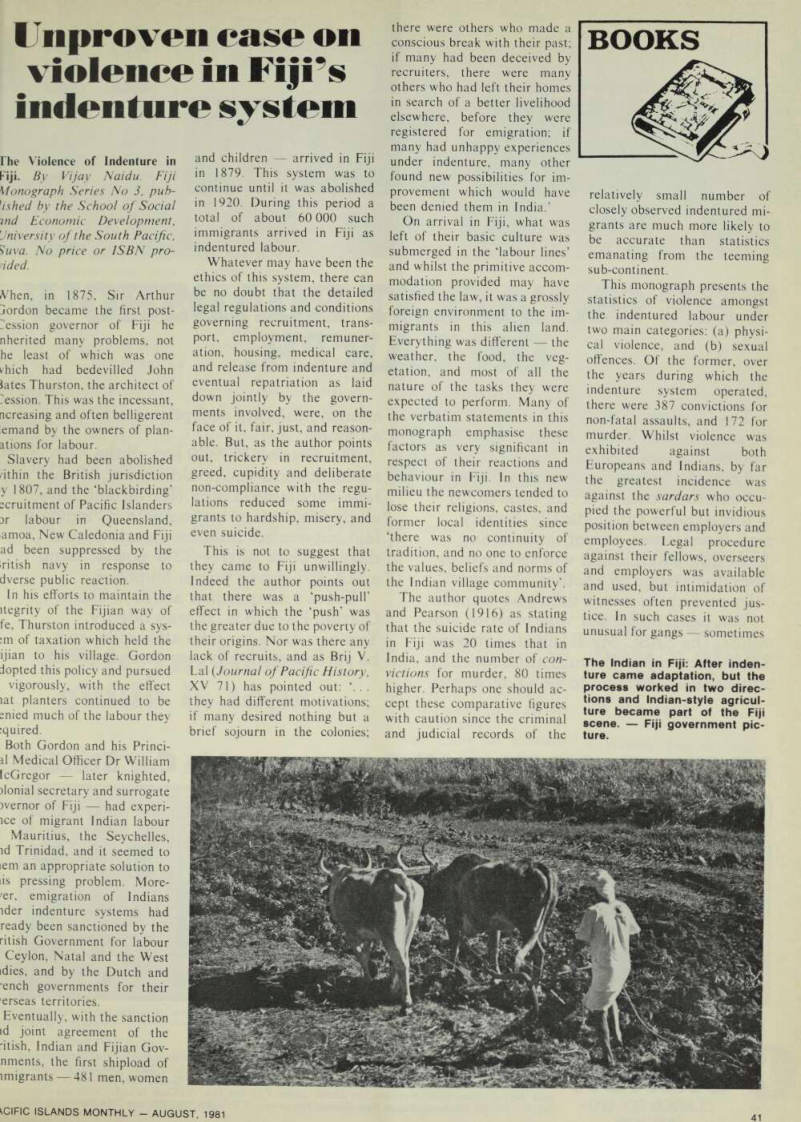

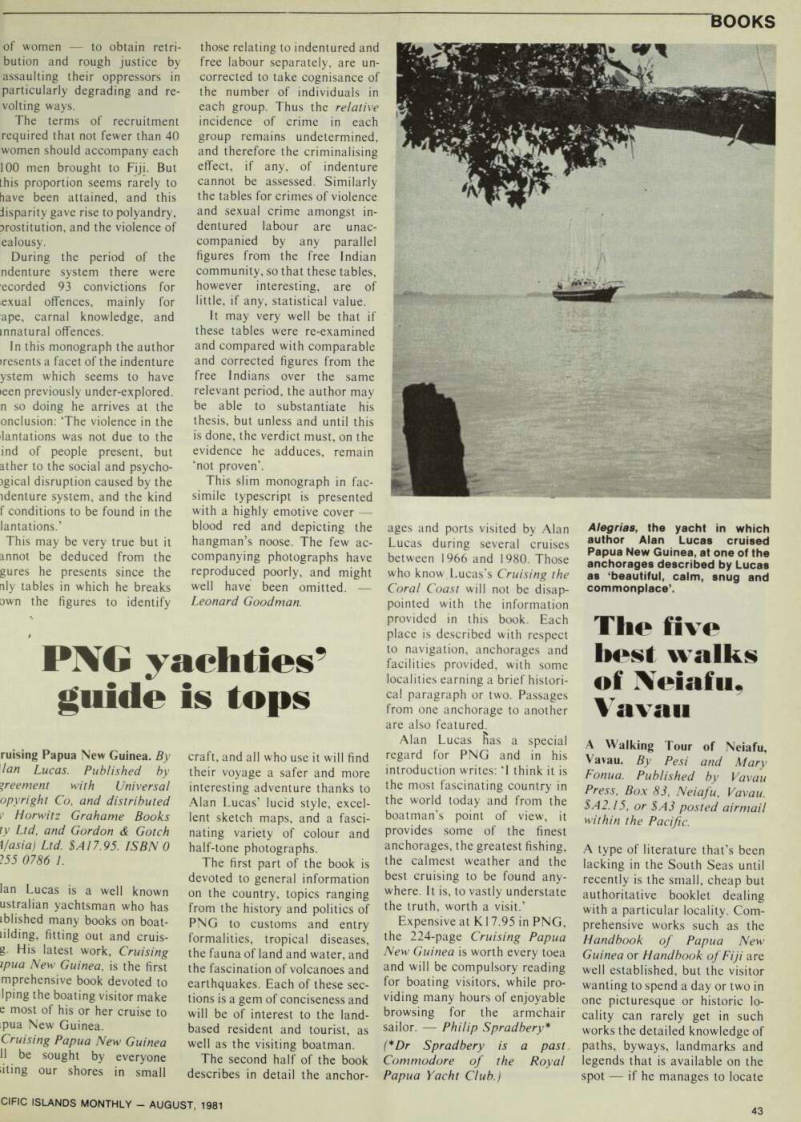
Books
Unproven ease on violence in Fiji’s Indenture system
The Violence of Indenture in Fiji. By Vijay Naidu. Fiji Monograph Series No 3. pub lished by the School of Social md Economic Development, University of the South Pacific, Suva. No price or ISBN pro hded.
Vhen, in 1875, Sir Arthur Jordon became the first post session governor of Fiji he nherited many problems, not he least of which was one vhich had bedevilled John lates Thurston, the architect of Session. This was the incessant, ncreasing and often belligerent emand by the owners of plan ations for labour.
Slavery had been abolished dthin the British jurisdiction y 1807, and the ‘blackbirding’ scruitment of Pacific Islanders ar labour in Queensland, amoa, New Caledonia and Fiji ad been suppressed by the British navy in response to dverse public reaction.
In his efforts to maintain the itegrity of the Fijian way of fe, Thurston introduced a sys ;m of taxation which held the ijian to his village. Gordon Jopted this policy and pursued vigorously, with the effect ml planters continued to be mied much of the labour they ;quired.
Both Gordon and his Princi al Medical Officer Dr William IcGregor later knighted, ilonial secretary and surrogate avernor of Fiji had experi ice of migrant Indian labour Mauritius, the Seychelles, id Trinidad, and it seemed to icm an appropriate solution to is pressing problem. More 'er, emigration of Indians ider indenture systems had ready been sanctioned by the ritish Government for labour Ceylon, Natal and the West idies, and by the Dutch and •ench governments for their erseas territories.
Eventually, with the sanction id joint agreement of the *itish, Indian and Fijian Gov nments, the first shipload of imigrants 481 men, women
and children arrived in Fiji in 1879. This system was to continue until it was abolished in 1920. During this period a total of about 60 000 such immigrants arrived in Fiji as indentured labour.
Whatever may have been the ethics of this system, there can be no doubt that the detailed legal regulations and conditions governing recruitment, trans port, employment, remuner ation, housing, medical care, and release from indenture and eventual repatriation as laid down jointly by the govern ments involved, were, on the face of it, fair, just, and reason able. But, as the author points out, trickery in recruitment, greed, cupidity and deliberate non-compliance with the regu lations reduced some immi grants to hardship, misery, and even suicide.
This is not to suggest that they came to Fiji unwillingly.
Indeed the author points out that there was a ‘push-pull’ effect in which the ‘push’ was the greater due to the poverty of their origins. Nor was there any lack of recruits, and as Brij V.
Lai ( Journal of Pacific History, XV 71) has pointed out: ‘.. . they had different motivations; if many desired nothing but a brief sojourn in the colonies;
there were others who made a conscious break with their past; if many had been deceived by recruiters, there were many others who had left their homes in search of a better livelihood elsewhere, before they were registered for emigration; if many had unhappy experiences under indenture, many other found new possibilities for im provement which would have been denied them in India.’
On arrival in Fiji, what was left of their basic culture was submerged in the ‘labour lines’ and whilst the primitive accom modation provided may have satisfied the law, it was a grossly foreign environment to the im migrants in this alien land.
Everything was different the weather, the food, the veg etation, and most of all the nature of the tasks they were expected to perform. Many of the verbatim statements in this monograph emphasise these factors as very significant in respect of their reactions and behaviour in Fiji. In this new milieu the newcomers tended to lose their religions, castes, and former local identities since ‘there was no continuity of tradition, and no one to enforce the values, beliefs and norms of the Indian village community’.
The author quotes Andrews and Pearson (1916) as stating that the suicide rate of Indians in Fiji was 20 times that in India, and the number of con victions for murder, 80 times higher. Perhaps one should ac cept these comparative figures with caution since the criminal and judicial records of the
relatively small number of closely observed indentured mi grants are much more likely to be accurate than statistics emanating from the teeming sub-continent.
This monograph presents the statistics of violence amongst the indentured labour under two main categories: (a) physi cal violence, and (b) sexual offences. Of the former, over the years during which the indenture system operated, there were 387 convictions for non-fatal assaults, and 172 for murder. Whilst violence was exhibited against both Europeans and Indians, by far the greatest incidence was against the sardars who occu pied the powerful but invidious position between employers and employees. Legal procedure against their fellows, overseers and employers was available and used, but intimidation of witnesses often prevented jus tice. In such cases it was not unusual for gangs sometimes
The Indian in Fiji: After inden ture came adaptation, but the process worked in two direc tions and Indian-style agricul ture became part of the Fiji
scene. - Fiji government pic
ture.
of women to obtain retri bution and rough justice by assaulting their oppressors in particularly degrading and re volting ways.
The terms of recruitment required that not fewer than 40 women should accompany each 100 men brought to Fiji. But this proportion seems rarely to have been attained, and this disparity gave rise to polyandry, orostitution, and the violence of ealousy.
During the period of the ndenture system there were ecorded 93 convictions for exual offences, mainly for ape, carnal knowledge, and mnatural offences.
In this monograph the author ►resents a facet of the indenture ystem which seems to have ieen previously under-explored, n so doing he arrives at the onclusion: The violence in the plantations was not due to the ind of people present, but ather to the social and psycho igical disruption caused by the identure system, and the kind f conditions to be found in the lantations.’
This may be very true but it annot be deduced from the gures he presents since the nly tables in which he breaks own the figures to identify
those relating to indentured and free labour separately, are un corrected to take cognisance of the number of individuals in each group. Thus the relative incidence of crime in each group remains undetermined, and therefore the criminalising effect, if any, of indenture cannot be assessed. Similarly the tables for crimes of violence and sexual crime amongst in dentured labour are unac companied by any parallel figures from the free Indian community, so that these tables, however interesting, are of little, if any, statistical value.
It may very well be that if these tables were re-examined and compared with comparable and corrected figures from the free Indians over the same relevant period, the author may be able to substantiate his thesis, but unless and until this is done, the verdict must, on the evidence he adduces, remain ‘not proven’.
This slim monograph in fac simile typescript is presented with a highly emotive cover blood red and depicting the hangman’s noose. The few ac companying photographs have reproduced poorly, and might well have been omitted.
Leonard Goodman.
Advertisements & other items, pp. 41-42 (2 items)
41
kCIFIC ISLANDS MONTHLY - AUGUST. 1981
©Clarion
/ n • no
i u-u u
PROGRAM
PM 002 «■! 111 ™ ws «
Di ay ran
b 3 b-— Jj^
TUNER PROGRAMMING
THE GREATEST ROADSHOW
ON EARTH.
The Clarion PE-959 is the world's first all-programmable car stereo, and is it a marvel in electronics!
Take the tuner, for instance. Thanks to a microprocessor, it can tune in up to ten stations automatically. Simply pick the stations, preset them in any order you want, and it will switch over from one station to another. Automatically and at the exact time you want it.
You need no longer worry about noise either. The SASC Mk II (signal-actuated FM stereo control circuit) automatically adjusts the reception to signal strength, assuring the best reception mode at all times.
The Clarion PE-959 has all the sophistication you could ask for. Metal tape capability. Dolby NR* circuit. Easy, all-pushbutton operation with 32 logically laid out control buttons. Quartz digital display. High 23W + 23W power, using a GA-301 stereo power amplifier.
There's no question about it. The Clarion PE-959 is "hi-way fidelity."
You can drive for mile after mile, and be sure of enjoying every minute of it.
PE-959. Worlds First All-Programmable Car Stereo.
I-.-.-■*■■■ + + eJ Clarion Hi ' Wa * FidelitySeries
1/lallUII PROGRAMMABLE TUNER
K
EJECT
J + Lg
TUNER PROGRAMMING
‘Dolby and the double-D symbol are trademarks of Dolby Laboratories Licensing Corporation.
©Clarion
CLARION CO., LTD.
Tokyo, Japan Australia: Amalgamated Wireless (Australasia) Ltd., 554 Parramatta Road, Ashfield, N.S.W., 2131/New Zealand: AWA New Zealand Limited, P.O. Box 50-248, Porirua/Fiji Islands; Brijlal & Co., Ltd., G.P.O. Box 362, Suva/Tahiti: HI-FI Shangrila, B.P. 200, Papeete/New Caledonia: Caldis,B.P.Ml, Noumea Cedex/Guam: Guam Radio & TV Shop, P.O. Box 1939, Agana, Guam 96910/Vanuatu: The Sound Centre, P.O. Box 434, Vila/Cook Islands: South Seas International Ltd., P.O. Box 49, Rarotonga/Papua New Guinea; Hagemeyer (P.N.G.) Pty. Ltd., P.O. Box 1428, Boroko, Port Moresby.
PXG yachties’
guide Is tops
ruising Papua New Guinea. By lan Lucas. Published by *reement with Universal opyright Co. and distributed v Horwitz Grahame Books ty Ltd, and Gordon & Gotch Vasia) Ltd. 5A17.95. ISBN 0 ?55 0786 I. lan Lucas is a well known ustralian yachtsman who has iblished many books on boat aiding, fitting out and cruis g. His latest work, Cruising ipua New Guinea, is the first mprehensive book devoted to Iping the boating visitor make e most of his or her cruise to pua New Guinea.
Cruising Papua New Guinea ll be sought by everyone ■iting our shores in small
craft, and all who use it will find their voyage a safer and more interesting adventure thanks to Alan Lucas’ lucid style, excel lent sketch maps, and a fasci nating variety of colour and half-tone photographs.
The first part of the book is devoted to general information on the country, topics ranging from the history and politics of PNG to customs and entry formalities, tropical diseases, the fauna of land and water, and the fascination of volcanoes and earthquakes. Each of these sec tions is a gem of conciseness and will be of interest to the land based resident and tourist, as well as the visiting boatman.
The second half of the book describes in detail the anchor-
ages and ports visited by Alan Lucas during several cruises between 1966 and 1980. Those who know. Lucas’s Cruising the Coral Coast will not be disap pointed with the information provided in this book. Each place is described with respect to navigation, anchorages and facilities provided, with some localities earning a brief histori cal paragraph or two. Passages from one anchorage to another are also featured.
Alan Lucas has a special regard for PNG and in his introduction writes: ‘I think it is the most fascinating country in the world today and from the boatman’s point of view, it provides some of the finest anchorages, the greatest fishing, the calmest weather and the best cruising to be found any where. It is, to vastly understate the truth, worth a visit.’
Expensive at K 17.95 in PNG, the 224-page Cruising Papua New Guinea is worth every toea and will be compulsory reading for boating visitors, while pro viding many hours of enjoyable browsing for the armchair
sailor. -
Philip Spradbery
(*Dr Spradbery is a past.
Commodore of the Royal Papua Yacht Club.)
Alegrias, the yacht in which author Alan Lucas cruised Papua New Guinea, at one of the anchorages described by Lucas as ‘beautiful, calm, snug and commonplace’.
of Neiafu,
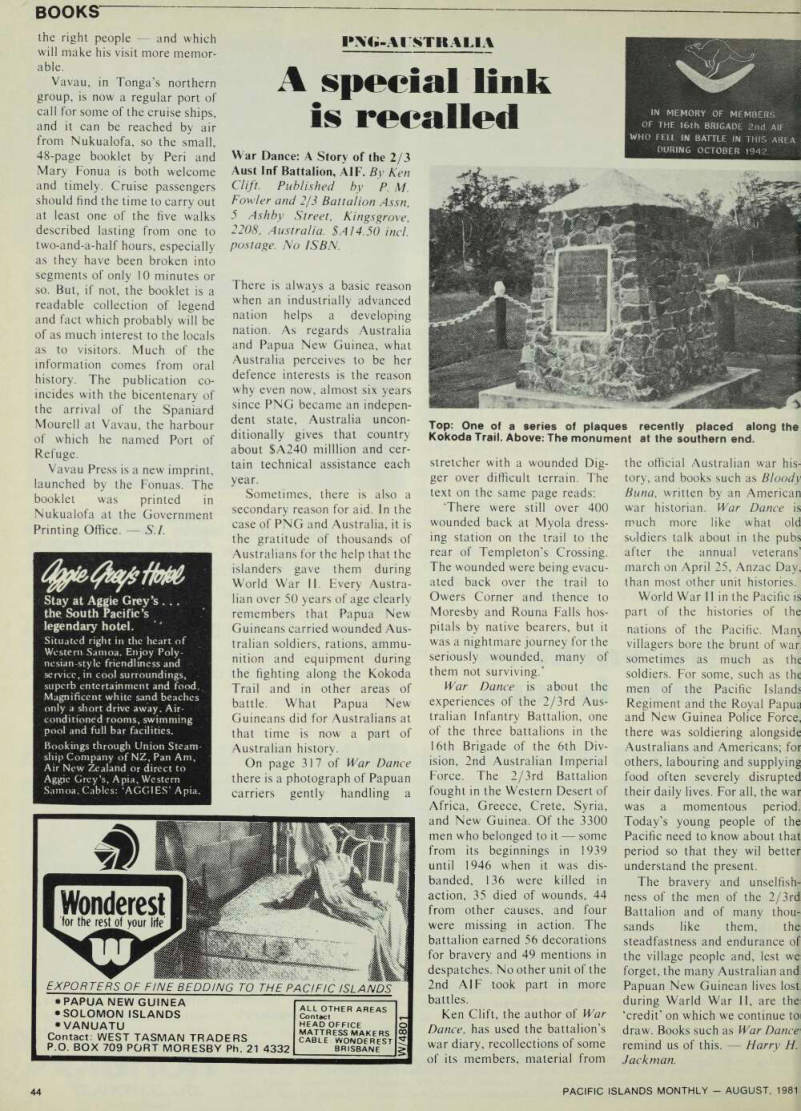
The five best walks of Neiafu, Vavau
A Walking Tour of Neiafu, Vavau. By Pesi and Mary Fonua. Published by Vavau Press. Box 83. Neiafu. Vavau. 5A2.15, or SA3 posted airmail within the Pacific.
A type of literature that’s been lacking in the South Seas until recently is the small, cheap but authoritative booklet dealing with a particular locality. Com prehensive works such as the Handbook of Papua New Guinea or Handbook of Fiji are well established, but the visitor wanting to spend a day or two in one picturesque or historic lo cality can rarely get in such works the detailed knowledge of paths, byways, landmarks and legends that is available on the spot if he manages to locate
the right people and which will make his visit more memor able.
Vavau, in Tonga’s northern group, is now a regular port of call for some of the cruise ships, and it can be reached by air from Nukualofa, so the small, 48-page booklet by Peri and Mary Fonua is both welcome and timely. Cruise passengers should find the time to carry out at least one of the five walks described lasting from one to two-and-a-half hours, especially as they have been broken into segments of only 10 minutes or so. But, if not, the booklet is a readable collection of legend and fact which probably will be of as much interest to the locals as to visitors. Much of the information comes from oral history. The publication co incides with the bicentenary of the arrival of the Spaniard Mourell at Vavau, the harbour of which he named Port of Refuge.
Vavau Press is a new imprint, launched by the Fonuas. The booklet was printed in Nukualofa at the Government
Printing Office.
S.I.
Advertisements & other items, p. 43 (1 item)
Books
43
CIFIC ISLANDS MONTHLY AUGUST. 1981
is recalled
Png- Australia
A special link is recalled
War Dance: A Story of the 2/3 Aust Inf Battalion, AIF. By Ken Clift. Published by P. M.
Fowler and 2/3 Battalion Assn, 5 Ashby Street, Kingsgrove, 2208, Australia. 5A14.50 inch postage. No ISBN.
There is always a basic reason when an industrially advanced nation helps a developing nation. As regards Australia and Papua New Guinea, what Australia perceives to be her defence interests is the reason why even now, almost six years since PNG became an indepen dent state, Australia uncon ditionally gives that country about SA24O milllion and cer tain technical assistance each year.
Sometimes, there is also a secondary reason for aid. In the case of PNG and Australia, it is the gratitude of thousands of Australians for the help that the islanders gave them during World War 11. Every Austra lian over 50 years of age clearly remembers that Papua New Guineans carried wounded Aus tralian soldiers, rations, ammu nition and equipment during the fighting along the Kokoda Trail and in other areas of battle. What Papua New Guineans did for Australians at that time is now a part of Australian history.
On page 317 of War Dance there is a photograph of Papuan carriers gently handling a
stretcher with a wounded Dig ger over difficult terrain. The text on the same page reads: There were still over 400 wounded back at Myola dress ing station on the trail to the rear of Templeton’s Crossing.
The wounded were being evacu ated back over the trail to Owers Corner and thence to Moresby and Rouna Falls hos pitals by native bearers, but it was a nightmare journey for the seriously wounded, many of them not surviving.’
War Dance is about the experiences of the 2/3rd Aus tralian Infantry Battalion, one of the three battalions in the 16th Brigade of the 6th Div ision, 2nd Australian Imperial Force. The 2/3rd Battalion fought in the Western Desert of Africa, Greece, Crete, Syria, and New Guinea. Of the 3300 men who belonged to it some from its beginnings in 1939 until 1946 when it was dis banded, 136 were killed in action, 35 died of wounds, 44 from other causes, and four were missing in action. The battalion earned 56 decorations for bravery and 49 mentions in despatches. No other unit of the 2nd AIF took part in more battles.
Ken Clift, the author of War Dance, has used the battalion’s war diary, recollections of some of its members, material from
the official Australian war his tory, and books such as Bloody Buna, written by an American war historian. War Dance is much more like what old soldiers talk about in the pubs after the annual veterans’ march on April 25, Anzac Day, than most other unit histories.
World War 11 in the Pacific is part of the histories of the nations of the Pacific. Man> villagers bore the brunt of war, sometimes as much as the soldiers. For some, such as the men of the Pacific Islands Regiment and the Royal Papua and New Guinea Police Force, there was soldiering alongside Australians and Americans; for others, labouring and supplying food often severely disrupted their daily lives. For all, the war was a momentous period.
Today’s young people of the Pacific need to know about that period so that they wil better understand the present.
The bravery and unselfish ness of the men of the 2/3rdl Battalion and of many thou sands like them, the: steadfastness and endurance of the village people and, lest we: forget, the many Australian andl Papuan New Guinean lives lost: during Warld War 11, are the: ‘credit’ on which we continue toi draw. Books such as War Dance'
remind us of this.
Harry H.
Jackman.
Top: One of a series of plaques recently placed along the Kokoda Trail. Above: The monument at the southern end.
Advertisements & other items, p. 44 (1 item)
Wondercst
Stay at Aggie Grey’s . . . the South Pacific’s
legendary hotel.
Situated right in the heart of Western Samoa. Enjoy Polynesian-stylc friendliness and service, in cool surroundings, superb entertainment and food.
Magnificent white sand beaches only a short drive away. Airconditioned rooms, swimming pool and full bar facilities.
Bookings through Union Steamship Company of NZ, Pan Am, Air New Zealand or direct to Aggie Grey’s, Apia, Western Samoa. Cables: ‘AGGIES’Apia.
Wondercst
for the
life
rest your EXPORTERS OF FINE BEDDING TO THE PACIFIC ISLANDS
* PAPUA NEW GUINEA
* SOLOMON ISLANDS
♦VANUATU
Contact. WEST TASMAN TRADERS
P.O. BOX 709 PORT MORESBY Ph. 21 4332
ALL OTHER AREAS
Contact
HEAD OFFICE
MATTRESS MAKERS
CABLE WONDEREST
BRISBANE
Campaign only a
From the
Islands
Press
Condensed from an article in the Papua New Guinea
Port Moresby
t is an inescapable fact that as our criminal class grows, the cost if keeping that sneaky fraternity behind bars must grow too. The leputy prime minister, Mr Okuk, has suggested that prisoners be ut to work on community projects. His suggestion has some merit, 'he alleged ‘holiday camp’ atmosphere at Bomana and Baisu gaols 'Quid be dented if the inmates knew that, attired in readily lentifiable garb and under armed guard, they would be forced to 'ork under the eyes of their clansmen and all and sundry. Exposing ■ansgressors to public view may well turn out to be more a eterrent than gaol itself. ditorial comment from the Samoa Times, Apia, on hie deep-seated strike in the Western Samoan public ervice he Public Service Commission’s declaration that ‘we have all iffered enough’ and ‘hopefully we have learnt by our suffering’ 3es not answer the question whether it was necessary to go through iis very sad experience. Perhaps the most important lesson that 'eryone should learn is that this country and its people have a •iceless asset in the understanding and forgiving nature of the iople. At times there were signs that the very fabric of our culture as being stretched to the limit, but fortunately for all it has mehow withstood the pressure. One way or another on the jrsonal, economic or political level everyone in this country has Jen affected by what has happened. It is now time to confine the atter to experience and let us move forward to build up our •untry together. eading from the Cook Islands News, Rarotonga, small success in a campaign to exterminate inah birds
Campaign only a
minah success?
litorial comment in The Fiji Times, Suva disgruntled veteran of Fiji’s trade union world, Mr Apisai Tora, s complained that today’s trade union leaders tend, upon their ction, to ‘act exactly as the bosses of big companies’. Thank avens, if they do. Mr Tora meant to be disparaging, but in fact de union leaders should feel disgruntled on their part if their ders acted any differently. Many trade unions are now big siness and need business-minded men to run them. In dealing h employers they would be at a grave disadvantage if they were able to act as equals, and to be able to do that it is necessary to able to act like bosses.
>ws Drum, Honiara, Solomon Islands
e Solomon Islands government has decided to charge $5 each for
spectacles prescribed by a visiting Australian eye team, except where the spectacles are prescribed for people undergoing eye operations or for children. The Secretary for Health, Mr Nielson, said the eye specialists were visiting Solomon Islands as an Australian aid project and were not charging for their services or for the supply of spectacles. However the Solomon Islands government itself was incurring some costs which it wished to offset by making a nominal charge for spectacles. He believed that spectacles were not essential for some of the people using the service. They wanted spectacles for prestige, he said.
From a letter in the Papua New Guinea Post-Courier, Port Moresby, in which Lisette Joephides criticises an advertisement published earlier This very offensive advertisement describes sympathetically the vexations in the average man’s life, exacerbated by great hints from his wife about visiting her mother. It invites him to rest from his many responsibilities and humour the wife by taking her out for a great night dining and dancing at the Islander Hotel. In an independent Papua New Guinea committed to women’s equality, to whom is such an ad addressed? It is not the aim of this country’s Constitution to turn women into either men’s playthings or burdens, but to allow them to take responsibility for themselves.
Extracts from an editorial in the Pitcairn Miscellany, Pitcairn Island A total of 33 people over the age of 18 years this represents 91.6% of the permanent population were asked whether an airstrip should be built on the island. Their answers were 26 yes, three no, four unsure. The majority of people interviewed considered that due to a dwindling number of able-bodied menfolk to handle the longboats an airstrip and air contact would be a necessity for the island’s continued life. A few even felt that a regular air service might encourage the return of some of the Pitcairn population living in New Zealand. Only time, expert opinion and survey undertakings will provide the answers. If the longboats of the sea translate to the longboats of the air perhaps Pitcairn will have a definite future. Or does the answer still depend on the sea? If only longboats could fly!
Condensed from 3 ,etter signed Peter Slimmer in The Fiji Times, Suva, concerning a local controversy over
something which Fiji hasn’t yet experienced
television and television advertising.
A friend in USA has told me about an innovation in which television viewers with complaints can press a button and establish a dialogue with their TV receivers. Let’s listen in to one.
Little kid: I don’t like your advertisements telling me to eat candy.
Mommy says sugar rots my teeth.
TV: If you want to live in the 20th Century you have to face up to reality. TV is big business. So is sugar. Lots of under-developed countries depend on us developed countries to buy their sugar so that they can buy the other necessities of life. Countries like Fiji, for instance, send us tonnes of it.
Little kid: Then let’s get even with them. Let’s send them a free television set for every 100 tonnes of sugar.
From a report in the Cook Islands News, Rarotonga, about a debutante ball in Avatiu ‘Let us have a debutante ball every year to present our young ladies to society’ said one speaker. She might well have added ‘. . . and a master of ceremonies who is a little less lubricated’.
The Papua New Guinea Post-Courier, Port Moresby Bureaucracy at its best: A form sent to the Ombudsman Commission from the Angau Memorial Hospital in Lae had the following wording: ‘This form must be completed and signed by the deceased to accompany the body to the morgue.’
The Fiji Times, Suva
Drunk and disorderly cases dealt with in the Suva courts have increased sharply since the end of the Carlton Brewery strike. In 10 days since the end of the strike there were 42 cases of drunk and disorderly. This compares with 45 cases of drunk and disorderly in the 33-day strike that closed the brewery.
Advertisements & other items, pp. 45-46 (2 items)
Ific Islands Monthly - August, 1981
Citizen
Another teehnologlcal first from Citizen
i i * No more second hand. Now there’s a second band; an LCD time tack that measures each second with pinpoint precision as.it travels around the circumference of the watch face. But of course there’s more. In the mode the time track speeds up to complete a fjjrevolution each second for split-second readings. And these readings can be verified digitally at just the touch of a button - right down to J/lOOth of a second. portion of the TimeTrack contains an alarrrj, digital.stopwatch, an hourly chime, and a permanently-set calendar showing date and day.
TimeTrack by Citizen.
The new way to keep track of time. 8 s 2 W &rrn°, s S 3 i ll
CITIZEN QUARTZ % DIGI'ANA
iiniEiracK
r •fiSSS ii MS
tsiSi
s
ALA
ta r / K \ J
CITIZEN
"V •i
AHEAD OF THEIR TIME
of Magellan: Trip of a lifetime
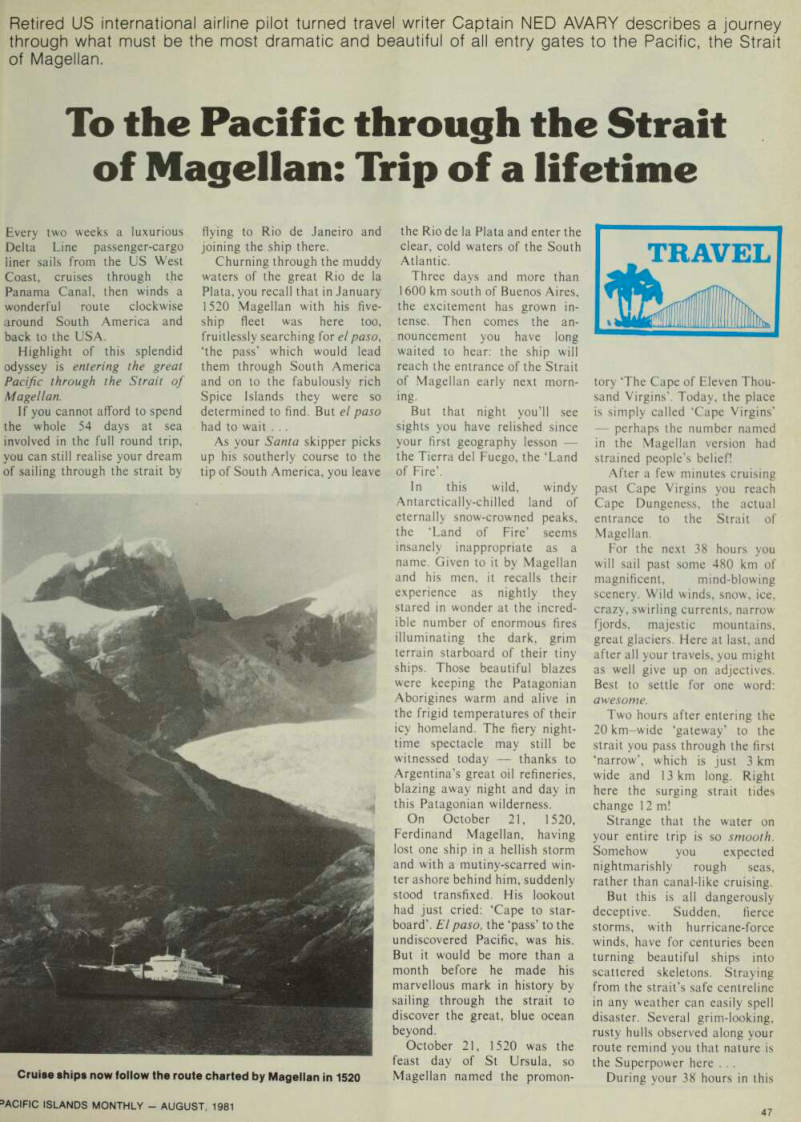
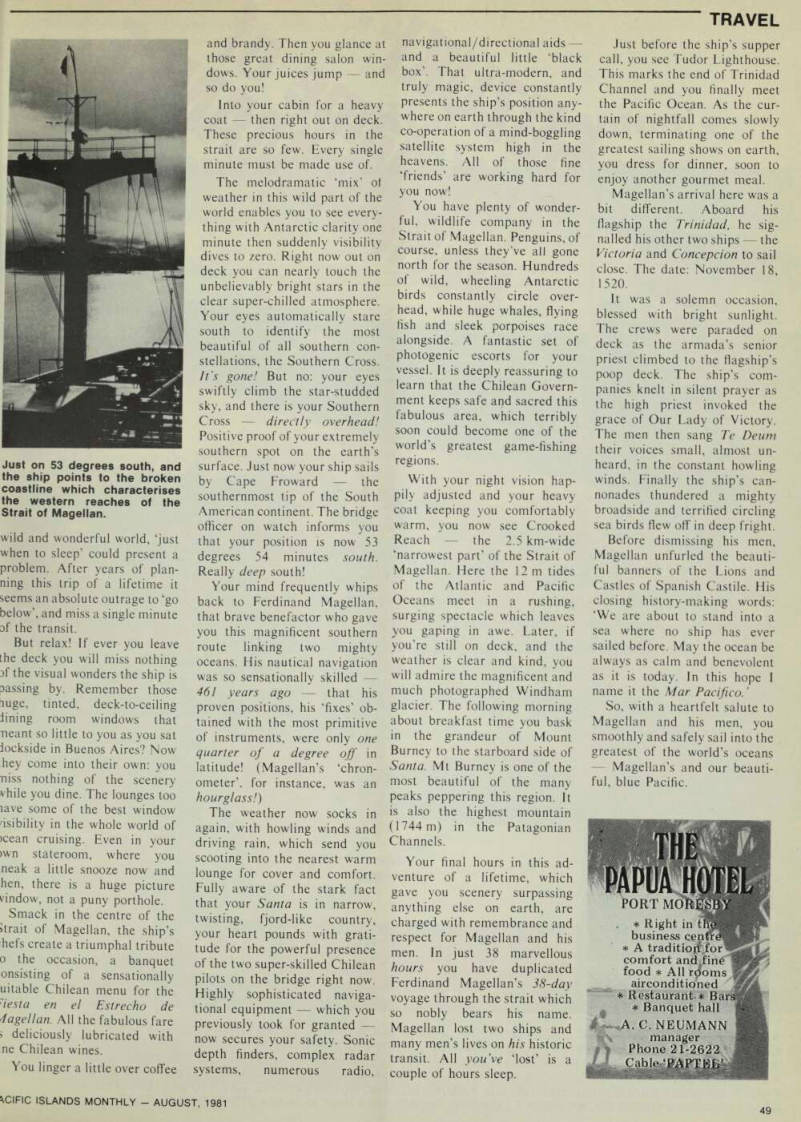
To the Pacific through the Strait of Magellan: Trip of a lifetime
Travel
Retired US international airline pilot turned travel writer Captain NED AVARY describes a journey through what must be the most dramatic and beautiful of all entry gates to the Pacific, the Strait of Magellan.
Every two weeks a luxurious Delta Line passenger-cargo liner sails from the US West Coast, cruises through the Panama Canal, then winds a wonderful route clockwise around South America and back to the USA.
Highlight of this splendid odyssey is entering the great Pacific through the Strait of Magellan.
If you cannot afford to spend the whole 54 days at sea involved in the full round trip, you can still realise your dream of sailing through the strait by
flying to Rio de Janeiro and joining the ship there.
Churning through the muddy waters of the great Rio de la Plata, you recall that in January 1520 Magellan with his five ship fleet was here too, fruitlessly searching for el paso , ‘the pass’ which would lead them through South America and on to the fabulously rich Spice Islands they were so determined to find. But el paso had to wait . . .
As your Santa skipper picks up his southerly course to the tip of South America, you leave
the Rio de la Plata and enter the clear, cold waters of the South Atlantic.
Three days and more than 1600 km south of Buenos Aires, the excitement has grown in tense. Then comes the an nouncement you have long waited to hear: the ship will reach the entrance of the Strait of Magellan early next morn ing.
But that night you’ll see sights you have relished since your first geography lesson the Tierra del Fuego, the ‘Land of Fire’.
In this wild, windy Antarctically-chilled land of eternally snow-crowned peaks, the ‘Land of Fire’ seems insanely inappropriate as a name. Given to it by Magellan and his men, it recalls their experience as nightly they stared in wonder at the incred ible number of enormous fires illuminating the dark, grim terrain starboard of their tiny ships. Those beautiful blazes were keeping the Patagonian Aborigines warm and alive in the frigid temperatures of their icy homeland. The fiery night time spectacle may still be witnessed today thanks to Argentina’s great oil refineries, blazing away night and day in this Patagonian wilderness.
On October 21, 1520, Ferdinand Magellan, having lost one ship in a hellish storm and with a mutiny-scarred win ter ashore behind him, suddenly stood transfixed. His lookout had just cried: ‘Cape to star board’. El paso, the ‘pass’ to the undiscovered Pacific, was his.
But it would be more than a month before he made his marvellous mark in history by sailing through the strait to discover the great, blue ocean beyond.
October 21, 1520 was the feast day of St Ursula, so Magellan named the promon-
tory The Cape of Eleven Thou sand Virgins’. Today, the place is simply called ‘Cape Virgins’ perhaps the number named in the Magellan version had strained people’s belief!
After a few minutes cruising past Cape Virgins you reach Cape Dungeness, the actual entrance to the Strait of Magellan.
For the next 38 hours you will sail past some 480 km of magnificent, mind-blowing scenery. Wild winds, snow, ice, crazy, swirling currents, narrow fjords, majestic mountains, great glaciers. Here at last, and after all your travels, you might as well give up on adjectives.
Best to settle for one word: awesome.
Two hours after entering the 20 km-wide ‘gateway’ to the strait you pass through the first ‘narrow’, which is just 3 km wide and 13 km long. Right here the surging strait tides change 12 m!
Strange that the water on your entire trip is so smooth.
Somehow you expected nightmarishly rough seas, rather than canal-like cruising.
But this is all dangerously deceptive. Sudden, fierce storms, with hurricane-force winds, have for centuries been turning beautiful ships into scattered skeletons. Straying from the strait’s safe centreline in any weather can easily spell disaster. Several grim-looking, rusty hulls observed along your route remind you that nature is the Superpower here . ..
During your 38 hours in this
Cruise ships now follow the route charted by Magellan in 1520
wild and wonderful world, ‘just when to sleep’ could present a problem. After years of plan ning this trip of a lifetime it seems an absolute outrage to ‘go below’, and miss a single minute af the transit.
But relax! If ever you leave the deck you will miss nothing af the visual wonders the ship is aassing by. Remember those
luge, tinted, deck-to-ceiling
fining room windows that neant so little to you as you sat iockside in Buenos Aires? Now hey come into their own: you niss nothing of the scenery vhile you dine. The lounges too lave some of the best window visibility in the whole world of >cean cruising. Even in your >wn stateroom, where you neak a little snooze now and hen, there is a huge picture window, not a puny porthole.
Smack in the centre of the Jtrait of Magellan, the ship’s hefs create a triumphal tribute o the occasion, a banquet onsisting of a sensationally uitable Chilean menu for the lest a en el Estrecho de Magellan. All the fabulous fare > deliciously lubricated with ne Chilean wines.
You linger a little over coffee
and brandy. Then you glance at those great dining salon win dows. Your juices jump and so do you!
Into your cabin for a heavy coat then right out on deck.
These precious hours in the strait are so few. Every single minute must be made use of.
The melodramatic ‘mix’ of weather in this wild part of the world enables you to see every thing with Antarctic clarity one minute then suddenly visibility dives to zero. Right now out on deck you can nearly touch the unbelievably bright stars in the clear super-chilled atmosphere.
Your eyes automatically stare south to identify the most beautiful of all southern con stellations, the Southern Cross.
It’s gone! But no: your eyes swiftly climb the star-studded sky, and there is your Southern Cross directly overhead!
Positive proof of your extremely southern spot on the earth’s surface. Just now your ship sails by Cape Froward the southernmost tip of the South American continent. The bridge officer on watch informs you that your position is now 53 degrees 54 minutes south.
Really deep south!
Your mind frequently whips back to Ferdinand Magellan, that brave benefactor who gave you this magnificent southern route linking two mighty oceans. His nautical navigation was so sensationally skilled - 461 years ago that his proven positions, his ‘fixes’ ob tained with the most primitive of instruments, were only one quarter of a degree off in latitude! (Magellan’s ‘chron ometer’, for instance, was an hourglass!) The weather now socks in again, with howling winds and driving rain, which send you scooting into the nearest warm lounge for cover and comfort.
Fully aware of the stark fact that your Santa is in narrow, twisting, fjord-like country, your heart pounds with grati tude for the powerful presence of the two super-skilled Chilean pilots on the bridge right now.
Highly sophisticated naviga tional equipment which you previously took for granted now secures your safety. Sonic depth finders, complex radar systems, numerous radio,
navigational/directional aids and a beautiful little ‘black box’. That ultra-modern, and truly magic, device constantly presents the ship’s position any where on earth through the kind co-operation of a mind-boggling satellite system high in the heavens. All of those fine ‘friends’ are working hard for you now!
You have plenty of wonder ful, wildlife company in the Strait of Magellan. Penguins, of course, unless they’ve all gone north for the season. Hundreds of wild, wheeling Antarctic birds constantly circle over head, while huge whales, flying fish and sleek porpoises race alongside. A fantastic set of photogenic escorts for your vessel. It is deeply reassuring to learn that the Chilean Govern ment keeps safe and sacred this fabulous area, which terribly soon could become one of the world’s greatest game-fishing regions.
With your night vision hap pily adjusted and your heavy coat keeping you comfortably warm, you now see Crooked Reach the 2.5 km-wide ‘narrowest part’ of the Strait of Magellan. Here the 12 m tides of the Atlantic and Pacific Oceans meet in a rushing, surging spectacle which leaves you gaping in awe. Later, if you’re still on deck, and the weather is clear and kind, you will admire the magnificent and much photographed Windham glacier. The following morning about breakfast time you bask in the grandeur of Mount Burney to the starboard side of Santa. Mt Burney is one of the most beautiful of the many peaks peppering this region. It is also the highest mountain (1744 m) in the Patagonian Channels.
Your final hours in this ad venture of a lifetime, which gave you scenery surpassing anything else on earth, are charged with remembrance and respect for Magellan and his men. In just 38 marvellous hours you have duplicated Ferdinand Magellan’s 38-day voyage through the strait which so nobly bears his name.
Magellan lost two ships and many men’s lives on his historic transit. All you’ve ‘lost’ is a couple of hours sleep.
Just before the ship’s supper call, you see Tudor Lighthouse.
This marks the end of Trinidad Channel and you finally meet the Pacific Ocean. As the cur tain of nightfall comes slowly down, terminating one of the greatest sailing shows on earth, you dress for dinner, soon to enjoy another gourmet meal.
Magellan’s arrival here was a bit different. Aboard his flagship the Trinidad, he sig nalled his other two ships the Victoria and Concepcion to sail close. The date; November 18, 1520.
It was a solemn occasion, blessed with bright sunlight.
The crews were paraded on deck as the armada’s senior priest climbed to the flagship’s poop deck. The ship’s com panies knelt in silent prayer as the high priest invoked the grace of Our Lady of Victory.
The men then sang Te Deum their voices small, almost un heard, in the constant howling winds. Finally the ship’s can nonades thundered a mighty broadside and terrified circling sea birds flew off in deep fright.
Before dismissing his men, Magellan unfurled the beauti ful banners of the Lions and Castles of Spanish Castile. His closing history-making words: ‘We are about to stand into a sea where no ship has ever sailed before. May the ocean be always as calm and benevolent as it is today. In this hope I name it the Mar Pacifico. ’
So, with a heartfelt salute to Magellan and his men, you smoothly and safely sail into the greatest of the world’s oceans - Magellan’s and our beauti ful, blue Pacific.
Just on 53 degrees south, and the ship points to the broken coastline which characterises the western reaches of the Strait of Magellan.
Advertisements & other items, pp. 47-50 (3 items)
47
’ACIFIC ISLANDS MONTHLY - AUGUST, 1981
Insurance
asr
\ fs 9 w *
NATIONAL
INSURANCE
% Si
COVERS THE
PACIFIC
'WM m *
FIJI
THE NATIONAL INSURANCE COMPANY OF FIJI, LIMITED (Incorporating Southern Pacific Insurance Co. (Fiji) Ltd) SUVA Dominion House, Thomson St, Phone 25601, Tlx 2337 L. M. Rolls. General Manager.
LAUTOKA Ist Floor National Bank Bldg. Phone 62951. M. Y. Hussain. Resident Inspector.
LABASA Ist Floor National Bank Bldg. Phone 81099. A. Singh, Resident Inspector
PAPUA NEW GUINEA
THE SOUTHERN PACIFIC INSURANCE COMPANY (PNG) LIMITED, (Incorporating C.I.C. Insurance (Pacific) Pfy Ltd) PORT MORESBY 8 Champion Parade. Phone 21-1388, Tlx 22261. D. J. McCall,General Manager LAE Second St. Phone 42-4590. Tlx 42443. T. S. Kennedy, Manager.
RABAUL Mango Ave. Phone 92-2755, Tlx 92923. P. M. Mitchell, Manager.
MT HAGEN MT HAGEN Phone 521 -164. J, P. Devaney, District Manager, ent inspector.
Arawa B. Snowden, District Manager. Phone 956-219
SOLOMON ISLANDS
THE NATIONAL INSURANCE COMPANY OF NEW ZEALAND, LIMITED.
HONIARA Ist Floor Kingsley Bldg. Phone 919 B. R. International Agencies (W.V. Gledhill) Agent.
WESTERN SAMOA
NATIONAL PACIFIC INSURANCE LIMITED.
(National Insurance Company of New Zealand. Ltd Managing Agents) APIA Taufusi St, Phone 20481, Tlx 228. D. I. Humphry. Managing Director.
PAGO PAGO Suite 200, Lumana'i Bldg, Phone 96799. J. McGuire, Manager.
COOK ISLANDS
THE NATIONAL INSURANCE COMPANY OF NEW ZEALAND, LIMITED.
RAROTONGA U.I.T. Bldg. Avarua, Phone 2076, Tlx 62013. R. Wheeler, Local Manager.
PORT MOW
. * Right in ti business cgi * A traditio|fc|tor comfort and Tint food * All rqoms airconditioned * Restaurant * Bai * Banquet hall
C. NEUMANN
manager Phone 21-2622 'abWJ
& 3^ « *- *0 'oo^ T*& wSMS» s ■ ■ ■ SUZUKjOUJBOARDS are trufy ALL ROUND PERFORMER,... reliable,
and economical under any situation.
SUZUKI spared outboards line up exclusively for the usage of professional and of course, also for the pleasure. Each has different construction respectively, «o that you can choose your engine that is best suited to your boat and usage.
Get the fruitful life through SUZUKI OUTBOARDS. igsfc g/i k gi as s/j ffi as ess £/' fjZ i i k c: SUZUKI MOTOR CO LTD Hamamatsu Japan
SUZUKI GENERATOR
SEIOOO
• NEW ZEALAND SOUTH PACIFIC SUZUKI DISTRIBUTORS LTD. PHONE: 58-599 • PAPUA NEW GUINEA HI SPEED DIESEL SERVICE PTY. LTD. PHONE: 42-2679 •FIJI NIRANJANS AUTOPORT LTD. PHONE; 381555 • TAHITI NIPPON AUTOMOTO PHONE; 2-98- • SOLOMON SOLOMON ISLAND PHONE: 565 • VANUATU HENRI LEROUX • NEW CALEDONIA STE. SUPERCAL PHONE: 272068 • AMERICAN SAMOA PACIFIC PRODUCTS, INC. PHONE; 639-9140 • WESTERN SAMOA VATCO LTD. • GUAM ISLAND CYCLERY, INC.
PHONE: 565-2298 • NIUE BURNS PHILP CO., LTD. • NAURU EQUIPAC MOTORS PHONE: 4019 • TONGA TONGA EQUIPMENT • YAP AMBROSE • KOROR BECHESRRAK T. COMPANY PHONE. 338 • TRUK KIOMASA STORE PHONE: 470
Travel
49
\CIFIC ISLANDS MONTHLY - AUGUST, 1981
Rediscovering ‘H.J.M.' Samoa’s
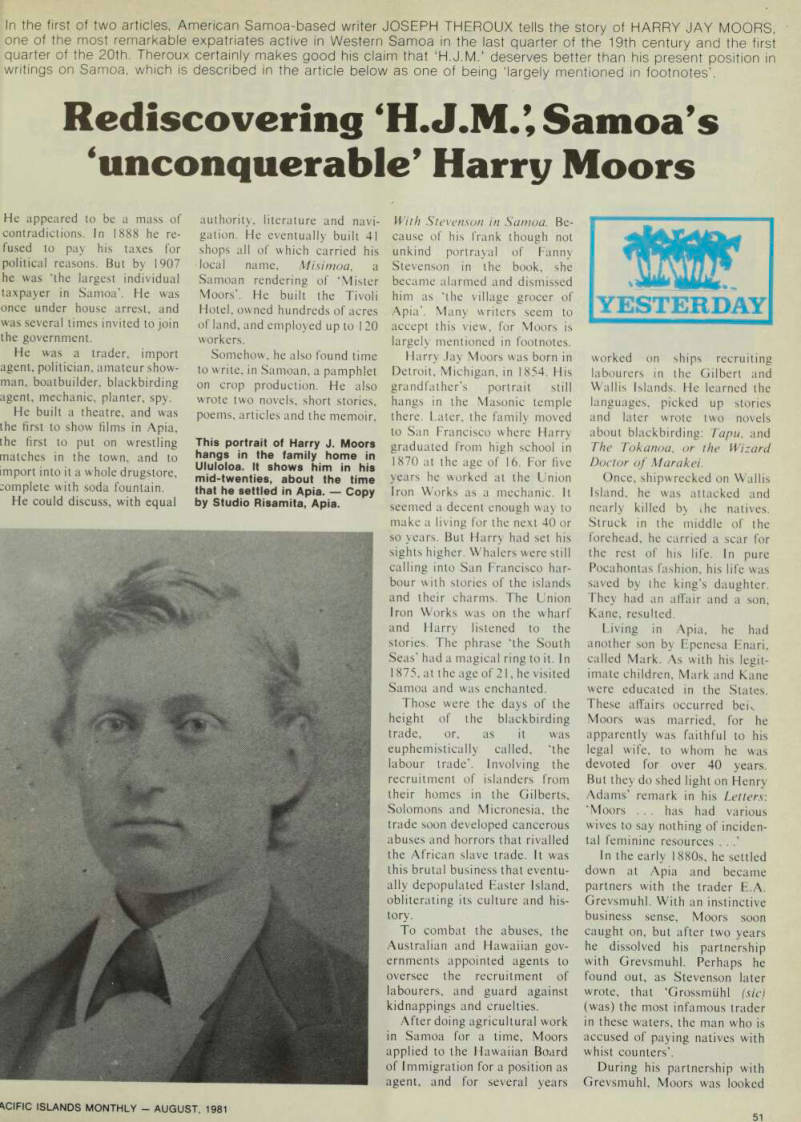
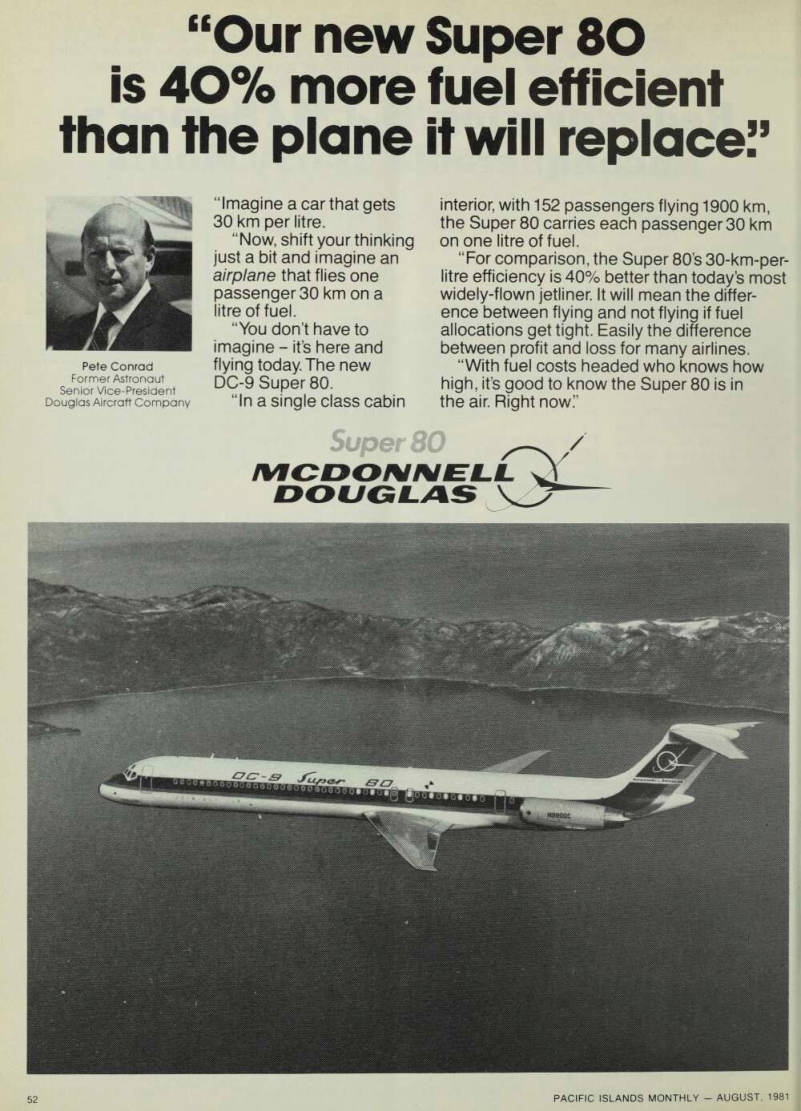
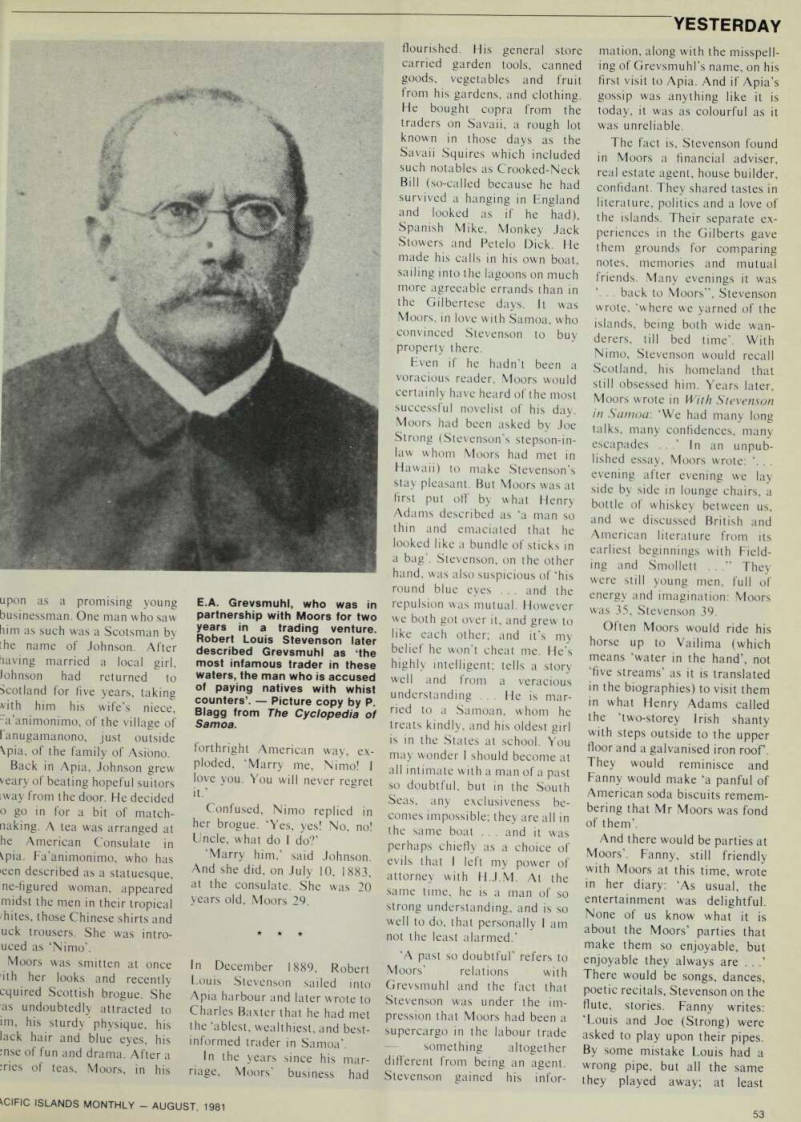

Yesterday
Rediscovering ‘H.J.M.' Samoa’s ‘unconquerable’ Harry Moors
In the first of two articles, American Samoa-based writer JOSEPH THEROUX tells the story of HARRY JAY MOORS, one of the most remarkable expatriates active in Western Samoa in the last quarter of the 19th century and the first quarter of the 20th. Theroux certainly makes good his claim that ‘H.J.M.’ deserves better than his present position in writings on Samoa, which is described in the article below as one of being ‘largely mentioned in footnotes’.
He appeared to be a mass of contradictions. In 1888 he re fused to pay his taxes for political reasons. But by 1907 he was ‘the largest individual taxpayer in Samoa’. He was once under house arrest, and was several times invited to Join the government.
He was a trader, import agent, politician, amateur show man, boatbuilder, blackbirding agent, mechanic, planter, spy.
He built a theatre, and was the first to show films in Apia, the first to put on wrestling matches in the town, and to import into it a whole drugstore, :omplete with soda fountain.
He could discuss, with equal
authority, literature and navi gation. He eventually built 41 shops all of which carried his local name, Misimoa, a Samoan rendering of ‘Mister Moors’. He built the Tivoli Hotel, owned hundreds of acres of land, and employed up to 120 workers.
Somehow, he also found time to write, in Samoan, a pamphlet on crop production. He also wrote two novels, short stories, poems, articles and the memoir.
With Stevenson in Samoa. Be cause of his frank though not unkind portrayal of Fanny Stevenson in the book, she became alarmed and dismissed him as ‘the village grocer of Apia’. Many writers seem to accept this view, for Moors is largely mentioned in footnotes.
Harry Jay Moors was born in Detroit, Michigan, in 1854. His grandfather’s portrait still hangs in the Masonic temple there. Later, the family moved to San Francisco where Harry graduated from high school in 1870 at the age of 16. For five years he worked at the Union Iron Works as a mechanic. It seemed a decent enough way to make a living for the next 40 or so years. But Harry had set his sights higher. Whalers were still calling into San Francisco har bour with stories of the islands and their charms. The Union Iron Works was on the wharf and Harry listened to the stories. The phrase ‘the South Seas’ had a magical ring to it. In 1875, at the age of 21, he visited Samoa and was enchanted.
Those were the days of the height of the blackbirding trade, or, as it was euphemistically called, ‘the labour trade’. Involving the recruitment of islanders from their homes in the Gilberts, Solomons and Micronesia, the trade soon developed cancerous abuses and horrors that rivalled the African slave trade. It was this brutal business that eventu ally depopulated Easter Island, obliterating its culture and his tory.
To combat the abuses, the Australian and Hawaiian gov ernments appointed agents to oversee the recruitment of labourers, and guard against kidnappings and cruelties.
After doing agricultural work in Samoa for a time, Moors applied to the Hawaiian Board of Immigration for a position as agent, and for several years
worked on ships recruiting labourers in the Gilbert and Wallis Islands. He learned the languages, picked up stories and later wrote two novels about blackbirding: Tapu, and The Tokanoa, or the Wizard Doctor of Marakei.
Once, shipwrecked on Wallis Island, he was attacked and nearly killed b> ihe natives.
Struck in the middle of the forehead, he carried a scar for the rest of his life. In pure Pocahontas fashion, his life was saved by the king’s daughter.
They had an affair and a son, Kane, resulted.
Living in Apia, he had another son by Epenesa Enari, called Mark. As with his legit imate children, Mark and Kane were educated in the States.
These affairs occurred beU Moors was married, for he apparently was faithful to his legal wife, to whom he was devoted for over 40 years.
But they do shed light on Henry Adams’ remark in his Letters : ‘Moors .. . has had various wives to say nothing of inciden tal feminine resources . . .’
In the early 1880 s, he settled down at Apia and became partners with the trader E.A.
Grevsmuhl. With an instinctive business sense, Moors soon caught on, but after two years he dissolved his partnership with Grevsmuhl. Perhaps he found out, as Stevenson later wrote, that ‘Grossmiihl (sic) (was) the most infamous trader in these waters, the man who is accused of paying natives with whist counters’.
During his partnership with Grevsmuhl, Moors was looked
This portrait of Harry J. Moors hangs in the family home in Ululoloa. It shows him in his mid-twenties, about the time that he settled in Apia. - Copy by Studio Risamita, Apia.
upon as a promising young businessman. One man who saw him as such was a Scotsman by the name of Johnson. After having married a local girl, lohnson had returned to Scotland for five years, taking vith him his wife’s niece, r a’animonimo, of the village of fanugamanono, just outside \pia, of the family of Asibno.
Back in Apia, Johnson grew veary of beating hopeful suitors iway from the door. He decided o go in for a bit of match naking. A tea was arranged at he American Consulate in Fa’animonimo, who has >een described as a statuesque, ne-figured woman, appeared midst the men in their tropical whites, those Chinese shirts and uck trousers. She was intro uced as ‘Nimo’.
Moors was smitten at once ith her looks and recently cquired Scottish brogue. She as undoubtedly attracted to im, his sturdy physique, his lack hair and blue eyes, his mse of fun and drama. After a of teas, Moors, in his
forthright American way, ex ploded, ‘Marry me, Nimo! I love you. You will never regret it.’
Confused, Nimo replied in her brogue. ‘Yes, yes! No, no!
Uncle, what do I do?’
Marry him,’ said Johnson.
And she did, on July 10, 1883, at the consulate. She was 20 years old. Moors 29. * ★ ★ In December 1889, Robert Louis Stevenson sailed into Apia harbour and later wrote to Charles Baxter that he had met the ‘ablest, wealthiest, and best informed trader in Samoa’.
In the years since his mar riage, Moors’ business had
flourished. His general store carried garden tools, canned goods, vegetables and fruit from his gardens, and clothing.
He bought copra from the traders on Savaii, a rough lot known in those days as the Savaii Squires which included such notables as Crooked-Neck Bill (so-called because he had survived a hanging in England and looked as if he had), Spanish Mike, Monkey Jack Stowers and Petelo Dick. He made his calls in his own boat, sailing into the lagoons on much more agreeable errands than in the Gilbertese days. It was Moors, in love with Samoa, who convinced Stevenson to buy property there.
Even if he hadn’t been a voracious reader. Moors would certainly have heard of the most successful novelist of his day.
Moors had been asked by Joe Strong (Stevenson’s stepson-in law whom Moors had met in Hawaii) to make Stevenson's stay pleasant. But Moors was at first pul off by what Henry Adams described as ‘a man so thin and emaciated that he looked like a bundle of sticks in a bag’. Stevenson, on the other hand, was also suspicious of ‘his round blue eyes ... and the repulsion was mutual. However we both got over it, and grew to like each other; and it’s my belief he won’t cheat me. He’s highly intelligent; tells a story well and from a veracious understanding ... He is mar ried to a Samoan, whom he treats kindly, and his oldest girl is in the States at school. You may wonder I should become at all intimate with a man of a past so doubtful, but in the South Seas, any exclusiveness be comes impossible; they are all in the same boat . . . and it was perhaps chiefly as a choice of evils that I left my power of attorney with H.J.M. At the same time, he is a man of so strong understanding, and is so well to do, that personally I am not the least alarmed.’ ‘A past so doubtful’ refers to Moors’ relations with Grevsmuhl and the fact that Stevenson was under the im pression that Moors had been a supercargo in the labour trade something altogether different from being an agent.
Stevenson gained his infor
mation, along with the misspell ing of Grevsmuhrs name, on his first visit to Apia. And if Apia’s gossip was anything like it is today, it was as colourful as it was unreliable.
The fact is, Stevenson found in Moors a financial adviser, real estate agent, house builder, confidant. They shared tastes in literature, politics and a love of the islands. Their separate ex periences in the Gilberts gave them grounds for comparing notes, memories and mutual friends. Many evenings it was . back to Moors”, Stevenson wrote, ‘where we yarned of the islands, being both wide wan derers, till bed time’. With Nimo, Stevenson would recall Scotland, his homeland that still obsessed him. Years later.
Moors wrote in With Stevenson in Samoa : ‘We had many long talks, many confidences, many escapades . . .’ In an unpub lished essay. Moors wrote: ‘. . . evening after evening we lay side by side in lounge chairs, a bottle of whiskey between us, and we discussed British and American literature from its earliest beginnings with Field ing and Smollett . . They were still young men, full of energy and imagination: Moors was 35, Stevenson 39.
Often Moors would ride his horse up to Vailima (which means ‘water in the hand’, not ‘five streams’ as it is translated in the biographies) to visit them in what Henry Adams called the ‘two-storey Irish shanty with steps outside to the upper floor and a galvanised iron roof.
They would reminisce and Fanny would make ‘a panful of American soda biscuits remem bering that Mr Moors was fond of them’.
And there would be parties at Moors’. Fanny, still friendly with Moors at this time, wrote in her diary: ‘As usual, the entertainment was delightful.
None of us know what it is about the Moors’ parties that make them so enjoyable, but enjoyable they always are . . .’
There would be songs, dances, poetic recitals, Stevenson on the flute, stories. Fanny writes: ‘Louis and Joe (Strong) were asked to play upon their pipes.
By some mistake Louis had a wrong pipe, but all the same they played away; at least
E.A. Grevsmuhl, who was in partnership with Moors for two years in a trading venture.
Robert Louis Stevenson later described Grevsmuhl as ‘the most infamous trader in these waters, the man who is accused of paying natives with whist
counters’. - Picture copy by P.
Blagg from The Cyclopedia of Samoa.
sometimes one did, sometimes the other, and occasionally by some chance they played together. For such a feeble performance I never heard any thing worse. Then Belle (Strong’s wife), being pressed for a recitation, repeated a few verses of Louis’s. Miss Moors recited really very well, Louis’s Christmas at Sea . . . There was pretty dancing by Miranda Moors ‘Many a day and night,’
Moors wrote later, ‘when Stevenson felt played out or written out ... he would come down to be cheered up ... I fancy the women folk were »iven to coddling him too much it home.’ Whenever he got a :hance, Stevenson would ride lown to Apia for a visit, even hough the ride would weaken lis already frail body and it vould take him a day to re :over. It was during these visits hat Moors told Stevenson ibout his secret involvement in he tribal battles of the ’Bos that ipped Samoa apart. ★ ★ ★ Tom the late ’6os to the end of he century, the three powers, Britain, the United States and jermany, had backed three ifferent claimants to Samoan ule, Malietoa, Mata’afa and 'amasese. For years there was poradic fighting, the Germans eing the first to introduce rmaments on a large scale.
Warships were brought in and it sems clear that the three owers egged on historic local ivalries in a spirit of divide and onquer.
The majority of Samoans jpported Mata’afa, as did loors and Stevenson, and lata’afa, who called Moors ny son’, was three times lected ali’i sili, a title which oes not exist now but which leans ‘highest chief. In 1888 le ‘one dissident, the uncon uerable Moors’ paid a diplo latic mission to Washington ‘to ;ason with the authorities’, as tevenson wrote.
In an unpublished manu ript Moors wrote: ‘The erman forces still controlled pia and patrolled its streets. ‘Brandeis (Captain Eugen, ho called himself Premier and a fit of Anglophobia once
banned cricket) collected all taxes regularly except mine and the Samoans all over the country were talking of re bellion, and all were preparing for it.’
After meeting a vacillating and indecisive Secretary of State in Washington, Thomas F. Bayard, Moors summed up their interview; ‘ “Very well sir, I am going back to the islands and I hope that something decisive will be done for the relief of the natives who are patiently waiting. If I cannot take back some reassur ance to the Chiefs I fear they will overthrow the Tamasese Brandeis machine soon after my return.’’ ‘“You take great responsi bilities Sir,’’ he said looking keenly at me as if saying he felt sure that I would probably inspire and assist any insurrec tion. ‘ “Perhaps Sir,” said I as I turned and left the room.’
And assist the insurrection is just what Moors did. In the same manuscript he tells how primers were smuggled in under the noses of the Germans. ‘We found that if we could get the right kind of primers, we could reload many of our dis charged smaller cartridges as we had powder and enough lead.
T was able to arrange with
the supercargo of the Richmond to buy these primers for me in New Zealand and to bring them to our Harbour, I guaranteeing to see to the landing.’
However, the Germans were on the lookout, as ‘all cargo for me was specially inspected’.
Cement casks, crates of po tatoes, salt-beef tins, and paint kegs were opened. He had once smuggled in guns concealed in bolts of cloth. Through some misunderstanding T can never understand how it came about’ the steamer’s mani fest read ‘One parcel Caps Marked H.J.M.’. The thought of percussion caps on board increased the Germans’ desire
to catch Moors in an act of smuggling.
As the Germans continued to search, an American officer in league with Moors simply strolled on board and asked for
Top: The H.J. Moors store in Apia about the turn of the century, with railway line down to the waterfront and the family home upstairs. Above: The scene today. The original store (now complete with TV antenna pointed to American Samoa) is on the right and the other building is a duplicate built by Moors. The family no longer
owns the buildings. - Copy at
top by P. Blagg from Furnas’
Anatomy of Paradise; today’s picture by Studio Risamita, Apia.
‘some late papers, and the supercargo handed him a big bundle which contained most of the needed primers . . . Another officer got aboard and carried the balance away in his half closed umbrella’. In all there were 75 000 primers. A very neat and businesslike job, but Moors was not yet content. He made up a mysterious package and had it labelled ‘H.J.M.
Caps’ and smuggled it on to the Richmond. It was soon found by the Germans who triumphantly opened it only to find a collec tion of headgear. ‘No one could imagine,’ Moors wrote later, why I was importing such a lot }f old well worn Caps of Ancient Vintage.’ One can ilmost hear Harry’s chuckle as ie wrote that line. * * * n May 1892, Stevenson sat lown in Moors’ house to write A footnote to History, Eight Years of Trouble in Samoa. He luestioned Moors for back ground, and the manuscript fom which the above quo ations were taken may have >een written for Stevenson’s nformation.
After discussing a battle that iccurred several years before, n December 1888, Stevenson old of Moors’ spying activities luring those violent days. At hat time it was common prac ice for Samoan warriors to take leads in battle and pile them up n mats as trophies for their hiefs. For the first time, how ver, women’s heads were also aken. Stevenson wrote: Near Matafagatele (outside Apia), he Moors) met a Manono chief, whom he sked if there were any German dead. ‘1 think there are about 30 of them nocked over,’ said he. ‘Have you taken their heads?’ asked toors. ‘Yes,’ said the chief. ‘Some foolish eople did it, but I have stopped them.
We ought not to cut off their heads when they do not cut off ours.’
He asked what had been done with the heads.
Two have gone to Mata’afa,’ he replied, ‘and one is buried right under where your horse is standing, in a basket
wrapped in tapa.’ . . .
Moors then asked the Manono man how he came to be going away. ‘The man of war is throwing shells,’ said he. ‘When they stopped firing out of the house, we stopped firing also; so it was well to scatter when the shells began.
We could have killed all the white men.
I wish they had been Tamaseses.’
As Moors drew nearer to Vailele, he began to meet Samoans with hats, guns and even shirts taken from the German sailors. With one of these who had a hat and a gun, he stopped and spoke. The hat was handed up for him to look at: it had the late owner’s name on the inside. ‘Where is he?’ asked Moors. ‘He is dead; I cut his head off.’ ‘You shot him?’ asked Moors. ‘No, somebody else shot him in the hip. When I came he put up his hands, and cried: ‘Don’t kill me; I am a Malietoa man.’ I did not believe him and I cut his head off.’ ‘Have you any ammunition to fit that gun?’ ‘I do not know.’ ‘What has become of the cartridge belt?’ ‘Another fellow grabbed that and the cartridges, and he won’t give them to me.’
No doubt it was difficult at
times to ‘inspire insurrection’.
★ ★ ★ The fighting reached a climax of sorts when the three powers sent in warships. As they were
assembled in the harbour,
poised for fighting, the great
Hurricane of 1889 struck. The Vaisigano River swept into the harbour and washed out the sand. With their anchors drag ging on the coral, the seven
ships were caught in a seething
cauldron, from which only the British ship escaped. Of the six
remaining ships, five were de
stroyed and scores of men lost their lives. Along with the consulates, Moors’ store was used as a temporary hospital.
Moors tended the shaken and injured men for days.
But the fighting went on until 1893. While Moors was in the United States, Mata’afa lost his battles and was deported to Jaluit in the Marshalls where he remained for five years.
Stevenson wrote to Moors in Chicago, breaking the news.
When Mata’afa returned to Samoa in 1898, he was for the third time elected King of Samoa. Though he was a Cath olic, Mata’afa’s supporters were mostly Protestant Samoans.
Anti-Catholic missionaries per suaded the chief justice not to ratify Mata’afa’s election. More fighting broke out. Moors counselled against fighting, for he believed that the American forces, which now supported Mata’afa’s enemies, were act ing against orders from Washington.
They were, but for the time being they were in control and so confined Moors to his house for six weeks. When President McKinley’s orders to desist from fighting arrived. Moors instituted a settlement and urged Samoans to surrender their arms.
Samoa was placed under German rule, in the person of the tough but fair Governor Solf, and Moors notified him that he was withdrawing from Samoan politics.
In 1899 Solf repeatedly asked Moors to be a member of the newly-formed Government Council, but he declined, for ‘many Germans still hated me for my (past) efforts’. Moors never sought political power. In the same year Mata’afa offered Moors the title of Tupuafa’asua, which he also declined.
Next month: Show business in the USA, boatbuilding in Samoa, a battle royal with New Zealand’s Colonel Logan, and linking up with Olaf Frederick Nelson.
The opening lines, in Moors’ hand, of Mr Glover’s Strategy, written about 1892 and dealing with Moors’ diplomatic mission to Washington and smuggling. - P. Blagg picture from the collection of Priscilla Moors Muench.
Advertisements & other items, pp. 51-57 (5 items)
51
ACIFIC ISLANDS MONTHLY - AUGUST, 1981
“Our new Super 80
is 40% more fuel efficient
than the plane it will replace”
Pete Conrad Former Astronaut Senior Vice-President Douglas Aircraft Company “Imagine a car that gets 30 km per litre.
“Now, shift your thinking just a bit and imagine an airplane that flies one passenger 30 km on a litre of fuel.
“You don’t have to imagine - it’s here and
flying today. The new
DC-9 Super 80.
“In a single class cabin interior, with 152 passengers flying 1900 km, the Super 80 carries each passenger 30 km on one litre of fuel.
“For comparison, the Super 80’s 30-km-perlitre efficiency is 40% better than today’s most widely-flown jetliner. It will mean the difference between flying and not flying if fuel allocations get tight. Easily the difference between profit and loss for many airlines.
“With fuel costs headed who knows how high, it’s good to know the Super 80 is in the air. Right now!’
MCDOIMIMELL
/ ■MI m m aWwBHIHi * Wm m WM & ■ * I .. . n . ■ ■ 1
* ms
fin
Dorr makes water come alive-with
high performance, colour co-ordinated,
maintenance free...taps, showers and accessories. - V 7
Dorf...the
to m
GOLDEN DOLPHIN
BASIN SET DE-4A
X ■ r m f
BASIN MIXER
(ADJUSTABLE) DE-4
EXPOSED BATH MIXER
Dorf Industries Pty Ltd
Manufacturers of taps, showers and plumbing fittings.
AUSTRALIA HEAD OFFICE Dorf Industries Pty. Ltd; 1503 Centre Rd., Clayton, Victoria, 3168. Tel. 5441011 SINGAPORE Dorf Industries Pty. Ltd; Ist Floor, Inchcape House, Alexandra Road, Singapore 0511. Tel. 646076. Telex RS 33439.
MALAYSIA Dorf (Malaysia) SDN. Bhd, Lot 42, Sengwang Industrial Estate, Seramban, Negri Sumbilan. Tel. 76936 76963. Telex MA 63883.
NEW ZEALAND Dorf Industries (N.Z.) Limited, 33 Grayson Ave; Papatoetoe, Auckland. Tel. 2784029. Telex N.Z. 21919.
Expert
Insurance Service
throughout the islands
Queensland Insurance (Fiji) Limited
Head Office, 34 Usher St., SUVA . General Manager: L. G. Liddell A.A.1.1. Assistant Manager: Vijay Lai. Phone: 23851.
LAUTOKA OFFICE: Burns Philp Bldg., Naviti St. District Manager: J. Dalton. Phone: 60642.
Queensland Insurance (PNG) Limited
PAPUA NEW GUINEA
Head Office, B.N.G. Building, Musgrave St.,PORT MORESBY. General Manager: J. M. Dawe.
Assistant Manager: R. V. Maskell. Phone: 212144.
LAE: 4th St. & Coronation Drive. District Manager: I. R. Martin. Phone: 423873.
MOUNT HAGEN: Hagen Drive. District Manager: D. F. Carroll. Phone: 521002.
ARAWA: Chebu St. District Manager: J. Longbut. Phone: 951555.
MADANG: Kasagten St. District Manager: N. D. Ramage. Phone: 822020.
RABAUL: Wirraway St. District Manager; W. F. Tinker. Phone: 921014.
QBE Insurance Limited
VANUATU, PORT VILA: Rue de Paris, Suite 19, Oceania Bldg. Manager: G. F. Donnelly Phone; 2299.
SANTO: Burns Philp (Vanuatu) Ltd. Phone: 230.
PACIFIC AGENCIES
NEW CALEDONIA; T A.Hagen, Ste. W. A. Johnston, S.A.R.L. 5 Rue Anatole France, NOUMEA.
Phone: 272083.
TAHITI: Arthur Chung. Immeuble 8.1.5., Front de Mer, PAPEETE. Phone; 2.86.19.
NIUE: Burns Philp (South Sea) Company Ltd.
NORFOLK ISLAND: Burns Philp (N I) Company Ltd. Phone; 2191.
SAMOA: APIA, Burns Philp (South Sea) Company Ltd. Phone: 22611.
TONGA: Burns Philp (South Sea) Company Ltd. NUKUALOFA. Phone 21500 HAAPAI, VAVAU.
A\ MEMBERS OF THE;
QBE INSURANCE GROUP UMfTED
THE ROGERS PAPER COMPANY
OF SYDNEY
MERCHANTS & CONVERTERS OF PAPER
SUPPLYING
• WHITE NEWSPRINT for meat wrapping, etc. • NEWSPAPERS overissued & once read.
Tabloid & Herald size. • TISSUE PAPER oil sizes & types. • SERVIETTES & D'OYLEYS single ply, white, scolloped tissue.
• CARDBOARD CARTONS used
(thousands of sizes in stock).
• NEW CARDBOARD CARTONS & BOXES
stock sizes & mode to order.
• ALL PACKING AIDS & SUPPLIES.
• WOODWOOL & SHREDDED PAPER.
FOR TOP SERVICE f> COMPETITIVE PRICES
CONTACT
10 MARTIN AVENUE,
ARNCLIFFE, N.S.W. 2205
AUSTRALIA
PHONE 597 5111 (6 LINES) REVERSE CHARGES
yesterday
53
VCIFIC ISLANDS MONTHLY AUGUST, 1981
Yesterday
55
kCIFIC ISLANDS MONTHLY AUGUST, 1981
Yesterday
57
vCIFIC ISLANDS MONTHLY AUGUST, 1981
Deputy PM Okuk on
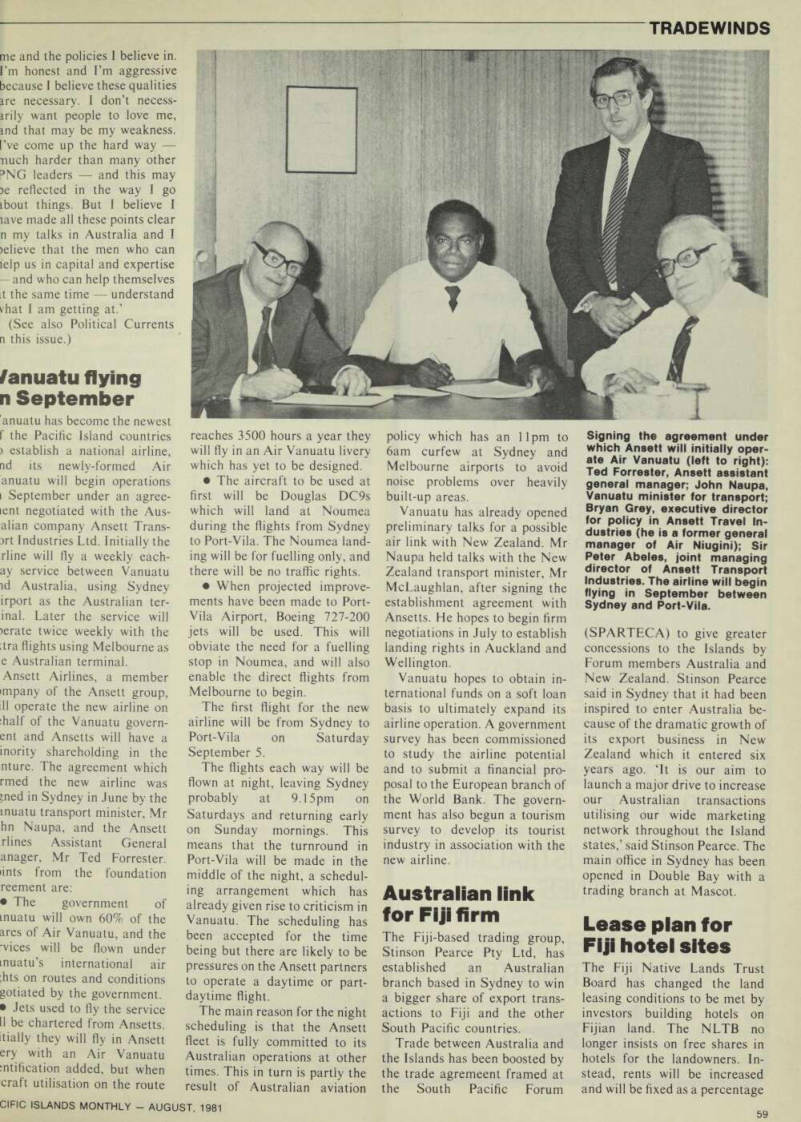

Trade
Winds
Deputy PM Okuk on PNG drive for funds
A recent visitor to Australia on an investment promotion mission was lambakey Okuk, deputy prime minister of Papua New Guinea and one of his country’s most controversial politicians. ANGUS SMALES writes here about the man and his visit.
lambakey Okuk, the man who is often painted as the ogre of Papua New Guinea politics, played out a new role recently in the never-ending interplay of politics and commerce which continues to link Australia and
Png.
The significance of his 10-day visit to the Australian eastern states is easy to overlook be cause superficially it repeated what many of his fellow-leaders have done before. Michael Somare when he was prime minister, Sir Julius Chan when he was finance minister and more recently prime minister, Ebia Olewale and Sir Maori Kiki when they were foreign ministers and Barry Holloway when he was finance minister have all performed well on the Australian circuit. Each was well received, and each in his own way did much to cement the special relationship which the two countries have estab lished since PNG indepen dence. But Mr Okuk is a man of different reputation. He has long worried many Australians with employment or investment interests in PNG, and he has long worried many of his own countrymen sharing govern ment with him. This is equally true of the days when he was a minister in the Somare govern ment (Mr Somare eventually sacked him) and of his present membership of the Chan gov ernment. The two most frequent allegations made against him are that he is a one-man-band who will plunge into action without consulting cabinet and that once he gets an idea in his head no amount of discussion or opposing advice will modify his thinking. Coupled with this he has frequently been accused of being anti-Australian, although in fairness to him this has never been demonstrated in practice.
An element of anti-Australian feeling cannot be avoided in PNG politics despite today’s
relationship. Mr Okuk’s offence may be no more than honesty untempered by tact.
Against this background Mr Okuk, who is now deputy prime minister and transport minister, flew to the Australian eastern states to lay down the rules for Australian investment in his country and to assure business leaders and politicians that he still wanted Australian invest ment of specified types.
It would be stretching the truth to say that the business men who came to his meetings in Sydney, Melbourne and Bris bane spent the time eating out of his hand. They didn’t. But they met him in an atmosphere of respect and mutual co operation and many of them came away with fewer misgiv ings about PNG political atti tudes to Australian investment money. His own approach to the meetings was typical of his pragmatism. He said he would be less than honest if he claimed that he saw Australia as an ideal and major partner in the PNG economy. No new nation liked to say that about a developed country, least of all one that had once been a ‘colonial boss’. But the simple fact remained, he said, that PNG was short of investment capital and short of expertise ‘and it is far better that we talk business with the devil we know rather than the devil we don’t’.
Among the business leaders he met were the chairman of Australia’s biggest company BHP, Sir James McNeill, and the chairman of the big mining group CRA, Sir Roderick Car negie. Both companies are in volved through subsidiaries in the PNG economy. BHP is the managing partner in the consor tium which is planning the big Ok Tedi copper and gold mine and CRA is the principal part ner in PNG’s biggest export earner, the Bougainville copper mine.
Mr Okuk also spoke with representatives of the Austra lian base of Carpenters and Burns Philp, companies which are heavily involved in PNG service industries, trading, agri culture, retailing, transport and manufacturing. His principal message was that PNG wanted to keep for itself all the business that its own nationals could capitalise and operate, but the rest of the field was wide open ‘and we will be fair to you if you are fair to us’.
He reconfirmed the long standing PNG policy that where heavy capital investment or high-level expertise was needed for specific projects PNG would welcome involve ment from outside on nego tiated terms, and would guaran tee the investment and the investment agreement. But he also gave indications of new flexibility in the type of invest ment which his country was willing to accept.
He suggested that the gov ernment might be prepared to liberalise some of its hard-line policies on smaller investment and equity sharing in circum stances where investment pro posals generated a significant volume of local employment.
His attitude appears to be a direct reaction to urban unem ployment, which has become a major problem in PNG.
Mr Okuk said the type of investment proposals in mind were small to medium sized manufacturing ventures, typified by furniture making, clothing, food processing, mechanical and vehicle assemb ling, simple tool-making, com mercial and domestic fasteners of all types and school materials and equipment. He believed operations of this type could be particularly attractive to medium-sized manufacturers in countries, such as Australia, which were experiencing financial problems from high wage levels. PNG could provide the labour at an economical price, he said, and existing material supplies and markets would be unaffected. Relo cation in PNG could possibly enlarge markets, he said and be better for PNG, which was trying to reduce its imports.
He said he was considering the possibility of establishing industrial estates of the type which had attracted Australian
manufacturers to Indonesia and Tonga. ‘We give you the space, the building, the electricity and the water and to hell with the red tape which has so often got in the way’, he said.
Mr Okuk said he had spoken to representatives of major Aus tralian firms with significant operations in PNG including Burns Philp and Carpenters and had told them to sell out their interests in food bars, taverns, picture theatres and little shops, and to concentrate on manufacturing and related services. ‘We can handle the little food bars, and they can do something constructive in manufacturing’, he said. The reaction had been favourable, he added.
Mr Okuk confirmed his inter est in buying a coalburning electricity plant from Australia and in negotiating supplies of Australian coal ‘at a favourable price’. But he stressed this was only a projection at present, prompted by electricity supply problems in PNG.
Mr Okuk said he was con cerned at the deterioration of reliability in electricity supplies in PNG. He was seriously looking at alternative ways of achieving efficiency and re liability. Power supplies in PNG are at present the respons ibility of the PNG Electricity Commission, a statutory body responsible to the government.
Mr Okuk said that if the situation did not improve he would not hesitate to suggest that the whole responsibility should be taken from the elec tricity commission and given to a private enterprise venture with a good record.
In a press interview with PIM Mr Okuk conceded that he ‘was not always popular as a poli tician’ and he was aware that he did not find favour with many Australians who were in a position to contribute capital and expertise to PNG. He said: ‘But it’s a matter of accepting
Tradewinds
me and the policies I believe in.
I’m honest and I’m aggressive because I believe these qualities are necessary. I don’t necess arily want people to love me, and that may be my weakness.
I’ve come up the hard way nuch harder than many other S NG leaders and this may ae reflected in the way I go ibout things. But I believe I lave made all these points clear n my talks in Australia and I lelieve that the men who can lelp us in capital and expertise and who can help themselves it the same time understand vhat I am getting at.’ (See also Political Currents n this issue.)
Vanuatu flying
n September
anuatu has become the newest f the Pacific Island countries ) establish a national airline, nd its newly-formed Air anuatu will begin operations i September under an agree lent negotiated with the Aus alian company Ansett Trans it Industries Ltd. Initially the rline will fly a weekly each ay service between Vanuatu id Australia, using Sydney irport as the Australian ter inal. Later the service will lerate twice weekly with the ;tra flights using Melbourne as e Australian terminal.
Ansett Airlines, a member impany of the Ansett group, ill operate the new airline on ;half of the Vanuatu govern ent and Ansetts will have a
inority shareholding in the
nture. The agreement which rmed the new airline was >ned in Sydney in June by the muatu transport minister, Mr hn Naupa, and the Ansett rlines Assistant General anager, Mr Ted Forrester, •ints from the foundation reement are: • The government of muatu will own 60% of the ares of Air Vanuatu, and the ■vices will be flown under muatu’s international air ;hts on routes and conditions gotiated by the government. • Jets used to fly the service 11 be chartered from Ansetts. itially they will fly in Ansett ery with an Air Vanuatu mtification added, but when craft utilisation on the route
reaches 3500 hours a year they will fly in an Air Vanuatu livery which has yet to be designed. • The aircraft to be used at first will be Douglas DC9s which will land at Noumea during the flights from Sydney to Port-Vila. The Noumea land ing will be for fuelling only, and there will be no traffic rights. • When projected improve ments have been made to Port- Vila Airport, Boeing 727-200 jets will be used. This will obviate the need for a fuelling stop in Noumea, and will also enable the direct flights from Melbourne to begin.
The first flight for the new airline will be from Sydney to Port-Vila on Saturday September 5.
The flights each way will be flown at night, leaving Sydney probably at 9.15 pm on Saturdays and returning early on Sunday mornings. This means that the turnround in Port-Vila will be made in the middle of the night, a schedul ing arrangement which has already given rise to criticism in Vanuatu. The scheduling has been accepted for the time being but there are likely to be pressures on the Ansett partners to operate a daytime or part daytime flight.
The main reason for the night scheduling is that the Ansett fleet is fully committed to its Australian operations at other times. This in turn is partly the result of Australian aviation
policy which has an 11pm to 6am curfew at Sydney and Melbourne airports to avoid noise problems over heavily built-up areas.
Vanuatu has already opened preliminary talks for a possible air link with New Zealand. Mr Naupa held talks with the New Zealand transport minister, Mr McLaughlan, after signing the establishment agreement with Ansetts. He hopes to begin firm negotiations in July to establish landing rights in Auckland and Wellington.
Vanuatu hopes to obtain in ternational funds on a soft loan basis to ultimately expand its airline operation. A government survey has been commissioned to study the airline potential and to submit a financial pro posal to the European branch of the World Bank. The govern ment has also begun a tourism survey to develop its tourist industry in association with the new airline.
Australian link
for Fiji firm
The Fiji-based trading group, Stinson Pearce Pty Ltd, has established an Australian branch based in Sydney to win a bigger share of export trans actions to Fiji and the other South Pacific countries.
Trade between Australia and the Islands has been boosted by the trade agremeent framed at the South Pacific Forum
(SPARTECA) to give greater concessions to the Islands by Forum members Australia and New Zealand. Stinson Pearce said in Sydney that it had been inspired to enter Australia be cause of the dramatic growth of its export business in New Zealand which it entered six years ago. ‘lt is our aim to launch a major drive to increase our Australian transactions utilising our wide marketing network throughout the Island states,’ said Stinson Pearce. The main office in Sydney has been opened in Double Bay with a trading branch at Mascot.
Lease plan for
Fiji hotel sites
The Fiji Native Lands Trust Board has changed the land leasing conditions to be met by investors building hotels on Fijian land. The NLTB no longer insists on free shares in hotels for the landowners. In stead, rents will be increased and will be fixed as a percentage
Signing the agreement under which Ansett will initially oper ate Air Vanuatu (left to right): Ted Forrester, Ansett assistant general manager; John Naupa, Vanuatu minister for transport; Bryan Grey, executive director for policy in Ansett Travel In dustries (he is a former general manager of Air Niugini); Sir Peter Abeles, joint managing director of Ansett Transport Industries. The airline will begin flying in September between Sydney and Port-Vila.
of gross hotel receipts, ranging from 2.5% to 4%. In the early years, rent will be kept low to help the project, the maximum period to be fixed at four years.
Hotel leases will be for 60 to 99 years depending on the type of lease negotiated.
Major resort leases will be restricted to the established tourist resort centres on Viti Levu, but other leases will be granted for small guesthouse type hotels in other areas.
Leases will not be approved for holiday houses except in areas designated for them.
Direct lease negotiations be tween a developer and the landowners will be banned, and resort sites will be marketed by the board.
Monopoly
moves
in insurance
Kiribati has set up a government-owned insurance monopoly, Tonga is on the way to doing the same thing and there are indications that some other Island governments may follow the trend.
Companies based in Austra lia and New Zealand are at present major insurance oper ators in the Pacific Islands, but under the monopoly arrange ment introduced by Kiribati and planned by Tonga new direct business must cease.
Some significant links are likely to be maintained however by using major overseas companies as underwriters and re insurance sources for the Island monopolies.
Under the Kiribati scheme heavy fines are provided for any company which sells new in surance business and for any client buying new business. The basic fine is $lOOO, with con tinuing penalties of up to $5OO a day while illegal policies remain in force. All new insurance business must be channelled by law through the new government-owned Kiribati In surance Corporation.
Penny Hodgkinson in Nukualofa provides the follow ing report on the Tongan in surance proposals: A special ordinance, already gazetted, has given the Tongan government powers to establish
a government insurance corpor ation on a date to be fixed. The government’s initial planning hopes to fix the date for September. The ordinance gives the proposed corporation monopoly rights over all forms of Tongan insurance business, inside and outside the kingdom, with the exception of existing life policies and reinsurance business. It provides for a grace period of 365 days from the date of issue or renewal of other types of existing policies and for substantial fines which may be imposed on insurers or clients who continue to transact busi ness beyond the time limits laid down by the corporation.
Indications are that the mon opoly clauses are unlikely to be fully invoked until the corpor ation is well established. The corporation will be governed by a seven-member board ap pointed by the minister of finance and will transact in surance business involving em ployer liability, fire, life, marine and motor vehicle. The corpor ation will also insure against loss situations arising from natural disaster, deviations from normal social behaviour, mechanical and technical de fects, the use of hazardous goods and processes, death, disease and injury.
The corporation’s board, its actuary and its external auditor will be required to submit annual reports to the finance minister and the Legislative Assembly. The government it self will guarantee borrowings and payouts, making payments if necessary from public rev enue as well as from accumu lated reserves. A management staff will administer the corpor ation’s business.
The two major overseas com panies which have been carry ing Tongan insurance for many years are the New Zealand Insurance Company and the QBE Insurance Group. They are not mentioned in the ordi nance and there has been no announcement of their future position. There are indications however that both companies will continue to have a role in Tonga insurance business, and will also be the obvious com panies to accept re-insurance business from the government corporation.
Advertisements & other items, pp. 59-60 (2 items)
59
CIFIC ISLANDS MONTHLY - AUGUST, 1981
Pty. Ltd.
WATER WHEEL EXPORTS
493 Bourke Street, Melbourne, 3000, Australia Cables: Watermill-Melbourne.
Telex: AA 32165 Telephone: 602 1433
THE WATER WHEEL GROUP OF COMPANIES
Winners of Australia’s Top Export Award and Flour Millers for over 100 years. (High Protein, Bakers, Stone ground Wholemeal, Donut).
COOLROOMS REFRIGERATED
CABINETS ETC.
INCLUDING SALT WATER
ICE MAKERS
STOCK & POULTRY FEEDS
YELLOW SPLIT PEAS &
WHOLE PEAS
COMPLETE RANGE OF FROZEN
AND GENERAL FOOD ITEMS
QUALITY AUSTRALIAN
WINES
WOOD FUEL STOVES
AND WATER HEATERS
BEST AUSTRALIAN
WHEATEN FLOUR
(Pellets or Mash form) (Machine-Dressed)
Yachts
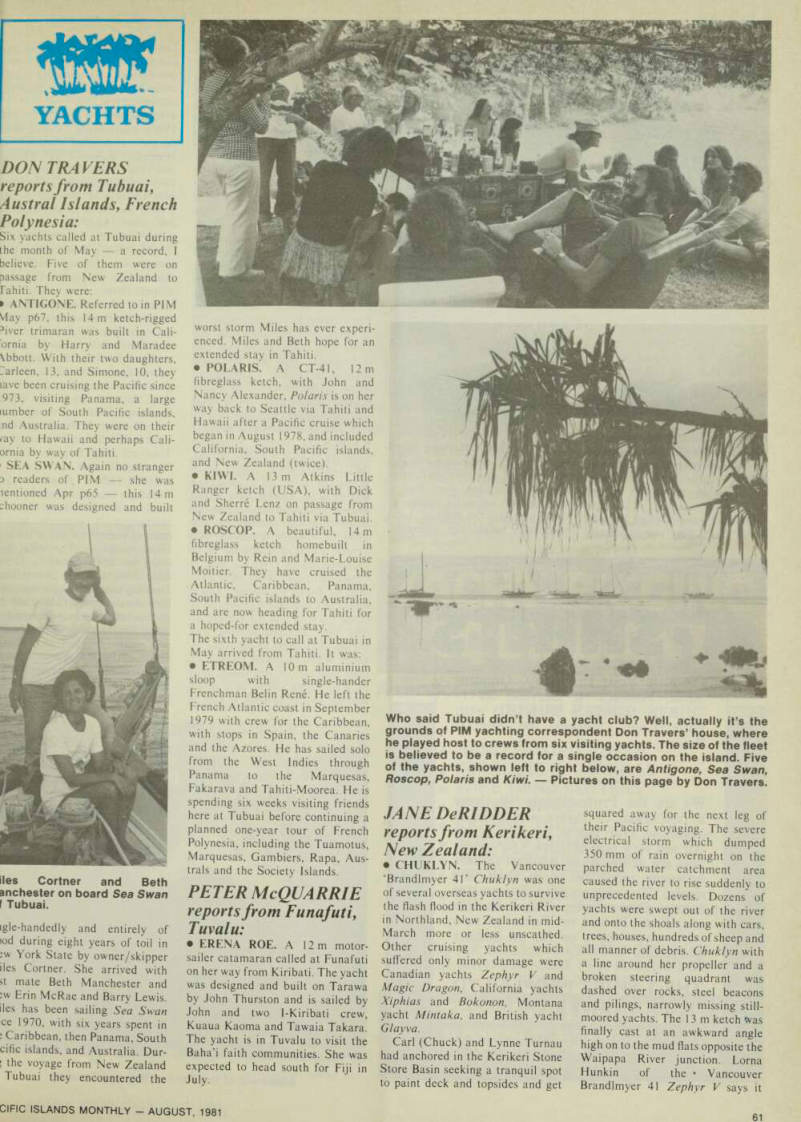
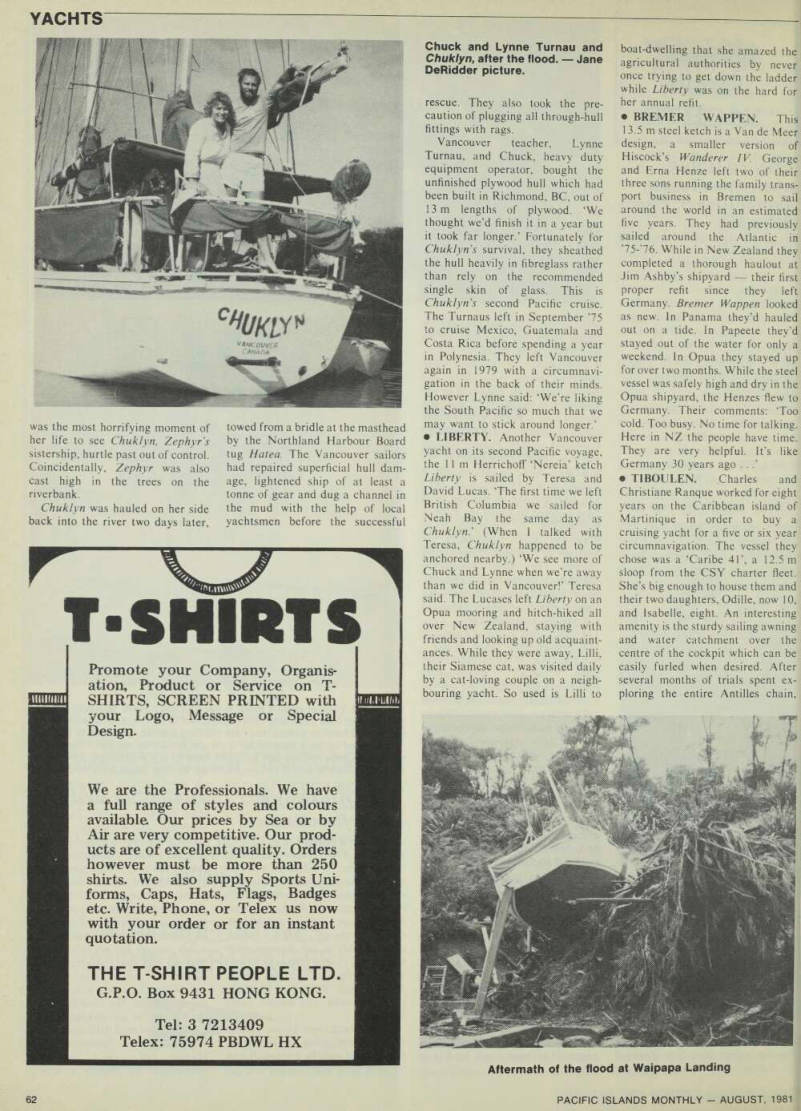
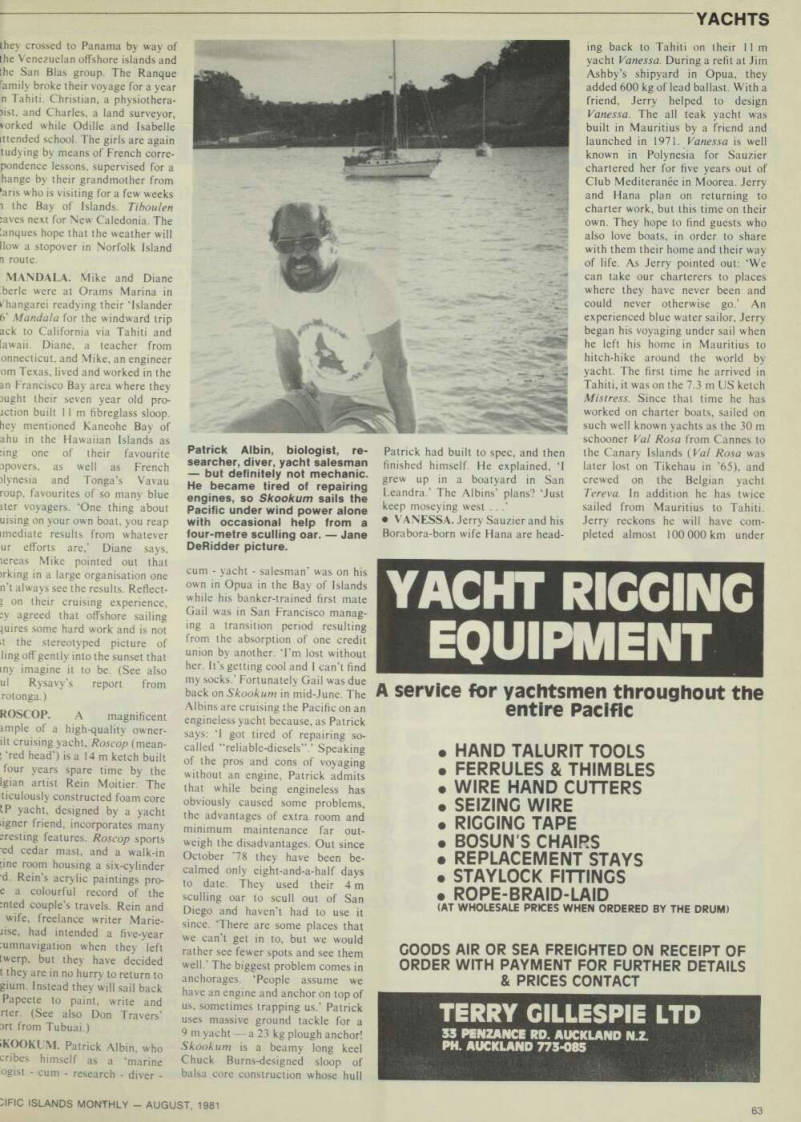
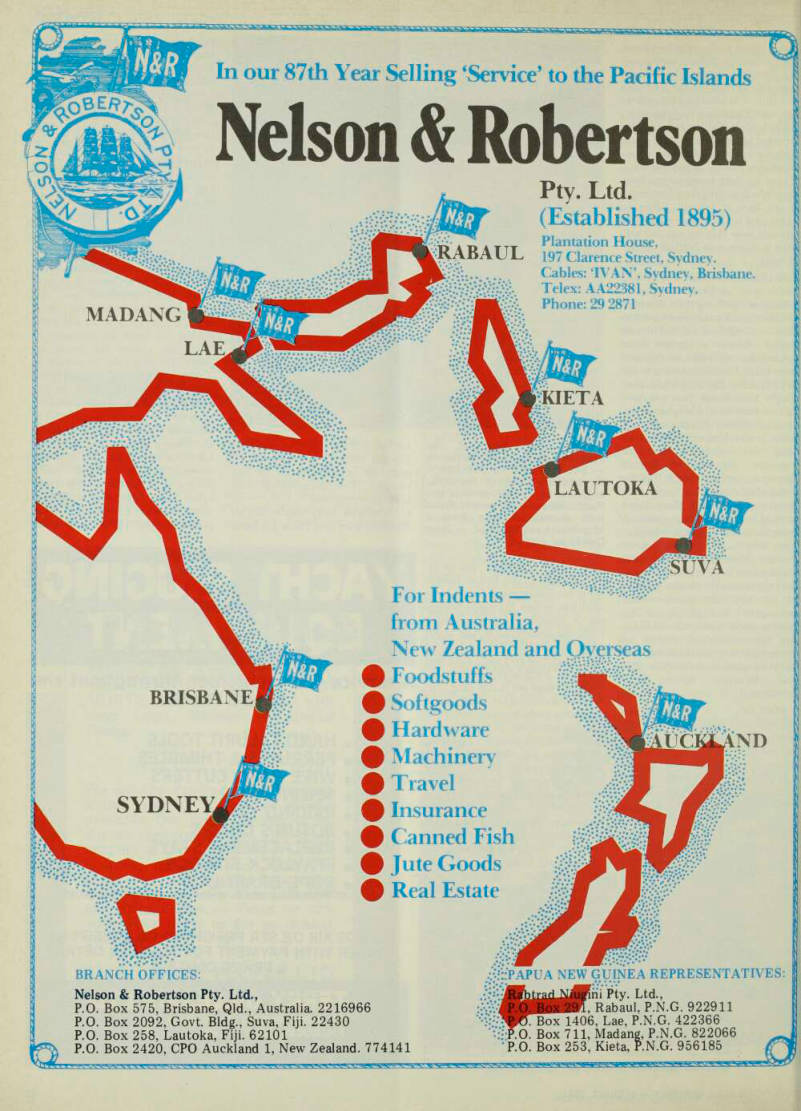
Dom Travers
reports from Tubuai,
Austral Islands, French
Polynesia:
Six yachts called at Tubuai during the month of May a record, I believe. Five of them were on passage from New Zealand to Tahiti. They were: » ANTIGONE. Referred to in PIM Vlay p 67, this 14 m ketch-rigged 3 iver trimaran was built in Cali ornia by Harry and Maradee \bbott. With their two daughters, "arleen, 13, and Simone, 10, they lave been cruising the Pacific since 973, visiting Panama, a large lumber of South Pacific islands, nd Australia. They were on their /ay to Hawaii and perhaps Cali ornia by way of Tahiti. 1 SEA SWAN. Again no stranger d readers of PIM she was tentioned Apr p 65 this 14 m :hooner was designed and built
igle-handedly and entirely of >od during eight years of toil in ;w York State by owner/skipper iles Conner. She arrived with >t mate Beth Manchester and 'w Erin Mcßae and Barry Lewis, iles has been sailing Sea Swan ce 1970, with six years spent in J Caribbean, then Panama, South cific islands, and Australia. Dur ; the voyage from New Zealand Tubuai they encountered the
worst storm Miles has ever experi enced. Miles and Beth hope for an extended stay in Tahiti.
• Polaris. A Ct-41, 12M
fibreglass ketch, with John and Nancy Alexander, Polaris is on her way back to Seattle via Tahiti and Hawaii after a Pacific cruise which began in August 1978, and included California, South Pacific islands, and New Zealand (twice). • KIWI. A 13 m Atkins Little Ranger ketch (USA), with Dick and Sherre Lenz on passage from New Zealand to Tahiti via Tubuai. • ROSCOP. A beautiful, 14 m fibreglass ketch homebuilt in Belgium by Rein and Marie-Louise Moitier. They have cruised the Atlantic, Caribbean, Panama, South Pacific islands to Australia, and are now heading for Tahiti for a hoped-for extended stay.
The sixth yacht to call at Tubuai in May arrived from Tahiti. It was: • ETREOM. A 10 m aluminium sloop with single-hander Frenchman Belin Rene. He left the French Atlantic coast in September 1979 with crew for the Caribbean, with stops in Spain, the Canaries and the Azores. He has sailed solo from the West Indies through Panama to the Marquesas, Fakarava and Tahiti-Moorea. He is spending six weeks visiting friends here at Tubuai before continuing a planned one-year tour of French Polynesia, including the Tuamotus, Marquesas, Gambiers, Rapa, Aus trals and the Society Islands.
Peter Mcquarrie
reports from Funafuti,
Tuvalu:
• ERENA ROE. A 12 m motor sailer catamaran called at Funafuti on her way from Kiribati. The yacht was designed and built on Tarawa by John Thurston and is sailed by John and two I-Kiribati crew, Kuaua Kaoma and Tawaia Takara.
The yacht is in Tuvalu to visit the Baha’i faith communities. She was expected to head south for Fiji in July.
Jam E Deridder
reports from Kerikeri,
Mew Zealand:
• CHUKLYN. The Vancouver 'Brandlmyer 41’ Chuklyn was one of several overseas yachts to survive the flash flood in the Kerikeri River in Northland, New Zealand in mid- March more or less unscathed.
Other cruising yachts which suffered only minor damage were Canadian yachts Zephyr V and Magic Dragon, California yachts Xiphias and Bokonon, Montana yacht Mintaka, and British yacht Glayva.
Carl (Chuck) and Lynne Turnau had anchored in the Kerikeri Stone Store Basin seeking a tranquil spot to paint deck and topsides and get
squared away for the next leg of their Pacific voyaging. The severe electrical storm which dumped 350 mm of rain overnight on the parched water catchment area caused the river to rise suddenly to unprecedented levels. Dozens of yachts were swept out of the river and onto the shoals along with cars, trees, houses, hundreds of sheep and all manner of debris. Chuklyn with a line around her propeller and a broken steering quadrant was dashed over rocks, steel beacons and pilings, narrowly missing still moored yachts. The 13 m ketch tvas finally cast at an awkward angle high on to the mud flats opposite the Waipapa River junction. Lorna Hunkin of the • Vancouver Brandlmyer 41 Zephyr V says it
[?]les Cortner and Beth [?]anchester on board Sea Swan [?] Tubuai.
Who said Tubuai didn’t have a yacht club? Well, actually it’s the grounds of PIM yachting correspondent Don Travers’ house, where he played host to crews from six visiting yachts. The size of the fleet is believed to be a record for a single occasion on the island. Five of the yachts, shown left to right below, are Antigone, Sea Swan, Roscop, Polaris and Kiwi. - Pictures on this page by Don Travers.
was the most horrifying moment of her life to see Chuklyn, Zephyr’s sistership, hurtle past out of control.
Coincidentally, Zephyr was also
cast high in the trees on the riverbank.
Chuklyn was hauled on her side back into the river two days later.
towed from a bridle at the masthead by the Northland Harbour Board tug Hatea. The Vancouver sailors had repaired superficial hull dam age, lightened ship of at least a tonne of gear and dug a channel in the mud with the help of local yachtsmen before the successful
rescue. They also took the pre caution of plugging all through-hull fittings with rags.
Vancouver teacher, Lynne Turnau, and Chuck, heavy duty equipment operator, bought the unfinished plywood hull which had been built in Richmond, BC, out of 13 m lengths of plywood. ‘We thought we’d finish it in a year but it took far longer.’ Fortunately for Chuklyn’s survival, they sheathed the hull heavily in fibreglass rather than rely on the recommended single skin of glass. This is Chuklyn’s second Pacific cruise.
The Turnaus left in September ’75 to cruise Mexico, Guatemala and Costa Rica before spending a year in Polynesia. They left Vancouver again in 1979 with a circumnavi gation in the back of their minds.
However Lynne said: ‘We’re liking the South Pacific so much that we may want to stick around longer.’ • LIBERTY. Another Vancouver yacht on its second Pacific voyage, the 11 m Herrichoff ‘Nereia’ ketch Liberty is sailed by Teresa and David Lucas. ‘The first time we left British Columbia we sailed for Neah Bay the same day as Chuklyn.' (When I talked with Teresa, Chuklyn happened to be anchored nearby.) ‘We see more of Chuck and Lynne when we’re away than we did in Vancouver!’ Teresa said. The Lucases left Liberty on an Opua mooring and hitch-hiked all over New Zealand, staying with friends and looking up old acquaint ances. While they were away, Lilli, their Siamese cat, was visited daily by a cat-loving couple on a neigh bouring yacht. So used is Lilli to
boat-dwelling that she amazed the agricultural authorities by never once trying to get down the ladder while Liberty was on the hard for her annual refit.
• Bremer Wappen. This
13.5 m steel ketch is a Van de Meer design, a smaller version of Hiscock’s Wanderer IV. George and Erna Henze left two of their three sons running the family trans port business in Bremen to sail around the world in an estimated five years. They had previously sailed around the Atlantic in 'l5-16. While in New Zealand they completed a thorough haulout at Jim Ashby’s shipyard their first proper refit since they left Germany. Bremer Wappen looked as new. In Panama they’d hauled out on a tide. In Papeete they’d stayed out of the water for only a weekend. In Opua they stayed up for over two months. While the steel vessel was safely high and dry in the Opua shipyard, the Henzes flew to Germany. Their comments: Too cold. Too busy. No time for talking.
Here in NZ the people have time.
They are very helpful. It’s like Germany 30 years ago . . .’ • TIBOULEN. Charles and Christiane Ranque worked for eight years on the Caribbean island of Martinique in order to buy a cruising yacht for a five or six year circumnavigation. The vessel they chose was a ‘Caribe 41’, a 12.5 m sloop from the CSV charter fleet.
She’s big enough to house them and their two daughters, Odille, now 10, and Isabelle, eight. An interesting amenity is the sturdy sailing awning and water catchment over the centre of the cockpit which can be easily furled when desired. After several months of trials spent ex ploring the entire Antilles chain,
Aftermath of the flood at Waipapa Landing
Chuck and Lynne Turnau and Chuklyn, after the flood. - Jane DeRidder picture.
they crossed to Panama by way of the Venezuelan offshore islands and the San Bias group. The Ranque r amily broke their voyage for a year n Tahiti. Christian, a physiothera )ist, and Charles, a land surveyor, vorked while Odille and Isabelle ittended school. The girls are again tudying by means of French corre pondence lessons, supervised for a hange by their grandmother from *aris who is visiting for a few weeks i the Bay of Islands. Tiboulen ;aves next for New Caledonia. The tanques hope that the weather will How a stopover in Norfolk Island n route.
MANDALA. Mike and Diane !berle were at Grams Marina in
/hangarei readying their ‘lslander
6’ Mandala for the windward trip ack to California via Tahiti and lawaii. Diane, a teacher from onnecticut, and Mike, an engineer om Texas, lived and worked in the an Francisco Bay area where they aught their seven year old pro
iction built 11 m fibreglass sloop,
hey mentioned Kaneohe Bay of ahu in the Hawaiian Islands as :ing one of their favourite apovers, as well as French ilynesia and Tonga’s Vavau roup, favourites of so many blue iter voyagers. ‘One thing about uising on your own boat, you reap imediate results from whatever ur efforts are,’ Diane says, lereas Mike pointed out that >rking in a large organisation one n’t always see the results. Reflect l on their cruising experience, iy agreed that offshore sailing quires some hard work and is not ;t the stereotyped picture of ling off gently into the sunset that my imagine it to be. (See also
ul Rysavy’s report from
rotonga.) ROSCOP. A magnificent imple of a high-quality owner ilt cruising yacht, Roscop (mean -1 ‘red head’) is a 14 m ketch built four years spare time by the Igian artist Rein Moitier. The ticulously constructed foam core tP yacht, designed by a yacht
ligner friend, incorporates many
cresting features. Roscop sports
ed cedar mast, and a walk-in
;ine room housing a six-cylinder
d. Rein’s acrylic paintings pro e a colourful record of the mted couple’s travels. Rein and wife, freelance writer Marie iise, had intended a five-year
:umnavigation when they left
twerp, but they have decided t they are in no hurry to return to gium. Instead they will sail back Papeete to paint, write and rter. (See also Don Travers’ art from Tubuai.) •KOOKUM. Patrick Albin, who cribes himself as a ‘marine ogist - cum - research - diver -
cum - yacht - salesman’ was on his own in Opua in the Bay of Islands while his banker-trained first mate Gail was in San Francisco manag ing a transition period resulting from the absorption of one credit union by another. ‘l’m lost without her. It’s getting cool and I can’t find my socks.’ Fortunately Gail was due back on Skookum in mid-June. The Albins are cruising the Pacific on an engineless yacht because, as Patrick says: ‘1 got tired of repairing so called “reliable-diesels”.’ Speaking of the pros and cons of voyaging without an engine, Patrick admits that while being engineless has obviously caused some problems, the advantages of extra room and minimum maintenance far out weigh the disadvantages. Out since October ’7B they have been be
calmed only eight-and-a-half days
to date. They used their 4 m sculling oar to scull out of San Diego and haven’t had to use it since. ‘There are some places that we can’t get in to, but we would rather see fewer spots and see them well.’ The biggest problem comes in
anchorages. ‘People assume we
have an engine and anchor on top of us, sometimes trapping us.’ Patrick uses massive ground tackle for a 9 m yacht a 23 kg plough anchor!
Skookum is a beamy long keel
Chuck Burns-designed sloop of
balsa core construction whose hull
Patrick had built to spec, and then finished himself. He explained, ‘I grew up in a boatyard in San Leandra.’ The Albins’ plans? ‘Just keep moseying west . . .’ • VANESSA. Jerry Sauzier and his Borabora-born wife Hana are head
ing back to Tahiti on their 11 m yacht Vanessa. During a refit at Jim
Ashby’s shipyard in Opua, they
added 600 kg of lead ballast. With a friend, Jerry helped to design Vanessa. The all teak yacht was built in Mauritius by a friend and launched in 1971. Vanessa is well known in Polynesia for Sauzier chartered her for five years out of Club Mediteranee in Moorea. Jerry and Hana plan on returning to charter work, but this time on their own. They hope to find guests who also love boats, in order to share with them their home and their way of life. As Jerry pointed out: ‘We can take our charterers to places where they have never been and could never otherwise go.’ An experienced blue water sailor, Jerry began his voyaging under sail when he left his home in Mauritius to hitch-hike around the world by yacht. The first time he arrived in Tahiti, it was on the 7.3 m US ketch Mistress. Since that time he has worked on charter boats, sailed on such well known yachts as the 30 m schooner Val Rosa from Cannes to the Canary Islands ( Val Rosa was later lost on Tikehau in ’65), and crewed on the Belgian yacht Tereva. In addition he has twice sailed from Mauritius to Tahiti.
Jerry reckons he will have com pleted almost 100 000 km under
Patrick Albin, biologist, re searcher, diver, yacht salesman - but definitely not mechanic.
He became tired of repairing engines, so Skookum sails the Pacific under wind power alone with occasional help from a
four-metre sculling oar. - Jane
DeRidder picture.
sail by the time Vanessa reaches Tahiti. • BECAUSE. Because of Victoria arrived in Honolulu on April 2 . . . ‘to be met with swarms of jets, a million city lights, gale force winds and cultural shock,’ after a 51-day crossing from Rabaul. Dick Fhuillier’s cruising sloop is a nodified Ray Richards ‘Warrior’ lull with raised freeboard and centre cockpit. Dick built her him ;elf, having previously constructed lis own amphibious aircraft, fhuillier has sailed several legs of lis Pacific wanderings solo. He was oined in Noumea by Ros, an xperienced blue water voyager /ho at one time cruised the Pacific n her own yacht, then sailed for ver two years on the ‘Golden Hind’ loop Atria. With Thuillier, Ros ailed through the Loyalties to Port rila for the Vanuatu independence
elebrations, thence through the
anks and Santa Cruz Islands to olomon Islands in company with
achls Papillon and Sarabande.
*ick and Ros spent the hurricane :ason in Rabaul where Thuillier inverted the forestay of Because to roller reefing system modelled on lat of John Wood’s Kerikeri yacht 'oodwind . ‘We ran for days with /o reefs in the main and rolled the a from full out in 20-knot winds to II in at 45 knots, reports Thuillier. /orked like a charm!’ But they ere hard on the wind for the latter irt of the trip. Ros baked fresh ead all the way even when shing to windward.
Oand. Pease
sports from Papeete ,
rench Polynesia:
JOLIE BRISE. The name is ench for ‘fair breeze’, and she is 11.2 m cutter from Vancouver, itish Columbia, now calling at
chorages in French Polynesia,
rnand Prince built the vessel ich is fibreglass over fir. He and wife Jean left their home port t August and stopped at the Gulf ands, Victoria, Neah Bay, ishington, and Hawaii before ling to Palmyra island where they :nt Christmas with Rob and aron Jordan on Moya , friends m Canada whom they also sailed h in Hawaii. They’re not likely to gel Palmyra because during the nth-long stay at the atoll, Sharon dan found a large aluminium c containing a skull, bones and •ned wristwatch which were ntified as the remains of a Mrs iham, who, with her husband, I been missing since 1974. Sea nd, the Grahams’ ketch, was :overed in Hawaii in the pos >ion of a young couple who were rged with its theft. The missing sons had made their final radio tact from Palmyra, and al-
though they were presumed dead, their bodies could not be found. We had read newspaper articles about the Grahams because a current history is kept on the island, so we were fairly certain of the identity of the remains even before the authorities arrived, Jean said.
PAUL RYSA VYreports
from Rarotonga , Cook
Islands:
• MANDALA. Americans Mike and Diane Eberle spent two weeks in Avatiu harbour in Rarotonga before departing for Borabora. The couple, who are sailing their ‘lslander 36’ sloop, began their voyage from San Francisco in April 1979. The ports of call to date have been Hawaii, the Marquesas, the Societies (where their parents and friends came to visit them briefly), American and Western Samoa, Tonga, Fiji, and finally New Zea land for the last hurricane season.
Rarotonga was the first stop on their return trip, and after Borabora Mandala will probably sail directly back to San Francisco. The only unpleasantness the Eberles have encountered was in American
Samoa, where some items were stolen from the yacht, and where the couple were ‘disturbed with the way American aid money is being used to fill the pockets of a select few’. • OMATAKO. A South African registered, 1 1 m Berkemeyer sloop, called in at Rarotonga in mid-June.
On board were Namibian (South west African) residents Wolfgang Dekant, the skipper, and Barbara Ebrecht. Omatako, which means a ‘a woman’s bum’ in the Herero language of Namibia, left Africa in 1977. Owner Gdtz Kldn was only able to join the boat at brief intervals as business obligations in Namibia demanded most of his time. In the five years since it left South-west Africa, the sloop has visited Brazil, St Helena, the Caribbean, Panama, the Marquesas, the Tuamotus, Tahiti and Rarotonga. Gdtz flew to Rarotonga to join the vessel, and after several weeks here, Omatako set sail for the Fiji group, where it
will remain until the next hurricane season is over. • APHRODITE VI. Canadian Larry Woolcox and Australian Helen Graham are cruising the Pacific on Aphrodite VI, a Taiwan built 15 m staysail clipper ketch.
The Vancouver-registered yacht has logged approximately 32 000 km with Larry since it was launched three years ago. In that time, Larry has explored the China Sea area, the Philippines, the Carolines, Australasia and now Polynesia. Larry and Helen (who came aboard in Sydney) plan to visit French Polynesia ‘indefinitely’, after they leave Rarotonga. • BRIGADOON. An eight-year-old Van de Staat yawl, Brigadoon was another visitor to Avatiu harbour in Rarotonga. The Christchurch registered yacht has a chequered history, as it was involved in the Mr Asia drug smuggling runs. The present owner is Jeremy Hall who is travelling with his wife and family, and crew member Peter Archibald.
The Halls have owned the craft for only nine months, and this is their first ocean voyage. They left New Zealand in mid-May, and from Rarotonga will sail to Tahiti and Fiji before returning to New Zea land in late October. • KORAL 11. Also visiting Rarotonga briefly was Koral 11. a British Columbia-registered sloop owned and sailed by Marec and Jola Jarecki and their 14-year-old son, Tom. The 10 m steel sloop was built in Holland five years ago, and the Jareckis have owned it for three.
They began this voyage in July last year, and set out from Victoria, British Columbia, directly for the Marquesas. From there, Koral II made various stops in the Tuamotus and Society Islands. On the trip to Rarotonga a large wave smashed the self-steering system and Koral II has been here several weeks undergoing repairs. On June 4, the sloop left with anticipated stops at Tonga, Fiji and New Zealand. • VIBEGGE. On a circumnavi gation is Vibegge , a 17-year-old Dutch steel-hulled ketch owned and sailed by Hans and Vibeke Munch.
They, and their crew of Erik Westh and Anne Christensen left Holland two years ago, immediately after Hans bought Vibegge , to sail around the world. Highlights of their trip so far were Spain, Dominica and the San Bias Islands. The nadir was Columbia, where they were mugged, and ‘half the boat was stolen’. After several weeks here, Vibegge continued its tour of Polynesia and headed for Tonga.
Future stops will include Fiji, New Caledonia and Australia, where further plans will be made.
The Little Ranger ketch Kiwi under sail between New Zea land and Tubuai. (See report
p6l) - Jane DeRidder picture.
Advertisements & other items, pp. 61-66 (4 items)
Cific Islands Monthly - August. 1981
T-Shirts
r
Promote your Company, Organisation, Product or Service on T-
SHIRTS, SCREEN PRINTED with
your Logo, Message or Special Design.
We are the Professionals. We have a full range of styles and colours available Our prices by Sea or by Air are very competitive. Our products are of excellent quality. Orders however must be more than 250 shirts. We also supply Sports Uniforms, Caps, Hats, Flags, Badges etc. Write, Phone, or Telex us now with your order or for an instant quotation.
THE T-SHIRT PEOPLE LTD.
G.P.O. Box 9431 HONG KONG.
Tel: 3 7213409 Telex: 75974 PBDWL HX
YACHT RIGGING
EQUIPMENT
A service for yachtsmen throughout the entire Pacific
• HAND TALURIT TOOLS
• FERRULES & THIMBLES
• WIRE HAND CUTTERS
• SEIZING WIRE
• RIGGING TAPE
• BOSUN S CHAIRS
• REPLACEMENT STAYS
• STAYLOCK FITTINGS
• ROPE-BRAID-LAID
(AT WHOLESALE PRICES WHEN ORDERED BY THE DRUM) GOODS AIR OR SEA FREIGHTED ON RECEIPT OF
ORDER WITH PAYMENT FOR FURTHER DETAILS
& PRICES CONTACT
TERRY GILLESPIE LTD
S 3 PENZANCE RD. AUCKLAND N.Z.
PH. AUCKLAND 773-085
In our 87th Year Selling ‘Service’ to the Pacific Islands
Nelson & Robertson
RABAUL
: A* • •/»* •••*»•*••• o "0 o sc cP V 4/ G
MADANG
LAE
.*• •• • .VA :Vft. . • .•: ••.V;
BRISBANE
SYDNEY
IV .•••
Pty. Ltd.
(Established 1895)
Plantation House, 197 Clarence Street, Sydney.
Cables: ‘IVAN’, Sydney, Brisbane.
Telex: AA22381, Sydney.
Phone: 29 2871
KIETA
LAUTOKA
•.V !• •*.V. •V:. .•••T
For Indents
from Australia,
New Zealand and Overseas
msvvt
Foodstuffs
Softgoods
Hardware
Machinery
Travel
Insurance
Canned Fish
Jute Goods
Real Estate
-•VvVy;-:v/-V-v..
V.V ; ;
BRANCH OFFICES:
Nelson & Robertson Pty. Ltd., P.O. Box 575, Brisbane, Qld., Australia. 2216966 P.O. Box 2092, Govt. Bldg., Suva, Fiji, 22430 P.O. Box 258, Lautoka, Fiji. 62101 P.O. Box 2420, CPO Auckland 1, New Zealand. 774141 ND •••; •*v •a: .•v :>r. ...
.vi:::PAPUA NEW GUINEA REPRESENTATIVES
Pty. Ltd., P.O. Boj«[, Rabaul, P.N.G. 922911 ■B. Box 1406, Lae, P.N.G. 422366 P.O. Box 711, Madang, P.N.G. 822066 P.O. Box 253. Kieta, P.N.G. 956185
1 I \(i I
GLOBAL SERVICE FOR SHIPPERS
V
THE BANK LINE
—-‘i r *r' -MiZ vvn tt\h
Papua New Guinea & Solomon Islands
UK/Continent Service
Regular direct 28 day service
PAPUA NEW GUINEA and SOLOMON ISLANDS
to;
UNITED KINGDOM and CONTINENT
For particulars apply:
THE BANK LINE (AUSTRALASIA) PTY LTD.
Suite 801, 51 Pitt St, Sydney, N.S.W. 2000. Australia.
Telephone: 272041 Telex: 24063
Yachts
63
IFIC ISLANDS MONTHLY AUGUST, 1981
Yachts
65
■'IFIC ISLANDS MONTHLY - AUGUST, 1981
NZ shipping man in
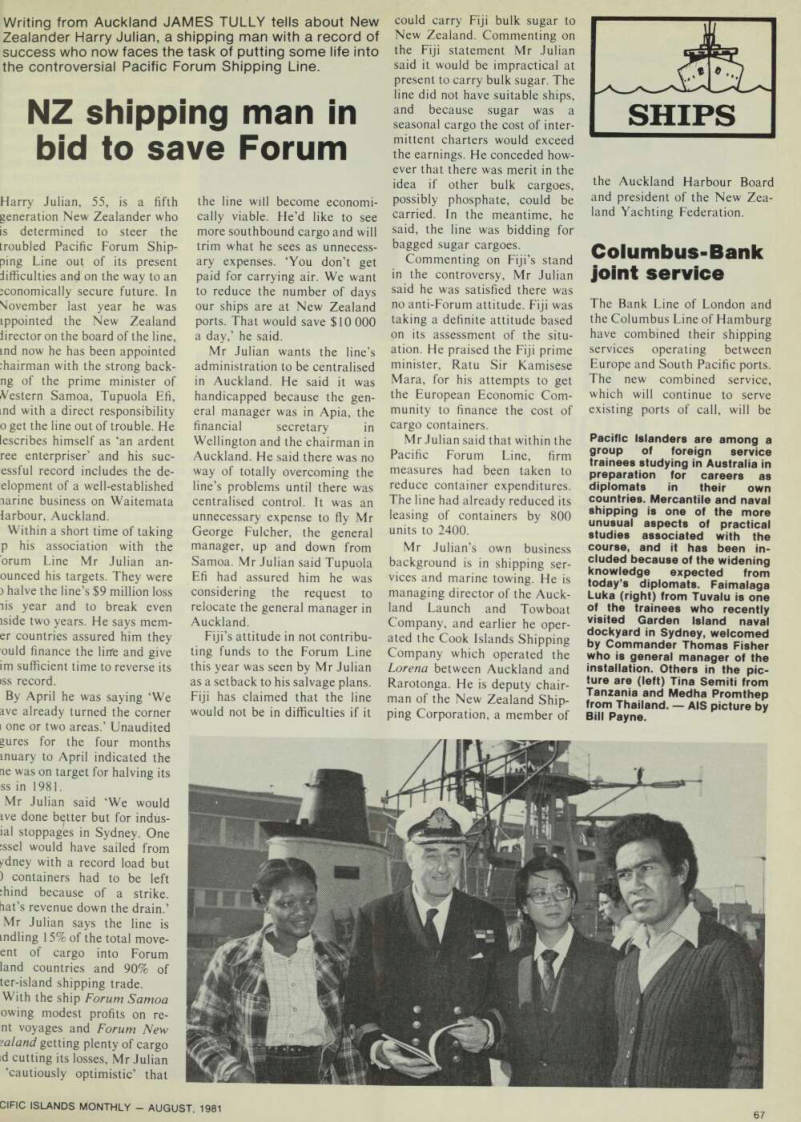
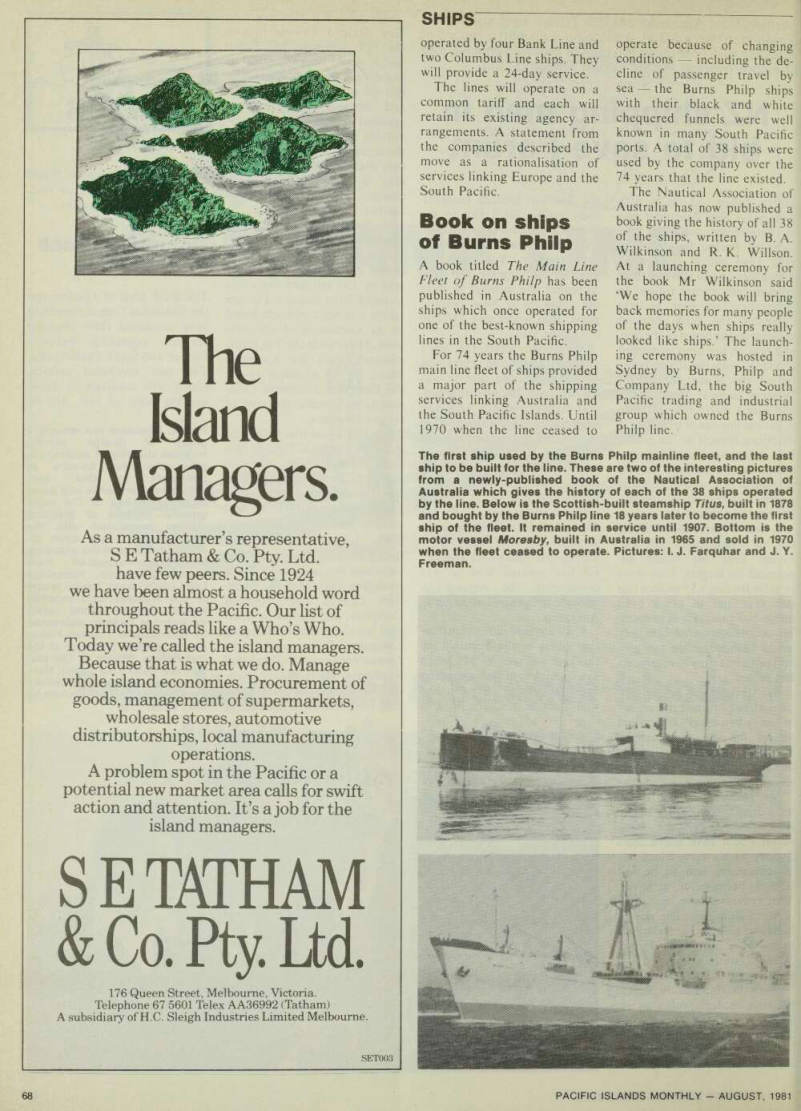
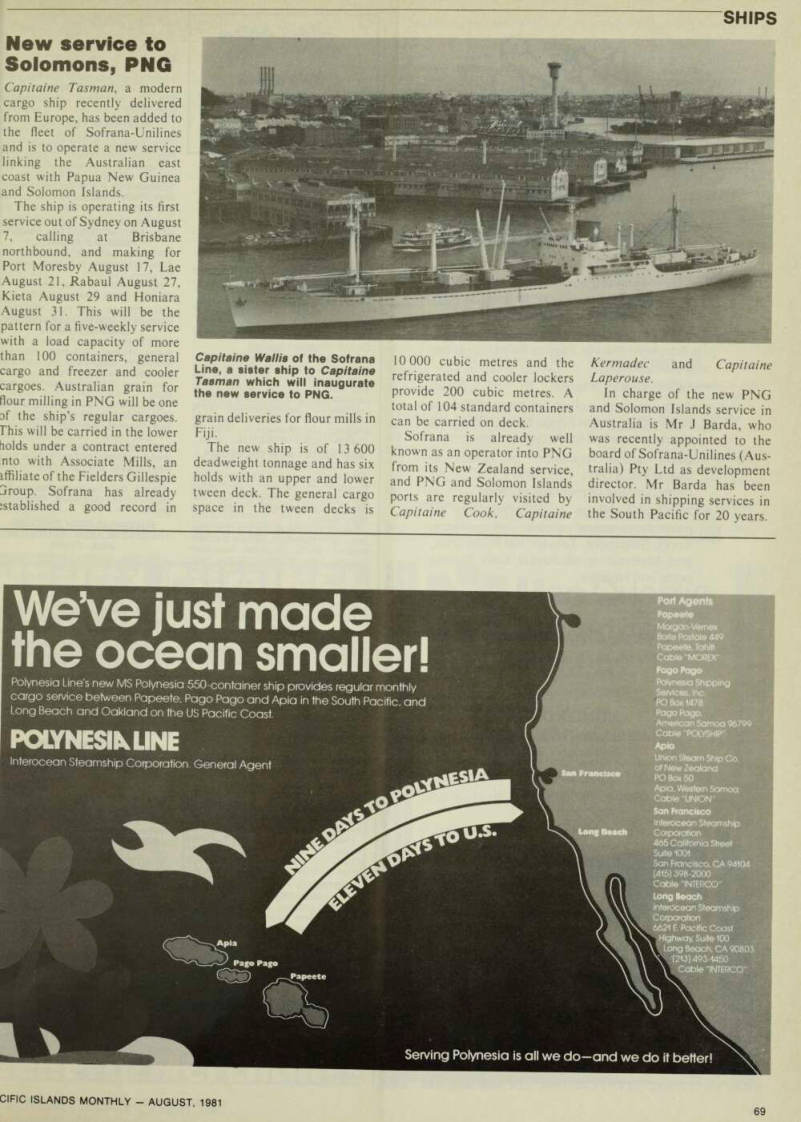
Ships
NZ shipping man in bid to save Forum
Writing from Auckland JAMES TULLY tells about New Zealander Harry Julian, a shipping man with a record of success who now faces the task of putting some life into the controversial Pacific Forum Shipping Line.
Harry Julian, 55, is a fifth generation New Zealander who is determined to steer the troubled Pacific Forum Ship ping Line out of its present difficulties and on the way to an economically secure future. In Vovember last year he was ippointed the New Zealand lirector on the board of the line, md now he has been appointed chairman with the strong back ng of the prime minister of Vestern Samoa, Tupuola Efi, md with a direct responsibility 0 get the line out of trouble. He [escribes himself as ‘an ardent ree enterpriser’ and his suc essful record includes the de elopment of a well-established larine business on Waitemata larbour, Auckland.
Within a short time of taking p his association with the brum Line Mr Julian an ouneed his targets. They were ) halve the line’s $9 million loss lis year and to break even iside two years. He says mem er countries assured him they ould finance the line and give im sufficient time to reverse its »ss record.
By April he was saying ‘We ave already turned the corner 1 one or two areas.’ Unaudited gures for the four months inuary to April indicated the ae was on target for halving its ss in 1981.
Mr Julian said ‘We would ive done better but for indus ial stoppages in Sydney. One :ssel would have sailed from /dney with a record load but ) containers had to be left ;hind because of a strike, bat’s revenue down the drain.’
Mr Julian says the line is indling 15% of the total move ent of cargo into Forum land countries and 90% of ter-island shipping trade.
With the ship Forum Samoa owing modest profits on re nt voyages and Forum New ?aland getting plenty of cargo d cutting its losses, Mr Julian ‘cautiously optimistic’ that
the line will become economi cally viable. He’d like to see more southbound cargo and will trim what he sees as unnecess ary expenses. ‘You don’t get paid for carrying air. We want to reduce the number of days our ships are at New Zealand ports. That would save $lO 000 a day,’ he said.
Mr Julian wants the line’s administration to be centralised in Auckland. He said it was handicapped because the gen eral manager was in Apia, the financial secretary in Wellington and the chairman in Auckland. He said there was no way of totally overcoming the line’s problems until there was centralised control. It was an unnecessary expense to fly Mr George Fulcher, the general manager, up and down from Samoa. Mr Julian said Tupuola Efi had assured him he was considering the request to relocate the general manager in Auckland.
Fiji’s attitude in not contribu ting funds to the Forum Line this year was seen by Mr Julian as a setback to his salvage plans.
Fiji has claimed that the line would not be in difficulties if it
could carry Fiji bulk sugar to New Zealand. Commenting on the Fiji statement Mr Julian said it would be impractical at present to carry bulk sugar. The line did not have suitable ships, and because sugar was a seasonal cargo the cost of inter mittent charters would exceed the earnings. He conceded how ever that there was merit in the idea if other bulk cargoes, possibly phosphate, could be carried. In the meantime, he said, the line was bidding for bagged sugar cargoes.
Commenting on Fiji’s stand in the controversy, Mr Julian said he was satisfied there was no anti-Forum attitude. Fiji was taking a definite attitude based on its assessment of the situ ation. He praised the Fiji prime minister, Ratu Sir Kamisese Mara, for his attempts to get the European Economic Com munity to finance the cost of cargo containers.
Mr Julian said that within the Pacific Forum Line, firm measures had been taken to reduce container expenditures.
The line had already reduced its leasing of containers by 800 units to 2400.
Mr Julian’s own business background is in shipping ser vices and marine towing. He is managing director of the Auck land Launch and Towboat Company, and earlier he oper ated the Cook Islands Shipping Company which operated the Lorena between Auckland and Rarotonga. He is deputy chair man of the New Zealand Ship ping Corporation, a member of
the Auckland Harbour Board and president of the New Zea land Yachting Federation.
Columbus-Bank
joint service
The Bank Line of London and the Columbus Line of Hamburg have combined their shipping services operating between Europe and South Pacific ports.
The new combined service, which will continue to serve existing ports of call, will be
Pacific Islanders are among a group of foreign service trainees studying in Australia in preparation for careers as diplomats in their own countries. Mercantile and naval shipping is one of the more unusual aspects of practical studies associated with the course, and it has been in cluded because of the widening knowledge expected from today’s diplomats. Faimalaga Luka (right) from Tuvalu is one of the trainees who recently visited Garden Island naval dockyard in Sydney, welcomed by Commander Thomas Fisher who is general manager of the installation. Others in the pic ture are (left) Tina Semiti from Tanzania and Medha Promthep
from Thailand. - AIS picture by
Bill Payne.
operated by four Bank Line and two Columbus Line ships. They will provide a 24-day service.
The lines will operate on a common tariff and each will retain its existing agency ar rangements. A statement from the companies described the move as a rationalisation of services linking Europe and the South Pacific.
Book on ships
of Burns Philp
A book titled The Main Line Fleet of Burns Philp has been published in Australia on the ships which once operated for one of the best-known shipping lines in the South Pacific.
For 74 years the Burns Philp main line fleet of ships provided a major part of the shipping services linking Australia and the South Pacific Islands. Until 1970 when the line ceased to
operate because of changing conditions including the de cline of passenger travel by sea the Burns Philp ships with their black and white chequered funnels were well known in many South Pacific ports. A total of 38 ships were used by the company over the 74 years that the line existed.
The Nautical Association of Australia has now published a book giving the history of all 38 of the ships, written by B. A.
Wilkinson and R. K. Willson.
At a launching ceremony for the book Mr Wilkinson said 'We hope the book will bring back memories for many people of the days when ships really looked like ships.’ The launch ing ceremony was hosted in Sydney by Burns, Philp and Company Ltd, the big South Pacific trading and industrial group which owned the Burns Philp line.
The first ship used by the Burns Philp mainline fleet, and the last ship to be built for the line. These are two of the interesting pictures from a newly-published book of the Nautical Association of Australia which gives the history of each of the 38 ships operated by the line. Below is the Scottish-built steamship Titus, built in 1878 and bought by the Burns Philp line 18 years later to become the first ship of the fleet. It remained in service until 1907. Bottom is the motor vessel Moresby, built in Australia in 1965 and sold in 1970 when the fleet ceased to operate. Pictures: I. J. Farquhar and J. Y.
Freeman.
New service to
Solomons, PNG
Capitaine Tasman , a modern cargo ship recently delivered from Europe, has been added to the fleet of Sofrana-Unilines and is to operate a new service linking the Australian east coast with Papua New Guinea and Solomon Islands.
The ship is operating its first service out of Sydney on August 7, calling at Brisbane northbound, and making for Port Moresby August 17, Lae August 21, Rabaul August 27, Kieta August 29 and Honiara August 31. This will be the pattern for a five-weekly service with a load capacity of more than 100 containers, general cargo and freezer and cooler cargoes. Australian grain for flour milling in PNG will be one 3f the ship’s regular cargoes.
This will be carried in the lower bolds under a contract entered nto with Associate Mills, an iffiliate of the Fielders Gillespie
Sroup. Sofrana has already
established a good record in
grain deliveries for flour mills in Fiji.
The new ship is of 13 600 deadweight tonnage and has six holds with an upper and lower tween deck. The general cargo space in the tween decks is
10 000 cubic metres and the refrigerated and cooler lockers provide 200 cubic metres. A total of 104 standard containers can be carried on deck.
Sofrana is already well known as an operator into PNG from its New Zealand service, and PNG and Solomon Islands ports are regularly visited by Capitaine Cook, Capitaine
Kermadec and Capitaine Laperouse.
In charge of the new PNG and Solomon Islands service in Australia is Mr J Barda, who was recently appointed to the board of Sofrana-Unilines (Aus tralia) Pty Ltd as development director. Mr Barda has been involved in shipping services in the South Pacific for 20 years.
Capitaine Wallis of the Sofrana Line, a sister ship to Capitaine Tasman which will inaugurate the new service to PNG.
Advertisements & other items, pp. 67-70 (3 items)
67
CIFIC ISLANDS MONTHLY AUGUST, 1981
Managers.
nr:
The
Island
Managers.
As a manufacturer’s representative, S E Tatham & Co. Pty. Ltd. have few peers. Since 1924 we have been almost a household word throughout the Pacific. Our list of principals reads like a Who’s Who.
Today we’re called the island managers.
Because that is what we do. Manage whole island economies. Procurement of goods, management of supermarkets, wholesale stores, automotive distributorships, local manufacturing operations.
A problem spot in the Pacific or a potential new market area calls for swift action and attention. It’s a job for the island managers.
SE TATHAM
& Co. Pty. Ltd
176 Queen Street, Melbourne, Victoria.
Telephone 67 5601 Telex AA36992 (Tatham) A subsidiary of H.C. Sleigh Industries Limited Melbourne.
SETOO3
We’ve just made
the ocean smaller!
Polynesia Line's new MS Polynesia 550-container ship provides regular monthly cargo service between Papeete, Pago Pago and Apia in the South Pacific, and Long Beach and Oakland on the US Pacific Coast.
POmCSIMJNE
Interocean Steamship Corporation General Agent C 3; Pago Pago
esia
San Francisco a v 9 <9 & K US Q Long B«ach 5* Papeete Port Agents Papeete Morgan-Vemex Boile Postale 449 Papeete, Tahiti Cable "MOREC Pago Pago Polynesia Shipping Services. Inc.
PO Box 1478 Pago Pago.
American Samoa 96799 Cable ‘POLYSHIP"
Apia Union Steam Ship Co of New Zealand POBox 50 Apia. Western Samoa Cable "UNION"
San Francisco Interocean Steamship Corporation 405 California Street Suite 1001 San Francisco, CA 94104 (415) 398-2000 Cable "INTEPCO"
Long Beach Interocean Steamship Corporation 6621 E. Pacific Coast Highway Suite 100 Long Beach, CA 90803
T2I3J 493-1450
Cable “INTERCO"
Serving Polynesia is all we do-and we do it better!
Enter
The Dragon
The New Guinea Pacific Line introduces its new Dragon Boat service to Papua New Guinea and the Solomon Islands.
N.G.P.L.'s new fully containerised service, the first from the Far East to P.N.G. and the Solomons offers:- • Fast transit times to all ports. • A guaranteed schedule every 30 days thanks to berths in Papua New Guinea and Honiara reserved for N.G.P.L. use. • Safe, secure transport of goods in containers, both L.C.L., and F.C.L. no more damage or pilferage of cargo. • A wide coverage of all ports with its monthly container service from Kong Kong, Singapore, Taiwan, the Philippines, and Malaysia to all Papua New Guinea ports and Honiara.
For further details on the new Dragon Boat service contact:
PAPUA NEW GUINEA
Steamship Trading Co., Ltd.
Port Moresby Telephone; 212000
HONG KONG
Swire Shipping (Agencies) Ltd.
Telephone: 5-264311
SINGAPORE
Straits Shipping Pte. Ltd.
Telephone: 436071
Ships
69
CIFIC ISLANDS MONTHLY AUGUST, 1981
Services
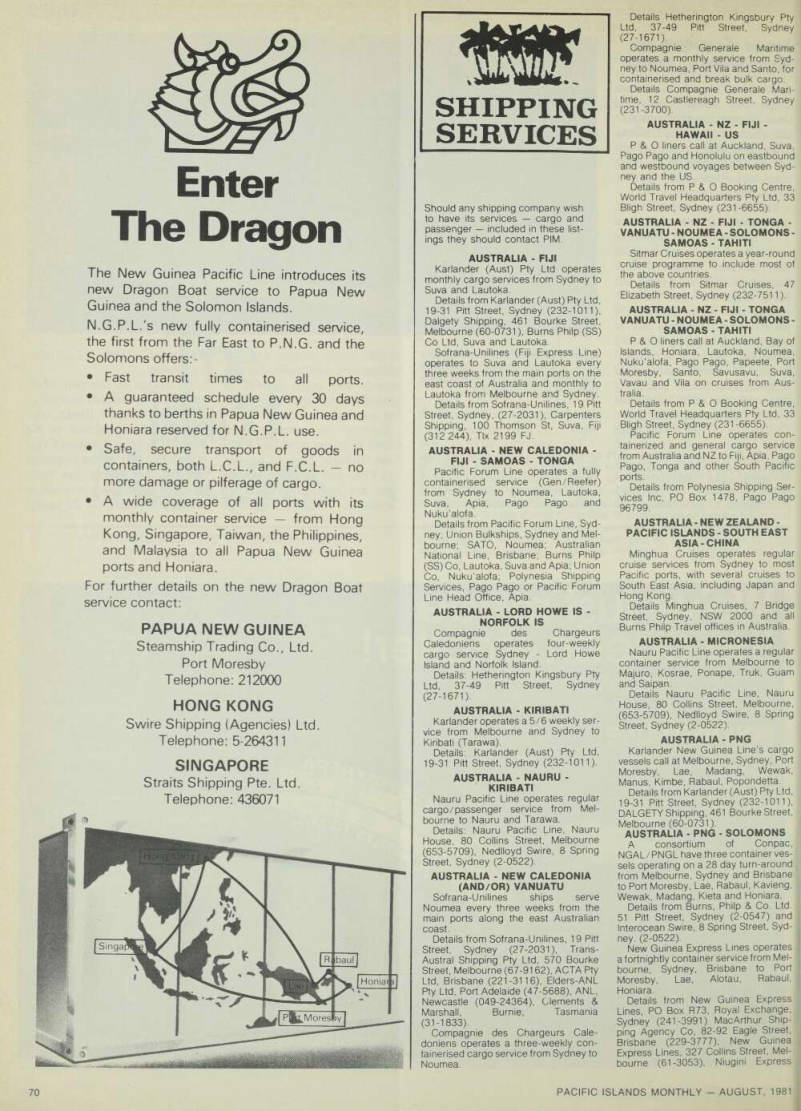
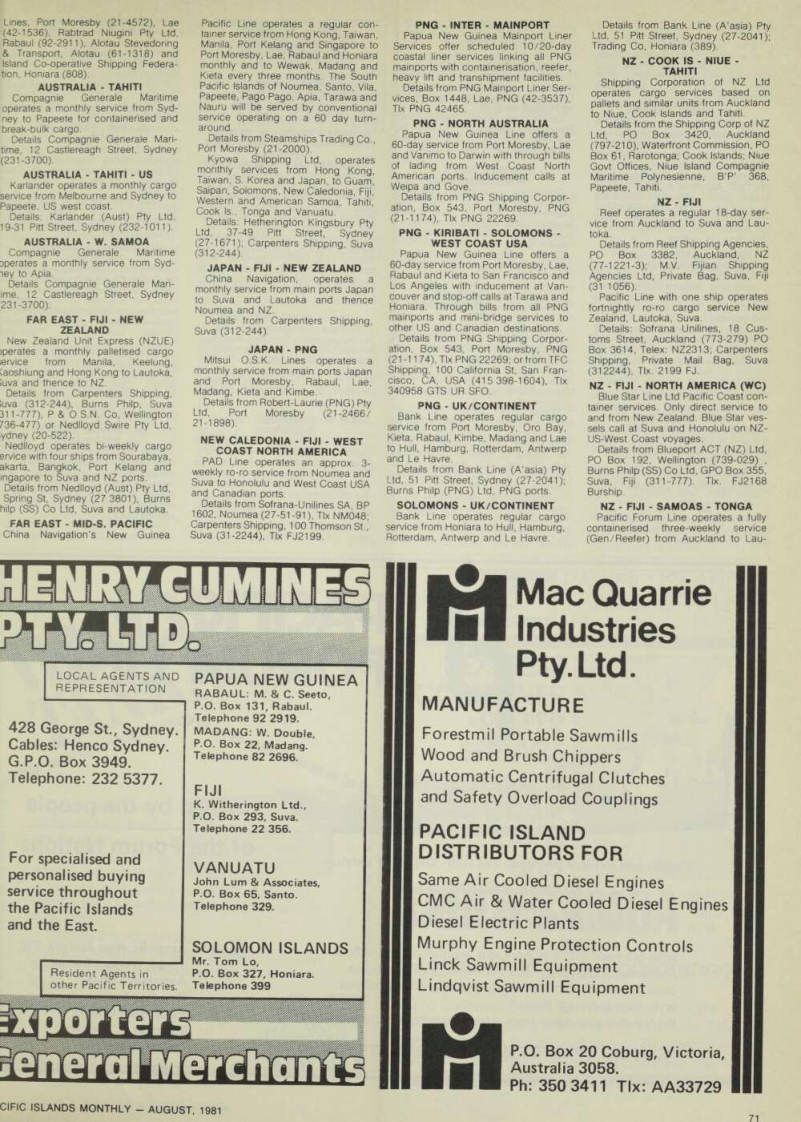
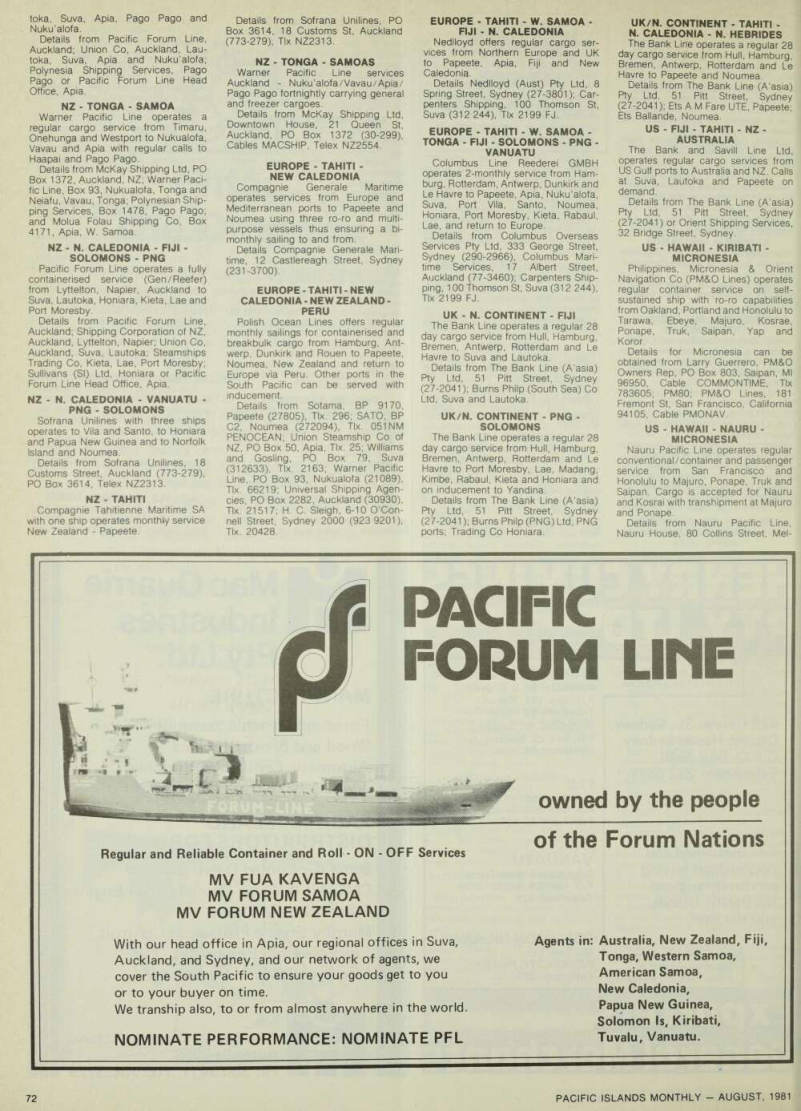
Shipping
Should any shipping company wish to have its services cargo and passenger included in these list ings they should contact PIM.
Australia - Fiji
Karlander (Aust) Pty Ltd operates monthly cargo services from Sydney to Suva and Lautoka.
Details from Karlander (Aust) Pty Ltd, 19-31 Pitt Street, Sydney (232-1011), Dalgety Shipping, 461 Bourke Street, Melbourne (60-0731), Burns Philp (SS) Co Ltd, Suva and Lautoka.
Sofrana-Unilines (Fiji Express Line) operates to Suva and Lautoka every three weeks from the main ports on the east coast of Australia and monthly to Lautoka from Melbourne and Sydney.
Details from Sofrana-Unilines, 19 Pitt Street, Sydney, (27-2031), Carpenters Shipping, 100 Thomson St, Suva, Fiji (312 244), Tlx 2199 FJ.
Australia - New Caledonia -
Fiji - Samoas - Tonga
Pacific Forum Line operates a fully containerised service (Gen/Reefer) from Sydney to Noumea, Lautoka, Suva, Apia, Pago Pago and Nukualofa.
Details from Pacific Forum Line, Syd ney; Union Bulkships, Sydney and Mel bourne; SATO, Noumea; Australian National Line, Brisbane; Burns Philp (SS) Co, Lautoka, Suva and Apia; Union Co, Nuku’alofa; Polynesia Shipping Services, Pago Pago or Pacific Forum Line Head Office, Apia.
Australia - Lord Howe Is -
Norfolk Is
Compagnie des Chargeurs Caledoniens operates four-weekly cargo service Sydney - Lord Howe Island and Norfolk Island, Details: Hetherington Kingsbury Pty Ltd, 37-49 Pitt Street, Sydney (27-1671).
Australia - Kiribati
Karlander operates a 5/6 weekly ser vice from Melbourne and Sydney to Kiribati (Tarawa).
Details: Karlander (Aust) Pty Ltd, 19-31 Pitt Street, Sydney (232-1011).
Australia - Nauru -
Kiribati
Nauru Pacific Line operates regular cargo/passenger service from Mel bourne to Nauru and Tarawa.
Details: Nauru Pacific Line, Nauru House, 80 Collins Street, Melbourne (653-5709), Nedlloyd Swire, 8 Spring Street, Sydney (2-0522).
Australia - New Caledonia
(And/Or)Vanuatu
Sofrana-Unilines ships serve Noumea every three weeks from the main ports along the east Australian coast.
Details from Sofrana-Unilines, 19 Pitt Street, Sydney (27-2031), Trans- Austral Shipping Pty Ltd, 570 Bourke Street, Melbourne (67-9162), ACTA Pty Ltd, Brisbane (221-3116), Elders-ANL Pty Ltd, Port Adelaide (47-5688), ANL, Newcastle (049-24364), Clements & Marshall, Burnie, Tasmania (31-1833).
Compagnie des Chargeurs Cale doniens operates a three-weekly con tainerised cargo service from Sydney to Noumea.
Details Hetherington Kingsbury Pty Ltd, 37-49 Pitt Street, Sydney (27-1671).
Compagnie Generate Maritime operates a monthly service from Syd ney to Noumea, Port Vila and Santo, for containerised and break bulk cargo.
Details Compagnie Generate Mari time, 12 Castlereagh Street, Sydney (231 -3700).
Australia - Nz - Fiji -
Hawaii - Us
P & O liners call at Auckland, Suva, Pago Pago and Honolulu on eastbound and westbound voyages between Syd ney and the US.
Details from P & O Booking Centre, World Travel Headquarters Pty Ltd, 33 Bligh Street. Sydney (231 -6655).
AUSTRALIA - NZ - FIJI - TONGA -
Vanuatu - Noumea - Solomons -
Samoas - Tahiti
Sitmar Cruises operates a year-round cruise programme to include most of the above countries.
Details from Sitmar Cruises, 47 Elizabeth Street, Sydney (232-7511).
AUSTRALIA - NZ - FIJI - TONGA
Vanuatu - Noumea - Solomons -
Samoas - Tahiti
P & 0 liners call at Auckland, Bay of Islands, Honiara, Lautoka, Noumea, Nukualofa, Pago Pago, Papeete, Port Moresby, Santo, Savusavu, Suva, Vavau and Vila on cruises from Aus tralia.
Details from P & 0 Booking Centre, World Travel Headquarters Pty Ltd, 33 Bligh Street, Sydney (231 -6655).
Pacific Forum Line operates con tainerized and general cargo service from Australia and NZ to Fiji, Apia, Pago Pago, Tonga and other South Pacific ports.
Details from Polynesia Shipping Ser vices Inc, PO Box 1478, Pago Pago 96799.
Australia - New Zealand -
Pacific Islands - South East
Asia-China
Minghua Cruises operates regular cruise services from Sydney to most Pacific ports, with several cruises to South East Asia, including Japan and Hong Kong.
Details Minghua Cruises, 7 Bridge Street, Sydney, NSW 2000 and all Burns Philp Travel offices in Australia.
Australia - Micronesia
Nauru Pacific Line operates a regular container service from Melbourne to Majuro, Kosrae, Ponape, Truk, Guam and Saipan.
Details Nauru Pacific Line, Nauru House, 80 Collins Street, Melbourne, (653-5709), Nedlloyd Swire, 8 Spring Street, Sydney (2-0522).
Australia - Png
Karlander New Guinea Line’s cargo vessels call at Melbourne, Sydney, Port Moresby, Lae, Madang, Wewak, Manus, Kimbe, Rabaul, Popondetta.
Details from Karlander (Aust) Pty Ltd, 19-31 Pitt Street, Sydney (232-1011), DALGETY Shipping, 461 Bourke Street, Melbourne (60-0731).
Australia - Png - Solomons
A consortium of Conpac, NGAL/PNGL have three container ves sels operating on a 28 day turn-around from Melbourne, Sydney and Brisbane to Port Moresby, Lae, Rabaul, Kavieng, Wewak, Madang, Kieta and Honiara.
Details from Burns, Philp & Co. Ltd. 51 Pitt Street, Sydney (2-0547) and .
Interocean Swire, 8 Spring Street, Syd- j ney. (2-0522).
New Guinea Express Lines operates . a fortnightly container service from Mel bourne, Sydney, Brisbane to Port 1 Moresby, Lae, Alotau, Rabaul, i Honiara.
Details from New Guinea Express Lines, PO Box R 73, Royal Exchange, Sydney (241-3991) MacArthur Ship ping Agency Co, 82-92 Eagle Street, Brisbane (229-3777). New Guinea Express Lines, 327 Collins Street, Mel bourne (61-3053), Niugini Express
Lines, Port Moresby (21-4572), Lae (42-1536), Rabtrad Niugini Pty Ltd, Rabaul (92-2911). Alotau Stevedoring & Transport, Alotau (61-1318) and Island Co-operative Shipping Federa tion, Honiara (808).
Australia - Tahiti
Compagnie Generate Maritime operates a monthly service from Syd ney to Papeete for containerised and break-bulk cargo.
Details Compagnie Generate Mari time, 12 Castlereagh Street, Sydney (231-3700).
Australia - Tahiti - Us
Karlander operates a monthly cargo service from Melbourne and Sydney to Papeete, US west coast.
Details: Karlander (Aust) Pty Ltd, 19-31 Pitt Street, Sydney (232-1011).
Australia - W. Samoa
Compagnie Generate Maritime operates a monthly service from Syd ley to Apia.
Details Compagnie Generate Mari ime, 12 Castlereagh Street, Sydney 231-3700).
Far East - Fiji - New
Zealand
New Zealand Unit Express (NZUE) >perates a monthly palletised cargo ervice from Manila, Keelung, Caoshiung and Hong Kong to Lautoka, Suva and thence to NZ.
Details from Carpenters Shipping, luva (312-244), Burns Philp, Suva 311-777), P & O S.N. Co, Wellington 736-477) or Nedlloyd Swire Pty Ltd, iydney (20-522).
Nedlloyd operates bi-weekly cargo ervice with four ships from Sourabaya, akarta, Bangkok, Port Kelang and ingapore to Suva and NZ ports.
Details from Nedlloyd (Aust) Pty Ltd, Spring St, Sydney (27 3801), Burns hilp (SS) Co Ltd, Suva and Lautoka.
Far East - Mid-S. Pacific
China Navigation’s New Guinea
Pacific Line operates a regular con tainer service from Hong Kong, Taiwan, Manila, Port Kelang and Singapore to Port Moresby, Lae, Rabaul and Honiara monthly and to Wewak, Madang and Kieta every three months. The South Pacific Islands of Noumea, Santo, Vila, Papeete, Pago Pago, Apia, Tarawa and Nauru will be served by conventional service operating on a 60 day turn around.
Details from Steamships Trading Co., Port Moresby (21-2000).
Kyowa Shipping Ltd, operates monthly services from Hong Kong, ?“«!!•
Caledonia. Fiji.
Western and American Samoa, Tahiti, Cc Sj’J?-’ I?pthpr a n n n d to Va K UatU h (27-1671); Carpenters Shipping, Suva (312-244).
Japan - Fiji - New Zealand
cpr^ire^fom^ain o^^ 3
to^Suva^and 8 Lautoka "ancT^hence
Noumea and NZ.
Details from Carpenters Shipping, Suva (312-244).
Japan - Png
Mitsui O.S.K. Lines operates a monthly service from main ports Japan and Port Moresby, Rabaul, Lae, Madang, Kieta and Kimbe.
Details from Robert-Laurie (PNG) Pty Ltd, Port Moresby (21-2466/ 21-1898).
Ne America §T
PA n i ino ArSt AMERICA 0 PA ° il'"® ° perat ® S a " appr ° X 3 : weekly ro-ro service from Noumea and
W6St C ° Ast Usa
Dete“Sofrana-UnilinesSA, BP
1602 Noumea (27 . 51 . 91} T)x NMO 4B; Carpenters Shipping, 100 Thomson St..
Suva (31-2244), Tlx FJ2199.
Png - Inter - Mainport
Papua New Guinea Mainport Liner Services offer scheduled 10/20-day coastal liner services linking all PNG mainports with containerisation, reefer, heavy lift and transhipment facilities.
Details from PNG Mainport Liner Ser vices, Box 1448, Lae, PNG (42-3537), Tlx PNG 42465.
Png - North Australia
Papua New Guinea Line offers a 60-day service from Port Moresby, Lae and Vanimo to Darwin with through bills of lading from West Coast North American ports. Inducement calls at Weipa and Gove.
Details from PNG Shipping Corpor ation, Box 543, Port Moresby, PNG (21-1174), Tlx PNG 22269.
Png - Kiribati - Solomons -
West Coast Usa
Papua New Guinea Line offers a 60-day service from Port Moresby, Lae, Rabaul and Kieta to San Francisco and Los Angeles with inducement at Van couver and stop-off calls at Tarawa and Honiara. Through bills from all PNG mainports and mini-bridge services to other US and Canadian destinations.
Details from PNG Shipping Corpor ation, Box 543, Port Moresby, PNG (21-11 74), Tlx PNG 22269; or from TFC Shipping, 100 California St, San Fran cisco. CA, USA (415 398-1604), Tlx
340958 Gts Ur Sfo.
Png - Uk/Continent
Bank Line operates regular cargo service from Port Moresby, Oro Bay, Kieta, Rabaul, Kimbe, Madang and Lae to Hull, Hamburg, Rotterdam, Antwerp and Le Havre.
Details from Bank Line (A’asia) Pty Ltd, 51 Pitt Street. Sydney (27-2041); Burns Philp (PNG) Ltd, PNG ports.
Solomons - Uk/Continent
Bank Line operates regular cargo service from Honiara to Hull. Hamburg, Rotterdam, Antwerp and Le Havre.
Details from Bank Line (A’asia) Pty Ltd, 51 Pitt Street, Sydney (27-2041); Trading Co. Honiara (389).
NZ - COOK IS - NIUE -
Tahiti
Shipping Corporation of NZ Ltd operates cargo services based on pallets and similar units from Auckland to Niue, Cook Islands and Tahiti.
Details from the Shipping Corp of NZ Ltd, PC Box 3420, Auckland (797-210), Waterfront Commission, PC Box 61, Rarotonga; Cook Islands; Niue Govt Offices, Niue Island Compagnie Maritime Polynesienne, B'P’ 368, Papeete, Tahiti.
Nz - Fiji
Reef operates a regular 18-day ser vice from Auckland to Suva and Lau toka.
Details from Reef Shipping Agencies, PC Box 3382, Auckland, NZ (77-1221-3); M.V. Fijian Shipping Agencies Ltd, Private Bag, Suva, Fiji (31 1056).
Pacific Line with one ship operates fortnightly ro-ro cargo service New Zealand, Lautoka, Suva.
Details: Sofrana Unilines, 18 Cus toms Street, Auckland (773-279) PO Box 3614, Telex: NZ2313; Carpenters Shipping, Private Mail Bag, Suva (312244), Tlx. 2199 FJ.
NZ - FIJI - NORTH AMERICA (WC) Blue Star Line Ltd Pacific Coast con tainer services. Only direct service to and from New Zealand. Blue Star ves sels call at Suva and Honolulu on NZ US-West Coast voyages.
Details from Blueport ACT (NZ) Ltd, PO Box 192, Wellington (739-029) , Burns Philp (SS) Co Ltd, GPO Box 355, Suva. Fiji (311-777). Tlx. FJ2168 Burship.
NZ - FIJI - SAMOAS - TONGA Pacific Forum Line operates a fully containerised three-weekly service (Gen/Reefer) from Auckland to Lau
toka, Suva, Apia, Pago Pago and Nuku’alofa.
Details from Pacific Forum Line, Auckland; Union Co, Auckland, Lau toka, Suva, Apia and Nuku’alofa; Polynesia Shipping Services, Pago Pago or Pacific Forum Line Head Office, Apia.
Nz - Tonga - Samoa
Warner Pacific Line operates a regular cargo service from Timaru, Onehunga and Westport to Nukualofa, Vavau and Apia with regular calls to Haapai and Pago Pago.
Details from McKay Shipping Ltd, PO Box 1372, Auckland, NZ; Warner Paci fic Line, Box 93, Nukualofa, Tonga and Neiafu, Vavau, Tonga; Polynesian Ship ping Services, Box 1478, Pago Pago; and Molua Folau Shipping Co, Box 4171, Apia, W. Samoa.
NZ - N. CALEDONIA - FIJI -
Solomons - Png
Pacific Forum Line operates a fully containerised service (Gen/Reefer) from Lyttelton. Napier. Auckland to Suva, Lautoka, Honiara, Kieta, Lae and Port Moresby.
Details from Pacific Forum Line, Auckland; Shipping Corporation of NZ, Auckland, Lyttelton, Napier; Union Co, Auckland, Suva, Lautoka; Steamships Trading Co, Kieta, Lae, Port Moresby; Sullivans (SI) Ltd, Honiara or Pacific Forum Line Head Office, Apia.
NZ - N. CALEDONIA - VANUATU -
Png - Solomons
Sofrana Unilines with three ships operates to Vila and Santo, to Honiara and Papua New Guinea and to Norfolk Island and Noumea.
Details from Sofrana Unilines, 18 Customs Street, Auckland (773-279), PO Box 3614, Telex NZ2313.
Nz - Tahiti
Compagnie Tahitienne Maritime SA with one ship operates monthly service New Zealand - Papeete
Details from Sofrana Unilines, PO Box 3614, 18 Customs St, Auckland (773-279), Tlx NZ2313.
Nz - Tonga - Samoas
Warner Pacific Line services Auckland - Nuku'alofa/Vavau/Apia/ Pago Pago fortnightly carrying general and freezer cargoes.
Details from McKay Shipping Ltd, Downtown House, 21 Queen St, Auckland, PO Box 1372 (30-299), Cables MACSHIP, Telex NZ2554.
Europe - Tahiti -
New Caledonia
Compagnie Generate Maritime operates services from Europe and Mediterranean ports to Papeete and Noumea using three ro-ro and multi purpose vessels thus ensuring a bi monthly sailing to and from.
Details Compagnie Generate Mari time, 12 Castlereagh Street, Sydney (231 -3700).
Europe-Tahiti-New
Caledonia - New Zealand -
Peru
Polish Ocean Lines offers regular monthly sailings for containerised and breakbulk cargo from Hamburg, Ant werp, Dunkirk and Rouen to Papeete, Noumea, New Zealand and return to Europe via Peru. Other ports in the South Pacific can be served with inducement.
Details from Sotama, BP 9170, Papeete (27805), Tlx. 296; SATO, BP C 2, Noumea (272094), Tlx. 051 NM PENOCEAN; Union Steamship Co of NZ, PO Box 50. Apia, Tlx. 25; Williams and Gosling, PO Box 79, Suva (312633), Tlx. 2163; Warner Pacific Line, PO Box 93, Nukualofa (21089), Tlx. 66219; Universal Shipping Agen cies, PO Box 2282, Auckland (30930), Tlx. 21517; H. C. Sleigh, 6-10 O’Con nell Street, Sydney 2000 (923 9201), Tlx. 20428,
EUROPE - TAHITI - W. SAMOA -
Fiji - N. Caledonia
Nedlloyd offers regular cargo ser vices from Northern Europe and UK to Papeete, Apia, Fiji and New Caledonia.
Details Nedlloyd (Aust) Pty Ltd, 8 Spring Street, Sydney (27-3801); Car penters Shipping, 100 Thomson St, Suva (312 244), Tlx 2199 FJ.
EUROPE - TAHITI - W. SAMOA - TONGA - FIJI - SOLOMONS - PNG -
Vanuatu
Columbus Line Reederei GMBH operates 2-monthly service from Ham burg, Rotterdam, Antwerp, Dunkirk and Le Havre to Papeete, Apia, Nukualofa, Suva, Port Vila, Santo, Noumea, Honiara, Port Moresby, Kieta, Rabaul, Lae, and return to Europe.
Details from Columbus Overseas Services Pty Ltd, 333 George Street, Sydney (290-2966), Columbus Mari time Services, 17 Albert Street, Auckland (77-3460); Carpenters Ship ping, 100 Thomson St, Suva (312 244), Tlx 2199 FJ.
Uk - N. Continent - Fiji
The Bank Line operates a regular 28 day cargo service from Hull, Hamburg, Bremen, Antwerp, Rotterdam and Le Havre to Suva and Lautoka.
Details from The Bank Line (A’asia) Pty Ltd, 51 Pitt Street, Sydney (27-2041); Burns Philp (South Sea) Co Ltd, Suva and Lautoka.
Uk/N. Continent - Png -
Solomons
The Bank Line operates a regular 28 day cargo service from Hull, Hamburg, Bremen, Antwerp, Rotterdam and Le Havre to Port Moresby, Lae, Madang, Kimbe, Rabaul. Kieta and Honiara and on inducement to Yandina.
Details from The Bank Line (A’asia) Pty Ltd, 51 Pitt Street, Sydney (27-2041); Burns Philp (PNG) Ltd, PNG ports; Trading Co Honiara.
Uk/N. Continent - Tahiti -
N. Caledonia • N. Hebrides
The Bank Line operates a regular 28 day cargo service from Hull, Hamburg, Bremen, Antwerp, Rotterdam and Le Havre to Papeete and Noumea.
Details from The Bank Line (A’asia) Pty Ltd, 51 Pitt Street, Sydney (27-2041); Ets A M Fare DTE, Papeete; Ets Ballande, Noumea.
US - FIJI - TAHITI - NZ -
Australia
The Bank and Savill Line Ltd, operates regular cargo services from US Gulf ports to Australia and NZ. Calls at Suva, Lautoka and Papeete on demand.
Details from The Bank Line (A’asia) Pty Ltd, 51 Pitt Street, Sydney (27-2041) or Orient Shipping Services, 32 Bridge Street, Sydney.
Us - Hawaii - Kiribati -
Micronesia
Philippines, Micronesia & Orient Navigation Co (PM&O Lines) operates regular container service on self sustained ship with ro-ro capabilities from Oakland, Portland and Honolulu to Tarawa, Ebeye, Majuro, Kosrae, Ponape, Truk, Saipan, Yap and Koror.
Details for Micronesia can be obtained from Larry Guerrero, PM&O Owners Rep, PO Box 803, Saipan, Ml 96950, Cable COMMONTIME, Tlx 783605; PM80; PM&O Lines, 181 Fremont St, San Francisco, California 94105, Cable PMONAV.
Us - Hawaii - Nauru -
Micronesia
Nauru Pacific Line operates regular conventional/container and passenger service from San Francisco and Honolulu to Majuro, Ponape, Truk and Saipan. Cargo is accepted for Nauru and Kosrai with transhipment at Majuro and Ponape.
Details from Nauru Pacific Line, Nauru House, 80 Collins Street, Mel
bourne (653-5709); North American Maritime Agencies, 100 California St., San Francisco, California 9411.
Us - Noumea - Fiji
PAD Line operates an approx 3-weekly roro service from West Coast USA and Canada to Noumea and Suva.
Details from Sofrana-Unilines SA, BP 1602, Noumea (27-51 -91), Tlx NMO4B; Carpenters Shipping, 100 Thomson St, Suva (31-2244), Tlx FJ2199; Trans- Austral Shipping, Box R 232 PO, Royal Exchange, NSW (27-2441), Tlx AA21204.
Us - Tahiti - Samoa
Pacific Islands Transport operates a five weekly cargo service from North America west coast ports to Papeete, Pago Pago, Apia.
Details from Polynesia Shipping Ser vices Inc, PO Box 1478 Pago Pago 96799.
Polynesia Line operates container and general cargo service from US west coast ports to Papeete and Pago Pago.
Details from Polynesia Shipping Ser vices Inc., PO Box 1478, Pago Pago 96799.
US - TAHITI - SAMOA - NZ - AUST Farrell Lines Inc, operate a fast regular lash/container cargo service from west coast ports Canada/USA to Papeete and Pago Pago thence to NZ and Australia.
Details Wilh Wilhelmson Agency, Sydney, Melbourne and Brisbane, Tlx AA20136, Cable FARSHIPS Sydney; Dalgety (NZ) Ltd, Auckland and Wellington. Tlx NZ2445, Cable DALSHIP Auckland; Compagnie Mari time Polynesienne, Immeuble Franco Dceanienne, PO Box 368, Papeete, Tahiti, Tel 26393, Tlx 258. FP ANSB Faporo, Cable OCEAN Papeete; <neubuhl Maritime Service, PO Box 39, 3 ago °ago, Telephone 633-5121; Fix 782505.
Advertisements & other items, pp. 71-74 (2 items)
71
CIFIC ISLANDS MONTHLY - AUGUST, 1981
Pty.Ltd.
LOCAL AGENTS AND
REPRESENTATION
428 George St., Sydney.
Cables: Henco Sydney.
G.P.O. Box 3949.
Telephone: 232 5377.
For specialised and
personalised buying
service throughout
the Pacific Islands and the East.
Resident Agents in other Pacific Territories.
PAPUA NEW GUINEA
RABAUL: M. & C. Seeto, P.O. Box 131, Rabaul.
Telephone 92 2919.
MADANG; W. Double, P.O. Box 22, Madang.
Telephone 82 2696.
FIJI
K. Witherington Ltd., P.O. Box 293, Suva.
Telephone 22 356.
VANUATU
John Lum & Associates, P.O. Box 65, Santo.
Telephone 329.
SOLOMON ISLANDS
Mr. Tom Lo, P.O. Box 327, Honiara.
Telephone 399 11 • u
Mac Quarrie
Industries
Pty.Ltd.
MANUFACTURE
Forestmil Portable Sawmills Wood and Brush Chippers Automatic Centrifugal Clutches and Safety Overload Couplings
PACIFIC ISLAND
DISTRIBUTORS FOR
Same Air Cooled Diesel Engines CMC Air & Water Cooled Diesel Engines Diesel Electric Plants Murphy Engine Protection Controls Linck Sawmill Equipment Lindqvist Sawmill Equipment
bSa
P.O. Box 20 Coburg, Victoria, 9 H H Australia 3058. 1 Ph: 350 3411 Tlx: AA33729 m
PACIFIC
FORUM UNE
m% w* * 3 C s «
owned by the people
Regular and Reliable Container and Roll - ON - OFF Services
of the Forum Nations
MV FUA KAVENGA
MV FORUM SAMOA
MV FORUM NEW ZEALAND
With our head office in Apia, our regional offices in Suva, Auckland, and Sydney, and our network of agents, we cover the South Pacific to ensure your goods get to you or to your buyer on time.
We tranship also, to or from almost anywhere in the world.
NOMINATE PERFORMANCE: NOMINATE PFL
Agents in: Australia, New Zealand, Fiji, Tonga, Western Samoa, American Samoa, New Caledonia, Papua New Guinea, Solomon Is, Kiribati, Tuvalu, Vanuatu.
c
PACIFIC ISLANDS
TRANSPORT LINE
M.S. AFRICANSTARS
TAHITI SAMOA
xcc
Qeqeral Steaniship Qorporatioq^uD
General Agents 400 California Street, San Francisco, CA, USA PAPEETE: Agence Maritime Internationale, Tahiti PAGO PAGO: Polynesia Shipping Services, Inc.
APIA: Burns Philp (South Sea) Company, Ltd.
1 w.
Aquila water tanks completely enclosed to ensure clean water and built to last from strong, durable galvanised steel. - You assemble them yourself from our comprehensive kits. Capacities range from 2300 litres to 49250 litres.
Send for a brochure today.
Aquila Engineering Division, 25 Pacific Highway, Bennetts Green, New South Wales, Australia.
Name Address P/code,
AQ2O/2
AQUILA
TO JOB SEEKERS IN REMOTE AREAS
WE SUPPLY YOU WITH THE LATEST
JOB ADS FROM THE AUSTRALIAN &
INTERNATIONAL PRESS. QUARTERLY
SUBSCRIPTIONS $3O. WRITE BOX 1942,
TOWNSVILLE 4810. AUSTRALIA.
REQUIRE
DRIED SHARK FINS
FOR PRICES AND
INFORMATION ETC.,
PLEASE WRITE TO;
S. DADDOW,
ASIA TONGA TRADING
66 JALAN KERUING,
SINGAPORE, 2880
FLEETS
FLEETS advise that Merv. Hazell has retired to re-explore Moreton Bay and has terminated the operation of this Firm. Many thanks to the Valued Clients, Associates and P.I.M. Staff for 27 very friendly years.
FLEETS
221 Esplanade, Wynnum
Central, Brisbane.
Deaths
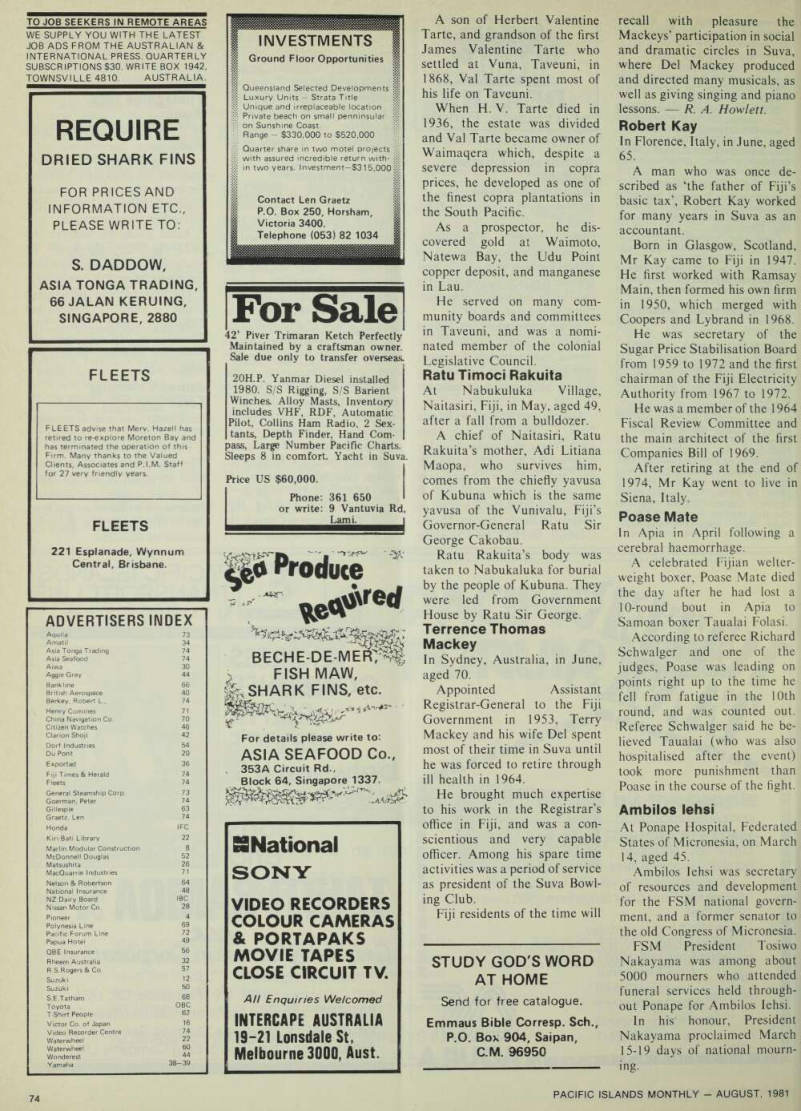
of Islands People
Archdeacon Charles William Whonsbon-Aston In Sydney, Australia, in June, aged 82.
Archdeacon Whonsbon- Aston, Archdeacon Emeritus of Polynesia, was one of the best known Anglican clergymen in the Pacific before his retirement from active duty in 1975.
After theological studies at Moore College, Sydney, he served in various capacities at Anglican churches in that city before becoming a missionary in 1931.
He served briefly in Papua New Guinea, and was then made Vicar of Levuka, Fiji. He later held a number of posts in Fiji and Western Samoa. He became Archdeacon of Fiji in 1958, and later Archdeacon of Polynesia, and Deputy Vicar- General. In 1967, he was given
the title Archdeacon Emeritus.
An obituary in an Australian newspaper described him as ‘missionary, raconteur, and an Islands “character” in the Somerset Maugham tradition’.
A keen reader of PIM, his last letter to the magazine appeared in the April 1981 issue (p 5).
Clifford lanamu In Port Moresby in June, aged 61.
As a member of the pre independence Legislative Council in Papua New Guinea, Mr lanamu was one of the ‘reluctant’ nationalists of the time committed to indepen dence but worried about the pace at which it was approach ing. This in part may explain his failure on three occasions to gain election to the
subsequently-formed national
parliament, although he was a respected representative of his people and was involved in their politics for nearly 20 years.
Mr lanumu came from Selae Village near Abau, southeast of Port Moresby. He became a member of the Amazon Bay Local Government Council in 1963 and later served as its
president. After his period in national politics he became a member and later chairman of the Central District Advisory Board.
Tuatagaloa Tofa
Siaosi In Apia in June, after a heart attack.
Tuatagaloa was a two-term member of Western Samoa’s parliament and a former Finance Minister under the Tamasese administration.
After losing his seat in the 1973 general elections, he worked as an accountant with the Peter Meredith company.
He first entered parliament about 1966 representing Faleata under his title Taneolevao. He was then the youngest member elected to parliament.
James Valentine Tarte At Taveuni, Fiji, in June, aged 77.
Described in an obituary in The Fiji Times as ‘one of the most colourful of the old breed of major copra plantation owners’, Val Tarte came from one of Taveuni’s few surviving plantation families.
A son of Herbert Valentine Tarte, and grandson of the first James Valentine Tarte who settled at Vuna, Taveuni, in 1868, Val Tarte spent most of his life on Taveuni.
When H. V. Tarte died in 1936, the estate was divided and Val Tarte became owner of Waimaqera which, despite a severe depression in copra prices, he developed as one of the finest copra plantations in the South Pacific.
As a prospector, he dis covered gold at Waimoto, Natewa Bay, the Udu Point copper deposit, and manganese in Lau.
He served on many com munity boards and committees in Taveuni, and was a nomi nated member of the colonial Legislative Council.
Ratu Timoci Rakuita At Nabukuluka Village, Naitasiri, Fiji, in May, aged 49, after a fall from a bulldozer.
A chief of Naitasiri, Ratu Rakuita’s mother, Adi Litiana Maopa, who survives him, comes from the chiefly yavusa of Kubuna which is the same yavusa of the Vunivalu, Fiji’s Governor-General Ratu Sir George Cakobau.
Ratu Rakuita’s body was taken to Nabukaluka for burial by the people of Kubuna. They were led from Government House by Ratu Sir George.
Terrence Thomas
Mackey
In Sydney, Australia, in June, aged 70.
Appointed Assistant Registrar-General to the Fiji Government in 1953, Terry Mackey and his wife Del spent most of their time in Suva until he was forced to retire through ill health in 1964.
He brought much expertise to his work in the Registrar’s office in Fiji, and was a con scientious and very capable officer. Among his spare time activities was a period of service as president of the Suva Bowl ing Club.
Fiji residents of the time will
recall with pleasure the Mackeys’ participation in social and dramatic circles in Suva, where Del Mackey produced and directed many musicals, as well as giving singing and piano
lessons.
R. A. Hewlett.
Robert Kay
In Florence, Italy, in June, aged 65.
A man who was once de scribed as ‘the father of Fiji’s basic tax’, Robert Kay worked for many years in Suva as an accountant.
Born in Glasgow, Scotland, Mr Kay came to Fiji in 1947.
He first worked with Ramsay Main, then formed his own firm in 1950, which merged with Coopers and Lybrand in 1968.
He was secretary of the Sugar Price Stabilisation Board from 1959 to 1972 and the first chairman of the Fiji Electricity Authority from 1967 to 1972.
He was a member of the 1964 Fiscal Review Committee and the main architect of the first Companies Bill of 1969.
After retiring at the end of 1974, Mr Kay went to live in Siena, Italy.
Poase Mate In Apia in April following a cerebral haemorrhage.
A celebrated Fijian welter weight boxer, Poase Mate died the day after he had lost a 10-round bout in Apia to Samoan boxer Taualai Folasi.
According to referee Richard Schwalger and one of the judges, Poase was leading on points right up to the time he fell from fatigue in the 10th round, and was counted out.
Referee Schwalger said he be lieved Taualai (who was also hospitalised after the event) took more punishment than Poase in the course of the fight.
Ambilos lehsi At Ponape Hospital, Federated States of Micronesia, on March 14, aged 45.
Ambilos lehsi was secretary of resources and development for the FSM national govern ment, and a former senator to the old Congress of Micronesia.
FSM President Tosiwo Nakayama was among about 5000 mourners who attended funeral services held through out Ponape for Ambilos lehsi.
In his honour, President Nakayama proclaimed March 15-19 days of national mourn ing.
Advertisements & other items, p. 73 (1 item)
73
CIFIC ISLANDS MONTHLY AUGUST, 1981
Advertisers Index
Aquila 73 Amatil 34 Asia Tonga Trading 74 Asia Seafood 74 Aiwa 30 Aggie Grey 44 Bankline 66 British Aerospace 40 Berkey, Robert L., 74 Henry Cumines 71 China Navigation Co. 70 Citizen Watches 46 Clarion Shoji 42 Dorf Industries 54 Du Pont 20 Exportad 36 Fiji Times & Herald 74 Fleets 74 General Steamship Corp. 73 Goerman, Peter 74 Gillespie 63 Graetz, Len 74 Honda IFC Kiri Bati Library 22 Marlin Modular Construction 8 McDonnell Douglas 52 Matsushita 26 MacQuarrie Industries 71 Nelson & Robertson 64 National Insurance 48 NZ Dairy Board IBC Nissan Motor Co. 28 Pioneer 4 Polynesia Line 69 Pacific Forum Line 72 Papua Hotel 49 QBE Insurance 56 Rheem Australia 32 R. Rogers & Co. 57 Suzuki 12 Suzuki 50 S. 68 Toyota OBC T-Shirt People 62 Victor Co. of Japan 16 Video Recorder Centre 74 Waterwheel 22 Waterwheel 60 Wonderest 44 Yamaha 38-39
Advertisements & other items, pp. 74-76 (1 item)
For Sale
INVESTMENTS
Ground Floor Opportunities Queensland Selected Developments Luxury Units Strata Title Unique and irreplaceable location Private beach on small penninsular on Sunshine Coast.
Range - $330,000 to $520,000 Quarter share in two motel projects with assured incredible return within two years. lnvestment-$315,000 Contact Len Graetz
P.O. Box 250, Horsham,
Victoria 3400.
Telephone (053) 82 1034
For Sale
42’ Piver Trimaran Ketch Perfectly Maintained by a craftsman owner.
Sale due only to transfer overseas. 20H.P. Yanmar Diesel installed 1980. S/S Rigging, S/S Barient Winches. Alloy Masts, Inventory includes VHP, RDF, Automatic Pilot, Collins Ham Radio, 2 Sextants, Depth Finder, Hand Compass, Large Number Pacific Charts.
Sleeps 8 in comfort. Yacht in Suva.
Price US $60,000.
Phone: 361 650 or write: 9 Vantuvia Rd, Lami. I
ct® Produce *
\ FISH MAW,
SHARK FINS, etc.
For details please write to:
ASIA SEAFOOD Co.,
353 A Circuit Rd., Block 64, Singapore 1337.
SONY
VIDEO RECORDERS
COLOUR CAMERAS
& PORTAPAKS
MOVIE TAPES
CLOSE CIRCUIT TV.
AH Enquiries Welcomed
INTERCAPE AUSTRALIA
19-21 Lonsdale St, Melbourne 3000, Aust.
STUDY GOD'S WORD
AT HOME
Send for free catalogue.
Emmaus Bible Corresp. Sch., P.O. Box 904, Saipan, C.M. 96950
I&SrS
mwr • lif*lli
Aj'jrjliUii
3 non fat S dr| ed mi milk
\l'JsxJ
J »n« Lyii
Anchor
\j N JUi
, n on fat J 7iy |T irfl Till ill PM h instant s / f€ & F" \ mi itH I \ 1 New • ere* bu . instant I whol« I %hor , k/ ,B *»e Ne w |mU
crea irft
butter Kg
\ t w \ y> IJMIt % M- . i -j Anchor;. ijUlfc
CJT
Mr j<3^J
Nii!H
sacoaas: Anchors milk -ax butTi?r ® y*" • I
BUTTEF
?s^b:« •--...r U ‘ *• I i i !SS S<*) N(v ■bsui*
D CHEFSE
CREAMER
BUTTER
rm >imii *■ Q * 'P - \Y \ ; *’ • “T.
Dairy ,Board, PO Box 417, Wellington, New Zealand.
How to find a REAL economy car.
When you look at a car
billed as an economy model,
ask yourself a few questions.
What sort of fuel
consumption can be expected?
Low? Good
What about other operating
costs? Oil, lubrication, that
kind of thing. Low again?
Great. How about maintenance?
The car has a low-breakdown
record? You are definitely on
the right track.
What is the average life of
the car? Is it better than the
average in your area? Super.
That’s important in an
economy car.
Now. How is the after
service? Buying a car is not
all in the price you know.
Plenty of service outlets? One
economy car coming up. All
you have to do is check the price. Then you can tell if you
are really getting an economy
car.
You will probably find,
after asking these questions
about town, that REAL
economy cars come down to
Toyota, the world’s economy
car builder.
See Toyota first. Then you
won’t have to shop around.
THE HAPPY ECONOMIZER
TOYOTA STARLET
The car that says economy in every way.
And you will be happy for it. Big inside.
Small outside. Miserly with petrol.
Without sacrificing comfort. A
good buy in an economy car
even for Toyota.
E 2253
PAPUA NEW GUINEA;
ELA MOTORS.
Scratchley Rd., Badili, P.O. Box 675. Port Moresby.
U S. TRUST
TERRITORY: MICROL
CORPORATION,
P.O. Box 267, Saipan
FIJI:
AUTOMOTIVE
SUPPLIES COMPANY,
P.O. Box 5177, Raiwaqa, Suva
AMERICAN SAMOA:
BURNS PHILP
(SOUTHSEA) CO., LTD.,
P.O. Box 129, Pago Pago.
WESTERN SAMOA:
BURNS PHILP
(SOUTHSEA) CO.. LTD.,
P.O. Box 188, Apia.
TONGA: BURNS PHILP
(SOUTHSEA) CO., LTD.,
P.O. Box 55, Nukualofa.
GUAM: ATKINS. KROLL
(GUAM) LTD., P.O. Box
6428, Tamuning.
TOYOTA
SERVICE
TOYOTA
VANUATU:
VANUATU MOTORS,
P.O. Box 18, Port Vila.
SOLOMON:
MENDANA
ENTERPRISES (5.1.) LTD.
G.P.O. Box 174, Honiara.
TAHITI: NIPPON
AUTOMOTO, B P. 342,
Papeete.
COOK ISLANDS:
COOK ISLANDS
TRADING
CORPORATION LTD.,
P.O. Box 92, Rarotonga.
NAURU:
NAURU COOPERATIVE
SOCIETY.
KIRIBATI:
TARAWA MOTORS,
Box 36, Bairiki, Kiribati.
NORFOLK ISLAND:
BORRY’S RENTAL CARS
MOUNT PITT
(ENTERPRISES) LTD.,
P.O. Box 169,
NEW CALEDONIA:
SERVICE IMPORTATION
AUTOMOBILE DU
PACIFIQUE, Rond-Point du Pacific (Station total) B.P. 438, Noumea.
The Toyota range includes: Toyota STARLET, Toyota COROLLA, Toyota CRESSIDA, Toyota HI-LUX, Toyota HI ACE, Toyota DYNA, Toyota LAND CRUISER