Islands
Pacific
Monthly
September, 1981
American Samoa US$l.75 Australia *A$l.5O Cook Islands NZ$l.5O Fiji F 51.50 Hawaii &US mainland US$l.95 Nauru A 51.75 New Caledonia CFPI9O New Zealand NZ$l.75 Niue NZ$l.5O Norfolk Island A 51.50 Papua New Guinea K 1.50 Solomons 551.50 Tahiti CFPI9O Tonga P 1.50 USTT & Guam US$l.95 Vanuatu A 51.50 Western Samoa T 1.60 ‘Recommended retail price only.
Registered by Australia Post Publication No. NBPI2IO
Beagan's Mm3
E)(Mw@ If0(S!(1
ugAiTiaaaa mmmxfmm
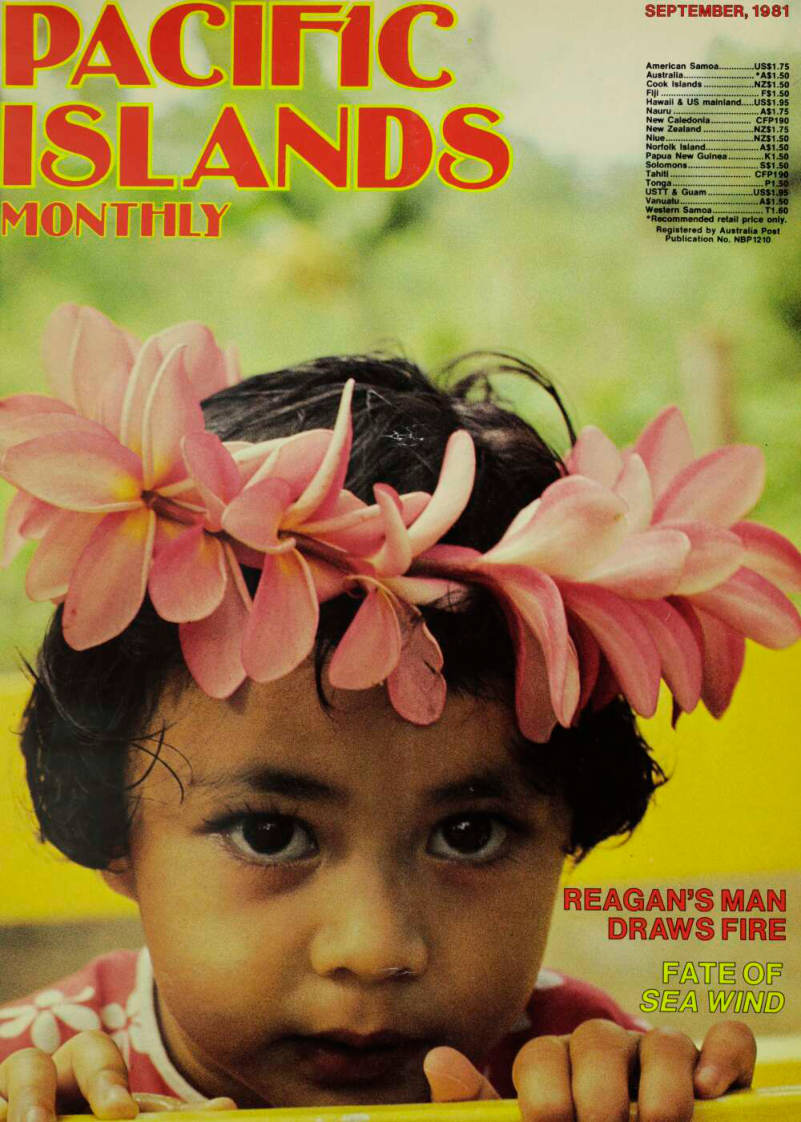
Cover picture: Just about all you need to know about the sweetness, innocence and curiosity of childhnnri is in this picture by SherSe Upton. Home for the young subject is in the Cook Islands. d
Advertisements & other items, p. 2 (1 item)
Slightly Sensational
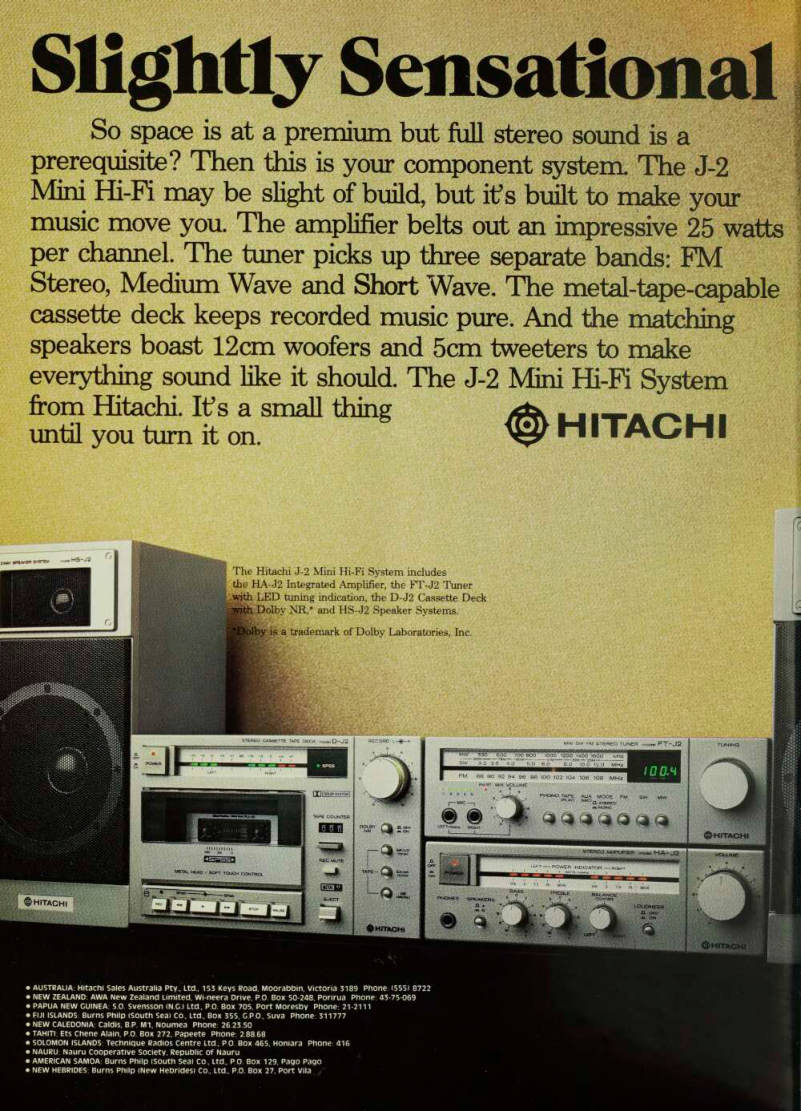
So space is at a premium but full stereo sound is a prerequisite? Then this is your component system. The J-2 Mini Hi-Fi may be slight of build, but it’s built to make your music move you. The amplifier belts out an impressive 25 watts per channel. The tuner picks up three separate bands: FM Stereo, Medium Wave and Short Wave. The metal-tape-capable cassette deck keeps recorded music pure. And the matching speakers boast 12cm woofers and scm tweeters to make everything sound like it should. The J-2 Mini Hi-Fi System from Hitachi. Itfs a small thing until you turn it on. #H ITACHI
JW> SPEAKER SVSTEW
The Hitachi J-2 Mini Hi-Fi System includes the HA-J 2 Integrated Amplifier, the FT-J 2 Tuner with LED tuning indication, the D-J2 Cassette Deck Dolby NR,* and HS-J2 Speaker Systems. is a trademark of Dolby Laboratories, Inc.
STEREO CASSETTE TAPE DECK moMi D~J2
- ”***> ' SOFT TOUCH <
0 HITACHI
w km DOLBV Cm xi off
TAPE- t M &X/SX
• AUSTRALIA: Hitachi Sales Australia Pty., Ltd., 153 Keys Road, Moorabbin, Victoria 3189 Phone: (555) 8722 • NEW ZEALAND: AWA New Zealand Limited, Wi-neera Drive, P.O. Box 50-248, Porirua Phone: 43-75-069 • PAPUA NEW GUINEA: SO. Svensson (N.C.) Ltd., P.O. Box 705, Port Moresby Phone: 21-2111 • FIJI ISLANDS; Burns Philp (South Sea) Co., Ltd., Box 355, C.P.0., Suva Phone: 311777 • NEW CALEDONIA: Caldis, B P Mi, Noumea Phone: 26.23.50 • TAHITI: Ets Chene Alain, P.O. Box 272, Papeete Phone: 2.88 68 • SOLOMON ISLANDS: Technique Radios Centre Ltd., P.O. Box 465, Honiara Phone: 416 • NAURU: Nauru Cooperative Society, Republic of Nauru • AMERICAN SAMOA: Burns Philp (South Sea) Co.. Ltd,, P.O. Box 129, Pago Pago • NEW HEBRIDES: Burns Philp (New Hebrides) Co., Ltd, P.O. Box 27, Port Vila
Pacific Islands Monthly
Vol. 52 No. 9
September 1981
(Usps 952480)
Representatives
AUSTRALIA: Distribution: NSW & ACT; Allan Rodney Wright (Circulation) Pty Ltd, PO Box 907, Darlinghurst, NSW 2010; Elsewhere: Gordon & Gotch (A/asia) Ltd, Box 40, PO, Rosebery, NSW 2018. Advertising Melbourne Ray Brown Pty Ltd, 614 Queensberry St, North Melbourne 3051, telephone 329 8522, telex 31717 Brisbane - D Wood, Anday Agency, Box 1918, GPO, Brisbane 4001, tele phone 44 3485, 44 1546, Adelaide - Hastwell Media, PO Box 30, Glen Osmond, SA 5064; 233 Glen Osmond Rd, Frewville, SA 5063, telephone 79 1869. Perth - Adrep, 62 Wickham St., East Perth, WA 6000, telephone 325 6395 FIJI: Distribution and subscriptions - Desai Bookshops, PO Box 160, Suva, Fiji, telephone Suva 23036 Advertising - Fiji Times & Herald Ltd, 20 Gordon St, Suva, telephone 312 111, telex FJ2124 FRENCH POLYNESIA: Distribution Hachette Pacifique, 10 Ave Bruat, Papeete, telephone 25610.
HAWAII, UNITED STATES: Distribution PIM, Hawaii, PO 3ox 22250, Honolulu, Hawaii 96822 Advertising - Roger Brookes, PO Box 10217, Honolulu, Hawaii 96816, telephone 308 536 6677. lAPAN: Advertising and subscriptions - Universal Media Corporation, CPO Box 46, Tokyo, telephone 666 3036. »lEW CALEDONIA; Distribution Depot Centre de Presse vlichel Pentecost, CBP2, Noumea, telephone 27 2434 17 4729.
JEW ZEALAND: Distribution - Gordon & Gotch, PO Box >B4, 2 Carr Road, Mt. Roskill, Auckland 4 Advertising iternational Media Representatives Ltd, PO Box 2313 Auckland, telephone 795 487; 493 389, cables Intereps Auckland Subscriptions - Ross Haines & Son Ltd, PO Box 289, Auckland, telephone 769 042. *APUA NEW GUINEA: Distribution - Gordon & Gotch, *0 Box 3395, Port Moresby, telephone 254551, 254655 advertising PNG Post-Courier, PO Box 85, Port Moresby jlephone 21 2577.
INITED KINGDOM: The Herald & Weekly Times Ltd, No.
Maltravers Street, London WC2R 3DZ, England, telephone 1 836 5162, telex London 21989 NITED STATES MAINLAND: Advertising - Joshua B owers Jr, Powers International Inc., 551 Fifth Ave New ork, New York 100 017, telephone 867 9580 ’ telex 36514. Subscriptions - PIM, Hawaii, PO Box 22250 dnolulu, Hawaii 96822.
Subscriptions
IM is airfreighted to most subscribers and agents in the acific Islands and the United States, but not the UK or the ontinent.
yments by personal cheque are only acceptable in Aus lian (from a Branch in Australia), US and New Zealand rrency. For 3,1 other remittances please send an inter tional bank draft in Australian dollars Wished monthly by Pacific Publications (Aust.) Pty Ltd 3 printed in Australia by Paramac, Alexandria NSW Aus lian coyer price is recommended retail only. Registered Australia Post, publication No NBPI2IO Second class stage paid at Honolulu, Hawaii. Copyright © 1978 Pacific
Publications (Aust.) Ptv Ltd Postmaster Honolulu: Send address changes to PIM Hawaii, PO Box 22250, Honolulu Hawaii 96822.
merican Samoa Local Aust.
Sus21
$18 jstralia $A15 $15 anada $US23 $20 30k Islands $19 ji $18 ench Polynesia $22 jam
Sus23
$20 awaii
Sus23
$20 ipan $20 ribati $19 icronesia
Sus23
$20 jury Jw Caledonia $21 $22 $18 }w Zealand
Snz21
ue >rfolk Island $19 $15 $20 >rthern Marianas
Sus23
ipua New Guinea $23 $19 Jomon Islands nga valu lited Kingdom Stg 11 $19 $19 $20 ! Mainland nuatu sstern Samoa
Sus23
$20 $19 $18 $A23 ewhere
This Month’s Features
• REAGAN’S PRIORITIES Two Hawaii-based writers look at the US administration’s sharply contrasting attitudes to Caribbean and Pacific affairs.. 11 • TRIBAL PEOPLE ON THE MOVE A special correspondent in Noumea reports on a new and remarkable movement for the recovery of tribal lands in New Caledonia 14 • THE NEW CALEDONIA PROBLEM Of all the problems existing in ‘Overseas France . New Caledonia is the toughest Daniel Tardieu tells why 19 • PACIFIC WOMEN IN PAPEETE Marie-Ther£se and Bengt Danielsson examine the profit and the loss in a recent South Pacific Commission-sponsored seminar on the problems facing women in Pacific Island communities 20 • THE FATE OF SEA WIND An Australian newspaper tells the grim story of the fate of an American couple who disappeared in 1974 from their yacht Sea Wind at beautiful Palmyra Island 23 •P APUA NEW GUINEA Lawyer Kevin Egan, who has a long background of PNG experience, returns to the country - and doesn’t like everything he sees 41 • H. J. M. Joseph Theroux concludes his two-part series on the remarkable life and times of Samoa’s ‘unconquerable’ Harry Jay Moors 59 • AN AIRLINE’S STORY Robert Keith-Reid in Suva takes a long look at the problems and promises facing Fiji’s flag-carrier Air Pacific 65
Books Cook Islands Deaths : 251*487 65V*33 French Polynesia 20
Hawaii .."...23
Irian Jaya 7, 45 Islands Press 18 Japan in the Pacific 29 Letters Micronesia 11
Nauru .IZZZZZ44
New Caledonia 14,19, 40 New Zealand in the Pacific ."...24’ 45 Noumea Notebook 19 Pacific Report ...,"...5 Papua New Guinea 7, 41, 45, 53
People Political Currents 41 Postmark Papeete Shipping schedules 79
Ships >3
Solomon Islands 15, 37
Sport ’l5
Ton 9 a 32 ’ 44 Torres Strait 7( 3 Trade winds ’95
Tropicalities !!.".".!!.."."."."23
Tuvalu . 7,24 US in the Pacific 11 Vanuatu 26, 37,’ 49 Western Samoa 59
Yesterday ...isg
Yach *» 57, 69
Advertisements & other items, pp. 3-4 (2 items)
Cific Islands Monthly - September, 1981
Founded 1930 by R. W. Robson Editor Angus Smales Associate Editor Malcolm Salmon Advertising Sales Manager Phil Martin Editorial Adviser John Carter A Pacific Publications production 76 Clarence Street, Sydney 2000 GPO Box 3408 Sydney 2001 Cables: PACPUB Sydney Telex; 21242 (answers INTARAD) Telephone: Sydney 29 6693 Melbourne 63 0211 ext. 1444 Editor-in-Chief; John McDonald
3 Clarion
When you’re on the go, Clarion has Just the system for you.
The new Z-Series of fully integrated car audio components.
Including a Power Amp with a breathtaking 25 watts per channe Dolby* Cassette Deck with metal tape capability, precise Contro Amp and ultra-slim FM Stereo Tuner. Add to this our power-hung speakers, either the compact, lightweight GS-515A/ GS-522A 3-Wi speakers or high efficiency GS-514A coaxial 2-way speakers, ant you’re ready for an exhilarating listening experience.
Clarion. For sound that makes you feel at home on the road. o 1111 ooiav system ©Clarion Wmm m I SS t
3 Clarion
Australia: Amalgamated Wireless (Australasia) Ltd, 554 Parramatta Road, Ashfield.N.S.W., 2131/New Zealand: A\ New Zealand Limited, P.O. Box 50-248, Porirua/Fiji Islands: Brijlal & Co., Ltd, G.PO. Box 362, Suva/Tahlti: HI!
CLARION CO., LTD.
Tokyo, Japan Shangrila.B.P. 200, Papeete/New Caledonia: Caldis B.P. Ml, Noumea Cedex/Guam: Guam Radio & TV Shop, P.O. B 1939, Agana, Guam 96910/Vanuatu: The Sound Centre, P.O. Box 434, Vila/Cook Islands: South Seas Internatioc IZ7, r\ gcnid, vjuam yvy i w Vanuatu, i nc juuiiu r . w. u-rv-rw Ltd, P.O. Box 49, Rarotonga/ Papua New Guinea: Hagemeyer (P.N,G.) Pty. Ltd, P.O. Box 1428, Boroko, Port Mores? * Dolby and the double-D symbol are trademarks of Dolby Laboratoni
Pacific Report
French Policy Is Forum Target
Held in Port-Vila in August, the 12th meeting of the South Pacific Forum launched an attack on France’s colonial policy in the South Pacific which will have wide repercussions. The meeting agreed to send a mission to Paris led by Fiji Prime Minister Ratu Sir Kamisese Mara to see President Mitterrand. Aim of the mission is to put pressure on France to decolonize her Pacific territories. Vanuatu led the attack in the Forum, arguing that there would be serious bloodshed in neighbouring New Caledonia unless its neighbours began moving now to attempt to change France’s attitude. Vanuatu Prime Minister Father Walter Lini said four people had already died violent deaths in New Caledonia this /ear, and there could be more deaths of Melanesians at the lands of French settlers by the end of the year. PlM’s man at the conference, Stuart Inder, says Forum leaders saw New Caledonia, not French Polynesia, as the threat to peace in the area, and their decision is the beginning of a sustained campaign 0 win self-government or independence for New Caledonia. The r orum delegation may not go to Paris until next year. Other Jecisions by the Forum leaders were: 1) A protest to Japan, : rance and the United States against nuclear testing, or nuclear vaste dumping, in the Pacific. 2) Rejection of a Soviet move to >perate a marine survey cruise in Solomons and Vanuatu waters.
I) Approval in principle of the establishment of a Pacific Islands •und to help smaller countries. 4) Relegation to the ‘too-hard >asket’ of a Papua New Guinea proposal to have a Pacific Islands egional security force. 5) Postponement, yet again, of a decision bout whether the South Pacific Commission and the South ’acific Bureau of Economic Co-operation (SPEC) should be malgamated. Next year’s Forum meeting will be held in Tuvalu
Irst N-Blast Of Mitterrand Presidency
ranee exploded a nuclear weapon underground at Moruroa Toll, French Polynesia, in August. It was the first test since resident Mitterrand’s election on May 10. An official of the rench Defence Ministry said it was carried out ‘within the frame 'ork of France’s policy of defence’.
FTER SAMOA STRIKE, A NEW POLITICAL BALLGAME 1 a massive analysis of Western Samoa’s public service strike ■TM Aug pl 5 ) appearing over eight pages in the government swspaper Savali in July. Pati Puaopepe writes: ‘Before the strike e appeared to possess only two political groups: Tupuola Efi id his supporters (Malo), and Vaai Kolone and the Human ights Protection Party (the informal Opposition). The strike has tered that equation, radically. The situation is now more )mplex and fluid, anything can happen ... Who knows, maybe jr next Prime Minister is not even an MP or influential in politics )ht now. The strike has even made that a possibility. What we 3 know definitely about our next elections is that they will be ugh, closely fought, perhaps far more bitter than our last ones - the truly spectacular event that most of us, now hooked on )wer games, expect.’ The writer said that if the present Prime mister Tupuola Efi stood unsuccessfully for re-election, or even ie decided not to stand at all, he would still be one of the most rluential men in determining who his successor would be The tide was entitled; ‘Our First Strike; A Foreign Invention Which jeame Samoan Overnight?’
Jl Churchmen Criticise Sinai Decision
i church officials have asked if Fiji will become entangled with sSted’ American interests in agreeing to supply troops for a force to be posted to the Sinai Desert in the ddle East (PIM Aug p 5). They say that the Fiji Government cision to supply 600 men for the force had been taken ‘with irming speed’. The officials represent the social issues mnmttee of the Methodist Department of Christian Citizenship d Social Service, and the secretariat of the Pacific Conference Churches. A circular prepared by the churches recalls that vernment leaders had spoken of the force ‘providing 600 jobs’ d adds. We suggest that the economic argument is an tremely bad way through which to approach this question. We j informed that the recruiting will be done in rural areas By and ge the unemployment problem is an urban problem. Why then we have to go and recruit in the villages?’ The circular’notes
that last year Fiji refused to send men to Vanuatu except as part of a United Nations force. ‘We are troubled by the fact that the Sinai peace-keeping force is not under the United Nations,’ the churchmen say. ‘We are also troubled by the fact that we seem less concerned about Melanesia than we are about the Sinai.’
They ask what a clear and direct military connection with the United States would mean for Fiji’s Pacific identity and role, ‘particularly in the light of the growing US interest and power in the southwest Pacific.’
Strike By Vanuatu Public Servants
Following Western Samoa’s public service strike, it was Vanuatu’s turn in August. In a clear attempt to achieve Pacific wide publicity for their action, the public servants struck while leaders of all South Pacific Forum countries were in Port-Vila for the 12th meeting of the Forum. Strikers’ demands: a wage increase, faster integration of the Public Service (there are still remnants of the cumbersome old condominium system about the service), setting up of a social security scheme, and stronger control over political appointees to the service. Also at issue is a widespread resentment among ni-Vanuatu public servants at the fairly large number of expatriates still in the service. This is widely seen as blocking promotion opportunities for experienced ni- Vanuatu personnel. The Vanuatu strike repeats a pattern established last year when Kiribati public servants went on strike while the Forum was meeting in Tarawa. It is probable that the Vanuatu tactics were inspired by the action of their counterparts in Kiribati, and equally probable that they were discussed at the meeting of Pacific trade unions held in Port-Vila earlier this year (PIM Jul p 5).
Caledonian Independence ‘In The ’Bos’?
Australian journalist David McNicoll, reporting in the Sydney weekly magazine The Bulletin on a recent 10-day visit to New Caledonia, says ‘independentist’ leader Vann Uregei told him ‘there would not be violence, but increasing pressure’ if independence was denied to the territory. Replying to McNicoll’s question as to whether he saw independence being granted in the next 20 years, Uregei replied: ‘I see it in the 1980 s, possibly within four years.’
STREET ON AUSTRALIA IN THE SOUTH PACIFIC Australia’s growing interest in the South Pacific region reflects a concern about the danger to the Western alliance if, through default on the part of countries with direct interests in the region, ‘other powers’, less favourably disposed to the West, moved into the vacuum, said Australia’s Foreign Affairs Minister Tony Street in August. He was speaking before his departure on a visit to Papua New Guinea, Solomon Islands, and Vanuatu, where he was to attend the 12th meeting of the South Pacific Forum. ‘Australia,’ he said, ‘is not a global power but a middle power. It has to look at its priorities. And it is not unreasonable that these should be Southeast Asia and the South Pacific. The South Pacific provides particular problems, in the widely-scattered nature of the Island states, and their relatively small populations.
But events in World War II proved that this is an area of potentially great strategic significance.’
Samoa Citizenship Issue For Privy Council
A citizenship issue affecting about three-quarters of the population of Western Samoa is to be debated before the Privy Council in London. It is: Are Western Samoans New Zealand citizens by virtue of New Zealand’s control of the territory up to independence in 1962? The question has direct relevance to nearly 100 Samoans already before New Zealand courts on charges of overstaying their residence permits. In the past, several thousand have been convicted and deported on similar charges. In a series of hearings from the lower Magistrates Court up to the Appeals Court, Wellington lawyer George Rosenberg has argued that, by reason of the British Nationality and Status of Aliens (in New Zealand) Act of 1923, the father of a Western Samoan facing immigration charges was a New Zealand citizen.
Finally, on July 28, Mr Rosenberg, acting in the name of Mrs Falema Lesa, was granted leave by the Appeals Court to take the issue ‘before Her Majesty in Council’. Michael Field in Wellington.
Separate Ministry For Islanders In Nz?
The New Zealand Government is considering establishment of a separate Cabinet portfolio dealing with Pacific Islander affairs Supporting the idea, President of the Maori Council Sir Graham Latimer has expressed concern that the present arrangements for Islanders, which split responsibility between Maori Affairs, Foreign Affairs, and several other government departments, did
not do justice to Islanders’ needs. Sir Graham said he had given an undertaking to Western Samoa Prime Minister Tupuola Efi that he would try to create ‘a better understanding of Pacific Islanders’ needs in New Zealand’.
TONGANS TO HEAR IT ALL OR SOME OF IT A motion to allow Radio Tonga to broadcast certain parts of Legislative Assembly proceedings was approved in July. Sixteen members voted for the motion, with only one opposed.
The South American Push
The strong push by South American Pacific-coast countries to win a stronger place in the Pacific Island community was evident at the South Pacific Commission’s recent 1981 Planning and Evaluation Committee meeting held in Noumea. For the first time, Chile’s Ambassador to Australia Dr Jorge Valdovinos attended with observer status, and as a representative of the South American Permanent Commission for the South Pacific. The SAPCSP was founded in 1952 by the South American Pacific nations of Chile, Peru and Ecuador. Colombia joined the group in 1979. The commission’s first act in 1952 was to proclaim the 200-mile maritime zone doctrine. The SAPCSP was also represented at the May, 1981, meeting of the South Pacific Commission, also held in Noumea. There too it had observer status
Vanuatu 155Th Un Member
Vanuatu will become the 155th member of the United Nations on September 15, when Prime Minister Father Walter Lini will address the General Assembly of the world body. Final details were tied up by Vanuatu’s Roving Ambassador Barak Sope in the course of his recent world trip (PIM Jul p 6). During his time abroad, Mr Sope presented his ambassadorial credentials in Canberra, Australia, and to Queen Elizabeth II of the United Kingdom in London. In Paris he was unable to present his credentials to President Mitterrand due to the preoccupation of French Government officials with the country’s general elctions.
Mr Sope’s visit to Spain, where he had hoped to present credentials to King Juan Carlos, had to be postponed.
Japanese Pay Fishing Fine In Truk
A Japanese fishing firm has agreed to pay a SUS3O 000 settlement of a fine levied by the attorney-general of the Federated States of Micronesia because of illegal fishing in FSM waters near Truk. The vessel, the Shoyo Mam 2, was seen fishing for four days in FSM waters without a permit.
Women In Big Technology Workshop
Fiji was host in July to more than 100 representatives from almost all South Pacific countries who attended a South Pacific Rural Technology Workshop. The workshop was co-ordinated by the Commonwealth Secretariat, in conjunction with Fiji’s Ministry of Agriculture. Although only three governments had nominated female delegates, the World Young Women’s Christian Associ ation (South Pacific Area Office), with financial assistance from the Intermediate Technology Development Group, London, made possible the attendance of several more women, including representatives from Western Samoa, Vanuatu, Tonga, and Solomon Islands. Enthusiastic about what they had learned, these women have urged the Commonwealth Secretariat to launch a three-year programme to help women in the South Pacific to learn appropriate technologies while at home in their own countries.
Kokoda Trail Claims Young Woman Victim
An Australian nurse, Faye Mary Millar, 25, collapsed and died late in July while walking Papua New Guinea’s rugged Kokoda Trail with a party of Australian tourists. Police said that she died about a day and a half’s walk from where the 110 km trail begins at Sogeri, 40 km east of Port Moresby. They said she slipped while following a narrow track along a small ridge, and fell several feet before she could grab a small tree. Other members of the party pulled her back on to the track, but she collapsed, dying several hours later without regaining consciousness.
Vanuatu Opposition Mps Take Their Seats
Vanuatu moved a step closer to having a fully effective parliamentary set-up when in July two more Opposition members of the Representative Assembly for the first time took their seats at an assembly meeting. They were Amos Andeng (Ambrym) and Thomas Tungu (Santo). Both men had just been released from gaol with remissions for good behaviour after serving sentences relating to offences at the time of Santo’s attempted secession.
Their decision followed that of Charlie Nako, a Tanna MP, who shortly before had also taken his seat for the first time after his release from gaol (PIM Jun p 6). Work of the Representative
Assembly has been hampered ever since its first meeting in November 1979 by a boycott of proceedings by a number of Opposition MPs.
Norfolk Is. Hotel Fetches Sab7S 000
A 122-bed hotel on tax-free Norfolk Island was passed in for SAB7S 000 at a Brisbane, Australia, auction on August 5. About 45 people attended the auction. Bids had opened at $7OO 000.
Png Aid Reduction To Help Others?
An editorial in the Australian daily, The Sydney Morning Herald has suggested that the agreed progressive reduction of about SAI2 million a year in Australian budgetary aid to Papua New Guinea should automatically be used to boost Australian aid allocations to other South Pacific countries.
RED FACES FOR OZ MILITARY BRASS IN TONGA Australian naval and air force brass were acutely embarrassed by a series of mishaps attending a three-day goodwill visit to Tonga in July. First, the Australian minesweeper HMAS Snipe ran aground on Mounu Reef, almost exactly opposite the royal palace in Nukualofa. Both her propellers needed replacement.
The air force obligingly flew in the required parts, but to their chagrin discovered that the Hercules aircraft which brought them would itself need a replacement propeller before they could get it off the ground again. A second Hercules was called in with a propeller and repair crew and at last the Australians could turn their attention to the planned festivities, which coincided with the 63rd birthday of King Taufa’ahau Tupou IV.
Faichuk, A Fifth Fsm
A group of eight island municipalities in the western part of Truk lagoon, Federated States of Mircronesia, is to secede from Truk State and become the autonomous State of Faichuk, fifth partner in the FSM. The FSM Congress has approved a bill to establish the new State without opposition from the federation, which consists of Truk, Ponape, Yap and Kosrae. Faichuk has about 8000 inhabitants.
OFFICERS’ CAPS: A SWISS GETS THE SACK After a massive manhunt by French military police in Tahiti, a Swiss employee of Papeete’s plush Hotel Tahara’a was arrested for the removal from the hotel lobby of the headgear of French Foreign Legion commander General Lardry and the navy’s Admiral Choupin (PIM Aug pl 9). Despite his insistence with the hotel management that it was ‘just a joke’, the hapless Swiss was sacked on the spot.
Flags Of Convenience Vote Worries Vanuatu
The United Nations Conference on Trade and Development (UNCTAD), meeting in Geneva has voted overwhelmingly against the international maritime practice of ‘flags of convenience’.
Vanuatu’s Roving Ambassador Barak Sope, whose country has planned a ‘flag of convenience’ operation (PIM May p7l), expressed concern at the vote. ‘We think this might place us at a disadvantage with other developing countries,’ he said.
Fsm Against Take-Over Of Continental
A motion before the Congress of the Federated States of Micronesia opposes the take-over of the US-based Continental Airlines by Texas International Airlines, and urges the US Civil Aeronautics Board to place a ban on the move. Continental Airlines is a major shareholder in the domestic airline Air Micronesia, which services the FSM area.
PNG MAKES ROOM FOR 17 000 ‘EXPATS’
Papua New Guinea’s Department of Labour and Industry in August approved 17 000 positions for expatriates under its new work permit scheme, following assessment of training and localisation proposals submitted by the private sector. Labour Minister Jacob Lemeki said not all these positions would necessarily be filled, ‘as some undoubtedly indicate the efforts of firms and companies to make allowance for future expansion which may not take place’. By July 15, only 2502 actual work permit cards had been issued. Of these, 54% were to Australians, 15% to New Zealanders, 13% to Britons, and 5.6% to Filipinos. Government employees are at present exempt from the new work permit regulations.
Consular Ties For Tuvalu, Switzerland
Consular relations between Tuvalu and Switzerland were established in July. The Swiss consulate-general in Sydney, Australia, will be in charge of Swiss consular affairs for Tuvalu, and the Tuvalu secretary to government will act in a similar capacity for Tuvalu affairs. The Swiss Government has already assisted Tuvalu on several occasions, notably regarding Tuvalu’s membership of the Universal Postal Union.
Advertisements & other items, p. 5 (1 item)
5
CIFIC ISLANDS MONTHLY - SEPTEMBER, 1981
[?]rt of the Wabo refugee camp, buillt by PNG to accommodate

Letters
Church head
slates PNG
deportations
As chairman of the Melanesian Council of Churches estab lished in Papua New Guinea I would like to comment on the deportation of West Papuans who had been living as refugees in PNG and who addressed a human rights tribunal held at the PNG University (PIM Aug t)5). These people spoke of their >ufferings under Indonesian •ule in West Papua (Irian Jaya is the Indonesians call it), and low have been rejected by ■MMG. The leaders of the PNG jovernment should be ashamed if their attitude.
As such, the act of the ;overnment leaders only howed their indifference and /eakness to amplify the con erns expressed by and on ehalf of the West Papuans to he people of PNG.
The fact that the government -fused to recognise the purpose f the human rights tribunal idicated that it was going to Dntinue suppressing the aspir tions of West Papuans.
We call on the government to its decision and refer ie whole issue, including the ridings of the tribunal, to the iternational Court of Justice.
It appears now that unless
government seriously recon siders the implications of ‘throwing out’ the leaders of the West Papuans, there could be internal conflicts and even viol ence.
We hope that the government is not pursuing its own interests in this, or acting in fear because of the pressure of political forces from the Indonesian Government and/or other gov ernments, in relation to West Papua and other human rights issues in the Pacific. If this is so we would support a call to the UN, the Vatican and the World Council of Churches to investi gate it.
(Father) M. Asor
Boroko Papua New Guinea More on Tuvalu’s
Nanumea bind
I found Maheu Naniseni’s letter (PIM Mar p 9) both imaginative and amusing.
He asked what authority I had for writing my letter ‘A Tuvalu secession?’ (PIM Oct 1980 pll). I must again make clear to him that from April 1980 onwards I have been consulting the Nanumea people about my plans, and have met with no objections from them.
What they are waiting for is results. I stated the above at a meeting on Funafuti in late 1980 at which I was questioned by Maheu Naniseni. My state ments were backed by some of my countrymen visiting from Nanumea.
It is a known fact that Maheu Naniseni is against the pro posed federal system of govern ment for Nanumea within Tuvalu. I wish he had said so straight out instead of simply branding my statements ‘wild’, ‘unrealistic’, and so on.
One of the two members of the Tuvalu Parliament rep resenting Nanumea in the Tuvalu Parliament (he received the smaller number of votes), Maheu Naniseni is also a cabi net minister of the Tuvalu Government. He has publicly circulated a document to the Nanumea community claiming that certain Commonwealth countries will definitely not aid the proposal for self government for Nanumea. Cer tainly, this statement is irres ponsible.
It is actually not clear what the official position of the Tuvalu Government is on this major issue because some officials, including Maheu Naniseni, have simply aired their own wild and ill considered opinions on the mat ter, without due consideration of their public position in the democratic state of Tuvalu.
For your readers’ infor mation, the Nanumea people on Nanumea Island have over whelmingly voted for self government within Tuvalu.
What is left now is to formalise the issue. My letter to PIM of October 1980 is still valid.
Telavi Fati
Funafuti Tuvalu
Give the man back
his tilde A suggestion to Solomon Islanders from an admirer and frequent visitor: Now that you are independent, isn’t it time to bring back the tilde and proper pronunciation of Mendana (Men-don-ya), instead of the Anglicised Men-dan-a?
Priscilla R. Feigen
Palo Alto Calif
Usa
Women, children
in old Fiji
During a five-year residence in Suva I became interested in the situation of European women and children who lived in Fiji during the 19th century.
I am undertaking research to reconstruct as detailed a picture as possible of their lives and experiences, and I would like to contact anyone who could help me.
If any readers of PIM have lived in Fiji, or have letters, diaries or other relevant infor
mation about European women and children living there in the 19th and early 20th centuries, I would greatly appreciate hear ing from them.
Claudia Knapman
39 Groom St Hughes ACT 2605 Australia
Torres Strait
author replies
We read with interest the re view of my book The Torres Strait: People and History by Nonie Sharp (PIM Jun p 72).
Her ill-informed and disparag ing comments seem unworthy of one who presumes to know something of the Torres Strait. (Yes, I know Sharp has made flying visits to the Torres Strait every now and again.) The trouble with Sharp’s review is that she is more interested in pushing her own narrow political viewpoint than reviewing a book on island history. Her infatuation with the Torres United Party, which proposes independence for the Torres Strait, is elucidated in a full-page article in the Austra lian weekly The National Times (December 29, 1979).
This party is a Townsville based group composed of a handful of Islanders, mainly from Murray and Darnley. Her entire review is shaped around her own conception of what she calls ‘the integrity of island nationhood’.
To support Sharp’s own pre conceptions it was necessary for her: a) to discover in the book that the islands are politically united; b) to assert that Murray Islanders are vigorously main taining their language/culture/ identity; c) to bolster the politi cal credibility and standing of Islanders living on the mainland e.g. Townsville; d) to pretend that young Islanders on the mainland are learning the ways of the ‘old people’ and thus absorbing the island tradition.
Regarding point a: Sharp’s heavy emphasis on the border dispute with Papua New Guinea 34 lines out of the 200 in the review gives her the opportunity to parade her notions of a united island com munity pressing ever onward. In fact, the PNG dispute was much less significant than the single most devastating event in
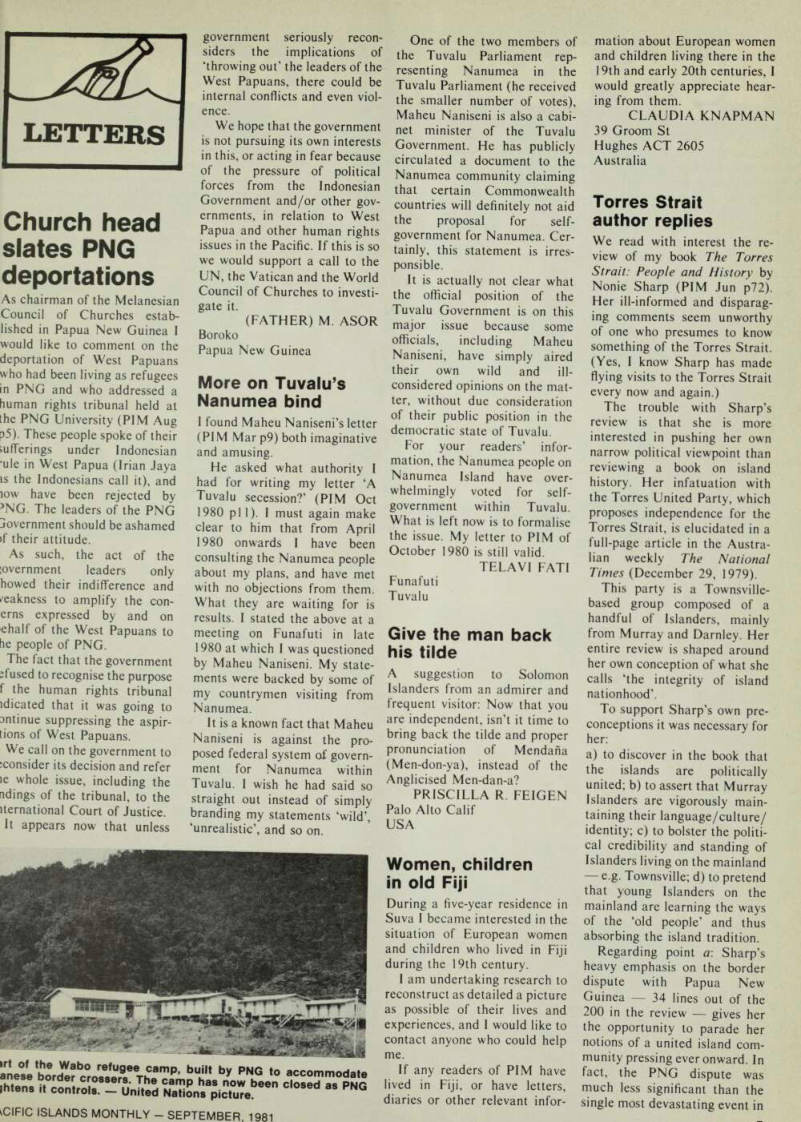
[?]rt of the Wabo refugee camp, buillt by PNG to accommodate [?]anese border crossers. The camp has now been closed as PNG [?]htens it controls.-United Nations picture.
modern island history: the ar rival of Europeans. Yet Sharp dismisses in 10 lines the book’s treatment of this subject.
On point b: I defy Sharp to produce a single adolescent Murray Islander who can con verse correctly in Meriam.
Sharp gives the impression that Meriam is not mentioned in the book. In fact it has five separate page references in the index.
Point c : On the standing of Islanders on the mainland.
Sharp herself in 1979 called these people ‘push-outs’ and wrote: ‘. . . many Islanders have been told they are “deserters’’ and have lost their traditional land rights.’ Sharp admits that my view has ‘the stamp of academic respectability’ and it also has the advantage of statistical backing: more than 50% of Islanders do live on the mainland, and have done so for more than a decade. She falls back, in some desperation, on a description of reunions at the Thursday Island jetty to back her claim that there is a close association between those who stay at home and the ‘push outs’.
Point d : Sharp takes for granted the active propagation of island language/culture on the mainland, and infers that I would like to see it ‘vanish altogether’.
Every day I teach Torres Strait Islanders who are second generation mainlanders, and who do not know anything of islander language, dance or history, and precious little in the way of cooking and singing.
Some are reluctant even to admit their family’s island of origin, about which they know nothing. I have seen the same process at work with my nieces and nephews in Cairns during only a few years of urban living.
It is not good. I would like to see it otherwise. But let us be realistic.
My own children are bi lingual, but only due to the sustained efforts of my wife and her family. Attempts are. now being made to have islander
language/culture introduced
into the state school system.
People are trying.
A more disturbing aspect of the review is Sharp’s descrip tion of island belief in sorcery, providence and incantation as
‘fantasy and fiction’. Each item in the relevant chapter was related to me by a trusted relative or friend, or I saw the thing with my own eyes. I thought the day had passed when indigenous people’s firmly held beliefs could be denigrated in such a manner. My wife’s reaction was ‘She is calling us liars’.
Sharp describes as ‘often trivial’ the section on people.
An account of some aspects of their lifestyle such as fishing, turtle, dugong, old gods, is vitally important to the people at grassroots level. These mun dane, everyday activities appar ently offer no prospect of excit ement for Sharp’s politically biased appetite.
The reviewer in her last sentence fatuously suggests that we ‘ask Islanders to tell us themselves in their own story’.
The gall of this deskbound academic beggars description.
I am called either father, god father, uncle or brother-in-law by scores of Islanders. Does she infer that I do not know what they think and believe? My 10 years fishing, hunting, garden ing, travelling, talking and liv ing with Islanders put me in a position to write the Islanders’ story in my own way, using information, sentiments and ob servations arising from my life with them. Naturally I sifted out the information I felt appro priate to my purpose, as any prudent writer would. Then I find information from my Islander friends labelled as ‘fic tion’ or ‘trivia’. And I, in turn, am castigated by Sharp for being too ‘European-centred’!
The contradictions in her re view are truly breath-taking in scope. 1 see the section on Saibai in my book as a combination of European and Islander observa tions approximating as nearly as is possible to the truth. One might have expected that the participation by Saibai Islanders in telling their story might find favour with our reviewer. In fact Saibai does not rate so much as a mention in Sharp’s review.
We are all working towards self-determination in the Torres Strait, I trust, just as we were in pre-independence PNG. How ever, dreaming is not seeing. In
PNG, when I worked there, almost 100% of primary staff teaching positions and a large proportion of secondary teach ing positions were occupied by locals. There is just one qualified Islander primary teacher in Queensland.
The Torres Strait people are confronted by massive social, educational and economic prob lems, as I have said in the book.
Sharp does Torres Strait Islanders little service by mak ing light of these problems.
John Singe
Port Douglas Qld Australia (This letter cut to match length of original review.)
Torres Strait
again
I protest against the quality of literary criticism displayed in the book review ‘Mark Missed on Torres Strait’ (PIM Jun p 72).
I read: ‘Fantasy and fiction are so tightly interwoven in the seven-page chapter on “Magic and Death’’ that it should not be taken seriously.’
But then I don’t find any of Mr Singe’s specific claims re pudiated. I know that Mr Singe spent many years here sitting down with older Islanders gath ering the information he pres ented in this chapter, and that my knowledge of the subject, accumulated while teaching here for six years, generally concurs with his.
If Ms Sharp, during one of her occasional fleeting visits to the Straits, has been told in confidence some contradictory secrets by the old men, and if Mr Singe, myself and others have been surreptitiously misin formed for years, then please allow us a glimpse of the real facts.
Then we read a circumlo cution about Mr Singe giving ‘expression to wishful thinking in some quarters that island culture and Islanders would vanish altogether. . Any fears the author expresses for the survival of Islander culture are real. The book was written to educate people about that cul ture. Indeed, it is used at Thursday Island High School for that purpose. Apart from a few anthropological theses and
one short ‘official’ history on the Straits, Mr Singe’s book is the only reference available on the area.
Then Ms Sharp takes us to Thursday Island jetty to wait for the airlines launch and observe cultural ties between the islands and the mainland.
Tears and smiles down at the wharf aside, the fact is that educational planners recognise a 2% per annum net migration from the Straits to mainland centres, ‘wishful thinking’ or not. I don’t see many of my former students again after they’ve finished school here.
At least now there is likely to be one book in the Town Library where they choose to settle that they can put their finger on and say: ‘This is the story of my people.’
Larry Jones
Education Officer Cathedral College Thursday Island Qld Australia Those NZ police ads Seeing the New Zealand police in action on television during the South African Springbok Rugby tour, and witnessing their brutal tactics and strongarm methods, reminds me to write and wonder about the advertisements the New Zealand police force regularly places in PIM. I am puzzled as to the reason for such advertis ing.
Is it for recruiting? If so that seems strange, given the fact that few Maoris and even fewer Pacific Islanders are members or are likely to become mem bers of New Zealand’s police.
Given the well-known and frequently demonstrated anti- Polynesian, anti-islander and Maori bias of the police in New Zealand, it seems strange that they should advertise in PIM.
Is it intended as a not so subtle warning to Island people that ‘Big Brother New Zealand Police’ are watching? All Island people and their friends, re membering the actions of such police organisations as the ‘Task Force’, must, like me, wonder about the PIM adver tisements.
Bruce Turner
Mildura Vic Australia
Advertisements & other items, pp. 7-9 (2 items)
Islands Monthly - September 1981
KBgh-tech; Mgher-fi.
Pioneer components bring you a great new look and top performance to match. Plus total access to all their high technology advances—through Total System Design.
More than mere technical elegance, Total System Design means greater convenience through the components’
Centralized System Status Control and Indication panels.
In the A-9 amp, it means pure sound through Non- Switching™ and DC-Servo circuitry. Line-Straight signal flow to protect that purity. And electronic pushbuttons that put you in command.
In the F-9 tuner, it means accurate, quartz-PLL synthesized tuning. Push-pull FM front end and digital detector to widen dynamic range and eliminate IF nonlinearity. And instant recall of up to six FM and six AM stations by pushbutton Memory.
In the 3-Direct-Drive-Motor CT-9R cassette deck, it means Computer-Aided Convenience plus precision performance. The CT-9R’s so “smart” it sets tape bias, level and equalization.
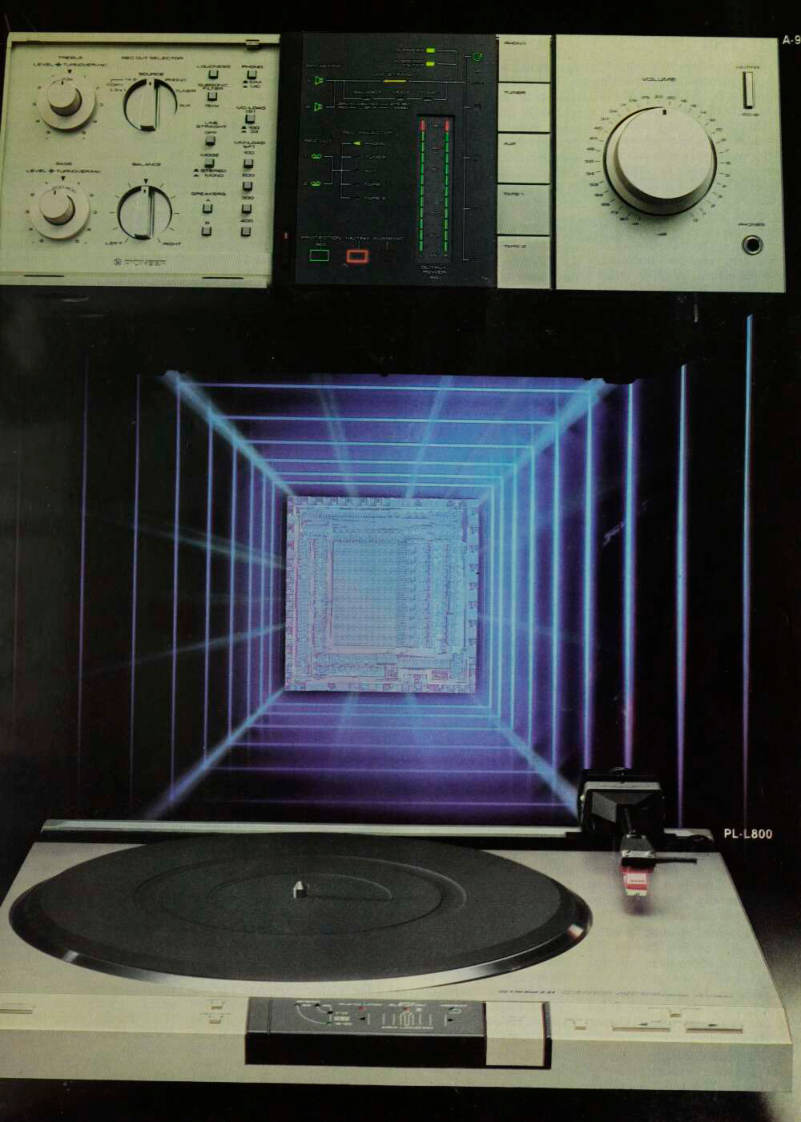
And in the PL-LBOO turntable, it means tangential tracking and a low-mass Polymer Graphite™ tone arm for high tracking ability. And a high-output cartridge for delivering startlingly clear sound without need for a special MC head amplifier.
Total System Design: the high point in our decades of developing high-technology high-fidelity. What it means to “higber-fi” is something you’ll just have to hear for yourself to appreciate.
Pioneer components are displayed only at stores showing this emblem. ■ F-9 ■ nm r n u u. b u it •
g iUTO DA
direct drive
Jl) PIONEER
CT-9R
Advanced performance through technology.
SSSfe:
0 PIONEER"
For further Information, please contact; Australia: Pioneer Marketing Service Pty. Ltd., P.O. Box 317, Mordialloc, Victoria, 3195 Tel: 90-9011 Fiji Islands: Brijlai & Company, G.P.O. Box No. 362, Suva, Fiji Islands Tel: 22258 New Zealand: Monaco Distributors Ltd., 2 Poland Road, Glenfield, Auckland, New Zealand Tel: (09) 444-9144 Norfolk Island: Burns Philp (Norfolk Island) Ltd., P.O. Box 21, Norfolk Island, Nauru Island: Jacob Enterprises, P.O. Box No. 4, Republic of Nauru Tahiti: Tahiti Hi-Fi, P.O. Box 848, Papeete, Tahiti New Caledonia: Menard Pacifique Sari, B.P. 3899, Noumea, New Caledonia Tel: 48.24-36 American Samoa: Transpac Corporation, P.O. Box 1477, Pago Pago, American Samoa 96799 Tel: 633-5224 Rarotonga: South Seas International Ltd., P.O. Box 49, Rarotonga, Cook Islands Tel; 2327
I 3 H
iMMnMt
; • j
m (cv i
‘ - ; < :ii
,Qm Qij
- i c ’ c ! iklwi |dc|
Cicscscs! :;n
Reagan’s man knows his Caribbean,
but what about the Pacific?
The Reagan Administration’s announcement earlier this year that policy towards the US Trust Territory of the Pacific Islands was now subject to ‘full review’ dismayed leaders of the various governments which are emerging from the soon to-be-dissolved TTPI (PIM Jun p 57). Now leaders of the so-called ‘flag territories’ of the US in the Pacific are voicing concern that the administration has developed no discernible policy for the Pacific Islands. They contrast this with the active policy it is pursuing in the Caribbean, and see as symbolic the appointment of Cuban-born diplomat Pedro San Juan to oversee their affairs. Two Honolulu-based writers, JERRY BURRIS* and MULIUFI HANNEMANN**, report exclusively for PIM.
Leaders of the so-called ‘American Flag’ islands of the Pacific met in Hawaii in June to discuss their fears that the new Reagan Administration in Washington is barely aware of their part of the world.
The meeting brought together Governor George Ariyoshi of Hawaii, Gov Peter Tali Coleman of American Samoa, and Gov Paul Calvo of Guam for two days of closed door meetings.
These three, along with Gov Carlos Camacho of the North ern Mariana Islands, have formed a group called the Pacific Basin Development Council. The council, created ast year with the active support )f former President Jimmy Carter’s administration, is sup posed to deal with common economic and development ssues.
The idea was that the corn pined voices of these four little )ips in the Pacific would pro luce a bigger squeak when it :ame to extracting federal econ imic development dollars out of he government in Washington.
Tat objective remains. But it’s [uite clear from the Honolulu fleeting that the PBDC will Iso have a political voice.
First evidence: a strong letter 3 President Reagan that
Jerry Burris is an American lurnalist and political colum ist with The Honolulu Adver ser. * Muliufi Hannemann is a Dedal assistant to the overnor of Hawaii. He re mtly returned from Washing m where he worked in the department of Interior’s Office of Territorial and Inter itional Affairs.
suggests the new administration is headed towards a potentially ‘disastrous’ relationship with the Pacific island territories.
There is no policy towards the territories and little indication that the Reagan Administration intends to hire people with a Pacific islands background, the governors said.
The key office for all terri torial and island activities is the Assistant Secretary of the In terior Department for Terri torial and International Affairs.
But thus far, the governors complained, appointments to that office have shown a distinct lack of sensitivity toward the Pacific.
The head of the office will reportedly be Pedro San Juan, a linguist, veteran diplomat and economics expert who served in both the Kennedy and Carter administrations. The Cuban born official most recently has been director of the Hemi spheric Center for the American Enterprise Institute and has an extensive Caribbean background as well as a record of service with Law of the Sea negotiations and arms control talks.
The speculation is that San Juan’s knowledge of the Caribbean, plus his background in defence, arms control and international negotiations, will serve the Reagan Adminis tration well as it develops a so called ‘Caribbean Policy’. That policy is designed to diminish the influence of the Soviet Union in that part of the world.
But ‘what does it have to do with the Pacific?’, the governors asked. ‘Mr San Juan’s background does not provide him with any experience or insights into the needs of the Pacific Island
community,’ the governors complained in their letter.
News of lesser appointments suggest that even the support staff will lack this necessary Pacific orientation, they said. ‘Based on past experiences, it takes several years before non- Pacific island individuals begin to understand our specific and very special island needs,’ they said. ‘lt should be noted that a background in Caribbean affairs does not relate to any of the unique island needs.’ ‘To administer the territories and to carry out oversight responsibilities from 10 000 miles away in Washington DC is a major job in itself,’ they wrote. To attempt to do it with individuals who are unfamiliar with Pacific territorial issues, cultural patterns and specific, unique needs could prove disas trous.’
Furthermore, they com plained, the federal government continues to exhibit a ‘total lack of formal policy regarding what the United States wants for its territories and the role, if any, that the territories should play in national policy’.
By inference, they suggested that Japan and the Soviet Union both want more influence in the area. One way to keep them out is to pay a little attention to the territories.
Since that letter was written, private meetings between San Juan and island representatives have been held in Washington.
They did little to assuage fears.
San Juan points out that his background in international negotiations and defence mat ters will be useful in the still pending status negotiations with the Micronesian govern ment entities that make up the Trust Territory of the Pacific
Islands. Perhaps. But for the four island leaders, the situation seems to be ‘we’ll believe it when we see it’.
The island governors also prepared another message for Washington this one to the US Civil Aeronautics Board (CAB) over the attempt by Texas International Airlines to take over Continental Airlines.
Their concern has to do with Continental’s service to American Samoa en route to Australia, Fiji and New Zea land, and its service to Micronesia through Air Micronesia.
Despite some evidence to the contrary, the governors fear that if Texas International suc ceeds in its take-over bid, that service could be reduced or even eliminated. They support Continental’s plan to fight the takeover through an employee stock ownership plan.
On June 8, just as the governors were meeting in Honolulu to arrange their protest at the takeover bid, Texas International was busy in Washington DC. The airline filed a memo with the CAB vowing that ‘it intends to main tain at a minimum essentially the same level of service now provided by Continental. That service will be provided for the indefinite future,’ the airline said.
The governors were not con vinced. Based on the record of Tl’s testimony in the case, the governors said, ‘we are con cerned about the viability of this commitment’.
The best assurance of con tinued Pacific air service by Continental would be to ‘sup port the employees slock owner
ship plan,’ they said.
Jerry
Burris.
Advertisements & other items, pp. 11-12 (2 items)
11
ACIFIC ISLANDS MONTHLY - SEPTEMBER, 1981
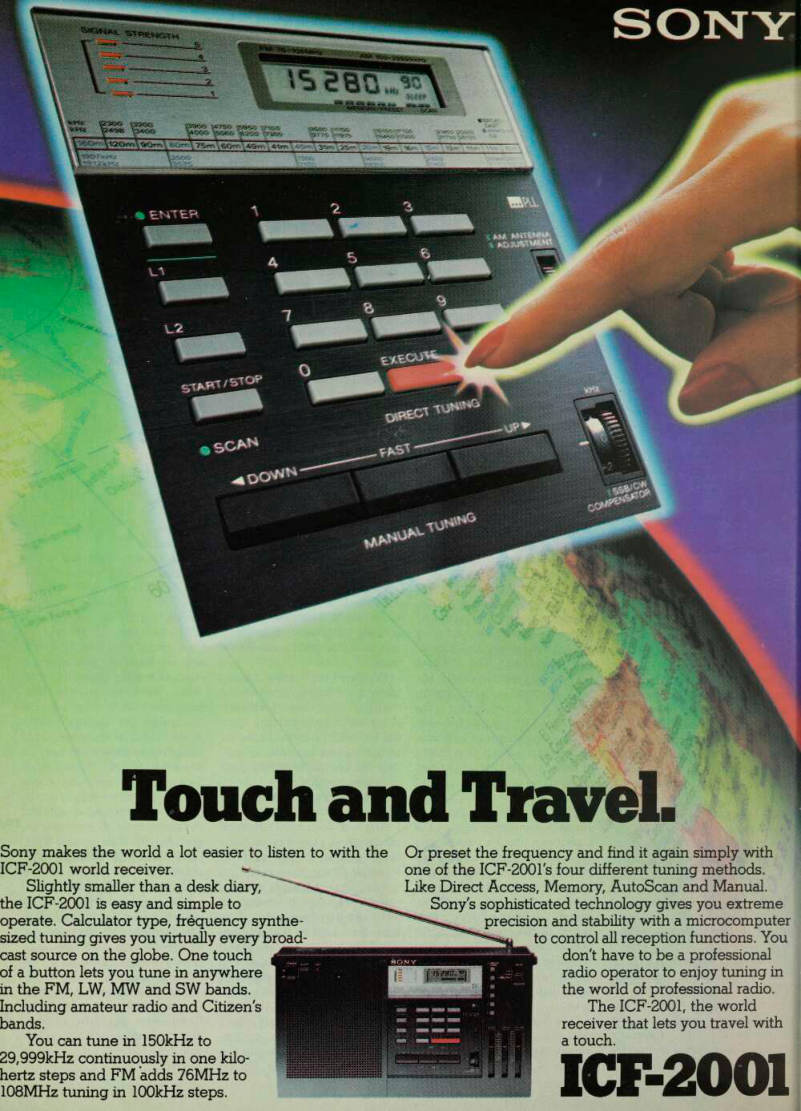
Touch and Travel.
kHz KHz &Orft=>~ r ’■ m
Sony makes the world a lot easier to listen to with the ICF-2001 world receiver.
Slightly smaller than a desk diary, the ICF-2001 is easy and simple to operate. Calculator type, frequency synthe sized tuning gives you virtually every broadcast source on the globe. One touch of a button lets you tune in anywhere in the FM, LW, MW and SW bands.
Including amateur radio and Citizen's bands.
You can tune in 150 kHz to 29,999 kHz continuously in one kilohertz steps and FM adds 76MHz to 108 MHz tuning in 100 kHz steps. psead Or preset the frequency and find it again simply with one of the ICF-2001's four different tuning methods.
Like Direct Access, Memory, Auto Scan and Manual.
Sony's sophisticated technology gives you extreme precision and stability with a microcomputer to control all reception functions. You don't have to be a professional radio operator to enjoy tuning in the world of professional radio.
The ICF-2001, the world receiver that lets you travel with a touch.
ICF-2001
Come back, Jimmy,
U.S. In The Pacific
Come back, Jimmy, all is forgiven
It was announced in a Washington Post report in May that the Reagan Administration would be developing a compre hensive Caribbean Basin policy as an attempt to indicate to the region and to the world that ‘it is not locked into a one-time military approach to such re gional problems as the civil war in El Salvador’. It is envisaged that this policy would also provide for economic and social development for the Caribbean, as well as the security measures that will be implemented to combat what Secretary Haig and others in the administration perceive to be communist expansionism in the region.
With the adoption of a Caribbean Basin policy, I earn estly hope that the Reagan Administration will take the next logical step and begin to define its policy towards the Pacific Basin. To allow the absence of an agenda for the region to continue any longer only gives credence to those who criticise the United States for its lack of commitment and establishment of priorities in the region.
President Carter attempted to make some sense of US efforts in the Pacific, especially with respect to the US territories, by advocating a comprehensive territorial policy in February 1980 that reflected the interests and understanding of the Congress. It provided a flexible framework that recog nised the unique cultural, politi cal and economic background of each territory. Unfortu nately, the Reagan Adminis tration has placed Carter’s ter ritorial policy, as well as most of his Pacific policies, in abeyance pending their review and evalu ation.
Without question, the policy decisions made by the Carter Administration are subject to scrutiny and to review by a new administration. But the fact ■emains that decisions were nade in an area which previous administrations had treated -vith benign neglect.
Towards the end of his term
of office, there was every indi cation that Carter was begin ning to recognise the import ance of the Pacific-Asian Basin and, most importantly, of the special roles that each of the American jurisdictions play in the Basin the fact that the Pacific Ocean is blessed with an abundance of marine and ocean resources, the fact that two thirds of the world’s people inhabit the Basin, and the fact that the Pacific Ocean has replaced the Atlantic Ocean as the hub of commerce and trad ing activities of the US.
There is certainly no perfect answer to the many and com plex problems confronting any society, but the fact is that the Carter Administration at least addressed itself to the situation and offered certain avenues to pursue.
Judging from the dilatoriness with which the Reagan Admin istration is moving towards enunciating a Pacific Basin pol icy, filling substantive Pacific positions in Washington and the region, and, in general, respond ing to the needs and desires of the US entities in the Pacific such as the Native Hawaiian Study Commission that the State of Hawaii has been anxiously anticipating for months it is reasonably clear that the Pacific is once again on the low rung on the totem pole of national priorities in Washington.
It was also disappointing to note that in an extensive profile on James Watt and his work as the Secretary of the Interior which appeared on page one in the Sunday (May 31) edition of The Los Angeles Times, con spicuously missing was any mention of the Office of Terri torial and International Affairs, the agency charged within In terior to oversee the territories.
What is it going to take to convince President Reagan, Secretaries Haig and Watt, and other key individuals of this administration to begin to focus properly on the Pacific Basin and accord it the recognition and respect it deserves? Will it
take an ‘EI Salvador’ type of situation to erupt in the Pacific before the administration feels compelled to move it up on its scale of priorities? I would certainly hope not for, if the Reagan Administration har bours the myopic view that trouble spots in the Pacific are confined to the Asian rim of the Basin then they obviously have not been observing some of the current trends in the Islands.
To cite a few examples: Vanuatu, formerly known as the New Hebrides, exploded last year into a full-scale rebellion led by French expatriates and locals headed by Jimmy Stevens, who saw their liveli hood threatened by the change in government from French and British rule to independence.
Many were surprised earlier this year when it was reported that Western Samoa, the first Polynesian island country to achieve independence in 1962, was in the throes of a major government employees’ strike which was jeopardising the term of one of the Pacific’s most charismatic leaders, Prime Minister Tupuola Efi. Further more, one would need to be extremely naive to dismiss en tirely the possibility of some sort of strong reaction from the
Trust Territory entities who are growing increasingly impatient with the Reagan Adminis tration’s procrastinating atti tude regarding their status negotiations and other related issues.
The above-mentioned exam ples lead naturally to a major point worth considering: that is, if the United States con tinues to procrastinate in de fining a policy and agenda for the region, it will create a void that could be filled quite readily by a super-power that it has competed with in Europe, Asia, Africa, and, of late, the Caribbean the Soviet Union.
The signs are there. In the South Pacific, the Russians have established diplomatic contacts with Papua New Guinea, Fiji, Western Samoa, and Tonga, and in many in stances have made generous offers of economic assistance.
Recently they have made econ omic overtures in Vanuatu and the Solomons. And, even closer to home, last year a Soviet official met in an ‘exploratory session’ with a representative of one of the American Micronesian insular areas.
What’s to stop them from taking advantage of a military vulnerability? Their history cer tainly suggests a propensity to do so.
Therefore, insofar as the de cision by the Reagan Adminsitration to develop a comprehensive Caribbean Basin policy, coupled with the appointment of the Caribbean bred Pedro San Juan as the
Assistant Secretary-Designate
for Interior’s Office of Terri torial and International Affairs are a major boon to the Caribbean Basin, the Pacific Basin remains without an official Pacific policy and the US jurisdictions namely, the territories of American Samoa and Guam, the Commonwealth of the Northern Marianas, the three entities of the Trust Terri tory of the Pacific and, to some extent, the State of Hawaii continue to suffer. It is to be hoped that these recent Caribbean decisions will serve as the proper catalyst that will spur the Reagan Adminis tration into developing a Pacific policy for this nation.
Muliufi Hannemann.
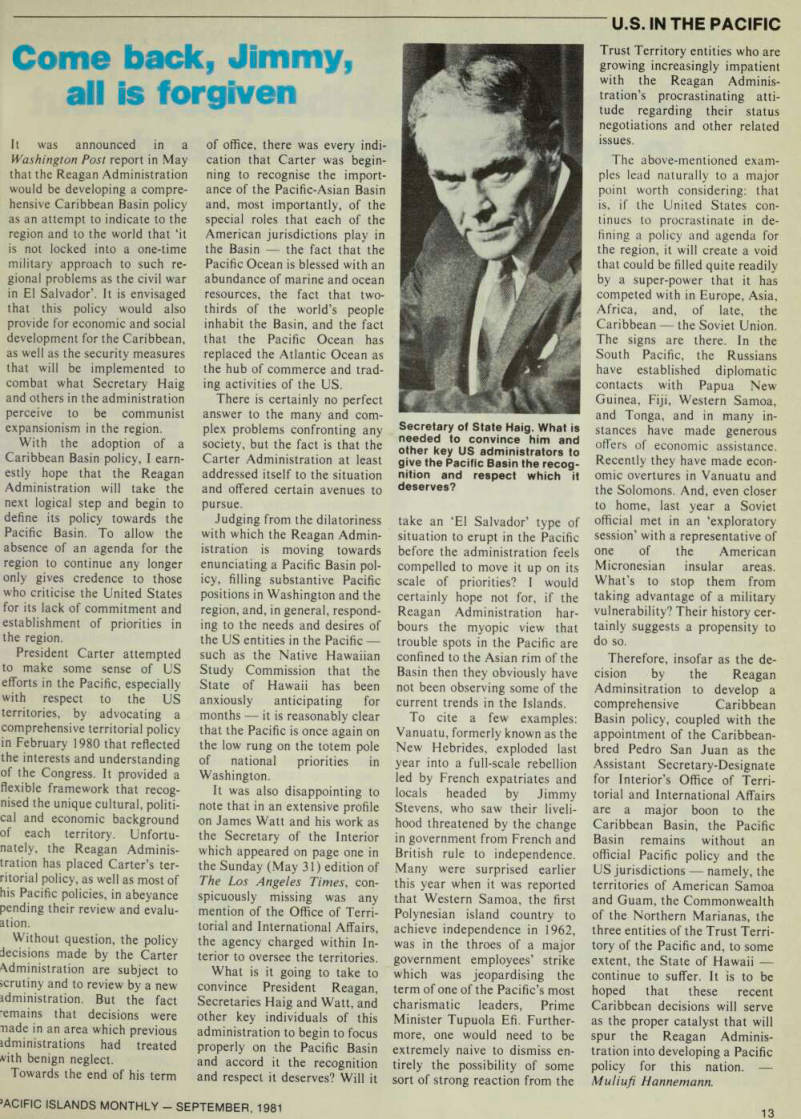
Secretary of State Haig. What is needed to convince him and other key US administrators to give the Pacific Basin the recog nition and respect which it deserves?
Advertisements & other items, p. 13 (1 item)
13
’ACIFIC ISLANDS MONTHLY - SEPTEMBER, 1981
New Caledonia’s tribal people out
to ‘recover ancestral lands’
A new movement for Kanak land rights has arisen and is growing in New Caledonia. The movement is distinauished from other similar movements by its tribal basis, its strong attachment to customary forms of action, and its Snce of ties with political parties. A special correspondent in Noumea tells the story.
For more than a year now a new nationalist movement has been developing among the tribal people of New Caledonia.
Based essentially on land own ership concepts and associated beliefs, its practical aim is to regain ownership of lands which have long been alienated, some since as long ago as the 19th century.
The movement cuts across existing political factions indeed, many of its leaders deliberately keep their activi ties apart from political parties in the hope that a single unified front will be formed over what they see as a basic single cause.
The nucleus of the movement lies with about 20 tribes. They are using traditional means of communication to spread its influence, and now believe that all tribal groups are generally sympathetic, and that the exist ing solid core will soon expand.
The ‘traditional means of communication’ involves move ment on foot by couriers who spread through all areas follow ing customary procedures to make contact, express goodwill, exchange gifts and greetings, and then sit around the fire and talk.
There are about 150 tribes in New Caledonia, whose average population is estimated at about 250. This suggests that the hard core nucleus of the movement at present is about 5000 people (20 tribes of 250), and observa tion suggests that the numbers actively involved are steadily growing.
For the immediate future the main thrust of the movement is to send letters to or make contact with French colons occupying alienated land, and to make the point that the land traditionally belongs to the Melanesians who want it back.
In general, they are prepared to see that the colons are treated fairly at present they do not want to seize lands forcibly because of the violence and
trouble which might result.
They would prefer a system by which the French authorities take back the land from the colons and give it back to the Melanesians as the rightful owners under traditional law and custom.
Despite this generally peace able approach, in recent months there have been two forcible occupations, and one incident of confrontation in which a Kanak was shot dead by his colon employer (PIM Aug p 6). This last incident it is true arose from a dispute over pay and not over the land issue, but it expresses the tensions that can rapidly erupt in the New Caledonian context. French riot police were sent to the scene of the killing and are believed to be still (late July) on the property.
If satisfaction cannot be ob tained by peaceful pressures the ultimate plan is to move onto the land using whatever mini mum force is necessary to achieve re-ownership.
In areas where the colons have already been contacted there has been a mixed reac tion. Some of the settlers are prepared to sell out if the government institutes a plan, although obviously the issue of valuation will be controversial.
Others are digging in and have refused to discuss the issues.
The total number of settler families (and therefore the ap proximate number of properties involved) is estimated at about 250.
The movement, which started in a fairly small way in localised areas about 12 months ago, is now reaching something of a peak and is being acknowl edged rather than dismissed by the French authorities. The fact that this has coincided with the coming to office of the Mitterrand government in France will face French colonial activities in the Pacific with one of its major problems. For while the French structure is firm
ly estalished in the over seas territories, President Mitterrand as a socialist leader could not tolerate a situation which the world would see as metropolitan repression of the rights to land of a Third World people.
One major practical issue which will cloud the picture involves verification of which tribes own what land. Two uprisings and their aftermath contribute to this area of poten tial controversy. The first was a mini-war in 1878 in which 150 whites and nearly 1000 Melanesians died, and the other was a rebellion in 1917. After both these events French authorities forcibly re-located many tribes. This means that today many tribes live in areas distant from their traditional lands. The possibility cannot be ignored that Melanesian unity could be strained by disputes between themselves over claims to specific areas of land.
Extensive research is being carried out by ORSTOM, the body responsible for scientific research in France’s overseas territories, in an endeavour to pinpoint the traditional lands of today’s tribes. Many maps have already been issued, based on research into the situation exist ing before 1878, and before 1917.
In one of their letters the tribes refer to a threat by one of New Caledonia’s deputies to the French National Assembly, Jacques Lafleur, to use helicop ters to keep the people in line.
In fairness to Lafleur, it should be noted that there is no record of his having made such a threat. The statement by the people was probably a loose inference arising from the prac tice of the authorities of using helicopters with armed riot police on occasions when con frontations occur.
The tribes’ letters are written in French with great dignity, sometimes having an almost
biblical tone. The first paragraph of one of them reads: ‘This letter laying claim to ancestral lands is drawn up by the tribe of Baco. It is the first announcement of a plan for the “Recovery of Land” which has been prepared by the tribes of Voh, Kone, Pouenbout and Poya. These tribes have set up a committee consisting of two delegates from each tribe. It works independently of political parties and is achieving Kanak unity as a fact at the grassroots.
The end result of this action is to be the occupation of lands, each tribe seeking to recover the lands within their tra ditional borders. When all tribal lands have been recovered, the whole country will once again become Kanak, and indepen dence will be at hand.’
The letter goes on: ‘The tribes of Gomen, Koumac, Poum, Pouebo and Ponerihouen are now asking for information. The “Word” is going around in Hienghene, Ouegoua, Ballade, Belep, Houailou. It says “We must recover the ancestral lands, and nothing will have the power to stop us.” Now 149 tribes, all the tribes from the north, from Poya and Ponerihouen, are uniting to take common action. Tomorrow all of New Caledonia will follow.’
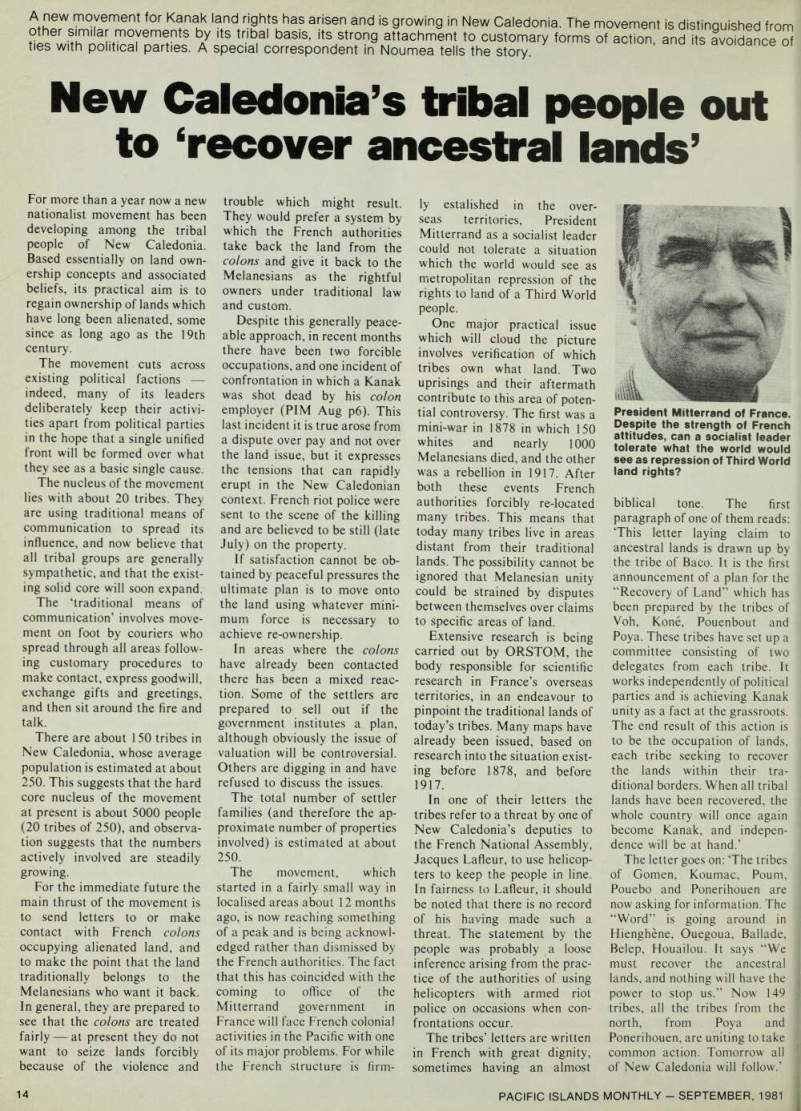
President Mitterrand of France.
Despite the strength of French attitudes, can a socialist leader tolerate what the world would see as repression of Third World
land rights?
Mini Games
‘Great success’ of Honiara Mini Games
The first South Pacific Mini Games, held in Honiara, Solomon Islands, from July 7 to 16, were judged a great success by all concerned.
Sixteen countries took part in the games, which were timed to coincide with the third anniver sary of Solomon Islands inde pendence (July 7, 1978).
Planned within the frame work of the South Pacific Games organisation, the Mini Games, like the ‘big’ games, will be held every four years, but in a leapfrog relationship, in the second of the four years separating each South Pacific Games. An important aspect of the Mini Games is that they will be held in countries not yet in a position to host a South Pacific Tames, and will serve as a najor stimulus for them to mprove their sporting facilities o a point where, at some time in he future, they will be able to io so. The next Mini Games are et down to be held in the Cook slands in 1985.
The Honiara games saw con ests in athletics (men and vomen), soccer (men), boxing men), tennis (men and vomen), and netball (women).
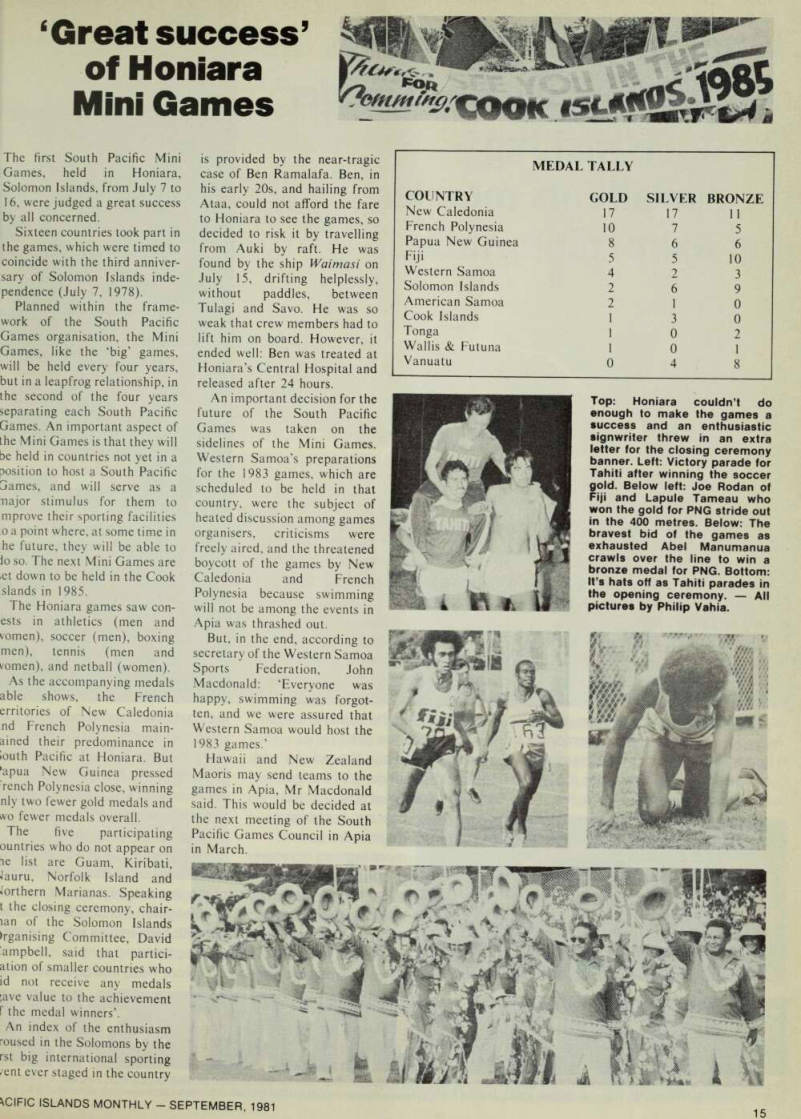
As the accompanying medals able shows, the French erritories of New Caledonia nd French Polynesia main lined their predominance in louth Pacific at Honiara. But *apua New Guinea pressed rench Polynesia close, winning nly two fewer gold medals and wo fewer medals overall.
The five participating ountries who do not appear on ic list are Guam, Kiribati, Jauru, Norfolk Island and Jorthern Marianas. Speaking t the closing ceremony, chair lan of the Solomon Islands Organising Committee, David ampbell, said that partici ation of smaller countries who id not receive any medals ;ave value to the achievement f the medal winners’.
An index of the enthusiasm roused in the Solomons by the rst big international sporting /ent ever staged in the country
is provided by the near-tragic case of Ben Ramalafa. Ben, in his early 20s, and hailing from Ataa, could not afford the fare to Honiara to see the games, so decided to risk it by travelling from Auki by raft. He was found by the ship Waimasi on July 15, drifting helplessly, without paddles, between Tulagi and Savo. He was so weak that crew members had to lift him on board. However, it ended well: Ben was treated at Honiara’s Central Hospital and released after 24 hours.
An important decision for the future of the South Pacific Games was taken on the sidelines of the Mini Games.
Western Samoa’s preparations for the 1983 games, which are scheduled to be held in that country, were the subject of heated discussion among games organisers, criticisms were freely aired, and the threatened boycott of the games by New Caledonia and French Polynesia because swimming will not be among the events in Apia was thrashed out.
But, in the end, according to secretary of the Western Samoa Sports Federation, John Macdonald; ‘Everyone was happy, swimming was forgot ten, and we were assured that Western Samoa would host the 1983 games.’
Hawaii and New Zealand Maoris may send teams to the games in Apia, Mr Macdonald said. This would be decided at the next meeting of the South Pacific Games Council in Apia in March.
Top: Honiara couldn’t do enough to make the games a success and an enthusiastic signwriter threw in an extra letter for the closing ceremony banner. Left: Victory parade for Tahiti after winning the soccer gold. Below left: Joe Rodan of Fiji and Lapule Tameau who won the gold for PNG stride out in the 400 metres. Below; The bravest bid of the games as exhausted Abel Manumanua crawls over the line to win a bronze medal for PNG. Bottom: It’s hats off as Tahiti parades in the opening ceremony. All
pictures by Philip Vahia.
Country
Medal Tally
Gold
Silver
Bronze
New Caledonia 17 17 11 French Polynesia 10 7 5 Papua New Guinea 8 6 6 Fiji 5 5 10 Western Samoa 4 2 3 Solomon Islands 2 6 9 American Samoa 2 I 0 Cook Islands 1 3 0 Tonga 1 0 2 Wallis & Futuna 1 0 1 Vanuatu 0 4 8
Advertisements & other items, pp. 15-17 (2 items)
15
\CIFIC ISLANDS MONTHLY SEPTEMBER, 1981
Datsun Creates Ha
While other car companies are
making their big cars smaller,
Datsun is making
their small cars roomier
and more comfortable.
For most car companies, the rule is the roomier you make a car, the bigger and heavier you have to make it. Consequently it uses more gas.
So it’s no surprise that their cars are getting smaller.
But then most car companies aren’t Datsun.
At Datsun, we not only accept such conflicts, we look for them. Then we look for ways to bring them into “harmony.’’ Because, to us, harmony is balance. The balance of apparent contradictions. And the better the balance we re able to achieve, the better the cars we re able to build.
Consequently, for 1981, every new Datsun across the board is roomier and more comfortable than the model that preceded it. Yet each one runs on as little gas. Or less.
And we didn’t make them roomier inside by making them more box-like outside. We did it by finding a better way to redistribute the space we had.
We reduced the space between the engine and the dash panel, between the fan and the radiator and between the radiator and the grill.
Then we added that space to the passenger compartment in the form of more leg and hip room.
More space was added to the interior by reducing the distance between the front tires and wheel wells. At the same time, by moving ifigsW n the dashboard and windshield forward and making the windshield more inclined, we not only increasec physical space but also added to the impression of spaciousness. Human sensitivity answered by carefully studied human engineering.
Still more space was added to the interior by reducing the thicknes of the doors. Which meant we had to strengthen the doors. Which we did with high-tensile steel panels, and supports.
More head and shoulder room
DATSUN CREATES HA
Cook Islands: COOK ISLANDS MOTOR CENTRE LTD , Rarotonga/Fiji: CARPENTERS MOTORS, Suva/Guam: DATSUN MOTOR SALES, Agana/Hawaii: NISSAN MOTOR CORPORATION IN HAWAII LTD , Honolulu/Kiribati: ATOLL AUTO STORES, Tarawa/Nauru: JACOB ENTERPRISES LTD /New Caledonia; AGENCE ALMA S.A , Noumea*
P»1 m i * c added by reducing the height le seats. Which meant we had lace an extra layer of padding veen the springs and seat pads to d you comfortable.
And after we made the interior as roomy as possible, we made it seem even roomier. Color, pattern and texture, carefully attuned to human sensitivity, make broad seating seem even broader.
Problem-solving by designresolving conflicting elements to improve the overall quality of the product—has helped Datsun to build cars that are quiet and roomy, yet light and fuel efficient.
Our way may not be right for most car companies. But, at Datsun, we measure our success in terms of how well we build the kind of cars the world needs. Without sacrificing what you want in your car.
That’s harmony.
The model shown above is the Datsun 7608 for the Middle East.
Specifications and equipment may vary accordinq to market.
DATSUN
THE NAME Of QUALITY
MONY BY DESIGM
lslands- a MN?T^? t FK!Tc: r DDD , (oc , c , T-3! Rl u?- f^?JS F i_®. y P ?? ua .l J ? w Gui . ea: B^R O K O MOTORS LTD , Port Moresby/Saipan: JOETEN MOTOR
NISSAN
NISSAN MOTOR CO. LTD
Solomon Islands- UNiTFn fmtfrpd qcc Trn YL oumea M uiunb lid , Port Moresby/Saipan; JOETEN MC omon islands. UNITED ENTERPRISES LTD., Homara/Tah.ti: TAHITIBULL S.A.R.L, Papeete/Western Samoa: MORRIS HEDSTROM LTD., Apia
Islands
From the
Press
Editorial comment from the Samoa Times, Apia, criticising the Samoan government for not formally opposing the visit to New Zealand of the South African Springbok football team Sure, New Zealand is our friend but this should not prevent our government from letting New Zealand know where we stand. A statement of principle is not interference in another country’s internal affairs. By not coming out with a statement of opposition, government has lost goodwill among the under-developed countries of the world. The government is against apartheid, but in this instance it is not apartheid, not the New Zealand Rugby Union, not the feelings of the New Zealand government that is the issue. It is where our government stands that is the issue. . . and a letter to the Cook Islands News, Rarotonga, in which T. Tearii criticises the Cook Islands government for not allowing the Springboks to pass through
Rarotonga
Since when have the people of the Cook Islands opposed any sporting contact with South Africa? This is probably the government’s view, but surely not the view of the people. Now I ask, why does our premier Sir Thomas Davis close the Rarotonga airport to the Springboks but welcome a visiting French warship when he has already stated publicly that he opposes French nuclear tests in the Pacific?
Editorial comment from the Papua New Guinea Post- Courier, Port Moresby, on the recent tour to South Pacific countries by the PNG prime minister, Sir Julius Chan In Fiji, Tonga and Cook Islands Sir Julius has preached a gospel of regional unity, one aim of which is to dispel the Great Romantic South Seas Myth. The region, Sir Julius believes, is largely ignored in world forums because of its minuscule impact on global affairs.
The prime minister argues that we should have a place in global politics because great power rivalries and strategies are in fact in our part of the world. Without a common voice we run the risk of allowing the big powers unlimited scope to dabble with our resources and to meddle in our affairs... Sir Julius is right —we need a common voice, and we need it now.
From the Fiji Ministry of Information’s publication Fiji, published in Suva, quoting a parliamentary statement by the prime minister, Ratu Sir Kamisese Mara Phosphate mining on Ocean Island has now finished. The farmers of Australia and New Zealand have benefited. From its 85% share of the royalties, the Kiribati government has accumulated a capital reserve of about $BO million. As for the Banabans, their 15% share of the royalties has been spent in pleading their case for fairer treatment. In short, the history of phosphate mining on Ocean Island (the original homeland of the Banabans) is a sad and sordid story of colonial exploitation of an innocent people in its worst form.
The Marshall Islands Journal, Majuro, Marshall Island The hospital badly needs an incinerator. Dangerous drugs and hypodermic needles easily accessible to children are life threatening, and there is no good way to dispose of parts of bodies
cut out in operations. All we can do is wrap what is cut off and hope Public Works will carry it away, a hospital spokesman said recently.
From an advertisement published in Tohi Tala Niue, Niue, on behalf of a coconut processing factory Notes: We will only purchase unhusked nuts as a special favour to those persons unable to husk, for example elderly or disabled persons. No unhusked nuts will be expected at the factory PICK YOUR OWN COCONUTS AND BECOME A MILLIONAIRE!
Part of a letter in the Nauru Post, written by an un named seaman serving in a ship of the Nauru national line All my mates tell me I am a mug to work the ships for such low pay while everyone else ashore earns much more money. We seem to be the forgotten men of Nauru four years with no rise in pay.
It has now reached the stage where we are getting paid 30% beneath the Nauru basic rate. I don’t think the government even knows, or maybe it does but doesn’t care. We are human beings, too, just like the others on the island although there are some who don’t think so. If you are a seaman you are a mug these days.
Editorial comment in The Times of Papua New Guinea, Port Moresby, on a report that the deputy prime minister, Mr Okuk, had accused the PNG press of writing nonsense and having a low standard of journalism The same has been said often by many politicians. And yet, the press has to struggle on with the same problems: high overheads and capital costs; a complete absence of government subsidies (making PNG virtually unique in the would-be literate world); astronomic freight charges; and, most seriously, a lack of skilled manpower and training facilities. We trust that, in the light of his comments, Mr Okuk will champion moves currently seeking government support to upgrade journalism training within the country.
Editorial comment in the Fiji Times, Suva, on the formation of the new political group, the Western United Front Although one of its founders denies suggestions that the WUF is only for Fijians, it is difficult to see how it can, or ever will, attract non-Fijian support if it is preoccupied with the downfall of the Alliance at any cost. No political party founded on such a negative premise can survive for long. All that the WUF appears to be doing at present is to arouse the baser instincts of provincialism, if not racialism, by spawning an organisation that in reality is confined to the Western Division. Perhaps we are hasty in our judgment, but WUF will be viewed with some degree of suspicion until it speaks out loud and clear for the things it stands for, and not simply for what it stands against.
Letter to the editor, signed Lupe Eves, appearing in the Samoa Times, Apia I think that the trip by His Highness Malietoa Tanumafili to the wedding in London of Prince Charles and Lady Di is a big waste of money (and time). I don’t see why he needs seven guards to guard him when only two can do. Taking seven guards with him wastes a lot of money. At the state we are in right now we are looking for money, and yet our money is not really used in the way it should be. Why not send a single telegram congratulating the wedding, like this for instance: ‘Congratulations on your wedding day. Sorry, could not come. Not enough money’. Anyway, as I was saying before about taking seven guards. What would seven guards do? They can’t shoot or do judo or anything. They have a nice long trip and holiday all the way to England.
The Papua New Guinea Post-Courier, Port Moresby A mother received this response to an application for her third child to enrol at a school in Port Moresby: ‘Dear Prospective Parent. . .’
T was under the impression I had been a parent for some years,’ says our horrified mum. ‘Has the school come up with a new definition of parenthood, or are they trying to tell me I’m about to become a mother again?’
difficult problem
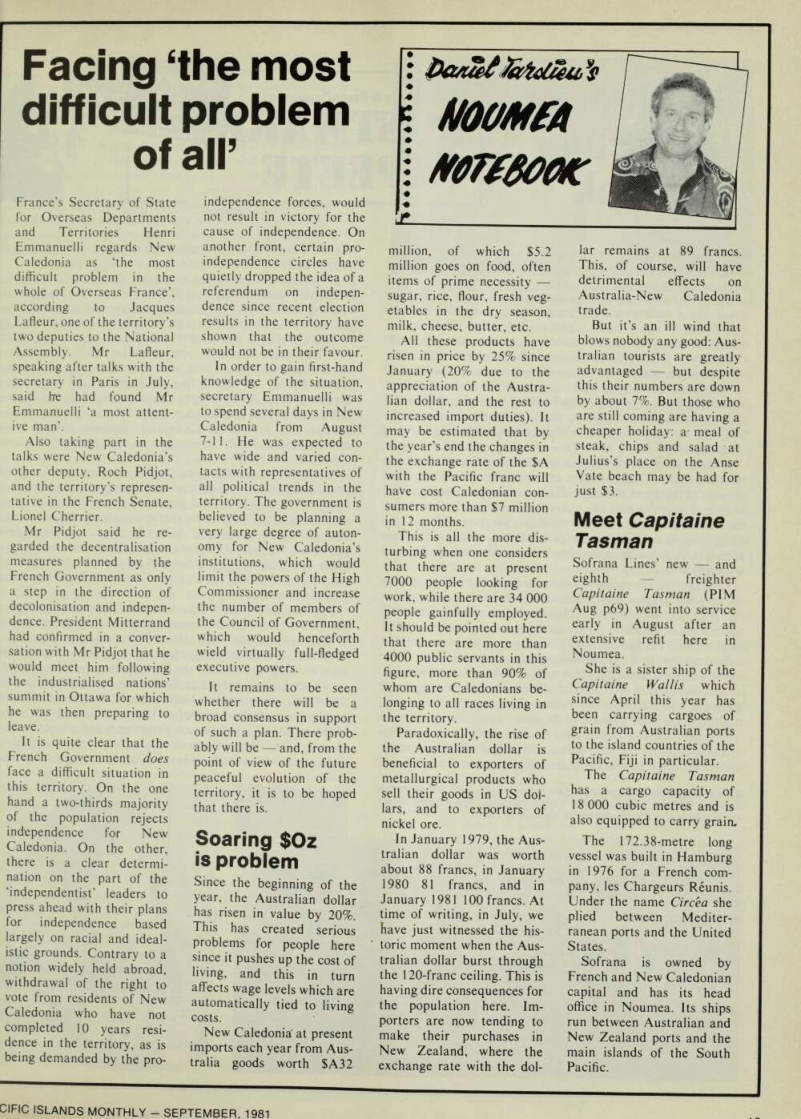
Facing ‘the most difficult problem of all’
France’s Secretary of State for Overseas Departments and Territories Henri Emmanuelli regards New Caledonia as ‘the most difficult problem in the whole of Overseas France’, according to Jacques Lafleur, one of the territory’s two deputies to the National Assembly. Mr Lafleur, speaking after talks with the secretary in Paris in July, said Ire had found Mr Emmanuelli ‘a most attent ive man’.
Also taking part in the talks were New Caledonia’s other deputy, Roch Pidjot, and the territory’s represen tative in the French Senate, Lionel Cherrier.
Mr Pidjot said he re garded the decentralisation measures planned by the French Government as only a step in the direction of decolonisation and indepen dence. President Mitterrand had confirmed in a conver sation with Mr Pidjot that he would meet him following the industrialised nations’ summit in Ottawa for which he was then preparing to leave.
It is quite clear that the French Government does face a difficult situation in this territory. On the one hand a two-thirds majority of the population rejects independence for New Caledonia. On the other, there is a clear determi nation on the part of the ‘independentist’ leaders to press ahead with their plans for independence based largely on racial and ideal istic grounds. Contrary to a notion widely held abroad, withdrawal of the right to vote from residents of New Caledonia who have not completed 10 years resi dence in the territory, as is being demanded by the pro
independence forces, would not result in victory for the cause of independence. On another front, certain pro independence circles have quietly dropped the idea of a referendum on indepen dence since recent election results in the territory have shown that the outcome would not be in their favour.
In order to gain first-hand knowledge of the situation, secretary Emmanuelli was to spend several days in New Caledonia from August 7-11. He was expected to have wide and varied con tacts with representatives of all political trends in the territory. The government is believed to be planning a very large degree of auton omy for New Caledonia’s institutions, which would limit the powers of the High Commissioner and increase the number of members of the Council of Government, which would henceforth wield virtually full-fledged executive powers.
It remains to be seen whether there will be a broad consensus in support of such a plan. There prob ably will be and, from the point of view of the future peaceful evolution of the territory, it is to be hoped that there is.
Soaring sOz
is problem
Since the beginning of the year, the Australian dollar has risen in value by 20%.
This has created serious problems for people here since it pushes up the cost of living, and this in turn affects wage levels which are
automatically tied to living
costs.
New Caledonia' at present imports each year from Aus tralia goods worth SA32
million, of which $5.2 million goes on food, often items of prime necessity sugar, rice, flour, fresh veg etables in the dry season, milk, cheese, butter, etc.
All these products have risen in price by 25% since January (20% due to the appreciation of the Austra lian dollar, and the rest to increased import duties). It may be estimated that by the year’s end the changes in the exchange rate of the $A with the Pacific franc will have cost Caledonian con sumers more than $7 million in 12 months.
This is all the more dis turbing when one considers that there are at present 7000 people looking for work, while there are 34 000 people gainfully employed.
It should be pointed out here that there are more than 4000 public servants in this figure, more than 90% of whom are Caledonians be longing to all races living in the territory.
Paradoxically, the rise of the Australian dollar is beneficial to exporters of metallurgical products who sell their goods in US dol lars, and to exporters of nickel ore.
In January 1979, the Aus tralian dollar was worth about 88 francs, in January 1980 81 francs, and in January 1981 100 francs. At time of writing, in July, we have just witnessed the his toric moment when the Aus tralian dollar burst through the 120-franc ceiling. This is having dire consequences for the population here. Im porters are now tending to make their purchases in New Zealand, where the exchange rate with the dol
lar remains at 89 francs.
This, of course, will have detrimental effects on Australia-New Caledonia trade.
But it’s an ill wind that blows nobody any good: Aus tralian tourists are greatly advantaged but despite this their numbers are down by about 7%. But those who are still coming are having a cheaper holiday; a' meal of steak, chips and salad at Julius’s place on the Anse Vate beach may be had for just $3.
Meet Capit
Tasman
Sofrana Lines’ new and eighth freighter Capitaine Tasman (PIM Aug p 69) went into service early in August after an extensive refit here in Noumea.
She is a sister ship of the Capitaine Wallis which since April this year has been carrying cargoes of grain from Australian ports to the island countries of the Pacific, Fiji in particular.
The Capitaine Tasman has a cargo capacity of 18 000 cubic metres and is also equipped to carry grain.
The 172.38-metre long vessel was built in Hamburg in 1976 for a French com pany, les Chargeurs Reunis.
Under the name Circea she plied between Mediter ranean ports and the United States.
Sofrana is owned by French and New Caledonian capital and has its head office in Noumea. Its ships run between Australian and New Zealand ports and the main islands of the South Pacific.
Advertisements & other items, p. 19 (1 item)
Cific Islands Monthly - September, 1981
Seminar on
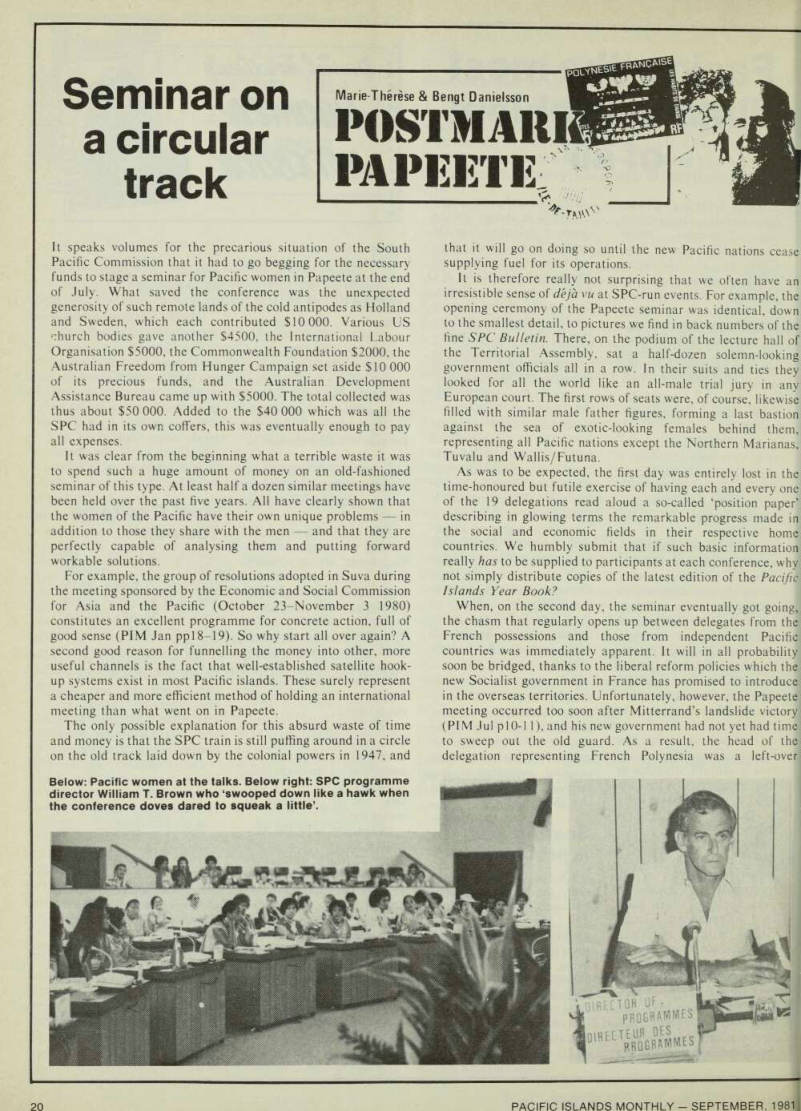
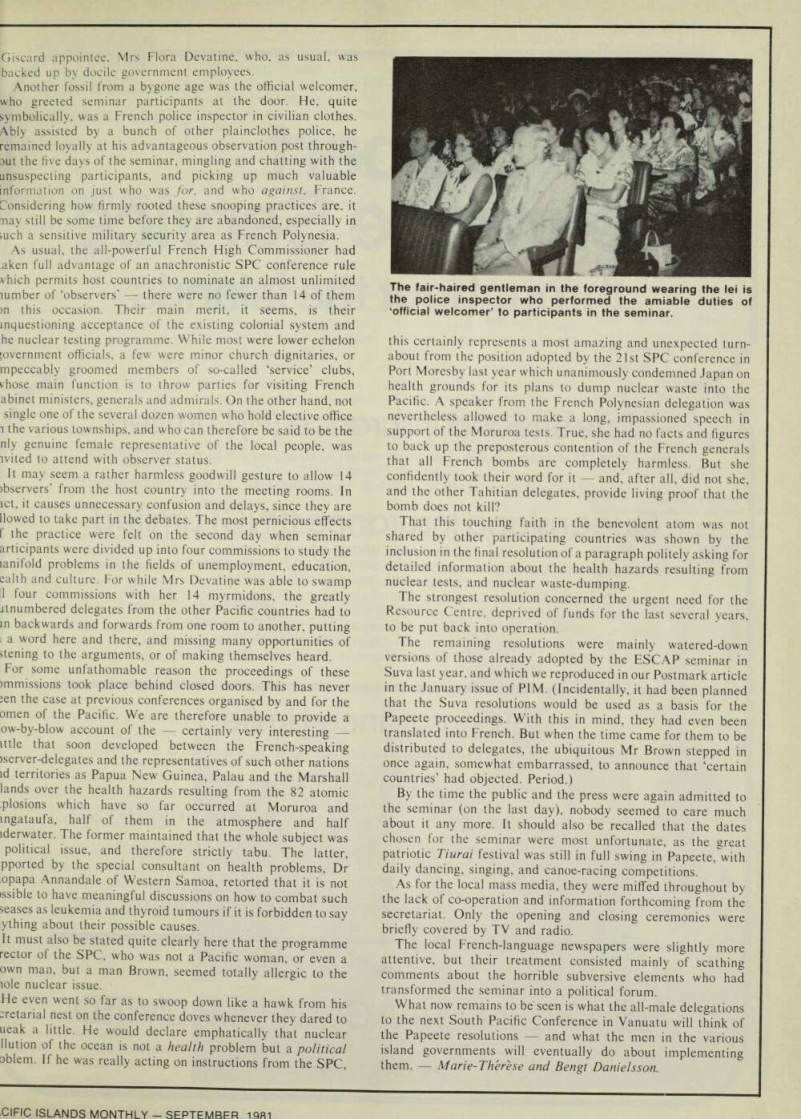
a circular track
It speaks volumes for the precarious situation of the South Pacific Commission that it had to go begging for the necessary funds to stage a seminar for Pacific women in Papeete at the end of July. What saved the conference was the unexpected generosity of such remote lands of the cold antipodes as Holland and Sweden, which each contributed $lO 000. Various US church bodies gave another $4500, the International Labour Organisation $5OOO, the Commonwealth Foundation $2OOO, the Australian Freedom from Hunger Campaign set aside $lO 000 of its precious funds, and the Australian Development Assistance Bureau came up with $5OOO. The total collected was thus about $5O 000. Added to the $4O 000 which was all the SPC had in its own coffers, this was eventually enough to pay all expenses.
It was clear from the beginning what a terrible waste it was to spend such a huge amount of money on an old-fashioned seminar of this type. At least half a dozen similar meetings have been held over the past five years. All have clearly shown that the women of the Pacific have their own unique problems in addition to those they share with the men and that they are perfectly capable of analysing them and putting forward workable solutions.
For example, the group of resolutions adopted in Suva during the meeting sponsored by the Economic and Social Commission for Asia and the Pacific (October 23-November 3 1980) constitutes an excellent programme for concrete action, full of good sense (PIM Jan pplB-19). So why start all over again? A second good reason for funnelling the money into other, more useful channels is the fact that well-established satellite hook up systems exist in most Pacific islands. These surely represent a cheaper and more efficient method of holding an international meeting than what went on in Papeete.
The only possible explanation for this absurd waste of time and money is that the SPC train is still puffing around in a circle on the old track laid down by the colonial powers in 1947, and
that it will go on doing so until the new Pacific nations cease supplying fuel for its operations.
It is therefore really not surprising that we often have an irresistible sense of d'eja vu at SPC-run events. For example, the opening ceremony of the Papeete seminar was identical, down to the smallest detail, to pictures we find in back numbers of the fine SPC Bulletin. There, on the podium of the lecture hall of the Territorial Assembly, sat a half-dozen solemn-looking government officials all in a row. In their suits and ties they looked for all the world like an all-male trial jury in any European court. The first rows of seats were, of course, likewise filled with similar male father figures, forming a last bastion against the sea of exotic-looking females behind them, representing all Pacific nations except the Northern Marianas, Tuvalu and Wallis/Futuna.
As was to be expected, the first day was entirely lost in the time-honoured but futile exercise of having each and every one of the 19 delegations read aloud a so-called ‘position paper’ describing in glowing terms the remarkable progress made in the social and economic fields in their respective home countries. We humbly submit that if such basic information really has to be supplied to participants at each conference, why not simply distribute copies of the latest edition of the Pacific Islands Year Book?
When, on the second day, the seminar eventually got going, the chasm that regularly opens up between delegates from the French possessions and those from independent Pacific countries was immediately apparent. It will in all probability soon be bridged, thanks to the liberal reform policies which the new Socialist government in France has promised to introduce in the overseas territories. Unfortunately, however, the Papeete meeting occurred too soon after Mitterrand’s landslide victory (PIM Jul plO-11), and his new government had not yet had time to sweep out the old guard. As a result, the head of the delegation representing French Polynesia was a left-over i
Below: Pacific women at the talks. Below right: SPC programme director William T. Brown who ‘swooped down like a hawk when the conference doves dared to squeak a little’.
Giscard appointee, Mrs Flora Devatine, who, as usual, was backed up by docile government employees.
Another fossil from a bygone age was the official welcomer, who greeted seminar participants at the door. He, quite symbolically, was a French police inspector in civilian clothes.
Ably assisted by a bunch of other plainclothes police, he remained loyally at his advantageous observation post through 3ut the five days of the seminar, mingling and chatting with the unsuspecting participants, and picking up much valuable information on just who was for, and who against, France.
Considering how firmly rooted these snooping practices are, it nay still be some time before they are abandoned, especially in ;uch a sensitive military security area as French Polynesia.
As usual, the all-powerful French High Commissioner had aken full advantage of an anachronistic SPC conference rule vhich permits host countries to nominate an almost unlimited lumber of ‘observers’ there were no fewer than 14 of them in this occasion. Their main merit, it seems, is their inquestioning acceptance of the existing colonial system and he nuclear testing programme. While most were lower echelon ;overnment officials, a few were minor church dignitaries, or mpeccably groomed members of so-called ‘service’ clubs, vhose main function is to throw parties for visiting French abinet ministers, generals and admirals. On the other hand, not single one of the several dozen women who hold elective office i the various townships, and who can therefore be said to be the nly genuine female representative of the local people, was ivited to attend with observer status.
It may seem a rather harmless goodwill gesture to allow 14 ibservers’ from the host country into the meeting rooms. In ict, it causes unnecessary confusion and delays, since they are flowed to take part in the debates. The most pernicious effects f the practice were felt on the second day when seminar articipants were divided up into four commissions to study the lanifold problems in the fields of unemployment, education, ealth and culture. For while Mrs Devatine was able to swamp 1 four commissions with her 14 myrmidons, the greatly Jtnumbered delegates from the other Pacific countries had to in backwards and forwards from one room to another, putting i a word here and there, and missing many opportunities of Jtening to the arguments, or of making themselves heard.
For some unfathomable reason the proceedings of these immissions took place behind closed doors. This has never Jen the case at previous conferences organised by and for the omen of the Pacific. We are therefore unable to provide a ow-by-blow account of the certainly very interesting ittle that soon developed between the French-speaking iserver-delegates and the representatives of such other nations id territories as Papua New Guinea, Palau and the Marshall lands over the health hazards resulting from the 82 atomic plosions which have so far occurred at Moruroa and mgataufa, half of them in the atmosphere and half iderwater. The former maintained that the whole subject was political issue, and therefore strictly tabu. The latter, pported by the special consultant on health problems, Dr opapa Annandale of Western Samoa, retorted that it is not issible to have meaningful discussions on how to combat such seases as leukemia and thyroid tumours if it is forbidden to say ything about their possible causes.
It must also be stated quite clearly here that the programme rector of the SPC, who was not a Pacific woman, or even a own man, but a man Brown, seemed totally allergic to the lole nuclear issue.
He even went so far as to swoop down like a hawk from his :retarial nest on the conference doves whenever they dared to ueak a little. He would declare emphatically that nuclear Hution of the ocean is not a health problem but a political ablem. If he was really acting on instructions from the SPC,
this certainly represents a most amazing and unexpected turn about from the position adopted by the 21st SPC conference in Port Moresby last year which unanimously condemned Japan on health grounds for its plans to dump nuclear waste into the Pacific. A speaker from the French Polynesian delegation was nevertheless allowed to make a long, impassioned speech in support of the Moruroa tests. True, she had no facts and figures to back up the preposterous contention of the French generals that all French bombs are completely harmless. But she confidently took their word for it and, after all, did not she, and the other Tahitian delegates, provide living proof that the bomb does not kill?
That this touching faith in the benevolent atom was not shared by other participating countries was shown by the inclusion in the final resolution of a paragraph politely asking for detailed information about the health hazards resulting from nuclear tests, and nuclear waste-dumping.
The strongest resolution concerned the urgent need for the Resource Centre, deprived of funds for the last several years, to be put back into operation.
The remaining resolutions were mainly watered-down versions of those already adopted by the ESCAP seminar in Suva last year, and which we reproduced in our Postmark article in the January issue of PIM. (Incidentally, it had been planned that the Suva resolutions would be used as a basis for the Papeete proceedings. With this in mind, they had even been translated into French. But when the time came for them to be distributed to delegates, the übiquitous Mr Brown stepped in once again, somewhat embarrassed, to announce that ‘certain countries’ had objected. Period.) By the time the public and the press were again admitted to the seminar (on the last day), nobody seemed to care much about it any more. It should also be recalled that the dates chosen for the seminar were most unfortunate, as the great patriotic Tiurai festival was still in full swing in Papeete, with daily dancing, singing, and canoe-racing competitions.
As for the local mass media, they were miffed throughout by the lack of co-operation and information forthcoming from the secretariat. Only the opening and closing ceremonies were briefly covered by TV and radio.
The local French-language newspapers were slightly more attentive, but their treatment consisted mainly of scathing comments about the horrible subversive elements who had transformed the seminar into a political forum.
What now remains to be seen is what the all-male delegations to the next South Pacific Conference in Vanuatu will think of the Papeete resolutions and what the men in the various island governments will eventually do about implementing
them.
Marie-Therese and Bengt Danielsson.
The fair-haired gentleman in the foreground wearing the lei is the police inspector who performed the amiable duties of ‘official welcomer’ to participants in the seminar.
Advertisements & other items, pp. 21-22 (3 items)
Ific Islands Monthly - September Iqfii
22
DAr'icir' ici amhq momti-ii v qpptfmrfr IQRI
Expert
Insurance Service
throughout the islands
Queensland Insurance (Fiji) Limited
Head Office, 34 Usher St., SUVA . General Manager: L. G. Liddell A.A.1.1. Assistant Manager: Vijay Lai. Phone: 23851.
LAUTOKA OFFICE: Burns Philp Bldg., Naviti St. District Manager: J. Dalton. Phone: 60642.
Queensland Insurance (PNG) Limited
PAPUA NEW GUINEA
Head Office, B.N.G. Building, Musgrave St.,PORT MORESBY. General Manager: J. M. Dawe.
Assistant Manager: R. V. Maskell. Phone: 212144.
LAE: 4th St. & Coronation Drive. District Manager: I. R. Martin. Phone: 423873.
MOUNT HAGEN: Hagen Drive. District Manager: D. F. Carroll. Phone: 521002.
ARAWA: Chebu St. District Manager: J. Longbut. Phone: 951555.
MADANG: Kasagten St. District Manager: N. D. Ramage. Phone: 822020.
RABAUL: Wirraway St. District Manager: W. F. Tinker. Phone: 921014.
QBE Insurance Limited
VANUATU, PORT VILA: Rue de Paris, Suite 19, Oceania Bldg. Manager: G. F. Donnelly.
Phone: 2299.
SANTO: Burns Philp (Vanuatu) Ltd. Phone: 230.
PACIFIC AGENCIES
NEW CALEDONIA; T. A.Hagen, Ste. W. A. Johnston, S.A.R.L. 5 Rue Anatole France, NOUMEA.
Phone: 272083.
TAHITI: Arthur Chung. Immeuble 8.1.5., Front de Mer, PAPEETE. Phone: 2.86.19.
NIUE: Burns Philp (South Sea) Company Ltd.
NORFOLK ISLAND; Burns Philp (N I) Company Ltd. Phone: 2191.
SAMOA: APIA, Burns Philp (South Sea) Company Ltd. Phone: 22611.
TONGA: Burns Philp (South Sea) Company Ltd. NUKU’ALOFA. Phone 21500 HAAPAI, VAVAU.
MEMBERS OF THE:
QBE INSURANCE GROUP UMUED
grisly box
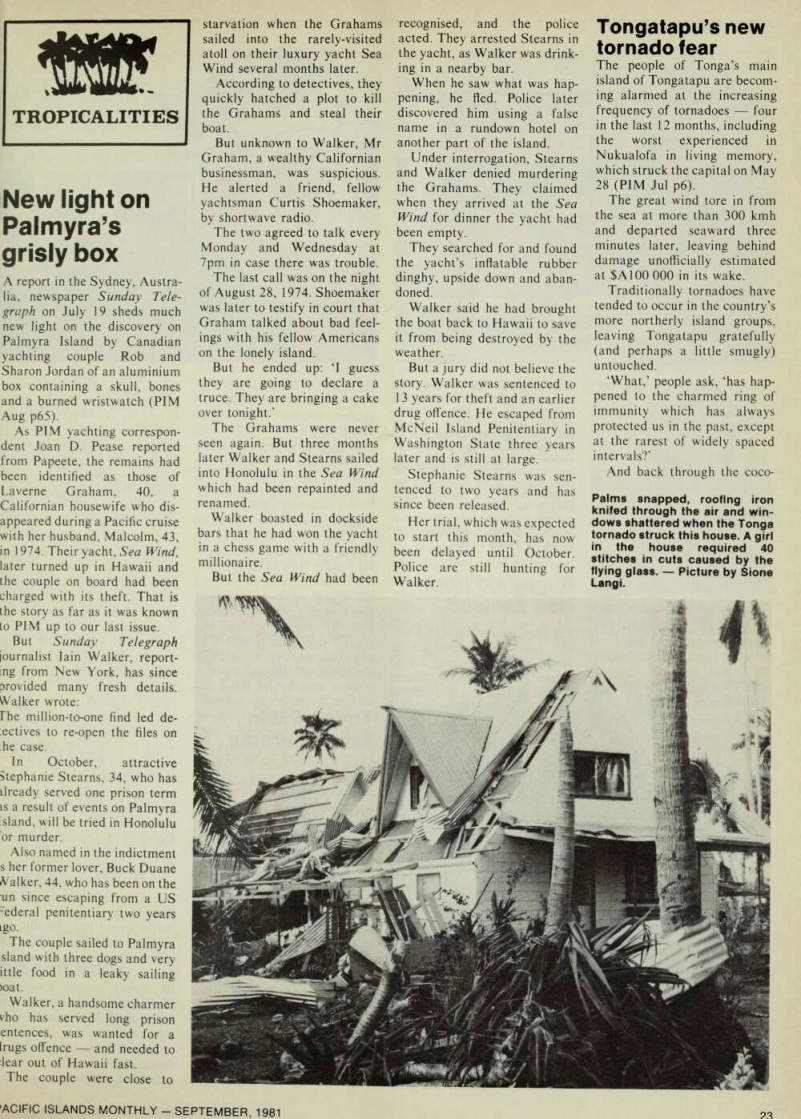
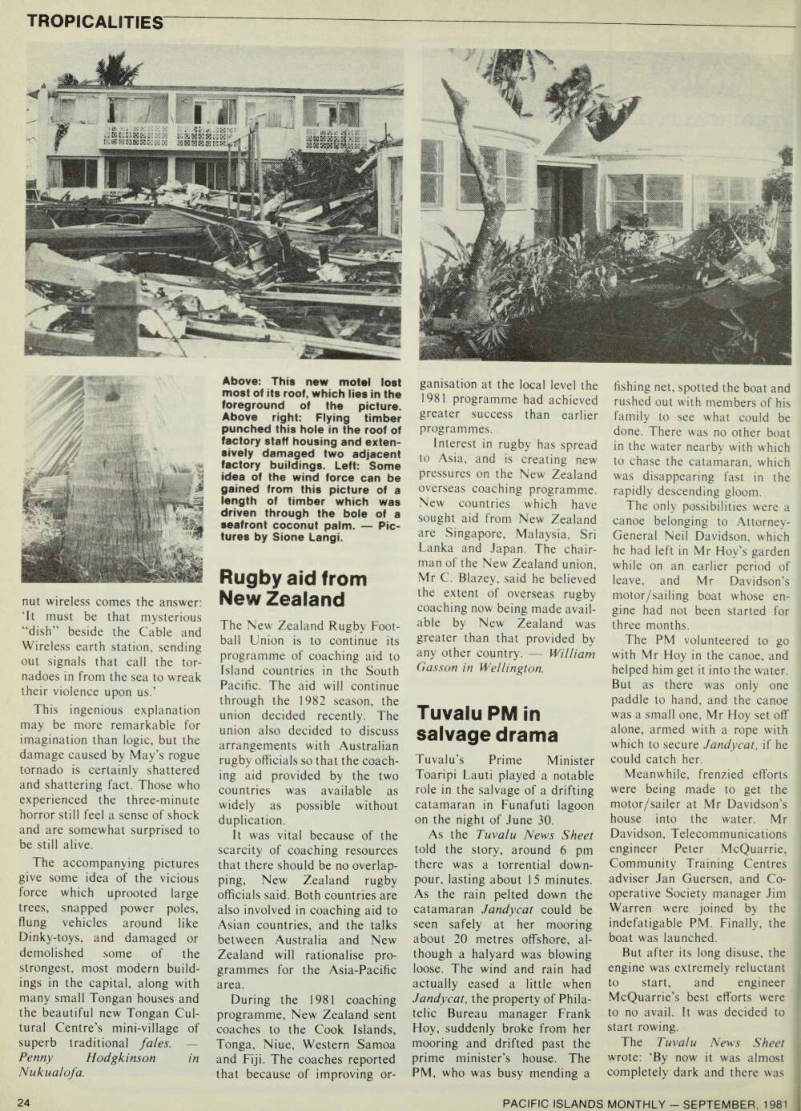
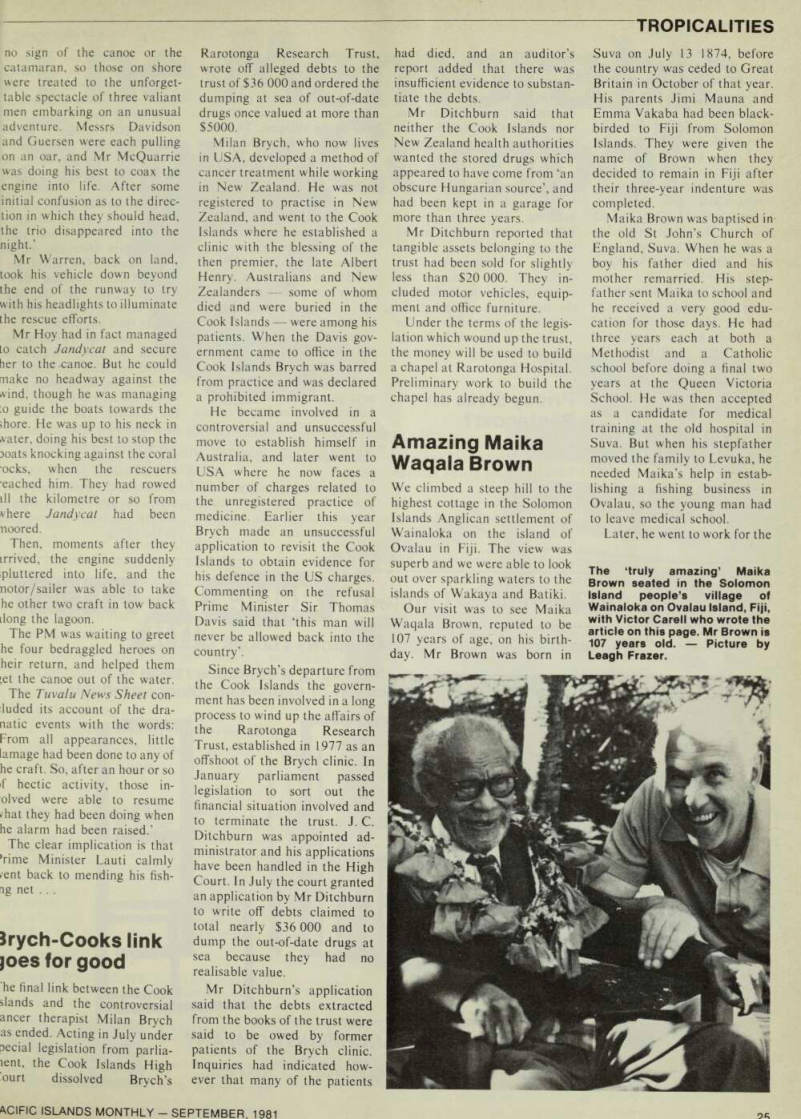

Tropicalities
New light on
Palmyra’s
grisly box
A report in the Sydney, Austra lia, newspaper Sunday Tele graph on July 19 sheds much new light on the discovery on Palmyra Island by Canadian yachting couple Rob and Sharon Jordan of an aluminium box containing a skull, bones and a burned wristwatch (PIM Aug p 65).
As PIM yachting correspon dent Joan D. Pease reported from Papeete, the remains had been identified as those of Laverne Graham, 40, a Californian housewife who dis appeared during a Pacific cruise with her husband, Malcolm, 43, in 1974. Their yacht, Sea Wind, later turned up in Hawaii and the couple on board had been charged with its theft. That is the story as far as it was known to PIM up to our last issue.
But Sunday Telegraph journalist lain Walker, report ing from New York, has since provided many fresh details.
Walker wrote: Fhe million-to-one find led de ;ectives to re-open the files on he case.
In October, attractive Stephanie Stearns, 34, who has dready served one prison term is a result of events on Palmyra sland, will be tried in Honolulu or murder.
Also named in the indictment s her former lover, Buck Duane Walker, 44, who has been on the un since escaping from a US
-ederal penitentiary two years
igo.
The couple sailed to Palmyra sland with three dogs and very ittle food in a leaky sailing >oat.
Walker, a handsome charmer vho has served long prison entences, was wanted for a Irugs offence and needed to lear out of Hawaii fast.
The couple were close to
starvation when the Grahams sailed into the rarely-visited atoll on their luxury yacht Sea Wind several months later.
According to detectives, they quickly hatched a plot to kill the Grahams and steal their boat.
But unknown to Walker, Mr Graham, a wealthy Californian businessman, was suspicious.
He alerted a friend, fellow yachtsman Curtis Shoemaker, by shortwave radio.
The two agreed to talk every Monday and Wednesday at 7pm in case there was trouble.
The last call was on the night of August 28, 1974. Shoemaker was later to testify in court that Graham talked about bad feel ings with his fellow Americans on the lonely island.
But he ended up: T guess they are going to declare a truce. They are bringing a cake over tonight.’
The Grahams were never seen again. But three months later Walker and Stearns sailed into Honolulu in the Sea Wind which had been repainted and renamed.
Walker boasted in dockside bars that he had won the yacht in a chess game with a friendly millionaire.
But the Sea Wind had been
recognised, and the police acted. They arrested Stearns in the yacht, as Walker was drink ing in a nearby bar.
When he saw what was hap pening, he fled. Police later discovered him using a false name in a rundown hotel on another part of the island.
Under interrogation, Stearns and Walker denied murdering the Grahams. They claimed when they arrived at the Sea Wind for dinner the yacht had been empty.
They searched for and found the yacht’s inflatable rubber dinghy, upside down and aban doned.
Walker said he had brought the boat back to Hawaii to save it from being destroyed by the weather.
But a jury did not believe the story. Walker was sentenced to 13 years for theft and an earlier drug offence. He escaped from McNeil Island Penitentiary in Washington State three years later and is still at large.
Stephanie Stearns was sen tenced to two years and has since been released.
Her trial, which was expected to start this month, has now been delayed until October.
Police are still hunting for Walker.
Tongatapu’s new
tornado fear
The people of Tonga’s main island of Tongatapu are becom ing alarmed at the increasing frequency of tornadoes four in the last 12 months, including the worst experienced in Nukualofa in living memory, which struck the capital on May 28 (PIM Jul p 6).
The great wind tore in from the sea at more than 300 kmh and departed seaward three minutes later, leaving behind damage unofficially estimated at SAIOO 000 in its wake.
Traditionally tornadoes have tended to occur in the country’s more northerly island groups, leaving Tongatapu gratefully (and perhaps a little smugly) untouched. ‘What,’ people ask, ‘has hap pened to the charmed ring of immunity which has always protected us in the past, except at the rarest of widely spaced intervals?’
And back through the coco-
Palms snapped, roofing iron knifed through the air and win dows shattered when the Tonga tornado struck this house. A girl in the house required 40 stitches in cuts caused by the
flying glass.-Picture by Sione
Langi.
nut wireless comes the answer: ‘lt must be that mysterious “dish” beside the Cable and Wireless earth station, sending out signals that call the tor nadoes in from the sea to wreak their violence upon us.’
This ingenious explanation may be more remarkable for imagination than logic, but the damage caused by May’s rogue tornado is certainly shattered and shattering fact. Those who experienced the three-minute horror still feel a sense of shock and are somewhat surprised to be still alive.
The accompanying pictures give some idea of the vicious force which uprooted large trees, snapped power poles, flung vehicles around like Dinky-toys, and damaged or demolished some of the strongest, most modern build ings in the capital, along with many small Tongan houses and the beautiful new Tongan Cul tural Centre’s mini-village of superb traditional fales.
Penny Hodgkinson in Nukualofa.
Rugby aid from
New Zealand
The New Zealand Rugby Foot ball Union is to continue its programme of coaching aid to Island countries in the South Pacific. The aid will continue through the 1982 season, the union decided recently. The union also decided to discuss arrangements with Australian rugby officials so that the coach ing aid provided by the two countries was available as widely as possible without duplication.
It was vital because of the scarcity of coaching resources that there should be no overlap ping, New Zealand rugby officials said. Both countries are also involved in coaching aid to Asian countries, and the talks between Australia and New Zealand will rationalise pro grammes for the Asia-Pacific area.
During the 1981 coaching programme, New Zealand sent coaches to the Cook Islands, Tonga, Niue, Western Samoa and Fiji. The coaches reported that because of improving or-
ganisation at the local level the 1981 programme had achieved greater success than earlier programmes.
Interest in rugby has spread to Asia, and is creating new pressures on the New Zealand overseas coaching programme.
New countries which have sought aid from New Zealand are Singapore, Malaysia, Sri Lanka and Japan. The chair man of the New Zealand union, Mr C. Blazey, said he believed the extent of overseas rugby coaching now being made avail able by New Zealand was greater than that provided by any other country. William Gas son in Wellington.
Tuvalu PM in
salvage drama
Tuvalu’s Prime Minister Toaripi Lauti played a notable role in the salvage of a drifting catamaran in Funafuti lagoon on the night of June 30.
As the Tuvalu News Sheet told the story, around 6 pm there was a torrential down pour, lasting about 15 minutes.
As the rain pelted down the catamaran Jandycat could be seen safely at her mooring about 20 metres offshore, al though a halyard was blowing loose. The wind and rain had actually eased a little when Jandycat, the property of Phila telic Bureau manager Frank Hoy, suddenly broke from her mooring and drifted past the prime minister’s house. The PM, who was busy mending a
fishing net, spotted the boat and rushed out with members of his family to see what could be done. There was no other boat in the water nearby with which to chase the catamaran, which was disappearing fast in the rapidly descending gloom.
The only possibilities were a canoe belonging to Attorney- General Neil Davidson, which he had left in Mr Hoy’s garden while on an earlier period of leave, and Mr Davidson’s motor/sailing boat whose en gine had not been started for three months.
The PM volunteered to go with Mr Hoy in the canoe, and helped him get it into the water.
But as there was only one paddle to hand, and the canoe was a small one, Mr Hoy set off alone, armed with a rope with which to secure Jandycat, if he could catch her.
Meanwhile, frenzied efforts were being made to get the motor/sailer at Mr Davidson’s house into the water. Mr Davidson, Telecommunications engineer Peter McQuarrie, Community Training Centres adviser Jan Guersen, and Co operative Society manager Jim Warren were joined by the indefatigable PM. Finally, the boat was launched.
But after its long disuse, the engine was extremely reluctant to start, and engineer McQuarrie’s best efforts were to no avail. It was decided to start rowing.
The Tuvalu News Sheet wrote: ‘By now it was almost completely dark and there was
Above: This new motel lost most of its roof, which lies in the foreground of the picture.
Above right: Flying timber punched this hole in the roof of factory staff housing and exten sively damaged two adjacent factory buildings. Left: Some idea of the wind force can be gained from this picture of a length of timber which was driven through the bole of a seafront coconut palm.-Pic tures by Sione Langi.
no sign of the canoe or the catamaran, so those on shore were treated to the unforget table spectacle of three valiant men embarking on an unusual adventure. Messrs Davidson and Guersen were each pulling on an oar, and Mr McQuarrie was doing his best to coax the engine into life. After some initial confusion as to the direc tion in which they should head, the trio disappeared into the night.’
Mr Warren, back on land, took his vehicle down beyond the end of the runway to try with his headlights to illuminate the rescue efforts.
Mr Hoy had in fact managed to catch Jandycat and secure her to the.canoe. But he could make no headway against the kvind, though he was managing ;o guide the boats towards the >hore. He was up to his neck in -vater, doing his best to stop the Doats knocking against the coral •ocks, when the rescuers •cached him. They had rowed ill the kilometre or so from vhere Jandycat had been moored.
Then, moments after they irrived, the engine suddenly fluttered into life, and the notor/sailer was able to take he other two craft in tow back Jong the lagoon.
The PM was waiting to greet he four bedraggled heroes on heir return, and helped them ;et the canoe out of the water.
The Tuvalu News Sheet con luded its account of the dra natic events with the words: From all appearances, little lamage had been done to any of he craft. So, after an hour or so f hectic activity, those in olved were able to resume /hat they had been doing when he alarm had been raised.’
The clear implication is that Time Minister Lauti calmly /ent back to mending his fish ig net .. .
Jrych-Cooks link
joes for good
he final link between the Cook slands and the controversial
ancer therapist Milan Brych
as ended. Acting in July under aecial legislation from parlia ment, the Cook Islands High ourt dissolved Brych’s
Rarotonga Research Trust, wrote off alleged debts to the trust of $36 000 and ordered the dumping at sea of out-of-date drugs once valued at more than
$5Ooo.
Milan Brych, who now lives in USA, developed a method of cancer treatment while working in New Zealand. He was not registered to practise in New Zealand, and went to the Cook Islands where he established a clinic with the blessing of the then premier, the late Albert Henry. Australians and New Zealanders some of whom died and were buried in the Cook Islands were among his patients. When the Davis gov ernment came to office in the Cook Islands Brych was barred from practice and was declared a prohibited immigrant.
He became involved in a controversial and unsuccessful move to establish himself in Australia, and later went to USA where he now faces a number of charges related to the unregistered practice of medicine. Earlier this year Brych made an unsuccessful application to revisit the Cook Islands to obtain evidence for his defence in the US charges.
Commenting on the refusal Prime Minister Sir Thomas Davis said that ‘this man will never be allowed back into the country’.
Since Brych’s departure from the Cook Islands the govern ment has been involved in a long process to wind up the affairs of the Rarotonga Research Trust, established in 1977 as an offshoot of the Brych clinic. In January parliament passed legislation to sort out the financial situation involved and to terminate the trust. J. C.
Ditchburn was appointed ad ministrator and his applications have been handled in the High Court. In July the court granted an application by Mr Ditchburn to write off debts claimed to total nearly $36 000 and to dump the out-of-date drugs at sea because they had no realisable value.
Mr Ditchburn’s application said that the debts extracted from the books of the trust were said to be owed by former patients of the Brych clinic.
Inquiries had indicated how ever that many of the patients
had died, and an auditor’s report added that there was insufficient evidence to substan tiate the debts.
Mr Ditchburn said that neither the Cook Islands nor New Zealand health authorities wanted the stored drugs which appeared to have come from ‘an obscure Hungarian source’, and had been kept in a garage for more than three years.
Mr Ditchburn reported that tangible assets belonging to the trust had been sold for slightly less than $2O 000. They in cluded motor vehicles, equip ment and office furniture.
Under the terms of the legis lation which wound up the trust, the money will be used to build a chapel at Rarotonga Hospital.
Preliminary work to build the chapel has already begun.
Amazing Maika
Waqala Brown
We climbed a steep hill to the highest cottage in the Solomon Islands Anglican settlement of Wainaloka on the island of Ovalau in Fiji. The view was superb and we were able to look out over sparkling waters to the islands of Wakaya and Batiki.
Our visit was to see Maika Waqala Brown, reputed to be 107 years of age, on his birth day. Mr Brown was born in
Suva on July 13 1874, before the country was ceded to Great Britain in October of that year.
His parents Jimi Mauna and Emma Vakaba had been black birded to Fiji from Solomon Islands. They were given the name of Brown when they decided to remain in Fiji after their three-year indenture was completed.
Maika Brown was baptised in the old St John’s Church of England, Suva. When he was a boy his father died and his mother remarried. His step father sent Maika to school and he received a very good edu cation for those days. He had three years each at both a Methodist and a Catholic school before doing a final two years at the Queen Victoria School. He was then accepted as a candidate for medical training at the old hospital in Suva. But when his stepfather moved the family to Levuka, he needed Maika’s help in estab lishing a fishing business in Ovalau, so the young man had to leave medical school.
Later, he went to work for the
The ‘truly amazing’ Maika Brown seated in the Solomon Island people's village of Wainaloka on Ovalau Island, Fiji, with Victor Carell who wrote the article on this page. Mr Brown is 107 years old. - Picture by Leagh Frazer.
Morris Hedstrom company in their store in Levuka. He stayed with this company for the rest of his working life. At first he was working in Levuka but in 1916 he transferred for eight years to the firm’s branch store in Loma Loma village on Vanuabalavu. That same year he met and married a Vanuabalavu girl, Merelita.
She was only 16. They had 13 children. The oldest now living is 64, and the youngest, with whom Maika lives, is Joe Kaua Brown who is now 40.
While in Vanuabalavu Maika helped the lone doctor there to care for the vast number of people who became ill with the ’flu epidemic of 1918. In 1923 Maika and his wife returned to Levuka where he again worked with the Morris Hedstrom store. On retirement he was granted a small monthly pen sion. This was wound up in 1980 with the payment of a lump sum.
Mr Brown is truly amazing.
He was a lay reader and preacher with the Church of England in Levuka for 64 years.
His command of English is exceptional, and his memory sharp. He can quote long sec tions of the Bible and delights in reciting one psalm after another to be followed by excerpts from the Book of Moses, with no hesitation whatever.
When we were leaving this kindly old man with his wonder ful sense of humour, he was bubbling with high spirits.
When I asked how he felt he shouted; ‘I feel fine ... I feel strong ... I can even do a dance. He did only a few small steps, kicking his heels to the side before accepting the reassuring support of his son Joe • • • But then, after all, he is only
107 years young.
Victor
Corel I in Levuka.
Pricey dives on
Pentecost?
Is a visit to the famous land dives on the island of Pentecost, Vanuatu, being priced through the roof?
The question is posed by the weekly Voice of Vanuatu, which wrote of the late-May
event: ‘To visit the villages of Pentecost at the time of the land-dives isn’t cheap. But about half the money (this year VTI6 000, or about SAI6O) goes to the villagers. This one time-a-year event is the largest source of income for the vil lagers. ‘But having paid the charge, no one seems to be dissatisfied with the weekend spectacle. ‘While some think that if the villagers are prepared to stage the event for outsiders they are entitled to the money, others believe the price has been put up to keep the number of visitors down.’
Dives took place this year at Wali and Bunlap. But Pentecost sources say that these two villages may have competition next year from the villagers of Point Cross. Voice of Vanuatu commented: ‘This could bring an end to the price increases, which have been rapid in recent years.’
A significant feature of this year’s dives was that tourist accommodation was available in some places.
The Port-Vila weekly summed up; ‘lf the land-dives were to coincide with a walking holiday of Pentecost, general
sight-seeing and enjoying the
local hospitality, then it would make the holiday price reason able. And it seems that the villagers are encouraging this to happen.’
At the Bunlap dives, on the first of the 15 dives, the diver landed with only one rope holding him after the second had snapped. One diver was hurt. Another backed down from jumping. But the final jump drew greater shrieks of delight than any other.
As Voice of Vanuatu de scribed it: ‘Diver Watas Bu needed no stick to help him balance from the highest point of the tower. He chanted with the dancers. He waved his outstretched arms, clapped, slapped his thighs and made the dive still chanting. ’He chanted as he landed.
Then in true traditional style, the Big Men of Bunlap invited spectators to have food in the village.’
Advertisements & other items, pp. 23-28 (3 items)
23
’ACIFIC ISLANDS MONTHLY - SEPTEMBER, 1981
Tropicalities
25
ACIFIC ISLANDS MONTHLY - SEPTEMBER 1981
lAnsHer
//t u tin
AHI Aluminium Limited
MARKET LEADERS IN ALUMINIUM WINDOWS & DOORS
lAnsHer
iim
Designers and manufacturers marketing a complete range of extrusions and components for fabrication of aluminium joinery products. r. m / * A
FOR FURTHER INFORMATION CONTACT
AHI ALUMINIUM FRANCHISING COMPANY
P O BOX 18299, AUCKLAND. NEW ZEALAND TELEPHONE; 580 704 CABLES AHIAL TELEX: 2222
The Memorable
Compo!
si 1)111 1)1! m 3 » u 1 1 A jewel reveals the beauty of light and Sansuis micro computer IC’s reveal the beauty of music.
Sansui s Super Compo stereo system has micro-computer memories to make music listening unforgettable. Stereo is now simpler and more fun.
Just push buttons and you’ve programmed any seven selections on a record in any order you like. Wonderful conveniences of the FM/AM tuner include Digital Quartz- PLL Synthesizer tuning and pushbutton selection of any 6 FM and any 6 AM pre-set stations.
Microcomputer delights of the
cassette deck are full-logic and Automatic Music Program Search. Wireless remote control is a nice option, and so is
the versatile Graphic Equalizer/Reverb/
Mixer Consolette.
Just push a button for memorable
music. Memorable Super Compo by the
hi-fi specialist, Sansui.
WEWCOWPO QQAQ FR-D 55: Computerized Track Sequence Selection Full Auto DD Turntable RS-7: Infrared Remote Control System RG-7: Stereo Graphic Equalizer Consolette with reverb/mixer T-9i Digital Quartz-PLL Synthesizer Tuner with 12 FM/AM Station Pre-sets and Auto Search Tuning A-9: Integrated DC-Servo Amplifier, 65W RMS x 2 D-300M: Full-logic Metal-Compatible Cassette Deck GX-95: Audio Cabinet with Headphone Jack S-65: 4-Way Speaker System 12-3/8" Woofer, 105 W SANSUI ELECTRIC CO., LTD.I4-1 Izumi 2-chome, Suginami-ku, Tokyo 168 Japan • Australia VANFI (Aust.) Pty. Ltd. 297, City Road, South Melbourne, Victoria 3205, Australia Phone. 690-6200/283 Alfred Street, North Sydney, N.S.W. 2060, Australia Phone: 929-0293 • Fin Prabhu Brothers Ltd. P.O. Box 183, Nadi Phone: 70183/4 • Papua New Guinea Oceania Indent Agency (P.N.G.) Pty. Ltd. Box 5518, Boroko, Port Moresby Phone: PM 256406 • New Zealand David Reid ectromcs Ltd. C.P.O. Box 2630, Auckland, 1 Phone: 491-489 • New Caledonia Ets Michel MERCIER i , " 2 o L NOUm6a Phone: 27 59 ' 11 * South Pacific Maoris Department Stores Limited P.O. Box 146 Norfolk Island 2899 Phone: 2161 • Central Pacific Nauru Co-operative Society Republic of Nauru • Vanuatu The Sound Centre P.O Box 3338 p o ho^' la 26979 e: UnitBd ‘ Sland Trad6rS L ‘ d ' P ° B ° X 1& 2 ' Raroton 9 a * Tahltl SIMEL
'PPISE SEA
wmrtj.MAi t« n *** **
COBOL! S£ ISLANDS I
7 .ci LB£ RT ' f rr' ferr: NA // T «“ «■ 1... E»£>.» / **"
/ TUVALU /«•«
/ v \ \ / «••—»>• H.- \ V \
/ELUCE . . \ \ v
V TOWftLAU iSLAKftV
/ ISLANDS ’ r«lw \.
/ ***"« \ \ \„„ Jfcy»_c.». t. s ®w
-Vu \ APIA sV«OA ISLANDS^
/ S«». !«• *-pi- **<,» (•*,»•* vV. r
OUINKA
•WfiM I >.» <t*\ faMM 'L. ~.T L ‘£3 / rufifejSt y^*«
NEW* HEBRIDES . TW-*> ,
*""* Suva*- A ,' (— — • v »- L j%, :\.. ■Sfr u .„ western /
SAMOA I
■7 / OA
NU*C
M c A N Lift £ r S H A A <A QM series 20-33 HP / •M / 0 1/ C HAE series 165-300 HP In the Pacific, the message is diesel. Diesel engines are delivering everything they promise in the way of compact, clean, economical power.
They are helping island economies flourish.
The tough, non-compromise, high torque of Yanmar diesels is enabling longer range fishing operations, a broader range of fishing techniques, shorter landed time, and modern power generation on shore for storage, lighting and a dozen other jobs.
The benefits of the diesel can be applied more readily and more efficiently, and with more savings, than any other form of economical power.
Today’s Yanmar diesel engine is a modern, super-refined, highly durable worker.
For any Pacific community, today’s message is diesel, the medium is Yanmar. J Q
i SWM
& i m 5000 HP world uses
YANMAR
ENGINE
1-1, 2-chome, Yaesu, Chuo-ku, Tokyo 104, Japan Cable: YANMAR TOKYO Telex: 0222-2310,0222-4733
Image in
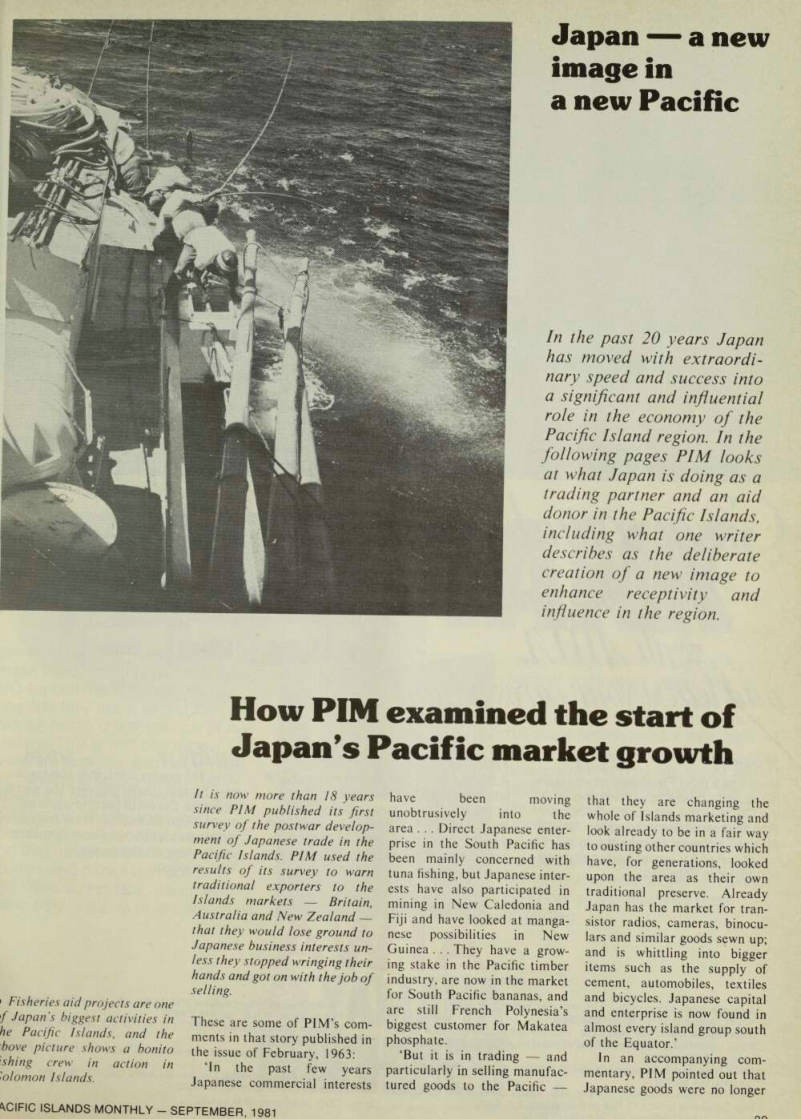
Japan a new
a new Pacific
In the past 20 years Japan has moved with extraordi nary speed and success into a significant and influential role in the economy of the Pacific Island region. In the following pages PIM looks at what Japan is doing as a trading partner and an aid donor in the Pacific Islands, including what one writer describes as the deliberate creation of a new image to enhance receptivity and influence in the region.
Japan’s Pacific market growth
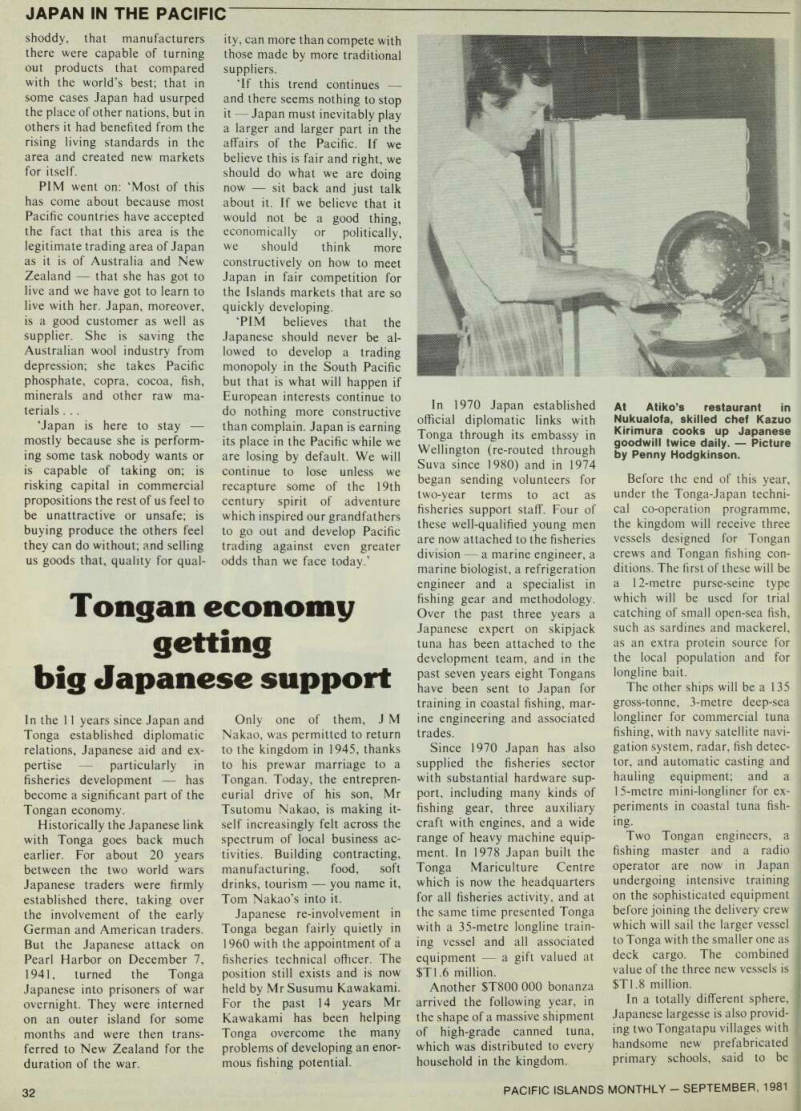
How PIM examined the start of Japan’s Pacific market growth
' Fisheries aid projects are one •f Japans biggest activities in he Pacific Islands, and the ove picture shows a bonito shing crew in action in o omon Islands.
It is now more than 18 years since PIM published its first survey of the postwar develop ment of Japanese trade in the Pacific Islands. PIM used the results of its survey to warn traditional exporters to the Islands markets Britain, Australia and New Zealand that they would lose ground to Japanese business interests un less they stopped wringing their hands and got on with the job of selling.
These are some of PlM’s com ments in that story published in the issue of February, 1963: ‘ln the past few years Japanese commercial interests
have been moving unobtrusively into the area . . . Direct Japanese enterprise in the South Pacific has been mainly concerned with tuna fishing, but Japanese interests have also participated in mining in New Caledonia and Fiji and have looked at manganese possibilities in New Guinea . .. They have a growing stake in the Pacific timber industry, are now in the market for South Pacific bananas, and are still French Polynesia’s biggest customer for Makatea phosphate.
But it is in trading and particularly in selling manufactured goods to the Pacific
that they are changing the whole of Islands marketing and look already to be in a fair way to ousting other countries which have, for generations, looked upon the area as their own traditional preserve. Already Japan has the market for tran sistor radios, cameras, binocu lars and similar goods sewn up; and is whittling into bigger items such as the supply of cement, automobiles, textiles and bicycles. Japanese capital and enterprise is now found in almost every island group south 0 f the Equator.’
In an accompanying com mentary, PIM pointed out that Japanese goods were no longer
Japan In The Pacific
shoddy, that manufacturers there were capable of turning out products that compared with the world’s best; that in some cases Japan had usurped the place of other nations, but in others it had benefited from the rising living standards in the area and created new markets for itself.
PIM went on: ‘Most of this has come about because most Pacific countries have accepted the fact that this area is the legitimate trading area of Japan as it is of Australia and New Zealand that she has got to live and we have got to learn to live with her. Japan, moreover, is a good customer as well as supplier. She is saving the Australian wool industry from depression; she takes Pacific phosphate, copra, cocoa, fish, minerals and other raw ma terials . . . ‘Japan is here to stay mostly because she is perform ing some task nobody wants or is capable of taking on; is risking capital in commercial propositions the rest of us feel to be unattractive or unsafe; is buying produce the others feel they can do without; and selling us goods that, quality for qual
ity, can more than compete with those made by more traditional suppliers.
Tf this trend continues and there seems nothing to stop it Japan must inevitably play a larger and larger part in the affairs of the Pacific. If we believe this is fair and right, we should do what we are doing now sit back and just talk about it. If we believe that it would not be a good thing, economically or politically, we should think more constructively on how to meet Japan in fair competition for the Islands markets that are so
quickly developing.
‘PIM believes that the Japanese should never be al lowed to develop a trading monopoly in the South Pacific but that is what will happen if European interests continue to do nothing more constructive than complain. Japan is earning its place in the Pacific while we are losing by default. We will continue to lose unless we recapture some of the 19th century spirit of adventure which inspired our grandfathers to go out and develop Pacific trading against even greater odds than we face today.’
Advertisements & other items, pp. 29-31 (2 items)
<\Cific Islands Monthly September, 1981
Aiwa
0
Take asongakng
and leave your ca
2s.
CS-J 1
HS-F1
HS-P1
TUNE IT CS J 1
Here’s beautiful FM stereo as you walk along, with cassette sounds too. And the CS-J 1 is the only pocket-size portable that records stereo tapes directly off the FM tuner! Compact folding headphones for easier portability and comfortable listening.
TAPE IT
A built-in one-point stereo microphone lets you make live stereo recordings at the touch of a button. This lightweight model can also dub tapes from a hi-fi amplifier via stereo connection cords. Metal tape capable for recording and playback.
ENJOY IT HS-P1
Only 345 grams light, this playbackonly budget model delivers the same beautiful cassette performance as other AIWA portables. Wide frequency response (metal-capable too) means you’ll enjoy all the music.
Take it along!
AIWA for craftsmanship
AIWA
AIWA CO., LTD. 11-9, Ueno 1-chome, Taito-ku, Tokyo, Japan.
Australia AIWA Australia Pty., Ltd., P.O. Box 339, Rockdale, N.S.W., Australia 2216 Tel: 597-2388/2808 Cook Islands Island Merchants Ltd., P.O. Box 69, Rarotonga, Cook Islands Fiji D. Ranchhod & Company, Corner or Vidilo St. & Vitogo PDE, P.O. Box 18, Lautoka. Fiji Tel: 60227 Fiji D. Ranchhod & Company, Corner of Vidilo St. & Vitogo PDE, P.O. Box 18, Lautoka, Fiji Tel: 60227 Guam Micropac Audio, Inc., P.O. Box 3478, Agana, Guam 96910 Tel: 472-8091 New Caledonia hifivox; 79 Rue de Sebastopol, B.P. 1458, Noumea, New Caledonia Tel: 27 24 66 et 28 29 31 P.N.G. Oceania Indent Agency (P.N.G.) Pty., Ltd., Box 5518, Boroko, Port Moresby, P.N.G. Tel: PM 256406 Solomon Islands Harvest Pacific Ltd., G.P.O. 517, Honiara, Solomon Islands Tel: 718 Tahiti Fare Hi-Fi Stereo, Rue de Marechal Foch, P.O. Box 269, Papeete, Tahiti R C 6604 A Vanuatu (New Hebrides) The Sound Centre Ltd., P.O. Box 434, Vila, Vanuatu (New Hebrides) Tel: 2035
Is ' -v Si ■a aps : mm
THINK TANK
'amaha engineers still play with nodel boats in a tub. But their tub sn’t for bathing. It’s many meters )ng and they use it to test the ydrodynamic characteristics of hull esigns. This is just one aspect of amaha’s sophisticated design and ngineering program which has eveloped more than 1000 different ull shapes. These range from Decialized craft for offshore fishing id trim runabouts to ocean-going awlers and blue-water racers. ie Yamaha test tank, along with any other aspects of the design program, makes use of a sophisticated bank of computers which take much of the guesswork out of boat development. At later stages, Yamaha builds full-scale prototypes for their big test tank the Pacific Ocean. And only after passing a rigorous set of sea trials does a prototype enter the production stage.
Computers and a common sense approach to building the kind of boats people want. That’s Yamaha. The company that specialises in making living easier and lifestyles more rewarding.
YAMAHA
YAMAHA MOTOR CO.. LTD. !5 00 sm«g». iw»>.shi Shizuoka-ken jm.
Tongan economy
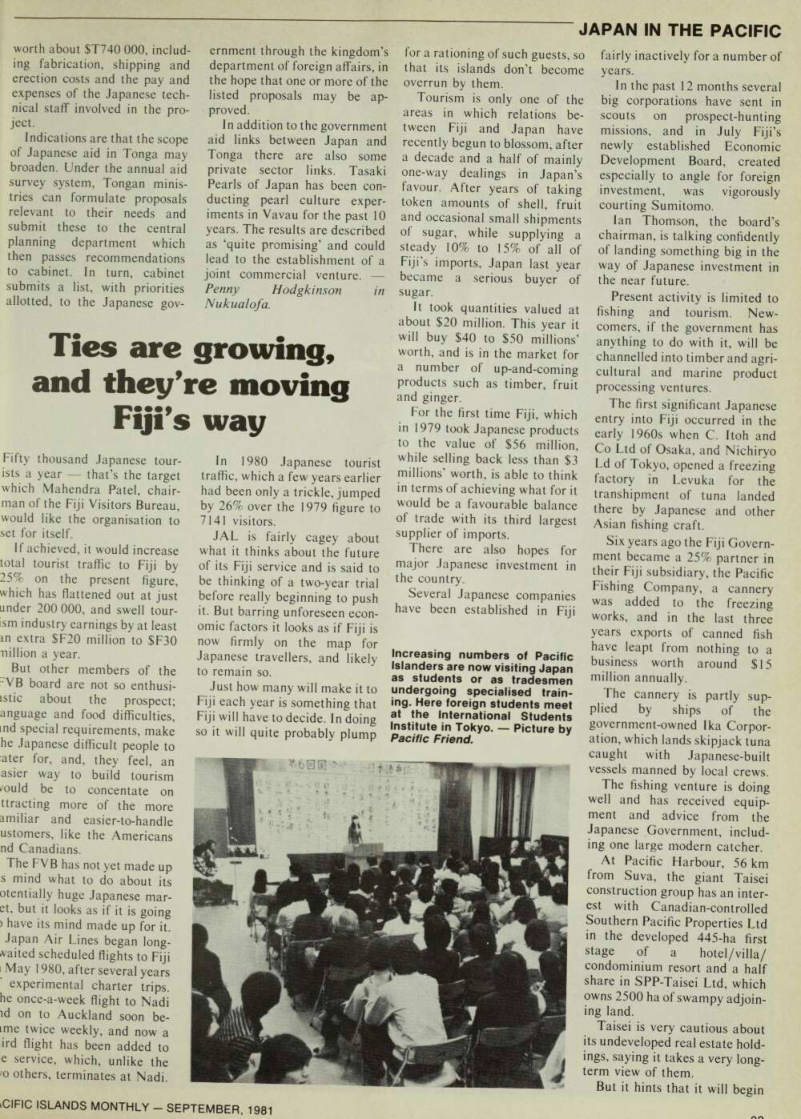
getting big Japanese support
In the 11 years since Japan and Tonga established diplomatic relations, Japanese aid and ex pertise particularly in fisheries development has become a significant part of the Tongan economy.
Historically the Japanese link with Tonga goes back much earlier. For about 20 years between the two world wars Japanese traders were firmly established there, taking over the involvement of the early German and American traders.
But the Japanese attack on Pearl Harbor on December 7, 1941, turned the Tonga Japanese into prisoners of war overnight. They were interned on an outer island for some months and were then trans ferred to New Zealand for the duration of the war.
Only one of them, J M Nakao, was permitted to return to the kingdom in 1945, thanks to his prewar marriage to a Tongan. Today, the entrepren eurial drive of his son, Mr Tsutomu Nakao, is making it self increasingly felt across the spectrum of local business ac tivities. Building contracting, manufacturing, food, soft drinks, tourism you name it, Tom Nakao’s into it.
Japanese re-involvement in Tonga began fairly quietly in 1960 with the appointment of a fisheries technical officer. The position still exists and is now held by Mr Susumu Kawakami.
For the past 14 years Mr Kawakami has been helping Tonga overcome the many problems of developing an enor mous fishing potential.
In 1970 Japan established official diplomatic links with Tonga through its embassy in Wellington (re-routed through Suva since 1980) and in 1974 began sending volunteers for two-year terms to act as fisheries support staff. Four of these well-qualified young men are now attached to the fisheries division a marine engineer, a marine biologist, a refrigeration engineer and a specialist in fishing gear and methodology.
Over the past three years a Japanese expert on skipjack tuna has been attached to the development team, and in the past seven years eight Tongans have been sent to Japan for training in coastal fishing, mar ine engineering and associated trades.
Since 1970 Japan has also supplied the fisheries sector with substantial hardware sup port, including many kinds of fishing gear, three auxiliary craft with engines, and a wide range of heavy machine equip ment. In 1978 Japan built the Tonga Mariculture Centre which is now the headquarters for all fisheries activity, and at the same time presented Tonga with a 35-metre longline train ing vessel and all associated equipment a gift valued at STI.6 million.
Another STBOO 000 bonanza arrived the following year, in the shape of a massive shipment of high-grade canned tuna, which was distributed to every household in the kingdom.
Before the end of this year, under the Tonga-Japan techni cal co-operation programme, the kingdom will receive three vessels designed for Tongan crews and Tongan fishing con ditions. The first of these will be a 12-metre purse-seine type which will be used for trial catching of small open-sea fish, such as sardines and mackerel, as an extra protein source for the local population and for longline bait.
The other ships will be a 135 gross-tonne, 3-metre deep-sea longliner for commercial tuna fishing, with navy satellite navi gation system, radar, fish detec tor, and automatic casting and hauling equipment; and a 15-metre mini-longliner for ex periments in coastal tuna fish ing.
Two Tongan engineers, a fishing master and a radio operator are now in Japan undergoing intensive training on the sophisticated equipment before joining the delivery crew which will sail the larger vessel to Tonga with the smaller one as deck cargo. The combined value of the three new vessels is STI.B million.
In a totally different sphere, Japanese largesse is also provid ing two Tongatapu villages with handsome new prefabricated primary schools, said to be
At Atiko’s restaurant in Nukualofa, skilled chef Kazuo Kirimura cooks up Japanese goodwill twice daily.-Picture by Penny Hodgkinson.
worth about ST74O 000, includ ing fabrication, shipping and erection costs and the pay and expenses of the Japanese tech nical staff involved in the pro ject.
Indications are that the scope of Japanese aid in Tonga may broaden. Under the annual aid survey system, Tongan minis tries can formulate proposals relevant to their needs and submit these to the central planning department which then passes recommendations to cabinet. In turn, cabinet submits a list, with priorities allotted, to the Japanese gov
ernment through the kingdom’s department of foreign affairs, in the hope that one or more of the listed proposals may be ap proved.
In addition to the government aid links between Japan and Tonga there are also some private sector links. Tasaki Pearls of Japan has been con ducting pearl culture exper iments in Vavau for the past 10 years. The results are described as ‘quite promising’ and could lead to the establishment of a joint commercial venture.
Penny Hodgkinson in Nukualofa.
and they’re moving

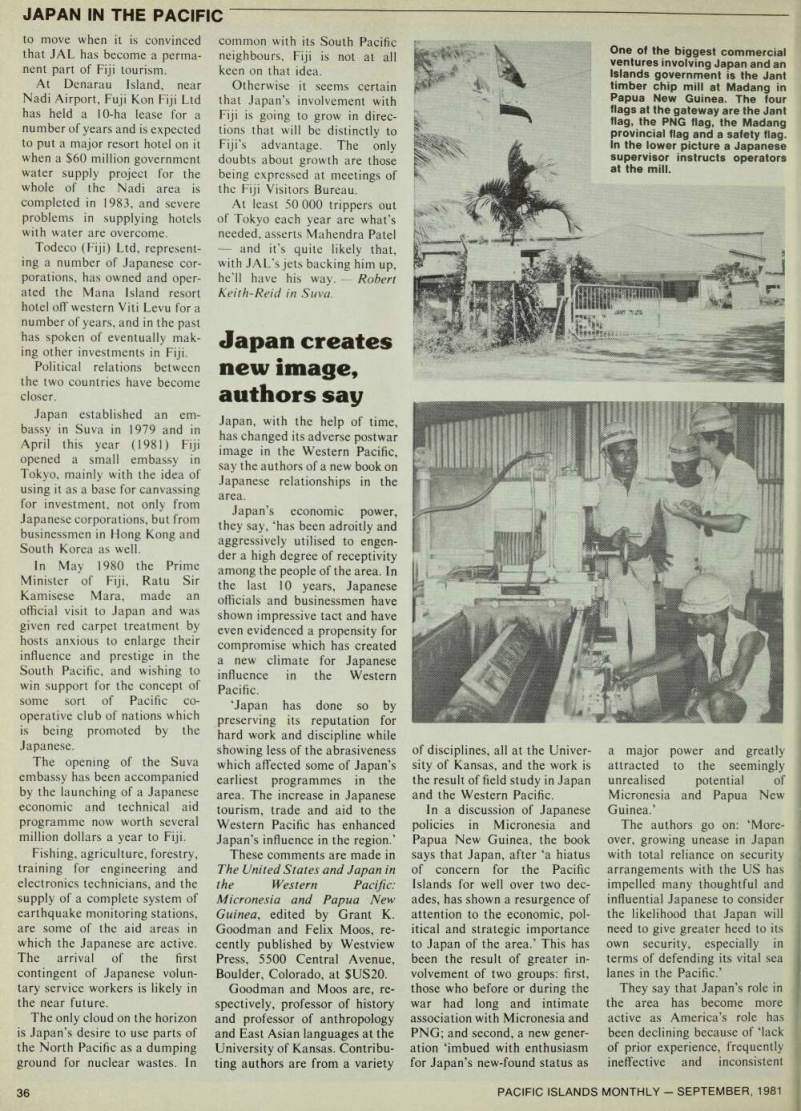
Ties are growing, and they’re moving Fiji’s way
Fifty thousand Japanese tour ists a year that’s the target which Mahendra Patel, chair man of the Fiji Visitors Bureau, would like the organisation to set for itself.
If achieved, it would increase total tourist traffic to Fiji by 25% on the present figure, which has flattened out at just under 200 000, and swell tour ism industry earnings by at least in extra SF2O million to SF3O nillion a year.
But other members of the r VB board are not so enthusi istic about the prospect; anguage and food difficulties, ind special requirements, make he Japanese difficult people to ater for, and, they feel, an asier way to build tourism /ould be to concentate on ttracting more of the more amiliar and easier-to-handle ustomers, like the Americans nd Canadians.
The FVB has not yet made up s mind what to do about its otentially huge Japanese mar et, but it looks as if it is going ) have its mind made up for it.
Japan Air Lines began long waited scheduled flights to Fiji i May 1980, after several years ' experimental charter trips, he once-a-week flight to Nadi id on to Auckland soon be ime twice weekly, and now a ird flight has been added to e service, which, unlike the 'O others, terminates at Nadi.
In 1980 Japanese tourist traffic, which a few years earlier had been only a trickle, jumped by 26% over the 1979 figure to 7141 visitors.
JAL is fairly cagey about what it thinks about the future of its Fiji service and is said to be thinking of a two-year trial before really beginning to push it. But barring unforeseen econ omic factors it looks as if Fiji is now firmly on the map for Japanese travellers, and likely to remain so.
Just how many will make it to Fiji each year is something that Fiji will have to decide. In doing so it will quite probably plump
for a rationing of such guests, so that its islands don’t become overrun by them.
Tourism is only one of the areas in which relations be tween Fiji and Japan have recently begun to blossom, after a decade and a half of mainly one-way dealings in Japan’s favour. After years of taking token amounts of shell, fruit and occasional small shipments of sugar, while supplying a steady 10% to 15% of all of Fiji’s imports, Japan last year became a serious buyer of sugar.
It look quantities valued at about $2O million. This year it will buy $4O to $5O millions’ worth, and is in the market for a number of up-and-coming products such as timber, fruit and ginger.
For the first time Fiji, which in 1979 took Japanese products to the value of $56 million, while selling back less than $3 millions’ worth, is able to think in terms of achieving what for it would be a favourable balance of trade with its third largest supplier of imports.
There are also hopes for major Japanese investment in the country.
Several Japanese companies have been established in Fiji
fairly inactively for a number of years.
In the past 12 months several big corporations have sent in scouts on prospect-hunting missions, and in July Fiji’s newly established Economic Development Board, created especially to angle for foreign investment, was vigorously courting Sumitomo. lan Thomson, the board’s chairman, is talking confidently of landing something big in the way of Japanese investment in the near future.
Present activity is limited to fishing and tourism. New comers, if the government has anything to do with it, will be channelled into timber and agri cultural and marine product processing ventures.
The first significant Japanese entry into Fiji occurred in the early 1960 s when C. Itoh and Co Ltd of Osaka, and Nichiryo Ld of Tokyo, opened a freezing factory in Levuka for the transhipment of tuna landed there by Japanese and other Asian fishing craft.
Six years ago the Fiji Govern ment became a 25% partner in their Fiji subsidiary, the Pacific Fishing Company, a cannery was added to the freezing works, and in the last three years exports of canned fish have leapt from nothing to a business worth around $l5 million annually.
The cannery is partly sup plied by ships of the government-owned Ika Corpor ation, which lands skipjack tuna caught with Japanese-built vessels manned by local crews.
The fishing venture is doing well and has received equip ment and advice from the Japanese Government, includ ing one large modern catcher.
At Pacific Harbour, 56 km from Suva, the giant Taisei construction group has an inter est with Canadian-controlled Southern Pacific Properties Ltd in the developed 445-ha first stage of a hotel/villa/ condominium resort and a half share in SPP-Taisei Ltd, which owns 2500 ha of swampy adjoin ing land.
Taisei is very cautious about its undeveloped real estate hold ings, saying it takes a very long term view of them.
But it hints that it will begin
Increasing numbers of Pacific Islanders are now visiting Japan as students or as tradesmen undergoing specialised train ing. Here foreign students meet at the International Students Institute in Tokyo.-Picture by Pacific Friend.
to move when it is convinced that JAL has become a perma nent part of Fiji tourism.
At Denarau Island, near Nadi Airport, Fuji Kon Fiji Ltd has held a 10-ha lease for a number of years and is expected to put a major resort hotel on it when a $6O million government water supply project for the whole of the Nadi area is completed in 1983, and severe problems in supplying hotels with water are overcome.
Todeco (Fiji) Ltd, represent ing a number of Japanese cor porations, has owned and oper ated the Mana Island resort hotel off western Viti Levu for a number of years, and in the past has spoken of eventually mak ing other investments in Fiji.
Political relations between the two countries have become closer.
Japan established an em bassy in Suva in 1979 and in April this year (1981) Fiji opened a small embassy in Tokyo, mainly with the idea of using it as a base for canvassing for investment, not only from Japanese corporations, but from businessmen in Hong Kong and South Korea as well.
In May 1980 the Prime Minister of Fiji, Ratu Sir Kamisese Mara, made an official visit to Japan and was given red carpet treatment by hosts anxious to enlarge their influence and prestige in the South Pacific, and wishing to win support for the concept of some sort of Pacific co operative club of nations which is being promoted by the Japanese.
The opening of the Suva embassy has been accompanied by the launching of a Japanese economic and technical aid programme now worth several million dollars a year to Fiji.
Fishing, agriculture, forestry, training for engineering and electronics technicians, and the supply of a complete system of earthquake monitoring stations, are some of the aid areas in which the Japanese are active.
The arrival of the first contingent of Japanese volun tary service workers is likely in the near future.
The only cloud on the horizon is Japan’s desire to use parts of the North Pacific as a dumping ground for nuclear wastes. In
common with its South Pacific neighbours, Fiji is not at all keen on that idea.
Otherwise it seems certain that Japan’s involvement with Fiji is going to grow in direc tions that will be distinctly to Fiji’s advantage. The only doubts about growth are those being expressed at meetings of the Fiji Visitors Bureau.
At least 50 000 trippers out of Tokyo each year are what’s needed, asserts Mahendra Patel and it’s quite likely that, with JAL’s jets backing him up,
he’ll have his way.
Robert
Keith-Reid in Suva.
Advertisements & other items, pp. 33-35 (2 items)
Japan In The Pacific
CIFIC ISLANDS MONTHLY SEPTEMBER, 1981
your crop yield.
Mono sweetens up
When it comes to borehole pumps, Mono is No. 1.
Where there’s underground water down to depths of 183 metres, Mono can raise it to give you water year round. And Mono keeps the water flowing at up to 109,000 litres per hour from deep well bores or river bank installations. And our bore-hole drive heads can be powered by petrol or diesel engines, electric motors or tractor PTO shafts.
All good reasons why Mono is No. 1 for borehole pumps.
MONO
And for positive displacement suction lift agricultural pump requirements, Mono’s self priming ability gives high suction lifts up to 7.6 metres before the pump.
In fact Mono can pump almost anything-slurries and sludges, pig effluent, sewage, storm water, chemical sprays, bore water and more. And we can give you farmhouse water at city mains pressure.
For all agricultural applications, call us at Mono.
We’ve got the pumps and the experience.
AUSTRALIA PTY. LTD.
MOVE IT WITH MONO
m Directly represented in the Philippines and Hong Kong by Mono's own regional oitices.
Agents in: Indonesia. Fiji, SingaopfcTThailand, Malaysia, Taiwan. Korea, P;>pua New (>uinea and the Pacific.
Head Office: P.O. Box 123. Morthalloc, 1, Miilaysja;:Taiwan. Korea, Papua New (iuinea and the Pacific. rT0195, Australia. Telex: Acriono 34236. Telephone (03)905211
HONO
pumps
TEN
You just think you’re hard to please!
Take a look at this dazzling assortment of “TEN
products. Car stereos, cassette decks, tuners,
amps, speakers, graphic equalizers, marine
compo units-from the simplest to the most complex, the modestly priced to the super deluxe. When it comes to audio equipment, you may think you’re a very tough customer to please. But we know better. With such
a fantastic variety of top-quality, feature-
packed products, you couldn’t help but find what you’re looking for. We’re willing to bet on it! ions mm y - ZS - * fi —«*==i m r i -a- „
I IV
Hill
\ i-f-j nooo r '
FUJITSU TEN LIMITED
Head Office;
2-28, Gosho-dori 1-chome, Hyogo-ku, Kobe, Japan
Tokyo Office (Export Section): Shuwa Onarimon Bldg , 2nd FI.. 1-1, Shimbashi 6-chome, Mmato-ku Tokyo Japan Phone: (03)438-1611 Cable: TENFUJITSU TOKYO Telex: 2425101 TENTOKJ
Distributors:
Papua New Guinea: CHIN H MEEN N SONS PTY., LTD. PO Box 1106, Boroko. Port Moresby, Papua New Guinea Phone: 256546 Guam: MICROPAC AUDIO INC. P.O. Box 3478, Agana, Guam 96910, Phone: 472-8091.
Tahiti: FARE HI-FI STEREO. PO. Box 269, Rue du Marechal Foch Papeete New Hebrides: BURNS PHILP NEW HEBRIDES LIMITED. Vila, New Hebrides Cook Islands: AVATIU GENERAL TRADERS. P.O. Box 27, Rarotonga Fiji: D. GOKAL& CO., LTD. G. P.O. Box 501, Suva, Fiji. Phone: 25259/22995.
Japan creates
new image, authors say
Japan, with the help of time, has changed its adverse postwar image in the Western Pacific, say the authors of a new book on Japanese relationships in the area.
Japan’s economic power, they say, ‘has been adroitly and aggressively utilised to engen der a high degree of receptivity among the people of the area. In the last 10 years, Japanese officials and businessmen have shown impressive tact and have even evidenced a propensity for compromise which has created a new climate for Japanese influence in the Western Pacific. ‘Japan has done so by preserving its reputation for hard work and discipline while showing less of the abrasiveness which affected some of Japan’s earliest programmes in the area. The increase in Japanese tourism, trade and aid to the Western Pacific has enhanced Japan’s influence in the region.’
These comments are made in The United States and Japan in the Western Pacific: Micronesia and Papua New Guinea , edited by Grant K.
Goodman and Felix Moos, re cently published by Westview Press, 5500 Central Avenue, Boulder, Colorado, at SUS2O.
Goodman and Moos are, re spectively, professor of history and professor of anthropology and East Asian languages at the University of Kansas. Contribu ting authors are from a variety
of disciplines, all at the Univer sity of Kansas, and the work is the result of field study in Japan and the Western Pacific.
In a discussion of Japanese policies in Micronesia and Papua New Guinea, the book says that Japan, after ‘a hiatus of concern for the Pacific Islands for well over two dec ades, has shown a resurgence of attention to the economic, pol itical and strategic importance to Japan of the area.’ This has been the result of greater in volvement of two groups: first, those who before or during the war had long and intimate association with Micronesia and PNG; and second, a new gener ation ‘imbued with enthusiasm for Japan’s new-found status as
a major power and greatly attracted to the seemingly unrealised potential of Micronesia and Papua New Guinea.’
The authors go on: ‘More over, growing unease in Japan with total reliance on security arrangements with the US has impelled many thoughtful and influential Japanese to consider the likelihood that Japan will need to give greater heed to its own security, especially in terms of defending its vital sea lanes in the Pacific.’
They say that Japan’s role in the area has become more active as America’s role has been declining because of ‘lack of prior experience, frequently ineffective and inconsistent
One of the biggest commercial ventures involving Japan and an Islands government is the Jant timber chip mill at Madang in Papua New Guinea. The four flags at the gateway are the Jant flag, the PNG flag, the Madang provincial flag and a safety flag.
In the lower picture a Japanese supervisor instructs operators at the mill.
policies and domestic indifference’. Nevertheless, Japan ‘has been reluctant to move too aggressively because of uncertainty about defining its own identity as a world power and because of deference to postwar American predomi nance in the region. Now, however, as American power wanes and Japanese influence grows, the need for greater co operation between the two states (Japan and the US) is evident. The alternative is, of course, the very unattractive but real possibility of rivalry and conflict.’
The authors believe that con tinued US strategic pre eminence in Micronesia is of vital importance to Japan so long as Japan can at the same time have free access to Micronesia’s trade and re sources.
If both conditions can be met, then Japan may prefer not to have a highly integrated politi cal presence in Micronesia.
However, they add, the US is clearly still unwilling to allow the extent of economic domi nance ‘which some Japanese business interests nostalgically envisage’ in Micronesia.
Advertisements & other items, p. 36 (1 item)
Japan In The Pacific
36
PACIFIC ISLANDS MONTHLY - SEPTEMBER, 1981
Fishery, tourism,
yes but not yet aid in Vanuatu
Japan is one of 11 countries that have established diplomatic re lations with the Republic of Vanuatu during the first year following its emergence from the status of a Franco-British condominium. While the Vanuatu Government is cer tainly interested in what Japan has to offer, it is treating with caution an approach from the Japanese Government, made through its Suva embassy, to submit proposals for project aid from Japan.
It can still recall the green light given by the provisional government of New Hebrides in 1978 to Mitsubishi-Sumitomo to set up a woodchip mill in Santo and develop timber stands on other, outer islands.
The offer was made after a
Japanese Government-spon
sored study carried out under he self-same project aid ar ■angements. The study took ieveral years to complete.
But to date nothing whatso ever has happened. No contact )n the matter has been made by he principals for more than hree years. This is in spite of a :een desire on Vanuatu’s part to :ncourage their investment in orestry. Negotiations are now >roceeding in this field with •ther, non-Japanese, interested >arties.
In contrast with this, private apanese concerns continue to xpand the two major areas of
yen investment in Vanuatu: fishing and tourism.
South Pacific Fishing Com pany, in which the majority shareholder is the Mitsui group, is setting up a new, joint venture company with the Vanuatu Government, already a 10% shareholder in SPFC.
The new company will seek to develop the Paiyo fishing method, using anchored rafts. A one-year trial period is planned.
The fish so caught are to be snap-frozen and freighted whole to Japan as ‘presentation fish’.
In 1980 SPFC shipped 8299 tonnes of frozen fish to the USA, Italy and Japan. Fish is Vanuatu’s second most import ant export item after copra, and the taxes earned from its export contribute substantially to the national income.
SPFC has recently diversified into beef and now exports processed, salted meat to Japan.
It is at present setting up a grazing operation, and has plans to ship live cattle to Japan.
In tourism, the Tokyo-based Tokyu group owns and operates the Le Lagon Country Club resort on Erakor Lagoon, Port- Vila. At present a programme of upgrading and refurbishing the resort is under way at an estimated cost of just under $1 million.
While Japanese tourist ar rivals for 1980 were down 11% compared with 1979, the mar
ket in 1981 has been steady and growing. Both UTA and Thai International have weekly flights between Tokyo and Noumea and group tours (the method of travel adopted by most Japanese) can be arranged for either a combined New Caledonia-Vanuatu holiday, or a stayput Vanuatu one.
In Vanuatu the preferred attractions for Japanese visitors are the tropical scenery, easily accessible and reasonably priced sports (golf and tennis mainly), and marine tours.
They are fascinated by the corals and marine life viewed through clear, unpolluted waters from the glass-bottom cruisers. They also enjoy the day trips, with diving, snorkell ing, and game fishing and the chance to eat their own catch. It is a familiar sight to see a chain of lifejacket-clad non-swimmers paddling around their cruise vessel, taking their first tenta tive swimming lesson from the skipper, while their antics are recorded by a camera-festooned guide.
Vanuatu’s duty-free shopping is competitive: in the luggage of the Japanese tourist, locally carved artifacts, a Cartier watch or a Dior creation are likely to have to fight for space with French perfumes and bottles of premium spirits and liqueurs.
Local foods not always readily available in Japan, such as coconut crab, marinaded raw fish, lap lap, heart-of-palm salads, are much appreciated as, of course, is the plentiful supply of beef.
The chance to be photo graphed alongside a Custom dancer in traditional costume at an Island Night Show is a
highlight for many Japanese on their Vanuatu stopover. Honey moon tours are also popular, and special arrangements are made for church marriages and dedication ceremonies.
Japan’s Pacific Society, set up three years ago and privately funded and administered, is seeking to foster closer cultural relations with the peoples of the Pacific, and has taken a keen interest in the emerging nation of Vanuatu. Its president, Noboru Gotoh, who is also head of the Tokyu Corporation, was responsible for a substantial independence gift of communi cations equipment to Vanuatu.
Imports of Japanese goods are significantly higher than those from any other country.
Most are what must be called luxury items, and many, such as watches, cameras, tape re corders and radios are re exported as purchases by cruise ship and air tour visitors.
In reciprocal trade, Japan is the main market for manganese ore (3522 tonnes exported in 1980), and trochus and greensnail shell (47 tonnes in 1980). Moves are being made to increase exports of log timber (13 tonnes), cocoa beans (5 tonnes), and to develop new markets for such local produce as tropical fruits, coffee beans and root vegetables.
A new airfreight service through the South Pacific to Osaka, Tokyo and Kagoshima, which is being planned by Air Nauru, will increase the scope for Vanuatu producers to ex pand into these Japanese mar kets. It is hoped that the Japanese Government will also offer reciprocal access on a
preferred nation basis.
lan
Mclntyre in Port-Vila.
from Japan

Direct project aid from Japan to Solomon Islands
Japan has become the thirdbiggest aid donor to Solomon Islands, spending more than $2 million a year on direct project funding and with indications of a gradual increase in its commitments. Britain, which was the former administering
country in Solomon Islands, provides direct aid of up to $lO million a year and Australia provides about $5 million, The Solomon Islands govern ment looks on Japan as a significant aid donor, particu larly in the development of
fisheries resources which are seen as a long-term important sector of the economy. Mr Peter Agar, head of the central plan ning office under the Kenilorea government, reported recently that the government appraises possible projects which could be the subject of Japanese aid and then submissions are made to Japan for final selection.
Mr Agar said that Japan preferred to fund one project a year to its completion. This differed from the system used by Britain and Australia in which a number of projects were financed each year with the total expenditure spread over several years. The biggest project at present under con sideration by Japan is for a rural fisheries development scheme, and unlike earlier Japanese aid schemes the expenditure would be spread over two years. The proposed scheme would allow villagers in the scattered Solomon Islands to develop fishing skills, to put their catches in local cool storage and then to arrange shipment to main centres. The scheme would also involve the establish ment of provincial fish markets and its target would be to provide a source of fish for wage and salary earners in the main centres.
A Japanese assessment mission is to visit Solomon Islands to discuss the scheme.
The mission will also discuss the general terms of future aid programmes from Japan, with accent on the development of passenger and freight coastal shipping services.
Mr Agar reported that another major project involving Japanese expertise and funds was exploratory technical tests into bauxite deposits which are known to be under a lake on Rennell Island. The Mitsui Mining and Smelting Company of Japan has already found evidence of bauxite on one side of the lake.
Mr Agar said that Japan’s concentration on a single pro ject each year sometimes caused ‘complications’ in long range planning, but Japan was still seen as a major and import ant aid donor over a long period of time.
The scope of Japanese aid since Solomon Islands became
independent in 1978 has covered a wide variety of pro jects, particularly in technical assistance. Commercial scale fisheries has been the major field of aid, including the pro vision of three fishing ships, the export of fish and fish products, and high-level technical train ing. Japan has also made cul tural and sporting grants, has donated medical equipment, has helped with the develop ment of a local ship-building industry and has trained Islander technicians in Japan.
Japanese volunteer workers have also been working in Solomon Islands and there has been a measure of assistance to agricultural projects.
The Japanese charge d’affaires in Solomon Islands, Mr , Shigeru Kurosawa, says that Japan wants to expand its links with the Island country, including an increase in aid. He said recently that the popu lation of Solomon Islands was comparatively small and this was a limiting factor in aid arrangements under policies laid down by the Japanese government. However the gov ernment would be closely moni toring growth and was prepared to step up its aid. There was increasing pressure from some Japanese members of parlia ment, he said, to make a general increase in aid to all Pacific Island countries. Mr Kurosawa said that there was not yet a full acceptance throughout Japan of the concept of forging closer links with the Pacific Islands community, but he believed this attitude would change over the next two years.
Commenting on the fact that Japan is the biggest buyer of exports from Solomon Islands, Mr Kurosawa said he believed that reciprocal trade was about to undergo a big expansion.
Private enterprise sources in Japan, as well as the govern ment, were showing an interest in aid projects which could be combined with business ven tures beneficial to both countries.
The biggest Japanese com mercial venture now operating in Solomon Islands, and in which there is Solomons partici pation, is a commercial fisheries venture. It is Solomon Taiyo Ltd, a joint venture between
Japanese interests and the Solomons government. It was established in 1973 after two years of negotiations, and it fishes and cans bonito and tuna for export. The government share was initially 25%, now increased to 49%. The com pany’s base and cannery is at Tulagi, the former capital of Solomon Islands which suffered heavily during World War 11.
The cannery there now pro duces 500 cases of canned fish each operating day, and an associated factory produces arabushi (smoked fish).
In 1975 the scheme was expanded with the establish ment of a second base at Noro in the Western Province. The modern installation there cost $2 million, and an additional
$4O 000 was spent on a road linking the base to Munda.
About 900 Solomon Islanders work there, and the financial manager, Mr S.Y. Saito said that this number would be increased as more Islanders were trained and Japanese nationals were phased out.
The exports from the Noro and Tulagi operations go to Japan, West Germany, Britain, Italy, Australia and Switzerland, and the trade is increasing to the extent that an enlarged cannery will be estab lished at Noro by 1983. Apart from the government’s earnings from involvement in the com pany, extra revenue is available from a 10% export levy on the
product.
George Atkin in
Honiara.
Advertisements & other items, pp. 37-39 (2 items)
37
JAPAN IN THE PACIFIC
ACIFIC ISLANDS MONTHLY SEPTEMBER, 1981
but I know it when I hear John Williams
mm ■ mm ■ Qualify is something very difficult to , but I know it when I hear John Williams “Quality is something very difficult to define”, says noted composer John Williams, “but I know it when I hear it”.
Millions of moviegoers around the world would agree.
For twenty years, Williams’ Academy Award-winning scores have perfectly complemented a host of memorable films.
With his masterful compositions, he has heightened the tension in Jaws, underscored the heroics in Star Wars and Superman, and given meaning to the phrase, “music of the spheres”, in Close Encounters of the Third Kind.
And an important reason why Williams’ music is synonymous with quality is because it satisfies the standards of his most exacting critic. Says the composer, “A score, first and foremost, has to please me.”
Qualify—just another good reason f“ you should look to JVC for your audio-video needs .
I fit At JVC, the toughest standards we have to meet are our very own. That’s why, over the years, we have maintained our position in the forefront of the world’s audio-video electronics industry. With technical innovations like—to name just a few— the VHS videocassette system, the VHD videodisc system, the world’s first cassette decks capable of handling metal tapes and the Super-A hi-fi amplifiers free of traditional switching and crossover distortion.
Examples of what we’re talking about are the state-ofthe-art hi-fi components shown here. They certainly prove that while quality may sometimes be difficult to define, you’ll know it when you hear it.
JVC
VICTOR COMPANY OF JAPAN, LIMITED
Australia: Hagemeyer (Australasia) B.V. 5-7, Garema Circuit, Kingsgrove, N.S.W, 2208 Australia Tel. 750-3777 Fiji Islands: D. Gokal & Co„ Ltd., G.P.O. Box 501, Corner of Pier Street & Renwick Road, Suva, Fiji Tel. 25259 Cook Islands: J. & P. Ingram & Co.. Ltd., P.O, Box 55. Rarotonga, Cook Islands Tel. 378457 New Hebrides: Wu ke Luong, P.O. Box 113, Rue Higginson, Port-Vila, New Hebrides Tel. 2115 New Caledonia: Caldis, 2, Route du Velodrome, B.P. Ml, Noumea, Cedex, New Caledonia Tel. 262350 Tahiti: Magasin Sincere, B.P. 215, Papeete, Tahiti Tel. 20060 Papua New Guinea: Hagemeyer (P.N.G.) Pty, Ltd., P.O, Box 90 Lae, Papua New Guinea Tel. 42-3200 New Zealand: Atlas Majestic Industries Ltd., 11, Albion Road, Otahuhu, Auckland 6, New Zealand Tel. 27-67-099
* * ' 10 «■*£ rj^ W*w- •* mt SUZUK j OUTBOARD'S are truly ALL ROUND PERFORMER reliable. and economical under any situation.
SUZUKI tvepared outboards line up exclusively for the usage of professionals and of course, also for the pleasure. Each has different Construction respectively so that you can choose your engine that is best suited to your boat and usage Get the fruitful life through SUZUKI OUTBOARDS SERVIc¥pTY??n S DM^Mc A^ F oS,o UZUKI DISTR| BUTORS LTD. PHONE: 58-599 • PAPUA NEW GUINEA HI SPEED DIESEL
• SOLOMON SOLOMON
• AMERICAN SAMOA PRnnurTc: p u ™f.l Nßl LEROUX * NEW CALEDONIA STE. SUPERCAL PHONE: 272068 PHONE: 565-2298 • NIUE BURNS PPMLP m^LTD•NAURn^on?D^MnT^ R D N o SAMOA VATCO LTD * GUAM ISLAND CYCLERY, INC. • YAP AMBROSE . KOROR BECHESRRAK T COMPANY PHONE: 338 SoSp «n EQUIPMENT
Caledonia’s history


The Japanese who belong to New Caledonia’s history
The Japanese belong to the history of this colonised land of New Caledonia. Like many other Asians, they came here to work on the development of nickel and iron ore mines at a time when these minerals were not yet being mined in Austra lia. They also took out chromite and cobalt. So they belong to New Caledonia’s history as part of that long, long procession of folk who have toiled on its land to create what exists today.
The first Japanese arrived in New Caledonia in 1892, a party of 41 who who had come to work for la Societe le Nickel
(Sen).
By 1916 they numbered almost 3000, of whom 584 worked in the mines. Others worked in Noumea as tailors, barbers, laundrymen or drivers.
Others again had become set tlers on the land, with some having holdings as large as 2000 ha at Ponerihouen and else where. Yet others were drawn by their love of the soil to become market-gardeners, and their unremitting labour helped to fertilise ‘the Pebble’, as Caledonians affectionately call their country.
Thirty-six Japanese males were married at the time to
Japanese wives, 20 had married European women, and larger numbers had Javanese, Melanesian or Tonkinese wives.
As a result, there were 51 children whose parents were both Japanese, 12 had Japanese fathers and European mothers, and 145 had Japanese fathers and Javanese, Melanesian or Tonkinese mothers.
Well before World War 11, the Japanese were preparing for the Sino-Japanese conflict, which was followed by the other, beginning at Pearl Harbor on December 7, 1941, and which has become known to history as the Pacific War. At Poro, in the south of New Caledonia, the Japanese had opened up iron ore mines. The ore they extracted played its part in forging the weapons of war for the Japanese epic in the Pacific.
Japanese sampans fishing peaceably off the coast of la Grande Terre (New Caledonia’s main island) also gathered hydrographic data which no doubt later proved useful to the Imperial Japanese Navy.
By 1939, Japanese residents
Continued on page 77
Japan in New Caledonia from page 40 represented 75% of all for eigners living in New Caledonia. On December 8, 1941, the day after Pearl Harbor, 116 Japanese were arrested. An exception was made of the market-gardeners.
But they were rounded up later, under pressure from the Americans. The bank accounts of Japanese were frozen, their property seized, and they were placed in a concentration camp on Nou Island. On December 19, 1941, they were deported to Australia. Some returned after the war to re-establish them selves. But their children had stayed on in New Caledonia and acquired French nationality.
Born on ‘the Pebble’, the :hildren of these families torn apart by the war inherited the qualities of their fathers; zeal in vork, self-discipline, punctu ility. During the war, they had •emained loyal to France. Some net their end on the paths of aattle of the French Pacific Jattalion which, side by side vith Allied forces, led them to dctory and the liberation of *rance.
Names such as Noda, tfatsuda, Nakagawa, and many ithers are synonymous with the inks binding Japan and New Caledonia.
The Japanese have not been ound lacking in efforts to bonds between their far ff kinsmen and the mother ountry: a Franco-Japanese As ociation maintains close links etween its members and the Caledonian families of their athers who were either killed or aangled in the war which tore heir households apart. Religion smains strong, and much quiet ut profound emotion animates he young Japanese, born of a apanese father in New Caledonia, as he sets out on his ilgrimage in search of his ncestral roots even if he is o longer able to speak his ither’s tongue. Two New Caledonian islands have formed relationship of ‘sisterhood’ ith two Japanese islands. They re Lifou in the Loyalty Islands, nd I’lle des Pins. Curiously, leir Japanese ‘sisters’ have ames identical to theirs.
Japan, the newly emerged
industrial and commercial giant which has won for itself a place in the very forefront of world powers by dint of the profound human qualities of its people, has in these latter times, turned to tourism. The Japanese travel a lot.
Naturally, they seek places where pollution is at a mini mum. New Caledonia, particu larly through the influence of television, has become an at tractive destination for them.
Several hundred Japanese tour ists arrive in the territory every week. Oddly, many young couples come here to get mar ried by the Mayor of Noumea it seems it is less onerous to give oneself a present of a trip than to shower wedding gifts, as is the custom, upon one’s nu merous relatives and friends who’ve stayed at home.
The Japanese tourist is much appreciated in New Caledonia for his politeness, his behaviour and also for his financial means.
There are long-standing com mercial ties between Japan and New Caledonia. For more than half a century Japan has been importing New Caledonian minerals to feed its industry.
Before the war it was Poro iron ore and nickel. Today, it is still nickel: in 1980 New Caledonia exported to Japan nickel ore (or part-processed nickel material) to the value of SA67 375 000 this repre sented 27% of New Caledonia’s total exports. As for imports from Japan, the territory in 1980 imported Japanese goods to the value of $A 13 325 000, or 4% of total imports. (By way of comparison, New Caledonia each year imports from Austra lia goods to the value of SA3I million, or 10% of total imports.) The economic crisis, and the costs of sea transport in con ditions of constantly rising fuel prices, have led Japanese im porters to buy part of their nickel requirements from the Philippines and Indonesia. No doubt they are influenced by the fact that the ore from these sources is cheaper than the New Caledonian product. But it is also a matter of trading strat egy: the Philippines and Indonesia are very big buyers of Japanese products. Certainly
New Caledonia is an attractive market, with its relatively high population compared with a number of other Pacific countries. But its 140 000 inhabitants represent only very small beer compared with the countries just mentioned.
Japanese foundries are equipped to process New Caledonian nickel ore which they mix with Philippine and Indonesian ores and, recently, Australian ores as well.
In the last few years exports of New Caledonian nickel ore have fallen by 50%. A task facing the industry in the future is to concentrate the ore in order to reduce the volume of material exported; the nickel ore at present contains only 2'/2% metal, the rest consists of useless soil and water. A real burden’ for the importer.
Tourists on the beaches, Japanese freighters loading nickel ore around the coast, Japanese motor cars on the streets and Japanese photographic and stereophonic equipment in the shop windows these are visible mani-
Testations of the Japanese pres ence here. But more important still are the deep bonds which unite the two peoples, the mem ories of the toil of the Japanese who helped to build this country, and who have left behind a priceless heritage in their offspring, who continue to embody the qualities of the Japanese race.
Caledonians never knew the other face of Japan, the face of the invader. This was thanks to the sacrifices of the Allied sailors and airmen who waged triumphant battle in the Coral Sea on May 7-8, 1942, to stop the Japanese invasion convoy which was heading for New Caledonia with the aim of cutting the sea route between Australia and the United States. This operation changed the face of the Pacific War, probably saved Australia, and for us in New Cale donia preserved the historic image left behind in our terri tory by the thousands of Japanese who settled and founded families here.
Daniel Tardieu in Noumea.
Advertisements & other items, p. 40 (1 item)
Japan In The Pacific
40
PACIFIC ISLANDS MONTHLY - SEPTEMBER. 1981
PNG outstation, 1981: ‘The air
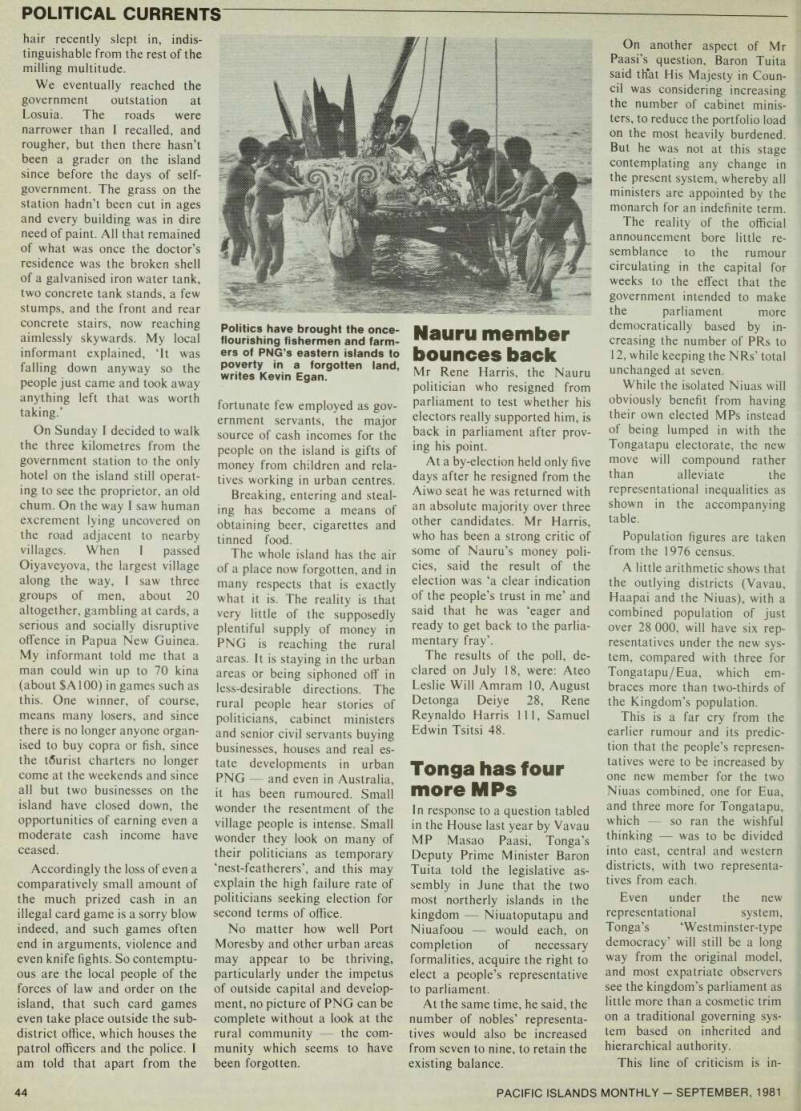
of a place now forgotten’
Political
Currents
In its sixth year of independence, how is Papua New Guinea faring at the community level? Lawyer KEVIN EGAN, already known for his controversial comments on PNG, presents an unhappy picture.
The former Labor prime minister of Australia, Mr Gough Whitlam, who was a central figure in initiating independence for Papua New Guinea, spent three days in Port Moresby earlier this year at the end of an overseas lecture tour.
Addressing a group of Port Moresby unionists he expressed satisfaction at the state of the nation and at the progress of ‘localisation’ particularly localisation of the judiciary, Localisation in the PNG context is the replacement of whites by PNG nationals.
It is indeed a pity that Mr Whitlam didn’t venture beyond , , . . y , the municipal boundaries of the national capital before making such sweeping assessments about the national state of affairs. This is particularly so when it is realised that only 13% of the people live in Port Moresby and a few other scattered urban areas. The great bulk of the people - and they represent the real PNG are the rural dwellers of the villages, the outstations, the mountains and the plains. A closer inspection of how they are faring today might well have turned Mr Whitlam’s selfsatisfaction to disillusionment.
The gut-feeling of many rural ipnnlp pomp ♦ , , aeople came home to me clearly n the words of a village spokesnan who addressed a land
hearing in the remote Star Mountains near the PNG bor der with Indonesia. The vil lagers had claimed compen sation rights for land which will soon be part of the big Ok Tedi copper and gold mining ven ture. Their claim was found to be spurious, but this in itself is not the point of the story. The point lies in the words which were used by the spokesman when he accepted that the land claim had been unfounded Here’s a translation of what he said; . Not very long a *° we were livin 8 f her fu JUSt as ° ur f ancest ° rs had for thousands of years. It is true that we were sem i-nomadic, that we killed and sometimes even ate each other, that we died in large numbers from sicknesses which we attributed t 0 sorcery but which the govern ment oncers insisted were due to lack of h yB iene and viruses, but the "’ we knew n 0 other existence . jJapp S ° ‘ n °“ r ° W " Way Then came the Australian admin istration in the form of the white patrol officers. They told us to change our old ways and because of their strength and because of the better life that they promised us, we dld sa No more killin g- no more
canniba,ism < n 0 more wandering.
T n h ri ey ‘ patrol P os, ‘ a schoo ' , ‘ f Ce " tre ' PeaCe ’ education for our children, medi cine, We n 0 longer |ived in fear They took our best taro-growing land, the flat land, and built an
In 1979 Papua New Guinea was shaken by a confrontation between the government of the day and the judiciary, arising Jrom allegations of political interference in the course of justice. The justice minister, Mrs Nahau Rooney, was gaoled by the courts and released by the government. In the aftermath five judges resigned.
The public prosecutor, Mr Kevin Egan, who had been instrumental in taking the first legal moves against Mrs Rooney, ended his term of appointment soon afterwards In public statements and in an official report Mr Egan was scathingly critical of what he saw as the crumbling of ethical responsibilities and institutions. i j gan ’ an Aust ™lian. is now attached to the Hong Kong legal department. Earlier this year he re-visited PNG, and he writes here of his impressions.
airstrip on it, but we didn’t even object to this, for we now had contact with the outside world, a world that we previously did not even know existed, and still we were happy, for many good things came to our area in the aircraft that landed.
And then came independence.
Nobody ever asked us if we wanted it, nor were we told what would happen when we got it. We were just told that we now had it.
And then the white patrol officers went away and they were replaced by local ones, but they came and went so frequently that soon we did not know who our ‘kiap’ (patrol officer) was. Now the present one has gone away too. We still have our health centre but it has not had any drugs in it for a long time and although we repeatedly ask the government for replacements no drugs ever come. Then two years ago the government closed the airstrip the airstrip that the old administration built on our best taro growing land and so now there are no goods for our trade stores, we can’t fly out the sick or injured, and we are again isolated. There is no teacher for our school. People are reverting to their old ways and there is no law and order. We are back where we started.
Now you ask us why we made this spurious land claim. We made it to draw attention to our plight. We are desolate. We were promised every thing and upon those promises we built our dreams. You have broken your promises and we are left with nothing. We made this claim be cause it is our last chance. That is all f have to say. Thank you.
Meanwhile, in the far eastern end of the country, in the 'amous and once beautiful robriand Islands, the picture is no brighter. A decade ago this
was a pretty, peaceful little paradise. Crime was virtually unknown, the government ‘station’ was freshly painted, the grass was cut, and the villagers set aside a day each week for community works.
There was an air of efficient productivity about the place.
From the sale of copra or fish through the Department of Pri mary Industries, or carvings to the many tourists who regularly arrived on weekend holiday charters, or from employment with any of the dozen odd private enterprises operating on the main island of Kiriwina, the people had the opportunity to earn moderate cash incomes, which in turn led to better life styles. The present day contrast is staggering.
When I arrived at Kiriwina
airport I was immediately
struck by the chaos. A coffin was being rushed off the plane by a party of wailing mourners.
No one was in apparent control of loading or unloading the aircraft, let alone stowing the cargo. I located my luggage and then moved off in search of transport to the government station some 30 minutes drive away. As I approached the government truck, the usual source of transport, someone was lamenting, The govern ment truck is out of petrol and the clerks on the station in charge of the petrol pump have just gone off duty.’ So much for that.
Having had the presence of mind to speak to the local member of parliament before leaving Port Moresby to estab lish the name and tribal origin of the senior officer in charge, I scanned the faces of the crowd and was able to single him out but only from his character istic tribal features.
There he was, the govern ment’s district officer in charge
bare-chested, bare-footed,
trousers rolled up to the knee,
hair recently slept in, indis tinguishable from the rest of the milling multitude.
We eventually reached the government outstation at Losuia. The roads were narrower than I recalled, and rougher, but then there hasn’t been a grader on the island since before the days of self government. The grass on the station hadn’t been cut in ages and every building was in dire need of paint. All that remained of what was once the doctor’s residence was the broken shell of a galvanised iron water tank, two concrete tank stands, a few stumps, and the front and rear concrete stairs, now reaching aimlessly skywards. My local informant explained, ‘lt was falling down anyway so the people just came and took away anything left that was worth taking.’
On Sunday I decided to walk the three kilometres from the government station to the only hotel on the island still operat ing to see the proprietor, an old chum. On the way I saw human excrement lying uncovered on the road adjacent to nearby villages. When I passed Oiyaveyova, the largest village along the way, I saw three groups of men, about 20 altogether, gambling at cards, a serious and socially disruptive offence in Papua New Guinea.
My informant told me that a man could win up to 70 kina (about SA100) in games such as this. One winner, of course, means many losers, and since there is no longer anyone organ ised to buy copra or fish, since the tourist charters no longer come at the weekends and since all but two businesses on the island have closed down, the opportunities of earning even a moderate cash income have ceased.
Accordingly the loss of even a comparatively small amount of the much prized cash in an illegal card game is a sorry blow indeed, and such games often end in arguments, violence and even knife fights. So contemptu ous are the local people of the forces of law and order on the island, that such card games even take place outside the sub district office, which houses the patrol officers and the police. I am told that apart from the
fortunate few employed as gov ernment servants, the major source of cash incomes for the people on the island is gifts of money from children and rela tives working in urban centres.
Breaking, entering and steal ing has become a means of obtaining beer, cigarettes and tinned food.
The whole island has the air of a place now forgotten, and in many respects that is exactly what it is. The reality is that very little of the supposedly plentiful supply of money in PNG is reaching the rural areas. It is staying in the urban areas or being siphoned off in less-desirable directions. The rural people hear stories of politicians, cabinet ministers and senior civil servants buying businesses, houses and real es tate developments in urban PNG and even in Australia, it has been rumoured. Small wonder the resentment of the village people is intense. Small wonder they look on many of their politicians as temporary ‘nest-featherers’, and this may explain the high failure rate of politicians seeking election for second terms of office.
No matter how well Port Moresby and other urban areas may appear to be thriving, particularly under the impetus of outside capital and develop ment, no picture of PNG can be complete without a look at the rural community the com munity which seems to have been forgotten.
Nauru member
bounces back
Mr Rene Harris, the Nauru politician who resigned from parliament to test whether his electors really supported him, is back in parliament after prov ing his point.
At a by-election held only five days after he resigned from the Aiwo seat he was returned with an absolute majority over three other candidates. Mr Harris, who has been a strong critic of some of Nauru’s money poli cies, said the result of the election was ‘a clear indication of the people’s trust in me’ and said that he was ‘eager and ready to get back to the parlia mentary fray’.
The results of the poll, de clared on July 18, were; Ateo Leslie Will Amram 10, August Detonga Deiye 28, Rene Reynaldo Harris 111, Samuel Edwin Tsitsi 48.
Tonga has four
more MPs
In response to a question tabled in the House last year by Vavau MP Masao Paasi, Tonga’s Deputy Prime Minister Baron Tuita told the legislative as sembly in June that the two most northerly islands in the kingdom Niuatoputapu and Niuafoou would each, on completion of necessary formalities, acquire the right to elect a people’s representative to parliament.
At the same time, he said, the number of nobles’ representa tives would also be increased from seven to nine, to retain the existing balance.
On another aspect of Mr Paasi’s question, Baron Tuita said that His Majesty in Coun cil was considering increasing the number of cabinet minis ters, to reduce the portfolio load on the most heavily burdened.
But he was not at this stage contemplating any change in the present system, whereby all ministers are appointed by the monarch for an indefinite term.
The reality of the official announcement bore little re semblance to the rumour circulating in the capital for weeks to the effect that the government intended to make the parliament more democratically based by in creasing the number of PRs to 12, while keeping the NRs’ total unchanged at seven.
While the isolated Niuas will obviously benefit from having their own elected MPs instead of being lumped in with the Tongatapu electorate, the new move will compound rather than alleviate the representational inequalities as shown in the accompanying table.
Population figures are taken from the 1976 census.
A little arithmetic shows that the outlying districts (Vavau, Haapai and the Niuas), with a combined population of just over 28 000, will have six rep resentatives under the new sys tem, compared with three for Tongatapu/Eua, which em braces more than two-thirds of the Kingdom’s population.
This is a far cry from the earlier rumour and its predic tion that the people’s represen tatives were to be increased by one new member for the two Niuas combined, one for Eua, and three more for Tongatapu, which so ran the wishful thinking was to be divided into east, central and western districts, with two representa tives from each.
Even under the new representational system, Tonga’s ‘Westminster-type democracy’ will still be a long way from the original model, and most expatriate observers see the kingdom’s parliament as little more than a cosmetic trim on a traditional governing sys tem based on inherited and hierarchical authority.
This line of criticism is in-
Politics have brought the once flourishing fishermen and farm ers of PNG’s eastern islands to poverty in a forgotten land, writes Kevin Egan.
creasingly voiced among Tongans of the slowly emerging middle class, particularly those educated overseas, who feel themselves hampered by a sys tem that bestows most of the real authority on those born to inherited privilege.
On the other hand, it is essential to recognise th it the overwhelming majority of the grassroots voters indicated in the recent elections that they are perfectly content with the status quo.
While they are satisfied with what they have, who has the right to say the system is wrong, simply because it does not tally with overseas definitions of democracy? Especially when the performance of Western style democracies over the past decade has hardly been such as to inspire slavish imitation as necessarily the idea for develop ing countries like Tonga. It could even be argued that any system freely endorsed by a majority is, by that fact alone, a democracy.
There is little doubt that changes will have to come eventually, in a country so heavily dependent on overseas aid, and so increasingly in volved in regional and inter national affairs.
What may be hoped is that time, opportunity and able lead ership will ensure that these inevitable changes evolve nat urally within the system, and without undue pressures from
Dutside it
Penny Hodgkinson
in Nukualofa.
PNG tough line
on Irianese
Papua New Guinea in July irrested and sent back to Irian laya three Irianese who had
been living in PNG under the protection of permissive resi dence. The men had broken the terms of their residence by active involvement in anti- Indonesian rebel politics, the PNG government said. Friends of the three men have protested on human rights grounds, claiming the men are likely to be gaoled or executed by Indonesia. Two of the deported men, flown out of PNG under police escort, had to leave behind Papua New Guinean wives and children.
Irian Jaya is an Indonesian province sharing a land border with PNG, and contains an anti- Indonesian rebel movement which claims the province should be an independent Melanesian country. PNG has granted residence under inter national protocol to some bor der crossers who can prove that their human rights are at risk in Irian Jaya. However one of the conditions of residence is the renouncing of all involvement in anti-Indonesian politics.
The three men deported in July had demonstrated that they were anti-Indonesian acti vists and had promoted faction fighting on the border, accord ing to the PNG foreign minis ter, Mr Noel Levi.
The men, who had lived in PNG for about five years, are schoolteacher Bob Kubia, con tractor Fred Peiger and health worker Willie Jebleb. Kubia and Peiger are both married to Papua New Guineans and have young children.
Although the deportation of the men to their homeland represents anew hard line by PNG, it does not change the basic policies that PNG has followed since independence.
On a number of previous oc
casions PNG has negotiated residence in a third country for rebels, but the government ap parently no longer intends to spend time on border-crossers who remain politically active.
The situation is one of the most sensitive in PNG’s foreign relations. On the one hand the government realises that the Irianese are ethnically related to its own people and that there is considerable sympathy among Papua New Guineans for their Irianese neighbours.
On the other hand the govern ment is committed to diplo matic friendship with Indonesia and therefore cannot allow PNG to become a refuge or a base for anti-Indonesian acti vists. Indonesia’s unyielding at titude towards its sovereignty in Irian Jaya adds to the sensitivities.
Springbok tour
poser for Chan
The Papua New Guinea prime minister. Sir Julius Chan, was forced on the defensive in July when an official visit he made to New Zealand coincided with the controversial tour by the South African Springbok rugby team. Violence and dissent oc curred in New Zealand over the rugby tour, with the govern ment and the rugby union council being accused of tolerating South African racial policies and of having broken international boycotts of South African participation in sport.
Sir Julius found himself facing suggestions that his presence in New Zealand indicated that he endorsed the football tour.
At a press conference in Wellington Sir Julius stepped carefully but firmly round pol itical landmines strewn in front of him. Yes, he said, he was in New Zealand at a very sensitive time, but that didn’t mean he endorsed South African apart heid. He said that the New Zealand government, not the rugby union council, were his hosts; and in any event his country was on record as oppos ing South African race policies.
Sir Julius said he was an enthusiastic rugby supporter, but added ‘I think the diplo matic relationship between my country and New Zealand is so important that I should not
allow a football game to stop the developments that both of us need’.
Sir Julius refused to be drawn out on his interpretation of the Gleneagles Agreement, under which countries including New Zealand restricted international sporting contacts with South Africa as a protest against South African race policies.
The New Zealand prime minis ter, Mr Muldoon, interpreted the agreement as not preventing the issue of entry visas to the Springboks, but Sir Julius would not discuss interpret ations. i think Mr Muldoon would be the man most suited to interpret what he actually signed’ he said. Sir Julius said that although PNG opposed the tour, it was not PNG policy to interfere in the affairs of another nation. But he added a warning ‘as a friend’ that reper cussions were sure to follow, and there could be some taint ing of relationships within the South Pacific Forum. ‘But we have no intention of allowing our bilateral relations to be jarred by football’ Sir Julius said.
Discussing Pacific regional matters Sir Julius said he sup ported suggestions for the es tablishment of a South Pacific peace-keeping force of the type which his own country mounted during last year’s rebellion on Santo in Vanuatu. He said that history had a habit of repeating itself, and he believed the Pacific countries should be pre pared. In the event of a Vanuatu-type situation in any Pacific country it was probably an ‘impossible dream’ to expect that the United Nations could provide a peace-keeping force of the sensitivities required. The obvious alternative was for the Pacific countries to have an available force of their own ‘but it would have to be thought out carefully because someone would have to pay for it’ he added. He suggested that New Zealand could have a role to play in helping to support legit imate governments which be came involved in Vanuatu-type
situations.
William Gasson
in Wellington.
Reports from Port Moresby indicated that the depth of feeling towards the Springbok presence in New Zealand was
Tongan Legislative Assembly Membership
Type of member Population Number Appointed cabinet ministers 8 Appointed area governors 2 Elected by the 33 nobles 9 Tongatapu district 57 411 Eua district 4 486 Tongatapu-Eua electorate 61 397 3 Vavau district electorate 15 068 2 Haapai district electorate 10 792 2 Niuatoputapu district electorate 1 650 1 Niuafoou district electorate 678 1
widely diversified, even within the government itself. Before he left for the Pacific tour which took him to New Zealand, among other countries, Sir Julius faced some cabinet oppo sition. There was a move among some of his ministers for him to cancel the New Zealand section of the tour, but he received majority support to proceed with his arrangements.
In other South Pacific reac tions to the tour, Fiji and the Cook Islands both refused to allow their airports to be used as transit points for flights by the Springboks.
In Western Samoa the gov ernment issued a statement in which it affirmed its objection and opposition to South Africa’s race policies, but it did not censure New Zealand on the grounds that this would constitute interference in the internal affairs of another country. This precipitated edi torial criticism from The Samoa Times which accused the government of lacking the strength to make a statement of principle (see Islands Press, Pl 8).
New political
group in Fiji
The emergence of a new politi cal group in Fiji, the Western United Front, together with indications of some dissent within the ruling Alliance Party, have added a new measure of fragmentation to Fiji national politics. The situ ation increases the chances that no single party will be strong enough to govern after next year’s general election, and that a coalition will have to be negotiated after the votes are counted.
About 200 high-ranking vil lage chiefs and more than 600 villagers from the Western Div ision attended the inaugural meeting of the party at Nadi.
The man who has been pushing for the establishment of the new group, Ratu Osea Gavidi, was elected president. He is the only independent in the Fiji parlia ment and has crossed swords with the government on a num ber of occasions, most recently in controversies over arrange ments to develop Fiji’s new pine forest industry.
Another member of parlia
ment, Mr Isikeli Nadalo, was elected secretary. Mr Nadalo was formerly aligned with the opposition in parliament, the National Federation Party, but resigned to help form the new group.
The party’s platform places a heavy emphasis on bringing Fijians (rather than Fiji Indians) of the Western Div ision into greater prominence in politics, government, adminis tration, commerce and indus try. The party is also committed to defeating the present Al liance Party government which Ratu Osea described as ‘lop sided rather than representa tive’.
Mr Nadalo denied later that the party was for Fijians only, but the nature of the inaugural meeting and the comments by some of the leaders involved led to suggestions that the party was established on race lines and had a ‘provincial’ outlook centred on the Western Division (see Islands Press, piB).
The main effect of the new party is expected to be in the potential it holds to weaken the position of the Alliance Party.
This in turn could lead to a highly diversified result in next year’s general election, in which political lobbying as much as the ballot box will determine the final shape of government.
N-waste issue
at SPC talks
Since the early ’7os fears about radio-activity have never been far below the surface at any regional meeting in the South Pacific. It was no surprise, then, that this concern was raised on the first day of a recent techni cal meeting held at South Pacific Commission head quarters, Noumea. The meeting was held to prepare draft docu ments for a proposed South Pacific Regional Environment Programme (SPREP) to be sub mitted to a regional conference on the human environment to be held early next year in Solomon Islands or the Cooks.
France no longer stands alone as the nuclear villain of the region. Though it has eased off since its determined push in 1979, the US still cherishes the prospect of using tiny Pacific islands as repositories for high
level radio-active wastes, and it has itself been an active Pacific Ocean nuclear waste dumper since 1942.
Japan has drawn much criti cism over its delayed, but not forgotten, Pacific dumping am bitions. Domestic pressure against land storage of nuclear wastes in Japan is so strong that the Pacific Ocean dumping option had looked relatively easy. But times, and attitudes, have changed. The people of the South Pacific are no longer those ill-informed, inarticulate and unorganised people whom American, British and French governments could ignore when planning and conducting their nuclear weapons tests. South Pacific islanders resent having other people’s rubbish forced on them, particularly when it is radio-active.
To justify its Pacific Ocean nuclear waste dumping am bitions Japan cites the Conven tion on the Prevention of Mar ine Pollution by Dumping of Wastes and Other Matter, ex plaining that its dumping would be subject to conditions im posed under this convention.
The convention title is, how ever, misleading. It was devel oped by industrial states as a basis for controlled dumping, not as an international agree ment to prevent marine pol lution. Critics refer to it as ‘a licence to dump’. The conven tion covers not only nuclear but also other toxic industrial wastes and South Pacific gov ernments are being urged to become party to it. Papua New Guinea and Fiji have done so.
However, a country which is party to this convention effectively admits that there is a place for the ocean dumping of radio-active wastes. This must weaken any stand which that country would otherwise wish to make against such dumping in the Pacific.
A new nuclear waste dump ing threat to the Pacific was revealed at the SPREP techni cal meeting. This arises from the nuclear power ambitions of governments of Southeast Asia.
A project for identification of ocean sites for nuclear waste dumping had been included in a draft East Asian Seas Regional Environment Programme an ASEAN equivalent of the pro
posed South Pacific Regional Environment Programme (PIM Jul p 5). This particularly dis turbed island government rep resentatives, and the represen tative of the United Nations Environment Programme (UNEP) present at the Noumea meeting was hard pressed to explain how it was possible for such a project to have been included as part of a so-called ‘environment programme’, and with UNEP’s apparent sanc tion.
It is believed that the trouble some Pacific Ocean nuclear waste dump site project orig inated from Malaysia. This is ironic in view of an approach made earlier this year by PNG’s minister for foreign affairs and trade to his Malaysian counter part seeking the latter’s support for South Pacific moves to prevent Japanese nuclear waste dumping.
The prospect of a new marine nuclear pollution threat from Southeast Asia further compli cates Australia’s pose against nuclear activities in the region.
Australia supports the Forum, which takes a strong stand against nuclear waste dumping in the Pacific. However, it is also anxious to be on good terms with ASEAN nations and Japan and feels obliged to recognise their nuclear am bitions and, thus, to understand their nuclear waste dumping needs. As an exporter of uranium Australia is likely to encourage nuclear power devel opment and, thus, the pro duction of these controversial wastes. Further, since Australia itself is likely to embark upon a nuclear power programme some day, if it were to support South Pacific island government pro tests too effectively it would be restricting its own prospects for adding nuclear wastes to those toxic industrial wastes which it is now dumping off the east coast of Australia.
The nuclear waste dumping issue is to be featured at the annual conference of the As sociation of Chief Executives of the Pacific Basin, to be held in Guam, early in September.
Proponents of Pacific Ocean nuclear waste dumping would be foolish to expect that Pacific island concern will just fade
away.
(Dr) Graham Baines.
Advertisements & other items, pp. 41-47 (3 items)
Acific Islands Monthly - September, 1981
v # .
v . . ■ rj * « >- - • * X % in f Che Toyota truck range.
Built to be unbeatable, lad weather conditions, no problem, lad roadl%nd driving surfaces, eaten up. difficult loads, no contest. Built tough. to take it. rhere’s a Toyota truck built for yo m : or unbeatable after service: APUA NEW GUINEA: ELA MOTORS, Scratchley Rd., Badili, P.O. Box 675, Port Moresby. U.S. TRUS'i TERRITORY: MICROL CORPORATION, P.O. Box 267, aipan. FIJI ISLANDS: AUTOMOTIVE SUPPLIES COMPANY, P.O. Box 5177, Raiwaqa, Suva. AMERICAN SAMOA: BURNS PHILP (SOUTHSEA) CO., LTD., .0. Box 129, Pago Pago. WESTERN SAMOA: BURNS PHILP (SOUTHSEA) CO., LTD., P.O. Box 188, Apia. TONGA: BURNS PHILP (SOUTHSEA) CO., LTD.. .O. Box 55. Nukualofa. GUAM: ATKINS, KROLL (GUAM) LTD., P.O. Box 6248, Tamuning. VANUATU: NEW HEBRIDES MOTORS, P.O. Box 18, Vila.
El £• 'ii* n / •* P r
TOYOTA HI-LUX
■■ m M ' * ■s
TOYOTA LAND CRUISER
r Cm / 'A
TOYOTA HI ACE
f A *
TOYOTA DYNA
J* > -
TOYOTA TRUCK
ENDANA ENTERPRISES (8.1.) LTD., P.O. Box 174, Honiara. TAHITI: NIPPON TOMOTO, B.P. 342, Papeete. COOK I SLANDS: COOK ISLANDS TRADING CORPORATION LTD ). Box 92. Rarotonga. NAURU ISLANDS: NAURU COOPERATIVE SOCIETY.
NBATI: TARAWA MOTORS, Box 36, Bairiki, Kiribati. NORFOLK ISLAND: MOUNT PITT nc,^?r S n S) LTD ” PO, Box 169 ’ NEW cale °ONlA: SOCIETE IMPORTATION AUTOMOBILE DU CIFIQUE, Rond-Point du Pacific (Station Total) B.P. 438, Noumea.
TOYOTA
'*f f ■ Arcflbu^ I r#,. a s .„■>** S S| - - ‘ U4I hb » « Rraraßßsssu ssmi iggf r Natlumfcl Jl A 'h
On the way to an MBA?
You’ll appreciate our cost-effective music center.
In business school, you learn to evaluate the options before making a capital investment.
The same approach pays off when you’re spending your own money on a casseiver.
Consider, fora moment, the advantages of owning such a unit with two cassette decks.
You could dub one tape to another with the greatest of ease, Play one tape while rewinding another. Have non-stop music with one tape automatically taking over from the other bidirectionally.
Hook up a mike and you could voice-index your tape library. Add narrations. Even come on strong over the 3300’s built-in PA system.
The tuner, by the way, receives FM/MW/SWI/SW2 bands. And “twin-decker" comes with a pair of sleek matching *speakers.
Reflecting our experience as the world leader in consumer electronics, the 3300 offers double-good value for money.
And that puts our handsome beauty in a class of its own. *The SG-3300 is available in silver, black or wood-finish with matching speakers.
Twin-Cassette Receiver u
ft e O
Off
- f
g National Panasonic
National, Panasonic and Technics are the brandnames of Matsushita Electric.
STATESMAN
S TOTSMA N
o
CORONA
STATESMAN
HALF CORONA
5
STATESMAN
CORVETTE
«*. S
STATESMAN
STATESMAN
LANCERS
to
COMMODORE
wwretiA
STATESMAN
o
PANATFJ.LA
LONG
PANATELLA
STATESMAN
Smooth, mild cigars.
45
POLITICAL CURRENTS
3 ACIFIC ISLANDS MONTHLY SEPTEMBER, 1981
People
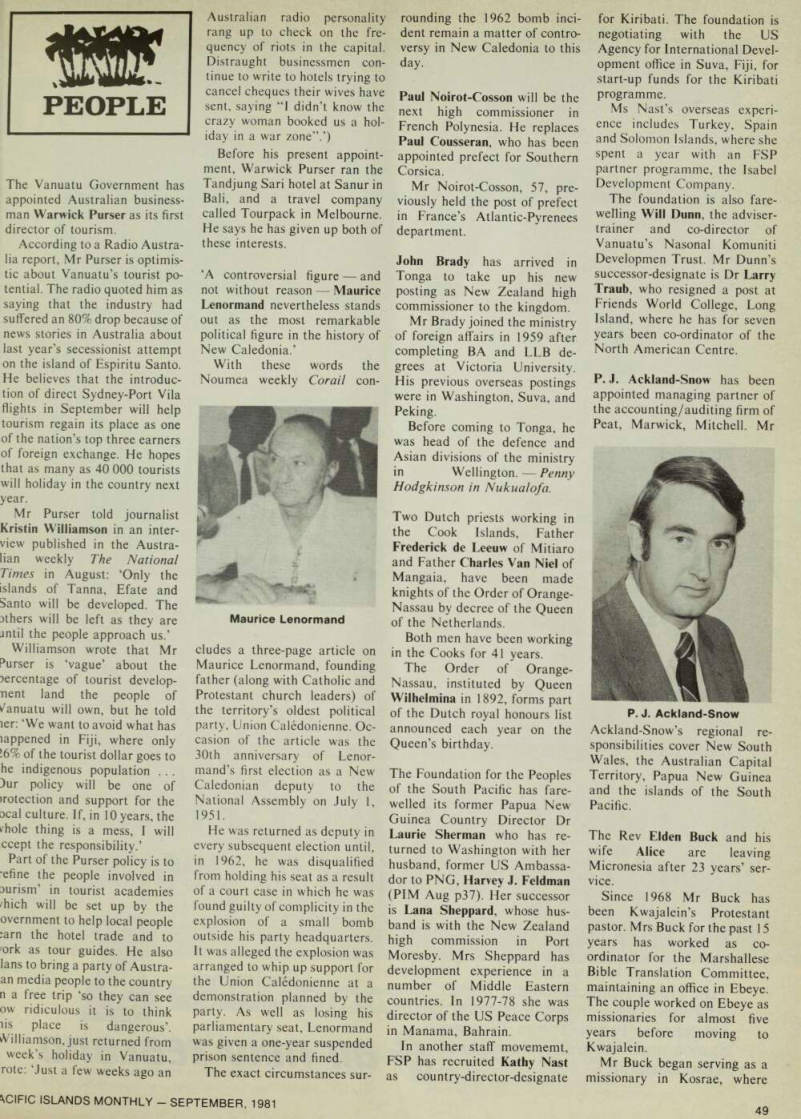


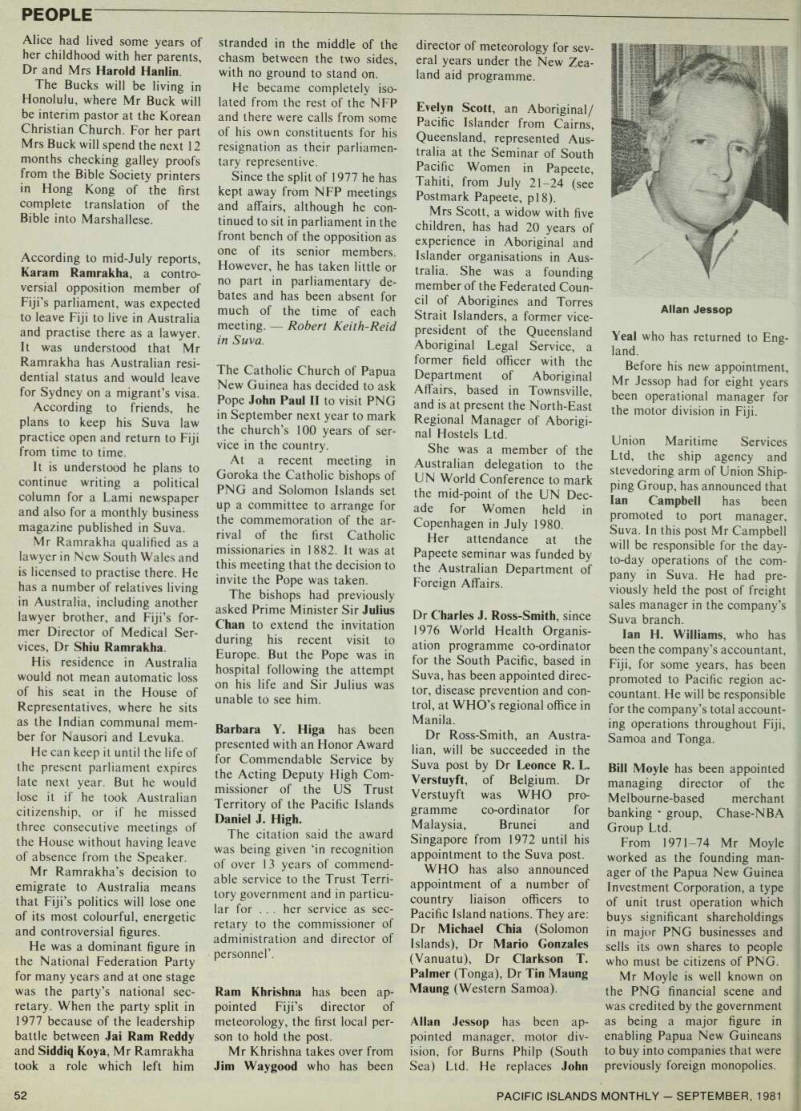
The Vanuatu Government has appointed Australian business man Warwick Purser as its first director of tourism.
According to a Radio Austra lia report, Mr Purser is optimis tic about Vanuatu’s tourist po tential. The radio quoted him as saying that the industry had suffered an 80% drop because of news stories in Australia about last year’s secessionist attempt on the island of Espiritu Santo.
He believes that the introduc tion of direct Sydney-Port Vila flights in September will help tourism regain its place as one of the nation’s top three earners of foreign exchange. He hopes that as many as 40 000 tourists will holiday in the country next year.
Mr Purser told journalist Kristin Williamson in an inter view published in the Austra lian weekly The National Times in August: ‘Only the islands of Tanna, Efate and Santo will be developed. The Dthers will be left as they are antil the people approach us.’
Williamson wrote that Mr Purser is ‘vague’ about the percentage of tourist develop nent land the people of Vanuatu will own, but he told ler: ‘We want to avoid what has lappened in Fiji, where only 16% of the tourist dollar goes to he indigenous population .. . )ur policy will be one of trotection and support for the seal culture. If, in 10 years, the /hole thing is a mess, I will ccept the responsibility.’
Part of the Purser policy is to •efine the people involved in purism’ in tourist academies 'hich will be set up by the overnment to help local people ;arn the hotel trade and to 'ork as tour guides. He also lans to bring a party of Austra an media people to the country n a free trip ‘so they can see ow ridiculous it is to think iis place is dangerous’.
Williamson, just returned from week’s holiday in Vanuatu, rote: ‘Just a few weeks ago an
Australian radio personality rang up to check on the fre quency of riots in the capital.
Distraught businessmen con tinue to write to hotels trying to cancel cheques their wives have sent, saying “I didn’t know the crazy woman booked us a hol iday in a war zone”.’) Before his present appoint ment, Warwick Purser ran the Tandjung Sari hotel at Sanur in Bali, and a travel company catted Tourpack in Melbourne.
He says he has given up both of these interests. ‘A controversial figure and not without reason Maurice Lenormand nevertheless stands out as the most remarkable political figure in the history of New Caledonia.’
With these words the Noumea weekly Corail con-
cludes a three-page article on Maurice Lenormand, founding father (along with Catholic and Protestant church leaders) of the territory’s oldest political party, Union Caledonienne. Oc casion of the article was the 30th anniversary of Lenor mand’s first election as a New Caledonian deputy to the National Assembly on July 1, 1951.
He was returned as deputy in every subsequent election until, in 1962, he was disqualified from holding his seat as a result of a court case in which he was found guilty of complicity in the explosion of a small bomb outside his party headquarters.
It was alleged the explosion was arranged to whip up support for the Union Caledonienne at a demonstration planned by the party. As well as losing his parliamentary seat, Lenormand was given a one-year suspended prison sentence and fined.
The exact circumstances sur
rounding the 1962 bomb inci dent remain a matter of contro versy in New Caledonia to this day.
Paul Noirot-Cosson will be the next high commissioner in French Polynesia. He replaces Paul Cousseran, who has been appointed prefect for Southern Corsica.
Mr Noirot-Cosson, 57, pre viously held the post of prefect in France’s Atlantic-Pyrenees department.
John Brady has arrived in Tonga to take up his new posting as New Zealand high commissioner to the kingdom.
Mr Brady joined the ministry of foreign affairs in 1959 after completing BA and LLB de grees at Victoria University.
His previous overseas postings were in Washington, Suva, and Peking.
Before coming to Tonga, he was head of the defence and Asian divisions of the ministry
in Wellington.
Penny
Hodgkinson in Nukualofa.
Two Dutch priests working in the Cook Islands, Father Frederick de Leeuw of Mitiaro and Father Charles Van Niel of Mangaia, have been made knights of the Order of Orange- Nassau by decree of the Queen of the Netherlands.
Both men have been working in the Cooks for 41 years.
The Order of Orange- Nassau, instituted by Queen Wilhelmina in 1892, forms part of the Dutch royal honours list announced each year on the Queen’s birthday.
The Foundation for the Peoples of the South Pacific has fare welled its former Papua New Guinea Country Director Dr Laurie Sherman who has re turned to Washington with her husband, former US Ambassa dor to PNG, Harvey J. Feldman (PIM Aug p37). Her successor is Lana Sheppard, whose hus band is with the New Zealand high commission in Port Moresby. Mrs Sheppard has development experience in a number of Middle Eastern countries. In 1977-78 she was director of the US Peace Corps in Manama, Bahrain.
In another staff movememt, FSP has recruited Kathy Nast
as country-director-designate
for Kiribati. The foundation is negotiating with the US Agency for International Devel opment office in Suva, Fiji, for start-up funds for the Kiribati programme.
Ms Nast’s overseas experi ence includes Turkey, Spain and Solomon Islands, where she spent a year with an FSP partner programme, the Isabel Development Company.
The foundation is also fare wetting Will Dunn, the adviser trainer and co-director of Vanuatu’s Nasonal Komuniti Developmen Trust. Mr Dunn’s successor-designate is Dr Larry Traub, who resigned a post at Friends World College, Long Island, where he has for seven years been co-ordinator of the North American Centre.
P. J. Ackland-Snow has been appointed managing partner of the accounting/auditing firm of Peat, Marwick, Mitchell. Mr
Ackland-Snow’s regional re sponsibilities cover New South Wales, the Australian Capital Territory, Papua New Guinea and the islands of the South Pacific.
The Rev Elden Buck and his wife Alice are leaving Micronesia after 23 years’ ser vice.
Since 1968 Mr Buck has been Kwajalein’s Protestant pastor. Mrs Buck for the past 15 years has worked as co ordinator for the Marshallese Bible Translation Committee, maintaining an office in Ebeye.
The couple worked on Ebeye as missionaries for almost five years before moving to Kwajalein.
Mr Buck began serving as a missionary in Kosrae, where
Maurice Lenormand
P. J. Ackland-Snow
Alice had lived some years of her childhood with her parents, Dr and Mrs Harold Hanlin.
The Bucks will be living in Honolulu, where Mr Buck will be interim pastor at the Korean Christian Church. For her part Mrs Buck will spend the next 12 months checking galley proofs from the Bible Society printers in Hong Kong of the first complete translation of the Bible into Marshallese.
According to mid-July reports, Karam Ramrakha. a contro versial opposition member of Fiji’s parliament, was expected to leave Fiji to live in Australia and practise there as a lawyer.
It was understood that Mr Ramrakha has Australian resi dential status and would leave for Sydney on a migrant’s visa.
According to friends, he plans to keep his Suva law practice open and return to Fiji from time to time.
It is understood he plans to continue writing a political column for a Lami newspaper and also for a monthly business magazine published in Suva.
Mr Ramrakha qualified as a lawyer in New South Wales and is licensed to practise there. He has a number of relatives living in Australia, including another lawyer brother, and Fiji’s for mer Director of Medical Ser vices, Dr Shiu Ramrakha.
His residence in Australia would not mean automatic loss of his seat in the House of Representatives, where he sits as the Indian communal mem ber for Nausori and Levuka.
He can keep it until the life of the present parliament expires late next year. But he would lose it if he took Australian citizenship, or if he missed three consecutive meetings of the House without having leave of absence from the Speaker.
Mr Ramrakha’s decision to emigrate to Australia means that Fiji’s politics will lose one of its most colourful, energetic and controversial figures.
He was a dominant figure in the National Federation Party for many years and at one stage was the party’s national sec retary. When the party split in 1977 because of the leadership battle between Jai Ram Reddy and Siddiq Koya, Mr Ramrakha took a role which left him
stranded in the middle of the chasm between the two sides, with no ground to stand on.
He became completely iso lated from the rest of the NFP and there were calls from some of his own constituents for his resignation as their parliamen tary representive.
Since the split of 1977 he has kept away from NFP meetings and affairs, although he con tinued to sit in parliament in the front bench of the opposition as one of its senior members.
However, he has taken little or no part in parliamentary de bates and has been absent for much of the time of each meeting. Robert Keith-Reid in Suva.
The Catholic Church of Papua New Guinea has decided to ask Pope John Paul II to visit PNG in September next year to mark the church’s 100 years of ser vice in the country.
At a recent meeting in Goroka the Catholic bishops of PNG and Solomon Islands set up a committee to arrange for the commemoration of the ar rival of the first Catholic missionaries in 1882. It was at this meeting that the decision to invite the Pope was taken.
The bishops had previously asked Prime Minister Sir Julius Chan to extend the invitation during his recent visit to Europe. But the Pope was in hospital following the attempt on his life and Sir Julius was unable to see him.
Barbara Y. Higa has been presented with an Honor Award for Commendable Service by the Acting Deputy High Com missioner of the US Trust Territory of the Pacific Islands Daniel J. High.
The citation said the award was being given ‘in recognition of over 13 years of commend able service to the Trust Terri tory government and in particu lar for ... her service as sec retary to the commissioner of administration and director of personnel’.
Ram Khrishna has been ap pointed Fiji’s director of meteorology, the first local per son to hold the post.
Mr Khrishna takes over from Jim Waygood who has been
director of meteorology for sev eral years under the New Zea land aid programme.
Evelyn Scott, an Aboriginal/ Pacific Islander from Cairns, Queensland, represented Aus tralia at the Seminar of South Pacific Women in Papeete, Tahiti, from July 21-24 (see Postmark Papeete, piB).
Mrs Scott, a widow with five children, has had 20 years of experience in Aboriginal and Islander organisations in Aus tralia. She was a founding member of the Federated Coun cil of Aborigines and Torres Strait Islanders, a former vice president of the Queensland Aboriginal Legal Service, a former field officer with the Department of Aboriginal Affairs, based in Townsville, and is at present the North-East Regional Manager of Aborigi nal Hostels Ltd.
She was a member of the Australian delegation to the UN World Conference to mark the mid-point of the UN Dec ade for Women held in Copenhagen in July 1980.
Her attendance at the Papeete seminar was funded by the Australian Department of Foreign Affairs.
Dr Charles J. Ross-Smith, since 1976 World Health Organis ation programme co-ordinator for the South Pacific, based in Suva, has been appointed direc tor, disease prevention and con trol, at WHO’s regional office in Manila.
Dr Ross-Smith, an Austra lian, will be succeeded in the Suva post by Dr Leonce R. L.
Verstuyft, of Belgium. Dr Verstuyft was WHO pro gramme co-ordinator for Malaysia, Brunei and Singapore from 1972 until his appointment to the Suva post.
WHO has also announced appointment of a number of country liaison officers to Pacific Island nations. They are: Dr Michael Chia (Solomon Islands), Dr Mario Gonzales (Vanuatu), Dr Clarkson T.
Palmer (Tonga), Dr Tin Maung Maung (Western Samoa).
Allan Jessop has been ap pointed manager, motor div ision, for Burns Philp (South Sea) Ltd. He replaces John
Yeal who has returned to Eng land.
Before his new appointment, Mr Jessop had for eight years been operational manager for the motor division in Fiji.
Union Maritime Services Ltd, the ship agency and stevedoring arm of Union Ship ping Group, has announced that lan Campbell has been promoted to port manager, Suva. In this post Mr Campbell will be responsible for the day to-day operations of the com pany in Suva. He had pre viously held the post of freight sales manager in the company’s Suva branch. lan H. Williams, who has been the company’s accountant, Fiji, for some years, has been promoted to Pacific region ac countant. He will be responsible for the company’s total account ing operations throughout Fiji, Samoa and Tonga.
Bill Moyle has been appointed managing director of the Melbourne-based merchant banking * group, Chase-NBA Group Ltd.
From 1971-74 Mr Moyle worked as the founding man ager of the Papua New Guinea Investment Corporation, a type of unit trust operation which buys significant shareholdings in major PNG businesses and sells its own shares to people who must be citizens of PNG.
Mr Moyle is well known on the PNG financial scene and was credited by the government as being a major figure in enabling Papua New Guineans to buy into companies that were previously foreign monopolies.
Allan Jessop
Advertisements & other items, pp. 49-51 (2 items)
\Cific Islands Monthly September, 1981
Throughout the Pocific...
mmm am
we’re your kind of people
When you fly in the Pacific, you’ll feel at home with Ah' New Zealand.
Fly with us to Australia,Cook Islands, Fiji, Hong Kong, Honolulu, Japan, Los Angeles, New Caledonia, Norfolk Island, Singapore, Tahiti, Tonga, Western Now Zpnland
air new zeaiano
The Pacific’s Number One V.
ANZ 80/18
Reach out and the
The Spectrum 50 matched-
component system finally puts a
richer musical life within reach of
the most restrictive hi-fi budgets.
Each Spectrum 50 component is
a star in a perfectly harmonizing
audio galactic system. The brain-
child of some of the hi-fi world’s
most dedicated engineers.
Reach out, and your journey to
music’s realm of inner space can
begin now!
i a • * m : ■. » • m* ■ • % -I r. him I ii " I • w* l *’ I in W- 3 3 * 1 I* a I ■ *- • «
Spectrum 50
TRIO-KENWOOD CORPORATION
Shionogi Shibuya Building, 17-5, 2-chome, Shibuya
Shibuya-ku, Tokyo 150, Japan
TRIO-KENWOOD (AUSTRALIA) PTY. LTD.
4E Woodcock Place, Lane Cove! N.S.W. 2066, Australia. Tel: 428-1455 KA-50 Stereo Integrated Amplifier KT-30 FM-AM Stereo Tuner KX-50 Metal-Tape Stereo Cassette Deck with Dolby* NR
KD-40R
Direct-Drive Auto-Return Turntable
LS-110F
65W 3-way Speaker System
SRC-5
Audio Rack with glass door and casters GE-90 Stereo Graphic Equalizer (option) *TM Dolby Licensing Corp.
NEW ZEALAND JOHN GILBERT & CO , LTD Auckland Tel 30-839 FIJI THE DOMINION IMPORT & EXPORT PROMOTIONS Nadi Tel 72-165 PAPUA NEW GUINEA S O SVENSSON (N G ) LTD. Port Moresby Tel 24-2275/2285
NORFOLK ISLAND BURNS PHILIP.(NORFOLK ISLAND) LTD
SOLOMON ISLANDS TECHNIQUE RADIOS CENTRE LTD Honiara Tel 416 NEW CALEDONIA HI-FI VOX Noumea Tel 27-2466
VANUATU RUE HIGGINSON Vila Tel 2556
TAHITI MAISON AURORE Papeete Tel 29703
AMERICAN SAMOA ISLAND PACIFIC AGENCIES, INC Pago Pago Tel 633-4687
REPUBLIC OF NAURU NAURU CO-OPERATIVE SOCIETY
MARIANA ISLANDS J C TENORIO ENTERPRISES Saipan Tel 6445
German New Guinea as
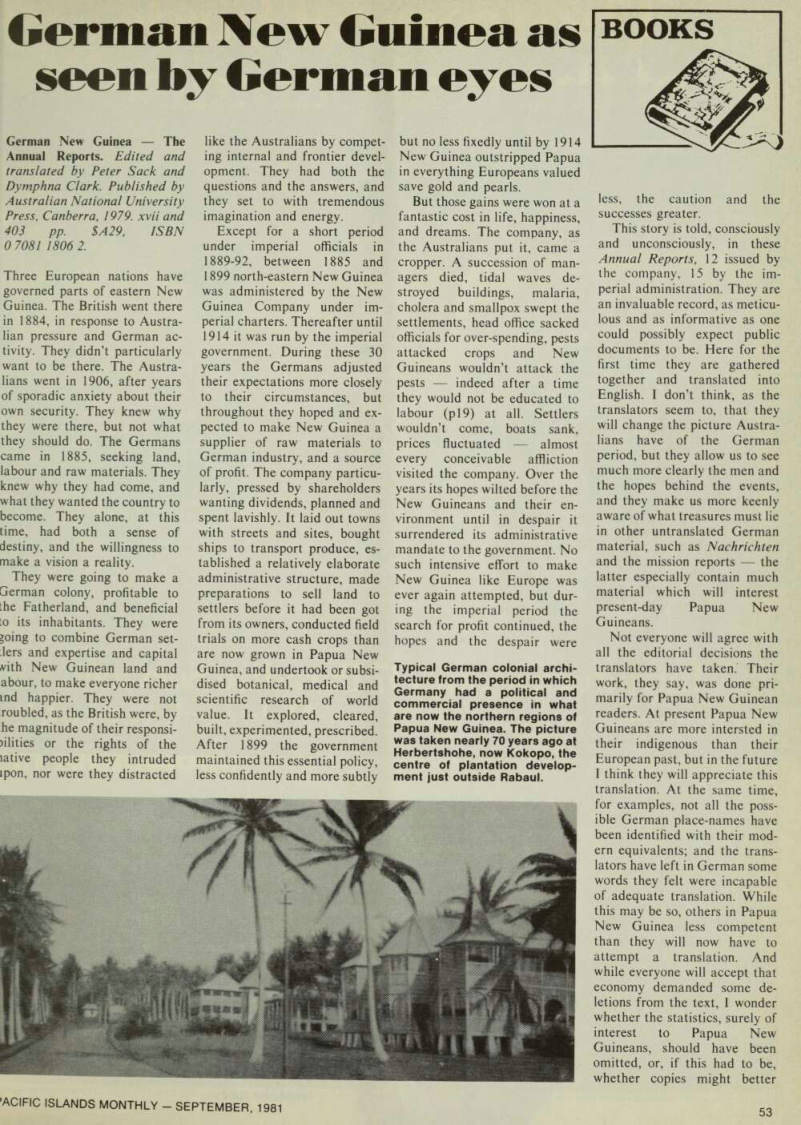
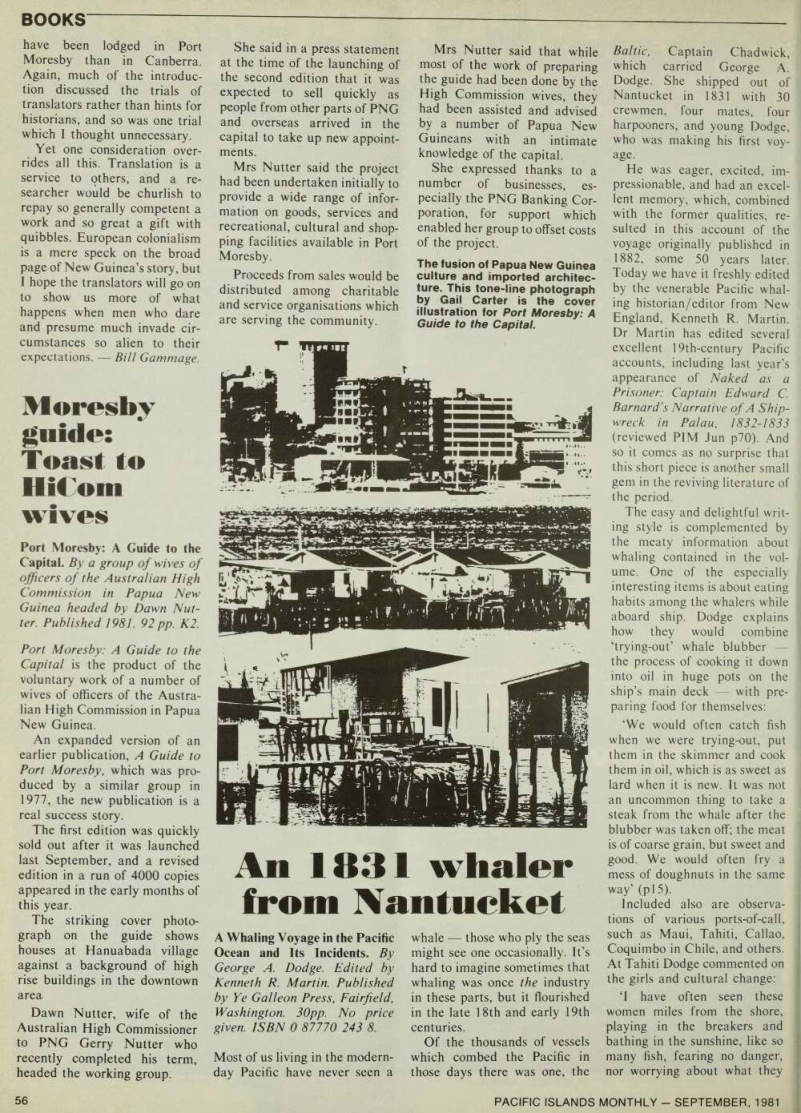
Books
German New Guinea as seen by German eyes
German New Guinea The Annual Reports. Edited and translated by Peter Sack and Dymphna Clark. Published by Australian National University Press, Canberra, 1979. xvii and
403 Pp. Sa29, Isbn
0 7081 1806 2.
Three European nations have governed parts of eastern New Guinea. The British went there in 1884, in response to Austra lian pressure and German ac tivity. They didn’t particularly want to be there. The Austra lians went in 1906, after years of sporadic anxiety about their own security. They knew why they were there, but not what they should do. The Germans came in 1885, seeking land, labour and raw materials. They knew why they had come, and what they wanted the country to become. They alone, at this time, had both a sense of destiny, and the willingness to make a vision a reality.
They were going to make a German colony, profitable to the Fatherland, and beneficial to its inhabitants. They were >oing to combine German set ters and expertise and capital vith New Guinean land and abour, to make everyone richer md happier. They were not roubled, as the British were, by he magnitude of their responsi )ilities or the rights of the lative people they intruded ipon, nor were they distracted
like the Australians by compet ing internal and frontier devel opment. They had both the questions and the answers, and they set to with tremendous imagination and energy.
Except for a short period under imperial officials in 1889-92, between 1885 and 1899 north-eastern New Guinea was administered by the New Guinea Company under im perial charters. Thereafter until 1914 it was run by the imperial government. During these 30 years the Germans adjusted their expectations more closely to their circumstances, but throughout they hoped and ex pected to make New Guinea a supplier of raw materials to German industry, and a source of profit. The company particu larly, pressed by shareholders wanting dividends, planned and spent lavishly. It laid out towns with streets and sites, bought ships to transport produce, es tablished a relatively elaborate administrative structure, made preparations to sell land to settlers before it had been got from its owners, conducted field trials on more cash crops than are now grown in Papua New Guinea, and undertook or subsi dised botanical, medical and scientific research of world value. It explored, cleared, built, experimented, prescribed.
After 1899 the government maintained this essential policy, less confidently and more subtly
but no less fixedly until by 1914 New Guinea outstripped Papua in everything Europeans valued save gold and pearls.
But those gains were won at a fantastic cost in life, happiness, and dreams. The company, as the Australians put it, came a cropper. A succession of man agers died, tidal waves de stroyed buildings, malaria, cholera and smallpox swept the settlements, head office sacked officials for over-spending, pests attacked crops and New Guineans wouldn’t attack the pests indeed after a time they would not be educated to labour (pi 9) at all. Settlers wouldn’t come, boats sank, prices fluctuated almost every conceivable affliction visited the company. Over the years its hopes wilted before the New Guineans and their en vironment until in despair it surrendered its administrative mandate to the government. No such intensive effort to make New Guinea like Europe was ever again attempted, but dur ing the imperial period the search for profit continued, the hopes and the despair were
less, the caution and the successes greater.
This story is told, consciously and unconsciously, in these Annual Reports, 12 issued by the company, 15 by the im perial administration. They are an invaluable record, as meticu lous and as informative as one could possibly expect public documents to be. Here for the first time they are gathered together and translated into English. I don’t think, as the translators seem to, that they will change the picture Austra lians have of the German period, but they allow us to see much more clearly the men and the hopes behind the events, and they make us more keenly aware of what treasures must lie in other untranslated German material, such as Nachrichten and the mission reports the latter especially contain much material which will interest present-day Papua New Guineans.
Not everyone will agree with all the editorial decisions the translators have taken. Their work, they say, was done pri marily for Papua New Guinean readers. At present Papua New Guineans are more intersted in their indigenous than their European past, but in the future I think they will appreciate this translation. At the same time, for examples, not all the poss ible German place-names have been identified with their mod ern equivalents; and the trans lators have left in German some words they felt were incapable of adequate translation. While this may be so, others in Papua New Guinea less competent than they will now have to attempt a translation. And while everyone will accept that economy demanded some de letions from the text, I wonder whether the statistics, surely of interest to Papua New Guineans, should have been omitted, or, if this had to be, whether copies might better
Typical German colonial archi tecture from the period in which Germany had a political and commercial presence in what are now the northern regions of Papua New Guinea. The picture was taken nearly 70 years ago at
Herbertshohe, now Kokopo, the
centre of plantation develop ment just outside Rabaul.
have been lodged in Port Moresby than in Canberra.
Again, much of the introduc tion discussed the trials of translators rather than hints for historians, and so was one trial which I thought unnecessary.
Yet one consideration over rides all this. Translation is a service to others, and a re searcher would be churlish to repay so generally competent a work and so great a gift with quibbles. European colonialism is a mere speck on the broad page of New Guinea’s story, but I hope the translators will go on to show us more of what happens when men who dare and presume much invade cir cumstances so alien to their
expectations.
Bill Gammage.
Advertisements & other items, pp. 53-55 (2 items)
53
’ACIFIC ISLANDS MONTHLY SEPTEMBER, 1981
Komatsu flakes a Difference
' i *** / u *>* V I % In critical areas like reliability and performance, Komatsu products and systems are making a significant difference at mining and construction sites around the world.
In the USA, for example, Komatsu’s largest and most powerful work machine - the D455A bulldozer is establishing a superior record of reliability and productivity at mining sites that virtually no other machine in its class can match.
And in another critical area, technology, Komatsu is also making a difference in responding to market demands for improved product quality, and for new and original product innovations.
Consider our new computerized seabed robot system: Operating on the ocean floor, it can relay TV pictures of the seabed to a mother ship, or perform man-like boring, drilling and piling operations down to planned depths of 500 meters* Discover the Komatsu difference above sea level, or down to depths of 500 meters. Komatsu a name you can build on.
•H KOMATSU LTD
Tokyo. Japan Komatsu offices: Tokyo, Sydney, Singapore, Jakarta, Manila, Bangkok Bangalore, Karachi, Beijing, Istanbul, Cairo, Alger, Dubai, Tehran, Baghdad, Jeddah, Riyadh, Damman, Nairobi, Abidjan, Lagos, Johannesburg, Moscow Warsaw, Brussels, Pans, Madrid, Frankfurt, Stuttgart, London, Habana, Buenos' Aires, Panama, Caracas, Sao Paulo, Bogota, Mexico City, San Francisco, Oakland, Philadelphia, Detroit, Dallas, Atlanta, Chicago, Toronto, Vancouver, and distributors in over 100 countries around the world. i The Komatsu seabed robot system is currently operating in the Japan Inland Sea at
«• . * sw
Introducing our 737 Paradise Service
to pamper you around our Polynesian world.
Introducing 737 Paradise Service to pamper you around our Polynesian world.
Experience the Polynesia that is the heart of the Pacific region. A cluster ot islands cherished in a history alive today.
A people as friendly and colourful as anywhere in the world.
Polynesian Airlines, an airline born in the islands.
An airlinethat is proud of its record of growth and recognized service. FUI An airline that truly reflects * w |amoa the peoples of the region .., with a warmth that
AUCKLAND
AMERICAN
SAMOA
LIS
RAROTONGA
ONGA
E embraces what we call ‘Paradise Service.’
We fly throughout the region .. .and provide 737 whisperjet services to many of our destinations.
We are Polynesia. Experience ‘Paradise Service' aboard our tropical Birds of Paradise.
For information and flight sch ed u les co n ta ct yo u r n ea rest travel agent or Polynesian Airlines.
TAHITI
POLYNESIAN AIRLINES
Auckland; Maota Samoa, 283 Karangahape Rd.
Telephone AK 794-824.
Wellington: Construction House, 80 Kent Terrace.
Telephone 858-756.
Cj
Moresby
guide: Toast to HiCom wives
Port Moresby: A Guide to the Capital. By a group of wives of officers of the Australian High Commission in Papua New Guinea headed by Dawn Nut ter. Published 1981. 92 pp. K 2.
Port Moresby: A Guide to the Capital is the product of the voluntary work of a number of wives of officers of the Austra lian High Commission in Papua New Guinea.
An expanded version of an earlier publication, A Guide to Port Moresby, which was pro duced by a similar group in 1977, the new publication is a real success story.
The first edition was quickly sold out after it was launched last September, and a revised edition in a run of 4000 copies appeared in the early months of this year.
The striking cover photo graph on the guide shows houses at Hanuabada village against a background of high rise buildings in the downtown area Dawn Nutter, wife of the Australian High Commissioner to PNG Gerry Nutter who recently completed his term, headed the working group.
She said in a press statement at the time of the launching of the second edition that it was expected to sell quickly as people from other parts of PNG and overseas arrived in the capital to take up new appoint ments.
Mrs Nutter said the project had been undertaken initially to provide a wide range of infor mation on goods, services and recreational, cultural and shop ping facilities available in Port Moresby.
Proceeds from sales would be distributed among charitable and service organisations which are serving the community.
Mrs Nutter said that while most of the work of preparing the guide had been done by the High Commission wives, they had been assisted and advised by a number of Papua New Guineans with an intimate knowledge of the capital.
She expressed thanks to a number of businesses, es pecially the PNG Banking Cor poration, for support which enabled her group to offset costs of the project.
from Nantucket
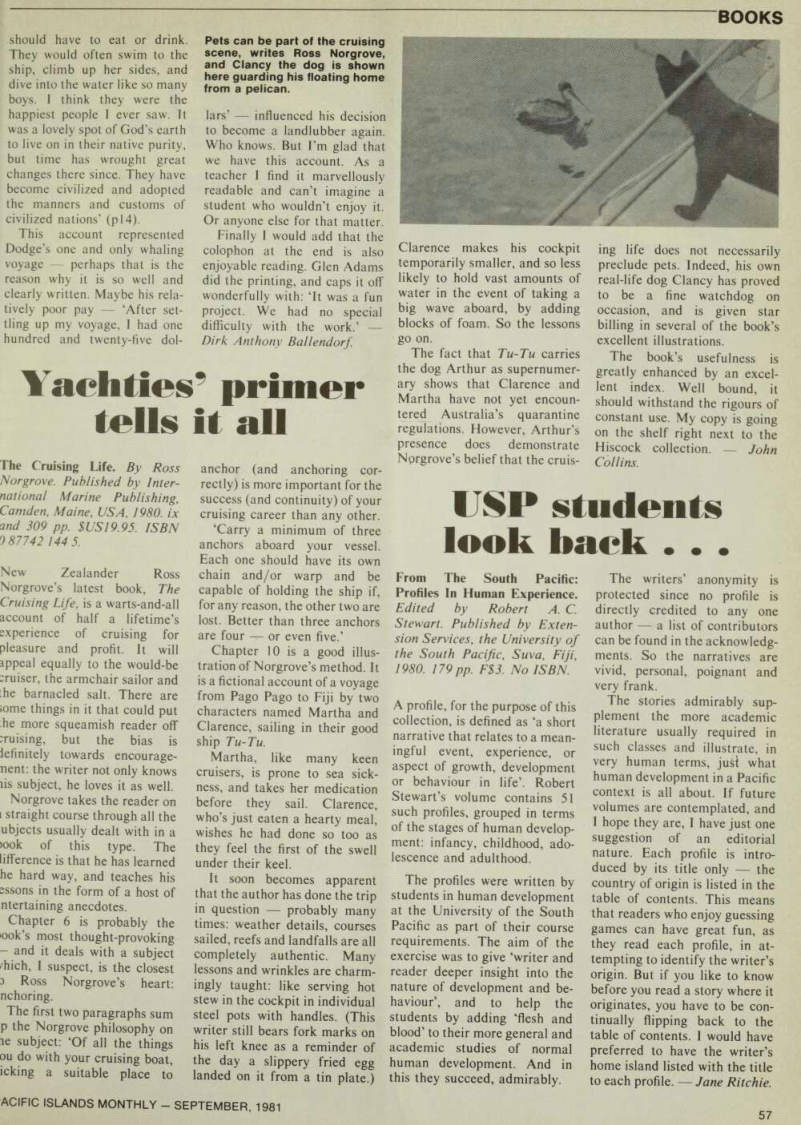
An 1831 whaler from Nantucket
A Whaling Voyage in the Pacific Ocean and Its Incidents. By George A. Dodge. Edited by Kenneth R. Martin. Published by Ye Galleon Press, Fairfield, Washington. 30pp. No price given. ISBN 0 87770 243 8.
Most of us living in the modern day Pacific have never seen a
whale those who ply the seas might see one occasionally. It’s hard to imagine sometimes that whaling was once the industry in these parts, but it flourished in the late 18th and early 19th centuries.
Of the thousands of vessels which combed the Pacific in those days there was one, the
Baltic, Captain Chadwick, which carried George A.
Dodge. She shipped out of Nantucket in 1831 with 30 crewmen, four mates, four harpooners, and young Dodge, who was making his first voy age.
He was eager, excited, im pressionable, and had an excel lent memory, which, combined with the former qualities, re sulted in this account of the voyage originally published in 1882, some 50 years later.
Today we have it freshly edited by the venerable Pacific whal ing historian/editor from New England, Kenneth R. Martin.
Dr Martin has edited several excellent 19th-century Pacific accounts, including last year’s appearance of Naked as a Prisoner: Captain Edward C.
Barnard’s Narrative of A Ship wreck in Palau, 1832-1833 (reviewed PIM Jun p7O). And so it comes as no surprise that this short piece is another small gem in the reviving literature of the period.
The easy and delightful writ ing style is complemented by the meaty information about whaling contained in the vol ume. One of the especially interesting items is about eating habits among the whalers while aboard ship. Dodge explains how they would combine ‘trying-out’ whale blubber the process of cooking it down into oil in huge pots on the ship’s main deck with pre paring food for themselves: ‘We would often catch fish when we were trying-out, put them in the skimmer and cook them in oil, which is as sweet as lard when it is new. It was not an uncommon thing to take a steak from the whale after the blubber was taken off; the meat is of coarse grain, but sweet and good. We would often fry a mess of doughnuts in the same way’ (pis).
Included also are observa tions of various ports-of-call, such as Maui, Tahiti, Callao, Coquimbo in Chile, and others.
At Tahiti Dodge commented on the girls and cultural change: ‘I have often seen these women miles from the shore, playing in the breakers and bathing in the sunshine, like so many fish, fearing no danger, nor worrying about what they
The fusion of Papua New Guinea culture and imported architec ture. This tone-line photograph by Gail Carter is the cover illustration for Port Moresby: A Guide to the Capital.
should have to eat or drink.
They would often swim to the ship, climb up her sides, and , 1 ... dive into the water like so many boys. I think they were the happiest people I ever saw. It was a lovely spot of God’s earth to live on in their native purity, but time has wrought great changes there since. They have become civilized and adopted the manners and customs of civilized nations’ (pi 4).
This account represented Dodge’s one and only whaling voyage perhaps that is the reason why it is so well and clearly written. Maybe his relalively poor pay ‘After settling up my voyage, I had one hundred and twenty-five dol-
lars’ influenced his decision to become a landlubber again, Who knows. But I’m glad that we have this account. As a teacher I find it marvellously readable and can’t imagine a student who wouldn’t enjoy it.
Or anyone else for that matter.
Finally I would add that the colophon at the end is also enjoyable reading. Glen Adams did the printing, and caps it off wonderfully with; ‘lt was a fun project. We had no special difficulty with the work.’
Dirk Anthony Ballendorf
Yachties’ primer
tells it all
The Cruising Life. By Ross Norgrove. Published by Inter national Marine Publishing, Camden, Maine, USA, 1980. ix and 309 pp. SUS 19.95. ISBN 187742 144 5.
New Zealander Ross Norgrove’s latest book, The Cruising Life, is a warts-and-all account of half a lifetime’s experience of cruising for pleasure and profit. It will appeal equally to the would-be eruiser, the armchair sailor and :he barnacled salt. There are some things in it that could put he more squeamish reader off cruising, but the bias is lefinitely towards encourage nent: the writer not only knows lis subject, he loves it as well.
Norgrove takes the reader on i straight course through all the übjects usually dealt with in a >ook of this type. The lifference is that he has learned he hard way, and teaches his sssons in the form of a host of ntertaining anecdotes.
Chapter 6 is probably the
'ook s most thought-provoking
- and it deals with a subject 'hich, I suspect, is the closest 3 Ross Norgrove’s heart: nchoring.
The first two paragraphs sum p the Norgrove philosophy on le subject; ‘Of all the things ou do with your cruising boat, icking a suitable place to
anchor (and anchoring cor rectly) is more important for the success (and continuity) of your cruising career than any other. ‘Carry a minimum of three anchors aboard your vessel.
Each one should have its own chain and/or warp and be capable of holding the ship if, for any reason, the other two are lost. Better than three anchors are four or even five.’
Chapter 10 is a good illus tration of Norgrove’s method. It is a fictional account of a voyage from Pago Pago to Fiji by two characters named Martha and Clarence, sailing in their good ship Tu-Tu.
Martha, like many keen cruisers, is prone to sea sick ness, and takes her medication before they sail. Clarence, who’s just eaten a hearty meal, wishes he had done so too as they feel the first of the swell under their keel.
It soon becomes apparent that the author has done the trip in question probably many times: weather details, courses sailed, reefs and landfalls are all completely authentic. Many lessons and wrinkles are charm ingly taught: like serving hot stew in the cockpit in individual steel pots with handles. (This writer still bears fork marks on his left knee as a reminder of the day a slippery fried egg landed on it from a tin plate.)
Clarence makes his cockpit temporarily smaller, and so less likely to hold vast amounts of water in the event of taking a big wave aboard, by adding blocks of foam. So the lessons go on.
The fact that Tu-Tu carries the dog Arthur as supernumer ary shows that Clarence and Martha have not yet encoun tered Australia’s quarantine regulations. However, Arthur’s presence does demonstrate Nprgrove’s belief that the cruis
ing life does not necessarily preclude pets. Indeed, his own real-life dog Clancy has proved to be a fine watchdog on occasion, and is given star billing in several of the book’s excellent illustrations.
The book’s usefulness is greatly enhanced by an excel lent index. Well bound, it should withstand the rigours of constant use. My copy is going on the shelf right next to the
Hiscock collection.
John
Collins.
Pets can be part of the cruising scene, writes Ross Norgrove, and Clancy the dog is shown here guarding his floating home from a pelican.
USP students
look back . . .
From The South Pacific: Profiles In Human Experience.
Edited by Robert A. C.
Stewart. Published by Exten sion Services, the University of the South Pacific, Suva, Fiji, 1980. 179 pp. Fs3. No ISBN.
A profile, for the purpose of this collection, is defined as ‘a short narrative that relates to a mean ingful event, experience, or aspect of growth, development or behaviour in life’. Robert Stewart’s volume contains 51 such profiles, grouped in terms of the stages of human develop ment: infancy, childhood, ado lescence and adulthood.
The profiles were written by students in human development at the University of the South Pacific as part of their course requirements. The aim of the exercise was to give ‘writer and reader deeper insight into the nature of development and be haviour’, and to help the students by adding ‘flesh and blood’ to their more general and academic studies of normal human development. And in this they succeed, admirably.
The writers’ anonymity is protected since no profile is directly credited to any one author a list of contributors can be found in the acknowledg ments. So the narratives are vivid, personal, poignant and very frank. , The stories admirably sup- P lement the more academic l> te f ature usually required in suc ' l classes and illustrate, in y human terms, jusl what human development in a Pacific * s a h about. If future y°‘ umes are contemplated, and hope they are, I have just one suggestion of a n editorial nature. Each profile is intro duced by its title only the country of origin is listed in the table of contents. This means that readers who enjoy guessing games can have great fun, as they read each profile, in at tempting to identify the writer’s origin. But if you like to know before you read a story where it originates, you have to be con tinually flipping back to the table of contents. I would have preferred to have the writer’s home island listed with the title
to each profile. -
Jane Ritchie.
Advertisements & other items, pp. 57-58 (2 items)
Books
57
ACIFIC ISLANDS MONTHLY SEPTEMBER, 1981
of-the-art technology plus sophisticated styling.^'
At last! A component system that offers state-,
Unprecedented features, performance and design,
from TEAC, naturally.
mmr
mw Australia: TEAC Australia Pty., Ltd. m 115 Whiteman Street South Melbourne, Victoria 3205 New Zealand: Direct Imports (N.Z.) Ltd. P .0. Box 72 Hastings ITbi r i Fuji: D. Jeevan & Sons P.O, Box 148. Suva i 1 i 1. m New Caledonia: HIFIVOX 79, Rue de Sebastopol B.P. 1458, Noumea Whefe Art and technology Papua New Guinea: Keynote Music House Turumu Street P.O. Box 1192, Boroko
-and crusading politician
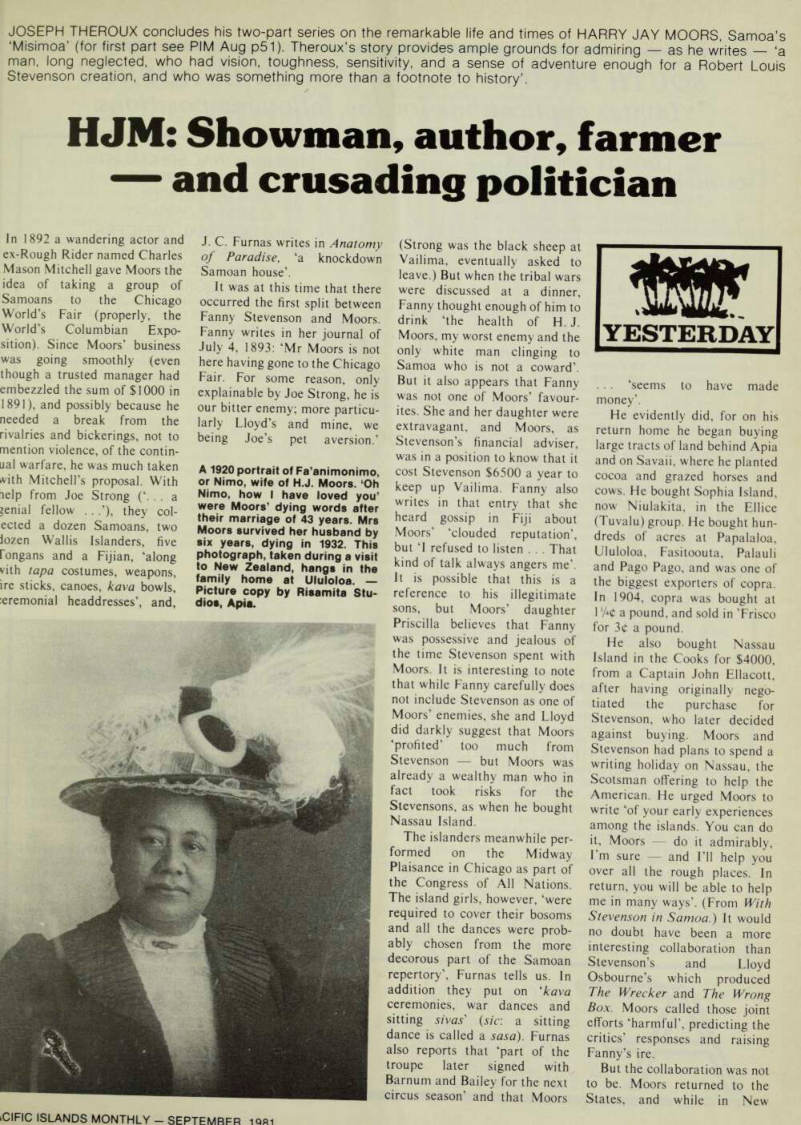
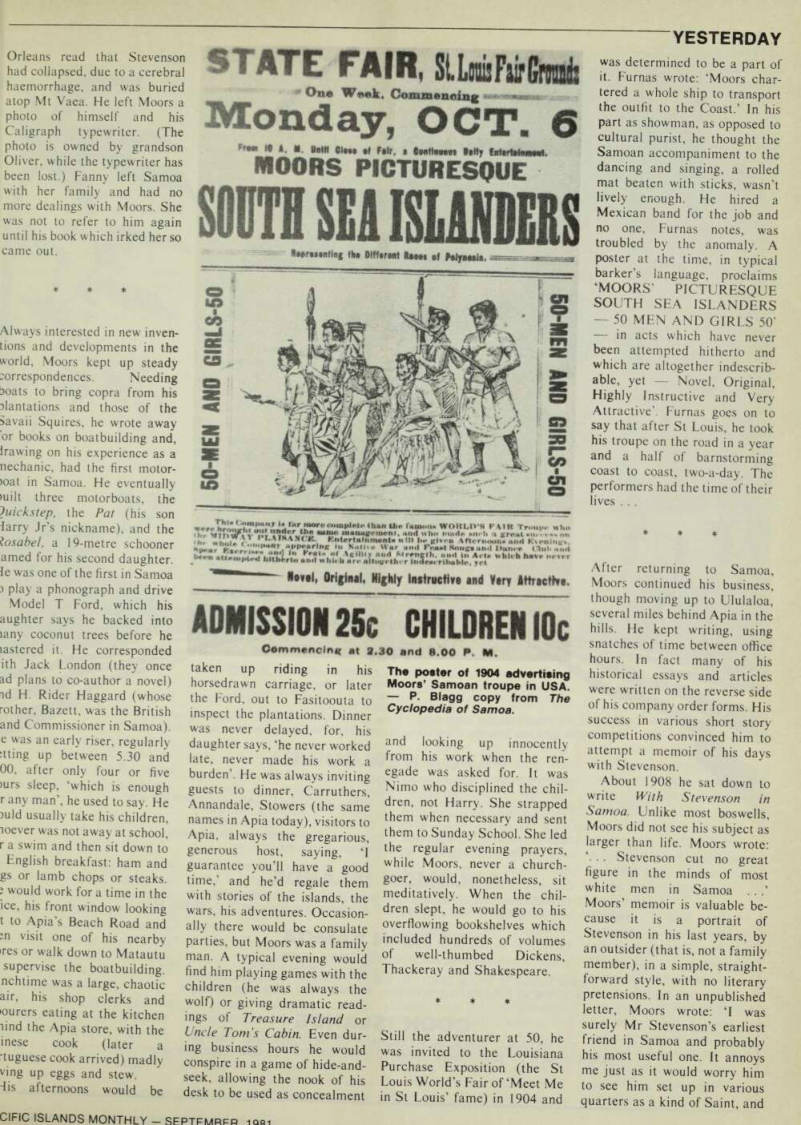
Yesterday
HJM: Showman, author, farmer -and crusading politician
JOSEPH THEROUX concludes his two-part series on the remarkable life and times of HARRY JAY MOORS, Samoa’s ‘Misimoa’ (for first part see PIM Aug p5l). Theroux’s story provides ample grounds for admiring as he writes ‘a man, long neglected, who had vision, toughness, sensitivity, and a sense of adventure enough for a Robert Louis Stevenson creation, and who was something more than a footnote to history’.
In 1892 a wandering actor and ex-Rough Rider named Charles Mason Mitchell gave Moors the idea of taking a group of Samoans to the Chicago World’s Fair (properly, the World’s Columbian Expo sition). Since Moors’ business was going smoothly (even though a trusted manager had embezzled the sum of $lOOO in 1891), and possibly because he needed a break from the rivalries and bickerings, not to mention violence, of the contin ual warfare, he was much taken with Mitchell’s proposal. With lelp from Joe Strong (‘. .. a ?enial fellow .. .’), they col ected a dozen Samoans, two lozen Wallis Islanders, five fongans and a Fijian, ‘along vith tapa costumes, weapons, ire sticks, canoes, kava bowls, :eremonial headdresses’, and,
J. C. Furnas writes in Anatomy of Paradise, ‘a knockdown Samoan house’.
It was at this time that there occurred the first split between Fanny Stevenson and Moors.
Fanny writes in her journal of July 4, 1893: ‘Mr Moors is not here having gone to the Chicago Fair. For some reason, only explainable by Joe Strong, he is our bitter enemy; more particu larly Lloyd’s and mine, we being Joe’s pet aversion.’
(Strong was the black sheep at Vailima, eventually asked to leave.) But when the tribal wars were discussed at a dinner, Fanny thought enough of him to drink ‘the health of H. J.
Moors, my worst enemy and the only white man clinging to Samoa who is not a coward’.
But it also appears that Fanny was not one of Moors’ favour ites. She and her daughter were extravagant, and Moors, as Stevenson’s financial adviser, was in a position to know that it cost Stevenson $6500 a year to keep up Vailima. Fanny also writes in that entry that she heard gossip in Fiji about Moors’ ‘clouded reputation’, but ‘I refused to listen . . . That kind of talk always angers me’.
It is possible that this is a reference to his illegitimate sons, but Moors’ daughter Priscilla believes that Fanny was possessive and jealous of the time Stevenson spent with Moors. It is interesting to note that while Fanny carefully does not include Stevenson as one of Moors’ enemies, she and Lloyd did darkly suggest that Moors ‘profited’ too much from Stevenson but Moors was already a wealthy man who in fact took risks for the Stevensons, as when he bought Nassau Island.
The islanders meanwhile per formed on the Midway Plaisance in Chicago as part of the Congress of All Nations.
The island girls, however, ‘were required to cover their bosoms and all the dances were prob ably chosen from the more decorous part of the Samoan repertory’, Furnas tells us. In addition they put on ‘ kava ceremonies, war dances and sitting sivas ’ {sic: a sitting dance is called a sasa). Furnas also reports that ‘part of the troupe later signed with Barnum and Bailey for the next circus season’ and that Moors
.. . ‘seems to have made money’.
He evidently did, for on his return home he began buying large tracts of land behind Apia and on Savaii, where he planted cocoa and grazed horses and cows. He bought Sophia Island, now Niulakita, in the Ellice (Tuvalu) group. He bought hun dreds of acres at Papalaloa, Ululoloa, Fasitoouta, Palauli and Pago Pago, and was one of the biggest exporters of copra.
In 1904, copra was bought at 1 'H a pound, and sold in ’Frisco for 3tf a pound.
He also bought Nassau Island in the Cooks for S4OOO, from a Captain John Ellacotl, after having originally nego tiated the purchase for Stevenson, who later decided against buying. Moors and Stevenson had plans to spend a writing holiday on Nassau, the Scotsman offering to help the American. He urged Moors to write ‘of your early experiences among the islands. You can do it, Moors do it admirably, I m sure and I’ll help you over all the rough places. In return, you will be able to help me in many ways’. (From With Stevenson in Samoa.) It would no doubt have been a more interesting collaboration than Stevenson’s and Lloyd Osbourne’s which produced The Wrecker and The Wrong Box. Moors called those joint efforts ‘harmful’, predicting the critics’ responses and raising Fanny’s ire.
But the collaboration was not to be. Moors returned to the States, and while in New
A 1920 portrait of Fa’animonimo, or Nimo, wife of H.J. Moors. ‘Oh Nimo, how I have loved you' were Moors’ dying words after their marriage of 43 years. Mrs Moors survived her husband by six years, dying in 1932. This photograph, taken during a visit to New Zealand, hangs in the
family home at Ululoloa. -
Picture copy by Risamita Stu dios, Apia.
Orleans read that Stevenson had collapsed, due to a cerebral haemorrhage, and was buried atop Mt Vaea. He left Moors a photo of himself and his Caligraph typewriter. (The photo is owned by grandson Oliver, while the typewriter has been lost.) Fanny left Samoa with her family and had no more dealings with Moors. She was not to refer to him again until his book which irked her so came out. * * ♦ Always interested in new inven tions and developments in the world. Moors kept up steady
:orrespondences. Needing
x>ats to bring copra from his Dlantations and those of the Savaii Squires, he wrote away or books on boatbuilding and, Irawing on his experience as a nechanic, had the first motor >oat in Samoa. He eventually milt three motorboats, the Quickstep, the Pat (his son iarry Jr’s nickname), and the losabel, a 19-metre schooner amed for his second daughter, le was one of the first in Samoa ) play a phonograph and drive Model T Ford, which his aughter says he backed into lany coconut trees before he lastered it. He corresponded ith Jack London (they once ad plans to co-author a novel) ad H. Rider Haggard (whose rother, Bazett, was the British and Commissioner in Samoa), e was an early riser, regularly ‘tting up between 5.30 and 00, after only four or five mrs sleep, ‘which is enough r any man’, he used to say. He auld usually take his children, aoever was not away at school, r a swim and then sit down to English breakfast: ham and gs or lamb chops or steaks. \ would work for a time in the ice, his front window looking t to Apia’s Beach Road and m visit one of his nearby ires or walk down to Matautu supervise the boatbuilding, nchtime was a large, chaotic air, his shop clerks and •ourers eating at the kitchen find the Apia store, with the inese cook (later a -tuguese cook arrived) madly ving up eggs and stew.
Jis afternoons would be
taken up riding in his horsedrawn carriage, or later the Ford, out to Fasitooula to inspect the plantations. Dinner was never delayed, for, his daughter says, ‘he never worked late, never made his work a burden’. He was always inviting guests to dinner, Carruthers, Annandale, Stowers (the same names in Apia today), visitors to Apia, always the gregarious, generous host, saying, ‘I guarantee you’ll have a good time,’ and he’d regale them with stories of the islands, the wars, his adventures. Occasion ally there would be consulate parties, but Moors was a family man. A typical evening would find him playing games with the children (he was always the wolf) or giving dramatic read ings of Treasure Island or Uncle Tom’s Cabin. Even dur ing business hours he would conspire in a game of hide-and seek, allowing the nook of his desk to be used as concealment
and looking up innocently from his work when the ren egade was asked for. It was Nimo who disciplined the chil dren, not Harry. She strapped them when necessary and sent them to Sunday School. She led the regular evening prayers, while Moors, never a church goer, would, nonetheless, sit meditatively. When the chil dren slept, he would go to his overflowing bookshelves which included hundreds of volumes of well-thumbed Dickens, Thackeray and Shakespeare. * ♦ ♦ Still the adventurer at 50, he was invited to the Louisiana Purchase Exposition (the St Louis World’s Fair of ‘Meet Me in St Louis’ fame) in 1904 and
was determined to be a part of it. Furnas wrote: ‘Moors char tered a whole ship to transport the outfit to the Coast.’ In his part as showman, as opposed to cultural purist, he thought the Samoan accompaniment to the dancing and singing, a rolled mat beaten with sticks, wasn’t lively enough. He hired a Mexican band for the job and no one, Furnas notes, was troubled by the anomaly. A poster at the time, in typical barker’s language, proclaims
‘Moors' Picturesque
South Sea Islanders
— 50 Men And Girls 50’
in acts which have never been attempted hitherto and which are altogether indescrib able, yet — Novel, Original, Highly Instructive and Very Attractive'. Furnas goes on to say that after St Louis, he took his troupe on the road in a year and a half of barnstorming coast to coast, two-a-day. The performers had the time of their lives . . . * * ♦ After returning to Samoa, Moors continued his business, though moving up to Ululaloa, several miles behind Apia in the hills. He kept writing, using snatches of time between office hours. In fact many of his historical essays and articles were written on the reverse side of his company order forms. His success in various short story competitions convinced him to attempt a memoir of his days with Stevenson.
About 1908 he sat down to write With Stevenson in Samoa. Unlike most boswells, Moors did not see his subject as larger than life. Moors wrote: . . Stevenson cut no great figure in the minds of most white men in Samoa . .
Moors’ memoir is valuable be cause it is a portrait of Stevenson in his last years, by an outsider (that is, not a family member), in a simple, straight forward style, with no literary pretensions. In an unpublished letter, Moors wrote: ‘I was surely Mr Stevenson’s earliest friend in Samoa and probably his most useful one. It annoys me just as it would worry him to see him set up in various quarters as a kind of Saint, and
The poster of 1904 advertising Moors’ Samoan troupe in USA. - P. Blagg copy from The Cyclopedia of Samoa.
I assure you that he never made any such pretensions.’ The book, a basic source for Stevenson scholars, was pub lished in 1910 by Small, Maynard and Company, and was quickly sold out. But a second edition did not appear.
Indeed, copies are hard to come by. A publisher in Britain issued it in a pirated edition, but naturally Moors heard nothing of the results and re ceived no compensation.
Reading that ‘the women folk’ coddled Stevenson, were extravagant, or that Lloyd Osbourne was ‘conceited’, in furiated Fanny, playing the demanding role of a great man’s widow. She must also have been put off by paragraphs like this: T sometimes wonder if Stevenson would have done better work if he had never married. True, his marriage was a happy one; but I make bold to >ay that neither was his charac ter bettered by it, nor his art Denefited. He was very fond of iis wife and easily led by her; ‘Fanny” was like a king she xmld do no wrong.’ Fanny eplied, in a letter to a friend: ‘A vhole book of misstatements ms been published by the dllage grocer of Apia, one floors ... The book also con ains much barely concealed mimus.’ One must forgive : anny, I suppose, for she did tot publish this opinion, or her ively and entertaining diary of he Samoan years, which is a ompendium of garbled facts, onfusions, Samoan misspell igs and her own misstate lents. That was left for others 3 do, thinking they were boost ig her. * * ♦ Jo doubt Harry meant it when e said back in 1899 that he was -tiring from politics. But 1914 rought World War I and a Jew Zealand military adminis ’ator, the first of several, Co rnel Robert Logan, to arrest ie German authorities and ike charge of Samoa.
After serving for a year on ie Reparation Claims Board, loors was publicly acknowl- Jged for his fairness, honesty id hard work by Col Logan. At ie presentation Logan said (at Moors ‘spent a lot of his
valuable time over the board and (that) he refused any re muneration’. Logan drank his health, led three cheers and awarded him a silver platter inscribed; ‘Presented to H. J.
Moors as a slight recognition of services rendered to the British Military Occupation of Samoa, 1915.’ Moors was surprised at all this and expressed the thought that his services were over-valued. He complimented Logan and said that ‘there was no room for dissatisfaction’ about Logan’s administration.
But these were polite, public words which gave no hint of their animosity, for, as The Samoa Times reported, ‘not many months previously, and on the very steps of the Court House, Colonel Logan had practically told (Moors) that he was worse than a plague of grasshoppers . ..’ The paper went on to say that the remark was ‘amusing’ and ‘long since forgotten’. Far from it.
New Zealand had no experi ence in the colonising business, unless you count the misman agement of the Cooks. Logan had even less. No doubt his crowning success was the way he dealt with the epidemic of pneumonic influenza in 1918.
The S.S. Talune was quaran tined at Suva and Levuka in Fiji, but Logan neglected to quarantine it in Apia because he had friends he wanted to invite ashore. Eastern (or American) Samoa was quaran tined and not one person died from the epidemic. But over a fifth of the population of West ern Samoa died. During the epidemic the authorities in Eastern Samoa offered medical assistance. Not only was it refused, communication was shut off between the two islands by Logan, who later could not recall any such offer.
A subsequent Royal Com mission established ‘negli gence’.
One story (in N.A. Rowe’s Samoa Under the Sailing Gods) tells of a Protestant missionary who travelled to Mulifanua collecting church contributions. His carriers were infected and he left them in villages as he passed through.
On his return trip to Apia, he was met by his previous con tributors, now infected and dy-
ing, who had no money for food or medicine. They begged him for part of the money they had „• V. U • 1 . , c / given him, but he refused.
The people boiled over with fever. To cool their fiery bodies, they went into the sea. But this made them succumb even faster.
Moors found himself busy cooking up large vats of rice and distributing fruit, clothes and blankets. He urged people to stay away from the water and try to sweat out the fever, Finally, however, there was nothing to do but tie on a mask, as protection from the stench of death, and pitch in to dig mass graves.
Among those praised for their services during the epidemic was H. J. Moors. But Moors loathed both Logan and his ‘deficiencies’. He wrote and eventually travelled to Wellington to have Logan removed. Moors wrote in May of 1918: T at least could never make any truce with this man (who) controls all of the expenditures, all of the appointments, and all of the public utilities . . .
No trial, I am satisfied, can be fairly conducted and a just verdict be reached if opposed to his will or interest. The whole structure of affairs here is
permeated and ruined by his ruthless conduct . . . this man has been retained while his deficiencies were well known Moors documented Logan’s abuses and mismanagement and sent the details to Wellington, saying: ‘Believe me, these papers come from a determined man who fears no official, governor, or diplo mat, and who will pursue his course to a finish and on schedule.’ After all, Moors had watched many of the 8000 die in the ’flu epidemic, including his son Mark, Logan ‘is said to have an antipathy to Americans,’ Rowe tells us in his book, and, though Moors is not mentioned by name, one can guess who one of the Americans was.
A group of leading Samoans met with Logan to discuss the causes of the epidemic. ‘He had allowed himself to be angered by their questions and had walked out of the meeting. (A grave insult to a Samoan.) The
The early house which Moors built for R.L. Stevenson, show ing Stevenson and his wife standing, and Moors seated in the foreground. The other seated man is described as Tin Jack. - P. Blagg copy from Our Samoan Adventure.
Samoans had been so upset by his attitude that they had pre pared a petition for the transfer of the territory to American control,’ Davidson wrote in Samoa Mo Samoa.
Logan, back in New Zealand on leave, did not plan to return.
He said that ‘the petition had originated, not from the Samoans, but from H. J. Moors (who) has always been antagon istic to the administration, and who has on more than one occasion stated that he would do all in his power to upset my administration' He described the chiefs as tools of Moors and the others as ‘some minor Samoan chiefs’. Davidson com ments: ‘These allegations were patently the production of a deeply embittered man.' But Davidson probably does not give Moors enough credit: Logan seemed closer to the truth.
Moors, though 64 years old at the time, growing heavy and losing his hair but not his energy, was indirectly success ful: Logan, the incompetent dictator, was out.
The great disappointment of Harry Jay Moors’ life was that his son, Harry Jr (Afoafouvale Misimoa), born in 1899, did not follow him into business. He was, however, a brilliant student at Stanford and eventu ally became Secretary-General to the South Pacific Com mission. Another son, Daniel Walker, had died as an infant back in 1887. Moors’ four daughters, Ramona (Miranda), Rosabel, Sophia (named for the island where she was born), and Priscilla, grew up and married into families that united Apia’s business community.
Ramona married Carruthers- Hetherington Carruthers is still an Apia business. Sophia married Hellesoe, from an Apia business family. Priscilla mar ried Muench and went to live in Germany. Rosabel married Olaf Frederick Nelson (called ‘Frederick the Great’ by his political opponents) with whom Moors amalgamated in 1922, creating the largest business operation and the first regis tered local company in Samoa, ‘O. F. Nelson and Company
Limited’, in which all the Moors had shares. They were not arranged marriages, Priscilla says. Like their father they married for love, not business ties.
It was Nelson, as courageously involved in poli tics and as successful in busi ness as H.J. Moors, who became one of the leading figures of the Mau, the independence move ment. And Nelson’s grandson, and so Moors’ greatgrandson, Tupuola Efi, is now Prime Minister of Western Samoa. * * * In the last few years of his life, Moors kept busy, making oc casional trips to the States, on family visits and business, and writing his recollections for The Samoa Times.
On Saturday, March 13, 1926, Harry Jr drove his father down from Ululoloa to see a film at the Tivoli Theatre.
During the show. Moors began to get pains in his chest and asked his son to drive him home.
Helped into the house, Moors
made his way to his wife’s room.
He took her into his arms, Nimo, Fa’animonimo of the family of Asiono, his wife of 43 years, and said, ‘Oh, Nimo, how I have loved you!’ and his heart gave out. He was 72 years old.
His death was written up in the March 19 edition of The Samoa Times. The notice re counted some of his achieve ments and concluded: The fu neral was attended by practi cally the whole of Apia, inter ment being made in the family burial ground. The Rev H.
Darville read the funeral ser vice. Deceased is survived by his widow, one son and three daughters.’
In an age bereft of heroes, we read of the days when the world appeared smaller and simpler, and our hearts swell. But the world was never simple and living in it was never easy. All the more reason to admire a man, long neglected, who had vision, toughness, sensitivity and a sense of adventure enough for a Stevenson cre ation, and who was something more than a footnote to history.
Advertisements & other items, pp. 59-64 (4 items)
Kcific Islands Monthly - September Iqri
Invites applications for the following positions.
SO UTH PA CIFIC FOR UM FISHER lES A GENC Y
DEPUTY DIRECTOR
SOUTH PACIFIC FORUM FISHERIES AGENCY
HONIARA - SOLOMON ISLANDS
The Agency was established in 1979 by the South Pacific Forum to coordinate and harmonise regional fisheries policies and to promote the development of marine resources in such a way as to ensure that the maximum benefits are achieved by the people of the region. The Agency’s membership is comprised of the Governments of Forum countries and while not full members the Federated States of Micronesia, Marshall Islands and the Republic of Palau also participate in the Agency’s activities. The Agency is particularly concerned with the tuna and other highly migratory species in the region.
The Deputy Director will be responsible to the Director for the conduct of the Agency’s technical and professional activities including the execution of regional development projects, information collection, analysis and dissemination as well as the provision of technical, economic and legal advisory services.
This position is a most challenging and demanding one and requires not only a very sound fisheries background but also personal qualities of initiative and resourcefulness of a high order. It is likely that the person selected will have an extensive and successful background in a specialised fisheries field while academic qualifications are not essential some formalised training in a recognised fisheries discipline is considered highly desirable.
The appointee will be based in Honiara but will be required to travel within the South Pacific Region.
A tax free salary at a regional level apply with very attractive transportation, housing, child and educational allowances, recreation leave and superannuation provisions.
Further information can be obtained from the Director at the address below. Applications should include the names of three referees.
Applications should be addressed to:
THE CHAIRMAN
FORUM FISHERIES COMMITTEE
P.O. BOX 627
HONIARA
SOLOMON ISLANDS
The closing date for applications is 30 September 1981.
GENERAL
As tunas constitute the major marine resource of the region, tuna resource/industry related experience would be of considerable advantage, especially for the positions of Fisheries Officer and Senior Economist. Preference will be given to citizens of Forum countries.
TERMS AND CONDITIONS OF EMPLOYMENT
Appointees will be based in Honiara but will be required to travel within the South Pacific region. A tax free salary at a regional level applies, with very attractive transportation, housing, child and educational allowances, recreation leave and superannuation provisions.
Applications and enquiries should be addressed to: The Director Forum Fisheries Agency PO Box 627
HONIARA
Solomon Islands Applications should detail education and employment background together with particulars of three referees with whom the applicant has been associated in a professional capacity.
Closing Date; 30 September 1981.
PROFESSIONAL SPECIALISTS
FISHERIES OFFICER
LEGAL OFFICER
SENIOR ECONOMIST
PROFESSIONAL OFFICERS
COMPUTER PROGRAMMER/ANALYST
ECONOMIST
CARTOGRAPHER
The Agency was established in 1979 by the South Pacific Forum to coordinate and harmonise regional fisheries policies and to promote the development of living marine resources so as to ensure that maximum benefits are achieved by the People of the Region. The Agency’s current members are the governments of Australia, Cook Islands, Fiji, Kiribati, Nauru, Niue, New Zealand, Papua New Guinea, Solomon Islands, Tonga, Tuvalu, Vanuatu and Western Samoa.
PROFESSIONAL SPECIALISTS
FISHERIES OFFICER
• Provide detailed advice on operational and biological aspects related to the development and utilisation of marine resources of the region. • Identify, plan and direct the operation of specific development oriented projects.
LEGAL OFFICER
• Provide high level advice on legal matters pertaining to the International Law of the Sea; fisheries, marine spaces and other related legislation; government to government and commercial fisheries agreements and the development and formalisation of intra-regional co-operative arrangements.
SENIOR ECONOMIST
• Undertake market and business analysis related to development and utilisation of the region’s marine resources. • Provide high level advice on existing and proposed fisheries development programmes, commercial arrangements as well as government dealings with distant water fishing nations and foreign commercial interests.
PROFESSIONAL OFFICERS
COMPUTER PROGRAMMER/ANALYST
• Participate in the design, development and maintenance of fisheries-oriented A.D.P. systems, and supervise operation of a Hewlett-Packard 1000L/10 minicomputer system.
ECONOMIST
• Provide professional support to the Senior Economist. • Collect analyse and disseminate relevant market and industry economic data.
CARTOGRAPHER
• Prepare high quality charts related to regional fisheries and marine spaces for member and associated countries.
QUALIFICATIONS
SENIOR PROFESSIONALS candidates should have a success ful tertiary education/technical background combined with a record of achievement in fheir particular field of expertise. As these positions are most challenging and demanding, personal qualities of initiative and resourcefulness of a high order are also sought.
PROFESSIONALS candidates should have appropriate academic/technical qualifications in addition to relevant work experience.
LJ ru zF P.O. Box 627 Honiara, Solomon Islands
Telephone: 933
Telex: 66336 FOR FISH.
Cable: FORFISH.
/ *0 U w *
NATIONAL >
INSURANCE
V si
COVERS THE
PACIFIC
*r m m *
FIJI
THE NATIONAL INSURANCE COMPANY OF FIJI, LIMITED (Incorporating Southern Pacific Insurance Co. (Fiji) Ltd) SUVA Dominion House, Thomson St, Phone 25601. Tlx 2337 L. M, Rolls, General Manager.
LAUTOKA Ist Floor National Bank Bldg. Phone 62951 M. Y. Hussain. Resident Inspector.
LABASA Ist Floor National Bank Bldg. Phone 81099. A. Singh. Resident Inspector
PAPUA NEW GUINEA
THE SOUTHERN PACIFIC INSURANCE COMPANY (PNG) LIMITED. (Incorporatino C.I.C. Insurance (Pacific) Pty Ltd) PORT MORESBY 8 Champion Parade. Phone 21-1388. Tlx 22261 D. J. McCall.General Manager LAE Second St. Phone 42-4590. Tlx 42443. T. S. Kennedy. Manager.
RABAUL Mango Ave. Phone 92-2755, Tlx 92923. P M. Mitchell. Manager.
MT HAGEN MT HAGEN Phone 521 -164. J. P. Devaney, District Manager, ent inspector Arawa B. Snowden, District Manager. Phone 956-219
SOLOMON ISLANDS
THE NATIONAL INSURANCE COMPANY OF NEW ZEALAND, LIMITED.
HONIARA Ist Floor Kingsley Bldg. Phone 919 B. R. International Agencies (W.V. Gledhill) Agent.
WESTERN SAMOA
NATIONAL PACIFIC INSURANCE LIMITED.
(National insurance Company of New Zealand. Ltd Managing Agents) APIA Taufusi St, Phone 20481, Tlx 228. D. I. Humphry. Managing Director.
PAGO PAGO Suite 200. Lumana'i Bldg. Phone 96799. J. McGuire, Manager
COOK ISLANDS
THE NATIONAL INSURANCE COMPANY OF NEW ZEALAND, LIMITED.
RAROTONGA U.I.T Bldg. Avarua, Phone 2076, Tlx 62013. R. Wheeler, Local Manager.
OD-N-AIWO HOTEL
NAURU
SERVICE IS OUR BUSINESS
JO /jfc
& & ep?
L,—-K Airport i _•
WITHIN
WALKING DISTANCE
TO: Airport, boat harbour, China Town, hospitals, church, post office, bank, cinema, supermarket, book shop, restaurants, football ovals Taxis and car hire available
OD-N-AIWO HOTEL, NAURU
TEL 3591. TELEX: AIWOHTL ZV33093
FUEL INJECTION
AND ELECTRICAL SYSTEMS
SPECIALISTS FOR ALL
MARINE, COMMERCIAL,
INDUSTRIAL AND AUTOMOTIVE
INSTALLATIONS
CONTACT US BY TELEX FROM ANYWHERE IN THE PACIFIC FOR IMMEDIATE DESPATCH OF REPLACEMENTS AND SPARES FOR
BOSCH, BRYCE, CATERPILLAR, CAV, DIESEL KIKI,
GM, HOLSET, NIPPON DENSO, ROOSAMASTER,
AIR RESEARCH, SCHWITZER, SIMMS, DAHL FILTERS
SIMMS DIESEL & ELECTRICAL SERVICES LTD.
We service and stock fuel pumps, injectors, turbochargers, governors, alternators, generators and starter motors for all applications.
WOODWARD GOVERNORS
P O BOX 11-114 ELLERSLIE
77 LEONARD ROAD, PENROSE AUCKLAND
NEW ZEALAND
TELEX No NZ 60266 SIMMS
DAYTIME TEL,
AUCKLAND 591-159
EVENING TEL.
AUCKLAND 568-259
DIESEL SPECIALISTS
Yesterday
CIFIC ISLANDS MONTHLY SEPTFMRPR 1 QQI
Yesterday
ISLANDS MnNTHI Y QPPTPMDCD inoi
Air Pacific flies a


Trade
Winds
Air Pacific flies a turbulent course
RIM last month reported the findings of a consultant who questioned the viability of Pacific Island international airlines unless they co-operate more closely. Arising from this ROBERT KEITH-REID in Suva writes about the particular problems facing one of the airlines, Air Pacific.
Air Pacific is flying through some of the most turbulent times of its 30-year history. The government-controlled Fiji air line is being bombarded by setbacks and problems, not the least of them being a mighty loss of from $8 million to $ll million being forecast for its 1981/82 current financial year, following one of $4 million estimated for 1980/81.
Only two years ago the airline was talking optimistically about new aircraft and the extension of its routes beyond the confines of the South Pacific to North America. Now it is in the throes of sacking staff, cutting back existing services and making do with aircraft that are not now suited to its routes. The airline has been hit by a combination 3f soaring fuel costs, falling traffic, equipment problems, overstaffing, managerial strains md stresses and competition Vom other Pacific Island air ines, notably those of Nauru md Western Samoa which are wo of its minor shareholders.
But the Fiji Government is letermined to keep the flagging lirline airborne, although not to he extent of at any cost. It >elieves that the international outes it has negotiated give Air ’acific the potential to be the egion’s leading carrier. In any vent, the airline is caught up in situation which it cannot asily relinquish. At a time major airlines including )antas and Pan Am are overfly ig Fiji or reducing frequencies, ic government accepts a res onsibility for maintaining air nks, particularly in the inter ns of the important tourist idustry.
Earlier this year the govern lent invested another 2 167 000 in Air Pacific lares, lifting its total holding > 83.77%. It has since agreed to riderwrite a $122 282 000 loan • finance the purchase of the rline’s first Boeing 737 jet.
In June, amid furore over the sacking of eight expatriate pilots (many of them its most senior ones), prospects of at least 30 redundancies among its 550 local staff and the alarm ingly mounting losses, the Min ister for Tourism, Transport and Civil Aviation, Mr Ted Beddoes, told Parliament that international consultants would be hired to carry out a ‘pro fessional reappraisal of Air Pacific’s total operations’.
This step is supported by the airline’s board and manage ment and will be undertaken soon. Consultants have yet to be picked but the government hopes to get them through the Commonwealth Fund for Tech nical Cooperation.
Meanwhile Air Pacific is marking time for the most part, and trimming costs where it can, while waiting for the return of good times about 1983, its executives say hopefully.
The consultants will be work ing with a new chairman, a bigger board of directors and a new chief executive. Earlier this year, after being chairman for several years, one of Fiji’s most respected businessmen, ac countant Mr Don Aidney, quit suddenly after disagreeing with the then aviation minister, Mr Tomasi Vakatora, over the way the airline should be run.
Mr Vakatora quickly re placed Mr Aidney with another influential local businessman, Mr Mark Israel, and braced the board with two more business men additions with the aim of making the airline more aligned towards profit and efficiency.
One of the old board’s de cisions was a controversial one.
To replace the retiring British general manager, Captain Alan Bodger, it chose Mr Akuila Savu, 37, who had joined as deputy manager only in June 1980 after 10 years as a civil servant.
The appointment raised eye
brows since Mr Savu was com pletely without experience out side government and had no aviation background apart from a short period on the local air transport licensing board. His civil service career had confined him to government planning departments and the Fiji Prices and Income Board. He had been Fiji’s director of economic planning since 1973 at the time of his recruitment by Air Pacific, and his rapid promotion to Bodger’s seat was a jump over young local executives with a decade or more with the airline behind them. Mr Savu’s arrival caused resentment and sapped already low staff morale.
But if Air Pacific found itself equipped with a chief executive having virtually no experience outside government service, let alone any aviation background, it also got one who is able, tough-minded and determined, and who could be a- blessing in disguise. In taking over the chief executive’s seat Mr Savu inherited a dishearteningly long list of problems to grapple with.
Air Pacific’s ailments derive largely from the days when it was supposedly a co-operatively owned and supported regional airline with Fiji, Tonga, West ern Samoa, Nauru, Kiribati, Solomon Islands, Qantas, Air New Zealand and British Air ways as shareholders. It nobbled itself in trying to keep everyone happy and was nobbled by some of its supposed backers, notably Nauru, Tonga and Western Samoa, which went into direct competition by establishing their own airlines.
Air Pacific began as Fiji Airways in 1951 as a small local airline owned by the American aviator Harold Gatty, and was bought by Qantas after Gatty’s death six years later. Qantas took on Air New Zealand and British Airways as partners, and the Fiji Government joined the club in 1965. In 1966 the airline invited other Pacific Island gov ernments to take shares and five had done so by 1969. In 1971 its name was changed to Air Pacific and in 1978 Fiji bought out British Airways, lifting its stake to 75.29%. This move gave Fiji power to change Air Pacific’s constitution in ad dition to giving Fiji full com mercial control.
Through the 1960 s the airline extended its services from Fiji
to Tonga, Western Samoa, Solomon Islands, the New Hebrides, Kiribati and Tuvalu.
Herons and later 40-seat HS74B turboprops were its workhorses.
In 1972 the first of two BAC 1-1 1-475 jets went into service and were used to open services to Auckland and Brisbane.
These were models built specifically for use in and out of small, rough and hot airstrips such as those that sprinkle the airline’s island routes.
A third BAC 1-11 was bought later second-hand from a German airline, but since it was equipped for European conditions its use was limited to the Brisbane and Auckland services. Unfortunately for Air Pacific the BAC 1-1 Is come from a line which has been overtaken by aviation tech nology and which can’t be adapted to fit changing con ditions. Compared with the latest Boeing 737 models they are far more costly to fly, and have become a root cause of the airline’s present troubles. The airline would like to get rid of them but there is no market.
The former German unit was a particularly expensive mistake.
It developed such severe cor rosion in its tail that it cannot be used without extremely expens ive repairs. Air Pacific is re signed to soldiering on with the other two models for an
indefinite period. The airline has shrugged its shoulders and accepted that it will have to sell the grounded jet, as is where is, for a song.
Air Pacific is counting heavily on the Boeing 737, due for delivery in October, to turn the profits tap back on. Carry ing 112 passengers, having a long range and using less fuel, the US-built jet should be a much bigger revenue earner than the other jets.
Another equipment problem arose from the purchase of four Brazilian-built Bandeirantes, 20-seat turboprops, in 1979/80 at a cost of $5 million. They replaced Trislanders and HS 748 s on local and some short regional routes but have caused nothing but controversy.
While Air Pacific claims that they are successful and making money, its pilots say that the Bandeirantes are completely unsuitable for routes of the type they are most used on, and its passengers don’t like them.
Passenger and luggage carry ing capacity fell far below expectations and the airline was
hammered with so many pass enger complaints that it began a hunt for a 30-seat replacement and wondered why it had got rid of the tried and trusted HS 7485. But by the middle of this year the financial crisis forced the airline to set aside all thought of other light planes.
In trying to cut costs and prepare for its own Boeing 737 the airline leased an Air New Zealand Boeing 737 but there are indications that this was another costly error because eventual cuts in services meant that the two BACs could have coped easily with all the work going.
The airline has abandoned the unprofitable Kiribati service because of competition from Air Nauru and now restricts flights to Tuvalu to a weekly Bandeirante service for passen gers plus a cargo flight.
Competition from the Boeing 737 s of Air New Zealand and Polynesian Airlines bit badly into the formerly lucrative Fiji- Tonga-Auckland services and these have been cut to one a week, while direct Fiji-
Auckland flights are being held at three. July was to have seen the inception of direct flights to Sydney with a leased Boeing 727. But after a re-think Air Pacific revived an old proposal under which it now sells under its own name one-third of the 400 seats in the Qantas Nadi- Sydney Boeing 747 flights. The deal will be extended to the Qantas Nadi-Melbourne ser vice in November. It is meant to help prepare ground for the day when Air Pacific’s own jets will set down at Sydney and Mel bourne.
Amid all these setbacks there has been one bright spot. In May a weekly jet service was opened to Papeete via Pago Pago, and tourist traffic on this is building up at a rate which is expected to sustain a second flight to be run from November.
Air Pacific’s problems in disposing of the BAG fleet makes the purchase of a second Boeing unlikely. But re equipment is still a pressing question. A round of air-rights bargaining by Fiji allows the airline to open services to
Christchurch, Sydney, Mel bourne, Honolulu, Singapore, Hong Kong, Tokyo, the US West Coast and Canada when it is ready to do so. However jets carrying around 200 passengers are needed for these routes and won’t be available until the mid 1980s. Boeing’s new 757 and 767 models appear to be upper most in Air Pacific’s mind, with the opening of services to Syd ney and Melbourne and to Christchurch having priority.
In gearing up for the joint service with Qantas the airline opened a sales office in Sydney this year. To strengthen his management team Mr Savu recently appointed marketing and promotion managers, an economist and a systems ana lyst. But Air Pacific admits that with more than 600 employees it is greatly overstaffed and that at least 30 people and perhaps many more must be cut from strength.
In Fiji, the airline is hanging on to its profitable Suva-Nadi and Suva-Labasa routes but has surrendered all other local ser vices to the internal airline, Fiji
Air. In its regional service network, it is bound to meet new competition generated by the aviation aspirations of Vanuatu, Solomon Islands and Kiribati on top of what it is having to handle from Air Nauru and Polynesian.
But while it sees itself now as becoming primarily a trunk route operator, it also believes that its role in carrying people around the Pacific Islands will be a continuing one, and that many of the passengers on these routes could be tourists brought in by its trunk services from Australia and other major sources.
Having bought out British Airways Fiji is now negotiating for the Qantas and Air New Zealand shareholdings in Air Pacific and has been told it can have them for a price still to be ixed. Whether the minority sland government shareholders vill wish to stay on in Air Pacific when the airline be comes practically 100 per cent fiji-owned is not yet clear. >ince Nauru, Western Samoa nd Tonga are deeply involved n rival airlines it would not be urprising if they eventually billed out.
UZ Island aid
ncreases 8%
'lew Zealand’s bilateral over eas aid to the Pacific Islands fill increase by $2.5 million this nancial year to $33,938 lillion, an increase of about %. The additional funds would lake it possible to raise the wel of most of the individual [locations from New Zealand ) the Pacific Island states, the ireign affairs minister, Mr rian Talboys, said.
He said that particular needs some of the Island countries id commitments to on-going ■ejects were being taken into icount.
The modest increase hich in real terms hardly atches the pace of inflation fleets New Zealand’s continu g restricted economic situ ion.
After more than five years as reign affairs minister, Mr Iboys will resign from politics November before the next neral election. In a preface to i department’s annual report parliament he said that one of
New Zealand’s most crucial challenges today was adjust ment to international change.
The isolation of the South Pacific in its entirety was reflected in his comments on New Zealand’s traditional foreign policies. He said that like other countries in the re gion New Zealand had been through a period when ‘many of the problems of the world passed us by’.
Mr Talboys continued: ‘We felt comfortable in our past relationships. We had no need to come to grips with the unfamiliar.’ He said that in meeting the new challenges of modern diplomacy it was a helpful start that New Zealand foreign policy emphasised bilat eral and regional links in the South Pacific. He said that the Pacific Basin was now being described as the new centre of world trade and investment dynamism. New Zealand now had to define its place in a fast
changing world.
William
Gasson in Wellington.
Airline may sell
hotel shares
Air New Zealand is considering withdrawing its investment in the Cook Islands Rarotongan Hotel, according to the New Zealand acting Minister of Civil Aviation Mr Aussie Malcolm.
He had been questioned in parliament about the invest ment by opposition Labour member Mr John Kirk who said the airline held a one-third share in the hotel. Mr Malcolm said that the airline had felt a need to participate in the hotel’s formative years. ‘lt now feels there are more essential alterna tive uses to which it can put the investment’ he said.
The exchange came against a background of financial prob lems for Air New Zealand which is trying to restore its
profitability.
William
Gasson in Wellington.
Reverse to PNG
central bank
The government’s central bank in Papua New Guinea, the Bank of Papua New Guinea, has reported a loss of K 15.5 million (about SA2O million) for its
1980 operations. Its result for the previous year was a profit of K3l million. The bank also reported a drop in reserves of KBl million.
In its annual report the bank blamed the situation on an adverse movement in inter national exchange and interest rates, and the draining of its investments by balance of pay ment deficits. Much of the loss was to be expected when coupled with a fall in com modity prices, the bank re ported, but an additional worry ing factor was the continued high growth of imports.
The bank was critical of some of the government’s spending policies at a time when financial conditions were known to be unfavourable. It particularly criticised the level of govern ment spending on office furni ture and fittings, on replace ment of the ministerial car fleet, on the purchase of an executive jet and on the degree of over seas travel.
But the Bank of Papua New Guinea itself came in for criti cism in the annual report of the
country’s largest commercial bank, the PNG Banking Cor poration. The PNG Banking Corporation is also government owned, and is the successor to the Australian Commonwealth Bank which existed in PNG in pre-independence days.
The PNG Banking Corpor ation’s criticism was based on a direction from the central bank that interest rates should be raised by 2% from August 1980.
The direction was given in an attempt to contain inflation and encourage savings, but this was ‘specious’ according to the banking corporation. The cor poration said that the move had failed to dampen the demand for credit, and there had been a huge increase in the value of loans outstanding.
There have been further in terest rate increases since then, and the central bank has con tinued to defend its policy despite criticism from the bank ing corporation. By last month the situation was reflecting a deep-seated contradiction in in terpreting the PNG financial situation.
Advertisements & other items, pp. 65-68 (3 items)
Acific Islands Monthly September Iqftl
comfort andjfin£**
PORT MOl
* Right in tl business cgy * A traditiojl-ior
food * All rpoms mm airconditioned * Restaurant-* BarSl * Banquet hall
- A. C. NEUMANN
manager Phone 2
Add New Life To Your Record Enjoyment DEMON has supplied the
broadcasting industry with
professional equipment for
many years and met with
highest acclaim.
DP-60L: “DEMON Quartz”
“Auto Lift” D.D. Turntable.
The straight and the S-shaped type tonearm are compatible, equipped also.
Mirrorfinish, laminated cabinet exhibits clean lines and luxury looks
DEMON
70 years experience in sound research & development
NIPPON COLUMBIA CO LTD
No. 14-14, AKASAKA 4-CHOME, MINATO-KU,
TOKYO 107, JAPAN
DL-305: “Amorophous boron cantilever” MC type phono cartridge.
DL-303: “Lightest Weight Vibration System” MC type phono cartridge.
DL-301: “High Complicance’
MC type phono cartridge.
Australia: AMALGAMATED WIRELESS (AUSTRALASIA) LTD. Ashfield Division 554 Parramatta Road, Ashfield, N.S.W. 2131. New Caledonia: HI-FI VOX Noumea Tel. 27-2466 Tahiti: MAISON AURORE Papeete Tel. 29703 Papua New Guinea; DALTRON ELECTRONICS PTY LTD. P.O. Box 1711 Boroko Tel 256766 Solomon Island: TECHNIQUE CORP. GPO Box 465 Honiara Nauru: EQUAPAC ENGINEERING P.O. Box 296 Nauru Tel. 4019 American Samoa: PACIFIC PRODUCTS, INC. P.O. Box 698, Pago Pago, American Samoa 633-4651
BOTTLING
EQUIPMENT
SUPPLIERS
Manufacturers and suppliers of spare parts for the progressive range of bottling equipment.
Complete reconditioning or parts reconditioned.
Sale of reconditioned and second-hand machinery, also general bottling equipment.
Design and manufacture of bottle conveyor systems to suit your application.
Comprehensive service throughout Australia, New Zealand, New Guinea and South Pacific Islands
FOOD-TEX MACHINERY
SERVICE PTY. LTD.
11 MARSH ST., GRANVILLE 2142. PHONE 682-1488 (2 lines).
P.O. Box 146, Carlingford 2118.
Sydney, Australia.
Phone: 682 1488 (2 lines) South Pacific Agents: ALFRED LAWRENCE & CO., AUCKLAND, NEW ZEALAND Mail Address: P.O. Box 732, Auckland, New Zealand
FROM HANDICRAFTS
TO HEAVY INDUSTRIAL
ITEMS
Your profitability begins
with Korea
Korea’s thriving export trade centers around an elite corps of corporations producing a variety of goods and services that are internationally competitive in price, quality, and reliability of supply. Supported by a strong, rapidly growing industrial base, Korean traders offer you fast, efficient service. There is a Korean trader as close as your nearest phone -- give him a call today.
& KOREAN TRADERS ASSOCIATION
. C.P.0.80x 1117 Seoul, Cables: KOTRASO and WORLDTRADE SEOUL Telex: K 24265 KOTRASO, Tel: 771-41 Overseas Branches; Subsidiaries: New York Japan
KOREA TRADING INTERNATIONAL INC
68, Kyunji-dong, Chongro-ku, Seoul, Korea C.P.O. Box 3667, Seoul Tel; 72-9824/9, 9676/9 Telex: KOTII K 27434
KOREA EXHIBITION CENTER
65, Samseong-dong, Cangnam- C.P.O. box 3109, Seoul Tel: 52-1165, 2161, 2171 Telex: KOEXCEN K 24594 i-ku, Seoul, Korea Hong Kong Diisseldorf
Tradewinds
67
CIFIC ISLANDS MONTHLY SEPTEMBER, 1981
Yachts
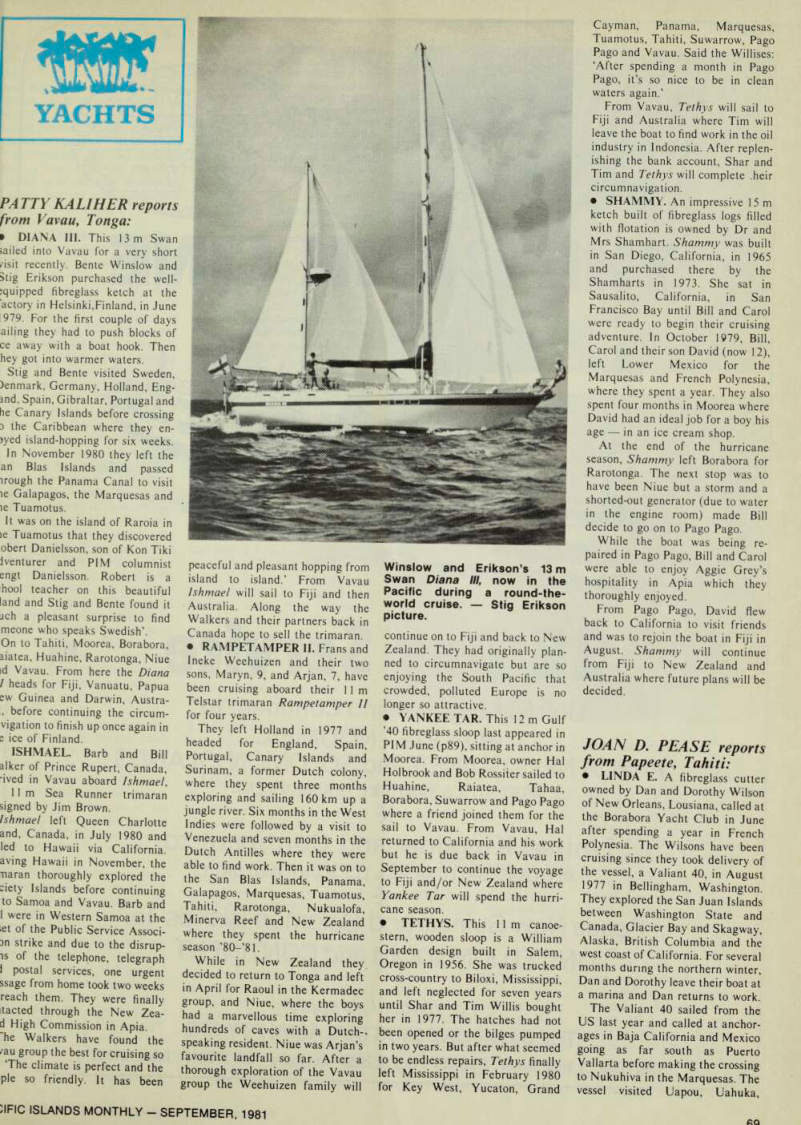
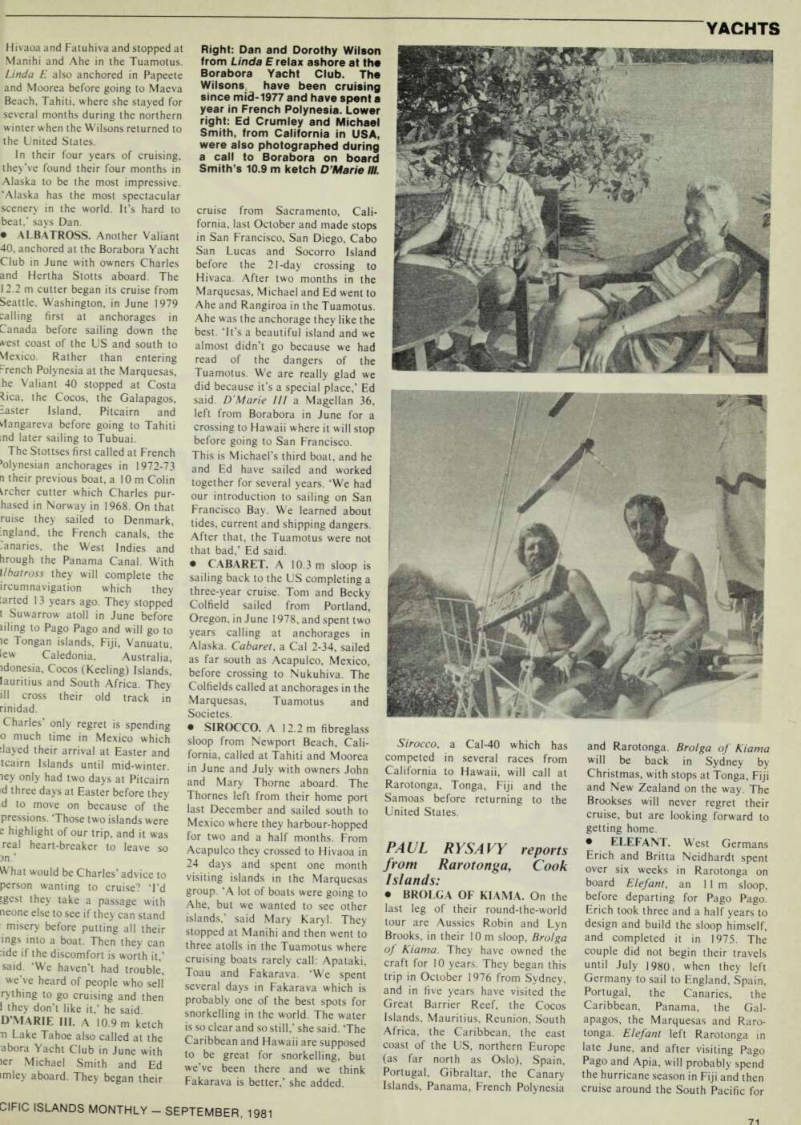

PA TTY KALI HER reports
from Vavau, Tonga:
* DIANA 111. This 13 m Swan sailed into Vavau for a very short /isit recently. Bente Winslow and Stig Erikson purchased the well iquipped fibreglass ketch at the actory in Helsinki,Finland, in June 979. For the first couple of days ailing they had to push blocks of ce away with a boat hook. Then hey got into warmer waters.
Stig and Bente visited Sweden, )enmark, Germany, Holland, Eng ind, Spain, Gibraltar, Portugal and he Canary Islands before crossing d the Caribbean where they en »yed island-hopping for six weeks.
In November 1980 they left the an Bias Islands and passed trough the Panama Canal to visit te Galapagos, the Marquesas and te Tuamotus.
It was on the island of Raroia in ic Tuamotus that they discovered obert Danielsson, son of Kon Tiki Iventurer and PIM columnist engt Danielsson. Robert is a hool teacher on this beautiful land and Stig and Bente found it ich a pleasant surprise to find meone who speaks Swedish’.
On to Tahiti, Moorea, Borabora, aiatea, Huahine, Rarotonga, Niue id Vavau. From here the Diana 1 heads for Fiji, Vanuatu, Papua ew Guinea and Darwin, Austra , before continuing the circum vigation to finish up once again in 2 ice of Finland.
ISHMAEL. Barb and Bill alker of Prince Rupert, Canada, •ived in Vavau aboard Ishmael, 11 m Sea Runner trimaran signed by Jim Brown. ishmael left Queen Charlotte and, Canada, in July 1980 and led to Hawaii via California, aving Hawaii in November, the
naran thoroughly explored the
ciety Islands before continuing to Samoa and Vavau. Barb and 1 were in Western Samoa at the let of the Public Service Associ -3n strike and due to the disrup is of the telephone, telegraph 1 postal services, one urgent ssage from home took two weeks reach them. They were finally tacted through the New Zea d High Commission in Apia.
'he Walkers have found the /au group the best for cruising so ‘The climate is perfect and the pie so friendly. It has been
peaceful and pleasant hopping from island to island.’ From Vavau Ishmael will sail to Fiji and then Australia. Along the way the Walkers and their partners back in Canada hope to sell the trimaran. • RAMPETAMPER 11. Frans and Ineke Weehuizen and their two sons, Maryn, 9, and Arjan, 7, have been cruising aboard their 11 m Telstar trimaran Rampetamper II for four years.
They left Holland in 1977 and headed for England, Spain, Portugal, Canary Islands and Surinam, a former Dutch colony, where they spent three months exploring and sailing 160 km up a jungle river. Six months in the West Indies were followed by a visit to Venezuela and seven months in the Dutch Antilles where they were able to find work. Then it was on to the San Bias Islands, Panama, Galapagos, Marquesas, Tuamotus, Tahiti, Rarotonga, Nukualofa, Minerva Reef and New Zealand where they spent the hurricane season ’BO-’Bl.
While in New Zealand they decided to return to Tonga and left in April for Raoul in the Kermadec group, and Niue, where the boys had a marvellous time exploring hundreds of caves with a Dutch-, speaking resident. Niue was Arjan’s favourite landfall so far. After a thorough exploration of the Vavau group the Weehuizen family will
continue on to Fiji and back to New Zealand. They had originally plan ned to circumnavigate but are so enjoying the South Pacific that crowded, polluted Europe is no longer so attractive. • YANKEE TAR. This 12 m Gulf ’4O fibreglass sloop last appeared in PIM June (pB9), sitting at anchor in Moorea. From Moorea, owner Hal Holbrook and Bob Rossiter sailed to Huahine, Raiatea, Tahaa, Borabora, Suwarrow and Pago Pago where a friend joined them for the sail to Vavau. From Vavau, Hal returned to California and his work but he is due back in Vavau in September to continue the voyage to Fiji and/or New Zealand where Yankee Tar will spend the hurri cane season. • TETHYS. This 11 m canoe stern, wooden sloop is a William Garden design built in Salem, Oregon in 1956. She was trucked cross-country to Biloxi, Mississippi, and left neglected for seven years until Shar and Tim Willis bought her in 1977. The hatches had not been opened or the bilges pumped in two years. But after what seemed to be endless repairs, Tethys finally left Mississippi in February 1980 for Key West, Yucaton, Grand
Cayman, Panama, Marquesas,
Tuamotus, Tahiti, Suwarrow, Pago Pago and Vavau. Said the Willises: ‘After spending a month in Pago Pago, it’s so nice to be in clean waters again.’
From Vavau, Tethys will sail to Fiji and Australia where Tim will leave the boat to find work in the oil industry in Indonesia. After replen ishing the bank account, Shar and Tim and Tethys will complete .heir
circumnavigation.
• SHAMMY. An impressive 15 m ketch built of fibreglass logs filled with flotation is owned by Dr and Mrs Shamhart. Shammy was built in San Diego, California, in 1965 and purchased there by the Shamharts in 1973. She sat in Sausalito, California, in San Francisco Bay until Bill and Carol were ready to begin their cruising adventure. In October 1979, Bill, Carol and their son David (now 12), left Lower Mexico for the
Marquesas and French Polynesia,
where they spent a year. They also spent four months in Moorea where David had an ideal job for a boy his age — in an ice cream shop.
At the end of the hurricane season, Shammy left Bora bora for Rarotonga. The next stop was to have been Niue but a storm and a shorted-out generator (due to water in the engine room) made Bill decide to go on to Pago Pago.
While the boat was being re paired in Pago Pago, Bill and Carol were able to enjoy Aggie Grey’s hospitality in Apia which they
thoroughly enjoyed.
From Pago Pago, David flew back to California to visit friends and was to rejoin the boat in Fiji in August. Shammy will continue from Fiji to New Zealand and Australia where future plans will be decided.
JOAN D. PEASE reports
from Papeete , Tahiti:
• LINDA E. A fibreglass cutter owned by Dan and Dorothy Wilson of New Orleans, Lousiana, called at the Borabora Yacht Club in June after spending a year in French Polynesia. The Wilsons have been
cruising since they took delivery of
the vessel, a Valiant 40, in August
1977 in Bellingham, Washington.
They explored the San Juan Islands between Washington State and Canada, Glacier Bay and Skagway, Alaska, British Columbia and the west coast of California. For several months during the northern winter, Dan and Dorothy leave their boat at a marina and Dan returns to work.
The Valiant 40 sailed from the US last year and called at anchor ages in Baja California and Mexico going as far south as Puerto Vallarta before making the crossing to Nukuhiva in the Marquesas. The vessel visited Uapou, Uahuka,
Winslow and Erikson’s 13 m Swan Diana III, now in the Pacific during a round-the
world cruise. - Stig Erikson
picture.
Hivaoa and Fatuhiva and stopped at Manihi and Ahe in the Tuamotus.
Linda E also anchored in Papeete and Moorea before going to Maeva Beach, Tahiti, where she stayed for several months during the northern winter when the Wilsons returned to the United States.
In their four years of cruising, they’ve found their four months in Alaska to be the most impressive. ‘Alaska has the most spectacular scenery in the world. It’s hard to beat,’ says Dan. • ALBATROSS. Another Valiant 40, anchored at the Borabora Yacht Club in June with owners Charles and Hertha Stotts aboard. The 12.2 m cutter began its cruise from Seattle, Washington, in June 1979 calling first at anchorages in Canada before sailing down the *est coast of the US and south to Mexico. Rather than entering C rench Polynesia at the Marquesas, he Valiant 40 stopped at Costa the Cocos, the Galapagos, faster Island, Pitcairn and tfangareva before going to Tahiti md later sailing to Tubuai.
The Stottses first called at French ‘olynesian anchorages in 1972-73 ft their previous boat, a 10 m Colin Archer cutter which Charles pur hased in Norway in 1968. On that ruise they sailed to Denmark, ingland, the French canals, the Canaries, the West Indies and hrough the Panama Canal. With Mbatross they will complete the
ircumnavigation which they
tarted 13 years ago. They stopped t Suwarrow atoll in June before tiling to Pago Pago and will go to
te Tongan islands, Fiji, Vanuatu,
lew Caledonia, Australia,
tdonesia. Cocos (Keeling) Islands,
lauritius and South Africa. They ill cross their old track in rinidad.
Charles’ only regret is spending 0 much time in Mexico which flayed their arrival at Easter and tcairn Islands until mid-winter. iey only had two days at Pitcairn and three days at Easter before they and to move on because of the pressions. Those two islands were e highlight of our trip, and it was real heart-breaker to leave so Dn.’
What would be Charles’ advice to person wanting to cruise? ‘l’d ►gest they take a passage with neone else to see if they can stand misery before putting all their ings into a boat. Then they can fide if the discomfort is worth it,’ said. ‘We haven’t had trouble, we’ve heard of people who sell rything to go cruising and then 1 they don’t like it,’ he said D’MARIE 111. A 10.9 m ketch n Lake Tahoe also called at the abora Yacht Club in June with ler Michael Smith and Ed
imley aboard. They began their
cruise from Sacramento, Cali fornia, last October and made stops in San Francisco, San Diego, Cabo San Lucas and Socorro Island before the 21-day crossing to Hivaca. After two months in the Marquesas, Michael and Ed went to Ahe and Rangiroa in the Tuamotus.
Ahe was the anchorage they like the best. ‘lt’s a beautiful island and we almost didn’t go because we had read of the dangers of the Tuamotus. We are really glad we did because it’s a special place,’ Ed said. D Marie HI a Magellan 36, left from Borabora in June for a crossing to Hawaii where it will stop before going to San Francisco.
This is Michael’s third boat, and he and Ed have sailed and worked together for several years. ‘We had our introduction to sailing on San Francisco Bay. We learned about tides, current and shipping dangers.
After that, the Tuamotus were not that bad,’ Ed said. • CABARET. A 10.3 m sloop is sailing back to the US completing a three-year cruise. Tom and Becky Colfield sailed from Portland, Oregon, in June 1978, and spent two years calling at anchorages in Alaska. Cabaret , a Cal 2-34, sailed as far south as Acapulco, Mexico, before crossing to Nukuhiva. The Colfields called at anchorages in the Marquesas, Tuamotus and Societes.
• SIROCCO. A 12.2 m fibreglass
sloop from Newport Beach, Cali fornia, called at Tahiti and Moorea in June and July with owners John and Mary Thorne aboard. The Thornes left from their home port last December and sailed south to Mexico where they harbour-hopped for two and a half months. From Acapulco they crossed to Hivaoa in 24 days and spent one month visiting islands in the Marquesas group. ‘A lot of boats were going to Ahe, but we wanted to see other
islands,’ said Mary Karyl. They
stopped at Manihi and then went to three atolls in the Tuamotus where cruising boats rarely call; Apataki, Toau and Fakarava. ‘We spent several days in Fakarava which is probably one of the best spots for snorkelling in the world. The water is so clear and so still,’ she said. ‘The Caribbean and Hawaii are supposed to be great for snorkelling, but we’ve been there and we think Fakarava is better,’ she added.
Sirocco, a Cal-40 which has competed in several races from California to Hawaii, will call at Rarotonga, Tonga, Fiji and the Samoas before returning to the United States.
P4Iji
rAUL RYSAVY reports
Jrom Rarotonga, Cook
Islands .*
• Brolga Of Kiama. On The
last leg of their round-the-world tour are Aussies Robin and Lyn Brooks, in their 10 m sloop, Brolga of Kiama. They have owned the craft for 10 years. They began this trip in October 1976 from Sydney, and in five years have visited the Great Barrier Reef, the Cocos Islands, Mauritius, Reunion, South Africa, the Caribbean, the east coast of the US, northern Europe (as far north as Oslo), Spain,
Portugal, Gibraltar, the Canary
Islands, Panama, French Polynesia
and Rarotonga. Brolga of Kiama will be back in Sydney by Christmas, with stops at Tonga, Fiji and New Zealand on the way. The Brookses will never regret their cruise, but are looking forward to getting home. * ELEFANT. West Germans Erich and Britta Nddhardt , over six weeks in Rarotonga on board Elefant , an 11m sloop, before departing for Pago Pago, Erich took three and a half years to design and build the sloop himself, and completed it in 1975. The couple did not begin their travels until July 1980, when they left Germany to sail to England, Spain, Portugal, the Canaries, the Caribbean, Panama, the Gal apagos, the Marquesas and Raro tonga. Elefant left Rarotonga in late June, and after visiting Pago Pago and Apia, will probably spend the hurricane season in Fiji and then cruise around the South Pacific for
Right: Dan and Dorothy Wilson from Linda E relax ashore at the Borabora Yacht Club. The Wilsons, have been cruising since mid-1977 and have spent a year in French Polynesia. Lower right: Ed Crumley and Michael Smith, from California in USA,
were also photographed during
a call to Borabora on board Smith’s 10.9 m ketch D’Marie III.
another year before making for Australia or perhaps South Africa. With plans to stay away from home for another three or four years, the couple are in no hurry and see no reason to plan their trip too far ahead. • BALI. On a ‘quick jaunt’ from Hawaii arc Norman and Jean Hall, aboard Bali , a 10-year-old 12 m yawl. The Halls left Hawaii in April and anticipate returning in September. Their only stop on the way down to Rarotonga was Penrhyn, where they were caught in i storm that was, according to Morman, almost as bad as crossing he Tasman in winter. Bali was mchored in the large, deep Penrhyn agoon when the gale struck, and for wo hours the yacht was battered by iO-knot winds and huge waves in he normally placid lagoon. One of he anchor chains snapped, and if wo Penrhyn Islanders had not wum out to help the Halls ma oeuvre the boat away from the eef, it could have been severely amaged. But the boat survived dth only slight damage, and after epairs are completed the Halls will sturn to Hawaii via Aitutaki and enrhyn.
MANANA. Sailing this 11 m ;tch are Dave and Marcia Reck, hey have owned the John Alden ;signed craft for only a year, and ft their home port of Seattle in ;ptember 1980, with virtually no iling experience. According to arcia: ‘We were half way to awaii before we knew where we :re.’ After Hawaii they continued to the Marquesas, the Tuamotus, e Societies and to Rarotonga, lere they arrived in late June, ue, Tonga, Fiji and New Zealand ; the next ports of call, and then, er the hurricane season, the :cks will probably visit Australia fore deciding which route they 1 take around the world.
Michael Stuart. This 9 M
•Iden Hind sloop also arrived in rotonga in late June. The yacht is led by Americans Jim and Liz :Cane, who are on an ‘extended leymoon’. The ‘newly weds’ have “n married for two years and »an this trip in October 1979
m Chesapeake in Maryland.
•ps so far have included Miami, Bahamas, the Turks, Caicos mds, Haiti, Jamaica, Panama,
Galapagos, the Marquesas,
nch Polynesia and Rarotonga.
chael Stuart departed from
itiu harbour after spending 10 s here to sail to Aitutaki, Niue,
iga, and, ultimately, Whangarei
s >lew Zealand for the hurricane >on. Plans after that are up in the Jim and Liz agree that the most resting part of their journey was
the Marquesas where they
ked copra for five months and ned how many Polynesians
really live. It was a pleasant experi ence they will remember for a long time.
• Pacific Mariner, Julio
GRANDE, MYONE. In the early hours of May 31, these three yachts went on to the reef in Suwarrow after being battered by winds reach ing 60 knots. Myone came out of it relatively unscathed, but the other two craft are beyond salvage.
The crew aboard Pacific Mari ner, Tom and Joan Paschal, and their son Barry, 14, said that the wind picked up at 11 pm on May 30, and at 11.15 the depression hit. ‘lt was as though somebody had opened a door,’ they said. Huge swells snapped Pacific Mariner’s anchor chain and drove it towards the reef. Julio Grande, a French yacht, which also had its anchor chain snapped, came across and broke the bowsprit on Pacific Mari ner before hitting the reef. Pacific Mariner ended up behind Julio Grande, and for four hours crashed into it as well as scraping the coral bottom.
At about 4 am Pacific Mariner began to take water, and within minutes had turned on its side. Her crew and skipper Denis Delong hung on the railing for three hours while waves smashed over the yacht. Their biggest worry was that at high tide, at 7 am, the two yachts would be swept out to sea. Swim ming to shore was impossible be cause of zero visibility conditions, wild seas, and sharks. At 8 am the
storm ended, with the two yachts still on the reef.
Only days later, the skipper and
crew of Julio Grande boarded another yacht to leave their bat tered boat on the reef. The skipper of Pacific Mariner , Dennis Delong,
followed suit two weeks later, but the Paschals remained in Suwarrow for a month before being taken to Rarotonga by the MV Manuvai, a local cargo ship. • TRI AGAIN 111. This 12 m Piver Victress trimaran is owned and skippered by Canadian Heinz Kuntzemann, who arrived in Rarotonga thankful to be alive.
Heinz left Moorea for Rarotonga sailing solo, and about 5 km out of Moorea fell overboard. It was an accident that Heinz believes could happen to any sailor and having sailed for 40 years he should know.
When a sail went over the starboard bow in rough seas he tried to chase it. A swell simply ‘kicked’ him off.
Fortunately, he was able to grab one of the trailing lines. An exhausting half-hour later he was able to drag himself back on board. It was not an experience he would like repeated.
In Rarotonga Heinz was joined by Joao Paulo Mira, from Mozambique, who will accompany him as far west as he can.
The British Columbia-registered Tri-Again HI left California in late 1980 to sail to Mexico, the Marquesas, the Tuamotus, Tahiti, Moorea and Rarotonga. Tonga and Fiji are next, and in Suva Heinz will be joined by friends who, together with the skipper and Joao Paulo, will decide where to go from there.
Norman and Jean Hall’s 12 m yawl Bali, based in Hawaii but at present on a six-month cruise south of the equator.
Advertisements & other items, pp. 69-73 (4 items)
69
JIFIC ISLANDS MONTHLY - SEPTEMBER. 1981
28 Day Service
GLOBAL SERVICE FOR SHIPPERS
V*
THE
LINE
r »>■ .
28 Day Service
s. rflf?
United Kingdom and Continent to:
PAPEETE • NOUMEA
PAPUA NEW GUINEA and SOLOMON ISLANDS
PORT VILA & SANTO BY TRANSHIPMENT
* United Kingdom and Continent to: SUVA AND LAUTOKA (FCL LCL & UNITISED ONLY) Papua New Guinea and Solomon Islands to:
UNITED KINGDOM and CONTINENT
For particulars apply:
THE BANK LINE (AUSTRALASIA) PTY. LTD.
18th Floor 1 York Street SYDNEY NSW 2000 Australia Tel: 272041 Telex: 24063
o
PUTYOUR
FOOT DOWN.
DEMAND
TIMKEN
BEARINGS!
TIMKEN
If you’re hard headed about the bearings you use ... put your foot down!
Demand Timken 5 tapered roller bearings, and you’ll get the brand with proven quality, durability and performance.
The brand that’s given you a long run for your money, wherever it’s used.
On top of all this, you’ll benefit from our consistent supply, delivery, and sales and service engineering assistance available from Australian Timken and Authorized Bearing Distributors throughout the Pacific.
Another way of looking at it is that you’re not going to put your foot in it when you put your foot down and demand Timken bearings.
TIMKEN
REGISTERED TRADEMARK
TAPERED ROLLER BEARINGS
Authorised Timken 5 Bearing Distributors in the Pacific are: O. F. Nelson and Co. Ltd., APIA; Bearing Service Company Ltd., AUCKLAND; Niven Bearings Limited, AUCKLAND; United Enterprises Ltd., HONIARA; Sunbeam Transport Ltd., LAUTOKA; Nelle Cie SATMA, NOUMEA; P.N.G. Bearing Service, PORT MORESBY: Saravanua Import, PORT VILA; Burns Philp (South Sea) Company Ltd., SUVA. 4954 ATX
IF YOU MAKE IT WITH STEEL,
MAKE CONTACT WITH FLETCHER.
Fletcher Steel offers a total steel service a total product range for builders, fabricators and structural engineers!
Fletcher Steel can supply structural steel, sheet and coil, plate, pipe and tube rectangular hollow sections, alloy and bright steel, bolts and nuts, etc for virtually every industrial application Contact Fletcher Steel and see what they mean by a total steel service o o * And match the Fletcher Steel product range with famous Duroid brand building membranes Malthoid roll roofing and
dampcoursing and Durafoil'
reflective foil insulation Here's a total service for building the future of the Pacific Contact Fletcher Steel now use this handy coupon, or contact Ron Mair direct at 592-869 Auckland, New Zealand If you make if with steel, make contact with Fletcher Steel
Fletcher
Steel
Ron Mair Fletcher Steel Export Manager P O Box 303 Auckland New Zealand Name Company Address Please send me more information on the Fletcher Steel total steel service concept L
71
YACHTS
CIFIC ISLANDS MONTHLY SEPTEMBER, 1981
Ific Islands Monthly - September. 1981
YACHTS
Ships
Grounded ship
towed clear
After 29 days aground on a mudbank off the south coast of the Papua New Guinea main land, the Niugini Express Lines freighter Waigani Express was refloated in August before the onset of sea conditions which could have ended any hope of salvage. The refloating came at the end of a long and expensive operation in which civil and military helicopters, ships, barges and lugs were used to salvage the cargo and the ship.
Part of the cargo was taken off to lighten the ship, and much of it was taken ashore or loaded into barges by two Chinook helicopters from the Amberley, Queensland, base of the Royal Australian Air Force.
Waigani Express was carry ing 4000 tonnes of frozen and general cargo in containers when it grounded off Hood Point 60 kilometres from Port Moresby while making for Brisbane on the east coast of Australia in July.
Early attempts to move the ship failed, and two-thirds of its length was reported to be aground. Helicopters and the ships own gear were later used to remove part of the cargo, and the tugs Pacific Salvor and Wallacia refloated the Waigani Express and towed it back to Port Moresby during a high tide. The ship will undergo repairs in Singapore.
Ship services
in Micronesia
Palau, the Marshall Islands and the Federated States of Micronesia have chosen nine commercial shipping carriers to serve ports in their area as part of the integrated transport ar rangements which are being made by the new constitutional governments of the three island states. The decisions were made at a conference on Guam, the
second Micronesian shipping conference to be held since constitutional changes began coming into effect.
The Guam talks received proposals from 13 shipping lines from Micronesia, USA and Japan. The nine carriers whose proposals were accepted in clude six already operating in the area and three newcomers.
The six existing carriers and the new routes approved are: Philippine, Micronesia and Orient Navigation, from the United States to the Marshalls, Ponape, Kosrae, Truk, Yap and Palau. Nauru Pacific Lines, United States to Majuro, Ponape and Truk; and from Australia to Majuro, Ponape and Truk. Tiger Line, Japan and Far East to Truk, Ponape, and Majuro. Palau Shipping, South Pacific to Palau and Yap.
The new carriers and routes approved are: Tokyo Senpaku Kaisha in conjunction with Palau Shipping, Japan and the Far East to Palau and Yap.
Nippon Yushen Kaisha, Japan and the Far East to Truk, Ponape and Majuro. Pacific Common Carrier, Japan and the Far East to Palau and Yap.
The Pacific Common Carrier company is a joint venture operated by Palau Sea and Air Transportation Agency, the Commonwealth Maritime Company of Saipan and the CMBAL Line of Japan.
It was the first time that the new constitutional governments had issued shipping permits.
Under previous arrangements shipping regulation was carried out by the Office of the Trust Territory High Commissioner.
Detailed rules regarding the transfer of shipping regulation powers to the new governments are still under consideration by the United States Department of the Interior following consul tations with the governments.
The ownership of ships oper ated by the Trust Territory government will also be trans ferred to the new governments under arrangements now being
made.
Micronesian News
Service.
Firm steps to restore PNGSC The Papua New Guinea Ship ping Corporation has an nounced that it is taking ‘firm
steps to restore stability and responsibility’ to its operations.
The directors made this com ment after a preliminary audit report showed that a loss of about half a million dollars had been made over the past two years.
The corporation represents PNG’s major entry into nationalised shipping and it was established after a wide-ranging investigation into the type of services which would best suit the country as a commercial venture in its own right and in the interests of PNG export and mport trade.
Newly-appointed directors of he line disclosed the loss after :ommissioning a firm of audi ors to make a report on the :orporation’s financial position.
The audit report showed that hree voyages made last year to he United States west coast iad averaged a loss of about 160 000 each, and no full etails were yet available of two oyages made this year. The srvices took PNG produce to JSA and brought back general argo.
The shipping corporation is also involved in the financial structure of the PNG Line and the New Guinea Australia Line, but these are operated independently and returned a profit.
The Secretary for Transport and Civil Aviation in PNG, Mr John Gaius, said that in basic terms the shipping corporation was viable and steps would be taken to ensure its successful operation.
He denied allegations that his department did not support the shipping corporation. ‘We want to make it a success’ he said.
PNG support
for Forum
For a man who never really supported the Pacific Forum Line from the start, Papua New Guinea Prime Minister, Sir Julius Chan, has become a staunch defender of the project.
As former finance minister he rejected the idea because his country lacked enough money to meet its commitments. But Sir Julius’ predecessor corn
mited Papua New Guinea to the project and he honours that commitment. ‘lt’s the only regional project of its kind and it would be terrible if it fails because others would not take it up,’ Sir Julius told a press conference in Wellington during his recent official tour of New Zealand.
Sir Julius was commenting on his government’s decision to continue financial support for the line. He said; ‘ln any regional project of this kind there are always risks involved.
The easiest way is not to enter into it. ‘But then relationships are not built on talks and politics alone. They need to have some visible sign of achievement, of togetherness, and this is one of them and I don’t think we should throw this shipping pro ject overboard.’
He said that although PNG did not benefit from the PFL, it saw the project as one support ing the islands that did not get shipping services to their part of the world. He believed that the PFL now had sufficient liquidity
and proposals for the restructur ing of its management for it to succeed. ‘I think it will take off and I’m confident it will,’ he
said.
William Gas son in
Wellington.
Vanuatu buys
coastal ship
The 50-tonne coastal ship Namidogodo, which has oper ated for many years in Papua New Guinea, has been bought by a group of Vanuatu nationals as part of a growing movement towards locally-owned shipping services in Vanuatu.
The ship has been bought for $BB 000 by the Nikoletan As sociation of Tanna, and is being renamed Fetukai, which means Morning Star. It will be used for cargo and passenger work in the Vanuatu islands, based at Tanna, and mainly operating between Port Vila and Tanna.
The Birimauri Association of Asanvari recently bought the French government vessel Aquitaine which will be used for operations to Pentecost and Santo.
Advertisements & other items, pp. 74-77 (3 items)
Forum Line
fl ■ I j_c •
PACIFIC
Regular and Reliable Container and Roll - ON ■ OFF Services
MV FUA KAVENGA
MV FORUM SAMOA
MV FORUM NEW ZEALAND
With our head office in Apia, our regional offices in Suva, Auckland, and Sydney, and our network of agents, we cover the South Pacific to ensure your goods get to you or to your buyer on time.
We tranship also, to or from almost anywhere in the world.
NOMINATE PERFORMANCE: NOMINATE PFL
owned by the people
of the Forum Nations
Agents in: Australia, New Zealand, Fiji, Tonga, Western Samoa, American Samoa, New Caledonia, Papua New Guinea, Solomon Is, Kiribati, Tuvalu, Vanuatu.
r
T-SHIRTS PuWIM
Enmznn Promote your Company, Organisation, Product or Service on T-
SHIRTS, SCREEN PRINTED with
your Logo, Message or Special Design.
We are the Professionals. We have a full range of styles and colours available. Our prices by Sea or by Air are very competitive. Our products are of excellent quality. Orders however must be more than 250 shirts. We also supply Sports Uniforms, Caps, Hats, Flags, Badges etc. Write, Phone, or Telex us now with your order or for an instant quotation.
THE T-SHIRT PEOPLE LTD.
G.P.O. Box 9431 HONG KONG.
Tel: 3 7213409 Telex: 75974 PBDWL HX
LOCAL AGENTS AND
REPRESENTATION
428 George St., Sydney.
Cables: Henco Sydney.
G.P.O. Box 3949.
Telephone: 232 5377.
For specialised and personalised buying service throughout the Pacific Islands and the East.
PAPUA NEW GUINEA
RABAUL; M. & C. Seeto, P.O, Box 131, Rabaul.
Telephone 92 2919.
MADANG; W. Double, P.O. Box 22, Madang.
Telephone 82 2696.
FIJI
K. Witherington Ltd., P.O. Box 293, Suva.
Telephone 22 356.
VANUATU
John Lum & Associates, P.O. Box 65, Santo.
Telephone 329.
SOLOMON ISLANDS
Mr. Tom Lo, P.O. Box 327, Honiara.
Telephone 399 Resident Agents in other Pacific Territories. u
q6E/?/> A In our 87th Year Selling ‘Service’ to the Pacific Islands
Nelson & Robertson
RABAUL
•v
MADANG
LA ■:• Vv-* '•’* ’ : V : : • •v >• ,* •• •••; •;*. •••
Pty. Ltd.
(Established 1895)
Plantation House, 197 Clarence Street, Sydney.
Cables: ‘IVAN’, Sydney, Brisbane.
Telex: AA22381, Sydney.
Phone: 29 2871 *••»••• v*.
BRISBANE
SYDNE
• •M. •• .
KIETA
LAUTOKA
V.: *.v. r« • •• ;.••• V-V
For Indents '
from Australia,
New Zealand and Overseas
Foodstuffs
Softgoods
Hardware
Machinery
Travel
Insurance
Canned Fish
Jute Goods
Real Estate
r SUVA
V.V !•••'
BRANCH OFFICES:
Nelson & Robertson Pty. Ltd., P.O. Box 575, Brisbane, Qld., Australia. 2216966 P.O. Box 2092, Govt. Bldg., Suva, Fiji. 22430 P.O. Box 258, Lautoka, Fiji. 62101 P.O. Box 2420, CPO Auckland 1, New Zealand. 774141
.^: : ::PAPUA NEW GUINEA REPRESENTATIVES:
Rabtrad Niugini Pty. Ltd., P.O. Box 291, Rabaul, P.N.G. 922911 'WO. Box 1406, Lae, P.N.G. 422366 P.O. Box 711, Madang, P.N.G. 822066 P.O. Box 253, Kieta, P.N.G. 956185
The Journal of
Paeifie History
Volume X V 7 - /.*>///
A wide variety of articles based on research and documented facts, including:— The financial adventures of Godeffroy and Son A.E. Bollard A proto-cooperative in Tonga Noel Rutherford The background to Lakeban expansion in the 1850's A.C. Reid Markets for Melanesian labour in Queensland Ralph Shlomowitz From New Hebrides to Vanuatu J.V. Mac Clancy The stranger-king Oral traditions. Whose history?
Oscar Suensen: one of the few The Solomon Islands elections 1980 The evacuation of Niuafo'ou 1946 Marshall Sahlins Thomas Spear Judith Bennett Ralph Premdas and Jeffrey Steeves Garth Rogers Plus Notes and Documents, Bibliography and Book Reviews $A 12.50 annually (SUSI7.OO) from The Editors The Journal of Pacific History, Australian National University, Box 4 P. 0., Canberra, ACT 2600, Australia.
Ships
75
CIFIC ISLANDS MONTHLY - SEPTEMBER. 1981
\Cific Islands Monthly September, 1981
JAPAN IN THE PACIFIC
Services
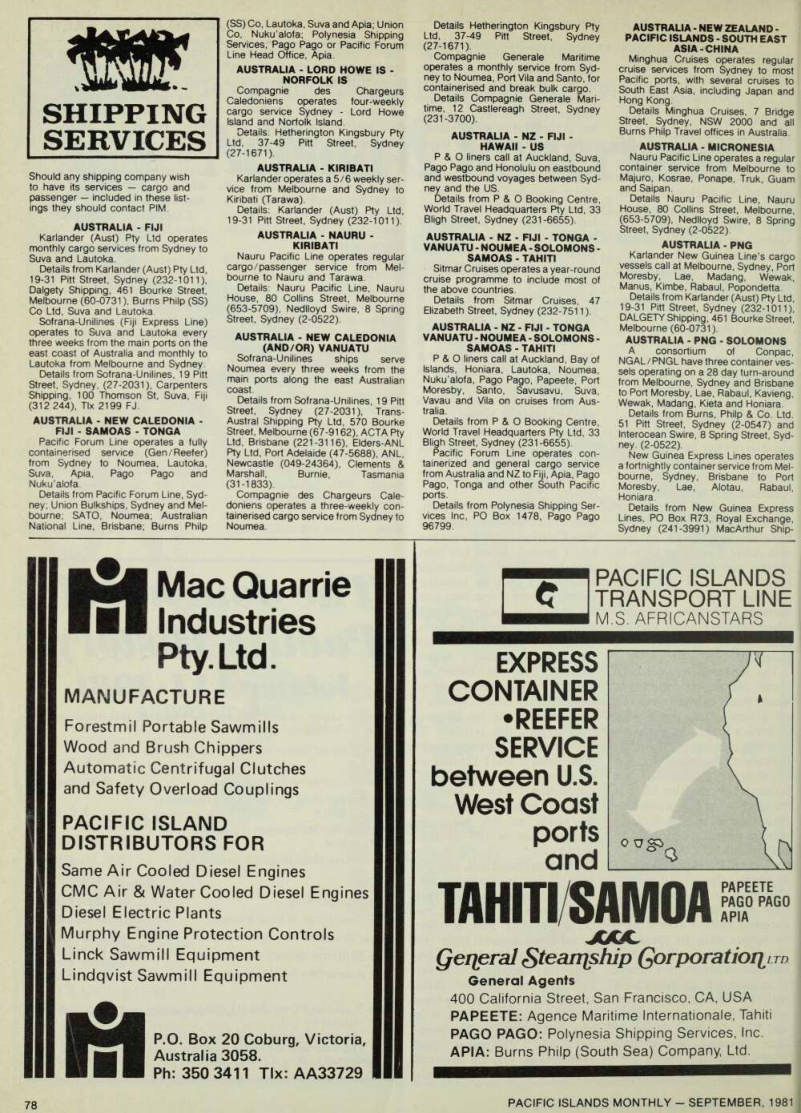
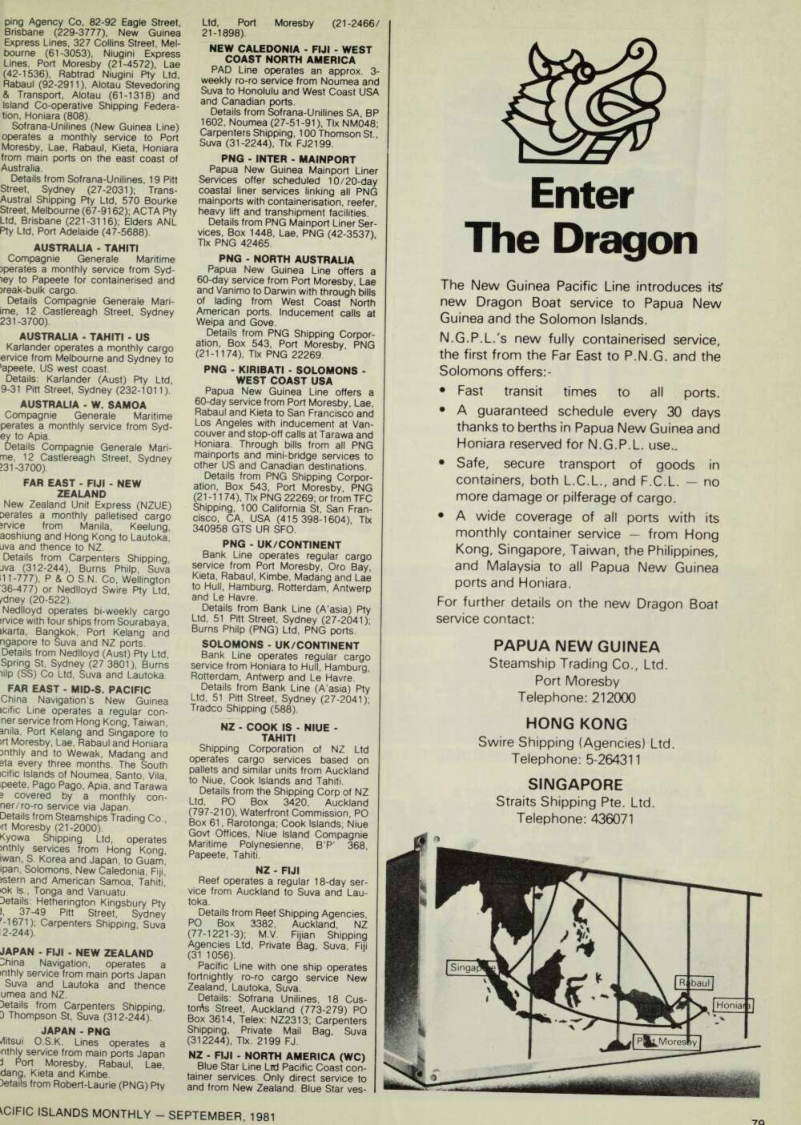
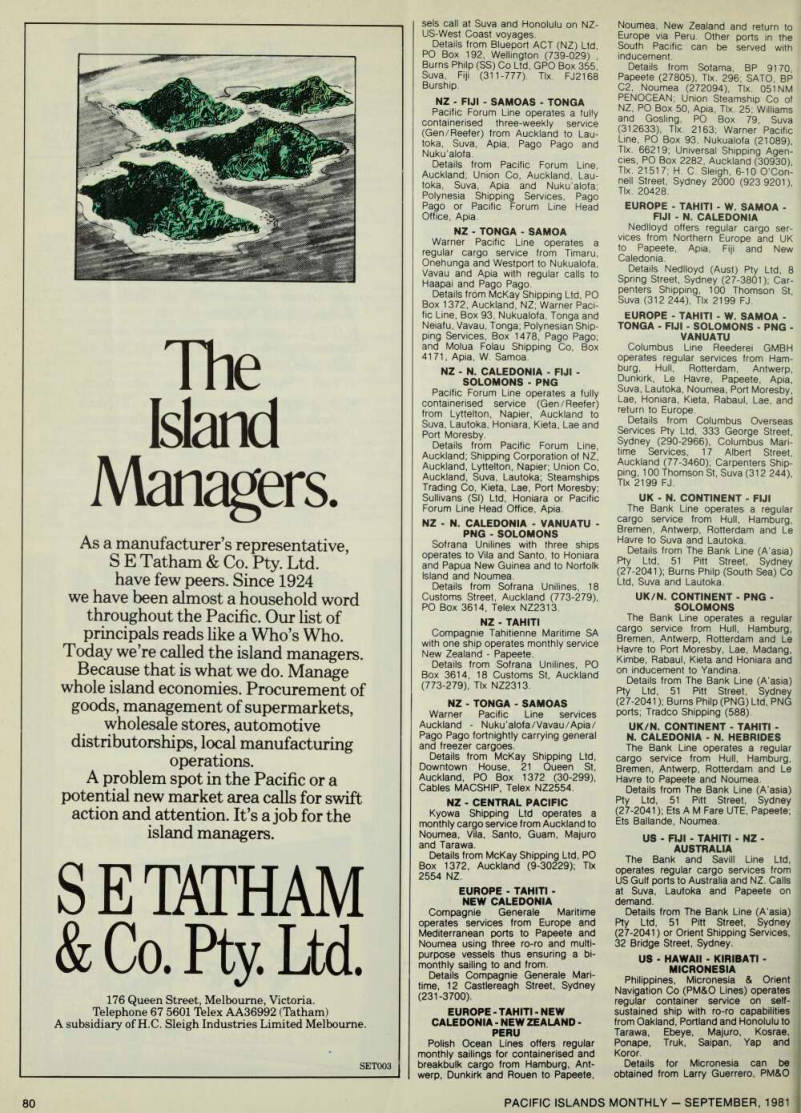
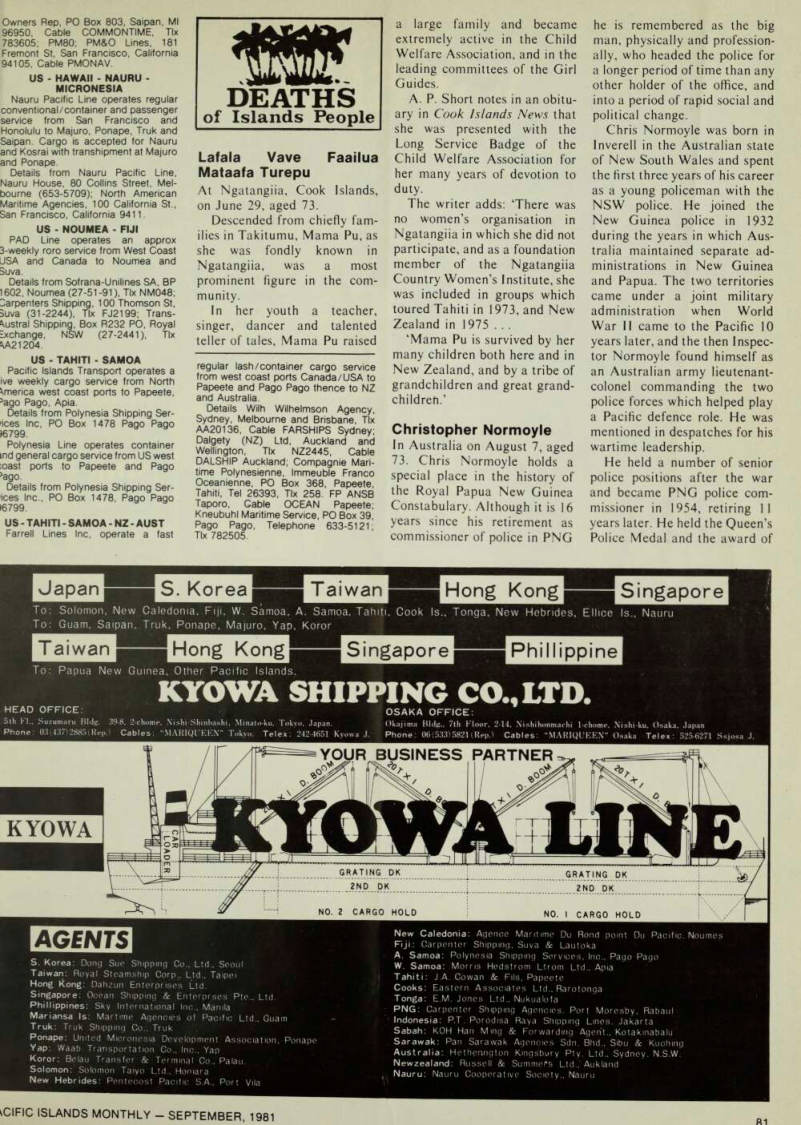
Shipping
Should any shipping company wish to have its services cargo and passenger included in these listings they should contact PIM.
Australia - Fiji
Karlander (Aust) Pty Ltd operates monthly cargo services from Sydney to Suva and Lautoka.
Details from Karlander (Aust) Pty Ltd. 19-31 Pitt Street, Sydney (232-1011), Dalgety Shipping, 461 Bourke Street, Melbourne (60-0731), Burns Philp (SS) Co Ltd, Suva and Lautoka Sofrana-Unilines (Fiji Express Line) operates to Suva and Lautoka every three weeks from the main ports on the east coast of Australia and monthly to Street, Sydney, (27-2031), Carpenters I ?,x SfT St ’ Suva ’ Fiji (oi4 444), I lx 2199 rJ.
Australia - New Caledonia -
Fiji - Samoas - Tonga
Pacific Forum Line operates a fully containerised service (Gen/Reefer) from Sydney to Noumea, Lautoka, Suva, Apia, Pago Pago and Nukualofa.
Details from Pacific Forum Line, Sydney; Union Bulkships, Sydney and Melbourne; SATO, Noumea; Australian National Line. Brisbane; Burns Philp
(SS) Co, Lautoka, Suva and Apia; Union Co, Nukualofa; Polynesia Shipping Services, Pago Pago or Pacific Forum Line Head Office, Apia.
Australia - Lord Howe Is -
Norfolk Is
Compagnie des Chargeurs Caledoniens operates four-weekly cargo service Sydney - Lord Howe Island and Norfolk Island Details: Hetherington Kingsbury Pty Ltd, 37-49 Pitt Street, Sydney (27-1671).
Australia - Kiribati
Karlander operates a 5/6 weekly ser vice from Melbourne and Sydney to Kiribati (Tarawa).
Details; Karlander (Aust) Pty Ltd. 19-31 Pitt Street, Sydney (232-1011).
Australia - Nauru -
Kiribati
Nauru Pacific Line operates regular cargo/passenger service from Mel bourne to Nauru and Tarawa.
Details: Nauru Pacific Line, Nauru House, 80 Collins Street, Melbourne (653-5709), Nedlloyd Swire, 8 Spring Street, Sydney (2-0522).
Australia - New Caledonia
(And/Or) Vanuatu
Sofrana-Unilines ships serve Noumea every three weeks from the main ports along the east Australian coast.
Details from Sofrana-Unilines, 19 Pitt Street. Sydney (27-2031), Trans- Austral Shipping Pty Ltd, 570 Bourke Street, Melbourne (67-9162), ACTA Pty Ltd, Brisbane (221-3116), Elders-ANL Pty Ltd, Port Adelaide (47-5688), ANL, Newcastle (049-24364). Clements & Marshall, Burnie. Tasmania (31-1833).
Compagnie des Chargeurs Cale doniens operates a three-weekly con tainerised cargo service from Sydney to Noumea.
Details Hetherington Kingsbury Pty Ltd, 37-49 Pitt Street. Sydney (27-1671).
Compagnie Generate Maritime operates a monthly service from Syd ney to Noumea, Port Vila and Santo, for containerised and break bulk cargo.
Details Compagnie Generate Mari time, 12 Castlereagh Street, Sydney (231-3700).
Australia - Nz - Fiji -
Hawaii • Us
P & O liners call at Auckland, Suva.
Pago Pago and Honolulu on eastbound and westbound voyages between Syd ney and the US.
Details from P & O Booking Centre, World Travel Headquarters Pty Ltd, 33 Bligh Street. Sydney (231 -6655).
AUSTRALIA - NZ - FIJI - TONGA -
Vanuatu - Noumea - Solomons -
Samoas - Tahiti
Sitmar Cruises operates a year-round cruise programme to include most of the above countries.
Details from Sitmar Cruises, 47 Elizabeth Street, Sydney (232-7511).
AUSTRALIA - NZ - FIJI - TONGA
Vanuatu - Noumea - Solomons -
Samoas - Tahiti
P & O liners call at Auckland, Bay of Islands, Honiara, Lautoka, Noumea, Nukualofa, Pago Pago, Papeete, Port Moresby, Santo, Savusavu, Suva, Vavau and Vila on cruises from Aus tralia.
Details from P & O Booking Centre, World Travel Headquarters Pty Ltd, 33 Bligh Street, Sydney (231-6655).
Pacific Forum Line operates con tainerized and general cargo service from Australia and NZ to Fiji. Apia, Pago Pago, Tonga and other South Pacific ports.
Details from Polynesia Shipping Ser vices Inc, PO Box 1478, Pago Pago 96799.
Australia - New Zealand -
Pacific Islands - South East
Asia-China
Minghua Cruises operates regular cruise services from Sydney to most Pacific ports, with several cruises to South East Asia, including Japan and Hong Kong.
Details Minghua Cruises, 7 Bridge Street, Sydney, NSW 2000 and all Burns Philp Travel offices in Australia.
Australia - Micronesia
Nauru Pacific Line operates a regular container service from Melbourne to Majuro, Kosrae, Ponape, Truk, Guam and Saipan.
Details Nauru Pacific Line, Nauru House, 80 Collins Street, Melbourne, (653-5709), Nedlloyd Swire, 8 Spring Street, Sydney (2-0522).
Australia - Png
Karlander New Guinea Line's cargo vessels call at Melbourne, Sydney. Port Moresby, Lae, Madang, Wewak, Manus, Kimbe, Rabaul, Popondetta.
Details from Karlander (Aust) Pty Ltd, 19-31 Pitt Street, Sydney (232-1011), DALGETY Shipping, 461 Bourke Street, Melbourne (60-0731).
Australia - Png - Solomons
A consortium of Conpac, NGAL/PNGL have three container ves sels operating on a 28 day turn-around from Melbourne, Sydney and Brisbane to Port Moresby, Lae, Rabaul, Kavieng, Wewak, Madang. Kieta and Honiara.
Details from Burns, Philp & Co. Ltd. 51 Pitt Street, Sydney (2-0547) and Interocean Swire, 8 Spring Street, Syd ney. (2-0522).
New Guinea Express Lines operates a fortnightly container service from Mel bourne, Sydney, Brisbane to Port Moresby, Lae, Alotau, Rabaul, Honiara.
Details from New Guinea Express Lines, PO Box R 73, Royal Exchange.
Sydney (241-3991) MacArthur Ship
ping Agency Co, 82-92 Eagle Street, Brisbane (229-3777), New Guinea Express Lines, 327 Collins Street, Mel bourne (61-3053), Niugini Express Lines, Port Moresby (21-4572), Lae (42-1536), Rabtrad Niugini Pty Ltd, Rabaul (92-2911), Alotau Stevedoring & Transport. Alotau (61-1318) and Island Co-operative Shipping Federa tion, Honiara (808).
Sofrana-Unilines (New Guinea Line) operates a monthly service to Port Moresby, Lae, Rabaul, Kieta, Honiara from main ports on the east coast of Australia.
Details from Sofrana-Unilines, 19 Pitt Street, Sydney (27-2031); Trans- Austral Shipping Pty Ltd, 570 Bourke Street, Melbourne (67-9162); ACTA Pty Ltd, Brisbane (221-3116); Elders ANL Pty Ltd. Port Adelaide (47-5688).
Australia - Tahiti
Compagnie Generate Maritime )perates a monthly service from Syd ley to Papeete for containerised and >reak-bulk cargo.
Details Compagnie Generate Mari ime, 12 Castlereagh Street, Sydney 231-3700).
Australia - Tahiti - Us
Karlander operates a monthly cargo ervice from Melbourne and Sydney to ’apeete, US west coast.
Details: Karlander (Aust) Pty Ltd, 9-31 Pitt Street, Sydney (232-1011).
Australia - W. Samoa
Compagnie Generate Maritime perates a monthly service from Syd ey to Apia.
Details Compagnie Generate Mari ne, 12 Castlereagh Street, Sydney >3l-3700).
Far East - Fiji - New
Zealand
New Zealand Unit Express (NZUE) perates a monthly palletised cargo ervice from Manila, Keelung, aoshiung and Hong Kong to Lautoka, uva and thence to NZ.
Details from Carpenters Shipping, jva (312-244), Burns Philp, Suva ill-777), P & O S.N. Co, Wellington 36-477) or Nedlloyd Swire Pty Ltd, rdney (20-522).
Nedlloyd operates bi-weekly cargo srvice with four ships from Sourabaya, ikarta, Bangkok, Port Kelang and ngapore to Suva and NZ ports.
Details from Nedlloyd (Aust) Pty Ltd, Spring St, Sydney (27 3801), Burns lilp (SS) Co Ltd, Suva and Lautoka.
Far East - Mid-S. Pacific
China Navigation’s New Guinea icific Line operates a regular Con ner service from Hong Kong, Taiwan, anila, Port Kelang and Singapore to irt Moresby, Lae, Rabaul and Honiara pnthly and to Wewak, Madang and ata every three months. The South icific Islands of Noumea, Santo, Vila, ipeete, Pago Pago, Apia, and Tarawa a covered by a monthly con ner/ro-ro service via Japan.
Details from Steamships Trading Co., rt Moresby (21-2000).
Kyowa Shipping Ltd, operates >nthly services from Hong Kong, iwan, S. Korea and Japan, to Guam! ipan, Solomons, New Caledonia, Fiji, astern and American Samoa, Tahiti, ok Is., Tonga and Vanuatu.
Details: Hetherington Kingsbury Pty I. 37-49 Pitt Street, Sydney >-1671); Carpenters Shipping, Suva 2-244).
Japan - Fiji - New Zealand
Dhina Navigation, operates a •nthly service from main ports Japan Suva and Lautoka and thence umea and NZ.
Details from Carpenters Shipping, D Thompson St, Suva (312-244).
Japan - Png
Mitsui O.S.K. Lines operates a nthly service from main ports Japan J Port Moresby, Rabaul, Lae, dang, Kieta and Kimbe. details from Robert-Laurie (PNG) Pty
Ltd, Port Moresby (21-2466/ 21-1898).
New Caledonia - Fiji - West
Coast North America
PAD Line operates an approx. 3weekly ro-ro service from Noumea and Suva to Honolulu and West Coast USA and Canadian ports.
Details from Sofrana-Unilines SA, BP 1602, Noumea (27-51-91). Tlx NMO4B; Carpenters Shipping, 100 Thomson St., Suva (31-2244). Tlx FJ2199.
Png - Inter - Mainport
Papua New Guinea Mainport Liner Services offer scheduled 10/20-day coastal liner services linking all PNG mainports with containerisation, reefer, heavy lift and transhipment facilities.
Details from PNG Mainport Liner Ser vices. Box 1448, Lae. PNG (42-3537) Tlx PNG 42465.
Png - North Australia
Papua New Guinea Line offers a 60-day service from Port Moresby, Lae and Vanimo to Darwin with through bills of lading from West Coast North American ports. Inducement calls at Weipa and Gove.
Details from PNG Shipping Corpor ation, Box 543. Port Moresby, PNG (21-1174), Tlx PNG 22269,
Png - Kiribati - Solomons -
West Coast Usa
Papua New Guinea Line offers a 60-day service from Port Moresby, Lae, Rabaul and Kieta to San Francisco and Los Angeles with inducement at Van couver and stop-off calls at Tarawa and Honiara. Through bills from all PNG mainports and mini-bridge services to other US and Canadian destinations.
Details from PNG Shipping Corpor ation, Box 543, Port Moresby, PNG (21 -1174), Tlx PNG 22269; or from TFC Shipping, 100 California St, San Fran cisco, CA, USA (415 398-1604), Tlx
340958 Gts Ur Sfo.
Png - Uk/Continent
Bank Line operates regular cargo service from Port Moresby. Oro Bay, Kieta, Rabaul, Kimbe, Madang and Lae to Hull, Hamburg, Rotterdam, Antwerp and Le Havre.
Details from Bank Line (A’asia) Pty Ltd, 51 Pitt Street, Sydney (27-2041); Burns Philp (PNG) Ltd, PNG ports,
Solomons - Uk/Continent
Bank Line operates regular cargo service from Honiara to Hull. Hamburg, Rotterdam, Antwerp and Le Havre.
Details from Bank Line (A'asia) Pty Ltd, 51 Pitt Street, Sydney (27-2041); Tradco Shipping (588).
NZ - COOK IS - NIUE -
Tahiti
Shipping Corporation of NZ Ltd operates cargo services based on pallets and similar units from Auckland to Niue, Cook Islands and Tahiti.
Details from the Shipping Corp of NZ Ltd, PO Box 3420, Auckland (797-210), Waterfront Commission, PO Box 61, Rarotonga; Cook Islands; Niue Govt Offices, Niue Island Compagnie Maritime Polynesienne, B'P’ 368, Papeete, Tahiti.
Nz - Fiji
Reef operates a regular 18-day ser vice from Auckland to Suva and Lau toka.
Details from Reef Shipping Agencies, PO Box 3382, Auckland, NZ (77-1221-3); M.V. Fijian Shipping Agencies Ltd, Private Bag, Suva, Fiji (31 1056).
Pacific Line with one ship operates fortnightly ro-ro cargo service New Zealand, Lautoka, Suva.
Details: Sofrana Unilines, 18 Cus toms Street, Auckland (773-279) PO Box 3614, Telex: NZ2313; Carpenters Shipping, Private Mail Bag, Suva (312244), Tlx. 2199 FJ.
NZ - FIJI - NORTH AMERICA (WC) Blue Star Line Ltd Pacific Coast con tainer services. Only direct service to and from New Zealand. Blue Star ves
sels call at Suva and Honolulu on NZ US-West Coast voyages.
Details from Blueport ACT (NZ) Ltd, PO Box 192, Wellington (739-029) , Burns Philp (SS) Co Ltd, GPO Box 355, Suva, Fiji (311-777). Tlx. FJ2168 Burship, NZ - FIJI - SAMOAS - TONGA Pacific Forum Line operates a fully containerised three-weekly service (Gen/Reefer) from Auckland to Lau toka, Suva, Apia, Pago Pago and Nuku'alofa.
Details from Pacific Forum Line, Auckland; Union Co, Auckland, Lau toka, Suva, Apia and Nuku’alofa; Polynesia Shipping Services, Pago Pago or Pacific Forum Line Head Office, Apia.
Nz - Tonga - Samoa
Warner Pacific Line operates a regular cargo service from Timaru, Onehunga and Westport to Nukualofa, Vavau and Apia with regular calls to Haapai and Pago Pago.
Details from McKay Shipping Ltd, PO Box 1372, Auckland, NZ; Warner Paci fic Line, Box 93, Nukualofa, Tonga and Neiafu, Vavau. Tonga; Polynesian Ship ping Services, Box 1478, Pago Pago; and Molua Folau Shipping Co, Box 4171, Apia, W. Samoa.
NZ - N. CALEDONIA - FIJI -
Solomons - Png
Pacific Forum Line operates a fully containerised service (Gen/Reefer) from Lyttelton, Napier, Auckland to Suva, Lautoka, Honiara, Kieta, Lae and Port Moresby.
Details from Pacific Forum Line, Auckland; Shipping Corporation of NZ, Auckland, Lyttelton, Napier; Union Co, Auckland, Suva, Lautoka; Steamships Trading Co. Kieta, Lae, Port Moresby; Sullivans (SI) Ltd, Honiara or Pacific Forum Line Head Office, Apia.
NZ - N. CALEDONIA - VANUATU -
Png - Solomons
Sofrana Unilines with three ships operates to Vila and Santo, to Honiara and Papua New Guinea and to Norfolk Island and Noumea.
Details from Sofrana Unilines, 18 Customs Street, Auckland (773-279), PO Box 3614, Telex NZ2313.
Nz - Tahiti
Compagnie Tahitienne Maritime SA with one ship operates monthly service New Zealand - Papeete.
Details from Sofrana Unilines, PO Box 3614, 18 Customs St, Auckland (773-279), Tlx NZ2313.
Nz - Tonga - Samoas
Warner Pacific Line services Auckland - Nuku'alofa/Vavau/Apia/ Pago Pago fortnightly carrying general and freezer cargoes.
Details from McKay Shipping Ltd, Downtown House, 21 Queen St, Auckland, PO Box 1372 (30-299), Cables MACSHIP, Telex NZ2554.
Nz - Central Pacific
Kyowa Shipping Ltd operates a monthly cargo service from Auckland to Noumea, Vila, Santo, Guam, Majuro and Tarawa.
Details from McKay Shipping Ltd, PO Box 1372, Auckland (9-30229); Tlx 2554 NZ.
Europe - Tahiti -
New Caledonia
Compagnie Generate Maritime operates services from Europe and Mediterranean ports to Papeete and Noumea using three ro-ro and multi purpose vessels thus ensuring a bi monthly sailing to and from.
Details Compagnie Generate Mari time, 12 Castlereagh Street, Sydney (231-3700).
Europe-Tahiti-New
Caledonia - New Zealand -
Peru
Polish Ocean Lines offers regular monthly sailings for containerised and breakbulk cargo from Hamburg, Ant werp, Dunkirk and Rouen to Papeete,
Noumea, New Zealand and return to Europe via Peru. Other ports in the South Pacific can be served with inducement.
Details from Sotama, BP 9170, Papeete (27805), Tlx. 296; SATO, BP C 2, Noumea (272094), Tlx. 051 NM PENOCEAN; Union Steamship Co of NZ, PO Box 50, Apia, Tlx. 25; Williams and Gosling, PO Box 79, Suva (312633), Tlx. 2163; Warner Pacific Line, PO Box 93, Nukualofa (21089), Tlx. 66219; Universal Shipping Agen cies. PO Box 2282, Auckland (30930), Tlx. 21517; H. C. Sleigh, 6-10 O'Con nell Street, Sydney 2000 (923 9201), Tlx. 20428.
EUROPE - TAHITI - W. SAMOA -
Fiji - N. Caledonia
Nedlloyd offers regular cargo ser vices from Northern Europe and UK to Papeete, Apia, Fiji and New Caledonia.
Details Nedlloyd (Aust) Pty Ltd, 8 Spring Street, Sydney (27-3801); Car penters Shipping, 100 Thomson St, Suva (312 244), Tlx 2199 FJ.
EUROPE - TAHITI - W. SAMOA - TONGA - FIJI - SOLOMONS - PNG -
Vanuatu
Columbus Line Reederei GMBH operates regular services from Ham burg, Hull, Rotterdam, Antwerp, Dunkirk, Le Havre, Papeete, Apia, Suva, Lautoka, Noumea, Port Moresby, Lae, Honiara, Kieta, Rabaul, Lae, and return to Europe.
Details from Columbus Overseas Services Pty Ltd, 333 George Street, Sydney (290-2966), Columbus Mari time Services, 17 Albert Street, Auckland (77-3460); Carpenters Ship ping, 100 Thomson St, Suva (312 244), Tlx 2199 FJ.
Uk - N. Continent - Fiji
The Bank Line operates a regular cargo service from Hull, Hamburg, Bremen, Antwerp, Rotterdam and Le Havre to Suva and Lautoka.
Details from The Bank Line (A’asia) Pty Ltd, 51 Pitt Street, Sydney (27-2041); Burns Philp (South Sea) Co Ltd, Suva and Lautoka.
Uk/N. Continent - Png -
Solomons
The Bank Line operates a regular cargo service from Hull, Hamburg, Bremen, Antwerp, Rotterdam and Le Havre to Port Moresby, Lae, Madang, Kimbe, Rabaul, Kieta and Honiara and on inducement to Yandina.
Details from The Bank Line (A’asia) Pty Ltd, 51 Pitt Street, Sydney (27-2041); Burns Philp (PNG) Ltd, PNG ports: Trade© Shipping (588).
Uk/N. Continent - Tahiti -
N. Caledonia - N. Hebrides
The Bank Line operates a regular cargo service from Hull, Hamburg, Bremen, Antwerp. Rotterdam and Le Havre to Papeete and Noumea.
Details from The Bank Line (A’asia) Pty Ltd, 51 Pitt Street, Sydney (27-2041); Ets A M Fare UTE, Papeete: Ets Ballande, Noumea.
US - FIJI - TAHITI - NZ -
Australia
The Bank and Savill Line Ltd, operates regular cargo services from US Gulf ports to Australia and NZ. Calls at Suva, Lautoka and Papeete on demand.
Details from The Bank Line (A’asia) Pty Ltd, 51 Pitt Street, Sydney (27-2041) or Orient Shipping Services, 32 Bridge Street, Sydney.
Us - Hawaii - Kiribati -
Micronesia
Philippines, Micronesia & Orient Navigation Co (PM&O Lines) operates regular container service on self sustained ship with ro-ro capabilities from Oakland, Portland and Honolulu to Tarawa, Ebeye, Majuro, Kosrae, Ponape, Truk, Saipan, Yap and Koror.
Details for Micronesia can be obtained from Larry Guerrero, PM&O
Owners Rep, PO Box 803, Saipan. Ml 96950, Cable COMMONTIME, Tlx 783605; PM80; PM&O Lines. 181 Fremont St, San Francisco, California 94105, Cable PMONAV.
Us - Hawaii - Nauru -
Micronesia
Nauru Pacific Line operates regular conventional/container and passenger service from San Francisco and Honolulu to Majuro, Ponape, Truk and Saipan. Cargo is accepted for Nauru and Kosrai with transhipment at Majuro and Ponape.
Details from Nauru Pacific Line, Nauru House, 80 Collins Street. Mel bourne (653-5709); North American Maritime Agencies, 100 California St., San Francisco, California 9411.
Us - Noumea - Fiji
PAD Line operates an approx 3-weekly roro service from West Coast USA and Canada to Noumea and Suva.
Details from Sofrana-Unilines SA, BP 1602, Noumea (27-51-91), Tlx NMO4B; Sarpenters Shipping, 100 Thomson St, Suva (31-2244), Tlx FJ2199; Trans- Shipping, Box R 232 PO, Royal Exchange. NSW (27-2441), Tlx V\21204.
Us - Tahiti - Samoa
Pacific Islands Transport operates a ive weekly cargo service from North \merica west coast ports to Papeete, 3 ago Pago, Apia.
Details from Polynesia Shipping Ser vices Inc, PO Box 1478 Pago Pago >6799.
Polynesia Line operates container md general cargo service from US west :oast ports to Papeete and Pago ’ago.
Details from Polynesia Shipping Ser ices Inc., PO Box 1478, Pago Pago 16799.
US - TAHITI - SAMOA - NZ - AUST Farrell Lines Inc, operate a fast
regular lash/container cargo service from west coast ports Canada/USA to Papeete and Pago Pago thence to NZ and Australia.
Details Wilh Wilhelmson Agency, Sydney, Melbourne and Brisbane, Tlx AA20136, Cable PARSNIPS Sydney; Dalgety (NZ) Ltd, Auckland and Wellington, Tlx NZ2445, Cable DALSHIP Auckland; Compagnie Mari time Polynesienne, Immeuble Franco Oceanienne. PC Box 368, Papeete, Tahiti. Tel 26393, Tlx 258. FP ANSB Taporo, Cable OCEAN Papeete: Kneubuhl Maritime Service, PO Box 39, Pago Pago, Telephone 633-5121; Tlx 782505.
Advertisements & other items, pp. 78-80 (2 items)
HMac Quarrie
Industries
Pty.Ltd.
MANUFACTURE
Forestmil Portable Sawmills Wood and Brush Chippers Automatic Centrifugal Clutches and Safety Overload Couplings
PACIFIC ISLAND
DISTRIBUTORS FOR
Same Air Cooled Diesel Engines CMC Air & Water Cooled Diesel Engines Diesel Electric Plants Murphy Engine Protection Controls Linck Sawmill Equipment Lindqvist Sawmill Equipment IH P.O. Box 20 Coburg, Victoria, Australia 3058.
Ph: 350 3411 Tlx: AA33729
PACIFIC ISLANDS
C TRANSPORT LINE
■■■ M.S. AFRICANSTARS
EXPRESS
CONTAINER
•REEFER
SERVICE
between U.S.
West Coast ports and
TJUfITISAMOA S~
xoc Qeqeral Steamship Qorporatioriltd General Agents 400 California Street, San Francisco, CA, USA PAPEETE: Agence Maritime Internationale, Tahiti PAGO PAGO: Polynesia Shipping Services, Inc.
APIA: Burns Philp (South Sea) Company, Ltd.
Enter
The Dragon
The New Guinea Pacific Line introduces its* new Dragon Boat service to Papua New Guinea and the Solomon Islands.
N.G.P.L.'s new fully containerised service, the first from the Far East to P.N.G. and the Solomons offers:- • Fast transit times to all ports. • A guaranteed schedule every 30 days thanks to berths in Papua New Guinea and Honiara reserved for N.G.P.L. use.. • Safe, secure transport of goods in containers, both L.C.L., and F.C.L. no more damage or pilferage of cargo. • A wide coverage of all ports with its monthly container service from Hong Kong, Singapore, Taiwan, the Philippines, and Malaysia to all Papua New Guinea ports and Honiara.
For further details on the new Dragon Boat service contact:
PAPUA NEW GUINEA
Steamship Trading Co., Ltd.
Port Moresby Telephone: 212000
HONG KONG
Swire Shipping (Agencies) Ltd.
Telephone: 5-264311
SINGAPORE
Straits Shipping Pte. Ltd.
Telephone: 436071
The
Island
Managers.
As a manufacturer’s representative, S E Tatham & Co. Pty. Ltd. have few peers. Since 1924 we have been almost a household word throughout the Pacific. Our list of principals reads like a Who’s Who.
Today we’re called the island managers.
Because that is what we do. Manage whole island economies. Procurement of goods, management of supermarkets, wholesale stores, automotive distributorships, local manufacturing operations.
A problem spot in the Pacific or a potential new market area calls for swift action and attention. It’s a job for the island managers.
SEWHAM
& Co. Pty. lid.
176 Queen Street, Melbourne, Victoria.
Telephone 67 5601 Telex AA36992 (Tatham) A subsidiary of H.C. Sleigh Industries Limited Melbourne.
SETOO3
79
<CIFIC ISLANDS MONTHLY SEPTEMBER, 1981
Deaths
of Islands People
Lafala Vave Faailua
Mataafa Turepu
At Ngatangiia, Cook Islands, on June 29, aged 73.
Descended from chiefly fam ilies in Takitumu, Mama Pu, as she was fondly known in Ngatangiia, was a most prominent figure in the com munity.
In her youth a teacher, singer, dancer and talented teller of tales. Mama Pu raised
a large family and became extremely active in the Child Welfare Association, and in the leading committees of the Girl Guides.
A. P. Short notes in an obitu ary in Cook Islands News that she was presented with the Long Service Badge of the Child Welfare Association for her many years of devotion to duty.
The writer adds: There was no women’s organisation in Ngatangiia in which she did not participate, and as a foundation member of the Ngatangiia Country Women’s Institute, she was included in groups which toured Tahiti in 1973, and New Zealand in 1975 . .. ‘Mama Pu is survived by her many children both here and in New Zealand, and by a tribe of grandchildren and great grand children.’
Christopher Normoyle
In Australia on August 7, aged 73. Chris Normoyle holds a special place in the history of the Royal Papua New Guinea Constabulary. Although it is 16 years since his retirement as commissioner of police in PNG
he is remembered as the big man, physically and profession ally, who headed the police for a longer period of time than any other holder of the office, and into a period of rapid social and political change.
Chris Normoyle was born in Inverell in the Australian state of New South Wales and spent the first three years of his career as a young policeman with the NSW police. He joined the New Guinea police in 1932 during the years in which Aus tralia maintained separate ad ministrations in New Guinea and Papua. The two territories came under a joint military administration when World War II came to the Pacific 10 years later, and the then Inspec tor Normoyle found himself as an Australian army lieutenant colonel commanding the two police forces which helped play a Pacific defence role. He was mentioned in despatches for his wartime leadership.
He held a number of senior police positions after the war and became PNG police com missioner in 1954, retiring 11 years later. He held the Queen’s Police Medal and the award of
Member of the Order of the British Empire.
Since his retirement he had lived at Bowral, south of Syd ney, where his funeral was held on August 1 1.
Wilfred Randall At Norfolk Island Hospital on July 12, aged 68.
One of Norfolk Island’s most prominent community leaders, Mr Randall, in addition to holding a host of other public offices, was president of the Norfolk Island Advisory Coun cil from 1956 t 01960. He was awarded the OBE in 1971 for services to the community.
He was one of twin sons of Albert and Jane Randall, and lived all his life on the island, going to school and taking up farming afterwards. During World War 11, he was a mem ber of the Norfolk Island Infan try Detachment.
The Norfolk Islander said in an obituary tribute; ‘He was a man of great vision and fore sight. His influence on the community has been such that he could be likened to an Elder Statesman of the highest integ rity . . .’
Stanley S. Carpenter
At Arlington Hospital, Virginia, USA, on June 20, aged 64.
Mr Carpenter was well known to many people in Micro nesia from his period of service as deputy assistant secretaiy of territorial affairs in the Depart ment of the Interior, and also as director of the Office of Terri torial Affairs.
Mehau George
At Manihiki, Cook Islands, on May 19, aged 88.
A highly respected figure on Manihiki, Mehau George was a staunch member of the Cook Islands Christian Church on Manihiki until his death.
In his early years, Mr George worked for the Public Works Department on Rarotonga, and rose to become chief carpenter before he retired.
He returned to Manihiki in 1950, and for the next decade excelled at skindiving for pearls. He was one of Manihiki’s best divers in the frequent competitions against Penrhyn divers.
Among those expressing their condolences to Mr George’s family and friends on Manihiki were his nephew Dr George Koteka in Rarotonga, and Deputy Premier and Minister responsible for the Northern Group Dr Pupuke Robati.
Pita Seruvatu At Lololo, Fiji, on July 12, aged 50.
A senior manager of the Fiji Pine Commission, Pita Seruvatu was promoted to special duties officer, plan tations, in 1979 after being the commission’s Lololo station manager for a number of years.
Originally from Namosi, Mr Seruvatu was attached to the FPC headquarters in Lautoka] at the time of his death.
Peter Matheson Cullen At Girne (Kyrenia), Cyprus, in July, aged 65.
Peter Cullen was a former director of the Fiji Broadcasting Corporation. Before coming to Fiji, he had been closely associ ated with the introduction of radio and television to the former mandated territory of Palestine, and the colonies of • Southern Rhodesia and Malaya.
Advertisements & other items, pp. 81-82 (2 items)
81
<CIFIC ISLANDS MONTHLY SEPTEMBER, 1981
Kyowa Shipping Co., Ltd.
Korea Tni-rnn I Innr Kong Singapore
To: Solomon. New Caledonia. Fiji, W. Samoa, A. Samoa, Tahiti, Cook Is.. Tonga, New Hebrides. Ellice Is.. Nauru To; Guam. Saipan. Truk. Ponape, Majuro, Yap. Koror
Tniwnn Hong Kong Singapore Phillippine
To; Papua New Guinea. Other Pacific Islands.
KYOWA SHIPPING CO., LTD.
HEAD OFFICE: OSAKA OFFICE:
sth FI.. Suzumaru Bldg. 39-8. 2-chome. Nishi-Shinbashi. Minato-ku. Tokyo. Japan. Okajima Bldg.. 7th Floor. 2-14. Nishihonmachi 1-chome. Xishi-ku. Osaka. Japan Phone: 03 (437) 2885 1 Rep. Cables: “MARIQUEEN" Tokyo. Telex: 242-4651 Kyowa J. Phone; 06t533)582URep.l Cables: “MARIQUEEN” Osaka Telex: 525-6271 Ssjosa J.
I i
KYOWA
i
GRATING DK
AGENTS
S. Korea; Dong Sue Shipping Co.. Ltd.. Seoul Taiwan: Royal Steamship Corp.. Ltd., Taipei Hong Kong: Dahzun Enterprises Ltd.
Singapore; Ocean Shipping & Enterprses Pte.. Ltd.
Philippines: Sky International Inc., Manila Mariansa Is: Martime Agencies of Pacific Ltd.. Guam Truk: Truk Shipping Co.. Truk Ponape: United Micronesia Development Association. Ponape Yap: Waab Transportation Co.. Inc.. Yap Koror: Belau Transfer & Terminal Co.. Palau.
Solomon: Solomon Taiyo Ltd.. Honiara New Hebrides: Pentecost Pacific S.A.. Port Vila New Caledonia: Agence Maritime Du Rond point Du Pacific. Noumes Fiji: Carpenter Shipping. Suva & Lautoka A, Samoa: Polynesia Shipping Services. Inc.. Pago Pago W. Samoa; Morris Hedstrom Ltrom Ltd.. Apia Tahiti: J.A. Cowan & Fils. Papeete Cooks: Eastern Associates Ltd., Rarotonga Tonga: E.M. Jones Ltd.. Nukualofa PNG; Carpenter Shipping Agencies. Port Moresby. Rabaul Indonesia: P.T. Porodisa Raya Shipping Lines. Jakarta Sabah: KOH Han Ming & Forwarding Agent.. Kotakmabalu Sarawak: Pan Sarawak Agencies Sdn. Bhd.. Sibu & Kuching Australia: Hethennglon Kingsbury Pty. Ltd.. Sydney. N.S.W.
Newzealand: Russell & Summers Ltd.. Aukland Nauru: Nauru Cooperative Society.. Nauru
■V
.^Produce
BECHE-DE-MEF 4 '®
FISH MAW,
SHARK FINS, etc.
For details please write to:
ASIA SEAFOOD Co.,
353 A Circuit Rd., Block 64, Singapore 1337.
1 FOR SALE
Investment^
Opportunity^
Property development Honiara Solomon Islands, Block of top class residential units.l^3^ Good lease potential or sale. Plans finalised all approvals received.
Further details write: Secretary, Tanuli Ridge Apartments Ltd.,""
Box 439, Honiara, Solomon Islands.
Freely
Given
A true understanding of God's Word If you have been search ing for the true meaning, of the Scriptures this free monthly booklet is for you.
Write to God's Way P.O. Box 41, North Ryde Australia 2113
TO JOB SEEKERS IN REMOTE AREAS
WE SUPPLY YOU WITH THE LATEST
JOB ADS FROM THE AUSTRALIAN &
INTERNATIONAL PRESS. QUARTERLY
SUBSCRIPTIONS $3O. WRITE BOX 1942,
TOWNSVILLE 4810 AUSTRALIA.
m
BUYING OR SELLING
LIST WITH US FOR:
COMMERCIAL SHIPS
FISHING VESSELS
YACHTS
TRAWLERS
WORK BOATS
Sonar Ships Brokerage
BOX 1811 CAIRNS, OLD.
AUSTRALIA
PH: (070) 515371
REQUIRE
DRIED SHARK FINS
FOR PRICES AND
INFORMATION ETC.,
PLEASE WRITE TO:
S. DADDOW,
ASIA TONGA TRADING,
66 JALAN KERUING,
SINGAPORE, 2880
SONY ICF-2001
The world's most advanced computer controlled radio.
Faaturas • Microprocessor-controlled tuning • Dual PLL Synthesizer • 4 way tuning 10-key direct access Auto scan • LCD multi display • FET RF amplifier (FM) for efficient image rejection • Dual conversion circuit, crystal filter (AM) • All FET front end (AM) for maximum sensivity • Highly sensitive telescopic antenna for FM and AM Frequency range
FM 76 108 MHz
88 108 MHz (ICF-2001F)
AM 150 -29 999 kHz Power output/ Speaker 1 6W/10 cm Power requirements: AC/DC/Car battery Dimensions (w/h/d) 310 x 56 x 171 mm (12* x 2* « 6f )
NOW IN
STOCK
Weight 1 8 kg (31b 15 oz)
INTERCAPE»
an Australian enterprise
INTERCAPE- VIDEO RECORDER CEIMTRE
19-21 Lonsdale Street, Melbourne, Victoria 3000
Telephone: (03) 633 086, 633 196
Advertisers Index
Australian Timken 72 Amatil 47 Aust. National University 77 Asia Tonga Trading 82 Asia Seafood 82 AH I Aluminium 26 Aiwa 30 Air New Zealand 50 BJS Agencies 82 Bankline 74 China Navigation Co. 79 Clarion Shoji 4 Henry Cumines 75 Denon 66 Forum Fisheries Agencies 60 Fujitsu Ten 35 John Farrell 82 Fletcher Steel 70 Foodtex 67 General Steamship Corp, 78 Goerman, Peter 82 Hitachi IFC Kyowa Shipping 81 Komatsu 55 Korean Traders Assoc. 68 Mono Pumps 34 MacQuarrie Industries 78 Matsushita 46 Nissan Motor Co. 16-17 National Insurance 22 N.Z. Dairy Board IBC Nelson & Robertson 76 Pacific Forum Line 73 Papua Hotel 65 Pioneer 8 ■ 9 Polynesian Airlines 54 QBE Insurance 62 Suzuki 39 Suzuki OBC Sansui 27 Simms Engineering 64 Sony 12 Sonar Ship Brokerage 82 Toyota 42 ■ 43 Tatham, S.E. 80 Teac Corporation 58 Trio Kenwood 51 T-Shirt People 75 Victor Co. of Japan 38 Video Recorder Centre 82 Waterwheel 64 Yamaha 31 Yanmar Diesel Engine Co. 28
Advertisements & other items, pp. 83-84 (1 item)
°bv Garnery
v-. r*, ... wJ» t .-i mmzs. ■m* / \i x !f
P ULL CRE A^
nonfat dried milk \j'J j M 1'
H-UtilOl
JO
AjM
nun
VIM
milk 'ff instant / f
jrHifl
ed whole *ilk
“UCT 0)
New . ■ r y
°bv Garnery
T. butter
lienor instant
Sd whole
%nor Anchor sr ni ovuAreo Anchors
.iJiAItO
J !lh stock *5(O cheese 4 511!
An ar S6o 4 V AS ;v. £ * i en r« «!•
PZUKJ
me name of performance.
SUZUKI Vehicles are shipped to approximately 100 countries throughout the world and are well received by users in those countries. Behind trip high-quality of SUZUKI 4-wheelers is the in-depth research carried out from all aspects, rigorous tests and an extensive after-sales service net-work. Vehicles that are ready when you need them and which you J can trust when driving SUZUKI Vehicles. r r -
SEZ ■
/ 4 u *u K /
SJ4IO
ST9OVT
ST9O
SSBOF
jUi 9
i 9 S i
SUZUKI
m iS. .K H '
SU2UKI
SUZUKI MOTOR CO, LTD
300Takatsuka. Hamamatsu, Japan SOLOMON ISLANDS SOLOMON ISLAND SERVICE STATION LTD. NEW CALEDONIA STE. SUPERCAL PAPUA NEW GUINEA HI SPEEC DIESEL SERVICE PTY LTD. VANUATU HENRI LEROUX NIUE ISLAND BURNS PHILP (SOUTH SEA) CO., LTD. PONAPE LEC ETSCHEIT TAHITI NIPPON AUTOMOTO ELLICE ISLAND TUVALU COOPERATIVE WHOLESALES SOCIETY LTD. GUAM & SAIPAI ISLAND CYCLERY, INC. NORFOLK MARTIN’S AGENCIES LTD. SAMOA PACIFIC PRODUCTS, INC. KIRIBATI GILBERT ISLANDS — . i—i a r-\* r-i II mn*H lAMC AI I"TV'\ DHDT I T