Islands

Pacific
Monthly
Octobimb
American Samoa USSI 75 Australia *A$l.5O Cook Islands 3|||Ln2sl.so
F 'H .Cx... F 51.50
Hawaii &US mainland US$l.95 Kiribati A 51.75 Nauru A 51.75 New Caledonia CFPI9O New Zealand NZ$l.75 Niue NZ$l.5O Norfolk Island A 51.50 Papua New Guinea K 1.50 Solomons 551.50 Tahiti CFPI9O Tonga P 1.50 Tuvalu A 51.75
Ustt & Guam Ussi.9S
Vanuatu A 51.50 Western Samoa T 1.60 ’Recommended retail price only.
Registered by Australia Post Publication No. NBPI2IO
Thi @L©
UIMS, MiW TfiiTS
©@(Li Tihhi ©.If.©.
Mil® ©MW@f
mmmanamrn KSms 1
rai §M
Advertisements & other items, p. 2 (1 item)
A symphony by nature.
Prelude in name only.
The new Honda Prelude is a car that dreams are made of. The car with all the value features you’ve always wanted: power, performance, and style, plus traditional Honda driving economy.
Over-sized bumpers with recessed side and turn indicators not only look smart, but combine safety with classic appearance.
Inside, surfaces are carefully color coordinated and finished in smooth, n 4 5 cut-pile carpeting. Even the doors have the same luxurious carpet trim. And an i} electric sunroof with elegant smoked glass further emphasizes the Prelude’s r already stunning looks.
Options include Hondamatic transmisj sion with overdrive, an exclusive Honda power steering system, and sporty alloy wheels.
Prelude and symphony.
By Honda.
' HOI MUHI
PRELUDE
HOND
)NDA MOTOR CO., LTD. TOKYO. JAPAN
PAPUA NEW GUINEA: Steamshlps-Machlnery P.O. Box 1, Port Moresby/TAHITI: Honda Distribution S.A.R.L. B.P. 1665 Papeete/FIJI ISLANDS: Carpenters Motors 61-63 Foster St., Walu Bay, Suva/KIRIBATI; Atoll Auto Stores P.O. Box 71, Bairlki Tarawa/U.S. TRUST TERRITORY: United Micronesia Development Assn. P.O. Box 238, Saipan, Mariana; Islands 96950/COOK ISLANDS! Cook Islands Motor Center Ltd. P.O. Box 74, Rarotonga/AMERICAN SAMOA: Holiday Motors, Parts and Service P.O. Box 968, Pago Pago: Haleck’s Service Center P.O. Box 1138, Pago Pago/GUAM: Mark's Motor Co., Inc. P.O. Box DV, Agana/WESTERN SAMOA: Motor Distributors (Samoa) Ltd. P.O. Box 576.
Apia/SOLOMON ISLANDS: Trading Company (Solomon) Ltd. P.O. Box 114, Honiara/NEW CALEDONIA: Establlssements Ballande Bolte Postale No. C 4, Noumea CedexA NIUE ISLAND: Niue Island United Enterprises P.O. Box 4, Alofi/NAURU: Nauru Cooperative Society Republic of Nauru, Nauru Island, Central Pacific/VANUATU: Santo Gas Centre Ltd. P.O. Box 45, Santo/TUVALU: Tuvalu Co-operative Wholesale Society P.O. Box Funafuti, Tuvalu/TONGA: Morris Hedstrom Ltd. P.O. Box 63, Nuku’alofa Tong*
Pacific Islands Monthly
Vol. 52 No. 10
October 1981
(Usps 952480)
Representatives
AUSTRALIA: Distribution: NSW & ACT: Allan Rodney Wright (Circulation) Pty Ltd, PO Box 907, Darlinghurst NSW 2010, Elsewhere: Gordon & Gotch (A/asia) Ltd, Box 40 PO, Rosebery, NSW 2018 Advertising - Melbourne - Ray Brown Pty Ltd, 614 Queensberry St, North Melbourne 3051, telephone 329 8522, telex 31717 Brisbane - D Wood, Anday Agency, Box 1918, GPO, Brisbane 4001, tele phone 44 3485, 44 1546; Adelaide - Hastwell Media PO Box 30, Glen Osmond, SA 5064, 233 Glen Osmond Rd Frewville, SA 5063, telephone 79 1869. Perth - Adrep 62 Wickham St., East Perth, WA 6000, telephone 325 6395 FUI: DfstHbutfon and subscriptions - Desai Bookshops PO Box 160, Suva, Fiji, telephone Suva 23036 Advertising - Fiji Times & Herald Ltd, 20 Gordon St, Suva, telephone 312 111, telex FJ2124. ■RENCH POLYNESIA: Distribution - Hachette Pacifique 10 Ave Bruat, Papeete, telephone 25610. tAWAH, UNITED STATES: Distribution PIM, Hawaii PO Box 22250, Honolulu, Hawaii 96822. Advertising - Roger &SS.PO Box 10217, Honolulu, Hawaii96Bl6,telephone xJo 536 6677.
APAN; Advertising and subscriptions Universal Media £ r P°: a i'°^ P 0 Box 46 ' Tok VO. telephone 666 3036 p ALEDONIA: Distribution - Depot Centre de Presse 7 4729 PenteCOSt ' P 2, Noumea ' telephone 27 2434, lEWZEALAND: Distribution - Gordon & Gotch, PO Box 84, 2 Carr Road, Mt. Roskill, Auckland 4 Advertising iternational Media Representatives Ltd, PO Box 2313 uckland. telephone 795 487; 493 389, cables Intereps, Subscriptions - Ross Haines & Son Ltd, PO Box 289, Auckland, telephone 769 042. g P Ro A SSJ ? U h N m A: D,Btrlbutlon - Gordon & Gotch, U Box 3395, Port Moresby, telephone 254551, 254855 dvertlslng PNG Post-Courier, PO Box 85, Port Moresby lephone 21 2577.
NITED KINGDOM: The Herald & Weekly Times Ltd No « a^a^o St . rC f t ' l T ondon WC2R 3DZ ' England, telephone I 836 5162, telex London 21989.
NITED STATES MAINLAND: Advertising - Joshua B 3wers Jr, Powers International Inc., 551 Fifth Ave New !£:i^ Ne e J OOOl7 ’ telephone 867 9580, telex 16514 Subscriptions PIM, Hawaii, PO Box 22250 molulu, Hawaii 96822.
Subscriptions
M 18 airfreighted to most subscribers and agents in the icific Islands and the United States, but not the UK or the xitinent.
Publications (Aust.) Ry Ltd. tn° S piilf St u r Honolu,u: Sena aadress changes Hawaii*96B2?" P ° B ° X 22250 ’
nerican Samoa istralia Local $US21 $A15 Aust. $18 $15 mada >ok Islands $US23 $20 $19 snch Polynesia $18 $22 jam $US23 $20 iwaii pan ibati sronesia uru w Caledonia
Sus23
Sus23
$20 $20 $19 $20 $21 $22 $18 w Zealand $NZ21 rfolk Island $19 rthern Marianas pua New Guinea $US23 $15 $20 $23 $19 $19 omon Islands iga 'alu ted Kingdom Mainland luatu stern Samoa Stg 11
Sus23
$19 $20 $20 $19 ;where $18 $A23 ments by personal an (from a Branch cheque are only acceptable in Ausm Australia), US and New Zealand J * « . remittances please send an onal bank draft in Australian dollars. inter- Wished monthly by Pacific Publications (Aust.) Pty Ltd printed in Australia by Paramac, Alexandria, NSWAus- Wr^ r p PriC , e ls K r f comm ended retail only Registered Australia Post publication No NBP1210. Second class tage paid at Honolulu, Hawaii. Copyright ? 1978 Pacific ■ Ml in irpfin. a, . ♦ \ n» i a
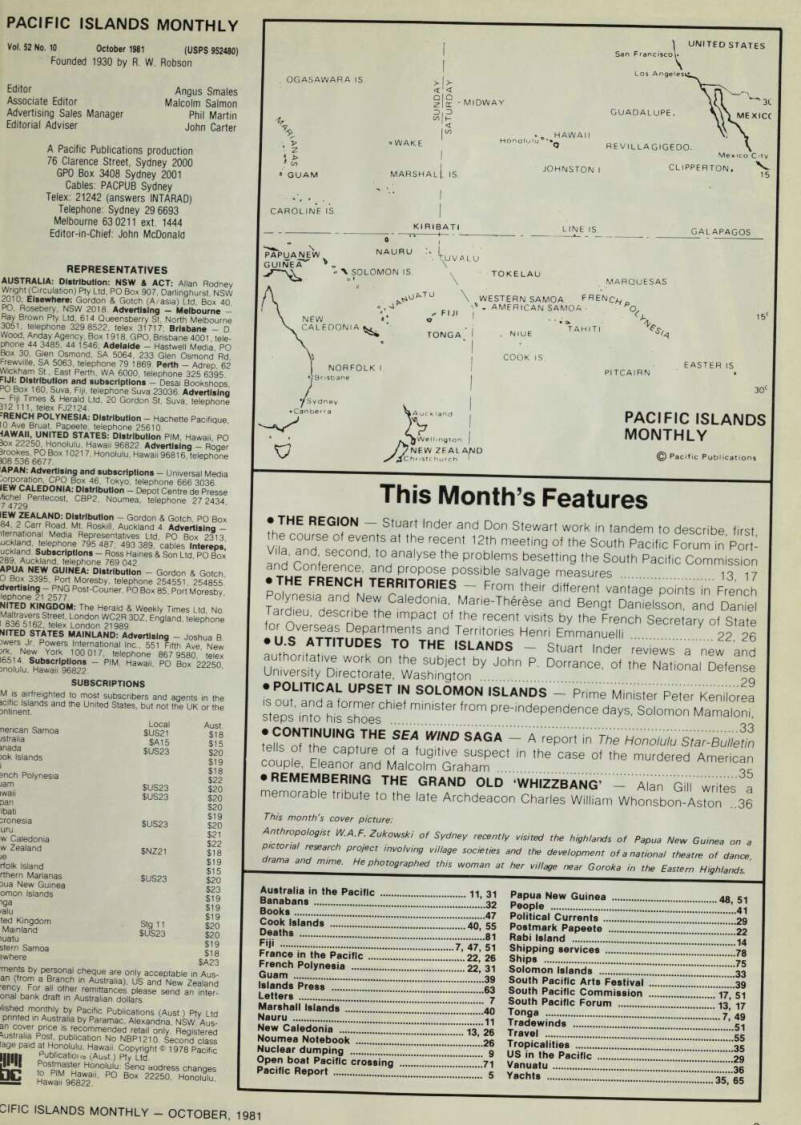
This Month’s Features
REGI P N Stuart Inder and Don Stewart work in tandem to describe first Vila anri 6 ° at r6Cent 12,h mee,in 9 of the South Pacific Forum in Port al rnniertn° nd ' ,0 analyse the P roblems besetting the South Pacific Commission and Conference, and propose possible salvage measures 13 17 • THE FRENCH TERRITORIES - From their different vantage' points in French Polynesia and New Caledonia, Marie-Therdse and Bengt Danielsson and Daniel Tardieu, describe the impact of the recent visits by the French Secretary of State for Overseas Departments and Territories Henri Emmanuelli V ?2 26 author tar TITUD f S T 0 ™ E ,SLANDS Stuad ■"<* reviews a" new and authoritative work on the subject by John P. Dorrance, of the National Defense University Directorate, Washington ueiense • POLITICAL UPSET IN SOLOMON ISLANDS - Phme' Minister Peter Kenilorea steps into hfeXes miniS,er fr ° m P r ®- inde P enden ce days, Solomon Mamaloni, rnnnil pi P 3 U9ltlVe SUSpect in the case of the murdered American couple, Eleanor and Malcolm Graham qc • REMEMBERING THE GRAND OLD ‘WHIZZBANG - Alan Gill writes a memorable tribute to the late Archdeacon Charles William Whonsbon-Aston ,36 This month's cover picture: nir t . h n rOP i° lOgiSt Zukowski of recently visited the highlands of Papua New Guinea on a P tal research project mvo/vmg village societies and the development of a national theatre of dance rama and mime. He photographed this woman at her village near Goroka in the Eastern Highlands '
Australia in the Pacific 11 31 Banabans ’ 32 Books ...47 Cook Islands '40“« Deaths P'ji 7 47 5-j France in the Pacific ...22 26 French Polynesia 22 31 Guam ’ 39 Islands Press eo Letters ;;; j Marshall Islands 40 Nauru 11 New Caledonia 2 g Noumea Notebook ’ 26 Nuclear dumping !!!."!!!"!!!.”!. 9 Open boat Pacific crossing 71 Pacific Report 5
Papua New Guinea 40 51
people I]
Political Currents 2g Postmark Papeete 22 Rabi Island 14 Shipping services 7fl ships Solomon Islands 33 South Pacific Arts Festival 39 South Pacific Commission 17 51 South Pacific Forum 13’ 17 Tonga 7 49 Tradewinds ’ r 1
Travel ~ZZZZZ"'"ss
Tropicalities 35 US in the Pacific 29 Vanuatu
Advertisements & other items, pp. 3-4 (2 items)
3Ific Islands Monthly October, 1981
Founded 1930 by R. W. Robson Angus Smales Associate Editor Malcolm Salmon Advertising Sales Manager Phil Martin Editorial Adviser John Carter A Pacific Publications production 76 Clarence Street, Sydney 2000 GPO Box 3408 Sydney 2001 Cables. PACPUB Sydney Telex. 21242 (answers INTARAD) Telephone. Sydney 29 6693 Melbourne 63 0211 ext. 1444 Editor-in-Chief: John McDonald
Datsun Forklift
n i.
A &
Heavyweights Built
To Dazzle You With
Fancy Footwork.
Now you can really think heavy-duty.
New heavy-duty Datsun Forklift 3.5-ton cushion tire and 4-ton pneumatic tire models deliver the total toughness, power and gradeability you require. Also speed, tight-space maneuverability and operator ease you never thought possible In a heavy-duty heavyweight.
Rugged monocoque body construction reduces dimensions, increases maneuverability. Proven high-efficiency engines assure superb torque, speed and gradeability. The powerful gasoline or turbocharged diesel engine matches your needs exactly. Power steering, single-lever tilt/lift control, hydro-booster brakes and exceptional forward visibility keep operator fatigue low, work output high.
Built for high reliability, speed and efficiency. Heavy-duty Datsun Forklift 3.5-ton cushion tire and 4-ton pneumatic tire models.
A
NISSAN
DATSUN FORKLIFT
NISSAN MOTOR CO., LTD. 17-1, Ginza 6-Chome, Chuo-ku, Tokyo 104, Japan Loadlift Equipment Limited P.O. Box 12593, Penrose, Auckland 6, New Zealand Tel: 663-714 Nissan Motor Co., (Australia) Pty. Ltd. Industrial Machinery Division P.O. Box 249, Kings Cross, Sydney, N.S.W. 2011, Australia Tel. 358-5444 Boroko Motors Ltd. P.O. Box 1259, Boroko, Port Moresby, Papua New Guinea Tel; 255255, 255-347
Pacific Report
Strike Over Noumea Political’ Murder
Trade unionists in New Caledonia were called out on a 24-hour strike on September 21 in protest at what was alleged to have been the political assassination of an independence leader. Mr Pierre Declercq, secretary-general of Union Caledonienne, was shot dead at his home near Noumea in the evening of September 19. The party is the major one in the Independence Front which seeks to end French rule over New Caledonia. A leader of the front who called the strike claimed that Declercq was killed by a French settler. He said the assassination was ‘tantamount to a declaration of war against the Melanesian people of New Caledonia’.
Must Ratu Mara Pick Again?
Fhe defeat of Solomon Islands Prime Minister Peter Kenilorea and nis replacement by Solomon Mamaloni (see p 33), means that Fiji 3 rime Minister Ratu Sir Kamisese Mara may have to re-examine he composition of the delegation he is to lead to Paris for liscussions on France’s Pacific territories with President Mitterrand. Ratu Mara, at the behest of the recent South Pacific -orum meeting in Port-Vila, had made the choice of his travelling companions on the trip. They were to be Mr Kenilorea and onga’s Minister for Foreign Affairs Crown Prince Tupouto’a
Vanuatu Elects Provincial Councils
Vanuatu’s domestic political life moved several steps closer to lormality with the successful holding in August-September of lections to provincial councils in the islands of Malakula, the ihepherds, Aoba-Maewo, Tafea (Tanna, Anatom, Futuna,’and miwa), and Erromanga. Results overall showed a roughly 50/50 'vision of seats between candidates of the country’s ruling anuaaku Party and non-VP candidates. Effective resolution of ie problems of setting up local governments has been close to le heart of Vanuatu’s troubles both before and after idependence.
EW ZEALAND ASKED TO TRAIN SINAI MEN ew Zealand has been asked to train the 600-man team which ji plans to contribute to the international force to supervise the ithdrawal of Israeli units from the Sinai Desert in the Middle East
Rench Policy Turn On Pacific Territories
its first official statement on France’s Pacific territories, the new ench Council of Ministers has called for ‘a radical change of 3licy’ in New Caledonia, and said that the Melanesians were mg m ‘an unacceptable state of inequality’. The statement said e government would ensure that equitable land redistribution as effected in the territory, and a package of reforms developed 'i hin the framework of a plan for Melanesian development sludmg economic and cultural aspects’. On French Polynesia’ e statement spoke of the creation of a state/territory working oup on the statute of the territory, and on the (economic) jvelopment plan. For Wallis and Futuna, there would be a •ntinuation of the present equipment plan. The Noumea weekly irail has meanwhile reported an interesting exchange between jcretary of State for Overseas Departments and Territories mri Emmanuelli and local socialists during his visit to New iledonia. Corail reports Mr Emmanuelli as sayinq: ‘I don’t derstand why you, New Caledonian socialists, support Kanak Jependence. can understand that Kanaks support it, but white ?n • Surely you don’t believe that socialists are going to grant s independence which would take the Melanesians back 100 ars, and deliver them over to a feudal power which we ?n°t U |^iL CoUl, h k? ! * acc( r pt -’ He explained to Independence )nt leader and National Assembly deputy Roch Pidjot that ce independence was impossible, he, Emmanuelli, was qoina work to reduce white power’ and build a socialist society in w Caledonia in which the Melanesians would hold the sentials of power. Then, he said, the question of independence a ' d "° °? 9 . e L hav u b any meanin 9- Mr Pidjot was said by Corai! be attracted by these ideas, but hesitated to accept them fully
for fear of being outflanked on the Left by the Liberation Kanake Socialiste group led by Nidoish Naisseline.
Put Waste On Poisoned Atolls’ Kabua
Marshall Islands President Amata Kabua in a September statement suggested that the Japanese abandon their ocean dumping plans and consider storing radio-active waste on land that is already contaminated, reports the Pacific Daily News Although the president did not specify a particular land area, the Marshalls include two atolls Bikini and Enewetak that have been contaminated by the testing of nuclear bombs by the United States. ‘ls it possible that a tragic misfortune which befell our people could be turned around to provide a safe, practical way to deal with a world problem and provide a form of economic recovery for people who have lost so much?’ the president asked in a statement during a conference of Pacific Basin chief executives held on Guam. Simultaneously with this conference the third of its kind the chief executives held discussions on the dumping issue with a delegation from Japan’s Science and Technology Agency. The day-long discussion was polite and the voices were soft, but in the end the Japanese scientists and the Micronesian politicians were as far apart as ever on the issue of nuclear dumping,’ according to the September 3 edition of the Pacific Daily News.
Marshalls Government Building Burns
The Marshall Islands Government’s main administration building in Majuro burned to the ground before dawn on August 24. The 35-year-old US Navy-built quonset hut housed the chief secretary, the attorney-general, the auditor-general, finance, immigration, social security, revenue, and the Marshall Islands credit union. Two nearby warehouses were also destroyed by the fire, which was immediately described as Majuro’s most expensive ever. Chief of Police Robert Kumtak said his men were questioning three youngsters seen fleeing the scene of the fire at about 3 am. ‘But we haven’t got any solid information, if indeed they were the ones who started the fire, or if, in fact, it was due to faulty wiring.’
Air Crash Kills One In Vanuatu
One person was killed and four injured when a Piper Aztec aircraft crashed soon after take-off from Port-Vila’s Bauerfield airport on September 7. The plane, part of the fleet of Vanuatu’s internal airline Air Melanesiae, apparently suffered engine failure.
BIG HOTEL GROUP SOLD FOR SAIOS MILLION The Sydney-based Southern Pacific Hotel Corporation Holdings Ltd (SPHC), the largest hotel and resort group in the South Pacific, has been sold to an Australian company controlled by Singaporean hotelier Tan Sri Khoo Teck Puat. The sale, for SAIOS million, was approved by the Australian Government under its foreign investment policy. SPHC owns and operates hotels and motels, including the Travelodge, Parkroyal, Beach comber and Island Inn chains in Australia, New Zealand, Fiji. New Caledonia, Tahiti and Papua New Guinea. SPHC’s present chairman Peter Munk is to remain on the board, and the previous owners will retain a significant interest in the group
New Bilingual Monthly Is Launched
Hubert Chavelet, a French journalist who for four years directed the Noumea daily France Australe until its backers in the nickel company SLN wearied of picking up the tab for its losses (PIM Feb 1980 p 9), has resurfaced in the Pacific. October 1981 is to see the launching of a new Pacific-oriented monthly magazine run by Mr Chavelet. To be named 30 Jours, the magazine will be printed in English and French and distributed in Australia, New Zealand and generally throughout the Pacific Islands. The Noumea weekly Corail reports that Mr Chavelet has secured the backing of the French Government for his project, that the magazine will be distributed free on aircraft of the French airline UTA, and that it will appear as a free monthly supplement in Saturday editions of the Papeete daily La Depeche de Tahiti.
Corail adds: This monthly will probably seek to be something like a counterpart of Pacific Islands Monthly, which for 50 years has been informing the English-speaking Pacific.’
Ratu Sir George Says Think Twice’
Fijians have been given a blunt warning by their Governor- General Ratu Sir George Cakobau to avoid what he called disruptive political forces that were sweeping across the country. He told the annual meeting of the Council of Fijian Chiefs that the country was in danger of being plunged into instability if Fijians followed the ‘opportunism and greed’ of some new political leaders. He urged Fijians to think twice before giving
support to political parties that were preaching philosophies opposed to those of the government. Ratu Sir George was directing his remarks at two minority Fijian parties, the Fijian Nationalists, who among other things suggest that Fiji’s Indian community should be deported, and the recently formed Western United Front (PIM Sep p4B). Both these parties say they will topple the ruling multi-racial Alliance government in a general election due next year.
No To Tv, From Png, Fiji
Papua New Guinea has ruled out any immediate plan to introduce television services according to Media Minister Clement Poye, speaking at a recent broadcasting seminar in Rabaul. In the past 15 years PNG has had two formal studies into the possibility of television. Mr Poye told the seminar that at present television was viewed as a luxury requiring high technology and the extensive use of skilled manpower. The government simply could not afford this type of commitment during the present period of financial constraint, Mr Poye said. Current priorities in broadcasting expenditure were to improve the radio services provided by the National Broadcasting Commission. Radio services were avail able to the entire community, he said, but even with extensive capital investment television could serve only a small proportion of the community. In an August announcement, the Fiji Government had also stated its decision to postpone indefinitely the launching of a national television service.
Row On Waiver Of Students’ Fees
Students from Papua New Guinea and other South Pacific countries doing tertiary courses in Australia no longer have to pay fees, following a little-publicised decision of the Australian Government on August 26. The move has brought a sharp response from the National Overseas Student Service in Australia whose director, Kah Weng Loh, has branded it as part of the Australian Government’s attempt to ‘influence the regional politics of the South Pacific’. While fees for the approximately 700 South Pacific students have been waived, fees for the more than 10 000 students from other countries were increased by 10% in the 1981 Australian budget. The NOSS is putting pressure on the Australian Government to drop fees for all students, and wrote to all Commonwealth heads of government asking them to ensure that the issue was raised at their meeting in Melbourne in September-October. Several of the Third World members of the Commonwealth have already expressed anger about the introduction of fees for overseas students by certain Commonwealth countries. Mr Kah Weng Loh said in a statement to the press: ‘The Australian Government has obviously decided to treat a specific region with special care. The presence of the Soviet Union offering fishing agreements and other aid packages has obviously spurred on this decision. The fact that Papua New Guinean and South Pacific students are going to New Zealand because they are not charged tuition fees has been an added incentive.’ The Australian Government was using overseas tertiary students as ‘political pawns’, he said. An item appearing in the September 2 issue of the weekly Backgrounder published by the Australian Department of Foreign Affairs says the decision on fees ‘reaffirmed Australia’s special relationship with Papua New Guinea and the Pacific Island countries, and represented an extension of assistance already provided by Australia to these countries’. It implicitly rebuts the claim that New Zealand does not charge fees when it says that the government’s 1980 decision to introduce for the first time an Overseas Student Charge was influenced by the fact that ‘other countries which offer training facilities for overseas students (such as the United States, United Kingdom, Canada and New Zealand) charge fees, as do most countries from which students come to Australia’.
Ted Diro, Mr?
Brigadier General Ted Diro, who recently resigned as commander of the Papua New Guinea Defence Force, is to stand for parliament after all. When he announced earlier this year that he intended to resign he said he would be taking a position in private enterprise or the public service. But he told interviewers in Port Moresby after his resignation became effective that he was seeking a political career. ‘I could not confirm this earlier because I was a serving military man who had to keep apart from politics,’ he said. Diro has still not announced any party affiliations, but said he would stand at next year’s general election. He will nominate for a seat in the Port Moresby or Rigo areas.
Camacho Loses Nomination Case
A trial court judge in the Commonwealth of the Northern Marianas has ruled against Governor Carlos Camacho and upheld the
Democratic Party’s certification of Senator Herman R. Guerrero as its candidate for governor, according to a report in the Pacific Daily News. Camacho had sued party officials after they disqualified ballots from the island of Rota to the June 21 nominating convention, and gave the nomination to Guerrero (PIM Aug p 6). Although the Rota ballots were never officially counted, the unofficial results gave the nomination to Camacho, 322 to 321. When Rota’s 75 votes were disqualified, the tally was 311 to 247 for Guerrero. At press time it seemed that Guerrero and his running mate, Froilan C. Tenorio, would face Republican Senator Pete P. Tenorio and his running mate, Pete A. Tenorio, in the November 1 gubernatorial election.
RIOT POLICE OUT AT PNG HIGH SCHOOL After two days of unrest, riot police armed with teargas arrested more than 400 students at Keravat High School in Papua New Guinea’s East New Britain Province on September 10. Fifth and sixth-form students at the school had been demonstrating in support of three European teachers sacked without notice on August 26. Earlier, the teachers two from the United Kingdom, and one from New Zealand had given evidence to a departmental inquiry of alleged homosexuality at the school and among Education Department headquarters staff. The depart ment denied any connection between their evidence and the sackings, maintaining only that their contracts had been terminated ‘in the best interests of Papua New Guinea’. Secretary for Education Paul Songo said that ‘about 200 students’ were being ‘interviewed’ by police in connection with damage caused to the school.
Australian High Commission For Kiribati
Australia has announced that it will estabish a resident High Commission in Kiribati. It will be Australia’s 10th representative mission in the South Pacific Islands. The others are in Papua New Guinea (Port Moresby and Lae), Solomon Islands, Nauru, New Caledonia, Fiji, Tonga, Vanuatu and Western Samoa.
Tasmanian Seafood For Hawaii?
A political leader from the Australian state of Tasmania sees ‘unlimited markets’ in Hawaii for Tasmanian seafood particularly crayfish, scallops and abalone. Returning from a visit to Hawaii, the Tasmanian state parliamentary Leader of the Opposition Geoffrey Pearsall said the only difficulty would be whether Tasmania could meet demand. A major Hawaiian food broker was prepared to accept up to 1500 kg of scallops, 2000 kg of cray tails, and three container-loads of abalone from Tasmania. Mr Pearsall said he planned to hold urgent discussions with Tasmanian fishing interests on the prospect.
Plans Of Pierre Hesnault
French transport magnate Pierre Hesnault announced on a recent visit to Noumea plans to build a hotel of 300-500 rooms overlooking Port-Vila’s Erakor Lagoon, and establishment in Vanuatu of several small industries. The hotel will be associated with a geriatric centre, enabling old folk to enjoy holidays at this beautiful spot. The outspoken magnate, who heads the biggest transport company in France and serves as an adviser to the French Government on overseas trade, strongly attacked the presence of Polish Ocean Lines vessels on the Noumea-Koumac run in New Caledonia. He vowed he would do his utmost to drive them away and replace them with French vessels. In a comment to PIM, R. Barnett, shipping adviser to the Noumea-based SATO shipping company, noted with surprise that Mr Hesnault had made no mention of ships from four other foreign companies which similarly ply between New Caledonian ports. Mr Barnett pointed out that since the POL operation began, all its port accounts payments and transfers have been made in French francs. During his visit to Noumea, Mr Hesnault announced the opening by his company of an unstuffing and container storage area in the port of Noumea.
Pitcairners Want An Airstrip
Most Pitcairn Islanders over the age of 18 would like to see an airstrip built on their remote island, which has never in history been accessible in any way but by sea. A survey conducted by the Pitcairn Miscellany, (PIM Aug p 45) has revealed this. There is as yet no plan to build the strip, but there is a possible site at Aute Valley in the island’s high central area. During World War II it was heavily cultivated as a market garden to support a much larger population than now (50 Pitcairners). The point of contact by air would be Totagegie in the Mangareva Islands and then up through the Tuamotus to Tahiti. The tourist ‘industry’ on Pitcairn would probably be restricted to about a dozen people at a time living with Pitcairn families.
Advertisements & other items, p. 5 (1 item)
5
3IFIC ISLANDS MONTHLY OCTOBER, 1981
Fiji and

the Sinai force
Letters
I am prompted to write to you after reading the item ‘Fiji to Join Sinai Force?’ (PIM Jul p 5).
Your description of this United States ‘peace-keeping force’ proposal as ‘contro versial’ is apt. Indeed, so far Fiji is the only country in the world (apart from the USA and Israel) that has agreed to par ticipate in it.
It is common knowledge that most countries are, if not sus picious of the plan, directly opposed to it. Others have their own political reasons for staying clear of being involved. Even Australia and New Zealand, two neighbouring countries who are in close military alliance with the US, have found good excuses not to participate. All, except the government of Fiji, which is still under the delusion hat the whole world appreci ites and admires the sacrifice of ~iji military manhood in Readers will recall that last 'ear, when our cultural rela tes and neighbours in the /anuatu Government re vested the Fiji Government to ontribute troops to help restore 'eace in that troubled country, hey were fobbed off with the
lame excuse that Fiji would only support a United Nations sponsored peace-keeping force.
Now, when the distant USA and Israel requested Fiji troops for ‘peace-keeping’, without UN support, my government promptly agreed!
I recall that a few years ago Ratu Sir Kamisese Mara intro duced the now well-known slogan ‘the Pacific Way’ (of doing things) which is supposed to denote peace, co-operation, courtesy and helpfulness. When a Pacific neighbour, in its hour of need, called on Fiji to put into practice the philosophy of the Pacific Way, we were found wanting.
Does Fiji‘s Pacific Way phil osophy now apply only to non- Pacific countries with the ability to pay for our generosity? When Sir Julius Chan visited New Zealand in June he was rightly critical of Fiji's unprincipled refusal to assist the Vanuatu Govern ment, in contrast to our willing ness to assist the US and Israel in their troubles.
What a shame it is to note that Ratu Mara justified his decision with the argument that our foreign military involve ment is helping to solve the problem ol youth unemploy ment in Fiji. With a total of 14 deaths and casualties to Fiji youth in the Middle East so far, it is questionable whether that is a price worth paying to solve domestic problems.
Furthermore, we are not even earning the foreign exchange that the UN was expected to pay to Fiji (because of the lack
of enthusiasm of some members of the Security Council). And now the US has volunteered to pay the balance in return for getting involved in their inter nationally unpopular peace keeping plans.
By any standards, this is the most disastrous and idiotic foreign policy decision to have been made by a Pacific leader.
I. M. Nakanvadra
Wellington New Zealand
Tonga’s royals
and marriage
I refer to the letter from P.
Manutu'ufanga ’Unga (PIM Jun p 7) concerning the mar riage of Prince Ala’i of Tonga.
Not only did Mr ’Unga misun derstand my earlier letter, but his letter contradicted itself.
Firstly, whether for right or wrong, the king still feels it necessary for the royal family to marry into the noble families.
Therefore, His Majesty could not allow his son to break this tradition, because many other members of the royal family might then wish to do so.
Secondly, while Mr 'Unga places the blame for the mar riage solely on Mr Anderson, this is unfair. Prince Ala’i and Miss Anderson began their friendship in Tonga under the eyes of the king. Something should have been done at that lime. Then, as the two arrived in Honolulu, Mr Anderson should also have forbidden the mar riage.
Thirdly, I never mentioned any law forbidding royal commoner marriages. I did mention that Tonga’s royals must seek the king’s consent for every marriage, with noble or commoner alike. (See the Con stitution of Tonga, Article 36.) Princess Siu’ilikutapu’s 1970 marriage to a Tongan com moner while studying in New Zealand set the precedent for the king’s action in his son’s case. The king annulled the princess’s marriage. Later she married into the noble family of Kalaniuvalu-Fotofili.
Fourthly, Mr ’Unga hints at Miss Anderson’s lack of ‘birth status and background’. Here he contradicts himself. For in deed Miss Anderson possesses both ‘birth status and back ground’. She is the child of a high chief and a stepdaughter
of the Hon Ma’afu. These are her qualifications for ‘birth status’. Next, she is at ease in the company of Tonga’s mon arch and of the royal family.
Her parents are (or were) great friends of the king and queen of Tonga. These factors I believe give her qualifications as to ‘background’.
The main point of my letter is
this: I do not think anyone wishes to humiliate the king. (I personally admire the king greatly.) Nor should the royal family discard all its traditions.
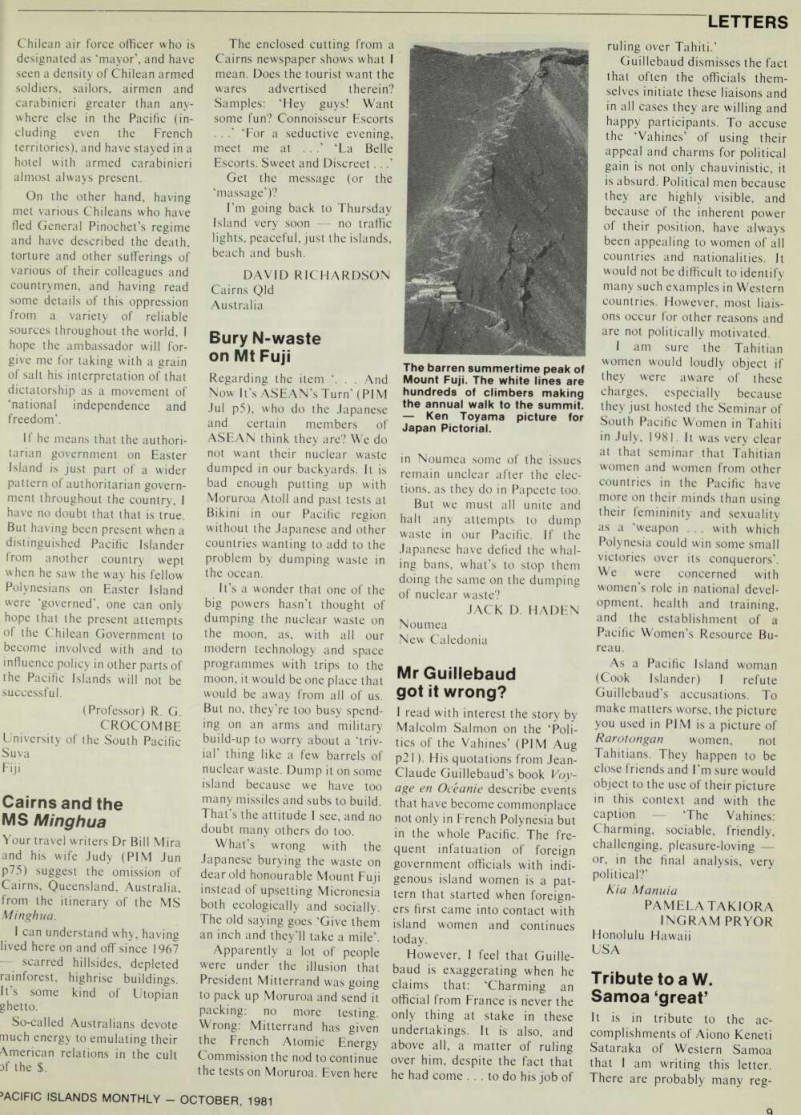
However, this situation has proven nothing and has divided a close family. The king should welcome this lovely girl into his
family.
Randy Duff
Indianapolis Ind
Usa
Chile: Crocombe
replies
Chile’s Ambassador to Austra lia Dr Jorge Valdovinos feels that I am ‘under considerable misapprehension’ about the situation in Chile, and in par ticular Easter Island (PIM Jun p 9). Easter Island, the ambassa dor states, ‘falls within the regular civil administration of the nation. It has a provincial governor and a mayor who heads the local council. It holds no particular military status, and the Chilean navy ceased to administer it in 1966’. The ambassador’s statement is misleading at best.
I have been on Easter Island with the admiral of the Chilean navy who was appointed minis ter of the department with special responsibility for Easter Island, and with the army general who is head of the University of Chile which has an extension division on Easter Island, and with the serving
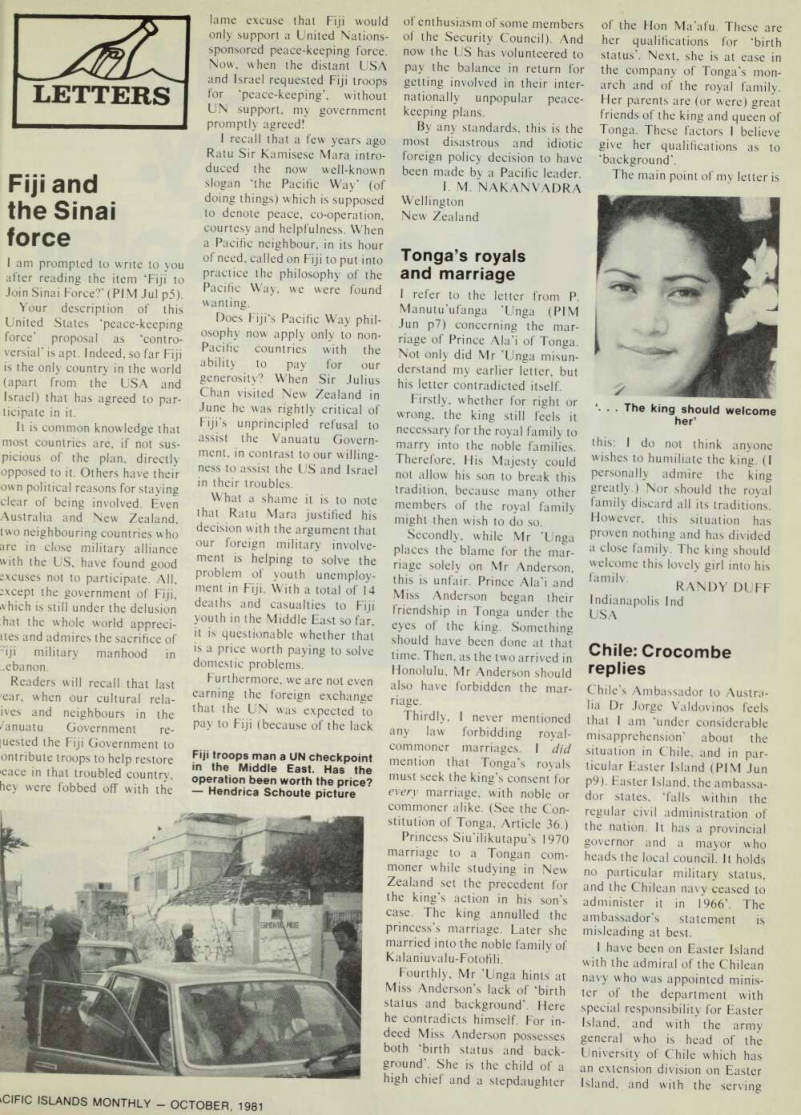
Fiji troops man a UN checkpoint in the Middle East. Has the operation been worth the price? -Hendrica Schoute picture
...The king should welcome her’
Chilean air force officer who is designated as ‘mayor’, and have seen a density of Chilean armed soldiers, sailors, airmen and carabinieri greater than any where else in the Pacific (in cluding even the French territories), and have stayed in a hotel with armed carabinieri almost always present.
On the other hand, having met various Chileans who have fled General Pinochet’s regime and have described the death, torture and other sufferings of various of their colleagues and countrymen, and having read some details of this oppression from a variety of reliable sources throughout the world, I hope the ambassador will for give me for taking with a grain of salt his interpretation of that dictatorship as a movement of ‘national independence and freedom’.
If he means that the authori tarian government on Easter Island is just part of a wider pattern of authoritarian govern ment throughout the country, I have no doubt that that is true.
But having been present when a distinguished Pacific Islander from another country wept when he saw the way his fellow Polynesians on Easter Island were ‘governed’, one can only hope that the present attempts of the Chilean Government to become involved with and to influence policy in other parts of the Pacific Islands will not be successful. (Professor) R. G.
Crocombe
University of the South Pacific Suva Fiji Cairns and the
MS Minghua
Your travel writers Dr Bill Mira and his wife Judy (PIM Jun p 75) suggest the omission of Cairns, Queensland, Australia, from the itinerary of the MS Minghua.
I can understand why, having lived here on and off since 1967 - scarred hillsides, depleted rainforest, highrise buildings.
It s some kind of Utopian ghetto.
So-called Australians devote much energy to emulating their American relations in the cult 3f the $.
The enclosed cutting from a Cairns newspaper shows what I mean. Does the tourist want the wares advertised therein?
Samples: ‘Hey guys! Want some fun? Connoisseur Escorts . . ‘For a seductive evening, meet me at . . ‘La Belle Escorts. Sweet and Discreet..
Get the message (or the ‘massage’)?
Em going back to Thursday Island very soon no traffic lights, peaceful, just the islands, beach and bush.
David Richardson
Cairns Qld Australia
Bury N-waste
on Mt Fuji Regarding the item . . And Now It's ASEAN’s Turn' (PIM Jul p 5), who do the Japanese and certain members of ASEAN think they are? We do not want their nuclear waste dumped in our backyards. It is bad enough putting up with Moruroa Atoll and past tests at Bikini in our Pacific region without the Japanese and other countries wanting to add to the problem by dumping waste in the ocean.
It’s a wonder that one of the big powers hasn’t thought of dumping the nuclear waste on the moon, as, with all our modern technology and space programmes with trips to the moon, it would be one place that would be away from all of us.
But no, they’re too busy spend ing on an arms and military build-up to worry about a Triv ial’ thing like a few barrels of nuclear waste. Dump it on some island because we have too many missiles and subs to build.
That’s the attitude I see, and no doubt many others do too.
What’s wrong with the Japanese burying the waste on dear old honourable Mount Fuji instead of upsetting Micronesia both ecologically and socially.
The old saying goes ‘Give them an inch and they’ll take a mile’.
Apparently a lot of people were under the illusion that President Mitterrand was going to pack up Moruroa and send it packing: no more testing.
Wrong: Mitterrand has given the French Atomic Energy Commission the nod to continue the tests on Moruroa. Even here
in Noumea some of the issues remain unclear after the elec tions, as they do in Papeete 100.
But we must all unite and halt any attempts to dump waste in our Pacific. If the Japanese have defied the whal ing bans, what’s to stop them doing the same on the dumping of nuclear waste?
Jack D. Haden
Noumea New Caledonia
Mr Guillebaud
got it wrong?
I read with interest the story by Malcolm Salmon on the ‘Poli tics of the Vahines’ (PIM Aug p2l). His quotations from Jean- Claude Guillebaud’s book Voy age en Oceanic describe events that have become commonplace not only in French Polynesia but in the whole Pacific. The fre quent infatuation of foreign government officials with indi genous island women is a pat tern that started when foreign ers first came into contact with island women and continues today.
However, I feel that Guille baud is exaggerating when he claims that; ‘Charming an official from France is never the only thing at stake in these undertakings. It is also, and above all, a matter of ruling over him, despite the fact that he had come ... to do his job of
ruling over Tahiti.’
Guillebaud dismisses the fact that often the officials them selves initiate these liaisons and in all cases they are willing and happy participants. To accuse the ‘Vahines’ of using their appeal and charms for political gain is not only chauvinistic, it is absurd. Political men because they are highly visible, and because of the inherent power of their position, have always been appealing to women of all countries and nationalities. It would not be difficult to identify many such examples in Western countries. However, most liais ons occur for other reasons and are not politically motivated.
I am sure the Tahitian women would loudly object if they were aware of these charges, especially because they just hosted the Seminar of South Pacific Women in Tahiti in July, 1981. It was very clear at that seminar that Tahitian women and women from other countries in the Pacific have more on their minds than using their femininity and sexuality as a ‘weapon . . . with which Polynesia could win some small victories over its conquerors’.
We were concerned with women’s role in national devel opment, health and training, and the establishment of a Pacific Women’s Resource Bu reau.
As a Pacific Island woman (Cook Islander) I refute Guillebaud’s accusations. To make matters worse, the picture you used in PIM is a picture of Rarotongan women, not Tahitians. They happen to be close friends and I’m sure would object to the use of their picture in this context and with the caption ‘The Vahines:
Charming, sociable, friendly,
challenging, pleasure-loving
or, in the final analysis, very political?’
Kia Manuia
Pamela Takiora
Ingram Pryor
Honolulu Hawaii
Usa
Tribute to a W.
Samoa ‘great’
It is in tribute to the ac complishments of Aiono Keneti Sataraka of Western Samoa that I am writing this letter.
There are probably many reg
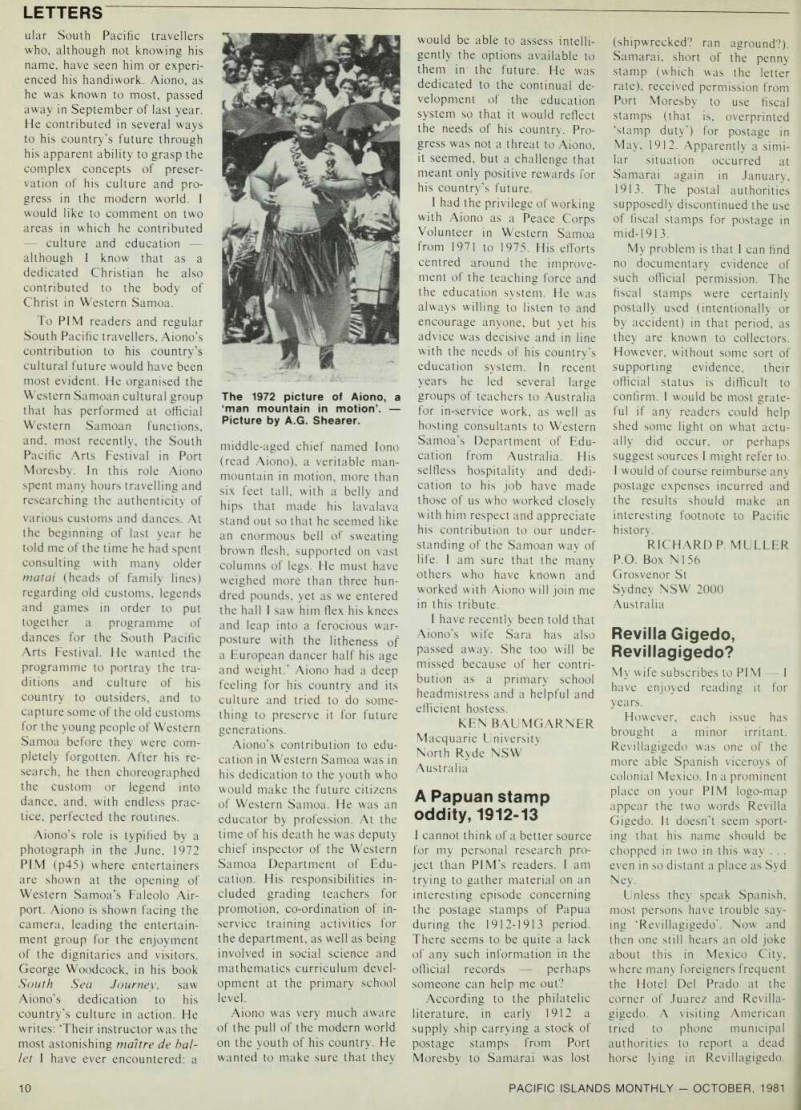
The barren summertime peak of Mount Fuji. The white lines are hundreds of climbers making the annual walk to the summit. -Ken Toyama picture for Japan Pictorial.
ular South Pacific travellers who, although not knowing his name, have seen him or experi enced his handiwork. Aiono, as he was known to most, passed away in September of last year.
He contributed in several ways to his country’s future through his apparent ability to grasp the complex concepts of preser vation of his culture and pro gress in the modern world. I would like to comment on two areas in which he contributed - culture and education although I know that as a dedicated Christian he also contributed to the body of Christ in Western Samoa.
To PIM readers and regular South Pacific travellers, Aiono’s contribution to his country’s cultural future would have been most evident. He organised the Western Samoan cultural group that has performed at official Western Samoan functions, and, most recently, the South Pacific Arts Festival in Port Moresby. In this role Aiono spent many hours travelling and researching the authenticity of various customs and dances. At the beginning of last year he told me of the lime he had spent consulting with many older matai (heads of family lines) regarding old customs, legends and games in order to put together a programme of dances for the South Pacific Arts Festival. He wanted the programme to portray the tra ditions and culture of his country to outsiders, and to capture some of the old customs for the young people of Western Samoa before they were com pletely forgotten. After his re search, he then choreographed the custom or legend into dance, and, with endless prac tice, perfected the routines.
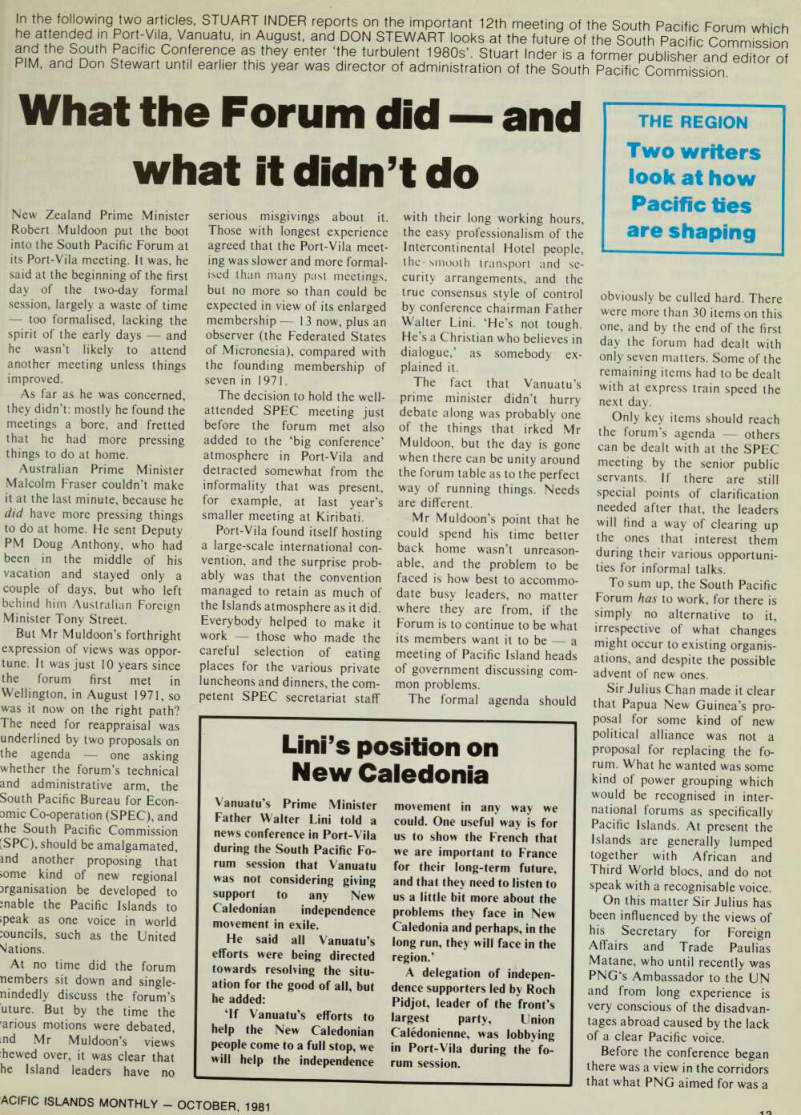
Aiono’s role is typified by a photograph in the June, 1972 PIM (p 45) where entertainers are shown at the opening of Western Samoa’s Faleolo Air port. Aiono is shown facing the camera, leading the entertain ment group for the enjoyment of the dignitaries and visitors.
George Woodcock, in his book South Sea Journey, saw Aiono’s dedication to his country’s culture in action. He writes: ‘Their instructor was the most astonishing maltre de bal let I have ever encountered: a
middle-aged chief named lono (read Aiono), a veritable man mountain in motion, more than six feel tall, with a belly and hips that made his lavalava stand out so that he seemed like an enormous bell of sweating brown flesh, supported on vast columns of legs. He must have weighed more than three hun dred pounds, yet as we entered the hall I saw him flex his knees and leap into a ferocious war posture with the litheness of a European dancer half his age and weight.’ Aiono had a deep feeling for his country and its culture and tried to do some thing to preserve it for future generations.
Aiono’s contribution to edu cation in Western Samoa was in his dedication to the youth who would make the future citizens of Western Samoa. He was an educator by profession. At the time of his death he was deputy chief inspector of the Western Samoa Department of Edu cation. His responsibilities in cluded grading teachers for promotion, co-ordination of in service training activities for the department, as well as being involved in social science and mathematics curriculum devel opment at the primary school level.
Aiono was very much aware of the pull of the modern world on the youth of his country. He wanted to make sure that they
would be able to assess intelli gently the options available to them in the future. He was dedicated to the continual de velopment of the education system so that it would reflect the needs of his country. Pro gress was not a threat to Aiono, it seemed, but a challenge that meant only positive rewards for his country’s future.
I had the privilege of working with Aiono as a Peace Corps Volunteer in Western Samoa from 1971 to 1975. His efforts centred around the improve ment of the teaching force and the education system. He was always willing to listen to and encourage anyone, but yet his advice was decisive and in line with the needs of his country’s education system. In recent years he led several large groups of teachers to Australia for in-service work, as well as hosting consultants to Western Samoa’s Department of Edu cation from Australia. His selfless hospitality and dedi cation to his job have made those of us who worked closely with him respect and appreciate his contribution to our under standing of the Samoan way of life. I am sure that the many others who have known and worked with Aiono will join me in this tribute.
I have recently been told that Aiono’s wife Sara has also passed away. She 100 will be missed because of her contri bution as a primary school headmistress and a helpful and efficient hostess.
Ken Baumgarner
Macquarie University North Ryde NSW Australia
A Papuan stamp
oddity, 1912-13
I cannot think of a better source for my personal research pro ject than PI M’s readers. I am trying to gather material on an interesting episode concerning the postage stamps of Papua during the 1912-1913 period.
There seems to be quite a lack of any such information in the official records perhaps someone can help me out?
According to the philatelic literature, in early 1912 a supply ship carrying a stock of postage stamps from Port Moresby to Samarai was lost
(shipwrecked? ran aground?).
Samarai, short of the penny stamp (which was the letter rale), received permission from Port Moresby to use fiscal stamps (that is, overprinted ‘stamp duty’) for postage in May, 1912. Apparently a simi lar situation occurred at Samarai again in January, 1913. The postal authorities supposedly discontinued the use of fiscal stamps for postage in mid-1913.
My problem is that I can find no documentary evidence of such official permission. The fiscal stamps were certainly postally used (intentionally or by accident) in that period, as they are known to collectors.
However, without some sort of supporting evidence, their official status is difficult to confirm. I would be most grate ful if any readers could help shed some light on what actu ally did occur, or perhaps suggest sources I might refer to.
I would of course reimburse any postage expenses incurred and the results should make an interesting footnote to Pacific history.
Richard P. Muller
P.O. Box N 156 Grosvenor St Sydney NSW 2000 Australia
Revilla Gigedo,
Revillagigedo?
My wife subscribes to PIM I have enjoyed reading it for years.
However, each issue has brought a minor irritant.
Revillagigedo was one of the more able Spanish viceroys of colonial Mexico. In a prominent place on your PIM logo-map appear the two words Revilla Gigedo. It doesn’t seem sport ing that his name should be chopped in two in this way . . . even in so distant a place as Syd Ney.
Unless they speak Spanish, most persons have trouble say ing ‘Revillagigedo’. Now and then one still hears an old joke about this in Mexico City, where many foreigners frequent the Hotel Del Prado at the corner of Juarez and Revilla gigedo. A visiting American tried to phone municipal authorities to report a dead horse lying in Revillagigedo.
The 1972 picture of Aiono, a man mountain in motion’.- Picture by A.G. Shearer.
After a number of goes at identifying the street, the frus trated Yank asked the person on the other end of the line to stand by a moment. Finally, the gasps of mighty panting were heard and a laboured voice gasped: ‘There is a dead horse in the lobby of the Hotel Del Prado In any event, I think PIM ought to label the group of islands SSW off the coast of Mexico’s peninsular state of Baja California Sur . . . with the undivided name that is theirs . . . even if it is easier to say in two pieces.
Galal J. Kernahan
Anaheim Calif
Usa
PIM Associate Editor Mal colm Salmon has been doing some homework and comments: Reader Kernahan is quite right in urging that it is correct modern usage to write the name of these islands as one word Revillagigedo. Indeed, this was done on maps in editions of Pacific Islands Year Book on which PI M’s map is based until an earlier erudite and helpful correspondent wrote to our office saying that the name should be written as Wo words, and the PIYB editors changed the map accordingly.
But, Mr Kernahan is very much barking up the wrong tree when he insists that the reason why the islands’ name should be written as one word is that the man after whom the islands vere named wrote his name in hat way. That worthy Spanish tentleman was Juan Vicente Jiiemes Pacheco de Padilla, -°unt of Revilla Gigedo, who vas viceroy of New Spain in 789-94. His father, Juan rancisco de Giiemes y Jorcasitas, Count of Revilla jigedo, had held the same ffice in 1746-55. The islands /ere named after his son in 793.
As can be well understood, lerefore, the family must have een pretty well known around ie place at the time. It is robably this contemporary ame which explains the Tun ing together of the two words f the title Revilla and rigedo to describe the lands, as well as the Mexico ity street. (Any schoolboy in
an English-speaking country whose first name happens to be Winston will tell you how sick and tired he gets of being called
Winstonchurchill . . .)
Our thanks to Mr Kernahan - even if he is right for the wrong reasons. (Incidentally, we’ll be changing our map yet again and so will the editors of PIYB.) Again on Oz in the Pacific My apologies to Athol L.
Cottrell (PIM AugplO) and all others who may have taken ‘a certain amount of umbrage’ at my ‘vitriolic’ letter (PIM Jun plO).
It would presumably be use less to argue the point over the ‘lot of help’ given by Australia over the years to its Pacific neighbours. The true purpose of this help was recently bluntly described in public by an Aus tralian MP: it is designed ‘to keep the Russians out’, he said.
This could be expressed quite differently in military and stra tegic terms.
I cannot refrain from saying a few words about Gough Whitlam, described by Mr Cottrell as a ‘now unemployed politico’. Mr Whitlam has been visiting Nigeria in a desperate quest for the international limelight. With even greater
desperation he is still seeking to justify his gutless cowardice on the Timor issue.
The historical facts indicate that Mr Whitlam’s ‘advocacy of slightly revolutionary ideas’ cost 300 000 Timorese and five dinkum Aussies their lives. These facts appear to have been overlooked by Mr Cottrell and his ‘thousands of concerned Australians’.
Apart from the Timor issue, I wonder very seriously where these ‘thousands of concerned Australians’ have been while Indonesia has been slaughtering more than 200 000 inhabitants of Irian Jaya, right on Austra lia’s doorstep. The slaughter is going on to this day, despite all those ‘concerned’ Australians.
And where have they been as thousands of West Papuan refu gees, including many women and children, have been forced back across the Papua New Guinea/Irian Jaya border with the active participation of for mer Australian ‘Kiaps’, now using the glorified title of ‘se curity and intelligence advisers’ to the Somare and Chan gov ernments?
It has become a major trend in our societies today to sidestep the truth and attempt to excuse incompetence and cowardice by the use of the word ‘commu nist’. Mr Cottrell does this.
Gough Whitlam did it when he has suggested that the Fretilin movement in East Timor was ‘communist’.
Despite all this, I am very pleased and proud that Mr Cottrell chooses to address me as ‘Mr Paingame’. After two years in Australia I have be come used to being addressed as ‘Mr Coon’, if not as plain ‘Kanaka’.
I wish to assure Mr Cottrell that I have not the slightest intention of joining any of Australia’s hypocritical politi cal organisations. The last one I would think of joining would be Australia’s ‘communist organis ations’ referred to by Mr Cottrell. As a ‘Coon’ and a ‘Kanaka’ 1 presume 1 wouldn’t be welcome in them in any case. 1 am proud of what I am, and proud of my brothers and sisters in Irian Jaya, and those in Timor as well, who have been sold and betrayed in cowardice and greed. 1 am proud too of
those who continue the struggle.
Let us accept the truth. Let’s stop talking lukewarm hypoc risy and baloney about ‘the many thousands of Australians concerned for their Pacific neighbours’. Historical facts prove the contrary, as indicated in Timor and Irian Jaya.
Vitaliz Paingame
Cairns Qld Australia
Yachtsman turned
back from Nauru To the people of Nauru, I am sorry. I am sorry that after 10 days of hard sailing I was denied the privilege of meeting and coming to know you.
Strictly complying with quaran tine and entry procedures, I hadn t prepared for the bureau cratic bullying and petty crankiness encountered. I can only conclude I must have arrived on the official’s day off, or had committed some similar crime.
I was turned away to sea without a chance to restock food, fuel or water, and I was told that if I protested in any way I would face some vague legal charges. This was astound ing, not solely because it is in flagrant breach of international law or because I was assumed to have no legal requirement for entry but because of the lavish hospitality and co-operation which I have found to prevail elsewhere in the Islands.
Other Islanders have been proud of their culture and have been eager to share it with visitors. What has caused such brutal and rude treatment towards visitors to Nauru? Does this lack of hospitality reflect an eroded pride or even a shame in what 1 came to see? Certainly a customs and immigration official can’t reflect the charac ter of an entire nation, but may I caution that he is the van guard the first and the last impression.
Should he not be an ambassa dor of goodwill, or will future callousness to foreign visitors continue to belittle the Repub lic of Nauru?
Alvah G. Simon
Yacht Zenie P. II Cairns Yacht Club Cairns Qld Australia
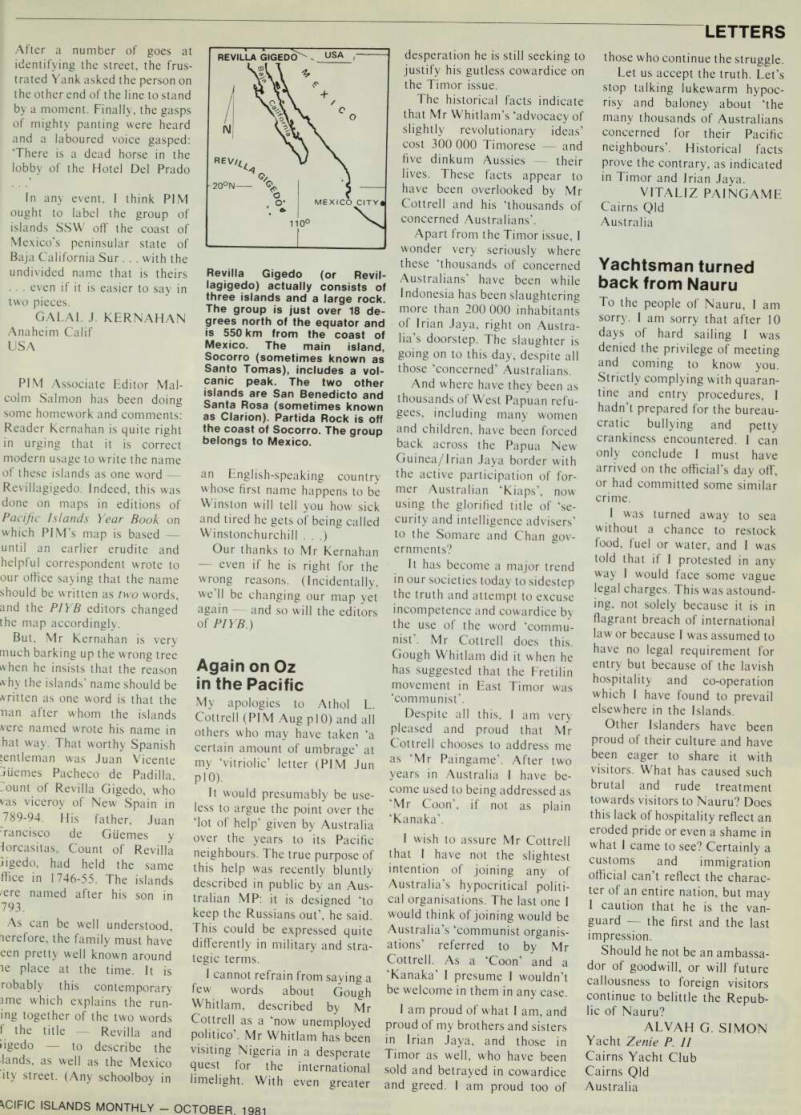
Revilla Gigedo (or Revil lagigedo) actually consists of three islands and a large rock.
The group is just over 18 de grees north of the equator and is 550 km from the coast of Mexico. The main island, Socorro (sometimes known as Santo Tomas), includes a vol canic peak. The two other islands are San Benedicto and Santa Rosa (sometimes known as Clarion). Partida Rock is off the coast of Socorro. The group belongs to Mexico.
Advertisements & other items, pp. 7-12 (4 items)
Kcific Islands Monthly October, 1981
Save money.
Save energy.
With Rheem Solar.
l{heem z Now is the time to think about installing Rheem Solar.
With a Rheem Solar system, you can save on your annual hot water bill and help conserve valuable energy.
A Rheem Solar system offers you some very special features:- The exclusive Rheem Sunstat* valve controls water temperature.
This means your water temperature can’t exceed 70 degrees, so there is no risk of accidental scalding.
Rheem Solar systems have all copper absorber plates, one of the best heat conductors in the world.
Their 200 or 300litre capacity will suit your family needs.
And they come with Rheem reliability and 40 years’ experience in the hot water business.
For a free brochure on Rheem Solar, send in the coupon below.
Hb: Export Manager, Appliance Division, Rheem Australia Ltd, RO. j Box 6, Rydalmere 2116. Australia.
Name:
Address: I
ATA
DISTRIBUTORS: PAPUA NEW GUINEA. Steamships Trading Co. Ltd: Port Moresby, Lae, Kieta, Goroka, Madang, Rabaul, Popondetta, Kundiawa, Samaria, Mt. Hagen, Vanimo. Mainland Plumbing Supplies; Lae. NEW CALEDONIA. Ballande: Noumea. TAHITI. Coupimex: Papeete.
We would welcome enquiries for agencies in areas not covered above.
RHAIIO6
Only Pioneer’s tremendous range of audio expertise could give you so great a combination of advanced technology and stylish design. The new Personna Music Systems...the truly personal approach to fit any corner of your life.
The RX-70 Personna Cassette Receiver Sharp styling plus solid audio engineering. Full-logic cassette deck, digital FM/AM tuner and powerful stereo amp—all very easy to use and easier still to enjoy.
RX-70
(U) PIONEER
For further information, please contact: Australia: Pioneer Marketing Services Pty. Ltd., P.O. Box 317, Mordialloc, Victoria, 3195 Tel: 90-9011 Fiji Islands: Brijlal & Company, G.P.O. Box No. 362, Suva, Fiji Islands Tel: 22258 New Zealand: Monaco Distributors Ltd., 2 Poland Road, Glenfield, Auckland, New Zealand Tel: (09) 444-9144 Norfolk Island: Burns Philp (Norfolk Island) Ltd., P.O. Box 21, Norfolk Island, New Hebrides: Burns Philp (New Hebrides) Ltd., Vila, New Hebrides The MX-80 Personna Cassette Disc Receiver Total stereo system capability is at your fingertips with Auto Function Switching. Turntable, cassette deck, FM/AM tuner and stereo amp—all in a single high-tech unit.
The S-9 Personna Shelf Components Sleek matching units with an individual outlook and Auto Function Switching. Includes separate digital synthesized FM/AM tuner with programmable timer, a full-logic cassette deck, a fully automatic turntable and a stereo amp.
Personna from Pioneer. Now, stereo systems as personal as your music.
Nauru Island: Jacob Enterprises, P.O. Box No. 4, Republic of Nauru Tahiti: Tahiti Hi-Fi, P.O. Box 848, Papeete, Tahiti New Caledonia: Menard Pacifique Sari, B.P. 3899, Noumea, New Caledonia Tel: 48*24.36 American Samoa; Transpac Corporation, P.O. Box 1477, Pago Pago, American Samoa 96799 Tel: 633-5224 Rarotonga: South Seas International Ltd., P.O. Box 49, Rarotonga, Cook Islands Tel: 2327 Papua New Guinea: Bali Merchants Pty. Ltd., P.O. Box 6103, Boroko Tel: 254887 MU.
S-9
Letters
9
S ACIFIC ISLANDS MONTHLY OCTOBER, 1981
Letters
\CIFIC ISLANDS MONTHLY OCTOBER 1981
What the Forum did and
The Region
Two writers look at how Pacific ties are shaping
What the Forum did and what it didn’t do
L" Rowing two articles, STUART INDER reports on the important 12th meeting of the South Pacific Forum which he a tended in Port-Vila, Vanuatu, in August, and DON STEWART looks at the future of the South Pacific Comm™ a " d , th ® s ° u,h P aci,ic Conference as they enter ‘the turbulent 1980s’. Stuart Inder is a former publisher and editor of PIM, and Don Stewart until earlier this year was director of administration of the South Pacific^Commission.
New Zealand Prime Minister Robert Muldoon put the boot into the South Pacific Forum at its Port-Vila meeting. It was, he said at the beginning of the first day of the two-day formal session, largely a waste of time too formalised, lacking the spirit of the early days and he wasn’t likely to attend another meeting unless things improved.
As far as he was concerned, they didn’t; mostly he found the meetings a bore, and fretted that he had more pressing things to do at home.
Australian Prime Minister Malcolm Fraser couldn’t make it at the last minute, because he did have more pressing things to do at home. He sent Deputy PM Doug Anthony, who had been in the middle of his vacation and stayed only a couple of days, but who left behind him Australian Foreign Minister Tony Street.
But Mr Muldoon’s forthright expression of views was oppor tune. It was just 10 years since the forum first met in Wellington, in August 1971, so was it now on the right path?
The need for reappraisal was underlined by two proposals on the agenda one asking whether the forum’s technical and administrative arm, the South Pacific Bureau for Econ omic Co-operation (SPEC), and the South Pacific Commission [SPC), should be amalgamated, md another proposing that >ome kind of new regional organisation be developed to mable the Pacific Islands to ipeak as one voice in world councils, such as the United Nations.
At no time did the forum nembers sit down and single nindedly discuss the forum’s uture. But by the time the 'arious motions were debated, md Mr Muldoon’s views hewed over, it was clear that he Island leaders have no
serious misgivings about it.
Those with longest experience agreed that the Port-Vila meet ing was slower and more formal ised than many past meetings, but no more so than could be expected in view of its enlarged membership —l3 now, plus an observer (the Federated States of Micronesia), compared with the founding membership of seven in 1971.
The decision to hold the well attended SPEC meeting just before the forum met also added to the ‘big conference’ atmosphere in Port-Vila and detracted somewhat from the informality that was present, for example, at last year’s smaller meeting at Kiribati.
Port-Vila found itself hosting a large-scale international con vention, and the surprise prob ably was that the convention managed to retain as much of the Islands atmosphere as it did.
Everybody helped to make it work those who made the careful selection of eating places for the various private luncheons and dinners, the com petent SPEC secretariat staff
with their long working hours, the easy professionalism of the Intercontinental Hotel people, the - smooth transport and se curity arrangements, and the true consensus style of control by conference chairman Father Walter Lini. ‘He’s not tough.
He’s a Christian who believes in dialogue,’ as somebody ex plained it.
The fact that Vanuatu’s prime minister didn’t hurry debate along was probably one of the things that irked Mr Muldoon, but the day is gone when there can be unity around the forum table as to the perfect way of running things. Needs are different.
Mr Muldoon’s point that he could spend his time better back home wasn’t unreason able, and the problem to be faced is how best to accommo date busy leaders, no matter where they are from, if the Forum is to continue to be what its members want it to be a meeting of Pacific Island heads of government discussing com mon problems.
The formal agenda should
obviously be culled hard. There were more than 30 items on this one, and by the end of the first day the forum had dealt with only seven matters. Some of the remaining items had to be dealt with at express train speed the next day.
Only key items should reach the forum’s agenda others can be dealt with at the SPEC meeting by the senior public servants. If there are still special points of clarification needed after that, the leaders will find a way of clearing up the ones that interest them during their various opportuni ties for informal talks.
To sum up, the South Pacific Forum has to work, for there is simply no alternative to it, irrespective of what changes might occur to existing organis ations, and despite the possible advent of new ones.
Sir Julius Chan made it clear that Papua New Guinea’s pro posal for some kind of new political alliance was not a proposal for replacing the fo rum. What he wanted was some kind of power grouping which would be recognised in inter national forums as specifically Pacific Islands. At present the Islands are generally lumped together with African and Third World blocs, and do not speak with a recognisable voice.
On this matter Sir Julius has been influenced by the views of his Secretary for Foreign Affairs and Trade Paulias Matane, who until recently was PNG‘s Ambassador to the UN and from long experience is very conscious of the disadvan tages abroad caused by the lack of a clear Pacific voice.
Before the conference began there was a view in the corridors that what PNG aimed for was a
brotherhood of Islanders only, without Australia and New Zealand, which would replace the forum. This misinformation was no doubt fuelled by the fact that PNG produced no formal paper on its proposals, and thus there was plenty of scope for imagination. Reaction was that such a concept wasn’t on.
When Sir Julius explained his proposal in the conference room there was no debate on it, but Sir Julius agreed to formu late a more specific proposal for next year’s Forum meeting in Tuvalu.
Australia’s Doug Anthony probably best summed it up later at a news conference: ‘There’s merit in it. You could have some sort of grouping, if this is the wish of those nations, without interfering with the present structure. But you do need some sort of structure that will incorporate Australia and New Zealand. We are there, and participating. If they want to have a separate identiy for political purposes, that could be set up as an adjunct to the forum.’
The whole idea will go no further unless Sir Julius pushes it.
A SPEC/SPC merger will, if it happens, strengthen the fo rum. Such a possibility has been seriously studied since 1978, but it has been in the air longer than that. It came close to a blood-letting at the South Pacific Conference in Papeete in 1979, when the then director of SPEC, Mahe Tupouniua, made a fairly emotional plea for an end to the ‘siege mentality’ of the SPC on the issue, which he said was undermining the health of regional co-operation in the Islands. He stressed then that SPEC had no sinister plans for a take-over it was simply the forum’s executive and did what it was told to do ‘without embellishment’.
The Port-Vila forum agreed to convene a special SPEC committee session to undertake a detailed study on the feasi bility of a SPEC/SPC merger, with all its implications.
Thus a decision on the future of the SPC is finally approach ing. The forum has been in no hurry to grasp the nettle in the past because members aren’t united in how to approach it.
What overlapping is there?
Would costs indeed be less if the two organisations were rationalised? Would the US, France and Britain continue their funding at the present scale if a rationalisation ex cluded them from the new body?
And what, anyway, would be the political implications if the South Pacific Commission were to disappear how would France and the US in particular have a voice in the South Seas, since their territories are ineli gible for forum membership?
There are still no simple answers, and the forum is going to have to feel its way. It can expect some feedback at the next South Pacific Conference which officially opens in Port- Vila on October 24. The SPC probably won't like it but the fact remains that the SPC can’t survive unless the Forum countries want it to survive, and the final decision will be made by the Forum.
One regional organisation whose aims were not discussed officially in Port-Vila but which got passing attention in the corridors was the Pacific Islands Conference, set up last year at a meeting in Honolulu attended by most Islands leaders, including all the Micronesians. This conference (PIM May 1980 p 22) discussed developmental goals and was designed as an on-going body which would enable the Islands,
both north and south, to develop closer ties with international organisations able to help them.
The conference was sponsored by the US East West Center, and participants agreed there should be a second general meeting this year, somewhere in the Islands.
This meeting is not now likely before next year, and it seems that the organisation is not to have any permanent shape to the extent it will conflict with the current multiplicity of re gional and would-be regional organisations for which one can only offer heartfelt thanks.
Regionalism also raised its head with a proposal, again from PNG, that a regional peace-keeping force be estab lished that could be used in a similar role to that played by PNG forces last year when they supported the Vanuatu Govern ment against the Santo rebels.
This proposal fared little bet ter than Sir Julius’s plan for a regional political voice, al though it was certainly debated.
Sir Julius told the forum that he wanted to test feelings on the matter. The feeling was that nobody wanted to embrace such a complex, highly political plan, especially in view of possible developments in New Caledonia.
Who would compose such a force, who would pay for it, how would it be commanded, who would decide whom it was to be used against, and when? As
Ratu Sir Kamisese Mara ob served, peace-keeping forces are invariably sent to places where there is no peace.
The discussion resulted in a typical South Seas resolution designed to put the idea aside and at the same time save PNG’s face. The forum, ‘noted the importance of the mainten ance of peace and stability (security) in the region and called on member governments to give their attention to this important issue’. Over to Sir Julius again.
The New Caledonia situation occupied the greatest amount of the forum’s time (with transport matters second), and received a spectacular amount of press attention. The French Govern ment itself guaranteed this by using its diplomats in a vain effort to make the debate a non event.
The French Ambassador to Fiji unwisely suggested to Ratu Mara the day before the prime minister left Suva for the forum that France would regard Fiji’s support for any forum inter ference in New Caledonian affairs as an ‘unfriendly act’.
The warning was tacitly backed by the understanding that as Fiji sells ss2m worth of sugar annually to the EEC, it was vulnerable to political pressure.
Ratu Mara was, as he pub licly stated in Vila, ‘very, very angry’ at this approach, and ‘gave the ambassador a lemon’.
Which for anybody who has
seen Fiji’s Prime Minister on the warpath, was no doubt putting it mildly. That France was prepared to beard such a notably independent leader as Ratu Mara in such terms is eloquent commentary on the high state of anxiety France is in over the defence of its indefensible Pacific policies.
It certainly got no relief from the forum members. They re solved that; The governments comprising the South Pacific Forum, reaffirming their belief in the principles of self determination and indepen dence applying to non-self governing Pacific Island countries including the French territories, decide to send a delegation led by a forum head of government to Paris to meet with President Mitterrand of the French Republic, to discuss with him the question of the evolution of the French Govern ment’s policies with respect to the progress towards decolon isation of the people of the French Pacific territories.’
The resolution left the com position and timing of the delegation to its leader, who is to report to the next Forum. The leader, not unexpectedly, turned out to be Ratu Mara.
He didn’t seek the job, and he did in fact weigh up his position against possible difficulties it might cause Fiji at
the hands of France. Typically, he decided that whatever the consequences it had to be done because the alternative solution in New Caledonia would be a lot more violent.
It’s unlikely that the del egation will go before next year, by which time a new Mitterrand policy on decolonisation may have defused events. But a lot of forum leaders don’t hold out much hope.
What they see is a danger that the New Caledonian co lons will take the initiative from the hands of the French Gov ernment even if it should decide to grant New Caledonia auton omy under eventual Melanesian leadership. This would lead to a bloodbath. It is because of the various terrible alternatives that the forum felt it had to involve itself in New Caledonia’s future while there was still time to use its influence.
The initiative for the New Caledonia resolution came from Vanuatu, which in turn had been strongly lobbied by the Kanak Front Independantiste.
Father Lini made it clear that Vanuatu was trying to do what it could ‘at every level’ to help New Caledonia achieve auton omy, because it had the closest relations with both New Caledonia’s autonomist move ment and France, and could
take a stand with less offence.
He told an end-of-conference news gathering: ‘1 think it was the most peaceful way for the forum to take a united stand on New Caledonia rather than let the situation develop where they will continue to kill Melanesians members of the Front Independantiste be cause already we have four who have been killed, and the indi cation we have is that before the end of the year more will be killed in New Caledonia by the white settlers.
That is why we believe that if the forum can take a united stand it will help deter the New Caledonia situation from de veloping into almost a racial issue, when we believe that it is, and should continue to be, a political issue.’
The original Vanuatu plan had sought, as an additional pressure against France, to get New Caledonia relisted as a
colony at the UN to ensure its affairs would come before the decolonisation committee.
Father Lini was not happy that the forum did not accept this plank in his platform, but he realised that the forum was trying to work in a way that was likely to be diplomatically ac ceptable to France and the forum countries themselves.
Similarly, he accepted the fo rum’s change of wording in the resolution so as to make it apply to all of France’s Pacific territories, rather than New Caledonia alone.
He said Vanuatu had chosen to concentrate its efforts on the New Caledonian situation be cause once a peaceful solution could be worked out there, it would be beneficial to the other French Pacific territories.
There is no doubt, however, that it is New Caledonia which disturbs Father Lini and the forum.
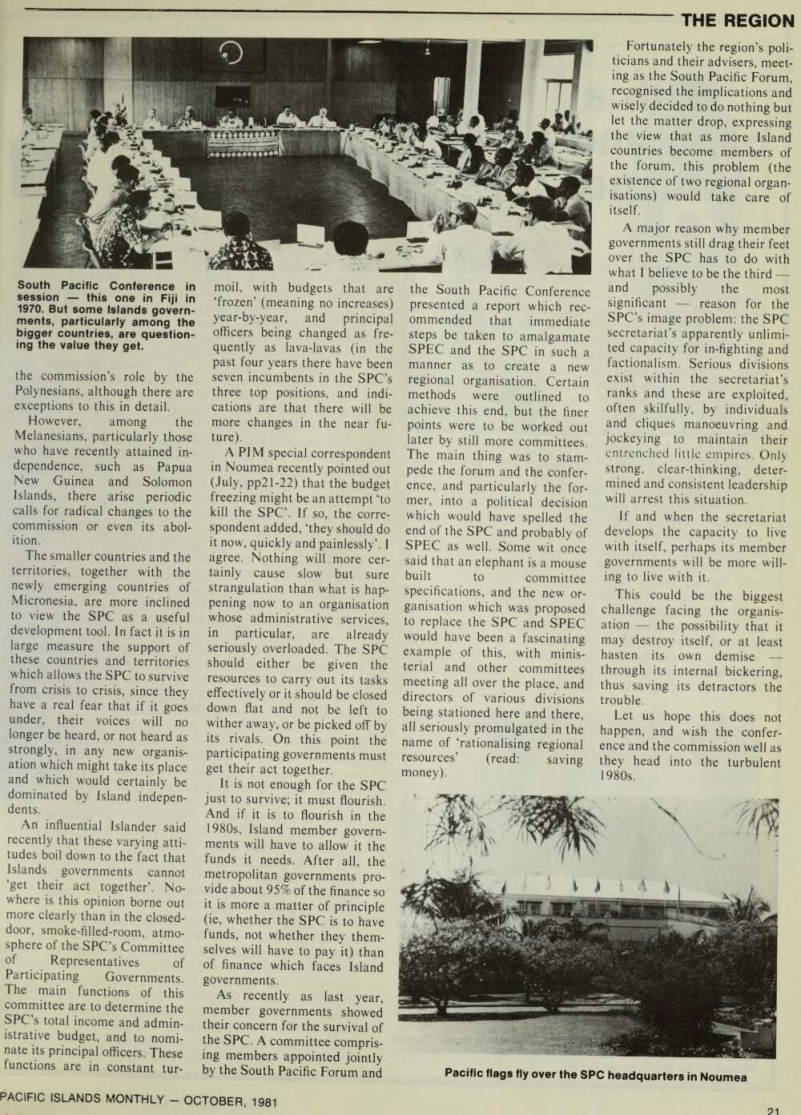
National leaders at the South Pacific Forum meeting were: (left to right, back row) Minister Buraro Detumado, Nauru; Prime Minister Tupuola Efi, Western Samoa; Prime Minister Walter Lini, Vanuatu- Prime Minister Sir Thomas Davis, Cook Islands; Prime Minister Ratu Sir Kamisese Mara, Fiji; (centre row) President Tosiwo Nakayama Federated States of Micronesia; South Pacific Bureau for Economic Co-operation Director Dr Gabriel Gris (his country is Papua New Guinea): President leremia Tabai, Kiribati; Deputy Prime Minister Doug Anthony, Australia; Prime Minister Peter Kenilorea, Solomon Islands (he has since been defeated as prime minister see Political Currents); (front row) Acting Prime Minister Baron Tuita, Tonga; Prime Minister Robert Muldoon, New Zealand; Premier Robert Rex, Niue; Prime Minister Sir Julius Chan, Papua New Guinea; Prime Minister Toalipi Lauti, Tuvalu. Vanuatu govern ment picture.
New Caledonia
Uni’s position on New Caledonia
Vanuatu’s Prime Minister Father Walter Lini told a news conference in Port-Vila during the South Pacific Fo rum session that Vanuatu was not considering giving support to any New Caledonian independence movement in exile.
He said all Vanuatu’s efforts were being directed towards resolving the situ ation for the good of all, but he added: ‘lf Vanuatu’s efforts to help the New Caledonian people come to a full stop, we will help the independence
movement in any way we could. One useful way is for us to show the French that we are important to France for their long-term future, and that they need to listen to us a little bit more about the problems they face in New Caledonia and perhaps, in the long run, they will face in the region.’
A delegation of indepen dence supporters led by Roch Pidjot, leader of the front’s largest party. Union Caledonienne, was lobbying in Port-Vila during the fo rum session.
Advertisements & other items, p. 13 (1 item)
Acific Islands Monthly October, 1981
Banabans
actove at Forum
The Banaban people of Rabi Island took advantage of the South Pacific Forum’s inter est in self-determination for New Caledonia to press its own case for independence for Ocean Island.
David Christopher, sec retary to the Rabi Council of Leaders, lobbied delegates and presented most of the forum leaders with a docu ment outlining Rabi’s objec
tives. The Rabi situation was not, however, discussed by
orum ‘
Rabi’s views were supported by a covering letter signed by the chairman of the Rabi Council of Leaders, the Rev Kaitangare Kaburoro.
Rabi is part of Fiji, and the Banabans of Rabi are Fiji citizens, but their ancestral home is Ocean Island, or Banaba, which they still possess, although the phosphate has now been exhausted.
Banaba is part of Kiribati.
Mr Kaburoro’s letter says that the Rabi Islanders are pressing their right to selfgovernment for Banaba, and continues: ‘We are distressed
at the selfish, irresponsible and unco-operative attitude of the Kiribati Government in this matter. Perhaps they have been taught this mode of behaviour by Britain, which has a shocking record of exploitation of the Banabans. ‘We pray that you will give our cause sympathetic con sideration. We feel that our approach to you is timely in view of the Forum’s proposed intention of requesting France to grant freedom to its Pacific colonies. We humbly state that we too are deserving of political free dom.’ • See also Political Cur rents.
Advertisements & other items, pp. 15-16 (2 items)
The Region
ACIFIC ISLANDS MONTHLY OCTOBER, 1981
The name of performance.
SUZUKI Vehicles are shipped to approximately 100 countries throughout the world and are well received by users in those countries. Behind the high-quality of SUZUKI 4-wheelers is the in-depth research carried out from all aspects, rigorous tests and an extensive after-sales service net-work. Vehicles that are ready when you need them and which you can trust when driving SUZUKI Vehicles.
Kg - TP r. *' r "- J* / Kt X
SJ4IO
x -
SSBOF
ST9O
ST9OVT
--- : s - -. 3L J * Tr % o.
SUZUKI
/ ; , isuzuKi ■ , 3
SUZUKI MOTOR CO., LTD
EHElilSl 30()Takatsuka. I lamamatsu. Japan SOLOMON ISLANDS SOLOMON ISLAND SERVICE STATION LTD. NEW CALEDONIA STE. SUPERCAL PAPUA NEW GUINEA Hi SPEED DIESEL SERVICE PTY LTD. VANUATU HENRI LEROUX NIUE ISLAND BURNS PHILP (SOUTH SEA) CO., LTD. PONAPE LEO ETSCHEIT TAHITI NIPPON AUTOMOTO ELLICE ISLAND TUVALU COOPERATIVE WHOLESALES SOCIETY LTD. GUAM & SAIPAN ISLAND CYCLERY. INC. NORFOLK MARTIN’S AGENCIES LTD. SAMOA PACIFIC PRODUCTS, INC. KIRIBATI GILBERT ISLANDS
Salvage plan for a commission
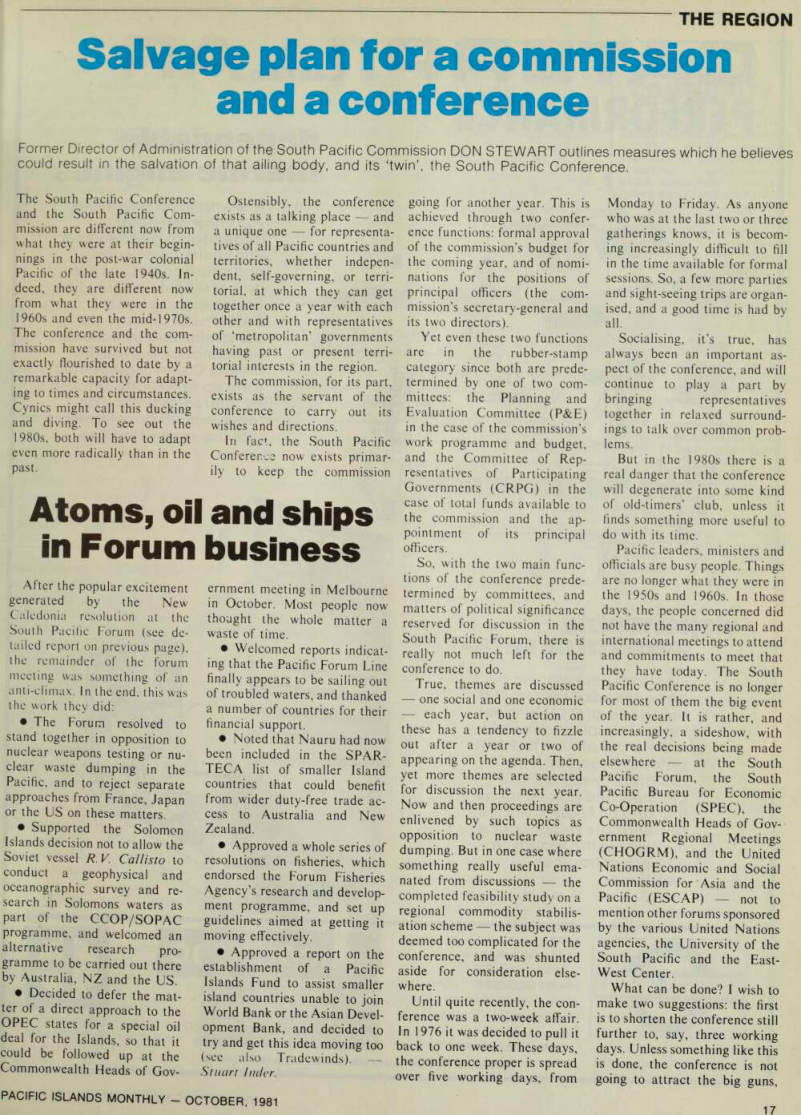

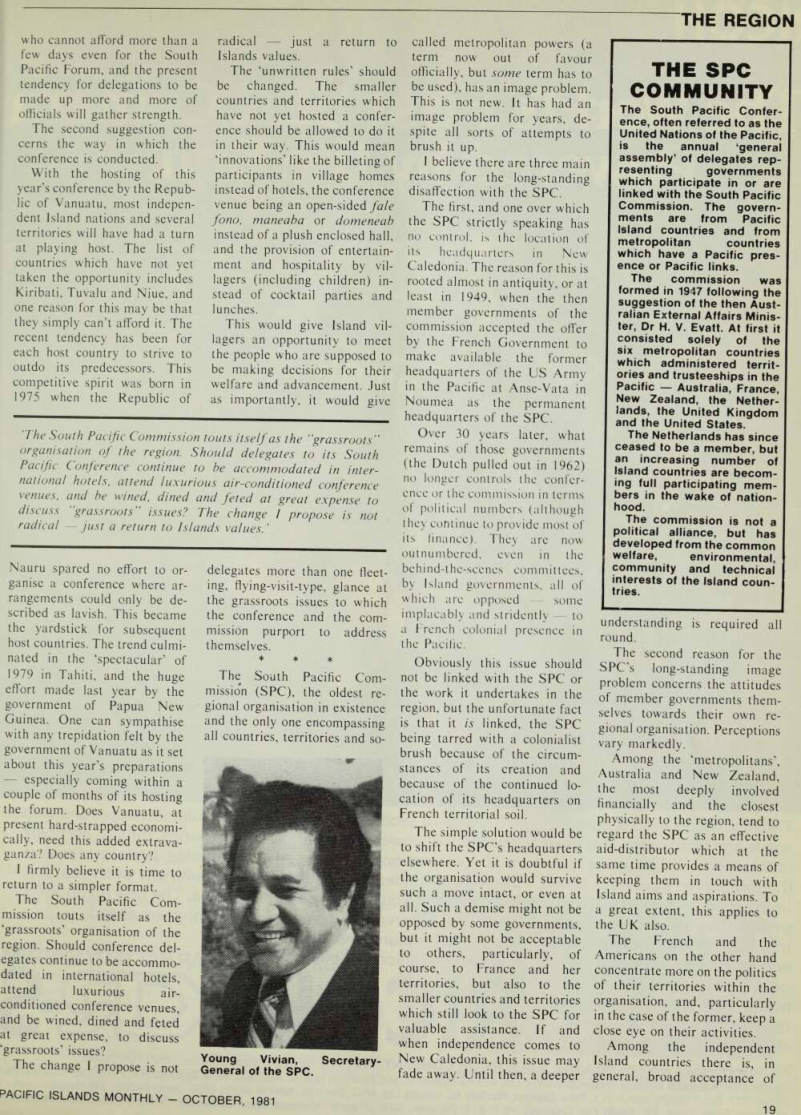

and a conference
Former Director of Administration of the South Pacific Commission DON STEWART outlines measures which he believes could result in the salvation of that ailing body, and its ‘twin’, the South Pacific Conference.
The South Pacific Conference and the South Pacific Commission are different now from what they were at their beginnings in the post-war colonial Pacific of the late 19405. Indeed, they are different now from what they were in the 1960 s and even the mid-19705.
The conference and the commission have survived but not exactly flourished to date by a remarkable capacity for adapting to times and circumstances.
Cynics might call this ducking and diving. To see out the 1980 s, both will have to adapt even more radically than in the P ast -
Ostensibly, the conference exists as a talking place and a unique one for representa tives of all Pacific countries and territories, whether indepen dent, self-governing, or terri torial, at which they can get together once a year with each other and with representatives of ‘metropolitan’ governments having past or present terri torial interests in the region.
The commission, for its part, exists as the servant of the conference to carry out its wishes and directions.
In fact, the South Pacific Conference now exists primar ily to keep the commission
going for another year. This is achieved through two confer ence functions: formal approval of the commission’s budget for the coming year, and of nomi nations for the positions of principal officers (the com mission’s secretary-general and its two directors).
Yet even these two functions are in the rubber-stamp category since both are prede termined by one of two com mittees: the Planning and Evaluation Committee (P&E) in the case of the commission’s work programme and budget, and the Committee of Rep resentatives of Participating Governments (CRPG) in the case of total funds available to the commission and the ap pointment of its principal officers.
So, with the two main func tions of the conference prede termined by committees, and matters of political significance reserved for discussion in the South Pacific Forum, there is really not much left for the conference to do.
True, themes are discussed one social and one economic each year, but action on these has a tendency to fizzle out after a year or two of appearing on the agenda. Then, yet more themes are selected for discussion the next year.
Now and then proceedings are enlivened by such topics as opposition to nuclear waste dumping. But in one case where something really useful ema nated from discussions the completed feasibility study on a regional commodity stabilis ation scheme the subject was deemed too complicated for the conference, and was shunted aside for consideration else where.
Until quite recently, the con ference was a two-week affair.
In 1976 it was decided to pull it back to one week. These days, the conference proper is spread over five working days, from
Monday to Friday. As anyone who was at the last two or three gatherings knows, it is becom ing increasingly difficult to fill in the time available for formal sessions. So, a few more parties and sight-seeing trips are organ ised, and a good time is had by all.
Socialising, it’s true, has always been an important as pect of the conference, and will continue to play a part by bringing representatives together in relaxed surround ings to talk over common prob lems.
But in the 1980 s there is a real danger that the conference will degenerate into some kind of old-timers’ club, unless it finds something more useful to do with its time.
Pacific leaders, ministers and officials are busy people. Things are no longer what they were in the 1950 s and 19605. In those days, the people concerned did not have the many regional and international meetings to attend and commitments to meet that they have today. The South Pacific Conference is no longer for most of them the big event of the year. It is rather, and increasingly, a sideshow, with the real decisions being made elsewhere at the South Pacific Forum, the South Pacific Bureau for Economic Co-Operation (SPEC), the Commonwealth Heads of Gov ernment Regional Meetings (CHOGRM), and the United Nations Economic and Social Commission for Asia and the Pacific (ESCAP) not to mention other forums sponsored by the various United Nations agencies, the University of the South Pacific and the East- West Center.
What can be done? I wish to make two suggestions: the first is to shorten the conference still further to, say, three working days. Unless something like this is done, the conference is not going to attract the big guns,
who cannot afford more than a few days even for the South Pacific Forum, and the present tendency for delegations to be made up more and more of officials will gather strength.
The second suggestion con cerns the way in which the conference is conducted.
With the hosting of this year’s conference by the Repub lic of Vanuatu, most indepen dent Island nations and several territories will have had a turn at playing host. The list of countries which have not yet taken the opportunity includes Kiribati, Tuvalu and Niue, and one reason for this may be that they simply can’t afford it. The recent tendency has been for each host country to strive to outdo its predecessors. This competitive spirit was born in 1975 when the Republic of
The South Pacific Commission touts itself as the “grassroots” organisation of the region. Should delegates to its South Pacific Conference continue to be accommodated in inter national hotels, attend luxurious air-conditioned conference venues, and be wined, dined and feted at great expense to discuss grassroots issues? The change I propose is not radical just a return to Islands values. ’
Nauru spared no effort to or ganise a conference where ar rangements could only be de scribed as lavish. This became the yardstick for subsequent host countries. The trend culmi nated in the ‘spectacular’ of 1979 in Tahiti, and the huge effort made last year by the government of Papua New Guinea. One can sympathise with any trepidation felt by the government of Vanuatu as it set about this year’s preparations - especially coming within a couple of months of its hosting the forum. Does Vanuatu, at present hard-strapped economi cally, need this added extrava ganza? Does any country?
I firmly believe it is time to return to a simpler format.
The South Pacific Com mission touts itself as the ‘grassroots’ organisation of the region. Should conference del egates continue to be accommo dated in international hotels, attend luxurious air conditioned conference venues, and be wined, dined and feted at great expense, to discuss ‘grassroots’ issues?
The change I propose is not
radical just a return to Islands values.
The ‘unwritten rules’ should be changed. The smaller countries and territories which have not yet hosted a confer ence should be allowed to do it in their way. This would mean ‘innovations’ like the billeting of participants in village homes instead of hotels, the conference venue being an open-sided fale fono, maneaba or domeneab instead of a plush enclosed hall, and the provision of entertain ment and hospitality by vil lagers (including children) in stead of cocktail parties and lunches.
This would give Island vil lagers an opportunity to meet the people who are supposed to be making decisions for their welfare and advancement. Just as importantly, it would give
delegates more than one fleet ing, flying-visit-type, glance at the grassroots issues to which the conference and the com mission purport to address themselves. ♦ * ♦ The South Pacific Com mission (SPC), the oldest re gional organisation in existence and the only one encompassing all countries, territories and so-
called metropolitan powers (a term now out of favour officially, but some term has to be used), has an image problem.
This is not new. It has had an image problem for years, de spite all sorts of attempts to brush it up.
I believe there are three main reasons for the long-standing disaffection with the SPC.
The first, and one over which the SPC strictly speaking has no control, is the location of its headquarters in New Caledonia. The reason for this is rooted almost in antiquity, or at least in 1949, when the then member governments of the commission accepted the offer by the French Government to make available the former headquarters of the US Army in the Pacific at Anse-Vata in Noumea as the permanent headquarters of the SPC.
Over 30 years later, what remains of those governments (the Dutch pulled out in 1962) no longer controls the confer ence or the commission in terms of political numbers (although they continue to provide most of its finance). They arc now outnumbered, even in the behind-the-scenes committees, by Island governments, all of which arc opposed some implacably and stridently to a French colonial presence in the Pacific.
Obviously this issue should not be linked with the SPC or the work it undertakes in the region, but the unfortunate fact is that it is linked, the SPC being tarred with a colonialist brush because of the circum stances of its creation and because of the continued lo cation of its headquarters on French territorial soil.
The simple solution would be to shift the SPC’s headquarters elsewhere. Yet it is doubtful if the organisation would survive such a move intact, or even at all. Such a demise might not be opposed by some governments, but it might not be acceptable to others, particularly, of course, to France and her territories, but also to the smaller countries and territories which still look to the SPC for valuable assistance. If and when independence comes to New Caledonia, this issue may fade away. Until then, a deeper
understanding is required all round.
The second reason for the SPC’s long-standing image problem concerns the attitudes of member governments them selves towards their own re gional organisation. Perceptions vary markedly.
Among the ‘metropolitans’, Australia and New Zealand, the most deeply involved financially and the closest physically to the region, tend to regard the SPC as an effective aid-distributor which at the same time provides a means of keeping them in touch with Island aims and aspirations. To a great extent, this applies to the UK also.
The French and the Americans on the other hand concentrate more on the politics of their territories within the organisation, and, particularly in the case of the former, keep a close eye on their activities.
Among the independent Island countries there is, in general, broad acceptance of
Young Vivian, Secretary- General of the SRC.
the commission’s role by the Polynesians, although there are exceptions to this in detail.
However, among the Melanesians, particularly those who have recently attained in dependence, such as Papua New Guinea and Solomon Islands, there arise periodic calls for radical changes to the commission or even its abol ition.
The smaller countries and the territories, together with the newly emerging countries of Micronesia, are more inclined to view the SPC as a useful development tool. In fact it is in large measure the support of these countries and territories which allows the SPC to survive from crisis to crisis, since they have a real fear that if it goes under, their voices will no longer be heard, or not heard as strongly, in any new organis ation which might take its place and which would certainly be dominated by Island indepen dents.
An influential Islander said recently that these varying atti tudes boil down to the fact that Islands governments cannot ‘get their act together’. No where is this opinion borne out more clearly than in the closed door, smoke-filled-room, atmo sphere of the SPC’s Committee of Representatives of
Participating Governments.
The main functions of this committee are to determine the SPC s total income and admin istrative budget, and to nomi nate its principal officers. These functions are in constant tur
moil, with budgets that are ‘frozen’ (meaning no increases) year-by-year, and principal officers being changed as fre quently as lava-lavas (in the past four years there have been seven incumbents in the SPC’s three top positions, and indi cations are that there will be more changes in the near fu ture).
A PIM special correspondent in Noumea recently pointed out (July, pp2l-22) that the budget freezing might be an attempt ‘to kill the SPC’. If so, the corre spondent added, ‘they should do it now, quickly and painlessly’. I agree. Nothing will more cer tainly cause slow but sure strangulation than what is hap pening now to an organisation whose administrative services, in particular, are already seriously overloaded. The SPC should either be given the resources to carry out its tasks effectively or it should be closed down flat and not be left to wither away, or be picked off by its rivals. On this point the participating governments must get their act together.
It is not enough for the SPC just to survive; it must flourish.
And if it is to flourish in the 1980 s, Island member govern ments will have to allow it the funds it needs. After all, the metropolitan governments pro vide about 95% of the finance so it is more a matter of principle (ie, whether the SPC is to have funds, not whether they them selves will have to pay it) than of finance which faces Island governments.
As recently as last year, member governments showed their concern for the survival of the SPC. A committee compris ing members appointed jointly by the South Pacific Forum and
the South Pacific Conference presented a report which rec ommended that immediate steps be taken to amalgamate SPEC and the SPC in such a manner as to create a new regional organisation. Certain methods were outlined to achieve this end, but the finer points were to be worked out later by still more committees.
The main thing was to stam pede the forum and the confer ence, and particularly the for mer, into a political decision which would have spelled the end of the SPC and probably of SPEC as well. Some wit once said that an elephant is a mouse built to committee specifications, and the new or ganisation which was proposed to replace the SPC and SPEC would have been a fascinating example of this, with minis terial and other committees meeting all over the place, and directors of various divisions being stationed here and there, all seriously promulgated in the name of ‘rationalising regional resources’ (read: saving money).
Fortunately the region’s poli ticians and their advisers, meet ing as the South Pacific Forum, recognised the implications and wisely decided to do nothing but let the matter drop, expressing the view that as more Island countries become members of the forum, this problem (the existence of two regional organ isations) would take care of itself.
A major reason why member governments still drag their feet over the SPC has to do with what I believe to be the third and possibly the most significant reason for the SPC’s image problem: the SPC secretariat’s apparently unlimi ted capacity for in-fighting and factionalism. Serious divisions exist within the secretariat’s ranks and these are exploited, often skilfully, by individuals and cliques manoeuvring and jockeying to maintain their entrenched little empires. Only strong, clear-thinking, deter mined and consistent leadership will arrest this situation.
If and when the secretariat develops the capacity to live with itself, perhaps its member governments will be more will ing to live with it.
This could be the biggest challenge facing the organis ation the possibility that it may destroy itself, or at least hasten its own demise through its internal bickering, thus saving its detractors the trouble.
Let us hope this does not happen, and wish the confer ence and the commission well as they head into the turbulent 1980 s.
South Pacific Conference in session this one in Fiji in 1970. But some Islands govern ments, particularly among the bigger countries, are question ing the value they get.
Pacific flags fly over the SPC headquarters in Noumea
Atoms, oil and ships
in Forum business
After the popular excitement generated by the New Caledonia resolution at the South Pacific Forum (see de tailed report on previous page), the remainder of the forum meeting was something of an anti-climax. In the end, this was the work they did: • The Forum resolved to stand together in opposition to nuclear weapons testing or nu clear waste dumping in the Pacific, and to reject separate approaches from France, Japan or the US on these matters. • Supported the Solomon Islands decision not to allow the Soviet vessel R. V. Callisto to conduct a geophysical and oceanographic survey and re search in Solomons waters as part of the CCOP/SOPAC programme, and welcomed an alternative research pro gramme to be carried out there by Australia, NZ and the US. • Decided to defer the mat ter of a direct approach to the OPEC states for a special oil deal for the Islands, so that it could be followed up at the Commonwealth Heads of Gov
ernment meeting in Melbourne in October. Most people now thought the whole matter a waste of time. • Welcomed reports indicat ing that the Pacific Forum Line finally appears to be sailing out of troubled waters, and thanked a number of countries for their financial support. • Noted that Nauru had now been included in the SPAR TECA list of smaller Island countries that could benefit from wider duty-free trade ac cess to Australia and New Zealand. • Approved a whole series of resolutions on fisheries, which endorsed the Forum Fisheries Agency’s research and develop ment programme, and set up guidelines aimed at getting it moving effectively. • Approved a report on the establishment of a Pacific Islands Fund to assist smaller island countries unable to join World Bank or the Asian Devel opment Bank, and decided to try and get this idea moving too (see also Tradcwinds).
Stuart Indcr.
Advertisements & other items, p. 18 (1 item)
Caterpillar
PERFORMANCE
dependable
marine engines
s lb rr—=rsa ZJ jH When fishing is your living, you knowyou need dependable gear working with minimum downtime and your engines have to deliver reliable power when and where you need it.
CATERPILLAR offers you a comprehensive selection of performance proven Cat Marine Diesel Engines from 85hp up to IOOOhp, backed by after sales service and replacement parts facilities that are second to none.
dependable
generator sets-
Whatever your electric power needs, there’s a Catbuilt generator set to meet them. Caterpillar generators feature adjustment free fuel systems, large capacity radiators, heavy duty air cleaners and quick-change fuel and oil filters to ensure dependable performance throughout the islands, in all kinds of tropical conditions. r n > ■ iiv
HASTINGS DURING
LAE:
Milford Haven Road, Telephone 42 2355.
PORT MORESBY:
Telephone 256650.
BOUGAINVILLE:
Itakara Industrial Park, Arawa Telephone 959077.
carptrac
SUVA: Carpenter Street, Raiwai.
Private Mail Bag, GPO Suva, Fiji. Ph. 381622.
Telex FJ2190 Cables CARPTRAC.
LAUTOKA: Veitari. Telephone 61877.
LABASA: Vulovi. Telephone 81868.
YOUR
CATERPILLAR
DEALER
Caterpillar, Cat and CB are Trademarks of Caterpillar Tractor Co. 8A10452
Community
The Spc
The South Pacific Confer ence, often referred to as the United Nations of the Pacific, is the annual 'general
assembly’ of delegates rep
resenting governments which participate in or are linked with the South Pacific Commission. The govern ments are from Pacific Island countries and from metropolitan countries which have a Pacific pres ence or Pacific links.
The commission was formed in 1917 following the suggestion of the then Aust ralian External Affairs Minis ter, Dr H. V. Evatt. At first it consisted solely of the six metropolitan countries which administered territ ories and trusteeships in the Pacific Australia, France, New Zealand, the Nether lands, the United Kingdom and the United States.
The Netherlands has since ceased to be a member, but an increasing number of Island countries are becom ing full participating mem bers in the wake of nation hood.
The commission is not a political alliance, but has developed from the common
welfare, environmental,
community and technical interests of the Island coun tries.
Advertisements & other items, p. 20 (1 item)
ricoh mm-s
RICOH
The World’s First SLR Camera
Powered by the Sun.
« *— ,<v *
\COH
A. m J|i|
XK W/A-x^
H 9< '
Ibm ;;.
%K j ’’ : o. vx° The new Ricoh XR-S features 1/1000 to 16 seconds. Look ofXßßikenon lenses and system space-age technology that’s out into the low power-consuming, accessories. Finally, compare of this world. Utilizing the sun, multi-information liquid crystal the quality, performance and the solar battery provides power display viewfinder with fluid value with any other top SLR to the storage battery which indicator and you’ll again see camera. The new Ricoh XR-S. performs 5 years without chang- a world of difference. Consider It’s light-years ahead, ing. That’s the kind of long-term too the full-featured versatility energy source you can depend and the professional capabilities SOLAR BATTERY SYSTEM on. This futuristic SLR camera m ■ i "N also embodies micro-computer I W W LJ| I 3 quartz control in manual for I M / a\ shutter speed accuracy from I m. I ■ ■ I J r For more information about the Ricoh XR-S, write to RICOH COMPANY, LTD. 14-6, Ginza 6-chome, Chuo-ku, Tokyo 104, Japan.
Distributors; Australia Maxwell Photo-Optics Pty. Ltd. *55-69 Murray Street, Pyrmont, N.S.W., Australia, New Zealand H E. Perry Ltd. *145 Victoria Street, P.O. Box 111, Christchurch 1, New Zealand, Norfolk Is. Miltons Ltd. *P.O. Box 146, Norfolk Island 2899, South Pacific, Fiji Narseys Limited •Renwick Road, Suva, Fiji. Tahiti Ets. Coutimex *B.P. 617, Papeete, Tahiti (French Polynesia) New Caledonia Omnium Caledonian Importation of XR Rikenon lenses and system accessories. Finally, compare the quality, performance and value with any other top SLR camera. The new Ricoh XR-S.
It’s light-years ahead. too the full-featured versatility and the professional capabilities SOLAR BATTERY SYSTEM
ricoh mm-s
whisper
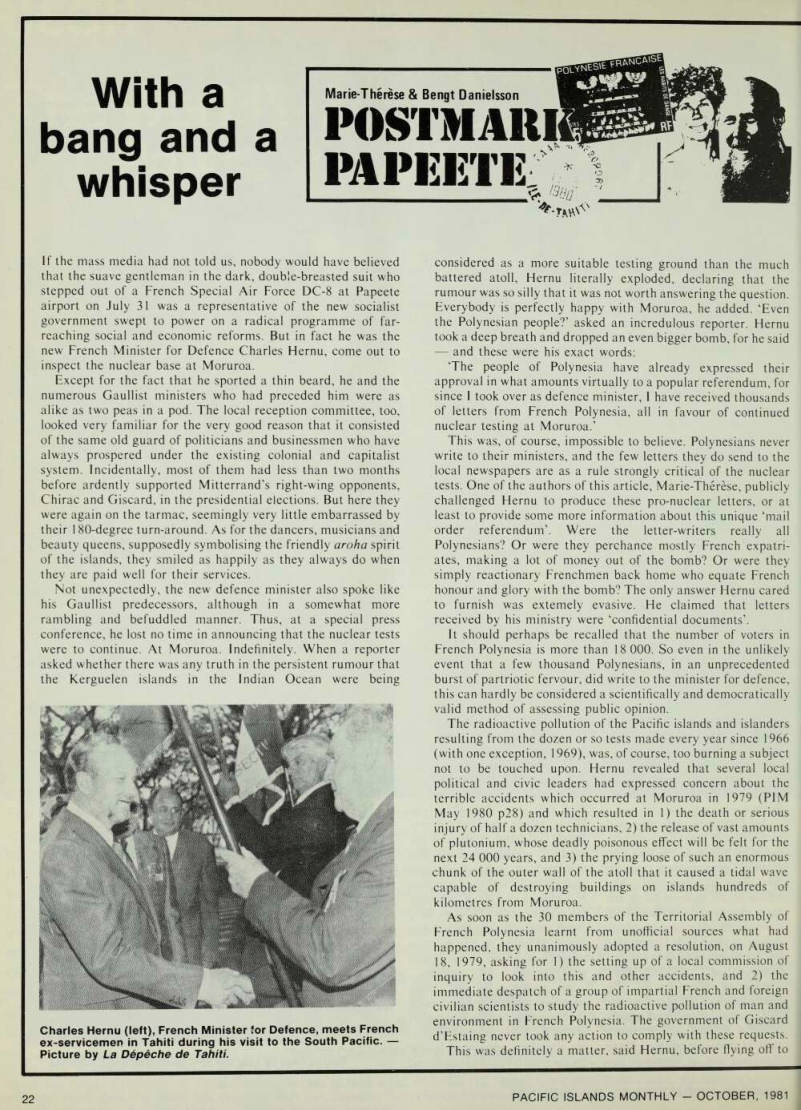
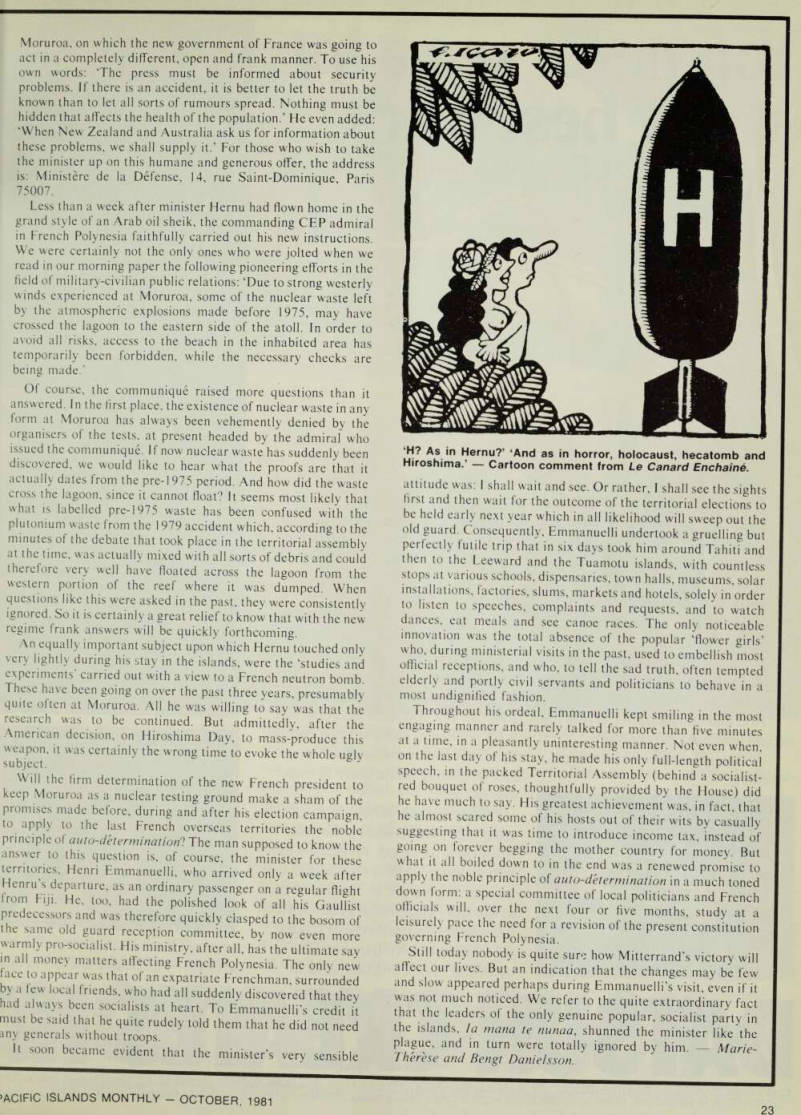
With a bang and a whisper
If the mass media had not told us, nobody would have believed that the suave gentleman in the dark, double-breasted suit who stepped out of a French Special Air Force DC-8 at Papeete airport on July 31 was a representative of the new socialist government swept to power on a radical programme of far reaching social and economic reforms. But in fact he was the new French Minister for Defence Charles Hernu, come out to inspect the nuclear base at Moruroa.
Except for the fact that he sported a thin beard, he and the numerous Gaullist ministers who had preceded him were as alike as two peas in a pod. The local reception committee, too, looked very familiar for the very good reason that it consisted of the same old guard of politicians and businessmen who have always prospered under the existing colonial and capitalist system. Incidentally, most of them had less than two months before ardently supported Mitterrand’s right-wing opponents, Chirac and Giscard, in the presidential elections. But here they were again on the tarmac, seemingly very little embarrassed by their 180-degree turn-around. As for the dancers, musicians and beauty queens, supposedly symbolising the friendly aroha spirit of the islands, they smiled as happily as they always do when they are paid well for their services.
Not unexpectedly, the new defence minister also spoke like his Gaullist predecessors, although in a somewhat more rambling and befuddled manner. Thus, at a special press conference, he lost no time in announcing that the nuclear tests were to continue. At Moruroa. Indefinitely. When a reporter asked whether there was any truth in the persistent rumour that the Kerguelen islands in the Indian Ocean were being
considered as a more suitable testing ground than the much battered atoll, Hernu literally exploded, declaring that the rumour was so silly that it was not worth answering the question.
Everybody is perfectly happy with Moruroa, he added. ‘Even the Polynesian people?’ asked an incredulous reporter. Hernu took a deep breath and dropped an even bigger bomb, for he said and these were his exact words; The people of Polynesia have already expressed their approval in what amounts virtually to a popular referendum, for since I took over as defence minister, 1 have received thousands of letters from French Polynesia, all in favour of continued nuclear testing at Moruroa.’
This was, of course, impossible to believe. Polynesians never write to their ministers, and the few letters they do send to the local newspapers are as a rule strongly critical of the nuclear tests. One of the authors of this article, Marie-Therese, publicly challenged Hernu to produce these pro-nuclear letters, or at least to provide some more information about this unique ‘mail order referendum’. Were the letter-writers really all Polynesians? Or were they perchance mostly French expatri ates, making a lot of money out of the bomb? Or were they simply reactionary Frenchmen back home who equate French honour and glory with the bomb? The only answer Hernu cared to furnish was extemely evasive. He claimed that letters received by his ministry were ‘confidential documents’.
It should perhaps be recalled that the number of voters in French Polynesia is more than 18 000. So even in the unlikely event that a few thousand Polynesians, in an unprecedented burst of partriotic fervour, did write to the minister for defence, this can hardly be considered a scientifically and democratically valid method of assessing public opinion.
The radioactive pollution of the Pacific islands and islanders resulting from the dozen or so tests made every year since 1966 (with one exception, 1969), was, of course, too burning a subject not to be touched upon. Hernu revealed that several local political and civic leaders had expressed concern about the terrible accidents which occurred at Moruroa in 1979 (PIM May 1980 p2B) and which resulted in 1) the death or serious injury of half a dozen technicians, 2) the release of vast amounts of plutonium, whose deadly poisonous effect will be felt for the next 24 000 years, and 3) the prying loose of such an enormous chunk of the outer wall of the atoll that it caused a tidal wave capable of destroying buildings on islands hundreds of kilometres from Moruroa.
As soon as the 30 members of the Territorial Assembly of French Polynesia learnt from unofficial sources what had happened, they unanimously adopted a resolution, on August 18, 1979, asking for 1) the setting up of a local commission of inquiry to look into this and other accidents, and 2) the immediate despatch of a group of impartial French and foreign civilian scientists to study the radioactive pollution of man and environment in French Polynesia. The government of Giscard d’Estaing never took any action to comply with these requests.
This was definitely a matter, said Hernu, before flying off to
Charles Hernu (left), French Minister for Defence, meets French ex-servicemen in Tahiti during his visit to the South Pacific.
Picture by La Depeche de Tahiti.
Moruroa, on which the new government of France was going to act in a completely different, open and frank manner. To use his own words: The press must be informed about security problems. If there is an accident, it is better to let the truth be known than to let all sorts of rumours spread. Nothing must be hidden that affects the health of the population.’ He even added: ‘When New Zealand and Australia ask us for information about these problems, we shall supply it.’ For those who wish to take the minister up on this humane and generous offer, the address is; Ministere de la Defense, 14, rue Saint-Dominique, Paris 75007.
Less than a week after minister Hernu had flown home in the grand style of an Arab oil sheik, the commanding CEP admiral in French Polynesia faithfully carried out his new instructions.
We were certainly not the only ones who were jolted when we read in our morning paper the following pioneering efforts in the field of military-civilian public relations: ‘Due to strong westerly winds experienced at Moruroa, some of the nuclear waste left by the atmospheric explosions made before 1975, may have crossed the lagoon to the eastern side of the atoll. In order to avoid all risks, access to the beach in the inhabited area has temporarily been forbidden, while the necessary checks are being made.’
Of course, the communique raised more questions than it answered. In the first place, the existence of nuclear waste in any form at Moruroa has always been vehemently denied by the organisers of the tests, at present headed by the admiral who issued the communique. If now nuclear waste has suddenly been discovered, we would like to hear what the proofs are that it actually dates from the pre-1975 period. And how did the waste cross the lagoon, since it cannot float? It seems most likely that what is labelled pre-1975 waste has been confused with the plutonium waste from the 1979 accident which, according to the minutes of the debate that took place in the territorial assembly at the time, was actually mixed with all sorts of debris and could therefore very well have floated across the lagoon from the western portion of the reef where it was dumped. When questions like this were asked in the past, they were consistently ignored. So it is certainly a great relief to know that with the new regime frank answers will be quickly forthcoming.
An equally important subject upon which Hernu touched only very lightly during his stay in the islands, were the ‘studies and experiments’ carried out with a view to a French neutron bomb.
These have been going on over the past three years, presumably quite often at Moruroa. All he was willing to say was that the research was to be continued. But admittedly, after the American decision, on Hiroshima Day, to mass-produce this weapon, it was certainly the wrong time to evoke the whole ugly subject.
Will the firm determination of the new French president to keep Moruroa as a nuclear testing ground make a sham of the promises made before, during and after his election campaign, to apply to the last French overseas territories the noble principle of auto-determination ? The man supposed to know the answer to this question is, of course, the minister for these territories, Henri Emmanuelli, who arrived only a week after Henru’s departure, as an ordinary passenger on a regular flight from Fiji. He, too, had the polished look of all his Gaullist predecessors and was therefore quickly clasped to the bosom of the same old guard reception committee, by now even more warmly pro-socialist. His ministry, after all, has the ultimate say m all money matters affecting French Polynesia. The only new lace to appear was that of an expatriate Frenchman, surrounded by a few local friends, who had all suddenly discovered that they had always been socialists at heart. To Emmanuelli’s credit it must be said that he quite rudely told them that he did not need any generals without troops.
It soon became evident that the minister’s very sensible
attitude was: I shall wait and see. Or rather, I shall see the sights first and then wait for the outcome of the territorial elections to be held early next year which in all likelihood will sweep out the old guard. Consequently, Emmanuelli undertook a gruelling but perfectly futile trip that in six days took him around Tahiti and then to the Leeward and the Tuamotu islands, with countless stops at various schools, dispensaries, town halls, museums, solar installations, factories, slums, markets and hotels, solely in order to listen to speeches, complaints and requests, and to watch dances, eat meals and see canoe races. The only noticeable innovation was the total absence of the popular ‘flower girls’ who, during ministerial visits in the past, used to embellish most o ffi cial receptions, and who, to tell the sad truth, often templed elderly and portly civil servants and politicians to behave in a most undignified fashion.
Throughout his ordeal, Emmanuelli kept smiling in the most engaging manner and rarely talked for more than five minutes at a lime, in a pleasantly uninteresting manner. Not even when, on the last day of his stay, he made his only full-length political speech, in the packed Territorial Assembly (behind a socialist red bouquet of roses, thoughtfully provided by the House) did he have much to say. His greatest achievement was, in fact, that he almost scared some of his hosts out of their wits by casually suggesting that it was time to introduce income tax, instead of going on forever begging the mother country for money. But what it all boiled down to in the end was a renewed promise to apply the noble principle of auto-determination in a much toned down form: a special committee of local politicians and French officials will, over the next four or five months, study at a leisurely pace the need for a revision of the present constitution governing French Polynesia.
Still today nobody is quite sure how Mitterrand’s victory will affect our lives. But an indication that the changes may be few and slow appeared perhaps during Emmanuelli’s visit, even if it was not much noticed. We refer to the quite extraordinary fact that the leaders of the only genuine popular, socialist party in the islands, la mana te nunaa, shunned the minister like the plague, and in turn were totally ignored by him. Marie- Therese and Bengt Danielsson.
'H? As in Hernu?’ ‘And as in horror, holocaust, hecatomb and Hiroshima.'-Cartoon comment from Le Canard Enchaîné.
Advertisements & other items, pp. 23-25 (2 items)
23
>ACIFIC ISLANDS MONTHLY - OCTOBER, 1981
Datsun Creates Ha
\bu never see a lot
of our best work.
Today, people are looking at new cars in a new way.
Sure, you still want a car that will zip through traffic. But you also need one that will zip past gas pumps and repair shops.
You want a car that is comfortable. But you also need one that is comfortably priced.
You want a car that looks nice.
But you also need one that will hold its good looks for some years to come.
And that comes from the way the people who built the car think.
At Datsun, we think in terms of “harmony.”
Mi Harmony between research and development. Between design and engineering. Throughout testing. And retesting. And up and down each of our assembly lines.
In short, harmony from concept through the completed car.
Thinking and working in harmony permits us to resolve seemingly unresolvable differences. To balance flatout contradictions.
For example, you want a strong, safe car. But you also need one that is fuel efficient. More strength would seem to mean more weight. More fuel efficiency would seem to mean less weight.
Our solution: A new, high-tension steel. It is thinner and lighter than the steel it replaced. Yet equally as strong. More pounds were saved, with no loss of strength, by drilling holes in the steel suspension system (which were later filled with rubber plugs).
Problem-solving by designresolving conflicting elements to improve the overall quality of the product—has helped Datsun to build
DATSUN CREATES HA
Cook Islands: COOK ISLANDS MOTOR CENTRE LTD., Rarotonga/Fiji: CARPENTERS MOTORS, Suva/Guam: DATSUN MOTOR SALES, Agana/Hawan: NISSAN MOTO CORPORATION IN HAWAII LTD , Honolulu/Kiribati: ATOLL AUTO STORES, Tarawa/Nauru: JACOB ENTERPRISES LTD./New Caledonia; AGENCE ALMA S.A., Noumej
1 r V * V V rs that are strong and safe, yet light d fuel efficient.
Harmony has also led to many ler solid product improvements. •me you see. Some you don’t.
When a Datsun leaves the assem- ' line, it leaves with nearly nine unds of gleaming acrylic paint, d almost four and a half pounds of jnd deadener.
Part of that paint does an under- /er job. Inside the air cleaner, the underside of the hood. Under the mat in the trunk. Even the drive shaft is painted. As is the inside of the rocker panels, fender wells and splash pans. (Which also receive a generous extra layer of stone guard coat to help fight off salt damage in colder climates.) Every trunk is sealed with more than a pound of weather stripping.
Every door with nearly half a pound.
And every door also comes with a hole in the bottom... a precisely-positioned drain hole to prevent build-up of water running down the windowpane So now you have some idea of why Datsuns are so right for the times They offer you what the world needs Without sacrificing what you want.
That’s harmony.
The model shown above is the Datsun 120 V for South America.
Specifications and equipment may vary according to market.
DATSUN
MON Y BY DESIGN
VIPANY INC /Solomon Islands: UNITED ENTERPRISES^TDn'Hon^/TrNti-^AhfmßUl^S AFn^p ww^ 3 LT e ' Moresb y /Sa 'P a " : JOETEN MOT( , noniara/ lanm. TAHITIBULL S.A.R.L, Papeete/Western Samoa: MORRIS HEDSTROM LTD., A
NISSAN
NISSAN MOTOR CO. I
priorities
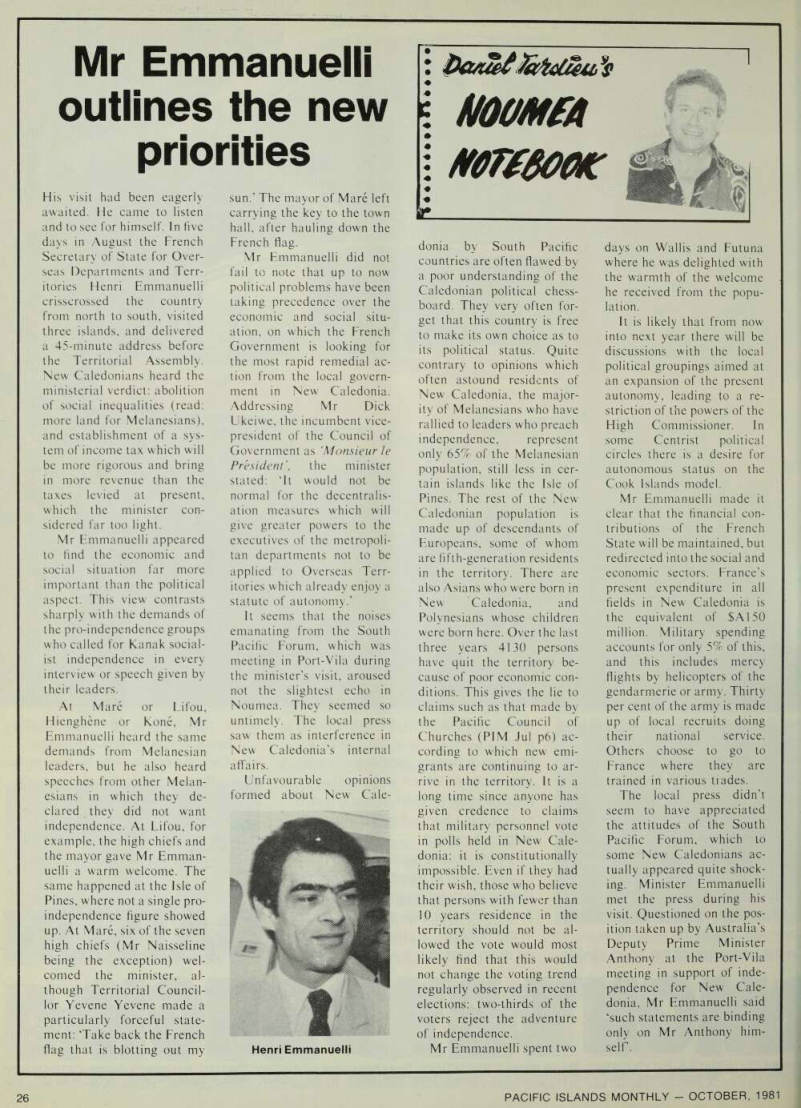
Mr Emmanuelli outlines the new priorities
His visit had been eagerly awaited. He came to listen and to see for himself. In five days in August the French Secretary of State for Over seas Departments and Terr itories Henri Emmanuelli crisscrossed the country from north to south, visited three islands, and delivered a 45-minute address before the Territorial Assembly.
New Caledonians heard the ministerial verdict: abolition of social inequalities (read: more land for Melanesians), and establishment of a sys tem of income tax which will be more rigorous and bring in more revenue than the taxes levied at present, which the minister con sidered far too light.
Mr Emmanuelli appeared to find the economic and social situation far more important than the political aspect. This view contrasts sharply with the demands of the pro-independence groups who called for Kanak social ist independence in every interview or speech given by their leaders.
At Mare or Lifou, Hienghene or Kone, Mr Emmanuelli heard the same demands from Melanesian leaders, but he also heard speeches from other Melan esians in which they de clared they did not want independence. At Lifou, for example, the high chiefs and the mayor gave Mr Emman uelli a warm welcome. The same happened at the Isle of Pines, where not a single pro independence figure showed up. At Mare, six of the seven high chiefs (Mr Naisseline being the exception) wel comed the minister, al though Territorial Council lor Yevene Yevene made a particularly forceful state ment: ‘Take back the French flag that is blotting out my
sun.’ The mayor of Mare left carrying the key to the town hall, after hauling down the French flag.
Mr Emmanuelli did not fail to note that up to now political problems have been taking precedence over the economic and social situ ation, on which the French Government is looking for the most rapid remedial ac tion from the local govern ment in New Caledonia.
Addressing Mr Dick Ukeiwe, the incumbent vice president of the Council of Government as ‘Monsieur le President’, the minister slated: ‘lt would not be normal for the decentralis ation measures which will give greater powers to the executives of the metropoli tan departments not to be applied to Overseas Terr itories which already enjoy a statute of autonomy.’
It seems that the noises emanating from the South Pacific Forum, which was meeting in Port-Vila during the minister’s visit, aroused not the slightest echo in Noumea. They seemed so untimely. The local press saw them as interference in New Caledonia’s internal affairs.
Unfavourable opinions formed about New Cale-
donia by South Pacific countries are often flawed by a poor understanding of the Caledonian political chess board. They very often for get that this country is free to make its own choice as to its political status. Quite contrary to opinions which often astound residents of New Caledonia, the major ity of Melanesians who have rallied to leaders who preach independence, represent only 65% of the Melanesian population, still less in cer tain islands like the Isle of Pines. The rest of the New Caledonian population is made up of descendants of Europeans, some of whom are fifth-generation residents in the territory. There are also Asians who were born in New Caledonia, and Polynesians whose children were born here. Over the last three years 4130 persons have quit the territory be cause of poor economic con ditions. This gives the lie to claims such as that made by the Pacific Council of Churches (PIM Jul p 6) ac cording to which new emi grants are continuing to ar rive in the territory. It is a long time since anyone has given credence to claims that military personnel vote in polls held in New Cale donia: it is constitutionally impossible. Even if they had their wish, those who believe that persons with fewer than 10 years residence in the territory should not be al lowed the vote would most likely find that this would not change the voting trend regularly observed in recent elections: two-thirds of the voters reject the adventure of independence.
Mr Emmanuelli spent two
days on Wallis and Futuna where he was delighted with the warmth of the welcome he received from the popu lation.
It is likely that from now into next year there will be discussions with the local political groupings aimed at an expansion of the present autonomy, leading to a re striction of the powers of the High Commissioner. In some Centrist political circles there is a desire for autonomous status on the Cook Islands model.
Mr Emmanuelli made it clear that the financial con tributions of the French State will be maintained, but redirected into the social and economic sectors. France’s present expenditure in all fields in New Caledonia is the equivalent of SAISO million. Military spending accounts for only 5% of this, and this includes mercy flights by helicopters of the gendarmerie or army. Thirty per cent of the army is made up of local recruits doing their national service.
Others choose to go to France where they are trained in various trades.
The local press didn’t seem to have appreciated the attitudes of the South Pacific Forum, which to some New Caledonians ac tually appeared quite shock ing. Minister Emmanuelli met the press during his visit. Questioned on the pos ition taken up by Australia’s Deputy Prime Minister Anthony at the Port-Vila meeting in support of inde pendence for New Cale donia, Mr Emmanuelli said ‘such statements are binding only on Mr Anthony him self.
Henri Emmanuelli
Advertisements & other items, pp. 27-28 (1 item)
Stereo, Medium Wave and Short Wave. The metal-tape-capabl
So space is at a premium but full stereo sound is a prerequisite? Then this is your component system. The J-2 Mini Hi-Fi may be slight of build, but itfs built to make your music move you. The amplifier belts out an impressive 25 watl per channel. The tuner picks up three separate bands: FM Stereo, Medium Wave and Short Wave. The metal-tape-capabl cassette deck keeps recorded music pure. And the matching speakers boast 12cm woofers and scm tweeters to make everything sound like it should. The J-2 Mini Hi-Fi System from Hitachi. It’s a small thing , until you turn it on. HITAO HI The Hitachi J-2 Mini Hi-Fi System includes the HA-J 2 Integrated Amplifier, the FT-J 2 Tuner LED tuning indication, the D-J2 Cassette Deck tJby NR,* and HS-J2 Speaker Systems. a trademark of Dolby Laboratories, Inc.
HS-J2
D-J2 a r * L
SSSSB
stereo FT-ja sw 32 36 40 5.0 6 S" it; KV 68 90 92 94 96
KM 102 104 106 106 MHz
m m 57% • FIJI ISLANDS Burns Philp (South seal CO Ltd 80x355 CPO Suva Phone *11777 • NEW CALEDONIA cald.s BP mi. Noumea Phone 26 23 50 ! Inmun” Ch6ne Alam P 0 Bo * 272 Pa Pe«e PPone 288 68 • NAU R Haur L rCoLp e ra h r n,qU / RaC " OS LM ? ° B ° X 465 Honiara PPOhe 416 Nauru cooperative society Republic of Nauru • AMERICAN SAMOA Burns Philp (South Seal Co Ltd PO Box 130 p 3Qn p an o • NEW HEBRIDES Burns Philp (New Hebrides' co Ltd pc Box 2? 9 Port Vila 9
Expert
Insurance Service
throughout the islands
Queensland Insurance (Fiji) Limited
Head Office, 34 Usher St., SUVA . General Manager: L. G. Liddell A.A.1.1. Assistant Manager: Vijay Lai. Phone: 23851.
LAUTOKA OFFICE: Burns Philp Bldg., Naviti St. District Manager: J. Dalton. Phone: 60642.
Queensland Insurance (PNG) Limited
PAPUA NEW GUINEA
Head Office, B.N.G. Building, Musgrave St.,PORT MORESBY. General Manager: J. M. Dawe.
Assistant Manager: R. V. Maskell. Phone: 212144.
LAE: 4th St. & Coronation Drive. District Manager; I. R. Martin. Phone: 423873.
MOUNT HAGEN: Hagen Drive. District Manager: D. F. Carroll. Phone; 521002.
ARAWA: Chebu St. District Manager: J. Longbut. Phone: 951555.
MADANG: Kasagten St. District Manager: N. D. Ramage. Phone: 822020.
RABAUL; Wirraway St. District Manager: W. F. Tinker. Phone: 921014.
QBE Insurance Limited
VANUATU, PORT VILA; Rue de Paris, Suite 19, Oceania Bldg. Manager: G. F. Donnelly.
Phone: 2299.
SANTO: Burns Philp (Vanuatu) Ltd. Phone: 230.
PACIFIC AGENCIES
NEW CALEDONIA; T. A.Hagen, Ste. W. A. Johnston, S.A.R.L. 5 Rue Anatole France, NOUMEA.
Phone: 272083.
TAHITI: Arthur Chung. Immeuble 8.1.5., Front de Mer, PAPEETE . Phone; 2.86.19.
NIUE; Burns Philp (South Sea) Company Ltd.
NORFOLK ISLAND; Burns Philp (N I) Company Ltd. Phone: 2191.
SAMOA; APIA, Burns Philp (South Sea) Company Ltd. Phone: 22611.
TONGA: Burns Philp (South Sea) Company Ltd. NUKUALOFA. Phone 21500 HAAPAI, VAVAU.
MEMBERS OF THE:
INSURANCE GROUP LIMITED
May policies always
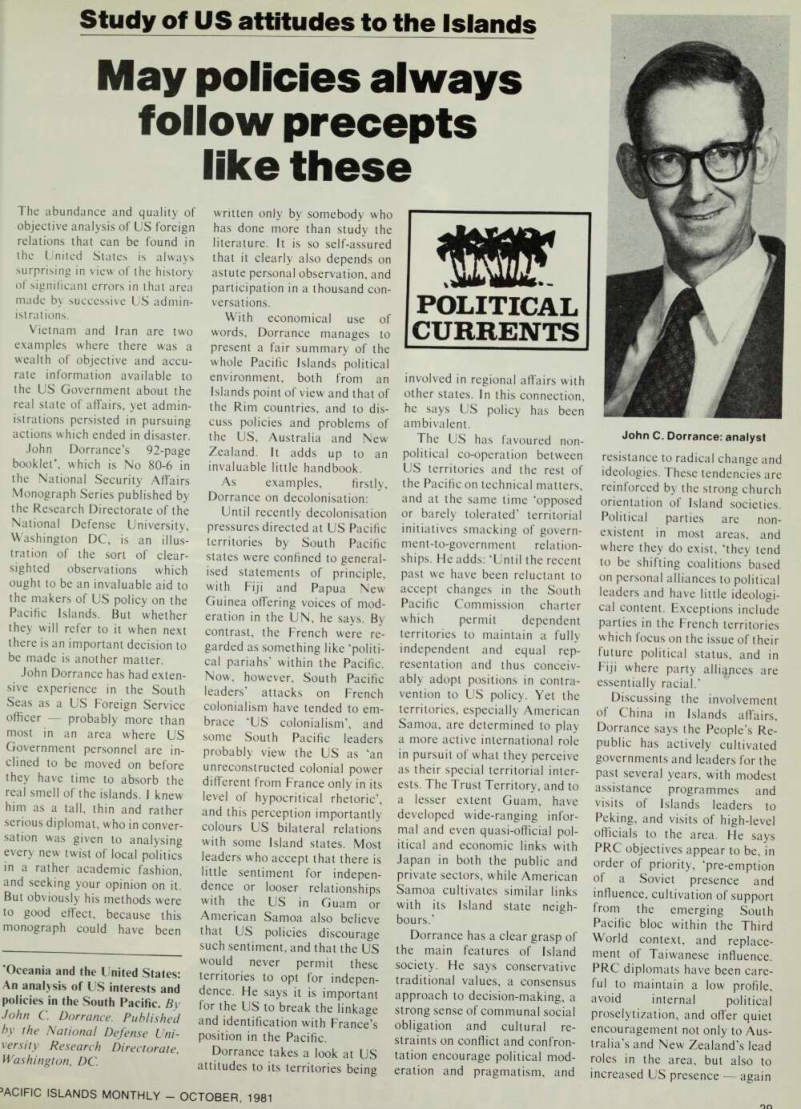

Study off US attitudes to the Islands May policies always follow precepts like these
Political
Currents
The abundance and quality of objective analysis of US foreign relations that can be found in the United Slates is always surprising in view of the history of significant errors in that area made by successive US admin istrations.
Vietnam and Iran are two examples where there was a wealth of objective and accu rate information available to the US Government about the real slate of affairs, yet admin istrations persisted in pursuing actions which ended in disaster.
John Dorrance’s 92-page booklet*, which is No 80-6 in the National Security Affairs Monograph Series published by the Research Directorate of the National Defense University, Washington DC, is an illus tration of the sort of clear sighted observations which ought to be an invaluable aid to the makers of US policy on the Pacific Islands. But whether they will refer to it when next there is an important decision to be made is another matter.
John Dorrance has had exten sive experience in the South Seas as a US Foreign Service officer probably more than most in an area where US Government personnel are in clined to be moved on before they have time to absorb the real smell of the islands. I knew him as a tall, thin and rather serious diplomat, who in conver sation was given to analysing every new twist of local politics in a rather academic fashion, and seeking your opinion on it.
But obviously his methods were to good effect, because this monograph could have been
‘Oceania and the United States: An analysis of US interests and policies in the South Pacific. By John C. Dorrance. Published by the National Defense Uni versity Research Directorate, Washington, DC.
written only by somebody who has done more than study the literature. It is so self-assured that it clearly also depends on astute personal observation, and participation in a thousand con versations.
With economical use of words, Dorrance manages to present a fair summary of the whole Pacific Islands political environment, both from an Islands point of view and that of the Rim countries, and to dis cuss policies and problems of the US, Australia and New Zealand. It adds up to an invaluable little handbook.
As examples, firstly, Dorrance on decolonisation: Until recently decolonisation pressures directed at US Pacific territories by South Pacific states were confined to general ised statements of principle, with Fiji and Papua New Guinea offering voices of mod eration in the UN, he says. By contrast, the French were re garded as something like ‘politi cal pariahs’ within the Pacific.
Now, however, South Pacific leaders’ attacks on French colonialism have tended to em brace ‘US colonialism’, and some South Pacific leaders probably view the US as ‘an unreconstructed colonial power different from France only in its level of hypocritical rhetoric’, and this perception importantly colours US bilateral relations with some Island states. Most leaders who accept that there is little sentiment for indepen dence or looser relationships with the US in Guam or American Samoa also believe that US policies discourage such sentiment, and that the US would never permit these territories to opt for indepen dence. He says it is important for the US to break the linkage and identification with France’s position in the Pacific.
Dorrance takes a look at US attitudes to its territories being
involved in regional affairs with other states. In this connection, he says US policy has been ambivalent.
The US has favoured non political co-operation between US territories and the rest of the Pacific on technical matters, and at the same time ‘opposed or barely tolerated’ territorial initiatives smacking of govern ment-to-government relation ships. He adds; ‘Until the recent past we have been reluctant to accept changes in the South Pacific Commission charter which permit dependent territories to maintain a fully independent and equal rep resentation and thus conceiv ably adopt positions in contra vention to US policy. Yet the territories, especially American Samoa, are determined to play a more active international role in pursuit of what they perceive as their special territorial inter ests. The Trust Territory, and to a lesser extent Guam, have developed wide-ranging infor mal and even quasi-official pol itical and economic links with Japan in both the public and private sectors, while American Samoa cultivates similar links with its Island state neigh bours.’
Dorrance has a clear grasp of the main features of Island society. He says conservative traditional values, a consensus approach to decision-making, a strong sense of communal social obligation and cultural re straints on conflict and confron tation encourage political mod eration and pragmatism, and
resistance to radical change and ideologies. These tendencies are reinforced by the strong church orientation of Island societies.
Political parties are non existent in most areas, and where they do exist, ‘they tend to be shifting coalitions based on personal alliances to political leaders and have little ideologi cal content. Exceptions include parties in the French territories which focus on the issue of their future political status, and in Fiji where party alliances are essentially racial.’
Discussing the involvement of China in Islands affairs, Dorrance says the People’s Re public has actively cultivated governments and leaders for the past several years, with modest assistance programmes and visits of Islands leaders to Peking, and visits of high-level officials to the area. He says PRC objectives appear to be, in order of priority, ‘pre-emption of a Soviet presence and influence, cultivation of support from the emerging South Pacific bloc within the Third World context, and replace ment of Taiwanese influence.
PRC diplomats have been care ful to maintain a low profile, avoid internal political proselytization, and offer quiet encouragement not only to Aus tralia’s and New Zealand’s lead roles in the area, but also to increased US presence again
John C. Dorrance: analyst
as part of its anti-Soviet strat egy. Its economic interests are minimal, other than procure ment of about 40% of its copper import requirements from
Png’.
Dorrance is not greatly con cerned about the likelihood of real Soviet expansion into the Pacific, although he says expan sion is inevitable and ‘will undoubtedly be successful to some degree’. The likely emerg ence in the region in the 1980 s of less conservative political leadership will establish a more receptive climate, he thinks.
He comments: The percep tion in 1976 of the possibility of a major Soviet presence in the area caused considerable con cern in Wellington and Canberra, and was the catalyst in expansion of their aid pro grammes and diplomatic pres ence in the region, and prompted the Australian and New Zealand governments to press the US to expand its own presence in and assistance to the area.’
Dorrance sees Australia’s and New Zealand’s primary
Some Pacific leaders are not quite sure how to cope with our presence ... We must not allow the rhetoric of good intentions to outstrip our ability to perform
concerns in the South Pacific in’ these terms: ‘(a) the possibility that a radical and adventuristic government in Jakarta could revive Sukarno-era territorial and political ambitions directed at PNG; (b) centripetal forces could lead to political insta bility in PNG and threaten Australian economic and politi cal interests in that country; (c) French intransigence ac companied by violence in New Caledonia could prompt the emergence of “Australia’s Cuba” in that territory; and (d) shortfalls in necessary external assistance flows to the area could assure instability, island state acceptance of Soviet blan dishments, and consequent es tablishment of a Soviet pres ence in the region. For all of these reasons Australia and New Zealand press the US to play a more active role in the South Pacific.’
The problem still arises as to the best way the US can be accepted as a South Pacific regional partner, and Dorrance
sees the programme as one requiring patience, gradualism, consultation, and modest expan sion of the official presence.
Fie says: ‘Some leaders are not quite sure how to cope with our presence and are uncertain about our motivations. Though our respective interests and objectives need not be in conflict, it will take time and patience to overcome unease, uncertainty and some suspicion . . . Our credibility is to some degree in question. We must not allow the rhetoric of good intentions to outstrip our ability to perform and apply resources to the region. We must avoid generating the frustrations and ill-will that inevitably will ac company inflated and unfilled expectations. The South Pacific is not the place, given suspicion of and resistance to sudden change, for policy spectaculars . . . More so than in any other region, personal relationships with and between political leaders affect governmental at titudes and decisions. Our am bassadors to island states should be selected with particular at
tention to their ability to relate to proud but usually extremely informal leaders. Patience, in formality, straight-forwardness, a sense of humour, and mastery of soft-sell techniques are essen tial ambassadorial traits.’
Stuart Inder. * * * The US Embassy in Canberra advises: Copies of the above booklet may be purchased from the Superintendent of Docu ments, US Government Print ing Office, Washington, DC, 20402. When ordering, its full title should be quoted, plus its date which is June 1980, and its Stock Number which is S/N 008-020-00822-2. Its price is SUS4.7O. Payment must be included with the order and one quarter of the cost of the publication should be added to the remittance, to cover surface mailing to Australia. Payment up to the value of 20 Australian dollars may be made by Inter national Money Order obtain able from any Australian Post Office.
Advertisements & other items, pp. 29-30 (2 items)
29
3 ACIFIC ISLANDS MONTHLY OCTOBER, 1981
Sony BetamaxT I 3BSSSS
Sony’s new System Betamax
presents the world’s best video entertainment!
This is the Sony Betamax you've been waiting for. The incredible Betamax SL-T7 with Color 3 System.
It lets you play back great NTSC videotape programmes, as well as PAL and SEC AM tapes. You'll see all the world's best video programmes. Exciting movies from New York (on NTSC), a soccer match from London (on PAL), and circus spectacular from Paris (on SECAM). Plus you can record from both
PAL and SECAM
broadcasts.
The new Betamax SL-T7 also has Picture Search. You can see your programme as it zips across the TV screen at 10 times normal speed—in forward or reverse—just by pressing a button. So now it's easy to find a special scene in any programme.
And you operate Picture Search by remote control!
Only Sony could make all of these great features available in one great videorecorder. The one and only Sony Betamax
SL-T7.
a-' JL. y * f «fl* i : IB O
THE ONE AND ONLY
SL-T7ME
Sony BetamaxT I 3BSSSS
from Papeete

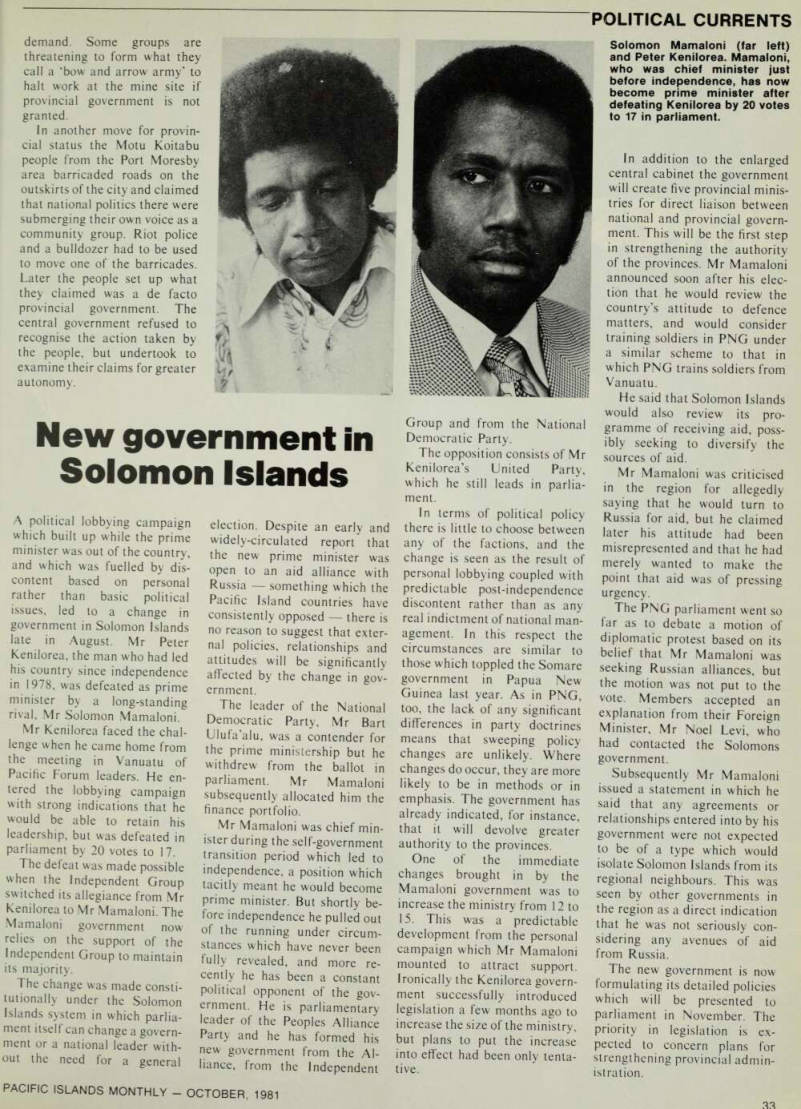
Political Currents
For Australia, a few home truths from Papeete
Christine Bourne is a formi dable French lady who wields a lot of editorial clout in the offices of the Papeete daily. La Depeche de Tahiti.
In that paper’s issue of August 8 she seized the oc casion of the meeting of the South Pacific Forum in Port- Vila which was then in the offing to let the world know what she thought of Australian policies in the South Pacific.
Entitled ‘Australia’s Lessons’, her short article amounts to a classic exposition of how Australia is seen by virtually every member of the French Establishment in the Pacific and by not a few in Paris as well. As such, it is well worth an airing. Mme Bourne wrote: ‘At a moment when starving Poland is crying out for food in a 20th-century Europe which since the last war has lost all taste for famine, when the mullahs’ Iran has found a new vent for its fanaticism and calls endlessly for “blood”, when around the world the old certi tudes are crumbling, crisis spreading, values collapsing, and when Polynesia, this tiny island of peace and the good life, is preparing to celebrate the “historic” occasion of the opening of its new Paofai Prot estant temple, close by, in Vanuatu, Australia is preparing a great get-together of the “jealous ones” of the South Pacific. ‘The day after Defence Min ister Charles Flernu’s press con ference (in Papeete), Tony Street, Australian minister for foreign affairs, saw fit to criti cise the French minister’s straightforward and clear pro nouncements. They must have sounded almost like a chal lenge. ‘Australia and this is abundantly clear is finding it harder and harder to abide the French “wart” which clings on through thick and thin in this Anglo-Presbyterian part of the
world where governments are politically independent but de pendent economically upon Australia. Nevertheless, the anachronistic character of its policies remains. ‘Australia, in fact, has set itself the task of destabilising the French Pacific, but still cheerfully sells uranium to France (uranium required for nuclear power generation). It is not at all mean about granting landing facilities at Darwin to American 852 bombers armed with nuclear weapons, and it doesn’t ask the American navy too many questions when It grants port facilities to its battle fleet, including nuclear powered ships. Australia, with its horror of tactical and stra tegic nuclear armouries, still takes part in manoeuvres in the Indian Ocean with an American task force made up of vessels equipped with nuclear weapons systems. And why does it grumble about French tests when it doesn’t bat an eyelid at very much bigger American ones? ‘Despite all this, one must unhappily note that the govern ment of this magnificent country feeds the fires of fanati cism in the countries around the French territories, embroiling them in ideological discourse in which it sets itself up as the great exponent of Truth and Virtue. Australia, with brazen hypocrisy, is making use of simpletons in its bid to conquer the Pacific. For the truth is that, once they became independent, the French territories would have no option but to turn to Australia for their trade. ‘lt is quite understandable that a few extremists, who poll a minority of votes at every election, should want to get together in Port-Vila to pro pound their ideology. What is more surprising is that Austra lia and New Zealand should be part of their act ... All the more so since Australia has formidable problems of its own
with the true inhabitants of the Australian land, the Aborigi nes, who have been despoiled and herded into reserves by these Anglo-Saxons come from afar. France is not out to offer Australia any lessons in hu manity, even if Australia keeps its moralising for those who think they’re free but whose feet in fact are in irons.’
Banabans appeal
to Forum
Banaba’s Council of Leaders used the meeting of the South Pacific Forum in Port-Vila in August to circularise Islands leaders with a statement of their case for what they call a Compact of Free Association with Kiribati. The statement said; The Banaban people are ap pealing to the South Pacific Forum to support moves for an arrangement under which Banaba would accept a Com pact of Free Association with the Republic of Kiribati as a self-governing country.
The plan for the compact has been rejected by Kiribati. It is insisting on keeping complete political control of Banaba and its resources, and in return is offering the Banabans only re stricted local government rights
in the island that is their ancestral home.
Influential members of Britain’s House of Commons are supporting the Banaban cause, as they did when the islanders sued Britain for a bigger share of Banaba’s phos phate revenues.
The Council of Leaders at Rabi, in Fiji, where most Banabans now live, is preparing a vigorous international cam paign for acceptance of the compact proposal as the time draws near for a promised independent review of Banaba’s political status . . .
The Rev Kaitangare Kaburoro, chairman of the Council of Leaders, said the Forum was an influential group ing of island states with experi ence of colonial exploitation.
We are now a colony of Kiri bati. Britain handed our island over to Kiribati in a final act of betrayal, he said.
Mr Kaburoro said the Banabans welcomed the news that the Forum might send a delegation to France to press for independence for French Pacific colonies. ‘We earnestly
hope that it will take up our case as well. We have as much right to self-government as Tahiti and New Caledonia.’
At the 1978 London consti tutional conference at which Britain and Kiribati agreed, despite strong Banaban pro tests, to make Banaba (also known as Ocean Island) an integral part of the new repub lic, Kiribati undertook to in quire into Banaba’s status three years after its own indepen dence from Britain. Mr Kaburoro said that his people are dismayed by Kiribati’s re fusal to respond sympatheti cally to their overwhelming desire for self-government.
Since a meeting between the council and the Kiribati Gov ernment held in Suva in May 1979 under the chairmanship of the Prime Minister of Fiji Ratu Sir Kamisese Mara, no progress has been made. ‘As history clearly shows, we were never part of Kiribati until Britain lumped us together for the sake of colonial administrative con venience,’ he said. ‘Despite our right to be entirely independent, we have dropped this claim and we are ready to enter an agreement giving Kiribati responsibility for our defence and a share of whatever revenue can be ob tained from the remnants of Banaba’s phosphate deposits.’
Kiribati had rejected this proposal out of hand and had replied with an offer that would relegate the Council of Leaders’ role in Banaba to the level of a small town council. ‘Kiribati’s plan is entirely unacceptable and we are now preparing to press our viewpoint internationally with assistance, we hope, from such agencies as the South Pacific Forum,’ Mr Kaburoro said.
The Compact of Free Associ ation envisages Banaba as a self-governing country with res ponsibility for its own foreign affairs, and, with the support of Kiribati, the right to apply for membership of regional and international organisations. The Cook Islands and Niue have similar arrangements with New Zealand, Mr Kaburoro said.
Banaba would have full con trol of its natural resources, including marine resources, in its 200-mile economic zone. In
recognition of Kiribati’s de fence responsibilities Banaba would consult with it in con ducting foreign affairs, and Kiribati would have the right to veto any form of military access to the island by any other country.
Banaba would have complete responsibility for running financial, economic, trade, banking, postal, civil aviation, radio broadcasting and aid mat ters, but would surrender its right to apply to Kiribati for financial grants.
Kiribati citizens would have residential rights in Banaba and both countries would exchange official resident representatives.
Banaba would adopt the laws and currency of Kiribati. Dis putes between the two govern ments would be settled by arbitration as a final resort.
The Banabans propose that the compact would be guaran teed by Britain, Australia, New Zealand and Fiji, but Kiribati has rejected this.
The compact would have a life of 10 years and would then be open to review and renewal by mutual consent.
Call for more
autonomy
Landowners and village leaders from the inland west of the Papua New Guinea mainland are threatening to disrupt the establishment there of the Ok Tedi gold and copper mine unless they are granted their own provincial government.
The threat is coming from the central and northern reaches of the Fly River in an area which at present is inside the bound aries of the Western Provincial Government. The Western Province has the biggest land area of any province in PNG and the groups calling for their own provincial government say the area is far too large to give them the degree of local auton omy which they require. They also claim that the development of the mine is creating a need for provincial autonomy in the immediate and surrounding areas.
The Kiunga and Lake Murray Development Com mittee, which is one of the factions in the move, earlier forced a three-day stoppage at the mine site in support of the
...And from Papua New Guinea, a more light-hearted look at the French presence in the Pacific.
Cartoon by Bob Browne in the PNG Post-Courier.
demand. Some groups are threatening to form what they call a ‘bow and arrow army’ to halt work at the mine site if provincial government is not granted.
In another move for provin cial status the Motu Koitabu people from the Port Moresby area barricaded roads on the outskirts of the city and claimed that national politics there were submerging their own voice as a community group. Riot police and a bulldozer had to be used to move one of the barricades.
Later the people set up what they claimed was a de facto provincial government. The central government refused to recognise the action taken by the people, but undertook to examine their claims for greater autonomy.
Solomon Islands
New government in Solomon Islands
A political lobbying campaign which built up while the prime minister was out of the country, and which was fuelled by dis content based on personal rather than basic political issues, led to a change in government in Solomon Islands late in August. Mr Peter Kenilorea, the man who had led his country since independence in 1978, was defeated as prime minister by a long-standing rival, Mr Solomon Mamaloni.
Mr Kenilorea faced the chal lenge when he came home from the meeting in Vanuatu of Pacific Forum leaders. He en tered the lobbying campaign with strong indications that he would be able to retain his leadership, but was defeated in parliament by 20 votes to 17.
The defeat was made possible when the Independent Group switched its allegiance from Mr Kenilorea to Mr Mamaloni. The Mamaloni government now relies on the support of the Independent Group to maintain its majority.
The change was made consti tutionally under the Solomon Islands system in which parlia ment itself can change a govern ment or a national leader with out the need for a general
election. Despite an early and widely-circulated report that the new prime minister was open to an aid alliance with Russia something which the Pacific Island countries have consistently opposed there is no reason to suggest that exter nal policies, relationships and attitudes will be significantly affected by the change in gov ernment.
The leader of the National Democratic Party, Mr Bart Ulufa’alu, was a contender for the prime ministership but he withdrew from the ballot in parliament. Mr Mamaloni subsequently allocated him the finance portfolio.
Mr Mamaloni was chief min ister during the self-government transition period which led to independence, a position which tacitly meant he would become prime minister. But shortly be fore independence he pulled out of the running under circum stances which have never been fully revealed, and more re cently he has been a constant political opponent of the gov ernment. He is parliamentary leader of the Peoples Alliance Party and he has formed his new government from the Al liance, from the Independent
Group and from the National Democratic Party.
The opposition consists of Mr Kenilorea’s United Party, which he still leads in parlia ment.
In terms of political policy there is little to choose between any of the factions, and the change is seen as the result of personal lobbying coupled with predictable post-independence discontent rather than as any real indictment of national man agement. In this respect the circumstances are similar to those which toppled the Somare government in Papua New Guinea last year. As in PNG, too, the lack of any significant differences in party doctrines means that sweeping policy changes are unlikely. Where changes do occur, they are more likely to be in methods or in emphasis. The government has already indicated, for instance, that it will devolve greater authority to the provinces.
One of the immediate changes brought in by the Mamaloni government was to increase the ministry from 12 to 15. This was a predictable development from the personal campaign which Mr Mamaloni mounted to attract support.
Ironically the Kenilorea govern ment successfully introduced legislation a few months ago to increase the size of the ministry, but plans to put the increase into effect had been only tenta tive.
In addition to the enlarged central cabinet the government will create five provincial minis tries for direct liaison between national and provincial govern ment. This will be the first step in strengthening the authority of the provinces. Mr Mamaloni announced soon after his elec tion that he would review the country’s attitude to defence matters, and would consider training soldiers in PNG under a similar scheme to that in which PNG trains soldiers from Vanuatu.
He said that Solomon Islands would also review its pro gramme of receiving aid, poss ibly seeking to diversify the sources of aid.
Mr Mamaloni was criticised in the region for allegedly saying that he would turn to Russia for aid, but he claimed later his attitude had been misrepresented and that he had merely wanted to make the point that aid was of pressing urgency.
The PNG parliament went so far as to debate a motion of diplomatic protest based on its belief that Mr Mamaloni was seeking Russian alliances, but the motion was not put to the vote. Members accepted an explanation from their Foreign Minister, Mr Noel Levi, who had contacted the Solomons government.
Subsequently Mr Mamaloni issued a statement in which he said that any agreements or relationships entered into by his government were not expected to be of a type which would isolate Solomon Islands from its regional neighbours. This was seen by other governments in the region as a direct indication that he was not seriously con sidering any avenues of aid from Russia.
The new government is now formulating its detailed policies which will be presented to parliament in November. The priority in legislation is ex pected to concern plans for strengthening provincial admin istration.
Solomon Mamaloni (far left) and Peter Kenilorea. Mamaloni, who was chief minister just before independence, has now become prime minister after defeating Kenilorea by 20 votes to 17 in parliament.
Advertisements & other items, p. 34 (1 item)
% Tjjs^SpSg 1
» v A i 5 A
j£o/ J
SB 'V \ . % * *^A> -■ * V \ v» •' ■ • O >.
S. . / > u fj r A A.
CS *■ ' ' Jo />V .
O/v „
*JgSS
-st? :-* ✓ - / A aspK *T
% Tjjs^SpSg 1
■" "~ - «<& r . riv-v*, If^i VfiQQ
suspect
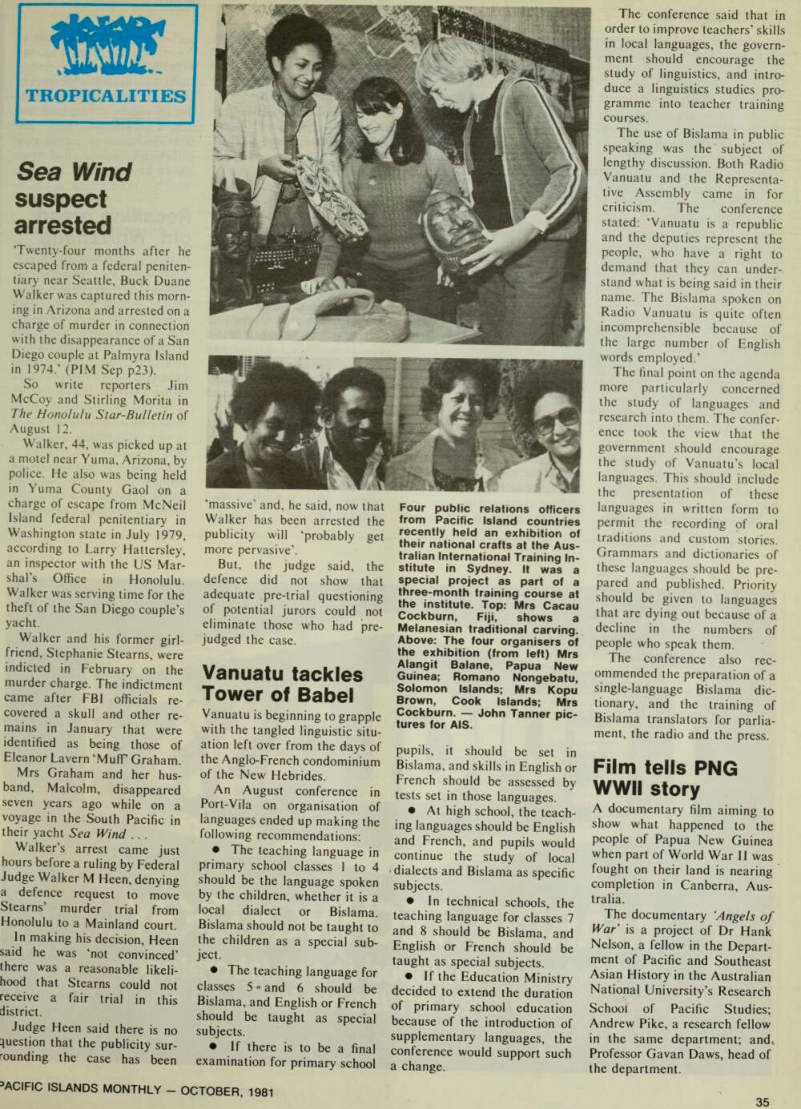
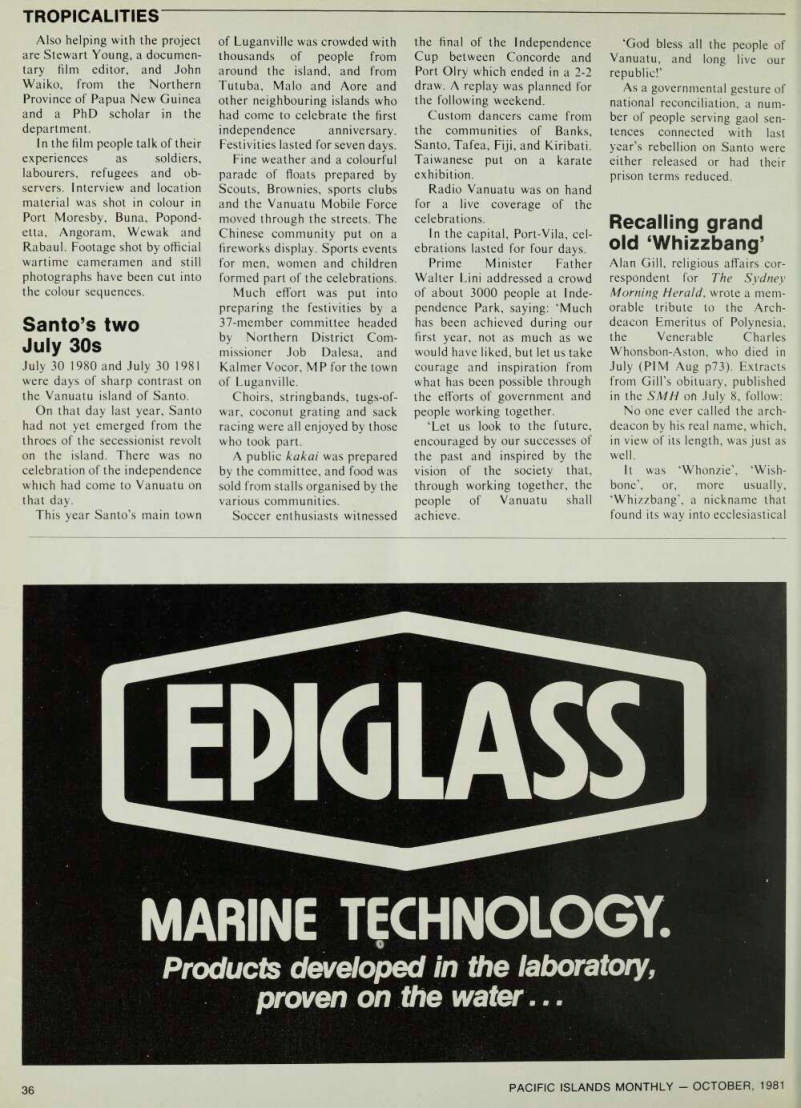
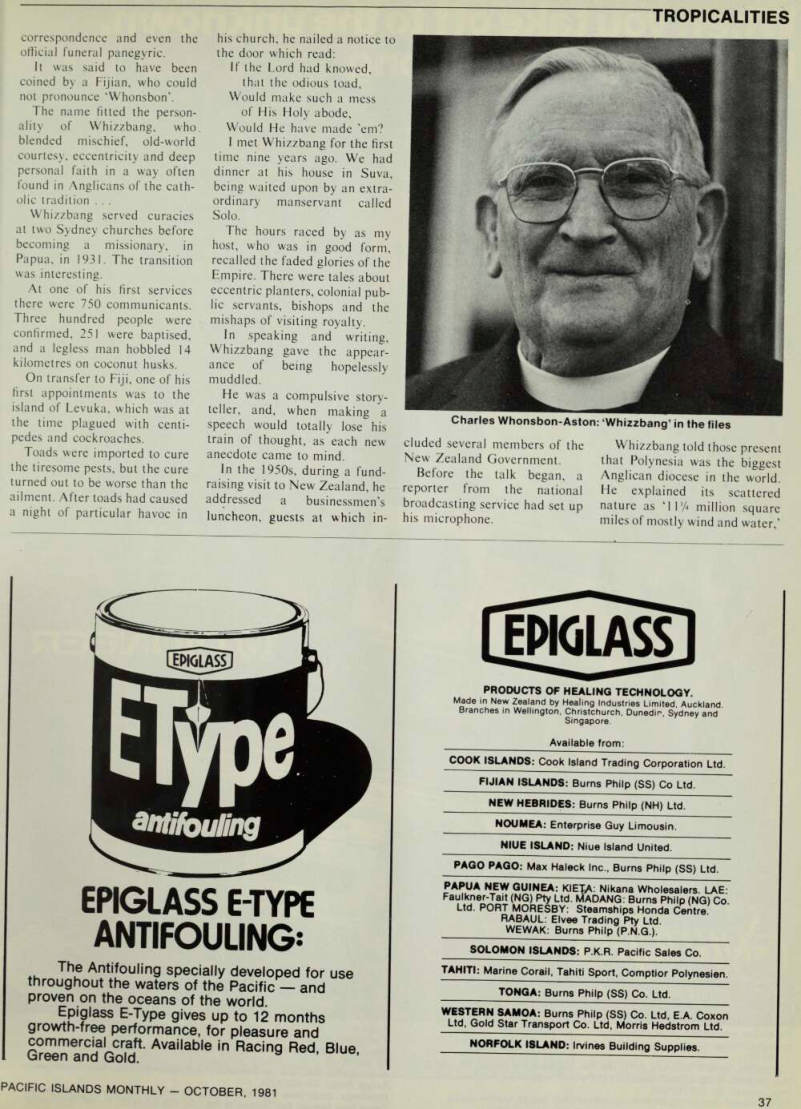

Tropicalities
Sea Wind
arrested
‘Twenty-four months after he escaped from a federal peniten tiary near Seattle, Buck Duane Walker was captured this morn ing in Arizona and arrested on a charge of murder in connection with the disappearance of a San Diego couple at Palmyra Island in 1974.’ (PIM Sep p 23).
So write reporters Jim McCoy and Stirling Morita in The Honolulu Star-Bulletin of August 12.
Walker, 44, was picked up at a motel near Yuma, Arizona, by police. He also was being held in Yuma County Gaol on a charge of escape from McNeil Island federal penitentiary in Washington state in July 1979, according to Larry Hattersley, an inspector with the US Mar shal’s Office in Honolulu.
Walker was serving time for the theft of the San Diego couple’s yacht.
Walker and his former girl friend, Stephanie Stearns, were indicted in February on the murder charge. The indictment came after FBI officials re covered a skull and other re mains in January that were identified as being those of Eleanor Lavern ‘Muff Graham.
Mrs Graham and her hus band, Malcolm, disappeared seven years ago while on a voyage in the South Pacific in their yacht Sea Wind . . .
Walker’s arrest came just hours before a ruling by Federal Judge Walker M Heen, denying a defence request to move Stearns’ murder trial from Honolulu to a Mainland court.
In making his decision, Heen said he was ‘not convinced’ there was a reasonable likeli hood that Stearns could not receive a fair trial in this district.
Judge Heen said there is no question that the publicity sur rounding the case has been
‘massive’ and, he said, now that Walker has been arrested the publicity will ‘probably get more pervasive’.
But, the judge said, the defence did not show that adequate pre-trial questioning of potential jurors could not eliminate those who had pre judged the case.
Vanuatu tackles
Tower of Babel
Vanuatu is beginning to grapple with the tangled linguistic situ ation left over from the days of the Anglo-French condominium of the New Hebrides.
An August conference in Port-Vila on organisation of languages ended up making the
following recommendations:
• The teaching language in primary school classes 1 to 4 should be the language spoken by the children, whether it is a local dialect or Bislama.
Bislama should not be taught to the children as a special sub ject. • The teaching language for classes 5 - and 6 should be Bislama, and English or French should be taught as special subjects. • If there is to be a final examination for primary school
pupils, it should be set in Bislama, and skills in English or French should be assessed by tests set in those languages. • At high school, the teach ing languages should be English and French, and pupils would continue the study of local dialects and Bislama as specific subjects. • In technical schools, the teaching language for classes 7 and 8 should be Bislama, and English or French should be taught as special subjects. • If the Education Ministry decided to extend the duration of primary school education because of the introduction of supplementary languages, the conference would support such a change.
The conference said that in order to improve teachers’ skills in local languages, the govern ment should encourage the study of linguistics, and intro duce a linguistics studies pro gramme into teacher training courses.
The use of Bislama in public speaking was the subject of lengthy discussion. Both Radio Vanuatu and the Representa tive Assembly came in for criticism. The conference stated: ‘Vanuatu is a republic and the deputies represent the people, who have a right to demand that they can under stand what is being said in their name. The Bislama spoken on Radio Vanuatu is quite often incomprehensible because of the large number of English words employed.’
The final point on the agenda more particularly concerned the study of languages and research into them. The confer ence took the view that the government should encourage the study of Vanuatu’s local languages. This should include the presentation of these languages in written form to permit the recording of oral traditions and custom stories.
Grammars and dictionaries of these languages should be pre pared and published. Priority should be given to languages that are dying out because of a decline in the numbers of people who speak them.
The conference also rec ommended the preparation of a single-language Bislama dic tionary, and the training of Bislama translators for parlia ment, the radio and the press.
Film tells PNG
WWII story
A documentary film aiming to show what happened to the people of Papua New Guinea when part of World War II was fought on their land is nearing completion in Canberra, Aus tralia.
The documentary 'Angels of War is a project of Dr Hank Nelson, a fellow in the Depart ment of Pacific and Southeast Asian History in the Australian National University’s Research School of Pacific Studies; Andrew Pike, a research fellow in the same department; and.
Professor Gavan Daws, head of the department.
Four public relations officers from Pacific Island countries recently held an exhibition of their national crafts at the Aus tralian International Training In stitute in Sydney. It was a special project as part of a three-month training course at the institute. Top: Mrs Cacau Cockburn, Fiji, shows a Melanesian traditional carving.
Above: The four organisers of the exhibition (from left) Mrs Alangit Balane, Papua New Guinea; Romano Nongebatu, Solomon Islands; Mrs Kopu Brown, Cook Islands; Mrs Cockburn.-John Tanner pic tures for AIS.
Also helping with the project are Stewart Young, a documen tary film editor, and John Waiko, from the Northern Province of Papua New Guinea and a PhD scholar in the department.
In the film people talk of their experiences as soldiers, labourers, refugees and ob servers. Interview and location material was shot in colour in Port Moresby, Buna, Popond etta, Angoram, Wewak and Rabaul. Footage shot by official wartime cameramen and still photographs have been cut into the colour sequences.
Santo’s two
July 30s
July 30 1980 and July 30 1981 were days of sharp contrast on the Vanuatu island of Santo.
On that day last year, Santo had not yet emerged from the throes of the secessionist revolt on the island. There was no celebration of the independence which had come to Vanuatu on that day.
This year Santo’s main town
of Luganville was crowded with thousands of people from around the island, and from Tutuba, Malo and Acre and other neighbouring islands who had come to celebrate the first independence anniversary.
Festivities lasted for seven days.
Fine weather and a colourful parade of floats prepared by Scouts, Brownies, sports clubs and the Vanuatu Mobile Force moved through the streets. The Chinese community put on a fireworks display. Sports events for men, women and children formed part of the celebrations.
Much effort was put into preparing the festivities by a 37-member committee headed by Northern District Com missioner Job Dalesa, and Kalmer Vocor, MP for the town of Luganville.
Choirs, stringbands, tugs-of war, coconut grating and sack racing were all enjoyed by those who took part.
A public kakai was prepared by the committee, and food was sold from stalls organised by the various communities.
Soccer enthusiasts witnessed
the final of the Independence Cup between Concorde and Port Olry which ended in a 2-2 draw. A replay was planned for the following weekend.
Custom dancers came from the communities of Banks, Santo, Tafea, Fiji, and Kiribati.
Taiwanese put on a karate exhibition.
Radio Vanuatu was on hand for a live coverage of the celebrations.
In the capital, Port-Vila, cel ebrations lasted for four days.
Prime Minister Father Walter Lini addressed a crowd of about 3000 people at Inde pendence Park, saying; ‘Much has been achieved during our first year, not as much as we would have liked, but let us take courage and inspiration from what has been possible through the efforts of government and people working together. ‘Let us look to the future, encouraged by our successes of the past and inspired by the vision of the society that, through working together, the people of Vanuatu shall achieve.
‘God bless all the people of Vanuatu, and long live our republic!’
As a governmental gesture of national reconciliation, a num ber of people serving gaol sen tences connected with last year’s rebellion on Santo were either released or had their prison terms reduced.
Recalling grand
old ‘Whizzbang’
Alan Gill, religious affairs cor respondent for The Sydney Morning Herald , wrote a mem orable tribute to the Arch deacon Emeritus of Polynesia, the Venerable Charles Whonsbon-Aston, who died in July (PIM Aug p 73). Extracts from Gill’s obituary, published in the SMH on July 8, follow; No one ever called the arch deacon by his real name, which, in view of its length, was just as well.
It was ‘Whonzie’, ‘Wish bone’, or, more usually, ‘Whizzbang’, a nickname that found its way into ecclesiastical
correspondence and even the official funeral panegyric.
It was said to have been coined by a Fijian, who could not pronounce ‘Whonsbon’.
The name fitted the person ality of Whizzbang, who. blended mischief, old-world courtesy, eccentricity and deep personal faith in a way often found in Anglicans of the cath olic tradition . . .
Whizzbang served curacies at two Sydney churches before becoming a missionary, in Papua, in 1931. The transition was interesting.
At one of his first services there were 750 communicants.
Three hundred people were confirmed, 251 were baptised, and a legless man hobbled 14 kilometres on coconut husks.
On transfer to Fiji, one of his first appointments was to the island of Levuka, which was at the time plagued with centi pedes and cockroaches.
Toads were imported to cure the tiresome pests, but the cure turned out to be worse than the ailment. After toads had caused a night of particular havoc in
his church, he nailed a notice to the door which read: If the Lord had knowed, that the odious toad.
Would make such a mess of His Holy abode, Would He have made ’em?
I met Whizzbang for the first time nine years ago. We had dinner at his house in Suva, being waited upon by an extra ordinary manservant called Solo.
The hours raced by as my host, who was in good form, recalled the faded glories of the Empire. There were tales about eccentric planters, colonial pub lic servants, bishops and the mishaps of visiting royalty.
In speaking and writing, Whizzbang gave the appear ance of being hopelessly muddled.
He was a compulsive story teller, and, when making a speech would totally lose his train of thought, as each new anecdote came to mind.
In the 19505, during a fund raising visit to New Zealand, he addressed a businessmen’s luncheon, guests at which in-
eluded several members of the New Zealand Government.
Before the talk began, a reporter from the national broadcasting service had set up his microphone.
Whizzbang told those present that Polynesia was the biggest Anglican diocese in the world.
He explained its scattered nature as ‘ 11'/» million square miles of mostly wind and water,’
Charles Whonsbon-Aston: ‘Whizzbang’ in the files
and, forgetting about the re porter’s microphone, added in a loud whisper ... ‘rather like a politician’.
The remark earned him in stant notoriety, eclipsed a few years later when a Sydney newspaper ran a story linking him with the famous ‘ghost’ ship, the Joyita.
The Joyita , a former US Coast Guard vessel once owned by the actress Mary Pickford, was converted for cruising among the Fijian and Samoan islands. It disappeared in mys terious circumstances during a copra buying expedition, and was later found burnt out and part-submerged, about 200 kilo metres north of Vanua Levu.
The crew and passengers, among them an Australian businessman thought to be carrying a large sum in cash, had vanished without trace and no clue to the mystery was ever found.
Eventually the ill-fated ship was bought by Lord Maugham (alias Robin Maugham, nephew of Somerset Maugham), who asked Whizzbang if he would hold a service of exorcism on board.
Whizbang, who was worried that a second sinking might bring doubt upon the efficacy of his ministration, agreed, subject to numerous conditions, one of which was that the ship was fully repaired and competently crewed beforehand.
However, before either party had formally pledged its side of the bargain. The Sun-Herald newspaper (in collaboration with Lord Maugham) ‘spilt’ the story in a manner which angered the priest’s superiors and even reached the ears of the
Archbishop of Canterbury.
The service of exorcism was delayed while the matter was investigated by church auth orities. In the meantime, the ship disintegrated.
On the religious front, Whizzbang was well-informed on a little-known missionary pact, the Comity of Mission, under which the entire Pacific Islands region was carved up among the various competing denominations and societies as legitimate ‘spheres of influence’.
This curious gentlemen’s agreement survives to this day, and is the subject of strife because of gatecrashing by newcomers Jehovah’s Witnesses, Mormons and others who refuse to keep it.
Many of Whizzbang’s better stories concerned the London Missionary Society, which pion eered missionary work in Polynesia, Melanesia, even our own Torres Strait Islands, and whose leaders, many of whom ended their days in cooking pots, were Sunday-school heroes to earlier generations of Australians.
The LMS had strait-laced attitudes towards sex and nu dity, casting island women into ‘Mother Hubbard’ garments, in which they were enveloped from head to toe.
Whizzbang had a theory that the LMS originated, not in the respectable way outlined in tracts and volumes now gather ing dust on library shelves, but as the brainchild of a merchant called Hardcastle, who saw commercial possibilities in exchange for copra, which was shipped home to England and sold for a fine profit . . .
In December, 1978, when Whizzbang was 80, a function
was held in Sydney to mark the 50th anniversary of his ordi nation.
The Anglican Bishop in Polynesia, Bishop Jabez Bryce, was among those present.
The bishop, the first indigen ous Polynesian to hold this office, had been a member of Whizzbang’s scout troop. He said he was received into the church, and owed his own vocation to the ministry, be cause of the faith and example of Whizzbang.
He said his friend embodied the commandment given in the service of ordination: ‘Be thou a faithful dispenser of His holy word.’
Another Anglican clergy man, converted in similar fashion, alluded to Whizzbang’s OBE ‘in his case Old Beloved Effervescent’.
That sea snake
00k...
Sydney, Australia, business woman Joan Barrie’s main stock-in-trade is ballet shoes, tights, tutus and the like.
But she has suddenly found a flourishing market with scuba divers who practise their sport in a variety of Pacific Island and other locations.
A skintight, wrist-to-ankle swimming costume is what the scuba people are buying.
Key to their interest is the irregular stripes in various colours which are handscreen printed on the lycra material.
Says Ms Barrie: ‘They are buying them because the stripes make them look like sea snakes, and frighten off dangerous fish.’
Noumea meeting
on arts festival '
The South Pacific Commission in August played host in Noumea to participants in the South Pacific Arts Festival Council meeting. A year after the Third South Pacific Festival of Arts held in Port Moresby in July 1980, delegates from 12 countries evaluated its achieve ments.
The council attempted to find ways of better harmonising the activities of the different cul tural organisations in the re gion. UNESCO, in addition to contributing to the cost of the meeting, was represented by its Assistant Director-General for Culture and Communication, Mr Makagiansar, who was pres ent as an observer. The Arts Festival Council considered the expediency of adopting a consti tution to provide clear guide lines on such matters as mem bership and functions.
Guam’s swinging
July
Guam really turned it on in July: a round of festivities of one kind or another was spon sored by the Guam Visitors Bureau and the Commissioners Council of Guam under the general heading ‘The Spirit of America Reigns Throughout July’.
The official three-weeks affair began on July 4 with the parade of marching units. During the month, the Paseo carnival ground was steaming with ac tivities ranging from rides for the children and youth, food, carnival games, games of chances, nightly entertainment, village talent competition, sports activities, a fishing derby, raffles and the biggest parade of floats, with over 60 entries.
A new attraction for this year’s celebrations allowed the hidden village talents a chance to come out and entertain the public. In the Village Compe tition, 17 villages vied for the Ist prize of SUSSOO. Merizo won first place, 2nd Inarajan, 3rd Yona, 4th Agat, sth Dededo, 6th Ordot/Chalan Pago, 7th Mangilao, Bth Tamuning, 9th Yigo and 10th Barrigada. Float entry winners went to Talofofo, grand prize
‘Scares hell out of the sharks but the trouble is I can’t get rid of the sea snakes!’
$1 000, Merizo, Ist place $5OO, Guam Girl Scouts, Youth Ist place $3OO, and Latte Heights Ladies’ Association, Ist place organisation, trophy.
Home truths
for Marshalls
Harold Picton-Smith, the for mer Fiji solicitor-general who spent several months earlier this year as legislative counsellor to the Nilijela (Parliament) of the Marshall Islands (PIM Aug p 37) had a few choice words to say about government in the Ml as he took his leave to return to Fiji.
As reported ‘for the public interest’ in the Marshall Islands Journal , he wrote: 1 am setting out various points which have occurred to me and which could be con sidered in the interest of good government or the public benefit. 1. Overseas travel: In view of the economic situation it ap pears to me that too many officers are proceeding to meet ings overseas. There can be no doubt that these meetings etc, are valuable and necessary but efforts could be taken to reduce the size of delegations. What would be advisable is to regard the sending of one officer fully briefed as the maximum except in rare cases. There are two main reasons for this sugges tion, namely to save money and also to ensure that there is always someone available in each office to carry on the day to-day functions. 2. Police: The Majuro police station is an absolute disgrace and an insult to the flag which flies before it. The state of the building cannot but have its effect upon the members of the force. The bearing of members needs to be smartened up. On Constitution day the parade was led by the police who shambled rather than marched, failing to keep in step and to keep their dressing. It strikes me that the force could do with some formal training and 1 would recommend that mem bers should be given this by instructors from another Pacific country which has the necess ary experience, Fiji for in stance. 3 Enforcement of the law;
Many laws exist but are not enforced. As a result of this most members of the public are technically guilty of offences.
An example of this is the provision that no vehicle may be used unless it has a licence plate which is supposed to be issued by the police on registration of the vehicle. There are several other examples of where the law is only observed in the breach. 4. Government vehicles: Considerable abuse of the privi lege of operating Government cars lakes place. Despite the regulations on the subject Gov ernment cars are being used for shopping or for picnics. There seems to be little or no attempt to enforce the law resulting in a big loss to the economy . . .
WWII diary
comes home
The National Library of Aus tralia has made one of its most interesting recent acquisitions with the purchase of the unpub lished diary of the famous Australian World War II corre spondent, author George Johnston.
Johnston, who was born in Melbourne in 1912 and died in 1970, kept the diary when he was based in Port Moresby in 1942, the vital year of the Japanese invasion of Papua New Guinea.
He refers to air raids, the evacuation of women and chil dren in decrepit, overcrowded aircraft, orders that the ill manned Port Moresby garrison was to hold back the Japanese for 36 hours, and the panic that led to a reversion to cannibalism in the islands.
The diary records the dis covery of dismembered and partially eaten bodies of Austra lian soldiers beside the Kokoda Trail, the rape of village women by the Japanese and the looting of dead bodies by both Austra lians and Japanese.
Among other aspects, it pro vides a rare, though brief, description of Port Moresby in the middle of the war as a city of blazing lights, with crowded streets, traffic as far as the eye could see and a bustling, ship filled harbour.
Johnston condemns General MacArthur on several oc casions in the diary for belit-
tling the efforts of Australian troops. He accuses MacArthur of altering war correspondents’ reports to boost his own public image. American war reporting on the South Pacific is also criticised for its bias against the Australians, and at one stage Johnston declares that the war time censorship had reached Gestapo proportions.
The diary was bought from a Sydney dealer who obtained it in the United States. It is not known at present how the diary came to be in America or who sold it to the agents’ representa tive there, but the library re gards its acquisition highly.
The Principal Australian Reference Librarian, John Thompson, said: Tt is a dra matic diary immensely read able, exciting and very import ant as a record, particularly for revealing information that Johnston said in one of his books was hidden at the time under the veil of “security”.
Islands gifts
on display
Among gifts to the Prince and Princess of Wales on the oc casion of their July wedding which have been on display at an exhibition in London are a number from Pacific Island countries.
They include an eiderdown (made by the Queen), a pair of saddles, and a rush suitcase from Tonga; two cowrie shells in a glass case, a pearl brooch, cuff-links and commemorative coins from Fiji; a pig’s tusk from Vanuatu; a wood carving from Solomon Islands; a pair of gold commemorative coins from Western Samoa; and two fans, two necklaces and a hand bag from Tuvalu.
More than 1000 gifts were displayed at the exhibition, which was to stay open until October 4.
National park
for Albert Henry
One of the most beautiful spots on the lagoon shoreline in Aitutaki, Cook Islands, is to be made a public national park bearing the name of the late premier of the Cooks, Albert Tapa Royle Henry.
The land is being offered by the family of Mr Henry and the Ngati Kamire family of Aitutaki.
Mr Henry was one of the traditional leaders of Aitutaki.
John Thompson, principal Aus tralian Reference Librarian at the National Library of Australia, examines the newly-acquired George H. Johnston war diary. -Loui Seseija picture.
Advertisements & other items, pp. 35-40 (3 items)
35
3 ACIFIC ISLANDS MONTHLY - OCTOBER. 1981
Epiolass
MARINE TECHNOLOGY.
Products developed in the laboratory, proven on the water ...
A
[EWOIASSJ
dntifouling
EPIGLASS E-TYPE
ANTIFOULING:
The Antifouling specially developed for use throughout the waters of the Pacific and proven on the oceans of the world Epiglass E-Type gives up to 12 months growth-free performance, for pleasure and commercial craft. Available in Racing Red, Blue orsen and Gold.
(EPKHASS]
PRODUCTS OF HEALING TECHNOLOGY.
Made in New Zealand by Healing Industries Limited, Auckland Branches in Wellington, Christchurch. Dunedin, Sydney and Singapore.
Available from: COOK ISLANDS: Cook Island Trading Corporation Ltd.
FIJIAN ISLANDS: Burns Philp (SS) Co Ltd.
NEW HEBRIDES: Burns Philp (NH) Ltd.
NOUMEA: Enterprise Guy Limousin.
NIUE ISLAND; Niue Island United.
PAGO PAGO: Max Haleck Inc., Burns Philp (SS) Ltd.
PAPUA NEW GUINEA: KIETA: Nikana Wholesalers. LAE; Faulkner-Tait (NG) Pty Ltd. MADANG: Burns Philp (NG) Co.
Ltd. PORT MORESBY: Steamships Honda Centre.
RABAUL: Elvee Trading Pty Ltd.
WEWAK; Burns Philp (P.N.G.).
SOLOMON ISLANDS: P.K.R. Pacific Sales Co.
TAHITI: Marine Corail, Tahiti Sport, Comptior Polynesien.
TONGA; Burns Philp (SS) Co. Ltd.
WESTERN SAMOA: Burns Philp (SS) Co. Ltd, E.A. Coxon Ltd, Gold Star Transport Co. Ltd, Morris Hedstrom Ltd.
NORFOLK ISLAND: Irvines Building Supplies.
When you take off to the unknown,
take a superstar along.
0
SK-212F
Next time you take off for parts unknown, add another dimension to your ventures. The new Sound Trek™ dimension by Pioneer.
A galaxy of out-of-this-world multiband (FM/MW/SWVSW 2 ) radio-cassette
recorders designed to put great music
in your orbit.
Pioneer's advanced hi-fi engineering and solid audio craftsmanship make these stereo portables sound terrific.
There's a galaxy of exciting sounds out there. Go exploring with Sound Trek from Pioneer. • SK-212F. Fashionable. Compact and Convenient.
Streamlined to go wherever you do. And so i light and compact you'll want to take your Sound Trek everywhere. Loaded with a high sensitivity FM tuner, and features', like a handy carrying strap, a choice of 2 bands (FM/AM) and available in a variety of fashionable colors.
SK-404F. Convenient Features for Stereo Fun.
Sound Trek SK-404F gives you a wide choice of convenient features to boost your listening pleasure. Like Pioneer's exclusive DSS (Direct Source Selector) for instant mode changes (from tape to radio and vice versa). Music Search to automatically find and play the next number on your tape. Also the SK-606F. with the added plus of a digital clock/timer.
dD PIONEER
* Ji 0
SK-404F
Hi-fi mobility through technology.
Sound Trek portables are displayed only at stores showing the emblem For further Information, please contact: Australia: Pioneer Marketing Service Pty. Ltd., P.O. Box 317, Mordialloc, Victoria, 3195 Tel: 90-9011 Fiji Islands: Brijlal & Company, G.P.O. Box No. 362, Suva, Fiji Islands Tel: 22258 New Zealand: Monaco Distributors Ltd., 30 Pollen Street, Grey Lynn, Auckland, New Zealand Tel: (09) 762 098 Norfolk Island: Burns Philp (Norfolk Island) Ltd., P.O. Box 21, Norfolk Island, New Hebrides: Burns Philp (New Hebrides) Ltd., Vila, New Hebrides Nauru Island: Jacob Enterprises, P.O. Box No. 4, Republic of Nauru Tahiti: Tahiti Hi-Fi, P.O. Box 848, Papeete, Tahiti New Caledonia: Menard Pacifique Sari, B.P. 3899, Noumea, New Caledonia Tel: 48-24.36 American Samoa: Transpac Corporation, P.O. Box 1477, Pago Pago, American Samoa 96799 Tel: 633-5224 Rarotonga: South Seas International Ltd., P.O. Box 49, Rarotonga, Cook Islands Tel: 2327 Papua New Guinea: Bali Merchants Pty. Ltd., P.O. Box 6103, Boroko Tel: 254887
Tropicalities
People
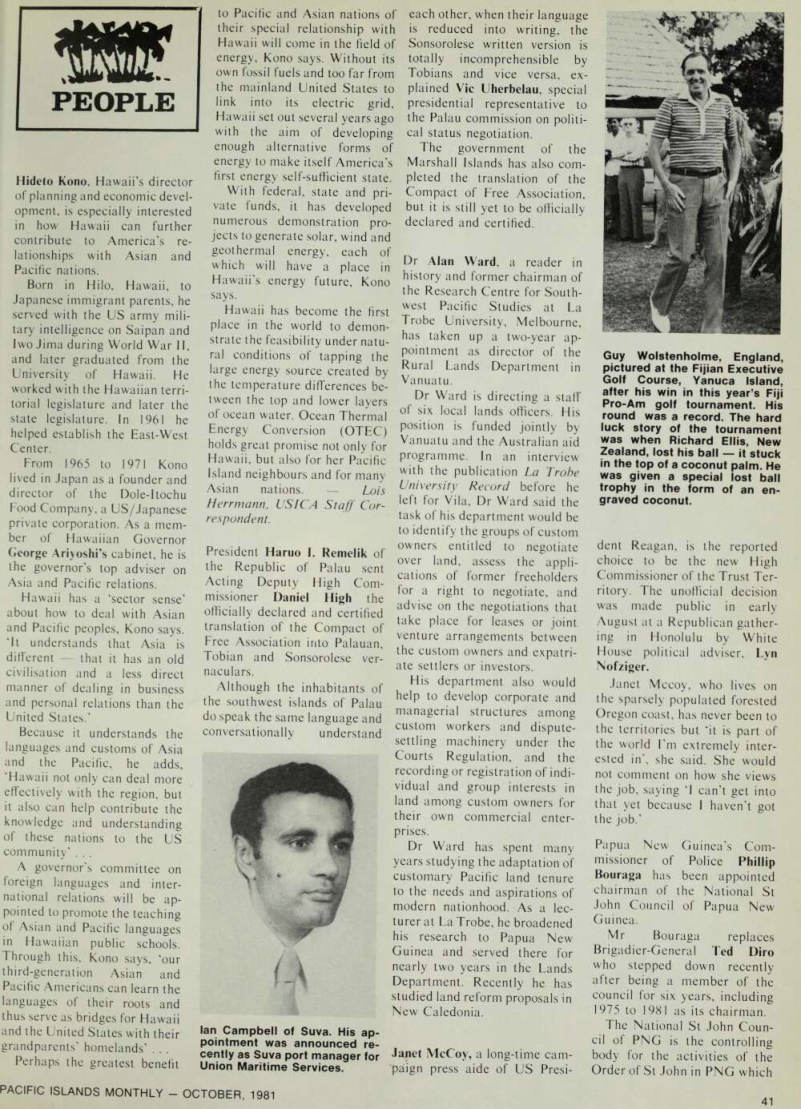
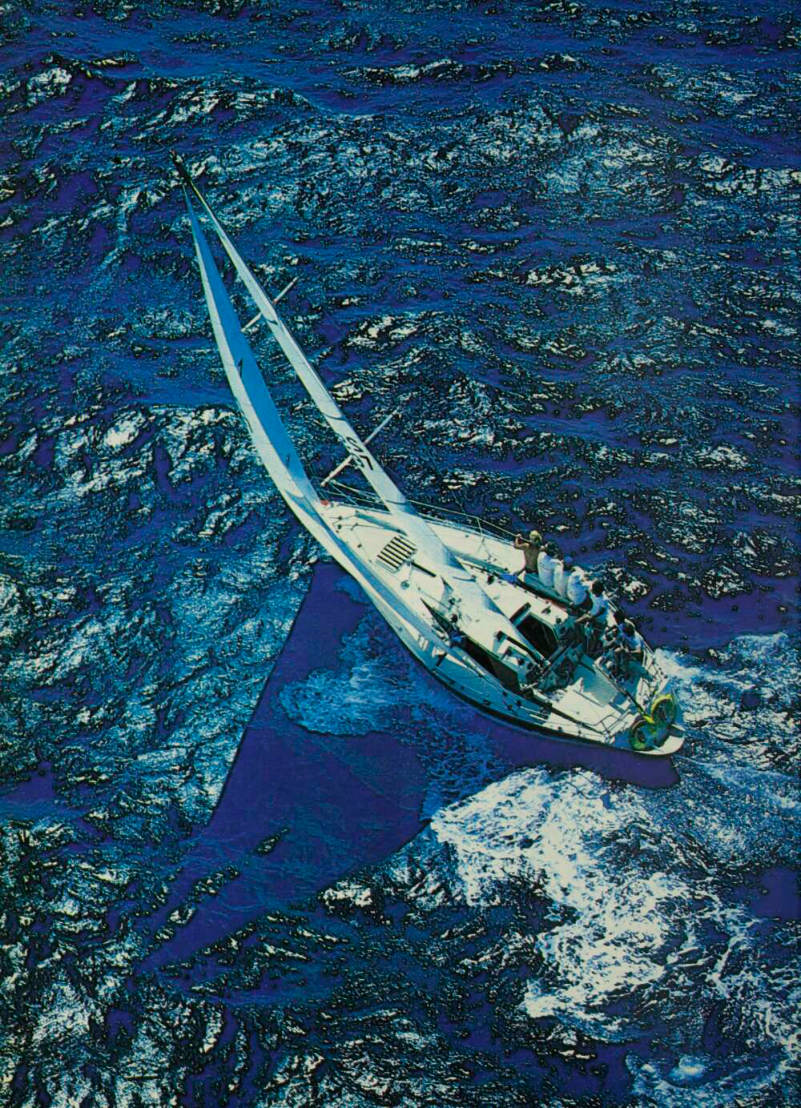
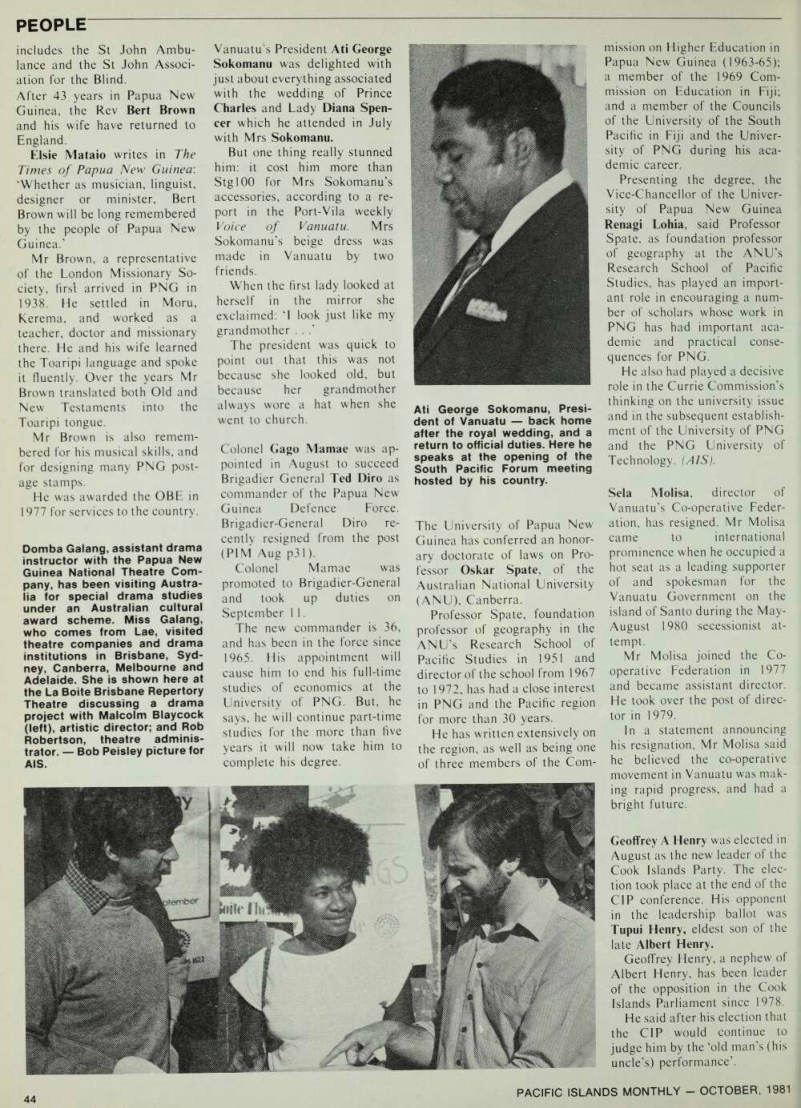
Hideto Kono. Hawaii’s director of planning and economic devel opment, is especially interested in how Hawaii can further contribute to America’s re lationships with Asian and Pacific nations.
Born in Hilo, Hawaii, to Japanese immigrant parents, he served with the US army mili tary intelligence on Saipan and Iwo Jima during World War 11, and later graduated from the University of Hawaii. He worked with the Hawaiian terri torial legislature and later the state legislature. In 1961 he helped establish the East-West Center.
From 1965 to 1971 Kono lived in Japan as a founder and director of the Dole-Itochu Food Company, a US/Japanese private corporation. As a mem ber of Hawaiian Governor George Ariyoshi’s cabinet, he is the governor’s top adviser on Asia and Pacific relations.
Hawaii has a ‘sector sense’ about how to deal with Asian and Pacific peoples, Kono says. ‘lt understands that Asia is different that it has an old civilisation and a less direct manner of dealing in business and personal relations than the United Stales.’
Because it understands the languages and customs of Asia and the Pacific, he adds, ‘Hawaii not only can deal more effectively with the region, but it also can help contribute the knowledge and understanding of these nations to the US community’ . . .
A governor's committee on foreign languages and inter national relations will be ap pointed to promote the teaching of Asian and Pacific languages in Hawaiian public schools.
Through this, Kono says, ‘our third-generation Asian and Pacific Americans can learn the languages of their roots and thus serve as bridges for Hawaii and the United Slates with their grandparents' homelands’
Perhaps the greatest benefit
to Pacific and Asian nations of their special relationship with Hawaii will come in the field of energy, Kono says. Without its own fossil fuels and too far from the mainland United States to link into its electric grid, Hawaii set out several years ago with the aim of developing enough alternative forms of energy to make itself America’s first energy self-sufficient state.
With federal, state and pri vate funds, it has developed numerous demonstration pro jects to generate solar, wind and geothermal energy, each of which will have a place in Hawaii’s energy future, Kono says.
Hawaii has become the first place in the world to demon strate the feasibility under natu ral conditions of tapping the large energy source created by the temperature differences be tween the top and lower layers of ocean water. Ocean Thermal Energy Conversion (OTEC) holds great promise not only for Hawaii, but also for her Pacific Island neighbours and for many Asian nations. Lois Herrmann, USICA Staff Cor respondent.
President Haruo I. Remelik of the Republic of Palau sent Acting Deputy High Com missioner Daniel High the officially declared and certified translation of the Compact of Free Association into Palauan, Tobian and Sonsorolese ver naculars.
Although the inhabitants of the southwest islands of Palau do speak the same language and conversationally understand
I each other, when their language is reduced into writing, the Sonsorolese written version is totally incomprehensible by Tobians and vice versa, ex plained Vic Uherbelau, special presidential representative to the Palau commission on politi cal status negotiation.
The government of the Marshall Islands has also com pleted the translation of the Compact of Free Association, Dut it is still yet to be officially declared and certified. )r Alan Ward, a reader in listory and former chairman of he Research Centre for South zest Pacific Studies at La 'robe University, Melbourne, as taken up a two-year ap ointment as director of the Lands Department in r anuatu.
Dr Ward is directing a staff f six local lands officers. His osition is funded jointly by anuatu and the Australian aid rogramme. In an interview ith the publication La Trobe niversity Record before he ft for Vila, Dr Ward said the sk of his department would be • identify the groups of custom vners entitled to negotiate 'er land, assess the appli itions of former freeholders r a right to negotiate, and Ivise on the negotiations that ke place for leases or joint nture arrangements between e custom owners and expatri e settlers or investors.
His department also would Ip to develop corporate and anagerial structures among stom workers and dispute tiling machinery under the )urts Regulation, and the cording or registration of indi iual and group interests in id among custom owners for cir own commercial enter ises.
Dr Ward has spent many ars studying the adaptation of stomary Pacific land tenure the needs and aspirations of )dern nationhood. As a lec •er at La Trobe, he broadened research to Papua New linea and served there for irly two years in the Lands partment. Recently he has died land reform proposals in w Caledonia. let McCoy, a long-time cam gn press aide of US Presi-
dent Reagan, is the reported choice to be the new High Commissioner of the Trust Ter ritory. The unofficial decision was made public in early August at a Republican gather ing in Honolulu by White House political adviser, Lyn Nofziger.
Janet Mccoy, who lives on the sparsely populated forested Oregon coast, has never been to the territories but ‘it is part of the world I’m extremely inter ested in , she said. She would not comment on how she views the job, saying ‘I can’t get into that yet because I haven’t got the job.’
Papua New Guinea’s Com missioner of Police Phillip Bouraga has been appointed chairman of the National St John Council of Papua New Guinea.
Mr Bouraga replaces Brigadier-General Ted Diro who stepped down recently after being a member of the council for six years, including 1975 to 1981 as its chairman.
The National St John Coun cil of PNG is the controlling body for the activities of the Order of St John in PNG which
lan Campbell of Suva. His ap pointment was announced re cently as Suva port manager for Union Maritime Services.
Guy Wolstenholme, England, pictured at the Fijian Executive Golf Course, Yanuca Island, after his win in this year’s Fiji Pro-Am golf tournament. His round was a record. The hard luck story of the tournament was when Richard Ellis, New Zealand, lost his ball - it stuck in the top of a coconut palm. He was given a special lost ball trophy in the form of an en graved coconut.
includes the St John Ambu lance and the St John Associ ation for the Blind.
After 43 years in Papua New Guinea, the Rev Bert Brown and his wife have returned to England.
Elsie Mataio writes in The Times of Papua New Guinea : ‘Whether as musician, linguist, designer or minister, Bert Brown will be long remembered by the people of Papua New Guinea.’
Mr Brown, a representative of the London Missionary So ciety, firsl arrived in PNG in 1938. He settled in Moru, Kerema, and worked as a teacher, doctor and missionary there. He and his wife learned the Toaripi language and spoke it fluently. Over the years Mr Brown translated both Old and New Testaments into the Toaripi longue.
Mr Brown is also remem bered for his musical skills, and for designing many PNG post age stamps.
He was awarded the OBE in 1977 for services to the country.
Vanuatu’s President Ati George Sokomanu was delighted with just about everything associated with the wedding of Prince Charles and Lady Diana Spen cer which he attended in July with Mrs Sokomanu.
But one thing really stunned him: it cost him more than StglOO for Mrs Sokomanu’s accessories, according to a re port in the Porl-Vila weekly Voice of Vanuatu. Mrs Sokomanu’s beige dress was made in Vanuatu by two friends.
When the first lady looked at herself in the mirror she exclaimed: ‘1 look just like my
grandmother . . .’
The president was quick to point out that this was not because she looked old, but because her grandmother always wore a hat when she went to church.
Colonel Gago Mamae was ap pointed in August to succeed Brigadier General Ted Diro as commander of the Papua New Guinea Defence Force.
Brigadier-General Diro re cently resigned from the post (PIM Aug p3l).
Colonel Mamae was promoted to Brigadier-General and took up duties on September 11. ifhe new commander is 36, and has been in the force since 1965. His appointment will cause him to end his full-time studies of economics at the University of PNG. But, he says, he will continue part-time studies for the more than five years it will now take him to complete his degree.
The University of Papua New Guinea has conferred an honor ary doctorate of laws on Pro fessor Oskar Spate, of the Australian National University (ANU), Canberra.
Professor Spate, foundation professor of geography in the ANU’s Research School of Pacific Studies in 1951 and director of the school from 1967 to 1972, has had a close interest in PNG and the Pacific region for more than 30 years.
He has written extensively on the region, as well as being one of three members of the Com
mission on Higher Education in Papua New Guinea (1963-65); a member of the 1969 Com mission on Education in Fiji; and a member of the Councils of the University of the South Pacific in Fiji and the Univer sity of PNG during his aca demic career.
Presenting the degree, the Vice-Chancellor of the Univer sity of Papua New Guinea Renagi Lohia, said Professor Spate, as foundation professor of geography at the ANU’s Research School of Pacific Studies, has played an import ant role in encouraging a num ber of scholars whose work in PNG has had important aca demic and practical conse quences for PNG.
He also had played a decisive role in the Currie Commission’s thinking on the university issue and in the subsequent establish ment of the University of PNG and the PNG University of Technology. (AIS).
Sela Molisa, director of Vanuatu’s Co-operative Feder ation, has resigned. Mr Molisa came to international prominence when he occupied a hot seat as a leading supporter of and spokesman for the Vanuatu Government on the island of Santo during the May- August 1980 secessionist at tempt.
Mr Molisa joined the Co operative Federation in 1977 and became assistant director.
He took over the post of direc tor in 1979.
In a statement announcing his resignation, Mr Molisa said he believed the co-operative movement in Vanuatu was mak ing rapid progress, and had a bright future.
Geoffrey A Henry was elected in August as the new leader of the Cook Islands Party. The elec tion took place at the end of the CIP conference. His opponent in the leadership ballot was Tupui Henry, eldest son of the late Albert Henry.
Geoffrey Henry, a nephew of Albert Henry, has been leader of the opposition in the Cook Islands Parliament since 1978.
He said after his election that the CIP would continue to judge him by the ‘old man’s (his
uncle’s) performance’.
Domba Galang, assistant drama instructor with the Papua New Guinea National Theatre Com pany, has been visiting Austra lia for special drama studies under an Australian cultural award scheme. Miss Galang, who comes from Lae, visited theatre companies and drama institutions in Brisbane, Syd ney, Canberra, Melbourne and Adelaide. She is shown here at the La Boite Brisbane Repertory Theatre discussing a drama
project with Malcolm Blaycock
(left), artistic director; and Rob Robertson, theatre adminis trator.-Bob Peisley picture for
Ais.
Ati George Sokomanu, Presi dent of Vanuatu back home after the royal wedding, and a return to official duties. Here he speaks at the opening of the South Pacific Forum meeting hosted by his country.
he hopes his knowledge will be useful to the police and the hospitals.
The newly appointed Mexican Ambassador to Papua New Guinea, Juan Manuel Ramirez Gomez, has presented his ere
‘Because of this I have to work harder than ever before, as there is no person alive today who can do as much as the old man did,’ Mr Henry said.
He added that his major plan for the CIP is to strengthen it in preparation for the next elec tions, but he wasn’t going to ‘tell everybody’ how he would be going about strengthening the party.
A young Samoan who is helping to give Samoa a better image in the United States is 22-year-old Ropati Savelio of Ululoloa, Western Samoa.
Mr Savelio, who is doing a paramedic course at Harbor View Medical Center, Los Angeles, has recently received an Award of Merit from the institution for outstanding ser vice to patients and staff.
Doctors at the centre said they were deeply impressed with Mr Savelio’s calm manner in handling heart attack cases, cases of gunshot wounds, and other emergencies.
After completing his train ing, Ropati Savelio plans to return to Western Samoa where
dentials to Governor-General Sir Tore Lokoloko. He relayed a message from President of Mexico, Lopez Portillo, propos ing a search for peace to the very limits drawn by the prin ciples of non-intervention and free will of nations, and suggest ing that all misunderstandings should be solved peacefully.
In accepting Mr Gomez’s credentials, Sir Tore said PNG was deeply committed to a nuclear-free zone in the Pacific, and supported other countries in the region calling for such a declaration. Sir Tore also ex pressed the hope that PNG would be able to accredit an ambassador to Mexico in the near future.
Sister Agnes Helgenberger was appointed head of Ponape High School, effective August 13.
She replaces Noriwo Übedei, who resigned to take up the position of student services co ordinator for the College of Micronesia.
A graduate of St Mary Col lege in Kansas, USA, with a BA in history, Sister Helgenberger attended Our Lady of Mercy on Ponape for eight years, and Mount Carmel High School on Saipan for four years.
As president and founder of the Ponape Women’s Associ ation, she has been instrumental in the organisation of various women s interest programmes in Ponape.
Sister Helgenberger said that her immediate plan is to de velop harmonious working re lationships and attitudes among the Ponape Island Central
School teachers in order to ctTeclively assist the students to achieve their goals and objec tives. When asked whether her decisions could be affected by her being in the Mercederian Order, Sister Helgenberger said that it would depend on the responsibilities of her office and that she expects and would welcome advice and support from anyone.
Raymond C. Anderson, Canadian high commissioner to Vanuatu, in August officially opened a new SASO 000 fisheries and Marine School in Port-Vila which was paid for by the Canadian Government. The school is situated at the former French Wharf.
Speaking at the ceremony, Vanuatu’s Minister for Agricul ture. Fisheries and Forestry, Sethy Regemanu said the re public had a land area of 14 250 square kilometres. When the country s 200-miles exclusive economic zone came into force, its total area would become 24 500 nautical square miles.
Of this area, 80% is water.
We depend on water as much as we depend on land for our food, and this will continue to be so in the future,’ he said.
The minister pointed out that before the introduction of air travel, Ni-Vanuatu were sea farers, and seafaring would continue to be their main means of travel.
The new school would help the government to maintain a high standard of seafaring skills, through proper training, the minister said.
Geoffrey A. Henry, newly
confirmed leader of the Cook Islands Party and since 1978 leader of the opposition. His target: To do as much as ‘the old man’ did. A. Cogan picture.
Weights and measures inspec tors from eight countries have been taking part in a training course in Australia arranged by the Australian National Stan dards Commission. Three Solomon Islanders who are among the trainees are shown in Sydney with Bruce Digby (second from left), the course leader. They are (from left) Patson Basia, Davinia Mesepitu and Arnold Pania. Robert Maccoll picture for AIS.
Advertisements & other items, pp. 42-46 (1 item)
mmms wmm mm
V»t >W- ;
, .^Sbr
-• --.«-■»t .• * * ■ .
V v» '>*»■'■ -■ • * v”i -i- - . .•‘•r* « .•• -T&" .. • ,'v. - . - - ./''
mmms wmm mm
■ ' <”-r- ■ .•- - * v. .•- ■■■•— r*v ■ ' ‘ "•->•: ■-. L. ■ ' stvif*. -v ■- '' i . ■- :,; V . -■' ‘ * ■•. j v: ". , . k / *tv* v - •• • - >*■ ■ ■ -•*>**. ••* -•ta-- »* - :h- -• rTvS
VSV
Vx«| :'•' r^ : - -v. - ' .. *v- * ‘ * -.-■*■ ■ , -, ’ 1 ‘ - “• •' ' ' *-? “* v^ - ; r •■'■-■• —/ • . -•' ... ‘ - v "«vT : u; •.--■« ’; v c * ■ - JT^y : ' • V---; * u. . • ' - - ..a? r V: -K ■ •V*<' ■ ?>S- •• »■.>*.•? f,. - : i 5. v> .♦ -* . . -V> 4 ■'■ r - ■-.''r. ??>•' •••;/«■
%kM ; e ■■ ■"
-' * v -/on>-v^ • V .-Af- s ’ . r m - £&s*■ '■*. . tL':* .» ■V;^- ** .v > v Ff> ■’ *■ *, v; iV '.AO
SSE&-"
j( , ... v^' «' .->■■ Cr- S>- >.•'■' •. ' .- c:; ‘4'' :;r >—'• »/> %■ v- .■ -■ v .. '. vvi ? • ■ r mUm&Sm ~22fa-± **Jf ■ y~ . . : \-'a '”• ■ -* i‘ J, : "■ ' r — k, ? * * -.:~>-jsi•■-.vv , v>s- > ' '*P-a■* :■■ z.: r :-v /. .yr N^«?.\c'ir - -- ■'‘■Tg V#.j »v * • • -; a "-»• fZSSr 5*
THINK TANK
Yamaha engineers still play with model boats in a tub. But their tub isn’t for bathing. It’s many meters long and they use it to test the hydrodynamic characteristics of hull designs.
This is just one aspect of Yamaha’s sophisticated design and engineering program which has developed more than 1000 I different hull shapes.
These range from specialised craft for offshore fishing and trim runabouts to ocean-going trawlers and blue-water racers, like the superlative Yamaha 33 at left.
The Yamaha test tank, along with many other aspects of the design program, makes use of a sophisticated bank of computers which take much of the guesswork out of boat development. At later stages, Yamaha builds full-scale prototypes for their big test tank the Pacific Ocean. And only after passing a rigorous set of sea trials does a prototype enter the production stage.
Computers and a common sense approach to building the kind of boats people want. That’s Yamaha. The company that specialises in making living easier and lifestyles more
rewarding.
ii
YAMAHA
YAMAHA MOTOR CO., LTD. 2500 shingai iwata shi Shizuoka ken japan
Those masters of microtechnology at Technics have been doing just that. To conjure up an astounding collection of state-of-the-art components built around a toothsome trio of all-pushbutton amp, control amp and tuner each an incredible two inches tall!
SE-A 7 Power Amp. Technics New Class A and Linear Feedback circuitry makes possible 60 watts per channel (RMS into 8 ohms 20~20,000Hz) with no more than 0.003% total harmonic distortion.
SU-A8 Control Amp. The A 8 is a straight DC component. Complete Class A circuitry throughout.
Note the professional-type slide fader volume control.
ST-S 8 FM/AM Digital Tuner. Here's all the latest computer and digital electronics at your fingertips.
DC peak sampling-and-hold MPX decoding, random access memory and digital signal strength readout..
SL-QLI Linear Tracking Turntable. The quartzlocked, DD turntable pioneered and perfected by Technics is teamed with a linear-tracking, motordriven tonearm designed to track your records like they're cut-in a straight line.
RS-M27OX dbx Cassette Deck. Built-in dbx noise reduction adds up to fantastic performance including HOdB dynamic range and a 92d8 S/N ratio.
Superb DD motor tape drive, feather-touch 1C logic controls and FL meters.
Technics
John Thurston-'Our
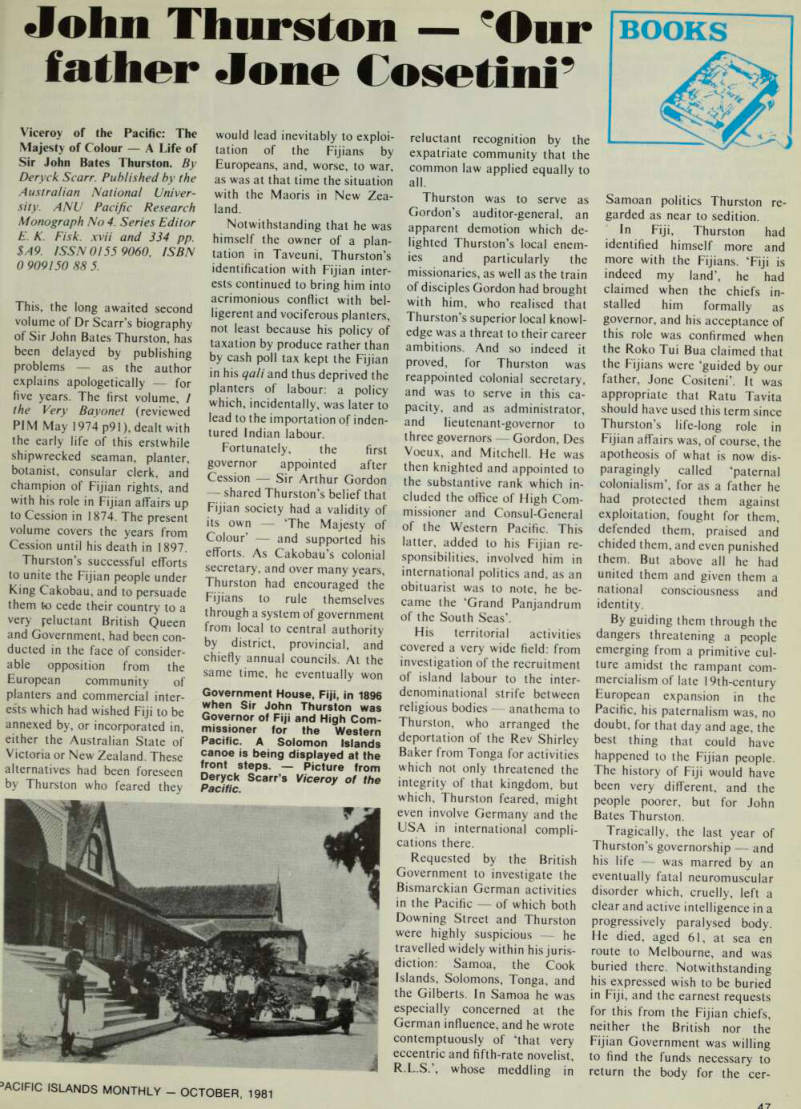
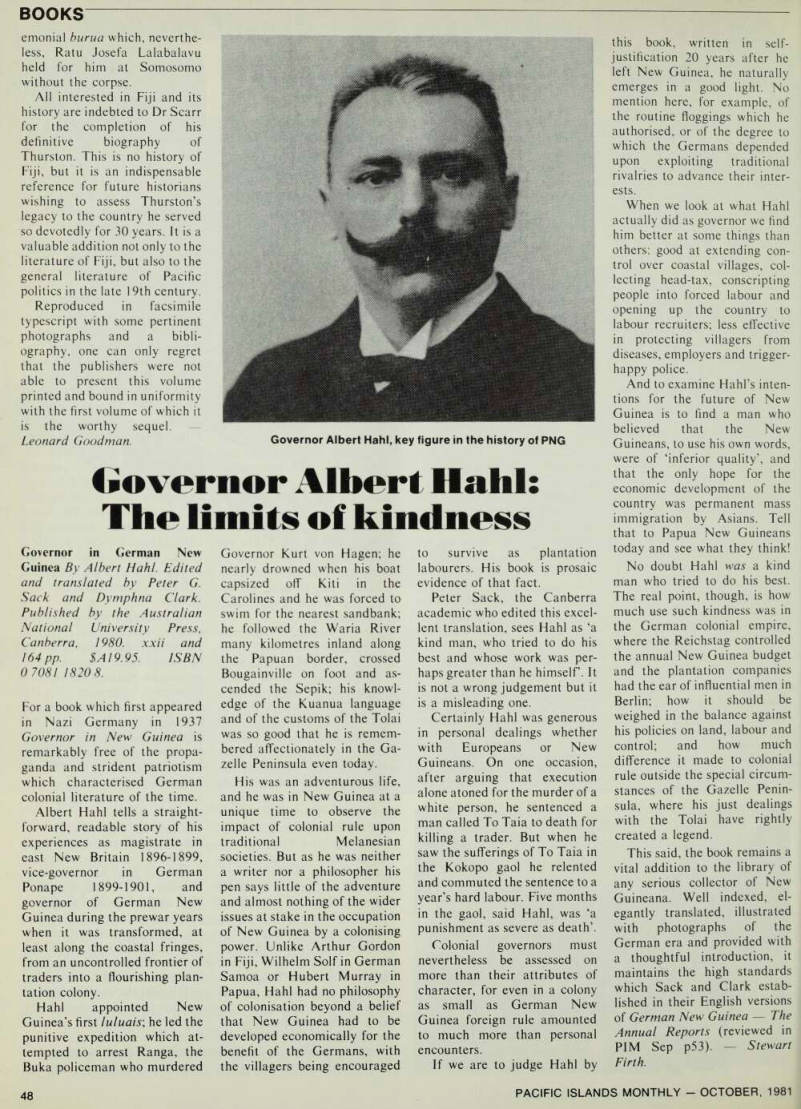
father done Cosetini'
Books
Viceroy of the Pacific: The Majesty of Colour A Life of Sir John Bates Thurston. By Deryck Scarr. Published by the Australian National University. ANU Pacific Research Monograph No 4. Series Editor E. K. Fisk, xvii and 334 pp.
Sa9. Issn 0155 9060, Isbn
0 909150 88 5. tl. . . , ™ m l nf n"l a u SeCO " ™' U ™°, D R r * biography hLn A ‘“u Thurston has been delayed by pubhshmg problems - as the author explains apo ogeucally - for Me (reviewed P.M May 1974 p9I), deal, with the early life of this erstwhile shipwrecked seaman planter ch mni m Tr T with hTrnle n F an To Ces on in S T T volume “• ** j"».
Ihurstons successful efforts nr * i . to unite the Fijian people under King Cakobau, and to persuade them to cede their country to a very reluctant British Queen and Government, had been conducted in the face of considerable opposition from the European community of planters and commercial inter- “ had Fiji to be annexed by, or incorporated in, either the Australian State of Victoria or New Zealand These alternatives had been foreseen b> Thurston who feared they
would lead inevitably to exploi tation of the Fijians by Europeans, and, worse, to war, as was at that time the situation with the Maoris in New Zea land.
Notwithstanding that he was himself the owner of a plan tation in Taveuni, Thurston’s identification with Fijian inter ests continued to bring him into acrimonious conflict with bel and vociferous planters. not |eas| because h|s of taxation b produce y an by cash poM tax kept [he Fijjan in his and thus deprived the p , ante T s 0 f labour: a policy
which, incidentally, was I
.“ed Md^Cur 0 "
Fortunately, the first governor a inted aftcr Cession - Sir Arthur Gordon sha^d Thurston's belief that Fijian SoClCt >’ had a validity of
ToZ" “ T „° f
a 7 s .sris
. . secretary, and over many years, Thnremn u a y \ i piiian to , ‘° , rU ' e f themselves , S> ; Stem government bv H onl, “ ft- d ' S,nCt ' , provm< i ial ' A aad chlel1 3' . annual ““ncils. At the C ’ he eVentually won
reluctant recognition by the expatriate community that the common law applied equally to all.
Thurston was to serve as Gordon’s auditor-general, an apparent demotion which de lighted Thurston’s local enem ies and particularly the missionaries, as well as the train of disciples Gordon had brought with him, who realised that Thurston’s superior local knowl edge was a threat to their career ambitions. And so indeed it proved, for Thurston was reappointed colonial secretary, and was to serve in this ca pacity, and as administrator, and lieutenant-governor to three governors Gordon, Des Voeux, and Mitchell. He was then knighted and appointed to the substantive rank which in cluded the office of High Com missioner and Consul-General of the Western Pacific. This latter, added to his Fijian re sponsibilities, involved him in international politics and, as an obituarist was to note, he be came the ‘Grand Panjandrum of the South Seas’.
His territorial activities covered a very wide field: from investigation of the recruitment of island labour to the inter denominational strife between religious bodies anathema to Thurston, who arranged the deportation of the Rev Shirley Baker from Tonga for activities which not only threatened the integrity of that kingdom, but which, Thurston feared, might even involve Germany and the USA in international compli cations there.
Requested by the British Government to investigate the Bismarckian German activities in the Pacific of which both Downing Street and Thurston were highly suspicious he travelled widely within his juris diction: Samoa, the Cook Islands, Solomons, Tonga, and the Gilberts. In Samoa he was especially concerned at the German influence, and he wrote contemptuously of ‘that very eccentric and fifth-rate novelist, R.L.S.’, whose meddling in
Samoan politics Thurston re garded as near to sedition.
In Fiji, Thurston had identified himself more and more with the Fijians. ‘Fiji is indeed my land’, he had claimed when the chiefs in stalled him formally as governor, and his acceptance of this role was confirmed when the Roko Tui Bua claimed that the Fijians were ‘guided by our father, Jone Cositeni’. It was appropriate that Ratu Tavita should have used this term since Thurston’s life-long role in Fijian affairs was, of course, the apotheosis of what is now dis paragingly called ‘paternal colonialism’, for as a father he had protected them against exploitation, fought for them, defended them, praised and chided them, and even punished them. But above all he had united them and given them a national consciousness and
identity.
By guiding them through the dangers threatening a people emerging from a primitive cul ture amidst the rampant com mercialism of late 19th-century European expansion in the Pacific, his paternalism was, no doubt, for that day and age, the best thing that could have happened to the Fijian people.
The history of Fiji would have been very different, and the people poorer, but for John Bates Thurston.
Tragically, the last year of Thurston’s governorship and his life was marred by an eventually fatal neuromuscular disorder which, cruelly, left a clear and active intelligence in a progressively paralysed body.
He died, aged 61, at sea en route to Melbourne, and was buried there. Notwithstanding his expressed wish to be buried in Fiji, and the earnest requests for this from the Fijian chiefs, neither the British nor the Fijian Government was willing to find the funds necessary to return the body for the cer
Government House, Fiji, in 1896 when Sir John Thurston was Governor of Fiji and High Com missioner for the Western Pacific. A Solomon Islands canoe is being displayed at the front steps. Picture from Deryck Scarr’s Viceroy of the Pacific.
emonial burua which, neverthe less, Ratu Josefa Lalabalavu held for him at Somosomo without the corpse.
All interested in Fiji and its history are indebted to Dr Scarr for the completion of his definitive biography of Thurston. This is no history of Fiji, but it is an indispensable reference for future historians wishing to assess Thurston’s legacy to the country he served so devotedly for 30 years. It is a valuable addition not only to the literature of Fiji, but also to the general literature of Pacific politics in the late 19th century.
Reproduced in facsimile typescript with some pertinent photographs and a bibli ography, one can only regret that the publishers were not able to present this volume printed and bound in uniformity with the first volume of which it is the worthy sequel.
Leonard Goodman.
Governor Albert Hahl:
The limits of kindness
Governor in German New Guinea By Albert Hahl. Edited and translated by Peter G.
Sack and Dymphna Clark.
Published by the Australian National University Press, Canberra, 1980. xxii and
164 Pp. 5A19.95. Isbn
0 7081 18208.
For a book which first appeared in Nazi Germany in 1937 Governor in New Guinea is remarkably free of the propa ganda and strident patriotism which characterised German colonial literature of the time.
Albert Hahl tells a straight forward, readable story of his experiences as magistrate in east New Britain 1896-1899, vice-governor in German Ponape 1899-1901, and governor of German New Guinea during the prewar years when it was transformed, at least along the coastal fringes, from an uncontrolled frontier of traders into a flourishing plan tation colony.
Hahl appointed New Guinea’s first luluais\ he led the punitive expedition which at tempted to arrest Ranga, the Buka policeman who murdered
Governor Kurt von Hagen; he nearly drowned when his boat capsized off Kiti in the Carolines and he was forced to swim for the nearest sandbank; he followed the Waria River many kilometres inland along the Papuan border, crossed Bougainville on foot and as cended the Sepik; his knowl edge of the Kuanua language and of the customs of the Tolai was so good that he is remem bered affectionately in the Ga zelle Peninsula even today.
His was an adventurous life, and he was in New Guinea at a unique time to observe the impact of colonial rule upon traditional Melanesian societies. But as he was neither a writer nor a philosopher his pen says little of the adventure and almost nothing of the wider issues at stake in the occupation of New Guinea by a colonising power. Unlike Arthur Gordon in Fiji, Wilhelm Solf in German Samoa or Hubert Murray in Papua, Hahl had no philosophy of colonisation beyond a belief that New Guinea had to be developed economically for the benefit of the Germans, with the villagers being encouraged
to survive as plantation labourers. His book is prosaic evidence of that fact.
Peter Sack, the Canberra academic who edited this excel lent translation, sees Hahl as ‘a kind man, who tried to do his best and whose work was per haps greater than he himself. It is not a wrong judgement but it is a misleading one.
Certainly Hahl was generous in personal dealings whether with Europeans or New Guineans. On one occasion, after arguing that execution alone atoned for the murder of a white person, he sentenced a man called To Taia to death for killing a trader. But when he saw the sufferings of To Taia in the Kokopo gaol he relented and commuted the sentence to a year’s hard labour. Five months in the gaol, said Hahl, was ‘a punishment as severe as death’.
Colonial governors must nevertheless be assessed on more than their attributes of character, for even in a colony as small as German New Guinea foreign rule amounted to much more than personal encounters.
If we are to judge Hahl by
this book, written in self justification 20 years after he left New Guinea, he naturally emerges in a good light. No mention here, for example, of the routine floggings which he authorised, or of the degree to which the Germans depended upon exploiting traditional rivalries to advance their inter ests.
When we look at what Hahl actually did as governor we find him better at some things than others: good at extending con trol over coastal villages, col lecting head-tax, conscripting people into forced labour and opening up the country to labour recruiters; less effective in protecting villagers from diseases, employers and trigger happy police.
And to examine Hahl’s inten tions for the future of New Guinea is to find a man who believed that the New Guineans, to use his own words, were of ‘inferior quality’, and that the only hope for the economic development of the country was permanent mass immigration by Asians. Tell that to Papua New Guineans today and see what they think!
No doubt Hahl was a kind man who tried to do his best.
The real point, though, is how much use such kindness was in the German colonial empire, where the Reichstag controlled the annual New Guinea budget and the plantation companies had the ear of influential men in Berlin; how it should be weighed in the balance against his policies on land, labour and control; and how much difference it made to colonial rule outside the special circum stances of the Gazelle Penin sula, where his just dealings with the Tolai have rightly created a legend.
This said, the book remains a vital addition to the library of any serious collector of New Guineana. Well indexed, el egantly translated, illustrated with photographs of the German era and provided with a thoughtful introduction, it maintains the high standards which Sack and Clark estab lished in their English versions of German New Guinea The Annual Reports (reviewed in PIM Sep p 53). Stewart Firth.
Governor Albert Hahl, key figure in the history of PNG
Lively telling of Tonga’s
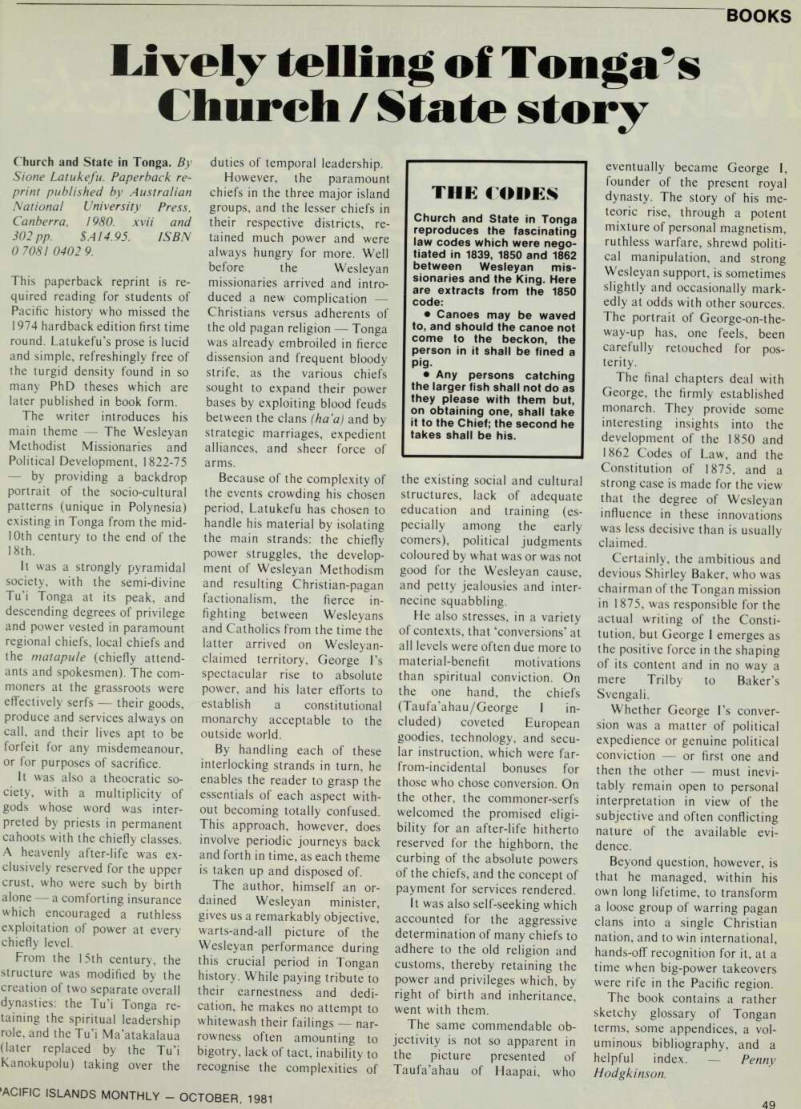
Church/State story
Church and State in Tonga. By Sione Latukefu. Paperback re print published by Australian National University Press, Canberra, 1980. xvii and
302 Pp. San. 95. Isbn
0 7081 0402 9.
This paperback reprint is re quired reading for students of Pacific history who missed the 1974 hardback edition first time round. Latukefu’s prose is lucid and simple, refreshingly free of the turgid density found in so many PhD theses which are later published in book form.
The writer introduces his main theme The Wesleyan Methodist Missionaries and Political Development, 1822-75 by providing a backdrop portrait of the socio-cultural patterns (unique in Polynesia) existing in Tonga from the mid 10th century to the end of the 18th.
It was a strongly pyramidal society, with the semi-divine Tu’i Tonga at its peak, and descending degrees of privilege and power vested in paramount regional chiefs, local chiefs and the matapule (chiefly attend ants and spokesmen). The com moners at the grassroots were effectively serfs their goods, produce and services always on call, and their lives apt to be forfeit for any misdemeanour, or for purposes of sacrifice.
It was also a theocratic so ciety, with a multiplicity of gods whose word was inter preted by priests in permanent cahoots with the chiefly classes.
A heavenly after-life was ex clusively reserved for the upper crust, who were such by birth alone a comforting insurance which encouraged a ruthless exploitation of power at every chiefly level.
From the 15th century, the structure was modified by the creation of two separate overall dynasties; the Tu’i Tonga re taining the spiritual leadership role, and the Tu’i Ma’atakalaua (later replaced by the Tu’i Kanokupolu) taking over the
duties of temporal leadership.
However, the paramount chiefs in the three major island groups, and the lesser chiefs in their respective districts, re tained much power and were always hungry for more. Well before the Wesleyan missionaries arrived and intro duced a new complication - Christians versus adherents of the old pagan religion Tonga was already embroiled in fierce dissension and frequent bloody strife, as the various chiefs sought to expand their power bases by exploiting blood feuds between the clans (ha’a) and by strategic marriages, expedient alliances, and sheer force of arms.
Because of the complexity of the events crowding his chosen period, Latukefu has chosen to handle his material by isolating the main strands: the chiefly power struggles, the develop ment of Wesleyan Methodism and resulting Christian-pagan factionalism, the fierce in fighting between Wesleyans and Catholics from the time the latter arrived on Wesleyan claimed territory, George I’s spectacular rise to absolute power, and his later efforts to establish a constitutional monarchy acceptable to the outside world.
By handling each of these interlocking strands in turn, he enables the reader to grasp the essentials of each aspect with out becoming totally confused.
This approach, however, does involve periodic journeys back and forth in time, as each theme is taken up and disposed of.
The author, himself an or dained Wesleyan minister, gives us a remarkably objective, warts-and-all picture of the Wesleyan performance during this crucial period in Tongan history. While paying tribute to their earnestness and dedi cation, he makes no attempt to whitewash their failings nar rowness often amounting to bigotry, lack of tact, inability to recognise the complexities of
the existing social and cultural structures, lack of adequate education and training (es pecially among the early comers), political judgments coloured by what was or was not good for the Wesleyan cause, and petty jealousies and inter necine squabbling.
He also stresses, in a variety of contexts, that ‘conversions’ at all levels were often due more to material-benefit motivations than spiritual conviction. On the one hand, the chiefs (Taufa’ahau/George I in cluded) coveted European goodies, technology, and secu lar instruction, which were far from-incidental bonuses for those who chose conversion. On the other, the commoner-serfs welcomed the promised eligi bility for an after-life hitherto reserved for the highborn, the curbing of the absolute powers of the chiefs, and the concept of payment for services rendered.
It was also self-seeking which accounted for the aggressive determination of many chiefs to adhere to the old religion and customs, thereby retaining the power and privileges which, by right of birth and inheritance, went with them.
The same commendable ob jectivity is not so apparent in the picture presented of Taufa’ahau of Haapai, who
eventually became George I, founder of the present royal dynasty. The story of his me teoric rise, through a potent mixture of personal magnetism, ruthless warfare, shrewd politi cal manipulation, and strong Wesleyan support, is sometimes slightly and occasionally mark edly at odds with other sources.
The portrait of George-on-the way-up has, one feels, been carefully retouched for pos terity.
The final chapters deal with George, the firmly established monarch. They provide some interesting insights into the development of the 1850 and 1862 Codes of Law, and the Constitution of 1875, and a strong case is made for the view that the degree of Wesleyan influence in these innovations was less decisive than is usually claimed.
Certainly, the ambitious and devious Shirley Baker, who was chairman of the Tongan mission in 1875, was responsible for the actual writing of the Consti tution, but George I emerges as the positive force in the shaping of its content and in no way a mere Trilby to Baker’s Svengali.
Whether George I’s conver sion was a matter of political expedience or genuine political conviction or first one and then the other must inevi tably remain open to personal interpretation in view of the subjective and often conflicting nature of the available evi dence.
Beyond question, however, is that he managed, within his own long lifetime, to transform a loose group of warring pagan clans into a single Christian nation, and to win international, hands-off recognition for it, at a time when big-power takeovers were rife in the Pacific region.
The book contains a rather sketchy glossary of Tongan terms, some appendices, a vol uminous bibliography, and a helpful index. Penny Hodgkinson.
The Codes
Church and State in Tonga reproduces the fascinating law codes which were nego tiated in 1839, 1850 and 1862 between Wesleyan mis sionaries and the King. Here are extracts from the 1850 code: • Canoes may be waved to, and should the canoe not come to the beckon, the person in it shall be fined a pig • Any persons catching the larger fish shall not do as they please with them but, on obtaining one, shall take it to the Chief; the second he takes shall be his.
Advertisements & other items, pp. 49-50 (2 items)
49
BOOKS
'ACIFIC ISLANDS MONTHLY OCTOBER, 1981
Hacking time
Another technological first from Citizen
New Citizen Time Track.
i • No more second hand. Now there’s a second band; an LCD time teack that measures each second with pinpoint precision as.it travels around the circumference of the watch face. But of course there’s " more. In the mode the time track speeds up to complete a each second for split-second readings. And these readings can be verified digitally at just the touch of a button - right down to jl/lOOth of a second, portion of the Time Track contains an alarm, digital stopwatch, an hourly chime, and a permanently-set calendar showing date and day Time Track by Citizen.
The new way to keep track of time, /*>«4 £ ■ S«Sii ■a *» ...
S ns s If
CITIZEN QUARTZ feDIGI-ANA
TirneTrach Jjjfcfegi
fill alfiStl m. ifS i*S s s if r / J
CITIZEN
AHEAD OF THEIR TIME
Forum’s In-principle’

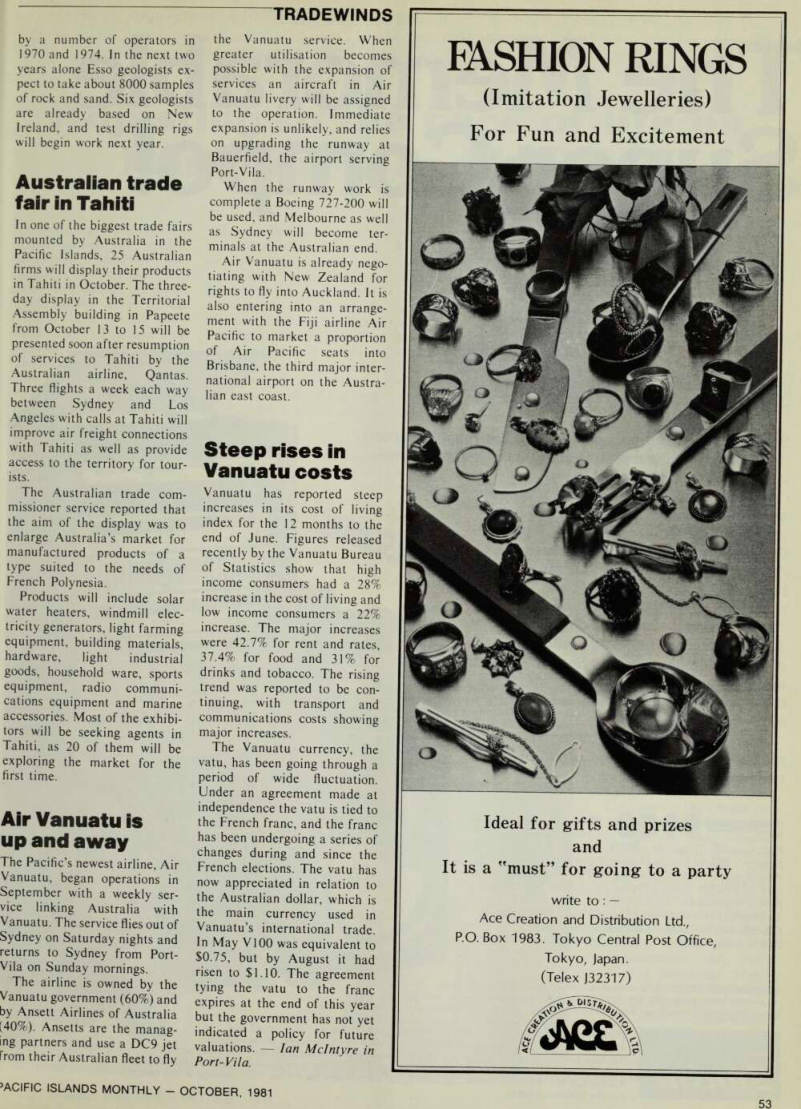
Trade
Winds
Forum’s In-principle’ support for fund to help smaller countries
An extensive evaluation report commissioned by the South Pacific Commission (SPC) and the South Pacific Bureau for Economic Co-operation (SPEC) says that a regional development bank is not needed in the Pacific Islands ‘at this time’, but there is need for a Pacific Islands Fund to help smaller islands without access to larger financial institutions.
The report proposes that such a fund be established with the help of the Special Fund of the Organisation of Petrol- Exporting Countries (OPEC), and with financial help prob ably available from Canada, Sweden, Switzerland, some European Economic Com munity countries, possibly one or more Association of South east Asian Nations, (ASEAN) countries, and from Japan.
The report was prepared for the SPC and SPEC by Rodney Cole, of the Development Studies Centre of the Austra lian National University, and Graeme Thompson, chief econ omist of the New Zealand Planning Council, after visiting most of the Pacific states be tween May and early July this year.
The South Pacific Forum session in Port-Vila in August accepted it in principle and has asked for detailed reactions from the various governments for a final decision at next year’s forum meeting in Tuvalu.
The report says that because of their small size and distance from large markets or popu lation centres, the Pacific Islands have special difficulties for development and a need for substantial external assistance.
They have been receiving substantial assistance which will continue and possibly in :rease, but significant gaps jxist, especially in the needs of he smaller and more vulner ible island states.
A fund controlled by the slanders themselves would neet capital requirements with )ut involving the smaller islands n the costs associated with
World Bank of Asian Develop ment Bank membership. Such a fund would also tap new sources of finance and thus avoid dupli cation or conflict with existing bilateral and multilateral aid arrangements.
The Pacific Islands Fund would offer the following ser vices: • Special loans: For new production, energy develop ment, and short-term balance of payments or budgetary support. • Technical services: Support for the Pacific Regional Advis ory Service if established, specialist advice not elsewhere available, and a development information service. • Price stabilisation: A de pository and account for the regional copra stabilisation/ support scheme now being examined, and any other com modity price support arrange ment. • Disaster relief: To adminis ter relief funds should the Forum expand the provisions of the existing fund now managed by SPEC. • Support for remote islands: Operating assistance in trans port and communications to maintain vital social and econ omic links with small island countries, and island services within larger countries. • Guarantee facility: To sup port borrowing by regional organisations and the smaller national development insti tutions. • Research: To support ap plied research into particular regional issues.
The report proposes that the Pacific Islands Fund be consti tuted as a set of accounts (special loans, technical ser vices, etc.) to make its purposes plain. Each account would be separately administered. About SAIO million would be required to get the fund going.
Fund membership would be free, and through charter, and be open to all developing island countries and territories of the region.
It would be controlled by a
I board comprising a director appointed by each charter member, and the secretary general of the SPC and direc tor of SPEC as ex-officio mem bers. The board would meet annually.
Implementation of fund poli cies would be done by an executive comprising the board chairman, three other board members, and nominees of the SPC and SPEC. The executive might meet three or four times annually, and there would be an administrator appointed, with accountant and secretary, for the administrative work.
Banana exports
urged in Fiji
"iji is having a new look at the wtential of one of the oldest, )ut often one of the most lisappointing, agricultural ven ures in tropical countries :ommercial banana growing. In ommon with a number of countries Fiji once had a ignificant banana export indus ry, but disease and transport roblems overcame it and ba ana growing became a local ;ed subsistence industry.
A motion calling for a full :ale investigation into the com lercial potential of banana rowing has been passed trough the Upper House in the iji parliament, largely through te lobbying of the Great Coun -1 of Chiefs.
Senator Ratu Tevita akalalabure, a nominee of the real Council, told parliament lat modern methods of hand tg and disease control should ake a banana export industry tssible. He said earlier moves examine the potential had et with a ‘miserable response’ om the government on the ounds that the industry could it be made viable.
He believed that too much ‘ight was being placed on a lief that the industry should ist on Viti Levu an area own to have banana disease, her islands had a suitable mate and soil and were free disease. They could become 5 centres of a new industry, d modern controls could keep im free of disease, he said.
He accused the Department Agriculture of being biased its attitude towards banana >wing as an export industry, i claimed that New Zealand
presented a wide-open market for regular shipments of ba nanas.
Senator Ratu Meli Loki, another nominee of the Great Council, said that commercial banana growing offered pros pects for employment and land usage in areas which badly needed the stimulus of agricul tural development.
The recommendation will be passed on to the Department of Agriculture for further investi gation.
Esso explores
PNG minerals
Esso PNG, the Papua New Guinea operation of the US based multi-national Exxon Corporation, plans to spend up to $25 million on mineral explo ration in PNG over the next five years. Negotiating its leases for the work the company said it was impressed by the stability of the PNG government and by the better business climate in PNG compared to neighbour ing South-east Asia. These con siderations had helped form the company’s decision to negotiate exploration rights, a spokesman said.
Esso’s initial programme will be a series of field and aerial surveys at a cost of about $2 million, covering the major northern island of New Ireland.
The aerial work will consist of a magnetic deflection survey in which deflection of magnetic lines of force will be mapped to show potential mineral deposits.
The results of the mapping will then be followed by more de tailed surveys on the ground.
When the New Ireland sur veys are completed the exploration teams will switch their attention to parts of New Britain another major island in the north and to the central highlands of the PNG mainland.
Esso will take over the results of preliminary tests carried out
by a number of operators in 1970 and 1974. In the next two years alone Esso geologists ex pect to take about 8000 samples of rock and sand. Six geologists are already based on New Ireland, and test drilling rigs will begin work next year.
Australian trade
fair in Tahiti
In one of the biggest trade fairs mounted by Australia in the Pacific Islands, 25 Australian firms will display their products in Tahiti in October. The three day display in the Territorial Assembly building in Papeete from October 13 to 15 will be presented soon after resumption of services to Tahiti by the Australian airline, Qantas.
Three flights a week each way between Sydney and Los Angeles with calls at Tahiti will improve air freight connections with Tahiti as well as provide access to the territory for tour ists.
The Australian trade com missioner service reported that the aim of the display was to enlarge Australia’s market for manufactured products of a type suited to the needs of French Polynesia.
Products will include solar water heaters, windmill elec tricity generators, light farming equipment, building materials, hardware, light industrial goods, household ware, sports equipment, radio communi cations equipment and marine accessories. Most of the exhibi tors will be seeking agents in Tahiti, as 20 of them will be exploring the market for the first time.
Air Vanuatu is
up and away
The Pacific’s newest airline, Air Vanuatu, began operations in September with a weekly ser vice linking Australia with Vanuatu. The service flies out of Sydney on Saturday nights and returns to Sydney from Port-
Vila on Sunday mornings.
The airline is owned by the Vanuatu government (60%) and by Ansett Airlines of Australia [40%). Ansetts are the manag ing partners and use a DC9 jet from their Australian fleet to fly
I the Vanuatu service. When greater utilisation becomes possible with the expansion of services an aircraft in Air Vanuatu livery will be assigned to the operation. Immediate expansion is unlikely, and relies on upgrading the runway at Bauerfield, the airport serving Port-Vila.
When the runway work is complete a Boeing 727-200 will be used, and Melbourne as well is Sydney will become ter ninals at the Australian end.
Air Vanuatu is already nego iating with New Zealand for ights to fly into Auckland. It is dso entering into an arrange nent with the Fiji airline Air to market a proportion •f Air Pacific seats into Brisbane, the third major inter ational airport on the Austr ian east coast.
>teep rises in
fanuatu costs
anuatu has reported steep icreases in its cost of living idex for the 12 months to the id of June. Figures released icently by the Vanuatu Bureau Statistics show that high come consumers had a 28% crease in the cost of living and w income consumers a 22% crease. The major increases ere 42.7% for rent and rates, for food and 31% for inks and tobacco. The rising end was reported to be con luing, with transport and mmunications costs showing ajor increases.
The Vanuatu currency, the tu, has been going through a riod of wide fluctuation, ider an agreement made at dependence the vatu is tied to e French franc, and the franc s been undergoing a series of anges during and since the ench elections. The vatu has w appreciated in relation to ’ Australian dollar, which is main currency used in nuatu’s international trade.
May VIOO was equivalent to 75, but by August it had sn to $l.lO. The agreement ng the vatu to the franc )ires at the end of this year t the government has not yet icated a policy for future uations. lan Mclntyre in n-Vila.
Advertisements & other items, pp. 51-54 (3 items)
51
‘ACIFIC ISLANDS MONTHLY OCTOBER, 1981
Shines Better
re — SE
READY’ FLASHLIGHTS
ONLY THE SUN
SHINES BETTER
EVEREADY
THE WORLD’S LEADING BRAND
Bfii ‘Eveready’ andlUnion Carbide’ are registered trade marks. 085.P.718
FASHION RINGS
(Imitation Jewelleries)
For Fun and Excitement m 3 i LJ Q L# O (3 Ideal for gifts and prizes and It is a "must” for going to a party write to : Ace Creation and Distribution Ltd., P.O. Box 1983. Tokyo Central Post Office, Tokyo, Japan. (Telex J 32317)
The Memorable
Compo!
A jewel reveals the beauty of light and Sansui’s microcomputer IC’s reveal the beauty of music.
Sansui’s Super Compo stereo system has micro-computer memories to make music listening unforgettable. Stereo is now simpler and more fun.
Just push buttons and you’ve programmed any seven selections on a record in any order you like. Wonderful conveniences of the FM/AM tuner include Digital Quartz-
PLL Synthesizer tuning and push-
button selection of any 6 FM and any 6 AM pre-set stations.
Microcomputer delights of the
cassette deck are full-logic and Automatic Music Program Search. Wireless remote control is a nice option, and so is
the versatile Graphic Equalizer/Reverb/
Mixer Consolette.
Just push a button for memorable
music. Memorable Super Compo by the
hi-fi specialist, Sansui.
COMPO 9900
m
llllhSnf ijljj;
11 i. L
.fui jj ...
r *** ••• Si— FR-D 55: Computerized Track Sequence Selection Full Auto DD Turntable RS-7: Infrared Remote Control System RG-7: Stereo Graphic Equalizer Consolette with reverb/mixer T-9: Digital Quartz-PLL Synthesizer Tuner with 12 FM/AM Station Pre-sets and Auto Search Tuning A-9: Integrated DC-Servo Amplifier, 65W RMS * 2 D-300M: Full-logic Metal-Compatible Cassette Deck GX-95: Audio Cabinet with Headphone Jack S-65: 4-Way Speaker System 12-3/8 Woofer, 105 W SANSUI ELECTRIC CO., LTD. 14-1 Izumi 2-chome, Suginami-ku, Tokyo 168, Japan • Australia VAN FI (Aust.) Pty. Ltd. 297, City Road, South Melbourne, Victoria 3205, Australia Phone: 690-6200/283 Alfred Street, North Sydney, N.S.W. 2060, Australia Phone: 929-0293 • Fiji Prabhu Brothers Ltd. P.O. Box 183, Nadi Phone: 70183/4 • Papua New Guinea Oceania Indent Agency (P.N.G.) Pty. Ltd. Box 5518, Boroko, Port Moresby Phone: PM 256406 • New Zealand David Reid Electronics Ltd. C.P.O. Box 2630, Auckland, 1 Phone: 491-489 • New Caledonia Ets Michel MERCIER B.p. 1123. Noumea Phone: 27. 59. 11 • South Pacific Miltons Department Stores Limited P.O. Box 146, Norfolk Island 2899 Phone: 2161 • Central Pacific Nauru Co-operative Society Republic of Nauru • Vanuatu The Sound Centre P.O. Box 434, Port Villa Phone: 2035 • Cook Island United Island Traders Ltd. P.O. Box 1 & 2, Rarotonga • Tahiti SIMEL P.O. Box 3338 Phone: 26979
Scuisul.
53
TRADEWINDS
’ACIFIC ISLANDS MONTHLY - OCTOBER, 1981
Manihiki-and loving it
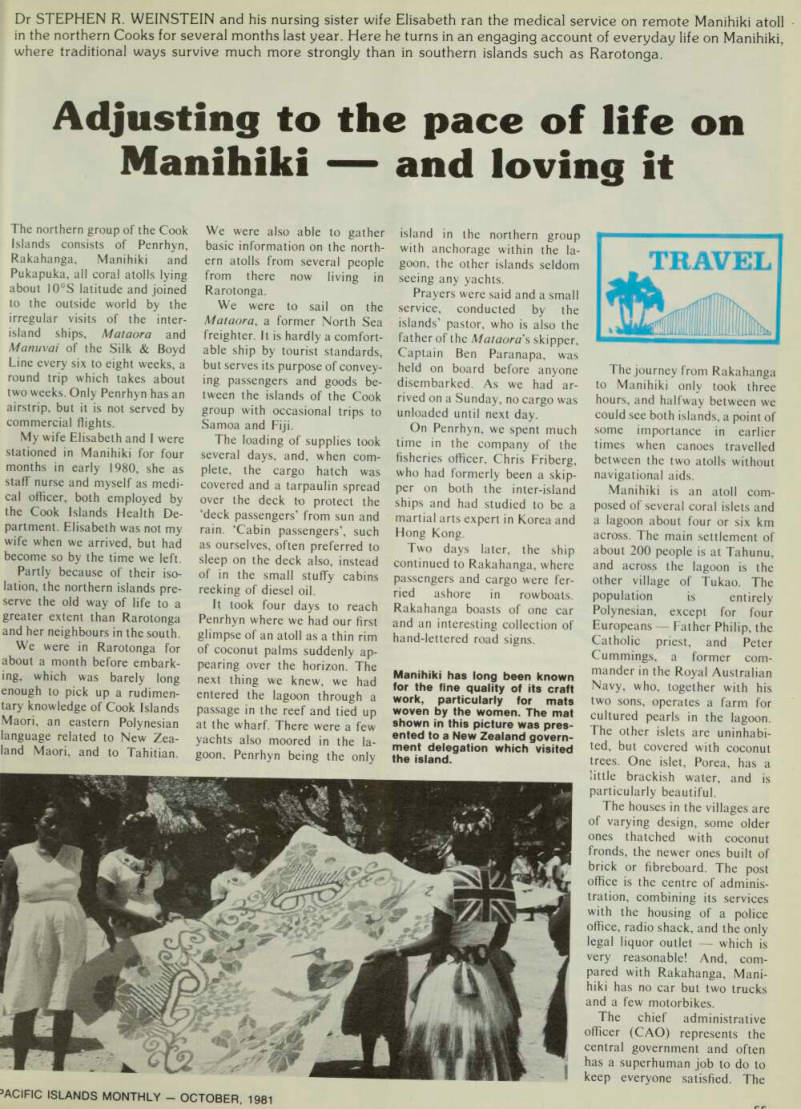
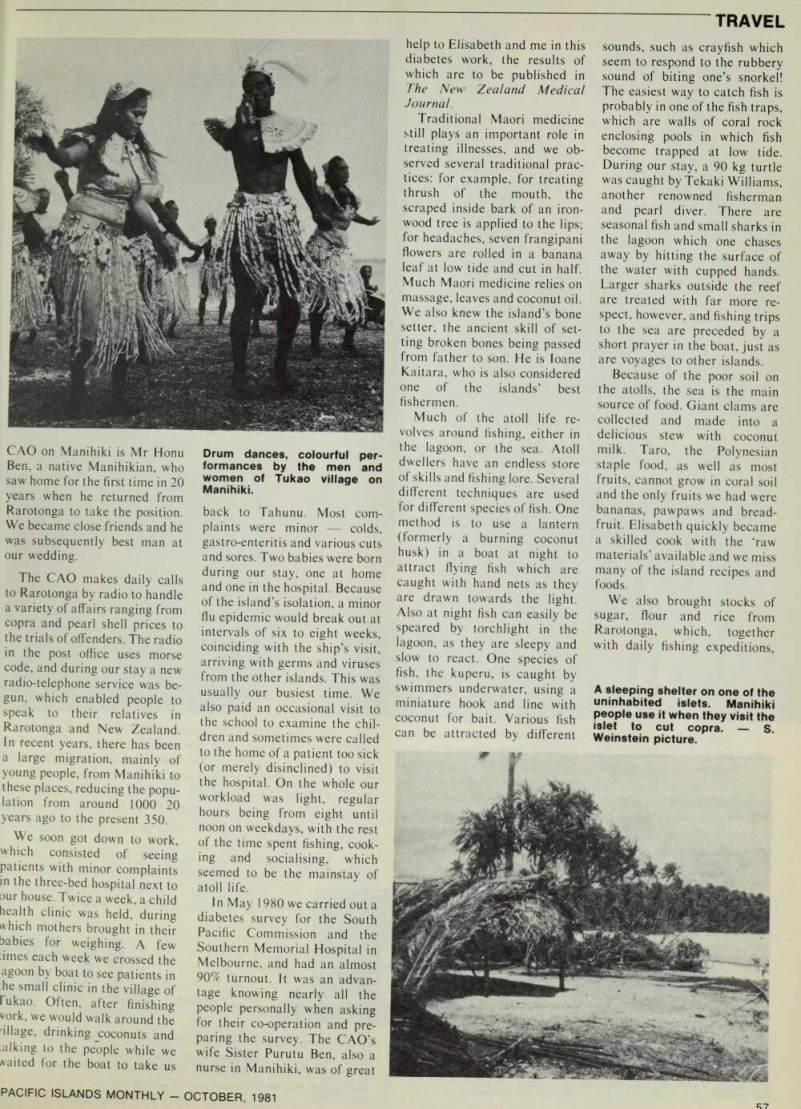
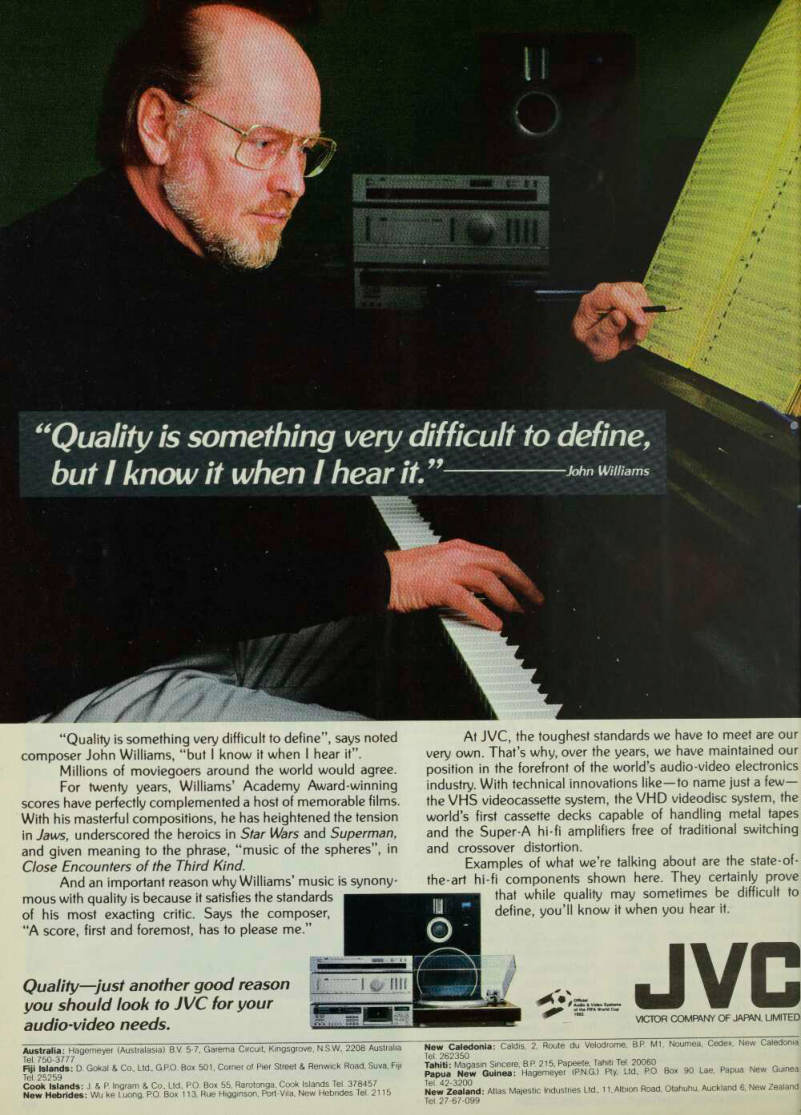
Travel
Adjusting to the pace of life on Manihiki-and loving it
Dr STEPHEN R. WEINSTEIN and his nursing sister wife Elisabeth ran the medical service on remote Manihiki atoll in the northern Cooks for several months last year. Here he turns in an engaging account of everyday life on Manihiki, where traditional ways survive much more strongly than in southern islands such as Rarotonga.
The northern group of the Cook Islands consists of Penrhyn, Rakahanga, Manihiki and Pukapuka, all coral atolls lying about 10°S latitude and joined to the outside world by the irregular visits of the inter island ships, Mataora and Manuvai of the Silk & Boyd Line every six to eight weeks, a round trip which takes about two weeks. Only Penrhyn has an airstrip, but it is not served by commercial flights.
My wife Elisabeth and I were stationed in Manihiki for four months in early 1980, she as staff nurse and myself as medi cal officer, both employed by the Cook Islands Health De partment. Elisabeth was not my wife when we arrived, but had become so by the time we left.
Partly because of their iso lation, the northern islands pre serve the old way of life to a greater extent than Rarotonga and her neighbours in the south.
We were in Rarotonga for about a month before embark ing, which was barely long enough to pick up a rudimen tary knowledge of Cook Islands Maori, an eastern Polynesian language related to New Zea land Maori, and to Tahitian.
We were also able to gather basic information on the north ern atolls from several people from there now living in Rarotonga.
We were to sail on the Mataora , a former North Sea freighter. It is hardly a comfort able ship by tourist standards, but serves its purpose of convey ing passengers and goods be tween the islands of the Cook group with occasional trips to Samoa and Fiji.
The loading of supplies took several days, and, when com plete, the cargo hatch was covered and a tarpaulin spread over the deck to protect the ‘deck passengers’ from sun and rain. ‘Cabin passengers’, such as ourselves, often preferred to sleep on the deck also, instead of in the small stuffy cabins reeking of diesel oil.
It took four days to reach Penrhyn where we had our first glimpse of an atoll as a thin rim of coconut palms suddenly ap pearing over the horizon. The next thing we knew, we had entered the lagoon through a passage in the reef and tied up at the wharf. There were a few yachts also moored in the la goon, Penrhyn being the only
island in the northern group with anchorage within the la goon, the other islands seldom seeing any yachts.
Prayers were said and a small service, conducted by the islands’ pastor, who is also the father of the Mataoro's skipper.
Captain Ben Paranapa, was held on board before anyone disembarked. As we had ar rived on a Sunday, no cargo was unloaded until next day.
On Penrhyn, we spent much time in the company of the fisheries officer, Chris Friberg, who had formerly been a skip per on both the inter-island ships and had studied to be a martial arts expert in Korea and Hong Kong.
Two days later, the ship continued to Rakahanga, where passengers and cargo were fer ried ashore in rowboats.
Rakahanga boasts of one car and an interesting collection of hand-lettered road signs.
The journey from Rakahanga to Manihiki only took three hours, and halfway between we could see both islands, a point of some importance in earlier times when canoes travelled between the two atolls without navigational aids.
Manihiki is an atoll com posed of several coral islets and a lagoon about four or six km across. The main settlement of about 200 people is at Tahunu, and across the lagoon is the other village of Tukao. The population is entirely Polynesian, except for four Europeans Father Philip, the Catholic priest, and Peter Cummings, a former com mander in the Royal Australian Navy, who, together with his two sons, operates a farm for cultured pearls in the lagoon.
The other islets are uninhabi ted, but covered with coconut trees. One islet, Porea, has a little brackish water, and is particularly beautiful.
The houses in the villages are of varying design, some older ones thatched with coconut fronds, the newer ones built of brick or fibreboard. The post office is the centre of adminis tration, combining its services with the housing of a police office, radio shack, and the only legal liquor outlet which is very reasonable! And, com pared with Rakahanga, Mani hiki has no car but two trucks and a few motorbikes.
The chief administrative officer (CAO) represents the central government and often has a superhuman job to do to keep everyone satisfied. The
Manihiki has long been known for the fine quality of its craft work, particularly for mats woven by the women. The mat shown in this picture was pres ented to a New Zealand govern ment delegation which visited the island.
CAO on Manihiki is Mr Honu Ben, a native Manihikian, who saw home for the first time in 20 years when he returned from Rarotonga to take the position.
We became close friends and he was subsequently best man at our wedding.
The CAO makes daily calls to Rarotonga by radio to handle a variety of affairs ranging from copra and pearl shell prices to the trials of offenders. The radio in the post office uses morse code, and during our stay a new radio-telephone service was be gun, which enabled people to speak to their relatives in Rarotonga and New Zealand.
In recent years, there has been a large migration, mainly of young people, from Manihiki to these places, reducing the popu lation from around 1000 20 years ago to the present 350.
We soon got down to work, which consisted of seeing patients with minor complaints in the three-bed hospital next to our house. Twice a week, a child health clinic was held, during which mothers brought in their babies for weighing. A few ;imes each week we crossed the agoon by boat to see patients in he small clinic in the village of
fukao. Often, after finishing
vork, we would walk around the
Ullage, drinking coconuts and
talking to the people while we waited for the boat to take us
back to Tahunu. Most com plaints were minor colds, gastro-enteritis and various cuts and sores. Two babies were born during our stay, one at home and one in the hospital. Because of the island’s isolation, a minor flu epidemic would break out at intervals of six to eight weeks, coinciding with the ship’s visit, arriving with germs and viruses from the other islands. This was usually our busiest time. We also paid an occasional visit to the school to examine the chil dren and sometimes were called to the home of a patient too sick (or merely disinclined) to visit the hospital. On the whole our workload was light, regular hours being from eight until noon on weekdays, with the rest of the time spent fishing, cook ing and socialising, which seemed to be the mainstay of atoll life.
In May 1980 we carried out a diabetes survey for the South Pacific Commission and the Southern Memorial Hospital in Melbourne, and had an almost 90% turnout. It was an advan tage knowing nearly all the people personally when asking for their co-operation and pre paring the survey. The CAO’s wife Sister Purutu Ben, also a nurse in Manihiki, was of great
help to Elisabeth and me in this diabetes work, the results of which are to be published in The New Zealand Medical Journal.
Traditional Maori medicine still plays an important role in treating illnesses, and we ob served several traditional prac tices: for example, for treating thrush of the mouth, the scraped inside bark of an iron wood tree is applied to the lips; for headaches, seven frangipani flowers are rolled in a banana leaf at low tide and cut in half.
Much Maori medicine relies on massage, leaves and coconut oil.
We also knew the island’s bone setter, the ancient skill of set ting broken bones being passed from father to son. He is loane Kaitara, who is also considered one of the islands’ best fishermen.
Much of the atoll life re volves around fishing, either in the lagoon, or the sea. Atoll dwellers have an endless store of skills and fishing lore. Several different techniques are used for different species of fish. One method is to use a lantern (formerly a burning coconut husk) in a boat at night to attract flying fish which are caught with hand nets as they are drawn towards the light.
Also at night fish can easily be speared by torchlight in the lagoon, as they are sleepy and slow to react. One species of fish, the kuperu, is caught by swimmers underwater, using a miniature hook and line with coconut for bait. Various fish can be attracted by different
sounds, such as crayfish which seem to respond to the rubbery sound of biting one’s snorkel!
The easiest way to catch fish is probably in one of the fish traps, which are walls of coral rock enclosing pools in which fish become trapped at low tide.
During our stay, a 90 kg turtle was caught by Tekaki Williams, another renowned fisherman and pearl diver. There are seasonal fish and small sharks in the lagoon which one chases away by hitting the surface of the water with cupped hands.
Larger sharks outside the reef are treated with far more re spect, however, and fishing trips to the sea are preceded by a short prayer in the boat, just as are voyages to other islands.
Because of the poor soil on the atolls, the sea is the main source of food. Giant clams are collected and made into a delicious stew with coconut milk. Taro, the Polynesian staple food, as well as most fruits, cannot grow in coral soil and the only fruits we had were bananas, pawpaws and bread fruit. Elisabeth quickly became a skilled cook with the ‘raw materials’ available and we miss many of the island recipes and foods.
We also brought stocks of sugar, flour and rice from Rarotonga, which, together with daily fishing expeditions.
Drum dances, colourful per formances by the men and women of Tukao village on Manihiki.
A sleeping shelter on one of the uninhabited islets. Manihiki people use it when they visit the islet to cut copra.
Weinstein picture.
considerable gifts of food from the local people, and an oc casional visit to one of the small shops for luxuries such as cocoa or cheese twisties, lasted us pretty well. We ate about one tin of beef a week as well, usually on a Sunday when fishing and all other work was prohibited. Though I speared a few small fish nearly every day, it was Elisabeth who scored our largest fish, hooking a 5.5 kg tuna. She also hooked a shark, which we did not eat, although we kept the teeth and jaws.
A great delicacy, which now adays only lives on the more remote Pacific Islands, is the coconut crab which looks like a lobster, climbs trees and opens the nuts with its heavy claws.
Although it lives on land, it returns to the water to lay eggs.
It is usually active at night, when it is mostly caught. The meat is delicious, eaten the traditional way, dipped into the rich oily fat in the crab’s tail.
Although officially illegal, homebrew is sometimes made by fermenting coconut juice, unlike the southern group where orange or pineapple juice is fermented. Homebrew drink ing is accompanied by certain rituals, the usual way of drink ing being from a single commu nal cup passed from hand to hand and drained at a single gulp. We heard the following remark on one occasion; ‘Beer is for women, homebrew is for men, and whisky is for Papaa (Europeans)’.
Religion plays a greater role in Manihiki than in urbanised Rarotonga, most people belong ing to the Cook Islands Christian Church (CICC), an Dffshoot from the London
Missionary Society whose mem
bers brought the gospel to the Cook Islands in the 1860 s at ibout the same time as the
ffackbirders were kidnapping
vorkers for the Queensland ugar plantations from some of he Northern Cooks.
The head of the CICC in Manihiki is the Rev Timote, nd the Catholic Mission is leaded by Father Philip, who Iso has Manihiki’s largest li brary of books, which he kindly -t us use. There is also a small ongregation of Seventh-day adventists and a single adher nt of the Hare Krishna sect,
who acquired this persuasion while working in New Zealand.
The proper dress for church is broad-brimmed straw hats for the ladies and shirts and long trousers for men. Special white dresses and suits are kept by some people for special holidays such as Easter, when coconut juice takes the place of wine during the service. The Rev Timote invited me to give the sermon one Sunday, which 1 did, with him interpreting my words into Maori.
There were two funerals dur ing our stay, and on these occasions the whole population gathers together as one family at the home of the deceased, and speeches and hymn-singing alternate throughout the night while coffee and ship’s biscuits are served. The burial itself is usually held the following day to forestall decomposition in the hot climate, and is followed by a wake which continues for another two days with various speakers elaborating on the virtues of the deceased. At the end of the wake, a huge feast is held. Gravestones can be very elaborate and in some cases are protected by little corrugated iron roofs or sheds.
The two main export indus tries of Manihiki are copra and pearlshell. The coconut groves on the various islets, all with their specific owners, are worked on a rotating basis, with one islet at a time open for coconut gathering. This is de signed as a conservation measure, to let the unworked groves regenerate. The island council directs which islets are ‘open’. On weekends, we would go with the Ben family across the lagoon to their coconut land
and help with the gathering. We camped out in a little hut and enjoyed beautiful sunsets over the lagoon and a bright starlit sky at night with the sound of surf pounding the reef behind us.
The conservation of the pearl ing industry is also under the control of the island council.
Pearl diving is restricted to certain times of the year, and only oysters with a span of not less than 18 cm can be taken.
Six families have licences, which were granted in Queen Victoria’s time, to use diving equipment consisting of ancient hand-cranked compressors and copper diving helmets. The rest gather pearlshell by free-diving.
The unofficial depth record is held by loane Kaitara, with a depth of 20 fathoms and a duration of five minutes. For the 1980 pearling season, two divers came up from Rarotonga with modern motor-drive com pressors that they had been licensed by the government to use. An interesting juris dictional dispute arose when the island council refused to let them use the machines. The matter was deferred, however, when the opening of the lagoon was postponed because of the flu epidemic which had fol lowed the last ship’s visit.
The oysters are of the large black-lipped variety, taken mainly for the shell. Only oc casionally is a natural pearl found. On the pearl farm, cultured pearls are made by implanting moulds, after which the oysters are left for a year in
wire-mesh boxes in the lagoon. ‘Boat day’ is always an eagerly awaited event, with people gathering at the landing waiting for mail, news of rela tives, ‘fresh foods’ and other goods.
One of the highlights of the I year was the visit to the north ern group of islands by Cook Islands Premier Dr Thomas Davis, and the New Zealand representative, Mr Lindsey Watt. Several weeks prior to the visit, there were nightly re hearsals of drum-dances in the public square behind the post office, and costumes were made.
A general clean-up was also carried out in both villages.
The official party’s progress by air to Penrhyn and on to Rakahanga by the Manuvai was eagerly followed over the radio until finally the ship was visible on the north-eastern hor izon. Towards sunset the guests finally stepped ashore from the rowboat on to the decorated landing, and were welcomed by schoolchildren and a reception line of Who’s Who in Manihiki.
Speeches of welcome and danc ing at the landing followed and later that night a feast was held in Tahunu with more dancing and speeches. After spending the night at the CAO’s official residence the premier’s party, in a convoy of boats, crossed the lagoon to Tukao in the morning where another feast was pre pared. After the dancing and speechmaking, gifts of woven mats and hats were presented to the guests.
Although the visit to Manihiki only lasted 24 hours, it was the first by a Cook Island premier in over 10 years and was greatly appreciated, even though there wasn’t time for him to discuss everything of interest, and to meet everyone.
The village clean-up took the form of a tutaka, an institution alised village inspection which is seldom carried out in the southern Cooks any more. A number of officials, including the CAO, doctor, chairman of the island council and some times the priest, with others, walk through every home in the village, technically looking at the state of sanitation. But the event is more an opportunity for every household to display its status symbols and handicrafts.
The Cook Islands Christian Church at Tahunu is a focal point of community activities. -S. Weinstein picture.
Most of the homes we walked through were in a state of near perfect cleanliness and order, with hand-made bedspreads, hats, photos of family members, and an occasional cassette player prominently displayed.
Also inspected were gardens, household animals, the cookhouse which is often a separate building and toilets, which in Manihiki are built over the lagoon and reached by catwalks on stilts. This has not been known to cause any health problems as the fish quickly consume all waste. The tutaka is started and finished with prayers and speeches, conclud ing with a small feast for the party who did all the walking.
There are a few stately old houses built at the turn of the century by European traders and furnished in 1890’s style with what then would have represented enormous wealth on an atoll visited once a year by a small copra schooner.
Among the most popular trade items in those days were iron bedsteads, pedal-operated Singer sewing machines and seachests, which are still found in many homes. The traders left many descendants on the island, one such being George Ellis, whose grandfather left England at the age of 16, had many adventures on ships and islands all over the Pacific, and finally married and settled down in Manihiki. There he taught the people to build wooden long boats of planks, many of which are still lying about rotting, and ane which is still in use. It was ;he one still in use that was used 'or a voyage to Rakahanga in Vlay, 1980. The occasion for his voyage was the sudden leath of the Catholic priest in Rakahanga, which required -ather Philip to go there for the uneral. Two 25-hp outboard notors were hooked on and the >oat was skippered by Teokotai Villiams, another trader de cendant, navigating with an 'ld brass ship’s compass in a reen box. Permission for the oyage had to be obtained from
Larotonga by radio. After
ompleting their mission, the oyagers returned safely, bring ig a few bags of flour and some
ledicines from Rakahanga.
uch voyages were more corn ion in the old days, until the
government prohibited them, because of so many boats being lost. Some made it to other islands weeks later, but many perished. It was known to the island boatmen that if one failed to reach Rakahanga in a day, the normal sailing time, there was a possibility of reach ing Samoa in a week by follow ing the winds and currents.
Some survivors of such drift voyages still live in Manihiki.
On one such trip, seven men set out from Manihiki, and after getting lost at sea, suffering thirst, hunger and storms, four of them reached the (then) New Hebrides alive a couple of months later.
Elisabeth and I were married on March 21, 1980. I paid $6 at the post office and an official notice was displayed.
Typewritten invitations were sent out to about 100 people, but of course the whole island was welcome to attend. Various families donated a total of eight pigs, many chickens, fish, and all types of other foodstuffs, loane speared 10 large crayfish.
The night before the wedding was extremely busy, with bak ing and cooking going on until well past midnight. The pigs were slaughtered and cleaned down .at the landing prior to putting them in the under ground earth oven overnight.
Sitting with Honu on the veran dah of the mission house the next day I waited for Elisabeth.
The ceremony was given in Maori by the Rev Timote, first wedding he had performed for Europeans. Outside the church the Boys Brigade formed a guard of honour, their
brass belt-buckles polished with lime for the occasion. Three volleys from a shotgun were fired and the procession walked back to the residence where the reception was held. After speeches, singing and dancing by the VIPs, the guests filed past and gave their gifts straw hats, lengths of trade store cloth, two bottles of whisky, and banknotes in envel opes. The money was recycled to the church and also helped pay for the store-bought foods.
In the evening, drinks and ukelele music were followed by a dance on the post office verandah. An official announce ment of the event was made on the Cook Islands radio in Rarotonga.
Among the most memorable people we met was Mehau George, whose death on May 19, 1981, was reported in September’s PIM. At 87 he was the oldest man in Manihiki, a skilled woodcarver and crafts man. He was also the islands’ only World War I veteran, Second Maori Battalion, and could still sing all the verses of ‘lt’s a long way to Tipperary’.
There was also Charlie Poiri, who claims descent from King Kamehaweto I of Hawaii, through one of his ancestors who served on a whaling boat in the last century. Charlie still keeps contact with relatives in Hawaii.
The only visitor to Manihiki apart from the inter-island ship
during our stay was the re search vessel Machias of Honolulu, on charter to the Cook Islands Government, ex ploring the seabed for manga nese nodules, phosphate and precious corals, all of which they found.
The w\.ek before our depar ture was filled with visits to say farewell to old friends, culminating in a dinner where members of the island council sang traditional songs, more gifts were presented, and a few tears were shed. We also said goodbye to a black kitten, Tom Tom, who had attached himself to us.
The return voyage lasted 10 days, and we enjoyed the com pany of fellow-passenger Judge Jock McCawley, whose several decades in the islands provided a rich store of yarns. We stopped at Rakahanga to load copra and disembarked into the landing boats by torchlight, after the ship’s electricity failed. We spent a few more days in Penrhyn, and saw the old aircraft wrecks from when the island was an American air base in World War 11. We also crossed the lagoon to visit Penrhyn’s second village, Tetautua.
Every island in the Cooks has one or more members of the Marsters family living on it.
This family originated when a British captain, Marsters, settled on Palmerston atoll with his Polynesian wives (three altogether at different times) in the 19th century. The hundred or so people on Palmerston today are all his descendants, bear the same surname and speak their own dialect of English as spoken 100 years ago.
For potential visitors to the northern Cooks, I should men tion that the first boatload of tourists was scheduled to arrive on board the slightly more comfortable Manuvai shortly after our departure. The plan was that they would be billeted in private homes as there are no hotels, and the people were eagerly looking forward to this arrangement. Their experiences were described by James C.
Simmons in PIM May, 1981.
From my own time there, de spite the discomforts, I would highly recommend the trip.
Manihiki fisherman: Aluminium dinghy, coconut palm oars.-S.
Weinstein picture.
Advertisements & other items, pp. 56-62 (3 items)
Insurance
V k
NATIONAL '
-V &
COVERS THE
pacific
'1 m *
FIJI
THE NATIONAL INSURANCE COMPANY OF FIJI. LIMITED. (Incorporating Southern Pacific Insurance Co. (Fiji) Ltd) SUVA Dominion House, Thomson St, Phone 25601, Tlx 2337.
L. M. Rolls, General Manager.
LAUTOKA Ist Floor National Bank Bldg. Phone 62951. M. Y. Hussain, Resident Inspector.
LABASA Ist Floor National Bank Bldg. Phone 81099. A. Singh, Resident Inspector.
PAPUA NEW GUINEA
THE SOUTHERN PACIFIC INSURANCE COMPANY (PNG) LIMITED. (Incorporating C.l C Insurance (Pacific) Pty Ltd) PORT MORESBY 8 Champion Parade, Phone 21-1388, Tlx 22261. D. J. McCall,General Manager LAE Second St, Phone 42-4590. Tlx 42443. T. S. Kennedy. Manager RABAUL Mango Ave, Phone 92-2755, Tlx 92923. P M. Mitchell, Manager.
MT HAGEN MT HAGEN Phone 521 -164. J. P. Devaney, District Manager, ent inspector.
Arawa B. Snowden, District Manager. Phone 956-219
SOLOMON ISLANDS
THE NATIONAL INSURANCE COMPANY OF NEW ZEALAND, LIMITEDI HONIARA Ist Floor Kingsley Bldg. Phone 919 B. R. International Agencies (W.V. Gledhill) Agent.
WESTERN SAMOA
NATIONAL PACIFIC INSURANCE LIMITED,
(National Insurance Company of New Zealand. Ltd Managing Agents) APIA Taufusi St, Phone 20481. Tlx 228. D. I. Humphry, Managing Director.
PAGO PAGO Suite 200, Lumana'i Bldg. Phone 96799. J. McGuire, Manager
COOK ISLANDS
THE NATIONAL INSURANCE COMPANY OF NEW ZEALAND, LIMITED.
RAROTONGA U.I.T. Bldg. Avarua, Phone 2076, Tlx 62013. R. Wheeler, Local Manager.
“Quality is something very difficult to define”, says noted composer John Williams, “but I know it when I hear it”.
Millions of moviegoers around the world would agree.
For twenty years, Williams’ Academy Award-winning scores have perfectly complemented a host of memorable films.
With his masterful compositions, he has heightened the tension in Jaws, underscored the heroics in Star Wars and Superman, and given meaning to the phrase, “music of the spheres”, in Close Encounters of the Third Kind.
And an important reason why Williams’ music is synonymous with quality is because it satisfies the standards of his most exacting critic. Says the composer, “A score, first and foremost, has to please me.”
Qualify—just another good reason _T
you should look to JVC for your audio-video needs.
At JVC, the toughest standards we have to meet are our very own. That’s why, over the years, we have maintained our position in the forefront of the world’s audio-video electronics industry. With technical innovations like—to name just a few— the VHS videocassette system, the VHD videodisc system, the world’s first cassette decks capable of handling metal tapes and the Super-A hi-fi amplifiers free of traditional switching and crossover distortion.
Examples of what we’re talking about are the state-ofthe-art hi-fi components shown here. They certainly prove that while quality may sometimes be difficult to define, you’ll know it when you hear it.
V
JVC
VICTOR COMPANY OF JAPAN, LIMITED
Australia: Hagemeyer (Australasia) B.V, 5-7, Garema Circuit. Kingsgrove, N.S.W., 2208 Australia Tel. 750-3777 „ w 0 Fiji islands: D. Gokal & Co., Ltd., G.P.O. Box 501, Corner of Pier Street & Renwick Road, Suva, Fiji Tel. 25259 Cook Islands: J. & P. Ingram & Co., Ltd., PO. Box 55, Rarotonga, Cook Islands Tel. 378457 New Hebrides: Wu ke Luong, PO. Box 113, Rue Higginson, Port-Vila, New Hebrides Tel. 2115 New Caledonia: Caldis, 2, Route du Velodrome, B.P Ml, Noumea, Cedex, New Caledonia Tel 262350 Tahiti: Magasin Sincere, B.P. 215, Papeete, Tahiti Tel. 20060 , .. _.
Papua New Guinea; Hagemeyer (P.N.G.) Pty, Ltd., PO. Box 90 Lae, Papua New Guinea New Zealand: Atlas Majestic Industries Ltd., 11, Albion Road, Otahuhu, Auckland 6, New Zealand Tel. 27-67-099
i Z .
'wmmm 'msmm WM
Throughout the Pdcific...
we’re your kind of people
When you fly in the Pacific, you’ll feel at home with Air New Zealand.
Fly with us to Australia,Cook Islands, Fiji, Hong Kong, Honolulu, Japan, Los Angeles,NewCaledonia,Norfolk Island, Singapore, Tahiti, Tonga, Western Samoa and, naturally, throughout ZL fl £7lff7Pf?/ i?/l/l New Zealand. “ ff MtHI &bUUinw
w ANZ 80/18
The Pacific’s Number One
“Our new Super 80
is 40% more fuel efficient
than the plane it will replace”
Pete Conrad Former Astronaut Senior Vice-President Douglas Aircraft Company “Imagine a car that gets 30 km per litre.
“Now, shift your thinking just a bit and imagine an airplane that flies one passenger 30 km on a litre of fuel.
“You don’t have to imagine - it’s here and flying today. The new DC-9 Super 80.
“In a single class cabin interior, with 152 passengers flying 1900 km, the Super 80 carries each passenger 30 km on one litre of fuel.
“For comparison, the Super 80’s 30-km-perlitre efficiency is 40% better than today’s most widely-flown jetliner. It will mean the difference between flying and not flying if fuel allocations get tight. Easily the difference between profit and loss for many airlines.
“With fuel costs headed who knows how high, it’s good to know the Super 80 is in the air. Right now!’ vi u
MCDOIMISIELL
■ ■ , „ v . W%\.
" .■■ , ■ , £7 or &C 7 mm M mm ß _—-
WKKSmSm
> m ■ *
■■T.TY
Travel
ACIFIC ISLANDS MONTHLY OCTOBER, 1981
Travel
ACIFIC ISLANDS MONTHLY OCTOBER, 1981
Islands
From the
Press
Part of a letter to the editor, signed A. C. H., appearing in the Arawa Bulletin on Bougainville Island, Papua New Guinea Man, as a highly intelligent animal, gets frustrated very quickly when he doesn’t drink enough, and this frustration leads to the problems now being experienced in town. If takeaways and public bars were to have longer trading hours people would drink at leisure and not two bottles of beer a minute due to the present limited time.
We haven’t tried longer trading hours yet in this town, so why don’t the authorities give it a go. It just might be the solution to our problems.
The Fiji Times, Suva A 26-year-old Tongan, Tonga Fafita, has set a new record for coconut tree climbing. In the final of the coconut tree climbing competition at Sukuna Park in Suva it took Fafita only 5.53 seconds to climb up a 30-ft tree, and sponsors of the competition hope to get his performance in the Guinness Book of Records. Fafita said fitness was one of the main aspects in climbing coconut trees, together with strong arms and legs and a lot of practice.
The Papua New Guinea Post-Courier, Port Moresby Eastern Highlanders who want to air their grievances have been isked to leave their bows and arrows behind when they come to joroka to complain. The request has come from the president of he Goroka Local Government Council, Cr Marisalopa Hubae. He aid groups in warpaint and carrying weapons often came to town Wanting war songs on their way to lodge complaints with officials.
These are threatening signs and could easily spark trouble,’ Cr Jubae said. : rom a letter to the editor, signed K. Bolimilavau, in he Papua New Guinea Post-Courier, Port Moresby am sick and tired of hearing about tribal fights in the Highlands.
Jews about them seems to be broadcast every second or third day f the week. To me, these tribal fights are no more than inborn avagery ... One deterrent to the tribal fights is to let them fight nd fight to the last warrior. This simply means legalising tribal ghts and killings so they do not become a problem needing alution. roman editorial in the Papua New Guinea Post
courier, Port Moresby
plan to broadcast question time from parliament is welcome, if aly for the reason that it will give people who are ignorant of the arhamentary system an insight into at least how part of the system aerates . . . And if it manages to smarten up conduct among embers and raise the level of debate, so much the better he Fiji Times, Suva tr Justice Kermode has had a long and horrible career and we ape he will be around to continue it with distinction for a long time . And from the next issue of the same paper e are red in the face. On Saturday we wanted to pay tribute to r Justice Kermode who has had a long and honourable career Jt somehow gremlins got into the act and mutilated a well-chosen ard into something offensive. We offer our sincere regret and 'ology to His Lordship.
From a parliamentary report in the Cook Islands News
Rarotonga
The Judicative Amendment Bill was duly passed, and an explanation by the Minister for Justice, Mr laveta Short, was verbally applauded by the opposition member for Pukapuka, Mr Inatio Akaruru. However Mr Akaruru insisted that money was being wasted in printing the bill. He suggested that the money could have been used instead to finance morning and afternoon tea for members of parliament.
Uni Tavur, the magazine of the University of Papua New Guinea, Port Moresby, reporting a demonstration by women students The demonstration was against the arrest of two female students.
The two have been charged with using abusive language. The women demonstrators said that if police are called when boys harass girls, the police don’t seem keen to help. But when the boys call in police to arrest girls, the police seem more enthusiastic.
From an editorial in The Fiji Times, Suva, supporting a plan (subsequently adopted) for the central leadership of the Alliance Party to have more voice in choosing who the party endorses for parliament The House of Representatives has a roll of 52 elected members, a handy number, but not so handy that Fiji can afford to carry some who are not pulling their full weight. As observers will vouch, the number of MPs who, in reality, have little or nothing to show behind the facade raised by the sound of their own voices is one which is cause for concern. It is not half of them, or a third, but arguably it could be as high as 25% . . . They have their seats because of political party systems with weaknesses that mean that the chaff is not removed from the seed. For this reason the Alliance Party should accept as an experiment proposed changes in their candidate selection system that should reduce the number of unworthies who creep into parliament by puff, blarney and even a
little skulduggery . . .
Part of a letter signed Detonga Deiya published in the Nauru Post, Nauru, criticising the attitude of voters in the Aiwo electorate The people of Aiwo have become influenced by ambitions, wealth and family honour so that a group or family seeks domination through the ballot box without considering whether a particular candidate is an excellent choice or not. The pattern of election in Aiwo district no longer seeks a perfect or near-perfect representative to parliament, but seeks a family representative. The people no longer consider such things as whether their representative is a pain in the neck or not. Many electors have turned to selling their votes on the open market, voting for the one who satisfies their price —perhaps the offer of a luxury job. All in all the people of Aiwo no longer wish to choose an ordinary honest decent working man.
From the Fiji Ministry of Information’s publication Fiji, published in Suva, quoting government backbencher Mr P.K. Bhindi in parliament Mr Speaker, sir: Criticism is easily levelled at members of parliament who seek rises in their own salaries. But who else is going to give us a raise or a cut in our remuneration other than ourselves?
The Nauru Post, reporting a flight from Melbourne to Nauru in an Air Nauru aircraft The local padre, returning from a goodwill mission, cautiously uncovered his lunch tray and noticed an Ansett serviette, a TAA the friendly way plastic bag with utensils inside, the utensils themselves stamped Alitalia, some JAL sugar and an Air Nauru towellette. He remarked This is truly an international airline’.
The Fiji Times, Suva, reporting on claims that the foundations of the National Bank Building in Lautoka
were sinking
The building on Naviti Street in the city centre was not ‘sinking dangerously’, as had been reported last week, the structural engineer, Mr Mike Ali, said. What had happened was that the building had differential settlement, and this was being investigated.
Advertisements & other items, pp. 63-64 (2 items)
Cific Islands Monthly October, 1981
SUZUKI OIJTBOARDS are truly ALL ROUND PERFORMER reliable.
/W Jf9r*r SUZUKI OIJTBOARDS are truly ALL ROUND PERFORMER reliable. *" ' and economical under any situation.
SUZUKI prepared outboards line up exclusively for the usage of professionals, and of course, also for the pleasure. Each has different construction respectively so that you can choose your engine that is bestjsuited to yourbdatahd usage.
Get the fruitful life through SUZUKI OUTBOARDS.
Hi K 6 ls IS
SUZUKI
- - L tf a SUZUKI MOTOR CO LTD Hamamatsu. Japan
SUZUKI GENERATOR
SEIQQQ
• NEW ZEALAND SOUTH PACIFIC SUZUKI DISTRIBUTORS LTD. PHONE: 58-599• PAPUA NEW'GUINEA HI SPEED SERVICE PTY. LTD. PHONE: 42-2679 • FIJI NIRANJANS AUTOPORT LTD. PnON& TIPTON AUTOMOTOWO^ 2 91 • SOLOMON SOLOMON ISLAND PHONE: 565 • VANUATU HENRI LEROUX • NEW CALEDONLA STE SUPERCAL I PHONE 272068 • AMERICAN SAMOA PACIFIC PRODUCTS, INC. PHONE: 639-9140* WESTERN SAMOA VATCO IJD. *QUAM CYCLERY, INC PHONE: 565-2298 • NIUE BURNS PHILP CO., LTD. • NAURU EQUIPAC MOTORS PHONE: 4019 •TONGA TONGA EQUIPMENT • YAP AMBROSE • KOROR BECHESRRAK T. COMPANY PHONE; 338 • TRUK KIOMASA STORE PHONE: 470
Yachts
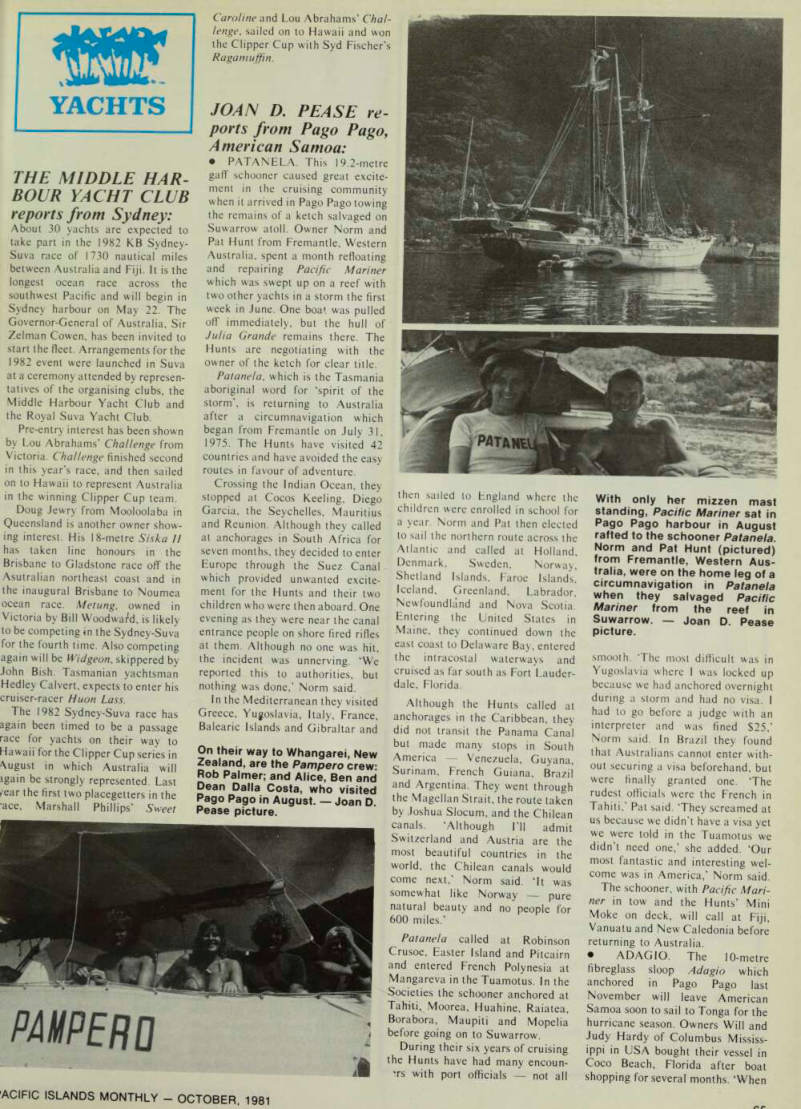
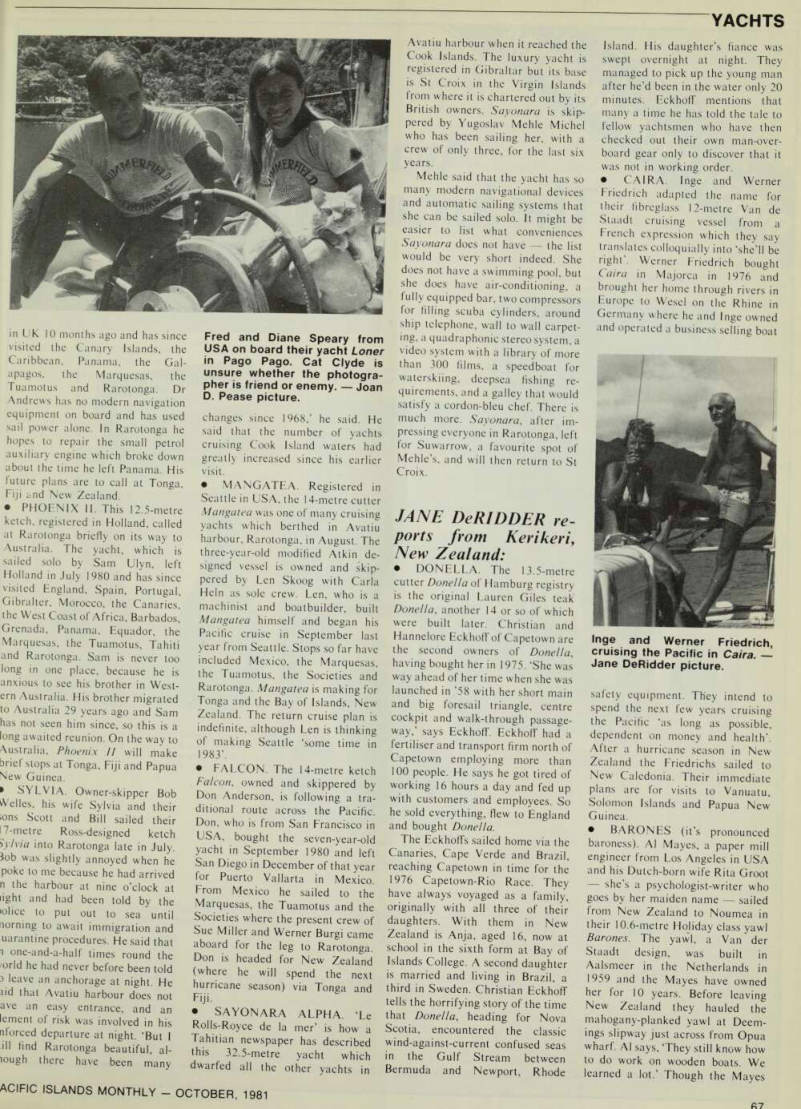

The Middle Har
Bour Yacht Club
reports from Sydney;
About 30 yachts are expected to take part in the 1982 KB Sydney- Suva race of 1730 nautical miles between Australia and Fiji. It is the longest ocean race across the southwest Pacific and will begin in Sydney harbour on May 22. The Governor-General of Australia, Sir Zelman Cowen, has been invited to start the fleet. Arrangements for the 1982 event were launched in Suva at a ceremony attended by represen tatives of the organising clubs, the Middle Harbour Yacht Club and the Royal Suva Yacht Club.
Pre-entry interest has been shown by Lou Abrahams’ Challenge from Victoria. Challenge finished second in this year’s race, and then sailed on to Hawaii to represent Australia in the winning Clipper Cup team.
Doug Jewry from Mooloolaba in Queensland is another owner show ing interest. His 18-metre Siska I! has taken line honours in the Brisbane to Gladstone race off the Asutralian northeast coast and in the inaugural Brisbane to Noumea ocean race. Metung , owned in Victoria by Bill Woodwa/d, is likely to be competing in the Sydney-Suva for the fourth time. Also competing again will be Widgeon , skippered by John Bish. Tasmanian yachtsman Hedley Calvert, expects to enter his cruiser-racer Huon Lass.
The 1982 Sydney-Suva race has again been timed to be a passage race for yachts on their way to Hawaii for the Clipper Cup series in August in which Australia will igain be strongly represented. Last the first two placegetters in the ace, Marshall Phillips’ Sweet
Caroline and Lou Abrahams’ Chal lenge >, sailed on to Hawaii and won the Clipper Cup with Syd Fischer’s Ragamuffin.
Joan D . Pease Re
ports from Pago Pago
American Samoa:
• PATANELA. This 19.2-melre gaff schooner caused great excite ment in the cruising community when it arrived in Pago Pago towing the remains of a ketch salvaged on Suwarrow atoll. Owner Norm and Pat Hunt from Fremantle, Western Australia, spent a month refloating and repairing Pacific Mariner which was swept up on a reef with two other yachts in a storm the first week in June. One boat was pulled off immediately, but the hull of Julia Grande remains there. The Hunts are negotiating with the owner of the ketch for clear title.
Patane/a, which is the Tasmania aboriginal word for ‘spirit of the storm’, is returning to Australia after a circumnavigation which began from Fremantle on July 31, 1975. The Hunts have visited 42 countries and have avoided the easy routes in favour of adventure.
Crossing the Indian Ocean, they stopped at Cocos Keeling, Diego Garcia, the Seychelles, Mauritius and Reunion. Although they called at anchorages in South Africa for seven months, they decided to enter Europe through the Suez Canal which provided unwanted excite ment for the Hunts and their two children who were then aboard. One evening as they were near the canal entrance people on shore fired rifles at them. Although no one was hit, the incident was unnerving. ‘We reported this to authorities, but nothing was done,’ Norm said.
In the Mediterranean they visited Greece, Yugoslavia, Italy, France, Balearic Islands and Gibraltar and
then sailed to England where the children were enrolled in school for a year. Norm and Pat then elected to sail the northern route across the Atlantic and called at Holland, Denmark, Sweden, Norway, Shetland Islands, Faroe Islands, Iceland, Greenland, Labrador, Newfoundland and Nova Scotia.
Entering the United States in Maine, they continued down the east coast to Delaware Bay, entered the intracostal waterways and cruised as far south as Fort Lauder dale, Florida.
Although the Hunts called at anchorages in the Caribbean, they did not transit the Panama Canal but made many slops in South America Venezuela, Guyana, Surinam, French Guiana, Brazil and Argentina. They went through the Magellan Strait, the route taken by Joshua Slocum, and the Chilean canals. ‘Although I’ll admit Switzerland and Austria are the most beautiful countries in the world, the Chilean canals would come next,’ Norm said. ‘lt was somewhat like Norway pure natural beauty and no people for 600 miles.’
Patanela called at Robinson Crusoe, Easter Island and Pitcairn and entered French Polynesia at Mangareva in the Tuamotus. In the Societies the schooner anchored at Tahiti, Moorea, Huahine, Raiatea, Borabora, Maupiti and Mopelia before going on to Suwarrow.
During their six years of cruising the Hunts have had many encoun 'rs with port officials not all
smooth. The most difficult was in Yugoslavia where I was locked up because we had anchored overnight during a storm and had no visa. I had to go before a judge with an interpreter and was fined $25,’
Norm said. In Brazil they found that Australians cannot enter with out securing a visa beforehand, but were finally granted one. The rudest officials were the French in Tahiti,’ Pat said. They screamed at us because we didn't have a visa yet we were told in the Tuamotus we didn’t need one,’ she added. ‘Our most fantastic and interesting wel come was in America,’ Norm said.
The schooner, with Pacific Mari ner in tow and the Hunts’ Mini Moke on deck, will call at Fiji, Vanuatu and New Caledonia before returning to Australia. • ADAGIO. The 10-metre
fibreglass sloop Adagio which
anchored in Pago Pago last November will leave American Samoa soon to sail to Tonga for the hurricane season. Owners Will and Judy Hardy of Columbus Mississ ippi in USA bought their vessel in Coco Beach, Florida after boat shopping for several months. ‘When
On their way to Whangarei, New Zealand, are the Pampero crew Rob Palmer; and Alice, Ben and Dean Dalla Costa, who visited Pago Pago in August. Joan D.
Pease picture.
With only her mizzen mast standing, Pacific Mariner sat in Pago Pago harbour in August rafted to the schooner Patanela.
Norm and Pat Hunt (pictured) from Fremantle, Western Aus tralia, were on the home leg of a circumnavigation in Patanela when they salvaged Pacific Mariner from the reef in Suwarrow. Joan D. Pease picture.
we decided to go cruising we got our money together, put our belongings in two cars and drove along the gulf coast to Miami. Every time we saw a mast, we stopped to inquire,’ Will said. Judy added, ‘lf I had a nickel for every boat we saw. I’d be rich.’
Through persistence they finally
found a vessel they could afford which met their needs. As luck would have it the owner had lowered the price by several thou sand dollars the day before Will and Judy looked at the sloop. ‘ln three minutes we knew it was the one we wanted,' Will said. ‘We were lucky because after lowering the price the owner took out a newspaper ad which attracted many people, but
we made a deposit right away.’
After their purchase the couple worked for a year in Miami to save money for the cruise and set sail in March 1979 calling at the
Bahamas, Haiti and Jamaica before transiting the Panama Canal. They anchored in the Perlas Islands and the Galapagos before arriving in the Marquesas. ‘Other than the Bahamas, these are the best cruis ing grounds we’ve been in,’ Will said. ‘The Marquesans were friendly, there was plenty of fruit and beautiful fishing.’
In the Tuamotus, Adagio called at Apataki and Takaroa and then sailed to Tahiti. In the Society Islands the sloop stopped at anchor ages in Moorea, Huahine, Raiatea, Tahaa and Borabora. Before arriv ing in Pago Pago, Will and Judy stopped at Suwarrow, and no other boats called during their two weeks on the atoll. • LONER. Loner is a 10.9-metre timber yawl, 42 years old, yet owners Fred and Diane Speary keep the vessel in such fine condition the age doesn’t show. The Spearys,
from USA, and their cat Clyde left Fort Lauderdale, Florida, in April 1980 for an intended circumnavi gation. They have owned the yawl for 13 years and have sailed to South America and the Caribbean, so when they left Florida they headed directly to Panama to cross the canal and sail to French
Polynesia.
They made an unscheduled stop in the Galapagos which was not the high point it usually is for yachties.
Fred had an infected tooth which a dentist extracted. Immigration officials at Wreck Bay would not give the couple the customary three-day visa but still charged them the $6O processing fee. At the dentist’s insistence, they were al lowed to stay at anchor for six hours and then continued toward the Marquesas islands. They called at Hiva Oa, Fatu Hiva, Ua Pou and Nuka Hiva.
They lost the rudder from Loner in Hiva Oa, and Fred who is a shipwright built a new one with timber he was able to buy on the island. T keep my tools aboard, so I built it in the cockpit,’ he said. The couple called at anchorages in Tahiti, Moorea, Borabora, Mopelia and Aitutaki before arriving in Pago Pago. • TRITON. The Rawson 30 sloop Triton from San Diego in USA called at Pago Pago in August.
Owners Bill and Shirley Taylor left their home port in April and made the crossing to Nuka Hiva, in the Marquesas, in 26 days. 'We knocked two days off my previous record. I singlehanded in another boat two years ago and took 28 days to the Marquesas,' Bill said. From Nuka Hiva the Taylors sailed to Tahiti where they spent several weeks and went to Moorea and Borabora. The 9.4-metre sloop then sailed to Pago Pago and is now continuing on to Fiji. How long will they cruise? Ml’s open-ended,’ said Shirley. 'We’re retired and have income properly, so we are in no rush.’
PAUL RYSA VYreports
from Rarotonga, Cook
Islands:
• ALCESTE. Named after the woman in Greek mythology whom Hercules rescued from hell, this
25-year-old 10-metre Buchanan
sloop sailed in to Rarotonga in late
July. Skipper-owner Dr Ronald
Andrews said he was particularly pleased to be visiting Rarotonga again. Ten years ago he made a brief call at Rarotonga when he was doing a circumnavigation in a yacht called Merlin. He is accompanied on his present cruise by Jill Bannerman and her 14-year-old son Matthew. The sloop left Plymouth
Judy and Will Hardy. They plan to shelter Adagio in Tonga for the hurricane season.-Joan D.
Pease picture.
in UK 10 months ago and has since visited the Canary Islands, the Caribbean, Panama, the Gal apagos, the Marquesas, the Tuamotus and Rarotonga. Dr Andrews has no modern navigation equipment on board and has used sail power alone. In Rarotonga he hopes to repair the small petrol auxiliary engine which broke down about the time he left Panama. His future plans are to call at Tonga, Fiji and New Zealand. • PHOENIX 11. This 12.5-metre ketch, registered in Holland, called at Rarotonga briefly on its way to Australia. The yacht, which is sailed solo by Sam Ulyn, left Holland in July 1980 and has since visited England, Spain, Portugal, Gibraller, Morocco, the Canaries, the West Coast of Africa, Barbados, Grenada, Panama, Equador, the Marquesas, the Tuamotus, Tahiti and Rarotonga. Sam is never too long in one place, because he is anxious to see his brother in West ern Australia. His brother migrated to Australia 29 years ago and Sam has not seen him since, so this is a long awaited reunion. On the way to Australia, Phoenix // will make brief slops at Tonga, Fiji and Papua New Guinea.
► SYLVIA. Owner-skipper Bob
Welles, his wife Sylvia and their '°ns Scott and Bill sailed their
17-melre Ross-designed ketch
Sylvia into Rarotonga late in July.
Sob was slightly annoyed when he poke to me because he had arrived n the harbour at nine o’clock at light and had been told by the •olice to put out to sea until aorning to await immigration and uaranline procedures. He said that i one-and-a-half times round the '°rld he had never before been told 3 leave an anchorage at night. He lid that Avatiu harbour does not ave an easy entrance, and an lement of risk was involved in his aforced departure at night. ‘But I ill And Rarotonga beautiful, al iough there have been many
changes since 1968,’ he said. He said that the number of yachts cruising Cook Island waters had greatly increased since his earlier visit. • MANGATEA. Registered in Seattle in USA, the 14-metre cutter Mangatea was one of many cruising yachts which berthed in Avatiu harbour, Rarotonga, in August. The three-year-old modified Atkin de signed vessel is owned and skip pered by Len Skoog with Carla Hein as sole crew. Len, who is a machinist and boatbuilder, built Mangatea himself and began his Pacific cruise in September last year from Seattle. Stops so far have included Mexico, the Marquesas, the Tuamotus, the Societies and Rarotonga. Mangatea is making for Tonga and the Bay of Islands, New Zealand. The return cruise plan is indefinite, although Len is thinking of making Seattle ‘some time in 1983’. • FALCON. The 14-metre ketch Falcon , owned and skippered by Don Anderson, is following a tra ditional route across the Pacific.
Don, who is from San Francisco in USA, bought the seven-year-old yacht in September 1980 and left San Diego in December of that year for Puerto Vallarta in Mexico.
From Mexico he sailed to the Marquesas, the Tuamotus and the Societies where the present crew of Sue Miller and Werner Burgi came aboard for the leg to Rarotonga.
Don is headed for New Zealand (where he will spend the next hurricane season) via Tonga and Fiji.
• Sayonara Alpha. ‘Le
Rolls-Royce de la mer’ is how a Tahitian newspaper has described this 32.5-metre yacht which dwarfed all the other yachts in
Avatiu harbour when it reached the Cook Islands. The luxury yacht is registered in Gibraltar but its base is St Croix in the Virgin Islands from where it is chartered out by its British owners. Sayonara is skip pered by Yugoslav Mehle Michel who has been sailing her, with a crew of only three, for the last six years.
Mehle said that the yacht has so many modern navigational devices and automatic sailing systems that she can be sailed solo. It might be easier to list what conveniences Sayonara does not have the list would be very short indeed. She does not have a swimming pool, but she does have air-conditioning, a fully equipped bar, two compressors for filling scuba cylinders, around ship telephone, wall to wall carpet ing, a quadraphonic stereo system, a video system with a library of more than 300 films, a speedboat for
waterskiing, deepsea fishing re
quirements, and a galley that would satisfy a cordon-bleu chef. There is much more. Sayonara , after im pressing everyone in Rarotonga, left for Suwarrow, a favourite spot of Mehle s, and will then return to St Croix.
Jane Deridder Re
ports from Kerikeri
New Zealand:
• DONELLA. The 13.5-metre cutter Done 11 a of Hamburg registry is the original Lauren Giles teak Done!la, another 14 or so of which were built later. Christian and Hannelore Eckhoflf of Capetown are the second owners of Donella, having bought her in 1975. ‘She was way ahead of her time when she was launched in ’5B with her short main and big foresail triangle, centre cockpit and walk-through passage way,’ says Eckhoflf. Eckhoflf had a fertiliser and transport firm north of
Capetown employing more than
100 people. He says he got tired of working 16 hours a day and fed up with customers and employees. So he sold everything, flew to England and bought Donella.
The Eckhoflfs sailed home via the Canaries, Cape Verde and Brazil, reaching Capetown in time for the
1976 Capetown-Rio Race. They
have always voyaged as a family, originally with all three of their daughters. With them in New Zealand is Anja, aged 16, now at school in the sixth form at Bay of Islands College. A second daughter is married and living in Brazil, a third in Sweden. Christian Eckhoflf tells the horrifying story of the time that Donella, heading for Nova Scotia, encountered the classic wind-against-current confused seas in the Gulf Stream between Bermuda and Newport, Rhode
Island. His daughter’s fiance was swept overnight at night. They managed to pick up the young man after he’d been in the water only 20 minutes. Eckhoff mentions that many a time he has told the tale to fellow yachtsmen who have then checked out their own man-over board gear only to discover that it was not in working order. • CAIRA. Inge and Werner Friedrich adapted the name for their fibreglass 12-metre Van de Staadt cruising vessel from a French expression which they say translates colloquially into ‘she'll be right Werner Friedrich bought Cairo in Majorca in 1976 and brought her home through rivers in Europe to Wescl on the Rhine in Germany where he and Inge owned and operated a business selling boat
safety equipment. They intend to spend the next few years cruising the Pacific ‘as long as possible, dependent on money and health’.
After a hurricane season in New Zealand the Friedrichs sailed to New Caledonia. Their immediate plans are for visits to Vanuatu, Solomon Islands and Papua New Guinea. • BARONES (it’s pronounced baroness). A 1 Mayes, a paper mill engineer from Los Angeles in USA and his Dutch-born wife Rita Groot she’s a psychologist-writer who goes by her maiden name sailed from New Zealand to Noumea in their 10.6-metre Holiday class yawl Barones. The yawl, a Van der Staadt design, was built in Aalsmeer in the Netherlands in 1959 and the Mayes have owned her for 10 years. Before leaving New Zealand they hauled the mahogany-planked yawl at Deem ings slipway just across from Opua wharf. Al says, ‘They still know how to do work on wooden boats. We learned a lot. Though the Mayes
Fred and Diane Speary from USA on board their yacht Loner in Pago Pago. Cat Clyde is unsure whether the photogra pher is friend or enemy.- Joan D. Pease picture.
Inge and Werner Friedrich, cruising the Pacific in Caira.
Jane DeRidder picture.
have now been cruising for three years and have spent two summers in New Zealand, they say that it seems as if they’ve only just got started. Meanwhile they intend to hang on to their New Zealand charts, just in case.
• Wanderlure. This
schooner built by John Aldin in 1923, and belonging to Art Hammond of Green Valley in Arizona, USA, continues to wander through the islands of the South Pacific. Mamie Putt, a New Zealander, is sharing Wanderlure's
adventures with Art. Art, a one time electrical contractor, has been cruising in Wanderlure for 20 years.
Before coming to the South Pacific, Wanderlure cruised Central America, South America and the Caribbean. Art paused for some time in Panama where he worked for the Panama Canal Company and where he refitted and redecked the schooner. Art enjoys poking around out of the way places, the seldom visited Kermadecs for in stance, and has cruised more off beat islands than most other long time cruisers. They recently re cuperated from a rough passage to Noumea. Plans are to continue on to Vanuatu. That will be a fourth visit in as many years. • POLARIS is an unusual-looking ketch with its two fibreglass sport fishing outrigger poles hanging out five metres each side of the main mast like a giant insect’s antennae.
They are supports for a 20-metre dipole antenna hoisted on the main halyard. John and Nancy Alex ander talk to their family regularly by means of ham radio from wherever they happen to be. A son and son-in-law are both amateur radio operators. John and Nancy sailed as far as New Zealand which they visited for two successive sum mers. They are now on the last leg of their return trip to the US west coast via Aitutaki, Tahiti and Hawaii. Alexander, an aeronautical engineer, retired early from Boeing.
He and his wife left on their Seattle registered CT4I for their Pacific cruise just a month after his retire ment. John would like to start a consulting business when he gets back, using his mathematical back ground and cruising experience. ‘We could have used such a service when we were fitting out,’ he said. • GLAYVA. This powerful 15-metre British yacht made the passage from Opua, in New Zea land, to Suva in just seven days. She left in mid-July with strong winter
southerlies to speed her on her way.
Glayva, (the name of a fine Scottish liqueur) is a Ted Hood design fibreglass vessel which Tony Hallsworth of Lancaster completed himself, then singlehanded to New Zealand four years ago. No longer a solo sailor, Tony sailed from Kerikeri, his base for the past few years, with his Tokyo born wife Miwako(Mia), and his 17-monthold son Douglas, born in New Zealand. Ken Hart of Kerikeri also made the trip to Suva to gain experience in offshore voyaging.
First mate Mia is an experienced blue water voyager. She made the trip from Los Angeles to New Zealand four years ago in the 15-metre steel ketch Polack. She and Tony met in several ports along their shared route, including Rarotonga and Suva. Tony, a gunsmith by trade, has worked at a variety of jobs during his stay in New Zealand. He built the Kerikeri Stone Store Tearooms, and skippered the Kerikeri River sightseemg launch, Ernest Kemp. After several weeks in Fiji, Tony and Mia intend to island-hop through Kiriban, the Marshalls, the Carolines and the Marianas, hoping to arrive in Japan by May. They will first head up to Japan’s Inland Sea.
Glayva will probably spend two summers in Japan before returning to Kerikeri in four years for Douglas to start school. • POLETTE. Basil and Nancy, Campion left Auckland on their 12-melre steel ketch Polette in early May bound for Indonesia. Basil, owner of an Auckland engineering firm, built Polette after completing a circumnavigation on his previous much larger steel ketch, Polack.
Mia Hallsworth sailed in Polack from Los Angeles. The Hallsworths and the Campions recently cruised together again when Glayva and Polette spent New Year together in Whangaroa Harbour in Northland, New Zealand. • MAKANI. Captain John Littler and his wife Elizabeth, both orig inally from Canada, sailed their Formosa 41 Sea Tiger Makani from Opua in New Zealand to Lautoka in Fiji. With them was Ashley Bain formerly of Suva. The Canadian couple made the same passage some years ago when they sailed their 13-metre catamaran Doubloon to Fiji. They cruised there for many months and later sold Doubloon to take up citrus growing in Kerikeri, New Zealand, Captain Littler, who retired from the Royal Canadian Navy with the
Rita Groot and Al Mayes along side the 10 m yawl Barones.- Jane DeRidder picture.
[?]ritish yacht Glayva : Opua to [?]uva in just seven days. Basil tampion picture.
rank of commodore, was at one time captain of the cruiser Ontario.
Ashley Bain too has strong ties with the sea for his Danish Emberson ancestors include seafarers and ship builders. The last boat that his grandfather built was the Kadavu Leva. Friends and family in Tonga and Fiji will be interested to learn that Ashley has returned to the UK to complete his degree in econ omics. The Littlers will spend several months once again enjoying cruising in Fijian waters. Liz says ‘We have really had a rousing welcome from everyone here in fact it feels like coming home.’
Michael Prain Re
ports from Port
Moresby , Papua New
Guinea:
• KETCH-UP. An Australian radio amateur 3000 kilometres away stayed on duty in his station for 19 hours in August supervising the rescue of six people from the 16-metre US ketch Ketch-up which was a total loss after striking a reef between Papua New Guinea and Australia. The ham operator, Don Reimann, in Perth, Western Austra lia, heard the ketch’s mayday at night. He established radio contact and maintained calls every 30 minutes while a PNG Defence Force patrol boat went to the yacht on Portlock Reef in the Torres Strait region. The rescue bid was put into operation after Reimann alerted Australian marine authorities who then contacted
Png.
Reimann stayed in contact with the owner-skipper of the grounded yacht, Boris Levin, a retired doctor from Los Angeles USA, until the patrol boat Madang arrived at the reef. Landed later in Port Moresby Dr Levin said ‘The man on the radio was a fantastic guy he saved our lives. Anything could have hap pened to us if we had stayed on that reef.’
Ketch-up earlier had sailed north
to PNG along the Australian east coast, and was making for northern Australia out of Port Moresby when the grounding occurred in darkness.
On board with Dr Levin was his wife Barbara, an American man and woman, an Englishman and a Swiss woman. They salvaged some of their personal belongings, but little else. Efforts by the yacht’s crew and sailors from the patrol boat to haul the yacht from the reef by using anchors and winches failed. At one stage, the patrol
boat’s aluminium dinghy tipped,
spilling its crew into the water. The
yacht was eventually pushed off the
reef by rough seas and into water about 70 metres deep.
A Port Moresby salvage expert who later went to the reef in a
tugboat reported that the yacht was
beyond saving. Dr Levin had owned it for nine years and had cruised to the Pacific Islands, Central America, Australia and New Zea land.
Peter Mcquarrie
reports from Funafuti ,
Tuvalu:
• Dayspring 111 The
22.5-metre Dayspring 111 was a recent visitor to Funafuti from Suva. This interesting yacht is an all-steel ketch, and its masts and main boom are also of steel. Day spring is sailed by Ron and Aggie Russell who sell Christian literature throughout the islands. They are accompanied by a crew of seven.
The Russells visited Tuvalu in 1973 in the smaller ferrocement Day spring I and called at seven of the nine islands of the Tuvalu group.
This visit they also hope to include Nukulaelae which was missed last time. Dayspring is carrying bibles for the Bible Society in the South Pacific.
Liz Littler, Captain John Littler and Ashley Bain about to leave Opua in the 13 m ketch Makani. -Jane DeRidder picture.
Advertisements & other items, pp. 65-70 (3 items)
Acific Islands Monthly October, 1981
Australian
s(
PROFIT FROM
PRODUCTS
The latest range
of Australian Product Data Sheets
available FREE
n.n 8 'Of SN Free to Importers, Distributors, Wholesalers, Retailers The Australian Export Black Box is a product literature system located in all Australian Trade Commissioner’s offices around the world. It will give you free of charge data sheets with information on specific Australian products. Including manufacturer’s name and address, product range, specifications and performance, warranty, delivery time etc . . .
Australia’s most energetic and innovative exporters are represented in the Black Box with products ranging from Solar heaters, quarry and mine plants to pasture seeds and bakery ingredients.
The Australian Export Black Box is an Exportad Pty Ltd project.
Telephone, write or visit The Australian Trade Commissioner.
AVAILABLE AT THE OFFICE OF THE
AUSTRALIAN TRADE COMMISSIONER.
FIJI: Australian High Commission, Trade Office, 7th Floor, Dominion House, Thomson Street, Suva.
Telephone 31 2844, 31 2319 PAPUA NEW GUINEA: Australian High Commission, Waigani.
Telephone 25 9333 NEW ZEALAND: Australian High Commission, 72-78 Hobson Street, Thorndon, Wellington.
Telephone 73 6411 Australian Consulate General, 9th Floor, Lome Towers, 10 Lome Street, Auckland.
Teleohone 32 429
Available at last!
The luxury of jergens
Three delicately scented soaps with the total freshness of nature.
Deepjrleansing clear soap for problem Glycerine. skin. Contains
tea
Gentle Touch Soaps, in three colours, with the soothing good ness of Baby Oil. m ■Mt 552?» «s> M
ens
DRYAD DEODORANTS.
With the lasting springtime fresh fra grance. Available in aerosol, stick anc roll-on.
The wonderful young shampoo and conditioner that leave your hair with a soft delicate fragrance for hours. "Gee, your hair smells terrific!"
Hand and body lotions to enrich dry skin, jergens White and jergens Yellow, the extra nourishment for extra-dry skin.
Also available: jergens Lotion-mild soap.
The Andrew jergens Company is proud to be able to bring this superb range of products direct from America to you. Look for these products at your favorite store when next you go shopping.
TRADE ENQUIRIES WELCOME
MANUFACTURED BY: THE ANDREW JERGENS Co. Cincinnati, U.S.A.
Distributed by: S. E. Tatham, Melbourne, Australia. 3SS2
OD-IM-AIWO HOTEL
NAURU
SERVICE IS OUR BUSINESS
WALKIIMU DISTANCE
TO: Airport, boat harbour, China Town, hospitals, church post office, bank, cinema, supermarket, book shop, restaurants football ovals Taxis and car hire available
OD-IM-AI WO HOTEL, NAURU
TEL 3591. TELEX; AIWOHTL ZV33093
WITh
BAITI V
ANABAR '
\UABOE
/ f \
/ I DENIG V
ANIBARE I /
Phosphate fields I I
BUADA
\ lAIWO
i meneng Airport i
WATER WHEEL EXPORTS
Pty. Ltd.
493 Bourke Street, Melbourne, 3000, Australia Cables: Watermill-Melbourne.
Telex: AA 32165 Telephone: 602 1433
THE WATER WHEEL GROUP OF COMPANIES
Winners of Australia’s Top Export Award and Flour Millers for over 100 years. (High Protein, Bakers, Stone ground Wholemeal, Donut).
COOLROOMS REFRIGERATED
CABINETS ETC.
INCLUDING SALTWATER
ICE MAKERS
STOCK & POULTRY FEEDS
YELLOW SPLIT PEAS &
WHOLE PEAS
COMPLETE RANGE OF FROZEN
AND GENERAL FOOD ITEMS
QUALITY AUSTRALIAN
WINES
WOOD FUEL STOVES
AND WATER HEATERS
BEST AUSTRALIAN
WHEATEN FLOUR
(Pellets or Mash form) (Machine-Dressed)
67
YACHTS
ACIFIC ISLANDS MONTHLY OCTOBER, 1981
Crossing the Pacific
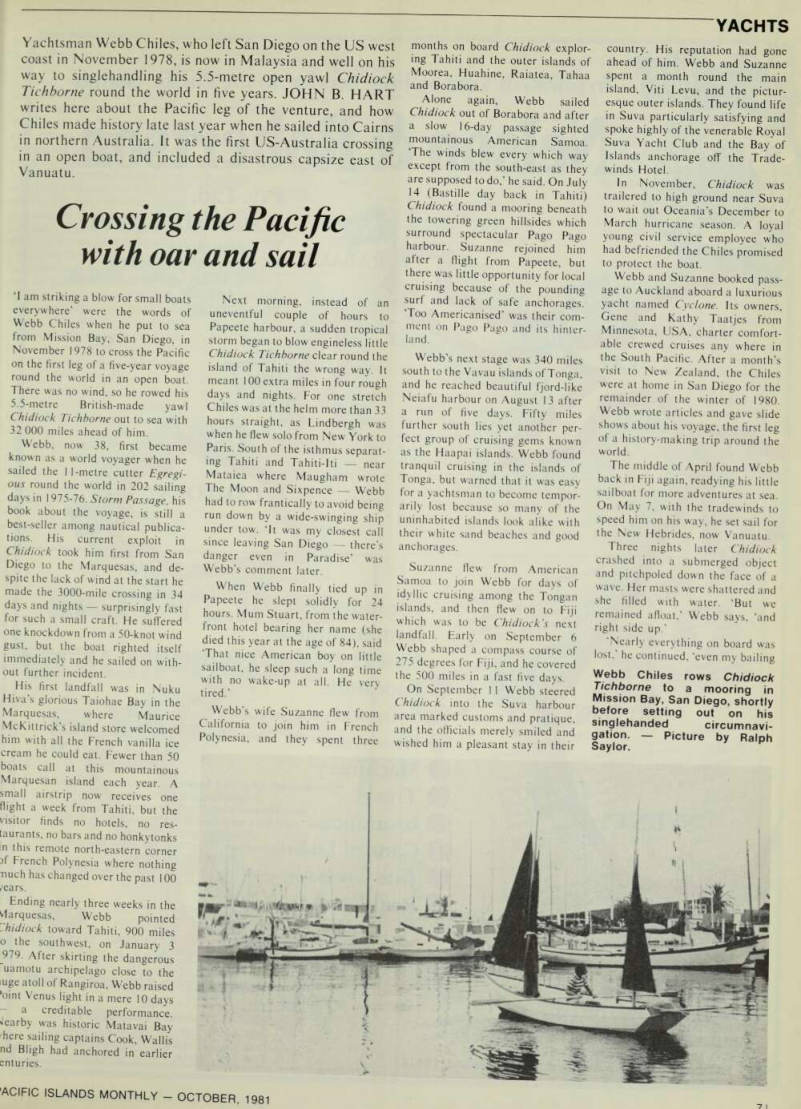

with oar and sail
Yachtsman Webb Chiles, who left San Diego on the US west coast in November 1978, is now in Malaysia and well on his way to singlehandling his 5.5-metre open yawl Chidiock Tichborne round the world in five years. JOHN B. HART writes here about the Pacific leg of the venture, and how Chiles made history late last year when he sailed into Cairns in northern Australia. It was the first US-Australia crossing in an open boat, and included a disastrous capsize east of Vanuatu.
‘I am striking a blow for small boats everywhere’ were the words of Webb Chiles when he put to sea from Mission Bay, San Diego, in November 1978 to cross the Pacific on the first leg of a five-year voyage round the world in an open boat.
There was no wind, so he rowed his 5.5-metre British-made yawl Chidiock Tichborne out to sea with 32 000 miles ahead of him.
Webb, now 38, first became known as a world voyager when he sailed the 11-metre cutter Egregi ous round the world in 202 sailing days in 1975-76. Storm Passage, his book about the voyage, is still a best-seller among nautical publica tions. His current exploit in Chidiock took him first from San Diego to the Marquesas, and de spite the lack of wind at the start he made the 3000-mile crossing in 34 days and nights surprisingly fast for such a small craft. He suffered one knockdown from a 50-knot wind gust, but the boat righted itself immediately and he sailed on with out further incident.
His first landfall was in Nuku Hiva’s glorious Taiohae Bay in the Marquesas, where Maurice McKittrick’s island store welcomed him with all the French vanilla ice cream he could eat. Fewer than 50 boats call at this mountainous Marquesan island each year. A small airstrip now receives one flight a week from Tahiti, but the visitor finds no hotels, no res taurants, no bars and no honkytonks n this remote north-eastern corner
)f French Polynesia where nothing
nuch has changed over the past 100 I'ears.
Ending nearly three weeks in the Marquesas, Webb pointed Chidiock toward Tahiti, 900 miles o the southwest, on January 3 979. After skirting the dangerous uamotu archipelago close to the uge atoll of Rangiroa, Webb raised ‘oint Venus light in a mere 10 days - a creditable performance.
Jearby was historic Matavai Bay 'here sailing captains Cook, Wallis nd Bligh had anchored in earlier enturies.
Next morning, instead of an uneventful couple of hours to Papeete harbour, a sudden tropical storm began to blow engineless little Chidiock Tichborne clear round the island of Tahiti the wrong way. It meant 1 00 extra miles in four rough days and nights. For one stretch Chiles was at the helm more than 33 hours straight, as Lindbergh was when he flew solo from New York to Paris. South of the isthmus separat ing Tahiti and Tahiti-Iti near Mataiea where Maugham wrote The Moon and Sixpence Webb had to row frantically to avoid being run down by a wide-swinging ship under tow. k lt was my closest call since leaving San Diego there’s danger even in Paradise’ was Webb’s comment later.
When Webb finally tied up in Papeete he slept solidly for 24 hours. Mum Stuart, from the water front hotel bearing her name (she died this year at the age of 84), said That nice American boy on little sailboat, he sleep such a long time with no wake-up at all. He very tired.’
Webb’s wife Suzanne flew from California to join him in French Polynesia, and they spent three
months on board Chidiock explor ing Tahiti and the outer islands of Moorea, Huahine, Raiatea, Tahaa and Borabora.
Alone again, Webb sailed Chidiock out of Borabora and after a slow 16-day passage sighted mountainous American Samoa.
The winds blew every which way except from the south-east as they are supposed to do,’ he said. On July 14 (Bastille day back in Tahiti) Chidiock found a mooring beneath the towering green hillsides which surround spectacular Pago Pago harbour. Suzanne rejoined him after a flight from Papeete, but there was little opportunity for local cruising because of the pounding surf and lack of safe anchorages.
Too Americanised’ was their com ment on Pago Pago and its hinter land.
Webb’s next stage was 340 miles south to the Vavau islands of Tonga, and he reached beautiful fjord-like Neiafu harbour on August 13 after a run of five days. Fifty miles further south lies yet another per fect group of cruising gems known as the Haapai islands. Webb found tranquil cruising in the islands of Tonga, but warned that it was easy for a yachtsman to become tempor arily lost because so many of the uninhabited islands look alike with their white sand beaches and good
anchorages.
Suzanne flew from American Samoa to join Webb for days of idyllic cruising among the Tongan islands, and then flew on to Fiji which was to be Chidiock’s next landfall. Early on September 6 Webb shaped a compass course of 275 degrees for Fiji, and he covered the 500 miles in a fast five days.
On September I 1 Webb steered
Chidiock into the Suva harbour area marked customs and pratique, and the officials merely smiled and wished him a pleasant stay in their
country. His reputation had gone ahead of him. Webb and Suzanne spent a month round the main island, Viti Levu, and the pictur esque outer islands. They found life in Suva particularly satisfying and spoke highly of the venerable Royal Suva Yacht Club and the Bay of Islands anchorage off the Trade winds Hotel.
In November, Chidiock was trailered to high ground near Suva to wait out Oceania’s December to March hurricane season. A loyal young civil service employee who had befriended the Chiles promised to protect the boat.
Webb and Suzanne booked pass age to Auckland aboard a luxurious yacht named Cyclone. Its owners.
Gene and Kathy Taatjes from Minnesota, USA, charter comfort able crewed cruises any where in the South Pacific. After a month’s visit to New Zealand, the Chiles were at home in San Diego for the remainder of the winter of 1980.
Webb wrote articles and gave slide shows about his voyage, the first leg of a history-making trip around the world.
The middle of April found Webb back in Fiji again, readying his little sailboat for more adventures at sea.
On May 7, with the tradewinds to speed him on his way, he set sail for the New Hebrides, now Vanuatu.
Three nights later Chidiock crashed into a submerged object and pitchpoled down the face of a wave. Her masts were shattered and she filled with water. ‘But we remained afloat,’ Webb says, ‘and right side up.' Nearly everything on board was lost, he continued, ‘even my bailing
Webb Chiles rows Chidiock Tichborne to a mooring in Mission Bay, San Diego, shortly before setting out on his singlehanded circumnavi gation. Picture by Ralph Saylor.
bucket was torn out of its handle.’
Some $4500 worth of gear went over the side sextant, radio direction finder, food, clothing, charts, compass, and a new type writer. Somehow Webb inflated his Whaler raft, climbed in with emerg ency rations, and tied himself, the dinghy, and his boat all together to
await daylight.
The flimsy flotilla drifted ever so slowly for two weeks on a one-knot current 300 miles to safety. ‘From our position on the night of the collision,’ Chiles remembers, ‘the direction and rate of drift were what I expected.’ But he cut food to the bare minimum for survival just in case he missed his hoped-for land fall in southern Vanuatu. The next land lay a long, lonely 2000 miles beyond. So Webb’s skimpy diet consisted of four biscuits for break fast, a vitamin pill for lunch, half a can of tuna for supper, and six sips of water during the day.
When finally found by kindly residents of the remote island of Emae, Webb was huddled under a soggy blanket beside his liferaft on a beach. They saw to it that he was flown by Air Melanesia 50 miles to Port-Vila’s small but modern hos pital. Doctors found symptoms of malnutrition and exhaustion, plus a minor skin infection on his hands and feet. But luckily Chiles suffered
no lasting health problems as a result of his harrowing experience.
Recuperating at the home of his wife’s parents in New Zealand, Webb ordered repair parts for Chidiock from England and made plans for returning to his open-boat circumnavigation as soon as poss ible. Because he had been harbour bound for so long making ready to set sail again after the bad luck, Chiles felt ‘bogged down’ in the South Pacific Islands. So on October 9, 1980, he embarked on a bold passage straight across the Coral Sea to Cairns, some 1500 miles westward.
Since Chidiock had been towed
from Emae to Port-Vila for refitt ing, Webb swung north again to cross the track he followed while drifting in May. He wanted to make certain the epic voyage around the world continued without a break in course, and by sail preferably but with oars when necessary. After two years and thousands of miles at sea, Father Neptune allowed a ‘fast, smooth, comfortable trip’ toward a huge, easy-to-find target the obliging continent of Australia. In fact, during the first 8 days and 1000 miles of true tradewind sailing Webb never had to touch a line or trim a sail.
A noon sight on October 23 put
Chidiock only 60 miles off the outer edge of the Great Barrier Reef, and about 30 miles south of Cairns. By evening, navigation lights became visible as the tiny yawl made for Fitzroy Island. Within 10 miles of Cairns itself, Webb finally saw the famous reef (or parts of it) beneath his keel for the first time. ‘Why not anchor for the night right here?’ he asked himself. The water is shallow, the moon bright, the sea smooth. And the coastal forecast is for calm conditions.’
After Webb furled his sails and raised the centreboard, Chidiock went aground briefly on a falling tide. So land, at least the coral kind, was actually reached only 15 days out of Port-Vila.
It took him all the following day to reach an anchorage near the aboriginal mission in the lee of Cape Grafton, and every single breath of air was utilised. Then Sunday October 26 was truly a day of rest with no wind at all. Even on Monday, Webb had to row halfway to Cairns before finding a helpful sea breeze to carry him in to port.
About noon, after convincing harbour officers he had actually arrived from a foreign country, Webb telephoned Suzanne. She was already with friends in Brisbane, further south on the coast, awaiting his call.
Advertisements & other items, pp. 71-74 (3 items)
71
YACHTS
ACIFIC ISLANDS MONTHLY - OCTOBER, 1981
Nelson & Robertson
In our 87th Year Selling ‘Service’ to the Pacific Islands
Pty. Ltd.
KIETA
o 'P -o 2 H O if > m V. 6/ o
RABAUL
• • i
MADANG
• ••• LA • .* ...• • • ■
BRISBANE
SYDNEY
*V.« • v.*> ■
(Established 1895)
Plantation House, 197 Clarence Street, Sydney.
Cables: ‘IVAN’, Sydney, Brisbane.
Telex: AA22381, Sydney.
Phone: 29 2871 •••*«
LAUTOKA
** * * * *** •••*••*•!• ;••!• •••%*•• *«r* •••**
For Indents - Sl^^
from Australia,
New Zealand and
Foodstuffs
Softgoods
Hardware
Machinery
Travel
Insurance
Canned Fish
Jute Goods
Real Estate
iiStVA
••• .v./.v;;:.*: ,* •
BRANCH OFFICES.
• ••• uc • ••*« ••• !.* • • ND Nelson & Robertson Pty. Ltd., P.O. Box 575, Brisbane, Qld., Australia. 2216966 P.O. Box 2092, Govt. Bldg., Suva, Fiji. 22430 P.O. Box 258, Lautoka, Fiji. 62101 P.O. Box 2420, CPO Auckland 1, New Zealand. 774141
.{jj'fPAPUA NEW GUINEA REPRESENTATIVES:
fllhtraH NiMfini Pty. Ltd., P 0. Bodmi, Rabaul, P.N.G. 922911 PB. Box 1406, Lae, P.N.G. 422366 AO. Box 711, Madang, P.N.G. 822066 P.O. Box 253, Kieta, P.N.G. 956185
rence a \Co^ er "O'® eat w e ico^ u SbU^ c * tfiW'SVi'to xe a ° d . (oof"' a 0t '°* 1 e< ef> c ° ooV' c 'l' OS®’ v , 0 develoP ed
oa,vA7 ' ’ -^s^^
rase sW^m'rrJunic 3 ''"'^^ 5 O'- ic,\e\ec°''V e \ecO'
a^t sa
* Ma'' a L pa *e< s \e^ e '" .island 5
XSeSB&ggSS*
?S^j£<;<Sg>
intern 19 .pape r ; Da ,iy poLJ nqU et
tssss** 0
BOTTLING
EQUIPMENT
SUPPLIERS
Manufacturers and suppliers of spare parts for the progressive range of bottling equipment.
Complete reconditioning or parts reconditioned Sale of reconditioned and second-hand machinery, also general bottling equipment.
Design and manufacture of bottle conveyor systems to suit your application.
Comprehensive tervie. throughout Auetrelie, New Z.elend, New Coin., end South Pacific Islands FOOD-TEX machinery
SERVICE PTY. LTD.
11 MARSH ST., GRANVILLE 2142. PHONE 682-1488 (2 lines).
P.O. Box 146, Carlingford 2118.
Sydney, Australia.
Phone: 682 1488 (2 lines) South Pacific Agents: ALFR M E ;ir ENCE & C °-' AUCK LAND. NEW ZEALAND Ma.l Address. P.O. Box 732. Auckland, New Zealand
TATHAM LIMITED
Bringing the world’s best
/>/ cT MiißM r/. 1 - ■ iM household of Mrs Brite Tatham Limited are exclusive distributors cleaners, in the Pacific Islands, USA, Japan All 100% product non-aerosol, pump packs available as economical refills too!
Mrs Brite Pre-Wash Stain Remover Mrs Brite Toilet Bowl Cleanser Mrs Brite Spray ‘n* Iron Mrs Brite Household Deodorant Spray Mrs Brite Multi Purpose Cleaner plus 3 exciting Mrs Brite washday products!
Mrs Brite Laundry Powder Mrs Brite Cold Water Wash Liquid Mrs Brite Woolsoft Liquid Plus Tatham Limited brings you the world's best ... share in the order Mrs Brite now! and Asia
LNOtfPOMO
0
profits
TATHAM LIMITED
Siroi<>ffaW S i iwi i
" 4 ft ■ •ft ■ ■ ■ • ■
Yachts
ACIFIC ISLANDS MONTHLY OCTOBER, 1981
Ships
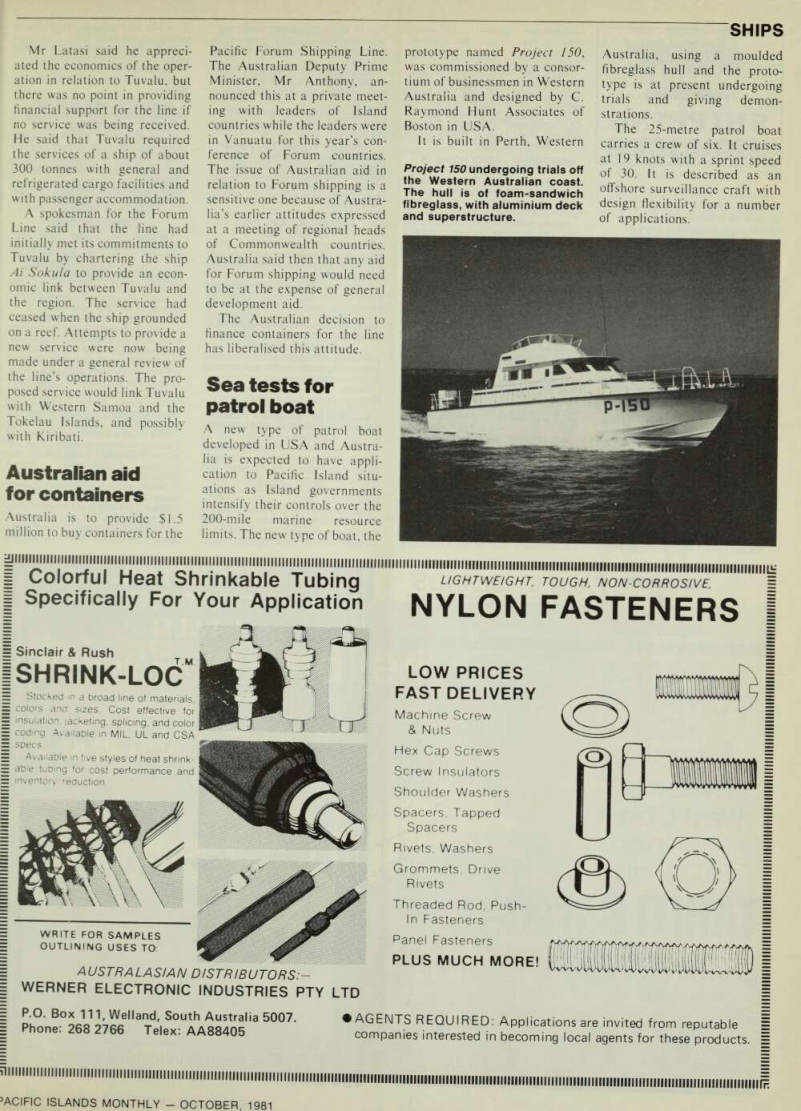
New plans for
PNG shipping
The financially-troubled Papua New Guinea Shipping Corpor ation is entering an arrange ment with Bougainville Copper Limited to provide an export service for PNG products to the USA west coast. The corpor ation will use BCL-chartered vessels to provide the shipping space needed for USA ship ments, mainly made up of coffee, cocoa and specialised timber.
The arrangement follows what the corporation describes as its ‘disastrous venture’ into operating a service to the USA.
The service was operated last year and early this year by the freighter Niugini Chief , but each voyage was operated at a loss and contributed to the liquidity problems which the
line now faces. The corporation reported in September that the charter of Niugini Chief had concluded, and a careful study was being made of overseas and coastal operations to increase efficiency, establish a profit situation and provide essential import and export services. The new arrangement for handling exports to USA under agree ment with Bougainville Copper was expected to contribute to these aims. The first voyage under the new arrangements has already been made by the freighter Zep Hunter.
The PNG Shipping Corpor
ation is a locally-based organis ation established with govern ment backing to involve PNG equity in overseas shipping and in coastal services. The oper ation is considered to be financially sound in the long term, but at June this year the corporation and its subsidiaries had an accumulated loss of about $5OO 000 and the corpor ation was forced to come to arrangements with its creditors because of liquidity problems.
The directors held a series of conferences in September to review operations, and during
October they plan to put before creditors a plan which they believe will allow the corpor ation to trade out of its difficulties. Legal negotiations indicate that the plan is likely to be accepted, and the corpor ation believes it can return to an earning situation by the end of this year.
Tug and salvage operations carried out by the corporation may be closed down as a result of the current review, or the corporation may enter into a joint arrangement with another operator.
Meanwhile the PNG Trans port Minister, Mr Okuk, has expressed confidence in the ability of the corporation to retrieve its financial situation.
Tuvalu concern
over shipping
Tuvalu is becoming increas ingly concerned at a lack of shipping services for passengers and cargoes and is threatening to withdraw from the Pacific Forum Line if the line is unable to provide a service. Tuvalu is one of the member countries of the line and has made financial
contributions under a formula agreed to by the member countries.
The Forum Line earlier pro vided a charter service to Tuvalu, but the size of the ships now operated by the line makes it uneconomic to call there because of the comparatively small value of trade. Tuvalu’s High Commissioner in Fiji, Mr Kamuta Latasi, said recently that he had been instructed to formally indicate that his country would leave the line if a shipping service could not be provided.
Mr Latasi said he appreci ated the economics of the oper ation in relation to Tuvalu, but there was no point in providing financial support for the line if no service was being received.
He said that Tuvalu required the services of a ship of about 300 tonnes with general and refrigerated cargo facilities and with passenger accommodation.
A spokesman for the Forum Line said that the line had initially met its commitments to Tuvalu by chartering the ship Ai Sokula to provide an econ omic link between Tuvalu and the region. The service had ceased when the ship grounded on a reef. Attempts to provide a new service were now being made under a general review of the line’s operations. The pro posed service would link Tuvalu with Western Samoa and the Tokelau Islands, and possibly with Kiribati.
Australian aid
for containers
Australia is to provide $1.5 million to buy containers for the
Pacific Forum Shipping Line.
The Australian Deputy Prime Minister, Mr Anthony, an nounced this at a private meet ing with leaders of Island countries while the leaders were in Vanuatu for this year’s con ference of Forum countries.
The issue of Australian aid in relation to Forum shipping is a sensitive one because of Austra lia’s earlier attitudes expressed at a meeting of regional heads of Commonwealth countries.
Australia said then that any aid for Forum shipping would need to be at the expense of general development aid.
The Australian decision to finance containers for the line has liberalised this attitude.
Sea tests for
patrol boat
A new type of patrol boat developed in USA and Austra lia is expected to have appli cation to Pacific Island situ ations as Island governments intensify their controls over the 200-mile marine resource limits. The new type of boat, the
prototype named Project 150 , was commissioned by a consor tium of businessmen in Western Australia and designed by C.
Raymond Hunt Associates of Boston in USA.
It is built in Perth, Western
Australia, using a moulded fibreglass hull and the proto type is at present undergoing trials and giving demon strations.
The 25-metre patrol boat carries a crew of six. It cruises at 19 knots with a sprint speed of 30. It is described as an offshore surveillance craft with design flexibility for a number of applications.
Project 150 undergoing trials off the Western Australian coast.
The hull is of foam-sandwich fibreglass, with aluminium deck and superstructure.
Advertisements & other items, pp. 75-77 (3 items)
Islands Monthly October, 1981
T-Shirts
p
PORT MOR
* Right in t business cep * A traditiojiybr comfort and food * All rdoms f| airconditioned * Restaurant * Ban * Banquet hall
-A. C. NEUMANN
manager Phone 21-2622
(gjble ;PAPTBL’
r
T-SHIRTS
mmr Promote your Company, Organisation, Product or Service on T-
SHIRTS, SCREEN PRINTED with
your Logo, Message or Special Design.
We are the Professionals. We have a full range of styles and colours available Our prices by Sea or by Air are very competitive. Our products are of excellent quality. Orders however must be more than 250 shirts. We also supply Sports Uniforms, Caps, Hats, Flags, Badges etc. Write, Phone, or Telex us now with your order or for an instant quotation.
THE T-SHIRT PEOPLE LTD.
G.P.O. Box 9431 HONG KONG.
Tel: 3 7213409 Telex; 75974 PBDWL HX
Mm
LOCAL AGENTS AND
REPRESENTATION
428 George St., Sydney.
Cables: Henco Sydney.
G.P.O. Box 3949.
Telephone: 232 5377.
For specialised and
personalised buying
service throughout
the Pacific Islands and the East.
PAPUA NEW GUINEA
RABAUL; M. & C. Seeto, P.O. Box 131, Rabaul.
Telephone 92 2919.
MADANG: W. Double, P.O. Box 22, Madang.
Telephone 82 2696.
FIJI
K. Witherington Ltd., P.O. Box 293, Suva.
Telephone 22 356.
VANUATU
John Lum & Associates, P.O. Box 65, Santo.
Telephone 329.
Resident Agents in other Pacific Territories.
SOLOMON ISLANDS
Mr. Tom Lo, P.O. Box 327, Honiara.
Telephone 399
THE BANK LINE
T **r
Papua New Guinea & Solomon Islands
UK/Continent Service
Regular direct 28 day service
3 APUA NEW GUINEA and SOLOMON ISLANDS to;
UNITED KINGDOM and CONTINENT
For particulars apply:
THE BANK LINE (AUSTRALASIA) PTY LTD.
Suite 801, 51 Pitt St., Sydney, N.S.W. 2000. Australia.
Telephone: 272041 Telex: 24063
•sionpojd asaqi joj. s;ua6e |bdo| BmLuooaq ui paisajajui saiuediuoa ajqejndaj wojj pai.iAm bjb suojißojiddv :Q3dinD3a SIN3DV• o i3aow hodw smd
SJOUOiSB-J |OUBd
SJOUOJSBJ U
-qsnd poy POPBOJMI SloAfd
BAUQ SJOLU LUOJ 0
sjoqsßAA 's;oA(y
SJOOBdS
poddßi sjoOßds sjoqsßAA J^Pinoqs
SJO}B|nSU| MOJOS
SMOJOO dBQ Xo|-|
sjnN ? /v\ojos oU|qoßi/\|
Ad3AII3Q ISVd
S3oldd MOI an SOfrSSVV :xa|oj, 892 ißuoqd 100 S euensnv Minos ‘m xog O d Aid SdiaiSnQNl 31N0d10313 d3Nd3M -■syoins/yis/o Nvtsvivyisnv 01 sasn ONiNinno S3IdIAIVS bOd 311 bM
Sd3N3±SVd MOHAN
'BA/SOHyOD NON 'HDfIOI IH9/BMIHD/1
II Ml 11111111111 l I 1111111 l 11 111 11 1111 l II i I 111111 l II INI 1111 Ml 11111 Illlllllllllllllllllllllll.il L uoipnpaj Ajojusaui pue aoueujjopad jsoo joj 6uiqnj ape }Bag jo sa|Ajs baij ui 3|qß|ißAy soads VSO Pue in HIAJ ui apßiißAy Suipoo jo|oo pub '6uioi|ds '6uija>pßf uoijbidsui joj aAjjoapa jsoq sazis pus sjoioo S|Bijaißiu jo aui| pßOjq b ui pa^pojs Wi
30T>«NldHS
qsny $ jjßpuis
uogßOjiddv Jnoi joj Aueoipoads
6u|qni a|Qß>|uugs lean inpoioo
3 Acific Islands Monthly October, 1981
SHIPS
Shipping
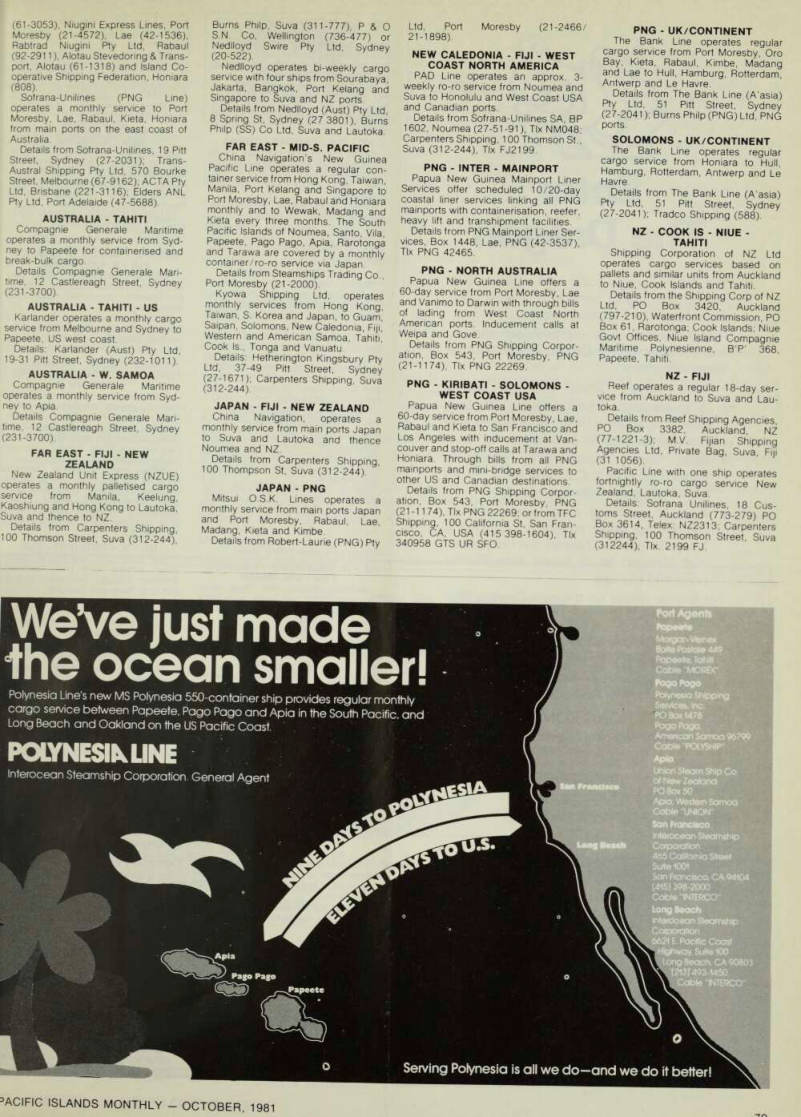
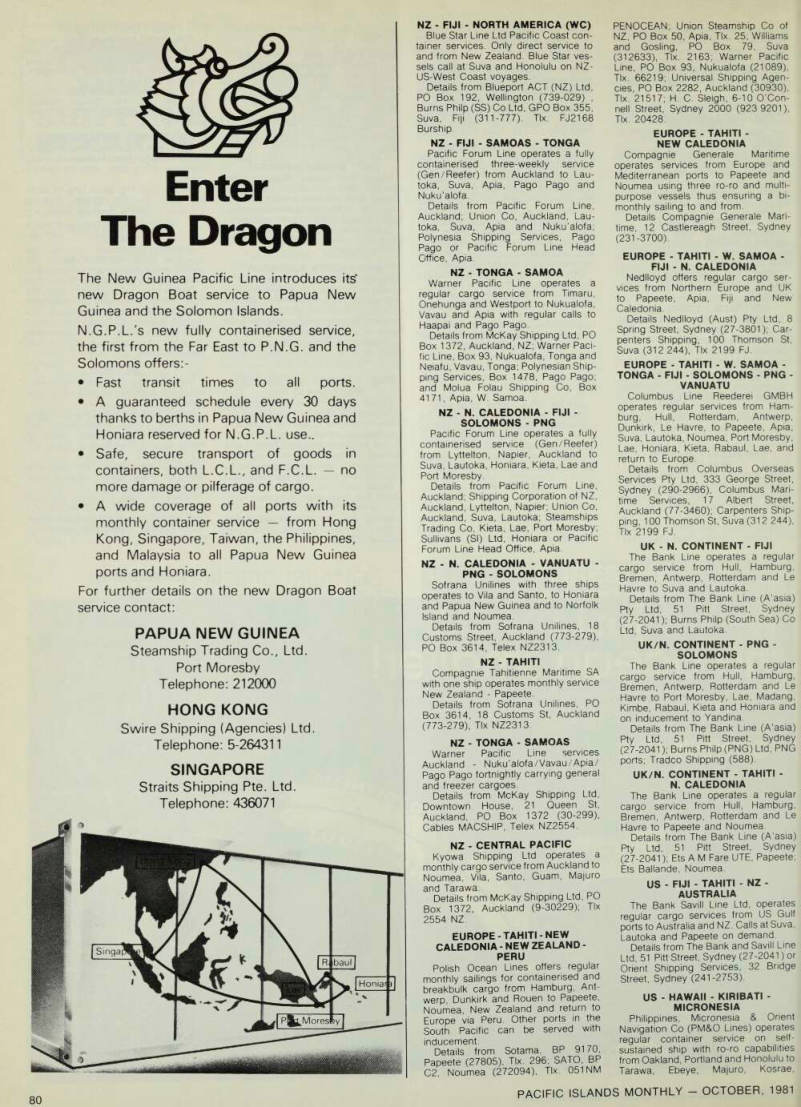
Services
Should any shipping company wish to have its services cargo and passenger included in these list ings they should contact PIM.
Australia - Fiji
Karlander (Aust) Pty Ltd operates monthly cargo services from Sydney to Suva and Lautoka.
Details from Karlander (Aust) Pty Ltd. 19-31 Pitt Street, Sydney (232-1011), Dalgety Shipping, 461 Bourke Street, Melbourne (60-0731), Burns Philp (SS) Co Ltd, Suva and Lautoka.
Sofrana-Unilines (Fiji Express Line) operates to Suva and Lautoka every three weeks from the main ports on the east coast of Australia and monthly to Lautoka from Melbourne and Sydney.
Details from Sofrana-Unilines, 19 Pitt Street, Sydney, (27-2031), Trans- Austral Shipping Pty Ltd, 570 Bourke Street, Melbourne (67-9162); ACTA Pty Ltd, Brisbane (221-3116); Elders-ANL Pty Ltd, Port Adelaide (47-5688); ANL, Newcastle (049-24364); Clements & Marshall. Burnie, Tasmania (31-1833); Carpenters Shipping, 100 Thomson St, Suva, Fiji (312 244), Tlx 2199 FJ.
Australia - New Caledonia -
Fiji - Samoas - Tonga
Pacific Forum Line operates a fully
containerised service (Gen/Heeter) from Sydney to Noumea, Lautoka, Suva, Apia, Pago Pago and Nuku’alofa.
Details from Pacific Forum Line, Syd ney; Union Bulkships, Sydney and Mel bourne; SATO, Noumea; Australian National Line, Brisbane; Burns Philp (SS) Co, Lautoka, Suva and Apia; Union Co, Nuku’alofa; Polynesia Shipping Services, Pago Pago or Pacific Forum Line Head Office, Apia.
Australia - Lord Howe Is -
Norfolk Is
Compagnie des Chargeurs Caledoniens operates four-weekly cargo service Sydney - Lord Howe Island and Norfolk Island.
Details; Hetherington Kingsbury Pty Ltd, 37-49 Pitt Street, Sydney (27-1671).
Australia - Kiribati
Karlander operates a 5/6 weekly ser vice from Melbourne and Sydney to Kiribati (Tarawa).
Details: Karlander (Aust) Pty Ltd, 19-31 Pitt Street, Sydney (232-1011).
Australia - Nauru -
Kiribati
Nauru Pacific Line operates regular cargo/passenger service from Mel bourne to Nauru and Tarawa.
Details; Nauru Corporation (Vic) Inc (Shipping Division), Nauru House, 80 Collins Street, Melbourne (653-5709), Nedlloyd Swire, 8 Spring Street, Sydney (2-0522).
Australia - New Caledonia
(And/Or) Vanuatu
Sofrana-Unilines ships serve Noumea every three weeks from the main ports along the east Australian coast.
Details from Sofrana-Unilines, 19 Pitt Street, Sydney (27-2031), Trans- Austral Shipping Pty Ltd, 570 Bourke Street, Melbourne (67-9162), ACTA Pty Ltd, Brisbane (221-3116), Elders-AN.L
Pty Ltd, Port Adelaide (47-5688), ANL, Newcastle (049-24364), Clements & Marshall, Burnie, Tasmania (31-1833) Compagnie des Chargeurs Cale doniens operates a three-weekly con tainerised cargo service from Sydney to Noumea.
Details Hetherington Kingsbury Pty Ltd, 37-49 Pitt Street, Sydney (27-1671).
Compagnie Generate Maritime operates a monthly service from Syd ney to Noumea, Port Vila and Santo, for containerised and break bulk cargo.
Details Compagnie Generate Mari time, 12 Castlereagh Street, Sydney (231-3700).
Australia - Nz - Fiji -
Hawaii - Us
P & O liners call at Auckland, Suva, Pago Pago and Honolulu on eastbound and westbound voyages between Syd ney and the US.
Details from P & O Booking Centre, World Travel Headquarters Pty Ltd, 33 Bligh Street, Sydney (231-6655).
AUSTRALIA - NZ - FIJI - TONGA -
Vanuatu - Noumea -Solomons -
Samoas - Tahiti
Sitmar Cruises operates a year-round cruise programme to include most of the above countries.
Details from Sitmar Cruises, 47 Elizabeth Street, Sydney (232-7511).
AUSTRALIA - NZ - FIJI - TONGA
Vanuatu - Noumea -Solomons -
Samoas - Tahiti
P & O liners call at Auckland, Bay of Islands, Honiara, Lautoka, Noumea, Nukualofa, Pago Pago, Papeete, Port Moresby, Santo, Savusavu, Suva, Vavau and Vila on cruises from Aus tralia.
Details from P & O Booking Centre, World Travel Headquarters Pty Ltd, 33 Bligh Street, Sydney (231-6655).
Pacific Forum Line operates con
tainerized and general cargo service from Australia and NZ to Fiji, Apia, Pago Pago, Tonga and other South Pacific ports.
Details from Polynesia Shipping Ser vices Inc, PO Box 1478, Pago Pago 96799.
Australia - New Zealand -
Pacific Islands - South East
Asia-China
Minghua Cruises operates regular cruise services from Sydney to most Pacific ports, with several cruises to South East Asia, including Japan and Hong Kong.
Details Minghua Cruises, 7 Bridge Street, Sydney, NSW 2000 and all Burns Philp Travel offices in Australia.
Australia - Png
Karlander New Guinea Line's cargo vessels call at Melbourne, Sydney, Port Moresby, Lae, Madang, Wewak, Manus, Kimbe, Rabaul, Popondetta, Details from Karlander (Aust) Pty Ltd, 19-31 Pitt Street, Sydney (232-1011), DALGETY Shipping, 461 Bourke Street, Melbourne (60-0731).
Australia - Png - Solomons
A consortium of Conpac, NGAL/PNGL have three container ves sels operating on a 28 day turn-around from Melbourne, Sydney and Brisbane to Port Moresby, Lae, Rabaul, Kavieng, Wewak, Madang, Kieta and Honiara.
Details from Burns, Philp & Co. Ltd. 51 Pitt Street, Sydney (2-0547) and Interocean Swire, 8 Spring Street, Syd ney. (2-0522).
New Guinea Express Lines operates a fortnightly container service from Mel bourne, Sydney, Brisbane to Port Moresby, Lae, Alotau, Rabaul, Honiara.
Details from New Guinea Express Lines, PO Box R 73, Royal Exchange, Sydney (241-3991) MacArthur Ship ping Agency Co, 39 Creek Street, Bris bane (229-3777), New Guinea Express Lines, 327 Collins Street, Melbourne
(61-3053), Niugmi Express Lines, Port Moresby (21-4572), Lae (42-1536).
Rabtrad Niugini Pty Ltd, Rabaul (92-2911), Alotau Stevedoring & Trans port, Alotau (61-1318) and Island Co operative Shipping Federation, Honiara (808).
Sofrana-Unilines (PNG Line) operates a monthly service to Port Moresby, Lae, Rabaul, Kieta, Honiara from main ports on the east coast of Australia.
Details from Sofrana-Unilines, 19 Pitt Street, Sydney (27-2031); Trans- Austral Shipping Pty Ltd, 570 Bourke Street, Melbourne (67-9162); ACTA Pty Ltd, Brisbane (221-3116); Elders ANL Pty Ltd, Port Adelaide (47-5688).
Australia - Tahiti
Compagnie Generate Maritime operates a monthly service from Syd ney to Papeete for containerised and break-bulk cargo.
Details Compagnie Generate Mari time, 12 Castlereagh Street, Sydney (231-3700).
Australia - Tahiti - Us
Karlander operates a monthly cargo service from Melbourne and Sydney to Papeete, US west coast.
Details. Karlander (Aust) Pty Ltd 19-31 Pitt Street. Sydney (232-1011).
Australia - W. Samoa
Compagnie Generate Maritime operates a monthly service from Syd ney to Apia.
Details Compagnie Generate Mari time, 12 Castlereagh Street, Sydney (231-3700).
Far East - Fiji - New
Zealand
New Zealand Unit Express (NZUE) operates a monthly palletised cargo service from Manila, Keelung, Kaoshiung and Hong Kong to Lautoka, Suva and thence to NZ.
Details from Carpenters Shipping, 100 Thomson Street, Suva (312-244),
Burns Philp, Suva (311-777), P & O S.N. Co, Wellington (736-477) or Nedlloyd Swire Pty Ltd, Sydney (20-522).
Nedlloyd operates bi-weekly cargo service with four ships from Sourabaya, Jakarta, Bangkok, Port Kelang and Singapore to Suva and NZ ports.
Details from Nedlloyd (Aust) Pty Ltd, 8 Spring St, Sydney (27 3801), Burns Philp (SS) Co Ltd. Suva and Lautoka.
Far East - Mid-S. Pacific
China Navigation's New Guinea Pacific Line operates a regular con tainer service from Hong Kong, Taiwan, Manila, Port Kelang and Singapore to Port Moresby, Lae, Rabaul and Honiara monthly and to Wewak, Madang and Kieta every three months. The South Pacific Islands of Noumea, Santo, Vila, Papeete, Pago Pago, Apia, Rarotonga and Tarawa are covered by a monthly container/ro-ro service via Japan.
Details from Steamships Trading Co., Port Moresby (21-2000), Kyowa Shipping Ltd, operates monthly services from Hong Kong, Taiwan, S. Korea and Japan, to Guam, Saipan, Solomons, New Caledonia, Fiji, Western and American Samoa, Tahiti, Cook Is., Tonga and Vanuatu.
Details: Hetherington Kingsbury Pty Ltd, 37-49 Pitt Street, Sydney (27-1671); Carpenters Shipping, Suva (312-244),
Japan - Fiji - New Zealand
China Navigation, operates a monthly service from main ports Japan to Suva and Lautoka and thence Noumea and NZ.
Details from Carpenters Shipping 100 Thompson St, Suva (312-244).
Japan - Png
Mitsui O.S.K. Lines operates a monthly service from main ports Japan and Port Moresby, Rabaul, Lae, Madang, Kieta and Kimbe.
Details from Robert-Laurie (PNG) Pty
Ltd, Port Moresby (21-2466/ 21-1898).
New Caledonia - Fiji - West
Coast North America
PAD Line operates an approx. 3weekly ro-ro service from Noumea and Suva to Honolulu and West Coast USA and Canadian ports.
Details from Sofrana-Unilines SA, BP 1602, Noumea (27-51 -91), Tlx NMO4B; Carpenters Shipping, 100 Thomson St., Suva (312-244), Tlx FJ2199.
Png - Inter - Mainport
Papua New Guinea Mainport Liner Services offer scheduled 10/20-day coastal liner services linking all PNG mainports with containerisation, reefer, heavy lift and transhipment facilities.
Details from PNG Mainport Liner Ser vices, Box 1448, Lae, PNG (42-3537), Tlx PNG 42465.
Png - North Australia
Papua New Guinea Line offers a 60-day service from Port Moresby, Lae and Vanimo to Darwin with through bills of lading from West Coast North American ports. Inducement calls at Weipa and Gove.
Details from PNG Shipping Corpor ation, Box 543, Port Moresby, PNG (21-1174), Tlx PNG 22269.
Png - Kiribati - Solomons -
West Coast Usa
Papua New Guinea Line offers a 60-day service from Port Moresby, Lae, Rabaul and Kieta to San Francisco and Los Angeles with inducement at Van couver and stop-off calls at Tarawa and Honiara. Through bills from all PNG mainports and mini-bridge services to other US and Canadian destinations.
Details from PNG Shipping Corpor ation, Box 543, Port Moresby, PNG (21 -1174), Tlx PNG 22269; or from TFC Shipping, 100 California St, San Fran cisco, CA, USA (415 398-1604), Tlx
340958 Gts Ur Sfo.
Png - Uk/Continent
The Bank Line operates regular cargo service from Port Moresby, Oro Bay, Kieta, Rabaul, Kimbe, Madang and Lae to Hull, Hamburg, Rotterdam, Antwerp and Le Havre.
Details from The Bank Line (A’asia) Pty Ltd, 51 Pitt Street, Sydney (27-2041); Burns Philp (PNG) Ltd, PNG ports.
Solomons - Uk/Continent
The Bank Line operates regular cargo service from Honiara to Hull, Hamburg, Rotterdam, Antwerp and Le Havre.
Details from The Bank Line (A’asia) Pty Ltd, 51 Pitt Street, Sydney (27-2041); Tradco Shipping (588).
NZ - COOK IS - NIUE -
Tahiti
Shipping Corporation of NZ Ltd operates cargo services based on pallets and similar units from Auckland to Niue, Cook Islands and Tahiti.
Details from the Shipping Corp of NZ Ltd, PO Box 3420, Auckland (797-210), Waterfront Commission, PO Box 61, Rarotonga; Cook Islands; Niue Govt Offices, Niue Island Compagnie Maritime Polynesienne, B'P' 368, Papeete, Tahiti.
Nz - Fiji
Reef operates a regular 18-day ser vice from Auckland to Suva and Lau toka.
Details from Reef Shipping Agencies, PO Box 3382, Auckland, NZ (77-1221-3); M.V. Fijian Shipping Agencies Ltd, Private Bag, Suva Fiji (31 1056).
Pacific Line with one ship operates fortnightly ro-ro cargo service New Zealand, Lautoka, Suva.
Details: Sofrana Unilines, 18 Cus toms Street, Auckland (773-279) PO Box 3614, Telex: NZ2313; Carpenters Shipping, 100 Thomson Street Suva (312244), Tlx. 2199 FJ
NZ - FIJI - NORTH AMERICA (WC) Blue Star Line Ltd Pacific Coast con tainer services. Only direct service to and from New Zealand. Blue Star ves sels call at Suva and Honolulu on NZ US-West Coast voyages.
Details from Blueport ACT (NZ) Ltd, PO Box 192, Wellington (739-029) , Burns Philp (SS) Co Ltd, GPO Box 355, Suva, Fiji (311-777). Tlx. FJ2168 Burship.
NZ - FIJI - SAMOAS - TONGA Pacific Forum Line operates a fully containerised three-weekly service (Gen/Reefer) from Auckland to Lau toka, Suva, Apia, Pago Pago and Nuku’alofa.
Details from Pacific Forum Line, Auckland; Union Co, Auckland, Lau toka, Suva, Apia and Nuku'alofa; Polynesia Shipping Services, Pago Pago or Pacific Forum Line Head Office, Apia.
Nz- Tonga - Samoa
Warner Pacific Line operates a regular cargo service from Timaru, Onehunga and Westport to Nukualofa, Vavau and Apia with regular calls to Haapai and Pago Pago.
Details from McKay Shipping Ltd. PO Box 1372, Auckland, NZ; Warner Paci fic Line, Box 93, Nukualofa, Tonga and Neiafu, Vavau, Tonga; Polynesian Ship ping Services, Box 1478, Pago Pago; and Molua Folau Shipping Co, Box 4171, Apia, W. Samoa.
NZ - N. CALEDONIA • FIJI -
Solomons - Png
Pacific Forum Line operates a fully containerised service (Gen/Reefer) from Lyttelton, Napier, Auckland to Suva, Lautoka, Honiara, Kieta, Lae and Port Moresby.
Details from Pacific Forum Line, Auckland, Shipping Corporation of NZ, Auckland, Lyttelton, Napier; Union Co, Auckland, Suva, Lautoka; Steamships Trading Co, Kieta, Lae. Port Moresby; Sullivans (SI) Ltd, Honiara or Pacific Forum Line Head Office, Apia.
NZ - N. CALEDONIA - VANUATU -
Png - Solomons
Sofrana Unilines with three ships operates to Vila and Santo, to Honiara and Papua New Guinea and to Norfolk Island and Noumea.
Details from Sofrana Unilines, 18 Customs Street, Auckland (773-279), PO Box 3614, Telex NZ2313.
Nz - Tahiti
Compagnie Tahitienne Maritime SA with one ship operates monthly service New Zealand - Papeete.
Details from Sofrana Unilines, PO Box 3614, 18 Customs St, Auckland (773-279), Tlx NZ2313.
Nz - Tonga - Samoas
Warner Pacific Line services Auckland - Nuku’alofa/Vavau/Apia/ Pago Pago fortnightly carrying general and freezer cargoes.
Details from McKay Shipping Ltd, Downtown House, 21 Queen St, Auckland, PO Box 1372 (30-299), Cables MACSHIP. Telex NZ2554.
Nz - Central Pacific
Kyowa Shipping Ltd operates a monthly cargo service from Auckland to Noumea. Vila, Santo, Guam, Majuro and Tarawa.
Details from McKay Shipping Ltd, PO Box 1372, Auckland (9-30229); Tlx 2554 NZ.
Europe - Tahiti - New
Caledonia - New Zealand -
Peru
Polish Ocean Lines offers regular monthly sailings for containerised and breakbulk cargo from Hamburg, Ant werp, Dunkirk and Rouen to Papeete, Noumea, New Zealand and return to Europe via Peru. Other ports in the South Pacific can be served with inducement.
Details from Sotama, BP 9170, Papeete (27805), Tlx. 296; SATO, BP C 2, Noumea (272094), Tlx. 051 NM
PENOCEAN; Union Steamship Co of NZ, PO Box 50, Apia, Tlx. 25; Williams and Gosling, PO Box 79, Suva (312633), Tlx. 2163, Warner Pacific Line, PO Box 93, Nukualofa (21089), Tlx. 66219; Universal Shipping Agen cies, PO Box 2282, Auckland (30930), Tlx. 21517; H. C. Sleigh, 6-10 O’Con nell Street, Sydney 2000 (923 9201), Tlx. 20428.
Europe - Tahiti -
New Caledonia
Compagnie Generate Maritime operates services from Europe and Mediterranean ports to Papeete and Noumea using three ro-ro and multi purpose vessels thus ensuring a bi monthly sailing to and from.
Details Compagnie Generate Mari time, 12 Castlereagh Street, Sydney (231-3700).
EUROPE - TAHITI - W. SAMOA -
Fiji - N. Caledonia
Nedlloyd offers regular cargo ser vices from Northern Europe and UK to Papeete, Apia, Fiji and New Caledonia.
Details Nedlloyd (Aust) Pty Ltd, 8 Spring Street, Sydney (27-3801); Car penters Shipping, 100 Thomson St, Suva (312 244), Tlx 2199 FJ.
EUROPE - TAHITI - W. SAMOA - TONGA - FIJI - SOLOMONS - PNG -
Vanuatu
Columbus Line Reederei GMBH operates regular services from Ham burg, Hull, Rotterdam, Antwerp, Dunkirk, Le Havre, to Papeete, Apia, Suva, Lautoka, Noumea, Port Moresby, Lae, Honiara, Kieta, Rabaul, Lae, and return to Europe.
Details from Columbus Overseas Services Pty Ltd, 333 George Street, Sydney (290-2966), Columbus Mari time Services, 17 Albert Street, Auckland (77-3460); Carpenters Ship ping. 100 Thomson St, Suva (312 244), Tlx 2199 FJ.
Uk - N. Continent - Fiji
The Bank Line operates a regular cargo service from Hull, Hamburg, Bremen, Antwerp, Rotterdam and Le Havre to Suva and Lautoka.
Details from The Bank Line (A’asia) Pty Ltd, 51 Pitt Street, Sydney (27-2041); Burns Philp (South Sea) Co Ltd, Suva and Lautoka.
Uk/N. Continent - Png -
Solomons
The Bank Line operates a regular cargo service from Hull, Hamburg, Bremen, Antwerp, Rotterdam and Le Havre to Port Moresby, Lae, Madang, Kimbe, Rabaul, Kieta and Honiara and on inducement to Yandina.
Details from The Bank Line (A’asia) Pty Ltd, 51 Pitt Street, Sydney (27-2041); Burns Philp (PNG) Ltd, PNG ports; Tradco Shipping (588).
Uk/N. Continent - Tahiti -
N. Caledonia
The Bank Line operates a regular cargo service from Hull, Hamburg, Bremen, Antwerp, Rotterdam and Le Havre to Papeete and Noumea.
Details from The Bank Line (A'asia) Pty Ltd, 51 Pitt Street, Sydney (27-2041); Ets A M Fare UTE, Papeete; Ets Ballande, Noumea.
US - FIJI - TAHITI - NZ -
Australia
The Bank Savill Line Ltd, operates regular cargo services from US Gulf ports to Australia and NZ. Calls at Suva, Lautoka and Papeete on demand.
Details from The Bank and Savill Line Ltd, 51 Pitt Street, Sydney (27-2041) or Orient Shipping Services, 32 Bridge Street, Sydney (241-2753).
Us - Hawaii - Kiribati -
Micronesia
Philippines, Micronesia & Orient Navigation Co (PM&O Lines) operates regular container service on self sustained ship with ro-ro capabilities from Oakland, Portland and Honolulu to Tarawa, Ebeye, Majuro, Kosrae,
Ponape, Truk, Saipan, Yap and Koror, Details for Micronesia can be obtained from Larry Guerrero, PM&O Owners Rep, PO Box 803, Saipan, Ml 96950, Cable COMMONTIME, Tlx 783605; PM80; PM&O Lines, 181 Fremont St, San Francisco, California 94105, Cable PMONAV.
Us - Hawaii - Nauru -
Micronesia
Nauru Pacific Line operates regular conventional/container and passenger service from San Francisco and Honolulu to Majuro, Ponape, Truk and Saipan. Cargo is accepted for Nauru and Kosrai with transhipment at Majuro and Ponape.
Details from Nauru Corporation (Vic) Inc (Shipping Division). Nauru House, 80 Collins Street, Melbourne (653-5709); North American Maritime Agencies. 100 California St.. San Fran cisco, California 9411.
Us - Noumea - Fiji
PAD Line operates an approx 3-weekly roro service from West Coast USA and Canada to Noumea and Suva.
Details from Sofrana-Unilines SA, BP 1602, Noumea (27-51-91), Tlx NMO4B; Carpenters Shipping, 100 Thomson St Suva (31-2244), Tlx FJ2199; Trans- Austral Shipping, Box R 232 PO, Royal Exchange, NSW (27-2441), Tlx AA21204.
Us - Tahiti - Samoa
Pacific Islands Transport operates a five weekly cargo service from North America west coast ports to Papeete, Pago Pago, Apia.
Details from Polynesia Shipping Ser vices Inc, PO Box 1478 Pago Paqo 96799.
Polynesia Line operates container and general cargo service from US west coast ports to Papeete and Pago Pago.
Details from Polynesia Shipping Ser vices Inc., PO Box 1478, Pago Pago 96799. a US - TAHITI - SAMOA - NZ - AUST Farrell Lines Inc, operate a fast regular lash/container cargo service from west coast ports Canada/USA to Papeete and Pago Pago thence to NZ and Australia.
Details Wilh Wilhelmson Agency, Sydney, Melbourne and Brisbane Tlx AA20136, Cable FARSHIPS Sydney; Dalgety (NZ) Ltd, Auckland and Wellington, Tlx NZ2445, Cable DALSHIP Auckland: Compagnie Mari time Polynesienne, Immeuble Franco Oceanienne, PO Box 368, Papeete Tahiti, Tel 26393, Tlx 258. FP ANSB Taporo, Cable OCEAN Papeete; Kneubuhl Maritime Service, PO Box 39, Pago Pago, Telephone 633-5121 : Tlx 782505.
Advertisements & other items, pp. 78-80 (2 items)
Tahiti Samoa 5™
FORESTMIL
PORTABLE
SAWMILL
A Mini Self Contained Sawmill
complete with Diesel Engine or Electric Motor *
fjlL
Forestmil produces any size accurate timber ready to use up to 12" x 9" x 24'.
Purchase price and operating cost of Forestmil is less than other sawing equipment with similar production capacity.
Forestmil reduces timber waste and also reduces log transport cost. Timber is sawn direct from the log in the forest.
Forestmil can be moved to a new location in one hour.
Forestmil will saw hardwood or softwood from logs of any diameter.
Over 1000 Forestmils are sawing timber in 23 countries.
Forestmil has been manufactured for 18 years.
For literature and prices please contact the manufacturers.
MacQuarrie Industries Pty.Ltd.
PO Box 20, Coburq 3058, Victoria, Australia Phnnp 350 3411 Telex 33729 Cables Macbound, Melbourne
PACIFIC ISLANDS
C TRANSPORT LINE
M S AFRICANSTARS
EXPRESS
CONTAINER
•REEFER
SERVICE
between U.S.
West Coast ports and £
TAHITI SAMOA 5™
xcc Qeqeral Stearqship Qorporatioq^n,, General Agents 400 California Street, San Francisco, CA, USA PAPEETE: Agence Maritime Internationale, Tahiti PAGO PAGO: Polynesia Shipping Services, Inc.
APIA: Burns Philp (South Sea) Company, Ltd.
WeVe just made
the ocean smaller!
Polynesia Line's new MS Polynesia 550-container ship provides regular monthly cargo service between Papeete, Pago Pago and Apia in the South Pacific, and Long Beach and Oakland on the US Pacific Coast.
POLYNESIA LINE
Interocean Steamship Corporation. General Agent
Pago Pago IA 92 \2 K u.s o sS K € V* Papeete Port Agents Papeete Morgan-Vemex Bolt© Postal© 449 Papeete. Tahiti Cable “MOREX"
Pago Pago Polynesia Shipping Services, Inc.
PO Box 1478 Pago Pago, American Samoa 96799 Cable "POLYSHIP"
Apta Union Steam Ship Co of New Zealand
POSoxSO
Apia, Western Samoa Cable "UNION"
San Francisco Interocean Steamship Corporation 465 California Street Suit© 1001 San Francisco, CA94104 (415)398-2000 Cable "tNTEPCO"
Long Beach mterdeean Steamship Corporation 6621 E. Pacific Coasl Highway Suite 100 twig Beach, CA 90803 t 213) 493-1450 Cable "INTEiTCO”
Serving Polynesia is all we do—and we do it better!
Enter
The Dragon
The New Guinea Pacific Line introduces its’ new Dragon Boat service to Papua New Guinea and the Solomon Islands.
N.G.P.L.'s new fully containerised service, the first from the Far East to P.N.G. and the Solomons offers:- • Fast transit times to all ports. • A guaranteed schedule every 30 days thanks to berths in Papua New Guinea and Floniara reserved for N.G.P.L. use.. • Safe, secure transport of goods in containers, both L.C.L., and F.C.L. no more damage or pilferage of cargo. • A wide coverage of all ports with its monthly container service from Kong Kong, Singapore, Taiwan, the Philippines, and Malaysia to all Papua New Guinea ports and Honiara.
For further details on the new Dragon Boat service contact:
PAPUA NEW GUINEA
Steamship Trading Co., Ltd.
Port Moresby Telephone: 212000
HONG KONG
Swire Shipping (Agencies) Ltd.
Telephone: 5-264311
SINGAPORE
Straits Shipping Pte. Ltd.
Telephone: 436071 t [ Homar Pj^Mofes
3 Acific Islands Monthly October, 1981
Deaths
of Islands People
Priscilla Amelia Moors Muench At the LBJ Tropical Medical Center, American Samoa, on June 25, aged 86.
The youngest daughter of the American Harry Jay Moors and
his Samoan wife Fa’animonimo, Priscilla Muench, also known as Filoi, was the aunt of Western Samoa’s Prime Minister Tupuola Efi, and the sister of Afoafouvale Misimoa, a former secretary-general of the South Pacific Commission.
Much as her father did, Priscilla led a touring dance company, the Royal Samoans, across the United States in the 19205. She did stage plays in the US, and was friends with • Lloyd Osbourne, Robert Louis Stevenson’s stepson. She was given the title Tuitogama’atoi.
After her marriage to Muench she gave birth to one son, who died.
She worked in a dress shop in the Far East, making and in heriting enough to buy a yacht which was chased by pirates in the China Sea. She eluded them by directing the captain to sail into a typhoon. She later lived for many years in the Philip pines, where her house was bombed during World War 11, causing the loss of many of her possessions.
She lived the last years of her life at Tafuna, Tutuila, American Samoa, building a
new house and writing her memoirs.
She was an avid bridge player, and loved the theatre and parties tastes she in dulged right up to the last month of her life.
She is survived by Larry Moran, with whom she spent 41 years, and 16 nieces and nephews.
She was buried next to her parents at Ululoloa, Western Samoa. ‘Ahome’e At Nukualofa on August 19.
Aged 46.
A Tongan noble of the realm, and brother of Queen Haleavalu Mata’aho, ‘Ahome’e was appointed superintendent of police only three months before his death. His father, the former ‘Ahome’e, died in office as minister of police in 1961. ‘Ahome’e did police training courses at various times in New Zealand, the United Kingdom and Australia.
His body was honoured with the traditional all-night vigil at his family’s residence, Vakauho, at Kolomotua. He
was buried at Nukumaanu Cemetery, Haavakatolo.
Al Haj Hasan Mohammed At Drakinakelo, Nausori, Fiji, in July, aged 65.
A prominent Moslem priest, Haji Shaheb was a foundation member of the Fiji Moslem League Rewa branch, and served on the Nausori Advisory Council and the committees of several charitable and sporting organisations in Rewa.
A keen sportsman, he took an active part in soccer and wres tling contests in the Rewa area.
He made his pilgrimage to Mecca in 1963.
Matamua Matamua At Greenlane Hospital, Cook Islands, in August, aged 59.
Matamua Matamua, a post office employee based in Rarotonga, also served at vari ous times as Chief Adminis tration Officer on the islands of Mitiaro and Manihiki.
Vincent T. Sanders At Cairns, Australia, in July, during a visit from Papua New Guinea.
Vince Sanders was a prominent businessman and colourful figure in Port Moresby where he had lived for 30 years. He had a lifelong interest in aviation and was one of the founders of the South Pacific Aero Clubs based in Port Moresby. In the wider community he was best known by name, if not in person, for his humorous letters to the editor published over many years and on many subjects in the South Pacific Post. Port Moresby, and
in its present successor the PNG Post-Courier.
He went to Port Moresby as an employee of the then Austra lian Department of Civil Avi ation, but soon afterwards es tablished himself as an auction eer and transport operator. He also operated a metal salvage business and until recently flew his own light aircraft to remote parts of eastern PNG bringing back brass and copper which still remained from the war in the Pacific 35 years earlier.
He created wide interest in 1977 when he and another PNG businessman, Ray Thurecht, ferried a 36-year-old Tiger Moth biplane from Brisbane to Port Moresby for delivery to its new owner. The flight of 1835 nautical miles included 16 take off's and landings over six days.
In an account of the flight which received wide publicity he wrote: ‘The aircraft never gave us a moment of trouble it was only the crew that was erratic at times.’
Ron Bullingham
At Norwich, England, on July 11.
Mr Bullingham was a longtime resident and a prominent businessman in the Cook Islands’ capital of Rarotonga.
He was instrumental in set ting up the Rusco, and then the Spinco, wholesaling outlets. He ran the Blue Shop in Rarotonga for many years.
He was a farmer as well as a businessman. He set up a small cottage industry raising cows for milk, as well as pigs, chickens and goats, on his property at Titikaveka.
He left Rarotonga in 1979 with his wife Elizabeth to spend the last years of his life in retirement in his homeland.
Harriett Esther Julia Buffett At Norfolk Island Hospital on July 14, aged 76.
Julia, as she was called, married Bob Buffett in All Saints Church, Kingston, in 1934 and was thereafter known as Julia Bob as has been the custom on Norfolk Island.
Her only lime away from Norfolk Island was a month in New Zealand to visit members of her family, and two months in Australia for an eye oper ation.
Advertisements & other items, pp. 81-82 (2 items)
Cific Islands Monthly - October, 1981
Pacific
i * * X . i
FORUM UliE
Regular and Reliable Container and Roll - ON - OFF Services
owned by the people
of the Forum Nations
MV FUA KAVENGA
MV FORUM SAMOA
MV FORUM NEW ZEALAND
With our head office in Apia, our regional offices in Suva, Auckland, and Sydney, and our network of agents, we cover the South Pacific to ensure your goods get to you or to your buyer on time.
We tranship also, to or from almost anywhere in the world.
NOMINATE PERFORMANCE: NOMINATE PFL
Agents in; Australia, New Zealand, Fiji, Tonga, Western Samoa, American Samoa, New Caledonia, Papua New Guinea, Solomon Is, Kiribati, Tuvalu, Vanuatu.
REQUIRE
DRIED SHARK FINS
FOR PRICES AND
INFORMATION ETC.,
PLEASE WRITE TO:
S. DADDOW,
ASIA TONGA TRADING,
66 JALAN KERUING,
SINGAPORE, 2880
YACHT FOR SALE
44ft LOA ferro cement cutter rig built 1980. Aluminium spars, Lees 75HP diesel. Comp letely fitted out with full electrics & dinghy $A46,000 Contact: East West Engineering P.O. Box 3020, Lami, Fiji Is.
Contact-
Australia.
(Personalised) Business Information Service.
Public information and private research supplied on all topics except Missing-Persons and Matrimonial.
P.O. Box 88, Fremantle, West A ustralia 6160.
Mo Produce *
v »«J»' rerf
\ FISH MAW,
& SHARK FINS, etc.
For details please write to:
ASIA SEAFOOD Co.,
353 A Circuit Rd., Block 64, Singapore 1337.
Advertisers Index
Ace Creation 53 Amatil 34 Asia Tonga Trading 82 Asia Seafood 82 Air New Zealand 60 Bankline 76 Contact Australia 82 Carptrac 18 China Navigation Co. 80 Citizen Watches 50 Cumines, Henry 75 East West Engineering 82 Epiglass 36-37 Exportad 66 Foodtex 73 Goerman, Peter 82 General Steamship Corp. 78 Honda IFC Hitachi 27 Jergens, Andrew & Co. 68 McDonnell Douglas 62 Matsushita 46 MacQuarrie Industries 78 Nelson & Robertson 72 National Insurance 56 Nissan Motor Co. 4,24-25 NZ Dairy Board IBC Norseman 82 Pioneer 12,38 Pacific Telecom Council 73 Polynesia Line 79 Pacific Forum Line 81 Papua Hotel 75 QBE Insurance 28 Ricoh 20 Rheem 8 Sonar Ship Brokerage 82 Sony Corp. 30 Sansui 54 Suzuki 16, 64 Tatham, S.E. 24 Toyota OBC T-Shirt People 25 Union Carbide 52 Victor Co. of Japan 58 Waterwheel Exports 69,70 Werner Electronics Yamaha 42-43
Advertisements & other items, pp. 82-84 (1 item)
trawler
TO JOB SEEKERS IN REMOTE AREAS
WE SUPPLY YOU WITH THE LATEST
JOB ADS FROM THE AUSTRALIAN &
INTERNATIONAL PRESS, QUARTERLY
SUBSCRIPTIONS $3O. WRITE BOX 1942,
TOWNSVILLE 4810. AUSTRALIA.
new
prawn
trawler
50' x 17' - 6'-7” BRITISH SHIP, Qld. registered surveyed, D.P.I. export licence. ALL ALUMINIUM, would be best fitted out vessel of its type in Australia, now sucessfully fishing east coast after extensive trials 200 HP mam, 80 HP AUX, 4.5:1 gear box nozzle, 11000 Lts fuel 3000 Lts water, full hydraulics, 1981 technology, full safety gear, electronics, inventory, nets, etc.
Freezer 20,000 lbs dry room at 35°C, snap and brine tanks on deck.
Owners will deliver anywhere and train new crew if required.
SA4O,OOC cheaper than replacement cost. Only $A300,000.
For full details write to:
EPHRAUMS FISHING
GPO Box 2348, Brisbane, Qld.
BUYING OR SELLING
LIST WITH US FOR:
COMMERCIAL SHIPS
FISHING VESSELS
YACHTS
TRAWLERS
WORK BOATS
Sonar Ships Brokerage
BOX 1811 CAIRNS, OLD.
AUSTRALIA
PH: (070) 515371
New re« bu O' New Zealand
creamed
butter
I INI
i I ' jL* > <r aual . > c STOCK rotation
y. ?*'
The newest reason
nd proven fuel The new Toyota Corolla is
toughest Car buyers. Inside an|
smart styling and roomy, coi then consider the real beauty Corolla —"its incredible durabilil economy. Trouble-free motoring and remarkable fuel consumption figures that have earned Corolla its worldwide popularity. Two of the main reasons w r hy more than 8,000,000 Corollas have been produced to date. And because you’re behind the wheel oha v Toyota you can be sure of reliable backup service when you need it.
The new definitely No. 1 anyway you look at it.
mBSn
yv i - ■ ’
TOYOTA
COROLLA
NAURU:
NAURU COOPERATIVE
SOCIETY.
KIRIBATI:
TARAWA MOTORS, Box 36,
Bairiki, Tarawa, Kiribati.
NORFOLK ISLAND;
BORRY’S RENTAL CARS,
MOUNT PITT
(ENTERPRISES) LTD.,
P.O. Box 169,
NEW CALEDONIA:
SERVICE IMPORTATION
AUTOMOBILE DU
PACIFIQUE, Rond-Point du Pacifique (Station Total) B.P. 438, Noumea.
TOYOTA
SERVICE
TOYOTA
The Toyota range includes: COROLLA. STARLET. CORONA. CRESSIDA, HI-LUX, STOUT, HI ACE. DYNA. COASTER and LAND CRUISER