Advertisements & other items, pp. 1-2 (2 items)
cvcvcvcvcv
PACIFIC
ISLANDS
MONTHLY
Ame«Ramoa , US$l 75
AusjjpTf i
?w ds - Hg*' &US mainland... yfesvs^
NriVCaiedortia CFPI9%
Zealand NZSI./Pl
Hf NZSI.SO^
island ASI 50 Bua New Guinea K 1.50 Bomons SSI 50
■hiti CFPI9O
Pi 50
■u*alu atflt*- 1 75
■STT & Guam ■anuatu «ifc AJ1.50 ■lestern Samoa ■ T 1.60 ■Recommended retail pr»ce only W Registered by Australia Post B Publication No NBPI2KI
cvcvcvcvcv
SAD FATE OF
SAMOA M.P.
Mi-Function VTR Goes Portable
HITACHI
nmnmE
Light & Compact
Easier to carry, easier to find space for.
Creative Freedom Use a Hitachi home video camera to make your own shows.
Reliability
Hitachi is famous for it.
TheVT-6500 is built to last. ■ - V Si Fine Slow Motion Dial-adjustable slow motion control.
Visual Search Find scenes quickly and easily W Low Power Consumption Amazingly low 5.5 W power consumption saves electricity. 5 Pulse Control Editing Insert new scenes with no distortion.
Still Picture/Frame Advance Study your form in detail.
Preset Programming
Leave for 3 weeks, still record 8 programs.
Sound-on-Sound Add your own sound, without erasing previous sound.
Remote Control Thin, hand-size, 13-mode remote control unit.
Mi-Function VTR Goes Portable
The VT-6500 Portable Video System. Smaller. Lighter. Really portable.
And it’s got all the features you’d find on larger, heavier units.
Because at Hitachi, we’ve put our know-how in electronic integration to work on our video cassette recorders. So less size doesn’t mean less features.
The recorder and tuner/timer are separate units. Take the recorder and one of our compact cameras along with you to get all the fun on tape. When you get back home, you’ve got the full-function convenience of a large-sized VTR.
Performance and reliability are also up to Hitachi’s remarkably high standards.
The VT-6500 from Hitachi. The greatest little thing in VTRs yet. %
A-V6O
VTTU6S
VK
CBOO
VK-C6OO
•ss- 5 - 5
HB6A"£gyg
„■ ■S' cf®
5*3 SlX** VT 6500 / s c
0 HITACHI
Pacific Islands Monthly
Vol. 52 No. II
November 1981
(Usps 9524801
Representatives
AUSTRALIA: Distribution: NSW & ACT: Allan Rodney Wright (Circulation) Pty Ltd, PO Box 907, Darlinghurst, NSW 2010; Elsewhere: Gordon & Gotch (A/asia) Ltd, Box 40, PO, Rosebery, NSW 2018. Advertising Melbourne - Ray Brown Pty Ltd, 614 Queensberry St, North Melbourne 3051, telephone 329 8522, telex 31717; Brisbane - D.
Wood, Anday Agency, Box 1918. GPO, Brisbane 4001, tele phone 44 3485, 44 1546 Adelaide - Hastwell Media, PO Box 30, Glen Osmond, SA 5064, 233 Glen Osmond Rd, Frewville, SA 5063, telephone 79 1869 Perth - Adrep, 62 Wickham St., East Perth, WA 6000, telephone 325 6395.
FIJI: Distribution and subscriptions - Desai Bookshops, PO Box 160, Suva. Fiji, telephone Suva 23036. Advertising - Fiji Times & Herald Ltd, 20 Gordon St, Suva, telephone 312 111, telex FJ2124 FRENCH POLYNESIA: Distribution Hachette Pacifique, 10 Ave Bruat, Papeete, telephone 25610.
HAWAII, UNITED STATES: Distribution PIM, Hawaii, PO Box 22250, Honolulu, Hawaii 96822. Advertising Roger Brookes, PO Box 10217, Honolulu, Hawaii 96816, telephone 808 536 6677 JAPAN: Advertising and subscriptions Universal Media Corporation, CPO Box 1762, Tokyo, telephone 666 3036.
NEW CALEDONIA: Distribution Depot Centre de Presse Michel Pentecost, CBP2, Noumea, telephone 27 2434 27 4729.
NEW ZEALAND; Distribution - Gordon & Gotch, PO Box 584, 2 Carr Road, Mt. Roskill, Auckland 4 Advertising - International Media Representatives Ltd, PO Box 2313, Auckland, telephone 795 487; 493 389, cables Intereps, Auckland Subscriptions - Ross Haines & Son Ltd PO Box 1289, Auckland, telephone 769 042.
PAPUA NEW GUINEA; Distribution - Gordon & Gotch, PO Box 3395, Port Moresby, telephone 254551, 254855!
Advertising PNG Post-Courier, PO Box 85, Port Moresby telephone 21 2577.
UNITED KINGDOM: The Herald & Weekly Times Ltd No 1 Maltravers Street, London WC2R 3DZ, England, telephone 01 836 5162, telex London 21989.
UNITED STATES MAINLAND; Advertising Joshua B Powers Jr, Powers International Inc., 551 Fifth Ave, New York, New York 100 017, telephone 867 9580 telex 236514 Subscriptions - PIM, Hawaii, PO Box 22250 Honolulu, Hawaii 96822.
Subscriptions
PIM is airfreighted to most subscribers and agents in the Pacific Islands and the United States, but not the UK or the Continent.
a y me nts by personal cheque are only acceptable in Aus rahan (from a branch in Australia), US and New Zealand ■urrency. For all other remittances please send an inter lational bank draft in Australian dollars. ’ublished monthly by Pacific Publications (Aust) Pty Ltd ind printed in Australia by Paramac, Alexandria, NSW Aus rahan cover price is recommended retail only. Registered >y Australia Post, publication No NBPI2IO. Second class ostage paid at Honolulu, Hawaii. Copyright © Pacific
Publications (Aust.) Pty Ltd.' “ Postmaster Honolulu: Send address changes to PIM Hawaii, PO Box 22250, Honolulu Hawaii 96822
Local Aust.
American Samoa
Sus21
$18 Australia $A15 $15 Canada
Sus23
$20 Cook Islands $19 Fiji $18 French Polynesia $22 Guam
Sus23
$20 Hawaii
Sus23
$20 Japan $20 Kiribati $19 Micronesia Mauru Mew Caledonia
Sus23
$20 $21 $22 Mew Zealand Miue Morfolk Island
Snz21
$18 $19 $15 $20 Morthern Marianas
Sus23
D apua New Guinea $23 Solomon Islands $19 $19 ronga Fuvalu Jnited Kingdom Stg 11 $19 $20 JS Mainland /anuatu
Sus23
$20 $19 $18 $A23 Western Samoa Elsewhere
This Month’s Features
• THE COMMONWEALTH The Commonwealth of Nations held this year’s heads of government summit in Australia, and emphasis was placed on Pacific regional affairs in the world scene. In a special report for PIM, Sue Green writes about the role of Pacific Island leaders at the talks 11 • THE POLITICS OF VIOLENCE As Melanesian independence pressures continue to trouble French authority in New Caledonia. Daniel Tardieu reports from Noumea on the killing there of Pierre Declercq, Secretary-General of the Union Caledonienne; Helen Hill describes how Declercq became known as ‘the friend of the Melanesians’; and PIM Associate Editor Malcolm Salmon outlines the problems faced by the French government in the wake of the killing 19, 21 • ANOTHER LEADER TOPPLED Hard on the heels of a change of government in Solomon Islands comes another change, this time in Tuvalu where Tomasi Puapua has defeated the foundation prime minister Toaripi Lauti 33 • TRAVEL Having a week-long look at tourism in New Caledonia Malcolm Salmon reports on two day-trips available from Noumea and on the interesting personalities responsible for them 53 • f MEMORIAL TO THE BURNS PHILP LINE - Judy Tudor, who says it's hard o tall in love with a container ship or a jumbo jet, reviews a new book on the Burns Philp cargo-passenger ships which were once a part of Islands life 45
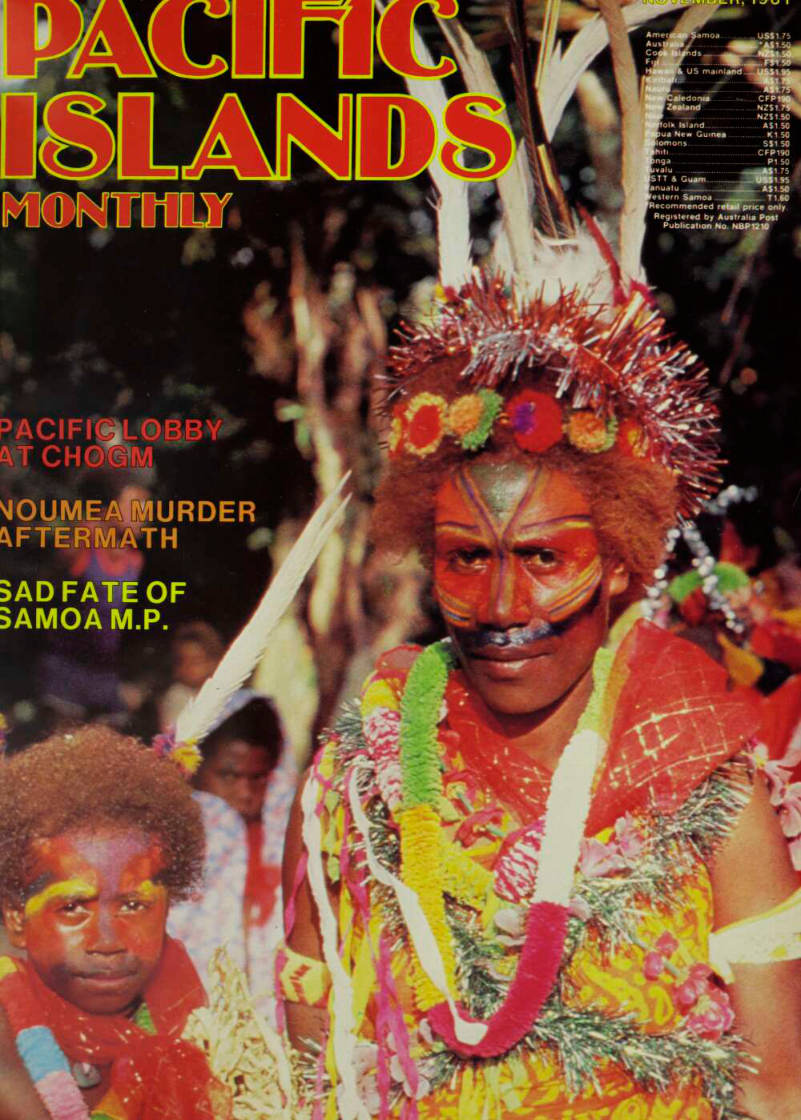
mnth^n^nZ r t P ' C J U^ e: ? e^ ey f arde// ’ V,Siting took this picture of ceremonial finery as a mother and son attended a traditional ceremony at Louakamal Village on Tanna.
Australia in the Pacific 69
Books JJ
Britain in the Pacific ."...65 Commonwealth Heads of Government 11 Deaths 81 Disabled people ."."!!!."!."..".","!!!."."!.".29 ..!M,29,61 French Polynesia 22 28
Hawaii ...,...’..48
Islands Press 30 Letters .I”ZZIZZ. 7 New Caledonia ..!.!...,"."!."l9' 2V 36 53 New Zealand in the Pacific ’ ’35 Pacific exploration 25 Pacific Report 5
Pacific Travel ei 67 Papua New Guinea.. 29, 32, 33, 35, 61, 63,’65,' 67 People Political Currents !...".."!.."!.33 Postmark Papeete "" "oo Shipping services ."".‘.77 Solomon Islands .."...33
T0nga... .."...32,67
Tradewmds 61 T ravel .."..."!"!."..."53 Tropicalities T uvalu 2j" 33
J™ 1 "- TSSTSTesiw
Western Samoa 37
Yachts ZZZZ'j\
Advertisements & other items, pp. 3-4 (2 items)
3
’ACIFIC ISLANDS MONTHLY NOVEMBER, 1981
Founded 1930 by R. W. Robson Editor Angus Smales Associate Editor Malcolm Salmon Advertising Sales Manager Phil Martin Editorial Adviser John Carter A Pacific Publications production 76 Clarence Street, Sydney 2000 GPO Box 3408 Sydney 2001 Cables: PACPUB Sydney Telex; 21242 (answers INTARAD) Telephone. Sydney 29 6693 Melbourne 63 0211 ext. 1444 Editor-in-Chief: John McDonald
Caterpillar
PERFORMANCE
dependable
marine engines
When fishing is your living, you know you need dependable gear working with minimum downtime and your engines have to deliver reliable power when and where you need it.
CATERPILLAR offers you a comprehensive selection of performance proven Cat Marine Diesel Engines from 85hp up to IOOOhp, backed by after sales service and replacement parts facilities that are second to none. a & lb zs a :W m
HASTINGS DURING
YOUR
CATERPILLAR
DEALER
dependable
generator sets
Whatever your electric power needs, there’s a Catbuilt generator set to meet them. Caterpillar generators feature adjustment free fuel systems, large capacity radiators, heavy duty air cleaners and quick-change fuel and oil filters to ensure dependable performance throughout the islands, in all kinds of tropical conditions.
LAE:
Milford Haven Road, Telephone 42 2355.
PORT MORESBY;
Telephone 256650.
BOUGAINVILLE:
Itakara Industrial Park, Arawa Telephone 959077
carptrac
SUVA: Carpenter Street, Raiwai.
Private Mail Bag, GPO Suva, Fiji. Ph. 381622.
Telex FJ2190 Cables CARPTRAC.
LAUTOKA; Veitari. Telephone 61877.
LABASA: Vulovi. Telephone 81868.
Caterpillar, Cat and [Q are Trademarks of Caterpillar Tractor Co. 8A10452
Pacific Report
On And Off-Again Bans
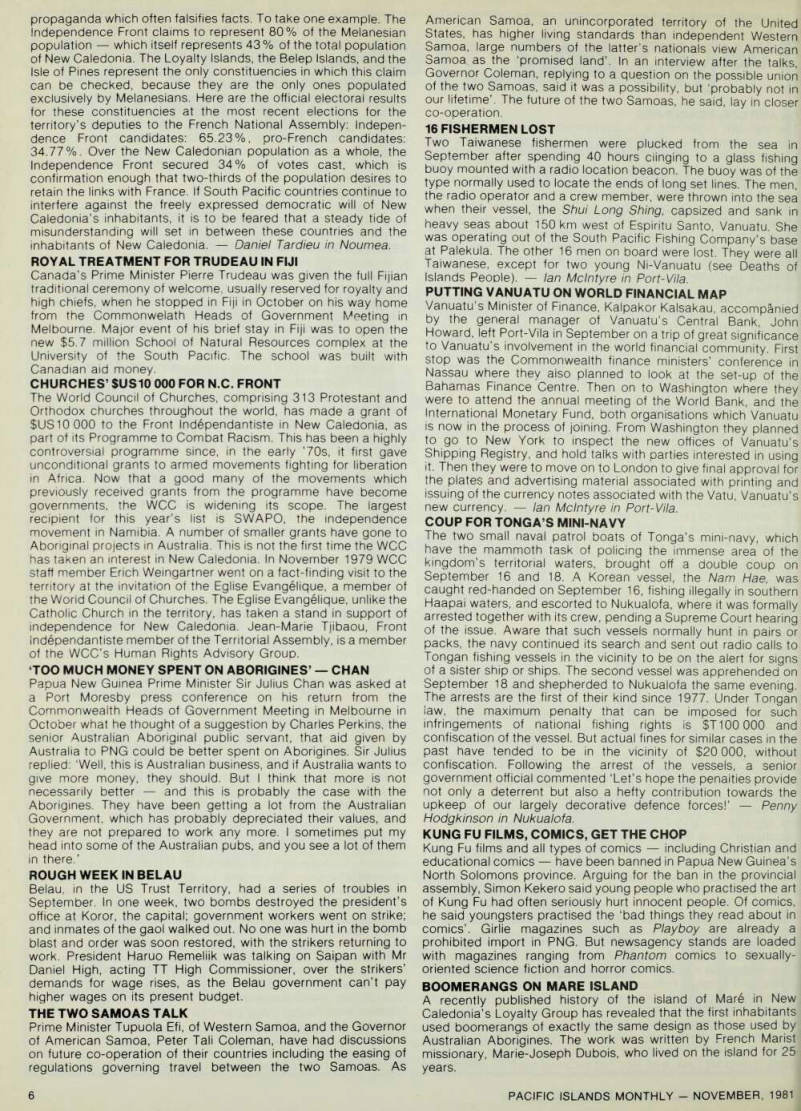
The Vanuatu Government in September placed Dick Ukeiwe, vice-president of New Caledonia’s council of government, and the territory’s top official political figure, on a list of prohibited immigrants. With him on to the banned list went New Caledonian government councillor Victorin Boewa. Both men were due to go to Port-Vila to represent New Caledonia at the South Pacific Conference in late October. Then, on October 7, after what were probably fairly hot discussions in Vanuatu Government circles, the government released a new statement taking them off the list.
However, some conditions on their access to Vanuatu remained: they were to come only after application, and then only for ‘official business’ (such as the South Pacific Conference). The statement said New Caledonia’s participation in the conference was ‘very important’, and that the revised decision had been taken in part at least in the interests of the conference. Immediately the original decision was announced, Vanuatu President Ati George Sokomanu expressed reservations about it in an interview on Australian radio. Prime Minister Father Walter Lini, in Melbourne at the time for the Commonwealth Heads of Government Meeting, is reliably reported to have admitted he was ‘surprised’ by it.
Vanuatu: French Aid At Last
The latest crisis in the bumpy relationship between Vanuatu and France was eased in October when new French Ambassador Marc Menguy arrived in Port-Vila bearing the first batch of the oromised French aid. Earlier in the month, Vanuatu Prime Minister Father Walter Lini had told reporters at the Commonwealth Heads of Government Meeting in Melbourne that his government /vas considering cutting diplomatic ties with France because of :he non-arrival of promised French aid. The first instalment now delivered amounts to V 204 million ($A1.96 million). Asked in Melbourne about the possibility of Vanuatu approaching the Soviet Union as an alternative source of aid, Fr Lini said: ‘We lon’t really discuss serious things with the Soviet Union because ve are very much afraid of that country, in the same way we are ifraid of America. They are two super-powers, and we do not vant to get into their network. To do so would be to risk losing ndependence, politically and otherwise.’
J.S. Completes Micronesia Review
'he Reagan Administration has announced it has completed its eview over the status of three of the four entities making up the rust Territory of the Pacific Islands (Micronesia), and nego tiations were expected to resume in October on the basis of the Compact of Free Association and other agreements already litialled. The administration early this year announced it was (lacing the policies followed by former President Carter towards JS Pacific territories in abeyance, and planned a full review of hem. This review is understood to have concluded that the US hould move promptly to terminate United Nations Trusteeship •n terms satisfactory to itself and to the governments and •copies of Micronesia. This decision will be welcomed by the licronesian governments. The administration however will treat ie accords and the 11 subsidiary agreements still to be egotiated as a single package, which could result in some elays. Once the compact and other agreements are completed nd signed, a number of further steps must be taken before the usteeship can be terminated. These include approval by the licronesians’ local legislatures, ratification by the US Congress, itification by plebiscites in Mirconesia, and termination of the rusteeship Agreement by the United Nations Trusteeship council and by the Security Council.
Del Levi For Paris Talks
apua New Guinea’s Foreign Minister Noel Levi will join Fiji Prime linister Ratu Sir Kamisese Mara and Tonga’s Minister for Foreign ffairs and Defence Prince Tupouto’a on a forthcoming mission ) Paris to discuss the future of France’s Pacific territories with resident Mitterrand (PIM Oct p 5). Earlier, former Solomon lands Prime Minister Peter Kenilorea was to have gone with the ijian PM and the Tongan prince. But following Mr Kenilorea’s efeat in a vote for the prime ministership (PIM Oct p 33) Ratu lara invited Mr Levi, who had just returned from an official visit
to France,‘to go in Mr Kenilorea’s stead. The August meeting of the South Pacific Forum in Port-Vila decided that the mission should go, and asked Ratu Mara to lead it and choose his companions. President Mitterrand has indicated his willingness to receive the delegation.
Indira Gandhi In Fiji, Tonga
Indian Prime Minister Indira Gandhi visited Fiji in September on her way to the Commonwealth Heads of Government Meeting in Melbourne. The visit was marked by a number of memorable meetings with members of Fiji’s Indian community, and by the conferring on her of the degree of Honorary Doctor of the University of the South Pacific. Mrs Gandhi also paid a two-day visit to Tonga.
Fiji To The Polls July 82
Fiji’s present parliament will be dissolved in May in preparation for general elections to be held from July 10 to 17. The elections will be the first since September 1977.
Senator Sees End To Moruroa Tests
In an outspoken series of statements during a September visit to French Polynesia, French Socialist Senator Louis Perrein: reproached local political leaders with the ‘scandal’ of the existence of shanty towns in Papeete cheek by jowl with luxurious mansions; advised Polynesians not to go on relying on the N-testing programme for the territory’s economic survival: ‘For the time being it is essential that the programme should continue, but in a few years it will become possible to carry out the tests in laboratories, and the Moruroa programme will disappear so you must start productive work’; and told them that the two keys to progress in the territory were tax reform and land reform: ‘Your commercial economy must be transformed into a productive economy’. Asked whether he had come to Tahiti on a scheduled Air New Zealand flight only because of convenience of time tables, Senator Perrein replied: ‘I flew with an airline other than Air France or UTA because even senators must look for the cheapest means of transport they can find. It hurt me not to be travelling with a French carrier. But it’s normal for people to choose the cheapest available means of transport. I don’t have the kind of income that allows me to travel without consideration of cost and I imagine it’s the same with other tourists, or with the Polynesian who wants to make a trip.’
Direct Auckland-Niue Link At Last
A direct flight to Auckland from Niue was due to begin in October following the long-awaited re-sealing of Niue’s airport runway The service is to be operated by Polynesian Airlines’ Boeing 737.
Telephone Links Australia, Kiribati
A telephone link between Kiribati and Australia was opened in October. Kiribati was previously linked to the outside world by a radio circuit to Nauru. The President of Kiribati, leremia Tabai, in Melbourne for the Commonwealth Heads of Government Meeting, was present when the first call from Kiribati on the line was taken by Australia’s Minister for Communications lan Sinclair.
New Book On Santo Revolt
Noumea-based lawyer Jean Leder, who defended Santo secessionist Jimmy Stevens at his trial, has written a book on last year’s rebellion on Santo. The book, entitled Cent Jours au Bout du Monde (100 Days at the End of the World) was a sell-out when it was released in Noumea in September. The book is understood to deal particularly severely with the last French Resident Commissioner in the New Hebrides, Jean-Jacques Robert. ‘KEEP YOUR NOSES OUT’ CALL FROM NOUMEA The New Caledonian population has demonstrated in recent weeks both through the local press, and through their elected representatives the extent to which they are finding the interference in their affairs by South Pacific countries more and more questionable, not to say intolerable. An official, diplomatic example of this was the banning from visits to Vanuatu of the Vice-President of New Caledonia’s Council of Government Dick Ukeiwe, and government councillor Victorin Boewa. An attempt has since been made to put this affair to rights, but the bad memory will certainly remain. Then there has been intervention in territorial affairs by Australian, New Zealand, Fijian and Papua New Guinean trade unions, who are giving financial support to the Independence Front. These efforts are not to be tolerated either Nor, for similar reasons, are those of various Christian churches in the South Pacific. Statements by the regional governments are appreciated not much more. Generally the opinions expressed in the media, or by official bodies, are the product of a line of
propaganda which often falsifies facts. To take one example. The Independence Front claims to represent 80% of the Melanesian population which itself represents 43% of the total population of New Caledonia. The Loyalty Islands, the Belep Islands, and the Isle of Pines represent the only constituencies in which this claim can be checked, because they are the only ones populated exclusively by Melanesians. Here are the official electoral results for these constituencies at the most recent elections for the territory’s deputies to the French National Assembly: Indepen dence Front candidates: 65.23%, pro-French candidates: 34.77%. Over the New Caledonian population as a whole, the Independence Front secured 34% of votes cast, which is confirmation enough that two-thirds of the population desires to retain the links with France. If South Pacific countries continue to interfere against the freely expressed democratic will of New Caledonia’s inhabitants, it is to be feared that a steady tide of misunderstanding will set in between these countries and the inhabitants of New Caledonia. Daniel Tardieu in Noumea.
Royal Treatment For Trudeau In Fiji
Canada’s Prime Minister Pierre Trudeau was given the full Fijian traditional ceremony of welcome, usually reserved for royalty and high chiefs, when he stopped in Fiji in October on his way home from the Commonwelath Heads of Government Meeting in Melbourne. Major event of his brief stay in Fiji was to open the new $5.7 million School of Natural Resources complex at the University of the South Pacific. The school was built with Canadian aid money.
Churches’ Susio 000 For N.C. Front
The World Council of Churches, comprising 313 Protestant and Orthodox churches throughout the world, has made a grant of SUSIO 000 to the Front Ind6pendantiste in New Caledonia, as part of its Programme to Combat Racism. This has been a highly controversial programme since, in the early ’7os, it first gave unconditional grants to armed movements fighting for liberation in Africa. Now that a good many of the movements which previously received grants from the programme have become governments, the WCC is widening its scope. The largest recipient for this year’s list is SWAPO, the independence movement in Namibia. A number of smaller grants have gone to Aboriginal projects in Australia. This is not the first time the WCC has taken an interest in New Caledonia. In November 1979 WCC staff member Erich Weingartner went on a fact-finding visit to the territory at the invitation of the Eglise Evangelique, a member of the World Council of Churches. The Eglise Evangelique, unlike the Catholic Church in the territory, has taken a stand in support of independence for New Caledonia. Jean-Marie Tjibaou, Front Independantiste member of the Territorial Assembly, is a member of the WCC’s Human Rights Advisory Group.
TOO MUCH MONEY SPENT ON ABORIGINES’ CHAN Papua New Guinea Prime Minister Sir Julius Chan was asked at a Port Moresby press conference on his return from the Commonwealth Heads of Government Meeting in Melbourne in October what he thought of a suggestion by Charles Perkins, the senior Australian Aboriginal public servant, that aid given by Australia to PNG could be better spent on Aborigines. Sir Julius replied: ‘Well, this is Australian business, and if Australia wants to give more money, they should. But I think that more is not necessarily better and this is probably the case with the Aborigines. They have been getting a lot from the Australian Government, which has probably depreciated their values, and they are not prepared to work any more. I sometimes put my head into some of the Australian pubs, and you see a lot of them in there.’
Rough Week In Belau
Belau, in the US Trust Territory, had a series of troubles in September. In one week, two bombs destroyed the president’s office at Koror, the capital; government workers went on strike: and inmates of the gaol walked out. No one was hurt in the bomb blast and order was soon restored, with the strikers returning to work. President Haruo Remeliik was talking on Saipan with Mr Daniel High, acting TT High Commissioner, over the strikers’ demands for wage rises, as the Belau government can’t pay higher wages on its present budget.
The Two Samoas Talk
Prime Minister Tupuola Efi, of Western Samoa, and the Governor of American Samoa, Peter Tali Coleman, have had discussions on future co-operation of their countries including the easing of regulations governing travel between the two Samoas. As
American Samoa, an unincorporated territory of the United States, has higher living standards than independent Western Samoa, large numbers of the latter’s nationals view American Samoa as the ‘promised land’. In an interview after the talks, Governor Coleman, replying to a question on the possible union of the two Samoas, said it was a possibility, but ‘probably not in our lifetime’. The future of the two Samoas, he said, lay in closer co-operation.
16 Fishermen Lost
Two Taiwanese fishermen were plucked from the sea in September after spending 40 hours clinging to a glass fishing buoy mounted with a radio location beacon. The buoy was of the type normally used to locate the ends of long set lines. The men, the radio operator and a crew member, were thrown into the sea when their vessel, the Shui Long Shing, capsized and sank in heavy seas about 150 km west of Espiritu Santo, Vanuatu. She was operating out of the South Pacific Fishing Company’s base at Palekula. The other 16 men on board were lost. They were all Taiwanese, except for two young Ni-Vanuatu (see Deaths of Islands People). lan Mclntyre in Port-Vila.
Putting Vanuatu On World Financial Map
Vanuatu’s Minister of Finance, Kalpakor Kalsakau, accompanied by the general manager of Vanuatu’s Central Bank. John Howard, left Port-Vila in September on a trip of great significance to Vanuatu’s involvement in the world financial community. First stop was the Commonwealth finance ministers’ conference in Nassau where they also planned to look at the set-up of the Bahamas Finance Centre. Then on to Washington where they were to attend the annual meeting of the World Bank, and the International Monetary Fund, both organisations which Vanuatu is now in the process of joining. From Washington they planned to go to New York to inspect the new offices of Vanuatu’s Shipping Registry, and hold talks with parties interested in using it. Then they were to move on to London to give final approval for the plates and advertising material associated with printing and issuing of the currency notes associated with the Vatu, Vanuatu’s new currency. lan Mclntyre in Port-Vila.
Coup For Tonga S Mini-Navy
The two small naval patrol boats of Tonga’s mini-navy, which have the mammoth task of policing the immense area of the kingdom’s territorial waters, brought off a double coup on September 16 and 18. A Korean vessel, the Nam Hae, was caught red-handed on September 16, fishing illegally in southern Haapai waters, and escorted to Nukualofa, where it was formally arrested together with its crew, pending a Supreme Court hearing of the issue. Aware that such vessels normally hunt in pairs or packs, the navy continued its search and sent out radio calls to Tongan fishing vessels in the vicinity to be on the alert for signs of a sister ship or ships. The second vessel was apprehended on September 18 and shepherded to Nukualofa the same evening.
The arrests are the first of their kind since 1977. Under Tongan law. the maximum penalty that can be imposed for such Infringements of national fishing rights is $T 100 000 and confiscation of the vessel. But actual fines for similar cases in the past have tended to be in the vicinity of S2O 000, without confiscation. Following the arrest of the vessels, a senior government official commented ‘Let’s hope the penalties provide not only a deterrent but also a hefty contribution towards the upkeep of our largely decorative defence forces!’ Penny Hodgkinson in Nukualofa.
KUNG FU FILMS, COMICS, GET THE CHOP Kung Fu films and all types of comics including Christian and educational comics have been banned in Papua New Guinea’s North Solomons province. Arguing for the ban in the provincial assembly, Simon Kekero said young people who practised the art of Kung Fu had often seriously hurt innocent people. Of comics, he said youngsters practised the ‘bad things they read about in comics’. Girlie magazines such as Playboy are already a prohibited import in PNG. But newsagency stands are loaded with magazines ranging from Phantom comics to sexually oriented science fiction and horror comics.
Boomerangs On Mare Island
A recently published history of the island of Mare in New Caledonia’s Loyalty Group has revealed that the first inhabitants used boomerangs of exactly the same design as those used by Australian Aborigines. The work was written by French Marist missionary, Marie-Joseph Dubois, who lived on the island for 25 years.
Advertisements & other items, p. 5 (1 item)
5
ACIFIC ISLANDS MONTHLY NOVEMBER, 1981
Letters

New Caledonia
Who’s behind
the Gomen
board?
Your correspondent’s comment on the threat by the New Caledonian Rightwing to use armed helicopters against the Melanesians (PIM Sep p 14) warrants some explanation.
The threat was actually made by the then Secretary of State Paul Dijoud four years ago, and repeated by him to the Melanesian Deputy to the French Parliament, Roch The threat also em jraced a possible resort to nercenaries.
At the time, it seemed like ather idle talk, although there vere some mutterings in France imong would-be soldiers of ortune that there were jobs to »e had in New Caledonia if one yere ready to respond to the all when needed The events in Vanuatu began □ give some credibility to the dea. If the secessionist move icnt had been successful I'hich it couldn’t have been, ince it was based on imaginary ssumptions there would ave been a piece of territory, ot under the responsibility of le French State, where a small rmed force, based on the use of rmed helicopters, could have een organised. Such a force Duld have been used to terror e the Melanesians of New aledonia. The British author ies, seeing a succession of very übious American characters )ming one by one to Vanuatu nder the guise of working for mmy Stevens, managed to ;port them in time.
One of the ideas behind the cessionist movement was to parate New Caledonia proper om the Loyalty Islands, which ere to join with the Vemarana - that is, the part of Vanuatu at would have broken away.
In this way, the Rightwing Europeans of Noumea, who were partly master-minding the movement in Santo, thought they would find themselves at last in the majority in New Caledonia, and would thus be able to keep the Melanesians in their place.
To achieve this goal, they planned an armed movement of settlers in New Caledonia, and arms had been introduced into the island on a large scale.
Politically incapable of moving against its own supporters, the French Government of the time was in a quandary, trying to sail a middle course which would have changed the policies of the central government of Vanuatu, but would have brought the secessionists back into the fold through negotiations. This un spoken policy didn’t work, each French civil servant in the condominium having his own ideas of what should be done, and his own interpretation of the muddled official policy and acting accordingly. As a result, some truly extraordinary individual actions were under taken.
It should be said that the French high commissioner in Noumea gave the necessary orders to prevent any flow of arms out of New Caledonia.
What he could not prevent was the introduction of arms into New Caledonia, brought in aboard Japanese ore carriers, paid for by the principal European mine owners and graziers, and subsequently partly distributed into various European hands in Noumea and the inland.
The murder of a gendarme in Gomen some months ago seems to have been linked with this arms traffic. The murdered man, killed in his own house at night as he watched TV by an assailant armed with a high powered modern rifle fitted with a silencer, had some days before confided to a person with Melanesian connections that he was ‘on to a big thing’, but still needed to check a couple more points before reporting to his superiors.
The same day, a red 404 Peugeot car, previously un known in the locality, had been reported as having come from, then returned to, Ouaco, a few kilometres away. It has also been reported that at the time
of the Santo secession Philippe de St Quentin, murderer of a Melanesian in Gomen in the first half of 1981 (PIM Aug p 6) had, with his private boat, been mixed up in a series of sus picious journeys with other par ties from Ouaco, said to be working for the Jacques Lafleur concern, up the coast to the uninhabited Surprise Islands in the north of New Caledonia.
At the end of August 1981, a wooden notice board was placed in the paddock of a second generation Gomen settler called Caron. The board carried a carefully hand-written text, claiming to be signed by a Melanesian person called Felix Belouma, and announcing that all cattle on the property would be killed, and that the last bullet would be reserved for the settler.
Unhappily for the European author of the notice, no Felix Belouma exists in the area, and the Belouma lineage is an inland one, stemming from the mountain-dwelling Pabwa tribes in the Diahot valley, who cannot have any claim to land along the west coast. The land in question, at a location known as Babinema, belongs to the lineages which constitute the Tegon coastal village.
The only reason for the use of the name Belouma is that Gaston Belouma, who lives in Noumea, is a delegate of the pro-independence Palika politi cal group, and goes up the coast from time to time.
The mistake in the given name on the board was prob ably designed to minimise the significance of the ‘prank’ in the eyes of the courts if the author were ever found out after all. he had used a non-existent name . . .
But the Noumea daily Les Nouvelles Caledoniennes tried on this basis to whip up passions against the general and peace ful Melanesian movement for the recovery of land.
The writer of the notice was not a settler from Gomen he would not have made the mis take about the lineage name but a European settler from nearby. This person unknown knew how to come by night without being noticed curiously, along the escape route most likely to have been used by the gendarme’s mur derer.
He could be sought in Ouaco, where the former grounds of the Australian Company, so long represented locally by Colonel Dix, are being sub-divided and sold by Jacques Lafleur In the process, a concentration is be ing formed around Ouaco of the stupidest and most racist set tiers in New Caledonia, always agitating for police protection against the Melanesians, and constantly threatening the lat ter with the wide range of weapons they keep at home most of which they have ob tained quite illegally.
Ouaco was long a favoured hunting venue for governors and ministers of the former government touring New Cale donia. It has now become a symbol of entrenched and rabid colonialism colonialism of the type so well represented by Mr Lafleur himself.
(Professor)
Jean Guiart
Noumea New Caledonia Another look at
the SPC
With many years of experience in the region, serving a terri torial administration, an independant Island govern ment, and, more recently, a regional organisation, there can be no doubt that Don Stewart knows the South Pacific and its people. His article on the South Pacific Commission (SPC) and its conference (PIM Oct pi 7) is therefore an important contri bution and comes across as one of the most balanced analyses to appear in recent years. In fact in my view there are only two areas of his treatment of the subject that might be ques tioned.
The first of these is the impression left that it is the fault of the Island governments that the SPC’s budget remains strapped. This seems a very superficial view, and it is disap pointing that no attempt was made to explore the underlying causes of the present diffi culties.
In theory, whilst the metro politan countries provide the bulk of the finance, the Islands decide how it should be spent.
At first glance this seems a very generous arrangement, and most metropolitan governments are at great pains to emphasise the role of the Islands in the
control of the work programme.
The reality is somewhat differ ent. By placing their people in certain strategic positions within the organisation, some metropolitan governments, often working together, can exercise a degree of control which goes well beyond the appearances.
This situation has been ag gravated in recent times by a tendency on the part of ‘Young Turks’ in Canberra’s Depart ment of Foreign Affairs to ignore polite intimations from Island representatives that they are not happy with the present set-up, and to press on regard less. This lack of sensitivity would seem particularly unfor tunate from Australia’s long term viewpoint, since the heavy pressures brought to bear in certain areas have only served to increase the suspicion that the organisation remains at heart essentially colonial, and dedicated to serving that inter est.
It may well be argued of course that since Australia con tributes the lion’s share of the budget, it should have a major say in the running of the organisation. But it may equally well be argued that Island governments have become in creasingly aware of the social and economic changes which are occurring, and of the in creasing interest which major powers on the rim of the Pacific Basin are taking in the region.
In these circumstances it is not unreasonable for Island govern ments to be vitally concerned at what happens in an organisation with direct access to their own
backyards.
In fact there is evidence that Islands control over many as pects of the SPC’s activities has tended to decline in recent years, as an increasing pro portion of total revenue has come from outside the regular budget. These funds, originat ing from diverse sources such as national governments outside the region, United Nations agencies, and non-governmental arganisations, are not governed by quite the same regulations as those on the regular budget.
And, in fact, taking this money nto account, it is questionable lust how strapped the SPC ■eally is this may in part
explain the tendency of the secretariat to adopt a more independent line.
The second aspect of Don Stewart’s assessment which is open to question is what can only be described as his knee jerk reflex on the subject of administrative services within the organisation. Recent devel opments indicate that an in creasing proportion of external funds are being used to increase secretarial services signifi cantly, and there is no evidence of their influence diminishing.
Similarly, the need to have two persons employed fulltime in making travel arrangements is questionable when, in view of the sums of money involved, most travel agents would give their right arm for a chance to gain the resulting commissions from airlines and hotels.
These criticisms aside, the article does represent a very useful attempt to line up the questions facing the SPC in the 1980 s.
Observer
(Name and address supplied.)
The SPC and its
rival bodies
Your Noumea Special Corre spondent’s report on the ‘SPC’s “P & E” Meeting’ (PIM Jul p2l) was quite interesting, and, above all, timely.
Since the South Pacific Com mission’s establishment in 1947, it has done a tremendous job in the Pacific. It is a pity that some of the governments that directly support SPC are also initiating new, partially parallel, organisations within the SPC region. There may be a real need to take care of the programmes that necessitated the founding of the South Pacific Bureau of Economic Cooperation (SPEC), and the Pacific Islands Development Commission (PIDC), and other similar organisations that are in the planning stages. I hope the participating governments of SPC meet and review its mission and goals to prevent duplication and unnecessary competition and expenditure.
SPC’s dedicated staff, people of the stamp of Michel Lam bert, tropical agriculturist, have done an excellent service to the Pacific Islands in disseminating
scientific information, conduct ing workshops, seminars, co ordinating studies and provid ing other needed services. On the other hand, some SPC staff members have never even made an attempt to visit all the territories and countries in the SPC region, at least to get to know the problems and re sources available in these areas.
It is high time that the SPC mission, goals, programmes and personnel were reviewed so as to render it more effective in meeting the needs of the Pacific, to prevent proliferation of duplicate organisations, and the eventual death of the SPC.
R. Muniappan
Address omitted from original
‘Man Brown’
replies
I refer to the Postmark Papeete column of Marie-Therese and Bengt Damelsson, ‘Seminar on a Circular Track’ (PIM Sep pp2o-21).
For many years, the South Pacific Commission has re ceived valuable contributions from external organisations.
Contributions have been in cash and kind in kind by con sultancies, volunteers, equip ment and the provision of ser vices. In recognising the value of these contributions, the South Pacific Conference in 1974 commended the secretary general for the support obtained and requested him to endeavour to increase extra-budgetary support in order to expand the assistance provided to the re gion. Your correspondents in saying that such outside fund ing is ‘unexpected generosity’, are far from correct: it is sought, it is recognised, it is very much appreciated and it is a vital component of the work programme.
While there have been in recent years a number of women’s conferences (it is, after all, the UN Decade for Women), only two the 1980 ESCAP-sponsored Suva meet ing and the 1981 SPC Papeete seminar have been for women of the SPC area.
The 1980 South Pacific Con ference, aware of the forth coming Suva meeting, foresaw the need for concerted action. It
therefore added to the SPC’s 1981 work programme a Sem inar of South Pacific Women.
This seminar, it directed, should be hosted by French Polynesia as proposed, and should ‘ develop concrete pro gramme proposals for sub mission to the 21st South Pacific Conference’. The con ference directed the secretariat of the SPC to seek external funding for the seminar; the secretariat responded to that directive, and the seminar was arranged with the invaluable financial support of a number of organisations: the Australian Freedom from Hunger Cam paign; the Netherlands Minis try for Development Co operation; the Swedish Inter national Development Auth ority; the International Labour Office; the Australian Develop ment Assistance Bureau; the Commonwealth Foundation; and the United Church Action Group of America. The seminar was preceded by a number of satellite meetings arranged by the participants as a prelimi nary to the seminar. To suggest that a satellite hookup would be a cheaper and more effective method to develop programme proposals, i.e. a meeting of delegations with free exchange and discussion, after-hours dis cussion, and the final develop ment of project proposals and resolutions, indicates a lack of familiarity with the limitations of the satellite system.
Your correspondents’ report appears to have had specific objectives, probably only in directly connected with the role of women in development. A number of misconceptions should therefore be corrected: the official representatives on the podium in the auditorium of the assembly (not ‘lecture room’) were there for approxi mately 30 minutes for the opening ceremony. Two were members of the government council Vice-President Fran cis Sanford not in a suit but in a floral shirt and resplendent in leis, and Councillor Maco Tevane —while Mr Taufa rep resented the president of the assembly. These are three Tahitians well-known to the Pacific, and none very solemn.
The government representative was the high commissioner. All
were there for an express pur pose, to honour their Pacific guests at the opening of the seminar, and their absence would certainly have been of note. Official guests were again on the podium for the closing ceremony, again not in a ‘lec ture room’, but in the chamber where the assembly sits, the chamber of the assembly which was made available to the women of the Pacific for their seminar. After the closing cere mony, Vice-President Sanford, Councillor Tevane, the Mayor of Papeete, Mr Juventin, and the high commissioner all dressed casually Pacific-style shared with the participants the moving songs of farewell.
In conferences around the world the host country usually, and for obvious cost-connected reasons, fields a larger del egation than do the visitors.
French Polynesia fielded two delegates and 13 observers.
There would have been 14 if Mrs Danielsson’s request, dated July 17, 1981, had been ac cepted. Five countries had ob servers as well as their del egations. Despite the cost to themselves, the Federated States of Micronesia had one observer; Fiji had one observer; the Marshall Islands had one observer; Papua New Guinea had two observers, and the Republic of Belau had three.
These and other delegations expressed regret that they had not been able to bring more.
Observers were not supposed to take part in debate, but one did so without objection. Observers played a role in the full working groups which met separately to consider the projects in health, employment and unemploy ment, and family/community/ culture. It may never have been done before, but the women decided to meet in private without the public, without men, without the press and it miffed the press.
The meeting was directed by the SPC’s Health Education Officer, Marie-Claude Teissier, herself a Tahitian, and was chaired by Beatrice Vernaudon, a Tahitian, with Marie Maddison (Marshalls) relieving the chair from her position as vice-chairwoman. Meg Taylor (Papua New Guinea) co ordinated the working groups’
deliberations and recommen dations. These facts were omit ted somehow from the report in
Pim
The ‘man Brown’ did com ment on the nuclear issue as being political but he did not say that it was not a health problem. He has some firm private views on this. He did say that he thought the nuclear health issue fell outside the subject of the seminar: ‘to develop concrete programme proposals for submission to the 21st South Pacific Conference’.
The women disagreed, ap plauded their decision to dis agree, and discussed the issue in their working groups.
The ESCAP report ‘for par ticipants only’ of the Suva meeting was not a working paper for the seminar, either in English or in French, but the
'Far from staying on a circular track, the seminar struck out in new directions. As one delegate has stated: ". . . The Pacific wide representation was the best yet in any regional women’s meeting .. . There were definite themes for discussion, employment, the family and community, health and culture. ” ’
appropriate sections were ex tracted by the co-ordinator, reproduced and used.
One delegation, believing that the presentation of country papers was a waste of time, proposed only to circulate their paper. The meeting firmly asked that the paper be pres ented. Your correspondents’ suggestion that the Pacific Islands Year Book could have been distributed instead ignores both the objectives of positional papers and the coverage of the Year Book. Papers addressed themselves specifically to the requirements of the seminar, i.e., what women have achieved and desire to achieve, a topic that could be presented only by the women concerned.
As to the success of the seminar, surely the participants are a better judge of this than are your correspondents, who seem to denigrate the partici pants’ ability to handle a meet ing and to reach their objec tives. In the very limited time they achieved their objectives, preparing seven project pro posals for the 21st South Pacific Conference, plus a number of resolutions not covered by the Suva meeting.
Far from staying on a ‘circu
lar track’ the seminar struck out in new directions. As one del egate has stated: ‘For some it was an opportunity to renew old acquaintances, for others it was an opportunity to participate in Pacific regional women's activi ties for the first time . . . The Pacific-wide representation was the best yet in any regional women’s meeting .. . For the first time also, there were definite themes for discussion; employment; the family and community; health and culture.
Another first at this seminar was the use of consultants who were all Pacific Island women; Kila Amini, of the PNG High Commission in Wellington; Viopapa Annandale, acting chief of the Public Health Department of Western Samoa; Claire Slatter. women’s pro gramme officer of the Univer-
sity of the South Pacific; Mere Kite, of USP’s Institute of Pacific Studies; Flora Devatine of French Polynesia. Each con sultant presented a discussion paper to the seminar in each of the issue areas.' The report and recommen dations have already been cir culated to governments. These recommendations for positive and early action were set to be considered and this is another ‘first’ by high-level delegations in consultation at the 21st South Pacific Confer ence.
W. T. Brown
Noumea New Caledonia (Mr Brown is director of programmes in the South Pacific Commission.) Oz uranium and French N-tests Nuclear testing and dumping of nuclear waste in the Pacific was recently strongly condemned by the 12th South Pacific Forum during its sitting in Port-Vila, Vanuatu.
Nqw, since the Pacific’s biggest neighbour, Australia, is exporting its uranium to France, and France is continu
ing to test its nuclear devices in the Pacific, I asked the spokes man of the forum, former Solomons Prime Minister, Peter Kenilorea, what he thought of this.
My answer did not come from him but from a gentleman by the name of McDonald from the Australian Government. ‘Not one piece of Australian uranium is being used on Moruroa,' he told me. He stressed that his country’s uranium is being used solely for ‘peaceful purposes’.
We all know about Iraq’s nuclear reactor scandal, don’t we? It was all the same.
America sold its F-16 bomber aircraft to Israel on condition that they be used only for ‘peaceful purposes’. What hap pened? Israel used those very planes to blast Iraq’s nuclear reactor sky-high!
In Vanuatu we are trying our very best to trust France. Our prime minister and France’s deputy ambassador to Vanuatu signed the 1981 French aid agreement with Vanuatu a year ago and up to now not a single cent has been given to Vanuatu.
Don’t preach to me about politi cal implications, a promise is a promise!
Now does Mr McDonald see what I mean? Sorry sir, the next thing you know, France will be using your own uranium to make and test its nuclear de vices at your very door.
Len Garae
Port-Vila Vanuatu
• Because of pressures of space, PIM has had to hold over several letters which will now be published in the December issue. The letters are from Joseph Theroux (the 1787 massacre of members of the La Perouse expedition), Nonie Sharp (further comments on John Singe’s book The Torres Strait: People and History), N.
J. Bullock (in defence of New Zealand police). Kevin B.
Judkins (nationalised shipping in the Pacific), Susan P.
Montague (conditions in the Trobriand Islands), John Milne (memories of Harry Jay Moors and Robert Louis Stevenson) and J. Huon de Navrancourt (aspects of decolonisation).
Advertisements & other items, pp. 7-9 (3 items)
7
\CIFIC ISLANDS MONTHLY NOVEMBER, 1981
Datsun Forklift
i n s
Heavyweights Built
To Dazzle You With
Fancy Footwork.
Now you can really think heavy-duty.
New heavy-duty Datsun Forklift 3.5-ton cushion tire and 4-ton pneumatic tire models deliver the total toughness, power and gradeability you require. Also speed, tight-space maneuverability and operator ease you never thought possible in a heavy-duty heavyweight.
Rugged monocoque body construction reduces dimensions, increases maneuverability. Proven high-efficiency engines assure superb torque, speed and gradeability. The powerful gasoline or turbocharged diesel engine matches your needs exactly. Power steering, single-lever tilt/lift control, hydro-booster brakes and exceptional forward visibility keep operator fatigue low, work output high.
Built for high reliability, speed and efficiency. Heavy-duty Datsun Forklift 3.5-ton cushion tire and 4-ton pneumatic tire models.
NISSAN
DATSUN FORKLIFT
NISSAN MOTOR CO., LTD. 17-1, Ginza 6-Chome, Chuo-ku, Tokyo 104, Japan Loadlift Equipment Limited P.O. Box 12593, Penrose, Auckland 6, New Zealand Tel: 663-714 Nissan Motor Co., (Australia) Pty. Ltd. Industrial Machinery Division P.O. Box 249, Kings Cross, Sydney, N S W. 2011, Australia Tel; 358-5444 Boroko Motors Ltd. P.O. Box 1259, Boroko, Port Moresby, Papua New Guinea Tel: 255255, 255-347
9
LETTERS
3 ACIFIC ISLANDS MONTHLY NOVEMBER, 1981
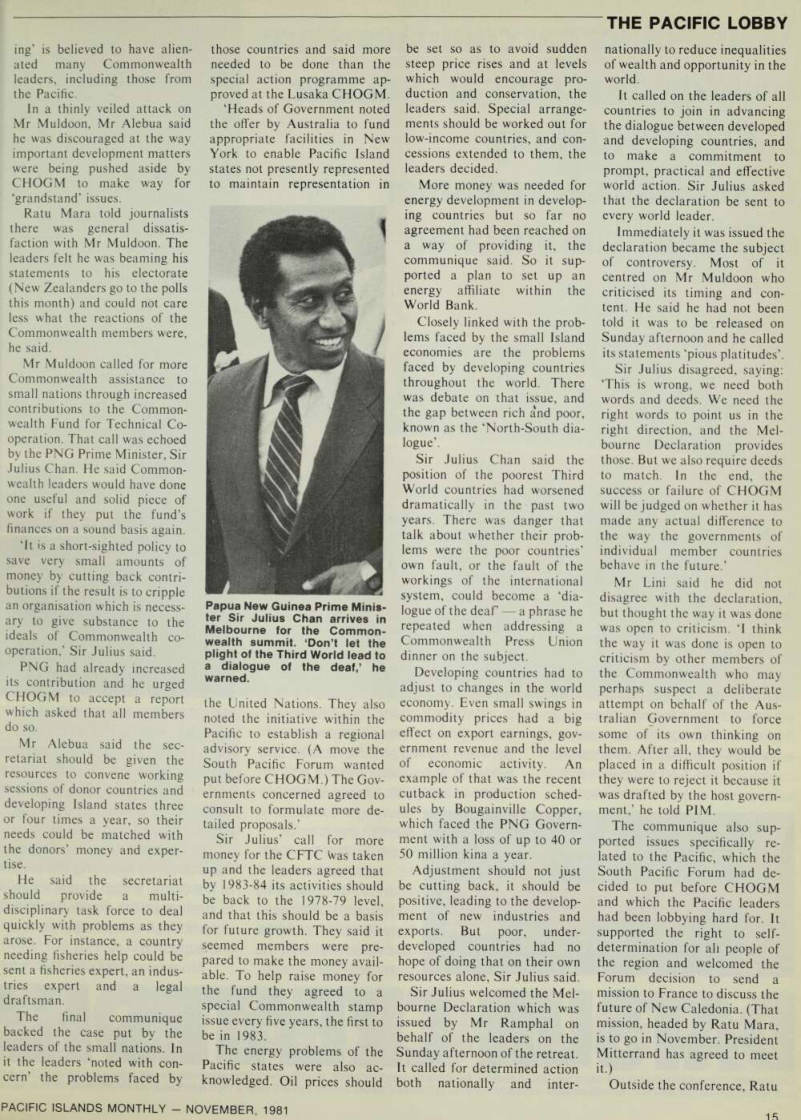
A strong ‘Pacific Lobby’ - but

Commonwealth Heads Of Government Meeting
A strong ‘Pacific Lobby’ - but how much did it achieve?
Journalist SUE GREEN was in Melbourne for RIM at the Commonwealth Heads of Government Meeting (CHOGM) from September 30-October 7. Her report below pulls together the story of the activity of the ‘Pacific Lobby’ formed by the seven Pacific Island states represented at the conference, their successes, and their continuing doubts as to whether, in the long run, the meeting will have much effect on how the nations concerned will behave in the future.
The Commonwealth Heads of Government Meeting (CHOGM) in Melbourne last month saw the development of a strong and fairly successful Pacific lobby which Pacific leaders say has set the trend for such conferences in future. But for those leaders the real test of their lobby and of CHOGM itself is yet to come.
The Pacific leaders met regu larly. They lobbied those from other parts of the world to have Pacific issues put before the conference. They say they suceeded: the final com munique, with its sections on the law of the sea convention, opposition to nuclear tests and dumping nuclear waste reflects that.
But whether those words are more than just words will only be seen by Commonwealth ac tions now that the leaders are back home in their own countries, facing their domestic problems again. Some Pacific leaders are less than hopeful about the likely results.
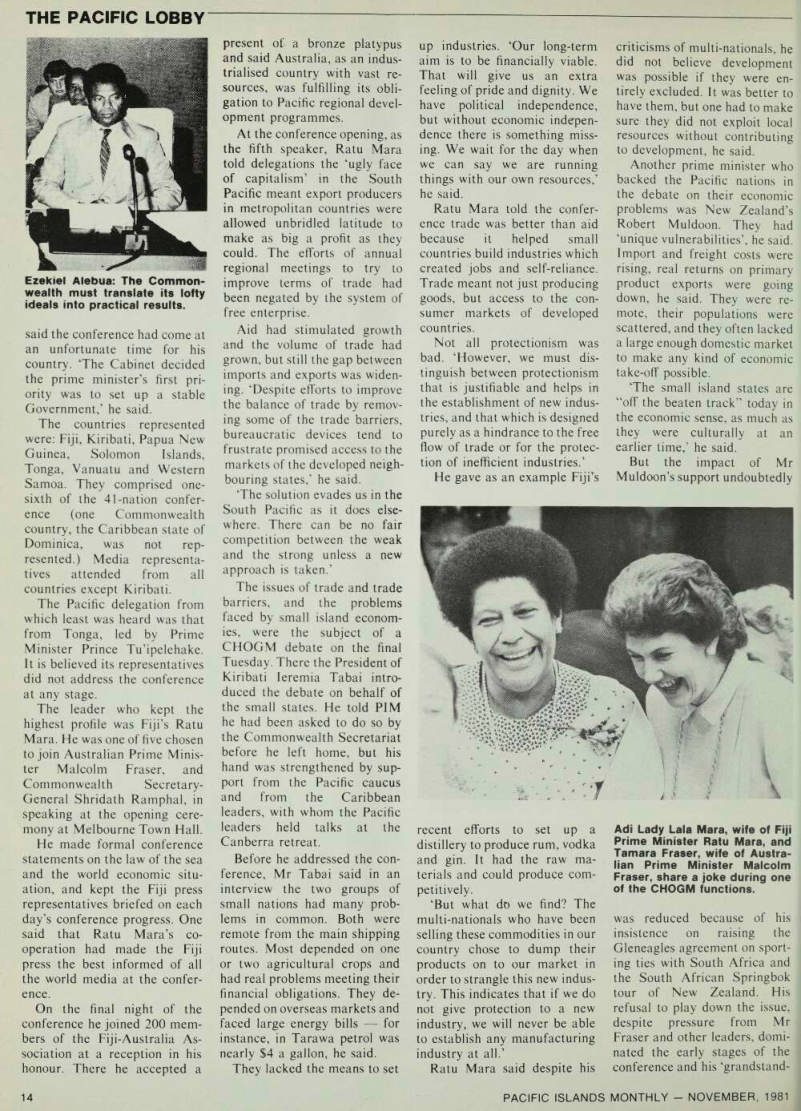
The leader of the Solomon Islands delegation, Foreign Affairs Minister Ezekiel Alebua, summed up the doubts in a hard-hitting statement issued towards the end of the conference. In it he said he was disappointed at Commonwealth progress since the communique from the last CHOGM in Zambia in 1979. What was needed was for CHOGM to ?ive the Commonwealth Sec
retariat the means to translate ‘lofty objectives into concrete, practical results’.
He told PIM he hoped other Commonwealth leaders had taken his statement as a strong stand. ‘I hope they can do something about it. . . Knowing what these kinds of meetings and conferences are like, I came here in the high hope of putting the view of my country. I think I have managed to do that.’
Fiji’s Prime Minister Ratu Sir Kamisese Mara was also critical of the lack of progress since the last CHOGM. The economic situation of the world was worse, but ‘what is glaring, however, is that we have done very little to find effective solutions,’ he said in his confer
ence speech on the world economic situation. ‘All the talks so far have been full of philosophies and good intentions, but there has been very little in terms of real practical action. Unfortunately in Fiji we cannot afford the luxuries of philosophies and good intentions alone.’
But after the Melbourne communique he told journalists Pacific countries had made more impact there than at any other Commonwealth meeting.
On the last day of the latest CHOGM, Vanuatu’s Prime Minister, Father Walter Lini, summed up his disappointment in an interview with PIM: ‘I think there is not a single thing which the South Pacific Island
nations and the whole of the Commonwealth can point to and say, “this was done in Melbourne”.’
Seven Pacific Island nations were represented at the meet ing, which ran from Wednesday September 30 to Wednesday October 7. The formal talks took place in Mel bourne’s Royal Exhibition buildings and there was a week end retreat in Canberra. All leaders had audiences with the Queen on board the Royal yacht, Britannia.
All the Pacific countries were represented by heads of govern ment except Solomon Islands, New Prime Minister Solomon Mamaloni did not attend. The delegation leader, Mr Alebua,
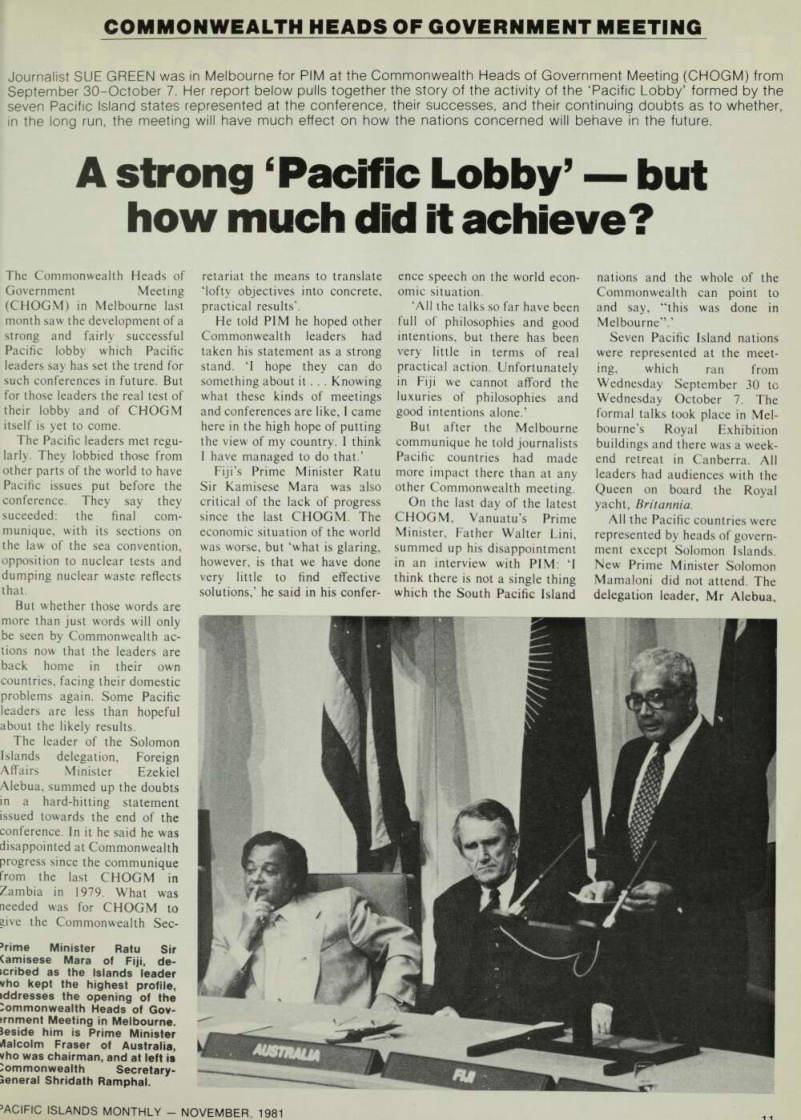
Prime Minister Ratu Sir Kamisese Mara of Fiji, de [?]cribed as the Islands leader [?]ho kept the highest profile, [?]ddresses the opening of the Commonwealth Heads of Gov [?]rnment Meeting in Melbourne. [?]eside him is Prime Minister Malcolm Fraser of Australia, [?]ho was chairman, and at left is
Commonwealth Secretary-
General Shridath Ramphal.
said the conference had come at an unfortunate time for his country. ‘The Cabinet decided the prime minister’s first pri ority was to set up a stable Government,’ he said.
The countries represented were: Fiji, Kiribati, Papua New Guinea, Solomon Islands, Tonga, Vanuatu and Western Samoa. They comprised one sixth of the 41-nation confer ence (one Commonwealth country, the Caribbean state of Dominica, was not rep resented.) Media representa tives attended from all countries except Kiribati.
The Pacific delegation from which least was heard was that from Tonga, led by Prime Minister Prince Tu’ipelehake.
It is believed its representatives did not address the conference at any stage.
The leader who kept the highest profile was Fiji’s Ratu Mara. He was one of five chosen to join Australian Prime Minis ter Malcolm Fraser, and Commonwealth Secretary- General Shridath Ramphal, in speaking at the opening cere mony at Melbourne Town Hall.
He made formal conference statements on the law of the sea and the world economic situ ation, and kept the Fiji press representatives briefed on each day’s conference progress. One said that Ratu Mara’s co operation had made the Fiji press the best informed of all the world media at the confer ence.
On the final night of the conference he joined 200 mem bers of the Fiji-Australia As sociation at a reception in his honour. There he accepted a
present of a bronze platypus and said Australia, as an indus trialised country with vast re sources, was fulfilling its obli gation to Pacific regional devel opment programmes.
At the conference opening, as the fifth speaker, Ratu Mara told delegations the ‘ugly face of capitalism’ in the South Pacific meant export producers in metropolitan countries were allowed unbridled latitude to make as big a profit as they could. The efforts of annual regional meetings to try to improve terms of trade had been negated by the system of free enterprise.
Aid had stimulated growth and the volume of trade had grown, but still the gap between imports and exports was widen ing. ‘Despite efforts to improve the balance of trade by remov ing some of the trade barriers, bureaucratic devices tend to frustrate promised access to the markets of the developed neigh bouring states,’ he said. ‘The solution evades us in the South Pacific as it does else where. There can be no fair competition between the weak and the strong unless a new approach is taken.’
The issues of trade and trade barriers, and the problems faced by small island econom ies, were the subject of a CHOGM debate on the final Tuesday. There the President of Kiribati leremia Tabai intro duced the debate on behalf of the small states. He told PIM he had been asked to do so by the Commonwealth Secretariat before he left home, but his hand was strengthened by sup port from the Pacific caucus and from the Caribbean leaders, with whom the Pacific leaders held talks at the Canberra retreat.
Before he addressed the con ference, Mr Tabai said in an interview the two groups of small nations had many prob lems in common. Both were remote from the main shipping routes. Most depended on one or two agricultural crops and had real problems meeting their financial obligations. They de pended on overseas markets and faced large energy bills for instance, in Tarawa petrol was nearly $4 a gallon, he said.
They lacked the means to set
up industries. ‘Our long-term aim is to be financially viable.
That will give us an extra feeling of pride and dignity. We have political independence, but without economic indepen dence there is something miss ing. We wait for the day when we can say we are running things with our own resources,’ he said.
Ratu Mara told the confer ence trade was better than aid because it helped small countries build industries which created jobs and self-reliance.
Trade meant not just producing goods, but access to the con sumer markets of developed countries.
Not all protectionism was bad. ‘However, we must dis tinguish between protectionism that is justifiable and helps in the establishment of new indus tries, and that which is designed purely as a hindrance to the free flow of trade or for the protec tion of inefficient industries.’
He gave as an example Fiji’s
criticisms of multi-nationals, he did not believe development was possible if they were en tirely excluded. It was better to have them, but one had to make sure they did not exploit local resources without contributing to development, he said.
Another prime minister who backed the Pacific nations in the debate on their economic problems was New Zealand’s Robert Muldoon. They had ‘unique vulnerabilities’, he said.
Import and freight costs were rising, real returns on primary product exports were going down, he said. They were re mote, their populations were scattered, and they often lacked a large enough domestic market to make any kind of economic take-off possible. ‘The small island states are “off the beaten track” today in the economic sense, as much as they were culturally at an earlier time,’ he said.
But the impact of Mr Muldoon’s support undoubtedly
recent efforts to set up a distillery to produce rum, vodka and gin. It had the raw ma terials and could produce com petitively. ‘But what do we find? The multi-nationals who have been selling these commodities in our country chose to dump their products on to our market in order to strangle this new indus try. This indicates that if we do not give protection to a new industry, we will never be able to establish any manufacturing industry at all.’
Ratu Mara said despite his
was reduced because of his insistence on raising the Gleneagles agreement on sport ing ties with South Africa and the South African Springbok tour of New Zealand. His refusal to play down the issue, despite pressure from Mr Fraser and other leaders, domi nated the early stages of the conference and his ‘grandstand
Ezekiel Alebua: The Common wealth must translate its lofty ideals into practical results.
Adi Lady Lala Mara, wife of Fiji Prime Minister Ratu Mara, and Tamara Fraser, wife of Austra lian Prime Minister Malcolm Fraser, share a joke during one of the CHOGM functions.
ing’ is believed to have alien ated many Commonwealth leaders, including those from the Pacific.
In a thinly veiled attack on Mr Muldoon, Mr Alebua said he was discouraged at the way important development matters were being pushed aside by CHOGM to make way for ‘grandstand’ issues.
Ratu Mara told journalists there was general dissatis faction with Mr Muldoon. The leaders felt he was beaming his statements to his electorate (New Zealanders go to the polls this month) and could not care less what the reactions of the Commonwealth members were, he said.
Mr Muldoon called for more Commonwealth assistance to small nations through increased contributions to the Common wealth Fund for Technical Co operation. That call was echoed by the PNG Prime Minister, Sir Julius Chan. He said Common wealth leaders would have done one useful and solid piece of work if they put the fund’s finances on a sound basis again. ‘lt is a short-sighted policy to save very small amounts of money by cutting back contri butions if the result is to cripple an organisation which is necess ary to give substance to the ideals of Commonwealth co operation,’ Sir Julius said.
PNG had already increased its contribution and he urged CHOGM to accept a report which asked that all members do so.
Mr Alebua said the sec retariat should be given the resources to convene working sessions of donor countries and developing Island states three or four times a year, so their needs could be matched with the donors’ money and exper tise.
He said the secretariat should provide a multi disciplinary task force to deal quickly with problems as they arose. For instance, a country needing fisheries help could be sent a fisheries expert, an indus tries expert and a legal draftsman.
The final communique backed the case put by the leaders of the small nations. In it the leaders ‘noted with con cern’ the problems faced by
those countries and said more needed to be done than the special action programme ap proved at the Lusaka CHOGM. ‘Heads of Government noted the offer by Australia to fund appropriate facilities in New York to enable Pacific Island states not presently represented to maintain representation in
file United Nations. They also noted the initiative within the Pacific to establish a regional advisory service. (A move the South Pacific Forum wanted put before CHOGM.) The Gov ernments concerned agreed to consult to formulate more de tailed proposals.’
Sir Julius’ call for more money for the CFTC was taken up and the leaders agreed that by 1983-84 its activities should be back to the 1978-79 level, and that this should be a basis for future growth. They said it seemed members were pre pared to make the money avail able. To help raise money for the fund they agreed to a special Commonwealth stamp issue every five years, the first to be in 1983.
The energy problems of the Pacific states were also ac knowledged. Oil prices should
be set so as to avoid sudden steep price rises and at levels which would encourage pro duction and conservation, the leaders said. Special arrange ments should be worked out for low-income countries, and con cessions extended to them, the leaders decided.
More money was needed for energy development in develop ing countries but so far no agreement had been reached on a way of providing it, the communique said. So it sup ported a plan to set up an energy affiliate within the World Bank.
Closely linked with the prob lems faced by the small Island economies are the problems faced by developing countries throughout the world. There was debate on that issue, and the gap between rich and poor, known as the ‘North-South dia logue’.
Sir Julius Chan said the position of the poorest Third World countries had worsened dramatically in the past two years. There was danger that talk about whether their prob lems were the poor countries’ own fault, or the fault of the workings of the international system, could become a ‘dia logue of the deaf a phrase he repeated when addressing a Commonwealth Press Union dinner on the subject.
Developing countries had to adjust to changes in the world economy. Even small swings in commodity prices had a big effect on export earnings, gov ernment revenue and the level of economic activity. An example of that was the recent cutback in production sched ules by Bougainville Copper, which faced the PNG Govern ment with a loss of up to 40 or 50 million kina a year.
Adjustment should not just be cutting back, it should be positive, leading to the develop ment of new industries and exports. But poor, under developed countries had no hope of doing that on their own resources alone, Sir Julius said.
Sir Julius welcomed the Mel bourne Declaration which was issued by Mr Ramphal on behalf of the leaders on the Sunday afternoon of the retreat.
It called for determined action both nationally and inter
nationally to reduce inequalities of wealth and opportunity in the world.
It called on the leaders of all countries to join in advancing the dialogue between developed and developing countries, and to make a commitment to prompt, practical and effective world action. Sir Julius asked that the declaration be sent to every world leader.
Immediately it was issued the declaration became the subject of controversy. Most of it centred on Mr Muldoon who criticised its timing and con tent. He said he had not been told it was to be released on Sunday afternoon and he called its statements ‘pious platitudes’.
Sir Julius disagreed, saying: ‘This is wrong, we need both words and deeds. We need the right words to point us in the right direction, and the Mel bourne Declaration provides those. But we also require deeds to match. In the end, the success or failure of CHOGM will be judged on whether it has made any actual difference to the way the governments of individual member countries behave in the future.’
Mr Lini said he did not disagree with the declaration, but thought the way it was done was open to criticism. T think the way it was done is open to criticism by other members of the Commonwealth who may perhaps suspect a deliberate attempt on behalf of the Aus tralian Government to force some of its own thinking on them. After all, they would be placed in a difficult position if they were to reject it because it was drafted by the host govern ment,’ he told PIM.
The communique also sup ported issues specifically re lated to the Pacific, which the South Pacific Forum had de cided to put before CHOGM and which the Pacific leaders had been lobbying hard for. It supported the right to self determination for all people of the region and welcomed the Forum decision to send a mission to France to discuss the future of New Caledonia. (That mission, headed by Ratu Mara, is to go in November. President Mitterrand has agreed to meet it.) Outside the conference, Ratu
Papua New Guinea Prime Minis ter Sir Julius Chan arrives in Melbourne for the Common wealth summit. ‘Don’t let the plight of the Third World lead to a dialogue of the deaf,’ he warned.
Mara warned that events in New Caledonia, particularly following the September mur der of Independence Front secretary-general Pierre Declercq, were beginning to re semble a ‘mini-Algeria’.
The murder created an Algeria-type situation where people were being discouraged from taking a particular line.
But it also forced the French Government to focus more clearly on the independence issue, he said.
CHOGM also supported the South Pacific countries’ call for an immediate end to nuclear tests in the region, and the Forum resolution which op posed dumping and storage of nuclear waste in the Pacific.
A key Pacific issue at CHOGM was the law of the sea. Throughout the conference Pacific leaders worked to have the meeting raise the problem of the draft convention which ran into trouble when the new US administration pulled out its negotiating team and said a total re-think was necessary (PIM Jun p 59). The final com munique did not specifically name the USA as the main obstacle to completing the con vention, but it did include a special section on the subject.
It said: ‘Heads of Govern ment stressed the importance they attached to securing at an early date a comprehensive and widely accepted convention on the law of the sea. ‘They observed that such a convention would enhance the prospects for peace and security in the world. It would define the rights of coastal states and other users of the sea; assist rational exploitation and man agement of the living and non living resources of the oceans; provide increased protection for the marine environment; give practical effect to the principle that the resources of the seabed beyond national jurisdiction are the common heritage of man kind, and permit all states to participate in the exploitation of those resources, either di rectly through national oper ators, or indirectly through the Enterprise.’
Negotiations had reached an advanced stage, but heads of government ‘recorded with dis quiet’ developments in the last
two sessions. They hoped the conference on the law of the sea would finish its work next year, the communique said.
That section, and the thinly veiled criticism of the US, marked a victory for all Pacific leaders, and for their regional caucus. But it was a particular victory for Fiji’s Ratu Mara.
He was the first speaker to raise the issue. He took the chance offered by the opening ceremony to put it before all delegations and the world press.
The next day he followed up with a statement to the confer ence on the law of the sea. He said that despite the text having been widely agreed, with the leading participation of the three US negotiators, the pres-
ent administration in Washing ton decided in March to review the entire text.
He asked CHOGM to en dorse the law of the sea confer ence’s wish for the US to join again ‘on a realistic basis’, and for the work to be finished next year. Those comments were backed by Mr Muldoon, who said he hoped, after his recent talks with President Reagan, the US would set aside dom estic concerns to complete the international treaty.
But it was the Solomon Islands delegation leader who voiced the toughest criticism of the US for holding up the convention. He said of the US decision to delay signing until after its own policy review: ‘lt is difficult not to see this action as that of a superpower selfishly defending its own interests against the mutual interests of the wider world community.’
The heads of government had taken a positive line. But as with other issues, the real test would be action.
An issue which, before the conference, threatened to div ide it, was Australia’s treatment of the Aborigines. Mr Lini said he was going to raise a contro versial World Council of Churches report which at tacked racism in Australia.
He said he was determined to do so despite criticism from Australian Government back bencher Roger Shipton. Mi Shipton, chairman of the parlia mentary foreign affairs and defence committee, said Mr Lini was running a risk of being seen as ungrateful for Austra lian aid.
Mr Lini raised the report with Mr Fraser before the conference. It is believed he told other Pacific leaders he was
happy with the assurances he was given. Ratu Mara and Sir Julius Chan both said they did not know enough about the issue to get involved.
In the formal conference sessions Mr Lini did not raise the issue. It was another Pacific leader, Western Samoa’s Tupuola Efi, who took it up. ‘A lot of people were very happy that I raised it. This meeting has given the WCC report publicity which will probably aid the cause of the Aborigines,’ he said. Mr Fraser had said he would do all he could and he was to be believed because of his human rights initiatives in other parts of the world.
When Mr Ramphal was asked at a press briefing what the Western Samoa leader had said he described it as a
‘virtuoso performance’. The contribution was ‘quite brilliant’ and he could not do justice to it in attempting to describe it, he said.
On the last day of the meet ing Mr Lini told PIM he did not feel he had backed down on the Aboriginal issue. T have taken almost every step that I under took to take in my remarks in Port-Vila,’ he said. He had raised it with Mr Fraser, he had answered questions from the media, from church leaders and solidarity groups, and he had raised it with other Pacific leaders, he said.
But it was not ‘the end of the road’ for the Aborigines, he said. The Australian Govern ment would be in a difficult position if the Commonwealth approved a programme worked out by the Aboriginal people.
That step was premature. But now all Commonwealth leaders were aware it was a serious issue, and would be keeping an eye on it. What happened next depended on what was done in Australia and in the region, he said.
The Pacific leaders predicted that the lobby they formed at the Melbourne CHOGM would set a precedent for future con ferences. They had achieved much in talks in the back corridors, said Mr Alebua, re fusing to elaborate.
Mr Tabai said: ‘There is always the feeling in bigger organisations like this that the small island states will be swept away. But in the world we are in now, and with the number of independent countries around the world, we cannot afford to just leave one or two countries to talk for the rest of mankind.
Those days are gone.’
But both the leaders, rep resentatives of two of the smallest nations at CHOGM, agreed that whether anything positive resulted from the con ference could only be judged by the actions of the member states between now and the next conference, to be held in India.
If nothing else, CHOGM helped some delegations find out some fairly basic facts about the Pacific, Mr Tabai told PIM. ‘ln fact,’ he added, ‘mem bers of several delegations actu ally asked me where Kiribati is . . .’
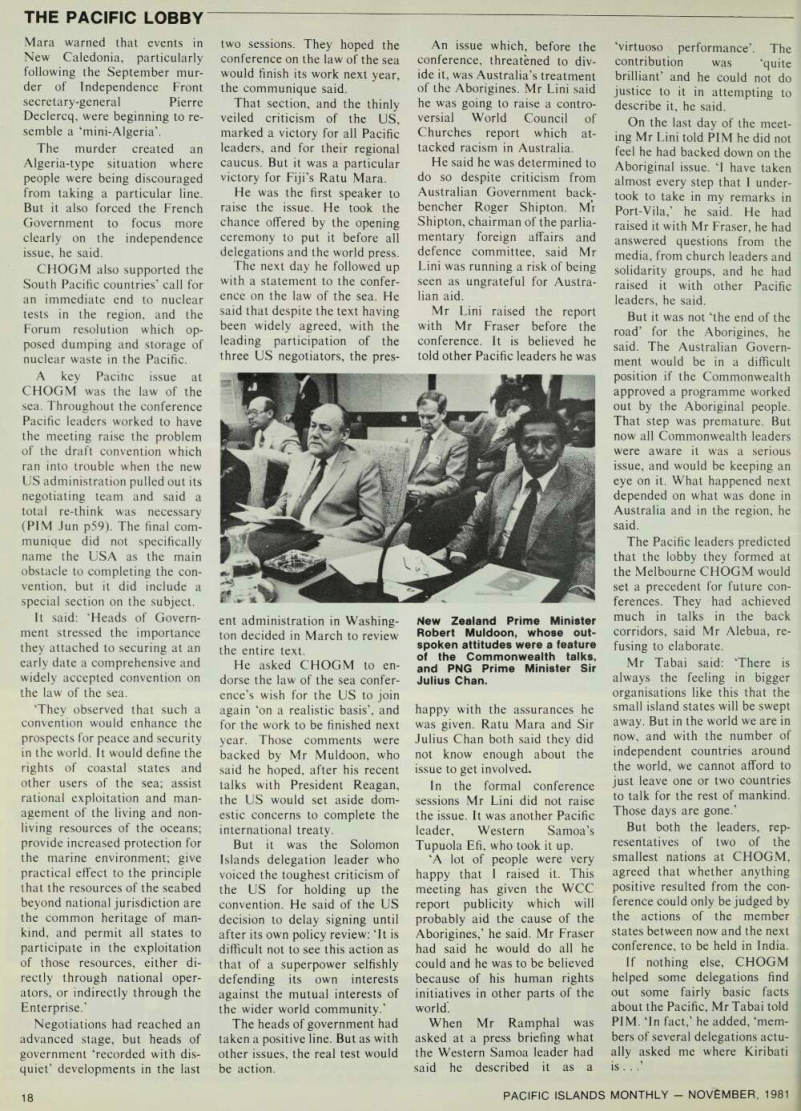
New Zealand Prime Minister Robert Muldoon, whose out spoken attitudes were a feature of the Commonwealth talks, and PNG Prime Minister Sir Julius Chan.
Advertisements & other items, pp. 11-17 (2 items)
11
’ACIFIC ISLANDS MONTHLY - NOVEMBER, 1981
High-tech: higher-fi.
Pioneer components bring you a great new look and top performance to match. Plus total access to all their high technology advances—through Total System Design.
More than mere technical elegance, Total System Design means greater convenience through the components’
Centralized System Status Control and Indication panels.
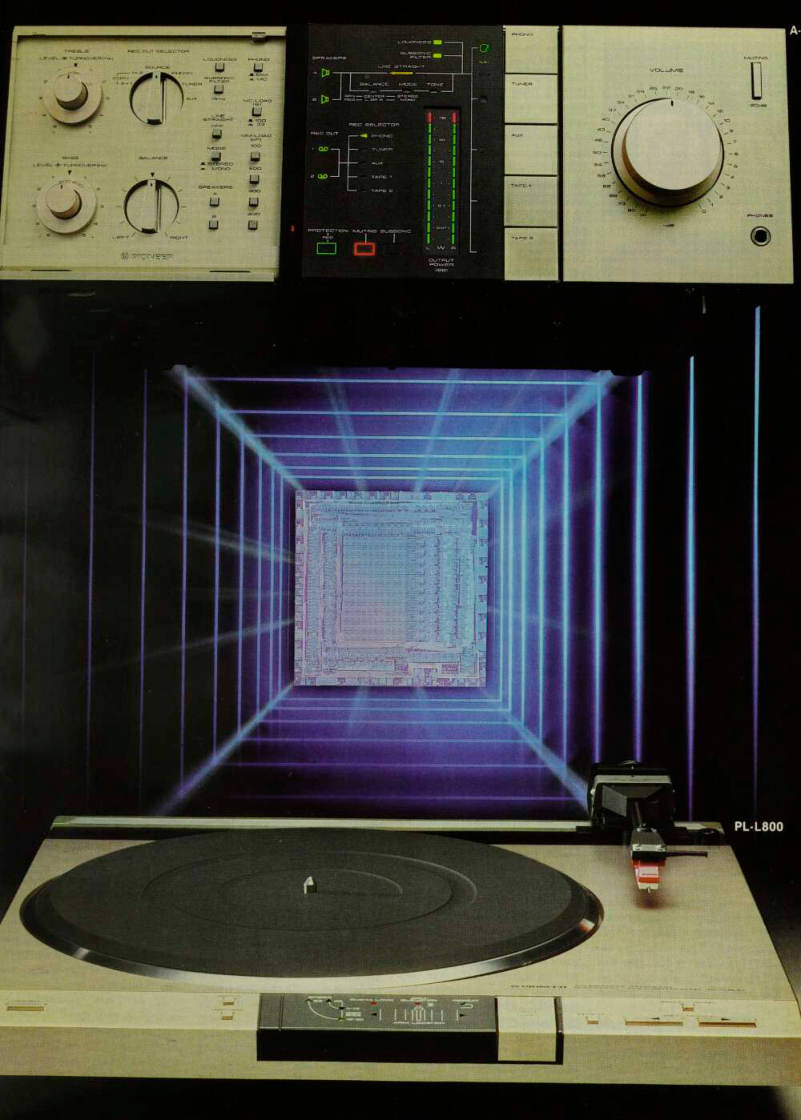
In the A-9 amp, it means pure sound through Non- Switching™ and DC-Servo circuitry. Line-Straight signal flow to protect that purity. And electronic pushbuttons that put you in command.
In the F-9 tuner, it means accurate, quartz-PLL synthesized tuning. Push-pull FM front end and digital detector to widen dynamic range and eliminate IF nonlinearity. And instant recall of up to six FM and six AM stations by pushbutton Memory.
In the 3-Direct-Drive-Motor CT-9R cassette deck, it means Computer-Aided Convenience plus precision performance. The CT-9R’s so “smart” it sets tape bias, level and equalization.
And in the PL-LBOO turntable, it means tangential tracking and a low-mass Polymer Graphite™ tone arm for high tracking ability. And a high-output cartridge for delivering startlingly clear sound without need for a special MC head amplifier.
Total System Design: the high point in our decades of developing high-technology high-fidelity. What it means to “higher-fi” is something you’ll just have to hear for yourself to appreciate.
Pioneer components are displayed only at stores showing this emblem. ■ F-9 ■
-/casß
nn n n
U U'U u
A'jro BLB sss. „ PU_ dipect drive
(y) p|OIM€GR STEREO C
CT-9R
Advanced performance through technology.
For further Information, please contact: Australia: Pioneer Marketing Service Pty. Ltd., P.O. Box 317, Mordialtoc, Victoria, 3195 Tel: 90-9011 Fiji Islands: Brijlal & Company, G.RO. Box No. 362, Suva, Fiji Islands Tei: 22258 * New Zealand; Monaco Distributors Ltd., 2 Poland Road, Glenfield, Auckland, New Zealand Tel: (09) 444-9144 Norfolk Island: Bums Philp (Norfolk Island) Ltd., P.O. Box 21, Norfolk Island, New Hebrides; Rums Philo /New Hebrides* I td Vile New Hebrides Nauru Island: Jacob Enterprises, P.O. Box No. 4, Republic of Nauru Tahiti: Tahiti Hi-Fi, P.O. Box 848, Papeete, Tahiti New Caledonia; Menard Pacifique Sari, B.P. 3899, Noumea, New Caledonia Tel: 48*24.36 American Samoa; Transpac Corporation, P.O. Box 1477, Pago Pago, American Samoa 96799 Tel: 633-5224 Rarotonga; South Seas International Ltd., P.O. Box 49, Rarotonga, Cook Islands Tel: 2327 Penue New fiuinee; Reli Merchants Ptv itd PO Box 6103 Boroko Tel: 254887
A- □ a S ~z_
PL-LBOO
% O ... mi 1 m
While other car companies are
making their big cars smaller,
Datsun is making
their small cars roomier
and more comfortable.
For most car companies, the rule is the roomier you make a car, the bigger and heavier you have to make it. Consequently it uses more gas.
So it’s no surprise that their cars are getting smaller.
But then most car companies aren’t Datsun.
At Datsun, we not only accept such conflicts, we look for them. Then we look for ways to bring them into “harmony.” Because, to us, harmony is balance. The balance of apparent contradictions. And the better the balance we’re able to achieve, the better the cars we re able to build.
Consequently, for 1981, every new Datsun across the board is roomier and more comfortable than the model that preceded it. Yet each one runs on as little gas. Or less.
And we didn’t make them roomier inside by making them more box-like outside. We did it by finding a better way to redistribute the space we had.
We reduced the space between the engine and the dash panel, between the fan and the radiator and between the radiator and the grill.
Then we added that space to the passenger compartment in the form of more leg and hip room.
More space was added to the interior by reducing the distance between the front tires and wheel wells. At the same time, by moving the dashboard and windshield forward and making the windshield more inclined, we not only increase physical space but also added to th< impression of spaciousness. Humar sensitivity answered by carefully studied human engineering.
Still more space was added to the interior by reducing the thickne of the doors. Which meant we had to strengthen the doors. Which we did with high-tensile steel panels, and supports.
More head and shoulder room
DATSUN CREATES HU
Cook Islands; COOK ISLANDS MOTOR CENTRE LTD , Rarotonga/Fiji: CARPENTERS MOTORS, Suva/Guam: DATSUN MOTOR SALES, Agana/Hawaii; NISSAN MOTO CORPORATION IN HAWAII LTD,, Honolulu/Kiribati: ATOLL AUTO STORES, Tarawa/Nauru: JACOB ENTERPRISES LTD New Caledonia; AGENCE ALMA S.A.. Noumei
is added by reducing the height the seats. Which meant we had place an extra layer of padding tween the springs and seat pads to ep you comfortable.
And after we made the interior as roomy as possible, we made it seem even roomier. Color, pattern and texture, carefully attuned to human sensitivity, make broad seating seem even broader.
Problem-solving by designresolving conflicting elements to improve the overall quality of the product—has helped Datsun to build cars that are quiet and roomy, yet light and fuel efficient.
Our way may not be right for most car companies. But, at Datsun, we measure our success in terms of how well we build the kind of cars the world needs. Without sacrificing what you want in your car.
That’s harmony.
The model shown above is the Datsun 1608 for the Middle East.
Specifications and equipment may vary according to market.
DATSUN
!MONY BY DESIGNS
lslands: SIRIUS M OTORS/Papua New Guinea: BOROKO MOTORS LTD , Port Moresby/Salpan; JOETEN MOTOR VIPANY INC /Solomon Islands: UNITED ENTERPRISES LTD Honiara/Tahitl: TAHITIBULL SAR D, Papeete Western Samoa: MORRIS HEDSTROM LTD Apia
New Caledonia: Paris
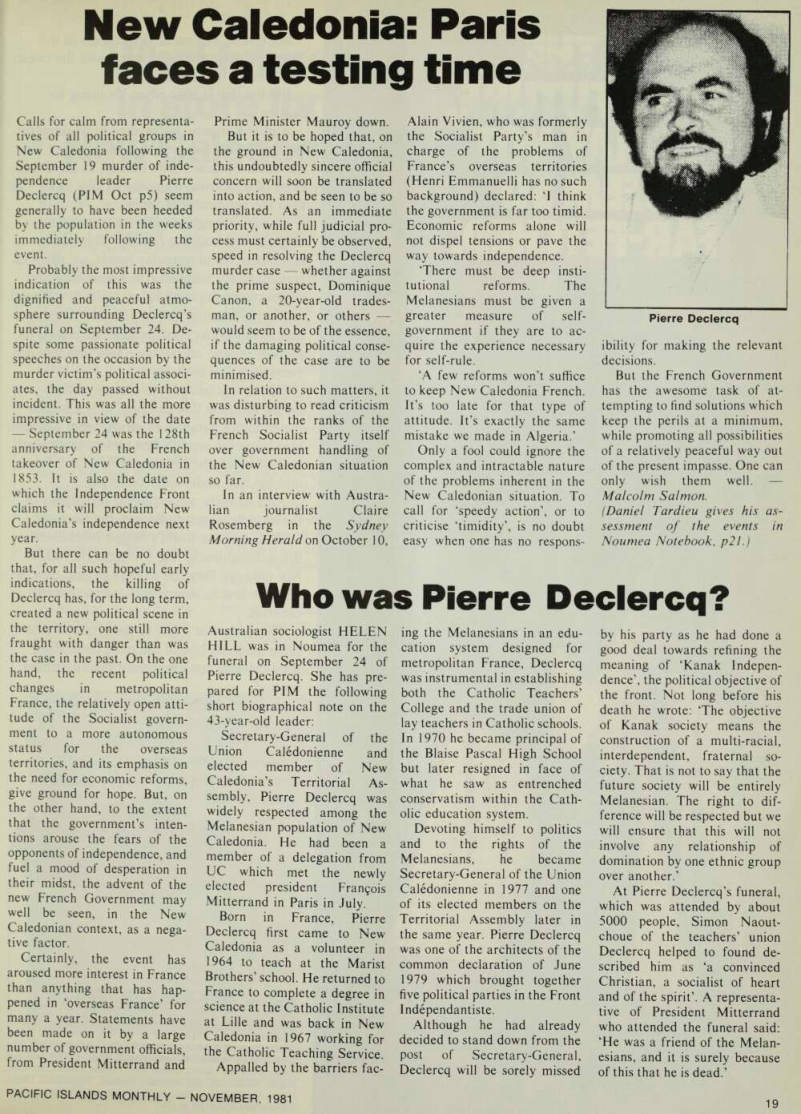
faces a testing time
Calls for calm from representa tives of all political groups in New Caledonia following the September 19 murder of inde pendence leader Pierre Declercq (PIM Oct p 5) seem generally to have been heeded by the population in the weeks immediately following the event.
Probably the most impressive indication of this was the dignified and peaceful atmo sphere surrounding Declercq’s funeral on September 24. De spite some passionate political speeches on the occasion by the murder victim’s political associ ates, the day passed without incident. This was all the more impressive in view of the date September 24 was the 128th anniversary of the French takeover of New Caledonia in 1853. It is also the date on which the Independence Front claims it will proclaim New Caledonia’s independence next year.
But there can be no doubt that, for all such hopeful early indications, the killing of Declercq has, for the long term, created a new political scene in the territory, one still more fraught with danger than was the case in the past. On the one hand, the recent political changes in metropolitan France, the relatively open atti tude of the Socialist govern ment to a more autonomous status for the overseas territories, and its emphasis on the need for economic reforms, give ground for hope. But, on the other hand, to the extent that the government’s inten tions arouse the fears of the opponents of independence, and fuel a mood of desperation in their midst, the advent of the new French Government may well be seen, in the New Caledonian context, as a nega tive factor.
Certainly, the event has aroused more interest in France than anything that has hap pened in ‘overseas France’ for many a year. Statements have been made on it by a large number of government officials, from President Mitterrand and
Prime Minister Mauroy down.
But it is to be hoped that, on the ground in New Caledonia, this undoubtedly sincere official concern will soon be translated into action, and be seen to be so translated. As an immediate priority, while full judicial pro cess must certainly be observed, speed in resolving the Declercq murder case whether against the prime suspect, Dominique Canon, a 20-year-old trades man, or another, or others would seem to be of the essence, if the damaging political conse quences of the case are to be minimised.
In relation to such matters, it was disturbing to read criticism from within the ranks of the French Socialist Party itself over government handling of the New Caledonian situation so far.
In an interview with Austra lian journalist Claire Rosemberg in the Sydney Morning Herald on October 10,
Alain Vivien, who was formerly the Socialist Party’s man in charge of the problems of France’s overseas territories (Henri Emmanuelli has no such background) declared: I think the government is far too timid.
Economic reforms alone will not dispel tensions or pave the way towards independence.
There must be deep insti tutional reforms. The Melanesians must be given a greater measure of self government if they are to ac quire the experience necessary for self-rule. ‘A few reforms won’t suffice to keep New Caledonia French.
It’s too late for that type of attitude. It’s exactly the same mistake we made in Algeria.’
Only a fool could ignore the complex and intractable nature of the problems inherent in the New Caledonian situation. To call for ‘speedy action’, or to criticise ‘timidity’, is no doubt easy when one has no respons-
ibility for making the relevant decisions.
But the French Government has the awesome task of at tempting to find solutions which keep the perils at a minimum, while promoting all possibilities of a relatively peaceful way out of the present impasse. One can only wish them well.
Malcolm Salmon. {Daniel Tardieu gives his as sessment of the events in Noumea Notebook, p 21.)
Pierre Declercq
Who was Pierre Declercq?
Australian sociologist HELEN HILL was in Noumea for the funeral on September 24 of Pierre Declercq. She has pre pared for PIM the following short biographical note on the 43-year-old leader: Secretary-General of the Union Caledonienne and elected member of New Caledonia’s Territorial As sembly, Pierre Declercq was widely respected among the Melanesian population of New Caledonia. He had been a member of a delegation from UC which met the newly elected president Francis Mitterrand in Paris in July.
Born in France, Pierre Declercq first came to New Caledonia as a volunteer in 1964 to teach at the Marist Brothers’ school. He returned to France to complete a degree in science at the Catholic Institute at Lille and was back in New Caledonia in 1967 working for the Catholic Teaching Service.
Appalled by the barriers fac
ing the Melanesians in an edu cation system designed for metropolitan France, Declercq was instrumental in establishing both the Catholic Teachers’
College and the trade union of lay teachers in Catholic schools.
In 1970 he became principal of the Blaise Pascal High School but later resigned in face of what he saw as entrenched conservatism within the Cath olic education system.
Devoting himself to politics and to the rights of the Melanesians, he became Secretary-General of the Union Caledonienne in 1977 and one of its elected members on the Territorial Assembly later in the same year. Pierre Declercq was one of the architects of the common declaration of June 1979 which brought together five political parties in the Front Independantiste.
Although he had already decided to stand down from the post of Secretary-General, Declercq will be sorely missed
by his party as he had done a good deal towards refining the meaning of ‘Kanak Indepen dence’, the political objective of the front. Not long before his death he wrote: The objective of Kanak society means the construction of a multi-racial, interdependent, fraternal so ciety. That is not to say that the future society will be entirely Melanesian. The right to dif ference will be respected but we will ensure that this will not involve any relationship of domination by one ethnic group over another.’
At Pierre Declercq’s funeral, which was attended by about 5000 people, Simon Naout choue of the teachers’ union Declercq helped to found de scribed him as ‘a convinced Christian, a socialist of heart and of the spirit’. A representa tive of President Mitterrand who attended the funeral said: ‘He was a friend of the Melan esians, and it is surely because of this that he is dead.’
Advertisements & other items, p. 20 (1 item)
•#• Komatsu
Right now, visions of skyscrapers in the desert, or self-contained cities under the ocean may seem a bit far-fetched.
But the day is near when it’s going to happen.
And at Komatsu, we’re already working on the equipment that will be needed to get the job done. Because, quite frankly, to build the cities of tomorrow, it’s going to take more than the equipment of today.
So even though we place a tremendous emphasis on building reliable, high-quality equipment for present-day needs, we place an equally heavy emphasis on researching and developing equipment future builders will need.
It’s this commitment to futuristic thinking and advanced technology that has helped us pioneer time after time products that are years ahead of their time.
Like a specialized, sub-surface asphaltlaying machine that can help turn a barren desert into a paradise of green. From Komatsu also came the world’s first remote controlled seabed robot, the first amphibious bulldozer, and the first underwater bulldozer.
And recently, we exhibited prototypes of the world’s largest bulldozer, the Komatsu D555A, and the world’s largest mechanicaldrive dump truck, the Komatsu HDI6OOM.
Not only are they the world’s largest, they’re also the first to incorporate microcomputer controls.
These are just a few of the products that have made us one of the most diversified, total construction equipment manufacturers around.
And in the future, we promise even more innovative equipment Because at Komatsu, we believe the best way to keep from getting behind, is to keep looking ahead.
•#• KOMATSU
Komatsu offices: Tokyo, Singapore, Jakarta, Manila, Bangkok, Bangalore, Karachi, Beijing, Sydney, Istanbul, Cairo, Alger, Dubai, Tehran, Baghdad, Jeddah, Riyadh, Damman, Nairobi, Abidjan, Lagos, Johannesburg, Moscow, Warsaw, Brussels, Paris, Madrid, Frankfurt, Stuttgart, London, Habana, Buenos Aires, Panama, Caracas, Sao Paulo, Bogota, Mexico City, San Francisco, Oakland, Philadelphia, Detroit, Dallas, Atlanta, Chicago, Toronto, Vancouver, and distributors in over 100 countries around the world.
Noumea
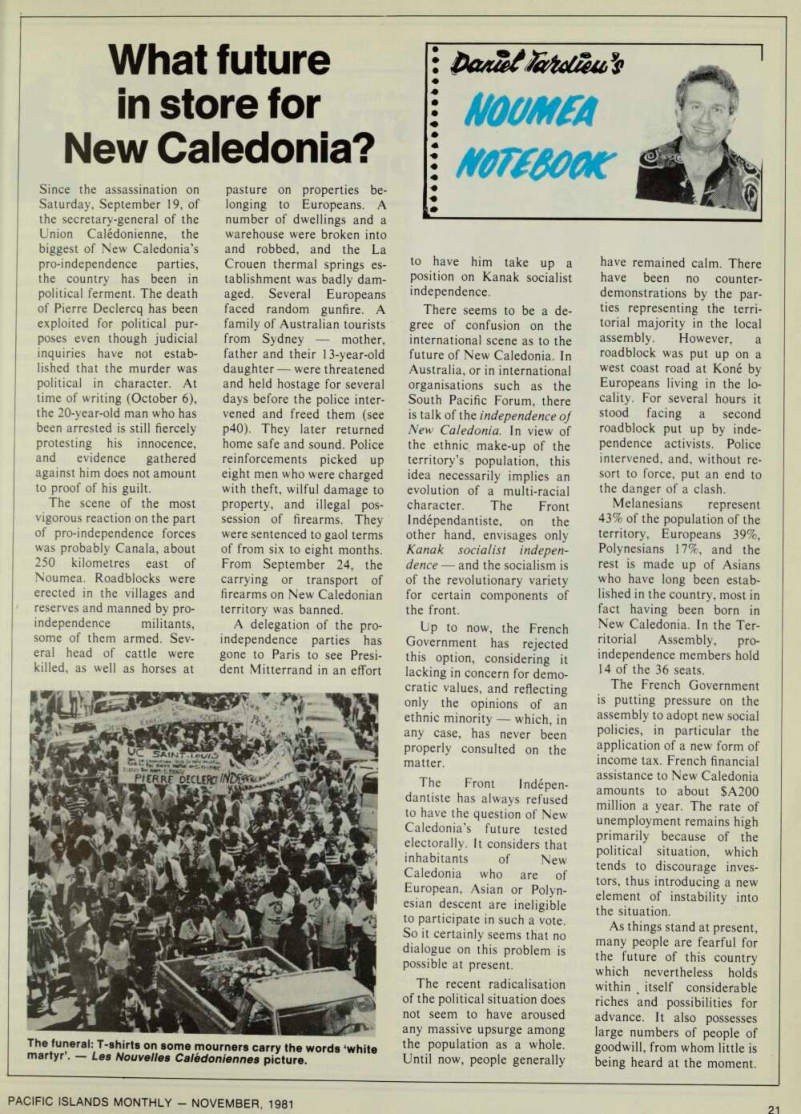
What future in store for New Caledonia?
Dariel Tandiell's
Notebook
Since the assassination on Saturday, September 19, of the secretary-general of the Union Caledonienne, the biggest of New Caledonia’s pro-independence parties, the country has been in political ferment. The death of Pierre Declercq has been exploited for political pur poses even though judicial inquiries have not estab lished that the murder was political in character. At time of writing (October 6), the 20-year-old man who has been arrested is still fiercely protesting his innocence, and evidence gathered against him does not amount to proof of his guilt.
The scene of the most vigorous reaction on the part of pro-independence forces was probably Canala, about 250 kilometres east of Noumea. Roadblocks were erected in the villages and reserves and manned by pro independence militants, some of them armed. Sev eral head of cattle were killed, as well as horses at
pasture on properties be longing to Europeans. A number of dwellings and a warehouse were broken into and robbed, and the La Crouen thermal springs es tablishment was badly dam aged. Several Europeans faced random gunfire. A family of Australian tourists from Sydney mother, father and their 13-year-old daughter were threatened and held hostage for several days before the police inter vened and freed them (see p4O). They later returned home safe and sound. Police reinforcements picked up eight men who were charged with theft, wilful damage to property, and illegal pos session of firearms. They were sentenced to gaol terms of from six to eight months.
From September 24, the carrying or transport of firearms on New Caledonian territory was banned.
A delegation of the pro independence parties has gone to Paris to see Presi dent Mitterrand in an effort
to have him take up a position on Kanak socialist independence.
There seems to be a de gree of confusion on the international scene as to the future of New Caledonia. In Australia, or in international organisations such as the South Pacific Forum, there is talk of the independence oj New Caledonia. In view of the ethnic make-up of the territory’s population, this idea necessarily implies an evolution of a multi-racial character. The Front Independantiste, on the other hand, envisages only Kanak socialist indepen dence and the socialism is of the revolutionary variety for certain components of the front.
Up to now, the French Government has rejected this option, considering it lacking in concern for demo cratic values, and reflecting only the opinions of an ethnic minority which, in any case, has never been properly consulted on the matter.
The Front Indepen dantiste has always refused to have the question of New Caledonia’s future tested electorally. It considers that inhabitants of New Caledonia who are of European, Asian or Polyn esian descent are ineligible to participate in such a vote.
So it certainly seems that no dialogue on this problem is possible at present.
The recent radicalisation of the political situation does not seem to have aroused any massive upsurge among the population as a whole.
Until now, people generally
have remained calm. There have been no counter demonstrations by the par ties representing the terri torial majority in the local assembly. However, a roadblock was put up on a west coast road at Kone by Europeans living in the lo cality. For several hours it stood facing a second roadblock put up by inde pendence activists. Police intervened, and, without re sort to force, put an end to the danger of a clash.
Melanesians represent 43% of the population of the territory, Europeans 39%, Polynesians 17%, and the rest is made up of Asians who have long been estab lished in the country, most in fact having been born in New Caledonia. In the Ter ritorial Assembly, pro independence members hold 14 of the 36 seats.
The French Government is putting pressure on the assembly to adopt new social policies, in particular the application of a new form of income tax. French financial assistance to New Caledonia amounts to about SA2OO million a year. The rate of unemployment remains high primarily because of the political situation, which tends to discourage inves tors, thus introducing a new element of instability into the situation.
As things stand at present, many people are fearful for the future of this country which nevertheless holds within itself considerable riches and possibilities for advance. It also possesses large numbers of people of goodwill, from whom little is being heard at the moment.
The funeral: T-shirts on some mourners carry the words ‘white martyr’. - Lea Nouvelles Caledoniennes picture.
Many cases,
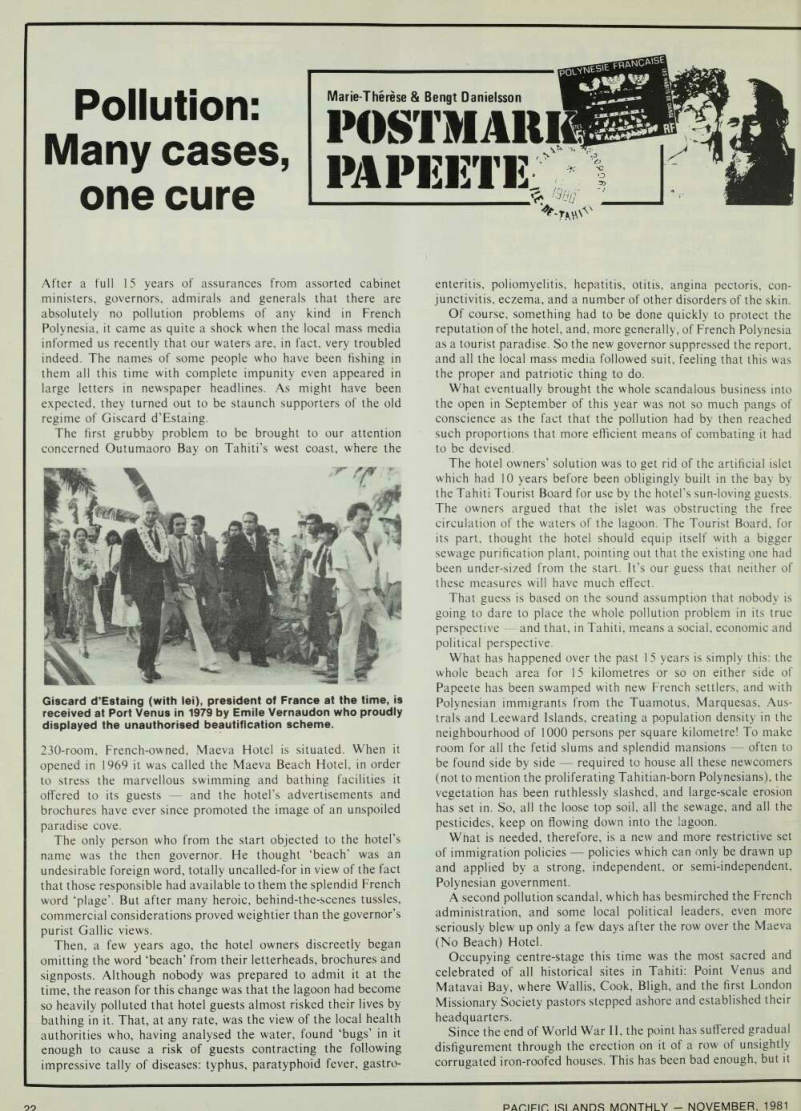
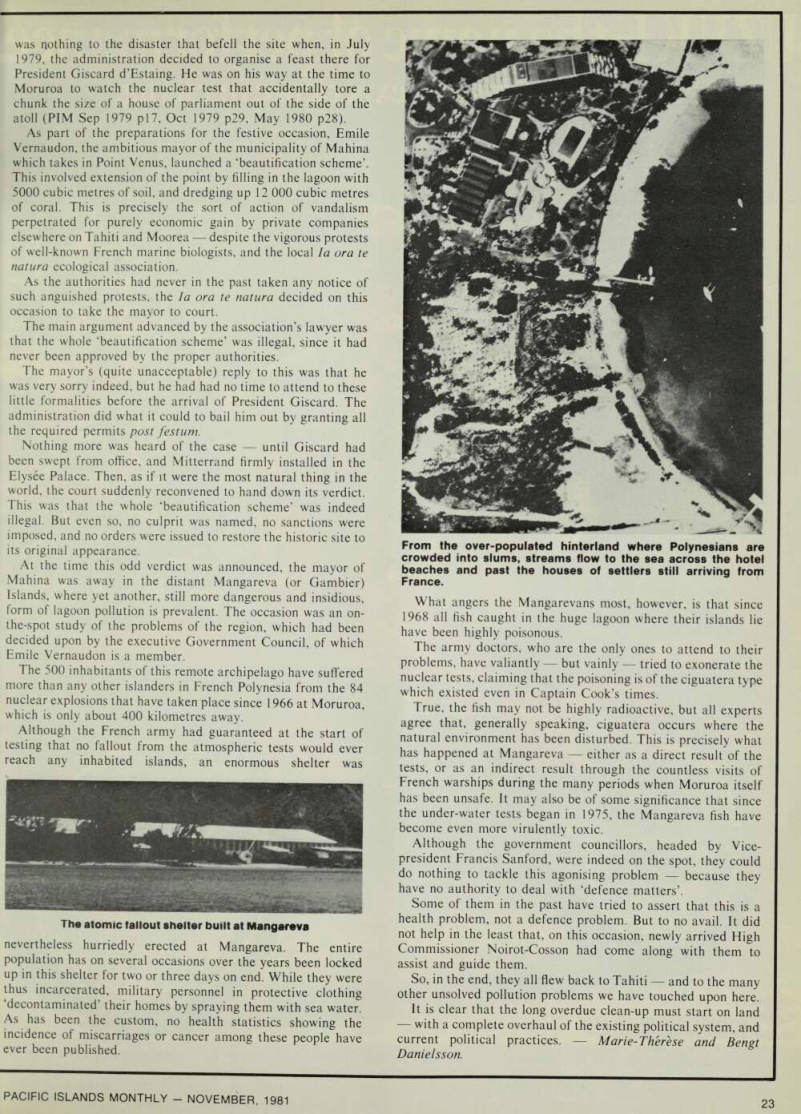
Pollution: Many cases, one cure
After a full 15 years of assurances from assorted cabinet ministers, governors, admirals and generals that there are absolutely no pollution problems of any kind in French Polynesia, it came as quite a shock when the local mass media informed us recently that our waters are, in fact, very troubled indeed. The names of some people who have been fishing in them all this time with complete impunity even appeared in large letters in newspaper headlines. As might have been expected, they turned out to be staunch supporters of the old regime of Giscard d’Estaing.
The first grubby problem to be brought to our attention concerned Outumaoro Bay on Tahiti’s west coast, where the
230-room, French-owned, Maeva Hotel is situated. When it opened in 1969 it was called the Maeva Beach Hotel, in order to stress the marvellous swimming and bathing facilities it offered to its guests and the hotel’s advertisements and brochures have ever since promoted the image of an unspoiled paradise cove.
The only person who from the start objected to the hotel’s name was the then governor. He thought ‘beach’ was an undesirable foreign word, totally uncalled-for in view of the fact that those responsible had available to them the splendid French word ‘plage’. But after many heroic, behind-the-scenes tussles, commercial considerations proved weightier than the governor’s purist Gallic views.
Then, a few years ago, the hotel owners discreetly began omitting the word ‘beach’ from their letterheads, brochures and signposts. Although nobody was prepared to admit it at the time, the reason for this change was that the lagoon had become so heavily polluted that hotel guests almost risked their lives by bathing in it. That, at any rate, was the view of the local health authorities who, having analysed the water, found ‘bugs’ in it enough to cause a risk of guests contracting the following impressive tally of diseases: typhus, paratyphoid fever, gastro
enteritis, poliomyelitis, hepatitis, otitis, angina pectoris, con junctivitis, eczema, and a number of other disorders of the skin.
Of course, something had to be done quickly to protect the reputation of the hotel, and, more generally, of French Polynesia as a tourist paradise. So the new governor suppressed the report, and all the local mass media followed suit, feeling that this was the proper and patriotic thing to do.
What eventually brought the whole scandalous business into the open in September of this year was not so much pangs of conscience as the fact that the pollution had by then reached such proportions that more efficient means of combating it had to be devised.
The hotel owners’ solution was to get rid of the artificial islet which had 10 years before been obligingly built in the bay by the Tahiti Tourist Board for use by the hotel’s sun-loving guests.
The owners argued that the islet was obstructing the free circulation of the waters of the lagoon. The Tourist Board, for its part, thought the hotel should equip itself with a bigger sewage purification plant, pointing out that the existing one had been under-sized from the start. It’s our guess that neither of these measures will have much effect.
That guess is based on the sound assumption that nobody is going to dare to place the whole pollution problem in its true perspective and that, in Tahiti, means a social, economic and political perspective.
What has happened over the past 15 years is simply this: the whole beach area for 15 kilometres or so on either side of Papeete has been swamped with new French settlers, and with Polynesian immigrants from the Tuamotus, Marquesas, Aus trals and Leeward Islands, creating a population density in the neighbourhood of 1000 persons per square kilometre! To make room for all the fetid slums and splendid mansions often to be found side by side required to house all these newcomers (not to mention the proliferating Tahitian-born Polynesians), the vegetation has been ruthlessly slashed, and large-scale erosion has set in. So, all the loose top soil, all the sewage, and all the pesticides, keep on flowing down into the lagoon.
What is needed, therefore, is a new and more restrictive set of immigration policies policies which can only be drawn up and applied by a strong, independent, or semi-independent, Polynesian government.
A second pollution scandal, which has besmirched the French administration, and some local political leaders, even more seriously blew up only a few days after the row over the Maeva (No Beach) Hotel.
Occupying centre-stage this time was the most sacred and celebrated of all historical sites in Tahiti; Point Venus and Matavai Bay, where Wallis, Cook, Bligh, and the first London Missionary Society pastors stepped ashore and established their headquarters.
Since the end of World War 11, the point has suffered gradual disfigurement through the erection on it of a row of unsightly corrugated iron-roofed houses. This has been bad enough, but it
Giscard d’Estaing (with lei), president of France at the time, is received at Port Venus in 1979 by Emile Vernaudon who proudly displayed the unauthorised beautification scheme.
was nothing to the disaster that befell the site when, in July 1979, the administration decided to organise a feast there for President Giscard d’Estaing. He was on his way at the time to Moruroa to watch the nuclear test that accidentally tore a chunk the size of a house of parliament out of the side of the atoll (PIM Sep 1979 p 17, Oct 1979 p 29. May 1980 p2B).
As part of the preparations for the festive occasion, Emile Vernaudon, the ambitious mayor of the municipality of Mahina which takes in Point Venus, launched a ‘beautification scheme’.
This involved extension of the point by filling in the lagoon with 5000 cubic metres of soil, and dredging up 12 000 cubic metres of coral. This is precisely the sort of action of vandalism perpetrated for purely economic gain by private companies elsewhere on Tahiti and Moorea despite the vigorous protests of well-known French marine biologists, and the local la orate natura ecological association.
As the authorities had never in the past taken any notice of such anguished protests, the la orate natura decided on this occasion to take the mayor to court.
The main argument advanced by the association’s lawyer was that the whole ‘beautification scheme’ was illegal, since it had never been approved by the proper authorities.
The mayor’s (quite unacceptable) reply to this was that he was very sorry indeed, but he had had no time to attend to these little formalities before the arrival of President Giscard. The administration did what it could to bail him out by granting all the required permits post festum.
Nothing more was heard of the case until Giscard had been swept from office, and Mitterrand firmly installed in the Elysee Palace. Then, as if it were the most natural thing in the world, the court suddenly reconvened to hand down its verdict.
This was that the whole ‘beautification scheme’ was indeed illegal. But even so, no culprit was named, no sanctions were imposed, and no orders were issued to restore the historic site to its original appearance.
At the time this odd verdict was announced, the mayor of Mahina was away in the distant Mangareva (or Gambier) Islands, where yet another, still more dangerous and insidious, form of lagoon pollution is prevalent. The occasion was an on the-spot study of the problems of the region, which had been decided upon by the executive Government Council, of which Emile Vernaudon is a member.
The 500 inhabitants of this remote archipelago have suffered more than any other islanders in French Polynesia from the 84 nuclear explosions that have taken place since 1966 at Moruroa, which is only about 400 kilometres away.
Although the French army had guaranteed at the start of testing that no fallout from the atmospheric tests would ever reach any inhabited islands, an enormous shelter was
nevertheless hurriedly erected at Mangareva. The entire population has on several occasions over the years been locked up in this shelter for two or three days on end. While they were thus incarcerated, military personnel in protective clothing decontaminated’ their homes by spraying them with sea water.
As has been the custom, no health statistics showing the incidence of miscarriages or cancer among these people have ever been published.
What angers the Mangarevans most, however, is that since 1968 all fish caught in the huge lagoon where their islands lie have been highly poisonous.
The army doctors, who are the only ones to attend to their problems, have valiantly but vainly tried to exonerate the nuclear tests, claiming that the poisoning is of the ciguatera type which existed even in Captain Cook’s times.
True, the fish may not be highly radioactive, but all experts agree that, generally speaking, ciguatera occurs where the natural environment has been disturbed. This is precisely what has happened at Mangareva either as a direct result of the tests, or as an indirect result through the countless visits of French warships during the many periods when Moruroa itself has been unsafe. It may also be of some significance that since the under-water tests began in 1975, the Mangareva fish have become even more virulently toxic.
Although the government councillors, headed by Vice president Francis Sanford, were indeed on the spot, they could do nothing to tackle this agonising problem because they have no authority to deal with ‘defence matters’.
Some of them in the past have tried to assert that this is a health problem, not a defence problem. But to no avail. It did not help in the least that, on this occasion, newly arrived High Commissioner Noirot-Cosson had come along with them to assist and guide them.
So, in the end, they all flew back to Tahiti and to the many other unsolved pollution problems we have touched upon here.
It is clear that the long overdue clean-up must start on land with a complete overhaul of the existing political system, and current political practices. Marie-Therese and Bengt Danielsson.
The atomic fallout shelter built at Mangareva
From the over-populated hinterland where Polynesians are crowded into slums, streams flow to the sea across the hotel beaches and past the houses of settlers still arriving from France.
Advertisements & other items, pp. 22-24 (2 items)
22
PAP.IFIP. 1551 ANDSS MONTHLY NOVEMBER, 1981
Postmark
Marie-Therese & Bengt Danielsson
PAPEETE
3. >3/
>UZUKI-the name of performance
Breathes of glory and experience in racing.
Watch it feeling over on-roads and boldly crossing off-roads.
Presenting SUZUKI's motorcycles that blends superb performance with elegant modernistic styling.
Seep strikingly alive in SUZUKI’s motorcycles is SUZUKI’s technology and experience originally incorporated in the champion machine which has claimed a variety of race titles.
These climaxing technological innovations are apt to attract motorbike fans worldover. \ e?
I >- ? m i r s > V 4 / *<T S' m v 4/ 4 !4p < 7 $
SUZUKI MOTOR CO, LTD
Suzuki! SOOTakatsuka, Hamamatsu, Japan fOLOMON ISLANDS SOLOMON ISLAND SERVICE STATION LTD. NEW CALEDONIA STE. SUPERCAL PAPUA NEW GUINEA HI SPEED )lESEL SERVICE PTY LTD. VANUATU HENRI LEROUX NIUE ISLAND BURNS PHILP (SOUTH SEA) CO., LTD. PONAPE LEO :TSCHEIT TAHITI NIPPON AUTOMOTO ELLICE ISLAND TUVALU COOPERATIVE WHOLESALE SOCIETY LTD. GUAM & SAIPAN SLAND CYCLERV. INC. NORFOLK MARTIN’S AGENCIES LTD. SAMOA PACIFIC PRODUCTS, INC. KIRIBATI GILBERT ISLANDS
A jaundiced
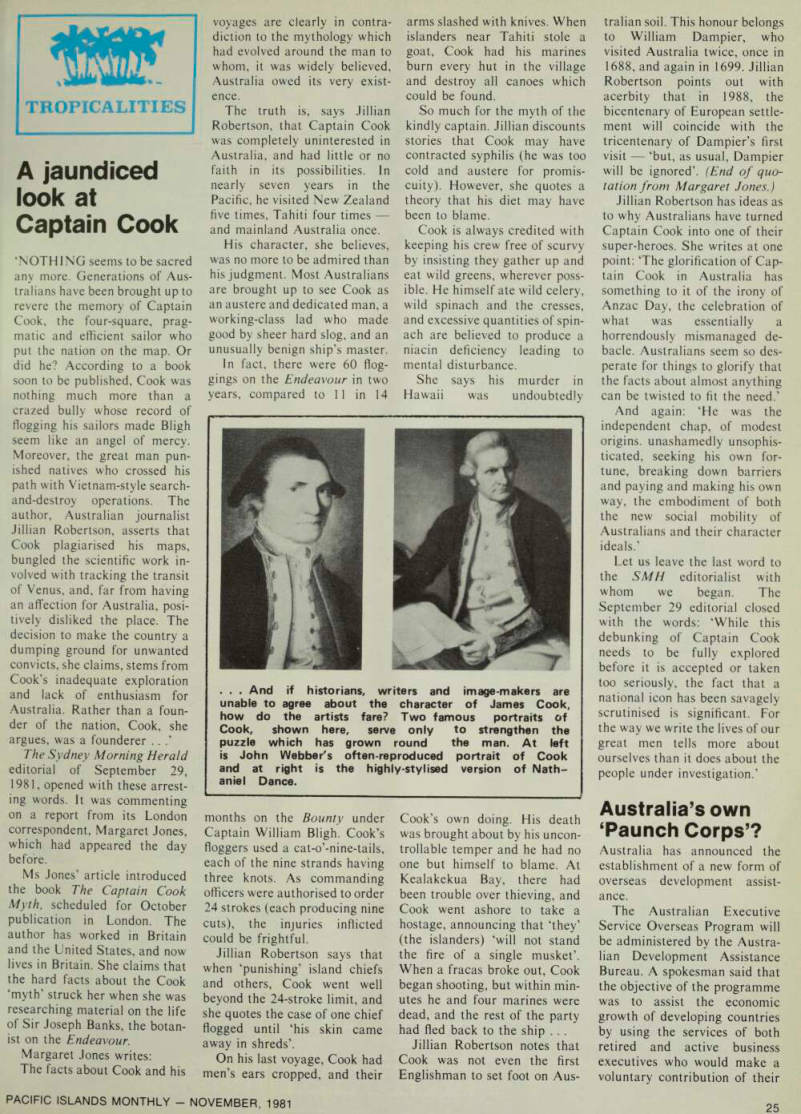
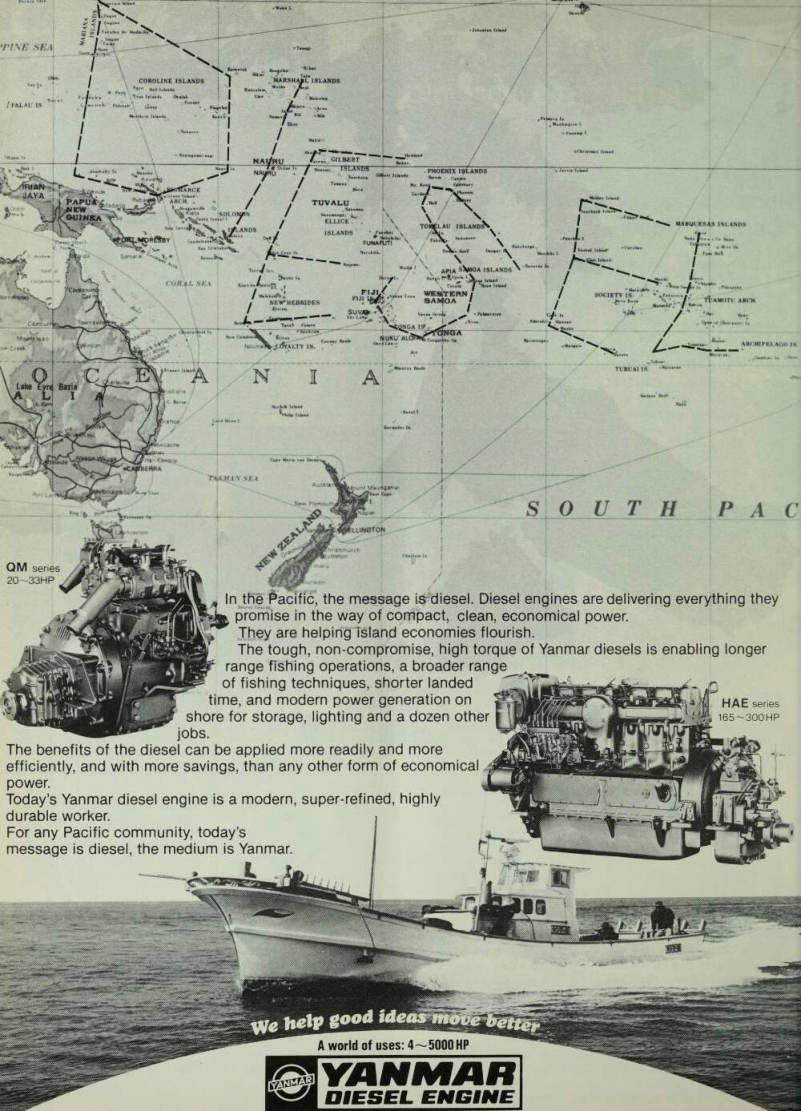

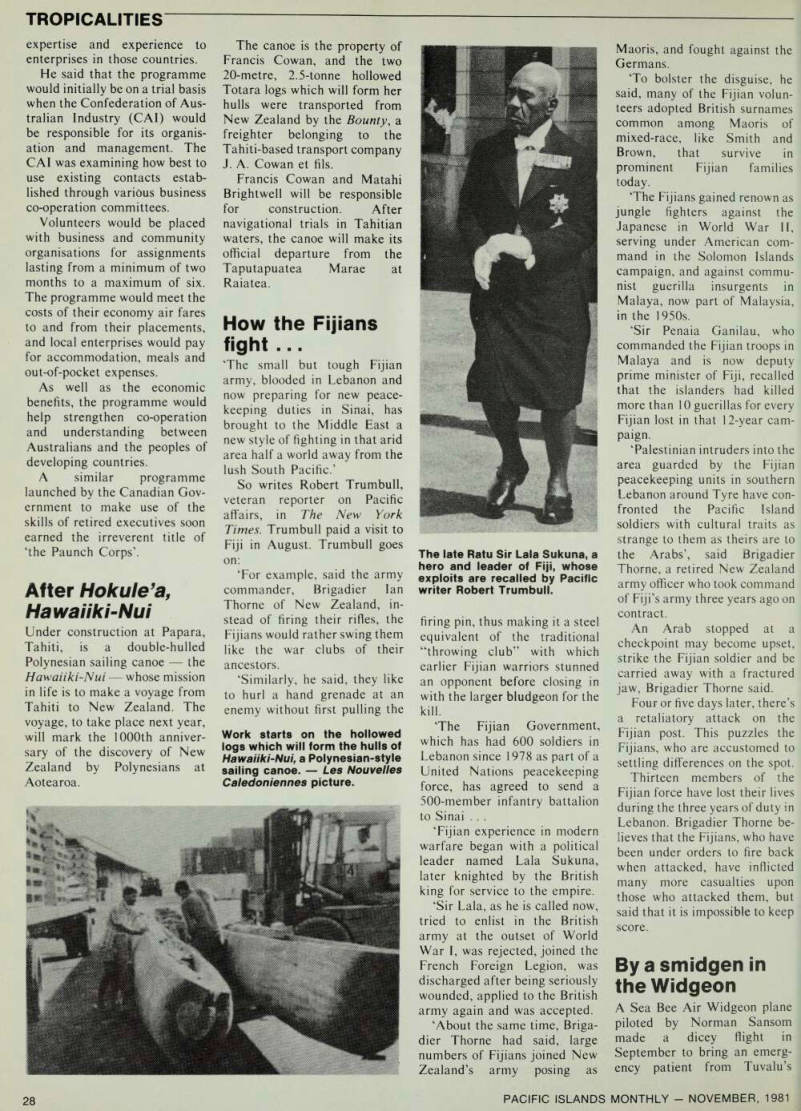
Tropicalities
A jaundiced look at Captain Cook
‘NOTHING seems to be sacred any more. Generations of Aus tralians have been brought up to revere the memory of Captain Cook, the four-square, prag matic and efficient sailor who put the nation on the map. Or did he? According to a book soon to be published, Cook was nothing much more than a crazed bully whose record of flogging his sailors made Bligh seem like an angel of mercy.
Moreover, the great man pun ished natives who crossed his path with Vietnam-style search and-destroy operations. The author, Australian journalist Jillian Robertson, asserts that Cook plagiarised his maps, bungled the scientific work in volved with tracking the transit of Venus, and, far from having an affection for Australia, posi tively disliked the place. The decision to make the country a dumping ground for unwanted convicts, she claims, stems from Cook’s inadequate exploration and lack of enthusiasm for Australia. Rather than a foun der of the nation, Cook, she argues, was a founderer .. .’
The Sydney Morning Herald editorial of September 29, 1981, opened with these arrest ing words. It was commenting on a report from its London correspondent, Margaret Jones, which had appeared the day before.
Ms Jones’ article introduced the book The Captain Cook Myth, scheduled for October publication in London. The author has worked in Britain and the United States, and now lives in Britain. She claims that the hard facts about the Cook ‘myth’ struck her when she was researching material on the life of Sir Joseph Banks, the botan ist on the Endeavour.
Margaret Jones writes: The facts about Cook and his
voyages are clearly in contra diction to the mythology which had evolved around the man to whom, it was widely believed, Australia owed its very exist ence.
The truth is, says Jillian Robertson, that Captain Cook was completely uninterested in Australia, and had little or no faith in its possibilities. In nearly seven years in the Pacific, he visited New Zealand five times, Tahiti four times and mainland Australia once.
His character, she believes, was no more to be admired than his judgment. Most Australians are brought up to see Cook as an austere and dedicated man, a working-class lad who made good by sheer hard slog, and an unusually benign ship’s master.
In fact, there were 60 flog gings on the Endeavour in two years, compared to 11 in 14
months on the Bounty under Captain William Bligh. Cook’s floggers used a cat-o’-nine-tails, each of the nine strands having three knots. As commanding officers were authorised to order 24 strokes (each producing nine cuts), the injuries inflicted could be frightful.
Jillian Robertson says that when ‘punishing’ island chiefs and others, Cook went well beyond the 24-stroke limit, and she quotes the case of one chief flogged until ‘his skin came away in shreds’.
On his last voyage, Cook had men’s ears cropped, and their
arms slashed with knives. When islanders near Tahiti stole a goat, Cook had his marines burn every hut in the village and destroy all canoes which could be found.
So much for the myth of the kindly captain. Jillian discounts stories that Cook may have contracted syphilis (he was too cold and austere for promis cuity). However, she quotes a theory that his diet may have been to blame.
Cook is always credited with keeping his crew free of scurvy by insisting they gather up and eat wild greens, wherever poss ible. He himself ate wild celery, wild spinach and the cresses, and excessive quantities of spin ach are believed to produce a niacin deficiency leading to mental disturbance.
She says his murder in Hawaii was undoubtedly
Cook’s own doing. His death was brought about by his uncon trollable temper and he had no one but himself to blame. At Kealakekua Bay, there had been trouble over thieving, and Cook went ashore to take a hostage, announcing that ‘they’ (the islanders) ‘will not stand the fire of a single musket’.
When a fracas broke out, Cook began shooting, but within min utes he and four marines were dead, and the rest of the party had fled back to the ship .. .
Jillian Robertson notes that Cook was not even the first Englishman to set foot on Aus
tralian soil. This honour belongs to William Dampier, who visited Australia twice, once in 1688, and again in 1699. Jillian Robertson points out with acerbity that in 1988, the bicentenary of European settle ment will coincide with the tricentenary of Dampier’s first visit ‘but, as usual, Dampier will be ignored’. (End of quo tation from Margaret Jones.) Jillian Robertson has ideas as to why Australians have turned Captain Cook into one of their super-heroes. She writes at one point: ‘The glorification of Cap tain Cook in Australia has something to it of the irony of Anzac Day, the celebration of what was essentially a horrendously mismanaged de bacle. Australians seem so des perate for things to glorify that the facts about almost anything can be twisted to fit the need.’
And again: ‘He was the independent chap, of modest origins, unashamedly unsophis ticated, seeking his own for tune, breaking down barriers and paying and making his own way, the embodiment of both the new social mobility of Australians and their character ideals.’
Let us leave the last word to the SMH editorialist with whom we began. The September 29 editorial closed with the words: ‘While this debunking of Captain Cook needs to be fully explored before it is accepted or taken too seriously, the fact that a national icon has been savagely scrutinised is significant. For the way we write the lives of our great men tells more about ourselves than it does about the people under investigation.’
Australia’s own
‘Paunch Corps’?
Australia has announced the establishment of a new form of overseas development assist ance.
The Australian Executive Service Overseas Program will be administered by the Austra lian Development Assistance Bureau. A spokesman said that the objective of the programme was to assist the economic growth of developing countries by using the services of both retired and active business executives who would make a voluntary contribution of their
. . . And if historians, writers and image-makers are unable to agree about the character of James Cook, how do the artists fare? Two famous portraits of Cook, shown here, serve only to strengthen the puzzle which has grown round the man. At left is John Webber's often-reproduced portrait of Cook and at right is the highly-stylised version of Nath aniel Dance.
expertise and experience to enterprises in those countries.
He said that the programme would initially be on a trial basis when the Confederation of Aus tralian Industry (CAI) would be responsible for its organis ation and management. The CAI was examining how best to use existing contacts estab lished through various business co-operation committees.
Volunteers would be placed with business and community organisations for assignments lasting from a minimum of two months to a maximum of six.
The programme would meet the costs of their economy air fares to and from their placements, and local enterprises would pay for accommodation, meals and out-of-pocket expenses.
As well as the economic benefits, the programme would help strengthen co-operation and understanding between Australians and the peoples of developing countries.
A similar programme launched by the Canadian Gov ernment to make use of the skills of retired executives soon earned the irreverent title of ‘the Paunch Corps’.
After Hokule’
Hawaiiki-Nui
Under construction at Papara, Tahiti, is a double-hulled Polynesian sailing canoe the Hawaiiki-Nui whose mission in life is to make a voyage from Tahiti to New Zealand. The voyage, to take place next year, will mark the 1000th anniver sary of the discovery of New Zealand by Polynesians at Aotearoa.
The canoe is the property of Francis Cowan, and the two 20-metre, 2.5-tonne hollowed Totara logs which will form her hulls were transported from New Zealand by the Bounty , a freighter belonging to the Tahiti-based transport company J. A. Cowan et fils.
Francis Cowan and Matahi Brightwell will be responsible for construction. After navigational trials in Tahitian waters, the canoe will make its official departure from the Taputapuatea Marae at Raiatea.
How the Fijians
fight ...
The small but tough Fijian army, blooded in Lebanon and now preparing for new peace keeping duties in Sinai, has brought to the Middle East a new style of fighting in that arid area half a world away from the lush South Pacific.’
So writes Robert Trumbull, veteran reporter on Pacific affairs, in The New York Times. Trumbull paid a visit to Fiji in August. Trumbull goes on; ‘For example, said the army commander. Brigadier lan Thorne of New Zealand, in stead of firing their rifles, the Fijians would rather swing them like the war clubs of their ancestors. ‘Similarly, he said, they like to hurl a hand grenade at an enemy without first pulling the
firing pin, thus making it a steel equivalent of the traditional “throwing club’’ with which earlier Fijian warriors stunned an opponent before closing in with the larger bludgeon for the kill.
The Fijian Government, which has had 600 soldiers in Lebanon since 1978 as part of a United Nations peacekeeping force, has agreed to send a 500-member infantry battalion to Sinai . . . ‘Fijian experience in modern warfare began with a political leader named Lala Sukuna, later knighted by the British king for service to the empire. ‘Sir Lala, as he is called now, tried to enlist in the British army at the outset of World War I, was rejected, joined the French Foreign Legion, was discharged after being seriously wounded, applied to the British army again and was accepted. ‘About the same time. Briga dier Thorne had said, large numbers of Fijians joined New Zealand’s army posing as
Maoris, and fought against the Germans.
To bolster the disguise, he said, many of the Fijian volun teers adopted British surnames common among Maoris of mixed-race, like Smith and Brown, that survive in prominent Fijian families today.
The Fijians gained renown as jungle fighters against the Japanese in World War 11, serving under American com mand in the Solomon Islands campaign, and against commu nist guerilla insurgents in Malaya, now part of Malaysia, in the 19505. ‘Sir Penaia Ganilau, who commanded the Fijian troops in Malaya and is now deputy prime minister of Fiji, recalled that the islanders had killed more than 10 guerillas for every Fijian lost in that 12-year cam paign. ‘Palestinian intruders into the area guarded by the Fijian peacekeeping units in southern Lebanon around Tyre have con fronted the Pacific Island soldiers with cultural traits as strange to them as theirs are to the Arabs’, said Brigadier Thorne, a retired New Zealand army officer who took command of Fiji’s army three years ago on contract.
An Arab stopped at a checkpoint may become upset, strike the Fijian soldier and be carried away with a fractured jaw, Brigadier Thorne said.
Four or five days later, there’s a retaliatory attack on the Fijian post. This puzzles the Fijians, who are accustomed to settling differences on the spot.
Thirteen members of the Fijian force have lost their lives during the three years of duty in Lebanon. Brigadier Thorne be lieves that the Fijians, who have been under orders to fire back when attacked, have inflicted many more casualties upon those who attacked them, but said that it is impossible to keep score.
By a smidgen in
the Widgeon
A Sea Bee Air Widgeon plane piloted by Norman Sansom made a dicey flight in September to bring an emerg ency patient from Tuvalu’s
Work starts on the hollowed logs which will form the hulls of Hawaiiki-Nui, a Polynesian-style sailing canoe. - Les Nouvelles Caledoniennes picture.
The late Ratu Sir Lala Sukuna, a hero and leader of Fiji, whose exploits are recalled by Pacific writer Robert Trumbull.
Nukufetau Island to hospital on Funafuti.
Earlier in the day Mr Sansom had had to cancel a scheduled flight to Nui due to strong easterlies which, blowing across Funafuti’s grass airstrip, made take-offs and landings risky.
What’s more the sky was heavily overcast.
However, when called by Dr Tekie losefa with an inquiry as to whether a flight would be possible, Mr Sansom after much reflection said he would give it a try. It was already after 4 pm. The flight to and from Nukufetau was un eventful, but the problem was he had only about half an hour’s daylight flying time left. It was already almost dark when, about 6 pm, the Widgeon drone was heard over Fogafale. The plane circled the main islet twice before coming in to land on the Funafuti lagoon, without landing lights and head-on into the still strong easterlies.
The police firetruck and am bulance were there, beaming their lights into the lagoon. The patient was swiftly transferred to the ambulance and whisked off to hospital.
One more happy episode in the endless saga of small aircraft, Pacific Islands, avi ation. • Good news for Tuvalu avi ation was the arrival in September of Sea Bee Air’s Grumman Goose. The ‘big’ 10-seater plane will enter the trial service inaugurated by the company last year under agree ment with the Tuvalu Govern ment. Plans are being drawn up ;o put the Grumman Goose into service to countries beyond Fuvalu.
World congress of
disabled people
Delegates from Pacific Island countries are being invited to ittend the first world congress )f Disabled Peoples Inter lational which is to be held in Singapore from November 29. fhe congress will also mark the ormal founding of Disabled
Copies International, following
series of regional meetings vhich have already been held.
An Australian, Mr Gustav Rebels from the Sydney suburb f Eastern Creek, has been
organising arrangements for the Pacific delegation and has been liaising with disabled people’s groups in Papua New Guinea and Fiji. Mr Gebels said that the integration of handicapped people into normal society had only recently come under strong examination in many of the Island communities.
Much had yet to be done in terms of material progress and community attitudes, but the move had started. Mr Gebels said that the newly-emerging Disabled Peoples International hoped to become a major com munity force in the Islands region. He described it as ‘an organisation with a difference, an organisation of handicapped people not for handicapped people’.
Ratu Sir George
gets a football
It’s not often that yachtsmen arrive in Fiji with rugby foot balls under their arms.
But when Rear-Commodore Geoff Foster of Sydney, Austra lia’s, Middle Harbour Yacht Club visited Fiji recently, it was a very special football for a very special person.
The football was
subsequently presented by Rear-Commodore Foster, and Warwick Davis, promotions manager of Tooth & Co Ltd, to His Excellency, the Governor- General of Fiji, Ratu Sir George Cakobau.
The football had been signed back in Australia by the Austra lian and French rugby teams before the First Test played at Ballymore, Brisbane. It was taken to Fiji as a special present to Ratu Sir George, a noted former Fijian rugby player.
Ratu Sir George first played rugby in Sydney when a school boy at Newington College in the GPS Competition, and he rep resented Fiji in rugby in 1938 and 1939, and cricket in 1945.
He led the Fiji team which toured New Zealand, the only unbeaten rugby team from any nation ever to tour New Zea land. He also represented the government of Fiji on rugby tours of Australia in 1952 and 1954, in 1961 and in 1969.
At present Ratu Sir George is patron of the Fiji Rugby Union, while his former team-mate in
the prewar tour of New Zea land, Ratu Sir Penaia Ganilau, who is now deputy prime minis ter of Fiji, is the president of the Fiji Rugby Union.
Indonesia, PNG
hit drug-runners
Indonesia’s 750-km land border with Papua New Guinea has been closed to foreigners in a bid to block a drug corridor between the two countries.
The closure, which has the backing of the PNG govern ment, means that foreigners wanting to cross from the Indonesian province of Irian Jaya into PNG can only do so by air or sea. The move follows regular reports that Asian drug couriers heading for the lucra tive Australian and New Zea land markets have been making land crossings of the border in recent months.
The couriers are said to have been dropped by boat in a remote region of southern Irian Jaya to walk undetected across the border into the equally remote Western Province of PNG. There are no permanent passport or customs checkpoints on either side of the border in this area.
The closest checkpoint in Irian Jaya is at the town of Merauke, about 80 km west of the border, while the nearest in PNG is the seaport of Daru, about 270 km east.
The border closure was an nounced in the Irian Jaya capi tal, Jayapura, by the province’s governor and former Indonesian ambassador to PNG, General Busjiri Suryowinoto.
A PNG government official said air and sea travel between Irian Jaya and PNG would not be affected, nor would the closure apply to villagers living on the border. He said both PNG and Indonesia had be come ‘increasingly concerned’ about drug trafficking between the two countries in remote areas. They had agreed to work together in future to prevent illegal border crossings.
The official said it was be lieved a wide range of drugs worth millions of dollars was being transported across the border including cannabis, hashish oil and buddha sticks. ‘The drugs are almost certainly
Ratu Sir George Cakobau, Governor-General of Fiji and once a noted rugby player, receives the internationally autographed football from Warwick Davis.
earmarked for the Australian and New Zealand markets,’ the official said.
Tt appears that after crossing from Irian Jaya into PNG undetected, the couriers are unloading their caches on to boats waiting to take them across Torres Strait to Austra lia. By island-hopping, you need only a 5 m aluminium dinghy to cross the Strait safely. We also have reports of mysterious planes in the area, so it seems likely that the drugs are also being moved to Australia by air from isolated airstrips in PNG.’
The official said PNG’s sur veillance of the Irian Jaya border was severely hampered by a lack of manpower. The border region was also rugged and remote, which made patrol ling difficult.
PNG Foreign Minister Noel Levi said drug trafficking was occurring on a ‘sizeable scale’ on both sides of the border. ‘There are a lot of places in the Western Province alone from which drugs could be moved to
Australia,’ he said.
Michael
Prain in Port Moresby.
50th anniversary
of PNG mission
From August 1981 through to February 1982, the Asia Pacific Christian Mission and the national church which grew from it, the Evangelical Church of Papua, are celebrating 50 years’ service in Papua New Guinea.
Known in its initial years as the Unevangelised Fields Mission, the mission went to the more remote areas of the West ern Province, up the mighty Fly River and along the Ok Tedi and Ok Mari, and in 1950 was the first mission to go into the Southern Highlands, establish ing its first base at Lake Kutubu.
In the Western Province the mission has two of the three or four resident doctors, conducts the only two medical training schools (the Balimo School of Nursing and the Rumginae School for Aid Post Orderlies), and is responsible for the health care of half the population of the Province.
A large agro-nutrition five year project is under way at Rumginae up near the Irian
Jaya border sponsored by World Vision and the Depart ment of Minerals and Energy, and administered by the Mission. The high school at Awaba has an enrolment of 400 and a national as principal, Frank Medu.
In the church field, the Gogodala Christian Training Centre at Mapodo is under the principalship of Pastor Sika Galiapa, a graduate of the Christian Leaders’ Training College.
In the Southern Highlands Province the mission conducts the Dauli Teachers’ College.
The 50 years of service are being celebrated by the use of special logos on airletters, writ ing pads, greeting cards, posters and T-shirts, the production of a cassette tape of singing, entitled Songs from the E.C.P., a glossy book of pictures in colour, and special weekends of sports and services in the various church areas.
These logos were the winners in a special 50th anniversary competition held among the young people of the Southern Highlands and Western Prov inces.
Reviving Tonga’s
kalias
Fifty years or so ago kalias were a familiar sight in Tonga’s outer islands, skimming across the waves on fishing trips. They were gradually replaced with power boats.
But with spiralling fuel costs cutting deeply into all power boat fishing operations, re searchers have developed a prototype vessel that, like the kalia, relies on sails.
If this vessel is accepted by island fishermen it could mean a revolution in the Pacific.
The new wind-powered fish ing vessel is the Fafa-ki-tahi (Feeler of the waters), a cata maran developed and built by the Tongan Fisheries Depart ment, the United Nations Food and Agriculture Organisation (UNFAO) and the Foundation for the Peoples of the South Pacific (FSP) with funds from the United States Government
(Usaid).
Besides this catamaran, this joint effort has also produced various other prototype fishing vessels that are currently being used successfully in Vavau and Haapai by local fishermen.
The Fafa-ki-tahi was recently in Suva, Fiji where it was demonstrated to delegates to a rural technology workshop.
The Fafa-ki-tahi has been specially designed for off-shore fishing in 40 to 200 fathoms.
She is 10 m long, 5 m wide, and draws 1.2 m, and is ideally suited for island fishermen be cause she operates at little cost.
She has a 30 hp engine used for manoeuvring in and out of harbour.
The Fafa-ki-tahi, fully equip ped with fishing gear and other accessories, cost about SUSIIOOO, reasonably inex pensive when one considers that it can carry a crew of four to six and up to three tonnes of fish.
The catamaran has a cabin in each hull, with a galley and a bed in one and a radio chartroom and bed in the other.
According to the skipper for its trip to Fiji, Captain Malakai Tapea-lava, it is a very stable vessel and should be ideal for fishing. It sailed from Nukualofa to Suva in 80 hours on its maiden voyage, and returned in 11 days fighting rough seas and a headwind most of the way.
Coral, shells
threatened
Commercial exploitation is threatening the existence of coral and shells in various parts of the world, according to Susan Wells, a Cambridge ecologist, who delivered the warning at a conference of the International Union for Conservation and
Natural Resources held re cently in the Philippines.
She was in the country on a Winston Churchill Memorial Trust Travelling Fellowship to investigate the shell and coral trade. She also visited Papua New Guinea as part of her investigations.
Until commercial exploi tation of coral and shells is regulated and reserves are cre ated to provide protection of the habitat as well as to breeding populations of commercially valuable species, it is impossible to say what damage may be occurring by the over-collection of these species, Miss Wells told the conference.
In many countries the trade is illegal but because of the cur rent fashion for shell lampshades and other orna ments, it continues to flourish, even increasing in some cases.
Many shells and corals are prized by collectors too because they are rare or unusual, she said.
Coral is used as a decorative building material in the Philippines, but its removal from the reef usually in its live and soft state has already upset the natural ecol ogy of the area.
This is one area where the ban on exporting coral is openly flouted,’ said Miss Wells. Tt is difficult to predict the full impact of the trade because more needs to be known about the natural history of the coral and shell fish. But there are signs of serious over-collecting.
For instance, the really large giant clams have disappeared from the waters and fishermen are now going to the South China Sea to trade for them.’
During her visit to PNG, Miss Wells found that strenu ous efforts were being made to preserve its wildlife. She found a project aimed at farming shell fish by controlling and manag ing their collection. She thinks a similar scheme would allow the shell trade in the Philippines to continue, perhaps with more use being made of shell fish flesh. Miss Wells compiles in formation on endangered in vertebrates at the World Wildlife Fund’s Species Con servation Monitoring Unit in Cambridge. Christine Bryant, London Press Service.
One of the winning logos of the Asia Pacific Christian Mission.
Advertisements & other items, pp. 26-31 (2 items)
Yanmar
/ *•» i>
/PALAU IS,
I • f-.r.' :■ ( - \ Truk / >*!«.<»»» !»!*»*>
COROUSE ISLANDS
%• «.» 9rM
•JAVA
1 MARSHAL ISLANDS
i ** tk ' ‘jr r * I : S’! / / - tiAijnv /...atBERT
SOI,OM/>S
**»Ml yf / rr / /
STANDS
/ <i** *• <r
ELLICE .
IS LANDS ‘
v PHOENIX I
«* V \ c : in D s rR«& Ju / >* l *“ *'•/•- *.«<« «**«£• i X »*J3 ? > t»*«d» *#**• !*te /*.*.&: nnt£x' • ASTERN I I SEW*HEBRIDES RJ ! / SAMOA j 2Z* . iHYr A x - ■ J—— .—. , > y- ■ /p&r*
\ TOItfXAC tSIAKOsV
F«**feu \ \ * ?s*fc*k*i*i \ /.A %***»*» *
N *»*B &•»•*' JV m|[||
™f\ \ APIA S>*OA ISLANDS V«-* f j
FUNAFUTI
Nou* Jt-dVALTV IS. cJk i* *** *** I >»*,«*»* I ,v, , J *-<««♦». * *«.« —M** s* . vut w-v**
t%ASt9TL’ ARCH
»»ar; / «»•• ' / v ' '** / 4* : '
r* ARCHIPELAGO I a
•;* i, 7 I V
TfBLAI IS •*•»•
7
SO U T H
QM series 20-33 HP In the Pacific, the message is diesel. Diesel engines are delivering everything they promise in the way of compact, clean, economical power.
They are helping island economies flourish.
The tough, non-compromise, high torque of Yanmar diesels is enabling longer range fishing operations, a broader range of fishing techniques, shorter landed time, and modern power generation on shore for storage, lighting and a dozen other
jobs.
The benefits of the diesel can be applied more readily and more efficiently, and with more savings, than any other form of economical power.
Today’s Yanmar diesel engine is a modern, super-refined, highly durable worker.
For any Pacific community, today’s HAE series 165-300 HP es o= jTjpiii i«in t /• 5000 HP message is diesel, the medium is Yanmar. 14.r r .
yje help good ide
A world of uses:
YANMAR
ENGINE
msiM
Anchor
Ai'JSlUiii
AflGllOl
”*« H 4 «ua** * *li« fOQ
Anchor
ehor
.nonfat Ir tedtniik f 'tncnor instant
w /jflP
r*, f ifir "- k m New ■ crec
bu creamed
butter
•J^2JJXS2£.
C * £ j CK STOCK ROTATION ® I butter £es*BT instant Anchor;,
®JWir ®
i ■ Sdwhole uX'l ° \ SS-J-w * * r
lllrm.
“"fe ?** *s*Si£i' 4U ’ * D c» >V V'X '••'■?-7 ■'■•■' ■ •■■ ■ : ' ■ J* '
Enquiries to:
' - ff V’ Jfftyt 2 U v» *
z 1) NV-2000 1. The family that gets National’s NV-2000 home video recorder can be sure of a merry Christmas and lots of happy New Years! With its 4-hour recording, fast and slow motion, timer for unattended recording and watch-one-show-record-another ability, the 2000 has the superb reliability and picture quality that’s made National's VMS the world's favourite video-taping system.
2) TC-681-M
2. The handsome 16" TC-681-M colour set has our famous Quintrix tube for beautifully sharp, clear pictures. And the new M-ll chassis gives greater reliability, lower power consumption. The hansdome silver/black cabinet looks good in any setting.
H
ft ft 0 0
O 0 iiiii mm 3) SG-3600 3. With its mighty 112 watts of peak music power, the sleek new SG-3600 has fill the largest room with dynamic music. Illuminated slide rule tuning with LED signal strength meter gives easy AM/FM/SWI/SW2 tuning. Full auto-changer. Dolby* cassette deck with LED VU meters and metal tape capability. ‘Trademark of Dolby Laboratories, Inc. 4) SG-3300 4. If they're into tape in a big way, they'll love the SG-3300 twin cassette cassesiver. Dubbing's made easy, of course. So is non-stop music with one tape taking over from the other in either direction. Built-in PA system. FM/MW/SWI/SW2 tuner section.
Complete with handsome matching speakers.
National
I 5* I 5) RQ-337 6) RQ-353 7) RQ-339 8) RX-1950 9) RX-1900 10) RX-2700 5. The RQ-337 is our miniest mini cassette recorder. Built-in pop-up microphone, tape speed control, full auto-stop. 6. The RQ-353 mini cassette recorder has full auto-stop, a tape counter, one-touch recording, cue and review, LED recording/battery indicators and follow-up recording. 7. The RQ-339 mini cassette recorder with front speaker has auto-stop, one-touch recording, cue and review and follow-up recording. 8. The compact RX-1950 gives sensational headphone sound.
LED indicators. One-touch recording. Full auto-stop. AC/battery operation. 9. Give music on the move with the RX-1900 FM/AM cassette radio. Big 550mW output, LED battery/recording indicators. One-touch recording, full auto-stop and cue and review.
AC/battery operation. 10. The RX-2700 is an FM/AM stereo cassette radio with lightweight headphones and a built-in speaker.
Four LED indicators, two-step tone control, one-touch recording.
AC/battery operation. it' *
13) SR-2183FK
tJ 11) MX-305 12) MK-5070 14) NC-640 « 15) NB-6302
16) ESB2OH
17) NE-7070
18) NI-680S
11. Healthy food lovers will love our MX-305N juicer. It whips up healthful fruit and vegetable juice drinks in seconds. 12. The versatile 5070 food processor, with its powerful motor and handy accessories, takes care of kitchen chores, giving the cook time to turn into a chef. 13. Ricer is nicer perfectly cooked in National’s fully-automatic SR-2183FK rice cooker. 14. And how about ending the meal with a cup of delicious fresh coffee from the .C-640 coffeemaker. It uses the drip method gourmets prefer. 15. The NB-6302 is a powerful mini electric oven capable of cooking everything from roast chicken to cream puffs-perfectly. 16. Wherever he is in the world, the ESB2OH rechargeable shaver will whip off the whiskers in no time flat. 17. Busy families need “the Genius" National's NE-7070 microwave oven with a built-in computer for fail-safe cooking every time. 18. National's NI-680S electric iron makes short work of everything from sheets to pocket handkerchieves.
29
TROPIC ALITIES
ACIFIC ISLANDS MONTHLY NOVEMBER, 1981
Tuvalu’s turn for
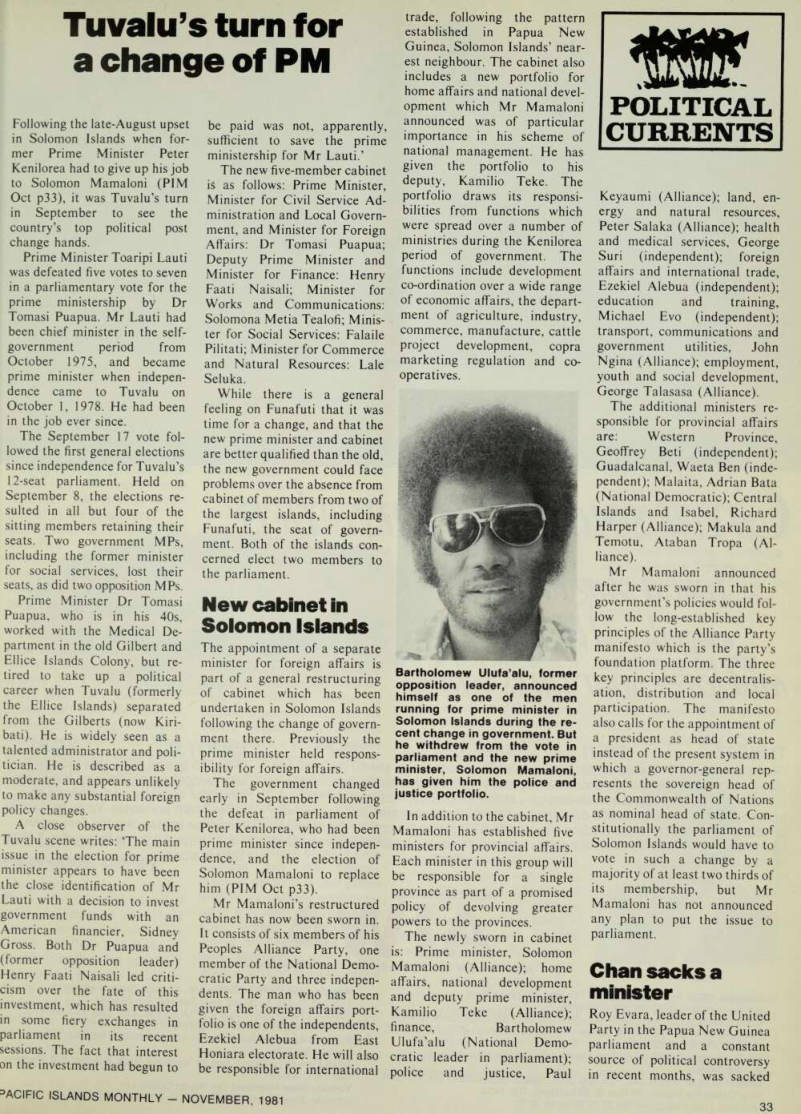
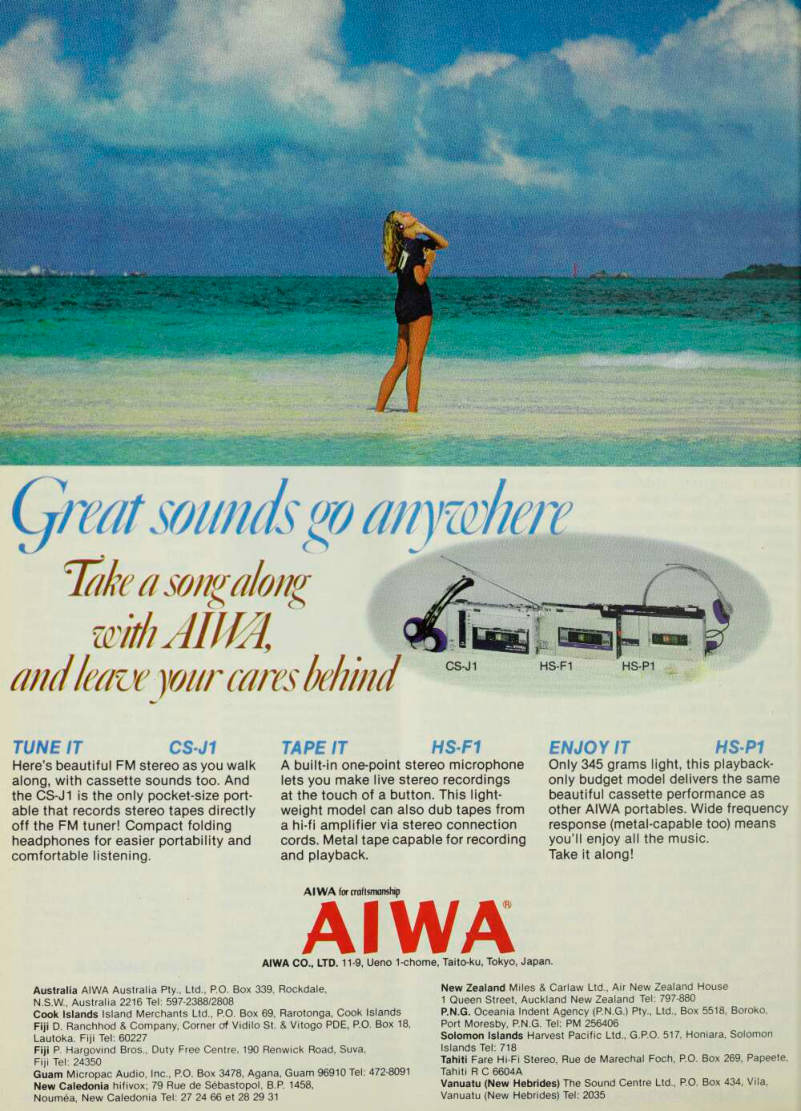
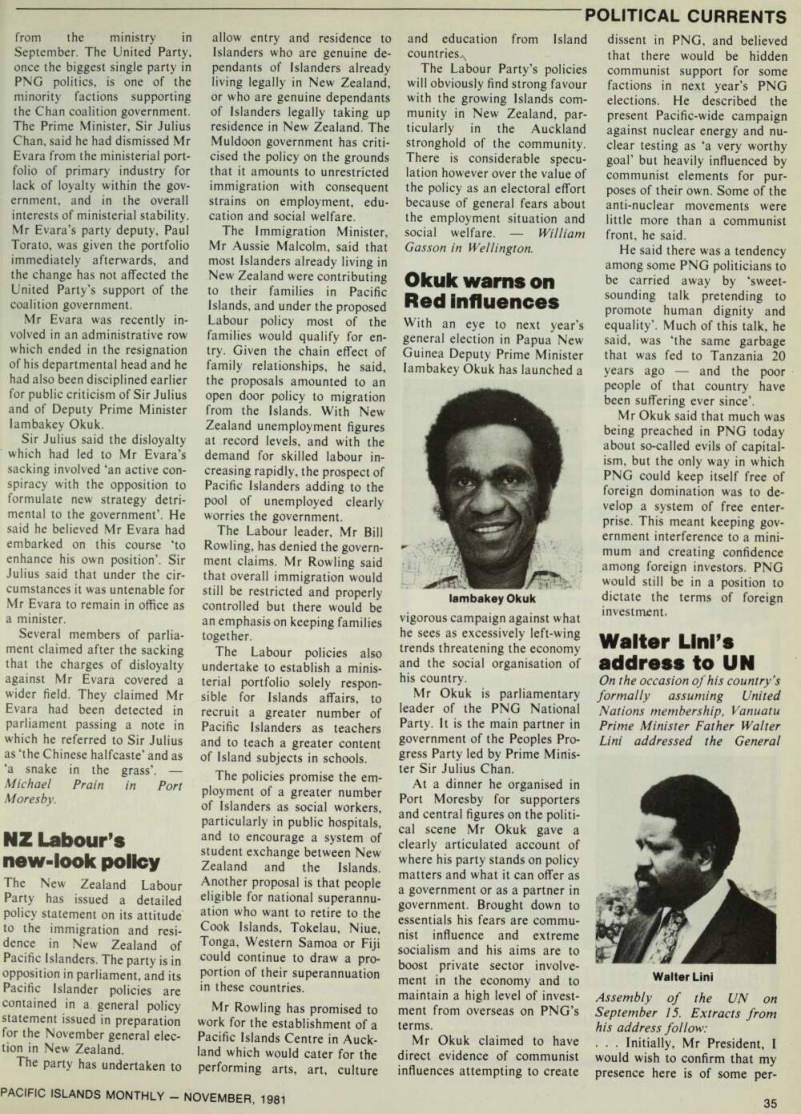
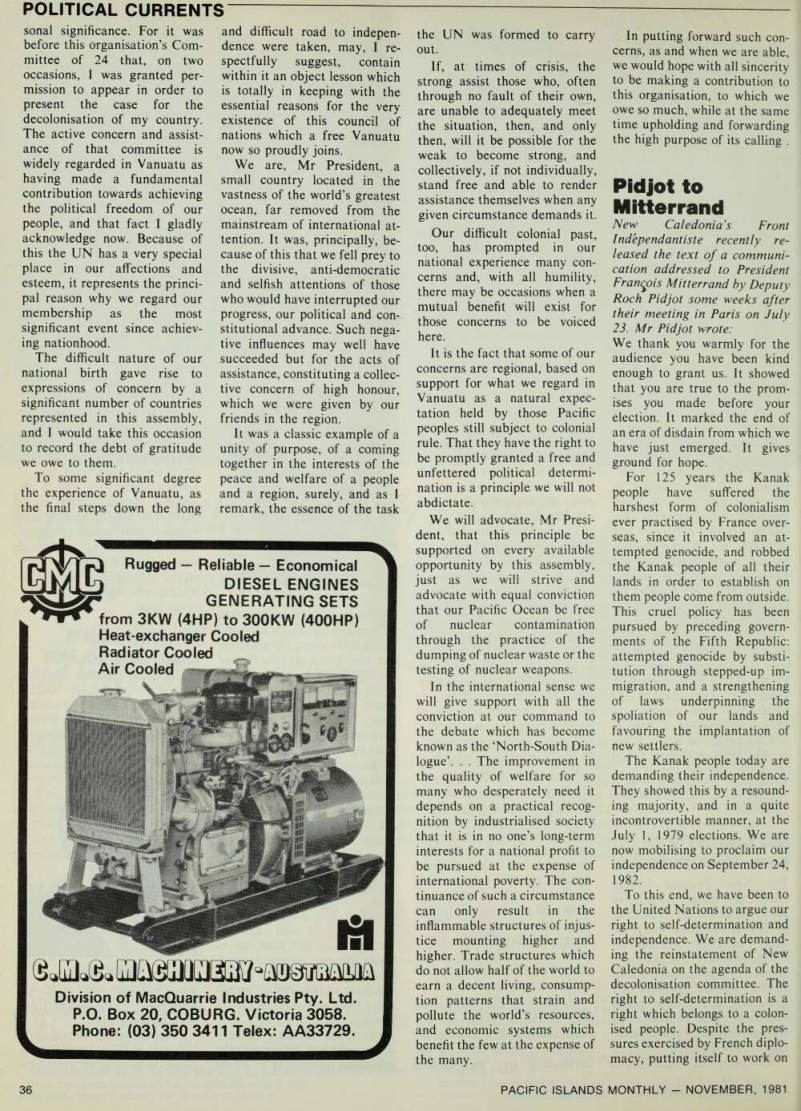
a change of PM
Political
Currents
Following the late-August upset in Solomon Islands when for mer Prime Minister Peter Kenilorea had to give up his job to Solomon Mamaloni (PIM Oct p 33), it was Tuvalu’s turn in September to see the country’s top political post change hands.
Prime Minister Toaripi Lauti was defeated five votes to seven in a parliamentary vote for the prime ministership by Dr Tomasi Puapua. Mr Lauti had been chief minister in the self government period from October 1975, and became prime minister when indepen dence came to Tuvalu on October 1, 1978. He had been in the job ever since.
The September 17 vote fol lowed the first general elections since independence for Tuvalu’s 12-seat parliament. Held on September 8, the elections re sulted in all but four of the sitting members retaining their seats. Two government MPs, including the former minister for social services, lost their seats, as did two opposition MPs.
Prime Minister Dr Tomasi Puapua, who is in his 40s, worked with the Medical De partment in the old Gilbert and Ellice Islands Colony, but re tired to take up a political career when Tuvalu (formerly the Ellice Islands) separated from the Gilberts (now Kiri bati). He is widely seen as a talented administrator and poli tician. He is described as a moderate, and appears unlikely to make any substantial foreign policy changes.
A close observer of the Tuvalu scene writes: ‘The main issue in the election for prime minister appears to have been the close identification of Mr Lauti with a decision to invest government funds with an American financier, Sidney Gross. Both Dr Puapua and (former opposition leader) Henry Faati Naisali led criti cism over the fate of this investment, which has resulted in some fiery exchanges in parliament in its recent sessions. The fact that interest on the investment had begun to
be paid was not, apparently, sufficient to save the prime ministership for Mr Lauti.’
The new five-member cabinet is as follows: Prime Minister, Minister for Civil Service Ad ministration and Local Govern ment, and Minister for Foreign Affairs: Dr Tomasi Puapua; Deputy Prime Minister and Minister for Finance; Henry Faati Naisali; Minister for Works and Communications: Solomona Metia Tealofi; Minis ter for Social Services: Falaile Pilitati; Minister for Commerce and Natural Resources: Lale Seluka.
While there is a general feeling on Funafuti that it was time for a change, and that the new prime minister and cabinet are better qualified than the old, the new government could face problems over the absence from cabinet of members from two of the largest islands, including Funafuti, the seat of govern ment. Both of the islands con cerned elect two members to the parliament.
New cabinet in
Solomon Islands
The appointment of a separate minister for foreign affairs is part of a general restructuring of cabinet which has been undertaken in Solomon Islands following the change of govern ment there. Previously the prime minister held respons ibility for foreign affairs.
The government changed early in September following the defeat in parliament of Peter Kenilorea, who had been prime minister since indepen dence, and the election of Solomon Mamaloni to replace him (PIM Oct p 33).
Mr Mamaloni’s restructured cabinet has now been sworn in.
It consists of six members of his Peoples Alliance Party, one member of the National Demo cratic Party and three indepen dents. The man who has been given the foreign affairs port folio is one of the independents, Ezekiel Alebua from East Honiara electorate. He will also be responsible for international
trade, following the pattern established in Papua New Guinea, Solomon Islands’ near est neighbour. The cabinet also includes a new portfolio for home affairs and national devel opment which Mr Mamaloni announced was of particular importance in his scheme of national management. He has given the portfolio to his deputy, Kamilio Teke. The portfolio draws its responsi bilities from functions which were spread over a number of ministries during the Kenilorea period of government. The functions include development co-ordination over a wide range of economic affairs, the depart ment of agriculture, industry, commerce, manufacture, cattle project development, copra marketing regulation and co operatives.
In addition to the cabinet, Mr Mamaloni has established five ministers for provincial affairs.
Each minister in this group will be responsible for a single province as part of a promised policy of devolving greater powers to the provinces.
The newly sworn in cabinet is: Prime minister, Solomon Mamaloni (Alliance); home affairs, national development and deputy prime minister, Kamilio Teke (Alliance); finance, Bartholomew Ulufa’alu (National Demo cratic leader in parliament); police and justice, Paul
Keyaumi (Alliance); land, en ergy and natural resources, Peter Salaka (Alliance); health and medical services, George Suri (independent); foreign affairs and international trade, Ezekiel Alebua (independent); education and training, Michael Evo (independent); transport, communications and government utilities, John Ngina (Alliance); employment, youth and social development, George Talasasa (Alliance).
The additional ministers re sponsible for provincial affairs are: Western Province, Geoffrey Beti (independent); Guadalcanal, Waeta Ben (inde pendent); Malaita, Adrian Bata (National Democratic); Central Islands and Isabel, Richard Harper (Alliance); Makula and Temotu, Ataban Tropa (Al liance).
Mr Mamaloni announced after he was sworn in that his government’s policies would fol low the long-established key principles of the Alliance Party manifesto which is the party’s foundation platform. The three key principles are decentralis ation, distribution and local participation. The manifesto also calls for the appointment of a president as head of state instead of the present system in which a governor-general rep resents the sovereign head of the Commonwealth of Nations as nominal head of state. Con stitutionally the parliament of Solomon Islands would have to vote in such a change by a majority of at least two thirds of its membership, but Mr Mamaloni has not announced any plan to put the issue to parliament.
Chan sacks a
minister
Roy Evara, leader of the United Party in the Papua New Guinea parliament and a constant source of political controversy in recent months, was sacked
Bartholomew Ulufa’alu, former opposition leader, announced himself as one of the men running for prime minister in Solomon Islands during the re cent change in government. But he withdrew from the vote in parliament and the new prime minister, Solomon Mamaloni, has given him the police and justice portfolio.
from the ministry in September. The United Party, once the biggest single party in PNG politics, is one of the minority factions supporting the Chan coalition government.
The Prime Minister, Sir Julius Chan, said he had dismissed Mr Evara from the ministerial port folio of primary industry for lack of loyalty within the gov ernment, and in the overall interests of ministerial stability.
Mr Evara’s party deputy, Paul Torato, was given the portfolio immediately afterwards, and the change has not affected the United Party’s support of the coalition government.
Mr Evara was recently in volved in an administrative row which ended in the resignation of his departmental head and he had also been disciplined earlier for public criticism of Sir Julius and of Deputy Prime Minister lambakey Okuk.
Sir Julius said the disloyalty which had led to Mr Evara’s sacking involved ‘an active con spiracy with the opposition to formulate new strategy detri mental to the government’. He said he believed Mr Evara had embarked on this course ‘to enhance his own position’. Sir Julius said that under the cir cumstances it was untenable for Mr Evara to remain in office as a minister.
Several members of parlia ment claimed after the sacking that the charges of disloyalty against Mr Evara covered a wider field. They claimed Mr Evara had been detected in parliament passing a note in which he referred to Sir Julius as ‘the Chinese halfcaste’ and as ‘a snake in the grass’.
Michael Prain in Port Moresby.
NZ Labour’s
new-look policy
The New Zealand Labour Party has issued a detailed policy statement on its attitude to the immigration and resi dence in New Zealand of Pacific Islanders. The party is in opposition in parliament, and its Pacific Islander policies are contained in a general policy statement issued in preparation for the November general elec tion in New Zealand.
The party has undertaken to
allow entry and residence to Islanders who are genuine de pendants of Islanders already living legally in New Zealand, or who are genuine dependants of Islanders legally taking up residence in New Zealand. The Muldoon government has criti cised the policy on the grounds that it amounts to unrestricted immigration with consequent strains on employment, edu cation and social welfare.
The Immigration Minister, Mr Aussie Malcolm, said that most Islanders already living in New Zealand were contributing to their families in Pacific Islands, and under the proposed Labour policy most of the families would qualify for en try, Given the chain effect of family relationships, he said, the proposals amounted to an open door policy to migration from the Islands. With New Zealand unemployment figures at record levels, and with the demand for skilled labour in creasing rapidly, the prospect of Pacific Islanders adding to the pool of unemployed clearly worries the government.
The Labour leader, Mr Bill Rowling, has denied the govern ment claims. Mr Rowling said that overall immigration would still be restricted and properly controlled but there would be an emphasis on keeping families together.
The Labour policies also undertake to establish a minis terial portfolio solely respon sible for Islands affairs, to recruit a greater number of Pacific Islanders as teachers and to teach a greater content of Island subjects in schools.
The policies promise the em ployment of a greater number of Islanders as social workers, particularly in public hospitals, and to encourage a system of student exchange between New Zealand and the Islands.
Another proposal is that people eligible for national superannu ation who want to retire to the Cook Islands, Tokelau, Niue, Tonga, Western Samoa or Fiji could continue to draw a pro portion of their superannuation in these countries.
Mr Rowling has promised to work for the establishment of a Pacific Islands Centre in Auck land which would cater for the performing arts, art, culture
and education from Island countries. N The Labour Party’s policies will obviously find strong favour with the growing Islands com munity in New Zealand, par ticularly in the Auckland stronghold of the community.
There is considerable specu lation however over the value of the policy as an electoral effort because of general fears about the employment situation and social welfare. William Gasson in Wellington.
Okuk warns on
Red influences
With an eye to next year’s general election in Papua New Guinea Deputy Prime Minister lambakey Okuk has launched a
vigorous campaign against what he sees as excessively left-wing trends threatening the economy and the social organisation of his country.
Mr Okuk is parliamentary leader of the PNG National Party. It is the main partner in government of the Peoples Pro gress Party led by Prime Minis ter Sir Julius Chan.
At a dinner he organised in Port Moresby for supporters and central figures on the politi cal scene Mr Okuk gave a clearly articulated account of where his party stands on policy matters and what it can offer as a government or as a partner in government. Brought down to essentials his fears are commu nist influence and extreme socialism and his aims are to boost private sector involve ment in the economy and to maintain a high level of invest ment from overseas on PNG’s terms.
Mr Okuk claimed to have direct evidence of communist influences attempting to create
dissent in PNG, and believed that there would be hidden communist support for some factions in next year’s PNG elections. He described the present Pacific-wide campaign against nuclear energy and nu clear testing as ‘a very worthy goal’ but heavily influenced by communist elements for pur poses of their own. Some of the anti-nuclear movements were little more than a communist front, he said.
He said there was a tendency among some PNG politicians to be carried away by ‘sweet sounding talk pretending to promote human dignity and equality’. Much of this talk, he said, was ‘the same garbage that was fed to Tanzania 20 years ago and the poor people of that country have been suffering ever since’.
Mr Okuk said that much was being preached in PNG today about so-called evils of capital ism, but the only way in which PNG could keep itself free of foreign domination was to de velop a system of free enter prise. This meant keeping gov ernment interference to a mini mum and creating confidence among foreign investors. PNG would still be in a position to dictate the terms of foreign investment.
Walter Uni’s
address to UN
On the occasion of his country’s formally assuming United Nations membership, Vanuatu Prime Minister Father Walter Lini addressed the General
Assembly of the UN on September 15. Extracts from his address follow: ■ . . Initially, Mr President, I would wish to confirm that my presence here is of some per
lambakey Okuk
Walter Lini
sonal significance. For it was before this organisation’s Com mittee of 24 that, on two occasions, I was granted per mission to appear in order to present the case for the decolonisation of my country.
The active concern and assist ance of that committee is widely regarded in Vanuatu as having made a fundamental contribution towards achieving the political freedom of our people, and that fact I gladly acknowledge now. Because of this the UN has a very special place in our affections and esteem, it represents the princi pal reason why we regard our membership as the most significant event since achiev ing nationhood.
The difficult nature of our national birth gave rise to expressions of concern by a significant number of countries represented in this assembly, and I would take this occasion to record the debt of gratitude we owe to them.
To some significant degree the experience of Vanuatu, as the final steps down the long
and difficult road to indepen dence were taken, may, I re spectfully suggest, contain within it an object lesson which is totally in keeping with the essential reasons for the very existence of this council of nations which a free Vanuatu now so proudly joins.
We are, Mr President, a small country located in the vastness of the world’s greatest ocean, far removed from the mainstream of international at tention. It was, principally, be cause of this that we fell prey to the divisive, anti-democratic and selfish attentions of those who would have interrupted our progress, our political and con stitutional advance. Such nega tive influences may well have succeeded but for the acts of assistance, constituting a collec tive concern of high honour, which we were given by our friends in the region.
It was a classic example of a unity of purpose, of a coming together in the interests of the peace and welfare of a people and a region, surely, and as I remark, the essence of the task
the UN was formed to carry out.
If, at times of crisis, the strong assist those who, often through no fault of their own, are unable to adequately meet the situation, then, and only then, will it be possible for the weak to become strong, and collectively, if not individually, stand free and able to render assistance themselves when any given circumstance demands it.
Our difficult colonial past, too, has prompted in our national experience many con cerns and, with all humility, there may be occasions when a mutual benefit will exist for those concerns to be voiced here.
It is the fact that some of our concerns are regional, based on support for what we regard in Vanuatu as a natural expec tation held by those Pacific peoples still subject to colonial rule. That they have the right to be promptly granted a free and unfettered political determi nation is a principle we will not abdictate.
We will advocate, Mr Presi dent, that this principle be supported on every available opportunity by this assembly, just as we will strive and advocate with equal conviction that our Pacific Ocean be free of nuclear contamination through the practice of the dumping of nuclear waste or the testing of nuclear weapons.
In the international sense we will give support with all the conviction at our command to the debate which has become known as the ‘North-South Dia logue’. . . The improvement in the quality of welfare for so many who desperately need it depends on a practical recog nition by industrialised society that it is in no one’s long-term interests for a national profit to be pursued at the expense of international poverty. The con tinuance of such a circumstance can only result in the inflammable structures of injus tice mounting higher and higher. Trade structures which do not allow half of the world to earn a decent living, consump tion patterns that strain and pollute the world’s resources, and economic systems which benefit the few at the expense of the many.
In putting forward such con cerns, as and when we are able, we would hope with all sincerity to be making a contribution to this organisation, to which we owe so much, while at the same time upholding and forwarding the high purpose of its calling .
Pidjot to
Mitterrand
New Caledonia’s Front Independantiste recently re leased the text of a communi cation addressed to President Francois Mitterrand by Deputy Roch Pidjot some weeks after their meeting in Paris on July 23. Mr Pidjot wrote: We thank you warmly for the audience you have been kind enough to grant us. It showed that you are true to the prom ises you made before your election. It marked the end of an era of disdain from which we have just emerged. It gives ground for hope.
For 125 years the Kanak people have suffered the harshest form of colonialism ever practised by France over seas, since it involved an at tempted genocide, and robbed the Kanak people of all their lands in order to establish on them people come from outside.
This cruel policy has been pursued by preceding govern ments of the Fifth Republic: attempted genocide by substi tution through stepped-up im migration, and a strengthening of laws underpinning the spoliation of our lands and favouring the implantation of new settlers.
The Kanak people today are demanding their independence.
They showed this by a resound ing majority, and in a quite incontrovertible manner, at the July 1, 1979 elections. We are now mobilising to proclaim our independence on September 24, 1982.
To this end, we have been to the United Nations to argue our right to self-determination and independence. We are demand ing the reinstatement of New Caledonia on the agenda of the decolonisation committee. The right to self-determination is a right which belongs to a colon ised people. Despite the pres sures exercised by French diplo macy, putting itself to work on
behalf of the Caledonian colonialists, the General As sembly of the United Nations recently declared its de colonisation programme, affirm ing that an influx of immigrants can only be considered ‘a major obstacle to a genuine exercise of the right to self-determination’.
Giscard d’Estaing’s France was one of the few countries not to subscribe to this declaration.
This international activity of ours has brought us support from many quarters, including the Asia-Pacific Conference of the Socialist International. As early as 1979 the South Pacific states, at a meeting of their Forum in Honiara, acknow ledged our rights. We are at present working with our brother Melanesian countries of the Pacific, all of which have become independent, to try to ensure that the next meeting of the South Pacific Forum gives even more explicit backing to our claims.
We have succeeded at last in having New Caledonia’s Terri torial Assembly acknowledge the right to tribal property, which is inherent in our per sonal status as defined by the French Constitution. The measures of pre-emption and expropriation foreshadowed by the land law passed by the Parliament also acknowledge our land claims. The Melan esian tribes are at present preparing to recover the lands of which they have been robbed.
The recovery of all New Caledonia, our motherland, is the basic act of the Kanak people in their accession to independence. We understand the obstacles that we will face, and we understand the colons who were permitted by the former regime to arm them selves against us: our brothers Kamouda, Daye, and Kutu have been shot down at point blank range by our political adversaries. Such acts of intimi dation are no longer enough to break our resolve. We shall occupy the lands that have been taken from us.
The Socialist Party in November 1979 was able to hear our just demands, and it identified itself with our aim of guaranteeing fundamental hu man rights. The joint com
munique we published at that time showed that the party understood our position. You yourself on November 23 1979, directing questions at Mr Barre’s government, rebutted the argument that the Kanak population was a minority, and demonstrated your awareness of the confrontationist situation in which we were placed.
So we were surprised by the recent remarks of your young secretary of state with respons ibility for overseas matters (Henri Emmanuelli). No doubt unsettled by his new office, he forsook the position of his party by setting aside the right to self determination of overseas peoples, and emphasising the significance of the results of the recent elections. You yourself on the other hand during the election campaign condemned the conditions under which uni versal suffrage operates in New Caledonia.
During the campaign you recalled the battles that we have fought together against colonialism, affirmed your de sire to carry on these battles, and proposed that we should get together as soon as possible to study the political steps that are to be taken. All this gave rise to wild hopes in the hearts of the Kanak people at the time of your election.
We ask that the right of peoples to run their own affairs, which has been presented as the axis of your policy, be recog nised in relation to the Kanak people, towards whom France bears a direct responsibility.
We ask that such recognition act as the nourishment of ‘another’ policy, one which is the opposite of the policy to which we have been subjected in recent years.
We expect that New Caledonia’s accession to inde pendence, which will certainly occur in the course of your seven-year presidential term, will be attended by a minimum of confrontations. It will result from the solidarity of peoples who have chosen Socialism, in which all the peoples of the Pacific will find their liberation.
Advertisements & other items, pp. 33-39 (2 items)
3 Acific Islands Monthly - November, 1981
Aiwa
<s
asongalong
w
and leave war cares behind
HS-F1 HS-P1
CS-J 1
TUNE IT CS J 1
Here’s beautiful FM stereo as you walk along, with cassette sounds too. And the CS-J 1 is the only pocket-size portable that records stereo tapes directly off the FM tuner! Compact folding headphones for easier portability and comfortable listening.
TAPE IT
A built-in one-point stereo microphone lets you make live stereo recordings at the touch of a button. This lightweight model can also dub tapes from a hi-fi amplifier via stereo connection cords. Metal tape capable for recording and playback.
ENJOY IT HS-Pt
Only 345 grams light, this playbackonly budget model delivers the same beautiful cassette performance as other AIWA portables. Wide frequency response (metal-capable too) means you’ll enjoy all the music.
Take it along!
AIWA for craftsmanship
AIWA
0., LTD. 11-9, Ueno 1-chome, Taito-ku, Tokyo, Australia AIWA Australia Pty., Ltd., RO. Box 339, Rockdale, N.S.W., Australia 2216 Tel: 597-2388/2808 Cook Islands Island Merchants Ltd., P.O. Box 69, Rarotonga, Cook Islands Fiji D. Ranchhod & Company, Corner of Vidilo St. & Vitogo PDE, P.O. Box 18, Lautoka. Fiji Tel: 60227 Fiji P. Hargovind Bros., Duty Free Centre, 190 Renwick Road, Suva, Fiji Tel: 24350 Guam Micropac Audio, Inc., P.O. Box 3478, Agana, Guam 96910 Tel: 472-8091 New Caledonia hifivox; 79 Rue de Sebastopol, B.P. 1458, Noumea, New Caledonia Tel: 27 24 66 et 28 29 31 New Zealand Miles & Carlaw Ltd., Air New Zealand House 1 Queen Street, Auckland New Zealand Tel: 797-880 P.N.G. Oceania Indent Agency (P.N.G.) Pty., Ltd., Box 5518, Boroko, Port Moresby, P.N.G. Tel: PM 256406 Solomon Islands Harvest Pacific Ltd., G.P.O. 517, Honiara, Solomon Islands Tel: 718 Tahiti Fare Hi-Fi Stereo, Rue de Marechal Foch, P.O. Box 269, Papeete, Tahiti R C 6604 A Vanuatu (New Hebrides) The Sound Centre Ltd., P.O. Box 434, Vila, Vanuatu (New Hebrides) Tel: 2035
Rugged Reliable Economical
DIESEL ENGINES
GENERATING SETS
from 3KW (4HP) to 300 KW (400 HP) Heat-exchanger Cooled Radiator Cooled Air Cooled r U Division of MacQuarrie Industries Pty. Ltd.
P.O. Box 20, COBURG. Victoria 3058.
Phone: (03) 350 3411 Telex: AA33729.
k? 5 ' .V* O 7* V O w >. 1 A. * '< o o> 1 * -.. v . >
>V'*A I
•fey.
sU/" • ■> V * • . * •*. >l* • '*•
m Juxf
N N m ■v •Mt i Aim- ✓i & S*V.
V* ' -? c.at 4y_ *fe *-* * /*'. " 38 ■%-
Pip rinn **i-Way Fidelity Series VrldllUll PROGRAMMABLE tuner -‘*2ga £3
□Til DOLBY SYSTEM
In n o
I uu u
PM CrO?
PROGRAM
POWER
TUNER PROGRAMMING
THE GREATEST ROADSHOW
ON EARTH.
The Clarion PE-959 is the world's first all-programmable car stereo, and is it a marvel in electronics!
Take the tuner, for instance. Thanks to a microprocessor, it can tune in up to ten stations automatically. Simply pick the stations, preset them in any order you want, and it will switch over from one station to another. Automatically and at the exact time you want it.
You need no longer worry about noise either. The SASC Mk II (signal-actuated FM stereo control circuit) automatically adjusts the reception to signal strength, assuring the best reception mode at all times.
The Clarion PE-959 has all the sophistication you could ask for. Metal tape capability. Dolby NR* circuit. Easy, all-pushbutton operation with 32 logically laid out control buttons. Quartz digital display. High 23W + 23W power, using a GA-301 stereo power amplifier.
There's no question about it. The Clarion PE-959 is "hi-way fidelity."
You can drive for mile after mile, and be sure of enjoying every minute of it.
PE-959. World's First All-Programmable Car Stereo.
®Clarion »™® TUNER MllM
EJECT
□□ tn n n Iu u u □□ O
PM CrO? LJ
PROGRAM
POWER
TUNES PROGRAMMING
*Dolby and the double-D symbol are trademarks of Dolby Laboratories Licensing Corporation.
CLARION CO., LTD.
Tokyo, Japan Australia: Amalgamated Wireless (Australasia) Ltd., 554 Parramatta Road, Ashfield, N.S.W., 2131/New Zealand- AWA New Zealand Limited, P.O. Box 50-248, Porirua/Fiji Islands: Brijlal & Co., Ltd., G.P.O. Box 362, Suva/Tahiti: HI-FI B ’ P ' 200 ' Pa P eete/ New Caledonia; Caldis,B.P.Ml, Noumea Cedex/Guam: Guam Radio &TV Shop, P.O. Box 1939, Agana, Guam 96910/Vanuatu: The Sound Centre, P.O. Box 434, Vila/Cook Islands; South Seas International Ltd., P.O. Box 49, Rarotonga/Papua New Guinea: Hagemeyer (P.N.G.) Pty.Ltd., P.O. Box 1428, Boroko, Port Moresby
Elected, erected,
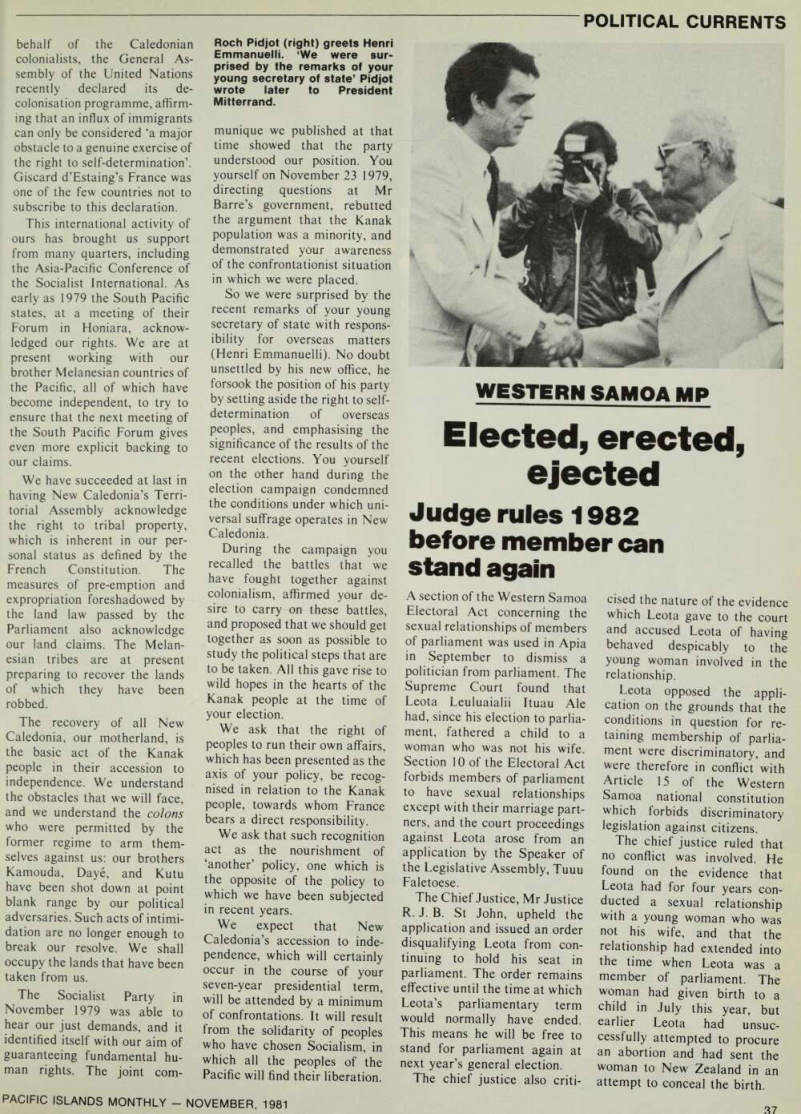
Western Samoa Mp
ejected
Judge rules 1982 before member can stand again
A section of the Western Samoa Electoral Act concerning the sexual relationships of members of parliament was used in Apia in September to dismiss a politician from parliament. The Supreme Court found that Leota Leuluaialii Ituau Ale had, since his election to parlia ment, fathered a child to a woman who was not his wife.
Section 10 of the Electoral Act forbids members of parliament to have sexual relationships except with their marriage part ners, and the court proceedings against Leota arose from an application by the Speaker of the Legislative Assembly, Tuuu Faletoese.
The Chief Justice, Mr Justice R. J. B. St John, upheld the application and issued an order disqualifying Leota from con tinuing to hold his seat in parliament. The order remains effective until the time at which Leota’s parliamentary term would normally have ended.
This means he will be free to stand for parliament again at next year’s general election.
The chief justice also criti
cised the nature of the evidence which Leota gave to the court and accused Leota of having behaved despicably to the young woman involved in the
relationship.
Leota opposed the appli cation on the grounds that the conditions in question for re taining membership of parlia ment were discriminatory, and were therefore in conflict with Article 15 of the Western Samoa national constitution which forbids discriminatory legislation against citizens.
The chief justice ruled that no conflict was involved. He found on the evidence that Leota had for four years con ducted a sexual relationship with a young woman who was not his wife, and that the relationship had extended into the time when Leota was a member of parliament. The woman had given birth to a child in July this year, but earlier Leota had unsuc cessfully attempted to procure an abortion and had sent the woman to New Zealand in an attempt to conceal the birth.
Roch Pidjot (right) greets Henri Emmanuelli. ‘We were sur prised by the remarks of your young secretary of state’ Pidjot wrote later to President Mitterrand.
People
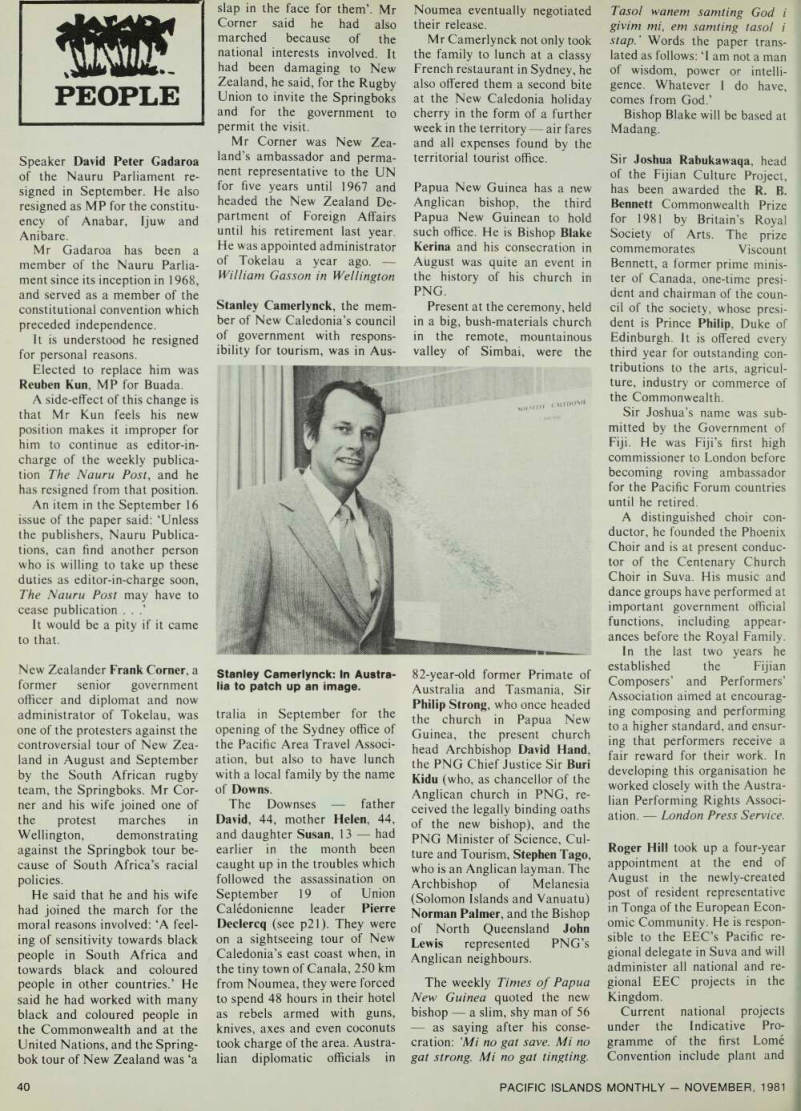
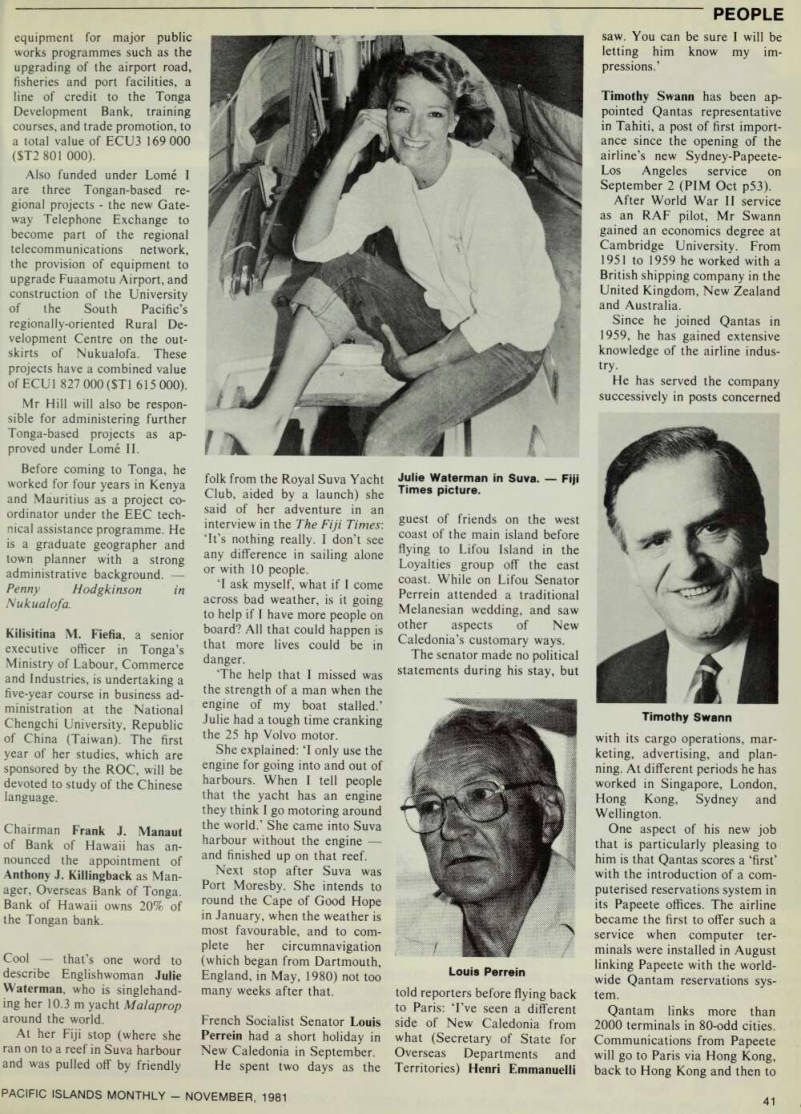


slap in the face for them’. Mr Corner said he had also marched because of the national interests involved. It had been damaging to New Zealand, he said, for the Rugby Union to invite the Springboks and for the government to permit the visit.
Mr Corner was New Zea land’s ambassador and perma nent representative to the UN for five years until 1967 and headed the New Zealand De partment of Foreign Affairs until his retirement last year.
He was appointed administrator of Tokelau a year ago.
William Gasson in Wellington Stanley Camerlynck, the mem ber of New Caledonia’s council of government with respons ibility for tourism, was in Aus-
Speaker David Peter Gadaroa of the Nauru Parliament re signed in September. He also resigned as MP for the constitu ency of Anabar, Ijuw and Anibare.
Mr Gadaroa has been a member of the Nauru Parlia ment since its inception in 1968, and served as a member of the constitutional convention which preceded independence.
It is understood he resigned for personal reasons.
Elected to replace him was Reuben Kun, MP for Buada.
A side-effect of this change is that Mr Kun feels his new position makes it improper for him to continue as editor-in charge of the weekly publica tion The Nauru Post , and he has resigned from that position.
An item in the September 16 issue of the paper said; ‘Unless the publishers, Nauru Publica tions, can find another person who is willing to take up these duties as editor-in-charge soon.
The Nauru Post may have to cease publication . . .’
It would be a pity if it came to that.
New Zealander Frank Corner, a former senior government officer and diplomat and now administrator of Tokelau, was one of the protesters against the controversial tour of New Zea land in August and September by the South African rugby team, the Springboks. Mr Cor ner and his wife joined one of the protest marches in Wellington, demonstrating against the Springbok tour be cause of South Africa’s racial policies.
He said that he and his wife had joined the march for the moral reasons involved: ‘A feel ing of sensitivity towards black people in South Africa and towards black and coloured people in other countries.’ He said he had worked with many black and coloured people in the Commonwealth and at the United Nations, and the Spring bok tour of New Zealand was ‘a
tralia in September for the opening of the Sydney office of the Pacific Area Travel Associ ation, but also to have lunch with a local family by the name of Downs.
The Downses father David, 44, mother Helen, 44, and daughter Susan, 13 had earlier in the month been caught up in the troubles which followed the assassination on September 19 of Union Caledonienne leader Pierre Declercq (see p2l). They were on a sightseeing tour of New Caledonia’s east coast when, in the tiny town of Canala, 250 km from Noumea, they were forced to spend 48 hours in their hotel as rebels armed with guns, knives, axes and even coconuts took charge of the area. Austra lian diplomatic officials in
Noumea eventually negotiated their release.
Mr Camerlynck not only took the family to lunch at a classy French restaurant in Sydney, he also offered them a second bite at the New Caledonia holiday cherry in the form of a further week in the territory air fares and all expenses found by the territorial tourist office.
Papua New Guinea has a new Anglican bishop, the third Papua New Guinean to hold such office. He is Bishop Blake Kerina and his consecration in August was quite an event in the history of his church in
Png.
Present at the ceremony, held in a big, bush-materials church in the remote, mountainous valley of Simbai, were the
82-year-old former Primate of Australia and Tasmania, Sir Philip Strong, who once headed the church in Papua New Guinea, the present church head Archbishop David Hand, the PNG Chief Justice Sir Buri Kidu (who, as chancellor of the Anglican church in PNG, re ceived the legally binding oaths of the new bishop), and the PNG Minister of Science, Cul ture and Tourism, Stephen Tago, who is an Anglican layman. The Archbishop of Melanesia (Solomon Islands and Vanuatu) Norman Palmer, and the Bishop of North Queensland John Lewis represented PNG’s Anglican neighbours.
The weekly Times of Papua New Guinea quoted the new bishop a slim, shy man of 56 as saying after his conse cration: ‘Mi no gat save. Mi no gat strong. Mi no gat tingting.
Tasol wanem samting God i givim mi, em samting tasol i stap.’ Words the paper trans lated as follows: T am not a man of wisdom, power or intelli gence. Whatever 1 do have, comes from God.’
Bishop Blake will be based at Madang.
Sir Joshua Rabukawaqa, head of the Fijian Culture Project, has been awarded the R. B.
Bennett Commonwealth Prize for 1981 by Britain’s Royal Society of Arts. The prize commemorates Viscount Bennett, a former prime minis ter of Canada, one-time presi dent and chairman of the coun cil of the society, whose presi dent is Prince Philip, Duke of Edinburgh. It is offered every third year for outstanding con tributions to the arts, agricul ture, industry or commerce of the Commonwealth.
Sir Joshua’s name was sub mitted by the Government of Fiji. He was Fiji’s first high commissioner to London before becoming roving ambassador for the Pacific Forum countries until he retired.
A distinguished choir con ductor, he founded the Phoenix Choir and is at present conduc tor of the Centenary Church Choir in Suva. His music and dance groups have performed at important government official functions, including appear ances before the Royal Family.
In the last two years he established the Fijian Composers’ and Performers’
Association aimed at encourag ing composing and performing to a higher standard, and ensur ing that performers receive a fair reward for their work. In developing this organisation he worked closely with the Austra lian Performing Rights Associ
ation.
London Press Service.
Roger Hil! took up a four-year appointment at the end of August in the newly-created post of resident representative in Tonga of the European Econ omic Community. He is respon sible to the EEC’s Pacific re gional delegate in Suva and will administer all national and re gional EEC projects in the Kingdom.
Current national projects under the Indicative Pro gramme of the first Lome Convention include plant and
Stanley Camerlynck: In Austra lia to patch up an image.
equipment for major public works programmes such as the upgrading of the airport road, fisheries and port facilities, a line of credit to the Tonga Development Bank, training courses, and trade promotion, to a total value of ECUS 169 000 (ST2 801 000).
Also funded under Lome I are three Tongan-based re gional projects - the new Gate way Telephone Exchange to become part of the regional telecommunications network, the provision of equipment to upgrade Fuaamotu Airport, and construction of the University of the South Pacific’s regionally-oriented Rural De velopment Centre on the out skirts of Nukualofa. These projects have a combined value of ECU 1 827 000 (STI 615 000).
Mr Hill will also be respon sible for administering further Tonga-based projects as ap proved under Lome 11.
Before coming to Tonga, he worked for four years in Kenya and Mauritius as a project co ordinator under the EEC tech nical assistance programme. He is a graduate geographer and town planner with a strong administrative background.
Penny Hodgkinson in Nukualofa.
Kllisitina M. Fiefia, a senior executive officer in Tonga’s Ministry of Labour, Commerce and Industries, is undertaking a five-year course in business ad ministration at the National Chengchi University, Republic of China (Taiwan). The first year of her studies, which are sponsored by the ROC, will be devoted to study of the Chinese language.
Chairman Frank J. Manaut of Bank of Hawaii has an nounced the appointment of Anthony J. Killingback as Man ager, Overseas Bank of Tonga.
Bank of Hawaii owns 20% of the Tongan bank.
Cool that’s one word to describe Englishwoman Julie Waterman, who is singlehand ing her 10.3 m yacht Malaprop around the world.
At her Fiji stop (where she ran on to a reef in Suva harbour and was pulled off by friendly
folk from the Royal Suva Yacht Club, aided by a launch) she said of her adventure in an interview in the The Fiji Times: ‘lt’s nothing really. I don’t see any difference in sailing alone or with 10 people.
T ask myself, what if I come across bad weather, is it going to help if I have more people on board? All that could happen is that more lives could be in danger. ‘The help that I missed was the strength of a man when the engine of my boat stalled.’
Julie had a tough time cranking the 25 hp Volvo motor.
She explained; T only use the engine for going into and out of harbours. When I tell people that the yacht has an engine they think I go motoring around the world.’ She came into Suva harbour without the engine and finished up on that reef.
Next stop after Suva was Port Moresby. She intends to round the Cape of Good Hope in January, when the weather is most favourable, and to com plete her circumnavigation (which began from Dartmouth, England, in May, 1980) not too many weeks after that.
French Socialist Senator Louis Perrein had a short holiday in New Caledonia in September.
He spent two days as the
guest of friends on the west coast of the main island before flying to Lifou Island in the Loyalties group off the east coast. While on Lifou Senator Perrein attended a traditional Melanesian wedding, and saw other aspects of New Caledonia’s customary ways.
The senator made no political statements during his stay, but
told reporters before flying back to Paris: ‘l’ve seen a different side of New Caledonia from what (Secretary of State for Overseas Departments and Territories) Henri Emmanuelli
People
saw. You can be sure I will be letting him know my im pressions.’
Timothy Swann has been ap pointed Qantas representative in Tahiti, a post of first import ance since the opening of the airline’s new Sydney-Papeete- Los Angeles service on September 2 (PIM Oct p 53).
After World War II service as an RAF pilot, Mr Swann gained an economics degree at Cambridge University. From 1951 to 1959 he worked with a British shipping company in the United Kingdom, New Zealand and Australia.
Since he joined Qantas in 1959, he has gained extensive knowledge of the airline indus try.
He has served the company successively in posts concerned
with its cargo operations, mar keting, advertising, and plan ning. At different periods he has worked in Singapore, London, Hong Kong, Sydney and Wellington.
One aspect of his new job that is particularly pleasing to him is that Qantas scores a ‘first’ with the introduction of a com puterised reservations system in its Papeete offices. The airline became the first to offer such a service when computer ter minals were installed in August linking Papeete with the world wide Qantam reservations sys tem.
Qantam links more than 2000 terminals in 80-odd cities.
Communications from Papeete will go to Paris via Hong Kong, back to Hong Kong and then to
Julie Waterman in Suva. - Fiji Times picture.
Louis Perrein
Timothy Swann
Sydney where the IBM 3032 computers the heart of the system are installed. Despite the distances, responses to messages take only a few seconds. A more direct com munications route is expected to be in use before the end of the year.
New general manager of the Nauru Phosphate Corporation is R. H. Floyd. He replaces B. L.
Blundell, who now holds the post of marketing manager in the corporation’s Melbourne office.
Mr Floyd was born and educated in New Zealand. He holds an honours degree in mining engineering from Otago University. He spent 15 years working with Mount Isa Mines in Queensland, Australia, be fore becoming project manager at the Western Mining Corpor ation’s Windarra mine in West ern Australia.
Before going to Nauru he was in business on his own account in New Zealand.
The Fiji Broadcasting Com mission had their own man in London to cover the royal wedding, but rather than send a reporter from Suva, they asked Isimeli Cerelala to hop across the Channel from Paris where he had finished a term at the university.
An FBC man hailing from Labasa, on Vanua Levu, Isimeli had the fortune to be singled out for a French Government scholarship to teach Fijian to the students at the faculty of linguistics, Port Dauphine Uni versity.
The first Fijian student ever to receive such a scholarship, Isimeli left Suva in December 1980, finishing his stint in Paris at the end of June. The faculty of linguistics, which is part of the prestigious Sorbonne Uni versity, is involved in the study of various Pacific languages.
One of Isimeli’s colleagues was a Maori from New Zealand.
Besides teaching the French students Fijian, Isimeli ended up with a good knowledge of French himself. He was forced to acquire it quickly, as English wasn’t as widely spoken in Paris as he had expected.
FBC’s offer to report on the preparations for the royal wed ding and the wedding itself gave Isimeli the opportunity also to visit London. During the month spent here he managed to see a little of England and also sev eral times visited Bush House, the London base of the BBC external service. There he met an old friend, Heather Waters,
head of BBC’s gramophone library, who had spent 18 months in Suva from September 1977 to March 1979. Ms Waters had been seconded from the BBC and sent to Fiji through the Commonwealth Fund for Tech nical Cooperation to introduce new systems of classifying re cords and tapes in the FBC sound library.
Isimeli found a rather glum atmosphere in Bush House which is yet again threatened by government cuts. One of the programmes threatened is Hello Tomorrow, which is well known to Pacific audiences, as it is regularly broadcast by re gional stations who receive the tapes from the BBC.
Isimeli hopes that his time in Paris will not be wasted and that he will be able to make use of his knowledge of French by covering Pacific events where both French and English are
necessary.
Jimmy Cornell in
London.
They were very far from con ventional farewell remarks made by French Polynesia’s Gaullist deputy Gaston Flosse when he referred at a press conference to the departure of High Commissioner Paul Cousseran for his new posting as prefect in Southern Corsica (PIM Aug p 49).
For four years representa
lives of Flosse’s Tahoeraa Huiraatira party have boy cotted all social occasions at the high commissioner’s residence, having contact with him only for purposes of official work.
Mr Flosse closed his press conference with the words; ‘I heartily applaud the departure of Mr Cousseran because he deserted his role as representa tive of the State and arbiter. He became the United Front’s man and didn’t even win their gratitude for the fact! He did this solely to promote his own advancement and damaged the interests of the Territory in the process. Now his advancement is behind him, because Corsica is no sinecure and Corsicans are not Polynesians. This is by no means a promotion far from it and it seems that the Corsicans are ready and waiting for him. They won’t be hanging any lei round his neck over there!’
Carl Lukech Harris has been appointed Nauruan Welfare Officer in New Zealand.
Mr Harris, a teacher with 17 years service with Nauru’s Edu cation Department, taught at the Nauru Secondary School and transferred later to the Aiwo Primary School.
Keith Bustraan, 25, of Elmira, New York, has been appointed budget officer for the Congress of the Federated States of Micronesia.
Mr Bustraan holds a BA degree in international affairs from Lafayette College, Pennsylvania, and an MA from George Washington University, Washington, DC, where he studied public administration.
As budget officer, he will be responsible for providing staff support to the committee of ways and means, as well as to the whole congress.
He is engaged to Marcia Livingston of New Jersey, who is studying to be an emergency nurse and paramedic, and who is also captain of a rescue squad for the fire department in Falls Church, Virginia.
Mr Bustraan says he finds the people of Ponape very pleasant to work with, and that he is looking forward eagerly to working with the Congress of the FSM.
Ambika Prasad, 31, (above) for mer acting head of the Fiji Institute of Technology’s school of electrical engineering, has been appointed electronic superintendent of the newly formed Technical Services De partment of Bish Ltd. The new operation will carry out the repair and maintenance of highly sophisticated electronic machines including control and electro-medical equipment, radio and radar systems, and instrumentation. It is hoped that it will help not only Fiji but other island countries who have pre viously had to send their equip ment to Australia, New Zealand or the USA for these highly technical repairs.
Heather Waters with guest Isimeli Cerela outside the BBC’s Bush House in London.
Advertisements & other items, pp. 42-43 (1 item)
all challengers.
When it comes
is**- , ’ ;■■■*■ •
Toydfa takes on
all challengers.
■ / / -mm Wj jf
LAND CRUISER (Station Wagon)
TOYOTA
jO*W
Mt I ■ m
►APUA NEW GUINEA: ELA MOTORS,
Icratchley Rd., Badili, P.O. Box 675, Port Moresby.
lORTHERN MARIANAS & U.S.T.T.:
/lICROL CORPORATION, P.O. Box 267,
!aipan.
IJI: AUTOMOTIVE SUPPLIES COMPANY,
3.P.0. Box 355, Suva.
AMERICAN SAMOA: BURNS PHILP
(SOUTHSEA) CO., LTD., P.O. Box 129, Pago Pago.
WESTERN SAMOA: BURNS PHILP
(SOUTHSEA) CO., LTD., P.O. Box 188, Apia.
TONGA: BURNS PHILP (SOUTHSEA) CO.,
LTD., P.O. Box 55, Nuku’alofa.
Mr
TOYOTA
SERVICE
iviiiiiy vivuivL/iv
TRUCK
Toyota commercial vehicles are
a very special breed apart, unrivaled for their toughness and sure handlin' on or off the road. Built tough to stand up to the most difficult loach Built also to take the punishment of bad weather, and beaten up road surfaces. Like the new 4WI
Toyota Land Cruiser Station
i.> A use youj*! if
\M: ATKINS, KROLL (GUAM) LTD., P.O.
6428, Tamuning.
lUATU: VANUATU MOTORS, P.O. Box
3 ort Vila.
-OMON: MENDANA ENTERPRISES
LTD., G.P.O. Box 174, Honiara.
UTI: NIPPON AUTOMOTO, B.P. 342,
3ete.
COOK ISLANDS: COOK ISLANDS
TRADING CORPORATION LTD., P.O. Box
92, Rarotonga.
NAURU: NAURU COOPERATIVE SOCIETY.
KIRIBATI: TARAWA MOTORS, Box 36,
Bairiki, Tarawa, Kiribati.
NORFOLK ISLAND: SORRY’S RENTAL
CARS, MOUNT PITT (ENTERPRISES) LTD.,
P.O. Box 169.
NEW CALEDONIA: SERVICE
IMPORTATION AUTOMOBILE DU
PACIFIQUE, Rond-Point du Pacifique (Station Total) B.P. 438, Noumea.
Toyota range includes: COROLLA, STARLET. CORONA. CRESSIDA. STOUT. HI ACE. DYNA, COAsZ and LAND WISER
gets its memorial
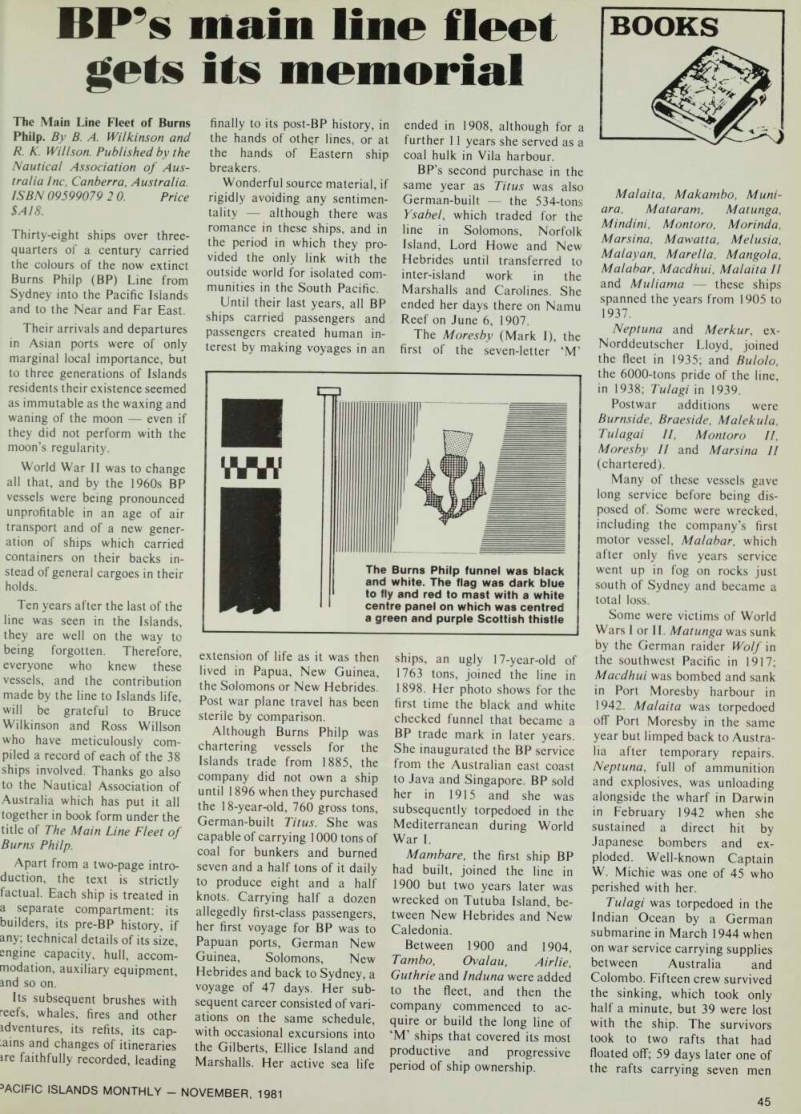
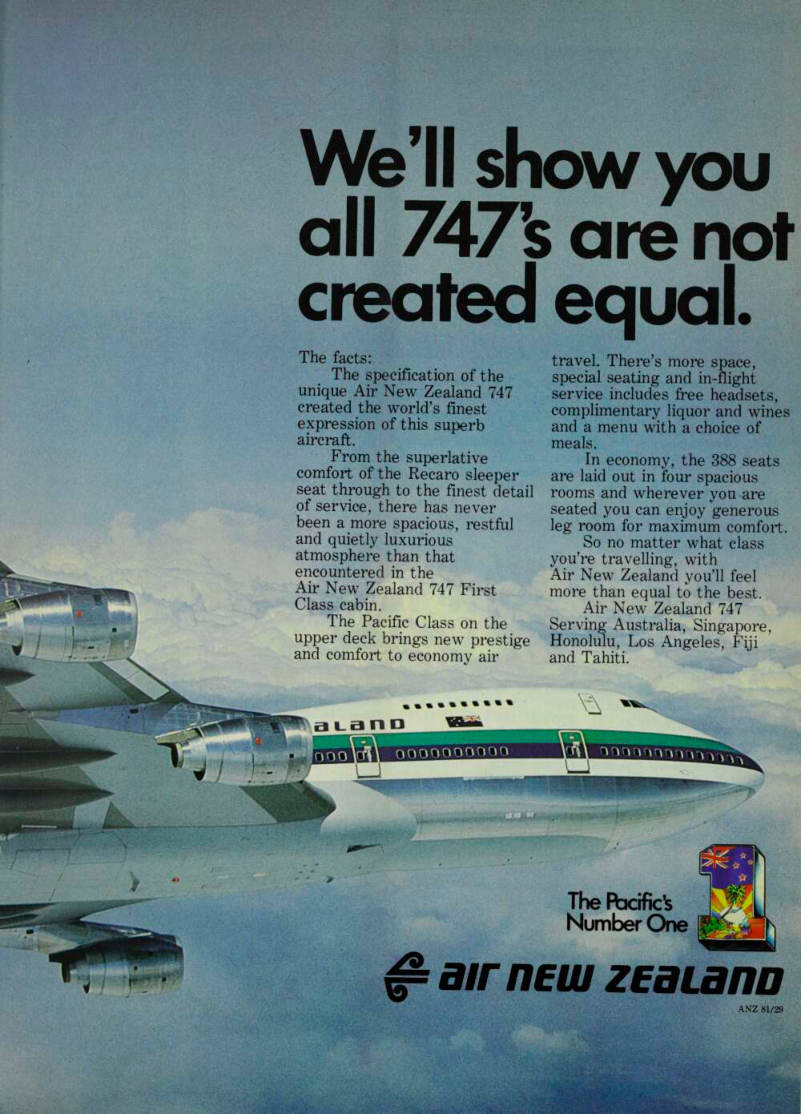
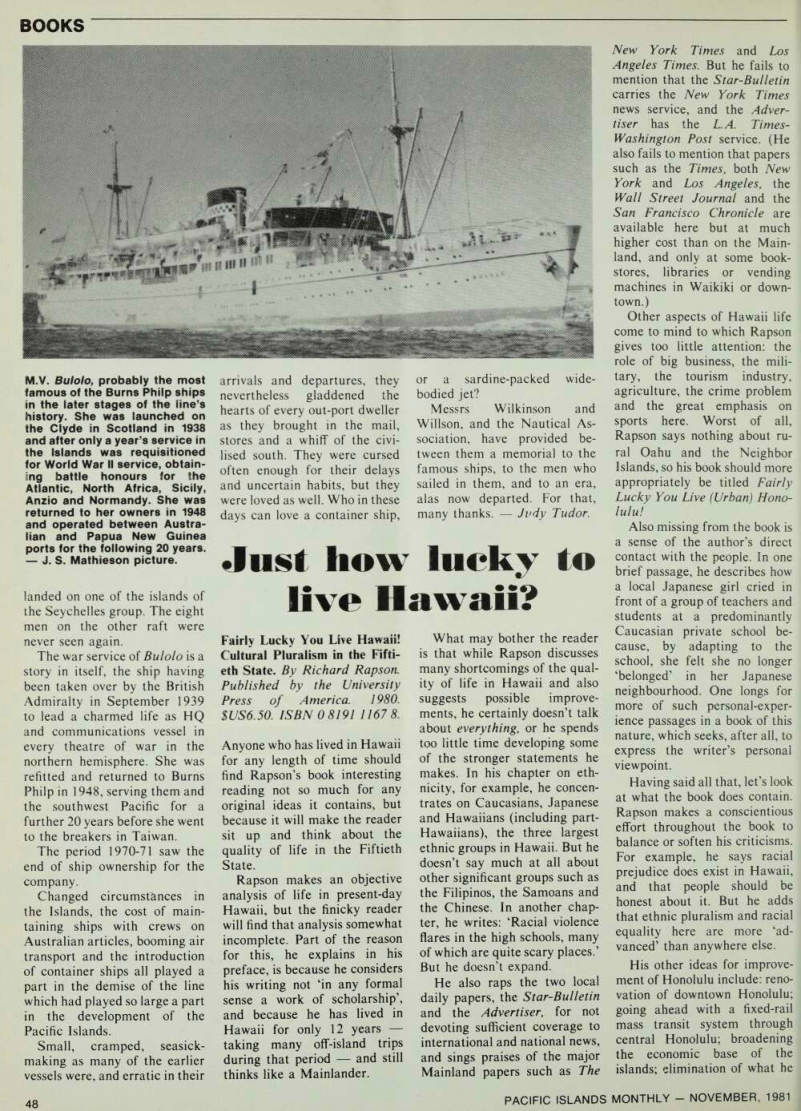
BP’s main line fleet gets its memorial
Books
The Main Line Fleet of Burns Philp. By B. A. Wilkinson and R. K. Willson. Published by the Nautical Association of Aus tralia Inc. Canberra, Australia.
ISBN 09599079 2 0. Price
Saib.
Thirty-eight ships over three quarters of a century carried the colours of the now extinct Burns Philp (BP) Line from Sydney into the Pacific Islands and to the Near and Far East.
Their arrivals and departures in Asian ports were of only marginal local importance, but to three generations of Islands residents their existence seemed as immutable as the waxing and waning of the moon even if they did not perform with the moon’s regularity.
World War II was to change all that, and by the 1960 s BP vessels were being pronounced unprofitable in an age of air transport and of a new gener ation of ships which carried containers on their backs in stead of general cargoes in their holds.
Ten years after the last of the line was seen in the Islands, they are well on the way to being forgotten. Therefore, everyone who knew these vessels, and the contribution made by the line to Islands life, will be grateful to Bruce Wilkinson and Ross Willson who have meticulously com piled a record of each of the 38 ships involved. Thanks go also to the Nautical Association of Australia which has put it all together in book form under the title of The Main Line Fleet of Burns Philp.
Apart from a two-page intro duction, the text is strictly factual. Each ship is treated in a separate compartment: its builders, its pre-BP history, if any; technical details of its size, engine capacity, hull, accom modation, auxiliary equipment, and so on.
Its subsequent brushes with reefs, whales, fires and other adventures, its refits, its cap lins and changes of itineraries
ire faithfully recorded, leading
finally to its post-BP history, in the hands of other lines, or at the hands of Eastern ship breakers.
Wonderful source material, if rigidly avoiding any sentimen tality although there was romance in these ships, and in the period in which they pro vided the only link with the outside world for isolated com munities in the South Pacific.
Until their last years, all BP ships carried passengers and passengers created human in terest by making voyages in an
extension of life as it was then lived in Papua, New Guinea, the Solomons or New Hebrides.
Post war plane travel has been sterile by comparison.
Although Burns Philp was chartering vessels for the Islands trade from 1885, the company did not own a ship until 1896 when they purchased the 18-year-old, 760 gross tons, German-built Titus. She was capable of carrying 1000 tons of coal for bunkers and burned seven and a half tons of it daily to produce eight and a half knots. Carrying half a dozen allegedly first-class passengers, her first voyage for BP was to Papuan ports, German New Guinea, Solomons, New Hebrides and back to Sydney, a voyage of 47 days. Her sub sequent career consisted of vari ations on the same schedule, with occasional excursions into the Gilberts, Ellice Island and Marshalls. Her active sea life
ended in 1908, although for a further 11 years she served as a coal hulk in Vila harbour.
BP’s second purchase in the same year as Titus was also German-built the 534-tons Ysabel , which traded for the line in Solomons, Norfolk Island, Lord Howe and New Hebrides until transferred to inter-island work in the Marshalls and Carolines. She ended her days there on Namu Reef on June 6, 1907.
The Moresby (Mark I), the first of the seven-letter 'M'
ships, an ugly 17-year-old of 1763 tons, joined the line in 1898. Her photo shows for the first time the black and white checked funnel that became a BP trade mark in later years.
She inaugurated the BP service from the Australian east coast to Java and Singapore. BP sold her in 1915 and she was subsequently torpedoed in the Mediterranean during World War I.
Mambare, the first ship BP had built, joined the line in 1900 but two years later was wrecked on Tutuba Island, be tween New Hebrides and New Caledonia.
Between 1900 and 1904, Tambo, Ovalau, Air lie, Guthrie and Induna were added to the fleet, and then the company commenced to ac quire or build the long line of ‘M’ ships that covered its most productive and progressive period of ship ownership.
Malaita, Makambo, Muni ara, Mataram, Matunga, Mindini, Montoro, Morinda, Marsina, Mawatta, Melusia, Malayan, Marella, Mangola, Malabar, Macdhui, Malaita II and Muliama these ships spanned the years from 1905 to 1937.
Neptuna and Merkur, ex- Norddeutscher Lloyd, joined the fleet in 1935; and Bulolo, the 6000-tons pride of the line, in 1938; Tulagi in 1939.
Postwar additions were Burnside, Braeside, Malekula, Tulagai 11, Montoro 11, Moresby II and Marsina II (chartered).
Many of these vessels gave long service before being dis posed of. Some were wrecked, including the company’s first motor vessel, Malabar, which after only five years service went up in fog on rocks just south of Sydney and became a total loss.
Some were victims of World Wars I or 11. Matunga was sunk by the German raider Wolf in the southwest Pacific in 1917; Macdhui was bombed and sank in Port Moresby harbour in 1942. Malaita was torpedoed off Port Moresby in the same year but limped back to Austra lia after temporary repairs.
Neptuna , full of ammunition and explosives, was unloading alongside the wharf in Darwin in February 1942 when she sustained a direct hit by Japanese bombers and ex ploded. Well-known Captain W. Michie was one of 45 who perished with her.
Tulagi was torpedoed in the Indian Ocean by a German submarine in March 1944 when on war service carrying supplies between Australia and Colombo. Fifteen crew survived the sinking, which took only half a minute, but 39 were lost with the ship. The survivors took to two rafts that had floated off; 59 days later one of the rafts carrying seven men
The Burns Philp funnel was black and white. The flag was dark blue to fly and red to mast with a white centre panel on which was centred a green and purple Scottish thistle
landed on one of the islands of the Seychelles group. The eight men on the other raft were never seen again.
The war service of Bulolo is a story in itself, the ship having been taken over by the British Admiralty in September 1939 to lead a charmed life as HQ and communications vessel in every theatre of war in the northern hemisphere. She was refitted and returned to Burns Philp in 1948, serving them and the southwest Pacific for a further 20 years before she went to the breakers in Taiwan.
The period 1970-71 saw the end of ship ownership for the company.
Changed circumstances in the Islands, the cost of main taining ships with crews on Australian articles, booming air transport and the introduction of container ships all played a part in the demise of the line which had played so large a part in the development of the Pacific Islands.
Small, cramped, seasick making as many of the earlier vessels were, and erratic in their
arrivals and departures, they nevertheless gladdened the hearts of every out-port dweller as they brought in the mail, stores and a whiff of the civi lised south. They were cursed often enough for their delays and uncertain habits, but they were loved as well. Who in these days can love a container ship,
or a sardine-packed wide bodied jet?
Messrs Wilkinson and Willson, and the Nautical As sociation, have provided be tween them a memorial to the famous ships, to the men who sailed in them, and to an era, alas now departed. For that,
many thanks.
Judy Tudor.
M.V. Bulolo, probably the most famous of the Burns Philp ships in the later stages of the line’s history. She was launched on the Clyde in Scotland in 1938 and after only a year’s service in the Islands was requisitioned for World War II service, obtain ing battle honours for the Atlantic, North Africa, Sicily, Anzio and Normandy. She was returned to her owners in 1948 and operated between Austra lian and Papua New Guinea ports for the following 20 years.
J. S. Mathieson picture.
Advertisements & other items, pp. 45-47 (2 items)
45
3 ACIFIC ISLANDS MONTHLY NOVEMBER, 1981
ill I M
• ••• u ■
. ; Pi x.; mkm ...
iSfiii
■■ Y'k - ■
We’ll show you
all 747’s are not
created equal.
The facts: The specification of the unique Air New Zealand 747 created the world’s finest expression of this superb aircraft.
From the superlative comfort of the Recaro sleeper seat through to the finest detail of service, there has never been a more spacious, restful and quietly luxurious atmosphere than that encountered in the Air New Zealand 747 First Class cabin.
The Pacific Class on the upper deck brings new prestige and comfort to economy air travel. There’s more space, special seating and in-flight service includes free headsets, complimentary liquor and wines and a menu with a choice of meals.
In economy, the 388 seats are laid out in four spacious rooms and wherever you are seated you can enjoy generous leg room for maximum comfort.
So no matter what class you’re travelling, with Air New Zealand you’ll feel more than equal to the best.
Air New Zealand 747 Serving Australia, Singapore, Honolulu, Los Angeles, Fiji and Tahiti. atanu m 0000000000 m LJ
The Pacific’s
Number One
fs air new zeatano
live Hawaii?
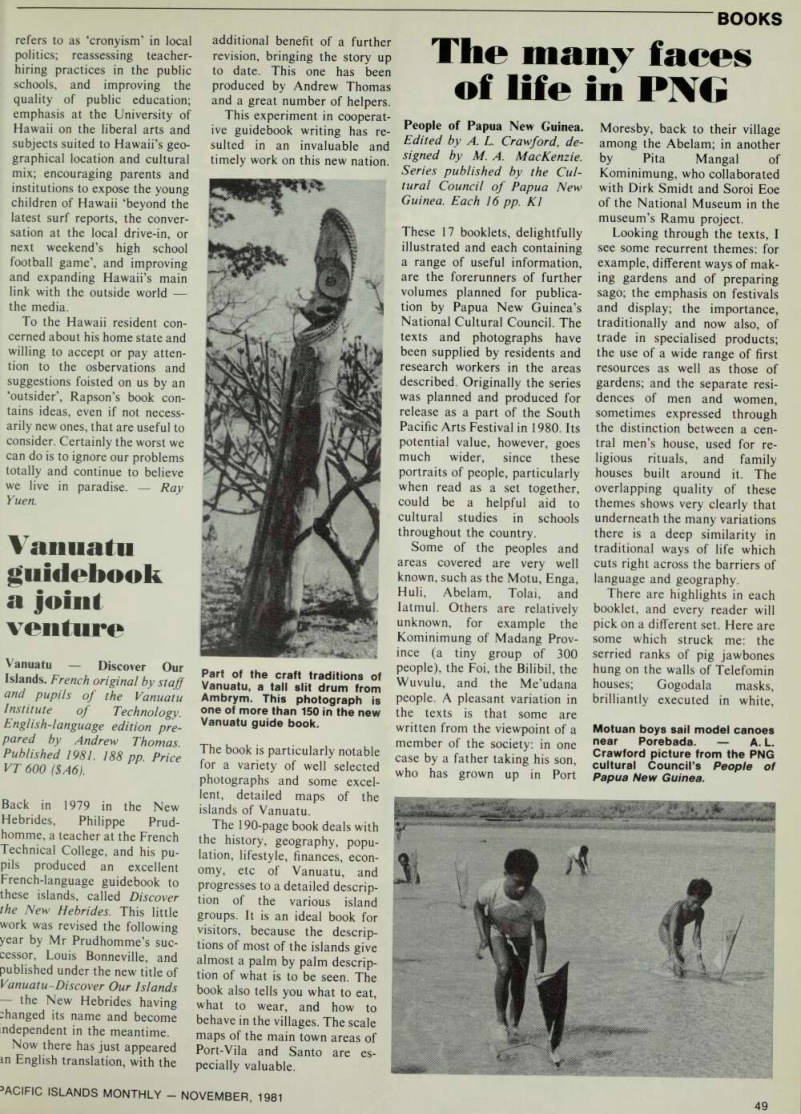
Just how lucky to live Hawaii?
Fairly Lucky You Live Hawaii!
Cultural Pluralism in the Fifti eth State. By Richard Rapson.
Published by the University Press of America. 1980.
Sus6.So. Isbn 0 8191 1167 8.
Anyone who has lived in Hawaii for any length of time should find Rapson’s book interesting reading not so much for any original ideas it contains, but because it will make the reader sit up and think about the quality of life in the Fiftieth State.
Rapson makes an objective analysis of life in present-day Hawaii, but the finicky reader will find that analysis somewhat incomplete. Part of the reason for this, he explains in his preface, is because he considers his writing not ‘in any formal sense a work of scholarship’, and because he has lived in Hawaii for only 12 years taking many off-island trips during that period and still thinks like a Mainlander.
What may bother the reader is that while Rapson discusses many shortcomings of the qual ity of life in Hawaii and also suggests possible improve ments, he certainly doesn’t talk about everything, or he spends too little time developing some of the stronger statements he makes. In his chapter on eth nicity, for example, he concen trates on Caucasians, Japanese and Hawaiians (including part- Hawaiians), the three largest ethnic groups in Hawaii. But he doesn’t say much at all about other significant groups such as the Filipinos, the Samoans and the Chinese. In another chap ter, he writes: ‘Racial violence flares in the high schools, many of which are quite scary places.’
But he doesn’t expand.
He also raps the two local daily papers, the Star-Bulletin and the Advertiser, for not devoting sufficient coverage to international and national news, and sings praises of the major Mainland papers such as The
New York Times and Los Angeles Times. But he fails to mention that the Star-Bulletin carries the New York Times news service, and the Adver tiser has the LA. Times- Washington Post service. (He also fails to mention that papers such as the Times, both New York and Los Angeles, the Wall Street Journal and the San Francisco Chronicle are available here but at much higher cost than on the Main land, and only at some book stores, libraries or vending machines in Waikiki or down town.) Other aspects of Hawaii life come to mind to which Rapson gives too little attention: the role of big business, the mili tary, the tourism industry, agriculture, the crime problem and the great emphasis on sports here. Worst of all, Rapson says nothing about ru ral Oahu and the Neighbor Islands, so his book should more appropriately be titled Fairly Lucky You Live (Urban) Hono lulu!
Also missing from the book is a sense of the author’s direct contact with the people. In one brief passage, he describes how a local Japanese girl cried in front of a group of teachers and students at a predominantly Caucasian private school be cause, by adapting to the school, she felt she no longer ‘belonged’ in her Japanese neighbourhood. One longs for more of such personal-exper ience passages in a book of this nature, which seeks, after all, to express the writer’s personal viewpoint.
Having said all that, let’s look at what the book does contain.
Rapson makes a conscientious effort throughout the book to balance or soften his criticisms.
For example, he says racial prejudice does exist in Hawaii, and that people should be honest about it. But he adds that ethnic pluralism and racial equality here are more ‘ad vanced’ than anywhere else.
His other ideas for improve ment of Honolulu include: reno vation of downtown Honolulu; going ahead with a fixed-rail mass transit system through central Honolulu; broadening the economic base of the islands; elimination of what he
refers to as ‘cronyism’ in local politics; reassessing teacher hiring practices in the public schools, and improving the quality of public education; emphasis at the University of Hawaii on the liberal arts and subjects suited to Hawaii’s geo graphical location and cultural mix; encouraging parents and institutions to expose the young children of Hawaii ‘beyond the latest surf reports, the conver sation at the local drive-in, or next weekend’s high school football game’, and improving and expanding Hawaii’s main link with the outside world the media.
To the Hawaii resident con cerned about his home state and willing to accept or pay atten tion to the osbervations and suggestions foisted on us by an ‘outsider’, Rapson’s book con tains ideas, even if not necess arily new ones, that are useful to consider. Certainly the worst we can do is to ignore our problems totally and continue to believe
we live in paradise.
Ray
Yuen.
a joint
Vanuatu guidebook a joint venture
Vanuatu Discover Our Islands. French original by staff and pupils of the Vanuatu Institute of Technology.
English-language edition pre pared by Andrew Thomas.
Published 1981. 188 pp Price
Vt 600 F$A6).
Back in 1979 in the New Hebrides, Philippe Prud homme, a teacher at the French Technical College, and his pu pils produced an excellent French-language guidebook to these islands, called Discover the New Hebrides. This little work was revised the following year by Mr Prudhomme’s suc cessor, Louis Bonneville, and published under the new title of Vanuatu-Discover Our Islands the New Hebrides having changed its name and become ndependent in the meantime.
Now there has just appeared in English translation, with the
additional benefit of a further revision, bringing the story up to date. This one has been produced by Andrew Thomas and a great number of helpers.
This experiment in cooperat ive guidebook writing has re sulted in an invaluable and timely work on this new nation.
The book is particularly notable for a variety of well selected photographs and some excel lent, detailed maps of the islands of Vanuatu.
The 190-page book deals with the history, geography, popu lation, lifestyle, finances, econ omy, etc of Vanuatu, and progresses to a detailed descrip tion of the various island groups. It is an ideal book for visitors, because the descrip tions of most of the islands give almost a palm by palm descrip tion of what is to be seen. The book also tells you what to eat, what to wear, and how to behave in the villages. The scale maps of the main town areas of Port-Vila and Santo are es pecially valuable.
Part of the craft traditions of Vanuatu, a tall slit drum from Ambrym. This photograph is one of more than 150 in the new Vanuatu guide book.
The many faces


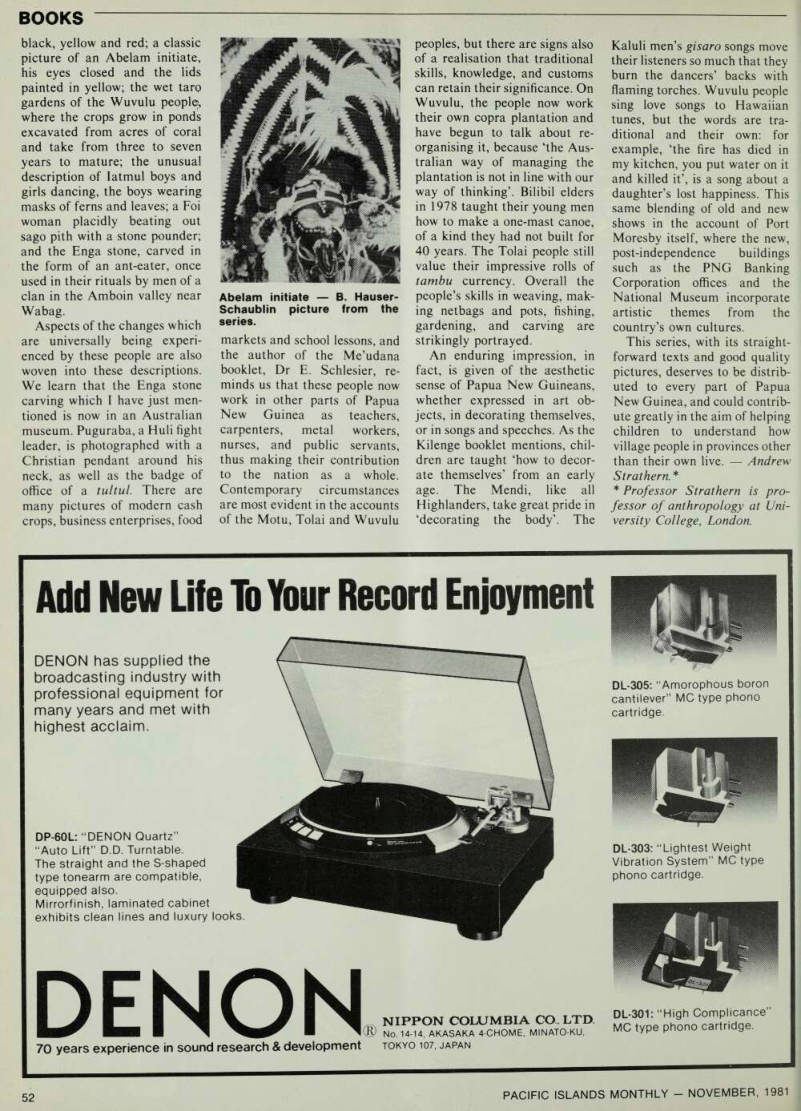
of life in PNG
People of Papua New Guinea.
Edited by A. L Crawford, de signed by M. A. MacKenzie.
Series published by the Cul tural Council of Papua New Guinea. Each 16 pp. K 1 These 17 booklets, delightfully illustrated and each containing a range of useful information, are the forerunners of further volumes planned for publica tion by Papua New Guinea’s National Cultural Council. The texts and photographs have been supplied by residents and research workers in the areas described. Originally the series was planned and produced for release as a part of the South Pacific Arts Festival in 1980. Its potential value, however, goes much wider, since these portraits of people, particularly when read as a set together, could be a helpful aid to cultural studies in schools throughout the country.
Some of the peoples and areas covered are very well known, such as the Motu, Enga, Huli, Abelam, Tolai, and latmul. Others are relatively unknown, for example the Kominimung of Madang Prov ince (a tiny group of 300 people), the Foi, the Bilibil, the Wuvulu, and the Me’udana people. A pleasant variation in the texts is that some are written from the viewpoint of a member of the society: in one case by a father taking his son, who has grown up in Port
Moresby, back to their village among the Abelam; in another by Pita Mangal of Kominimung, who collaborated with Dirk Smidt and Soroi Eoe of the National Museum in the museum’s Ramu project.
Looking through the texts, I see some recurrent themes: for example, different ways of mak ing gardens and of preparing sago; the emphasis on festivals and display; the importance, traditionally and now also, of trade in specialised products; the use of a wide range of first resources as well as those of gardens; and the separate resi dences of men and women, sometimes expressed through the distinction between a cen tral men’s house, used for re ligious rituals, and family houses built around it. The overlapping quality of these themes shows very clearly that underneath the many variations there is a deep similarity in traditional ways of life which cuts right across the barriers of language and geography.
There are highlights in each booklet, and every reader will pick on a different set. Here are some which struck me: the serried ranks of pig jawbones hung on the walls of Telefomin houses; Gogodala masks, brilliantly executed in white,
Motuan boys sail model canoes near Porebada. - A. L.
Crawford picture from the PNG cultural Council’s People of Papua New Guinea.
black, yellow and red; a classic picture of an Abelam initiate, his eyes closed and the lids painted in yellow; the wet taro gardens of the Wuvulu people, where the crops grow in ponds excavated from acres of coral and take from three to seven years to mature; the unusual description of latmul boys and girls dancing, the boys wearing masks of ferns and leaves; a Foi woman placidly beating out sago pith with a stone pounder; and the Enga stone, carved in the form of an ant-eater, once used in their rituals by men of a clan in the Amboin valley near Wabag.
Aspects of the changes which are universally being experi enced by these people are also woven into these descriptions.
We learn that the Enga stone carving which I have just men tioned is now in an Australian museum. Puguraba, a Huli fight leader, is photographed with a Christian pendant around his neck, as well as the badge of office of a tultul. There are many pictures of modern cash crops, business enterprises, food
markets and school lessons, and the author of the Me’udana booklet, Dr E. Schlesier, re minds us that these people now work in other parts of Papua New Guinea as teachers, carpenters, metal workers, nurses, and public servants, thus making their contribution to the nation as a whole.
Contemporary circumstances are most evident in the accounts of the Motu, Tolai and Wuvulu
peoples, but there are signs also of a realisation that traditional skills, knowledge, and customs can retain their significance. On Wuvulu, the people now work their own copra plantation and have begun to talk about re organising it, because ‘the Aus tralian way of managing the plantation is not in line with our way of thinking’. Bilibil elders in 1978 taught their young men how to make a one-mast canoe, of a kind they had not built for 40 years. The Tolai people still value their impressive rolls of tambu currency. Overall the people’s skills in weaving, mak ing netbags and pots, fishing, gardening, and carving are strikingly portrayed.
An enduring impression, in fact, is given of the aesthetic sense of Papua New Guineans, whether expressed in art ob jects, in decorating themselves, or in songs and speeches. As the Kilenge booklet mentions, chil dren are taught ‘how to decor ate themselves’ from an early age. The Mendi, like all Highlanders, take great pride in ‘decorating the body’. The
Kaluli men’s gisaro songs move their listeners so much that they burn the dancers’ backs with flaming torches. Wuvulu people sing love songs to Hawaiian tunes, but the words are tra ditional and their own; for example, ‘the fire has died in my kitchen, you put water on it and killed it’, is a song about a daughter’s lost happiness. This same blending of old and new shows in the account of Port Moresby itself, where the new, post-independence buildings such as the PNG Banking Corporation offices and the National Museum incorporate artistic themes from the country’s own cultures.
This series, with its straight forward texts and good quality pictures, deserves to be distrib uted to every part of Papua New Guinea, and could contrib ute greatly in the aim of helping children to understand how village people in provinces other
than their own live.
Andrew
Strathern.
* Professor Strathern is pro fessor of anthropology at Uni versity College, London.
Abelam initiate B. Hauser- Schaublin picture from the series.
Advertisements & other items, pp. 49-52 (2 items)
49
BOOKS
3 ACIFIC ISLANDS MONTHLY NOVEMBER, 1981
Citizen
Another teGhnologlcal first from Citizen
a a i • No more second hand. Now there’s a second band; an LCD time track that measures each second with pinpoint precisionas.it travels around the circumference of the watch face. But of course there’s more. In the mode the time track speeds up to complete a each second for split-second readings. And these readings can be verified digitally at just the touch of a button - right down to J/lOOth of a second. portion of the Time Track contains an alarm, digital.stopwatch, an hourly chime, and a permanently-set calendar showing date and day.
Time Track by Citizen.
The new way to keep track of time, s s s w m I* s &
ISI
CITIZEN QUARTZ % DIG!-ANA
Time Track MlSi
m^i ■
iBBS
msi
Kfi i !
K i S
STOPWATCH
4 N j
CITIZEN
AHEAD OF THEIR TIME
Denise Biellmann
chose
And the reason
why is
/ \ / Denise Biellmann, one of the most reliabi —and exciting—performers on ice. JVC, on of the most reliable and exciting pe formers in the field of home entertainment. > winning combination.
Reliability is a major reason why JVC is worldwide industry leader in audio-video elec ironies. And a good example of that reliability i the exciting new P-Compo. Try it and discove why JVC skates circles around its competitors.
Reliability
JVC
* ■V
Add New Life To Your Record Enjoyment DEMON has supplied the broadcasting industry with professional equipment for many years and met with highest acclaim.
DP-60L: “DEMON Quartz”
“Auto Lift” D.D. Turntable.
The straight and the S-shaped type tonearm are compatible, equipped also.
Mirrorfinish, laminated cabinet exhibits clean lines and luxury looks.
DEMON
70 years experience in sound research & development
NIPPON COLUMBIA CO. LTD
No. 14-14, AKASAKA 4-CHOME, MINATO-KU,
TOKYO 107, JAPAN
DL-305: “Amorophous boron cantilever” MC type phono cartridge.
DL-303; “Lightest Weight Vibration System” MC type phono cartridge.
DL-301: “High Complicance’
MC type phono cartridge.
Meeting New Caledonian tourism
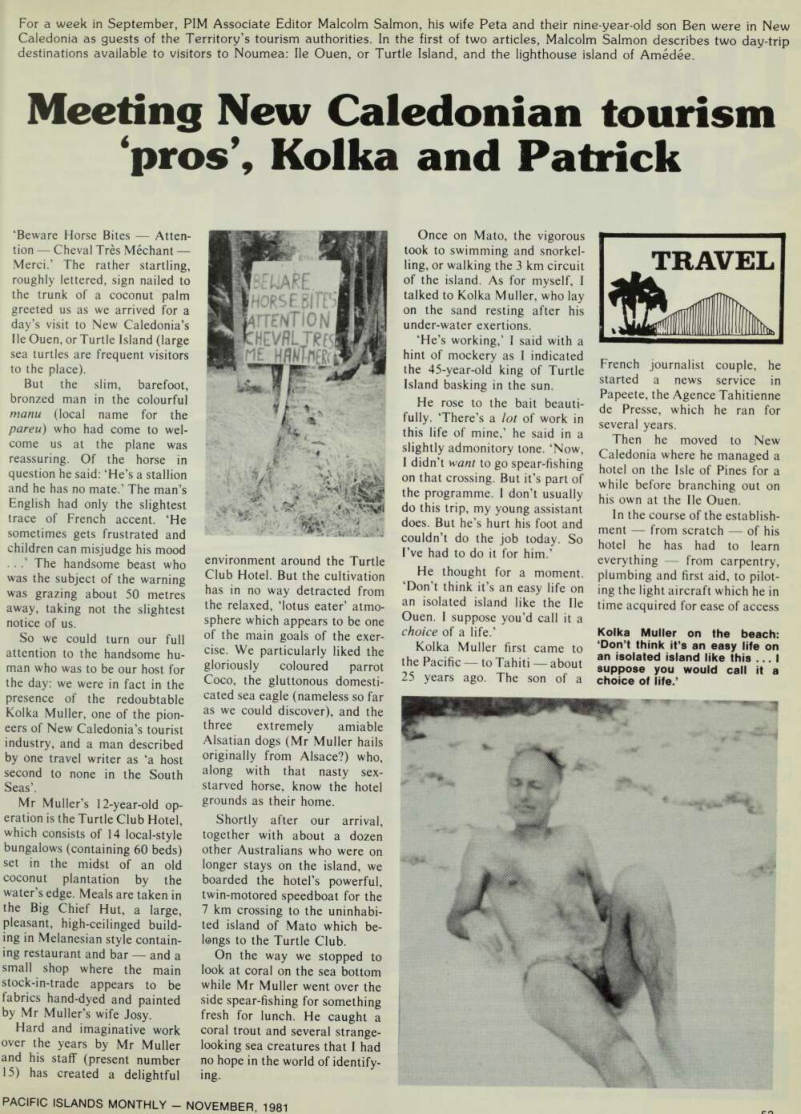

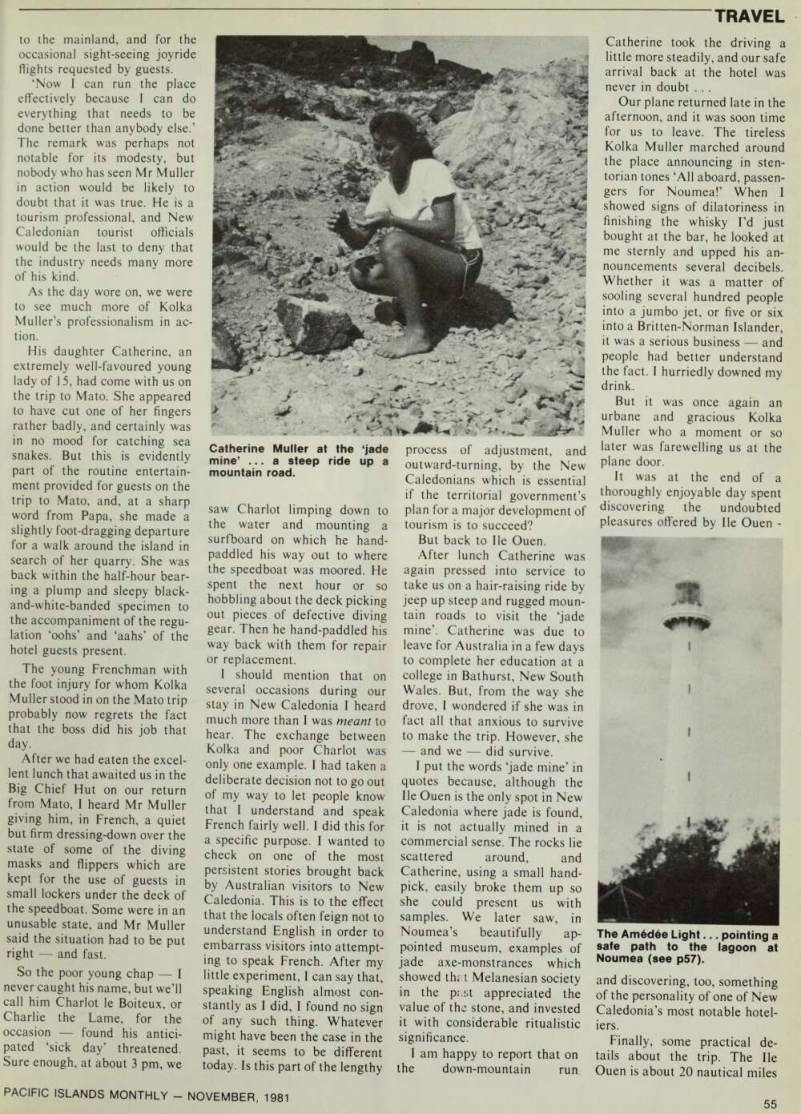
Travel
Meeting New Caledonian tourism ‘pros’, Kolka and Patrick
For a week in September, PIM Associate Editor Malcolm Salmon, his wife Peta and their nine-year-old son Ben were in New Caledonia as guests of the Territory’s tourism authorities. In the first of two articles, Malcolm Salmon describes two day-trip destinations available to visitors to Noumea: He Ouen, or Turtle Island, and the lighthouse island of Amedee.
‘Beware Horse Bites Atten tion Cheval Tres Mechant Merci.’ The rather startling, roughly lettered, sign nailed to the trunk of a coconut palm greeted us as we arrived for a day’s visit to New Caledonia’s He Ouen, or Turtle Island (large sea turtles are frequent visitors to the place).
But the slim, barefoot, bronzed man in the colourful manu (local name for the pareu) who had come to wel come us at the plane was reassuring. Of the horse in question he said: ‘He’s a stallion and he has no mate.’ The man’s English had only the slightest trace of French accent. ‘He sometimes gets frustrated and children can misjudge his mood .. .’ The handsome beast who was the subject of the warning was grazing about 50 metres away, taking not the slightest notice of us.
So we could turn our full attention to the handsome hu man who was to be our host for the day: we were in fact in the presence of the redoubtable Kolka Muller, one of the pion eers of New Caledonia’s tourist industry, and a man described by one travel writer as ‘a host second to none in the South Seas’.
Mr Muller’s 12-year-old op eration is the Turtle Club Hotel, which consists of 14 local-style bungalows (containing 60 beds) set in the midst of an old coconut plantation by the water’s edge. Meals are taken in the Big Chief Hut, a large, pleasant, high-ceilinged build ing in Melanesian style contain ing restaurant and bar and a small shop where the main stock-in-trade appears to be fabrics hand-dyed and painted by Mr Muller’s wife Josy.
Hard and imaginative work over the years by Mr Muller and his staff (present number 15) has created a delightful
environment around the Turtle Club Hotel. But the cultivation has in no way detracted from the relaxed, ‘lotus eater’ atmo sphere which appears to be one of the main goals of the exer cise. We particularly liked the gloriously coloured parrot Coco, the gluttonous domesti cated sea eagle (nameless so far as we could discover), and the three extremely amiable Alsatian dogs (Mr Muller hails originally from Alsace?) who, along with that nasty sex starved horse, know the hotel grounds as their home.
Shortly after our arrival, together with about a dozen other Australians who were on longer stays on the island, we boarded the hotel’s powerful, twin-motored speedboat for the 7 km crossing to the uninhabi ted island of Mato which be longs to the Turtle Club.
On the way we stopped to look at coral on the sea bottom while Mr Muller went over the side spear-fishing for something fresh for lunch. He caught a coral trout and several strange looking sea creatures that I had no hope in the world of identify ing.
Once on Mato, the vigorous took to swimming and snorkel ling, or walking the 3 km circuit of the island. As for myself, I talked to Kolka Muller, who lay on the sand resting after his under-water exertions. ‘He’s working,’ I said with a hint of mockery as I indicated the 45-year-old king of Turtle Island basking in the sun.
He rose to the bait beauti fully. ‘There’s a lot of work in this life of mine,’ he said in a slightly admonitory tone. ‘Now, I didn’t want to go spear-fishing on that crossing. But it’s part of the programme. I don’t usually do this trip, my young assistant does. But he’s hurt his foot and couldn’t do the job today. So I’ve had to do it for him.’
He thought for a moment. ‘Don’t think it’s an easy life on an isolated island like the He Ouen. I suppose you’d call it a choice of a life.’
Kolka Muller first came to the Pacific to Tahiti about 25 years ago. The son of a
French journalist couple, he started a news service in Papeete, the Agence Tahitienne de Presse, which he ran for several years.
Then he moved to New Caledonia where he managed a hotel on the Isle of Pines for a while before branching out on his own at the lie Ouen.
In the course of the establish ment from scratch of his hotel he has had to learn everything from carpentry, plumbing and first aid, to pilot ing the light aircraft which he in time acquired for ease of access
Kolka Muller on the beach: ‘Don’t think it’s an easy life on an isolated island like this ... I suppose you would call it a choice of life.’
to the mainland, and for the occasional sight-seeing joyride flights requested by guests. ‘Now I can run the place effectively because I can do everything that needs to be done better than anybody else.’
The remark was perhaps not notable for its modesty, but nobody who has seen Mr Muller in action would be likely to doubt that it was true. He is a tourism professional, and New Caledonian tourist officials would be the last to deny that the industry needs many more of his kind.
As the day wore on, we were to see much more of Kolka Muller’s professionalism in ac tion.
His daughter Catherine, an extremely well-favoured young lady of 15, had come with us on the trip to Mato. She appeared to have cut one of her fingers rather badly, and certainly was in no mood for catching sea snakes. But this is evidently part of the routine entertain ment provided for guests on the trip to Mato, and, at a sharp word from Papa, she made a slightly foot-dragging departure for a walk around the island in search of her quarry. She was back within the half-hour bear ing a plump and sleepy black and-white-banded specimen to the accompaniment of the regu lation ‘oohs’ and ‘aahs’ of the hotel guests present.
The young Frenchman with the foot injury for whom Kolka Muller stood in on the Mato trip probably now regrets the fact that the boss did his job that day.
After we had eaten the excel lent lunch that awaited us in the Big Chief Hut on our return from Mato, I heard Mr Muller giving him, in French, a quiet but firm dressing-down over the state of some of the diving masks and flippers which are kept for the use of guests in small lockers under the deck of the speedboat. Some were in an unusable state, and Mr Muller said the situation had to be put right and fast.
So the poor young chap I never caught his name, but we’ll call him Chariot le Boileux, or Charlie the Lame, for the occasion found his antici pated ‘sick day’ threatened.
Sure enough, at about 3 pm, we
saw Chariot limping down to the water and mounting a surfboard on which he hand paddled his way out to where the speedboat was moored. He spent the next hour or so hobbling about the deck picking out pieces of defective diving gear. Then he hand-paddled his way back with them for repair or replacement.
I should mention that on several occasions during our stay in New Caledonia I heard much more than I was meant to hear. The exchange between Kolka and poor Chariot was only one example. I had taken a deliberate decision not to go out of my way to let people know that I understand and speak French fairly well. I did this for a specific purpose. I wanted to check on one of the most persistent stories brought back by Australian visitors to New Caledonia. This is to the effect that the locals often feign not to understand English in order to embarrass visitors into attempt ing to speak French. After my little experiment, I can say that, speaking English almost con stantly as I did, I found no sign of any such thing. Whatever might have been the case in the past, it seems to be different today. Is this part of the lengthy
process of adjustment, and outward-turning, by the New Caledonians which is essential if the territorial government’s plan for a major development of tourism is to succeed?
But back to He Ouen.
After lunch Catherine was again pressed into service to take us on a hair-raising ride by jeep up steep and rugged moun tain roads to visit the ‘jade mine’. Catherine was due to leave for Australia in a few days to complete her education at a college in Bathurst, New South Wales. But, from the way she drove, I wondered if she was in fact all that anxious to survive to make the trip. However, she and we did survive.
I put the words ‘jade mine’ in quotes because, although the He Ouen is the only spot in New Caledonia where jade is found, it is not actually mined in a commercial sense. The rocks lie scattered around, and Catherine, using a small hand pick, easily broke them up so she could present us with samples. We later saw, in Noumea’s beautifully ap pointed museum, examples of jade axe-monstrances which showed th< t Melanesian society in the past appreciated the value of the stone, and invested it with considerable ritualistic significance.
I am happy to report that on the down-mountain run
Catherine took the driving a little more steadily, and our safe arrival back at the hotel was never in doubt . . .
Our plane returned late in the afternoon, and it was soon time for us to leave. The tireless Kolka Muller marched around the place announcing in sten torian tones ‘All aboard, passen gers for Noumea!’ When I showed signs of dilatoriness in finishing the whisky I’d just bought at the bar, he looked at me sternly and upped his an nouncements several decibels.
Whether it was a matter of sooling several hundred people into a jumbo jet, or five or six into a Britten-Norman Islander, it was a serious business and people had better understand the fact. I hurriedly downed my drink.
But it was once again an urbane and gracious Kolka Muller who a moment or so later was farewelling us at the plane door.
It was at the end of a thoroughly enjoyable day spent discovering the undoubted pleasures offered by He Ouen -
and discovering, too, something of the personality of one of New Caledonia’s most notable hotel iers.
Finally, some practical de tails about the trip. The He Ouen is about 20 nautical miles
Catherine Muller at the ‘jade mine’ ... a steep ride up a mountain road.
The Amedee Light... pointing a safe path to the lagoon at Noumea (see p57).
to the southeast of Noumea.
Our flight there from Noumea by Air Caledonie Islander took just 15 minutes the return air fare was CFP3OOO.
Turtle Club Hotel tariffs seemed reasonable: CFP46OO a day for one person in a single room, CFP36SO each for a couple sharing a room with twin beds, and CFP36SO for each extra person. Prices include all meals. Children under two are lodged free of charge, and for children under six, there is a 50% discount. At the time of our stay in New Caledonia, September 1-9. exchange rates hovered around CFPIIS for the $A and CFP9B for the SUS.
A second memorable day trip that came our way was a visit to Amedee Island, site of an ex
ceptionally graceful-looking
lighthouse. The beneficent task of the Amedee Light, which was erected in 1862, only nine years after the French took possession of New Caledonia, is to guide ships through a narrow passage into the calm interior of Noumea’s lagoon.
For this trip we were in the hands of another professional but of a different kind from our friend at He Ouen. Patrick Helmy is a golf professional from San Francisco who had come to New Caledonia only about six months before our visit intending to practise his trade at the nine-hole Noumea course which he confidently
expected would be open for business at any minute. At least, that’s what he’d been told.
But, as they say in Noumea: ‘Our golf course is like the Loch Ness monster much talked about but never sighted.’ The golf course project has appar ently gone through many vicissitudes for a number of years now. I don’t know the details. I can only say that it is not yet functioning, even though a few fanatical devotees of the game hit a ball around parts of it from time to time.
The main problem, it seems, is that the nearby Dumbea River has a nasty habit of covering it with water at regular intervals.
Patrick could read the signs as well as anybody else if not better than most. After several months of waiting, he knew he had to do something else or get out of the Territory altogether.
About June this year he bought into the Mary D , a large pleasure cruiser which was once a familiar sight on the waters of Australia’s Sydney Harbour. (‘lt belongs to me and the bank,’ said Patrick.) Most days of the week Patrick and his trusty, mainly Polynesian, crew run cruises to Amedee Island with the Mary D.
The crossing from Anse Vata beach is about an hour and
three-quarters.
On the Sunday we went, the cruiser was packed, and on the voyage out the sea was rough enough to make one or two
schoolchildren seasick but not, I’m glad to say, young Ben. (This is as bad a crossing as you’ll ever have,’ said Patrick reassuringly.) But the run back to Noumea in the late afternoon was made in millpond con ditions.
The sea crossings, however, are less than the half of the Mary D experience. On the island, there was swimming, snorkelling, and the (to me uninviting, and unaccepted) challenge of climbing the nearly 250 steps to the top of the lighthouse for the view. Peta and Ben did it while I lolled on the beach. For the next couple of days Peta’s leg muscles were so stiff that she got under way in the mornings in a manner that made Chariot le Boiteux look as nimble as a mountain goat.
But the highlight of the day was the lunch, eaten from the long tables set under trees, and the ensuing entertainment.
With Patrick always the attent ive and unforcedly friendly host, and his crew demonstrat ing that they were just as strong on cooking and service as on seamanship skills, a splendid and generous Islands lunch was prepared and cooked before the eyes of the guests. They ate it with all the more zest for having breathed in those copious quantities of invigorating sea air and also, no doubt, because Patrick had demon strated a far from tight-fisted attitude in the matter of pre lunch drinks.
The lunch over, the guests were enticed by the gifted ship’s captain (now ‘master of cer emonies’) into an impromptu
version (mockery?) of a tamure.
The atmosphere generated was such that Ben rightly dubi ous about my dancing ability was quite impressed with my performance opposite a young Japanese lady. (‘You were pretty good, Dad,’ said he.) The Japanese girl had happened to pick me as an obviously harmless-looking partner in one (‘Choose a man you’ve never seen before’) segment of the affair. I agree with Ben. I think I did pretty well at trying to knock my knees together too.
Incredibly, Patrick’s crew members, after the labours of preparing and cleaning-up after the lunch, still had something in reserve. The trip back to Anse Vata was made a delight by their excellent, guitar accompanied singing. What was most impressive was that their numbers were chosen with an unfailing sense of just who was on board to be entertained.
There were lots of French songs, some Australian, some Canadian, some Japanese.
There was even a Spanish number in honour of a passen ger from the Philippines. The atmosphere was carefree, ‘spon taneous’. But their choice of material could not have been more carefully tailored to their audience. At CFP26SO per adult head, the Mary D experi ence is certainly good value.
Despite what looks like a highly successful operation with the Mary D , Patrick hasn’t forgotten his original purpose: secured to the main pillar in the passenger cabin of the cruiser was a dazzling white Yank-style golfbag, filled with a massive, glittering array of clubs (some of which actually had holes in their heads, a type of golfing implement I had never seen before). Patrick told me he planned soon to open a driving range on Amedee Island to which he hoped to attract many golfing visitors, particularly Japanese gentlemen. He feels he can give them much cheaper tuition than they can usually find at home. Whether wielding a golf club or hosting an Islands lunch, Patrick, too, is a pro fessional.
Next month: The Isle of Pines; the anatomy of New Caledonia’s plans for the devel opment of tourism.
Patrick Helmy ... professional golfer on another course
View out of the Amedee Light ... with nearly 250 steps to the top it’s an exercise for only the stout-hearted visitor.
Advertisements & other items, pp. 54-60 (2 items)
(Compo!
The Memorable
U A jewel reveals the beauty of light and Sansui’s micro computer ICs reveal the beauty of music.
Sansui’s Super Compo stereo system has micro-computer memories to make music listening unforgettable. Stereo is now simpler and more fun.
Just push buttons and you’ve programmed any seven selections on a record in any order you like. Wonderful conveniences of the FM/AM tuner include Digital Quartz-
PLL Synthesizer tuning and push-
button selection of any 6 FM and any 6 AM pre-set stations.
Microcomputer delights of the
cassette deck are full-logic and Automatic Music Program Search. Wireless remote control is a nice option, and so is
the versatile Graphic Equalizer/Reverb/
Mixer Consolette.
Just push a button for memorable music. Memorable Super Compo by the hi-fi specialist, Sansui.
COMPO 9900
ii! * mm FR-D 55; Computerized Track Sequence Selection Full Auto DD Turntable RS-7: Infrared Remote Control System RG-7: Stereo Graphic Equalizer Consolette with reverb/mixer T-9: Digital Quartz-PLL Synthesizer Tuner with 12 FM/AM Station Pre-sets and Auto Search Tuning A-9: Integrated DC-Servo Amplifier, 65W RMS x 2 D-300M: Full-logic Metal-Compatible Cassette Deck GX-95: Audio Cabinet with Headphone Jack S-65: 4-Way Speaker System 12-3/8" Woofer, 105 W SANSUI ELECTRIC CO., LTD.I4-1 Izumi 2-chome, Suginami-ku, Tokyo 168, Japan • Australia VAN FI (Aust.) Pty. Ltd. 297, City Road, South Melbourne, Victoria 3205, Australia Phone: 690-6200/283 Alfred Street, North Sydney, N.S.W. 2060, Australia Phone: 929-0293 • Fiji Prabhu Brothers Ltd. P.O. Box 183, Nadi Phone: 70183/4 • Papua New Guinea Oceania Indent Agency (P.N.G.) Pty. Ltd. Box 5518, Boroko, Port Moresby Phone: PM 256406 • New Zealand David Reid Electronics Ltd. C.P.O. Box 2630, Auckland, 1 Phone; 491-489 • New Caledonia Ets Michel MERCIER B.P. 1123, Noumea Phone: 27. 59. 11 • South Pacific Miltons Department Stores Limited P.O. Box 146, Norfolk Island 2899 Phone: 2161 • Central Pacific Nauru Co-operative Society Republic of Nauru • Vanuatu The Sound Centre P.O. Box 434, Port Villa Phone: 2035 • Cook Island United Island Traders Ltd. P.O. Box 1 & 2, Rarotonga • Tahiti SIMEL P.O. Box 3338 Phone: 26979
Sansui.
D Woodward governors, synchronizers and synchrophasers are tested, calibrated and maintained at Woodward plants around the globe.
Our Sydney, Australia branch has complete facilities for overhaul, test and field service with new and exchange governors in stock for smaller governor requirements. We also carry a full range of spare parts for rapid delivery.
is the indispensable
ingredient
In most cases, complete overhaul of your main engine governor can be provided in two days.
The next time you have a service requirement, think of Woodward. r «*r! E i I I I if k. ■ / I . 4 IB I 1 -■ ■ ftie I at the heart r —f of the system ■ since 1870 ■ m
Woo
ov ar I
ETOO3
•any
Unit 17, sssMoxon Road Punchbowl,SNWS 2196 (Sydney) Australia Phone: (02) 709-5911 • Telex: AA24175 Ft. Collins, Colorado; Hoofddorp, The Netherlands; Slough, England; Chiba, Japan; Campinas, S.P., Brazil orporate Headquarters ockford, Illinois, U.S.A.
Reach out and the
The Spectrum 50 matched-
)mponent system finally puts a
:her musical life within reach of
ie most restrictive hi-fi budgets.
Each Spectrum 50 component is
star in a perfectly harmonizing
jdio galactic system. The brain-
lild of some of the hi-fi world’s
ost dedicated engineers.
Reach out, and your journey to
usic’s realm of inner space can
jgin now!
■ s m m 7\ ■ :*• “I u as * %■ -3 mm »
Spectrum 50
KA-50 Stereo Integrated Amplifier KT-30 FM-AM Stereo Tuner KX-50 Metal-Tape Stereo Cassette Deck with Dolby* NR
KD-40R
Direct-Drive Auto-Return Turntable
LS-110F
65W 3-way Speaker System
SRC-5
B Audio Rack with glass door and casters GE-90 Stereo Graphic Equalizer (option) “TM Dolby Licensing Corp.
TRIO-KENWOOD CORPORATION
Shionogi Shibuya Building, 17-5, 2-chome, Shibuya,
Shibuya-ku, Tokyo 150, Japan
TRIO-KENWOOD (AUSTRALIA) PTY. LTD.
4E Woodcock Place, Lane Cove, N.S.W. 2066, Australia. Tel: 428-1455 NEW ZEALAND JOHN GILBERT & CO , LTD Auckland Tel 30-839 FIJI PEPE S DUTY FREE CENTRE LTD. Tel: 26187 PAPUA NEW GUINEA S O SVENSSON (N G.) LTD. Port Moresby Tel. 24-2275/2285 NORFOLK ISLAND BURNS PHILIP (NORFOLK ISLAND) LTD.
SOLOMON ISLANDS TECHNIQUE RADIOS CENTRE LTD Honiara Tel 416 NEW CALEDONIA HI-FI VOX Noumea Tel 27-2466
VANUATU RUE HIGGINSON Vila Tel 2556
TAHITI MAISON AURORE Papeete Tel 29703
AMERICAN SAMOA ISLAND PACIFIC AGENCIES, INC Pago Pago Tel 633-4687
REPUBLIC OF NAURU NAURU CO-OPERATIVE SOCIETY
MARIANA ISLANDS J C TENORIO ENTERPRISES Saipan Tel 6445
*3* ' SUZUKI QUJBOARDS are truty ALL ROUND PERFORMER,... reliable,
and economical under arvy situation. *
SUZUKI spared outboards line up exclusively for the usage of professionals... and of course, also for the pleasure. Eadrhas different instruction respectively, so that you can choose your engine that is bestssulted to your boat and usage.
Get the fruitful life through SUZUKI OUTBOARDS. & kmmsfmm m ,
'i- il S/
hf . k SUZUKI MOTOR CO LTD Hamamatsu, Japan
SUZUKI GENERATOR
SEIOOQ
• NEW ZEALAND SOUTH PACIFIC SUZUKI DISTRIBUTORS LTD. PHONE; 58-599 • PAPUA NEW GUINEA HI SPEED[ DJfSEL SERVICE PTY. LTD. PHONE: 42-2679 •FIJI NIRANJANS AUTOPORT LTD. PHONE; 381555 •TAHITI NIPPON AUTOMOTO PHONE. 2-96 • SOLOMON SOLOMON ISLAND PHONE: 565 • VANUATU HENRI LEROUX*NEW CALEDONIA STE. SUPERCAL PHONE: 2^|068 • AMERICAN SAMOA PACIFIC PRODUCTS, INC. PHONE: 639-9140 • WESTERN SAMOA VATCO •GUAM ' SL AND CYCLERY INC.
PHONE: 565-2298 • NIUE BURNS PHILPCO., LTD. • NAURU EQUIPAC MOTORS PHONE: 4019 ©TONGA TONGA EQUIPMENT • YAP AMBROSE • KOROR BECHESRRAK T. COMPANY PHONE; 338*TRUK KIOMASA STORE PHONE; 470
Islands
From the
Press
The Times of Papua New Guinea, Port Moresby, quoting Mr Roy Evara who has been dropped from the PNG cabinet for what the government describes as
‘disloyalty’
I am an architect and champion at the destruction of governments.
I could go ahead and tell the nation about everything and embarrass the government, but I won’t do it I am a Christian.
Part of a letter signed ‘Dibwet Jose’, published in the Nauru Post After 12 years of independence we have come upon our bridges ...
We have wasted or squandered our money on bright things like elaborate and expensive parties, on cars and clothes, on furnitures, hi-fi sets, television and such. We and not only us, but every developing country like us becoming independent have never ;eemed to be able to manage our own affairs, especially finance. We lave been trailing well behind the industrialised countries, and we ;eem not to be able to formulate our own plans. We are like moths, ittracted to bright lights. How much have we spent already on the leautiful European lifestyle? We can afford it now while the ihosphate lasts, but can we afford it in the future? Just look at Dcean Island. fhe Pacific Daily News, Guam, quoting Mr John A.
John, a United States representative to the Asian
)evelopment Bank
he potential for development in Micronesia and the role of the ending institutions are delicately inter-related. It’s not unlike making love in a canoe. Even if both parties are willing, they must •e aware of the limitations of their environment if they are to ucceed. he Times of Papua New Guinea, quoting a pledge by )pposition Leader Michael Somare to include women i his ministry if he is elected to government next year lr Somare described PNG women as ‘aggressive’ and having etter reasoning than men. ‘For example, in parliament they are ke back stops he said. ‘Given a chance in this male-dominated )ciety, women could contribute a lot to development in this ation.’ art off an editorial in The Fiji Times, Suva, on the ftermath of the South African rugby tour of New ealand iji and its fellow Pacific Island states have displayed a restrained id balanced attitude to the Springbok tour of New Zealand ... ow African and Asian nations are threatening to boycott the ommonwealth Games in Brisbane if the New Zealanders show up, id the United States is being similarly threatened with a boycott the Los Angeles Olympics. The Pacific Islands should continue have no truck with retaliation of this sort. Once again sport is fing prostituted for shabby political purposes by nations which in any cases, have not just cupboards full of skeletons but acres of ass graves.
And part of another editorial on the same Jbject from the Samoa Times, Apia ie Springbok rugby tour of New Zealand is over and regrettably, though understandably, our government had little to say about it amly on the excuse that we had no right to interfere with New
Zealand’s internal affairs. The real reason, of course, is known to most people: Muldoon of New Zealand and Tupuola of Western Samoa are close friends. It is hoped however that the internal protests which troubled New Zealand will give future leaders food for thought about right action ... New Zealand wants to believe itself the champion of the underprivileged people of the world.
Show us.
Part of a letter criticising Inherited’ legal procedures in Papua New Guinea, signed by John Mark Nakutau, and published in the PNG Post-Courier, Port Moresby What I have seen in district courts is that the prosecutor reads out a statement which is followed by some harsh questions from the magistrate who, in many cases, reads out his decision straight away.
This has probably been adopted from the colonial days, but the difference nowadays is that expatriate magistrates (whites or other non-citizens employed from outside countries) run a more humane session than the Papua New Guineans do.
Editorial comment from The Observer, Apia, Western Samoa It now appears more and more convincing to anyone who has been closely following the recent Public Service Association strike from its birth to its end three months later that there was indeed a more subtle motive in allowing the strike to drag on. The strike as it was could have not have happened at a time more agreeable to government. It was necessary to let the strike continue into months so that it could be held responsible for losses and messes already amassed ... At the bottom of it all the government had been looking for a scapegoat. And the strike had been heaven-sent.
A plaintive observation from a statistical bulletin published in Port Moresby by the Papua New Guinea National Statistical Office It has not been possible to produce a full and very accurate set of import statistics for 1980 for a number of reasons ... Thus the set of statistics which are being produced for 1980 are also being labelled ’preliminary’ although it is not likely that they will ever be revised.
The Samoa Times, Apia, reporting on a youth seminar held in the Cook Islands Cook Islands youth say there are not enough bright lights and discos in their country, and that their society is too restrictive towards their needs. They believe that church sermons should be shorter and that sports should be allowed on Sundays. They also feel they do not know enough about sex and sexually transmitted diseases. The young people made these views known at the South Pacific’s first national seminar on youth and adolescent health held recently in the Cook Islands.
The Papua New Guinea government news magazine Hiri, quoting the Prime Minister, Sir Julius Chan There is more to Papua New Guinea than multi-coloured posters in a travel agent s office. It is time to stop describing us as creatures from the Stone Age covered in bangles, beads and plumes. Quite often these days behind the paint and feathers you will find the holder of a degree in political science, a highly-qualified nursing sister or even a government minister. Papua New Guinea no longer needs to conform to someone else’s preconceptions.
The Reporter, journal of the Papua New Guinea Institute of Technology, Lae, publishing directions on how to reach an office in an annexe building Route A is for the agile. It is graded ‘quite tough’ and involves an ascent of one staircase, the traverse of a wooden corridor, and the final descent of another staircase with two right-angle bends. Route B is graded ‘physically easy but mentally taxing, some navigational skill required’ and involves finding the front door to the building which is actually at the back. You walk through the ground floor lobby, turn right and then turn right again at the first doorway. If you get lost on either route you should retrace your steps and try again, perhaps with the aid of an Explorers Club guide. If you still get lost, shout ‘help!’ but do it quietly so as not to disturb the intellectual calm of the building.
Advertisements & other items, p. 59 (1 item)
Islands Monthly Novembfr 1Q«1
PNG mine production
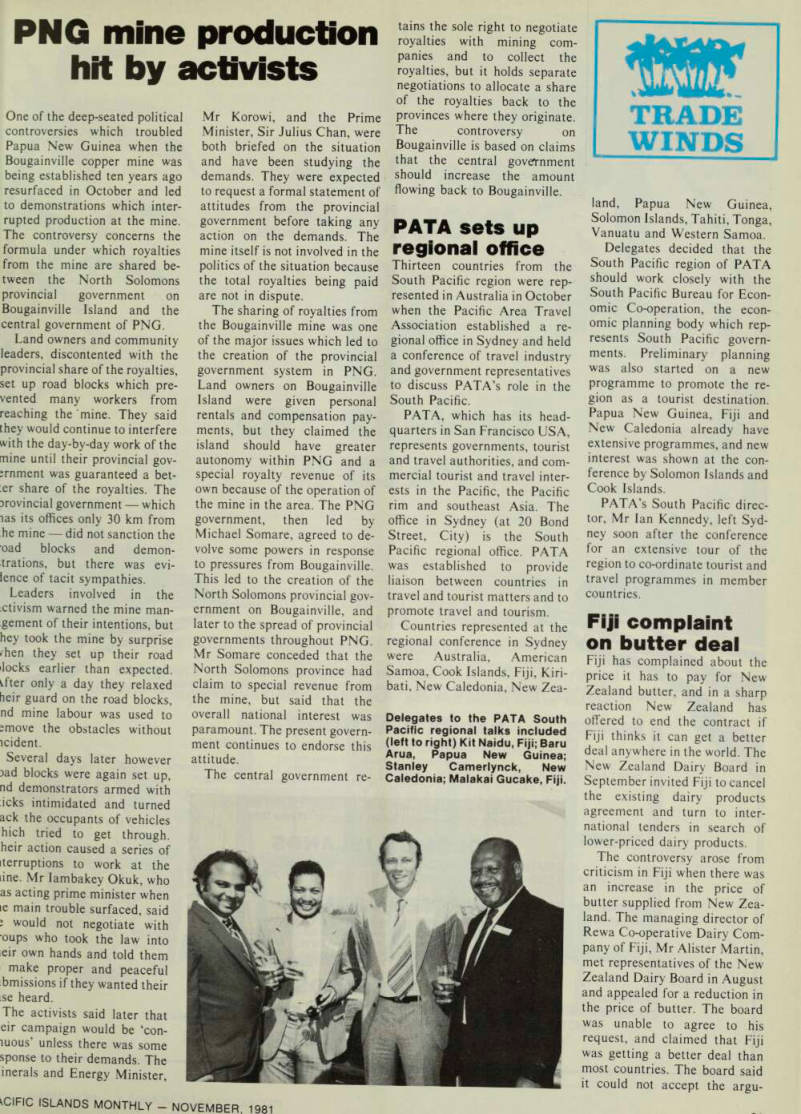


Trade
Winds
PNG mine production hit by activists
One of the deep-seated political controversies which troubled Papua New Guinea when the Bougainville copper mine was being established ten years ago resurfaced in October and led to demonstrations which inter rupted production at the mine.
The controversy concerns the formula under which royalties from the mine are shared be tween the North Solomons provincial government on Bougainville Island and the central government of PNG.
Land owners and community leaders, discontented with the provincial share of the royalties, set up road blocks which pre vented many workers from reaching the mine. They said they would continue to interfere with the day-by-day work of the mine until their provincial gov ernment was guaranteed a bet ;er share of the royalties. The Drovincial government which las its offices only 30 km from he mine did not sanction the oad blocks and demon trations, but there was evi lence of tacit sympathies.
Leaders involved in the ctivism warned the mine man gement of their intentions, but hey took the mine by surprise /hen they set up their road ilocks earlier than expected, tfter only a day they relaxed heir guard on the road blocks, nd mine labour was used to ;move the obstacles without icident.
Several days later however )ad blocks were again set up, nd demonstrators armed with icks intimidated and turned ack the occupants of vehicles hich tried to get through, heir action caused a series of iterruptions to work at the line. Mr lambakey Okuk, who as acting prime minister when le main trouble surfaced, said ; would not negotiate with oups who took the law into eir own hands and told them make proper and peaceful bmissions if they wanted their ise heard.
The activists said later that eir campaign would be ‘con tuous’ unless there was some sponse to their demands. The inerals and Energy Minister,
Mr Korowi, and the Prime Minister, Sir Julius Chan, were both briefed on the situation and have been studying the demands. They were expected to request a formal statement of attitudes from the provincial government before taking any action on the demands. The mine itself is not involved in the politics of the situation because the total royalties being paid are not in dispute.
The sharing of royalties from the Bougainville mine was one of the major issues which led to the creation of the provincial government system in PNG.
Land owners on Bougainville Island were given personal rentals and compensation pay ments, but they claimed the island should have greater autonomy within PNG and a special royalty revenue of its own because of the operation of the mine in the area. The PNG government, then led by Michael Somare, agreed to de volve some powers in response to pressures from Bougainville.
This led to the creation of the North Solomons provincial gov ernment on Bougainville, and later to the spread of provincial governments throughout PNG.
Mr Somare conceded that the North Solomons province had claim to special revenue from the mine, but said that the overall national interest was paramount. The present govern ment continues to endorse this attitude.
The central government re
tains the sole right to negotiate royalties with mining com panies and to collect the royalties, but it holds separate negotiations to allocate a share of the royalties back to the provinces where they originate.
The controversy on Bougainville is based on claims that the central government should increase the amount flowing back to Bougainville.
PATA sets up
regional office
Thirteen countries from the South Pacific region were rep resented in Australia in October when the Pacific Area Travel Association established a re gional office in Sydney and held a conference of travel industry and government representatives to discuss PATA’s role in the South Pacific.
PATA, which has its head quarters in San Francisco USA, represents governments, tourist and travel authorities, and com mercial tourist and travel inter ests in the Pacific, the Pacific rim and southeast Asia. The office in Sydney (at 20 Bond Street, City) is the South Pacific regional office. PATA was established to provide liaison between countries in travel and tourist matters and to promote travel and tourism.
Countries represented at the regional conference in Sydney were Australia, American Samoa, Cook Islands, Fiji, Kiri bati, New Caledonia, New Zea-
land, Papua New Guinea, Solomon Islands, Tahiti, Tonga, Vanuatu and Western Samoa.
Delegates decided that the South Pacific region of PATA should work closely with the South Pacific Bureau for Econ omic Co-operation, the econ omic planning body which rep resents South Pacific govern ments. Preliminary planning was also started on a new programme to promote the re gion as a tourist destination.
Papua New Guinea, Fiji and New Caledonia already have extensive programmes, and new interest was shown at the con ference by Solomon Islands and Cook Islands.
PATA’s South Pacific direc tor, Mr lan Kennedy, left Syd ney soon after the conference for an extensive tour of the region to co-ordinate tourist and travel programmes in member countries.
Fiji complaint
on butter deal
Fiji has complained about the price it has to pay for New Zealand butter, and in a sharp reaction New Zealand has offered to end the contract if Fiji thinks it can get a better deal anywhere in the world. The New Zealand Dairy Board in September invited Fiji to cancel the existing dairy products agreement and turn to inter national tenders in search of lower-priced dairy products.
The controversy arose from criticism in Fiji when there was an increase in the price of butter supplied from New Zea land. The managing director of Rewa Co-operative Dairy Com pany of Fiji, Mr Alister Martin, met representatives of the New Zealand Dairy Board in August and appealed for a reduction in the price of butter. The board was unable to agree to his request, and claimed that Fiji was getting a better deal than most countries. The board said it could not accept the argu
Delegates to the PATA South Pacific regional talks included (left to right) Kit Naidu, Fiji; Baru Arua, Papua New Guinea; Stanley Camerlynck, New Caledonia; Malakai Gucake, Fiji.
ment that Fiji had been hit harder than other world con sumers. Fiji sources continued to claim that New Zealand had discriminated against the Fiji market, and this led to the dairy board’s offer to allow Fiji to cancel the contract.
A spokesman for the board said that open tender pricing would soon reveal whether New Zealand was being competitive in its pricing structure. The board also offered to match any genuine offer from elsewhere in the world provided that quality, quantity and periods of contract were comparable. The dairy board also sent a delegation to Fiji to explain its position and to discuss pricing structures.
Later reports from Fiji indi cate that the Rewa Co operative has made tentative inquiries on the world market but so far has been unable to find a cheaper source of supply.
New Zealand supplies about 37% of the butter retailed in Fiji. The contract is •enegotiated every six months, md the current contract which became effective on July I
embodied a price increase of 35% created by rising pro duction costs in New Zealand.
The retail price for a 250-gram pat of butter increased in Suva shops from 56 to 78 cents.
Despite the increase in price of its own product the dairy board quoted figures showing higher prices still from many suppliers, including a price from France which was 26% above the New Zealand price.
The Taranaki Herald, a newspaper circulating in one of New Zealand’s dairy centres, published an editorial sympath ising with the Fijians for the rising price of consumer goods but stressing that they were getting a better deal from New Zealand than could be obtained elsewhere.
The editorial said that Fiji’s ‘anger and ire were unsurpris ing’ but claimed that the criti cism was neither fair nor reasonable. New Zealand ac cepted a high degree of moral responsibility to help its Island neighbours but New Zealand farmers were not in the business of being philanthropists to the
world. They needed to make some profit on their goods, and even with the latest increase Fiji was getting its butter at less than open market price.
The editorial continued ‘Like most small independent states the Fijians are a proud people, if sometimes over-suspicious in dealing with the rest of the world. The dairy board’s calm response and its offer to rescind the contract if the Fijians feel they can do better elsewhere should go a long way towards convincing not only Fiji but other Island states of New Zealand’s willingness to con tinue dealing fairly, if not quite so generously, as in the past.’
William Gas son in Wellington.
Ok Tedi given
line of credit
Despite continuing dissatis faction from many landowners in the area, Papua New Guinea is pushing ahead with its plans for the development of the Ok Tedi copper mine in the mountainous central west of the
PNG mainland. The overall project is now seen as one of national importance, despite opinions by some financial ob servers that the real economic benefit to PNG will be small.
The PNG government believes that in the long term the project will be valuable be cause of spin-off development which it will create.
The dissatisfaction by some landowners is not seen as a serious threat to the develop ment of the mine. Evidence at a series of land hearings has indicated that many claims to the land, or claims to right of usage, could not be upheld on evidence. The more urgent problems are likely to be politi cal, arising from the claims of people in the area for greater autonomy and for a regional sharing of financial benefits.
Senior ministers in the Chan government also believe that the community and land prob lems are not nearly as great as those which threatened the de velopment of the Bougainville mine a decade ago.
Unrest over the Bougainville
development was the major factor which led to PNG adopt ing a system of provincial gov ernments. The Bougainville people were the first to gain provincial recognition with the formation of the North Solomons Provincial Govern ment.
Meanwhile the Australian government has authorised the Export Finance and Insurance Corporation in Australia to offer a $212 million line of credit to finance the supply of Australian goods and services associated with the establish ment phase of the mine. The Ok Fedi Mining Company Ltd and ;he corporation are now nego iating loan terms and con iitions.
Partners in the project are Dampier Mining (Australia), 10%; Amoco Minerals (USA), 10%; Kupfer Explorations West Germany), 20%; the *NG government, 20%.
PNG may ultimately seek to acrease its equity, but this is ot a major point at issue. PNG as a highly-formalised mining olicy based on world-wide con ultations and on an examin tion of the strengths and 'eaknesses of mining develop ment in other Third World ountries. One of the corner ones of the PNG policy is to laximise financial returns and immunity benefits without ty ‘g up excessive capital in luity.
* refit drop for
lougainville
ougainville Copper’s earnings om its copper and gold mine in apua New Guinea dropped by S% for the first half of this year )mpared with the same period
last year. The result was $l6 million for the first six months of this year, compared with $5O million for the first half of last year. The factors leading to this result were continuing low prices for metal mining pro ducts, the strong state of the PNG currency and steeply ris ing costs.
The company predicts that the situation will continue into next year, but describes the medium term prospects as still good. The share situation has reflected this confidence despite the returns shown in the half yearly report.
Production at the mine in creased by 10% during the period under review and sales went up by 21%. However these improvements were not suf ficient to offset the other fac tors. A further boost to pro duction is expected in the im mediate future as the company brings new processing capacity into use.
However much of the new processing capacity will not contribute to a net increase in production, but will be needed to offset the lower grade of ore which is being encountered as the big open pit mine deepens.
Undercutting
the giants
The fledgling Air Vanuatu has moved aggressively to undercut big rivals Qantas and UTA with its fares on the Sydney-Port- Vila route.
Air Vanuatu’s Inclusive Tour fare (payable 21 days in ad vance for a minimum of 10 passengers) is $A297 (Qantas and UTA $332). The individual IT fare requires a minimum stay of six days and a maximum
of 23. Qantas and UTA are charging $4OO, and Air Vanuatu $360.
Economy class return fares without conditions on length of stay or departure date are $594 with Qantas and UTA, and $526 with Air Vanuatu. First class fares are $BO4 and $726 respectively.
With all three airlines, chil dren between two and 12 years travel at half-price, and chil dren under two sitting on their parents’ knees at 10%.
Britain reports
Pacific aid
Despite pressures in Britain to reduce public spending, aid to the Pacific Islands will continue into the 1980 s at a high level, the London Press Service has reported. Net official develop ment aid to the region was quoted at a level of more than SA4O million a year.
A major part of development aid from Britain is directed to the University of the South Pacific in Fiji. The university maintains departments in Kiri bati, Cook Islands, Tonga, Western Samoa and Solomon Islands in addition to Fiji.
British aid funds are spent in six Island countries, and major projects have involved telecom munications, education, health services and agricultural devel opments.
In addition, the Common wealth Development Corpor ation which operates autonomously but can draw
Night turn-round at Port-Vila for Air Vanuatu, undercutting Sydney-Vanuatu fares. The DC9 aircraft is chartered from the Australian airline Ansett. - Les Nouvelles Caledoniennes pic ture.
finance from the British govern ment, invests in development projects in the region.
PNG criticises
trade balance
The Papua New Guinea Foreign Affairs and Trade Min ister, Mr Noel Levi, was highly critical in September of the favourable trade balance main tained by Australia and New Zealand in relation to the Island countries of the South Pacific.
He told a conference on trade, investment and development, held in Port Moresby, that the factors leading to the situation could be understood but the fact remained that the imbal ance was far too heavily in favour of the two developed nations of Australia and New Zealand. He said that protec tionist policies adopted by the two countries were preventing the Island countries from de veloping a broader trade base.
Mr Levi, who was opening ;he talks, said that for various •easons strong links had been •etained between the Island countries and the powers which lad once ruled them. Many of he reasons were good ones, and he fact that strong links had )een maintained was a good eflection on the stability of the ’acific region and on the nature if the Pacific community in ;eneral.
However the situation had icrpetuated a type of trade link /hich was not necesarily in the est interests of the Island ountries and which restricted tie trade relationships of the
ewly-independent Pacific.
Mr Levi said that the 1980 •ade figures between the acific Islands on the one hand nd Australia and New Zealand ti the other were six to one in ivour of New Zealand and mr to one in favour of Austra a. It was important for the acific community to negotiate, at for increased aid from the aveloped countries, but for a •eater sale of exports to them.
He conceded that the pro icts coming out of the Pacific land countries tropical 'riculture products, mined etals, timber, sugar and fish - were not extensive, but he
amed the developed countries
r not creating a situation
which would allow the develop ment of a greater range of Islands exports. Mr Levi said that present policies and situ ations in Australia and New Zealand stood in the way of any significant diversification of Islands exports.
Referring to the South Pacific Regional Trade and Economic Co-operation Agree ment (SPARTECA), Mr Levi said that exemptions and sus pensions were defeating the object of the agreement. (SPARTECA was negotiated by Australia and New Zealand with the South Pacific Forum Island countries to permit duty free access of manufactured goods from the Island countries.) Mr Levi also accused the developed countries of being too heavily involved in shipping lines at the expense of the Island countries which were trying to develop their own lines.
Mr Levi said that the Island countries should adopt aggress ive policies to dismantle the food trade monopolies which Australia and New Zealand had developed in the Pacific. He said that even in the Island countries which were exporting goods, the ownership of the exporting companies was often in the hands of investors and businessmen from the devel oped countries. ‘lt’s the monop olistic network of the rich,’ he said.
He suggested that the Island countries could establish mar keting corporations for copra, coconut oil, timber and fish within the region.
Profits go up
for big three
The South Pacific Islands’ biggest trading companies, W. R. Carpenter Holdings Ltd and Burns, Philp and Company Ltd, have reported increased profits for the last financial year but there’s been a downturn in income from Islands operations.
Carpenter’s profit rose by 17% to a record $A 15.42 million. A sharp improvement by the Aus tralian divisions more than com pensated for a big decline in income in Papua New Guinea and Fiji, where lower com modity prices cut profits by 55%.
Burns Philp’s profit was a record $20.3 million, a 15.1% increase, but in the Islands there was a 69% fall in net profit. The rebellion on Santo, Vanuatu, was among the events that affected the company’s operations. Despite the record profit some analysts have been critical of the Burns Philp result on the grounds that full value did not appear to have been extracted from a huge increase in sales turnover. The profit increase of 15.1% was returned from a sales increase of 41%.
Although commodity prices fell in Papua New Guinea,
Steamships Trading Company
Ltd increased its profit from K 3.33 million to K 4.36 million.
Much of this came from rev enue in New Guinea Industries Ltd.
PATA meeting
for Bangkok
The 1982 Pacific Area Travel Association Conference will be held in Bangkok, capital of Thailand.
The conference will take
place amid festivities marking the 200th anniversary of the founding of Bangkok in 1782 by the first king of the present ruling dynasty, the Chakri.
Venue for the meeting will be Bangkok’s luxurious Dusit Thani Hotel.
Soft loan for
Tonga reserve
The King of Tonga’s state visit to Kuwait in August appears to have borne fruit in the shape of a SUSI million 10-year loan from the OPEC Fund for Devel opment. The interest-free loan, with a grace period of three years before repayments begin, has been provided to assist the kingdom with its current
balance-of-payments problems.
The Tongan High Com missioner in London, Mr ’lnoke Fotu Faletau, signed the loan agreement on behalf of Tonga at the OPEC headquarters in Vienna.
The expression of goodwill represented by the loan has increased speculation on the possible outcome of the main
purpose of the royal visit to Kuwait discussions on the feasibility of establishing a Kuwaiti-funded regional bulk oil storage depot in Tonga.
Penny Hodgkinson in Nukualofa.
Vanuatu signs
CDC agreement
Vanuatu and the Common wealth Development Corpor ation have signed an agreement providing a basis for CDC involvement in the economic development, of Vanuatu. The CDC is a UK-based organis ation established under parlia mentary charter to sponsor and maintain major economic pro jects on good financial terms in developing countries.
The agreement was signed in Port-Vila by the minister re sponsible for agriculture, fisheries and forests, Sethy Regenvanu, and by the CDC’s South Pacific regional control ler from Fiji, David Lincoln- Gordon. Mr Regenvanu said he believed the agreement would provide a major contribution to
development in Vanuatu and he thanked Mr Lincoln-Gordon for personal efforts in preparing and arranging the agreement.
Since the agreement was signed an assessment team from the CDC has visited Vanuatu to examine projects which could form the basis for CDC involve ment. Cocoa and forestry pro jects were given priority during
the assessment.
Ian
McIntyre in Port-Vila.
Australia aid
programmes
Australian direct aid to de veloping countries and to inter national organisations providing aid will be $653 million in 1981-82. The Pacific region is the biggest recipient. The aid figure was announced in the Australian budget tabled in parliament in August. In terms of Australian dollars it is an increase of 15.3% over the previous year’s figures, and in real terms related to world money values it is seen as an increase of about 6%.
The biggest single outlet for
the funds will be Papua New Guinea which will receive budget support and associated payments totalling $254 million. PNG will not bring down its budget until later in the year, but the Australian support is expected to provide about 30% of the PNG revenue total. Under an arrangement between the two countries the real value of Australian financial aid to PNG is being scaled down at the rate of 5% a year.
Other bilateral aid payments by Australia to developing countries will amount to $267 million. Multilateral aid will amount to $132 million chan nelled through development finance institutions. United Nations agencies and regional organisations.
The Australian Treasurer, Mr Howard, told parliament that this year’s aid to PNG was the first under a new five-year programme negotiated by the two governments last year, and which would continue until 1985-86. The total five-year commitment was expected to
involve at least $l2OO million, but each annual payment would be determined by a formula involving an annual reduction of 5% in real terms. Mr Howard said that the arrangement would allow PNG to gradually lower its dependence on Austra lian aid. At the same time, however, PNG would be able to pursue its economic and social development policies in the knowledge that substantial Aus tralian assistance would be available throughout the five year period.
The $254 million which Aus tralia has allocated to PNG this year consists mainly of the direct untied budget grant of $241.3 million, which in dollar terms is an increase of $9.3 million over the previous year.
The remaining amount includes provision to retire non-nationals of PNG who worked for the original Australian adminis tration of PNG or for the Australian Staffing Assistance Group. It also includes in creased contributions to the PNG-Australia Technical Co operation Programme.
Advertisements & other items, pp. 61-70 (6 items)
Tcific Islands Monthly - November 1981
| National
k
NATIONAL
INSURANCE
COVERS THE
PACIFIC
/ m *
FIJI
THE NATIONAL INSURANCE COMPANY OF FIJI, LIMITED. (Incorporating Southern Pacific Insurance Co. (Fiji) Ltd) SUVA Dominion House. Thomson St, Phone 25601, Tlx 2337 L. M. Rolls, General Manager.
LAUTOKA Ist Floor National Bank Bldg. Phone 62951. M. Y. Hussain. Resident Inspector LABASA Ist Floor National Bank Bldg. Phone 81099. A. Singh, Resident Inspector,
PAPUA NEW GUINEA
THE SOUTHERN PACIFIC INSURANCE COMPANY (PNG) LIMITED. (Incorporating C.I.C. Insurance (Pacific) Pty Ltd) PORT MORESBY 8 Champion Parade, Phone 21-1388, Tlx 22261. D. J. McCall, General Manager LAE Second St, Phone 42-4590. Tlx 42443. T. S. Kennedy, Manager.
RABAUL Mango Ave, Phone 92-2755, Tlx 92923. P. M. Mitchell, Manager.
MT HAGEN Phone 521-164, J, P. Devaney, District Manager.
ARAWA B. Snowden, District Manager. Phone 969-219
SOLOMON ISLANDS
THE NATIONAL INSURANCE COMPANY OF NEW ZEALAND. LIMITED HONIARA Ist Floor Kingsley Bldg. Phone 919 B. R. International Agencies (W.V. Gledhill) Agent.
WESTERN SAMOA
NATIONAL PACIFIC INSURANCE LIMITED.
(National Insurance Company of New Zealand. Ltd Managing Agents) APIA Taufusi St, Phone 20481, Tlx 228. D. I. Humphry, Managing Director.
PAGO PAGO Suite 200. Lumana'i Bldg. Phone 96799. J. McGuire, Manager.
COOK ISLANDS
THE NATIONAL INSURANCE (COOK ISLANDS) LIMITED.
RAROTONGA Ist Floor Ingram House, Phone 2076, Tlx 62028, R. Wheeler, Manager,
mi in
AHI Aluminium Limited
Rylock
MARKET LEADERS IN ALUMINIUM WINDOWS & DOORS
lAnsHer
Designers and manufacturers marketing a complete range of extrusions and components for fabrication of aluminium joinery products. r. m vV >4 t fr / fc;
FOR FURTHER INFORMATION CONTACT
AHI ALUMINIUM FRANCHISING COMPANY
P O BOX 18299, AUCKLAND. NEW ZEALAND TELEPHONE: 580 704 CABLES: AHIAL TELEX: 2222
» I r V-* A % 1. The DeZURIK® V-Port Ball Valve A rugged and unique control valve that combines high capacity and low cost. Offers precision control for a variety of applications to 740 psi with temperature ratings to 1000°F. Sizes V 2” -20”.
2. The DeZURIK PERMASEAL®
Plug Valve This simple, tough valve features a self-adjusting plug that compensates for wear and temperature changes, plus “true top entry” for in-line maintenance.
Bi-directional shutoff to 1480 psi.
ANSI 150, 300 and 600 in sizes V 2 ”-6”. 3. The DeZURIK C Series Knife Gate A proven performer in the toughest abrasive and corrosive services. Available with lever, handwheel, electric motor, on-off or positioning cylinder actuators.
Sizes 2”-72”.
4. The DeZURIK FIG 660 RS
Butterfly Valve A unique seat design ensures bidirectional shutoff to 150 psi and a streamlined disc delivers high flow capacity. Choice of seat materials, actuators and wafer or lug in sizes 2”-12”.
5. The DeZURIK FIG 632 RS
Butterfly Valve The resilient seated butterfly valve that offers unequalled performance and an exclusive double-seat in sizes 2”-20”. Wide choice of actuators. Choice of wafer or lug body in all sizes: 2”-36”. 6. The DeZURIK HP Butterfly Valve A high performance valve that features an exclusive TFE/titanium seat design to assure a lasting, bubble-tight shutoff. Excellent corrosion resistance and temperature accommodation in sizes 2”-20”. ANSI 150 and 300 to 740 psi. 7. The DeZURIK Eccentric Valve 28 sizes and a host of options assure the exact combination for any application. Eccentric action delivers a lasting dead-tight shutoff in sizes from 1 /2”-72”. 8. The DeZURIK 3-Way & 4-Way Valves Rugged performance for virtually any shutoff or switching application. Lever, handwheel, onoff or positioning cylinder available in sizes 3”-16”. 9. The DeZURIK Rotating Sensor Consistency Transmitter Electronic or pneumatic control assures unmatched sensing accuracy. Unique involute ribs are influenced only by stock consistency.
A LIMIT OF GENERAL SIGNAL
DeZURIK
DeZURIK OF AUSTRALIA PTY. LTD.. P.O, Box 204. Vineyard Road. Sunbury, Victoria 3429. Australia Tnlnnhnno. HQ 7/1/1 99/1/1 Tolov f1f133739
FOR SALE
A NUMBER OF
STEEL BARGES, TUGS
And auxiliary equipment including suction dredges located in New Zealand, available "as is where is".
This plant would be suitable for port expansion and coastal movement of cargo. Full details available from:
G.W. DUNSFORD &
ASSOCIATES LIMITED
P.O. Box 4076, Auckland, New Zealand.
Phone Auckland 797 171 or A/Hours 555 218
BOOKS
• Wewillmailanybookcurrentlyin
print in Britain to any address in the world. (Over 337.000 titles!) • We pay postage, packing and insurance and charge the UK bookshop price. • £1 servicechargeonordersunder £7. None when £7 or over. • Inquiries very welcome on prices, etc., etc.
United Book Suppliers 2-6 Brown s Road. Newtownabbey.
Belfast 8T36 BRN. United Kingdom Tel. 023 13 2362
PORT MOftj
* Right in tl business cm
* A traditio|fy:or s
comfort and/im food * All rqoms airconditioned * Restaurant * Ba* * Banquet hall
A. C. NEUMANN
manager Phone 21-2622
r * ym///tr.
A u We are unique in this country m being able to supply whatever you need m water treatment We are people who manufacture both plant and chemicals and therefore can view any water treatment problem objectively without bias.
We alone in N.Z, can offer you- (from our own range) - Base exchange softeners Reverse osmosis plants Demineralisation units, from small portables to large volume units Effluent treatment Potable water treatment, farm size to large municipal plants Scale preventatives Corrosion inhibitors Biocides Chemical cleaning Swimming pool filters Mixing, flow metering and dosing equipment Don’t look further; you don’t have to - our product range is available now.
After all, for 50 years we've found that the way to do good business is to give you the customer what you need Now, what was it you wanted?
Portals New Zealand
Portals Water Treatment (NZ) Ltd 11 Spring St., Onehunga, P.O. Box 13-558 Auckland 6.
Telephone: 661-079 (7 lines) Telex: NZ 21175
Whatever it is
you want, *
you’ve found it.
■V 3937 b
X^^diesel
FUEL INJECTION
AND ELECTRICAL SYSTEMS
SPECIALISTS FOR ALL
MARINE, COMMERCIAL,
INDUSTRIAL AND AUTOMOTIVE
INSTALLATIONS
, . We service and stock fuel Pumps injectors, turbochargers, governors, alternators, generators and starter motors for all applications. r-^92 NTACT US BY TELEX FROM anywhere in the pacific FOR IMMEDIATE DESPATCH OF REPLACEMENTS AND SPARES FOR
BOSCH, BRYCE, CATERPILLAR, CAV, DIESEL KIKI
GM, HOLSET, NIPPON DENSO, ROOSAMASTER
AIR RESEARCH, SCHWITZER, SIMMS, DAHL FILTERS
and
WOODWARD GOVERNORS
s i&P
SIMMS DIESEL & ELECTRICAL SERVICES LTD
P O BOX 11-114 ELLERSLIE
77 LEONARD ROAD. PENROSE AUCKLAND
NEW ZEALAND
TELEX No NZ 60266 SIMMS
DAYTIME TEL,
AUCKLAND 591-159
■lvv
DIESEL SPECIALISTS
EVENING TEL.
AUCKLAND 568-259
o u
PUTYOUR
FOOT DOWN.
DEMAND
TIMKEN
BEARINGS!
TIMKEN
REGISTERED IPAOEMAPr
\ If you’re hard headed about the bearings you use . . . put your foot down!
Demand Timken" tapered roller bearings, and you’ll get the brand with proven quality, durability and performance.
The brand that’s given you a long run for your money, wherever it’s used.
On top of all this, you’ll benefit from our consistent supply, delivery, and sales and service engineering assistance available from Australian Timken and Authorized Timken 5 Bearing Distributors throughout the Pacific.
Another way of looking at it is that you’re not going to put your foot in it when you put your foot down and demand Timken bearings.
TIMKEN
REGISTERED TRADEMARK
TAPERED ROLLER BEARINGS
Authorised Timken s Bearing Distributors in the Pacific are: O. F Nelson and Co. Ltd., APIA; Bearing Service Company Ltd., AUCKLAND; Niven Bearings Limited, AUCKLAND; United Enterprises Ltd., HONIARA; Sunbeam Transport Ltd., LAUTOKA; Nolle Cie SATMA, NOUMEA; P.N.G. Bearing Service, PORT MORESBY: Saravanua Import, PORT VILA; Burns Philp (South Sea) Company Ltd., SUVA. 4954 atx
Recognising
a winner
Professional fishermen the world over recognise the premium quality and dependability of Gardner marine propulsion diesel engines. If your living depends on outstanding, proven reliability experience the advantages of Gardner: • Long trouble free engine life • Excellent fuel economy with minimum engine wear • Good lugging torque • Dependable performance for around the clock working • Over 110 years engineering experience 70 years manufacturing marine engines • A reputation throughout the world for robust high quality engines which keep on going • Efficient sales/service centres in each state, all of which provide both outside and workshop services and a full range of back up spares.
The Gardner range of naturally aspirated main propulsion engines feature Twin Disc reverse reduction gears. Standard equipment includes closed circuit, fresh water, heat exchanger cooling: engine driven sea water and fresh water circulating pumps; a lubricating oil cooler; sump emptying pump; alternator; and engine mounted electric and hand starting equipment.
Gardner marine engines available include; 6LXB (127 bhp at 1500 rpm); BLXB (170 bhp at 1500 rpm); BL3B (250 bhp at 1250 rpm).
Hawker Siddeley Engineering Pty. Limited Sole Australian agents.
Sales and Service Centres: Melbourne (03) 489 2511; Sydney (02) 439 8444 Brisbane (07) 376 3599; Perth (09) 458 7022- ’ a Adelaide: Rasch Pty. Ltd., (08) 51 5371-3; ’ i Launceston: Glasgow Engineering Pty. Ltd., (003) 31 3499. 5
T 1
CEO
THE HEALING PACIFIC.
THE FIRST BICYCLE DESIGNED AND BUILT FOR THE PACIFIC The new Healing “Pacific” is now available.
It’s the first bicycle designed expressly for the special conditions of the islands of the Pacific. Produced in New Zealand, in one of the world’s most modern cycle factories, the Healing Pacific has been built strong, to last long.
All tubing, rims and other components are heavy-duty specification, engineered to handle all conditions. A special feature is the extra-strong double-bar design.
Tyres are heavy duty balloon style, suitable for sealed and unsealed roads. The full sized wheels (26 x 2 x IV4) keep going, whether the going’s hard or soft. They handle bumpy roads with ease, and the heavy duty spokes stand up to the demands of heavy duty service.
Standard features on the Healing Pacific include rear coaster brake, full length mudguards, safety reflector pedals, two red rear reflectors and warning bell.
The saddle is the broad, well-sprung, comfortable roadster style.
The Healing Pacific has been built to deliver maximum quality and value for money. The high gloss black paintwork is a special formulation, developed by Healing technology, to withstand the wide range of Pacific climatic conditions. * Invest in a Healing Pacific, and you’ll have low cost, economical, long-life transport. The first bicycle designed and built for the Pacific.
HEALING
cra.ES
PRODUCTS OF HEALING TECHNOLOGY
TRADE ENQUIRIES TO;
HEALING INDUSTRIES LTD.
PRIVATE BAG, ROSEBANK, AUCKLAND 7, N.Z.
Tradewinds
ISLANDS MONTHI V MDVFMRCD IQQI
65
TRADEWINDS
\CIFIC ISLANDS MONTHLY NOVEMBER, 1981
67
TRADEWINDS
ACIFIC ISLANDS MONTHLY NOVEMBER, 1981
Tradewinds
ACIFIC ISLANDS MONTHLY NOVEMBER, 1981
Yachts
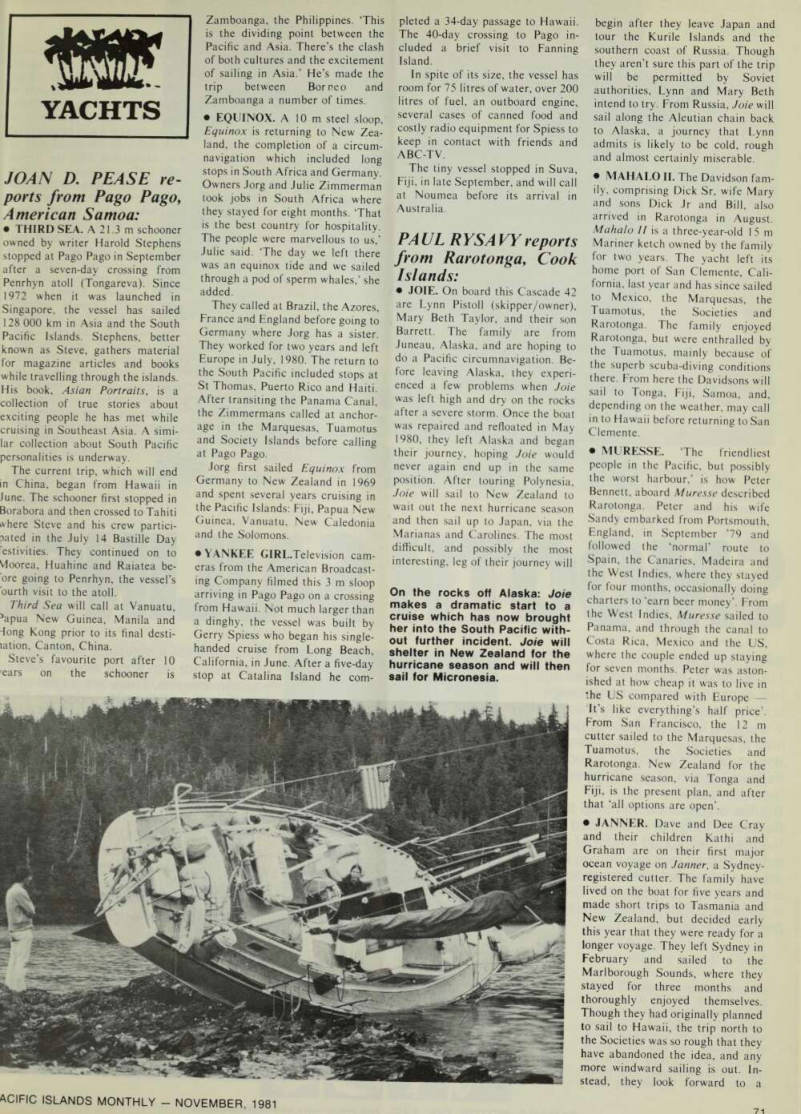
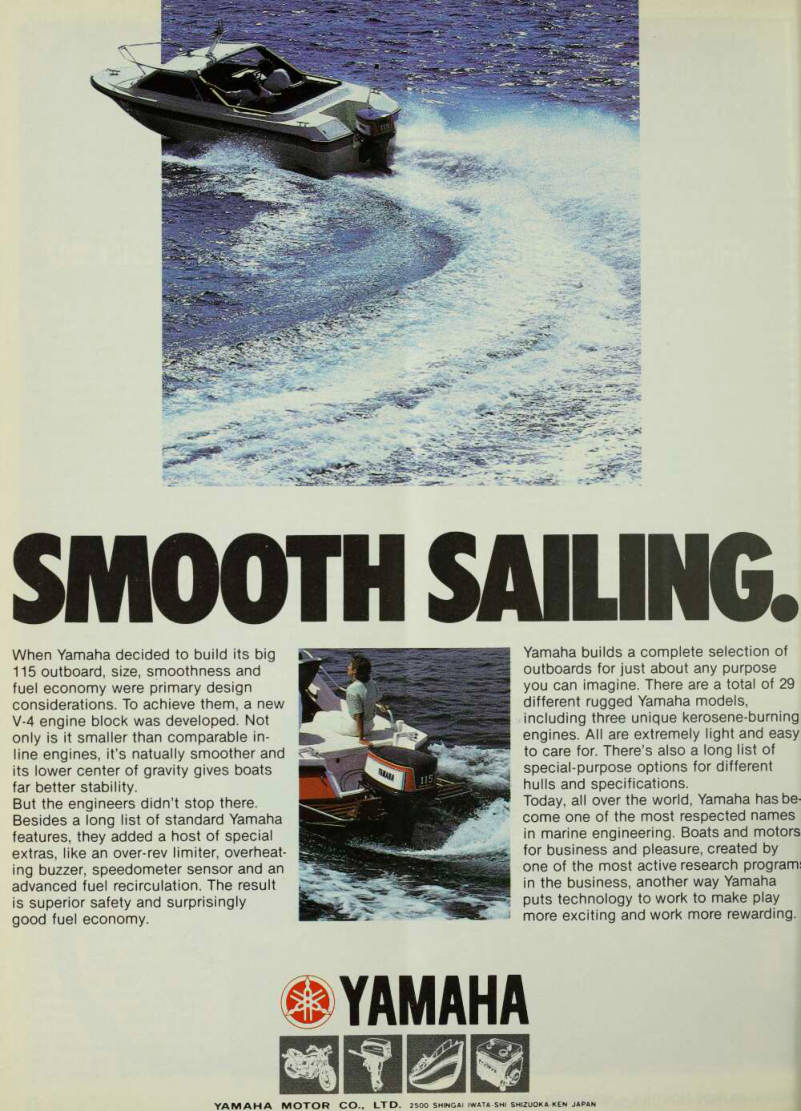
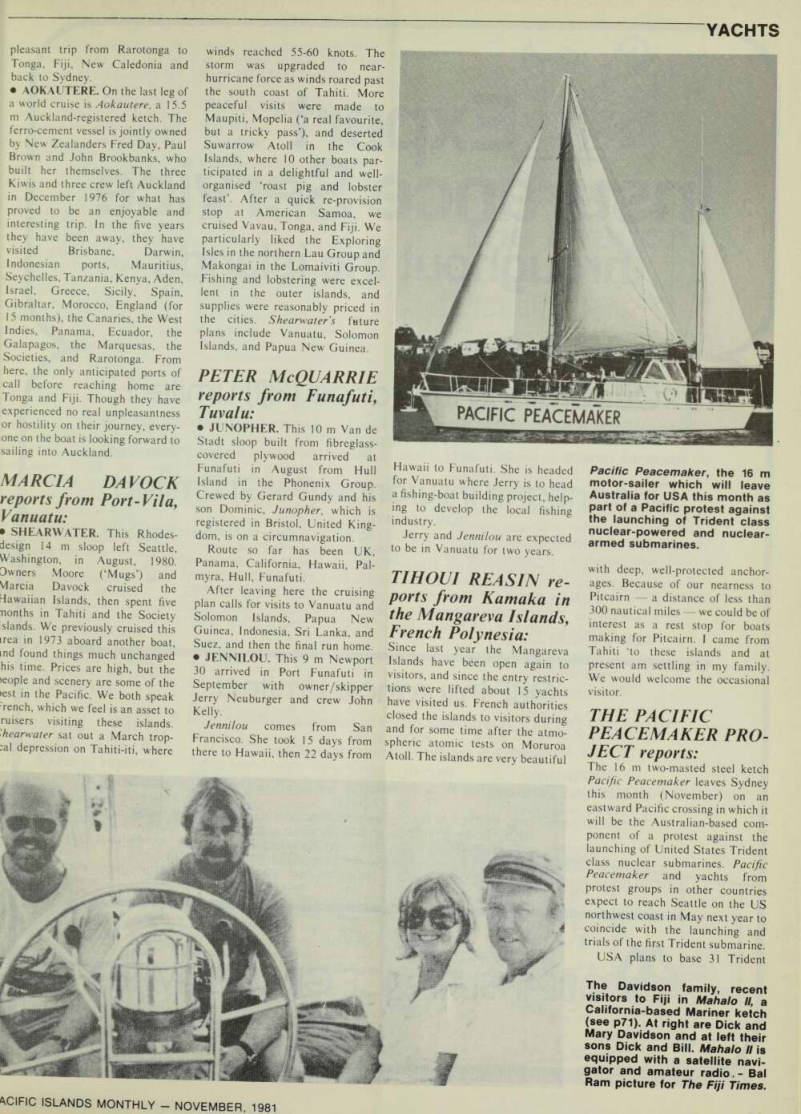

Joan D. Pease Re
ports from Pago Pago ,
American Samoa:
• THIRD SEA. A 21.3 m schooner owned by writer Harold Stephens stopped at Pago Pago in September after a seven-day crossing from Penrhyn atoll (Tongareva). Since 1972 when it was launched in Singapore, the vessel has sailed 128 000 km in Asia and the South Pacific Islands. Stephens, better known as Steve, gathers material for magazine articles and books while travelling through the islands.
His book, Asian Portraits, is a collection of true stories about exciting people he has met while cruising in Southeast Asia. A simi lar collection about South Pacific
personalities is underway.
The current trip, which will end in China, began from Hawaii in June. The schooner first stopped in Bora bora and then crossed to Tahiti where Steve and his crew partici 3ated in the July 14 Bastille Day 'estivities. They continued on to Vloorea, Huahine and Raiatea be ore going to Penrhyn, the vessel’s ourth visit to the atoll.
Third Sea will call at Vanuatu, s apua New Guinea, Manila and Jong Kong prior to its final desti lation. Canton, China.
Steve’s favourite port after 10 ears on the schooner is
Zamboanga, the Philippines. ‘This is the dividing point between the Pacific and Asia. There’s the clash of both cultures and the excitement of sailing in Asia.’ He’s made the trip between Borneo and Zamboanga a number of times. • EQUINOX. A 10 m steel sloop, Equinox is returning to New Zea land, the completion of a circum navigation which included long stops in South Africa and Germany.
Owners Jorg and Julie Zimmerman took jobs in South Africa where they stayed for eight months. ‘That is the best country for hospitality.
The people were marvellous to us,’
Julie said. ‘The day we left there was an equinox tide and we sailed through a pod of sperm whales,’ she added.
They called at Brazil, the Azores, France and England before going to Germany where Jorg has a sister.
They worked for two years and left Europe in July, 1980. The return to the South Pacific included stops at St Thomas, Puerto Rico and Haiti.
After transiting the Panama Canal, the Zimmermans called at anchor age in the Marquesas, Tuamotus and Society Islands before calling at Pago Pago.
Jorg first sailed Equinox from Germany to New Zealand in 1969 and spent several years cruising in the Pacific Islands: Fiji, Papua New Guinea, Vanuatu, New Caledonia and the Solomons. • YANKEE GlRL.Television cam eras from the American Broadcast ing Company filmed this 3 m sloop arriving in Pago Pago on a crossing from Hawaii. Not much larger than a dinghy, the vessel was built by
Gerry Spiess who began his single
handed cruise from Long Beach, California, in June. After a five-day stop at Catalina Island he com
pleted a 34-day passage to Hawaii.
The 40-day crossing to Pago in cluded a brief visit to Fanning Island.
In spite of its size, the vessel has room for 75 litres of water, over 200 litres of fuel, an outboard engine, several cases of canned food and costly radio equipment for Spiess to keep in contact with friends and
Abc-Tv.
The tiny vessel stopped in Suva, Fiji, in late September, and will call at Noumea before its arrival in Australia.
PAUL RYSAVYreports
from Rarotonga , Cook
Islands:
• JOIE. On board this Cascade 42 are Lynn Pistoll (skipper/owner), Mary Beth Taylor, and their son Barrett. The family are from Juneau, Alaska, and are hoping to do a Pacific circumnavigation. Be fore leaving Alaska, they experi enced a few problems when Joie was left high and dry on the rocks after a severe storm. Once the boat was repaired and refloated in May 1980, they left Alaska and began their journey, hoping Joie would never again end up in the same position. After touring Polynesia, Joie will sail to New Zealand to wait out the next hurricane season and then sail up to Japan, via the Marianas and Carolines. The most difficult, and possibly the most interesting, leg of their journey will
begin after they leave Japan and tour the Kurile Islands and the southern coast of Russia. Though they aren’t sure this part of the trip will be permitted by Soviet authorities, Lynn and Mary Beth intend to try. From Russia, Joie will sail along the Aleutian chain back to Alaska, a journey that Lynn admits is likely to be cold, rough and almost certainly miserable. • MAHALO 11. The Davidson fam ily, comprising Dick Sr, wife Mary and sons Dick Jr and Bill, also arrived in Rarotonga in August.
Mahalo II is a three-year-old 15 m Mariner ketch owned by the family for two years. The yacht left its home port of San Clemente, Cali fornia, last year and has since sailed to Mexico, the Marquesas, the Tuamotus, the Societies and
Rarotonga. The family enjoyed
Rarotonga, but were enthralled by the Tuamotus, mainly because of the superb scuba-diving conditions there. From here the Davidsons will sail to Tonga, Fiji, Samoa, and, depending on the weather, may call in to Hawaii before returning to San Clemente. • MURESSE. The friendliest people in the Pacific, but possibly the worst harbour,’ is how Peter Bennett, aboard Muresse described Rarotonga. Peter and his wife Sandy embarked from Portsmouth, England, in September ’79 and followed the ‘normal’ route to Spain, the Canaries, Madeira and the West Indies, where they stayed for four months, occasionally doing charters to ‘earn beer money’. From the West Indies, Muresse sailed to Panama, and through the canal to Costa Rica, Mexico and the US, where the couple ended up staying for seven months. Peter was aston ished at how cheap it was to live in the US compared with Europe It’s like everything’s half price’.
From San Francisco, the 12 m cutter sailed to the Marquesas, the Tuamotus, the Societies and Rarotonga. New Zealand for the hurricane season, via Tonga and Fiji, is the present plan, and after that ‘all options are open’. • JANNER. Dave and Dee Cray and their children Kathi and Graham are on their first major ocean voyage on Janner, a Sydney registered cutter. The family have lived on the boat for five years and made short trips to Tasmania and New Zealand, but decided early this year that they were ready for a longer voyage. They left Sydney in February and sailed to the
Marlborough Sounds, where they
stayed for three months and
thoroughly enjoyed themselves.
Though they had originally planned to sail to Hawaii, the trip north to the Societies was so rough that they have abandoned the idea, and any more windward sailing is out. In stead, they look forward to a
On the rocks off Alaska: Joie makes a dramatic start to a cruise which has now brought her into the South Pacific with out further incident. Joie will shelter in New Zealand for the hurricane season and will then sail for Micronesia.
pleasant trip from Rarotonga to Tonga, Fiji, New Caledonia and back to Sydney. • AOKAUTERE. On the last leg of a world cruise is Aokautere. a 15.5 m Auckland-registered ketch. The ferro-cement vessel is jointly owned by New Zealanders Fred Day, Paul Brown and John Brookbanks, who built her themselves. The three Kiwis and three crew left Auckland in December 1976 for what has proved to be an enjoyable and interesting trip. In the five years they have been away, they have visited Brisbane, Darwin, Indonesian ports, Mauritius, Seychelles, Tanzania, Kenya, Aden,
Israel, Greece, Sicily, Spain,
Gibraltar, Morocco, England (for 15 months), the Canaries, the West Indies, Panama, Ecuador, the
Galapagos, the Marquesas, the
Societies, and Rarotonga. From
caiT
Tonga and Fiji. Though they have experienced no real unpleasantness or hostility on their journey, everyone on the boat is looking forward to sailing into Auckland.
Marcia Da Vock
reports from Port-Vila
1/ 9 ly SHEARWATER. This Rhodesdesign 14 m sloop left Seattle, Washington, in August, 1980.
Jwners Moore (‘Mugs’) and
Marcia Davock cruised the Hawaiian Islands, then spent five nonths in Tahiti and the Society slands. We previously cruised this irea m 1973 aboard another boat, md lound things much unchanged h |S J ime - p "ces are high, but the )eople and scenery are some of the »est in the Pacific. We both speak rench, which we feel is an asset to ruisers visiting these islands. hearwater sat out a March trop- ■ ' a de P ression on Tahiti-iti, where
winds reached 55-60 knots. The storm was upgraded to near hurricane force as winds roared past the south coast of Tahiti. More peaceful visits were made to Maupiti, Mopelia (‘a real favourite, but a tricky pass’), and deserted Suwarrow Atoll in the Cook Islands, where 10 other boats par ticipated in a delightful and well organised ‘roast pig and lobster feast’. After a quick re-provision stop at American Samoa, we cruised Vavau, Tonga, and Fiji. We particularly liked the Exploring Isles in the northern Lau Group and Makongai in the Lomaiviti Group.
Fishing and lobstering were excel lent in the outer islands, and supplies were reasonably priced in the cities. Shearwater’s future plans include Vanuatu, Solomon Islands, and Papua New Guinea.
Peter Mcquarrie
reports from Funafuti
Tuvalu:
• JUNOPHER. This 10 m Van de Stadt sloop built from fibreglass covered plywood arrived at Funafuti in August from Hull Island in the Phonenix Group.
Crewed by Gerard Gundy and his son Dominic, Junopher, which is registered in Bristol, United King dom, is on a circumnavigation.
Route so far has been UK, Panama, California, Hawaii, Pal myra, Hull, Funafuti.
After leaving here the cruising plan calls for visits to Vanuatu and Solomon Islands, Papua New Guinea, Indonesia, Sri Lanka, and Suez, and then the final run home. • JENNILOU. This 9 m Newport 30 arrived in Port Funafuti in
September with owner/skipper
Jerry Neuburger and crew John
Kelly.
Jennilou comes from San Francisco. She took 15 days from there to Hawaii, then 22 days from
Hawaii to Funafuti. She is headed for Vanuatu where Jerry is to head a fishing-boat building project, help ing to develop the local fishing industry.
Jerry and Jennilou are expected to be in Vanuatu for two years.
Tihouireasin Re
ports from Kamaka in
the Mangareva Islands,
French Polynesia:
Since last year the Mangareva Islands have been open again to visitors, and since the entry restric tions were lifted about 15 yachts have visited us. French authorities closed the islands to visitors during and for some time after the atmo spheric atomic tests on Moruroa Atoll. The islands are very beautiful
with deep, well-protected anchor
ages. Because of our nearness to Pitcairn a distance of less than 300 nautical miles we could be of interest as a rest stop for boats making for Pitcairn. I came from Tahiti ‘to these islands and at present am settling in my family.
We would welcome the occasional visitor.
The Pacific
Peacemaker Pro
JECT reports:
The 16 m two-masted steel ketch Pacific Peacemaker leaves Sydney this month (November) on an eastward Pacific crossing in which it will be the Australian-based com ponent of a protest against the launching of United States Trident class nuclear submarines. Pacific Peacemaker and yachts from protest groups in other countries expect to reach Seattle on the US northwest coast in May next year to coincide with the launching and trials of the first Trident submarine.
USA plans to base 31 Trident
Pacific Peacemaker, the 16 m motor-sailer which will leave Australia for USA this month as part of a Pacific protest against the launching of Trident class nuclear-powered and nuclear armed submarines.
The Davidson family, recent visitors to Fiji in Mahalo II, a California-based Mariner ketch (see p71). At right are Dick and Mary Davidson and at left their sons Dick and Bill. Mahalo II is equipped with a satellite navi gator and amateur radio. - Bal Ram picture for The Fiji Times.
submarines in Seattle and possibly the western Pacific. They will be nuclear-powered and equipped with first-strike nuclear weapons. Protest movements in Pacific Island countries, Australia and New Zea land oppose the commissioning of the submarines on nuclear and arms-race grounds.
The Australian-based Pacific Peacemaker project is being financed by donations from anti nuclear and peace groups and their supporters. The ketch was bought for $B5 000 and the ownership is held in shares which will be re deemed when the ketch is sold on its return.
The crew members will be Bill and Lorraine Ethel and their four children, navigator lan Gaillard, film-makers Dave Roberts and Martha Ansara, and the New Zea land peace activist the Rev George Armstrong. The Australian protest also represents Micronesia to the north, and a Micronesian represen tative has been invited to join the
zrew. Stopover points during the
voyage will be New Zealand and French Polynesia, where liaison >vith other Pacific anti-nuclear groups will be strengthened.
Bill and Lorraine Ethel both served in Britain’s Royal Navy before settling in Perth, Western \ustralia. They became involved in mti-nuclear and peace movements vhen plans were announced to levelop the naval base at Cockburn >ound in Western Australia.
More than 1000 people attended ceremony on Sydney Harbour in August at which the ketch was amed and the protest operation 'as explained. Pacific Peacemaker xpects to return to Australia y December next year
Rujsing Yacht
:lub of a
-1 A, Sydney, reports:
ustralia’s longest and toughest
can race, a distance of 13 475 km, 11 be inaugurated from Sydney ruising Yacht Club of Australia January 24, 1982. It is the Xerox
'dney-Rio race.
The world’s best maxis will be mpeting. Already (mid ptember 1981) about 20 yachts s listed to take part.
The Brazilian and Australian thorities, and a number of com :rcial organisations, are enthusi ically supporting the event by ging trade expositions and sem rs in Rio. While the yachts are in 3, a special Australia Week will staged in the course of which Rio 1 be declared Sydney’s Sister y-
Ml information from: Sydney
) Yacht Centre Pty Ltd, Cruising
Yacht Club, New Beach Road, Darling Point, Sydney, NSW, Aus tralia, 2027. Telex No 72278.
The Cornell
FAMILY reports from
London:
PIM has received the following circular letter from its one-time Pacific yachting correspondent Jimmy Cornell, his wife Gwenda, daughter Doina. and son Ivan.
Dear Friends, The list of letters to write was getting longer every day, and we were making so little progress with it that we hope you will excuse this brief newsletter.
On March 20 1981 we transited the Suez Canal and completed our
88 000-km-long circumnavigation.
The Mediterranean welcomed us with cold weather and a late spring.
After spending a month with Gwenda’s parents in Kos and Patmos and a memorable Easter on Tinos with some old Greek friends, we sailed Aventura up to Romania, arriving in Constanta on May 16 Jimmy was quite pleased with his reception in Romania as he was regarded as the first Romanian to sail around the world. We spent a busy time there with family and old friends and meeting many of Jimmy’s BBC listeners who came to visit Aventura. A plan to leave Aventura in Romania, while we made a quick overland trip to London, had to be abandoned.
Leaving Doina and Ivan with Jimmy’s mother, we sailed Aventura back to Greece and hauled her out on the dry land at Olympic Yachts, Lavrion. We bought a car, loaded up our most important possessions, collected the children and arrived back in Lon don on July 18. exhausted by a 4500-km drive across Europe.
So here we are back in 103 Venner Road, London, SE26 SHU.
Our short-term plans are to clean up our house, devastated by five years of careless tenants, and put it on the market. Doina and Ivan are looking forward to starting Fowey School in Cornwall in September. Jimmy will not be returning to the BBC
fulltime, although continuing to
collaborate with them freelance.
Our long-term plans are to return to the Pacific and make our base in Australia. Jimmy had hoped to sail Aventura back this year, but that proved to be too much of a rush, so that trip has been postponed for 1982.
If you are passing through Lon don we should be delighted to see you and we still have plenty of room for guests. Our new telephone number is 659 2202.
Best wishes, Jimmy, Gwenda, Doina and Ivan.
Advertisements & other items, pp. 71-76 (4 items)
71
ACIFIC ISLANDS MONTHLY NOVEMBER, 1981
Smooth Sauk.
5r SS > ■' ■ '’' -V ' ' -3t ‘ ; £ r-^^-v vT--^ >. --S'- -.. iwsp* s*** -S ' T^* -.W* **&3Sr v ~s* '-C^wgS K *•-
When Yamaha decided to build its big 115 outboard, size, smoothness and fuel economy were primary design considerations. To achieve them, a new V-4 engine block was developed. Not only is it smaller than comparable inline engines, it’s natually smoother and its lower center of gravity gives boats far better stability.
But the engineers didn’t stop there.
Besides a long list of standard Yamaha features, they added a host of special extras, like an over-rev limiter, overheating buzzer, speedometer sensor and an advanced fuel recirculation. The result is superior safety and surprisingly good fuel economy.
Yamaha builds a complete selection of outboards for just about any purpose you can imagine. There are a total of 29 different rugged Yamaha models, including three unique kerosene-burning engines. All are extremely light and easy to care for. There’s also a long list of special-purpose options for different hulls and specifications.
Today, all over the world, Yamaha has become one of the most respected names in marine engineering. Boats and motors for business and pleasure, created by one of the most active research program: in the business, another way Yamaha puts technology to work to make play more exciting and work more rewarding.
YAMAHA
I YAMAHA MOTOR CO., LTD. 2500 shingai iwata-shi shizuoka-ken japan
Expert
Insurance Service
throughout the islands
Queensland Insurance (Fiji) Limited
Head Office, 34 Usher St., SUVA . General Manager: L. G. Liddell A.A.1.1. Assistant Manager; Vi jay Lai. Phone: 23851.
LAUTOKA OFFICE; Burns Philp Bldg., Naviti St. District Manager: J. Dalton. Phone: 60642.
Queensland Insurance (PNG) Limited
PAPUA NEW GUINEA
Head Office, B.N.G. Building, Musgrave St.,PORT MORESBY. General Manager: J. M. Dawe.
Assistant Manager: R. V. Maskell. Phone: 212144.
LAE: 4th St. & Coronation Drive. District Manager: I, R. Martin. Phone: 423873.
MOUNT HAGEN: Hagen Drive. District Manager: D. F Carroll. Phone: 521002.
ARAWA: Chebu St. District Manager: J. Longbut. Phone: 951555.
MADANG; Kasagten St. District Manager: N. D. Ramage. Phone: 822020.
RABAUL: Wirraway St. District Manager: W. F. Tinker. Phone: 921014.
QBE Insurance Limited
VANUATU, PORT VILA: Rue de Paris, Suite 19, Oceania Bldg. Manager; G. F. Donnelly.
Phone; 2299.
SANTO: Burns Philp (Vanuatu) Ltd. Phone: 230.
PACIFIC AGENCIES
NEW CALEDONIA- T A.Hagen, Ste. W. A. Johnston, S.A.R.L. 5 Rue Anatole France, NOUMEA.
Phone: 272083.
TAHITI- Arthur Chung. Immeuble 8.1.5., Front de Mer, PAPEETE Phone: 2.86.19 NIUE: Burns Philp (South Sea) Company Ltd.
NORFOLK ISLAND: Burns Philp (N I) Company Ltd Phone: 2191.
SAMOA: APIA, Burns Philp (South Sea) Company Ltd. Phone: 22611.
TONGA; Burns Philp (South Sea) Company Ltd. NUKUALOFA. Phone 21500 HAAPAI,
VAVAU
MEMBERS OF THE:
INSURANCE GROUP UMITED
Enter
The Dragon
The New Guinea Pacific Line introduces its* new Dragon Boat service to Papua New Guinea and the Solomon Islands.
N.G.P.L.'s new fully containerised service, the first from the Far East to P.N.G. and the Solomons offers:- • Fast transit times to all ports. • A guaranteed schedule every 30 days thanks to berths in Papua New Guinea and Honiara reserved for N.G.P.L. use.. • Safe, secure transport of goods in containers, both L.C.L., and F.C.L. no more damage or pilferage of cargo. • A wide coverage of all ports with its monthly container service from Hong Kong, Singapore, Taiwan, the Philippines, and Malaysia to all Papua New Guinea ports and Honiara.
For further details on the new Dragon Boat service contact:
PAPUA NEW GUINEA
Steamship Trading Co., Ltd.
Port Moresby Telephone: 212000
HONG KONG
Swire Shipping (Agencies) Ltd.
Telephone: 5-264311
SINGAPORE
Straits Shipping Pte. Ltd.
Telephone: 436071 t * r-
[Honiai i]
PjjtMoresly
TATHAM LIMITED
Bringing the world’s best
\m I V
NEW-'
ZEALAND
• - - Sr ■ TATHAM LIMITED have a long history of dependable service to the islands. From all over tl we bring the goods and products you need, right to your door. Full service and documentation are assured. We can procure specific products to suit your special rcquiremt if urgently needed will air freight them to you without delay. For imports or exports, see us! y
IJaiumba
rat ham Limited Brings the Best of Australian Wines to the Pacific Islands A sample of superb reds, brilliant, crisp whites and ports includes . ® YALUMBA Galway Vintage BURGUNDY 18 months in French Nevers oak, 2 years in the bottle. A superb full-bodied wine to enjoy now or put down.
YALUMBA Four Crown CLARET A light, dry table wine from shiraz grapes. For those who love a good, lighter red.
YALUMBA Four Crown MOSELLE A superb Moselle style table wine. Right for any occasion.
YALUMBA Four Crown REISLING
A crisp, dry table wine to compliment the finest meal.
YALUMBA Koorianda WHITE BURGUNDY
For the discerning palate. A dry, white burgundy style wine.
Tatham Limited brings you the world’s best . . . share in the profits . . . Order now!
THAM LIMITED
5 e profits . . . Order now! style wine. j J 33
Yachts
ISLANDS MONTHLY NOVEMBER, 1981
Yachts
kCIFIC ISLANDS MONTHLY NOVEMBER, 1981
Services
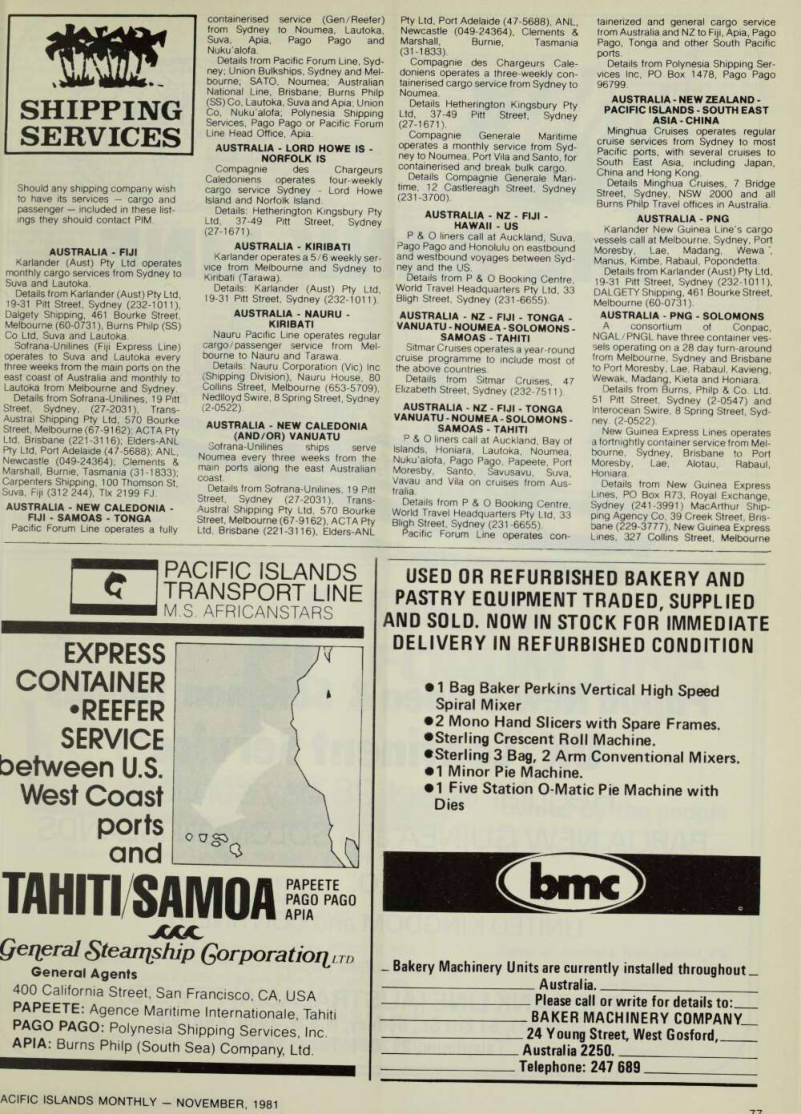
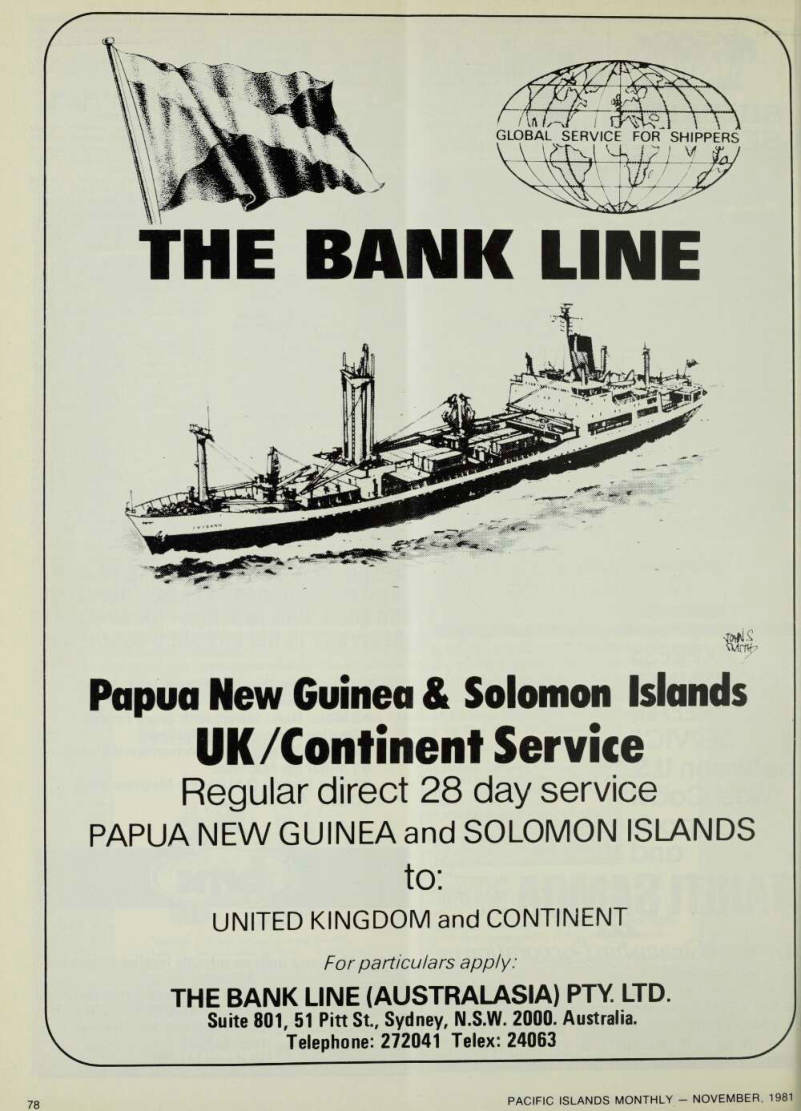
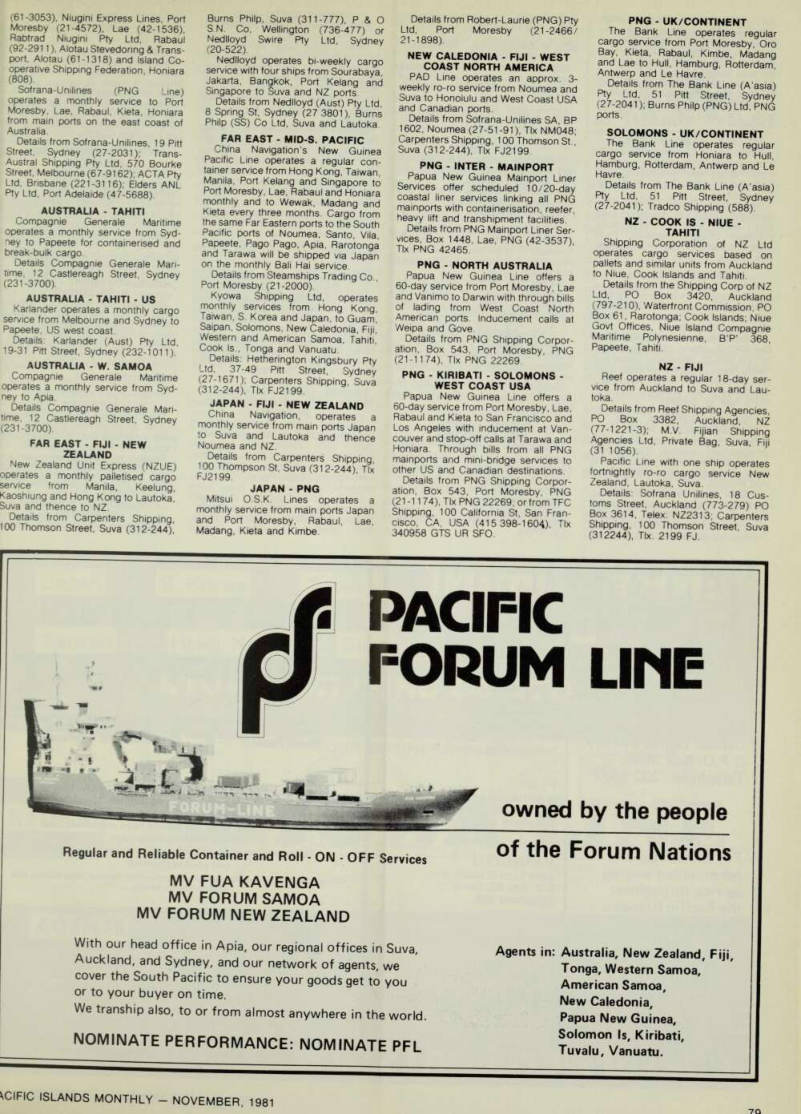
Shipping
Should any shipping company wish to have its services cargo and passenger included in these list ings they should contact PIM.
Australia - Fiji
Karlander (Aust) Pty Ltd operates monthly cargo services from Sydney to Suva and Lautoka.
Details from Karlander (Aust) Pty Ltd, 19-31 Pitt Street, Sydney (232-1011), Dalgety Shipping, 461 Bourke Street, Melbourne (60-0731), Burns Philp (SS) Co Ltd, Suva and Lautoka.
Sofrana-Unilines (Fiji Express Line) operates to Suva and Lautoka every three weeks from the main ports on the east coast of Australia and monthly to Lautoka from Melbourne and Sydney.
Details from Sofrana-Unilines, 19 Pitt Street, Sydney, (27-2031), Trans- Austral Shipping Pty Ltd, 570 Bourke Street, Melbourne (67-9162); ACTA Pty Ltd, Brisbane (221-3116); Elders-ANL Pty Ltd, Port Adelaide (47-5688); ANL, Newcastle (049-24364); Clements & Marshall, Burnie, Tasmania (31-1833); Carpenters Shipping, 100 Thomson St Suva, Fiji (312 244), Tlx 2199 FJ.
Australia - New Caledonia -
Fiji - Samoas • Tonga
Pacific Forum Line operates a fully
containerised service (Gen/Reefer) from Sydney to Noumea, Lautoka, Suva, Apia, Pago Pago and Nukualofa.
Details from Pacific Forum Line, Syd ney; Union Bulkships, Sydney and Mel bourne; SATO, Noumea; Australian National Line, Brisbane; Burns Philp (SS) Co, Lautoka, Suva and Apia; Union Co, Nuku’alofa; Polynesia Shipping Services, Pago Pago or Pacific Forum Line Head Office, Apia.
Australia - Lord Howe Is -
Norfolk Is
Compagnie des Chargeurs Caledomens operates four-weekly cargo service Sydney - Lord Howe Island and Norfolk Island.
Details: Hetherington Kingsbury Pty Ltd. 37-49 Pitt Street, Sydney (27-1671).
Australia - Kiribati
Karlander operates a 5/6 weekly ser vice from Melbourne and Sydney to Kiribati (Tarawa).
Details: Karlander (Aust) Pty Ltd, 19-31 Pitt Street, Sydney (232-1011).
Australia - Nauru -
Kiribati
Nauru Pacific Line operates regular cargo/passenger service from Mel bourne to Nauru and Tarawa.
Details: Nauru Corporation (Vic) Inc (Shipping Division), Nauru House, 80 Collins Street, Melbourne (653-5709), Nedlloyd Swire, 8 Spring Street, Sydney (2-0522).
Australia - New Caledonia
(And/Or) Vanuatu
Sofrana-Unilines ships serve Noumea every three weeks from the mam ports along the east Australian coast.
Details from Sofrana-Unilines, 19 Pitt Street, Sydney (27-2031). Trans- Austral Shipping Pty Ltd, 570 Bourke Street, Melbourne (67-9162). ACTA Pty Ltd, Brisbane (221-3116), Elders-ANL
Pty Ltd, Port Adelaide (47-5688), ANL, Newcastle (049-24364), Clements & Marshall, Burnie, Tasmania (31-1833).
Compagnie des Chargeurs Cale doniens operates a three-weekly con tainerised cargo service from Sydney to Noumea.
Details Hetherington Kingsbury Pty Ltd, 37-49 Pitt Street, Sydney (27-1671).
Compagnie Generate Maritime operates a monthly service from Syd ney to Noumea, Port Vila and Santo, for containerised and break bulk cargo.
Details Compagnie Generate Mari time, 12 Castlereagh Street, Sydney (231-3700).
Australia - Nz - Fiji -
Hawaii - Us
P & O liners call at Auckland. Suva, Pago Pago and Honolulu on eastbound and westbound voyages between Syd ney and the US.
Details from P & O Booking Centre, World Travel Headquarters Pty Ltd, 33 Bligh Street, Sydney (231-6655).
AUSTRALIA - NZ - FIJI - TONGA -
Vanuatu - Noumea - Solomons -
Samoas - Tahiti
Sitmar Cruises operates a year-round cruise programme to include most of the above countries.
Details from Sitmar Cruises 47 Elizabeth Street, Sydney (232-7511).
AUSTRALIA - NZ - FIJI - TONGA
Vanuatu - Noumea - Solomons -
Samoas - Tahiti
P & O liners call at Auckland, Bay of Islands, Honiara, Lautoka, Noumea, Nukualofa, Pago Pago, Papeete, Pori Moresby, Santo, Savusavu, Suva, Vavau and Vila on cruises from Aus tralia.
Details from P & O Booking Centre, World Travel Headquarters Pty Ltd 33 Bligh Street, Sydney (231 -6655).
Pacific Forum Line operates con
tamerized and general cargo service from Australia and NZ to Fiji, Apia, Pago Pago, Tonga and other South Pacific ports.
Details from Polynesia Shipping Ser vices Inc, PO Box 1478, Pago Pago 96799.
Australia - New Zealand -
Pacific Islands - South East
Asia-China
Minghua Cruises operates regular cruise services from Sydney to most Pacific ports, with several cruises to South East Asia, including Japan, China and Hong Kong.
Details Minghua Cruises, 7 Bridge Street, Sydney, NSW 2000 and all Burns Philp Travel offices in Australia.
Australia - Png
Karlander New Guinea Line’s cargo vessels call at Melbourne, Sydney, Port Moresby, Lae, Madang, Wewa", Manus, Kimbe, Rabaul, Popondetta.
Details from Karlander (Aust) Pty Ltd, 19-31 Pitt Street. Sydney (232-1011), DALGETY Shipping. 461 Bourke Street, Melbourne (60-0731).
Australia - Png - Solomons
A consortium of Conpac, NGAL/PNGL have three container ves sels operating on a 28 day turn-around from Melbourne, Sydney and Brisbane to Port Moresby, Lae, Rabaul, Kavieng, Wewak, Madang, Kieta and Honiara.
Details from Burns, Philp & Co. Ltd. 51 Pitt Street, Sydney (2-0547) and Interocean Swire, 8 Spring Street, Syd ney. (2-0522).
New Guinea Express Lines operates a fortnightly container service from Mel bourne, Sydney, Brisbane to Port Moresby, Lae, Alotau, Rabaul, Honiara.
Details from New Guinea Express Lines, PO Box R 73, Royal Exchange, Sydney (241-3991) MacArthur Ship ping Agency Co, 39 Creek Street, Bris bane (229-3777), New Guinea Express Lines, 327 Collins Street, Melbourne
(61-3053), Niugini Express Lines, Port Moresby (21-4572), Lae (42-1536), Rabtrad Niugini Pty Ltd, Rabaul (92-2911), Alotau Stevedoring & Trans port, Alotau (61-1318) and Island Co operative Shipping Federation, Honiara (808).
Sofrana-Unilines (PNG Line) operates a monthly service to Port Moresby, Lae, Rabaul, Kieta, Honiara from main ports on the east coast of Australia.
Details from Sofrana-Unilines, 19 Pitt Street, Sydney (27-2031); Trans- Austral Shipping Pty Ltd, 570 Bourke Street, Melbourne (67-9162); ACTA Pty Ltd, Brisbane (221-3116); Elders ANL Pty Ltd. Port Adelaide (47-5688).
Australia - Tahiti
Compagnie Generate Maritime operates a monthly service from Syd ney to Papeete for containerised and break-bulk cargo.
Details Compagnie Generate Mari time, 12 Castlereagh Street, Sydney (231-3700).
Australia - Tahiti - Us
Karlander operates a monthly cargo service from Melbourne and Sydney to Papeete, US west coast.
Details: Karlander (Aust) Pty Ltd, 19-31 Pitt Street. Sydney (232-1011).
Australia - W. Samoa
Compagnie Generate Maritime operates a monthly service from Syd ney to Apia.
Details Compagnie Generate Mari time, 12 Castlereagh Street, Sydney (231-3700).
Far East - Fiji - New
Zealand
New Zealand Unit Express (NZUE) operates a monthly palletised cargo service from Manila, Keelung, Kaoshiung and Hong Kong to Lautoka, Suva and thence to NZ.
Details from Carpenters Shipping, 100 Thomson Street, Suva (312-244),
Burns Philp, Suva (311-777) P & O S.N. Co. Wellington (736-477) or Nedlloyd Swire Pty Ltd, Sydney (20-522).
Nedlloyd operates bi-weekly cargo service with four ships from Sourabaya, Jakarta, Bangkok, Port Kelang and Singapore to Suva and NZ ports, Details from Nedlloyd (Aust) Pty Ltd 8 Spring St, Sydney (27 3801), Burns Philp (SS) Co Ltd, Suva and Lautoka
Ear East * Mid-S. Pacific
China Navigation’s New Guinea Pacific Line operates a regular con tamer service from Hong Kong, Taiwan, Manila, Port Kelang and Singapore to Port Moresby. Lae, Rabaul and Honiara monthly and to Wewak, Madang and Kieta every three months. Cargo from the same Far Eastern ports to the South Pacific ports of Noumea, Santo, Vila, Papeete, Pago Pago, Apia, Rarotonga and Tarawa will be shipped via Japan on the monthly Bali Hai service, Details from Steamships Trading Co Port Moresby (21-2000).
Kyowa Shipping Ltd, operates monthly services from Hong Kong, laiwan, S. Korea and Japan, to Guam, oaipan, Solomons, New Caledonia, Fiji, Western and American Samoa, Tahiti. c 9? k ls ■ Ton 9 a and Vanuatu.
Details: Hetherington Kingsbury Pty Ltd, 37-49 Pitt Street Sydney (27-1671); Carpenters Shipping, Suva (312-244) Tlx FJ2199 K y
P£ Pan ’ New Zealand
Navi9 ( atlon - operates a monthty service from mam ports Japan t 0 Suva and Lautoka and thence Noumea and NZ, Details from Carpenters Shipping, 1 00 Thompson St, Suva (312-244) Tlx FJ2199.
Japan - Png
Mitsui O.S.K. Lines operates a monthly service from main ports Japan and Port Moresby, Rabaul, Lae, Madang, Kieta and Kimbe.
Details from Robert-Laurie (PNG) Pty Ltd. Port Moresby (21-2466/ 21-1898).
New Caledonia - Fiji - West
Coast North America
PAD Line operates an approx. 3weekly ro-ro service from Noumea and Suva to Honolulu and West Coast USA and Canadian ports.
Details from Sofrana-Unilines SA, BP 1602, Noumea (27-51-91). Tlx NMO4B; Suv^(3T2-2^^ P ylx'FJ2l99 OmSonS ' puva (oiz £?44), FIX FJ2199.
Png - Inter - Mainport
Papua New Guinea Mainport Liner Services offer scheduled 10/20-day coastal liner services linking all PNG mainports with containerisation, reefer, heavy lift and transhipment facilities.
Details from PNG Mainport Liner Ser- La 6, PNG ( 42 ‘ 3537 )-
Mx Knl. 42465.
Png - North Australia
Papua New Guinea Line offers a 60-day service from Port Moresby, Lae and Vanimo to Darwin with through bills of lading from West Coast North American ports. Inducement calls at Weipa and Gove Details from PNG Shipping Corporation, Box 543, Port Moresby PNG (21-1174), Tlx PNG 22269.
Png - Kiribati - Solomons -
West Coast Usa
Papua New Guinea Line offers a 60-day service from Port Moresby, Lae.
Rabaul and Kieta to San Francisco and Los Angeles with inducement at Vancouver and stop-off calls at Tarawa and Honiara. Through bills from all PNG mainports and mini-bridge services to other US and Canadian destinations.
Details from PNG Shipping Corporation, Box 543, Port Moresby, PNG (21-1174), Tlx PNG 22269; or from TFC Shipping, 100 California St, San Fran- ( 415 396-1604), Tlx
340958 Gts Ur Sfo.
Png - Uk/Continent
The Bank Line operates regular cargo service from Port Moresby, Oro K ' e J a, LJ R I ? b 2 UI ’ Kimbe ’ Madan 9 anb Lae t 0 1 Hamburg, Rotterdam,
T nC^Tu Ra X re .
T o e « Ba c* k Une ( A asia )
d d* Street. , Sydney
(27-2041), Burns Philp (PNG) Ltd, PNG P 0 " 8
Solomons - Uk/Continent
Bank Une °P erates re9ular cargo service from Honiara to Hull, Hamburg, Rotterdam, Antwerp and Le Ha vre.
Details from The Bank Line (A’asia) Ltd - 51 Pitt Street, Sydney (27-2041); Tradco Shipping (588).
NZ - COOK IS - NIUE -
Tahiti
Shipping Corporation of NZ Ltd operates cargo services based on pallets and similar units from Auckland t 0 Niue - Cook Islands and Tahiti.
Details from the Shipping Corp of NZ Ltd - P 0 Box 3420, Auckland (797-210), Waterfront Commission, PO Box 61, Rarotonga; Cook Islands; Niue Govt Offices, Niue Island Compagnie Maritime Polynesienne, B‘P’ 368, Papeete, Tahiti. n
* Fiji
Reef operates a regular 18-day ser vice from Auckland to Suva and Lau toka.
Details from Reef Shipping Agencies PO Box 3382, Auckland NZ (77-1221-3); MV. Fijian Shipping Agencies Ltd, Private Bag Suva Fiji (31 1056).
Pacific Line with one ship operates fortnightly ro-ro cargo service New Zealand, Lautoka Suva Details: Sofrana Undines. 18 Cus toms Street. Auckland (773-279) PO Box 3614, Telex: NZ2313; Carpenters Shipping, 100 Thomson Street, Suva (312244), Tlx. 2199 FJ.
NZ - FIJI - NORTH AMERICA (WC) Blue Star Line Ltd Pacific Coast con tainer services. Only direct service to and from New Zealand. Blue Star ves sels call at Suva and Honolulu on NZ US-West Coast voyages.
Details from Blueport ACT (NZ) Ltd, PO Box 192, Wellington (739-029) , Burns Philp (SS) Co Ltd, GPO Box 355, Suva, Fiji (311-777). Tlx. FJ2168 Burship.
NZ - FIJI - SAMOAS - TONGA Pacific Forum Line operates a fully containerised three-weekly service (Gen/Reefer) from Auckland to Lau toka, Suva, Apia, Pago Pago and Nukualofa.
Details from Pacific Forum Line, Auckland; Union Co, Auckland. Lau toka, Suva, Apia and Nuku’alofa; Polynesia Shipping Services, Pago Pago or Pacific Forum Line Head Office. Apia
Nz - Tonga - Samoa
Warner Pacific Line operates a regular cargo service from Timaru, Onehunga and Westport to Nukualofa, Vavau and Apia with regular calls to Haapai and Pago Pago.
Details from McKay Shipping Ltd, PO Box 1372, Auckland. NZ; Warner Paci fic Line, Box 93, Nukualofa, Tonga and Neiafu, Vavau, Tonga; Polynesian Ship ping Services, Box 1478, Pago Pago; and Molua Folau Shipping Co, Box 4171, Apia, W. Samoa NZ - N. CALEDONIA - FIJI -
Solomons - Png
Pacific Forum Line operates a fully containerised service (Gen/Reefer) from Lyttelton, Napier, Auckland to Suva, Lautoka. Honiara, Kieta, Lae and Port Moresby.
Details from Pacific Forum Line, Auckland; Shipping Corporation of NZ, Auckland, Lyttelton, Napier; Union Co, Auckland, Suva, Lautoka; Steamships Trading Co, Kieta, Lae, Port Moresby;
Sullivans (SI) Ltd, Honiara or Pacific Forum Line Head Office, Apia.
NZ - N. CALEDONIA - VANUATU -
Png - Solomons
Sofrana Unilines with three ships operates to Vila and Santo, to Honiara and Papua New Guinea and to Norfolk Island and Noumea Details from Sofrana Unilines, 18 Customs Street, Auckland (773-279), PO Box 3614, Telex NZ2313.
Nz - Tahiti
Compagnie Tahitienne Maritime SA with one ship operates monthly service New Zealand - Papeete Details from Sofrana Unilines, PO Box 3614, 18 Customs St, Auckland (773-279), Tlx NZ2313.
Nz - Tonga - Samoas
Warner Pacific Line services Auckland - Nuku’alofa/Vavau/Apia/ Pago Pago fortnightly carrying general and freezer cargoes Details from McKay Shipping Ltd, Downtown House, 21 Queen St, Auckland, PO Box 1372 (30-299), Cables MACSHIP, Telex NZ2554.
Nz - Central Pacific
Kyowa Shipping Ltd operates a monthly cargo service from Auckland to Noumea, Vila, Santo, Guam, Majuro and Tarawa.
Details from McKay Shipping Ltd, PO Box 1372, Auckland (9-30229); Tlx 2554 NZ.
Europe - Tahiti -
New Caledonia
Compagnie Generate Maritime operates services from Europe and Mediterranean ports to Papeete and Noumea using three ro-ro and multi purpose vessels thus ensuring a bi monthly sailing to and from.
Details Compagnie Generate Mari time, 12 Castlereagh Street, Sydney (231-3700).
Europe-Tahiti-New
Caledonia - New Zealand -
Peru
Polish Ocean Lines offers regular monthly sailings for containerised and breakbulk cargo from Hamburg, Ant werp, Dunkirk and Rouen to Papeete, Noumea, New Zealand and return to Europe via Peru. Other ports in the South Pacific can be served with inducement.
Details from Sotama, BP 9170, Papeete (27805), Tlx. 296; SATO, BP C 2, Noumea (272094), Tlx. 051 NM PENOCEAN; Union Steamship Co of NZ, PO Box 50, Apia, Tlx. 25; Williams and Gosling, PO Box 79, Suva (312633), Tlx. 2163; Warner Pacific Line, PO Box 93, Nukualofa (21089), Tlx. 66219; Universal Shipping Agen cies, PO Box 2282, Auckland (30930), Tlx. 21517; H. C. Sleigh, 6-10 O’Con nell Street, Sydney 2000 (923 9201), Tlx. 20428.
EUROPE - TAHITI - W. SAMOA -
Fiji - N. Caledonia
Nedlloyd offers regular cargo ser vices from Northern Europe and UK to Papeete, Apia, Fiji and New Caledonia, Details Nedlloyd (Aust) Pty Ltd, 8 Spring Street, Sydney (27-3801); Car penters Shipping, 100 Thomson St, Suva (312 244), Tlx 2199 FJ.
EUROPE • TAHITI - W. SAMOA - TONGA - FIJI - SOLOMONS - PNG -
Vanuatu
Columbus Line Reederei GMBH operates regular services from Ham burg, Hull, Rotterdam. Antwerp, Dunkirk, Le Havre, to Papeete, Apia, Suva, Lautoka, Noumea, Port Moresby, Lae, Honiara, Kieta, Rabaul, Lae. and return to Europe.
Details from Columbus Overseas Services Pty Ltd, 333 George Street, Sydney (290-2966), Columbus Mari time Services, 17 Albert Street,
Auckland (77-3460); Carpenters Ship ping, 100 Thomson St, Suva (312 244), Tlx 2199 FJ.
Uk - N. Continent - Fiji
The Bank Line operates a regular cargo service from Hull, Hamburg, Bremen, Antwerp, Rotterdam and Le Havre to Suva and Lautoka.
Details from The Bank Line (A’asia) Fly Ltd, 51 Pitt Street, Sydney (27-2041); Burns Philp (South Sea) Co Ltd, Suva and Lautoka.
Uk/N. Continent - Png -
Solomons
The Bank Line operates a regular cargo service from Hull, Hamburg, Bremen, Antwerp, Rotterdam and Le Havre to Port Moresby, Lae, Madang, Kimbe, Rabaul, Kieta and Honiara and on inducement to Yandina.
Details from The Bank Line (A’asia) Pty Ltd, 51 Pitt Street, Sydney (27-2041); Burns Philp (PNG) Ltd, PNG ports; Tradco Shipping (588).
Uk/N. Continent - Tahiti -
N. Caledonia
The Bank Line operates a regular cargo service from Hull, Hamburg, Bremen, Antwerp, Rotterdam and Le Havre to Papeete and Noumea.
Details from The Bank Line (A’asia) Pty Ltd, 51 Pitt Street, Sydney (27-2041); Ets A M Fare UTE, Papeete; Ets Ballande, Noumea.
US - FIJI - TAHITI - NZ -
Australia
The Bank Savill Line Ltd, operates regular cargo services from US Gulf ports to Australia and NZ. Calls at Suva, Lautoka and Papeete on demand.
Details from The Bank and Savill Line Ltd, 51 Pitt Street, Sydney (27-2041) or Orient Shipping Services, 32 Bridge Street, Sydney (241-2753).
Us • Hawaii - Kiribati -
Micronesia
Philippines, Micronesia & Orient
Navigation Co (PM&O Lines) operates regular container service on self sustained ship with ro-ro capabilities from Oakland, Portland and Honolulu to Tarawa, Ebeye, Majuro, Kosrae, Ponape, Truk, Saipan, Yap and Koror.
Details for Micronesia can be obtained from Larry Guerrero, PM&O Owners Rep, PO Box 803, Saipan, Ml 96950, Cable COMMONTIME, Tlx 783605; PM80; PM&O Lines. 181 Fremont St, San Francisco, California 94105. Cable PMONAV.
Us - Hawaii - Nauru -
Micronesia
Nauru Pacific Line operates regular Donventional/container and passenger service from San Francisco and Honolulu to Majuro, Ponape, Truk and Saipan, Cargo is accepted for Nauru md Kosrai with transhipment at Majuro md Ponape.
Details from Nauru Corporation (Vic) nc (Shipping Division), Nauru House, 10 Collins Street, Melbourne 653-5709); North American Maritime Agencies, 100 California St., San Fran isco, California 9411.
Us - Noumea - Fiji
PAD Line operates an approx -weekly roro service from West Coast ISA and Canada to Noumea and uva Details from Sofrana-Unilines SA, BP 602, Noumea (27-51-91), Tlx NMO4B; arpenters Shipping, 100 Thomson St, uva (31-2244), Tlx FJ2199; Trans ustral Shipping, Box R 232 PO, Royal Kchange, NSW (27-2441), Tlx A 21204.
US - TAHITI - SAMOA - NZ - AUST Farrell Lines Inc, operate a fast >gular lash/container cargo service Dm west coast ports Canada/USA to apeete and Pago Pago thence to NZ id Australia.
Details Wilh Wilhelmson Agency,
Joan Selina Weidenhofer Peacefully in her sleep, after a long illness, on September 26, aged 68.
From 1946 to 1958, Joan Weidenhofer was active in Papua New Guinea’s com munity affairs and freelance broadcasting and writing (in cluding contributions to PIM).
A dedicated teacher, she began a kindergarten in her home in Madang. She also wrote and staged musical plays involving
Sydney, Melbourne and Brisbane, Tlx AA20136, Cable FARSHIPS Sydney; Dalgety (NZ) Ltd, Auckland and Wellington, Tlx NZ2445, Cable DALSHIP Auckland; Compagnie Mari time Polynesienne, Immeuble Franco Oceanienne, PO Box 368, Papeete, Tahiti, Tel 26393, Tlx 258. FP ANSB Taporo, Cable OCEAN Papeete; Kneubuhl Maritime Service, PO Box 39, Pago Pago. Telephone 633-5121; Tlx 782505.
Us - Tahiti - Samoa
Pacific Islands Transport operates a five weekly cargo service from North America west coast ports to Papeete, Pago Pago, Apia.
Details from Polynesia Shipping Ser vices Inc, PO Box 1478 Pago Paqo 96799.
Polynesia Line operates container and general cargo service from US west coast ports to Papeete and Pago Pago.
Details from Polynesia Shipping Ser vices Inc., PO Box 1478, Paqo Paqo 96799. 9
the children of the town, and was keenly interested in translating legends of the Madang area.
After moving to Port Moresby in the early 19505, Mrs Weidenhofer, using her professional name of Joan Stevens, became well-known throughout PNG for pioneering and compering the ABC’s women’s session for 9PA.
In recent years she became a fine photographer and painter in oils of Tasmanian landscapes.
Margaret Weidenhofer.
Nanka Singh
In Suva, Fiji, on September 29.
A former assistant superin tendent of police, Nanka Singh became widely known as ‘Fiji’s First Private Eye’ after he founded the Nanka Singh In vestigations and Security Ser vice following his retirement in 1967.
He received support from the Fiji Law Society and various legal and private firms, and was the first in Fiji to become a member of the World Associ ation of Detectives in New York and the Association of British Detectives in the United King dom.
Advertisements & other items, pp. 77-80 (3 items)
Acific Islands Monthly November, 1981
Tahiti Samoa Sir-
■ V u >s> \
and Q V£
xot
yeqeral Steanjship Qorporatiori LTD
General Agents 400 California Street, San Francisco, CA, USA PAPEETE: Agence Maritime Internationale, Tahiti PAGO PAGO; Polynesia Shipping Services, Inc APIA: Burns Philp (South Sea) Company, Ltd
USED OR REFURBISHED BAKERY AND
PASTRY EQUIPMENT TRADED, SUPPLIED
AND SOLD. NOW IN STOCK FOR IMMEDIATE
DELIVERY IN REFURBISHED CONDITION
• 1 Bag Baker Perkins Vertical High Speed Spiral Mixer • 2 Mono Hand Sheers with Spare Frames. •Sterling Crescent Roll Machine. •Sterling 3 Bag, 2 Arm Conventional Mixers. • 1 Minor Pie Machine. • 1 Five Station O-Matic Pie Machine with Dies - Bakery Machinery Units are currently installed throughout Australia Please call or write for details to:
BAKER MACHINERY COMPANY.
24 Young Street, West Gosford, Australia 2250.
Telephone: 247 689
7 GLOBAL service for shippers V
THE
LINE
m m tf s W?
Papua Hew Guinea & Solomon Islands
UK/Continent Service
Regular direct 28 day service
PAPUA NEW GUINEA and SOLOMON ISLANDS
to;
UNITED KINGDOM and CONTINENT
For particulars apply:
THE BANK LINE (AUSTRALASIA) PTY LTD.
Suite 801, 51 Pitt St, Sydney, N.S.W. 2000. Australia.
Telephone: 272041 Telex: 24063
i m m m ■ C 4
PACIFIC
FORUM LIME
Regular and Reliable Container and Roll - ON - OFF Services
MV FUA KAVENGA
MV FORUM SAMOA
MV FORUM NEW ZEALAND
With our head office in Apia, our regional offices in Suva, Auckland, and Sydney, and our network of agents, we cover the South Pacific to ensure your goods get to you or to your buyer on time.
We tranship also, to or from almost anywhere in the world.
NOMINATE PERFORMANCE: NOMINATE PFL
owned by the people
of the Forum Nations
Agents in: Australia, New Zealand, Fiji, Tonga, Western Samoa, American Samoa, New Caledonia, Papua New Guinea, Solomon Is, Kiribati, Tuvalu, Vanuatu.
LOCAL AGENTS AND
REPRESENTATION
428 George St., Sydney.
Cables: Henco Sydney.
G.P.O. Box 3949.
Telephone: 232 5377.
For specialised and
personalised buying
service throughout
the Pacific Islands
and the East.
Resident Agents in other Pacific Territories.
PAPUA NEW GUINEA
RABAUL: M. & C. Seeto, P.O. Box 131, Rabaul.
Telephone 92 2919.
MADANG: W. Double, P.O. Box 22, Madang.
Telephone 82 2696.
FIJI
K. Witherington Ltd., P.O. Box 293, Suva.
Telephone 22 356.
VANUATU
John Lum & Associates, P.O. Box 65, Santo.
Telephone 329.
SOLOMON ISLANDS
Mr. Tom Lo, P.O. Box 327, Honiara.
Telephone 399 8 18
BOTTLING
EQUIPMENT
SUPPLIERS
Manufacturers and suppliers of spare parts for the progressive range of bottling equipment.
Complete reconditioning or parts reconditioned.
Sale of reconditioned and second hand machinery, also general bottling equipment.
Design and manufacture of bottle conveyor systems to suit your application.
Comprehensive service throughout Australia, New Zealand, New Guinea and South Pacific Islands
11 MARSH ST.,
FOOD-TEX MACHINERY
SERVICE PTY. LTD.
GRANVILLE 2142. PHONE 682-1488 (2 lines).
P.O. Box 146, Carlingford 2118.
Sydney, Australia.
Phone: 682 1488 (2 lines) South Pacific Agents:- ALFRED LAWRENCE & CO., AUCKLAND, NEW ZEALAND Mail Address: P.O. Box 732, Auckland, New Zealand
79
VCIFIC ISLANDS MONTHLY NOVEMBER, 1981
Deaths
of Islands People
For many years he was a vice president of Rishikul Maha Sabha in Nasinu. He was also a past treasurer of the Rakiraki boy scouts, president of the Sikh Temple in Lautoka, and served as manager and coach of Suva Athletic Union for many years.
timothy Banga, Ronald
Paul On September 11, when the Taiwanese fishing vessel Shut Long Shing sank off Santo, Vanuatu.
Timothy Banga, 21, was from Ambae, and Ronald Paul, 22, from Paama. Both had joined the ship as fisheries trainees only the day before they died.
Bishop Paschal Sweeney
A member of the Passionist Congregation, Father Paschal Sweeney was the first Mission Superior when the Australian
Province of the congregation took responsibility for the missionary region of Vanimo, Papua New Guinea, in 1955.
He was ordained bishop when the diocese of Vanimo was created in 1966.
Bishop Sweeney, after many achievements in expanding the work of the diocese, was forced by ill health to retire from active duty in 1979, when he returned to Australia.
Martha Ann Shave In Suva in September, aged 90.
Mrs Shave was the eldest of the large Blanch family, one of the oldest European pioneer families in Fiji.
Her daughter, artist Loma Livingston, a former MP, said: ‘She was a professional at her job as a mother and home maker.’ Don Burness, of Suva, paid tribute to the way in which Mrs Shave supported her hus band, Herbert Lennox Shave, who was blind for 20 years before his death in 1958.
Eparama Ketedromo
In South Australia on September 22.
Widely known as ‘Abe’, Eparama Ketedromo was a
founding member of the Fijian Association in South Australia.
He was a dedicated worker at the Mt Lofty Municipal Gar dens, where his speciality was developing rhododendrons and azaleas.
His father Paula flew from Fiji to Adelaide for the funeral, which was attended by 500
people.
F. G. Jordan.
Johnson Seimo At Port-Vila Base Hospital, Vanuatu, on September 24, aged 25.
Johnson Seimo was a pho tographer and reporter on the government weekly Tam-Tam.
He was also well-known as a musician with the popular Fatuana String Band. He was an active member of the Presbyterian Church, and of the Charismatic Movement.
Father Peter Rushton In Tasmania, Australia, on September 14, aged 54.
A former Anglican priest.
Father Rushton became a Cath olic in 1956. He had married in 1950.
After three years lay mission ary work in Fiji on behalf of the Catholic Church, the question of his becoming a priest was raised by his parish priest in the Sydney suburb of Ryde to which he had returned. After consultations with the local church hierarchy, and with Rome, Peter Rushton became the first married priest of the Latin rite to serve in an English speaking country.
At the time of his death, Father Rushton was a parish priest of St. Francis Xavier’s Church, South Hobart.
Samuela Ariki At his home in Mauke, Cook Islands, on September 6.
One of the Ariki of Mauke, Samuela Ariki became the first person in the Cook Islands to be baptised a Catholic in 1903.
Cooks Prime Minister Sii Thomas Davis and his wife, Pa Tepaeru Arike, went to Mauke for the funeral service at the island’s Catholic Church.
Tamata Manuela In New Zealand in September, aged 58.
A former chairman of the Manihiki, Cook Islands, Island Council, Tamata Manuela was also extremely active in church affairs, serving as the Manihiki representative on the Cook Islands Christian Church executive for several years.
Advertisements & other items, pp. 81-82 (2 items)
Dific Islands Monthly November, 1981
Kyowa Shipping Co., Ltd.
Japan
S. Korea
Hong Kong
Singapore
To: Guam, Saipan. Truk, Ponape. Majuro, Yap. Koror
Hong Kong
To; Papua New Guinea. Other Pacific Islands
Singapore
Philippines
KYOWA SHIPPING CO., LTD.
HEAD OFFICE:
sth FI., Suzumaru Bldg. 39-8, 2-chome, NishLShinbashi, Minato-ku, Tokyo, Japan Phone: 03(437)2885(Rep.) Cables: “MARIQUEEN" Tokyo. Telex: 242-4651 Kyowa J
OSAKA OFFICE
Okajima Bldg.. 7th Floor. 2-14. Nishihonmachi 1-chome, Nishi-ku. Osaka. Japan Phone: 06 (533) 5821 ( Hep. I Cables: -MARIQUEEN” Osaka Telex: 525-6271 Ssjosa
P YOUR BUSINESS PARTNER
> lr o Ik- I =F=I O
GRATING DK
NO. 2 CARGO HOLD
GRATING DK
NO. I CARGO HOLD
AGENTS
S. Korea: Dong Sue Shipping Co., Ltd., Seoul Taiwan: Royal Steamship Corp.. Ltd.. Taipei Hong Kong: Dahzun Enterprises Ltd.
Singapore; Ocean Shipping & Enterprises Pte., Ltd.
Philippines: Sky International Inc., Manila Manana Is: Maritime Agencies of Pacific Ltd., Guam Truk: Truk Shipping Co., Truk Ponape: Umted Micronesia Development Association. Ponape Yap: Waab Transportation Co.. Inc., Yap Koror: Belau Transfer & Terminal Co.. Palau.
Solomon Is: Solomon Taiyo Ltd., Honiara Vanuatu: Pentecost Pacific S.A., Port Vila New Caledonia: aAgence Maritime Du Rond Point Du Pacific, Noumea Fiji; Carpenter Shipping. Suva & Lautoka A. Samoa; Polynesia Shipping Services. Inc.. Pago Pago W. Samoa; Morris Hedstrom Ltd., Apia Tahiti: J.A. Cowan & Fils, Papeete Cooks: Eastern Associates Ltd., Rarotonga Tonga: E.M. Jones Ltd.. Nukualofa PNG; Carpenter Shipping Agencies, Port Moresby & Rabaul Indonesia: P.T. Porodisa Raya Shipping Lines. Jakarta Sabah; KOH Han Ming & Forwarding Agent., Kotakmabalu Sarawak: Pan Sarawak Agencies Sdn. Bhd., Sibu & Kuching Australia: Hetherington Kingsbury Pty. Ltd., Sydney. N.S.W.
New Zealand: Russell & Summers Ltd., Auckland Nauru: Nauru Cooperative Society.. Nauru
CLASSIFIED
ADVERTISEMENTS
TO JOB SEEKERS IN REMOTE AREAS
WE SUPPLY YOU WITH THE LATEST
JOB ADS FROM THE AUSTRALIAN &
INTERNATIONAL PRESS. QUARTERLY
SUBSCRIPTIONS $3O. WRITE BOX 1942,
TOWNSVILLE 4810. AUSTRALIA.
Advertisers Index
Australian Timken 68
Asia Tonga Trading 82
Asia Seafood 82 AH I Aluminium 63 Aiwa 34 Amatil 38 Air New Zealand 46 47 Baker Machinery Co. 77 Bankline 78 Carptrac 4 Contact Australia 82 Clarion Shoji 39 China Navigation Co. 75 Citizen Watches 50 Dunsford 65 Dezurik 64 Denon 52 Farrell, John 82 Foodtex 80 Goerman, Peter 82 General Steamship Co. 77 Healing Industries 70 Hawker Siddeley 69 Henry Cumines 80 Hitachi IFC Komatsu 20 Kyowa Shipping 81 Matsushita 30-31 MacQuarrie Industries 36 Nissan Motor Co. 16-17 Nissan Motor Co. 8 National Insurance 62 New Zealand Dairy Board 27 Nelson & Robertson IBC Pacific Forum Line 79 Pioneer 12- 13 Portals Water T reatment 66 Papua Hotel 65 QBE Insurance 74 Sonar Ship Brokerage 82 Sony Corporation OBC Sansui 54 Simms Engineering 67 Suzuki 24 Suzuki 60 Tatham, S.E. 76 Trio Kenwood 58 Toyota 42-43 United Book Supplies 65 Victor Company of Japan 51 Video Recorder Centre 82 Woodward Governor Co. 56 Yanmar Diesel Engine Co. 26 Yamaha 72
Advertisements & other items, pp. 82-84 (1 item)
Australia.
Freely
Given
A true understanding of God's Word.
If you have been searching for the true meaning, of the Scriptures this free monthly booklet is for you.
Write to God's Way P.O. Box 41, North Ryde, Australia 2113
REQUIRE
DRIED SHARK FINS
FOR PRICES AND
INFORMATION ETC.,
PLEASE WRITE TO:
S. DADDOW,
ASIA TONGA TRADING,
66 JALAN KERUING,
SINGAPORE, 2880
BUYING OR SELLING
LIST WITH US FOR:
COMMERCIAL SHIPS
FISHING VESSELS
YACHTS
TRAWLERS
WORK BOATS
Sonar Ships Brokerage
BOX 1811 CAIRNS, OLD.
AUSTRALIA
PH: (070) 515371
-V
beche-de-mer^
FISH MAW,
SHARK FINS, etc.
r For details please write to:
ASIA SEAFOOD Co.,
353 A Circuit Rd., Block 64, Singapore 1337.
“ “ ..A<#sb
SONY ICF-2001
The world's most advanced computer controlled radio.
Femturms: • Microprocessor-controlled Tuning • Dual PLL Synthesizer • 4-way tuning 10-key direct access. Auto scan Manual, memory preset • LCD multi display • FET RF amplifier (FM) for efficient image rejection e Dual conversion circuit, crystal filter (AM) • All FET front end (AM) for maximum sensivity • Highly sensitive telescopic antenna for FM and AM Frequency range
FM 76 - 108 MHz
88 108 MHz (ICF-2001 F)
AM 150 - 29.999 kHz Speaker 1 6W/10 cm Power requirements AC/OCVCar battery 1.8 kg (31b 15 oz)
NOW II
STOCK
r:
INTERCAPE
an Australian enterprise
INTERCAPE - VIDEO RECORDER CENTRE
19-21 Lonsdale Street, Melbourne, Victoria 3000
Telephone: (03) 633 086, 633 196
Contact-
Australia.
(Personalised) Business Information Service.
Public information and private research supplied on all topics except Missing-Persons and Matrimonial.
P.O. Box 88, Fremantle, West Australia 6160.
QBE/?/
-0 In our 87th Year Selling ‘Service’ to the Pacific Islands
Nelson & Robertson
LAE
/-v.*:; v:>:* V:* ’ • tVA
BRISBANE
SYDNEY
Pty. Ltd.
(Established 1895)
*r> adattt Plantation House, UL 197 Clarence Street, Sydney.
Cables: ‘IVAN’, Sydney, Brisbane.
Telex: AA22381, Sydney.
Phone: 29 2871
KIETA
• • ,iv*• • • 1 ■*» *» V. - »*•!» .***« * *
LAUTOKA
--SUVA
For Indents '
from Australia,
New Zealand and Overseas
Foodstuffs
• Softgoods
1 Hardware
Machinery
Travel
Insurance
Canned Fish
Jute Goods
Real Estate
BRANCH OFFICES:
Nelson & Robertson Pty. Ltd., d R’ 5 0X B hsbane, Qld., Australia. 2216966 p n p° X £092, Govt. Bld g- Suva, Fiji- 22430 P.o. Box 258, Lautoka, Fiji. 62101 P.O. Box 2420, CPO Auckland 1, New Zealand. 774141 S. v j I■ V «... uc :•/: ND
; NEW GUINEA REPRESENTATIVES:
Rabtrad Niugini Pty. Ltd., P-O. Box*[, Rabaul, P.N.G. 922911 Wj- Box 1406, Lae, P.N.G. 422366 P.O. Box 711, Madang, P.N.G. 822066 P.O. Box 253, Kieta, P.N.G. 956185
N 9/9
PflC
Sony’s new System H
presents the world’s best video entertainment!
This is the Sony Betamax you've been waiting for. The incredible Betamax SL-T7 with Color 3 System.
It lets you play back great NTSC videotape programmes, as well as PAL and SEC AM tapes. You'll see all the world's best video programmes. Exciting movies from New York (on NTSC), a soccer match from London (on PAL), and circus spectacular from Paris (on SECAM). Plus you can record from both
PAL and SECAM
broadcasts.
The new Betamax SL-T7 also has Picture Search. You can se( your programme as it zips across the TV screen at 1( times normal speed—in forward or reverse—just by pressing a button. So now it's easy to find a special scene in any programme.
And you operate Picture Search by remote control!
Only Sony could make all of these great features available in one great videorecorder. The one and only Sony Betamax
SL-T7.
THE ONE AND ONLY
4 •a. * A 1 n m 0 d ■ 3BS
SL-T7ME